<?xml version="1.0" encoding="UTF-8"?>
<!DOCTYPE article PUBLIC "-//NLM//DTD Journal Publishing DTD v2.3 20070202//EN" "journalpublishing.dtd">
<article xmlns:mml="http://www.w3.org/1998/Math/MathML" xmlns:xlink="http://www.w3.org/1999/xlink" xml:lang="en" article-type="review-article">
  <front>
    <journal-meta>
      <journal-id journal-id-type="publisher-id">toxins</journal-id>
      <journal-title>Toxins</journal-title>
      <abbrev-journal-title abbrev-type="publisher">Toxins</abbrev-journal-title>
      <abbrev-journal-title abbrev-type="pubmed">Toxins</abbrev-journal-title>
      <issn pub-type="epub">2072-6651</issn>
      <publisher>
        <publisher-name>MDPI</publisher-name>
      </publisher>
    </journal-meta>
    <article-meta>
      <article-id pub-id-type="doi">10.3390/toxins4111236</article-id>
      <article-id pub-id-type="publisher-id">toxins-04-01236</article-id>
      <article-categories>
        <subj-group>
          <subject>Review</subject>
        </subj-group>
      </article-categories>
      <title-group>
        <article-title>Conotoxins Targeting Neuronal Voltage-Gated Sodium Channel Subtypes: Potential Analgesics?</article-title>
      </title-group>
      
      <contrib-group>
        <contrib contrib-type="author">
          <name>
            <surname>Knapp</surname>
            <given-names>Oliver</given-names>
          </name>
          <xref rid="fn1-toxins-04-01236" ref-type="fn">†</xref>
        </contrib>
        <contrib contrib-type="author">
          <name>
            <surname>McArthur</surname>
            <given-names>Jeffrey R.</given-names>
            
          </name>
          <xref rid="fn1-toxins-04-01236" ref-type="fn">†</xref>
        </contrib>
        <contrib contrib-type="author">
          <name>
            <surname>Adams</surname>
            <given-names>David J.</given-names>
          </name>
          <xref rid="c1-toxins-04-01236" ref-type="corresp">*</xref>
        </contrib>
      </contrib-group>
      <aff id="af1-toxins-04-01236">Health Innovations Research Institute, RMIT University, Melbourne, Victoria 3083, Australia; Email: <email>oliver.knapp@rmit.edu.au</email> (O.K.); <email>jeffrey.mcarthur@rmit.edu.au</email> (J.R.M.)</aff>
	  <author-notes>
	  <fn id="fn1-toxins-04-01236"><label>† </label><p>These authors contributed equally to this work.</p></fn>
        <corresp id="c1-toxins-04-01236"><label>*</label> Author to whom correspondence should be addressed; Email: <email>david.adams@rmit.edu.au</email>; Tel.: +61-3-9925-6606.</corresp>
      </author-notes>
      <pub-date pub-type="epub">
        <day>08</day>
        <month>11</month>
        <year>2012</year>
      </pub-date>
      <pub-date pub-type="collection"> <month>11</month>
        <year>2012</year>
      </pub-date>
      <volume>4</volume>
      <issue>11</issue>
      <fpage>1236</fpage>
      <lpage>1260</lpage>
      <history>
        <date date-type="received">
          <day>10</day>
          <month>10</month>
          <year>2012</year>
        </date>
        <date date-type="rev-recd">
          <day>05</day>
          <month>11</month>
          <year>2012</year>
        </date>
        <date date-type="accepted">
          <day>05</day>
          <month>11</month>
          <year>2012</year>
        </date>
      </history>
      <permissions>
        <copyright-statement>© 2012 by the authors; licensee MDPI, Basel, Switzerland.</copyright-statement>
        <copyright-year>2012</copyright-year>
        <license xmlns:xlink="http://www.w3.org/1999/xlink" license-type="open-access" xlink:href="http://creativecommons.org/licenses/by/3.0/">
          <p>This article is an open-access article distributed under the terms and conditions of the Creative Commons Attribution license (http://creativecommons.org/licenses/by/3.0/).</p>
        </license>
      </permissions>
      <abstract>
        <p>Voltage-gated sodium channels (VGSC) are the primary mediators of electrical signal amplification and propagation in excitable cells. VGSC subtypes are diverse, with different biophysical and pharmacological properties, and varied tissue distribution. Altered VGSC expression and/or increased VGSC activity in sensory neurons is characteristic of inflammatory and neuropathic pain states. Therefore, VGSC modulators could be used in prospective analgesic compounds. VGSCs have specific binding sites for four conotoxin families: μ-, μO-, δ- and ί-conotoxins. Various studies have identified that the binding site of these peptide toxins is restricted to well-defined areas or domains. To date, only the μ- and μO-family exhibit analgesic properties in animal pain models. This review will focus on conotoxins from the μ- and μO-families that act on neuronal VGSCs. Examples of how these conotoxins target various pharmacologically important neuronal ion channels, as well as potential problems with the development of drugs from conotoxins, will be discussed.</p>
      </abstract>
      <kwd-group>
        <kwd>voltage-gated sodium channel</kwd>
        <kwd>Na<sub>v</sub>1.3</kwd>
        <kwd>Na<sub>v</sub>1.7</kwd>
        <kwd>Na<sub>v</sub>1.8</kwd>
        <kwd>Na<sub>v</sub>1.9</kwd>
        <kwd>μ-conotoxin</kwd>
        <kwd>μO-conotoxin</kwd>
        <kwd>nociception</kwd>
        <kwd>analgesic</kwd>
        <kwd>pain</kwd>
      </kwd-group>
    </article-meta>
  </front>
  <body>
    <sec sec-type="intro">
      <title>1. Introduction</title>
      <p>Depolarization-activated sodium (Na<sup>+</sup>)-selective ion channels (also known as voltage-gated sodium channels, VGSCs) are large transmembrane proteins present in central and peripheral neurons, and skeletal, cardiac and smooth muscle. In response to a small depolarization of the membrane potential, VGSCs cause a large depolarization by facilitating Na<sup>+</sup> entry into the cell. This signal amplification is responsible for initiating and propagating action potentials, and is the defining property of excitable cells [<xref ref-type="bibr" rid="B1-toxins-04-01236">1</xref>]. </p>
      <p>VGSCs consist of a 260 kD pore-forming a-subunit, of which there are nine identified mammalian subtypes (Na<sub>v</sub>1.1–Na<sub>v</sub>1.9). Each subtype has distinct tissue distribution and biophysical properties. a-Subunits have intracellular N- and C-termini and consist of four homologous domains (DI–IV). Each domain contains six transmembrane-spanning helices (S1–S6) and can be broken down into two segments. The first is the S1–S4 segment, known as the voltage sensor, in which the positively charged S4 transmembrane segment moves in response to voltage and couples this movement to opening and closing of the pore domain. The second is the S5-P loop-S6, where ion selectivity and permeation occur. </p>
      <p>The structure of bacterial sodium channels Na<sub>v</sub>Ab and Na<sub>v</sub>Rh in various states have recently been determined to atomic resolution by X-ray crystallography [<xref ref-type="bibr" rid="B2-toxins-04-01236">2</xref>,<xref ref-type="bibr" rid="B3-toxins-04-01236">3</xref>,<xref ref-type="bibr" rid="B4-toxins-04-01236">4</xref>]. A number of novel structural features were identified, including a short selectivity filter and ion selectivity determined by interactions with glutamate side chains [<xref ref-type="bibr" rid="B2-toxins-04-01236">2</xref>]. Intriguingly, the crystal structures show that the channel lumen is penetrated by fatty acyl chains, via lateral fenestrations from the membrane. The fatty acyl chains extend into the central cavity, perhaps allowing small, hydrophobic channel modulators reach their binding site [<xref ref-type="bibr" rid="B2-toxins-04-01236">2</xref>]. Studies of various toxins and drugs that interact with VGSCs have revealed clustered interaction sites on the channel. To date, nine distinct neurotoxin/drug receptor binding sites have been characterized on VGSC α-subunits (receptor sites 1–9) [<xref ref-type="bibr" rid="B5-toxins-04-01236">5</xref>,<xref ref-type="bibr" rid="B6-toxins-04-01236">6</xref>].</p>
      <p>Most VGSC subtypes are blocked by nanomolar concentrations of puffer fish poison, tetrodotoxin (TTX), so are classified as TTX-sensitive (TTX-S) VGSCs. Conversely, several VGSC subtypes, such as Na<sub>v</sub>1.5, Na<sub>v</sub>1.8 and Na<sub>v</sub>1.9, are insensitive to nanomolar concentrations of TTX, so are classified as TTX-resistant (TTX-R) VGSCs [<xref ref-type="bibr" rid="B7-toxins-04-01236">7</xref>]. TTX resistance has been linked to a single mutation in a residue in the channel pore. In TTX-S VGSCs, this residue is a tyrosine or phenylalanine (Y401 in Na<sub>v</sub>1.4), which is one residue external to the selectivity filter ring in DI (DEKA locus). However, in TTX-R channels, this residue is a cysteine or serine, which provides an unfavorable interaction with TTX, reducing the binding affinity for TTX in the pore [<xref ref-type="bibr" rid="B8-toxins-04-01236">8</xref>,<xref ref-type="bibr" rid="B9-toxins-04-01236">9</xref>].</p>
      <p>VGSC α-subunits alone can form functional channels, but they may be associated with one or two auxiliary β-subunits, of which there are four known subtypes: β1 (36 kD), β2 (33 kD), β3 (25 kD) and β4 (38 kD). β-subunits comprise a single transmembrane segment, short intracellular C-terminus and large extracellular N-terminal domain harbouring two β-sheets in an immunoglobulin-like fold. Adding β-subunits to channel-forming α-subunits changes channel kinetics and voltage-dependent gating to that normally seen in native cells. Modulation of VGSC α-subunits by β-subunits is thought to mainly occur via interaction between the extracellular domains of both subunits [<xref ref-type="bibr" rid="B10-toxins-04-01236">10</xref>]. However, two studies suggest the intracellular domains of VGSC α- and β-subunits also interact, and that this interaction may be important for modulating certain VGSC subtypes [<xref ref-type="bibr" rid="B11-toxins-04-01236">11</xref>,<xref ref-type="bibr" rid="B12-toxins-04-01236">12</xref>]. </p>
    </sec>
    <sec>
      <title>2. VGSC Subtypes Involved in Pain</title>
      <p>Chronic pain can be generally classified as inflammatory or neuropathic. Inflammatory pain is caused by tissue injury or inflammation, and usually disappears as soon as the healing process ends. It includes muscle pain, headache and pain associated with cancer. Inflammatory pain can often be relieved through using non-steroidal anti-inflammatory drugs and/or morphine derivatives. Neuropathic pain may be caused by nerve injury. It is usually accompanied by a burning sensation and only slightly relieved by anaesthetics, anticonvulsants and tricyclic antidepressants [<xref ref-type="bibr" rid="B13-toxins-04-01236">13</xref>,<xref ref-type="bibr" rid="B14-toxins-04-01236">14</xref>]. Unlike inflammatory pain, neuropathic pain is generally characterized by allodynia, when a normally non-painful stimulus is painful. Neuropathic pain is estimated to affect millions of people worldwide [<xref ref-type="bibr" rid="B15-toxins-04-01236">15</xref>]. It reduces the affected person’s overall health and quality of life, while generating healthcare costs several times higher than those for control groups [<xref ref-type="bibr" rid="B16-toxins-04-01236">16</xref>,<xref ref-type="bibr" rid="B17-toxins-04-01236">17</xref>].</p>
      <p>The molecular basis of inflammatory and neuropathic pain appears to involve changes in ion channel activity and/or expression levels, including that in VGSCs. For example, changes in VGSC expression in sensory neurons changes neuronal excitability [<xref ref-type="bibr" rid="B18-toxins-04-01236">18</xref>,<xref ref-type="bibr" rid="B19-toxins-04-01236">19</xref>,<xref ref-type="bibr" rid="B20-toxins-04-01236">20</xref>,<xref ref-type="bibr" rid="B21-toxins-04-01236">21</xref>,<xref ref-type="bibr" rid="B22-toxins-04-01236">22</xref>,<xref ref-type="bibr" rid="B23-toxins-04-01236">23</xref>,<xref ref-type="bibr" rid="B24-toxins-04-01236">24</xref>,<xref ref-type="bibr" rid="B25-toxins-04-01236">25</xref>,<xref ref-type="bibr" rid="B26-toxins-04-01236">26</xref>,<xref ref-type="bibr" rid="B27-toxins-04-01236">27</xref>,<xref ref-type="bibr" rid="B28-toxins-04-01236">28</xref>,<xref ref-type="bibr" rid="B29-toxins-04-01236">29</xref>]. VGSC subtypes Na<sub>v</sub>1.3, Na<sub>v</sub>1.7, Na<sub>v</sub>1.8 and Na<sub>v</sub>1.9 are believed to be specifically involved in transmitting pain signals. Irregular function of these VGSCs has been shown to produce harmful or even fatal channelopathies [<xref ref-type="bibr" rid="B30-toxins-04-01236">30</xref>]. Therefore, therapeutics designed to target one of these four VGSC isoforms must be highly selective.</p>
      <p>Certain groups of sensory neurons are the main mediators of pain sensation. Sensory neurons transmit information from the periphery to the spinal cord. The spinal cord then transfers this information to the brainstem and forebrain. Nerve damage may cause hyperexcitability by increasing the firing frequency and/or generation of spontaneous action potentials from dorsal root ganglion (DRG) neurons [<xref ref-type="bibr" rid="B31-toxins-04-01236">31</xref>]. </p>
      <sec>
        <title>2.1. Na<sub>v</sub>1.3</title>
        <p>Na<sub>v</sub>1.3 is a TTX-S VGSC subtype normally expressed in the central nervous system (CNS). More Na<sub>v</sub>1.3 is usually expressed in embryogenesis than adulthood [<xref ref-type="bibr" rid="B32-toxins-04-01236">32</xref>], but expression levels increase in peripheral DRG neurons after nerve injury and inflammation [<xref ref-type="bibr" rid="B33-toxins-04-01236">33</xref>]. This suggests Na<sub>v</sub>1.3 plays a role in pain sensation [<xref ref-type="bibr" rid="B34-toxins-04-01236">34</xref>]. Na<sub>v</sub>1.3 is also up-regulated in mammalian DRGs after spinal cord [<xref ref-type="bibr" rid="B35-toxins-04-01236">35</xref>] and motor fiber injury [<xref ref-type="bibr" rid="B36-toxins-04-01236">36</xref>]. Patients with trigeminal neuralgia have increased Na<sub>v</sub>1.3 expression in gingival tissue [<xref ref-type="bibr" rid="B37-toxins-04-01236">37</xref>]. </p>
        <p>Na<sub>v</sub>1.3 has faster kinetics and recovers more quickly from inactivation than TTX-R VGSCs [<xref ref-type="bibr" rid="B38-toxins-04-01236">38</xref>]. Therefore, it could play an important role in high-frequency firing, as seen in chronic pain states [<xref ref-type="bibr" rid="B22-toxins-04-01236">22</xref>,<xref ref-type="bibr" rid="B39-toxins-04-01236">39</xref>]. Reducing Na<sub>v</sub>1.3 expression in pain-sensing peripheral neurons has been shown to diminish hypersensitivity in DRGs and pain [<xref ref-type="bibr" rid="B33-toxins-04-01236">33</xref>]. However, Nassar <italic>et al.</italic> showed that Na<sub>v</sub>1.3 knock-out mice still exhibit normal neuropathic pain behaviour and ectopic discharges from damaged nerves [<xref ref-type="bibr" rid="B40-toxins-04-01236">40</xref>]. This suggests there may be a possible compensation mechanism in knock-out mice. </p>
      </sec>
      <sec>
        <title>2.2. Na<sub>v</sub>1.7</title>
        <p>Na<sub>v</sub>1.7 is a TTX-S VGSC subtype, predominantly restricted to the peripheral nervous system (PNS), sensory and sympathetic neurons, and Schwann and neuroendocrine cells [<xref ref-type="bibr" rid="B41-toxins-04-01236">41</xref>,<xref ref-type="bibr" rid="B42-toxins-04-01236">42</xref>,<xref ref-type="bibr" rid="B43-toxins-04-01236">43</xref>,<xref ref-type="bibr" rid="B44-toxins-04-01236">44</xref>,<xref ref-type="bibr" rid="B45-toxins-04-01236">45</xref>]. It displays rapid activation and inactivation kinetics [<xref ref-type="bibr" rid="B46-toxins-04-01236">46</xref>]. </p>
        <p>Recently, Na<sub>v</sub>1.7 received attention as a possible therapeutic target for drugs to treat pain. Mutations in the SNC9A gene, which encodes Na<sub>v</sub>1.7, have been shown to produce or prevent pain. Gain-of-function mutations, which produce pain, lead to a syndrome called ‘primary erythromelalgia’, a paroxysmal extreme pain disorder [<xref ref-type="bibr" rid="B47-toxins-04-01236">47</xref>,<xref ref-type="bibr" rid="B48-toxins-04-01236">48</xref>]. This syndrome is characterized by severe burning pain and redness in the extremities. In contrast, loss-of-function mutations, which prevent pain, lead to a syndrome called ‘congenital insensitivity to pain’ or ‘congenital analgesia’ [<xref ref-type="bibr" rid="B49-toxins-04-01236">49</xref>,<xref ref-type="bibr" rid="B50-toxins-04-01236">50</xref>,<xref ref-type="bibr" rid="B51-toxins-04-01236">51</xref>]. This divergent spectrum, from feeling no pain to feeling constant pain, makes Na<sub>v</sub>1.7 an interesting potential therapeutic target. Consequently, Na<sub>v</sub>1.7 blockers are prospective analgesic compounds. For example, a peripherally acting Na<sub>v</sub>1.7-specific blocker, <italic>N</italic>-[(<italic>R</italic>)-1-((<italic>R</italic>)-7-chloro-1-isopropyl-2-oxo-2,3,4,5-tetrahydro-1<italic>H</italic>-benzo[<italic>b</italic>]azepin-3-ylcarbamoyl)-2-(2-fluorophenyl)-ethyl]-4-fluoro-2-trifluoromethyl-benzamide (BZP), has been shown to be as effective as the analgesic drugs gabapentin and mexiletine in reversing hyperalgesia and allodynia in rat models of inflammatory and neuropathic pain, but did not impair motor function [<xref ref-type="bibr" rid="B52-toxins-04-01236">52</xref>].</p>
        <p>Na<sub>v</sub>1.7 has also been shown to be necessary for odour perception in rats, mice and humans [<xref ref-type="bibr" rid="B53-toxins-04-01236">53</xref>]. Humans with loss-of-function mutations in the SCN9A gene couldn’t detect odours, and although Na<sub>v</sub>1.7-null mice neurons still produced odour-evoked action potentials, they couldn’t initiate synaptic signalling from their axon terminals at the first synapse in the olfactory system. As a result, these mice no longer displayed vital, odour-guided behaviours [<xref ref-type="bibr" rid="B54-toxins-04-01236">54</xref>]. Na<sub>v</sub>1.7 has also been shown to be expressed in rat olfactory sensory axons and is present in vomeronasal axons, indicating a role for Na<sub>v</sub>1.7 in transmitting pheromonal cues [<xref ref-type="bibr" rid="B55-toxins-04-01236">55</xref>]. In addition, neuroepithelial injury caused transient expression of Na<sub>v</sub>1.7 by dendritic cells of monocytic lineage, suggesting an emerging role for this channel in immune function [<xref ref-type="bibr" rid="B55-toxins-04-01236">55</xref>]. </p>
      </sec>
      <sec>
        <title>2.3. Na<sub>v</sub>1.8</title>
        <p>Although Na<sub>v</sub>1.8 is selectively expressed in sensory neurons and C-type nerve fibers involved in nociception, mediating a slow-inactivating, TTX-R Na<sup>+</sup> current, its precise role in pain is unclear. Peripheral nerve injury has been shown to reduce Na<sub>v</sub>1.8 expression in damaged neurons, indicating that Na<sub>v</sub>1.8 does not contribute to neuropathic pain [<xref ref-type="bibr" rid="B56-toxins-04-01236">56</xref>]. However, Na<sub>v</sub>1.8 has also been shown to redistribute to the axons of uninjured sciatic nerves after spinal nerve ligation, indicating it plays a crucial role in pain states [<xref ref-type="bibr" rid="B56-toxins-04-01236">56</xref>]. Zimmermann <italic>et al.</italic> also showed that Na<sub>v</sub>1.8 is essential for nociception in the cold and for cold pain [<xref ref-type="bibr" rid="B57-toxins-04-01236">57</xref>]. Changes in Na<sub>v</sub>1.8 gene expression are partially attributed to changes in growth factor levels and altered auxiliary β-subunit expression levels [<xref ref-type="bibr" rid="B58-toxins-04-01236">58</xref>,<xref ref-type="bibr" rid="B59-toxins-04-01236">59</xref>]. </p>
        <p>Na<sub>v</sub>1.8 knock-out mice display increased pain behaviour in comparison with wild-type mice, providing further evidence for a major role for this channel in pain [<xref ref-type="bibr" rid="B18-toxins-04-01236">18</xref>,<xref ref-type="bibr" rid="B60-toxins-04-01236">60</xref>,<xref ref-type="bibr" rid="B61-toxins-04-01236">61</xref>]. Furthermore, discovery of the μO-conotoxin MrVIB, a potent and preferential Na<sub>v</sub>1.8 inhibitor, has provided evidence that blocking Na<sub>v</sub>1.8 can alleviate chronic pain in rats [<xref ref-type="bibr" rid="B61-toxins-04-01236">61</xref>,<xref ref-type="bibr" rid="B62-toxins-04-01236">62</xref>]. Nevertheless, the role of Na<sub>v</sub>1.8 in neuropathic pain remains a matter for debate [<xref ref-type="bibr" rid="B37-toxins-04-01236">37</xref>,<xref ref-type="bibr" rid="B45-toxins-04-01236">45</xref>,<xref ref-type="bibr" rid="B60-toxins-04-01236">60</xref>,<xref ref-type="bibr" rid="B63-toxins-04-01236">63</xref>,<xref ref-type="bibr" rid="B64-toxins-04-01236">64</xref>,<xref ref-type="bibr" rid="B65-toxins-04-01236">65</xref>]. </p>
      </sec>
      <sec>
        <title>2.4. Na<sub>v</sub>1.9</title>
        <p>Na<sub>v</sub>1.9 is a TTX-R VGSC subtype whose expression is restricted to the PNS. Its amino acid sequence exhibits only around 50% homology to that of other VGSCs. Na<sub>v</sub>1.9 elicits extraordinarily slow persistent currents and its activation kinetics are too slow to contribute to the action potential’s upstroke. Accordingly, Na<sub>v</sub>1.9 probably depolarizes the resting membrane potential, lowering the threshold for initiating action potentials [<xref ref-type="bibr" rid="B66-toxins-04-01236">66</xref>,<xref ref-type="bibr" rid="B67-toxins-04-01236">67</xref>,<xref ref-type="bibr" rid="B68-toxins-04-01236">68</xref>]. </p>
        <p>Studies using Na<sub>v</sub>1.9-null mice suggest this subtype plays a predominant role in inflammatory, but not neuropathic, pain [<xref ref-type="bibr" rid="B69-toxins-04-01236">69</xref>,<xref ref-type="bibr" rid="B70-toxins-04-01236">70</xref>]. However, the role of Na<sub>v</sub>1.9 in inflammatory pain is not completely clear, because Na<sub>v</sub>1.9 knockdown mediated by anti-sense oligodeoxynucleotides doesn’t reduce thermal hypersensitivity associated with complete Freund’s adjuvant-induced inflammatory pain [<xref ref-type="bibr" rid="B71-toxins-04-01236">71</xref>]. It has been suggested that Na<sub>v</sub>1.9-mediated currents are down-regulated after nerve injury, but other studies contradict this idea [<xref ref-type="bibr" rid="B22-toxins-04-01236">22</xref>,<xref ref-type="bibr" rid="B64-toxins-04-01236">64</xref>]. </p>
      </sec>
    </sec>
    <sec>
      <title>3. Conotoxins</title>
      <p>Conotoxins are small peptides in the venom of predatory, tropical marine cone snails from the genus <italic>Conus.</italic> Cone snails can be divided into three groups based on their primary prey: piscivorious (fish-hunting), vermivorous (worm-hunting) or molluscivorious (mollusc-hunting). </p>
      <p>Cone snails first synthesize propeptides in the secretory cells of their tubular venom duct. The precursor protein is then cleaved by proteases, generating active conotoxins that form key constituents of the venom. The cone snail injects its venom into prey using a harpoon-like, specialized radular tooth [<xref ref-type="bibr" rid="B72-toxins-04-01236">72</xref>]. Venom is primarily used to immobilize prey, giving the cone snail sufficient time to engulf it, but can also be used for defense. Although injecting venom typically rapidly paralyzes prey, there are documented cases of venom from some fish-hunting species (e.g., <italic>Conus geographus</italic>) causing human fatalities [<xref ref-type="bibr" rid="B73-toxins-04-01236">73</xref>,<xref ref-type="bibr" rid="B74-toxins-04-01236">74</xref>]. </p>
      <p>All cone snail venoms are complex, with each cone snail species producing a cocktail of more than 1000 distinct peptides in the venom [<xref ref-type="bibr" rid="B75-toxins-04-01236">75</xref>]. These peptides have a diverse range of pharmacological targets, including membrane ion channels like VGSCs. To date, four conotoxin families that target VGSCs have been identified: μ-, μO-, δ- and ί-conotoxins. Each of these families interact with VGSCs by binding to specific sites on the channel protein. </p>
      <p>μ-Conotoxins (<xref ref-type="table" rid="toxins-04-01236-t001">Table 1</xref>) inhibit the current through open VGSCs by sterically and electrostatically blocking the ion-conducting pathway by binding to the outer vestibule of the channel [<xref ref-type="bibr" rid="B76-toxins-04-01236">76</xref>]. Similar to μ-conotoxins, μO-conotoxins (<xref ref-type="table" rid="toxins-04-01236-t002">Table 2</xref>) also inhibit VGSC currents. However, they do this by binding to a site external to the pore, which modifies channel gating and closes the channel [<xref ref-type="bibr" rid="B77-toxins-04-01236">77</xref>]. </p>
     <p>Recently two new conotoxins of the Τ-superfamily (two disulfide bonds), Cal12a and Cal12b, isolated from <italic>Conus californicus</italic> and one of the O2-superfamily (four disulfide bonds), LtVD, from <italic>Conus litteratus</italic> have been identified [<xref ref-type="bibr" rid="B78-toxins-04-01236">78</xref>,<xref ref-type="bibr" rid="B79-toxins-04-01236">79</xref>]. These peptides have been shown to inhibit VGSCs in either rat DRG neurons (LtVD [<xref ref-type="bibr" rid="B79-toxins-04-01236">79</xref>]) or squid stellate ganglia neurons (Cal12a, Cal12b [<xref ref-type="bibr" rid="B78-toxins-04-01236">78</xref>]). These disulfide-bonded peptides may represent new conotoxin families that target neuronal VGSCs. </p>
      <p>Unlike μ- and μO-conotoxins, δ-conotoxins activate VGSCs. They do this by potentially interacting with hydrophobic surface residues of the S3/S4 linker of DIV, site 6. Domain IV is known to be critical for channel inactivation. This interaction extends channel openings, which prolongs action potentials and triggers persistent neuronal firing, ultimately delaying or inhibiting fast inactivation [<xref ref-type="bibr" rid="B73-toxins-04-01236">73</xref>,<xref ref-type="bibr" rid="B80-toxins-04-01236">80</xref>]. δ-Conotoxins consist of approximately 30 amino acids, contain three disulfide bonds that form an inhibitory cysteine knot, and are structurally similar to μO- and ω-conotoxins [<xref ref-type="bibr" rid="B81-toxins-04-01236">81</xref>,<xref ref-type="bibr" rid="B82-toxins-04-01236">82</xref>]. δ-Conotoxins from mollusc-hunting cone snails target only mollusc sodium channels and do not affect mammalian VGSCs. Very little is known about their subtype specificity [<xref ref-type="bibr" rid="B83-toxins-04-01236">83</xref>,<xref ref-type="bibr" rid="B84-toxins-04-01236">84</xref>,<xref ref-type="bibr" rid="B85-toxins-04-01236">85</xref>,<xref ref-type="bibr" rid="B86-toxins-04-01236">86</xref>,<xref ref-type="bibr" rid="B87-toxins-04-01236">87</xref>]. </p>
      <p>ί-Conotoxins also activate VGSCs, but unlike δ-conotoxins, do this without significantly affecting inactivation. They may do this by enhancing the amplitude of the TTX-S Na<sup>+</sup> current in DRG neurons, or shifting the voltage dependence of activation to more hyperpolarized potentials. Both mechanisms do not affect the time course of inactivation [<xref ref-type="bibr" rid="B88-toxins-04-01236">88</xref>,<xref ref-type="bibr" rid="B89-toxins-04-01236">89</xref>]. </p>
      <p>To date, the δ- and ί-conotoxins have not exhibited any analgesic activity and only limited data on their mode of action or subtype specificity is available. Therefore, in this review we will focus on μ- and μO-conotoxins.</p>
      <sec>
        <title>3.1. μ-Conotoxins</title>
        <p>μ-Conotoxins are highly basic, small, rigid peptides ranging from 16 to 26 amino acids long, and contain three disulfide bonds (<xref ref-type="table" rid="toxins-04-01236-t001">Table 1</xref>). μ-Conotoxins bind to the pore region of VGSCs. Their selectivity for VGSC subtypes has been based predominantly on differences in the turret region (S5-P loop linker), because differences close to the pore are minimal [<xref ref-type="bibr" rid="B90-toxins-04-01236">90</xref>]. </p>
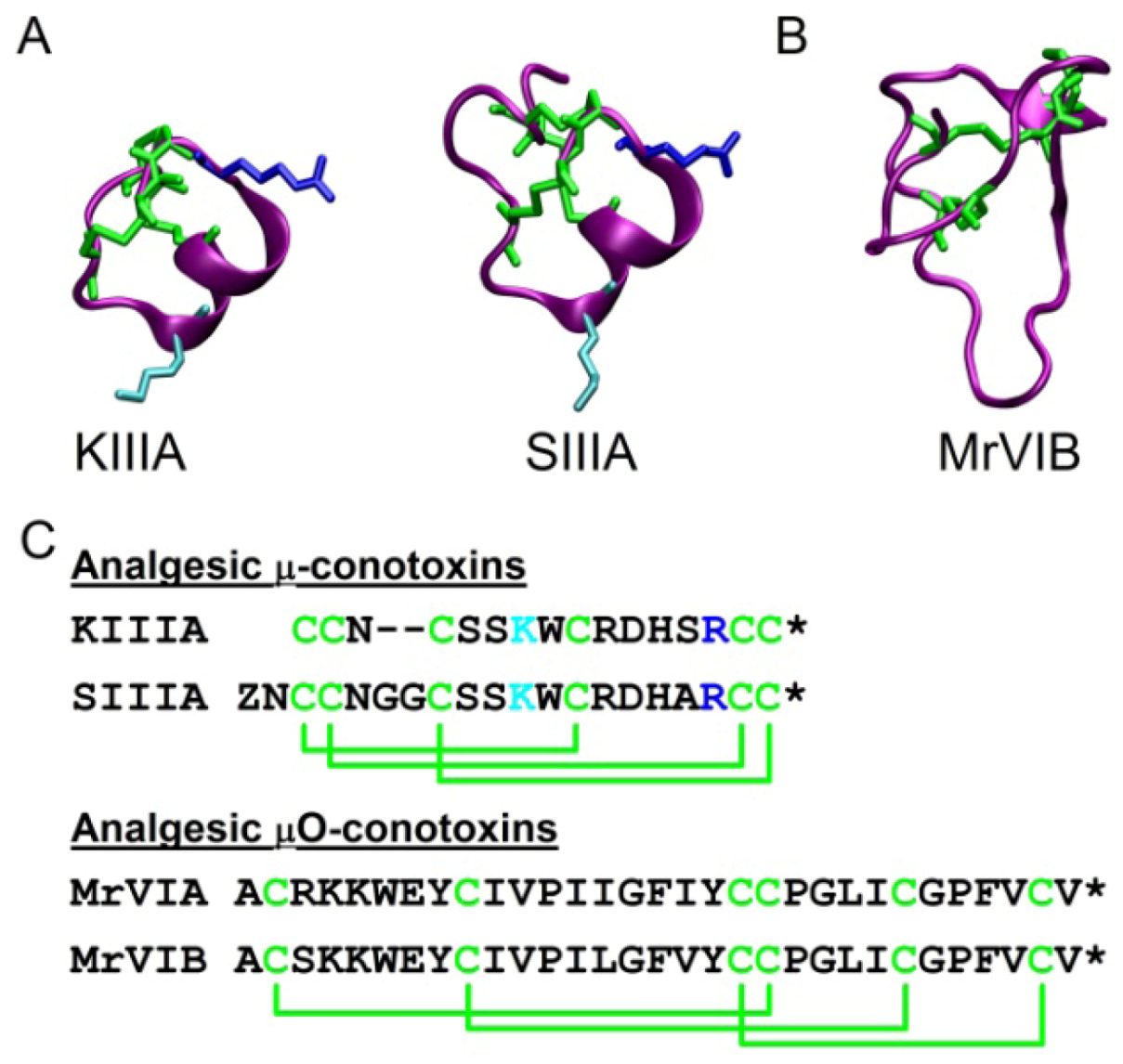
        <p>The first μ-conotoxin isolated and characterized was GIIIA from <italic>C. geographus</italic>. GIIIA was shown to be a potent and selective blocker of muscle VGSCs [<xref ref-type="bibr" rid="B91-toxins-04-01236">91</xref>]. It inhibits the skeletal muscle VGSC, Na<sub>v</sub>1.4, with an IC<sub>50</sub> in the low nanomolar range [<xref ref-type="bibr" rid="B92-toxins-04-01236">92</xref>,<xref ref-type="bibr" rid="B93-toxins-04-01236">93</xref>]. GIIIA’s ability to selectively target a single VGSC subtype suggests there may be other μ-conotoxins that could selectively target different VGSC subtypes, particularly those involved in pain signalling. Since the discovery of GIIIA, numerous μ-conotoxins with new sequences have been identified through molecular cloning techniques. Many of their structures have been solved using NMR spectroscopy (<xref ref-type="fig" rid="toxins-04-01236-f001">Figure 1</xref>) [<xref ref-type="bibr" rid="B94-toxins-04-01236">94</xref>,<xref ref-type="bibr" rid="B95-toxins-04-01236">95</xref>,<xref ref-type="bibr" rid="B96-toxins-04-01236">96</xref>,<xref ref-type="bibr" rid="B97-toxins-04-01236">97</xref>,<xref ref-type="bibr" rid="B98-toxins-04-01236">98</xref>]. </p>
        <p>The first μ-conotoxin shown to inhibit a neuronal VGSC was PIIIA. Despite having modest affinity for the neuronal channel Na<sub>v</sub>1.2 (~500 nM), PIIIA primarily blocks VGSCs in mammalian skeletal muscle [<xref ref-type="bibr" rid="B99-toxins-04-01236">99</xref>]. </p>
        <p>Another μ-conotoxin, KIIIA, was recently shown to preferentially bind to the neuronal channel Na<sub>v</sub>1.2 over the skeletal muscle channel Na<sub>v</sub>1.4. KIIIA also has a nanomolar affinity for Na<sub>v</sub>1.7, a VGSC involved in propagating pain signals [<xref ref-type="bibr" rid="B100-toxins-04-01236">100</xref>]. Being only 16 amino acids long, KIIIA is considerably shorter than previously examined μ-conotoxins. The short length is due to fewer residues within the N-terminal half of the peptide, suggesting C-terminal residues are more critical for toxin binding than N-terminal residues. </p>
        <p>KIIIA and another small μ-conotoxin, SIIIA, have been shown to have analgesic properties in mouse inflammatory pain assays [<xref ref-type="bibr" rid="B101-toxins-04-01236">101</xref>,<xref ref-type="bibr" rid="B102-toxins-04-01236">102</xref>,<xref ref-type="bibr" rid="B103-toxins-04-01236">103</xref>]. These μ-conotoxins have a framework that could be used to develop new analgesic drugs. Their small size, high affinity and unique VGSC channel selectivity make them strong prospective therapeutic agents. </p>
		 <table-wrap id="toxins-04-01236-t001" position="float">
        <object-id pub-id-type="pii">toxins-04-01236-t001_Table 1</object-id>
        <label>Table 1</label>
        <caption>
          <p>Neuronal voltage-gated sodium channels (VGSC) subtype selectivity and potency of μ-conotoxins.</p>
        </caption>
        <table>
<thead>
            <tr align="center" valign="top">
              <th>μ-Conotoxins</th>
              <th><italic>Conus</italic> species</th>
              <th>Number of residues</th>
              <th>VGSC subtypes (IC<sub>50</sub>)</th>
              <th>References</th>
            </tr>
          </thead>
          <tbody>
            <tr align="center" valign="top">
              <td rowspan="2">KIIIA</td>
              <td rowspan="2">
                <italic>C. kinoshitai</italic>
              </td>
              <td rowspan="2">16</td>
              <td align="center">Na<sub>v</sub>1.3 (8 μM),</td>
              <td rowspan="2">[<xref ref-type="bibr" rid="B100-toxins-04-01236">100</xref>,<xref ref-type="bibr" rid="B101-toxins-04-01236">101</xref>]</td>
            </tr>
            <tr>
              <td align="center">Na<sub>v</sub>1.7 (100–290 nM)</td>
            </tr>
            <tr align="center" valign="top" style="border-top:solid thin">
              <td rowspan="3">SIIIA*/B</td>
              <td rowspan="3">
                <italic>C. striatus</italic>
              </td>
              <td rowspan="3">20/20</td>
              <td align="center">Na<sub>v</sub>1.3 (11 μM (SIIIA)),</td>
              <td rowspan="3">[<xref ref-type="bibr" rid="B103-toxins-04-01236">103</xref>,<xref ref-type="bibr" rid="B104-toxins-04-01236">104</xref>,<xref ref-type="bibr" rid="B105-toxins-04-01236">105</xref>]</td>
            </tr>
            <tr>
              <td align="center">Na<sub>v</sub>1.7 (65 μM (SIIIA)),</td>
            </tr>
            <tr>
              <td align="center">Na<sub>v</sub>1.8 (insensitive to 10 μM)</td>
            </tr>
            <tr align="center" valign="top" style="border-top:solid thin">
              <td rowspan="2">PIIIA</td>
              <td rowspan="2">
                <italic>C. purpurascens</italic>
              </td>
              <td rowspan="2">22</td>
              <td align="center">Na<sub>v</sub>1.3 (3.2 μM),</td>
              <td rowspan="2">[<xref ref-type="bibr" rid="B96-toxins-04-01236">96</xref>,<xref ref-type="bibr" rid="B106-toxins-04-01236">106</xref>,<xref ref-type="bibr" rid="B107-toxins-04-01236">107</xref>]</td>
            </tr>
            <tr>
              <td align="center">Na<sub>v</sub>1.7 (3.1–6.2 μM)</td>
            </tr>
            <tr align="center" valign="top" style="border-top:solid thin">
              <td>GIIIA/B/C</td>
              <td>
                <italic>C. geographus</italic>
              </td>
              <td>22/22/22</td>
              <td align="center">N.D.</td>
              <td> </td>
            </tr>
            <tr align="center" valign="top" style="border-top:solid thin">
              <td rowspan="3">CnIIIA/B/C</td>
              <td rowspan="3">
                <italic>C. consors</italic>
              </td>
              <td rowspan="3">22/25/22</td>
              <td align="center">Na<sub>v</sub>1.3 (11 μM (CnIIIA)),</td>
              <td rowspan="3">[<xref ref-type="bibr" rid="B98-toxins-04-01236">98</xref>,<xref ref-type="bibr" rid="B107-toxins-04-01236">107</xref>,<xref ref-type="bibr" rid="B108-toxins-04-01236">108</xref>]</td>
            </tr>
            <tr>
              <td align="center">Na<sub>v</sub>1.7 (489 nM (CnIIIC))</td>
            </tr>
            <tr>
              <td align="center">Na<sub>v</sub>1.8 (insensitive to 1 μM (CnIIIC))</td>
            </tr>
            <tr align="center" valign="top" style="border-top:solid thin">
              <td>CIIIA</td>
              <td>
                <italic>C. catus</italic>
              </td>
              <td>22</td>
              <td align="center">N.D.</td>
              <td> </td>
            </tr>
            <tr align="center" valign="top" style="border-top:solid thin">
              <td rowspan="2">SmIIIA</td>
              <td rowspan="2">
                <italic>C. stercusmuscarum</italic>
              </td>
              <td rowspan="2">22</td>
              <td align="center">Na<sub>v</sub>1.3 (40 nM),</td>
              <td rowspan="2">[<xref ref-type="bibr" rid="B97-toxins-04-01236">97</xref>]</td>
            </tr>
            <tr>
              <td align="center">Na<sub>v</sub>1.7 (1.3 μM)</td>
            </tr>
            <tr align="center" valign="top" style="border-top:solid thin">
              <td rowspan="2">MIIIA</td>
              <td rowspan="2">
                <italic>C. magus</italic>
              </td>
              <td rowspan="2">22</td>
              <td>Na<sub>v</sub>1.3 (7.7 nM),</td>
              <td rowspan="2">[<xref ref-type="bibr" rid="B107-toxins-04-01236">107</xref>]</td>
            </tr>
            <tr>
              <td align="center">Na<sub>v</sub>1.7 (97 μM)</td>
            </tr>
            <tr align="center" valign="top" style="border-top:solid thin">
              <td>SxIIIA/B</td>
              <td>
                <italic>C. striolatus</italic>
              </td>
              <td>22/23</td>
              <td align="center">N.D.</td>
              <td> </td>
            </tr>
            <tr align="center" valign="top" style="border-top:solid thin">
              <td>BuIIIA/B/C</td>
              <td>
                <italic>C. bullatus</italic>
              </td>
              <td>23/24/26</td>
              <td align="center">Na<sub>v</sub>1.3 (350 nM (BuIIIA); 200 nM (BuIIIB))</td>
              <td>[<xref ref-type="bibr" rid="B107-toxins-04-01236">107</xref>]</td>
            </tr>
            <tr align="center" valign="top" style="border-top:solid thin">
              <td rowspan="3">TIIIA</td>
              <td rowspan="3">
                <italic>C. tulipa</italic>
              </td>
              <td rowspan="3">22</td>
              <td align="center">Na<sub>v</sub>1.3 (50 nM),</td>
              <td rowspan="3">[<xref ref-type="bibr" rid="B107-toxins-04-01236">107</xref>]</td>
            </tr>
            <tr>
              <td align="center">Na<sub>v</sub>1.7 (insensitive to 3 μM)</td>
            </tr>
            <tr>
              <td align="center">Na<sub>v</sub>1.8 (insensitive to 3 μM)</td>
            </tr>
          </tbody>
        </table>
		<table-wrap-foot><fn>
		<p>N.D., not determined. *commercial name PEG-SIIIA; entered pre-clinical trial for inflammatory pain (i.v.) [<xref ref-type="bibr" rid="B109-toxins-04-01236">109</xref>].</p>
		</fn></table-wrap-foot>
		</table-wrap>
      
        
        <p>μ-Conotoxins bind to the outer vestibule to inhibit current through the channel. To understand which of the four channel domains are critical to binding, chimeras between rat Na<sub>v</sub>1.4 (rNa<sub>v</sub>1.4) and human Na<sub>v</sub>1.5 (hNa<sub>v</sub>1.5) or human Na<sub>v</sub>1.8 (hNa<sub>v</sub>1.8) have been constructed and examined [<xref ref-type="bibr" rid="B104-toxins-04-01236">104</xref>,<xref ref-type="bibr" rid="B108-toxins-04-01236">108</xref>]. These studies showed that SIIIA and CnIIIC are potent blockers of the VGSC subtypes Na<sub>v</sub>1.2 and Na<sub>v</sub>1.4, but inactive at Na<sub>v</sub>1.8 and Na<sub>v</sub>1.5. The studies further revealed that determinants for the toxin’s inability to block Na<sub>v</sub>1.8 were located across all domains of the channel, whereas those for Na<sub>v</sub>1.5 were restricted to DI and DII. </p>
        <p>There are few differences among the VGSC isoforms in the pore region near the inner and outer ring charge groups (important for ion selectivity and permeation) of the outer vestibule in each of their four channel domains. However, a single amino acid residue change in this region has been shown to be critical for classical pore blockers saxitoxin and TTX [<xref ref-type="bibr" rid="B7-toxins-04-01236">7</xref>]. This residue is located in DI, one residue outside the selectivity filter aspartate. It is either a tyrosine or phenylalanine in TTX-S channels, and a serine or cysteine in TTX-R sodium channels. </p>
        <p>This variation among sodium channel isoforms also affects μ-conotoxin binding properties, such as affinity, but this change is modest [<xref ref-type="bibr" rid="B100-toxins-04-01236">100</xref>,<xref ref-type="bibr" rid="B110-toxins-04-01236">110</xref>]. Nevertheless, it modulates the actions of various μ-conotoxins analogues that incompletely block single channel currents [<xref ref-type="bibr" rid="B106-toxins-04-01236">106</xref>]. Potential derivatives that do not completely block single channel currents could fine tune hyperexcitability. Derivatives of GIIIA and PIIIA as well as KIIIA and its derivatives, which have been examined at the single channel level, cannot completely block single channel currents [<xref ref-type="bibr" rid="B93-toxins-04-01236">93</xref>,<xref ref-type="bibr" rid="B101-toxins-04-01236">101</xref>,<xref ref-type="bibr" rid="B110-toxins-04-01236">110</xref>] and could be used in this way. A drug that modulates single-channel currents would be an effective treatment to reduce hyperexcitability without eliminating Na<sup>+</sup> channel currents completely.</p>
        <p>An additional variation in the sequence in this VGSC region is attractive to examine because it may identify potential human Na<sub>v</sub>1.7 (hNa<sub>v</sub>1.7) blockers. Human Na<sub>v</sub>1.7 is the only VGSC subtype, from any species, where the DIII outer ring charge (typically an aspartate) has been replaced by a neutral isoleucine. μ-Conotoxin binding affinity is critically influenced by residues in the outer ring, especially those of DI and DII [<xref ref-type="bibr" rid="B111-toxins-04-01236">111</xref>,<xref ref-type="bibr" rid="B112-toxins-04-01236">112</xref>,<xref ref-type="bibr" rid="B113-toxins-04-01236">113</xref>]. Recent studies using KIIIA showed that charges interacting with this outer ring charge, when neutralized, affected the derivative’s affinity for hNa<sub>v</sub>1.7 much less than its affinity for Na<sub>v</sub>1.2 and Na<sub>v</sub>1.4 [<xref ref-type="bibr" rid="B100-toxins-04-01236">100</xref>]. The missing outer ring charge of hNa<sub>v</sub>1.7 is believed to be the best site to engineer toxin specificity towards hNa<sub>v</sub>1.7. For example, in KIIIA, the derivative H12Q, which, based on molecular dynamics docking simulations, should interact with the DIII outer ring charge, increased toxin selectivity for hNa<sub>v</sub>1.7 over Na<sub>v</sub>1.2 and Na<sub>v</sub>1.4. The R14A derivative increased the toxin’s selectivity for hNa<sub>v</sub>1.7 to 10-fold more than that for Na<sub>v</sub>1.2 and Na<sub>v</sub>1.4 [<xref ref-type="bibr" rid="B100-toxins-04-01236">100</xref>]. This is the first example of an engineered μ-conotoxin that is selective for hNa<sub>v</sub>1.7. This μ-conotoxin interaction site is a potential target for designing hNa<sub>v</sub>1.7-specific blockers, which could increase selectivity towards Na<sub>v</sub>1.7 and decrease the risk of possible side effects.</p>
      </sec>
      <sec>
        <title>3.2. μ-Conotoxin Engineering</title>
        <p>Recent studies using new peptide synthesis techniques are shedding light on how to create stable and selective sodium channel modulators, and identifying new drug leads. Peptides as drug leads have a few drawbacks, such as unstable disulfide bonds, protease degradation and inefficient transport of the peptide to its intended site of action. To address these concerns, researchers have been trying to improve the native μ-conotoxin by creating more stable peptide bridges, using truncated peptides and/or peptide mimetics. They have also used μ-conotoxins as scaffolds to enhance the peptide’s potential as a drug. </p>
        <p>μ-Conotoxins have three disulfide bonds, which can be oxidized and reduced, and refolded to inactive conformations. This was examined in detail for PIIIA, where three PIIIA isomers were created with different disulfide connections [<xref ref-type="bibr" rid="B114-toxins-04-01236">114</xref>]. Despite differences in connectivity, the three derivatives all had sub-micromolar affinity for Na<sub>v</sub>1.4. This suggests that, despite the toxin preferring to fold to a single conformation, other conformations could also be active. It will be of interest to examine these different PIIIA isomers to determine if they exhibit different selectivity to that of the native toxin. </p>
        <p>To make the peptide structure stable, different non-disulfide bonds can also be introduced. For example, SIIIA with diselenide bridges instead of disulfide bridges was recently synthesized [<xref ref-type="bibr" rid="B115-toxins-04-01236">115</xref>]. Diselenide bonds are considerably more stable than disulfide bonds, making the μ-conotoxin itself more stable [<xref ref-type="bibr" rid="B116-toxins-04-01236">116</xref>].</p>
        <p>With many new μ-conotoxin sequences being discovered, there seems to be greater divergence in the N-terminus half of the toxin sequence. For example, KIIIA seems to be missing many more residues in the N-terminus than other μ-conotoxins. It may be interesting to examine the effects of smaller μ-conopeptides by removing N-terminal residues. Several groups recently examined short peptides based on KIIIA and SIIIA, with varying success. Norton and colleagues used lactam bridges to stabilize the α-helical segment of μ-conotoxins [<xref ref-type="bibr" rid="B117-toxins-04-01236">117</xref>,<xref ref-type="bibr" rid="B118-toxins-04-01236">118</xref>]. This segment has most of the critical residues for toxin binding and might be used as a template on which to base drug design. KIIIA and BuIIIC were used to design ‘mini peptides’ ranging from 12 to 16 amino acids, to try to understand the pharmacophore of μ-conotoxins [<xref ref-type="bibr" rid="B119-toxins-04-01236">119</xref>,<xref ref-type="bibr" rid="B120-toxins-04-01236">120</xref>]. </p>
        <p>In contrast with these two studies, adding residues to the N-terminus of SIIIA, SIIIB and TIIIA has been shown to change their selectivity preference from rat muscle channels to rat neuronal VGSCs [<xref ref-type="bibr" rid="B121-toxins-04-01236">121</xref>]. This suggests that N-terminal residues also contribute to the toxins’ affinity and selectivity.</p>
        <p>As peptides are degraded or truncated by proteases, non-peptide backbones have also been examined to try to increase drug bioavailability. KIIIA and SIIIA structure has undergone non-peptide modification to help design new drug leads. For example, Bulaj and colleagues examined the effects of removing a single disulfide bond to see if it is feasible to use non-peptide backbone spacers and disulfide bond deletion to increase bioavailability without decreasing affinity or change selectivity. They also used amino-3-oxapentanoic or 6-aminohexanoic acids to replace non-essential amino acids in the toxin to further minimize the protein component of the toxin [<xref ref-type="bibr" rid="B103-toxins-04-01236">103</xref>,<xref ref-type="bibr" rid="B122-toxins-04-01236">122</xref>]. Resulting analogues still inhibited VGSCs and produced analgesic effects. </p>
        <p>μ-Conotoxins as potential analgesics are still in the preclinical stage. We are learning how these unique toxins can block specific VGSC subtypes, and how we can modify them without changing their selectivity and high affinity for VGSCs. As we further examine these toxins and isolate new toxins that can block specific VGSC subtypes, we will be able to design new selective and clinically relevant drugs to block VGSC subtypes involved in pain signalling.</p>
      </sec>
      <sec>
        <title>3.3. μO-Conotoxins</title>
        <p>μO-Conotoxins are hydrophobic peptides belonging to the O-superfamily of conotoxins. This group of toxins was first isolated from <italic>Conus marmoreus</italic> [<xref ref-type="bibr" rid="B82-toxins-04-01236">82</xref>]. To date, five μO-conotoxins have been discovered (<xref ref-type="table" rid="toxins-04-01236-t002">Table 2</xref>). They range from 28 to 32 amino acids in length, with each toxin containing three intramolecular disulfide bonds. Two of these μO-conotoxins, MrVIA and MrVIB, have high sequence homology. Only two residues differ between them. MrVIA and MrVIB are of interest because they block TTX-R Na<sup>+</sup> currents in mammalian DRG neurons (which are mainly mediated by Na<sub>v</sub>1.8) 10-fold more than TTX-S Na<sup>+</sup> currents [<xref ref-type="bibr" rid="B62-toxins-04-01236">62</xref>,<xref ref-type="bibr" rid="B123-toxins-04-01236">123</xref>,<xref ref-type="bibr" rid="B124-toxins-04-01236">124</xref>]. However, despite the selectivity of MrVIA and MrVIB for the TTX-R subtype Na<sub>v</sub>1.8 over TTX-S subtypes, and the resulting analgesic activity in a variety of animal models of pain [<xref ref-type="bibr" rid="B62-toxins-04-01236">62</xref>,<xref ref-type="bibr" rid="B123-toxins-04-01236">123</xref>,<xref ref-type="bibr" rid="B124-toxins-04-01236">124</xref>,<xref ref-type="bibr" rid="B125-toxins-04-01236">125</xref>], little is known of the structure–activity relationships that define μO-conotoxin subtype specificity. </p>
        <p>MrVIA inhibits VGSCs and voltage-gated calcium channels (VGCC) in <italic>Aplysia californica</italic> and <italic>Lymnaea stagnalis</italic> molluscan neurons [<xref ref-type="bibr" rid="B82-toxins-04-01236">82</xref>], and amphibian VGSCs [<xref ref-type="bibr" rid="B124-toxins-04-01236">124</xref>]. It also inhibits TTX-S Na<sup>+</sup> currents in rat hippocampal neurons and heterologously expressed rNa<sub>v</sub>1.2 in <italic>Xenopus</italic> oocytes with IC<sub>50</sub> values of 200 nM [<xref ref-type="bibr" rid="B126-toxins-04-01236">126</xref>]. MrVIA blocks TTX-R VGSCs from rDRG neurons with an IC<sub>50</sub> of 82.8 nM [<xref ref-type="bibr" rid="B125-toxins-04-01236">125</xref>]. Consistent with μO-conotoxins acting as gating modifiers, MrVIA inhibition of Na<sup>+</sup> current appears to be voltage-dependent, with a reduced affinity for the channel after depolarizing voltage steps [<xref ref-type="bibr" rid="B77-toxins-04-01236">77</xref>,<xref ref-type="bibr" rid="B127-toxins-04-01236">127</xref>]. </p>
        <p>MrVIB more selectively inhibits TTX-R than TTX-S neuronal VGSCs, and is also selective between different TTX-R VGSC subtypes. It is 100-fold more selective for Na<sub>v</sub>1.8 than Na<sub>v</sub>1.9 in DRGs [<xref ref-type="bibr" rid="B62-toxins-04-01236">62</xref>]. Its selectivity for hNa<sub>v</sub>1.8 over other VGSC subtypes was confirmed using <italic>Xenopus</italic> oocytes expressing a range of different VGSC subtypes [<xref ref-type="bibr" rid="B62-toxins-04-01236">62</xref>]. This is particularly interesting, since only a few Na<sub>v</sub>1.8-selective modulators have been described to date. Zorn <italic>et al.</italic> also showed that MrVIB is more selective for Na<sub>v</sub>1.4 than Na<sub>v</sub>1.2 expressed in HEK 293 cells [<xref ref-type="bibr" rid="B128-toxins-04-01236">128</xref>]. </p>
        <p>MrVIB has exhibited analgesic activity in animal pain models and decreased mechanical and thermal pain sensation [<xref ref-type="bibr" rid="B62-toxins-04-01236">62</xref>,<xref ref-type="bibr" rid="B125-toxins-04-01236">125</xref>]. Intrathecally applied MrVIB was 30 times more effective than lidocaine on allodynia and hyperalgesia and had only small motor system side effects [<xref ref-type="bibr" rid="B62-toxins-04-01236">62</xref>]. The 3D structure was determined using NMR data (<xref ref-type="fig" rid="toxins-04-01236-f001">Figure 1</xref>) [<xref ref-type="bibr" rid="B125-toxins-04-01236">125</xref>].</p>
		<fig id="toxins-04-01236-f001" position="anchor">
          <label>Figure 1</label>
          <caption>
            <p>Structures and sequences of analgesic μ- and μO-conotoxins. <bold>(A)</bold> Solution structures of analgesic μ-conotoxins, KIIIA and SIIIA. Disulfide links (green) with critical lysine (cyan, K7 (KIIIA) and K11 (SIIIA)) and arginine (blue, R14 (KIIIA) and R18 (SIIIA)) residues. <bold>(B)</bold> Solution structure of analgesic μO-conotoxin MrVIB. Disulfide links are green. <bold>(C)</bold> Amino acid sequences of analgesic μ-conotoxins, KIIIA and SIIIA, and μO-conotoxins, MrVIA and MrVIB. <bold>*</bold> C-terminal amidation.</p>
          </caption>
          <graphic xmlns:xlink="http://www.w3.org/1999/xlink" xlink:href="toxins-04-01236-g001.tif"/>
        </fig>
        
        <p>There is considerable interest in finding out how μO-conotoxins bind to VGSCs, since they are modestly selective inhibitors of TTX-R VGSC currents in rat DRG neurons [<xref ref-type="bibr" rid="B125-toxins-04-01236">125</xref>] and have potential as analgesic drugs [<xref ref-type="bibr" rid="B62-toxins-04-01236">62</xref>,<xref ref-type="bibr" rid="B123-toxins-04-01236">123</xref>,<xref ref-type="bibr" rid="B124-toxins-04-01236">124</xref>]. Analysis of the MrVIA binding site in rNa<sub>v</sub>1.4 channels and competition experiments with the scorpion toxin, β-toxin Ts1, identified that the C-terminal pore loop of DIII is necessary for MrVIA to bind to Na<sub>v</sub>1.4 [<xref ref-type="bibr" rid="B128-toxins-04-01236">128</xref>]. In contrast, a later study using site-directed Na<sub>v</sub>1.4 mutagenesis, revealed that DII’s voltage sensor is the main MrVIA binding site. The same study concluded that MrVIA interaction with DIII of Na<sub>v</sub>1.4 appeared to play a lesser role [<xref ref-type="bibr" rid="B77-toxins-04-01236">77</xref>]. Neither of these two studies examined the binding site and mechanism of action of μO-conotoxins on Na<sub>v</sub>1.8. </p>
		 <fig id="toxins-04-01236-f002" position="anchor">
          <label>Figure 2</label>
          <caption>
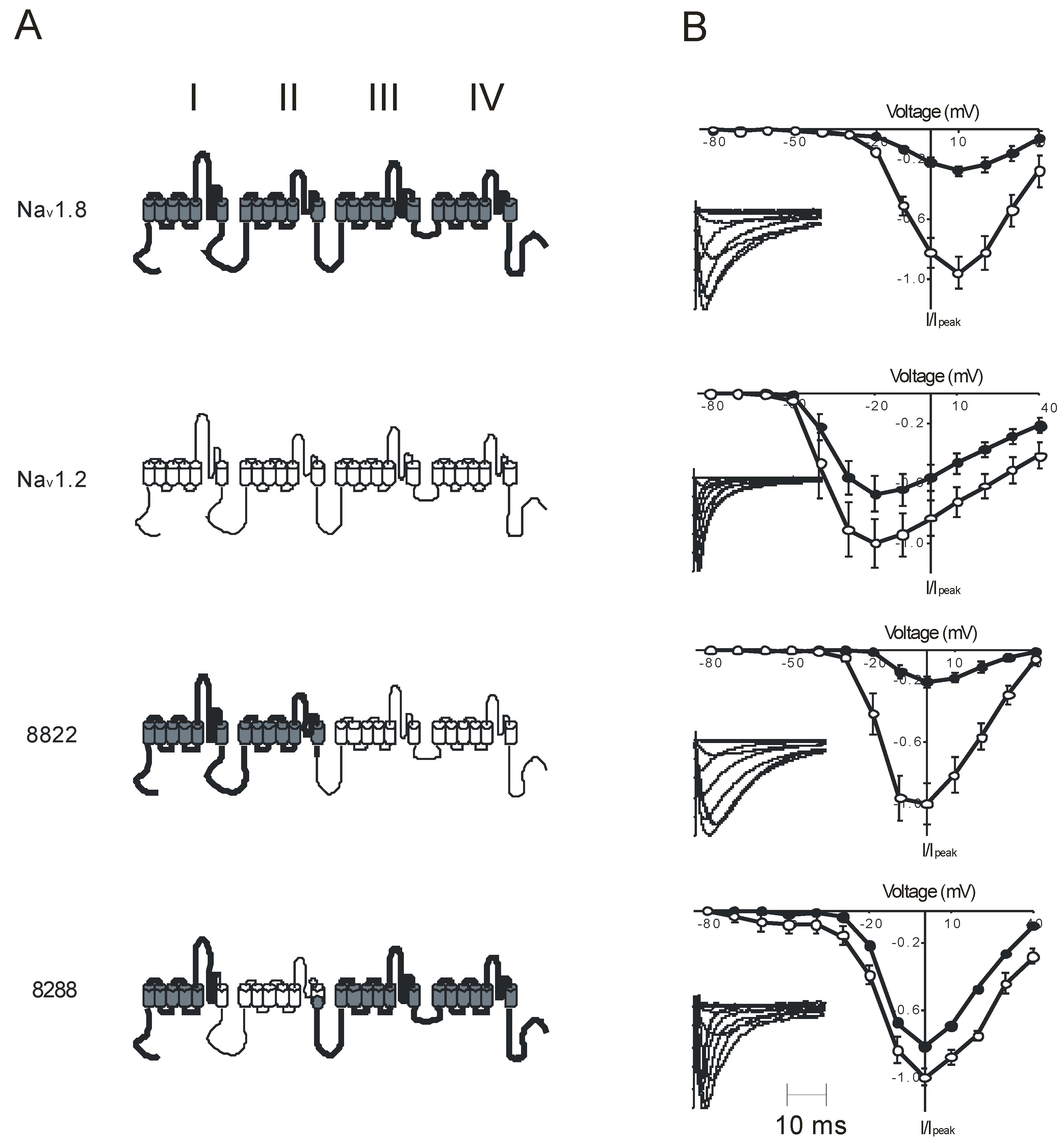
            <p>Effect of μO-conotoxin MrVIB on Na<sup>+</sup> current amplitude of Na<sub>v</sub>1.2, Na<sub>v</sub>1.8 and their chimeras. <bold>(A)</bold> Schematic diagram of parent VGSC a-subunits rNa<sub>v</sub>1.2 (open), hNa<sub>v</sub>1.8 (filled) and chimeras 8822 and 8288. Roman numerals denote individual domains of the α-subunit, <bold>(B)</bold> Current–voltage relationship of rNa<sub>v</sub>1.2, hNa<sub>v</sub>1.8 and chimeras 8288 and 8822 in the absence (open symbols) and presence (closed symbols) of 1 μM MrVIB. Normalized peak currents (I/I<sub>0</sub>) were plotted as a function of membrane potential. Insets: normalized depolarization-activated Na<sup>+</sup> currents in <italic>Xenopus</italic> oocytes expressing rNa<sub>v</sub>1.2, hNa<sub>v</sub>1.8 and the chimeras. Oocytes were held at −80 mV and depolarized to potentials ranging from −80 to +40 mV in 10 mV increments (adapted from Knapp <italic>et al.</italic> [<xref ref-type="bibr" rid="B129-toxins-04-01236">129</xref>]). </p>
          </caption>
          <graphic xmlns:xlink="http://www.w3.org/1999/xlink" xlink:href="toxins-04-01236-g002.tif"/>
        </fig>
        
        <p>Na<sub>v</sub>1.8 is only 50% identical to Na<sub>v</sub>1.2, a major VGSC of the central nervous system, and its affinity for MrVIB is higher than that of Na<sub>v</sub>1.2 [<xref ref-type="bibr" rid="B62-toxins-04-01236">62</xref>]. To address the functional and pharmacological significance of these differences, Knapp <italic>et al.</italic> used a domain swapping strategy between rNa<sub>v</sub>1.2 and hNa<sub>v</sub>1.8 [<xref ref-type="bibr" rid="B129-toxins-04-01236">129</xref>]. Heterologous expression of Na<sub>v</sub>1.2/Na<sub>v</sub>1.8 chimeras in <italic>Xenopus</italic> oocytes and analysis of their inhibition by MrVIB revealed that the region between segment S6 of DI and the external loop of DII in Na<sub>v</sub>1.8 is the main determinant for the μO-conotoxin family’s high affinity for Na<sub>v</sub>1.8 (<xref ref-type="fig" rid="toxins-04-01236-f002">Figure 2</xref>) [<xref ref-type="bibr" rid="B129-toxins-04-01236">129</xref>]. Comparing this data with those of Leipold <italic>et al.</italic> supports the likelihood that MrVIB inhibition of Na<sub>v</sub>1.8 is mediated via an interaction between the toxin and DII’s voltage sensor [<xref ref-type="bibr" rid="B77-toxins-04-01236">77</xref>,<xref ref-type="bibr" rid="B129-toxins-04-01236">129</xref>]. A similar approach was used to study the interaction between Na<sub>v</sub>1.9 voltage sensors and scorpion or tarantula toxins. The voltage-sensor paddle motifs of Na<sub>v</sub>1.9 were transferred into the voltage-gated potassium channel K<sub>v</sub>2.1 [<xref ref-type="bibr" rid="B130-toxins-04-01236">130</xref>]. This enabled examination of their interactions with tarantula and scorpion toxins [<xref ref-type="bibr" rid="B131-toxins-04-01236">131</xref>]. The possibility that MrVIB could also interact with other domains cannot be excluded. Results from recent studies into MfVIA inhibition of Na<sub>v</sub>1.2 and other voltage-sensor toxins such as tarantula toxins may support the idea of multiple binding sites [<xref ref-type="bibr" rid="B132-toxins-04-01236">132</xref>,<xref ref-type="bibr" rid="B133-toxins-04-01236">133</xref>].</p>
       <p>MfVIA, a novel μO-conotoxin, was recently identified from <italic>Conus magnificus</italic>. Similar to MrVIA and MrVIB, it is a hydrophobic peptide containing 32 residues, but has highest sequence homology to MrVIB [<xref ref-type="bibr" rid="B133-toxins-04-01236">133</xref>]. MfVIA’s amino acid sequence is only slightly different to those of MrVIA and MrVIB. Surprisingly, this results in MfVIA having different potencies and selectivity towards mammalian VGSC subtypes from those of MrVIA and MrVIB. MfVIA is three-fold more potent towards Na<sub>v</sub>1.4 and five-fold less potent towards Na<sub>v</sub>1.2 than MrVIA or MrVIB. MfVIA inhibits TTX-R Na<sup>+</sup> currents expressed in DRG neurons five times more strongly than those heterologously expressed in rNa<sub>v</sub>1.8. It also inhibits Na<sub>v</sub>1.4 and Na<sub>v</sub>1.8 at low nanomolar concentrations, whereas significantly higher toxin concentrations are needed to inhibit all other VGSC subtypes (<xref ref-type="table" rid="toxins-04-01236-t002">Table 2</xref>) [<xref ref-type="bibr" rid="B133-toxins-04-01236">133</xref>]. </p>
	   
	   <table-wrap id="toxins-04-01236-t002" position="float">
        <object-id pub-id-type="pii">toxins-04-01236-t002_Table 2</object-id>
        <label>Table 2</label>
        <caption>
          <p>Neuronal VGSC subtype selectivity and potency of μO-conotoxins.</p>
        </caption>
        <table>
<thead>
            <tr>
              <th align="center" valign="top">μO-Conotoxins</th>
              <th align="center" valign="top"><italic>Conus</italic> species</th>
              <th align="center" valign="top">Number of residues</th>
              <th align="center" valign="top">VGSC subtypes(IC<sub>50</sub>)</th>
              <th align="center" valign="top">References</th>
    </tr>
          </thead>
          <tbody>
            <tr>
              <td align="center" valign="top">MrVIA</td>
              <td align="center" valign="top">
                <italic>C. marmoreus</italic>
              </td>
              <td align="center" valign="top">31</td>
              <td align="center" valign="top">Na<sub>v</sub>1.7 (345 nM)</td>
              <td align="center" valign="top">[<xref ref-type="bibr" rid="B123-toxins-04-01236">123</xref>,<xref ref-type="bibr" rid="B134-toxins-04-01236">134</xref>]</td>
            </tr>
            <tr style="border-top:solid thin">
              <td rowspan="3" align="center" valign="top">MrVIB*</td>
              <td rowspan="3" align="center" valign="top">
                <italic>C. marmoreus</italic>
              </td>
              <td rowspan="3" align="center" valign="top">31</td>
              <td align="center" valign="top">Na<sub>v</sub>1.3 (1 μM),</td>
              <td rowspan="3" align="center" valign="top">[<xref ref-type="bibr" rid="B62-toxins-04-01236">62</xref>,<xref ref-type="bibr" rid="B123-toxins-04-01236">123</xref>,<xref ref-type="bibr" rid="B134-toxins-04-01236">134</xref>]</td>
            </tr>
            <tr>
              <td align="center" valign="top">Na<sub>v</sub>1.7 (345 nM),</td>
            </tr>
            <tr>
              <td align="center" valign="top">Na<sub>v</sub>1.8 (1–326 nM)</td>
            </tr>
            <tr style="border-top:solid thin">
              <td rowspan="3" align="center" valign="top">MfVIA</td>
              <td rowspan="3" align="center" valign="top">
                <italic>C. magnificus</italic>
              </td>
              <td rowspan="3" align="center" valign="top">32</td>
              <td align="center" valign="top">Na<sub>v</sub>1.3 (2175 nM),</td>
              <td rowspan="3" align="center" valign="top">[<xref ref-type="bibr" rid="B133-toxins-04-01236">133</xref>]</td>
            </tr>
            <tr>
              <td align="center" valign="top">Na<sub>v</sub>1.7 (2317–5491 nM),</td>
            </tr>
            <tr>
              <td align="center" valign="top">Na<sub>v</sub>1.8 (529 nM)</td>
            </tr>
            <tr style="border-top:solid thin">
              <td align="center" valign="top">LtVIIA</td>
              <td align="center" valign="top">
                <italic>C. litteratus</italic>
              </td>
              <td align="center" valign="top">29</td>
              <td align="center" valign="top">N.D.</td>
              <td align="center" valign="top">[<xref ref-type="bibr" rid="B135-toxins-04-01236">135</xref>,<xref ref-type="bibr" rid="B136-toxins-04-01236">136</xref>]</td>
            </tr>
            <tr style="border-top:solid thin">
              <td align="center" valign="top">LtVIC</td>
              <td align="center" valign="top">
                <italic>C. litteratus</italic>
              </td>
              <td align="center" valign="top">28</td>
              <td align="center" valign="top">N.D.</td>
              <td align="center" valign="top">
              <xref ref-type="bibr" rid="B135-toxins-04-01236">[135</xref>,<xref ref-type="bibr" rid="B136-toxins-04-01236">136</xref>] </td>
            </tr>
          </tbody>
        </table>
		<table-wrap-foot><fn>
		<p>N.D., not determined. *commercial name CGX-1002 (Cognetix Inc.); entered pre-clinical trial for neuropathic pain (i.t./i.v.) [<xref ref-type="bibr" rid="B109-toxins-04-01236">109</xref>].</p>
		</fn></table-wrap-foot>
		</table-wrap>


        <p>The established model of μO-conotoxin mediated block of VGSC channels involves a single toxin molecule binding and inhibiting the channel. This is consistent with MfVIA inhibition of all VGSC subtypes except Na<sub>v</sub>1.2. The concentration–dependence for Na<sub>v</sub>1.2 inhibition was steeper than the expected Hill slope of −1 [<xref ref-type="bibr" rid="B133-toxins-04-01236">133</xref>]. This may indicate that MfVIA interacts with more than one binding site. Another possibility might be that μO-conotoxins have slow on-rates that make it difficult to reach equilibrium at low peptide concentrations [<xref ref-type="bibr" rid="B133-toxins-04-01236">133</xref>]. </p>
        <p>DNA sequencing of <italic>C. litteratus</italic> has revealed the existence of two novel μO-conotoxins, LtVIC and LtVIIA. These recombinant toxins inhibit Na<sup>+</sup> currents in DRG neurons in a similar way to known μO-conotoxins. However, their subtype selectivity and structure–activity relationships are yet to be investigated [<xref ref-type="bibr" rid="B135-toxins-04-01236">135</xref>,<xref ref-type="bibr" rid="B136-toxins-04-01236">136</xref>,<xref ref-type="bibr" rid="B137-toxins-04-01236">137</xref>]. </p>
        <p>MrVIA, MrVIB and MfVIA remain the only μO-conotoxins for which mammalian VGSC subtype selectivity data is available, albeit not across all VGSC subtypes. The unique selectivity profile of μO-conotoxins MfVIA, MrVIA and MrVIB [<xref ref-type="bibr" rid="B62-toxins-04-01236">62</xref>,<xref ref-type="bibr" rid="B82-toxins-04-01236">82</xref>,<xref ref-type="bibr" rid="B126-toxins-04-01236">126</xref>,<xref ref-type="bibr" rid="B133-toxins-04-01236">133</xref>] makes these peptides attractive leads for analgesic drugs [<xref ref-type="bibr" rid="B62-toxins-04-01236">62</xref>,<xref ref-type="bibr" rid="B129-toxins-04-01236">129</xref>]. Synthesis of μO-conotoxins does, however, pose significant challenges. This is mainly due to their highly hydrophobic nature and the difficulty of correctly forming their three disulfide bonds to the native isomer. While replacing cysteines with selenocysteines has helped with MrVIB folding [<xref ref-type="bibr" rid="B138-toxins-04-01236">138</xref>], synthesis of the native molecule relies on a semi-selective approach [<xref ref-type="bibr" rid="B124-toxins-04-01236">124</xref>,<xref ref-type="bibr" rid="B134-toxins-04-01236">134</xref>], which produces a low overall yield. Nevertheless, a novel regioselective protocol has been developed for synthesizing the novel μO-conotoxin MfVIA that only uses a single HPLC purification step and increases peptide yields [<xref ref-type="bibr" rid="B133-toxins-04-01236">133</xref>].</p>
        <p>Another potential problem with μO-conotoxins is that their affinity for Na<sub>v</sub>1.4 and Na<sub>v</sub>1.8 is almost identical. This may limit their therapeutic effectiveness, unless derivatives of the toxins can make them more selective for Na<sub>v</sub>1.8 than Na<sub>v</sub>1.4. Stürzebecher <italic>et al.</italic> introduced a membrane-tethered isoform of MrVIA (t-MrVIA) into nociceptive neurones in mice, where it was successfully expressed on the cell surface [<xref ref-type="bibr" rid="B123-toxins-04-01236">123</xref>]. TTX-R VGSC current densities, which were mainly Na<sub>v</sub>1.8-mediated, were reduced by 44 ± 7% in t-MrVIA transgenic mice, without up-regulation of TTX-S VGSC, VGCC or transient receptor potential channel expression in nociceptive neurones [<xref ref-type="bibr" rid="B123-toxins-04-01236">123</xref>]. t-MrVIA transgenic mice had less inflammatory mechanical hypersensitivity and firing of cutaneous C-fibres sensitive to noxious cold temperatures, and were more insensitive to cold pain than wild-type mice [<xref ref-type="bibr" rid="B123-toxins-04-01236">123</xref>]. Besides proving that MrVIA is analgesic, membrane-tethered MrVIAs could be used to study and manipulate VGSCs in specific cell types in the mammalian nervous system [<xref ref-type="bibr" rid="B123-toxins-04-01236">123</xref>], further increasing the toxin’s selectivity.</p>
      </sec>
    </sec>
    <sec>
      <title>4. β-Subunits Modulate the Effects of Conotoxins</title>
      <p>Auxiliary β1-, β2-, β3- and β4-subunits, when individually co-expressed with Na<sub>v</sub>1.8 in <italic>Xenopus</italic> oocytes, increased the <italic>k<sub>on</sub></italic> of μO-MrVIB inhibition of Na<sup>+</sup> current by 3-, 32-, 2- and 7-fold, respectively [<xref ref-type="bibr" rid="B127-toxins-04-01236">127</xref>]. β-subunits also modestly decreased the <italic>k<sub>off</sub></italic> rate [<xref ref-type="bibr" rid="B127-toxins-04-01236">127</xref>]. Different β-subunit expression rates, in combination with depolarizing prepulses, markedly accelerated MrVIB washout. Co-expression of β-subunits, in particular β2, with Na<sub>v</sub>1.8 α-subunits strongly influenced μO-conotoxin affinity for this subtype. However, expression of the a-subunit with auxiliary β-subunits did not appear to influence μ-conotoxin selectivity or affinity for Na<sub>v</sub>1.8 [<xref ref-type="bibr" rid="B107-toxins-04-01236">107</xref>]. Whether or not this is also true for other members of this toxin family is yet to be determined [<xref ref-type="bibr" rid="B137-toxins-04-01236">137</xref>].</p>
    </sec>
    <sec>
      <title>5. Multiple Sites of μ- and μO-Conotoxin Action</title>
      <p>Many animal toxins that target multiple pharmacologically distinct ion channels or receptors have been identified in recent years. For example, MrVIA and MrVIB have been reported to inhibit mollusc and mammalian VGSCs, as well as mollusc VGCCs [<xref ref-type="bibr" rid="B82-toxins-04-01236">82</xref>,<xref ref-type="bibr" rid="B107-toxins-04-01236">107</xref>]. However, Daly <italic>et al.</italic> showed that mammalian VGCCs in DRG neurons were unaffected by these toxins. Therefore, it can be assumed that the analgesic effects evoked by MrVIA and MrVIB are unrelated to VGCCs [<xref ref-type="bibr" rid="B125-toxins-04-01236">125</xref>]. </p>
      <p>It was also recently shown that μ-conotoxin CnIIIC has multiple targets, including VGSCs and ligand-gated channels [<xref ref-type="bibr" rid="B98-toxins-04-01236">98</xref>]. CnIIIC from <italic>Conus consors</italic> inhibited Na<sub>v</sub>1.4, with an IC<sub>50</sub> of 1.3 nM, and α3β2 nicotinic acetylcholine receptor (nAChR) channels, with an IC<sub>50</sub> of 450 nM. nAChR subtypes α7 and α4β2 were inhibited to a lesser extent, in the micromolar range [<xref ref-type="bibr" rid="B98-toxins-04-01236">98</xref>]. The diversity of pharmacological interactions of conotoxins with different membrane receptors, transporters and ion channels should not be overlooked when developing new analgesics and other bioactive drugs.</p>
    </sec>
    <sec>
      <title>6. Conotoxins—Analgesics of the Future?</title>
      <p>Since their discovery, conotoxins have been of interest because of their high affinity and selectivity for VGSCs and other membrane receptors and ion channels. Neuropathic and inflammatory pain is associated with changes in VGSC activity and expression [<xref ref-type="bibr" rid="B25-toxins-04-01236">25</xref>,<xref ref-type="bibr" rid="B139-toxins-04-01236">139</xref>]. Because of this, several conopeptides are being investigated as anti-nociceptive drugs [<xref ref-type="bibr" rid="B73-toxins-04-01236">73</xref>]. To date, however, no therapeutic drug that selectively targets a specific VGSC subtype is available. Despite the fact that several conotoxins have been and are currently being tested in clinical trials, only the w-conotoxin MVIIA from <italic>Conus magus</italic> has been approved as an analgesic drug (Ziconitide, Prialt<sup>®</sup>) to treat intractable pain [<xref ref-type="bibr" rid="B140-toxins-04-01236">140</xref>,<xref ref-type="bibr" rid="B141-toxins-04-01236">141</xref>,<xref ref-type="bibr" rid="B142-toxins-04-01236">142</xref>].</p>
      <p>μO-Conotoxins MrVIA, MrVIB and MfVIA block Na<sub>v</sub>1.8, which has a major role in pain, but does not appear to be important for other physiological functions [<xref ref-type="bibr" rid="B18-toxins-04-01236">18</xref>]. As such, these peptides have potential as new analgesics and are the focus of several studies. In particular, MrVIB reduces pain without causing motor deficits in animal models [<xref ref-type="bibr" rid="B62-toxins-04-01236">62</xref>]. Of the μ-conotoxins, SIIIA and KIIIA have both shown analgesic activity in mouse models [<xref ref-type="bibr" rid="B101-toxins-04-01236">101</xref>,<xref ref-type="bibr" rid="B105-toxins-04-01236">105</xref>]. However, both peptides also target skeletal muscle sodium channels, which reduces their analgesic potential in their native form. Nonetheless, specifically designed derivatives of these peptides have the potential to increase selectivity towards VGSC pain targets [<xref ref-type="bibr" rid="B100-toxins-04-01236">100</xref>].</p>
      <p>Side effects from the native toxin must be expected and should be carefully assayed in detail. For example, μO-conotoxins also affect the muscle VGSC subtype Na<sub>v</sub>1.4, which may limit their therapeutic effectiveness [<xref ref-type="bibr" rid="B62-toxins-04-01236">62</xref>,<xref ref-type="bibr" rid="B128-toxins-04-01236">128</xref>]. Side effects are also a particular consideration for μ-conotoxins, because they target muscle and neuronal VGSC subtypes [<xref ref-type="bibr" rid="B99-toxins-04-01236">99</xref>]. However, a major hurdle in developing conotoxins as analgesic drugs is creating a drug that targets a single VGSC subtype. So far, no toxin selective for only one VGSC subtype has been discovered. Furthermore, pharmacological interactions of conotoxins with membrane receptors and ion channels other than their target (e.g., VGSCs) can be underestimated. The same is true for other animal peptide toxins, for example spider toxins [<xref ref-type="bibr" rid="B143-toxins-04-01236">143</xref>,<xref ref-type="bibr" rid="B144-toxins-04-01236">144</xref>,<xref ref-type="bibr" rid="B145-toxins-04-01236">145</xref>]. </p>
      <p>Other problems associated with conotoxins include their challenging chemical synthesis and folding, which make it difficult to produce conopeptides in large quantities. Orally active drugs are also difficult to produce, although they are most desirable, because they would be better accepted by patients and doctors [<xref ref-type="bibr" rid="B146-toxins-04-01236">146</xref>]. For example, MVIIA (Ziconitide, Prialt<sup>®</sup>) requires intrathecal administration which limits its range of applications. Despite these complications, conotoxins that inhibit VGSCs and have some subtype selectivity are valuable tools for studying ion channels and their physiological role. This will contribute to the development of novel drugs to improve pain management and treat neurological disorders.</p>
    </sec>
    
  </body>
  <back>
  <notes>
      <title>Conflict of Interest</title>
      <p>The authors declare no conflict of interest.</p>
    </notes>
    <ack>
      <title>Acknowledgements</title>
      <p>This work was supported by a National Health and Medical Research Council (NHMRC) Program Grant (D.J.A). D.J.A is an Australian Research Council (ARC) Australian Professorial Fellow.</p>
    </ack>
    <ref-list>
      <title>References</title>
      <ref id="B1-toxins-04-01236">
        <label>1.</label>
        <citation citation-type="journal">
          <person-group person-group-type="author">
            <name>
              <surname>Hille</surname>
              <given-names>B.</given-names>
            </name>
            <name>
              <surname>Armstrong</surname>
              <given-names>C.M.</given-names>
            </name>
            <name>
              <surname>MacKinnon</surname>
              <given-names>R.</given-names>
            </name>
          </person-group>
          <article-title>Ion channels: from idea to reality</article-title>
          <source>Nat. Med.</source>
          <year>1999</year>
          <volume>5</volume>
          <fpage>1105</fpage>
          <lpage>1109</lpage>
          <pub-id pub-id-type="doi">10.1038/13415</pub-id>
        </citation>
      </ref>
      <ref id="B2-toxins-04-01236">
        <label>2.</label>
        <citation citation-type="journal">
          <person-group person-group-type="author">
            <name>
              <surname>Payandeh</surname>
              <given-names>J.</given-names>
            </name>
            <name>
              <surname>Gamal El-Din</surname>
              <given-names>T.M.</given-names>
            </name>
            <name>
              <surname>Scheuer</surname>
              <given-names>T.</given-names>
            </name>
            <name>
              <surname>Zheng</surname>
              <given-names>N.</given-names>
            </name>
            <name>
              <surname>Catterall</surname>
              <given-names>W.A.</given-names>
            </name>
          </person-group>
          <article-title>The crystal structure of a voltage-gated sodium channel</article-title>
          <source>Nature</source>
          <year>2011</year>
          <volume>475</volume>
          <fpage>353</fpage>
          <lpage>358</lpage>
        <pub-id pub-id-type="doi">10.1038/nature10238</pub-id><pub-id pub-id-type="pmid">21743477</pub-id></citation>
      </ref>
      <ref id="B3-toxins-04-01236">
        <label>3.</label>
        <citation citation-type="journal">
          <person-group person-group-type="author">
            <name>
              <surname>Payandeh</surname>
              <given-names>J.</given-names>
            </name>
            <name>
              <surname>Gamal El-Din</surname>
              <given-names>T.M.</given-names>
            </name>
            <name>
              <surname>Scheuer</surname>
              <given-names>T.</given-names>
            </name>
            <name>
              <surname>Zheng</surname>
              <given-names>N.</given-names>
            </name>
            <name>
              <surname>Catterall</surname>
              <given-names>W.A.</given-names>
            </name>
          </person-group>
          <article-title>Crystal structure of a voltage-gated sodium channel in two potentially inactivated states</article-title>
          <source>Nature</source>
          <year>2012</year>
          <volume>486</volume>
          <fpage>135</fpage>
          <lpage>139</lpage>
        <pub-id pub-id-type="pmid">22678296</pub-id></citation>
      </ref>
      <ref id="B4-toxins-04-01236">
        <label>4.</label>
        <citation citation-type="journal">
          <person-group person-group-type="author">
            <name>
              <surname>Zhang</surname>
              <given-names>X.</given-names>
            </name>
            <name>
              <surname>Ren</surname>
              <given-names>W.</given-names>
            </name>
            <name>
              <surname>DeCaen</surname>
              <given-names>P.</given-names>
            </name>
            <name>
              <surname>Yan</surname>
              <given-names>C.</given-names>
            </name>
            <name>
              <surname>Tao</surname>
              <given-names>X.</given-names>
            </name>
            <name>
              <surname>Tang</surname>
              <given-names>L.</given-names>
            </name>
            <name>
              <surname>Wang</surname>
              <given-names>J.</given-names>
            </name>
            <name>
              <surname>Hasegawa</surname>
              <given-names>K.</given-names>
            </name>
            <name>
              <surname>Kumasaka</surname>
              <given-names>T.</given-names>
            </name>
            <name>
              <surname>He</surname>
              <given-names>J.</given-names>
            </name>
            <name>
              <surname>Wang</surname>
              <given-names>J.</given-names>
            </name>
            <name>
              <surname>Clapham</surname>
              <given-names>D.E.</given-names>
            </name>
            <name>
              <surname>Yan</surname>
              <given-names>N.</given-names>
            </name>
          </person-group>
          <article-title>Crystal structure of an orthologue of the NaChBac voltage-gated sodium channel</article-title>
          <source>Nature</source>
          <year>2012</year>
          <volume>486</volume>
          <fpage>130</fpage>
          <lpage>134</lpage>
        <pub-id pub-id-type="pmid">22678295</pub-id></citation>
      </ref>
      <ref id="B5-toxins-04-01236">
        <label>5.</label>
        <citation citation-type="journal">
          <person-group person-group-type="author">
            <name>
              <surname>Catterall</surname>
              <given-names>W.A.</given-names>
            </name>
            <name>
              <surname>Goldin</surname>
              <given-names>A.L.</given-names>
            </name>
            <name>
              <surname>Waxman</surname>
              <given-names>S.G.</given-names>
            </name>
          </person-group>
          <article-title>International Union of Pharmacology. XLVII. Nomenclature and structure–function relationships of voltage-gated sodium channels</article-title>
          <source>Pharmacol. Rev.</source>
          <year>2005</year>
          <volume>57</volume>
          <fpage>397</fpage>
          <lpage>409</lpage>
        <pub-id pub-id-type="doi">10.1124/pr.57.4.4</pub-id><pub-id pub-id-type="pmid">16382098</pub-id></citation>
      </ref>
      <ref id="B6-toxins-04-01236">
        <label>6.</label>
        <citation citation-type="journal">
          <person-group person-group-type="author">
            <name>
              <surname>Al-Sabi</surname>
              <given-names>A.</given-names>
            </name>
            <name>
              <surname>McArthur</surname>
              <given-names>J.</given-names>
            </name>
            <name>
              <surname>Ostroumov</surname>
              <given-names>V.</given-names>
            </name>
            <name>
              <surname>French</surname>
              <given-names>R.J.</given-names>
            </name>
          </person-group>
          <article-title>Marine toxins that target voltage-gated sodium channels</article-title>
          <source>Mar. Drugs</source>
          <year>2006</year>
          <volume>4</volume>
          <fpage>157</fpage>
          <lpage>192</lpage>
          <pub-id pub-id-type="doi">10.3390/md403157</pub-id>
        </citation>
      </ref>
      <ref id="B7-toxins-04-01236">
        <label>7.</label>
        <citation citation-type="journal">
          <person-group person-group-type="author">
            <name>
              <surname>Lee</surname>
              <given-names>C.H.</given-names>
            </name>
            <name>
              <surname>Ruben</surname>
              <given-names>P.C.</given-names>
            </name>
          </person-group>
          <article-title>Interaction between voltage-gated sodium channels and the neurotoxin, tetrodotoxin</article-title>
          <source>Channels (Austin)</source>
          <year>2008</year>
          <volume>2</volume>
          <fpage>407</fpage>
          <lpage>412</lpage>
        <pub-id pub-id-type="doi">10.4161/chan.2.6.7429</pub-id></citation>
      </ref>
      <ref id="B8-toxins-04-01236">
        <label>8.</label>
        <citation citation-type="journal">
          <person-group person-group-type="author">
            <name>
              <surname>Rogart</surname>
              <given-names>R.B.</given-names>
            </name>
            <name>
              <surname>Cribbs</surname>
              <given-names>L.L.</given-names>
            </name>
            <name>
              <surname>Muglia</surname>
              <given-names>L.K.</given-names>
            </name>
            <name>
              <surname>Kephart</surname>
              <given-names>D.D.</given-names>
            </name>
            <name>
              <surname>Kaiser</surname>
              <given-names>M.W.</given-names>
            </name>
          </person-group>
          <article-title>Molecular cloning of a putative tetrodotoxin-resistant rat heart Na<sup>+</sup> channel isoform</article-title>
          <source>Proc. Natl. Acad. Sci. USA</source>
          <year>1989</year>
          <volume>86</volume>
          <fpage>8170</fpage>
          <lpage>8174</lpage>
          <pub-id pub-id-type="doi">10.1073/pnas.86.20.8170</pub-id>
        </citation>
      </ref>
      <ref id="B9-toxins-04-01236">
        <label>9.</label>
        <citation citation-type="journal">
          <person-group person-group-type="author">
            <name>
              <surname>Satin</surname>
              <given-names>J.</given-names>
            </name>
            <name>
              <surname>Kyle</surname>
              <given-names>J.W.</given-names>
            </name>
            <name>
              <surname>Chen</surname>
              <given-names>M.</given-names>
            </name>
            <name>
              <surname>Bell</surname>
              <given-names>P.</given-names>
            </name>
            <name>
              <surname>Cribbs</surname>
              <given-names>L.L.</given-names>
            </name>
            <name>
              <surname>Fozzard</surname>
              <given-names>H.A.</given-names>
            </name>
            <name>
              <surname>Rogart</surname>
              <given-names>R.B.</given-names>
            </name>
          </person-group>
          <article-title>A mutant of TTX-resistant cardiac sodium channels with TTX-sensitive properties</article-title>
          <source>Science</source>
          <year>1992</year>
          <volume>256</volume>
          <fpage>1202</fpage>
          <lpage>1205</lpage>
        <pub-id pub-id-type="doi">10.1126/science.256.5060.1202</pub-id><pub-id pub-id-type="pmid">1375397</pub-id></citation>
      </ref>
      <ref id="B10-toxins-04-01236">
        <label>10.</label>
        <citation citation-type="journal">
          <person-group person-group-type="author">
            <name>
              <surname>Isom</surname>
              <given-names>L.L.</given-names>
            </name>
          </person-group>
          <article-title>Sodium channel beta subunits: anything but auxiliary</article-title>
          <source>Neuroscientist</source>
          <year>2011</year>
          <volume>7</volume>
          <fpage>42</fpage>
          <lpage>54</lpage>
          <pub-id pub-id-type="doi">10.1177/107385840100700108</pub-id>
        </citation>
      </ref>
      <ref id="B11-toxins-04-01236">
        <label>11.</label>
        <citation citation-type="journal">
          <person-group person-group-type="author">
            <name>
              <surname>Meadows</surname>
              <given-names>L.</given-names>
            </name>
            <name>
              <surname>Malhotra</surname>
              <given-names>J.D.</given-names>
            </name>
            <name>
              <surname>Stetzer</surname>
              <given-names>A.</given-names>
            </name>
            <name>
              <surname>Isom</surname>
              <given-names>L.L.</given-names>
            </name>
            <name>
              <surname>Ragsdale</surname>
              <given-names>D.S.</given-names>
            </name>
          </person-group>
          <article-title>The intracellular segment of the sodium channel β1 subunit is required for its efficient association with the channel α subunit</article-title>
          <source>J. Neurochem.</source>
          <year>2001</year>
          <volume>76</volume>
          <fpage>1871</fpage>
          <lpage>1878</lpage>
          <pub-id pub-id-type="doi">10.1046/j.1471-4159.2001.00192.x</pub-id>
        </citation>
      </ref>
      <ref id="B12-toxins-04-01236">
        <label>12.</label>
        <citation citation-type="journal">
          <person-group person-group-type="author">
            <name>
              <surname>Zimmer</surname>
              <given-names>T.</given-names>
            </name>
            <name>
              <surname>Benndorf</surname>
              <given-names>K.</given-names>
            </name>
          </person-group>
          <article-title>The human heart and rat brain IIA Na<sup>+</sup> channels interact with different molecular regions of the β1 subunit</article-title>
          <source>J. Gen. Physiol.</source>
          <year>2002</year>
          <volume>120</volume>
          <fpage>887</fpage>
          <lpage>895</lpage>
          <pub-id pub-id-type="doi">10.1085/jgp.20028703</pub-id>
        </citation>
      </ref>
      <ref id="B13-toxins-04-01236">
        <label>13.</label>
        <citation citation-type="journal">
          <person-group person-group-type="author">
            <name>
              <surname>Carter</surname>
              <given-names>G.T.</given-names>
            </name>
            <name>
              <surname>Sullivan</surname>
              <given-names>M.D.</given-names>
            </name>
          </person-group>
          <article-title>Antidepressants in pain management</article-title>
          <source>Curr. Opin. Investig. Drugs</source>
          <year>2002</year>
          <volume>3</volume>
          <fpage>454</fpage>
          <lpage>458</lpage>
        <pub-id pub-id-type="pmid">12054096</pub-id></citation>
      </ref>
      <ref id="B14-toxins-04-01236">
        <label>14.</label>
        <citation citation-type="journal">
          <person-group person-group-type="author">
            <name>
              <surname>Reisner</surname>
              <given-names>L.</given-names>
            </name>
          </person-group>
          <article-title>Antidepressants for chronic neuropathic pain</article-title>
          <source>Curr. Pain Headache Rep.</source>
          <year>2003</year>
          <volume>7</volume>
          <fpage>24</fpage>
          <lpage>33</lpage>
          <pub-id pub-id-type="doi">10.1007/s11916-003-0006-4</pub-id>
        </citation>
      </ref>
      <ref id="B15-toxins-04-01236">
        <label>15.</label>
        <citation citation-type="journal">
          <person-group person-group-type="author">
            <name>
              <surname>Bouhassira</surname>
              <given-names>D.</given-names>
            </name>
            <name>
              <surname>Lantéri-Minet</surname>
              <given-names>M.</given-names>
            </name>
            <name>
              <surname>Attal</surname>
              <given-names>N.</given-names>
            </name>
            <name>
              <surname>Laurent</surname>
              <given-names>B.</given-names>
            </name>
            <name>
              <surname>Touboul</surname>
              <given-names>C.</given-names>
            </name>
          </person-group>
          <article-title>Prevalence of chronic pain with neuropathic characteristics in the general population</article-title>
          <source>Pain</source>
          <year>2008</year>
          <volume>136</volume>
          <fpage>380</fpage>
          <lpage>387</lpage>
          <pub-id pub-id-type="doi">10.1016/j.pain.2007.08.013</pub-id>
        </citation>
      </ref>
      <ref id="B16-toxins-04-01236">
        <label>16.</label>
        <citation citation-type="journal">
          <person-group person-group-type="author">
            <name>
              <surname>Jensen</surname>
              <given-names>M.P.</given-names>
            </name>
            <name>
              <surname>Chodroff</surname>
              <given-names>M.J.</given-names>
            </name>
            <name>
              <surname>Dworkin</surname>
              <given-names>R.H.</given-names>
            </name>
          </person-group>
          <article-title>The impact of neuropathic pain on health-related quality of life</article-title>
          <source>Neurology</source>
          <year>2007</year>
          <volume>68</volume>
          <fpage>1178</fpage>
          <lpage>1182</lpage>
          <pub-id pub-id-type="doi">10.1212/01.wnl.0000259085.61898.9e</pub-id>
        </citation>
      </ref>
      <ref id="B17-toxins-04-01236">
        <label>17.</label>
        <citation citation-type="journal">
          <person-group person-group-type="author">
            <name>
              <surname>Dworkin</surname>
              <given-names>R.H.</given-names>
            </name>
            <name>
              <surname>Malone</surname>
              <given-names>D.C.</given-names>
            </name>
            <name>
              <surname>Panarites</surname>
              <given-names>C.J.</given-names>
            </name>
            <name>
              <surname>Armstrong</surname>
              <given-names>E.P.</given-names>
            </name>
            <name>
              <surname>Pham</surname>
              <given-names>S.V.</given-names>
            </name>
          </person-group>
          <article-title>Impact of post-therapeutic neuralgia and painful diabetic peripheral neuropathy on health care costs</article-title>
          <source>J. Pain.</source>
          <year>2010</year>
          <volume>11</volume>
          <fpage>360</fpage>
          <lpage>368</lpage>
          <pub-id pub-id-type="doi">10.1016/j.jpain.2009.08.005</pub-id>
        </citation>
      </ref>
      <ref id="B18-toxins-04-01236">
        <label>18.</label>
        <citation citation-type="journal">
          <person-group person-group-type="author">
            <name>
              <surname>Akopian</surname>
              <given-names>A.N.</given-names>
            </name>
            <name>
              <surname>Souslova</surname>
              <given-names>V.</given-names>
            </name>
            <name>
              <surname>England</surname>
              <given-names>S.</given-names>
            </name>
            <name>
              <surname>Okuse</surname>
              <given-names>K.</given-names>
            </name>
            <name>
              <surname>Ogata</surname>
              <given-names>N.</given-names>
            </name>
            <name>
              <surname>Ure</surname>
              <given-names>J.</given-names>
            </name>
            <name>
              <surname>Smith</surname>
              <given-names>A.</given-names>
            </name>
            <name>
              <surname>Kerr</surname>
              <given-names>B.J.</given-names>
            </name>
            <name>
              <surname>McMahon</surname>
              <given-names>S.B.</given-names>
            </name>
            <name>
              <surname>Boyce</surname>
              <given-names>S.</given-names>
            </name>
            <name>
              <surname>Hill</surname>
              <given-names>R.</given-names>
            </name>
            <name>
              <surname>Stanfa</surname>
              <given-names>L.C.</given-names>
            </name>
            <name>
              <surname>Dickenson</surname>
              <given-names>A.H.</given-names>
            </name>
            <name>
              <surname>Wood</surname>
              <given-names>J.N.</given-names>
            </name>
          </person-group>
          <article-title>The tetrodotoxin-resistant sodium channel SNS has a specialized function in pain pathways</article-title>
          <source>Nat. Neurosci.</source>
          <year>1999</year>
          <volume>2</volume>
          <fpage>541</fpage>
          <lpage>548</lpage>
          <pub-id pub-id-type="doi">10.1038/9195</pub-id>
        </citation>
      </ref>
      <ref id="B19-toxins-04-01236">
        <label>19.</label>
        <citation citation-type="journal">
          <person-group person-group-type="author">
            <name>
              <surname>Black</surname>
              <given-names>J.A.</given-names>
            </name>
            <name>
              <surname>Cummins</surname>
              <given-names>T.R.</given-names>
            </name>
            <name>
              <surname>Plumpton</surname>
              <given-names>C.</given-names>
            </name>
            <name>
              <surname>Chen</surname>
              <given-names>Y.H.</given-names>
            </name>
            <name>
              <surname>Hormuzdiar</surname>
              <given-names>W.</given-names>
            </name>
            <name>
              <surname>Clare</surname>
              <given-names>J.J.</given-names>
            </name>
            <name>
              <surname>Waxman</surname>
              <given-names>S.G.</given-names>
            </name>
          </person-group>
          <article-title>Upregulation of a silent sodium channel after peripheral, but not central, nerve injury in DRG neuron</article-title>
          <source>J. Neurophysiol.</source>
          <year>1999</year>
          <volume>82</volume>
          <fpage>2776</fpage>
          <lpage>2785</lpage>
        <pub-id pub-id-type="pmid">10561444</pub-id></citation>
      </ref>
      <ref id="B20-toxins-04-01236">
        <label>20.</label>
        <citation citation-type="journal">
          <person-group person-group-type="author">
            <name>
              <surname>Coward</surname>
              <given-names>K.</given-names>
            </name>
            <name>
              <surname>Plumpton</surname>
              <given-names>C.</given-names>
            </name>
            <name>
              <surname>Facer</surname>
              <given-names>P.</given-names>
            </name>
            <name>
              <surname>Birch</surname>
              <given-names>R.</given-names>
            </name>
            <name>
              <surname>Carlstedt</surname>
              <given-names>T.</given-names>
            </name>
            <name>
              <surname>Tate</surname>
              <given-names>S.</given-names>
            </name>
            <name>
              <surname>Bountra</surname>
              <given-names>C.</given-names>
            </name>
            <name>
              <surname>Anand</surname>
              <given-names>P.</given-names>
            </name>
          </person-group>
          <article-title>Immunolocalization of SNS/PN3 and NaN/SNS2 sodium channels in human pain states</article-title>
          <source>Pain</source>
          <year>2000</year>
          <volume>85</volume>
          <fpage>41</fpage>
          <lpage>50</lpage>
          <pub-id pub-id-type="doi">10.1016/S0304-3959(99)00251-1</pub-id>
        </citation>
      </ref>
      <ref id="B21-toxins-04-01236">
        <label>21.</label>
        <citation citation-type="journal">
          <person-group person-group-type="author">
            <name>
              <surname>Cummins</surname>
              <given-names>T.R.</given-names>
            </name>
            <name>
              <surname>Dib-Hajj</surname>
              <given-names>S.D.</given-names>
            </name>
            <name>
              <surname>Black</surname>
              <given-names>J.A.</given-names>
            </name>
            <name>
              <surname>Waxman</surname>
              <given-names>S.G.</given-names>
            </name>
          </person-group>
          <article-title>Sodium channels and the molecular pathophysiology of pain</article-title>
          <source>Prog. Brain Res.</source>
          <year>2000</year>
          <volume>129</volume>
          <fpage>3</fpage>
          <lpage>19</lpage>
          <pub-id pub-id-type="doi">10.1016/S0079-6123(00)29002-X</pub-id>
        </citation>
      </ref>
      <ref id="B22-toxins-04-01236">
        <label>22.</label>
        <citation citation-type="journal">
          <person-group person-group-type="author">
            <name>
              <surname>Cummins</surname>
              <given-names>T.R.</given-names>
            </name>
            <name>
              <surname>Waxman</surname>
              <given-names>S.G.</given-names>
            </name>
          </person-group>
          <article-title>Downregulation of tetrodotoxin-resistant sodium currents and upregulation of a rapidly repriming tetrodotoxin-sensitive sodium current in small spinal sensory neurons after nerve injury</article-title>
          <source>J. Neurosci.</source>
          <year>1997</year>
          <volume>17</volume>
          <fpage>3503</fpage>
          <lpage>3514</lpage>
        <pub-id pub-id-type="pmid">9133375</pub-id></citation>
      </ref>
      <ref id="B23-toxins-04-01236">
        <label>23.</label>
        <citation citation-type="journal">
          <person-group person-group-type="author">
            <name>
              <surname>Dib-Hajj</surname>
              <given-names>S.</given-names>
            </name>
            <name>
              <surname>Black</surname>
              <given-names>J.A.</given-names>
            </name>
            <name>
              <surname>Felts</surname>
              <given-names>P.</given-names>
            </name>
            <name>
              <surname>Waxman</surname>
              <given-names>S.G.</given-names>
            </name>
          </person-group>
          <article-title>Down-regulation of transcripts for Na<sup>+</sup> channel α-SNS in spinal sensory neurons following axotomy</article-title>
          <source>Proc. Natl. Acad. Sci. USA</source>
          <year>1996</year>
          <volume>93</volume>
          <fpage>14950</fpage>
          <lpage>14954</lpage>
        <pub-id pub-id-type="doi">10.1073/pnas.93.25.14950</pub-id><pub-id pub-id-type="pmid">8962162</pub-id></citation>
      </ref>
      <ref id="B24-toxins-04-01236">
        <label>24.</label>
        <citation citation-type="journal">
          <person-group person-group-type="author">
            <name>
              <surname>Dib-Hajj</surname>
              <given-names>S.D.</given-names>
            </name>
            <name>
              <surname>Black</surname>
              <given-names>J.A.</given-names>
            </name>
            <name>
              <surname>Cummins</surname>
              <given-names>T.R.</given-names>
            </name>
            <name>
              <surname>Kenney</surname>
              <given-names>A.M.</given-names>
            </name>
            <name>
              <surname>Kocsis</surname>
              <given-names>J.D.</given-names>
            </name>
            <name>
              <surname>Waxman</surname>
              <given-names>S.G.</given-names>
            </name>
          </person-group>
          <article-title>Rescue of α-SNS sodium channel expression in small dorsal root ganglion neurons after axotomy by nerve growth factor <italic>in vivo</italic></article-title>
          <source>J. Neurophysiol.</source>
          <year>1998</year>
          <volume>79</volume>
          <fpage>2668</fpage>
          <lpage>2676</lpage>
        <pub-id pub-id-type="pmid">9582237</pub-id></citation>
      </ref>
      <ref id="B25-toxins-04-01236">
        <label>25.</label>
        <citation citation-type="journal">
          <person-group person-group-type="author">
            <name>
              <surname>Dib-Hajj</surname>
              <given-names>S.D.</given-names>
            </name>
            <name>
              <surname>Fjell</surname>
              <given-names>J.</given-names>
            </name>
            <name>
              <surname>Cummins</surname>
              <given-names>T.R.</given-names>
            </name>
            <name>
              <surname>Zheng</surname>
              <given-names>Z.</given-names>
            </name>
            <name>
              <surname>Fried</surname>
              <given-names>K.</given-names>
            </name>
            <name>
              <surname>LaMotte</surname>
              <given-names>R.</given-names>
            </name>
            <name>
              <surname>Black</surname>
              <given-names>J.A.</given-names>
            </name>
            <name>
              <surname>Waxman</surname>
              <given-names>S.G.</given-names>
            </name>
          </person-group>
          <article-title>Plasticity of sodium channel expression in DRG neurons in the chronic constriction injury model of neuropathic pain</article-title>
          <source>Pain</source>
          <year>1999</year>
          <volume>83</volume>
          <fpage>591</fpage>
          <lpage>600</lpage>
          <pub-id pub-id-type="doi">10.1016/S0304-3959(99)00169-4</pub-id>
        </citation>
      </ref>
      <ref id="B26-toxins-04-01236">
        <label>26.</label>
        <citation citation-type="journal">
          <person-group person-group-type="author">
            <name>
              <surname>Fjell</surname>
              <given-names>J.</given-names>
            </name>
            <name>
              <surname>Cummins</surname>
              <given-names>T.R.</given-names>
            </name>
            <name>
              <surname>Davis</surname>
              <given-names>B.M.</given-names>
            </name>
            <name>
              <surname>Albers</surname>
              <given-names>K.M.</given-names>
            </name>
            <name>
              <surname>Fried</surname>
              <given-names>K.</given-names>
            </name>
            <name>
              <surname>Waxman</surname>
              <given-names>S.G.</given-names>
            </name>
            <name>
              <surname>Black</surname>
              <given-names>J.A.</given-names>
            </name>
          </person-group>
          <article-title>Sodium channel expression in NGF-overexpressing transgenic mice</article-title>
          <source>J. Neurosci. Res.</source>
          <year>1999</year>
          <volume>57</volume>
          <fpage>39</fpage>
          <lpage>47</lpage>
          <pub-id pub-id-type="doi">10.1002/(SICI)1097-4547(19990701)57:1&lt;39::AID-JNR5&gt;3.0.CO;2-M</pub-id>
        </citation>
      </ref>
      <ref id="B27-toxins-04-01236">
        <label>27.</label>
        <citation citation-type="journal">
          <person-group person-group-type="author">
            <name>
              <surname>Gold</surname>
              <given-names>M.</given-names>
            </name>
          </person-group>
          <article-title>Tetrodotoxin-resistant Na<sup>+</sup> currents and inflammatory hyperalgesia</article-title>
          <source>Proc. Natl. Acad. Sci. USA</source>
          <year>1999</year>
          <volume>96</volume>
          <fpage>7645</fpage>
          <lpage>7649</lpage>
          <pub-id pub-id-type="doi">10.1073/pnas.96.14.7645</pub-id>
        </citation>
      </ref>
      <ref id="B28-toxins-04-01236">
        <label>28.</label>
        <citation citation-type="journal">
          <person-group person-group-type="author">
            <name>
              <surname>Leffler</surname>
              <given-names>A.</given-names>
            </name>
            <name>
              <surname>Cummins</surname>
              <given-names>T.R.</given-names>
            </name>
            <name>
              <surname>Dib-Hajj</surname>
              <given-names>S.D.</given-names>
            </name>
            <name>
              <surname>Hormuzdiar</surname>
              <given-names>W.N.</given-names>
            </name>
            <name>
              <surname>Black</surname>
              <given-names>J.A.</given-names>
            </name>
            <name>
              <surname>Waxman</surname>
              <given-names>S.G.</given-names>
            </name>
          </person-group>
          <article-title>GDNF and NGF reverse changes in repriming of TTX-sensitive Na<sup>+</sup> currents following axotomy of dorsal root ganglion neurons</article-title>
          <source>J. Neurophysiol.</source>
          <year>2002</year>
          <volume>88</volume>
          <fpage>650</fpage>
          <lpage>658</lpage>
        <pub-id pub-id-type="pmid">12163518</pub-id></citation>
      </ref>
      <ref id="B29-toxins-04-01236">
        <label>29.</label>
        <citation citation-type="journal">
          <person-group person-group-type="author">
            <name>
              <surname>Yoshimura</surname>
              <given-names>N.</given-names>
            </name>
            <name>
              <surname>Seki</surname>
              <given-names>S.</given-names>
            </name>
            <name>
              <surname>Novakovic</surname>
              <given-names>S.D.</given-names>
            </name>
            <name>
              <surname>Tzoumaka</surname>
              <given-names>E.</given-names>
            </name>
            <name>
              <surname>Erickson</surname>
              <given-names>V.L.</given-names>
            </name>
            <name>
              <surname>Erickson</surname>
              <given-names>K.A.</given-names>
            </name>
            <name>
              <surname>Chancellor</surname>
              <given-names>M.B.</given-names>
            </name>
            <name>
              <surname>de Groat</surname>
              <given-names>W.C.</given-names>
            </name>
          </person-group>
          <article-title>The involvement of the tetrodotoxin-resistant sodium channel Na<sub>v</sub>1.8 (PN3/SNS) in a rat model of visceral pain</article-title>
          <source>J. Neurosci.</source>
          <year>2001</year>
          <volume>21</volume>
          <fpage>8690</fpage>
          <lpage>8696</lpage>
        <pub-id pub-id-type="pmid">11606657</pub-id></citation>
      </ref>
      <ref id="B30-toxins-04-01236">
        <label>30.</label>
        <citation citation-type="journal">
          <person-group person-group-type="author">
            <name>
              <surname>Waxman</surname>
              <given-names>S.G.</given-names>
            </name>
            <name>
              <surname>Dib-Hajj</surname>
              <given-names>S.</given-names>
            </name>
            <name>
              <surname>Cummins</surname>
              <given-names>T.R.</given-names>
            </name>
            <name>
              <surname>Black</surname>
              <given-names>J.A.</given-names>
            </name>
          </person-group>
          <article-title>Sodium channels and pain</article-title>
          <source>Proc. Natl. Acad. Sci. USA</source>
          <year>1999</year>
          <volume>96</volume>
          <fpage>7635</fpage>
          <lpage>7639</lpage>
          <pub-id pub-id-type="doi">10.1073/pnas.96.14.7635</pub-id>
        </citation>
      </ref>
      <ref id="B31-toxins-04-01236">
        <label>31.</label>
        <citation citation-type="journal">
          <person-group person-group-type="author">
            <name>
              <surname>Djouhri</surname>
              <given-names>L.</given-names>
            </name>
            <name>
              <surname>Fang</surname>
              <given-names>X.</given-names>
            </name>
            <name>
              <surname>Koutsikou</surname>
              <given-names>S.</given-names>
            </name>
            <name>
              <surname>Lawson</surname>
              <given-names>S.N.</given-names>
            </name>
          </person-group>
          <article-title>Partial nerve injury induces electrophysiological changes in conducting (uninjured) nociceptive and nonnociceptive DRG neurons: Possible relationships to aspects of peripheral neuropathic pain and paresthesias</article-title>
          <source>Pain</source>
          <year>2012</year>
          <volume>153</volume>
          <fpage>1824</fpage>
          <lpage>1836</lpage>
          <pub-id pub-id-type="doi">10.1016/j.pain.2012.04.019</pub-id>
        </citation>
      </ref>
      <ref id="B32-toxins-04-01236">
        <label>32.</label>
        <citation citation-type="journal">
          <person-group person-group-type="author">
            <name>
              <surname>Waxman</surname>
              <given-names>S.G.</given-names>
            </name>
            <name>
              <surname>Kocsis</surname>
              <given-names>J.</given-names>
            </name>
            <name>
              <surname>Black</surname>
              <given-names>J.A.</given-names>
            </name>
          </person-group>
          <article-title>Type III sodium channel mRNA is expressed in embryonic but not adult spinal sensory neurons, and is re-expressed following axotomy</article-title>
          <source>J. Neurophysiol.</source>
          <year>1994</year>
          <volume>72</volume>
          <fpage>466</fpage>
          <lpage>470</lpage>
        <pub-id pub-id-type="pmid">7965028</pub-id></citation>
      </ref>
      <ref id="B33-toxins-04-01236">
        <label>33.</label>
        <citation citation-type="journal">
          <person-group person-group-type="author">
            <name>
              <surname>Hains</surname>
              <given-names>B.C.</given-names>
            </name>
            <name>
              <surname>Saab</surname>
              <given-names>C.Y.</given-names>
            </name>
            <name>
              <surname>Klein</surname>
              <given-names>J.P.</given-names>
            </name>
            <name>
              <surname>Craner</surname>
              <given-names>M.J.</given-names>
            </name>
            <name>
              <surname>Waxman</surname>
              <given-names>S.G.</given-names>
            </name>
          </person-group>
          <article-title>Altered sodium channel expression in second-order spinal sensory neurons contributes to pain after peripheral nerve injury</article-title>
          <source>J. Neurosci.</source>
          <year>2004</year>
          <volume>24</volume>
          <fpage>4832</fpage>
          <lpage>4839</lpage>
          <pub-id pub-id-type="doi">10.1523/JNEUROSCI.0300-04.2004</pub-id>
        </citation>
      </ref>
      <ref id="B34-toxins-04-01236">
        <label>34.</label>
        <citation citation-type="journal">
          <person-group person-group-type="author">
            <name>
              <surname>Black</surname>
              <given-names>J.A.</given-names>
            </name>
            <name>
              <surname>Lui</surname>
              <given-names>S.</given-names>
            </name>
            <name>
              <surname>Tanaka</surname>
              <given-names>M.</given-names>
            </name>
            <name>
              <surname>Cummins</surname>
              <given-names>T.R.</given-names>
            </name>
            <name>
              <surname>Waxman</surname>
              <given-names>S.G.</given-names>
            </name>
          </person-group>
          <article-title>Changes in the expression of tetrodotoxin-sensitive sodium channels within dorsal root ganglia neurons in inflammatory pain</article-title>
          <source>Pain</source>
          <year>2004</year>
          <volume>108</volume>
          <fpage>237</fpage>
          <lpage>247</lpage>
          <pub-id pub-id-type="doi">10.1016/j.pain.2003.12.035</pub-id>
        </citation>
      </ref>
      <ref id="B35-toxins-04-01236">
        <label>35.</label>
        <citation citation-type="journal">
          <person-group person-group-type="author">
            <name>
              <surname>Lampert</surname>
              <given-names>A.</given-names>
            </name>
            <name>
              <surname>Hains</surname>
              <given-names>B.C.</given-names>
            </name>
            <name>
              <surname>Waxman</surname>
              <given-names>S.G.</given-names>
            </name>
          </person-group>
          <article-title>Upregulation of persistent and ramp sodium current in dorsal horn neurons after spinal cord injury</article-title>
          <source>Exp. Brain Res.</source>
          <year>2006</year>
          <volume>174</volume>
          <fpage>660</fpage>
          <lpage>666</lpage>
          <pub-id pub-id-type="doi">10.1007/s00221-006-0511-x</pub-id>
        </citation>
      </ref>
      <ref id="B36-toxins-04-01236">
        <label>36.</label>
        <citation citation-type="journal">
          <person-group person-group-type="author">
            <name>
              <surname>He</surname>
              <given-names>X.H.</given-names>
            </name>
            <name>
              <surname>Zang</surname>
              <given-names>Y.</given-names>
            </name>
            <name>
              <surname>Chen</surname>
              <given-names>X.</given-names>
            </name>
            <name>
              <surname>Pang</surname>
              <given-names>R.P.</given-names>
            </name>
            <name>
              <surname>Xu</surname>
              <given-names>J.T.</given-names>
            </name>
            <name>
              <surname>Zhou</surname>
              <given-names>X.</given-names>
            </name>
            <name>
              <surname>Wei</surname>
              <given-names>X.H.</given-names>
            </name>
            <name>
              <surname>Li</surname>
              <given-names>Y.Y.</given-names>
            </name>
            <name>
              <surname>Xin</surname>
              <given-names>W.J.</given-names>
            </name>
            <name>
              <surname>Qin</surname>
              <given-names>Z.H.</given-names>
            </name>
            <name>
              <surname>Liu</surname>
              <given-names>X.G.</given-names>
            </name>
          </person-group>
          <article-title>TNF-α contributes to up-regulation of Na<sub>v</sub>1.3 and Na<sub>v</sub>1.8 in DRG neurons following motor fiber injury</article-title>
          <source>Pain</source>
          <year>2010</year>
          <volume>151</volume>
          <fpage>266</fpage>
          <lpage>279</lpage>
          <pub-id pub-id-type="doi">10.1016/j.pain.2010.06.005</pub-id>
        </citation>
      </ref>
      <ref id="B37-toxins-04-01236">
        <label>37.</label>
        <citation citation-type="journal">
          <person-group person-group-type="author">
            <name>
              <surname>Siqueira</surname>
              <given-names>S.</given-names>
            </name>
            <name>
              <surname>Alves</surname>
              <given-names>B.</given-names>
            </name>
            <name>
              <surname>Malpartida</surname>
              <given-names>H.M.</given-names>
            </name>
            <name>
              <surname>Teixeira</surname>
              <given-names>M.J.</given-names>
            </name>
            <name>
              <surname>Siqueira</surname>
              <given-names>J.T.</given-names>
            </name>
          </person-group>
          <article-title>Abnormal expression of voltage-gated sodium channels Na<sub>v</sub>1.7, Na<sub>v</sub>1.3 and Na<sub>v</sub>1.8 in trigeminal neuralgia</article-title>
          <source>Neuroscience</source>
          <year>2009</year>
          <volume>164</volume>
          <fpage>573</fpage>
          <lpage>577</lpage>
        <pub-id pub-id-type="doi">10.1016/j.neuroscience.2009.08.037</pub-id><pub-id pub-id-type="pmid">19699781</pub-id></citation>
      </ref>
      <ref id="B38-toxins-04-01236">
        <label>38.</label>
        <citation citation-type="journal">
          <person-group person-group-type="author">
            <name>
              <surname>Yoshida</surname>
              <given-names>S.</given-names>
            </name>
          </person-group>
          <article-title>Tetrodotoxin-resistant sodium channels</article-title>
          <source>Cell. Mol. Neurobiol.</source>
          <year>1994</year>
          <volume>14</volume>
          <fpage>227</fpage>
          <lpage>244</lpage>
          <pub-id pub-id-type="doi">10.1007/BF02088322</pub-id>
        </citation>
      </ref>
      <ref id="B39-toxins-04-01236">
        <label>39.</label>
        <citation citation-type="journal">
          <person-group person-group-type="author">
            <name>
              <surname>Momin</surname>
              <given-names>A.</given-names>
            </name>
            <name>
              <surname>Wood</surname>
              <given-names>J.N.</given-names>
            </name>
          </person-group>
          <article-title>Sensory neuron voltage-gated sodium channels as analgesic drug targets</article-title>
          <source>Curr. Opin. Neurobiol.</source>
          <year>2008</year>
          <volume>18</volume>
          <fpage>383</fpage>
          <lpage>388</lpage>
          <pub-id pub-id-type="doi">10.1016/j.conb.2008.08.017</pub-id>
        </citation>
      </ref>
      <ref id="B40-toxins-04-01236">
        <label>40.</label>
        <citation citation-type="journal">
          <person-group person-group-type="author">
            <name>
              <surname>Nassar</surname>
              <given-names>M.A.</given-names>
            </name>
            <name>
              <surname>Baker</surname>
              <given-names>M.D.</given-names>
            </name>
            <name>
              <surname>Levato</surname>
              <given-names>A.</given-names>
            </name>
            <name>
              <surname>Ingram</surname>
              <given-names>R.</given-names>
            </name>
            <name>
              <surname>Mallucci</surname>
              <given-names>G.</given-names>
            </name>
            <name>
              <surname>McMahon</surname>
              <given-names>S.B.</given-names>
            </name>
            <name>
              <surname>Wood</surname>
              <given-names>J.N.</given-names>
            </name>
          </person-group>
          <article-title>Nerve injury induces robust allodynia and ectopic discharges in Na<sub>v</sub>1.3 null mutant mice</article-title>
          <source>Mol. Pain</source>
          <year>2006</year>
          <volume>2</volume>
          <fpage>33</fpage>
          <pub-id pub-id-type="doi">10.1186/1744-8069-2-33</pub-id>
        </citation>
      </ref>
      <ref id="B41-toxins-04-01236">
        <label>41.</label>
        <citation citation-type="journal">
          <person-group person-group-type="author">
            <name>
              <surname>Klugbauer</surname>
              <given-names>N.</given-names>
            </name>
            <name>
              <surname>Lacinova</surname>
              <given-names>L.</given-names>
            </name>
            <name>
              <surname>Flockerzi</surname>
              <given-names>V.</given-names>
            </name>
            <name>
              <surname>Hofmann</surname>
              <given-names>F.</given-names>
            </name>
          </person-group>
          <article-title>Structure and functional expression of a new member of the tetrodotoxin-sensitive voltage-activated sodium channel family from human neuroendocrine cells</article-title>
          <source>EMBO J.</source>
          <year>1995</year>
          <volume>14</volume>
          <fpage>1084</fpage>
          <lpage>1090</lpage>
        <pub-id pub-id-type="pmid">7720699</pub-id></citation>
      </ref>
      <ref id="B42-toxins-04-01236">
        <label>42.</label>
        <citation citation-type="journal">
          <person-group person-group-type="author">
            <name>
              <surname>Felts</surname>
              <given-names>P.A.</given-names>
            </name>
            <name>
              <surname>Yokoyama</surname>
              <given-names>S.</given-names>
            </name>
            <name>
              <surname>Dib-Hajj</surname>
              <given-names>S.</given-names>
            </name>
            <name>
              <surname>Black</surname>
              <given-names>J.A.</given-names>
            </name>
            <name>
              <surname>Waxman</surname>
              <given-names>S.G.</given-names>
            </name>
          </person-group>
          <article-title>Sodium channel α-subunit mRNAs I, II, III, NaG, Na6 and hNE (PN1): different expression patterns in developing rat nervous system</article-title>
          <source>Brain Res. Mol. Brain Res.</source>
          <year>1997</year>
          <volume>45</volume>
          <fpage>71</fpage>
          <lpage>82</lpage>
        <pub-id pub-id-type="doi">10.1016/S0169-328X(96)00241-0</pub-id><pub-id pub-id-type="pmid">9105672</pub-id></citation>
      </ref>
      <ref id="B43-toxins-04-01236">
        <label>43.</label>
        <citation citation-type="journal">
          <person-group person-group-type="author">
            <name>
              <surname>Sangameswaran</surname>
              <given-names>L.</given-names>
            </name>
            <name>
              <surname>Fish</surname>
              <given-names>L.M.</given-names>
            </name>
            <name>
              <surname>Koch</surname>
              <given-names>B.D.</given-names>
            </name>
            <name>
              <surname>Rabert</surname>
              <given-names>D.K.</given-names>
            </name>
            <name>
              <surname>Delgado</surname>
              <given-names>S.G.</given-names>
            </name>
            <name>
              <surname>Ilnicka</surname>
              <given-names>M.</given-names>
            </name>
            <name>
              <surname>Jakeman</surname>
              <given-names>L.B.</given-names>
            </name>
            <name>
              <surname>Novakovic</surname>
              <given-names>S.</given-names>
            </name>
            <name>
              <surname>Wong</surname>
              <given-names>K.</given-names>
            </name>
            <name>
              <surname>Sze</surname>
              <given-names>P.</given-names>
            </name>
            <name>
              <surname>Tzoumaka</surname>
              <given-names>E.</given-names>
            </name>
            <name>
              <surname>Stewart</surname>
              <given-names>G.R.</given-names>
            </name>
            <name>
              <surname>Herman</surname>
              <given-names>R.C.</given-names>
            </name>
            <name>
              <surname>Chan</surname>
              <given-names>H.</given-names>
            </name>
            <name>
              <surname>Eglen</surname>
              <given-names>R.M.</given-names>
            </name>
            <name>
              <surname>Hunter</surname>
              <given-names>J.C.</given-names>
            </name>
          </person-group>
          <article-title>A novel tetrodotoxin-sensitive, voltage-gated sodium channel expressed in rat and human dorsal root ganglia</article-title>
          <source>J. Biol. Chem.</source>
          <year>1997</year>
          <volume>272</volume>
          <fpage>14805</fpage>
          <lpage>14809</lpage>
        <pub-id pub-id-type="doi">10.1074/jbc.272.23.14805</pub-id><pub-id pub-id-type="pmid">9169448</pub-id></citation>
      </ref>
      <ref id="B44-toxins-04-01236">
        <label>44.</label>
        <citation citation-type="journal">
          <person-group person-group-type="author">
            <name>
              <surname>Toledo-Aral</surname>
              <given-names>J.J.</given-names>
            </name>
            <name>
              <surname>Moss</surname>
              <given-names>B.L.</given-names>
            </name>
            <name>
              <surname>He</surname>
              <given-names>Z.J.</given-names>
            </name>
            <name>
              <surname>Koszowski</surname>
              <given-names>A.G.</given-names>
            </name>
            <name>
              <surname>Whisenand</surname>
              <given-names>T.</given-names>
            </name>
            <name>
              <surname>Levinson</surname>
              <given-names>S.R.</given-names>
            </name>
            <name>
              <surname>Wolf</surname>
              <given-names>J.J.</given-names>
            </name>
            <name>
              <surname>Silos-Santiago</surname>
              <given-names>I.</given-names>
            </name>
            <name>
              <surname>Halegoua</surname>
              <given-names>S.</given-names>
            </name>
            <name>
              <surname>Mandel</surname>
              <given-names>G.</given-names>
            </name>
          </person-group>
          <article-title>Identification of PN1, a predominant voltage-dependent sodium channel expressed principally in peripheral neurons</article-title>
          <source>Proc. Natl. Acad. Sci. USA</source>
          <year>1997</year>
          <volume>94</volume>
          <fpage>1527</fpage>
          <lpage>1532</lpage>
        <pub-id pub-id-type="doi">10.1073/pnas.94.4.1527</pub-id><pub-id pub-id-type="pmid">9037087</pub-id></citation>
      </ref>
      <ref id="B45-toxins-04-01236">
        <label>45.</label>
        <citation citation-type="journal">
          <person-group person-group-type="author">
            <name>
              <surname>Theile</surname>
              <given-names>J.W.</given-names>
            </name>
            <name>
              <surname>Cummins</surname>
              <given-names>T.R.</given-names>
            </name>
          </person-group>
          <article-title>Recent developments regarding voltage-gated sodium channel blockers for the treatment of inherited and acquired neuropathic pain syndromes</article-title>
          <source>Front. Pharmacol.</source>
          <year>2011</year>
          <volume>2</volume>
          <fpage>54</fpage>
        <pub-id pub-id-type="pmid">22007172</pub-id></citation>
      </ref>
      <ref id="B46-toxins-04-01236">
        <label>46.</label>
        <citation citation-type="journal">
          <person-group person-group-type="author">
            <name>
              <surname>Vijayaragavan</surname>
              <given-names>K.</given-names>
            </name>
            <name>
              <surname>O'Leary</surname>
              <given-names>M.</given-names>
            </name>
            <name>
              <surname>Chahine</surname>
              <given-names>M.</given-names>
            </name>
          </person-group>
          <article-title>Gating properties of Na<sub>v</sub>1.7 and Na<sub>v</sub>1.8 peripheral nerve sodium channels</article-title>
          <source>J. Neurosci.</source>
          <year>2001</year>
          <volume>21</volume>
          <fpage>7909</fpage>
          <lpage>7918</lpage>
        <pub-id pub-id-type="pmid">11588164</pub-id></citation>
      </ref>
      <ref id="B47-toxins-04-01236">
        <label>47.</label>
        <citation citation-type="journal">
          <person-group person-group-type="author">
            <name>
              <surname>Waxman</surname>
              <given-names>S.G.</given-names>
            </name>
            <name>
              <surname>Dib-Hajj</surname>
              <given-names>S.</given-names>
            </name>
          </person-group>
          <article-title>Erythermalgia: molecular basis for an inherited pain syndrome</article-title>
          <source>Trends Mol. Med.</source>
          <year>2005</year>
          <volume>11</volume>
          <fpage>555</fpage>
          <lpage>562</lpage>
          <pub-id pub-id-type="doi">10.1016/j.molmed.2005.10.004</pub-id>
        </citation>
      </ref>
      <ref id="B48-toxins-04-01236">
        <label>48.</label>
        <citation citation-type="journal">
          <person-group person-group-type="author">
            <name>
              <surname>Fertleman</surname>
              <given-names>C.R.</given-names>
            </name>
            <name>
              <surname>Baker</surname>
              <given-names>M.D.</given-names>
            </name>
            <name>
              <surname>Parker</surname>
              <given-names>K.A.</given-names>
            </name>
            <name>
              <surname>Moffatt</surname>
              <given-names>S.</given-names>
            </name>
            <name>
              <surname>Elmslie</surname>
              <given-names>F.V.</given-names>
            </name>
            <name>
              <surname>Abrahamsen</surname>
              <given-names>B.</given-names>
            </name>
            <name>
              <surname>Ostman</surname>
              <given-names>J.</given-names>
            </name>
            <name>
              <surname>Klugbauer</surname>
              <given-names>N.</given-names>
            </name>
            <name>
              <surname>Wood</surname>
              <given-names>J.N.</given-names>
            </name>
            <name>
              <surname>Gardiner</surname>
              <given-names>R.M.</given-names>
            </name>
            <name>
              <surname>Rees</surname>
              <given-names>M.</given-names>
            </name>
          </person-group>
          <article-title>SCN9A mutations in paroxysmal extreme pain disorder: allelic variants underlie distinct channel defects and phenotypes</article-title>
          <source>Neuron</source>
          <year>2006</year>
          <volume>52</volume>
          <fpage>767</fpage>
          <lpage>774</lpage>
          <pub-id pub-id-type="doi">10.1016/j.neuron.2006.10.006</pub-id>
        </citation>
      </ref>
      <ref id="B49-toxins-04-01236">
        <label>49.</label>
        <citation citation-type="journal">
          <person-group person-group-type="author">
            <name>
              <surname>Goldberg</surname>
              <given-names>Y.P.</given-names>
            </name>
            <name>
              <surname>MacFarlane</surname>
              <given-names>J.</given-names>
            </name>
            <name>
              <surname>MacDonald</surname>
              <given-names>M.L.</given-names>
            </name>
            <name>
              <surname>Thompson</surname>
              <given-names>J.</given-names>
            </name>
            <name>
              <surname>Dube</surname>
              <given-names>M.P.</given-names>
            </name>
            <name>
              <surname>Mattice</surname>
              <given-names>M.</given-names>
            </name>
            <name>
              <surname>Fraser</surname>
              <given-names>R.</given-names>
            </name>
            <name>
              <surname>Young</surname>
              <given-names>C.</given-names>
            </name>
            <name>
              <surname>Hossain</surname>
              <given-names>S.</given-names>
            </name>
            <name>
              <surname>Pape</surname>
              <given-names>T.</given-names>
            </name>
            <name>
              <surname>Payne</surname>
              <given-names>B.</given-names>
            </name>
            <name>
              <surname>Radomski</surname>
              <given-names>C.</given-names>
            </name>
            <name>
              <surname>Donaldson</surname>
              <given-names>G.</given-names>
            </name>
            <name>
              <surname>Ives</surname>
              <given-names>E.</given-names>
            </name>
            <name>
              <surname>Cox</surname>
              <given-names>J.</given-names>
            </name>
            <name>
              <surname>Younghusband</surname>
              <given-names>H.B.</given-names>
            </name>
            <name>
              <surname>Green</surname>
              <given-names>R.</given-names>
            </name>
            <name>
              <surname>Duff</surname>
              <given-names>A.</given-names>
            </name>
            <name>
              <surname>Boltshauser</surname>
              <given-names>E.</given-names>
            </name>
            <name>
              <surname>Grinspan</surname>
              <given-names>G.A.</given-names>
            </name>
            <name>
              <surname>Dimon</surname>
              <given-names>J.H.</given-names>
            </name>
            <name>
              <surname>Sibley</surname>
              <given-names>B.G.</given-names>
            </name>
            <name>
              <surname>Andria</surname>
              <given-names>G.</given-names>
            </name>
            <name>
              <surname>Toscano</surname>
              <given-names>E.</given-names>
            </name>
            <name>
              <surname>Kerdraon</surname>
              <given-names>J.</given-names>
            </name>
            <name>
              <surname>Bowsher</surname>
              <given-names>D.</given-names>
            </name>
            <name>
              <surname>Pimstone</surname>
              <given-names>S.N.</given-names>
            </name>
            <name>
              <surname>Samuels</surname>
              <given-names>M.E.</given-names>
            </name>
            <name>
              <surname>Sherrington</surname>
              <given-names>R.</given-names>
            </name>
            <name>
              <surname>Hayden</surname>
              <given-names>M.R.</given-names>
            </name>
          </person-group>
          <article-title>Loss-of-function mutations in the Na<sub>v</sub>1.7 gene underlie congenital indifference to pain in multiple human populations</article-title>
          <source>Clin. Genet.</source>
          <year>2007</year>
          <volume>71</volume>
          <fpage>311</fpage>
          <lpage>319</lpage>
          <pub-id pub-id-type="doi">10.1111/j.1399-0004.2007.00790.x</pub-id>
        </citation>
      </ref>
      <ref id="B50-toxins-04-01236">
        <label>50.</label>
        <citation citation-type="journal">
          <person-group person-group-type="author">
            <name>
              <surname>Cox</surname>
              <given-names>J.J.</given-names>
            </name>
            <name>
              <surname>Reimann</surname>
              <given-names>F.</given-names>
            </name>
            <name>
              <surname>Nicholas</surname>
              <given-names>A.K.</given-names>
            </name>
            <name>
              <surname>Thornton</surname>
              <given-names>G.</given-names>
            </name>
            <name>
              <surname>Roberts</surname>
              <given-names>E.</given-names>
            </name>
            <name>
              <surname>Springell</surname>
              <given-names>K.</given-names>
            </name>
            <name>
              <surname>Karbani</surname>
              <given-names>G.</given-names>
            </name>
            <name>
              <surname>Jafri</surname>
              <given-names>H.</given-names>
            </name>
            <name>
              <surname>Mannan</surname>
              <given-names>J.</given-names>
            </name>
            <name>
              <surname>Raashid</surname>
              <given-names>Y.</given-names>
            </name>
            <name>
              <surname>Al-Gazali</surname>
              <given-names>L.</given-names>
            </name>
            <name>
              <surname>Hamamy</surname>
              <given-names>H.</given-names>
            </name>
            <name>
              <surname>Valente</surname>
              <given-names>E.M.</given-names>
            </name>
            <name>
              <surname>Gorman</surname>
              <given-names>S.</given-names>
            </name>
            <name>
              <surname>Williams</surname>
              <given-names>R.</given-names>
            </name>
            <name>
              <surname>McHale</surname>
              <given-names>D.P.</given-names>
            </name>
            <name>
              <surname>Wood</surname>
              <given-names>J.N.</given-names>
            </name>
            <name>
              <surname>Gribble</surname>
              <given-names>F.M.</given-names>
            </name>
            <name>
              <surname>Woods</surname>
              <given-names>C.G.</given-names>
            </name>
          </person-group>
          <article-title>An SCN9A channelopathy causes congenital inability to experience pain</article-title>
          <source>Nature</source>
          <year>2006</year>
          <volume>444</volume>
          <fpage>894</fpage>
          <lpage>898</lpage>
        <pub-id pub-id-type="doi">10.1038/nature05413</pub-id><pub-id pub-id-type="pmid">17167479</pub-id></citation>
      </ref>
      <ref id="B51-toxins-04-01236">
        <label>51.</label>
        <citation citation-type="journal">
          <person-group person-group-type="author">
            <name>
              <surname>Lampert</surname>
              <given-names>A.</given-names>
            </name>
            <name>
              <surname>O'Reilly</surname>
              <given-names>A.O.</given-names>
            </name>
            <name>
              <surname>Reeh</surname>
              <given-names>P.</given-names>
            </name>
            <name>
              <surname>Leffler</surname>
              <given-names>A.</given-names>
            </name>
          </person-group>
          <article-title>Sodium channelopathies and pain</article-title>
          <source>Pflugers Arch.</source>
          <year>2010</year>
          <volume>460</volume>
          <fpage>249</fpage>
          <lpage>263</lpage>
          <pub-id pub-id-type="doi">10.1007/s00424-009-0779-3</pub-id>
        </citation>
      </ref>
      <ref id="B52-toxins-04-01236">
        <label>52.</label>
        <citation citation-type="journal">
          <person-group person-group-type="author">
            <name>
              <surname>McGowan</surname>
              <given-names>E.</given-names>
            </name>
            <name>
              <surname>Hoyt</surname>
              <given-names>S.</given-names>
            </name>
            <name>
              <surname>Li</surname>
              <given-names>X.</given-names>
            </name>
            <name>
              <surname>Lyons</surname>
              <given-names>K.A.</given-names>
            </name>
            <name>
              <surname>Abbadie</surname>
              <given-names>C.</given-names>
            </name>
          </person-group>
          <article-title>A peripherally acting Na<sub>v</sub>1.7 sodium channel blocker reverses hyperalgesia and allodynia on rat models of inflammatory and neuropathic pain</article-title>
          <source>Anesth. Analg.</source>
          <year>2009</year>
          <volume>109</volume>
          <fpage>951</fpage>
          <lpage>958</lpage>
          <pub-id pub-id-type="doi">10.1213/ane.0b013e3181b01b02</pub-id>
        </citation>
      </ref>
      <ref id="B53-toxins-04-01236">
        <label>53.</label>
        <citation citation-type="journal">
          <person-group person-group-type="author">
            <name>
              <surname>Ahn</surname>
              <given-names>H.S.</given-names>
            </name>
            <name>
              <surname>Black</surname>
              <given-names>J.</given-names>
            </name>
            <name>
              <surname>Zhao</surname>
              <given-names>P.</given-names>
            </name>
            <name>
              <surname>Tyrrell</surname>
              <given-names>L.</given-names>
            </name>
            <name>
              <surname>Waxman</surname>
              <given-names>S.G.</given-names>
            </name>
            <name>
              <surname>Dib-Hajj</surname>
              <given-names>S.D.</given-names>
            </name>
          </person-group>
          <article-title>Na<sub>v</sub>1.7 is the predominant sodium channel in rodent olfactory sensory neurons</article-title>
          <source>Mol. Pain</source>
          <year>2011</year>
          <volume>7</volume>
          <fpage>32</fpage>
          <pub-id pub-id-type="doi">10.1186/1744-8069-7-32</pub-id>
        </citation>
      </ref>
      <ref id="B54-toxins-04-01236">
        <label>54.</label>
        <citation citation-type="journal">
          <person-group person-group-type="author">
            <name>
              <surname>Weiss</surname>
              <given-names>J.</given-names>
            </name>
            <name>
              <surname>Pyrski</surname>
              <given-names>M.</given-names>
            </name>
            <name>
              <surname>Jacobi</surname>
              <given-names>E.</given-names>
            </name>
            <name>
              <surname>Bufe</surname>
              <given-names>B.</given-names>
            </name>
            <name>
              <surname>Willnecker</surname>
              <given-names>V.</given-names>
            </name>
            <name>
              <surname>Schick</surname>
              <given-names>B.</given-names>
            </name>
            <name>
              <surname>Zizzari</surname>
              <given-names>P.</given-names>
            </name>
            <name>
              <surname>Gossage</surname>
              <given-names>S.J.</given-names>
            </name>
            <name>
              <surname>Greer</surname>
              <given-names>C.A.</given-names>
            </name>
            <name>
              <surname>Leinders-Zufall</surname>
              <given-names>T.</given-names>
            </name>
            <name>
              <surname>Woods</surname>
              <given-names>C.G.</given-names>
            </name>
            <name>
              <surname>Wood</surname>
              <given-names>J.N.</given-names>
            </name>
            <name>
              <surname>Zufall</surname>
              <given-names>F.</given-names>
            </name>
          </person-group>
          <article-title>Loss-of-function mutations in sodium channel Na<sub>v</sub>1.7 cause anosmia</article-title>
          <source>Nature</source>
          <year>2011</year>
          <volume>472</volume>
          <fpage>186</fpage>
          <lpage>190</lpage>
        <pub-id pub-id-type="doi">10.1038/nature09975</pub-id><pub-id pub-id-type="pmid">21441906</pub-id></citation>
      </ref>
      <ref id="B55-toxins-04-01236">
        <label>55.</label>
        <citation citation-type="journal">
          <person-group person-group-type="author">
            <name>
              <surname>Rupasinghe</surname>
              <given-names>D.B.</given-names>
            </name>
            <name>
              <surname>Knapp</surname>
              <given-names>O.</given-names>
            </name>
            <name>
              <surname>Blomster</surname>
              <given-names>L.V.</given-names>
            </name>
            <name>
              <surname>Schmid</surname>
              <given-names>A.B.</given-names>
            </name>
            <name>
              <surname>Adams</surname>
              <given-names>D.J.</given-names>
            </name>
            <name>
              <surname>King</surname>
              <given-names>G.F.</given-names>
            </name>
            <name>
              <surname>Ruitenberg</surname>
              <given-names>M.J.</given-names>
            </name>
          </person-group>
          <article-title>Localization of Na<sub>v</sub>1.7 in the normal and injured rodent olfactory system indicates a critical role in olfaction, pheromone sensing and immune function</article-title>
          <source>Channels (Austin)</source>
          <year>2012</year>
          <volume>6</volume>
          <fpage>103</fpage>
          <lpage>110</lpage>
        <pub-id pub-id-type="doi">10.4161/chan.19484</pub-id></citation>
      </ref>
      <ref id="B56-toxins-04-01236">
        <label>56.</label>
        <citation citation-type="journal">
          <person-group person-group-type="author">
            <name>
              <surname>Gold</surname>
              <given-names>M.S.</given-names>
            </name>
            <name>
              <surname>Weinreich</surname>
              <given-names>D.</given-names>
            </name>
            <name>
              <surname>Kim</surname>
              <given-names>C.S.</given-names>
            </name>
            <name>
              <surname>Wang</surname>
              <given-names>R.</given-names>
            </name>
            <name>
              <surname>Treanor</surname>
              <given-names>J.</given-names>
            </name>
            <name>
              <surname>Porreca</surname>
              <given-names>F.</given-names>
            </name>
            <name>
              <surname>Lai</surname>
              <given-names>J.</given-names>
            </name>
          </person-group>
          <article-title>Redistribution of Na<sub>v</sub>1.8 in uninjured axons enables neuropathic pain</article-title>
          <source>J. Neurosci.</source>
          <year>2003</year>
          <volume>23</volume>
          <fpage>158</fpage>
          <lpage>166</lpage>
        <pub-id pub-id-type="pmid">12514212</pub-id></citation>
      </ref>
      <ref id="B57-toxins-04-01236">
        <label>57.</label>
        <citation citation-type="journal">
          <person-group person-group-type="author">
            <name>
              <surname>Zimmermann</surname>
              <given-names>K.</given-names>
            </name>
            <name>
              <surname>Leffler</surname>
              <given-names>A.</given-names>
            </name>
            <name>
              <surname>Babes</surname>
              <given-names>A.</given-names>
            </name>
            <name>
              <surname>Cendan</surname>
              <given-names>C.M.</given-names>
            </name>
            <name>
              <surname>Carr</surname>
              <given-names>R.W.</given-names>
            </name>
            <name>
              <surname>Kobayashi</surname>
              <given-names>J.</given-names>
            </name>
            <name>
              <surname>Nau</surname>
              <given-names>C.</given-names>
            </name>
            <name>
              <surname>Wood</surname>
              <given-names>J.N.</given-names>
            </name>
            <name>
              <surname>Reeh</surname>
              <given-names>P.W.</given-names>
            </name>
          </person-group>
          <article-title>Sensory neuron sodium channel Na<sub>v</sub>1.8 is essential for pain at low temperatures</article-title>
          <source>Nature</source>
          <year>2007</year>
          <volume>447</volume>
          <fpage>855</fpage>
          <lpage>858</lpage>
        <pub-id pub-id-type="pmid">17568746</pub-id></citation>
      </ref>
      <ref id="B58-toxins-04-01236">
        <label>58.</label>
        <citation citation-type="journal">
          <person-group person-group-type="author">
            <name>
              <surname>Coward</surname>
              <given-names>K.</given-names>
            </name>
            <name>
              <surname>Jowett</surname>
              <given-names>A.</given-names>
            </name>
            <name>
              <surname>Plumpton</surname>
              <given-names>C.</given-names>
            </name>
            <name>
              <surname>Powell</surname>
              <given-names>A.</given-names>
            </name>
            <name>
              <surname>Birch</surname>
              <given-names>R.</given-names>
            </name>
            <name>
              <surname>Tate</surname>
              <given-names>S.</given-names>
            </name>
            <name>
              <surname>Bountra</surname>
              <given-names>C.</given-names>
            </name>
            <name>
              <surname>Anand</surname>
              <given-names>P.</given-names>
            </name>
          </person-group>
          <article-title>Sodium channel β1 and β2 subunits parallel SNS/PN3 α-subunit changes in injured human sensory neurons</article-title>
          <source>Neuroreport</source>
          <year>2001</year>
          <volume>12</volume>
          <fpage>483</fpage>
          <lpage>488</lpage>
          <pub-id pub-id-type="doi">10.1097/00001756-200103050-00012</pub-id>
        </citation>
      </ref>
      <ref id="B59-toxins-04-01236">
        <label>59.</label>
        <citation citation-type="journal">
          <person-group person-group-type="author">
            <name>
              <surname>Meadows</surname>
              <given-names>L.S.</given-names>
            </name>
            <name>
              <surname>Chen</surname>
              <given-names>Y.H.</given-names>
            </name>
            <name>
              <surname>Powell</surname>
              <given-names>A.J.</given-names>
            </name>
            <name>
              <surname>Clare</surname>
              <given-names>J.J.</given-names>
            </name>
            <name>
              <surname>Ragsdale</surname>
              <given-names>D.S.</given-names>
            </name>
          </person-group>
          <article-title>Functional modulation of human brain Na<sub>v</sub>1.3 sodium channels, expressed in mammalian cells, by auxiliary β1, β2 and β3 subunits</article-title>
          <source>Neuroscience</source>
          <year>2002</year>
          <volume>114</volume>
          <fpage>745</fpage>
          <lpage>753</lpage>
        <pub-id pub-id-type="doi">10.1016/S0306-4522(02)00242-7</pub-id><pub-id pub-id-type="pmid">12220575</pub-id></citation>
      </ref>
      <ref id="B60-toxins-04-01236">
        <label>60.</label>
        <citation citation-type="journal">
          <person-group person-group-type="author">
            <name>
              <surname>Nassar</surname>
              <given-names>M.A.</given-names>
            </name>
            <name>
              <surname>Levato</surname>
              <given-names>A.</given-names>
            </name>
            <name>
              <surname>Stirling</surname>
              <given-names>L.C.</given-names>
            </name>
            <name>
              <surname>Wood</surname>
              <given-names>J.N.</given-names>
            </name>
          </person-group>
          <article-title>Neuropathic pain develops normally in mice lacking both Na<sub>v</sub>1.7 and Na<sub>v</sub>1.8</article-title>
          <source>Pain</source>
          <year>2005</year>
          <volume>1</volume>
          <fpage>24</fpage>
        </citation>
      </ref>
      <ref id="B61-toxins-04-01236">
        <label>61.</label>
        <citation citation-type="journal">
          <person-group person-group-type="author">
            <name>
              <surname>Gilchrist</surname>
              <given-names>J.</given-names>
            </name>
            <name>
              <surname>Bosmans</surname>
              <given-names>F.</given-names>
            </name>
          </person-group>
          <article-title>Animal toxins can alter the function of Na<sub>v</sub>1.8 and Na<sub>v</sub>1.9</article-title>
          <source>Toxins.</source>
          <year>2012</year>
          <volume>4</volume>
          <fpage>620</fpage>
          <lpage>632</lpage>
          <pub-id pub-id-type="doi">10.3390/toxins4080620</pub-id>
        </citation>
      </ref>
      <ref id="B62-toxins-04-01236">
        <label>62.</label>
        <citation citation-type="journal">
          <person-group person-group-type="author">
            <name>
              <surname>Ekberg</surname>
              <given-names>J.</given-names>
            </name>
            <name>
              <surname>Jayamanne</surname>
              <given-names>A.</given-names>
            </name>
            <name>
              <surname>Vaughan</surname>
              <given-names>C.W.</given-names>
            </name>
            <name>
              <surname>Aslan</surname>
              <given-names>S.</given-names>
            </name>
            <name>
              <surname>Thomas</surname>
              <given-names>L.</given-names>
            </name>
            <name>
              <surname>Mould</surname>
              <given-names>J.</given-names>
            </name>
            <name>
              <surname>Drinkwater</surname>
              <given-names>R.</given-names>
            </name>
            <name>
              <surname>Baker</surname>
              <given-names>M.D.</given-names>
            </name>
            <name>
              <surname>Abrahamsen</surname>
              <given-names>B.</given-names>
            </name>
            <name>
              <surname>Wood</surname>
              <given-names>J.N.</given-names>
            </name>
            <name>
              <surname>Adams</surname>
              <given-names>D.J.</given-names>
            </name>
            <name>
              <surname>Christie</surname>
              <given-names>M.J.</given-names>
            </name>
            <name>
              <surname>Lewis</surname>
              <given-names>R.J.</given-names>
            </name>
          </person-group>
          <article-title>μO-conotoxin MrVIB selectively blocks Na<sub>v</sub>1.8 sensory neuron specific sodium channels and chronic pain behavior without motor deficits</article-title>
          <source>Proc. Natl. Acad. Sci. USA</source>
          <year>2006</year>
          <volume>103</volume>
          <fpage>17030</fpage>
          <lpage>17035</lpage>
        <pub-id pub-id-type="doi">10.1073/pnas.0601819103</pub-id><pub-id pub-id-type="pmid">17077153</pub-id></citation>
      </ref>
      <ref id="B63-toxins-04-01236">
        <label>63.</label>
        <citation citation-type="journal">
          <person-group person-group-type="author">
            <name>
              <surname>Kerr</surname>
              <given-names>B.J.</given-names>
            </name>
            <name>
              <surname>Souslova</surname>
              <given-names>V.</given-names>
            </name>
            <name>
              <surname>McMahon</surname>
              <given-names>S.B.</given-names>
            </name>
            <name>
              <surname>Wood</surname>
              <given-names>J.N.</given-names>
            </name>
          </person-group>
          <article-title>A role for the TTX-resistant sodium channel Na<sub>v</sub>1.8 in NGF-induced hyperalgesia, but not neuropathic pain</article-title>
          <source>Neuroreport</source>
          <year>2001</year>
          <volume>12</volume>
          <fpage>3077</fpage>
          <lpage>3080</lpage>
        <pub-id pub-id-type="doi">10.1097/00001756-200110080-00019</pub-id><pub-id pub-id-type="pmid">11568640</pub-id></citation>
      </ref>
      <ref id="B64-toxins-04-01236">
        <label>64.</label>
        <citation citation-type="journal">
          <person-group person-group-type="author">
            <name>
              <surname>Decosterd</surname>
              <given-names>I.</given-names>
            </name>
            <name>
              <surname>Ji</surname>
              <given-names>R.R.</given-names>
            </name>
            <name>
              <surname>Abdi</surname>
              <given-names>S.</given-names>
            </name>
            <name>
              <surname>Tate</surname>
              <given-names>S.</given-names>
            </name>
            <name>
              <surname>Woolf</surname>
              <given-names>C.J.</given-names>
            </name>
          </person-group>
          <article-title>The pattern of expression of the  voltage-gated sodium channels Na<sub>v</sub>1.8 and Na<sub>v</sub>1.9 does not change in uninjured primary sensory neurons in experimental neuropathic pain models</article-title>
          <source>Pain</source>
          <year>2002</year>
          <volume>96</volume>
          <fpage>269</fpage>
          <lpage>277</lpage>
          <pub-id pub-id-type="doi">10.1016/S0304-3959(01)00456-0</pub-id>
        </citation>
      </ref>
      <ref id="B65-toxins-04-01236">
        <label>65.</label>
        <citation citation-type="journal">
          <person-group person-group-type="author">
            <name>
              <surname>Leo</surname>
              <given-names>S.</given-names>
            </name>
            <name>
              <surname>D'Hooge</surname>
              <given-names>R.</given-names>
            </name>
            <name>
              <surname>Meert</surname>
              <given-names>T.</given-names>
            </name>
          </person-group>
          <article-title>Exploring the role of nociceptor-specific sodium channels in pain transmission using Na<sub>v</sub>1.8 and Na<sub>v</sub>1.9 knockout mice</article-title>
          <source>Behav. Brain. Res.</source>
          <year>2010</year>
          <volume>208</volume>
          <fpage>149</fpage>
          <lpage>157</lpage>
          <pub-id pub-id-type="doi">10.1016/j.bbr.2009.11.023</pub-id>
        </citation>
      </ref>
      <ref id="B66-toxins-04-01236">
        <label>66.</label>
        <citation citation-type="journal">
          <person-group person-group-type="author">
            <name>
              <surname>Cummins</surname>
              <given-names>T.R.</given-names>
            </name>
            <name>
              <surname>Dib-Hajj</surname>
              <given-names>S.D.</given-names>
            </name>
            <name>
              <surname>Black</surname>
              <given-names>J.A.</given-names>
            </name>
            <name>
              <surname>Akopian</surname>
              <given-names>A.N.</given-names>
            </name>
            <name>
              <surname>Wood</surname>
              <given-names>J.N.</given-names>
            </name>
            <name>
              <surname>Waxman</surname>
              <given-names>S.G.</given-names>
            </name>
          </person-group>
          <article-title>A novel persistent tetrodotoxin-resistant sodium current in SNS-null and wild-type small primary sensory neurons</article-title>
          <source>J. Neurosci.</source>
          <year>1999</year>
          <volume>19</volume>
          <fpage>RC43</fpage>
        <pub-id pub-id-type="pmid">10594087</pub-id></citation>
      </ref>
      <ref id="B67-toxins-04-01236">
        <label>67.</label>
        <citation citation-type="journal">
          <person-group person-group-type="author">
            <name>
              <surname>Herzog</surname>
              <given-names>R.I.</given-names>
            </name>
            <name>
              <surname>Cummins</surname>
              <given-names>T.R.</given-names>
            </name>
            <name>
              <surname>Waxman</surname>
              <given-names>S.G.</given-names>
            </name>
          </person-group>
          <article-title>Persistent TTX-resistant Na<sup>+</sup> current affects resting potential and response to depolarization in simulated spinal sensory neurons</article-title>
          <source>J. Neurophysiol.</source>
          <year>2001</year>
          <volume>86</volume>
          <fpage>1351</fpage>
          <lpage>1364</lpage>
        <pub-id pub-id-type="pmid">11535682</pub-id></citation>
      </ref>
      <ref id="B68-toxins-04-01236">
        <label>68.</label>
        <citation citation-type="journal">
          <person-group person-group-type="author">
            <name>
              <surname>Baker</surname>
              <given-names>M.D.</given-names>
            </name>
            <name>
              <surname>Chandra</surname>
              <given-names>S.</given-names>
            </name>
            <name>
              <surname>Ding</surname>
              <given-names>Y.</given-names>
            </name>
            <name>
              <surname>Waxman</surname>
              <given-names>S.G.</given-names>
            </name>
            <name>
              <surname>Wood</surname>
              <given-names>J.N.</given-names>
            </name>
          </person-group>
          <article-title>GTP-induced tetrodotoxin-resistant Na<sup>+</sup> current regulates excitability in mouse and rat small diameter sensory neurones</article-title>
          <source>J. Physiol.</source>
          <year>2003</year>
          <volume>548</volume>
          <fpage>373</fpage>
          <lpage>382</lpage>
          <pub-id pub-id-type="doi">10.1113/jphysiol.2003.039131</pub-id>
        </citation>
      </ref>
      <ref id="B69-toxins-04-01236">
        <label>69.</label>
        <citation citation-type="journal">
          <person-group person-group-type="author">
            <name>
              <surname>Priest</surname>
              <given-names>B.T.</given-names>
            </name>
            <name>
              <surname>Murphy</surname>
              <given-names>B.A.</given-names>
            </name>
            <name>
              <surname>Lindia</surname>
              <given-names>J.A.</given-names>
            </name>
            <name>
              <surname>Diaz</surname>
              <given-names>C.</given-names>
            </name>
            <name>
              <surname>Abbadie</surname>
              <given-names>C.</given-names>
            </name>
            <name>
              <surname>Ritter</surname>
              <given-names>A.M.</given-names>
            </name>
            <name>
              <surname>Liberator</surname>
              <given-names>P.</given-names>
            </name>
            <name>
              <surname>Iyer</surname>
              <given-names>L.M.</given-names>
            </name>
            <name>
              <surname>Kash</surname>
              <given-names>S.F.</given-names>
            </name>
            <name>
              <surname>Kohler</surname>
              <given-names>M.G.</given-names>
            </name>
            <name>
              <surname>Kaczorowski</surname>
              <given-names>G.J.</given-names>
            </name>
            <name>
              <surname>MacIntyre</surname>
              <given-names>D.E.</given-names>
            </name>
            <name>
              <surname>Martin</surname>
              <given-names>W.J.</given-names>
            </name>
          </person-group>
          <article-title>Contribution of the tetrodotoxin-resistant voltage-gated sodium channel Na<sub>v</sub>1.9 to sensory transmission and nociceptive behavior</article-title>
          <source>Proc. Natl. Acad. Sci. USA</source>
          <year>2005</year>
          <volume>102</volume>
          <fpage>9382</fpage>
          <lpage>9387</lpage>
        <pub-id pub-id-type="doi">10.1073/pnas.0501549102</pub-id><pub-id pub-id-type="pmid">15964986</pub-id></citation>
      </ref>
      <ref id="B70-toxins-04-01236">
        <label>70.</label>
        <citation citation-type="journal">
          <person-group person-group-type="author">
            <name>
              <surname>Amaya</surname>
              <given-names>F.</given-names>
            </name>
            <name>
              <surname>Wang</surname>
              <given-names>H.</given-names>
            </name>
            <name>
              <surname>Costigan</surname>
              <given-names>M.</given-names>
            </name>
            <name>
              <surname>Allchorne</surname>
              <given-names>A.J.</given-names>
            </name>
            <name>
              <surname>Hatcher</surname>
              <given-names>J.P.</given-names>
            </name>
            <name>
              <surname>Egerton</surname>
              <given-names>J.</given-names>
            </name>
            <name>
              <surname>Stean</surname>
              <given-names>T.</given-names>
            </name>
            <name>
              <surname>Morisset</surname>
              <given-names>V.</given-names>
            </name>
            <name>
              <surname>Grose</surname>
              <given-names>D.</given-names>
            </name>
            <name>
              <surname>Gunthorpe</surname>
              <given-names>M.J.</given-names>
            </name>
            <name>
              <surname>Chessell</surname>
              <given-names>I.P.</given-names>
            </name>
            <name>
              <surname>Tate</surname>
              <given-names>S.</given-names>
            </name>
            <name>
              <surname>Green</surname>
              <given-names>P.J.</given-names>
            </name>
            <name>
              <surname>Woolf</surname>
              <given-names>C.J.</given-names>
            </name>
          </person-group>
          <article-title>The voltage-gated sodium channel Na<sub>v</sub>1.9 is an effector of peripheral inflammatory pain hypersensitivity</article-title>
          <source>J. Neurosci.</source>
          <year>2006</year>
          <volume>26</volume>
          <fpage>12852</fpage>
          <lpage>12860</lpage>
        <pub-id pub-id-type="doi">10.1523/JNEUROSCI.4015-06.2006</pub-id><pub-id pub-id-type="pmid">17167076</pub-id></citation>
      </ref>
      <ref id="B71-toxins-04-01236">
        <label>71.</label>
        <citation citation-type="journal">
          <person-group person-group-type="author">
            <name>
              <surname>Yu</surname>
              <given-names>Y.Q.</given-names>
            </name>
            <name>
              <surname>Zhao</surname>
              <given-names>F.</given-names>
            </name>
            <name>
              <surname>Guan</surname>
              <given-names>S.M.</given-names>
            </name>
            <name>
              <surname>Chen</surname>
              <given-names>J.</given-names>
            </name>
          </person-group>
          <article-title>Antisense-mediated knockdown of Na<sub>v</sub>1.8, but not Na<sub>v</sub>1.9, generates inhibitory effects on complete Freund's adjuvant-induced inflammatory pain in rat</article-title>
          <source>PLoS One</source>
          <year>2011</year>
          <volume>6</volume>
          <fpage>e19865</fpage>
        <pub-id pub-id-type="doi">10.1371/journal.pone.0019865</pub-id><pub-id pub-id-type="pmid">21572961</pub-id></citation>
      </ref>
      <ref id="B72-toxins-04-01236">
        <label>72.</label>
        <citation citation-type="journal">
          <person-group person-group-type="author">
            <name>
              <surname>Oliver</surname>
              <given-names>B.M.</given-names>
            </name>
          </person-group>
          <article-title><italic>Conus</italic> venom peptides: reflections from the biology of clades and species</article-title>
          <source>Annu. Rev. Ecol. Syst.</source>
          <year>2002</year>
          <volume>33</volume>
          <fpage>25</fpage>
          <lpage>47</lpage>
          <pub-id pub-id-type="doi">10.1146/annurev.ecolsys.33.010802.150424</pub-id>
        </citation>
      </ref>
      <ref id="B73-toxins-04-01236">
        <label>73.</label>
        <citation citation-type="journal">
          <person-group person-group-type="author">
            <name>
              <surname>Terlau</surname>
              <given-names>H.</given-names>
            </name>
            <name>
              <surname>Oliver</surname>
              <given-names>B.M.</given-names>
            </name>
          </person-group>
          <article-title><italic>Conus</italic> venoms: a rich source of novel ion channel-targeted peptides</article-title>
          <source>Physiol. Rev.</source>
          <year>2004</year>
          <volume>84</volume>
          <fpage>41</fpage>
          <lpage>68</lpage>
          <pub-id pub-id-type="doi">10.1152/physrev.00020.2003</pub-id>
        </citation>
      </ref>
      <ref id="B74-toxins-04-01236">
        <label>74.</label>
        <citation citation-type="journal">
          <person-group person-group-type="author">
            <name>
              <surname>Rice</surname>
              <given-names>R.D.</given-names>
            </name>
            <name>
              <surname>Halstead</surname>
              <given-names>B.W.</given-names>
            </name>
          </person-group>
          <article-title>Report of fatal cone shell sting by <italic>Conus geographus</italic> Linnaeus</article-title>
          <source>Toxicon</source>
          <year>1968</year>
          <volume>5</volume>
          <fpage>223</fpage>
          <lpage>224</lpage>
          <pub-id pub-id-type="doi">10.1016/0041-0101(68)90093-7</pub-id>
        </citation>
      </ref>
      <ref id="B75-toxins-04-01236">
        <label>75.</label>
        <citation citation-type="journal">
          <person-group person-group-type="author">
            <name>
              <surname>Davis</surname>
              <given-names>J.</given-names>
            </name>
            <name>
              <surname>Jones</surname>
              <given-names>A.</given-names>
            </name>
            <name>
              <surname>Lewis</surname>
              <given-names>R.J.</given-names>
            </name>
          </person-group>
          <article-title>Remarkable inter- and intra-species complexity of conotoxins revealed by LC/MS</article-title>
          <source>Peptides</source>
          <year>2009</year>
          <volume>30</volume>
          <fpage>1222</fpage>
          <lpage>1227</lpage>
          <pub-id pub-id-type="doi">10.1016/j.peptides.2009.03.019</pub-id>
        </citation>
      </ref>
      <ref id="B76-toxins-04-01236">
        <label>76.</label>
        <citation citation-type="journal">
          <person-group person-group-type="author">
            <name>
              <surname>Hui</surname>
              <given-names>K.</given-names>
            </name>
            <name>
              <surname>Lipkind</surname>
              <given-names>G.</given-names>
            </name>
            <name>
              <surname>Fozzard</surname>
              <given-names>H.A.</given-names>
            </name>
            <name>
              <surname>French</surname>
              <given-names>R.J.</given-names>
            </name>
          </person-group>
          <article-title>Electrostatic and steric contributions to block of the skeletal muscle sodium channel by μ-conotoxin</article-title>
          <source>J. Gen. Physiol.</source>
          <year>2002</year>
          <volume>119</volume>
          <fpage>45</fpage>
          <lpage>54</lpage>
          <pub-id pub-id-type="doi">10.1085/jgp.119.1.45</pub-id>
        </citation>
      </ref>
      <ref id="B77-toxins-04-01236">
        <label>77.</label>
        <citation citation-type="journal">
          <person-group person-group-type="author">
            <name>
              <surname>Leipold</surname>
              <given-names>E.</given-names>
            </name>
            <name>
              <surname>DeBie</surname>
              <given-names>H.</given-names>
            </name>
            <name>
              <surname>Zorn</surname>
              <given-names>S.</given-names>
            </name>
            <name>
              <surname>Borges</surname>
              <given-names>A.</given-names>
            </name>
            <name>
              <surname>Olivera</surname>
              <given-names>B.M.</given-names>
            </name>
            <name>
              <surname>Terlau</surname>
              <given-names>H.</given-names>
            </name>
            <name>
              <surname>Heinemann</surname>
              <given-names>S.H.</given-names>
            </name>
          </person-group>
          <article-title>μO-conotoxins inhibit Na<sub>v</sub> channels by interfering with their voltage sensors in domain-2</article-title>
          <source>Channels (Austin)</source>
          <year>2007</year>
          <volume>1</volume>
          <fpage>253</fpage>
          <lpage>262</lpage>
        </citation>
      </ref>
      <ref id="B78-toxins-04-01236">
        <label>78.</label>
        <citation citation-type="journal">
          <person-group person-group-type="author">
            <name>
              <surname>Gilly</surname>
              <given-names>W.F.</given-names>
            </name>
            <name>
              <surname>Richmond</surname>
              <given-names>T.A.</given-names>
            </name>
            <name>
              <surname>Duda</surname>
              <given-names>T.F.</given-names>
              <suffix>Jr.</suffix>
            </name>
            <name>
              <surname>Elliger</surname>
              <given-names>C.</given-names>
            </name>
            <name>
              <surname>Lebaric</surname>
              <given-names>Z.</given-names>
            </name>
            <name>
              <surname>Schulz</surname>
              <given-names>J.</given-names>
            </name>
            <name>
              <surname>Bingham</surname>
              <given-names>J.P.</given-names>
            </name>
            <name>
              <surname>Sweedler</surname>
              <given-names>J.V.</given-names>
            </name>
          </person-group>
          <article-title>A diverse family of novel peptide toxins from an unusual cone snail, <italic>Conus californicus</italic></article-title>
          <source>J. Exp. Biol.</source>
          <year>2011</year>
          <volume>214</volume>
          <fpage>147</fpage>
          <lpage>161</lpage>
          <pub-id pub-id-type="doi">10.1242/jeb.046086</pub-id>
        </citation>
      </ref>
      <ref id="B79-toxins-04-01236">
        <label>79.</label>
        <citation citation-type="journal">
          <person-group person-group-type="author">
            <name>
              <surname>Liu</surname>
              <given-names>J.</given-names>
            </name>
            <name>
              <surname>Wu</surname>
              <given-names>Q.</given-names>
            </name>
            <name>
              <surname>Pi</surname>
              <given-names>C.</given-names>
            </name>
            <name>
              <surname>Zhao</surname>
              <given-names>Y.</given-names>
            </name>
            <name>
              <surname>Zhou</surname>
              <given-names>M.</given-names>
            </name>
            <name>
              <surname>Wang</surname>
              <given-names>L.</given-names>
            </name>
            <name>
              <surname>Chen</surname>
              <given-names>S.</given-names>
            </name>
            <name>
              <surname>Xu</surname>
              <given-names>A.</given-names>
            </name>
          </person-group>
          <article-title>Isolation and characterization of a T-superfamily conotoxin from <italic>Conus litteratus</italic> with targeting tetrodotoxin-sensitive sodium channels</article-title>
          <source>Peptides</source>
          <year>2007</year>
          <volume>28</volume>
          <fpage>2313</fpage>
          <lpage>2319</lpage>
          <pub-id pub-id-type="doi">10.1016/j.peptides.2007.09.006</pub-id>
        </citation>
      </ref>
      <ref id="B80-toxins-04-01236">
        <label>80.</label>
        <citation citation-type="journal">
          <person-group person-group-type="author">
            <name>
              <surname>Leipold</surname>
              <given-names>E.</given-names>
            </name>
            <name>
              <surname>Hansel</surname>
              <given-names>A.</given-names>
            </name>
            <name>
              <surname>Olivera</surname>
              <given-names>B.M.</given-names>
            </name>
            <name>
              <surname>Terlau</surname>
              <given-names>H.</given-names>
            </name>
            <name>
              <surname>Heinemann</surname>
              <given-names>S.H.</given-names>
            </name>
          </person-group>
          <article-title>Molecular interaction of δ-conotoxins with voltage-gated sodium channels</article-title>
          <source>FEBS Lett.</source>
          <year>2005</year>
          <volume>579</volume>
          <fpage>3881</fpage>
          <lpage>3884</lpage>
          <pub-id pub-id-type="doi">10.1016/j.febslet.2005.05.077</pub-id>
        </citation>
      </ref>
      <ref id="B81-toxins-04-01236">
        <label>81.</label>
        <citation citation-type="journal">
          <person-group person-group-type="author">
            <name>
              <surname>Craik</surname>
              <given-names>D.J.</given-names>
            </name>
            <name>
              <surname>Daly</surname>
              <given-names>N.L.</given-names>
            </name>
            <name>
              <surname>Waine</surname>
              <given-names>C.</given-names>
            </name>
          </person-group>
          <article-title>The cystine knot motif in toxins and implications for drug design</article-title>
          <source>Toxicon</source>
          <year>2001</year>
          <volume>39</volume>
          <fpage>43</fpage>
          <lpage>60</lpage>
          <pub-id pub-id-type="doi">10.1016/S0041-0101(00)00160-4</pub-id>
        </citation>
      </ref>
      <ref id="B82-toxins-04-01236">
        <label>82.</label>
        <citation citation-type="journal">
          <person-group person-group-type="author">
            <name>
              <surname>Fainzilber</surname>
              <given-names>M.</given-names>
            </name>
            <name>
              <surname>van der Schors</surname>
              <given-names>R.</given-names>
            </name>
            <name>
              <surname>Lodder</surname>
              <given-names>J.C.</given-names>
            </name>
            <name>
              <surname>Li</surname>
              <given-names>K.W.</given-names>
            </name>
            <name>
              <surname>Geraerts</surname>
              <given-names>W.P.</given-names>
            </name>
            <name>
              <surname>Kits</surname>
              <given-names>K.S.</given-names>
            </name>
          </person-group>
          <article-title>New sodium channel-blocking conotoxins also affect calcium currents in <italic>Lymnaea</italic> neurons</article-title>
          <source>Biochemistry</source>
          <year>1995</year>
          <volume>34</volume>
          <fpage>5364</fpage>
          <lpage>5371</lpage>
          <pub-id pub-id-type="doi">10.1021/bi00016a007</pub-id>
        </citation>
      </ref>
      <ref id="B83-toxins-04-01236">
        <label>83.</label>
        <citation citation-type="journal">
          <person-group person-group-type="author">
            <name>
              <surname>Hasson</surname>
              <given-names>A.</given-names>
            </name>
            <name>
              <surname>Shon</surname>
              <given-names>K.J.</given-names>
            </name>
            <name>
              <surname>Olivera</surname>
              <given-names>B.M.</given-names>
            </name>
            <name>
              <surname>Spira</surname>
              <given-names>M.E.</given-names>
            </name>
          </person-group>
          <article-title>Alterations of voltage-activated sodium current by a novel conotoxin from the venom of <italic>Conus gloriamaris</italic></article-title>
          <source>J. Neurophysiol.</source>
          <year>1995</year>
          <volume>73</volume>
          <fpage>1295</fpage>
          <lpage>1301</lpage>
        <pub-id pub-id-type="pmid">7608772</pub-id></citation>
      </ref>
      <ref id="B84-toxins-04-01236">
        <label>84.</label>
        <citation citation-type="journal">
          <person-group person-group-type="author">
            <name>
              <surname>Shichor</surname>
              <given-names>I.</given-names>
            </name>
            <name>
              <surname>Fainzilber</surname>
              <given-names>M.</given-names>
            </name>
            <name>
              <surname>Pelhate</surname>
              <given-names>M.</given-names>
            </name>
            <name>
              <surname>Malecot</surname>
              <given-names>C.O.</given-names>
            </name>
            <name>
              <surname>Zlotkin</surname>
              <given-names>E.</given-names>
            </name>
            <name>
              <surname>Gordon</surname>
              <given-names>D.</given-names>
            </name>
          </person-group>
          <article-title>Interactions of  δ-conotoxins with alkaloid neurotoxins reveal differences between the silent and effective binding sites on voltage-sensitive sodium channels</article-title>
          <source>J. Neurochem.</source>
          <year>1996</year>
          <volume>167</volume>
          <fpage>2451</fpage>
          <lpage>2460</lpage>
        </citation>
      </ref>
      <ref id="B85-toxins-04-01236">
        <label>85.</label>
        <citation citation-type="journal">
          <person-group person-group-type="author">
            <name>
              <surname>Barbier</surname>
              <given-names>J.</given-names>
            </name>
            <name>
              <surname>Lamthanh</surname>
              <given-names>H.</given-names>
            </name>
            <name>
              <surname>Le Gall</surname>
              <given-names>F.</given-names>
            </name>
            <name>
              <surname>Favreau</surname>
              <given-names>P.</given-names>
            </name>
            <name>
              <surname>Benoit</surname>
              <given-names>E.</given-names>
            </name>
            <name>
              <surname>Chen</surname>
              <given-names>H.</given-names>
            </name>
            <name>
              <surname>Gilles</surname>
              <given-names>N.</given-names>
            </name>
            <name>
              <surname>Ilan</surname>
              <given-names>N.</given-names>
            </name>
            <name>
              <surname>Heinemann</surname>
              <given-names>S.H.</given-names>
            </name>
            <name>
              <surname>Gordon</surname>
              <given-names>D.</given-names>
            </name>
            <name>
              <surname>Ménez</surname>
              <given-names>A.</given-names>
            </name>
            <name>
              <surname>Molgó</surname>
              <given-names>J.</given-names>
            </name>
          </person-group>
          <article-title>A δ-conotoxin from <italic>Conus ermineus</italic> venom inhibits inactivation in vertebrate neuronal Na<sup>+</sup> channels but not in skeletal and cardiac muscles</article-title>
          <source>J. Biol. Chem.</source>
          <year>2004</year>
          <volume>279</volume>
          <fpage>4680</fpage>
          <lpage>4685</lpage>
        <pub-id pub-id-type="pmid">14615484</pub-id></citation>
      </ref>
      <ref id="B86-toxins-04-01236">
        <label>86.</label>
        <citation citation-type="journal">
          <person-group person-group-type="author">
            <name>
              <surname>Sudarslal</surname>
              <given-names>S.</given-names>
            </name>
            <name>
              <surname>Majumdar</surname>
              <given-names>S.</given-names>
            </name>
            <name>
              <surname>Ramasamy</surname>
              <given-names>P.</given-names>
            </name>
            <name>
              <surname>Dhawan</surname>
              <given-names>R.</given-names>
            </name>
            <name>
              <surname>Pal</surname>
              <given-names>P.P.</given-names>
            </name>
            <name>
              <surname>Ramaswami</surname>
              <given-names>M.</given-names>
            </name>
            <name>
              <surname>Lala</surname>
              <given-names>A.K.</given-names>
            </name>
            <name>
              <surname>Sikdar</surname>
              <given-names>S.K.</given-names>
            </name>
            <name>
              <surname>Sarma</surname>
              <given-names>S.P.</given-names>
            </name>
            <name>
              <surname>Krishnan</surname>
              <given-names>K.S.</given-names>
            </name>
            <name>
              <surname>Balaram</surname>
              <given-names>P.</given-names>
            </name>
          </person-group>
          <article-title>Sodium channel modulating activity in a δ-conotoxin from an Indian marine snail</article-title>
          <source>FEBS Lett.</source>
          <year>2003</year>
          <volume>553</volume>
          <fpage>209</fpage>
          <lpage>212</lpage>
          <pub-id pub-id-type="doi">10.1016/S0014-5793(03)01016-0</pub-id>
        </citation>
      </ref>
      <ref id="B87-toxins-04-01236">
        <label>87.</label>
        <citation citation-type="journal">
          <person-group person-group-type="author">
            <name>
              <surname>Sarma</surname>
              <given-names>S.P.</given-names>
            </name>
            <name>
              <surname>Kumar</surname>
              <given-names>G.S.</given-names>
            </name>
            <name>
              <surname>Sudarslal</surname>
              <given-names>S.</given-names>
            </name>
            <name>
              <surname>Iengar</surname>
              <given-names>P.</given-names>
            </name>
            <name>
              <surname>Ramasamy</surname>
              <given-names>P.</given-names>
            </name>
            <name>
              <surname>Sikdar</surname>
              <given-names>S.K.</given-names>
            </name>
            <name>
              <surname>Krishnan</surname>
              <given-names>K.S.</given-names>
            </name>
            <name>
              <surname>Balaram</surname>
              <given-names>P.</given-names>
            </name>
          </person-group>
          <article-title>Solution structure of δ-Am2766: a highly hydrophobic δ-conotoxin from <italic>Conus amadis</italic> that inhibits inactivation of neuronal voltage-gated sodium channels</article-title>
          <source>Chem. Biodivers.</source>
          <year>2005</year>
          <volume>2</volume>
          <fpage>535</fpage>
          <lpage>556</lpage>
          <pub-id pub-id-type="doi">10.1002/cbdv.200590035</pub-id>
        </citation>
      </ref>
      <ref id="B88-toxins-04-01236">
        <label>88.</label>
        <citation citation-type="journal">
          <person-group person-group-type="author">
            <name>
              <surname>Wang</surname>
              <given-names>L.</given-names>
            </name>
            <name>
              <surname>Lui</surname>
              <given-names>J.</given-names>
            </name>
            <name>
              <surname>Pi</surname>
              <given-names>C.</given-names>
            </name>
            <name>
              <surname>Zeng</surname>
              <given-names>X.</given-names>
            </name>
            <name>
              <surname>Zhou</surname>
              <given-names>M.</given-names>
            </name>
            <name>
              <surname>Jiang</surname>
              <given-names>X.</given-names>
            </name>
            <name>
              <surname>Chen</surname>
              <given-names>S.</given-names>
            </name>
            <name>
              <surname>Ren</surname>
              <given-names>Z.</given-names>
            </name>
            <name>
              <surname>Xu</surname>
              <given-names>A.</given-names>
            </name>
          </person-group>
          <article-title>Identification of a novel M-superfamily conotoxin with the ability to enhance tetrodotoxin sensitive sodium currents</article-title>
          <source>Arch. Toxicol.</source>
          <year>2009</year>
          <volume>83</volume>
          <fpage>925</fpage>
          <lpage>932</lpage>
          <pub-id pub-id-type="doi">10.1007/s00204-009-0453-8</pub-id>
        </citation>
      </ref>
      <ref id="B89-toxins-04-01236">
        <label>89.</label>
        <citation citation-type="journal">
          <person-group person-group-type="author">
            <name>
              <surname>Fiedler</surname>
              <given-names>B.</given-names>
            </name>
            <name>
              <surname>Zhang</surname>
              <given-names>M.M.</given-names>
            </name>
            <name>
              <surname>Buczek</surname>
              <given-names>O.</given-names>
            </name>
            <name>
              <surname>Azam</surname>
              <given-names>L.</given-names>
            </name>
            <name>
              <surname>Bulaj</surname>
              <given-names>G.</given-names>
            </name>
            <name>
              <surname>Norton</surname>
              <given-names>R.S.</given-names>
            </name>
            <name>
              <surname>Olivera</surname>
              <given-names>B.M.</given-names>
            </name>
            <name>
              <surname>Yoshikami</surname>
              <given-names>D.</given-names>
            </name>
          </person-group>
          <article-title>Specificity, affinity and efficacy of ι-conotoxin RXIA, an agonist of voltage-gated sodium channels Na<sub>v</sub>1.2, 1.6 and 1.7</article-title>
          <source>Biochem. Pharmacol.</source>
          <year>2008</year>
          <volume>75</volume>
          <fpage>2334</fpage>
          <lpage>2344</lpage>
        <pub-id pub-id-type="doi">10.1016/j.bcp.2008.03.019</pub-id><pub-id pub-id-type="pmid">18486102</pub-id></citation>
      </ref>
      <ref id="B90-toxins-04-01236">
        <label>90.</label>
        <citation citation-type="journal">
          <person-group person-group-type="author">
            <name>
              <surname>Li</surname>
              <given-names>R.A.</given-names>
            </name>
            <name>
              <surname>Ennis</surname>
              <given-names>I.</given-names>
            </name>
            <name>
              <surname>Xue</surname>
              <given-names>T.</given-names>
            </name>
            <name>
              <surname>Nguyen</surname>
              <given-names>H.M.</given-names>
            </name>
            <name>
              <surname>Tomaselli</surname>
              <given-names>G.F.</given-names>
            </name>
            <name>
              <surname>Goldin</surname>
              <given-names>A.L.</given-names>
            </name>
            <name>
              <surname>Marbán</surname>
              <given-names>E.</given-names>
            </name>
          </person-group>
          <article-title>Molecular basis of isoform-specific μ-conotoxin block of cardiac, skeletal muscle, and brain Na<sup>+</sup> channels</article-title>
          <source>J. Biol. Chem.</source>
          <year>2003</year>
          <volume>278</volume>
          <fpage>8717</fpage>
          <lpage>8724</lpage>
        <pub-id pub-id-type="doi">10.1074/jbc.M210882200</pub-id><pub-id pub-id-type="pmid">12471026</pub-id></citation>
      </ref>
      <ref id="B91-toxins-04-01236">
        <label>91.</label>
        <citation citation-type="journal">
          <person-group person-group-type="author">
            <name>
              <surname>Spence</surname>
              <given-names>I.</given-names>
            </name>
            <name>
              <surname>Gillessen</surname>
              <given-names>D.</given-names>
            </name>
            <name>
              <surname>Gregson</surname>
              <given-names>R.P.</given-names>
            </name>
            <name>
              <surname>Quinn</surname>
              <given-names>R.J.</given-names>
            </name>
          </person-group>
          <article-title>Characterization of the neurotoxic constituents of <italic>Conus geographus</italic> (L) venom</article-title>
          <source>Life Sci.</source>
          <year>1977</year>
          <volume>21</volume>
          <fpage>1759</fpage>
          <lpage>1769</lpage>
          <pub-id pub-id-type="doi">10.1016/0024-3205(77)90156-4</pub-id>
        </citation>
      </ref>
      <ref id="B92-toxins-04-01236">
        <label>92.</label>
        <citation citation-type="journal">
          <person-group person-group-type="author">
            <name>
              <surname>Cruz</surname>
              <given-names>L.J.</given-names>
            </name>
            <name>
              <surname>Gray</surname>
              <given-names>W.R.</given-names>
            </name>
            <name>
              <surname>Olivera</surname>
              <given-names>B.M.</given-names>
            </name>
            <name>
              <surname>Zeikus</surname>
              <given-names>R.D.</given-names>
            </name>
            <name>
              <surname>Kerr</surname>
              <given-names>L.</given-names>
            </name>
            <name>
              <surname>Yoshikami</surname>
              <given-names>D.</given-names>
            </name>
            <name>
              <surname>Moczydlowski</surname>
              <given-names>E.</given-names>
            </name>
          </person-group>
          <article-title><italic>Conus geographus</italic> toxins that discriminate between neuronal and muscle sodium channels</article-title>
          <source>J. Biol. Chem.</source>
          <year>1985</year>
          <volume>260</volume>
          <fpage>9280</fpage>
          <lpage>9288</lpage>
        <pub-id pub-id-type="pmid">2410412</pub-id></citation>
      </ref>
      <ref id="B93-toxins-04-01236">
        <label>93.</label>
        <citation citation-type="journal">
          <person-group person-group-type="author">
            <name>
              <surname>Becker</surname>
              <given-names>S.</given-names>
            </name>
            <name>
              <surname>Prusak-Sochaczewski</surname>
              <given-names>E.</given-names>
            </name>
            <name>
              <surname>Zamponi</surname>
              <given-names>G.</given-names>
            </name>
            <name>
              <surname>Beck-Sickinger</surname>
              <given-names>A.G.</given-names>
            </name>
            <name>
              <surname>Gordon</surname>
              <given-names>R.D.</given-names>
            </name>
            <name>
              <surname>French</surname>
              <given-names>R.J.</given-names>
            </name>
          </person-group>
          <article-title>Action of derivatives of μ-conotoxin GIIIA on sodium channels. Single amino acid substitutions in the toxin separately affect association and dissociation rates</article-title>
          <source>Biochemistry</source>
          <year>1992</year>
          <volume>31</volume>
          <fpage>8229</fpage>
          <lpage>8238</lpage>
        <pub-id pub-id-type="doi">10.1021/bi00150a016</pub-id><pub-id pub-id-type="pmid">1326324</pub-id></citation>
      </ref>
      <ref id="B94-toxins-04-01236">
        <label>94.</label>
        <citation citation-type="journal">
          <person-group person-group-type="author">
            <name>
              <surname>Wakamatsu</surname>
              <given-names>K.</given-names>
            </name>
            <name>
              <surname>Kohda</surname>
              <given-names>D.</given-names>
            </name>
            <name>
              <surname>Hatanaka</surname>
              <given-names>H.</given-names>
            </name>
            <name>
              <surname>Lancelin</surname>
              <given-names>J.M.</given-names>
            </name>
            <name>
              <surname>Ishida</surname>
              <given-names>Y.</given-names>
            </name>
            <name>
              <surname>Oya</surname>
              <given-names>M.</given-names>
            </name>
            <name>
              <surname>Nakamura</surname>
              <given-names>H.</given-names>
            </name>
            <name>
              <surname>Inagaki</surname>
              <given-names>F.</given-names>
            </name>
            <name>
              <surname>Sato</surname>
              <given-names>K.</given-names>
            </name>
          </person-group>
          <article-title>Structure–activity relationships of μ-conotoxin GIIIA: structure determination of active and inactive sodium channel blocker peptides by NMR and simulated annealing calculations</article-title>
          <source>Biochemistry</source>
          <year>1992</year>
          <volume>31</volume>
          <fpage>12577</fpage>
          <lpage>12584</lpage>
        <pub-id pub-id-type="doi">10.1021/bi00165a006</pub-id><pub-id pub-id-type="pmid">1335283</pub-id></citation>
      </ref>
      <ref id="B95-toxins-04-01236">
        <label>95.</label>
        <citation citation-type="journal">
          <person-group person-group-type="author">
            <name>
              <surname>Hill</surname>
              <given-names>J.M.</given-names>
            </name>
            <name>
              <surname>Alewood</surname>
              <given-names>P.F.</given-names>
            </name>
            <name>
              <surname>Craik</surname>
              <given-names>D.J.</given-names>
            </name>
          </person-group>
          <article-title>Three-dimensional solution structure of μ-conotoxin GIIIB, a specific blocker of skeletal muscle sodium channels</article-title>
          <source>Biochemistry</source>
          <year>1996</year>
          <volume>35</volume>
          <fpage>8824</fpage>
          <lpage>8835</lpage>
          <pub-id pub-id-type="doi">10.1021/bi960073o</pub-id>
        </citation>
      </ref>
      <ref id="B96-toxins-04-01236">
        <label>96.</label>
        <citation citation-type="journal">
          <person-group person-group-type="author">
            <name>
              <surname>Nielsen</surname>
              <given-names>K.J.</given-names>
            </name>
            <name>
              <surname>Watson</surname>
              <given-names>M.</given-names>
            </name>
            <name>
              <surname>Adams</surname>
              <given-names>D.J.</given-names>
            </name>
            <name>
              <surname>Hammarström</surname>
              <given-names>A.K.</given-names>
            </name>
            <name>
              <surname>Gage</surname>
              <given-names>P.W.</given-names>
            </name>
            <name>
              <surname>Hill</surname>
              <given-names>J.M.</given-names>
            </name>
            <name>
              <surname>Craik</surname>
              <given-names>D.J.</given-names>
            </name>
            <name>
              <surname>Thomas</surname>
              <given-names>L.</given-names>
            </name>
            <name>
              <surname>Adams</surname>
              <given-names>D.</given-names>
            </name>
            <name>
              <surname>Alewood</surname>
              <given-names>P.F.</given-names>
            </name>
            <name>
              <surname>Lewis</surname>
              <given-names>R.J.</given-names>
            </name>
          </person-group>
          <article-title>Solution structure of μ-conotoxin PIIIA, a preferential inhibitor of persistent tetrodotoxin-sensitive sodium channels</article-title>
          <source>J. Biol. Chem.</source>
          <year>2002</year>
          <volume>277</volume>
          <fpage>27247</fpage>
          <lpage>27255</lpage>
        <pub-id pub-id-type="doi">10.1074/jbc.M201611200</pub-id><pub-id pub-id-type="pmid">12006587</pub-id></citation>
      </ref>
      <ref id="B97-toxins-04-01236">
        <label>97.</label>
        <citation citation-type="journal">
          <person-group person-group-type="author">
            <name>
              <surname>Keizer</surname>
              <given-names>D.W.</given-names>
            </name>
            <name>
              <surname>West</surname>
              <given-names>P.J.</given-names>
            </name>
            <name>
              <surname>Lee</surname>
              <given-names>E.F.</given-names>
            </name>
            <name>
              <surname>Yoshikami</surname>
              <given-names>D.</given-names>
            </name>
            <name>
              <surname>Olivera</surname>
              <given-names>B.M.</given-names>
            </name>
            <name>
              <surname>Bulaj</surname>
              <given-names>G.</given-names>
            </name>
            <name>
              <surname>Norton</surname>
              <given-names>R.S.</given-names>
            </name>
          </person-group>
          <article-title>Structural basis for tetrodotoxin-resistant sodium channel binding by μ-conotoxin SmIIIA</article-title>
          <source>J. Biol. Chem.</source>
          <year>2003</year>
          <volume>278</volume>
          <fpage>46805</fpage>
          <lpage>46813</lpage>
        <pub-id pub-id-type="doi">10.1074/jbc.M309222200</pub-id><pub-id pub-id-type="pmid">12970353</pub-id></citation>
      </ref>
      <ref id="B98-toxins-04-01236">
        <label>98.</label>
        <citation citation-type="journal">
          <person-group person-group-type="author">
            <name>
              <surname>Favreau</surname>
              <given-names>P.</given-names>
            </name>
            <name>
              <surname>Benoit</surname>
              <given-names>E.</given-names>
            </name>
            <name>
              <surname>Hocking</surname>
              <given-names>H.G.</given-names>
            </name>
            <name>
              <surname>Carlier</surname>
              <given-names>L.</given-names>
            </name>
            <name>
              <surname>D'hoedt</surname>
              <given-names>D.</given-names>
            </name>
            <name>
              <surname>Leipold</surname>
              <given-names>E.</given-names>
            </name>
            <name>
              <surname>Markgraf</surname>
              <given-names>R.</given-names>
            </name>
            <name>
              <surname>Schlumberger</surname>
              <given-names>S.</given-names>
            </name>
            <name>
              <surname>Córdova</surname>
              <given-names>M.A.</given-names>
            </name>
            <name>
              <surname>Gaertner</surname>
              <given-names>H.</given-names>
            </name>
            <name>
              <surname>Paolini-Bertrand</surname>
              <given-names>M.</given-names>
            </name>
            <name>
              <surname>Hartley</surname>
              <given-names>O.</given-names>
            </name>
            <name>
              <surname>Tytgat</surname>
              <given-names>J.</given-names>
            </name>
            <name>
              <surname>Heinemann</surname>
              <given-names>S.H.</given-names>
            </name>
            <name>
              <surname>Bertrand</surname>
              <given-names>D.</given-names>
            </name>
            <name>
              <surname>Boelens</surname>
              <given-names>R.</given-names>
            </name>
            <name>
              <surname>Stöcklin</surname>
              <given-names>R.</given-names>
            </name>
            <name>
              <surname>Molgó</surname>
              <given-names>J.</given-names>
            </name>
          </person-group>
          <article-title>Pharmacological characterization of a novel μ-conopeptide, CnIIIC, indicates potent and preferential inhibition of sodium channel subtypes (Na<sub>v</sub> 1.2/1.4) and reveals unusual activity on neuronal nicotinic acetylcholine receptors</article-title>
          <source>Br. J. Pharmacol.</source>
          <year>2012</year>
          <volume>166</volume>
          <fpage>1654</fpage>
          <lpage>1668</lpage>
        <pub-id pub-id-type="doi">10.1111/j.1476-5381.2012.01837.x</pub-id><pub-id pub-id-type="pmid">22229737</pub-id></citation>
      </ref>
      <ref id="B99-toxins-04-01236">
        <label>99.</label>
        <citation citation-type="journal">
          <person-group person-group-type="author">
            <name>
              <surname>Shon</surname>
              <given-names>K.J.</given-names>
            </name>
            <name>
              <surname>Olivera</surname>
              <given-names>B.M.</given-names>
            </name>
            <name>
              <surname>Watkins</surname>
              <given-names>M.</given-names>
            </name>
            <name>
              <surname>Jacobsen</surname>
              <given-names>R.B.</given-names>
            </name>
            <name>
              <surname>Gray</surname>
              <given-names>W.R.</given-names>
            </name>
            <name>
              <surname>Floresca</surname>
              <given-names>C.Z.</given-names>
            </name>
            <name>
              <surname>Cruz</surname>
              <given-names>L.J.</given-names>
            </name>
            <name>
              <surname>Hillyard</surname>
              <given-names>D.R.</given-names>
            </name>
            <name>
              <surname>Brink</surname>
              <given-names>A.</given-names>
            </name>
            <name>
              <surname>Terlau</surname>
              <given-names>H.</given-names>
            </name>
            <name>
              <surname>Yoshikami</surname>
              <given-names>D.</given-names>
            </name>
          </person-group>
          <article-title>μ-Conotoxin PIIIA, a new peptide for discriminating among tetrodotoxin-sensitive Na channel subtypes</article-title>
          <source>J. Neurosci.</source>
          <year>1998</year>
          <volume>18</volume>
          <fpage>4473</fpage>
          <lpage>4481</lpage>
        <pub-id pub-id-type="pmid">9614224</pub-id></citation>
      </ref>
      <ref id="B100-toxins-04-01236">
        <label>100.</label>
        <citation citation-type="journal">
          <person-group person-group-type="author">
            <name>
              <surname>McArthur</surname>
              <given-names>J.R.</given-names>
            </name>
            <name>
              <surname>Simgh</surname>
              <given-names>G.</given-names>
            </name>
            <name>
              <surname>McMaster</surname>
              <given-names>D.</given-names>
            </name>
            <name>
              <surname>Winkfein</surname>
              <given-names>R.</given-names>
            </name>
            <name>
              <surname>Tieleman</surname>
              <given-names>D.P.</given-names>
            </name>
            <name>
              <surname>French</surname>
              <given-names>R.J.</given-names>
            </name>
          </person-group>
          <article-title>Interactions of key charged residues contributing to selective block of neuronal sodium channels by μ-conotoxin KIIIA</article-title>
          <source>Mol. Pharmacol.</source>
          <year>2011</year>
          <volume>80</volume>
          <fpage>573</fpage>
          <lpage>584</lpage>
          <pub-id pub-id-type="doi">10.1124/mol.111.073460</pub-id>
        </citation>
      </ref>
      <ref id="B101-toxins-04-01236">
        <label>101.</label>
        <citation citation-type="journal">
          <person-group person-group-type="author">
            <name>
              <surname>Zhang</surname>
              <given-names>M.M.</given-names>
            </name>
            <name>
              <surname>Green</surname>
              <given-names>B.R.</given-names>
            </name>
            <name>
              <surname>Catlin</surname>
              <given-names>P.</given-names>
            </name>
            <name>
              <surname>Fiedler</surname>
              <given-names>B.</given-names>
            </name>
            <name>
              <surname>Azam</surname>
              <given-names>L.</given-names>
            </name>
            <name>
              <surname>Chadwick</surname>
              <given-names>A.</given-names>
            </name>
            <name>
              <surname>Terlau</surname>
              <given-names>H.</given-names>
            </name>
            <name>
              <surname>McArthur</surname>
              <given-names>J.R.</given-names>
            </name>
            <name>
              <surname>French</surname>
              <given-names>R.J.</given-names>
            </name>
            <name>
              <surname>Gulyas</surname>
              <given-names>J.</given-names>
            </name>
            <name>
              <surname>Rivier</surname>
              <given-names>J.E.</given-names>
            </name>
            <name>
              <surname>Smith</surname>
              <given-names>B.J.</given-names>
            </name>
            <name>
              <surname>Norton</surname>
              <given-names>R.S.</given-names>
            </name>
            <name>
              <surname>Olivera</surname>
              <given-names>B.M.</given-names>
            </name>
            <name>
              <surname>Yoshikami</surname>
              <given-names>D.</given-names>
            </name>
            <name>
              <surname>Bulaj</surname>
              <given-names>G.</given-names>
            </name>
          </person-group>
          <article-title>Structure/function characterization of μ-conotoxin KIIIA, an analgesic, nearly irreversible blocker of mammalian neuronal sodium channels</article-title>
          <source>J. Biol. Chem.</source>
          <year>2007</year>
          <volume>282</volume>
          <fpage>30699</fpage>
          <lpage>30706</lpage>
        <pub-id pub-id-type="doi">10.1074/jbc.M704616200</pub-id><pub-id pub-id-type="pmid">17724025</pub-id></citation>
      </ref>
      <ref id="B102-toxins-04-01236">
        <label>102.</label>
        <citation citation-type="journal">
          <person-group person-group-type="author">
            <name>
              <surname>Zhang</surname>
              <given-names>M.M.</given-names>
            </name>
            <name>
              <surname>Han</surname>
              <given-names>T.S.</given-names>
            </name>
            <name>
              <surname>Olivera</surname>
              <given-names>B.M.</given-names>
            </name>
            <name>
              <surname>Bulaj</surname>
              <given-names>G.</given-names>
            </name>
            <name>
              <surname>Yoshikami</surname>
              <given-names>D.</given-names>
            </name>
          </person-group>
          <article-title>μ-Conotoxin KIIIA derivatives with divergent affinities <italic>versus</italic> efficacies in blocking voltage-gated sodium channels</article-title>
          <source>Biochemistry</source>
          <year>2010</year>
          <volume>49</volume>
          <fpage>4804</fpage>
          <lpage>4812</lpage>
          <pub-id pub-id-type="doi">10.1021/bi100207k</pub-id>
        </citation>
      </ref>
      <ref id="B103-toxins-04-01236">
        <label>103.</label>
        <citation citation-type="journal">
          <person-group person-group-type="author">
            <name>
              <surname>Green</surname>
              <given-names>B.R.</given-names>
            </name>
            <name>
              <surname>Catlin</surname>
              <given-names>P.</given-names>
            </name>
            <name>
              <surname>Zhang</surname>
              <given-names>M.M.</given-names>
            </name>
            <name>
              <surname>Fiedler</surname>
              <given-names>B.</given-names>
            </name>
            <name>
              <surname>Bayudan</surname>
              <given-names>W.</given-names>
            </name>
            <name>
              <surname>Morrison</surname>
              <given-names>A.</given-names>
            </name>
            <name>
              <surname>Norton</surname>
              <given-names>R.S.</given-names>
            </name>
            <name>
              <surname>Smith</surname>
              <given-names>B.J.</given-names>
            </name>
            <name>
              <surname>Yoshikami</surname>
              <given-names>D.</given-names>
            </name>
            <name>
              <surname>Olivera</surname>
              <given-names>B.M.</given-names>
            </name>
            <name>
              <surname>Bulaj</surname>
              <given-names>G.</given-names>
            </name>
          </person-group>
          <article-title>Conotoxins containing nonnatural backbone spacers: cladistic-based design, chemical synthesis, and improved analgesic activity</article-title>
          <source>Chem. Biol.</source>
          <year>2007</year>
          <volume>14</volume>
          <fpage>399</fpage>
          <lpage>407</lpage>
          <pub-id pub-id-type="doi">10.1016/j.chembiol.2007.02.009</pub-id>
        </citation>
      </ref>
      <ref id="B104-toxins-04-01236">
        <label>104.</label>
        <citation citation-type="journal">
          <person-group person-group-type="author">
            <name>
              <surname>Leipold</surname>
              <given-names>E.</given-names>
            </name>
            <name>
              <surname>Markgraf</surname>
              <given-names>R.</given-names>
            </name>
            <name>
              <surname>Miloslavina</surname>
              <given-names>A.</given-names>
            </name>
            <name>
              <surname>Kijas</surname>
              <given-names>M.</given-names>
            </name>
            <name>
              <surname>Schirmeyer</surname>
              <given-names>J.</given-names>
            </name>
            <name>
              <surname>Imhof</surname>
              <given-names>D.</given-names>
            </name>
            <name>
              <surname>Heinemann</surname>
              <given-names>S.H.</given-names>
            </name>
          </person-group>
          <article-title>Molecular determinants for the subtype specificity of μ-conotoxin SIIIA targeting neuronal voltage-gated sodium channels</article-title>
          <source>Neuropharmacology</source>
          <year>2011</year>
          <volume>61</volume>
          <fpage>105</fpage>
          <lpage>111</lpage>
          <pub-id pub-id-type="doi">10.1016/j.neuropharm.2011.03.008</pub-id>
        </citation>
      </ref>
      <ref id="B105-toxins-04-01236">
        <label>105.</label>
        <citation citation-type="journal">
          <person-group person-group-type="author">
            <name>
              <surname>Yao</surname>
              <given-names>S.</given-names>
            </name>
            <name>
              <surname>Zhang</surname>
              <given-names>M.M.</given-names>
            </name>
            <name>
              <surname>Yoshikami</surname>
              <given-names>D.</given-names>
            </name>
            <name>
              <surname>Azam</surname>
              <given-names>L.</given-names>
            </name>
            <name>
              <surname>Olivera</surname>
              <given-names>B.M.</given-names>
            </name>
            <name>
              <surname>Bulaj</surname>
              <given-names>G.</given-names>
            </name>
            <name>
              <surname>Norton</surname>
              <given-names>R.S.</given-names>
            </name>
          </person-group>
          <article-title>Structure, dynamics, and selectivity of the sodium channel blocker μ-conotoxin SIIIA</article-title>
          <source>Biochemistry</source>
          <year>2008</year>
          <volume>47</volume>
          <fpage>10940</fpage>
          <lpage>10949</lpage>
          <pub-id pub-id-type="doi">10.1021/bi801010u</pub-id>
        </citation>
      </ref>
      <ref id="B106-toxins-04-01236">
        <label>106.</label>
        <citation citation-type="journal">
          <person-group person-group-type="author">
            <name>
              <surname>McArthur</surname>
              <given-names>J.R.</given-names>
            </name>
            <name>
              <surname>Ostroumov</surname>
              <given-names>V.</given-names>
            </name>
            <name>
              <surname>Al-Sabi</surname>
              <given-names>A.</given-names>
            </name>
            <name>
              <surname>McMaster</surname>
              <given-names>D.</given-names>
            </name>
            <name>
              <surname>French</surname>
              <given-names>R.J.</given-names>
            </name>
          </person-group>
          <article-title>Multiple, distributed interactions of μ-conotoxin PIIIA associated with broad targeting among voltage-gated sodium channels</article-title>
          <source>Biochemistry</source>
          <year>2011</year>
          <volume>50</volume>
          <fpage>116</fpage>
          <lpage>124</lpage>
        <pub-id pub-id-type="doi">10.1021/bi101316y</pub-id><pub-id pub-id-type="pmid">21110521</pub-id></citation>
      </ref>
      <ref id="B107-toxins-04-01236">
        <label>107.</label>
        <citation citation-type="journal">
          <person-group person-group-type="author">
            <name>
              <surname>Wilson</surname>
              <given-names>M.J.</given-names>
            </name>
            <name>
              <surname>Yoshikami</surname>
              <given-names>D.</given-names>
            </name>
            <name>
              <surname>Azam</surname>
              <given-names>L.</given-names>
            </name>
            <name>
              <surname>Gajewiak</surname>
              <given-names>J.</given-names>
            </name>
            <name>
              <surname>Olivera</surname>
              <given-names>B.M.</given-names>
            </name>
            <name>
              <surname>Bulaj</surname>
              <given-names>G.</given-names>
            </name>
            <name>
              <surname>Zhang</surname>
              <given-names>M.M.</given-names>
            </name>
          </person-group>
          <article-title>μ-Conotoxins that differentially block sodium channels Na<sub>v</sub>1.1 through 1.8 identify those responsible for action potentials in sciatic nerve</article-title>
          <source>Proc. Natl. Acad. Sci. USA</source>
          <year>2011</year>
          <volume>108</volume>
          <fpage>10302</fpage>
          <lpage>10307</lpage>
        <pub-id pub-id-type="doi">10.1073/pnas.1107027108</pub-id><pub-id pub-id-type="pmid">21652775</pub-id></citation>
      </ref>
      <ref id="B108-toxins-04-01236">
        <label>108.</label>
        <citation citation-type="journal">
          <person-group person-group-type="author">
            <name>
              <surname>Markgraf</surname>
              <given-names>R.</given-names>
            </name>
            <name>
              <surname>Leipold</surname>
              <given-names>E.</given-names>
            </name>
            <name>
              <surname>Schirmeyer</surname>
              <given-names>J.</given-names>
            </name>
            <name>
              <surname>Paolini-Bertrand</surname>
              <given-names>M.</given-names>
            </name>
            <name>
              <surname>Hartley</surname>
              <given-names>O.</given-names>
            </name>
            <name>
              <surname>Heinemann</surname>
              <given-names>S.H.</given-names>
            </name>
          </person-group>
          <article-title>Mechanism and molecular basis for the sodium channel subtype specificity of μ-conopeptide CnIIIC</article-title>
          <source>Br. J. Pharmacol.</source>
          <year>2012</year>
          <volume>167</volume>
          <fpage>576</fpage>
          <lpage>586</lpage>
          <pub-id pub-id-type="doi">10.1111/j.1476-5381.2012.02004.x</pub-id>
        </citation>
      </ref>
      <ref id="B109-toxins-04-01236">
        <label>109.</label>
        <citation citation-type="journal">
          <person-group person-group-type="author">
            <name>
              <surname>Han</surname>
              <given-names>T.S.</given-names>
            </name>
            <name>
              <surname>Teichert</surname>
              <given-names>R.W.</given-names>
            </name>
            <name>
              <surname>Olivera</surname>
              <given-names>B.M.</given-names>
            </name>
            <name>
              <surname>Bulaj</surname>
              <given-names>G.</given-names>
            </name>
          </person-group>
          <article-title><italic>Conus</italic> venoms - a rich source of  peptide-based therapeutics</article-title>
          <source>Curr. Pharm. Des.</source>
          <year>2008</year>
          <volume>14</volume>
          <fpage>2462</fpage>
          <lpage>2479</lpage>
          <pub-id pub-id-type="doi">10.2174/138161208785777469</pub-id>
        </citation>
      </ref>
      <ref id="B110-toxins-04-01236">
        <label>110.</label>
        <citation citation-type="journal">
          <person-group person-group-type="author">
            <name>
              <surname>McArthur</surname>
              <given-names>J.R.</given-names>
            </name>
            <name>
              <surname>Singh</surname>
              <given-names>G.</given-names>
            </name>
            <name>
              <surname>O'Mara</surname>
              <given-names>M.L.</given-names>
            </name>
            <name>
              <surname>McMaster</surname>
              <given-names>D.</given-names>
            </name>
            <name>
              <surname>Ostroumov</surname>
              <given-names>V.</given-names>
            </name>
            <name>
              <surname>Tieleman</surname>
              <given-names>D.P.</given-names>
            </name>
            <name>
              <surname>French</surname>
              <given-names>R.J.</given-names>
            </name>
          </person-group>
          <article-title>Orientation of μ-conotoxin PIIIA in a sodium channel vestibule, based on voltage dependence of its binding</article-title>
          <source>Mol. Pharmacol.</source>
          <year>2011</year>
          <volume>80</volume>
          <fpage>219</fpage>
          <lpage>227</lpage>
          <pub-id pub-id-type="doi">10.1124/mol.111.071779</pub-id>
        </citation>
      </ref>
      <ref id="B111-toxins-04-01236">
        <label>111.</label>
        <citation citation-type="journal">
          <person-group person-group-type="author">
            <name>
              <surname>Li</surname>
              <given-names>R.A.</given-names>
            </name>
            <name>
              <surname>Ennis</surname>
              <given-names>I.I.</given-names>
            </name>
            <name>
              <surname>Vélez</surname>
              <given-names>P.</given-names>
            </name>
            <name>
              <surname>Tomaselli</surname>
              <given-names>G.F.</given-names>
            </name>
            <name>
              <surname>Marbán</surname>
              <given-names>E.</given-names>
            </name>
          </person-group>
          <article-title>Novel structural determinants of μ-conotoxin (GIIIB) block in rat skeletal muscle (μ1) Na<sup>+</sup> channels</article-title>
          <source>J. Biol. Chem.</source>
          <year>2000</year>
          <volume>275</volume>
          <fpage>27551</fpage>
          <lpage>27558</lpage>
        <pub-id pub-id-type="pmid">10859326</pub-id></citation>
      </ref>
      <ref id="B112-toxins-04-01236">
        <label>112.</label>
        <citation citation-type="journal">
          <person-group person-group-type="author">
            <name>
              <surname>Choudhary</surname>
              <given-names>G.</given-names>
            </name>
            <name>
              <surname>Aliste</surname>
              <given-names>M.</given-names>
            </name>
            <name>
              <surname>Tieleman</surname>
              <given-names>D.P.</given-names>
            </name>
            <name>
              <surname>French</surname>
              <given-names>R.J.</given-names>
            </name>
            <name>
              <surname>Dudley</surname>
              <given-names>S.C.</given-names>
              <suffix>Jr.</suffix>
            </name>
          </person-group>
          <article-title>Docking of  μ-conotoxin GIIIA in the sodium channel outer vestibule</article-title>
          <source>Channels (Austin)</source>
          <year>2007</year>
          <volume>1</volume>
          <fpage>344</fpage>
          <lpage>352</lpage>
        </citation>
      </ref>
      <ref id="B113-toxins-04-01236">
        <label>113.</label>
        <citation citation-type="journal">
          <person-group person-group-type="author">
            <name>
              <surname>Chang</surname>
              <given-names>N.S.</given-names>
            </name>
            <name>
              <surname>French</surname>
              <given-names>R.J.</given-names>
            </name>
            <name>
              <surname>Lipkind</surname>
              <given-names>G.M.</given-names>
            </name>
            <name>
              <surname>Fozzard</surname>
              <given-names>H.A.</given-names>
            </name>
            <name>
              <surname>Dudley</surname>
              <given-names>S.</given-names>
              <suffix>Jr.</suffix>
            </name>
          </person-group>
          <article-title>Predominant interactions between μ-conotoxin Arg-13 and the skeletal muscle Na<sup>+</sup> channel localized by mutant cycle analysis</article-title>
          <source>Biochemistry</source>
          <year>1998</year>
          <volume>37</volume>
          <fpage>4407</fpage>
          <lpage>4419</lpage>
          <pub-id pub-id-type="doi">10.1021/bi9724927</pub-id>
        </citation>
      </ref>
      <ref id="B114-toxins-04-01236">
        <label>114.</label>
        <citation citation-type="journal">
          <person-group person-group-type="author">
            <name>
              <surname>Tietze</surname>
              <given-names>A.A.</given-names>
            </name>
            <name>
              <surname>Tietze</surname>
              <given-names>D.</given-names>
            </name>
            <name>
              <surname>Ohlenschläger</surname>
              <given-names>O.</given-names>
            </name>
            <name>
              <surname>Leipold</surname>
              <given-names>E.</given-names>
            </name>
            <name>
              <surname>Ullrich</surname>
              <given-names>F.</given-names>
            </name>
            <name>
              <surname>Kühl</surname>
              <given-names>T.</given-names>
            </name>
            <name>
              <surname>Mischo</surname>
              <given-names>A.</given-names>
            </name>
            <name>
              <surname>Buntkowsky</surname>
              <given-names>G.</given-names>
            </name>
            <name>
              <surname>Görlach</surname>
              <given-names>M.</given-names>
            </name>
            <name>
              <surname>Heinemann</surname>
              <given-names>S.H.</given-names>
            </name>
            <name>
              <surname>Imhof</surname>
              <given-names>D.</given-names>
            </name>
          </person-group>
          <article-title>Structurally diverse μ-conotoxin PIIIA isomers block sodium channel Na<sub>v</sub> 1.4</article-title>
          <source>Angew. Chem. Int. Ed. Engl.</source>
          <year>2012</year>
          <volume>51</volume>
          <fpage>4058</fpage>
          <lpage>4061</lpage>
        <pub-id pub-id-type="doi">10.1002/anie.201107011</pub-id><pub-id pub-id-type="pmid">22407516</pub-id></citation>
      </ref>
      <ref id="B115-toxins-04-01236">
        <label>115.</label>
        <citation citation-type="journal">
          <person-group person-group-type="author">
            <name>
              <surname>Walewska</surname>
              <given-names>A.</given-names>
            </name>
            <name>
              <surname>Zhang</surname>
              <given-names>M.M.</given-names>
            </name>
            <name>
              <surname>Skalicky</surname>
              <given-names>J.J.</given-names>
            </name>
            <name>
              <surname>Yoshikami</surname>
              <given-names>D.</given-names>
            </name>
            <name>
              <surname>Olivera</surname>
              <given-names>B.M.</given-names>
            </name>
            <name>
              <surname>Bulaj</surname>
              <given-names>G.</given-names>
            </name>
          </person-group>
          <article-title>Integrated oxidative folding of cysteine/selenocysteine containing peptides: improving chemical synthesis of conotoxins</article-title>
          <source>Angew. Chem. Int. Ed. Engl.</source>
          <year>2009</year>
          <volume>48</volume>
          <fpage>2221</fpage>
          <lpage>2224</lpage>
          <pub-id pub-id-type="doi">10.1002/anie.200806085</pub-id>
        </citation>
      </ref>
      <ref id="B116-toxins-04-01236">
        <label>116.</label>
        <citation citation-type="journal">
          <person-group person-group-type="author">
            <name>
              <surname>Besse</surname>
              <given-names>D.S.</given-names>
            </name>
            <name>
              <surname>Fourmy</surname>
              <given-names>D.</given-names>
            </name>
            <name>
              <surname>Diercks</surname>
              <given-names>T.</given-names>
            </name>
            <name>
              <surname>Kessler</surname>
              <given-names>H.</given-names>
            </name>
            <name>
              <surname>Moroder</surname>
              <given-names>L.</given-names>
            </name>
          </person-group>
          <article-title>The redox potential of selenocystine in unconstrained cyclic peptides</article-title>
          <source>Angew. Chem. Int. Ed.</source>
          <year>1997</year>
          <volume>36</volume>
          <fpage>883</fpage>
          <lpage>885</lpage>
          <pub-id pub-id-type="doi">10.1002/anie.199708831</pub-id>
        </citation>
      </ref>
      <ref id="B117-toxins-04-01236">
        <label>117.</label>
        <citation citation-type="journal">
          <person-group person-group-type="author">
            <name>
              <surname>Norton</surname>
              <given-names>R.S.</given-names>
            </name>
          </person-group>
          <article-title>μ-Conotoxins as leads in the development of new analgesics</article-title>
          <source>Molecules</source>
          <year>2010</year>
          <volume>15</volume>
          <fpage>2825</fpage>
          <lpage>2844</lpage>
          <pub-id pub-id-type="doi">10.3390/molecules15042825</pub-id>
        </citation>
      </ref>
      <ref id="B118-toxins-04-01236">
        <label>118.</label>
        <citation citation-type="journal">
          <person-group person-group-type="author">
            <name>
              <surname>Khoo</surname>
              <given-names>K.K.</given-names>
            </name>
            <name>
              <surname>Wilson</surname>
              <given-names>M.J.</given-names>
            </name>
            <name>
              <surname>Smith</surname>
              <given-names>B.J.</given-names>
            </name>
            <name>
              <surname>Zhang</surname>
              <given-names>M.M.</given-names>
            </name>
            <name>
              <surname>Gulyas</surname>
              <given-names>J.</given-names>
            </name>
            <name>
              <surname>Yoshikami</surname>
              <given-names>D.</given-names>
            </name>
            <name>
              <surname>Rivier</surname>
              <given-names>J.E.</given-names>
            </name>
            <name>
              <surname>Bulaj</surname>
              <given-names>G.</given-names>
            </name>
            <name>
              <surname>Norton</surname>
              <given-names>R.S.</given-names>
            </name>
          </person-group>
          <article-title>Lactam-stabilized helical analogues of the analgesic μ-conotoxin KIIIA</article-title>
          <source>J. Med. Chem.</source>
          <year>2011</year>
          <volume>54</volume>
          <fpage>7558</fpage>
          <lpage>7566</lpage>
        <pub-id pub-id-type="doi">10.1021/jm200839a</pub-id><pub-id pub-id-type="pmid">21962108</pub-id></citation>
      </ref>
      <ref id="B119-toxins-04-01236">
        <label>119.</label>
        <citation citation-type="journal">
          <person-group person-group-type="author">
            <name>
              <surname>Stevens</surname>
              <given-names>M.</given-names>
            </name>
            <name>
              <surname>Peigneur</surname>
              <given-names>S.</given-names>
            </name>
            <name>
              <surname>Dyubankova</surname>
              <given-names>N.</given-names>
            </name>
            <name>
              <surname>Lescrinier</surname>
              <given-names>E.</given-names>
            </name>
            <name>
              <surname>Herdewijn</surname>
              <given-names>P.</given-names>
            </name>
            <name>
              <surname>Tytgat</surname>
              <given-names>J.</given-names>
            </name>
          </person-group>
          <article-title>Design of bioactive peptides from naturally occurring μ-conotoxin structures</article-title>
          <source>J. Biol. Chem.</source>
          <year>2012</year>
          <volume>37</volume>
          <fpage>31382</fpage>
          <lpage>31392</lpage>
        </citation>
      </ref>
      <ref id="B120-toxins-04-01236">
        <label>120.</label>
        <citation citation-type="journal">
          <person-group person-group-type="author">
            <name>
              <surname>Khoo</surname>
              <given-names>K.K.</given-names>
            </name>
            <name>
              <surname>Feng</surname>
              <given-names>Z.P.</given-names>
            </name>
            <name>
              <surname>Smith</surname>
              <given-names>B.J.</given-names>
            </name>
            <name>
              <surname>Zhang</surname>
              <given-names>M.M.</given-names>
            </name>
            <name>
              <surname>Yoshikami</surname>
              <given-names>D.</given-names>
            </name>
            <name>
              <surname>Olivera</surname>
              <given-names>B.M.</given-names>
            </name>
            <name>
              <surname>Bulaj</surname>
              <given-names>G.</given-names>
            </name>
            <name>
              <surname>Norton</surname>
              <given-names>R.S.</given-names>
            </name>
          </person-group>
          <article-title>Structure of the analgesic μ-conotoxin KIIIA and effects on the structure and function of disulfide deletion</article-title>
          <source>Biochemistry</source>
          <year>2009</year>
          <volume>48</volume>
          <fpage>1210</fpage>
          <lpage>1219</lpage>
          <pub-id pub-id-type="doi">10.1021/bi801998a</pub-id>
        </citation>
      </ref>
      <ref id="B121-toxins-04-01236">
        <label>121.</label>
        <citation citation-type="journal">
          <person-group person-group-type="author">
            <name>
              <surname>Schroeder</surname>
              <given-names>C.I.</given-names>
            </name>
            <name>
              <surname>Adams</surname>
              <given-names>D.</given-names>
            </name>
            <name>
              <surname>Thomas</surname>
              <given-names>L.</given-names>
            </name>
            <name>
              <surname>Alewood</surname>
              <given-names>P.F.</given-names>
            </name>
            <name>
              <surname>Lewis</surname>
              <given-names>R.J.</given-names>
            </name>
          </person-group>
          <article-title>N- and C-terminal extensions of μ-conotoxins increase potency and selectivity for neuronal sodium channels</article-title>
          <source>Biopolymers</source>
          <year>2012</year>
          <volume>98</volume>
          <fpage>161</fpage>
          <lpage>165</lpage>
          <pub-id pub-id-type="doi">10.1002/bip.22032</pub-id>
        </citation>
      </ref>
      <ref id="B122-toxins-04-01236">
        <label>122.</label>
        <citation citation-type="journal">
          <person-group person-group-type="author">
            <name>
              <surname>Han</surname>
              <given-names>T.S.</given-names>
            </name>
            <name>
              <surname>Zhang</surname>
              <given-names>M.M.</given-names>
            </name>
            <name>
              <surname>Walewska</surname>
              <given-names>A.</given-names>
            </name>
            <name>
              <surname>Gruszczynski</surname>
              <given-names>P.</given-names>
            </name>
            <name>
              <surname>Robertson</surname>
              <given-names>C.R.</given-names>
            </name>
            <name>
              <surname>Cheatham</surname>
              <given-names>T.E.</given-names>
            </name>
            <name>
              <surname>Yoshikami</surname>
              <given-names>D.</given-names>
            </name>
            <name>
              <surname>Olivera</surname>
              <given-names>B.M.</given-names>
            </name>
            <name>
              <surname>Bulaj</surname>
              <given-names>G.</given-names>
            </name>
          </person-group>
          <article-title>Structurally minimized μ-conotoxin analogues as sodium channel blockers: implications for designing conopeptide-based therapeutics</article-title>
          <source>ChemMedChem.</source>
          <year>2009</year>
          <volume>4</volume>
          <fpage>406</fpage>
          <lpage>614</lpage>
          <pub-id pub-id-type="doi">10.1002/cmdc.200800292</pub-id>
        </citation>
      </ref>
      <ref id="B123-toxins-04-01236">
        <label>123.</label>
        <citation citation-type="journal">
          <person-group person-group-type="author">
            <name>
              <surname>Stürzebecher</surname>
              <given-names>A.S.</given-names>
            </name>
            <name>
              <surname>Hu</surname>
              <given-names>J.</given-names>
            </name>
            <name>
              <surname>Smith</surname>
              <given-names>E.S.</given-names>
            </name>
            <name>
              <surname>Frahm</surname>
              <given-names>S.</given-names>
            </name>
            <name>
              <surname>Santos-Torres</surname>
              <given-names>J.</given-names>
            </name>
            <name>
              <surname>Kampfrath</surname>
              <given-names>B.</given-names>
            </name>
            <name>
              <surname>Auer</surname>
              <given-names>S.</given-names>
            </name>
            <name>
              <surname>Lewin</surname>
              <given-names>G.R.</given-names>
            </name>
            <name>
              <surname>Ibañez-Tallon</surname>
              <given-names>I.</given-names>
            </name>
          </person-group>
          <article-title>An <italic>in vivo</italic> tethered toxin approach for the cell-autonomous inactivation of voltage-gated sodium channel currents in nociceptors</article-title>
          <source>J. Physiol.</source>
          <year>2010</year>
          <volume>588</volume>
          <fpage>1695</fpage>
          <lpage>1707</lpage>
        <pub-id pub-id-type="doi">10.1113/jphysiol.2010.187112</pub-id><pub-id pub-id-type="pmid">20308253</pub-id></citation>
      </ref>
      <ref id="B124-toxins-04-01236">
        <label>124.</label>
        <citation citation-type="journal">
          <person-group person-group-type="author">
            <name>
              <surname>Bulaj</surname>
              <given-names>G.</given-names>
            </name>
            <name>
              <surname>Zhang</surname>
              <given-names>M.M.</given-names>
            </name>
            <name>
              <surname>Green</surname>
              <given-names>B.R.</given-names>
            </name>
            <name>
              <surname>Fiedler</surname>
              <given-names>B.</given-names>
            </name>
            <name>
              <surname>Layer</surname>
              <given-names>R.T.</given-names>
            </name>
            <name>
              <surname>Wei</surname>
              <given-names>S.</given-names>
            </name>
            <name>
              <surname>Nielsen</surname>
              <given-names>J.S.</given-names>
            </name>
            <name>
              <surname>Low</surname>
              <given-names>S.J.</given-names>
            </name>
            <name>
              <surname>Klein</surname>
              <given-names>B.D.</given-names>
            </name>
            <name>
              <surname>Wagstaff</surname>
              <given-names>J.D.</given-names>
            </name>
            <name>
              <surname>Chicoine</surname>
              <given-names>L.</given-names>
            </name>
            <name>
              <surname>Harty</surname>
              <given-names>T.P.</given-names>
            </name>
            <name>
              <surname>Terlau</surname>
              <given-names>H.</given-names>
            </name>
            <name>
              <surname>Yoshikami</surname>
              <given-names>D.</given-names>
            </name>
            <name>
              <surname>Olivera</surname>
              <given-names>B.M.</given-names>
            </name>
          </person-group>
          <article-title>Synthetic μO-conotoxin MrVIB blocks TTX-resistant sodium channel Na<sub>v</sub>1.8 and has a  long-lasting analgesic activity</article-title>
          <source>Biochemistry</source>
          <year>2006</year>
          <volume>45</volume>
          <fpage>7404</fpage>
          <lpage>7414</lpage>
        <pub-id pub-id-type="doi">10.1021/bi060159+</pub-id><pub-id pub-id-type="pmid">16752929</pub-id></citation>
      </ref>
      <ref id="B125-toxins-04-01236">
        <label>125.</label>
        <citation citation-type="journal">
          <person-group person-group-type="author">
            <name>
              <surname>Daly</surname>
              <given-names>N.L.</given-names>
            </name>
            <name>
              <surname>Ekberg</surname>
              <given-names>J.A.</given-names>
            </name>
            <name>
              <surname>Thomas</surname>
              <given-names>L.</given-names>
            </name>
            <name>
              <surname>Adams</surname>
              <given-names>D.J.</given-names>
            </name>
            <name>
              <surname>Lewis</surname>
              <given-names>R.J.</given-names>
            </name>
            <name>
              <surname>Craik</surname>
              <given-names>D.J.</given-names>
            </name>
          </person-group>
          <article-title>Structures of  μO-conotoxins from <italic>Conus marmoreus</italic>. Inhibitors of tetrodotoxin (TTX)-sensitive and  TTX-resistant sodium channels in mammalian sensory neurons</article-title>
          <source>J. Biol. Chem.</source>
          <year>2004</year>
          <volume>279</volume>
          <fpage>25774</fpage>
          <lpage>25782</lpage>
        <pub-id pub-id-type="doi">10.1074/jbc.M313002200</pub-id><pub-id pub-id-type="pmid">15044438</pub-id></citation>
      </ref>
      <ref id="B126-toxins-04-01236">
        <label>126.</label>
        <citation citation-type="journal">
          <person-group person-group-type="author">
            <name>
              <surname>Terlau</surname>
              <given-names>H.</given-names>
            </name>
            <name>
              <surname>Stocker</surname>
              <given-names>M.</given-names>
            </name>
            <name>
              <surname>Shon</surname>
              <given-names>K.J.</given-names>
            </name>
            <name>
              <surname>McIntosh</surname>
              <given-names>J.M.</given-names>
            </name>
            <name>
              <surname>Olivera</surname>
              <given-names>B.M.</given-names>
            </name>
          </person-group>
          <article-title>μO-conotoxin MrVIA inhibits mammalian sodium channels, but not through site I</article-title>
          <source>J. Neurophysiol.</source>
          <year>1996</year>
          <volume>76</volume>
          <fpage>1423</fpage>
          <lpage>1429</lpage>
        <pub-id pub-id-type="pmid">8890263</pub-id></citation>
      </ref>
      <ref id="B127-toxins-04-01236">
        <label>127.</label>
        <citation citation-type="journal">
          <person-group person-group-type="author">
            <name>
              <surname>Wilson</surname>
              <given-names>M.J.</given-names>
            </name>
            <name>
              <surname>Zhang</surname>
              <given-names>M.M.</given-names>
            </name>
            <name>
              <surname>Azam</surname>
              <given-names>L.</given-names>
            </name>
            <name>
              <surname>Olivera</surname>
              <given-names>B.M.</given-names>
            </name>
            <name>
              <surname>Bulaj</surname>
              <given-names>G.</given-names>
            </name>
            <name>
              <surname>Yoshikami</surname>
              <given-names>D.</given-names>
            </name>
          </person-group>
          <article-title>Na<sub>v</sub>β subunits modulate the inhibition of Na<sub>v</sub>1.8 by the analgesic gating modifier μO-conotoxin MrVIB</article-title>
          <source>J. Pharmacol. Exp. Ther.</source>
          <year>2011</year>
          <volume>338</volume>
          <fpage>687</fpage>
          <lpage>693</lpage>
        <pub-id pub-id-type="doi">10.1124/jpet.110.178343</pub-id><pub-id pub-id-type="pmid">21586605</pub-id></citation>
      </ref>
      <ref id="B128-toxins-04-01236">
        <label>128.</label>
        <citation citation-type="journal">
          <person-group person-group-type="author">
            <name>
              <surname>Zorn</surname>
              <given-names>S.</given-names>
            </name>
            <name>
              <surname>Leipold</surname>
              <given-names>E.</given-names>
            </name>
            <name>
              <surname>Hansel</surname>
              <given-names>A.</given-names>
            </name>
            <name>
              <surname>Bulaj</surname>
              <given-names>G.</given-names>
            </name>
            <name>
              <surname>Olivera</surname>
              <given-names>B.M.</given-names>
            </name>
            <name>
              <surname>Terlau</surname>
              <given-names>H.</given-names>
            </name>
            <name>
              <surname>Heinemann</surname>
              <given-names>S.H.</given-names>
            </name>
          </person-group>
          <article-title>The μO-conotoxin MrVIA inhibits voltage-gated sodium channels by associating with domain-3</article-title>
          <source>FEBS Lett.</source>
          <year>2006</year>
          <volume>580</volume>
          <fpage>1360</fpage>
          <lpage>1364</lpage>
          <pub-id pub-id-type="doi">10.1016/j.febslet.2006.01.057</pub-id>
        </citation>
      </ref>
      <ref id="B129-toxins-04-01236">
        <label>129.</label>
        <citation citation-type="journal">
          <person-group person-group-type="author">
            <name>
              <surname>Knapp</surname>
              <given-names>O.</given-names>
            </name>
            <name>
              <surname>Nevin</surname>
              <given-names>S.</given-names>
            </name>
            <name>
              <surname>Yasuda</surname>
              <given-names>T.</given-names>
            </name>
            <name>
              <surname>Lawrence</surname>
              <given-names>N.</given-names>
            </name>
            <name>
              <surname>Lewis</surname>
              <given-names>R.J.</given-names>
            </name>
            <name>
              <surname>Adams</surname>
              <given-names>D.J.</given-names>
            </name>
          </person-group>
          <article-title>Biophysical properties of Na<sub>v</sub>1.8/Na<sub>v</sub>1.2 chimeras and inhibition by μO-conotoxin MrVIB</article-title>
          <source>Br. J. Pharmacol.</source>
          <year>2012</year>
          <volume>166</volume>
          <fpage>2148</fpage>
          <lpage>2160</lpage>
        <pub-id pub-id-type="doi">10.1111/j.1476-5381.2012.01955.x</pub-id><pub-id pub-id-type="pmid">22452751</pub-id></citation>
      </ref>
      <ref id="B130-toxins-04-01236">
        <label>130.</label>
        <citation citation-type="journal">
          <person-group person-group-type="author">
            <name>
              <surname>Bosmans</surname>
              <given-names>F.</given-names>
            </name>
            <name>
              <surname>Puopolo</surname>
              <given-names>M.</given-names>
            </name>
            <name>
              <surname>Martin-Eauclaire</surname>
              <given-names>M.F.</given-names>
            </name>
            <name>
              <surname>Bean</surname>
              <given-names>B.P.</given-names>
            </name>
            <name>
              <surname>Swartz</surname>
              <given-names>K.J.</given-names>
            </name>
          </person-group>
          <article-title>Functional properties and toxin pharmacology of a dorsal root ganglion sodium channel viewed through its voltage sensors</article-title>
          <source>J. Gen. Physiol.</source>
          <year>2011</year>
          <volume>138</volume>
          <fpage>59</fpage>
          <lpage>72</lpage>
          <pub-id pub-id-type="doi">10.1085/jgp.201110614</pub-id>
        </citation>
      </ref>
      <ref id="B131-toxins-04-01236">
        <label>131.</label>
        <citation citation-type="journal">
          <person-group person-group-type="author">
            <name>
              <surname>Bosmans</surname>
              <given-names>F.</given-names>
            </name>
            <name>
              <surname>Martin-Eauclaire</surname>
              <given-names>M.F.</given-names>
            </name>
            <name>
              <surname>Swartz</surname>
              <given-names>K.J.</given-names>
            </name>
          </person-group>
          <article-title>Deconstructing voltage sensor function and pharmacology in sodium channels</article-title>
          <source>Nature</source>
          <year>2008</year>
          <volume>456</volume>
          <fpage>202</fpage>
          <lpage>208</lpage>
          <pub-id pub-id-type="doi">10.1038/nature07473</pub-id>
        </citation>
      </ref>
      <ref id="B132-toxins-04-01236">
        <label>132.</label>
        <citation citation-type="journal">
          <person-group person-group-type="author">
            <name>
              <surname>Bosmans</surname>
              <given-names>F.</given-names>
            </name>
            <name>
              <surname>Swartz</surname>
              <given-names>K.J.</given-names>
            </name>
          </person-group>
          <article-title>Targeting voltage sensors in sodium channels with spider toxins</article-title>
          <source>Trends Pharmacol. Sci.</source>
          <year>2010</year>
          <volume>31</volume>
          <fpage>175</fpage>
          <lpage>182</lpage>
          <pub-id pub-id-type="doi">10.1016/j.tips.2009.12.007</pub-id>
        </citation>
      </ref>
      <ref id="B133-toxins-04-01236">
        <label>133.</label>
        <citation citation-type="journal">
          <person-group person-group-type="author">
            <name>
              <surname>Vetter</surname>
              <given-names>I.</given-names>
            </name>
            <name>
              <surname>Dekan</surname>
              <given-names>Z.</given-names>
            </name>
            <name>
              <surname>Knapp</surname>
              <given-names>O.</given-names>
            </name>
            <name>
              <surname>Adams</surname>
              <given-names>D.J.</given-names>
            </name>
            <name>
              <surname>Alewood</surname>
              <given-names>P.F.</given-names>
            </name>
            <name>
              <surname>Lewis</surname>
              <given-names>R.J.</given-names>
            </name>
          </person-group>
          <article-title>Isolation, characterization and total regioselective synthesis of the novel μO-conotoxin MfVIA from <italic>Conus magnificus</italic> that targets voltage-gated sodium channels</article-title>
          <source>Biochem. Pharmacol.</source>
          <year>2012</year>
          <volume>4</volume>
          <fpage>540</fpage>
          <lpage>548</lpage>
        </citation>
      </ref>
      <ref id="B134-toxins-04-01236">
        <label>134.</label>
        <citation citation-type="journal">
          <person-group person-group-type="author">
            <name>
              <surname>McIntosh</surname>
              <given-names>J.M.</given-names>
            </name>
            <name>
              <surname>Hasson</surname>
              <given-names>A.</given-names>
            </name>
            <name>
              <surname>Spira</surname>
              <given-names>M.E.</given-names>
            </name>
            <name>
              <surname>Gray</surname>
              <given-names>W.R.</given-names>
            </name>
            <name>
              <surname>Li</surname>
              <given-names>W.</given-names>
            </name>
            <name>
              <surname>Marsh</surname>
              <given-names>M.</given-names>
            </name>
            <name>
              <surname>Hillyard</surname>
              <given-names>D.R.</given-names>
            </name>
            <name>
              <surname>Olivera</surname>
              <given-names>B.M.</given-names>
            </name>
          </person-group>
          <article-title>A new family of conotoxins that blocks voltage-gated sodium channels</article-title>
          <source>J. Biol. Chem.</source>
          <year>1995</year>
          <volume>270</volume>
          <fpage>16796</fpage>
          <lpage>16802</lpage>
        <pub-id pub-id-type="doi">10.1074/jbc.270.28.16796</pub-id><pub-id pub-id-type="pmid">7622492</pub-id></citation>
      </ref>
      <ref id="B135-toxins-04-01236">
        <label>135.</label>
        <citation citation-type="journal">
          <person-group person-group-type="author">
            <name>
              <surname>Pi</surname>
              <given-names>C.</given-names>
            </name>
            <name>
              <surname>Lui</surname>
              <given-names>J.</given-names>
            </name>
            <name>
              <surname>Wang</surname>
              <given-names>L.</given-names>
            </name>
            <name>
              <surname>Jiang</surname>
              <given-names>X.</given-names>
            </name>
            <name>
              <surname>Liu</surname>
              <given-names>Y.</given-names>
            </name>
            <name>
              <surname>Peng</surname>
              <given-names>C.</given-names>
            </name>
            <name>
              <surname>Chen</surname>
              <given-names>S.</given-names>
            </name>
            <name>
              <surname>Xu</surname>
              <given-names>A.</given-names>
            </name>
          </person-group>
          <article-title>Soluble expression, purification and functional identification of a disulfide-rich conotoxin derived from <italic>Conus litteratus</italic></article-title>
          <source>J. Biotechnol.</source>
          <year>2007</year>
          <volume>128</volume>
          <fpage>184</fpage>
          <lpage>193</lpage>
          <pub-id pub-id-type="doi">10.1016/j.jbiotec.2006.09.014</pub-id>
        </citation>
      </ref>
      <ref id="B136-toxins-04-01236">
        <label>136.</label>
        <citation citation-type="journal">
          <person-group person-group-type="author">
            <name>
              <surname>Wang</surname>
              <given-names>L.</given-names>
            </name>
            <name>
              <surname>Pi</surname>
              <given-names>C.</given-names>
            </name>
            <name>
              <surname>Liu</surname>
              <given-names>J.</given-names>
            </name>
            <name>
              <surname>Chen</surname>
              <given-names>S.</given-names>
            </name>
            <name>
              <surname>Peng</surname>
              <given-names>C.</given-names>
            </name>
            <name>
              <surname>Sun</surname>
              <given-names>D.</given-names>
            </name>
            <name>
              <surname>Zhou</surname>
              <given-names>M.</given-names>
            </name>
            <name>
              <surname>Xiang</surname>
              <given-names>H.</given-names>
            </name>
            <name>
              <surname>Ren</surname>
              <given-names>Z.</given-names>
            </name>
            <name>
              <surname>Xu</surname>
              <given-names>A.</given-names>
            </name>
          </person-group>
          <article-title>Identification and characterization of a novel O-superfamily conotoxin from <italic>Conus litteratus</italic></article-title>
          <source>J. Pept. Sci.</source>
          <year>2008</year>
          <volume>14</volume>
          <fpage>1077</fpage>
          <lpage>1083</lpage>
          <pub-id pub-id-type="doi">10.1002/psc.1044</pub-id>
        </citation>
      </ref>
      <ref id="B137-toxins-04-01236">
        <label>137.</label>
        <citation citation-type="journal">
          <person-group person-group-type="author">
            <name>
              <surname>Lewis</surname>
              <given-names>R.J.</given-names>
            </name>
            <name>
              <surname>Dutertre</surname>
              <given-names>S.</given-names>
            </name>
            <name>
              <surname>Vetter</surname>
              <given-names>I.</given-names>
            </name>
            <name>
              <surname>Christie</surname>
              <given-names>M.J.</given-names>
            </name>
          </person-group>
          <article-title><italic>Conus</italic> venom peptide pharmacology</article-title>
          <source>Pharmacol. Rev.</source>
          <year>2012</year>
          <volume>64</volume>
          <fpage>259</fpage>
          <lpage>298</lpage>
          <pub-id pub-id-type="doi">10.1124/pr.111.005322</pub-id>
        </citation>
      </ref>
      <ref id="B138-toxins-04-01236">
        <label>138.</label>
        <citation citation-type="journal">
          <person-group person-group-type="author">
            <name>
              <surname>de Araujo</surname>
              <given-names>A.D.</given-names>
            </name>
            <name>
              <surname>Callaghan</surname>
              <given-names>B.</given-names>
            </name>
            <name>
              <surname>Nevin</surname>
              <given-names>S.T.</given-names>
            </name>
            <name>
              <surname>Daly</surname>
              <given-names>N.L.</given-names>
            </name>
            <name>
              <surname>Craik</surname>
              <given-names>D.J.</given-names>
            </name>
            <name>
              <surname>Moretta</surname>
              <given-names>M.</given-names>
            </name>
            <name>
              <surname>Hopping</surname>
              <given-names>G.</given-names>
            </name>
            <name>
              <surname>Christie</surname>
              <given-names>M.J.</given-names>
            </name>
            <name>
              <surname>Adams</surname>
              <given-names>D.J.</given-names>
            </name>
            <name>
              <surname>Alewood</surname>
              <given-names>P.F.</given-names>
            </name>
          </person-group>
          <article-title>Total synthesis of the analgesic conotoxin MrVIB through selenocysteine-assisted folding</article-title>
          <source>Angew. Chem. Int. Ed. Engl.</source>
          <year>2011</year>
          <volume>50</volume>
          <fpage>6527</fpage>
          <lpage>6529</lpage>
        <pub-id pub-id-type="doi">10.1002/anie.201101642</pub-id><pub-id pub-id-type="pmid">21630402</pub-id></citation>
      </ref>
      <ref id="B139-toxins-04-01236">
        <label>139.</label>
        <citation citation-type="journal">
          <person-group person-group-type="author">
            <name>
              <surname>Ekberg</surname>
              <given-names>J.</given-names>
            </name>
            <name>
              <surname>Adams</surname>
              <given-names>D.J.</given-names>
            </name>
          </person-group>
          <article-title>Neuronal voltage-gated sodium channel subtypes: key roles in inflammatory and neuropathic pain</article-title>
          <source>Int. J. Biochem. Cell. Biol.</source>
          <year>2006</year>
          <volume>38</volume>
          <fpage>2005</fpage>
          <lpage>2010</lpage>
        <pub-id pub-id-type="doi">10.1016/j.biocel.2006.06.008</pub-id><pub-id pub-id-type="pmid">16919992</pub-id></citation>
      </ref>
      <ref id="B140-toxins-04-01236">
        <label>140.</label>
        <citation citation-type="journal">
          <person-group person-group-type="author">
            <name>
              <surname>Miljanich</surname>
              <given-names>G.P.</given-names>
            </name>
          </person-group>
          <article-title>Ziconotide: neuronal calcium channel blocker for treating severe chronic pain</article-title>
          <source>Curr. Med. Chem.</source>
          <year>2004</year>
          <volume>11</volume>
          <fpage>3029</fpage>
          <lpage>3040</lpage>
          <pub-id pub-id-type="doi">10.2174/0929867043363884</pub-id>
        </citation>
      </ref>
      <ref id="B141-toxins-04-01236">
        <label>141.</label>
        <citation citation-type="journal">
          <person-group person-group-type="author">
            <name>
              <surname>Staats</surname>
              <given-names>P.S.</given-names>
            </name>
            <name>
              <surname>Yearwood</surname>
              <given-names>T.</given-names>
            </name>
            <name>
              <surname>Charapata</surname>
              <given-names>S.G.</given-names>
            </name>
            <name>
              <surname>Presley</surname>
              <given-names>R.W.</given-names>
            </name>
            <name>
              <surname>Wallace</surname>
              <given-names>M.S.</given-names>
            </name>
            <name>
              <surname>Byas-Smith</surname>
              <given-names>M.</given-names>
            </name>
            <name>
              <surname>Fisher</surname>
              <given-names>R.</given-names>
            </name>
            <name>
              <surname>Bryce</surname>
              <given-names>D.A.</given-names>
            </name>
            <name>
              <surname>Mangieri</surname>
              <given-names>E.A.</given-names>
            </name>
            <name>
              <surname>Luther</surname>
              <given-names>R.R.</given-names>
            </name>
            <name>
              <surname>Mayo</surname>
              <given-names>M.</given-names>
            </name>
            <name>
              <surname>McGuire</surname>
              <given-names>D.</given-names>
            </name>
            <name>
              <surname>Ellis</surname>
              <given-names>D.</given-names>
            </name>
          </person-group>
          <article-title>Intrathecal ziconotide in the treatment of refractory pain in patients with cancer or AIDS: a randomized controlled trial</article-title>
          <source>JAMA</source>
          <year>2004</year>
          <volume>291</volume>
          <fpage>63</fpage>
          <lpage>70</lpage>
        <pub-id pub-id-type="doi">10.1001/jama.291.1.63</pub-id><pub-id pub-id-type="pmid">14709577</pub-id></citation>
      </ref>
      <ref id="B142-toxins-04-01236">
        <label>142.</label>
        <citation citation-type="journal">
          <person-group person-group-type="author">
            <name>
              <surname>Stix</surname>
              <given-names>G.</given-names>
            </name>
          </person-group>
          <article-title>A toxin against pain</article-title>
          <source>Sci. Am.</source>
          <year>2005</year>
          <volume>292</volume>
          <fpage>70</fpage>
          <lpage>75</lpage>
        <pub-id pub-id-type="pmid">15934655</pub-id></citation>
      </ref>
      <ref id="B143-toxins-04-01236">
        <label>143.</label>
        <citation citation-type="journal">
          <person-group person-group-type="author">
            <name>
              <surname>Edgerton</surname>
              <given-names>G.B.</given-names>
            </name>
            <name>
              <surname>Blumenthal</surname>
              <given-names>K.M.</given-names>
            </name>
            <name>
              <surname>Hanck</surname>
              <given-names>D.A.</given-names>
            </name>
          </person-group>
          <article-title>Inhibition of the activation pathway of the  T-type calcium channel Ca<sub>v</sub>3.1 by ProTxII</article-title>
          <source>Toxicon</source>
          <year>2010</year>
          <volume>56</volume>
          <fpage>624</fpage>
          <lpage>636</lpage>
          <pub-id pub-id-type="doi">10.1016/j.toxicon.2010.06.009</pub-id>
        </citation>
      </ref>
      <ref id="B144-toxins-04-01236">
        <label>144.</label>
        <citation citation-type="journal">
          <person-group person-group-type="author">
            <name>
              <surname>Sokolov</surname>
              <given-names>S.</given-names>
            </name>
            <name>
              <surname>Kraus</surname>
              <given-names>R.L.</given-names>
            </name>
            <name>
              <surname>Scheuer</surname>
              <given-names>T.</given-names>
            </name>
            <name>
              <surname>Catterall</surname>
              <given-names>W.A.</given-names>
            </name>
          </person-group>
          <article-title>Inhibition of sodium channel gating by trapping the domain II voltage sensor with protoxin II</article-title>
          <source>Mol. Pharmacol.</source>
          <year>2008</year>
          <volume>73</volume>
          <fpage>1020</fpage>
          <lpage>1028</lpage>
        <pub-id pub-id-type="pmid">18156314</pub-id></citation>
      </ref>
      <ref id="B145-toxins-04-01236">
        <label>145.</label>
        <citation citation-type="journal">
          <person-group person-group-type="author">
            <name>
              <surname>Siemens</surname>
              <given-names>J.</given-names>
            </name>
            <name>
              <surname>Zhou</surname>
              <given-names>S.</given-names>
            </name>
            <name>
              <surname>Piskorowski</surname>
              <given-names>R.</given-names>
            </name>
            <name>
              <surname>Nikai</surname>
              <given-names>T.</given-names>
            </name>
            <name>
              <surname>Lumpkin</surname>
              <given-names>E.A.</given-names>
            </name>
            <name>
              <surname>Basbaum</surname>
              <given-names>A.I.</given-names>
            </name>
            <name>
              <surname>King</surname>
              <given-names>D.</given-names>
            </name>
            <name>
              <surname>Julius</surname>
              <given-names>D.</given-names>
            </name>
          </person-group>
          <article-title>Spider toxins activate the capsaicin receptor to produce inflammatory pain</article-title>
          <source>Nature</source>
          <year>2006</year>
          <volume>444</volume>
          <fpage>208</fpage>
          <lpage>212</lpage>
        <pub-id pub-id-type="doi">10.1038/nature05285</pub-id><pub-id pub-id-type="pmid">17093448</pub-id></citation>
      </ref>
      <ref id="B146-toxins-04-01236">
        <label>146.</label>
        <citation citation-type="journal">
          <person-group person-group-type="author">
            <name>
              <surname>Clark</surname>
              <given-names>R.J.</given-names>
            </name>
            <name>
              <surname>Jensen</surname>
              <given-names>J.</given-names>
            </name>
            <name>
              <surname>Nevin</surname>
              <given-names>S.T.</given-names>
            </name>
            <name>
              <surname>Callaghan</surname>
              <given-names>B.P.</given-names>
            </name>
            <name>
              <surname>Adams</surname>
              <given-names>D.J.</given-names>
            </name>
            <name>
              <surname>Craik</surname>
              <given-names>D.J.</given-names>
            </name>
          </person-group>
          <article-title>The engineering of an orally active conotoxin for the treatment of neuropathic pain</article-title>
          <source>Angew. Chem. Int. Ed. Engl.</source>
          <year>2010</year>
          <volume>49</volume>
          <fpage>6545</fpage>
          <lpage>6548</lpage>
        <pub-id pub-id-type="doi">10.1002/anie.201000620</pub-id><pub-id pub-id-type="pmid">20533477</pub-id></citation>
      </ref>
    </ref-list>
  </back>
</article>