
<?xml version="1.0" encoding="UTF-8"?>
<!DOCTYPE article PUBLIC "-//NLM//DTD Journal Publishing DTD v2.3 20070202//EN" "journalpublishing.dtd">
<article xmlns:mml="http://www.w3.org/1998/Math/MathML" xmlns:xlink="http://www.w3.org/1999/xlink" xml:lang="en" article-type="review-article">
  <front>
    <journal-meta>
      <journal-id journal-id-type="publisher-id">toxins</journal-id>
      <journal-title>Toxins</journal-title>
      <abbrev-journal-title abbrev-type="publisher">Toxins</abbrev-journal-title>
      <abbrev-journal-title abbrev-type="pubmed">Toxins</abbrev-journal-title>
      <issn pub-type="epub">2072-6651</issn>
      <publisher>
        <publisher-name>MDPI</publisher-name>
      </publisher>
    </journal-meta>
    <article-meta>
      <article-id pub-id-type="doi">10.3390/toxins4111082</article-id>
      <article-id pub-id-type="publisher-id">toxins-04-01082</article-id>
      <article-categories>
        <subj-group>
          <subject>Review</subject>
        </subj-group>
      </article-categories>
      <title-group>
        <article-title>Scorpion Toxins Specific for Potassium (K<sup>+</sup>) Channels: A Historical Overview of Peptide Bioengineering</article-title>
      </title-group>
      <contrib-group>
        <contrib contrib-type="author">
          <name>
            <surname>Bergeron</surname>
            <given-names>Zachary L.</given-names>
          </name>
        </contrib>
        <contrib contrib-type="author">
          <name>
            <surname>Bingham</surname>
            <given-names>Jon-Paul</given-names>
          </name>
          <xref rid="c1-toxins-04-01082" ref-type="corresp">*</xref>
        </contrib>
      </contrib-group>
      <aff id="af1-toxins-04-01082">Department of Molecular Biosciences and Bioengineering, College of Tropical Agriculture and Human Resources, University of Hawaii at Manoa, Honolulu, HI 96822, USA; Email: <email>zacharyb@hawaii.edu</email> </aff>
      <author-notes>
        <corresp id="c1-toxins-04-01082"><label>*</label> Author  to whom correspondence should be addressed; Email: <email>jbingham@hawaii.edu</email>; Tel.: +1-808-956-4864; Fax: +1-808-956-3542.</corresp>
      </author-notes>
      <pub-date pub-type="epub">
        <day>01</day>
        <month>11</month>
        <year>2012</year>
      </pub-date>
      <pub-date pub-type="collection"><month>11</month>
        <year>2012</year>
      </pub-date>
      <volume>4</volume>
      <issue>11</issue>
      <fpage>1082</fpage>
      <lpage>1119</lpage>
      <history>
        <date date-type="received">
          <day>14</day>
          <month>09</month>
          <year>2012</year>
        </date>
        <date date-type="rev-recd">
          <day>22</day>
          <month>10</month>
          <year>2012</year>
        </date>
        <date date-type="accepted">
          <day>23</day>
          <month>10</month>
          <year>2012</year>
        </date>
      </history>
      <permissions>
        <copyright-statement>©  2012 by the authors; licensee MDPI, Basel, Switzerland.</copyright-statement>
        <copyright-year>2012</copyright-year>
        <license xmlns:xlink="http://www.w3.org/1999/xlink" license-type="open-access" xlink:href="http://creativecommons.org/licenses/by/3.0/">
          <p>This article is an open-access article distributed under the terms and conditions of the Creative Commons Attribution license (http://creativecommons.org/licenses/by/3.0/).</p>
        </license>
      </permissions>
      <abstract>
        <p>Scorpion toxins have been central to the investigation and understanding of the physiological role of potassium (K<sup>+</sup>) channels and their expansive function in membrane biophysics. As highly specific probes, toxins have revealed a great deal about channel structure and the correlation between mutations, altered regulation and a number of human pathologies. Radio- and fluorescently-labeled toxin isoforms have contributed to localization studies of channel subtypes in expressing cells, and have been further used in competitive displacement assays for the identification of additional novel ligands for use in research and medicine. Chimeric toxins have been designed from multiple peptide scaffolds to probe channel isoform specificity, while advanced epitope chimerization has aided in the development of novel molecular therapeutics. Peptide backbone cyclization has been utilized to enhance therapeutic efficiency by augmenting serum stability and toxin half-life <italic>in vivo</italic> as a number of K<sup>+</sup>-channel isoforms have been identified with essential roles in disease states ranging from HIV, T-cell mediated autoimmune disease and hypertension to various cardiac arrhythmias and Malaria. Bioengineered scorpion toxins have been monumental to the evolution of channel science, and are now serving as templates for the development of invaluable experimental molecular therapeutics. </p>
      </abstract>
      <kwd-group>
        <kwd>scorpion</kwd>
        <kwd>peptide</kwd>
        <kwd>toxin</kwd>
        <kwd>potassium (K<sup>+</sup>) channel</kwd>
        <kwd>bioengineering</kwd>
        <kwd>probe</kwd>
        <kwd>chimera</kwd>
        <kwd>cyclotide</kwd>
        <kwd>molecular therapeutic</kwd>
      </kwd-group>
    </article-meta>
  </front>
  <body>
    <sec sec-type="intro" id="sec1-toxins-04-01082">
      <title>1. Introduction</title>
      <p>Scorpion toxins represent a vast bio-cache (~100,000) of pharmacologically relevant peptide-toxins that have provided an important foundation for advancing the study and understanding of various sodium (Na<sup>+</sup>), potassium (K<sup>+</sup>), chloride (Cl<sup>−</sup>) and calcium (Ca<sup>2+</sup>) ion channels, and their associated pathologies [<xref ref-type="bibr" rid="B1-toxins-04-01082">1</xref>]. Of these, K<sup>+</sup> channels (KCN), have shown promise as potential therapeutic targets for the treatment of a myriad of human diseases ranging from asthma [<xref ref-type="bibr" rid="B2-toxins-04-01082">2</xref>] diabetes, angina, cardiac ischemia and hypertension [<xref ref-type="bibr" rid="B3-toxins-04-01082">3</xref>] to chronic inflammation, autoimmune disease and cancer [<xref ref-type="bibr" rid="B4-toxins-04-01082">4</xref>]. </p>
      <p>From their preliminary use as ligands to study the basis and selectivity of ion-channel electrophysiology, scorpion toxins have steadily evolved into a versatile bioengineering platform for designing functional probes, with a diverse range of applications including the localization of ion channels in cellular models [<xref ref-type="bibr" rid="B5-toxins-04-01082">5</xref>], purification of novel ion-channels [<xref ref-type="bibr" rid="B6-toxins-04-01082">6</xref>], discerning isoform selectivity [<xref ref-type="bibr" rid="B7-toxins-04-01082">7</xref>], serving as molecular therapeutics [<xref ref-type="bibr" rid="B8-toxins-04-01082">8</xref>], and even advancing visualization of tumor foci for improved detection and intraoperative resection of life threatening malignancies [<xref ref-type="bibr" rid="B9-toxins-04-01082">9</xref>]. These efforts are leading to an increased value in their therapeutic development and application, which serves to augment and diversify our present understanding of ion-channel pathophysiologies.</p>
      <p>This review focuses on the process of scorpion toxin bioengineering and illustrates key developments in their evolution and application as KCN probes. To do this we provide a basic overview of scorpion biology, illustrate the use of scorpion toxins to investigate KCN; then advance to the study of peptide-toxin structure and its importance in establishing structure activity relationships, finally illustrating the transition via bioengineering to advance scorpion toxin analogues as biopharmaceuticals and therapeutic tools.</p>
    </sec>
    <sec id="sec2-toxins-04-01082">
      <title>2. Scorpion Biology</title>
      <p>There are approximately 1500 different species of scorpion. Most of which toxinologically represent little danger to humans [<xref ref-type="bibr" rid="B10-toxins-04-01082">10</xref>]. There are however several species (~25) which are known to be capable of causing human fatalities [<xref ref-type="bibr" rid="B11-toxins-04-01082">11</xref>], with the majority of these belonging to the “old world” family Buthidae, widely distributed in the afrotropical and palaearctic ecozones [<xref ref-type="bibr" rid="B12-toxins-04-01082">12</xref>]. The most poignant example of which is the Indian Red Scorpion (<italic>Hottentotta tamulus</italic>), generally recognized as the most lethal of all scorpion species [<xref ref-type="bibr" rid="B13-toxins-04-01082">13</xref>].</p>
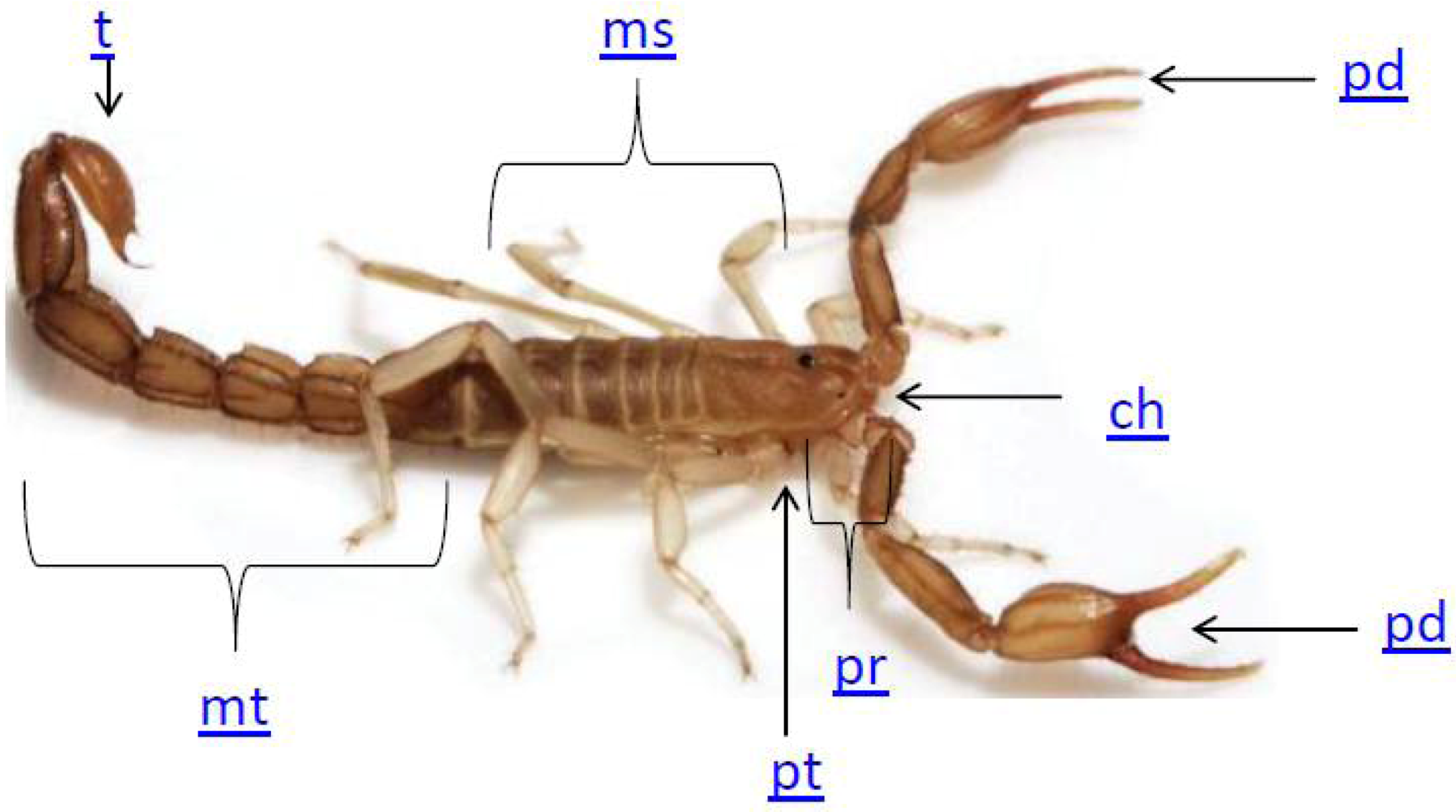
      <p>Physiologically, scorpions display characteristic features, but have changed little over the millennia. Appearing in the fossil record nearly 450 million years ago during the middle Silurian period, scorpions are segmented animals displaying fundamental physiology including a head (prosoma), abdomen (mesosoma) and tail (metasoma). Major appendages include chelate pedipalps (pinchers), chelicerae (morphologically related to mandibles), pectines (contact chemosensors), eight legs (arranged in four sets of two), and a telson (for venom delivery in predation and defense) at the apex of the tail [<xref ref-type="bibr" rid="B14-toxins-04-01082">14</xref>]; see <xref ref-type="fig" rid="toxins-04-01082-f001">Figure 1</xref>. </p>
      <fig id="toxins-04-01082-f001" position="anchor">
        <label>Figure 1</label>
        <caption>
          <p>Basic Scorpion morphology. The body is divided into three major sections, the tail or metasome (<bold>mt</bold>); the abdomen or mesosoma (<bold>ms</bold>); and the head region or prosoma (<bold>pr</bold>); Distinct structures are also highlighted including pinchers or pedipalp (<bold>pd</bold>); mandibles or chelicerae (<bold>ch</bold>); contact chemosensors (pectines-pt), and the venom apperatus or telson (<bold>t</bold>). Adapted from Weber <italic>et al</italic>. 2012 [<xref ref-type="bibr" rid="B15-toxins-04-01082">15</xref>].</p>
        </caption>
        <graphic xmlns:xlink="http://www.w3.org/1999/xlink" xlink:href="toxins-04-01082-g001.tif"/>
      </fig>
      <p>The geographic distribution of scorpions is immense, with known colonization of every landmass short of Antarctica. Acclimatization to all non-boreal habitats has occurred including desert, savannah, grasslands, temperate forests, tropical forests, rain forests and intertidal zones; from as high as 5500 m in elevation, to 800 m below ground [<xref ref-type="bibr" rid="B16-toxins-04-01082">16</xref>]. Ecologically speaking, in many habitats scorpions have become fundamental in terms of predation, density, diversity and standing biomass [<xref ref-type="bibr" rid="B11-toxins-04-01082">11</xref>]. </p>
      <p>Scorpions are the athletes of the arachnid world, dexterous in defense and prey capture. Known to be voracious eaters, their diet includes insects, spiders and other scorpions, extending to snakes, lizards and even rodents. Amazingly, even flying insects are little match for the lightning quick pedipalps of these predators. In order to determine the strategy required for successful prey capture, scorpions are capable of analyzing the predator to prey size ratio, and evaluate how one should engage in mortal combat. Generally, small prey is crushed with the pedipalps, while larger or unsecured prey receives a sting and subsequent envenomation. Adult scorpions and those species with large pedipalps tend to crush their prey, while smaller scorpions and those with small pedipalps, sting and utilize venom in order to subdue, which may require multiple injections. Prey is often oriented head first and consumed. Interestingly arachnids, including scorpions, are thought to be the first to implement the use of toxins in prey capture/defense [<xref ref-type="bibr" rid="B17-toxins-04-01082">17</xref>]  indicating a high degree of evolution resulting in toxin-receptor isoform selectivity. </p>
      <p>Upon prey impalement, the scorpion injects a venom comprised of phyla specific neurotoxins (toxins), which are known to cause up to 5000 human fatalities a year [<xref ref-type="bibr" rid="B1-toxins-04-01082">1</xref>,<xref ref-type="bibr" rid="B18-toxins-04-01082">18</xref>]. Initially, with the isolation of Scorpamins in 1961 [<xref ref-type="bibr" rid="B19-toxins-04-01082">19</xref>], the resulting biologically active toxins were thought to be multimeric proteins. In 1967, Rochat <italic>et al</italic>. found that the bioactive toxins were actually composed of single polypeptide chains, 63 to 64 amino acids (AAs) in length, held in a specific three-dimensional conformation through internal-disulfide bridging [<xref ref-type="bibr" rid="B20-toxins-04-01082">20</xref>]. Subsequent analysis has revealed the complexity of the venom which consists of a cocktail of low molecular weight proteins, oligopeptides, free AAs, nucleotides, low molecular weight salts and organic compounds [<xref ref-type="bibr" rid="B21-toxins-04-01082">21</xref>]. </p>
    </sec>
    <sec id="sec3-toxins-04-01082">
      <title>3. The Use of Scorpion Toxins to Investigate Potassium Channels</title>
      <p>The foundation for our current knowledge regarding the pharmacological action of scorpion toxins was generated mainly through electrophysiological experiments on isolated muscle and nerve cells using voltage clamping (or later, patch-clamp). Inspired by the work of Cole in 1949 [<xref ref-type="bibr" rid="B22-toxins-04-01082">22</xref>], Hodgkin and Huxley first described ground breaking experiments, for which they would later win the Nobel Prize, whereby ionic current (in the form of resistance) was measured across the membrane of an excitable cell or tissue type, in their case, giant squid axon (<italic>Loligo vulgaris</italic>) [<xref ref-type="bibr" rid="B23-toxins-04-01082">23</xref>]. This foundational work now provides us the basis of modern electrophysiology, where we now understand that ion channels control the flux of ions that cause the generation and propagation of nerve impulses and action potentials. Molecular dissection of ion channels using scorpion peptide toxins, has lead to direct evidence that specific mutations, phenotypically expressed as channel up/down regulation, can be correlated to changes, sometimes fatal, in the propagation and conduction of electrical impulses in the body. As evidenced by sudden death heart attacks manifested by underlying Long QT Syndrome, a channelopathy associated with the regulation and expression of the potassium channel K<sub>V</sub>11.1 from the human Ether-a-go-go Related Gene (hERG) [<xref ref-type="bibr" rid="B24-toxins-04-01082">24</xref>]. </p>
      <p>The first reported interaction between scorpion venom and KCNs was in 1982, by Carbone <italic>et al</italic>. when venom preparation obtained from the Mexican scorpion <italic>Centruroides noxius</italic> was applied to a giant squid axon, while monitoring by means of voltage-clamp [<xref ref-type="bibr" rid="B25-toxins-04-01082">25</xref>]. The single constituent responsible for the observed activity was Noxiustoxin (NTX), a 39 AA peptide purified from homogenized crude venom extract, and separated by Sephadex G-50 chromatography, followed by ion-exchange [<xref ref-type="bibr" rid="B26-toxins-04-01082">26</xref>]. Although isolated and purified, the multi-faceted potential of the toxin was not yet realized. Over the next few years, several additional scorpion toxins were reported with distinct KCN activity. With advances in chromatographic technology, combined with the establishment of single channel recordings, the use of this new class of toxins was expanded in 1985, when Miller <italic>et al</italic>. first used Charybdotoxin (<italic>Leiurus quinquestriatus</italic>; ChTx) to identify and pharmacologically characterize a novel Ca<sup>2+</sup> regulated KCN, now known as K<sub>Ca</sub>1.1, MaxiK or BK [<xref ref-type="bibr" rid="B6-toxins-04-01082">6</xref>,<xref ref-type="bibr" rid="B27-toxins-04-01082">27</xref>,<xref ref-type="bibr" rid="B28-toxins-04-01082">28</xref>]. </p>
      <p>As the decade progressed, the number of selective peptide toxins increased. These receptor specific research probe discoveries were augmented by scorpion diversity, intraspecial variation and the introduction of novel purification techniques such as Reverse Phase-High Performance liquid chromatography (RP-HPLC) [<xref ref-type="bibr" rid="B29-toxins-04-01082">29</xref>]. The high-pressure approach had many advantages over traditional gravity based (low pressure) separation technologies including increased limits of detection and purity [<xref ref-type="bibr" rid="B27-toxins-04-01082">27</xref>]. The primary approach to defining and characterizing purified peptides at the time was by <italic>N</italic>-terminal Edman degradation, which had various limitations such as lack of recognition for most post-translational modifications (PTMs) [<xref ref-type="bibr" rid="B30-toxins-04-01082">30</xref>] which are now known to functionally augment potency and isoform selectivity of scorpion toxins. </p>
      <p>The expanded number of ion channel probes combined with an advanced understanding of toxin-receptor interactions, facilitated the development of a technique known as pore mapping [<xref ref-type="bibr" rid="B31-toxins-04-01082">31</xref>,<xref ref-type="bibr" rid="B32-toxins-04-01082">32</xref>] or molecular footprinting [<xref ref-type="bibr" rid="B33-toxins-04-01082">33</xref>], which stimulated elucidation of structural determinants in isoform selectivity. Also used as immunogens, toxins can be utilized to produce site-directed anti-peptide antibodies. These in turn can neutralize the toxin-induced lethal effects <italic>in vivo</italic>—an imperative aspect of anti-scorpionic serotherapy in the treatment of human envenomation. The expansion of scorpion toxin discovery represents the establishment of a novel set of tools to study medically significant KCN isoforms, and further, has stimulated the incorporation of receptor physiology in disease models [<xref ref-type="bibr" rid="B34-toxins-04-01082">34</xref>]. </p>
    </sec>
    <sec id="sec4-toxins-04-01082">
      <title>4. Peptide-Toxin Structure</title>
      <p>KCN scorpion toxins vary in length from 23 to 64 AAs with estimated molecular weights usually less than 4000 Da. As highly constrained polypeptides they adhere to either the inhibitor cysteine knot or disulfide-directed β–hairpin folding motif [<xref ref-type="bibr" rid="B35-toxins-04-01082">35</xref>]. Extensive research was required in initial toxin studies to determine primary AA sequence, pharmacological target and establish three-dimensional structure. Proteolytic enzymes have been used to assist in defining critical disulfide bridging, with Edman degradation providing the location of these bonding pairs—a major undertaking with any multiple-disulfide bond-containing constituent. This was only possible once purified target materials were available, as achieved by paper and/or column chromatography [<xref ref-type="bibr" rid="B36-toxins-04-01082">36</xref>].</p>
      <p>Initially, X-Ray Crystallography was one of the few techniques available for establishing intricate details regarding molecular conformation. Results were slow, as crystallization techniques required specialized training, together with large amounts of pure sample [<xref ref-type="bibr" rid="B37-toxins-04-01082">37</xref>,<xref ref-type="bibr" rid="B38-toxins-04-01082">38</xref>]. Studies have shown that using racemic mixtures of L- and D-peptides has enhanced the ability to crystallize peptide toxins, improving the quality of molecular models [<xref ref-type="bibr" rid="B39-toxins-04-01082">39</xref>]. Soon after, the power of NMR spectroscopy was realized beyond the standard small-molecule/organic analysis, and its application in peptide structure determination was embraced [<xref ref-type="bibr" rid="B40-toxins-04-01082">40</xref>]. Using multi-dimensional NMR spectroscopy (500 MHz) it was determined that most scorpion peptide toxins adhere to a generalized α/β (scaffold) structural conformation that includes a characteristic number and location of α-helices and β-sheets [<xref ref-type="bibr" rid="B41-toxins-04-01082">41</xref>,<xref ref-type="bibr" rid="B42-toxins-04-01082">42</xref>,<xref ref-type="bibr" rid="B43-toxins-04-01082">43</xref>,<xref ref-type="bibr" rid="B44-toxins-04-01082">44</xref>]. Interestingly, using Maurotoxin (<italic>Scorpio maurus palmatus</italic>; MTX), Faljoun <italic>et al</italic>. showed that point mutations could be made which shifted the disulfide bridge framework, without altering the overall α/β scaffold of the toxin [<xref ref-type="bibr" rid="B45-toxins-04-01082">45</xref>]. This revealed that the conserved α/β scaffold conformation was independent of toxin chain length, primary sequence and ion channel specificity, but importantly, that disulfide bridge patterns were paramount in tertiary structure stabilization and therefore pharmacological activity [<xref ref-type="bibr" rid="B45-toxins-04-01082">45</xref>,<xref ref-type="bibr" rid="B46-toxins-04-01082">46</xref>,<xref ref-type="bibr" rid="B47-toxins-04-01082">47</xref>]. </p>
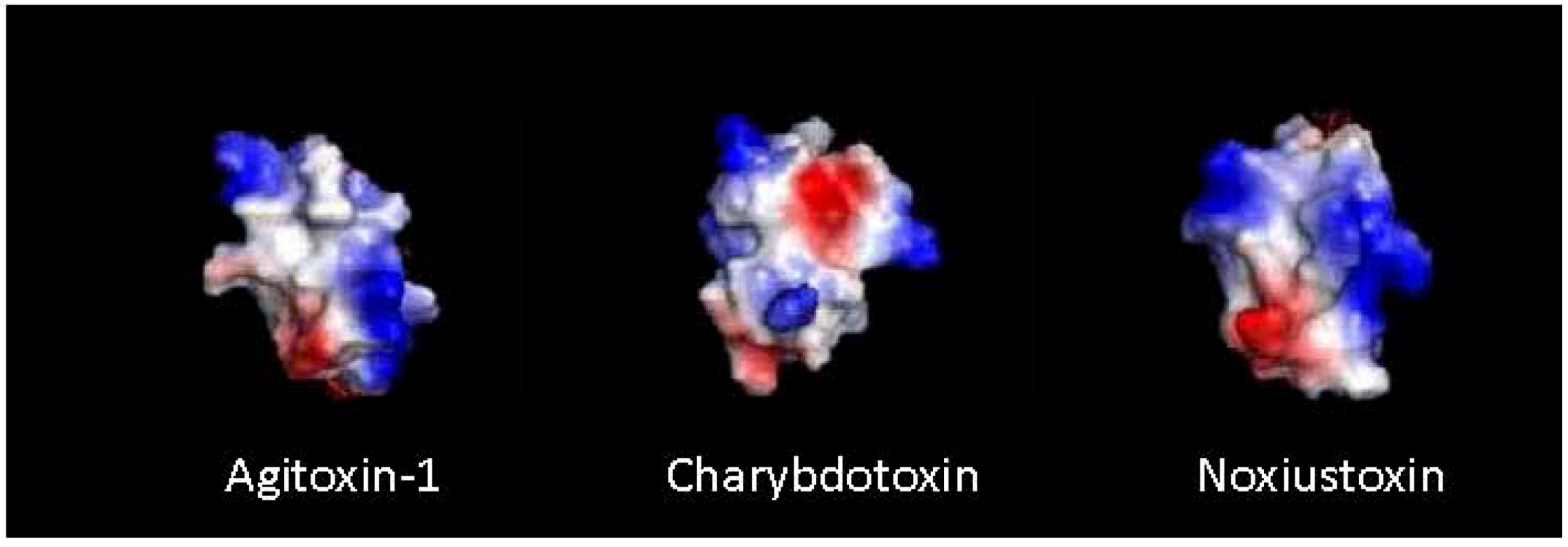
      <p>This was followed by the first computer based modeling, which was rudimentarily effective at predicting three dimensional structures by comparing homology sequences with previously defined toxin structures. Using graphics programs (<italic>i.e.</italic>, FRODO), the quality of analysis was a reflection on the power of the hardware/software of the time, and not necessarily the data [<xref ref-type="bibr" rid="B38-toxins-04-01082">38</xref>]. Advancement in both computer systems and modeling software has significantly impacted the quality of current models [<xref ref-type="bibr" rid="B48-toxins-04-01082">48</xref>], which can now incorporate electrostatic distribution and structural constraints (See <xref ref-type="fig" rid="toxins-04-01082-f002">Figure 2</xref>), characteristics of paramount importance in receptor docking [<xref ref-type="bibr" rid="B49-toxins-04-01082">49</xref>]. The modeling of bi-molecular interactions between toxin and receptor proves invaluable in establishing peptide templates for advanced probe bioengineering [<xref ref-type="bibr" rid="B50-toxins-04-01082">50</xref>,<xref ref-type="bibr" rid="B51-toxins-04-01082">51</xref>,<xref ref-type="bibr" rid="B52-toxins-04-01082">52</xref>].</p>
      <fig id="toxins-04-01082-f002" position="anchor">
        <label>Figure 2</label>
        <caption>
          <p>Computer models illustrating electrostatic distribution for three K<sup>+</sup> channel (KCN) scorpion toxins. Adapted from Kumar <italic>et al.</italic> 2011 [<xref ref-type="bibr" rid="B49-toxins-04-01082">49</xref>].</p>
        </caption>
        <graphic xmlns:xlink="http://www.w3.org/1999/xlink" xlink:href="toxins-04-01082-g002.tif"/>
      </fig>
      <p>First applied in the study of fundamental AAs and proteins in the late 1950’s [<xref ref-type="bibr" rid="B53-toxins-04-01082">53</xref>] and early 60’s [<xref ref-type="bibr" rid="B54-toxins-04-01082">54</xref>,<xref ref-type="bibr" rid="B55-toxins-04-01082">55</xref>], mass spectrometric analysis of scorpion venoms remained undocumented until 1993 [<xref ref-type="bibr" rid="B56-toxins-04-01082">56</xref>]. This technique revolutionized peptide research by providing instant mass analysis and sequence determination, while simultaneously minimizing sample requirements. Adding to this early work, advancements in mass spectrometry (<italic>i.e</italic>., Matrix Assisted Laser Desorption Ionization, MALDI-; Time of Flight, TOF-) have mirrored the exponential nature of toxin discovery by aiding in their isolation and identification. This is limited only by scaling parameters (signal to signal ratio) of the physical equipment being employed [<xref ref-type="bibr" rid="B57-toxins-04-01082">57</xref>]. These approaches have advanced the structural determination of folding motif and the characteristic cysteine frameworks that help infer channel isoform selectivity [<xref ref-type="bibr" rid="B58-toxins-04-01082">58</xref>]. Yet care must be taken in their analysis, as with these high-energy techniques, side chain functionality and PTMs are known to be susceptible to degradation under stringent conditions [<xref ref-type="bibr" rid="B59-toxins-04-01082">59</xref>,<xref ref-type="bibr" rid="B60-toxins-04-01082">60</xref>]. </p>
    </sec>
    <sec id="sec5-toxins-04-01082">
      <title>5. Synthetic Toxin Production</title>
      <p>Major advancements in scorpion toxin development have been dependent on chemically synthesized toxins. Significant benefits of chemical assembly include the production of non-native analogs [<xref ref-type="bibr" rid="B61-toxins-04-01082">61</xref>,<xref ref-type="bibr" rid="B62-toxins-04-01082">62</xref>], truncated [<xref ref-type="bibr" rid="B63-toxins-04-01082">63</xref>,<xref ref-type="bibr" rid="B64-toxins-04-01082">64</xref>,<xref ref-type="bibr" rid="B65-toxins-04-01082">65</xref>] or point mutated toxins [<xref ref-type="bibr" rid="B5-toxins-04-01082">5</xref>,<xref ref-type="bibr" rid="B66-toxins-04-01082">66</xref>], chimeric compounds [<xref ref-type="bibr" rid="B8-toxins-04-01082">8</xref>,<xref ref-type="bibr" rid="B67-toxins-04-01082">67</xref>], biotinylated molecules [<xref ref-type="bibr" rid="B5-toxins-04-01082">5</xref>,<xref ref-type="bibr" rid="B68-toxins-04-01082">68</xref>], toxins labeled with fluorescent moieties [<xref ref-type="bibr" rid="B69-toxins-04-01082">69</xref>,<xref ref-type="bibr" rid="B70-toxins-04-01082">70</xref>], pseudo peptides [<xref ref-type="bibr" rid="B71-toxins-04-01082">71</xref>,<xref ref-type="bibr" rid="B72-toxins-04-01082">72</xref>,<xref ref-type="bibr" rid="B73-toxins-04-01082">73</xref>], or those containing D-amino acids [<xref ref-type="bibr" rid="B39-toxins-04-01082">39</xref>,<xref ref-type="bibr" rid="B74-toxins-04-01082">74</xref>], compounds which would prove difficult or impossible to produce using recombinant technology [<xref ref-type="bibr" rid="B75-toxins-04-01082">75</xref>]. These approaches enhance functionality, utility and breadth of scorpion toxins in biomedical research.</p>
      <p>The well-established synthetic approach pioneered by Merrifield, known as Solid Phase Peptide Synthesis (SPPS) [<xref ref-type="bibr" rid="B76-toxins-04-01082">76</xref>], was first applied to a scorpion toxin with KCN activity in 1989. This resulted in the production of native-like material and truncated versions of NTX [<xref ref-type="bibr" rid="B65-toxins-04-01082">65</xref>]. The biologically active, synthetic peptide was desirable for two reasons, (i) a large number of scorpions (~1000) would need to be milked in order to obtain quantities of material suitable for pharmacological experimentation (1 mg), as NTX represents only a fraction of the total protein (~1%) in the crude venom extract [<xref ref-type="bibr" rid="B26-toxins-04-01082">26</xref>], and (ii) truncated versions of NTX do not occur naturally [<xref ref-type="bibr" rid="B65-toxins-04-01082">65</xref>]. Noxiustoxin and the truncated terminal peptide segments were assayed and their pharmacological activity compared. Interestingly, NTX1-9 was toxic to mice through various routes of administration (intraperitoneal, subcutaneous or intraventricular), although necessitating application at higher doses (200 μg/10 g mouse weight) compared to native NTX (40 μg/ 20 g mouse weight) to achieve a parallel pharmacological response. </p>
      <p>Regardless of concentration, data showed that synthetic peptides retained biological activity and that their epitopes were capable of eliciting the desired pharmacological response, a concept currently being applied in cyclotide-epitope grafting for the production of novel molecular therapeutics [<xref ref-type="bibr" rid="B77-toxins-04-01082">77</xref>] (<xref ref-type="sec" rid="sec12-toxins-04-01082">Section 12</xref>). Simultaneously, both the solid-phase and solution-phase synthesis of ChTx were undertaken and completed [<xref ref-type="bibr" rid="B27-toxins-04-01082">27</xref>,<xref ref-type="bibr" rid="B78-toxins-04-01082">78</xref>]. SPPS inherently had direct advantages over solution-phase in terms of scheme complexity, use of less stringent reagents, and a single deprotection step [<xref ref-type="bibr" rid="B78-toxins-04-01082">78</xref>]. SPPS exploits the ability to control the quality of peptide back-bone elongation by monitoring coupling yields using Ninhydrin following the addition of each successive AA residue [<xref ref-type="bibr" rid="B79-toxins-04-01082">79</xref>]. This was not possible for the solution-phase synthesis as 5 segments were assembled individually and then ligated using water-soluble carbodiimide and one of two triazoles, either HOBt or HOOBt [<xref ref-type="bibr" rid="B78-toxins-04-01082">78</xref>]. </p>
      <p>Additional advantages of SPPS become apparent when considering the incorporation of functional PTMs, which can be inserted into sequences thereby inferring native conformations, and resulting in the retention of biological activity (see below). There are however limitations to the synthetic production of peptides which become apparent when dealing with lengthy (&gt;40 AAs), or extremely hydrophobic sequences, as seen in many scorpion toxins which act on Na<sup>+</sup> channels. Long-chain synthetic scorpion toxins are difficult to fold due to the insolubility of the reduced form which leads to aggregation and the formation of polymeric material [<xref ref-type="bibr" rid="B75-toxins-04-01082">75</xref>]. </p>
      <p>The initial KCN toxin studies focused on highly folded, tricyclic structures containing three disulfide bonds, with basic AAs arranged in clusters on the topical surface of the toxin [<xref ref-type="bibr" rid="B27-toxins-04-01082">27</xref>]. The chemical synthesis of a new class of KCN toxins with four disulfide bridges was initiated when MTX was produced which displayed wide ranging activity on K<sub>V</sub>1.1, K<sub>V</sub>1.2 and K<sub>V</sub>1.3 isoforms [<xref ref-type="bibr" rid="B80-toxins-04-01082">80</xref>]. Solid-phase strategies simplified sequential point mutation studies, otherwise known as Alanine scanning, which are commonly used to investigate key structural components of pharmacological activity (<xref ref-type="sec" rid="sec7-toxins-04-01082">Section 7</xref>). In other cases, peptide toxin yields have been increased through the incorporation of chemically selective measures to direct disulfide bond formation using specially protected AAs (<italic>i.e.</italic>, Cysteine-ACM; acetamidomethyl) and the application of native chemical ligation (<xref ref-type="sec" rid="sec11-toxins-04-01082">Section 11</xref>), potentiating the use of synthetic peptide toxins in a diverse range of research areas.</p>
    </sec>
    <sec id="sec6-toxins-04-01082">
      <title>6. Recombinant Toxin Production</title>
      <p>An alternate method for the production of peptide toxins is through the use of genetic engineering and recombinant technology. Typically this utilizes a modified bacterial expression system, with modified antibiotic resistance, used to promote the selection of replicating bacteria expressing the desired target material. Recombinant products obtained by genetic engineering have continued to improve our knowledge in the field of scorpion toxins and ion channels; however limitations exist mainly with low yields and at present, the lack of flexibility in the incorporation of non-native side chain functionality. </p>
      <p>Parallel to the initial KCN scorpion peptide assembly via SPPS, the first synthetic scorpion toxin gene was created, and transfected into common gram-negative bacteria, <italic>Escherichia coli</italic> [<xref ref-type="bibr" rid="B81-toxins-04-01082">81</xref>]. The difficulties encountered in this early work included amino acid codon bias between mammalian and bacterial systems (organism specificity), and problems pertaining to the establishment of 3-Dimensional conformation, or correct disulfide bond connectivity [<xref ref-type="bibr" rid="B82-toxins-04-01082">82</xref>]. Codon bias has been somewhat circumvented with the utilization of advanced <italic>E. coli</italic> cell lines (<italic>i.e.</italic>, BL21-CodonPlus(DE3)-RIPL; Agilent Technologies) infused with increased copies of specialized tRNAs [<xref ref-type="bibr" rid="B82-toxins-04-01082">82</xref>,<xref ref-type="bibr" rid="B83-toxins-04-01082">83</xref>], while challenges in disulfide bond formation have been overcome, to some degree, by the inclusion of protein disulfide isomerase to assist in folding [<xref ref-type="bibr" rid="B74-toxins-04-01082">74</xref>,<xref ref-type="bibr" rid="B82-toxins-04-01082">82</xref>,<xref ref-type="bibr" rid="B84-toxins-04-01082">84</xref>]. </p>
      <p>The most significant hurdle experienced when using recombinant technology for the production of synthetic toxins is the inclusion of PTM’s, often critical components which influence folding, and establish toxin specificity and efficacy. Documented functionality of PTM’s in toxins is diverse, ranging from C<italic>-</italic>terminal amidation, carboxylation, phosphorylation and glycosylation to sulfonation, bromonation and hydroxylation [<xref ref-type="bibr" rid="B82-toxins-04-01082">82</xref>,<xref ref-type="bibr" rid="B85-toxins-04-01082">85</xref>,<xref ref-type="bibr" rid="B86-toxins-04-01082">86</xref>]. Beyond C-terminal amidation, little is known about the extent and diversity of PTM’s in scorpion toxins with documented KCN activity. This area warrants additional investigation based on the potential to exploit side chain functionality in diversifying activity and application of prospective synthetic analogs for clinical use (see <xref ref-type="sec" rid="sec14-toxins-04-01082">Section 14</xref>). </p>
      <p>This problem is being addressed presently through manipulation of genetic techniques to allow incorporation of non-coded AAs that display considerable chemical diversity [<xref ref-type="bibr" rid="B87-toxins-04-01082">87</xref>,<xref ref-type="bibr" rid="B88-toxins-04-01082">88</xref>,<xref ref-type="bibr" rid="B89-toxins-04-01082">89</xref>,<xref ref-type="bibr" rid="B90-toxins-04-01082">90</xref>,<xref ref-type="bibr" rid="B91-toxins-04-01082">91</xref>]. Using synthetic tRNA’s, non-coded AAs have been incorporated with wide ranging functional prosthetic groups from redox-active AAs which modulate electron transfer [<xref ref-type="bibr" rid="B92-toxins-04-01082">92</xref>,<xref ref-type="bibr" rid="B93-toxins-04-01082">93</xref>], residues with ketone or azide functionality which aid in chemoselective bioconjugation [<xref ref-type="bibr" rid="B94-toxins-04-01082">94</xref>,<xref ref-type="bibr" rid="B95-toxins-04-01082">95</xref>], photocaged or photoisomerizable AAs which can photoregulate biological processes [<xref ref-type="bibr" rid="B96-toxins-04-01082">96</xref>,<xref ref-type="bibr" rid="B97-toxins-04-01082">97</xref>,<xref ref-type="bibr" rid="B98-toxins-04-01082">98</xref>], metal binding AAs utilized in catalysis [<xref ref-type="bibr" rid="B89-toxins-04-01082">89</xref>], fluorescent side chains which aid in localization and the study of channel dynamics [<xref ref-type="bibr" rid="B99-toxins-04-01082">99</xref>,<xref ref-type="bibr" rid="B100-toxins-04-01082">100</xref>,<xref ref-type="bibr" rid="B101-toxins-04-01082">101</xref>], as well as native post translational modifications including hydroxylated and sulfonated residues [<xref ref-type="bibr" rid="B87-toxins-04-01082">87</xref>,<xref ref-type="bibr" rid="B102-toxins-04-01082">102</xref>]. Presently these approaches are absent in scorpion toxin production.</p>
      <p>Assembly and purification of recombinant systems and scorpion toxins is lengthy and complex having a direct impact on rate of production, cost and yield. At present, SPPS represents a more flexible option in terms of creating complex toxins in large quantities, however, the advances made in the incorporation of non-native AAs, genetic engineering is developing momentum that will undoubtedly augment scorpion toxin research.</p>
    </sec>
    <sec id="sec7-toxins-04-01082">
      <title>7. Structure Activity Relationship</title>
      <p>Defining a toxin’s 3-Dimensional conformation, and further, the biologically active binding interface is an important part in understanding the structure activity relationship between toxin and receptor. This information becomes paramount when considering advanced peptide modifications and toxin bioengineering. Fundamentally, peptide toxins are short, single chain proteins interconnected by multiple disulfide bonds. The specific configuration of these disulfide bridges is indicative of compact folding and extraordinary molecular stability giving rise to target isoform selectivity and potency [<xref ref-type="bibr" rid="B42-toxins-04-01082">42</xref>,<xref ref-type="bibr" rid="B47-toxins-04-01082">47</xref>,<xref ref-type="bibr" rid="B71-toxins-04-01082">71</xref>,<xref ref-type="bibr" rid="B103-toxins-04-01082">103</xref>]. Several factors influence pharmacological activity in scorpion peptide toxins, these include: (i) primary sequence (encompassing charge and hydrophobic nature of residues); (ii) number and spacing of disulfide bridges; (iii) geometrical orientation of α-helices and β-sheets, and (iv) electrostatic and dipole orientation.</p>
      <p>Initial structure studies examined single point mutants, created by scanning the primary sequence (excluding the cysteine framework) with the small, inert (in terms of R-group functionality), AA alanine, in an effort to isolate binding determinants while retaining native folding and structure characteristics. Each of the resulting alanine mutations can then be examined for pharmacological impact in terms of changes to <italic>K</italic><sub>d</sub>, <italic>K</italic><sub>a</sub> or IC<sub>50</sub>. The first alanine scan through a KCN scorpion peptide was performed by Park and Miller (1992) on ChTx [<xref ref-type="bibr" rid="B104-toxins-04-01082">104</xref>]. That investigation highlighted the importance of several surface reactive residues, most notable was Lys<sup>27</sup>, a highly conserved AA later identified as a critical pore-occluding characteristic in numerous KCN toxins [<xref ref-type="bibr" rid="B104-toxins-04-01082">104</xref>,<xref ref-type="bibr" rid="B105-toxins-04-01082">105</xref>,<xref ref-type="bibr" rid="B106-toxins-04-01082">106</xref>,<xref ref-type="bibr" rid="B107-toxins-04-01082">107</xref>]. These studies advanced the mapping of bimolecular interaction and demonstrated the powerful insights provided by the implementation of computer modeling [<xref ref-type="bibr" rid="B50-toxins-04-01082">50</xref>,<xref ref-type="bibr" rid="B108-toxins-04-01082">108</xref>]. At present there is a correlation (amongst the scorpion toxins) between dipole orientation and channel isoform specificity, while observed electrostatic features present in the contact surface influence toxin potency [<xref ref-type="bibr" rid="B49-toxins-04-01082">49</xref>,<xref ref-type="bibr" rid="B109-toxins-04-01082">109</xref>]. <xref ref-type="fig" rid="toxins-04-01082-f002">Figure 2</xref> below demonstrates the capability of current computer modeling techniques and also illustrates electrostatic patterns which characterize KCN scorpion toxins.</p>
      <p>Correlation between disulfide framework pattern, amino acid spacing and molecular target has been observed in scorpion peptides [<xref ref-type="bibr" rid="B61-toxins-04-01082">61</xref>,<xref ref-type="bibr" rid="B62-toxins-04-01082">62</xref>,<xref ref-type="bibr" rid="B71-toxins-04-01082">71</xref>], as well as other classes of toxins from various natural sources (<italic>i.e.</italic>, Conus-[<xref ref-type="bibr" rid="B110-toxins-04-01082">110</xref>]). KCN scoprion toxins do not deviatefrom this trend, with a wide range of disulfide framework patterns falling into five main classes as seen in <xref ref-type="table" rid="toxins-04-01082-t001">Table 1</xref>. The manipulation of differential AA spacing and PTMs within these established KCN scorpion toxin familial disulfide frameworks should be undertaken based on the documented potential to harness this information for the bioengineering and production of synthetic templates for prospective molecular therapies of various human pathologies [<xref ref-type="bibr" rid="B7-toxins-04-01082">7</xref>,<xref ref-type="bibr" rid="B42-toxins-04-01082">42</xref>,<xref ref-type="bibr" rid="B71-toxins-04-01082">71</xref>]. This approach has been broached in the production of a fully synthetic, successful peptide, Mokatoxin-1 (moka1), specific for K<sub>V</sub>1.3 and active in the regulation of immune T-cells (<xref ref-type="sec" rid="sec14dot2dot3-toxins-04-01082">Section 14.2.3</xref>) [<xref ref-type="bibr" rid="B72-toxins-04-01082">72</xref>]. As well as a disulfide variant of MTX (MTXPi1) whose disulfide bridge pattern has been altered without effecting the overall conformation of the peptide [<xref ref-type="bibr" rid="B46-toxins-04-01082">46</xref>]. Interestingly, target affinity of the toxin was altered, despite the lack of change in the secondary structure.</p>
      <table-wrap id="toxins-04-01082-t001" position="float">
        <object-id pub-id-type="pii">toxins-04-01082-t001_Table 1</object-id>
        <label>Table 1</label>
        <caption>
          <p>Established disulfide frameworks recognized within scorpion peptides with demonstrated KCN activity.</p>
        </caption>
        <table>
          <thead>
            <tr>
              <th align="center" valign="middle">Class</th>
              <th align="center" valign="middle">Example</th>
              <th align="center" valign="middle">Disulfide connectivity</th>
              <th align="center" valign="middle">Target</th>
              <th align="center" valign="middle">Reference</th>
            </tr>
          </thead>
          <tbody>
            <tr>
              <td align="center" valign="middle">I</td>
              <td align="center" valign="middle">KTX</td>
              <td align="center" valign="middle">
                <inline-graphic xmlns:xlink="http://www.w3.org/1999/xlink" xlink:href="toxins-04-01082-i001.tif"/>
              </td>
              <td align="center" valign="middle">K<sub>Ca</sub></td>
              <td align="center" valign="middle">[<xref ref-type="bibr" rid="B103-toxins-04-01082">103</xref>]</td>
            </tr>
            <tr>
              <td align="center" valign="middle">II</td>
              <td align="center" valign="middle">CnERG1</td>
              <td align="center" valign="middle">
                <inline-graphic xmlns:xlink="http://www.w3.org/1999/xlink" xlink:href="toxins-04-01082-i002.tif"/>
              </td>
              <td align="center" valign="middle">K<sub>V</sub>11</td>
              <td align="center" valign="middle">[<xref ref-type="bibr" rid="B111-toxins-04-01082">111</xref>]</td>
            </tr>
            <tr>
              <td align="center" valign="middle">III</td>
              <td align="center" valign="middle">MTX</td>
              <td align="center" valign="middle">
                <inline-graphic xmlns:xlink="http://www.w3.org/1999/xlink" xlink:href="toxins-04-01082-i003.tif"/>
              </td>
              <td align="center" valign="middle">K<sub>V</sub>1, K<sub>Ca</sub>2, K<sub>Ca</sub>3.1</td>
              <td align="center" valign="middle">[<xref ref-type="bibr" rid="B46-toxins-04-01082">46</xref>] </td>
            </tr>
            <tr>
              <td align="center" valign="middle">IV</td>
              <td align="center" valign="middle">HsTx1</td>
              <td align="center" valign="middle">
                <inline-graphic xmlns:xlink="http://www.w3.org/1999/xlink" xlink:href="toxins-04-01082-i004.tif"/>
              </td>
              <td align="center" valign="middle">K<sub>V</sub>1.1, K<sub>V</sub>1.3</td>
              <td align="center" valign="middle">[<xref ref-type="bibr" rid="B45-toxins-04-01082">45</xref>]</td>
            </tr>
            <tr>
              <td align="center" valign="middle">V</td>
              <td align="center" valign="middle">TtBut-Tx</td>
              <td align="center" valign="middle">
                <inline-graphic xmlns:xlink="http://www.w3.org/1999/xlink" xlink:href="toxins-04-01082-i005.tif"/>
              </td>
              <td align="center" valign="middle">Shaker B</td>
              <td align="center" valign="middle">[<xref ref-type="bibr" rid="B112-toxins-04-01082">112</xref>]</td>
            </tr>
          </tbody>
        </table>
      </table-wrap>
      <p>The above outlined disulfide frameoworks further represent a potential starting point for the design of novel, isoform specific probes which target directed channel isoforms. As potential probes, scorpion toxins have many advantages over primary antibody based detection systems, including specificity, and the ability to bind non-fixed tissue and cell samples. The inherent structure of KCN scorpion toxins makes them ideal candidates to be used as molecular probes for the multivaried investigation into ion channel function and physiology. Advanced bioengineering has further shown the potential clinical application of KCN scorpion peptides for the treatment of various human pathologies. </p>
    </sec>
    <sec id="sec8-toxins-04-01082">
      <title>8. Radiolabeled Scorpion Toxins and Receptor Localization</title>
      <p>The development of anatomical channel localization studies and pharmacological displacement assays were facilitated by the development and production of radiolabeled derivatives of KCN scorpion toxins. Understanding both primary and secondary structure when designing and bioengineering KCN probes from scorpion toxin scaffolds is vital in order to maintain native conformation and in turn biological activity </p>
      <p>The first radiolabeled scorpion toxin developed was Iodinated ChTx, used to investigate the K<sub>Ca</sub>1.1 (MaxiK; BK) [<xref ref-type="bibr" rid="B113-toxins-04-01082">113</xref>]. Native ChTx was isolated from crude venom and labeled with [<sup>125</sup>I]NaI using the IODO-GEN method [<xref ref-type="bibr" rid="B114-toxins-04-01082">114</xref>] to produce [<sup>125</sup>I]ChTx, where monoiodination occurred at the C-terminal Tyrosine residue (Tyr<sup>36</sup>). This novel bioengineered peptide toxin probe demonstrated how chemical modifications can be made to the primary structure while maintaining topology of the secondary structure and retaining biological activity, thus expanding their applicability in research. Subsequently, the ability to radiolabel a synthetic peptide was demonstrated when Scyllatoxin, also known as Leiurotoxin-1 (<italic>Leiurus quinquestriatus hebraeus</italic>; ScyTx) was radiolabeled at His<sup>31 </sup>(IODO-GEN method) and used for autoradiographic investigation of Small conductance Ca<sup>2+</sup> activated K<sup>+</sup> channel (SK) in rat brain sections [<xref ref-type="bibr" rid="B115-toxins-04-01082">115</xref>].</p>
      <p>The binding of the scorpion peptide Iberiotoxin (<italic>Buthus tamulus</italic>; IbTx) to K<sub>Ca</sub>1.1 depends on interaction of Tyr<sup>36</sup> with the channel pore, resulting in the inability to utilize this commonly targeted AA for derivatization. Recombinant IbTx with a single point mutation, D19C, was iodinated using sulfhydryl reactive <italic>N-</italic>[<sup>3</sup>H]ethylmaleimide at the post-oxidative free thiol [<xref ref-type="bibr" rid="B116-toxins-04-01082">116</xref>]. A two-point mutant (D19Y/Y36F) was also devised and produced recombinantly and the expressed peptide, IbTx-D19Y/Y36F, was iodinated at position Tyr<sup>19</sup> ([<sup>125</sup>I]Na in the presence of Enzymobeads; Bio-Rad) [<xref ref-type="bibr" rid="B117-toxins-04-01082">117</xref>]. The latter probe was successfully used to investigate the expression of K<sub>Ca</sub>1.1 in bovine tracheal smooth muscle sarcolemmal membranes.</p>
      <p>As technology progressed, so too did the production of other radiolabeled KCN toxin-probes. They have been used to investigate the expression and distribution of a number of KCN isoforms in a wide range of cell types, contributing uniquely to understanding the role of KCN in membrane bioenergetics and their subsequent effects on human physiology. <xref ref-type="table" rid="toxins-04-01082-t002">Table 2</xref> illustrates the usefulness, diversity and progression of radiolabeled KCN probes, and in some cases the extent of bioengineering undertaken to achieve their potential as effective molecular calipers.</p>
      <table-wrap id="toxins-04-01082-t002" position="float">
        <object-id pub-id-type="pii">toxins-04-01082-t002_Table 2</object-id>
        <label>Table 2</label>
        <caption>
          <p>List of radiolabeled KCN probes used in the investigation of receptor tissue localization/expression as well as electrophysiology in terms of binding kinetics.</p>
        </caption>
        <table>
          <thead>
            <tr>
              <th align="center" valign="middle">Toxin</th>
              <th align="center" valign="middle">Modification</th>
              <th align="center" valign="middle">Name</th>
              <th align="center" valign="middle">Label</th>
              <th align="center" valign="middle">Target</th>
              <th align="center" valign="middle">Reference</th>
            </tr>
          </thead>
          <tbody>
            <tr>
              <td rowspan="2" align="center" valign="middle">ChTx</td>
              <td align="center" valign="middle">native</td>
              <td align="center" valign="middle">[<sup>125</sup>I]ChTX</td>
              <td align="center" valign="middle">[<sup>125</sup>I]-Y36</td>
              <td align="center" valign="middle">K<sub>Ca</sub>, K<sub>V</sub></td>
              <td align="center" valign="middle">[<xref ref-type="bibr" rid="B113-toxins-04-01082">113</xref>]</td>
            </tr>
            <tr>
              <td align="center" valign="middle">R19C</td>
              <td align="center" valign="middle">[<sup>3</sup>H]-ChTx-R19C</td>
              <td align="center" valign="middle">[<sup>3</sup>H]-C19</td>
              <td align="center" valign="middle">K<sub>Ca</sub>, K<sub>V</sub></td>
              <td align="center" valign="middle">[<xref ref-type="bibr" rid="B118-toxins-04-01082">118</xref>]</td>
            </tr>
            <tr>
              <td align="center" valign="middle">ScyTx</td>
              <td align="center" valign="middle">F2Y</td>
              <td align="center" valign="middle"><sup>125</sup>I-[Tyr2]ScyTx</td>
              <td align="center" valign="middle">[<sup>125</sup>I]-Y2</td>
              <td align="center" valign="middle">K<sub>Ca</sub></td>
              <td align="center" valign="middle">[<xref ref-type="bibr" rid="B119-toxins-04-01082">119</xref>]</td>
            </tr>
            <tr>
              <td align="center" valign="middle">MgTX</td>
              <td align="center" valign="middle">native</td>
              <td align="center" valign="middle">[<sup>125</sup>I]MgTX</td>
              <td align="center" valign="middle">[<sup>125</sup>I]-Y37</td>
              <td align="center" valign="middle">K<sub>V</sub>1.2, 1.3</td>
              <td align="center" valign="middle">[<xref ref-type="bibr" rid="B120-toxins-04-01082">120</xref>]</td>
            </tr>
            <tr>
              <td rowspan="3" align="center" valign="middle">IbTx</td>
              <td align="center" valign="middle">V5Y, Y36F</td>
              <td align="center" valign="middle">[mono-iodo-Tyr5, Phe36]-IbTx</td>
              <td align="center" valign="middle">[<sup>125</sup>I]-Y5</td>
              <td align="center" valign="middle">K<sub>Ca</sub>1.1(BK)</td>
              <td align="center" valign="middle">[<xref ref-type="bibr" rid="B121-toxins-04-01082">121</xref>]</td>
            </tr>
            <tr>
              <td align="center" valign="middle">D19C</td>
              <td align="center" valign="middle">[<sup>3</sup>H]-IbTx-D19C</td>
              <td align="center" valign="middle">[<sup>3</sup>H]-C19</td>
              <td align="center" valign="middle">K<sub>Ca</sub>1.1(BK)</td>
              <td align="center" valign="middle">[<xref ref-type="bibr" rid="B116-toxins-04-01082">116</xref>]</td>
            </tr>
            <tr>
              <td align="center" valign="middle">D19Y/Y36F</td>
              <td align="center" valign="middle">[<sup>125</sup>I]IbTx-[D19Y/Y36F]</td>
              <td align="center" valign="middle">[<sup>125</sup>I]-Y19</td>
              <td align="center" valign="middle">K<sub>Ca</sub>1.1(BK)</td>
              <td align="center" valign="middle">[<xref ref-type="bibr" rid="B117-toxins-04-01082">117</xref>]</td>
            </tr>
            <tr>
              <td align="center" valign="middle">BeKm-1</td>
              <td align="center" valign="middle">native</td>
              <td align="center" valign="middle">[<sup>127</sup>I]-BeKm-1</td>
              <td align="center" valign="middle">[<sup>127</sup>I]-Y11</td>
              <td align="center" valign="middle">K<sub>V</sub>11.1(hERG)</td>
              <td align="center" valign="middle">[<xref ref-type="bibr" rid="B122-toxins-04-01082">122</xref>]</td>
            </tr>
            <tr>
              <td align="center" valign="middle">HgTx</td>
              <td align="center" valign="middle">A19Y/Y37F</td>
              <td align="center" valign="middle"><sup>125</sup>I-HgTx<sub>1</sub>-A19Y/Y37F</td>
              <td align="center" valign="middle">[<sup>125</sup>I]-Y19</td>
              <td align="center" valign="middle">K<sub>V</sub>1.1/2/3/6</td>
              <td align="center" valign="middle">[<xref ref-type="bibr" rid="B123-toxins-04-01082">123</xref>]</td>
            </tr>
            <tr>
              <td align="center" valign="middle">BmTX3</td>
              <td align="center" valign="middle">native</td>
              <td align="center" valign="middle"><sup>125</sup>I-sBmTX3</td>
              <td align="center" valign="middle">[<sup>125</sup>I]-Y37</td>
              <td align="center" valign="middle">A-type current</td>
              <td align="center" valign="middle">[<xref ref-type="bibr" rid="B124-toxins-04-01082">124</xref>]</td>
            </tr>
            <tr>
              <td align="center" valign="middle">NTX</td>
              <td align="center" valign="middle">native</td>
              <td align="center" valign="middle">[<sup>125</sup>I]Noxiustoxin</td>
              <td align="center" valign="middle">[<sup>125</sup>I]-Y37</td>
              <td align="center" valign="middle">K<sub>V</sub>1.1</td>
              <td align="center" valign="middle">[<xref ref-type="bibr" rid="B125-toxins-04-01082">125</xref>]</td>
            </tr>
            <tr>
              <td align="center" valign="middle">KTX</td>
              <td align="center" valign="middle">KTX(1-37)</td>
              <td align="center" valign="middle"><sup>125</sup>I-KTX(1-37)</td>
              <td align="center" valign="middle">[<sup>125</sup>I]-H34</td>
              <td align="center" valign="middle">K<sub>Ca</sub></td>
              <td align="center" valign="middle">[<xref ref-type="bibr" rid="B126-toxins-04-01082">126</xref>]</td>
            </tr>
            <tr>
              <td align="center" valign="middle">Lqh III</td>
              <td align="center" valign="middle">native</td>
              <td align="center" valign="middle">[125I]Leiurutoxin III</td>
              <td align="center" valign="middle">[<sup>125</sup>I]-Y8</td>
              <td align="center" valign="middle">K<sub>V</sub>1.1</td>
              <td align="center" valign="middle">[<xref ref-type="bibr" rid="B125-toxins-04-01082">125</xref>]</td>
            </tr>
          </tbody>
        </table>
      </table-wrap>
    </sec>
    <sec id="sec9-toxins-04-01082">
      <title>9. Bioconjugation</title>
      <p>In recent years there has been a paradigm shift moving away from the use of radiolabeled toxins due to the inherent difficulties and dangers associated with employing radioactivity. However the need persists for the study, and incorporation of ion channel physiology into human pathological disease models. In turn, this has led to major advancements in the design and chemical synthesis of fluorescently bioengineered toxin-probes that have alleviated many of the issues experienced when working with radiolabeled toxins. </p>
      <p>Stimulated by the introduction of novel chemical strategies for the attachment of varying prosthetic groups, a process referred to as bioconjugation, as well as a growing selection of available fluorophores, covalent and ionic (biotin-streptavidin complexes) techniques have been developed to bioconjugate fluorescent moieties to KCN scorpion toxins for the classical purpose of detecting and localizing ion channel isoforms <italic>in vivo</italic>, as illustrated by ChTx-biotin [<xref ref-type="bibr" rid="B68-toxins-04-01082">68</xref>]. Initially, basic strategies developed with standard <italic>N</italic>-terminal derivatization, and advanced to modification of the ε-amino functionality of introduced lysine residues (amine chemistry) [<xref ref-type="bibr" rid="B127-toxins-04-01082">127</xref>,<xref ref-type="bibr" rid="B128-toxins-04-01082">128</xref>,<xref ref-type="bibr" rid="B129-toxins-04-01082">129</xref>]. Alternatively, yet with its own unique set of conditions and difficulties, the use of thiols as targeted conjugation sites have gained popularity (thiol chemistry) [<xref ref-type="bibr" rid="B69-toxins-04-01082">69</xref>,<xref ref-type="bibr" rid="B118-toxins-04-01082">118</xref>,<xref ref-type="bibr" rid="B130-toxins-04-01082">130</xref>]. Another approach currently being developed for fluorescent incorporation is phosphate-azide “click” chemistry [<xref ref-type="bibr" rid="B131-toxins-04-01082">131</xref>,<xref ref-type="bibr" rid="B132-toxins-04-01082">132</xref>,<xref ref-type="bibr" rid="B133-toxins-04-01082">133</xref>].</p>
      <p>In 1993, Robitaille <italic>et al</italic>. employed modified bioconjugation strategies previously applied to the conotoxin ω-CgTx [<xref ref-type="bibr" rid="B134-toxins-04-01082">134</xref>,<xref ref-type="bibr" rid="B135-toxins-04-01082">135</xref>] to produce the first biotinylated scorpion toxin with directed KCN activity [<xref ref-type="bibr" rid="B68-toxins-04-01082">68</xref>]. Prepared via SPPS, ChTx-biotin was created via direct chemical conjugation of Succinimidyl-6-(biotinamido)hexanoate to the exposed <italic>N</italic>-terminal [<xref ref-type="bibr" rid="B68-toxins-04-01082">68</xref>]. The ChTx-biotin probe was used to investigate the distribution of Ca<sup>2+</sup>-gated K<sup>+</sup> channels in relation to Ca<sup>2+</sup> channels and release sites of transmitters at the neuromuscular junction. Shimony <italic>et al</italic>. (1994), used a bacterial expression system to produce a folded biologically active mutant of ChTx (<italic>i.e.</italic>, ChTx[R19C]). This novel bioengineered peptide retained an unpaired “spinster cysteine” for derivatization based on thiol directed chemistry [<xref ref-type="bibr" rid="B118-toxins-04-01082">118</xref>]. The point of the insertion was determined by in-depth structural analysis, and ChTx[R19C] was produced with the strong nucleophilic thiolate mutation made at a location far from the interactive surface, again in order to retain functional activity of the toxin during the bioconjugation of fluorescent labels. </p>
      <p>Attributed partly to the entrenched use of primary antibodies in the scientific culture, combined with potential difficulties in constructing and purifying fluorescent bioengineered peptide probes, most have been used recently in the periphery in ion channel research. Recently however, limitations in antibody technology, in terms of dealing with live-cell processes, are appearing which represent obstacles in advancing live-cell visualization. There is a growing desire for advanced imaging and localization technology, this requirement has emerged specifically from the increased need to investigate real-time physiological processes <italic>in vivo</italic>, including channel protein translation, trafficking and surface expression. </p>
      <p>In 2002, a fluorescent version of Hongotoxin (<italic>Centruroides limbatus</italic>; HgTx) was produced synthetically [<xref ref-type="bibr" rid="B69-toxins-04-01082">69</xref>], and subsequently used in receptor localization experiments utilizing ultrasensitive microscopy known as the single-dye tracing technique [<xref ref-type="bibr" rid="B136-toxins-04-01082">136</xref>]. A number of different fluorescent moieties were successfully conjugated to the bioactive toxin while simultaneously maintaining potency, namely Cy3, Alexa488 and Alexa546, although a number of other dyes were also conjugated with varying degrees of success. From this study, it was determined that both positioning within the toxin as well as selection of fluorophore are crucial to producing successful fluorescent-toxin probes. The resulting fluorescent toxin was proficient in localizing K<sub>V</sub>1.3 in Rat brain sections [<xref ref-type="bibr" rid="B69-toxins-04-01082">69</xref>], as well as Jurkat cells at the single molecule level [<xref ref-type="bibr" rid="B136-toxins-04-01082">136</xref>]. </p>
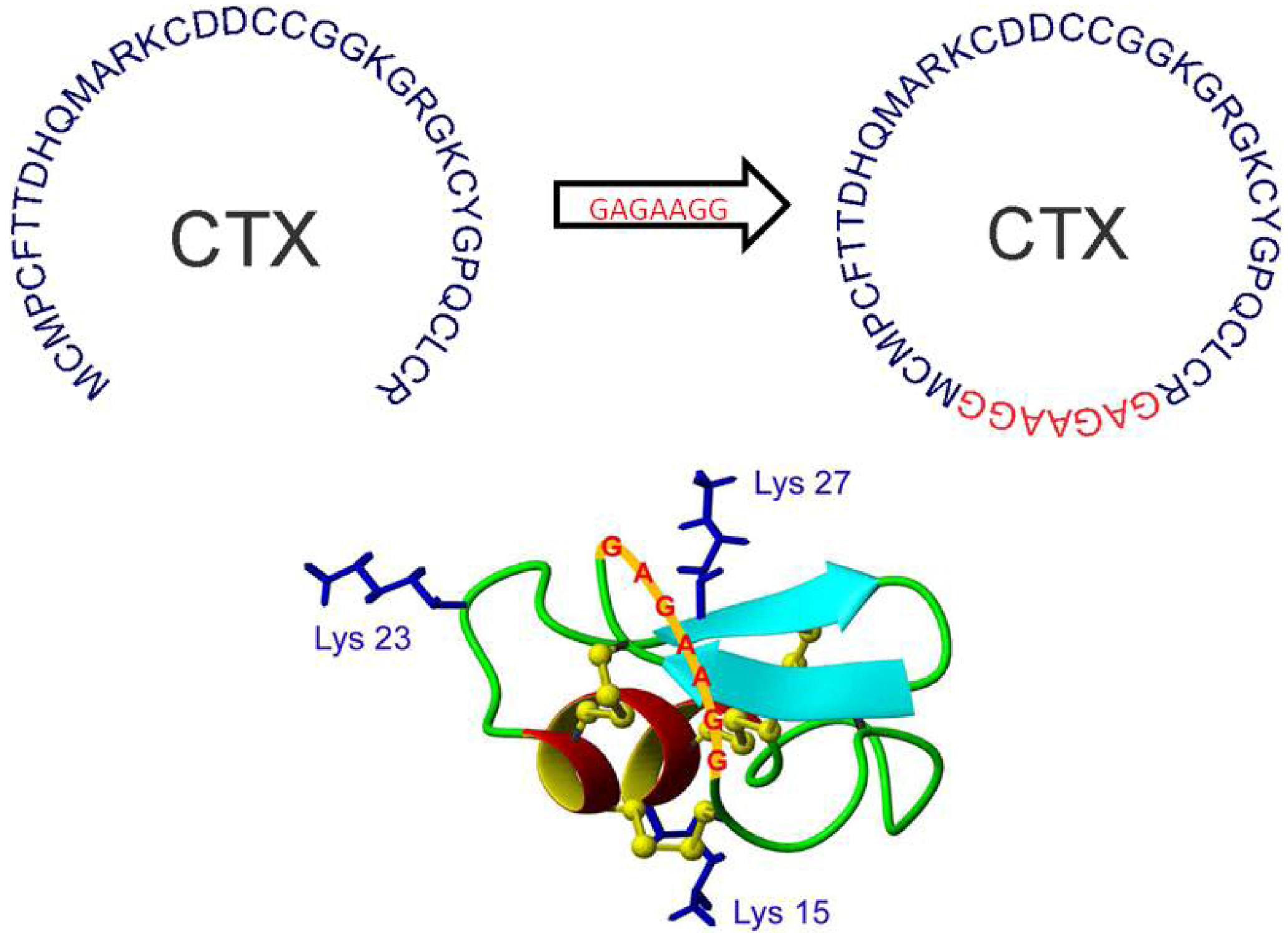
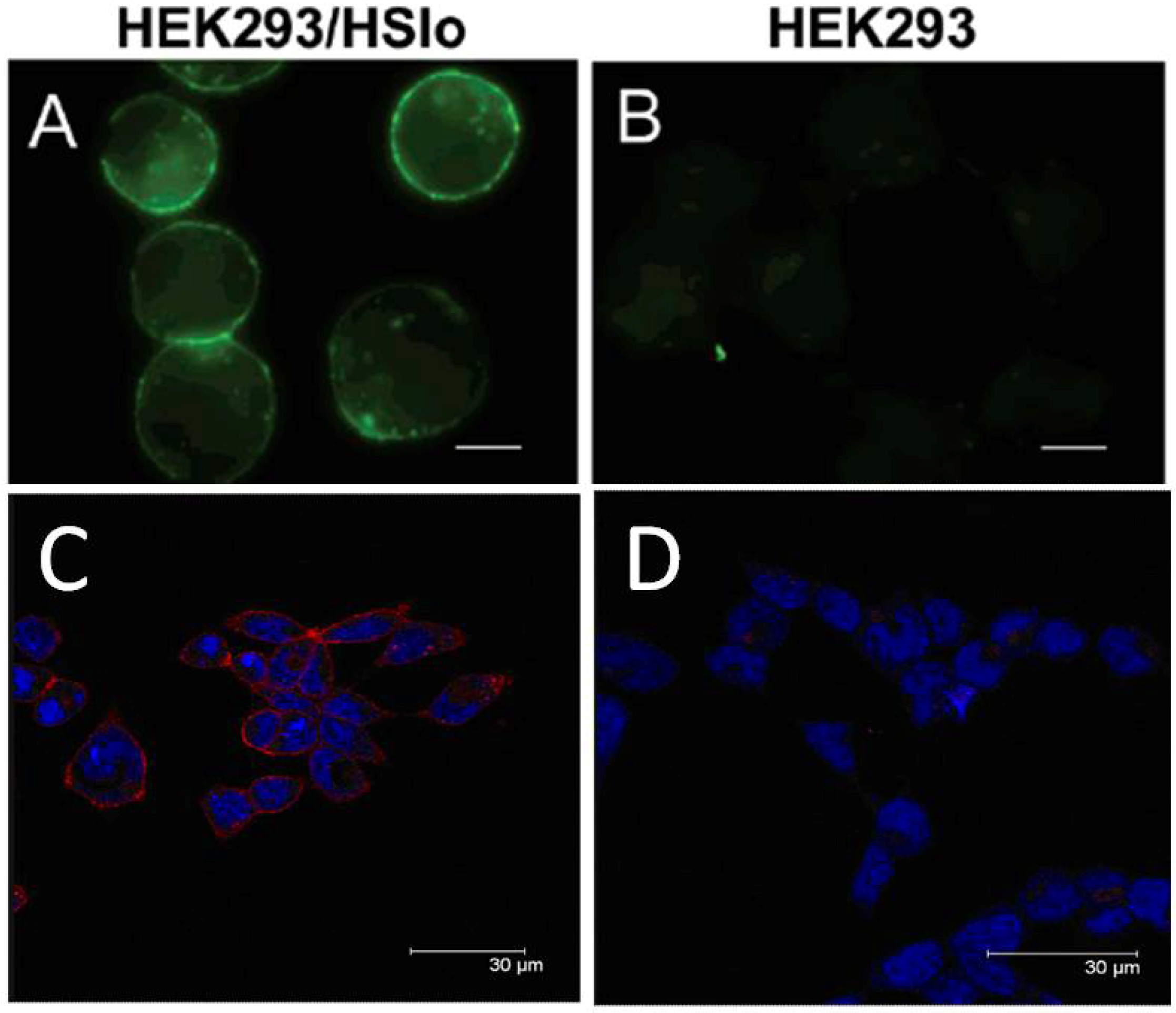
      <p>Refuting common conception that amine modification of lysine destroys pharmacological activity of scorpion toxins targeting K<sup>+</sup> channels [<xref ref-type="bibr" rid="B68-toxins-04-01082">68</xref>], Bingham <italic>et al</italic>. (2006) synthesized a biotin derivative of IbTx by replacing aspartic acid (Asp<sup>19</sup>), with the non-native AA <italic>N</italic>-ε-(d-biotin-6-amidocaproate)-L-lysine (Anaspec; IbTxD19K-LC-Biotin), incorporating a spacing component, or “linker” which provided steric clearance from the peptide backbone. This eliminated perturbation of the three-dimensional tertiary structure of the toxin, which was essentially locked-in by the disulfide framework. Coupled with the secondary fluorophore, Alexa488-Streptavidin (Molecular Probes), the probe enabled visualization of BK (<italic>hslo</italic>) channel in stably transfected HEK293 using standard epifluorescent microscopy [<xref ref-type="bibr" rid="B5-toxins-04-01082">5</xref>]. Akcan <italic>et al</italic>. (2012) further substantiated this bioengineering approach with the bioconjugation of a near infrared fluorophore (NIRF) to lysine 27 of Chlorotoxin (<italic>Leiurus quinquestriatus quinquestriatus;</italic> CTX) which dramatically increased serum half-life when assayed [<xref ref-type="bibr" rid="B129-toxins-04-01082">129</xref>]. From this groundwork, <italic>in vivo</italic> channel localization and visualization can be advanced exponentially with the application of superior imaging techniques (<italic>i.e.</italic>, confocal microscopy; see <xref ref-type="fig" rid="toxins-04-01082-f003">Figure 3</xref>). Use of such bioengineered toxins allows for the visualization of cellular surface details, including banding and patch like clustering of ion channels in expressing cells [<xref ref-type="bibr" rid="B5-toxins-04-01082">5</xref>,<xref ref-type="bibr" rid="B68-toxins-04-01082">68</xref>].</p>
      <p>To demonstrate the utility of fluorescent KCN probes the most compatible toxins and bioconjugation chemistry have been utilized in the process of manipulation and structural bioengineering of peptide toxin candidates. This work has allowed for the investigation of up- and down-regulation of receptor subtypes in connection with various human pathologies and disease states. A complete list of fluorescent KCN toxins can be seen in <xref ref-type="table" rid="toxins-04-01082-t003">Table 3</xref>.</p>
      <fig id="toxins-04-01082-f003" position="anchor">
        <label>Figure 3</label>
        <caption>
          <p>(Top) Original epifluorescent images adapted from Bingham <italic>et al</italic>. 2006 [<xref ref-type="bibr" rid="B5-toxins-04-01082">5</xref>]. (<bold>A</bold>) Stably transfected HEK293/hslo; (<bold>B</bold>) Wild type HEK293. (Bottom) Advanced confocal imaging of experimentally identical cell lines (HEK293/hslo, and HEK293) with the fluorescent peptide IbTx[D19K]-LC-biotin [<xref ref-type="bibr" rid="B137-toxins-04-01082">137</xref>]. Experiments were heavily controlled (as specified in Bingham <italic>et al</italic>. 2006 [<xref ref-type="bibr" rid="B5-toxins-04-01082">5</xref>]) for non-specific binding and are available by request; (<bold>C</bold>) Stably transfected HEK293/hslo (visualized with streptavidin Alexa Fluor conjugate-red); (<bold>D</bold>) Wild type HEK293. </p>
        </caption>
        <graphic xmlns:xlink="http://www.w3.org/1999/xlink" xlink:href="toxins-04-01082-g003.tif"/>
      </fig>
      <table-wrap id="toxins-04-01082-t003" position="float">
        <object-id pub-id-type="pii">toxins-04-01082-t003_Table 3</object-id>
        <label>Table 3</label>
        <caption>
          <p>Table of fluorescently labeled peptide scorpion toxins specific for various potassium channel isoforms.</p>
        </caption>
        <table>
          <thead>
            <tr>
              <th align="center" valign="middle">Toxin base sequence</th>
              <th align="center" valign="middle">Mutation</th>
              <th align="center" valign="middle">Bioconjugate</th>
              <th align="center" valign="middle">Target</th>
              <th align="center" valign="middle">Reference</th>
            </tr>
          </thead>
          <tbody>
            <tr>
              <td rowspan="2" align="center" valign="middle">ChTx</td>
              <td align="center" valign="middle"><italic>N</italic>-term</td>
              <td align="center" valign="middle">ChTx-biotin</td>
              <td align="center" valign="middle">K<sub>Ca</sub>, K<sub>V</sub></td>
              <td align="center" valign="middle">[<xref ref-type="bibr" rid="B68-toxins-04-01082">68</xref>]</td>
            </tr>
            <tr>
              <td align="center" valign="middle">R19C</td>
              <td align="center" valign="middle">Rhodamine-ChTx-R19C</td>
              <td align="center" valign="middle">K<sub>Ca</sub>, K<sub>V</sub></td>
              <td align="center" valign="middle">[<xref ref-type="bibr" rid="B118-toxins-04-01082">118</xref>]</td>
            </tr>
            <tr>
              <td rowspan="8" align="center" valign="middle">HgTx</td>
              <td rowspan="8" align="center" valign="middle">A19C</td>
              <td align="center" valign="middle">HgTX<sub>1</sub>-A19C-Cy5</td>
              <td align="center" valign="middle">K<sub>V</sub>1.1/2/3/6</td>
              <td align="center" valign="middle">[<xref ref-type="bibr" rid="B69-toxins-04-01082">69</xref>]</td>
            </tr>
            <tr>
              <td align="center" valign="middle">HgTX<sub>1</sub>-A19C-Cy3</td>
              <td align="center" valign="middle">K<sub>V</sub>1.1/2/3/6</td>
              <td align="center" valign="middle">[<xref ref-type="bibr" rid="B69-toxins-04-01082">69</xref>]</td>
            </tr>
            <tr>
              <td align="center" valign="middle">HgTX<sub>1</sub>-A19C-Alex488</td>
              <td align="center" valign="middle">K<sub>V</sub>1.1/2/3/6</td>
              <td align="center" valign="middle">[<xref ref-type="bibr" rid="B69-toxins-04-01082">69</xref>]</td>
            </tr>
            <tr>
              <td align="center" valign="middle">HgTX<sub>1</sub>-A19C-Alex546</td>
              <td align="center" valign="middle">K<sub>V</sub>1.1/2/3/6</td>
              <td align="center" valign="middle">[<xref ref-type="bibr" rid="B69-toxins-04-01082">69</xref>]</td>
            </tr>
            <tr>
              <td align="center" valign="middle">HgTX<sub>1</sub>-A19C-Alex594</td>
              <td align="center" valign="middle">K<sub>V</sub>1.1/2/3/6</td>
              <td align="center" valign="middle">[<xref ref-type="bibr" rid="B69-toxins-04-01082">69</xref>]</td>
            </tr>
            <tr>
              <td align="center" valign="middle">HgTX<sub>1</sub>-A19C-Alex660</td>
              <td align="center" valign="middle">K<sub>V</sub>1.1/2/3/6</td>
              <td align="center" valign="middle">[<xref ref-type="bibr" rid="B69-toxins-04-01082">69</xref>]</td>
            </tr>
            <tr>
              <td align="center" valign="middle">HgTX<sub>1</sub>-A19C-Alex680</td>
              <td align="center" valign="middle">K<sub>V</sub>1.1/2/3/6</td>
              <td align="center" valign="middle">[<xref ref-type="bibr" rid="B69-toxins-04-01082">69</xref>]</td>
            </tr>
            <tr>
              <td align="center" valign="middle">HgTX(1)-A19C-Cy5</td>
              <td align="center" valign="middle">K<sub>V</sub>1.1/2/3/6</td>
              <td align="center" valign="middle">[<xref ref-type="bibr" rid="B136-toxins-04-01082">136</xref>]</td>
            </tr>
            <tr>
              <td rowspan="3" align="center" valign="middle">IbTx</td>
              <td align="center" valign="middle">D19C</td>
              <td align="center" valign="middle">IbTx-D19C-Alexa488</td>
              <td align="center" valign="middle">K<sub>Ca</sub>1.1(BK)</td>
              <td align="center" valign="middle">[<xref ref-type="bibr" rid="B70-toxins-04-01082">70</xref>]</td>
            </tr>
            <tr>
              <td rowspan="2" align="center" valign="middle">D19K</td>
              <td align="center" valign="middle">IbTx-LC-biotin</td>
              <td align="center" valign="middle">K<sub>Ca</sub>1.1(BK)</td>
              <td align="center" valign="middle">[<xref ref-type="bibr" rid="B5-toxins-04-01082">5</xref>]</td>
            </tr>
            <tr>
              <td align="center" valign="middle">IbTx-LC-FAM</td>
              <td align="center" valign="middle">K<sub>Ca</sub>1.1(BK)</td>
              <td align="center" valign="middle">[<xref ref-type="bibr" rid="B138-toxins-04-01082">138</xref>]</td>
            </tr>
          </tbody>
        </table>
      </table-wrap>
    </sec>
    <sec id="sec10-toxins-04-01082">
      <title>10. Scorpion Toxin Chimeras</title>
      <p>A novel approach for determining the structural components that define scorpion toxin isoform selectivity in KCN is the design, bioengineering and investigation of chimeric peptide toxins. This approach was initiated when IbTx and ChTx were targeted as chimeric candidates due to their differential selectivity for KCN isoforms, K<sub>Ca</sub>1.1 and K<sub>V</sub>1.3 respectively, and high AA homology (~68%), in the presence of a conserved disulfide framework. The major consideration in choice of peptide candidates was the demonstrated selectivity of IbTx (K<sub>Ca</sub>1.1), and the promiscuity of ChTx, which inhibits both K<sub>Ca</sub>1.1 and K<sub>V</sub>1.3. Thus combining individual block sections of AA sequences/secondary structural features was a natural development for defining their unique pharmacological properties. The resulting chimeric toxin revealed that both <italic>N</italic>- and <italic>C</italic>-terminal domains are central in governing isoform selectivity, demonstrating that terminal sequences can be modified to induce artificial interactions [<xref ref-type="bibr" rid="B8-toxins-04-01082">8</xref>].</p>
      <p>A metal binding chimera of ChTx was designed and synthesized to examine the extent of modification possible in scorpion toxin scaffolds [<xref ref-type="bibr" rid="B139-toxins-04-01082">139</xref>]. Nine residues, based on the Zn<sup>2+</sup> binding site of carbonic anhydrase B, were inserted into the native ChTx sequence. The resulting chimera successfully binds metal ions confirming the functional versatility of the scorpion toxin scaffold. This provides a template for the assembly of conformationally constrained peptide libraries with both therapeutic and industrial potential.</p>
      <p>Acetylcholine receptors (AChR) have been identified as potential clinical targets as their binding evokes flaccid paralysis, and important characteristic in anesthetics [<xref ref-type="bibr" rid="B140-toxins-04-01082">140</xref>]. Certain snake venoms contain curaremimetic neurotoxins which bind to the AChR at the postsynaptic membranes of skeletal muscle including Toxin a, from the venom of black-necked spitting cobra (<italic>Naja nigricollis</italic>). The small disulfide-stabilized structure of the scorpion toxin ChTx was used as a basic scaffold for the active residues of loop II in Toxin a, corresponding to the central part of the curaremimetic site [<xref ref-type="bibr" rid="B141-toxins-04-01082">141</xref>]. The chimera represents a less toxic, yet equally effective immunogen for the production of toxin neutralizing antibodies, an important element in vaccine design and production. The rationale design of synthetic vaccines could be improved significantly by utilizing this approach, resulting in increased accessibility through decreased costs.</p>
      <p>Several Noxiustoxin-Iberiotoxin (NTX-IbTx) chimeras were developed to investigate how the length of the α-carbon backbone, and differences in the α/β turn configuration contribute to target isoform selectivity [<xref ref-type="bibr" rid="B62-toxins-04-01082">62</xref>,<xref ref-type="bibr" rid="B67-toxins-04-01082">67</xref>]. Results indicate that backbone elongation alters steric interaction with the channel pore, while differences in the α/β turn alter the geometry of the toxin-binding surface. By tailoring toxin size, and geometric orientation of charge distribution, peptides can be designed to discriminate between KCN isoforms based on vestibule architecture. </p>
      <p>Another peptide toxin chimera, Tsk-MTX, has been structurally bioengineered and identified as a lead prototype scaffold for synthetic toxin-probes that could be designed <italic>de novo</italic> to produce potent blockers with unique specificity and/or affinity toward targeted KCN isoforms [<xref ref-type="bibr" rid="B142-toxins-04-01082">142</xref>]. The 38 residue peptide scaffold was derived from MTX, a 34 AA residue peptide cross linked by four disulfide bonds, active on both K<sub>V</sub> and K<sub>Ca </sub>isoforms [<xref ref-type="bibr" rid="B80-toxins-04-01082">80</xref>], and TsKapa (<italic>Buthidae Tityus serrulatus</italic>; <italic>Tsk</italic>), a 35 AA residue peptide cross linked by 3 disulfide bonds and active only of K<sub>Ca</sub> channels [<xref ref-type="bibr" rid="B143-toxins-04-01082">143</xref>]. The critical difference impacting target specificity between the two toxins is the presence of either two or three β-sheets respectively.</p>
      <p>In its native form, CTX is active on small conductance Cl<sup>−</sup> channels and displays no affinity for K<sup>+</sup> channels. It has been widely used as a Cl<sup>−</sup> channel blocker as well as a glioma specific marker with diagnostic and therapeutic potential [<xref ref-type="bibr" rid="B144-toxins-04-01082">144</xref>]. CTX has structural characteristics in common with α-KTx peptide toxins including Lys<sup>27</sup> and a similar α/β scaffold. A CTX-AgTx2 chimera was constructed from the base scaffold of CTX, and three residues composing the β-sheet of Agitoxin-2 (<italic>Leiurus quinquestriatus</italic>; AgTx2) which infers K<sub>V</sub>1 specificity [<xref ref-type="bibr" rid="B145-toxins-04-01082">145</xref>]. This work showed that structural modifications could be made successfully which induce non-native inhibitory properties, an exciting prospect for protein design and engineering. </p>
      <p>In an effort to determine whether increasing the molecular contacts between a toxin and an ion channel impacts affinity, M’barek <italic>et al</italic>. (2005) used a gain of function approach to evaluate this hypothesis [<xref ref-type="bibr" rid="B46-toxins-04-01082">46</xref>]. A chimeric peptide toxin was developed based on the template of MTX<sub>Pi1</sub>, a disulfide variant of Maurotoxin. The <italic>N</italic>-terminal of “native” MTX<sub>Pi1 </sub>was replaced with that of Butantoxin (<italic>Tityus serrulatus</italic>, <italic>Tityus bahiensis</italic>, <italic>and Tityus stigmurus</italic>; BuTX), a 40 AA peptide constrained by 4 disulfide bridges and specificity for K<sub>V</sub>1.2 with an IC<sub>50</sub> = 165 nM [<xref ref-type="bibr" rid="B46-toxins-04-01082">46</xref>,<xref ref-type="bibr" rid="B146-toxins-04-01082">146</xref>]. Transfer of 9 <italic>N</italic>-terminal residues from BuTX to MTX<sub>Pi1</sub> resulted in a novel chimeric peptide with 5 disulfide bridges. The active toxin BuTX-MTX<sub>Pi1 </sub>displayed a 22-fold greater affinity for K<sub>V</sub>1.2 than “native” MTX<sub>Pi1</sub>, revealing that increasing the molecular contacts between toxin and receptor, can significantly enhance affinity for KCN target isoforms, an interesting concept in terms of bioengineering.</p>
      <p>The chimeric peptide, AgTx2-MTX, was produced synthetically consisting of a truncated Agitoxin-2 sequence which targets K<sub>V</sub>, conjugated with the complete Maurotoxin sequence which targets both K<sub>V</sub> and K<sub>Ca </sub>type channels [<xref ref-type="bibr" rid="B7-toxins-04-01082">7</xref>]. Interestingly, the chimeric peptide displayed uncharacteristic disulfide bridging patterns, producing a more potent peptide than either parent toxin, and found to be active of K<sub>V</sub>1.2. This is yet another example of the applied use of synthetic-bioengineered peptide toxins as viable molecular probes for studying varying KCN isoforms characteristics. </p>
    </sec>
    <sec id="sec11-toxins-04-01082">
      <title>11. Native Chemical Ligation</title>
      <p>Native chemical ligation is a powerful synthetic strategy allowing peptide synthesis to move beyond the constraints of the standard length linear SPPS (~50–60 AAs) [<xref ref-type="bibr" rid="B147-toxins-04-01082">147</xref>]. Proven by the chemical and semi-synthesis of large functional proteins (&gt;10 kDa), including the ion channel KcsA [<xref ref-type="bibr" rid="B148-toxins-04-01082">148</xref>,<xref ref-type="bibr" rid="B149-toxins-04-01082">149</xref>], this strategy has also facilitated the incorporation of small synthetic peptide fragments into larger recombinant proteins, allowing the integration of various non-native AAs and fluorophore derivatives [<xref ref-type="bibr" rid="B39-toxins-04-01082">39</xref>,<xref ref-type="bibr" rid="B150-toxins-04-01082">150</xref>]. </p>
      <p>In the past, SPPS methodology has been partially restricted by the difficulty of ensuring complete N<sup>α</sup>-deprotection and AA acylation throughout a long peptide chain, especially in syntheses over 50 residues [<xref ref-type="bibr" rid="B151-toxins-04-01082">151</xref>]. This limitation is mostly attributed to their length, hydrophobic nature and high degree of cysteine content. Alleviating these issues, native chemical ligation employs a C-terminal thioesterified peptide that is chemically ligated to a peptide bearing a free <italic>N</italic>-terminal cysteine, this occurring sequentially using small manageable size linear peptide blocks. This process was initially performed principally using Boc-SPPS [<xref ref-type="bibr" rid="B151-toxins-04-01082">151</xref>], however Li and co-workers described a novel approach leading to the production of a peptide thioester via Fmoc-SPPS [<xref ref-type="bibr" rid="B152-toxins-04-01082">152</xref>]. Unfortunately difficulties remained, as this method produced significant aminolysis of the primary peptide thioester species. Methodologies have been sequentially improved, demonstrated by the synthesis of the scorpion toxin II Hexapeptide [<xref ref-type="bibr" rid="B151-toxins-04-01082">151</xref>]. </p>
      <p>In 2009, using strategies developed for native chemical ligation, Bingham <italic>et al</italic>. produced a bioengineered, two point mutation of Iberiotoxin with greatly increased yields (as much as 12-fold over standard linear synthesis). This increase can be attributed to the ease of synthesis and purification, a consequence of limiting side-reactions which functionally reduces accumulation of stepwise deletions, hydrophobic aggregation, and disulfide cross-linking [<xref ref-type="bibr" rid="B153-toxins-04-01082">153</xref>]. All of which are common occurrences encountered during extended syntheses which detrimentally affect yield. Native chemical ligation also proves useful when seeking to generate racemic mixtures of peptide toxins to ease the production of crystals for X-ray determination of overall three-dimensional toxin structure. Synthetic D-kaliotoxin and L-kaliotoxin enantiomers (<italic>Androctonus mauretanicus mauretanicus</italic>; KTX) were synthesized by NCL and used to produce highly ordered racemic crystals, which facilitated X-ray structural determination [<xref ref-type="bibr" rid="B39-toxins-04-01082">39</xref>,<xref ref-type="bibr" rid="B64-toxins-04-01082">64</xref>]. Crystallization proved difficult when solely employing the L-protein isoform.</p>
      <p>This synthetic approach provides a straightforward method for the preparation of multiple milligram quantities of peptide toxins, required for the production of superior quality electron density maps and structural models with lower error. This information is extremely valuable in the design and bioengineering of future KCN-specific scaffolds. Furthermore, this approach is successfully being utilized in the production of cyclized toxins for the development of potential molecular therapeutics [<xref ref-type="bibr" rid="B154-toxins-04-01082">154</xref>,<xref ref-type="bibr" rid="B155-toxins-04-01082">155</xref>], see <xref ref-type="sec" rid="sec12-toxins-04-01082">Section 12</xref>. </p>
    </sec>
    <sec id="sec12-toxins-04-01082">
      <title>12. Peptide Backbone Cyclization</title>
      <p>Scorpion toxin scaffolds specific for K<sup>+</sup> channels have tremendous potential in rational drug design and development [<xref ref-type="bibr" rid="B156-toxins-04-01082">156</xref>], see <xref ref-type="sec" rid="sec14-toxins-04-01082">Section 14</xref>. Unfortunately, they suffer from a number of disadvantages <italic>in vivo</italic> owing to their inherent peptidic structure including proteolytic and thermal degradation, as well as poor bioavailability. Peptide backbone cyclization, or <italic>N</italic>- to <italic>C</italic>-terminal ligation, is capable of dramatically increasing this therapeutic potential by minimizing aforementioned drawbacks [<xref ref-type="bibr" rid="B157-toxins-04-01082">157</xref>,<xref ref-type="bibr" rid="B158-toxins-04-01082">158</xref>]. To achieve this, several factors must be considered in regard to the toxin candidate including, (i) distance between termini; (ii) relative orientation of termini; (iii) flexibility of the termini; (iv) position of disulfide bonds and (v) understanding of key residues involved in biological activity or binding [<xref ref-type="bibr" rid="B159-toxins-04-01082">159</xref>]. This bioengineering approach has thus far proven successful exemplified by the production of <italic>in vitro</italic> fluorescent probes [<xref ref-type="bibr" rid="B129-toxins-04-01082">129</xref>], the design of therapeutic scaffolds for epitope chimerization [<xref ref-type="bibr" rid="B160-toxins-04-01082">160</xref>], and the re-engineering of conotoxins for the treatment of neuropathic pain [<xref ref-type="bibr" rid="B161-toxins-04-01082">161</xref>].</p>
      <p>Naturally occurring in plants, animals and bacteria, circular peptides known as cyclotides are hypothesized as a natural component in host defense systems. Displaying a diverse range of biopharmaceutical properties including anti-HIV, antimicrobial and insecticidal activities [<xref ref-type="bibr" rid="B77-toxins-04-01082">77</xref>], cyclotides are inherently stable, surmounting many of the primary obstacles observed when bioengineering peptides as potential drug therapies [<xref ref-type="bibr" rid="B159-toxins-04-01082">159</xref>]. Structurally, cyclotides are comprised of a circular peptide backbone, and a disulfide framework commonly referred to as a cysteine knot motif [<xref ref-type="bibr" rid="B162-toxins-04-01082">162</xref>,<xref ref-type="bibr" rid="B163-toxins-04-01082">163</xref>]. Using techniques developed for native chemical ligation [<xref ref-type="bibr" rid="B164-toxins-04-01082">164</xref>], several therapeutic, acyclic toxins have been cyclized, including the scorpion peptide CTX [<xref ref-type="bibr" rid="B158-toxins-04-01082">158</xref>], and the χ-conotoxin MrIA, the latter of which has subsequently entered clinical trials as a potential treatment for neuropathic pain [<xref ref-type="bibr" rid="B165-toxins-04-01082">165</xref>,<xref ref-type="bibr" rid="B166-toxins-04-01082">166</xref>].</p>
      <p>As with other peptide toxins, cyclotides can be bioconjugated to fluorescent moieties, however in this form <italic>N</italic>-terminal labeling is not possible and limitations are presented by the sterics of the parent sequence backbone. Potentially, topologically accessible lysine residues can be used, or can be inserted into functionally inert region of the parent sequence, as discussed in <xref ref-type="sec" rid="sec9-toxins-04-01082">Section 9</xref>. Akcan <italic>et al</italic>. (2011) attempted to determine if fluorophore bioconjugation and cyclization of Chlorotoxin (CTX) would improve the stability of CTX bioconjugates by eliminating the accessibility of terminal AAs to circulating peptidases. Utilizing native chemical ligation, Cyclic-CTX was synthesized by Boc chemistry. A seven-residue linker (GAGAAGG) was required for cyclization (see <xref ref-type="fig" rid="toxins-04-01082-f004">Figure 4</xref>) due to the proximity of the termini (11.7 ± 1.5 Å) [<xref ref-type="bibr" rid="B129-toxins-04-01082">129</xref>]. Glycine and alanine were chosen for the linker due to their small size, and based on the premise that side chain functionality would not perturb the native three-dimensional conformation of the parent peptide backbone. Later bioconjugation of near infrared fluorophores to create fluorescent probes increased serum stability of cyclic toxins from 70% to 90% (after a 24h incubation) [<xref ref-type="bibr" rid="B129-toxins-04-01082">129</xref>]. </p>
      <fig id="toxins-04-01082-f004" position="anchor">
        <label>Figure 4</label>
        <caption>
          <p>Cyclization of the scorpion peptide Chlorotoxin (CTX). A flexible 7 residue linker (GAGAAGG) was used to bridge the ~11.7 Å gap between the <italic>N</italic>- and <italic>C</italic>-terminals. Adapted from Akcan <italic>et al</italic>. 2011 [<xref ref-type="bibr" rid="B129-toxins-04-01082">129</xref>].</p>
        </caption>
        <graphic xmlns:xlink="http://www.w3.org/1999/xlink" xlink:href="toxins-04-01082-g004.tif"/>
      </fig>
      <p>The ability to deter proteolysis represents a major bioengineering advancement when viewing peptides as molecular therapeutics. However, consideration must be given to efficacy, pharmacokinetics, pharmacodynamics and toxicity—which are influenced by a peptide’s ability to retain its structural integrity. As reported earlier, serum stability of CTX was subsequently improved by peptide bioengineering. This suggests that proteolytic cleavage can be reduced following fluorescent bioconjugation and cyclization, while <italic>in vivo</italic> excretion and metabolism remain unaltered [<xref ref-type="bibr" rid="B129-toxins-04-01082">129</xref>]. This positive attribute infers that conformational stability will facilitate oral administration, while not changing pharmacokinetic and pharmacodynamic (PKPD) parameters. This advances bioengineering peptide therapeutics, making them biologically safe, when compared to their non-cyclic counterparts—this likely having an impact on how we view the future progression of scorpion toxin therapeutics. </p>
      <p>Augmenting this technology, using cyclic peptide backbone frameworks in a process known as grafting, synthetic therapeutics can be bioengineered or ‘stitched together’ with pre-determined targets, much like chimeric toxins (<xref ref-type="sec" rid="sec10-toxins-04-01082">Section 10</xref>). This has developed into what has become one of the most successful forms of rational drug design to date. This approach combines small bioactive peptide epitopes with known molecular scaffolds, stabilized by cyclic frameworks thereby increasing oral bioavailability and potency [<xref ref-type="bibr" rid="B155-toxins-04-01082">155</xref>]. This approach has been verified by grafting analogs of the plant peptide Kalata B1 [<xref ref-type="bibr" rid="B160-toxins-04-01082">160</xref>]. Cyclization and grafting techniques now present the opportunity to re-engineer medically relevant KCN scorpion toxins (<xref ref-type="sec" rid="sec14-toxins-04-01082">Section 14</xref>) to produce stable, directed, molecular therapeutics with novel KCN targets.</p>
    </sec>
    <sec id="sec13-toxins-04-01082">
      <title>13. Potassium Channels as Clinical Targets</title>
      <p>Potassium channels have been implicated in a number of human pathologies such as Asthma [<xref ref-type="bibr" rid="B2-toxins-04-01082">2</xref>], Cardiac Arrhythmia [<xref ref-type="bibr" rid="B167-toxins-04-01082">167</xref>], T-cell mediated autoimmune disease [<xref ref-type="bibr" rid="B73-toxins-04-01082">73</xref>,<xref ref-type="bibr" rid="B167-toxins-04-01082">167</xref>], immune response to infection and inflammation [<xref ref-type="bibr" rid="B168-toxins-04-01082">168</xref>], and Hypertension [<xref ref-type="bibr" rid="B169-toxins-04-01082">169</xref>]. The bioengineering of scorpion peptides represents a valuable area of research, and a potential pool of bioactive scaffolds for the development of novel drugs used in the treatment of these various disease states.</p>
      <sec>
        <title>13.1. Asthma</title>
        <p>According to the Center for Disease Control and Prevention over 18 million people (~8% of the U.S. population) are affected by asthma. It is one of the most common long-term diseases in children, affecting ~9% of all children (roughly 7 million). Usually treated with corticoid steroids, this approach is becoming ineffective in a growing number of those afflicted.</p>
        <p>Two potassium channels (K<sub>V</sub>1.3 &amp; K<sub>Ca</sub>3.1), expressed in non-excitable cell types (K<sub>V</sub>1.3: T-cells; K<sub>Ca</sub>3.1: mast cells, macrophages, airway smooth muscle cells, fibroblasts and epithelial cells), have emerged as potential targets as these KCN isoforms are widely distributed in immune and structural airway cells, playing a key role in cellular activation, proliferation and migration, major factors in asthma pathophysiology [<xref ref-type="bibr" rid="B2-toxins-04-01082">2</xref>]. These anatomical characteristics make small molecule blockers an obvious choice for potential therapeutics. Margatoxin (<italic>Centruroides margaritatus</italic>; MgTX) inhibits K<sub>V</sub>1.3 with a <italic>K</italic><sub>d </sub>= 110 pM [<xref ref-type="bibr" rid="B120-toxins-04-01082">120</xref>], while ChTx and MTX inhibit K<sub>Ca</sub>3.1 with respective <italic>K</italic><sub>d</sub>’s of 5 nM and 1 nM [<xref ref-type="bibr" rid="B2-toxins-04-01082">2</xref>]. Non-specific binding of these toxins to K<sub>Ca</sub>1.1 and K<sub>V</sub>1.3 (ChTx) and K<sub>V</sub>1.2 (MTX) pose a problem, as does administration. </p>
        <p>Chimeric modeling (<xref ref-type="sec" rid="sec10-toxins-04-01082">Section 10</xref>) may resolve issues relating to specificity, while cyclization (<xref ref-type="sec" rid="sec12-toxins-04-01082">Section 12</xref>) could potentially improve oral bioavailability. This hypothesis developed based on the orally active K<sub>V</sub>1.3 blocker ICA-17043 (Senicapoc), (Icagen Inc., Durham, NC, USA), which inhibits late airway response and the development of bronchial hyperresponsiveness in sheep-asthma models [<xref ref-type="bibr" rid="B170-toxins-04-01082">170</xref>].</p>
      </sec>
      <sec>
        <title>13.2. Cardiac Arrhythmia</title>
        <p>A host of KCN isoforms including K<sub>V</sub>1.5, K<sub>V</sub>4.2, K<sub>V</sub>4.3, K<sub>V</sub>7.1, and K<sub>V</sub>11.1 have been implicated for their involvement in a number of cardiac arrhythmias such as atrial fibrillation [<xref ref-type="bibr" rid="B171-toxins-04-01082">171</xref>], Long QT syndrome [<xref ref-type="bibr" rid="B172-toxins-04-01082">172</xref>] and torsade de pointes [<xref ref-type="bibr" rid="B167-toxins-04-01082">167</xref>,<xref ref-type="bibr" rid="B173-toxins-04-01082">173</xref>]. Generically defined as any irregularity in the normal activation sequence of the myocardium, arrhythmias and resulting sudden cardiac death are responsible for 600,000 deaths each year in the United States alone [<xref ref-type="bibr" rid="B174-toxins-04-01082">174</xref>]. Unfortunately, many currently available prescription drugs also elicit side effects that result in varying arrhythmic physiological states. In light of this, the United Stated Food and Drug Administration requires pharmaceutical companies to perform cardiovascular toxicity testing on all investigational new drugs [<xref ref-type="bibr" rid="B175-toxins-04-01082">175</xref>]. </p>
        <p>A recent survey of 29 pharmaceutical companies showed that 93% based their assessment of ventricular repolarization risk solely on a K<sub>V</sub>11.1 competitive binding assay [<xref ref-type="bibr" rid="B176-toxins-04-01082">176</xref>]. One highly selective scorpion toxin, although known to bind the outer vestibule of K<sub>V</sub>11.1, could potentially be re-engineered as a valuable probe for the investigation of hERG associated cardiac arrhythmia [<xref ref-type="bibr" rid="B177-toxins-04-01082">177</xref>] and a potential screen for investigational new drugs.</p>
      </sec>
      <sec>
        <title>13.3. T-Cell Mediated Autoimmune Diseases</title>
        <p>T-cell mediated autoimmune diseases include Multiple Sclerosis, Type-1 diabetes, rheumatoid arthritis, and psoriasis [<xref ref-type="bibr" rid="B167-toxins-04-01082">167</xref>]. Investigators in the Merck Laboratories used the scorpion peptide, MgTX to show that K<sub>V</sub>1.3 blockade can inhibit immune response <italic>in vivo </italic>by depolarizing the T-cell membrane, effectively reducing the driving force for the entry of Ca<sup>2+</sup> through the calcium-release activated Ca<sup>2+</sup> channel. K<sub>V</sub>1.3 channel blockers also selectively inhibit Ca<sup>2+</sup> signaling, proliferation, and <italic>in vivo</italic> migration of CCR7<sup>−</sup> effector memory T-cells and therefore act as immunomodulators as opposed to immunosuppressants (which have their own obvious drawbacks). Interestingly, blockade of K<sub>V</sub>1.3 by MgTX is the impetus for the translocation of the glucose transporter, GLUT4, to the plasma membrane which functionally improves sensitivity to insulin [<xref ref-type="bibr" rid="B178-toxins-04-01082">178</xref>]. Some inherent problems with bioengineering scorpion toxins for the treatment of K<sub>V</sub>1.3 channelopathies include (i) the short half-life of scorpion toxins—which could potentially be overcome by cyclization (<xref ref-type="sec" rid="sec12-toxins-04-01082">Section 12</xref>), or addition of stabilizing side chain functionality; (ii) the differential expression of KCN isoforms (human vs. mouse)—which could be resolved using chimeric toxins in the well established mouse model of autoimmune disease; and (iii) toxin-channel specificity [<xref ref-type="bibr" rid="B167-toxins-04-01082">167</xref>].</p>
        <p>The α-KTx family of scorpion toxins represents an attractive collection of compounds, which target K<sub>V</sub>1.3. This family can be broken down into two distinct groups, A and B, where group B toxins have a truncated <italic>N-</italic>termini and two site specific residues (His<sup>9</sup> and Asp<sup>33</sup>) which account for the functional divergence between these groups [<xref ref-type="bibr" rid="B73-toxins-04-01082">73</xref>]. These scorpion toxins could potentially serve as structural templates used to bioengineer novel molecular therapies for the treatment of K<sub>V</sub>1.3 channelopathies such as T-cell mediated autoimmune disease. </p>
      </sec>
      <sec>
        <title>13.4. Immune Response to Infection and Inflammation</title>
        <p>The voltage-gated ion channels K<sub>V</sub>1.3 and K<sub>V</sub>1.5, which constitute the main KCN assemblage in macrophages, are involved in the activation and proliferation of leukocytes. Proliferation and activation of which trigger an induction of the outward K<sup>+</sup> current that is under transcriptional, translational, and posttranslational control [<xref ref-type="bibr" rid="B168-toxins-04-01082">168</xref>]. Macrophages are phagocytes that serve also as antigen-presenting cells producing inflammatory and immunoactive substances which modulate the immune response: A process that is functionally stimulated by hormones and cytokines. KCN blockade by specific antagonists decreases macrophage production and proliferation thereby reducing the activation of cytokines and reducing the presentation of antigens to T-lymphocytes [<xref ref-type="bibr" rid="B179-toxins-04-01082">179</xref>].</p>
        <p>The major KCN isoform expressed in macrophages is a tetrameric K<sub>V</sub>1.3/K<sub>V</sub>1.5 hybrid. Currently, no hybrid K<sub>V</sub>1.3/K<sub>V</sub>1.5 toxin is known to exist, therefore molecular therapies would require the design of chimeric toxin based on K<sub>V</sub>1.3/1.5 pore characteristics. The toxin Vm24 (<italic>Vaejovis mexicanus smithi</italic>), could potentially be utilized as a base scaffold due to its extreme affinity for K<sub>V</sub>1.3 (<italic>K</italic><sub>d</sub> = 2.9 pM) [<xref ref-type="bibr" rid="B180-toxins-04-01082">180</xref>].</p>
      </sec>
      <sec>
        <title>13.5. Hypertension</title>
        <p>The Ca<sup>2+</sup>-activated K<sup>+</sup> channel, K<sub>Ca</sub>1.1, from the gene <italic>slo</italic>, functionally regulates smooth muscle tone in pulmonary airways and vascular beds [<xref ref-type="bibr" rid="B5-toxins-04-01082">5</xref>,<xref ref-type="bibr" rid="B169-toxins-04-01082">169</xref>]. This is accomplished by facilitating feedback regulation against the rise of intracellular Ca<sup>2+</sup>, membrane depolarization and vasoconstriction that in turn promotes outward K<sup>+</sup> current, initiating membrane hyperpolarization [<xref ref-type="bibr" rid="B181-toxins-04-01082">181</xref>]. Due to this regulatory role in vascular tone, K<sub>Ca</sub>1.1 has been identified as a molecular target for the treatment of hypertension.</p>
        <p>Scorpion toxins have been classified which act on K<sub>Ca</sub>1.1, as first demonstrated by ChTx [<xref ref-type="bibr" rid="B6-toxins-04-01082">6</xref>]. Unfortunately ChTx displays promiscuous behavior cross reacting with other KCN isoforms, making it less than ideal as a therapeutic candidate. Interestingly, two short chain scorpion toxins, IbTx [<xref ref-type="bibr" rid="B5-toxins-04-01082">5</xref>], and BmTx3B [<xref ref-type="bibr" rid="B182-toxins-04-01082">182</xref>], in addition to one long chain scorpion toxin BmP09 [<xref ref-type="bibr" rid="B183-toxins-04-01082">183</xref>] are well documented, selective inhibitors of K<sub>Ca</sub>1.1. While most long chain scorpion toxins are known to be specific for Na<sup>+</sup> channels, the sulfoxide produce by Met<sup>66</sup> in BmP09 induces a drastic shift in target specificity [<xref ref-type="bibr" rid="B183-toxins-04-01082">183</xref>]. Chimeric bioengineering could elucidate structural characteristics responsible for this shift in specificity towards K<sub>Ca</sub>1.1, creating a highly specific, and potent toxin scaffold that could hypothetically be cyclized for therapeutic application. </p>
        <p>Other human pathologies have been associated with varying KCN isoforms including links between K<sub>V</sub>1.1/2 and episodic ataxia, partial seizures and myokymia disorders [<xref ref-type="bibr" rid="B184-toxins-04-01082">184</xref>], K<sub>V</sub>3.4 and Alzheimer’s [<xref ref-type="bibr" rid="B185-toxins-04-01082">185</xref>], K<sub>V</sub>7.2–7.5 and epilepsy [<xref ref-type="bibr" rid="B186-toxins-04-01082">186</xref>], as well as K<sub>V</sub>7.2–7.5 and the treatment of neuropathic pain [<xref ref-type="bibr" rid="B187-toxins-04-01082">187</xref>], but are beyond the scope of this review. The link between these diseases and KCNs remains an important area of research and treatments are being investigated. Using some of the techniques highlighted here, various scorpion toxins (BTK-2 and OdK1, Episodic Ataxia [<xref ref-type="bibr" rid="B49-toxins-04-01082">49</xref>,<xref ref-type="bibr" rid="B188-toxins-04-01082">188</xref>]; sBmTX3, Alzheimer’s [<xref ref-type="bibr" rid="B189-toxins-04-01082">189</xref>]) could prove invaluable as molecular scaffolds for the development and bioengineering of molecular therapeutics for the treatment of these debilitating human pathologies.</p>
        <p>As evidenced, a number K<sup>+</sup> channels have been identified as a possible therapeutic targets for various human pathologies. Using advanced techniques in peptide bioengineering, as outlined above, scorpion toxins could potentially play a major role of the development of future biopharmaceuticals.</p>
      </sec>
    </sec>
    <sec id="sec14-toxins-04-01082">
      <title>14. Potassium Channel Toxins in the Clinic—Bioengineering Molecular Therapeutics</title>
      <sec>
        <title>14.1. HIV/AIDS</title>
        <sec>
          <title>14.1.1. Charybdotoxin</title>
          <p>In 2007, the Center for Disease Control estimated almost 36,000 new AIDS cases in the United States alone. This number contributes to the nearly half-million people already living and dealing with this stigmatic autoimmune disease. These numbers fail to account for the 1.2 million HIV infections, a retroviral infection which has yet to develop into full-blown AIDS. HIV/AIDS cases in the United States pale in comparison to the staggering numbers documented in Sub-Saharan Africa, most notably, South Africa [<xref ref-type="bibr" rid="B190-toxins-04-01082">190</xref>]. Current treatments, although successful, report significant adverse side effects including nausea, fatigue, emotional distress and headaches [<xref ref-type="bibr" rid="B191-toxins-04-01082">191</xref>]. The development of novel therapies could enhance the quality of life for those individuals receiving treatment for HIV/AIDS infections.</p>
          <p>A ChTx based miniprotein was used in phage epitope randomization studies to identify synthetic peptide constructs that bind gp120 and block the gp120-CD4 interaction. Inhibiting this mechanism stops infection by binding CD4 with gp120 and preventing CD4-induced conformational isomerization which initiates co-receptor binding and viral cell fusion [<xref ref-type="bibr" rid="B192-toxins-04-01082">192</xref>]. This technology may have potential therapeutic value for the treatment of HIV infection and AIDS.</p>
          <p>TXM1, is a novel bioengineered peptide mimetic based on ChTx, where the CD4 CDR2 loop sequence, Gln-Gly-Ser-Phe (40QGSF43), was substituted for residues 24–27 in the β-turn of ChTx [<xref ref-type="bibr" rid="B192-toxins-04-01082">192</xref>]. Experimentally, the ChTx chimera/FLAG gene was assembled by T7 DNA polymerase extension and found to bind selectively to gp120 (ELISA competition and biosensor direct binding assays).</p>
          <p>These results demonstrate that CD4 recognition mimetics can be bioengineered within a β-turn of the ChTx miniprotein scaffold, a development which illustrates that scorpion toxins can be synthesized to contain epitopes imitating the cell receptor CD4. With a diverse pool of scorpion toxin scaffolds available with similar α/β motifs, the extension of the phage randomization approach to other scaffolds in this family could fuel the development of a number mimetic antagonists suitable for the treatment of HIV/AIDS as well as other debilitating human pathologies.</p>
        </sec>
        <sec>
          <title>14.1.2. Scyllatoxin</title>
          <p>In another example of chimeric scorpion toxin-epitope assembly for the treatment of HIV/AIDS, nine residues from CD4, vital to the binding of HIV-1, were inserted into a homologous region (β-hairpin loop) of ScyTx in a three step process [<xref ref-type="bibr" rid="B193-toxins-04-01082">193</xref>]. This was functionally achieved by transferring the side chains of the CD4-gp120 binding interface to a structurally equivalent region of the ScyTx scaffold.</p>
          <p>The small size of these miniproteins infers many advantages including ease of synthesis and manipulation, including the ability to incorporate fluorophores and non-native AAs. This technology is especially valuable due to the large size of the intricate CD4 binding surface which usually makes the rational bioengineering of small mimetics, representing these interfaces, a daunting task.</p>
        </sec>
      </sec>
      <sec>
        <title>14.2. T-Cell Mediated Autoimmune Disease</title>
        <sec>
          <title>14.2.1. OSK-1[E16K, K20D]</title>
          <p>Bioengineered OSK-1[E16K, K20D] (IC<sub>50</sub> = 3 pM) is a synthetic toxin based on the template sequence of OSK-1 (<italic>Orthochirus scrobiculosus</italic>; <italic>α</italic>-KTx3.7) displaying an increased affinity (~5×) for K<sub>V</sub>1.3 over the native peptide (IC<sub>50</sub> = 14 pM) [<xref ref-type="bibr" rid="B194-toxins-04-01082">194</xref>]. Several residues (Arg<sup>12</sup>, Glu<sup>16</sup>, Lys<sup>20</sup> and Thr<sup>36</sup>) were explored for their impact on toxin-receptor pharmacology. Two mutations were ultimately introduced into the native sequence during Fmoc-SPPS, E16K and K20D, having the greatest impact on affinity. The synthetic bioengineered OSK-1[E16K, K20D] toxin retains biological activity towards other channel isoforms (K<sub>Ca</sub>3.1), a major drawback for a potential clinical therapeutic.</p>
        </sec>
        <sec>
          <title>14.2.2. ADWX-1</title>
          <p>Several T-cell mediated autoimmune diseases are mediated by K<sub>V</sub>1.3 including multiple sclerosis, Type-1 diabetes, rheumatoid arthritis, and psoriasis [<xref ref-type="bibr" rid="B195-toxins-04-01082">195</xref>]. A potent, and highly selective inhibitor of K<sub>V</sub>1.3, the molecular therapeutic ADWX-1 (IC<sub>50</sub> = 1.89 pM), was designed based on the structure of BmKTX (<italic>Buthus Martensi</italic>) [<xref ref-type="bibr" rid="B195-toxins-04-01082">195</xref>,<xref ref-type="bibr" rid="B196-toxins-04-01082">196</xref>]. Three non-native mutations were engineered into ADWX-1 (G11R, I28T, and D33H) which increases its affinity 100-fold over native BmKTX (<italic>K</italic><sub>d</sub> = 0.2 nM). Several factors were considered in this modern, and poignant example of rational drug design including distribution of peptide functional residues, residue polarity, and especially the negatively charged residues known to be intimately involved in peptide docking [<xref ref-type="bibr" rid="B73-toxins-04-01082">73</xref>].</p>
          <p>ADWX-1 was rationally designed in a three-step process, aided by pharmacological data obtained by alanine-scanning mutagenesis and computational modeling (<xref ref-type="sec" rid="sec7-toxins-04-01082">Section 7</xref>). Step1: The distribution of negatively charged residues in the BmKTX peptide template were adjusted in order to increase proximity of Lys<sup>26</sup> to the channel mouth, augmenting the ability of ADWX-1 to occlude the pore of K<sub>V</sub>1.3. The mutation D33H reduced strong electrostatic repulsion between the neighboring AA, Asp<sup>33</sup>, and a conserved aspartic acid residue in the S-6 linker domain of K<sub>V</sub>1.3. Step 2: The polar interaction between residues in the toxin and channel were strengthened. The key residue that occludes the pore of K<sub>V</sub>1.3 is Lys<sup>26</sup>, therefore the neighboring hydrophobic AA, Ile<sup>28</sup>, was replaced with a polar threonine residue which resulted in a hydrogen bond between Thr<sup>28</sup> (ADWX-1) and Asp<sup>402</sup> (K<sub>V</sub>1.3) creating a more suitable docking environment. Step 3: A positively charged Arginine residue was introduced in the beginning of the α-helix domain (G11R) in order to create a salt bridge between four negatively charged residues in the upper most portion of K<sub>V</sub>1.3 with the critical residue identified as Asp<sup>386</sup> [<xref ref-type="bibr" rid="B195-toxins-04-01082">195</xref>].</p>
          <p>Although challenges remain in improving selectivity and potency of potential peptide-toxin therapeutics, this work illustrates the utility of peptide-channel complex modeling in the development of diagnostic and therapeutic agents from existing toxin scaffolds.</p>
        </sec>
        <sec id="sec14dot2dot3-toxins-04-01082">
          <title>14.2.3. Mokatoxin-1</title>
          <p>Using a scaffold-based/target-biased strategy developed by Takacs <italic>et al</italic>. (2009), a phage display was used to design and identify a synthetic peptide, Mokatoxin-1 (moka1), that is highly specific for K<sub>V</sub>1.3 [<xref ref-type="bibr" rid="B72-toxins-04-01082">72</xref>]. Block of K<sub>V</sub>1.3 in T-cells counters the effects of anti-CD3/28 stimulation and suppresses effector cytokine secretion without cross-reactive gastrointestinal hyperactivity (side effects). Other scorpion toxins have been isolated which block K<sub>V</sub>1.3 (<italic>i.e.</italic>, KTX), however due to lack of channel specificity (KTX also blocks K<sub>V</sub>1.1 and K<sub>V</sub>1.2), undesirable side effects are produced (<italic>i.e.</italic>, diarrhea). </p>
          <p>A phage display library of 11,200 <italic>de novo</italic> proteins (as well as 20 of the original α-KTx peptides) was produced based on the α-KTx family scaffold (comprising 31 toxins; KTX being the primary template) and sorted using a high throughput selection strategy [<xref ref-type="bibr" rid="B72-toxins-04-01082">72</xref>]. Three criteria were identified as critical in order to successfully utilize this technique, in addition to conservation of cysteine framework, bioengineered toxin variants must: (i) synthesize and fold correctly (regardless of phage anchorage); (ii) express topically on the phage surface so that toxins are accessible to the target (by genetic linkage to phage particle coat protein pIII); and (iii) successfully bind target channel despite phage cargo. </p>
          <p>The peptides produced displayed three major structural domains dubbed A (AAs 1–12), B (AAs 15–26), and C (AAs 30–38). Bioengineered Mokatoxin-1 has four positive charges at neutral pH, and is effectively chimeric with its domains corresponding to A (Ce3 toxin from <italic>Centruroides elegans</italic>), B (is present in AgTx2 &amp; Agitoxin-3 (<italic>Buthus occitanus</italic>; AgTx3), and C (is present in both ChTx and Lq2 from the venom of <italic>Leiurus quinquestriatus</italic>). Once identified and structurally defined, Mokatoxin-1 was synthesized by Boc-SPPS and confirmed pharmacologically to be highly selective for K<sub>V</sub>1.3 [<xref ref-type="bibr" rid="B72-toxins-04-01082">72</xref>]. Selectivity was based primarily on several key residues (a combination of residues not seen in any of the parent toxins): Leu<sup>7</sup> and Pro<sup>8</sup> (Ce3), Phe<sup>22</sup> (AgTx2), and Arg<sup>31</sup> and Tyr<sup>33</sup> (ChTx), making Mokatoxin-1 an extremely successful example of rational drug design, and a template for further bioengineering of KCN scorpion toxins for the development of novel biopharmaceuticals.</p>
          <p>Current methods to identify and develop molecular therapeutics based on KCN scorpion toxins have been retarded because isolating crude venom, shotgun venom gland sequencing, and site-directed mutagenesis are slow, and have thus yielded little in terms of tangible results. Because of this, efforts to rationally improve toxin-receptor selectivity are being explored.</p>
        </sec>
      </sec>
      <sec>
        <title>14.3. Malaria</title>
        <p>Annually there are upwards of 300 million new diagnoses of Malaria worldwide, one million of which can be fatal [<xref ref-type="bibr" rid="B197-toxins-04-01082">197</xref>]. Artemisinin-based combination therapies are currently the standard treatment. Recently however, increasing resistance to existing pharmaceuticals has exacerbated the need for innovative antimalarial agents and treatment strategies.</p>
        <p>A novel, low affinity KCN blocker named MeuTXKβ1 (<italic>Mesobuthus eupeus</italic>) has been isolated which produces unique cytolytic effects [<xref ref-type="bibr" rid="B198-toxins-04-01082">198</xref>]. This activity is diverse, including inhibition of the parasite <italic>Plasmodium berghei </italic>(a gametocyte producer strain), binding of KCNs on rat brain synaptosomes and lysing of bacterium and various eukaryotic cells (oocytes and erythrocytes). Amazingly, a truncated <italic>N</italic>-terminus analog, N(1–21), displays anti-plasmodium activity without inducing haemolysis. This unique characteristic qualifies the peptide as an ideal template for the treatment of malaria, and opens the door for the development of transgenic malaria-resistant mosquitoes. Advanced bioengineering including cyclization, could potentiate the serum stability and half life of MeuTXKβ1-N(1–21), furthering its distinctive qualifications as a valuable molecular therapeutic. A second antimalarial scorpion toxin, meucin-24, has been identified from the genome (cDNA) of <italic>Mesobuthus eupeus </italic> [<xref ref-type="bibr" rid="B199-toxins-04-01082">199</xref>]<italic>. </italic> Although the biological target of meucin-24 has not been confirmed, it shares high sequence identity with the <italic>N</italic>-terminus of a family of long chain KCN toxins (LcKTx), and represents an additional candidate for the development of antimalarial strategies.</p>
      </sec>
    </sec>
    <sec sec-type="conclusions" id="sec15-toxins-04-01082">
      <title>15. Conclusions</title>
      <p>As illustrated, scorpion toxins specific for potassium (K<sup>+</sup>) channels have been vital to an enormous amount of research resulting in the identification, localization and classification of novel channel types and families, as well as the creation of structural models pertaining to gating and binding of numerous ligands. The development of radiolabeled and fluorescent probes has enhanced our understanding of receptor pharmacology and membrane biophysics: information which has culminated in the development of pathological models involving KCN isoforms. </p>
      <p>The exhaustive use of combinatorial libraries by pharmaceutical industries, and the historical role of naturally derived molecules in the clinic, has amplified interest in biologics in recent years. Stimulated by our understanding of the importance of potassium channels in human physiology, improved technology and innovative techniques including cyclization and chimeric assembly, has expanded the role of toxins in medical research. </p>
      <p>As this work progresses, superior bioengineering techniques are continually being developed as evidenced by the use of phage epitope randomization and the scaffold-based/target-biased strategy in the design of novel molecules. The sophisticated application of these peptides will undoubtedly lead to a dramatic advance in the application of KCN scorpion toxins in molecular medicine.</p>
    </sec>
  </body>
  <back>
    <ack>
      <title>Acknowledgements</title>
      <p>We wish to acknowledge the continued financial support from the American Heart Association (Scientist Development Award 0530204N to J-P.B.), USDA TSTAR (# 2009-34135-20067) and HATCH (HAW00595-R; J-P.B.) which have helped expand our horizons in scorpion toxin bioengineering.</p>
    </ack>
    <notes>
      <title>Conflict of Interest</title>
      <p>The authors declare no conflict of interest.</p>
    </notes>
    <ref-list>
      <title>References</title>
      <ref id="B1-toxins-04-01082">
        <label>1.</label>
        <citation citation-type="journal">
          <person-group person-group-type="author">
            <name>
              <surname>Possani</surname>
              <given-names>L.D.</given-names>
            </name>
            <name>
              <surname>Becerril</surname>
              <given-names>B.</given-names>
            </name>
            <name>
              <surname>Delepierre</surname>
              <given-names>M.</given-names>
            </name>
            <name>
              <surname>Tytgat</surname>
              <given-names>J.</given-names>
            </name>
          </person-group>
          <article-title>Scorpion toxins specific for Na<sup>+</sup>-channels</article-title>
          <source>Eur. J. Biochem.</source>
          <year>1999</year>
          <volume>264</volume>
          <fpage>287</fpage>
          <lpage>300</lpage>
          <pub-id pub-id-type="doi">10.1046/j.1432-1327.1999.00625.x</pub-id>
        </citation>
      </ref>
      <ref id="B2-toxins-04-01082">
        <label>2.</label>
        <citation citation-type="journal">
          <person-group person-group-type="author">
            <name>
              <surname>Bradding</surname>
              <given-names>P.</given-names>
            </name>
            <name>
              <surname>Wulff</surname>
              <given-names>H.</given-names>
            </name>
          </person-group>
          <article-title>The K<sup>+</sup> channels KCa3.1 and Kv1.3 as novel targets for asthma therapy</article-title>
          <source>Br. J. Pharmacol.</source>
          <year>2009</year>
          <volume>157</volume>
          <fpage>1330</fpage>
          <lpage>1339</lpage>
          <pub-id pub-id-type="doi">10.1111/j.1476-5381.2009.00362.x</pub-id>
        </citation>
      </ref>
      <ref id="B3-toxins-04-01082">
        <label>3.</label>
        <citation citation-type="journal">
          <person-group person-group-type="author">
            <name>
              <surname>Jenkinson</surname>
              <given-names>D.H.</given-names>
            </name>
          </person-group>
          <article-title>Potassium channels-Multiplicity and challenges</article-title>
          <source>Br. J. Pharmacol.</source>
          <year>2006</year>
          <volume>147</volume>
          <fpage>S63</fpage>
          <lpage>S71</lpage>
          <pub-id pub-id-type="doi">10.1038/sj.bjp.0706447</pub-id>
        </citation>
      </ref>
      <ref id="B4-toxins-04-01082">
        <label>4.</label>
        <citation citation-type="journal">
          <person-group person-group-type="author">
            <name>
              <surname>Wickenden</surname>
              <given-names>A.</given-names>
            </name>
          </person-group>
          <article-title>K<sup>+</sup> channels as therapeutic drug targets</article-title>
          <source>Pharmacol. Ther.</source>
          <year>2002</year>
          <volume>94</volume>
          <fpage>157</fpage>
          <lpage>182</lpage>
          <pub-id pub-id-type="doi">10.1016/S0163-7258(02)00201-2</pub-id>
        </citation>
      </ref>
      <ref id="B5-toxins-04-01082">
        <label>5.</label>
        <citation citation-type="journal">
          <person-group person-group-type="author">
            <name>
              <surname>Bingham</surname>
              <given-names>J.P.</given-names>
            </name>
            <name>
              <surname>Bian</surname>
              <given-names>S.</given-names>
            </name>
            <name>
              <surname>Tan</surname>
              <given-names>Z.Y.</given-names>
            </name>
            <name>
              <surname>Takacs</surname>
              <given-names>Z.</given-names>
            </name>
            <name>
              <surname>Moczydlowski</surname>
              <given-names>E.</given-names>
            </name>
          </person-group>
          <article-title>Synthesis of a biotin derivative of iberiotoxin: Binding interactions with streptavidin and the bk Ca<sup>2+</sup>-activated K<sup>+</sup> channel expressed in a human cell line</article-title>
          <source>Bioconjug. Chem.</source>
          <year>2006</year>
          <volume>17</volume>
          <fpage>689</fpage>
          <lpage>699</lpage>
          <pub-id pub-id-type="doi">10.1021/bc060002u</pub-id>
        </citation>
      </ref>
      <ref id="B6-toxins-04-01082">
        <label>6.</label>
        <citation citation-type="journal">
          <person-group person-group-type="author">
            <name>
              <surname>Miller</surname>
              <given-names>C.</given-names>
            </name>
            <name>
              <surname>Moczydlowski</surname>
              <given-names>E.</given-names>
            </name>
            <name>
              <surname>Latorre</surname>
              <given-names>R.</given-names>
            </name>
            <name>
              <surname>Phillips</surname>
              <given-names>M.</given-names>
            </name>
          </person-group>
          <article-title>Charybdotoxin, a protein inhibitor of single Ca<sup>2+</sup>-activated K<sup>+</sup> channels from mammalian skeletal muscle</article-title>
          <source>Nature</source>
          <year>1985</year>
          <volume>313</volume>
          <fpage>316</fpage>
          <lpage>318</lpage>
        <pub-id pub-id-type="doi">10.1038/313316a0</pub-id><pub-id pub-id-type="pmid">2578618</pub-id></citation>
      </ref>
      <ref id="B7-toxins-04-01082">
        <label>7.</label>
        <citation citation-type="journal">
          <person-group person-group-type="author">
            <name>
              <surname>Pimentel</surname>
              <given-names>C.</given-names>
            </name>
            <name>
              <surname>M’Barek</surname>
              <given-names>S.</given-names>
            </name>
            <name>
              <surname>Visan</surname>
              <given-names>V.</given-names>
            </name>
            <name>
              <surname>Grissmer</surname>
              <given-names>S.</given-names>
            </name>
            <name>
              <surname>Sampieri</surname>
              <given-names>F.</given-names>
            </name>
            <name>
              <surname>Sabatier</surname>
              <given-names>J.M.</given-names>
            </name>
            <name>
              <surname>Darbon</surname>
              <given-names>H.</given-names>
            </name>
            <name>
              <surname>Fajloun</surname>
              <given-names>Z.</given-names>
            </name>
          </person-group>
          <article-title>Chemical synthesis and 1h-nmr 3d structure determination of agtx2-mtx chimera, a new potential blocker for kv1.2 channel, derived from mtx and agtx2 scorpion toxins</article-title>
          <source>Protein Sci.</source>
          <year>2008</year>
          <volume>17</volume>
          <fpage>107</fpage>
          <lpage>118</lpage>
        <pub-id pub-id-type="pmid">18042681</pub-id></citation>
      </ref>
      <ref id="B8-toxins-04-01082">
        <label>8.</label>
        <citation citation-type="journal">
          <person-group person-group-type="author">
            <name>
              <surname>Giangiacomo</surname>
              <given-names>K.M.</given-names>
            </name>
            <name>
              <surname>Sugg</surname>
              <given-names>E.E.</given-names>
            </name>
            <name>
              <surname>Garcia-Calvo</surname>
              <given-names>M.</given-names>
            </name>
            <name>
              <surname>Leonard</surname>
              <given-names>R.J.</given-names>
            </name>
            <name>
              <surname>McManus</surname>
              <given-names>O.B.</given-names>
            </name>
            <name>
              <surname>Kaczorowski</surname>
              <given-names>G.J.</given-names>
            </name>
            <name>
              <surname>Garcia</surname>
              <given-names>M.L.</given-names>
            </name>
          </person-group>
          <article-title>Synthetic charybdotoxin-iberiotoxin chimeric peptides define toxin binding sites on calcium-activated and voltage-dependent potassium channels</article-title>
          <source>Biochemistry</source>
          <year>1993</year>
          <volume>32</volume>
          <fpage>2363</fpage>
          <lpage>2370</lpage>
        <pub-id pub-id-type="doi">10.1021/bi00060a030</pub-id><pub-id pub-id-type="pmid">7680230</pub-id></citation>
      </ref>
      <ref id="B9-toxins-04-01082">
        <label>9.</label>
        <citation citation-type="journal">
          <person-group person-group-type="author">
            <name>
              <surname>Veiseh</surname>
              <given-names>M.</given-names>
            </name>
            <name>
              <surname>Gabikian</surname>
              <given-names>P.</given-names>
            </name>
            <name>
              <surname>Bahrami</surname>
              <given-names>S.B.</given-names>
            </name>
            <name>
              <surname>Veiseh</surname>
              <given-names>O.</given-names>
            </name>
            <name>
              <surname>Zhang</surname>
              <given-names>M.</given-names>
            </name>
            <name>
              <surname>Hackman</surname>
              <given-names>R.C.</given-names>
            </name>
            <name>
              <surname>Ravanpay</surname>
              <given-names>A.C.</given-names>
            </name>
            <name>
              <surname>Stroud</surname>
              <given-names>M.R.</given-names>
            </name>
            <name>
              <surname>Kusuma</surname>
              <given-names>Y.</given-names>
            </name>
            <name>
              <surname>Hansen</surname>
              <given-names>S.J.</given-names>
            </name>
            <etal/>
          </person-group>
          <article-title>Tumor paint: A chlorotoxin: Cy5.5 bioconjugate for intraoperative visualization of cancer foci</article-title>
          <source>Cancer Res.</source>
          <year>2007</year>
          <volume>67</volume>
          <fpage>6882</fpage>
          <lpage>6888</lpage>
        <pub-id pub-id-type="doi">10.1158/0008-5472.CAN-06-3948</pub-id><pub-id pub-id-type="pmid">17638899</pub-id></citation>
      </ref>
      <ref id="B10-toxins-04-01082">
        <label>10.</label>
        <citation citation-type="journal">
          <person-group person-group-type="author">
            <name>
              <surname>Francke</surname>
              <given-names>O.F.</given-names>
            </name>
          </person-group>
          <article-title>Conspectus genericus scorpionum</article-title>
          <source>Occas. Pap. Mus.</source>
          <year>1985</year>
          <volume>98</volume>
          <fpage>1</fpage>
          <lpage>32</lpage>
        </citation>
      </ref>
      <ref id="B11-toxins-04-01082">
        <label>11.</label>
        <citation citation-type="book">
          <person-group person-group-type="author">
            <name>
              <surname>Polis</surname>
              <given-names>G.A.</given-names>
            </name>
          </person-group>
          <source>The Biology of Scorpions</source>
          <publisher-name>Stanford University Press</publisher-name>
          <publisher-loc>Palo Alto, CA, USA</publisher-loc>
          <year>1990</year>
          <fpage>1</fpage>
          <lpage>679</lpage>
        </citation>
      </ref>
      <ref id="B12-toxins-04-01082">
        <label>12.</label>
        <citation citation-type="book">
          <person-group person-group-type="author">
            <name>
              <surname>Sissom</surname>
              <given-names>W.D.</given-names>
            </name>
          </person-group>
          <article-title>Systematics, Biogeography, and Paleontology</article-title>
          <source>The Biology of Scorpions</source>
          <person-group person-group-type="editor">
            <name>
              <surname>Polis</surname>
              <given-names>G.A.</given-names>
            </name>
          </person-group>
          <publisher-name>Stanford University Press</publisher-name>
          <publisher-loc>Palo Alto, CA, USA</publisher-loc>
          <year>1990</year>
          <fpage>64</fpage>
          <lpage>160</lpage>
        </citation>
      </ref>
      <ref id="B13-toxins-04-01082">
        <label>13.</label>
        <citation citation-type="journal">
          <person-group person-group-type="author">
            <name>
              <surname>Ismail</surname>
              <given-names>M.</given-names>
            </name>
          </person-group>
          <article-title>The scorpion envenoming syndrome</article-title>
          <source>Toxicon</source>
          <year>1995</year>
          <volume>33</volume>
          <fpage>825</fpage>
          <lpage>858</lpage>
          <pub-id pub-id-type="doi">10.1016/0041-0101(95)00005-7</pub-id>
        </citation>
      </ref>
      <ref id="B14-toxins-04-01082">
        <label>14.</label>
        <citation citation-type="book">
          <person-group person-group-type="author">
            <name>
              <surname>Hjelle</surname>
              <given-names>J.T.</given-names>
            </name>
          </person-group>
          <article-title>Anatomy and Morphology</article-title>
          <source>The Biology of Scorpions</source>
          <person-group person-group-type="editor">
            <name>
              <surname>Polis</surname>
              <given-names>G.A.</given-names>
            </name>
          </person-group>
          <publisher-name>Stanford University Press</publisher-name>
          <publisher-loc>Palo Alto, CA, USA</publisher-loc>
          <year>1990</year>
          <fpage>9</fpage>
          <lpage>63</lpage>
        </citation>
      </ref>
      <ref id="B15-toxins-04-01082">
        <label>15.</label>
        <citation citation-type="journal">
          <person-group person-group-type="author">
            <name>
              <surname>Webber</surname>
              <given-names>M.M.</given-names>
            </name>
            <name>
              <surname>Graham</surname>
              <given-names>M.R.</given-names>
            </name>
            <name>
              <surname>Jaeger</surname>
              <given-names>J.R.</given-names>
            </name>
          </person-group>
          <article-title>Wernerius inyoensis, an elusive new scorpion from the inyo mountains of california (scorpiones, vaejovidae)</article-title>
          <source>Zookeys</source>
          <year>2012</year>
          <volume>177</volume>
          <fpage>1</fpage>
          <lpage>13</lpage>
          <pub-id pub-id-type="doi">10.3897/zookeys.177.2562</pub-id>
        </citation>
      </ref>
      <ref id="B16-toxins-04-01082">
        <label>16.</label>
        <citation citation-type="journal">
          <person-group person-group-type="author">
            <name>
              <surname>Lourenco</surname>
              <given-names>W.R.</given-names>
            </name>
          </person-group>
          <article-title>The scorpion families and their geographical distribution</article-title>
          <source>J. Venom. Anim. Toxins</source>
          <year>2001</year>
          <volume>7</volume>
          <fpage>3</fpage>
          <lpage>23</lpage>
        </citation>
      </ref>
      <ref id="B17-toxins-04-01082">
        <label>17.</label>
        <citation citation-type="journal">
          <person-group person-group-type="author">
            <name>
              <surname>Sollod</surname>
              <given-names>B.L.</given-names>
            </name>
            <name>
              <surname>Wilson</surname>
              <given-names>D.</given-names>
            </name>
            <name>
              <surname>Zhaxybayeva</surname>
              <given-names>O.</given-names>
            </name>
            <name>
              <surname>Gogarten</surname>
              <given-names>J.P.</given-names>
            </name>
            <name>
              <surname>Drinkwater</surname>
              <given-names>R.</given-names>
            </name>
            <name>
              <surname>King</surname>
              <given-names>G.F.</given-names>
            </name>
          </person-group>
          <article-title>Were arachnids the first to use combinatorial peptide libraries?</article-title>
          <source>Peptides</source>
          <year>2005</year>
          <volume>26</volume>
          <fpage>131</fpage>
          <lpage>139</lpage>
          <pub-id pub-id-type="doi">10.1016/j.peptides.2004.07.016</pub-id>
        </citation>
      </ref>
      <ref id="B18-toxins-04-01082">
        <label>18.</label>
        <citation citation-type="journal">
          <person-group person-group-type="author">
            <name>
              <surname>Bucherl</surname>
              <given-names>W.</given-names>
            </name>
            <name>
              <surname>Buckley</surname>
              <given-names>E.E.</given-names>
            </name>
          </person-group>
          <article-title>Venomous animals and their venoms</article-title>
          <source>Venom. Invertabrates</source>
          <year>1971</year>
          <volume>3</volume>
          <fpage>537</fpage>
        </citation>
      </ref>
      <ref id="B19-toxins-04-01082">
        <label>19.</label>
        <citation citation-type="journal">
          <person-group person-group-type="author">
            <name>
              <surname>Miranda</surname>
              <given-names>F.</given-names>
            </name>
            <name>
              <surname>Lissitzky</surname>
              <given-names>S.</given-names>
            </name>
          </person-group>
          <article-title>Scorpamins: the Toxic Proteins of Scorpion Venoms</article-title>
          <source>Nature.</source>
          <year>1961</year>
          <volume>190</volume>
          <fpage>443</fpage>
          <lpage>444</lpage>
          <pub-id pub-id-type="doi">10.1038/190443b0</pub-id>
        </citation>
      </ref>
      <ref id="B20-toxins-04-01082">
        <label>20.</label>
        <citation citation-type="journal">
          <person-group person-group-type="author">
            <name>
              <surname>Rochat</surname>
              <given-names>C.</given-names>
            </name>
            <name>
              <surname>Rochat</surname>
              <given-names>H.</given-names>
            </name>
            <name>
              <surname>Miranda</surname>
              <given-names>F.</given-names>
            </name>
            <name>
              <surname>Lissitzky</surname>
              <given-names>S.</given-names>
            </name>
          </person-group>
          <article-title>Purification and some properties of the neurotoxins of androctonus australis hector</article-title>
          <source>Biochemistry</source>
          <year>1967</year>
          <volume>6</volume>
          <fpage>578</fpage>
          <lpage>585</lpage>
        <pub-id pub-id-type="doi">10.1021/bi00854a028</pub-id><pub-id pub-id-type="pmid">6047642</pub-id></citation>
      </ref>
      <ref id="B21-toxins-04-01082">
        <label>21.</label>
        <citation citation-type="book">
          <person-group person-group-type="author">
            <name>
              <surname>Simard</surname>
              <given-names>J.M.</given-names>
            </name>
            <name>
              <surname>Watt</surname>
              <given-names>D.D.</given-names>
            </name>
          </person-group>
          <article-title>Venoms and toxins</article-title>
          <source>The Biology of Scorpions</source>
          <person-group person-group-type="editor">
            <name>
              <surname>Polis</surname>
              <given-names>G.A.</given-names>
            </name>
          </person-group>
          <publisher-name>Stanford University Press</publisher-name>
          <publisher-loc>Palo Alto, CA, USA</publisher-loc>
          <year>1990</year>
          <fpage>414</fpage>
          <lpage>444</lpage>
        </citation>
      </ref>
      <ref id="B22-toxins-04-01082">
        <label>22.</label>
        <citation citation-type="journal">
          <person-group person-group-type="author">
            <name>
              <surname>Cole</surname>
              <given-names>K.S.</given-names>
            </name>
          </person-group>
          <article-title>Dynamic electrical characteristics of the squid axon membrane</article-title>
          <source>Arch. Sci. Physiol.</source>
          <year>1949</year>
          <volume>3</volume>
          <fpage>253</fpage>
          <lpage>258</lpage>
        </citation>
      </ref>
      <ref id="B23-toxins-04-01082">
        <label>23.</label>
        <citation citation-type="journal">
          <person-group person-group-type="author">
            <name>
              <surname>Hodgkin</surname>
              <given-names>A.L.</given-names>
            </name>
            <name>
              <surname>Huxley</surname>
              <given-names>K.F.</given-names>
            </name>
          </person-group>
          <article-title>A quantitative description of membrane current and its application to conduction and excitation in nerve</article-title>
          <source>J. Physiol.</source>
          <year>1952</year>
          <volume>117</volume>
          <fpage>500</fpage>
          <lpage>544</lpage>
        <pub-id pub-id-type="pmid">12991237</pub-id></citation>
      </ref>
      <ref id="B24-toxins-04-01082">
        <label>24.</label>
        <citation citation-type="journal">
          <person-group person-group-type="author">
            <name>
              <surname>Splawski</surname>
              <given-names>I.</given-names>
            </name>
            <name>
              <surname>Shen</surname>
              <given-names>J.</given-names>
            </name>
            <name>
              <surname>Timothy</surname>
              <given-names>K.W.</given-names>
            </name>
            <name>
              <surname>Lehmann</surname>
              <given-names>M.H.</given-names>
            </name>
            <name>
              <surname>Priori</surname>
              <given-names>S.</given-names>
            </name>
            <name>
              <surname>Robinson</surname>
              <given-names>J.L.</given-names>
            </name>
            <name>
              <surname>Moss</surname>
              <given-names>A.J.</given-names>
            </name>
            <name>
              <surname>Schwartz</surname>
              <given-names>P.J.</given-names>
            </name>
            <name>
              <surname>Towbin</surname>
              <given-names>J.A.</given-names>
            </name>
            <name>
              <surname>Vincent</surname>
              <given-names>G.M.</given-names>
            </name>
            <name>
              <surname>Keating</surname>
              <given-names>M.T.</given-names>
            </name>
          </person-group>
          <article-title>Spectrum of mutations in long-qt syndrome genes. Kvlqt1, herg, scn5a, kcne1, and kcne2</article-title>
          <source>Circulation</source>
          <year>2000</year>
          <volume>102</volume>
          <fpage>1178</fpage>
          <lpage>1185</lpage>
          <pub-id pub-id-type="doi">10.1161/01.CIR.102.10.1178</pub-id>
        </citation>
      </ref>
      <ref id="B25-toxins-04-01082">
        <label>25.</label>
        <citation citation-type="journal">
          <person-group person-group-type="author">
            <name>
              <surname>Carbone</surname>
              <given-names>E.</given-names>
            </name>
            <name>
              <surname>Wanke</surname>
              <given-names>E.</given-names>
            </name>
            <name>
              <surname>Prestipino</surname>
              <given-names>G.</given-names>
            </name>
            <name>
              <surname>Possani</surname>
              <given-names>L.D.</given-names>
            </name>
            <name>
              <surname>Maelicke</surname>
              <given-names>A.</given-names>
            </name>
          </person-group>
          <article-title>Selective blockage of voltage-dependent K<sup>+</sup> channels by a novel scorpion toxin</article-title>
          <source>Nature</source>
          <year>1982</year>
          <volume>296</volume>
          <fpage>90</fpage>
          <lpage>91</lpage>
        <pub-id pub-id-type="doi">10.1038/296090a0</pub-id><pub-id pub-id-type="pmid">6278313</pub-id></citation>
      </ref>
      <ref id="B26-toxins-04-01082">
        <label>26.</label>
        <citation citation-type="journal">
          <person-group person-group-type="author">
            <name>
              <surname>Possani</surname>
              <given-names>L.D.</given-names>
            </name>
            <name>
              <surname>Martin</surname>
              <given-names>B.M.</given-names>
            </name>
            <name>
              <surname>Svendsen</surname>
              <given-names>I.B.</given-names>
            </name>
          </person-group>
          <article-title>The primary structure of noxiustoxin: A K<sup>+</sup> channel blocking peptide, purified from the venom of the scorpion centruroides noxius hoffmann</article-title>
          <source>Carlsberg Res. Commun.</source>
          <year>1982</year>
          <volume>47</volume>
          <fpage>285</fpage>
          <lpage>289</lpage>
          <pub-id pub-id-type="doi">10.1007/BF02907789</pub-id>
        </citation>
      </ref>
      <ref id="B27-toxins-04-01082">
        <label>27.</label>
        <citation citation-type="journal">
          <person-group person-group-type="author">
            <name>
              <surname>Sugg</surname>
              <given-names>E.E.</given-names>
            </name>
            <name>
              <surname>Garcia</surname>
              <given-names>M.L.</given-names>
            </name>
            <name>
              <surname>Reuben</surname>
              <given-names>J.P.</given-names>
            </name>
            <name>
              <surname>Patchett</surname>
              <given-names>A.A.</given-names>
            </name>
            <name>
              <surname>Kaczorowski</surname>
              <given-names>G.J.</given-names>
            </name>
          </person-group>
          <article-title>Synthesis and structural characterization of charybdotoxin, a potent peptidyl inhibitor of the high conductance Ca<sup>2+</sup>-activated K<sup>+</sup> channel</article-title>
          <source>J. Biol. Chem.</source>
          <year>1990</year>
          <volume>265</volume>
          <fpage>18745</fpage>
          <lpage>18748</lpage>
        <pub-id pub-id-type="pmid">1699936</pub-id></citation>
      </ref>
      <ref id="B28-toxins-04-01082">
        <label>28.</label>
        <citation citation-type="journal">
          <person-group person-group-type="author">
            <name>
              <surname>Garcia</surname>
              <given-names>M.L.</given-names>
            </name>
            <name>
              <surname>Galvez</surname>
              <given-names>A.</given-names>
            </name>
            <name>
              <surname>Garcia-Calvo</surname>
              <given-names>M.</given-names>
            </name>
            <name>
              <surname>King</surname>
              <given-names>V.F.</given-names>
            </name>
            <name>
              <surname>Vazquez</surname>
              <given-names>J.</given-names>
            </name>
            <name>
              <surname>Kaczorowski</surname>
              <given-names>G.J.</given-names>
            </name>
          </person-group>
          <article-title>Use of toxins to study potassium channels</article-title>
          <source>J. Bioenerg. Biomembr.</source>
          <year>1991</year>
          <volume>23</volume>
          <fpage>615</fpage>
          <lpage>646</lpage>
          <pub-id pub-id-type="doi">10.1007/BF00785814</pub-id>
        </citation>
      </ref>
      <ref id="B29-toxins-04-01082">
        <label>29.</label>
        <citation citation-type="journal">
          <person-group person-group-type="author">
            <name>
              <surname>Pedroso</surname>
              <given-names>E.</given-names>
            </name>
            <name>
              <surname>Grandas</surname>
              <given-names>A.</given-names>
            </name>
            <name>
              <surname>Amor</surname>
              <given-names>J.C.</given-names>
            </name>
            <name>
              <surname>Giralt</surname>
              <given-names>E.</given-names>
            </name>
          </person-group>
          <article-title>Reversed-phase high-performance liquid chromatography of protected peptide segments</article-title>
          <source>J. Chromatogr.</source>
          <year>1987</year>
          <volume>409</volume>
          <fpage>281</fpage>
          <lpage>290</lpage>
          <pub-id pub-id-type="doi">10.1016/S0021-9673(01)86804-7</pub-id>
        </citation>
      </ref>
      <ref id="B30-toxins-04-01082">
        <label>30.</label>
        <citation citation-type="journal">
          <person-group person-group-type="author">
            <name>
              <surname>Galvez</surname>
              <given-names>A.</given-names>
            </name>
            <name>
              <surname>Gimenez-Gallego</surname>
              <given-names>G.</given-names>
            </name>
            <name>
              <surname>Reuben</surname>
              <given-names>J.P.</given-names>
            </name>
            <name>
              <surname>Roy-Contancin</surname>
              <given-names>L.</given-names>
            </name>
            <name>
              <surname>Feigenbaum</surname>
              <given-names>P.</given-names>
            </name>
            <name>
              <surname>Kaczorowski</surname>
              <given-names>G.J.</given-names>
            </name>
            <name>
              <surname>Garcia</surname>
              <given-names>M.L.</given-names>
            </name>
          </person-group>
          <article-title>Purification and characterization of a unique, potent, peptidyl probe for the high conductance calcium-activated potassium channel from venom of the scorpion buthus tamulus</article-title>
          <source>J. Biol. Chem.</source>
          <year>1990</year>
          <volume>265</volume>
          <fpage>11083</fpage>
          <lpage>11090</lpage>
        <pub-id pub-id-type="pmid">1694175</pub-id></citation>
      </ref>
      <ref id="B31-toxins-04-01082">
        <label>31.</label>
        <citation citation-type="journal">
          <person-group person-group-type="author">
            <name>
              <surname>MacKinnon</surname>
              <given-names>R.</given-names>
            </name>
            <name>
              <surname>Heginbotham</surname>
              <given-names>L.</given-names>
            </name>
            <name>
              <surname>Abramson</surname>
              <given-names>T.</given-names>
            </name>
          </person-group>
          <article-title>Mapping the receptor site for charybdotoxin, a pore-blocking potassium channel inhibitor</article-title>
          <source>Neuron</source>
          <year>1990</year>
          <volume>5</volume>
          <fpage>767</fpage>
          <lpage>771</lpage>
          <pub-id pub-id-type="doi">10.1016/0896-6273(90)90335-D</pub-id>
        </citation>
      </ref>
      <ref id="B32-toxins-04-01082">
        <label>32.</label>
        <citation citation-type="journal">
          <person-group person-group-type="author">
            <name>
              <surname>Legros</surname>
              <given-names>C.</given-names>
            </name>
            <name>
              <surname>Pollmann</surname>
              <given-names>V.</given-names>
            </name>
            <name>
              <surname>Knaus</surname>
              <given-names>H.G.</given-names>
            </name>
            <name>
              <surname>Farrell</surname>
              <given-names>A.M.</given-names>
            </name>
            <name>
              <surname>Darbon</surname>
              <given-names>H.</given-names>
            </name>
            <name>
              <surname>Bougis</surname>
              <given-names>P.E.</given-names>
            </name>
            <name>
              <surname>Martin-Eauclaire</surname>
              <given-names>M.F.</given-names>
            </name>
            <name>
              <surname>Pongs</surname>
              <given-names>O.</given-names>
            </name>
          </person-group>
          <article-title>Generating a high affinity scorpion toxin receptor in  kcsa-kv1.3 chimeric potassium channels</article-title>
          <source>J. Biol. Chem.</source>
          <year>2000</year>
          <volume>275</volume>
          <fpage>16918</fpage>
          <lpage>16924</lpage>
        <pub-id pub-id-type="doi">10.1074/jbc.275.22.16918</pub-id><pub-id pub-id-type="pmid">10828071</pub-id></citation>
      </ref>
      <ref id="B33-toxins-04-01082">
        <label>33.</label>
        <citation citation-type="journal">
          <person-group person-group-type="author">
            <name>
              <surname>Gross</surname>
              <given-names>A.</given-names>
            </name>
            <name>
              <surname>MacKinnon</surname>
              <given-names>R.</given-names>
            </name>
          </person-group>
          <article-title>Agitoxin footprinting the shaker potassium channel pore</article-title>
          <source>Neuron</source>
          <year>1996</year>
          <volume>16</volume>
          <fpage>399</fpage>
          <lpage>406</lpage>
          <pub-id pub-id-type="doi">10.1016/S0896-6273(00)80057-4</pub-id>
        </citation>
      </ref>
      <ref id="B34-toxins-04-01082">
        <label>34.</label>
        <citation citation-type="journal">
          <person-group person-group-type="author">
            <name>
              <surname>Mouhat</surname>
              <given-names>S.</given-names>
            </name>
            <name>
              <surname>Andreotti</surname>
              <given-names>N.</given-names>
            </name>
            <name>
              <surname>Jouirou</surname>
              <given-names>B.</given-names>
            </name>
            <name>
              <surname>Sabatier</surname>
              <given-names>J.M.</given-names>
            </name>
          </person-group>
          <article-title>Animal toxins acting on voltage-gated potassium channels</article-title>
          <source>Curr. Pharm. Des.</source>
          <year>2008</year>
          <volume>14</volume>
          <fpage>2503</fpage>
          <lpage>2518</lpage>
          <pub-id pub-id-type="doi">10.2174/138161208785777441</pub-id>
        </citation>
      </ref>
      <ref id="B35-toxins-04-01082">
        <label>35.</label>
        <citation citation-type="journal">
          <person-group person-group-type="author">
            <name>
              <surname>Smith</surname>
              <given-names>J.J.</given-names>
            </name>
            <name>
              <surname>Hill</surname>
              <given-names>J.M.</given-names>
            </name>
            <name>
              <surname>Little</surname>
              <given-names>M.J.</given-names>
            </name>
            <name>
              <surname>Nicholson</surname>
              <given-names>G.M.</given-names>
            </name>
            <name>
              <surname>King</surname>
              <given-names>G.F.</given-names>
            </name>
            <name>
              <surname>Alewood</surname>
              <given-names>P.F.</given-names>
            </name>
          </person-group>
          <article-title>Unique scorpion toxin with a putative ancestral fold provides insight into evolution of the inhibitor cystine knot motif</article-title>
          <source>Proc. Natl. Acad. Sci. USA</source>
          <year>2011</year>
          <volume>108</volume>
          <fpage>10478</fpage>
          <lpage>10483</lpage>
        <pub-id pub-id-type="doi">10.1073/pnas.1103501108</pub-id><pub-id pub-id-type="pmid">21670253</pub-id></citation>
      </ref>
      <ref id="B36-toxins-04-01082">
        <label>36.</label>
        <citation citation-type="journal">
          <person-group person-group-type="author">
            <name>
              <surname>Kopeyan</surname>
              <given-names>C.</given-names>
            </name>
            <name>
              <surname>Martinez</surname>
              <given-names>G.</given-names>
            </name>
            <name>
              <surname>Lissitzky</surname>
              <given-names>S.</given-names>
            </name>
            <name>
              <surname>Miranda</surname>
              <given-names>F.</given-names>
            </name>
            <name>
              <surname>Rochat</surname>
              <given-names>H.</given-names>
            </name>
          </person-group>
          <article-title>Disulfide bonds of toxin ii of the scorpion androctonus australis hector</article-title>
          <source>Eur. J. Biochem.</source>
          <year>1974</year>
          <volume>47</volume>
          <fpage>483</fpage>
          <lpage>489</lpage>
          <pub-id pub-id-type="doi">10.1111/j.1432-1033.1974.tb03716.x</pub-id>
        </citation>
      </ref>
      <ref id="B37-toxins-04-01082">
        <label>37.</label>
        <citation citation-type="journal">
          <person-group person-group-type="author">
            <name>
              <surname>Fontecilla-Camps</surname>
              <given-names>J.C.</given-names>
            </name>
            <name>
              <surname>Almassy</surname>
              <given-names>R.J.</given-names>
            </name>
            <name>
              <surname>Suddath</surname>
              <given-names>F.L.</given-names>
            </name>
            <name>
              <surname>Watt</surname>
              <given-names>D.D.</given-names>
            </name>
            <name>
              <surname>Bugg</surname>
              <given-names>C.E.</given-names>
            </name>
          </person-group>
          <article-title>Three-dimensional structure of a protein from scorpion venom: A new structural class of neurotoxins</article-title>
          <source>Proc. Natl. Acad. Sci. USA</source>
          <year>1980</year>
          <volume>77</volume>
          <fpage>6496</fpage>
          <lpage>6500</lpage>
        <pub-id pub-id-type="doi">10.1073/pnas.77.11.6496</pub-id><pub-id pub-id-type="pmid">6256740</pub-id></citation>
      </ref>
      <ref id="B38-toxins-04-01082">
        <label>38.</label>
        <citation citation-type="journal">
          <person-group person-group-type="author">
            <name>
              <surname>Gimenez-Gallego</surname>
              <given-names>G.</given-names>
            </name>
            <name>
              <surname>Navia</surname>
              <given-names>M.A.</given-names>
            </name>
            <name>
              <surname>Reuben</surname>
              <given-names>J.P.</given-names>
            </name>
            <name>
              <surname>Katz</surname>
              <given-names>G.M.</given-names>
            </name>
            <name>
              <surname>Kaczorowski</surname>
              <given-names>G.J.</given-names>
            </name>
            <name>
              <surname>Garcia</surname>
              <given-names>M.L.</given-names>
            </name>
          </person-group>
          <article-title>Purification, sequence, and model structure of charybdotoxin, a potent selective inhibitor of calcium-activated potassium channels</article-title>
          <source>Proc. Natl. Acad. Sci. USA</source>
          <year>1988</year>
          <volume>85</volume>
          <fpage>3329</fpage>
          <lpage>3333</lpage>
          <pub-id pub-id-type="doi">10.1073/pnas.85.10.3329</pub-id>
        </citation>
      </ref>
      <ref id="B39-toxins-04-01082">
        <label>39.</label>
        <citation citation-type="journal">
          <person-group person-group-type="author">
            <name>
              <surname>Pentelute</surname>
              <given-names>B.L.</given-names>
            </name>
            <name>
              <surname>Mandal</surname>
              <given-names>K.</given-names>
            </name>
            <name>
              <surname>Gates</surname>
              <given-names>Z.P.</given-names>
            </name>
            <name>
              <surname>Sawaya</surname>
              <given-names>M.R.</given-names>
            </name>
            <name>
              <surname>Yeates</surname>
              <given-names>T.O.</given-names>
            </name>
            <name>
              <surname>Kent</surname>
              <given-names>S.B.</given-names>
            </name>
          </person-group>
          <article-title>Total chemical synthesis and X-ray structure of kaliotoxin by racemic protein crystallography</article-title>
          <source>Chem. Commun.</source>
          <year>2010</year>
          <volume>46</volume>
          <fpage>8174</fpage>
          <lpage>8176</lpage>
        <pub-id pub-id-type="doi">10.1039/c0cc03148h</pub-id></citation>
      </ref>
      <ref id="B40-toxins-04-01082">
        <label>40.</label>
        <citation citation-type="journal">
          <person-group person-group-type="author">
            <name>
              <surname>Bystrov</surname>
              <given-names>V.F.</given-names>
            </name>
          </person-group>
          <article-title>Contribution of nmr spectroscopy to the study of structure-function relations of proteins and peptides</article-title>
          <source>Bioorg. Khim.</source>
          <year>1984</year>
          <volume>10</volume>
          <fpage>997</fpage>
          <lpage>1043</lpage>
        <pub-id pub-id-type="pmid">6210094</pub-id></citation>
      </ref>
      <ref id="B41-toxins-04-01082">
        <label>41.</label>
        <citation citation-type="journal">
          <person-group person-group-type="author">
            <name>
              <surname>Bontems</surname>
              <given-names>F.</given-names>
            </name>
            <name>
              <surname>Roumestand</surname>
              <given-names>C.</given-names>
            </name>
            <name>
              <surname>Boyot</surname>
              <given-names>P.</given-names>
            </name>
            <name>
              <surname>Gilquin</surname>
              <given-names>B.</given-names>
            </name>
            <name>
              <surname>Doljansky</surname>
              <given-names>Y.</given-names>
            </name>
            <name>
              <surname>Menez</surname>
              <given-names>A.</given-names>
            </name>
            <name>
              <surname>Toma</surname>
              <given-names>F.</given-names>
            </name>
          </person-group>
          <article-title>Three-dimensional structure of natural charybdotoxin in aqueous solution by 1h-nmr. Charybdotoxin possesses a structural motif found in other scorpion toxins</article-title>
          <source>Eur. J. Biochem.</source>
          <year>1991</year>
          <volume>196</volume>
          <fpage>19</fpage>
          <lpage>28</lpage>
          <pub-id pub-id-type="doi">10.1111/j.1432-1033.1991.tb15780.x</pub-id>
        </citation>
      </ref>
      <ref id="B42-toxins-04-01082">
        <label>42.</label>
        <citation citation-type="journal">
          <person-group person-group-type="author">
            <name>
              <surname>Drakopoulou</surname>
              <given-names>E.</given-names>
            </name>
            <name>
              <surname>Vizzavona</surname>
              <given-names>J.</given-names>
            </name>
            <name>
              <surname>Neyton</surname>
              <given-names>J.</given-names>
            </name>
            <name>
              <surname>Aniort</surname>
              <given-names>V.</given-names>
            </name>
            <name>
              <surname>Bouet</surname>
              <given-names>F.</given-names>
            </name>
            <name>
              <surname>Virelizier</surname>
              <given-names>H.</given-names>
            </name>
            <name>
              <surname>Ménez</surname>
              <given-names>A.</given-names>
            </name>
            <name>
              <surname>Vita</surname>
              <given-names>C.</given-names>
            </name>
          </person-group>
          <article-title>Consequence of the removal of evolutionary conserved disulfide bridges on the structure and function of charybdotoxin and evidence that particular cysteine spacings govern specific disulfide bond formation</article-title>
          <source>Biochemistry</source>
          <year>1998</year>
          <volume>37</volume>
          <fpage>1292</fpage>
          <lpage>1301</lpage>
        <pub-id pub-id-type="doi">10.1021/bi9721086</pub-id><pub-id pub-id-type="pmid">9477955</pub-id></citation>
      </ref>
      <ref id="B43-toxins-04-01082">
        <label>43.</label>
        <citation citation-type="journal">
          <person-group person-group-type="author">
            <name>
              <surname>Johnson</surname>
              <given-names>B.A.</given-names>
            </name>
            <name>
              <surname>Sugg</surname>
              <given-names>E.E.</given-names>
            </name>
          </person-group>
          <article-title>Determination of the three-dimensional structure of iberiotoxin in solution by 1h nuclear magnetic resonance spectroscopy</article-title>
          <source>Biochemistry</source>
          <year>1992</year>
          <volume>31</volume>
          <fpage>8151</fpage>
          <lpage>8159</lpage>
          <pub-id pub-id-type="doi">10.1021/bi00150a006</pub-id>
        </citation>
      </ref>
      <ref id="B44-toxins-04-01082">
        <label>44.</label>
        <citation citation-type="journal">
          <person-group person-group-type="author">
            <name>
              <surname>Fernández</surname>
              <given-names>I.</given-names>
            </name>
            <name>
              <surname>Romi</surname>
              <given-names>R.</given-names>
            </name>
            <name>
              <surname>Szendeffy</surname>
              <given-names>S.</given-names>
            </name>
            <name>
              <surname>Martin-Eauclaire</surname>
              <given-names>M.F.</given-names>
            </name>
            <name>
              <surname>Rochat</surname>
              <given-names>H.</given-names>
            </name>
            <name>
              <surname>van Rietschoten</surname>
              <given-names>J.</given-names>
            </name>
            <name>
              <surname>Pons</surname>
              <given-names>M.</given-names>
            </name>
            <name>
              <surname>Giralt</surname>
              <given-names>E.</given-names>
            </name>
          </person-group>
          <article-title>Kaliotoxin (1-37) shows structural differences with related potassium channel blockers</article-title>
          <source>Biochemistry</source>
          <year>1994</year>
          <volume>33</volume>
          <fpage>14256</fpage>
          <lpage>14263</lpage>
        <pub-id pub-id-type="doi">10.1021/bi00251a038</pub-id><pub-id pub-id-type="pmid">7524673</pub-id></citation>
      </ref>
      <ref id="B45-toxins-04-01082">
        <label>45.</label>
        <citation citation-type="journal">
          <person-group person-group-type="author">
            <name>
              <surname>Fajloun</surname>
              <given-names>Z.</given-names>
            </name>
            <name>
              <surname>Mosbah</surname>
              <given-names>A.</given-names>
            </name>
            <name>
              <surname>Carlier</surname>
              <given-names>E.</given-names>
            </name>
            <name>
              <surname>Mansuelle</surname>
              <given-names>P.</given-names>
            </name>
            <name>
              <surname>Sandoz</surname>
              <given-names>G.</given-names>
            </name>
            <name>
              <surname>Fathallah</surname>
              <given-names>M.</given-names>
            </name>
            <name>
              <surname>di Luccio</surname>
              <given-names>E.</given-names>
            </name>
            <name>
              <surname>Devaux</surname>
              <given-names>C.</given-names>
            </name>
            <name>
              <surname>Rochat</surname>
              <given-names>H.</given-names>
            </name>
            <name>
              <surname>Darbon</surname>
              <given-names>H.</given-names>
            </name>
            <etal/>
          </person-group>
          <article-title>Maurotoxin <italic>versus</italic> pi1/hstx1 scorpion toxins. Toward new insights in the understanding of their distinct disulfide bridge patterns</article-title>
          <source>J. Biol. Chem.</source>
          <year>2000</year>
          <volume>275</volume>
          <fpage>39394</fpage>
          <lpage>39402</lpage>
        <pub-id pub-id-type="doi">10.1074/jbc.M006810200</pub-id><pub-id pub-id-type="pmid">10970898</pub-id></citation>
      </ref>
      <ref id="B46-toxins-04-01082">
        <label>46.</label>
        <citation citation-type="journal">
          <person-group person-group-type="author">
            <name>
              <surname>M’Barek</surname>
              <given-names>S.</given-names>
            </name>
            <name>
              <surname>Lopez-Gonzalez</surname>
              <given-names>I.</given-names>
            </name>
            <name>
              <surname>Andreotti</surname>
              <given-names>N.</given-names>
            </name>
            <name>
              <surname>di Luccio</surname>
              <given-names>E.</given-names>
            </name>
            <name>
              <surname>Visan</surname>
              <given-names>V.</given-names>
            </name>
            <name>
              <surname>Grissmer</surname>
              <given-names>S.</given-names>
            </name>
            <name>
              <surname>Judge</surname>
              <given-names>S.</given-names>
            </name>
            <name>
              <surname>el Ayeb</surname>
              <given-names>M.</given-names>
            </name>
            <name>
              <surname>Darbon</surname>
              <given-names>H.</given-names>
            </name>
            <name>
              <surname>Rochat</surname>
              <given-names>H.</given-names>
            </name>
            <etal/>
          </person-group>
          <article-title>A maurotoxin with constrained standard disulfide bridging: Innovative strategy of chemical synthesis, pharmacology, and docking on K<sup>+</sup> channels</article-title>
          <source>J. Biol. Chem.</source>
          <year>2003</year>
          <volume>278</volume>
          <fpage>31095</fpage>
          <lpage>31104</lpage>
        <pub-id pub-id-type="doi">10.1074/jbc.M304271200</pub-id><pub-id pub-id-type="pmid">12783861</pub-id></citation>
      </ref>
      <ref id="B47-toxins-04-01082">
        <label>47.</label>
        <citation citation-type="journal">
          <person-group person-group-type="author">
            <name>
              <surname>Lenffer</surname>
              <given-names>J.</given-names>
            </name>
            <name>
              <surname>Lai</surname>
              <given-names>P.</given-names>
            </name>
            <name>
              <surname>el Mejaber</surname>
              <given-names>W.</given-names>
            </name>
            <name>
              <surname>Khan</surname>
              <given-names>A.M.</given-names>
            </name>
            <name>
              <surname>Koh</surname>
              <given-names>J.L.</given-names>
            </name>
            <name>
              <surname>Tan</surname>
              <given-names>P.T.</given-names>
            </name>
            <name>
              <surname>Seah</surname>
              <given-names>S.H.</given-names>
            </name>
            <name>
              <surname>Brusic</surname>
              <given-names>V.</given-names>
            </name>
          </person-group>
          <article-title>Cysview: Protein classification based on cysteine pairing patterns</article-title>
          <source>Nucleic Acids Res.</source>
          <year>2004</year>
          <volume>32</volume>
          <fpage>W350</fpage>
          <lpage>W355</lpage>
        <pub-id pub-id-type="doi">10.1093/nar/gkh475</pub-id><pub-id pub-id-type="pmid">15215409</pub-id></citation>
      </ref>
      <ref id="B48-toxins-04-01082">
        <label>48.</label>
        <citation citation-type="journal">
          <person-group person-group-type="author">
            <name>
              <surname>Lee</surname>
              <given-names>C.W.</given-names>
            </name>
            <name>
              <surname>Bae</surname>
              <given-names>C.</given-names>
            </name>
            <name>
              <surname>Lee</surname>
              <given-names>J.</given-names>
            </name>
            <name>
              <surname>Ryu</surname>
              <given-names>J.H.</given-names>
            </name>
            <name>
              <surname>Kim</surname>
              <given-names>H.H.</given-names>
            </name>
            <name>
              <surname>Kohno</surname>
              <given-names>T.</given-names>
            </name>
            <name>
              <surname>Swartz</surname>
              <given-names>K.J.</given-names>
            </name>
            <name>
              <surname>Kim</surname>
              <given-names>J.I.</given-names>
            </name>
          </person-group>
          <article-title>Solution structure of kurtoxin: A gating modifier selective for cav3 voltage-gated Ca<sup>2+</sup> channels</article-title>
          <source>Biochemistry</source>
          <year>2012</year>
          <volume>51</volume>
          <fpage>1862</fpage>
          <lpage>1873</lpage>
        <pub-id pub-id-type="doi">10.1021/bi201633j</pub-id><pub-id pub-id-type="pmid">22329781</pub-id></citation>
      </ref>
      <ref id="B49-toxins-04-01082">
        <label>49.</label>
        <citation citation-type="journal">
          <person-group person-group-type="author">
            <name>
              <surname>Kumar</surname>
              <given-names>G.S.</given-names>
            </name>
            <name>
              <surname>Upadhyay</surname>
              <given-names>S.</given-names>
            </name>
            <name>
              <surname>Mathew</surname>
              <given-names>M.K.</given-names>
            </name>
            <name>
              <surname>Sarma</surname>
              <given-names>S.P.</given-names>
            </name>
          </person-group>
          <article-title>Solution structure of btk-2, a novel hk(v)1.1 inhibiting scorpion toxin, from the eastern indian scorpion mesobuthus tamulus</article-title>
          <source>Biochim. Biophys. Acta</source>
          <year>2011</year>
          <volume>1814</volume>
          <fpage>459</fpage>
          <lpage>469</lpage>
          <pub-id pub-id-type="doi">10.1016/j.bbapap.2011.01.006</pub-id>
        </citation>
      </ref>
      <ref id="B50-toxins-04-01082">
        <label>50.</label>
        <citation citation-type="journal">
          <person-group person-group-type="author">
            <name>
              <surname>Pardo-Lopez</surname>
              <given-names>L.</given-names>
            </name>
            <name>
              <surname>Zhang</surname>
              <given-names>M.</given-names>
            </name>
            <name>
              <surname>Liu</surname>
              <given-names>J.</given-names>
            </name>
            <name>
              <surname>Jiang</surname>
              <given-names>M.</given-names>
            </name>
            <name>
              <surname>Possani</surname>
              <given-names>L.D.</given-names>
            </name>
            <name>
              <surname>Tseng</surname>
              <given-names>G.N.</given-names>
            </name>
          </person-group>
          <article-title>Mapping the binding site of a human ether-a-go-go-related gene-specific peptide toxin (ergtx) to the channel’s outer vestibule</article-title>
          <source>J. Biol. Chem.</source>
          <year>2002</year>
          <volume>277</volume>
          <fpage>16403</fpage>
          <lpage>16411</lpage>
        <pub-id pub-id-type="doi">10.1074/jbc.M200460200</pub-id><pub-id pub-id-type="pmid">11864985</pub-id></citation>
      </ref>
      <ref id="B51-toxins-04-01082">
        <label>51.</label>
        <citation citation-type="journal">
          <person-group person-group-type="author">
            <name>
              <surname>Korolkova</surname>
              <given-names>Y.V.</given-names>
            </name>
            <name>
              <surname>Tseng</surname>
              <given-names>G.N.</given-names>
            </name>
            <name>
              <surname>Grishin</surname>
              <given-names>E.V.</given-names>
            </name>
          </person-group>
          <article-title>Unique interaction of scorpion toxins with the herg channel</article-title>
          <source>J. Mol. Recognit.</source>
          <year>2004</year>
          <volume>17</volume>
          <fpage>209</fpage>
          <lpage>217</lpage>
          <pub-id pub-id-type="doi">10.1002/jmr.667</pub-id>
        </citation>
      </ref>
      <ref id="B52-toxins-04-01082">
        <label>52.</label>
        <citation citation-type="journal">
          <person-group person-group-type="author">
            <name>
              <surname>Yu</surname>
              <given-names>L.</given-names>
            </name>
            <name>
              <surname>Sun</surname>
              <given-names>C.</given-names>
            </name>
            <name>
              <surname>Song</surname>
              <given-names>D.</given-names>
            </name>
            <name>
              <surname>Shen</surname>
              <given-names>J.</given-names>
            </name>
            <name>
              <surname>Xu</surname>
              <given-names>N.</given-names>
            </name>
            <name>
              <surname>Gunasekera</surname>
              <given-names>A.</given-names>
            </name>
            <name>
              <surname>Hajduk</surname>
              <given-names>P.J.</given-names>
            </name>
            <name>
              <surname>Olejniczak</surname>
              <given-names>E.T.</given-names>
            </name>
          </person-group>
          <article-title>Nuclear magnetic resonance structural studies of a potassium channel-charybdotoxin complex</article-title>
          <source>Biochemistry</source>
          <year>2005</year>
          <volume>44</volume>
          <fpage>15834</fpage>
          <lpage>15841</lpage>
          <pub-id pub-id-type="doi">10.1021/bi051656d</pub-id>
        </citation>
      </ref>
      <ref id="B53-toxins-04-01082">
        <label>53.</label>
        <citation citation-type="journal">
          <person-group person-group-type="author">
            <name>
              <surname>Andersson</surname>
              <given-names>C.O.</given-names>
            </name>
          </person-group>
          <article-title>Mass spectrometric studies on amino acid and peptide derivatives</article-title>
          <source>Acta Chem. Scand.</source>
          <year>1958</year>
          <volume>12</volume>
          <fpage>1353</fpage>
        </citation>
      </ref>
      <ref id="B54-toxins-04-01082">
        <label>54.</label>
        <citation citation-type="journal">
          <person-group person-group-type="author">
            <name>
              <surname>Biemann</surname>
              <given-names>K.</given-names>
            </name>
          </person-group>
          <article-title>Mass spectrometry</article-title>
          <source>Annu. Rev. Biochem.</source>
          <year>1963</year>
          <volume>32</volume>
          <fpage>755</fpage>
          <lpage>780</lpage>
          <pub-id pub-id-type="doi">10.1146/annurev.bi.32.070163.003543</pub-id>
        </citation>
      </ref>
      <ref id="B55-toxins-04-01082">
        <label>55.</label>
        <citation citation-type="journal">
          <person-group person-group-type="author">
            <name>
              <surname>Barber</surname>
              <given-names>M.</given-names>
            </name>
            <name>
              <surname>Jolles</surname>
              <given-names>P.</given-names>
            </name>
            <name>
              <surname>Vilkas</surname>
              <given-names>E.</given-names>
            </name>
            <name>
              <surname>Lederer</surname>
              <given-names>E.</given-names>
            </name>
          </person-group>
          <article-title>Determination of amino acid sequences in oligopeptides by mass spectrometry I. The structure of fortuitine, an acylnonapeptide methyl ester</article-title>
          <source>Biochem. Biophys. Res. Commun.</source>
          <year>1965</year>
          <volume>18</volume>
          <fpage>469</fpage>
          <lpage>473</lpage>
          <pub-id pub-id-type="doi">10.1016/0006-291X(65)90775-8</pub-id>
        </citation>
      </ref>
      <ref id="B56-toxins-04-01082">
        <label>56.</label>
        <citation citation-type="journal">
          <person-group person-group-type="author">
            <name>
              <surname>Vázquez</surname>
              <given-names>A.</given-names>
            </name>
            <name>
              <surname>Becerril</surname>
              <given-names>B.</given-names>
            </name>
            <name>
              <surname>Martin</surname>
              <given-names>B.M.</given-names>
            </name>
            <name>
              <surname>Zamudio</surname>
              <given-names>F.</given-names>
            </name>
            <name>
              <surname>Bolívar</surname>
              <given-names>F.</given-names>
            </name>
            <name>
              <surname>Possani</surname>
              <given-names>L.D.</given-names>
            </name>
          </person-group>
          <article-title>Primary structure determination and cloning of the cdna encoding toxin 4 of the scorpion centruroides noxius hoffmann</article-title>
          <source>FEBS Lett.</source>
          <year>1993</year>
          <volume>320</volume>
          <fpage>43</fpage>
          <lpage>46</lpage>
          <pub-id pub-id-type="doi">10.1016/0014-5793(93)81654-I</pub-id>
        </citation>
      </ref>
      <ref id="B57-toxins-04-01082">
        <label>57.</label>
        <citation citation-type="journal">
          <person-group person-group-type="author">
            <name>
              <surname>Tayo</surname>
              <given-names>L.L.</given-names>
            </name>
            <name>
              <surname>Lu</surname>
              <given-names>B.</given-names>
            </name>
            <name>
              <surname>Cruz</surname>
              <given-names>L.J.</given-names>
            </name>
            <name>
              <surname>Yates</surname>
              <given-names>J.R.</given-names>
            </name>
          </person-group>
          <article-title>Proteomic analysis provides insights on venom processing in conus textile</article-title>
          <source>J. Proteome Res.</source>
          <year>2010</year>
          <volume>9</volume>
          <fpage>2292</fpage>
          <lpage>2301</lpage>
          <pub-id pub-id-type="doi">10.1021/pr901032r</pub-id>
        </citation>
      </ref>
      <ref id="B58-toxins-04-01082">
        <label>58.</label>
        <citation citation-type="journal">
          <person-group person-group-type="author">
            <name>
              <surname>Tamaoki</surname>
              <given-names>H.</given-names>
            </name>
            <name>
              <surname>Miura</surname>
              <given-names>R.</given-names>
            </name>
            <name>
              <surname>Kusunoki</surname>
              <given-names>M.</given-names>
            </name>
            <name>
              <surname>Kyogoku</surname>
              <given-names>Y.</given-names>
            </name>
            <name>
              <surname>Kobayashi</surname>
              <given-names>Y.</given-names>
            </name>
            <name>
              <surname>Moroder</surname>
              <given-names>L.</given-names>
            </name>
          </person-group>
          <article-title>Folding motifs induced and stabilized by distinct cystine frameworks</article-title>
          <source>Protein Eng.</source>
          <year>1998</year>
          <volume>11</volume>
          <fpage>649</fpage>
          <lpage>659</lpage>
          <pub-id pub-id-type="doi">10.1093/protein/11.8.649</pub-id>
        </citation>
      </ref>
      <ref id="B59-toxins-04-01082">
        <label>59.</label>
        <citation citation-type="journal">
          <person-group person-group-type="author">
            <name>
              <surname>Hallgren</surname>
              <given-names>K.W.</given-names>
            </name>
            <name>
              <surname>Zhang</surname>
              <given-names>D.</given-names>
            </name>
            <name>
              <surname>Kinter</surname>
              <given-names>M.</given-names>
            </name>
            <name>
              <surname>Willard</surname>
              <given-names>B.</given-names>
            </name>
            <name>
              <surname>Berkner</surname>
              <given-names>K.L.</given-names>
            </name>
          </person-group>
          <article-title>Methylation of gamma-carboxylated glu (gla) allows detection by liquid chromatography-mass spectrometry and the identification of gla residues in the gamma-glutamyl carboxylase</article-title>
          <source>J. Proteome Res.</source>
          <year>2012</year>
          <pub-id pub-id-type="doi">10.1021/pr3003722</pub-id>
        </citation>
      </ref>
      <ref id="B60-toxins-04-01082">
        <label>60.</label>
        <citation citation-type="journal">
          <person-group person-group-type="author">
            <name>
              <surname>Ramström</surname>
              <given-names>M.</given-names>
            </name>
            <name>
              <surname>Sandberg</surname>
              <given-names>H.</given-names>
            </name>
          </person-group>
          <article-title>Characterization of γ-carboxylated tryptic peptides by collision-induced dissociation and electron transfer dissociation mass spectrometry</article-title>
          <source>Eur. J. Mass Spectrom.</source>
          <year>2011</year>
          <volume>17</volume>
          <fpage>497</fpage>
          <lpage>506</lpage>
          <pub-id pub-id-type="doi">10.1255/ejms.1149</pub-id>
        </citation>
      </ref>
      <ref id="B61-toxins-04-01082">
        <label>61.</label>
        <citation citation-type="journal">
          <person-group person-group-type="author">
            <name>
              <surname>Zhu</surname>
              <given-names>Q.</given-names>
            </name>
            <name>
              <surname>Liang</surname>
              <given-names>S.</given-names>
            </name>
            <name>
              <surname>Martin</surname>
              <given-names>L.</given-names>
            </name>
            <name>
              <surname>Gasparini</surname>
              <given-names>S.</given-names>
            </name>
            <name>
              <surname>Ménez</surname>
              <given-names>A.</given-names>
            </name>
            <name>
              <surname>Vita</surname>
              <given-names>C.</given-names>
            </name>
          </person-group>
          <article-title>Role of disulfide bonds in folding and activity of leiurotoxin i: Just two disulfides suffice</article-title>
          <source>Biochemistry</source>
          <year>2002</year>
          <volume>41</volume>
          <fpage>11488</fpage>
          <lpage>11494</lpage>
          <pub-id pub-id-type="doi">10.1021/bi026136m</pub-id>
        </citation>
      </ref>
      <ref id="B62-toxins-04-01082">
        <label>62.</label>
        <citation citation-type="journal">
          <person-group person-group-type="author">
            <name>
              <surname>Fajloun</surname>
              <given-names>Z.</given-names>
            </name>
            <name>
              <surname>Ferrat</surname>
              <given-names>G.</given-names>
            </name>
            <name>
              <surname>Carlier</surname>
              <given-names>E.</given-names>
            </name>
            <name>
              <surname>Fathallah</surname>
              <given-names>M.</given-names>
            </name>
            <name>
              <surname>Lecomte</surname>
              <given-names>C.</given-names>
            </name>
            <name>
              <surname>Sandoz</surname>
              <given-names>G.</given-names>
            </name>
            <name>
              <surname>di Luccio</surname>
              <given-names>E.</given-names>
            </name>
            <name>
              <surname>Mabrouk</surname>
              <given-names>K.</given-names>
            </name>
            <name>
              <surname>Legros</surname>
              <given-names>C.</given-names>
            </name>
            <name>
              <surname>Darbon</surname>
              <given-names>H.</given-names>
            </name>
            <etal/>
          </person-group>
          <article-title>Synthesis, 1h nmr structure, and activity of a three-disulfide-bridged maurotoxin analog designed to restore the consensus motif of scorpion toxins</article-title>
          <source>J. Biol. Chem.</source>
          <year>2000</year>
          <volume>275</volume>
          <fpage>13605</fpage>
          <lpage>13612</lpage>
        <pub-id pub-id-type="doi">10.1074/jbc.275.18.13605</pub-id><pub-id pub-id-type="pmid">10788477</pub-id></citation>
      </ref>
      <ref id="B63-toxins-04-01082">
        <label>63.</label>
        <citation citation-type="journal">
          <person-group person-group-type="author">
            <name>
              <surname>Gairí</surname>
              <given-names>M.</given-names>
            </name>
            <name>
              <surname>Romi</surname>
              <given-names>R.</given-names>
            </name>
            <name>
              <surname>Fernández</surname>
              <given-names>I.</given-names>
            </name>
            <name>
              <surname>Rochat</surname>
              <given-names>H.</given-names>
            </name>
            <name>
              <surname>Martin-Eauclaire</surname>
              <given-names>M.F.</given-names>
            </name>
            <name>
              <surname>van Rietschoten</surname>
              <given-names>J.</given-names>
            </name>
            <name>
              <surname>Pons</surname>
              <given-names>M.</given-names>
            </name>
            <name>
              <surname>Giralt</surname>
              <given-names>E.</given-names>
            </name>
          </person-group>
          <article-title>3D structure of kaliotoxin: Is residue 34 a key for channel selectivity?</article-title>
          <source>J. Pept. Sci.</source>
          <year>1997</year>
          <volume>3</volume>
          <fpage>314</fpage>
          <lpage>319</lpage>
          <pub-id pub-id-type="doi">10.1002/(SICI)1099-1387(199707)3:4&lt;314::AID-PSC117&gt;3.0.CO;2-E</pub-id>
        </citation>
      </ref>
      <ref id="B64-toxins-04-01082">
        <label>64.</label>
        <citation citation-type="journal">
          <person-group person-group-type="author">
            <name>
              <surname>Harvey</surname>
              <given-names>A.L.</given-names>
            </name>
            <name>
              <surname>Vatanpour</surname>
              <given-names>H.</given-names>
            </name>
            <name>
              <surname>Rowan</surname>
              <given-names>E.G.</given-names>
            </name>
            <name>
              <surname>Pinkasfeld</surname>
              <given-names>S.</given-names>
            </name>
            <name>
              <surname>Vita</surname>
              <given-names>C.</given-names>
            </name>
            <name>
              <surname>Ménez</surname>
              <given-names>A.</given-names>
            </name>
            <name>
              <surname>Martin-Eauclaire</surname>
              <given-names>M.F.</given-names>
            </name>
          </person-group>
          <article-title>Structure-activity studies on scorpion toxins that block potassium channels</article-title>
          <source>Toxicon</source>
          <year>1995</year>
          <volume>33</volume>
          <fpage>425</fpage>
          <lpage>436</lpage>
          <pub-id pub-id-type="doi">10.1016/0041-0101(94)00181-7</pub-id>
        </citation>
      </ref>
      <ref id="B65-toxins-04-01082">
        <label>65.</label>
        <citation citation-type="journal">
          <person-group person-group-type="author">
            <name>
              <surname>Gurrola</surname>
              <given-names>G.B.</given-names>
            </name>
            <name>
              <surname>Molinar-Rode</surname>
              <given-names>R.</given-names>
            </name>
            <name>
              <surname>Sitges</surname>
              <given-names>M.</given-names>
            </name>
            <name>
              <surname>Bayon</surname>
              <given-names>A.</given-names>
            </name>
            <name>
              <surname>Possani</surname>
              <given-names>L.D.</given-names>
            </name>
          </person-group>
          <article-title>Synthetic peptides corresponding to the sequence of noxiustoxin indicate that the active site of this K<sup>+</sup> channel blocker is located on its amino-terminal portion</article-title>
          <source>J. Neural. Transm.</source>
          <year>1989</year>
          <volume>77</volume>
          <fpage>11</fpage>
          <lpage>20</lpage>
        <pub-id pub-id-type="doi">10.1007/BF01255815</pub-id><pub-id pub-id-type="pmid">2746197</pub-id></citation>
      </ref>
      <ref id="B66-toxins-04-01082">
        <label>66.</label>
        <citation citation-type="journal">
          <person-group person-group-type="author">
            <name>
              <surname>Lecomte</surname>
              <given-names>C.</given-names>
            </name>
            <name>
              <surname>Ferrat</surname>
              <given-names>G.</given-names>
            </name>
            <name>
              <surname>Fajloun</surname>
              <given-names>Z.</given-names>
            </name>
            <name>
              <surname>van Rietschoten</surname>
              <given-names>J.</given-names>
            </name>
            <name>
              <surname>Rochat</surname>
              <given-names>H.</given-names>
            </name>
            <name>
              <surname>Martin-Eauclaire</surname>
              <given-names>M.F.</given-names>
            </name>
            <name>
              <surname>Darbon</surname>
              <given-names>H.</given-names>
            </name>
            <name>
              <surname>Sabatier</surname>
              <given-names>J.M.</given-names>
            </name>
          </person-group>
          <article-title>Chemical synthesis and structure-activity relationships of ts kappa, a novel scorpion toxin acting on apamin-sensitive sk channel</article-title>
          <source>J. Pept. Res.</source>
          <year>1999</year>
          <volume>54</volume>
          <fpage>369</fpage>
          <lpage>376</lpage>
          <pub-id pub-id-type="doi">10.1034/j.1399-3011.1999.00107.x</pub-id>
        </citation>
      </ref>
      <ref id="B67-toxins-04-01082">
        <label>67.</label>
        <citation citation-type="journal">
          <person-group person-group-type="author">
            <name>
              <surname>Ferrat</surname>
              <given-names>G.</given-names>
            </name>
            <name>
              <surname>Bernard</surname>
              <given-names>C.</given-names>
            </name>
            <name>
              <surname>Fremont</surname>
              <given-names>V.</given-names>
            </name>
            <name>
              <surname>Mullmann</surname>
              <given-names>T.J.</given-names>
            </name>
            <name>
              <surname>Giangiacomo</surname>
              <given-names>K.M.</given-names>
            </name>
            <name>
              <surname>Darbon</surname>
              <given-names>H.</given-names>
            </name>
          </person-group>
          <article-title>Structural basis for alpha-K toxin specificity for K<sup>+</sup> channels revealed through the solution 1h nmr structures of two noxiustoxin-iberiotoxin chimeras</article-title>
          <source>Biochemistry</source>
          <year>2001</year>
          <volume>40</volume>
          <fpage>10998</fpage>
          <lpage>11006</lpage>
        <pub-id pub-id-type="doi">10.1021/bi010228e</pub-id><pub-id pub-id-type="pmid">11551195</pub-id></citation>
      </ref>
      <ref id="B68-toxins-04-01082">
        <label>68.</label>
        <citation citation-type="journal">
          <person-group person-group-type="author">
            <name>
              <surname>Robitaille</surname>
              <given-names>R.</given-names>
            </name>
            <name>
              <surname>Garcia</surname>
              <given-names>M.L.</given-names>
            </name>
            <name>
              <surname>Kaczorowski</surname>
              <given-names>G.J.</given-names>
            </name>
            <name>
              <surname>Charlton</surname>
              <given-names>M.P.</given-names>
            </name>
          </person-group>
          <article-title>Functional colocalization of calcium and calcium-gated potassium channels in control of transmitter release</article-title>
          <source>Neuron</source>
          <year>1993</year>
          <volume>11</volume>
          <fpage>635</fpage>
          <lpage>655</lpage>
        </citation>
      </ref>
      <ref id="B69-toxins-04-01082">
        <label>69.</label>
        <citation citation-type="journal">
          <person-group person-group-type="author">
            <name>
              <surname>Pragl</surname>
              <given-names>B.</given-names>
            </name>
            <name>
              <surname>Koschak</surname>
              <given-names>A.</given-names>
            </name>
            <name>
              <surname>Trieb</surname>
              <given-names>M.</given-names>
            </name>
            <name>
              <surname>Obermair</surname>
              <given-names>G.</given-names>
            </name>
            <name>
              <surname>Kaufmann</surname>
              <given-names>W.A.</given-names>
            </name>
            <name>
              <surname>Gerster</surname>
              <given-names>U.</given-names>
            </name>
            <name>
              <surname>Blanc</surname>
              <given-names>E.</given-names>
            </name>
            <name>
              <surname>Hahn</surname>
              <given-names>C.</given-names>
            </name>
            <name>
              <surname>Prinz</surname>
              <given-names>H.</given-names>
            </name>
            <name>
              <surname>Schütz</surname>
              <given-names>G.</given-names>
            </name>
            <etal/>
          </person-group>
          <article-title>Synthesis, characterization, and application of cy-dye- and alexa-dye-labeled hongotoxin(1) analogues. The first high affinity fluorescence probes for voltage-gated K<sup>+</sup> channels</article-title>
          <source>Bioconjug. Chem.</source>
          <year>2002</year>
          <volume>13</volume>
          <fpage>416</fpage>
          <lpage>425</lpage>
          <pub-id pub-id-type="doi">10.1021/bc015543s</pub-id>
        </citation>
      </ref>
      <ref id="B70-toxins-04-01082">
        <label>70.</label>
        <citation citation-type="journal">
          <person-group person-group-type="author">
            <name>
              <surname>Hafidi</surname>
              <given-names>A.</given-names>
            </name>
            <name>
              <surname>Beurg</surname>
              <given-names>M.</given-names>
            </name>
            <name>
              <surname>Dulon</surname>
              <given-names>D.</given-names>
            </name>
          </person-group>
          <article-title>Localization and developmental expression of bk channels in mammalian cochlear hair cells</article-title>
          <source>Neuroscience</source>
          <year>2005</year>
          <volume>130</volume>
          <fpage>475</fpage>
          <lpage>484</lpage>
          <pub-id pub-id-type="doi">10.1016/j.neuroscience.2004.09.038</pub-id>
        </citation>
      </ref>
      <ref id="B71-toxins-04-01082">
        <label>71.</label>
        <citation citation-type="journal">
          <person-group person-group-type="author">
            <name>
              <surname>Wang</surname>
              <given-names>C.G.</given-names>
            </name>
            <name>
              <surname>Cai</surname>
              <given-names>Z.</given-names>
            </name>
            <name>
              <surname>Lu</surname>
              <given-names>W.</given-names>
            </name>
            <name>
              <surname>Wu</surname>
              <given-names>J.</given-names>
            </name>
            <name>
              <surname>Xu</surname>
              <given-names>Y.</given-names>
            </name>
            <name>
              <surname>Shi</surname>
              <given-names>Y.</given-names>
            </name>
            <name>
              <surname>Chi</surname>
              <given-names>C.W.</given-names>
            </name>
          </person-group>
          <article-title>A novel short-chain peptide bmkx from the chinese scorpion buthus martensi karsch, sequencing, gene cloning and structure determination</article-title>
          <source>Toxicon</source>
          <year>2005</year>
          <volume>45</volume>
          <fpage>309</fpage>
          <lpage>319</lpage>
          <pub-id pub-id-type="doi">10.1016/j.toxicon.2004.11.014</pub-id>
        </citation>
      </ref>
      <ref id="B72-toxins-04-01082">
        <label>72.</label>
        <citation citation-type="journal">
          <person-group person-group-type="author">
            <name>
              <surname>Takacs</surname>
              <given-names>Z.</given-names>
            </name>
            <name>
              <surname>Toups</surname>
              <given-names>M.</given-names>
            </name>
            <name>
              <surname>Kollewe</surname>
              <given-names>A.</given-names>
            </name>
            <name>
              <surname>Johnson</surname>
              <given-names>E.</given-names>
            </name>
            <name>
              <surname>Cuello</surname>
              <given-names>L.G.</given-names>
            </name>
            <name>
              <surname>Driessens</surname>
              <given-names>G.</given-names>
            </name>
            <name>
              <surname>Biancalana</surname>
              <given-names>M.</given-names>
            </name>
            <name>
              <surname>Koide</surname>
              <given-names>A.</given-names>
            </name>
            <name>
              <surname>Ponte</surname>
              <given-names>C.G.</given-names>
            </name>
            <name>
              <surname>Perozo</surname>
              <given-names>E.</given-names>
            </name>
            <etal/>
          </person-group>
          <article-title>A designer ligand specific for kv1.3 channels from a scorpion neurotoxin-based library</article-title>
          <source>Proc. Natl. Acad. Sci. USA</source>
          <year>2009</year>
          <volume>106</volume>
          <fpage>22211</fpage>
          <lpage>22216</lpage>
        <pub-id pub-id-type="doi">10.1073/pnas.0910123106</pub-id><pub-id pub-id-type="pmid">20007782</pub-id></citation>
      </ref>
      <ref id="B73-toxins-04-01082">
        <label>73.</label>
        <citation citation-type="journal">
          <person-group person-group-type="author">
            <name>
              <surname>Gao</surname>
              <given-names>B.</given-names>
            </name>
            <name>
              <surname>Peigneur</surname>
              <given-names>S.</given-names>
            </name>
            <name>
              <surname>Tytgat</surname>
              <given-names>J.</given-names>
            </name>
            <name>
              <surname>Zhu</surname>
              <given-names>S.</given-names>
            </name>
          </person-group>
          <article-title>A potent potassium channel blocker from mesobuthus eupeus scorpion venom</article-title>
          <source>Biochimie</source>
          <year>2010</year>
          <volume>92</volume>
          <fpage>1847</fpage>
          <lpage>1853</lpage>
        <pub-id pub-id-type="doi">10.1016/j.biochi.2010.08.003</pub-id><pub-id pub-id-type="pmid">20713119</pub-id></citation>
      </ref>
      <ref id="B74-toxins-04-01082">
        <label>74.</label>
        <citation citation-type="journal">
          <person-group person-group-type="author">
            <name>
              <surname>Di Luccio</surname>
              <given-names>E.</given-names>
            </name>
            <name>
              <surname>Azulay</surname>
              <given-names>D.O.</given-names>
            </name>
            <name>
              <surname>Regaya</surname>
              <given-names>I.</given-names>
            </name>
            <name>
              <surname>Fajloun</surname>
              <given-names>Z.</given-names>
            </name>
            <name>
              <surname>Sandoz</surname>
              <given-names>G.</given-names>
            </name>
            <name>
              <surname>Mansuelle</surname>
              <given-names>P.</given-names>
            </name>
            <name>
              <surname>Kharrat</surname>
              <given-names>R.</given-names>
            </name>
            <name>
              <surname>Fathallah</surname>
              <given-names>M.</given-names>
            </name>
            <name>
              <surname>Carrega</surname>
              <given-names>L.</given-names>
            </name>
            <name>
              <surname>Estève</surname>
              <given-names>E.</given-names>
            </name>
            <etal/>
          </person-group>
          <article-title>Parameters affecting <italic>in vitro</italic> oxidation/folding of maurotoxin, a four-disulphide-bridged scorpion toxin</article-title>
          <source>Biochem. J.</source>
          <year>2001</year>
          <volume>358</volume>
          <fpage>681</fpage>
          <lpage>692</lpage>
          <pub-id pub-id-type="doi">10.1042/0264-6021:3580681</pub-id>
        </citation>
      </ref>
      <ref id="B75-toxins-04-01082">
        <label>75.</label>
        <citation citation-type="journal">
          <person-group person-group-type="author">
            <name>
              <surname>Lecomte</surname>
              <given-names>C.</given-names>
            </name>
            <name>
              <surname>Sabatier</surname>
              <given-names>J.M.</given-names>
            </name>
            <name>
              <surname>van Rietschoten</surname>
              <given-names>J.</given-names>
            </name>
            <name>
              <surname>Rochat</surname>
              <given-names>H.</given-names>
            </name>
          </person-group>
          <article-title>Synthetic peptides as tools to investigate the structure and pharmacology of potassium channel-acting short-chain scorpion toxins</article-title>
          <source>Biochimie</source>
          <year>1998</year>
          <volume>80</volume>
          <fpage>151</fpage>
          <lpage>154</lpage>
          <pub-id pub-id-type="doi">10.1016/S0300-9084(98)80021-7</pub-id>
        </citation>
      </ref>
      <ref id="B76-toxins-04-01082">
        <label>76.</label>
        <citation citation-type="journal">
          <person-group person-group-type="author">
            <name>
              <surname>Merrifield</surname>
              <given-names>B.</given-names>
            </name>
            <name>
              <surname>Shaheen</surname>
              <given-names>J.C.</given-names>
            </name>
            <name>
              <surname>Hess</surname>
              <given-names>G.P.</given-names>
            </name>
          </person-group>
          <article-title>Concept and early development of solid-phase peptide synthesis</article-title>
          <source>J. Am. Chem. Soc.</source>
          <year>1955</year>
          <volume>77</volume>
          <fpage>1067</fpage>
          <pub-id pub-id-type="doi">10.1021/ja01609a099</pub-id>
        </citation>
      </ref>
      <ref id="B77-toxins-04-01082">
        <label>77.</label>
        <citation citation-type="journal">
          <person-group person-group-type="author">
            <name>
              <surname>Clark</surname>
              <given-names>R.J.</given-names>
            </name>
            <name>
              <surname>Craik</surname>
              <given-names>D.J.</given-names>
            </name>
          </person-group>
          <article-title>Native chemical ligation applied to the synthesis and bioengineering of circular peptides and proteins</article-title>
          <source>Pept. Sci.</source>
          <year>2009</year>
          <volume>94</volume>
          <fpage>414</fpage>
          <lpage>422</lpage>
        </citation>
      </ref>
      <ref id="B78-toxins-04-01082">
        <label>78.</label>
        <citation citation-type="journal">
          <person-group person-group-type="author">
            <name>
              <surname>Lambert</surname>
              <given-names>P.</given-names>
            </name>
            <name>
              <surname>Kuroda</surname>
              <given-names>H.</given-names>
            </name>
            <name>
              <surname>Chino</surname>
              <given-names>N.</given-names>
            </name>
            <name>
              <surname>Watanabe</surname>
              <given-names>T.X.</given-names>
            </name>
            <name>
              <surname>Kimura</surname>
              <given-names>T.</given-names>
            </name>
            <name>
              <surname>Sakakibara</surname>
              <given-names>S.</given-names>
            </name>
          </person-group>
          <article-title>Solution synthesis of charybdotoxin (chtx), a K<sup>+</sup> channel blocker</article-title>
          <source>Biochem. Biophys. Res. Commun.</source>
          <year>1990</year>
          <volume>170</volume>
          <fpage>684</fpage>
          <lpage>690</lpage>
          <pub-id pub-id-type="doi">10.1016/0006-291X(90)92145-P</pub-id>
        </citation>
      </ref>
      <ref id="B79-toxins-04-01082">
        <label>79.</label>
        <citation citation-type="journal">
          <person-group person-group-type="author">
            <name>
              <surname>Sarin</surname>
              <given-names>V.K.</given-names>
            </name>
            <name>
              <surname>Kent</surname>
              <given-names>S.B.</given-names>
            </name>
            <name>
              <surname>Tam</surname>
              <given-names>J.P.</given-names>
            </name>
            <name>
              <surname>Merrifield</surname>
              <given-names>R.B.</given-names>
            </name>
          </person-group>
          <article-title>Quantitative monitoring of solid-phase peptide synthesis by the ninhydrin reaction</article-title>
          <source>Anal. Biochem.</source>
          <year>1981</year>
          <volume>117</volume>
          <fpage>147</fpage>
          <lpage>157</lpage>
        <pub-id pub-id-type="doi">10.1016/0003-2697(81)90704-1</pub-id><pub-id pub-id-type="pmid">7316187</pub-id></citation>
      </ref>
      <ref id="B80-toxins-04-01082">
        <label>80.</label>
        <citation citation-type="journal">
          <person-group person-group-type="author">
            <name>
              <surname>Kharrat</surname>
              <given-names>R.</given-names>
            </name>
            <name>
              <surname>Mabrouk</surname>
              <given-names>K.</given-names>
            </name>
            <name>
              <surname>Crest</surname>
              <given-names>M.</given-names>
            </name>
            <name>
              <surname>Darbon</surname>
              <given-names>H.</given-names>
            </name>
            <name>
              <surname>Oughideni</surname>
              <given-names>R.</given-names>
            </name>
            <name>
              <surname>Martin-Eauclaire</surname>
              <given-names>M.F.</given-names>
            </name>
            <name>
              <surname>Jacquet</surname>
              <given-names>G.</given-names>
            </name>
            <name>
              <surname>el Ayeb</surname>
              <given-names>M.</given-names>
            </name>
            <name>
              <surname>van Rietschoten</surname>
              <given-names>J.</given-names>
            </name>
            <name>
              <surname>Rochat</surname>
              <given-names>H.</given-names>
            </name>
            <name>
              <surname>Sabatier</surname>
              <given-names>J.M.</given-names>
            </name>
          </person-group>
          <article-title>Chemical synthesis and characterization of maurotoxin, a short scorpion toxin with four disulfide bridges that acts on K<sup>+</sup> channels</article-title>
          <source>Eur. J. Biochem.</source>
          <year>1996</year>
          <volume>242</volume>
          <fpage>491</fpage>
          <lpage>498</lpage>
        <pub-id pub-id-type="doi">10.1111/j.1432-1033.1996.0491r.x</pub-id><pub-id pub-id-type="pmid">9022673</pub-id></citation>
      </ref>
      <ref id="B81-toxins-04-01082">
        <label>81.</label>
        <citation citation-type="journal">
          <person-group person-group-type="author">
            <name>
              <surname>Park</surname>
              <given-names>C.S.</given-names>
            </name>
            <name>
              <surname>Hausdorff</surname>
              <given-names>S.F.</given-names>
            </name>
            <name>
              <surname>Miller</surname>
              <given-names>C.</given-names>
            </name>
          </person-group>
          <article-title>Design, synthesis, and functional expression of a gene for charybdotoxin, a peptide blocker of K<sup>+</sup> channels</article-title>
          <source>Proc. Natl. Acad. Sci. USA</source>
          <year>1991</year>
          <volume>88</volume>
          <fpage>2046</fpage>
          <lpage>2050</lpage>
          <pub-id pub-id-type="doi">10.1073/pnas.88.6.2046</pub-id>
        </citation>
      </ref>
      <ref id="B82-toxins-04-01082">
        <label>82.</label>
        <citation citation-type="journal">
          <person-group person-group-type="author">
            <name>
              <surname>Sahdev</surname>
              <given-names>S.</given-names>
            </name>
            <name>
              <surname>Khattar</surname>
              <given-names>S.K.</given-names>
            </name>
            <name>
              <surname>Saini</surname>
              <given-names>K.S.</given-names>
            </name>
          </person-group>
          <article-title>Production of active eukaryotic proteins through bacterial expression systems: A review of the existing biotechnology strategies</article-title>
          <source>Mol. Cell Biochem.</source>
          <year>2008</year>
          <volume>307</volume>
          <fpage>249</fpage>
          <lpage>264</lpage>
        <pub-id pub-id-type="pmid">17874175</pub-id></citation>
      </ref>
      <ref id="B83-toxins-04-01082">
        <label>83.</label>
        <citation citation-type="journal">
          <person-group person-group-type="author">
            <name>
              <surname>Trundova</surname>
              <given-names>M.</given-names>
            </name>
            <name>
              <surname>Celer</surname>
              <given-names>V.</given-names>
            </name>
          </person-group>
          <article-title>Expression of porcine circovirus 2 orf2 gene requires codon optimized <italic>E.coli</italic> cells</article-title>
          <source>Virus Genes</source>
          <year>2007</year>
          <volume>34</volume>
          <fpage>199</fpage>
          <lpage>204</lpage>
          <pub-id pub-id-type="doi">10.1007/s11262-006-0043-2</pub-id>
        </citation>
      </ref>
      <ref id="B84-toxins-04-01082">
        <label>84.</label>
        <citation citation-type="journal">
          <person-group person-group-type="author">
            <name>
              <surname>Winter</surname>
              <given-names>J.</given-names>
            </name>
            <name>
              <surname>Klappa</surname>
              <given-names>P.</given-names>
            </name>
            <name>
              <surname>Freedman</surname>
              <given-names>R.B.</given-names>
            </name>
            <name>
              <surname>Lilie</surname>
              <given-names>H.</given-names>
            </name>
            <name>
              <surname>Rudolph</surname>
              <given-names>R.</given-names>
            </name>
          </person-group>
          <article-title>Catalytic activity and chaperone function of human protein-disulfide isomerase are required for the efficient refolding of proinsulin</article-title>
          <source>J. Biol. Chem.</source>
          <year>2002</year>
          <volume>277</volume>
          <fpage>310</fpage>
          <lpage>317</lpage>
        <pub-id pub-id-type="pmid">11694508</pub-id></citation>
      </ref>
      <ref id="B85-toxins-04-01082">
        <label>85.</label>
        <citation citation-type="journal">
          <person-group person-group-type="author">
            <name>
              <surname>Chun</surname>
              <given-names>J.B.</given-names>
            </name>
            <name>
              <surname>Baker</surname>
              <given-names>M.R.</given-names>
            </name>
            <name>
              <surname>Kim</surname>
              <given-names>D.H.</given-names>
            </name>
            <name>
              <surname>Leroy</surname>
              <given-names>M.</given-names>
            </name>
            <name>
              <surname>Toribo</surname>
              <given-names>P.</given-names>
            </name>
            <name>
              <surname>Bingham</surname>
              <given-names>J.P.</given-names>
            </name>
          </person-group>
          <article-title>Cone snail milked venom dynamics-A quantitative study of conus purpurascens</article-title>
          <source>Toxicon</source>
          <year>2012</year>
          <volume>60</volume>
          <fpage>83</fpage>
          <lpage>94</lpage>
          <pub-id pub-id-type="doi">10.1016/j.toxicon.2012.03.019</pub-id>
        </citation>
      </ref>
      <ref id="B86-toxins-04-01082">
        <label>86.</label>
        <citation citation-type="journal">
          <person-group person-group-type="author">
            <name>
              <surname>Craig</surname>
              <given-names>A.G.</given-names>
            </name>
            <name>
              <surname>Bandyopadhyay</surname>
              <given-names>P.</given-names>
            </name>
            <name>
              <surname>Olivera</surname>
              <given-names>B.M.</given-names>
            </name>
          </person-group>
          <article-title>Post-translationally modified neuropeptides from conus venoms</article-title>
          <source>Eur. J. Biochem.</source>
          <year>1999</year>
          <volume>264</volume>
          <fpage>271</fpage>
          <lpage>275</lpage>
          <pub-id pub-id-type="doi">10.1046/j.1432-1327.1999.00624.x</pub-id>
        </citation>
      </ref>
      <ref id="B87-toxins-04-01082">
        <label>87.</label>
        <citation citation-type="journal">
          <person-group person-group-type="author">
            <name>
              <surname>Wang</surname>
              <given-names>L.</given-names>
            </name>
            <name>
              <surname>Xie</surname>
              <given-names>J.</given-names>
            </name>
            <name>
              <surname>Schultz</surname>
              <given-names>P.G.</given-names>
            </name>
          </person-group>
          <article-title>Expanding the genetic code</article-title>
          <source>Annu. Rev. Biophys. Biomol. Struct.</source>
          <year>2006</year>
          <volume>35</volume>
          <fpage>225</fpage>
          <lpage>249</lpage>
          <pub-id pub-id-type="doi">10.1146/annurev.biophys.35.101105.121507</pub-id>
        </citation>
      </ref>
      <ref id="B88-toxins-04-01082">
        <label>88.</label>
        <citation citation-type="journal">
          <person-group person-group-type="author">
            <name>
              <surname>Xie</surname>
              <given-names>J.</given-names>
            </name>
            <name>
              <surname>Schultz</surname>
              <given-names>P.G.</given-names>
            </name>
          </person-group>
          <article-title>A chemical toolkit for proteins-An expanded genetic code</article-title>
          <source>Nat. Rev. Mol. Cell Biol.</source>
          <year>2006</year>
          <volume>7</volume>
          <fpage>775</fpage>
          <lpage>782</lpage>
          <pub-id pub-id-type="doi">10.1038/nrm2005</pub-id>
        </citation>
      </ref>
      <ref id="B89-toxins-04-01082">
        <label>89.</label>
        <citation citation-type="journal">
          <person-group person-group-type="author">
            <name>
              <surname>Xie</surname>
              <given-names>J.</given-names>
            </name>
            <name>
              <surname>Schultz</surname>
              <given-names>P.G.</given-names>
            </name>
          </person-group>
          <article-title>Adding amino acids to the genetic repertoire</article-title>
          <source>Curr. Opin. Chem. Biol.</source>
          <year>2005</year>
          <volume>9</volume>
          <fpage>548</fpage>
          <lpage>554</lpage>
          <pub-id pub-id-type="doi">10.1016/j.cbpa.2005.10.011</pub-id>
        </citation>
      </ref>
      <ref id="B90-toxins-04-01082">
        <label>90.</label>
        <citation citation-type="journal">
          <person-group person-group-type="author">
            <name>
              <surname>Kent</surname>
              <given-names>S.</given-names>
            </name>
          </person-group>
          <article-title>Novel forms of chemical protein diversity-In nature and in the laboratory</article-title>
          <source>Curr. Opin. Biotechnol.</source>
          <year>2004</year>
          <volume>15</volume>
          <fpage>607</fpage>
          <lpage>614</lpage>
          <pub-id pub-id-type="doi">10.1016/j.copbio.2004.10.003</pub-id>
        </citation>
      </ref>
      <ref id="B91-toxins-04-01082">
        <label>91.</label>
        <citation citation-type="journal">
          <person-group person-group-type="author">
            <name>
              <surname>Wang</surname>
              <given-names>L.</given-names>
            </name>
            <name>
              <surname>Schultz</surname>
              <given-names>P.G.</given-names>
            </name>
          </person-group>
          <article-title>Expanding the genetic code</article-title>
          <source>Angew. Chem. Int. Ed.</source>
          <year>2004</year>
          <volume>44</volume>
          <fpage>34</fpage>
          <lpage>66</lpage>
        </citation>
      </ref>
      <ref id="B92-toxins-04-01082">
        <label>92.</label>
        <citation citation-type="journal">
          <person-group person-group-type="author">
            <name>
              <surname>Alfonta</surname>
              <given-names>L.</given-names>
            </name>
            <name>
              <surname>Zhang</surname>
              <given-names>Z.</given-names>
            </name>
            <name>
              <surname>Uryu</surname>
              <given-names>S.</given-names>
            </name>
            <name>
              <surname>Loo</surname>
              <given-names>J.A.</given-names>
            </name>
            <name>
              <surname>Schultz</surname>
              <given-names>P.G.</given-names>
            </name>
          </person-group>
          <article-title>Site-specific incorporation of a redox-active amino acid into proteins</article-title>
          <source>J. Am. Chem. Soc.</source>
          <year>2003</year>
          <volume>125</volume>
          <fpage>14662</fpage>
          <lpage>14663</lpage>
        <pub-id pub-id-type="doi">10.1021/ja038242x</pub-id><pub-id pub-id-type="pmid">14640614</pub-id></citation>
      </ref>
      <ref id="B93-toxins-04-01082">
        <label>93.</label>
        <citation citation-type="journal">
          <person-group person-group-type="author">
            <name>
              <surname>Hooker</surname>
              <given-names>J.M.</given-names>
            </name>
            <name>
              <surname>Kovacs</surname>
              <given-names>E.W.</given-names>
            </name>
            <name>
              <surname>Francis</surname>
              <given-names>M.B.</given-names>
            </name>
          </person-group>
          <article-title>Interior surface modification of bacteriophage ms2</article-title>
          <source>J. Am. Chem. Soc.</source>
          <year>2004</year>
          <volume>126</volume>
          <fpage>3718</fpage>
          <lpage>3719</lpage>
        <pub-id pub-id-type="doi">10.1021/ja031790q</pub-id><pub-id pub-id-type="pmid">15038717</pub-id></citation>
      </ref>
      <ref id="B94-toxins-04-01082">
        <label>94.</label>
        <citation citation-type="journal">
          <person-group person-group-type="author">
            <name>
              <surname>Datta</surname>
              <given-names>D.</given-names>
            </name>
            <name>
              <surname>Wang</surname>
              <given-names>P.</given-names>
            </name>
            <name>
              <surname>Carrico</surname>
              <given-names>I.S.</given-names>
            </name>
            <name>
              <surname>Mayo</surname>
              <given-names>S.L.</given-names>
            </name>
            <name>
              <surname>Tirrell</surname>
              <given-names>D.A.</given-names>
            </name>
          </person-group>
          <article-title>A designed phenylalanyl-trna synthetase variant allows efficient <italic>in vivo</italic> incorporation of aryl ketone functionality into proteins</article-title>
          <source>J. Am. Chem. Soc.</source>
          <year>2002</year>
          <volume>124</volume>
          <fpage>5652</fpage>
          <lpage>5653</lpage>
        <pub-id pub-id-type="doi">10.1021/ja0177096</pub-id><pub-id pub-id-type="pmid">12010034</pub-id></citation>
      </ref>
      <ref id="B95-toxins-04-01082">
        <label>95.</label>
        <citation citation-type="journal">
          <person-group person-group-type="author">
            <name>
              <surname>Kiick</surname>
              <given-names>K.L.</given-names>
            </name>
            <name>
              <surname>Saxon</surname>
              <given-names>E.</given-names>
            </name>
            <name>
              <surname>Tirrell</surname>
              <given-names>D.A.</given-names>
            </name>
            <name>
              <surname>Bertozzi</surname>
              <given-names>C.R.</given-names>
            </name>
          </person-group>
          <article-title>Incorporation of azides into recombinant proteins for chemoselective modification by the staudinger ligation</article-title>
          <source>Proc. Natl. Acad. Sci. USA</source>
          <year>2002</year>
          <volume>99</volume>
          <fpage>19</fpage>
          <lpage>24</lpage>
        <pub-id pub-id-type="doi">10.1073/pnas.012583299</pub-id><pub-id pub-id-type="pmid">11752401</pub-id></citation>
      </ref>
      <ref id="B96-toxins-04-01082">
        <label>96.</label>
        <citation citation-type="journal">
          <person-group person-group-type="author">
            <name>
              <surname>Arbely</surname>
              <given-names>E.</given-names>
            </name>
            <name>
              <surname>Torres-Kolbus</surname>
              <given-names>J.</given-names>
            </name>
            <name>
              <surname>Deiters</surname>
              <given-names>A.</given-names>
            </name>
            <name>
              <surname>Chin</surname>
              <given-names>J.W.</given-names>
            </name>
          </person-group>
          <article-title>Photocontrol of tyrosine phosphorylation in mammalian cells via genetic encoding of photocaged tyrosine</article-title>
          <source>J. Am. Chem. Soc.</source>
          <year>2012</year>
          <volume>134</volume>
          <fpage>11912</fpage>
          <lpage>11915</lpage>
          <pub-id pub-id-type="doi">10.1021/ja3046958</pub-id>
        </citation>
      </ref>
      <ref id="B97-toxins-04-01082">
        <label>97.</label>
        <citation citation-type="journal">
          <person-group person-group-type="author">
            <name>
              <surname>Mendel</surname>
              <given-names>D.</given-names>
            </name>
            <name>
              <surname>Ellman</surname>
              <given-names>J.</given-names>
            </name>
            <name>
              <surname>Schultz</surname>
              <given-names>P.G.</given-names>
            </name>
          </person-group>
          <article-title>Construction of a light-activated protein by site directed unnatural amino acid mutagenesis</article-title>
          <source>J. Am. Chem. Soc.</source>
          <year>1991</year>
          <volume>113</volume>
          <fpage>2758</fpage>
          <lpage>2760</lpage>
        <pub-id pub-id-type="doi">10.1021/ja00007a063</pub-id></citation>
      </ref>
      <ref id="B98-toxins-04-01082">
        <label>98.</label>
        <citation citation-type="journal">
          <person-group person-group-type="author">
            <name>
              <surname>Chin</surname>
              <given-names>J.W.</given-names>
            </name>
            <name>
              <surname>Cropp</surname>
              <given-names>T.A.</given-names>
            </name>
            <name>
              <surname>Anderson</surname>
              <given-names>J.C.</given-names>
            </name>
            <name>
              <surname>Mukherji</surname>
              <given-names>M.</given-names>
            </name>
            <name>
              <surname>Zhang</surname>
              <given-names>Z.</given-names>
            </name>
            <name>
              <surname>Schultz</surname>
              <given-names>P.G.</given-names>
            </name>
          </person-group>
          <article-title>An expanded eukaryotic genetic code</article-title>
          <source>Science</source>
          <year>2003</year>
          <volume>301</volume>
          <fpage>964</fpage>
          <lpage>967</lpage>
        <pub-id pub-id-type="doi">10.1126/science.1084772</pub-id><pub-id pub-id-type="pmid">12920298</pub-id></citation>
      </ref>
      <ref id="B99-toxins-04-01082">
        <label>99.</label>
        <citation citation-type="journal">
          <person-group person-group-type="author">
            <name>
              <surname>Wang</surname>
              <given-names>J.</given-names>
            </name>
            <name>
              <surname>Xie</surname>
              <given-names>J.</given-names>
            </name>
            <name>
              <surname>Schultz</surname>
              <given-names>P.G.</given-names>
            </name>
          </person-group>
          <article-title>A genetically encoded fluorescent amino acid</article-title>
          <source>J. Am. Chem. Soc.</source>
          <year>2006</year>
          <volume>128</volume>
          <fpage>8738</fpage>
          <lpage>8739</lpage>
          <pub-id pub-id-type="doi">10.1021/ja062666k</pub-id>
        </citation>
      </ref>
      <ref id="B100-toxins-04-01082">
        <label>100.</label>
        <citation citation-type="journal">
          <person-group person-group-type="author">
            <name>
              <surname>Charbon</surname>
              <given-names>G.</given-names>
            </name>
            <name>
              <surname>Brustad</surname>
              <given-names>E.</given-names>
            </name>
            <name>
              <surname>Scott</surname>
              <given-names>K.A.</given-names>
            </name>
            <name>
              <surname>Wang</surname>
              <given-names>J.</given-names>
            </name>
            <name>
              <surname>Løbner-Olesen</surname>
              <given-names>A.</given-names>
            </name>
            <name>
              <surname>Schultz</surname>
              <given-names>P.G.</given-names>
            </name>
            <name>
              <surname>Jacobs-Wagner</surname>
              <given-names>C.</given-names>
            </name>
            <name>
              <surname>Chapman</surname>
              <given-names>E.</given-names>
            </name>
          </person-group>
          <article-title>Subcellular protein localization by using a genetically encoded fluorescent amino acid</article-title>
          <source>Chembiochem</source>
          <year>2011</year>
          <volume>12</volume>
          <fpage>1818</fpage>
          <lpage>1821</lpage>
        <pub-id pub-id-type="doi">10.1002/cbic.201100282</pub-id><pub-id pub-id-type="pmid">21681882</pub-id></citation>
      </ref>
      <ref id="B101-toxins-04-01082">
        <label>101.</label>
        <citation citation-type="journal">
          <person-group person-group-type="author">
            <name>
              <surname>Zhang</surname>
              <given-names>Z.</given-names>
            </name>
            <name>
              <surname>Smith</surname>
              <given-names>B.A.</given-names>
            </name>
            <name>
              <surname>Wang</surname>
              <given-names>L.</given-names>
            </name>
            <name>
              <surname>Brock</surname>
              <given-names>A.</given-names>
            </name>
            <name>
              <surname>Cho</surname>
              <given-names>C.</given-names>
            </name>
            <name>
              <surname>Schultz</surname>
              <given-names>P.G.</given-names>
            </name>
          </person-group>
          <article-title>A new strategy for the site-specific modification of proteins <italic>in vivo</italic></article-title>
          <source>Biochemistry</source>
          <year>2003</year>
          <volume>42</volume>
          <fpage>6735</fpage>
          <lpage>6746</lpage>
        <pub-id pub-id-type="doi">10.1021/bi0300231</pub-id><pub-id pub-id-type="pmid">12779328</pub-id></citation>
      </ref>
      <ref id="B102-toxins-04-01082">
        <label>102.</label>
        <citation citation-type="journal">
          <person-group person-group-type="author">
            <name>
              <surname>Zhang</surname>
              <given-names>Z.</given-names>
            </name>
            <name>
              <surname>Alfonta</surname>
              <given-names>L.</given-names>
            </name>
            <name>
              <surname>Tian</surname>
              <given-names>F.</given-names>
            </name>
            <name>
              <surname>Bursulaya</surname>
              <given-names>B.</given-names>
            </name>
            <name>
              <surname>Uryu</surname>
              <given-names>S.</given-names>
            </name>
            <name>
              <surname>King</surname>
              <given-names>D.S.</given-names>
            </name>
            <name>
              <surname>Schultz</surname>
              <given-names>P.G.</given-names>
            </name>
          </person-group>
          <article-title>Selective incorporation of 5-hydroxytryptophan into proteins in mammalian cells</article-title>
          <source>Proc. Natl. Acad. Sci. USA</source>
          <year>2004</year>
          <volume>101</volume>
          <fpage>8882</fpage>
          <lpage>8887</lpage>
        <pub-id pub-id-type="doi">10.1073/pnas.0307029101</pub-id><pub-id pub-id-type="pmid">15187228</pub-id></citation>
      </ref>
      <ref id="B103-toxins-04-01082">
        <label>103.</label>
        <citation citation-type="journal">
          <person-group person-group-type="author">
            <name>
              <surname>Pimenta</surname>
              <given-names>A.M.</given-names>
            </name>
            <name>
              <surname>Legros</surname>
              <given-names>C.</given-names>
            </name>
            <name>
              <surname>Almeida Fde</surname>
              <given-names>M.</given-names>
            </name>
            <name>
              <surname>Mansuelle</surname>
              <given-names>P.</given-names>
            </name>
            <name>
              <surname>de Lima</surname>
              <given-names>M.E.</given-names>
            </name>
            <name>
              <surname>Bougis</surname>
              <given-names>P.E.</given-names>
            </name>
            <name>
              <surname>Martin-Eauclaire</surname>
              <given-names>M.F.</given-names>
            </name>
          </person-group>
          <article-title>Novel structural class of four disulfide-bridged peptides from tityus serrulatus venom</article-title>
          <source>Biochem. Biophys. Res. Commun.</source>
          <year>2003</year>
          <volume>301</volume>
          <fpage>1086</fpage>
          <lpage>1092</lpage>
          <pub-id pub-id-type="doi">10.1016/S0006-291X(03)00082-2</pub-id>
        </citation>
      </ref>
      <ref id="B104-toxins-04-01082">
        <label>104.</label>
        <citation citation-type="journal">
          <person-group person-group-type="author">
            <name>
              <surname>Park</surname>
              <given-names>C.S.</given-names>
            </name>
            <name>
              <surname>Miller</surname>
              <given-names>C.</given-names>
            </name>
          </person-group>
          <article-title>Mapping function to structure in a channel-blocking peptide: Electrostatic mutants of charybdotoxin</article-title>
          <source>Biochemistry</source>
          <year>1992</year>
          <volume>31</volume>
          <fpage>7749</fpage>
          <lpage>7755</lpage>
          <pub-id pub-id-type="doi">10.1021/bi00149a002</pub-id>
        </citation>
      </ref>
      <ref id="B105-toxins-04-01082">
        <label>105.</label>
        <citation citation-type="book">
          <person-group person-group-type="author">
            <name>
              <surname>Lopatin</surname>
              <given-names>A.N.</given-names>
            </name>
            <name>
              <surname>Nichols</surname>
              <given-names>C.G.</given-names>
            </name>
          </person-group>
          <source>Ion Channel Localization; Methods and Protocols</source>
          <publisher-name>Humana Press</publisher-name>
          <publisher-loc>Totowa, NJ, USA</publisher-loc>
          <year>2011</year>
        </citation>
      </ref>
      <ref id="B106-toxins-04-01082">
        <label>106.</label>
        <citation citation-type="journal">
          <person-group person-group-type="author">
            <name>
              <surname>Garcia</surname>
              <given-names>M.L.</given-names>
            </name>
            <name>
              <surname>Hanner</surname>
              <given-names>M.</given-names>
            </name>
            <name>
              <surname>Knaus</surname>
              <given-names>H.G.</given-names>
            </name>
            <name>
              <surname>Koch</surname>
              <given-names>R.</given-names>
            </name>
            <name>
              <surname>Schmalhofer</surname>
              <given-names>W.</given-names>
            </name>
            <name>
              <surname>Slaughter</surname>
              <given-names>R.S.</given-names>
            </name>
            <name>
              <surname>Kaczorowski</surname>
              <given-names>G.J.</given-names>
            </name>
          </person-group>
          <article-title>Pharmacology of potassium channels</article-title>
          <source>Adv. Pharmacol.</source>
          <year>1997</year>
          <volume>39</volume>
          <fpage>425</fpage>
          <lpage>471</lpage>
          <pub-id pub-id-type="doi">10.1016/S1054-3589(08)60078-2</pub-id>
        </citation>
      </ref>
      <ref id="B107-toxins-04-01082">
        <label>107.</label>
        <citation citation-type="journal">
          <person-group person-group-type="author">
            <name>
              <surname>Martínez</surname>
              <given-names>F.</given-names>
            </name>
            <name>
              <surname>Muñoz-Garay</surname>
              <given-names>C.</given-names>
            </name>
            <name>
              <surname>Gurrola</surname>
              <given-names>G.</given-names>
            </name>
            <name>
              <surname>Darszon</surname>
              <given-names>A.</given-names>
            </name>
            <name>
              <surname>Possani</surname>
              <given-names>L.D.</given-names>
            </name>
            <name>
              <surname>Becerril</surname>
              <given-names>B.</given-names>
            </name>
          </person-group>
          <article-title>Site directed mutants of noxiustoxin reveal specific interactions with potassium channels</article-title>
          <source>FEBS Lett.</source>
          <year>1998</year>
          <volume>429</volume>
          <fpage>381</fpage>
          <lpage>384</lpage>
          <pub-id pub-id-type="doi">10.1016/S0014-5793(98)00636-X</pub-id>
        </citation>
      </ref>
      <ref id="B108-toxins-04-01082">
        <label>108.</label>
        <citation citation-type="journal">
          <person-group person-group-type="author">
            <name>
              <surname>Yu</surname>
              <given-names>K.</given-names>
            </name>
            <name>
              <surname>Fu</surname>
              <given-names>W.</given-names>
            </name>
            <name>
              <surname>Liu</surname>
              <given-names>H.</given-names>
            </name>
            <name>
              <surname>Luo</surname>
              <given-names>X.</given-names>
            </name>
            <name>
              <surname>Chen</surname>
              <given-names>K.X.</given-names>
            </name>
            <name>
              <surname>Ding</surname>
              <given-names>J.</given-names>
            </name>
            <name>
              <surname>Shen</surname>
              <given-names>J.</given-names>
            </name>
            <name>
              <surname>Jiang</surname>
              <given-names>H.</given-names>
            </name>
          </person-group>
          <article-title>Computational simulations of interactions of scorpion toxins with the voltage-gated potassium ion channel</article-title>
          <source>Biophys. J.</source>
          <year>2004</year>
          <volume>86</volume>
          <fpage>3542</fpage>
          <lpage>3555</lpage>
          <pub-id pub-id-type="doi">10.1529/biophysj.103.039461</pub-id>
        </citation>
      </ref>
      <ref id="B109-toxins-04-01082">
        <label>109.</label>
        <citation citation-type="journal">
          <person-group person-group-type="author">
            <name>
              <surname>Stehling</surname>
              <given-names>E.G.</given-names>
            </name>
            <name>
              <surname>Sforça</surname>
              <given-names>M.L.</given-names>
            </name>
            <name>
              <surname>Zanchin</surname>
              <given-names>N.I.</given-names>
            </name>
            <name>
              <surname>Oyama</surname>
              <given-names>S.</given-names>
              <suffix>Jr.</suffix>
            </name>
            <name>
              <surname>Pignatelli</surname>
              <given-names>A.</given-names>
            </name>
            <name>
              <surname>Belluzzi</surname>
              <given-names>O.</given-names>
            </name>
            <name>
              <surname>Polverini</surname>
              <given-names>E.</given-names>
            </name>
            <name>
              <surname>Corsini</surname>
              <given-names>R.</given-names>
            </name>
            <name>
              <surname>Spisni</surname>
              <given-names>A.</given-names>
            </name>
            <name>
              <surname>Pertinhez</surname>
              <given-names>T.A.</given-names>
            </name>
          </person-group>
          <article-title>Looking over toxin-K<sup>+</sup> channel interactions. Clues from the structural and functional characterization of α-ktx toxin tc32, a kv1.3 channel blocker</article-title>
          <source>Biochemistry</source>
          <year>2012</year>
          <volume>51</volume>
          <fpage>1885</fpage>
          <lpage>1894</lpage>
        <pub-id pub-id-type="doi">10.1021/bi201713z</pub-id><pub-id pub-id-type="pmid">22332965</pub-id></citation>
      </ref>
      <ref id="B110-toxins-04-01082">
        <label>110.</label>
        <citation citation-type="journal">
          <person-group person-group-type="author">
            <name>
              <surname>Bingham</surname>
              <given-names>J.P.</given-names>
            </name>
            <name>
              <surname>Andrews</surname>
              <given-names>A.E.</given-names>
            </name>
            <name>
              <surname>Kiyabu</surname>
              <given-names>S.M.</given-names>
            </name>
            <name>
              <surname>Cabalteja</surname>
              <given-names>C.C.</given-names>
            </name>
          </person-group>
          <article-title>Drugs from slugs, part II-Conopeptide bioengineering</article-title>
          <source>Chem. Biol. Interact.</source>
          <year>2012</year>
          <pub-id pub-id-type="doi">10.1016/j.cbi.2012.09.021</pub-id>
        </citation>
      </ref>
      <ref id="B111-toxins-04-01082">
        <label>111.</label>
        <citation citation-type="journal">
          <person-group person-group-type="author">
            <name>
              <surname>Torres</surname>
              <given-names>A.M.</given-names>
            </name>
            <name>
              <surname>Bansal</surname>
              <given-names>P.</given-names>
            </name>
            <name>
              <surname>Alewood</surname>
              <given-names>P.F.</given-names>
            </name>
            <name>
              <surname>Bursill</surname>
              <given-names>J.A.</given-names>
            </name>
            <name>
              <surname>Kuchel</surname>
              <given-names>P.W.</given-names>
            </name>
            <name>
              <surname>Vandenberg</surname>
              <given-names>J.I.</given-names>
            </name>
          </person-group>
          <article-title>Solution structure of cnerg1 (ergtoxin), a herg specific scorpion toxin</article-title>
          <source>FEBS Lett.</source>
          <year>2003</year>
          <volume>539</volume>
          <fpage>138</fpage>
          <lpage>142</lpage>
          <pub-id pub-id-type="doi">10.1016/S0014-5793(03)00216-3</pub-id>
        </citation>
      </ref>
      <ref id="B112-toxins-04-01082">
        <label>112.</label>
        <citation citation-type="journal">
          <person-group person-group-type="author">
            <name>
              <surname>Coronas</surname>
              <given-names>F.V.</given-names>
            </name>
            <name>
              <surname>de Roodt</surname>
              <given-names>A.R.</given-names>
            </name>
            <name>
              <surname>Portugal</surname>
              <given-names>T.O.</given-names>
            </name>
            <name>
              <surname>Zamudio</surname>
              <given-names>F.Z.</given-names>
            </name>
            <name>
              <surname>Batista</surname>
              <given-names>C.V.</given-names>
            </name>
            <name>
              <surname>Gómez-Lagunas</surname>
              <given-names>F.</given-names>
            </name>
            <name>
              <surname>Possani</surname>
              <given-names>L.D.</given-names>
            </name>
          </person-group>
          <article-title>Disulfide bridges and blockage of shaker b K<sup>+</sup>-channels by another butantoxin peptide purified from the argentinean scorpion tityus trivittatus</article-title>
          <source>Toxicon</source>
          <year>2003</year>
          <volume>41</volume>
          <fpage>173</fpage>
          <lpage>179</lpage>
          <pub-id pub-id-type="doi">10.1016/S0041-0101(02)00247-7</pub-id>
        </citation>
      </ref>
      <ref id="B113-toxins-04-01082">
        <label>113.</label>
        <citation citation-type="journal">
          <person-group person-group-type="author">
            <name>
              <surname>Vázquez</surname>
              <given-names>J.</given-names>
            </name>
            <name>
              <surname>Feigenbaum</surname>
              <given-names>P.</given-names>
            </name>
            <name>
              <surname>Katz</surname>
              <given-names>G.</given-names>
            </name>
            <name>
              <surname>King</surname>
              <given-names>V.F.</given-names>
            </name>
            <name>
              <surname>Reuben</surname>
              <given-names>J.P.</given-names>
            </name>
            <name>
              <surname>Roy-Contancin</surname>
              <given-names>L.</given-names>
            </name>
            <name>
              <surname>Slaughter</surname>
              <given-names>R.S.</given-names>
            </name>
            <name>
              <surname>Kaczorowski</surname>
              <given-names>G.J.</given-names>
            </name>
            <name>
              <surname>Garcia</surname>
              <given-names>M.L.</given-names>
            </name>
          </person-group>
          <article-title>Characterization of high affinity binding sites for charybdotoxin in sarcolemmal membranes from bovine aortic smooth muscle. Evidence for a direct association with the high conductance calcium-activated potassium channel</article-title>
          <source>J. Biol. Chem.</source>
          <year>1989</year>
          <volume>264</volume>
          <fpage>20902</fpage>
          <lpage>20909</lpage>
        <pub-id pub-id-type="pmid">2480347</pub-id></citation>
      </ref>
      <ref id="B114-toxins-04-01082">
        <label>114.</label>
        <citation citation-type="journal">
          <person-group person-group-type="author">
            <name>
              <surname>Salacinski</surname>
              <given-names>P.</given-names>
            </name>
            <name>
              <surname>Hope</surname>
              <given-names>J.</given-names>
            </name>
            <name>
              <surname>McLean</surname>
              <given-names>C.</given-names>
            </name>
            <name>
              <surname>Clement-Jones</surname>
              <given-names>V.</given-names>
            </name>
            <name>
              <surname>Sykes</surname>
              <given-names>J.</given-names>
            </name>
            <name>
              <surname>Price</surname>
              <given-names>J.</given-names>
            </name>
            <name>
              <surname>Lowry</surname>
              <given-names>P.J.</given-names>
            </name>
          </person-group>
          <article-title>A new simple method which allows theoretical incorporation of radio-iodine into proteins and peptides without damage</article-title>
          <source>J. Endocrinol.</source>
          <year>1979</year>
          <volume>81</volume>
          <fpage>131</fpage>
          <pub-id pub-id-type="doi">10.1677/joe.0.0810131</pub-id>
        </citation>
      </ref>
      <ref id="B115-toxins-04-01082">
        <label>115.</label>
        <citation citation-type="journal">
          <person-group person-group-type="author">
            <name>
              <surname>Auguste</surname>
              <given-names>P.</given-names>
            </name>
            <name>
              <surname>Hugues</surname>
              <given-names>M.</given-names>
            </name>
            <name>
              <surname>Mourre</surname>
              <given-names>C.</given-names>
            </name>
            <name>
              <surname>Moinier</surname>
              <given-names>D.</given-names>
            </name>
            <name>
              <surname>Tartar</surname>
              <given-names>A.</given-names>
            </name>
            <name>
              <surname>Lazdunski</surname>
              <given-names>M.</given-names>
            </name>
          </person-group>
          <article-title>Scyllatoxin, a blocker of Ca<sup>2+</sup>-activated K<sup>+</sup> channels: Structure-function relationships and brain localization of the binding sites</article-title>
          <source>Biochemistry</source>
          <year>1991</year>
          <volume>31</volume>
          <fpage>648</fpage>
          <lpage>654</lpage>
        </citation>
      </ref>
      <ref id="B116-toxins-04-01082">
        <label>116.</label>
        <citation citation-type="journal">
          <person-group person-group-type="author">
            <name>
              <surname>Knaus</surname>
              <given-names>H.G.</given-names>
            </name>
            <name>
              <surname>Schwarzer</surname>
              <given-names>C.</given-names>
            </name>
            <name>
              <surname>Koch</surname>
              <given-names>R.O.</given-names>
            </name>
            <name>
              <surname>Eberhart</surname>
              <given-names>A.</given-names>
            </name>
            <name>
              <surname>Kaczorowski</surname>
              <given-names>G.J.</given-names>
            </name>
            <name>
              <surname>Glossmann</surname>
              <given-names>H.</given-names>
            </name>
            <name>
              <surname>Wunder</surname>
              <given-names>F.</given-names>
            </name>
            <name>
              <surname>Pongs</surname>
              <given-names>O.</given-names>
            </name>
            <name>
              <surname>Garcia</surname>
              <given-names>M.L.</given-names>
            </name>
            <name>
              <surname>Sperk</surname>
              <given-names>G.</given-names>
            </name>
          </person-group>
          <article-title>Distribution of high-conductance Ca<sup>2+</sup>-activated K<sup>+</sup> channels in rat brain: Targeting to axons and nerve terminals</article-title>
          <source>J. Neurosci.</source>
          <year>1996</year>
          <volume>16</volume>
          <fpage>955</fpage>
          <lpage>963</lpage>
        <pub-id pub-id-type="pmid">8558264</pub-id></citation>
      </ref>
      <ref id="B117-toxins-04-01082">
        <label>117.</label>
        <citation citation-type="journal">
          <person-group person-group-type="author">
            <name>
              <surname>Koschak</surname>
              <given-names>A.</given-names>
            </name>
            <name>
              <surname>Koch</surname>
              <given-names>R.O.</given-names>
            </name>
            <name>
              <surname>Liu</surname>
              <given-names>J.</given-names>
            </name>
            <name>
              <surname>Kaczorowski</surname>
              <given-names>G.J.</given-names>
            </name>
            <name>
              <surname>Reinhart</surname>
              <given-names>P.H.</given-names>
            </name>
            <name>
              <surname>Garcia</surname>
              <given-names>M.L.</given-names>
            </name>
            <name>
              <surname>Knaus</surname>
              <given-names>H.G.</given-names>
            </name>
          </person-group>
          <article-title>[<sup>125</sup>I]Iberiotoxin-d19y/y36f, the first selective, high specific activity radioligand for high-conductance calcium-activated potassium channels</article-title>
          <source>Biochemistry</source>
          <year>1997</year>
          <volume>36</volume>
          <fpage>1943</fpage>
          <lpage>1952</lpage>
          <pub-id pub-id-type="doi">10.1021/bi962074m</pub-id>
        </citation>
      </ref>
      <ref id="B118-toxins-04-01082">
        <label>118.</label>
        <citation citation-type="journal">
          <person-group person-group-type="author">
            <name>
              <surname>Shimony</surname>
              <given-names>E.</given-names>
            </name>
            <name>
              <surname>Sun</surname>
              <given-names>T.</given-names>
            </name>
            <name>
              <surname>Kolmakova-Partensky</surname>
              <given-names>L.</given-names>
            </name>
            <name>
              <surname>Miller</surname>
              <given-names>C.</given-names>
            </name>
          </person-group>
          <article-title>Engineering a uniquely reactive thiol into a cysteine-rich peptide</article-title>
          <source>Protein Eng.</source>
          <year>1994</year>
          <volume>7</volume>
          <fpage>503</fpage>
          <lpage>507</lpage>
          <pub-id pub-id-type="doi">10.1093/protein/7.4.503</pub-id>
        </citation>
      </ref>
      <ref id="B119-toxins-04-01082">
        <label>119.</label>
        <citation citation-type="journal">
          <person-group person-group-type="author">
            <name>
              <surname>Auguste</surname>
              <given-names>P.</given-names>
            </name>
            <name>
              <surname>Hugues</surname>
              <given-names>M.</given-names>
            </name>
            <name>
              <surname>Gravé</surname>
              <given-names>B.</given-names>
            </name>
            <name>
              <surname>Gesquière</surname>
              <given-names>J.C.</given-names>
            </name>
            <name>
              <surname>Maes</surname>
              <given-names>P.</given-names>
            </name>
            <name>
              <surname>Tartar</surname>
              <given-names>A.</given-names>
            </name>
            <name>
              <surname>Romey</surname>
              <given-names>G.</given-names>
            </name>
            <name>
              <surname>Schweitz</surname>
              <given-names>H.</given-names>
            </name>
            <name>
              <surname>Lazdunski</surname>
              <given-names>M.</given-names>
            </name>
          </person-group>
          <article-title>Leiurotoxin i (scyllatoxin), a peptide ligand for Ca<sup>2+</sup>-activated K<sup>+</sup> channels. Chemical synthesis, radiolabeling, and receptor characterization</article-title>
          <source>J. Biol. Chem.</source>
          <year>1990</year>
          <volume>265</volume>
          <fpage>4753</fpage>
          <lpage>4759</lpage>
        <pub-id pub-id-type="pmid">2307683</pub-id></citation>
      </ref>
      <ref id="B120-toxins-04-01082">
        <label>120.</label>
        <citation citation-type="journal">
          <person-group person-group-type="author">
            <name>
              <surname>Knaus</surname>
              <given-names>H.G.</given-names>
            </name>
            <name>
              <surname>Koch</surname>
              <given-names>R.O.</given-names>
            </name>
            <name>
              <surname>Eberhart</surname>
              <given-names>A.</given-names>
            </name>
            <name>
              <surname>Kaczorowski</surname>
              <given-names>G.J.</given-names>
            </name>
            <name>
              <surname>Garcia</surname>
              <given-names>M.L.</given-names>
            </name>
            <name>
              <surname>Slaughter</surname>
              <given-names>R.S.</given-names>
            </name>
          </person-group>
          <article-title>[<sup>125</sup>I]Margatoxin, an extraordinarily high affinity ligand for voltage-gated potassium channels in mammalian brain</article-title>
          <source>Biochemistry</source>
          <year>1995</year>
          <volume>34</volume>
          <fpage>13627</fpage>
          <lpage>13634</lpage>
        <pub-id pub-id-type="doi">10.1021/bi00041a043</pub-id><pub-id pub-id-type="pmid">7577952</pub-id></citation>
      </ref>
      <ref id="B121-toxins-04-01082">
        <label>121.</label>
        <citation citation-type="journal">
          <person-group person-group-type="author">
            <name>
              <surname>Kozlowski</surname>
              <given-names>E.S.</given-names>
            </name>
            <name>
              <surname>Johnson</surname>
              <given-names>G.</given-names>
            </name>
            <name>
              <surname>Dischino</surname>
              <given-names>D.D.</given-names>
            </name>
            <name>
              <surname>Dworetzky</surname>
              <given-names>S.I.</given-names>
            </name>
            <name>
              <surname>Boissard</surname>
              <given-names>C.G.</given-names>
            </name>
            <name>
              <surname>Gribkoff</surname>
              <given-names>V.K.</given-names>
            </name>
          </person-group>
          <article-title>Synthesis and biological evaluation of an iodinated iberiotoxin analogue, [mono-iodo-tyr5, phe36]-iberiotoxin</article-title>
          <source>Int. J. Pept. Protein Res.</source>
          <year>1996</year>
          <volume>48</volume>
          <fpage>194</fpage>
          <lpage>199</lpage>
        <pub-id pub-id-type="pmid">8872538</pub-id></citation>
      </ref>
      <ref id="B122-toxins-04-01082">
        <label>122.</label>
        <citation citation-type="journal">
          <person-group person-group-type="author">
            <name>
              <surname>Angelo</surname>
              <given-names>K.</given-names>
            </name>
            <name>
              <surname>Korolkova</surname>
              <given-names>Y.V.</given-names>
            </name>
            <name>
              <surname>Grunnet</surname>
              <given-names>M.</given-names>
            </name>
            <name>
              <surname>Grishin</surname>
              <given-names>E.V.</given-names>
            </name>
            <name>
              <surname>Pluzhnikov</surname>
              <given-names>K.A.</given-names>
            </name>
            <name>
              <surname>Klaerke</surname>
              <given-names>D.A.</given-names>
            </name>
            <name>
              <surname>Knaus</surname>
              <given-names>H.G.</given-names>
            </name>
            <name>
              <surname>Møller</surname>
              <given-names>M.</given-names>
            </name>
            <name>
              <surname>Olesen</surname>
              <given-names>S.P.</given-names>
            </name>
          </person-group>
          <article-title>A radiolabeled peptide ligand of the herg channel, [<sup>125</sup>I]-bekm-1</article-title>
          <source>Pflugers Arch.</source>
          <year>2003</year>
          <volume>447</volume>
          <fpage>55</fpage>
          <lpage>63</lpage>
          <pub-id pub-id-type="doi">10.1007/s00424-003-1125-9</pub-id>
        </citation>
      </ref>
      <ref id="B123-toxins-04-01082">
        <label>123.</label>
        <citation citation-type="journal">
          <person-group person-group-type="author">
            <name>
              <surname>Grunnet</surname>
              <given-names>M.</given-names>
            </name>
            <name>
              <surname>Rasmussen</surname>
              <given-names>H.B.</given-names>
            </name>
            <name>
              <surname>Hay-Schmidt</surname>
              <given-names>A.</given-names>
            </name>
            <name>
              <surname>Klaerke</surname>
              <given-names>D.A.</given-names>
            </name>
          </person-group>
          <article-title>The voltage-gated potassium channel subunit, kv1.3, is expressed in epithelia</article-title>
          <source>Biochim. Biophys. Acta</source>
          <year>2003</year>
          <volume>1616</volume>
          <fpage>85</fpage>
          <lpage>94</lpage>
          <pub-id pub-id-type="doi">10.1016/S0005-2736(03)00198-6</pub-id>
        </citation>
      </ref>
      <ref id="B124-toxins-04-01082">
        <label>124.</label>
        <citation citation-type="journal">
          <person-group person-group-type="author">
            <name>
              <surname>Vacher</surname>
              <given-names>H.</given-names>
            </name>
            <name>
              <surname>Romi-Lebrun</surname>
              <given-names>R.</given-names>
            </name>
            <name>
              <surname>Mourre</surname>
              <given-names>C.</given-names>
            </name>
            <name>
              <surname>Lebrun</surname>
              <given-names>B.</given-names>
            </name>
            <name>
              <surname>Kourrich</surname>
              <given-names>S.</given-names>
            </name>
            <name>
              <surname>Masméjean</surname>
              <given-names>F.</given-names>
            </name>
            <name>
              <surname>Nakajima</surname>
              <given-names>T.</given-names>
            </name>
            <name>
              <surname>Legros</surname>
              <given-names>C.</given-names>
            </name>
            <name>
              <surname>Crest</surname>
              <given-names>M.</given-names>
            </name>
            <name>
              <surname>Bougis</surname>
              <given-names>P.E.</given-names>
            </name>
            <name>
              <surname>Martin-Eauclaire</surname>
              <given-names>M.F.</given-names>
            </name>
          </person-group>
          <article-title>A new class of scorpion toxin binding sites related to an a-type K<sup>+</sup> channel: Pharmacological characterization and localization in rat brain</article-title>
          <source>FEBS Lett.</source>
          <year>2001</year>
          <volume>501</volume>
          <fpage>31</fpage>
          <lpage>36</lpage>
          <pub-id pub-id-type="doi">10.1016/S0014-5793(01)02620-5</pub-id>
        </citation>
      </ref>
      <ref id="B125-toxins-04-01082">
        <label>125.</label>
        <citation citation-type="journal">
          <person-group person-group-type="author">
            <name>
              <surname>Valdivia</surname>
              <given-names>H.H.</given-names>
            </name>
            <name>
              <surname>Martin</surname>
              <given-names>B.M.</given-names>
            </name>
            <name>
              <surname>Escobar</surname>
              <given-names>L.</given-names>
            </name>
            <name>
              <surname>Possani</surname>
              <given-names>L.D.</given-names>
            </name>
          </person-group>
          <article-title>Noxiustoxin and leiurutoxin iii, two homologous peptide toxins with binding properties to synaptosomal membrane K<sup>+</sup> channels</article-title>
          <source>Biochem. Int.</source>
          <year>1992</year>
          <volume>27</volume>
          <fpage>953</fpage>
          <lpage>962</lpage>
        <pub-id pub-id-type="pmid">1280139</pub-id></citation>
      </ref>
      <ref id="B126-toxins-04-01082">
        <label>126.</label>
        <citation citation-type="journal">
          <person-group person-group-type="author">
            <name>
              <surname>Romi</surname>
              <given-names>R.</given-names>
            </name>
            <name>
              <surname>Crest</surname>
              <given-names>M.</given-names>
            </name>
            <name>
              <surname>Gola</surname>
              <given-names>M.</given-names>
            </name>
            <name>
              <surname>Sampieri</surname>
              <given-names>F.</given-names>
            </name>
            <name>
              <surname>Jacquet</surname>
              <given-names>G.</given-names>
            </name>
            <name>
              <surname>Zerrouk</surname>
              <given-names>H.</given-names>
            </name>
            <name>
              <surname>Mansuelle</surname>
              <given-names>P.</given-names>
            </name>
            <name>
              <surname>Sorokine</surname>
              <given-names>O.</given-names>
            </name>
            <name>
              <surname>van Dorsselaer</surname>
              <given-names>A.</given-names>
            </name>
            <name>
              <surname>Rochat</surname>
              <given-names>H.</given-names>
            </name>
            <etal/>
          </person-group>
          <article-title>Synthesis and characterization of kaliotoxin. Is the 26-32 sequence essential for potassium channel recognition?</article-title>
          <source>J. Biol. Chem.</source>
          <year>1993</year>
          <volume>268</volume>
          <fpage>26302</fpage>
          <lpage>26309</lpage>
        <pub-id pub-id-type="pmid">8253752</pub-id></citation>
      </ref>
      <ref id="B127-toxins-04-01082">
        <label>127.</label>
        <citation citation-type="journal">
          <person-group person-group-type="author">
            <name>
              <surname>Kantchev</surname>
              <given-names>E.A.</given-names>
            </name>
            <name>
              <surname>Chang</surname>
              <given-names>C.C.</given-names>
            </name>
            <name>
              <surname>Cheng</surname>
              <given-names>S.F.</given-names>
            </name>
            <name>
              <surname>Roche</surname>
              <given-names>A.C.</given-names>
            </name>
            <name>
              <surname>Chang</surname>
              <given-names>D.K.</given-names>
            </name>
          </person-group>
          <article-title>Direct solid-phase synthesis and fluorescence labeling of large, monodisperse mannosylated dendrons in a peptide synthesizer</article-title>
          <source>Org. Biomol. Chem.</source>
          <year>2008</year>
          <volume>6</volume>
          <fpage>1377</fpage>
          <lpage>1385</lpage>
          <pub-id pub-id-type="doi">10.1039/b719737c</pub-id>
        </citation>
      </ref>
      <ref id="B128-toxins-04-01082">
        <label>128.</label>
        <citation citation-type="journal">
          <person-group person-group-type="author">
            <name>
              <surname>Johnson</surname>
              <given-names>D.A.</given-names>
            </name>
            <name>
              <surname>Yguerabide</surname>
              <given-names>J.</given-names>
            </name>
          </person-group>
          <article-title>Solute accessibility to N epsilon-fluorescein isothiocyanate-lysine-23 cobra alpha-toxin bound to the acetylcholine receptor. A consideration of the effect of rotational diffusion and orientation constraints on fluorescence quenching</article-title>
          <source>Biophys. J.</source>
          <year>1985</year>
          <volume>48</volume>
          <fpage>949</fpage>
          <lpage>955</lpage>
          <pub-id pub-id-type="doi">10.1016/S0006-3495(85)83858-3</pub-id>
        </citation>
      </ref>
      <ref id="B129-toxins-04-01082">
        <label>129.</label>
        <citation citation-type="journal">
          <person-group person-group-type="author">
            <name>
              <surname>Akcan</surname>
              <given-names>M.</given-names>
            </name>
            <name>
              <surname>Stroud</surname>
              <given-names>M.R.</given-names>
            </name>
            <name>
              <surname>Hansen</surname>
              <given-names>S.J.</given-names>
            </name>
            <name>
              <surname>Clark</surname>
              <given-names>R.J.</given-names>
            </name>
            <name>
              <surname>Daly</surname>
              <given-names>N.L.</given-names>
            </name>
            <name>
              <surname>Craik</surname>
              <given-names>D.J.</given-names>
            </name>
            <name>
              <surname>Olson</surname>
              <given-names>J.M.</given-names>
            </name>
          </person-group>
          <article-title>Chemical re-engineering of chlorotoxin improves bioconjugation properties for tumor imaging and targeted therapy</article-title>
          <source>J. Med. Chem.</source>
          <year>2011</year>
          <volume>54</volume>
          <fpage>782</fpage>
          <lpage>787</lpage>
          <pub-id pub-id-type="doi">10.1021/jm101018r</pub-id>
        </citation>
      </ref>
      <ref id="B130-toxins-04-01082">
        <label>130.</label>
        <citation citation-type="journal">
          <person-group person-group-type="author">
            <name>
              <surname>Shi</surname>
              <given-names>Y.</given-names>
            </name>
            <name>
              <surname>Xiang</surname>
              <given-names>R.</given-names>
            </name>
            <name>
              <surname>Horváth</surname>
              <given-names>C.</given-names>
            </name>
            <name>
              <surname>Wilkins</surname>
              <given-names>J.A.</given-names>
            </name>
          </person-group>
          <article-title>Design and synthesis of a solid-phase fluorescent mass tag</article-title>
          <source>J. Sep. Sci.</source>
          <year>2005</year>
          <volume>28</volume>
          <fpage>1812</fpage>
          <lpage>1817</lpage>
          <pub-id pub-id-type="doi">10.1002/jssc.200500115</pub-id>
        </citation>
      </ref>
      <ref id="B131-toxins-04-01082">
        <label>131.</label>
        <citation citation-type="journal">
          <person-group person-group-type="author">
            <name>
              <surname>Meldal</surname>
              <given-names>M.</given-names>
            </name>
            <name>
              <surname>Tornøe</surname>
              <given-names>C.W.</given-names>
            </name>
            <name>
              <surname>Nielsen</surname>
              <given-names>T.E.</given-names>
            </name>
            <name>
              <surname>Diness</surname>
              <given-names>F.</given-names>
            </name>
            <name>
              <surname>le Quement</surname>
              <given-names>S.T.</given-names>
            </name>
            <name>
              <surname>Christensen</surname>
              <given-names>C.A.</given-names>
            </name>
            <name>
              <surname>Jensen</surname>
              <given-names>J.F.</given-names>
            </name>
            <name>
              <surname>Worm-Leonhard</surname>
              <given-names>K.</given-names>
            </name>
            <name>
              <surname>Groth</surname>
              <given-names>T.</given-names>
            </name>
            <name>
              <surname>Bouakaz</surname>
              <given-names>L.</given-names>
            </name>
            <etal/>
          </person-group>
          <article-title>Hirschmann award address 2009: Merger of organic chemistry with peptide diversity</article-title>
          <source>Biopolymers</source>
          <year>2010</year>
          <volume>94</volume>
          <fpage>161</fpage>
          <lpage>182</lpage>
          <pub-id pub-id-type="doi">10.1002/bip.21344</pub-id>
        </citation>
      </ref>
      <ref id="B132-toxins-04-01082">
        <label>132.</label>
        <citation citation-type="journal">
          <person-group person-group-type="author">
            <name>
              <surname>Kamaruddin</surname>
              <given-names>M.A.</given-names>
            </name>
            <name>
              <surname>Ung</surname>
              <given-names>P.</given-names>
            </name>
            <name>
              <surname>Hossain</surname>
              <given-names>M.I.</given-names>
            </name>
            <name>
              <surname>Jarasrassamee</surname>
              <given-names>B.</given-names>
            </name>
            <name>
              <surname>O’Malley</surname>
              <given-names>W.</given-names>
            </name>
            <name>
              <surname>Thompson</surname>
              <given-names>P.</given-names>
            </name>
            <name>
              <surname>Scanlon</surname>
              <given-names>D.</given-names>
            </name>
            <name>
              <surname>Cheng</surname>
              <given-names>H.C.</given-names>
            </name>
            <name>
              <surname>Graham</surname>
              <given-names>B.</given-names>
            </name>
          </person-group>
          <article-title>A facile, click chemistry-based approach to assembling fluorescent chemosensors for protein tyrosine kinases</article-title>
          <source>Bioorg. Med. Chem. Lett.</source>
          <year>2011</year>
          <volume>21</volume>
          <fpage>329</fpage>
          <lpage>331</lpage>
        <pub-id pub-id-type="doi">10.1016/j.bmcl.2010.11.005</pub-id><pub-id pub-id-type="pmid">21111620</pub-id></citation>
      </ref>
      <ref id="B133-toxins-04-01082">
        <label>133.</label>
        <citation citation-type="journal">
          <person-group person-group-type="author">
            <name>
              <surname>Beal</surname>
              <given-names>D.M.</given-names>
            </name>
            <name>
              <surname>Albrow</surname>
              <given-names>V.E.</given-names>
            </name>
            <name>
              <surname>Burslem</surname>
              <given-names>G.</given-names>
            </name>
            <name>
              <surname>Hitchen</surname>
              <given-names>L.</given-names>
            </name>
            <name>
              <surname>Fernandes</surname>
              <given-names>C.</given-names>
            </name>
            <name>
              <surname>Lapthorn</surname>
              <given-names>C.</given-names>
            </name>
            <name>
              <surname>Roberts</surname>
              <given-names>L.R.</given-names>
            </name>
            <name>
              <surname>Selby</surname>
              <given-names>M.D.</given-names>
            </name>
            <name>
              <surname>Jones</surname>
              <given-names>L.H.</given-names>
            </name>
          </person-group>
          <article-title>Click-enabled heterotrifunctional template for sequential bioconjugations</article-title>
          <source>Org. Biomol. Chem.</source>
          <year>2012</year>
          <volume>10</volume>
          <fpage>548</fpage>
          <lpage>554</lpage>
        <pub-id pub-id-type="doi">10.1039/c1ob06398g</pub-id><pub-id pub-id-type="pmid">22101938</pub-id></citation>
      </ref>
      <ref id="B134-toxins-04-01082">
        <label>134.</label>
        <citation citation-type="journal">
          <person-group person-group-type="author">
            <name>
              <surname>Robitaille</surname>
              <given-names>R.</given-names>
            </name>
            <name>
              <surname>Adler</surname>
              <given-names>E.M.</given-names>
            </name>
            <name>
              <surname>Charlton</surname>
              <given-names>M.P.</given-names>
            </name>
          </person-group>
          <article-title>Strategic location of calcium channels at transmitter release sites of frog neuromuscular synapses</article-title>
          <source>Neuron</source>
          <year>1990</year>
          <volume>5</volume>
          <fpage>773</fpage>
          <lpage>779</lpage>
          <pub-id pub-id-type="doi">10.1016/0896-6273(90)90336-E</pub-id>
        </citation>
      </ref>
      <ref id="B135-toxins-04-01082">
        <label>135.</label>
        <citation citation-type="journal">
          <person-group person-group-type="author">
            <name>
              <surname>Jones</surname>
              <given-names>O.T.</given-names>
            </name>
            <name>
              <surname>Kunze</surname>
              <given-names>D.L.</given-names>
            </name>
            <name>
              <surname>Angelides</surname>
              <given-names>K.J.</given-names>
            </name>
          </person-group>
          <article-title>Localization and mobility of omega-conotoxin-sensitive Ca<sup>2+</sup> channels in hippocampal ca1 neurons</article-title>
          <source>Science</source>
          <year>1989</year>
          <volume>244</volume>
          <fpage>1189</fpage>
          <lpage>1193</lpage>
        <pub-id pub-id-type="doi">10.1126/science.2543080</pub-id><pub-id pub-id-type="pmid">2543080</pub-id></citation>
      </ref>
      <ref id="B136-toxins-04-01082">
        <label>136.</label>
        <citation citation-type="journal">
          <person-group person-group-type="author">
            <name>
              <surname>Freudenthaler</surname>
              <given-names>G.</given-names>
            </name>
            <name>
              <surname>Axmann</surname>
              <given-names>M.</given-names>
            </name>
            <name>
              <surname>Schindler</surname>
              <given-names>H.</given-names>
            </name>
            <name>
              <surname>Pragl</surname>
              <given-names>B.</given-names>
            </name>
            <name>
              <surname>Knaus</surname>
              <given-names>H.G.</given-names>
            </name>
            <name>
              <surname>Schütz</surname>
              <given-names>G.J.</given-names>
            </name>
          </person-group>
          <article-title>Ultrasensitive pharmacological characterisation of the voltage-gated potassium channel K(v)1.3 studied by single-molecule fluorescence microscopy</article-title>
          <source>Histochem. Cell Biol.</source>
          <year>2002</year>
          <volume>117</volume>
          <fpage>97</fpage>
          <lpage>102</lpage>
        </citation>
      </ref>
      <ref id="B137-toxins-04-01082">
        <label>137.</label>
        <citation citation-type="book">
          <person-group person-group-type="author">
            <name>
              <surname>Bergeron</surname>
              <given-names>Z.L.</given-names>
            </name>
          </person-group>
          <source>The Molecular Engineering of Potassium Channel Probes: A Stepwise Approach to Cellular Imaging of BK and HERG Ion Channels</source>
          <publisher-name>Clarkson University</publisher-name>
          <publisher-loc>Potsdam, NY, USA</publisher-loc>
          <year>2007</year>
        </citation>
      </ref>
      <ref id="B138-toxins-04-01082">
        <label>138.</label>
        <citation citation-type="thesis">
          <person-group person-group-type="author">
            <name>
              <surname>Bergeron</surname>
              <given-names>Z.L.</given-names>
            </name>
          </person-group>
          <article-title>Peptide Toxin Bioengineering-Advancement of Fluorescent Probe Design for Targeting Human K<sup>+</sup> Channels</article-title>
          <source>Ph.D. Thesis</source>
          <publisher-name>University of Hawaii at Manoa</publisher-name>
          <year>2012</year>
        </citation>
      </ref>
      <ref id="B139-toxins-04-01082">
        <label>139.</label>
        <citation citation-type="journal">
          <person-group person-group-type="author">
            <name>
              <surname>Vita</surname>
              <given-names>C.</given-names>
            </name>
            <name>
              <surname>Roumestand</surname>
              <given-names>C.</given-names>
            </name>
            <name>
              <surname>Toma</surname>
              <given-names>F.</given-names>
            </name>
            <name>
              <surname>Ménez</surname>
              <given-names>A.</given-names>
            </name>
          </person-group>
          <article-title>Scorpion toxins as natural scaffolds for protein engineering</article-title>
          <source>Proc. Natl. Acad. Sci. USA</source>
          <year>1995</year>
          <volume>92</volume>
          <fpage>6404</fpage>
          <lpage>6408</lpage>
          <pub-id pub-id-type="doi">10.1073/pnas.92.14.6404</pub-id>
        </citation>
      </ref>
      <ref id="B140-toxins-04-01082">
        <label>140.</label>
        <citation citation-type="journal">
          <person-group person-group-type="author">
            <name>
              <surname>Tassonyi</surname>
              <given-names>E.</given-names>
            </name>
            <name>
              <surname>Charpantier</surname>
              <given-names>E.</given-names>
            </name>
            <name>
              <surname>Muller</surname>
              <given-names>D.</given-names>
            </name>
            <name>
              <surname>Dumont</surname>
              <given-names>L.</given-names>
            </name>
            <name>
              <surname>Bertrand</surname>
              <given-names>D.</given-names>
            </name>
          </person-group>
          <article-title>The role of nicotinic acetylcholine receptors in the mechanisms of anesthesia</article-title>
          <source>Brain Res. Bull.</source>
          <year>2002</year>
          <volume>57</volume>
          <fpage>133</fpage>
          <lpage>150</lpage>
          <pub-id pub-id-type="doi">10.1016/S0361-9230(01)00740-7</pub-id>
        </citation>
      </ref>
      <ref id="B141-toxins-04-01082">
        <label>141.</label>
        <citation citation-type="journal">
          <person-group person-group-type="author">
            <name>
              <surname>Drakopoulou</surname>
              <given-names>E.</given-names>
            </name>
            <name>
              <surname>Zinn-Justin</surname>
              <given-names>S.</given-names>
            </name>
            <name>
              <surname>Guenneugues</surname>
              <given-names>M.</given-names>
            </name>
            <name>
              <surname>Gilqin</surname>
              <given-names>B.</given-names>
            </name>
            <name>
              <surname>Ménez</surname>
              <given-names>A.</given-names>
            </name>
            <name>
              <surname>Vita</surname>
              <given-names>C.</given-names>
            </name>
          </person-group>
          <article-title>Changing the structural context of a functional beta-hairpin. Synthesis and characterization of a chimera containing the curaremimetic loop of a snake toxin in the scorpion alpha/beta scaffold</article-title>
          <source>J. Biol. Chem.</source>
          <year>1996</year>
          <volume>271</volume>
          <fpage>11979</fpage>
          <lpage>11987</lpage>
        <pub-id pub-id-type="doi">10.1074/jbc.271.20.11979</pub-id><pub-id pub-id-type="pmid">8662609</pub-id></citation>
      </ref>
      <ref id="B142-toxins-04-01082">
        <label>142.</label>
        <citation citation-type="journal">
          <person-group person-group-type="author">
            <name>
              <surname>Fajloun</surname>
              <given-names>Z.</given-names>
            </name>
            <name>
              <surname>Ferrat</surname>
              <given-names>G.</given-names>
            </name>
            <name>
              <surname>Carlier</surname>
              <given-names>E.</given-names>
            </name>
            <name>
              <surname>M’Barek</surname>
              <given-names>S.</given-names>
            </name>
            <name>
              <surname>Regaya</surname>
              <given-names>I.</given-names>
            </name>
            <name>
              <surname>Fathallah</surname>
              <given-names>M.</given-names>
            </name>
            <name>
              <surname>Rochat</surname>
              <given-names>H.</given-names>
            </name>
            <name>
              <surname>Darbon</surname>
              <given-names>H.</given-names>
            </name>
            <name>
              <surname>de Waard</surname>
              <given-names>M.</given-names>
            </name>
            <name>
              <surname>Sabatier</surname>
              <given-names>J.M.</given-names>
            </name>
          </person-group>
          <article-title>Synthesis, 3-D structure, and pharmacology of a reticulated chimeric peptide derived from maurotoxin and tsk scorpion toxins</article-title>
          <source>Biochem. Biophys. Res. Commun.</source>
          <year>2002</year>
          <volume>291</volume>
          <fpage>640</fpage>
          <lpage>648</lpage>
          <pub-id pub-id-type="doi">10.1006/bbrc.2002.6496</pub-id>
        </citation>
      </ref>
      <ref id="B143-toxins-04-01082">
        <label>143.</label>
        <citation citation-type="journal">
          <person-group person-group-type="author">
            <name>
              <surname>Blanc</surname>
              <given-names>E.</given-names>
            </name>
            <name>
              <surname>Lecomte</surname>
              <given-names>C.</given-names>
            </name>
            <name>
              <surname>Rietschoten</surname>
              <given-names>J.V.</given-names>
            </name>
            <name>
              <surname>Sabatier</surname>
              <given-names>J.M.</given-names>
            </name>
            <name>
              <surname>Darbon</surname>
              <given-names>H.</given-names>
            </name>
          </person-group>
          <article-title>Solution structure of tskapa, a charybdotoxin-like scorpion toxin from tityus serrulatus with high affinity for apamin-sensitive Ca<sup>2+</sup>-activated K<sup>+</sup> channels</article-title>
          <source>Proteins</source>
          <year>1997</year>
          <volume>29</volume>
          <fpage>359</fpage>
          <lpage>369</lpage>
          <pub-id pub-id-type="doi">10.1002/(SICI)1097-0134(199711)29:3&lt;359::AID-PROT9&gt;3.0.CO;2-5</pub-id>
        </citation>
      </ref>
      <ref id="B144-toxins-04-01082">
        <label>144.</label>
        <citation citation-type="journal">
          <person-group person-group-type="author">
            <name>
              <surname>Soroceanu</surname>
              <given-names>L.</given-names>
            </name>
            <name>
              <surname>Gillespie</surname>
              <given-names>Y.</given-names>
            </name>
            <name>
              <surname>Khazaeli</surname>
              <given-names>M.B.</given-names>
            </name>
            <name>
              <surname>Sontheimer</surname>
              <given-names>H.</given-names>
            </name>
          </person-group>
          <article-title>Use of chlorotoxin for targeting of primary brain tumors</article-title>
          <source>Cancer Res.</source>
          <year>1998</year>
          <volume>58</volume>
          <fpage>4871</fpage>
          <lpage>4879</lpage>
        <pub-id pub-id-type="pmid">9809993</pub-id></citation>
      </ref>
      <ref id="B145-toxins-04-01082">
        <label>145.</label>
        <citation citation-type="journal">
          <person-group person-group-type="author">
            <name>
              <surname>Huys</surname>
              <given-names>I.</given-names>
            </name>
            <name>
              <surname>Waelkens</surname>
              <given-names>E.</given-names>
            </name>
            <name>
              <surname>Tytgat</surname>
              <given-names>J.</given-names>
            </name>
          </person-group>
          <article-title>Structure-function study of a chlorotoxin-chimer and its activity on kv1.3 channels</article-title>
          <source>J. Chromatogr. B</source>
          <year>2004</year>
          <volume>803</volume>
          <fpage>67</fpage>
          <lpage>73</lpage>
          <pub-id pub-id-type="doi">10.1016/j.jchromb.2003.11.029</pub-id>
        </citation>
      </ref>
      <ref id="B146-toxins-04-01082">
        <label>146.</label>
        <citation citation-type="journal">
          <person-group person-group-type="author">
            <name>
              <surname>Holaday</surname>
              <given-names>S.K.J.</given-names>
            </name>
            <name>
              <surname>Martin</surname>
              <given-names>B.M.</given-names>
            </name>
            <name>
              <surname>Fletcher</surname>
              <given-names>P.L.</given-names>
              <suffix>Jr.</suffix>
            </name>
            <name>
              <surname>Krishna</surname>
              <given-names>N.R.</given-names>
            </name>
          </person-group>
          <article-title>Nmr solution structure of butantoxin</article-title>
          <source>Arch. Biochem. Biophys.</source>
          <year>2000</year>
          <volume>379</volume>
          <fpage>18</fpage>
          <lpage>27</lpage>
          <pub-id pub-id-type="doi">10.1006/abbi.2000.1858</pub-id>
        </citation>
      </ref>
      <ref id="B147-toxins-04-01082">
        <label>147.</label>
        <citation citation-type="journal">
          <person-group person-group-type="author">
            <name>
              <surname>Miranda</surname>
              <given-names>L.P.</given-names>
            </name>
            <name>
              <surname>Alewood</surname>
              <given-names>P.F.</given-names>
            </name>
          </person-group>
          <article-title>Accelerated chemical synthesis of peptides and small proteins</article-title>
          <source>Proc. Natl. Acad. Sci. USA</source>
          <year>1999</year>
          <volume>96</volume>
          <fpage>1181</fpage>
          <lpage>1186</lpage>
        <pub-id pub-id-type="doi">10.1073/pnas.96.4.1181</pub-id><pub-id pub-id-type="pmid">9989998</pub-id></citation>
      </ref>
      <ref id="B148-toxins-04-01082">
        <label>148.</label>
        <citation citation-type="journal">
          <person-group person-group-type="author">
            <name>
              <surname>Valiyaveetil</surname>
              <given-names>F.I.</given-names>
            </name>
            <name>
              <surname>MacKinnon</surname>
              <given-names>R.</given-names>
            </name>
            <name>
              <surname>Muir</surname>
              <given-names>T.W.</given-names>
            </name>
          </person-group>
          <article-title>Semisynthesis and folding of the potassium channel kcsa</article-title>
          <source>J. Am. Chem. Soc.</source>
          <year>2002</year>
          <volume>124</volume>
          <fpage>9113</fpage>
          <lpage>9120</lpage>
          <pub-id pub-id-type="doi">10.1021/ja0266722</pub-id>
        </citation>
      </ref>
      <ref id="B149-toxins-04-01082">
        <label>149.</label>
        <citation citation-type="journal">
          <person-group person-group-type="author">
            <name>
              <surname>Komarov</surname>
              <given-names>A.G.</given-names>
            </name>
            <name>
              <surname>Linn</surname>
              <given-names>K.M.</given-names>
            </name>
            <name>
              <surname>Devereaux</surname>
              <given-names>J.J.</given-names>
            </name>
            <name>
              <surname>Valiyaveetil</surname>
              <given-names>F.I.</given-names>
            </name>
          </person-group>
          <article-title>A modular strategy for the semisynthesis of a K<sup>+</sup> channel: Investigating interactions of the pore helix</article-title>
          <source>ACS Chem. Biol.</source>
          <year>2009</year>
          <volume>4</volume>
          <fpage>1029</fpage>
          <lpage>1038</lpage>
          <pub-id pub-id-type="doi">10.1021/cb900210r</pub-id>
        </citation>
      </ref>
      <ref id="B150-toxins-04-01082">
        <label>150.</label>
        <citation citation-type="journal">
          <person-group person-group-type="author">
            <name>
              <surname>Yu</surname>
              <given-names>H.H.</given-names>
            </name>
            <name>
              <surname>Nakase</surname>
              <given-names>I.</given-names>
            </name>
            <name>
              <surname>Pujals</surname>
              <given-names>S.</given-names>
            </name>
            <name>
              <surname>Hirose</surname>
              <given-names>H.</given-names>
            </name>
            <name>
              <surname>Tanaka</surname>
              <given-names>G.</given-names>
            </name>
            <name>
              <surname>Katayama</surname>
              <given-names>S.</given-names>
            </name>
            <name>
              <surname>Imanishi</surname>
              <given-names>M.</given-names>
            </name>
            <name>
              <surname>Futaki</surname>
              <given-names>S.</given-names>
            </name>
          </person-group>
          <article-title>Expressed protein ligation for the preparation of fusion proteins with cell penetrating peptides for endotoxin removal and intracellular delivery</article-title>
          <source>Biochim. Biophys. Acta</source>
          <year>2010</year>
          <volume>1798</volume>
          <fpage>2249</fpage>
          <lpage>2257</lpage>
          <pub-id pub-id-type="doi">10.1016/j.bbamem.2010.02.003</pub-id>
        </citation>
      </ref>
      <ref id="B151-toxins-04-01082">
        <label>151.</label>
        <citation citation-type="journal">
          <person-group person-group-type="author">
            <name>
              <surname>Clippingdale</surname>
              <given-names>A.B.</given-names>
            </name>
            <name>
              <surname>Barrow</surname>
              <given-names>C.J.</given-names>
            </name>
            <name>
              <surname>Wade</surname>
              <given-names>J.D.</given-names>
            </name>
          </person-group>
          <article-title>Peptide thioester preparation by fmoc solid phase peptide synthesis for use in native chemical ligation</article-title>
          <source>J. Pept. Sci.</source>
          <year>2000</year>
          <volume>6</volume>
          <fpage>225</fpage>
          <lpage>234</lpage>
          <pub-id pub-id-type="doi">10.1002/(SICI)1099-1387(200005)6:5&lt;225::AID-PSC244&gt;3.0.CO;2-T</pub-id>
        </citation>
      </ref>
      <ref id="B152-toxins-04-01082">
        <label>152.</label>
        <citation citation-type="journal">
          <person-group person-group-type="author">
            <name>
              <surname>Li</surname>
              <given-names>X.</given-names>
            </name>
            <name>
              <surname>Kawakami</surname>
              <given-names>T.</given-names>
            </name>
            <name>
              <surname>Aimoto</surname>
              <given-names>S.</given-names>
            </name>
          </person-group>
          <article-title>Direct preparation of peptide thioesters using an fmoc solid-phase method</article-title>
          <source>Tetrahedron Lett.</source>
          <year>1998</year>
          <volume>39</volume>
          <fpage>8669</fpage>
          <lpage>8672</lpage>
          <pub-id pub-id-type="doi">10.1016/S0040-4039(98)01868-1</pub-id>
        </citation>
      </ref>
      <ref id="B153-toxins-04-01082">
        <label>153.</label>
        <citation citation-type="journal">
          <person-group person-group-type="author">
            <name>
              <surname>Bingham</surname>
              <given-names>J.P.</given-names>
            </name>
            <name>
              <surname>Chun</surname>
              <given-names>J.B.</given-names>
            </name>
            <name>
              <surname>Ruzicka</surname>
              <given-names>M.R.</given-names>
            </name>
            <name>
              <surname>Li</surname>
              <given-names>Q.X.</given-names>
            </name>
            <name>
              <surname>Tan</surname>
              <given-names>Z.Y.</given-names>
            </name>
            <name>
              <surname>Kaulin</surname>
              <given-names>Y.A.</given-names>
            </name>
            <name>
              <surname>Englebretsen</surname>
              <given-names>D.R.</given-names>
            </name>
            <name>
              <surname>Moczydlowski</surname>
              <given-names>E.G.</given-names>
            </name>
          </person-group>
          <article-title>Synthesis of an iberiotoxin derivative by chemical ligation: A method for improved yields of cysteine-rich scorpion toxin peptides</article-title>
          <source>Peptides</source>
          <year>2009</year>
          <volume>30</volume>
          <fpage>1049</fpage>
          <lpage>1057</lpage>
          <pub-id pub-id-type="doi">10.1016/j.peptides.2009.03.008</pub-id>
        </citation>
      </ref>
      <ref id="B154-toxins-04-01082">
        <label>154.</label>
        <citation citation-type="journal">
          <person-group person-group-type="author">
            <name>
              <surname>Clark</surname>
              <given-names>R.J.</given-names>
            </name>
            <name>
              <surname>Craik</surname>
              <given-names>D.J.</given-names>
            </name>
          </person-group>
          <article-title>Native chemical ligation applied to the synthesis and bioengineering of circular peptides and proteins</article-title>
          <source>Biopolymers</source>
          <year>2010</year>
          <volume>94</volume>
          <fpage>414</fpage>
          <lpage>422</lpage>
          <pub-id pub-id-type="doi">10.1002/bip.21372</pub-id>
        </citation>
      </ref>
      <ref id="B155-toxins-04-01082">
        <label>155.</label>
        <citation citation-type="journal">
          <person-group person-group-type="author">
            <name>
              <surname>Craik</surname>
              <given-names>D.J.</given-names>
            </name>
            <name>
              <surname>Clark</surname>
              <given-names>R.J.</given-names>
            </name>
            <name>
              <surname>Daly</surname>
              <given-names>N.L.</given-names>
            </name>
          </person-group>
          <article-title>Potential therapeutic applications of the cyclotides and related cystine knot mini-proteins</article-title>
          <source>Expert Opin. Investig. Drugs</source>
          <year>2007</year>
          <volume>16</volume>
          <fpage>595</fpage>
          <lpage>604</lpage>
          <pub-id pub-id-type="doi">10.1517/13543784.16.5.595</pub-id>
        </citation>
      </ref>
      <ref id="B156-toxins-04-01082">
        <label>156.</label>
        <citation citation-type="journal">
          <person-group person-group-type="author">
            <name>
              <surname>Cemazar</surname>
              <given-names>M.</given-names>
            </name>
            <name>
              <surname>Kwon</surname>
              <given-names>S.</given-names>
            </name>
            <name>
              <surname>Mahatmanto</surname>
              <given-names>T.</given-names>
            </name>
            <name>
              <surname>Ravipati</surname>
              <given-names>A.S.</given-names>
            </name>
            <name>
              <surname>Craik</surname>
              <given-names>D.J.</given-names>
            </name>
          </person-group>
          <article-title>Discovery and applications of disulfide-rich cyclic peptides</article-title>
          <source>Curr. Top Med. Chem.</source>
          <year>2012</year>
          <volume>12</volume>
          <fpage>1534</fpage>
          <lpage>1545</lpage>
          <pub-id pub-id-type="doi">10.2174/156802612802652484</pub-id>
        </citation>
      </ref>
      <ref id="B157-toxins-04-01082">
        <label>157.</label>
        <citation citation-type="journal">
          <person-group person-group-type="author">
            <name>
              <surname>Ireland</surname>
              <given-names>D.C.</given-names>
            </name>
            <name>
              <surname>Colgrave</surname>
              <given-names>M.L.</given-names>
            </name>
            <name>
              <surname>Nguyencong</surname>
              <given-names>P.</given-names>
            </name>
            <name>
              <surname>Daly</surname>
              <given-names>N.L.</given-names>
            </name>
            <name>
              <surname>Craik</surname>
              <given-names>D.J.</given-names>
            </name>
          </person-group>
          <article-title>Discovery and characterization of a linear cyclotide from viola odorata: Implications for the processing of circular proteins</article-title>
          <source>J. Mol. Biol.</source>
          <year>2006</year>
          <volume>357</volume>
          <fpage>1522</fpage>
          <lpage>1535</lpage>
          <pub-id pub-id-type="doi">10.1016/j.jmb.2006.01.051</pub-id>
        </citation>
      </ref>
      <ref id="B158-toxins-04-01082">
        <label>158.</label>
        <citation citation-type="journal">
          <person-group person-group-type="author">
            <name>
              <surname>Clark</surname>
              <given-names>R.J.</given-names>
            </name>
            <name>
              <surname>Akcan</surname>
              <given-names>M.</given-names>
            </name>
            <name>
              <surname>Kaas</surname>
              <given-names>Q.</given-names>
            </name>
            <name>
              <surname>Daly</surname>
              <given-names>N.L.</given-names>
            </name>
            <name>
              <surname>Craik</surname>
              <given-names>D.J.</given-names>
            </name>
          </person-group>
          <article-title>Cyclization of conotoxins to improve their biopharmaceutical properties</article-title>
          <source>Toxicon</source>
          <year>2012</year>
          <volume>59</volume>
          <fpage>446</fpage>
          <lpage>455</lpage>
          <pub-id pub-id-type="doi">10.1016/j.toxicon.2010.12.003</pub-id>
        </citation>
      </ref>
      <ref id="B159-toxins-04-01082">
        <label>159.</label>
        <citation citation-type="journal">
          <person-group person-group-type="author">
            <name>
              <surname>Craik</surname>
              <given-names>D.J.</given-names>
            </name>
            <name>
              <surname>Swedberg</surname>
              <given-names>J.E.</given-names>
            </name>
            <name>
              <surname>Mylne</surname>
              <given-names>J.S.</given-names>
            </name>
            <name>
              <surname>Cemazar</surname>
              <given-names>M.</given-names>
            </name>
          </person-group>
          <article-title>Cyclotides as a basis for drug design</article-title>
          <source>Expert Opin. Drug Discov.</source>
          <year>2012</year>
          <volume>7</volume>
          <fpage>179</fpage>
          <lpage>194</lpage>
          <pub-id pub-id-type="doi">10.1517/17460441.2012.661554</pub-id>
        </citation>
      </ref>
      <ref id="B160-toxins-04-01082">
        <label>160.</label>
        <citation citation-type="journal">
          <person-group person-group-type="author">
            <name>
              <surname>Clark</surname>
              <given-names>R.J.</given-names>
            </name>
            <name>
              <surname>Daly</surname>
              <given-names>N.L.</given-names>
            </name>
            <name>
              <surname>Craik</surname>
              <given-names>D.J.</given-names>
            </name>
          </person-group>
          <article-title>Structural plasticity of the cyclic-cystine-knot framework: Implications for biological activity and drug design</article-title>
          <source>Biochem. J.</source>
          <year>2006</year>
          <volume>394</volume>
          <fpage>85</fpage>
          <lpage>93</lpage>
          <pub-id pub-id-type="doi">10.1042/BJ20051691</pub-id>
        </citation>
      </ref>
      <ref id="B161-toxins-04-01082">
        <label>161.</label>
        <citation citation-type="journal">
          <person-group person-group-type="author">
            <name>
              <surname>Carstens</surname>
              <given-names>B.B.</given-names>
            </name>
            <name>
              <surname>Clark</surname>
              <given-names>R.J.</given-names>
            </name>
            <name>
              <surname>Daly</surname>
              <given-names>N.L.</given-names>
            </name>
            <name>
              <surname>Harvey</surname>
              <given-names>P.J.</given-names>
            </name>
            <name>
              <surname>Kaas</surname>
              <given-names>Q.</given-names>
            </name>
            <name>
              <surname>Craik</surname>
              <given-names>D.J.</given-names>
            </name>
          </person-group>
          <article-title>Engineering of conotoxins for the treatment of pain</article-title>
          <source>Curr. Pharm. Des.</source>
          <year>2011</year>
          <volume>17</volume>
          <fpage>4242</fpage>
          <lpage>4253</lpage>
          <pub-id pub-id-type="doi">10.2174/138161211798999401</pub-id>
        </citation>
      </ref>
      <ref id="B162-toxins-04-01082">
        <label>162.</label>
        <citation citation-type="journal">
          <person-group person-group-type="author">
            <name>
              <surname>Daly</surname>
              <given-names>N.L.</given-names>
            </name>
            <name>
              <surname>Clark</surname>
              <given-names>R.J.</given-names>
            </name>
            <name>
              <surname>Craik</surname>
              <given-names>D.J.</given-names>
            </name>
          </person-group>
          <article-title>Disulfide folding pathways of cystine knot proteins. Tying the knot within the circular backbone of the cyclotides</article-title>
          <source>J. Biol. Chem.</source>
          <year>2003</year>
          <volume>278</volume>
          <fpage>6314</fpage>
          <lpage>6322</lpage>
        <pub-id pub-id-type="doi">10.1074/jbc.M210492200</pub-id><pub-id pub-id-type="pmid">12482862</pub-id></citation>
      </ref>
      <ref id="B163-toxins-04-01082">
        <label>163.</label>
        <citation citation-type="journal">
          <person-group person-group-type="author">
            <name>
              <surname>Craik</surname>
              <given-names>D.J.</given-names>
            </name>
            <name>
              <surname>Cemazar</surname>
              <given-names>M.</given-names>
            </name>
            <name>
              <surname>Daly</surname>
              <given-names>N.L.</given-names>
            </name>
          </person-group>
          <article-title>The cyclotides and related macrocyclic peptides as scaffolds in drug design</article-title>
          <source>Curr. Opin. Drug Discov. Devel.</source>
          <year>2006</year>
          <volume>9</volume>
          <fpage>251</fpage>
          <lpage>260</lpage>
        <pub-id pub-id-type="pmid">16566295</pub-id></citation>
      </ref>
      <ref id="B164-toxins-04-01082">
        <label>164.</label>
        <citation citation-type="journal">
          <person-group person-group-type="author">
            <name>
              <surname>Dawson</surname>
              <given-names>P.E.</given-names>
            </name>
            <name>
              <surname>Muir</surname>
              <given-names>T.W.</given-names>
            </name>
            <name>
              <surname>Clark-Lewis</surname>
              <given-names>I.</given-names>
            </name>
            <name>
              <surname>Kent</surname>
              <given-names>S.B.</given-names>
            </name>
          </person-group>
          <article-title>Synthesis of proteins by native chemical ligation</article-title>
          <source>Science</source>
          <year>1994</year>
          <volume>266</volume>
          <fpage>776</fpage>
          <lpage>779</lpage>
        <pub-id pub-id-type="doi">10.1126/science.7973629</pub-id><pub-id pub-id-type="pmid">7973629</pub-id></citation>
      </ref>
      <ref id="B165-toxins-04-01082">
        <label>165.</label>
        <citation citation-type="journal">
          <person-group person-group-type="author">
            <name>
              <surname>Sharpe</surname>
              <given-names>I.A.</given-names>
            </name>
            <name>
              <surname>Palant</surname>
              <given-names>E.</given-names>
            </name>
            <name>
              <surname>Schroeder</surname>
              <given-names>C.I.</given-names>
            </name>
            <name>
              <surname>Kaye</surname>
              <given-names>D.M.</given-names>
            </name>
            <name>
              <surname>Adams</surname>
              <given-names>D.J.</given-names>
            </name>
            <name>
              <surname>Alewood</surname>
              <given-names>P.F.</given-names>
            </name>
            <name>
              <surname>Lewis</surname>
              <given-names>R.J.</given-names>
            </name>
          </person-group>
          <article-title>Inhibition of the norepinephrine transporter by the venom peptide chi-mria. Site of action, Na<sup>+</sup> dependence, and structure-activity relationship</article-title>
          <source>J. Biol. Chem.</source>
          <year>2003</year>
          <volume>278</volume>
          <fpage>40317</fpage>
          <lpage>40323</lpage>
        <pub-id pub-id-type="doi">10.1074/jbc.M213030200</pub-id><pub-id pub-id-type="pmid">12885787</pub-id></citation>
      </ref>
      <ref id="B166-toxins-04-01082">
        <label>166.</label>
        <citation citation-type="journal">
          <person-group person-group-type="author">
            <name>
              <surname>Lovelace</surname>
              <given-names>E.S.</given-names>
            </name>
            <name>
              <surname>Armishaw</surname>
              <given-names>C.J.</given-names>
            </name>
            <name>
              <surname>Colgrave</surname>
              <given-names>M.L.</given-names>
            </name>
            <name>
              <surname>Wahlstrom</surname>
              <given-names>M.E.</given-names>
            </name>
            <name>
              <surname>Alewood</surname>
              <given-names>P.F.</given-names>
            </name>
            <name>
              <surname>Daly</surname>
              <given-names>N.L.</given-names>
            </name>
            <name>
              <surname>Craik</surname>
              <given-names>D.J.</given-names>
            </name>
          </person-group>
          <article-title>Cyclic mria: A stable and potent cyclic conotoxin with a novel topological fold that targets the norepinephrine transporter</article-title>
          <source>J. Med. Chem.</source>
          <year>2006</year>
          <volume>49</volume>
          <fpage>6561</fpage>
          <lpage>6568</lpage>
        <pub-id pub-id-type="doi">10.1021/jm060299h</pub-id><pub-id pub-id-type="pmid">17064074</pub-id></citation>
      </ref>
      <ref id="B167-toxins-04-01082">
        <label>167.</label>
        <citation citation-type="journal">
          <person-group person-group-type="author">
            <name>
              <surname>Wulff</surname>
              <given-names>H.</given-names>
            </name>
            <name>
              <surname>Castle</surname>
              <given-names>N.A.</given-names>
            </name>
            <name>
              <surname>Pardo</surname>
              <given-names>L.A.</given-names>
            </name>
          </person-group>
          <article-title>Voltage-gated potassium channels as therapeutic targets</article-title>
          <source>Nat. Rev. Drug Discov.</source>
          <year>2009</year>
          <volume>8</volume>
          <fpage>982</fpage>
          <lpage>1001</lpage>
        <pub-id pub-id-type="doi">10.1038/nrd2983</pub-id><pub-id pub-id-type="pmid">19949402</pub-id></citation>
      </ref>
      <ref id="B168-toxins-04-01082">
        <label>168.</label>
        <citation citation-type="journal">
          <person-group person-group-type="author">
            <name>
              <surname>Villalonga</surname>
              <given-names>N.</given-names>
            </name>
            <name>
              <surname>David</surname>
              <given-names>M.</given-names>
            </name>
            <name>
              <surname>Bielanska</surname>
              <given-names>J.</given-names>
            </name>
            <name>
              <surname>Vicente</surname>
              <given-names>R.</given-names>
            </name>
            <name>
              <surname>Comes</surname>
              <given-names>N.</given-names>
            </name>
            <name>
              <surname>Valenzuela</surname>
              <given-names>C.</given-names>
            </name>
            <name>
              <surname>Felipe</surname>
              <given-names>A.</given-names>
            </name>
          </person-group>
          <article-title>Immunomodulation of voltage-dependent K<sup>+</sup> channels in macrophages: Molecular and biophysical consequences</article-title>
          <source>J. Gen. Physiol.</source>
          <year>2010</year>
          <volume>135</volume>
          <fpage>135</fpage>
          <lpage>147</lpage>
          <pub-id pub-id-type="doi">10.1085/jgp.200910334</pub-id>
        </citation>
      </ref>
      <ref id="B169-toxins-04-01082">
        <label>169.</label>
        <citation citation-type="journal">
          <person-group person-group-type="author">
            <name>
              <surname>Yuan</surname>
              <given-names>P.</given-names>
            </name>
            <name>
              <surname>Leonetti</surname>
              <given-names>M.D.</given-names>
            </name>
            <name>
              <surname>Hsiung</surname>
              <given-names>Y.</given-names>
            </name>
            <name>
              <surname>MacKinnon</surname>
              <given-names>R.</given-names>
            </name>
          </person-group>
          <article-title>Open structure of the Ca<sup>2+</sup> gating ring in the high-conductance Ca<sup>2+</sup>-activated K<sup>+</sup> channel</article-title>
          <source>Nature</source>
          <year>2011</year>
          <volume>481</volume>
          <fpage>94</fpage>
          <lpage>97</lpage>
        <pub-id pub-id-type="doi">10.1038/nature10670</pub-id><pub-id pub-id-type="pmid">22139424</pub-id></citation>
      </ref>
      <ref id="B170-toxins-04-01082">
        <label>170.</label>
        <citation citation-type="journal">
          <person-group person-group-type="author">
            <name>
              <surname>Ataga</surname>
              <given-names>K.I.</given-names>
            </name>
            <name>
              <surname>Stocker</surname>
              <given-names>J.</given-names>
            </name>
          </person-group>
          <article-title>Senicapoc (ica-17043): A potential therapy for the prevention and treatment of hemolysis-associated complications in sickle cell anemia</article-title>
          <source>Expert Opin. Investig. Drugs</source>
          <year>2009</year>
          <volume>18</volume>
          <fpage>231</fpage>
          <lpage>239</lpage>
          <pub-id pub-id-type="doi">10.1517/13543780802708011</pub-id>
        </citation>
      </ref>
      <ref id="B171-toxins-04-01082">
        <label>171.</label>
        <citation citation-type="journal">
          <person-group person-group-type="author">
            <name>
              <surname>Wettwer</surname>
              <given-names>E.</given-names>
            </name>
            <name>
              <surname>Hála</surname>
              <given-names>O.</given-names>
            </name>
            <name>
              <surname>Christ</surname>
              <given-names>T.</given-names>
            </name>
            <name>
              <surname>Heubach</surname>
              <given-names>J.F.</given-names>
            </name>
            <name>
              <surname>Dobrev</surname>
              <given-names>D.</given-names>
            </name>
            <name>
              <surname>Knaut</surname>
              <given-names>M.</given-names>
            </name>
            <name>
              <surname>Varró</surname>
              <given-names>A.</given-names>
            </name>
            <name>
              <surname>Ravens</surname>
              <given-names>U.</given-names>
            </name>
          </person-group>
          <article-title>Role of ikur in controlling action potential shape and contractility in the human atrium: Influence of chronic atrial fibrillation</article-title>
          <source>Circulation</source>
          <year>2004</year>
          <volume>110</volume>
          <fpage>2299</fpage>
          <lpage>2306</lpage>
        <pub-id pub-id-type="doi">10.1161/01.CIR.0000145155.60288.71</pub-id><pub-id pub-id-type="pmid">15477405</pub-id></citation>
      </ref>
      <ref id="B172-toxins-04-01082">
        <label>172.</label>
        <citation citation-type="journal">
          <person-group person-group-type="author">
            <name>
              <surname>Peroz</surname>
              <given-names>D.</given-names>
            </name>
            <name>
              <surname>Rodriguez</surname>
              <given-names>N.</given-names>
            </name>
            <name>
              <surname>Choveau</surname>
              <given-names>F.</given-names>
            </name>
            <name>
              <surname>Baró</surname>
              <given-names>I.</given-names>
            </name>
            <name>
              <surname>Mérot</surname>
              <given-names>J.</given-names>
            </name>
            <name>
              <surname>Loussouarn</surname>
              <given-names>G.</given-names>
            </name>
          </person-group>
          <article-title>Kv7.1 (kcnq1) properties and channelopathies</article-title>
          <source>J. Physiol.</source>
          <year>2008</year>
          <volume>586</volume>
          <fpage>1785</fpage>
          <lpage>1789</lpage>
          <pub-id pub-id-type="doi">10.1113/jphysiol.2007.148254</pub-id>
        </citation>
      </ref>
      <ref id="B173-toxins-04-01082">
        <label>173.</label>
        <citation citation-type="journal">
          <person-group person-group-type="author">
            <name>
              <surname>Sanguinetti</surname>
              <given-names>M.C.</given-names>
            </name>
            <name>
              <surname>Tristani-Firouzi</surname>
              <given-names>M.</given-names>
            </name>
          </person-group>
          <article-title>Herg potassium channels and cardiac arrhythmia</article-title>
          <source>Nature</source>
          <year>2006</year>
          <volume>440</volume>
          <fpage>463</fpage>
          <lpage>469</lpage>
        <pub-id pub-id-type="doi">10.1038/nature04710</pub-id><pub-id pub-id-type="pmid">16554806</pub-id></citation>
      </ref>
      <ref id="B174-toxins-04-01082">
        <label>174.</label>
        <citation citation-type="journal">
		<collab>Center for Disease Control and Prevention</collab>
          <article-title>State-specific mortality from sudden cardiac death-United States, 1999</article-title>
          <source>MMWR Morb. Mortal. Wkly. Rep.</source>
          <year>2002</year>
          <volume>51</volume>
          <fpage>123</fpage>
          <lpage>126</lpage>
        <pub-id pub-id-type="pmid">11898927</pub-id></citation>
      </ref>
      <ref id="B175-toxins-04-01082">
        <label>175.</label>
        <citation citation-type="journal">
          <person-group person-group-type="author">
            <name>
              <surname>Roy</surname>
              <given-names>M.</given-names>
            </name>
            <name>
              <surname>Dumaine</surname>
              <given-names>R.</given-names>
            </name>
            <name>
              <surname>Brown</surname>
              <given-names>A.M.</given-names>
            </name>
          </person-group>
          <article-title>Herg, a primary human ventricular target of the nonsedating antihistamine terfenadine</article-title>
          <source>Circulation</source>
          <year>1996</year>
          <volume>94</volume>
          <fpage>817</fpage>
          <lpage>823</lpage>
          <pub-id pub-id-type="doi">10.1161/01.CIR.94.4.817</pub-id>
        </citation>
      </ref>
      <ref id="B176-toxins-04-01082">
        <label>176.</label>
        <citation citation-type="journal">
          <person-group person-group-type="author">
            <name>
              <surname>Friedrichs</surname>
              <given-names>G.S.</given-names>
            </name>
            <name>
              <surname>Patmore</surname>
              <given-names>L.</given-names>
            </name>
            <name>
              <surname>Bass</surname>
              <given-names>A.</given-names>
            </name>
          </person-group>
          <article-title>Non-clinical evaluation of ventricular repolarization (ich s7b): Results of an interim survey of international pharmaceutical companies</article-title>
          <source>J. Pharmacol. Toxicol Methods</source>
          <year>2005</year>
          <volume>52</volume>
          <fpage>6</fpage>
          <lpage>11</lpage>
          <pub-id pub-id-type="doi">10.1016/j.vascn.2005.05.001</pub-id>
        </citation>
      </ref>
      <ref id="B177-toxins-04-01082">
        <label>177.</label>
        <citation citation-type="journal">
          <person-group person-group-type="author">
            <name>
              <surname>Korolkova</surname>
              <given-names>Y.V.</given-names>
            </name>
            <name>
              <surname>Kozlov</surname>
              <given-names>S.A.</given-names>
            </name>
            <name>
              <surname>Lipkin</surname>
              <given-names>A.V.</given-names>
            </name>
            <name>
              <surname>Pluzhnikov</surname>
              <given-names>K.A.</given-names>
            </name>
            <name>
              <surname>Hadley</surname>
              <given-names>J.K.</given-names>
            </name>
            <name>
              <surname>Filippov</surname>
              <given-names>A.K.</given-names>
            </name>
            <name>
              <surname>Brown</surname>
              <given-names>D.A.</given-names>
            </name>
            <name>
              <surname>Angelo</surname>
              <given-names>K.</given-names>
            </name>
            <name>
              <surname>Strøbaek</surname>
              <given-names>D.</given-names>
            </name>
            <name>
              <surname>Jespersen</surname>
              <given-names>T.</given-names>
            </name>
            <etal/>
          </person-group>
          <article-title>An erg channel inhibitor from the scorpion buthus eupeus</article-title>
          <source>J. Biol. Chem.</source>
          <year>2001</year>
          <volume>276</volume>
          <fpage>9868</fpage>
          <lpage>9876</lpage>
        <pub-id pub-id-type="doi">10.1074/jbc.M005973200</pub-id><pub-id pub-id-type="pmid">11136720</pub-id></citation>
      </ref>
      <ref id="B178-toxins-04-01082">
        <label>178.</label>
        <citation citation-type="journal">
          <person-group person-group-type="author">
            <name>
              <surname>Li</surname>
              <given-names>Y.</given-names>
            </name>
            <name>
              <surname>Wang</surname>
              <given-names>P.</given-names>
            </name>
            <name>
              <surname>Xu</surname>
              <given-names>J.</given-names>
            </name>
            <name>
              <surname>Desir</surname>
              <given-names>G.V.</given-names>
            </name>
          </person-group>
          <article-title>Voltage-gated potassium channel kv1.3 regulates glut4 trafficking to the plasma membrane via a Ca<sup>2+</sup>-dependent mechanism</article-title>
          <source>Am. J. Physiol. Cell Physiol.</source>
          <year>2006</year>
          <volume>290</volume>
          <fpage>C345</fpage>
          <lpage>C351</lpage>
        <pub-id pub-id-type="doi">10.1152/ajprenal.00119.2005</pub-id><pub-id pub-id-type="pmid">16403947</pub-id></citation>
      </ref>
      <ref id="B179-toxins-04-01082">
        <label>179.</label>
        <citation citation-type="journal">
          <person-group person-group-type="author">
            <name>
              <surname>Villalonga</surname>
              <given-names>N.</given-names>
            </name>
            <name>
              <surname>Escalada</surname>
              <given-names>A.</given-names>
            </name>
            <name>
              <surname>Vicente</surname>
              <given-names>R.</given-names>
            </name>
            <name>
              <surname>Sánchez-Tilló</surname>
              <given-names>E.</given-names>
            </name>
            <name>
              <surname>Celada</surname>
              <given-names>A.</given-names>
            </name>
            <name>
              <surname>Solsona</surname>
              <given-names>C.</given-names>
            </name>
            <name>
              <surname>Felipe</surname>
              <given-names>A.</given-names>
            </name>
          </person-group>
          <article-title>Kv1.3/kv1.5 heteromeric channels compromise pharmacological responses in macrophages</article-title>
          <source>Biochem. Biophys. Res. Commun.</source>
          <year>2007</year>
          <volume>352</volume>
          <fpage>913</fpage>
          <lpage>918</lpage>
          <pub-id pub-id-type="doi">10.1016/j.bbrc.2006.11.120</pub-id>
        </citation>
      </ref>
      <ref id="B180-toxins-04-01082">
        <label>180.</label>
        <citation citation-type="journal">
          <person-group person-group-type="author">
            <name>
              <surname>Varga</surname>
              <given-names>Z.</given-names>
            </name>
            <name>
              <surname>Gurrola-Briones</surname>
              <given-names>G.</given-names>
            </name>
            <name>
              <surname>Papp</surname>
              <given-names>F.</given-names>
            </name>
            <name>
              <surname>Rodríguez de la Vega</surname>
              <given-names>R.C.</given-names>
            </name>
            <name>
              <surname>Pedraza-Alva</surname>
              <given-names>G.</given-names>
            </name>
            <name>
              <surname>Tajhya</surname>
              <given-names>R.B.</given-names>
            </name>
            <name>
              <surname>Gaspar</surname>
              <given-names>R.</given-names>
            </name>
            <name>
              <surname>Cardenas</surname>
              <given-names>L.</given-names>
            </name>
            <name>
              <surname>Rosenstein</surname>
              <given-names>Y.</given-names>
            </name>
            <name>
              <surname>Beeton</surname>
              <given-names>C.</given-names>
            </name>
            <name>
              <surname>Possani</surname>
              <given-names>L.D.</given-names>
            </name>
            <name>
              <surname>Panyi</surname>
              <given-names>G.</given-names>
            </name>
          </person-group>
          <article-title>Vm24, a natural immunosuppressive peptide, potently and selectively blocks kv1.3 potassium channels of human t cells</article-title>
          <source>Mol. Pharmacol.</source>
          <year>2012</year>
          <volume>82</volume>
          <fpage>372</fpage>
          <lpage>382</lpage>
          <pub-id pub-id-type="doi">10.1124/mol.112.078006</pub-id>
        </citation>
      </ref>
      <ref id="B181-toxins-04-01082">
        <label>181.</label>
        <citation citation-type="journal">
          <person-group person-group-type="author">
            <name>
              <surname>Eichhorn</surname>
              <given-names>B.</given-names>
            </name>
            <name>
              <surname>Dobrev</surname>
              <given-names>D.</given-names>
            </name>
          </person-group>
          <article-title>Vascular large conductance calcium-activated potassium channels: Functional role and therapeutic potential</article-title>
          <source>Naunyn Schmiedebergs Arch. Pharmacol.</source>
          <year>2007</year>
          <volume>376</volume>
          <fpage>145</fpage>
          <lpage>155</lpage>
          <pub-id pub-id-type="doi">10.1007/s00210-007-0193-3</pub-id>
        </citation>
      </ref>
      <ref id="B182-toxins-04-01082">
        <label>182.</label>
        <citation citation-type="journal">
          <person-group person-group-type="author">
            <name>
              <surname>Wang</surname>
              <given-names>Y.</given-names>
            </name>
            <name>
              <surname>Chen</surname>
              <given-names>X.</given-names>
            </name>
            <name>
              <surname>Zhang</surname>
              <given-names>N.</given-names>
            </name>
            <name>
              <surname>Wu</surname>
              <given-names>G.</given-names>
            </name>
            <name>
              <surname>Wu</surname>
              <given-names>H.</given-names>
            </name>
          </person-group>
          <article-title>The solution structure of bmtx3b, a member of the scorpion toxin subfamily alpha-ktx 16</article-title>
          <source>Proteins</source>
          <year>2005</year>
          <volume>58</volume>
          <fpage>489</fpage>
          <lpage>497</lpage>
        <pub-id pub-id-type="pmid">15558557</pub-id></citation>
      </ref>
      <ref id="B183-toxins-04-01082">
        <label>183.</label>
        <citation citation-type="journal">
          <person-group person-group-type="author">
            <name>
              <surname>Yao</surname>
              <given-names>J.</given-names>
            </name>
            <name>
              <surname>Chen</surname>
              <given-names>X.</given-names>
            </name>
            <name>
              <surname>Li</surname>
              <given-names>H.</given-names>
            </name>
            <name>
              <surname>Zhou</surname>
              <given-names>Y.</given-names>
            </name>
            <name>
              <surname>Yao</surname>
              <given-names>L.</given-names>
            </name>
            <name>
              <surname>Wu</surname>
              <given-names>G.</given-names>
            </name>
            <name>
              <surname>Chen</surname>
              <given-names>X.</given-names>
            </name>
            <name>
              <surname>Zhang</surname>
              <given-names>N.</given-names>
            </name>
            <name>
              <surname>Zhou</surname>
              <given-names>Z.</given-names>
            </name>
            <name>
              <surname>Xu</surname>
              <given-names>T.</given-names>
            </name>
            <name>
              <surname>Wu</surname>
              <given-names>H.</given-names>
            </name>
            <name>
              <surname>Ding</surname>
              <given-names>J.</given-names>
            </name>
          </person-group>
          <article-title>Bmp09, a “long chain” scorpion peptide blocker of bk channels</article-title>
          <source>J. Biol. Chem.</source>
          <year>2005</year>
          <volume>280</volume>
          <fpage>14819</fpage>
          <lpage>14828</lpage>
        <pub-id pub-id-type="doi">10.1074/jbc.M412735200</pub-id><pub-id pub-id-type="pmid">15695820</pub-id></citation>
      </ref>
      <ref id="B184-toxins-04-01082">
        <label>184.</label>
        <citation citation-type="journal">
          <person-group person-group-type="author">
            <name>
              <surname>Zuberi</surname>
              <given-names>S.M.</given-names>
            </name>
            <name>
              <surname>Eunson</surname>
              <given-names>L.H.</given-names>
            </name>
            <name>
              <surname>Spauschus</surname>
              <given-names>A.</given-names>
            </name>
            <name>
              <surname>de Silva</surname>
              <given-names>R.</given-names>
            </name>
            <name>
              <surname>Tolmie</surname>
              <given-names>J.</given-names>
            </name>
            <name>
              <surname>Wood</surname>
              <given-names>N.W.</given-names>
            </name>
            <name>
              <surname>McWilliam</surname>
              <given-names>R.C.</given-names>
            </name>
            <name>
              <surname>Stephenson</surname>
              <given-names>J.B.</given-names>
            </name>
            <name>
              <surname>Kullmann</surname>
              <given-names>D.M.</given-names>
            </name>
            <name>
              <surname>Hanna</surname>
              <given-names>M.G.</given-names>
            </name>
          </person-group>
          <article-title>A novel mutation in the human voltage-gated potassium channel gene (kv1.1) associates with episodic ataxia type 1 and sometimes with partial epilepsy</article-title>
          <source>Brain</source>
          <year>1999</year>
          <volume>122</volume>
          <fpage>817</fpage>
          <lpage>825</lpage>
          <pub-id pub-id-type="doi">10.1093/brain/122.5.817</pub-id>
        </citation>
      </ref>
      <ref id="B185-toxins-04-01082">
        <label>185.</label>
        <citation citation-type="journal">
          <person-group person-group-type="author">
            <name>
              <surname>Angulo</surname>
              <given-names>E.</given-names>
            </name>
            <name>
              <surname>Noé</surname>
              <given-names>V.</given-names>
            </name>
            <name>
              <surname>Casadó</surname>
              <given-names>V.</given-names>
            </name>
            <name>
              <surname>Mallol</surname>
              <given-names>J.</given-names>
            </name>
            <name>
              <surname>Gomez-Isla</surname>
              <given-names>T.</given-names>
            </name>
            <name>
              <surname>Lluis</surname>
              <given-names>C.</given-names>
            </name>
            <name>
              <surname>Ferrer</surname>
              <given-names>I.</given-names>
            </name>
            <name>
              <surname>Ciudad</surname>
              <given-names>C.J.</given-names>
            </name>
            <name>
              <surname>Franco</surname>
              <given-names>R.</given-names>
            </name>
          </person-group>
          <article-title>Up-regulation of the kv3.4 potassium channel subunit in early stages of alzheimer’s disease</article-title>
          <source>J. Neurochem.</source>
          <year>2004</year>
          <volume>91</volume>
          <fpage>547</fpage>
          <lpage>557</lpage>
          <pub-id pub-id-type="doi">10.1111/j.1471-4159.2004.02771.x</pub-id>
        </citation>
      </ref>
      <ref id="B186-toxins-04-01082">
        <label>186.</label>
        <citation citation-type="journal">
          <person-group person-group-type="author">
            <name>
              <surname>Biervert</surname>
              <given-names>C.</given-names>
            </name>
            <name>
              <surname>Schroeder</surname>
              <given-names>B.C.</given-names>
            </name>
            <name>
              <surname>Kubisch</surname>
              <given-names>C.</given-names>
            </name>
            <name>
              <surname>Berkovic</surname>
              <given-names>S.F.</given-names>
            </name>
            <name>
              <surname>Propping</surname>
              <given-names>P.</given-names>
            </name>
            <name>
              <surname>Jentsch</surname>
              <given-names>T.J.</given-names>
            </name>
            <name>
              <surname>Steinlein</surname>
              <given-names>O.K.</given-names>
            </name>
          </person-group>
          <article-title>A potassium channel mutation in neonatal human epilepsy</article-title>
          <source>Science</source>
          <year>1998</year>
          <volume>279</volume>
          <fpage>403</fpage>
          <lpage>406</lpage>
          <pub-id pub-id-type="doi">10.1126/science.279.5349.403</pub-id>
        </citation>
      </ref>
      <ref id="B187-toxins-04-01082">
        <label>187.</label>
        <citation citation-type="journal">
          <person-group person-group-type="author">
            <name>
              <surname>Wickenden</surname>
              <given-names>A.D.</given-names>
            </name>
            <name>
              <surname>McNaughton-Smith</surname>
              <given-names>G.</given-names>
            </name>
          </person-group>
          <article-title>Kv7 channels as targets for the treatment of pain</article-title>
          <source>Curr. Pharm. Des.</source>
          <year>2009</year>
          <volume>15</volume>
          <fpage>1773</fpage>
          <lpage>1798</lpage>
          <pub-id pub-id-type="doi">10.2174/138161209788186326</pub-id>
        </citation>
      </ref>
      <ref id="B188-toxins-04-01082">
        <label>188.</label>
        <citation citation-type="journal">
          <person-group person-group-type="author">
            <name>
              <surname>Abdel-Mottaleb</surname>
              <given-names>Y.</given-names>
            </name>
            <name>
              <surname>Clynen</surname>
              <given-names>E.</given-names>
            </name>
            <name>
              <surname>Jalali</surname>
              <given-names>A.</given-names>
            </name>
            <name>
              <surname>Bosmans</surname>
              <given-names>F.</given-names>
            </name>
            <name>
              <surname>Vatanpour</surname>
              <given-names>H.</given-names>
            </name>
            <name>
              <surname>Schoofs</surname>
              <given-names>L.</given-names>
            </name>
            <name>
              <surname>Tytgat</surname>
              <given-names>J.</given-names>
            </name>
          </person-group>
          <article-title>The first potassium channel toxin from the venom of the iranian scorpion odonthobuthus doriae</article-title>
          <source>FEBS Lett.</source>
          <year>2006</year>
          <volume>580</volume>
          <fpage>6254</fpage>
          <lpage>6258</lpage>
        <pub-id pub-id-type="doi">10.1016/j.febslet.2006.10.029</pub-id><pub-id pub-id-type="pmid">17070524</pub-id></citation>
      </ref>
      <ref id="B189-toxins-04-01082">
        <label>189.</label>
        <citation citation-type="journal">
          <person-group person-group-type="author">
            <name>
              <surname>Vacher</surname>
              <given-names>H.</given-names>
            </name>
            <name>
              <surname>Diochot</surname>
              <given-names>S.</given-names>
            </name>
            <name>
              <surname>Bougis</surname>
              <given-names>P.E.</given-names>
            </name>
            <name>
              <surname>Martin-Eauclaire</surname>
              <given-names>M.F.</given-names>
            </name>
            <name>
              <surname>Mourre</surname>
              <given-names>C.</given-names>
            </name>
          </person-group>
          <article-title>Kv4 channels sensitive to bmtx3 in rat nervous system: Autoradiographic analysis of their distribution during brain ontogenesis</article-title>
          <source>Eur. J. Neurosci.</source>
          <year>2006</year>
          <volume>24</volume>
          <fpage>1325</fpage>
          <lpage>1340</lpage>
          <pub-id pub-id-type="doi">10.1111/j.1460-9568.2006.05020.x</pub-id>
        </citation>
      </ref>
      <ref id="B190-toxins-04-01082">
        <label>190.</label>
        <citation citation-type="other">
          <source>Unaids Data Tables 2011</source>
          <publisher-name>United Nations</publisher-name>
          <publisher-loc>Geneva, Switzerland</publisher-loc>
          <year>2011</year>
        </citation>
      </ref>
      <ref id="B191-toxins-04-01082">
        <label>191.</label>
        <citation citation-type="journal">
          <person-group person-group-type="author">
            <name>
              <surname>Kripke</surname>
              <given-names>C.</given-names>
            </name>
          </person-group>
          <article-title>Antiretroviral prophylaxis for occupational exposure to hiv</article-title>
          <source>Am. Fam. Physician.</source>
          <year>2007</year>
          <volume>76</volume>
          <fpage>375</fpage>
          <lpage>376</lpage>
        <pub-id pub-id-type="pmid">17708137</pub-id></citation>
      </ref>
      <ref id="B192-toxins-04-01082">
        <label>192.</label>
        <citation citation-type="journal">
          <person-group person-group-type="author">
            <name>
              <surname>Li</surname>
              <given-names>C.</given-names>
            </name>
            <name>
              <surname>Dowd</surname>
              <given-names>C.S.</given-names>
            </name>
            <name>
              <surname>Zhang</surname>
              <given-names>W.</given-names>
            </name>
            <name>
              <surname>Chaiken</surname>
              <given-names>I.M.</given-names>
            </name>
          </person-group>
          <article-title>Phage randomization in a charybdotoxin scaffold leads to cd4-mimetic recognition motifs that bind hiv-1 envelope through non-aromatic sequences</article-title>
          <source>J. Pept. Res.</source>
          <year>2001</year>
          <volume>57</volume>
          <fpage>507</fpage>
          <lpage>518</lpage>
          <pub-id pub-id-type="doi">10.1046/j.1397-002X.2001.00876.x</pub-id>
        </citation>
      </ref>
      <ref id="B193-toxins-04-01082">
        <label>193.</label>
        <citation citation-type="journal">
          <person-group person-group-type="author">
            <name>
              <surname>Vita</surname>
              <given-names>C.</given-names>
            </name>
            <name>
              <surname>Drakopoulou</surname>
              <given-names>E.</given-names>
            </name>
            <name>
              <surname>Vizzavona</surname>
              <given-names>J.</given-names>
            </name>
            <name>
              <surname>Rochette</surname>
              <given-names>S.</given-names>
            </name>
            <name>
              <surname>Martin</surname>
              <given-names>L.</given-names>
            </name>
            <name>
              <surname>Ménez</surname>
              <given-names>A.</given-names>
            </name>
            <name>
              <surname>Roumestand</surname>
              <given-names>C.</given-names>
            </name>
            <name>
              <surname>Yang</surname>
              <given-names>Y.S.</given-names>
            </name>
            <name>
              <surname>Ylisastigui</surname>
              <given-names>L.</given-names>
            </name>
            <name>
              <surname>Benjouad</surname>
              <given-names>A.</given-names>
            </name>
            <name>
              <surname>Gluckman</surname>
              <given-names>J.C.</given-names>
            </name>
          </person-group>
          <article-title>Rational engineering of a miniprotein that reproduces the core of the cd4 site interacting with hiv-1 envelope glycoprotein</article-title>
          <source>Proc. Natl. Acad. Sci. USA</source>
          <year>1999</year>
          <volume>96</volume>
          <fpage>13091</fpage>
          <lpage>13096</lpage>
        <pub-id pub-id-type="doi">10.1073/pnas.96.23.13091</pub-id><pub-id pub-id-type="pmid">10557278</pub-id></citation>
      </ref>
      <ref id="B194-toxins-04-01082">
        <label>194.</label>
        <citation citation-type="journal">
          <person-group person-group-type="author">
            <name>
              <surname>Mouhat</surname>
              <given-names>S.</given-names>
            </name>
            <name>
              <surname>Visan</surname>
              <given-names>V.</given-names>
            </name>
            <name>
              <surname>Ananthakrishnan</surname>
              <given-names>S.</given-names>
            </name>
            <name>
              <surname>Wulff</surname>
              <given-names>H.</given-names>
            </name>
            <name>
              <surname>Andreotti</surname>
              <given-names>N.</given-names>
            </name>
            <name>
              <surname>Grissmer</surname>
              <given-names>S.</given-names>
            </name>
            <name>
              <surname>Darbon</surname>
              <given-names>H.</given-names>
            </name>
            <name>
              <surname>de Waard</surname>
              <given-names>M.</given-names>
            </name>
            <name>
              <surname>Sabatier</surname>
              <given-names>J.M.</given-names>
            </name>
          </person-group>
          <article-title>K<sup>+</sup> channel types targeted by synthetic osk1, a toxin from orthochirus scrobiculosus scorpion venom</article-title>
          <source>Biochem. J.</source>
          <year>2005</year>
          <volume>385</volume>
          <fpage>95</fpage>
          <lpage>104</lpage>
          <pub-id pub-id-type="doi">10.1042/BJ20041379</pub-id>
        </citation>
      </ref>
      <ref id="B195-toxins-04-01082">
        <label>195.</label>
        <citation citation-type="journal">
          <person-group person-group-type="author">
            <name>
              <surname>Han</surname>
              <given-names>S.</given-names>
            </name>
            <name>
              <surname>Yi</surname>
              <given-names>H.</given-names>
            </name>
            <name>
              <surname>Yin</surname>
              <given-names>S.J.</given-names>
            </name>
            <name>
              <surname>Chen</surname>
              <given-names>Z.Y.</given-names>
            </name>
            <name>
              <surname>Liu</surname>
              <given-names>H.</given-names>
            </name>
            <name>
              <surname>Cao</surname>
              <given-names>Z.J.</given-names>
            </name>
            <name>
              <surname>Wu</surname>
              <given-names>Y.L.</given-names>
            </name>
            <name>
              <surname>Li</surname>
              <given-names>W.X.</given-names>
            </name>
          </person-group>
          <article-title>Structural basis of a potent peptide inhibitor designed for kv1.3 channel, a therapeutic target of autoimmune disease</article-title>
          <source>J. Biol. Chem.</source>
          <year>2008</year>
          <volume>283</volume>
          <fpage>19058</fpage>
          <lpage>19065</lpage>
        <pub-id pub-id-type="doi">10.1074/jbc.M802054200</pub-id><pub-id pub-id-type="pmid">18480054</pub-id></citation>
      </ref>
      <ref id="B196-toxins-04-01082">
        <label>196.</label>
        <citation citation-type="journal">
          <person-group person-group-type="author">
            <name>
              <surname>Renisio</surname>
              <given-names>J.G.</given-names>
            </name>
            <name>
              <surname>Romi-Lebrun</surname>
              <given-names>R.</given-names>
            </name>
            <name>
              <surname>Blanc</surname>
              <given-names>E.</given-names>
            </name>
            <name>
              <surname>Bornet</surname>
              <given-names>O.</given-names>
            </name>
            <name>
              <surname>Nakajima</surname>
              <given-names>T.</given-names>
            </name>
            <name>
              <surname>Darbon</surname>
              <given-names>H.</given-names>
            </name>
          </person-group>
          <article-title>Solution structure of bmktx, a K<sup>+</sup> blocker toxin from the chinese scorpion buthus martensi</article-title>
          <source>Proteins</source>
          <year>2000</year>
          <volume>38</volume>
          <fpage>70</fpage>
          <lpage>78</lpage>
          <pub-id pub-id-type="doi">10.1002/(SICI)1097-0134(20000101)38:1&lt;70::AID-PROT8&gt;3.0.CO;2-5</pub-id>
        </citation>
      </ref>
      <ref id="B197-toxins-04-01082">
        <label>197.</label>
        <citation citation-type="journal">
          <person-group person-group-type="author">
            <name>
              <surname>Filler</surname>
              <given-names>S.J.</given-names>
            </name>
            <name>
              <surname>MacArthur</surname>
              <given-names>J.R.</given-names>
            </name>
            <name>
              <surname>Parise</surname>
              <given-names>M.</given-names>
            </name>
            <name>
              <surname>Wirtz</surname>
              <given-names>R.</given-names>
            </name>
            <name>
              <surname>Eliades</surname>
              <given-names>M.J.</given-names>
            </name>
            <name>
              <surname>Dasilva</surname>
              <given-names>A.</given-names>
            </name>
            <name>
              <surname>Steketee</surname>
              <given-names>R.</given-names>
            </name>
          </person-group>
          <article-title>Centers for disease control and prevention locally Acquired mosquito-transmitted malaria: A guide for investigations in the United States</article-title>
          <source>Morb. Mortal. Wkly. Rep.</source>
          <year>2006</year>
          <volume>55</volume>
          <fpage>1</fpage>
          <lpage>9</lpage>
        </citation>
      </ref>
      <ref id="B198-toxins-04-01082">
        <label>198.</label>
        <citation citation-type="journal">
          <person-group person-group-type="author">
            <name>
              <surname>Zhu</surname>
              <given-names>S.</given-names>
            </name>
            <name>
              <surname>Gao</surname>
              <given-names>B.</given-names>
            </name>
            <name>
              <surname>Aumelas</surname>
              <given-names>A.</given-names>
            </name>
            <name>
              <surname>del Carmen Rodríguez</surname>
              <given-names>M.</given-names>
            </name>
            <name>
              <surname>Lanz-Mendoza</surname>
              <given-names>H.</given-names>
            </name>
            <name>
              <surname>Peigneur</surname>
              <given-names>S.</given-names>
            </name>
            <name>
              <surname>Diego-Garcia</surname>
              <given-names>E.</given-names>
            </name>
            <name>
              <surname>Martin-Eauclaire</surname>
              <given-names>M.F.</given-names>
            </name>
            <name>
              <surname>Tytgat</surname>
              <given-names>J.</given-names>
            </name>
            <name>
              <surname>Possani</surname>
              <given-names>L.D.</given-names>
            </name>
          </person-group>
          <article-title>Meutxkbeta1, a scorpion venom-derived two-domain potassium channel toxin-like peptide with cytolytic activity</article-title>
          <source>Biochim. Biophys. Acta</source>
          <year>2010</year>
          <volume>1804</volume>
          <fpage>872</fpage>
          <lpage>873</lpage>
          <pub-id pub-id-type="doi">10.1016/j.bbapap.2009.12.017</pub-id>
        </citation>
      </ref>
      <ref id="B199-toxins-04-01082">
        <label>199.</label>
        <citation citation-type="journal">
          <person-group person-group-type="author">
            <name>
              <surname>Gao</surname>
              <given-names>B.</given-names>
            </name>
            <name>
              <surname>Xu</surname>
              <given-names>J.</given-names>
            </name>
            <name>
              <surname>Rodriguez Mdel</surname>
              <given-names>C.</given-names>
            </name>
            <name>
              <surname>Lanz-Mendoza</surname>
              <given-names>H.</given-names>
            </name>
            <name>
              <surname>Hernández-Rivas</surname>
              <given-names>R.</given-names>
            </name>
            <name>
              <surname>Du</surname>
              <given-names>W.</given-names>
            </name>
            <name>
              <surname>Zhu</surname>
              <given-names>S.</given-names>
            </name>
          </person-group>
          <article-title>Characterization of two linear cationic antimalarial peptides in the scorpion mesobuthus eupeus</article-title>
          <source>Biochimie</source>
          <year>2010</year>
          <volume>92</volume>
          <fpage>350</fpage>
          <lpage>359</lpage>
          <pub-id pub-id-type="doi">10.1016/j.biochi.2010.01.011</pub-id>
        </citation>
      </ref>
      <ref id="B200-toxins-04-01082">
        <label>200.</label>
        <citation citation-type="journal">
          <person-group person-group-type="author">
            <name>
              <surname>He</surname>
              <given-names>Q.Y.</given-names>
            </name>
            <name>
              <surname>He</surname>
              <given-names>Q.Z.</given-names>
            </name>
            <name>
              <surname>Deng</surname>
              <given-names>X.C.</given-names>
            </name>
            <name>
              <surname>Yao</surname>
              <given-names>L.</given-names>
            </name>
            <name>
              <surname>Meng</surname>
              <given-names>E.</given-names>
            </name>
            <name>
              <surname>Liu</surname>
              <given-names>Z.H.</given-names>
            </name>
            <name>
              <surname>Liang</surname>
              <given-names>S.P.</given-names>
            </name>
          </person-group>
          <article-title>Atdb: A uni-database platform for animal toxins</article-title>
          <source>Nucleic Acids Res.</source>
          <year>2008</year>
          <volume>36</volume>
          <fpage>D293</fpage>
          <lpage>D297</lpage>
        <pub-id pub-id-type="pmid">17933766</pub-id></citation>
      </ref>
      <ref id="B201-toxins-04-01082">
        <label>201.</label>
        <citation citation-type="journal">
          <person-group person-group-type="author">
            <name>
              <surname>Lim</surname>
              <given-names>E.</given-names>
            </name>
            <name>
              <surname>Pon</surname>
              <given-names>A.</given-names>
            </name>
            <name>
              <surname>Djoumbou</surname>
              <given-names>Y.</given-names>
            </name>
            <name>
              <surname>Knox</surname>
              <given-names>C.</given-names>
            </name>
            <name>
              <surname>Shrivastava</surname>
              <given-names>S.</given-names>
            </name>
            <name>
              <surname>Guo</surname>
              <given-names>A.C.</given-names>
            </name>
            <name>
              <surname>Neveu</surname>
              <given-names>V.</given-names>
            </name>
            <name>
              <surname>Wishart</surname>
              <given-names>D.S.</given-names>
            </name>
          </person-group>
          <article-title>T3db: A comprehensively annotated database of common toxins and their targets</article-title>
          <source>Nucleic Acids Res.</source>
          <year>2010</year>
          <volume>38</volume>
          <fpage>D781</fpage>
          <lpage>D786</lpage>
          <pub-id pub-id-type="doi">10.1093/nar/gkp934</pub-id>
        </citation>
      </ref>
      <ref id="B202-toxins-04-01082">
        <label>202.</label>
        <citation citation-type="journal">
          <person-group person-group-type="author">
            <name>
              <surname>Wood</surname>
              <given-names>D.L.</given-names>
            </name>
            <name>
              <surname>Miljenović</surname>
              <given-names>T.</given-names>
            </name>
            <name>
              <surname>Cai</surname>
              <given-names>S.</given-names>
            </name>
            <name>
              <surname>Raven</surname>
              <given-names>R.J.</given-names>
            </name>
            <name>
              <surname>Kaas</surname>
              <given-names>Q.</given-names>
            </name>
            <name>
              <surname>Escoubas</surname>
              <given-names>P.</given-names>
            </name>
            <name>
              <surname>Herzig</surname>
              <given-names>V.</given-names>
            </name>
            <name>
              <surname>Wilson</surname>
              <given-names>D.</given-names>
            </name>
            <name>
              <surname>King</surname>
              <given-names>G.F.</given-names>
            </name>
          </person-group>
          <article-title>Arachnoserver: A database of protein toxins from spiders</article-title>
          <source>BMC Genomics</source>
          <year>2009</year>
          <volume>10</volume>
          <fpage>375</fpage>
          <pub-id pub-id-type="doi">10.1186/1471-2164-10-375</pub-id>
        </citation>
      </ref>
      <ref id="B203-toxins-04-01082">
        <label>203.</label>
        <citation citation-type="journal">
          <person-group person-group-type="author">
            <name>
              <surname>Herzig</surname>
              <given-names>V.</given-names>
            </name>
            <name>
              <surname>Wood</surname>
              <given-names>D.L.</given-names>
            </name>
            <name>
              <surname>Newell</surname>
              <given-names>F.</given-names>
            </name>
            <name>
              <surname>Chaumeil</surname>
              <given-names>P.A.</given-names>
            </name>
            <name>
              <surname>Kaas</surname>
              <given-names>Q.</given-names>
            </name>
            <name>
              <surname>Binford</surname>
              <given-names>G.J.</given-names>
            </name>
            <name>
              <surname>Nicholson</surname>
              <given-names>G.M.</given-names>
            </name>
            <name>
              <surname>Gorse</surname>
              <given-names>D.</given-names>
            </name>
            <name>
              <surname>King</surname>
              <given-names>G.F.</given-names>
            </name>
          </person-group>
          <article-title>Arachnoserver 2.0, an updated online resource for spider toxin sequences and structures</article-title>
          <source>Nucleic Acids Res.</source>
          <year>2011</year>
          <volume>39</volume>
          <fpage>D653</fpage>
          <lpage>D657</lpage>
        <pub-id pub-id-type="doi">10.1093/nar/gkq1058</pub-id><pub-id pub-id-type="pmid">21036864</pub-id></citation>
      </ref>
      <ref id="B204-toxins-04-01082">
        <label>204.</label>
        <citation citation-type="journal">
          <person-group person-group-type="author">
            <name>
              <surname>Kaas</surname>
              <given-names>Q.</given-names>
            </name>
            <name>
              <surname>Westermann</surname>
              <given-names>J.C.</given-names>
            </name>
            <name>
              <surname>Halai</surname>
              <given-names>R.</given-names>
            </name>
            <name>
              <surname>Wang</surname>
              <given-names>C.K.</given-names>
            </name>
            <name>
              <surname>Craik</surname>
              <given-names>D.J.</given-names>
            </name>
          </person-group>
          <article-title>Conoserver, a database for conopeptide sequences and structures</article-title>
          <source>Bioinformatics</source>
          <year>2008</year>
          <volume>24</volume>
          <fpage>445</fpage>
          <lpage>446</lpage>
          <pub-id pub-id-type="doi">10.1093/bioinformatics/btm596</pub-id>
        </citation>
      </ref>
      <ref id="B205-toxins-04-01082">
        <label>205.</label>
        <citation citation-type="journal">
          <person-group person-group-type="author">
            <name>
              <surname>Kaas</surname>
              <given-names>Q.</given-names>
            </name>
            <name>
              <surname>Westermann</surname>
              <given-names>J.C.</given-names>
            </name>
            <name>
              <surname>Craik</surname>
              <given-names>D.J.</given-names>
            </name>
          </person-group>
          <article-title>Conopeptide characterization and classifications: An analysis using conoserver</article-title>
          <source>Toxicon</source>
          <year>2010</year>
          <volume>55</volume>
          <fpage>1491</fpage>
          <lpage>1509</lpage>
          <pub-id pub-id-type="doi">10.1016/j.toxicon.2010.03.002</pub-id>
        </citation>
      </ref>
      <ref id="B206-toxins-04-01082">
        <label>206.</label>
        <citation citation-type="journal">
          <person-group person-group-type="author">
            <name>
              <surname>Kaas</surname>
              <given-names>Q.</given-names>
            </name>
            <name>
              <surname>Yu</surname>
              <given-names>R.</given-names>
            </name>
            <name>
              <surname>Jin</surname>
              <given-names>A.H.</given-names>
            </name>
            <name>
              <surname>Dutertre</surname>
              <given-names>S.</given-names>
            </name>
            <name>
              <surname>Craik</surname>
              <given-names>D.J.</given-names>
            </name>
          </person-group>
          <article-title>Conoserver: Updated content, knowledge, and discovery tools in the conopeptide database</article-title>
          <source>Nucleic Acids Res.</source>
          <year>2012</year>
          <volume>40</volume>
          <fpage>D325</fpage>
          <lpage>D330</lpage>
          <pub-id pub-id-type="doi">10.1093/nar/gkr886</pub-id>
        </citation>
      </ref>
      <ref id="B207-toxins-04-01082">
        <label>207.</label>
        <citation citation-type="journal">
          <person-group person-group-type="author">
            <name>
              <surname>Srinivasan</surname>
              <given-names>K.N.</given-names>
            </name>
            <name>
              <surname>Gopalakrishnakone</surname>
              <given-names>P.</given-names>
            </name>
            <name>
              <surname>Tan</surname>
              <given-names>P.T.</given-names>
            </name>
            <name>
              <surname>Chew</surname>
              <given-names>K.C.</given-names>
            </name>
            <name>
              <surname>Cheng</surname>
              <given-names>B.</given-names>
            </name>
            <name>
              <surname>Kini</surname>
              <given-names>R.M.</given-names>
            </name>
            <name>
              <surname>Koh</surname>
              <given-names>J.L.</given-names>
            </name>
            <name>
              <surname>Seah</surname>
              <given-names>S.H.</given-names>
            </name>
            <name>
              <surname>Brusic</surname>
              <given-names>V.</given-names>
            </name>
          </person-group>
          <article-title>Scorpion, a molecular database of scorpion toxins</article-title>
          <source>Toxicon</source>
          <year>2002</year>
          <volume>40</volume>
          <fpage>23</fpage>
          <lpage>31</lpage>
        <pub-id pub-id-type="doi">10.1016/S0041-0101(01)00182-9</pub-id><pub-id pub-id-type="pmid">11602275</pub-id></citation>
      </ref>
      <ref id="B208-toxins-04-01082">
        <label>208.</label>
        <citation citation-type="journal">
          <person-group person-group-type="author">
            <name>
              <surname>Tan</surname>
              <given-names>P.T.</given-names>
            </name>
            <name>
              <surname>Veeramani</surname>
              <given-names>A.</given-names>
            </name>
            <name>
              <surname>Srinivasan</surname>
              <given-names>K.N.</given-names>
            </name>
            <name>
              <surname>Ranganathan</surname>
              <given-names>S.</given-names>
            </name>
            <name>
              <surname>Brusic</surname>
              <given-names>V.</given-names>
            </name>
          </person-group>
          <article-title>Scorpion2: A database for structure-function analysis of scorpion toxins</article-title>
          <source>Toxicon</source>
          <year>2006</year>
          <volume>47</volume>
          <fpage>356</fpage>
          <lpage>363</lpage>
          <pub-id pub-id-type="doi">10.1016/j.toxicon.2005.12.001</pub-id>
        </citation>
      </ref>
    </ref-list>
	<app-group>
	 <app>
	 <title>Appendix</title>
      <sec>
        <title>Structural Databases</title>
        <p>Structural databases exist for many families of animal toxins [<xref ref-type="bibr" rid="B200-toxins-04-01082">200</xref>,<xref ref-type="bibr" rid="B201-toxins-04-01082">201</xref>] including Arachnoserver for spider toxins [<xref ref-type="bibr" rid="B202-toxins-04-01082">202</xref>,<xref ref-type="bibr" rid="B203-toxins-04-01082">203</xref>], and Conoserver for cone snail toxins [<xref ref-type="bibr" rid="B204-toxins-04-01082">204</xref>,<xref ref-type="bibr" rid="B205-toxins-04-01082">205</xref>,<xref ref-type="bibr" rid="B206-toxins-04-01082">206</xref>]. At one point in time, a comprehensive database also existed for Scorpion toxins [<xref ref-type="bibr" rid="B207-toxins-04-01082">207</xref>,<xref ref-type="bibr" rid="B208-toxins-04-01082">208</xref>], unfortunately it has since become inactive. It is imperative that these informational bio-caches are maintained, and that regular updating persists. Utilized correctly, the structural information contained within could aid in the discovery and identification of novel compounds, and assist in the bioengineering of therapeutic scaffolds.</p>
      </sec>
	 </app>
	</app-group>
  </back>
</article>