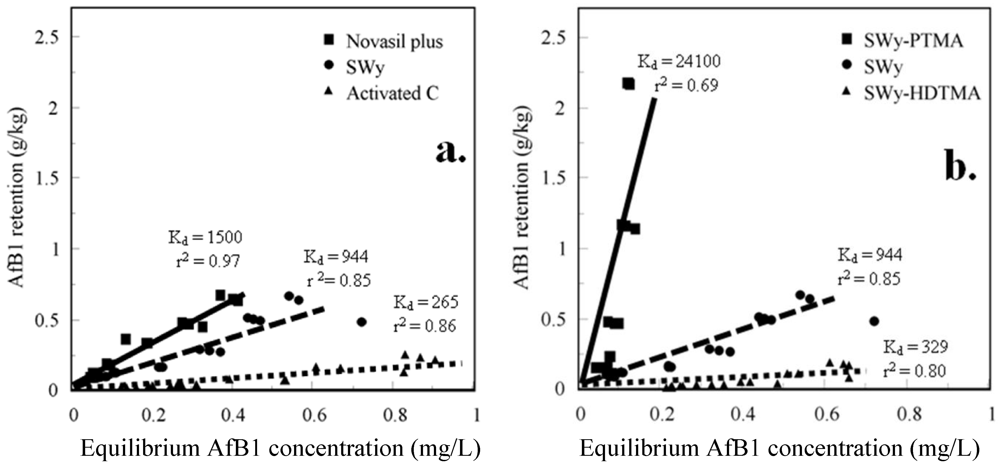

Aflatoxin Toxicity Reduction in Feed by Enhanced Binding to Surface-Modified Clay Additives

Abstract
:1. Introduction
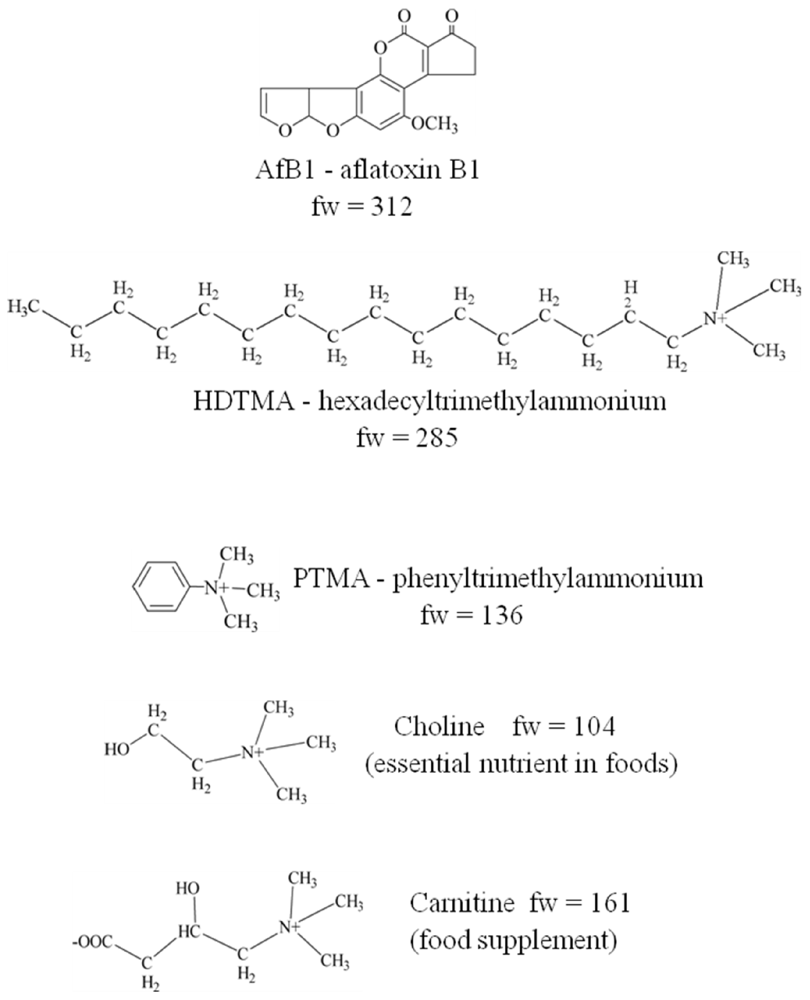
2. Materials and Methods
2.1. Preparation of Reduced-Charge Clay
2.2. Preparation of Surface-Modified Clays
2.3. AfB1 Adsorption from Water
2.4. AfB1 Retention from Aqueous Corn Flour with 60% Methanol Extraction
2.5. ELISA AfB1 Measurement
2.6. Basal Spacings, Organic Carbon Contents, and Specific Surface Areas
3. Results and Discussion
3.1. AfB1 Adsorption from Water
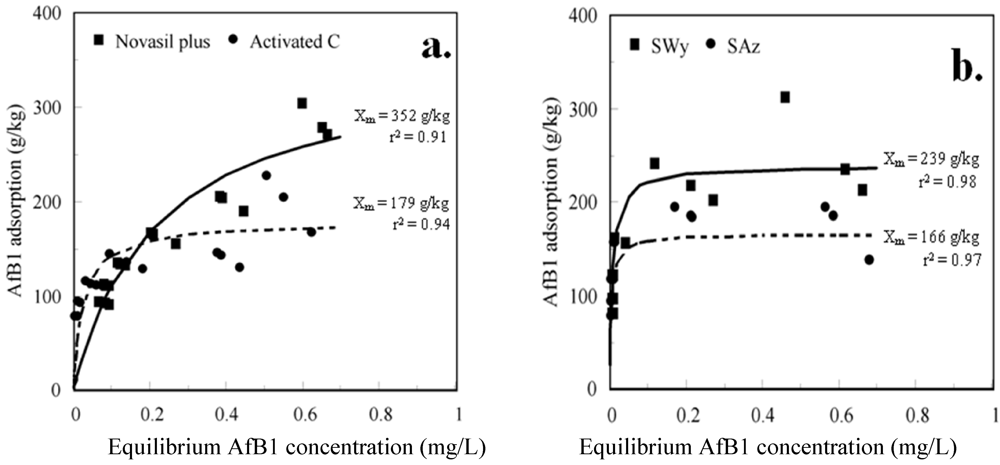
3.2. AfB1 Retention from Aqueous Corn Flour with 60% Methanol Extraction


| Sample | d001 (nm) | OC (%) | N2 (m2/g) | EGME (m2/g) |
|---|---|---|---|---|
| Na-Novasil plus | 1.26 | 0.14 | 70 | 721 |
| Na-SWy-2 | 1.23 | 0.06 | 29 | 691 |
| SWy-HDTMA | 1.82 | 14.60 | 7 | 216 |
| SWy-PTMA | 1.48 | 8.16 | 59 | 406 |
| SWy-Choline | 1.41 | 4.02 | 140 | 273 |
| SWy-Carnitine | 1.39 | 5.10 | 32 | 202 |
| Na-SAz-1 | 1.26 | 0.07 | 93 | 735 |
| SAz-Choline | 1.41 | 5.68 | 58 | 275 |
| 0.35LiSAz-Choline | 1.42 | 4.11 | 213 | 425 |
| Norit-A activated carbon | NA | 78.40 | 800 | 881 |
3.3. AfB1 Retention by HDTMA- and PTMA-Surface-Modified Clays
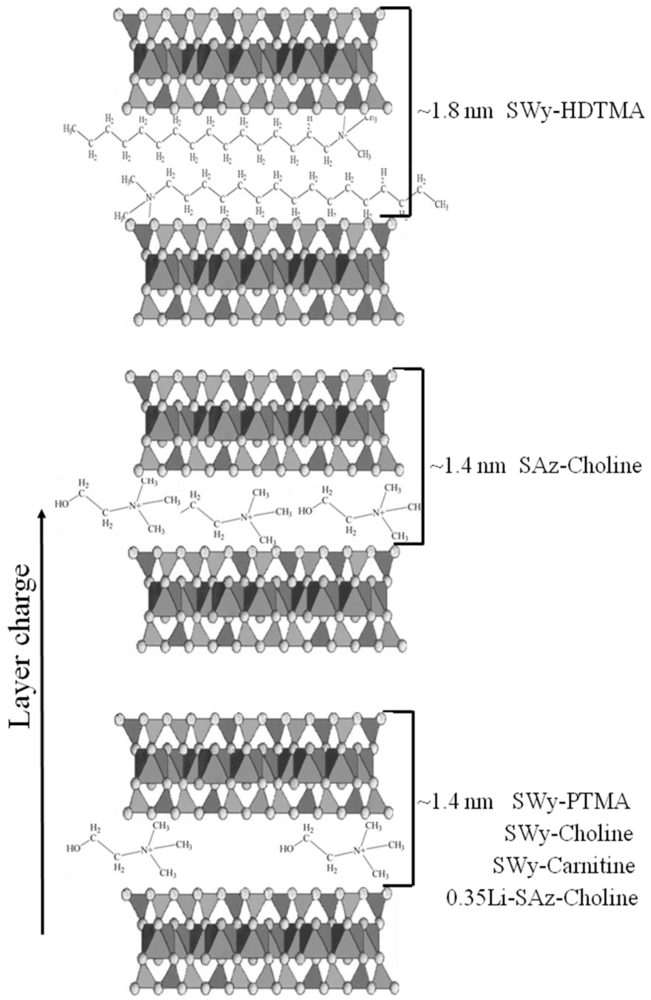
3.4. AfB1 Retention by Nutrient-Compound Surface-Modified Clays
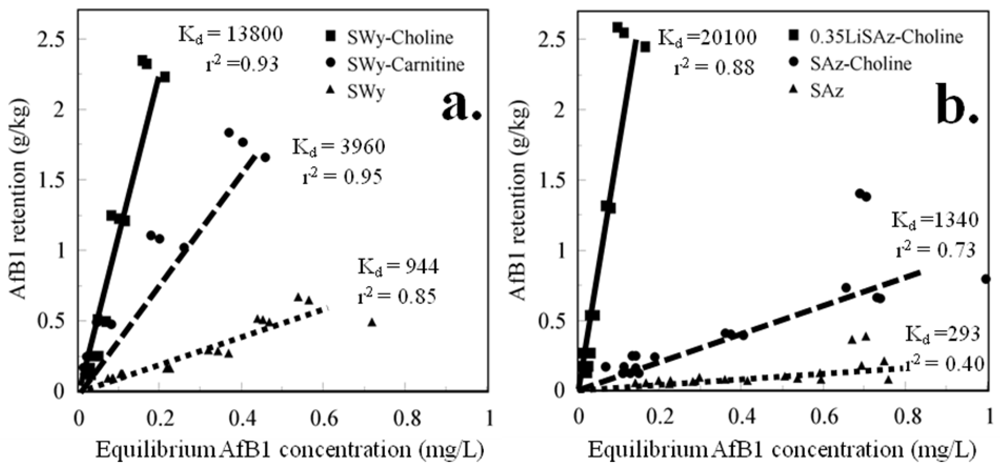
4. Conclusions
Acknowledgements
References
- Bennett, J.W.; Klich, M. Mycotoxins. Clin. Microbiol. Rev. 2003, 16, 497–516. [Google Scholar]
- Murphy, P.A.; Hendrich, S.; Landgren, C.; Bryant, C.M. Food mycotoxins: An update. J. Food Sci. 2006, 71, R51–R65. [Google Scholar]
- IARC. Aflatoxins: Naturally occurring aflatoxins (Group 1), aflatoxins M1 (Group 2B). Int. Agency Res. Cancer 1993, 56, 245.
- Williams, J.H.; Phillips, T.D.; Jolly, P.E.; Stiles, J.K.; Jolly, C.M.; Aggarwal, D. Human aflatoxicosis in developing countries: A review of toxicology, exposure, potential health consequences, and interventions. Am. J. Clin. Nutr. 2004, 80, 1106–1122. [Google Scholar]
- Phillips, T.D.; Kubena, L.F.; Harvey, R.B.; Taylor, D.R.; Heidelbaugh, N.D. Hydrated sodium calcium aluminosilicate: A high affinity sorbent for aflatoxin. Poult. Sci. 1988, 67, 243–247. [Google Scholar]
- Scheideler, S.E. Effects of various types of aluminosilicates and aflatoxin B1 on aflatoxin toxicity, chick performance, and mineral status. Poult. Sci. 1993, 72, 282–288. [Google Scholar] [PubMed]
- Schell, T.C.; Lindemann, M.D.; Kornegay, E.T.; Blodgett, D.J. Effects of feeding aflatoxin-contaminated diets with and without clay to weanling and growing pigs on performance, liver function, and mineral metabolism. J. Anim. Sci. 1993, 71, 1209–1218. [Google Scholar]
- Schell, T.C.; Lindemann, M.D.; Kornegay, E.T; Blodgett, D.J.; Doerr, J.A. Effectiveness of different types of clay for reducing the detrimental effects of aflatoxin-contaminated diets on performance and serum profiles of weanling pigs. J. Anim. Sci. 1993, 71, 1226–1231. [Google Scholar] [PubMed]
- Edrington, T.S.; Sarr, A.B.; Kubena, L.F.; Harvey, R.B.; Phillips, T.D. Hydrated sodium calcium aluminosilicate HSCAS, acidic HSCAS, and activated charcoal reduce urinary excretion of aflatoxin AfM1 in turkey poults. Lack of effect by activated charcoal on aflatoxicosis. Toxicol. Lett. 1996, 89, 115–122. [Google Scholar] [CrossRef] [PubMed]
- Miazzo, R.; Rosa, C.A.R.; de Queiroz Carvalho, E.C.; Magnoli, C.; Chiacchiera, S.M.; Palacio, G.; Saenz, M.; Kikot, A.; Basaldella, E.; Dalcero, A. Efficacy of synthetic zeolite to reduce the toxicity of aflatoxin in broiler chicks. Poult. Sci. 2000, 79, 1–6. [Google Scholar]
- Diaz, D.E.; Hagler, W.M.; Blackwelder, J.T.; Eve, J.A.; Hopkins, B.A.; Anderson, K.L.; Jones, F.T.; Whitlow, L.W. Aflatoxin binders II: Reduction of aflatoxin M1 in milk by sequestering agents of cows consuming aflatoxin in feed. Mycopathologia 2004, 157, 233–241. [Google Scholar]
- Pimpukdee, K.; Kubena, L.F.; Bailey, C.A.; Huebner, H.J.; Afriyie-Gyawu, E.; Phillips, T.D. Aflatoxin-induced toxicity and depletion of hepatic vitamin A in young broiler chicks: Protection of chicks in the presence of low levels of Novasil plus in the diet. Poult. Sci. 2004, 83, 737–744. [Google Scholar]
- Bailey, C.A.; Latimer, G.W.; Barr, A.C.; Wigle, W.L.; Haq, A.U.; Balthrop, J.E.; Kubena, L.F. Efficacy of montmorillonite clay (Novasil plus) for protecting full-term broilers from aflatoxicosis. J. Appl. Poult. Res. 2006, 15, 198–206. [Google Scholar]
- Fairchild, A.S.; Croom, J.; Grimes, J.L.; Hagler, W.M. Effect of Astra-Ben 20 on broiler chicks exposed to aflatoxin B1 or T2 toxin. Int. J. Poult. Sci. 2008, 7, 1147–1151. [Google Scholar]
- Magnoli, A.P.; Tallone, L.; Rosa, C.A.R.; Dalcero, A.M.; Chiacchiera, S.M.; Torres Sanchez, R.M. Commercial bentonites as detoxifier of broiler feed contaminated with aflatoxin. Appl. Clay Sci. 2008, 40, 63–71. [Google Scholar]
- Deng, Y.; Barrientos Velazquez, A.L.; Billes, F.; Dixon, J.B. Bonding mechanisms between aflatoxin B1 and smectite. Appl. Clay Sci. 2010, 50, 92–98. [Google Scholar]
- Jaynes, W.F.; Zartman, R.E; Hudnall, W.H. Aflatoxin B1 adsorption by clays from water and corn meal. Appl. Clay Sci. 2007, 36, 197–205. [Google Scholar] [CrossRef]
- Seifert, L.E.; Davis, J.P.; Dorner, J.W.; Jaynes, W.F.; Zartman, R.E.; Sanders, T.H. Value-added processing of peanut meal: Aflatoxin sequestration during protein extraction. J. Agric. Food Chem. 2010, 58, 5625–5632. [Google Scholar]
- Decker, W.J. Activated charcoal adsorbs aflatoxin B1. Vet. Hum. Toxicol. 1980, 22, 388–389. [Google Scholar]
- Hatch, R.C.; Clark, J.D.; Jain, A.V.; Weiss, R. Induced acute aflatoxicosis in goats: Treatment with activated charcoal or dual combinations of oxytetracycline, stanozol and activated charcoal. Am. J. Vet. Res. 1982, 43, 644–648. [Google Scholar]
- Dalvi, R.R.; Ademoyero, A.A. Toxic effect of aflatoxin B1 in chickens given feed contaminated with Aspergillus flavus and reduction of the toxicity by activated charcoal and some chemical agents. Avian Dis. 1984, 28, 61–69. [Google Scholar]
- Dalvi, R.R.; McGowan, C. Experimental induction of chronic aflatoxicosis in chickens by purified aflatoxin B1 and its reversal by activated charcoal, phenobarbitol and reduced glutathione. Poult. Sci. 1984, 63, 485–491. [Google Scholar]
- Veldman, A. Effect of sorbentia on carry-over of aflatoxin from cow feed to milk. Milchwissenschaft 1992, 47, 777–780. [Google Scholar]
- Rao, S.B.N.; Chopra, R.C. Influence of sodium bentonite and activated charcoal on aflatoxin M1 excretion in milk of goats. Small Ruminant Res. 2001, 41, 203–213. [Google Scholar]
- Kubena, L.F.; Harvey, R.B.; Philips, T.D.; Corrier, D.E.; Huff, W.E. Diminution of aflatoxicosis in growing chickens by the dietary addition of a hydrated sodium calcium aluminosilicate. Poult. Sci. 1990, 69, 727–735. [Google Scholar]
- Diaz, D.E.; Smith, T.K. Mycotoxin sequestering agents: Practical tools for the neutralisation of mycotoxins. In The Mycotoxin Blue Book; Diaz, D.E., Ed.; Nottingham University Press: Nottingham, UK, 2005; pp. 323–340. [Google Scholar]
- Vekiru, E.; Fruhauf, S.; Sahin, M.; Ottner, F.; Schatzmayr, G.; Krska, R. Investigation of various adsorbents for their ability to bind aflatoxin B1. Mycotoxin Res. 2007, 23, 27–33. [Google Scholar]
- Mortland, M.M.; Shaobai, S.; Boyd, S.A. Clay organic complexes as adsorbents for phenol and chlorophenols. Clays Clay Miner. 1986, 34, 581–585. [Google Scholar]
- Boyd, S.A.; Mortland, M.M.; Chiou, C.T. Sorption characteristics of organic compounds on hexadecyltrimethylammonium-smectite. Soil Sci. Soc. Am. J. 1988, 52, 652–657. [Google Scholar]
- Jaynes, W.F.; Boyd, S.A. Clay mineral type and organic compound sorption by hexadecyltrimethylammonium-exchanged clays. Soil Sci. Soc. Am. J. 1991, 55, 43–48. [Google Scholar]
- Boyd, S.A.; Jaynes, W.F. Role of layer charge in organic contaminant sorption by organo-clays. In Layer Charge Characteristics of 2:1 Silicate Clay Minerals (CMS Workshop Lectures, Volume 6.); Mermut, A.R., Ed.; The Clay Minerals Society: Boulder, CO, USA, 1994; pp. 47–78. [Google Scholar]
- Lemke, S.L.; Grant, P.G.; Phillips, T.D. Adsorption of zearalenone by organophilic montmorillonite clay. J. Agric. Food Chem. 1998, 46, 3789–3796. [Google Scholar]
- Wicklein, B.; Darner, M.; Aranda, P.; Ruiz-Hitzky, E. Organically modified clays for uptake of mycotoxins. Macla no 9, Septiembre ’08, Revista de la Sociedad Española de Mineralogía 2008, 257–258. [Google Scholar]
- Lemke, S.L.; Mayra, K.; Reeves, W.R.; Wang, N.; Fickey, C.; Phillips, T.D. Investigation of organophilic montmorillonite clay inclusion in zearalenone-contaminated diets using the mouse uterine weight bioassay. J. Toxicol. Environ. Health, Part A 2001, 62, 243–258. [Google Scholar] [CrossRef]
- Döll, S.; Gericke, S.; Dänicke, S.; Raila, J.; Ueberschär, K.-H.; Valenta, H.; Schnurrbusch, U.; Schweigert, F.J.; Flachowsky, G. The efficacy of a modified aluminosilicate as a detoxifying agent in Fusarium toxin contaminated maize containing diets for piglets. J. Anim. Physiol. Anim. Nutr. 2005, 89, 342–358. [Google Scholar]
- Jaynes, W.F.; Boyd, S.A. Trimethylphenylammonium-smectite as an effective adsorbent of water soluble aromatic hydrocarbons. J. Air Waste Manag. Assoc. 1990, 40, 1649–1653. [Google Scholar]
- Jaynes, W.F.; Boyd, S.A. Hydrophobicity of siloxane surfaces in smectites as revealed by aromatic hydrocarbon adsorption from water. Clays Clay Min. 1991, 39, 428–436. [Google Scholar]
- AOCS, Aflatoxin standards. Official method Aj 0-88. Sampling and Analysis of Vegetable Oil Source Materials. American Oil Chemists Society: Urbana, IL, USA, 1999.
- Hofmann, U.; Klemen, R. Verlust der Austauschfanhigkeit von Lithiumionen an Bentonit durch Erhitzung. Z. Anorg. Allg. Chem. 1950, 262, 95–99. [Google Scholar]
- Jaynes, W.F.; Bigham, J.M. Charge reduction, octahedral charge, and lithium retention in heated, Li-saturated smectites. Clays Clay Min. 1987, 35, 440–448. [Google Scholar]
- Hiemenz, P.C. Principles of Colloid and Surface Chemistry; Marcel Dekker: New York, NY, USA, 1986; pp. 398–407. [Google Scholar]
- Grant, P.G.; Phillips, T.D. Isothermal adsorption of aflatoxin B1 on HSCAS clay. J. Agric. Food Chem. 1998, 46, 599–605. [Google Scholar]
- Asis, R.; Di Paola, R.D.; Aldao, M.A.J. Determination of aflatoxin B1 in highly contaminated peanut samples using HPLC and ELISA. Food Agric. Immunul. 2002, 14, 201–208. [Google Scholar]
- AOCS, Total aflatoxins (B1, B2, and G1) in corn, cottonseed, peanuts, and peanut butter. Official method Aj 6-95. Sampling and Analysis of Vegetable Oil Source Materials. American Oil Chemists Society: Urbana, IL, USA, 1999.
- Carter, D.L.; Mortland, M.M.; Kemper, W.D. Specific surface. In Methods of Soil Analysis. Part I. Physical and Mineralogical Methods, 2nd; Klute, A., Ed.; Soil Science Society of America: Madison, WI, USA, 1986; pp. 413–423. [Google Scholar]
© 2011 by the authors; licensee MDPI, Basel, Switzerland. This article is an open-access article distributed under the terms and conditions of the Creative Commons Attribution license (http://creativecommons.org/licenses/by/3.0/).
Share and Cite
Jaynes, W.F.; Zartman, R.E. Aflatoxin Toxicity Reduction in Feed by Enhanced Binding to Surface-Modified Clay Additives. Toxins 2011, 3, 551-565. https://doi.org/10.3390/toxins3060551
Jaynes WF, Zartman RE. Aflatoxin Toxicity Reduction in Feed by Enhanced Binding to Surface-Modified Clay Additives. Toxins. 2011; 3(6):551-565. https://doi.org/10.3390/toxins3060551
Chicago/Turabian StyleJaynes, William F., and Richard E. Zartman. 2011. "Aflatoxin Toxicity Reduction in Feed by Enhanced Binding to Surface-Modified Clay Additives" Toxins 3, no. 6: 551-565. https://doi.org/10.3390/toxins3060551