<?xml version="1.0" encoding="UTF-8"?>
<!DOCTYPE article PUBLIC "-//NLM//DTD Journal Publishing DTD v2.3 20070202//EN" "journalpublishing.dtd">
<article xmlns:mml="http://www.w3.org/1998/Math/MathML" xmlns:xlink="http://www.w3.org/1999/xlink" xml:lang="en" article-type="review-article">
  <front>
    <journal-meta>
      <journal-id journal-id-type="publisher-id">toxins</journal-id>
      <journal-title>Toxins</journal-title>
      <abbrev-journal-title abbrev-type="publisher">Toxins</abbrev-journal-title>
      <abbrev-journal-title abbrev-type="pubmed">Toxins</abbrev-journal-title>
      <issn pub-type="epub">2072-6651</issn>
      <publisher>
        <publisher-name>MDPI</publisher-name>
      </publisher>
    </journal-meta>
    <article-meta>
      <article-id pub-id-type="doi">10.3390/toxins2082158</article-id>
      <article-id pub-id-type="publisher-id">toxins-02-02158</article-id>
      <article-categories>
        <subj-group>
          <subject>Review</subject>
        </subj-group>
      </article-categories>
      <title-group>
        <article-title>Different Types of Cell Death Induced by Enterotoxins</article-title>
      </title-group>
      <contrib-group>
        <contrib contrib-type="author">
          <name>
            <surname>Lin</surname>
            <given-names>Chiou-Feng</given-names>
          </name>
          <xref rid="af1-toxins-02-02158" ref-type="aff">1</xref>
          <xref rid="af2-toxins-02-02158" ref-type="aff">2</xref>
          <xref rid="af3-toxins-02-02158" ref-type="aff">3</xref>
          <xref rid="c1-toxins-02-02158" ref-type="corresp">*</xref>
        </contrib>
        <contrib contrib-type="author">
          <name>
            <surname>Chen</surname>
            <given-names>Chia-Ling</given-names>
          </name>
          <xref rid="af3-toxins-02-02158" ref-type="aff">3</xref>
        </contrib>
        <contrib contrib-type="author">
          <name>
            <surname>Huang</surname>
            <given-names>Wei-Ching</given-names>
          </name>
          <xref rid="af1-toxins-02-02158" ref-type="aff">1</xref>
          <xref rid="af2-toxins-02-02158" ref-type="aff">2</xref>
        </contrib>
        <contrib contrib-type="author">
          <name>
            <surname>Cheng</surname>
            <given-names> Yi-Lin</given-names>
          </name>
          <xref rid="af1-toxins-02-02158" ref-type="aff">1</xref>
          <xref rid="af4-toxins-02-02158" ref-type="aff">4</xref>
        </contrib>
        <contrib contrib-type="author">
          <name>
            <surname>Hsieh</surname>
            <given-names>Chia-Yuan</given-names>
          </name>
          <xref rid="af1-toxins-02-02158" ref-type="aff">1</xref>
        </contrib>
        <contrib contrib-type="author">
          <name>
            <surname>Wang</surname>
            <given-names>Chi-Yun</given-names>
          </name>
          <xref rid="af1-toxins-02-02158" ref-type="aff">1</xref>
          <xref rid="af2-toxins-02-02158" ref-type="aff">2</xref>
        </contrib>
        <contrib contrib-type="author">
          <name>
            <surname>Hong</surname>
            <given-names>Ming-Yuan</given-names>
          </name>
          <xref rid="af1-toxins-02-02158" ref-type="aff">1</xref>
          <xref rid="af5-toxins-02-02158" ref-type="aff">5</xref>
        </contrib>
      </contrib-group>
      <aff id="af1-toxins-02-02158"><label>1</label>Institute of Clinical Medicine, College of Medicine, National Cheng Kung University, Tainan 701, Taiwan; Email: <email>zarbi@mail2000.com.tw</email> (W.-C.H.); <email>sillylilly0518@yahoo.com.tw</email> (Y.-L.C.); <email>dyoushus@yahoo.com.tw</email> (C.-Y.H.); <email>chixuan1225@hotmail.com</email> (C.-Y.W.); <email>myuan@mail2000.com.tw</email> (M.-Y.H.)</aff>
      <aff id="af2-toxins-02-02158"><label>2</label>Institute of Basic Medical Sciences, College of Medicine, National Cheng Kung University, Tainan 701, Taiwan</aff>
      <aff id="af3-toxins-02-02158"><label>3</label>Department of Microbiology and Immunology, College of Medicine, National Cheng Kung University, Tainan 701, Taiwan; Email: <email>clchen2001.tw@yahoo.com.tw</email> (C.-L.C.)</aff>
      <aff id="af4-toxins-02-02158"><label>4</label>Department of Medical Laboratory Science and Biotechnology, College of Medicine, National Cheng Kung University, Tainan 701, Taiwan</aff>
      <aff id="af5-toxins-02-02158"><label>5</label>Department of Emergency, National Cheng Kung University Hospital, Tainan 701, Taiwan</aff>
      <author-notes>
        <corresp id="c1-toxins-02-02158"><label>*</label> Author  to whom correspondence should be addressed; Email: <email>cflin@mail.ncku.edu.tw</email>; Tel.: +886-06-235-3535 ext. 4240; Fax: +886-06-275-8781.</corresp>
      </author-notes>
      <pub-date pub-type="epub">
        <day>11</day>
        <month>08</month>
        <year>2010</year>
      </pub-date>
      <pub-date pub-type="collection">
        <month>08</month><year>2010</year>
      </pub-date>
      <volume>2</volume>
      <issue>8</issue>
      <fpage>2158</fpage>
      <lpage>2176</lpage>
      <history>
        <date date-type="received">
          <day>13</day>
          <month>07</month>
          <year>2010</year>
        </date>
        <date date-type="accepted">
          <day>03</day>
          <month>08</month>
          <year>2010</year>
        </date>
      </history>
      <permissions>
        <copyright-statement>©  2010 by the authors; licensee MDPI, Basel, Switzerland</copyright-statement>
        <copyright-year>2010</copyright-year>
        <license xmlns:xlink="http://www.w3.org/1999/xlink" license-type="open-access" xlink:href="http://creativecommons.org/licenses/by/3.0/">
          <p>This article is an open-access article distributed under the terms and conditions of the Creative Commons Attribution license (http://creativecommons.org/licenses/by/3.0/).</p>
        </license>
      </permissions>
      <abstract>
        <p>The infection of bacterial organisms generally causes cell death to facilitate microbial invasion and immune escape, both of which are involved in the pathogenesis of infectious diseases. In addition to the intercellular infectious processes, pathogen-produced/secreted enterotoxins (mostly exotoxins) are the major weapons that kill host cells and cause diseases by inducing different types of cell death, particularly apoptosis and necrosis. Blocking these enterotoxins with synthetic drugs and vaccines is important for treating patients with infectious diseases. Studies of enterotoxin-induced apoptotic and necrotic mechanisms have helped us to create efficient strategies to use against these well-characterized cytopathic toxins. In this article, we review the induction of the different types of cell death from various bacterial enterotoxins, such as staphylococcal enterotoxin B, staphylococcal alpha-toxin, Panton-Valentine leukocidin, alpha-hemolysin of <italic>Escherichia coli</italic>, Shiga toxins, cytotoxic necrotizing factor 1, heat-labile enterotoxins, and the cholera toxin, <italic>Vibrio cholerae</italic>. In addition, necrosis caused by pore-forming toxins, apoptotic signaling through cross-talk pathways involving mitochondrial damage, endoplasmic reticulum stress, and lysosomal injury is discussed.</p>
      </abstract>
      <kwd-group>
        <kwd>apoptosis</kwd>
        <kwd>necrosis</kwd>
        <kwd>enterotoxin</kwd>
        <kwd>exotoxin</kwd>
        <kwd>pore-forming toxin</kwd>
        <kwd>staphylococcal enterotoxin B</kwd>
        <kwd>staphylococcal alpha-toxin</kwd>
        <kwd>Panton-Valentine leukocidin</kwd>
        <kwd>alpha-hemolysin</kwd>
        <kwd>Shiga toxin</kwd>
        <kwd>cytotoxic necrotizing factor 1</kwd>
        <kwd>heat-labile enterotoxin</kwd>
        <kwd>cholera toxin</kwd>
      </kwd-group>
    </article-meta>
  </front>
  <body>
    <sec sec-type="intro">
      <title>1. Introduction</title>
      <p>Patients with bacteremia may develop moderate or severe sepsis or life-threatening septic shock following multiple organ failure or multiple organ dysfunction syndrome (MOF/MODS) [<xref ref-type="bibr" rid="B1-toxins-02-02158">1</xref>,<xref ref-type="bibr" rid="B2-toxins-02-02158">2</xref>,<xref ref-type="bibr" rid="B3-toxins-02-02158">3</xref>]. Patients with MOF/MODS have a 25–50% higher mortality rate than those without MOF/MODS [<xref ref-type="bibr" rid="B4-toxins-02-02158">4</xref>,<xref ref-type="bibr" rid="B5-toxins-02-02158">5</xref>]. Although a variety of strategies for managing sepsis have been developed [<xref ref-type="bibr" rid="B3-toxins-02-02158">3</xref>,<xref ref-type="bibr" rid="B6-toxins-02-02158">6</xref>], it is difficult to prevent because of its complex pathogenic mechanisms, which generally involve severe inflammation and cell death. Enterotoxins—chromosomally encoded exotoxins that are originally defined by their cytopathic effects—are generally produced from pathogenic bacterial organisms, such as <italic>Escherichia coli</italic> (<italic>E. coli</italic>) (alpha-hemolysin (HlyA), Shiga toxins (Stxs), cytotoxic necrotizing factors 1 (CNF1), heat-labile enterotoxins (LT))[<xref ref-type="bibr" rid="B7-toxins-02-02158">7</xref>,<xref ref-type="bibr" rid="B8-toxins-02-02158">8</xref>], <italic>Staphylococcus aureus</italic> (<italic>S. aureus</italic>)(staphylococcal enterotoxins B (SEB), staphylococcal alpha-toxins, Panton-Valentine leukocidin (PVL)[<xref ref-type="bibr" rid="B7-toxins-02-02158">7</xref>,<xref ref-type="bibr" rid="B9-toxins-02-02158">9</xref>], <italic>Streptococcus pneumoniae</italic> (<italic>S. pneumoniae</italic>), (streptolysin and pneumolysin)[<xref ref-type="bibr" rid="B7-toxins-02-02158">7</xref>,<xref ref-type="bibr" rid="B10-toxins-02-02158">10</xref>,<xref ref-type="bibr" rid="B11-toxins-02-02158">11</xref>], <italic>Clostridium perfringens</italic> (<italic>Clostridium perfringens</italic> enterotoxins)[<xref ref-type="bibr" rid="B12-toxins-02-02158">12</xref>], <italic>Vibrio cholerae</italic> (cholera toxins)[<xref ref-type="bibr" rid="B13-toxins-02-02158">13</xref>], and <italic>Shigella dysenteriae</italic> (Stxs)[<xref ref-type="bibr" rid="B14-toxins-02-02158">14</xref>]. In addition to inflammatory activation, these enterotoxins are cytopathic to host cells through lytic or non-lytic mechanisms by inducing necrosis or apoptosis, respectively. Apoptosis, also called programmed cell death, induced by bacterial infection is widely under investigation [<xref ref-type="bibr" rid="B15-toxins-02-02158">15</xref>,<xref ref-type="bibr" rid="B16-toxins-02-02158">16</xref>,<xref ref-type="bibr" rid="B17-toxins-02-02158">17</xref>]. Extrinsic and intrinsic pathways of apoptosis involving intracellular organelle dysfunction and caspase cascade activation are regulated for bacterial enterotoxin-induced pro-apoptotic signaling. In addition to apoptosis, cytopathic studies have shown that several enterotoxins, including hemolysin, staphylococcal alpha-toxin, pneumolysin, and streptolysin-O, usually cause cell death by altering the apical membrane permeability of the targeting cells [<xref ref-type="bibr" rid="B7-toxins-02-02158">7</xref>]. These cytopathic enterotoxins are pore-forming toxins (PFTs), also defined as cytolysins. After these cytolysins bind to a host cell membrane, the mechanism for pore formation involves the insertion of a number of water-soluble single-chain polypeptides into the membrane bi-layer and the formation of hydrophilic transmembrane pores [<xref ref-type="bibr" rid="B7-toxins-02-02158">7</xref>,<xref ref-type="bibr" rid="B18-toxins-02-02158">18</xref>]. The generation of hydrophilic transmembrane pores, which induces necrotic lysis or permeabilization of host cells or intracellular organelles during infection, is pathogenic for disease development via the disruption of infected tissues/cells and the induction of local and/or systemic immunosuppression. For microbial pathogenesis, somatic cell death and immune cell death are required for bacterial invasion and immune escape, respectively.</p>
    </sec>
    <sec>
      <title>2. Apoptotic Cell Death</title>
      <p>Apoptosis, also called programmed cell death, is generally involved in bacterial infection and pathogenesis [<xref ref-type="bibr" rid="B15-toxins-02-02158">15</xref>,<xref ref-type="bibr" rid="B16-toxins-02-02158">16</xref>,<xref ref-type="bibr" rid="B17-toxins-02-02158">17</xref>]. During bacterial infection, virulent factors (mostly enterotoxins) are produced and secreted from pathogens and trigger apoptotic signals. In general, cells undergo apoptosis through two major pathways, the extrinsic pathway (the death receptor pathway) or the intrinsic pathway (the mitochondrial pathway)[<xref ref-type="bibr" rid="B19-toxins-02-02158">19</xref>,<xref ref-type="bibr" rid="B20-toxins-02-02158">20</xref>,<xref ref-type="bibr" rid="B21-toxins-02-02158">21</xref>]. In addition to enterotoxins, the invasion and endocytosis of whole pathogens into the infected cells also cause apoptotic signaling through extrinsic and intrinsic pathways [<xref ref-type="bibr" rid="B15-toxins-02-02158">15</xref>]. It is speculated that blockage of this apoptotic signaling may confer protection against bacterial infection-induced sepsis [<xref ref-type="bibr" rid="B20-toxins-02-02158">20</xref>,<xref ref-type="bibr" rid="B21-toxins-02-02158">21</xref>].</p>
      <sec>
        <title>2.1. Extrinsic (Death Receptor-mediated) and Intrinsic (Mitochondria-Regulated) Pathways of Apoptosis</title>
        <p>Extrinsic pathways are generally initiated by the activation of death receptors through the interaction between their natural ligands or by inducing death receptor clusterization. Death receptors are cell surface receptors that belong to the tumor necrosis factor (TNF) super family and interact with their ligands to form death receptor complexes, including Fas (CD95/Apo1)/Fas Ligand (CD95 ligand)[<xref ref-type="bibr" rid="B22-toxins-02-02158">22</xref>], TNF receptor 1 (p55)/TNF and lymphotoxin [<xref ref-type="bibr" rid="B23-toxins-02-02158">23</xref>], TRAMP (WSL-1/Apo3/DR3/LARD)/TWEAK (Apo3 ligand)[<xref ref-type="bibr" rid="B24-toxins-02-02158">24</xref>], TRAIL-R1 (DR4)/TRAIL (Apo2 ligand)[<xref ref-type="bibr" rid="B25-toxins-02-02158">25</xref>], and TRAIL-R2 (DR5/Apo2/KILLER)/TRAIL [<xref ref-type="bibr" rid="B26-toxins-02-02158">26</xref>]. Upon extrinsic activation, the intracellular death domain (DD) of death receptors associates with an adaptor protein called Fas-associated death domain (FADD) directly or indirectly via the TNF receptor-associated death domain [<xref ref-type="bibr" rid="B26-toxins-02-02158">26</xref>]. The death receptor associated intracellular FADD interacts with pro-caspase-8, a typical initial caspase, to form a death-inducing signaling complex required for caspase-8 activation [<xref ref-type="bibr" rid="B26-toxins-02-02158">26</xref>]. During the process of apoptosis, there is, in general, a reduction of mitochondrial transmembrane potential followed by the release of cytochrome <italic>c</italic>, which binds to Apaf-1 and promotes caspase-9 and caspase-3 activation [<xref ref-type="bibr" rid="B27-toxins-02-02158">27</xref>,<xref ref-type="bibr" rid="B28-toxins-02-02158">28</xref>]. The central role of mitochondria in apoptosis is proposed to be via an intrinsic pathway. Pro-apoptotic Bax and Bid, the members of the Bcl-2 family with pro-apoptotic roles, translocate to the mitochondria and disrupt the membrane integrity, resulting in cytochrome <italic>c</italic> release from mitochondria to cytoplasm [<xref ref-type="bibr" rid="B29-toxins-02-02158">29</xref>,<xref ref-type="bibr" rid="B30-toxins-02-02158">30</xref>,<xref ref-type="bibr" rid="B31-toxins-02-02158">31</xref>]. The induction of mitochondrial transmembrane permeabilization (MTP) resulted from Bax or truncated Bid (activated by caspase-8 from the extrinsic pathway) forms pores in the outer membrane directly or by interacting with the permeability of the transition pore complex [<xref ref-type="bibr" rid="B30-toxins-02-02158">30</xref>,<xref ref-type="bibr" rid="B31-toxins-02-02158">31</xref>]. In contrast, anti-apoptotic Bcl-2 and Bcl-xL protect these effects by maintaining the MTP through the inhibition of Bax or other pro-apoptotic factors [<xref ref-type="bibr" rid="B29-toxins-02-02158">29</xref>]. The loss of balance of Bcl-2/Bax is believed to contribute to the progression of apoptosis.</p>
      </sec>
      <sec>
        <title>2.2. Endoplasmic Reticulum Stress-Mediated Apoptosis</title>
        <p>Stress on the endoplasmic reticulum (ER), which is the site of protein synthesis, modification, and folding, can be caused by multiple insults, such as the inhibition of glycosylation, the reduction of disulfide bonds, calcium depletion from the ER lumen, impairment of protein transport to the Golgi, and expression of mutated proteins in the ER, which can trigger an unfolded protein response (UPR) following ER stress [<xref ref-type="bibr" rid="B32-toxins-02-02158">32</xref>,<xref ref-type="bibr" rid="B33-toxins-02-02158">33</xref>,<xref ref-type="bibr" rid="B34-toxins-02-02158">34</xref>]. These events enhance protein folding and degradation within the ER and down-regulate protein synthesis until cells have recovered from the ER stress. However, prolonged ER stress may eventually cause apoptosis, and calcium homeostasis and the UPR cannot be restored. Several apoptotic signaling pathways have been demonstrated in ER stress-induced apoptosis [<xref ref-type="bibr" rid="B32-toxins-02-02158">32</xref>]. The ER stress-induced C/EBP homologous protein, a transcription factor that suppresses the expression of anti-apoptotic protein Bcl-2 and increases ROS production, is involved in apoptosis through the mitochondrial pathway [<xref ref-type="bibr" rid="B33-toxins-02-02158">33</xref>]. ER stress-activated c-Jun N-terminal kinase is also involved [<xref ref-type="bibr" rid="B34-toxins-02-02158">34</xref>]. Calpain, a calcium-dependent protease, generally causes the activation of human caspase-4, a specific ER stress-activated caspase with a 48% sequence homology to murine caspase-12 [<xref ref-type="bibr" rid="B35-toxins-02-02158">35</xref>,<xref ref-type="bibr" rid="B36-toxins-02-02158">36</xref>]. Notably, caspase-4 triggers apoptotic pathways, dependent or independent of caspase-9 and caspase-3 activation [<xref ref-type="bibr" rid="B32-toxins-02-02158">32</xref>]. Furthermore, the activation of caspase-2, -3, -7, -8, and -9 have also been reported in ER stress-induced apoptosis [<xref ref-type="bibr" rid="B37-toxins-02-02158">37</xref>,<xref ref-type="bibr" rid="B38-toxins-02-02158">38</xref>,<xref ref-type="bibr" rid="B39-toxins-02-02158">39</xref>]. However, the role of caspase cascade activation is still controversial, owing to differences in ER stressor stimulation and cell type dependence.</p>
      </sec>
      <sec>
        <title>2.3. Lysosomal Pathway of Apoptotic Signaling</title>
        <p>The lysosome, an acidic organelle, plays a pivotal role in apoptosis and necrosis caused by various stimuli, including oxidative stress, TNF-α, sphingosine, p53, and staurosporine [<xref ref-type="bibr" rid="B40-toxins-02-02158">40</xref>,<xref ref-type="bibr" rid="B41-toxins-02-02158">41</xref>]. However, the precise lysosomal pathway in ER stress-induced apoptosis remains unclear. Apoptotic stimuli cause lysosomal membrane permeabilization through a variety of regulatory factors, such as calcium, ROS, ceramide, sphingosine, phospholipase, Bax, Bim, Bid, and caspase [<xref ref-type="bibr" rid="B41-toxins-02-02158">41</xref>,<xref ref-type="bibr" rid="B42-toxins-02-02158">42</xref>]. The lysosomal proteolytic enzymes, mainly proteases of the cathepsin family, translocate to the cytosol. Once in the cytosol, cathepsin B and cathepsin D are the major mediators triggering apoptotic and necrotic pathways, which involve Bid truncation, caspase activation, and mitochondrial damage [<xref ref-type="bibr" rid="B43-toxins-02-02158">43</xref>]. Under apoptotic stress, both ER stress and lysosomal and mitochondrial destabilization may contribute to the initiation stage of apoptosis.</p>
      </sec>
    </sec>
    <sec>
      <title>3. Necrotic Cell Death</title>
      <p>Necrotic cell death is also caused by a variety of extracellular and intracellular factors, such as bacterial and viral infections, toxins, or trauma [<xref ref-type="bibr" rid="B44-toxins-02-02158">44</xref>]. Numerous intracellular molecules are involved in necrotic cell death, including ROS, Ca<sup>2+</sup>, calpains, cathepsins, phospholipases, and ceramide [<xref ref-type="bibr" rid="B45-toxins-02-02158">45</xref>]. In contrast with apoptosis, necrosis is characterized by severe pathophysiological changes, including mitochondrial swelling, rapid loss of plasma membrane integrity, ultimate leakage of cellular contents, and a lack of typical apoptotic features, such as internucleosomal DNA cleavage and nuclear condensation. Necrotic cell death is identified as caspase-independent cell death [<xref ref-type="bibr" rid="B46-toxins-02-02158">46</xref>]. Exposing the release content proteins triggers acute inflammation and causes pathogenic to the host.</p>
      <p>Necrotic cell death is also induced through death receptor-mediated signaling. Activation of the death receptors, including Fas and TNF-α receptors, induces a “prototypic” apoptotic pathway through FADD. Under apoptosis-deficient conditions, stimulation with FasL or TNF-α still induces cell death with the morphological features of necrosis [<xref ref-type="bibr" rid="B47-toxins-02-02158">47</xref>]. Notably, necrostatin-1, an inhibitor of RIP1, blocks Fas- and TNF-α receptor-mediated necrotic cell death, namely necroptosis [<xref ref-type="bibr" rid="B48-toxins-02-02158">48</xref>]. In addition to death receptor pathways, the signaling of pathogen recognition receptors such as the Toll-like receptor (TLR) 3 [<xref ref-type="bibr" rid="B49-toxins-02-02158">49</xref>] and TLR4 [<xref ref-type="bibr" rid="B50-toxins-02-02158">50</xref>] and extensive DNA damage [<xref ref-type="bibr" rid="B51-toxins-02-02158">51</xref>] can also lead to necrotic cell death.</p>
    </sec>
    <sec>
      <title>4. Cytotoxic Enterotoxins</title>
      <sec>
        <title>4.1. Cytotoxicity of <italic>S. aureus</italic></title>
        <p><italic>S. aureus</italic>, a Gram-positive bacterium, causes a variety of diseases ranging from minor skin infections to life-threatening conditions such as staphylococcal septic shock [<xref ref-type="bibr" rid="B9-toxins-02-02158">9</xref>]. Cell wall components and secreted enterotoxins have been shown to be inflammatory, cytotoxic, and septic mediators. These factors may be recognized by the innate immune system via multiple manners [<xref ref-type="bibr" rid="B52-toxins-02-02158">52</xref>]. To date, it is believed that mechanisms that lead to staphylococcal septic shock are probably multifactorial but include immunogenic and cytotoxic injuries.</p>
        <p>Staphylococcal superantigens, a large family of exotoxins, are powerful microbial toxins that activate the immune system by binding to class II major histocompatibility complex and T-cell receptor molecules without antigen processing. There are 17 well-characterized, serologically distinct staphylococcal superantigens made by <italic>S. aureus</italic>: TSS toxin-1; staphylococcal enterotoxins (SEs) A, B, C (multiple minor variant forms exist), D, E, and I; and SE-like G, H, J, K, L, M, N, O, P, and Q [<xref ref-type="bibr" rid="B53-toxins-02-02158">53</xref>]. Superantigen SEB, a staphylococcal pyrogenic exotoxin, causes cellular cytotoxicity by inducing cell activation followed by the induction of inflammatory cytokines including TNF-α, interleukin (IL)-2, IL-6, IL-10, and interferon-γ, and chemokines including monocyte chemoattractant protein 1 regulated on activation, and normal T-cell expressed and secreted proteins [<xref ref-type="bibr" rid="B54-toxins-02-02158">54</xref>,<xref ref-type="bibr" rid="B55-toxins-02-02158">55</xref>,<xref ref-type="bibr" rid="B56-toxins-02-02158">56</xref>,<xref ref-type="bibr" rid="B57-toxins-02-02158">57</xref>,<xref ref-type="bibr" rid="B58-toxins-02-02158">58</xref>]. Further study showed that TNF-α plays an initial role in inflammation on T cell-mediated toxicity in SEB-induced septic shock, whereas anti-TNF-α-neutralizing monoclonal antibody conferred protection against SEB [<xref ref-type="bibr" rid="B59-toxins-02-02158">59</xref>]. Interestingly, the major producer cells of TNF-α are CD3 positive splenic T cells and peritoneal cells. In addition to the pathogenic role of SEB <italic>in vivo</italic>, <italic>in vitro</italic> studies showed that superantigens are enabled to induce transcriptional activation of the TNF in T cells and monocytes [<xref ref-type="bibr" rid="B60-toxins-02-02158">60</xref>,<xref ref-type="bibr" rid="B61-toxins-02-02158">61</xref>]. In SEB-induced septic pathogenesis, T cells are the major cause of shock syndrome [<xref ref-type="bibr" rid="B54-toxins-02-02158">54</xref>,<xref ref-type="bibr" rid="B59-toxins-02-02158">59</xref>]. Furthermore, SEB may cause CD4 positive cells undergoing activation-induced cell death both <italic>in vitro</italic> and <italic>in vivo</italic> [<xref ref-type="bibr" rid="B62-toxins-02-02158">62</xref>,<xref ref-type="bibr" rid="B63-toxins-02-02158">63</xref>,<xref ref-type="bibr" rid="B64-toxins-02-02158">64</xref>,<xref ref-type="bibr" rid="B65-toxins-02-02158">65</xref>]. Izquierdo and colleagues [<xref ref-type="bibr" rid="B66-toxins-02-02158">66</xref>] found that the blockade of caspase activation inhibits SEB-induced thymocyte apoptosis. Current studies show that the induction of caspase-3-mediated apoptosis in SEB-exposed renal proximal tubule epithelial cells involves the signaling of Rho family proteins [<xref ref-type="bibr" rid="B67-toxins-02-02158">67</xref>]. The molecular mechanism for SEB-induced cell apoptosis needs further investigation.</p>
        <p>The staphylococcal alpha-toxin, a water-soluble single-chain cytopathic toxin produced by <italic>S. aureus</italic>, was the first staphylococcal exotoxin to be identified as a PFT [<xref ref-type="bibr" rid="B68-toxins-02-02158">68</xref>]. It contains high-affinity structures that interact with a variety of cells, including rabbit erythrocytes, human platelets, monocytes and endothelial cells. After it binds onto a membrane, the generation of ring-structured hexamers is present as a pore. These pores trigger cellular responses via a Ca<sup>2+</sup> influx to lyse and permeabilize cell membranes. Staphylococcal alpha-toxin-exposed keratinocytes and T cells show the depletion of cellular ATP followed by the degradation of internucleosomal DNA [<xref ref-type="bibr" rid="B69-toxins-02-02158">69</xref>,<xref ref-type="bibr" rid="B70-toxins-02-02158">70</xref>]. To characterize the type of cell death, Bantel and colleagues [<xref ref-type="bibr" rid="B71-toxins-02-02158">71</xref>] demonstrated that a staphylococcal alpha-toxin induces cytochrome <italic>c</italic> release in a Bcl-2-controlled manner. They further demonstrate that staphylococcal alpha-toxin causes an intrinsic mitochondrial pathway, which involves caspase-9 and caspase-3 cascade activation independently of the death receptor pathway. However, Essmann and colleagues [<xref ref-type="bibr" rid="B72-toxins-02-02158">72</xref>] provided data suggesting that although pan-caspase inhibitor zVAD-fmk or overexpression of Bcl-2 completely decreased staphylococcal alpha-toxin-induced caspase activation and internucleosomal DNA fragmentation, they did not significantly inhibit cell death of T or breast carcinoma cells. Notably, electron microscopy demonstrated that a staphylococcal alpha-toxin induces necrotic cell death, which is characterized by cell swelling and cytoplasmic vacuolation. In addition to apoptosis and necrosis, the staphylococcal alpha-toxin may facilitate death receptor-mediated caspase-8 activation and apoptosis through TNF-α upregulation [<xref ref-type="bibr" rid="B73-toxins-02-02158">73</xref>]. Taken together, these data suggest that a staphylococcal alpha-toxin induces cell death in a cell type- and dose-dependent manner, including apoptosis and necrosis. Mitochondrial dysfunction caused by a staphylococcal alpha-toxin is usually involved either in apoptosis or necrotic cell death. In addition to the involvement of mitochondrial injury, Bernheimer and Schwartz [<xref ref-type="bibr" rid="B74-toxins-02-02158">74</xref>] identified that bacterial toxins, including the staphylococcal alpha-toxin, the <italic>Clostridium perfringens</italic> alpha-toxin, and streptolysins O and S, affected lysosomes. It is notable that lysosomotropic agents NH<sub>4</sub>Cl, chloroquine, and monensin effectively abrogated staphylococcal alpha-toxin-induced internucleosomal DNA fragmentation [<xref ref-type="bibr" rid="B75-toxins-02-02158">75</xref>]. The involvement of lysosomal pathway in staphylococcal alpha-toxin-induced apoptosis and necrotic cell death therefore needs further investigation.</p>
        <p>Current reports demonstrate the emerging role of PVL, a key PFT, for <italic>S. aureus</italic>-induced rapidly progressive, hemorrhagic, necrotizing pneumonia [<xref ref-type="bibr" rid="B76-toxins-02-02158">76</xref>,<xref ref-type="bibr" rid="B77-toxins-02-02158">77</xref>]. These pneumonias occurred in younger patients, and the presence of leucopenia and the mortality rate represented 79% and 75% of cases, respectively [<xref ref-type="bibr" rid="B77-toxins-02-02158">77</xref>]. PVL-producing <italic>S. aureus</italic> strains cause polymorphonuclear cell death by necrosis or by apoptosis [<xref ref-type="bibr" rid="B78-toxins-02-02158">78</xref>,<xref ref-type="bibr" rid="B79-toxins-02-02158">79</xref>,<xref ref-type="bibr" rid="B80-toxins-02-02158">80</xref>]. The PVL concentration determines the type of cell death. For cell apoptosis, PVL causes mitochondrial damage followed by the activation of caspase-9 and caspase-3 independently of pro-apoptotic Bax activation. Notably, PVL directly inserts into the outer membrane of the mitochondria and induces the release of cytochrome <italic>c</italic> and Smac/DIABLO through pore formation [<xref ref-type="bibr" rid="B78-toxins-02-02158">78</xref>].</p>
      </sec>
      <sec>
        <title>4.2. Cytotoxicity of <italic>E. coli</italic></title>
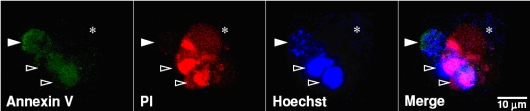
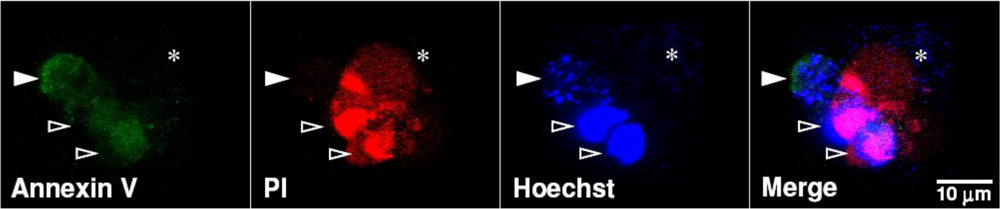
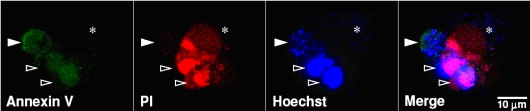
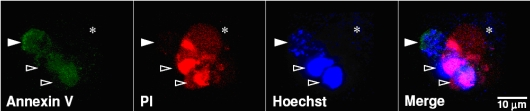
        <p>Uropathogenic <italic>E. coli</italic> (UPEC) frequently accounts for the community-acquired urinary tract infection (UTI), in both cystitis and pyelonephritis. Severe UTI of type 1-piliated UPEC is the common cause of bacteremia, leading to a health-threatening concern [<xref ref-type="bibr" rid="B81-toxins-02-02158">81</xref>]. UPEC can invade epithelial cells of the urinary tract, and these bacterial inclusions can form intracellular bacterial communities to invade the host cell [<xref ref-type="bibr" rid="B82-toxins-02-02158">82</xref>]. After the infection of type 1-piliated UPEC, exfoliation of the host bladder epithelial cells shows a rapid apoptotic mechanism involving caspase activation and internucleosomal DNA fragmentation [<xref ref-type="bibr" rid="B83-toxins-02-02158">83</xref>]. Diffusely adhering <italic>E. coli</italic> strains expressing adhesins of the Afa/Dr family bind to epithelial cells and express a functional hemolysin that promotes cell apoptosis or necrosis [<xref ref-type="bibr" rid="B84-toxins-02-02158">84</xref>]. In UPEC-infected human renal proximal tubular epithelial cells, either apoptosis or necrosis is observed (<xref ref-type="fig" rid="toxins-02-02158-f001">Figure 1</xref>). This indicates that <italic>E. coli</italic> has multiple cytotoxic effects depending on the cell types of infection and the various virulent actions.</p>
        <p>Among the numerous toxins produced by <italic>E. coli</italic>, HlyA, which belongs to a member of the repeats-in-toxin family of PFTs, causes cell apoptosis or necrosis [<xref ref-type="bibr" rid="B85-toxins-02-02158">85</xref>]. HlyA possess cytotoxicity in different cells such as erythrocytes [<xref ref-type="bibr" rid="B86-toxins-02-02158">86</xref>], granulocytes [<xref ref-type="bibr" rid="B87-toxins-02-02158">87</xref>,<xref ref-type="bibr" rid="B88-toxins-02-02158">88</xref>,<xref ref-type="bibr" rid="B89-toxins-02-02158">89</xref>,<xref ref-type="bibr" rid="B90-toxins-02-02158">90</xref>], monocytes [<xref ref-type="bibr" rid="B91-toxins-02-02158">91</xref>], endothelial cells [<xref ref-type="bibr" rid="B92-toxins-02-02158">92</xref>], renal tubular epithelial cells [<xref ref-type="bibr" rid="B93-toxins-02-02158">93</xref>], and T cells [<xref ref-type="bibr" rid="B94-toxins-02-02158">94</xref>]. The toxic effect of HlyA is due to the generation of the transmembrane pore after its insertion into the plasma membrane [<xref ref-type="bibr" rid="B86-toxins-02-02158">86</xref>]. Increased permeability of cations and water leads to cell death. In human monocyte-derived macrophages and J774 cells (the murine macrophage cell line), HlyA is required to induce necrosis and apoptosis [<xref ref-type="bibr" rid="B95-toxins-02-02158">95</xref>]. Moreover, HlyA induces neutrophil apoptosis (at lower <italic>E. coli</italic> titers) and necrosis/lysis (at lower <italic>E. coli</italic> titers) <italic>in vitro</italic>. In a rat pneumonia model, HlyA induces neutrophil necrosis/lysis rather than apoptosis [<xref ref-type="bibr" rid="B96-toxins-02-02158">96</xref>].</p>
        <fig id="toxins-02-02158-f001" position="anchor">
          <label>Figure 1</label>
          <caption>
            <p><italic>In vitro</italic> infection of Uropathogenic <italic>E. coli</italic> (UPEC) causes apoptotic and necrotic cell death in human renal proximal tubular epithelial cells. Human renal proximal tubular epithelial cells (HK-2) were infected with or without clinical isolates of UPEC (MOI = 1) for 12 h. Annexin V (<italic>green</italic>), propidium iodide (PI, <italic>red</italic>), and Hoechst 33258 (<italic>blue</italic>) were used for apoptotic (solid arrowheads), necrotic (empty arrowheads), and nucleic acid staining, respectively, and analyzed by confocal microscopy. Stars indicate <italic>E. coli</italic>.</p>
          </caption>
          <graphic xmlns:xlink="http://www.w3.org/1999/xlink" xlink:href="toxins-02-02158-g001.tif"/>
        </fig>
        <p>Besides HlyA, several serotypes of <italic>E. coli</italic> express Stxs to induce apoptosis in several cell types including epithelial [<xref ref-type="bibr" rid="B97-toxins-02-02158">97</xref>,<xref ref-type="bibr" rid="B98-toxins-02-02158">98</xref>,<xref ref-type="bibr" rid="B99-toxins-02-02158">99</xref>,<xref ref-type="bibr" rid="B100-toxins-02-02158">100</xref>], endothelial [<xref ref-type="bibr" rid="B101-toxins-02-02158">101</xref>,<xref ref-type="bibr" rid="B102-toxins-02-02158">102</xref>,<xref ref-type="bibr" rid="B103-toxins-02-02158">103</xref>,<xref ref-type="bibr" rid="B104-toxins-02-02158">104</xref>], monocytic [<xref ref-type="bibr" rid="B105-toxins-02-02158">105</xref>,<xref ref-type="bibr" rid="B106-toxins-02-02158">106</xref>,<xref ref-type="bibr" rid="B107-toxins-02-02158">107</xref>], lymphoid [<xref ref-type="bibr" rid="B108-toxins-02-02158">108</xref>], and neuronal [<xref ref-type="bibr" rid="B109-toxins-02-02158">109</xref>]. Stxs belong to the Shiga toxin family, which is made up of a group of structurally and functionally related exotoxins produced by the <italic>Shigella dysenteriae</italic> serotype 1 and enterohemorrhagic <italic>E. coli</italic> (EHEC). EHEC infection causes diarrhea, hemorrhagic colitis, and hemolytic uremic syndrome (HUS)[<xref ref-type="bibr" rid="B110-toxins-02-02158">110</xref>]. HUS is the most common cause of acute renal failure in children [<xref ref-type="bibr" rid="B111-toxins-02-02158">111</xref>]. Stxs induce apoptosis and contribute to the HUS-associated injury of renal endothelium [<xref ref-type="bibr" rid="B112-toxins-02-02158">112</xref>]. Stxs are AB chain toxins in which the B chain binds to the cell surface receptor and mediates the subsequent endocytosis of the toxin, and the A chain acts as a protein synthesis inhibitor through its RNA <italic>N</italic>-glycosidase activity to inactivate ribosomes enzymatically [<xref ref-type="bibr" rid="B113-toxins-02-02158">113</xref>]. The apoptotic pathways activated by Stxs are involved in the initial induction of ER stress and the subsequent calcium release to activate calcium-dependent cysteine protease calpain to further activate downstream caspase-8 and caspase-3. The increased expression of the death receptor 5 and TRAIL were also addressed [<xref ref-type="bibr" rid="B107-toxins-02-02158">107</xref>]. Of note, the caspases activated by Stxs, including caspase-2, -3, -6, -8, and -9, differ depending on the different cell types [<xref ref-type="bibr" rid="B102-toxins-02-02158">102</xref>,<xref ref-type="bibr" rid="B105-toxins-02-02158">105</xref>,<xref ref-type="bibr" rid="B107-toxins-02-02158">107</xref>,<xref ref-type="bibr" rid="B114-toxins-02-02158">114</xref>,<xref ref-type="bibr" rid="B115-toxins-02-02158">115</xref>]. The participation of Bcl-2 family proteins is also reported in Stxs-induced apoptosis, including truncated Bid and Bax to initiate a mitochondrial pathway [<xref ref-type="bibr" rid="B97-toxins-02-02158">97</xref>,<xref ref-type="bibr" rid="B107-toxins-02-02158">107</xref>]. The expression of Mcl-1 is down-regulated upon stimulation of Stxs [<xref ref-type="bibr" rid="B101-toxins-02-02158">101</xref>], and Bcl-2 confers protection against Stxs [<xref ref-type="bibr" rid="B97-toxins-02-02158">97</xref>,<xref ref-type="bibr" rid="B106-toxins-02-02158">106</xref>,<xref ref-type="bibr" rid="B116-toxins-02-02158">116</xref>]. In addition, the intracellular trafficking of Stxs has been extensively studied because the A chain of Stxs has to enter the cytoplasm to execute its cytotoxicity by inhibiting protein synthesis. After internalization, Stxs escape from the endosome and undergo retrograde delivery to the Golgi apparatus, then to the ER membranes, and finally to the cytosol, by using ER-associated degradation machinery [<xref ref-type="bibr" rid="B117-toxins-02-02158">117</xref>,<xref ref-type="bibr" rid="B118-toxins-02-02158">118</xref>]. Inhibiting the transportation of Stxs from the endosome to the Golgi apparatus has been implicated to prevent Stxs-induced apoptosis [<xref ref-type="bibr" rid="B115-toxins-02-02158">115</xref>,<xref ref-type="bibr" rid="B119-toxins-02-02158">119</xref>]. An old theory of using protein toxins to induce apoptosis in cancer cells is still applied in some pioneering studies that have been recently reviewed [<xref ref-type="bibr" rid="B113-toxins-02-02158">113</xref>].</p>
        <p><italic>E. coli</italic> CNF1 activates proteins belonging to the Rho family of small GTP-binding proteins, which induce the rearrangement of the actin cytoskeleton to cause a phagocytic-like behavior called macropinocytosis [<xref ref-type="bibr" rid="B120-toxins-02-02158">120</xref>,<xref ref-type="bibr" rid="B121-toxins-02-02158">121</xref>,<xref ref-type="bibr" rid="B122-toxins-02-02158">122</xref>]. Previous studies have demonstrated that these virulence factors can directly induce apoptosis or necrosis, depending on concentration, in a variety of cell types [<xref ref-type="bibr" rid="B123-toxins-02-02158">123</xref>,<xref ref-type="bibr" rid="B124-toxins-02-02158">124</xref>]. UPEC CNF1 activates the Cdc42 and Rac proteins to induce apoptosis in CNF1-intoxicated 5637 bladder epithelial cells [<xref ref-type="bibr" rid="B124-toxins-02-02158">124</xref>]. In addition to cell death, the role of CNF in regulating cell fate is controversial. Previous reports [<xref ref-type="bibr" rid="B125-toxins-02-02158">125</xref>,<xref ref-type="bibr" rid="B126-toxins-02-02158">126</xref>] showed that the Rac-activating toxin CNF1 causes aneuploidy and multinucleation and prevents the ultraviolet-B-induced apoptosis in epithelial cells through the Akt/IkappaB kinase-regulated Bcl-2 pathway. The contribution of cytotoxic CNF1 in the pathogenesis of <italic>E. coli</italic> infection needs further investigation.</p>
        <p>Heat-labile enterotoxin (LT) is an important diarrheal agent produced by <italic>E. coli</italic> [<xref ref-type="bibr" rid="B127-toxins-02-02158">127</xref>,<xref ref-type="bibr" rid="B128-toxins-02-02158">128</xref>]. Similar to Stxs, LT is an AB toxin, which consists of a B pentamer and a monomeric A subunit. Nontoxic B pentamer adheres to the oligosaccharide portion of ganglioside GM1 on the surface of eukaryotic cells and mediates endocytosis of the toxin. The monomeric A subunit possesses ADP-ribosyltransferase activity and activates adenylate cyclase to elevate cyclic AMP levels. A constitutive increase of intracellular cylic AMP leads to an imbalance of electrolytes and results in diarrhea [<xref ref-type="bibr" rid="B127-toxins-02-02158">127</xref>,<xref ref-type="bibr" rid="B128-toxins-02-02158">128</xref>,<xref ref-type="bibr" rid="B129-toxins-02-02158">129</xref>]. Previous reports have shown that LT has a variety of adjuvant activities, such as increasing the production of antibodies, activating B cells and CD4<sup>+</sup> cells, and suppressing the number of CD8<sup>+</sup> cells [<xref ref-type="bibr" rid="B130-toxins-02-02158">130</xref>,<xref ref-type="bibr" rid="B131-toxins-02-02158">131</xref>,<xref ref-type="bibr" rid="B132-toxins-02-02158">132</xref>,<xref ref-type="bibr" rid="B133-toxins-02-02158">133</xref>,<xref ref-type="bibr" rid="B134-toxins-02-02158">134</xref>,<xref ref-type="bibr" rid="B135-toxins-02-02158">135</xref>]. LT is further divided into type I (LT-1) and type II (LT-IIa and LT-IIb), depending on its distinct receptor binding specificity and immunomodulatory abilities [<xref ref-type="bibr" rid="B128-toxins-02-02158">128</xref>]. LT-IIa, but not LT-IIb, induces apoptosis in CD8<sup>+</sup> T cells <italic>in vitro</italic> [<xref ref-type="bibr" rid="B136-toxins-02-02158">136</xref>]. <italic>In vivo</italic> treatment with LT-1 increases the serum levels of corticosterone to induce apoptosis of immature T and B cell populations by a Fas- and TNFR1-independent, caspase-dependent, and apoptosis-inducing factor-independent mechanism [<xref ref-type="bibr" rid="B137-toxins-02-02158">137</xref>,<xref ref-type="bibr" rid="B138-toxins-02-02158">138</xref>]. LT-1-induced <italic>in vivo</italic> apoptosis requires intact ADP-ribosyltransferase activity and partially protects by overexpression of Bcl-2 [<xref ref-type="bibr" rid="B137-toxins-02-02158">137</xref>]. <italic>In vitro</italic> studies have shown that the B subunit of LT induced selective loss of CD8<sup>+</sup> T cells by triggering apoptosis through c-Myc, NF-κB, and caspase-dependent and -independent pathways [<xref ref-type="bibr" rid="B139-toxins-02-02158">139</xref>,<xref ref-type="bibr" rid="B140-toxins-02-02158">140</xref>,<xref ref-type="bibr" rid="B141-toxins-02-02158">141</xref>,<xref ref-type="bibr" rid="B142-toxins-02-02158">142</xref>]. The immunomodulatory abilities of the LT B subunit relied on its binding to GM1 because non-binding mutants did not have pro-apoptotic properties [<xref ref-type="bibr" rid="B130-toxins-02-02158">130</xref>,<xref ref-type="bibr" rid="B131-toxins-02-02158">131</xref>,<xref ref-type="bibr" rid="B132-toxins-02-02158">132</xref>,<xref ref-type="bibr" rid="B139-toxins-02-02158">139</xref>]. The mechanisms by which LT induces apoptosis <italic>in vivo</italic> and <italic>in vitro</italic> and in different subsets of lymphoid cells might be quiet different [<xref ref-type="bibr" rid="B137-toxins-02-02158">137</xref>,<xref ref-type="bibr" rid="B138-toxins-02-02158">138</xref>,<xref ref-type="bibr" rid="B143-toxins-02-02158">143</xref>].</p>
      </sec>
      <sec>
        <title>4.3. Cytotoxicity of <italic>V. cholerae</italic></title>
        <p><italic>Vibrio cholera,</italic> a Gram-negative bacterium, is the causative agent of severe diarrhea cholera, which leads to dehydration and metabolic acidosis [<xref ref-type="bibr" rid="B144-toxins-02-02158">144</xref>,<xref ref-type="bibr" rid="B145-toxins-02-02158">145</xref>]. Regardless of the fact that there are at least 200 serogroups of <italic>V. cholera</italic>, only the O1 and O139 serogroups have been associated with cholera [<xref ref-type="bibr" rid="B146-toxins-02-02158">146</xref>]. <italic>V. cholera</italic> secretes a variety of toxins, including cholera enterotoxin, zonula occludens toxin, accessory cholera enterotoxin, hemolysin/cytolysin, Shiga-like toxin, heat-stable enterotoxin, new cholera toxin, sodium channel inhibitor, and thermostable direct hemolysin, all of which have deleterious effects on eukaryotic cells [<xref ref-type="bibr" rid="B147-toxins-02-02158">147</xref>]. Because of the massive, dehydrating diarrhea caused by cholera enterotoxin, also called cholera toxin (CT), it plays a pivotal role in cholera diseases [<xref ref-type="bibr" rid="B148-toxins-02-02158">148</xref>]. CT is an oligomeric complex composed of one A subunit (CTA) and five B subunits (CTB)[<xref ref-type="bibr" rid="B149-toxins-02-02158">149</xref>]. The A subunit is responsible for the direct toxic activity that is due to its elevation of cAMP in cells by ADP-ribosylation of Gsα protein, a regulator of adenylate cyclase, and the B subunit that serves to bind the holotoxin to the receptor, the ganglioside GM1 [<xref ref-type="bibr" rid="B150-toxins-02-02158">150</xref>,<xref ref-type="bibr" rid="B151-toxins-02-02158">151</xref>,<xref ref-type="bibr" rid="B152-toxins-02-02158">152</xref>,<xref ref-type="bibr" rid="B153-toxins-02-02158">153</xref>]. CT and its purified CTB process the immunosuppressive effect, which owes not only to proliferation inhibition but also to apoptosis induction in lymphoid cells. Previous studies have shown that no matter whether CT or CTB preferentially induced apoptosis in CD8+ T cell population, the mechanism is still unclear [<xref ref-type="bibr" rid="B136-toxins-02-02158">136</xref>,<xref ref-type="bibr" rid="B154-toxins-02-02158">154</xref>,<xref ref-type="bibr" rid="B155-toxins-02-02158">155</xref>,<xref ref-type="bibr" rid="B156-toxins-02-02158">156</xref>]. Besides, CT also stimulates apoptosis in human lung cancer cell lines and the murine myelomonocytic leukemia cell line, WEHI-3B, but down-regulation of Bcl-2 and inhibition of apoptosis developed in a CT resistant clone [<xref ref-type="bibr" rid="B157-toxins-02-02158">157</xref>,<xref ref-type="bibr" rid="B158-toxins-02-02158">158</xref>]. However, the mechanism of CT-induced apoptosis remains largely unknown and requires further investigation.</p>
      </sec>
    </sec>
    <sec>
      <title>5. Concluding Remarks</title>
      <p>The effects of cytopathic enterotoxins are pro-apoptotic as well as necrotic-like, depending on the types of cells and the dosages of stimulation. In general, there are two or more phenomena under cytolysin stimulation. Apoptotic signaling caused by enterotoxins is diverse because several intracellular organelles are generally involved. Upon the formation of pores following PFT stimulation, supporting the membrane integrity is important for cell survival. Statins, the cholesterol-lowering agents, have recently been used to inhibit pneumococcal cholesterol-dependent cytolysin pneumolysin-induced cytotoxicity on endothelia and epithelia [<xref ref-type="bibr" rid="B159-toxins-02-02158">159</xref>]. Inhibiting cell death via the stimulation of virulent enterotoxins is a key strategy for treating patients with infectious diseases [<xref ref-type="bibr" rid="B17-toxins-02-02158">17</xref>,<xref ref-type="bibr" rid="B85-toxins-02-02158">85</xref>].</p>
    </sec>
  </body>
  <back>
    <ack>
      <title>Acknowledgements</title>
      <p>This work was supported by grants NHRI-EX99-9917NC and NSC 96-2320-B-006-018-MY3 from the National Health Research Institutes and the National Science Council, respectively, Taiwan, and the Landmark Project C020 of National Cheng Kung University, Taiwan.</p>
    </ack>
    <ref-list>
      <title>References</title>
      <ref id="B1-toxins-02-02158">
        <label>1.</label>
        <citation citation-type="journal">
          <person-group person-group-type="author">
            <name>
              <surname>Balk</surname>
              <given-names>R.A.</given-names>
            </name>
          </person-group>
          <article-title>Severe sepsis and septic shock. Definitions, epidemiology, and clinical manifestations</article-title>
          <source>Crit. Care Clin.</source>
          <year>2000</year>
          <volume>16</volume>
          <fpage>179</fpage>
          <lpage>192</lpage>
          <pub-id pub-id-type="pmid">10768078</pub-id>
          <pub-id pub-id-type="doi">10.1016/S0749-0704(05)70106-8</pub-id>
        </citation>
      </ref>
      <ref id="B2-toxins-02-02158">
        <label>2.</label>
        <citation citation-type="journal">
          <person-group person-group-type="author">
            <name>
              <surname>Balk</surname>
              <given-names>R.A.</given-names>
            </name>
          </person-group>
          <article-title>Pathogenesis and management of multiple organ dysfunction or failure in severe sepsis and septic shock</article-title>
          <source>Crit. Care Clin.</source>
          <year>2000</year>
          <volume>16</volume>
          <fpage>337</fpage>
          <lpage>352</lpage>
        <pub-id pub-id-type="doi">10.1016/S0749-0704(05)70113-5</pub-id><pub-id pub-id-type="pmid">10768085</pub-id></citation>
      </ref>
      <ref id="B3-toxins-02-02158">
        <label>3.</label>
        <citation citation-type="journal">
          <person-group person-group-type="author">
            <name>
              <surname>Sessler</surname>
              <given-names>C.N.</given-names>
            </name>
            <name>
              <surname>Perry</surname>
              <given-names>J.C.</given-names>
            </name>
            <name>
              <surname>Varney</surname>
              <given-names>K.L.</given-names>
            </name>
          </person-group>
          <article-title>Management of severe sepsis and septic shock</article-title>
          <source>Curr. Opin. Crit. Care</source>
          <year>2004</year>
          <volume>10</volume>
          <fpage>354</fpage>
          <lpage>363</lpage>
        <pub-id pub-id-type="doi">10.1097/01.ccx.0000139363.76068.7b</pub-id><pub-id pub-id-type="pmid">15385751</pub-id></citation>
      </ref>
      <ref id="B4-toxins-02-02158">
        <label>4.</label>
        <citation citation-type="journal">
          <person-group person-group-type="author">
            <name>
              <surname>Rivers</surname>
              <given-names>E.</given-names>
            </name>
          </person-group>
          <article-title>The outcome of patients presenting to the emergency department with severe sepsis or septic shock</article-title>
          <source>Crit. Care</source>
          <year>2006</year>
          <volume>10</volume>
          <fpage>154</fpage>
        <pub-id pub-id-type="doi">10.1186/cc4973</pub-id><pub-id pub-id-type="pmid">16887012</pub-id></citation>
      </ref>
      <ref id="B5-toxins-02-02158">
        <label>5.</label>
        <citation citation-type="journal">
          <person-group person-group-type="author">
            <name>
              <surname>Angus</surname>
              <given-names>D.C.</given-names>
            </name>
            <name>
              <surname>Wax</surname>
              <given-names>R.S.</given-names>
            </name>
          </person-group>
          <article-title>Epidemiology of sepsis: an update</article-title>
          <source>Crit. Care Med.</source>
          <year>2001</year>
          <volume>29</volume>
          <fpage>S109</fpage>
          <lpage>S116</lpage>
        <pub-id pub-id-type="doi">10.1097/00003246-200107001-00035</pub-id><pub-id pub-id-type="pmid">11445744</pub-id></citation>
      </ref>
      <ref id="B6-toxins-02-02158">
        <label>6.</label>
        <citation citation-type="journal">
          <person-group person-group-type="author">
            <name>
              <surname>Patel</surname>
              <given-names>G.P.</given-names>
            </name>
            <name>
              <surname>Gurka</surname>
              <given-names>D.P.</given-names>
            </name>
            <name>
              <surname>Balk</surname>
              <given-names>R.A.</given-names>
            </name>
          </person-group>
          <article-title>New treatment strategies for severe sepsis and septic shock</article-title>
          <source>Curr. Opin. Crit. Care</source>
          <year>2003</year>
          <volume>9</volume>
          <fpage>390</fpage>
          <lpage>396</lpage>
        <pub-id pub-id-type="doi">10.1097/00075198-200310000-00009</pub-id><pub-id pub-id-type="pmid">14508152</pub-id></citation>
      </ref>
      <ref id="B7-toxins-02-02158">
        <label>7.</label>
        <citation citation-type="journal">
          <person-group person-group-type="author">
            <name>
              <surname>Bhakdi</surname>
              <given-names>S.</given-names>
            </name>
            <name>
              <surname>Bayley</surname>
              <given-names>H.</given-names>
            </name>
            <name>
              <surname>Valeva</surname>
              <given-names>A.</given-names>
            </name>
            <name>
              <surname>Walev</surname>
              <given-names>I.</given-names>
            </name>
            <name>
              <surname>Walker</surname>
              <given-names>B.</given-names>
            </name>
            <name>
              <surname>Kehoe</surname>
              <given-names>M.</given-names>
            </name>
            <name>
              <surname>Palmer</surname>
              <given-names>M.</given-names>
            </name>
          </person-group>
          <article-title>Staphylococcal alpha-toxin, streptolysin-O, and <italic>Escherichia coli</italic> hemolysin: prototypes of pore-forming bacterial cytolysins</article-title>
          <source>Arch. Microbiol.</source>
          <year>1996</year>
          <volume>165</volume>
          <fpage>73</fpage>
          <lpage>79</lpage>
        <pub-id pub-id-type="doi">10.1007/s002030050300</pub-id><pub-id pub-id-type="pmid">8593102</pub-id></citation>
      </ref>
      <ref id="B8-toxins-02-02158">
        <label>8.</label>
        <citation citation-type="journal">
          <person-group person-group-type="author">
            <name>
              <surname>Tesh</surname>
              <given-names>V.L.</given-names>
            </name>
          </person-group>
          <article-title>Virulence of enterohemorrhagic <italic>Escherichia coli</italic>: Role of molecular crosstalk</article-title>
          <source>Trends Microbiol.</source>
          <year>1998</year>
          <volume>6</volume>
          <fpage>228</fpage>
          <lpage>233</lpage>
        <pub-id pub-id-type="doi">10.1016/S0966-842X(98)01282-7</pub-id><pub-id pub-id-type="pmid">9675799</pub-id></citation>
      </ref>
      <ref id="B9-toxins-02-02158">
        <label>9.</label>
        <citation citation-type="journal">
          <person-group person-group-type="author">
            <name>
              <surname>Dinges</surname>
              <given-names>M.M.</given-names>
            </name>
            <name>
              <surname>Orwin</surname>
              <given-names>P.M.</given-names>
            </name>
            <name>
              <surname>Schlievert</surname>
              <given-names>P.M.</given-names>
            </name>
          </person-group>
          <article-title>Exotoxins of Staphylococcus aureus</article-title>
          <source>Clin. Microbiol. Rev.</source>
          <year>2000</year>
          <volume>13</volume>
          <fpage>16</fpage>
          <lpage>34</lpage>
          <supplement>table of contents</supplement>
          <pub-id pub-id-type="pmid">10627489</pub-id>
          <pub-id pub-id-type="doi">10.1128/CMR.13.1.16-34.2000</pub-id>
        </citation>
      </ref>
      <ref id="B10-toxins-02-02158">
        <label>10.</label>
        <citation citation-type="journal">
          <person-group person-group-type="author">
            <name>
              <surname>Sierig</surname>
              <given-names>G.</given-names>
            </name>
            <name>
              <surname>Cywes</surname>
              <given-names>C.</given-names>
            </name>
            <name>
              <surname>Wessels</surname>
              <given-names>M.R.</given-names>
            </name>
            <name>
              <surname>Ashbaugh</surname>
              <given-names>C.D.</given-names>
            </name>
          </person-group>
          <article-title>Cytotoxic effects of streptolysin o and streptolysin s enhance the virulence of poorly encapsulated group a streptococci</article-title>
          <source>Infect. Immun.</source>
          <year>2003</year>
          <volume>71</volume>
          <fpage>446</fpage>
          <lpage>455</lpage>
        <pub-id pub-id-type="doi">10.1128/IAI.71.1.446-455.2003</pub-id><pub-id pub-id-type="pmid">12496195</pub-id></citation>
      </ref>
      <ref id="B11-toxins-02-02158">
        <label>11.</label>
        <citation citation-type="journal">
          <person-group person-group-type="author">
            <name>
              <surname>Marriott</surname>
              <given-names>H.M.</given-names>
            </name>
            <name>
              <surname>Dockrell</surname>
              <given-names>D.H.</given-names>
            </name>
          </person-group>
          <article-title>Streptococcus pneumoniae: The role of apoptosis in host defense and pathogenesis</article-title>
          <source>Int. J. Biochem. Cell Biol.</source>
          <year>2006</year>
          <volume>38</volume>
          <fpage>1848</fpage>
          <lpage>1854</lpage>
        <pub-id pub-id-type="doi">10.1016/j.biocel.2006.06.001</pub-id><pub-id pub-id-type="pmid">16844403</pub-id></citation>
      </ref>
      <ref id="B12-toxins-02-02158">
        <label>12.</label>
        <citation citation-type="journal">
          <person-group person-group-type="author">
            <name>
              <surname>Katahira</surname>
              <given-names>J.</given-names>
            </name>
            <name>
              <surname>Sugiyama</surname>
              <given-names>H.</given-names>
            </name>
            <name>
              <surname>Inoue</surname>
              <given-names>N.</given-names>
            </name>
            <name>
              <surname>Horiguchi</surname>
              <given-names>Y.</given-names>
            </name>
            <name>
              <surname>Matsuda</surname>
              <given-names>M.</given-names>
            </name>
            <name>
              <surname>Sugimoto</surname>
              <given-names>N.</given-names>
            </name>
          </person-group>
          <article-title>Clostridium perfringens enterotoxin utilizes two structurally related membrane proteins as functional receptors <italic>in vivo</italic></article-title>
          <source>J. Biol. Chem.</source>
          <year>1997</year>
          <volume>272</volume>
          <fpage>26652</fpage>
          <lpage>26658</lpage>
        <pub-id pub-id-type="doi">10.1074/jbc.272.42.26652</pub-id><pub-id pub-id-type="pmid">9334247</pub-id></citation>
      </ref>
      <ref id="B13-toxins-02-02158">
        <label>13.</label>
        <citation citation-type="journal">
          <person-group person-group-type="author">
            <name>
              <surname>Vanden Broeck</surname>
              <given-names>D.</given-names>
            </name>
            <name>
              <surname>Horvath</surname>
              <given-names>C.</given-names>
            </name>
            <name>
              <surname>De Wolf</surname>
              <given-names>M.J.</given-names>
            </name>
          </person-group>
          <article-title>Vibrio cholerae: Cholera toxin</article-title>
          <source>Int. J. Biochem. Cell Biol.</source>
          <year>2007</year>
          <volume>39</volume>
          <fpage>1771</fpage>
          <lpage>1775</lpage>
        <pub-id pub-id-type="doi">10.1016/j.biocel.2007.07.005</pub-id><pub-id pub-id-type="pmid">17716938</pub-id></citation>
      </ref>
      <ref id="B14-toxins-02-02158">
        <label>14.</label>
        <citation citation-type="journal">
          <person-group person-group-type="author">
            <name>
              <surname>Cherla</surname>
              <given-names>R.P.</given-names>
            </name>
            <name>
              <surname>Lee</surname>
              <given-names>S.Y.</given-names>
            </name>
            <name>
              <surname>Tesh</surname>
              <given-names>V.L.</given-names>
            </name>
          </person-group>
          <article-title>Shiga toxins and apoptosis</article-title>
          <source>FEMS Microbiol. Lett.</source>
          <year>2003</year>
          <volume>228</volume>
          <fpage>159</fpage>
          <lpage>166</lpage>
        <pub-id pub-id-type="doi">10.1016/S0378-1097(03)00761-4</pub-id><pub-id pub-id-type="pmid">14638419</pub-id></citation>
      </ref>
      <ref id="B15-toxins-02-02158">
        <label>15.</label>
        <citation citation-type="journal">
          <person-group person-group-type="author">
            <name>
              <surname>Grassme</surname>
              <given-names>H.</given-names>
            </name>
            <name>
              <surname>Jendrossek</surname>
              <given-names>V.</given-names>
            </name>
            <name>
              <surname>Gulbins</surname>
              <given-names>E.</given-names>
            </name>
          </person-group>
          <article-title>Molecular mechanisms of bacteria induced apoptosis</article-title>
          <source>Apoptosis</source>
          <year>2001</year>
          <volume>6</volume>
          <fpage>441</fpage>
          <lpage>445</lpage>
        <pub-id pub-id-type="doi">10.1023/A:1012485506972</pub-id><pub-id pub-id-type="pmid">11595833</pub-id></citation>
      </ref>
      <ref id="B16-toxins-02-02158">
        <label>16.</label>
        <citation citation-type="journal">
          <person-group person-group-type="author">
            <name>
              <surname>Hacker</surname>
              <given-names>G.</given-names>
            </name>
          </person-group>
          <article-title>Introduction: the various deaths a cell can die, and their use in microbial infections</article-title>
          <source>Microbes Infect.</source>
          <year>2009</year>
          <volume>11</volume>
          <fpage>1047</fpage>
          <lpage>1049</lpage>
        <pub-id pub-id-type="doi">10.1016/j.micinf.2009.08.010</pub-id><pub-id pub-id-type="pmid">19729071</pub-id></citation>
      </ref>
      <ref id="B17-toxins-02-02158">
        <label>17.</label>
        <citation citation-type="journal">
          <person-group person-group-type="author">
            <name>
              <surname>Bohme</surname>
              <given-names>L.</given-names>
            </name>
            <name>
              <surname>Rudel</surname>
              <given-names>T.</given-names>
            </name>
          </person-group>
          <article-title>Host cell death machinery as a target for bacterial pathogens</article-title>
          <source>Microbes Infect.</source>
          <year>2009</year>
          <volume>11</volume>
          <fpage>1063</fpage>
          <lpage>1070</lpage>
        <pub-id pub-id-type="doi">10.1016/j.micinf.2009.08.014</pub-id><pub-id pub-id-type="pmid">19733679</pub-id></citation>
      </ref>
      <ref id="B18-toxins-02-02158">
        <label>18.</label>
        <citation citation-type="journal">
          <person-group person-group-type="author">
            <name>
              <surname>Rosado</surname>
              <given-names>C.J.</given-names>
            </name>
            <name>
              <surname>Kondos</surname>
              <given-names>S.</given-names>
            </name>
            <name>
              <surname>Bull</surname>
              <given-names>T.E.</given-names>
            </name>
            <name>
              <surname>Kuiper</surname>
              <given-names>M.J.</given-names>
            </name>
            <name>
              <surname>Law</surname>
              <given-names>R.H.</given-names>
            </name>
            <name>
              <surname>Buckle</surname>
              <given-names>A.M.</given-names>
            </name>
            <name>
              <surname>Voskoboinik</surname>
              <given-names>I.</given-names>
            </name>
            <name>
              <surname>Bird</surname>
              <given-names>P.I.</given-names>
            </name>
            <name>
              <surname>Trapani</surname>
              <given-names>J.A.</given-names>
            </name>
            <name>
              <surname>Whisstock</surname>
              <given-names>J.C.</given-names>
            </name>
            <name>
              <surname>Dunstone</surname>
              <given-names>M.A.</given-names>
            </name>
          </person-group>
          <article-title>The MACPF/CDC family of pore-forming toxins</article-title>
          <source>Cell Microbiol.</source>
          <year>2008</year>
          <volume>10</volume>
          <fpage>1765</fpage>
          <lpage>1774</lpage>
        <pub-id pub-id-type="doi">10.1111/j.1462-5822.2008.01191.x</pub-id><pub-id pub-id-type="pmid">18564372</pub-id></citation>
      </ref>
      <ref id="B19-toxins-02-02158">
        <label>19.</label>
        <citation citation-type="journal">
          <person-group person-group-type="author">
            <name>
              <surname>Jin</surname>
              <given-names>Z.</given-names>
            </name>
            <name>
              <surname>El-Deiry</surname>
              <given-names>W.S.</given-names>
            </name>
          </person-group>
          <article-title>Overview of cell death signaling pathways</article-title>
          <source>Cancer Biol. Ther.</source>
          <year>2005</year>
          <volume>4</volume>
          <fpage>139</fpage>
          <lpage>163</lpage>
        <pub-id pub-id-type="doi">10.4161/cbt.4.2.1508</pub-id><pub-id pub-id-type="pmid">15725726</pub-id></citation>
      </ref>
      <ref id="B20-toxins-02-02158">
        <label>20.</label>
        <citation citation-type="journal">
          <person-group person-group-type="author">
            <name>
              <surname>Wesche-Soldato</surname>
              <given-names>D.E.</given-names>
            </name>
            <name>
              <surname>Swan</surname>
              <given-names>R.Z.</given-names>
            </name>
            <name>
              <surname>Chung</surname>
              <given-names>C.S.</given-names>
            </name>
            <name>
              <surname>Ayala</surname>
              <given-names>A.</given-names>
            </name>
          </person-group>
          <article-title>The apoptotic pathway as a therapeutic target in sepsis</article-title>
          <source>Curr. Drug Targets</source>
          <year>2007</year>
          <volume>8</volume>
          <fpage>493</fpage>
          <lpage>500</lpage>
        <pub-id pub-id-type="doi">10.2174/138945007780362764</pub-id><pub-id pub-id-type="pmid">17430119</pub-id></citation>
      </ref>
      <ref id="B21-toxins-02-02158">
        <label>21.</label>
        <citation citation-type="journal">
          <person-group person-group-type="author">
            <name>
              <surname>Ayala</surname>
              <given-names>A.</given-names>
            </name>
            <name>
              <surname>Wesche-Soldato</surname>
              <given-names>D.E.</given-names>
            </name>
            <name>
              <surname>Perl</surname>
              <given-names>M.</given-names>
            </name>
            <name>
              <surname>Lomas-Neira</surname>
              <given-names>J.L.</given-names>
            </name>
            <name>
              <surname>Swan</surname>
              <given-names>R.</given-names>
            </name>
            <name>
              <surname>Chung</surname>
              <given-names>C.S. </given-names>
            </name>
          </person-group>
          <article-title>Blockade of apoptosis as a rational therapeutic strategy for the treatment of sepsis</article-title>
          <source>Novartis Found. Symp.</source>
          <year>2007</year>
          <volume>280</volume>
          <fpage>37</fpage>
          <lpage>49</lpage>
          <supplement>discussion 49–52, 160–164.</supplement>
          <pub-id pub-id-type="pmid">17380787</pub-id>
        </citation>
      </ref>
      <ref id="B22-toxins-02-02158">
        <label>22.</label>
        <citation citation-type="journal">
          <person-group person-group-type="author">
            <name>
              <surname>Dhein</surname>
              <given-names>J.</given-names>
            </name>
            <name>
              <surname>Walczak</surname>
              <given-names>H.</given-names>
            </name>
            <name>
              <surname>Baumler</surname>
              <given-names>C.</given-names>
            </name>
            <name>
              <surname>Debatin</surname>
              <given-names>K.M.</given-names>
            </name>
            <name>
              <surname>Krammer</surname>
              <given-names>P.H.</given-names>
            </name>
          </person-group>
          <article-title>Autocrine T-cell suicide mediated by APO-1/(Fas/CD95)</article-title>
          <source>Nature</source>
          <year>1995</year>
          <volume>373</volume>
          <fpage>438</fpage>
          <lpage>441</lpage>
        <pub-id pub-id-type="doi">10.1038/373438a0</pub-id><pub-id pub-id-type="pmid">7530335</pub-id></citation>
      </ref>
      <ref id="B23-toxins-02-02158">
        <label>23.</label>
        <citation citation-type="journal">
          <person-group person-group-type="author">
            <name>
              <surname>Tartaglia</surname>
              <given-names>L.A.</given-names>
            </name>
            <name>
              <surname>Rothe</surname>
              <given-names>M.</given-names>
            </name>
            <name>
              <surname>Hu</surname>
              <given-names>Y.F.</given-names>
            </name>
            <name>
              <surname>Goeddel</surname>
              <given-names>D.V.</given-names>
            </name>
          </person-group>
          <article-title>Tumor necrosis factor's cytotoxic activity is signaled by the p55 TNF receptor</article-title>
          <source>Cell</source>
          <year>1993</year>
          <volume>73</volume>
          <fpage>213</fpage>
          <lpage>216</lpage>
        <pub-id pub-id-type="doi">10.1016/0092-8674(93)90222-C</pub-id><pub-id pub-id-type="pmid">8386591</pub-id></citation>
      </ref>
      <ref id="B24-toxins-02-02158">
        <label>24.</label>
        <citation citation-type="journal">
          <person-group person-group-type="author">
            <name>
              <surname>Kitson</surname>
              <given-names>J.</given-names>
            </name>
            <name>
              <surname>Raven</surname>
              <given-names>T.</given-names>
            </name>
            <name>
              <surname>Jiang</surname>
              <given-names>Y.P.</given-names>
            </name>
            <name>
              <surname>Goeddel</surname>
              <given-names>D.V.</given-names>
            </name>
            <name>
              <surname>Giles</surname>
              <given-names>K.M.</given-names>
            </name>
            <name>
              <surname>Pun</surname>
              <given-names>K.T.</given-names>
            </name>
            <name>
              <surname>Grinham</surname>
              <given-names>C.J.</given-names>
            </name>
            <name>
              <surname>Brown</surname>
              <given-names>R.</given-names>
            </name>
            <name>
              <surname>Farrow</surname>
              <given-names>S.N.</given-names>
            </name>
          </person-group>
          <article-title>A death-domain-containing receptor that mediates apoptosis</article-title>
          <source>Nature</source>
          <year>1996</year>
          <volume>384</volume>
          <fpage>372</fpage>
          <lpage>375</lpage>
        <pub-id pub-id-type="doi">10.1038/384372a0</pub-id><pub-id pub-id-type="pmid">8934525</pub-id></citation>
      </ref>
      <ref id="B25-toxins-02-02158">
        <label>25.</label>
        <citation citation-type="journal">
          <person-group person-group-type="author">
            <name>
              <surname>Pan</surname>
              <given-names>G.</given-names>
            </name>
            <name>
              <surname>O'Rourke</surname>
              <given-names>K.</given-names>
            </name>
            <name>
              <surname>Chinnaiyan</surname>
              <given-names>A.M.</given-names>
            </name>
            <name>
              <surname>Gentz</surname>
              <given-names>R.</given-names>
            </name>
            <name>
              <surname>Ebner</surname>
              <given-names>R.</given-names>
            </name>
            <name>
              <surname>Ni</surname>
              <given-names>J.</given-names>
            </name>
            <name>
              <surname>Dixit</surname>
              <given-names>V.M.</given-names>
            </name>
          </person-group>
          <article-title>The receptor for the cytotoxic ligand TRAIL</article-title>
          <source>Science</source>
          <year>1997</year>
          <volume>276</volume>
          <fpage>111</fpage>
          <lpage>113</lpage>
        <pub-id pub-id-type="doi">10.1126/science.276.5309.111</pub-id><pub-id pub-id-type="pmid">9082980</pub-id></citation>
      </ref>
      <ref id="B26-toxins-02-02158">
        <label>26.</label>
        <citation citation-type="journal">
          <person-group person-group-type="author">
            <name>
              <surname>Ashkenazi</surname>
              <given-names>A.</given-names>
            </name>
            <name>
              <surname>Dixit</surname>
              <given-names>V.M.</given-names>
            </name>
          </person-group>
          <article-title>Death receptors: Signaling and modulation</article-title>
          <source>Science</source>
          <year>1998</year>
          <volume>281</volume>
          <fpage>1305</fpage>
          <lpage>1308</lpage>
        <pub-id pub-id-type="doi">10.1126/science.281.5381.1305</pub-id><pub-id pub-id-type="pmid">9721089</pub-id></citation>
      </ref>
      <ref id="B27-toxins-02-02158">
        <label>27.</label>
        <citation citation-type="journal">
          <person-group person-group-type="author">
            <name>
              <surname>Green</surname>
              <given-names>D.R.</given-names>
            </name>
            <name>
              <surname>Reed</surname>
              <given-names>J.C.</given-names>
            </name>
          </person-group>
          <article-title>Mitochondria and apoptosis</article-title>
          <source>Science</source>
          <year>1998</year>
          <volume>281</volume>
          <fpage>1309</fpage>
          <lpage>1312</lpage>
        <pub-id pub-id-type="doi">10.1126/science.281.5381.1309</pub-id><pub-id pub-id-type="pmid">9721092</pub-id></citation>
      </ref>
      <ref id="B28-toxins-02-02158">
        <label>28.</label>
        <citation citation-type="journal">
          <person-group person-group-type="author">
            <name>
              <surname>Kroemer</surname>
              <given-names>G.</given-names>
            </name>
            <name>
              <surname>Reed</surname>
              <given-names>J.C.</given-names>
            </name>
          </person-group>
          <article-title>Mitochondrial control of cell death</article-title>
          <source>Nat. Med.</source>
          <year>2000</year>
          <volume>6</volume>
          <fpage>513</fpage>
          <lpage>519</lpage>
        <pub-id pub-id-type="doi">10.1038/74994</pub-id><pub-id pub-id-type="pmid">10802706</pub-id></citation>
      </ref>
      <ref id="B29-toxins-02-02158">
        <label>29.</label>
        <citation citation-type="journal">
          <person-group person-group-type="author">
            <name>
              <surname>Reed</surname>
              <given-names>J.C.</given-names>
            </name>
          </person-group>
          <article-title>Bcl-2 family proteins</article-title>
          <source>Oncogene</source>
          <year>1998</year>
          <volume>17</volume>
          <fpage>3225</fpage>
          <lpage>3236</lpage>
        <pub-id pub-id-type="pmid">9916985</pub-id></citation>
      </ref>
      <ref id="B30-toxins-02-02158">
        <label>30.</label>
        <citation citation-type="journal">
          <person-group person-group-type="author">
            <name>
              <surname>Luo</surname>
              <given-names>X.</given-names>
            </name>
            <name>
              <surname>Budihardjo</surname>
              <given-names>I.</given-names>
            </name>
            <name>
              <surname>Zou</surname>
              <given-names>H.</given-names>
            </name>
            <name>
              <surname>Slaughter</surname>
              <given-names>C.</given-names>
            </name>
            <name>
              <surname>Wang</surname>
              <given-names>X.</given-names>
            </name>
          </person-group>
          <article-title>Bid, a Bcl2 interacting protein, mediates cytochrome c release from mitochondria in response to activation of cell surface death receptors</article-title>
          <source>Cell</source>
          <year>1998</year>
          <volume>94</volume>
          <fpage>481</fpage>
          <lpage>490</lpage>
        <pub-id pub-id-type="doi">10.1016/S0092-8674(00)81589-5</pub-id><pub-id pub-id-type="pmid">9727491</pub-id></citation>
      </ref>
      <ref id="B31-toxins-02-02158">
        <label>31.</label>
        <citation citation-type="journal">
          <person-group person-group-type="author">
            <name>
              <surname>Zamzami</surname>
              <given-names>N.</given-names>
            </name>
            <name>
              <surname>El Hamel</surname>
              <given-names>C.</given-names>
            </name>
            <name>
              <surname>Maisse</surname>
              <given-names>C.</given-names>
            </name>
            <name>
              <surname>Brenner</surname>
              <given-names>C.</given-names>
            </name>
            <name>
              <surname>Munoz-Pinedo</surname>
              <given-names>C.</given-names>
            </name>
            <name>
              <surname>Belzacq</surname>
              <given-names>A.S.</given-names>
            </name>
            <name>
              <surname>Costantini</surname>
              <given-names>P.</given-names>
            </name>
            <name>
              <surname>Vieira</surname>
              <given-names>H.</given-names>
            </name>
            <name>
              <surname>Loeffler</surname>
              <given-names>M.</given-names>
            </name>
            <name>
              <surname>Molle</surname>
              <given-names>G.</given-names>
            </name>
            <name>
              <surname>Kroemer</surname>
              <given-names>G.</given-names>
            </name>
          </person-group>
          <article-title>Bid acts on the permeability transition pore complex to induce apoptosis</article-title>
          <source>Oncogene</source>
          <year>2000</year>
          <volume>19</volume>
          <fpage>6342</fpage>
          <lpage>6350</lpage>
        <pub-id pub-id-type="doi">10.1038/sj.onc.1204030</pub-id><pub-id pub-id-type="pmid">11175349</pub-id></citation>
      </ref>
      <ref id="B32-toxins-02-02158">
        <label>32.</label>
        <citation citation-type="journal">
          <person-group person-group-type="author">
            <name>
              <surname>Xu</surname>
              <given-names>C.</given-names>
            </name>
            <name>
              <surname>Bailly-Maitre</surname>
              <given-names>B.</given-names>
            </name>
            <name>
              <surname>Reed</surname>
              <given-names>J.C.</given-names>
            </name>
          </person-group>
          <article-title>Endoplasmic reticulum stress: Cell life and death decisions</article-title>
          <source>J. Clin. Invest.</source>
          <year>2005</year>
          <volume>115</volume>
          <fpage>2656</fpage>
          <lpage>2664</lpage>
        <pub-id pub-id-type="doi">10.1172/JCI26373</pub-id><pub-id pub-id-type="pmid">16200199</pub-id></citation>
      </ref>
      <ref id="B33-toxins-02-02158">
        <label>33.</label>
        <citation citation-type="journal">
          <person-group person-group-type="author">
            <name>
              <surname>Wu</surname>
              <given-names>J.</given-names>
            </name>
            <name>
              <surname>Kaufman</surname>
              <given-names>R.J.</given-names>
            </name>
          </person-group>
          <article-title>From acute ER stress to physiological roles of the Unfolded Protein Response</article-title>
          <source>Cell Death Differ.</source>
          <year>2006</year>
          <volume>13</volume>
          <fpage>374</fpage>
          <lpage>384</lpage>
        <pub-id pub-id-type="doi">10.1038/sj.cdd.4401840</pub-id><pub-id pub-id-type="pmid">16397578</pub-id></citation>
      </ref>
      <ref id="B34-toxins-02-02158">
        <label>34.</label>
        <citation citation-type="journal">
          <person-group person-group-type="author">
            <name>
              <surname>Breckenridge</surname>
              <given-names>D.G.</given-names>
            </name>
            <name>
              <surname>Germain</surname>
              <given-names>M.</given-names>
            </name>
            <name>
              <surname>Mathai</surname>
              <given-names>J.P.</given-names>
            </name>
            <name>
              <surname>Nguyen</surname>
              <given-names>M.</given-names>
            </name>
            <name>
              <surname>Shore</surname>
              <given-names>G.C.</given-names>
            </name>
          </person-group>
          <article-title>Regulation of apoptosis by endoplasmic reticulum pathways</article-title>
          <source>Oncogene</source>
          <year>2003</year>
          <volume>22</volume>
          <fpage>8608</fpage>
          <lpage>8618</lpage>
        <pub-id pub-id-type="doi">10.1038/sj.onc.1207108</pub-id><pub-id pub-id-type="pmid">14634622</pub-id></citation>
      </ref>
      <ref id="B35-toxins-02-02158">
        <label>35.</label>
        <citation citation-type="journal">
          <person-group person-group-type="author">
            <name>
              <surname>McCullough</surname>
              <given-names>K.D.</given-names>
            </name>
            <name>
              <surname>Martindale</surname>
              <given-names>J.L.</given-names>
            </name>
            <name>
              <surname>Klotz</surname>
              <given-names>L.O.</given-names>
            </name>
            <name>
              <surname>Aw</surname>
              <given-names>T.Y.</given-names>
            </name>
            <name>
              <surname>Holbrook</surname>
              <given-names>N.J.</given-names>
            </name>
          </person-group>
          <article-title>Gadd153 sensitizes cells to endoplasmic reticulum stress by down-regulating Bcl2 and perturbing the cellular redox state</article-title>
          <source>Mol. Cell Biol.</source>
          <year>2001</year>
          <volume>21</volume>
          <fpage>1249</fpage>
          <lpage>1259</lpage>
        <pub-id pub-id-type="doi">10.1128/MCB.21.4.1249-1259.2001</pub-id><pub-id pub-id-type="pmid">11158311</pub-id></citation>
      </ref>
      <ref id="B36-toxins-02-02158">
        <label>36.</label>
        <citation citation-type="journal">
          <person-group person-group-type="author">
            <name>
              <surname>Tan</surname>
              <given-names>Y.</given-names>
            </name>
            <name>
              <surname>Dourdin</surname>
              <given-names>N.</given-names>
            </name>
            <name>
              <surname>Wu</surname>
              <given-names>C.</given-names>
            </name>
            <name>
              <surname>De Veyra</surname>
              <given-names>T.</given-names>
            </name>
            <name>
              <surname>Elce</surname>
              <given-names>J.S.</given-names>
            </name>
            <name>
              <surname>Greer</surname>
              <given-names>P.A.</given-names>
            </name>
          </person-group>
          <article-title>Ubiquitous calpains promote caspase-12 and JNK activation during endoplasmic reticulum stress-induced apoptosis</article-title>
          <source>J. Biol. Chem.</source>
          <year>2006</year>
          <volume>281</volume>
          <fpage>16016</fpage>
          <lpage>16024</lpage>
        <pub-id pub-id-type="doi">10.1074/jbc.M601299200</pub-id><pub-id pub-id-type="pmid">16597616</pub-id></citation>
      </ref>
      <ref id="B37-toxins-02-02158">
        <label>37.</label>
        <citation citation-type="journal">
          <person-group person-group-type="author">
            <name>
              <surname>Dahmer</surname>
              <given-names>M.K.</given-names>
            </name>
          </person-group>
          <article-title>Caspases-2, -3, and -7 are involved in thapsigargin-induced apoptosis of SH-SY5Y neuroblastoma cells</article-title>
          <source>J. Neurosci. Res.</source>
          <year>2005</year>
          <volume>80</volume>
          <fpage>576</fpage>
          <lpage>583</lpage>
        <pub-id pub-id-type="doi">10.1002/jnr.20471</pub-id><pub-id pub-id-type="pmid">15825194</pub-id></citation>
      </ref>
      <ref id="B38-toxins-02-02158">
        <label>38.</label>
        <citation citation-type="journal">
          <person-group person-group-type="author">
            <name>
              <surname>Cheung</surname>
              <given-names>H.H.</given-names>
            </name>
            <name>
              <surname>Lynn</surname>
              <given-names>K.N.</given-names>
            </name>
            <name>
              <surname>Liston</surname>
              <given-names>P.</given-names>
            </name>
            <name>
              <surname>Korneluk</surname>
              <given-names>R.G.</given-names>
            </name>
          </person-group>
          <article-title>Involvement of caspase-2 and caspase-9 in endoplasmic reticulum stress-induced apoptosis: A role for the IAPs</article-title>
          <source>Exp. Cell Res.</source>
          <year>2006</year>
          <volume>312</volume>
          <fpage>2347</fpage>
          <lpage>2357</lpage>
        <pub-id pub-id-type="doi">10.1016/j.yexcr.2006.03.027</pub-id><pub-id pub-id-type="pmid">16701639</pub-id></citation>
      </ref>
      <ref id="B39-toxins-02-02158">
        <label>39.</label>
        <citation citation-type="journal">
          <person-group person-group-type="author">
            <name>
              <surname>Upton</surname>
              <given-names>J.P.</given-names>
            </name>
            <name>
              <surname>Austgen</surname>
              <given-names>K.</given-names>
            </name>
            <name>
              <surname>Nishino</surname>
              <given-names>M.</given-names>
            </name>
            <name>
              <surname>Coakley</surname>
              <given-names>K.M.</given-names>
            </name>
            <name>
              <surname>Hagen</surname>
              <given-names>A.</given-names>
            </name>
            <name>
              <surname>Han</surname>
              <given-names>D.</given-names>
            </name>
            <name>
              <surname>Papa</surname>
              <given-names>F.R.</given-names>
            </name>
            <name>
              <surname>Oakes</surname>
              <given-names>S.A.</given-names>
            </name>
          </person-group>
          <article-title>Caspase-2 cleavage of BID is a critical apoptotic signal downstream of endoplasmic reticulum stress</article-title>
          <source>Mol. Cell. Biol.</source>
          <year>2008</year>
          <volume>28</volume>
          <fpage>3943</fpage>
          <lpage>3951</lpage>
        <pub-id pub-id-type="doi">10.1128/MCB.00013-08</pub-id><pub-id pub-id-type="pmid">18426910</pub-id></citation>
      </ref>
      <ref id="B40-toxins-02-02158">
        <label>40.</label>
        <citation citation-type="journal">
          <person-group person-group-type="author">
            <name>
              <surname>Ferri</surname>
              <given-names>K.F.</given-names>
            </name>
            <name>
              <surname>Kroemer</surname>
              <given-names>G.</given-names>
            </name>
          </person-group>
          <article-title>Organelle-specific initiation of cell death pathways</article-title>
          <source>Nat. Cell Biol.</source>
          <year>2001</year>
          <volume>3</volume>
          <fpage>E255</fpage>
          <lpage>E263</lpage>
        <pub-id pub-id-type="doi">10.1038/ncb1101-e255</pub-id><pub-id pub-id-type="pmid">11715037</pub-id></citation>
      </ref>
      <ref id="B41-toxins-02-02158">
        <label>41.</label>
        <citation citation-type="journal">
          <person-group person-group-type="author">
            <name>
              <surname>Guicciardi</surname>
              <given-names>M.E.</given-names>
            </name>
            <name>
              <surname>Leist</surname>
              <given-names>M.</given-names>
            </name>
            <name>
              <surname>Gores</surname>
              <given-names>G.J.</given-names>
            </name>
          </person-group>
          <article-title>Lysosomes in cell death</article-title>
          <source>Oncogene</source>
          <year>2004</year>
          <volume>23</volume>
          <fpage>2881</fpage>
          <lpage>2890</lpage>
        <pub-id pub-id-type="doi">10.1038/sj.onc.1207512</pub-id><pub-id pub-id-type="pmid">15077151</pub-id></citation>
      </ref>
      <ref id="B42-toxins-02-02158">
        <label>42.</label>
        <citation citation-type="journal">
          <person-group person-group-type="author">
            <name>
              <surname>Kroemer</surname>
              <given-names>G.</given-names>
            </name>
            <name>
              <surname>Jaattela</surname>
              <given-names>M.</given-names>
            </name>
          </person-group>
          <article-title>Lysosomes and autophagy in cell death control</article-title>
          <source>Nat. Rev. Cancer</source>
          <year>2005</year>
          <volume>5</volume>
          <fpage>886</fpage>
          <lpage>897</lpage>
        <pub-id pub-id-type="doi">10.1038/nrc1738</pub-id><pub-id pub-id-type="pmid">16239905</pub-id></citation>
      </ref>
      <ref id="B43-toxins-02-02158">
        <label>43.</label>
        <citation citation-type="journal">
          <person-group person-group-type="author">
            <name>
              <surname>Chwieralski</surname>
              <given-names>C.E.</given-names>
            </name>
            <name>
              <surname>Welte</surname>
              <given-names>T.</given-names>
            </name>
            <name>
              <surname>Buhling</surname>
              <given-names>F.</given-names>
            </name>
          </person-group>
          <article-title>Cathepsin-regulated apoptosis</article-title>
          <source>Apoptosis</source>
          <year>2006</year>
          <volume>11</volume>
          <fpage>143</fpage>
          <lpage>149</lpage>
        <pub-id pub-id-type="doi">10.1007/s10495-006-3486-y</pub-id><pub-id pub-id-type="pmid">16502253</pub-id></citation>
      </ref>
      <ref id="B44-toxins-02-02158">
        <label>44.</label>
        <citation citation-type="journal">
          <person-group person-group-type="author">
            <name>
              <surname>Duprez</surname>
              <given-names>L.</given-names>
            </name>
            <name>
              <surname>Wirawan</surname>
              <given-names>E.</given-names>
            </name>
            <name>
              <surname>Vanden Berghe</surname>
              <given-names>T.</given-names>
            </name>
            <name>
              <surname>Vandenabeele</surname>
              <given-names>P.</given-names>
            </name>
          </person-group>
          <article-title>Major cell death pathways at a glance</article-title>
          <source>Microbes Infect.</source>
          <year>2009</year>
          <volume>11</volume>
          <fpage>1050</fpage>
          <lpage>1062</lpage>
        <pub-id pub-id-type="doi">10.1016/j.micinf.2009.08.013</pub-id><pub-id pub-id-type="pmid">19733681</pub-id></citation>
      </ref>
      <ref id="B45-toxins-02-02158">
        <label>45.</label>
        <citation citation-type="journal">
          <person-group person-group-type="author">
            <name>
              <surname>Vanlangenakker</surname>
              <given-names>N.</given-names>
            </name>
            <name>
              <surname>Vanden Berghe</surname>
              <given-names>T.</given-names>
            </name>
            <name>
              <surname>Krysko</surname>
              <given-names>D.V.</given-names>
            </name>
            <name>
              <surname>Festjens</surname>
              <given-names>N.</given-names>
            </name>
            <name>
              <surname>Vandenabeele</surname>
              <given-names>P.</given-names>
            </name>
          </person-group>
          <article-title>Molecular mechanisms and pathophysiology of necrotic cell death</article-title>
          <source>Curr. Mol. Med.</source>
          <year>2008</year>
          <volume>8</volume>
          <fpage>207</fpage>
          <lpage>220</lpage>
        <pub-id pub-id-type="doi">10.2174/156652408784221306</pub-id><pub-id pub-id-type="pmid">18473820</pub-id></citation>
      </ref>
      <ref id="B46-toxins-02-02158">
        <label>46.</label>
        <citation citation-type="journal">
          <person-group person-group-type="author">
            <name>
              <surname>Chautan</surname>
              <given-names>M.</given-names>
            </name>
            <name>
              <surname>Chazal</surname>
              <given-names>G.</given-names>
            </name>
            <name>
              <surname>Cecconi</surname>
              <given-names>F.</given-names>
            </name>
            <name>
              <surname>Gruss</surname>
              <given-names>P.</given-names>
            </name>
            <name>
              <surname>Golstein</surname>
              <given-names>P.</given-names>
            </name>
          </person-group>
          <article-title>Interdigital cell death can occur through a necrotic and caspase-independent pathway</article-title>
          <source>Curr. Biol.</source>
          <year>1999</year>
          <volume>9</volume>
          <fpage>967</fpage>
          <lpage>970</lpage>
        <pub-id pub-id-type="doi">10.1016/S0960-9822(99)80425-4</pub-id><pub-id pub-id-type="pmid">10508592</pub-id></citation>
      </ref>
      <ref id="B47-toxins-02-02158">
        <label>47.</label>
        <citation citation-type="journal">
          <person-group person-group-type="author">
            <name>
              <surname>Kawahara</surname>
              <given-names>A.</given-names>
            </name>
            <name>
              <surname>Ohsawa</surname>
              <given-names>Y.</given-names>
            </name>
            <name>
              <surname>Matsumura</surname>
              <given-names>H.</given-names>
            </name>
            <name>
              <surname>Uchiyama</surname>
              <given-names>Y.</given-names>
            </name>
            <name>
              <surname>Nagata</surname>
              <given-names>S.</given-names>
            </name>
          </person-group>
          <article-title>Caspase-independent cell killing by Fas-associated protein with death domain</article-title>
          <source>J. Cell Biol.</source>
          <year>1998</year>
          <volume>143</volume>
          <fpage>1353</fpage>
          <lpage>1360</lpage>
        <pub-id pub-id-type="doi">10.1083/jcb.143.5.1353</pub-id><pub-id pub-id-type="pmid">9832562</pub-id></citation>
      </ref>
      <ref id="B48-toxins-02-02158">
        <label>48.</label>
        <citation citation-type="journal">
          <person-group person-group-type="author">
            <name>
              <surname>Degterev</surname>
              <given-names>A.</given-names>
            </name>
            <name>
              <surname>Huang</surname>
              <given-names>Z.</given-names>
            </name>
            <name>
              <surname>Boyce</surname>
              <given-names>M.</given-names>
            </name>
            <name>
              <surname>Li</surname>
              <given-names>Y.</given-names>
            </name>
            <name>
              <surname>Jagtap</surname>
              <given-names>P.</given-names>
            </name>
            <name>
              <surname>Mizushima</surname>
              <given-names>N.</given-names>
            </name>
            <name>
              <surname>Cuny</surname>
              <given-names>G.D.</given-names>
            </name>
            <name>
              <surname>Mitchison</surname>
              <given-names>T.J.</given-names>
            </name>
            <name>
              <surname>Moskowitz</surname>
              <given-names>M.A.</given-names>
            </name>
            <name>
              <surname>Yuan</surname>
              <given-names>J.</given-names>
            </name>
          </person-group>
          <article-title>Chemical inhibitor of nonapoptotic cell death with therapeutic potential for ischemic brain injury</article-title>
          <source>Nat. Chem. Biol.</source>
          <year>2005</year>
          <volume>1</volume>
          <fpage>112</fpage>
          <lpage>119</lpage>
        <pub-id pub-id-type="doi">10.1038/nchembio711</pub-id><pub-id pub-id-type="pmid">16408008</pub-id></citation>
      </ref>
      <ref id="B49-toxins-02-02158">
        <label>49.</label>
        <citation citation-type="journal">
          <person-group person-group-type="author">
            <name>
              <surname>Kalai</surname>
              <given-names>M.</given-names>
            </name>
            <name>
              <surname>Van Loo</surname>
              <given-names>G.</given-names>
            </name>
            <name>
              <surname>Vanden Berghe</surname>
              <given-names>T.</given-names>
            </name>
            <name>
              <surname>Meeus</surname>
              <given-names>A.</given-names>
            </name>
            <name>
              <surname>Burm</surname>
              <given-names>W.</given-names>
            </name>
            <name>
              <surname>Saelens</surname>
              <given-names>X.</given-names>
            </name>
            <name>
              <surname>Vandenabeele</surname>
              <given-names>P.</given-names>
            </name>
          </person-group>
          <article-title>Tipping the balance between necrosis and apoptosis in human and murine cells treated with interferon and dsRNA</article-title>
          <source>Cell Death Differ.</source>
          <year>2002</year>
          <volume>9</volume>
          <fpage>981</fpage>
          <lpage>994</lpage>
        <pub-id pub-id-type="doi">10.1038/sj.cdd.4401051</pub-id><pub-id pub-id-type="pmid">12181749</pub-id></citation>
      </ref>
      <ref id="B50-toxins-02-02158">
        <label>50.</label>
        <citation citation-type="journal">
          <person-group person-group-type="author">
            <name>
              <surname>Ma</surname>
              <given-names>Y.</given-names>
            </name>
            <name>
              <surname>Temkin</surname>
              <given-names>V.</given-names>
            </name>
            <name>
              <surname>Liu</surname>
              <given-names>H.</given-names>
            </name>
            <name>
              <surname>Pope</surname>
              <given-names>R.M.</given-names>
            </name>
          </person-group>
          <article-title>NF-kappaB protects macrophages from lipopolysaccharide-induced cell death: The role of caspase 8 and receptor-interacting protein</article-title>
          <source>J. Biol. Chem.</source>
          <year>2005</year>
          <volume>280</volume>
          <fpage>41827</fpage>
          <lpage>41834</lpage>
        <pub-id pub-id-type="doi">10.1074/jbc.M510849200</pub-id><pub-id pub-id-type="pmid">16246838</pub-id></citation>
      </ref>
      <ref id="B51-toxins-02-02158">
        <label>51.</label>
        <citation citation-type="journal">
          <person-group person-group-type="author">
            <name>
              <surname>Jagtap</surname>
              <given-names>P.</given-names>
            </name>
            <name>
              <surname>Szabo</surname>
              <given-names>C.</given-names>
            </name>
          </person-group>
          <article-title>Poly(ADP-ribose) polymerase and the therapeutic effects of its inhibitors</article-title>
          <source>Nat. Rev. Drug Discov.</source>
          <year>2005</year>
          <volume>4</volume>
          <fpage>421</fpage>
          <lpage>440</lpage>
        <pub-id pub-id-type="doi">10.1038/nrd1718</pub-id><pub-id pub-id-type="pmid">15864271</pub-id></citation>
      </ref>
      <ref id="B52-toxins-02-02158">
        <label>52.</label>
        <citation citation-type="journal">
          <person-group person-group-type="author">
            <name>
              <surname>Fournier</surname>
              <given-names>B.</given-names>
            </name>
            <name>
              <surname>Philpott</surname>
              <given-names>D.J.</given-names>
            </name>
          </person-group>
          <article-title>Recognition of Staphylococcus aureus by the innate immune system</article-title>
          <source>Clin. Microbiol. Rev.</source>
          <year>2005</year>
          <volume>18</volume>
          <fpage>521</fpage>
          <lpage>540</lpage>
        <pub-id pub-id-type="doi">10.1128/CMR.18.3.521-540.2005</pub-id><pub-id pub-id-type="pmid">16020688</pub-id></citation>
      </ref>
      <ref id="B53-toxins-02-02158">
        <label>53.</label>
        <citation citation-type="journal">
          <person-group person-group-type="author">
            <name>
              <surname>Schlievert</surname>
              <given-names>P.M.</given-names>
            </name>
            <name>
              <surname>Case</surname>
              <given-names>L.C.</given-names>
            </name>
          </person-group>
          <article-title>Molecular analysis of staphylococcal superantigens</article-title>
          <source>Methods Mol. Biol.</source>
          <year>2007</year>
          <volume>391</volume>
          <fpage>113</fpage>
          <lpage>126</lpage>
        <pub-id pub-id-type="pmid">18025673</pub-id></citation>
      </ref>
      <ref id="B54-toxins-02-02158">
        <label>54.</label>
        <citation citation-type="journal">
          <person-group person-group-type="author">
            <name>
              <surname>Marrack</surname>
              <given-names>P.</given-names>
            </name>
            <name>
              <surname>Blackman</surname>
              <given-names>M.</given-names>
            </name>
            <name>
              <surname>Kushnir</surname>
              <given-names>E.</given-names>
            </name>
            <name>
              <surname>Kappler</surname>
              <given-names>J.</given-names>
            </name>
          </person-group>
          <article-title>The toxicity of staphylococcal enterotoxin B in mice is mediated by T cells</article-title>
          <source>J. Exp. Med.</source>
          <year>1990</year>
          <volume>171</volume>
          <fpage>455</fpage>
          <lpage>464</lpage>
        <pub-id pub-id-type="doi">10.1084/jem.171.2.455</pub-id><pub-id pub-id-type="pmid">2303780</pub-id></citation>
      </ref>
      <ref id="B55-toxins-02-02158">
        <label>55.</label>
        <citation citation-type="journal">
          <person-group person-group-type="author">
            <name>
              <surname>Nagaki</surname>
              <given-names>M.</given-names>
            </name>
            <name>
              <surname>Muto</surname>
              <given-names>Y.</given-names>
            </name>
            <name>
              <surname>Ohnishi</surname>
              <given-names>H.</given-names>
            </name>
            <name>
              <surname>Yasuda</surname>
              <given-names>S.</given-names>
            </name>
            <name>
              <surname>Sano</surname>
              <given-names>K.</given-names>
            </name>
            <name>
              <surname>Naito</surname>
              <given-names>T.</given-names>
            </name>
            <name>
              <surname>Maeda</surname>
              <given-names>T.</given-names>
            </name>
            <name>
              <surname>Yamada</surname>
              <given-names>T.</given-names>
            </name>
            <name>
              <surname>Moriwaki</surname>
              <given-names>H.</given-names>
            </name>
          </person-group>
          <article-title>Hepatic injury and lethal shock in galactosamine-sensitized mice induced by the superantigen staphylococcal enterotoxin B</article-title>
          <source>Gastroenterology</source>
          <year>1994</year>
          <volume>106</volume>
          <fpage>450</fpage>
          <lpage>458</lpage>
        <pub-id pub-id-type="pmid">8299910</pub-id></citation>
      </ref>
      <ref id="B56-toxins-02-02158">
        <label>56.</label>
        <citation citation-type="journal">
          <person-group person-group-type="author">
            <name>
              <surname>Florquin</surname>
              <given-names>S.</given-names>
            </name>
            <name>
              <surname>Amraoui</surname>
              <given-names>Z.</given-names>
            </name>
            <name>
              <surname>Abramowicz</surname>
              <given-names>D.</given-names>
            </name>
            <name>
              <surname>Goldman</surname>
              <given-names>M.</given-names>
            </name>
          </person-group>
          <article-title>Systemic release and protective role of IL-10 in staphylococcal enterotoxin B-induced shock in mice</article-title>
          <source>J. Immunol.</source>
          <year>1994</year>
          <volume>153</volume>
          <fpage>2618</fpage>
          <lpage>2623</lpage>
        <pub-id pub-id-type="pmid">7915740</pub-id></citation>
      </ref>
      <ref id="B57-toxins-02-02158">
        <label>57.</label>
        <citation citation-type="journal">
          <person-group person-group-type="author">
            <name>
              <surname>Jedrzkiewicz</surname>
              <given-names>S.</given-names>
            </name>
            <name>
              <surname>Kataeva</surname>
              <given-names>G.</given-names>
            </name>
            <name>
              <surname>Hogaboam</surname>
              <given-names>C.M.</given-names>
            </name>
            <name>
              <surname>Kunkel</surname>
              <given-names>S.L.</given-names>
            </name>
            <name>
              <surname>Strieter</surname>
              <given-names>R.M.</given-names>
            </name>
            <name>
              <surname>McKay</surname>
              <given-names>D.M.</given-names>
            </name>
          </person-group>
          <article-title>Superantigen immune stimulation evokes epithelial monocyte chemoattractant protein 1 and RANTES production</article-title>
          <source>Infect. Immun.</source>
          <year>1999</year>
          <volume>67</volume>
          <fpage>6198</fpage>
          <lpage>6202</lpage>
        <pub-id pub-id-type="pmid">10531290</pub-id></citation>
      </ref>
      <ref id="B58-toxins-02-02158">
        <label>58.</label>
        <citation citation-type="journal">
          <person-group person-group-type="author">
            <name>
              <surname>Faulkner</surname>
              <given-names>L.</given-names>
            </name>
            <name>
              <surname>Cooper</surname>
              <given-names>A.</given-names>
            </name>
            <name>
              <surname>Fantino</surname>
              <given-names>C.</given-names>
            </name>
            <name>
              <surname>Altmann</surname>
              <given-names>D.M.</given-names>
            </name>
            <name>
              <surname>Sriskandan</surname>
              <given-names>S.</given-names>
            </name>
          </person-group>
          <article-title>The mechanism of superantigen-mediated toxic shock: not a simple Th1 cytokine storm</article-title>
          <source>J. Immunol.</source>
          <year>2005</year>
          <volume>175</volume>
          <fpage>6870</fpage>
          <lpage>6877</lpage>
        <pub-id pub-id-type="pmid">16272345</pub-id></citation>
      </ref>
      <ref id="B59-toxins-02-02158">
        <label>59.</label>
        <citation citation-type="journal">
          <person-group person-group-type="author">
            <name>
              <surname>Miethke</surname>
              <given-names>T.</given-names>
            </name>
            <name>
              <surname>Wahl</surname>
              <given-names>C.</given-names>
            </name>
            <name>
              <surname>Heeg</surname>
              <given-names>K.</given-names>
            </name>
            <name>
              <surname>Echtenacher</surname>
              <given-names>B.</given-names>
            </name>
            <name>
              <surname>Krammer</surname>
              <given-names>P.H.</given-names>
            </name>
            <name>
              <surname>Wagner</surname>
              <given-names>H.</given-names>
            </name>
          </person-group>
          <article-title>T cell-mediated lethal shock triggered in mice by the superantigen staphylococcal enterotoxin B: Critical role of tumor necrosis factor</article-title>
          <source>J. Exp. Med.</source>
          <year>1992</year>
          <volume>175</volume>
          <fpage>91</fpage>
          <lpage>98</lpage>
        <pub-id pub-id-type="doi">10.1084/jem.175.1.91</pub-id><pub-id pub-id-type="pmid">1730929</pub-id></citation>
      </ref>
      <ref id="B60-toxins-02-02158">
        <label>60.</label>
        <citation citation-type="journal">
          <person-group person-group-type="author">
            <name>
              <surname>Trede</surname>
              <given-names>N.S.</given-names>
            </name>
            <name>
              <surname>Tsytsykova</surname>
              <given-names>A.V.</given-names>
            </name>
            <name>
              <surname>Chatila</surname>
              <given-names>T.</given-names>
            </name>
            <name>
              <surname>Goldfeld</surname>
              <given-names>A.E.</given-names>
            </name>
            <name>
              <surname>Geha</surname>
              <given-names>R.S.</given-names>
            </name>
          </person-group>
          <article-title>Transcriptional activation of the human TNF-alpha promoter by superantigen in human monocytic cells: Role of NF-kappa B</article-title>
          <source>J. Immunol.</source>
          <year>1995</year>
          <volume>155</volume>
          <fpage>902</fpage>
          <lpage>908</lpage>
        <pub-id pub-id-type="pmid">7608567</pub-id></citation>
      </ref>
      <ref id="B61-toxins-02-02158">
        <label>61.</label>
        <citation citation-type="journal">
          <person-group person-group-type="author">
            <name>
              <surname>Kramer</surname>
              <given-names>B.</given-names>
            </name>
            <name>
              <surname>Machleidt</surname>
              <given-names>T.</given-names>
            </name>
            <name>
              <surname>Wiegmann</surname>
              <given-names>K.</given-names>
            </name>
            <name>
              <surname>Kronke</surname>
              <given-names>M.</given-names>
            </name>
          </person-group>
          <article-title>Superantigen-induced transcriptional activation of the human TNF gene promoter in T cells</article-title>
          <source>J. Inflamm.</source>
          <year>1995</year>
          <volume>45</volume>
          <fpage>183</fpage>
          <lpage>192</lpage>
        <pub-id pub-id-type="pmid">8597873</pub-id></citation>
      </ref>
      <ref id="B62-toxins-02-02158">
        <label>62.</label>
        <citation citation-type="journal">
          <person-group person-group-type="author">
            <name>
              <surname>Lin</surname>
              <given-names>Y.S.</given-names>
            </name>
            <name>
              <surname>Lei</surname>
              <given-names>H.Y.</given-names>
            </name>
            <name>
              <surname>Low</surname>
              <given-names>T.L.</given-names>
            </name>
            <name>
              <surname>Shen</surname>
              <given-names>C.L.</given-names>
            </name>
            <name>
              <surname>Chou</surname>
              <given-names>L.J.</given-names>
            </name>
            <name>
              <surname>Jan</surname>
              <given-names>M.S.</given-names>
            </name>
          </person-group>
          <article-title><italic>In vivo</italic> induction of apoptosis in immature thymocytes by staphylococcal enterotoxin B</article-title>
          <source>J. Immunol.</source>
          <year>1992</year>
          <volume>149</volume>
          <fpage>1156</fpage>
          <lpage>1163</lpage>
        <pub-id pub-id-type="pmid">1354230</pub-id></citation>
      </ref>
      <ref id="B63-toxins-02-02158">
        <label>63.</label>
        <citation citation-type="journal">
          <person-group person-group-type="author">
            <name>
              <surname>Biasi</surname>
              <given-names>G.</given-names>
            </name>
            <name>
              <surname>Panozzo</surname>
              <given-names>M.</given-names>
            </name>
            <name>
              <surname>Pertile</surname>
              <given-names>P.</given-names>
            </name>
            <name>
              <surname>Mezzalira</surname>
              <given-names>S.</given-names>
            </name>
            <name>
              <surname>Facchinetti</surname>
              <given-names>A.</given-names>
            </name>
          </person-group>
          <article-title>Mechanism underlying superantigen-induced clonal deletion of mature T lymphocytes</article-title>
          <source>Int. Immunol.</source>
          <year>1994</year>
          <volume>6</volume>
          <fpage>983</fpage>
          <lpage>989</lpage>
        <pub-id pub-id-type="doi">10.1093/intimm/6.7.983</pub-id><pub-id pub-id-type="pmid">7947466</pub-id></citation>
      </ref>
      <ref id="B64-toxins-02-02158">
        <label>64.</label>
        <citation citation-type="journal">
          <person-group person-group-type="author">
            <name>
              <surname>Lin</surname>
              <given-names>Y.S.</given-names>
            </name>
            <name>
              <surname>Huang</surname>
              <given-names>Y.T.</given-names>
            </name>
            <name>
              <surname>Chen</surname>
              <given-names>P.S.</given-names>
            </name>
            <name>
              <surname>Lin</surname>
              <given-names>C.F.</given-names>
            </name>
            <name>
              <surname>Jan</surname>
              <given-names>M.S.</given-names>
            </name>
            <name>
              <surname>Lei</surname>
              <given-names>H.Y.</given-names>
            </name>
          </person-group>
          <article-title>Requirement of I-E molecule for thymocyte apoptosis induced by staphylococcal enterotoxin B <italic>in vivo</italic></article-title>
          <source>Cell Immunol.</source>
          <year>1999</year>
          <volume>193</volume>
          <fpage>71</fpage>
          <lpage>79</lpage>
        <pub-id pub-id-type="doi">10.1006/cimm.1998.1442</pub-id><pub-id pub-id-type="pmid">10202114</pub-id></citation>
      </ref>
      <ref id="B65-toxins-02-02158">
        <label>65.</label>
        <citation citation-type="journal">
          <person-group person-group-type="author">
            <name>
              <surname>Facchinetti</surname>
              <given-names>A.</given-names>
            </name>
            <name>
              <surname>Panozzo</surname>
              <given-names>M.</given-names>
            </name>
            <name>
              <surname>Pertile</surname>
              <given-names>P.</given-names>
            </name>
            <name>
              <surname>Tessarollo</surname>
              <given-names>L.</given-names>
            </name>
            <name>
              <surname>Biasi</surname>
              <given-names>G.</given-names>
            </name>
          </person-group>
          <article-title><italic>In vivo</italic> and <italic>in vitro</italic> death of mature T cells induced by separate signals to CD4 and alpha beta TCR</article-title>
          <source>Immunobiology</source>
          <year>1992</year>
          <volume>185</volume>
          <fpage>380</fpage>
          <lpage>389</lpage>
        <pub-id pub-id-type="doi">10.1016/S0171-2985(11)80654-6</pub-id><pub-id pub-id-type="pmid">1452211</pub-id></citation>
      </ref>
      <ref id="B66-toxins-02-02158">
        <label>66.</label>
        <citation citation-type="journal">
          <person-group person-group-type="author">
            <name>
              <surname>Izquierdo</surname>
              <given-names>M.</given-names>
            </name>
            <name>
              <surname>Grandien</surname>
              <given-names>A.</given-names>
            </name>
            <name>
              <surname>Criado</surname>
              <given-names>L.M.</given-names>
            </name>
            <name>
              <surname>Robles</surname>
              <given-names>S.</given-names>
            </name>
            <name>
              <surname>Leonardo</surname>
              <given-names>E.</given-names>
            </name>
            <name>
              <surname>Albar</surname>
              <given-names>J.P.</given-names>
            </name>
            <name>
              <surname>de Buitrago</surname>
              <given-names>G.G.</given-names>
            </name>
            <name>
              <surname>Martinez</surname>
              <given-names>A.C.</given-names>
            </name>
          </person-group>
          <article-title>Blocked negative selection of developing T cells in mice expressing the baculovirus p35 caspase inhibitor</article-title>
          <source>EMBO J.</source>
          <year>1999</year>
          <volume>18</volume>
          <fpage>156</fpage>
          <lpage>166</lpage>
        <pub-id pub-id-type="doi">10.1093/emboj/18.1.156</pub-id><pub-id pub-id-type="pmid">9878059</pub-id></citation>
      </ref>
      <ref id="B67-toxins-02-02158">
        <label>67.</label>
        <citation citation-type="journal">
          <person-group person-group-type="author">
            <name>
              <surname>Ionin</surname>
              <given-names>B.</given-names>
            </name>
            <name>
              <surname>Hammamieh</surname>
              <given-names>R.</given-names>
            </name>
            <name>
              <surname>Shupp</surname>
              <given-names>J.W.</given-names>
            </name>
            <name>
              <surname>Das</surname>
              <given-names>R.</given-names>
            </name>
            <name>
              <surname>Pontzer</surname>
              <given-names>C.H.</given-names>
            </name>
            <name>
              <surname>Jett</surname>
              <given-names>M.</given-names>
            </name>
          </person-group>
          <article-title>Staphylococcal enterotoxin B causes differential expression of Rnd3 and RhoA in renal proximal tubule epithelial cells while inducing actin stress fiber assembly and apoptosis</article-title>
          <source>Microb. Pathog.</source>
          <year>2008</year>
          <volume>45</volume>
          <fpage>303</fpage>
          <lpage>309</lpage>
        <pub-id pub-id-type="doi">10.1016/j.micpath.2008.07.002</pub-id><pub-id pub-id-type="pmid">18721871</pub-id></citation>
      </ref>
      <ref id="B68-toxins-02-02158">
        <label>68.</label>
        <citation citation-type="journal">
          <person-group person-group-type="author">
            <name>
              <surname>Bhakdi</surname>
              <given-names>S.</given-names>
            </name>
            <name>
              <surname>Tranum-Jensen</surname>
              <given-names>J.</given-names>
            </name>
          </person-group>
          <article-title>Alpha-toxin of Staphylococcus aureus</article-title>
          <source>Microbiol. Rev.</source>
          <year>1991</year>
          <volume>55</volume>
          <fpage>733</fpage>
          <lpage>751</lpage>
        <pub-id pub-id-type="pmid">1779933</pub-id></citation>
      </ref>
      <ref id="B69-toxins-02-02158">
        <label>69.</label>
        <citation citation-type="journal">
          <person-group person-group-type="author">
            <name>
              <surname>Walev</surname>
              <given-names>I.</given-names>
            </name>
            <name>
              <surname>Martin</surname>
              <given-names>E.</given-names>
            </name>
            <name>
              <surname>Jonas</surname>
              <given-names>D.</given-names>
            </name>
            <name>
              <surname>Mohamadzadeh</surname>
              <given-names>M.</given-names>
            </name>
            <name>
              <surname>Muller-Klieser</surname>
              <given-names>W.</given-names>
            </name>
            <name>
              <surname>Kunz</surname>
              <given-names>L.</given-names>
            </name>
            <name>
              <surname>Bhakdi</surname>
              <given-names>S.</given-names>
            </name>
          </person-group>
          <article-title>Staphylococcal alpha-toxin kills human keratinocytes by permeabilizing the plasma membrane for monovalent ions</article-title>
          <source>Infect. Immun.</source>
          <year>1993</year>
          <volume>61</volume>
          <fpage>4972</fpage>
          <lpage>4979</lpage>
        <pub-id pub-id-type="pmid">8225571</pub-id></citation>
      </ref>
      <ref id="B70-toxins-02-02158">
        <label>70.</label>
        <citation citation-type="journal">
          <person-group person-group-type="author">
            <name>
              <surname>Jonas</surname>
              <given-names>D.</given-names>
            </name>
            <name>
              <surname>Walev</surname>
              <given-names>I.</given-names>
            </name>
            <name>
              <surname>Berger</surname>
              <given-names>T.</given-names>
            </name>
            <name>
              <surname>Liebetrau</surname>
              <given-names>M.</given-names>
            </name>
            <name>
              <surname>Palmer</surname>
              <given-names>M.</given-names>
            </name>
            <name>
              <surname>Bhakdi</surname>
              <given-names>S.</given-names>
            </name>
          </person-group>
          <article-title>Novel path to apoptosis: small transmembrane pores created by staphylococcal alpha-toxin in T lymphocytes evoke internucleosomal DNA degradation</article-title>
          <source>Infect. Immun.</source>
          <year>1994</year>
          <volume>62</volume>
          <fpage>1304</fpage>
          <lpage>1312</lpage>
        <pub-id pub-id-type="pmid">8132337</pub-id></citation>
      </ref>
      <ref id="B71-toxins-02-02158">
        <label>71.</label>
        <citation citation-type="journal">
          <person-group person-group-type="author">
            <name>
              <surname>Bantel</surname>
              <given-names>H.</given-names>
            </name>
            <name>
              <surname>Sinha</surname>
              <given-names>B.</given-names>
            </name>
            <name>
              <surname>Domschke</surname>
              <given-names>W.</given-names>
            </name>
            <name>
              <surname>Peters</surname>
              <given-names>G.</given-names>
            </name>
            <name>
              <surname>Schulze-Osthoff</surname>
              <given-names>K.</given-names>
            </name>
            <name>
              <surname>Janicke</surname>
              <given-names>R.U.</given-names>
            </name>
          </person-group>
          <article-title>alpha-Toxin is a mediator of Staphylococcus aureus-induced cell death and activates caspases via the intrinsic death pathway independently of death receptor signaling</article-title>
          <source>J. Cell Biol.</source>
          <year>2001</year>
          <volume>155</volume>
          <fpage>637</fpage>
          <lpage>648</lpage>
        <pub-id pub-id-type="doi">10.1083/jcb.200105081</pub-id><pub-id pub-id-type="pmid">11696559</pub-id></citation>
      </ref>
      <ref id="B72-toxins-02-02158">
        <label>72.</label>
        <citation citation-type="journal">
          <person-group person-group-type="author">
            <name>
              <surname>Essmann</surname>
              <given-names>F.</given-names>
            </name>
            <name>
              <surname>Bantel</surname>
              <given-names>H.</given-names>
            </name>
            <name>
              <surname>Totzke</surname>
              <given-names>G.</given-names>
            </name>
            <name>
              <surname>Engels</surname>
              <given-names>I.H.</given-names>
            </name>
            <name>
              <surname>Sinha</surname>
              <given-names>B.</given-names>
            </name>
            <name>
              <surname>Schulze-Osthoff</surname>
              <given-names>K.</given-names>
            </name>
            <name>
              <surname>Janicke</surname>
              <given-names>R.U.</given-names>
            </name>
          </person-group>
          <article-title>Staphylococcus aureus alpha-toxin-induced cell death: predominant necrosis despite apoptotic caspase activation</article-title>
          <source>Cell Death Differ.</source>
          <year>2003</year>
          <volume>10</volume>
          <fpage>1260</fpage>
          <lpage>1272</lpage>
        <pub-id pub-id-type="doi">10.1038/sj.cdd.4401301</pub-id><pub-id pub-id-type="pmid">12894214</pub-id></citation>
      </ref>
      <ref id="B73-toxins-02-02158">
        <label>73.</label>
        <citation citation-type="journal">
          <person-group person-group-type="author">
            <name>
              <surname>Haslinger</surname>
              <given-names>B.</given-names>
            </name>
            <name>
              <surname>Strangfeld</surname>
              <given-names>K.</given-names>
            </name>
            <name>
              <surname>Peters</surname>
              <given-names>G.</given-names>
            </name>
            <name>
              <surname>Schulze-Osthoff</surname>
              <given-names>K.</given-names>
            </name>
            <name>
              <surname>Sinha</surname>
              <given-names>B.</given-names>
            </name>
          </person-group>
          <article-title>Staphylococcus aureus alpha-toxin induces apoptosis in peripheral blood mononuclear cells: Role of endogenous tumour necrosis factor-alpha and the mitochondrial death pathway</article-title>
          <source>Cell Microbiol.</source>
          <year>2003</year>
          <volume>5</volume>
          <fpage>729</fpage>
          <lpage>741</lpage>
        <pub-id pub-id-type="doi">10.1046/j.1462-5822.2003.00317.x</pub-id><pub-id pub-id-type="pmid">12969378</pub-id></citation>
      </ref>
      <ref id="B74-toxins-02-02158">
        <label>74.</label>
        <citation citation-type="journal">
          <person-group person-group-type="author">
            <name>
              <surname>Bernheimer</surname>
              <given-names>A.W.</given-names>
            </name>
            <name>
              <surname>Schwartz</surname>
              <given-names>L.L.</given-names>
            </name>
          </person-group>
          <article-title>Lysosomal disruption by bacterial toxins</article-title>
          <source>J. Bacteriol.</source>
          <year>1964</year>
          <volume>87</volume>
          <fpage>1100</fpage>
          <lpage>1104</lpage>
        <pub-id pub-id-type="pmid">5874534</pub-id></citation>
      </ref>
      <ref id="B75-toxins-02-02158">
        <label>75.</label>
        <citation citation-type="journal">
          <person-group person-group-type="author">
            <name>
              <surname>Hameed</surname>
              <given-names>A.</given-names>
            </name>
            <name>
              <surname>Olsen</surname>
              <given-names>K.J.</given-names>
            </name>
            <name>
              <surname>Lee</surname>
              <given-names>M.K.</given-names>
            </name>
            <name>
              <surname>Lichtenheld</surname>
              <given-names>M.G.</given-names>
            </name>
            <name>
              <surname>Podack</surname>
              <given-names>E.R.</given-names>
            </name>
          </person-group>
          <article-title>Cytolysis by Ca-permeable transmembrane channels. Pore formation causes extensive DNA degradation and cell lysis</article-title>
          <source>J. Exp. Med.</source>
          <year>1989</year>
          <volume>169</volume>
          <fpage>765</fpage>
          <lpage>777</lpage>
          <pub-id pub-id-type="pmid">2538546</pub-id>
          <pub-id pub-id-type="doi">10.1084/jem.169.3.765</pub-id>
        </citation>
      </ref>
      <ref id="B76-toxins-02-02158">
        <label>76.</label>
        <citation citation-type="journal">
          <person-group person-group-type="author">
            <name>
              <surname>Gillet</surname>
              <given-names>Y.</given-names>
            </name>
            <name>
              <surname>Issartel</surname>
              <given-names>B.</given-names>
            </name>
            <name>
              <surname>Vanhems</surname>
              <given-names>P.</given-names>
            </name>
            <name>
              <surname>Fournet</surname>
              <given-names>J.C.</given-names>
            </name>
            <name>
              <surname>Lina</surname>
              <given-names>G.</given-names>
            </name>
            <name>
              <surname>Bes</surname>
              <given-names>M.</given-names>
            </name>
            <name>
              <surname>Vandenesch</surname>
              <given-names>F.</given-names>
            </name>
            <name>
              <surname>Piemont</surname>
              <given-names>Y.</given-names>
            </name>
            <name>
              <surname>Brousse</surname>
              <given-names>N.</given-names>
            </name>
            <name>
              <surname>Floret</surname>
              <given-names>D.</given-names>
            </name>
            <name>
              <surname>Etienne</surname>
              <given-names>J.</given-names>
            </name>
          </person-group>
          <article-title>Association between Staphylococcus aureus strains carrying gene for Panton-Valentine leukocidin and highly lethal necrotising pneumonia in young immunocompetent patients</article-title>
          <source>Lancet</source>
          <year>2002</year>
          <volume>359</volume>
          <fpage>753</fpage>
          <lpage>759</lpage>
        <pub-id pub-id-type="doi">10.1016/S0140-6736(02)07877-7</pub-id><pub-id pub-id-type="pmid">11888586</pub-id></citation>
      </ref>
      <ref id="B77-toxins-02-02158">
        <label>77.</label>
        <citation citation-type="journal">
          <person-group person-group-type="author">
            <name>
              <surname>Gillet</surname>
              <given-names>Y.</given-names>
            </name>
            <name>
              <surname>Issartel</surname>
              <given-names>B.</given-names>
            </name>
            <name>
              <surname>Vanhems</surname>
              <given-names>P.</given-names>
            </name>
            <name>
              <surname>Lina</surname>
              <given-names>G.</given-names>
            </name>
            <name>
              <surname>Vandenesch</surname>
              <given-names>F.</given-names>
            </name>
            <name>
              <surname>Etienne</surname>
              <given-names>J.</given-names>
            </name>
            <name>
              <surname>Floret</surname>
              <given-names>D.</given-names>
            </name>
          </person-group>
          <article-title>Severe staphylococcal pneumonia in children</article-title>
          <source>Arch. Pediatr.</source>
          <year>2001</year>
          <volume>8</volume>
          <fpage>742s</fpage>
          <lpage>746s</lpage>
          <supplement>(Suppl. 4)</supplement>
          <pub-id pub-id-type="pmid">11582921</pub-id>
        </citation>
      </ref>
      <ref id="B78-toxins-02-02158">
        <label>78.</label>
        <citation citation-type="journal">
          <person-group person-group-type="author">
            <name>
              <surname>Genestier</surname>
              <given-names>A.L.</given-names>
            </name>
            <name>
              <surname>Michallet</surname>
              <given-names>M.C.</given-names>
            </name>
            <name>
              <surname>Prevost</surname>
              <given-names>G.</given-names>
            </name>
            <name>
              <surname>Bellot</surname>
              <given-names>G.</given-names>
            </name>
            <name>
              <surname>Chalabreysse</surname>
              <given-names>L.</given-names>
            </name>
            <name>
              <surname>Peyrol</surname>
              <given-names>S.</given-names>
            </name>
            <name>
              <surname>Thivolet</surname>
              <given-names>F.</given-names>
            </name>
            <name>
              <surname>Etienne</surname>
              <given-names>J.</given-names>
            </name>
            <name>
              <surname>Lina</surname>
              <given-names>G.</given-names>
            </name>
            <name>
              <surname>Vallette</surname>
              <given-names>F.M.</given-names>
            </name>
            <name>
              <surname>Vandenesch</surname>
              <given-names>F.</given-names>
            </name>
            <name>
              <surname>Genestier</surname>
              <given-names>L.</given-names>
            </name>
          </person-group>
          <article-title>Staphylococcus aureus Panton-Valentine leukocidin directly targets mitochondria and induces Bax-independent apoptosis of human neutrophils</article-title>
          <source>J. Clin. Invest.</source>
          <year>2005</year>
          <volume>115</volume>
          <fpage>3117</fpage>
          <lpage>3127</lpage>
        <pub-id pub-id-type="doi">10.1172/JCI22684</pub-id><pub-id pub-id-type="pmid">16276417</pub-id></citation>
      </ref>
      <ref id="B79-toxins-02-02158">
        <label>79.</label>
        <citation citation-type="journal">
          <person-group person-group-type="author">
            <name>
              <surname>Labandeira-Rey</surname>
              <given-names>M.</given-names>
            </name>
            <name>
              <surname>Couzon</surname>
              <given-names>F.</given-names>
            </name>
            <name>
              <surname>Boisset</surname>
              <given-names>S.</given-names>
            </name>
            <name>
              <surname>Brown</surname>
              <given-names>E.L.</given-names>
            </name>
            <name>
              <surname>Bes</surname>
              <given-names>M.</given-names>
            </name>
            <name>
              <surname>Benito</surname>
              <given-names>Y.</given-names>
            </name>
            <name>
              <surname>Barbu</surname>
              <given-names>E.M.</given-names>
            </name>
            <name>
              <surname>Vazquez</surname>
              <given-names>V.</given-names>
            </name>
            <name>
              <surname>Hook</surname>
              <given-names>M.</given-names>
            </name>
            <name>
              <surname>Etienne</surname>
              <given-names>J.</given-names>
            </name>
            <name>
              <surname>Vandenesch</surname>
              <given-names>F.</given-names>
            </name>
            <name>
              <surname>Bowden</surname>
              <given-names>M.G.</given-names>
            </name>
          </person-group>
          <article-title>Staphylococcus aureus Panton-Valentine leukocidin causes necrotizing pneumonia</article-title>
          <source>Science</source>
          <year>2007</year>
          <volume>315</volume>
          <fpage>1130</fpage>
          <lpage>1133</lpage>
        <pub-id pub-id-type="doi">10.1126/science.1137165</pub-id><pub-id pub-id-type="pmid">17234914</pub-id></citation>
      </ref>
      <ref id="B80-toxins-02-02158">
        <label>80.</label>
        <citation citation-type="journal">
          <person-group person-group-type="author">
            <name>
              <surname>Loffler</surname>
              <given-names>B.</given-names>
            </name>
            <name>
              <surname>Hussain</surname>
              <given-names>M.</given-names>
            </name>
            <name>
              <surname>Grundmeier</surname>
              <given-names>M.</given-names>
            </name>
            <name>
              <surname>Bruck</surname>
              <given-names>M.</given-names>
            </name>
            <name>
              <surname>Holzinger</surname>
              <given-names>D.</given-names>
            </name>
            <name>
              <surname>Varga</surname>
              <given-names>G.</given-names>
            </name>
            <name>
              <surname>Roth</surname>
              <given-names>J.</given-names>
            </name>
            <name>
              <surname>Kahl</surname>
              <given-names>B.C.</given-names>
            </name>
            <name>
              <surname>Proctor</surname>
              <given-names>R.A.</given-names>
            </name>
            <name>
              <surname>Peters</surname>
              <given-names>G.</given-names>
            </name>
          </person-group>
          <article-title>Staphylococcus aureus panton-valentine leukocidin is a very potent cytotoxic factor for human neutrophils</article-title>
          <source>PLoS Pathog.</source>
          <year>2010</year>
          <volume>6</volume>
          <fpage>e1000715</fpage>
        <pub-id pub-id-type="doi">10.1371/journal.ppat.1000715</pub-id><pub-id pub-id-type="pmid">20072612</pub-id></citation>
      </ref>
      <ref id="B81-toxins-02-02158">
        <label>81.</label>
        <citation citation-type="journal">
          <person-group person-group-type="author">
            <name>
              <surname>Anderson</surname>
              <given-names>G.G.</given-names>
            </name>
            <name>
              <surname>Martin</surname>
              <given-names>S.M.</given-names>
            </name>
            <name>
              <surname>Hultgren</surname>
              <given-names>S.J.</given-names>
            </name>
          </person-group>
          <article-title>Host subversion by formation of intracellular bacterial communities in the urinary tract</article-title>
          <source>Microbes Infect.</source>
          <year>2004</year>
          <volume>6</volume>
          <fpage>1094</fpage>
          <lpage>1101</lpage>
        <pub-id pub-id-type="doi">10.1016/j.micinf.2004.05.023</pub-id><pub-id pub-id-type="pmid">15380779</pub-id></citation>
      </ref>
      <ref id="B82-toxins-02-02158">
        <label>82.</label>
        <citation citation-type="journal">
          <person-group person-group-type="author">
            <name>
              <surname>Schilling</surname>
              <given-names>J.D.</given-names>
            </name>
            <name>
              <surname>Mulvey</surname>
              <given-names>M.A.</given-names>
            </name>
            <name>
              <surname>Hultgren</surname>
              <given-names>S.J.</given-names>
            </name>
          </person-group>
          <article-title>Dynamic interactions between host and pathogen during acute urinary tract infections</article-title>
          <source>Urology</source>
          <year>2001</year>
          <volume>57</volume>
          <fpage>56</fpage>
          <lpage>61</lpage>
        <pub-id pub-id-type="pmid">11378051</pub-id></citation>
      </ref>
      <ref id="B83-toxins-02-02158">
        <label>83.</label>
        <citation citation-type="journal">
          <person-group person-group-type="author">
            <name>
              <surname>Mulvey</surname>
              <given-names>M.A.</given-names>
            </name>
            <name>
              <surname>Lopez-Boado</surname>
              <given-names>Y.S.</given-names>
            </name>
            <name>
              <surname>Wilson</surname>
              <given-names>C.L.</given-names>
            </name>
            <name>
              <surname>Roth</surname>
              <given-names>R.</given-names>
            </name>
            <name>
              <surname>Parks</surname>
              <given-names>W.C.</given-names>
            </name>
            <name>
              <surname>Heuser</surname>
              <given-names>J.</given-names>
            </name>
            <name>
              <surname>Hultgren</surname>
              <given-names>S.J.</given-names>
            </name>
          </person-group>
          <article-title>Induction and evasion of host defenses by type 1-piliated uropathogenic <italic>Escherichia coli</italic></article-title>
          <source>Science</source>
          <year>1998</year>
          <volume>282</volume>
          <fpage>1494</fpage>
          <lpage>1497</lpage>
        <pub-id pub-id-type="doi">10.1126/science.282.5393.1494</pub-id><pub-id pub-id-type="pmid">9822381</pub-id></citation>
      </ref>
      <ref id="B84-toxins-02-02158">
        <label>84.</label>
        <citation citation-type="journal">
          <person-group person-group-type="author">
            <name>
              <surname>Guignot</surname>
              <given-names>J.</given-names>
            </name>
            <name>
              <surname>Breard</surname>
              <given-names>J.</given-names>
            </name>
            <name>
              <surname>Bernet-Camard</surname>
              <given-names>M.F.</given-names>
            </name>
            <name>
              <surname>Peiffer</surname>
              <given-names>I.</given-names>
            </name>
            <name>
              <surname>Nowicki</surname>
              <given-names>B.J.</given-names>
            </name>
            <name>
              <surname>Servin</surname>
              <given-names>A.L.</given-names>
            </name>
            <name>
              <surname>Blanc-Potard</surname>
              <given-names>A.B.</given-names>
            </name>
          </person-group>
          <article-title>Pyelonephritogenic diffusely adhering <italic>Escherichia coli</italic> EC7372 harboring Dr-II adhesin carries classical uropathogenic virulence genes and promotes cell lysis and apoptosis in polarized epithelial caco-2/TC7 cells</article-title>
          <source>Infect. Immun.</source>
          <year>2000</year>
          <volume>68</volume>
          <fpage>7018</fpage>
          <lpage>7027</lpage>
        <pub-id pub-id-type="doi">10.1128/IAI.68.12.7018-7027.2000</pub-id><pub-id pub-id-type="pmid">11083827</pub-id></citation>
      </ref>
      <ref id="B85-toxins-02-02158">
        <label>85.</label>
        <citation citation-type="journal">
          <person-group person-group-type="author">
            <name>
              <surname>Weinrauch</surname>
              <given-names>Y.</given-names>
            </name>
            <name>
              <surname>Zychlinsky</surname>
              <given-names>A.</given-names>
            </name>
          </person-group>
          <article-title>The induction of apoptosis by bacterial pathogens</article-title>
          <source>Annu. Rev. Microbiol.</source>
          <year>1999</year>
          <volume>53</volume>
          <fpage>155</fpage>
          <lpage>187</lpage>
        <pub-id pub-id-type="doi">10.1146/annurev.micro.53.1.155</pub-id><pub-id pub-id-type="pmid">10547689</pub-id></citation>
      </ref>
      <ref id="B86-toxins-02-02158">
        <label>86.</label>
        <citation citation-type="journal">
          <person-group person-group-type="author">
            <name>
              <surname>Bhakdi</surname>
              <given-names>S.</given-names>
            </name>
            <name>
              <surname>Mackman</surname>
              <given-names>N.</given-names>
            </name>
            <name>
              <surname>Nicaud</surname>
              <given-names>J.M.</given-names>
            </name>
            <name>
              <surname>Holland</surname>
              <given-names>I.B.</given-names>
            </name>
          </person-group>
          <article-title><italic>Escherichia coli</italic> hemolysin may damage target cell membranes by generating transmembrane pores</article-title>
          <source>Infect. Immun.</source>
          <year>1986</year>
          <volume>52</volume>
          <fpage>63</fpage>
          <lpage>69</lpage>
        <pub-id pub-id-type="pmid">3514465</pub-id></citation>
      </ref>
      <ref id="B87-toxins-02-02158">
        <label>87.</label>
        <citation citation-type="journal">
          <person-group person-group-type="author">
            <name>
              <surname>Bhakdi</surname>
              <given-names>S.</given-names>
            </name>
            <name>
              <surname>Greulich</surname>
              <given-names>S.</given-names>
            </name>
            <name>
              <surname>Muhly</surname>
              <given-names>M.</given-names>
            </name>
            <name>
              <surname>Eberspacher</surname>
              <given-names>B.</given-names>
            </name>
            <name>
              <surname>Becker</surname>
              <given-names>H.</given-names>
            </name>
            <name>
              <surname>Thiele</surname>
              <given-names>A.</given-names>
            </name>
            <name>
              <surname>Hugo</surname>
              <given-names>F.</given-names>
            </name>
          </person-group>
          <article-title>Potent leukocidal action of <italic>Escherichia coli</italic> hemolysin mediated by permeabilization of target cell membranes</article-title>
          <source>J. Exp. Med.</source>
          <year>1989</year>
          <volume>169</volume>
          <fpage>737</fpage>
          <lpage>754</lpage>
        <pub-id pub-id-type="doi">10.1084/jem.169.3.737</pub-id><pub-id pub-id-type="pmid">2538544</pub-id></citation>
      </ref>
      <ref id="B88-toxins-02-02158">
        <label>88.</label>
        <citation citation-type="journal">
          <person-group person-group-type="author">
            <name>
              <surname>Cavalieri</surname>
              <given-names>S.J.</given-names>
            </name>
            <name>
              <surname>Snyder</surname>
              <given-names>I.S.</given-names>
            </name>
          </person-group>
          <article-title>Effect of <italic>Escherichia coli</italic> alpha-hemolysin on human peripheral leukocyte viability <italic>in vitro</italic></article-title>
          <source>Infect. Immun.</source>
          <year>1982</year>
          <volume>36</volume>
          <fpage>455</fpage>
          <lpage>461</lpage>
        <pub-id pub-id-type="pmid">7044971</pub-id></citation>
      </ref>
      <ref id="B89-toxins-02-02158">
        <label>89.</label>
        <citation citation-type="journal">
          <person-group person-group-type="author">
            <name>
              <surname>Gadeberg</surname>
              <given-names>O.V.</given-names>
            </name>
            <name>
              <surname>Orskov</surname>
              <given-names>I.</given-names>
            </name>
          </person-group>
          <article-title><italic>In vitro</italic> cytotoxic effect of alpha-hemolytic <italic>Escherichia coli</italic> on human blood granulocytes</article-title>
          <source>Infect. Immun.</source>
          <year>1984</year>
          <volume>45</volume>
          <fpage>255</fpage>
          <lpage>260</lpage>
        <pub-id pub-id-type="pmid">6376357</pub-id></citation>
      </ref>
      <ref id="B90-toxins-02-02158">
        <label>90.</label>
        <citation citation-type="journal">
          <person-group person-group-type="author">
            <name>
              <surname>Cavalieri</surname>
              <given-names>S.J.</given-names>
            </name>
            <name>
              <surname>Snyder</surname>
              <given-names>I.S.</given-names>
            </name>
          </person-group>
          <article-title>Effect of <italic>Escherichia coli</italic> alpha-hemolysin on human peripheral leukocyte function <italic>in vitro</italic></article-title>
          <source>Infect. Immun.</source>
          <year>1982</year>
          <volume>37</volume>
          <fpage>966</fpage>
          <lpage>974</lpage>
        <pub-id pub-id-type="pmid">6752033</pub-id></citation>
      </ref>
      <ref id="B91-toxins-02-02158">
        <label>91.</label>
        <citation citation-type="journal">
          <person-group person-group-type="author">
            <name>
              <surname>Bhakdi</surname>
              <given-names>S.</given-names>
            </name>
            <name>
              <surname>Muhly</surname>
              <given-names>M.</given-names>
            </name>
            <name>
              <surname>Korom</surname>
              <given-names>S.</given-names>
            </name>
            <name>
              <surname>Schmidt</surname>
              <given-names>G.</given-names>
            </name>
          </person-group>
          <article-title>Effects of <italic>Escherichia coli</italic> hemolysin on human monocytes. Cytocidal action and stimulation of interleukin 1 release</article-title>
          <source>J. Clin. Invest.</source>
          <year>1990</year>
          <volume>85</volume>
          <fpage>1746</fpage>
          <lpage>1753</lpage>
          <pub-id pub-id-type="pmid">2189890</pub-id>
          <pub-id pub-id-type="doi">10.1172/JCI114631</pub-id>
        </citation>
      </ref>
      <ref id="B92-toxins-02-02158">
        <label>92.</label>
        <citation citation-type="journal">
          <person-group person-group-type="author">
            <name>
              <surname>Suttorp</surname>
              <given-names>N.</given-names>
            </name>
            <name>
              <surname>Floer</surname>
              <given-names>B.</given-names>
            </name>
            <name>
              <surname>Schnittler</surname>
              <given-names>H.</given-names>
            </name>
            <name>
              <surname>Seeger</surname>
              <given-names>W.</given-names>
            </name>
            <name>
              <surname>Bhakdi</surname>
              <given-names>S.</given-names>
            </name>
          </person-group>
          <article-title>Effects of <italic>Escherichia coli</italic> hemolysin on endothelial cell function</article-title>
          <source>Infect. Immun.</source>
          <year>1990</year>
          <volume>58</volume>
          <fpage>3796</fpage>
          <lpage>3801</lpage>
        <pub-id pub-id-type="pmid">2121650</pub-id></citation>
      </ref>
      <ref id="B93-toxins-02-02158">
        <label>93.</label>
        <citation citation-type="journal">
          <person-group person-group-type="author">
            <name>
              <surname>Keane</surname>
              <given-names>W.F.</given-names>
            </name>
            <name>
              <surname>Welch</surname>
              <given-names>R.</given-names>
            </name>
            <name>
              <surname>Gekker</surname>
              <given-names>G.</given-names>
            </name>
            <name>
              <surname>Peterson</surname>
              <given-names>P.K.</given-names>
            </name>
          </person-group>
          <article-title>Mechanism of <italic>Escherichia coli</italic> alpha-hemolysin-induced injury to isolated renal tubular cells</article-title>
          <source>Am. J. Pathol.</source>
          <year>1987</year>
          <volume>126</volume>
          <fpage>350</fpage>
          <lpage>357</lpage>
        <pub-id pub-id-type="pmid">3030115</pub-id></citation>
      </ref>
      <ref id="B94-toxins-02-02158">
        <label>94.</label>
        <citation citation-type="journal">
          <person-group person-group-type="author">
            <name>
              <surname>Jonas</surname>
              <given-names>D.</given-names>
            </name>
            <name>
              <surname>Schultheis</surname>
              <given-names>B.</given-names>
            </name>
            <name>
              <surname>Klas</surname>
              <given-names>C.</given-names>
            </name>
            <name>
              <surname>Krammer</surname>
              <given-names>P.H.</given-names>
            </name>
            <name>
              <surname>Bhakdi</surname>
              <given-names>S.</given-names>
            </name>
          </person-group>
          <article-title>Cytocidal effects of <italic>Escherichia coli</italic> hemolysin on human T lymphocytes</article-title>
          <source>Infect. Immun.</source>
          <year>1993</year>
          <volume>61</volume>
          <fpage>1715</fpage>
          <lpage>1721</lpage>
        <pub-id pub-id-type="pmid">8478059</pub-id></citation>
      </ref>
      <ref id="B95-toxins-02-02158">
        <label>95.</label>
        <citation citation-type="journal">
          <person-group person-group-type="author">
            <name>
              <surname>Fernandez-Prada</surname>
              <given-names>C.</given-names>
            </name>
            <name>
              <surname>Tall</surname>
              <given-names>B.D.</given-names>
            </name>
            <name>
              <surname>Elliott</surname>
              <given-names>S.E.</given-names>
            </name>
            <name>
              <surname>Hoover</surname>
              <given-names>D.L.</given-names>
            </name>
            <name>
              <surname>Nataro</surname>
              <given-names>J.P.</given-names>
            </name>
            <name>
              <surname>Venkatesan</surname>
              <given-names>M.M.</given-names>
            </name>
          </person-group>
          <article-title>Hemolysin-positive enteroaggregative and cell-detaching <italic>Escherichia coli</italic> strains cause oncosis of human monocyte-derived macrophages and apoptosis of murine J774 cells</article-title>
          <source>Infect. Immun.</source>
          <year>1998</year>
          <volume>66</volume>
          <fpage>3918</fpage>
          <lpage>3924</lpage>
        <pub-id pub-id-type="pmid">9673280</pub-id></citation>
      </ref>
      <ref id="B96-toxins-02-02158">
        <label>96.</label>
        <citation citation-type="journal">
          <person-group person-group-type="author">
            <name>
              <surname>Russo</surname>
              <given-names>T.A.</given-names>
            </name>
            <name>
              <surname>Davidson</surname>
              <given-names>B.A.</given-names>
            </name>
            <name>
              <surname>Genagon</surname>
              <given-names>S.A.</given-names>
            </name>
            <name>
              <surname>Warholic</surname>
              <given-names>N.M.</given-names>
            </name>
            <name>
              <surname>Macdonald</surname>
              <given-names>U.</given-names>
            </name>
            <name>
              <surname>Pawlicki</surname>
              <given-names>P.D.</given-names>
            </name>
            <name>
              <surname>Beanan</surname>
              <given-names>J.M.</given-names>
            </name>
            <name>
              <surname>Olson</surname>
              <given-names>R.</given-names>
            </name>
            <name>
              <surname>Holm</surname>
              <given-names>B.A.</given-names>
            </name>
            <name>
              <surname>Knight</surname>
              <given-names>P.R.</given-names>
              <suffix>3rd.</suffix>
            </name>
          </person-group>
          <article-title><italic>E. coli</italic> virulence factor hemolysin induces neutrophil apoptosis and necrosis/lysis <italic>in vitro</italic> and necrosis/lysis and lung injury in a rat pneumonia model</article-title>
          <source>Am. J. Physiol. Lung Cell Mol. Physiol.</source>
          <year>2005</year>
          <volume>289</volume>
          <fpage>L207</fpage>
          <lpage>L216</lpage>
          <pub-id pub-id-type="pmid">15805136</pub-id>
          <pub-id pub-id-type="doi">10.1152/ajplung.00482.2004</pub-id>
        </citation>
      </ref>
      <ref id="B97-toxins-02-02158">
        <label>97.</label>
        <citation citation-type="journal">
          <person-group person-group-type="author">
            <name>
              <surname>Jones</surname>
              <given-names>N.L.</given-names>
            </name>
            <name>
              <surname>Islur</surname>
              <given-names>A.</given-names>
            </name>
            <name>
              <surname>Haq</surname>
              <given-names>R.</given-names>
            </name>
            <name>
              <surname>Mascarenhas</surname>
              <given-names>M.</given-names>
            </name>
            <name>
              <surname>Karmali</surname>
              <given-names>M.A.</given-names>
            </name>
            <name>
              <surname>Perdue</surname>
              <given-names>M.H.</given-names>
            </name>
            <name>
              <surname>Zanke</surname>
              <given-names>B.W.</given-names>
            </name>
            <name>
              <surname>Sherman</surname>
              <given-names>P.M.</given-names>
            </name>
          </person-group>
          <article-title><italic>Escherichia coli</italic> Shiga toxins induce apoptosis in epithelial cells that is regulated by the Bcl-2 family</article-title>
          <source>Am. J. Physiol. Gastrointest. Liver Physiol.</source>
          <year>2000</year>
          <volume>278</volume>
          <fpage>G811</fpage>
          <lpage>G819</lpage>
        <pub-id pub-id-type="pmid">10801274</pub-id></citation>
      </ref>
      <ref id="B98-toxins-02-02158">
        <label>98.</label>
        <citation citation-type="journal">
          <person-group person-group-type="author">
            <name>
              <surname>Smith</surname>
              <given-names>W.E.</given-names>
            </name>
            <name>
              <surname>Kane</surname>
              <given-names>A.V.</given-names>
            </name>
            <name>
              <surname>Campbell</surname>
              <given-names>S.T.</given-names>
            </name>
            <name>
              <surname>Acheson</surname>
              <given-names>D.W.</given-names>
            </name>
            <name>
              <surname>Cochran</surname>
              <given-names>B.H.</given-names>
            </name>
            <name>
              <surname>Thorpe</surname>
              <given-names>C.M.</given-names>
            </name>
          </person-group>
          <article-title>Shiga toxin 1 triggers a ribotoxic stress response leading to p38 and JNK activation and induction of apoptosis in intestinal epithelial cells</article-title>
          <source>Infect. Immun.</source>
          <year>2003</year>
          <volume>71</volume>
          <fpage>1497</fpage>
          <lpage>1504</lpage>
        <pub-id pub-id-type="doi">10.1128/IAI.71.3.1497-1504.2003</pub-id><pub-id pub-id-type="pmid">12595468</pub-id></citation>
      </ref>
      <ref id="B99-toxins-02-02158">
        <label>99.</label>
        <citation citation-type="journal">
          <person-group person-group-type="author">
            <name>
              <surname>Kiyokawa</surname>
              <given-names>N.</given-names>
            </name>
            <name>
              <surname>Taguchi</surname>
              <given-names>T.</given-names>
            </name>
            <name>
              <surname>Mori</surname>
              <given-names>T.</given-names>
            </name>
            <name>
              <surname>Uchida</surname>
              <given-names>H.</given-names>
            </name>
            <name>
              <surname>Sato</surname>
              <given-names>N.</given-names>
            </name>
            <name>
              <surname>Takeda</surname>
              <given-names>T.</given-names>
            </name>
            <name>
              <surname>Fujimoto</surname>
              <given-names>J.</given-names>
            </name>
          </person-group>
          <article-title>Induction of apoptosis in normal human renal tubular epithelial cells by <italic>Escherichia coli</italic> Shiga toxins 1 and 2</article-title>
          <source>J. Infect. Dis.</source>
          <year>1998</year>
          <volume>178</volume>
          <fpage>178</fpage>
          <lpage>184</lpage>
        <pub-id pub-id-type="doi">10.1086/515592</pub-id><pub-id pub-id-type="pmid">9652438</pub-id></citation>
      </ref>
      <ref id="B100-toxins-02-02158">
        <label>100.</label>
        <citation citation-type="journal">
          <person-group person-group-type="author">
            <name>
              <surname>Uchida</surname>
              <given-names>H.</given-names>
            </name>
            <name>
              <surname>Kiyokawa</surname>
              <given-names>N.</given-names>
            </name>
            <name>
              <surname>Taguchi</surname>
              <given-names>T.</given-names>
            </name>
            <name>
              <surname>Horie</surname>
              <given-names>H.</given-names>
            </name>
            <name>
              <surname>Fujimoto</surname>
              <given-names>J.</given-names>
            </name>
            <name>
              <surname>Takeda</surname>
              <given-names>T.</given-names>
            </name>
          </person-group>
          <article-title>Shiga toxins induce apoptosis in pulmonary epithelium-derived cells</article-title>
          <source>J. Infect. Dis.</source>
          <year>1999</year>
          <volume>180</volume>
          <fpage>1902</fpage>
          <lpage>1911</lpage>
        <pub-id pub-id-type="doi">10.1086/315131</pub-id><pub-id pub-id-type="pmid">10558947</pub-id></citation>
      </ref>
      <ref id="B101-toxins-02-02158">
        <label>101.</label>
        <citation citation-type="journal">
          <person-group person-group-type="author">
            <name>
              <surname>Erwert</surname>
              <given-names>R.D.</given-names>
            </name>
            <name>
              <surname>Eiting</surname>
              <given-names>K.T.</given-names>
            </name>
            <name>
              <surname>Tupper</surname>
              <given-names>J.C.</given-names>
            </name>
            <name>
              <surname>Winn</surname>
              <given-names>R.K.</given-names>
            </name>
            <name>
              <surname>Harlan</surname>
              <given-names>J.M.</given-names>
            </name>
            <name>
              <surname>Bannerman</surname>
              <given-names>D.D.</given-names>
            </name>
          </person-group>
          <article-title>Shiga toxin induces decreased expression of the anti-apoptotic protein Mcl-1 concomitant with the onset of endothelial apoptosis</article-title>
          <source>Microb. Pathog.</source>
          <year>2003</year>
          <volume>35</volume>
          <fpage>87</fpage>
          <lpage>93</lpage>
        <pub-id pub-id-type="doi">10.1016/S0882-4010(03)00100-1</pub-id><pub-id pub-id-type="pmid">12901848</pub-id></citation>
      </ref>
      <ref id="B102-toxins-02-02158">
        <label>102.</label>
        <citation citation-type="journal">
          <person-group person-group-type="author">
            <name>
              <surname>Fujii</surname>
              <given-names>J.</given-names>
            </name>
            <name>
              <surname>Wood</surname>
              <given-names>K.</given-names>
            </name>
            <name>
              <surname>Matsuda</surname>
              <given-names>F.</given-names>
            </name>
            <name>
              <surname>Carneiro-Filho</surname>
              <given-names>B.A.</given-names>
            </name>
            <name>
              <surname>Schlegel</surname>
              <given-names>K.H.</given-names>
            </name>
            <name>
              <surname>Yutsudo</surname>
              <given-names>T.</given-names>
            </name>
            <name>
              <surname>Binnington-Boyd</surname>
              <given-names>B.</given-names>
            </name>
            <name>
              <surname>Lingwood</surname>
              <given-names>C.A.</given-names>
            </name>
            <name>
              <surname>Obata</surname>
              <given-names>F.</given-names>
            </name>
            <name>
              <surname>Kim</surname>
              <given-names>K.S.</given-names>
            </name>
            <name>
              <surname>Yoshida</surname>
              <given-names>S.</given-names>
            </name>
            <name>
              <surname>Obrig</surname>
              <given-names>T.</given-names>
            </name>
          </person-group>
          <article-title>Shiga toxin 2 causes apoptosis in human brain microvascular endothelial cells via C/EBP homologous protein</article-title>
          <source>Infect. Immun.</source>
          <year>2008</year>
          <volume>76</volume>
          <fpage>3679</fpage>
          <lpage>3689</lpage>
        <pub-id pub-id-type="doi">10.1128/IAI.01581-07</pub-id><pub-id pub-id-type="pmid">18541659</pub-id></citation>
      </ref>
      <ref id="B103-toxins-02-02158">
        <label>103.</label>
        <citation citation-type="journal">
          <person-group person-group-type="author">
            <name>
              <surname>Tesh</surname>
              <given-names>V.L.</given-names>
            </name>
            <name>
              <surname>Samuel</surname>
              <given-names>J.E.</given-names>
            </name>
            <name>
              <surname>Perera</surname>
              <given-names>L.P.</given-names>
            </name>
            <name>
              <surname>Sharefkin</surname>
              <given-names>J.B.</given-names>
            </name>
            <name>
              <surname>O'Brien</surname>
              <given-names>A.D.</given-names>
            </name>
          </person-group>
          <article-title>Evaluation of the role of Shiga and Shiga-like toxins in mediating direct damage to human vascular endothelial cells</article-title>
          <source>J. Infect. Dis.</source>
          <year>1991</year>
          <volume>164</volume>
          <fpage>344</fpage>
          <lpage>352</lpage>
        <pub-id pub-id-type="doi">10.1093/infdis/164.2.344</pub-id><pub-id pub-id-type="pmid">1649877</pub-id></citation>
      </ref>
      <ref id="B104-toxins-02-02158">
        <label>104.</label>
        <citation citation-type="journal">
          <person-group person-group-type="author">
            <name>
              <surname>Yoshida</surname>
              <given-names>T.</given-names>
            </name>
            <name>
              <surname>Fukada</surname>
              <given-names>M.</given-names>
            </name>
            <name>
              <surname>Koide</surname>
              <given-names>N.</given-names>
            </name>
            <name>
              <surname>Ikeda</surname>
              <given-names>H.</given-names>
            </name>
            <name>
              <surname>Sugiyama</surname>
              <given-names>T.</given-names>
            </name>
            <name>
              <surname>Kato</surname>
              <given-names>Y.</given-names>
            </name>
            <name>
              <surname>Ishikawa</surname>
              <given-names>N.</given-names>
            </name>
            <name>
              <surname>Yokochi</surname>
              <given-names>T.</given-names>
            </name>
          </person-group>
          <article-title>Primary cultures of human endothelial cells are susceptible to low doses of Shiga toxins and undergo apoptosis</article-title>
          <source>J. Infect. Dis.</source>
          <year>1999</year>
          <volume>180</volume>
          <fpage>2048</fpage>
          <lpage>2052</lpage>
        <pub-id pub-id-type="doi">10.1086/315116</pub-id><pub-id pub-id-type="pmid">10558968</pub-id></citation>
      </ref>
      <ref id="B105-toxins-02-02158">
        <label>105.</label>
        <citation citation-type="journal">
          <person-group person-group-type="author">
            <name>
              <surname>Lee</surname>
              <given-names>S.Y.</given-names>
            </name>
            <name>
              <surname>Cherla</surname>
              <given-names>R.P.</given-names>
            </name>
            <name>
              <surname>Caliskan</surname>
              <given-names>I.</given-names>
            </name>
            <name>
              <surname>Tesh</surname>
              <given-names>V.L.</given-names>
            </name>
          </person-group>
          <article-title>Shiga toxin 1 induces apoptosis in the human myelogenous leukemia cell line THP-1 by a caspase-8-dependent, tumor necrosis factor receptor-independent mechanism</article-title>
          <source>Infect. Immun.</source>
          <year>2005</year>
          <volume>73</volume>
          <fpage>5115</fpage>
          <lpage>5126</lpage>
        <pub-id pub-id-type="doi">10.1128/IAI.73.8.5115-5126.2005</pub-id><pub-id pub-id-type="pmid">16041028</pub-id></citation>
      </ref>
      <ref id="B106-toxins-02-02158">
        <label>106.</label>
        <citation citation-type="journal">
          <person-group person-group-type="author">
            <name>
              <surname>Lee</surname>
              <given-names>M.S.</given-names>
            </name>
            <name>
              <surname>Cherla</surname>
              <given-names>R.P.</given-names>
            </name>
            <name>
              <surname>Leyva-Illades</surname>
              <given-names>D.</given-names>
            </name>
            <name>
              <surname>Tesh</surname>
              <given-names>V.L.</given-names>
            </name>
          </person-group>
          <article-title>Bcl-2 regulates the onset of shiga toxin 1-induced apoptosis in THP-1 cells</article-title>
          <source>Infect. Immun.</source>
          <year>2009</year>
          <volume>77</volume>
          <fpage>5233</fpage>
          <lpage>5244</lpage>
        <pub-id pub-id-type="doi">10.1128/IAI.00665-09</pub-id><pub-id pub-id-type="pmid">19752028</pub-id></citation>
      </ref>
      <ref id="B107-toxins-02-02158">
        <label>107.</label>
        <citation citation-type="journal">
          <person-group person-group-type="author">
            <name>
              <surname>Lee</surname>
              <given-names>S.Y.</given-names>
            </name>
            <name>
              <surname>Lee</surname>
              <given-names>M.S.</given-names>
            </name>
            <name>
              <surname>Cherla</surname>
              <given-names>R.P.</given-names>
            </name>
            <name>
              <surname>Tesh</surname>
              <given-names>V.L.</given-names>
            </name>
          </person-group>
          <article-title>Shiga toxin 1 induces apoptosis through the endoplasmic reticulum stress response in human monocytic cells</article-title>
          <source>Cell Microbiol.</source>
          <year>2008</year>
          <volume>10</volume>
          <fpage>770</fpage>
          <lpage>780</lpage>
        <pub-id pub-id-type="doi">10.1111/j.1462-5822.2007.01083.x</pub-id><pub-id pub-id-type="pmid">18005243</pub-id></citation>
      </ref>
      <ref id="B108-toxins-02-02158">
        <label>108.</label>
        <citation citation-type="journal">
          <person-group person-group-type="author">
            <name>
              <surname>Marcato</surname>
              <given-names>P.</given-names>
            </name>
            <name>
              <surname>Mulvey</surname>
              <given-names>G.</given-names>
            </name>
            <name>
              <surname>Armstrong</surname>
              <given-names>G.D.</given-names>
            </name>
          </person-group>
          <article-title>Cloned Shiga toxin 2 B subunit induces apoptosis in Ramos Burkitt's lymphoma B cells</article-title>
          <source>Infect. Immun.</source>
          <year>2002</year>
          <volume>70</volume>
          <fpage>1279</fpage>
          <lpage>1286</lpage>
        <pub-id pub-id-type="doi">10.1128/IAI.70.3.1279-1286.2002</pub-id><pub-id pub-id-type="pmid">11854211</pub-id></citation>
      </ref>
      <ref id="B109-toxins-02-02158">
        <label>109.</label>
        <citation citation-type="journal">
          <person-group person-group-type="author">
            <name>
              <surname>Takahashi</surname>
              <given-names>K.</given-names>
            </name>
            <name>
              <surname>Funata</surname>
              <given-names>N.</given-names>
            </name>
            <name>
              <surname>Ikuta</surname>
              <given-names>F.</given-names>
            </name>
            <name>
              <surname>Sato</surname>
              <given-names>S.</given-names>
            </name>
          </person-group>
          <article-title>Neuronal apoptosis and inflammatory responses in the central nervous system of a rabbit treated with Shiga toxin-2</article-title>
          <source>J. Neuroinflammation</source>
          <year>2008</year>
          <volume>5</volume>
          <fpage>11</fpage>
        <pub-id pub-id-type="doi">10.1186/1742-2094-5-11</pub-id><pub-id pub-id-type="pmid">18355415</pub-id></citation>
      </ref>
      <ref id="B110-toxins-02-02158">
        <label>110.</label>
        <citation citation-type="journal">
          <person-group person-group-type="author">
            <name>
              <surname>Ray</surname>
              <given-names>P.E.</given-names>
            </name>
            <name>
              <surname>Liu</surname>
              <given-names>X.H.</given-names>
            </name>
          </person-group>
          <article-title>Pathogenesis of Shiga toxin-induced hemolytic uremic syndrome</article-title>
          <source>Pediatr. Nephrol.</source>
          <year>2001</year>
          <volume>16</volume>
          <fpage>823</fpage>
          <lpage>839</lpage>
        <pub-id pub-id-type="doi">10.1007/s004670100660</pub-id><pub-id pub-id-type="pmid">11605791</pub-id></citation>
      </ref>
      <ref id="B111-toxins-02-02158">
        <label>111.</label>
        <citation citation-type="journal">
          <person-group person-group-type="author">
            <name>
              <surname>Griffin</surname>
              <given-names>P.M.</given-names>
            </name>
            <name>
              <surname>Tauxe</surname>
              <given-names>R.V.</given-names>
            </name>
          </person-group>
          <article-title>The epidemiology of infections caused by <italic>Escherichia coli</italic> O157:H7, other enterohemorrhagic <italic>E. coli</italic>, and the associated hemolytic uremic syndrome</article-title>
          <source>Epidemiol. Rev.</source>
          <year>1991</year>
          <volume>13</volume>
          <fpage>60</fpage>
          <lpage>98</lpage>
          <pub-id pub-id-type="pmid">1765120</pub-id>
        </citation>
      </ref>
      <ref id="B112-toxins-02-02158">
        <label>112.</label>
        <citation citation-type="journal">
          <person-group person-group-type="author">
            <name>
              <surname>Pijpers</surname>
              <given-names>A.H.</given-names>
            </name>
            <name>
              <surname>van Setten</surname>
              <given-names>P.A.</given-names>
            </name>
            <name>
              <surname>van den Heuvel</surname>
              <given-names>L.P.</given-names>
            </name>
            <name>
              <surname>Assmann</surname>
              <given-names>K.J.</given-names>
            </name>
            <name>
              <surname>Dijkman</surname>
              <given-names>H.B.</given-names>
            </name>
            <name>
              <surname>Pennings</surname>
              <given-names>A.H.</given-names>
            </name>
            <name>
              <surname>Monnens</surname>
              <given-names>L.A.</given-names>
            </name>
            <name>
              <surname>van Hinsbergh</surname>
              <given-names>V.W.</given-names>
            </name>
          </person-group>
          <article-title>Verocytotoxin-induced apoptosis of human microvascular endothelial cells</article-title>
          <source>J. Am. Soc. Nephrol.</source>
          <year>2001</year>
          <volume>12</volume>
          <fpage>767</fpage>
          <lpage>778</lpage>
        <pub-id pub-id-type="pmid">11274238</pub-id></citation>
      </ref>
      <ref id="B113-toxins-02-02158">
        <label>113.</label>
        <citation citation-type="journal">
          <person-group person-group-type="author">
            <name>
              <surname>Johannes</surname>
              <given-names>L.</given-names>
            </name>
            <name>
              <surname>Romer</surname>
              <given-names>W.</given-names>
            </name>
          </person-group>
          <article-title>Shiga toxins—From cell biology to biomedical applications</article-title>
          <source>Nat. Rev. Microbiol.</source>
          <year>2010</year>
          <volume>8</volume>
          <fpage>105</fpage>
          <lpage>116</lpage>
        <pub-id pub-id-type="pmid">20023663</pub-id></citation>
      </ref>
      <ref id="B114-toxins-02-02158">
        <label>114.</label>
        <citation citation-type="journal">
          <person-group person-group-type="author">
            <name>
              <surname>Fujii</surname>
              <given-names>J.</given-names>
            </name>
            <name>
              <surname>Matsui</surname>
              <given-names>T.</given-names>
            </name>
            <name>
              <surname>Heatherly</surname>
              <given-names>D.P.</given-names>
            </name>
            <name>
              <surname>Schlegel</surname>
              <given-names>K.H.</given-names>
            </name>
            <name>
              <surname>Lobo</surname>
              <given-names>P.I.</given-names>
            </name>
            <name>
              <surname>Yutsudo</surname>
              <given-names>T.</given-names>
            </name>
            <name>
              <surname>Ciraolo</surname>
              <given-names>G.M.</given-names>
            </name>
            <name>
              <surname>Morris</surname>
              <given-names>R.E.</given-names>
            </name>
            <name>
              <surname>Obrig</surname>
              <given-names>T.</given-names>
            </name>
          </person-group>
          <article-title>Rapid apoptosis induced by Shiga toxin in HeLa cells</article-title>
          <source>Infect. Immun.</source>
          <year>2003</year>
          <volume>71</volume>
          <fpage>2724</fpage>
          <lpage>2735</lpage>
        <pub-id pub-id-type="doi">10.1128/IAI.71.5.2724-2735.2003</pub-id><pub-id pub-id-type="pmid">12704147</pub-id></citation>
      </ref>
      <ref id="B115-toxins-02-02158">
        <label>115.</label>
        <citation citation-type="journal">
          <person-group person-group-type="author">
            <name>
              <surname>Kojio</surname>
              <given-names>S.</given-names>
            </name>
            <name>
              <surname>Zhang</surname>
              <given-names>H.</given-names>
            </name>
            <name>
              <surname>Ohmura</surname>
              <given-names>M.</given-names>
            </name>
            <name>
              <surname>Gondaira</surname>
              <given-names>F.</given-names>
            </name>
            <name>
              <surname>Kobayashi</surname>
              <given-names>N.</given-names>
            </name>
            <name>
              <surname>Yamamoto</surname>
              <given-names>T.</given-names>
            </name>
          </person-group>
          <article-title>Caspase-3 activation and apoptosis induction coupled with the retrograde transport of shiga toxin: inhibition by brefeldin A</article-title>
          <source>FEMS Immunol. Med. Microbiol.</source>
          <year>2000</year>
          <volume>29</volume>
          <fpage>275</fpage>
          <lpage>281</lpage>
        <pub-id pub-id-type="doi">10.1111/j.1574-695X.2000.tb01534.x</pub-id><pub-id pub-id-type="pmid">11118908</pub-id></citation>
      </ref>
      <ref id="B116-toxins-02-02158">
        <label>116.</label>
        <citation citation-type="journal">
          <person-group person-group-type="author">
            <name>
              <surname>Suzuki</surname>
              <given-names>A.</given-names>
            </name>
            <name>
              <surname>Doi</surname>
              <given-names>H.</given-names>
            </name>
            <name>
              <surname>Matsuzawa</surname>
              <given-names>F.</given-names>
            </name>
            <name>
              <surname>Aikawa</surname>
              <given-names>S.</given-names>
            </name>
            <name>
              <surname>Takiguchi</surname>
              <given-names>K.</given-names>
            </name>
            <name>
              <surname>Kawano</surname>
              <given-names>H.</given-names>
            </name>
            <name>
              <surname>Hayashida</surname>
              <given-names>M.</given-names>
            </name>
            <name>
              <surname>Ohno</surname>
              <given-names>S.</given-names>
            </name>
          </person-group>
          <article-title>Bcl-2 antiapoptotic protein mediates verotoxin II-induced cell death: Possible association between bcl-2 and tissue failure by <italic>E. coli</italic> O157:H7</article-title>
          <source>Genes Dev.</source>
          <year>2000</year>
          <volume>14</volume>
          <fpage>1734</fpage>
          <lpage>1740</lpage>
          <pub-id pub-id-type="pmid">10898788</pub-id>
        </citation>
      </ref>
      <ref id="B117-toxins-02-02158">
        <label>117.</label>
        <citation citation-type="journal">
          <person-group person-group-type="author">
            <name>
              <surname>Johannes</surname>
              <given-names>L.</given-names>
            </name>
            <name>
              <surname>Decaudin</surname>
              <given-names>D.</given-names>
            </name>
          </person-group>
          <article-title>Protein toxins: intracellular trafficking for targeted therapy</article-title>
          <source>Gene Ther.</source>
          <year>2005</year>
          <volume>12</volume>
          <fpage>1360</fpage>
          <lpage>1368</lpage>
        <pub-id pub-id-type="doi">10.1038/sj.gt.3302557</pub-id><pub-id pub-id-type="pmid">15902276</pub-id></citation>
      </ref>
      <ref id="B118-toxins-02-02158">
        <label>118.</label>
        <citation citation-type="journal">
          <person-group person-group-type="author">
            <name>
              <surname>Sandvig</surname>
              <given-names>K.</given-names>
            </name>
            <name>
              <surname>van Deurs</surname>
              <given-names>B.</given-names>
            </name>
          </person-group>
          <article-title>Delivery into cells: lessons learned from plant and bacterial toxins</article-title>
          <source>Gene Ther.</source>
          <year>2005</year>
          <volume>12</volume>
          <fpage>865</fpage>
          <lpage>872</lpage>
        <pub-id pub-id-type="doi">10.1038/sj.gt.3302525</pub-id><pub-id pub-id-type="pmid">15815697</pub-id></citation>
      </ref>
      <ref id="B119-toxins-02-02158">
        <label>119.</label>
        <citation citation-type="journal">
          <person-group person-group-type="author">
            <name>
              <surname>Stechmann</surname>
              <given-names>B.</given-names>
            </name>
            <name>
              <surname>Bai</surname>
              <given-names>S.K.</given-names>
            </name>
            <name>
              <surname>Gobbo</surname>
              <given-names>E.</given-names>
            </name>
            <name>
              <surname>Lopez</surname>
              <given-names>R.</given-names>
            </name>
            <name>
              <surname>Merer</surname>
              <given-names>G.</given-names>
            </name>
            <name>
              <surname>Pinchard</surname>
              <given-names>S.</given-names>
            </name>
            <name>
              <surname>Panigai</surname>
              <given-names>L.</given-names>
            </name>
            <name>
              <surname>Tenza</surname>
              <given-names>D.</given-names>
            </name>
            <name>
              <surname>Raposo</surname>
              <given-names>G.</given-names>
            </name>
            <name>
              <surname>Beaumelle</surname>
              <given-names>B.</given-names>
            </name>
            <name>
              <surname>Sauvaire</surname>
              <given-names>D.</given-names>
            </name>
            <name>
              <surname>Gillet</surname>
              <given-names>D.</given-names>
            </name>
            <name>
              <surname>Johannes</surname>
              <given-names>L.</given-names>
            </name>
            <name>
              <surname>Barbier</surname>
              <given-names>J.</given-names>
            </name>
          </person-group>
          <article-title>Inhibition of retrograde transport protects mice from lethal ricin challenge</article-title>
          <source>Cell</source>
          <year>2010</year>
          <volume>141</volume>
          <fpage>231</fpage>
          <lpage>242</lpage>
        <pub-id pub-id-type="doi">10.1016/j.cell.2010.01.043</pub-id><pub-id pub-id-type="pmid">20403321</pub-id></citation>
      </ref>
      <ref id="B120-toxins-02-02158">
        <label>120.</label>
        <citation citation-type="journal">
          <person-group person-group-type="author">
            <name>
              <surname>De Rycke</surname>
              <given-names>J.</given-names>
            </name>
            <name>
              <surname>Gonzalez</surname>
              <given-names>E.A.</given-names>
            </name>
            <name>
              <surname>Blanco</surname>
              <given-names>J.</given-names>
            </name>
            <name>
              <surname>Oswald</surname>
              <given-names>E.</given-names>
            </name>
            <name>
              <surname>Blanco</surname>
              <given-names>M.</given-names>
            </name>
            <name>
              <surname>Boivin</surname>
              <given-names>R.</given-names>
            </name>
          </person-group>
          <article-title>Evidence for two types of cytotoxic necrotizing factor in human and animal clinical isolates of <italic>Escherichia coli</italic></article-title>
          <source>J. Clin. Microbiol.</source>
          <year>1990</year>
          <volume>28</volume>
          <fpage>694</fpage>
          <lpage>699</lpage>
        <pub-id pub-id-type="pmid">2185259</pub-id></citation>
      </ref>
      <ref id="B121-toxins-02-02158">
        <label>121.</label>
        <citation citation-type="journal">
          <person-group person-group-type="author">
            <name>
              <surname>Fabbri</surname>
              <given-names>A.</given-names>
            </name>
            <name>
              <surname>Falzano</surname>
              <given-names>L.</given-names>
            </name>
            <name>
              <surname>Travaglione</surname>
              <given-names>S.</given-names>
            </name>
            <name>
              <surname>Stringaro</surname>
              <given-names>A.</given-names>
            </name>
            <name>
              <surname>Malorni</surname>
              <given-names>W.</given-names>
            </name>
            <name>
              <surname>Fais</surname>
              <given-names>S.</given-names>
            </name>
            <name>
              <surname>Fiorentini</surname>
              <given-names>C.</given-names>
            </name>
          </person-group>
          <article-title>Rho-activating <italic>Escherichia coli</italic> cytotoxic necrotizing factor 1: Macropinocytosis of apoptotic bodies in human epithelial cells</article-title>
          <source>Int. J. Med. Microbiol.</source>
          <year>2002</year>
          <volume>291</volume>
          <fpage>551</fpage>
          <lpage>554</lpage>
        <pub-id pub-id-type="pmid">11890557</pub-id></citation>
      </ref>
      <ref id="B122-toxins-02-02158">
        <label>122.</label>
        <citation citation-type="journal">
          <person-group person-group-type="author">
            <name>
              <surname>Fiorentini</surname>
              <given-names>C.</given-names>
            </name>
            <name>
              <surname>Falzano</surname>
              <given-names>L.</given-names>
            </name>
            <name>
              <surname>Fabbri</surname>
              <given-names>A.</given-names>
            </name>
            <name>
              <surname>Stringaro</surname>
              <given-names>A.</given-names>
            </name>
            <name>
              <surname>Logozzi</surname>
              <given-names>M.</given-names>
            </name>
            <name>
              <surname>Travaglione</surname>
              <given-names>S.</given-names>
            </name>
            <name>
              <surname>Contamin</surname>
              <given-names>S.</given-names>
            </name>
            <name>
              <surname>Arancia</surname>
              <given-names>G.</given-names>
            </name>
            <name>
              <surname>Malorni</surname>
              <given-names>W.</given-names>
            </name>
            <name>
              <surname>Fais</surname>
              <given-names>S.</given-names>
            </name>
          </person-group>
          <article-title>Activation of rho GTPases by cytotoxic necrotizing factor 1 induces macropinocytosis and scavenging activity in epithelial cells</article-title>
          <source>Mol. Biol. Cell</source>
          <year>2001</year>
          <volume>12</volume>
          <fpage>2061</fpage>
          <lpage>2073</lpage>
        <pub-id pub-id-type="pmid">11452003</pub-id></citation>
      </ref>
      <ref id="B123-toxins-02-02158">
        <label>123.</label>
        <citation citation-type="journal">
          <person-group person-group-type="author">
            <name>
              <surname>Donelli</surname>
              <given-names>G.</given-names>
            </name>
            <name>
              <surname>Fiorentini</surname>
              <given-names>C.</given-names>
            </name>
          </person-group>
          <article-title>Cell injury and death caused by bacterial protein toxins</article-title>
          <source>Toxicol. Lett.</source>
          <year>1992</year>
          <volume>64–65</volume>
          <fpage>695</fpage>
          <lpage>699</lpage>
          <pub-id pub-id-type="pmid">1471224</pub-id>
          <pub-id pub-id-type="doi">10.1016/0378-4274(92)90249-J</pub-id>
        </citation>
      </ref>
      <ref id="B124-toxins-02-02158">
        <label>124.</label>
        <citation citation-type="journal">
          <person-group person-group-type="author">
            <name>
              <surname>Mills</surname>
              <given-names>M.</given-names>
            </name>
            <name>
              <surname>Meysick</surname>
              <given-names>K.C.</given-names>
            </name>
            <name>
              <surname>O'Brien</surname>
              <given-names>A.D.</given-names>
            </name>
          </person-group>
          <article-title>Cytotoxic necrotizing factor type 1 of uropathogenic <italic>Escherichia coli</italic> kills cultured human uroepithelial 5637 cells by an apoptotic mechanism</article-title>
          <source>Infect. Immun.</source>
          <year>2000</year>
          <volume>68</volume>
          <fpage>5869</fpage>
          <lpage>5880</lpage>
        <pub-id pub-id-type="doi">10.1128/IAI.68.10.5869-5880.2000</pub-id><pub-id pub-id-type="pmid">10992497</pub-id></citation>
      </ref>
      <ref id="B125-toxins-02-02158">
        <label>125.</label>
        <citation citation-type="journal">
          <person-group person-group-type="author">
            <name>
              <surname>Malorni</surname>
              <given-names>W.</given-names>
            </name>
            <name>
              <surname>Fiorentini</surname>
              <given-names>C.</given-names>
            </name>
          </person-group>
          <article-title>Is the Rac GTPase-activating toxin CNF1 a smart hijacker of host cell fate?</article-title>
          <source>FASEB J.</source>
          <year>2006</year>
          <volume>20</volume>
          <fpage>606</fpage>
          <lpage>609</lpage>
        <pub-id pub-id-type="doi">10.1096/fj.05-4706hyp</pub-id><pub-id pub-id-type="pmid">16581968</pub-id></citation>
      </ref>
      <ref id="B126-toxins-02-02158">
        <label>126.</label>
        <citation citation-type="journal">
          <person-group person-group-type="author">
            <name>
              <surname>Miraglia</surname>
              <given-names>A.G.</given-names>
            </name>
            <name>
              <surname>Travaglione</surname>
              <given-names>S.</given-names>
            </name>
            <name>
              <surname>Meschini</surname>
              <given-names>S.</given-names>
            </name>
            <name>
              <surname>Falzano</surname>
              <given-names>L.</given-names>
            </name>
            <name>
              <surname>Matarrese</surname>
              <given-names>P.</given-names>
            </name>
            <name>
              <surname>Quaranta</surname>
              <given-names>M.G.</given-names>
            </name>
            <name>
              <surname>Viora</surname>
              <given-names>M.</given-names>
            </name>
            <name>
              <surname>Fiorentini</surname>
              <given-names>C.</given-names>
            </name>
            <name>
              <surname>Fabbri</surname>
              <given-names>A.</given-names>
            </name>
          </person-group>
          <article-title>Cytotoxic necrotizing factor 1 prevents apoptosis via the Akt/IkappaB kinase pathway: role of nuclear factor-kappaB and Bcl-2</article-title>
          <source>Mol. Biol. Cell</source>
          <year>2007</year>
          <volume>18</volume>
          <fpage>2735</fpage>
          <lpage>2744</lpage>
        <pub-id pub-id-type="doi">10.1091/mbc.E06-10-0910</pub-id><pub-id pub-id-type="pmid">17507655</pub-id></citation>
      </ref>
      <ref id="B127-toxins-02-02158">
        <label>127.</label>
        <citation citation-type="journal">
          <person-group person-group-type="author">
            <name>
              <surname>Fleckenstein</surname>
              <given-names>J.M.</given-names>
            </name>
            <name>
              <surname>Hardwidge</surname>
              <given-names>P.R.</given-names>
            </name>
            <name>
              <surname>Munson</surname>
              <given-names>G.P.</given-names>
            </name>
            <name>
              <surname>Rasko</surname>
              <given-names>D.A.</given-names>
            </name>
            <name>
              <surname>Sommerfelt</surname>
              <given-names>H.</given-names>
            </name>
            <name>
              <surname>Steinsland</surname>
              <given-names>H.</given-names>
            </name>
          </person-group>
          <article-title>Molecular mechanisms of enterotoxigenic <italic>Escherichia coli</italic> infection</article-title>
          <source>Microbes Infect.</source>
          <year>2010</year>
          <volume>12</volume>
          <fpage>89</fpage>
          <lpage>98</lpage>
        <pub-id pub-id-type="doi">10.1016/j.micinf.2009.10.002</pub-id><pub-id pub-id-type="pmid">19883790</pub-id></citation>
      </ref>
      <ref id="B128-toxins-02-02158">
        <label>128.</label>
        <citation citation-type="book">
          <person-group person-group-type="author">
            <name>
              <surname>Holmes</surname>
              <given-names>R.</given-names>
            </name>
            <name>
              <surname>Jobling</surname>
              <given-names>M.G.</given-names>
            </name>
            <name>
              <surname>Gonnell</surname>
              <given-names>T.</given-names>
            </name>
          </person-group>
          <article-title>Cholera toxin and related enterotoxins of gram-negative bacteria</article-title>
          <source>Bacterial Toxins and Virulence Factors in Disease. Handbook of Natural Toxins</source>
          <person-group person-group-type="editor">
            <name>
              <surname>Moss</surname>
              <given-names>J.</given-names>
            </name>
            <name>
              <surname>Iglewski</surname>
              <given-names>B.</given-names>
            </name>
            <name>
              <surname>Vaughn</surname>
              <given-names>M.</given-names>
            </name>
            <name>
              <surname>Tu</surname>
              <given-names>A.T.</given-names>
            </name>
          </person-group>
          <publisher-name>CRC Press</publisher-name>
          <publisher-loc>New York, NY, USA.</publisher-loc>
          <year>1995</year>
          <fpage>225</fpage>
          <lpage>255</lpage>
        </citation>
      </ref>
      <ref id="B129-toxins-02-02158">
        <label>129.</label>
        <citation citation-type="journal">
          <person-group person-group-type="author">
            <name>
              <surname>Sixma</surname>
              <given-names>T.K.</given-names>
            </name>
            <name>
              <surname>Kalk</surname>
              <given-names>K.H.</given-names>
            </name>
            <name>
              <surname>van Zanten</surname>
              <given-names>B.A.</given-names>
            </name>
            <name>
              <surname>Dauter</surname>
              <given-names>Z.</given-names>
            </name>
            <name>
              <surname>Kingma</surname>
              <given-names>J.</given-names>
            </name>
            <name>
              <surname>Witholt</surname>
              <given-names>B.</given-names>
            </name>
            <name>
              <surname>Hol</surname>
              <given-names>W.G.</given-names>
            </name>
          </person-group>
          <article-title>Refined structure of <italic>Escherichia coli</italic> heat-labile enterotoxin, a close relative of cholera toxin</article-title>
          <source>J. Mol. Biol.</source>
          <year>1993</year>
          <volume>230</volume>
          <fpage>890</fpage>
          <lpage>918</lpage>
        <pub-id pub-id-type="doi">10.1006/jmbi.1993.1209</pub-id><pub-id pub-id-type="pmid">8478941</pub-id></citation>
      </ref>
      <ref id="B130-toxins-02-02158">
        <label>130.</label>
        <citation citation-type="journal">
          <person-group person-group-type="author">
            <name>
              <surname>Nashar</surname>
              <given-names>T.O.</given-names>
            </name>
            <name>
              <surname>Webb</surname>
              <given-names>H.M.</given-names>
            </name>
            <name>
              <surname>Eaglestone</surname>
              <given-names>S.</given-names>
            </name>
            <name>
              <surname>Williams</surname>
              <given-names>N.A.</given-names>
            </name>
            <name>
              <surname>Hirst</surname>
              <given-names>T.R.</given-names>
            </name>
          </person-group>
          <article-title>Potent immunogenicity of the B subunits of <italic>Escherichia coli</italic> heat-labile enterotoxin: receptor binding is essential and induces differential modulation of lymphocyte subsets</article-title>
          <source>Proc. Natl. Acad. Sci. USA</source>
          <year>1996</year>
          <volume>93</volume>
          <fpage>226</fpage>
          <lpage>230</lpage>
        <pub-id pub-id-type="doi">10.1073/pnas.93.1.226</pub-id><pub-id pub-id-type="pmid">8552610</pub-id></citation>
      </ref>
      <ref id="B131-toxins-02-02158">
        <label>131.</label>
        <citation citation-type="journal">
          <person-group person-group-type="author">
            <name>
              <surname>Nashar</surname>
              <given-names>T.O.</given-names>
            </name>
            <name>
              <surname>Williams</surname>
              <given-names>N.A.</given-names>
            </name>
            <name>
              <surname>Hirst</surname>
              <given-names>T.R.</given-names>
            </name>
          </person-group>
          <article-title>Cross-linking of cell surface ganglioside GM1 induces the selective apoptosis of mature CD8+ T lymphocytes</article-title>
          <source>Int. Immunol.</source>
          <year>1996</year>
          <volume>8</volume>
          <fpage>731</fpage>
          <lpage>736</lpage>
        <pub-id pub-id-type="doi">10.1093/intimm/8.5.731</pub-id><pub-id pub-id-type="pmid">8671661</pub-id></citation>
      </ref>
      <ref id="B132-toxins-02-02158">
        <label>132.</label>
        <citation citation-type="journal">
          <person-group person-group-type="author">
            <name>
              <surname>Truitt</surname>
              <given-names>R.L.</given-names>
            </name>
            <name>
              <surname>Hanke</surname>
              <given-names>C.</given-names>
            </name>
            <name>
              <surname>Radke</surname>
              <given-names>J.</given-names>
            </name>
            <name>
              <surname>Mueller</surname>
              <given-names>R.</given-names>
            </name>
            <name>
              <surname>Barbieri</surname>
              <given-names>J.T.</given-names>
            </name>
          </person-group>
          <article-title>Glycosphingolipids as novel targets for T-cell suppression by the B subunit of recombinant heat-labile enterotoxin</article-title>
          <source>Infect. Immun.</source>
          <year>1998</year>
          <volume>66</volume>
          <fpage>1299</fpage>
          <lpage>1308</lpage>
        <pub-id pub-id-type="pmid">9529046</pub-id></citation>
      </ref>
      <ref id="B133-toxins-02-02158">
        <label>133.</label>
        <citation citation-type="journal">
          <person-group person-group-type="author">
            <name>
              <surname>Williams</surname>
              <given-names>N.A.</given-names>
            </name>
            <name>
              <surname>Hirst</surname>
              <given-names>T.R.</given-names>
            </name>
            <name>
              <surname>Nashar</surname>
              <given-names>T.O.</given-names>
            </name>
          </person-group>
          <article-title>Immune modulation by the cholera-like enterotoxins: from adjuvant to therapeutic</article-title>
          <source>Immunol. Today</source>
          <year>1999</year>
          <volume>20</volume>
          <fpage>95</fpage>
          <lpage>101</lpage>
        <pub-id pub-id-type="doi">10.1016/S0167-5699(98)01397-8</pub-id><pub-id pub-id-type="pmid">10098329</pub-id></citation>
      </ref>
      <ref id="B134-toxins-02-02158">
        <label>134.</label>
        <citation citation-type="journal">
          <person-group person-group-type="author">
            <name>
              <surname>Liang</surname>
              <given-names>S.</given-names>
            </name>
            <name>
              <surname>Hajishengallis</surname>
              <given-names>G.</given-names>
            </name>
          </person-group>
          <article-title>Heat-labile enterotoxins as adjuvants or anti-inflammatory agents</article-title>
          <source>Immunol. Invest.</source>
          <year>2010</year>
          <volume>39</volume>
          <fpage>449</fpage>
          <lpage>467</lpage>
        <pub-id pub-id-type="doi">10.3109/08820130903563998</pub-id><pub-id pub-id-type="pmid">20461887</pub-id></citation>
      </ref>
      <ref id="B135-toxins-02-02158">
        <label>135.</label>
        <citation citation-type="journal">
          <person-group person-group-type="author">
            <name>
              <surname>Connell</surname>
              <given-names>T.D.</given-names>
            </name>
          </person-group>
          <article-title>Cholera toxin, LT-I, LT-IIa and LT-IIb: The critical role of ganglioside binding in immunomodulation by type I and type II heat-labile enterotoxins</article-title>
          <source>Expert Rev. Vaccines</source>
          <year>2007</year>
          <volume>6</volume>
          <fpage>821</fpage>
          <lpage>834</lpage>
        <pub-id pub-id-type="doi">10.1586/14760584.6.5.821</pub-id><pub-id pub-id-type="pmid">17931161</pub-id></citation>
      </ref>
      <ref id="B136-toxins-02-02158">
        <label>136.</label>
        <citation citation-type="journal">
          <person-group person-group-type="author">
            <name>
              <surname>Arce</surname>
              <given-names>S.</given-names>
            </name>
            <name>
              <surname>Nawar</surname>
              <given-names>H.F.</given-names>
            </name>
            <name>
              <surname>Russell</surname>
              <given-names>M.W.</given-names>
            </name>
            <name>
              <surname>Connell</surname>
              <given-names>T.D.</given-names>
            </name>
          </person-group>
          <article-title>Differential binding of <italic>Escherichia coli</italic> enterotoxins LT-IIa and LT-IIb and of cholera toxin elicits differences in apoptosis, proliferation, and activation of lymphoid cells</article-title>
          <source>Infect. Immun.</source>
          <year>2005</year>
          <volume>73</volume>
          <fpage>2718</fpage>
          <lpage>2727</lpage>
        <pub-id pub-id-type="doi">10.1128/IAI.73.5.2718-2727.2005</pub-id><pub-id pub-id-type="pmid">15845474</pub-id></citation>
      </ref>
      <ref id="B137-toxins-02-02158">
        <label>137.</label>
        <citation citation-type="journal">
          <person-group person-group-type="author">
            <name>
              <surname>Tamayo</surname>
              <given-names>E.</given-names>
            </name>
            <name>
              <surname>Merino</surname>
              <given-names>R.</given-names>
            </name>
            <name>
              <surname>Gonzalez-Rojas</surname>
              <given-names>J.</given-names>
            </name>
            <name>
              <surname>Marquina</surname>
              <given-names>R.</given-names>
            </name>
            <name>
              <surname>Santiuste</surname>
              <given-names>I.</given-names>
            </name>
            <name>
              <surname>Amado</surname>
              <given-names>J.A.</given-names>
            </name>
            <name>
              <surname>Rappuoli</surname>
              <given-names>R.</given-names>
            </name>
            <name>
              <surname>Del Giudice</surname>
              <given-names>G.</given-names>
            </name>
            <name>
              <surname>Merino</surname>
              <given-names>J.</given-names>
            </name>
          </person-group>
          <article-title>The <italic>Escherichia coli</italic> heat-labile enterotoxin induces apoptosis of immature lymphocytes <italic>in vivo</italic> via a glucocorticoid-dependent pathway</article-title>
          <source>Eur. J. Immunol.</source>
          <year>2005</year>
          <volume>35</volume>
          <fpage>3505</fpage>
          <lpage>3515</lpage>
        <pub-id pub-id-type="doi">10.1002/eji.200526326</pub-id><pub-id pub-id-type="pmid">16285009</pub-id></citation>
      </ref>
      <ref id="B138-toxins-02-02158">
        <label>138.</label>
        <citation citation-type="journal">
          <person-group person-group-type="author">
            <name>
              <surname>Tamayo</surname>
              <given-names>E.</given-names>
            </name>
            <name>
              <surname>Postigo</surname>
              <given-names>J.</given-names>
            </name>
            <name>
              <surname>Del Giudice</surname>
              <given-names>G.</given-names>
            </name>
            <name>
              <surname>Rappuoli</surname>
              <given-names>R.</given-names>
            </name>
            <name>
              <surname>Benito</surname>
              <given-names>A.</given-names>
            </name>
            <name>
              <surname>Yagita</surname>
              <given-names>H.</given-names>
            </name>
            <name>
              <surname>Merino</surname>
              <given-names>R.</given-names>
            </name>
            <name>
              <surname>Merino</surname>
              <given-names>J.</given-names>
            </name>
          </person-group>
          <article-title>Involvement of the intrinsic and extrinsic cell-death pathways in the induction of apoptosis of mature lymphocytes by the <italic>Escherichia coli</italic> heat-labile enterotoxin</article-title>
          <source>Eur. J. Immunol.</source>
          <year>2009</year>
          <volume>39</volume>
          <fpage>439</fpage>
          <lpage>446</lpage>
        <pub-id pub-id-type="doi">10.1002/eji.200838993</pub-id><pub-id pub-id-type="pmid">19180465</pub-id></citation>
      </ref>
      <ref id="B139-toxins-02-02158">
        <label>139.</label>
        <citation citation-type="journal">
          <person-group person-group-type="author">
            <name>
              <surname>Soriani</surname>
              <given-names>M.</given-names>
            </name>
            <name>
              <surname>Williams</surname>
              <given-names>N.A.</given-names>
            </name>
            <name>
              <surname>Hirst</surname>
              <given-names>T.R.</given-names>
            </name>
          </person-group>
          <article-title><italic>Escherichia coli</italic> enterotoxin B subunit triggers apoptosis of CD8(+) T cells by activating transcription factor c-myc</article-title>
          <source>Infect. Immun.</source>
          <year>2001</year>
          <volume>69</volume>
          <fpage>4923</fpage>
          <lpage>4930</lpage>
        <pub-id pub-id-type="doi">10.1128/IAI.69.8.4923-4930.2001</pub-id><pub-id pub-id-type="pmid">11447169</pub-id></citation>
      </ref>
      <ref id="B140-toxins-02-02158">
        <label>140.</label>
        <citation citation-type="journal">
          <person-group person-group-type="author">
            <name>
              <surname>Salmond</surname>
              <given-names>R.J.</given-names>
            </name>
            <name>
              <surname>Pitman</surname>
              <given-names>R.S.</given-names>
            </name>
            <name>
              <surname>Jimi</surname>
              <given-names>E.</given-names>
            </name>
            <name>
              <surname>Soriani</surname>
              <given-names>M.</given-names>
            </name>
            <name>
              <surname>Hirst</surname>
              <given-names>T.R.</given-names>
            </name>
            <name>
              <surname>Ghosh</surname>
              <given-names>S.</given-names>
            </name>
            <name>
              <surname>Rincon</surname>
              <given-names>M.</given-names>
            </name>
            <name>
              <surname>Williams</surname>
              <given-names>N.A.</given-names>
            </name>
          </person-group>
          <article-title>CD8+ T cell apoptosis induced by <italic>Escherichia coli</italic> heat-labile enterotoxin B subunit occurs via a novel pathway involving NF-kappaB-dependent caspase activation</article-title>
          <source>Eur. J. Immunol.</source>
          <year>2002</year>
          <volume>32</volume>
          <fpage>1737</fpage>
          <lpage>1747</lpage>
        <pub-id pub-id-type="doi">10.1002/1521-4141(200206)32:6&lt;1737::AID-IMMU1737&gt;3.0.CO;2-J</pub-id><pub-id pub-id-type="pmid">12115657</pub-id></citation>
      </ref>
      <ref id="B141-toxins-02-02158">
        <label>141.</label>
        <citation citation-type="journal">
          <person-group person-group-type="author">
            <name>
              <surname>Salmond</surname>
              <given-names>R.J.</given-names>
            </name>
            <name>
              <surname>Williams</surname>
              <given-names>R.</given-names>
            </name>
            <name>
              <surname>Hirst</surname>
              <given-names>T.R.</given-names>
            </name>
            <name>
              <surname>Williams</surname>
              <given-names>N.A.</given-names>
            </name>
          </person-group>
          <article-title>Selective induction of CD8+CD4- thymocyte apoptosis mediated by the B-subunit of <italic>Escherichia coli</italic> heat-labile enterotoxin</article-title>
          <source>Immunol. Lett.</source>
          <year>2003</year>
          <volume>88</volume>
          <fpage>43</fpage>
          <lpage>46</lpage>
        <pub-id pub-id-type="doi">10.1016/S0165-2478(03)00049-X</pub-id><pub-id pub-id-type="pmid">12853160</pub-id></citation>
      </ref>
      <ref id="B142-toxins-02-02158">
        <label>142.</label>
        <citation citation-type="journal">
          <person-group person-group-type="author">
            <name>
              <surname>Salmond</surname>
              <given-names>R.J.</given-names>
            </name>
            <name>
              <surname>Williams</surname>
              <given-names>R.</given-names>
            </name>
            <name>
              <surname>Hirst</surname>
              <given-names>T.R.</given-names>
            </name>
            <name>
              <surname>Williams</surname>
              <given-names>N.A.</given-names>
            </name>
          </person-group>
          <article-title>The B subunit of <italic>Escherichia coli</italic> heat-labile enterotoxin induces both caspase-dependent and -independent cell death pathways in CD8+ T cells</article-title>
          <source>Infect. Immun.</source>
          <year>2004</year>
          <volume>72</volume>
          <fpage>5850</fpage>
          <lpage>5857</lpage>
        <pub-id pub-id-type="doi">10.1128/IAI.72.10.5850-5857.2004</pub-id><pub-id pub-id-type="pmid">15385486</pub-id></citation>
      </ref>
      <ref id="B143-toxins-02-02158">
        <label>143.</label>
        <citation citation-type="journal">
          <person-group person-group-type="author">
            <name>
              <surname>Tsuji</surname>
              <given-names>T.</given-names>
            </name>
            <name>
              <surname>Asano</surname>
              <given-names>Y.</given-names>
            </name>
            <name>
              <surname>Handa</surname>
              <given-names>T.</given-names>
            </name>
            <name>
              <surname>Honma</surname>
              <given-names>Y.</given-names>
            </name>
            <name>
              <surname>Ichinose</surname>
              <given-names>Y.</given-names>
            </name>
            <name>
              <surname>Yokochi</surname>
              <given-names>T.</given-names>
            </name>
          </person-group>
          <article-title>Induction of apoptosis in lymphoid tissues of mice after intramuscular injection of enterotoxigenic <italic>Escherichia coli</italic> enterotoxin</article-title>
          <source>Immunobiology</source>
          <year>2000</year>
          <volume>201</volume>
          <fpage>377</fpage>
          <lpage>390</lpage>
        <pub-id pub-id-type="doi">10.1016/S0171-2985(00)80092-3</pub-id><pub-id pub-id-type="pmid">10776794</pub-id></citation>
      </ref>
      <ref id="B144-toxins-02-02158">
        <label>144.</label>
        <citation citation-type="journal">
          <person-group person-group-type="author">
            <name>
              <surname>Colwell</surname>
              <given-names>R.R.</given-names>
            </name>
          </person-group>
          <article-title>Global climate and infectious disease: The cholera paradigm</article-title>
          <source>Science</source>
          <year>1996</year>
          <volume>274</volume>
          <fpage>2025</fpage>
          <lpage>2031</lpage>
        <pub-id pub-id-type="doi">10.1126/science.274.5295.2025</pub-id><pub-id pub-id-type="pmid">8953025</pub-id></citation>
      </ref>
      <ref id="B145-toxins-02-02158">
        <label>145.</label>
        <citation citation-type="journal">
          <person-group person-group-type="author">
            <name>
              <surname>Islam</surname>
              <given-names>M.S.</given-names>
            </name>
            <name>
              <surname>Drasar</surname>
              <given-names>B.S.</given-names>
            </name>
            <name>
              <surname>Sack</surname>
              <given-names>R.B.</given-names>
            </name>
          </person-group>
          <article-title>The aquatic flora and fauna as reservoirs of Vibrio cholerae: a review</article-title>
          <source>J. Diarrhoeal Dis. Res.</source>
          <year>1994</year>
          <volume>12</volume>
          <fpage>87</fpage>
          <lpage>96</lpage>
        <pub-id pub-id-type="pmid">7963350</pub-id></citation>
      </ref>
      <ref id="B146-toxins-02-02158">
        <label>146.</label>
        <citation citation-type="journal">
          <person-group person-group-type="author">
            <name>
              <surname>Sack</surname>
              <given-names>D.A.</given-names>
            </name>
            <name>
              <surname>Sack</surname>
              <given-names>R.B.</given-names>
            </name>
            <name>
              <surname>Nair</surname>
              <given-names>G.B.</given-names>
            </name>
            <name>
              <surname>Siddique</surname>
              <given-names>A.K.</given-names>
            </name>
          </person-group>
          <article-title>Cholera</article-title>
          <source>Lancet</source>
          <year>2004</year>
          <volume>363</volume>
          <fpage>223</fpage>
          <lpage>233</lpage>
        <pub-id pub-id-type="doi">10.1016/S0140-6736(03)15328-7</pub-id><pub-id pub-id-type="pmid">14738797</pub-id></citation>
      </ref>
      <ref id="B147-toxins-02-02158">
        <label>147.</label>
        <citation citation-type="journal">
          <person-group person-group-type="author">
            <name>
              <surname>Kaper</surname>
              <given-names>J.B.</given-names>
            </name>
            <name>
              <surname>Morris</surname>
              <given-names>J.G.</given-names>
              <suffix>Jr.</suffix>
            </name>
            <name>
              <surname>Levine</surname>
              <given-names>M.M.</given-names>
            </name>
          </person-group>
          <article-title>Cholera</article-title>
          <source>Clin. Microbiol. Rev.</source>
          <year>1995</year>
          <volume>8</volume>
          <fpage>48</fpage>
          <lpage>86</lpage>
        <pub-id pub-id-type="pmid">7704895</pub-id></citation>
      </ref>
      <ref id="B148-toxins-02-02158">
        <label>148.</label>
        <citation citation-type="journal">
          <person-group person-group-type="author">
            <name>
              <surname>Levine</surname>
              <given-names>M.M.</given-names>
            </name>
            <name>
              <surname>Kaper</surname>
              <given-names>J.B.</given-names>
            </name>
            <name>
              <surname>Black</surname>
              <given-names>R.E.</given-names>
            </name>
            <name>
              <surname>Clements</surname>
              <given-names>M.L.</given-names>
            </name>
          </person-group>
          <article-title>New knowledge on pathogenesis of bacterial enteric infections as applied to vaccine development</article-title>
          <source>Microbiol. Rev.</source>
          <year>1983</year>
          <volume>47</volume>
          <fpage>510</fpage>
          <lpage>550</lpage>
        <pub-id pub-id-type="pmid">6363898</pub-id></citation>
      </ref>
      <ref id="B149-toxins-02-02158">
        <label>149.</label>
        <citation citation-type="journal">
          <person-group person-group-type="author">
            <name>
              <surname>Zhang</surname>
              <given-names>R.G.</given-names>
            </name>
            <name>
              <surname>Scott</surname>
              <given-names>D.L.</given-names>
            </name>
            <name>
              <surname>Westbrook</surname>
              <given-names>M.L.</given-names>
            </name>
            <name>
              <surname>Nance</surname>
              <given-names>S.</given-names>
            </name>
            <name>
              <surname>Spangler</surname>
              <given-names>B.D.</given-names>
            </name>
            <name>
              <surname>Shipley</surname>
              <given-names>G.G.</given-names>
            </name>
            <name>
              <surname>Westbrook</surname>
              <given-names>E.M.</given-names>
            </name>
          </person-group>
          <article-title>The three-dimensional crystal structure of cholera toxin</article-title>
          <source>J. Mol. Biol.</source>
          <year>1995</year>
          <volume>251</volume>
          <fpage>563</fpage>
          <lpage>573</lpage>
        <pub-id pub-id-type="doi">10.1006/jmbi.1995.0456</pub-id><pub-id pub-id-type="pmid">7658473</pub-id></citation>
      </ref>
      <ref id="B150-toxins-02-02158">
        <label>150.</label>
        <citation citation-type="journal">
          <person-group person-group-type="author">
            <name>
              <surname>Pierce</surname>
              <given-names>N.F.</given-names>
            </name>
          </person-group>
          <article-title>Differential inhibitory effects of cholera toxoids and ganglioside on the enterotoxins of Vibrio cholerae and <italic>Escherichia coli</italic></article-title>
          <source>J. Exp. Med.</source>
          <year>1973</year>
          <volume>137</volume>
          <fpage>1009</fpage>
          <lpage>1023</lpage>
        <pub-id pub-id-type="doi">10.1084/jem.137.4.1009</pub-id><pub-id pub-id-type="pmid">4571325</pub-id></citation>
      </ref>
      <ref id="B151-toxins-02-02158">
        <label>151.</label>
        <citation citation-type="journal">
          <person-group person-group-type="author">
            <name>
              <surname>King</surname>
              <given-names>C.A.</given-names>
            </name>
            <name>
              <surname>Van Heyningen</surname>
              <given-names>W.E.</given-names>
            </name>
          </person-group>
          <article-title>Deactivation of cholera toxin by a sialidase-resistant monosialosylganglioside</article-title>
          <source>J. Infect. Dis.</source>
          <year>1973</year>
          <volume>127</volume>
          <fpage>639</fpage>
          <lpage>647</lpage>
        <pub-id pub-id-type="doi">10.1093/infdis/127.6.639</pub-id><pub-id pub-id-type="pmid">4707310</pub-id></citation>
      </ref>
      <ref id="B152-toxins-02-02158">
        <label>152.</label>
        <citation citation-type="journal">
          <person-group person-group-type="author">
            <name>
              <surname>Cassel</surname>
              <given-names>D.</given-names>
            </name>
            <name>
              <surname>Selinger</surname>
              <given-names>Z.</given-names>
            </name>
          </person-group>
          <article-title>Mechanism of adenylate cyclase activation by cholera toxin: inhibition of GTP hydrolysis at the regulatory site</article-title>
          <source>Proc. Natl. Acad. Sci. USA</source>
          <year>1977</year>
          <volume>74</volume>
          <fpage>3307</fpage>
          <lpage>3311</lpage>
        <pub-id pub-id-type="doi">10.1073/pnas.74.8.3307</pub-id><pub-id pub-id-type="pmid">198781</pub-id></citation>
      </ref>
      <ref id="B153-toxins-02-02158">
        <label>153.</label>
        <citation citation-type="journal">
          <person-group person-group-type="author">
            <name>
              <surname>Gill</surname>
              <given-names>D.M.</given-names>
            </name>
          </person-group>
          <article-title>Mechanism of action of cholera toxin</article-title>
          <source>Adv. Cyclic Nucleotide Res.</source>
          <year>1977</year>
          <volume>8</volume>
          <fpage>85</fpage>
          <lpage>118</lpage>
        <pub-id pub-id-type="pmid">335847</pub-id></citation>
      </ref>
      <ref id="B154-toxins-02-02158">
        <label>154.</label>
        <citation citation-type="journal">
          <person-group person-group-type="author">
            <name>
              <surname>Woogen</surname>
              <given-names>S.D.</given-names>
            </name>
            <name>
              <surname>Ealding</surname>
              <given-names>W.</given-names>
            </name>
            <name>
              <surname>Elson</surname>
              <given-names>C.O.</given-names>
            </name>
          </person-group>
          <article-title>Inhibition of murine lymphocyte proliferation by the B subunit of cholera toxin</article-title>
          <source>J. Immunol.</source>
          <year>1987</year>
          <volume>139</volume>
          <fpage>3764</fpage>
          <lpage>3770</lpage>
        <pub-id pub-id-type="pmid">2824614</pub-id></citation>
      </ref>
      <ref id="B155-toxins-02-02158">
        <label>155.</label>
        <citation citation-type="journal">
          <person-group person-group-type="author">
            <name>
              <surname>Yankelevich</surname>
              <given-names>B.</given-names>
            </name>
            <name>
              <surname>Soldatenkov</surname>
              <given-names>V.A.</given-names>
            </name>
            <name>
              <surname>Hodgson</surname>
              <given-names>J.</given-names>
            </name>
            <name>
              <surname>Polotsky</surname>
              <given-names>A.J.</given-names>
            </name>
            <name>
              <surname>Creswell</surname>
              <given-names>K.</given-names>
            </name>
            <name>
              <surname>Mazumder</surname>
              <given-names>A.</given-names>
            </name>
          </person-group>
          <article-title>Differential induction of programmed cell death in CD8+ and CD4+ T cells by the B subunit of cholera toxin</article-title>
          <source>Cell Immunol.</source>
          <year>1996</year>
          <volume>168</volume>
          <fpage>229</fpage>
          <lpage>234</lpage>
        <pub-id pub-id-type="doi">10.1006/cimm.1996.0070</pub-id><pub-id pub-id-type="pmid">8640869</pub-id></citation>
      </ref>
      <ref id="B156-toxins-02-02158">
        <label>156.</label>
        <citation citation-type="journal">
          <person-group person-group-type="author">
            <name>
              <surname>Sun</surname>
              <given-names>J.B.</given-names>
            </name>
            <name>
              <surname>Czerkinsky</surname>
              <given-names>C.</given-names>
            </name>
            <name>
              <surname>Holmgren</surname>
              <given-names>J.</given-names>
            </name>
          </person-group>
          <article-title>Sublingual 'oral tolerance' induction with antigen conjugated to cholera toxin B subunit generates regulatory T cells that induce apoptosis and depletion of effector T cells</article-title>
          <source>Scand. J. Immunol.</source>
          <year>2007</year>
          <volume>66</volume>
          <fpage>278</fpage>
          <lpage>286</lpage>
        <pub-id pub-id-type="doi">10.1111/j.1365-3083.2007.01975.x</pub-id><pub-id pub-id-type="pmid">17635805</pub-id></citation>
      </ref>
      <ref id="B157-toxins-02-02158">
        <label>157.</label>
        <citation citation-type="journal">
          <person-group person-group-type="author">
            <name>
              <surname>Allam</surname>
              <given-names>M.</given-names>
            </name>
            <name>
              <surname>Bertrand</surname>
              <given-names>R.</given-names>
            </name>
            <name>
              <surname>Zhang-Sun</surname>
              <given-names>G.</given-names>
            </name>
            <name>
              <surname>Pappas</surname>
              <given-names>J.</given-names>
            </name>
            <name>
              <surname>Viallet</surname>
              <given-names>J.</given-names>
            </name>
          </person-group>
          <article-title>Cholera toxin triggers apoptosis in human lung cancer cell lines</article-title>
          <source>Cancer Res.</source>
          <year>1997</year>
          <volume>57</volume>
          <fpage>2615</fpage>
          <lpage>2618</lpage>
        <pub-id pub-id-type="pmid">9205066</pub-id></citation>
      </ref>
      <ref id="B158-toxins-02-02158">
        <label>158.</label>
        <citation citation-type="journal">
          <person-group person-group-type="author">
            <name>
              <surname>Pessina</surname>
              <given-names>A.</given-names>
            </name>
            <name>
              <surname>Croera</surname>
              <given-names>C.</given-names>
            </name>
            <name>
              <surname>Savalli</surname>
              <given-names>N.</given-names>
            </name>
            <name>
              <surname>Bonomi</surname>
              <given-names>A.</given-names>
            </name>
            <name>
              <surname>Cavicchini</surname>
              <given-names>L.</given-names>
            </name>
            <name>
              <surname>Turlizzi</surname>
              <given-names>E.</given-names>
            </name>
            <name>
              <surname>Guizzardi</surname>
              <given-names>F.</given-names>
            </name>
            <name>
              <surname>Guido</surname>
              <given-names>L.</given-names>
            </name>
            <name>
              <surname>Daprai</surname>
              <given-names>L.</given-names>
            </name>
            <name>
              <surname>Neri</surname>
              <given-names>M.G.</given-names>
            </name>
          </person-group>
          <article-title>Bcl-2 down modulation in WEHI-3B/CTRES cells resistant to Cholera Toxin (CT)-induced apoptosis</article-title>
          <source>Cell Res.</source>
          <year>2006</year>
          <volume>16</volume>
          <fpage>306</fpage>
          <lpage>312</lpage>
        <pub-id pub-id-type="doi">10.1038/sj.cr.7310038</pub-id><pub-id pub-id-type="pmid">16541129</pub-id></citation>
      </ref>
      <ref id="B159-toxins-02-02158">
        <label>159.</label>
        <citation citation-type="journal">
          <person-group person-group-type="author">
            <name>
              <surname>Rosch</surname>
              <given-names>J.W.</given-names>
            </name>
            <name>
              <surname>Boyd</surname>
              <given-names>A.R.</given-names>
            </name>
            <name>
              <surname>Hinojosa</surname>
              <given-names>E.</given-names>
            </name>
            <name>
              <surname>Pestina</surname>
              <given-names>T.</given-names>
            </name>
            <name>
              <surname>Hu</surname>
              <given-names>Y.</given-names>
            </name>
            <name>
              <surname>Persons</surname>
              <given-names>D.A.</given-names>
            </name>
            <name>
              <surname>Orihuela</surname>
              <given-names>C.J.</given-names>
            </name>
            <name>
              <surname>Tuomanen</surname>
              <given-names>E.I.</given-names>
            </name>
          </person-group>
          <article-title>Statins protect against fulminant pneumococcal infection and cytolysin toxicity in a mouse model of sickle cell disease</article-title>
          <source>J. Clin. Invest.</source>
          <year>2010</year>
          <volume>120</volume>
          <fpage>627</fpage>
          <lpage>635</lpage>
        <pub-id pub-id-type="doi">10.1172/JCI39843</pub-id><pub-id pub-id-type="pmid">20093777</pub-id></citation>
      </ref>
    </ref-list>
  </back>
</article>