<?xml version="1.0" encoding="UTF-8"?>
<!DOCTYPE article PUBLIC "-//NLM//DTD Journal Publishing DTD v2.3 20070202//EN" "journalpublishing.dtd">
<article xmlns:mml="http://www.w3.org/1998/Math/MathML" xmlns:xlink="http://www.w3.org/1999/xlink" xml:lang="en" article-type="review-article">
  <front>
    <journal-meta>
      <journal-id journal-id-type="publisher-id">toxins</journal-id>
      <journal-title>Toxins</journal-title>
      <abbrev-journal-title abbrev-type="publisher">Toxins</abbrev-journal-title>
      <abbrev-journal-title abbrev-type="pubmed">Toxins</abbrev-journal-title>
      <issn pub-type="epub">2072-6651</issn>
      <publisher>
        <publisher-name>MDPI</publisher-name>
      </publisher>
    </journal-meta>
    <article-meta>
      <article-id pub-id-type="doi">10.3390/toxins2071913</article-id>
      <article-id pub-id-type="publisher-id">toxins-02-01913</article-id>
      <article-categories>
        <subj-group>
          <subject>Review</subject>
        </subj-group>
      </article-categories>
      <title-group>
        <article-title>NetB, a Pore-Forming Toxin from Necrotic Enteritis Strains of <italic>Clostridium perfringens</italic></article-title>
      </title-group>
      <contrib-group>
        <contrib contrib-type="author">
          <name>
            <surname>Keyburn</surname>
            <given-names>Anthony L.</given-names>
          </name>
          <xref rid="af1-toxins-02-01913" ref-type="aff">1</xref>
        </contrib>
        <contrib contrib-type="author">
          <name>
            <surname>Bannam</surname>
            <given-names>Trudi L.</given-names>
          </name>
          <xref rid="af2-toxins-02-01913" ref-type="aff">2</xref>
        </contrib>
        <contrib contrib-type="author">
          <name>
            <surname>Moore</surname>
            <given-names>Robert J.</given-names>
          </name>
          <xref rid="af1-toxins-02-01913" ref-type="aff">1</xref>
          <xref rid="af2-toxins-02-01913" ref-type="aff">2</xref>
        </contrib>
        <contrib contrib-type="author">
          <name>
            <surname>Rood</surname>
            <given-names>Julian I.</given-names>
          </name>
          <xref rid="af2-toxins-02-01913" ref-type="aff">2</xref>
          <xref rid="c1-toxins-02-01913" ref-type="corresp">*</xref>
        </contrib>
      </contrib-group>
      <aff id="af1-toxins-02-01913"><label>1</label>CSIRO Livestock Industries, Australian Animal Health Laboratory, Geelong, Victoria 3220, Australia; Email: Anthony.<email>Keyburn@csiro.au</email> (A.K.)</aff>
      <aff id="af2-toxins-02-01913"><label>2</label>Australian Research Council Centre of Excellence in Structural and Functional Microbial Genomics, Department of Microbiology, Monash University, Victoria 3800, Australia; Email: <email>trudi.bannam@monash.edu</email> (T.L.B.); <email>Rob.Moore@csiro.au</email> (R.J.M.)</aff>
      <author-notes>
        <corresp id="c1-toxins-02-01913"><label>*</label> Author to whom correspondence should be addressed; Email: <email>julian.rood@monash.edu</email>; Tel.: +61-3-9902-9157; Fax: +61-3-9902-9222.</corresp>
      </author-notes>
      <pub-date pub-type="epub">
        <day>23</day>
        <month>07</month>
        <year>2010</year>
      </pub-date>
      <pub-date pub-type="collection">
        <month>07</month><year>2010</year>
      </pub-date>
      <volume>2</volume>
      <issue>7</issue>
      <fpage>1913</fpage>
      <lpage>1927</lpage>
      <history>
        <date date-type="received">
          <day>22</day>
          <month>06</month>
          <year>2010</year>
        </date>
        <date date-type="rev-recd">
          <day>09</day>
          <month>07</month>
          <year>2010</year>
        </date>
        <date date-type="accepted">
          <day>22</day>
          <month>07</month>
          <year>2010</year>
        </date>
      </history>
      <permissions>
        <copyright-statement>©  2010 by the authors; licensee MDPI, Basel, Switzerland</copyright-statement>
        <copyright-year>2010</copyright-year>
        <license xmlns:xlink="http://www.w3.org/1999/xlink" license-type="open-access" xlink:href="http://creativecommons.org/licenses/by/3.0/">
          <p>This article is an open-access article distributed under the terms and conditions of the Creative Commons Attribution license (http://creativecommons.org/licenses/by/3.0/).</p>
        </license>
      </permissions>
      <abstract>
        <p> The <italic>Clostridium perfringens</italic> necrotic enteritis B-like toxin (NetB) is a recently discovered member of the β-barrel pore-forming toxin family and is produced by a subset of avian <italic>C. perfringens</italic> type A strains. NetB is cytotoxic for avian cells and is associated with avian necrotic enteritis. This review examines the current state of knowledge of NetB: its role in pathogenesis, its distribution and expression in <italic>C. perfringens</italic> and its vaccine potential.</p>
      </abstract>
      <kwd-group>
        <kwd> NetB</kwd>
        <kwd>necrotic enteritis</kwd>
        <kwd>
          <italic>Clostridium perfringens</italic>
        </kwd>
        <kwd>pore-forming toxin</kwd>
      </kwd-group>
    </article-meta>
  </front>
  <body>
    <sec sec-type="intro">
      <title>1. Introduction</title>
      <p><italic>C. perfringens</italic> is a Gram-positive anaerobe and is ubiquitous in the environment, being found in soil, in decaying organic matter, and as a member of the normal intestinal flora of many humans and animals [<xref ref-type="bibr" rid="B1-toxins-02-01913">1</xref>]. Specific <italic>C. perfringens</italic> toxin types are associated with particular human and animal diseases, indicating that variations in toxin production influence the virulence properties of <italic>C. perfringens</italic> isolates [<xref ref-type="bibr" rid="B2-toxins-02-01913">2</xref>,<xref ref-type="bibr" rid="B3-toxins-02-01913">3</xref>,<xref ref-type="bibr" rid="B4-toxins-02-01913">4</xref>]. <italic>C. perfringens</italic> strains are typed by the production of four major toxins (α, β, ε, ι) [<xref ref-type="bibr" rid="B3-toxins-02-01913">3</xref>]. Type A strains are the most widespread and are commonly found in the intestines of warm blooded animals and in the environment. Type A strains cause gas gangrene in humans and enteric diseases in humans and animals [<xref ref-type="bibr" rid="B5-toxins-02-01913">5</xref>,<xref ref-type="bibr" rid="B6-toxins-02-01913">6</xref>,<xref ref-type="bibr" rid="B7-toxins-02-01913">7</xref>,<xref ref-type="bibr" rid="B8-toxins-02-01913">8</xref>]. Type C strains cause mucosal necrosis of the small intestine in humans and pigs, while type B and C strains cause enteric disease in small ruminants [<xref ref-type="bibr" rid="B5-toxins-02-01913">5</xref>]. </p>
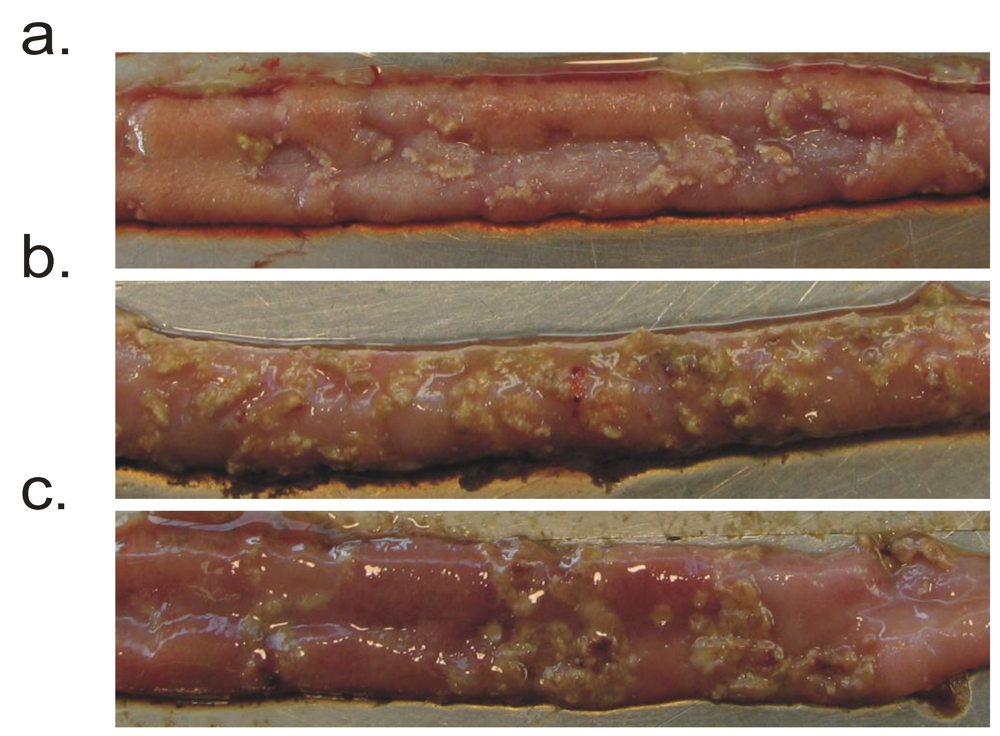
      <p>Necrotic enteritis in poultry is a global problem and it has been estimated that the disease costs the international poultry industry in excess of $US 2 billion per year in production losses and control measures [<xref ref-type="bibr" rid="B9-toxins-02-01913">9</xref>,<xref ref-type="bibr" rid="B10-toxins-02-01913">10</xref>,<xref ref-type="bibr" rid="B11-toxins-02-01913">11</xref>]. Avian necrotic enteritis is an enteric disease that is characterized by necrotic lesions in the small intestinal mucosa [<xref ref-type="bibr" rid="B12-toxins-02-01913">12</xref>]. The disease can be divided into two forms, clinical and subclinical. The clinical signs of acute necrotic enteritis can be seen from about two weeks of age and include marked depression, dehydration, apathy, diarrhea, ruffled feathers, and decreased feed consumption [<xref ref-type="bibr" rid="B13-toxins-02-01913">13</xref>,<xref ref-type="bibr" rid="B14-toxins-02-01913">14</xref>,<xref ref-type="bibr" rid="B15-toxins-02-01913">15</xref>,<xref ref-type="bibr" rid="B16-toxins-02-01913">16</xref>]. Birds showing clinical signs normally die within a few hours, with mortality rates reaching up to 1% per day [<xref ref-type="bibr" rid="B13-toxins-02-01913">13</xref>]. The diagnosis of subclinical necrotic enteritis is based on a decrease in the feed conversion ratio and the detection of gross necrotic lesions in the small intestinal mucosa (<xref ref-type="fig" rid="toxins-02-01913-f001">Figure 1</xref>) followed by bacteriologic analysis and genotyping of isolates [<xref ref-type="bibr" rid="B12-toxins-02-01913">12</xref>]. Macroscopic lesions can be seen in the small intestine and can sometimes be found in other organs, such as the liver, kidney and cecum [<xref ref-type="bibr" rid="B17-toxins-02-01913">17</xref>]. In an affected bird, the small intestine can become enlarged due to gas accumulation and the wall of the intestine can become thin and delicate [<xref ref-type="bibr" rid="B18-toxins-02-01913">18</xref>]. Subclinical necrotic enteritis is observed at varying ages of birds, but most commonly it is first detected in birds at 21 to 23 days of age [<xref ref-type="bibr" rid="B9-toxins-02-01913">9</xref>]. The subclinical form of the disease is not only of significance to the animals’ welfare, but also to the producer through lost productivity and the added cost of disease intervention. </p>
      <fig id="toxins-02-01913-f001" position="anchor">
        <label>Figure 1</label>
        <caption>
          <p>Gross pathology of the small intestine of infected birds. (<bold>a</bold>–<bold>c</bold>) are three examples of necrotic enteritis lesions in the small intestines of broiler chickens challenged with <italic>C. perfringens</italic>. </p>
        </caption>
        <graphic xmlns:xlink="http://www.w3.org/1999/xlink" xlink:href="toxins-02-01913-g001.tif"/>
      </fig>
      <p>All <italic>C. perfringens</italic> strains produce α-toxin, a major extracellular toxin that has been shown to be essential for human myonecrosis [<xref ref-type="bibr" rid="B19-toxins-02-01913">19</xref>]. It was previously thought [<xref ref-type="bibr" rid="B14-toxins-02-01913">14</xref>,<xref ref-type="bibr" rid="B20-toxins-02-01913">20</xref>,<xref ref-type="bibr" rid="B21-toxins-02-01913">21</xref>] that α-toxin was the major toxin involved in necrotic enteritis, but we have shown that an α-toxin null mutant is still virulent in a chicken necrotic enteritis disease model [<xref ref-type="bibr" rid="B22-toxins-02-01913">22</xref>]. This result led us to postulate that virulent necrotic enteritis strains produce other toxins that are responsible for the pathogenesis of disease. Recently, we identified a new toxin, NetB, in avian <italic>C. perfringens</italic> type A strains [<xref ref-type="bibr" rid="B23-toxins-02-01913">23</xref>]. NetB is a key virulence factor in <italic>C. perfringens</italic> strains that cause avian necrotic enteritis. Here we review our current knowledge of the biology, distribution, regulation, role in disease, and potential vaccine applications of this new toxin.</p>
    </sec>
    <sec>
      <title>2. Identification and Analysis of NetB</title>
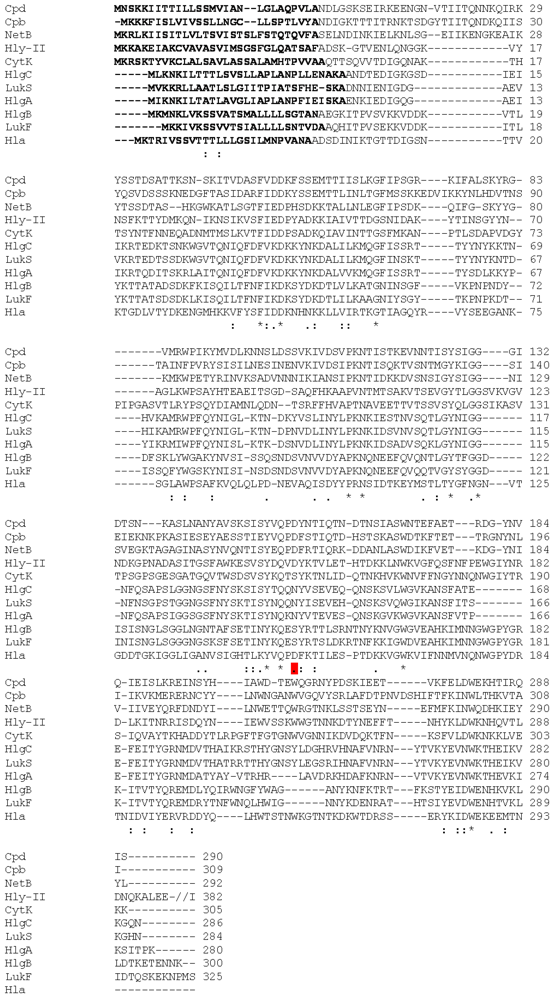
      <p>NetB was discovered in an Australian strain of <italic>C. perfringens</italic> type A that was isolated from a chicken with necrotic enteritis [<xref ref-type="bibr" rid="B23-toxins-02-01913">23</xref>]. Earlier work, aimed at defining the role of α-toxin, had indicated that secreted products from <italic>C. perfringens</italic> were able to cause lesions typical of necrotic enteritis in chickens [<xref ref-type="bibr" rid="B20-toxins-02-01913">20</xref>]. Based on these results, and our finding that α-toxin was not required for disease, we tested culture supernatant from our α-toxin mutant against various mammalian and chicken cell lines to determine whether any novel cytotoxic factors could be identified. One cell line, LMH (ATCC CRL-2117), was found to be sensitive to an unknown protein in the supernatant. Subsequently, LMH cytotoxicity was used to follow this toxic activity during the purification process. The <italic>N</italic>-terminal sequence of the purified protein was determined and used to search the genome sequence of the parent <italic>C. perfringens</italic> strain, EHE-NE18. A novel toxin gene that encoded a 323 amino acid protein, including a 30 amino acid secretion signal sequence, was identified. Since this protein has similarity to <italic>C. perfringens</italic> β-toxin (38% identity) it was designated necrotic enteritis toxin, B-like (NetB) [<xref ref-type="bibr" rid="B23-toxins-02-01913">23</xref>]. In addition to β-toxin, NetB has sequence identity to <italic>C. perfringens</italic> δ-toxin (40% identity), <italic>Staphylococcus aureus</italic> α-hemolysin (30% identity), the A, B and C components of <italic>S. aureus</italic> γ-toxin (25%, 22% and 23% identity, respectively), the S and F components of <italic>S. aureus</italic> leukocidin (25% and 22% identity, respectively) and to <italic>Bacillus cereus</italic> cytotoxin K (27% identity). Alignment of these sequences (<xref ref-type="fig" rid="toxins-02-01913-f002">Figure 2</xref>) reveals that only 14 amino acids are identical in these proteins and that 50 residues are conservatively substituted. The areas of similarity are dispersed throughout the toxin, with the weakest similarity in the <italic>N</italic>-terminal region. </p>
      <p>At least 35% of the known protein toxins produced by bacteria belong to the pore-forming group of membrane damaging toxins [<xref ref-type="bibr" rid="B24-toxins-02-01913">24</xref>]. These toxins form pores that disrupt the phospholipid membrane bilayer of both human and animal cells, causing an influx of ions (<italic>i.e.</italic>, Na<sup>+</sup>, Cl<sup>−</sup>, Ca<sup>2+</sup>, <italic>etc.</italic>) that may lead to osmotic cell lysis. Many of these toxins have been demonstrated to contribute to the virulence of bacteria and to play a key role in the pathogenesis of human and animal infections [<xref ref-type="bibr" rid="B25-toxins-02-01913">25</xref>,<xref ref-type="bibr" rid="B26-toxins-02-01913">26</xref>,<xref ref-type="bibr" rid="B27-toxins-02-01913">27</xref>,<xref ref-type="bibr" rid="B28-toxins-02-01913">28</xref>,<xref ref-type="bibr" rid="B29-toxins-02-01913">29</xref>,<xref ref-type="bibr" rid="B30-toxins-02-01913">30</xref>,<xref ref-type="bibr" rid="B31-toxins-02-01913">31</xref>]. NetB has many of the conserved residues found in pore-forming toxins of the <italic>S. aureus</italic> toxin family [<xref ref-type="bibr" rid="B32-toxins-02-01913">32</xref>]. For example, the α-hemolysin, or α-toxin, from <italic>S. aureus</italic> is a secreted, self-assembling, pore-forming toxin [<xref ref-type="bibr" rid="B33-toxins-02-01913">33</xref>]. It has a signal peptide of 26 amino acids and in its mature form consists of a 293 amino acid polypeptide with a calculated molecular size of 33 kDa [<xref ref-type="bibr" rid="B34-toxins-02-01913">34</xref>,<xref ref-type="bibr" rid="B35-toxins-02-01913">35</xref>]. β-toxin also is a member of this pore‑forming family and is a lethal extracellular toxin produced by <italic>C. perfringens</italic> type B and C strains [<xref ref-type="bibr" rid="B36-toxins-02-01913">36</xref>]. β-toxin is secreted in late exponential growth phase and is extremely susceptible to proteases and to heat [<xref ref-type="bibr" rid="B37-toxins-02-01913">37</xref>,<xref ref-type="bibr" rid="B38-toxins-02-01913">38</xref>]. Located on a plasmid [<xref ref-type="bibr" rid="B39-toxins-02-01913">39</xref>], the β-toxin structural gene, <italic>cpb</italic>, encodes a 336 amino acid polypeptide that includes a 27-amino acid signal sequence, which is cleaved to form the mature β-toxin protein (34 kDa) [<xref ref-type="bibr" rid="B40-toxins-02-01913">40</xref>]. </p>
      <fig id="toxins-02-01913-f002" position="anchor">
        <label>Figure 2</label>
        <caption>
          <p>ClustalW alignment of NetB. ClustalW alignment of the toxins <italic>C. perfringens</italic> NetB (EU143239), <italic>C. perfringens</italic> β-toxin (Cpb, AAA23284.1), <italic>C. perfringens</italic> δ-toxin (Cpd, ACF93710.1), <italic>B. cereus</italic> hemolysin II (Hly-II, NP_833256.1), cytotoxin K (CytK, CAC08441.1) and <italic>S. aureus</italic> α-toxin (Hla, NP_371687.1), γ-toxin A (HlgA, P0A074.1), B (HlgB, P0A077.1), C (HlgC, Q07227.1), Leukocidin S (LukS, NP_058465.1), F (LukF, NP_058466.1). Identical residues (*), conservative amino acid substitutions (:) and semi-conservative amino acid substitutions (.) are shown below the aligned sequences. Residues highlighted in bold represent the known or predicted signal peptide sequence of each protein and residue numbers begin following the signal peptide sequence. Red boxes indicate those residues that are known to be involved in the activity of at least one of these proteins, as discussed in the text. To compact the figure the Hly-II sequence was shortened. </p>
        </caption>
        <graphic xmlns:xlink="http://www.w3.org/1999/xlink" xlink:href="toxins-02-01913-g002.tif"/>
      </fig>
      <p>Site-directed mutagenesis has been used to characterize many amino acids critical for function in <italic>C. perfringens</italic> β-toxin and <italic>S. aureus</italic>α-toxin [<xref ref-type="bibr" rid="B41-toxins-02-01913">41</xref>,<xref ref-type="bibr" rid="B42-toxins-02-01913">42</xref>] and NetB contains many of these key residues including R200 (R212 from β-toxin). The corresponding residue in <italic>S. aureus</italic> α-toxin (R200) is important for binding and oligomerization of the protein as well as for hemolysis [<xref ref-type="bibr" rid="B43-toxins-02-01913">43</xref>]. Mutation of the β-toxin residue Y203 (Y191 in NetB) to phenylalanine resulted in a 2.5-fold increase in the LD<sub>50</sub>. The corresponding residue in <italic>S. aureus</italic> α-toxin (Y191) is located at the predicted membrane binding surface of the protein [<xref ref-type="bibr" rid="B44-toxins-02-01913">44</xref>]. Mutation of the β-toxin residue D167 (D156 in NetB) resulted in a complete loss of functional protein expression, suggesting that this region participates in crucial protomer-protomer interactions as well as being important for conformational rearrangements involved in multimer formation in the membrane bound form [<xref ref-type="bibr" rid="B44-toxins-02-01913">44</xref>]. </p>
      <p>Since NetB had many of the residues essential for β-toxin and <italic>S. aureus</italic> α-toxin function we postulated that NetB was likely to be a pore-forming toxin. Subsequent studies demonstrated that NetB was found to be cytotoxic to LMH cells but not to other chicken cell lines such as DF1 and HD11 cells or the mammalian Vero cell line [<xref ref-type="bibr" rid="B23-toxins-02-01913">23</xref>]. NetB (2.5 ng/µL) causes significant cell rounding and cell lysis in as little as 30 min. Incubation with PEG 1000 and PEG 1500 blocked these morphological changes and LDH release from the cells, indicating that NetB most likely forms plasma membrane pores with an estimated pore diameter of 1.6 to 1.8 nm [<xref ref-type="bibr" rid="B23-toxins-02-01913">23</xref>]. This NetB pore diameter is slightly larger than the pore size predicted for β-toxin (1.36–1.6 nm) in HL 60 cells [<xref ref-type="bibr" rid="B45-toxins-02-01913">45</xref>]. β-toxin has been shown to induce significant host cell swelling without blebbing, cell lysis, and the release of K<sup>+</sup> from human leukemia cells (HL 60) [<xref ref-type="bibr" rid="B45-toxins-02-01913">45</xref>]. Incubation of HL 60 cells with β-toxin resulted in the formation of toxin complexes of about 191 kDa (hexamer) and 228 kDa (heptamer). The 228 kDa complex was observed up to 30 min after incubation with the cells, while the 191 kDa complex remained after 60 min. </p>
      <p>δ-toxin is another <italic>C. perfringens</italic> pore-forming toxin that has sequence identity with NetB [<xref ref-type="bibr" rid="B46-toxins-02-01913">46</xref>]. This toxin is a hemolysin released by several <italic>C. perfringens</italic> type C and possibly type B strains [<xref ref-type="bibr" rid="B47-toxins-02-01913">47</xref>]. It is cytotoxic for various cell types such as rabbit macrophages, human monocytes, and blood platelets from goats, rabbits, humans and guinea pigs [<xref ref-type="bibr" rid="B46-toxins-02-01913">46</xref>,<xref ref-type="bibr" rid="B48-toxins-02-01913">48</xref>,<xref ref-type="bibr" rid="B49-toxins-02-01913">49</xref>,<xref ref-type="bibr" rid="B50-toxins-02-01913">50</xref>]. The toxin forms pores in artificial lipid bilayers similar to β-toxin, however, these toxins do not share a similar receptor since δ-toxin binds to gangliosides (G<sub>M2</sub>) unlike β-toxin [<xref ref-type="bibr" rid="B46-toxins-02-01913">46</xref>]. Some <italic>C. perfringens</italic> type B and C strains that are involved in necrotic enteritis in various animal species, mainly piglets, and also in humans, produce δ-toxin, but no direct link between this toxin and disease has been demonstrated. </p>
      <p>The essential role of NetB in disease was determined by constructing a structural gene (<italic>netB</italic>) mutant in strain EHE-NE18 and assessing its virulence in a chicken disease model [<xref ref-type="bibr" rid="B23-toxins-02-01913">23</xref>]. Virulence testing of an isogenic series of strains consisting of the wild type, <italic>netB</italic> mutant, and <italic>netB</italic> mutant complemented with the wild-type <italic>netB</italic> gene, revealed that the development of necrotic enteritis in chickens was dependent on the ability to produce functional NetB toxin. This result parallels studies on the α-toxin of <italic>S. aureus</italic>, which in a mouse model of <italic>S. aureus</italic> pneumonia has been shown to be an important virulence factor of methicillin-resistant <italic>S. aureus</italic> (MRSA) [<xref ref-type="bibr" rid="B51-toxins-02-01913">51</xref>]. <italic>S. aureus</italic> α-toxin negative mutants were found to be 10-fold less virulent than α-toxin producing strains. Similar results have been obtained for β-toxin and it has been shown to be essential for hemorrhagic necrotizing enteritis in rabbit ileal loops [<xref ref-type="bibr" rid="B52-toxins-02-01913">52</xref>]. In that study, mutations in the β-toxin structural gene, <italic>cpb</italic>, were constructed and shown to be avirulent in the ileal loop model. Complementation of a <italic>cpb</italic> mutant restored its ability to produce β-toxin and restored virulence in the loop model. In addition, highly purified β-toxin was able to reproduce intestinal damage that was similar to infection with the wild-type <italic>C. perfringens</italic> strain. Both NetB and β-toxin act in the gastrointestinal tract of animals, however, β-toxin has also been suggested to cause toxemia after absorption of the toxin from the intestines into the circulation [<xref ref-type="bibr" rid="B53-toxins-02-01913">53</xref>,<xref ref-type="bibr" rid="B54-toxins-02-01913">54</xref>]. However, no experiments aimed at determining if NetB enters the circulatory system of infected chickens have been reported. </p>
      <p>Recent studies have revealed that in several necrotic enteritis isolates the <italic>netB</italic> gene is part of a large potential pathogenicity locus [<xref ref-type="bibr" rid="B55-toxins-02-01913">55</xref>]. Comparative analysis of genomic sequences from seven independent disease-causing <italic>C. perfringens</italic> isolates and a range of non-necrotic enteritis strains showed that the <italic>netB</italic> gene is located on a 42 kilobase (kb) locus (NELoc-1). In addition, Southern blots suggest that the <italic>netB</italic> gene is located on an approximately 85 kb plasmid. From the genomic analysis, two other smaller loci (NELoc-2 and NELoc-3) also appear to be associated with necrotic enteritis strains. The identification of these pathogenicity loci may lead to the discovery of additional virulence factors that are involved in the pathogenesis of disease. </p>
    </sec>
    <sec>
      <title>3. Strain Distribution</title>
      <p><italic>C. perfringens</italic> is commonly present within the normal flora of the gastrointestinal tract of chickens. However, under conditions that are still not fully understood, birds can develop necrotic enteritis, with disease progression correlating with the proliferation of <italic>C. perfringens</italic> cells in the intestine. To understand what types of <italic>C. perfringens</italic> isolates are involved in this changing ecological balance, several studies have examined the clonal variation of <italic>C. perfringens</italic> isolates. Epidemiological studies of strains from varied geographical locations have shown that healthy chickens harbor a range of genotypes, as determined by PCR, PFGE and MLST studies, while isolates from birds present in individual flocks that have acute necrotic enteritis tend to have only one genotype of <italic>C. perfringens</italic> [<xref ref-type="bibr" rid="B56-toxins-02-01913">56</xref>,<xref ref-type="bibr" rid="B57-toxins-02-01913">57</xref>,<xref ref-type="bibr" rid="B58-toxins-02-01913">58</xref>,<xref ref-type="bibr" rid="B59-toxins-02-01913">59</xref>,<xref ref-type="bibr" rid="B60-toxins-02-01913">60</xref>,<xref ref-type="bibr" rid="B61-toxins-02-01913">61</xref>,<xref ref-type="bibr" rid="B62-toxins-02-01913">62</xref>,<xref ref-type="bibr" rid="B63-toxins-02-01913">63</xref>,<xref ref-type="bibr" rid="B64-toxins-02-01913">64</xref>]. In contrast to these findings, which involved acute disease outbreaks, in one study birds from a single flock that displayed mild necrotic enteritis symptoms were found to harbor a genetically varied range of isolates [<xref ref-type="bibr" rid="B64-toxins-02-01913">64</xref>]. </p>
      <p>Since the discovery of NetB [<xref ref-type="bibr" rid="B23-toxins-02-01913">23</xref>] several studies have screened for the presence of the <italic>netB</italic> gene within a wide variety of <italic>C. perfringens</italic> strains. Initial screening of a range of Australian poultry necrotic enteritis isolates found that the majority (77%) were <italic>netB</italic> positive [<xref ref-type="bibr" rid="B23-toxins-02-01913">23</xref>]. In addition, <italic>in vitro</italic> expression analysis confirmed that all of the <italic>netB</italic> positive strains that were tested produced the NetB protein. Furthermore, several non-necrotic enteritis strains were analyzed and found to be <italic>netB</italic> negative. These <italic>netB</italic>-negative strains included representatives of each of the toxin types A to E, which had been isolated from cattle, sheep, pigs and humans. Subsequent studies that screened for the <italic>netB</italic> gene in strains of <italic>C. perfringens</italic> from other geographical regions showed that there is a good correlation between the isolation of <italic>C. perfringens</italic> from a diseased bird and the presence of the <italic>netB</italic> gene [<xref ref-type="bibr" rid="B59-toxins-02-01913">59</xref>,<xref ref-type="bibr" rid="B64-toxins-02-01913">64</xref>,<xref ref-type="bibr" rid="B65-toxins-02-01913">65</xref>,<xref ref-type="bibr" rid="B66-toxins-02-01913">66</xref>]. In combination, 60 to 90% of the strains isolated from birds with necrotic enteritis were found to have the <italic>netB</italic> gene. Chalmers <italic>et al.</italic> [<xref ref-type="bibr" rid="B59-toxins-02-01913">59</xref>], studied Canadian <italic>C. perfringens</italic> strains, and found that the <italic>netB</italic> gene was detected only in isolates associated with necrotic enteritis outbreaks; it was not identified in isolates from healthy birds. Analysis of isolates from the USA showed that the <italic>netB</italic> gene was in 60% of necrotic enteritis strains (7/12) [<xref ref-type="bibr" rid="B65-toxins-02-01913">65</xref>]. Examination of a single broiler flock from Sweden found that more than 90% of all isolates from necrotic enteritis-affected poultry were <italic>netB</italic> positive [<xref ref-type="bibr" rid="B64-toxins-02-01913">64</xref>]. The same trend was found in an extended study of strains from three continents [<xref ref-type="bibr" rid="B66-toxins-02-01913">66</xref>], where 70% of isolates from necrotic enteritis affected birds were <italic>netB</italic> positive. Together, these results suggest that the NetB toxin is necrotic enteritis specific, since the <italic>netB</italic> gene is strongly associated with necrotic enteritis-derived strains from poultry. Until recently, the <italic>netB</italic> gene had only been found in poultry related strains, however, the first non-poultry based recovery of a <italic>netB</italic> positive <italic>C. perfringens</italic> isolate has now been reported. A <italic>netB</italic> positive strain was isolated from liver abscesses from a cow that had died with gastrointestinal disease, although this particular <italic>C. perfringens</italic> strain was not considered to be the causative agent [<xref ref-type="bibr" rid="B65-toxins-02-01913">65</xref>]. In a chicken disease model, this bovine isolate has also been shown to cause lesions characteristic of avian necrotic enteritis [<xref ref-type="bibr" rid="B67-toxins-02-01913">67</xref>]. </p>
      <p>Not all <italic>C. perfringens</italic> strains isolated from birds that clearly displayed signs of necrotic enteritis were <italic>netB</italic> positive. In nearly every study, there was a minor fraction of <italic>netB</italic> negative isolates from diseased birds [<xref ref-type="bibr" rid="B23-toxins-02-01913">23</xref>,<xref ref-type="bibr" rid="B59-toxins-02-01913">59</xref>,<xref ref-type="bibr" rid="B64-toxins-02-01913">64</xref>,<xref ref-type="bibr" rid="B65-toxins-02-01913">65</xref>,<xref ref-type="bibr" rid="B66-toxins-02-01913">66</xref>,<xref ref-type="bibr" rid="B68-toxins-02-01913">68</xref>]. In one particular study [<xref ref-type="bibr" rid="B65-toxins-02-01913">65</xref>] a <italic>netB</italic> negative isolate was recovered from a chicken displaying clear signs of necrotic enteritis. To show that there were no sampling errors involved, 25 isolates were recovered from different lesion areas of the same chicken; they were all <italic>netB</italic> negative. These results imply that although there is a clear association between production of NetB toxin and development of the pathology of necrotic enteritis, there may be other—yet to be determined—virulence factors that are produced by these <italic>netB</italic> negative disease-producing strains. By contrast, several <italic>netB</italic> negative strains isolated from lesion material have been tested for their ability to cause disease in necrotic enteritis animal models and found to induce little or no signs of disease [<xref ref-type="bibr" rid="B66-toxins-02-01913">66</xref>,<xref ref-type="bibr" rid="B67-toxins-02-01913">67</xref>,<xref ref-type="bibr" rid="B69-toxins-02-01913">69</xref>]. Importantly, one <italic>netB</italic> negative strain, JGS4104, induced a significant level of disease (43.8%) [<xref ref-type="bibr" rid="B69-toxins-02-01913">69</xref>], again suggesting that there may be other factors, besides NetB, that allow <italic>C. perfringens</italic> type A to cause tissue damage similar to necrotic enteritis. In this study the strains re-isolated from the diseased birds were analyzed by PFGE. Given the recent demonstration that the <italic>netB</italic> structural gene is plasmid borne [<xref ref-type="bibr" rid="B55-toxins-02-01913">55</xref>], it is unclear if it is possible using PFGE to detect a difference between a strain that remains <italic>netB</italic> negative and one that has obtained the NELoc-1-containing plasmid. Clearly, more research needs to be done to test and assess the virulence of additional isolates of different origins and genotypes in the chicken disease model. </p>
      <p>Whilst the <italic>netB</italic> gene has been found mainly in association with poultry with necrotic enteritis, it has also been identified in <italic>C. perfringens</italic> strains from healthy birds. In one study [<xref ref-type="bibr" rid="B65-toxins-02-01913">65</xref>], 8.8% of isolates (7/80) from normal chickens were <italic>netB</italic> positive. In another study, analysis of strains from a single broiler flock that contained birds affected with mild necrotic enteritis, revealed that 25% of the isolates from apparently healthy birds were <italic>netB</italic> positive [<xref ref-type="bibr" rid="B64-toxins-02-01913">64</xref>]. Nowell <italic>et al.</italic> 2009 [<xref ref-type="bibr" rid="B70-toxins-02-01913">70</xref>] used an enrichment process to recover 88 <italic>C. perfringens</italic> isolates from retail grocery chicken samples and found that the <italic>netB</italic> gene could be detected in 21% of these isolates. Therefore, as previously suggested, it appears that the presence of a <italic>netB</italic> positive strain is not sufficient to cause disease, predisposing conditions are required. Analysis of strains from various Danish broiler flocks found that 61% of isolates recovered from healthy birds were <italic>netB</italic> positive [<xref ref-type="bibr" rid="B68-toxins-02-01913">68</xref>]. This was markedly different from the results obtained from previous studies on strains from healthy birds [<xref ref-type="bibr" rid="B59-toxins-02-01913">59</xref>,<xref ref-type="bibr" rid="B65-toxins-02-01913">65</xref>,<xref ref-type="bibr" rid="B66-toxins-02-01913">66</xref>]. When these Danish <italic>netB</italic> positive isolates were tested for <italic>in vitro</italic> expression of the NetB protein, a marked difference in the NetB expression rates was observed [<xref ref-type="bibr" rid="B68-toxins-02-01913">68</xref>]. The NetB protein was found in 12 out of 13 of the isolates from the necrotic enteritis diseased birds. By comparison, only four out of 14 PCR positive isolates from healthy birds produced detectable NetB protein. These results are in stark contrast to our own findings, where every strain that carries <italic>netB</italic> produces NetB protein. It would be interesting to test these NetB producing and NetB non-producing <italic>netB</italic> positive strains isolated from healthy birds for NetB expression <italic>in vivo</italic> and to determine if they are equally capable of disease production. </p>
    </sec>
    <sec>
      <title>4. Regulation of NetB Production and NetB Sequence Variation</title>
      <p>Expression of the <italic>netB</italic> gene is regulated by VirSR, the global regulator of <italic>C. perfringens</italic> toxin production [<xref ref-type="bibr" rid="B71-toxins-02-01913">71</xref>]. In the human gas gangrene-causing <italic>C. perfringens</italic> type A strain 13, the VirSR system is part of a complex signal transduction pathway that directly regulates the production of extracellular toxins and enzymes such as perfringolysin O and α-clostripain and regulates the expression of α-toxin, collagenase and many housekeeping genes by controlling the expression of the regulatory RNA molecule, VR-RNA [<xref ref-type="bibr" rid="B72-toxins-02-01913">72</xref>]. In two separate necrotic enteritis derived <italic>C. perfringens</italic> strains, mutation of the <italic>virR</italic> gene greatly reduced the production of NetB toxin [<xref ref-type="bibr" rid="B71-toxins-02-01913">71</xref>]. This effect was reversed when the <italic>virR</italic> mutants were complemented with the wild-type <italic>virR</italic> gene. VirR acts on its target genes by binding to two directly repeated sequences, or VirR boxes, that are located immediately upstream of the promoter. Similar repeats are located upstream of the putative <italic>netB</italic> promoter. These VirR boxes were shown to be functional in a <italic>C. perfringens</italic>-based bioassay and <italic>in vitro</italic> studies showed that purified VirR protein could bind to the <italic>netB</italic>-associated VirR boxes. Other workers have shown that in strain 13 the VirSR system appears to be regulated by an Agr-dependent quorum sensing system that leads to the controlled expression of specific genes in response to changes in cell density [<xref ref-type="bibr" rid="B73-toxins-02-01913">73</xref>]. These findings suggest that in the gastrointestinal tract of infected birds the production of NetB is activated when the <italic>C. perfringens</italic> population reaches a threshold level as a result of predisposing factors, as reviewed previously [<xref ref-type="bibr" rid="B17-toxins-02-01913">17</xref>,<xref ref-type="bibr" rid="B74-toxins-02-01913">74</xref>], and nutrients start to become rate-limiting for growth. </p>
      <p>Any differences in necrotic enteritis disease progression could potentially be explained by sequence differences in the NetB proteins produced by different strains. To examine the variation of NetB proteins, the nucleotide sequence of the <italic>netB</italic> gene from a range of isolates was determined [<xref ref-type="bibr" rid="B66-toxins-02-01913">66</xref>]. The poultry isolates examined were from various geographical locations including Australia, Belgium, Denmark and Canada. The <italic>netB</italic> gene and its promoter region displayed very little sequence variation; most of these strains had virtually identical nucleotide sequences in this region. Within the <italic>netB</italic> coding sequence there was only one amino acid change, A168T, which was observed in six strains. Biological analysis of the NetB<sub>A168T</sub> derivative showed that it was as active as the wild-type NetB protein and that strains carrying the variant sequence produced similar levels and types of disease when used in infection studies. The observation that NetB is very well conserved was supported by a separate study [<xref ref-type="bibr" rid="B68-toxins-02-01913">68</xref>], which found that most of the 27 <italic>netB</italic> positive isolates examined contained wild-type coding and promoter regions. The only amino acid sequence changes observed were NetB<sub>A168T</sub>, the variant previously reported, and a single example of a novel variant, NetB<sub>A166V</sub>. </p>
    </sec>
    <sec>
      <title>5. NetB and the Development of a Necrotic Enteritis Vaccine</title>
      <p>Since NetB is essential for disease pathogenesis, and is a secreted toxin that should be readily accessible to the host immune system, it has considerable potential for vaccine development [<xref ref-type="bibr" rid="B23-toxins-02-01913">23</xref>]. Vaccines against <italic>C. perfringens</italic> or its toxins have been successfully used to prevent enteric diseases in various mammalian species, including humans [<xref ref-type="bibr" rid="B75-toxins-02-01913">75</xref>,<xref ref-type="bibr" rid="B76-toxins-02-01913">76</xref>,<xref ref-type="bibr" rid="B77-toxins-02-01913">77</xref>]. Vaccine development for necrotic enteritis in chickens has previously focused on α-toxin, but the experimental vaccines produced have not provided the level of vaccine efficacy seen with clostridial vaccines in other animal species, presumably because α-toxin is not essential for virulence. It has been shown that chicken flocks with high levels of maternal antibodies against α-toxin have lower mortality levels than flocks with lower titers [<xref ref-type="bibr" rid="B78-toxins-02-01913">78</xref>]. Vaccines based on <italic>C. perfringens</italic> type A and C have been experimentally tested [<xref ref-type="bibr" rid="B79-toxins-02-01913">79</xref>]. Layer hens vaccinated with these toxoids had high levels of anti-α-toxin antibodies in their progeny compared to unvaccinated hens. Both toxoid vaccines showed levels of protection against subclinical necrotic enteritis, with the type C toxoid vaccine giving higher levels of protection than the type A toxoid. α-toxin has also been delivered as a subunit vaccine and by live delivery in <italic>Salmonella</italic> vectors, where it has been shown to provide some protection [<xref ref-type="bibr" rid="B80-toxins-02-01913">80</xref>,<xref ref-type="bibr" rid="B81-toxins-02-01913">81</xref>,<xref ref-type="bibr" rid="B82-toxins-02-01913">82</xref>]. Recently, a commercial vaccine (NETVAX®, Schering-Plough) has been developed based on a <italic>C. perfringens</italic> type A toxoid. However, the NetB status of the organisms used to develop this vaccine is not known. </p>
      <p>Other studies aimed at the development of a necrotic enteritis vaccine have been reported. Analysis of serum from birds infected with virulent <italic>C. perfringens</italic> isolates identifiedseveralimmunogenic secreted proteins [<xref ref-type="bibr" rid="B80-toxins-02-01913">80</xref>]. These proteins included α-toxin, glyceraldehyde-3-phosphate dehydrogenase, pyruvate:ferredoxin oxidoreductase, fructose 1,6-biphosphate aldolase, and a hypothetical protein. These proteins significantly protected broiler chickensagainst a relatively mild challenge, with α-toxin, pyruvate:ferredoxinoxidoreductase and the hypothetical protein offering protection against a more severe challenge [<xref ref-type="bibr" rid="B81-toxins-02-01913">81</xref>]. This study provided the first evidence that a subunit vaccine could be useful in controlling necrotic enteritis in chickens. Of interest is that the chicken serum did not react strongly with NetB; possibly because NetB is not highly immunogenic in chickens or the levels of NetB produced <italic>in vivo</italic> are not high enough to promote reliable immune recognition. </p>
      <p>There are no reports in the literature addressing the use of NetB in vaccine formulations, although there are reports of related proteins from other bacteria being successfully used in experimental vaccines. For example, vaccine-based targeting of <italic>S. aureus</italic> α-toxin provided protection against staphylococcal pneumonia [<xref ref-type="bibr" rid="B83-toxins-02-01913">83</xref>,<xref ref-type="bibr" rid="B84-toxins-02-01913">84</xref>]. In a murine model system, monoclonal antibody-basedtherapy was efficacious for preventionand treatment of this disease [<xref ref-type="bibr" rid="B84-toxins-02-01913">84</xref>]. Two distinct anti-α-toxin monoclonal antibodies that blocktoxin activity prevented human lung cell injury <italic>in vitro</italic> and protected experimental animals against lethal <italic>S. aureus</italic> pneumonia. Active immunization with the first 50 amino acids of α-toxin also conferred protection against <italic>S. aureus</italic> pneumonia. This study revealed that both passive and active immunization strategies for prevention or therapy of staphylococcal pneumonia were feasible; similar approaches could be attempted using NetB to protect against necrotic enteritis. A genetically toxoided version of <italic>S. aureus</italic> α-toxin, which was produced by site-directed mutagenesis, has been shown to generate an antigen-specific immunoglobulin G response and to be protective against staphylococcal pneumonia [<xref ref-type="bibr" rid="B83-toxins-02-01913">83</xref>]. A similar genetically toxoided version of NetB may have value for necrotic enteritis vaccine design.</p>
    </sec>
    <sec sec-type="conclusions">
      <title>6. Conclusions</title>
      <p>The recently identified pore-forming toxin NetB is a key virulence determinant in <italic>C. perfringens</italic> strains that cause necrotic enteritis in chickens. The dimensions of the pore formed by the toxin have been estimated, but the determination of its exact structure and its comparison to other pore-forming toxins awaits crystallization studies. The toxin is produced by most strains isolated from necrotic lesions, but is less commonly found in <italic>C. perfringens</italic> isolates from healthy birds. As with many of the toxins encoded by <italic>C. perfringens</italic>, NetB production is regulated by the VirSR two-component regulatory system, potentially by a quorum sensing-dependent mechanism. NetB is cytotoxic to chicken LMH cells but not to several other chicken cell lines or Vero cells. Further studies aimed at determining its cellular specificity and identifying its receptor should help to elucidate the precise role that NetB plays in disease pathogenesis. Since NetB is involved in virulence, and is a secreted protein that should be readily accessible to the host immune system, it represents a promising target for vaccine development. Our growing knowledge of the importance and function of NetB may also lead to the development of useful therapeutic agents and biomarkers. The discovery that <italic>netB</italic> is part of a predicted pathogenicity locus that encodes other potential virulence factors indicates that further research is required to further elucidate the mechanism of pathogenesis of this important disease. </p>
    </sec>
  </body>
  <back>
    <ack>
      <title>Acknowledgements</title>
      <p>Research in the authors’ laboratories was supported by the Australian Poultry Cooperative Research Centre and the Australian Research Council Centre of Excellence in Structural and Functional Microbial Genomics.</p>
    </ack>
    <ref-list>
      <title>References</title>
      <ref id="B1-toxins-02-01913">
        <label>1.</label>
        <citation citation-type="journal">
          <person-group person-group-type="author">
            <name>
              <surname>Hatheway</surname>
              <given-names>C.L.</given-names>
            </name>
          </person-group>
          <article-title>Toxigenic clostridia</article-title>
          <source>Clin. Microbiol. Rev.</source>
          <year>1990</year>
          <volume>3</volume>
          <fpage>66</fpage>
          <lpage>98</lpage>
        <pub-id pub-id-type="pmid">2404569</pub-id></citation>
      </ref>
      <ref id="B2-toxins-02-01913">
        <label>2.</label>
        <citation citation-type="journal">
          <person-group person-group-type="author">
            <name>
              <surname>Petit</surname>
              <given-names>L.</given-names>
            </name>
            <name>
              <surname>Gibert</surname>
              <given-names>M.</given-names>
            </name>
            <name>
              <surname>Popoff</surname>
              <given-names>M.R.</given-names>
            </name>
          </person-group>
          <article-title><italic>Clostridium perfringens</italic>: toxinotype and genotype</article-title>
          <source>Trends Microbiol.</source>
          <year>1999</year>
          <volume>7</volume>
          <fpage>104</fpage>
          <lpage>110</lpage>
        <pub-id pub-id-type="doi">10.1016/S0966-842X(98)01430-9</pub-id><pub-id pub-id-type="pmid">10203838</pub-id></citation>
      </ref>
      <ref id="B3-toxins-02-01913">
        <label>3.</label>
        <citation citation-type="journal">
          <person-group person-group-type="author">
            <name>
              <surname>Rood</surname>
              <given-names>J.I.</given-names>
            </name>
          </person-group>
          <article-title>Virulence genes of <italic>Clostridium perfringens</italic></article-title>
          <source>Annu. Rev. Microbiol.</source>
          <year>1998</year>
          <volume>52</volume>
          <fpage>333</fpage>
          <lpage>360</lpage>
        <pub-id pub-id-type="doi">10.1146/annurev.micro.52.1.333</pub-id><pub-id pub-id-type="pmid">9891801</pub-id></citation>
      </ref>
      <ref id="B4-toxins-02-01913">
        <label>4.</label>
        <citation citation-type="journal">
          <person-group person-group-type="author">
            <name>
              <surname>Smedley</surname>
              <given-names>J.G.</given-names>
              <suffix>III</suffix>
            </name>
            <name>
              <surname>Fisher</surname>
              <given-names>D.J.</given-names>
            </name>
            <name>
              <surname>Sayeed</surname>
              <given-names>S.</given-names>
            </name>
            <name>
              <surname>Chakrabarti</surname>
              <given-names>G.</given-names>
            </name>
            <name>
              <surname>McClane</surname>
              <given-names>B.A.</given-names>
            </name>
          </person-group>
          <article-title>The enteric toxins of <italic>Clostridium perfringens</italic></article-title>
          <source>Rev. Physiol. Biochem. Pharmacol.</source>
          <year>2004</year>
          <volume>152</volume>
          <fpage>183</fpage>
          <lpage>204</lpage>
          <pub-id pub-id-type="pmid">15517462</pub-id>
        </citation>
      </ref>
      <ref id="B5-toxins-02-01913">
        <label>5.</label>
        <citation citation-type="journal">
          <person-group person-group-type="author">
            <name>
              <surname>Songer</surname>
              <given-names>J.G.</given-names>
            </name>
          </person-group>
          <article-title>Clostridial enteric diseases of domestic animals</article-title>
          <source>Clin. Microbiol. Rev.</source>
          <year>1996</year>
          <volume>9</volume>
          <fpage>216</fpage>
          <lpage>234</lpage>
        <pub-id pub-id-type="pmid">8964036</pub-id></citation>
      </ref>
      <ref id="B6-toxins-02-01913">
        <label>6.</label>
        <citation citation-type="journal">
          <person-group person-group-type="author">
            <name>
              <surname>Brynestad</surname>
              <given-names>S.</given-names>
            </name>
            <name>
              <surname>Granum</surname>
              <given-names>P.E.</given-names>
            </name>
          </person-group>
          <article-title><italic>Clostridium perfringens</italic> and foodborne infections</article-title>
          <source>Int. J. Food Microbiol.</source>
          <year>2002</year>
          <volume>74</volume>
          <fpage>195</fpage>
          <lpage>202</lpage>
        <pub-id pub-id-type="doi">10.1016/S0168-1605(01)00680-8</pub-id><pub-id pub-id-type="pmid">11981970</pub-id></citation>
      </ref>
      <ref id="B7-toxins-02-01913">
        <label>7.</label>
        <citation citation-type="book">
          <person-group person-group-type="author">
            <name>
              <surname>Rood</surname>
              <given-names>J.I.</given-names>
            </name>
            <name>
              <surname>McClane</surname>
              <given-names>B.A.</given-names>
            </name>
          </person-group>
          <article-title><italic>Clostridium perfringens</italic>: enterotoxaemic Diseases</article-title>
          <source>Molecular Medical Microbiology</source>
          <person-group person-group-type="editor">
            <name>
              <surname>Sussman</surname>
              <given-names>M.</given-names>
            </name>
          </person-group>
          <publisher-name>Academic</publisher-name>
          <publisher-loc>London, UK</publisher-loc>
          <year>2002</year>
          <volume>1</volume>
          <fpage>1117</fpage>
          <lpage>1139</lpage>
        </citation>
      </ref>
      <ref id="B8-toxins-02-01913">
        <label>8.</label>
        <citation citation-type="book">
          <person-group person-group-type="author">
            <name>
              <surname>Rood</surname>
              <given-names>J.I.</given-names>
            </name>
          </person-group>
          <article-title><italic>Clostridium perfringens</italic> and histotoxic disease</article-title>
          <source>The Prokaryotes: A Handbook on the Biology of Bacteria</source>
          <edition>3rd</edition>
          <person-group person-group-type="editor">
            <name>
              <surname>Dworkin</surname>
              <given-names>M.</given-names>
            </name>
            <name>
              <surname>Falkow</surname>
              <given-names>S.</given-names>
            </name>
            <name>
              <surname>Rosenberg</surname>
              <given-names>E.</given-names>
            </name>
            <name>
              <surname>Schleifer</surname>
              <given-names>K.H.</given-names>
            </name>
            <name>
              <surname>Stackebrandt</surname>
              <given-names>E.</given-names>
            </name>
          </person-group>
          <publisher-name>Springer</publisher-name>
          <publisher-loc>New York, NY, USA</publisher-loc>
          <year>2007</year>
          <volume>4</volume>
          <fpage>753</fpage>
          <lpage>770</lpage>
        </citation>
      </ref>
      <ref id="B9-toxins-02-01913">
        <label>9.</label>
        <citation citation-type="journal">
          <person-group person-group-type="author">
            <name>
              <surname>Van der Sluis</surname>
              <given-names>W.</given-names>
            </name>
          </person-group>
          <article-title>Clostridial enteritis—a syndrome</article-title>
          <source>World Poultry</source>
          <year>2000</year>
          <volume>16</volume>
          <fpage>56</fpage>
          <lpage>57</lpage>
        </citation>
      </ref>
      <ref id="B10-toxins-02-01913">
        <label>10.</label>
        <citation citation-type="journal">
          <person-group person-group-type="author">
            <name>
              <surname>Van der Sluis</surname>
              <given-names>W.</given-names>
            </name>
          </person-group>
          <article-title>Clostridial enteritis is an often underestimated problem</article-title>
          <source>World Poultry</source>
          <year>2000</year>
          <volume>16</volume>
          <fpage>42</fpage>
          <lpage>43</lpage>
        </citation>
      </ref>
      <ref id="B11-toxins-02-01913">
        <label>11.</label>
        <citation citation-type="journal">
          <person-group person-group-type="author">
            <name>
              <surname>Lovland</surname>
              <given-names>A.</given-names>
            </name>
            <name>
              <surname>Kaldhusdal</surname>
              <given-names>M.</given-names>
            </name>
          </person-group>
          <article-title>Severely impaired production performance in broiler flocks with high incidence of <italic>Clostridium perfringens</italic>-associated hepatitis</article-title>
          <source>Avian Pathol.</source>
          <year>2001</year>
          <volume>30</volume>
          <fpage>73</fpage>
          <lpage>81</lpage>
        <pub-id pub-id-type="doi">10.1080/03079450020023230</pub-id><pub-id pub-id-type="pmid">19184877</pub-id></citation>
      </ref>
      <ref id="B12-toxins-02-01913">
        <label>12.</label>
        <citation citation-type="journal">
          <person-group person-group-type="author">
            <name>
              <surname>Kaldhusdal</surname>
              <given-names>M.</given-names>
            </name>
            <name>
              <surname>Hofshagen</surname>
              <given-names>M.</given-names>
            </name>
          </person-group>
          <article-title>Barley inclusion and avoparcin supplementation in broiler diets. 2. Clinical, pathological, and bacteriological findings in a mild form of necrotic enteritis</article-title>
          <source>Poult. Sci.</source>
          <year>1992</year>
          <volume>71</volume>
          <fpage>1145</fpage>
          <lpage>1153</lpage>
          <pub-id pub-id-type="pmid">1641378</pub-id>
        </citation>
      </ref>
      <ref id="B13-toxins-02-01913">
        <label>13.</label>
        <citation citation-type="journal">
          <person-group person-group-type="author">
            <name>
              <surname>Helmboldt</surname>
              <given-names>C.F.</given-names>
            </name>
            <name>
              <surname>Bryant</surname>
              <given-names>E.S.</given-names>
            </name>
          </person-group>
          <article-title>The pathology of necrotic enteritis in domestic fowl</article-title>
          <source>Avian Dis.</source>
          <year>1971</year>
          <volume>15</volume>
          <fpage>775</fpage>
          <lpage>780</lpage>
        <pub-id pub-id-type="doi">10.2307/1588866</pub-id><pub-id pub-id-type="pmid">5159549</pub-id></citation>
      </ref>
      <ref id="B14-toxins-02-01913">
        <label>14.</label>
        <citation citation-type="journal">
          <person-group person-group-type="author">
            <name>
              <surname>Al-Sheikhly</surname>
              <given-names>F.</given-names>
            </name>
            <name>
              <surname>Truscott</surname>
              <given-names>R.B.</given-names>
            </name>
          </person-group>
          <article-title>The pathology of necrotic enteritis of chickens following infusion of broth cultures of <italic>Clostridium perfringens</italic> into the duodenum</article-title>
          <source>Avian Dis.</source>
          <year>1977</year>
          <volume>21</volume>
          <fpage>230</fpage>
          <lpage>240</lpage>
        <pub-id pub-id-type="doi">10.2307/1589343</pub-id><pub-id pub-id-type="pmid">194570</pub-id></citation>
      </ref>
      <ref id="B15-toxins-02-01913">
        <label>15.</label>
        <citation citation-type="journal">
          <person-group person-group-type="author">
            <name>
              <surname>Al-Sheikhly</surname>
              <given-names>F.</given-names>
            </name>
            <name>
              <surname>Al-Saieg</surname>
              <given-names>A.</given-names>
            </name>
          </person-group>
          <article-title>Role of Coccidia in the occurrence of necrotic enteritis of chickens</article-title>
          <source>Avian Dis.</source>
          <year>1980</year>
          <volume>24</volume>
          <fpage>324</fpage>
          <lpage>333</lpage>
        <pub-id pub-id-type="doi">10.2307/1589700</pub-id><pub-id pub-id-type="pmid">6254485</pub-id></citation>
      </ref>
      <ref id="B16-toxins-02-01913">
        <label>16.</label>
        <citation citation-type="journal">
          <person-group person-group-type="author">
            <name>
              <surname>Gazdzinski</surname>
              <given-names>P.</given-names>
            </name>
            <name>
              <surname>Julian</surname>
              <given-names>R.J.</given-names>
            </name>
          </person-group>
          <article-title>Necrotic enteritis in turkeys</article-title>
          <source>Avian Dis.</source>
          <year>1992</year>
          <volume>36</volume>
          <fpage>792</fpage>
          <lpage>798</lpage>
        <pub-id pub-id-type="doi">10.2307/1591787</pub-id><pub-id pub-id-type="pmid">1417616</pub-id></citation>
      </ref>
      <ref id="B17-toxins-02-01913">
        <label>17.</label>
        <citation citation-type="journal">
          <person-group person-group-type="author">
            <name>
              <surname>Van Immerseel</surname>
              <given-names>F.</given-names>
            </name>
            <name>
              <surname>De Buck</surname>
              <given-names>J.</given-names>
            </name>
            <name>
              <surname>Pasmans</surname>
              <given-names>F.</given-names>
            </name>
            <name>
              <surname>Huyghebaert</surname>
              <given-names>G.</given-names>
            </name>
            <name>
              <surname>Haesebrouck</surname>
              <given-names>F.</given-names>
            </name>
            <name>
              <surname>Ducatelle</surname>
              <given-names>R.</given-names>
            </name>
          </person-group>
          <article-title><italic>Clostridium perfringens</italic> in poultry: an emerging threat for animal and public health</article-title>
          <source>Avian Pathol.</source>
          <year>2004</year>
          <volume>33</volume>
          <fpage>537</fpage>
          <lpage>549</lpage>
        <pub-id pub-id-type="doi">10.1080/03079450400013162</pub-id><pub-id pub-id-type="pmid">15763720</pub-id></citation>
      </ref>
      <ref id="B18-toxins-02-01913">
        <label>18.</label>
        <citation citation-type="journal">
          <person-group person-group-type="author">
            <name>
              <surname>Broussard</surname>
              <given-names>C.T.</given-names>
            </name>
            <name>
              <surname>Hofacre</surname>
              <given-names>C.L.</given-names>
            </name>
            <name>
              <surname>Page</surname>
              <given-names>R.K.</given-names>
            </name>
            <name>
              <surname>Fletcher</surname>
              <given-names>O.J.</given-names>
            </name>
          </person-group>
          <article-title>Necrotic enteritis in cage-reared commercial layer pullets</article-title>
          <source>Avian Dis.</source>
          <year>1986</year>
          <volume>30</volume>
          <fpage>617</fpage>
          <lpage>619</lpage>
        <pub-id pub-id-type="doi">10.2307/1590433</pub-id><pub-id pub-id-type="pmid">2876698</pub-id></citation>
      </ref>
      <ref id="B19-toxins-02-01913">
        <label>19.</label>
        <citation citation-type="journal">
          <person-group person-group-type="author">
            <name>
              <surname>Awad</surname>
              <given-names>M.M.</given-names>
            </name>
            <name>
              <surname>Bryant</surname>
              <given-names>A.E.</given-names>
            </name>
            <name>
              <surname>Stevens</surname>
              <given-names>D.L.</given-names>
            </name>
            <name>
              <surname>Rood</surname>
              <given-names>J.I.</given-names>
            </name>
          </person-group>
          <article-title>Virulence studies on chromosomal alpha-toxin and theta-toxin mutants constructed by allelic exchange provide genetic evidence for the essential role of alpha-toxin in <italic>Clostridium perfringens</italic>-mediated gas gangrene</article-title>
          <source>Mol. Microbiol.</source>
          <year>1995</year>
          <volume>15</volume>
          <fpage>191</fpage>
          <lpage>202</lpage>
        <pub-id pub-id-type="doi">10.1111/j.1365-2958.1995.tb02234.x</pub-id><pub-id pub-id-type="pmid">7746141</pub-id></citation>
      </ref>
      <ref id="B20-toxins-02-01913">
        <label>20.</label>
        <citation citation-type="journal">
          <person-group person-group-type="author">
            <name>
              <surname>Al-Sheikhly</surname>
              <given-names>F.</given-names>
            </name>
            <name>
              <surname>Truscott</surname>
              <given-names>R.B.</given-names>
            </name>
          </person-group>
          <article-title>The pathology of necrotic enteritis of chickens following infusion of crude toxins of <italic>Clostridium perfringens</italic> into the duodenum</article-title>
          <source>Avian Dis.</source>
          <year>1977</year>
          <volume>21</volume>
          <fpage>241</fpage>
          <lpage>255</lpage>
        <pub-id pub-id-type="doi">10.2307/1589344</pub-id><pub-id pub-id-type="pmid">194571</pub-id></citation>
      </ref>
      <ref id="B21-toxins-02-01913">
        <label>21.</label>
        <citation citation-type="journal">
          <person-group person-group-type="author">
            <name>
              <surname>Fukata</surname>
              <given-names>T.</given-names>
            </name>
            <name>
              <surname>Hadate</surname>
              <given-names>Y.</given-names>
            </name>
            <name>
              <surname>Baba</surname>
              <given-names>E.</given-names>
            </name>
            <name>
              <surname>Uemura</surname>
              <given-names>T.</given-names>
            </name>
            <name>
              <surname>Arakawa</surname>
              <given-names>A.</given-names>
            </name>
          </person-group>
          <article-title>Influence of <italic>Clostridium perfringens</italic> and its toxin in germ-free chickens</article-title>
          <source>Res. Vet. Sci.</source>
          <year>1988</year>
          <volume>44</volume>
          <fpage>68</fpage>
          <lpage>70</lpage>
        <pub-id pub-id-type="pmid">2897708</pub-id></citation>
      </ref>
      <ref id="B22-toxins-02-01913">
        <label>22.</label>
        <citation citation-type="journal">
          <person-group person-group-type="author">
            <name>
              <surname>Keyburn</surname>
              <given-names>A.L.</given-names>
            </name>
            <name>
              <surname>Sheedy</surname>
              <given-names>S.A.</given-names>
            </name>
            <name>
              <surname>Ford</surname>
              <given-names>M.E.</given-names>
            </name>
            <name>
              <surname>Williamson</surname>
              <given-names>M.M.</given-names>
            </name>
            <name>
              <surname>Awad</surname>
              <given-names>M.M.</given-names>
            </name>
            <name>
              <surname>Rood</surname>
              <given-names>J.I.</given-names>
            </name>
            <name>
              <surname>Moore</surname>
              <given-names>R.J.</given-names>
            </name>
          </person-group>
          <article-title>Alpha-toxin of <italic>Clostridium perfringens</italic> is not an essential virulence factor in necrotic enteritis in chickens</article-title>
          <source>Infect. Immun.</source>
          <year>2006</year>
          <volume>74</volume>
          <fpage>6496</fpage>
          <lpage>6500</lpage>
        <pub-id pub-id-type="doi">10.1128/IAI.00806-06</pub-id><pub-id pub-id-type="pmid">16923791</pub-id></citation>
      </ref>
      <ref id="B23-toxins-02-01913">
        <label>23.</label>
        <citation citation-type="journal">
          <person-group person-group-type="author">
            <name>
              <surname>Keyburn</surname>
              <given-names>A.L.</given-names>
            </name>
            <name>
              <surname>Boyce</surname>
              <given-names>J.D.</given-names>
            </name>
            <name>
              <surname>Vaz</surname>
              <given-names>P.</given-names>
            </name>
            <name>
              <surname>Bannam</surname>
              <given-names>T.L.</given-names>
            </name>
            <name>
              <surname>Ford</surname>
              <given-names>M.E.</given-names>
            </name>
            <name>
              <surname>Parker</surname>
              <given-names>D.</given-names>
            </name>
            <name>
              <surname>Di Rubbo</surname>
              <given-names>A.</given-names>
            </name>
            <name>
              <surname>Rood</surname>
              <given-names>J.I.</given-names>
            </name>
            <name>
              <surname>Moore</surname>
              <given-names>R.J.</given-names>
            </name>
          </person-group>
          <article-title>NetB, a new toxin that is associated with avian necrotic enteritis caused by <italic>Clostridium perfringens</italic></article-title>
          <source>PLoS Pathog.</source>
          <year>2008</year>
          <volume>4</volume>
          <fpage>e26</fpage>
        <pub-id pub-id-type="doi">10.1371/journal.ppat.0040026</pub-id><pub-id pub-id-type="pmid">18266469</pub-id></citation>
      </ref>
      <ref id="B24-toxins-02-01913">
        <label>24.</label>
        <citation citation-type="journal">
          <person-group person-group-type="author">
            <name>
              <surname>Alouf</surname>
              <given-names>J.E.</given-names>
            </name>
          </person-group>
          <article-title>Pore-forming bacterial protein toxins: an overview</article-title>
          <source>Curr. Top. Microbiol. Immunol.</source>
          <year>2001</year>
          <volume>257</volume>
          <fpage>1</fpage>
          <lpage>14</lpage>
        <pub-id pub-id-type="pmid">11417117</pub-id></citation>
      </ref>
      <ref id="B25-toxins-02-01913">
        <label>25.</label>
        <citation citation-type="journal">
          <person-group person-group-type="author">
            <name>
              <surname>Bhakdi</surname>
              <given-names>S.</given-names>
            </name>
            <name>
              <surname>Tranum-Jensen</surname>
              <given-names>J.</given-names>
            </name>
          </person-group>
          <article-title>Alpha-toxin of <italic>Staphylococcus aureus</italic></article-title>
          <source>Microbiol. Rev.</source>
          <year>1991</year>
          <volume>55</volume>
          <fpage>733</fpage>
          <lpage>751</lpage>
        <pub-id pub-id-type="pmid">1779933</pub-id></citation>
      </ref>
      <ref id="B26-toxins-02-01913">
        <label>26.</label>
        <citation citation-type="journal">
          <person-group person-group-type="author">
            <name>
              <surname>Paton</surname>
              <given-names>J.C.</given-names>
            </name>
          </person-group>
          <article-title>The contribution of pneumolysin to the pathogenicity of <italic>Streptococcus pneumoniae</italic></article-title>
          <source>Trends Microbiol.</source>
          <year>1996</year>
          <volume>4</volume>
          <fpage>103</fpage>
          <lpage>106</lpage>
        <pub-id pub-id-type="doi">10.1016/0966-842X(96)81526-5</pub-id><pub-id pub-id-type="pmid">8868088</pub-id></citation>
      </ref>
      <ref id="B27-toxins-02-01913">
        <label>27.</label>
        <citation citation-type="journal">
          <person-group person-group-type="author">
            <name>
              <surname>Rubins</surname>
              <given-names>J.B.</given-names>
            </name>
            <name>
              <surname>Charboneau</surname>
              <given-names>D.</given-names>
            </name>
            <name>
              <surname>Fasching</surname>
              <given-names>C.</given-names>
            </name>
            <name>
              <surname>Berry</surname>
              <given-names>A.M.</given-names>
            </name>
            <name>
              <surname>Paton</surname>
              <given-names>J.C.</given-names>
            </name>
            <name>
              <surname>Alexander</surname>
              <given-names>J.E.</given-names>
            </name>
            <name>
              <surname>Andrew</surname>
              <given-names>P.W.</given-names>
            </name>
            <name>
              <surname>Mitchell</surname>
              <given-names>T.J.</given-names>
            </name>
            <name>
              <surname>Janoff</surname>
              <given-names>E.N.</given-names>
            </name>
          </person-group>
          <article-title>Distinct roles for pneumolysin's cytotoxic and complement activities in the pathogenesis of pneumococcal pneumonia</article-title>
          <source>Am. J. Respir. Crit. Care Med.</source>
          <year>1996</year>
          <volume>153</volume>
          <fpage>1339</fpage>
          <lpage>1346</lpage>
        <pub-id pub-id-type="pmid">8616564</pub-id></citation>
      </ref>
      <ref id="B28-toxins-02-01913">
        <label>28.</label>
        <citation citation-type="journal">
          <person-group person-group-type="author">
            <name>
              <surname>Ellemor</surname>
              <given-names>D.M.</given-names>
            </name>
            <name>
              <surname>Baird</surname>
              <given-names>R.N.</given-names>
            </name>
            <name>
              <surname>Awad</surname>
              <given-names>M.M.</given-names>
            </name>
            <name>
              <surname>Boyd</surname>
              <given-names>R.L.</given-names>
            </name>
            <name>
              <surname>Rood</surname>
              <given-names>J.I.</given-names>
            </name>
            <name>
              <surname>Emmins</surname>
              <given-names>J.J.</given-names>
            </name>
          </person-group>
          <article-title>Use of genetically manipulated strains of <italic>Clostridium perfringens</italic> reveals that both alpha-toxin and theta-toxin are required for vascular leukostasis to occur in experimental gas gangrene</article-title>
          <source>Infect. Immun.</source>
          <year>1999</year>
          <volume>67</volume>
          <fpage>4902</fpage>
          <lpage>4907</lpage>
        <pub-id pub-id-type="pmid">10456947</pub-id></citation>
      </ref>
      <ref id="B29-toxins-02-01913">
        <label>29.</label>
        <citation citation-type="journal">
          <person-group person-group-type="author">
            <name>
              <surname>Schmiel</surname>
              <given-names>D.H.</given-names>
            </name>
            <name>
              <surname>Miller</surname>
              <given-names>V.L.</given-names>
            </name>
          </person-group>
          <article-title>Bacterial phospholipases and pathogenesis</article-title>
          <source>Microbes Infect.</source>
          <year>1999</year>
          <volume>1</volume>
          <fpage>1103</fpage>
          <lpage>1112</lpage>
        <pub-id pub-id-type="doi">10.1016/S1286-4579(99)00205-1</pub-id><pub-id pub-id-type="pmid">10572314</pub-id></citation>
      </ref>
      <ref id="B30-toxins-02-01913">
        <label>30.</label>
        <citation citation-type="book">
          <person-group person-group-type="author">
            <name>
              <surname>Titball</surname>
              <given-names>R.W.</given-names>
            </name>
          </person-group>
          <article-title>Membrane-damaging and cytotoxic phospholipases</article-title>
          <source>The Comprehensive Sourcebook of Bacterial Protein Toxins</source>
          <person-group person-group-type="editor">
            <name>
              <surname>Alouf</surname>
              <given-names>J.E.</given-names>
            </name>
            <name>
              <surname>Freer</surname>
              <given-names>J.H.</given-names>
            </name>
          </person-group>
          <publisher-name>Academic</publisher-name>
          <publisher-loc>London, UK</publisher-loc>
          <year>1999</year>
          <fpage>311</fpage>
          <lpage>329</lpage>
        </citation>
      </ref>
      <ref id="B31-toxins-02-01913">
        <label>31.</label>
        <citation citation-type="journal">
          <person-group person-group-type="author">
            <name>
              <surname>Kennedy</surname>
              <given-names>C.L.</given-names>
            </name>
            <name>
              <surname>Krejany</surname>
              <given-names>E.O.</given-names>
            </name>
            <name>
              <surname>Young</surname>
              <given-names>L.F.</given-names>
            </name>
            <name>
              <surname>O'Connor</surname>
              <given-names>J.R.</given-names>
            </name>
            <name>
              <surname>Awad</surname>
              <given-names>M.M.</given-names>
            </name>
            <name>
              <surname>Boyd</surname>
              <given-names>R.L.</given-names>
            </name>
            <name>
              <surname>Emmins</surname>
              <given-names>J.J.</given-names>
            </name>
            <name>
              <surname>Lyras</surname>
              <given-names>D.</given-names>
            </name>
            <name>
              <surname>Rood</surname>
              <given-names>J.I.</given-names>
            </name>
          </person-group>
          <article-title>The alpha-toxin of <italic>Clostridium septicum</italic> is essential for virulence</article-title>
          <source>Mol. Microbiol.</source>
          <year>2005</year>
          <volume>57</volume>
          <fpage>1357</fpage>
          <lpage>1366</lpage>
        <pub-id pub-id-type="doi">10.1111/j.1365-2958.2005.04774.x</pub-id><pub-id pub-id-type="pmid">16102005</pub-id></citation>
      </ref>
      <ref id="B32-toxins-02-01913">
        <label>32.</label>
        <citation citation-type="journal">
          <person-group person-group-type="author">
            <name>
              <surname>Prevost</surname>
              <given-names>G.</given-names>
            </name>
            <name>
              <surname>Mourey</surname>
              <given-names>L.</given-names>
            </name>
            <name>
              <surname>Colin</surname>
              <given-names>D.A.</given-names>
            </name>
            <name>
              <surname>Menestrina</surname>
              <given-names>G.</given-names>
            </name>
          </person-group>
          <article-title>Staphylococcal pore-forming toxins</article-title>
          <source>Curr. Top. Microbiol. Immunol.</source>
          <year>2001</year>
          <volume>257</volume>
          <fpage>53</fpage>
          <lpage>83</lpage>
        <pub-id pub-id-type="pmid">11417122</pub-id></citation>
      </ref>
      <ref id="B33-toxins-02-01913">
        <label>33.</label>
        <citation citation-type="journal">
          <person-group person-group-type="author">
            <name>
              <surname>Gouaux</surname>
              <given-names>E.</given-names>
            </name>
          </person-group>
          <article-title>alpha-Hemolysin from <italic>Staphylococcus aureus</italic>: an archetype of beta-barrel, channel-forming toxins</article-title>
          <source>J. Struct. Biol.</source>
          <year>1998</year>
          <volume>121</volume>
          <fpage>110</fpage>
          <lpage>122</lpage>
        <pub-id pub-id-type="doi">10.1006/jsbi.1998.3959</pub-id><pub-id pub-id-type="pmid">9615434</pub-id></citation>
      </ref>
      <ref id="B34-toxins-02-01913">
        <label>34.</label>
        <citation citation-type="journal">
          <person-group person-group-type="author">
            <name>
              <surname>Tweten</surname>
              <given-names>R.K.</given-names>
            </name>
            <name>
              <surname>Christianson</surname>
              <given-names>K.K.</given-names>
            </name>
            <name>
              <surname>Iandolo</surname>
              <given-names>J.J.</given-names>
            </name>
          </person-group>
          <article-title>Transport and processing of staphylococcal alpha-toxin</article-title>
          <source>J. Bacteriol.</source>
          <year>1983</year>
          <volume>156</volume>
          <fpage>524</fpage>
          <lpage>528</lpage>
        <pub-id pub-id-type="pmid">6630145</pub-id></citation>
      </ref>
      <ref id="B35-toxins-02-01913">
        <label>35.</label>
        <citation citation-type="journal">
          <person-group person-group-type="author">
            <name>
              <surname>Gray</surname>
              <given-names>G.S.</given-names>
            </name>
            <name>
              <surname>Kehoe</surname>
              <given-names>M.</given-names>
            </name>
          </person-group>
          <article-title>Primary sequence of the alpha-toxin gene from <italic>Staphylococcus aureus</italic> wood 46</article-title>
          <source>Infect. Immun.</source>
          <year>1984</year>
          <volume>46</volume>
          <fpage>615</fpage>
          <lpage>618</lpage>
        <pub-id pub-id-type="pmid">6500704</pub-id></citation>
      </ref>
      <ref id="B36-toxins-02-01913">
        <label>36.</label>
        <citation citation-type="journal">
          <person-group person-group-type="author">
            <name>
              <surname>Shatursky</surname>
              <given-names>O.</given-names>
            </name>
            <name>
              <surname>Bayles</surname>
              <given-names>R.</given-names>
            </name>
            <name>
              <surname>Rogers</surname>
              <given-names>M.</given-names>
            </name>
            <name>
              <surname>Jost</surname>
              <given-names>B.H.</given-names>
            </name>
            <name>
              <surname>Songer</surname>
              <given-names>J.G.</given-names>
            </name>
            <name>
              <surname>Tweten</surname>
              <given-names>R.K.</given-names>
            </name>
          </person-group>
          <article-title><italic>Clostridium perfringens</italic> beta-toxin forms potential-dependent, cation-selective channels in lipid bilayers</article-title>
          <source>Infect. Immun.</source>
          <year>2000</year>
          <volume>68</volume>
          <fpage>5546</fpage>
          <lpage>5551</lpage>
        <pub-id pub-id-type="doi">10.1128/IAI.68.10.5546-5551.2000</pub-id><pub-id pub-id-type="pmid">10992452</pub-id></citation>
      </ref>
      <ref id="B37-toxins-02-01913">
        <label>37.</label>
        <citation citation-type="journal">
          <person-group person-group-type="author">
            <name>
              <surname>Sakurai</surname>
              <given-names>J.</given-names>
            </name>
            <name>
              <surname>Duncan</surname>
              <given-names>C.L.</given-names>
            </name>
          </person-group>
          <article-title>Some properties of beta-toxin produced by <italic>Clostridium perfringens</italic> type C</article-title>
          <source>Infect. Immun.</source>
          <year>1978</year>
          <volume>21</volume>
          <fpage>678</fpage>
          <lpage>680</lpage>
        <pub-id pub-id-type="pmid">211090</pub-id></citation>
      </ref>
      <ref id="B38-toxins-02-01913">
        <label>38.</label>
        <citation citation-type="journal">
          <person-group person-group-type="author">
            <name>
              <surname>Vidal</surname>
              <given-names>J.E.</given-names>
            </name>
            <name>
              <surname>McClane</surname>
              <given-names>B.A.</given-names>
            </name>
            <name>
              <surname>Saputo</surname>
              <given-names>J.</given-names>
            </name>
            <name>
              <surname>Parker</surname>
              <given-names>J.</given-names>
            </name>
            <name>
              <surname>Uzal</surname>
              <given-names>F.A.</given-names>
            </name>
          </person-group>
          <article-title>Effects of <italic>Clostridium perfringens</italic> beta-toxin on the rabbit small intestine and colon</article-title>
          <source>Infect. Immun.</source>
          <year>2008</year>
          <volume>76</volume>
          <fpage>4396</fpage>
          <lpage>4404</lpage>
        <pub-id pub-id-type="doi">10.1128/IAI.00547-08</pub-id><pub-id pub-id-type="pmid">18625730</pub-id></citation>
      </ref>
      <ref id="B39-toxins-02-01913">
        <label>39.</label>
        <citation citation-type="journal">
          <person-group person-group-type="author">
            <name>
              <surname>Katayama</surname>
              <given-names>S.</given-names>
            </name>
            <name>
              <surname>Dupuy</surname>
              <given-names>B.</given-names>
            </name>
            <name>
              <surname>Daube</surname>
              <given-names>G.</given-names>
            </name>
            <name>
              <surname>China</surname>
              <given-names>B.</given-names>
            </name>
            <name>
              <surname>Cole</surname>
              <given-names>S.T.</given-names>
            </name>
          </person-group>
          <article-title>Genome mapping of <italic>Clostridium perfringens</italic> strains with I-<italic>Ceu</italic>I shows many virulence genes to be plasmid-borne</article-title>
          <source>Mol. Gen. Genet.</source>
          <year>1996</year>
          <volume>251</volume>
          <fpage>720</fpage>
          <lpage>726</lpage>
        <pub-id pub-id-type="pmid">8757404</pub-id></citation>
      </ref>
      <ref id="B40-toxins-02-01913">
        <label>40.</label>
        <citation citation-type="journal">
          <person-group person-group-type="author">
            <name>
              <surname>Hunter</surname>
              <given-names>S.E.</given-names>
            </name>
            <name>
              <surname>Brown</surname>
              <given-names>J.E.</given-names>
            </name>
            <name>
              <surname>Oyston</surname>
              <given-names>P.C.</given-names>
            </name>
            <name>
              <surname>Sakurai</surname>
              <given-names>J.</given-names>
            </name>
            <name>
              <surname>Titball</surname>
              <given-names>R.W.</given-names>
            </name>
          </person-group>
          <article-title>Molecular genetic analysis of beta-toxin of <italic>Clostridium perfringens</italic> reveals sequence homology with alpha-toxin, gamma-toxin, and leukocidin of <italic>Staphylococcus aureus</italic></article-title>
          <source>Infect. Immun.</source>
          <year>1993</year>
          <volume>61</volume>
          <fpage>3958</fpage>
          <lpage>3965</lpage>
        <pub-id pub-id-type="pmid">8359918</pub-id></citation>
      </ref>
      <ref id="B41-toxins-02-01913">
        <label>41.</label>
        <citation citation-type="journal">
          <person-group person-group-type="author">
            <name>
              <surname>Steinthorsdottir</surname>
              <given-names>V.</given-names>
            </name>
            <name>
              <surname>Fridriksdottir</surname>
              <given-names>V.</given-names>
            </name>
            <name>
              <surname>Gunnarsson</surname>
              <given-names>E.</given-names>
            </name>
            <name>
              <surname>Andresson</surname>
              <given-names>O.S.</given-names>
            </name>
          </person-group>
          <article-title>Site-directed mutagenesis of <italic>Clostridium perfringens</italic> beta-toxin: expression of wild-type and mutant toxins in <italic>Bacillus subtilis</italic></article-title>
          <source>FEMS Microbiol. Lett.</source>
          <year>1998</year>
          <volume>158</volume>
          <fpage>17</fpage>
          <lpage>23</lpage>
        <pub-id pub-id-type="doi">10.1111/j.1574-6968.1998.tb12794.x</pub-id><pub-id pub-id-type="pmid">9453152</pub-id></citation>
      </ref>
      <ref id="B42-toxins-02-01913">
        <label>42.</label>
        <citation citation-type="journal">
          <person-group person-group-type="author">
            <name>
              <surname>Nagahama</surname>
              <given-names>M.</given-names>
            </name>
            <name>
              <surname>Kihara</surname>
              <given-names>A.</given-names>
            </name>
            <name>
              <surname>Miyawaki</surname>
              <given-names>T.</given-names>
            </name>
            <name>
              <surname>Mukai</surname>
              <given-names>M.</given-names>
            </name>
            <name>
              <surname>Sakaguchi</surname>
              <given-names>Y.</given-names>
            </name>
            <name>
              <surname>Ochi</surname>
              <given-names>S.</given-names>
            </name>
            <name>
              <surname>Sakurai</surname>
              <given-names>J.</given-names>
            </name>
          </person-group>
          <article-title><italic>Clostridium perfringens</italic> beta-toxin is sensitive to thiol-group modification but does not require a thiol group for lethal activity</article-title>
          <source>Biochim. Biophys. Acta</source>
          <year>1999</year>
          <volume>1454</volume>
          <fpage>97</fpage>
          <lpage>105</lpage>
        <pub-id pub-id-type="doi">10.1016/S0925-4439(99)00026-5</pub-id><pub-id pub-id-type="pmid">10354519</pub-id></citation>
      </ref>
      <ref id="B43-toxins-02-01913">
        <label>43.</label>
        <citation citation-type="journal">
          <person-group person-group-type="author">
            <name>
              <surname>Walker</surname>
              <given-names>B.</given-names>
            </name>
            <name>
              <surname>Bayley</surname>
              <given-names>H.</given-names>
            </name>
          </person-group>
          <article-title>Key residues for membrane binding, oligomerization, and pore forming activity of staphylococcal alpha-hemolysin identified by cysteine scanning mutagenesis and targeted chemical modification</article-title>
          <source>J. Biol. Chem.</source>
          <year>1995</year>
          <volume>270</volume>
          <fpage>23065</fpage>
          <lpage>23071</lpage>
        <pub-id pub-id-type="doi">10.1074/jbc.270.39.23065</pub-id><pub-id pub-id-type="pmid">7559447</pub-id></citation>
      </ref>
      <ref id="B44-toxins-02-01913">
        <label>44.</label>
        <citation citation-type="journal">
          <person-group person-group-type="author">
            <name>
              <surname>Song</surname>
              <given-names>L.</given-names>
            </name>
            <name>
              <surname>Hobaugh</surname>
              <given-names>M.R.</given-names>
            </name>
            <name>
              <surname>Shustak</surname>
              <given-names>C.</given-names>
            </name>
            <name>
              <surname>Cheley</surname>
              <given-names>S.</given-names>
            </name>
            <name>
              <surname>Bayley</surname>
              <given-names>H.</given-names>
            </name>
            <name>
              <surname>Gouaux</surname>
              <given-names>J.E.</given-names>
            </name>
          </person-group>
          <article-title>Structure of staphylococcal alpha-hemolysin, a heptameric transmembrane pore</article-title>
          <source>Science</source>
          <year>1996</year>
          <volume>274</volume>
          <fpage>1859</fpage>
          <lpage>1866</lpage>
        <pub-id pub-id-type="doi">10.1126/science.274.5294.1859</pub-id><pub-id pub-id-type="pmid">8943190</pub-id></citation>
      </ref>
      <ref id="B45-toxins-02-01913">
        <label>45.</label>
        <citation citation-type="journal">
          <person-group person-group-type="author">
            <name>
              <surname>Nagahama</surname>
              <given-names>M.</given-names>
            </name>
            <name>
              <surname>Hayashi</surname>
              <given-names>S.</given-names>
            </name>
            <name>
              <surname>Morimitsu</surname>
              <given-names>S.</given-names>
            </name>
            <name>
              <surname>Sakurai</surname>
              <given-names>J.</given-names>
            </name>
          </person-group>
          <article-title>Biological activities and pore formation of <italic>Clostridium perfringens</italic> beta toxin in HL 60 cells</article-title>
          <source>J. Biol. Chem.</source>
          <year>2003</year>
          <volume>278</volume>
          <fpage>36934</fpage>
          <lpage>36941</lpage>
        <pub-id pub-id-type="doi">10.1074/jbc.M306562200</pub-id><pub-id pub-id-type="pmid">12851396</pub-id></citation>
      </ref>
      <ref id="B46-toxins-02-01913">
        <label>46.</label>
        <citation citation-type="journal">
          <person-group person-group-type="author">
            <name>
              <surname>Manich</surname>
              <given-names>M.</given-names>
            </name>
            <name>
              <surname>Knapp</surname>
              <given-names>O.</given-names>
            </name>
            <name>
              <surname>Gibert</surname>
              <given-names>M.</given-names>
            </name>
            <name>
              <surname>Maier</surname>
              <given-names>E.</given-names>
            </name>
            <name>
              <surname>Jolivet-Reynaud</surname>
              <given-names>C.</given-names>
            </name>
            <name>
              <surname>Geny</surname>
              <given-names>B.</given-names>
            </name>
            <name>
              <surname>Benz</surname>
              <given-names>R.</given-names>
            </name>
            <name>
              <surname>Popoff</surname>
              <given-names>M.R.</given-names>
            </name>
          </person-group>
          <article-title><italic>Clostridium perfringens</italic> delta toxin is sequence related to beta toxin, NetB, and <italic>Staphylococcus</italic> pore-forming toxins, but shows functional differences</article-title>
          <source>PLoS One</source>
          <year>2008</year>
          <volume>3</volume>
          <fpage>e3764</fpage>
        <pub-id pub-id-type="doi">10.1371/journal.pone.0003764</pub-id><pub-id pub-id-type="pmid">19018299</pub-id></citation>
      </ref>
      <ref id="B47-toxins-02-01913">
        <label>47.</label>
        <citation citation-type="journal">
          <person-group person-group-type="author">
            <name>
              <surname>Alouf</surname>
              <given-names>J.E.</given-names>
            </name>
            <name>
              <surname>Jolivet-Reynaud</surname>
              <given-names>C.</given-names>
            </name>
          </person-group>
          <article-title>Purification and characterization of <italic>Clostridium perfringens</italic> delta-toxin</article-title>
          <source>Infect. Immun.</source>
          <year>1981</year>
          <volume>31</volume>
          <fpage>536</fpage>
          <lpage>546</lpage>
        <pub-id pub-id-type="pmid">6260669</pub-id></citation>
      </ref>
      <ref id="B48-toxins-02-01913">
        <label>48.</label>
        <citation citation-type="journal">
          <person-group person-group-type="author">
            <name>
              <surname>Jolivet-Reynaud</surname>
              <given-names>C.</given-names>
            </name>
            <name>
              <surname>Cavaillon</surname>
              <given-names>J.M.</given-names>
            </name>
            <name>
              <surname>Alouf</surname>
              <given-names>J.E.</given-names>
            </name>
          </person-group>
          <article-title>Selective cytotoxicity of <italic>Clostridium perfringens</italic> delta toxin on rabbit leukocytes</article-title>
          <source>Infect. Immun.</source>
          <year>1982</year>
          <volume>38</volume>
          <fpage>860</fpage>
          <lpage>864</lpage>
        <pub-id pub-id-type="pmid">6295950</pub-id></citation>
      </ref>
      <ref id="B49-toxins-02-01913">
        <label>49.</label>
        <citation citation-type="journal">
          <person-group person-group-type="author">
            <name>
              <surname>Cavaillon</surname>
              <given-names>J.M.</given-names>
            </name>
            <name>
              <surname>Jolivet-Reynaud</surname>
              <given-names>C.</given-names>
            </name>
            <name>
              <surname>Fitting</surname>
              <given-names>C.</given-names>
            </name>
            <name>
              <surname>David</surname>
              <given-names>B.</given-names>
            </name>
            <name>
              <surname>Alouf</surname>
              <given-names>J.E.</given-names>
            </name>
          </person-group>
          <article-title>Ganglioside identification on human monocyte membrane with <italic>Clostridium perfringens</italic> delta-toxin</article-title>
          <source>J. Leukoc. Biol.</source>
          <year>1986</year>
          <volume>40</volume>
          <fpage>65</fpage>
          <lpage>72</lpage>
        <pub-id pub-id-type="pmid">2872258</pub-id></citation>
      </ref>
      <ref id="B50-toxins-02-01913">
        <label>50.</label>
        <citation citation-type="journal">
          <person-group person-group-type="author">
            <name>
              <surname>Jolivet-Reynaud</surname>
              <given-names>C.</given-names>
            </name>
            <name>
              <surname>Launay</surname>
              <given-names>J.M.</given-names>
            </name>
            <name>
              <surname>Alouf</surname>
              <given-names>J.E.</given-names>
            </name>
          </person-group>
          <article-title>Damaging effects of <italic>Clostridium perfringens</italic> delta toxin on blood platelets and their relevance to ganglioside GM2</article-title>
          <source>Arch. Biochem. Biophys.</source>
          <year>1988</year>
          <volume>262</volume>
          <fpage>59</fpage>
          <lpage>66</lpage>
        <pub-id pub-id-type="doi">10.1016/0003-9861(88)90168-3</pub-id><pub-id pub-id-type="pmid">3162668</pub-id></citation>
      </ref>
      <ref id="B51-toxins-02-01913">
        <label>51.</label>
        <citation citation-type="journal">
          <person-group person-group-type="author">
            <name>
              <surname>Patel</surname>
              <given-names>A.H.</given-names>
            </name>
            <name>
              <surname>Nowlan</surname>
              <given-names>P.</given-names>
            </name>
            <name>
              <surname>Weavers</surname>
              <given-names>E.D.</given-names>
            </name>
            <name>
              <surname>Foster</surname>
              <given-names>T.</given-names>
            </name>
          </person-group>
          <article-title>Virulence of protein A-deficient and alpha-toxin-deficient mutants of <italic>Staphylococcus aureus</italic> isolated by allele replacement</article-title>
          <source>Infect. Immun.</source>
          <year>1987</year>
          <volume>55</volume>
          <fpage>3103</fpage>
          <lpage>3110</lpage>
        <pub-id pub-id-type="pmid">3679545</pub-id></citation>
      </ref>
      <ref id="B52-toxins-02-01913">
        <label>52.</label>
        <citation citation-type="journal">
          <person-group person-group-type="author">
            <name>
              <surname>Sayeed</surname>
              <given-names>S.</given-names>
            </name>
            <name>
              <surname>Uzal</surname>
              <given-names>F.A.</given-names>
            </name>
            <name>
              <surname>Fisher</surname>
              <given-names>D.J.</given-names>
            </name>
            <name>
              <surname>Saputo</surname>
              <given-names>J.</given-names>
            </name>
            <name>
              <surname>Vidal</surname>
              <given-names>J.E.</given-names>
            </name>
            <name>
              <surname>Chen</surname>
              <given-names>Y.</given-names>
            </name>
            <name>
              <surname>Gupta</surname>
              <given-names>P.</given-names>
            </name>
            <name>
              <surname>Rood</surname>
              <given-names>J.I.</given-names>
            </name>
            <name>
              <surname>McClane</surname>
              <given-names>B.A.</given-names>
            </name>
          </person-group>
          <article-title>Beta toxin is essential for the intestinal virulence of <italic>Clostridium perfringens</italic> type C disease isolate CN3685 in a rabbit ileal loop model</article-title>
          <source>Mol. Microbiol.</source>
          <year>2008</year>
          <volume>67</volume>
          <fpage>15</fpage>
          <lpage>30</lpage>
        <pub-id pub-id-type="pmid">18078439</pub-id></citation>
      </ref>
      <ref id="B53-toxins-02-01913">
        <label>53.</label>
        <citation citation-type="journal">
          <person-group person-group-type="author">
            <name>
              <surname>Bergeland</surname>
              <given-names>M.E.</given-names>
            </name>
          </person-group>
          <article-title>Pathogenesis and immunity of <italic>Clostridium perfringens</italic> type C enteritis in swine</article-title>
          <source>J. Am. Vet. Med. Assoc.</source>
          <year>1972</year>
          <volume>160</volume>
          <fpage>568</fpage>
          <lpage>571</lpage>
        <pub-id pub-id-type="pmid">4337842</pub-id></citation>
      </ref>
      <ref id="B54-toxins-02-01913">
        <label>54.</label>
        <citation citation-type="journal">
          <person-group person-group-type="author">
            <name>
              <surname>Fisher</surname>
              <given-names>D.J.</given-names>
            </name>
            <name>
              <surname>Fernandez-Miyakawa</surname>
              <given-names>M.E.</given-names>
            </name>
            <name>
              <surname>Sayeed</surname>
              <given-names>S.</given-names>
            </name>
            <name>
              <surname>Poon</surname>
              <given-names>R.</given-names>
            </name>
            <name>
              <surname>Adams</surname>
              <given-names>V.</given-names>
            </name>
            <name>
              <surname>Rood</surname>
              <given-names>J.I.</given-names>
            </name>
            <name>
              <surname>Uzal</surname>
              <given-names>F.A.</given-names>
            </name>
            <name>
              <surname>McClane</surname>
              <given-names>B.A.</given-names>
            </name>
          </person-group>
          <article-title>Dissecting the contributions of <italic>Clostridium perfringens</italic> type C toxins to lethality in the mouse intravenous injection model</article-title>
          <source>Infect. Immun.</source>
          <year>2006</year>
          <volume>74</volume>
          <fpage>5200</fpage>
          <lpage>5210</lpage>
        <pub-id pub-id-type="doi">10.1128/IAI.00534-06</pub-id><pub-id pub-id-type="pmid">16926413</pub-id></citation>
      </ref>
      <ref id="B55-toxins-02-01913">
        <label>55.</label>
        <citation citation-type="journal">
          <person-group person-group-type="author">
            <name>
              <surname>Lepp</surname>
              <given-names>D.</given-names>
            </name>
            <name>
              <surname>Roxas</surname>
              <given-names>B.</given-names>
            </name>
            <name>
              <surname>Parreira</surname>
              <given-names>V.R.</given-names>
            </name>
            <name>
              <surname>Marri</surname>
              <given-names>P.R.</given-names>
            </name>
            <name>
              <surname>Rosey</surname>
              <given-names>E.L.</given-names>
            </name>
            <name>
              <surname>Gong</surname>
              <given-names>J.</given-names>
            </name>
            <name>
              <surname>Songer</surname>
              <given-names>J.G.</given-names>
            </name>
            <name>
              <surname>Vedantam</surname>
              <given-names>G.</given-names>
            </name>
            <name>
              <surname>Prescott</surname>
              <given-names>J.F.</given-names>
            </name>
          </person-group>
          <article-title>Identification of novel pathogenicity loci in <italic>Clostridium perfringens</italic> strains that cause avian necrotic enteritis</article-title>
          <source>PLoS One</source>
          <year>2010</year>
          <volume>5</volume>
          <fpage>e10795</fpage>
        <pub-id pub-id-type="doi">10.1371/journal.pone.0010795</pub-id><pub-id pub-id-type="pmid">20532244</pub-id></citation>
      </ref>
      <ref id="B56-toxins-02-01913">
        <label>56.</label>
        <citation citation-type="journal">
          <person-group person-group-type="author">
            <name>
              <surname>Engstrom</surname>
              <given-names>B.E.</given-names>
            </name>
            <name>
              <surname>Fermer</surname>
              <given-names>C.</given-names>
            </name>
            <name>
              <surname>Lindberg</surname>
              <given-names>A.</given-names>
            </name>
            <name>
              <surname>Saarinen</surname>
              <given-names>E.</given-names>
            </name>
            <name>
              <surname>Baverud</surname>
              <given-names>V.</given-names>
            </name>
            <name>
              <surname>Gunnarsson</surname>
              <given-names>A.</given-names>
            </name>
          </person-group>
          <article-title>Molecular typing of isolates of <italic>Clostridium perfringens</italic> from healthy and diseased poultry</article-title>
          <source>Vet. Microbiol.</source>
          <year>2003</year>
          <volume>94</volume>
          <fpage>225</fpage>
          <lpage>235</lpage>
        <pub-id pub-id-type="doi">10.1016/S0378-1135(03)00106-8</pub-id><pub-id pub-id-type="pmid">12814890</pub-id></citation>
      </ref>
      <ref id="B57-toxins-02-01913">
        <label>57.</label>
        <citation citation-type="journal">
          <person-group person-group-type="author">
            <name>
              <surname>Nauerby</surname>
              <given-names>B.</given-names>
            </name>
            <name>
              <surname>Pedersen</surname>
              <given-names>K.</given-names>
            </name>
            <name>
              <surname>Madsen</surname>
              <given-names>M.</given-names>
            </name>
          </person-group>
          <article-title>Analysis by pulsed-field gel electrophoresis of the genetic diversity among <italic>Clostridium perfringens</italic> isolates from chickens</article-title>
          <source>Vet. Microbiol.</source>
          <year>2003</year>
          <volume>94</volume>
          <fpage>257</fpage>
          <lpage>266</lpage>
        <pub-id pub-id-type="doi">10.1016/S0378-1135(03)00118-4</pub-id><pub-id pub-id-type="pmid">12814893</pub-id></citation>
      </ref>
      <ref id="B58-toxins-02-01913">
        <label>58.</label>
        <citation citation-type="journal">
          <person-group person-group-type="author">
            <name>
              <surname>Gholamiandekhordi</surname>
              <given-names>A.R.</given-names>
            </name>
            <name>
              <surname>Ducatelle</surname>
              <given-names>R.</given-names>
            </name>
            <name>
              <surname>Heyndrickx</surname>
              <given-names>M.</given-names>
            </name>
            <name>
              <surname>Haesebrouck</surname>
              <given-names>F.</given-names>
            </name>
            <name>
              <surname>Van Immerseel</surname>
              <given-names>F.</given-names>
            </name>
          </person-group>
          <article-title>Molecular and phenotypical characterization of <italic>Clostridium perfringens</italic> isolates from poultry flocks with different disease status</article-title>
          <source>Vet. Microbiol.</source>
          <year>2006</year>
          <volume>113</volume>
          <fpage>143</fpage>
          <lpage>152</lpage>
        <pub-id pub-id-type="doi">10.1016/j.vetmic.2005.10.023</pub-id><pub-id pub-id-type="pmid">16337097</pub-id></citation>
      </ref>
      <ref id="B59-toxins-02-01913">
        <label>59.</label>
        <citation citation-type="journal">
          <person-group person-group-type="author">
            <name>
              <surname>Chalmers</surname>
              <given-names>G.</given-names>
            </name>
            <name>
              <surname>Bruce</surname>
              <given-names>H.L.</given-names>
            </name>
            <name>
              <surname>Hunter</surname>
              <given-names>D.B.</given-names>
            </name>
            <name>
              <surname>Parreira</surname>
              <given-names>V.R.</given-names>
            </name>
            <name>
              <surname>Kulkarni</surname>
              <given-names>R.R.</given-names>
            </name>
            <name>
              <surname>Jiang</surname>
              <given-names>Y.F.</given-names>
            </name>
            <name>
              <surname>Prescott</surname>
              <given-names>J.F.</given-names>
            </name>
            <name>
              <surname>Boerlin</surname>
              <given-names>P.</given-names>
            </name>
          </person-group>
          <article-title>Multilocus sequence typing analysis of <italic>Clostridium perfringens</italic> isolates from necrotic enteritis outbreaks in broiler chicken populations</article-title>
          <source>J. Clin. Microbiol.</source>
          <year>2008</year>
          <volume>46</volume>
          <fpage>3957</fpage>
          <lpage>3964</lpage>
        <pub-id pub-id-type="doi">10.1128/JCM.01548-08</pub-id><pub-id pub-id-type="pmid">18945840</pub-id></citation>
      </ref>
      <ref id="B60-toxins-02-01913">
        <label>60.</label>
        <citation citation-type="journal">
          <person-group person-group-type="author">
            <name>
              <surname>Chalmers</surname>
              <given-names>G.</given-names>
            </name>
            <name>
              <surname>Martin</surname>
              <given-names>S.W.</given-names>
            </name>
            <name>
              <surname>Hunter</surname>
              <given-names>D.B.</given-names>
            </name>
            <name>
              <surname>Prescott</surname>
              <given-names>J.F.</given-names>
            </name>
            <name>
              <surname>Weber</surname>
              <given-names>L.J.</given-names>
            </name>
            <name>
              <surname>Boerlin</surname>
              <given-names>P.</given-names>
            </name>
          </person-group>
          <article-title>Genetic diversity of <italic>Clostridium perfringens</italic> isolated from healthy broiler chickens at a commercial farm</article-title>
          <source>Vet. Microbiol.</source>
          <year>2008</year>
          <volume>127</volume>
          <fpage>116</fpage>
          <lpage>127</lpage>
        <pub-id pub-id-type="doi">10.1016/j.vetmic.2007.08.008</pub-id><pub-id pub-id-type="pmid">17888591</pub-id></citation>
      </ref>
      <ref id="B61-toxins-02-01913">
        <label>61.</label>
        <citation citation-type="journal">
          <person-group person-group-type="author">
            <name>
              <surname>Chalmers</surname>
              <given-names>G.</given-names>
            </name>
            <name>
              <surname>Martin</surname>
              <given-names>S.W.</given-names>
            </name>
            <name>
              <surname>Prescott</surname>
              <given-names>J.F.</given-names>
            </name>
            <name>
              <surname>Boerlin</surname>
              <given-names>P.</given-names>
            </name>
          </person-group>
          <article-title>Typing of <italic>Clostridium perfringens</italic> by multiple-locus variable number of tandem repeats analysis</article-title>
          <source>Vet. Microbiol.</source>
          <year>2008</year>
          <volume>128</volume>
          <fpage>126</fpage>
          <lpage>135</lpage>
        <pub-id pub-id-type="doi">10.1016/j.vetmic.2007.09.018</pub-id><pub-id pub-id-type="pmid">18022331</pub-id></citation>
      </ref>
      <ref id="B62-toxins-02-01913">
        <label>62.</label>
        <citation citation-type="journal">
          <person-group person-group-type="author">
            <name>
              <surname>Drigo</surname>
              <given-names>I.</given-names>
            </name>
            <name>
              <surname>Agnoletti</surname>
              <given-names>F.</given-names>
            </name>
            <name>
              <surname>Bacchin</surname>
              <given-names>C.</given-names>
            </name>
            <name>
              <surname>Bettini</surname>
              <given-names>F.</given-names>
            </name>
            <name>
              <surname>Cocchi</surname>
              <given-names>M.</given-names>
            </name>
            <name>
              <surname>Ferro</surname>
              <given-names>T.</given-names>
            </name>
            <name>
              <surname>Marcon</surname>
              <given-names>B.</given-names>
            </name>
            <name>
              <surname>Bano</surname>
              <given-names>L.</given-names>
            </name>
          </person-group>
          <article-title>Toxin genotyping of <italic>Clostridium perfringens</italic> field strains isolated from healthy and diseased chickens</article-title>
          <source>Ital. J. Anim. Sci.</source>
          <year>2008</year>
          <volume>7</volume>
          <fpage>397</fpage>
          <lpage>400</lpage>
        </citation>
      </ref>
      <ref id="B63-toxins-02-01913">
        <label>63.</label>
        <citation citation-type="journal">
          <person-group person-group-type="author">
            <name>
              <surname>Timbermont</surname>
              <given-names>L.</given-names>
            </name>
            <name>
              <surname>Lanckriet</surname>
              <given-names>A.</given-names>
            </name>
            <name>
              <surname>Gholamiandehkordi</surname>
              <given-names>A.R.</given-names>
            </name>
            <name>
              <surname>Pasmans</surname>
              <given-names>F.</given-names>
            </name>
            <name>
              <surname>Martel</surname>
              <given-names>A.</given-names>
            </name>
            <name>
              <surname>Haesebrouck</surname>
              <given-names>F.</given-names>
            </name>
            <name>
              <surname>Ducatelle</surname>
              <given-names>R.</given-names>
            </name>
            <name>
              <surname>Van Immerseel</surname>
              <given-names>F.</given-names>
            </name>
          </person-group>
          <article-title>Origin of <italic>Clostridium perfringens</italic> isolates determines the ability to induce necrotic enteritis in broilers</article-title>
          <source>Comp. Immunol. Microbiol. Infect. Dis.</source>
          <year>2008</year>
          <volume>32</volume>
          <fpage>503</fpage>
          <lpage>512</lpage>
        <pub-id pub-id-type="pmid">18783830</pub-id></citation>
      </ref>
      <ref id="B64-toxins-02-01913">
        <label>64.</label>
        <citation citation-type="journal">
          <person-group person-group-type="author">
            <name>
              <surname>Johansson</surname>
              <given-names>A.</given-names>
            </name>
            <name>
              <surname>Aspan</surname>
              <given-names>A.</given-names>
            </name>
            <name>
              <surname>Kaldhusdal</surname>
              <given-names>M.</given-names>
            </name>
            <name>
              <surname>Engstrom</surname>
              <given-names>B.E.</given-names>
            </name>
          </person-group>
          <article-title>Genetic diversity and prevalence of <italic>netB</italic> in <italic>Clostridium perfringens</italic> isolated from a broiler flock affected by mild necrotic enteritis</article-title>
          <source>Vet. Microbiol.</source>
          <year>2009</year>
          <volume>144</volume>
          <fpage>87</fpage>
          <lpage>92</lpage>
        <pub-id pub-id-type="pmid">20056357</pub-id></citation>
      </ref>
      <ref id="B65-toxins-02-01913">
        <label>65.</label>
        <citation citation-type="journal">
          <person-group person-group-type="author">
            <name>
              <surname>Martin</surname>
              <given-names>T.G.</given-names>
            </name>
            <name>
              <surname>Smyth</surname>
              <given-names>J.A.</given-names>
            </name>
          </person-group>
          <article-title>Prevalence of <italic>netB</italic> among some clinical isolates of <italic>Clostridium perfringens</italic> from animals in the United States</article-title>
          <source>Vet. Microbiol.</source>
          <year>2009</year>
          <volume>136</volume>
          <fpage>202</fpage>
          <lpage>205</lpage>
        <pub-id pub-id-type="doi">10.1016/j.vetmic.2008.10.026</pub-id><pub-id pub-id-type="pmid">19081686</pub-id></citation>
      </ref>
      <ref id="B66-toxins-02-01913">
        <label>66.</label>
        <citation citation-type="journal">
          <person-group person-group-type="author">
            <name>
              <surname>Keyburn</surname>
              <given-names>A.L.</given-names>
            </name>
            <name>
              <surname>Yan</surname>
              <given-names>X.X.</given-names>
            </name>
            <name>
              <surname>Bannam</surname>
              <given-names>T.L.</given-names>
            </name>
            <name>
              <surname>Van Immerseel</surname>
              <given-names>F.</given-names>
            </name>
            <name>
              <surname>Rood</surname>
              <given-names>J.I.</given-names>
            </name>
            <name>
              <surname>Moore</surname>
              <given-names>R.J.</given-names>
            </name>
          </person-group>
          <article-title>Association between avian necrotic enteritis and <italic>Clostridium perfringens</italic> strains expressing NetB toxin</article-title>
          <source>Vet. Res.</source>
          <year>2010</year>
          <volume>41</volume>
          <fpage>21</fpage>
        <pub-id pub-id-type="doi">10.1051/vetres/2009069</pub-id><pub-id pub-id-type="pmid">19931005</pub-id></citation>
      </ref>
      <ref id="B67-toxins-02-01913">
        <label>67.</label>
        <citation citation-type="journal">
          <person-group person-group-type="author">
            <name>
              <surname>Smyth</surname>
              <given-names>J.A.</given-names>
            </name>
            <name>
              <surname>Martin</surname>
              <given-names>T.G.</given-names>
            </name>
          </person-group>
          <article-title>Disease producing capability of <italic>netB</italic> positive isolates of <italic>C. perfringens</italic> recovered from normal chickens and a cow, and <italic>netB</italic> positive and negative isolates from chickens with necrotic enteritis</article-title>
          <source>Vet. Microbiol.</source>
          <year>2010</year>
        </citation>
      </ref>
      <ref id="B68-toxins-02-01913">
        <label>68.</label>
        <citation citation-type="journal">
          <person-group person-group-type="author">
            <name>
              <surname>Abildgaard</surname>
              <given-names>L.</given-names>
            </name>
            <name>
              <surname>Sondergaard</surname>
              <given-names>T.E.</given-names>
            </name>
            <name>
              <surname>Engberg</surname>
              <given-names>R.M.</given-names>
            </name>
            <name>
              <surname>Schramm</surname>
              <given-names>A.</given-names>
            </name>
            <name>
              <surname>Hojberg</surname>
              <given-names>O.</given-names>
            </name>
          </person-group>
          <article-title><italic>In vitro</italic> production of necrotic enteritis toxin B, NetB, by <italic>netB</italic>-positive and <italic>netB</italic>-negative <italic>Clostridium perfringens</italic> originating from healthy and diseased broiler chickens</article-title>
          <source>Vet. Microbiol.</source>
          <year>2010</year>
          <volume>144</volume>
          <fpage>231</fpage>
          <lpage>235</lpage>
        <pub-id pub-id-type="doi">10.1016/j.vetmic.2009.12.036</pub-id><pub-id pub-id-type="pmid">20092968</pub-id></citation>
      </ref>
      <ref id="B69-toxins-02-01913">
        <label>69.</label>
        <citation citation-type="journal">
          <person-group person-group-type="author">
            <name>
              <surname>Cooper</surname>
              <given-names>K.K.</given-names>
            </name>
            <name>
              <surname>Songer</surname>
              <given-names>J.G.</given-names>
            </name>
          </person-group>
          <article-title>Virulence of <italic>Clostridium perfringens</italic> in an experimental model of poultry necrotic enteritis</article-title>
          <source>Vet. Microbiol.</source>
          <year>2010</year>
          <volume>142</volume>
          <fpage>323</fpage>
          <lpage>328</lpage>
        <pub-id pub-id-type="doi">10.1016/j.vetmic.2009.09.065</pub-id><pub-id pub-id-type="pmid">19931323</pub-id></citation>
      </ref>
      <ref id="B70-toxins-02-01913">
        <label>70.</label>
        <citation citation-type="journal">
          <person-group person-group-type="author">
            <name>
              <surname>Nowell</surname>
              <given-names>V.J.</given-names>
            </name>
            <name>
              <surname>Poppe</surname>
              <given-names>C.</given-names>
            </name>
            <name>
              <surname>Parreira</surname>
              <given-names>V.R.</given-names>
            </name>
            <name>
              <surname>Jiang</surname>
              <given-names>Y.F.</given-names>
            </name>
            <name>
              <surname>Reid-Smith</surname>
              <given-names>R.</given-names>
            </name>
            <name>
              <surname>Prescott</surname>
              <given-names>J.F.</given-names>
            </name>
          </person-group>
          <article-title><italic>Clostridium perfringens</italic> in retail chicken</article-title>
          <source>Anaerobe</source>
          <year>2010</year>
          <volume>16</volume>
          <fpage>314</fpage>
          <lpage>315</lpage>
        <pub-id pub-id-type="doi">10.1016/j.anaerobe.2009.11.004</pub-id><pub-id pub-id-type="pmid">19961943</pub-id></citation>
      </ref>
      <ref id="B71-toxins-02-01913">
        <label>71.</label>
        <citation citation-type="journal">
          <person-group person-group-type="author">
            <name>
              <surname>Cheung</surname>
              <given-names>J.K.</given-names>
            </name>
            <name>
              <surname>Keyburn</surname>
              <given-names>A.L.</given-names>
            </name>
            <name>
              <surname>Carter</surname>
              <given-names>G.P.</given-names>
            </name>
            <name>
              <surname>Lanckriet</surname>
              <given-names>A.L.</given-names>
            </name>
            <name>
              <surname>Van Immerseel</surname>
              <given-names>F.</given-names>
            </name>
            <name>
              <surname>Moore</surname>
              <given-names>R.J.</given-names>
            </name>
            <name>
              <surname>Rood</surname>
              <given-names>J.I.</given-names>
            </name>
          </person-group>
          <article-title>The VirSR two-component signal transduction system regulates NetB toxin production in <italic>Clostridium perfringens</italic></article-title>
          <source>Infect. Immun.</source>
          <year>2010</year>
          <volume>78</volume>
          <fpage>3064</fpage>
          <lpage>3072</lpage>
        <pub-id pub-id-type="doi">10.1128/IAI.00123-10</pub-id><pub-id pub-id-type="pmid">20457789</pub-id></citation>
      </ref>
      <ref id="B72-toxins-02-01913">
        <label>72.</label>
        <citation citation-type="journal">
          <person-group person-group-type="author">
            <name>
              <surname>Ohtani</surname>
              <given-names>K.</given-names>
            </name>
            <name>
              <surname>Hirakawa</surname>
              <given-names>H.</given-names>
            </name>
            <name>
              <surname>Tashiro</surname>
              <given-names>K.</given-names>
            </name>
            <name>
              <surname>Yoshizawa</surname>
              <given-names>S.</given-names>
            </name>
            <name>
              <surname>Kuhara</surname>
              <given-names>S.</given-names>
            </name>
            <name>
              <surname>Shimizu</surname>
              <given-names>T.</given-names>
            </name>
          </person-group>
          <article-title>Identification of a two-component VirR/VirS regulon in <italic>Clostridium perfringens</italic></article-title>
          <source>Anaerobe</source>
          <year>2010</year>
          <volume>16</volume>
          <fpage>258</fpage>
          <lpage>264</lpage>
        <pub-id pub-id-type="doi">10.1016/j.anaerobe.2009.10.003</pub-id><pub-id pub-id-type="pmid">19835966</pub-id></citation>
      </ref>
      <ref id="B73-toxins-02-01913">
        <label>73.</label>
        <citation citation-type="journal">
          <person-group person-group-type="author">
            <name>
              <surname>Ohtani</surname>
              <given-names>K.</given-names>
            </name>
            <name>
              <surname>Yuan</surname>
              <given-names>Y.</given-names>
            </name>
            <name>
              <surname>Hassan</surname>
              <given-names>S.</given-names>
            </name>
            <name>
              <surname>Wang</surname>
              <given-names>R.</given-names>
            </name>
            <name>
              <surname>Wang</surname>
              <given-names>Y.</given-names>
            </name>
            <name>
              <surname>Shimizu</surname>
              <given-names>T.</given-names>
            </name>
          </person-group>
          <article-title>Virulence gene regulation by the <italic>agr</italic> system in <italic>Clostridium perfringens</italic></article-title>
          <source>J. Bacteriol.</source>
          <year>2009</year>
          <volume>191</volume>
          <fpage>3919</fpage>
          <lpage>3927</lpage>
        <pub-id pub-id-type="doi">10.1128/JB.01455-08</pub-id><pub-id pub-id-type="pmid">19363118</pub-id></citation>
      </ref>
      <ref id="B74-toxins-02-01913">
        <label>74.</label>
        <citation citation-type="journal">
          <person-group person-group-type="author">
            <name>
              <surname>McDevitt</surname>
              <given-names>R.M.</given-names>
            </name>
            <name>
              <surname>Brooker</surname>
              <given-names>J.D.</given-names>
            </name>
            <name>
              <surname>Acamovic</surname>
              <given-names>T.</given-names>
            </name>
            <name>
              <surname>Sparks</surname>
              <given-names>N.H.C.</given-names>
            </name>
          </person-group>
          <article-title>Necrotic enteritis; a continuing challenge for the poultry industry</article-title>
          <source>Worlds Poult. Sci. J.</source>
          <year>2006</year>
          <volume>62</volume>
          <fpage>221</fpage>
          <lpage>247</lpage>
        <pub-id pub-id-type="doi">10.1079/WPS200593</pub-id></citation>
      </ref>
      <ref id="B75-toxins-02-01913">
        <label>75.</label>
        <citation citation-type="journal">
          <person-group person-group-type="author">
            <name>
              <surname>Lawrence</surname>
              <given-names>G.W.</given-names>
            </name>
            <name>
              <surname>Lehmann</surname>
              <given-names>D.</given-names>
            </name>
            <name>
              <surname>Anian</surname>
              <given-names>G.</given-names>
            </name>
            <name>
              <surname>Coakley</surname>
              <given-names>C.A.</given-names>
            </name>
            <name>
              <surname>Saleu</surname>
              <given-names>G.</given-names>
            </name>
            <name>
              <surname>Barker</surname>
              <given-names>M.J.</given-names>
            </name>
            <name>
              <surname>Davis</surname>
              <given-names>M.W.</given-names>
            </name>
          </person-group>
          <article-title>Impact of active immunisation against enteritis necroticans in Papua New Guinea</article-title>
          <source>Lancet</source>
          <year>1990</year>
          <volume>336</volume>
          <fpage>1165</fpage>
          <lpage>1167</lpage>
        <pub-id pub-id-type="doi">10.1016/0140-6736(90)92776-E</pub-id><pub-id pub-id-type="pmid">1978034</pub-id></citation>
      </ref>
      <ref id="B76-toxins-02-01913">
        <label>76.</label>
        <citation citation-type="journal">
          <person-group person-group-type="author">
            <name>
              <surname>Uzal</surname>
              <given-names>F.A.</given-names>
            </name>
            <name>
              <surname>Kelly</surname>
              <given-names>W.R.</given-names>
            </name>
          </person-group>
          <article-title>Protection of goats against experimental enterotoxaemia by vaccination with <italic>Clostridium perfringens</italic> type D epsilon toxoid</article-title>
          <source>Vet. Rec.</source>
          <year>1998</year>
          <volume>142</volume>
          <fpage>722</fpage>
          <lpage>725</lpage>
        <pub-id pub-id-type="doi">10.1136/vr.142.26.722</pub-id><pub-id pub-id-type="pmid">9682431</pub-id></citation>
      </ref>
      <ref id="B77-toxins-02-01913">
        <label>77.</label>
        <citation citation-type="journal">
          <person-group person-group-type="author">
            <name>
              <surname>Springer</surname>
              <given-names>S.</given-names>
            </name>
            <name>
              <surname>Selbitz</surname>
              <given-names>H.J.</given-names>
            </name>
          </person-group>
          <article-title>The control of necrotic enteritis in sucking piglets by means of a <italic>Clostridium perfringens</italic> toxoid vaccine</article-title>
          <source>FEMS Immunol. Med. Microbiol.</source>
          <year>1999</year>
          <volume>24</volume>
          <fpage>333</fpage>
          <lpage>336</lpage>
        <pub-id pub-id-type="doi">10.1111/j.1574-695X.1999.tb01302.x</pub-id><pub-id pub-id-type="pmid">10397319</pub-id></citation>
      </ref>
      <ref id="B78-toxins-02-01913">
        <label>78.</label>
        <citation citation-type="journal">
          <person-group person-group-type="author">
            <name>
              <surname>Heier</surname>
              <given-names>B.T.</given-names>
            </name>
            <name>
              <surname>Lovland</surname>
              <given-names>A.</given-names>
            </name>
            <name>
              <surname>Soleim</surname>
              <given-names>K.B.</given-names>
            </name>
            <name>
              <surname>Kaldhusdal</surname>
              <given-names>M.</given-names>
            </name>
            <name>
              <surname>Jarp</surname>
              <given-names>J.</given-names>
            </name>
          </person-group>
          <article-title>A field study of naturally occurring specific antibodies against <italic>Clostridium perfringens</italic> alpha toxin in Norwegian broiler flocks</article-title>
          <source>Avian Dis.</source>
          <year>2001</year>
          <volume>45</volume>
          <fpage>724</fpage>
          <lpage>732</lpage>
        <pub-id pub-id-type="doi">10.2307/1592919</pub-id><pub-id pub-id-type="pmid">11569751</pub-id></citation>
      </ref>
      <ref id="B79-toxins-02-01913">
        <label>79.</label>
        <citation citation-type="journal">
          <person-group person-group-type="author">
            <name>
              <surname>Lovland</surname>
              <given-names>A.</given-names>
            </name>
            <name>
              <surname>Kaldhusdal</surname>
              <given-names>M.</given-names>
            </name>
            <name>
              <surname>Redhead</surname>
              <given-names>K.</given-names>
            </name>
            <name>
              <surname>Skjerve</surname>
              <given-names>E.</given-names>
            </name>
            <name>
              <surname>Lillehaug</surname>
              <given-names>A.</given-names>
            </name>
          </person-group>
          <article-title>Maternal vaccination against subclinical necrotic enteritis in broilers</article-title>
          <source>Avian Pathol.</source>
          <year>2004</year>
          <volume>33</volume>
          <fpage>83</fpage>
          <lpage>92</lpage>
        <pub-id pub-id-type="pmid">14681072</pub-id></citation>
      </ref>
      <ref id="B80-toxins-02-01913">
        <label>80.</label>
        <citation citation-type="journal">
          <person-group person-group-type="author">
            <name>
              <surname>Kulkarni</surname>
              <given-names>R.R.</given-names>
            </name>
            <name>
              <surname>Parreira</surname>
              <given-names>V.R.</given-names>
            </name>
            <name>
              <surname>Sharif</surname>
              <given-names>S.</given-names>
            </name>
            <name>
              <surname>Prescott</surname>
              <given-names>J.F.</given-names>
            </name>
          </person-group>
          <article-title><italic>Clostridium perfringens</italic> antigens recognized by broiler chickens immune to necrotic enteritis</article-title>
          <source>Clin. Vaccine Immunol.</source>
          <year>2006</year>
          <volume>13</volume>
          <fpage>1358</fpage>
          <lpage>1362</lpage>
        <pub-id pub-id-type="doi">10.1128/CVI.00292-06</pub-id><pub-id pub-id-type="pmid">17065258</pub-id></citation>
      </ref>
      <ref id="B81-toxins-02-01913">
        <label>81.</label>
        <citation citation-type="journal">
          <person-group person-group-type="author">
            <name>
              <surname>Kulkarni</surname>
              <given-names>R.R.</given-names>
            </name>
            <name>
              <surname>Parreira</surname>
              <given-names>V.R.</given-names>
            </name>
            <name>
              <surname>Sharif</surname>
              <given-names>S.</given-names>
            </name>
            <name>
              <surname>Prescott</surname>
              <given-names>J.F.</given-names>
            </name>
          </person-group>
          <article-title>Immunization of broiler chickens against <italic>Clostridium perfringens</italic>-induced necrotic enteritis</article-title>
          <source>Clin. Vaccine Immunol.</source>
          <year>2007</year>
          <volume>14</volume>
          <fpage>1070</fpage>
          <lpage>1077</lpage>
        <pub-id pub-id-type="doi">10.1128/CVI.00162-07</pub-id><pub-id pub-id-type="pmid">17634510</pub-id></citation>
      </ref>
      <ref id="B82-toxins-02-01913">
        <label>82.</label>
        <citation citation-type="journal">
          <person-group person-group-type="author">
            <name>
              <surname>Zekarias</surname>
              <given-names>B.</given-names>
            </name>
            <name>
              <surname>Mo</surname>
              <given-names>H.</given-names>
            </name>
            <name>
              <surname>Curtiss</surname>
              <given-names>R.</given-names>
              <suffix>III</suffix>
            </name>
          </person-group>
          <article-title>Recombinant attenuated <italic>Salmonella enterica</italic> serovar typhimurium expressing the carboxy-terminal domain of alpha toxin from <italic>Clostridium perfringens</italic> induces protective responses against necrotic enteritis in chickens</article-title>
          <source>Clin. Vaccine Immunol.</source>
          <year>2008</year>
          <volume>15</volume>
          <fpage>805</fpage>
          <lpage>816</lpage>
        <pub-id pub-id-type="doi">10.1128/CVI.00457-07</pub-id><pub-id pub-id-type="pmid">18337376</pub-id></citation>
      </ref>
      <ref id="B83-toxins-02-01913">
        <label>83.</label>
        <citation citation-type="journal">
          <person-group person-group-type="author">
            <name>
              <surname>Wardenburg</surname>
              <given-names>J.B.</given-names>
            </name>
            <name>
              <surname>Schneewind</surname>
              <given-names>O.</given-names>
            </name>
          </person-group>
          <article-title>Vaccine protection against <italic>Staphylococcus aureus</italic> pneumonia</article-title>
          <source>J. Exp. Med.</source>
          <year>2008</year>
          <volume>205</volume>
          <fpage>287</fpage>
          <lpage>294</lpage>
        <pub-id pub-id-type="doi">10.1084/jem.20072208</pub-id><pub-id pub-id-type="pmid">18268041</pub-id></citation>
      </ref>
      <ref id="B84-toxins-02-01913">
        <label>84.</label>
        <citation citation-type="journal">
          <person-group person-group-type="author">
            <name>
              <surname>Ragle</surname>
              <given-names>B.E.</given-names>
            </name>
            <name>
              <surname>Wardenburg</surname>
              <given-names>J.B.</given-names>
            </name>
          </person-group>
          <article-title>Anti-alpha-hemolysin monoclonal antibodies mediate protection against <italic>Staphylococcus aureus</italic> pneumonia</article-title>
          <source>Infect. Immun.</source>
          <year>2009</year>
          <volume>77</volume>
          <fpage>2712</fpage>
          <lpage>2718</lpage>
        <pub-id pub-id-type="doi">10.1128/IAI.00115-09</pub-id><pub-id pub-id-type="pmid">19380475</pub-id></citation>
      </ref>
    </ref-list>
  </back>
</article>