<?xml version="1.0" encoding="UTF-8"?>
<!DOCTYPE article PUBLIC "-//NLM//DTD Journal Publishing DTD v2.3 20070202//EN" "journalpublishing.dtd">
<article xmlns:mml="http://www.w3.org/1998/Math/MathML" xmlns:xlink="http://www.w3.org/1999/xlink" xml:lang="en" article-type="review-article">
  <front>
    <journal-meta>
      <journal-id journal-id-type="publisher-id">toxins</journal-id>
      <journal-title>Toxins</journal-title>
      <abbrev-journal-title abbrev-type="publisher">Toxins</abbrev-journal-title>
      <abbrev-journal-title abbrev-type="pubmed">Toxins</abbrev-journal-title>
      <issn pub-type="epub">2072-6651</issn>
      <publisher>
        <publisher-name>MDPI</publisher-name>
      </publisher>
    </journal-meta>
    <article-meta>
      <article-id pub-id-type="doi">10.3390/toxins2071690</article-id>
      <article-id pub-id-type="publisher-id">toxins-02-01690</article-id>
      <article-categories>
        <subj-group>
          <subject>Review</subject>
        </subj-group>
      </article-categories>
      <title-group>
        <article-title>Production, Secretion and Biological Activity of <italic>Bacillus cereus</italic> Enterotoxins</article-title>
      </title-group>
      <contrib-group>
        <contrib contrib-type="author">
          <name>
            <surname>Senesi</surname>
            <given-names>Sonia</given-names>
          </name>
          <xref rid="af1-toxins-02-01690" ref-type="aff">1</xref>
          <xref rid="c1-toxins-02-01690" ref-type="corresp">*</xref>
        </contrib>
        <contrib contrib-type="author">
          <name>
            <surname>Ghelardi</surname>
            <given-names>Emilia</given-names>
          </name>
          <xref rid="af2-toxins-02-01690" ref-type="aff">2</xref>
        </contrib>
      </contrib-group>
      <aff id="af1-toxins-02-01690"><label>1</label>Dipartimento di Biologia,University of Pisa, via S. Zeno 37, 56127 Pisa, Italy</aff>
      <aff id="af2-toxins-02-01690"><label>2</label>Dipartimento di Patologia Sperimentale, Biotecnologie Mediche, Infettivologia ed Epidemiologia, University of Pisa, via S. Zeno 37, 56127 Pisa, Italy; Email: <email>ghelardi@biomed.unipi.it</email></aff>
      <author-notes>
        <corresp id="c1-toxins-02-01690"><label>*</label> Author to whom correspondence should be addressed; Email: <email>ssenesi@biologia.unipi.it</email>; Tel.: +39 050 2213695; Fax: +39 050 2213711.</corresp>
      </author-notes>
      <pub-date pub-type="epub">
        <day>29</day>
        <month>06</month>
        <year>2010</year>
      </pub-date>
      <pub-date pub-type="collection">
        <month>07</month><year>2010</year>
      </pub-date>
      <volume>2</volume>
      <issue>7</issue>
      <fpage>1690</fpage>
      <lpage>1703</lpage>
      <history>
        <date date-type="received">
          <day>04</day>
          <month>05</month>
          <year>2010</year>
        </date>
        <date date-type="rev-recd">
          <day>14</day>
          <month>06</month>
          <year>2010</year>
        </date>
        <date date-type="accepted">
          <day>28</day>
          <month>06</month>
          <year>2010</year>
        </date>
      </history>
      <permissions>
        <copyright-statement>©  2010 by the authors; licensee MDPI, Basel, Switzerland</copyright-statement>
        <copyright-year>2010</copyright-year>
        <license xmlns:xlink="http://www.w3.org/1999/xlink" license-type="open-access" xlink:href="http://creativecommons.org/licenses/by/3.0/">
          <p>This article is an open-access article distributed under the terms and conditions of the Creative Commons Attribution license (http://creativecommons.org/licenses/by/3.0/).</p>
        </license>
      </permissions>
      <abstract>
        <p><italic>Bacillus cereus</italic> behaves as an opportunistic pathogen frequently causing gastrointestinal diseases, and it is increasingly recognized to be responsible for severe local or systemic infections. Pathogenicity of <italic>B. cereus</italic> mainly relies on the secretion of a wide array of toxins and enzymes and also on the ability to undergo swarming differentiation in response to surface-sensing. In this report, the pathogenicity exerted by <italic>B. cereus</italic> toxins is described with particular attention to the regulatory mechanisms of production and secretion of HBL, Nhe and CytK enterotoxins. </p>
      </abstract>
      <kwd-group>
        <kwd> hemolysin BL</kwd>
        <kwd>non-hemolytic enterotoxin</kwd>
        <kwd>cytotoxin K</kwd>
        <kwd>
          <italic>B. cereus</italic>
        </kwd>
      </kwd-group>
    </article-meta>
  </front>
  <body>
    <sec sec-type="intro">
      <title>1. Introduction</title>
      <p><italic>Bacillus cereus</italic> is a Gram-positive, spore-bearing rod that is widely distributed in the environment, namely soil, where spores persist under adverse conditions and can grow when readily decomposable matter is available. This motile bacterium is an aerobe or facultative anaerobe with large vegetative cells, typically organized in chains, ranging from 3–5 μm in length and 1 μm in width. <italic>B. cereus</italic> can grow over a wide temperature range (8–55 °C), but it is not well suited to tolerate low pH values (minimum 5–6) or water content (minimum water activity 0.95). Despite the fact that <italic>B. cereus</italic> can complete a full saprophytic life cycle, this bacterium may also behave as an opportunistic human pathogen. Long known to be responsible for two forms of food poisoning, characterized by either diarrhea and abdominal distress or nausea and vomiting, in recent years there has been an increasing concern over its potential to cause extra-intestinal infections in healthy individuals, but mostly in immunocompromised, critically ill, or otherwise debilitated patients. These infections include severe endophthalmitis, bacteremia, septicemia, endocarditis, pneumonia, meningitis, gastritis, and cutaneous infections [<xref ref-type="bibr" rid="B1-toxins-02-01690">1</xref>,<xref ref-type="bibr" rid="B2-toxins-02-01690">2</xref>,<xref ref-type="bibr" rid="B3-toxins-02-01690">3</xref>]. </p>
      <p><italic>B. cereus</italic> is the model species of the “<italic>Bacillus cereus</italic> group”, also known as <italic>Bacillus cereus sensu lato</italic>, comprising five other closely related species: <italic>Bacillus anthracis</italic>, <italic>Bacillus thuringiensis</italic>, <italic>Bacillus mycoides</italic>, <italic>Bacillus pseudomycoides</italic>, and <italic>Bacillus weihenstephanensis</italic> [<xref ref-type="bibr" rid="B1-toxins-02-01690">1</xref>,<xref ref-type="bibr" rid="B4-toxins-02-01690">4</xref>,<xref ref-type="bibr" rid="B5-toxins-02-01690">5</xref>,<xref ref-type="bibr" rid="B6-toxins-02-01690">6</xref>,<xref ref-type="bibr" rid="B7-toxins-02-01690">7</xref>]. These bacteria share a significant degree of genetic similarity, so that both DNA-DNA hybridization [<xref ref-type="bibr" rid="B8-toxins-02-01690">8</xref>], as well as 16S and 23S rRNA sequence analyses [<xref ref-type="bibr" rid="B9-toxins-02-01690">9</xref>,<xref ref-type="bibr" rid="B10-toxins-02-01690">10</xref>], have failed to clearly separate these taxa that are consequently considered as variants of a single species. Nevertheless, differences in both pathogenic properties and phenotypic traits of strains belonging to these subspecies have led to retention of their original nomenclature. In fact, while <italic>B. anthracis</italic> is the causative agent of the highly infectious disease anthrax [<xref ref-type="bibr" rid="B11-toxins-02-01690">11</xref>], <italic>B. cereus</italic> is a soil bacterium behaving as a human opportunistic pathogen, and <italic>B. thuringiensis</italic> is an entomopathogenic bacterium used as a bio-pesticide worldwide [<xref ref-type="bibr" rid="B12-toxins-02-01690">12</xref>]. <italic>B. mycoides</italic> and <italic>B. pseudomycoides</italic> [<xref ref-type="bibr" rid="B6-toxins-02-01690">6</xref>], also classified as <italic>B. mycoides</italic> groups 1 and 2 [<xref ref-type="bibr" rid="B13-toxins-02-01690">13</xref>], are environmental species that display rhizoidal growth on agar plates unlike other members of the <italic>B. cereus</italic> group. <italic>B. weihenstephanensis</italic> is distinguishable from mesophilic strains of <italic>B. cereus</italic> for its ability to grow aerobically at 7 °C but not at 43 °C and for the presence of typical signature sequences in the 16s rDNA and in the major cold shock gene <italic>cspA</italic> [<xref ref-type="bibr" rid="B5-toxins-02-01690">5</xref>]. </p>
      <p>The production of plasmid-encoded virulence factors is responsible for the pathogenicity exerted by <italic>B. anthracis</italic> and <italic>B. thuringiensis</italic> in mammals and insects, respectively. Virulent <italic>B. anthracis</italic> strains are characterized by the presence of two large plasmids, pXO1 and pXO2, which carry genes coding for a tri-component protein exotoxin and a poly-d-glutamic acid capsule. The extra-chromosomal plasmid markers can be lost during strain propagation and naturally occurring strains without plasmids have been isolated from the environment. Conversely, other species of the group have been shown to occasionally contain these plasmids [<xref ref-type="bibr" rid="B14-toxins-02-01690">14</xref>,<xref ref-type="bibr" rid="B15-toxins-02-01690">15</xref>,<xref ref-type="bibr" rid="B16-toxins-02-01690">16</xref>,<xref ref-type="bibr" rid="B17-toxins-02-01690">17</xref>]. <italic>Bacillus thuringiensis</italic> is well known for its ability to produce parasporal crystalline protein inclusions (parasporal bodies or crystals) that are encoded by plasmids carrying <italic>cry</italic> genes [<xref ref-type="bibr" rid="B18-toxins-02-01690">18</xref>]. Loss of these genes makes <italic>B. thuringiensis</italic> indistinguishable from <italic>B. cereus</italic> by other physiological or morphological traits. No virulence factors specific to <italic>B. cereus</italic> have been identified, and virulence proteins thought to be specific to <italic>B. cereus</italic> are present in all species of the <italic>B. cereus</italic> group, including <italic>B. anthracis,</italic> in which they are only weakly detectable [<xref ref-type="bibr" rid="B19-toxins-02-01690">19</xref>]. It has also been shown that some <italic>B. cereus</italic> strains contain both rDNA operons with mesophilic signatures, and psychrotolerant signatures similar to <italic>B. weihenstephanensis</italic> [<xref ref-type="bibr" rid="B20-toxins-02-01690">20</xref>], suggesting that intermediate forms between the two species might exist [<xref ref-type="bibr" rid="B21-toxins-02-01690">21</xref>]. The broad occurrence of horizontal gene transfer in the <italic>B. cereus</italic> complex further complicates the taxonomy of this group of bacteria [<xref ref-type="bibr" rid="B22-toxins-02-01690">22</xref>].</p>
      <p><italic>B. cereus</italic> is a motile bacterium harboring peritrichous flagella and most of the strains isolated from environmental, food, and clinical samples are able to swim in liquid media [<xref ref-type="bibr" rid="B23-toxins-02-01690">23</xref>]. As for other flagellated bacteria, <italic>B. cereus</italic> flagella have been suggested to act as adhesins, thus favoring a stable interaction between the bacterium and epithelial cells [<xref ref-type="bibr" rid="B24-toxins-02-01690">24</xref>]. </p>
      <p>While flagella are not essential for the production of biofilms by <italic>B. cereus</italic> [<xref ref-type="bibr" rid="B25-toxins-02-01690">25</xref>], their presence and functionality are required for the collective movement of <italic>B. cereus</italic> across solid surfaces by swarming motility [<xref ref-type="bibr" rid="B26-toxins-02-01690">26</xref>,<xref ref-type="bibr" rid="B27-toxins-02-01690">27</xref>]. This specialized form of surface translocation is accomplished by a complex differentiation process of the swimmer cells, which respond to surface contact producing highly differentiated swarm cells [<xref ref-type="bibr" rid="B28-toxins-02-01690">28</xref>]. These cells are longer, harbor a higher number of flagella, and acquire the ability to co-operatively move across various kinds of environmental surfaces, including mucosal surfaces. The wide distribution of this type of flagellum-dependent motility among <italic>B. cereus</italic> isolates [<xref ref-type="bibr" rid="B23-toxins-02-01690">23</xref>], as well as in many other flagellated bacteria, suggests that swarming may be an advantage for the colonization of natural environments by this ubiquitous micro-organism. Moreover, swarming by <italic>B. cereus</italic> can also be influential in host-pathogen interactions, facilitating both host colonization and/or leading to an increase in the production of specific virulence factors. Indeed, differentiation of <italic>B. cereus</italic> swimmer cells into swarmers is associated with a significantly higher rate of secretion of the enterotoxin hemolysin BL (HBL) [<xref ref-type="bibr" rid="B23-toxins-02-01690">23</xref>] and it also increases <italic>B. cereus</italic> pathogenicity in an experimental model of endophthalmitis in rabbits, independently of the secretion of virulence proteins [<xref ref-type="bibr" rid="B29-toxins-02-01690">29</xref>]. This observation strongly suggests that swarming itself contributes to enhance the virulence potential this opportunistic pathogen may exert, by promoting a more rapid invasion of the host tissues by swarming-proficient <italic>B. cereus</italic> strains.</p>
      <p>Due to its ability to form spores, <italic>B. cereus</italic> can survive a wide range of stress conditions such as those encountered in certain foods. <italic>B. cereus</italic> can be isolated from a wide variety of foods, including rice and pasta, milk and dairy products, infant foods, meat products, spices, fresh vegetables, seafood, and ready to eat foods. In addition, <italic>B. cereus</italic> represents one of the major pathogens in mass catering, because its elimination is not guaranteed by pasteurization and sanitation procedures [<xref ref-type="bibr" rid="B30-toxins-02-01690">30</xref>]. </p>
      <p>Food poisoning by <italic>B. cereus</italic> can either be caused by an infection or an intoxication, which leads to a diarrheal or an emetic type of illness, respectively. Foods often related to diarrheal food poisoning include meat products, soups, vegetables, sauces and dairy products, while those related to the emetic type of syndrome are mainly rice and pasta [<xref ref-type="bibr" rid="B31-toxins-02-01690">31</xref>]. The diarrheal type of illness is thought to be caused by the production of enterotoxins by <italic>B. cereus</italic> in the human small intestine after consumption of contaminated food [<xref ref-type="bibr" rid="B31-toxins-02-01690">31</xref>]. The emetic type of illness is caused by production of the emetic toxin cereulide by <italic>B. cereus</italic> in foods before consumption and causes nausea and vomiting [<xref ref-type="bibr" rid="B30-toxins-02-01690">30</xref>]. As these toxins can be produced by all the other members of the <italic>B. cereus</italic> group, particularly <italic>B. thuringiensis</italic>, <italic>B. mycoides</italic> and B. <italic>weihenstephanensis</italic>, food poisoning can even be caused by these different species [<xref ref-type="bibr" rid="B32-toxins-02-01690">32</xref>]. Generally, symptoms caused by <italic>B. cereus</italic> food poisoning are regarded as mild, and therefore <italic>B. cereus</italic> food poisoning is probably under reported.</p>
      <p>Among the enterotoxins produced by <italic>B. cereus</italic>, the hemolytic enterotoxin hemolysin BL (HBL), the non-hemolytic enterotoxin (Nhe), and cytotoxin K (CytK) are claimed to play a major role in diarrheal disease and will be addressed in this review. HBL andNhe are tripartite toxins [<xref ref-type="bibr" rid="B33-toxins-02-01690">33</xref>,<xref ref-type="bibr" rid="B34-toxins-02-01690">34</xref>], while CytK is a hemolytic toxin with homology to the <italic>β</italic>-barrel pore-forming toxins [<xref ref-type="bibr" rid="B35-toxins-02-01690">35</xref>,<xref ref-type="bibr" rid="B36-toxins-02-01690">36</xref>]. The potential diarrheal effect these toxins exert is believed to rely on their ability to act as tissue-destructive/reactive proteins damaging the integrity of the plasma membrane of several cells, epithelial cells of the small intestine included. However, with the exception of HBL (Section 2), a direct involvement of these toxins in diarrhea has not been clarified by the use of suitable animal models. In addition, as <italic>B. cereus</italic> strains causing the diarrheal disease generally produce a variety of other toxins and enzymes, the exact role of these toxins in the pathogenesis of this illness is still unknown.</p>
    </sec>
    <sec>
      <title>2. Hemolysin BL</title>
      <sec>
        <title>2.1. Structure and Biological Activity</title>
        <p>Hemolysin BL (HBL) is a membrane-lytic system composed of three antigenically distinct proteins designated B, L<sub>1</sub>, and L<sub>2</sub>[<xref ref-type="bibr" rid="B33-toxins-02-01690">33</xref>]. These proteins are secreted independently and all three are necessary for maximal biological activity [<xref ref-type="bibr" rid="B34-toxins-02-01690">34</xref>,<xref ref-type="bibr" rid="B37-toxins-02-01690">37</xref>]. To date, the toxic activities identified for HBL include hemolysis, vascular permeability and necrosis in rabbit skin [<xref ref-type="bibr" rid="B33-toxins-02-01690">33</xref>,<xref ref-type="bibr" rid="B38-toxins-02-01690">38</xref>], <italic>in vitro</italic> degradation of explantedrabbit retinal tissue, and <italic>in vivo</italic> ocular necrosis and inflammationin rabbits [<xref ref-type="bibr" rid="B39-toxins-02-01690">39</xref>]. In regard to HBL diarrheal potential, this toxin has been shown to cause rapid fluid accumulation in ligated rabbit ilealloops [<xref ref-type="bibr" rid="B37-toxins-02-01690">37</xref>], which is a decisive test to reveal the diarrheal activity of enterotoxins [<xref ref-type="bibr" rid="B40-toxins-02-01690">40</xref>]. In this assay, the potency of HBL was in a range approaching the potency of cholera toxin, thus suggesting that it could be considered a primary virulence factor in <italic>B. cereus</italic> diarrhea [<xref ref-type="bibr" rid="B37-toxins-02-01690">37</xref>]. </p>
        <p>HBL is secreted by about 45–65%of <italic>B. cereus</italic> strains [<xref ref-type="bibr" rid="B41-toxins-02-01690">41</xref>,<xref ref-type="bibr" rid="B42-toxins-02-01690">42</xref>]; however, variations in the percentage of HBL-producing strains have been reported among clinical (81%) and environmental/food isolates (43%) [<xref ref-type="bibr" rid="B23-toxins-02-01690">23</xref>]. </p>
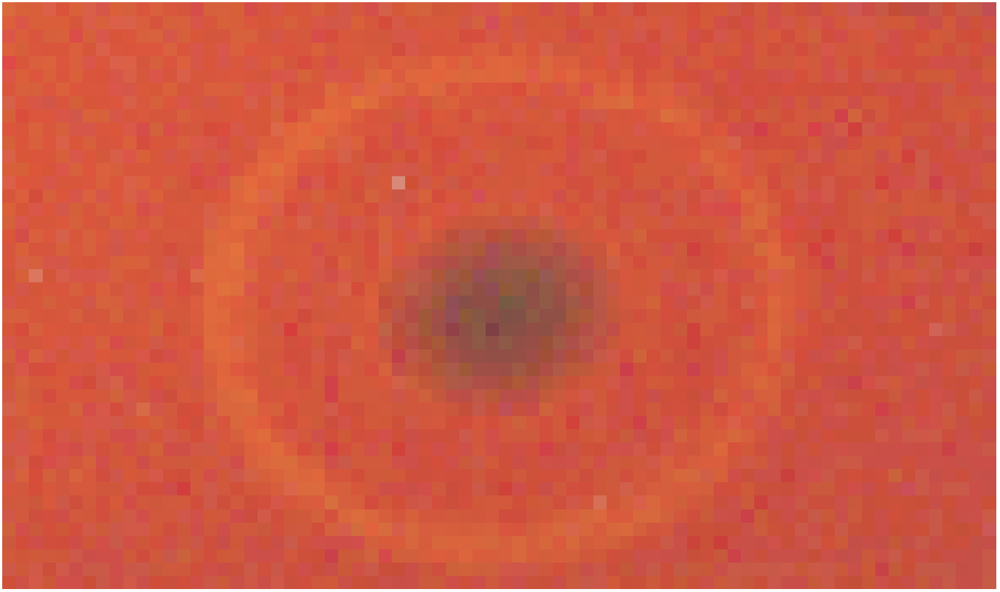
        <p>A distinctive feature of HBL is an unusual discontinuous hemolysis pattern produced in blood agar [<xref ref-type="bibr" rid="B33-toxins-02-01690">33</xref>,<xref ref-type="bibr" rid="B43-toxins-02-01690">43</xref>]. When HBL diffuses from a bacterial colony or a well in blood agar, lysis begins away from the well or colony, followed by slow lysis nearer the source (<xref ref-type="fig" rid="toxins-02-01690-f001">Figure 1</xref>). </p>
        <fig id="toxins-02-01690-f001" position="anchor">
          <label>Figure 1</label>
          <caption>
            <p>Discontinuous pattern of hemolysis produced by HBL on sheep blood agar.</p>
          </caption>
          <graphic xmlns:xlink="http://www.w3.org/1999/xlink" xlink:href="toxins-02-01690-g001.tif"/>
        </fig>
        <p>It has been proposed that the three HBL proteins bind to erythrocytes independently and the membrane-associated HBL components form a membrane attack complex that causes lysis by a colloid osmotic mechanism [<xref ref-type="bibr" rid="B43-toxins-02-01690">43</xref>]. This paradoxical zone phenomenon has been explained with a model in which a cell will not undergo lysis unless it has been primed with the B component, whose binding to the cell is inhibited by excess L<sub>1</sub>. Near the source, colony or well, L<sub>1 </sub>diffuses rapidly and accumulates to inhibitory levels before cells are primed. Hemolysis begins in a zone in which the B concentration is high enough to prime cells that are then rapidly lysed by any concentration of L<sub>1+2</sub> [<xref ref-type="bibr" rid="B43-toxins-02-01690">43</xref>].</p>
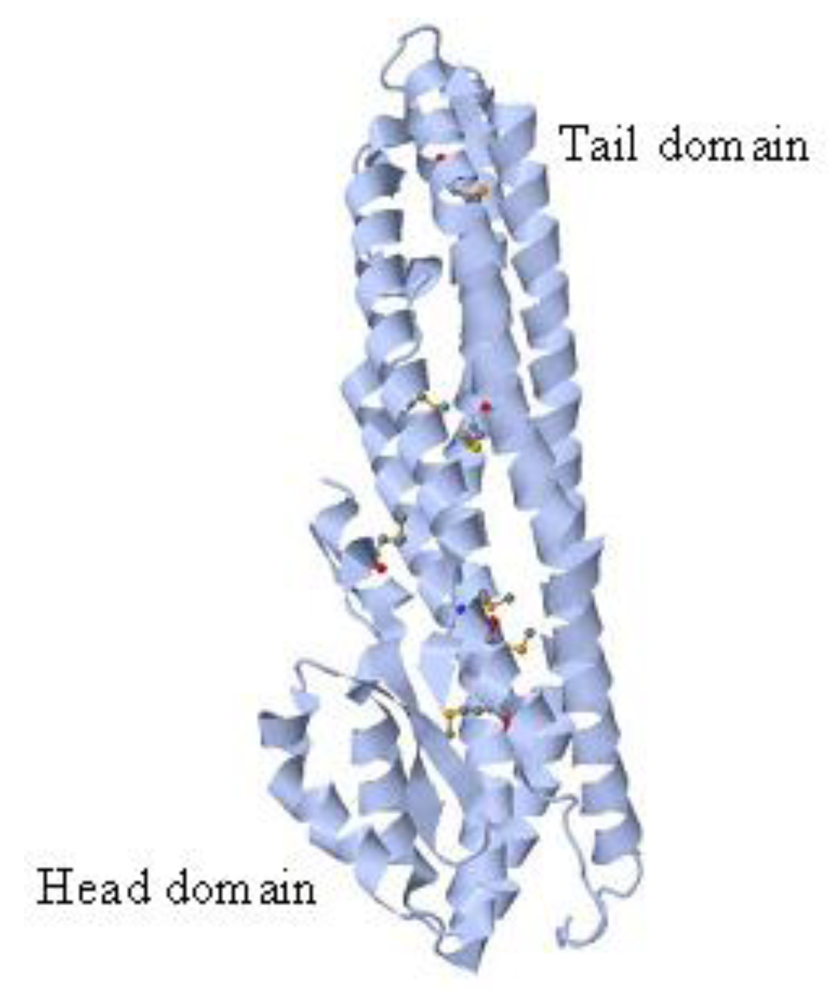
        <p>The X-ray crystal structure of the B component of HBL, deposited in the Protein Data Bank (PDB ID: 2NRJ), reveals a long α-helical bundle and a small α/β head domain [<xref ref-type="bibr" rid="B44-toxins-02-01690">44</xref>] (<xref ref-type="fig" rid="toxins-02-01690-f002">Figure 2</xref>). </p>
        <fig id="toxins-02-01690-f002" position="anchor">
          <label>Figure 2</label>
          <caption>
            <p>X-ray crystal structure of the B component of HBL (Protein Data Bank; <uri>http://www.pdb.org/</uri>). The α/β head domain has been proposed to bind and insert into the membrane of susceptible cells [<xref ref-type="bibr" rid="B44-toxins-02-01690">44</xref>]. </p>
          </caption>
          <graphic xmlns:xlink="http://www.w3.org/1999/xlink" xlink:href="toxins-02-01690-g002.tif"/>
        </fig>
        <p>This structure is highly similar to that of <italic>E. coli</italic> hemolysin E (HlyE, ClyA, SheA) (PDB ID: 1QOY) [<xref ref-type="bibr" rid="B45-toxins-02-01690">45</xref>] despite the low sequence homology, suggesting a common mode of pore formation. Based on the structural homology of the HBL-B component and HlyE and on analytical gel filtration studies, a model of HBL pore formation has also been proposed in which oligomerization of the B component into a heptamer or octamer may form a pore [<xref ref-type="bibr" rid="B44-toxins-02-01690">44</xref>]. In this model, the requirement of the three HBL components for hemolysis was explained by suggesting a role for both L<sub>1</sub> and L<sub>2</sub> in inducing conformational changes in B or in stabilizing the head domain of this protein in a membrane-insertion/competent conformation [<xref ref-type="bibr" rid="B44-toxins-02-01690">44</xref>].</p>
      </sec>
      <sec>
        <title>2.2. Genes and Regulation of Gene Transcription</title>
        <p>The HBL proteins B, L<sub>1 </sub>and L<sub>2</sub> are encoded by <italic>hblA</italic>, <italic>hblD</italic>, and <italic>hblC</italic>, respectively [<xref ref-type="bibr" rid="B46-toxins-02-01690">46</xref>]. These genes are arranged in an operon in the transcriptional order <italic>hblC</italic>, <italic>hblD</italic>, and <italic>hblA</italic> [<xref ref-type="bibr" rid="B46-toxins-02-01690">46</xref>]. Immediatelydownstream from <italic>hblA</italic>, lies an open reading frame, <italic>hblB</italic>, which isabout 85% identical to <italic>hblA</italic> in the first 158 predicted aminoacids. The <italic>hblB</italic> gene product has not yet been isolated. In the prototype strain F837/76, the first in which HBL has been characterized; B, L<sub>1 </sub>and L<sub>2</sub> have molecular weights of 37.5, 38.2, and 43.5 kDa, respectively. However, many isolates produce more than oneantigen reactive to antibodies against individual HBL components [<xref ref-type="bibr" rid="B47-toxins-02-01690">47</xref>] and distincthomologous variants of each protein from a single <italic>B. cereus</italic> strain was also shown [<xref ref-type="bibr" rid="B48-toxins-02-01690">48</xref>]. The high degree of similarity among these homologues suggests that the HBL genes may have been subjected to either simultaneous duplication or horizontal transfer [<xref ref-type="bibr" rid="B48-toxins-02-01690">48</xref>].</p>
        <p>Expression of <italic>hbl</italic> genes has been shown to be regulated by the proteins PlcR [<xref ref-type="bibr" rid="B49-toxins-02-01690">49</xref>], ResD [<xref ref-type="bibr" rid="B50-toxins-02-01690">50</xref>,<xref ref-type="bibr" rid="B51-toxins-02-01690">51</xref>], Fnr [<xref ref-type="bibr" rid="B52-toxins-02-01690">52</xref>,<xref ref-type="bibr" rid="B53-toxins-02-01690">53</xref>,<xref ref-type="bibr" rid="B54-toxins-02-01690">54</xref>], and CcpA [<xref ref-type="bibr" rid="B55-toxins-02-01690">55</xref>]. PlcR is known to autoactivate and activate the expression of the <italic>hbl</italic> operon by binding to a specific sequence, the PlcR-box palindromic region (TATGNAN4TNCATA) in the operon promoter sequence [<xref ref-type="bibr" rid="B49-toxins-02-01690">49</xref>,<xref ref-type="bibr" rid="B56-toxins-02-01690">56</xref>]. The transcription of <italic>plcR</italic> starts at the onset of the stationary phase and is repressed by the sporulation factor Spo0A [<xref ref-type="bibr" rid="B57-toxins-02-01690">57</xref>]. PlcR is activated by PapR, an autoinducer peptide that accumulates inside bacteria when high cell densities are reached, and facilitates binding of PlcR to the PlcR box [<xref ref-type="bibr" rid="B58-toxins-02-01690">58</xref>]. ResD is the response regulator of the two components system ResDE, which is activated under low-oxidoreduction potential anaerobic conditions [<xref ref-type="bibr" rid="B50-toxins-02-01690">50</xref>]. ResD regulates the expression <italic>hbl</italic> genes directly interacting with the promoter regions of the <italic>hbl</italic> operon as well as the enterotoxin regulator genes <italic>plcR</italic>, <italic>resDE</italic>, and <italic>fnr</italic> [<xref ref-type="bibr" rid="B51-toxins-02-01690">51</xref>]. The redox regulator Fnr is required for full expression of <italic>hbl</italic> genes independent of oxygen tension [<xref ref-type="bibr" rid="B52-toxins-02-01690">52</xref>] and carbohydrate used as a carbon source [<xref ref-type="bibr" rid="B54-toxins-02-01690">54</xref>]. This protein activates the expression of <italic>hbl</italic> genes by binding to the promoter sequences <italic>phbl</italic> and <italic>pplcR</italic> [<xref ref-type="bibr" rid="B53-toxins-02-01690">53</xref>]. The catabolite control protein CcpA is a transcriptional regulator that binds to DNA at a specific cis-binding sequence, the Catabolite Responsive Element (CRE) [<xref ref-type="bibr" rid="B55-toxins-02-01690">55</xref>]. In the stationary phase of growth and in the presence of glucose, this protein is thought to repress the expression of <italic>hbl</italic> genes, by binding to putative CRE-sites identified in this operon [<xref ref-type="bibr" rid="B55-toxins-02-01690">55</xref>]. Therefore, HBL production by <italic>B. cereus</italic> is highly controlled, as a wide variety of signals and proteins act as regulators of <italic>hbl</italic> gene transcription. </p>
      </sec>
      <sec>
        <title>2.3. Secretion</title>
        <p>Analysis of the amino acid sequences of the three HBL proteins show that they all possess a signal peptide sequence at their amino termini, thus suggesting their secretion through an <italic>S</italic>-dependent secretion pathway (Sec system). Nevertheless, integrity of the flagellar export apparatus has been demonstrated to be required for secretion of HBL [<xref ref-type="bibr" rid="B23-toxins-02-01690">23</xref>,<xref ref-type="bibr" rid="B59-toxins-02-01690">59</xref>]. The flagellar export apparatus encompasses at least six integral proteins (FlhA, FlhB, FliO, FliP, FliQ, and FliR in <italic>Salmonella</italic>) [<xref ref-type="bibr" rid="B60-toxins-02-01690">60</xref>] that share substantial homology with components of the type III virulence secretion pathway found in Gram-negative bacteria [<xref ref-type="bibr" rid="B61-toxins-02-01690">61</xref>]. This apparatus is essential for the export of flagellar components that are sequentially assembled from the cytoplasmic membrane outward. </p>
        <p>The first demonstration that the flagellar export complex could also function for secretion of non-flagellar proteins came from studies on <italic>Yersinia enterocolitica</italic>, in which the virulence-associated protein YplA is secreted by the flagellar export apparatus [<xref ref-type="bibr" rid="B62-toxins-02-01690">62</xref>]. This finding, combined with the structural similarity of this export system with the type III secretion system, have suggested that they may have had a common evolutionary origin and share overlapping functions. Regarding HBL, this protein was shown to be retained and degraded inside the cytoplasm in an acrystalliferous <italic>B. thuringiensis</italic> mutant in <italic>flhA</italic> [<xref ref-type="bibr" rid="B59-toxins-02-01690">59</xref>]. Failure to secrete intracellularly-synthesized HBL was also demonstrated in <italic>B. cereus</italic> natural isolates lacking flagella [<xref ref-type="bibr" rid="B23-toxins-02-01690">23</xref>]. A significant reduction in the amount of secreted HBL was reported for a <italic>B. cereus</italic> mutant lacking FlhF, a signal recognition particle (SRP)‑like GTPase involved in the regulation of the number and arrangement of flagella on the bacterial surface [<xref ref-type="bibr" rid="B27-toxins-02-01690">27</xref>]. This mutant was characterized by a marked reduction in the number of flagella (1–3 per cell) in comparison to wild-type (10–12 per cell) [<xref ref-type="bibr" rid="B27-toxins-02-01690">27</xref>]. Conversely, hyperflagellated swarm cells of <italic>B. cereus</italic> secrete significantly higher levels of HBL than the vegetative swimmer cells [<xref ref-type="bibr" rid="B23-toxins-02-01690">23</xref>]. All these data stress the role played by flagella in the virulence exerted by infectious <italic>B. thuringiensis/B. cereus</italic> strains; indeed, these locomotion organelles may facilitate adhesion to host cells, contribute to increase HBL secretion, and confer a higher propensity to colonize host mucosal surfaces and further enhance the flagellum‑mediated HBL secretion through differentiation of hyperflagellated swarm cells.</p>
        <p>Although further studies are still needed to clarify the mechanism of HBL secretion, the finding that the molecular mass of the secreted HBL components corresponds to that estimated for the proteins lacking the amino-terminal signal sequence, suggests that signal peptidases cooperate with the flagellar export apparatus for toxin secretion. This hypothesis is supported by the observation that the flagellar P- and L-ring subunits, which do possess a signal peptide sequence before being secreted, are exported and assembled in the flagellar structure only when all the components of the flagellar export apparatus are active [<xref ref-type="bibr" rid="B63-toxins-02-01690">63</xref>].</p>
      </sec>
    </sec>
    <sec>
      <title>3. The Non-Hemolytic Enterotoxin Nhe</title>
      <sec>
        <title>3.1. Structure and Biological Activity</title>
        <p>The three-component enterotoxin Nhe was first isolated from a <italic>B. cereus</italic> strain involved in alarge food-poisoning outbreak in Norway [<xref ref-type="bibr" rid="B64-toxins-02-01690">64</xref>]. The proteins were different from the components of HBL and had no evident hemolytic activity. It was initiallysuggested that a collagenase of 105 kDa [<xref ref-type="bibr" rid="B65-toxins-02-01690">65</xref>] was part of the Nhe complex [<xref ref-type="bibr" rid="B64-toxins-02-01690">64</xref>], but this was later found to be incorrect. Sequencingof the operon encoding the two components NheA and NheB [<xref ref-type="bibr" rid="B66-toxins-02-01690">66</xref>] revealeda novel gene encoding the protein designated NheC subsequently shown to be part of Nhe [<xref ref-type="bibr" rid="B34-toxins-02-01690">34</xref>]. </p>
        <p>Nhe isproduced by almost 100% of <italic>B. cereus</italic> strains [<xref ref-type="bibr" rid="B42-toxins-02-01690">42</xref>]. Nhe is cytotoxic against Vero cells [<xref ref-type="bibr" rid="B34-toxins-02-01690">34</xref>] and the cytotoxicity of supernatants from strains unable to synthesize HBL can be abolished by the addition of a neutralizing monoclonal antibody directed against NheB [<xref ref-type="bibr" rid="B67-toxins-02-01690">67</xref>]. As described for HBL, Nhe proteins are secreted independently and maximal toxic activity on Vero cells requires all three components in a molar ratio 10:10:1 of NheA, NheB, and NheC, respectively [<xref ref-type="bibr" rid="B34-toxins-02-01690">34</xref>]. NheB is the binding component of the enterotoxin complex and an increase in the concentration ofNheC results in a decrease in Nhe toxic activity [<xref ref-type="bibr" rid="B34-toxins-02-01690">34</xref>].</p>
        <p>The cytotoxic activity of Nhe on epithelial cells has been shown to be due to colloid osmotic lysis following pore formation in the plasma membrane [<xref ref-type="bibr" rid="B68-toxins-02-01690">68</xref>]. The same study also demonstrated hemolytic activity of Nhe, although lower than HBL, and homology models showed common structural features shared by the B component of HBL [<xref ref-type="bibr" rid="B44-toxins-02-01690">44</xref>] and the B and C components of Nhe [<xref ref-type="bibr" rid="B68-toxins-02-01690">68</xref>]. </p>
      </sec>
      <sec>
        <title>3.2. Genes and Regulation of Gene Transcription</title>
        <p>The three Nhe proteins are encoded by the <italic>nhe</italic> operon, comprising <italic>nheA</italic>, <italic>nheB</italic>, and <italic>nheC</italic> [<xref ref-type="bibr" rid="B34-toxins-02-01690">34</xref>,<xref ref-type="bibr" rid="B66-toxins-02-01690">66</xref>]. Primer extension analysis of the <italic>nhe</italic> operon identified the transcriptional start site at a Tpositioned 62 and 66 base pairs upstream of the translational startsite in two <italic>B. cereus</italic> strains, respectively [<xref ref-type="bibr" rid="B34-toxins-02-01690">34</xref>]. The presence of an inverted repeat between <italic>nheB</italic> and <italic>nheC</italic> suggested that translational repression could act in regulating the <italic>nheC</italic> expression, <italic>nheC</italic> being expressed at a lower level than <italic>nheA</italic> and <italic>nheB</italic> [<xref ref-type="bibr" rid="B34-toxins-02-01690">34</xref>,<xref ref-type="bibr" rid="B66-toxins-02-01690">66</xref>].</p>
        <p>The same transcriptional regulators described above for HBL are also active in modulating the expression of <italic>nhe</italic> genes. A PlcR-box present in the promoter region of the <italic>nhe</italic> operon is responsible for the PlcR-dependent activation of <italic>nhe</italic> transcription [<xref ref-type="bibr" rid="B49-toxins-02-01690">49</xref>,<xref ref-type="bibr" rid="B56-toxins-02-01690">56</xref>]. ResD and Fnr directly interact with the promoter region of the structural operon <italic>nhe</italic> activating its expression [<xref ref-type="bibr" rid="B51-toxins-02-01690">51</xref>,<xref ref-type="bibr" rid="B52-toxins-02-01690">52</xref>] and CcpA repress the expression of this operon by binding to putative CRE-sites [<xref ref-type="bibr" rid="B55-toxins-02-01690">55</xref>]. </p>
        <p>Despite the fact that regulators of <italic>nhe</italic> and <italic>hbl</italic> gene expression appear to be identical, the analysis of mutants defective in <italic>fnr</italic> and <italic>ccpA</italic> demonstrated different effects on the expression/secretion of these toxins. In fact, Nhe secretion was shown to be more moderately affected than HBL secretion in the <italic>fnr</italic> mutant of <italic>B. cereus</italic> [<xref ref-type="bibr" rid="B54-toxins-02-01690">54</xref>]. A <italic>ccpA</italic> deletion mutant displayed a higher expression (almost 20-fold) of the <italic>nhe</italic> operon compared to the <italic>hbl</italic> operon in the stationary phase [<xref ref-type="bibr" rid="B55-toxins-02-01690">55</xref>].</p>
      </sec>
      <sec>
        <title>3.3. Secretion</title>
        <p>The presence of signal peptide sequences in the three components of Nhe suggests their secretion occurs through the Sec system, although no direct demonstration of a Sec-dependent secretion of Nhe has been provided. The only data regarding Nhe secretion in <italic>B. cereus</italic> came from the observation that toxin secretion is influenced by FlhF [<xref ref-type="bibr" rid="B27-toxins-02-01690">27</xref>], a signal recognition particle-like protein showing homology with Ffh and FtsY that are required for extracellular accumulation of proteins in <italic>E. coli</italic> and <italic>B. subtilis</italic> [<xref ref-type="bibr" rid="B69-toxins-02-01690">69</xref>,<xref ref-type="bibr" rid="B70-toxins-02-01690">70</xref>]. The <italic>B. cereus</italic> mutant in <italic>flhF</italic> was shown to display an almost 20% increase in the secretion of Nhe, together with a general increase in secretion for almost all extracellular proteins [<xref ref-type="bibr" rid="B27-toxins-02-01690">27</xref>]. Conversely, the <italic>B. cereus</italic> mutant in <italic>flhF</italic>, which is characterized by a reduction in the number of flagella on the cell surface, displays a significant decrease in the secretion of HBL, whose export is flagellum-dependent. Therefore, it appears that Nhe secretion does not require a flagellar export apparatus to be released outside the cell and, though only indirectly, supports the hypothesis that Nhe secretion can occur <italic>via</italic> a Sec-dependent mechanism. </p>
      </sec>
    </sec>
    <sec>
      <title>4. Cytotoxin K</title>
      <p>CytK was first identified as the only cytotoxic, necrotic, and hemolytic toxin of the <italic>B. cereus</italic> strain NVH391/98, which was involved in a severe outbreak of food poisoning occurring in France in 1998 [<xref ref-type="bibr" rid="B36-toxins-02-01690">36</xref>]. In the same year, this 34 kDa protein was also identified from fractionated supernatants of an endophthalmitis-associated <italic>B. cereus</italic> isolate and referred to as hemolysin IV [<xref ref-type="bibr" rid="B39-toxins-02-01690">39</xref>]. CytK was purified and proved to be highly cytotoxic against Vero cells [<xref ref-type="bibr" rid="B35-toxins-02-01690">35</xref>]. The deduced amino acid sequence of CytK shows similarity to <italic>Staphylococcus aureus</italic> leucocidins, gamma-haemolysin and alpha-haemolysin, <italic>Clostridium perfringens</italic> beta-toxin and <italic>B. cereus</italic> haemolysin II, all belonging to a family of beta-barrel channel-forming toxins [<xref ref-type="bibr" rid="B36-toxins-02-01690">36</xref>]. In agreement with this structural similarity, CytK was demonstrated to possess enterotoxic activity against intestinal epithelia and an ability to form pores in planar lipid bilayers [<xref ref-type="bibr" rid="B35-toxins-02-01690">35</xref>]. </p>
      <p>Cytotoxin K can occur in two different forms, CytK 1 and CytK 2. CytK 1 was originally isolated from strain NVH391/98 and was observed to be five-fold more cytotoxic for human intestinal CaCo2 cells and Vero cells than CytK 2 [<xref ref-type="bibr" rid="B71-toxins-02-01690">71</xref>]. However, the finding that other strains carrying CytK 1 are not as toxic as NVH391/98 [<xref ref-type="bibr" rid="B72-toxins-02-01690">72</xref>] suggests that variations in cytotoxicity are actually linked to variations in the levels of toxin expression instead of different virulence potential of the two CytK forms. </p>
      <p>CytK is encoded by <italic>cytK</italic>, whose expression is regulated by PlcR through its binding to a PlcR-box in the cytK promoter sequence [<xref ref-type="bibr" rid="B36-toxins-02-01690">36</xref>,<xref ref-type="bibr" rid="B56-toxins-02-01690">56</xref>]. No putative CRE-site was identified upstream of <italic>cytK</italic> and differential expression of this gene was not observed in a <italic>ccpA</italic> mutant, suggesting that <italic>cytK</italic> expression is not CcpA-mediated [<xref ref-type="bibr" rid="B55-toxins-02-01690">55</xref>]. </p>
      <p><italic>cytK</italic> was recently detected in about 85% of <italic>B. cereus</italic> and <italic>B. thuringiensis</italic> strains belonging to a collection of 616 strains [<xref ref-type="bibr" rid="B73-toxins-02-01690">73</xref>], indicating the high prevalence of strains potentially able to cause severe food poisoning.</p>
      <p>The aminoterminal sequence of CytK contains a putative secretory signal peptide suggesting its secretion through the Sec-pathway. CytK secretion was shown to be unaffected in an acrystalliferous <italic>B. thuringiensis</italic> mutant in <italic>flhA</italic> lacking flagella [<xref ref-type="bibr" rid="B59-toxins-02-01690">59</xref>], thus indicating that the flagellar export system is not involved in the secretion of this toxin. </p>
    </sec>
    <sec sec-type="conclusions">
      <title>5. Conclusions</title>
      <p>The production of spores, which are highly adhesive and can spread from natural <italic>B. cereus</italic> habitats to food production environments, accounts for the ability of <italic>B. cereus</italic> to contaminate any kind of food. The high frequency of food contamination by <italic>B. cereus</italic> and the active production and secretion of HBL, Nhe and CytK enterotoxins, explain why this organism is responsible for the majority of food-poisoning related diseases. However, increasing evidence supporting the involvement of <italic>B. cereus</italic> in severe extra-intestinal infections highlights the importance to further study: (i) the mechanisms by which the toxins and enzymes <italic>B. cereus</italic> produces contribute to development and progression of diseases; and (ii) the role played by swarming migration in enhancing tissue colonization by infectious <italic>B. cereus</italic> strains.</p>
    </sec>
  </body>
  <back>
    <ref-list>
      <title>References</title>
      <ref id="B1-toxins-02-01690">
        <label>1.</label>
        <citation citation-type="journal">
          <person-group person-group-type="author">
            <name>
              <surname>Drobniewski</surname>
              <given-names>F.A.</given-names>
            </name>
          </person-group>
          <article-title><italic>Bacillus cereus</italic> and related species</article-title>
          <source>Clin. Microbiol. Rev.</source>
          <year>1993</year>
          <volume>6</volume>
          <fpage>324</fpage>
          <lpage>338</lpage>
        <pub-id pub-id-type="pmid">8269390</pub-id></citation>
      </ref>
      <ref id="B2-toxins-02-01690">
        <label>2.</label>
        <citation citation-type="journal">
          <person-group person-group-type="author">
            <name>
              <surname>Callegan</surname>
              <given-names>M.C.</given-names>
            </name>
            <name>
              <surname>Booth</surname>
              <given-names>M.C.</given-names>
            </name>
            <name>
              <surname>Jett</surname>
              <given-names>B.D.</given-names>
            </name>
            <name>
              <surname>Gilmore</surname>
              <given-names>M.S.</given-names>
            </name>
          </person-group>
          <article-title>Pathogenesis of gram-positive bacterial endophthalmitis</article-title>
          <source>Infect. Immun.</source>
          <year>1999</year>
          <volume>67</volume>
          <fpage>3348</fpage>
          <lpage>3356</lpage>
        <pub-id pub-id-type="pmid">10377112</pub-id></citation>
      </ref>
      <ref id="B3-toxins-02-01690">
        <label>3.</label>
        <citation citation-type="book">
          <person-group person-group-type="author">
            <name>
              <surname>Logan</surname>
              <given-names>N.A.</given-names>
            </name>
            <name>
              <surname>Turnbull</surname>
              <given-names>P.C.</given-names>
            </name>
          </person-group>
          <source>Manual of Clinical Microbiology</source>
          <person-group person-group-type="editor">
            <name>
              <surname>Murray</surname>
              <given-names>P.R.</given-names>
            </name>
          </person-group>
          <publisher-name>American Society for Microbiology</publisher-name>
          <publisher-loc>Washington, DC, USA</publisher-loc>
          <year>1999</year>
          <fpage>357</fpage>
          <lpage>369</lpage>
        </citation>
      </ref>
      <ref id="B4-toxins-02-01690">
        <label>4.</label>
        <citation citation-type="book">
          <person-group person-group-type="author">
            <name>
              <surname>Sneath</surname>
              <given-names>P.H.A.</given-names>
            </name>
          </person-group>
          <article-title>Endospore-forming Gram-positive rods and cocci</article-title>
          <source>Bergey’s Manual of Systematic Bacteriology</source>
          <person-group person-group-type="editor">
            <name>
              <surname>Holt</surname>
              <given-names>J.G.</given-names>
            </name>
          </person-group>
          <publisher-name>The Williams &amp; Wilkins Co.</publisher-name>
          <publisher-loc>Baltimore, MD, USA</publisher-loc>
          <year>1986</year>
          <fpage>1104</fpage>
          <lpage>1139</lpage>
        </citation>
      </ref>
      <ref id="B5-toxins-02-01690">
        <label>5.</label>
        <citation citation-type="journal">
          <person-group person-group-type="author">
            <name>
              <surname>Lechner</surname>
              <given-names>S.</given-names>
            </name>
            <name>
              <surname>Mayr</surname>
              <given-names>R.</given-names>
            </name>
            <name>
              <surname>Fransis</surname>
              <given-names>K.P.</given-names>
            </name>
            <name>
              <surname>Pruss</surname>
              <given-names>B.M.</given-names>
            </name>
            <name>
              <surname>Kaplan</surname>
              <given-names>T.</given-names>
            </name>
            <name>
              <surname>Wiebner-Gunkel</surname>
              <given-names>E.</given-names>
            </name>
            <name>
              <surname>Stewart</surname>
              <given-names>G.S.</given-names>
            </name>
            <name>
              <surname>Scherer</surname>
              <given-names>A.B.</given-names>
            </name>
          </person-group>
          <article-title><italic>Bacillus weihenstephanensis</italic> sp. nov. is a new psychrotolerant species of the <italic>Bacillus cereus</italic> group</article-title>
          <source>Int. J. Syst. Bacteriol.</source>
          <year>1998</year>
          <volume>48</volume>
          <fpage>1373</fpage>
          <lpage>1382</lpage>
          <pub-id pub-id-type="pmid">9828439</pub-id>
          <pub-id pub-id-type="doi">10.1099/00207713-48-4-1373</pub-id>
        </citation>
      </ref>
      <ref id="B6-toxins-02-01690">
        <label>6.</label>
        <citation citation-type="journal">
          <person-group person-group-type="author">
            <name>
              <surname>Nakamura</surname>
              <given-names>L.K.</given-names>
            </name>
          </person-group>
          <article-title><italic>Bacillus pseudomycoides</italic> sp. nov.</article-title>
          <source>Int. Syst. Bacteriol.</source>
          <year>1998</year>
          <volume>48</volume>
          <fpage>1031</fpage>
          <lpage>1034</lpage>
          <pub-id pub-id-type="doi">10.1099/00207713-48-3-1031</pub-id>
        </citation>
      </ref>
      <ref id="B7-toxins-02-01690">
        <label>7.</label>
        <citation citation-type="journal">
          <person-group person-group-type="author">
            <name>
              <surname>Turnbull</surname>
              <given-names>P.C.B.</given-names>
            </name>
          </person-group>
          <article-title>Definitive identification of <italic>Bacillus anthracis</italic>—A review</article-title>
          <source>J. Appl. Microbiol.</source>
          <year>1999</year>
          <volume>87</volume>
          <fpage>237</fpage>
          <lpage>240</lpage>
        <pub-id pub-id-type="doi">10.1046/j.1365-2672.1999.00876.x</pub-id><pub-id pub-id-type="pmid">10475956</pub-id></citation>
      </ref>
      <ref id="B8-toxins-02-01690">
        <label>8.</label>
        <citation citation-type="journal">
          <person-group person-group-type="author">
            <name>
              <surname>Kaneko</surname>
              <given-names>T.</given-names>
            </name>
            <name>
              <surname>Nozaki</surname>
              <given-names>R.</given-names>
            </name>
            <name>
              <surname>Aizawa</surname>
              <given-names>K.</given-names>
            </name>
          </person-group>
          <article-title>Deoxyribonucleic acid relatedness between <italic>Bacillus anthracis</italic>, <italic>Bacillus cereus</italic>, and <italic>Bacillus thuringiensis</italic></article-title>
          <source>Microbiol. Immunol.</source>
          <year>1978</year>
          <volume>22</volume>
          <fpage>638</fpage>
          <lpage>641</lpage>
        </citation>
      </ref>
      <ref id="B9-toxins-02-01690">
        <label>9.</label>
        <citation citation-type="journal">
          <person-group person-group-type="author">
            <name>
              <surname>Ash</surname>
              <given-names>C.</given-names>
            </name>
            <name>
              <surname>Farrow</surname>
              <given-names>J.A.</given-names>
            </name>
            <name>
              <surname>Dorsch</surname>
              <given-names>M.</given-names>
            </name>
            <name>
              <surname>Stackebrandt</surname>
              <given-names>E.</given-names>
            </name>
            <name>
              <surname>Collins</surname>
              <given-names>M.D.</given-names>
            </name>
          </person-group>
          <article-title>Comparative analysis of <italic>Bacillus anthracis</italic>, <italic>Bacillus cereus</italic>, and related species on the basis of reverse transcriptase sequencing of 16S rRNA</article-title>
          <source>Int. J. Syst. Bacteriol.</source>
          <year>1991</year>
          <volume>41</volume>
          <fpage>343</fpage>
          <lpage>346</lpage>
        <pub-id pub-id-type="doi">10.1099/00207713-41-3-343</pub-id><pub-id pub-id-type="pmid">1715736</pub-id></citation>
      </ref>
      <ref id="B10-toxins-02-01690">
        <label>10.</label>
        <citation citation-type="journal">
          <person-group person-group-type="author">
            <name>
              <surname>Ash</surname>
              <given-names>C.</given-names>
            </name>
            <name>
              <surname>Collins</surname>
              <given-names>M.D.</given-names>
            </name>
          </person-group>
          <article-title>Comparative analysis of 23S ribosomal RNA gene sequences of <italic>Bacillus anthracis</italic> and emetic <italic>Bacillus cereus</italic> determined by PCR-direct sequencing</article-title>
          <source>FEMS Microbiol. Lett.</source>
          <year>1992</year>
          <volume>94</volume>
          <fpage>75</fpage>
          <lpage>80</lpage>
        <pub-id pub-id-type="doi">10.1111/j.1574-6968.1992.tb05292.x</pub-id></citation>
      </ref>
      <ref id="B11-toxins-02-01690">
        <label>11.</label>
        <citation citation-type="journal">
          <person-group person-group-type="author">
            <name>
              <surname>Baillie</surname>
              <given-names>L.</given-names>
            </name>
            <name>
              <surname>Read</surname>
              <given-names>T.D.</given-names>
            </name>
          </person-group>
          <article-title><italic>Bacillus anthracis</italic>, a bug with attitude!</article-title>
          <source>Curr. Opin. Microbiol.</source>
          <year>2001</year>
          <volume>4</volume>
          <fpage>78</fpage>
          <lpage>81</lpage>
          <pub-id pub-id-type="doi">10.1016/S1369-5274(00)00168-5</pub-id>
        </citation>
      </ref>
      <ref id="B12-toxins-02-01690">
        <label>12.</label>
        <citation citation-type="journal">
          <person-group person-group-type="author">
            <name>
              <surname>Höfte</surname>
              <given-names>H.</given-names>
            </name>
            <name>
              <surname>Whiteley</surname>
              <given-names>H.R.</given-names>
            </name>
          </person-group>
          <article-title>Insecticidal crystal proteins of <italic>Bacillus thuringiensis</italic></article-title>
          <source>Microbiol. Rev.</source>
          <year>1989</year>
          <volume>53</volume>
          <fpage>242</fpage>
          <lpage>255</lpage>
        <pub-id pub-id-type="pmid">2666844</pub-id></citation>
      </ref>
      <ref id="B13-toxins-02-01690">
        <label>13.</label>
        <citation citation-type="journal">
          <person-group person-group-type="author">
            <name>
              <surname>Callahan</surname>
              <given-names>C.</given-names>
            </name>
            <name>
              <surname>Fox</surname>
              <given-names>K.</given-names>
            </name>
            <name>
              <surname>Fox</surname>
              <given-names>A.</given-names>
            </name>
          </person-group>
          <article-title>The small acid soluble proteins (SASP α and SASP β) of <italic>Bacillus weihenstephanensis</italic> and <italic>Bacillus mycoides</italic> group 2 are the most distinct among the <italic>Bacillus cereus</italic> group</article-title>
          <source>Mol. Cell. Probes</source>
          <year>2009</year>
          <volume>23</volume>
          <fpage>291</fpage>
          <lpage>297</lpage>
        <pub-id pub-id-type="doi">10.1016/j.mcp.2009.07.003</pub-id><pub-id pub-id-type="pmid">19616612</pub-id></citation>
      </ref>
      <ref id="B14-toxins-02-01690">
        <label>14.</label>
        <citation citation-type="journal">
          <person-group person-group-type="author">
            <name>
              <surname>Hoffmaster</surname>
              <given-names>A.R.</given-names>
            </name>
            <name>
              <surname>Hill</surname>
              <given-names>K.K.</given-names>
            </name>
            <name>
              <surname>Gee</surname>
              <given-names>J.E.</given-names>
            </name>
            <name>
              <surname>Marston</surname>
              <given-names>C.K.</given-names>
            </name>
            <name>
              <surname>De</surname>
              <given-names>B.K.</given-names>
            </name>
            <name>
              <surname>Popovic</surname>
              <given-names>T.</given-names>
            </name>
            <name>
              <surname>Sue</surname>
              <given-names>D.</given-names>
            </name>
            <name>
              <surname>Wilkins</surname>
              <given-names>P.P.</given-names>
            </name>
            <name>
              <surname>Avashia</surname>
              <given-names>S.B.</given-names>
            </name>
            <name>
              <surname>Drumgoole</surname>
              <given-names>R.</given-names>
            </name>
            <name>
              <surname>Helma</surname>
              <given-names>C.H.</given-names>
            </name>
            <name>
              <surname>Ticknor</surname>
              <given-names>L.O.</given-names>
            </name>
            <name>
              <surname>Okinaka</surname>
              <given-names>R.T.</given-names>
            </name>
            <name>
              <surname>Jackson</surname>
              <given-names>P.J.</given-names>
            </name>
          </person-group>
          <article-title>Characterization of <italic>Bacillus cereus</italic> isolates associated with fatal pneumonias: Strains are closely related to <italic>Bacillus anthracis</italic> and harbor <italic>B. anthracis</italic> virulence genes</article-title>
          <source>J. Clin. Microbiol.</source>
          <year>2006</year>
          <volume>44</volume>
          <fpage>3352</fpage>
          <lpage>3360</lpage>
          <pub-id pub-id-type="pmid">16954272</pub-id>
        </citation>
      </ref>
      <ref id="B15-toxins-02-01690">
        <label>15.</label>
        <citation citation-type="journal">
          <person-group person-group-type="author">
            <name>
              <surname>Turnbull</surname>
              <given-names>P.C.B.</given-names>
            </name>
            <name>
              <surname>Hutson</surname>
              <given-names>R.A.</given-names>
            </name>
            <name>
              <surname>Ward</surname>
              <given-names>M.J.</given-names>
            </name>
            <name>
              <surname>Jones</surname>
              <given-names>M.N.</given-names>
            </name>
            <name>
              <surname>Quinn</surname>
              <given-names>C.P.</given-names>
            </name>
            <name>
              <surname>Finnle</surname>
              <given-names>N.J.</given-names>
            </name>
            <name>
              <surname>Duggleby</surname>
              <given-names>C.J.</given-names>
            </name>
            <name>
              <surname>Kramer</surname>
              <given-names>J.M.</given-names>
            </name>
            <name>
              <surname>Melling</surname>
              <given-names>J.</given-names>
            </name>
          </person-group>
          <article-title><italic>Bacillus anthracis</italic> but not always anthrax</article-title>
          <source>J. Appl. Bacteriol.</source>
          <year>1992</year>
          <volume>72</volume>
          <fpage>21</fpage>
          <lpage>28</lpage>
        <pub-id pub-id-type="pmid">1541596</pub-id></citation>
      </ref>
      <ref id="B16-toxins-02-01690">
        <label>16.</label>
        <citation citation-type="journal">
          <person-group person-group-type="author">
            <name>
              <surname>Pannucci</surname>
              <given-names>J.</given-names>
            </name>
            <name>
              <surname>Okinaka</surname>
              <given-names>R.</given-names>
            </name>
            <name>
              <surname>Sabin</surname>
              <given-names>R.</given-names>
            </name>
            <name>
              <surname>Kuske</surname>
              <given-names>C.</given-names>
            </name>
          </person-group>
          <article-title><italic>Bacillus anthracis</italic> pXO1 plasmid sequence conservation among closely related bacterial species</article-title>
          <source>J. Bacteriol.</source>
          <year>2002</year>
          <volume>184</volume>
          <fpage>134</fpage>
          <lpage>1341</lpage>
        <pub-id pub-id-type="doi">10.1128/JB.184.1.134-141.2002</pub-id><pub-id pub-id-type="pmid">11741853</pub-id></citation>
      </ref>
      <ref id="B17-toxins-02-01690">
        <label>17.</label>
        <citation citation-type="journal">
          <person-group person-group-type="author">
            <name>
              <surname>Luna</surname>
              <given-names>V.A.</given-names>
            </name>
            <name>
              <surname>King</surname>
              <given-names>D.S.</given-names>
            </name>
            <name>
              <surname>Peak</surname>
              <given-names>K.K.</given-names>
            </name>
            <name>
              <surname>Reeves</surname>
              <given-names>F.</given-names>
            </name>
            <name>
              <surname>Heberlein-Larson</surname>
              <given-names>L.</given-names>
            </name>
            <name>
              <surname>Veguilla</surname>
              <given-names>W.</given-names>
            </name>
            <name>
              <surname>Heller</surname>
              <given-names>L.</given-names>
            </name>
            <name>
              <surname>Duncan</surname>
              <given-names>K.E.</given-names>
            </name>
            <name>
              <surname>Cannons</surname>
              <given-names>A.C.</given-names>
            </name>
            <name>
              <surname>Amuso</surname>
              <given-names>P.</given-names>
            </name>
            <name>
              <surname>Cattani</surname>
              <given-names>J.</given-names>
            </name>
          </person-group>
          <article-title><italic>Bacillus anthracis</italic> virulent plasmid pX02 genes found in large plasmids of two other <italic>Bacillus</italic> species</article-title>
          <source>J. Clin. Microbiol.</source>
          <year>2006</year>
          <volume>44</volume>
          <fpage>2367</fpage>
          <lpage>2377</lpage>
        <pub-id pub-id-type="doi">10.1128/JCM.00154-06</pub-id><pub-id pub-id-type="pmid">16825351</pub-id></citation>
      </ref>
      <ref id="B18-toxins-02-01690">
        <label>18.</label>
        <citation citation-type="journal">
          <person-group person-group-type="author">
            <name>
              <surname>Schnepf</surname>
              <given-names>E.</given-names>
            </name>
            <name>
              <surname>Crickmore</surname>
              <given-names>N.</given-names>
            </name>
            <name>
              <surname>Van Rie</surname>
              <given-names>J.</given-names>
            </name>
            <name>
              <surname>Lereclus</surname>
              <given-names>D.</given-names>
            </name>
            <name>
              <surname>Baum</surname>
              <given-names>J.</given-names>
            </name>
            <name>
              <surname>Feitelson</surname>
              <given-names>J.</given-names>
            </name>
            <name>
              <surname>Zeigler</surname>
              <given-names>D.R.</given-names>
            </name>
            <name>
              <surname>Dean</surname>
              <given-names>D.H.</given-names>
            </name>
          </person-group>
          <article-title><italic>Bacillus thuringiensis</italic> and its pesticidal crystal proteins</article-title>
          <source>Microbiol. Mol. Biol.</source>
          <year>1998</year>
          <volume>62</volume>
          <fpage>775</fpage>
          <lpage>806</lpage>
        </citation>
      </ref>
      <ref id="B19-toxins-02-01690">
        <label>19.</label>
        <citation citation-type="journal">
          <person-group person-group-type="author">
            <name>
              <surname>Mignot</surname>
              <given-names>T.</given-names>
            </name>
            <name>
              <surname>Mock</surname>
              <given-names>M.</given-names>
            </name>
            <name>
              <surname>Robichon</surname>
              <given-names>D.</given-names>
            </name>
            <name>
              <surname>Landier</surname>
              <given-names>A.</given-names>
            </name>
            <name>
              <surname>Lereclus</surname>
              <given-names>D.</given-names>
            </name>
            <name>
              <surname>Fouet</surname>
              <given-names>A.</given-names>
            </name>
          </person-group>
          <article-title>The incompatibility between the PlcR- and AtxA-controlled regulons may have selected a nonsense mutation in <italic>Bacillus anthracis</italic></article-title>
          <source>Mol. Microbiol.</source>
          <year>2001</year>
          <volume>42</volume>
          <fpage>1189</fpage>
          <lpage>1198</lpage>
        <pub-id pub-id-type="pmid">11886551</pub-id></citation>
      </ref>
      <ref id="B20-toxins-02-01690">
        <label>20.</label>
        <citation citation-type="journal">
          <person-group person-group-type="author">
            <name>
              <surname>Prüss</surname>
              <given-names>B.M.</given-names>
            </name>
            <name>
              <surname>Francis</surname>
              <given-names>K.P.</given-names>
            </name>
            <name>
              <surname>von Stetten</surname>
              <given-names>F.</given-names>
            </name>
            <name>
              <surname>Scherer</surname>
              <given-names>S.</given-names>
            </name>
          </person-group>
          <article-title>Correlation of 16S ribosomal DNA signature sequences with temperature-dependent growth rates of mesophilic and psychrotolerant strains of the <italic>Bacillus cereus</italic> group</article-title>
          <source>J. Bacteriol.</source>
          <year>1999</year>
          <volume>181</volume>
          <fpage>2624</fpage>
          <lpage>2630</lpage>
        <pub-id pub-id-type="pmid">10198030</pub-id></citation>
      </ref>
      <ref id="B21-toxins-02-01690">
        <label>21.</label>
        <citation citation-type="journal">
          <person-group person-group-type="author">
            <name>
              <surname>Stenfors</surname>
              <given-names>L.P.</given-names>
            </name>
            <name>
              <surname>Granum</surname>
              <given-names>P.E.</given-names>
            </name>
          </person-group>
          <article-title>Psychrotolerant species from the <italic>Bacillus cereus</italic> group are not necessarily <italic>Bacillus weihenstephanensis</italic></article-title>
          <source>FEMS Microbiol. Lett.</source>
          <year>2001</year>
          <volume>197</volume>
          <fpage>223</fpage>
          <lpage>228</lpage>
          <pub-id pub-id-type="pmid">11313138</pub-id>
          <pub-id pub-id-type="doi">10.1111/j.1574-6968.2001.tb10607.x</pub-id>
        </citation>
      </ref>
      <ref id="B22-toxins-02-01690">
        <label>22.</label>
        <citation citation-type="journal">
          <person-group person-group-type="author">
            <name>
              <surname>Cardazzo</surname>
              <given-names>B.</given-names>
            </name>
            <name>
              <surname>Negrisolo</surname>
              <given-names>E.</given-names>
            </name>
            <name>
              <surname>Carraro</surname>
              <given-names>L.</given-names>
            </name>
            <name>
              <surname>Alberghini</surname>
              <given-names>L.</given-names>
            </name>
            <name>
              <surname>Patarnello</surname>
              <given-names>T.</given-names>
            </name>
            <name>
              <surname>Giaccone</surname>
              <given-names>V.</given-names>
            </name>
          </person-group>
          <article-title>Multiple-locus sequence typing and analysis of toxin genes in <italic>Bacillus cereus</italic> food-borne isolates</article-title>
          <source>Appl. Environ. Microbiol.</source>
          <year>2008</year>
          <volume>74</volume>
          <fpage>850</fpage>
          <lpage>860</lpage>
        <pub-id pub-id-type="doi">10.1128/AEM.01495-07</pub-id><pub-id pub-id-type="pmid">18083872</pub-id></citation>
      </ref>
      <ref id="B23-toxins-02-01690">
        <label>23.</label>
        <citation citation-type="journal">
          <person-group person-group-type="author">
            <name>
              <surname>Ghelardi</surname>
              <given-names>E.</given-names>
            </name>
            <name>
              <surname>Celandroni</surname>
              <given-names>F.</given-names>
            </name>
            <name>
              <surname>Salvetti</surname>
              <given-names>S.</given-names>
            </name>
            <name>
              <surname>Ceragioli</surname>
              <given-names>M.</given-names>
            </name>
            <name>
              <surname>Beecher</surname>
              <given-names>D.J.</given-names>
            </name>
            <name>
              <surname>Senesi</surname>
              <given-names>S.</given-names>
            </name>
            <name>
              <surname>Wong</surname>
              <given-names>A.C.</given-names>
            </name>
          </person-group>
          <article-title>Swarming behavior of and hemolysin BL secretion by <italic>Bacillus cereus</italic></article-title>
          <source>Appl. Environ. Microbiol.</source>
          <year>2007</year>
          <volume>73</volume>
          <fpage>4089</fpage>
          <lpage>4093</lpage>
        <pub-id pub-id-type="doi">10.1128/AEM.02345-06</pub-id><pub-id pub-id-type="pmid">17449693</pub-id></citation>
      </ref>
      <ref id="B24-toxins-02-01690">
        <label>24.</label>
        <citation citation-type="journal">
          <person-group person-group-type="author">
            <name>
              <surname>Ramarao</surname>
              <given-names>N.</given-names>
            </name>
            <name>
              <surname>Lereclus</surname>
              <given-names>D.</given-names>
            </name>
          </person-group>
          <article-title>Adhesion and cytotoxicity of <italic>Bacillus cereus</italic> and <italic>Bacillus thuringiensis</italic> to epithelial cells are FlhA and PlcR dependent, respectively</article-title>
          <source>Microbes Infect.</source>
          <year>2006</year>
          <volume>8</volume>
          <fpage>1483</fpage>
          <lpage>1491</lpage>
        <pub-id pub-id-type="doi">10.1016/j.micinf.2006.01.005</pub-id><pub-id pub-id-type="pmid">16697234</pub-id></citation>
      </ref>
      <ref id="B25-toxins-02-01690">
        <label>25.</label>
        <citation citation-type="journal">
          <person-group person-group-type="author">
            <name>
              <surname>Houry</surname>
              <given-names>A.</given-names>
            </name>
            <name>
              <surname>Briandet</surname>
              <given-names>R.</given-names>
            </name>
            <name>
              <surname>Aymerich</surname>
              <given-names>S.</given-names>
            </name>
            <name>
              <surname>Gohar</surname>
              <given-names>M.</given-names>
            </name>
          </person-group>
          <article-title>Involvement of motility and flagella in <italic>Bacillus cereus</italic> biofilm formation</article-title>
          <source>Microbiology</source>
          <year>2010</year>
          <volume>156</volume>
          <fpage>1009</fpage>
          <lpage>1018</lpage>
        <pub-id pub-id-type="doi">10.1099/mic.0.034827-0</pub-id><pub-id pub-id-type="pmid">20035003</pub-id></citation>
      </ref>
      <ref id="B26-toxins-02-01690">
        <label>26.</label>
        <citation citation-type="journal">
          <person-group person-group-type="author">
            <name>
              <surname>Senesi</surname>
              <given-names>S.</given-names>
            </name>
            <name>
              <surname>Celandroni</surname>
              <given-names>F.</given-names>
            </name>
            <name>
              <surname>Salvetti</surname>
              <given-names>S.</given-names>
            </name>
            <name>
              <surname>Beecher</surname>
              <given-names>D.J.</given-names>
            </name>
            <name>
              <surname>Wong</surname>
              <given-names>A.C.</given-names>
            </name>
            <name>
              <surname>Ghelardi</surname>
              <given-names>E.</given-names>
            </name>
          </person-group>
          <article-title>Swarming motility in <italic>Bacillus cereus</italic> and characterization of a <italic>fliY</italic> mutant impaired in swarm cell differentiation</article-title>
          <source>Microbiology</source>
          <year>2002</year>
          <volume>148</volume>
          <fpage>1785</fpage>
          <lpage>1794</lpage>
        <pub-id pub-id-type="pmid">12055298</pub-id></citation>
      </ref>
      <ref id="B27-toxins-02-01690">
        <label>27.</label>
        <citation citation-type="journal">
          <person-group person-group-type="author">
            <name>
              <surname>Salvetti</surname>
              <given-names>S.</given-names>
            </name>
            <name>
              <surname>Ghelardi</surname>
              <given-names>E.</given-names>
            </name>
            <name>
              <surname>Celandroni</surname>
              <given-names>F.</given-names>
            </name>
            <name>
              <surname>Ceragioli</surname>
              <given-names>M.</given-names>
            </name>
            <name>
              <surname>Giannessi</surname>
              <given-names>F.</given-names>
            </name>
            <name>
              <surname>Senesi</surname>
              <given-names>S.</given-names>
            </name>
          </person-group>
          <article-title>FlhF, a signal recognition particle-like GTPase, is involved in the regulation of flagellar arrangement, motility behaviour and protein secretion in <italic>Bacillus cereus</italic></article-title>
          <source>Microbiology</source>
          <year>2007</year>
          <volume>153</volume>
          <fpage>2541</fpage>
          <lpage>2552</lpage>
        <pub-id pub-id-type="doi">10.1099/mic.0.2006/005553-0</pub-id><pub-id pub-id-type="pmid">17660418</pub-id></citation>
      </ref>
      <ref id="B28-toxins-02-01690">
        <label>28.</label>
        <citation citation-type="journal">
          <person-group person-group-type="author">
            <name>
              <surname>Harshey</surname>
              <given-names>R.M.</given-names>
            </name>
          </person-group>
          <article-title>Bacterial motility on a surface: many ways to a common goal</article-title>
          <source>Annu. Rev. Microbiol.</source>
          <year>2003</year>
          <volume>57</volume>
          <fpage>249</fpage>
          <lpage>273</lpage>
        <pub-id pub-id-type="doi">10.1146/annurev.micro.57.030502.091014</pub-id><pub-id pub-id-type="pmid">14527279</pub-id></citation>
      </ref>
      <ref id="B29-toxins-02-01690">
        <label>29.</label>
        <citation citation-type="journal">
          <person-group person-group-type="author">
            <name>
              <surname>Callegan</surname>
              <given-names>M.C.</given-names>
            </name>
            <name>
              <surname>Novosad</surname>
              <given-names>B.D.</given-names>
            </name>
            <name>
              <surname>Ramirez</surname>
              <given-names>R.</given-names>
            </name>
            <name>
              <surname>Ghelardi</surname>
              <given-names>E.</given-names>
            </name>
            <name>
              <surname>Senesi</surname>
              <given-names>S.</given-names>
            </name>
          </person-group>
          <article-title>Role of swarming migration in the pathogenesis of bacillus endophthalmitis</article-title>
          <source>Invest. Ophthalmol. Vis. Sci.</source>
          <year>2006</year>
          <volume>47</volume>
          <fpage>4461</fpage>
          <lpage>4467</lpage>
        <pub-id pub-id-type="doi">10.1167/iovs.06-0301</pub-id><pub-id pub-id-type="pmid">17003440</pub-id></citation>
      </ref>
      <ref id="B30-toxins-02-01690">
        <label>30.</label>
        <citation citation-type="journal">
          <person-group person-group-type="author">
            <name>
              <surname>Ehling-Schulz</surname>
              <given-names>M.</given-names>
            </name>
            <name>
              <surname>Fricker</surname>
              <given-names>M.</given-names>
            </name>
            <name>
              <surname>Scherer</surname>
              <given-names>S.</given-names>
            </name>
          </person-group>
          <article-title><italic>Bacillus cereus</italic>, the causative agent of an emetic type of food-borne illness</article-title>
          <source>Mol. Nutr. Food Res.</source>
          <year>2004</year>
          <volume>48</volume>
          <fpage>479</fpage>
          <lpage>487</lpage>
        <pub-id pub-id-type="doi">10.1002/mnfr.200400055</pub-id><pub-id pub-id-type="pmid">15538709</pub-id></citation>
      </ref>
      <ref id="B31-toxins-02-01690">
        <label>31.</label>
        <citation citation-type="journal">
          <person-group person-group-type="author">
            <name>
              <surname>Schoeni</surname>
              <given-names>J.L.</given-names>
            </name>
            <name>
              <surname>Wong</surname>
              <given-names>A.C.</given-names>
            </name>
          </person-group>
          <article-title><italic>Bacillus cereus</italic> food poisoning and its toxins</article-title>
          <source>J. Food Prot.</source>
          <year>2005</year>
          <volume>68</volume>
          <fpage>636</fpage>
          <lpage>648</lpage>
        <pub-id pub-id-type="pmid">15771198</pub-id></citation>
      </ref>
      <ref id="B32-toxins-02-01690">
        <label>32.</label>
        <citation citation-type="journal">
          <person-group person-group-type="author">
            <name>
              <surname>McIntyre</surname>
              <given-names>L.</given-names>
            </name>
            <name>
              <surname>Bernard</surname>
              <given-names>K.</given-names>
            </name>
            <name>
              <surname>Beniac</surname>
              <given-names>D.</given-names>
            </name>
            <name>
              <surname>Isaac-Renton</surname>
              <given-names>J.L.</given-names>
            </name>
            <name>
              <surname>Naseby</surname>
              <given-names>D.C.</given-names>
            </name>
          </person-group>
          <article-title>Identification of <italic>Bacillus cereus</italic> group species associated with food poisoning outbreaks in British Columbia, Canada</article-title>
          <source>Appl. Environ. Microbiol.</source>
          <year>2008</year>
          <volume>74</volume>
          <fpage>7451</fpage>
          <lpage>7453</lpage>
        <pub-id pub-id-type="doi">10.1128/AEM.01284-08</pub-id><pub-id pub-id-type="pmid">18849447</pub-id></citation>
      </ref>
      <ref id="B33-toxins-02-01690">
        <label>33.</label>
        <citation citation-type="journal">
          <person-group person-group-type="author">
            <name>
              <surname>Beecher</surname>
              <given-names>D.J.</given-names>
            </name>
            <name>
              <surname>MacMillan</surname>
              <given-names>J.D.</given-names>
            </name>
          </person-group>
          <article-title>Characterization of the components of hemolysin BL from <italic>Bacillus cereus</italic></article-title>
          <source>Infect. Immun.</source>
          <year>1991</year>
          <volume>59</volume>
          <fpage>1778</fpage>
          <lpage>1784</lpage>
        <pub-id pub-id-type="pmid">1902196</pub-id></citation>
      </ref>
      <ref id="B34-toxins-02-01690">
        <label>34.</label>
        <citation citation-type="journal">
          <person-group person-group-type="author">
            <name>
              <surname>Lindbäck</surname>
              <given-names>T.</given-names>
            </name>
            <name>
              <surname>Fagerlund</surname>
              <given-names>A.</given-names>
            </name>
            <name>
              <surname>Rødland</surname>
              <given-names>M.S.</given-names>
            </name>
            <name>
              <surname>Granum</surname>
              <given-names>P.E.</given-names>
            </name>
          </person-group>
          <article-title>Characterization of the <italic>Bacillus cereus</italic> Nhe enterotoxin</article-title>
          <source>Microbiology</source>
          <year>2004</year>
          <volume>150</volume>
          <fpage>3959</fpage>
          <lpage>3967</lpage>
        <pub-id pub-id-type="doi">10.1099/mic.0.27359-0</pub-id><pub-id pub-id-type="pmid">15583149</pub-id></citation>
      </ref>
      <ref id="B35-toxins-02-01690">
        <label>35.</label>
        <citation citation-type="journal">
          <person-group person-group-type="author">
            <name>
              <surname>Hardy</surname>
              <given-names>S.P.</given-names>
            </name>
            <name>
              <surname>Lund</surname>
              <given-names>T.</given-names>
            </name>
            <name>
              <surname>Granum</surname>
              <given-names>P.E.</given-names>
            </name>
          </person-group>
          <article-title>CytK toxin of <italic>Bacillus cereus</italic> forms pores in planar lipid bilayers and is cytotoxic to intestinal epithelia</article-title>
          <source>FEMS Microbiol. Lett.</source>
          <year>2001</year>
          <volume>197</volume>
          <fpage>47</fpage>
          <lpage>51</lpage>
          <pub-id pub-id-type="pmid">11287145</pub-id>
          <pub-id pub-id-type="doi">10.1111/j.1574-6968.2001.tb10581.x</pub-id>
        </citation>
      </ref>
      <ref id="B36-toxins-02-01690">
        <label>36.</label>
        <citation citation-type="journal">
          <person-group person-group-type="author">
            <name>
              <surname>Lund</surname>
              <given-names>T.</given-names>
            </name>
            <name>
              <surname>De Buyser</surname>
              <given-names>M.L.</given-names>
            </name>
            <name>
              <surname>Granum</surname>
              <given-names>P.E.</given-names>
            </name>
          </person-group>
          <article-title>A new cytotoxin from <italic>Bacillus cereus</italic> that may cause necrotic enteritis</article-title>
          <source>Mol. Microbiol.</source>
          <year>2000</year>
          <volume>38</volume>
          <fpage>254</fpage>
          <lpage>261</lpage>
        <pub-id pub-id-type="doi">10.1046/j.1365-2958.2000.02147.x</pub-id><pub-id pub-id-type="pmid">11069652</pub-id></citation>
      </ref>
      <ref id="B37-toxins-02-01690">
        <label>37.</label>
        <citation citation-type="journal">
          <person-group person-group-type="author">
            <name>
              <surname>Beecher</surname>
              <given-names>D.J.</given-names>
            </name>
            <name>
              <surname>Schoeni</surname>
              <given-names>J.L.</given-names>
            </name>
            <name>
              <surname>Wong</surname>
              <given-names>A.C.</given-names>
            </name>
          </person-group>
          <article-title>Enterotoxic activity of hemolysin BL from <italic>Bacillus cereus</italic></article-title>
          <source>Infect. Immun.</source>
          <year>1995</year>
          <volume>63</volume>
          <fpage>4423</fpage>
          <lpage>4428</lpage>
        <pub-id pub-id-type="pmid">7591080</pub-id></citation>
      </ref>
      <ref id="B38-toxins-02-01690">
        <label>38.</label>
        <citation citation-type="journal">
          <person-group person-group-type="author">
            <name>
              <surname>Beecher</surname>
              <given-names>D.J.</given-names>
            </name>
            <name>
              <surname>Wong</surname>
              <given-names>A.C.</given-names>
            </name>
          </person-group>
          <article-title>Improved purification and characterization of hemolysin BL, a hemolytic dermonecrotic vascular permeability factor from <italic>Bacillus cereus</italic></article-title>
          <source>Infect. Immun.</source>
          <year>1994</year>
          <volume>62</volume>
          <fpage>980</fpage>
          <lpage>986</lpage>
        <pub-id pub-id-type="pmid">8112873</pub-id></citation>
      </ref>
      <ref id="B39-toxins-02-01690">
        <label>39.</label>
        <citation citation-type="journal">
          <person-group person-group-type="author">
            <name>
              <surname>Beecher</surname>
              <given-names>D.J.</given-names>
            </name>
            <name>
              <surname>Olsen</surname>
              <given-names>T.W.</given-names>
            </name>
            <name>
              <surname>Somers</surname>
              <given-names>E.B.</given-names>
            </name>
            <name>
              <surname>Wong</surname>
              <given-names>A.C.</given-names>
            </name>
          </person-group>
          <article-title>Evidence for contribution of tripartite hemolysin BL, phosphatidylcholine-preferring phospholipase C, and collagenase to virulence of <italic>Bacillus cereus</italic> endophthalmitis</article-title>
          <source>Infect. Immun.</source>
          <year>2000</year>
          <volume>68</volume>
          <fpage>5269</fpage>
          <lpage>5276</lpage>
          <pub-id pub-id-type="pmid">10948154</pub-id>
        </citation>
      </ref>
      <ref id="B40-toxins-02-01690">
        <label>40.</label>
        <citation citation-type="journal">
          <person-group person-group-type="author">
            <name>
              <surname>Bergdoll</surname>
              <given-names>M.S.</given-names>
            </name>
          </person-group>
          <article-title>Ileal loop fluid accumulation test for diarrheal toxins</article-title>
          <source>Methods Enzymol.</source>
          <year>1988</year>
          <volume>165</volume>
          <fpage>306</fpage>
          <lpage>323</lpage>
        <pub-id pub-id-type="pmid">3231109</pub-id></citation>
      </ref>
      <ref id="B41-toxins-02-01690">
        <label>41.</label>
        <citation citation-type="journal">
          <person-group person-group-type="author">
            <name>
              <surname>Thaenthanee</surname>
              <given-names>S.</given-names>
            </name>
            <name>
              <surname>Wong</surname>
              <given-names>A.C.</given-names>
            </name>
            <name>
              <surname>Panbangred</surname>
              <given-names>W.</given-names>
            </name>
          </person-group>
          <article-title>Phenotypic and genotypic comparisons reveal a broad distribution and heterogeneity of hemolysin BL genes among <italic>Bacillus cereus</italic> isolates</article-title>
          <source>Int. J. Food Microbiol.</source>
          <year>2005</year>
          <volume>105</volume>
          <fpage>203</fpage>
          <lpage>212</lpage>
        <pub-id pub-id-type="doi">10.1016/j.ijfoodmicro.2005.04.003</pub-id><pub-id pub-id-type="pmid">16081178</pub-id></citation>
      </ref>
      <ref id="B42-toxins-02-01690">
        <label>42.</label>
        <citation citation-type="journal">
          <person-group person-group-type="author">
            <name>
              <surname>Moravek</surname>
              <given-names>M.</given-names>
            </name>
            <name>
              <surname>Dietrich</surname>
              <given-names>R.</given-names>
            </name>
            <name>
              <surname>Buerk</surname>
              <given-names>C.</given-names>
            </name>
            <name>
              <surname>Broussolle</surname>
              <given-names>V.</given-names>
            </name>
            <name>
              <surname>Guinebretière</surname>
              <given-names>M.H.</given-names>
            </name>
            <name>
              <surname>Granum</surname>
              <given-names>P.E.</given-names>
            </name>
            <name>
              <surname>Nguyen-The</surname>
              <given-names>C.</given-names>
            </name>
            <name>
              <surname>Märtlbauer</surname>
              <given-names>E.</given-names>
            </name>
          </person-group>
          <article-title>Determination of the toxic potential of <italic>Bacillus cereus</italic> isolates by quantitative enterotoxin analyses</article-title>
          <source>FEMS Microbiol. Lett.</source>
          <year>2006</year>
          <volume>257</volume>
          <fpage>293</fpage>
          <lpage>298</lpage>
          <pub-id pub-id-type="pmid">16553866</pub-id>
          <pub-id pub-id-type="doi">10.1111/j.1574-6968.2006.00185.x</pub-id>
        </citation>
      </ref>
      <ref id="B43-toxins-02-01690">
        <label>43.</label>
        <citation citation-type="journal">
          <person-group person-group-type="author">
            <name>
              <surname>Beecher</surname>
              <given-names>D.J.</given-names>
            </name>
            <name>
              <surname>Wong</surname>
              <given-names>A.C.</given-names>
            </name>
          </person-group>
          <article-title>Tripartite hemolysin BL from <italic>Bacillus cereus</italic>. Hemolytic analysis of component interactions and a model for its characteristic paradoxical zone phenomenon</article-title>
          <source>J. Biol. Chem.</source>
          <year>1997</year>
          <volume>272</volume>
          <fpage>233</fpage>
          <lpage>239</lpage>
          <pub-id pub-id-type="pmid">8995253</pub-id>
        </citation>
      </ref>
      <ref id="B44-toxins-02-01690">
        <label>44.</label>
        <citation citation-type="journal">
          <person-group person-group-type="author">
            <name>
              <surname>Madegowda</surname>
              <given-names>M.</given-names>
            </name>
            <name>
              <surname>Eswaramoorthy</surname>
              <given-names>S.</given-names>
            </name>
            <name>
              <surname>Burley</surname>
              <given-names>S.K.</given-names>
            </name>
            <name>
              <surname>Swaminathan</surname>
              <given-names>S.</given-names>
            </name>
          </person-group>
          <article-title>X-ray crystal structure of the B component of Hemolysin BL from <italic>Bacillus cereus</italic></article-title>
          <source>Proteins</source>
          <year>2008</year>
          <volume>71</volume>
          <fpage>534</fpage>
          <lpage>540</lpage>
        <pub-id pub-id-type="doi">10.1002/prot.21888</pub-id><pub-id pub-id-type="pmid">18175317</pub-id></citation>
      </ref>
      <ref id="B45-toxins-02-01690">
        <label>45.</label>
        <citation citation-type="journal">
          <person-group person-group-type="author">
            <name>
              <surname>Wallace</surname>
              <given-names>A.J.</given-names>
            </name>
            <name>
              <surname>Stillman</surname>
              <given-names>T.J.</given-names>
            </name>
            <name>
              <surname>Atkins</surname>
              <given-names>A.</given-names>
            </name>
            <name>
              <surname>Jamieson</surname>
              <given-names>S.J.</given-names>
            </name>
            <name>
              <surname>Bullough</surname>
              <given-names>P.A.</given-names>
            </name>
            <name>
              <surname>Green</surname>
              <given-names>J.</given-names>
            </name>
            <name>
              <surname>Artymiuk</surname>
              <given-names>P.J.</given-names>
            </name>
          </person-group>
          <article-title><italic>E. coli</italic> hemolysin E (HlyE, ClyA, SheA): X-ray crystal structure of the toxin and observation of membrane pores by electron microscopy</article-title>
          <source>Cell</source>
          <year>2000</year>
          <volume>100</volume>
          <fpage>265</fpage>
          <lpage>276</lpage>
        <pub-id pub-id-type="doi">10.1016/S0092-8674(00)81564-0</pub-id><pub-id pub-id-type="pmid">10660049</pub-id></citation>
      </ref>
      <ref id="B46-toxins-02-01690">
        <label>46.</label>
        <citation citation-type="journal">
          <person-group person-group-type="author">
            <name>
              <surname>Ryan</surname>
              <given-names>P.A.</given-names>
            </name>
            <name>
              <surname>MacMillan</surname>
              <given-names>J.D.</given-names>
            </name>
            <name>
              <surname>Zilinskas</surname>
              <given-names>B.A.</given-names>
            </name>
          </person-group>
          <article-title>Molecular cloning and characterization of the genes encoding the L1 and L2 components of hemolysin BL from <italic>Bacillus cereus</italic></article-title>
          <source>J. Bacteriol.</source>
          <year>1997</year>
          <volume>179</volume>
          <fpage>2551</fpage>
          <lpage>2556</lpage>
        <pub-id pub-id-type="pmid">9098052</pub-id></citation>
      </ref>
      <ref id="B47-toxins-02-01690">
        <label>47.</label>
        <citation citation-type="journal">
          <person-group person-group-type="author">
            <name>
              <surname>Schoeni</surname>
              <given-names>J.L.</given-names>
            </name>
            <name>
              <surname>Wong</surname>
              <given-names>A.C.</given-names>
            </name>
          </person-group>
          <article-title>Heterogeneity observed in the components of hemolysin BL, an enterotoxin produced by <italic>Bacillus cereus</italic></article-title>
          <source>Int. J. Food Microbiol.</source>
          <year>1999</year>
          <volume>53</volume>
          <fpage>159</fpage>
          <lpage>167</lpage>
        <pub-id pub-id-type="doi">10.1016/S0168-1605(99)00158-0</pub-id><pub-id pub-id-type="pmid">10634707</pub-id></citation>
      </ref>
      <ref id="B48-toxins-02-01690">
        <label>48.</label>
        <citation citation-type="journal">
          <person-group person-group-type="author">
            <name>
              <surname>Beecher</surname>
              <given-names>D.J.</given-names>
            </name>
            <name>
              <surname>Wong</surname>
              <given-names>A.C.</given-names>
            </name>
          </person-group>
          <article-title>Tripartite haemolysin BL: Isolation and characterization of two distinct homologous sets of components from a single <italic>Bacillus cereus</italic> isolate</article-title>
          <source>Microbiology</source>
          <year>2000</year>
          <volume>146</volume>
          <fpage>1371</fpage>
          <lpage>1380</lpage>
        <pub-id pub-id-type="pmid">10846215</pub-id></citation>
      </ref>
      <ref id="B49-toxins-02-01690">
        <label>49.</label>
        <citation citation-type="journal">
          <person-group person-group-type="author">
            <name>
              <surname>Agaisse</surname>
              <given-names>H.</given-names>
            </name>
            <name>
              <surname>Gominet</surname>
              <given-names>M.</given-names>
            </name>
            <name>
              <surname>Økstad</surname>
              <given-names>O.A.</given-names>
            </name>
            <name>
              <surname>Kolstø</surname>
              <given-names>A.B.</given-names>
            </name>
            <name>
              <surname>Lereclus</surname>
              <given-names>D.</given-names>
            </name>
          </person-group>
          <article-title>PlcR is a pleiotropic regulator of extracellular virulence factor gene expression in <italic>Bacillus thuringiensis</italic></article-title>
          <source>Mol. Microbiol.</source>
          <year>1999</year>
          <volume>32</volume>
          <fpage>1043</fpage>
          <lpage>1053</lpage>
          <pub-id pub-id-type="pmid">10361306</pub-id>
          <pub-id pub-id-type="doi">10.1046/j.1365-2958.1999.01419.x</pub-id>
        </citation>
      </ref>
      <ref id="B50-toxins-02-01690">
        <label>50.</label>
        <citation citation-type="journal">
          <person-group person-group-type="author">
            <name>
              <surname>Duport</surname>
              <given-names>C.</given-names>
            </name>
            <name>
              <surname>Zigha</surname>
              <given-names>A.</given-names>
            </name>
            <name>
              <surname>Rosenfeld</surname>
              <given-names>E.</given-names>
            </name>
            <name>
              <surname>Schmitt</surname>
              <given-names>P.</given-names>
            </name>
          </person-group>
          <article-title>Control of enterotoxin gene expression in <italic>Bacillus cereus</italic> F4430/73 involves the redox-sensitive ResDE signal transduction system</article-title>
          <source>J. Bacteriol.</source>
          <year>2006</year>
          <volume>188</volume>
          <fpage>6640</fpage>
          <lpage>6651</lpage>
          <pub-id pub-id-type="pmid">16952956</pub-id>
          <pub-id pub-id-type="doi">10.1128/JB.00702-06</pub-id>
        </citation>
      </ref>
      <ref id="B51-toxins-02-01690">
        <label>51.</label>
        <citation citation-type="journal">
          <person-group person-group-type="author">
            <name>
              <surname>Esbelin</surname>
              <given-names>J.</given-names>
            </name>
            <name>
              <surname>Armengaud</surname>
              <given-names>J.</given-names>
            </name>
            <name>
              <surname>Zigha</surname>
              <given-names>A.</given-names>
            </name>
            <name>
              <surname>Duport</surname>
              <given-names>C.</given-names>
            </name>
          </person-group>
          <article-title>ResDE-dependent regulation of enterotoxin gene expression in <italic>Bacillus cereus</italic>: Evidence for multiple modes of binding for ResD and interaction with Fnr</article-title>
          <source>J. Bacteriol.</source>
          <year>2009</year>
          <volume>191</volume>
          <fpage>4419</fpage>
          <lpage>4426</lpage>
        <pub-id pub-id-type="doi">10.1128/JB.00321-09</pub-id><pub-id pub-id-type="pmid">19395489</pub-id></citation>
      </ref>
      <ref id="B52-toxins-02-01690">
        <label>52.</label>
        <citation citation-type="journal">
          <person-group person-group-type="author">
            <name>
              <surname>Zigha</surname>
              <given-names>A.</given-names>
            </name>
            <name>
              <surname>Rosenfeld</surname>
              <given-names>E.</given-names>
            </name>
            <name>
              <surname>Schmitt</surname>
              <given-names>P.</given-names>
            </name>
            <name>
              <surname>Duport</surname>
              <given-names>C.</given-names>
            </name>
          </person-group>
          <article-title>The redox regulator Fnr is required for fermentative growth and enterotoxin synthesis in <italic>Bacillus cereus</italic> F4430/73</article-title>
          <source>J. Bacteriol.</source>
          <year>2007</year>
          <volume>189</volume>
          <fpage>2813</fpage>
          <lpage>2824</lpage>
        <pub-id pub-id-type="doi">10.1128/JB.01701-06</pub-id><pub-id pub-id-type="pmid">17259311</pub-id></citation>
      </ref>
      <ref id="B53-toxins-02-01690">
        <label>53.</label>
        <citation citation-type="journal">
          <person-group person-group-type="author">
            <name>
              <surname>Esbelin</surname>
              <given-names>J.</given-names>
            </name>
            <name>
              <surname>Jouanneau</surname>
              <given-names>Y.</given-names>
            </name>
            <name>
              <surname>Armengaud</surname>
              <given-names>J.</given-names>
            </name>
            <name>
              <surname>Duport</surname>
              <given-names>C.</given-names>
            </name>
          </person-group>
          <article-title>ApoFnr binds as a monomer to promoters regulating the expression of enterotoxin genes of <italic>Bacillus cereus</italic></article-title>
          <source>J. Bacteriol.</source>
          <year>2008</year>
          <volume>190</volume>
          <fpage>4242</fpage>
          <lpage>4251</lpage>
        <pub-id pub-id-type="doi">10.1128/JB.00336-08</pub-id><pub-id pub-id-type="pmid">18424517</pub-id></citation>
      </ref>
      <ref id="B54-toxins-02-01690">
        <label>54.</label>
        <citation citation-type="journal">
          <person-group person-group-type="author">
            <name>
              <surname>Messaoudi</surname>
              <given-names>K.</given-names>
            </name>
            <name>
              <surname>Clavel</surname>
              <given-names>T.</given-names>
            </name>
            <name>
              <surname>Schmitt</surname>
              <given-names>P.</given-names>
            </name>
            <name>
              <surname>Duport</surname>
              <given-names>C.</given-names>
            </name>
          </person-group>
          <article-title>Fnr mediates carbohydrate-dependent regulation of catabolic and enterotoxin genes in <italic>Bacillus cereus</italic> F4430/73</article-title>
          <source>Res. Microbiol.</source>
          <year>2010</year>
          <volume>161</volume>
          <fpage>30</fpage>
          <lpage>39</lpage>
        <pub-id pub-id-type="doi">10.1016/j.resmic.2009.11.003</pub-id><pub-id pub-id-type="pmid">19944753</pub-id></citation>
      </ref>
      <ref id="B55-toxins-02-01690">
        <label>55.</label>
        <citation citation-type="journal">
          <person-group person-group-type="author">
            <name>
              <surname>van der Voort</surname>
              <given-names>M.</given-names>
            </name>
            <name>
              <surname>Kuipers</surname>
              <given-names>O.P.</given-names>
            </name>
            <name>
              <surname>Buist</surname>
              <given-names>G.</given-names>
            </name>
            <name>
              <surname>de Vos</surname>
              <given-names>W.M.</given-names>
            </name>
            <name>
              <surname>Abee</surname>
              <given-names>T.</given-names>
            </name>
          </person-group>
          <article-title>Assessment of CcpA-mediated catabolite control of gene expression in <italic>Bacillus cereus</italic> ATCC 14579</article-title>
          <source>BMC Microbiol.</source>
          <year>2008</year>
          <volume>8</volume>
          <fpage>62</fpage>
        <pub-id pub-id-type="doi">10.1186/1471-2180-8-62</pub-id><pub-id pub-id-type="pmid">18416820</pub-id></citation>
      </ref>
      <ref id="B56-toxins-02-01690">
        <label>56.</label>
        <citation citation-type="journal">
          <person-group person-group-type="author">
            <name>
              <surname>Gohar</surname>
              <given-names>M.</given-names>
            </name>
            <name>
              <surname>Faegri</surname>
              <given-names>K.</given-names>
            </name>
            <name>
              <surname>Perchat</surname>
              <given-names>S.</given-names>
            </name>
            <name>
              <surname>Ravnum</surname>
              <given-names>S.</given-names>
            </name>
            <name>
              <surname>Økstad</surname>
              <given-names>O.A.</given-names>
            </name>
            <name>
              <surname>Gominet</surname>
              <given-names>M.</given-names>
            </name>
            <name>
              <surname>Kolstø</surname>
              <given-names>A.B.</given-names>
            </name>
            <name>
              <surname>Lereclus</surname>
              <given-names>D.</given-names>
            </name>
          </person-group>
          <article-title>The PlcR virulence regulon of <italic>Bacillus cereus</italic></article-title>
          <source>PLoS One.</source>
          <year>2008</year>
          <volume>3</volume>
          <fpage>e2793</fpage>
          <pub-id pub-id-type="pmid">18665214</pub-id>
        </citation>
      </ref>
      <ref id="B57-toxins-02-01690">
        <label>57.</label>
        <citation citation-type="journal">
          <person-group person-group-type="author">
            <name>
              <surname>Lereclus</surname>
              <given-names>D.</given-names>
            </name>
            <name>
              <surname>Agaisse</surname>
              <given-names>H.</given-names>
            </name>
            <name>
              <surname>Grandvalet</surname>
              <given-names>C.</given-names>
            </name>
            <name>
              <surname>Salamitou</surname>
              <given-names>S.</given-names>
            </name>
            <name>
              <surname>Gominet</surname>
              <given-names>M.</given-names>
            </name>
          </person-group>
          <article-title>Regulation of toxin and virulence gene transcription in <italic>Bacillus thuringiensis</italic></article-title>
          <source>Int. J. Med. Microbiol.</source>
          <year>2000</year>
          <volume>290</volume>
          <fpage>295</fpage>
          <lpage>299</lpage>
        <pub-id pub-id-type="doi">10.1016/S1438-4221(00)80024-7</pub-id><pub-id pub-id-type="pmid">11111901</pub-id></citation>
      </ref>
      <ref id="B58-toxins-02-01690">
        <label>58.</label>
        <citation citation-type="journal">
          <person-group person-group-type="author">
            <name>
              <surname>Slamti</surname>
              <given-names>L.</given-names>
            </name>
            <name>
              <surname>Lereclus</surname>
              <given-names>D.</given-names>
            </name>
          </person-group>
          <article-title>A cell-cell signaling peptide activates the PlcR virulence regulon in bacteria of the <italic>Bacillus cereus</italic> group</article-title>
          <source>EMBO J.</source>
          <year>2002</year>
          <volume>21</volume>
          <fpage>4550</fpage>
          <lpage>4559</lpage>
        <pub-id pub-id-type="doi">10.1093/emboj/cdf450</pub-id><pub-id pub-id-type="pmid">12198157</pub-id></citation>
      </ref>
      <ref id="B59-toxins-02-01690">
        <label>59.</label>
        <citation citation-type="journal">
          <person-group person-group-type="author">
            <name>
              <surname>Ghelardi</surname>
              <given-names>E.</given-names>
            </name>
            <name>
              <surname>Celandroni</surname>
              <given-names>F.</given-names>
            </name>
            <name>
              <surname>Salvetti</surname>
              <given-names>S.</given-names>
            </name>
            <name>
              <surname>Beecher</surname>
              <given-names>D.J.</given-names>
            </name>
            <name>
              <surname>Gominet</surname>
              <given-names>M.</given-names>
            </name>
            <name>
              <surname>Lereclus</surname>
              <given-names>D.</given-names>
            </name>
            <name>
              <surname>Wong</surname>
              <given-names>A.C.</given-names>
            </name>
            <name>
              <surname>Senesi</surname>
              <given-names>S.</given-names>
            </name>
          </person-group>
          <article-title>Requirement of <italic>flhA</italic> for swarming differentiation, flagellin export, and secretion of virulence-associated proteins in <italic>Bacillus thuringiensis</italic></article-title>
          <source>J. Bacteriol.</source>
          <year>2002</year>
          <volume>184</volume>
          <fpage>6424</fpage>
          <lpage>6433</lpage>
        <pub-id pub-id-type="doi">10.1128/JB.184.23.6424-6433.2002</pub-id><pub-id pub-id-type="pmid">12426328</pub-id></citation>
      </ref>
      <ref id="B60-toxins-02-01690">
        <label>60.</label>
        <citation citation-type="journal">
          <person-group person-group-type="author">
            <name>
              <surname>Minamino</surname>
              <given-names>T.</given-names>
            </name>
            <name>
              <surname>Macnab</surname>
              <given-names>R.M.</given-names>
            </name>
          </person-group>
          <article-title>Components of the <italic>Salmonella</italic> flagellar export apparatus and classification of export substrates</article-title>
          <source>J. Bacteriol.</source>
          <year>1999</year>
          <volume>181</volume>
          <fpage>1388</fpage>
          <lpage>1394</lpage>
        <pub-id pub-id-type="pmid">10049367</pub-id></citation>
      </ref>
      <ref id="B61-toxins-02-01690">
        <label>61.</label>
        <citation citation-type="journal">
          <person-group person-group-type="author">
            <name>
              <surname>Hueck</surname>
              <given-names>C.J.</given-names>
            </name>
          </person-group>
          <article-title>Type III protein secretion systems in bacterial pathogens of animals and plants</article-title>
          <source>Microbiol. Mol. Biol. Rev.</source>
          <year>1998</year>
          <volume>62</volume>
          <fpage>379</fpage>
          <lpage>433</lpage>
        <pub-id pub-id-type="pmid">9618447</pub-id></citation>
      </ref>
      <ref id="B62-toxins-02-01690">
        <label>62.</label>
        <citation citation-type="journal">
          <person-group person-group-type="author">
            <name>
              <surname>Young</surname>
              <given-names>G.M.</given-names>
            </name>
            <name>
              <surname>Schmiel</surname>
              <given-names>D.H.</given-names>
            </name>
            <name>
              <surname>Miller</surname>
              <given-names>V.L.</given-names>
            </name>
          </person-group>
          <article-title>A new pathway for the secretion of virulence factors by bacteria: The flagellar export apparatus functions as a protein-secretion system</article-title>
          <source>Proc. Natl. Acad. Sci. USA</source>
          <year>1999</year>
          <volume>96</volume>
          <fpage>6456</fpage>
          <lpage>6461</lpage>
        <pub-id pub-id-type="doi">10.1073/pnas.96.11.6456</pub-id><pub-id pub-id-type="pmid">10339609</pub-id></citation>
      </ref>
      <ref id="B63-toxins-02-01690">
        <label>63.</label>
        <citation citation-type="book">
          <person-group person-group-type="author">
            <name>
              <surname>Macnab</surname>
              <given-names>R.M.</given-names>
            </name>
          </person-group>
          <article-title>Flagella and motility</article-title>
          <source>Escherichia coli and Salmonella: Cellular and Molecular Biology</source>
          <edition>2nd</edition>
          <person-group person-group-type="editor">
            <name>
              <surname>Neidhardt</surname>
              <given-names>F.C.</given-names>
            </name>
            <name>
              <surname>Curtiss</surname>
              <given-names>R.</given-names>
              <suffix>III</suffix>
            </name>
            <name>
              <surname>Ingraham</surname>
              <given-names>J.L.</given-names>
            </name>
            <name>
              <surname>Lin</surname>
              <given-names>E.C.C.</given-names>
            </name>
            <name>
              <surname>Low</surname>
              <given-names>K.B.</given-names>
            </name>
            <name>
              <surname>Magasanik</surname>
              <given-names>B.</given-names>
            </name>
            <name>
              <surname>Reznikoff</surname>
              <given-names>W.S.</given-names>
            </name>
            <name>
              <surname>Riley</surname>
              <given-names>M.</given-names>
            </name>
            <name>
              <surname>Schaechter</surname>
              <given-names>M.</given-names>
            </name>
            <name>
              <surname>Umbarger</surname>
              <given-names>H.E.</given-names>
            </name>
          </person-group>
          <publisher-name>American Society for Microbiology</publisher-name>
          <publisher-loc>Washington, DC, USA</publisher-loc>
          <year>1996</year>
          <fpage>123</fpage>
          <lpage>145</lpage>
        </citation>
      </ref>
      <ref id="B64-toxins-02-01690">
        <label>64.</label>
        <citation citation-type="journal">
          <person-group person-group-type="author">
            <name>
              <surname>Lund</surname>
              <given-names>T.</given-names>
            </name>
            <name>
              <surname>Granum</surname>
              <given-names>P.E.</given-names>
            </name>
          </person-group>
          <article-title>Characterisation of a non–haemolytic enterotoxin complex from <italic>Bacillus cereus</italic> isolated after a foodborne outbreak</article-title>
          <source>FEMS Microbiol. Lett.</source>
          <year>1996</year>
          <volume>141</volume>
          <fpage>151</fpage>
          <lpage>156</lpage>
        <pub-id pub-id-type="doi">10.1111/j.1574-6968.1996.tb08377.x</pub-id><pub-id pub-id-type="pmid">8768516</pub-id></citation>
      </ref>
      <ref id="B65-toxins-02-01690">
        <label>65.</label>
        <citation citation-type="journal">
          <person-group person-group-type="author">
            <name>
              <surname>Lund</surname>
              <given-names>T.</given-names>
            </name>
            <name>
              <surname>Granum</surname>
              <given-names>P.E.</given-names>
            </name>
          </person-group>
          <article-title>The 105-kDa protein component of <italic>Bacillus cereus</italic> non-haemolytic enterotoxin (Nhe) is a metalloprotease with gelatinolytic and collagenolytic activity</article-title>
          <source>FEMS Microbiol. Lett.</source>
          <year>1999</year>
          <volume>178</volume>
          <fpage>355</fpage>
          <lpage>361</lpage>
        <pub-id pub-id-type="doi">10.1111/j.1574-6968.1999.tb08699.x</pub-id><pub-id pub-id-type="pmid">10499286</pub-id></citation>
      </ref>
      <ref id="B66-toxins-02-01690">
        <label>66.</label>
        <citation citation-type="journal">
          <person-group person-group-type="author">
            <name>
              <surname>Granum</surname>
              <given-names>P.E.</given-names>
            </name>
            <name>
              <surname>O'Sullivan</surname>
              <given-names>K.</given-names>
            </name>
            <name>
              <surname>Lund</surname>
              <given-names>T.</given-names>
            </name>
          </person-group>
          <article-title>The sequence of the non-haemolytic enterotoxin operon from <italic>Bacillus cereus</italic></article-title>
          <source>FEMS Microbiol. Lett.</source>
          <year>1999</year>
          <volume>177</volume>
          <fpage>225</fpage>
          <lpage>229</lpage>
        <pub-id pub-id-type="pmid">10474188</pub-id></citation>
      </ref>
      <ref id="B67-toxins-02-01690">
        <label>67.</label>
        <citation citation-type="journal">
          <person-group person-group-type="author">
            <name>
              <surname>Dietrich</surname>
              <given-names>R.</given-names>
            </name>
            <name>
              <surname>Moravek</surname>
              <given-names>M.</given-names>
            </name>
            <name>
              <surname>Bürk</surname>
              <given-names>C.</given-names>
            </name>
            <name>
              <surname>Granum</surname>
              <given-names>P.E.</given-names>
            </name>
            <name>
              <surname>Märtlbauer</surname>
              <given-names>E.</given-names>
            </name>
          </person-group>
          <article-title>Production and characterization of antibodies against each of the three subunits of the <italic>Bacillus cereus</italic> nonhemolytic enterotoxin complex</article-title>
          <source>Appl. Environ. Microbiol.</source>
          <year>2005</year>
          <volume>71</volume>
          <fpage>8214</fpage>
          <lpage>8220</lpage>
        <pub-id pub-id-type="doi">10.1128/AEM.71.12.8214-8220.2005</pub-id><pub-id pub-id-type="pmid">16332805</pub-id></citation>
      </ref>
      <ref id="B68-toxins-02-01690">
        <label>68.</label>
        <citation citation-type="journal">
          <person-group person-group-type="author">
            <name>
              <surname>Fagerlund</surname>
              <given-names>A.</given-names>
            </name>
            <name>
              <surname>Lindbäck</surname>
              <given-names>T.</given-names>
            </name>
            <name>
              <surname>Storset</surname>
              <given-names>A.K.</given-names>
            </name>
            <name>
              <surname>Granum</surname>
              <given-names>P.E.</given-names>
            </name>
            <name>
              <surname>Hardy</surname>
              <given-names>S.P.</given-names>
            </name>
          </person-group>
          <article-title><italic>Bacillus cereus</italic> Nhe is a pore-forming toxin with structural and functional properties similar to the ClyA (HlyE, SheA) family of haemolysins, able to induce osmotic lysis in epithelia</article-title>
          <source>Microbiology</source>
          <year>2008</year>
          <volume>154</volume>
          <fpage>693</fpage>
          <lpage>704</lpage>
        <pub-id pub-id-type="doi">10.1099/mic.0.2007/014134-0</pub-id><pub-id pub-id-type="pmid">18310016</pub-id></citation>
      </ref>
      <ref id="B69-toxins-02-01690">
        <label>69.</label>
        <citation citation-type="journal">
          <person-group person-group-type="author">
            <name>
              <surname>Sijbrandi</surname>
              <given-names>R.</given-names>
            </name>
            <name>
              <surname>Urbanus</surname>
              <given-names>M.L.</given-names>
            </name>
            <name>
              <surname>ten Hagen-Jongman</surname>
              <given-names>C.M.</given-names>
            </name>
            <name>
              <surname>Bernstein</surname>
              <given-names>H.D.</given-names>
            </name>
            <name>
              <surname>Oudega</surname>
              <given-names>B.</given-names>
            </name>
            <name>
              <surname>Otto</surname>
              <given-names>B.R.</given-names>
            </name>
            <name>
              <surname>Luirink</surname>
              <given-names>J.</given-names>
            </name>
          </person-group>
          <article-title>Signal recognition particle (SRP)-mediated targeting and Sec-dependent translocation of an extracellular <italic>Escherichia coli</italic> protein</article-title>
          <source>J. Biol. Chem.</source>
          <year>2003</year>
          <volume>278</volume>
          <fpage>4654</fpage>
          <lpage>4659</lpage>
        <pub-id pub-id-type="doi">10.1074/jbc.M211630200</pub-id><pub-id pub-id-type="pmid">12466262</pub-id></citation>
      </ref>
      <ref id="B70-toxins-02-01690">
        <label>70.</label>
        <citation citation-type="journal">
          <person-group person-group-type="author">
            <name>
              <surname>Zanen</surname>
              <given-names>G.</given-names>
            </name>
            <name>
              <surname>Antelmann</surname>
              <given-names>H.</given-names>
            </name>
            <name>
              <surname>Meima</surname>
              <given-names>R.</given-names>
            </name>
            <name>
              <surname>Jongbloed</surname>
              <given-names>J.D.H.</given-names>
            </name>
            <name>
              <surname>Kolkman</surname>
              <given-names>M.</given-names>
            </name>
            <name>
              <surname>Hecker</surname>
              <given-names>M.</given-names>
            </name>
            <name>
              <surname>van Dijl</surname>
              <given-names>J.M.</given-names>
            </name>
            <name>
              <surname>Quax</surname>
              <given-names>W.J.</given-names>
            </name>
          </person-group>
          <article-title>Proteomic dissection of potential signal recognition particle dependence in protein secretion by <italic>Bacillus subtilis</italic></article-title>
          <source>Proteomics</source>
          <year>2006</year>
          <volume>6</volume>
          <fpage>3636</fpage>
          <lpage>3648</lpage>
        <pub-id pub-id-type="doi">10.1002/pmic.200500560</pub-id><pub-id pub-id-type="pmid">16705751</pub-id></citation>
      </ref>
      <ref id="B71-toxins-02-01690">
        <label>71.</label>
        <citation citation-type="journal">
          <person-group person-group-type="author">
            <name>
              <surname>Fagerlund</surname>
              <given-names>A.</given-names>
            </name>
            <name>
              <surname>Ween</surname>
              <given-names>O.</given-names>
            </name>
            <name>
              <surname>Lund</surname>
              <given-names>T.</given-names>
            </name>
            <name>
              <surname>Hardy</surname>
              <given-names>S.P.</given-names>
            </name>
            <name>
              <surname>Granum</surname>
              <given-names>P.E.</given-names>
            </name>
          </person-group>
          <article-title>Genetic and functional analysis of the cytK family of genes in <italic>Bacillus cereus</italic></article-title>
          <source>Microbiology</source>
          <year>2004</year>
          <volume>150</volume>
          <fpage>2689</fpage>
          <lpage>2697</lpage>
        <pub-id pub-id-type="doi">10.1099/mic.0.26975-0</pub-id><pub-id pub-id-type="pmid">15289565</pub-id></citation>
      </ref>
      <ref id="B72-toxins-02-01690">
        <label>72.</label>
        <citation citation-type="journal">
          <person-group person-group-type="author">
            <name>
              <surname>Fagerlund</surname>
              <given-names>A.</given-names>
            </name>
            <name>
              <surname>Brillard</surname>
              <given-names>J.</given-names>
            </name>
            <name>
              <surname>Fürst</surname>
              <given-names>R.</given-names>
            </name>
            <name>
              <surname>Guinebretière</surname>
              <given-names>M.H.</given-names>
            </name>
            <name>
              <surname>Granum</surname>
              <given-names>P.E.</given-names>
            </name>
          </person-group>
          <article-title>Toxin production in a rare and genetically remote cluster of strains of the <italic>Bacillus cereus</italic> group</article-title>
          <source>BMC Microbiol.</source>
          <year>2007</year>
          <volume>7</volume>
          <fpage>43</fpage>
        <pub-id pub-id-type="doi">10.1186/1471-2180-7-43</pub-id><pub-id pub-id-type="pmid">17517121</pub-id></citation>
      </ref>
      <ref id="B73-toxins-02-01690">
        <label>73.</label>
        <citation citation-type="journal">
          <person-group person-group-type="author">
            <name>
              <surname>Ngamwongsatit</surname>
              <given-names>P.</given-names>
            </name>
            <name>
              <surname>Buasri</surname>
              <given-names>W.</given-names>
            </name>
            <name>
              <surname>Pianariyanon</surname>
              <given-names>P.</given-names>
            </name>
            <name>
              <surname>Pulsrikarn</surname>
              <given-names>C.</given-names>
            </name>
            <name>
              <surname>Ohba</surname>
              <given-names>M.</given-names>
            </name>
            <name>
              <surname>Assavanig</surname>
              <given-names>A.</given-names>
            </name>
            <name>
              <surname>Panbangred</surname>
              <given-names>W.</given-names>
            </name>
          </person-group>
          <article-title>Broad distribution of enterotoxin genes (<italic>hblCDA</italic>, <italic>nheABC</italic>, <italic>cytK</italic>, and <italic>entFM</italic>) among <italic>Bacillus thuringiensis</italic> and <italic>Bacillus cereus</italic> as shown by novel primers</article-title>
          <source>Int. J. Food Microbiol.</source>
          <year>2008</year>
          <volume>121</volume>
          <fpage>352</fpage>
          <lpage>356</lpage>
        <pub-id pub-id-type="doi">10.1016/j.ijfoodmicro.2007.11.013</pub-id><pub-id pub-id-type="pmid">18068844</pub-id></citation>
      </ref>
    </ref-list>
  </back>
</article>