<?xml version="1.0" encoding="UTF-8"?>
<!DOCTYPE article PUBLIC "-//NLM//DTD Journal Publishing DTD v2.3 20070202//EN" "journalpublishing.dtd">
<article xmlns:mml="http://www.w3.org/1998/Math/MathML" xmlns:xlink="http://www.w3.org/1999/xlink" xml:lang="en" article-type="review-article">
  <front>
    <journal-meta>
      <journal-id journal-id-type="publisher-id">toxins</journal-id>
      <journal-title>Toxins</journal-title>
      <abbrev-journal-title abbrev-type="publisher">Toxins</abbrev-journal-title>
      <abbrev-journal-title abbrev-type="pubmed">Toxins</abbrev-journal-title>
      <issn pub-type="epub">2072-6651</issn>
      <publisher>
        <publisher-name>MDPI</publisher-name>
      </publisher>
    </journal-meta>
    <article-meta>
      <article-id pub-id-type="doi">10.3390/toxins2071595</article-id>
      <article-id pub-id-type="publisher-id">toxins-02-01595</article-id>
      <article-categories>
        <subj-group>
          <subject>Review</subject>
        </subj-group>
      </article-categories>
      <title-group>
        <article-title>Specificity of Interaction between <italic>Clostridium perfringens</italic> Enterotoxin and Claudin-Family Tight Junction Proteins</article-title>
      </title-group>
      <contrib-group>
        <contrib contrib-type="author">
          <name>
            <surname>Mitchell</surname>
            <given-names>Leslie A.</given-names>
          </name>
          <xref rid="af1-toxins-02-01595" ref-type="aff">1</xref>
        </contrib>
        <contrib contrib-type="author">
          <name>
            <surname>Koval</surname>
            <given-names>Michael</given-names>
          </name>
          <xref rid="af1-toxins-02-01595" ref-type="aff">1</xref>
          <xref rid="af2-toxins-02-01595" ref-type="aff">2</xref>
          <xref rid="c1-toxins-02-01595" ref-type="corresp">*</xref>
        </contrib>
      </contrib-group>
      <aff id="af1-toxins-02-01595"><label>1</label>Division of Pulmonary, Allergy and Critical Care Medicine, Department of Medicine, 205 Whitehead Bldg, 615 Michael St. Emory University School of Medicine, Atlanta, GA 30322, USA; Email: <email>leslie.mitchell@emory.edu</email></aff>
      <aff id="af2-toxins-02-01595"><label>2</label>Department of Cell Biology, Emory University School of Medicine, Atlanta, GA 30322, USA</aff>
      <author-notes>
        <corresp id="c1-toxins-02-01595"><label>*</label> Author to whom correspondence should be addressed; Email: <email>mhkoval@emory.edu</email>; Tel.: +1-404-712-2976; Fax: +1-404-712-2974.</corresp>
      </author-notes>
      <pub-date pub-type="epub">
        <day>24</day>
        <month>06</month>
        <year>2010</year>
      </pub-date>
      <pub-date pub-type="collection">
        <month>07</month><year>2010</year>
      </pub-date>
      <volume>2</volume>
      <issue>7</issue>
      <fpage>1595</fpage>
      <lpage>1611</lpage>
      <history>
        <date date-type="received">
          <day>18</day>
          <month>05</month>
          <year>2010</year>
        </date>
        <date date-type="rev-recd">
          <day>07</day>
          <month>06</month>
          <year>2010</year>
        </date>
        <date date-type="accepted">
          <day>23</day>
          <month>06</month>
          <year>2010</year>
        </date>
      </history>
      <permissions>
        <copyright-statement>©  2010 by the authors; licensee MDPI, Basel, Switzerland</copyright-statement>
        <copyright-year>2010</copyright-year>
        <license xmlns:xlink="http://www.w3.org/1999/xlink" license-type="open-access" xlink:href="http://creativecommons.org/licenses/by/3.0/">
          <p>This article is an open-access article distributed under the terms and conditions of the Creative Commons Attribution license (http://creativecommons.org/licenses/by/3.0/).</p>
        </license>
      </permissions>
      <abstract>
        <p><italic>Clostridium perfringens</italic> enterotoxin (CPE), a major cause of food poisoning, forms physical pores in the plasma membrane of intestinal epithelial cells. The ability of CPE to recognize the epithelium is due to the <italic>C-</italic>terminal binding domain, which binds to a specific motif on the second extracellular loop of tight junction proteins known as claudins. The interaction between claudins and CPE plays a key role in mediating CPE toxicity by facilitating pore formation and by promoting tight junction disassembly. Recently, the ability of CPE to distinguish between specific claudins has been used to develop tools for studying roles for claudins in epithelial barrier function. Moreover, the high affinity of CPE to selected claudins makes CPE a useful platform for targeted drug delivery to tumors expressing these claudins.</p>
      </abstract>
      <kwd-group>
        <kwd>
          <italic>Clostridium perfringens</italic>
        </kwd>
        <kwd>claudin</kwd>
        <kwd>tight junction</kwd>
        <kwd>intestinal epithelium</kwd>
        <kwd>cancer therapeutics</kwd>
        <kwd>acute lung injury</kwd>
      </kwd-group>
    </article-meta>
  </front>
  <body>
    <sec sec-type="intro">
      <title>1. Introduction</title>
      <p><italic>Clostridium perfringens</italic> is a rod-shaped, Gram-positive, anaerobic bacterium, which is responsible for a significant fraction of food borne disease [<xref ref-type="bibr" rid="B1-toxins-02-01595">1</xref>,<xref ref-type="bibr" rid="B2-toxins-02-01595">2</xref>]. There are five subclasses of <italic>C. perfringens</italic>, which are classified based on the relative expression of alpha, beta, epsilon, and iota toxin. Of these subclasses, a fraction of subclass A clinical isolates produce a 35 kDa polypeptide known as <italic>C. perfringens</italic> enterotoxin (CPE) [<xref ref-type="bibr" rid="B3-toxins-02-01595">3</xref>]. Although CPE is not required for intestinal pathogenicity, subclasses of <italic>C. perfringens</italic> that express CPE use this protein to exacerbate the pathogen's effects on intestinal epithelia. The increased pathogenicity is due to the ability of CPE to specifically interact with a subclass of tight junction proteins, known as claudins [<xref ref-type="bibr" rid="B4-toxins-02-01595">4</xref>,<xref ref-type="bibr" rid="B5-toxins-02-01595">5</xref>,<xref ref-type="bibr" rid="B6-toxins-02-01595">6</xref>]. Although there are over two dozen different claudins, CPE has been shown to interact with claudin-3, -4, -5, -6, -7, -8, -9 and -14 to varying degrees, and does not recognize other claudins. As a result, CPE has emerged as a tool being used to elucidate roles for claudins in epithelial barrier function. In addition, CPE-based agents are being tested for use as a targeted therapeutic, most notably as anti-tumor drugs.</p>
    </sec>
    <sec>
      <title>2. CPE Receptors Are Claudin Family Tight Junction proteins</title>
      <p>Fibroblasts lack the ability to bind CPE and are resistant to CPE-mediated cell death. Thus, fibroblasts were used to screen a cDNA library for constructs which confer sensitivity to CPE toxicity. Two high affinity CPE transmembrane protein receptors (CPE-R and RVP-1) were discovered using this approach [<xref ref-type="bibr" rid="B7-toxins-02-01595">7</xref>,<xref ref-type="bibr" rid="B8-toxins-02-01595">8</xref>]. It was only a few years later that Morita <italic>et al.</italic> [<xref ref-type="bibr" rid="B9-toxins-02-01595">9</xref>] revealed CPE-R and RVP-1 to be the tight junction proteins claudin-4 and claudin-3, respectively. This finding added CPE to the growing list of proteins produced by pathogens that use different classes of host junction proteins as receptors [<xref ref-type="bibr" rid="B10-toxins-02-01595">10</xref>,<xref ref-type="bibr" rid="B11-toxins-02-01595">11</xref>,<xref ref-type="bibr" rid="B12-toxins-02-01595">12</xref>]. </p>
      <fig id="toxins-02-01595-f001" position="anchor">
        <label>Figure 1</label>
        <caption>
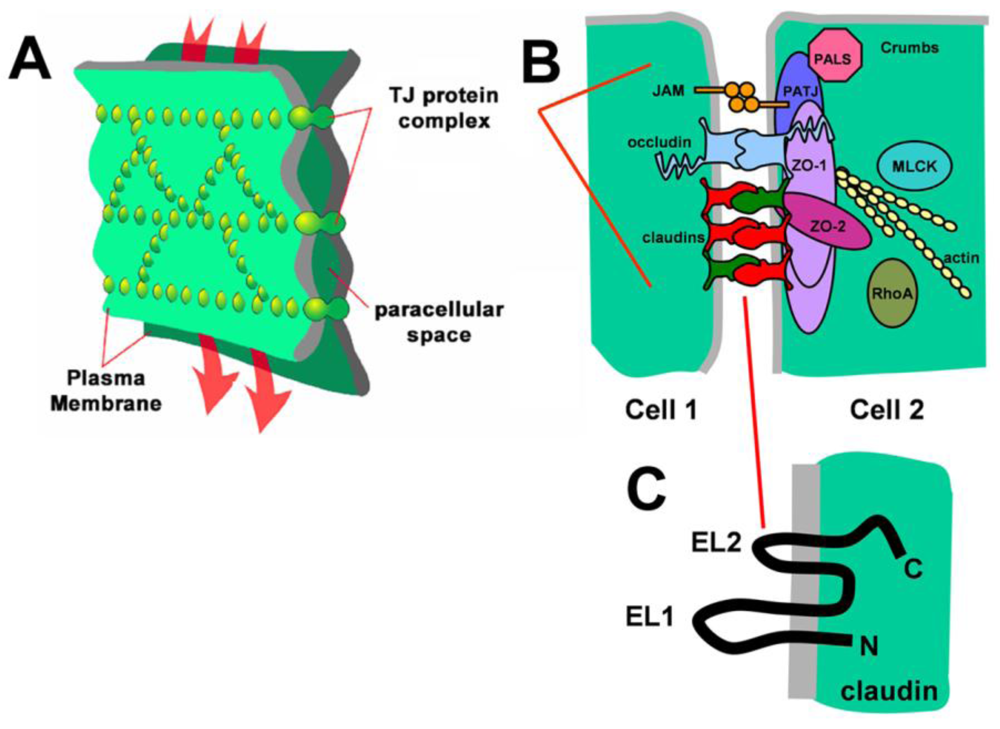
          <p>Protein components oftight junctions between polarized epithelial cells. (<bold>A</bold>) Based on freeze fracture electron microscopy, tight junctions appear as a series of beaded strands in the plasma membrane at cell-cell contact sites, modified from [<xref ref-type="bibr" rid="B13-toxins-02-01595">13</xref>]; (<bold>B</bold>) Tight junctions consist of several proteins, including transmembrane proteins linked to the actin cytoskeleton by scaffold proteins. Of these transmembrane proteins, claudins are the primary structural determinants of paracellular permeability; (<bold>C</bold>) Claudins span the bilayer four times, with <italic>N-</italic> and <italic>C-</italic> termini oriented towards the cytosol and have two extracellular loop (EL) domains.</p>
        </caption>
        <graphic xmlns:xlink="http://www.w3.org/1999/xlink" xlink:href="toxins-02-01595-g001.tif"/>
      </fig>
      <p>Claudins are 20–27 kDa transmembrane proteins that span the membrane bilayer four times (<xref ref-type="fig" rid="toxins-02-01595-f001">Figure 1</xref>). The <italic>N</italic>- and <italic>C-</italic> termini are oriented towards the cytoplasm and there are two extracellular loop domains, both of which mediate interactions with other claudins [<xref ref-type="bibr" rid="B14-toxins-02-01595">14</xref>,<xref ref-type="bibr" rid="B15-toxins-02-01595">15</xref>,<xref ref-type="bibr" rid="B16-toxins-02-01595">16</xref>]. Claudins are a major constituent of tight junctions, which are cell-cell contact sites between polarized epithelial cells that serve to regulate the movement of ions and molecules between cells. In addition to claudins, tight junctions also contain other proteins, including transmembrane proteins such as occludin and cytoplasmic scaffold proteins, mainly zonula occludens (ZO)-1 and -2, which tether claudins to the cytoskeleton and are required to maintain paracellular permeability [<xref ref-type="bibr" rid="B17-toxins-02-01595">17</xref>,<xref ref-type="bibr" rid="B18-toxins-02-01595">18</xref>,<xref ref-type="bibr" rid="B19-toxins-02-01595">19</xref>]. </p>
      <p>Although several different types of protein are needed to regulate tight junctions, it is primarily the profile of claudin expression which enables tight junctions to have unique permeability by forming what are effectively paracellular channels [<xref ref-type="bibr" rid="B20-toxins-02-01595">20</xref>]. Paracellular ion selectivity is established by structural motifs in the two claudin extracellular loop domains, primarily charged amino acids in the first extracellular loop (EL1) [<xref ref-type="bibr" rid="B15-toxins-02-01595">15</xref>,<xref ref-type="bibr" rid="B21-toxins-02-01595">21</xref>,<xref ref-type="bibr" rid="B22-toxins-02-01595">22</xref>,<xref ref-type="bibr" rid="B23-toxins-02-01595">23</xref>,<xref ref-type="bibr" rid="B24-toxins-02-01595">24</xref>]. By contrast, the smaller second extracellular loop (EL2) contains ~25 amino acids and helps narrow the paracellular gap and plays a role in regulating heteromeric claudin-claudin interactions [<xref ref-type="bibr" rid="B25-toxins-02-01595">25</xref>]. In addition, the claudin EL2 domain is the site where CPE binds to specific claudins (see below).</p>
    </sec>
    <sec>
      <title>3.  Mechanism of Action for CPE Toxicity</title>
      <p>After ingestion of contaminated food, <italic>C. perfringens</italic> passes from the stomach to the small intestine where it multiplies and sporulates. During sporulation, CPE is expressed and accumulates within the bacterium until it is discharged when the sporulating cells lyse. Upon release into the intestinal lumen, CPE binds to intestinal epithelial cells and initiates a cascade of events leading to cell death [<xref ref-type="bibr" rid="B7-toxins-02-01595">7</xref>,<xref ref-type="bibr" rid="B8-toxins-02-01595">8</xref>,<xref ref-type="bibr" rid="B26-toxins-02-01595">26</xref>].</p>
      <fig id="toxins-02-01595-f002" position="anchor">
        <label>Figure 2</label>
        <caption>
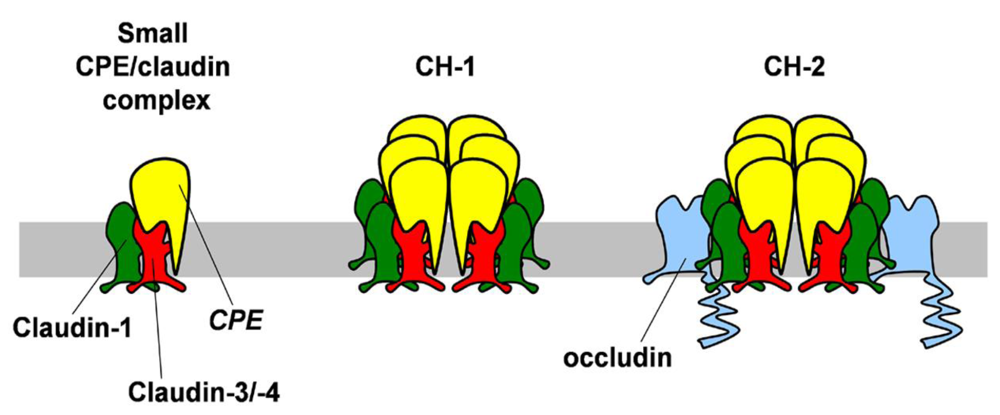
          <p>Sequential intermediates in CPE:epithelial cell membrane interactions. CPE initially binds directly to claudins at the plasma membrane, most typically claudin-3 or claudin-4 on intestinal epithelium. The initial small CPE/claudin complexes may also include other claudins, e.g., claudin-1, via an indirect interaction. Six small complexes oligomerize to form a hexameric complex (CH-1) that forms pores which compromise plasma membrane integrity. CH-1 complexes eventually incorporate occludin and disrupt epithelial tight junctions resulting in a breakdown of barrier function.</p>
        </caption>
        <graphic xmlns:xlink="http://www.w3.org/1999/xlink" xlink:href="toxins-02-01595-g002.tif"/>
      </fig>
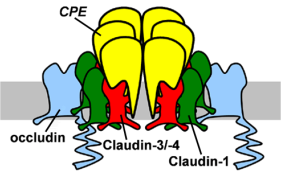
      <p>There are three major biochemically isolatable complexes that represent the sequence of interaction of CPE with cell tight junction proteins, a small complex containing CPE and claudins which subsequently oligomerizes and then incorporates occludin [<xref ref-type="bibr" rid="B27-toxins-02-01595">27</xref>]. CPE initially binds to claudins to form a small 90 kD complex (<xref ref-type="fig" rid="toxins-02-01595-f002">Figure 2</xref>), which itself is insufficient for cytotoxicity [<xref ref-type="bibr" rid="B26-toxins-02-01595">26</xref>]. Interestingly, when formed by human CaCo2 colon epithelial cells, the small CPE complex contains claudin-1 in addition to claudin-3 and/or claudin-4, despite the fact that CPE does not directly bind to claudin-1 [<xref ref-type="bibr" rid="B28-toxins-02-01595">28</xref>,<xref ref-type="bibr" rid="B29-toxins-02-01595">29</xref>]. Thus, the presence of claudin-1 in the complex is more likely to be due to an interaction with claudin-3 and/or claudin-4, rather than a direct interaction with CPE. In addition to claudin-1, it is likely that other claudins expressed by intestinal epithelial cells can also associate with the small CPE/claudin complex. In fact, claudin-5 has been isolated from CPE-affinity columns using normal rat cholangiocytes as a starting material, which could be enhanced by an indirect interaction via other claudins [<xref ref-type="bibr" rid="B30-toxins-02-01595">30</xref>]. Based on apparent size, the small CPE/claudin complex contains one molecule of CPE (35 kD) and two claudin molecules (2 × 22 kD = 44 kD). The stoichiometry of the small CPE-claudin complex is intriguing in light of current models where claudins stably oligomerize as hexamers [<xref ref-type="bibr" rid="B31-toxins-02-01595">31</xref>] and suggests that CPE either disrupts claudin hexamers or it interacts with claudin monomers or dimers at a step prior to complete claudin oligomerization. In the latter case, this would imply that claudin oligomerization is completed at the plasma membrane, perhaps following assembly into tight junctions. However, the sequence of claudin assembly remains to be determined [<xref ref-type="bibr" rid="B4-toxins-02-01595">4</xref>]. Nonetheless, claudin-3 mutants which are unable to heterotypically interact have an increased ability to bind to CPE, underscoring that CPE interacts with claudins prior to incorporation to tight junction strands [<xref ref-type="bibr" rid="B32-toxins-02-01595">32</xref>].</p>
      <p>Small CPE/claudin complexes then combine to form a large (~450 kD) complex (CH-1) required for cytotoxicity [<xref ref-type="bibr" rid="B33-toxins-02-01595">33</xref>]. These hexameric pores increase plasma membrane ion permeability [<xref ref-type="bibr" rid="B34-toxins-02-01595">34</xref>] allowing calcium influx that induces cell death by apoptosis or oncosis [<xref ref-type="bibr" rid="B35-toxins-02-01595">35</xref>,<xref ref-type="bibr" rid="B36-toxins-02-01595">36</xref>].</p>
      <p>A ~25 amino acid hydrophobic hairpin domain of CPE is required to form a beta-barrel pore in the plasma membrane [<xref ref-type="bibr" rid="B37-toxins-02-01595">37</xref>]. The hairpin domain is similar to domains in other beta-barrel pore forming bacterial toxins that oligomerize in complexes ranging from pentamers to octomers [<xref ref-type="bibr" rid="B38-toxins-02-01595">38</xref>]. However, while these other toxins require cholesterol for membrane binding and pore formation, CPE does not [<xref ref-type="bibr" rid="B39-toxins-02-01595">39</xref>]. In fact, CPE binding induces claudins to partition away from cholesterol enriched membrane microdomains, thus contributing to the disruption of epithelial barrier function. Whether claudins contribute to CPE pore structure is not known, however, since claudins oligomerize as part of their role in tight junction formation, they may be a structural element of the CPE pore. It is interesting to note that a <italic>C-</italic>terminal claudin-4 mutant which lacks the PDZ-binding motif, a domain required for binding to ZO-1 and ZO-2 and incorporation into tight junction strands, still supports small complex formation and CPE-mediated toxicity. Thus, tight junction scaffold proteins are not required for CPE-claudin interactions or pore formation [<xref ref-type="bibr" rid="B33-toxins-02-01595">33</xref>].</p>
      <p>CH-1 complexes have also been shown to mature into larger CH-2 complexes containing occludin [<xref ref-type="bibr" rid="B40-toxins-02-01595">40</xref>]. The interaction of CPE with occludin requires claudins, although a low affinity occludin binding site of CPE has not been ruled out. Binding of CPE to claudins and occludin is associated with internalization of these tight junction proteins, a process that compromises epithelial barrier function and therefore contributes to the mechanism of action for CPE toxicity [<xref ref-type="bibr" rid="B40-toxins-02-01595">40</xref>]. Consistent with this model, internalization and subsequent degradation of tight junction proteins is frequently associated with impaired barrier function [<xref ref-type="bibr" rid="B41-toxins-02-01595">41</xref>,<xref ref-type="bibr" rid="B42-toxins-02-01595">42</xref>,<xref ref-type="bibr" rid="B43-toxins-02-01595">43</xref>]. It remains to be determined whether CH-2 induces claudin and occludin internalization or forms after endocytosis to promote tight junction protein degradation.</p>
    </sec>
    <sec>
      <title>4. Structural Basis and Specificity of CPE-Claudin Interactions</title>
      <p>Further screening of claudins using transfected fibroblasts and/or biochemical approaches was used to determine that full length CPE or CPE-derived protein fragments can bind to claudin-6, -7, -8, -9 or -14 [<xref ref-type="bibr" rid="B28-toxins-02-01595">28</xref>,<xref ref-type="bibr" rid="B32-toxins-02-01595">32</xref>,<xref ref-type="bibr" rid="B44-toxins-02-01595">44</xref>]. Moreover, this analysis confirmed that several claudins were unable to interact with CPE, which defined a subset of claudin-family proteins with the capacity to act as CPE receptors. While CPE can interact with several different claudins <italic>in vitro</italic> and in transfected cells, the pathobiology of <italic>C. Perfringens</italic> depends upon the claudins expressed by intestinal epithelium and accessibility to toxins. In addition to claudin-3 and claudin-4, other claudins significantly expressed by intestinal epithelium, which can also bind CPE, include claudin-7 and claudin-8 [<xref ref-type="bibr" rid="B45-toxins-02-01595">45</xref>,<xref ref-type="bibr" rid="B46-toxins-02-01595">46</xref>], however whether these or other claudins are involved in disease caused by <italic>C. Perfringens</italic> is unknown at present.</p>
      <fig id="toxins-02-01595-f003" position="anchor">
        <label>Figure 3</label>
        <caption>
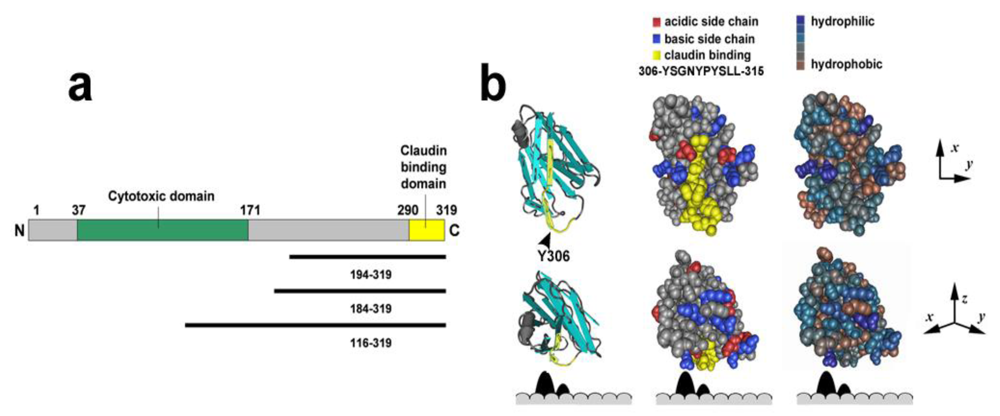
          <p>Claudin binding motif of CPE. (<bold>a</bold>) Linear diagram showing the domain structure of CPE, emphasizing the cytotoxic (green) and claudin binding (yellow) domains. Key truncation mutants are shown below; (<bold>b</bold>) Structural models of the <italic>C-</italic>terminal CPE claudin binding domain (CPE<sub>194–319</sub>) [<xref ref-type="bibr" rid="B47-toxins-02-01595">47</xref>] were produced using the Molecular Modeling Database (MMDB) [<xref ref-type="bibr" rid="B48-toxins-02-01595">48</xref>,<xref ref-type="bibr" rid="B49-toxins-02-01595">49</xref>]. Shown from left to right are a ribbon diagram, and space filling models indicating amino acid charge or hydrophobicity. The top row shows CPE<sub>194–319 </sub>with the claudin binding motif facing the reader, in the bottom row the protein is rotated 90°. Shown in yellow is the claudin binding motif of CPE, which is enriched for hydrophobic amino acids. The arrowhead denotes the position of Tyr<sup>306</sup>. Below each row is a representation of the claudin extracellular loops, EL1 and EL2, where EL2 interacts with CPE.</p>
        </caption>
        <graphic xmlns:xlink="http://www.w3.org/1999/xlink" xlink:href="toxins-02-01595-g003.tif"/>
      </fig>
      <p>Structure-function analysis of CPE reveals that it is comprised of an <italic>N-</italic>terminal cytotoxic domain and a <italic>C-</italic>terminal binding domain. Because a truncation mutant lacking the <italic>N-</italic>terminal half of the protein (CPE<sub>171–319</sub>) did not exhibit cytotoxic effects when applied to sensitive cells, Hanna <italic>et al.</italic> [<xref ref-type="bibr" rid="B50-toxins-02-01595">50</xref>] concluded that the <italic>N-</italic>terminal region of CPE was required for toxicity. However, removal of the first 37 amino acids of the protein increases the cytotoxicity of the molecule [<xref ref-type="bibr" rid="B51-toxins-02-01595">51</xref>,<xref ref-type="bibr" rid="B52-toxins-02-01595">52</xref>]. </p>
      <p>While CPE<sub>171–319</sub> is not toxic to cells, this truncated protein retains the capacity to bind to claudins [<xref ref-type="bibr" rid="B50-toxins-02-01595">50</xref>]. Further truncation demonstrated that the last 30 amino acids (CPE<sub>290–319</sub>) are sufficient to recognize some claudins [<xref ref-type="bibr" rid="B53-toxins-02-01595">53</xref>]. In addition, a synthetic peptide corresponding to these 30 amino acids was shown to have competitive binding activity equal to the native toxin [<xref ref-type="bibr" rid="B54-toxins-02-01595">54</xref>], even though it lacks the cytotoxic domain needed for cytolysis, suggesting that all of the CPE receptor-binding activity is mediated by these residues [<xref ref-type="bibr" rid="B53-toxins-02-01595">53</xref>]. However, other motifs might modulate the specificity of claudin binding. For instance CPE<sub>116–319</sub> binds to cells expressing claudin-5, albeit at low affinity, while CPE<sub>194–319</sub> does not [<xref ref-type="bibr" rid="B32-toxins-02-01595">32</xref>]. </p>
      <p>The crystal structure of CPE<sub>194–319</sub> shows that it is a nine-strand sandwich with similarities to the receptor binding domains of other pore-forming toxins (<xref ref-type="fig" rid="toxins-02-01595-f003">Figure 3</xref>) [<xref ref-type="bibr" rid="B47-toxins-02-01595">47</xref>]. Surface electrostatic potential modeling shows that these residues form an acidic cleft surrounding a hydrophobic valley [<xref ref-type="bibr" rid="B44-toxins-02-01595">44</xref>]. Consistent with a role for hydrophobic residues in stabilizing the interaction of CPE binding with claudins, mutating Tyr<sup>306</sup> to Lys, a positively charged residue, completely abolishes claudin binding, while mutations to another aromatic residue, Phe, had no effect [<xref ref-type="bibr" rid="B55-toxins-02-01595">55</xref>]. While it is possible that the Lys substitution destabilizes CPE and causes it to assume an alternative conformation, it does not seem likely given that Tyr<sup>306</sup> is located on an intervening surface loop between two beta strands (<xref ref-type="fig" rid="toxins-02-01595-f003">Figure 3</xref>, arrowhead). Mutating Tyr<sup>306</sup>, Tyr<sup>310</sup>, or Tyr<sup>312</sup> to Ala also impairs CPE claudin interactions [<xref ref-type="bibr" rid="B44-toxins-02-01595">44</xref>], while mutation of Tyr<sup>306</sup> in combination with one of the other two key Tyr residues completely eliminates claudin binding. This mutational analysis underscores the significance of bulky hydrophobic amino acids for high affinity CPE-claudin binding [<xref ref-type="bibr" rid="B56-toxins-02-01595">56</xref>]. </p>
      <p>Fujita <italic>et al.</italic> [<xref ref-type="bibr" rid="B28-toxins-02-01595">28</xref>] first demonstrated that CPE binds to claudins via EL2 using fibroblasts transfected with claudin-1/-3 chimeras, using sensitivity to CPE toxicity as an assay for binding. A comparable analysis also showed that the EL2 domain of claudin-7 was required for CPE-mediated toxicity; further refinement of the CPE binding site using point mutants defined a key role for Asn<sup>149</sup> of claudin-4 in binding to CPE [<xref ref-type="bibr" rid="B44-toxins-02-01595">44</xref>,<xref ref-type="bibr" rid="B57-toxins-02-01595">57</xref>]. </p>
      <p>The EL2 binding sites of claudins with high affinity for CPE (claudin-4, claudin-3, claudin-7) have a calculated pI in the range of 6.4–9.7 and are enriched for amino acids which can interact with acidic residues in the cleft region of the claudin binding site of CPE [<xref ref-type="bibr" rid="B44-toxins-02-01595">44</xref>]. In further define roles for basic residues in CPE-claudin interactions, a double point mutant in the EL2 domain of human claudin-5 was developed, where Asp<sup>149</sup> was replaced with Asn and Tyr<sup>158</sup> was replaced with Arg. These amino acid substitutions increased the calculated pI of the EL2 domain from 4.2 to 9.7 and significantly increased the affinity of binding to full length CPE as compared to wild type human claudin-5 [<xref ref-type="bibr" rid="B44-toxins-02-01595">44</xref>]. Thus, electrostatic interactions between CPE and claudins promote the specificity of binding.</p>
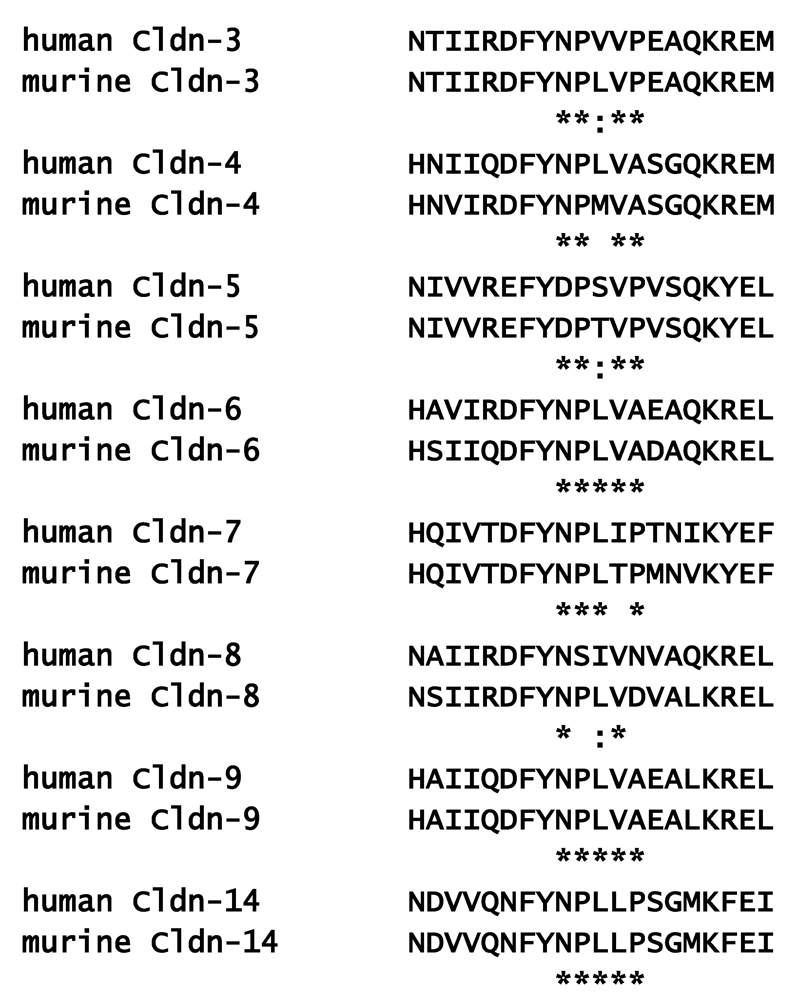
      <p>Using an array of peptides corresponding to the EL2 claudin domains, Winkler <italic>et al</italic>. [<xref ref-type="bibr" rid="B32-toxins-02-01595">32</xref>] quantified binding of a GST-CPE<sub>116–319</sub> fusion protein. This analysis was used to identify a key motif, NP(V/L)(V/L)(P/A), in the turn region of EL2 as a required sequence needed for claudins to interact with CPE (<xref ref-type="fig" rid="toxins-02-01595-f004">Figure 4</xref>) [<xref ref-type="bibr" rid="B32-toxins-02-01595">32</xref>]. The EL2 CPE binding motif is usually conserved when comparing human and murine claudins (<xref ref-type="fig" rid="toxins-02-01595-f004">Figure 4</xref>). An important exception to this rule is human claudin-8 which does not interact with CPE since it lacks the NPLVD motif present in murine claudin-8 [<xref ref-type="bibr" rid="B32-toxins-02-01595">32</xref>,<xref ref-type="bibr" rid="B44-toxins-02-01595">44</xref>]. </p>
      <fig id="toxins-02-01595-f004" position="anchor">
        <label>Figure 4</label>
        <caption>
          <p>Extracellular loop domains of claudins recognized by CPE. The NP(L/V)(L/V)(P/A) binding motif within EL2 is highlighted below. Note that human claudin-8 shows significant sequence divergence from murine claudin-8 and is unlikely to interact with CPE. <bold>*</bold>—conserved between human and murine claudin, <bold>:</bold>—comparable amino acid substitution. </p>
        </caption>
        <graphic xmlns:xlink="http://www.w3.org/1999/xlink" xlink:href="toxins-02-01595-g004.tif"/>
      </fig>
      <p>By and large, there was good agreement between the ability of GST-CPE<sub>116–319</sub> to bind the EL2 peptide fragment and binding of full length CPE to full length claudins expressed by cells. However, the murine claudin-4 EL2 peptide was unable to bind to GST-CPE<sub>116–319</sub>, despite the ability of the CPE peptide to recognize claudin-4 in transfected cells [<xref ref-type="bibr" rid="B32-toxins-02-01595">32</xref>,<xref ref-type="bibr" rid="B57-toxins-02-01595">57</xref>]. It is noteworthy that the murine claudin-4 EL2 domain contains Met in the third position of the CPE binding motif; this Met residue may destabilize the claudin-4 EL2 peptide and prevent it from attaining a fully native conformation <italic>in vitro</italic>, despite being tolerated in full length claudin-4 expressed by cells. Also, CPE<sub>116–319</sub> binds to an EL2 peptide from murine claudin-3 with greater affinity than a murine claudin-7 peptide [<xref ref-type="bibr" rid="B32-toxins-02-01595">32</xref>], yet full length CPE equivalently recognizes HEK293 cells transfected with either claudin-3 or claudin-7, based on cell killing assays [<xref ref-type="bibr" rid="B44-toxins-02-01595">44</xref>]. Differences in the affinity of CPE for isolated EL2 domains <italic>vs.</italic> full length claudins <italic>in situ</italic>, indicates the plasticity of EL2 conformation and underscores the need for high resolution claudin structure determination to fully understand CPE-claudin interactions.</p>
    </sec>
    <sec>
      <title>5. CPE as a Tool to Study Epithelial Tight Junctions</title>
      <p>The binding of CPE to specific claudins affects the structure of epithelial tight junctions independent of its cytotoxic effects [<xref ref-type="bibr" rid="B27-toxins-02-01595">27</xref>,<xref ref-type="bibr" rid="B29-toxins-02-01595">29</xref>,<xref ref-type="bibr" rid="B58-toxins-02-01595">58</xref>]. This property is shared by <italic>C-</italic>terminal CPE fragments which retain the capacity to bind claudins. For instance, Sonoda <italic>et al.</italic> [<xref ref-type="bibr" rid="B29-toxins-02-01595">29</xref>] showed that addition of the CPE<sub>184–319</sub> fragment to the basolateral surface of MDCK I cells selectively removed endogenous claudin 4 from tight junctions while largely maintaining claudin-1 localization. Additionally, CPE<sub>184–319</sub> treatment led to fragmented tight junctions and impaired barrier function, indicating a central role for claudin-4 in maintaining MDCK barrier function [<xref ref-type="bibr" rid="B29-toxins-02-01595">29</xref>]. </p>
      <p>The recent observation that claudin-4 is specifically upregulated in response to acute lung injury led to the use of CPE as a tool to identify specific roles for claudin-4 in the injury response [<xref ref-type="bibr" rid="B58-toxins-02-01595">58</xref>]. In this study, Wray, <italic>et al.</italic> [<xref ref-type="bibr" rid="B58-toxins-02-01595">58</xref>] used a CPE<sub>290–319</sub> peptide administered <italic>in vivo</italic> to mice prior to experimentally induced lung injury of varying severity. CPE<sub>290–319</sub> administered <italic>in vivo</italic> significantly decreased claudin-4 content of the lung. Functionally, CPE<sub>290–319</sub> dramatically increased bulk alveolar protein permeability (leak) in response to severe lung injury, underscoring a role for upregulated claudin-4 in protecting the lung from mechanical injury to tight junctions. By contrast, alveolar protein permeability was low and largely unaffected by CPE<sub>290–319</sub> in both the unstressed lung and lungs subjected to moderate injury. However, CPE<sub>290–319</sub> treatment increased the amount of lung edema in response to moderate ventilator induced lung injury and, importantly, diminished the fluid clearance capacity of unstressed lungs. Thus, CPE<sub>290–319</sub> provided the first <italic>in vivo</italic> evidence in support of a role for claudins in regulating the fine control of fluid balance in the lung [<xref ref-type="bibr" rid="B59-toxins-02-01595">59</xref>]. Since lungs express several claudins which can interact with CPE, including claudin-3 and -7 [<xref ref-type="bibr" rid="B42-toxins-02-01595">42</xref>,<xref ref-type="bibr" rid="B60-toxins-02-01595">60</xref>,<xref ref-type="bibr" rid="B61-toxins-02-01595">61</xref>], it is possible that changes in the mouse lung physiology induced by CPE<sub>290–319</sub> are due to effects on other claudins. However, the relatively mild effect of CPE<sub>290–319</sub> on unstressed lungs where claudin-4 is not upregulated argues against this possibility [<xref ref-type="bibr" rid="B58-toxins-02-01595">58</xref>].</p>
      <p>Beyond identifying roles for claudin-4 in lung physiology, CPE-derived reagents could potentially be used to more generally study other aspects of epithelial tight junctions. In order to achieve this, CPE variants would need to be designed which preferentially recognize different claudins beyond the subset of claudins which already bind CPE. This requires understanding of the molecular basis for CPE-claudin interactions to a level of depth allowing informed design of new CPE variants.</p>
    </sec>
    <sec>
      <title>6. Targeted Cancer Therapeutics Using CPE</title>
      <p>Histological screens of human tumors have revealed changes in claudin expression associated with tumor phenotype [<xref ref-type="bibr" rid="B62-toxins-02-01595">62</xref>,<xref ref-type="bibr" rid="B63-toxins-02-01595">63</xref>]. Altered claudin expression may lead to abnormal barrier function which, in turn, can increase paracellular permeability to ultimately facilitate tumor cell mobility and promote nutrient supply to tumor cells [<xref ref-type="bibr" rid="B64-toxins-02-01595">64</xref>,<xref ref-type="bibr" rid="B65-toxins-02-01595">65</xref>,<xref ref-type="bibr" rid="B66-toxins-02-01595">66</xref>,<xref ref-type="bibr" rid="B67-toxins-02-01595">67</xref>]. Consistent with a reduction in the tight junction barrier, claudin expression by tumor cells is frequently down-regulated [<xref ref-type="bibr" rid="B62-toxins-02-01595">62</xref>,<xref ref-type="bibr" rid="B63-toxins-02-01595">63</xref>,<xref ref-type="bibr" rid="B68-toxins-02-01595">68</xref>,<xref ref-type="bibr" rid="B69-toxins-02-01595">69</xref>,<xref ref-type="bibr" rid="B70-toxins-02-01595">70</xref>,<xref ref-type="bibr" rid="B71-toxins-02-01595">71</xref>,<xref ref-type="bibr" rid="B72-toxins-02-01595">72</xref>,<xref ref-type="bibr" rid="B73-toxins-02-01595">73</xref>,<xref ref-type="bibr" rid="B74-toxins-02-01595">74</xref>,<xref ref-type="bibr" rid="B75-toxins-02-01595">75</xref>,<xref ref-type="bibr" rid="B76-toxins-02-01595">76</xref>,<xref ref-type="bibr" rid="B77-toxins-02-01595">77</xref>]. </p>
      <p>However, there are also several examples where claudin expression is upregulated in many tumors including breast, ovarian, and prostate cancers [<xref ref-type="bibr" rid="B62-toxins-02-01595">62</xref>,<xref ref-type="bibr" rid="B63-toxins-02-01595">63</xref>,<xref ref-type="bibr" rid="B78-toxins-02-01595">78</xref>,<xref ref-type="bibr" rid="B79-toxins-02-01595">79</xref>,<xref ref-type="bibr" rid="B80-toxins-02-01595">80</xref>]. While this result may seem surprising given the role of claudins in tight junction integrity, recent work suggests that claudins are also involved in survival and invasion of cancer cells, functions that could be independent of their role as tight junction proteins [<xref ref-type="bibr" rid="B81-toxins-02-01595">81</xref>,<xref ref-type="bibr" rid="B82-toxins-02-01595">82</xref>,<xref ref-type="bibr" rid="B83-toxins-02-01595">83</xref>]. Of particular interest, claudin-3 and claudin-4 seem to be generally upregulated, particularly in aggressively metatastic tumors [<xref ref-type="bibr" rid="B84-toxins-02-01595">84</xref>,<xref ref-type="bibr" rid="B85-toxins-02-01595">85</xref>]. </p>
      <p>Increased expression of claudin-3 or claudin-4 provides a fortuitous target in these tumors, since expression enables CPE-based therapeutic agents to be developed as potential anti-tumor agents [<xref ref-type="bibr" rid="B62-toxins-02-01595">62</xref>,<xref ref-type="bibr" rid="B78-toxins-02-01595">78</xref>,<xref ref-type="bibr" rid="B86-toxins-02-01595">86</xref>]. Current preclinical therapies include use of both cytotoxic CPE alone and <italic>C-</italic>terminal fragments of CPE as a targeting molecule [<xref ref-type="bibr" rid="B78-toxins-02-01595">78</xref>,<xref ref-type="bibr" rid="B86-toxins-02-01595">86</xref>,<xref ref-type="bibr" rid="B87-toxins-02-01595">87</xref>,<xref ref-type="bibr" rid="B88-toxins-02-01595">88</xref>,<xref ref-type="bibr" rid="B89-toxins-02-01595">89</xref>,<xref ref-type="bibr" rid="B90-toxins-02-01595">90</xref>,<xref ref-type="bibr" rid="B91-toxins-02-01595">91</xref>]. </p>
      <p><italic>In vitro</italic>, CPE treatment of human cancer cell lines and, importantly, breast tumor tissue has been shown to result in cytolysis and cell death in a dose-dependent manner [<xref ref-type="bibr" rid="B78-toxins-02-01595">78</xref>,<xref ref-type="bibr" rid="B86-toxins-02-01595">86</xref>,<xref ref-type="bibr" rid="B87-toxins-02-01595">87</xref>]. Using murine xenograft models, the <italic>in vivo</italic> efficacy of CPE therapy has also been tested. Intra-tumoral injection of CPE into pancreatic, breast, and brain cancer tumors significantly impeded tumor growth or caused tumor regression by inducing necrosis [<xref ref-type="bibr" rid="B78-toxins-02-01595">78</xref>,<xref ref-type="bibr" rid="B86-toxins-02-01595">86</xref>,<xref ref-type="bibr" rid="B88-toxins-02-01595">88</xref>]. Furthermore, intraperitoneal injection of CPE significantly inhibited growth of explanted human ovarian cancer in mice without severe gastrointestinal side-effects or weight loss [<xref ref-type="bibr" rid="B87-toxins-02-01595">87</xref>]. </p>
      <p>In addition to utilizing CPE to directly induce cytotoxicity, the non-cytolytic CPE<sub>184–319</sub> fragment may be effective in the targeted delivery of chemotherapeutic agents. For instance, a fusion protein of CPE<sub>290–319 </sub>and TNF was used to induce cytotoxicity in ovarian cancer cells expressing both claudins-3 and -4 while remaining non-toxic to cells lacking these proteins [<xref ref-type="bibr" rid="B90-toxins-02-01595">90</xref>]. Recently, Ebihara <italic>et al.</italic> fused CPE<sub>194–319 </sub>to the protein synthesis inhibitory factor (PSIF) domain of <italic>Pseudomonas</italic> exotoxin (C-CPE-PSIF) and found that this fusion protein was toxic to human breast cancer cells that express claudins-3 and -4 [<xref ref-type="bibr" rid="B89-toxins-02-01595">89</xref>]. Furthermore, this fusion protein had no effect on L cells expressing exogenous claudin-1, claudin-2 or claudin-5 or SK-HEP-1 hepatocytes lacking claudin-4 but expressing other claudins, such as claudin-1 [<xref ref-type="bibr" rid="B92-toxins-02-01595">92</xref>]. </p>
      <p>Two features of C-CPE-PSIF are critical for its mechanism of action. First, by binding to claudins, CPE fusion proteins are internalized by endocytosis [<xref ref-type="bibr" rid="B89-toxins-02-01595">89</xref>]. Second, internalized C-CPE-PSIF is proteolyzed to release a free PSIF fragment which subsequently crosses the membrane bilayer into the cytosol where it kills cells by inhibiting protein synthesis [<xref ref-type="bibr" rid="B93-toxins-02-01595">93</xref>]. Importantly, the efficacy of C-CPE-PSIF was recently demonstrated <italic>in vivo</italic>, using several murine tumor metastasis models [<xref ref-type="bibr" rid="B94-toxins-02-01595">94</xref>]. In this study, C-CPE-PSIF decreased the growth rate of subcutaneous tumors derived from cells expressing claudin-4 by 50% and, in the case of 4TI cell derived tumors, the number of metastases found in the lungs was almost completely repressed.</p>
      <p>Although the ability of CPE or CPE-based fusion proteins to bind to isolated circulating metastatic cells seems straightforward, the mechanisms by which externally applied CPE can successfully target solid tumors is less clear. The ability of CPE to cause a breakdown in tight junction barriers is expected to contribute to penetration into tumors [<xref ref-type="bibr" rid="B29-toxins-02-01595">29</xref>,<xref ref-type="bibr" rid="B92-toxins-02-01595">92</xref>,<xref ref-type="bibr" rid="B95-toxins-02-01595">95</xref>]. Alternatively, the anti-tumor effect of CPE may be limited to a superficial layer of cells in cases where growth is inhibited, but tumors do not decrease in mass [<xref ref-type="bibr" rid="B86-toxins-02-01595">86</xref>]. It may well be that an adjunct therapeutic, such as the recently discovered iRGD peptide [<xref ref-type="bibr" rid="B96-toxins-02-01595">96</xref>], will be needed to optimize the efficacy of CPE-based anti-cancer drugs.</p>
      <p>The inherent toxicity of full length CPE represents a significant side effect with the potential to reduce therapeutic efficacy. The route of administration has a significant effect on toxicity. For instance, intraperitoneal injection is significantly more toxic than intragastral administration or direct injection into tumors [<xref ref-type="bibr" rid="B86-toxins-02-01595">86</xref>,<xref ref-type="bibr" rid="B78-toxins-02-01595">78</xref>,<xref ref-type="bibr" rid="B97-toxins-02-01595">97</xref>]. For sub-lethal doses of CPE, both intraperitoneal or intragastral administration induces a transient spike in cytokine production (mainly IL-6 and IFN-γ) which peaks at 8 h post treatment [<xref ref-type="bibr" rid="B97-toxins-02-01595">97</xref>]. There are also data that CPE acts as a direct mitogen for macrophages and T cells <italic>in vitro</italic> [<xref ref-type="bibr" rid="B97-toxins-02-01595">97</xref>,<xref ref-type="bibr" rid="B98-toxins-02-01595">98</xref>] and could have superantigen activity [<xref ref-type="bibr" rid="B99-toxins-02-01595">99</xref>]. However, other studies demonstrated that D-Galactose induced liver injury did not sensitize mice to CPE toxicity [<xref ref-type="bibr" rid="B97-toxins-02-01595">97</xref>] and CPE does not act as a mitogen for peripheral leukocytes <italic>in vitro</italic> [<xref ref-type="bibr" rid="B100-toxins-02-01595">100</xref>], both of which are hallmarks of superantigenicity. These conflicting data are likely to reflect differences in CPE preparations, if contaminants contribute to the immune response. From a practical standpoint, some concerns related to CPE-mediated toxicity are likely to be ameliorated by replacing the cytotoxic domain of CPE with a domain that has a more specific mode of action, such as PSIF, particularly if this prevents a systemic immune response. </p>
      <p>Taken together, these studies support the use of CPE-based pharmaceuticals as a strategy to specifically target tumors with a suitable profile of claudin expression. In general, claudins have great potential as targets for cancer therapy, but studies of this family are incomplete. While significant progress has been made in understanding the structural basis of CPE-claudin interactions, further analysis could enable other claudin specific interacting molecules to be designed to improve the specificity and efficacy of CPE-based therapeutic approaches.</p>
    </sec>
  </body>
  <back>
    <ack>
      <title>Acknowledgements</title>
      <p>This work was supported by National Institutes of Health grants HL-083120, AA-013757 (to M.K.) and AA-013528 (to L.A.M.).</p>
    </ack>
    <ref-list>
      <title>References</title>
      <ref id="B1-toxins-02-01595">
        <label>1.</label>
        <citation citation-type="journal">
          <person-group person-group-type="author">
            <name>
              <surname>Sakurai</surname>
              <given-names>J.</given-names>
            </name>
            <name>
              <surname>Nagahama</surname>
              <given-names>M.</given-names>
            </name>
            <name>
              <surname>Ochi</surname>
              <given-names>S.</given-names>
            </name>
          </person-group>
          <article-title>Major Toxins of <italic>Clostridium perfringens</italic></article-title>
          <source>Toxin Rev.</source>
          <year>1997</year>
          <volume>16</volume>
          <fpage>195</fpage>
          <lpage>214</lpage>
        <pub-id pub-id-type="doi">10.3109/15569549709016456</pub-id></citation>
      </ref>
      <ref id="B2-toxins-02-01595">
        <label>2.</label>
        <citation citation-type="journal">
          <person-group person-group-type="author">
            <name>
              <surname>McDonel</surname>
              <given-names>J.L.</given-names>
            </name>
          </person-group>
          <article-title><italic>Clostridium perfringens</italic> toxins (type A, B, C, D, E)</article-title>
          <source>Pharmacol. Ther.</source>
          <year>1980</year>
          <volume>10</volume>
          <fpage>617</fpage>
          <lpage>655</lpage>
          <pub-id pub-id-type="pmid">6255496</pub-id>
          <pub-id pub-id-type="doi">10.1016/0163-7258(80)90031-5</pub-id>
        </citation>
      </ref>
      <ref id="B3-toxins-02-01595">
        <label>3.</label>
        <citation citation-type="journal">
          <person-group person-group-type="author">
            <name>
              <surname>McClane</surname>
              <given-names>B.A.</given-names>
            </name>
          </person-group>
          <article-title><italic>Clostridium perfringens</italic> enterotoxin acts by producing small molecule permeability alterations in plasma membranes</article-title>
          <source>Toxicology</source>
          <year>1994</year>
          <volume>87</volume>
          <fpage>43</fpage>
          <lpage>67</lpage>
        <pub-id pub-id-type="doi">10.1016/0300-483X(94)90154-6</pub-id><pub-id pub-id-type="pmid">8160188</pub-id></citation>
      </ref>
      <ref id="B4-toxins-02-01595">
        <label>4.</label>
        <citation citation-type="journal">
          <person-group person-group-type="author">
            <name>
              <surname>Koval</surname>
              <given-names>M.</given-names>
            </name>
          </person-group>
          <article-title>Claudins: Key pieces in the tight junction puzzle</article-title>
          <source>Cell Commun. Adhes.</source>
          <year>2006</year>
          <volume>13</volume>
          <fpage>127</fpage>
          <lpage>138</lpage>
        <pub-id pub-id-type="doi">10.1080/15419060600726209</pub-id><pub-id pub-id-type="pmid">16798613</pub-id></citation>
      </ref>
      <ref id="B5-toxins-02-01595">
        <label>5.</label>
        <citation citation-type="journal">
          <person-group person-group-type="author">
            <name>
              <surname>Angelow</surname>
              <given-names>S.</given-names>
            </name>
            <name>
              <surname>Ahlstrom</surname>
              <given-names>R.</given-names>
            </name>
            <name>
              <surname>Yu</surname>
              <given-names>A.S.</given-names>
            </name>
          </person-group>
          <article-title>Biology of claudins</article-title>
          <source>Am. J. Physiol. Renal Physiol.</source>
          <year>2008</year>
          <volume>295</volume>
          <fpage>F867</fpage>
          <lpage>F876</lpage>
        <pub-id pub-id-type="doi">10.1152/ajprenal.90264.2008</pub-id><pub-id pub-id-type="pmid">18480174</pub-id></citation>
      </ref>
      <ref id="B6-toxins-02-01595">
        <label>6.</label>
        <citation citation-type="journal">
          <person-group person-group-type="author">
            <name>
              <surname>Anderson</surname>
              <given-names>J.M.</given-names>
            </name>
            <name>
              <surname>Van Itallie</surname>
              <given-names>C.M.</given-names>
            </name>
          </person-group>
          <article-title>Physiology and function of the tight junction</article-title>
          <source>Cold Spring Harb. Perspect. Biol.</source>
          <year>2009</year>
          <volume>1</volume>
          <fpage>a002584</fpage>
        <pub-id pub-id-type="doi">10.1101/cshperspect.a002584</pub-id><pub-id pub-id-type="pmid">20066090</pub-id></citation>
      </ref>
      <ref id="B7-toxins-02-01595">
        <label>7.</label>
        <citation citation-type="journal">
          <person-group person-group-type="author">
            <name>
              <surname>Katahira</surname>
              <given-names>J.</given-names>
            </name>
            <name>
              <surname>Sugiyama</surname>
              <given-names>H.</given-names>
            </name>
            <name>
              <surname>Inoue</surname>
              <given-names>N.</given-names>
            </name>
            <name>
              <surname>Horiguchi</surname>
              <given-names>Y.</given-names>
            </name>
            <name>
              <surname>Matsuda</surname>
              <given-names>M.</given-names>
            </name>
            <name>
              <surname>Sugimoto</surname>
              <given-names>N.</given-names>
            </name>
          </person-group>
          <article-title><italic>Clostridium perfringens</italic> enterotoxin utilizes two structurally related membrane proteins as functional receptors <italic>in vivo</italic></article-title>
          <source>J. Biol. Chem.</source>
          <year>1997</year>
          <volume>272</volume>
          <fpage>26652</fpage>
          <lpage>26658</lpage>
        <pub-id pub-id-type="doi">10.1074/jbc.272.42.26652</pub-id><pub-id pub-id-type="pmid">9334247</pub-id></citation>
      </ref>
      <ref id="B8-toxins-02-01595">
        <label>8.</label>
        <citation citation-type="journal">
          <person-group person-group-type="author">
            <name>
              <surname>Katahira</surname>
              <given-names>J.</given-names>
            </name>
            <name>
              <surname>Inoue</surname>
              <given-names>N.</given-names>
            </name>
            <name>
              <surname>Horiguchi</surname>
              <given-names>Y.</given-names>
            </name>
            <name>
              <surname>Matsuda</surname>
              <given-names>M.</given-names>
            </name>
            <name>
              <surname>Sugimoto</surname>
              <given-names>N.</given-names>
            </name>
          </person-group>
          <article-title>Molecular cloning and functional characterization of the receptor for <italic>Clostridium perfringens</italic> enterotoxin</article-title>
          <source>J. Cell. Biol.</source>
          <year>1997</year>
          <volume>136</volume>
          <fpage>1239</fpage>
          <lpage>1247</lpage>
        <pub-id pub-id-type="doi">10.1083/jcb.136.6.1239</pub-id><pub-id pub-id-type="pmid">9087440</pub-id></citation>
      </ref>
      <ref id="B9-toxins-02-01595">
        <label>9.</label>
        <citation citation-type="journal">
          <person-group person-group-type="author">
            <name>
              <surname>Morita</surname>
              <given-names>K.</given-names>
            </name>
            <name>
              <surname>Sasaki</surname>
              <given-names>H.</given-names>
            </name>
            <name>
              <surname>Fujimoto</surname>
              <given-names>K.</given-names>
            </name>
            <name>
              <surname>Furuse</surname>
              <given-names>M.</given-names>
            </name>
            <name>
              <surname>Tsukita</surname>
              <given-names>S.</given-names>
            </name>
          </person-group>
          <article-title>Claudin-11/OSP-based tight junctions of myelin sheaths in brain and Sertoli cells in testis</article-title>
          <source>J. Cell. Biol.</source>
          <year>1999</year>
          <volume>145</volume>
          <fpage>579</fpage>
          <lpage>588</lpage>
        <pub-id pub-id-type="doi">10.1083/jcb.145.3.579</pub-id><pub-id pub-id-type="pmid">10225958</pub-id></citation>
      </ref>
      <ref id="B10-toxins-02-01595">
        <label>10.</label>
        <citation citation-type="journal">
          <person-group person-group-type="author">
            <name>
              <surname>Vogelmann</surname>
              <given-names>R.</given-names>
            </name>
            <name>
              <surname>Amieva</surname>
              <given-names>M.R.</given-names>
            </name>
            <name>
              <surname>Falkow</surname>
              <given-names>S.</given-names>
            </name>
            <name>
              <surname>Nelson</surname>
              <given-names>W.J.</given-names>
            </name>
          </person-group>
          <article-title>Breaking into the epithelial apical-junctional complex—news from pathogen hackers</article-title>
          <source>Curr. Opin. Cell Biol.</source>
          <year>2004</year>
          <volume>16</volume>
          <fpage>86</fpage>
          <lpage>93</lpage>
        <pub-id pub-id-type="doi">10.1016/j.ceb.2003.12.002</pub-id><pub-id pub-id-type="pmid">15037310</pub-id></citation>
      </ref>
      <ref id="B11-toxins-02-01595">
        <label>11.</label>
        <citation citation-type="journal">
          <person-group person-group-type="author">
            <name>
              <surname>Turner</surname>
              <given-names>J.R.</given-names>
            </name>
          </person-group>
          <article-title>Molecular basis of epithelial barrier regulation: from basic mechanisms to clinical application</article-title>
          <source>Am. J. Pathol.</source>
          <year>2006</year>
          <volume>169</volume>
          <fpage>1901</fpage>
          <lpage>1909</lpage>
        <pub-id pub-id-type="doi">10.2353/ajpath.2006.060681</pub-id><pub-id pub-id-type="pmid">17148655</pub-id></citation>
      </ref>
      <ref id="B12-toxins-02-01595">
        <label>12.</label>
        <citation citation-type="journal">
          <person-group person-group-type="author">
            <name>
              <surname>Guttman</surname>
              <given-names>J.A.</given-names>
            </name>
            <name>
              <surname>Finlay</surname>
              <given-names>B.B.</given-names>
            </name>
          </person-group>
          <article-title>Tight junctions as targets of infectious agents</article-title>
          <source>Biochim. Biophys. Acta</source>
          <year>2009</year>
          <volume>1788</volume>
          <fpage>832</fpage>
          <lpage>841</lpage>
        <pub-id pub-id-type="doi">10.1016/j.bbamem.2008.10.028</pub-id><pub-id pub-id-type="pmid">19059200</pub-id></citation>
      </ref>
      <ref id="B13-toxins-02-01595">
        <label>13.</label>
        <citation citation-type="web">
          <person-group person-group-type="author">
            <name>
              <surname>Ruiz</surname>
              <given-names>M.</given-names>
            </name>
          </person-group>
          <source>Wikipedia Commons</source>
          <year>2006</year>
          <access-date>(Accessed on 22 April 2010)</access-date>
          <comment>Available online:<ext-link xmlns:xlink="http://www.w3.org/1999/xlink" xlink:href="http://commons.wikimedia.org/wiki/File:Cellular_tight_junction_en.svg" ext-link-type="uri">http://commons.wikimedia.org/wiki/File:Cellular_tight_junction_en.svg</ext-link></comment>
        </citation>
      </ref>
      <ref id="B14-toxins-02-01595">
        <label>14.</label>
        <citation citation-type="journal">
          <person-group person-group-type="author">
            <name>
              <surname>Daugherty</surname>
              <given-names>B.L.</given-names>
            </name>
            <name>
              <surname>Ward</surname>
              <given-names>C.</given-names>
            </name>
            <name>
              <surname>Smith</surname>
              <given-names>T.</given-names>
            </name>
            <name>
              <surname>Ritzenthaler</surname>
              <given-names>J.D.</given-names>
            </name>
            <name>
              <surname>Koval</surname>
              <given-names>M.</given-names>
            </name>
          </person-group>
          <article-title>Regulation of heterotypic claudin compatibility</article-title>
          <source>J. Biol. Chem.</source>
          <year>2007</year>
          <volume>282</volume>
          <fpage>30005</fpage>
          <lpage>30013</lpage>
        <pub-id pub-id-type="doi">10.1074/jbc.M703547200</pub-id><pub-id pub-id-type="pmid">17699514</pub-id></citation>
      </ref>
      <ref id="B15-toxins-02-01595">
        <label>15.</label>
        <citation citation-type="journal">
          <person-group person-group-type="author">
            <name>
              <surname>Colegio</surname>
              <given-names>O.R.</given-names>
            </name>
            <name>
              <surname>Van Itallie</surname>
              <given-names>C.</given-names>
            </name>
            <name>
              <surname>Rahner</surname>
              <given-names>C.</given-names>
            </name>
            <name>
              <surname>Anderson</surname>
              <given-names>J.M.</given-names>
            </name>
          </person-group>
          <article-title>Claudin extracellular domains determine paracellular charge selectivity and resistance but not tight junction fibril architecture</article-title>
          <source>Am. J. Physiol. Cell Physiol.</source>
          <year>2003</year>
          <volume>284</volume>
          <fpage>C1346</fpage>
          <lpage>C1354</lpage>
        <pub-id pub-id-type="pmid">12700140</pub-id></citation>
      </ref>
      <ref id="B16-toxins-02-01595">
        <label>16.</label>
        <citation citation-type="journal">
          <person-group person-group-type="author">
            <name>
              <surname>Van Itallie</surname>
              <given-names>C.M.</given-names>
            </name>
            <name>
              <surname>Anderson</surname>
              <given-names>J.M.</given-names>
            </name>
          </person-group>
          <article-title>Claudins and epithelial paracellular transport</article-title>
          <source>Annu. Rev. Physiol.</source>
          <year>2006</year>
          <volume>68</volume>
          <fpage>403</fpage>
          <lpage>429</lpage>
        <pub-id pub-id-type="doi">10.1146/annurev.physiol.68.040104.131404</pub-id><pub-id pub-id-type="pmid">16460278</pub-id></citation>
      </ref>
      <ref id="B17-toxins-02-01595">
        <label>17.</label>
        <citation citation-type="journal">
          <person-group person-group-type="author">
            <name>
              <surname>Umeda</surname>
              <given-names>K.</given-names>
            </name>
            <name>
              <surname>Ikenouchi</surname>
              <given-names>J.</given-names>
            </name>
            <name>
              <surname>Katahira-Tayama</surname>
              <given-names>S.</given-names>
            </name>
            <name>
              <surname>Furuse</surname>
              <given-names>K.</given-names>
            </name>
            <name>
              <surname>Sasaki</surname>
              <given-names>H.</given-names>
            </name>
            <name>
              <surname>Nakayama</surname>
              <given-names>M.</given-names>
            </name>
            <name>
              <surname>Matsui</surname>
              <given-names>T.</given-names>
            </name>
            <name>
              <surname>Tsukita</surname>
              <given-names>S.</given-names>
            </name>
            <name>
              <surname>Furuse</surname>
              <given-names>M.</given-names>
            </name>
          </person-group>
          <article-title>ZO-1 and ZO-2 independently determine where claudins are polymerized in tight-junction strand formation</article-title>
          <source>Cell</source>
          <year>2006</year>
          <volume>126</volume>
          <fpage>741</fpage>
          <lpage>754</lpage>
        <pub-id pub-id-type="doi">10.1016/j.cell.2006.06.043</pub-id><pub-id pub-id-type="pmid">16923393</pub-id></citation>
      </ref>
      <ref id="B18-toxins-02-01595">
        <label>18.</label>
        <citation citation-type="journal">
          <person-group person-group-type="author">
            <name>
              <surname>Utech</surname>
              <given-names>M.</given-names>
            </name>
            <name>
              <surname>Ivanov</surname>
              <given-names>A.I.</given-names>
            </name>
            <name>
              <surname>Samarin</surname>
              <given-names>S.N.</given-names>
            </name>
            <name>
              <surname>Bruewer</surname>
              <given-names>M.</given-names>
            </name>
            <name>
              <surname>Turner</surname>
              <given-names>J.R.</given-names>
            </name>
            <name>
              <surname>Mrsny</surname>
              <given-names>R.J.</given-names>
            </name>
            <name>
              <surname>Parkos</surname>
              <given-names>C.A.</given-names>
            </name>
            <name>
              <surname>Nusrat</surname>
              <given-names>A.</given-names>
            </name>
          </person-group>
          <article-title>Mechanism of ifn-gamma-induced endocytosis of tight junction proteins: myosin II-dependent vacuolarization of the apical plasma membrane</article-title>
          <source>Mol. Biol. Cell.</source>
          <year>2005</year>
          <volume>16</volume>
          <fpage>5040</fpage>
          <lpage>5052</lpage>
        <pub-id pub-id-type="doi">10.1091/mbc.E05-03-0193</pub-id><pub-id pub-id-type="pmid">16055505</pub-id></citation>
      </ref>
      <ref id="B19-toxins-02-01595">
        <label>19.</label>
        <citation citation-type="journal">
          <person-group person-group-type="author">
            <name>
              <surname>Van Itallie</surname>
              <given-names>C.M.</given-names>
            </name>
            <name>
              <surname>Fanning</surname>
              <given-names>A.S.</given-names>
            </name>
            <name>
              <surname>Bridges</surname>
              <given-names>A.</given-names>
            </name>
            <name>
              <surname>Anderson</surname>
              <given-names>J.M.</given-names>
            </name>
          </person-group>
          <article-title>ZO-1 stabilizes the tight junction solute barrier through coupling to the perijunctional cytoskeleton</article-title>
          <source>Mol. Biol. Cell.</source>
          <year>2009</year>
          <volume>20</volume>
          <fpage>3930</fpage>
          <lpage>3940</lpage>
        <pub-id pub-id-type="doi">10.1091/mbc.E09-04-0320</pub-id><pub-id pub-id-type="pmid">19605556</pub-id></citation>
      </ref>
      <ref id="B20-toxins-02-01595">
        <label>20.</label>
        <citation citation-type="journal">
          <person-group person-group-type="author">
            <name>
              <surname>Wong</surname>
              <given-names>V.</given-names>
            </name>
            <name>
              <surname>Goodenough</surname>
              <given-names>D.A.</given-names>
            </name>
          </person-group>
          <article-title>Paracellular channels!</article-title>
          <source>Science</source>
          <year>1999</year>
          <volume>285</volume>
          <fpage>62</fpage>
          <pub-id pub-id-type="pmid">10428705</pub-id>
          <pub-id pub-id-type="doi">10.1126/science.285.5424.62</pub-id>
        </citation>
      </ref>
      <ref id="B21-toxins-02-01595">
        <label>21.</label>
        <citation citation-type="journal">
          <person-group person-group-type="author">
            <name>
              <surname>Alexandre</surname>
              <given-names>M.D.</given-names>
            </name>
            <name>
              <surname>Jeansonne</surname>
              <given-names>B.G.</given-names>
            </name>
            <name>
              <surname>Renegar</surname>
              <given-names>R.H.</given-names>
            </name>
            <name>
              <surname>Tatum</surname>
              <given-names>R.</given-names>
            </name>
            <name>
              <surname>Chen</surname>
              <given-names>Y.H.</given-names>
            </name>
          </person-group>
          <article-title>The first extracellular domain of claudin-7 affects paracellular Cl- permeability</article-title>
          <source>Biochem. Biophys. Res. Commun.</source>
          <year>2007</year>
          <volume>357</volume>
          <fpage>87</fpage>
          <lpage>91</lpage>
        <pub-id pub-id-type="doi">10.1016/j.bbrc.2007.03.078</pub-id><pub-id pub-id-type="pmid">17400193</pub-id></citation>
      </ref>
      <ref id="B22-toxins-02-01595">
        <label>22.</label>
        <citation citation-type="journal">
          <person-group person-group-type="author">
            <name>
              <surname>Amasheh</surname>
              <given-names>S.</given-names>
            </name>
            <name>
              <surname>Meiri</surname>
              <given-names>N.</given-names>
            </name>
            <name>
              <surname>Gitter</surname>
              <given-names>A.H.</given-names>
            </name>
            <name>
              <surname>Schoneberg</surname>
              <given-names>T.</given-names>
            </name>
            <name>
              <surname>Mankertz</surname>
              <given-names>J.</given-names>
            </name>
            <name>
              <surname>Schulzke</surname>
              <given-names>J.D.</given-names>
            </name>
            <name>
              <surname>Fromm</surname>
              <given-names>M.</given-names>
            </name>
          </person-group>
          <article-title>Claudin-2 expression induces cation-selective channels in tight junctions of epithelial cells</article-title>
          <source>J. Cell Sci.</source>
          <year>2002</year>
          <volume>115</volume>
          <fpage>4969</fpage>
          <lpage>4976</lpage>
        <pub-id pub-id-type="doi">10.1242/jcs.00165</pub-id><pub-id pub-id-type="pmid">12432083</pub-id></citation>
      </ref>
      <ref id="B23-toxins-02-01595">
        <label>23.</label>
        <citation citation-type="journal">
          <person-group person-group-type="author">
            <name>
              <surname>Hou</surname>
              <given-names>J.</given-names>
            </name>
            <name>
              <surname>Paul</surname>
              <given-names>D.L.</given-names>
            </name>
            <name>
              <surname>Goodenough</surname>
              <given-names>D.A.</given-names>
            </name>
          </person-group>
          <article-title>Paracellin-1 and the modulation of ion selectivity of tight junctions</article-title>
          <source>J. Cell Sci.</source>
          <year>2005</year>
          <volume>118</volume>
          <fpage>5109</fpage>
          <lpage>5118</lpage>
        <pub-id pub-id-type="doi">10.1242/jcs.02631</pub-id><pub-id pub-id-type="pmid">16234325</pub-id></citation>
      </ref>
      <ref id="B24-toxins-02-01595">
        <label>24.</label>
        <citation citation-type="journal">
          <person-group person-group-type="author">
            <name>
              <surname>Van Itallie</surname>
              <given-names>C.M.</given-names>
            </name>
            <name>
              <surname>Rogan</surname>
              <given-names>S.</given-names>
            </name>
            <name>
              <surname>Yu</surname>
              <given-names>A.</given-names>
            </name>
            <name>
              <surname>Vidal</surname>
              <given-names>L.S.</given-names>
            </name>
            <name>
              <surname>Holmes</surname>
              <given-names>J.</given-names>
            </name>
            <name>
              <surname>Anderson</surname>
              <given-names>J.M.</given-names>
            </name>
          </person-group>
          <article-title>Two splice variants of claudin-10 in the kidney create paracellular pores with different ion selectivities</article-title>
          <source>Am. J. Physiol. Renal Physiol.</source>
          <year>2006</year>
          <volume>291</volume>
          <fpage>F1288</fpage>
          <lpage>F1299</lpage>
        <pub-id pub-id-type="doi">10.1152/ajprenal.00138.2006</pub-id><pub-id pub-id-type="pmid">16804102</pub-id></citation>
      </ref>
      <ref id="B25-toxins-02-01595">
        <label>25.</label>
        <citation citation-type="journal">
          <person-group person-group-type="author">
            <name>
              <surname>Piontek</surname>
              <given-names>J.</given-names>
            </name>
            <name>
              <surname>Winkler</surname>
              <given-names>L.</given-names>
            </name>
            <name>
              <surname>Wolburg</surname>
              <given-names>H.</given-names>
            </name>
            <name>
              <surname>Muller</surname>
              <given-names>S.L.</given-names>
            </name>
            <name>
              <surname>Zuleger</surname>
              <given-names>N.</given-names>
            </name>
            <name>
              <surname>Piehl</surname>
              <given-names>C.</given-names>
            </name>
            <name>
              <surname>Wiesner</surname>
              <given-names>B.</given-names>
            </name>
            <name>
              <surname>Krause</surname>
              <given-names>G.</given-names>
            </name>
            <name>
              <surname>Blasig</surname>
              <given-names>I.E.</given-names>
            </name>
          </person-group>
          <article-title>Formation of tight junction: determinants of homophilic interaction between classic claudins</article-title>
          <source>FASEB J.</source>
          <year>2008</year>
          <volume>22</volume>
          <fpage>146</fpage>
          <lpage>158</lpage>
        <pub-id pub-id-type="pmid">17761522</pub-id></citation>
      </ref>
      <ref id="B26-toxins-02-01595">
        <label>26.</label>
        <citation citation-type="journal">
          <person-group person-group-type="author">
            <name>
              <surname>Wieckowski</surname>
              <given-names>E.U.</given-names>
            </name>
            <name>
              <surname>Wnek</surname>
              <given-names>A.P.</given-names>
            </name>
            <name>
              <surname>McClane</surname>
              <given-names>B.A.</given-names>
            </name>
          </person-group>
          <article-title>Evidence that an approximately 50-kDa mammalian plasma membrane protein with receptor-like properties mediates the amphiphilicity of specifically bound <italic>Clostridium perfringens</italic> enterotoxin</article-title>
          <source>J. Biol. Chem.</source>
          <year>1994</year>
          <volume>269</volume>
          <fpage>10838</fpage>
          <lpage>10848</lpage>
        <pub-id pub-id-type="pmid">8144671</pub-id></citation>
      </ref>
      <ref id="B27-toxins-02-01595">
        <label>27.</label>
        <citation citation-type="journal">
          <person-group person-group-type="author">
            <name>
              <surname>McClane</surname>
              <given-names>B.A.</given-names>
            </name>
            <name>
              <surname>Chakrabarti</surname>
              <given-names>G.</given-names>
            </name>
          </person-group>
          <article-title>New insights into the cytotoxic mechanisms of <italic>Clostridium perfringens</italic> enterotoxin</article-title>
          <source>Anaerobe</source>
          <year>2004</year>
          <volume>10</volume>
          <fpage>107</fpage>
          <lpage>114</lpage>
        <pub-id pub-id-type="doi">10.1016/j.anaerobe.2003.11.004</pub-id><pub-id pub-id-type="pmid">16701507</pub-id></citation>
      </ref>
      <ref id="B28-toxins-02-01595">
        <label>28.</label>
        <citation citation-type="journal">
          <person-group person-group-type="author">
            <name>
              <surname>Fujita</surname>
              <given-names>K.</given-names>
            </name>
            <name>
              <surname>Katahira</surname>
              <given-names>J.</given-names>
            </name>
            <name>
              <surname>Horiguchi</surname>
              <given-names>Y.</given-names>
            </name>
            <name>
              <surname>Sonoda</surname>
              <given-names>N.</given-names>
            </name>
            <name>
              <surname>Furuse</surname>
              <given-names>M.</given-names>
            </name>
            <name>
              <surname>Tsukita</surname>
              <given-names>S.</given-names>
            </name>
          </person-group>
          <article-title><italic>Clostridium perfringens</italic> enterotoxin binds to the second extracellular loop of claudin-3, a tight junction integral membrane protein</article-title>
          <source>FEBS Lett.</source>
          <year>2000</year>
          <volume>476</volume>
          <fpage>258</fpage>
          <lpage>261</lpage>
        <pub-id pub-id-type="doi">10.1016/S0014-5793(00)01744-0</pub-id><pub-id pub-id-type="pmid">10913624</pub-id></citation>
      </ref>
      <ref id="B29-toxins-02-01595">
        <label>29.</label>
        <citation citation-type="journal">
          <person-group person-group-type="author">
            <name>
              <surname>Sonoda</surname>
              <given-names>N.</given-names>
            </name>
            <name>
              <surname>Furuse</surname>
              <given-names>M.</given-names>
            </name>
            <name>
              <surname>Sasaki</surname>
              <given-names>H.</given-names>
            </name>
            <name>
              <surname>Yonemura</surname>
              <given-names>S.</given-names>
            </name>
            <name>
              <surname>Katahira</surname>
              <given-names>J.</given-names>
            </name>
            <name>
              <surname>Horiguchi</surname>
              <given-names>Y.</given-names>
            </name>
            <name>
              <surname>Tsukita</surname>
              <given-names>S.</given-names>
            </name>
          </person-group>
          <article-title><italic>Clostridium perfringens</italic> enterotoxin fragment removes specific claudins from tight junction strands: Evidence for direct involvement of claudins in tight junction barrier</article-title>
          <source>J. Cell Biol.</source>
          <year>1999</year>
          <volume>147</volume>
          <fpage>195</fpage>
          <lpage>204</lpage>
        <pub-id pub-id-type="doi">10.1083/jcb.147.1.195</pub-id><pub-id pub-id-type="pmid">10508866</pub-id></citation>
      </ref>
      <ref id="B30-toxins-02-01595">
        <label>30.</label>
        <citation citation-type="journal">
          <person-group person-group-type="author">
            <name>
              <surname>Lohrberg</surname>
              <given-names>D.</given-names>
            </name>
            <name>
              <surname>Krause</surname>
              <given-names>E.</given-names>
            </name>
            <name>
              <surname>Schumann</surname>
              <given-names>M.</given-names>
            </name>
            <name>
              <surname>Piontek</surname>
              <given-names>J.</given-names>
            </name>
            <name>
              <surname>Winkler</surname>
              <given-names>L.</given-names>
            </name>
            <name>
              <surname>Blasig</surname>
              <given-names>I.E.</given-names>
            </name>
            <name>
              <surname>Haseloff</surname>
              <given-names>R.F.</given-names>
            </name>
          </person-group>
          <article-title>A strategy for enrichment of claudins based on their affinity to <italic>Clostridium perfringens</italic> enterotoxin</article-title>
          <source>BMC Mol. Biol.</source>
          <year>2009</year>
          <volume>10</volume>
          <fpage>61</fpage>
        <pub-id pub-id-type="doi">10.1186/1471-2199-10-61</pub-id><pub-id pub-id-type="pmid">19545418</pub-id></citation>
      </ref>
      <ref id="B31-toxins-02-01595">
        <label>31.</label>
        <citation citation-type="journal">
          <person-group person-group-type="author">
            <name>
              <surname>Mitic</surname>
              <given-names>L.L.</given-names>
            </name>
            <name>
              <surname>Unger</surname>
              <given-names>V.M.</given-names>
            </name>
            <name>
              <surname>Anderson</surname>
              <given-names>J.M.</given-names>
            </name>
          </person-group>
          <article-title>Expression, solubilization, and biochemical characterization of the tight junction transmembrane protein claudin-4</article-title>
          <source>Protein Sci.</source>
          <year>2003</year>
          <volume>12</volume>
          <fpage>218</fpage>
          <lpage>227</lpage>
        <pub-id pub-id-type="doi">10.1110/ps.0233903</pub-id><pub-id pub-id-type="pmid">12538885</pub-id></citation>
      </ref>
      <ref id="B32-toxins-02-01595">
        <label>32.</label>
        <citation citation-type="journal">
          <person-group person-group-type="author">
            <name>
              <surname>Winkler</surname>
              <given-names>L.</given-names>
            </name>
            <name>
              <surname>Gehring</surname>
              <given-names>C.</given-names>
            </name>
            <name>
              <surname>Wenzel</surname>
              <given-names>A.</given-names>
            </name>
            <name>
              <surname>Muller</surname>
              <given-names>S.L.</given-names>
            </name>
            <name>
              <surname>Piehl</surname>
              <given-names>C.</given-names>
            </name>
            <name>
              <surname>Krause</surname>
              <given-names>G.</given-names>
            </name>
            <name>
              <surname>Blasig</surname>
              <given-names>I.E.</given-names>
            </name>
            <name>
              <surname>Piontek</surname>
              <given-names>J.</given-names>
            </name>
          </person-group>
          <article-title>Molecular determinants of the interaction between <italic>Clostridium perfringens</italic> enterotoxin fragments and claudin-3</article-title>
          <source>J. Biol. Chem.</source>
          <year>2009</year>
          <volume>284</volume>
          <fpage>18863</fpage>
          <lpage>18872</lpage>
        <pub-id pub-id-type="doi">10.1074/jbc.M109.008623</pub-id><pub-id pub-id-type="pmid">19429681</pub-id></citation>
      </ref>
      <ref id="B33-toxins-02-01595">
        <label>33.</label>
        <citation citation-type="journal">
          <person-group person-group-type="author">
            <name>
              <surname>Robertson</surname>
              <given-names>S.L.</given-names>
            </name>
            <name>
              <surname>Smedley</surname>
              <given-names>J.G.</given-names>
              <suffix>III</suffix>
            </name>
            <name>
              <surname>Singh</surname>
              <given-names>U.</given-names>
            </name>
            <name>
              <surname>Chakrabarti</surname>
              <given-names>G.</given-names>
            </name>
            <name>
              <surname>Van Itallie</surname>
              <given-names>C.M.</given-names>
            </name>
            <name>
              <surname>Anderson</surname>
              <given-names>J.M.</given-names>
            </name>
            <name>
              <surname>McClane</surname>
              <given-names>B.A.</given-names>
            </name>
          </person-group>
          <article-title>Compositional and stoichiometric analysis of <italic>Clostridium perfringens</italic> enterotoxin complexes in Caco-2 cells and claudin 4 fibroblast transfectants</article-title>
          <source>Cell Microbiol.</source>
          <year>2007</year>
          <volume>9</volume>
          <fpage>2734</fpage>
          <lpage>2755</lpage>
          <pub-id pub-id-type="pmid">17587331</pub-id>
          <pub-id pub-id-type="doi">10.1111/j.1462-5822.2007.00994.x</pub-id>
        </citation>
      </ref>
      <ref id="B34-toxins-02-01595">
        <label>34.</label>
        <citation citation-type="journal">
          <person-group person-group-type="author">
            <name>
              <surname>Hardy</surname>
              <given-names>S.P.</given-names>
            </name>
            <name>
              <surname>Denmead</surname>
              <given-names>M.</given-names>
            </name>
            <name>
              <surname>Parekh</surname>
              <given-names>N.</given-names>
            </name>
            <name>
              <surname>Granum</surname>
              <given-names>P.E.</given-names>
            </name>
          </person-group>
          <article-title>Cationic currents induced by <italic>Clostridium perfringens</italic> type A enterotoxin in human intestinal CaCO-2 cells</article-title>
          <source>J. Med. Microbiol.</source>
          <year>1999</year>
          <volume>48</volume>
          <fpage>235</fpage>
          <lpage>243</lpage>
        <pub-id pub-id-type="doi">10.1099/00222615-48-3-235</pub-id><pub-id pub-id-type="pmid">10334590</pub-id></citation>
      </ref>
      <ref id="B35-toxins-02-01595">
        <label>35.</label>
        <citation citation-type="journal">
          <person-group person-group-type="author">
            <name>
              <surname>Chakrabarti</surname>
              <given-names>G.</given-names>
            </name>
            <name>
              <surname>McClane</surname>
              <given-names>B.A.</given-names>
            </name>
          </person-group>
          <article-title>The importance of calcium influx, calpain and calmodulin for the activation of CaCo-2 cell death pathways by <italic>Clostridium perfringens</italic> enterotoxin</article-title>
          <source>Cell Microbiol.</source>
          <year>2005</year>
          <volume>7</volume>
          <fpage>129</fpage>
          <lpage>146</lpage>
        <pub-id pub-id-type="pmid">15617529</pub-id></citation>
      </ref>
      <ref id="B36-toxins-02-01595">
        <label>36.</label>
        <citation citation-type="journal">
          <person-group person-group-type="author">
            <name>
              <surname>Chakrabarti</surname>
              <given-names>G.</given-names>
            </name>
            <name>
              <surname>Zhou</surname>
              <given-names>X.</given-names>
            </name>
            <name>
              <surname>McClane</surname>
              <given-names>B.A.</given-names>
            </name>
          </person-group>
          <article-title>Death pathways activated in CaCo-2 cells by <italic>Clostridium perfringens</italic> enterotoxin</article-title>
          <source>Infect. Immun.</source>
          <year>2003</year>
          <volume>71</volume>
          <fpage>4260</fpage>
          <lpage>4270</lpage>
        <pub-id pub-id-type="doi">10.1128/IAI.71.8.4260-4270.2003</pub-id><pub-id pub-id-type="pmid">12874301</pub-id></citation>
      </ref>
      <ref id="B37-toxins-02-01595">
        <label>37.</label>
        <citation citation-type="journal">
          <person-group person-group-type="author">
            <name>
              <surname>Smedley</surname>
              <given-names>J.G.</given-names>
              <suffix>III</suffix>
            </name>
            <name>
              <surname>Uzal</surname>
              <given-names>F.A.</given-names>
            </name>
            <name>
              <surname>McClane</surname>
              <given-names>B.A.</given-names>
            </name>
          </person-group>
          <article-title>Identification of a prepore large-complex stage in the mechanism of action of <italic>Clostridium perfringens</italic> enterotoxin</article-title>
          <source>Infect. Immun.</source>
          <year>2007</year>
          <volume>75</volume>
          <fpage>2381</fpage>
          <lpage>2390</lpage>
          <pub-id pub-id-type="pmid">17307943</pub-id>
          <pub-id pub-id-type="doi">10.1128/IAI.01737-06</pub-id>
        </citation>
      </ref>
      <ref id="B38-toxins-02-01595">
        <label>38.</label>
        <citation citation-type="journal">
          <person-group person-group-type="author">
            <name>
              <surname>Geny</surname>
              <given-names>B.</given-names>
            </name>
            <name>
              <surname>Popoff</surname>
              <given-names>M.R.</given-names>
            </name>
          </person-group>
          <article-title>Bacterial protein toxins and lipids: pore formation or toxin entry into cells</article-title>
          <source>Biol. Cell</source>
          <year>2006</year>
          <volume>98</volume>
          <fpage>667</fpage>
          <lpage>678</lpage>
        <pub-id pub-id-type="doi">10.1042/BC20050082</pub-id><pub-id pub-id-type="pmid">17042742</pub-id></citation>
      </ref>
      <ref id="B39-toxins-02-01595">
        <label>39.</label>
        <citation citation-type="journal">
          <person-group person-group-type="author">
            <name>
              <surname>Caserta</surname>
              <given-names>J.A.</given-names>
            </name>
            <name>
              <surname>Hale</surname>
              <given-names>M.L.</given-names>
            </name>
            <name>
              <surname>Popoff</surname>
              <given-names>M.R.</given-names>
            </name>
            <name>
              <surname>Stiles</surname>
              <given-names>B.G.</given-names>
            </name>
            <name>
              <surname>McClane</surname>
              <given-names>B.A.</given-names>
            </name>
          </person-group>
          <article-title>Evidence that membrane rafts are not required for the action of <italic>Clostridium perfringens</italic> enterotoxin</article-title>
          <source>Infect. Immun.</source>
          <year>2008</year>
          <volume>76</volume>
          <fpage>5677</fpage>
          <lpage>5685</lpage>
        <pub-id pub-id-type="doi">10.1128/IAI.00854-08</pub-id><pub-id pub-id-type="pmid">18809663</pub-id></citation>
      </ref>
      <ref id="B40-toxins-02-01595">
        <label>40.</label>
        <citation citation-type="journal">
          <person-group person-group-type="author">
            <name>
              <surname>Singh</surname>
              <given-names>U.</given-names>
            </name>
            <name>
              <surname>Van Itallie</surname>
              <given-names>C.M.</given-names>
            </name>
            <name>
              <surname>Mitic</surname>
              <given-names>L.L.</given-names>
            </name>
            <name>
              <surname>Anderson</surname>
              <given-names>J.M.</given-names>
            </name>
            <name>
              <surname>McClane</surname>
              <given-names>B.A.</given-names>
            </name>
          </person-group>
          <article-title>CaCo-2 cells treated with <italic>Clostridium perfringens</italic> enterotoxin form multiple large complex species, one of which contains the tight junction protein occludin</article-title>
          <source>J. Biol. Chem.</source>
          <year>2000</year>
          <volume>275</volume>
          <fpage>18407</fpage>
          <lpage>18417</lpage>
        <pub-id pub-id-type="doi">10.1074/jbc.M001530200</pub-id><pub-id pub-id-type="pmid">10749869</pub-id></citation>
      </ref>
      <ref id="B41-toxins-02-01595">
        <label>41.</label>
        <citation citation-type="journal">
          <person-group person-group-type="author">
            <name>
              <surname>Ivanov</surname>
              <given-names>A.I.</given-names>
            </name>
            <name>
              <surname>Nusrat</surname>
              <given-names>A.</given-names>
            </name>
            <name>
              <surname>Parkos</surname>
              <given-names>C.A.</given-names>
            </name>
          </person-group>
          <article-title>Endocytosis of Epithelial Apical Junctional Proteins by a Clathrin-Mediated Pathway into a Unique Storage Compartment</article-title>
          <source>Mol. Biol. Cell.</source>
          <year>2004</year>
          <volume>15</volume>
          <fpage>176</fpage>
          <lpage>188</lpage>
        <pub-id pub-id-type="pmid">14528017</pub-id></citation>
      </ref>
      <ref id="B42-toxins-02-01595">
        <label>42.</label>
        <citation citation-type="journal">
          <person-group person-group-type="author">
            <name>
              <surname>Daugherty</surname>
              <given-names>B.L.</given-names>
            </name>
            <name>
              <surname>Mateescu</surname>
              <given-names>M.</given-names>
            </name>
            <name>
              <surname>Patel</surname>
              <given-names>A.S.</given-names>
            </name>
            <name>
              <surname>Wade</surname>
              <given-names>K.</given-names>
            </name>
            <name>
              <surname>Kimura</surname>
              <given-names>S.</given-names>
            </name>
            <name>
              <surname>Gonzales</surname>
              <given-names>L.W.</given-names>
            </name>
            <name>
              <surname>Guttentag</surname>
              <given-names>S.</given-names>
            </name>
            <name>
              <surname>Ballard</surname>
              <given-names>P.L.</given-names>
            </name>
            <name>
              <surname>Koval</surname>
              <given-names>M.</given-names>
            </name>
          </person-group>
          <article-title>Developmental regulation of claudin localization by fetal alveolar epithelial cells</article-title>
          <source>Am. J. Physiol. Lung Cell Mol. Physiol.</source>
          <year>2004</year>
          <volume>287</volume>
          <fpage>L1266</fpage>
          <lpage>L1273</lpage>
        <pub-id pub-id-type="doi">10.1152/ajplung.00423.2003</pub-id><pub-id pub-id-type="pmid">15347569</pub-id></citation>
      </ref>
      <ref id="B43-toxins-02-01595">
        <label>43.</label>
        <citation citation-type="journal">
          <person-group person-group-type="author">
            <name>
              <surname>Shen</surname>
              <given-names>L.</given-names>
            </name>
            <name>
              <surname>Turner</surname>
              <given-names>J.R.</given-names>
            </name>
          </person-group>
          <article-title>Actin depolymerization disrupts tight junctions via caveolae-mediated endocytosis</article-title>
          <source>Mol. Biol. Cell</source>
          <year>2005</year>
          <volume>16</volume>
          <fpage>3919</fpage>
          <lpage>3936</lpage>
        <pub-id pub-id-type="doi">10.1091/mbc.E04-12-1089</pub-id><pub-id pub-id-type="pmid">15958494</pub-id></citation>
      </ref>
      <ref id="B44-toxins-02-01595">
        <label>44.</label>
        <citation citation-type="journal">
          <person-group person-group-type="author">
            <name>
              <surname>Kimura</surname>
              <given-names>J.</given-names>
            </name>
            <name>
              <surname>Abe</surname>
              <given-names>H.</given-names>
            </name>
            <name>
              <surname>Kamitani</surname>
              <given-names>S.</given-names>
            </name>
            <name>
              <surname>Toshima</surname>
              <given-names>H.</given-names>
            </name>
            <name>
              <surname>Fukui</surname>
              <given-names>A.</given-names>
            </name>
            <name>
              <surname>Miyake</surname>
              <given-names>M.</given-names>
            </name>
            <name>
              <surname>Kamata</surname>
              <given-names>Y.</given-names>
            </name>
            <name>
              <surname>Sugita-Konishi</surname>
              <given-names>Y.</given-names>
            </name>
            <name>
              <surname>Yamamoto</surname>
              <given-names>S.</given-names>
            </name>
            <name>
              <surname>Horiguchi</surname>
              <given-names>Y.</given-names>
            </name>
          </person-group>
          <article-title><italic>Clostridium perfringens</italic> enterotoxin interacts with claudins via electrostatic attraction</article-title>
          <source>J. Biol. Chem.</source>
          <year>2010</year>
          <volume>285</volume>
          <fpage>401</fpage>
          <lpage>408</lpage>
        <pub-id pub-id-type="doi">10.1074/jbc.M109.051417</pub-id><pub-id pub-id-type="pmid">19903817</pub-id></citation>
      </ref>
      <ref id="B45-toxins-02-01595">
        <label>45.</label>
        <citation citation-type="journal">
          <person-group person-group-type="author">
            <name>
              <surname>Holmes</surname>
              <given-names>J.L.</given-names>
            </name>
            <name>
              <surname>Van Itallie</surname>
              <given-names>C.M.</given-names>
            </name>
            <name>
              <surname>Rasmussen</surname>
              <given-names>J.E.</given-names>
            </name>
            <name>
              <surname>Anderson</surname>
              <given-names>J.M.</given-names>
            </name>
          </person-group>
          <article-title>Claudin profiling in the mouse during postnatal intestinal development and along the gastrointestinal tract reveals complex expression patterns</article-title>
          <source>Gene Expr. Patterns</source>
          <year>2006</year>
          <volume>6</volume>
          <fpage>581</fpage>
          <lpage>588</lpage>
        <pub-id pub-id-type="doi">10.1016/j.modgep.2005.12.001</pub-id><pub-id pub-id-type="pmid">16458081</pub-id></citation>
      </ref>
      <ref id="B46-toxins-02-01595">
        <label>46.</label>
        <citation citation-type="journal">
          <person-group person-group-type="author">
            <name>
              <surname>Fujita</surname>
              <given-names>H.</given-names>
            </name>
            <name>
              <surname>Chiba</surname>
              <given-names>H.</given-names>
            </name>
            <name>
              <surname>Yokozaki</surname>
              <given-names>H.</given-names>
            </name>
            <name>
              <surname>Sakai</surname>
              <given-names>N.</given-names>
            </name>
            <name>
              <surname>Sugimoto</surname>
              <given-names>K.</given-names>
            </name>
            <name>
              <surname>Wada</surname>
              <given-names>T.</given-names>
            </name>
            <name>
              <surname>Kojima</surname>
              <given-names>T.</given-names>
            </name>
            <name>
              <surname>Yamashita</surname>
              <given-names>T.</given-names>
            </name>
            <name>
              <surname>Sawada</surname>
              <given-names>N.</given-names>
            </name>
          </person-group>
          <article-title>Differential expression and subcellular localization of claudin-7, -8, -12, -13, and -15 along the mouse intestine</article-title>
          <source>J. Histochem. Cytochem.</source>
          <year>2006</year>
          <volume>54</volume>
          <fpage>933</fpage>
          <lpage>944</lpage>
        <pub-id pub-id-type="doi">10.1369/jhc.6A6944.2006</pub-id><pub-id pub-id-type="pmid">16651389</pub-id></citation>
      </ref>
      <ref id="B47-toxins-02-01595">
        <label>47.</label>
        <citation citation-type="journal">
          <person-group person-group-type="author">
            <name>
              <surname>Van Itallie</surname>
              <given-names>C.M.</given-names>
            </name>
            <name>
              <surname>Betts</surname>
              <given-names>L.</given-names>
            </name>
            <name>
              <surname>Smedley</surname>
              <given-names>J.G.</given-names>
              <suffix>III</suffix>
            </name>
            <name>
              <surname>McClane</surname>
              <given-names>B.A.</given-names>
            </name>
            <name>
              <surname>Anderson</surname>
              <given-names>J.M.</given-names>
            </name>
          </person-group>
          <article-title>Structure of the claudin-binding domain of <italic>Clostridium perfringens</italic> enterotoxin</article-title>
          <source>J. Biol. Chem.</source>
          <year>2008</year>
          <volume>283</volume>
          <fpage>268</fpage>
          <lpage>274</lpage>
          <pub-id pub-id-type="pmid">17977833</pub-id>
        </citation>
      </ref>
      <ref id="B48-toxins-02-01595">
        <label>48.</label>
        <citation citation-type="journal">
          <person-group person-group-type="author">
            <name>
              <surname>Wang</surname>
              <given-names>Y.</given-names>
            </name>
            <name>
              <surname>Addess</surname>
              <given-names>K.J.</given-names>
            </name>
            <name>
              <surname>Chen</surname>
              <given-names>J.</given-names>
            </name>
            <name>
              <surname>Geer</surname>
              <given-names>L.Y.</given-names>
            </name>
            <name>
              <surname>He</surname>
              <given-names>J.</given-names>
            </name>
            <name>
              <surname>He</surname>
              <given-names>S.</given-names>
            </name>
            <name>
              <surname>Lu</surname>
              <given-names>S.</given-names>
            </name>
            <name>
              <surname>Madej</surname>
              <given-names>T.</given-names>
            </name>
            <name>
              <surname>Marchler-Bauer</surname>
              <given-names>A.</given-names>
            </name>
            <name>
              <surname>Thiessen</surname>
              <given-names>P.A.</given-names>
            </name>
            <name>
              <surname>Zhang</surname>
              <given-names>N.</given-names>
            </name>
            <name>
              <surname>Bryant</surname>
              <given-names>S.H.</given-names>
            </name>
          </person-group>
          <article-title>MMDB: annotating protein sequences with Entrez's 3D-structure database</article-title>
          <source>Nucleic Acids Res.</source>
          <year>2007</year>
          <volume>35</volume>
          <fpage>D298</fpage>
          <lpage>D300</lpage>
        <pub-id pub-id-type="doi">10.1093/nar/gkl952</pub-id><pub-id pub-id-type="pmid">17135201</pub-id></citation>
      </ref>
      <ref id="B49-toxins-02-01595">
        <label>49.</label>
        <citation citation-type="journal">
          <person-group person-group-type="author">
            <name>
              <surname>Chen</surname>
              <given-names>J.</given-names>
            </name>
            <name>
              <surname>Anderson</surname>
              <given-names>J.B.</given-names>
            </name>
            <name>
              <surname>DeWeese-Scott</surname>
              <given-names>C.</given-names>
            </name>
            <name>
              <surname>Fedorova</surname>
              <given-names>N.D.</given-names>
            </name>
            <name>
              <surname>Geer</surname>
              <given-names>L.Y.</given-names>
            </name>
            <name>
              <surname>He</surname>
              <given-names>S.</given-names>
            </name>
            <name>
              <surname>Hurwitz</surname>
              <given-names>D.I.</given-names>
            </name>
            <name>
              <surname>Jackson</surname>
              <given-names>J.D.</given-names>
            </name>
            <name>
              <surname>Jacobs</surname>
              <given-names>A.R.</given-names>
            </name>
            <name>
              <surname>Lanczycki</surname>
              <given-names>C.J.</given-names>
            </name>
            <name>
              <surname>Liebert</surname>
              <given-names>C.A.</given-names>
            </name>
            <name>
              <surname>Liu</surname>
              <given-names>C.</given-names>
            </name>
            <name>
              <surname>Madej</surname>
              <given-names>T.</given-names>
            </name>
            <name>
              <surname>Marchler-Bauer</surname>
              <given-names>A.</given-names>
            </name>
            <name>
              <surname>Marchler</surname>
              <given-names>G.H.</given-names>
            </name>
            <name>
              <surname>Mazumder</surname>
              <given-names>R.</given-names>
            </name>
            <name>
              <surname>Nikolskaya</surname>
              <given-names>A.N.</given-names>
            </name>
            <name>
              <surname>Rao</surname>
              <given-names>B.S.</given-names>
            </name>
            <name>
              <surname>Panchenko</surname>
              <given-names>A.R.</given-names>
            </name>
            <name>
              <surname>Shoemaker</surname>
              <given-names>B.A.</given-names>
            </name>
            <name>
              <surname>Simonyan</surname>
              <given-names>V.</given-names>
            </name>
            <name>
              <surname>Song</surname>
              <given-names>J.S.</given-names>
            </name>
            <name>
              <surname>Thiessen</surname>
              <given-names>P.A.</given-names>
            </name>
            <name>
              <surname>Vasudevan</surname>
              <given-names>S.</given-names>
            </name>
            <name>
              <surname>Wang</surname>
              <given-names>Y.</given-names>
            </name>
            <name>
              <surname>Yamashita</surname>
              <given-names>R.A.</given-names>
            </name>
            <name>
              <surname>Yin</surname>
              <given-names>J.J.</given-names>
            </name>
            <name>
              <surname>Bryant</surname>
              <given-names>S.H.</given-names>
            </name>
          </person-group>
          <article-title>MMDB: Entrez's 3D-structure database</article-title>
          <source>Nucleic Acids Res.</source>
          <year>2003</year>
          <volume>31</volume>
          <fpage>474</fpage>
          <lpage>477</lpage>
        <pub-id pub-id-type="doi">10.1093/nar/gkg086</pub-id><pub-id pub-id-type="pmid">12520055</pub-id></citation>
      </ref>
      <ref id="B50-toxins-02-01595">
        <label>50.</label>
        <citation citation-type="journal">
          <person-group person-group-type="author">
            <name>
              <surname>Hanna</surname>
              <given-names>P.C.</given-names>
            </name>
            <name>
              <surname>Wnek</surname>
              <given-names>A.P.</given-names>
            </name>
            <name>
              <surname>McClane</surname>
              <given-names>B.A.</given-names>
            </name>
          </person-group>
          <article-title>Molecular cloning of the 3' half of the <italic>Clostridium perfringens</italic> enterotoxin gene and demonstration that this region encodes receptor-binding activity</article-title>
          <source>J. Bacteriol.</source>
          <year>1989</year>
          <volume>171</volume>
          <fpage>6815</fpage>
          <lpage>6820</lpage>
        <pub-id pub-id-type="pmid">2556374</pub-id></citation>
      </ref>
      <ref id="B51-toxins-02-01595">
        <label>51.</label>
        <citation citation-type="journal">
          <person-group person-group-type="author">
            <name>
              <surname>Granum</surname>
              <given-names>P.E.</given-names>
            </name>
            <name>
              <surname>Richardson</surname>
              <given-names>M.</given-names>
            </name>
          </person-group>
          <article-title>Chymotrypsin treatment increases the activity of <italic>Clostridium perfringens</italic> enterotoxin</article-title>
          <source>Toxicon</source>
          <year>1991</year>
          <volume>29</volume>
          <fpage>898</fpage>
          <lpage>900</lpage>
        <pub-id pub-id-type="doi">10.1016/0041-0101(91)90227-I</pub-id><pub-id pub-id-type="pmid">1926189</pub-id></citation>
      </ref>
      <ref id="B52-toxins-02-01595">
        <label>52.</label>
        <citation citation-type="journal">
          <person-group person-group-type="author">
            <name>
              <surname>Kokai-Kun</surname>
              <given-names>J.F.</given-names>
            </name>
            <name>
              <surname>Benton</surname>
              <given-names>K.</given-names>
            </name>
            <name>
              <surname>Wieckowski</surname>
              <given-names>E.U.</given-names>
            </name>
            <name>
              <surname>McClane</surname>
              <given-names>B.A.</given-names>
            </name>
          </person-group>
          <article-title>Identification of a <italic>Clostridium perfringens</italic> enterotoxin region required for large complex formation and cytotoxicity by random mutagenesis</article-title>
          <source>Infect. Immun.</source>
          <year>1999</year>
          <volume>67</volume>
          <fpage>5634</fpage>
          <lpage>5641</lpage>
        <pub-id pub-id-type="pmid">10531210</pub-id></citation>
      </ref>
      <ref id="B53-toxins-02-01595">
        <label>53.</label>
        <citation citation-type="journal">
          <person-group person-group-type="author">
            <name>
              <surname>Hanna</surname>
              <given-names>P.C.</given-names>
            </name>
            <name>
              <surname>Mietzner</surname>
              <given-names>T.A.</given-names>
            </name>
            <name>
              <surname>Schoolnik</surname>
              <given-names>G.K.</given-names>
            </name>
            <name>
              <surname>McClane</surname>
              <given-names>B.A.</given-names>
            </name>
          </person-group>
          <article-title>Localization of the receptor-binding region of <italic>Clostridium perfringens</italic> enterotoxin utilizing cloned toxin fragments and synthetic peptides. The 30 <italic>C-</italic>terminal amino acids define a functional binding region</article-title>
          <source>J. Biol. Chem.</source>
          <year>1991</year>
          <volume>266</volume>
          <fpage>11037</fpage>
          <lpage>11043</lpage>
          <pub-id pub-id-type="pmid">1645721</pub-id>
        </citation>
      </ref>
      <ref id="B54-toxins-02-01595">
        <label>54.</label>
        <citation citation-type="journal">
          <person-group person-group-type="author">
            <name>
              <surname>McClane</surname>
              <given-names>B.A.</given-names>
            </name>
          </person-group>
          <article-title>An overview of <italic>Clostridium perfringens</italic> enterotoxin</article-title>
          <source>Toxicon</source>
          <year>1996</year>
          <volume>34</volume>
          <fpage>1335</fpage>
          <lpage>1343</lpage>
        <pub-id pub-id-type="doi">10.1016/S0041-0101(96)00101-8</pub-id><pub-id pub-id-type="pmid">9027990</pub-id></citation>
      </ref>
      <ref id="B55-toxins-02-01595">
        <label>55.</label>
        <citation citation-type="journal">
          <person-group person-group-type="author">
            <name>
              <surname>Ebihara</surname>
              <given-names>C.</given-names>
            </name>
            <name>
              <surname>Kondoh</surname>
              <given-names>M.</given-names>
            </name>
            <name>
              <surname>Harada</surname>
              <given-names>M.</given-names>
            </name>
            <name>
              <surname>Fujii</surname>
              <given-names>M.</given-names>
            </name>
            <name>
              <surname>Mizuguchi</surname>
              <given-names>H.</given-names>
            </name>
            <name>
              <surname>Tsunoda</surname>
              <given-names>S.</given-names>
            </name>
            <name>
              <surname>Horiguchi</surname>
              <given-names>Y.</given-names>
            </name>
            <name>
              <surname>Yagi</surname>
              <given-names>K.</given-names>
            </name>
            <name>
              <surname>Watanabe</surname>
              <given-names>Y.</given-names>
            </name>
          </person-group>
          <article-title>Role of Tyr306 in the <italic>C-</italic>terminal fragment of <italic>Clostridium perfringens</italic> enterotoxin for modulation of tight junction</article-title>
          <source>Biochem. Pharmacol.</source>
          <year>2007</year>
          <volume>73</volume>
          <fpage>824</fpage>
          <lpage>830</lpage>
        <pub-id pub-id-type="doi">10.1016/j.bcp.2006.11.013</pub-id><pub-id pub-id-type="pmid">17169334</pub-id></citation>
      </ref>
      <ref id="B56-toxins-02-01595">
        <label>56.</label>
        <citation citation-type="journal">
          <person-group person-group-type="author">
            <name>
              <surname>Harada</surname>
              <given-names>M.</given-names>
            </name>
            <name>
              <surname>Kondoh</surname>
              <given-names>M.</given-names>
            </name>
            <name>
              <surname>Ebihara</surname>
              <given-names>C.</given-names>
            </name>
            <name>
              <surname>Takahashi</surname>
              <given-names>A.</given-names>
            </name>
            <name>
              <surname>Komiya</surname>
              <given-names>E.</given-names>
            </name>
            <name>
              <surname>Fujii</surname>
              <given-names>M.</given-names>
            </name>
            <name>
              <surname>Mizuguchi</surname>
              <given-names>H.</given-names>
            </name>
            <name>
              <surname>Tsunoda</surname>
              <given-names>S.</given-names>
            </name>
            <name>
              <surname>Horiguchi</surname>
              <given-names>Y.</given-names>
            </name>
            <name>
              <surname>Yagi</surname>
              <given-names>K.</given-names>
            </name>
            <name>
              <surname>Watanabe</surname>
              <given-names>Y.</given-names>
            </name>
          </person-group>
          <article-title>Role of tyrosine residues in modulation of claudin-4 by the <italic>C-</italic>terminal fragment of <italic>Clostridium perfringens</italic> enterotoxin</article-title>
          <source>Biochem. Pharmacol.</source>
          <year>2007</year>
          <volume>73</volume>
          <fpage>206</fpage>
          <lpage>214</lpage>
        <pub-id pub-id-type="doi">10.1016/j.bcp.2006.10.002</pub-id><pub-id pub-id-type="pmid">17097620</pub-id></citation>
      </ref>
      <ref id="B57-toxins-02-01595">
        <label>57.</label>
        <citation citation-type="journal">
          <person-group person-group-type="author">
            <name>
              <surname>Robertson</surname>
              <given-names>S.L.</given-names>
            </name>
            <name>
              <surname>Smedley</surname>
              <given-names>J.G.</given-names>
              <suffix>III</suffix>
            </name>
            <name>
              <surname>McClane</surname>
              <given-names>B.A.</given-names>
            </name>
          </person-group>
          <article-title>Identification of a claudin-4 residue important for mediating the host cell binding and action of <italic>Clostridium perfringens</italic> enterotoxin</article-title>
          <source>Infect. Immun.</source>
          <year>2010</year>
          <volume>78</volume>
          <fpage>505</fpage>
          <lpage>517</lpage>
          <pub-id pub-id-type="pmid">19884339</pub-id>
          <pub-id pub-id-type="doi">10.1128/IAI.00778-09</pub-id>
        </citation>
      </ref>
      <ref id="B58-toxins-02-01595">
        <label>58.</label>
        <citation citation-type="journal">
          <person-group person-group-type="author">
            <name>
              <surname>Wray</surname>
              <given-names>C.</given-names>
            </name>
            <name>
              <surname>Mao</surname>
              <given-names>Y.</given-names>
            </name>
            <name>
              <surname>Pan</surname>
              <given-names>J.</given-names>
            </name>
            <name>
              <surname>Chandrasena</surname>
              <given-names>A.</given-names>
            </name>
            <name>
              <surname>Piasta</surname>
              <given-names>F.</given-names>
            </name>
            <name>
              <surname>Frank</surname>
              <given-names>J.A.</given-names>
            </name>
          </person-group>
          <article-title>Claudin-4 augments alveolar epithelial barrier function and is induced in acute lung injury</article-title>
          <source>Am. J. Physiol. Lung Cell Mol. Physiol.</source>
          <year>2009</year>
          <volume>297</volume>
          <fpage>L219</fpage>
          <lpage>L227</lpage>
          <pub-id pub-id-type="doi">10.1152/ajplung.00043.2009</pub-id>
        </citation>
      </ref>
      <ref id="B59-toxins-02-01595">
        <label>59.</label>
        <citation citation-type="journal">
          <person-group person-group-type="author">
            <name>
              <surname>Koval</surname>
              <given-names>M.</given-names>
            </name>
          </person-group>
          <article-title>Tight junctions, but not too tight: fine control of lung permeability by claudins</article-title>
          <source>Am. J. Physiol. Lung Cell Mol. Physiol.</source>
          <year>2009</year>
          <volume>297</volume>
          <fpage>L217</fpage>
          <lpage>L218</lpage>
        <pub-id pub-id-type="doi">10.1152/ajplung.00196.2009</pub-id><pub-id pub-id-type="pmid">19525389</pub-id></citation>
      </ref>
      <ref id="B60-toxins-02-01595">
        <label>60.</label>
        <citation citation-type="journal">
          <person-group person-group-type="author">
            <name>
              <surname>Wang</surname>
              <given-names>F.</given-names>
            </name>
            <name>
              <surname>Daugherty</surname>
              <given-names>B.</given-names>
            </name>
            <name>
              <surname>Keise</surname>
              <given-names>L.L.</given-names>
            </name>
            <name>
              <surname>Wei</surname>
              <given-names>Z.</given-names>
            </name>
            <name>
              <surname>Foley</surname>
              <given-names>J.P.</given-names>
            </name>
            <name>
              <surname>Savani</surname>
              <given-names>R.C.</given-names>
            </name>
            <name>
              <surname>Koval</surname>
              <given-names>M.</given-names>
            </name>
          </person-group>
          <article-title>Heterogeneity of claudin expression by alveolar epithelial cells</article-title>
          <source>Am. J. Respir. Cell Mol. Biol.</source>
          <year>2003</year>
          <volume>29</volume>
          <fpage>62</fpage>
          <lpage>70</lpage>
        <pub-id pub-id-type="doi">10.1165/rcmb.2002-0180OC</pub-id><pub-id pub-id-type="pmid">12600828</pub-id></citation>
      </ref>
      <ref id="B61-toxins-02-01595">
        <label>61.</label>
        <citation citation-type="journal">
          <person-group person-group-type="author">
            <name>
              <surname>Fernandez</surname>
              <given-names>A.L.</given-names>
            </name>
            <name>
              <surname>Koval</surname>
              <given-names>M.</given-names>
            </name>
            <name>
              <surname>Fan</surname>
              <given-names>X.</given-names>
            </name>
            <name>
              <surname>Guidot</surname>
              <given-names>D.M.</given-names>
            </name>
          </person-group>
          <article-title>Chronic alcohol ingestion alters claudin expression in the alveolar epithelium of rats</article-title>
          <source>Alcohol</source>
          <year>2007</year>
          <volume>41</volume>
          <fpage>371</fpage>
          <lpage>379</lpage>
        <pub-id pub-id-type="doi">10.1016/j.alcohol.2007.04.010</pub-id><pub-id pub-id-type="pmid">17889313</pub-id></citation>
      </ref>
      <ref id="B62-toxins-02-01595">
        <label>62.</label>
        <citation citation-type="journal">
          <person-group person-group-type="author">
            <name>
              <surname>Kominsky</surname>
              <given-names>S.L.</given-names>
            </name>
          </person-group>
          <article-title>Claudins: emerging targets for cancer therapy</article-title>
          <source>Expert Rev. Mol. Med.</source>
          <year>2006</year>
          <volume>8</volume>
          <fpage>1</fpage>
          <lpage>11</lpage>
        <pub-id pub-id-type="pmid">17178008</pub-id></citation>
      </ref>
      <ref id="B63-toxins-02-01595">
        <label>63.</label>
        <citation citation-type="journal">
          <person-group person-group-type="author">
            <name>
              <surname>Ouban</surname>
              <given-names>A.</given-names>
            </name>
            <name>
              <surname>Ahmed</surname>
              <given-names>A.A.</given-names>
            </name>
          </person-group>
          <article-title>Claudins in human cancer: a review</article-title>
          <source>Histol. Histopathol.</source>
          <year>2010</year>
          <volume>25</volume>
          <fpage>83</fpage>
          <lpage>90</lpage>
        <pub-id pub-id-type="pmid">19924644</pub-id></citation>
      </ref>
      <ref id="B64-toxins-02-01595">
        <label>64.</label>
        <citation citation-type="journal">
          <person-group person-group-type="author">
            <name>
              <surname>Hewitt</surname>
              <given-names>K.J.</given-names>
            </name>
            <name>
              <surname>Agarwal</surname>
              <given-names>R.</given-names>
            </name>
            <name>
              <surname>Morin</surname>
              <given-names>P.J.</given-names>
            </name>
          </person-group>
          <article-title>The claudin gene family: expression in normal and neoplastic tissues</article-title>
          <source>BMC Cancer</source>
          <year>2006</year>
          <volume>6</volume>
          <fpage>186</fpage>
        <pub-id pub-id-type="doi">10.1186/1471-2407-6-186</pub-id><pub-id pub-id-type="pmid">16836752</pub-id></citation>
      </ref>
      <ref id="B65-toxins-02-01595">
        <label>65.</label>
        <citation citation-type="journal">
          <person-group person-group-type="author">
            <name>
              <surname>Soler</surname>
              <given-names>A.P.</given-names>
            </name>
            <name>
              <surname>Laughlin</surname>
              <given-names>K.V.</given-names>
            </name>
            <name>
              <surname>Mullin</surname>
              <given-names>J.M.</given-names>
            </name>
          </person-group>
          <article-title>Effects of epidermal growth factor <italic>versus</italic> phorbol ester on kidney epithelial (LLC-PK1) tight junction permeability and cell division</article-title>
          <source>Exp. Cell Res.</source>
          <year>1993</year>
          <volume>207</volume>
          <fpage>398</fpage>
          <lpage>406</lpage>
        <pub-id pub-id-type="doi">10.1006/excr.1993.1207</pub-id><pub-id pub-id-type="pmid">7688317</pub-id></citation>
      </ref>
      <ref id="B66-toxins-02-01595">
        <label>66.</label>
        <citation citation-type="journal">
          <person-group person-group-type="author">
            <name>
              <surname>Soler</surname>
              <given-names>A.P.</given-names>
            </name>
            <name>
              <surname>Miller</surname>
              <given-names>R.D.</given-names>
            </name>
            <name>
              <surname>Laughlin</surname>
              <given-names>K.V.</given-names>
            </name>
            <name>
              <surname>Carp</surname>
              <given-names>N.Z.</given-names>
            </name>
            <name>
              <surname>Klurfeld</surname>
              <given-names>D.M.</given-names>
            </name>
            <name>
              <surname>Mullin</surname>
              <given-names>J.M.</given-names>
            </name>
          </person-group>
          <article-title>Increased tight junctional permeability is associated with the development of colon cancer</article-title>
          <source>Carcinogenesis</source>
          <year>1999</year>
          <volume>20</volume>
          <fpage>1425</fpage>
          <lpage>1431</lpage>
        <pub-id pub-id-type="doi">10.1093/carcin/20.8.1425</pub-id><pub-id pub-id-type="pmid">10426787</pub-id></citation>
      </ref>
      <ref id="B67-toxins-02-01595">
        <label>67.</label>
        <citation citation-type="journal">
          <person-group person-group-type="author">
            <name>
              <surname>Ikenouchi</surname>
              <given-names>J.</given-names>
            </name>
            <name>
              <surname>Matsuda</surname>
              <given-names>M.</given-names>
            </name>
            <name>
              <surname>Furuse</surname>
              <given-names>M.</given-names>
            </name>
            <name>
              <surname>Tsukita</surname>
              <given-names>S.</given-names>
            </name>
          </person-group>
          <article-title>Regulation of tight junctions during the epithelium-mesenchyme transition: direct repression of the gene expression of claudins/occludin by Snail</article-title>
          <source>J. Cell Sci.</source>
          <year>2003</year>
          <volume>116</volume>
          <fpage>1959</fpage>
          <lpage>1967</lpage>
        <pub-id pub-id-type="doi">10.1242/jcs.00389</pub-id><pub-id pub-id-type="pmid">12668723</pub-id></citation>
      </ref>
      <ref id="B68-toxins-02-01595">
        <label>68.</label>
        <citation citation-type="journal">
          <person-group person-group-type="author">
            <name>
              <surname>Kominsky</surname>
              <given-names>S.L.</given-names>
            </name>
            <name>
              <surname>Argani</surname>
              <given-names>P.</given-names>
            </name>
            <name>
              <surname>Korz</surname>
              <given-names>D.</given-names>
            </name>
            <name>
              <surname>Evron</surname>
              <given-names>E.</given-names>
            </name>
            <name>
              <surname>Raman</surname>
              <given-names>V.</given-names>
            </name>
            <name>
              <surname>Garrett</surname>
              <given-names>E.</given-names>
            </name>
            <name>
              <surname>Rein</surname>
              <given-names>A.</given-names>
            </name>
            <name>
              <surname>Sauter</surname>
              <given-names>G.</given-names>
            </name>
            <name>
              <surname>Kallioniemi</surname>
              <given-names>O.P.</given-names>
            </name>
            <name>
              <surname>Sukumar</surname>
              <given-names>S.</given-names>
            </name>
          </person-group>
          <article-title>Loss of the tight junction protein claudin-7 correlates with histological grade in both ductal carcinoma <italic>in situ</italic> and invasive ductal carcinoma of the breast</article-title>
          <source>Oncogene</source>
          <year>2003</year>
          <volume>22</volume>
          <fpage>2021</fpage>
          <lpage>2033</lpage>
        <pub-id pub-id-type="doi">10.1038/sj.onc.1206199</pub-id><pub-id pub-id-type="pmid">12673207</pub-id></citation>
      </ref>
      <ref id="B69-toxins-02-01595">
        <label>69.</label>
        <citation citation-type="journal">
          <person-group person-group-type="author">
            <name>
              <surname>Kramer</surname>
              <given-names>F.</given-names>
            </name>
            <name>
              <surname>White</surname>
              <given-names>K.</given-names>
            </name>
            <name>
              <surname>Kubbies</surname>
              <given-names>M.</given-names>
            </name>
            <name>
              <surname>Swisshelm</surname>
              <given-names>K.</given-names>
            </name>
            <name>
              <surname>Weber</surname>
              <given-names>B.H.</given-names>
            </name>
          </person-group>
          <article-title>Genomic organization of claudin-1 and its assessment in hereditary and sporadic breast cancer</article-title>
          <source>Hum. Genet.</source>
          <year>2000</year>
          <volume>107</volume>
          <fpage>249</fpage>
          <lpage>256</lpage>
        <pub-id pub-id-type="doi">10.1007/s004390000375</pub-id><pub-id pub-id-type="pmid">11071387</pub-id></citation>
      </ref>
      <ref id="B70-toxins-02-01595">
        <label>70.</label>
        <citation citation-type="journal">
          <person-group person-group-type="author">
            <name>
              <surname>Al Moustafa</surname>
              <given-names>A.E.</given-names>
            </name>
            <name>
              <surname>Alaoui-Jamali</surname>
              <given-names>M.A.</given-names>
            </name>
            <name>
              <surname>Batist</surname>
              <given-names>G.</given-names>
            </name>
            <name>
              <surname>Hernandez-Perez</surname>
              <given-names>M.</given-names>
            </name>
            <name>
              <surname>Serruya</surname>
              <given-names>C.</given-names>
            </name>
            <name>
              <surname>Alpert</surname>
              <given-names>L.</given-names>
            </name>
            <name>
              <surname>Black</surname>
              <given-names>M.J.</given-names>
            </name>
            <name>
              <surname>Sladek</surname>
              <given-names>R.</given-names>
            </name>
            <name>
              <surname>Foulkes</surname>
              <given-names>W.D.</given-names>
            </name>
          </person-group>
          <article-title>Identification of genes associated with head and neck carcinogenesis by cDNA microarray comparison between matched primary normal epithelial and squamous carcinoma cells</article-title>
          <source>Oncogene</source>
          <year>2002</year>
          <volume>21</volume>
          <fpage>2634</fpage>
          <lpage>2640</lpage>
        <pub-id pub-id-type="doi">10.1038/sj.onc.1205351</pub-id><pub-id pub-id-type="pmid">11965536</pub-id></citation>
      </ref>
      <ref id="B71-toxins-02-01595">
        <label>71.</label>
        <citation citation-type="journal">
          <person-group person-group-type="author">
            <name>
              <surname>Soini</surname>
              <given-names>Y.</given-names>
            </name>
          </person-group>
          <article-title>Expression of claudins 1, 2, 3, 4, 5 and 7 in various types of tumours</article-title>
          <source>Histopathology</source>
          <year>2005</year>
          <volume>46</volume>
          <fpage>551</fpage>
          <lpage>560</lpage>
          <pub-id pub-id-type="pmid">15842637</pub-id>
          <pub-id pub-id-type="doi">10.1111/j.1365-2559.2005.02127.x</pub-id>
        </citation>
      </ref>
      <ref id="B72-toxins-02-01595">
        <label>72.</label>
        <citation citation-type="journal">
          <person-group person-group-type="author">
            <name>
              <surname>Tokes</surname>
              <given-names>A.M.</given-names>
            </name>
            <name>
              <surname>Kulka</surname>
              <given-names>J.</given-names>
            </name>
            <name>
              <surname>Paku</surname>
              <given-names>S.</given-names>
            </name>
            <name>
              <surname>Szik</surname>
              <given-names>A.</given-names>
            </name>
            <name>
              <surname>Paska</surname>
              <given-names>C.</given-names>
            </name>
            <name>
              <surname>Novak</surname>
              <given-names>P.K.</given-names>
            </name>
            <name>
              <surname>Szilak</surname>
              <given-names>L.</given-names>
            </name>
            <name>
              <surname>Kiss</surname>
              <given-names>A.</given-names>
            </name>
            <name>
              <surname>Bogi</surname>
              <given-names>K.</given-names>
            </name>
            <name>
              <surname>Schaff</surname>
              <given-names>Z.</given-names>
            </name>
          </person-group>
          <article-title>Claudin-1, -3 and -4 proteins and mRNA expression in benign and malignant breast lesions: a research study</article-title>
          <source>Breast Cancer Res.</source>
          <year>2005</year>
          <volume>7</volume>
          <fpage>R296</fpage>
          <lpage>R305</lpage>
        <pub-id pub-id-type="doi">10.1186/bcr983</pub-id><pub-id pub-id-type="pmid">15743508</pub-id></citation>
      </ref>
      <ref id="B73-toxins-02-01595">
        <label>73.</label>
        <citation citation-type="journal">
          <person-group person-group-type="author">
            <name>
              <surname>Lee</surname>
              <given-names>S.K.</given-names>
            </name>
            <name>
              <surname>Moon</surname>
              <given-names>J.</given-names>
            </name>
            <name>
              <surname>Park</surname>
              <given-names>S.W.</given-names>
            </name>
            <name>
              <surname>Song</surname>
              <given-names>S.Y.</given-names>
            </name>
            <name>
              <surname>Chung</surname>
              <given-names>J.B.</given-names>
            </name>
            <name>
              <surname>Kang</surname>
              <given-names>J.K.</given-names>
            </name>
          </person-group>
          <article-title>Loss of the tight junction protein claudin 4 correlates with histological growth-pattern and differentiation in advanced gastric adenocarcinoma</article-title>
          <source>Oncol. Rep.</source>
          <year>2005</year>
          <volume>13</volume>
          <fpage>193</fpage>
          <lpage>199</lpage>
        <pub-id pub-id-type="pmid">15643498</pub-id></citation>
      </ref>
      <ref id="B74-toxins-02-01595">
        <label>74.</label>
        <citation citation-type="journal">
          <person-group person-group-type="author">
            <name>
              <surname>Swisshelm</surname>
              <given-names>K.</given-names>
            </name>
            <name>
              <surname>Machl</surname>
              <given-names>A.</given-names>
            </name>
            <name>
              <surname>Planitzer</surname>
              <given-names>S.</given-names>
            </name>
            <name>
              <surname>Robertson</surname>
              <given-names>R.</given-names>
            </name>
            <name>
              <surname>Kubbies</surname>
              <given-names>M.</given-names>
            </name>
            <name>
              <surname>Hosier</surname>
              <given-names>S.</given-names>
            </name>
          </person-group>
          <article-title>SEMP1, a senescence-associated cDNA isolated from human mammary epithelial cells, is a member of an epithelial membrane protein superfamily</article-title>
          <source>Gene</source>
          <year>1999</year>
          <volume>226</volume>
          <fpage>285</fpage>
          <lpage>295</lpage>
        <pub-id pub-id-type="doi">10.1016/S0378-1119(98)00553-8</pub-id><pub-id pub-id-type="pmid">9931503</pub-id></citation>
      </ref>
      <ref id="B75-toxins-02-01595">
        <label>75.</label>
        <citation citation-type="journal">
          <person-group person-group-type="author">
            <name>
              <surname>Johnson</surname>
              <given-names>A.H.</given-names>
            </name>
            <name>
              <surname>Frierson</surname>
              <given-names>H.F.</given-names>
            </name>
            <name>
              <surname>Zaika</surname>
              <given-names>A.</given-names>
            </name>
            <name>
              <surname>Powell</surname>
              <given-names>S.M.</given-names>
            </name>
            <name>
              <surname>Roche</surname>
              <given-names>J.</given-names>
            </name>
            <name>
              <surname>Crowe</surname>
              <given-names>S.</given-names>
            </name>
            <name>
              <surname>Moskaluk</surname>
              <given-names>C.A.</given-names>
            </name>
            <name>
              <surname>El-Rifai</surname>
              <given-names>W.</given-names>
            </name>
          </person-group>
          <article-title>Expression of tight-junction protein claudin-7 is an early event in gastric tumorigenesis</article-title>
          <source>Am. J. Pathol.</source>
          <year>2005</year>
          <volume>167</volume>
          <fpage>577</fpage>
          <lpage>584</lpage>
        <pub-id pub-id-type="doi">10.1016/S0002-9440(10)62999-9</pub-id><pub-id pub-id-type="pmid">16049341</pub-id></citation>
      </ref>
      <ref id="B76-toxins-02-01595">
        <label>76.</label>
        <citation citation-type="journal">
          <person-group person-group-type="author">
            <name>
              <surname>Liebner</surname>
              <given-names>S.</given-names>
            </name>
            <name>
              <surname>Fischmann</surname>
              <given-names>A.</given-names>
            </name>
            <name>
              <surname>Rascher</surname>
              <given-names>G.</given-names>
            </name>
            <name>
              <surname>Duffner</surname>
              <given-names>F.</given-names>
            </name>
            <name>
              <surname>Grote</surname>
              <given-names>E.H.</given-names>
            </name>
            <name>
              <surname>Kalbacher</surname>
              <given-names>H.</given-names>
            </name>
            <name>
              <surname>Wolburg</surname>
              <given-names>H.</given-names>
            </name>
          </person-group>
          <article-title>Claudin-1 and claudin-5 expression and tight junction morphology are altered in blood vessels of human glioblastoma multiforme</article-title>
          <source>Acta Neuropathol.</source>
          <year>2000</year>
          <volume>100</volume>
          <fpage>323</fpage>
          <lpage>331</lpage>
        <pub-id pub-id-type="doi">10.1007/s004010000180</pub-id><pub-id pub-id-type="pmid">10965803</pub-id></citation>
      </ref>
      <ref id="B77-toxins-02-01595">
        <label>77.</label>
        <citation citation-type="journal">
          <person-group person-group-type="author">
            <name>
              <surname>Cohn</surname>
              <given-names>M.L.</given-names>
            </name>
            <name>
              <surname>Goncharuk</surname>
              <given-names>V.N.</given-names>
            </name>
            <name>
              <surname>Diwan</surname>
              <given-names>A.H.</given-names>
            </name>
            <name>
              <surname>Zhang</surname>
              <given-names>P.S.</given-names>
            </name>
            <name>
              <surname>Shen</surname>
              <given-names>S.S.</given-names>
            </name>
            <name>
              <surname>Prieto</surname>
              <given-names>V.G.</given-names>
            </name>
          </person-group>
          <article-title>Loss of claudin-1 expression in tumor-associated vessels correlates with acquisition of metastatic phenotype in melanocytic neoplasms</article-title>
          <source>J. Cutan. Pathol.</source>
          <year>2005</year>
          <volume>32</volume>
          <fpage>533</fpage>
          <lpage>536</lpage>
        <pub-id pub-id-type="doi">10.1111/j.0303-6987.2005.00324.x</pub-id><pub-id pub-id-type="pmid">16115050</pub-id></citation>
      </ref>
      <ref id="B78-toxins-02-01595">
        <label>78.</label>
        <citation citation-type="journal">
          <person-group person-group-type="author">
            <name>
              <surname>Kominsky</surname>
              <given-names>S.L.</given-names>
            </name>
            <name>
              <surname>Vali</surname>
              <given-names>M.</given-names>
            </name>
            <name>
              <surname>Korz</surname>
              <given-names>D.</given-names>
            </name>
            <name>
              <surname>Gabig</surname>
              <given-names>T.G.</given-names>
            </name>
            <name>
              <surname>Weitzman</surname>
              <given-names>S.A.</given-names>
            </name>
            <name>
              <surname>Argani</surname>
              <given-names>P.</given-names>
            </name>
            <name>
              <surname>Sukumar</surname>
              <given-names>S.</given-names>
            </name>
          </person-group>
          <article-title><italic>Clostridium perfringens</italic> enterotoxin elicits rapid and specific cytolysis of breast carcinoma cells mediated through tight junction proteins claudin 3 and 4</article-title>
          <source>Am. J. Pathol.</source>
          <year>2004</year>
          <volume>164</volume>
          <fpage>1627</fpage>
          <lpage>1633</lpage>
        <pub-id pub-id-type="doi">10.1016/S0002-9440(10)63721-2</pub-id><pub-id pub-id-type="pmid">15111309</pub-id></citation>
      </ref>
      <ref id="B79-toxins-02-01595">
        <label>79.</label>
        <citation citation-type="journal">
          <person-group person-group-type="author">
            <name>
              <surname>Rangel</surname>
              <given-names>L.B.</given-names>
            </name>
            <name>
              <surname>Sherman-Baust</surname>
              <given-names>C.A.</given-names>
            </name>
            <name>
              <surname>Wernyj</surname>
              <given-names>R.P.</given-names>
            </name>
            <name>
              <surname>Schwartz</surname>
              <given-names>D.R.</given-names>
            </name>
            <name>
              <surname>Cho</surname>
              <given-names>K.R.</given-names>
            </name>
            <name>
              <surname>Morin</surname>
              <given-names>P.J.</given-names>
            </name>
          </person-group>
          <article-title>Characterization of novel human ovarian cancer-specific transcripts (HOSTs) identified by serial analysis of gene expression</article-title>
          <source>Oncogene</source>
          <year>2003</year>
          <volume>22</volume>
          <fpage>7225</fpage>
          <lpage>7232</lpage>
        <pub-id pub-id-type="doi">10.1038/sj.onc.1207008</pub-id><pub-id pub-id-type="pmid">14562052</pub-id></citation>
      </ref>
      <ref id="B80-toxins-02-01595">
        <label>80.</label>
        <citation citation-type="journal">
          <person-group person-group-type="author">
            <name>
              <surname>Long</surname>
              <given-names>H.</given-names>
            </name>
            <name>
              <surname>Crean</surname>
              <given-names>C.D.</given-names>
            </name>
            <name>
              <surname>Lee</surname>
              <given-names>W.H.</given-names>
            </name>
            <name>
              <surname>Cummings</surname>
              <given-names>O.W.</given-names>
            </name>
            <name>
              <surname>Gabig</surname>
              <given-names>T.G.</given-names>
            </name>
          </person-group>
          <article-title>Expression of <italic>Clostridium perfringens</italic> enterotoxin receptors claudin-3 and claudin-4 in prostate cancer epithelium</article-title>
          <source>Cancer Res.</source>
          <year>2001</year>
          <volume>61</volume>
          <fpage>7878</fpage>
          <lpage>7881</lpage>
        <pub-id pub-id-type="pmid">11691807</pub-id></citation>
      </ref>
      <ref id="B81-toxins-02-01595">
        <label>81.</label>
        <citation citation-type="journal">
          <person-group person-group-type="author">
            <name>
              <surname>Agarwal</surname>
              <given-names>R.</given-names>
            </name>
            <name>
              <surname>D'Souza</surname>
              <given-names>T.</given-names>
            </name>
            <name>
              <surname>Morin</surname>
              <given-names>P.J.</given-names>
            </name>
          </person-group>
          <article-title>Claudin-3 and claudin-4 expression in ovarian epithelial cells enhances invasion and is associated with increased matrix metalloproteinase-2 activity</article-title>
          <source>Cancer Res.</source>
          <year>2005</year>
          <volume>65</volume>
          <fpage>7378</fpage>
          <lpage>7385</lpage>
        <pub-id pub-id-type="doi">10.1158/0008-5472.CAN-05-1036</pub-id><pub-id pub-id-type="pmid">16103090</pub-id></citation>
      </ref>
      <ref id="B82-toxins-02-01595">
        <label>82.</label>
        <citation citation-type="journal">
          <person-group person-group-type="author">
            <name>
              <surname>Michl</surname>
              <given-names>P.</given-names>
            </name>
            <name>
              <surname>Barth</surname>
              <given-names>C.</given-names>
            </name>
            <name>
              <surname>Buchholz</surname>
              <given-names>M.</given-names>
            </name>
            <name>
              <surname>Lerch</surname>
              <given-names>M.M.</given-names>
            </name>
            <name>
              <surname>Rolke</surname>
              <given-names>M.</given-names>
            </name>
            <name>
              <surname>Holzmann</surname>
              <given-names>K.H.</given-names>
            </name>
            <name>
              <surname>Menke</surname>
              <given-names>A.</given-names>
            </name>
            <name>
              <surname>Fensterer</surname>
              <given-names>H.</given-names>
            </name>
            <name>
              <surname>Giehl</surname>
              <given-names>K.</given-names>
            </name>
            <name>
              <surname>Lohr</surname>
              <given-names>M.</given-names>
            </name>
            <name>
              <surname>Leder</surname>
              <given-names>G.</given-names>
            </name>
            <name>
              <surname>Iwamura</surname>
              <given-names>T.</given-names>
            </name>
            <name>
              <surname>Adler</surname>
              <given-names>G.</given-names>
            </name>
            <name>
              <surname>Gress</surname>
              <given-names>T.M.</given-names>
            </name>
          </person-group>
          <article-title>Claudin-4 expression decreases invasiveness and metastatic potential of pancreatic cancer</article-title>
          <source>Cancer Res.</source>
          <year>2003</year>
          <volume>63</volume>
          <fpage>6265</fpage>
          <lpage>6271</lpage>
        <pub-id pub-id-type="pmid">14559813</pub-id></citation>
      </ref>
      <ref id="B83-toxins-02-01595">
        <label>83.</label>
        <citation citation-type="journal">
          <person-group person-group-type="author">
            <name>
              <surname>Morin</surname>
              <given-names>P.J.</given-names>
            </name>
          </person-group>
          <article-title>Claudin proteins in human cancer: promising new targets for diagnosis and therapy</article-title>
          <source>Cancer Res.</source>
          <year>2005</year>
          <volume>65</volume>
          <fpage>9603</fpage>
          <lpage>9606</lpage>
        <pub-id pub-id-type="doi">10.1158/0008-5472.CAN-05-2782</pub-id><pub-id pub-id-type="pmid">16266975</pub-id></citation>
      </ref>
      <ref id="B84-toxins-02-01595">
        <label>84.</label>
        <citation citation-type="journal">
          <person-group person-group-type="author">
            <name>
              <surname>Montgomery</surname>
              <given-names>E.</given-names>
            </name>
            <name>
              <surname>Mamelak</surname>
              <given-names>A.J.</given-names>
            </name>
            <name>
              <surname>Gibson</surname>
              <given-names>M.</given-names>
            </name>
            <name>
              <surname>Maitra</surname>
              <given-names>A.</given-names>
            </name>
            <name>
              <surname>Sheikh</surname>
              <given-names>S.</given-names>
            </name>
            <name>
              <surname>Amr</surname>
              <given-names>S.S.</given-names>
            </name>
            <name>
              <surname>Yang</surname>
              <given-names>S.</given-names>
            </name>
            <name>
              <surname>Brock</surname>
              <given-names>M.</given-names>
            </name>
            <name>
              <surname>Forastiere</surname>
              <given-names>A.</given-names>
            </name>
            <name>
              <surname>Zhang</surname>
              <given-names>S.</given-names>
            </name>
            <name>
              <surname>Murphy</surname>
              <given-names>K.M.</given-names>
            </name>
            <name>
              <surname>Berg</surname>
              <given-names>K.D.</given-names>
            </name>
          </person-group>
          <article-title>Overexpression of claudin proteins in esophageal adenocarcinoma and its precursor lesions</article-title>
          <source>Appl. Immunohistochem. Mol. Morphol.</source>
          <year>2006</year>
          <volume>14</volume>
          <fpage>24</fpage>
          <lpage>30</lpage>
        <pub-id pub-id-type="doi">10.1097/01.pai.0000151933.04800.1c</pub-id><pub-id pub-id-type="pmid">16540726</pub-id></citation>
      </ref>
      <ref id="B85-toxins-02-01595">
        <label>85.</label>
        <citation citation-type="journal">
          <person-group person-group-type="author">
            <name>
              <surname>Cunningham</surname>
              <given-names>S.C.</given-names>
            </name>
            <name>
              <surname>Kamangar</surname>
              <given-names>F.</given-names>
            </name>
            <name>
              <surname>Kim</surname>
              <given-names>M.P.</given-names>
            </name>
            <name>
              <surname>Hammoud</surname>
              <given-names>S.</given-names>
            </name>
            <name>
              <surname>Haque</surname>
              <given-names>R.</given-names>
            </name>
            <name>
              <surname>Iacobuzio-Donahue</surname>
              <given-names>C.A.</given-names>
            </name>
            <name>
              <surname>Maitra</surname>
              <given-names>A.</given-names>
            </name>
            <name>
              <surname>Ashfaq</surname>
              <given-names>R.</given-names>
            </name>
            <name>
              <surname>Hustinx</surname>
              <given-names>S.</given-names>
            </name>
            <name>
              <surname>Heitmiller</surname>
              <given-names>R.E.</given-names>
            </name>
            <name>
              <surname>Choti</surname>
              <given-names>M.A.</given-names>
            </name>
            <name>
              <surname>Lillemoe</surname>
              <given-names>K.D.</given-names>
            </name>
            <name>
              <surname>Cameron</surname>
              <given-names>J.L.</given-names>
            </name>
            <name>
              <surname>Yeo</surname>
              <given-names>C.J.</given-names>
            </name>
            <name>
              <surname>Schulick</surname>
              <given-names>R.D.</given-names>
            </name>
            <name>
              <surname>Montgomery</surname>
              <given-names>E.</given-names>
            </name>
          </person-group>
          <article-title>Claudin-4, mitogen-activated protein kinase kinase 4, and stratifin are markers of gastric adenocarcinoma precursor lesions</article-title>
          <source>Cancer Epidemiol. Biomarkers Prev.</source>
          <year>2006</year>
          <volume>15</volume>
          <fpage>281</fpage>
          <lpage>287</lpage>
        <pub-id pub-id-type="doi">10.1158/1055-9965.EPI-05-0539</pub-id><pub-id pub-id-type="pmid">16492916</pub-id></citation>
      </ref>
      <ref id="B86-toxins-02-01595">
        <label>86.</label>
        <citation citation-type="journal">
          <person-group person-group-type="author">
            <name>
              <surname>Michl</surname>
              <given-names>P.</given-names>
            </name>
            <name>
              <surname>Buchholz</surname>
              <given-names>M.</given-names>
            </name>
            <name>
              <surname>Rolke</surname>
              <given-names>M.</given-names>
            </name>
            <name>
              <surname>Kunsch</surname>
              <given-names>S.</given-names>
            </name>
            <name>
              <surname>Lohr</surname>
              <given-names>M.</given-names>
            </name>
            <name>
              <surname>McClane</surname>
              <given-names>B.</given-names>
            </name>
            <name>
              <surname>Tsukita</surname>
              <given-names>S.</given-names>
            </name>
            <name>
              <surname>Leder</surname>
              <given-names>G.</given-names>
            </name>
            <name>
              <surname>Adler</surname>
              <given-names>G.</given-names>
            </name>
            <name>
              <surname>Gress</surname>
              <given-names>T.M.</given-names>
            </name>
          </person-group>
          <article-title>Claudin-4: a new target for pancreatic cancer treatment using <italic>Clostridium perfringens</italic> enterotoxin</article-title>
          <source>Gastroenterology</source>
          <year>2001</year>
          <volume>121</volume>
          <fpage>678</fpage>
          <lpage>684</lpage>
        <pub-id pub-id-type="doi">10.1053/gast.2001.27124</pub-id><pub-id pub-id-type="pmid">11522752</pub-id></citation>
      </ref>
      <ref id="B87-toxins-02-01595">
        <label>87.</label>
        <citation citation-type="journal">
          <person-group person-group-type="author">
            <name>
              <surname>Santin</surname>
              <given-names>A.D.</given-names>
            </name>
            <name>
              <surname>Cane</surname>
              <given-names>S.</given-names>
            </name>
            <name>
              <surname>Bellone</surname>
              <given-names>S.</given-names>
            </name>
            <name>
              <surname>Palmieri</surname>
              <given-names>M.</given-names>
            </name>
            <name>
              <surname>Siegel</surname>
              <given-names>E.R.</given-names>
            </name>
            <name>
              <surname>Thomas</surname>
              <given-names>M.</given-names>
            </name>
            <name>
              <surname>Roman</surname>
              <given-names>J.J.</given-names>
            </name>
            <name>
              <surname>Burnett</surname>
              <given-names>A.</given-names>
            </name>
            <name>
              <surname>Cannon</surname>
              <given-names>M.J.</given-names>
            </name>
            <name>
              <surname>Pecorelli</surname>
              <given-names>S.</given-names>
            </name>
          </person-group>
          <article-title>Treatment of chemotherapy-resistant human ovarian cancer xenografts in C.B-17/SCID mice by intraperitoneal administration of <italic>Clostridium perfringens</italic> enterotoxin</article-title>
          <source>Cancer Res.</source>
          <year>2005</year>
          <volume>65</volume>
          <fpage>4334</fpage>
          <lpage>4342</lpage>
          <pub-id pub-id-type="pmid">15899825</pub-id>
        </citation>
      </ref>
      <ref id="B88-toxins-02-01595">
        <label>88.</label>
        <citation citation-type="journal">
          <person-group person-group-type="author">
            <name>
              <surname>Kominsky</surname>
              <given-names>S.L.</given-names>
            </name>
            <name>
              <surname>Tyler</surname>
              <given-names>B.</given-names>
            </name>
            <name>
              <surname>Sosnowski</surname>
              <given-names>J.</given-names>
            </name>
            <name>
              <surname>Brady</surname>
              <given-names>K.</given-names>
            </name>
            <name>
              <surname>Doucet</surname>
              <given-names>M.</given-names>
            </name>
            <name>
              <surname>Nell</surname>
              <given-names>D.</given-names>
            </name>
            <name>
              <surname>Smedley</surname>
              <given-names>J.G.</given-names>
              <suffix>III</suffix>
            </name>
            <name>
              <surname>McClane</surname>
              <given-names>B.</given-names>
            </name>
            <name>
              <surname>Brem</surname>
              <given-names>H.</given-names>
            </name>
            <name>
              <surname>Sukumar</surname>
              <given-names>S.</given-names>
            </name>
          </person-group>
          <article-title><italic>Clostridium perfringens</italic> enterotoxin as a novel-targeted therapeutic for brain metastasis</article-title>
          <source>Cancer Res.</source>
          <year>2007</year>
          <volume>67</volume>
          <fpage>7977</fpage>
          <lpage>7982</lpage>
          <pub-id pub-id-type="pmid">17804705</pub-id>
        </citation>
      </ref>
      <ref id="B89-toxins-02-01595">
        <label>89.</label>
        <citation citation-type="journal">
          <person-group person-group-type="author">
            <name>
              <surname>Ebihara</surname>
              <given-names>C.</given-names>
            </name>
            <name>
              <surname>Kondoh</surname>
              <given-names>M.</given-names>
            </name>
            <name>
              <surname>Hasuike</surname>
              <given-names>N.</given-names>
            </name>
            <name>
              <surname>Harada</surname>
              <given-names>M.</given-names>
            </name>
            <name>
              <surname>Mizuguchi</surname>
              <given-names>H.</given-names>
            </name>
            <name>
              <surname>Horiguchi</surname>
              <given-names>Y.</given-names>
            </name>
            <name>
              <surname>Fujii</surname>
              <given-names>M.</given-names>
            </name>
            <name>
              <surname>Watanabe</surname>
              <given-names>Y.</given-names>
            </name>
          </person-group>
          <article-title>Preparation of a claudin-targeting molecule using a <italic>C-</italic>terminal fragment of <italic>Clostridium perfringens</italic> enterotoxin</article-title>
          <source>J. Pharmacol. Exp. Ther.</source>
          <year>2006</year>
          <volume>316</volume>
          <fpage>255</fpage>
          <lpage>260</lpage>
        <pub-id pub-id-type="pmid">16183701</pub-id></citation>
      </ref>
      <ref id="B90-toxins-02-01595">
        <label>90.</label>
        <citation citation-type="journal">
          <person-group person-group-type="author">
            <name>
              <surname>Yuan</surname>
              <given-names>X.</given-names>
            </name>
            <name>
              <surname>Lin</surname>
              <given-names>X.</given-names>
            </name>
            <name>
              <surname>Manorek</surname>
              <given-names>G.</given-names>
            </name>
            <name>
              <surname>Kanatani</surname>
              <given-names>I.</given-names>
            </name>
            <name>
              <surname>Cheung</surname>
              <given-names>L.H.</given-names>
            </name>
            <name>
              <surname>Rosenblum</surname>
              <given-names>M.G.</given-names>
            </name>
            <name>
              <surname>Howell</surname>
              <given-names>S.B.</given-names>
            </name>
          </person-group>
          <article-title>Recombinant CPE fused to tumor necrosis factor targets human ovarian cancer cells expressing the claudin-3 and claudin-4 receptors</article-title>
          <source>Mol. Cancer Ther.</source>
          <year>2009</year>
          <volume>8</volume>
          <fpage>1906</fpage>
          <lpage>1915</lpage>
        <pub-id pub-id-type="doi">10.1158/1535-7163.MCT-09-0106</pub-id><pub-id pub-id-type="pmid">19567823</pub-id></citation>
      </ref>
      <ref id="B91-toxins-02-01595">
        <label>91.</label>
        <citation citation-type="journal">
          <person-group person-group-type="author">
            <name>
              <surname>Litkouhi</surname>
              <given-names>B.</given-names>
            </name>
            <name>
              <surname>Kwong</surname>
              <given-names>J.</given-names>
            </name>
            <name>
              <surname>Lo</surname>
              <given-names>C.M.</given-names>
            </name>
            <name>
              <surname>Smedley</surname>
              <given-names>J.G.</given-names>
              <suffix>III</suffix>
            </name>
            <name>
              <surname>McClane</surname>
              <given-names>B.A.</given-names>
            </name>
            <name>
              <surname>Aponte</surname>
              <given-names>M.</given-names>
            </name>
            <name>
              <surname>Gao</surname>
              <given-names>Z.</given-names>
            </name>
            <name>
              <surname>Sarno</surname>
              <given-names>J.L.</given-names>
            </name>
            <name>
              <surname>Hinners</surname>
              <given-names>J.</given-names>
            </name>
            <name>
              <surname>Welch</surname>
              <given-names>W.R.</given-names>
            </name>
            <name>
              <surname>Berkowitz</surname>
              <given-names>R.S.</given-names>
            </name>
            <name>
              <surname>Mok</surname>
              <given-names>S.C.</given-names>
            </name>
            <name>
              <surname>Garner</surname>
              <given-names>E.I.</given-names>
            </name>
          </person-group>
          <article-title>Claudin-4 overexpression in epithelial ovarian cancer is associated with hypomethylation and is a potential target for modulation of tight junction barrier function using a <italic>C-</italic>terminal fragment of <italic>Clostridium perfringens</italic> enterotoxin</article-title>
          <source>Neoplasia</source>
          <year>2007</year>
          <volume>9</volume>
          <fpage>304</fpage>
          <lpage>314</lpage>
          <pub-id pub-id-type="pmid">17460774</pub-id>
          <pub-id pub-id-type="doi">10.1593/neo.07118</pub-id>
        </citation>
      </ref>
      <ref id="B92-toxins-02-01595">
        <label>92.</label>
        <citation citation-type="journal">
          <person-group person-group-type="author">
            <name>
              <surname>Saeki</surname>
              <given-names>R.</given-names>
            </name>
            <name>
              <surname>Kondoh</surname>
              <given-names>M.</given-names>
            </name>
            <name>
              <surname>Kakutani</surname>
              <given-names>H.</given-names>
            </name>
            <name>
              <surname>Tsunoda</surname>
              <given-names>S.</given-names>
            </name>
            <name>
              <surname>Mochizuki</surname>
              <given-names>Y.</given-names>
            </name>
            <name>
              <surname>Hamakubo</surname>
              <given-names>T.</given-names>
            </name>
            <name>
              <surname>Tsutsumi</surname>
              <given-names>Y.</given-names>
            </name>
            <name>
              <surname>Horiguchi</surname>
              <given-names>Y.</given-names>
            </name>
            <name>
              <surname>Yagi</surname>
              <given-names>K.</given-names>
            </name>
          </person-group>
          <article-title>A novel tumor-targeted therapy using a claudin-4-targeting molecule</article-title>
          <source>Mol. Pharmacol.</source>
          <year>2009</year>
          <volume>76</volume>
          <fpage>918</fpage>
          <lpage>926</lpage>
        <pub-id pub-id-type="doi">10.1124/mol.109.058412</pub-id><pub-id pub-id-type="pmid">19638534</pub-id></citation>
      </ref>
      <ref id="B93-toxins-02-01595">
        <label>93.</label>
        <citation citation-type="journal">
          <person-group person-group-type="author">
            <name>
              <surname>Ogata</surname>
              <given-names>M.</given-names>
            </name>
            <name>
              <surname>Chaudhary</surname>
              <given-names>V.K.</given-names>
            </name>
            <name>
              <surname>Pastan</surname>
              <given-names>I.</given-names>
            </name>
            <name>
              <surname>FitzGerald</surname>
              <given-names>D.J.</given-names>
            </name>
          </person-group>
          <article-title>Processing of Pseudomonas exotoxin by a cellular protease results in the generation of a 37,000-Da toxin fragment that is translocated to the cytosol</article-title>
          <source>J. Biol. Chem.</source>
          <year>1990</year>
          <volume>265</volume>
          <fpage>20678</fpage>
          <lpage>20685</lpage>
        <pub-id pub-id-type="pmid">2122978</pub-id></citation>
      </ref>
      <ref id="B94-toxins-02-01595">
        <label>94.</label>
        <citation citation-type="journal">
          <person-group person-group-type="author">
            <name>
              <surname>Saeki</surname>
              <given-names>R.</given-names>
            </name>
            <name>
              <surname>Kondoh</surname>
              <given-names>M.</given-names>
            </name>
            <name>
              <surname>Kakutani</surname>
              <given-names>H.</given-names>
            </name>
            <name>
              <surname>Matsuhisa</surname>
              <given-names>K.</given-names>
            </name>
            <name>
              <surname>Takahashi</surname>
              <given-names>A.</given-names>
            </name>
            <name>
              <surname>Suzuki</surname>
              <given-names>H.</given-names>
            </name>
            <name>
              <surname>Kakamu</surname>
              <given-names>Y.</given-names>
            </name>
            <name>
              <surname>Watari</surname>
              <given-names>A.</given-names>
            </name>
            <name>
              <surname>Yagi</surname>
              <given-names>K.</given-names>
            </name>
          </person-group>
          <article-title>A claudin-targeting molecule as an inhibitor of tumor metastasis</article-title>
          <source>J. Pharmacol. Exp. Ther.</source>
          <year>2010</year>
        </citation>
      </ref>
      <ref id="B95-toxins-02-01595">
        <label>95.</label>
        <citation citation-type="journal">
          <person-group person-group-type="author">
            <name>
              <surname>Kondoh</surname>
              <given-names>M.</given-names>
            </name>
            <name>
              <surname>Masuyama</surname>
              <given-names>A.</given-names>
            </name>
            <name>
              <surname>Takahashi</surname>
              <given-names>A.</given-names>
            </name>
            <name>
              <surname>Asano</surname>
              <given-names>N.</given-names>
            </name>
            <name>
              <surname>Mizuguchi</surname>
              <given-names>H.</given-names>
            </name>
            <name>
              <surname>Koizumi</surname>
              <given-names>N.</given-names>
            </name>
            <name>
              <surname>Fujii</surname>
              <given-names>M.</given-names>
            </name>
            <name>
              <surname>Hayakawa</surname>
              <given-names>T.</given-names>
            </name>
            <name>
              <surname>Horiguchi</surname>
              <given-names>Y.</given-names>
            </name>
            <name>
              <surname>Watanbe</surname>
              <given-names>Y.</given-names>
            </name>
          </person-group>
          <article-title>A novel strategy for the enhancement of drug absorption using a claudin modulator</article-title>
          <source>Mol. Pharmacol.</source>
          <year>2005</year>
          <volume>67</volume>
          <fpage>749</fpage>
          <lpage>756</lpage>
        <pub-id pub-id-type="pmid">15602007</pub-id></citation>
      </ref>
      <ref id="B96-toxins-02-01595">
        <label>96.</label>
        <citation citation-type="journal">
          <person-group person-group-type="author">
            <name>
              <surname>Sugahara</surname>
              <given-names>K.N.</given-names>
            </name>
            <name>
              <surname>Teesalu</surname>
              <given-names>T.</given-names>
            </name>
            <name>
              <surname>Karmali</surname>
              <given-names>P.P.</given-names>
            </name>
            <name>
              <surname>Kotamraju</surname>
              <given-names>V.R.</given-names>
            </name>
            <name>
              <surname>Agemy</surname>
              <given-names>L.</given-names>
            </name>
            <name>
              <surname>Greenwald</surname>
              <given-names>D.R.</given-names>
            </name>
            <name>
              <surname>Ruoslahti</surname>
              <given-names>E.</given-names>
            </name>
          </person-group>
          <article-title>Coadministration of a tumor-penetrating peptide enhances the efficacy of cancer drugs</article-title>
          <source>Science</source>
          <year>2010</year>
          <volume>328</volume>
          <fpage>1031</fpage>
          <lpage>1035</lpage>
        <pub-id pub-id-type="doi">10.1126/science.1183057</pub-id><pub-id pub-id-type="pmid">20378772</pub-id></citation>
      </ref>
      <ref id="B97-toxins-02-01595">
        <label>97.</label>
        <citation citation-type="journal">
          <person-group person-group-type="author">
            <name>
              <surname>Wallace</surname>
              <given-names>F.M.</given-names>
            </name>
            <name>
              <surname>Mach</surname>
              <given-names>A.S.</given-names>
            </name>
            <name>
              <surname>Keller</surname>
              <given-names>A.M.</given-names>
            </name>
            <name>
              <surname>Lindsay</surname>
              <given-names>J.A.</given-names>
            </name>
          </person-group>
          <article-title>Evidence for <italic>Clostridium perfringens enterotoxin</italic> (CPE) inducing a mitogenic and cytokine response <italic>in vitro</italic> and a cytokine response <italic>in vivo</italic></article-title>
          <source>Curr. Microbiol.</source>
          <year>1999</year>
          <volume>38</volume>
          <fpage>96</fpage>
          <lpage>100</lpage>
        <pub-id pub-id-type="doi">10.1007/s002849900410</pub-id><pub-id pub-id-type="pmid">9871107</pub-id></citation>
      </ref>
      <ref id="B98-toxins-02-01595">
        <label>98.</label>
        <citation citation-type="journal">
          <person-group person-group-type="author">
            <name>
              <surname>Nagata</surname>
              <given-names>K.</given-names>
            </name>
            <name>
              <surname>Okamura</surname>
              <given-names>H.</given-names>
            </name>
            <name>
              <surname>Kunitoh</surname>
              <given-names>D.</given-names>
            </name>
            <name>
              <surname>Uemura</surname>
              <given-names>T.</given-names>
            </name>
          </person-group>
          <article-title>Mitogenic activity of <italic>Clostridium perfringens</italic> enterotoxin in human peripheral lymphocytes</article-title>
          <source>J. Vet. Med. Sci.</source>
          <year>1997</year>
          <volume>59</volume>
          <fpage>5</fpage>
          <lpage>8</lpage>
        <pub-id pub-id-type="doi">10.1292/jvms.59.5</pub-id><pub-id pub-id-type="pmid">9035070</pub-id></citation>
      </ref>
      <ref id="B99-toxins-02-01595">
        <label>99.</label>
        <citation citation-type="journal">
          <person-group person-group-type="author">
            <name>
              <surname>Bowness</surname>
              <given-names>P.</given-names>
            </name>
            <name>
              <surname>Moss</surname>
              <given-names>P.A.</given-names>
            </name>
            <name>
              <surname>Tranter</surname>
              <given-names>H.</given-names>
            </name>
            <name>
              <surname>Bell</surname>
              <given-names>J.I.</given-names>
            </name>
            <name>
              <surname>McMichael</surname>
              <given-names>A.J.</given-names>
            </name>
          </person-group>
          <article-title><italic>Clostridium perfringens</italic> enterotoxin is a superantigen reactive with human T cell receptors V beta 6.9 and V beta 22</article-title>
          <source>J. Exp. Med.</source>
          <year>1992</year>
          <volume>176</volume>
          <fpage>893</fpage>
          <lpage>896</lpage>
        <pub-id pub-id-type="doi">10.1084/jem.176.3.893</pub-id><pub-id pub-id-type="pmid">1512551</pub-id></citation>
      </ref>
      <ref id="B100-toxins-02-01595">
        <label>100.</label>
        <citation citation-type="journal">
          <person-group person-group-type="author">
            <name>
              <surname>Krakauer</surname>
              <given-names>T.</given-names>
            </name>
            <name>
              <surname>Fleischer</surname>
              <given-names>B.</given-names>
            </name>
            <name>
              <surname>Stevens</surname>
              <given-names>D.L.</given-names>
            </name>
            <name>
              <surname>McClane</surname>
              <given-names>B.A.</given-names>
            </name>
            <name>
              <surname>Stiles</surname>
              <given-names>B.G.</given-names>
            </name>
          </person-group>
          <article-title><italic>Clostridium perfringens</italic> enterotoxin lacks superantigenic activity but induces an interleukin-6 response from human peripheral blood mononuclear cells</article-title>
          <source>Infect. Immun.</source>
          <year>1997</year>
          <volume>65</volume>
          <fpage>3485</fpage>
          <lpage>3488</lpage>
        <pub-id pub-id-type="pmid">9234818</pub-id></citation>
      </ref>
    </ref-list>
  </back>
</article>