
<?xml version="1.0" encoding="UTF-8"?>
<!DOCTYPE article PUBLIC "-//NLM//DTD Journal Publishing DTD v2.3 20070202//EN" "journalpublishing.dtd">
<article xmlns:mml="http://www.w3.org/1998/Math/MathML" xmlns:xlink="http://www.w3.org/1999/xlink" xml:lang="en" article-type="review-article">
  <front>
    <journal-meta>
      <journal-id journal-id-type="publisher-id">toxins</journal-id>
      <journal-title>Toxins</journal-title>
      <abbrev-journal-title abbrev-type="publisher">Toxins</abbrev-journal-title>
      <abbrev-journal-title abbrev-type="pubmed">Toxins</abbrev-journal-title>
      <issn pub-type="epub">2072-6651</issn>
      <publisher>
        <publisher-name>MDPI</publisher-name>
      </publisher>
    </journal-meta>
    <article-meta>
      <article-id pub-id-type="doi">10.3390/toxins2061445</article-id>
      <article-id pub-id-type="publisher-id">toxins-02-01445</article-id>
      <article-categories>
        <subj-group>
          <subject>Review</subject>
        </subj-group>
      </article-categories>
      <title-group>
        <article-title>Heat-Labile Enterotoxin: Beyond G<sub>M1</sub> Binding</article-title>
      </title-group>
      <contrib-group>
        <contrib contrib-type="author">
          <name>
            <surname>Mudrak</surname>
            <given-names>Benjamin</given-names>
          </name>
          <xref rid="af1-toxins-02-01445" ref-type="aff">1</xref>
        </contrib>
        <contrib contrib-type="author">
          <name>
            <surname>Kuehn</surname>
            <given-names>Meta J.</given-names>
          </name>
          <xref rid="af2-toxins-02-01445" ref-type="aff">2</xref>
          <xref rid="c1-toxins-02-01445" ref-type="corresp">*</xref>
        </contrib>
      </contrib-group>
      <aff id="af1-toxins-02-01445"><label>1</label>Department of Molecular Genetics and Microbiology, Duke University Medical Center, Durham, NC 27710, USA; Email: <email>bm36@duke.edu</email></aff>
      <aff id="af2-toxins-02-01445"><label>2</label>Department of Biochemistry, Duke University Medical Center, Durham, NC 27710, USA</aff>
      <author-notes>
        <corresp id="c1-toxins-02-01445"><label>*</label> Author to whom correspondence should be addressed; Email: <email>meta.kuehn@duke.edu</email>; Tel.: +1-919-684-2545; Fax: +1-919-684-8885.</corresp>
      </author-notes>
      <pub-date pub-type="epub">
        <day>14</day>
        <month>06</month>
        <year>2010</year>
      </pub-date>
      <pub-date pub-type="collection">
        <month>06</month><year>2010</year>
      </pub-date>
      <volume>2</volume>
      <issue>6</issue>
      <fpage>1445</fpage>
      <lpage>1470</lpage>
      <history>
        <date date-type="received">
          <day>29</day>
          <month>04</month>
          <year>2010</year>
        </date>
        <date date-type="rev-recd">
          <day>22</day>
          <month>05</month>
          <year>2010</year>
        </date>
        <date date-type="accepted">
          <day>07</day>
          <month>06</month>
          <year>2010</year>
        </date>
      </history>
      <permissions>
        <copyright-statement>©  2010 by the authors; licensee MDPI, Basel, Switzerland</copyright-statement>
        <copyright-year>2010</copyright-year>
        <license xmlns:xlink="http://www.w3.org/1999/xlink" license-type="open-access" xlink:href="http://creativecommons.org/licenses/by/3.0/">
          <p>This article is an open-access article distributed under the terms and conditions of the Creative Commons Attribution license (http://creativecommons.org/licenses/by/3.0/).</p>
        </license>
      </permissions>
      <abstract>
        <p>Enterotoxigenic <italic>Escherichia coli</italic> (ETEC) is a significant source of morbidity and mortality worldwide. One major virulence factor released by ETEC is the heat-labile enterotoxin LT, which is structurally and functionally similar to cholera toxin. LT consists of five B subunits carrying a single catalytically active A subunit. LTB binds the monosialoganglioside G<sub>M1</sub>, the toxin’s host receptor, but interactions with A-type blood sugars and <italic>E. coli</italic> lipopolysaccharide have also been identified within the past decade. Here, we review the regulation, assembly, and binding properties of the LT B-subunit pentamer and discuss the possible roles of its numerous molecular interactions. </p>
      </abstract>
      <kwd-group>
        <kwd>heat-labile enterotoxin</kwd>
        <kwd>ETEC</kwd>
        <kwd>G<sub>M1</sub></kwd>
        <kwd>lipopolysaccharide</kwd>
        <kwd>blood antigen</kwd>
      </kwd-group>
    </article-meta>
  </front>
  <body>
    <sec sec-type="intro">
      <title>1. Introduction</title>
      <sec>
        <title>1.1. Enterotoxigenic <italic>Escherichia coli</italic></title>
        <p>Enterotoxigenic <italic>Escherichia coli</italic> (ETEC) causes a form of intestinal disease termed traveler’s diarrhea, which affects nearly every population worldwide. In general, this malady is self-limiting in a healthy adult, although antibiotics are often prescribed [<xref ref-type="bibr" rid="B1-toxins-02-01445">1</xref>]. In addition to traveler’s diarrhea, ETEC can cause disease symptoms clinically indistinguishable from cholera caused by <italic>Vibrio cholerae</italic> [<xref ref-type="bibr" rid="B2-toxins-02-01445">2</xref>,<xref ref-type="bibr" rid="B3-toxins-02-01445">3</xref>]. ETEC is endemic in many developing countries, including Mexico and Bangladesh, and is frequently encountered by tourists, members of the military, or other visitors [<xref ref-type="bibr" rid="B1-toxins-02-01445">1</xref>]. Because of poor surveillance, mortality due to ETEC is difficult to estimate, but there are believed to be at least 400,000 ETEC-related deaths in children under the age of 5 each year, with countless others likely classified simply as death due to diarrhea [<xref ref-type="bibr" rid="B4-toxins-02-01445">4</xref>]. Human ETEC strains are closely related to numerous isolates taken from pigs suffering from diarrhea, with both types of ETEC sharing a number of pathogenic features and virulence factors, including heat-labile enterotoxin (LT). However, human and porcine ETECs show strong host preferences that are understood to be due to the expression of fimbriae with distinct tropisms [<xref ref-type="bibr" rid="B5-toxins-02-01445">5</xref>].</p>
        <p>A large of number of disease-causing ETEC strains have been isolated from patients, with over 70 identified O-antigen serogroups, along with over 25 recognized variants of adhesive fimbriae and a pair of enterotoxin families carried by ETEC at varying frequencies (see below) [<xref ref-type="bibr" rid="B6-toxins-02-01445">6</xref>]. Extrachromosomal plasmids carrying virulence determinants are present in the vast majority of ETEC strains, providing the bacteria with the genes to produce toxins and fimbriae as well as the potential to mobilize these genes, creating new enterotoxigenic strains [<xref ref-type="bibr" rid="B7-toxins-02-01445">7</xref>]. Attempts to generate an effective vaccine against ETEC, particularly for young children, have mostly met with failure due to the highly variable nature of the antigens present amongst strains [<xref ref-type="bibr" rid="B8-toxins-02-01445">8</xref>].</p>
      </sec>
      <sec>
        <title>1.2. Enterotoxins produced by ETEC</title>
        <p>By convention, ETEC strains are classified based on their expression of LT (described in detail in this review), a heat-stable enterotoxin (ST), or both [<xref ref-type="bibr" rid="B9-toxins-02-01445">9</xref>]. ST molecules are small peptides that mimic the native intestinal hormone guanylin and activate guanylyl cyclase [<xref ref-type="bibr" rid="B10-toxins-02-01445">10</xref>], and LT was originally named to describe a heat-sensitive enterotoxigenic factor distinguishable from the heat stability of ST. A second class of LT molecules, termed LT-II, also exists (the prototypical class of LT is sometimes called LT-I). While structurally similar, the B subunit of LT-II shares little sequence similarity to LT-I, and strains expressing LT-II are rarely isolated from human patients [<xref ref-type="bibr" rid="B11-toxins-02-01445">11</xref>]. Unless otherwise stated, ‘LT’ will refer solely to human LT-I in this review.</p>
        <p>Incubation of LT at 70 °C for 10 minutes is sufficient to destroy its activity [<xref ref-type="bibr" rid="B12-toxins-02-01445">12</xref>], whereas boiling does not inactivate ST. ST and LT both serve to disrupt the balance of electrolytes in the intestine, causing the diarrhea associated with ETEC infection. Out of 798 LT isolates surveyed in 1997, 196 (25%) expressed LT, 376 (46%) expressed ST, and 231 (29%) carried both toxins [<xref ref-type="bibr" rid="B9-toxins-02-01445">9</xref>]. Thus, over half of all ETEC isolates express LT. The activity of LT promotes the adherence of ETEC cells to enterocytes <italic>in vitro</italic> [<xref ref-type="bibr" rid="B13-toxins-02-01445">13</xref>], and expression of LT is required for ETEC to colonize the mouse intestine and to cause disease symptoms in gnotobiotic piglets [<xref ref-type="bibr" rid="B14-toxins-02-01445">14</xref>,<xref ref-type="bibr" rid="B15-toxins-02-01445">15</xref>]. Thus, while all ETEC isolates have the potential to cause diarrhea, those expressing LT may have an advantage in terms of colonization.</p>
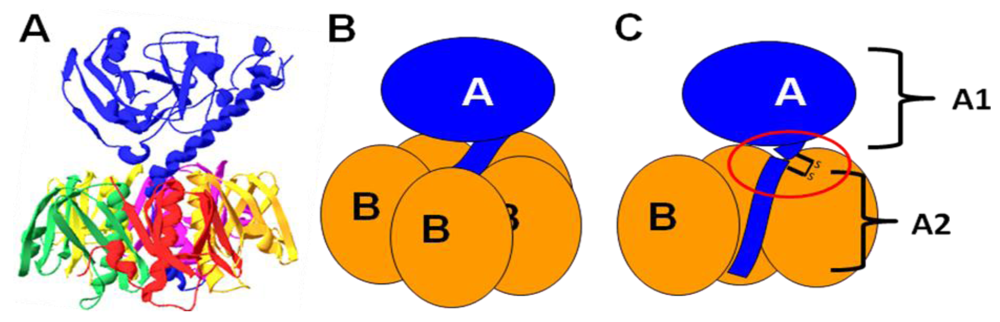
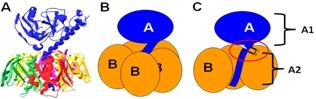
        <p>In terms of both structure and function, LT is closely related to cholera toxin (CT) from <italic>V. cholerae</italic>. Like CT, LT is a multimeric AB<sub>5</sub> toxin, composed of a single A subunit (LTA) associated with a ring of five B subunits (LTB) [<xref ref-type="bibr" rid="B16-toxins-02-01445">16</xref>]. <xref ref-type="fig" rid="toxins-02-01445-f001">Figure 1</xref> shows the structure and subunit organization of LT. Heat treatment of the toxin breaks down the pentameric LTB ring into monomers, releasing LTA. While catalytic activity is present in free LTA, the LTB pentamer is required for entry into cells of the intestinal epithelium, and disruption of the holotoxin thereby prevents intoxication of host cells [<xref ref-type="bibr" rid="B17-toxins-02-01445">17</xref>]. </p>
        <fig id="toxins-02-01445-f001" position="anchor">
          <label>Figure 1</label>
          <caption>
            <p>The structure and subunit organization of LT. (<bold>A</bold>) The crystal structure of LT holotoxin, generated using Swiss-PDB viewer (version 4.0.1) using PDB number 1LTA. The globular A1 fragment and the helical A2 peptide can be seen in blue, along with a ring of five B subunits. (<bold>B</bold>) A schematic of the subunit organization of LT. (<bold>C</bold>) A schematic of LT showing a cutaway view of the toxin’s central core. The location of the site of proteolytic processing (“nicking”), which is subtended by a disulfide bond, is circled. Nicking occurs after secretion of the toxin, and the disulfide is reduced inside the host cell, releasing the catalytically active A1 fragment.</p>
          </caption>
          <graphic xmlns:xlink="http://www.w3.org/1999/xlink" xlink:href="toxins-02-01445-g001.tif"/>
        </fig>
      </sec>
      <sec>
        <title>1.3. Catalytic activity of LT</title>
        <p>Early research efforts determined that the catalytic activity of LT is identical to that of CT, which had already been characterized. Specifically, LTA ADP-ribosylates an arginine residue in the α subunit of the host G<sub>s</sub> protein [<xref ref-type="bibr" rid="B18-toxins-02-01445">18</xref>]. This modification leads to inhibition of the GTPase activity of G<sub>sα</sub>, rendering adenylate cyclase constitutively active. Increased levels of cyclic AMP (cAMP) in the host cell open several channels, including the cystic fibrosis transmembrane receptor, resulting in the loss of fluid and electrolytes into the intestinal lumen [<xref ref-type="bibr" rid="B19-toxins-02-01445">19</xref>]. cAMP-dependent cellular events also lead to the downregulation of antimicrobial peptides in the intestine [<xref ref-type="bibr" rid="B20-toxins-02-01445">20</xref>]. LTA displays limited auto-ADP-ribosylation activity, especially when overexpressed, but this reaction does not seem to influence its function [<xref ref-type="bibr" rid="B21-toxins-02-01445">21</xref>].</p>
        <p>During activation, LTA is proteolytically cleaved, releasing a helical <italic>C</italic>-terminal fragment termed A2; the remaining A1 polypeptide is responsible for the observed toxic effects. This cleavage event, termed “nicking,” is not required for the toxic effects of LT, but mutants that are unable to be nicked demonstrate a markedly delayed effect in cell culture, and nicking doubles the toxin’s ADP-ribosyltransferase activity <italic>in vitro</italic> [<xref ref-type="bibr" rid="B21-toxins-02-01445">21</xref>]. Trypsin is able to cleave LTA into A1 and A2 <italic>in vitro</italic>, but the identity of the protease(s) involved in this activation step <italic>in vivo</italic> is not known [<xref ref-type="bibr" rid="B22-toxins-02-01445">22</xref>]. In addition to this cleavage event, a disulfide bond linking A1 and A2 is also reduced after entry into the host cell in order to completely separate the two fragments [<xref ref-type="bibr" rid="B23-toxins-02-01445">23</xref>]. This disulfide bond is not essential to holotoxin formation, but mutation of the cysteine residues involved makes LTA more sensitive to degradation by proteases and generates a significant lag in cAMP production in cultured intestinal cells compared to wild-type toxin [<xref ref-type="bibr" rid="B24-toxins-02-01445">24</xref>].</p>
      </sec>
      <sec>
        <title>1.4. Homology to CT</title>
        <p>LT is encoded by a two-gene operon, with the gene for LTA (<italic>eltA</italic>) overlapping with the start of the gene for LTB (<italic>eltB</italic>) by four nucleotides [<xref ref-type="bibr" rid="B25-toxins-02-01445">25</xref>]. These genes have been referred to as <italic>etxAB</italic> or <italic>toxAB</italic> in some older studies [<xref ref-type="bibr" rid="B26-toxins-02-01445">26</xref>] but will be called <italic>eltAB</italic> here, following recent convention. Given the identical subunit structure and catalytic activity, it is perhaps unsurprising that the nucleotide sequences of the genes for CT and LT are highly similar. The <italic>eltAB</italic> operon demonstrates approximately 78% overall nucleotide sequence identity to the <italic>ctxAB</italic> operon coding for CT [<xref ref-type="bibr" rid="B27-toxins-02-01445">27</xref>]. While the DNA sequences display a fairly uniform similarity throughout, the amino acid sequences of the subunits of CT and LT contain “hotspots” of greater divergence. The most divergent regions include the signal sequences targeting the subunits to the periplasm (see below) and the A2 peptide [<xref ref-type="bibr" rid="B27-toxins-02-01445">27</xref>]. Most relevant to the ligand binding properties described in this review, the two mature B subunits share 83% amino acid identity [<xref ref-type="bibr" rid="B28-toxins-02-01445">28</xref>]. </p>
        <p>Sequence analysis indicates that the genes encoding LT were acquired by horizontal transfer from <italic>V. cholerae</italic> around 130 million years ago, long after <italic>V. cholerae</italic> and <italic>E. coli</italic> diverged as species [<xref ref-type="bibr" rid="B29-toxins-02-01445">29</xref>]. In ETEC, <italic>eltAB</italic> is found on an extrachromosomal virulence plasmid called pEnt [<xref ref-type="bibr" rid="B30-toxins-02-01445">30</xref>]. When surveying ETEC strains, these genes were found to be flanked by approximately 250 base pairs of conserved sequence, often followed by partial or intact insertion sequence (IS) elements [<xref ref-type="bibr" rid="B30-toxins-02-01445">30</xref>]. IS elements similar to those flanking <italic>eltAB</italic> are frequently observed next to genes encoding host-binding fimbriae, suggesting a general mechanism for the transfer of virulence-related genes. In addition, entire pEnt plasmids can be transferred to non-pathogenic strains of <italic>E. coli</italic>, rendering them toxigenic [<xref ref-type="bibr" rid="B31-toxins-02-01445">31</xref>].</p>
      </sec>
    </sec>
    <sec>
      <title>2. Regulation of LT Production</title>
      <sec>
        <title>2.1. Growth conditions inducing the release of LT</title>
        <p>Unlike the extensively studied regulatory network controlling CT production [<xref ref-type="bibr" rid="B32-toxins-02-01445">32</xref>], less is known about the transcriptional regulation of <italic>eltAB</italic>. Alteration of ETEC’s growth conditions revealed that a pH of 7.5–8.0 maximizes the amount of LT released; moreover, LT is not produced in detectable quantities at temperatures lower than 26 °C, with toxin production increasing along with temperature and reaching a peak at 37 °C [<xref ref-type="bibr" rid="B33-toxins-02-01445">33</xref>,<xref ref-type="bibr" rid="B34-toxins-02-01445">34</xref>]. It has also been observed that the addition of glucose to the growth media induces the release of LT [<xref ref-type="bibr" rid="B33-toxins-02-01445">33</xref>,<xref ref-type="bibr" rid="B35-toxins-02-01445">35</xref>]. In addition, oxygen levels and osmolarity were found to influence toxin expression. Specifically, microaerophilic conditions and increased salt concentrations (&gt;171 mM) both promote the production of LT [<xref ref-type="bibr" rid="B36-toxins-02-01445">36</xref>]. In general, conditions that mimic those found in the human small intestine, where LT is expected to play a role in ETEC-associated pathogenesis, are optimal for production of the toxin. </p>
        <p>The presence of short-chain fatty acids (particularly those with carbon chain lengths between three and eight) in the growth media impairs the production of LT [<xref ref-type="bibr" rid="B37-toxins-02-01445">37</xref>]. Short-chain fatty acids are produced in relatively large quantities in the colon, where they stimulate fluid absorption in a cAMP-independent manner [<xref ref-type="bibr" rid="B38-toxins-02-01445">38</xref>]. Thus, they may serve to signal ETEC that it has reached the large intestine and no longer needs to produce high quantities of LT, having passed its target, the ileum. Additionally, the presence of short-chain fatty acids may indicate to ETEC that conditions in the gut favor the absorption of liquid by the colonic epithelium and that the production of LT would not be effective. </p>
        <p>While many of these conditions (e.g., higher temperature) consistently induce LT production, it should be noted that not all ETEC isolates are identical in the levels of LT that they produce. A study of 26 LT-positive Brazilian ETEC isolates found that the secreted levels of the toxin varied almost 50-fold [<xref ref-type="bibr" rid="B39-toxins-02-01445">39</xref>]. While the amount of LT produced correlated well with fluid accumulation in a rabbit ileal loop model, LT-hyperproducing strains were isolated from diarrheic patients and asymptomatic patients with equal frequencies in that study. Although there is no way to tell whether the production of LT measured <italic>in vitro</italic> recapitulated the strains’ phenotypes <italic>in vivo</italic>, a careful study of <italic>eltB</italic> expression in diarrheagenic ETEC isolates both immediately after collection and later, after freezedown and storage, indicated little change due to <italic>in vitro</italic> growth [<xref ref-type="bibr" rid="B40-toxins-02-01445">40</xref>]. Therefore, while LT certainly contributes to disease symptoms, the regulation of LT production may occur differently in individual ETEC isolates.</p>
      </sec>
      <sec>
        <title>2.2. Regulation by H-NS</title>
        <p>Apart from characterization of the growth conditions favoring LT production, little was known about the transcriptional regulation of <italic>eltAB</italic> for decades. The conserved region upstream of <italic>eltA</italic> contains a strong consensus promoter, and the region downstream of <italic>eltB</italic> contains a probable transcriptional terminator, indicating that these genes are transcribed as a single message [<xref ref-type="bibr" rid="B30-toxins-02-01445">30</xref>,<xref ref-type="bibr" rid="B41-toxins-02-01445">41</xref>]. In 1998, Trachman and Maas noted that deletion of the <italic>eltA</italic> gene elevates the levels of mRNA transcribed from the operon’s promoter, which they determined to be due to lack of a downstream regulatory element bound by the nucleoid-associated protein H-NS [<xref ref-type="bibr" rid="B42-toxins-02-01445">42</xref>]. In a strain lacking H-NS, <italic>eltAB</italic> is not repressed at low temperatures [<xref ref-type="bibr" rid="B42-toxins-02-01445">42</xref>]. Later work by another group uncovered two distinct but cooperative binding sites for H-NS positioned in the region downstream of the promoter [<xref ref-type="bibr" rid="B43-toxins-02-01445">43</xref>]. These sites are found at regions of DNA predicted to have significant curvature, a feature of H-NS binding elements [<xref ref-type="bibr" rid="B43-toxins-02-01445">43</xref>]. While there is interplay between the effects of temperature and osmolarity, the regulation of <italic>eltAB</italic> in response to salt concentration is independent of H-NS and its regulatory element [<xref ref-type="bibr" rid="B36-toxins-02-01445">36</xref>]. Therefore, H-NS is responsible for temperature regulation of LT, but it is unclear which bacterial factors are able to sense osmotic conditions and short-chain fatty acids.</p>
      </sec>
      <sec>
        <title>2.3. Feedback from cAMP</title>
        <p>Another important regulator of the transcription of <italic>eltAB</italic> is cAMP, an end product of LT’s catalytic activity. As described above, the catalytic activity of LTA causes an increase in cAMP levels in host cells. Some of this cAMP is shed into the intestinal lumen after treatment with LT [<xref ref-type="bibr" rid="B44-toxins-02-01445">44</xref>], and there is evidence that exogenous cAMP can be sensed by ETEC. Namely, conditioned supernatant from ETEC-treated intestinal epithelial cells (or pure cAMP, the active component) stimulates the LT-dependent adherence of ETEC to enterocytes <italic>in vitro</italic> [<xref ref-type="bibr" rid="B13-toxins-02-01445">13</xref>]. It was later determined that bacterial cAMP receptor protein (CRP) suppresses the transcription of <italic>eltAB</italic> by binding to an operator overlapping the σ<sup>70</sup> consensus binding site [<xref ref-type="bibr" rid="B45-toxins-02-01445">45</xref>]. While seemingly contradictory, these results may define a feedback loop, whereby the production of LT can be downregulated once a certain amount of cAMP has been released by the cells of the intestinal epithelium. </p>
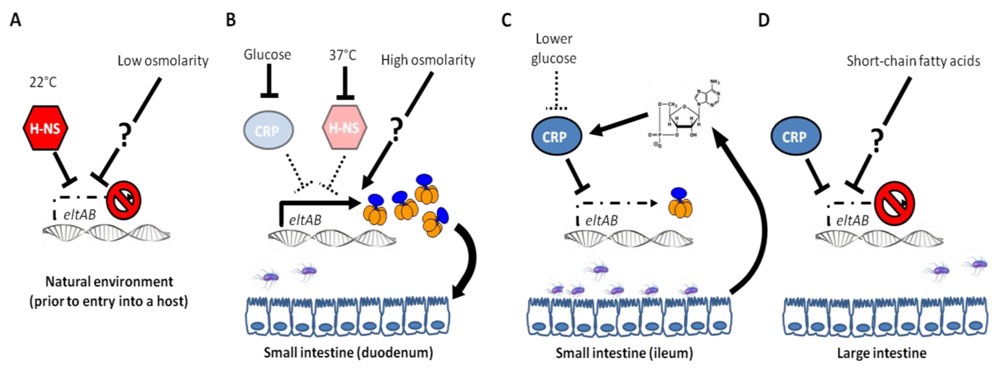
        <p>The identification of CRP as a negative regulator of LT synthesis also served to explain earlier observations regarding glucose. Glucose inhibits bacterial cAMP production, lowering levels of active CRP and thereby upregulating LT production [<xref ref-type="bibr" rid="B45-toxins-02-01445">45</xref>]. As glucose is absorbed by the small intestine, ETEC is likely to encounter higher concentrations of the sugar in early sections of the gut [<xref ref-type="bibr" rid="B46-toxins-02-01445">46</xref>]. Thus, early exposure to glucose may induce the production of LT to aid in adherence to the ileum, where most ETEC cells are found in a mouse model of colonization [<xref ref-type="bibr" rid="B14-toxins-02-01445">14</xref>]. Interestingly, ST production is stimulated by CRP [<xref ref-type="bibr" rid="B45-toxins-02-01445">45</xref>], suggesting that ETEC may predominantly produce one toxin at a time during infection. Together, these results leave us with a model whereby ETEC senses conditions that identify the small intestine and, in turn, upregulates the production of LT (<xref ref-type="fig" rid="toxins-02-01445-f002">Figure 2</xref>). Once ETEC has reached the large intestine, LT synthesis shuts off as the bacteria prepare to exit the host.</p>
        <fig id="toxins-02-01445-f002" position="anchor">
          <label>Figure 2</label>
          <caption>
            <p>A model of the regulation of <italic>eltAB</italic> during infection. (<bold>A</bold>) In an environmental reservoir at ambient temperature, low osmolarity and H-NS act to repress the <italic>eltAB</italic> promoter. No LT is produced. (<bold>B</bold>) Upon entry into the host intestine, free glucose and higher temperature de-repress the <italic>eltAB</italic> operon by inhibiting cAMP receptor protein (CRP) and H-NS, respectively. High levels of LT are produced. High osmolarity may also contribute to the production of LT by an unknown mechanism. (<bold>C</bold>) ETEC reaches the ileum, where it begins to multiply, adhering to intestinal cells due to the activity of LT. In the ileum, glucose concentrations are lower due to intestinal absorption, and significant amounts of cAMP have been released by host cells in response to LT. These signals combine to repress <italic>eltAB</italic> via CRP. Little new LT is produced. (<bold>D</bold>) In the large intestine, CRP and short-chain fatty acids produced by commensal bacteria fully repress <italic>eltAB</italic>. The mechanism of repression by short-chain fatty acids is unknown. ETEC shuts off the production of LT in preparation to exit the host. </p>
          </caption>
          <graphic xmlns:xlink="http://www.w3.org/1999/xlink" xlink:href="toxins-02-01445-g002.tif"/>
        </fig>
      </sec>
    </sec>
    <sec>
      <title>3. Holotoxin Assembly</title>
      <sec>
        <title>3.1. Periplasmic localization</title>
        <p>Both LTA and LTB feature signal sequences directing them to the periplasm of <italic>E. coli</italic> through the Sec translocation machinery. For LTA, this signal is 18 amino acids in length, while LTB contains a 21-amino acid signal peptide [<xref ref-type="bibr" rid="B47-toxins-02-01445">47</xref>,<xref ref-type="bibr" rid="B48-toxins-02-01445">48</xref>]. Each peptide sequence contains positive charges at the beginning, a core of hydrophobic residues, and a tyrosine or histidine residue near the cleavage site, in line with typical <italic>sec</italic>-dependent signals. For many years, the periplasm was thought to be the terminal destination of LT [<xref ref-type="bibr" rid="B49-toxins-02-01445">49</xref>], although it is now known that it remains periplasmic in laboratory strains of <italic>E. coli</italic> because they do not express a functional type II secretion system (see below).</p>
        <p>Once LTA and LTB subunits reach the periplasm, they spontaneously assemble into holotoxins containing one A subunit and five B subunits. Pentamers form quite rapidly; within one minute, 80% of newly transported LTB has formed into pentamers, about half of which carry LTA [<xref ref-type="bibr" rid="B50-toxins-02-01445">50</xref>]. LTA is actually produced in slight excess, such that around 1.5 LTA subunits are found for every 5 LTB subunits in the periplasm. Pulse-chase studies of LTA determined that 90% of periplasmic LTA is associated with B-subunit pentamers at any one time, but half of newly transported LTA does not form holotoxins [<xref ref-type="bibr" rid="B50-toxins-02-01445">50</xref>]. Thus, it is likely that LTA is made in excess because it can be easily degraded in the periplasm before it can assemble into holotoxins. Fully formed holotoxin is remarkably stable, remaining assembled at any pH between 2.0 and 11.0 [<xref ref-type="bibr" rid="B51-toxins-02-01445">51</xref>]. Moreover, while exposure to strong acidic conditions dissociates the B pentamer, free monomers re-oligomerize upon neutralization with no additional factors present [<xref ref-type="bibr" rid="B16-toxins-02-01445">16</xref>].</p>
      </sec>
      <sec>
        <title>3.2. Factors influencing oligomerization</title>
        <p>Much of what is required to form LT holotoxins exists within the amino acid sequences of the subunits themselves. To date, the only prokaryotic factor known to be required for the formation of LT (and CT) is DsbA, a periplasmic disulfide oxidoreductase. LTB contains a single disulfide bridge linking Cys-9 and Cys-86. Disruption of this bond with a reducing agent such as dithiothreitol prevents reassembly of LT after dissociation in acid, and a transposon insertion in the <italic>V. cholerae</italic> homolog of <italic>dsbA</italic> was reported to abolish the heterologous production of LT [<xref ref-type="bibr" rid="B16-toxins-02-01445">16</xref>,<xref ref-type="bibr" rid="B52-toxins-02-01445">52</xref>]. LTA also features an important disulfide bond linking the A1 and A2 fragments at Cys-187 and Cys-199, the formation of which is presumably catalyzed by DsbA. Other studies of the mechanism behind the acid dissociation of LT and its subsequent reassembly under neutral conditions showed that isomerization of Pro-93 in the B subunit blocks oligomerization [<xref ref-type="bibr" rid="B53-toxins-02-01445">53</xref>]. The results of that study suggest that proper formation of LT requires the activity of a peptidyl proline isomerase <italic>in vivo</italic>, but this hypothesis has yet to be tested.</p>
        <p>While free B subunits are intrinsically capable of assembling pentamers, the presence of LTA enhances pentamer formation. Consequently, a larger amount of oligomerized LTB can be found when LTA is co-expressed [<xref ref-type="bibr" rid="B16-toxins-02-01445">16</xref>]. This effect is due to the A2 peptide, as deletion of the last 14 amino acids from LTA significantly slows the formation of B-subunit pentamers [<xref ref-type="bibr" rid="B54-toxins-02-01445">54</xref>]. Interestingly, the last four amino acids of LTA (Arg-Asp-Glu-Leu) may specifically be critical for anchoring LTA in the newly formed pentamer. LTA mutants lacking these residues are able to readily induce LTB oligomerization, but are not found with the assembled pentamers [<xref ref-type="bibr" rid="B54-toxins-02-01445">54</xref>]. Thus, the “cargo” subunit of LT (LTA) also lends a hand in the assembly of native toxin.</p>
        <p>B-subunit mutants that are defective in pentamer assembly have also been isolated. LTB in which the final amino acid residues, Ser-Met-Glu-Asn, have been replaced with Gly-Leu-Asn oligomerize approximately 10 times slower than wild-type LTB [<xref ref-type="bibr" rid="B54-toxins-02-01445">54</xref>]. As salt bridges between the A2 peptide and the last five amino acids of LTB were identified in the crystal structure of LT [<xref ref-type="bibr" rid="B55-toxins-02-01445">55</xref>], <italic>C</italic>-terminal alterations to LTA and LTB may be expected to disrupt holotoxin synthesis. <italic>In vitro</italic> studies using a monoclonal antibody directed against the first 10 amino acids of LTB have implicated the extreme <italic>N</italic>-terminus of the B subunit in pentamer assembly, as well [<xref ref-type="bibr" rid="B51-toxins-02-01445">51</xref>]. Taken together, these reports show that LTB is self-sufficient in terms of its folding and assembly, and that LTA stabilizes the holotoxin and accelerates pentamer formation.</p>
      </sec>
    </sec>
    <sec>
      <title>4. Secretion</title>
      <sec>
        <title>4.1. Type II secretion</title>
        <p>Studies initially characterizing LT noted that it was found in association with aggregates in the culture supernatant that had outer membrane-like characteristics [<xref ref-type="bibr" rid="B33-toxins-02-01445">33</xref>,<xref ref-type="bibr" rid="B56-toxins-02-01445">56</xref>]. Several studies, in fact, described endotoxin activity and/or outer membrane fragments that were associated with LT so tightly that it complicated their attempts at purifying the toxin [<xref ref-type="bibr" rid="B33-toxins-02-01445">33</xref>,<xref ref-type="bibr" rid="B57-toxins-02-01445">57</xref>]. Nevertheless, early studies considered the periplasm to be the final destination for LT. However, it was also noted that LT could be secreted into the supernatant when heterologously expressed in <italic>V. cholerae</italic> [<xref ref-type="bibr" rid="B58-toxins-02-01445">58</xref>]. Moreover, a mutant <italic>V. cholerae</italic> strain unable to secrete CT was also unable to secrete LT, indicating a common pathway for the export of both toxins [<xref ref-type="bibr" rid="B58-toxins-02-01445">58</xref>]. Later research determined that the secretion of CT is dependent on a pathway called the type II secretion system [<xref ref-type="bibr" rid="B59-toxins-02-01445">59</xref>]. Found in numerous gram-negative species, this system consists of a complex of 12–15 proteins spanning the inner and outer membranes [<xref ref-type="bibr" rid="B60-toxins-02-01445">60</xref>].</p>
        <p>In 2002, Tauschek and colleagues identified an operon in H10407 ETEC (<italic>gspC-M</italic>) coding for a functional type II system [<xref ref-type="bibr" rid="B61-toxins-02-01445">61</xref>]. This system is required for the secretion of LT, debunking the apparent paradox of an extracellular pathogen producing a toxin that remains inside its own cell. Further implicating the type II system in mediating the release of LT, expression of the <italic>E. coli</italic> K-12 type II operon is necessary and sufficient for the export of LT from MC4100 <italic>E. coli</italic> cells [<xref ref-type="bibr" rid="B62-toxins-02-01445">62</xref>]. The genes encoding the type II apparatus are also regulated by H-NS [<xref ref-type="bibr" rid="B63-toxins-02-01445">63</xref>,<xref ref-type="bibr" rid="B64-toxins-02-01445">64</xref>], indicating that they would be turned on under the same conditions that favor the production of LT. Furthermore, the type II system in ETEC is capable of secreting CT [<xref ref-type="bibr" rid="B65-toxins-02-01445">65</xref>], consistent with results from the expression of LT in <italic>V. cholerae</italic>. </p>
        <p>Secretion of LT is based on the B-subunit pentamer; LTA is not a secretion-competent substrate [<xref ref-type="bibr" rid="B66-toxins-02-01445">66</xref>]. Given the high similarity between CTB and LTB, one could expect similar mutations to impair the native secretion of each toxin. Indeed, one such mutation (E11K) that reduces the secretion efficiency of LT and CT has been found [<xref ref-type="bibr" rid="B65-toxins-02-01445">65</xref>,<xref ref-type="bibr" rid="B67-toxins-02-01445">67</xref>]. However, the identification of several other mutations affecting the secretion of one toxin but not the other indicates that LT and CT are recognized in different ways by their respective secretion machineries [<xref ref-type="bibr" rid="B65-toxins-02-01445">65</xref>]. Moreover, two CTB mutants that are impaired for secretion in <italic>V. cholerae</italic> are secreted with wild-type efficiency from ETEC. Because these toxins are interchangeable as secretion substrates, future studies using secretion-deficient mutants could identify the portion(s) of the type II secretion apparatus that are involved in substrate recognition.</p>
        <p>Other studies determined that the secretion of LT from ETEC strain H10407 was dependent on the activity of a protein called LeoA, which was later characterized as a GTPase [<xref ref-type="bibr" rid="B68-toxins-02-01445">68</xref>,<xref ref-type="bibr" rid="B69-toxins-02-01445">69</xref>]. As only 3% of strains tested in a study of numerous ETEC isolates carried the <italic>leoA</italic> gene [<xref ref-type="bibr" rid="B70-toxins-02-01445">70</xref>], and Δ<italic>leoA</italic> mutants demonstrate pleiotropic effects [<xref ref-type="bibr" rid="B68-toxins-02-01445">68</xref>], the role of LeoA in the secretion of LT is certainly not a universal one. ATPase activity is required for type II secretion, and it is possible that H10407 uses LeoA to provide additional energy for the export of LT. </p>
      </sec>
      <sec>
        <title>4.2. Secretion via outer membrane vesicles</title>
        <p>The existence of extracellular LT was also explored in a second series of studies. Two reports characterized the secretion of active LT in association with outer membrane vesicles (OMVs) released by ETEC [<xref ref-type="bibr" rid="B71-toxins-02-01445">71</xref>,<xref ref-type="bibr" rid="B72-toxins-02-01445">72</xref>]. OMVs are spherical structures approximately 50–200 nm in diameter, composed of protein and lipid, that are released from all gram-negative bacteria studied to date [<xref ref-type="bibr" rid="B73-toxins-02-01445">73</xref>] (A.J. Kulp and M.J. Kuehn, <italic>Annu. Rev. Microbiol.</italic>, in press). As the name suggests, OMVs are derived from the outer membrane, but periplasmic components are also present within their lumens. In recent years, OMVs have been shown to play a role in the virulence associated with a number of pathogens [<xref ref-type="bibr" rid="B74-toxins-02-01445">74</xref>]. In the case of ETEC, active LT is found both inside OMVs and associated with their surface [<xref ref-type="bibr" rid="B71-toxins-02-01445">71</xref>]. The basis and implications of this association will be discussed below.</p>
      </sec>
    </sec>
    <sec>
      <title>5. Ganglioside Binding</title>
      <sec>
        <title>5.1. LT’s interaction with G<sub>M1</sub></title>
        <p>Three decades ago, the host receptor for CT was determined to be the monosialoganglioside G<sub>M1</sub> (Galβ3GalNAcβ4(NeuAcα3)Glcβ1-ceramide), with LT later shown to bind the same receptor [<xref ref-type="bibr" rid="B75-toxins-02-01445">75</xref>]. When the crystal structures of CTB and LTB bound to G<sub>M1</sub> pentasaccharide or galactose were compared, it was noted that the residues contacting the terminal galactose sugar in G<sub>M1</sub> are conserved between the two toxins [<xref ref-type="bibr" rid="B76-toxins-02-01445">76</xref>], explaining their similar affinities for the host receptor. The binding pocket for G<sub>M1</sub> is located at the interface of two adjacent subunits, with Gly-33 providing the sole contribution of the second LTB monomer. Only B-subunit pentamers, and not monomeric CTB or LTB, are able to bind G<sub>M1</sub> [<xref ref-type="bibr" rid="B77-toxins-02-01445">77</xref>,<xref ref-type="bibr" rid="B78-toxins-02-01445">78</xref>]. With five B subunits, there are five G<sub>M1</sub> binding sites available in LTB. Whereas CTB has been modeled with five G<sub>M1</sub> molecules bound [<xref ref-type="bibr" rid="B79-toxins-02-01445">79</xref>], only one or two wild-type G<sub>M1</sub> binding sites are required for internalization and toxicity of CT, albeit with slower kinetics [<xref ref-type="bibr" rid="B80-toxins-02-01445">80</xref>]. It is not yet clear whether the same is true for LT.</p>
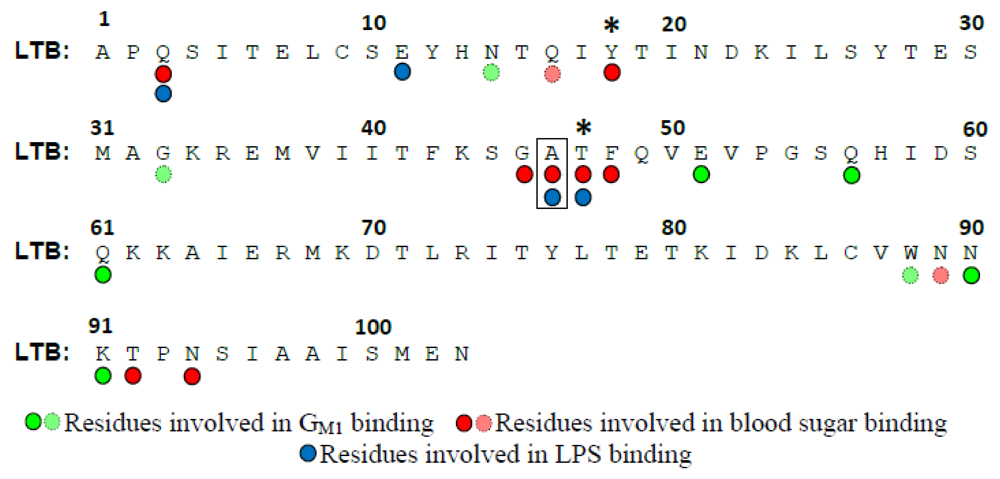
        <p>The terminal galactose residue of G<sub>M1 </sub> forms the most contacts with LTB and CTB, whereas only slight interactions with the sialic acid residue of the ganglioside have been observed [<xref ref-type="bibr" rid="B79-toxins-02-01445">79</xref>]. The significant contact between LTB and the terminal galactose sugar, 79% of which is buried within the binding pocket, likely explains the strong preference for binding G<sub>M1</sub> over other gangliosides (see Section 5.2). The LTB residues involved in G<sub>M1</sub> binding are indicated in <xref ref-type="fig" rid="toxins-02-01445-f003">Figure 3</xref>. </p>
        <p>Consistent with the model presented in <xref ref-type="fig" rid="toxins-02-01445-f002">Figure 2</xref>, the rabbit ileum is enriched in G<sub>M1</sub> compared to other sections of the small intestine [<xref ref-type="bibr" rid="B81-toxins-02-01445">81</xref>]. Binding to G<sub>M1</sub> that is located in lipid rafts on host intestinal cells is critical for the canonical pathway leading to LT’s toxic effects through increased cAMP levels. As such, the binding pocket has become an attractive target for chemical inhibitors, and several studies have involved screening galactose-based small-molecule libraries for possible receptor antagonists [<xref ref-type="bibr" rid="B82-toxins-02-01445">82</xref>,<xref ref-type="bibr" rid="B83-toxins-02-01445">83</xref>]. After G<sub>M1</sub> binding, LT is internalized and undergoes retrograde transport to the endoplasmic reticulum [<xref ref-type="bibr" rid="B23-toxins-02-01445">23</xref>]. There, LTA is able to retrotranslocate into the cytosol to reach its target, G<sub>sα</sub>. While an increasing number of studies are focused on the events surrounding LT after it enters the host cell, host effects and intracellular trafficking are not the focus of this review. Indeed, the intracellular transport of CT has been reviewed elsewhere in this special issue [<xref ref-type="bibr" rid="B84-toxins-02-01445">84</xref>]. Ganglioside binding has also been shown to be important for the adjuvant properties ascribed to LTB and CTB. Excellent reviews of the use of CT-like enterotoxins as adjuvants are available elsewhere [<xref ref-type="bibr" rid="B85-toxins-02-01445">85</xref>], so this property will not be discussed here either.</p>
         <fig id="toxins-02-01445-f003" position="anchor">
          <label>Figure 3</label>
          <caption>
            <p>The mature polypeptide sequence of LTB, with residues involved in binding to G<sub>M1</sub> (green circles), blood sugars (red circles), and lipopolysaccharide (blue circles) indicated. Lighter shades of circles indicate residues coordinating solvent molecules only. Amino acids involved in binding to G<sub>M1</sub> (specifically, the terminal galactose moiety) and A-group blood sugars were identified by crystallization studies [<xref ref-type="bibr" rid="B28-toxins-02-01445">28</xref>,<xref ref-type="bibr" rid="B76-toxins-02-01445">76</xref>]; residues involved in lipopolysaccharide binding are inferred based on the binding phenotypes caused by mutating specific amino acids [<xref ref-type="bibr" rid="B65-toxins-02-01445">65</xref>,<xref ref-type="bibr" rid="B86-toxins-02-01445">86</xref>]. Asterisks indicate Tyr-18 and Thr-47; classical CTB contains a His at position 18, and El Tor CTB variants contain an Ile at position 47. These substitutions are thought to explain the lack of blood sugar binding by CTB [<xref ref-type="bibr" rid="B28-toxins-02-01445">28</xref>]. Ala-46 (boxed) is mutated to Glu in porcine LTB, likely explaining its lack of binding to blood sugars [<xref ref-type="bibr" rid="B87-toxins-02-01445">87</xref>]. Numbering of the LTB sequence starts with the first residue in the mature protein, after cleavage of the <italic>sec</italic>-dependent signal sequence. </p>
          </caption>
          <graphic xmlns:xlink="http://www.w3.org/1999/xlink" xlink:href="toxins-02-01445-g003.tif"/>
        </fig>
      </sec>
      <sec>
        <title>5.2. Additional non-G<sub>M1</sub> substrates</title>
        <p>The structural requirements of CT’s receptor binding seem rather strict; G<sub>M1</sub> is the only ganglioside that CTB binds to with any substantial affinity [<xref ref-type="bibr" rid="B88-toxins-02-01445">88</xref>]. Due to the existence of several hydrogen bonds contacting the terminal galactose of G<sub>M1</sub>, substitution of another sugar in this position is not tolerated by CTB or LTB [<xref ref-type="bibr" rid="B76-toxins-02-01445">76</xref>]. However, a number of studies have shown that LTB can bind with low affinities to additional gangliosides, including one lacking a sialic acid residue (asialo-G<sub>M1</sub>), one with a second sialic acid residue (G<sub>D1b</sub>), and others containing a terminal <italic>N</italic>-acetyllactosamine disaccharide (e.g., paragloboside) [<xref ref-type="bibr" rid="B88-toxins-02-01445">88</xref>,<xref ref-type="bibr" rid="B89-toxins-02-01445">89</xref>] (<xref ref-type="table" rid="toxins-02-01445-t001">Table 1</xref>). The structural basis of this difference in binding is not entirely clear. There is some disagreement in the literature about the ability of LTB to bind G<sub>M2</sub>, which lacks the terminal galactose residue present in G<sub>M1</sub>, and the ability of CTB to bind G<sub>D1b</sub> [<xref ref-type="bibr" rid="B75-toxins-02-01445">75</xref>,<xref ref-type="bibr" rid="B88-toxins-02-01445">88</xref>,<xref ref-type="bibr" rid="B89-toxins-02-01445">89</xref>,<xref ref-type="bibr" rid="B90-toxins-02-01445">90</xref>] (<xref ref-type="table" rid="toxins-02-01445-t001">Table 1</xref>). LT binding to G<sub>M2</sub> was found using gangliosides immobilized on microtiter plates and thin layer chromatography assays [<xref ref-type="bibr" rid="B89-toxins-02-01445">89</xref>,<xref ref-type="bibr" rid="B90-toxins-02-01445">90</xref>]. Using G<sub>M2</sub>-containing liposomes as substrates for surface plasmon resonance, no LT binding was seen [<xref ref-type="bibr" rid="B88-toxins-02-01445">88</xref>]. Given the extensive binding of the terminal galactose sugar in the crystal structures of CT and LT [<xref ref-type="bibr" rid="B76-toxins-02-01445">76</xref>,<xref ref-type="bibr" rid="B79-toxins-02-01445">79</xref>], it is difficult to imagine G<sub>M2</sub> binding being important <italic>in vivo</italic>. Another study showed that linoleic acid, an unsaturated fatty acid found in bile, could competitively inhibit G<sub>M1</sub> binding by LT [<xref ref-type="bibr" rid="B91-toxins-02-01445">91</xref>]. However, the exact nature of this binding event is unknown, and the authors concluded that normal amounts of bile would not provide sufficient linoleic acid to impair LT’s toxicity <italic>in vivo</italic>.</p>
        <table-wrap id="toxins-02-01445-t001" position="anchor">
          <object-id pub-id-type="pii">toxins-02-01445-t001_Table 1</object-id>
          <label>Table 1</label>
          <caption>
            <p>Summary of the structures of the gangliosides bound by CTB and LTB and the relative binding affinities of those interactions. ++++, strong binding; +, some weak binding; -, no binding; +/-, conflicting reports of weak binding and no binding (see text for references). Gal = galactose, GalNAc = <italic>N</italic>-acetylgalactosamine, Sia = sialic acid (<italic>N</italic>-acetylneuraminic acid), Glc = glucose, GlcNAc = <italic>N</italic>-acetylglucosamine, Cer = ceramide. </p>
          </caption>
          <table>
            <thead>
              <tr>
                <th align="center" valign="middle">Ganglioside</th>
                <th align="center" valign="middle">Structure</th>
                <th align="center" valign="middle">LTB binding</th>
                <th align="center" valign="middle">CTB binding</th>
              </tr>
            </thead>
            <tbody>
              <tr>
                <td align="right" valign="middle"><bold>G<sub>M1</sub></bold></td>
                <td align="center" valign="middle"><graphic xmlns:xlink="http://www.w3.org/1999/xlink" xlink:href="toxins-02-01445-i001.tif"/></td>
                <td align="center" valign="middle"><bold>++++</bold></td>
                <td align="center" valign="middle"><bold>++++</bold></td>
              </tr>
              <tr>
                <td align="right" valign="middle"><bold>Asialo-G<sub>M1</sub></bold></td>
                <td align="center" valign="middle"><graphic xmlns:xlink="http://www.w3.org/1999/xlink" xlink:href="toxins-02-01445-i002.tif"/></td>
                <td align="center" valign="middle"><bold>+</bold></td>
                <td align="center" valign="middle"><bold>-</bold></td>
              </tr>
              <tr>
                <td align="right" valign="middle">Paragloboside</td>
                <td align="center" valign="middle"><graphic xmlns:xlink="http://www.w3.org/1999/xlink" xlink:href="toxins-02-01445-i003.tif"/></td>
                <td align="center" valign="middle"><bold>+</bold></td>
                <td align="center" valign="middle"><bold>-</bold></td>
              </tr>
              <tr>
                <td align="right" valign="middle">G<sub>D1b</sub></td>
                <td align="center" valign="middle"><graphic xmlns:xlink="http://www.w3.org/1999/xlink" xlink:href="toxins-02-01445-i004.tif"/></td>
                <td align="center" valign="middle"><bold>+</bold></td>
                <td align="center" valign="middle"><bold>+/-</bold></td>
              </tr>
              <tr>
                <td align="right" valign="middle">G<sub>M2</sub></td>
                <td align="center" valign="middle"><graphic xmlns:xlink="http://www.w3.org/1999/xlink" xlink:href="toxins-02-01445-i005.tif"/></td>
                <td align="center" valign="middle"><bold>+/-</bold></td>
                <td align="center" valign="middle"><bold>+/-</bold></td>
              </tr>
            </tbody>
          </table>
        </table-wrap>
        <p>The physiological role of binding to non-G<sub>M1</sub> gangliosides is currently undefined, although paragloboside can act as active receptor for LT in the rabbit intestine [<xref ref-type="bibr" rid="B89-toxins-02-01445">89</xref>]. Paragloboside binding is largely restricted to LTB from porcine isolates, which contains three amino acid substitutions compared to human LTB (S4T, A46E, and E102K) [<xref ref-type="bibr" rid="B87-toxins-02-01445">87</xref>]. However, human ETEC isolates sometimes carry a version of LTB identical in amino acid sequence to porcine LTB [<xref ref-type="bibr" rid="B92-toxins-02-01445">92</xref>], and therefore, the relevance of this binding to human infection should not be completely dismissed. Binding to alternative gangliosides is of much lower affinity than LTB-G<sub>M1</sub> binding (with <italic>K<sub>D</sub></italic> values 10–25 times higher than that of G<sub>M1</sub> binding), so it is easiest to imagine transient binding to non-G<sub>M1</sub> gangliosides. That is, they may represent suboptimal substrates that allow LT to remain proximal to the surface of a host cell until it encounters G<sub>M1</sub> and becomes internalized. </p>
      </sec>
    </sec>
    <sec>
      <title>6. Blood Sugar Binding</title>
      <sec>
        <title>6.1. LTB binds to A-type blood sugars</title>
        <p>For many years, researchers noticed that there were many more receptors for LT on the surface of the intestinal mucosa than receptors for CT and that a significant population of these receptors could not be bound by CT, indicating that they were not G<sub>M1</sub> [<xref ref-type="bibr" rid="B81-toxins-02-01445">81</xref>]. While the presence of additional ganglioside substrates for LT is certain to contribute to these observations, an increasing pool of evidence pointed toward blood antigens providing these extra binding sites. First, LT was observed to bind best to the brush borders of pigs with type A blood (with no blood type-dependent binding observed for CT) [<xref ref-type="bibr" rid="B93-toxins-02-01445">93</xref>] and to human erythrocytes with A or B glycolipids [<xref ref-type="bibr" rid="B94-toxins-02-01445">94</xref>]. These results were confirmed using rabbit intestinal membranes, for which the ABH blood determinants were actually functional receptors, leading to G<sub>M1</sub>-independent fluid accumulation [<xref ref-type="bibr" rid="B95-toxins-02-01445">95</xref>]. Later, blood group A glycoconjugates on cultured human intestinal cells were shown to provide functional additional receptors for soluble LT [<xref ref-type="bibr" rid="B96-toxins-02-01445">96</xref>,<xref ref-type="bibr" rid="B97-toxins-02-01445">97</xref>]. </p>
      </sec>
      <sec>
        <title>6.2. Residues of LTB involved in blood sugar binding</title>
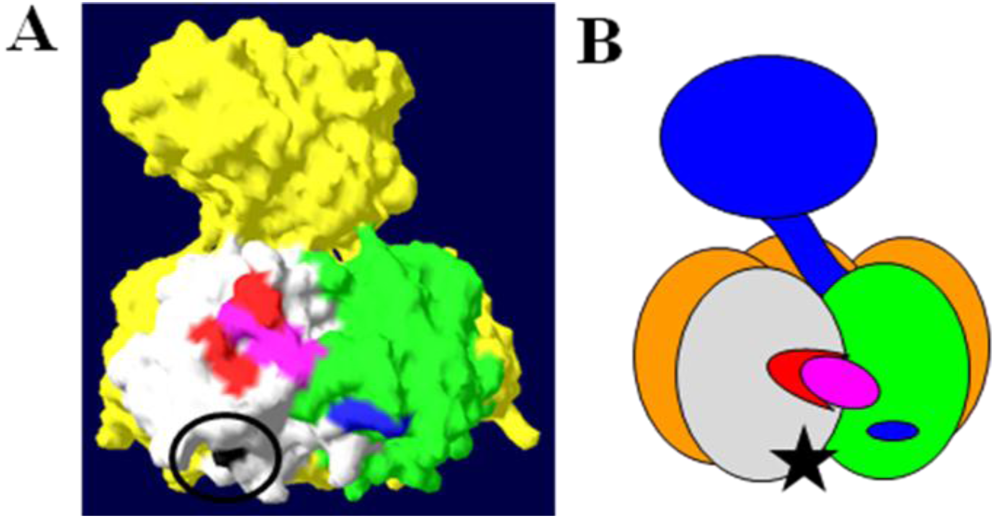
        <p>In 2007, LTB was co-crystallized in association with type-2 A group blood antigen pentasaccharide (GalNAcα3(Fucα2)Galβ4(Fucα3)Glcβ) [<xref ref-type="bibr" rid="B28-toxins-02-01445">28</xref>]. Higher-affinity blood sugar binding had originally been observed for an artificially created LTB/CTB hybrid molecule [<xref ref-type="bibr" rid="B98-toxins-02-01445">98</xref>], but the crystal structure demonstrated that wild-type LTB also binds blood antigen sugars. Blood antigen binding is based on a peripheral binding pocket, distinct from the residues involved in G<sub>M1</sub> binding [<xref ref-type="bibr" rid="B28-toxins-02-01445">28</xref>] (<xref ref-type="fig" rid="toxins-02-01445-f003">Figure 3</xref> and <xref ref-type="fig" rid="toxins-02-01445-f004">Figure 4</xref>). A series of residues at positions 44–47 provides the majority of the observed protein-sugar contacts, along with Gln-3 from an adjacent subunit [<xref ref-type="bibr" rid="B28-toxins-02-01445">28</xref>]. Consistent with the crystal structure, several point mutations involving critical residues in LTB (Q3K, Y18A, A46D, and T47A) abolish binding to the A group terminal trisaccharide, as determined by ELISA [<xref ref-type="bibr" rid="B86-toxins-02-01445">86</xref>]. Porcine LTB contains a Glu residue at position 46 in place of the Ala residue in human LTB (see <xref ref-type="fig" rid="toxins-02-01445-f003">Figure 3</xref>). Because the A46D mutation in LTB abolishes blood sugar binding [<xref ref-type="bibr" rid="B86-toxins-02-01445">86</xref>], it is likely that the A46E substitution explains the lack of porcine LTB binding to A-type glycolipids [<xref ref-type="bibr" rid="B87-toxins-02-01445">87</xref>]. </p>
        <fig id="toxins-02-01445-f004" position="anchor">
          <label>Figure 4</label>
          <caption>
            <p>Peripheral sugar-binding pockets on LTB. (<bold>A</bold>) A rendering of the molecular surface of LT, with residues involved in blood sugar binding colored red, residues implicated in LPS binding colored blue, and residues involved in both binding events colored magenta. These residues lie on the interface between two B subunits, colored white and green. For reference, the galactose moiety of G<sub>M1</sub> is colored and circled in black in (A) and depicted with a black star in (B). The image was rendered in Swiss-PDB viewer (version 4.0.1) using PDB number 1LTA. (<bold>B</bold>) A schematic representation of the subunit structure rendered in (A).</p>
          </caption>
          <graphic xmlns:xlink="http://www.w3.org/1999/xlink" xlink:href="toxins-02-01445-g004.tif"/>
        </fig>
        <p>Binding to B-type blood sugars, which feature a terminal galactose in place of the <italic>N</italic>-acetylgalactosamine found in A sugars, is supported by LTB [<xref ref-type="bibr" rid="B94-toxins-02-01445">94</xref>], but evidence from a study using the LTB/CTB hybrid indicates that binding to a closely related type-1 A blood antigen is not possible [<xref ref-type="bibr" rid="B99-toxins-02-01445">99</xref>]. The type-1 A antigen only differs from the type-2 molecule that can be bound by LT in the nature of the linkage between two terminal sugars, so it would seem that perturbing the orientation of the sugar molecules in the blood antigen even slightly can disrupt this low-affinity binding event.</p>
        <p>While the blood sugar-binding site is physically distinct from the G<sub>M1</sub> binding site, several of its residues are directly adjacent to residues involved in G<sub>M1</sub> binding (see <xref ref-type="fig" rid="toxins-02-01445-f003">Figure 3</xref>). One study reported that incubation of LTB with the terminal trisaccharide from A-type blood antigen does not inhibit G<sub>M1 </sub>binding [<xref ref-type="bibr" rid="B86-toxins-02-01445">86</xref>]. However, another study showed that G<sub>M1</sub> oligosaccharide could inhibit LTB binding to the larger A9 type-2 glycolipid substrate [<xref ref-type="bibr" rid="B100-toxins-02-01445">100</xref>]. Given the proximity of the residues involved in each binding event, it is possible that both binding events do not (and cannot) occur at one LTB-LTB interface, but binding to G<sub>M1</sub> and blood sugars may be able to occur at different locations within the B-subunit pentamer.</p>
      </sec>
      <sec>
        <title>6.3. ETEC infection and blood type</title>
        <p>The severity of <italic>V. cholerae</italic> infection is linked to blood type. Specifically, patients with O blood type are more likely to develop severe symptoms than their counterparts with A, B, or AB blood type [<xref ref-type="bibr" rid="B101-toxins-02-01445">101</xref>]. In contrast, the effect of blood type on ETEC infection is much less clear [<xref ref-type="bibr" rid="B102-toxins-02-01445">102</xref>], but a recent cohort study of ETEC-based diarrhea in Bangladesh found an increased prevalence of the disease among children with A or AB blood type [<xref ref-type="bibr" rid="B103-toxins-02-01445">103</xref>]. Complicating the search for a correlation between ETEC infection and blood type is the existence of the so-called “secretor” phenotype. ABH blood type determinants are found in large quantities on intestinal cells, but some patients also release these glycoconjugates in their intestinal mucosal secretions [<xref ref-type="bibr" rid="B104-toxins-02-01445">104</xref>,<xref ref-type="bibr" rid="B105-toxins-02-01445">105</xref>]. Thus, extracellular A-type sugars may serve as decoys for LT binding in individuals with the secretor phenotype, thus protecting them against the toxin. In contrast, non-secretor patients of A blood type may in fact have additional functional receptors for the toxin. Future studies in which patients with ETEC-based diarrhea are screened for both the secretor phenotype and blood type will provide information regarding the possible use of blood group sugars as receptors <italic>in vivo</italic>.</p>
      </sec>
    </sec>
    <sec>
      <title>7. Lipopolysaccharide Binding</title>
      <sec>
        <title>7.1. Binding of LT to the <italic>E. coli</italic> surface is due to an association with lipopolysaccharide</title>
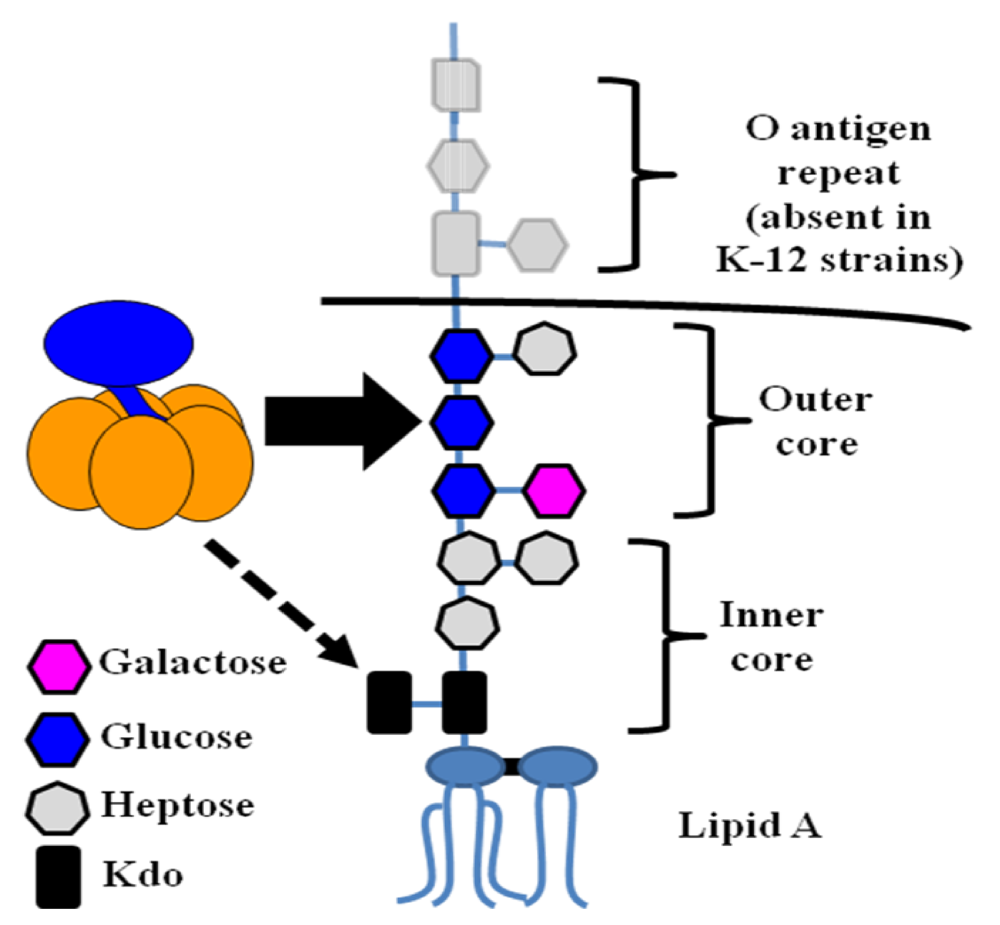
        <p>In addition to its ability to bind host gangliosides and blood sugars, further research has shown that LT binds to lipopolysaccharide (LPS) on the surface of <italic>E. coli</italic> cells [<xref ref-type="bibr" rid="B62-toxins-02-01445">62</xref>]. LPS is the predominant component of the outer membrane of gram-negative bacteria, consisting of a characteristic lipid moiety, Lipid A, linked to a series of sugar residues [<xref ref-type="bibr" rid="B106-toxins-02-01445">106</xref>]. This oligosaccharide chain can be further divided into an inner core of 5–6 sugars, an outer core of 4–5 additional sugars, and the O antigen, an oligosaccharide motif repeated up to 50 times. <xref ref-type="fig" rid="toxins-02-01445-f005">Figure 5</xref> shows the structure of <italic>E. coli</italic> LPS.</p>
        <fig id="toxins-02-01445-f005" position="anchor">
          <label>Figure 5</label>
          <caption>
            <p>The structure of <italic>E. coli</italic> LPS. LPS consists of a characteristic lipid moiety (Lipid A) anchored in the outer leaflet of the outer membrane, followed by a series of sugar residues making up the inner and outer cores. In wild, non-laboratory strains (including ETEC), further oligosaccharide repeats known as the O antigen are present. Experimental evidence indicates that LT binding is mediated primarily through contacts with the outer core, with binding to Kdo possible if LPS is truncated (see below). In this diagram, the core structure of K-12 <italic>E. coli</italic> (such as DH5α) is presented. </p>
          </caption>
          <graphic xmlns:xlink="http://www.w3.org/1999/xlink" xlink:href="toxins-02-01445-g005.tif"/>
        </fig>
        <p>The discovery of LT binding to LPS explains a number of prior observations, including the surface-bound population of toxin molecules detected on ETEC OMVs [<xref ref-type="bibr" rid="B71-toxins-02-01445">71</xref>]. Further experiments demonstrated that exogenously added LT can bind the surface of LT-deficient strains of ETEC [<xref ref-type="bibr" rid="B62-toxins-02-01445">62</xref>,<xref ref-type="bibr" rid="B86-toxins-02-01445">86</xref>]. This surface association is not dependent on the presence of the A subunit and is slightly enhanced by prior protease treatment [<xref ref-type="bibr" rid="B62-toxins-02-01445">62</xref>]. These results indicate that the binding substrate for LTB is not likely to be a protein and that degradation of outer membrane proteins may in fact reveal more toxin binding sites.</p>
        <p>A series of preincubation experiments determined that soluble LPS significantly inhibits the binding of LT to the surface of an LT-deficient ETEC strain [<xref ref-type="bibr" rid="B62-toxins-02-01445">62</xref>]. Moreover, LPS lacking O antigen was equally effective as full-length LPS, if not more so, suggesting that the core sugars of LPS were the target of LT binding (<xref ref-type="fig" rid="toxins-02-01445-f005">Figure 5</xref>). Preincubation with Lipid A, the lipid portion of LPS, or several other bacterial phospholipids had no effect on the surface binding of LT. A later study reported that the presence of the innermost LPS sugar, 3-deoxy-D-manno-octulosonic acid (Kdo), is the minimal requirement for LT binding, but that a full oligosaccharide core is preferred [<xref ref-type="bibr" rid="B107-toxins-02-01445">107</xref>]. </p>
        <p>Interestingly, while CT is able to bind to the surface of ETEC cells, neither LT nor CT binds to the surface of <italic>Vibrio</italic> cells [<xref ref-type="bibr" rid="B107-toxins-02-01445">107</xref>]. Along the same lines, <italic>E. coli</italic> LPS inhibits the binding of CT and LT to the ETEC surface, but <italic>Vibrio</italic> LPS does not inhibit the ETEC surface binding of LT [<xref ref-type="bibr" rid="B107-toxins-02-01445">107</xref>]. Thus, differences in the LPS structures of these two species of bacteria are likely to be responsible for the observed binding phenotypes. Among several differences, Kdo residues are phosphorylated in <italic>Vibrio</italic>, and the expression of a Kdo kinase in <italic>E. coli</italic> inhibits the surface binding of LTB [<xref ref-type="bibr" rid="B107-toxins-02-01445">107</xref>].</p>
        <p>Beyond its composition, the presentation of LPS seems to be critical for binding by LT. It has been noted that LT does not bind to LPS adsorbed to microtiter plates [<xref ref-type="bibr" rid="B100-toxins-02-01445">100</xref>]. However, LT binds readily to the surface of <italic>E. coli</italic> cells [<xref ref-type="bibr" rid="B62-toxins-02-01445">62</xref>,<xref ref-type="bibr" rid="B86-toxins-02-01445">86</xref>] and to LPS reconstituted into liposomes (D.L. Rodriguez and M.J. Kuehn, unpublished data). Therefore, it seems that proper orientation of the LPS molecules (and, perhaps, the presence of multiple, side-by-side LPS molecules) is important for LT binding. As LT has a relative low affinity for blood sugars compared to G<sub>M1</sub> [<xref ref-type="bibr" rid="B99-toxins-02-01445">99</xref>], it is distinctly possible that the LT-LPS interaction, which involves several of the same residues (see Section 7.2), is also of low affinity. LPS adsorbed to the bottom of a microtiter well may not present its sugar residues freely enough to allow for significant LT binding. Differences in LT binding to the ganglioside G<sub>M2</sub> have also been noted based on whether the substrate was present in liposomes or directly adsorbed to microtiter plates (see Section 5.2).</p>
      </sec>
      <sec>
        <title>7.2. LTB residues involved in LPS binding</title>
        <p>Several experiments indicated that LPS binding is due to residues outside the G<sub>M1</sub>-binding pocket. G<sub>M1</sub> does not inhibit the binding of LT to the surface of bacteria, and LPS does not inhibit LT’s G<sub>M1</sub>-dependent toxicity in cell culture [<xref ref-type="bibr" rid="B62-toxins-02-01445">62</xref>]. Moreover, LT is able to mediate the internalization of OMVs from a non-toxic strain of <italic>E. coli</italic> into cultured enterocytes in a G<sub>M1</sub>-dependent manner [<xref ref-type="bibr" rid="B108-toxins-02-01445">108</xref>]. </p>
        <p>Upon identification of the binding pocket responsible for the association between LTB and blood group sugars, several key coordinating residues were mutated and confirmed to be required for blood group binding [<xref ref-type="bibr" rid="B28-toxins-02-01445">28</xref>,<xref ref-type="bibr" rid="B86-toxins-02-01445">86</xref>] (see <xref ref-type="fig" rid="toxins-02-01445-f003">Figure 3</xref> and Section 6.2). Given the location of the blood group on the periphery of the LTB pentamer, distinct from the G<sub>M1</sub> binding site, these mutants were also tested for binding to the surface of <italic>E. coli</italic> cells. Indeed, several mutations that affect blood sugar binding also reduce LPS binding [<xref ref-type="bibr" rid="B86-toxins-02-01445">86</xref>] (<xref ref-type="fig" rid="toxins-02-01445-f003">Figure 3</xref> and <xref ref-type="fig" rid="toxins-02-01445-f004">Figure 4</xref>). One mutant, T47A, demonstrates a particularly strong effect on surface binding to K-12 <italic>E. coli</italic> and H10407 ETEC cells. However, the residues involved in LPS binding are not identical to those involved in blood sugar binding (<xref ref-type="fig" rid="toxins-02-01445-f003">Figure 3</xref> and <xref ref-type="fig" rid="toxins-02-01445-f004">Figure 4</xref>). For instance, mutation of Glu-11, a residue just outside the blood sugar binding pocket, abolishes LPS binding but not blood sugar binding [<xref ref-type="bibr" rid="B65-toxins-02-01445">65</xref>]. Consistent with the overlapping functions of these peripheral sugar binding pockets, preincubation of LT with blood group A trisaccharide blocks subsequent binding to the surface of <italic>E. coli</italic> cells [<xref ref-type="bibr" rid="B86-toxins-02-01445">86</xref>].</p>
        <p>The T47A mutant demonstrates near wild-type levels of binding to Kdo, despite its strong impairment in binding to LPS with a full core or ETEC LPS containing an O antigen [<xref ref-type="bibr" rid="B86-toxins-02-01445">86</xref>]. Furthermore, LTB carrying an E11A mutation does not bind to cells expressing only Kdo, but can bind to the full K-12 core present on DH5α (our unpublished data). Therefore, it seems that the sugar(s) bound by LT in the context of full-core LPS is/are something other than Kdo, while Kdo binding is possible when the sugar becomes available due to LPS truncation. Residues in the peripheral sugar-binding pocket (including those that no longer bind LPS when mutated) make extensive contacts with glucose and substituted galactose residues in A-type blood sugars [<xref ref-type="bibr" rid="B28-toxins-02-01445">28</xref>]. As glucose and galactose are present in all known <italic>E. coli</italic> LPS cores [<xref ref-type="bibr" rid="B109-toxins-02-01445">109</xref>], but not those of <italic>Vibrio</italic> [<xref ref-type="bibr" rid="B110-toxins-02-01445">110</xref>], it is tempting to speculate that they may represent the binding substrate(s) of LTB.</p>
        <p>It has been noted that classical CTB can also bind to <italic>E. coli</italic> LPS [<xref ref-type="bibr" rid="B107-toxins-02-01445">107</xref>], indicating that the binding pocket is likely conserved between the two toxins. Indeed, CTB shares the residues implicated in LPS binding by LTB (see <xref ref-type="fig" rid="toxins-02-01445-f003">Figure 3</xref>). However, El Tor CTB contains a substitution at Thr-47 (marked with an asterisk in <xref ref-type="fig" rid="toxins-02-01445-f003">Figure 3</xref>), replacing the original residue with an Ile residue. This change is remarkably similar to the T47A mutation that effectively abolishes LPS binding [<xref ref-type="bibr" rid="B86-toxins-02-01445">86</xref>], and therefore, El Tor CTB may not bind <italic>E. coli</italic> LPS. However, the binding of El Tor CTB to LPS has yet to be assessed.</p>
      </sec>
      <sec>
        <title>7.3. Possible roles of LPS binding</title>
        <p>There are a number of possible functions for the LPS binding exhibited by LT. Modulation of toxin level is one obvious result of the LT-LPS interaction. In comparison to freely secreted CT, more LT remains associated with the bacteria producing it. Conceivably, this interaction reduces the number of individual toxin molecules that could enter different host cells. However, the association of LT with LPS generates OMVs laden with LT molecules, inside and out. As LT can mediate the internalization of entire vesicles (and LT within OMVs contributes to toxicity) [<xref ref-type="bibr" rid="B108-toxins-02-01445">108</xref>], these toxin-rich “bombs” may intoxicate host cells much more readily through a single binding event. Moreover, the association between LT and LPS is robust [<xref ref-type="bibr" rid="B71-toxins-02-01445">71</xref>]; association of LT with OMVs may protect the toxin from proteolysis. The association with ETEC LPS may also prevent soluble LT from futile binding to commensal <italic>E. coli</italic> cells.</p>
        <p>Another possible role for the LT-LPS interaction is in altering the host response to LT, LPS, or both. LT can lead to the intracellular trafficking of OMVs, which may modulate the host response to vesicle components. OMV-associated LT has been shown to intoxicate host cells [<xref ref-type="bibr" rid="B108-toxins-02-01445">108</xref>], and it is becoming clear that the activation of downstream host response pathways by ETEC OMVs is not identical to the response generated by soluble LT (H.J. Chutkan and M.J. Kuehn, unpublished data). Further research on the host response to soluble and OMV-bound LT will shed light on the functional utility of LPS binding. Lastly, LT may serve as an adhesin molecule, linking ETEC cells to host G<sub>M1</sub>. However, given the importance of LT’s catalytic activity in promoting ETEC adherence to enterocytes [<xref ref-type="bibr" rid="B13-toxins-02-01445">13</xref>], a function for LT as an adhesin seems less likely. Research using ETEC expressing T47A mutant toxin (which demonstrates very little surface binding) will provide additional insight into the role of the LT-LPS interaction.</p>
      </sec>
    </sec>
    <sec sec-type="conclusions">
      <title>8. Conclusions</title>
      <p>The B subunit of heat-labile enterotoxin presents astonishing economy of amino acid use. A total of 103 amino acids make up mature LTB, with a number of them buried in its two α-helices and handful of β-strands [<xref ref-type="bibr" rid="B111-toxins-02-01445">111</xref>]. With the residues that remain surface exposed, LTB binds the A2 helical peptide tail from LTA and forms a pentameric ring, contacting one additional B subunit on each side. In addition to a pocket for G<sub>M1</sub> binding, two overlapping peripheral sugar-binding pockets enable LTB to interact with blood sugars and LPS. LTB also likely makes contacts with one or more components of the type II secretion system to be recognized for export from ETEC. Given the wide variety of binding events, it is not surprising that a single point mutation in LTB has the potential to disrupt multiple processes (e.g., T47A, which disrupts LPS and blood sugar binding, or E11K, which impairs toxin secretion and LPS binding) [<xref ref-type="bibr" rid="B65-toxins-02-01445">65</xref>,<xref ref-type="bibr" rid="B86-toxins-02-01445">86</xref>]. </p>
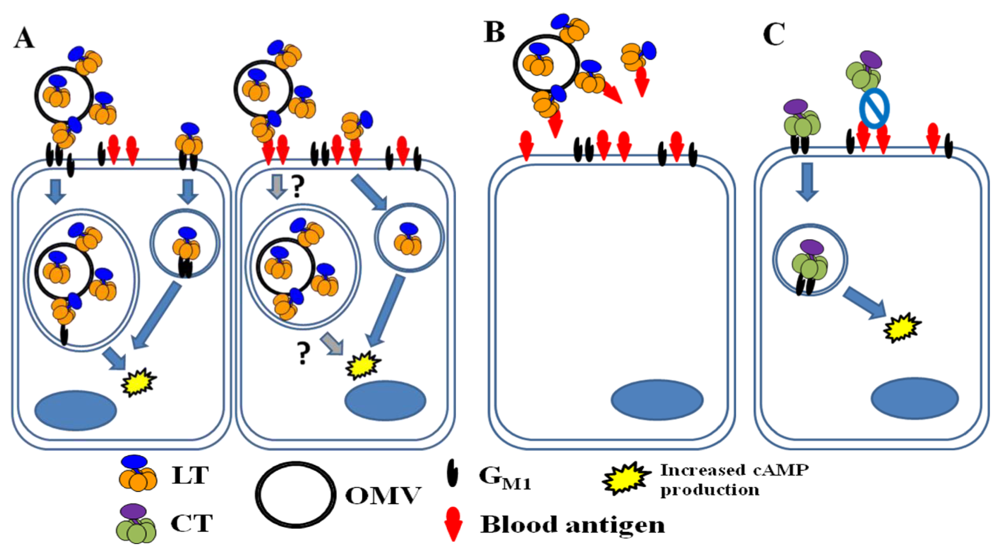
      <p>Recent research has highlighted a few key differences between CT and LT during infection. For one, LT’s association with LPS generates a situation in which a majority of secreted LT is found in the form of toxic ETEC OMVs (<xref ref-type="fig" rid="toxins-02-01445-f006">Figure 6</xref>). In contrast, CT’s inability to bind <italic>Vibrio</italic> cells leads to the secretion of soluble CT. Moreover, the toxic effects of LT may not be G<sub>M1</sub>-specific, given the likelihood that blood group glycolipids of A (and possibly B) type serve as functional receptors for the toxin <italic>in vitro</italic> and <italic>in vivo</italic>. To date, the relevance of blood sugar binding has not been characterized <italic>in vivo</italic>. Specifically, it has not been shown that blood sugars act as a viable alternative receptor alongside G<sub>M1</sub> during ETEC infection, and it is unclear whether LT is trafficked differently after internalization via blood sugar receptors. </p>
      <fig id="toxins-02-01445-f006" position="anchor">
        <label>Figure 6</label>
        <caption>
          <p>LT and CT binding in the intestine of a host with A blood type. (<bold>A</bold>) In a non-secretor host, LT is secreted largely in association with ETEC OMVs (both within the OMVs and on their surface). Soluble and OMV-associated LT molecules bind to G<sub>M1</sub> (left cell). After internalization of an intact OMV or LT molecule, fluid and electrolyte loss occurs due to the toxin’s enzymatic activity. Because blood antigens are not present in intestinal secretions, A-group blood sugars likely also serve as functional receptors for soluble LT (right cell). Blood sugars may also be able to allow for the internalization of OMVs with surface-bound LT (indicated with question marks). It is not known whether soluble and OMV-associated LT traffic through different pathways or whether the route of trafficking depends on the nature of the receptor (G<sub>M1</sub> <italic>vs.</italic> blood sugar). (<bold>B</bold>) In a host with the secretor phenotype, A-group blood sugars in intestinal secretions may serve as decoy binding substrates, limiting fluid and electrolyte loss due to LT. (<bold>C</bold>) CT is freely secreted by <italic>V. cholerae</italic> and binds only to G<sub>M1</sub> on host intestinal epithelial cells, causing toxic effects after internalization. </p>
        </caption>
        <graphic xmlns:xlink="http://www.w3.org/1999/xlink" xlink:href="toxins-02-01445-g006.tif"/>
      </fig>
      <p>Research on blood sugar binding by LT in cell culture or <italic>in vivo</italic> has exclusively used soluble toxin, although a large portion of secreted LT is associated with LPS on the surface of OMVs. As the LPS and blood sugar binding pockets overlap significantly (see <xref ref-type="fig" rid="toxins-02-01445-f003">Figure 3</xref>), one cannot assume that soluble LT and OMV-bound LT will behave identically <italic>in vivo</italic> with regard to blood sugar binding. Due to the presence of five binding pockets per holotoxin, LPS binding and blood sugar binding may occur simultaneously in the context of OMV-bound LT, but this possibility has not yet been investigated. Therefore, studies of the association between blood type and ETEC disease must consider the possible complications of LPS binding. Furthermore, comparisons of soluble LT and OMV-associated LT may need to account for the role of blood sugar binding in the context of actual infection. Since the last comprehensive review of LT’s structure and function [<xref ref-type="bibr" rid="B17-toxins-02-01445">17</xref>], a number of studies have provided us with new information about its regulation, secretion, and binding properties. However, there is much still to be learned about this remarkable virulence factor.</p>
    </sec>
  </body>
  <back>
    <ack>
      <title>Acknowledgements</title>
      <p>M.J.K. is funded by an Investigator in Pathogenesis of Infectious Disease Award from the Burroughs Wellcome Fund and by grants from the National Institutes of Health (R01AI064464 and R01AI079068). </p>
    </ack>
    <ref-list>
      <title>References</title>
      <ref id="B1-toxins-02-01445">
        <label>1.</label>
        <citation citation-type="journal">
          <person-group person-group-type="author">
            <name>
              <surname>Coster</surname>
              <given-names>T.S.</given-names>
            </name>
            <name>
              <surname>Wolf</surname>
              <given-names>M.K.</given-names>
            </name>
            <name>
              <surname>Hall</surname>
              <given-names>E.R.</given-names>
            </name>
            <name>
              <surname>Cassels</surname>
              <given-names>F.J.</given-names>
            </name>
            <name>
              <surname>Taylor</surname>
              <given-names>D.N.</given-names>
            </name>
            <name>
              <surname>Liu</surname>
              <given-names>C.T.</given-names>
            </name>
            <name>
              <surname>Trespalacios</surname>
              <given-names>F.C.</given-names>
            </name>
            <name>
              <surname>DeLorimier</surname>
              <given-names>A.</given-names>
            </name>
            <name>
              <surname>Angleberger</surname>
              <given-names>D.R.</given-names>
            </name>
            <name>
              <surname>McQueen</surname>
              <given-names>C.E.</given-names>
            </name>
          </person-group>
          <article-title>Immune response, ciprofloxacin activity, and gender differences after human experimental challenge by two strains of enterotoxigenic <italic>Escherichia coli</italic></article-title>
          <source>Infect. Immun.</source>
          <year>2007</year>
          <volume>75</volume>
          <fpage>252</fpage>
          <lpage>259</lpage>
          <pub-id pub-id-type="pmid">17074855</pub-id>
        </citation>
      </ref>
      <ref id="B2-toxins-02-01445">
        <label>2.</label>
        <citation citation-type="journal">
          <person-group person-group-type="author">
            <name>
              <surname>Vicente</surname>
              <given-names>A.C.</given-names>
            </name>
            <name>
              <surname>Teixeira</surname>
              <given-names>L.F.</given-names>
            </name>
            <name>
              <surname>Iniguez-Rojas</surname>
              <given-names>L.</given-names>
            </name>
            <name>
              <surname>Luna</surname>
              <given-names>M.G.</given-names>
            </name>
            <name>
              <surname>Silva</surname>
              <given-names>L.</given-names>
            </name>
            <name>
              <surname>Andrade</surname>
              <given-names>J.R.</given-names>
            </name>
            <name>
              <surname>Guth</surname>
              <given-names>B.E.</given-names>
            </name>
          </person-group>
          <article-title>Outbreaks of cholera-like diarrhoea caused by enterotoxigenic <italic>Escherichia coli</italic> in the Brazilian Amazon Rainforest</article-title>
          <source>Trans. R. Soc. Trop. Med. Hyg.</source>
          <year>2005</year>
          <volume>99</volume>
          <fpage>669</fpage>
          <lpage>674</lpage>
        <pub-id pub-id-type="doi">10.1016/j.trstmh.2005.03.007</pub-id><pub-id pub-id-type="pmid">15975612</pub-id></citation>
      </ref>
      <ref id="B3-toxins-02-01445">
        <label>3.</label>
        <citation citation-type="journal">
          <person-group person-group-type="author">
            <name>
              <surname>Sack</surname>
              <given-names>R.B.</given-names>
            </name>
            <name>
              <surname>Gorbach</surname>
              <given-names>S.L.</given-names>
            </name>
            <name>
              <surname>Banwell</surname>
              <given-names>J.G.</given-names>
            </name>
            <name>
              <surname>Jacobs</surname>
              <given-names>B.</given-names>
            </name>
            <name>
              <surname>Chatterjee</surname>
              <given-names>B.D.</given-names>
            </name>
            <name>
              <surname>Mitra</surname>
              <given-names>R.C.</given-names>
            </name>
          </person-group>
          <article-title>Enterotoxigenic <italic>Escherichia coli</italic> isolated from patients with severe cholera-like disease</article-title>
          <source>J. Infect. Dis.</source>
          <year>1971</year>
          <volume>123</volume>
          <fpage>378</fpage>
          <lpage>385</lpage>
        <pub-id pub-id-type="doi">10.1093/infdis/123.4.378</pub-id><pub-id pub-id-type="pmid">4938945</pub-id></citation>
      </ref>
      <ref id="B4-toxins-02-01445">
        <label>4.</label>
        <citation citation-type="journal">
          <person-group person-group-type="author">
            <name>
              <surname>Qadri</surname>
              <given-names>F.</given-names>
            </name>
            <name>
              <surname>Svennerholm</surname>
              <given-names>A.M.</given-names>
            </name>
            <name>
              <surname>Faruque</surname>
              <given-names>A.S.</given-names>
            </name>
            <name>
              <surname>Sack</surname>
              <given-names>R.B.</given-names>
            </name>
          </person-group>
          <article-title>Enterotoxigenic <italic>Escherichia coli</italic> in developing countries: epidemiology, microbiology, clinical features, treatment, and prevention</article-title>
          <source>Clin. Microbiol. Rev.</source>
          <year>2005</year>
          <volume>18</volume>
          <fpage>465</fpage>
          <lpage>483</lpage>
        <pub-id pub-id-type="doi">10.1128/CMR.18.3.465-483.2005</pub-id><pub-id pub-id-type="pmid">16020685</pub-id></citation>
      </ref>
      <ref id="B5-toxins-02-01445">
        <label>5.</label>
        <citation citation-type="journal">
          <person-group person-group-type="author">
            <name>
              <surname>Fleckenstein</surname>
              <given-names>J.M.</given-names>
            </name>
            <name>
              <surname>Hardwidge</surname>
              <given-names>P.R.</given-names>
            </name>
            <name>
              <surname>Munson</surname>
              <given-names>G.P.</given-names>
            </name>
            <name>
              <surname>Rasko</surname>
              <given-names>D.A.</given-names>
            </name>
            <name>
              <surname>Sommerfelt</surname>
              <given-names>H.</given-names>
            </name>
            <name>
              <surname>Steinsland</surname>
              <given-names>H.</given-names>
            </name>
          </person-group>
          <article-title>Molecular Mechanisms of Enterotoxigenic <italic>Escherichia coli</italic> Infection</article-title>
          <source>Microbes Infect.</source>
          <year>2010</year>
          <volume>12</volume>
          <fpage>89</fpage>
          <lpage>98</lpage>
        <pub-id pub-id-type="doi">10.1016/j.micinf.2009.10.002</pub-id><pub-id pub-id-type="pmid">19883790</pub-id></citation>
      </ref>
      <ref id="B6-toxins-02-01445">
        <label>6.</label>
        <citation citation-type="journal">
          <person-group person-group-type="author">
            <name>
              <surname>Sanchez</surname>
              <given-names>J.</given-names>
            </name>
            <name>
              <surname>Holmgren</surname>
              <given-names>J.</given-names>
            </name>
          </person-group>
          <article-title>Virulence factors, pathogenesis and vaccine protection in cholera and ETEC diarrhea</article-title>
          <source>Curr. Opin. Immunol.</source>
          <year>2005</year>
          <volume>17</volume>
          <fpage>388</fpage>
          <lpage>398</lpage>
        <pub-id pub-id-type="doi">10.1016/j.coi.2005.06.007</pub-id><pub-id pub-id-type="pmid">15963708</pub-id></citation>
      </ref>
      <ref id="B7-toxins-02-01445">
        <label>7.</label>
        <citation citation-type="journal">
          <person-group person-group-type="author">
            <name>
              <surname>Johnson</surname>
              <given-names>T.J.</given-names>
            </name>
            <name>
              <surname>Nolan</surname>
              <given-names>L.K.</given-names>
            </name>
          </person-group>
          <article-title>Pathogenomics of the virulence plasmids of <italic>Escherichia coli</italic></article-title>
          <source>Microbiol. Mol. Biol. Rev.</source>
          <year>2009</year>
          <volume>73</volume>
          <fpage>750</fpage>
          <lpage>774</lpage>
        <pub-id pub-id-type="doi">10.1128/MMBR.00015-09</pub-id><pub-id pub-id-type="pmid">19946140</pub-id></citation>
      </ref>
      <ref id="B8-toxins-02-01445">
        <label>8.</label>
        <citation citation-type="journal">
          <person-group person-group-type="author">
            <name>
              <surname>Svennerholm</surname>
              <given-names>A.M.</given-names>
            </name>
            <name>
              <surname>Tobias</surname>
              <given-names>J.</given-names>
            </name>
          </person-group>
          <article-title>Vaccines against enterotoxigenic <italic>Escherichia coli</italic></article-title>
          <source>Expert Rev. Vaccines</source>
          <year>2008</year>
          <volume>7</volume>
          <fpage>795</fpage>
          <lpage>804</lpage>
        <pub-id pub-id-type="doi">10.1586/14760584.7.6.795</pub-id><pub-id pub-id-type="pmid">18665777</pub-id></citation>
      </ref>
      <ref id="B9-toxins-02-01445">
        <label>9.</label>
        <citation citation-type="journal">
          <person-group person-group-type="author">
            <name>
              <surname>Wolf</surname>
              <given-names>M.K.</given-names>
            </name>
          </person-group>
          <article-title>Occurrence, distribution, and associations of O and H serogroups, colonization factor antigens, and toxins of enterotoxigenic <italic>Escherichia coli</italic></article-title>
          <source>Clin. Microbiol. Rev.</source>
          <year>1997</year>
          <volume>10</volume>
          <fpage>569</fpage>
          <lpage>584</lpage>
          <pub-id pub-id-type="pmid">9336662</pub-id>
        </citation>
      </ref>
      <ref id="B10-toxins-02-01445">
        <label>10.</label>
        <citation citation-type="journal">
          <person-group person-group-type="author">
            <name>
              <surname>Hughes</surname>
              <given-names>J.M.</given-names>
            </name>
            <name>
              <surname>Murad</surname>
              <given-names>F.</given-names>
            </name>
            <name>
              <surname>Chang</surname>
              <given-names>B.</given-names>
            </name>
            <name>
              <surname>Guerrant</surname>
              <given-names>R.L.</given-names>
            </name>
          </person-group>
          <article-title>Role of cyclic GMP in the action of heat-stable enterotoxin of <italic>Escherichia coli</italic></article-title>
          <source>Nature</source>
          <year>1978</year>
          <volume>271</volume>
          <fpage>755</fpage>
          <lpage>756</lpage>
        <pub-id pub-id-type="doi">10.1038/271755a0</pub-id><pub-id pub-id-type="pmid">203862</pub-id></citation>
      </ref>
      <ref id="B11-toxins-02-01445">
        <label>11.</label>
        <citation citation-type="journal">
          <person-group person-group-type="author">
            <name>
              <surname>Connell</surname>
              <given-names>T.D.</given-names>
            </name>
            <name>
              <surname>Holmes</surname>
              <given-names>R.K.</given-names>
            </name>
          </person-group>
          <article-title>Characterization of hybrid toxins produced in <italic>Escherichia coli</italic> by assembly of A and B polypeptides from type I and type II heat-labile enterotoxins</article-title>
          <source>Infect. Immun.</source>
          <year>1992</year>
          <volume>60</volume>
          <fpage>1653</fpage>
          <lpage>1661</lpage>
        <pub-id pub-id-type="pmid">1548088</pub-id></citation>
      </ref>
      <ref id="B12-toxins-02-01445">
        <label>12.</label>
        <citation citation-type="journal">
          <person-group person-group-type="author">
            <name>
              <surname>Gill</surname>
              <given-names>D.M.</given-names>
            </name>
            <name>
              <surname>Clements</surname>
              <given-names>J.D.</given-names>
            </name>
            <name>
              <surname>Robertson</surname>
              <given-names>D.C.</given-names>
            </name>
            <name>
              <surname>Finkelstein</surname>
              <given-names>R.A.</given-names>
            </name>
          </person-group>
          <article-title>Subunit number and arrangement in <italic>Escherichia coli</italic> heat-labile enterotoxin</article-title>
          <source>Infect. Immun.</source>
          <year>1981</year>
          <volume>33</volume>
          <fpage>677</fpage>
          <lpage>682</lpage>
        <pub-id pub-id-type="pmid">7026442</pub-id></citation>
      </ref>
      <ref id="B13-toxins-02-01445">
        <label>13.</label>
        <citation citation-type="journal">
          <person-group person-group-type="author">
            <name>
              <surname>Johnson</surname>
              <given-names>A.M.</given-names>
            </name>
            <name>
              <surname>Kaushik</surname>
              <given-names>R.S.</given-names>
            </name>
            <name>
              <surname>Francis</surname>
              <given-names>D.H.</given-names>
            </name>
            <name>
              <surname>Fleckenstein</surname>
              <given-names>J.M.</given-names>
            </name>
            <name>
              <surname>Hardwidge</surname>
              <given-names>P.R.</given-names>
            </name>
          </person-group>
          <article-title>Heat-labile enterotoxin promotes <italic>Escherichia coli</italic> adherence to intestinal epithelial cells</article-title>
          <source>J. Bacteriol.</source>
          <year>2009</year>
          <volume>191</volume>
          <fpage>178</fpage>
          <lpage>186</lpage>
        <pub-id pub-id-type="doi">10.1128/JB.00822-08</pub-id><pub-id pub-id-type="pmid">18978047</pub-id></citation>
      </ref>
      <ref id="B14-toxins-02-01445">
        <label>14.</label>
        <citation citation-type="journal">
          <person-group person-group-type="author">
            <name>
              <surname>Allen</surname>
              <given-names>K.P.</given-names>
            </name>
            <name>
              <surname>Randolph</surname>
              <given-names>M.M.</given-names>
            </name>
            <name>
              <surname>Fleckenstein</surname>
              <given-names>J.M.</given-names>
            </name>
          </person-group>
          <article-title>Importance of heat-labile enterotoxin in colonization of the adult mouse small intestine by human enterotoxigenic <italic>Escherichia coli</italic> strains</article-title>
          <source>Infect. Immun.</source>
          <year>2006</year>
          <volume>74</volume>
          <fpage>869</fpage>
          <lpage>875</lpage>
        <pub-id pub-id-type="doi">10.1128/IAI.74.2.869-875.2006</pub-id><pub-id pub-id-type="pmid">16428729</pub-id></citation>
      </ref>
      <ref id="B15-toxins-02-01445">
        <label>15.</label>
        <citation citation-type="journal">
          <person-group person-group-type="author">
            <name>
              <surname>Berberov</surname>
              <given-names>E.M.</given-names>
            </name>
            <name>
              <surname>Zhou</surname>
              <given-names>Y.</given-names>
            </name>
            <name>
              <surname>Francis</surname>
              <given-names>D.H.</given-names>
            </name>
            <name>
              <surname>Scott</surname>
              <given-names>M.A.</given-names>
            </name>
            <name>
              <surname>Kachman</surname>
              <given-names>S.D.</given-names>
            </name>
            <name>
              <surname>Moxley</surname>
              <given-names>R.A.</given-names>
            </name>
          </person-group>
          <article-title>Relative importance of heat-labile enterotoxin in the causation of severe diarrheal disease in the gnotobiotic piglet model by a strain of enterotoxigenic <italic>Escherichia coli</italic> that produces multiple enterotoxins</article-title>
          <source>Infect. Immun.</source>
          <year>2004</year>
          <volume>72</volume>
          <fpage>3914</fpage>
          <lpage>3924</lpage>
        <pub-id pub-id-type="doi">10.1128/IAI.72.7.3914-3924.2004</pub-id><pub-id pub-id-type="pmid">15213135</pub-id></citation>
      </ref>
      <ref id="B16-toxins-02-01445">
        <label>16.</label>
        <citation citation-type="journal">
          <person-group person-group-type="author">
            <name>
              <surname>Hardy</surname>
              <given-names>S.J.</given-names>
            </name>
            <name>
              <surname>Holmgren</surname>
              <given-names>J.</given-names>
            </name>
            <name>
              <surname>Johansson</surname>
              <given-names>S.</given-names>
            </name>
            <name>
              <surname>Sanchez</surname>
              <given-names>J.</given-names>
            </name>
            <name>
              <surname>Hirst</surname>
              <given-names>T.R.</given-names>
            </name>
          </person-group>
          <article-title>Coordinated assembly of multisubunit proteins: oligomerization of bacterial enterotoxins <italic>in vivo</italic> and <italic>in vitro</italic></article-title>
          <source>Proc. Natl. Acad. Sci. USA</source>
          <year>1988</year>
          <volume>85</volume>
          <fpage>7109</fpage>
          <lpage>7113</lpage>
        <pub-id pub-id-type="doi">10.1073/pnas.85.19.7109</pub-id><pub-id pub-id-type="pmid">3050987</pub-id></citation>
      </ref>
      <ref id="B17-toxins-02-01445">
        <label>17.</label>
        <citation citation-type="journal">
          <person-group person-group-type="author">
            <name>
              <surname>Spangler</surname>
              <given-names>B.D.</given-names>
            </name>
          </person-group>
          <article-title>Structure and function of cholera toxin and the related <italic>Escherichia coli</italic> heat-labile enterotoxin</article-title>
          <source>Microbiol. Rev.</source>
          <year>1992</year>
          <volume>56</volume>
          <fpage>622</fpage>
          <lpage>647</lpage>
        <pub-id pub-id-type="pmid">1480112</pub-id></citation>
      </ref>
      <ref id="B18-toxins-02-01445">
        <label>18.</label>
        <citation citation-type="journal">
          <person-group person-group-type="author">
            <name>
              <surname>Moss</surname>
              <given-names>J.</given-names>
            </name>
            <name>
              <surname>Richardson</surname>
              <given-names>S.H.</given-names>
            </name>
          </person-group>
          <article-title>Activation of adenylate cyclase by heat-labile <italic>Escherichia coli</italic> enterotoxin. Evidence for ADP-ribosyltransferase activity similar to that of choleragen</article-title>
          <source>J. Clin. Invest.</source>
          <year>1978</year>
          <volume>62</volume>
          <fpage>281</fpage>
          <lpage>285</lpage>
          <pub-id pub-id-type="pmid">209060</pub-id>
          <pub-id pub-id-type="doi">10.1172/JCI109127</pub-id>
        </citation>
      </ref>
      <ref id="B19-toxins-02-01445">
        <label>19.</label>
        <citation citation-type="journal">
          <person-group person-group-type="author">
            <name>
              <surname>Sears</surname>
              <given-names>C.L.</given-names>
            </name>
            <name>
              <surname>Kaper</surname>
              <given-names>J.B.</given-names>
            </name>
          </person-group>
          <article-title>Enteric bacterial toxins: mechanisms of action and linkage to intestinal secretion</article-title>
          <source>Microbiol. Rev.</source>
          <year>1996</year>
          <volume>60</volume>
          <fpage>167</fpage>
          <lpage>215</lpage>
        <pub-id pub-id-type="pmid">8852900</pub-id></citation>
      </ref>
      <ref id="B20-toxins-02-01445">
        <label>20.</label>
        <citation citation-type="journal">
          <person-group person-group-type="author">
            <name>
              <surname>Chakraborty</surname>
              <given-names>K.</given-names>
            </name>
            <name>
              <surname>Ghosh</surname>
              <given-names>S.</given-names>
            </name>
            <name>
              <surname>Koley</surname>
              <given-names>H.</given-names>
            </name>
            <name>
              <surname>Mukhopadhyay</surname>
              <given-names>A.K.</given-names>
            </name>
            <name>
              <surname>Ramamurthy</surname>
              <given-names>T.</given-names>
            </name>
            <name>
              <surname>Saha</surname>
              <given-names>D.R.</given-names>
            </name>
            <name>
              <surname>Mukhopadhyay</surname>
              <given-names>D.</given-names>
            </name>
            <name>
              <surname>Roychowdhury</surname>
              <given-names>S.</given-names>
            </name>
            <name>
              <surname>Hamabata</surname>
              <given-names>T.</given-names>
            </name>
            <name>
              <surname>Takeda</surname>
              <given-names>Y.</given-names>
            </name>
            <name>
              <surname>Das</surname>
              <given-names>S.</given-names>
            </name>
          </person-group>
          <article-title>Bacterial exotoxins downregulate cathelicidin (hCAP-18/LL-37) and human beta-defensin 1 (HBD-1) expression in the intestinal epithelial cells</article-title>
          <source>Cell. Microbiol.</source>
          <year>2008</year>
          <volume>10</volume>
          <fpage>2520</fpage>
          <lpage>2537</lpage>
        <pub-id pub-id-type="doi">10.1111/j.1462-5822.2008.01227.x</pub-id><pub-id pub-id-type="pmid">18717821</pub-id></citation>
      </ref>
      <ref id="B21-toxins-02-01445">
        <label>21.</label>
        <citation citation-type="journal">
          <person-group person-group-type="author">
            <name>
              <surname>Grant</surname>
              <given-names>C.C.</given-names>
            </name>
            <name>
              <surname>Messer</surname>
              <given-names>R.J.</given-names>
            </name>
            <name>
              <surname>Cieplak</surname>
              <given-names>W.</given-names>
              <suffix>Jr.</suffix>
            </name>
          </person-group>
          <article-title>Role of trypsin-like cleavage at arginine 192 in the enzymatic and cytotonic activities of <italic>Escherichia coli</italic> heat-labile enterotoxin</article-title>
          <source>Infect. Immun.</source>
          <year>1994</year>
          <volume>62</volume>
          <fpage>4270</fpage>
          <lpage>4278</lpage>
        <pub-id pub-id-type="pmid">7927684</pub-id></citation>
      </ref>
      <ref id="B22-toxins-02-01445">
        <label>22.</label>
        <citation citation-type="journal">
          <person-group person-group-type="author">
            <name>
              <surname>Clements</surname>
              <given-names>J.D.</given-names>
            </name>
            <name>
              <surname>Finkelstein</surname>
              <given-names>R.A.</given-names>
            </name>
          </person-group>
          <article-title>Isolation and characterization of homogeneous heat-labile enterotoxins with high specific activity from <italic>Escherichia coli</italic> cultures</article-title>
          <source>Infect. Immun.</source>
          <year>1979</year>
          <volume>24</volume>
          <fpage>760</fpage>
          <lpage>769</lpage>
        <pub-id pub-id-type="pmid">89088</pub-id></citation>
      </ref>
      <ref id="B23-toxins-02-01445">
        <label>23.</label>
        <citation citation-type="journal">
          <person-group person-group-type="author">
            <name>
              <surname>Lencer</surname>
              <given-names>W.I.</given-names>
            </name>
            <name>
              <surname>Hirst</surname>
              <given-names>T.R.</given-names>
            </name>
            <name>
              <surname>Holmes</surname>
              <given-names>R.K.</given-names>
            </name>
          </person-group>
          <article-title>Membrane traffic and the cellular uptake of cholera toxin</article-title>
          <source>Biochim. Biophys. Acta</source>
          <year>1999</year>
          <volume>1450</volume>
          <fpage>177</fpage>
          <lpage>190</lpage>
        <pub-id pub-id-type="doi">10.1016/S0167-4889(99)00070-1</pub-id><pub-id pub-id-type="pmid">10395933</pub-id></citation>
      </ref>
      <ref id="B24-toxins-02-01445">
        <label>24.</label>
        <citation citation-type="journal">
          <person-group person-group-type="author">
            <name>
              <surname>Okamoto</surname>
              <given-names>K.</given-names>
            </name>
            <name>
              <surname>Nomura</surname>
              <given-names>T.</given-names>
            </name>
            <name>
              <surname>Fujii</surname>
              <given-names>Y.</given-names>
            </name>
            <name>
              <surname>Yamanaka</surname>
              <given-names>H.</given-names>
            </name>
          </person-group>
          <article-title>Contribution of the disulfide bond of the A subunit to the action of <italic>Escherichia coli</italic> heat-labile enterotoxin</article-title>
          <source>J. Bacteriol.</source>
          <year>1998</year>
          <volume>180</volume>
          <fpage>1368</fpage>
          <lpage>1374</lpage>
        <pub-id pub-id-type="pmid">9515902</pub-id></citation>
      </ref>
      <ref id="B25-toxins-02-01445">
        <label>25.</label>
        <citation citation-type="journal">
          <person-group person-group-type="author">
            <name>
              <surname>Yamamoto</surname>
              <given-names>T.</given-names>
            </name>
            <name>
              <surname>Tamura</surname>
              <given-names>T.</given-names>
            </name>
            <name>
              <surname>Yokota</surname>
              <given-names>T.</given-names>
            </name>
            <name>
              <surname>Takano</surname>
              <given-names>T.</given-names>
            </name>
          </person-group>
          <article-title>Overlapping genes in the heat-labile enterotoxin operon originating from <italic>Escherichia coli</italic> human strain</article-title>
          <source>Mol. Gen. Genet.</source>
          <year>1982</year>
          <volume>188</volume>
          <fpage>356</fpage>
          <lpage>359</lpage>
        <pub-id pub-id-type="doi">10.1007/BF00332701</pub-id><pub-id pub-id-type="pmid">6759877</pub-id></citation>
      </ref>
      <ref id="B26-toxins-02-01445">
        <label>26.</label>
        <citation citation-type="journal">
          <person-group person-group-type="author">
            <name>
              <surname>Sandkvist</surname>
              <given-names>M.</given-names>
            </name>
            <name>
              <surname>Hirst</surname>
              <given-names>T.R.</given-names>
            </name>
            <name>
              <surname>Bagdasarian</surname>
              <given-names>M.</given-names>
            </name>
          </person-group>
          <article-title>Alterations at the carboxyl terminus change assembly and secretion properties of the B subunit of <italic>Escherichia coli</italic> heat-labile enterotoxin</article-title>
          <source>J. Bacteriol.</source>
          <year>1987</year>
          <volume>169</volume>
          <fpage>4570</fpage>
          <lpage>4576</lpage>
        <pub-id pub-id-type="pmid">2820934</pub-id></citation>
      </ref>
      <ref id="B27-toxins-02-01445">
        <label>27.</label>
        <citation citation-type="journal">
          <person-group person-group-type="author">
            <name>
              <surname>Yamamoto</surname>
              <given-names>T.</given-names>
            </name>
            <name>
              <surname>Nakazawa</surname>
              <given-names>T.</given-names>
            </name>
            <name>
              <surname>Miyata</surname>
              <given-names>T.</given-names>
            </name>
            <name>
              <surname>Kaji</surname>
              <given-names>A.</given-names>
            </name>
            <name>
              <surname>Yokota</surname>
              <given-names>T.</given-names>
            </name>
          </person-group>
          <article-title>Evolution and structure of two ADP-ribosylation enterotoxins, <italic>Escherichia coli</italic> heat-labile toxin and cholera toxin</article-title>
          <source>FEBS Lett.</source>
          <year>1984</year>
          <volume>169</volume>
          <fpage>241</fpage>
          <lpage>246</lpage>
        <pub-id pub-id-type="doi">10.1016/0014-5793(84)80326-9</pub-id><pub-id pub-id-type="pmid">6325242</pub-id></citation>
      </ref>
      <ref id="B28-toxins-02-01445">
        <label>28.</label>
        <citation citation-type="journal">
          <person-group person-group-type="author">
            <name>
              <surname>Holmner</surname>
              <given-names>A.</given-names>
            </name>
            <name>
              <surname>Askarieh</surname>
              <given-names>G.</given-names>
            </name>
            <name>
              <surname>Okvist</surname>
              <given-names>M.</given-names>
            </name>
            <name>
              <surname>Krengel</surname>
              <given-names>U.</given-names>
            </name>
          </person-group>
          <article-title>Blood group antigen recognition by <italic>Escherichia coli</italic> heat-labile enterotoxin</article-title>
          <source>J. Mol. Biol.</source>
          <year>2007</year>
          <volume>371</volume>
          <fpage>754</fpage>
          <lpage>764</lpage>
        <pub-id pub-id-type="doi">10.1016/j.jmb.2007.05.064</pub-id><pub-id pub-id-type="pmid">17586525</pub-id></citation>
      </ref>
      <ref id="B29-toxins-02-01445">
        <label>29.</label>
        <citation citation-type="journal">
          <person-group person-group-type="author">
            <name>
              <surname>Yamamoto</surname>
              <given-names>T.</given-names>
            </name>
            <name>
              <surname>Gojobori</surname>
              <given-names>T.</given-names>
            </name>
            <name>
              <surname>Yokota</surname>
              <given-names>T.</given-names>
            </name>
          </person-group>
          <article-title>Evolutionary origin of pathogenic determinants in enterotoxigenic <italic>Escherichia coli</italic> and Vibrio cholerae O1</article-title>
          <source>J. Bacteriol.</source>
          <year>1987</year>
          <volume>169</volume>
          <fpage>1352</fpage>
          <lpage>1357</lpage>
        <pub-id pub-id-type="pmid">3546273</pub-id></citation>
      </ref>
      <ref id="B30-toxins-02-01445">
        <label>30.</label>
        <citation citation-type="journal">
          <person-group person-group-type="author">
            <name>
              <surname>Schlor</surname>
              <given-names>S.</given-names>
            </name>
            <name>
              <surname>Riedl</surname>
              <given-names>S.</given-names>
            </name>
            <name>
              <surname>Blass</surname>
              <given-names>J.</given-names>
            </name>
            <name>
              <surname>Reidl</surname>
              <given-names>J.</given-names>
            </name>
          </person-group>
          <article-title>Genetic rearrangements of the regions adjacent to genes encoding heat-labile enterotoxins (eltAB) of enterotoxigenic <italic>Escherichia coli</italic> strains</article-title>
          <source>Appl. Environ. Microbiol.</source>
          <year>2000</year>
          <volume>66</volume>
          <fpage>352</fpage>
          <lpage>358</lpage>
        <pub-id pub-id-type="doi">10.1128/AEM.66.1.352-358.2000</pub-id><pub-id pub-id-type="pmid">10618247</pub-id></citation>
      </ref>
      <ref id="B31-toxins-02-01445">
        <label>31.</label>
        <citation citation-type="journal">
          <person-group person-group-type="author">
            <name>
              <surname>Scotland</surname>
              <given-names>S.M.</given-names>
            </name>
            <name>
              <surname>Day</surname>
              <given-names>N.P.</given-names>
            </name>
            <name>
              <surname>Rowe</surname>
              <given-names>B.</given-names>
            </name>
          </person-group>
          <article-title>Acquisition and maintenance of enterotoxin plasmids in wild-type strains of <italic>Escherichia coli</italic></article-title>
          <source>J. Gen. Microbiol.</source>
          <year>1983</year>
          <volume>129</volume>
          <fpage>3111</fpage>
          <lpage>3120</lpage>
        <pub-id pub-id-type="pmid">6361215</pub-id></citation>
      </ref>
      <ref id="B32-toxins-02-01445">
        <label>32.</label>
        <citation citation-type="journal">
          <person-group person-group-type="author">
            <name>
              <surname>Krukonis</surname>
              <given-names>E.S.</given-names>
            </name>
            <name>
              <surname>Yu</surname>
              <given-names>R.R.</given-names>
            </name>
            <name>
              <surname>Dirita</surname>
              <given-names>V.J.</given-names>
            </name>
          </person-group>
          <article-title>The Vibrio cholerae ToxR/TcpP/ToxT virulence cascade: distinct roles for two membrane-localized transcriptional activators on a single promoter</article-title>
          <source>Mol. Microbiol.</source>
          <year>2000</year>
          <volume>38</volume>
          <fpage>67</fpage>
          <lpage>84</lpage>
        <pub-id pub-id-type="doi">10.1046/j.1365-2958.2000.02111.x</pub-id><pub-id pub-id-type="pmid">11029691</pub-id></citation>
      </ref>
      <ref id="B33-toxins-02-01445">
        <label>33.</label>
        <citation citation-type="journal">
          <person-group person-group-type="author">
            <name>
              <surname>Kunkel</surname>
              <given-names>S.L.</given-names>
            </name>
            <name>
              <surname>Robertson</surname>
              <given-names>D.C.</given-names>
            </name>
          </person-group>
          <article-title>Factors affecting release of heat-labile enterotoxin by enterotoxigenic <italic>Escherichia coli</italic></article-title>
          <source>Infect. Immun.</source>
          <year>1979</year>
          <volume>23</volume>
          <fpage>652</fpage>
          <lpage>659</lpage>
        <pub-id pub-id-type="pmid">37162</pub-id></citation>
      </ref>
      <ref id="B34-toxins-02-01445">
        <label>34.</label>
        <citation citation-type="journal">
          <person-group person-group-type="author">
            <name>
              <surname>Mundell</surname>
              <given-names>D.H.</given-names>
            </name>
            <name>
              <surname>Anselmo</surname>
              <given-names>C.R.</given-names>
            </name>
            <name>
              <surname>Wishnow</surname>
              <given-names>R.M.</given-names>
            </name>
          </person-group>
          <article-title>Factors influencing heat-labile <italic>Escherichia coli</italic> enterotoxin activity</article-title>
          <source>Infect. Immun.</source>
          <year>1976</year>
          <volume>14</volume>
          <fpage>383</fpage>
          <lpage>388</lpage>
        <pub-id pub-id-type="pmid">9363</pub-id></citation>
      </ref>
      <ref id="B35-toxins-02-01445">
        <label>35.</label>
        <citation citation-type="journal">
          <person-group person-group-type="author">
            <name>
              <surname>Gibert</surname>
              <given-names>I.</given-names>
            </name>
            <name>
              <surname>Barbe</surname>
              <given-names>J.</given-names>
            </name>
          </person-group>
          <article-title>Cyclic AMP stimulates transcription of the structural gene of the outer-membrane protein OmpA of <italic>Escherichia coli</italic></article-title>
          <source>FEMS Microbiol. Lett.</source>
          <year>1990</year>
          <volume>56</volume>
          <fpage>307</fpage>
          <lpage>311</lpage>
        <pub-id pub-id-type="pmid">2160397</pub-id></citation>
      </ref>
      <ref id="B36-toxins-02-01445">
        <label>36.</label>
        <citation citation-type="journal">
          <person-group person-group-type="author">
            <name>
              <surname>Trachman</surname>
              <given-names>J.D.</given-names>
            </name>
            <name>
              <surname>Yasmin</surname>
              <given-names>M.</given-names>
            </name>
          </person-group>
          <article-title>Thermo-osmoregulation of heat-labile enterotoxin expression by <italic>Escherichia coli</italic></article-title>
          <source>Curr. Microbiol.</source>
          <year>2004</year>
          <volume>49</volume>
          <fpage>353</fpage>
          <lpage>360</lpage>
        <pub-id pub-id-type="doi">10.1007/s00284-004-4282-y</pub-id><pub-id pub-id-type="pmid">15486710</pub-id></citation>
      </ref>
      <ref id="B37-toxins-02-01445">
        <label>37.</label>
        <citation citation-type="journal">
          <person-group person-group-type="author">
            <name>
              <surname>Takashi</surname>
              <given-names>K.</given-names>
            </name>
            <name>
              <surname>Fujita</surname>
              <given-names>I.</given-names>
            </name>
            <name>
              <surname>Kobari</surname>
              <given-names>K.</given-names>
            </name>
          </person-group>
          <article-title>Effects of short chain fatty acids on the production of heat-labile enterotoxin from enterotoxigenic <italic>Escherichia coli</italic></article-title>
          <source>Jpn. J. Pharmacol.</source>
          <year>1989</year>
          <volume>50</volume>
          <fpage>495</fpage>
          <lpage>498</lpage>
        <pub-id pub-id-type="doi">10.1254/jjp.50.495</pub-id><pub-id pub-id-type="pmid">2674496</pub-id></citation>
      </ref>
      <ref id="B38-toxins-02-01445">
        <label>38.</label>
        <citation citation-type="journal">
          <person-group person-group-type="author">
            <name>
              <surname>Binder</surname>
              <given-names>H.J.</given-names>
            </name>
          </person-group>
          <article-title>Role of colonic short-chain fatty acid transport in diarrhea</article-title>
          <source>Annu. Rev. Physiol.</source>
          <year>2010</year>
          <volume>72</volume>
          <fpage>297</fpage>
          <lpage>313</lpage>
        <pub-id pub-id-type="doi">10.1146/annurev-physiol-021909-135817</pub-id><pub-id pub-id-type="pmid">20148677</pub-id></citation>
      </ref>
      <ref id="B39-toxins-02-01445">
        <label>39.</label>
        <citation citation-type="journal">
          <person-group person-group-type="author">
            <name>
              <surname>Lasaro</surname>
              <given-names>M.A.</given-names>
            </name>
            <name>
              <surname>Rodrigues</surname>
              <given-names>J.F.</given-names>
            </name>
            <name>
              <surname>Mathias-Santos</surname>
              <given-names>C.</given-names>
            </name>
            <name>
              <surname>Guth</surname>
              <given-names>B.E.</given-names>
            </name>
            <name>
              <surname>Regua-Mangia</surname>
              <given-names>A.</given-names>
            </name>
            <name>
              <surname>Piantino Ferreira</surname>
              <given-names>A.J.</given-names>
            </name>
            <name>
              <surname>Takagi</surname>
              <given-names>M.</given-names>
            </name>
            <name>
              <surname>Cabrera-Crespo</surname>
              <given-names>J.</given-names>
            </name>
            <name>
              <surname>Sbrogio-Almeida</surname>
              <given-names>M.E.</given-names>
            </name>
            <name>
              <surname>de Souza Ferreira</surname>
              <given-names>L.C.</given-names>
            </name>
          </person-group>
          <article-title>Production and release of heat-labile toxin by wild-type human-derived enterotoxigenic <italic>Escherichia coli</italic></article-title>
          <source>FEMS Immunol. Med. Microbiol.</source>
          <year>2006</year>
          <volume>48</volume>
          <fpage>123</fpage>
          <lpage>131</lpage>
        <pub-id pub-id-type="doi">10.1111/j.1574-695X.2006.00134.x</pub-id><pub-id pub-id-type="pmid">16965360</pub-id></citation>
      </ref>
      <ref id="B40-toxins-02-01445">
        <label>40.</label>
        <citation citation-type="journal">
          <person-group person-group-type="author">
            <name>
              <surname>Sjoling</surname>
              <given-names>A.</given-names>
            </name>
            <name>
              <surname>Qadri</surname>
              <given-names>F.</given-names>
            </name>
            <name>
              <surname>Nicklasson</surname>
              <given-names>M.</given-names>
            </name>
            <name>
              <surname>Begum</surname>
              <given-names>Y.A.</given-names>
            </name>
            <name>
              <surname>Wiklund</surname>
              <given-names>G.</given-names>
            </name>
            <name>
              <surname>Svennerholm</surname>
              <given-names>A.M.</given-names>
            </name>
          </person-group>
          <article-title><italic>In vivo</italic> expression of the heat stable (estA) and heat labile (eltB) toxin genes of enterotoxigenic <italic>Escherichia coli</italic> (ETEC)</article-title>
          <source>Microbes Infect.</source>
          <year>2006</year>
          <volume>8</volume>
          <fpage>2797</fpage>
          <lpage>2802</lpage>
        <pub-id pub-id-type="doi">10.1016/j.micinf.2006.08.011</pub-id><pub-id pub-id-type="pmid">17045506</pub-id></citation>
      </ref>
      <ref id="B41-toxins-02-01445">
        <label>41.</label>
        <citation citation-type="journal">
          <person-group person-group-type="author">
            <name>
              <surname>Dallas</surname>
              <given-names>W.S.</given-names>
            </name>
            <name>
              <surname>Falkow</surname>
              <given-names>S.</given-names>
            </name>
          </person-group>
          <article-title>Amino acid sequence homology between cholera toxin and <italic>Escherichia coli</italic> heat-labile toxin</article-title>
          <source>Nature</source>
          <year>1980</year>
          <volume>288</volume>
          <fpage>499</fpage>
          <lpage>501</lpage>
        <pub-id pub-id-type="doi">10.1038/288499a0</pub-id><pub-id pub-id-type="pmid">7003397</pub-id></citation>
      </ref>
      <ref id="B42-toxins-02-01445">
        <label>42.</label>
        <citation citation-type="journal">
          <person-group person-group-type="author">
            <name>
              <surname>Trachman</surname>
              <given-names>J.D.</given-names>
            </name>
            <name>
              <surname>Maas</surname>
              <given-names>W.K.</given-names>
            </name>
          </person-group>
          <article-title>Temperature regulation of heat-labile enterotoxin (LT) synthesis in <italic>Escherichia coli</italic> is mediated by an interaction of H-NS protein with the LT A-subunit DNA</article-title>
          <source>J. Bacteriol.</source>
          <year>1998</year>
          <volume>180</volume>
          <fpage>3715</fpage>
          <lpage>3718</lpage>
        <pub-id pub-id-type="pmid">9658020</pub-id></citation>
      </ref>
      <ref id="B43-toxins-02-01445">
        <label>43.</label>
        <citation citation-type="journal">
          <person-group person-group-type="author">
            <name>
              <surname>Yang</surname>
              <given-names>J.</given-names>
            </name>
            <name>
              <surname>Tauschek</surname>
              <given-names>M.</given-names>
            </name>
            <name>
              <surname>Strugnell</surname>
              <given-names>R.</given-names>
            </name>
            <name>
              <surname>Robins-Browne</surname>
              <given-names>R.M.</given-names>
            </name>
          </person-group>
          <article-title>The H-NS protein represses transcription of the eltAB operon, which encodes heat-labile enterotoxin in enterotoxigenic <italic>Escherichia coli</italic>, by binding to regions downstream of the promoter</article-title>
          <source>Microbiology</source>
          <year>2005</year>
          <volume>151</volume>
          <fpage>1199</fpage>
          <lpage>1208</lpage>
        <pub-id pub-id-type="doi">10.1099/mic.0.27734-0</pub-id><pub-id pub-id-type="pmid">15817787</pub-id></citation>
      </ref>
      <ref id="B44-toxins-02-01445">
        <label>44.</label>
        <citation citation-type="journal">
          <person-group person-group-type="author">
            <name>
              <surname>Hamilton</surname>
              <given-names>D.L.</given-names>
            </name>
            <name>
              <surname>Johnson</surname>
              <given-names>M.R.</given-names>
            </name>
            <name>
              <surname>Forsyth</surname>
              <given-names>G.W.</given-names>
            </name>
            <name>
              <surname>Roe</surname>
              <given-names>W.E.</given-names>
            </name>
            <name>
              <surname>Nielsen</surname>
              <given-names>N.O.</given-names>
            </name>
          </person-group>
          <article-title>The effect of cholera toxin and heat labile and heat stable <italic>Escherichia coli</italic> enterotoxin on cyclic AMP concentrations in small intestinal mucosa of pig and rabbit</article-title>
          <source>Can. J. Comp. Med.</source>
          <year>1978</year>
          <volume>42</volume>
          <fpage>327</fpage>
          <lpage>331</lpage>
        <pub-id pub-id-type="pmid">210913</pub-id></citation>
      </ref>
      <ref id="B45-toxins-02-01445">
        <label>45.</label>
        <citation citation-type="journal">
          <person-group person-group-type="author">
            <name>
              <surname>Bodero</surname>
              <given-names>M.D.</given-names>
            </name>
            <name>
              <surname>Munson</surname>
              <given-names>G.P.</given-names>
            </name>
          </person-group>
          <article-title>Cyclic AMP receptor protein-dependent repression of heat-labile enterotoxin</article-title>
          <source>Infect. Immun.</source>
          <year>2009</year>
          <volume>77</volume>
          <fpage>791</fpage>
          <lpage>798</lpage>
        <pub-id pub-id-type="doi">10.1128/IAI.00928-08</pub-id><pub-id pub-id-type="pmid">19075028</pub-id></citation>
      </ref>
      <ref id="B46-toxins-02-01445">
        <label>46.</label>
        <citation citation-type="journal">
          <person-group person-group-type="author">
            <name>
              <surname>Ferraris</surname>
              <given-names>R.P.</given-names>
            </name>
            <name>
              <surname>Yasharpour</surname>
              <given-names>S.</given-names>
            </name>
            <name>
              <surname>Lloyd</surname>
              <given-names>K.C.</given-names>
            </name>
            <name>
              <surname>Mirzayan</surname>
              <given-names>R.</given-names>
            </name>
            <name>
              <surname>Diamond</surname>
              <given-names>J.M.</given-names>
            </name>
          </person-group>
          <article-title>Luminal glucose concentrations in the gut under normal conditions</article-title>
          <source>Am. J. Physiol.</source>
          <year>1990</year>
          <volume>259</volume>
          <fpage>G822</fpage>
          <lpage>G837</lpage>
        <pub-id pub-id-type="pmid">2240224</pub-id></citation>
      </ref>
      <ref id="B47-toxins-02-01445">
        <label>47.</label>
        <citation citation-type="journal">
          <person-group person-group-type="author">
            <name>
              <surname>Spicer</surname>
              <given-names>E.K.</given-names>
            </name>
            <name>
              <surname>Noble</surname>
              <given-names>J.A.</given-names>
            </name>
          </person-group>
          <article-title><italic>Escherichia coli</italic> heat-labile enterotoxin. Nucleotide sequence of the A subunit gene</article-title>
          <source>J. Biol. Chem.</source>
          <year>1982</year>
          <volume>257</volume>
          <fpage>5716</fpage>
          <lpage>5721</lpage>
        <pub-id pub-id-type="pmid">6279611</pub-id></citation>
      </ref>
      <ref id="B48-toxins-02-01445">
        <label>48.</label>
        <citation citation-type="journal">
          <person-group person-group-type="author">
            <name>
              <surname>Yamamoto</surname>
              <given-names>T.</given-names>
            </name>
            <name>
              <surname>Tamura</surname>
              <given-names>T.</given-names>
            </name>
            <name>
              <surname>Ryoji</surname>
              <given-names>M.</given-names>
            </name>
            <name>
              <surname>Kaji</surname>
              <given-names>A.</given-names>
            </name>
            <name>
              <surname>Yokota</surname>
              <given-names>T.</given-names>
            </name>
            <name>
              <surname>Takano</surname>
              <given-names>T.</given-names>
            </name>
          </person-group>
          <article-title>Sequence analysis of the heat-labile enterotoxin subunit B gene originating in human enterotoxigenic <italic>Escherichia coli</italic></article-title>
          <source>J. Bacteriol.</source>
          <year>1982</year>
          <volume>152</volume>
          <fpage>506</fpage>
          <lpage>509</lpage>
        <pub-id pub-id-type="pmid">6749816</pub-id></citation>
      </ref>
      <ref id="B49-toxins-02-01445">
        <label>49.</label>
        <citation citation-type="journal">
          <person-group person-group-type="author">
            <name>
              <surname>Hirst</surname>
              <given-names>T.R.</given-names>
            </name>
            <name>
              <surname>Randall</surname>
              <given-names>L.L.</given-names>
            </name>
            <name>
              <surname>Hardy</surname>
              <given-names>S.J.</given-names>
            </name>
          </person-group>
          <article-title>Cellular location of heat-labile enterotoxin in <italic>Escherichia coli</italic></article-title>
          <source>J. Bacteriol.</source>
          <year>1984</year>
          <volume>157</volume>
          <fpage>637</fpage>
          <lpage>642</lpage>
        <pub-id pub-id-type="pmid">6363391</pub-id></citation>
      </ref>
      <ref id="B50-toxins-02-01445">
        <label>50.</label>
        <citation citation-type="journal">
          <person-group person-group-type="author">
            <name>
              <surname>Hofstra</surname>
              <given-names>H.</given-names>
            </name>
            <name>
              <surname>Witholt</surname>
              <given-names>B.</given-names>
            </name>
          </person-group>
          <article-title>Heat-labile enterotoxin in <italic>Escherichia coli</italic>. Kinetics of association of subunits into periplasmic holotoxin</article-title>
          <source>J. Biol. Chem.</source>
          <year>1985</year>
          <volume>260</volume>
          <fpage>16037</fpage>
          <lpage>16044</lpage>
          <pub-id pub-id-type="pmid">3905802</pub-id>
        </citation>
      </ref>
      <ref id="B51-toxins-02-01445">
        <label>51.</label>
        <citation citation-type="journal">
          <person-group person-group-type="author">
            <name>
              <surname>Chung</surname>
              <given-names>W.Y.</given-names>
            </name>
            <name>
              <surname>Carter</surname>
              <given-names>R.</given-names>
            </name>
            <name>
              <surname>Hardy</surname>
              <given-names>T.</given-names>
            </name>
            <name>
              <surname>Sack</surname>
              <given-names>M.</given-names>
            </name>
            <name>
              <surname>Hirst</surname>
              <given-names>T.R.</given-names>
            </name>
            <name>
              <surname>James</surname>
              <given-names>R.F.</given-names>
            </name>
          </person-group>
          <article-title>Inhibition of <italic>Escherichia coli</italic> heat-labile enterotoxin B subunit pentamer (EtxB5) assembly <italic>in vitro</italic> using monoclonal antibodies</article-title>
          <source>J. Biol. Chem.</source>
          <year>2006</year>
          <volume>281</volume>
          <fpage>39465</fpage>
          <lpage>39470</lpage>
        <pub-id pub-id-type="doi">10.1074/jbc.M606038200</pub-id><pub-id pub-id-type="pmid">17038315</pub-id></citation>
      </ref>
      <ref id="B52-toxins-02-01445">
        <label>52.</label>
        <citation citation-type="journal">
          <person-group person-group-type="author">
            <name>
              <surname>Yu</surname>
              <given-names>J.</given-names>
            </name>
            <name>
              <surname>Webb</surname>
              <given-names>H.</given-names>
            </name>
            <name>
              <surname>Hirst</surname>
              <given-names>T.R.</given-names>
            </name>
          </person-group>
          <article-title>A homologue of the <italic>Escherichia coli</italic> DsbA protein involved in disulphide bond formation is required for enterotoxin biogenesis in Vibrio cholerae</article-title>
          <source>Mol. Microbiol.</source>
          <year>1992</year>
          <volume>6</volume>
          <fpage>1949</fpage>
          <lpage>1958</lpage>
        <pub-id pub-id-type="doi">10.1111/j.1365-2958.1992.tb01368.x</pub-id><pub-id pub-id-type="pmid">1324389</pub-id></citation>
      </ref>
      <ref id="B53-toxins-02-01445">
        <label>53.</label>
        <citation citation-type="journal">
          <person-group person-group-type="author">
            <name>
              <surname>Ruddock</surname>
              <given-names>L.W.</given-names>
            </name>
            <name>
              <surname>Webb</surname>
              <given-names>H.M.</given-names>
            </name>
            <name>
              <surname>Ruston</surname>
              <given-names>S.P.</given-names>
            </name>
            <name>
              <surname>Cheesman</surname>
              <given-names>C.</given-names>
            </name>
            <name>
              <surname>Freedman</surname>
              <given-names>R.B.</given-names>
            </name>
            <name>
              <surname>Hirst</surname>
              <given-names>T.R.</given-names>
            </name>
          </person-group>
          <article-title>A pH-dependent conformational change in the B-subunit pentamer of <italic>Escherichia coli</italic> heat-labile enterotoxin: structural basis and possible functional role for a conserved feature of the AB5 toxin family</article-title>
          <source>Biochemistry</source>
          <year>1996</year>
          <volume>35</volume>
          <fpage>16069</fpage>
          <lpage>16076</lpage>
        <pub-id pub-id-type="doi">10.1021/bi961865l</pub-id><pub-id pub-id-type="pmid">8973177</pub-id></citation>
      </ref>
      <ref id="B54-toxins-02-01445">
        <label>54.</label>
        <citation citation-type="journal">
          <person-group person-group-type="author">
            <name>
              <surname>Streatfield</surname>
              <given-names>S.J.</given-names>
            </name>
            <name>
              <surname>Sandkvist</surname>
              <given-names>M.</given-names>
            </name>
            <name>
              <surname>Sixma</surname>
              <given-names>T.K.</given-names>
            </name>
            <name>
              <surname>Bagdasarian</surname>
              <given-names>M.</given-names>
            </name>
            <name>
              <surname>Hol</surname>
              <given-names>W.G.</given-names>
            </name>
            <name>
              <surname>Hirst</surname>
              <given-names>T.R.</given-names>
            </name>
          </person-group>
          <article-title>Intermolecular interactions between the A and B subunits of heat-labile enterotoxin from <italic>Escherichia coli</italic> promote holotoxin assembly and stability <italic>in vivo</italic></article-title>
          <source>Proc. Natl. Acad. Sci. USA</source>
          <year>1992</year>
          <volume>89</volume>
          <fpage>12140</fpage>
          <lpage>12144</lpage>
        <pub-id pub-id-type="doi">10.1073/pnas.89.24.12140</pub-id><pub-id pub-id-type="pmid">1465452</pub-id></citation>
      </ref>
      <ref id="B55-toxins-02-01445">
        <label>55.</label>
        <citation citation-type="journal">
          <person-group person-group-type="author">
            <name>
              <surname>Sixma</surname>
              <given-names>T.K.</given-names>
            </name>
            <name>
              <surname>Pronk</surname>
              <given-names>S.E.</given-names>
            </name>
            <name>
              <surname>Kalk</surname>
              <given-names>K.H.</given-names>
            </name>
            <name>
              <surname>Wartna</surname>
              <given-names>E.S.</given-names>
            </name>
            <name>
              <surname>van Zanten</surname>
              <given-names>B.A.</given-names>
            </name>
            <name>
              <surname>Witholt</surname>
              <given-names>B.</given-names>
            </name>
            <name>
              <surname>Hol</surname>
              <given-names>W.G.</given-names>
            </name>
          </person-group>
          <article-title>Crystal structure of a cholera toxin-related heat-labile enterotoxin from E. coli</article-title>
          <source>Nature</source>
          <year>1991</year>
          <volume>351</volume>
          <fpage>371</fpage>
          <lpage>377</lpage>
          <pub-id pub-id-type="pmid">2034287</pub-id>
        </citation>
      </ref>
      <ref id="B56-toxins-02-01445">
        <label>56.</label>
        <citation citation-type="journal">
          <person-group person-group-type="author">
            <name>
              <surname>Gankema</surname>
              <given-names>H.</given-names>
            </name>
            <name>
              <surname>Wensink</surname>
              <given-names>J.</given-names>
            </name>
            <name>
              <surname>Guinee</surname>
              <given-names>P.A.</given-names>
            </name>
            <name>
              <surname>Jansen</surname>
              <given-names>W.H.</given-names>
            </name>
            <name>
              <surname>Witholt</surname>
              <given-names>B.</given-names>
            </name>
          </person-group>
          <article-title>Some characteristics of the outer membrane material released by growing enterotoxigenic <italic>Escherichia coli</italic></article-title>
          <source>Infect. Immun.</source>
          <year>1980</year>
          <volume>29</volume>
          <fpage>704</fpage>
          <lpage>713</lpage>
        <pub-id pub-id-type="pmid">7011982</pub-id></citation>
      </ref>
      <ref id="B57-toxins-02-01445">
        <label>57.</label>
        <citation citation-type="journal">
          <person-group person-group-type="author">
            <name>
              <surname>Jacks</surname>
              <given-names>T.M.</given-names>
            </name>
            <name>
              <surname>Wu</surname>
              <given-names>B.J.</given-names>
            </name>
            <name>
              <surname>Braemer</surname>
              <given-names>A.C.</given-names>
            </name>
            <name>
              <surname>Bidlack</surname>
              <given-names>D.E.</given-names>
            </name>
          </person-group>
          <article-title>Properties of the enterotoxic component in <italic>Escherichia coli</italic> enteropathogenic for swine</article-title>
          <source>Infect. Immun.</source>
          <year>1973</year>
          <volume>7</volume>
          <fpage>178</fpage>
          <lpage>189</lpage>
        <pub-id pub-id-type="pmid">4633289</pub-id></citation>
      </ref>
      <ref id="B58-toxins-02-01445">
        <label>58.</label>
        <citation citation-type="journal">
          <person-group person-group-type="author">
            <name>
              <surname>Neill</surname>
              <given-names>R.J.</given-names>
            </name>
            <name>
              <surname>Ivins</surname>
              <given-names>B.E.</given-names>
            </name>
            <name>
              <surname>Holmes</surname>
              <given-names>R.K.</given-names>
            </name>
          </person-group>
          <article-title>Synthesis and secretion of the plasmid-coded heat-labile enterotoxin of <italic>Escherichia coli</italic> in Vibrio cholerae</article-title>
          <source>Science</source>
          <year>1983</year>
          <volume>221</volume>
          <fpage>289</fpage>
          <lpage>291</lpage>
        <pub-id pub-id-type="doi">10.1126/science.6857285</pub-id><pub-id pub-id-type="pmid">6857285</pub-id></citation>
      </ref>
      <ref id="B59-toxins-02-01445">
        <label>59.</label>
        <citation citation-type="journal">
          <person-group person-group-type="author">
            <name>
              <surname>Sandkvist</surname>
              <given-names>M.</given-names>
            </name>
            <name>
              <surname>Michel</surname>
              <given-names>L.O.</given-names>
            </name>
            <name>
              <surname>Hough</surname>
              <given-names>L.P.</given-names>
            </name>
            <name>
              <surname>Morales</surname>
              <given-names>V.M.</given-names>
            </name>
            <name>
              <surname>Bagdasarian</surname>
              <given-names>M.</given-names>
            </name>
            <name>
              <surname>Koomey</surname>
              <given-names>M.</given-names>
            </name>
            <name>
              <surname>DiRita</surname>
              <given-names>V.J.</given-names>
            </name>
          </person-group>
          <article-title>General secretion pathway (eps) genes required for toxin secretion and outer membrane biogenesis in Vibrio cholerae</article-title>
          <source>J. Bacteriol.</source>
          <year>1997</year>
          <volume>179</volume>
          <fpage>6994</fpage>
          <lpage>7003</lpage>
        <pub-id pub-id-type="pmid">9371445</pub-id></citation>
      </ref>
      <ref id="B60-toxins-02-01445">
        <label>60.</label>
        <citation citation-type="journal">
          <person-group person-group-type="author">
            <name>
              <surname>Johnson</surname>
              <given-names>T.L.</given-names>
            </name>
            <name>
              <surname>Abendroth</surname>
              <given-names>J.</given-names>
            </name>
            <name>
              <surname>Hol</surname>
              <given-names>W.G.</given-names>
            </name>
            <name>
              <surname>Sandkvist</surname>
              <given-names>M.</given-names>
            </name>
          </person-group>
          <article-title>Type II secretion: from structure to function</article-title>
          <source>FEMS Microbiol. Lett.</source>
          <year>2006</year>
          <volume>255</volume>
          <fpage>175</fpage>
          <lpage>186</lpage>
        <pub-id pub-id-type="doi">10.1111/j.1574-6968.2006.00102.x</pub-id><pub-id pub-id-type="pmid">16448494</pub-id></citation>
      </ref>
      <ref id="B61-toxins-02-01445">
        <label>61.</label>
        <citation citation-type="journal">
          <person-group person-group-type="author">
            <name>
              <surname>Tauschek</surname>
              <given-names>M.</given-names>
            </name>
            <name>
              <surname>Gorrell</surname>
              <given-names>R.J.</given-names>
            </name>
            <name>
              <surname>Strugnell</surname>
              <given-names>R.A.</given-names>
            </name>
            <name>
              <surname>Robins-Browne</surname>
              <given-names>R.M.</given-names>
            </name>
          </person-group>
          <article-title>Identification of a protein secretory pathway for the secretion of heat-labile enterotoxin by an enterotoxigenic strain of <italic>Escherichia coli</italic></article-title>
          <source>Proc. Natl. Acad. Sci. USA</source>
          <year>2002</year>
          <volume>99</volume>
          <fpage>7066</fpage>
          <lpage>7071</lpage>
        <pub-id pub-id-type="doi">10.1073/pnas.092152899</pub-id><pub-id pub-id-type="pmid">12011463</pub-id></citation>
      </ref>
      <ref id="B62-toxins-02-01445">
        <label>62.</label>
        <citation citation-type="journal">
          <person-group person-group-type="author">
            <name>
              <surname>Horstman</surname>
              <given-names>A.L.</given-names>
            </name>
            <name>
              <surname>Kuehn</surname>
              <given-names>M.J.</given-names>
            </name>
          </person-group>
          <article-title>Bacterial surface association of heat-labile enterotoxin through lipopolysaccharide after secretion via the general secretory pathway</article-title>
          <source>J. Biol. Chem.</source>
          <year>2002</year>
          <volume>277</volume>
          <fpage>32538</fpage>
          <lpage>32545</lpage>
        <pub-id pub-id-type="doi">10.1074/jbc.M203740200</pub-id><pub-id pub-id-type="pmid">12087095</pub-id></citation>
      </ref>
      <ref id="B63-toxins-02-01445">
        <label>63.</label>
        <citation citation-type="journal">
          <person-group person-group-type="author">
            <name>
              <surname>Yang</surname>
              <given-names>J.</given-names>
            </name>
            <name>
              <surname>Baldi</surname>
              <given-names>D.L.</given-names>
            </name>
            <name>
              <surname>Tauschek</surname>
              <given-names>M.</given-names>
            </name>
            <name>
              <surname>Strugnell</surname>
              <given-names>R.A.</given-names>
            </name>
            <name>
              <surname>Robins-Browne</surname>
              <given-names>R.M.</given-names>
            </name>
          </person-group>
          <article-title>Transcriptional regulation of the yghJ-pppA-yghG-gspCDEFGHIJKLM cluster, encoding the type II secretion pathway in enterotoxigenic <italic>Escherichia coli</italic></article-title>
          <source>J. Bacteriol.</source>
          <year>2007</year>
          <volume>189</volume>
          <fpage>142</fpage>
          <lpage>150</lpage>
        <pub-id pub-id-type="doi">10.1128/JB.01115-06</pub-id><pub-id pub-id-type="pmid">17085567</pub-id></citation>
      </ref>
      <ref id="B64-toxins-02-01445">
        <label>64.</label>
        <citation citation-type="journal">
          <person-group person-group-type="author">
            <name>
              <surname>Francetic</surname>
              <given-names>O.</given-names>
            </name>
            <name>
              <surname>Belin</surname>
              <given-names>D.</given-names>
            </name>
            <name>
              <surname>Badaut</surname>
              <given-names>C.</given-names>
            </name>
            <name>
              <surname>Pugsley</surname>
              <given-names>A.P.</given-names>
            </name>
          </person-group>
          <article-title>Expression of the endogenous type II secretion pathway in <italic>Escherichia coli</italic> leads to chitinase secretion</article-title>
          <source>EMBO J.</source>
          <year>2000</year>
          <volume>19</volume>
          <fpage>6697</fpage>
          <lpage>6703</lpage>
        <pub-id pub-id-type="doi">10.1093/emboj/19.24.6697</pub-id><pub-id pub-id-type="pmid">11118204</pub-id></citation>
      </ref>
      <ref id="B65-toxins-02-01445">
        <label>65.</label>
        <citation citation-type="journal">
          <person-group person-group-type="author">
            <name>
              <surname>Mudrak</surname>
              <given-names>B.</given-names>
            </name>
            <name>
              <surname>Kuehn</surname>
              <given-names>M.J.</given-names>
            </name>
          </person-group>
          <article-title>Specificity of the type II secretion systems of enterotoxigenic <italic>Escherichia coli</italic> and Vibrio cholerae for heat-labile enterotoxin and cholera toxin</article-title>
          <source>J. Bacteriol.</source>
          <year>2010</year>
        </citation>
      </ref>
      <ref id="B66-toxins-02-01445">
        <label>66.</label>
        <citation citation-type="journal">
          <person-group person-group-type="author">
            <name>
              <surname>Hirst</surname>
              <given-names>T.R.</given-names>
            </name>
            <name>
              <surname>Sanchez</surname>
              <given-names>J.</given-names>
            </name>
            <name>
              <surname>Kaper</surname>
              <given-names>J.B.</given-names>
            </name>
            <name>
              <surname>Hardy</surname>
              <given-names>S.J.</given-names>
            </name>
            <name>
              <surname>Holmgren</surname>
              <given-names>J.</given-names>
            </name>
          </person-group>
          <article-title>Mechanism of toxin secretion by Vibrio cholerae investigated in strains harboring plasmids that encode heat-labile enterotoxins of <italic>Escherichia coli</italic></article-title>
          <source>Proc. Natl. Acad. Sci. USA</source>
          <year>1984</year>
          <volume>81</volume>
          <fpage>7752</fpage>
          <lpage>7756</lpage>
        <pub-id pub-id-type="doi">10.1073/pnas.81.24.7752</pub-id><pub-id pub-id-type="pmid">6393126</pub-id></citation>
      </ref>
      <ref id="B67-toxins-02-01445">
        <label>67.</label>
        <citation citation-type="journal">
          <person-group person-group-type="author">
            <name>
              <surname>Connell</surname>
              <given-names>T.D.</given-names>
            </name>
            <name>
              <surname>Metzger</surname>
              <given-names>D.J.</given-names>
            </name>
            <name>
              <surname>Wang</surname>
              <given-names>M.</given-names>
            </name>
            <name>
              <surname>Jobling</surname>
              <given-names>M.G.</given-names>
            </name>
            <name>
              <surname>Holmes</surname>
              <given-names>R.K.</given-names>
            </name>
          </person-group>
          <article-title>Initial studies of the structural signal for extracellular transport of cholera toxin and other proteins recognized by Vibrio cholerae</article-title>
          <source>Infect. Immun.</source>
          <year>1995</year>
          <volume>63</volume>
          <fpage>4091</fpage>
          <lpage>4098</lpage>
        <pub-id pub-id-type="pmid">7558324</pub-id></citation>
      </ref>
      <ref id="B68-toxins-02-01445">
        <label>68.</label>
        <citation citation-type="journal">
          <person-group person-group-type="author">
            <name>
              <surname>Brown</surname>
              <given-names>E.A.</given-names>
            </name>
            <name>
              <surname>Hardwidge</surname>
              <given-names>P.R.</given-names>
            </name>
          </person-group>
          <article-title>Biochemical characterization of the enterotoxigenic <italic>Escherichia coli</italic> LeoA protein</article-title>
          <source>Microbiology</source>
          <year>2007</year>
          <volume>153</volume>
          <fpage>3776</fpage>
          <lpage>3784</lpage>
        <pub-id pub-id-type="doi">10.1099/mic.0.2007/009084-0</pub-id><pub-id pub-id-type="pmid">17975086</pub-id></citation>
      </ref>
      <ref id="B69-toxins-02-01445">
        <label>69.</label>
        <citation citation-type="journal">
          <person-group person-group-type="author">
            <name>
              <surname>Fleckenstein</surname>
              <given-names>J.M.</given-names>
            </name>
            <name>
              <surname>Lindler</surname>
              <given-names>L.E.</given-names>
            </name>
            <name>
              <surname>Elsinghorst</surname>
              <given-names>E.A.</given-names>
            </name>
            <name>
              <surname>Dale</surname>
              <given-names>J.B.</given-names>
            </name>
          </person-group>
          <article-title>Identification of a gene within a pathogenicity island of enterotoxigenic <italic>Escherichia coli</italic> H10407 required for maximal secretion of the heat-labile enterotoxin</article-title>
          <source>Infect. Immun.</source>
          <year>2000</year>
          <volume>68</volume>
          <fpage>2766</fpage>
          <lpage>2774</lpage>
        <pub-id pub-id-type="doi">10.1128/IAI.68.5.2766-2774.2000</pub-id><pub-id pub-id-type="pmid">10768971</pub-id></citation>
      </ref>
      <ref id="B70-toxins-02-01445">
        <label>70.</label>
        <citation citation-type="journal">
          <person-group person-group-type="author">
            <name>
              <surname>Turner</surname>
              <given-names>S.M.</given-names>
            </name>
            <name>
              <surname>Chaudhuri</surname>
              <given-names>R.R.</given-names>
            </name>
            <name>
              <surname>Jiang</surname>
              <given-names>Z.D.</given-names>
            </name>
            <name>
              <surname>DuPont</surname>
              <given-names>H.</given-names>
            </name>
            <name>
              <surname>Gyles</surname>
              <given-names>C.</given-names>
            </name>
            <name>
              <surname>Penn</surname>
              <given-names>C.W.</given-names>
            </name>
            <name>
              <surname>Pallen</surname>
              <given-names>M.J.</given-names>
            </name>
            <name>
              <surname>Henderson</surname>
              <given-names>I.R.</given-names>
            </name>
          </person-group>
          <article-title>Phylogenetic comparisons reveal multiple acquisitions of the toxin genes by enterotoxigenic <italic>Escherichia coli</italic> strains of different evolutionary lineages</article-title>
          <source>J. Clin. Microbiol.</source>
          <year>2006</year>
          <volume>44</volume>
          <fpage>4528</fpage>
          <lpage>4536</lpage>
        <pub-id pub-id-type="doi">10.1128/JCM.01474-06</pub-id><pub-id pub-id-type="pmid">17050815</pub-id></citation>
      </ref>
      <ref id="B71-toxins-02-01445">
        <label>71.</label>
        <citation citation-type="journal">
          <person-group person-group-type="author">
            <name>
              <surname>Horstman</surname>
              <given-names>A.L.</given-names>
            </name>
            <name>
              <surname>Kuehn</surname>
              <given-names>M.J.</given-names>
            </name>
          </person-group>
          <article-title>Enterotoxigenic <italic>Escherichia coli</italic> secretes active heat-labile enterotoxin via outer membrane vesicles</article-title>
          <source>J. Biol. Chem.</source>
          <year>2000</year>
          <volume>275</volume>
          <fpage>12489</fpage>
          <lpage>12496</lpage>
        <pub-id pub-id-type="doi">10.1074/jbc.275.17.12489</pub-id><pub-id pub-id-type="pmid">10777535</pub-id></citation>
      </ref>
      <ref id="B72-toxins-02-01445">
        <label>72.</label>
        <citation citation-type="journal">
          <person-group person-group-type="author">
            <name>
              <surname>Wai</surname>
              <given-names>S.N.</given-names>
            </name>
            <name>
              <surname>Takade</surname>
              <given-names>A.</given-names>
            </name>
            <name>
              <surname>Amako</surname>
              <given-names>K.</given-names>
            </name>
          </person-group>
          <article-title>The release of outer membrane vesicles from the strains of enterotoxigenic <italic>Escherichia coli</italic></article-title>
          <source>Microbiol. Immunol.</source>
          <year>1995</year>
          <volume>39</volume>
          <fpage>451</fpage>
          <lpage>456</lpage>
        <pub-id pub-id-type="pmid">8569529</pub-id></citation>
      </ref>
      <ref id="B73-toxins-02-01445">
        <label>73.</label>
        <citation citation-type="journal">
          <person-group person-group-type="author">
            <name>
              <surname>Kuehn</surname>
              <given-names>M.J.</given-names>
            </name>
            <name>
              <surname>Kesty</surname>
              <given-names>N.C.</given-names>
            </name>
          </person-group>
          <article-title>Bacterial outer membrane vesicles and the host-pathogen interaction</article-title>
          <source>Genes Dev.</source>
          <year>2005</year>
          <volume>19</volume>
          <fpage>2645</fpage>
          <lpage>2655</lpage>
        <pub-id pub-id-type="doi">10.1101/gad.1299905</pub-id><pub-id pub-id-type="pmid">16291643</pub-id></citation>
      </ref>
      <ref id="B74-toxins-02-01445">
        <label>74.</label>
        <citation citation-type="journal">
          <person-group person-group-type="author">
            <name>
              <surname>Ellis</surname>
              <given-names>T.N.</given-names>
            </name>
            <name>
              <surname>Kuehn</surname>
              <given-names>M.J.</given-names>
            </name>
          </person-group>
          <article-title>Virulence and immunomodulatory roles of bacterial outer membrane vesicles</article-title>
          <source>Microbiol. Mol. Biol. Rev.</source>
          <year>2010</year>
          <volume>74</volume>
          <fpage>81</fpage>
          <lpage>94</lpage>
        <pub-id pub-id-type="doi">10.1128/MMBR.00031-09</pub-id><pub-id pub-id-type="pmid">20197500</pub-id></citation>
      </ref>
      <ref id="B75-toxins-02-01445">
        <label>75.</label>
        <citation citation-type="journal">
          <person-group person-group-type="author">
            <name>
              <surname>Moss</surname>
              <given-names>J.</given-names>
            </name>
            <name>
              <surname>Osborne</surname>
              <given-names>J.C.</given-names>
              <suffix>Jr.</suffix>
            </name>
            <name>
              <surname>Fishman</surname>
              <given-names>P.H.</given-names>
            </name>
            <name>
              <surname>Nakaya</surname>
              <given-names>S.</given-names>
            </name>
            <name>
              <surname>Robertson</surname>
              <given-names>D.C.</given-names>
            </name>
          </person-group>
          <article-title><italic>Escherichia coli</italic> heat-labile enterotoxin. Ganglioside specificity and ADP-ribosyltransferase activity</article-title>
          <source>J. Biol. Chem.</source>
          <year>1981</year>
          <volume>256</volume>
          <fpage>12861</fpage>
          <lpage>12865</lpage>
          <pub-id pub-id-type="pmid">6273411</pub-id>
        </citation>
      </ref>
      <ref id="B76-toxins-02-01445">
        <label>76.</label>
        <citation citation-type="journal">
          <person-group person-group-type="author">
            <name>
              <surname>Merritt</surname>
              <given-names>E.A.</given-names>
            </name>
            <name>
              <surname>Sixma</surname>
              <given-names>T.K.</given-names>
            </name>
            <name>
              <surname>Kalk</surname>
              <given-names>K.H.</given-names>
            </name>
            <name>
              <surname>van Zanten</surname>
              <given-names>B.A.</given-names>
            </name>
            <name>
              <surname>Hol</surname>
              <given-names>W.G.</given-names>
            </name>
          </person-group>
          <article-title>Galactose-binding site in <italic>Escherichia coli</italic> heat-labile enterotoxin (LT) and cholera toxin (CT)</article-title>
          <source>Mol. Microbiol.</source>
          <year>1994</year>
          <volume>13</volume>
          <fpage>745</fpage>
          <lpage>753</lpage>
        <pub-id pub-id-type="doi">10.1111/j.1365-2958.1994.tb00467.x</pub-id><pub-id pub-id-type="pmid">7997185</pub-id></citation>
      </ref>
      <ref id="B77-toxins-02-01445">
        <label>77.</label>
        <citation citation-type="journal">
          <person-group person-group-type="author">
            <name>
              <surname>De Wolf</surname>
              <given-names>M.J.</given-names>
            </name>
            <name>
              <surname>Fridkin</surname>
              <given-names>M.</given-names>
            </name>
            <name>
              <surname>Kohn</surname>
              <given-names>L.D.</given-names>
            </name>
          </person-group>
          <article-title>Tryptophan residues of cholera toxin and its A and B protomers. Intrinsic fluorescence and solute quenching upon interacting with the ganglioside GM1, oligo-GM1, or dansylated oligo-GM1</article-title>
          <source>J. Biol. Chem.</source>
          <year>1981</year>
          <volume>256</volume>
          <fpage>5489</fpage>
          <lpage>5496</lpage>
          <pub-id pub-id-type="pmid">7240151</pub-id>
        </citation>
      </ref>
      <ref id="B78-toxins-02-01445">
        <label>78.</label>
        <citation citation-type="journal">
          <person-group person-group-type="author">
            <name>
              <surname>Ruddock</surname>
              <given-names>L.W.</given-names>
            </name>
            <name>
              <surname>Coen</surname>
              <given-names>J.J.</given-names>
            </name>
            <name>
              <surname>Cheesman</surname>
              <given-names>C.</given-names>
            </name>
            <name>
              <surname>Freedman</surname>
              <given-names>R.B.</given-names>
            </name>
            <name>
              <surname>Hirst</surname>
              <given-names>T.R.</given-names>
            </name>
          </person-group>
          <article-title>Assembly of the B subunit pentamer of <italic>Escherichia coli</italic> heat-labile enterotoxin. Kinetics and molecular basis of rate-limiting steps <italic>in vitro</italic></article-title>
          <source>J. Biol. Chem.</source>
          <year>1996</year>
          <volume>271</volume>
          <fpage>19118</fpage>
          <lpage>19123</lpage>
          <pub-id pub-id-type="pmid">8702586</pub-id>
        </citation>
      </ref>
      <ref id="B79-toxins-02-01445">
        <label>79.</label>
        <citation citation-type="journal">
          <person-group person-group-type="author">
            <name>
              <surname>Merritt</surname>
              <given-names>E.A.</given-names>
            </name>
            <name>
              <surname>Sarfaty</surname>
              <given-names>S.</given-names>
            </name>
            <name>
              <surname>van den Akker</surname>
              <given-names>F.</given-names>
            </name>
            <name>
              <surname>L'Hoir</surname>
              <given-names>C.</given-names>
            </name>
            <name>
              <surname>Martial</surname>
              <given-names>J.A.</given-names>
            </name>
            <name>
              <surname>Hol</surname>
              <given-names>W.G.</given-names>
            </name>
          </person-group>
          <article-title>Crystal structure of cholera toxin B-pentamer bound to receptor GM1 pentasaccharide</article-title>
          <source>Protein Sci.</source>
          <year>1994</year>
          <volume>3</volume>
          <fpage>166</fpage>
          <lpage>175</lpage>
        <pub-id pub-id-type="pmid">8003954</pub-id></citation>
      </ref>
      <ref id="B80-toxins-02-01445">
        <label>80.</label>
        <citation citation-type="journal">
          <person-group person-group-type="author">
            <name>
              <surname>Wolf</surname>
              <given-names>A.A.</given-names>
            </name>
            <name>
              <surname>Jobling</surname>
              <given-names>M.G.</given-names>
            </name>
            <name>
              <surname>Saslowsky</surname>
              <given-names>D.E.</given-names>
            </name>
            <name>
              <surname>Kern</surname>
              <given-names>E.</given-names>
            </name>
            <name>
              <surname>Drake</surname>
              <given-names>K.R.</given-names>
            </name>
            <name>
              <surname>Kenworthy</surname>
              <given-names>A.K.</given-names>
            </name>
            <name>
              <surname>Holmes</surname>
              <given-names>R.K.</given-names>
            </name>
            <name>
              <surname>Lencer</surname>
              <given-names>W.I.</given-names>
            </name>
          </person-group>
          <article-title>Attenuated endocytosis and toxicity of a mutant cholera toxin with decreased ability to cluster ganglioside GM1 molecules</article-title>
          <source>Infect. Immun.</source>
          <year>2008</year>
          <volume>76</volume>
          <fpage>1476</fpage>
          <lpage>1484</lpage>
        <pub-id pub-id-type="doi">10.1128/IAI.01286-07</pub-id><pub-id pub-id-type="pmid">18212085</pub-id></citation>
      </ref>
      <ref id="B81-toxins-02-01445">
        <label>81.</label>
        <citation citation-type="journal">
          <person-group person-group-type="author">
            <name>
              <surname>Holmgren</surname>
              <given-names>J.</given-names>
            </name>
            <name>
              <surname>Fredman</surname>
              <given-names>P.</given-names>
            </name>
            <name>
              <surname>Lindblad</surname>
              <given-names>M.</given-names>
            </name>
            <name>
              <surname>Svennerholm</surname>
              <given-names>A.M.</given-names>
            </name>
            <name>
              <surname>Svennerholm</surname>
              <given-names>L.</given-names>
            </name>
          </person-group>
          <article-title>Rabbit intestinal glycoprotein receptor for <italic>Escherichia coli</italic> heat-labile enterotoxin lacking affinity for cholera toxin</article-title>
          <source>Infect. Immun.</source>
          <year>1982</year>
          <volume>38</volume>
          <fpage>424</fpage>
          <lpage>433</lpage>
        <pub-id pub-id-type="pmid">7141703</pub-id></citation>
      </ref>
      <ref id="B82-toxins-02-01445">
        <label>82.</label>
        <citation citation-type="journal">
          <person-group person-group-type="author">
            <name>
              <surname>Fan</surname>
              <given-names>E.</given-names>
            </name>
            <name>
              <surname>Merritt</surname>
              <given-names>E.A.</given-names>
            </name>
            <name>
              <surname>Zhang</surname>
              <given-names>Z.</given-names>
            </name>
            <name>
              <surname>Pickens</surname>
              <given-names>J.C.</given-names>
            </name>
            <name>
              <surname>Roach</surname>
              <given-names>C.</given-names>
            </name>
            <name>
              <surname>Ahn</surname>
              <given-names>M.</given-names>
            </name>
            <name>
              <surname>Hol</surname>
              <given-names>W.G.</given-names>
            </name>
          </person-group>
          <article-title>Exploration of the GM1 receptor-binding site of heat-labile enterotoxin and cholera toxin by phenyl-ring-containing galactose derivatives</article-title>
          <source>Acta Crystallogr. D Biol. Crystallogr.</source>
          <year>2001</year>
          <volume>57</volume>
          <fpage>201</fpage>
          <lpage>212</lpage>
        <pub-id pub-id-type="pmid">11173465</pub-id></citation>
      </ref>
      <ref id="B83-toxins-02-01445">
        <label>83.</label>
        <citation citation-type="journal">
          <person-group person-group-type="author">
            <name>
              <surname>Minke</surname>
              <given-names>W.E.</given-names>
            </name>
            <name>
              <surname>Roach</surname>
              <given-names>C.</given-names>
            </name>
            <name>
              <surname>Hol</surname>
              <given-names>W.G.</given-names>
            </name>
            <name>
              <surname>Verlinde</surname>
              <given-names>C.L.</given-names>
            </name>
          </person-group>
          <article-title>Structure-based exploration of the ganglioside GM1 binding sites of <italic>Escherichia coli</italic> heat-labile enterotoxin and cholera toxin for the discovery of receptor antagonists</article-title>
          <source>Biochemistry</source>
          <year>1999</year>
          <volume>38</volume>
          <fpage>5684</fpage>
          <lpage>5692</lpage>
        <pub-id pub-id-type="doi">10.1021/bi982649a</pub-id><pub-id pub-id-type="pmid">10231518</pub-id></citation>
      </ref>
      <ref id="B84-toxins-02-01445">
        <label>84.</label>
        <citation citation-type="journal">
          <person-group person-group-type="author">
            <name>
              <surname>Wernick</surname>
              <given-names>N.L.B.</given-names>
            </name>
            <name>
              <surname>Chinnapen</surname>
              <given-names>D.J.-F.</given-names>
            </name>
            <name>
              <surname>Cho</surname>
              <given-names>J.A.</given-names>
            </name>
            <name>
              <surname>Lencer</surname>
              <given-names>W.I.</given-names>
            </name>
          </person-group>
          <article-title>Cholera toxin: An intracellular journey into the cytosol by way of the endoplasmic reticulum</article-title>
          <source>Toxins</source>
          <year>2010</year>
          <volume>2</volume>
          <fpage>310</fpage>
          <lpage>325</lpage>
        <pub-id pub-id-type="doi">10.3390/toxins2030310</pub-id><pub-id pub-id-type="pmid">22069586</pub-id></citation>
      </ref>
      <ref id="B85-toxins-02-01445">
        <label>85.</label>
        <citation citation-type="journal">
          <person-group person-group-type="author">
            <name>
              <surname>Connell</surname>
              <given-names>T.D.</given-names>
            </name>
          </person-group>
          <article-title>Cholera toxin, LT-I, LT-IIa and LT-IIb: the critical role of ganglioside binding in immunomodulation by type I and type II heat-labile enterotoxins</article-title>
          <source>Expert Rev. Vaccines</source>
          <year>2007</year>
          <volume>6</volume>
          <fpage>821</fpage>
          <lpage>834</lpage>
        <pub-id pub-id-type="doi">10.1586/14760584.6.5.821</pub-id><pub-id pub-id-type="pmid">17931161</pub-id></citation>
      </ref>
      <ref id="B86-toxins-02-01445">
        <label>86.</label>
        <citation citation-type="journal">
          <person-group person-group-type="author">
            <name>
              <surname>Mudrak</surname>
              <given-names>B.</given-names>
            </name>
            <name>
              <surname>Rodriguez</surname>
              <given-names>D.L.</given-names>
            </name>
            <name>
              <surname>Kuehn</surname>
              <given-names>M.J.</given-names>
            </name>
          </person-group>
          <article-title>Residues of heat-labile enterotoxin involved in bacterial cell surface binding</article-title>
          <source>J. Bacteriol.</source>
          <year>2009</year>
          <volume>191</volume>
          <fpage>2917</fpage>
          <lpage>2925</lpage>
        <pub-id pub-id-type="doi">10.1128/JB.01622-08</pub-id><pub-id pub-id-type="pmid">19270095</pub-id></citation>
      </ref>
      <ref id="B87-toxins-02-01445">
        <label>87.</label>
        <citation citation-type="journal">
          <person-group person-group-type="author">
            <name>
              <surname>Jansson</surname>
              <given-names>L.</given-names>
            </name>
            <name>
              <surname>Angstrom</surname>
              <given-names>J.</given-names>
            </name>
            <name>
              <surname>Lebens</surname>
              <given-names>M.</given-names>
            </name>
            <name>
              <surname>Imberty</surname>
              <given-names>A.</given-names>
            </name>
            <name>
              <surname>Varrot</surname>
              <given-names>A.</given-names>
            </name>
            <name>
              <surname>Teneberg</surname>
              <given-names>S.</given-names>
            </name>
          </person-group>
          <article-title>Carbohydrate binding specificities and crystal structure of the cholera toxin-like B-subunit from Citrobacter freundii</article-title>
          <source>Biochimie</source>
          <year>2010</year>
          <volume>92</volume>
          <fpage>482</fpage>
          <lpage>490</lpage>
        <pub-id pub-id-type="doi">10.1016/j.biochi.2010.02.010</pub-id><pub-id pub-id-type="pmid">20171259</pub-id></citation>
      </ref>
      <ref id="B88-toxins-02-01445">
        <label>88.</label>
        <citation citation-type="journal">
          <person-group person-group-type="author">
            <name>
              <surname>MacKenzie</surname>
              <given-names>C.R.</given-names>
            </name>
            <name>
              <surname>Hirama</surname>
              <given-names>T.</given-names>
            </name>
            <name>
              <surname>Lee</surname>
              <given-names>K.K.</given-names>
            </name>
            <name>
              <surname>Altman</surname>
              <given-names>E.</given-names>
            </name>
            <name>
              <surname>Young</surname>
              <given-names>N.M.</given-names>
            </name>
          </person-group>
          <article-title>Quantitative analysis of bacterial toxin affinity and specificity for glycolipid receptors by surface plasmon resonance</article-title>
          <source>J. Biol. Chem.</source>
          <year>1997</year>
          <volume>272</volume>
          <fpage>5533</fpage>
          <lpage>5538</lpage>
        <pub-id pub-id-type="doi">10.1074/jbc.272.9.5533</pub-id><pub-id pub-id-type="pmid">9038159</pub-id></citation>
      </ref>
      <ref id="B89-toxins-02-01445">
        <label>89.</label>
        <citation citation-type="journal">
          <person-group person-group-type="author">
            <name>
              <surname>Teneberg</surname>
              <given-names>S.</given-names>
            </name>
            <name>
              <surname>Hirst</surname>
              <given-names>T.R.</given-names>
            </name>
            <name>
              <surname>Angstrom</surname>
              <given-names>J.</given-names>
            </name>
            <name>
              <surname>Karlsson</surname>
              <given-names>K.A.</given-names>
            </name>
          </person-group>
          <article-title>Comparison of the glycolipid-binding specificities of cholera toxin and porcine <italic>Escherichia coli</italic> heat-labile enterotoxin: identification of a receptor-active non-ganglioside glycolipid for the heat-labile toxin in infant rabbit small intestine</article-title>
          <source>Glycoconj. J.</source>
          <year>1994</year>
          <volume>11</volume>
          <fpage>533</fpage>
          <lpage>540</lpage>
        <pub-id pub-id-type="doi">10.1007/BF00731304</pub-id><pub-id pub-id-type="pmid">7696856</pub-id></citation>
      </ref>
      <ref id="B90-toxins-02-01445">
        <label>90.</label>
        <citation citation-type="journal">
          <person-group person-group-type="author">
            <name>
              <surname>Fukuta</surname>
              <given-names>S.</given-names>
            </name>
            <name>
              <surname>Magnani</surname>
              <given-names>J.L.</given-names>
            </name>
            <name>
              <surname>Twiddy</surname>
              <given-names>E.M.</given-names>
            </name>
            <name>
              <surname>Holmes</surname>
              <given-names>R.K.</given-names>
            </name>
            <name>
              <surname>Ginsburg</surname>
              <given-names>V.</given-names>
            </name>
          </person-group>
          <article-title>Comparison of the carbohydrate-binding specificities of cholera toxin and <italic>Escherichia coli</italic> heat-labile enterotoxins LTh-I, LT-IIa, and LT-IIb</article-title>
          <source>Infect. Immun.</source>
          <year>1988</year>
          <volume>56</volume>
          <fpage>1748</fpage>
          <lpage>1753</lpage>
        <pub-id pub-id-type="pmid">3290106</pub-id></citation>
      </ref>
      <ref id="B91-toxins-02-01445">
        <label>91.</label>
        <citation citation-type="journal">
          <person-group person-group-type="author">
            <name>
              <surname>Chatterjee</surname>
              <given-names>A.</given-names>
            </name>
            <name>
              <surname>Chowdhury</surname>
              <given-names>R.</given-names>
            </name>
          </person-group>
          <article-title>Bile and unsaturated fatty acids inhibit the binding of cholera toxin and <italic>Escherichia coli</italic> heat-labile enterotoxin to GM1 receptor</article-title>
          <source>Antimicrob. Agents Chemother.</source>
          <year>2008</year>
          <volume>52</volume>
          <fpage>220</fpage>
          <lpage>224</lpage>
        <pub-id pub-id-type="doi">10.1128/AAC.01009-07</pub-id><pub-id pub-id-type="pmid">17954701</pub-id></citation>
      </ref>
      <ref id="B92-toxins-02-01445">
        <label>92.</label>
        <citation citation-type="journal">
          <person-group person-group-type="author">
            <name>
              <surname>Lasaro</surname>
              <given-names>M.A.</given-names>
            </name>
            <name>
              <surname>Rodrigues</surname>
              <given-names>J.F.</given-names>
            </name>
            <name>
              <surname>Mathias-Santos</surname>
              <given-names>C.</given-names>
            </name>
            <name>
              <surname>Guth</surname>
              <given-names>B.E.</given-names>
            </name>
            <name>
              <surname>Balan</surname>
              <given-names>A.</given-names>
            </name>
            <name>
              <surname>Sbrogio-Almeida</surname>
              <given-names>M.E.</given-names>
            </name>
            <name>
              <surname>Ferreira</surname>
              <given-names>L.C.</given-names>
            </name>
          </person-group>
          <article-title>Genetic diversity of heat-labile toxin expressed by enterotoxigenic <italic>Escherichia coli</italic> strains isolated from humans</article-title>
          <source>J. Bacteriol.</source>
          <year>2008</year>
          <volume>190</volume>
          <fpage>2400</fpage>
          <lpage>2410</lpage>
        <pub-id pub-id-type="doi">10.1128/JB.00988-07</pub-id><pub-id pub-id-type="pmid">18223074</pub-id></citation>
      </ref>
      <ref id="B93-toxins-02-01445">
        <label>93.</label>
        <citation citation-type="journal">
          <person-group person-group-type="author">
            <name>
              <surname>Balanzino</surname>
              <given-names>L.E.</given-names>
            </name>
            <name>
              <surname>Barra</surname>
              <given-names>J.L.</given-names>
            </name>
            <name>
              <surname>Galvan</surname>
              <given-names>E.M.</given-names>
            </name>
            <name>
              <surname>Roth</surname>
              <given-names>G.A.</given-names>
            </name>
            <name>
              <surname>Monferran</surname>
              <given-names>C.G.</given-names>
            </name>
          </person-group>
          <article-title>Interaction of cholera toxin and <italic>Escherichia coli</italic> heat-labile enterotoxin with glycoconjugates from rabbit intestinal brush border membranes: relationship with ABH blood group determinants</article-title>
          <source>Mol. Cell. Biochem.</source>
          <year>1999</year>
          <volume>194</volume>
          <fpage>53</fpage>
          <lpage>62</lpage>
        <pub-id pub-id-type="doi">10.1023/A:1006971913175</pub-id><pub-id pub-id-type="pmid">10391124</pub-id></citation>
      </ref>
      <ref id="B94-toxins-02-01445">
        <label>94.</label>
        <citation citation-type="journal">
          <person-group person-group-type="author">
            <name>
              <surname>Barra</surname>
              <given-names>J.L.</given-names>
            </name>
            <name>
              <surname>Monferran</surname>
              <given-names>C.G.</given-names>
            </name>
            <name>
              <surname>Balanzino</surname>
              <given-names>L.E.</given-names>
            </name>
            <name>
              <surname>Cumar</surname>
              <given-names>F.A.</given-names>
            </name>
          </person-group>
          <article-title><italic>Escherichia coli</italic> heat-labile enterotoxin preferentially interacts with blood group A-active glycolipids from pig intestinal mucosa and A- and B-active glycolipids from human red cells compared to H-active glycolipids</article-title>
          <source>Mol. Cell. Biochem.</source>
          <year>1992</year>
          <volume>115</volume>
          <fpage>63</fpage>
          <lpage>70</lpage>
        <pub-id pub-id-type="pmid">1435767</pub-id></citation>
      </ref>
      <ref id="B95-toxins-02-01445">
        <label>95.</label>
        <citation citation-type="journal">
          <person-group person-group-type="author">
            <name>
              <surname>Galvan</surname>
              <given-names>E.M.</given-names>
            </name>
            <name>
              <surname>Roth</surname>
              <given-names>G.A.</given-names>
            </name>
            <name>
              <surname>Monferran</surname>
              <given-names>C.G.</given-names>
            </name>
          </person-group>
          <article-title>Participation of ABH glycoconjugates in the secretory response to <italic>Escherichia coli</italic> heat-labile toxin in rabbit intestine</article-title>
          <source>J. Infect. Dis.</source>
          <year>1999</year>
          <volume>180</volume>
          <fpage>419</fpage>
          <lpage>425</lpage>
        <pub-id pub-id-type="doi">10.1086/314878</pub-id><pub-id pub-id-type="pmid">10395858</pub-id></citation>
      </ref>
      <ref id="B96-toxins-02-01445">
        <label>96.</label>
        <citation citation-type="journal">
          <person-group person-group-type="author">
            <name>
              <surname>Galvan</surname>
              <given-names>E.M.</given-names>
            </name>
            <name>
              <surname>Diema</surname>
              <given-names>C.D.</given-names>
            </name>
            <name>
              <surname>Roth</surname>
              <given-names>G.A.</given-names>
            </name>
            <name>
              <surname>Monferran</surname>
              <given-names>C.G.</given-names>
            </name>
          </person-group>
          <article-title>Ability of blood group A-active glycosphingolipids to act as <italic>Escherichia coli</italic> heat-labile enterotoxin receptors in HT-29 cells</article-title>
          <source>J. Infect. Dis.</source>
          <year>2004</year>
          <volume>189</volume>
          <fpage>1556</fpage>
          <lpage>1564</lpage>
        <pub-id pub-id-type="doi">10.1086/383349</pub-id><pub-id pub-id-type="pmid">15116290</pub-id></citation>
      </ref>
      <ref id="B97-toxins-02-01445">
        <label>97.</label>
        <citation citation-type="journal">
          <person-group person-group-type="author">
            <name>
              <surname>Galvan</surname>
              <given-names>E.M.</given-names>
            </name>
            <name>
              <surname>Roth</surname>
              <given-names>G.A.</given-names>
            </name>
            <name>
              <surname>Monferran</surname>
              <given-names>C.G.</given-names>
            </name>
          </person-group>
          <article-title>Functional interaction of <italic>Escherichia coli</italic> heat-labile enterotoxin with blood group A-active glycoconjugates from differentiated HT29 cells</article-title>
          <source>FEBS J.</source>
          <year>2006</year>
          <volume>273</volume>
          <fpage>3444</fpage>
          <lpage>3453</lpage>
        <pub-id pub-id-type="doi">10.1111/j.1742-4658.2006.05368.x</pub-id><pub-id pub-id-type="pmid">16884490</pub-id></citation>
      </ref>
      <ref id="B98-toxins-02-01445">
        <label>98.</label>
        <citation citation-type="journal">
          <person-group person-group-type="author">
            <name>
              <surname>Holmner</surname>
              <given-names>A.</given-names>
            </name>
            <name>
              <surname>Lebens</surname>
              <given-names>M.</given-names>
            </name>
            <name>
              <surname>Teneberg</surname>
              <given-names>S.</given-names>
            </name>
            <name>
              <surname>Angstrom</surname>
              <given-names>J.</given-names>
            </name>
            <name>
              <surname>Okvist</surname>
              <given-names>M.</given-names>
            </name>
            <name>
              <surname>Krengel</surname>
              <given-names>U.</given-names>
            </name>
          </person-group>
          <article-title>Novel binding site identified in a hybrid between cholera toxin and heat-labile enterotoxin: 1.9 A crystal structure reveals the details</article-title>
          <source>Structure</source>
          <year>2004</year>
          <volume>12</volume>
          <fpage>1655</fpage>
          <lpage>1667</lpage>
          <pub-id pub-id-type="pmid">15341730</pub-id>
          <pub-id pub-id-type="doi">10.1016/j.str.2004.06.022</pub-id>
        </citation>
      </ref>
      <ref id="B99-toxins-02-01445">
        <label>99.</label>
        <citation citation-type="journal">
          <person-group person-group-type="author">
            <name>
              <surname>Angstrom</surname>
              <given-names>J.</given-names>
            </name>
            <name>
              <surname>Backstrom</surname>
              <given-names>M.</given-names>
            </name>
            <name>
              <surname>Berntsson</surname>
              <given-names>A.</given-names>
            </name>
            <name>
              <surname>Karlsson</surname>
              <given-names>N.</given-names>
            </name>
            <name>
              <surname>Holmgren</surname>
              <given-names>J.</given-names>
            </name>
            <name>
              <surname>Karlsson</surname>
              <given-names>K.A.</given-names>
            </name>
            <name>
              <surname>Lebens</surname>
              <given-names>M.</given-names>
            </name>
            <name>
              <surname>Teneberg</surname>
              <given-names>S.</given-names>
            </name>
          </person-group>
          <article-title>Novel carbohydrate binding site recognizing blood group A and B determinants in a hybrid of cholera toxin and <italic>Escherichia coli</italic> heat-labile enterotoxin B-subunits</article-title>
          <source>J. Biol. Chem.</source>
          <year>2000</year>
          <volume>275</volume>
          <fpage>3231</fpage>
          <lpage>3238</lpage>
        <pub-id pub-id-type="doi">10.1074/jbc.275.5.3231</pub-id><pub-id pub-id-type="pmid">10652309</pub-id></citation>
      </ref>
      <ref id="B100-toxins-02-01445">
        <label>100.</label>
        <citation citation-type="journal">
          <person-group person-group-type="author">
            <name>
              <surname>Jansson</surname>
              <given-names>L.</given-names>
            </name>
            <name>
              <surname>Angstrom</surname>
              <given-names>J.</given-names>
            </name>
            <name>
              <surname>Lebens</surname>
              <given-names>M.</given-names>
            </name>
            <name>
              <surname>Teneberg</surname>
              <given-names>S.</given-names>
            </name>
          </person-group>
          <article-title>No direct binding of the heat-labile enterotoxin of <italic>Escherichia coli</italic> to E. coli lipopolysaccharides</article-title>
          <source>Glycoconj. J.</source>
          <year>2009</year>
          <volume>27</volume>
          <fpage>171</fpage>
          <lpage>179</lpage>
          <pub-id pub-id-type="pmid">19844789</pub-id>
        </citation>
      </ref>
      <ref id="B101-toxins-02-01445">
        <label>101.</label>
        <citation citation-type="journal">
          <person-group person-group-type="author">
            <name>
              <surname>Harris</surname>
              <given-names>J.B.</given-names>
            </name>
            <name>
              <surname>Khan</surname>
              <given-names>A.I.</given-names>
            </name>
            <name>
              <surname>LaRocque</surname>
              <given-names>R.C.</given-names>
            </name>
            <name>
              <surname>Dorer</surname>
              <given-names>D.J.</given-names>
            </name>
            <name>
              <surname>Chowdhury</surname>
              <given-names>F.</given-names>
            </name>
            <name>
              <surname>Faruque</surname>
              <given-names>A.S.</given-names>
            </name>
            <name>
              <surname>Sack</surname>
              <given-names>D.A.</given-names>
            </name>
            <name>
              <surname>Ryan</surname>
              <given-names>E.T.</given-names>
            </name>
            <name>
              <surname>Qadri</surname>
              <given-names>F.</given-names>
            </name>
            <name>
              <surname>Calderwood</surname>
              <given-names>S.B.</given-names>
            </name>
          </person-group>
          <article-title>Blood group, immunity, and risk of infection with Vibrio cholerae in an area of endemicity</article-title>
          <source>Infect. Immun.</source>
          <year>2005</year>
          <volume>73</volume>
          <fpage>7422</fpage>
          <lpage>7427</lpage>
        <pub-id pub-id-type="doi">10.1128/IAI.73.11.7422-7427.2005</pub-id><pub-id pub-id-type="pmid">16239542</pub-id></citation>
      </ref>
      <ref id="B102-toxins-02-01445">
        <label>102.</label>
        <citation citation-type="journal">
          <person-group person-group-type="author">
            <name>
              <surname>van Loon</surname>
              <given-names>F.P.</given-names>
            </name>
            <name>
              <surname>Clemens</surname>
              <given-names>J.D.</given-names>
            </name>
            <name>
              <surname>Sack</surname>
              <given-names>D.A.</given-names>
            </name>
            <name>
              <surname>Rao</surname>
              <given-names>M.R.</given-names>
            </name>
            <name>
              <surname>Ahmed</surname>
              <given-names>F.</given-names>
            </name>
            <name>
              <surname>Chowdhury</surname>
              <given-names>S.</given-names>
            </name>
            <name>
              <surname>Harris</surname>
              <given-names>J.R.</given-names>
            </name>
            <name>
              <surname>Ali</surname>
              <given-names>M.</given-names>
            </name>
            <name>
              <surname>Chakraborty</surname>
              <given-names>J.</given-names>
            </name>
            <name>
              <surname>Khan</surname>
              <given-names>M.R.</given-names>
            </name>
            <etal/>
          </person-group>
          <article-title>ABO blood groups and the risk of diarrhea due to enterotoxigenic <italic>Escherichia coli</italic></article-title>
          <source>J. Infect. Dis.</source>
          <year>1991</year>
          <volume>163</volume>
          <fpage>1243</fpage>
          <lpage>1246</lpage>
          <pub-id pub-id-type="pmid">2037790</pub-id>
          <pub-id pub-id-type="doi">10.1093/infdis/163.6.1243</pub-id>
        </citation>
      </ref>
      <ref id="B103-toxins-02-01445">
        <label>103.</label>
        <citation citation-type="journal">
          <person-group person-group-type="author">
            <name>
              <surname>Qadri</surname>
              <given-names>F.</given-names>
            </name>
            <name>
              <surname>Saha</surname>
              <given-names>A.</given-names>
            </name>
            <name>
              <surname>Ahmed</surname>
              <given-names>T.</given-names>
            </name>
            <name>
              <surname>Al Tarique</surname>
              <given-names>A.</given-names>
            </name>
            <name>
              <surname>Begum</surname>
              <given-names>Y.A.</given-names>
            </name>
            <name>
              <surname>Svennerholm</surname>
              <given-names>A.M.</given-names>
            </name>
          </person-group>
          <article-title>Disease burden due to enterotoxigenic <italic>Escherichia coli</italic> in the first 2 years of life in an urban community in Bangladesh</article-title>
          <source>Infect. Immun.</source>
          <year>2007</year>
          <volume>75</volume>
          <fpage>3961</fpage>
          <lpage>3968</lpage>
        <pub-id pub-id-type="doi">10.1128/IAI.00459-07</pub-id><pub-id pub-id-type="pmid">17548483</pub-id></citation>
      </ref>
      <ref id="B104-toxins-02-01445">
        <label>104.</label>
        <citation citation-type="journal">
          <person-group person-group-type="author">
            <name>
              <surname>Finne</surname>
              <given-names>J.</given-names>
            </name>
            <name>
              <surname>Breimer</surname>
              <given-names>M.E.</given-names>
            </name>
            <name>
              <surname>Hansson</surname>
              <given-names>G.C.</given-names>
            </name>
            <name>
              <surname>Karlsson</surname>
              <given-names>K.A.</given-names>
            </name>
            <name>
              <surname>Leffler</surname>
              <given-names>H.</given-names>
            </name>
            <name>
              <surname>Vliegenthart</surname>
              <given-names>J.F.</given-names>
            </name>
            <name>
              <surname>van Halbeek</surname>
              <given-names>H.</given-names>
            </name>
          </person-group>
          <article-title>Novel polyfucosylated N-linked glycopeptides with blood group A, H, X, and Y determinants from human small intestinal epithelial cells</article-title>
          <source>J. Biol. Chem.</source>
          <year>1989</year>
          <volume>264</volume>
          <fpage>5720</fpage>
          <lpage>5735</lpage>
        <pub-id pub-id-type="pmid">2466830</pub-id></citation>
      </ref>
      <ref id="B105-toxins-02-01445">
        <label>105.</label>
        <citation citation-type="journal">
          <person-group person-group-type="author">
            <name>
              <surname>D'Adamo</surname>
              <given-names>P.J.</given-names>
            </name>
            <name>
              <surname>Kelly</surname>
              <given-names>G.S.</given-names>
            </name>
          </person-group>
          <article-title>Metabolic and immunologic consequences of ABH secretor and Lewis subtype status</article-title>
          <source>Altern. Med. Rev.</source>
          <year>2001</year>
          <volume>6</volume>
          <fpage>390</fpage>
          <lpage>405</lpage>
        <pub-id pub-id-type="pmid">11578255</pub-id></citation>
      </ref>
      <ref id="B106-toxins-02-01445">
        <label>106.</label>
        <citation citation-type="journal">
          <person-group person-group-type="author">
            <name>
              <surname>Raetz</surname>
              <given-names>C.R.</given-names>
            </name>
            <name>
              <surname>Whitfield</surname>
              <given-names>C.</given-names>
            </name>
          </person-group>
          <article-title>Lipopolysaccharide endotoxins</article-title>
          <source>Annu. Rev. Biochem.</source>
          <year>2002</year>
          <volume>71</volume>
          <fpage>635</fpage>
          <lpage>700</lpage>
        <pub-id pub-id-type="doi">10.1146/annurev.biochem.71.110601.135414</pub-id><pub-id pub-id-type="pmid">12045108</pub-id></citation>
      </ref>
      <ref id="B107-toxins-02-01445">
        <label>107.</label>
        <citation citation-type="journal">
          <person-group person-group-type="author">
            <name>
              <surname>Horstman</surname>
              <given-names>A.L.</given-names>
            </name>
            <name>
              <surname>Bauman</surname>
              <given-names>S.J.</given-names>
            </name>
            <name>
              <surname>Kuehn</surname>
              <given-names>M.J.</given-names>
            </name>
          </person-group>
          <article-title>Lipopolysaccharide 3-deoxy-D-manno-octulosonic acid (Kdo) core determines bacterial association of secreted toxins</article-title>
          <source>J. Biol. Chem.</source>
          <year>2004</year>
          <volume>279</volume>
          <fpage>8070</fpage>
          <lpage>8075</lpage>
        <pub-id pub-id-type="pmid">14660669</pub-id></citation>
      </ref>
      <ref id="B108-toxins-02-01445">
        <label>108.</label>
        <citation citation-type="journal">
          <person-group person-group-type="author">
            <name>
              <surname>Kesty</surname>
              <given-names>N.C.</given-names>
            </name>
            <name>
              <surname>Mason</surname>
              <given-names>K.M.</given-names>
            </name>
            <name>
              <surname>Reedy</surname>
              <given-names>M.</given-names>
            </name>
            <name>
              <surname>Miller</surname>
              <given-names>S.E.</given-names>
            </name>
            <name>
              <surname>Kuehn</surname>
              <given-names>M.J.</given-names>
            </name>
          </person-group>
          <article-title>Enterotoxigenic <italic>Escherichia coli</italic> vesicles target toxin delivery into mammalian cells</article-title>
          <source>EMBO J.</source>
          <year>2004</year>
          <volume>23</volume>
          <fpage>4538</fpage>
          <lpage>4549</lpage>
        <pub-id pub-id-type="doi">10.1038/sj.emboj.7600471</pub-id><pub-id pub-id-type="pmid">15549136</pub-id></citation>
      </ref>
      <ref id="B109-toxins-02-01445">
        <label>109.</label>
        <citation citation-type="journal">
          <person-group person-group-type="author">
            <name>
              <surname>Amor</surname>
              <given-names>K.</given-names>
            </name>
            <name>
              <surname>Heinrichs</surname>
              <given-names>D.E.</given-names>
            </name>
            <name>
              <surname>Frirdich</surname>
              <given-names>E.</given-names>
            </name>
            <name>
              <surname>Ziebell</surname>
              <given-names>K.</given-names>
            </name>
            <name>
              <surname>Johnson</surname>
              <given-names>R.P.</given-names>
            </name>
            <name>
              <surname>Whitfield</surname>
              <given-names>C.</given-names>
            </name>
          </person-group>
          <article-title>Distribution of core oligosaccharide types in lipopolysaccharides from <italic>Escherichia coli</italic></article-title>
          <source>Infect. Immun.</source>
          <year>2000</year>
          <volume>68</volume>
          <fpage>1116</fpage>
          <lpage>1124</lpage>
        <pub-id pub-id-type="doi">10.1128/IAI.68.3.1116-1124.2000</pub-id><pub-id pub-id-type="pmid">10678915</pub-id></citation>
      </ref>
      <ref id="B110-toxins-02-01445">
        <label>110.</label>
        <citation citation-type="journal">
          <person-group person-group-type="author">
            <name>
              <surname>Cox</surname>
              <given-names>A.D.</given-names>
            </name>
            <name>
              <surname>Brisson</surname>
              <given-names>J.R.</given-names>
            </name>
            <name>
              <surname>Varma</surname>
              <given-names>V.</given-names>
            </name>
            <name>
              <surname>Perry</surname>
              <given-names>M.B.</given-names>
            </name>
          </person-group>
          <article-title>Structural analysis of the lipopolysaccharide from Vibrio cholerae O139</article-title>
          <source>Carbohydr. Res.</source>
          <year>1996</year>
          <volume>290</volume>
          <fpage>43</fpage>
          <lpage>58</lpage>
        <pub-id pub-id-type="doi">10.1016/0008-6215(96)00135-8</pub-id><pub-id pub-id-type="pmid">8805781</pub-id></citation>
      </ref>
      <ref id="B111-toxins-02-01445">
        <label>111.</label>
        <citation citation-type="journal">
          <person-group person-group-type="author">
            <name>
              <surname>Sixma</surname>
              <given-names>T.K.</given-names>
            </name>
            <name>
              <surname>Kalk</surname>
              <given-names>K.H.</given-names>
            </name>
            <name>
              <surname>van Zanten</surname>
              <given-names>B.A.</given-names>
            </name>
            <name>
              <surname>Dauter</surname>
              <given-names>Z.</given-names>
            </name>
            <name>
              <surname>Kingma</surname>
              <given-names>J.</given-names>
            </name>
            <name>
              <surname>Witholt</surname>
              <given-names>B.</given-names>
            </name>
            <name>
              <surname>Hol</surname>
              <given-names>W.G.</given-names>
            </name>
          </person-group>
          <article-title>Refined structure of <italic>Escherichia coli</italic> heat-labile enterotoxin, a close relative of cholera toxin</article-title>
          <source>J. Mol. Biol.</source>
          <year>1993</year>
          <volume>230</volume>
          <fpage>890</fpage>
          <lpage>918</lpage>
        <pub-id pub-id-type="doi">10.1006/jmbi.1993.1209</pub-id><pub-id pub-id-type="pmid">8478941</pub-id></citation>
      </ref>
    </ref-list>
  </back>
</article>