
<?xml version="1.0" encoding="UTF-8"?>
<!DOCTYPE article PUBLIC "-//NLM//DTD Journal Publishing DTD v2.3 20070202//EN" "journalpublishing.dtd">
<article xmlns:mml="http://www.w3.org/1998/Math/MathML" xmlns:xlink="http://www.w3.org/1999/xlink" xml:lang="en" article-type="review-article">
  <front>
    <journal-meta>
      <journal-id journal-id-type="publisher-id">toxins</journal-id>
      <journal-title>Toxins</journal-title>
      <abbrev-journal-title abbrev-type="publisher">Toxins</abbrev-journal-title>
      <abbrev-journal-title abbrev-type="pubmed">Toxins</abbrev-journal-title>
      <issn pub-type="epub">2072-6651</issn>
      <publisher>
<publisher-name>MDPI</publisher-name>
      </publisher>
    </journal-meta>
    <article-meta>
      <article-id pub-id-type="doi">10.3390/toxins2051111</article-id>
      <article-id pub-id-type="publisher-id">toxins-02-01111</article-id>
      <article-categories>
        <subj-group>
          <subject>Review</subject>
        </subj-group>
      </article-categories>
      <title-group>
        <article-title>
          Ochratoxin A Producing Species in the Genus <italic>Penicillium</italic>
        </article-title>
      </title-group>
      <contrib-group>
        <contrib contrib-type="author">
          <name>
            <surname>Cabañes</surname>
            <given-names>Francisco Javier</given-names>
          </name>
          <xref rid="c1-toxins-02-01111" ref-type="corresp">*</xref>
        </contrib>
        <contrib contrib-type="author">
          <name>
            <surname>Bragulat</surname>
            <given-names>Maria Rosa</given-names>
          </name>
        </contrib>
        <contrib contrib-type="author">
          <name>
            <surname>Castellá</surname>
            <given-names>Gemma</given-names>
          </name>
        </contrib>
      </contrib-group>
      <aff>Veterinary Mycology Group, Department of Animal Health and Anatomy, Universitat Autònoma de Barcelona, Bellaterra, E-08193, Spain; Email: <email>rosa.bragulat@uab.es</email> (M.R.B.); <email>gemma.castella@uab.es</email> (G.C.)</aff>
      <author-notes>
        <corresp id="c1-toxins-02-01111"><label>*</label> Author  to whom correspondence should be addressed; Email: <email>javier.cabanes@uab.es</email>; Tel.: +34935811749.</corresp>
      </author-notes>
      <pub-date pub-type="epub">
        <day>14</day>
        <month>05</month>
        <year>2010</year>
      </pub-date>
      <pub-date pub-type="collection">
        <month>05</month><year>2010</year>
      </pub-date>
      <volume>2</volume>
      <issue>5</issue>
      <fpage>1111</fpage>
      <lpage>1120</lpage>
      <history>
        <date date-type="received">
          <day>16</day>
          <month>04</month>
          <year>2010</year>
        </date>
        <date date-type="rev-recd">
          <day>04</day>
          <month>05</month>
          <year>2010</year>
        </date>
        <date date-type="accepted">
          <day>11</day>
          <month>05</month>
          <year>2010</year>
        </date>
      </history>
      <permissions>
<copyright-statement>©  2010 by the authors; licensee MDPI, Basel, Switzerland</copyright-statement>
        <copyright-year>2010</copyright-year>
        <license xmlns:xlink="http://www.w3.org/1999/xlink" license-type="open-access" xlink:href="http://creativecommons.org/licenses/by/3.0/">
          <p>This article is an open-access article distributed under the terms and conditions of the Creative Commons Attribution license (http://creativecommons.org/licenses/by/3.0/).</p>
        </license>
      </permissions>
      <abstract>
        <p>Ochratoxin A (OTA) producing fungi are members of the genera <italic>Aspergillus</italic> and <italic>Penicillium</italic>. Nowadays, there are about 20 species accepted as OTA producers, which are distributed in three phylogenetically related but distinct groups of aspergilli of the subgenus <italic>Circumdati</italic> and only in two species of the subgenus <italic>Penicillium</italic>. At the moment, <italic>P. verrucosum </italic>and <italic>P. nordicum</italic> are the only OTA producing species accepted in the genus <italic>Penicillium</italic>. However, during the last century, OTA producers in this genus were classified as <italic>P. viridicatum</italic> for many years. At present, only some OTA producing species are known to be a potential source of OTA contamination of cereals and certain common foods and beverages such as bread, beer, coffee, dried fruits, grape juice and wine among others. <italic>Penicillium verrucosum</italic> is the major producer of OTA in cereals such as wheat and barley in temperate and cold climates. <italic>Penicillium verrucosum </italic>and <italic>P. nordicum</italic> can be recovered from some dry-cured meat products and some cheeses.</p>
      </abstract>
      <kwd-group>
        <kwd>foods</kwd>
        <kwd>ochratoxin A</kwd>
        <kwd>
          <italic>Penicillium</italic>
        </kwd>
        <kwd>taxonomy</kwd>
      </kwd-group>
    </article-meta>
  </front>
  <body>
    <sec>
      <title>1. Introduction</title>
      <p>Ochratoxin A (OTA) is a potent nephrotoxic mycotoxin that has been linked to kidney problems in both livestock and human populations. It has also carcinogenic, genotoxic and immunotoxic properties. Natural occurrence of OTA has been reported from temperate to tropical climates mainly on cereals and their products. However, it is also found in a variety of common foods and beverages, including bread, beer, chocolate, coffee, dried fruits, grape juice, pork, poultry and wine, among others [<xref ref-type="bibr" rid="B1-toxins-02-01111">1</xref>]. In a recent study about the health risk assessment of OTA in a market economy [<xref ref-type="bibr" rid="B2-toxins-02-01111">2</xref>], the major food contributors of OTA for children were wheat based foods followed by oats, rice and raisins; beer, coffee and wine also contributed to total OTA exposure in older individuals. The presence of OTA in blood from healthy humans confirms a continuous worldwide exposure [<xref ref-type="bibr" rid="B3-toxins-02-01111">3</xref>]. In Europe, OTA maximum levels have been established for most of the above mentioned foodstuffs [<xref ref-type="bibr" rid="B4-toxins-02-01111">4</xref>], some spices and liquorice [<xref ref-type="bibr" rid="B5-toxins-02-01111">5</xref>] and also some guidance values for this mycotoxin have been also recommended for cereals, cereal products intended for animal feed and complete and complementary feedingstuffs for pigs and poultry [<xref ref-type="bibr" rid="B6-toxins-02-01111">6</xref>].</p>
      <p>Some species of the genera <italic>Penicillium</italic> and <italic>Aspergillus</italic> are known to form OTA, but few of them are known to contaminate foods with this mycotoxin. OTA contamination of food and feeds was until recently believed to be produced only by <italic>A. ochraceus</italic> and by <italic>P. verrucosum</italic>, which affect mainly dried stored foods and cereals respectively, in different regions of the world. However, some recent surveys have clearly shown that certain species belonging to the black aspergilli, including the <italic>A. niger </italic>aggregate and <italic>A. carbonarius</italic>, are sources of OTA in food commodities such as wine, grapes and dried vine fruits worldwide [<xref ref-type="bibr" rid="B7-toxins-02-01111">7</xref>,<xref ref-type="bibr" rid="B8-toxins-02-01111">8</xref>,<xref ref-type="bibr" rid="B9-toxins-02-01111">9</xref>,<xref ref-type="bibr" rid="B10-toxins-02-01111">10</xref>,<xref ref-type="bibr" rid="B11-toxins-02-01111">11</xref>,<xref ref-type="bibr" rid="B12-toxins-02-01111">12</xref>,<xref ref-type="bibr" rid="B13-toxins-02-01111">13</xref>,<xref ref-type="bibr" rid="B14-toxins-02-01111">14</xref>,<xref ref-type="bibr" rid="B15-toxins-02-01111">15</xref>,<xref ref-type="bibr" rid="B16-toxins-02-01111">16</xref>,<xref ref-type="bibr" rid="B17-toxins-02-01111">17</xref>,<xref ref-type="bibr" rid="B18-toxins-02-01111">18</xref>,<xref ref-type="bibr" rid="B19-toxins-02-01111">19</xref>]. Recent studies also indicated that in addition to these species, <italic>A. westerdijkiae</italic>, <italic>A. steynii </italic>and<italic> A. ochraceus </italic>are responsible for the formation of OTA in coffee [<xref ref-type="bibr" rid="B20-toxins-02-01111">20</xref>,<xref ref-type="bibr" rid="B21-toxins-02-01111">21</xref>].</p>
      <p>Species included in some of these taxa are difficult to distinguish from each other and molecular methods are usually necessary to identify them. For some of them, taxonomy is not fully resolved, as the number of accepted species depends on the methodology used. So far there has not been complete agreement between phenotypical and molecular data. In part for these reasons, a larger number of species have been cited incorrectly as OTA producers. This is also due mainly to the use of unsuitable analytical techniques in determining OTA production and misidentification of the fungal isolates tested [<xref ref-type="bibr" rid="B22-toxins-02-01111">22</xref>]. A set of recommendations have been recently published to avoid incorrect reporting of fungal species producing particular mycotoxins [<xref ref-type="bibr" rid="B23-toxins-02-01111">23</xref>]. The taxonomy of the OTA producing species in the genus <italic>Aspergillus</italic> and their potential for mycotoxin production in different foods have been reviewed in different papers [<xref ref-type="bibr" rid="B24-toxins-02-01111">24</xref>,<xref ref-type="bibr" rid="B25-toxins-02-01111">25</xref>,<xref ref-type="bibr" rid="B26-toxins-02-01111">26</xref>,<xref ref-type="bibr" rid="B27-toxins-02-01111">27</xref>,<xref ref-type="bibr" rid="B28-toxins-02-01111">28</xref>,<xref ref-type="bibr" rid="B29-toxins-02-01111">29</xref>,<xref ref-type="bibr" rid="B30-toxins-02-01111">30</xref>]. A new subgeneric classification based on phylogenetic analysis of multilocus sequence data has been recently proposed [<xref ref-type="bibr" rid="B31-toxins-02-01111">31</xref>]. </p>
      <p>In this paper, an overview of the current taxonomy of OTA producing species in the genus <italic>Penicillium</italic> arising from the most relevant approaches published in this field is presented. This review pays special attention to the natural occurrence of these species on food commodities where they are potential sources of OTA contamination. Emphasis has been placed on literature published within this decade, but prior noteworthy review papers and seminal works are included.</p>
    </sec>
    <sec>
      <title>2. OTA Producing Species in the Genus Penicillium</title>
      <sec>
        <title>2.1. Taxonomy</title>
        <p><italic>Penicillium</italic> taxonomy is not easy for the inexperienced, and compared to <italic>Aspergillus</italic> it is a more diverse genus, in terms of numbers of species and range of habitats [<xref ref-type="bibr" rid="B32-toxins-02-01111">32</xref>]. At present, <italic>P. verrucosum </italic>and <italic>P. nordicum</italic> are the only OTA producers known and accepted in this genus, despite some reports on OTA production by other species [<xref ref-type="bibr" rid="B33-toxins-02-01111">33</xref>,<xref ref-type="bibr" rid="B34-toxins-02-01111">34</xref>]. <italic>Penicillium</italic><italic>casei</italic> and <italic>P. mediolanense</italic> are synonyms for <italic>P. verrucosum</italic> and <italic>P. nordicum</italic>, respectively [<xref ref-type="bibr" rid="B34-toxins-02-01111">34</xref>]. Nevertheless, different examples of incorrect citations of some <italic>Penicillium </italic>spp. producing OTA (e.g., <italic>P. cyclopium</italic>,<italic> P. viridicatum</italic>, <italic>P. chrysogenum</italic>) have been recently listed [<xref ref-type="bibr" rid="B23-toxins-02-01111">23</xref>,<xref ref-type="bibr" rid="B34-toxins-02-01111">34</xref>]. It is worth bearing in mind that in the last century, OTA producers in this genus were classified as <italic>P. viridicatum</italic> for many years. Main species concepts for <italic>P. viridicatum</italic>, <italic>P. verrucosum</italic> and <italic>P. nordicum</italic> are summarized in <xref ref-type="table" rid="toxins-02-01111-t001">Table 1</xref>. </p>
      <table-wrap id="toxins-02-01111-t001" position="anchor">
          <object-id pub-id-type="pii">toxins-02-01111-t001_Table 1</object-id>
          <label>Table 1</label>
          <caption>
            <p>Main species concepts of OTA producing species in the genus <italic>Penicillium</italic>.</p>
          </caption>
          <table>
            <thead>
              <tr>
                <th rowspan="2" align="center" valign="middle">
                  <bold>References</bold></th>
                <th colspan="3" align="center" valign="middle">
                  <bold>Strains</bold>
                </th>
              </tr>
              <tr>
                <th valign="middle">
                  <bold>OTA - and CIT -</bold>
                </th>
                <th valign="middle">
                  <bold>OTA + and CIT +</bold>
                </th>
                <th valign="middle">
                  <bold>OTA + and CIT -</bold>
                </th>
              </tr>
            </thead>
            <tbody>
              <tr>
                <td rowspan="2" align="left" valign="middle">Frisvad &amp; Samson., 2004 [<xref ref-type="bibr" rid="B33-toxins-02-01111">33</xref>]</td>
                <td rowspan="2" align="center" valign="middle">
                  <italic>P. viridicatum</italic>
                </td>
                <td rowspan="2" align="center" valign="middle">
                  <italic>P. verrucosum</italic>
                </td>
                <td align="center" valign="middle">
                  <italic>P. nordicum</italic>
                </td>
              </tr>
              <tr>
                <td valign="middle"><italic>P. nordicum </italic>II OTA?</td>
              </tr>
              <tr>
                <td align="left" valign="middle">Larsen <italic>et al.</italic>, 2001 [<xref ref-type="bibr" rid="B35-toxins-02-01111">35</xref>] </td>
                <td align="center" valign="middle">
                  <italic>P. viridicatum</italic>
                </td>
                <td align="center" valign="middle">
                  <italic>P. verrucosum</italic>
                </td>
                <td align="center" valign="middle">
                  <italic>P. nordicum</italic>
                </td>
              </tr>
              <tr>
                <td align="left" valign="middle">Frisvad &amp; Filtenborg, 1989 [<xref ref-type="bibr" rid="B36-toxins-02-01111">36</xref>]</td>
                <td align="center" valign="middle">
                  <italic>P. viridicatum</italic>
                </td>
                <td align="center" valign="middle"><italic>P. verrucosum </italic>chemotype II</td>
                <td align="center" valign="middle"><italic>P. verrucosum </italic>chemotype I</td>
              </tr>
              <tr>
                <td align="left" valign="middle">Pitt, 1987 [<xref ref-type="bibr" rid="B37-toxins-02-01111">37</xref>]</td>
                <td align="center" valign="middle">
                  <italic>P. viridicatum</italic>
                </td>
                <td align="center" valign="middle"><italic>P. verrucosum </italic>chemotype CIT</td>
                <td align="center" valign="middle">
                  <italic>P. verrucosum</italic>
                </td>
              </tr>
              <tr>
                <td align="left" valign="middle">Pitt, 1979 [<xref ref-type="bibr" rid="B38-toxins-02-01111">38</xref>]</td>
                <td align="center" valign="middle">
                  <italic>P. viridicatum</italic>
                </td>
                <td align="center" valign="middle">
                  <italic>P. viridicatum</italic>
                </td>
                <td align="center" valign="middle">
                  <italic>P. verrucosum</italic>
                </td>
              </tr>
              <tr>
                <td align="left" valign="middle">Samson <italic>et al.</italic>, 1976 [<xref ref-type="bibr" rid="B39-toxins-02-01111">39</xref>]</td>
                <td align="center" valign="middle">
                  <italic>P. verrucosum var. verrucosum</italic>
                </td>
                <td align="center" valign="middle">
                  <italic>P. verrucosum var. verrucosum</italic>
                </td>
                <td align="center" valign="middle">
                  <italic>P. verrucosum var. verrucosum</italic>
                </td>
              </tr>
              <tr>
                <td align="left" valign="middle">Ciegler <italic>et al.</italic>, 1973 [<xref ref-type="bibr" rid="B40-toxins-02-01111">40</xref>]</td>
                <td align="center" valign="middle"><italic>P. viridicatum </italic>I</td>
                <td align="center" valign="middle"><italic>P. viridicatum </italic>II</td>
                <td align="center" valign="middle"><italic>P. viridicatum </italic>III</td>
              </tr>
              <tr>
                <td align="left" valign="middle">Raper &amp; Thom, 1949 [<xref ref-type="bibr" rid="B41-toxins-02-01111">41</xref>]</td>
                <td align="center" valign="middle">
                  <italic>P. viridicatum</italic>
                </td>
                <td align="center" valign="middle">
                  <italic>P. viridicatum</italic>
                </td>
                <td align="center" valign="middle">
                  <italic>P. viridicatum</italic>
                </td>
              </tr>
            </tbody>
          </table> 
         <table-wrap-foot><fn><p>OTA, ochratoxin A; CIT, citrinin; +, producing strains; - non producing strains.</p></fn></table-wrap-foot>
        </table-wrap>
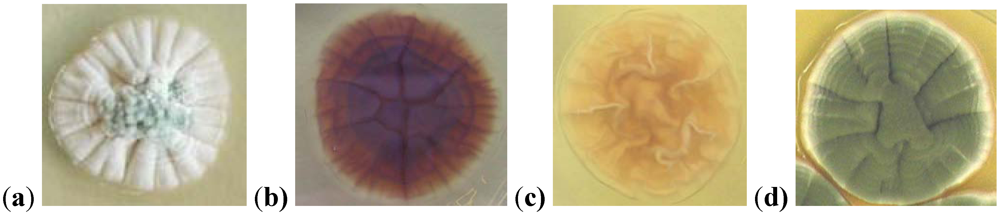
        <p><italic>Penicillium verrucosum </italic>and <italic>P. nordicum</italic> have common morphological characteristics such as very similar colony diameters on many culture media or rough stipes (<xref ref-type="fig" rid="toxins-02-01111-f001">Figure 1</xref>). These are slow growing species of the subgenus <italic>Penicillium</italic>, which is by far the most difficult taxonomically, both because there are numerous species and because apparent differences between species are small. Many species classified in this subgenus are morphologically similar, and identification using traditional morphological techniques remains difficult [<xref ref-type="bibr" rid="B32-toxins-02-01111">32</xref>]. Recently, Frisvad and Samson [<xref ref-type="bibr" rid="B33-toxins-02-01111">33</xref>] pointed out that a polyphasic approach, including a combination of DNA sequences, extrolite production and other phenotypical characters, is necessary to classify and identify species of <italic>Penicillium</italic> subgenus <italic>Penicillium</italic>. These authors keyed a total of 58 species in this subgenus. Many of these species are very common, being associated mainly with stored foods. The OTA producing species are placed in the series <italic>Verrucosa</italic> of the section <italic>Viridicata</italic> [<xref ref-type="bibr" rid="B33-toxins-02-01111">33</xref>]. </p>
        <fig id="toxins-02-01111-f001" position="anchor">
          <label>Figure 1</label>
          <caption>
            <p>Colonies of some <italic>Penicillium </italic>spp. on Yeast Extract Sucrose agar after seven days of incubation at 25 °C (<bold>a</bold>) Colony pattern of <italic>P. verrucosum</italic> or <italic>P. nordicum</italic>; (<bold>b</bold>) <italic>P. verrucosum</italic> (reverse); (<bold>c</bold>)<italic>P. nordicum</italic> (reverse); (<bold>d</bold>) <italic>P. viridicatum</italic>.</p>
          </caption>
          <graphic xmlns:xlink="http://www.w3.org/1999/xlink" xlink:href="toxins-02-01111-g001.tif"/>
        </fig>
        <p>The series <italic>Verrucosa</italic> is monophyletic based on the phylogenetic analysis of partial β-tubulin sequences of strains representing all accepted species in this subgenus. This series includes two subclades, one consisting of the non OTA producing species <italic>P. thymicola </italic>and the other subclade consisting of strains of the two OTA producing species, <italic>P. verrucosum</italic> and two genetic groups of <italic>P. nordicum</italic> strains [<xref ref-type="bibr" rid="B42-toxins-02-01111">42</xref>]. A similar genetic profile among these species was detected using <italic>CO1</italic> (mitochondrial cytochrome c oxidase 1) DNA barcoding [<xref ref-type="bibr" rid="B43-toxins-02-01111">43</xref>]. In this study, <italic>P. verrucosum</italic> and three strains of <italic>P. nordicum</italic> had identical <italic>CO1</italic> barcodes, whereas four <italic>P. nordicum </italic>strains showed their own unique barcode. Currently, <italic>P. viridicatum</italic> is placed in the series <italic>Viridicata</italic> of the section <italic>Viridicata</italic> [<xref ref-type="bibr" rid="B33-toxins-02-01111">33</xref>]. This series also includes other incorrectly cited OTA producing species such as <italic>P. aurantiogriseum, P. cyclopium </italic>or<italic> P. polonicum</italic>. Some years before, Larsen <italic>et al.</italic> [<xref ref-type="bibr" rid="B35-toxins-02-01111">35</xref>] had described two distinct groups of OTA producing <italic>Penicillium</italic> strains based mainly on differences in secondary metabolite profiles. Some strains grouped with the ex-type culture of <italic>P. nordicum</italic> ATCC 44219 were classified as <italic>P. nordicum</italic>. Other strains grouped with the type culture of <italic>P. verrucosum</italic> NRRL 965 were classified as <italic>P. verrucosum</italic>. </p>
        <fig id="toxins-02-01111-f002" position="anchor">
          <label>Figure 2</label>
          <caption>
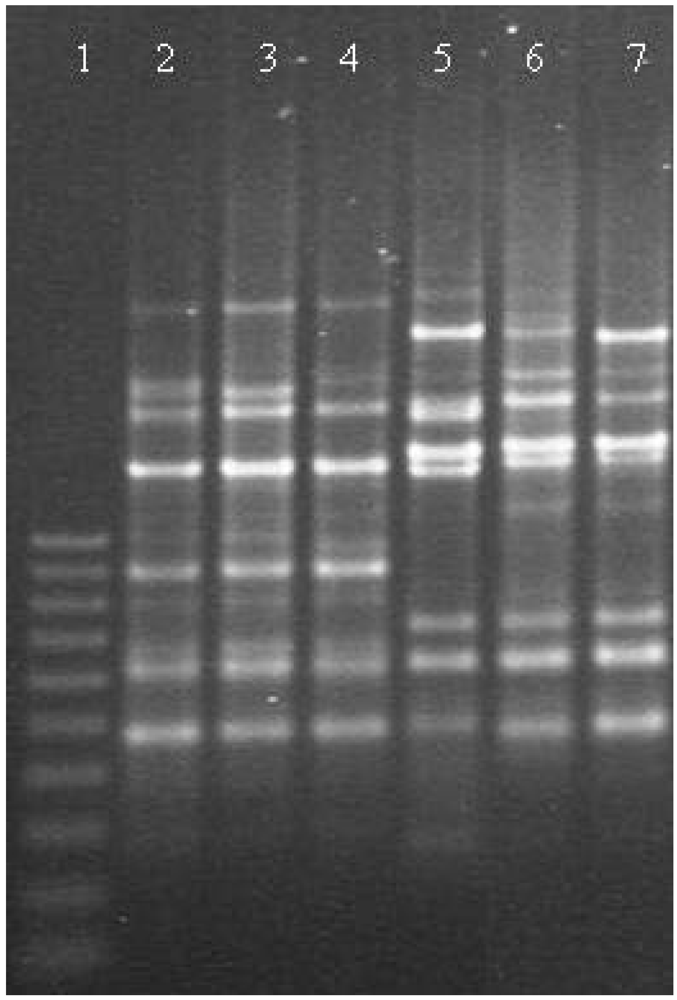
            <p>Agarose gel of representative RAPD banding patterns of <italic>P. nordicum</italic> and <italic>P. verrucosum</italic>. Lane 1, 100 bp ladder; lanes 2-4, <italic>P. nordicum</italic> patterns; lanes 5-7, <italic>P.verrucosum</italic> patterns.</p>
          </caption>
          <graphic xmlns:xlink="http://www.w3.org/1999/xlink" xlink:href="toxins-02-01111-g002.tif"/>
        </fig>
        <p>These species are ecologically different. <italic>P. nordicum</italic> is generally recovered from meat and cheese products whereas <italic>P. verrucosum</italic> is recovered mainly from plant-derived material. Besides, most of the isolates of this latter species have a characteristic dark brown reverse color on Yeast Extract Sucrose agar (YES), whereas almost all the <italic>P. nordicum</italic> strains show a pale, creamy or dull yellow reverse color in this culture medium [<xref ref-type="bibr" rid="B33-toxins-02-01111">33</xref>,<xref ref-type="bibr" rid="B35-toxins-02-01111">35</xref>]. The colony pattern of <italic>P. viridicatum </italic>is different on YES (<xref ref-type="fig" rid="toxins-02-01111-f001">Figure 1</xref>). Among other differences, Frisvad and Samson [<xref ref-type="bibr" rid="B33-toxins-02-01111">33</xref>] considered <italic>P. verrucosum</italic> among the species always negative (no reaction) or occasionally producing a yellow reaction for the Ehrlich test and <italic>P. nordicum</italic> among the species with a yellow reaction. These colored reactions are related to the production of some alkaloids. Castellá <italic>et al</italic> [<xref ref-type="bibr" rid="B44-toxins-02-01111">44</xref>] confirmed these two groups of OTA producing strains in the genus <italic>Penicillium</italic> by Random Amplified Polymorphic DNA (RAPD) (<xref ref-type="fig" rid="toxins-02-01111-f002">Figure 2</xref>) and Amplified Fragment Length Polymorphism (AFLP) analyses, which are useful to differentiate these two species. However, the analysis of the ITS-5.8S rRNA gene sequences of these strains was not able to discriminate these two groups, indicating a close phylogenetic relationship between <italic>P. verrucosum</italic> and <italic>P. nordicum</italic>. </p>
      </sec>
      <sec>
        <title>2.2. Occurrence and Significance</title>
        <p><italic>Penicillum verrucosum </italic>is an important ochratoxigenic species because it is the major producer of OTA in cereals such as wheat, barley, oats and rye, in temperate and cold climates. This species is the main source of OTA contamination in cereals associated to the porcine and avian nephropathy detected in temperate and cold countries such as Denmark, Sweden, Canada or the United States [<xref ref-type="bibr" rid="B45-toxins-02-01111">45</xref>,<xref ref-type="bibr" rid="B46-toxins-02-01111">46</xref>]. An association of OTA with the human Balkan endemic nephropathy also has been suggested, but to date the etiology of this disease remains unresolved and controversial [<xref ref-type="bibr" rid="B47-toxins-02-01111">47</xref>,<xref ref-type="bibr" rid="B48-toxins-02-01111">48</xref>]. Contamination of animal feeds with OTA may result in the presence of residues in edible offal and blood products, whereas the OTA contamination in meat, milk and eggs is negligible. However, higher concentrations of OTA may occur in certain local specialties such as blood puddings and sausages prepared with pig blood serum [<xref ref-type="bibr" rid="B49-toxins-02-01111">49</xref>]. At present, maximum levels for OTA in meat and meat products are not established in the European Community. However, the consideration of setting a maximum level for OTA for edible offal and blood products is under discussion. In Denmark, since 1978, the contamination of pig meat with OTA has been assessed indirectly by the inspection of pigs’ kidneys for the presence of macroscopic lesions of porcine nephropathy [<xref ref-type="bibr" rid="B50-toxins-02-01111">50</xref>]. Nephritis is a common cause of condemnation of pig kidneys in Great Britain, but there are few studies of OTA in cases of porcine nephropathy identified at slaughter in other countries [<xref ref-type="bibr" rid="B51-toxins-02-01111">51</xref>]. In France, the first national monitoring program showed that pigs are clearly exposed to OTA and monitoring of pork products and of feed for swine is necessary. Swine, like poultry, are exposed to OTA through their feed, which is composed of cereals such as barley, maize, oats and wheat that are susceptible to contamination by this mycotoxin [<xref ref-type="bibr" rid="B52-toxins-02-01111">52</xref>]. In a recent study [<xref ref-type="bibr" rid="B53-toxins-02-01111">53</xref>], more than 80% of the combine harvested samples (including rye, barley and wheat, among others) contained <italic>P. verrucosum</italic>, showing that much grain was contaminated prior to drying and storage. These authors pointed out that the early contamination with this species is a latent risk of OTA production if the grain is not handled properly after harvest.</p>
        <p>It is well known that <italic>P. verrucosum</italic> is much more frequently found on cereals in countries where they occasionally have OTA problems as in the North European countries compared with South Europe where levels of OTA generally seem to be lower or they are not detected [<xref ref-type="bibr" rid="B54-toxins-02-01111">54</xref>]. Recently, the occurrence of <italic>P. verrucosum</italic> on feedstuff and retail wheat flours purchased in the Spanish market was determined [<xref ref-type="bibr" rid="B55-toxins-02-01111">55</xref>,<xref ref-type="bibr" rid="B56-toxins-02-01111">56</xref>]. This species was the only OTA producing <italic>Penicillium </italic>species detected in these substrates. Although the occurrence and abundance of <italic>P. verrucosum </italic>producing species were moderately low in this study, these results confirmed the potential risk of OTA and CIT production in these products and the occurrence of <italic>P. verrucosum</italic> in South European countries.</p>
        <p><italic>Penicillium nordicum</italic> is normally present in the air and on the surface of hams in dry-cured ham manufacturing plants in Italy [<xref ref-type="bibr" rid="B57-toxins-02-01111">57</xref>]. Recently, both species were also detected on the surface of sausages from northern Italy [<xref ref-type="bibr" rid="B58-toxins-02-01111">58</xref>]. In this study, approximately 45% of these samples were positive for the presence of OTA. However, this toxin was not identified inside the dry meat. These authors [<xref ref-type="bibr" rid="B58-toxins-02-01111">58</xref>] concluded that the presence of OTA on the surface of sausage constitutes a health risk when moulds are not removed from casings. <italic>Penicillium verrucosum</italic> has been also isolated from Speck [<xref ref-type="bibr" rid="B59-toxins-02-01111">59</xref>] and Istrian dried ham [<xref ref-type="bibr" rid="B60-toxins-02-01111">60</xref>].</p>
        <p>In contrast, the OTA producing species <italic>P. nordicum</italic> and <italic>P. verrucosum</italic> were not isolated during some studies of the mycobiota of the processing areas of North European meat products, such as fermented sausage, liver pâté [<xref ref-type="bibr" rid="B61-toxins-02-01111">61</xref>] and smoked dry-cured ham and dry-cured lamb leg [<xref ref-type="bibr" rid="B62-toxins-02-01111">62</xref>]. Mould growth is not accepted on most types of North European meat products and is considered as both an economic and aesthetic problem for the producers. At the moment, neither of the two species, <italic>P. nordicum</italic> or <italic>P. verrucosum,</italic> have been cited from Spanish dry-cured meat products such as Iberian ham [<xref ref-type="bibr" rid="B63-toxins-02-01111">63</xref>] or fermented meat sausages [<xref ref-type="bibr" rid="B64-toxins-02-01111">64</xref>].</p>
      </sec>
    </sec>
    <sec>
      <title>3. Conclusions</title>
      <p>A high number of <italic>Penicillium</italic> species have been cited incorrectly as OTA producers. Species included in the subgenus <italic>Penicillium</italic> are difficult to distinguish from each other and molecular methods are usually necessary to identify them. On the other hand, different species concepts are used in the identification of these OTA producing species, causing confusion in the literature. At present, <italic>P. verrucosum </italic>and <italic>P. nordicum</italic> are the only OTA producers known and accepted in this genus. These species are phenotypically similar and phylogenetically closely related. However, they can be distinguished from each other mainly because they have different reverse color in YES agar and they produce different secondary metabolite profiles. They are also clearly differentiated by RAPD and AFLP analyses. On the other hand, the species are ecologically different. <italic>Penicillium verrucosum</italic> is the main source of OTA contamination in cereals and their products in cold and temperate climates. In contrast, <italic>P</italic>.<italic> nordicum </italic>is usually recovered from dry-cured meat products and cheese and it may be the cause of OTA contamination in these foods.</p>
    </sec>
  </body>
  <back>
    <ack>
      <title>Acknowledgements</title>
      <p>The authors acknowledge the financial support of the Spanish Government (Ministry of Science and Innovation AGL2007-66416-C05-05).</p>
    </ack>
    <ref-list>
      <title>References</title>
      <ref id="B1-toxins-02-01111">
        <label>1.</label>
        <citation citation-type="journal">
          <person-group person-group-type="author">
            <name>
              <surname>Clark</surname>
              <given-names>H.A.</given-names>
            </name>
            <name>
              <surname>Snedeker</surname>
              <given-names>S.M.</given-names>
            </name>
          </person-group>
          <article-title>Ochratoxin A: Its cancer risk and potential for exposure</article-title>
          <source>J. Toxicol. Environ. Health B</source>
          <year>2006</year>
          <volume>9</volume>
          <fpage>265</fpage>
          <lpage>296</lpage>
        <pub-id pub-id-type="doi">10.1080/15287390500195570</pub-id></citation>
      </ref>
      <ref id="B2-toxins-02-01111">
        <label>2.</label>
        <citation citation-type="journal">
          <person-group person-group-type="author">
            <name>
              <surname>Kuiper-Goodman</surname>
              <given-names>T.</given-names>
            </name>
            <name>
              <surname>Hilts</surname>
              <given-names>C.</given-names>
            </name>
            <name>
              <surname>Billiard</surname>
              <given-names>S.M.</given-names>
            </name>
            <name>
              <surname>Kiparissis</surname>
              <given-names>Y.</given-names>
            </name>
            <name>
              <surname>Richard</surname>
              <given-names>I.D.</given-names>
            </name>
            <name>
              <surname>Hayward</surname>
              <given-names>S.</given-names>
            </name>
          </person-group>
          <article-title>Health risk assessment of ochratoxin A for all age-sex strata in a market economy</article-title>
          <source>Food Addit. Contam. A</source>
          <year>2010</year>
          <volume>27</volume>
          <fpage>212</fpage>
          <lpage>240</lpage>
        <pub-id pub-id-type="doi">10.1080/02652030903013278</pub-id></citation>
      </ref>
      <ref id="B3-toxins-02-01111">
        <label>3.</label>
        <citation citation-type="journal">
          <person-group person-group-type="author">
            <name>
              <surname>Pfohl-Leszkowicz</surname>
              <given-names>A.</given-names>
            </name>
            <name>
              <surname>Manderville</surname>
              <given-names>R.A.</given-names>
            </name>
          </person-group>
          <article-title>Ochratoxin A: An overview on toxicity and carcinogenicity in animals and humans</article-title>
          <source>Mol. Nutr. Food Res.</source>
          <year>2007</year>
          <volume>51</volume>
          <fpage>61</fpage>
          <lpage>99</lpage>
        <pub-id pub-id-type="doi">10.1002/mnfr.200600137</pub-id><pub-id pub-id-type="pmid">17195275</pub-id></citation>
      </ref>
      <ref id="B4-toxins-02-01111">
        <label>4.</label>
        <citation citation-type="journal">
        <collab collab-type="authors">Commission of the European Communities</collab>
          <article-title>Commission Regulation (EC) No 1881/2006 of 19 December 2006 setting maximum levels for certain contaminants in foodstuffs</article-title>
          <source>Off. J. Eur. Commun.</source>
          <year>2006</year>
          <volume>L364</volume>
          <fpage>5</fpage>
          <lpage>29</lpage>
        </citation>
      </ref>
      <ref id="B5-toxins-02-01111">
        <label>5.</label>
        <citation citation-type="journal">
        <collab collab-type="authors">Commission of the European Communities</collab>
          <article-title>Commission Regulation (EC) No 105/2010 of 5 February 2010 amending Regulation (EC) No 1881/2006 setting maximum levels for certain contaminants in foodstuffs as regards ochratoxin Al</article-title>
          <source>Off. J. Eur. Commun.</source>
          <year>2010</year>
          <volume>L35</volume>
          <fpage>7</fpage>
          <lpage>8</lpage>
        </citation>
      </ref>
      <ref id="B6-toxins-02-01111">
        <label>6.</label>
        <citation citation-type="journal">
        <collab collab-type="authors">Commission of the European Communities</collab>
          <article-title>Commission Recommendation (EC) No 576/2006 of 17 August 2006 on the presence of deoxynivalenol, zearalenone, ochratoxin A, T-2 and HT-2 and fumonisins in products intended for animal feeding</article-title>
          <source>Off. J. Eur. Commun.</source>
          <year>2006</year>
          <volume>L229</volume>
          <fpage>7</fpage>
          <lpage>9</lpage>
        </citation>
      </ref>
      <ref id="B7-toxins-02-01111">
        <label>7.</label>
        <citation citation-type="journal">
          <person-group person-group-type="author">
            <name>
              <surname>Abarca</surname>
              <given-names>M.L.</given-names>
            </name>
            <name>
              <surname>Accensi</surname>
              <given-names>F.</given-names>
            </name>
            <name>
              <surname>Bragulat</surname>
              <given-names>M.R.</given-names>
            </name>
            <name>
              <surname>Castellá</surname>
              <given-names>G.</given-names>
            </name>
          </person-group>
          <article-title><italic>Aspergillus carbonarius</italic> as the main source of ochratoxin A contamination in dried vine fruits from the Spanish market</article-title>
          <source>J. Food Prot.</source>
          <year>2003</year>
          <volume>66</volume>
          <fpage>504</fpage>
          <lpage>506</lpage>
        <pub-id pub-id-type="pmid">12636310</pub-id></citation>
      </ref>
      <ref id="B8-toxins-02-01111">
        <label>8.</label>
        <citation citation-type="journal">
          <person-group person-group-type="author">
            <name>
              <surname>Battilani</surname>
              <given-names>P.</given-names>
            </name>
            <name>
              <surname>Pietri</surname>
              <given-names>A.</given-names>
            </name>
            <name>
              <surname>Bertuzzi</surname>
              <given-names>T.</given-names>
            </name>
            <name>
              <surname>Languasco</surname>
              <given-names>L.</given-names>
            </name>
            <name>
              <surname>Giorni</surname>
              <given-names>P.</given-names>
            </name>
            <name>
              <surname>Kozakiewicz</surname>
              <given-names>Z.</given-names>
            </name>
          </person-group>
          <article-title>Occurrence of ochratoxin A-producing fungi in grapes grown in Italy</article-title>
          <source>J. Food Prot.</source>
          <year>2003</year>
          <volume>66</volume>
          <fpage>633</fpage>
          <lpage>636</lpage>
        <pub-id pub-id-type="pmid">12696687</pub-id></citation>
      </ref>
      <ref id="B9-toxins-02-01111">
        <label>9.</label>
        <citation citation-type="journal">
          <person-group person-group-type="author">
            <name>
              <surname>Bau</surname>
              <given-names>M.</given-names>
            </name>
            <name>
              <surname>Bragulat</surname>
              <given-names>M.R.</given-names>
            </name>
            <name>
              <surname>Abarca</surname>
              <given-names>M.L.</given-names>
            </name>
            <name>
              <surname>Mínguez</surname>
              <given-names>S.</given-names>
            </name>
            <name>
              <surname>Cabañes</surname>
              <given-names>F.J.</given-names>
            </name>
          </person-group>
          <article-title>Ochratoxigenic species from Spanish wine grapes</article-title>
          <source>Int. J. Food Microbiol.</source>
          <year>2005</year>
          <volume>98</volume>
          <fpage>125</fpage>
          <lpage>130</lpage>
        <pub-id pub-id-type="doi">10.1016/j.ijfoodmicro.2004.05.015</pub-id><pub-id pub-id-type="pmid">15681040</pub-id></citation>
      </ref>
      <ref id="B10-toxins-02-01111">
        <label>10.</label>
        <citation citation-type="journal">
          <person-group person-group-type="author">
            <name>
              <surname>Bejaoui</surname>
              <given-names>H.</given-names>
            </name>
            <name>
              <surname>Mathieu</surname>
              <given-names>F.</given-names>
            </name>
            <name>
              <surname>Taillandier</surname>
              <given-names>P.</given-names>
            </name>
            <name>
              <surname>Lebrihi</surname>
              <given-names>A.</given-names>
            </name>
          </person-group>
          <article-title>Black aspergilli and ochratoxin A production in French vineyards</article-title>
          <source>Int. J. Food Microbiol.</source>
          <year>2006</year>
          <volume>111</volume>
          <supplement>(Suppl. 1)</supplement>
          <fpage>S46</fpage>
          <lpage>S52</lpage>
          <pub-id pub-id-type="pmid">16698102</pub-id>
        </citation>
      </ref>
      <ref id="B11-toxins-02-01111">
        <label>11.</label>
        <citation citation-type="journal">
          <person-group person-group-type="author">
            <name>
              <surname>Cabañes</surname>
              <given-names>F.J.</given-names>
            </name>
            <name>
              <surname>Accensi</surname>
              <given-names>F.</given-names>
            </name>
            <name>
              <surname>Bragulat</surname>
              <given-names>M.R.</given-names>
            </name>
            <name>
              <surname>Abarca</surname>
              <given-names>M.L.</given-names>
            </name>
            <name>
              <surname>Castellá</surname>
              <given-names>G.</given-names>
            </name>
            <name>
              <surname>Mínguez</surname>
              <given-names>S.</given-names>
            </name>
            <name>
              <surname>Pons</surname>
              <given-names>A.</given-names>
            </name>
          </person-group>
          <article-title>What is the source of ochratoxin A in wine?</article-title>
          <source>Int. J. Food Microbiol.</source>
          <year>2002</year>
          <volume>79</volume>
          <fpage>213</fpage>
          <lpage>215</lpage>
          <pub-id pub-id-type="pmid">12371656</pub-id>
          <pub-id pub-id-type="doi">10.1016/S0168-1605(02)00087-9</pub-id>
        </citation>
      </ref>
      <ref id="B12-toxins-02-01111">
        <label>12.</label>
        <citation citation-type="journal">
          <person-group person-group-type="author">
            <name>
              <surname>Chulze</surname>
              <given-names>S.N.</given-names>
            </name>
            <name>
              <surname>Magnoli</surname>
              <given-names>C.E.</given-names>
            </name>
            <name>
              <surname>Dalcero</surname>
              <given-names>A.M.</given-names>
            </name>
          </person-group>
          <article-title>Occurrence of ochratoxin A in wine and ochratoxigenic mycoflora in grapes and dried vine fruits in South America</article-title>
          <source>Int. J. Food Microbiol.</source>
          <year>2006</year>
          <volume>111</volume>
          <fpage>S5</fpage>
          <lpage>S9</lpage>
        <pub-id pub-id-type="doi">10.1016/j.ijfoodmicro.2006.02.006</pub-id><pub-id pub-id-type="pmid">16716424</pub-id></citation>
      </ref>
      <ref id="B13-toxins-02-01111">
        <label>13.</label>
        <citation citation-type="journal">
          <person-group person-group-type="author">
            <name>
              <surname>Gómez</surname>
              <given-names>C.</given-names>
            </name>
            <name>
              <surname>Bragulat</surname>
              <given-names>M.R.</given-names>
            </name>
            <name>
              <surname>Abarca</surname>
              <given-names>M.L.</given-names>
            </name>
            <name>
              <surname>Mínguez</surname>
              <given-names>S.</given-names>
            </name>
            <name>
              <surname>Cabañes</surname>
              <given-names>F.J.</given-names>
            </name>
          </person-group>
          <article-title>Ochratoxin A-producing fungi from grapes intended for liqueur wine production</article-title>
          <source>Food Microbiol.</source>
          <year>2006</year>
          <volume>23</volume>
          <fpage>541</fpage>
          <lpage>545</lpage>
        <pub-id pub-id-type="doi">10.1016/j.fm.2005.09.007</pub-id><pub-id pub-id-type="pmid">16943049</pub-id></citation>
      </ref>
      <ref id="B14-toxins-02-01111">
        <label>14.</label>
        <citation citation-type="journal">
          <person-group person-group-type="author">
            <name>
              <surname>Guzev</surname>
              <given-names>L.</given-names>
            </name>
            <name>
              <surname>Danshin</surname>
              <given-names>A.</given-names>
            </name>
            <name>
              <surname>Ziv</surname>
              <given-names>S.</given-names>
            </name>
            <name>
              <surname>Lichter</surname>
              <given-names>A.</given-names>
            </name>
          </person-group>
          <article-title>Occurrence of ochratoxin A producing fungi in wine and table grapes in Israel</article-title>
          <source>Int. J. Food Microbiol.</source>
          <year>2006</year>
          <volume>111</volume>
          <fpage>S67</fpage>
          <lpage>S71</lpage>
        <pub-id pub-id-type="doi">10.1016/j.ijfoodmicro.2006.03.003</pub-id><pub-id pub-id-type="pmid">16698103</pub-id></citation>
      </ref>
      <ref id="B15-toxins-02-01111">
        <label>15.</label>
        <citation citation-type="journal">
          <person-group person-group-type="author">
            <name>
              <surname>Lasram</surname>
              <given-names>S.</given-names>
            </name>
            <name>
              <surname>Bellí</surname>
              <given-names>N.</given-names>
            </name>
            <name>
              <surname>Chebil</surname>
              <given-names>S.</given-names>
            </name>
            <name>
              <surname>Nahla</surname>
              <given-names>Z.</given-names>
            </name>
            <name>
              <surname>Ahmed</surname>
              <given-names>M.</given-names>
            </name>
            <name>
              <surname>Sanchis</surname>
              <given-names>V.</given-names>
            </name>
            <name>
              <surname>Ghorbel</surname>
              <given-names>A.</given-names>
            </name>
          </person-group>
          <article-title>Occurrence of ochratoxigenic fungi and ochratoxin A in grapes from a Tunisian vineyard</article-title>
          <source>Int. J. Food Microbiol.</source>
          <year>2007</year>
          <volume>114</volume>
          <fpage>376</fpage>
          <lpage>379</lpage>
        <pub-id pub-id-type="doi">10.1016/j.ijfoodmicro.2006.09.027</pub-id><pub-id pub-id-type="pmid">17196282</pub-id></citation>
      </ref>
      <ref id="B16-toxins-02-01111">
        <label>16.</label>
        <citation citation-type="journal">
          <person-group person-group-type="author">
            <name>
              <surname>Leong</surname>
              <given-names>S.L.</given-names>
            </name>
            <name>
              <surname>Hocking</surname>
              <given-names>A.D.</given-names>
            </name>
            <name>
              <surname>Scott</surname>
              <given-names>E.S.</given-names>
            </name>
          </person-group>
          <article-title><italic>Aspergillus</italic> species producing ochratoxin A: isolation from vineyard soils and infection of Semillon bunches in Australia</article-title>
          <source>J. Appl. Microbiol.</source>
          <year>2007</year>
          <volume>102</volume>
          <fpage>124</fpage>
          <lpage>133</lpage>
        <pub-id pub-id-type="doi">10.1111/j.1365-2672.2006.03056.x</pub-id><pub-id pub-id-type="pmid">17184327</pub-id></citation>
      </ref>
      <ref id="B17-toxins-02-01111">
        <label>17.</label>
        <citation citation-type="journal">
          <person-group person-group-type="author">
            <name>
              <surname>Ponsone</surname>
              <given-names>M.L.</given-names>
            </name>
            <name>
              <surname>Combina</surname>
              <given-names>M.</given-names>
            </name>
            <name>
              <surname>Dalcero</surname>
              <given-names>A.</given-names>
            </name>
            <name>
              <surname>Chulze</surname>
              <given-names>S.</given-names>
            </name>
          </person-group>
          <article-title>Ochratoxin A and ochratoxigenic <italic>Aspergillus</italic> species in Argentinean wine grapes cultivated under organic and non-organic systems</article-title>
          <source>Int. J. Food Microbiol.</source>
          <year>2007</year>
          <volume>114</volume>
          <fpage>131</fpage>
          <lpage>135</lpage>
        <pub-id pub-id-type="doi">10.1016/j.ijfoodmicro.2006.07.001</pub-id><pub-id pub-id-type="pmid">17196283</pub-id></citation>
      </ref>
      <ref id="B18-toxins-02-01111">
        <label>18.</label>
        <citation citation-type="journal">
          <person-group person-group-type="author">
            <name>
              <surname>Serra</surname>
              <given-names>R.</given-names>
            </name>
            <name>
              <surname>Abrunhosa</surname>
              <given-names>L.</given-names>
            </name>
            <name>
              <surname>Kozakiewicz</surname>
              <given-names>Z.</given-names>
            </name>
            <name>
              <surname>Venâncio</surname>
              <given-names>A.</given-names>
            </name>
          </person-group>
          <article-title>Black <italic>Aspergillus</italic> species as ochratoxin A producers in Portuguese wine grapes</article-title>
          <source>Int. J. Food Microbiol.</source>
          <year>2003</year>
          <volume>88</volume>
          <fpage>63</fpage>
          <lpage>68</lpage>
        <pub-id pub-id-type="doi">10.1016/S0168-1605(03)00085-0</pub-id><pub-id pub-id-type="pmid">14527786</pub-id></citation>
      </ref>
      <ref id="B19-toxins-02-01111">
        <label>19.</label>
        <citation citation-type="journal">
          <person-group person-group-type="author">
            <name>
              <surname>Tjamos</surname>
              <given-names>S.E.</given-names>
            </name>
            <name>
              <surname>Antoniou</surname>
              <given-names>P.P.</given-names>
            </name>
            <name>
              <surname>Tjamos</surname>
              <given-names>E.C.</given-names>
            </name>
          </person-group>
          <article-title><italic>Aspergillus </italic>spp., distribution, population composition and ochratoxin A production in wine producing vineyards in Greece</article-title>
          <source>Int. J. Food Microbiol.</source>
          <year>2006</year>
          <volume>111</volume>
          <fpage>S61</fpage>
          <lpage>S66</lpage>
          <pub-id pub-id-type="pmid">16701912</pub-id>
          <pub-id pub-id-type="doi">10.1016/j.ijfoodmicro.2006.01.044</pub-id>
        </citation>
      </ref>
      <ref id="B20-toxins-02-01111">
        <label>20.</label>
        <citation citation-type="book">
          <person-group person-group-type="author">
            <name>
              <surname>Noonim</surname>
              <given-names>P.</given-names>
            </name>
            <name>
              <surname>Mahakarnchanakul</surname>
              <given-names>W.</given-names>
            </name>
            <name>
              <surname>Varga</surname>
              <given-names>J.</given-names>
            </name>
            <name>
              <surname>Samson</surname>
              <given-names>R.A.</given-names>
            </name>
          </person-group>
          <article-title>Aspergilli and ochratoxin A in coffee</article-title>
          <source>Aspergillus in the Genomic Era</source>
          <person-group person-group-type="editor">
            <name>
              <surname>Varga</surname>
              <given-names>J.</given-names>
            </name>
            <name>
              <surname>Samson</surname>
              <given-names>R.A.</given-names>
            </name>
          </person-group>
          <publisher-name>Wageningen Academic Publishers</publisher-name>
          <publisher-loc>Wageningen, The Netherlands</publisher-loc>
          <year>2008</year>
          <fpage>213</fpage>
          <lpage>231</lpage>
        </citation>
      </ref>
      <ref id="B21-toxins-02-01111">
        <label>21.</label>
        <citation citation-type="book">
          <person-group person-group-type="author">
            <name>
              <surname>Taniwaki</surname>
              <given-names>M.H.</given-names>
            </name>
          </person-group>
          <article-title>An update on ochratoxigenic fungi and ochratoxin A in coffee</article-title>
          <source>Advances in Food Mycology. Advances in Experimental Medicine and Biology</source>
          <person-group person-group-type="editor">
            <name>
              <surname>Hocking</surname>
              <given-names>A.D.</given-names>
            </name>
            <name>
              <surname>Pitt</surname>
              <given-names>J.I.</given-names>
            </name>
            <name>
              <surname>Samson</surname>
              <given-names>R.A.</given-names>
            </name>
            <name>
              <surname>Thrane</surname>
              <given-names>U.</given-names>
            </name>
          </person-group>
          <publisher-name>Springer Science</publisher-name>
          <publisher-loc>New York, NY, USA</publisher-loc>
          <year>2006</year>
        </citation>
      </ref>
      <ref id="B22-toxins-02-01111">
        <label>22.</label>
        <citation citation-type="book">
          <person-group person-group-type="author">
            <name>
              <surname>Cabañes</surname>
              <given-names>F.J.</given-names>
            </name>
            <name>
              <surname>Bragulat</surname>
              <given-names>M.R.</given-names>
            </name>
          </person-group>
          <article-title>Ochratoxin A in profiling and speciation</article-title>
          <source>Aspergillus in the Genomic Era</source>
          <person-group person-group-type="editor">
            <name>
              <surname>Varga</surname>
              <given-names>J.</given-names>
            </name>
            <name>
              <surname>Samson</surname>
              <given-names>R.A.</given-names>
            </name>
          </person-group>
          <publisher-name>Wageningen Academic Publishers</publisher-name>
          <publisher-loc>Wageningen, The Netherlands</publisher-loc>
          <year>2008</year>
          <fpage>57</fpage>
          <lpage>70</lpage>
        </citation>
      </ref>
      <ref id="B23-toxins-02-01111">
        <label>23.</label>
        <citation citation-type="book">
          <person-group person-group-type="author">
            <name>
              <surname>Frisvad</surname>
              <given-names>J.C.</given-names>
            </name>
            <name>
              <surname>Nielsen</surname>
              <given-names>K.F.</given-names>
            </name>
            <name>
              <surname>Samson</surname>
              <given-names>R.A.</given-names>
            </name>
          </person-group>
          <article-title>Recommendations concerning the chronic problem of misidentification of mycotoxigenic fungi associated with foods and feeds</article-title>
          <source>Advances in Food Mycology. Advances in Experimental Medicine and Biology</source>
          <person-group person-group-type="editor">
            <name>
              <surname>Hocking</surname>
              <given-names>A.D.</given-names>
            </name>
            <name>
              <surname>Pitt</surname>
              <given-names>J.I.</given-names>
            </name>
            <name>
              <surname>Samson</surname>
              <given-names>R.A.</given-names>
            </name>
            <name>
              <surname>Thrane</surname>
              <given-names>U.</given-names>
            </name>
          </person-group>
          <publisher-name>Springer Science</publisher-name>
          <publisher-loc>New York, NY, USA</publisher-loc>
          <year>2006</year>
        </citation>
      </ref>
      <ref id="B24-toxins-02-01111">
        <label>24.</label>
        <citation citation-type="journal">
          <person-group person-group-type="author">
            <name>
              <surname>Abarca</surname>
              <given-names>M.L.</given-names>
            </name>
            <name>
              <surname>Accensi</surname>
              <given-names>F.</given-names>
            </name>
            <name>
              <surname>Cano</surname>
              <given-names>J.</given-names>
            </name>
            <name>
              <surname>Cabañes</surname>
              <given-names>F.J.</given-names>
            </name>
          </person-group>
          <article-title>Taxonomy and significance of black aspergilli</article-title>
          <source>Antonie van Leeuwenhoek</source>
          <year>2004</year>
          <volume>86</volume>
          <fpage>33</fpage>
          <lpage>49</lpage>
        <pub-id pub-id-type="doi">10.1023/B:ANTO.0000024907.85688.05</pub-id><pub-id pub-id-type="pmid">15103236</pub-id></citation>
      </ref>
      <ref id="B25-toxins-02-01111">
        <label>25.</label>
        <citation citation-type="journal">
          <person-group person-group-type="author">
            <name>
              <surname>Frisvad</surname>
              <given-names>J.C.</given-names>
            </name>
            <name>
              <surname>Frank</surname>
              <given-names>J.M.</given-names>
            </name>
            <name>
              <surname>Houbraken</surname>
              <given-names>J.A.M.P.</given-names>
            </name>
            <name>
              <surname>Kuijpers</surname>
              <given-names>A.F.A.</given-names>
            </name>
            <name>
              <surname>Samson</surname>
              <given-names>R.A.</given-names>
            </name>
          </person-group>
          <article-title>New ochratoxin A producing species of <italic>Aspergillus</italic> section</article-title>
          <source>Circumdati. Stud. Mycol.</source>
          <year>2004</year>
          <volume>50</volume>
          <fpage>23</fpage>
          <lpage>43</lpage>
        </citation>
      </ref>
      <ref id="B26-toxins-02-01111">
        <label>26.</label>
        <citation citation-type="journal">
          <person-group person-group-type="author">
            <name>
              <surname>Nielsen</surname>
              <given-names>K.F.</given-names>
            </name>
            <name>
              <surname>Mogensen</surname>
              <given-names>J.M.</given-names>
            </name>
            <name>
              <surname>Johansen</surname>
              <given-names>M.</given-names>
            </name>
            <name>
              <surname>Larsen</surname>
              <given-names>T.O.</given-names>
            </name>
            <name>
              <surname>Frisvad</surname>
              <given-names>J.C.</given-names>
            </name>
          </person-group>
          <article-title>Review of secondary metabolites and mycotoxins from the <italic>Aspergillus niger </italic>group</article-title>
          <source>Anal. Bioanal. Chem.</source>
          <year>2009</year>
          <volume>395</volume>
          <fpage>1225</fpage>
          <lpage>1242</lpage>
        <pub-id pub-id-type="doi">10.1007/s00216-009-3081-5</pub-id><pub-id pub-id-type="pmid">19756540</pub-id></citation>
      </ref>
      <ref id="B27-toxins-02-01111">
        <label>27.</label>
        <citation citation-type="journal">
          <person-group person-group-type="author">
            <name>
              <surname>Palencia</surname>
              <given-names>E.R.</given-names>
            </name>
            <name>
              <surname>Hinton</surname>
              <given-names>D.M.</given-names>
            </name>
            <name>
              <surname>Bacon</surname>
              <given-names>C.W.</given-names>
            </name>
          </person-group>
          <article-title>The black <italic>Aspergillus</italic> species of maize and peanuts and their potential for mycotoxin production</article-title>
          <source>Toxins</source>
          <year>2010</year>
          <volume>2</volume>
          <fpage>399</fpage>
          <lpage>416</lpage>
        <pub-id pub-id-type="doi">10.3390/toxins2040399</pub-id><pub-id pub-id-type="pmid">22069592</pub-id></citation>
      </ref>
      <ref id="B28-toxins-02-01111">
        <label>28.</label>
        <citation citation-type="book">
          <person-group person-group-type="author">
            <name>
              <surname>Perrone</surname>
              <given-names>G.</given-names>
            </name>
            <name>
              <surname>Gallo</surname>
              <given-names>A.</given-names>
            </name>
            <name>
              <surname>Susca</surname>
              <given-names>A.</given-names>
            </name>
            <name>
              <surname>Varga</surname>
              <given-names>J.</given-names>
            </name>
          </person-group>
          <article-title>Aspergilli in grapes: Ecology, biodiversity and genomics</article-title>
          <source>Aspergillus in the Genomic Era</source>
          <person-group person-group-type="editor">
            <name>
              <surname>Varga</surname>
              <given-names>J.</given-names>
            </name>
            <name>
              <surname>Samson</surname>
              <given-names>R.A.</given-names>
            </name>
          </person-group>
          <publisher-name>Wageningen Academic</publisher-name>
          <publisher-loc>Wageningen, The Netherlands</publisher-loc>
          <year>2008</year>
          <fpage>179</fpage>
          <lpage>212</lpage>
        </citation>
      </ref>
      <ref id="B29-toxins-02-01111">
        <label>29.</label>
        <citation citation-type="journal">
          <person-group person-group-type="author">
            <name>
              <surname>Samson</surname>
              <given-names>R.A.</given-names>
            </name>
            <name>
              <surname>Houbraken</surname>
              <given-names>J.A.M.P.</given-names>
            </name>
            <name>
              <surname>Kuijpers</surname>
              <given-names>A.F.A.</given-names>
            </name>
            <name>
              <surname>Frank</surname>
              <given-names>J.M.</given-names>
            </name>
            <name>
              <surname>Frisvad</surname>
              <given-names>J.C.</given-names>
            </name>
          </person-group>
          <article-title>New ochratoxin A or sclerotium producing species of <italic>Aspergillus</italic> section Nigri</article-title>
          <source>Stud. Mycol.</source>
          <year>2004</year>
          <volume>50</volume>
          <fpage>45</fpage>
          <lpage>61</lpage>
        </citation>
      </ref>
      <ref id="B30-toxins-02-01111">
        <label>30.</label>
        <citation citation-type="journal">
          <person-group person-group-type="author">
            <name>
              <surname>Samson</surname>
              <given-names>R.A.</given-names>
            </name>
            <name>
              <surname>Noonim</surname>
              <given-names>P.</given-names>
            </name>
            <name>
              <surname>Meijer</surname>
              <given-names>M.</given-names>
            </name>
            <name>
              <surname>Houbraken</surname>
              <given-names>J.</given-names>
            </name>
            <name>
              <surname>Frisvad</surname>
              <given-names>J.C.</given-names>
            </name>
            <name>
              <surname>Varga</surname>
              <given-names>J.</given-names>
            </name>
          </person-group>
          <article-title>Diagnostic tools to identify black aspergilli</article-title>
          <source>Stud. Mycol.</source>
          <year>2007</year>
          <volume>59</volume>
          <fpage>129</fpage>
          <lpage>145</lpage>
        <pub-id pub-id-type="doi">10.3114/sim.2007.59.13</pub-id><pub-id pub-id-type="pmid">18490945</pub-id></citation>
      </ref>
      <ref id="B31-toxins-02-01111">
        <label>31.</label>
        <citation citation-type="book">
          <person-group person-group-type="author">
            <name>
              <surname>Peterson</surname>
              <given-names>S.W.</given-names>
            </name>
            <name>
              <surname>Varga</surname>
              <given-names>J.</given-names>
            </name>
            <name>
              <surname>Frisvad</surname>
              <given-names>J.C.</given-names>
            </name>
            <name>
              <surname>Samson</surname>
              <given-names>R.A.</given-names>
            </name>
          </person-group>
          <article-title>Phylogeny and subgeneric taxonomy of <italic>Aspergillus</italic></article-title>
          <source>Aspergillus in the Genomic Era</source>
          <person-group person-group-type="editor">
            <name>
              <surname>Varga</surname>
              <given-names>J.</given-names>
            </name>
            <name>
              <surname>Samson</surname>
              <given-names>R.A.</given-names>
            </name>
          </person-group>
          <publisher-name>Wageningen Academic Publishers</publisher-name>
          <publisher-loc>Wageningen, The Netherlands</publisher-loc>
          <year>2008</year>
          <fpage>33</fpage>
          <lpage>56</lpage>
        </citation>
      </ref>
      <ref id="B32-toxins-02-01111">
        <label>32.</label>
        <citation citation-type="book">
          <person-group person-group-type="author">
            <name>
              <surname>Pitt</surname>
              <given-names>J.I.</given-names>
            </name>
            <name>
              <surname>Hocking</surname>
              <given-names>A.D.</given-names>
            </name>
          </person-group>
          <source>Fungi and Food Spoilage</source>
          <edition>3rd</edition>
          <publisher-name>Springer</publisher-name>
          <publisher-loc>Dordrecht, The Netherlands</publisher-loc>
          <year>2009</year>
        </citation>
      </ref>
      <ref id="B33-toxins-02-01111">
        <label>33.</label>
        <citation citation-type="journal">
          <person-group person-group-type="author">
            <name>
              <surname>Frisvad</surname>
              <given-names>J.C.</given-names>
            </name>
            <name>
              <surname>Samson</surname>
              <given-names>R.A.</given-names>
            </name>
          </person-group>
          <article-title>Polyphasic taxonomy of <italic>Penicillium</italic> subgenus <italic>Penicillium</italic>. A guide to identification of food and air-borne terverticillate Penicillia and their mycotoxins</article-title>
          <source>Stud. Mycol.</source>
          <year>2004</year>
          <volume>49</volume>
          <fpage>1</fpage>
          <lpage>173</lpage>
        </citation>
      </ref>
      <ref id="B34-toxins-02-01111">
        <label>34.</label>
        <citation citation-type="journal">
          <person-group person-group-type="author">
            <name>
              <surname>Frisvad</surname>
              <given-names>J.C.</given-names>
            </name>
            <name>
              <surname>Smedsgaard</surname>
              <given-names>J.</given-names>
            </name>
            <name>
              <surname>Larsen</surname>
              <given-names>T.O.</given-names>
            </name>
            <name>
              <surname>Samson</surname>
              <given-names>R.A.</given-names>
            </name>
          </person-group>
          <article-title>ycotoxins, drugs and other extrolites produced by species in <italic>Penicillium</italic> subgenus <italic>Penicillium</italic></article-title>
          <source>Stud. Mycol.</source>
          <year>2004</year>
          <volume>49</volume>
          <fpage>201</fpage>
          <lpage>241</lpage>
        </citation>
      </ref>
      <ref id="B35-toxins-02-01111">
        <label>35.</label>
        <citation citation-type="journal">
          <person-group person-group-type="author">
            <name>
              <surname>Larsen</surname>
              <given-names>T.O.</given-names>
            </name>
            <name>
              <surname>Svendsen</surname>
              <given-names>A.</given-names>
            </name>
            <name>
              <surname>Smedsgaard</surname>
              <given-names>J.</given-names>
            </name>
          </person-group>
          <article-title>Biochemical characterization of ochratoxin A-producing strains of the genus <italic>Penicillium</italic></article-title>
          <source>Appl. Environ. Microbiol.</source>
          <year>2001</year>
          <volume>67</volume>
          <fpage>3630</fpage>
          <lpage>3635</lpage>
          <pub-id pub-id-type="pmid">11472940</pub-id>
          <pub-id pub-id-type="doi">10.1128/AEM.67.8.3630-3635.2001</pub-id>
        </citation>
      </ref>
      <ref id="B36-toxins-02-01111">
        <label>36.</label>
        <citation citation-type="journal">
          <person-group person-group-type="author">
            <name>
              <surname>Frisvad</surname>
              <given-names>J.C.</given-names>
            </name>
            <name>
              <surname>Filtenborg</surname>
              <given-names>O.</given-names>
            </name>
          </person-group>
          <article-title>Terverticillate penicillia: Chemotaxonomy and mycotoxin production</article-title>
          <source>Mycologia</source>
          <year>1989</year>
          <volume>81</volume>
          <fpage>837</fpage>
          <lpage>861</lpage>
        <pub-id pub-id-type="doi">10.2307/3760103</pub-id></citation>
      </ref>
      <ref id="B37-toxins-02-01111">
        <label>37.</label>
        <citation citation-type="journal">
          <person-group person-group-type="author">
            <name>
              <surname>Pitt</surname>
              <given-names>J.I.</given-names>
            </name>
          </person-group>
          <article-title><italic>Penicillium viridicatum</italic>, <italic>Penicillium verrucosum</italic> and production of ochratoxin A</article-title>
          <source>Appl. Environ. Microbiol.</source>
          <year>1987</year>
          <volume>53</volume>
          <fpage>266</fpage>
          <lpage>269</lpage>
        <pub-id pub-id-type="pmid">3566267</pub-id></citation>
      </ref>
      <ref id="B38-toxins-02-01111">
        <label>38.</label>
        <citation citation-type="book">
          <person-group person-group-type="author">
            <name>
              <surname>Pitt</surname>
              <given-names>J.I.</given-names>
            </name>
          </person-group>
          <source>The genus Penicillium and Its Teleomorphic States Eupenicillium and Talaromyces</source>
          <publisher-name>Academic Press</publisher-name>
          <publisher-loc>New York, NY, USA</publisher-loc>
          <year>1979</year>
        </citation>
      </ref>
      <ref id="B39-toxins-02-01111">
        <label>39.</label>
        <citation citation-type="journal">
          <person-group person-group-type="author">
            <name>
              <surname>Samson</surname>
              <given-names>R.A.</given-names>
            </name>
            <name>
              <surname>Stolk</surname>
              <given-names>A.C.</given-names>
            </name>
            <name>
              <surname>Hadlok</surname>
              <given-names>R.</given-names>
            </name>
          </person-group>
          <article-title>Revision of the Subsection <italic>Fasciculata</italic> of <italic>Penicillium</italic> and some Allied Species</article-title>
          <source>Stud. Mycol.</source>
          <year>1976</year>
          <volume>11</volume>
          <fpage>1</fpage>
          <lpage>47</lpage>
        </citation>
      </ref>
      <ref id="B40-toxins-02-01111">
        <label>40.</label>
        <citation citation-type="journal">
          <person-group person-group-type="author">
            <name>
              <surname>Ciegler</surname>
              <given-names>A.</given-names>
            </name>
            <name>
              <surname>Fenell</surname>
              <given-names>D.I.</given-names>
            </name>
            <name>
              <surname>Sansing</surname>
              <given-names>G.A.</given-names>
            </name>
            <name>
              <surname>Detroy</surname>
              <given-names>R.W.</given-names>
            </name>
            <name>
              <surname>Bennett</surname>
              <given-names>G.A.</given-names>
            </name>
          </person-group>
          <article-title>Mycotoxin-producing strains of <italic>Penicillium viridicatum</italic>: Classification into subgroups</article-title>
          <source>Appl. Microbiol.</source>
          <year>1973</year>
          <volume>26</volume>
          <fpage>271</fpage>
          <lpage>278</lpage>
        <pub-id pub-id-type="pmid">4751786</pub-id></citation>
      </ref>
      <ref id="B41-toxins-02-01111">
        <label>41.</label>
        <citation citation-type="book">
          <person-group person-group-type="author">
            <name>
              <surname>Raper</surname>
              <given-names>K.B.</given-names>
            </name>
            <name>
              <surname>Thom</surname>
              <given-names>C.</given-names>
            </name>
          </person-group>
          <source>A Manual of Penicillia</source>
          <publisher-name>The Williams &amp; Wilkins Company</publisher-name>
          <publisher-loc>Baltimore, MD, USA</publisher-loc>
          <year>1949</year>
        </citation>
      </ref>
      <ref id="B42-toxins-02-01111">
        <label>42.</label>
        <citation citation-type="journal">
          <person-group person-group-type="author">
            <name>
              <surname>Samson</surname>
              <given-names>R.A.</given-names>
            </name>
            <name>
              <surname>Seifert</surname>
              <given-names>K.A.</given-names>
            </name>
            <name>
              <surname>Kuijpers</surname>
              <given-names>A.F.A.</given-names>
            </name>
            <name>
              <surname>Frisvad</surname>
              <given-names>J.C.</given-names>
            </name>
          </person-group>
          <article-title>Phylogenetic analysis of <italic>Penicillium</italic> subgenus <italic>Penicillium</italic> using partial β-tubulin sequences</article-title>
          <source>Stud. Mycol.</source>
          <year>2004</year>
          <volume>49</volume>
          <fpage>175</fpage>
          <lpage>200</lpage>
        </citation>
      </ref>
      <ref id="B43-toxins-02-01111">
        <label>43.</label>
        <citation citation-type="journal">
          <person-group person-group-type="author">
            <name>
              <surname>Seifert</surname>
              <given-names>K.A.</given-names>
            </name>
            <name>
              <surname>Samson</surname>
              <given-names>R.A.</given-names>
            </name>
            <name>
              <surname>Dewaard</surname>
              <given-names>J.R.</given-names>
            </name>
            <name>
              <surname>Houbraken</surname>
              <given-names>J.</given-names>
            </name>
            <name>
              <surname>Lévesque</surname>
              <given-names>C.A.</given-names>
            </name>
            <name>
              <surname>Moncalvo</surname>
              <given-names>J.M.</given-names>
            </name>
            <name>
              <surname>Louis-Seize</surname>
              <given-names>G.</given-names>
            </name>
            <name>
              <surname>Hebert</surname>
              <given-names>P.D.</given-names>
            </name>
          </person-group>
          <article-title>Prospects for fungus identification using CO1 DNA barcodes, with <italic>Penicillium</italic> as a test case</article-title>
          <source>Proc. Natl. Acad. Sci. USA</source>
          <year>2007</year>
          <volume>104</volume>
          <fpage>3901</fpage>
          <lpage>3906</lpage>
        <pub-id pub-id-type="doi">10.1073/pnas.0611691104</pub-id><pub-id pub-id-type="pmid">17360450</pub-id></citation>
      </ref>
      <ref id="B44-toxins-02-01111">
        <label>44.</label>
        <citation citation-type="journal">
          <person-group person-group-type="author">
            <name>
              <surname>Castellá</surname>
              <given-names>G.</given-names>
            </name>
            <name>
              <surname>Larsen</surname>
              <given-names>T.O.</given-names>
            </name>
            <name>
              <surname>Cabañes</surname>
              <given-names>F.J.</given-names>
            </name>
            <name>
              <surname>Schmidt</surname>
              <given-names>H.</given-names>
            </name>
            <name>
              <surname>Alboresi</surname>
              <given-names>A.</given-names>
            </name>
            <name>
              <surname>Niessen</surname>
              <given-names>L.</given-names>
            </name>
            <name>
              <surname>Färber</surname>
              <given-names>P.</given-names>
            </name>
            <name>
              <surname>Geisen</surname>
              <given-names>R.</given-names>
            </name>
          </person-group>
          <article-title>Molecular characterization of ochratoxin A producing strains of the genus <italic>Penicillium</italic></article-title>
          <source>System. Appl. Microbiol.</source>
          <year>2002</year>
          <volume>25</volume>
          <fpage>74</fpage>
          <lpage>83</lpage>
        <pub-id pub-id-type="doi">10.1078/0723-2020-00094</pub-id></citation>
      </ref>
      <ref id="B45-toxins-02-01111">
        <label>45.</label>
        <citation citation-type="journal">
          <person-group person-group-type="author">
            <name>
              <surname>Krogh</surname>
              <given-names>P.</given-names>
            </name>
          </person-group>
          <article-title>Mycotoxicoses of animals</article-title>
          <source>Mycopathologia</source>
          <year>1978</year>
          <volume>65</volume>
          <fpage>43</fpage>
          <lpage>45</lpage>
        <pub-id pub-id-type="doi">10.1007/BF00447172</pub-id><pub-id pub-id-type="pmid">745625</pub-id></citation>
      </ref>
      <ref id="B46-toxins-02-01111">
        <label>46.</label>
        <citation citation-type="journal">
          <person-group person-group-type="author">
            <name>
              <surname>Marquardt</surname>
              <given-names>R.R.</given-names>
            </name>
            <name>
              <surname>Frohlich</surname>
              <given-names>A.A.</given-names>
            </name>
          </person-group>
          <article-title>A review of recent advances in understanding ochratoxicosis</article-title>
          <source>J. Anim. Sci.</source>
          <year>1992</year>
          <volume>70</volume>
          <fpage>3968</fpage>
          <lpage>3988</lpage>
        <pub-id pub-id-type="pmid">1474034</pub-id></citation>
      </ref>
      <ref id="B47-toxins-02-01111">
        <label>47.</label>
        <citation citation-type="journal">
          <person-group person-group-type="author">
            <name>
              <surname>Pfohl-Leszkowicz</surname>
              <given-names>A.</given-names>
            </name>
          </person-group>
          <article-title>Ochratoxin A and aristolochic acid involvement in nephropathies and associated urothelial tract tumours</article-title>
          <source>Arh. Hig. Rada. Toksikol.</source>
          <year>2009</year>
          <volume>60</volume>
          <fpage>465</fpage>
          <lpage>483</lpage>
        <pub-id pub-id-type="pmid">20061248</pub-id></citation>
      </ref>
      <ref id="B48-toxins-02-01111">
        <label>48.</label>
        <citation citation-type="journal">
          <person-group person-group-type="author">
            <name>
              <surname>Stefanovic</surname>
              <given-names>V.</given-names>
            </name>
            <name>
              <surname>Polenakovic</surname>
              <given-names>M.</given-names>
            </name>
          </person-group>
          <article-title>Fifty years of research in Balkan endemic nephropathy: Where are we now?</article-title>
          <source>Nephron Clin. Pract.</source>
          <year>2009</year>
          <volume>112</volume>
          <fpage>c51</fpage>
          <lpage>c56</lpage>
        <pub-id pub-id-type="doi">10.1159/000213081</pub-id><pub-id pub-id-type="pmid">19390202</pub-id></citation>
      </ref>
      <ref id="B49-toxins-02-01111">
        <label>49.</label>
        <citation citation-type="journal">
<collab collab-type="authors">EFSA</collab>
          <article-title>Opinion of the Scientific Panel on Contaminants in Food Chain on a request from the Commission related to ochratoxin A (OTA) as an undesirable substance in animal feed</article-title>
          <source>EFSA J.</source>
          <year>2004</year>
          <volume>101</volume>
          <fpage>1</fpage>
          <lpage>36</lpage>
        </citation>
      </ref>
      <ref id="B50-toxins-02-01111">
        <label>50.</label>
        <citation citation-type="journal">
          <person-group person-group-type="author">
            <name>
              <surname>Jorgensen</surname>
              <given-names>K.</given-names>
            </name>
            <name>
              <surname>Petersen</surname>
              <given-names>A.</given-names>
            </name>
          </person-group>
          <article-title>Content of ochratoxin in paired kidney and meat samples from healthy Danish slaughter pigs</article-title>
          <source>Food Addit. Contam.</source>
          <year>2002</year>
          <volume>19</volume>
          <fpage>562</fpage>
          <lpage>567</lpage>
        <pub-id pub-id-type="doi">10.1080/02652030110113807</pub-id><pub-id pub-id-type="pmid">12042022</pub-id></citation>
      </ref>
      <ref id="B51-toxins-02-01111">
        <label>51.</label>
        <citation citation-type="journal">
          <person-group person-group-type="author">
            <name>
              <surname>Gresham</surname>
              <given-names>A.</given-names>
            </name>
            <name>
              <surname>Done</surname>
              <given-names>S.</given-names>
            </name>
            <name>
              <surname>Livesey</surname>
              <given-names>C.</given-names>
            </name>
            <name>
              <surname>MacDonald</surname>
              <given-names>S.</given-names>
            </name>
            <name>
              <surname>Chan</surname>
              <given-names>D.</given-names>
            </name>
            <name>
              <surname>Sayers</surname>
              <given-names>R.</given-names>
            </name>
            <name>
              <surname>Clark</surname>
              <given-names>C.</given-names>
            </name>
            <name>
              <surname>Kemp</surname>
              <given-names>P.</given-names>
            </name>
          </person-group>
          <article-title>Survey of pig’ kidneys with lesions consistent with PMWS and PDNS and ochratoxicosis. Part 1: concentrations and prevalence of ochratoxin A</article-title>
          <source>Vet. Rec.</source>
          <year>2006</year>
          <volume>159</volume>
          <fpage>737</fpage>
          <lpage>742</lpage>
          <pub-id pub-id-type="pmid">17127757</pub-id>
          <pub-id pub-id-type="doi">10.1136/vr.159.22.737</pub-id>
        </citation>
      </ref>
      <ref id="B52-toxins-02-01111">
        <label>52.</label>
        <citation citation-type="journal">
          <person-group person-group-type="author">
            <name>
              <surname>Dragacci</surname>
              <given-names>S.</given-names>
            </name>
            <name>
              <surname>Grosso</surname>
              <given-names>F.</given-names>
            </name>
            <name>
              <surname>Bire</surname>
              <given-names>R.</given-names>
            </name>
            <name>
              <surname>Fremy</surname>
              <given-names>J.M.</given-names>
            </name>
            <name>
              <surname>Coulon</surname>
              <given-names>S.</given-names>
            </name>
          </person-group>
          <article-title>A french monitoring programme for determining ochratoxin A occurrence in pig kidneys</article-title>
          <source>Nat. Toxins</source>
          <year>1999</year>
          <volume>7</volume>
          <fpage>167</fpage>
          <lpage>173</lpage>
        <pub-id pub-id-type="doi">10.1002/(SICI)1522-7189(199907/08)7:4&lt;167::AID-NT55&gt;3.0.CO;2-Q</pub-id><pub-id pub-id-type="pmid">10797645</pub-id></citation>
      </ref>
      <ref id="B53-toxins-02-01111">
        <label>53.</label>
        <citation citation-type="journal">
          <person-group person-group-type="author">
            <name>
              <surname>Elmholt</surname>
              <given-names>S.</given-names>
            </name>
            <name>
              <surname>Rasmussen</surname>
              <given-names>P.H.</given-names>
            </name>
          </person-group>
          <article-title><italic>Penicillium verrucosum</italic> occurrence and ochratoxin A contents in organically cultivated grain with special reference to ancient wheat types and drying practice</article-title>
          <source>Mycopathologia</source>
          <year>2005</year>
          <volume>159</volume>
          <fpage>421</fpage>
          <lpage>432</lpage>
        <pub-id pub-id-type="doi">10.1007/s11046-005-1152-5</pub-id><pub-id pub-id-type="pmid">15883729</pub-id></citation>
      </ref>
      <ref id="B54-toxins-02-01111">
        <label>54.</label>
        <citation citation-type="journal">
          <person-group person-group-type="author">
            <name>
              <surname>Lund</surname>
              <given-names>F.</given-names>
            </name>
            <name>
              <surname>Frisvad</surname>
              <given-names>J.C.</given-names>
            </name>
          </person-group>
          <article-title><italic>Penicillium verrucosum</italic> in wheat and barley indicates presence of ochratoxin A</article-title>
          <source>J. Appl. Microbiol.</source>
          <year>2003</year>
          <volume>95</volume>
          <fpage>1117</fpage>
          <lpage>1123</lpage>
        <pub-id pub-id-type="doi">10.1046/j.1365-2672.2003.02076.x</pub-id><pub-id pub-id-type="pmid">14633041</pub-id></citation>
      </ref>
      <ref id="B55-toxins-02-01111">
        <label>55.</label>
        <citation citation-type="journal">
          <person-group person-group-type="author">
            <name>
              <surname>Bragulat</surname>
              <given-names>M.R.</given-names>
            </name>
            <name>
              <surname>Martínez</surname>
              <given-names>E.</given-names>
            </name>
            <name>
              <surname>Castellá</surname>
              <given-names>G.</given-names>
            </name>
            <name>
              <surname>Cabañes</surname>
              <given-names>F.J.</given-names>
            </name>
          </person-group>
          <article-title>Ochratoxin A and citrinin producing species of the genus <italic>Penicillium</italic> from feedstuffs</article-title>
          <source>Int. J. Food Microbiol.</source>
          <year>2008</year>
          <volume>126</volume>
          <fpage>43</fpage>
          <lpage>48</lpage>
        <pub-id pub-id-type="doi">10.1016/j.ijfoodmicro.2008.04.034</pub-id><pub-id pub-id-type="pmid">18571755</pub-id></citation>
      </ref>
      <ref id="B56-toxins-02-01111">
        <label>56.</label>
        <citation citation-type="journal">
          <person-group person-group-type="author">
            <name>
              <surname>Cabañas</surname>
              <given-names>R.</given-names>
            </name>
            <name>
              <surname>Bragulat</surname>
              <given-names>M.R.</given-names>
            </name>
            <name>
              <surname>Abarca</surname>
              <given-names>M.L.</given-names>
            </name>
            <name>
              <surname>Castellá</surname>
              <given-names>G.</given-names>
            </name>
            <name>
              <surname>Cabañes</surname>
              <given-names>F.J.</given-names>
            </name>
          </person-group>
          <article-title>Occurrence of <italic>Penicillium verrucosum</italic> in retail wheat flours from the Spanish market</article-title>
          <source>Food Microbiol.</source>
          <year>2008</year>
          <volume>25</volume>
          <fpage>642</fpage>
          <lpage>647</lpage>
        <pub-id pub-id-type="doi">10.1016/j.fm.2008.04.003</pub-id><pub-id pub-id-type="pmid">18541161</pub-id></citation>
      </ref>
      <ref id="B57-toxins-02-01111">
        <label>57.</label>
        <citation citation-type="journal">
          <person-group person-group-type="author">
            <name>
              <surname>Battilani</surname>
              <given-names>P.</given-names>
            </name>
            <name>
              <surname>Pietri</surname>
              <given-names>V.A.</given-names>
            </name>
            <name>
              <surname>Giorni</surname>
              <given-names>P.</given-names>
            </name>
            <name>
              <surname>Formenti</surname>
              <given-names>S.</given-names>
            </name>
            <name>
              <surname>Bertuzzi</surname>
              <given-names>T.</given-names>
            </name>
            <name>
              <surname>Toscani</surname>
              <given-names>T.</given-names>
            </name>
            <name>
              <surname>Virgili</surname>
              <given-names>R.</given-names>
            </name>
            <name>
              <surname>Kozakiewicz</surname>
              <given-names>Z.</given-names>
            </name>
          </person-group>
          <article-title><italic>Penicillium</italic> populations in dry-cured ham manufacturing plants</article-title>
          <source>J. Food Prot.</source>
          <year>2007</year>
          <volume>70</volume>
          <fpage>975</fpage>
          <lpage>980</lpage>
        <pub-id pub-id-type="pmid">17477269</pub-id></citation>
      </ref>
      <ref id="B58-toxins-02-01111">
        <label>58.</label>
        <citation citation-type="journal">
          <person-group person-group-type="author">
            <name>
              <surname>Iacumin</surname>
              <given-names>L.</given-names>
            </name>
            <name>
              <surname>Chiesa</surname>
              <given-names>L.</given-names>
            </name>
            <name>
              <surname>Boscolo</surname>
              <given-names>D.</given-names>
            </name>
            <name>
              <surname>Manzano</surname>
              <given-names>M.</given-names>
            </name>
            <name>
              <surname>Cantoni</surname>
              <given-names>C.</given-names>
            </name>
            <name>
              <surname>Orlic</surname>
              <given-names>S.</given-names>
            </name>
            <name>
              <surname>Comi</surname>
              <given-names>G.</given-names>
            </name>
          </person-group>
          <article-title>Moulds and ochratoxin A on surfaces of artisanal and industrial dry sausages</article-title>
          <source>Food Microbiol.</source>
          <year>2009</year>
          <volume>26</volume>
          <fpage>65</fpage>
          <lpage>70</lpage>
        <pub-id pub-id-type="doi">10.1016/j.fm.2008.07.006</pub-id><pub-id pub-id-type="pmid">19028307</pub-id></citation>
      </ref>
      <ref id="B59-toxins-02-01111">
        <label>59.</label>
        <citation citation-type="journal">
          <person-group person-group-type="author">
            <name>
              <surname>Peintner</surname>
              <given-names>U.</given-names>
            </name>
            <name>
              <surname>Geiger</surname>
              <given-names>J.</given-names>
            </name>
            <name>
              <surname>Pöder</surname>
              <given-names>R.</given-names>
            </name>
          </person-group>
          <article-title>The mycobiota of speck, a traditional Tyrolean smoked and cured ham</article-title>
          <source>J. Food Prot.</source>
          <year>2000</year>
          <volume>63</volume>
          <fpage>1399</fpage>
          <lpage>1403</lpage>
        <pub-id pub-id-type="pmid">11041140</pub-id></citation>
      </ref>
      <ref id="B60-toxins-02-01111">
        <label>60.</label>
        <citation citation-type="journal">
          <person-group person-group-type="author">
            <name>
              <surname>Comi</surname>
              <given-names>G.</given-names>
            </name>
            <name>
              <surname>Orlic</surname>
              <given-names>S.</given-names>
            </name>
            <name>
              <surname>Redzepovic</surname>
              <given-names>S.</given-names>
            </name>
            <name>
              <surname>Urso</surname>
              <given-names>R.</given-names>
            </name>
            <name>
              <surname>Iacumin</surname>
              <given-names>L.</given-names>
            </name>
          </person-group>
          <article-title>Moulds isolated from Istrian dried ham at the pre-ripening and ripening level</article-title>
          <source>Int. J. Food Microbiol.</source>
          <year>2004</year>
          <volume>96</volume>
          <fpage>29</fpage>
          <lpage>34</lpage>
        <pub-id pub-id-type="doi">10.1016/j.ijfoodmicro.2004.03.005</pub-id><pub-id pub-id-type="pmid">15358503</pub-id></citation>
      </ref>
      <ref id="B61-toxins-02-01111">
        <label>61.</label>
        <citation citation-type="journal">
          <person-group person-group-type="author">
            <name>
              <surname>Sørensen</surname>
              <given-names>L.M.</given-names>
            </name>
            <name>
              <surname>Jacobsen</surname>
              <given-names>T.</given-names>
            </name>
            <name>
              <surname>Nielsen</surname>
              <given-names>P.V.</given-names>
            </name>
            <name>
              <surname>Frisvad</surname>
              <given-names>J.C.</given-names>
            </name>
            <name>
              <surname>Koch</surname>
              <given-names>A.G.</given-names>
            </name>
          </person-group>
          <article-title>Mycobiota in the processing areas of two different meat products</article-title>
          <source>Int. J. Food Microbiol.</source>
          <year>2008</year>
          <volume>124</volume>
          <fpage>58</fpage>
          <lpage>64</lpage>
          <pub-id pub-id-type="pmid">18367279</pub-id>
          <pub-id pub-id-type="doi">10.1016/j.ijfoodmicro.2008.02.019</pub-id>
        </citation>
      </ref>
      <ref id="B62-toxins-02-01111">
        <label>62.</label>
        <citation citation-type="journal">
          <person-group person-group-type="author">
            <name>
              <surname>Asefa</surname>
              <given-names>D.T.</given-names>
            </name>
            <name>
              <surname>Gjerde</surname>
              <given-names>R.O.</given-names>
            </name>
            <name>
              <surname>Sidhu</surname>
              <given-names>M.S.</given-names>
            </name>
            <name>
              <surname>Langsrud</surname>
              <given-names>S.</given-names>
            </name>
            <name>
              <surname>Kure</surname>
              <given-names>C.F.</given-names>
            </name>
            <name>
              <surname>Nesbakken</surname>
              <given-names>T.</given-names>
            </name>
            <name>
              <surname>Skaar</surname>
              <given-names>I.</given-names>
            </name>
          </person-group>
          <article-title>Moulds contaminants on Norwegian dry-cured meat products</article-title>
          <source>Int. J. Food Microbiol.</source>
          <year>2009</year>
          <volume>128</volume>
          <fpage>435</fpage>
          <lpage>439</lpage>
        <pub-id pub-id-type="doi">10.1016/j.ijfoodmicro.2008.09.024</pub-id><pub-id pub-id-type="pmid">19000642</pub-id></citation>
      </ref>
      <ref id="B63-toxins-02-01111">
        <label>63.</label>
        <citation citation-type="journal">
          <person-group person-group-type="author">
            <name>
              <surname>Núñez</surname>
              <given-names>F.</given-names>
            </name>
            <name>
              <surname>Rodríguez</surname>
              <given-names>M.M.</given-names>
            </name>
            <name>
              <surname>Bermúdez</surname>
              <given-names>M.E.</given-names>
            </name>
            <name>
              <surname>Córdoba</surname>
              <given-names>J.J.</given-names>
            </name>
            <name>
              <surname>Asensio</surname>
              <given-names>M.A.</given-names>
            </name>
          </person-group>
          <article-title>Composition and toxigenic potential of the mould population on dry-cured Iberian ham</article-title>
          <source>Int. J. Food Microbiol.</source>
          <year>1996</year>
          <volume>32</volume>
          <fpage>185</fpage>
          <lpage>197</lpage>
        <pub-id pub-id-type="doi">10.1016/0168-1605(96)01126-9</pub-id><pub-id pub-id-type="pmid">8880338</pub-id></citation>
      </ref>
      <ref id="B64-toxins-02-01111">
        <label>64.</label>
        <citation citation-type="journal">
          <person-group person-group-type="author">
            <name>
              <surname>López-Díaz</surname>
              <given-names>T.M.</given-names>
            </name>
            <name>
              <surname>Santos</surname>
              <given-names>J.A.</given-names>
            </name>
            <name>
              <surname>García-López</surname>
              <given-names>M.L.</given-names>
            </name>
            <name>
              <surname>Otero</surname>
              <given-names>A.</given-names>
            </name>
          </person-group>
          <article-title>Surface mycoflora of a Spanish fermented meat sausage and toxigenicity of <italic>Penicillium</italic> isolates</article-title>
          <source>Int. J. Food Microbiol.</source>
          <year>2001</year>
          <volume>68</volume>
          <fpage>69</fpage>
          <lpage>74</lpage>
        <pub-id pub-id-type="doi">10.1016/S0168-1605(01)00472-X</pub-id><pub-id pub-id-type="pmid">11545222</pub-id></citation>
      </ref>
    </ref-list>
  </back>
</article>