<?xml version="1.0" encoding="UTF-8"?>
<!DOCTYPE article PUBLIC "-//NLM//DTD Journal Publishing DTD v2.3 20070202//EN" "journalpublishing.dtd">
<article xmlns:mml="http://www.w3.org/1998/Math/MathML" xmlns:xlink="http://www.w3.org/1999/xlink" xml:lang="en" article-type="research-article">
  <front>
    <journal-meta>
      <journal-id journal-id-type="publisher-id">toxins</journal-id>
      <journal-title>Toxins</journal-title>
      <abbrev-journal-title abbrev-type="publisher">Toxins</abbrev-journal-title>
      <abbrev-journal-title abbrev-type="pubmed">Toxins</abbrev-journal-title>
      <issn pub-type="epub">2072-6651</issn>
      <publisher>
        <publisher-name>MDPI</publisher-name>
      </publisher>
    </journal-meta>
    <article-meta>
      <article-id pub-id-type="doi">10.3390/toxins2102478</article-id>
      <article-id pub-id-type="publisher-id">toxins-02-02478</article-id>
      <article-categories>
        <subj-group>
          <subject>Article</subject>
        </subj-group>
      </article-categories>
      <title-group>
        <article-title>Biological and Pathological Studies of Rosmarinic Acid as an Inhibitor of Hemorrhagic <italic>Trimeresurus flavoviridis</italic> (habu) Venom</article-title>
      </title-group>
      <contrib-group>
        <contrib contrib-type="author">
          <name>
            <surname>Aung</surname>
            <given-names>Hnin Thanda</given-names>
          </name>
          <xref rid="af1-toxins-02-02478" ref-type="aff">1</xref>
        </contrib>
        <contrib contrib-type="author">
          <name>
            <surname>Nikai</surname>
            <given-names>Toshiaki</given-names>
          </name>
          <xref rid="af1-toxins-02-02478" ref-type="aff">1</xref>
        </contrib>
        <contrib contrib-type="author">
          <name>
            <surname>Komori</surname>
            <given-names>Yumiko</given-names>
          </name>
          <xref rid="af1-toxins-02-02478" ref-type="aff">1</xref>
        </contrib>
        <contrib contrib-type="author">
          <name>
            <surname>Nonogaki</surname>
            <given-names>Tsunemasa</given-names>
          </name>
          <xref rid="af2-toxins-02-02478" ref-type="aff">2</xref>
        </contrib>
        <contrib contrib-type="author">
          <name>
            <surname>Niwa</surname>
            <given-names>Masatake</given-names>
          </name>
          <xref rid="af1-toxins-02-02478" ref-type="aff">1</xref>
        </contrib>
        <contrib contrib-type="author">
          <name>
            <surname>Takaya</surname>
            <given-names>Yoshiaki</given-names>
          </name>
          <xref rid="af1-toxins-02-02478" ref-type="aff">1</xref>
          <xref rid="c1-toxins-02-02478" ref-type="corresp">*</xref>
        </contrib>
      </contrib-group>
      <aff id="af1-toxins-02-02478"><label>1</label>Faculty of Pharmacy, Meijo University, 150 Yagotoyama, Tempaku, Nagoya, 468-8503, Japan; Email: <email>hninthandaaung07@gmail.com</email> (H.T.A.); <email>nikai@meijo-u.ac.jp</email> (T.N.); <email>ykomori@meijo-u.ac.jp</email> (Y.K.); <email>masa@meijo-u.ac.jp</email> (M.N.)</aff>
      <aff id="af2-toxins-02-02478"><label>2</label>College of Pharmacy, Kinjo Gakuin University, 2-1723 Omori, Moriyama, Nagoya, 463-8521, Japan; Email: <email>tunenono@kinjo-u.ac.jp</email></aff>
      <author-notes>
        <corresp id="c1-toxins-02-02478"><label>*</label> Author to whom correspondence should be addressed; Email: <email>ytakaya@meijo-u.ac.jp</email>; Tel.: +81-52-839-2740; Fax: +81-52-839-2740.</corresp>
      </author-notes>
      <pub-date pub-type="epub">
        <day>25</day>
        <month>10</month>
        <year>2010</year>
      </pub-date>
      <pub-date pub-type="collection">
        <month>10</month><year>2010</year>
      </pub-date>
      <volume>2</volume>
      <issue>10</issue>
      <fpage>2478</fpage>
      <lpage>2489</lpage>
      <history>
        <date date-type="received">
          <day>02</day>
          <month>09</month>
          <year>2010</year>
        </date>
        <date date-type="rev-recd">
          <day>05</day>
          <month>10</month>
          <year>2010</year>
        </date>
        <date date-type="accepted">
          <day>22</day>
          <month>10</month>
          <year>2010</year>
        </date>
      </history>
      <permissions>
        <copyright-statement>©  2010 by the authors; licensee MDPI, Basel, Switzerland</copyright-statement>
        <copyright-year>2010</copyright-year>
        <license xmlns:xlink="http://www.w3.org/1999/xlink" license-type="open-access" xlink:href="http://creativecommons.org/licenses/by/3.0/">
          <p>This article is an open-access article distributed under the terms and conditions of the Creative Commons Attribution license (http://creativecommons.org/licenses/by/3.0/).</p>
        </license>
      </permissions>
      <abstract>
        <p>In our previous report, rosmarinic acid (RA) was revealed to be an antidote active compound in <italic>Argusia argentea</italic> (family: Boraginaceae). The plant is locally used in Okinawa in Japan as an antidote for poisoning from snake venom, <italic>Trimeresurus flavoviridis</italic> (habu). This article presents mechanistic evidence of RA’s neutralization of the hemorrhagic effects of snake venom. Anti-hemorrhagic activity was assayed by using several kinds of snake venom. Inhibition against fibrinogen hydrolytic and collagen hydrolytic activities of <italic>T. flavoviridis</italic> venom were examined by SDS-PAGE. A histopathological study was done by microscopy after administration of venom in the presence or absence of RA. RA was found to markedly neutralize venom-induced hemorrhage, fibrinogenolysis, cytotoxicity and digestion of type IV collagen activity. Moreover, RA inhibited both hemorrhage and neutrophil infiltrations caused by <italic>T. flavoviridis</italic> venom in pathology sections. These results demonstrate that RA inhibited most of the hemorrhage effects of venom. These findings indicate that rosmarinic acid can be expected to provide therapeutic benefits in neutralization of snake venom accompanied by heat stability.</p>
      </abstract>
      <kwd-group>
        <kwd>rosmarinic acid</kwd>
        <kwd>snake venom</kwd>
        <kwd>hemorrhage</kwd>
        <kwd>metalloproteinase</kwd>
        <kwd>
          <italic>Argusia argentea</italic>
        </kwd>
      </kwd-group>
    </article-meta>
  </front>
  <body>
    <sec sec-type="intro">
      <title>1. Introduction</title>
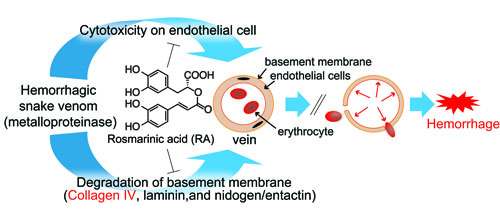
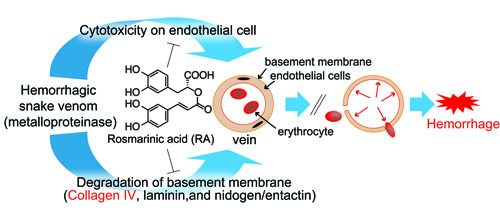
      <p>Envenomation resulting from snakebites is an important public health hazard in many regions, particularly in tropical and subtropical regions [<xref ref-type="bibr" rid="B1-toxins-02-02478">1</xref>,<xref ref-type="bibr" rid="B2-toxins-02-02478">2</xref>,<xref ref-type="bibr" rid="B3-toxins-02-02478">3</xref>]. Snake envenomation causes various pathophysiological changes such as inflammation, increased body temperature, hemorrhage, necrosis, nephrotoxicity, cardiotoxicity, haemostatic changes and ultimately death [<xref ref-type="bibr" rid="B4-toxins-02-02478">4</xref>]. Hemorrhage is a common symptom associated with local tissue damage in snake poisoning by Viperidae. In severe poisoning, hemorrhage can be observed in many internal organs [<xref ref-type="bibr" rid="B5-toxins-02-02478">5</xref>,<xref ref-type="bibr" rid="B6-toxins-02-02478">6</xref>]. Hemorrhage can occur as a result of cytotoxicity of the venom on endothelial cells, and a degradation of the basement membrane of the vein due to the venom acting as a metalloproteinase. In many countries, plant extracts have been traditionally used in the treatment of snakebite envenomations [<xref ref-type="bibr" rid="B7-toxins-02-02478">7</xref>,<xref ref-type="bibr" rid="B8-toxins-02-02478">8</xref>,<xref ref-type="bibr" rid="B9-toxins-02-02478">9</xref>], although only a few cases have been scientifically validated. The present study aims to examine the venom neutralization potential of rosmarinic acid (RA) isolated from a methanolic extract of <italic>Argusia argentea</italic> [<xref ref-type="bibr" rid="B10-toxins-02-02478">10</xref>] and its mode of action.</p>
    </sec>
    <sec>
      <title>2. Materials and Methods</title>
      <sec>
        <title>2.1. Materials</title>
        <p><italic>Trimeresurus flavoviridis</italic> (habu) venom (Okinawa), <italic>Gloydius blomhoffii</italic> venom and <italic>Bitis arietans</italic> venom were purchased from Japan Snake Institute, Gunma. <italic>Crotalus atrox</italic> venom was purchased from Sigma-Aldrich. Hemorrhagic toxin b (HT<italic>b</italic>) from <italic>C. atrox</italic> venom was prepared by the method reported previously [<xref ref-type="bibr" rid="B11-toxins-02-02478">11</xref>]. Bilitoxin-2 and Ac<sub>1</sub>-proteinase were isolated using our methods reported previously [<xref ref-type="bibr" rid="B12-toxins-02-02478">12</xref>,<xref ref-type="bibr" rid="B13-toxins-02-02478">13</xref>] for <italic>Agkistrodon bilineatus</italic> venom and <italic>Deinagkistrodon acutus</italic> venom, respectively. Hemorrhagic toxin-1 (HT-1) was obtained from <italic>B. arietans</italic> venom [<xref ref-type="bibr" rid="B14-toxins-02-02478">14</xref>]. Human and bovine fibrinogens were supplied by Sigma-Aldrich, Tokyo, Japan. Type IV collagen was purchased from Nitta Gelatin Inc. Cryo-preserved human umbilical vein endothelial cells (HUVEC), its respective cell culture media (HuMedia EB-2), other cell culture supplements, and reagents were obtained from Kurabo (Osaka, Japan). The cell counting kit was purchased from Dojindo (Kumamoto, Japan). Other chemicals were of analytical grade from commercial sources. All experiments involving the use of animals were carried out in compliance with the guidelines for animal experiments of Faculty of Pharmacy, Meijo University.</p>
      </sec>
      <sec>
        <title>2.2. Rosmarinic Acid</title>
        <p>Rosmarinic acid (RA) was isolated and purified from methanolic extract of <italic>Argusia argentea</italic> as reported previously [<xref ref-type="bibr" rid="B10-toxins-02-02478">10</xref>]. A voucher sample has been deposited in the Herbarium of the Faculty of Pharmacy, Meijo University, Japan.</p>
      </sec>
      <sec>
        <title>2.3. Anti-hemorrhagic Activity Assay</title>
        <p>Anti-hemorrhagic activity was assayed by the method of Bjarnason and Tu [<xref ref-type="bibr" rid="B15-toxins-02-02478">15</xref>] using ddY mice of 20 g average weight. Two groups of four mice were used for the experiment. All crude venom solutions of <italic>T. flavoviridis</italic> venom, <italic>C. atrox</italic> venom, <italic>G. blomhoffii</italic> venom and <italic>B. arietans</italic> venom, were prepared at a concentration of 0.14 mg/mL in saline. Concentrations of purified hemorrhagic toxin solutions were as follows: HT<italic>b</italic> (0.41 mg/mL), bilitoxin-2 (2.75 μg/mL), HT-1 (0.29 mg/mL), and Ac<sub>1</sub>‑proteinase (1.04 mg/mL). A test solution was prepared by mixing the venom solution or the toxin solution (50 µL) and RA (0.5 mg/mL in 10% DMSO-saline, 50 µL) followed by 10 min incubation at 37 °C. These test solutions (100 µL) were injected subcutaneously (s.c.) in the abdomen of mice. Similarly, a group of mice which were injected with a venom solution without RA was used as a control group, and also a group which was only injected with 10% DMSO-saline (50 μL) served as a blank group. Prior to this study, effects of DMSO at several concentrations were investigated, and DMSO at less than 10% was found to cause no significant inactivation of venom. After 24 h, mice were euthanized by inhalation of chloroform, the skin covering the abdomen was removed and hemorrhagic lesions were analyzed as follows. The area of the lesion was estimated by major and minor axes measurements, since the shape of the lesions are always amorphous, like an ellipse. </p>
      </sec>
      <sec>
        <title>2.4. Fibrinogen Hydrolytic Activity Assay</title>
        <p>Fibrinogen hydrolytic activity was assayed by the method of Ouyang and Teng [<xref ref-type="bibr" rid="B16-toxins-02-02478">16</xref>]. A solution of 0.1% human fibrinogen in 50 mM Tris-HCl buffer (pH 7.5) (1 mL) and a venom solution (50 µL of 0.21 mg/mL of <italic>T. flavoviridis</italic> venom or 5.5 µg/mL of bilitoxin-2) were incubated in the presence or absence of RA (0.5 mg/mL) at 37 °C. At various time intervals, aliquots of 100 µL of denaturing solution (10 mM phosphate buffer, pH 7.2, containing 10 M urea, 4% sodium dodecyl sulfate (SDS), and 4% β-mercaptoethanol) were added. This solution was incubated at 37 °C for 6 h and then run on 10% polyacrylamide slab gel electrophoresis. Electrophoresis was carried out for 2 h with a current of 25 mA per slab gel. Bromophenol blue (BPB) solution was used as an indicator.</p>
      </sec>
      <sec>
        <title>2.5. Collagen Hydrolytic Activity Assay</title>
        <p>Collagen hydrolytic activity was assayed as follows. Sodium hydrogen carbonate (60 µL, pH 12) was added to 0.3% type IV collagen (0.9 mL) and adjusted to pH 8. Aliquots of type IV collagen were incubated with <italic>T. flavoviridis</italic> venom (0.21 μg/mL) in the presence or absence of RA (0.5 mg/mL). At various time intervals, aliquots of 100 µL of denaturing solution (10 mM phosphate buffer, pH 7.2, containing 10 M urea, 4% SDS, and 4% β-mercaptoethanol) were added. This solution was boiled for 3 min and run on SDS-PAGE using a 7.5% polyacrylamide slab gel electrophoresis.</p>
      </sec>
      <sec>
        <title>2.6. Cytotoxic Action on HUVEC</title>
        <p>The effects of RA and <italic>T. flavoviridis</italic> venom on cultured human umbilical vein endothelial cells (HUVEC) were investigated [<xref ref-type="bibr" rid="B17-toxins-02-02478">17</xref>,<xref ref-type="bibr" rid="B18-toxins-02-02478">18</xref>,<xref ref-type="bibr" rid="B19-toxins-02-02478">19</xref>]. Frozen HUVEC were cultured and maintained in commercially available media, HuMedia-EB2, supplemented with fetal calf serum (2% v/v), hEGF (10 ng/mL), hFGF-B (5 ng/mL), hydrocortisone (1 µg/mL), heparin (10 µg/mL), gentamicin (50 µg/mL), and amphotericin B (50 ng/mL). At confluency, cells were trypsinized, washed with the same medium and then resuspended in growth media. These cells were seeded in 96-multiwell plates (5 × 10<sup>3</sup> cells per well in 100 µL medium) and were allowed to attach and reach log phase of growth. Aliquots of venom and RA to be assayed were diluted in saline and were sterilized by filtration with cellulose acetate 0.22 µm membrane filters. Various concentrations of RA (0.5, 0.25, 0.125, 0.06, 0.03 mg/mL in 10% DMSO-saline) in the presence or absence of <italic>T. flavoviridis</italic> venom (0.14 mg/mL) were added to each well in 100 µL medium. The plate was incubated at 37 °C under 5% CO<sub>2</sub> atmosphere for 17 h. Ten microliters of cell counting kit-8 was added to each well, and the microplate was incubated for 1 h, after which cell densities were measured at 450 nm using Bio-RAD Model 550 MicroplateR eader.</p>
      </sec>
      <sec>
        <title>2.7. Histopathological Study</title>
        <p>Histopathological study for RA was performed by intramuscular (i.m.) injection of <italic>T. flavoviridis</italic> venom solution into the medial aspect of the thigh muscle of ddY strain white mice. Histopathological study of muscle was conducted in three groups. Group A was injected with the venom (0.21 mg/mL, 100 µL), while group B was injected with RA (0.5 mg/mL, 100 µL). Group C was injected with a mixture of the venom (0.41 mg/mL, 50 µL) and RA (0.25 mg/mL, 50 µL). Test solutions were preincubated at 37 °C for 10 min before injection. The mice were killed by chloroform inhalation 24 h after injection. Tissue samples were immediately fixed in buffered formate fixative for 24 h at room temperature. The tissue was then washed for 4 h in running water, dehydrated in an autotechnicon, and stained with hematoxylin and eosin for observation under light microscope.</p>
      </sec>
      <sec>
        <title>2.8. Heat Stability</title>
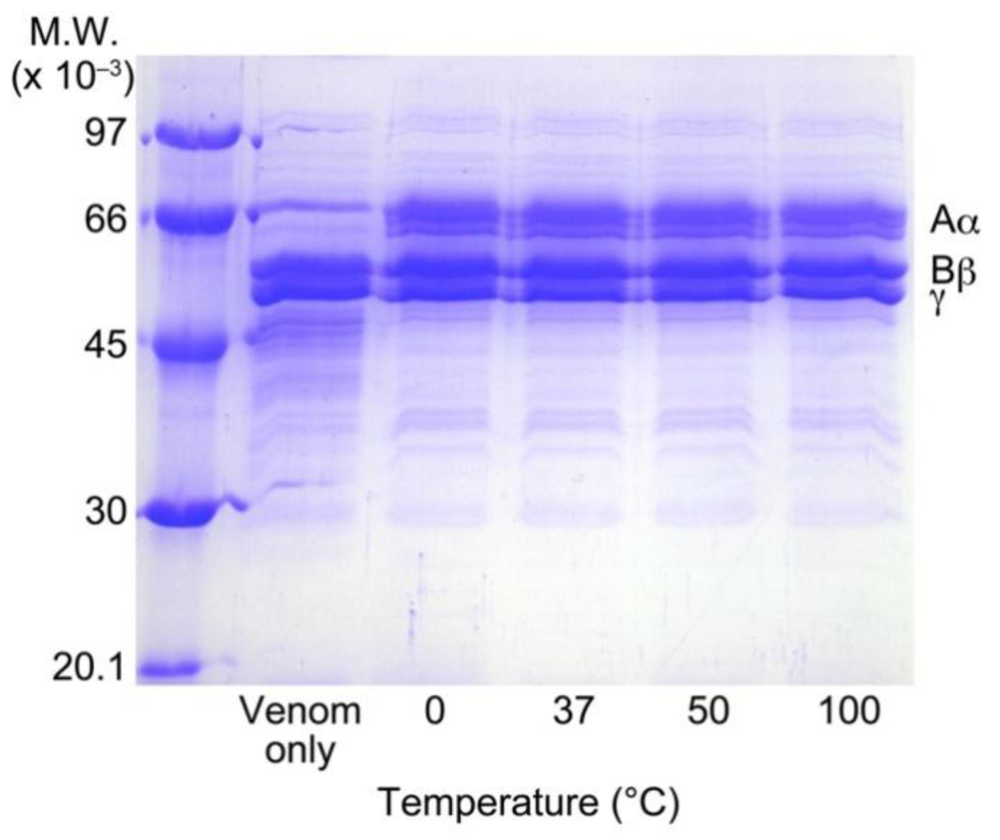
        <p>RA (0.5 mg/mL) in 10% DMSO-saline was heated at 37 °C, 50 °C and 100 °C for 10 min, respectively. Fifty microliters of each heat-treated RA solution was mixed with <italic>T. flavoviridis</italic> venom (0.21 mg/mL, 50 µL) and incubated at 37 °C for 10 min. An aliquot of 0.1% human fibrinogen in 50 mM Tris-HCl buffer, pH 7.5 was added to each test tube. The reactions were stopped by adding 100 µL of denaturing solution (10 mM phosphate buffer, pH 7.2, containing 10 M urea, 4% SDS, and 4% β-mercaptoethanol). These solutions were incubated at 37 °C for 6 h and then run on 10% polyacrylamide slab gel electrophoresis. The venom solution without a sample was also subjected to SDS-PAGE for comparison. Moreover, by using RA (0.5 mg/mL), which was treated at 100 °C, antihemorrhage activity was also examined as mentioned above.</p>
      </sec>
      <sec>
        <title>2.9. Assay for Edema Activity</title>
        <p>Hind-paw edema activity was assayed by the method of Ho <italic>et al</italic>. [<xref ref-type="bibr" rid="B20-toxins-02-02478">20</xref>]. Four ddY strain white mice (20–23 g) were individually injected in the right foot pad with <italic>Trimeresurus elegans</italic> venom (12.5 µg in 50 µL of 10% DMSO-saline). An equal volume of 10% DMSO saline was injected into the left paws as control. Inhibition assays were performed by preincubated rosmarinic acid (0.5 mg/mL in 10% DMSO saline) with toxin for 10 min at 37 °C. The volume of each paw was measured with a slide caliper. The degree of paw swelling was expressed as % increase of the initial paw volume.</p>
      </sec>
    </sec>
    <sec sec-type="results">
      <title>3. Results</title>
      <sec>
        <title>3.1. Inhibitory Activity of RA on Crude Snake Venoms and Purified Hemorrhagic Toxins</title>
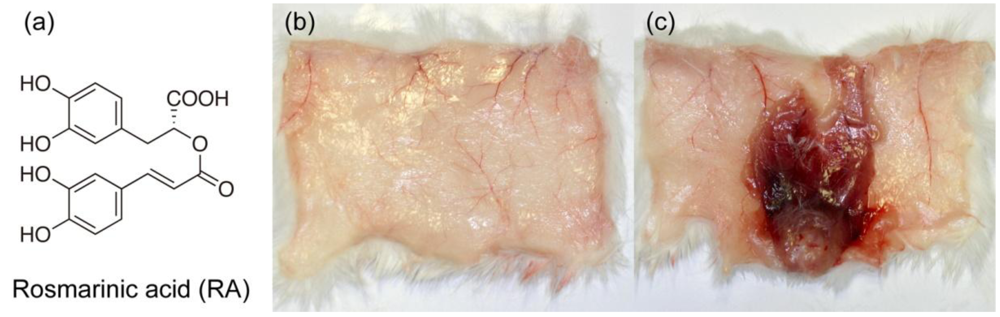
        <p>When crude venom (<italic>T. flavoviridis</italic> (habu) venom, <italic>C. atrox</italic> venom, <italic>G. blomhoffii</italic> venom, and <italic>B. arietans</italic> venom) or purified toxin, (HT<italic>b</italic>, bilitoxin-2, HT-1 and Ac<sub>1</sub>-proteinase) was injected s.c. in the abdomen of mice, a distinct hemorrhagic lesion was observed (<xref ref-type="fig" rid="toxins-02-02478-f001">Figure 1</xref>c) [<xref ref-type="bibr" rid="B10-toxins-02-02478">10</xref>]. No hemorrhagic spots were produced after s.c. injection of crude venom or purified toxin with RA (<xref ref-type="fig" rid="toxins-02-02478-f001">Figure 1</xref>b). RA effectively inhibited the hemorrhagic activities of crude venoms as well as purified hemorrhagic toxins.</p>
        <fig id="toxins-02-02478-f001" position="anchor">
          <label>Figure 1</label>
          <caption>
            <p>Inhibitory activity of RA on <italic>T. flavoviridis</italic> venom (<bold>a</bold>) Structure of rosmarinic acid, (<bold>b</bold>) <italic>T. flavoviridis</italic> venom with RA, (<bold>c</bold>) <italic>T. flavoviridis</italic> venom without RA.</p>
          </caption>
          <graphic xmlns:xlink="http://www.w3.org/1999/xlink" xlink:href="toxins-02-02478-g001.tif"/>
        </fig>
      </sec>
      <sec>
        <title>3.2. Inhibition of Fibrinogen Hydrolytic Activity</title>
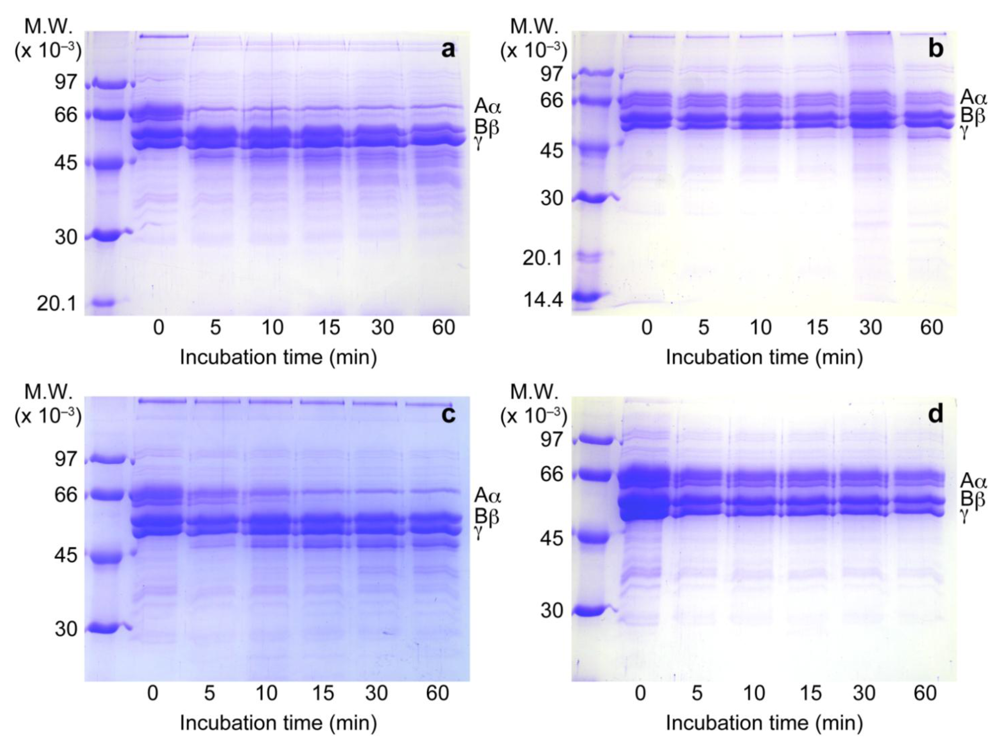
        <p>When human fibrinogen was incubated with <italic>T. flavoviridis</italic> venom, the Aα band of the fibrinogen disappeared on SDS-PAGE, whereas the Bβ chain and γ chain were essentially unaffected (<xref ref-type="fig" rid="toxins-02-02478-f002">Figure 2</xref>a). The venom with RA did not reveal any apparent degradation of human fibrinogen (<xref ref-type="fig" rid="toxins-02-02478-f002">Figure 2</xref>b). RA also inhibited Aα hydrolysis by bilitoxin-2 (<xref ref-type="fig" rid="toxins-02-02478-f002">Figure 2</xref>c and 2d).</p>
        <fig id="toxins-02-02478-f002" position="anchor">
          <label>Figure 2</label>
          <caption>
            <p>Effect of RA on human fibrinogen hydrolytic activities by <italic>T. flavoviridis</italic> venom and bilitoxin-2. 10% SDS-PAGE of time-dependent digestion of human fibrinogen by <italic>T. flavoviridis</italic> venom and bilitoxin-2 in the presence or absence of RA. (<bold>a</bold>) <italic>T. flavoviridis</italic> venom without RA; (<bold>b</bold>) <italic>T. flavoviridis</italic> venom with RA; (<bold>c</bold>) bilitoxin-2 without RA; (<bold>d</bold>) bilitoxin-2 with RA. Molecular weight makers of 97, 66, 43, 30, 20.1, and 14.4 kDa were used.</p>
          </caption>
          <graphic xmlns:xlink="http://www.w3.org/1999/xlink" xlink:href="toxins-02-02478-g002.tif"/>
        </fig>
      </sec>
      <sec>
        <title>3.3. Inhibition of Venom Cytotoxic Action on HUVEC</title>
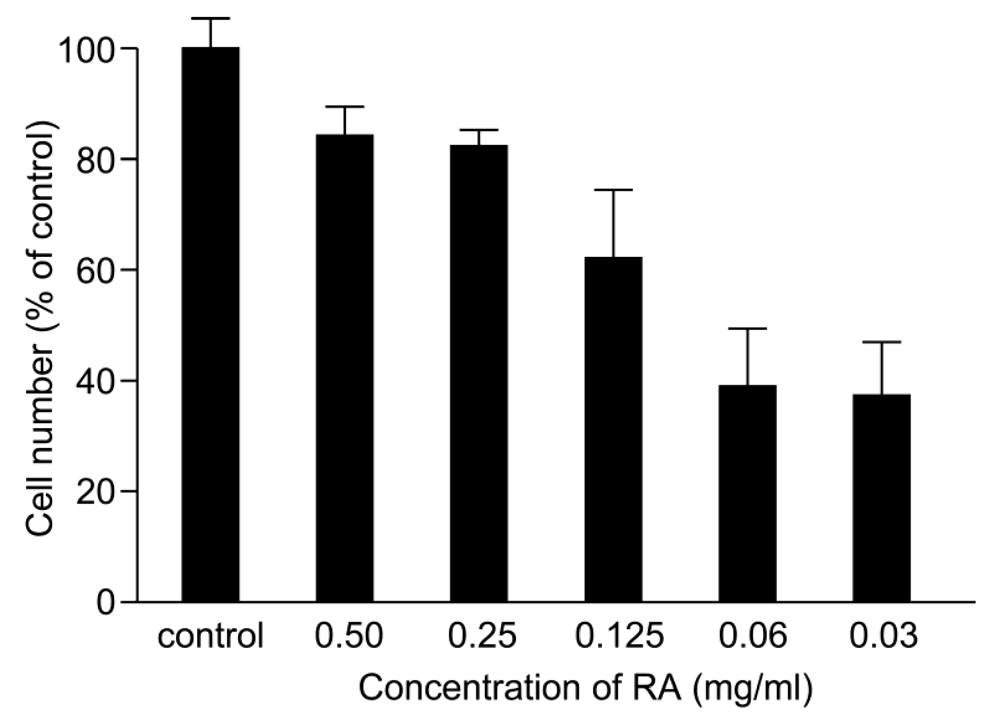
        <p>RA alone had no effect on the viability of HUVEC, but it markedly protected HUVEC from the toxic effects of <italic>T. flavoviridis</italic> venom (0.14 mg/mL) at all concentrations of RA tested (0.50, 0.25, 0.125, 0.06, and 0.03 mg/mL) (<xref ref-type="fig" rid="toxins-02-02478-f003">Figure 3</xref>). The maximum (84.2%) protective effect of RA was exhibited with RA at 0.5 mg/mL.</p>
      </sec>
      <sec>
        <title>3.4. Inhibition of Type IV Collagen Hydrolytic Activity</title>
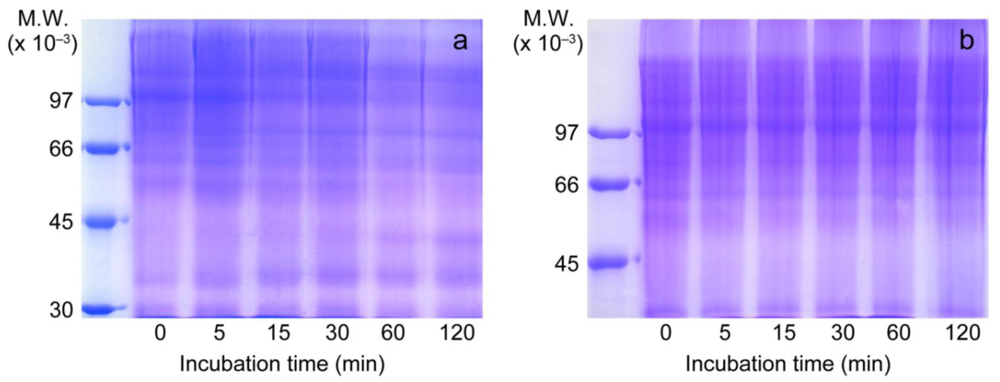
        <p>Type IV collagen was incubated with <italic>T. flavoviridis</italic> venom for different periods of time. The venom completely degraded type IV collagen (104 kDa), especially over 1 h, and degradates with smaller molecular weights (43 and 35 kDa) appeared, as shown in <xref ref-type="fig" rid="toxins-02-02478-f004">Figure 4</xref>a. In the presence of RA (0.5 mg/mL), type IV collagen was not digested by incubation with the venom (<xref ref-type="fig" rid="toxins-02-02478-f004">Figure 4</xref>b).</p>
        <fig id="toxins-02-02478-f003" position="anchor">
          <label>Figure 3</label>
          <caption>
            <p>Effects of RA against the cytotoxic actions of <italic>T. flavoviridis</italic> venom on HUVEC.</p>
          </caption>
          <graphic xmlns:xlink="http://www.w3.org/1999/xlink" xlink:href="toxins-02-02478-g003.tif"/>
        </fig>
        <fig id="toxins-02-02478-f004" position="anchor">
          <label>Figure 4</label>
          <caption>
            <p>Effect of RA on type IV collagen hydrolytic activity by <italic>T. flavoviridis</italic> venom. 7.5% SDS-PAGE of time-dependent digestion of type IV collagen by <italic>T. flavoviridis</italic> venom in the presence or absence of RA. (<bold>a</bold>) venom without RA, (<bold>b</bold>) venom with RA. Molecular weight makers of 97, 66, 43, and 30 kDa were used.</p>
          </caption>
          <graphic xmlns:xlink="http://www.w3.org/1999/xlink" xlink:href="toxins-02-02478-g004.tif"/>
        </fig>
      </sec>
      <sec>
        <title>3.5. Histological Study of T. flavoviridis Venom and the Effect of RA</title>
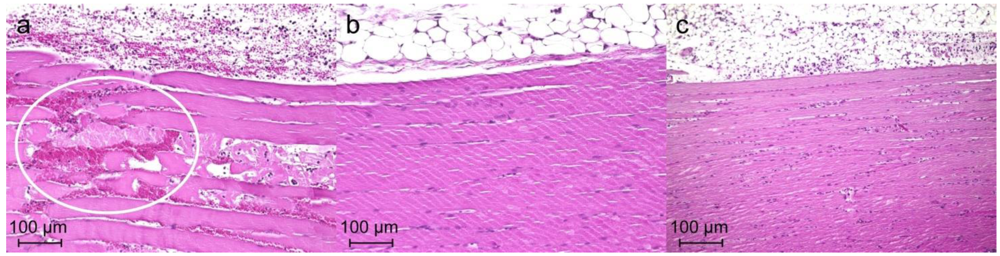
        <p>Both hemorrhage and neutrophil infiltrations were observed in a wide area (of the circle) after injection of <italic>T. flavoviridis</italic> venom (0.21 mg/mL) (<xref ref-type="fig" rid="toxins-02-02478-f005">Figure 5</xref>a). The result showed normal musculature devoid of hemorrhage and neutrophils in the muscle fibers after injection of RA (0.5 mg/mL) (<xref ref-type="fig" rid="toxins-02-02478-f005">Figure 5</xref>b). There was no hemorrhage or neutrolphil infiltration in the muscle fibers after injection of a mixture of the venom (0.41 mg/mL) and RA (0.5 mg/mL, or 0.25 mg/mL; <xref ref-type="fig" rid="toxins-02-02478-f005">Figure 5</xref>c).</p>
        <fig id="toxins-02-02478-f005" position="anchor">
          <label>Figure 5</label>
          <caption>
            <p>Histological results of thigh muscle after (<bold>a</bold>) injection of <italic>T. flavoviridis</italic> venom (0.21 mg/mL) alone (<bold>b</bold>) injection of RA (0.5 mg/mL) alone (normal muscle), (<bold>c</bold>) injection of a mixture of RA (0.25 mg/mL) and the venom (0.41 mg/mL).</p>
          </caption>
          <graphic xmlns:xlink="http://www.w3.org/1999/xlink" xlink:href="toxins-02-02478-g005.tif"/>
        </fig>
      </sec>
      <sec>
        <title>3.6. Heat Stability of RA</title>
        <p>RA, which was heated at various temperatures, was incubated with human fibrinogen and <italic>T. flavoviridis</italic> venom. RA inhibited the digestion of Aα chain of human fibrinogen after treatment at each temperature (<xref ref-type="fig" rid="toxins-02-02478-f006">Figure 6</xref>). RA (0.5 mg/mL), which was heated at 100 °C for 10 min, also showed complete inhibition against <italic>T. flavoviridis</italic> venom.</p>
        <fig id="toxins-02-02478-f006" position="anchor">
          <label>Figure 6</label>
          <caption>
            <p>Heat stability study of RA by human fibrinogen digestion by <italic>T. flavoviridis</italic> venom. RA was heated at 37 ºC, 50 ºC, or 100 ºC, then RA (0.5 mg/mL) was mixed with human fibrinogen and venom (0.21 mg/mL), and the solution was incubated at 37 °C for 10 min. Aliquots were subjected to SDS-PAGE (7.5% gel).</p>
          </caption>
          <graphic xmlns:xlink="http://www.w3.org/1999/xlink" xlink:href="toxins-02-02478-g006.tif"/>
        </fig>
      </sec>
      <sec>
        <title>3.7. Inhibition of Venom-Induced Edema</title>
        <p>The edema-forming activity was assayed using four mice. <italic>T. elegans</italic> venom induced an edema of 30% in the mouse footpad, at a dose of 12.5 µg. When <italic>T. elegans</italic> venom was preincubated with RA (0.5 mg/mL), the edema-forming was significantly reduced.</p>
      </sec>
    </sec>
    <sec sec-type="discussion">
      <title>4. Discussion</title>
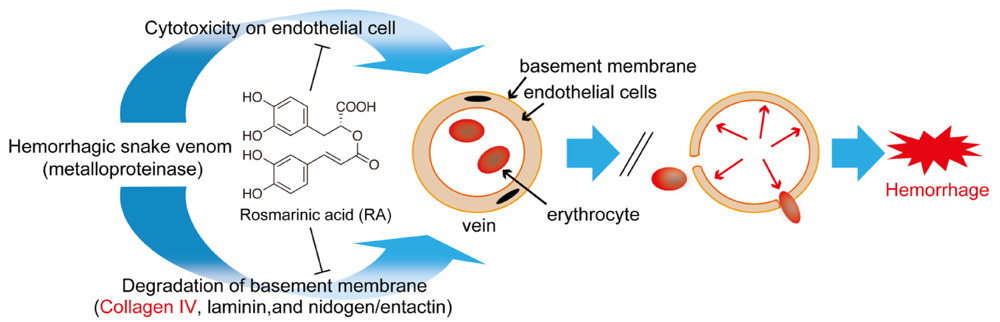
      <p>RA effectively inhibited snake venom induced hemorrhage by crude venoms of <italic>T. flavoviridis</italic>, <italic>Crotalus atrox, Gloydius blomhoffii</italic>, and <italic>B. arietans</italic> or purified toxins (HTb, bilitoxin-2, HT-1 and Ac<sub>1</sub>-proteinase) [<xref ref-type="bibr" rid="B10-toxins-02-02478">10</xref>]. As shown in <xref ref-type="fig" rid="toxins-02-02478-f007">Figure 7</xref>, envenomation by snakebites often produces persistent hemorrhage due to considerable degradation of fibrinogen and other coagulation factors, thus preventing clot formation [<xref ref-type="bibr" rid="B21-toxins-02-02478">21</xref>]. The pathogenesis of venom-induced hemorrhage involves direct damage to endothelial cells in microvessels by hemorrhagic toxins [<xref ref-type="bibr" rid="B22-toxins-02-02478">22</xref>,<xref ref-type="bibr" rid="B23-toxins-02-02478">23</xref>]. Snake venom metalloproteinases (especially snake venom metalloproteinase from <italic>T. flavoviridis</italic> venom) degrade the most important components of the basement membrane, such as laminin, type IV collagen and nidogen/entactin [<xref ref-type="bibr" rid="B24-toxins-02-02478">24</xref>,<xref ref-type="bibr" rid="B25-toxins-02-02478">25</xref>,<xref ref-type="bibr" rid="B26-toxins-02-02478">26</xref>]. In this study, an attempt was made to determine the protective effects of RA on digestion of human fibrinogen, digestion of type IV collagen and cytotoxic action on HUVEC induced by <italic>T. flavoviridis</italic> venom. The pure compound showed antifibrinogenolytic activity by inhibiting the digestion of the Aα chain of human fibrinogen. RA also effectively inhibited HUVEC against the toxic action of <italic>T. flavoviridis</italic> venom at various concentrations and digestion of type IV collagen. Moreover, the pathological study of thigh muscles showed that RA inhibited hemorrhage and neutrophil infiltrations. <italic>T. flavoviridis</italic> venom-induced lethality was significantly antagonized by RA (960 µg), whereas the venom is highly lethal to mice with 200 µg. The compound inhibited the edema‑forming effect of <italic>T. elegans</italic> venom and lethal action induced by <italic>T. flavoviridis</italic> venom. The aforementioned evidence demonstrates that RA inhibited most of the hemorrhage effects of venom (<xref ref-type="fig" rid="toxins-02-02478-f007">Figure 7</xref>). It has been reported that RA isolated from <italic>Cordia verbenacea</italic> (Boraginaceae) inhibits the edema and myotoxic activity induced by crude venom and isolated PLA<sub>2</sub>s [<xref ref-type="bibr" rid="B27-toxins-02-02478">27</xref>]. However, the mechanisms of action of PLA<sub>2</sub>s are quite different from those of metalloproteinases. This is the first report of RA that demonstrates the inhibitory mechanism for snake venom induced hemorrhage and protection from snakebite envenomation.</p>
      <fig id="toxins-02-02478-f007" position="anchor">
        <label>Figure 7</label>
        <caption>
          <p>Mechanisms of hemorrhage induction by snake venom, and points of action of RA for inhibition of hemorrhage.</p>
        </caption>
        <graphic xmlns:xlink="http://www.w3.org/1999/xlink" xlink:href="toxins-02-02478-g007.tif"/>
      </fig>
      <p>In this study, the inhibitory activities of rosmarinic acid from <italic>Argusia argentea</italic> against the action of snake venom were investigated. The plant is found on tropical shores of the Pacific and Indian oceans and the extract of the leaves are locally used as an antitoxin for snakebites and fish poisoning [<xref ref-type="bibr" rid="B28-toxins-02-02478">28</xref>,<xref ref-type="bibr" rid="B29-toxins-02-02478">29</xref>]. In the Okinawa islands, the leaves of <italic>Argusia argentea</italic> are the first medical treatment against snake venom as well as against jellyfish venom [<xref ref-type="bibr" rid="B30-toxins-02-02478">30</xref>]. Hemorrhage is a conspicuous sequela of envenomation by Viperidae. Hemorrhage from damage to the vascular endothelium of vital organs causes death [<xref ref-type="bibr" rid="B31-toxins-02-02478">31</xref>]. These observations confirmed that RA possesses potent snake venom neutralizing properties. Furthermore, the heat stability of RA would satisfy a requirement for a first-aid treatment for snakebite. Because snakebites often occur outdoors far from medical institutions, it is necessary to distribute a drug to distant locations without refrigeration, and the drug must be storable at room temperature. Further studies are needed to investigate post-administration of RA, and the effects of different methods of administration. After these issues are resolved, RA could become a potent alternative antidote compound for snake envenomation.</p>
    </sec>
  </body>
  <back>
    <ack>
      <title>Acknowledgements</title>
      <p>This work was supported by the bounty for academic research from the Research Institute of Meijo University. One of the authors (H.T.A.) is supported by the Japanese Government (MEXT) Scholarship 2007 to study in Japan.</p>
    </ack>
    <ref-list>
      <title>References</title>
      <ref id="B1-toxins-02-02478">
        <label>1.</label>
        <citation citation-type="book">
          <person-group person-group-type="author">
            <name>
              <surname>Warrell</surname>
              <given-names>D.A.</given-names>
            </name>
          </person-group>
          <article-title>The global problem of snakebite: Its prevention and treatment</article-title>
          <source>Recent Advances in Toxinology Research</source>
          <person-group person-group-type="editor">
            <name>
              <surname>Gopalakrishnakone</surname>
              <given-names>P.</given-names>
            </name>
            <name>
              <surname>Tu</surname>
              <given-names>C.K.</given-names>
            </name>
          </person-group>
          <publisher-name>National University of Singapore</publisher-name>
          <publisher-loc>Singapore</publisher-loc>
          <year>1992</year>
          <fpage>121</fpage>
          <lpage>153</lpage>
        </citation>
      </ref>
      <ref id="B2-toxins-02-02478">
        <label>2.</label>
        <citation citation-type="journal">
          <person-group person-group-type="author">
            <name>
              <surname>Chippaux</surname>
              <given-names>J.P.</given-names>
            </name>
          </person-group>
          <article-title>Snake-bites: Appraisal of the global situation</article-title>
          <source>Bull. World Health Organ.</source>
          <year>1998</year>
          <volume>76</volume>
          <fpage>515</fpage>
          <lpage>524</lpage>
        <pub-id pub-id-type="pmid">9868843</pub-id></citation>
      </ref>
      <ref id="B3-toxins-02-02478">
        <label>3.</label>
        <citation citation-type="journal">
          <person-group person-group-type="author">
            <name>
              <surname>Swaroop</surname>
              <given-names>S.</given-names>
            </name>
            <name>
              <surname>Grab</surname>
              <given-names>B.</given-names>
            </name>
          </person-group>
          <article-title>Snakebite mortality in the world</article-title>
          <source>Bull. World Health Organ.</source>
          <year>1954</year>
          <volume>10</volume>
          <fpage>35</fpage>
          <lpage>76</lpage>
        <pub-id pub-id-type="pmid">13150169</pub-id></citation>
      </ref>
      <ref id="B4-toxins-02-02478">
        <label>4.</label>
        <citation citation-type="journal">
          <person-group person-group-type="author">
            <name>
              <surname>Theakston</surname>
              <given-names>R.D.G.</given-names>
            </name>
            <name>
              <surname>Reid</surname>
              <given-names>H.A.</given-names>
            </name>
          </person-group>
          <article-title>Development of simple standard assay procedures for the characterization of snake venom</article-title>
          <source>Bull. World Health Organ.</source>
          <year>1983</year>
          <volume>61</volume>
          <fpage>949</fpage>
          <lpage>956</lpage>
        <pub-id pub-id-type="pmid">6609011</pub-id></citation>
      </ref>
      <ref id="B5-toxins-02-02478">
        <label>5.</label>
        <citation citation-type="book">
          <person-group person-group-type="author">
            <name>
              <surname>Tu</surname>
              <given-names>A.T.</given-names>
            </name>
          </person-group>
          <source>Venoms: Chemistry and Molecular Biology</source>
          <publisher-name>Wiley</publisher-name>
          <publisher-loc>New York, NY, USA</publisher-loc>
          <year>1977</year>
        </citation>
      </ref>
      <ref id="B6-toxins-02-02478">
        <label>6.</label>
        <citation citation-type="book">
          <person-group person-group-type="author">
            <name>
              <surname>Tu</surname>
              <given-names>A.T.</given-names>
            </name>
          </person-group>
          <source>Rattlesnake Venoms: Their actions and Treatment</source>
          <publisher-name>Dekker</publisher-name>
          <publisher-loc>New York, NY, USA</publisher-loc>
          <year>1982</year>
        </citation>
      </ref>
      <ref id="B7-toxins-02-02478">
        <label>7.</label>
        <citation citation-type="journal">
          <person-group person-group-type="author">
            <name>
              <surname>Martz</surname>
              <given-names>W.</given-names>
            </name>
          </person-group>
          <article-title>Plants with a reputation against snakebite</article-title>
          <source>Toxicon</source>
          <year>1992</year>
          <volume>30</volume>
          <fpage>1131</fpage>
          <lpage>1142</lpage>
        <pub-id pub-id-type="doi">10.1016/0041-0101(92)90429-9</pub-id><pub-id pub-id-type="pmid">1440620</pub-id></citation>
      </ref>
      <ref id="B8-toxins-02-02478">
        <label>8.</label>
        <citation citation-type="journal">
          <person-group person-group-type="author">
            <name>
              <surname>Mors</surname>
              <given-names>W.B.</given-names>
            </name>
            <name>
              <surname>Nascimento</surname>
              <given-names>M.C.</given-names>
            </name>
            <name>
              <surname>Pereira</surname>
              <given-names>B.M.</given-names>
            </name>
            <name>
              <surname>Pereira</surname>
              <given-names>N.A.</given-names>
            </name>
          </person-group>
          <article-title>Plant natural products active against snake-bite —the molecular approach</article-title>
          <source>Phytochemistry</source>
          <year>2000</year>
          <volume>55</volume>
          <fpage>627</fpage>
          <lpage>642</lpage>
        <pub-id pub-id-type="doi">10.1016/S0031-9422(00)00229-6</pub-id><pub-id pub-id-type="pmid">11130675</pub-id></citation>
      </ref>
      <ref id="B9-toxins-02-02478">
        <label>9.</label>
        <citation citation-type="journal">
          <person-group person-group-type="author">
            <name>
              <surname>Soares</surname>
              <given-names>A.M.</given-names>
            </name>
            <name>
              <surname>Januario</surname>
              <given-names>A.H.</given-names>
            </name>
            <name>
              <surname>Lourenco</surname>
              <given-names>M.V.</given-names>
            </name>
            <name>
              <surname>Pereira</surname>
              <given-names>A.M.</given-names>
            </name>
            <name>
              <surname>Pereira</surname>
              <given-names>P.S.</given-names>
            </name>
          </person-group>
          <article-title>Neutralizing effects of Brazilian plants against snake venoms</article-title>
          <source>Drugs Future</source>
          <year>2004</year>
          <volume>29</volume>
          <fpage>1105</fpage>
          <lpage>1117</lpage>
        <pub-id pub-id-type="doi">10.1358/dof.2004.029.11.851973</pub-id></citation>
      </ref>
      <ref id="B10-toxins-02-02478">
        <label>10.</label>
        <citation citation-type="journal">
          <person-group person-group-type="author">
            <name>
              <surname>Aung</surname>
              <given-names>H.T.</given-names>
            </name>
            <name>
              <surname>Nikai</surname>
              <given-names>T.</given-names>
            </name>
            <name>
              <surname>Niwa</surname>
              <given-names>M.</given-names>
            </name>
            <name>
              <surname>Takaya</surname>
              <given-names>Y.</given-names>
            </name>
          </person-group>
          <article-title>Rosmarinic acid in <italic>Argusia argentea</italic> inhibits snake venom-induced hemorrhage</article-title>
          <source>J. Nat. Med.</source>
          <year>2010</year>
          <volume>64</volume>
          <fpage>482</fpage>
          <lpage>486</lpage>
        <pub-id pub-id-type="doi">10.1007/s11418-010-0428-3</pub-id><pub-id pub-id-type="pmid">20512530</pub-id></citation>
      </ref>
      <ref id="B11-toxins-02-02478">
        <label>11.</label>
        <citation citation-type="journal">
          <person-group person-group-type="author">
            <name>
              <surname>Komori</surname>
              <given-names>Y.</given-names>
            </name>
            <name>
              <surname>Hagihara</surname>
              <given-names>S.</given-names>
            </name>
            <name>
              <surname>Tu</surname>
              <given-names>A.T.</given-names>
            </name>
          </person-group>
          <article-title>Specificity of hemorrhagic proteinase from <italic>Crotalus atrox</italic> (western diamondback rattlesnake) venom</article-title>
          <source>Biochim. Biophys. Acta</source>
          <year>1985</year>
          <volume>829</volume>
          <fpage>127</fpage>
          <lpage>130</lpage>
        <pub-id pub-id-type="doi">10.1016/0167-4838(85)90076-7</pub-id><pub-id pub-id-type="pmid">3888273</pub-id></citation>
      </ref>
      <ref id="B12-toxins-02-02478">
        <label>12.</label>
        <citation citation-type="journal">
          <person-group person-group-type="author">
            <name>
              <surname>Nikai</surname>
              <given-names>T.</given-names>
            </name>
            <name>
              <surname>Taniguchi</surname>
              <given-names>K.</given-names>
            </name>
            <name>
              <surname>Komori</surname>
              <given-names>Y.</given-names>
            </name>
            <name>
              <surname>Sugihara</surname>
              <given-names>H.</given-names>
            </name>
          </person-group>
          <article-title>Hemorrhagic toxin, bilitoxin-2, from <italic>Agkistrodon bilineatus</italic> venom</article-title>
          <source>J. Nat. Toxins</source>
          <year>1996</year>
          <volume>5</volume>
          <fpage>95</fpage>
          <lpage>106</lpage>
        </citation>
      </ref>
      <ref id="B13-toxins-02-02478">
        <label>13.</label>
        <citation citation-type="journal">
          <person-group person-group-type="author">
            <name>
              <surname>Nikai</surname>
              <given-names>T.</given-names>
            </name>
            <name>
              <surname>Sugihara</surname>
              <given-names>H.</given-names>
            </name>
            <name>
              <surname>Tanaka</surname>
              <given-names>T.</given-names>
            </name>
          </person-group>
          <article-title>Enzymochemical studies on snake venoms II. Purification of lethal protein Ac1-proteinase in the venom of <italic>Agkistrodon acutus</italic></article-title>
          <source>Yakugaku Zasshi</source>
          <year>1977</year>
          <volume>97</volume>
          <fpage>507</fpage>
          <lpage>514</lpage>
          <pub-id pub-id-type="pmid">560456</pub-id>
        </citation>
      </ref>
      <ref id="B14-toxins-02-02478">
        <label>14.</label>
        <citation citation-type="journal">
          <person-group person-group-type="author">
            <name>
              <surname>Nikai</surname>
              <given-names>T.</given-names>
            </name>
            <name>
              <surname>Suzuki</surname>
              <given-names>J.</given-names>
            </name>
            <name>
              <surname>Komori</surname>
              <given-names>Y.</given-names>
            </name>
            <name>
              <surname>Sugihara</surname>
              <given-names>H.</given-names>
            </name>
          </person-group>
          <article-title>Biochemical and pathological studies on hemorrhagic toxin</article-title>
          <source>J. Nat. Toxins</source>
          <year>1995</year>
          <volume>4</volume>
          <fpage>83</fpage>
          <lpage>96</lpage>
        </citation>
      </ref>
      <ref id="B15-toxins-02-02478">
        <label>15.</label>
        <citation citation-type="journal">
          <person-group person-group-type="author">
            <name>
              <surname>Bjarnason</surname>
              <given-names>J.B.</given-names>
            </name>
            <name>
              <surname>Tu</surname>
              <given-names>A.T.</given-names>
            </name>
          </person-group>
          <article-title>Hemorrhagic toxins from western diamondback rattlesnake (<italic>Crotalus atrox</italic>) venom: Isolation and characterization of five toxins and the role of zinc in hemorrhagic toxin e</article-title>
          <source>Biochemistry</source>
          <year>1978</year>
          <volume>17</volume>
          <fpage>3395</fpage>
          <lpage>3404</lpage>
        <pub-id pub-id-type="doi">10.1021/bi00609a033</pub-id><pub-id pub-id-type="pmid">210790</pub-id></citation>
      </ref>
      <ref id="B16-toxins-02-02478">
        <label>16.</label>
        <citation citation-type="journal">
          <person-group person-group-type="author">
            <name>
              <surname>Ouyang</surname>
              <given-names>C.</given-names>
            </name>
            <name>
              <surname>Teng</surname>
              <given-names>C.M.</given-names>
            </name>
          </person-group>
          <article-title>Fibrinogenolytic enzymes of <italic>Trimeresurus mucrosquamatus</italic> venom</article-title>
          <source>Biochim. Biophys. Acta</source>
          <year>1976</year>
          <volume>420</volume>
          <fpage>298</fpage>
          <lpage>308</lpage>
        <pub-id pub-id-type="doi">10.1016/0005-2795(76)90321-4</pub-id><pub-id pub-id-type="pmid">1252459</pub-id></citation>
      </ref>
      <ref id="B17-toxins-02-02478">
        <label>17.</label>
        <citation citation-type="journal">
          <person-group person-group-type="author">
            <name>
              <surname>Ishiyama</surname>
              <given-names>M.</given-names>
            </name>
            <name>
              <surname>Miyazono</surname>
              <given-names>Y.</given-names>
            </name>
            <name>
              <surname>Sasamoto</surname>
              <given-names>K.</given-names>
            </name>
            <name>
              <surname>Ohkura</surname>
              <given-names>Y.</given-names>
            </name>
            <name>
              <surname>Ueno</surname>
              <given-names>K.</given-names>
            </name>
          </person-group>
          <article-title>A highly water-soluble disulfonated tetrazolium salt as a chromogenic indicator for NADH as well as cell viability</article-title>
          <source>Talanta</source>
          <year>1997</year>
          <volume>44</volume>
          <fpage>1299</fpage>
          <lpage>1305</lpage>
        <pub-id pub-id-type="doi">10.1016/S0039-9140(97)00017-9</pub-id><pub-id pub-id-type="pmid">18966866</pub-id></citation>
      </ref>
      <ref id="B18-toxins-02-02478">
        <label>18.</label>
        <citation citation-type="journal">
          <person-group person-group-type="author">
            <name>
              <surname>Tominaga</surname>
              <given-names>H.</given-names>
            </name>
            <name>
              <surname>Ishiyama</surname>
              <given-names>M.</given-names>
            </name>
            <name>
              <surname>Ohseto</surname>
              <given-names>F.</given-names>
            </name>
            <name>
              <surname>Sasamoto</surname>
              <given-names>K.</given-names>
            </name>
            <name>
              <surname>Hamamoto</surname>
              <given-names>T.</given-names>
            </name>
            <name>
              <surname>Suzuki</surname>
              <given-names>K.</given-names>
            </name>
            <name>
              <surname>Watanabe</surname>
              <given-names>M.</given-names>
            </name>
          </person-group>
          <article-title>A water-soluble tetrazolium salt useful for colorimetric cell viability assay</article-title>
          <source>Anal. Commun.</source>
          <year>1999</year>
          <volume>36</volume>
          <fpage>47</fpage>
          <lpage>50</lpage>
        <pub-id pub-id-type="doi">10.1039/a809656b</pub-id></citation>
      </ref>
      <ref id="B19-toxins-02-02478">
        <label>19.</label>
        <citation citation-type="journal">
          <person-group person-group-type="author">
            <name>
              <surname>Komori</surname>
              <given-names>Y.</given-names>
            </name>
            <name>
              <surname>Nikai</surname>
              <given-names>T.</given-names>
            </name>
            <name>
              <surname>Taniguchi</surname>
              <given-names>K.</given-names>
            </name>
            <name>
              <surname>Masuda</surname>
              <given-names>K.</given-names>
            </name>
            <name>
              <surname>Sugihara</surname>
              <given-names>H.</given-names>
            </name>
          </person-group>
          <article-title>Vascular endothelial growth factor VEGF-like heparin-binding protein from the venom of <italic>Vipera aspis aspis</italic> (Aspic Viper)</article-title>
          <source>Int. J. Biochem.</source>
          <year>1999</year>
          <volume>38</volume>
          <fpage>11796</fpage>
          <lpage>11803</lpage>
        </citation>
      </ref>
      <ref id="B20-toxins-02-02478">
        <label>20.</label>
        <citation citation-type="journal">
          <person-group person-group-type="author">
            <name>
              <surname>Ho</surname>
              <given-names>C.L.</given-names>
            </name>
            <name>
              <surname>Hwang</surname>
              <given-names>L.L.</given-names>
            </name>
            <name>
              <surname>Chen</surname>
              <given-names>C.T.</given-names>
            </name>
          </person-group>
          <article-title>Edema-inducing activity of a lethal protein with phospholipase A<sub>1</sub> activity isolated from the black-bellied hornet (<italic>Vespa basalis</italic>) venom</article-title>
          <source>Toxicon</source>
          <year>1993</year>
          <volume>31</volume>
          <fpage>605</fpage>
          <lpage>613</lpage>
        <pub-id pub-id-type="doi">10.1016/0041-0101(93)90115-Y</pub-id><pub-id pub-id-type="pmid">7687388</pub-id></citation>
      </ref>
      <ref id="B21-toxins-02-02478">
        <label>21.</label>
        <citation citation-type="journal">
          <person-group person-group-type="author">
            <name>
              <surname>Laing</surname>
              <given-names>G.D.</given-names>
            </name>
            <name>
              <surname>Moura-da-Silva</surname>
              <given-names>A.M.</given-names>
            </name>
          </person-group>
          <article-title>Jararhagin and its multiple effects on hemostasis</article-title>
          <source>Toxicon</source>
          <year>2005</year>
          <volume>45</volume>
          <fpage>987</fpage>
          <lpage>996</lpage>
        <pub-id pub-id-type="doi">10.1016/j.toxicon.2005.02.013</pub-id><pub-id pub-id-type="pmid">15922770</pub-id></citation>
      </ref>
      <ref id="B22-toxins-02-02478">
        <label>22.</label>
        <citation citation-type="journal">
          <person-group person-group-type="author">
            <name>
              <surname>Bjarnason</surname>
              <given-names>J.B.</given-names>
            </name>
            <name>
              <surname>Fox</surname>
              <given-names>J.W.</given-names>
            </name>
          </person-group>
          <article-title>Hemorrhagic metalloproteinases from snake venoms</article-title>
          <source>Pharmacol. Ther.</source>
          <year>1994</year>
          <volume>62</volume>
          <fpage>325</fpage>
          <lpage>372</lpage>
        <pub-id pub-id-type="doi">10.1016/0163-7258(94)90049-3</pub-id><pub-id pub-id-type="pmid">7972338</pub-id></citation>
      </ref>
      <ref id="B23-toxins-02-02478">
        <label>23.</label>
        <citation citation-type="journal">
          <person-group person-group-type="author">
            <name>
              <surname>Markland</surname>
              <given-names>F.S.</given-names>
            </name>
          </person-group>
          <article-title>Snake venoms and the hemostatic system</article-title>
          <source>Toxicon</source>
          <year>1998</year>
          <volume>36</volume>
          <fpage>1749</fpage>
          <lpage>1800</lpage>
        <pub-id pub-id-type="doi">10.1016/S0041-0101(98)00126-3</pub-id><pub-id pub-id-type="pmid">9839663</pub-id></citation>
      </ref>
      <ref id="B24-toxins-02-02478">
        <label>24.</label>
        <citation citation-type="journal">
          <person-group person-group-type="author">
            <name>
              <surname>Baramova</surname>
              <given-names>E.N.</given-names>
            </name>
            <name>
              <surname>Shannon</surname>
              <given-names>J.D.</given-names>
            </name>
            <name>
              <surname>Bjarnason</surname>
              <given-names>J.B.</given-names>
            </name>
            <name>
              <surname>Fox</surname>
              <given-names>J.W.</given-names>
            </name>
          </person-group>
          <article-title>Degradation of extracellular matrix proteins by hemorrhagic metalloproteinases</article-title>
          <source>Arch. Biochem. Biophys.</source>
          <year>1989</year>
          <volume>275</volume>
          <fpage>63</fpage>
          <lpage>71</lpage>
        <pub-id pub-id-type="doi">10.1016/0003-9861(89)90350-0</pub-id><pub-id pub-id-type="pmid">2817904</pub-id></citation>
      </ref>
      <ref id="B25-toxins-02-02478">
        <label>25.</label>
        <citation citation-type="journal">
          <person-group person-group-type="author">
            <name>
              <surname>Baramova</surname>
              <given-names>E.N.</given-names>
            </name>
            <name>
              <surname>Shannon</surname>
              <given-names>J.D.</given-names>
            </name>
            <name>
              <surname>Bjarnason</surname>
              <given-names>J.B.</given-names>
            </name>
            <name>
              <surname>Fox</surname>
              <given-names>J.W.</given-names>
            </name>
          </person-group>
          <article-title>Identification of the cleavage sites by a hemorrhagic metalloproteinase in type IV collagen</article-title>
          <source>Matrix</source>
          <year>1990</year>
          <volume>10</volume>
          <fpage>91</fpage>
          <lpage>97</lpage>
        <pub-id pub-id-type="pmid">2374521</pub-id></citation>
      </ref>
      <ref id="B26-toxins-02-02478">
        <label>26.</label>
        <citation citation-type="journal">
          <person-group person-group-type="author">
            <name>
              <surname>Mashiko</surname>
              <given-names>H.</given-names>
            </name>
            <name>
              <surname>Takahashi</surname>
              <given-names>H.</given-names>
            </name>
          </person-group>
          <article-title>Haemorrhagic factors from snake venoms. II. Structures of haemorrhagic factors and types and mechanisms of haemorrhage</article-title>
          <source>J. Toxicol. Toxin Rev.</source>
          <year>1998</year>
          <volume>17</volume>
          <fpage>493</fpage>
          <lpage>512</lpage>
        <pub-id pub-id-type="doi">10.3109/15569549809040406</pub-id></citation>
      </ref>
      <ref id="B27-toxins-02-02478">
        <label>27.</label>
        <citation citation-type="journal">
          <person-group person-group-type="author">
            <name>
              <surname>Ticli</surname>
              <given-names>F.K.</given-names>
            </name>
            <name>
              <surname>Hage</surname>
              <given-names>L.I.S.</given-names>
            </name>
            <name>
              <surname>Cambraia</surname>
              <given-names>R.S.</given-names>
            </name>
            <name>
              <surname>Pereira</surname>
              <given-names>P.S.</given-names>
            </name>
            <name>
              <surname>Magro</surname>
              <given-names>A.J.</given-names>
            </name>
            <name>
              <surname>Fontes</surname>
              <given-names>M.R.M.</given-names>
            </name>
            <name>
              <surname>Stábeli</surname>
              <given-names>R.G.</given-names>
            </name>
            <name>
              <surname>Giglio</surname>
              <given-names>J.R.</given-names>
            </name>
            <name>
              <surname>França</surname>
              <given-names>S.C.</given-names>
            </name>
            <name>
              <surname>Soares</surname>
              <given-names>A.M.</given-names>
            </name>
            <name>
              <surname>Sampaio</surname>
              <given-names>S.V.</given-names>
            </name>
          </person-group>
          <article-title>Rosmarinic acid, a new snake venom phospholipase A<sub>2</sub> inhibitor from <italic>Cordia verbenacea</italic> (Boraginaceae): Antiserum action potentiation and molecular interaction</article-title>
          <source>Toxicon</source>
          <year>2005</year>
          <volume>46</volume>
          <fpage>318</fpage>
          <lpage>327</lpage>
        <pub-id pub-id-type="doi">10.1016/j.toxicon.2005.04.023</pub-id><pub-id pub-id-type="pmid">15992846</pub-id></citation>
      </ref>
      <ref id="B28-toxins-02-02478">
        <label>28.</label>
        <citation citation-type="journal">
          <person-group person-group-type="author">
            <name>
              <surname>Ogihara</surname>
              <given-names>K.</given-names>
            </name>
            <name>
              <surname>Miyagi</surname>
              <given-names>Y.</given-names>
            </name>
            <name>
              <surname>Higa</surname>
              <given-names>M.</given-names>
            </name>
            <name>
              <surname>Yogi</surname>
              <given-names>S.</given-names>
            </name>
          </person-group>
          <article-title>Pyrrolizidine alkaloids from <italic>Messerschmidia argentea</italic></article-title>
          <source>Phytochemistry</source>
          <year>1997</year>
          <volume>44</volume>
          <fpage>545</fpage>
          <lpage>547</lpage>
        <pub-id pub-id-type="doi">10.1016/S0031-9422(96)00493-1</pub-id></citation>
      </ref>
      <ref id="B29-toxins-02-02478">
        <label>29.</label>
        <citation citation-type="journal">
          <person-group person-group-type="author">
            <name>
              <surname>Noro</surname>
              <given-names>T.</given-names>
            </name>
            <name>
              <surname>Nishihara</surname>
              <given-names>G.N.</given-names>
            </name>
            <name>
              <surname>Terada</surname>
              <given-names>R.</given-names>
            </name>
            <name>
              <surname>Yoropiy</surname>
              <given-names>A.</given-names>
            </name>
          </person-group>
          <article-title>Ciguatera Fish Poisoning in Ulithi Atoll, Yap State, Micronesia</article-title>
          <source>Kagoshima Univ. Res. Ctr. Pac. Isl. Occas. Pap.</source>
          <year>2003</year>
          <volume>39</volume>
          <fpage>83</fpage>
          <lpage>86</lpage>
        </citation>
      </ref>
      <ref id="B30-toxins-02-02478">
        <label>30.</label>
        <citation citation-type="journal">
          <person-group person-group-type="author">
            <name>
              <surname>Ogihara</surname>
              <given-names>K.</given-names>
            </name>
            <name>
              <surname>Nakazato</surname>
              <given-names>R.</given-names>
            </name>
            <name>
              <surname>Nishi</surname>
              <given-names>Y.</given-names>
            </name>
            <name>
              <surname>Higa</surname>
              <given-names>M.</given-names>
            </name>
            <name>
              <surname>Yogi</surname>
              <given-names>S.</given-names>
            </name>
          </person-group>
          <article-title>DPPH-radical scavenging constituents from the twigs of <italic>Messerschmidia argentea</italic></article-title>
          <source>Bull. Fac. Sci. Univ. Ryukyus</source>
          <year>2002</year>
          <volume>74</volume>
          <fpage>73</fpage>
          <lpage>80</lpage>
        </citation>
      </ref>
      <ref id="B31-toxins-02-02478">
        <label>31.</label>
        <citation citation-type="journal">
          <person-group person-group-type="author">
            <name>
              <surname>Warrell</surname>
              <given-names>D.A.</given-names>
            </name>
          </person-group>
          <article-title>Russell’s viper: biology, venom and treatment of bites</article-title>
          <source>Trans. R. Soc. Trop. Med. Hyg.</source>
          <year>1989</year>
          <volume>83</volume>
          <fpage>732</fpage>
          <lpage>740</lpage>
        <pub-id pub-id-type="doi">10.1016/0035-9203(89)90311-8</pub-id><pub-id pub-id-type="pmid">2533418</pub-id></citation>
      </ref>
    </ref-list>
  </back>
</article>