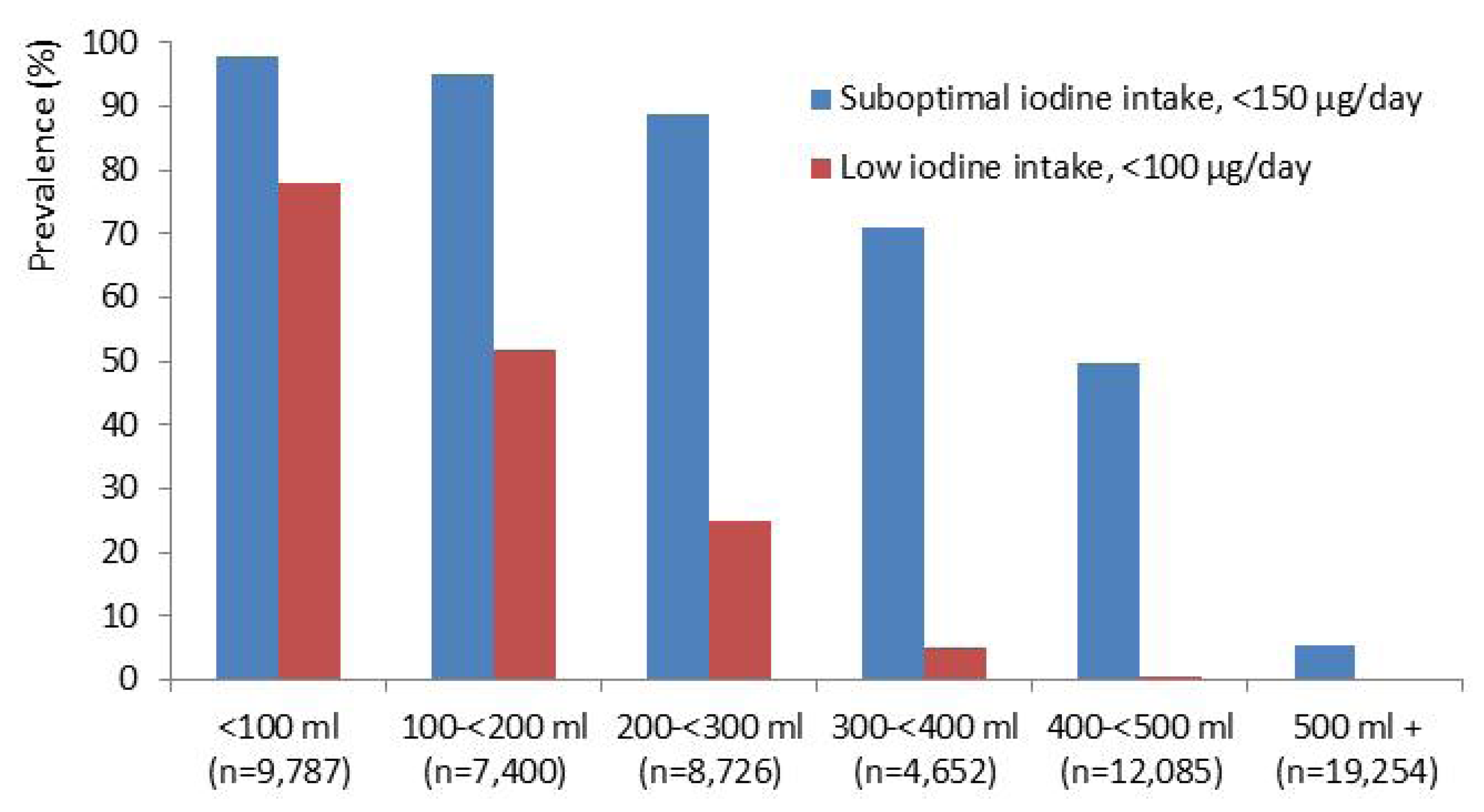
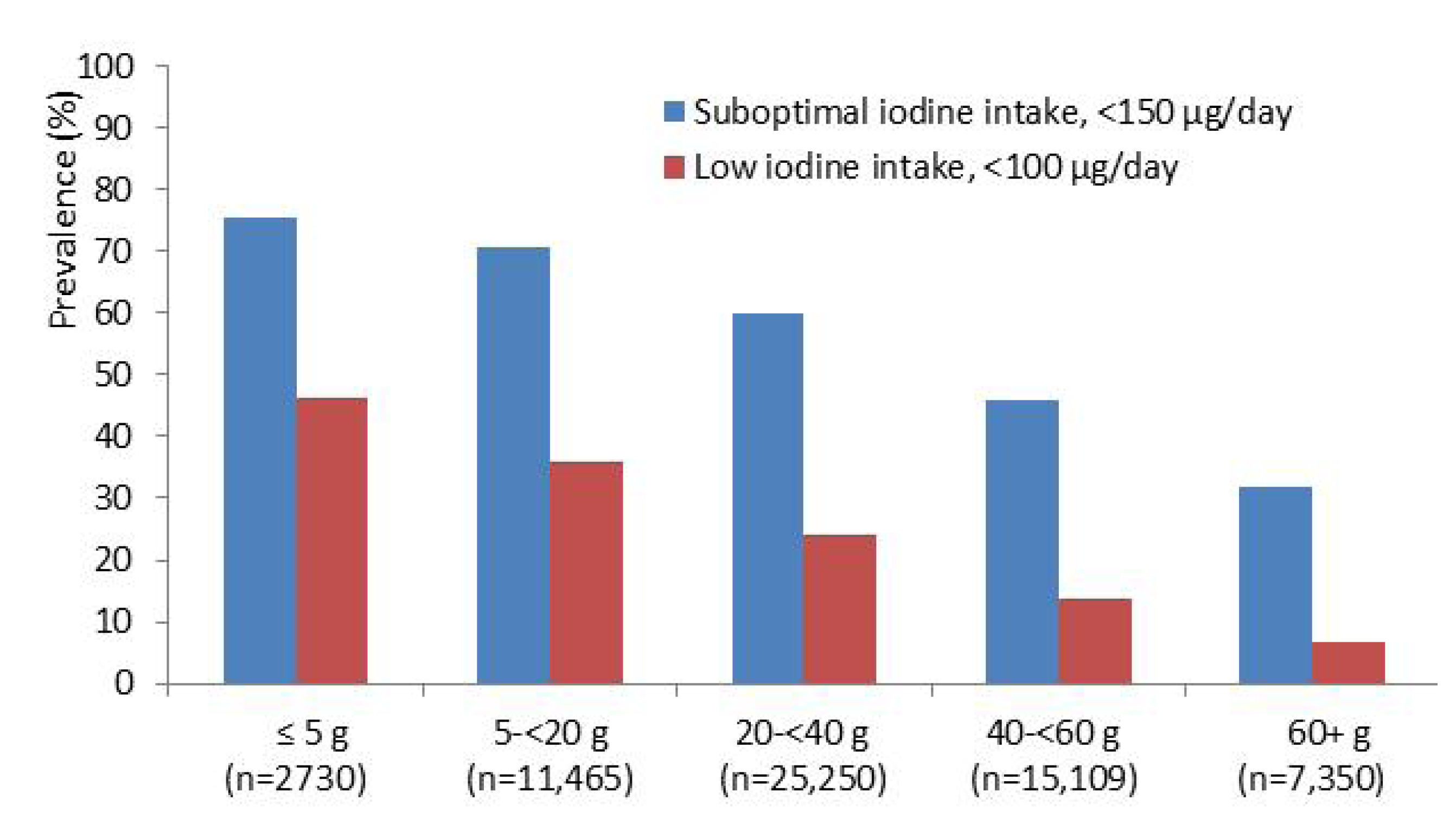
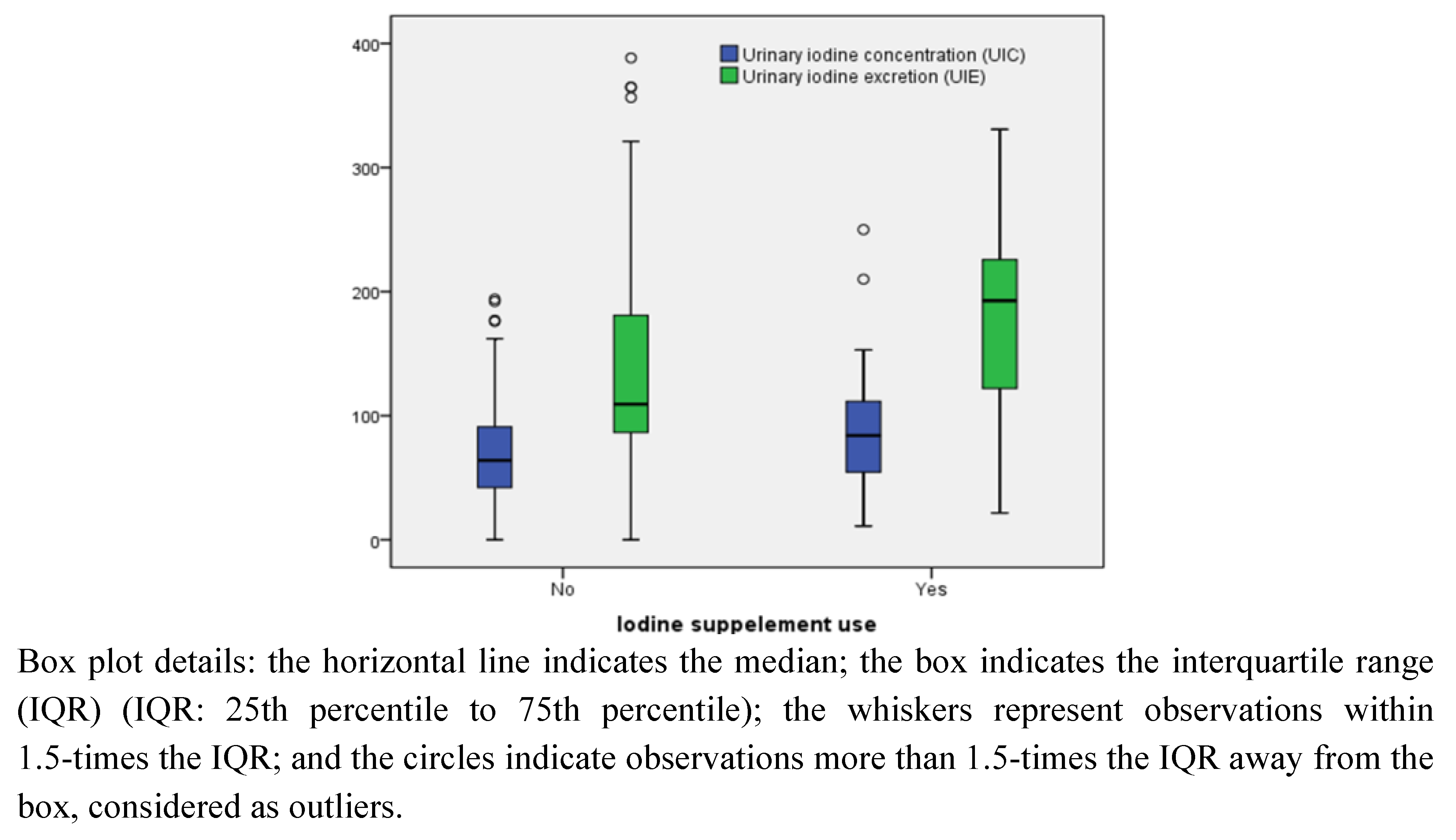
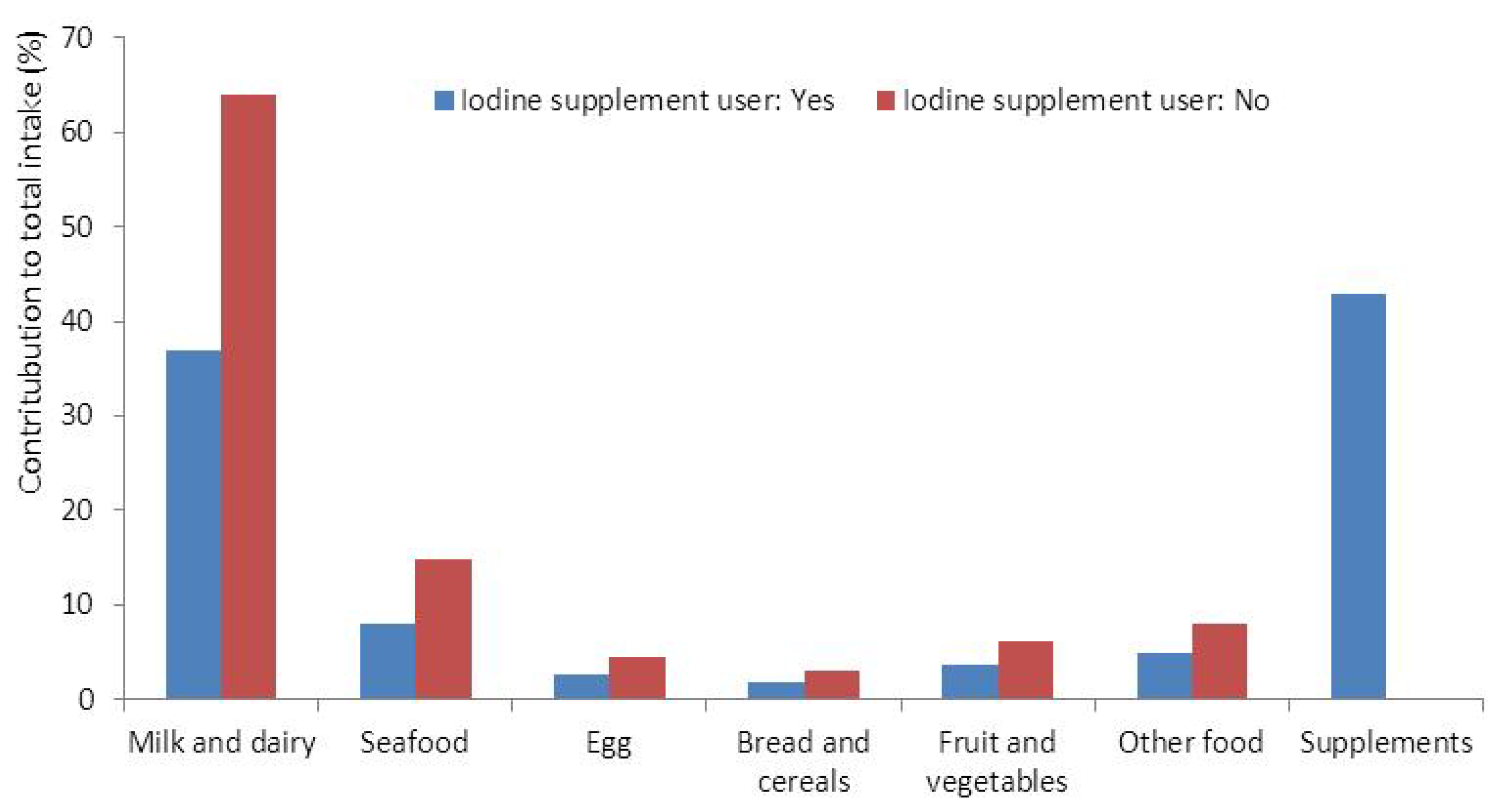
Risk of Suboptimal Iodine Intake in Pregnant Norwegian Women



Abstract
1. Introduction
2. Materials and Methods
2.1. Population and Study Sample
2.2. Dietary Information
2.3. Other Variables
2.4. Statistical Methods
3. Results

| All | Iodine containing supplement user | ||||||
|---|---|---|---|---|---|---|---|
| No | Yes | ||||||
| n (%) | 61,904 | 42,329 (68.4) | 19,575 (31.6) | ||||
| Iodine intake, μg/day | n | % | Cum% | n | Cum% | n | Cum% |
| <50 | 674 | 1.1 | 1.1 | 667 | 1.6 | 7 | 0.0 |
| 50–70 | 2272 | 3.7 | 4.8 | 2208 | 6.8 | 64 | 0.4 |
| 70–100 | 7006 | 11.3 | 16.1 | 6658 | 22.5 | 348 | 2.1 |
| 100–150 | 16,061 | 25.9 | 42.0 | 14,267 | 56.2 | 1794 | 11.3 |
| 150–175 | 7572 | 12.2 | 54.3 | 6044 | 70.5 | 1528 | 19.1 |
| 175–250 | 14,886 | 24.0 | 78.3 | 8970 | 91.7 | 5916 | 49.3 |
| 250–500 | 12,663 | 20.5 | 98.8 | 3463 | 99.9 | 9200 | 96.3 |
| ≥500 | 770 | 1.2 | 100 | 52 | 100 | 718 | 100 |
| Iodine from food | Total iodine | |||||
|---|---|---|---|---|---|---|
| n (%) | Median (P5, P95) | p-Value * | Median (P5, P95) | p-Value * | ||
| μg/day | μg/day | |||||
| All | 61,904 | 141 (65, 280) | 166 (71, 369) | |||
| Maternal age | ||||||
| <25 years | 6880 (11.1) | 141 (61, 305) | 0.406 | 164 (65, 389) | 0.207 | |
| 25–29 years | 20,926 (38.3) | 141 (64, 282) | 167 (70, 373) | |||
| 30–34 years | 23,554 (38.0) | 141 (66, 274) | 165 (73, 362) | |||
| ≥35 years | 10,544 (17.0) | 141 (67, 275) | 166 (74, 367) | |||
| Parity | ||||||
| Nulliparous | 32,053 (51.8) | 139 (64, 280) | <0.001 | 169 (71, 381) | ||
| Primiparous | 19,262 (31.1) | 141 (65, 279) | 162 (70, 357) | <0.001 | ||
| Multiparous | 10,589 (17.1) | 147 (67, 284) | 164 (72, 356) | |||
| Maternal education | ||||||
| ≤12 years | 19,809 (32.0) | 140 (60, 295) | 0.607 | 163 (65, 372) | <0.001 | |
| 13–16 years | 26,612 (43.0) | 141 (66, 276) | 167 (73, 369) | |||
| ≥17 years | 15,484 (25.0) | 141 (70, 267) | 167 (76, 366) | |||
| Marital status | ||||||
| Married/cohabiting | 59,726 (96.5) | 141 (65, 279) | 0.083 | 166 (71, 368) | 0.246 | |
| Not married/cohabiting | 2178 (3.5) | 143 (61, 302) | 168 (67, 388) | |||
| Smoking prior to pregnancy | ||||||
| Non smoker | 44,005 (71.1) | 142 (66, 277) | 0.026 | 166 (72, 367) | 0.015 | |
| Occasional smoker | 6376 (10.3) | 140 (66, 276) | 165 (72, 368) | |||
| Daily smoker | 11,523 (18.6) | 139 (61, 294) | 164 (66, 377) | |||
| Pre-pregnancy BMI | ||||||
| <18.5 kg/m2 | 1809 (2.9) | 140 (62, 271) | <0.001 | 168 (71, 376) | <0.001 | |
| 18.5–24.9 kg/m2 | 40,457 (65.4) | 142 (67, 278) | 167 (74, 368) | |||
| 25–29.9 kg/m2 | 13,604 (22.0) | 140 (62, 285) | 163 (67, 372) | |||
| ≥30 kg/m2 | 6034 (9.7) | 137 (58, 288) | 160 (63, 372) | |||
| Income | ||||||
| Both <300,000 NOK | 18,929 (30.6) | 143 (63, 291) | <0.001 | 167 (69, 371) | 0.073 | |
| One ≥300,000 NOK | 26,419 (42.7) | 142 (65, 283) | 166 (71, 371) | |||
| Both ≥300,000 NOK | 16,556 (26.7) | 138 (67, 260) | 164 (74, 363) | |||
| Milk and yogurt intake | ||||||
| <200 mL/day | 17,187 (27,8) | 88 (49, 141) | <0.001 | 102 (53, 262) | <0.001 | |
| 200–399 mL/day | 13,378 (21.6) | 122 (84, 175) | 137 (88, 296) | |||
| ≥400 mL/day | 31,339 (50.6) | 183 (123, 320) | 209 (129, 410) | |||
| Fish and seafood intake | ||||||
| <20 g/day | 14,195 (22.9) | 117 (49, 252) | <0.001 | 141 (54, 346) | <0.001 | |
| ≥20 g/day | 47,709 (77.1) | 148 (74, 286) | 172 (79, 376) | |||
| Egg intake | ||||||
| <8 g/day | 19,921 (32.2) | 129 (56, 269) | <0.001 | 153 (61, 357) | <0.001 | |
| ≥8 g/day | 41,983 (67.8) | 146 (71, 283) | 171 (77, 375 ) | |||
| Iodine from supplements | ||||||
| No | 42,329 (68.4) | 141 (65, 279) | <0.001 | 141 (65, 279) | <0.001 | |
| Yes | 19,575 (31.6) | 141 (65, 282) | 252 (122, 466) | |||


| Iodine < 100 μg/day | Unadjusted model | Adjusted model 1 | ||
|---|---|---|---|---|
| n (%) | OR (95% CI) | OR (95% CI) | ||
| Iodine from supplements | ||||
| Yes | 419 (2.1) | 1 | 1 | |
| No | 9533 (22.5) | 13.3 (12.0, 14.7) | 58.6 (52.0, 66.2) | |
| Low milk/yoghurt intake | ||||
| No: ≥200 mL/day | 1723 (3.9) | 1 | 1 | |
| Yes: <200 mL/day | 8229 (47.9) | 22.9 (21.7, 24.3) | 42.2 (39.4, 45.7) | |
| Low fish and seafood intake | ||||
| No: ≥20 g/day | 6093 (12.8) | 1 | 1 | |
| Yes: <20 g/day | 3859 (27.2) | 2.6 (2.4, 2.7) | 3.8 (3.5, 4.1) | |
| Low egg intake | ||||
| No: ≥8 g/day | 5584 (13.3) | 1 | 1 | |
| Yes: <8 g/day | 4368 (21.9) | 1.8 (1.7, 1.9) | 1.5 (1.4, 1.6) | |
| Year | 2002 | 2003 | 2004 | 2005 | 2006 | 2007 | 2008 |
|---|---|---|---|---|---|---|---|
| Number of women | 3997 | 10,552 | 11,020 | 11,286 | 11,921 | 10,246 | 2882 |
| Iodine <100 μg/day (%) | 14.8 | 15.6 | 16.2 | 15.9 | 15.7 | 16.3 | 17.1 |
| Iodine supplement use (%) | 26.5 | 25.8 | 31.6 | 34.5 | 34.7 | 32.9 | 31.5 |
| Iodine from food, median μg/day | 147 | 144 | 141 | 141 | 140 | 138 | 137 |
| Iodine from milk and yogurt, median μg/day | 75 | 74 | 72 | 73 | 70 | 68 | 66 |
| Iodine from other dairy products, median μg/day | 14 | 14 | 14 | 14 | 14 | 14 | 14 |
| Iodine contributed by seafood, median μg/day | 23 | 22 | 21 | 20 | 20 | 19 | 19 |
| Milk and yogurt, median mL/day | 413 | 409 | 402 | 408 | 400 | 381 | 363 |
| Seafood, median g/day | 35 | 34 | 33 | 33 | 33 | 33 | 32 |

4. Discussion
5. Conclusions
Acknowledgments
Conflict of Interest
References
- Delange, F. Iodine deficiency in Europe and its consequences: An update. Eur. J. Nucl. Med. Mol. Imaging 2002, 29, S404–S416. [Google Scholar] [CrossRef]
- Andersson, M.; Karumbunathan, V.; Zimmermann, M.B. Global iodine status in 2011 and trends over the past decade. J. Nutr. 2012, 142, 744–750. [Google Scholar]
- Zimmermann, M.B.; Andersson, M. Assessment of iodine nutrition in populations: Past, present, and future. Nutr. Rev. 2012, 70, 553–570. [Google Scholar] [CrossRef]
- Skeaff, S.A. Iodine deficiency in pregnancy: The effect on neurodevelopment in the child. Nutrients 2011, 3, 265–273. [Google Scholar]
- Andersson, M.; de Benoist, B.; Delange, F.; Zupan, J. Prevention and control of iodine deficiency in pregnant and lactating women and in children less than 2-years-old: Conclusions and recommendations of the Technical Consultation. Public Health Nutr. 2007, 10, 1606–1611. [Google Scholar]
- Li, M.; Eastman, C.J. The changing epidemiology of iodine deficiency. Nat. Rev. Endocrinol. 2012, 8, 434–440. [Google Scholar]
- Dahl, L.; Meltzer, H.M. The Iodine Content of Foods and Diets: Norwegian Perspectives. In Comprehensive Handbook of Iodine; Preedy, V.R., Burrow, G.N., Watson, R.R., Eds.; Academic Press: London, UK, 2009; pp. 345–352. [Google Scholar]
- Frey, H.; Rosenlund, B.; Try, K.; Theodorsen, L. Urinary excretion of iodine in Norway. In Iodine Deficiency in Europe; Delange, F., Ed.; Plenum Press: New York, NY, USA, 1993; pp. 297–300. [Google Scholar]
- Phillips, D.I. Iodine, milk, and the elimination of endemic goitre in Britain: The story of an accidental public health triumph. J. Epidemiol. Community Health 1997, 51, 391–393. [Google Scholar] [CrossRef]
- Zimmermann, M.B.; Andersson, M. Update on iodine status worldwide. Curr. Opin. Endocrinol. Diabetes Obes. 2012, 19, 382–387. [Google Scholar]
- Zimmermann, M.B. The effects of iodine deficiency in pregnancy and infancy. Paediatr. Perinat. Epidemiol. 2012, 26, 108–117. [Google Scholar] [CrossRef]
- Zimmermann, M.B. Iodine deficiency in pregnancy and the effects of maternal iodine supplementation on the offspring: A review. Am. J. Clin. Nutr. 2009, 89, 668S–672S. [Google Scholar]
- NNR Project Group, Iodine. In Nordic Nutrition Recommendations 2004, Integrating Nutrition and Physical Activity, 4th; Becker, W.; Alexander, J.; Andersen, S.; Aro, A.; Fogelholm, M.; Lyhne, N. (Eds.) Nordic Council of Ministers: Copenhagen, Denmark, 2004; pp. 389–396.
- World Health OrganizationUnited Nations Children’s FundInternational Council for Control of Iodine Deficiency DisordersAssessment of Iodine Deficiency Disorders and Monitoring Their Elimination: A Guide for Programme Managers; World Health Organization: Geneva, Switzerland, 2007.
- Zimmermann, M.B.; Jooste, P.L.; Pandav, C.S. Iodine-deficiency disorders. Lancet 2008, 372, 1251–1262. [Google Scholar]
- Glinoer, D. The importance of iodine nutrition during pregnancy. Public Health Nutr. 2007, 10, 1542–1546. [Google Scholar]
- Brantsæter, A.L.; Haugen, M.; Julshamn, K.; Alexander, J.; Meltzer, H.M. Evaluation of urinary iodine excretion as a biomarker for intake of milk and dairy products in pregnant women in the Norwegian Mother and Child Cohort Study (MoBa). Eur. J. Clin. Nutr. 2009, 63, 347–354. [Google Scholar] [CrossRef]
- Brantsæter, A.L.; Haugen, M.; Hagve, T.A.; Aksnes, L.; Rasmussen, S.E.; Julshamn, K.; Alexander, J.; Meltzer, H.M. Self-reported dietary supplement use is confirmed by biological markers in the Norwegian Mother and Child Cohort Study (MoBa). Ann. Nutr. Metab. 2007, 51, 146–154. [Google Scholar]
- Haugen, M.; Brantsæter, A.L.; Alexander, J.; Meltzer, H.M. Dietary supplements contribute substantially to the total nutrient intake in pregnant Norwegian women. Ann. Nutr. Metab. 2008, 52, 272–280. [Google Scholar] [CrossRef]
- Magnus, P.; Irgens, L.M.; Haug, K.; Nystad, W.; Skjaerven, R.; Stoltenberg, C. Cohort profile: The Norwegian Mother and Child Cohort Study (MoBa). Int. J. Epidemiol. 2006, 35, 1146–1150. [Google Scholar]
- Irgens, L.M. The medical birth registry of Norway. Epidemiological research and surveillance throughout 30 years. Acta Obstet. Gynecol. Scand. 2000, 79, 435–439. [Google Scholar] [CrossRef]
- Meltzer, H.M.; Brantsæter, A.L.; Ydersbond, T.A.; Alexander, J.; Haugen, M. Methodological challenges when monitoring the diet of pregnant women in a large study: Experiences from the Norwegian Mother and Child Cohort Study (MoBa). Matern. Child. Nutr. 2008, 4, 14–27. [Google Scholar]
- Norwegian Institute of Public Health website. MoBa Food Frequency Questionnaire. Available online: http://www.fhi.no/dokumenter/253304bd64.pdf (accessed on 20 August 2012).
- FoodCalc. Available online: http://www.ibt.ku.dk/jesper/foodcalc (accessed on 1 February 2005).
- Norwegian Food Safety Authority. Norwegian Directorate of Health, Department of Nutrition-University of Oslo. Matvaretabellen 2006. Available online: http://www.matportalen.no (accessed on 1 October 2008).
- Dahl, L.; Opsahl, J.A.; Meltzer, H.M.; Julshamn, K. Iodine concentration in Norwegian milk and dairy products. Br. J. Nutr. 2003, 90, 679–685. [Google Scholar] [CrossRef]
- Dahl, L.; Johansson, L.; Julshamn, K.; Meltzer, H.M. The iodine content of Norwegian foods and diets. Public Health Nutr. 2004, 7, 569–576. [Google Scholar]
- Brantsæter, A.L.; Haugen, M.; Alexander, J.; Meltzer, H.M. Validity of a new food frequency questionnaire for pregnant women in the Norwegian Mother and Child Cohort Study (MoBa). Matern. Child. Nutr. 2008, 4, 28–43. [Google Scholar]
- Brantsæter, A.L.; Haugen, M.; Thomassen, Y.; Ellingsen, D.G.; Ydersbond, T.A.; Hagve, T.A.; Alexander, J.; Meltzer, H.M. Exploration of biomarkers for total fish intake in pregnant Norwegian women. Public Health Nutr. 2010, 13, 54–62. [Google Scholar]
- Dahl, L.; Meltzer, H.M.; Opsahl, J.A.; Julshamn, K. Iodine intake and status in two groups of Norwegians. Scand. J. Nutr. 2003, 47, 170–178. [Google Scholar] [CrossRef]
- Rasmussen, L.B.; Ovesen, L.; Bulow, I.; Jorgensen, T.; Knudsen, N.; Laurberg, P.; Pertild, H. Dietary iodine intake and urinary iodine excretion in a Danish population: Effect of geography, supplements and food choice. Br. J. Nutr. 2002, 87, 61–69. [Google Scholar] [CrossRef]
- Brussaard, J.H.; Brants, H.A.; Hulshof, K.F.; Kistemaker, C.; Lowik, M.R. Iodine intake and urinary excretion among adults in the Netherlands. Eur. J. Clin. Nutr. 1997, 51, S59–S62. [Google Scholar]
- Kibirige, M.S.; Hutchison, S.; Owen, C.J.; Delves, H.T. Prevalence of maternal dietary iodine insufficiency in the north east of England: Implications for the fetus. Arch. Dis. Child. Fetal. Neonatal. Ed. 2004, 89, F436–F439. [Google Scholar] [CrossRef]
- Limbert, E.; Prazeres, S.; Sao, P.M.; Madureira, D.; Miranda, A.; Ribeiro, M.; Jacome de Castro, J.; Carrilho, F.; Oliveira, M.J.; Reguengo, H.; et al. Iodine intake in Portuguese pregnant women: Results of a countrywide study. Eur. J. Endocrinol. 2010, 163, 631–635. [Google Scholar]
- Andersson, M.; Aeberli, I.; Wust, N.; Piacenza, A.M.; Bucher, T.; Henschen, I.; Haldimann, M.; Zimmermann, M.B. The Swiss iodized salt program provides adequate iodine for school children and pregnant women, but weaning infants not receiving iodine-containing complementary foods as well as their mothers are iodine deficient. J. Clin. Endocrinol. Metab. 2010, 95, 5217–5124. [Google Scholar]
- Lazarus, J.H.; Smyth, P.P. Iodine deficiency in the UK and Ireland. Lancet 2008, 372, 888. [Google Scholar]
- Zimmermann, M.; Delange, F. Iodine supplementation of pregnant women in Europe: A review and recommendations. Eur. J. Clin. Nutr. 2004, 58, 979–984. [Google Scholar]
- Vitti, P.; Rago, T.; Aghini-Lombardi, F.; Pinchera, A. Iodine deficiency disorders in Europe. Public Health Nutr. 2001, 4, 529–535. [Google Scholar]
- Pettigrew-Porter, A.; Skeaff, S.; Gray, A.; Thomson, C.; Croxson, M. Are pregnant women in New Zealand iodine deficient? A cross-sectional survey. Aust. N. Z. J. Obstet. Gynaecol. 2011, 51, 464–467. [Google Scholar] [CrossRef]
- Travers, C.A.; Guttikonda, K.; Norton, C.A.; Lewis, P.R.; Mollart, L.J.; Wiley, V.; Wilcken, B.; Eastman, C.J.; Boyages, S.C. Iodine status in pregnant women and their newborns: Are our babies at risk of iodine deficiency? Med. J. Aust. 2006, 184, 617–620. [Google Scholar]
- Caldwell, K.L.; Makhmudov, A.; Ely, E.; Jones, R.L.; Wang, R.Y. Iodine status of the U.S. population, National Health and Nutrition Examination Survey, 2005–2006 and 2007–2008. Thyroid 2011, 21, 419–427. [Google Scholar] [CrossRef]
- Gunnarsdottir, I.; Dahl, L. Iodine intake in human nutrition: A systematic literature review. Food Nutr. Res. 2012, 56. [Google Scholar] [CrossRef]
- Choudhury, N.; Gorman, K.S. Subclinical prenatal iodine deficiency negatively affects infant development in Northern China. J. Nutr. 2003, 133, 3162–3165. [Google Scholar]
- Oken, E.; Braverman, L.E.; Platek, D.; Mitchell, M.L.; Lee, S.L.; Pearce, E.N. Neonatal thyroxine, maternal thyroid function, and child cognition. J. Clin. Endocrinol. Metab. 2009, 94, 497–503. [Google Scholar] [CrossRef]
- Velasco, I.; Carreira, M.; Santiago, P.; Muela, J.A.; Garcia-Fuentes, E.; Sanchez-Munoz, B.; Garriga, M.J.; Gonzalez-Fernandez, M.C.; Rodriguez, A.; Caballero, F.F.; et al. Effect of iodine prophylaxis during pregnancy on neurocognitive development of children during the first two years of life. J. Clin. Endocrinol. Metab. 2009, 94, 3234–3241. [Google Scholar]
- Vermiglio, F.; Lo Presti, V.P.; Moleti, M.; Sidoti, M.; Tortorella, G.; Scaffidi, G.; Castagna, M.G.; Mattina, F.; Violi, M.A.; Crisa, A.; et al. Attention deficit and hyperactivity disorders in the offspring of mothers exposed to mild-moderate iodine deficiency: A possible novel iodine deficiency disorder in developed countries. J. Clin. Endocrinol. Metab. 2004, 89, 6054–6060. [Google Scholar] [CrossRef]
- Van Mil, N.H.; Tiemeier, H.; Bongers-Schokking, J.J.; Ghabassian, A.; Hofman, A.; Hooijkaas, H.; Jaddoe, V.W.; de Muinck Keizer-Schrama, S.M.; Steegers, E.A.; Visser, T.J.; et al. Low urinary iodine excretion during early pregnancy is associated with alterations in executive functioning in children. J. Nutr. 2012, 142, 2167–2174. [Google Scholar] [CrossRef]
- Nilsen, R.M.; Vollset, S.E.; Gjessing, H.K.; Skjaerven, R.; Melve, K.K.; Schreuder, P.; Alsaker, E.R.; Haug, K.; Daltveit, A.K.; Magnus, P. Self-selection and bias in a large prospective pregnancy cohort in Norway. Paediatr. Perinat. Epidemiol. 2009, 23, 597–608. [Google Scholar]
- Skeaff, S.A. Assessing iodine intakes in pregnancy and strategies for improvement. J. Trace Elem. Med. Biol. 2012, 26, 141–144. [Google Scholar]
- Julshamn, K.; Dahl, L.; Eckhoff, K. Determination of iodine in seafood by inductively coupled plasma/mass spectrometry. J. AOAC Int. 2001, 84, 1976–1983. [Google Scholar]
- Norwegian Scientific Committee for Food Safety Ad Hoc Group, A Comprehensive Assessment of Fish and Other Seafood in the Norwegian Diet; Norwegian Scientific Committee for Food Safety (VKM): Oslo, Norway, 2007.
- Gunnarsdottir, I.; Gustavsdottir, A.G.; Steingrimsdottir, L.; Maage, A.; Johannesson, A.J.; Thorsdottir, I. Iodine status of pregnant women in a population changing from high to lower fish and milk consumption. Public Health Nutr. 2013, 16, 325–329. [Google Scholar]
- Rasmussen, L.B.; Carle, A.; Jorgensen, T.; Knudsen, N.; Laurberg, P.; Pedersen, I.B.; Perrild, H.; Vejbjerg, P.; Ovesen, L. Iodine intake before and after mandatory iodization in Denmark: Results from the Danish Investigation of Iodine Intake and Thyroid Diseases (DanThyr) study. Br. J. Nutr. 2008, 100, 166–173. [Google Scholar]
- Lamberg, B.A. Endemic goitre in Finland and changes during 30 years of iodine prophylaxis. Endocrinol. Exp. 1986, 20, 35–47. [Google Scholar]
- Hess, S.Y.; Zimmermann, M.B.; Torresani, T.; Burgi, H.; Hurrell, R.F. Monitoring the adequacy of salt iodization in Switzerland: A national study of school children and pregnant women. Eur. J. Clin. Nutr. 2001, 55, 162–166. [Google Scholar]
© 2013 by the authors; licensee MDPI, Basel, Switzerland. This article is an open access article distributed under the terms and conditions of the Creative Commons Attribution license (http://creativecommons.org/licenses/by/3.0/).
Share and Cite
Brantsæter, A.L.; Abel, M.H.; Haugen, M.; Meltzer, H.M. Risk of Suboptimal Iodine Intake in Pregnant Norwegian Women. Nutrients 2013, 5, 424-440. https://doi.org/10.3390/nu5020424
Brantsæter AL, Abel MH, Haugen M, Meltzer HM. Risk of Suboptimal Iodine Intake in Pregnant Norwegian Women. Nutrients. 2013; 5(2):424-440. https://doi.org/10.3390/nu5020424
Chicago/Turabian StyleBrantsæter, Anne Lise, Marianne Hope Abel, Margaretha Haugen, and Helle Margrete Meltzer. 2013. "Risk of Suboptimal Iodine Intake in Pregnant Norwegian Women" Nutrients 5, no. 2: 424-440. https://doi.org/10.3390/nu5020424
APA StyleBrantsæter, A. L., Abel, M. H., Haugen, M., & Meltzer, H. M. (2013). Risk of Suboptimal Iodine Intake in Pregnant Norwegian Women. Nutrients, 5(2), 424-440. https://doi.org/10.3390/nu5020424