
<?xml version="1.0" encoding="UTF-8"?>
<!DOCTYPE article PUBLIC "-//NLM//DTD Journal Publishing DTD v2.3 20070202//EN" "journalpublishing.dtd">
<article xmlns:mml="http://www.w3.org/1998/Math/MathML" xmlns:xlink="http://www.w3.org/1999/xlink" xml:lang="en" article-type="review-article">
  <front>
    <journal-meta>
      <journal-id journal-id-type="publisher-id">nutrients</journal-id>
      <journal-title>Nutrients</journal-title>
      <abbrev-journal-title abbrev-type="publisher">Nutrients</abbrev-journal-title>
      <abbrev-journal-title abbrev-type="pubmed">Nutrients</abbrev-journal-title>
      <issn pub-type="epub">2072-6643</issn>
      <publisher>
        <publisher-name>MDPI</publisher-name>
      </publisher>
    </journal-meta>
    <article-meta>
      <article-id pub-id-type="doi">10.3390/nu5010162</article-id>
      <article-id pub-id-type="publisher-id">nutrients-05-00162</article-id>
      <article-categories>
        <subj-group>
          <subject>Review</subject>
        </subj-group>
      </article-categories>
      <title-group>
        <article-title>Nutrition of the Critically Ill—A 21st-Century Perspective</article-title>
      </title-group>
      <contrib-group>
        <contrib contrib-type="author">
          <name>
            <surname>Bengmark</surname>
            <given-names>Stig</given-names>
          </name>
        </contrib>
      </contrib-group>
      <aff id="af1-nutrients-05-00162">Division of Surgery &amp; Interventional Science, University College London, 4th floor, 74 Huntley Street, London, WC1E 6AU, UK; E-Mail: <email>stig@bengmark.se</email>; Tel.: +44-20-7511-6842</aff>
      <pub-date pub-type="epub">
        <day>14</day>
        <month>01</month>
        <year>2013</year>
      </pub-date>
      <pub-date pub-type="collection"><month>01</month>
        <year>2013</year>
      </pub-date>
      <volume>5</volume>
      <issue>1</issue>
      <fpage>162</fpage>
      <lpage>207</lpage>
      <history>
        <date date-type="received">
          <day>16</day>
          <month>11</month>
          <year>2012</year>
        </date>
        <date date-type="rev-recd">
          <day>17</day>
          <month>12</month>
          <year>2012</year>
        </date>
        <date date-type="accepted">
          <day>24</day>
          <month>12</month>
          <year>2012</year>
        </date>
      </history>
      <permissions>
        <copyright-statement>©  2013 by the authors; licensee MDPI, Basel, Switzerland.</copyright-statement>
        <copyright-year>2013</copyright-year>
        <license xmlns:xlink="http://www.w3.org/1999/xlink" license-type="open-access" xlink:href="http://creativecommons.org/licenses/by/3.0/">
          <p>This article is an open-access article distributed under the terms and conditions of the Creative Commons Attribution license (http://creativecommons.org/licenses/by/3.0/).</p>
        </license>
      </permissions>
      <abstract>
        <p>Health care-induced diseases constitute a fast-increasing problem. Just one type of these health care-associated infections (HCAI) constitutes the fourth leading cause of death in Western countries. About 25 million individuals worldwide are estimated each year to undergo major surgery, of which approximately 3 million will never return home from the hospital. Furthermore, the quality of life is reported to be significantly impaired for the rest of the lives of those who, during their hospital stay, suffered life-threatening infections/sepsis. Severe infections are strongly associated with a high degree of systemic inflammation in the body, and intimately associated with significantly reduced and malfunctioning GI microbiota, a condition called dysbiosis. Deranged composition and function of the gastrointestinal microbiota, occurring from the mouth to the anus, has been found to cause impaired ability to maintain intact mucosal membrane functions and prevent leakage of toxins—bacterial endotoxins, as well as whole bacteria or debris of bacteria, the DNA of which are commonly found in most cells of the body, often in adipocytes of obese individuals or in arteriosclerotic plaques. Foods rich in proteotoxins such as gluten, casein and zein, and proteins, have been observed to have endotoxin-like effects that can contribute to dysbiosis. About 75% of the food in the Western diet is of limited or no benefit to the microbiota in the lower gut. Most of it, comprised specifically of refined carbohydrates, is already absorbed in the upper part of the GI tract, and what eventually reaches the large intestine is of limited value, as it contains only small amounts of the minerals, vitamins and other nutrients necessary for maintenance of the microbiota. The consequence is that the microbiota of modern humans is greatly reduced, both in terms of numbers and diversity when compared to the diets of our paleolithic forebears and the individuals living a rural lifestyle today. It is the artificial treatment provided in modern medical care—unfortunately often the only alternative provided—which constitute the main contributors to a poor outcome. These treatments include artificial ventilation, artificial nutrition, hygienic measures, use of skin-penetrating devices, tubes and catheters, frequent use of pharmaceuticals; they are all known to severely impair the microbiomes in various locations of the body, which, to a large extent, are ultimately responsible for a poor outcome. Attempts to reconstitute a normal microbiome by supply of probiotics have often failed as they are almost always undertaken as a complement to—and not as an alternative to—existing treatment schemes, especially those based on antibiotics, but also other pharmaceuticals.</p>
      </abstract>
      <kwd-group>
        <kwd>health care</kwd>
        <kwd>surgery</kwd>
        <kwd>stress</kwd>
        <kwd>trauma</kwd>
        <kwd>transplantation</kwd>
        <kwd>liver cirrhosis</kwd>
        <kwd>liver steatosis</kwd>
        <kwd>obesity</kwd>
        <kwd>osteoarthritis</kwd>
        <kwd>pancreatitis</kwd>
        <kwd>critical care</kwd>
        <kwd>nutrition</kwd>
        <kwd>enteral nutrition</kwd>
        <kwd>parenteral nutrition</kwd>
        <kwd>microbiota</kwd>
        <kwd>microbiome</kwd>
        <kwd>microbial translocation</kwd>
        <kwd>probiotic bacteria</kwd>
        <kwd>lactobacillus</kwd>
        <kwd>lactobacillus plantarum</kwd>
        <kwd>lactobacillus paracasei</kwd>
        <kwd>microbial translocation</kwd>
        <kwd>inflammation</kwd>
        <kwd>infection</kwd>
        <kwd>Toll-like</kwd>
        <kwd>neutrophils</kwd>
        <kwd>pharmaceuticals</kwd>
        <kwd>biological</kwd>
        <kwd>eco-biologicals</kwd>
        <kwd>nutraceuticals</kwd>
        <kwd>curcumin</kwd>
        <kwd>resveratrol</kwd>
        <kwd>antibiotics</kwd>
        <kwd>chemotherapeutics</kwd>
        <kwd>barriers</kwd>
        <kwd>leakage</kwd>
        <kwd>gut</kwd>
        <kwd>airways</kwd>
        <kwd>oral cavity</kwd>
        <kwd>skin</kwd>
        <kwd>vagina</kwd>
        <kwd>placenta</kwd>
        <kwd>amnion</kwd>
        <kwd>blood-brain barrier</kwd>
        <kwd>growth</kwd>
        <kwd>replication</kwd>
        <kwd>apoptosis</kwd>
        <kwd>mucosa</kwd>
        <kwd>endothelium</kwd>
        <kwd>plaques</kwd>
        <kwd>cytokines</kwd>
        <kwd>IL1</kwd>
        <kwd>NF-kB</kwd>
        <kwd>TNF</kwd>
        <kwd>growth factors</kwd>
        <kwd>insulinogenic</kwd>
        <kwd>IGF-1</kwd>
        <kwd>prebiotics</kwd>
        <kwd>plant fibers</kwd>
        <kwd>greens</kwd>
        <kwd>fruits</kwd>
        <kwd>vegetables</kwd>
        <kwd>minerals</kwd>
        <kwd>fat diet</kwd>
        <kwd>refined carbohydrate diet</kwd>
        <kwd>advanced glycation end products (AGEs)</kwd>
        <kwd>advanced lipoxidation end products (ALEs)</kwd>
        <kwd>endotoxin</kwd>
        <kwd>LPS</kwd>
        <kwd>proteotoxins</kwd>
        <kwd>casein</kwd>
        <kwd>gluten</kwd>
        <kwd>zein</kwd>
        <kwd>western lifestyle</kwd>
        <kwd>paleolithic lifestyle</kwd>
        <kwd>food habits of the chimpanzee</kwd>
      </kwd-group>
    </article-meta>
  </front>
  <body>
    <sec>
      <title>1. Morbidity and Death Continue to Rise in Modern Medicine</title>
      <p>Despite some breathtaking advances in medico-pharmaceutical and advanced surgical treatments, in the chronically ill, as well as in various emergency situations, health care is still affected by unacceptably high morbidity and mortality rates. The main cause of a poor outcome is often infections/sepsis, today often referred to as health care-associated infections (HCAI). The incidences of HCAI have increased dramatically during recent decades, and seem to continue to do so. In fact, HCAI constitutes one of the fastest, if not <italic>the</italic> fastest, growing and unsolved problems in modern medicine. With the present rate of increase, it has the potential to at least double in incidence by the year 2050. Sepsis is estimated to each year affect at least 18 million individuals worldwide, and mortality rates are expected to reach 25% to 30% [<xref ref-type="bibr" rid="B1-nutrients-05-00162">1</xref>,<xref ref-type="bibr" rid="B2-nutrients-05-00162">2</xref>]; severe sepsis is calculated as killing more individuals annually than prostate cancer, breast cancer, and HIV/AIDS combined, and the numbers of cases affected by sepsis are creeping up from year to year [<xref ref-type="bibr" rid="B3-nutrients-05-00162">3</xref>]. </p>
      <p>The increase in HCAI has occurred much in parallel to, and is strongly associated with, the increased use of invasive technologies; it is currently reported as constituting the fourth leading cause of disease in industrialized countries [<xref ref-type="bibr" rid="B4-nutrients-05-00162">4</xref>]. More than 230 million major surgical procedures are estimated to be undertaken each year worldwide [<xref ref-type="bibr" rid="B5-nutrients-05-00162">5</xref>]. It has been calculated that approximately 25 million patients worldwide will each year undergo high-risk surgery, and no less than 3 million will not make it home [<xref ref-type="bibr" rid="B6-nutrients-05-00162">6</xref>]. A recent study followed 46,539 adult patients undergoing standard inpatient non-cardiac surgery at 498 hospitals across 28 European nations. Four percent of the included patients died before discharge, a significantly higher mortality rate than expected [<xref ref-type="bibr" rid="B6-nutrients-05-00162">6</xref>]. The lowest rates were observed in Estonia, Finland, Iceland, Norway, the Netherlands and Sweden, and the highest were registered in Belgium, Croatia, Ireland, Italy, Latvia, Poland, Romania and Slovakia. These findings are strongly correlated with the access to critical care in these countries. As a matter of fact, most of those who died (73%) had never been admitted to critical care at any stage in connection with the surgical procedure, and almost half (43%) of those treated in the ICU had been returned to standard wards before dying [<xref ref-type="bibr" rid="B6-nutrients-05-00162">6</xref>].</p>
    </sec>
    <sec>
      <title>2. Health Care-Associated Infections (HCAI) Do Not Receive Enough Attention</title>
      <p>Complications after surgical procedures remain a leading cause of death [<xref ref-type="bibr" rid="B7-nutrients-05-00162">7</xref>,<xref ref-type="bibr" rid="B8-nutrients-05-00162">8</xref>,<xref ref-type="bibr" rid="B9-nutrients-05-00162">9</xref>,<xref ref-type="bibr" rid="B10-nutrients-05-00162">10</xref>], and, unfortunately, they are continuously increasing. Furthermore, patients who develop complications but survive to leave the hospital will still continue to suffer reduced functional independence and also suffer reduced long-term survival [<xref ref-type="bibr" rid="B7-nutrients-05-00162">7</xref>,<xref ref-type="bibr" rid="B11-nutrients-05-00162">11</xref>,<xref ref-type="bibr" rid="B12-nutrients-05-00162">12</xref>,<xref ref-type="bibr" rid="B13-nutrients-05-00162">13</xref>]. About 10% of the patients who today undergo surgery are known to develop complications, and about 80% of all postoperative deaths are currently registered [<xref ref-type="bibr" rid="B8-nutrients-05-00162">8</xref>,<xref ref-type="bibr" rid="B9-nutrients-05-00162">9</xref>,<xref ref-type="bibr" rid="B10-nutrients-05-00162">10</xref>]. It is of the greatest importance that the characteristics of these patients, and the risk of various treatments, are analyzed in detail.</p>
      <p>Recent observations in the US suggest that not only the number of incidences, but also the severity of sepsis, have significantly increased during the last decades [<xref ref-type="bibr" rid="B14-nutrients-05-00162">14</xref>,<xref ref-type="bibr" rid="B15-nutrients-05-00162">15</xref>,<xref ref-type="bibr" rid="B16-nutrients-05-00162">16</xref>]. Modern advanced surgery carries a high rate of septic morbidity and especially esophageal, pancreatic, and gastric procedures are particularly known to represent great risk for the development of sepsis. Thoracic, adrenal, and hepatic procedures have been identified as bearing the highest sepsis-induced mortality rate [<xref ref-type="bibr" rid="B14-nutrients-05-00162">14</xref>,<xref ref-type="bibr" rid="B15-nutrients-05-00162">15</xref>]. It is documented in the literature that elderly patients, men, and nonwhites are more likely to develop sepsis as a complication to surgical treatment [<xref ref-type="bibr" rid="B14-nutrients-05-00162">14</xref>,<xref ref-type="bibr" rid="B15-nutrients-05-00162">15</xref>]. Sepsis is by far the most common medical and surgical complication, and estimated only in the US annually to affect as many as 751,000 [<xref ref-type="bibr" rid="B17-nutrients-05-00162">17</xref>,<xref ref-type="bibr" rid="B18-nutrients-05-00162">18</xref>], and cause the death of approximately 215,000 patients (29% of all treated patients) [<xref ref-type="bibr" rid="B18-nutrients-05-00162">18</xref>], making sepsis the tenth most common cause of death in this country.</p>
    </sec>
    <sec>
      <title>3. Artificial Nutrition—A Major Contributor to Sepsis</title>
      <p>Obesity and various other chronic diseases are especially known to be associated with poor outcome. The highly artificial environment of modern ICUs, the extensive use of pharmaceuticals, artificial nutrition, assisted ventilation, in addition to the use of skin-penetration devices, <italic>etc.</italic> are all strongly associated with poor outcome. A recent multivariate analysis identified emergency surgery, mechanical ventilation, fluid resuscitation, and use of vasoactive drugs in the postoperative period as the strongest indicators of risk of sepsis [<xref ref-type="bibr" rid="B19-nutrients-05-00162">19</xref>]. Other studies suggest use of artificial feeding regimens, both enteral and parenteral, as major contributors to ICU-associated sepsis; catheter-related sepsis is reported to occur in about 25% of patients fed via intravenous feeding-tubes [<xref ref-type="bibr" rid="B20-nutrients-05-00162">20</xref>]. Other common perioperative practices, e.g., preoperative antibiotics [<xref ref-type="bibr" rid="B21-nutrients-05-00162">21</xref>], and mechanical bowel preparation [<xref ref-type="bibr" rid="B22-nutrients-05-00162">22</xref>,<xref ref-type="bibr" rid="B23-nutrients-05-00162">23</xref>] will often, instead of the expected prevention of infections, lead to significantly increased rates of treatment-associated infections. Other ICU measures such as mechanical ventilation [<xref ref-type="bibr" rid="B24-nutrients-05-00162">24</xref>], use of various pharmaceutical drugs, antibiotics [<xref ref-type="bibr" rid="B25-nutrients-05-00162">25</xref>,<xref ref-type="bibr" rid="B26-nutrients-05-00162">26</xref>], hemo-therapeutics, chemical solutions for clinical nutrition, and a number of pharmaceuticals, contribute significantly to the high degree of systemic inflammation and, indirectly, to sepsis. </p>
      <p>The trauma/operation-induced acute phase response and increased inflammatory reaction in the body is most often aggravated by the supply of various pharmaceuticals which seemingly paralyze important immune functions, and impair important neutrophil and macrophage functions. The inflammation is made worse by aggressive supply of nutrients, especially when used parenterally, but also when applied enterally. Herndon <italic>et al.</italic> [<xref ref-type="bibr" rid="B27-nutrients-05-00162">27</xref>] reported in 1989, in their now-seminal study in burn patients, a great disadvantage of feeding the patients via the parenteral (PN) route instead of enteral (EN); identical solutions were either supplemented as PN or EN, and a dramatic difference in mortality rate was observed; 63% after PN compared to 26% after EN (<italic>p</italic> &lt; 0.05). It is increasingly recognized that hyperalimentation should no longer be routine practice, at least not during the first 10–14 days after surgery. Administration of larger amounts of fluid and electrolytes [<xref ref-type="bibr" rid="B28-nutrients-05-00162">28</xref>,<xref ref-type="bibr" rid="B29-nutrients-05-00162">29</xref>,<xref ref-type="bibr" rid="B30-nutrients-05-00162">30</xref>], fat [<xref ref-type="bibr" rid="B31-nutrients-05-00162">31</xref>,<xref ref-type="bibr" rid="B32-nutrients-05-00162">32</xref>,<xref ref-type="bibr" rid="B33-nutrients-05-00162">33</xref>], sugars [<xref ref-type="bibr" rid="B34-nutrients-05-00162">34</xref>,<xref ref-type="bibr" rid="B35-nutrients-05-00162">35</xref>,<xref ref-type="bibr" rid="B36-nutrients-05-00162">36</xref>], macromolecules/colloids, dextrans [<xref ref-type="bibr" rid="B37-nutrients-05-00162">37</xref>] and hydroethylstarch (HES) [<xref ref-type="bibr" rid="B38-nutrients-05-00162">38</xref>] demonstrated to increase immune dysfunction, reduce resistance to disease, and increase morbidity. </p>
    </sec>
    <sec>
      <title>4. Colloid-Associated Morbidity Often Neglected</title>
      <p>We demonstrated already 35 years ago in an experimental study comparing the effects of 0.9% NaCl solution, dextran 70, hydroxyethyl starch, degraded gelatin and fat emulsion, that dextran 70, hydroxyethyl starch, and degraded gelatin caused significant hemodilution and decreased platelet count [<xref ref-type="bibr" rid="B39-nutrients-05-00162">39</xref>]. Our subsequent studies demonstrated that dextrans, degraded gelatin and hydroxyethyl starch all increased APT time, impaired ADP- and collagen-induced aggregation, and induced a significantly increased bleeding time and blood loss after experimental liver resection [<xref ref-type="bibr" rid="B40-nutrients-05-00162">40</xref>]. Another study of ours at that time demonstrated that dextrans significantly increased mortality in experimental pneumococcal infections (59%) and numbers of abscesses compared to animals treated with only saline (23%) (<italic>p</italic> &lt; 0.05) [<xref ref-type="bibr" rid="B41-nutrients-05-00162">41</xref>]. When the susceptibility to induced pneumococcal peritonitis was studied after supply of dextrans or fat emulsions (Intralipid), both induced significantly higher mortality; dextrans 80% (<italic>p</italic> &lt; 0.01), fat emulsions 47% (<italic>p</italic> &gt; 0.05) compared to saline (20%) [<xref ref-type="bibr" rid="B42-nutrients-05-00162">42</xref>].</p>
      <p>It is not easy to understand that both HES and dextrans continue to be used despite the fact that a Cochrane study already in the year 2000 found no advantages of them over crystalloids. A recent report under the auspices of the European Society of Intensive Care Medicine (ESICM) analyzed the experience of colloid treatment in mixed intensive care units (ICU), especially in cardiac surgery, head injuries, sepsis and organ donor patients, as reported in recent meta-analyses, systematic reviews and clinical studies, concluding: “<italic>We recommend not to use colloids in patients with head injury and not to administer gelatins and HES in organ donors. We suggest not using hyperoncotic solutions for fluid resuscitation. We conclude and recommend that any new colloid should be introduced into clinical practice only after its patient-important safety parameters are established</italic>” [<xref ref-type="bibr" rid="B38-nutrients-05-00162">38</xref>]. It should especially be avoided in liver surgery, particularly in liver resections with its dramatic reduction in numbers of immune cells and parenchymal liver cells. 798 patients with severe sepsis were in a study performed by the Scandinavian Critical Care Trials Group randomly assigned in the ICU to fluid resuscitation with either 6% HES 130/0.42 (Tetraspan<sup>®</sup>, Braun Medical Supplies) or Ringer’s acetate (Sterofundin ISO<sup>®</sup>, BraunMedical Supplies); the HES-supplied patients reported to suffer a significantly increased risk of death within three months and also to be significantly more likely to require renal-replacement therapy, as compared with those receiving only Ringer’s acetate [<xref ref-type="bibr" rid="B43-nutrients-05-00162">43</xref>].</p>
    </sec>
    <sec sec-type="methods">
      <title>5. Crystalloids Often Enough after Surgical Procedures</title>
      <p>In fact, and as observed already about 15 years ago, large amounts of calories seem not to be needed during the first 10–14 days after common surgery or trauma, clearly shown in two well-designed randomized studies involving 300 and 195 resp., patients, who underwent major general surgery in Scandinavia [<xref ref-type="bibr" rid="B44-nutrients-05-00162">44</xref>], and in the US [<xref ref-type="bibr" rid="B45-nutrients-05-00162">45</xref>], respectively. In the first study, which lasted for up to 15 days, the supply of total parenteral nutrition (TPN) was compared to infusion of only 1000–1500 kcal/day of glucose. The nitrogen loss during the first week was reduced to about half in the glucose-supplied group compared to the TPN group, but no differences in morbidity or mortality were observed. The authors thus concluding that “<italic>overfeeding seems to be a larger problem than underfeeding</italic>” [<xref ref-type="bibr" rid="B44-nutrients-05-00162">44</xref>]. In the second study, performed at Memorial-Sloan-Kettering Cancer Center in New York, the patients were randomized to either early enteral supplementation with a so-called immuno-enhancing diet (Impact<sup>®</sup>, Novartis) or only IV crystalloid infusions. The daily intake of calories was low in both groups, 1000 kcal and 400 kcal, that is, 61% and 22% of defined goals (25 kcal/kg/day). No differences in the number of minor, major or infectious complications, number of wound infections, mortality or length of stay were observed between the groups [<xref ref-type="bibr" rid="B45-nutrients-05-00162">45</xref>]. </p>
      <p>Numerous experimental and clinical studies have demonstrated that enteral nutrition formulas are commonly deleterious to the immune functions and, as observed, will reduce microbiota and impair gut barrier functions. It was demonstrated in experimental animals already 20 years ago that various commercial clinical nutrition formulas will almost immediately upon enteral supply induce the loss of intestinal barrier function, promote bacterial translocation, and impair host immune defense [<xref ref-type="bibr" rid="B46-nutrients-05-00162">46</xref>], a phenomenon that is today often observed in humans. These experimental studies demonstrated a dramatic increase in incidence of bacterial translocation to the mesenteric lymph node when the animals were fed nutrition formulas such as Vivonex<sup>®</sup> (53%), Criticare<sup>®</sup> (67%), or Ensure<sup>®</sup> (60%) (<italic>p</italic> &lt; 0.05) [<xref ref-type="bibr" rid="B25-nutrients-05-00162">25</xref>,<xref ref-type="bibr" rid="B46-nutrients-05-00162">46</xref>,<xref ref-type="bibr" rid="B47-nutrients-05-00162">47</xref>]. Significant elevations in pro-inflammatory are reported in patients after pancreat-duodenectomy when fed a standard enteral nutrition solution (Nutrison<sup>®</sup>); IL-1beta day 7 (<italic>p</italic> &lt; 0.001); day 14 (<italic>p</italic> = 0.022), TNF-alpha—day 3 (<italic>p</italic> = 0.006); day 7 (<italic>p</italic> &lt; 0.001) [<xref ref-type="bibr" rid="B48-nutrients-05-00162">48</xref>]. It is of special interest that such changes were no longer observed when the standard nutrition was replaced by a formula [<xref ref-type="bibr" rid="B48-nutrients-05-00162">48</xref>], claimed to have immune-modulatory effects (Stresson<sup>®</sup>); instead, anti-inflammatory cytokines were observed to be significantly elevated: IL-1ra/s: day 7 (<italic>p</italic> &lt; 0.001); IL-6: day 10 (<italic>p</italic> = 0.017); IL-8: day 1 (<italic>p</italic> = 0.011) days 3, 7, 10, and 14 (<italic>p</italic> &lt; 0.001), and IL-10: days 3 and 10 (<italic>p</italic> &lt; 0.001) [<xref ref-type="bibr" rid="B48-nutrients-05-00162">48</xref>]. </p>
    </sec>
    <sec>
      <title>6. Nutrition Made to Prevent Deterioration of Immune Functions</title>
      <p>The tolerance to LPS of commercial diets was studied in experimental animals divided into the following three groups of diet: (1) control diet receiving standard soy-based diet rich in cysteine, crude fibers and ω-6 PUFA linoleic acid but devoid of eicosapentaenoic acid (EPA) and docosahexaenoic acid (DHA); (2) a 100% whey-peptide-based commercially available liquid diet (Peptaman AF, Nestlé) high in cysteine, as well as in EPA, DHA and prebiotic fructooligosaccharides (FOS); and (3) a casein-based liquid isonitrogenous diet (Promote<sup>®</sup> Very High Protein Nutrition, Abbott), low in cysteine and devoid of EPA, DHA and FOS. The whey-peptide-based diet rich in EPA-DHA, cysteine and FOS protected the animals significantly better than the two other diets against specific and general effects of systemic inflammatory syndrome, but also against damage to tissues, particularly the liver [<xref ref-type="bibr" rid="B49-nutrients-05-00162">49</xref>].</p>
      <p>The effect of early enteral nutrition with a new immune-modulatory diet (IMD) enriched with hydrolyzed whey peptide (HWP), a protein complex derived from milk, and suggested to have anti-inflammatory effects, was recently studied (MHN-02, MEIN<sup>®</sup>, Meiji Dairies Co., Tokyo, Japan) in 40 patients after living-donor liver transplantation (LDLT). The treated patients demonstrated, when compared to 36 patients who received a conventional elemental diet (Elental<sup>®</sup>, Ajinomoto Pharma Co., Tokyo, Japan) (control group), a considerably reduced incidence in bacteremia in the HWP group (15%) than in the control group (47%) (<italic>p</italic> = 0.002). Although it did not reach statistical significance, a reduced incidence of infection-induced mortality was also reported (<italic>p</italic> = 0.145) [<xref ref-type="bibr" rid="B50-nutrients-05-00162">50</xref>].</p>
    </sec>
    <sec>
      <title>7. Dysbiosis-Associated Over-Reacting Neutrophils</title>
      <p>Dysbiosis-associated systemic inflammation is almost regularly observed in severe trauma and after surgery, accompanied by severe leakage of endotoxin into the body, and leading to infection and sometimes severe sepsis. As a consequence, there is a significant decrease in lymphocytes, and a significant, often disproportionate, increase in both circulating and tissue neutrophils, paralleled by a persistent decline in T-4 helper lymphocytes and elevation of T-8 suppressor lymphocytes [<xref ref-type="bibr" rid="B51-nutrients-05-00162">51</xref>]. It is suggested that a T-4/T-8 lymphocyte cell ratio of &lt;1 is a sign of severe immunosuppression and prediction of poor outcome in conditions such as multiple and severe trauma, multiple organ dysfunction syndrome, severe acute pancreatitis and in myocardial infarction and stroke, as well as during chemotherapeutic treatments, particularly in oncology patients [<xref ref-type="bibr" rid="B52-nutrients-05-00162">52</xref>]. </p>
      <p>A large early increase in circulating neutrophils is always accompanied by tissue infiltration of neutrophils, responsible for common post-trauma/postoperative dysfunctions such as paralytic ileus [<xref ref-type="bibr" rid="B53-nutrients-05-00162">53</xref>,<xref ref-type="bibr" rid="B54-nutrients-05-00162">54</xref>], bone marrow suppression, endothelial cell dysfunction, and responsible for tissue destruction and organ failure, particularly in the lungs [<xref ref-type="bibr" rid="B55-nutrients-05-00162">55</xref>,<xref ref-type="bibr" rid="B56-nutrients-05-00162">56</xref>,<xref ref-type="bibr" rid="B57-nutrients-05-00162">57</xref>,<xref ref-type="bibr" rid="B58-nutrients-05-00162">58</xref>], intestines [<xref ref-type="bibr" rid="B55-nutrients-05-00162">55</xref>], liver [<xref ref-type="bibr" rid="B59-nutrients-05-00162">59</xref>] and kidney [<xref ref-type="bibr" rid="B60-nutrients-05-00162">60</xref>]. Neutrophil infiltration to distant organs [<xref ref-type="bibr" rid="B61-nutrients-05-00162">61</xref>], particularly the lungs [<xref ref-type="bibr" rid="B57-nutrients-05-00162">57</xref>], is significantly aggravated by mechanical therapeutic efforts such as handling of the bowels during operation [<xref ref-type="bibr" rid="B53-nutrients-05-00162">53</xref>], and ventilation of the lungs [<xref ref-type="bibr" rid="B62-nutrients-05-00162">62</xref>]. Poor nutritional status, preexisting immune deficiency, obesity, diabetes and in high levels of blood sugar [<xref ref-type="bibr" rid="B63-nutrients-05-00162">63</xref>] contribute to immune deterioration and to increased expressions of molecules such as NF-κB, COX-2, LOX and iNOS [<xref ref-type="bibr" rid="B63-nutrients-05-00162">63</xref>,<xref ref-type="bibr" rid="B64-nutrients-05-00162">64</xref>].</p>
      <p>It is important to remember that a disproportionate increase in circulating neutrophils can, to a large extent, be successfully inhibited by the supplementation of antioxidants [<xref ref-type="bibr" rid="B65-nutrients-05-00162">65</xref>,<xref ref-type="bibr" rid="B66-nutrients-05-00162">66</xref>,<xref ref-type="bibr" rid="B67-nutrients-05-00162">67</xref>], as well as specific probiotics [<xref ref-type="bibr" rid="B68-nutrients-05-00162">68</xref>,<xref ref-type="bibr" rid="B69-nutrients-05-00162">69</xref>]. Supplementation of probiotics is also shown to effectively prevent neutrophil infiltration of the lung and reduce subsequent tissue destruction, as demonstrated in studies with inflammation induced by ceacal ligation and puncture (CLP)—please see below. </p>
    </sec>
    <sec>
      <title>8. Efforts to Reduce Inflammation, Neutrophil Infiltration, and Tissue Destruction</title>
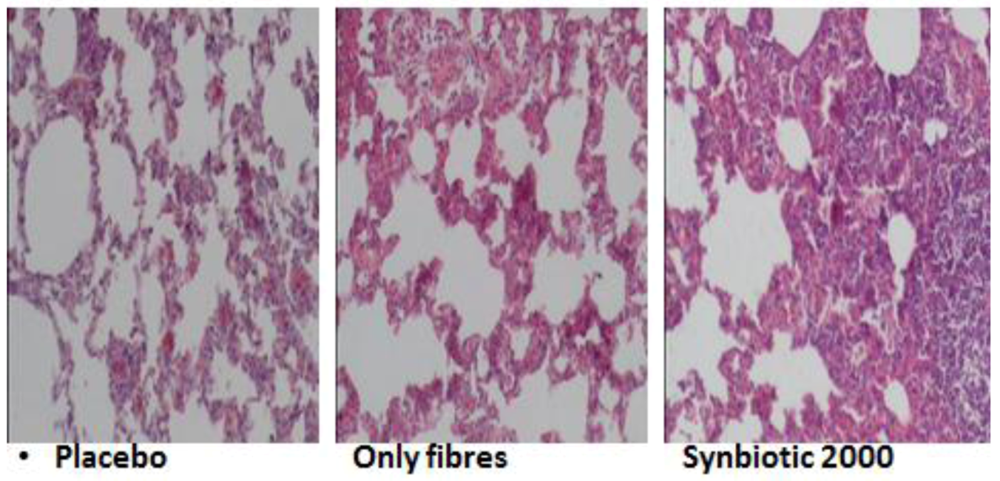
      <p>Experimental animals, subjected to induced infections through ceacal ligation and puncture (CLP), were treated with prophylactic supplementation using a synbiotic cocktail, Synbiotic 2000 Forte (see below). The treatment consisted in supplementation of a cocktail of the four LAB, which either was injected subcutaneously at the time of trauma [<xref ref-type="bibr" rid="B70-nutrients-05-00162">70</xref>], or supplied orally together with prebiotic fibers as a pretreatment for three days before induction of trauma [<xref ref-type="bibr" rid="B71-nutrients-05-00162">71</xref>]. Both treatments effectively prevented neutrophil accumulation in the lung tissues (<xref ref-type="table" rid="nutrients-05-00162-t001">Table 1</xref>) as well as pulmonary tissue destruction (<xref ref-type="fig" rid="nutrients-05-00162-f001">Figure 1</xref>). Significant reductions in parameters associated with the degree of systemic inflammation, such as myeloperoxidase (MPO, <xref ref-type="table" rid="nutrients-05-00162-t002">Table 2</xref>), malondialdehyde (MDA, <xref ref-type="table" rid="nutrients-05-00162-t003">Table 3</xref>) and nitric oxide (NO, <xref ref-type="table" rid="nutrients-05-00162-t004">Table 4</xref>), indicated a significant suppression of trauma-induced inflammation, all differences between the treatment and placebo groups in the two studies being statistically significant (<italic>p</italic> &lt; 0.05) [<xref ref-type="bibr" rid="B71-nutrients-05-00162">71</xref>]. </p>
      <table-wrap id="nutrients-05-00162-t001" position="float">
        <object-id pub-id-type="pii">nutrients-05-00162-t001_Table 1</object-id>
        <label>Table 1</label>
        <caption>
          <p>Neutrophil counts after treatment with Synbiotic 2000, only the LAB in Synbiotic 2000, only the fibers in Synbiotic 2000 and placebo [<xref ref-type="bibr" rid="B71-nutrients-05-00162">71</xref>]; <italic>p</italic> &lt; 0.05.</p>
        </caption>
        <table>
          <thead>
            <tr>
              <th align="center" valign="middle">Treatment group</th>
              <th align="center" valign="middle">Average number of neutrophils per viewed fields</th>
            </tr>
          </thead>
          <tbody>
            <tr>
              <td align="center" valign="middle"><bold>Synbiotic 2000</bold></td>
              <td align="center" valign="middle"><bold>9.00 ± 0.44</bold></td>
            </tr>
            <tr>
              <td align="center" valign="middle">Only LAB</td>
              <td align="center" valign="middle">8.40 ± 0.42</td>
            </tr>
            <tr>
              <td align="center" valign="middle">Only the fibers</td>
              <td align="center" valign="middle">31.20 ± 0.98</td>
            </tr>
            <tr>
              <td align="center" valign="middle">Placebo</td>
              <td align="center" valign="middle">51.10 ± 0.70</td>
            </tr>
          </tbody>
        </table>
      </table-wrap>
      <fig id="nutrients-05-00162-f001" position="float">
        <label>Figure 1</label>
        <caption>
          <p>Hematoxylin-eosin of lung tissues from placebo, only fibers-treated and Synbiotic 2000-treated animals [<xref ref-type="bibr" rid="B71-nutrients-05-00162">71</xref>].</p>
        </caption>
        <graphic xmlns:xlink="http://www.w3.org/1999/xlink" xlink:href="nutrients-05-00162-g001.tif"/>
      </fig>
      <table-wrap id="nutrients-05-00162-t002" position="float">
        <object-id pub-id-type="pii">nutrients-05-00162-t002_Table 2</object-id>
        <label>Table 2</label>
        <caption>
          <p>Myeloperoxidase (MPO) activity in the supernatant presented as U/g lung tissue, after treatment with Synbiotic 2000, only the LAB in Synbiotic 2000, only the fibers in Synbiotic 2000 and placebo, respectively [<xref ref-type="bibr" rid="B71-nutrients-05-00162">71</xref>]; <italic>p</italic> &lt; 0.05.</p>
        </caption>
        <table>
          <thead>
            <tr>
              <th align="center" valign="middle">Treatment group</th>
              <th align="center" valign="middle">U/g</th>
            </tr>
          </thead>
          <tbody>
            <tr>
              <td align="center" valign="middle">
                <bold>Synbiotic 2000</bold>
              </td>
              <td align="center" valign="middle"><bold>25.62 ± 2.19</bold></td>
            </tr>
            <tr>
              <td align="center" valign="middle">Only LAB</td>
              <td align="center" valign="middle">26.75 ± 2.61</td>
            </tr>
            <tr>
              <td align="center" valign="middle">Only the fibers</td>
              <td align="center" valign="middle">56.59 ± 1.73</td>
            </tr>
            <tr>
              <td align="center" valign="middle">Placebo</td>
              <td align="center" valign="middle">145.53 ± 7.53</td>
            </tr>
          </tbody>
        </table>
      </table-wrap>
      <table-wrap id="nutrients-05-00162-t003" position="float">
        <object-id pub-id-type="pii">nutrients-05-00162-t003_Table 3</object-id>
        <label>Table 3</label>
        <caption>
          <p>Lipid peroxidation in the lung tissue determined expressed as levels of malondialdehyde (MDA), measured in nmol/mg protein, after treatment with Synbiotic 2000, only the LAB in Synbiotic 2000, only the fibers in Synbiotic 2000 and placebo respectively [<xref ref-type="bibr" rid="B71-nutrients-05-00162">71</xref>]; <italic>p</italic> &lt; 0.05. </p>
        </caption>
        <table>
          <thead>
            <tr>
              <th align="center" valign="middle">Treatment group</th>
              <th align="center" valign="middle">nmol/mg</th>
            </tr>
          </thead>
          <tbody>
            <tr>
              <td align="center" valign="middle">
                <bold>Synbiotic 2000</bold>
              </td>
              <td align="center" valign="middle"><bold>0.22 ± 1.31</bold></td>
            </tr>
            <tr>
              <td align="center" valign="middle">Only LAB</td>
              <td align="center" valign="middle">0.28 ± 3.55</td>
            </tr>
            <tr>
              <td align="center" valign="middle">Only the fibers</td>
              <td align="center" valign="middle">0.48 ± 5.32</td>
            </tr>
            <tr>
              <td align="center" valign="middle">Placebo</td>
              <td align="center" valign="middle">0.67 ± 2.94</td>
            </tr>
          </tbody>
        </table>
      </table-wrap>
      <table-wrap id="nutrients-05-00162-t004" position="float">
        <object-id pub-id-type="pii">nutrients-05-00162-t004_Table 4</object-id>
        <label>Table 4</label>
        <caption>
          <p>Lung tissue nitrite (NO2) and nitrate (NO3), expressed as µmol/g wet tissue, after treatment with Synbiotic 2000, only the LAB in Synbiotic 2000, only the fibers in Synbiotic 2000 and placebo, respectively [<xref ref-type="bibr" rid="B71-nutrients-05-00162">71</xref>]; <italic>p</italic> &lt; 0.05.</p>
        </caption>
        <table>
          <thead>
            <tr>
              <th align="center" valign="middle">Treatment group</th>
              <th align="center" valign="middle">µmol/g </th>
            </tr>
          </thead>
          <tbody>
            <tr>
              <td align="center" valign="middle"><bold>Synbiotic 2000</bold></td>
              <td align="center" valign="middle"><bold>17.16 ± 2.03</bold></td>
            </tr>
            <tr>
              <td align="center" valign="middle">Only LAB</td>
              <td align="center" valign="middle">8.91 ± 2.24</td>
            </tr>
            <tr>
              <td align="center" valign="middle">Only the fibers</td>
              <td align="center" valign="middle">47.71 ± 3.20</td>
            </tr>
            <tr>
              <td align="center" valign="middle">Placebo</td>
              <td align="center" valign="middle">66.22 ± 5.92</td>
            </tr>
          </tbody>
        </table>
      </table-wrap>
    </sec>
    <sec>
      <title>9. Life-Threatening Systemic Inflammation</title>
      <p>A study of patients in intensive care suffering life-threatening extreme systemic inflammation, which is called “systemic inflammation response syndrome” (SIRS), and its relation to gut microbiota, was recently published. Gut microbiota in twenty-five patients with severe SIRS and a level in serum of C-reactive protein above 10 mg/dL were analyzed [<xref ref-type="bibr" rid="B72-nutrients-05-00162">72</xref>] and were found to bear markedly lower total anaerobic bacterial counts, particularly of the beneficial Bifidobacterium and Lactobacillus, paralleled by higher counts of total facultative anaerobes such as Staphylococcus and Pseudomonas compared to healthy volunteers. Gram-negative facultative anaerobes were the most commonly identified microbial organisms in mesenteric lymph nodes and at serosal scrapings at laparotomy. Gastrointestinal complications were strongly associated with a significantly reduced number of total obligate anaerobes and highly increased numbers of Staphylococcus and Enterococcus and significantly decreased numbers of total obligate anaerobes and total facultative anaerobes [<xref ref-type="bibr" rid="B72-nutrients-05-00162">72</xref>]. </p>
      <p>A more recent study in 63 similar patients suggests impaired gastrointestinal motility as a significant marker of poor outcome [<xref ref-type="bibr" rid="B73-nutrients-05-00162">73</xref>]. Patients with ≥300 mL per day reflux from nasal gastric feeding tube demonstrated significantly lower numbers of total obligate anaerobes including Bacteroidaceae and Bifidobacterium, higher numbers of Staphylococcus, lower concentrations of acetic acid and propionic acid, and higher concentrations of succinic acid and lactic acid (<italic>p</italic> ≤ 0.05), accompanied by dramatically higher incidences of bacteremia (86% <italic>vs.</italic> 18%) and mortality (64% <italic>vs.</italic> 20%) than patients without gastric distension (<italic>p</italic> ≤ 0.05) [<xref ref-type="bibr" rid="B73-nutrients-05-00162">73</xref>]. Furthermore, in 29 similar patients, treatment with a synbiotic composition, consisting of <italic>Bifidobacterium breve </italic>and <italic>Lactobacillus casei</italic>, in combination with galactooligosaccharides, was attempted. Higher levels of <italic>Bifidobacteria</italic> and <italic>Lactobacillus</italic>, but also total organic acids, particularly short-chain fatty acids, were reported and the incidence of infectious complications such as enteritis, pneumonia, and bacteremia, compared to historical controls, was reported to be significantly lower in the treated group [<xref ref-type="bibr" rid="B74-nutrients-05-00162">74</xref>]. </p>
    </sec>
    <sec>
      <title>10. Numerous Mechanisms to Control Intestinal Homeostasis</title>
      <p>Dysbiosis and impaired barrier functions are associated with several negative consequences; translocation of lipopolysaccharides (LPS) and whole microbial cells, accumulation of endotoxin in the body (endotoxemia) and hyperactivation of the immune system. The microbiota controls intestinal homeostasis through numerous mechanisms in which substances such as lipopolysaccarides, flagellins, peptidoglycans, and formulated peptides are involved. It interacts with intestinal cell receptors such as Toll-like receptors and activates important intracellular signaling pathways with the ability to modulate processes such as cell survival, replication and apoptosis, as well as inflammatory response. Among the challenging molecules are NF-κB, caspases, mitogen-activated protein kinases. The host immune system controls microbial composition through release of molecules such as β-defensins, cryptidins, lectins, angiogenin 4, reactive oxygen species, IgA and so-called bacteriocins, which effectively limits the expansion of various pathogenic microorganisms [<xref ref-type="bibr" rid="B75-nutrients-05-00162">75</xref>,<xref ref-type="bibr" rid="B76-nutrients-05-00162">76</xref>]. </p>
      <p>The enteric flora is mostly represented by strict anaerobes (70%–90%), which predominate over facultative anaerobes and aerobes (10%–30%) [<xref ref-type="bibr" rid="B76-nutrients-05-00162">76</xref>]. Recent studies suggest that the gut microbiota might be classified as belonging to one of three principal variants, or “enterotypes” defined by a dominant presence of <italic>Bacteroides</italic>, <italic>Prevotella</italic>, or <italic>Ruminococcus</italic> species [<xref ref-type="bibr" rid="B77-nutrients-05-00162">77</xref>]. However, increasing evidence suggests that these enterotypes are more microbial gradients than, although discrete, defined microbial communities as most of the observed differences are largely explained on the basis of long-term dietary intake [<xref ref-type="bibr" rid="B78-nutrients-05-00162">78</xref>,<xref ref-type="bibr" rid="B79-nutrients-05-00162">79</xref>]. Diet has the most powerful influence on gut microbial communities in healthy human subjects [<xref ref-type="bibr" rid="B80-nutrients-05-00162">80</xref>,<xref ref-type="bibr" rid="B81-nutrients-05-00162">81</xref>,<xref ref-type="bibr" rid="B82-nutrients-05-00162">82</xref>]. A study of human subjects and 59 other mammals revealed clusters in which the effects of diet (carnivorous, omnivorous, or herbivorous) almost always outweigh host phylogeny [<xref ref-type="bibr" rid="B80-nutrients-05-00162">80</xref>]. <italic>Bacteroides </italic>species are prevalent with long-term protein and animal fat diets, whereas <italic>Prevotella </italic>species are associated with long-term carbohydrate diets [<xref ref-type="bibr" rid="B82-nutrients-05-00162">82</xref>]. 45,000 of the presently identified &gt;800,000 rDNA sequences (microbial species) and about five of the about 50 bacterial phyla identified are found in the lower GI tract [<xref ref-type="bibr" rid="B83-nutrients-05-00162">83</xref>]. Two of these phyla are totally dominating: <italic>Firmicutes </italic>(65%–80% of the clones) and <italic>Bacteroidetes </italic>(about 23%), while <italic>Actinobacteria </italic>(about 3%), <italic>Proteobacteria </italic>(1%) and <italic>Verrumicrobia </italic>(0.1%) exist only in modest amounts [<xref ref-type="bibr" rid="B76-nutrients-05-00162">76</xref>,<xref ref-type="bibr" rid="B84-nutrients-05-00162">84</xref>,<xref ref-type="bibr" rid="B85-nutrients-05-00162">85</xref>]. Of special interest is that <italic>Actinobacteria</italic> and <italic>Firmicutes</italic>, to which the genus <italic>Lactobacillus</italic> belongs, are almost exclusively Gram-positive, while <italic>Bacteroidetes</italic> and <italic>Proteobacteria </italic>are mainly Gram-negative [<xref ref-type="bibr" rid="B86-nutrients-05-00162">86</xref>]. Recent attempts to study the microbiota at other sites within the digestive tract report that the mouth harbors the greatest phylogenetic diversity, the stomach the lowest, and diversity to increase from stomach to the stool [<xref ref-type="bibr" rid="B87-nutrients-05-00162">87</xref>]. </p>
    </sec>
    <sec>
      <title>11. Personal Experience with Pro- and Synbiotics</title>
      <p>My personal interest in microbiota and probiotics started in the early 1980s. Since 1963, I have been involved in the development of liver extensive surgery and active in the search for new tools to combat the unacceptably high rate of peri-operative infections, which was and still is associated with major surgery in general and in particular with extensive liver resections. At that time, it was standard practice to treat patients with an antibiotic umbrella for at least the first five post-operative days, in the belief that this treatment would reduce the rate of post-operative infections. However, a review of our last 81 liver resections gave unexpected information, which directed my interest to human microbiota and the possibility of using probiotics as an alternative infection prophylaxis. From this study, it was shown that only 57/81 patients had, in fact, received antibiotic treatment; this prophylaxis had been neglected in the remaining 24/81 patients [<xref ref-type="bibr" rid="B88-nutrients-05-00162">88</xref>,<xref ref-type="bibr" rid="B89-nutrients-05-00162">89</xref>]. It was surprising that there were no cases of sepsis in the group of patients who had not received prophylactic antibiotics with sepsis incidence confined to the antibiotic-treated patients. There was, at that time, a growing awareness of the importance of human microbiota [<xref ref-type="bibr" rid="B90-nutrients-05-00162">90</xref>] and to contemporaneous published studies that had attempted to recondition the gut through the supply of lactobacilli [<xref ref-type="bibr" rid="B91-nutrients-05-00162">91</xref>]. </p>
      <p>There was also at that time a growing understanding that not only disease, but also lifestyle and prescribed chemicals and pharmaceuticals, could impair microbiota immune defense. The use of probiotic treatment, as an alternative means of preventing unwanted infections in disease in general, but particularly in surgical and critically ill patients, appeared as an attractive option. This was the reason why I established collaborative efforts with experts in microbiology, chemistry, nutrition and experimental and clinical science to seek, develop and test probiotics both experimentally and clinically, which could be expected to constitute powerful tools to prevent sepsis of various kinds. </p>
      <p>Interdisciplinary collaboration in the early 1990s led to the identification of some <italic>L. plantarum </italic>strains that demonstrated strong anti-inflammatory capacities. <italic>L. plantarum </italic>299, later used together with oatmeal in a synbiotic composition [<xref ref-type="bibr" rid="B92-nutrients-05-00162">92</xref>,<xref ref-type="bibr" rid="B93-nutrients-05-00162">93</xref>,<xref ref-type="bibr" rid="B94-nutrients-05-00162">94</xref>], is produced and marketed by Probi AB, Lund, Sweden. I participated in this program until 1999, when I decided to re-direct my interest towards development and studies of a more complex synbiotic composition, designed not only to supplement four newly identified bioactive LABs in combination, but also four different prebiotic fibers, already known for their strong bioactivity. Our aim was to provide this composition in much larger doses than was the practice at that time. Furthermore, knowing that most of the important LABs rarely exist in the microbiota of Westerners encouraged us to seek potent probiotic bacteria normally growing on plants, instead of selecting bacteria normally found in human microbiota. </p>
      <p>Since 1999, all my efforts in this field have concentrated on a four LAB/four fiber composition, consisting of either a mixture of 4 × 10<sup>1</sup><sup>0</sup> (40 billion LAB, Standard version—Synbiotic 2000™) or a mixture of 10<sup>11</sup> (400 billion Forte version—Synbiotic 2000 Forte™) based on the following four LAB: <italic>Pediococcus pentosaceus</italic> 5–33:3, <italic>Leuconostoc mesenteroides</italic> 32–77:1, <italic>Lactobacillus paracasei</italic> subsp. paracasei 19, and <italic>Lactobacillus plantarum</italic> 2362 in combination with 4 × 2.5 g of each of the following four fermentable fibers: betaglucan, inulin, pectin and resistant starch, in total 10 g of prebiotic fibers per dose [<xref ref-type="bibr" rid="B95-nutrients-05-00162">95</xref>,<xref ref-type="bibr" rid="B96-nutrients-05-00162">96</xref>], a formula that is currently a product produced by Synbiotic AB, Sweden. </p>
      <sec>
        <title>11.1. Perioperative Prophylaxis in Elective Surgery</title>
        <p><italic>L. plantarum </italic>299 in a dose of 10<sup>9</sup> plus a total of 15 g of oat and inulin fibers was tried, under research condition, in patients undergoing extensive abdominal surgical operations. The patients were mainly derived from those undergoing liver, pancreatic and gastric resections, equally distributed between three groups and supplemented with either: (1) live LAB and fiber; (2) heat-inactivated LAB and fiber, and (3) standard enteral nutrition [<xref ref-type="bibr" rid="B97-nutrients-05-00162">97</xref>]. Each group comprised 30 patients. The 30-day sepsis rate was 10% (3/30 patients) in the two groups receiving either live or heat-inactivated LAB, compared to 30% (9/30 patients) in the group on standard enteral nutrition (<italic>p</italic> = 0.01) [<xref ref-type="bibr" rid="B97-nutrients-05-00162">97</xref>]. The largest difference was observed in the incidence of pneumonia: Group 1: 2 patients; Group 2: 1 patient; Group 3: 6 patients. The beneficial effects of treatment were seemingly most pronounced in gastric and pancreatic resections; the sepsis rate being: Group 1: 7%, Group 2: 17% and Group 3: 50%. The same pattern was observed for non-infectious complications: Group 1: 13% (4/30) Group 2: 17% (5/30); Group 3: 30% (9/30). The supply of antibiotics to Group 1 was significantly less (<italic>p</italic> = 0.04) than to the other two groups, with the mean length of antibiotic treatment also considerably shorter: Group 1: 4 ± 3.7 days; Group 2: 7 ± 5.2 days; Group 3: 8 ± 6.5 days. </p>
        <p>In a prospective, randomized, double-blind trial, 80 patients undergoing pylorus-preserving pancreatoduodenectomy (PPPD) received, twice daily, either Synbiotic 2000™ (2 × 40 billion LAB, <italic>i.e.</italic>, 80 billion LAB per day) or only the fibers in composition from the surgery the day before and during the first seven postoperative days [<xref ref-type="bibr" rid="B98-nutrients-05-00162">98</xref>]. A highly significant difference in infection rate (<italic>p</italic> = 0.005) was observed as only 5/40 patients (12.5%) in the Synbiotic 2000-treated group suffered infections (4 wounds and one urinary tract infection) <italic>vs. </italic>16/40 (40%) in the fiber-only group (6 wound infections, 5 peritonitis, 4 chest infections, 2 sepsis, and one of each of urinary tract infection, cholangitis and empyema)—<xref ref-type="table" rid="nutrients-05-00162-t005">Table 5</xref>. The number of infecting microorganisms were also statistically and significant reduced—see <xref ref-type="table" rid="nutrients-05-00162-t006">Table 6</xref>. Statistically significant differences between the groups were also observed regarding the use of antibiotics (mean: Synbiotic 2000, 2 ± 5 days; Only-fibers, 10 ± 14 days) [<xref ref-type="bibr" rid="B98-nutrients-05-00162">98</xref>].</p>
        <table-wrap id="nutrients-05-00162-t005" position="float">
          <object-id pub-id-type="pii">nutrients-05-00162-t005_Table 5</object-id>
          <label>Table 5</label>
          <caption>
            <p>Infective complications in patients undergoing pancreatoduodenectomy [<xref ref-type="bibr" rid="B98-nutrients-05-00162">98</xref>]; <italic>p</italic> &lt; 0.05.</p>
          </caption>
          <table>
            <thead>
              <tr>
                <th align="center" valign="middle"> </th>
                <th align="center" valign="middle">Synbiotic 2000</th>
                <th align="center" valign="middle">Fibers only</th>
              </tr>
            </thead>
            <tbody>
              <tr>
                <td align="center" valign="middle">Wound infections </td>
                <td align="center" valign="middle">4</td>
                <td align="center" valign="middle">6</td>
              </tr>
              <tr>
                <td align="center" valign="middle">Urinary infection </td>
                <td align="center" valign="middle">1</td>
                <td align="center" valign="middle">1</td>
              </tr>
              <tr>
                <td align="center" valign="middle">Peritonitis </td>
                <td align="center" valign="middle">0</td>
                <td align="center" valign="middle">5</td>
              </tr>
              <tr>
                <td align="center" valign="middle">Pneumonia</td>
                <td align="center" valign="middle">0</td>
                <td align="center" valign="middle">4</td>
              </tr>
              <tr>
                <td align="center" valign="middle">Sepsis</td>
                <td align="center" valign="middle">0</td>
                <td align="center" valign="middle">2</td>
              </tr>
              <tr>
                <td align="center" valign="middle">Cholangitis</td>
                <td align="center" valign="middle">0</td>
                <td align="center" valign="middle">1</td>
              </tr>
              <tr>
                <td align="center" valign="middle">Empyema</td>
                <td align="center" valign="middle">0</td>
                <td align="center" valign="middle">1</td>
              </tr>
              <tr>
                <td align="center" valign="middle"> </td>
                <td align="center" valign="middle">Total 5/40 (12.5%)</td>
                <td align="center" valign="middle">Total 16/40 (40%)</td>
              </tr>
            </tbody>
          </table>
        </table-wrap>
        <table-wrap id="nutrients-05-00162-t006" position="float">
          <object-id pub-id-type="pii">nutrients-05-00162-t006_Table 6</object-id>
          <label>Table 6</label>
          <caption>
            <p>Pathogens isolated from patients undergoing pancreatectomy treated with Synbiotic 2000 and only the fibers in Synbiotic 2000, respectively [<xref ref-type="bibr" rid="B98-nutrients-05-00162">98</xref>].</p>
          </caption>
          <table>
            <thead>
              <tr>
                <th align="center" valign="middle">Isolated microorganisms</th>
                <th align="center" valign="middle">Synbiotic 2000</th>
                <th align="center" valign="middle">Fibers only</th>
              </tr>
            </thead>
            <tbody>
              <tr>
                <td align="center" valign="middle">
                  <italic>Enterobacter cloacae</italic>
                </td>
                <td align="center" valign="middle">2</td>
                <td align="center" valign="middle">8</td>
              </tr>
              <tr>
                <td align="center" valign="middle">
                  <italic>Enterococcus faecalis/faecium</italic>
                </td>
                <td align="center" valign="middle">1</td>
                <td align="center" valign="middle">7</td>
              </tr>
              <tr>
                <td align="center" valign="middle">
                  <italic>Escherichia coli</italic>
                </td>
                <td align="center" valign="middle">0</td>
                <td align="center" valign="middle">7</td>
              </tr>
              <tr>
                <td align="center" valign="middle">
                  <italic>Klebsiella pneumoniae</italic>
                </td>
                <td align="center" valign="middle">2</td>
                <td align="center" valign="middle">2</td>
              </tr>
              <tr>
                <td align="center" valign="middle">
                  <italic>Proteus mirabilis</italic>
                </td>
                <td align="center" valign="middle">1</td>
                <td align="center" valign="middle">1</td>
              </tr>
              <tr>
                <td align="center" valign="middle">
                  <italic>Staphylococcus aureus</italic>
                </td>
                <td align="center" valign="middle">0</td>
                <td align="center" valign="middle">2</td>
              </tr>
              <tr>
                <td align="center" valign="middle"> </td>
                <td align="center" valign="middle">Total 6</td>
                <td align="center" valign="middle">Total 27</td>
              </tr>
            </tbody>
          </table>
        </table-wrap>
        <p>In another randomized controlled study, 45 patients undergoing major surgery for abdominal cancer were divided into three treatment groups: (1) enteral nutrition (EN) supplemented with Synbiotic 2000 (LEN); (2) EN supplemented with only the fibers in the same amounts (20 g) (20 g) as in Synbiotic 2000™ (FEN); and (3) Standard parenteral nutrition (PN). All treatments lasted for two preoperative and seven days postoperative days. The incidence of postoperative bacterial infections was 47% with PN, 20% with FEN and 6.7% with LEN (<italic>p</italic> &lt; 0.05). The numbers of infecting microorganisms were also statistically and significantly reduced—see <xref ref-type="table" rid="nutrients-05-00162-t007">Table 7</xref>. Significant improvements were also observed in prealbumin (LEN, FEN), C-reactive protein (LEN, FEN), serum cholesterol (LEN, FEN), white cell blood count (LEN), serum endotoxin (LEN, FEN) and IgA (LEN) [<xref ref-type="bibr" rid="B99-nutrients-05-00162">99</xref>].</p>
        <table-wrap id="nutrients-05-00162-t007" position="float">
          <object-id pub-id-type="pii">nutrients-05-00162-t007_Table 7</object-id>
          <label>Table 7</label>
          <caption>
            <p>Pathogens recovered from patients undergoing surgery for abdominal cancer treated with Synbiotic 2000 and only the fibers in Synbiotic 2000, respectively [<xref ref-type="bibr" rid="B99-nutrients-05-00162">99</xref>].</p>
          </caption>
          <table>
            <thead>
              <tr>
                <th align="center" valign="middle">Isolated microorganisms</th>
                <th align="center" valign="middle">Synbiotic 2000</th>
                <th align="center" valign="middle">Fibers only</th>
              </tr>
            </thead>
            <tbody>
              <tr>
                <td align="center" valign="middle">
                  <italic>Pseudomonas aeruginosa</italic>
                </td>
                <td align="center" valign="middle">17</td>
                <td align="center" valign="middle">24</td>
              </tr>
              <tr>
                <td align="center" valign="middle">
                  <italic>Staphylococcus aureus</italic>
                </td>
                <td align="center" valign="middle">8</td>
                <td align="center" valign="middle">11</td>
              </tr>
              <tr>
                <td align="center" valign="middle">
                  <italic>Staphylococcus epidermidis</italic>
                </td>
                <td align="center" valign="middle">1</td>
                <td align="center" valign="middle">1</td>
              </tr>
              <tr>
                <td align="center" valign="middle">
                  <italic>Staphylococcus faecalis</italic>
                </td>
                <td align="center" valign="middle">-</td>
                <td align="center" valign="middle">1</td>
              </tr>
              <tr>
                <td align="center" valign="middle">
                  <italic>Enterobacter cloacae</italic>
                </td>
                <td align="center" valign="middle">4</td>
                <td align="center" valign="middle">-</td>
              </tr>
              <tr>
                <td align="center" valign="middle"><italic>Acinetobacter </italic>spp.</td>
                <td align="center" valign="middle">2</td>
                <td align="center" valign="middle">3</td>
              </tr>
              <tr>
                <td align="center" valign="middle">
                  <italic>Staphylococcus haemolyticus</italic>
                </td>
                <td align="center" valign="middle">-</td>
                <td align="center" valign="middle">1</td>
              </tr>
              <tr>
                <td align="center" valign="middle"><italic>Serratia</italic> spp.</td>
                <td align="center" valign="middle">-</td>
                <td align="center" valign="middle">2</td>
              </tr>
              <tr>
                <td align="center" valign="middle"><italic>Klebsiella</italic> spp.</td>
                <td align="center" valign="middle">-</td>
                <td align="center" valign="middle">1</td>
              </tr>
              <tr>
                <td align="center" valign="middle">
                  <italic>Proteus mirabilis</italic>
                </td>
                <td align="center" valign="middle">-</td>
                <td align="center" valign="middle">2</td>
              </tr>
              <tr>
                <td align="center" valign="middle">
                  <italic>Candida albicans</italic>
                </td>
                <td align="center" valign="middle">2</td>
                <td align="center" valign="middle">6</td>
              </tr>
              <tr>
                <td align="center" valign="middle"><italic>Aspergillus </italic>spp.</td>
                <td align="center" valign="middle">-</td>
                <td align="center" valign="middle">-</td>
              </tr>
              <tr>
                <td align="center" valign="middle">
                  <italic>Bacillus subtilis</italic>
                </td>
                <td align="center" valign="middle">-</td>
                <td align="center" valign="middle">1</td>
              </tr>
              <tr>
                <td align="center" valign="middle"><italic>Klebsiella</italic> spp.</td>
                <td align="center" valign="middle">-</td>
                <td align="center" valign="middle">1</td>
              </tr>
              <tr>
                <td align="center" valign="middle"> </td>
                <td align="center" valign="middle">Total 34</td>
                <td align="center" valign="middle">Total 54</td>
              </tr>
            </tbody>
          </table>
        </table-wrap>
      </sec>
      <sec>
        <title>11.2. Perioperative Prophylaxis in Liver Transplantation</title>
        <p>A prospective, randomized study in 95 liver transplant patients supplemented <italic>L. plantarum </italic>299 in a dose of 10<sup>9</sup> plus 15 g of oat and inulin fiber [<xref ref-type="bibr" rid="B100-nutrients-05-00162">100</xref>]. Three groups of patients were studied: (1) selective digestive tract decontamination (SDD) four times daily for six weeks; (2) <italic>L. plantarum </italic>299 (LLP) in a dose of 10<sup>9</sup> plus 15 g of oat and inulin fibres supplied postoperatively for 12 days; and (3) identical to group 2 but with heat-killed <italic>L. plantarum </italic>299 (HLP). Identical enteral nutrition was supplied to all patients from the second postoperative day. The numbers of postoperative infections were SDD 23, LLP 4 and HLP 17. Signs of infections occurred in SDD 48% (15/32), in LLP 13% (4/31), <italic>p</italic> = 0.017 nd HLP 34% (11/32), respectively. The most dominant infections were cholangitis (which occurred: SDD 10, LLP in 2, and HLP in 8) and pneumonia (which occurred: SDD in 6, LLP in 1, and HLP in 4). There was a statistically significant reduction in the numbers of infecting microorganisms, the most frequently isolated microbes being <italic>Enterococci</italic> and <italic>Staphylococci</italic>. Patients requiring hemodialysis were SDD: 8; LLP: 2 and HLP: 4 and the number of re-operations SDD: 6; LLP: 4 and HLP: 2, respectively. There were no deaths. The stay in ICU, the hospital stay, and length of antibiotic therapy was shorter in the LLP group, but did not reach statistical significance. The CD4/CD8 ratio was also higher in the LLP group compared to the other two groups (<italic>p</italic> = 0.06). </p>
        <p>In a subsequent study, 66 human orthotopic liver transplant patients were randomized to either receive Synbiotic 2000 or only the fibers in Synbiotic 2000. The treatment was started on the day before surgery and continued for 14 days after surgery. During the first postoperative month, only one patient in the Synbiotic 2000-treated group (3%) showed signs of infection (urinary infection) compared to 17/33 (51%) patients in those supplemented with only the four fibers [<xref ref-type="bibr" rid="B101-nutrients-05-00162">101</xref>]. Only one infecting organism was cultivated in the Synbiotic-treated group, which was shown to be <italic>Enterococcus fecalis</italic>, in contrast to seventeen organisms in the fiber-only treated group—see <xref ref-type="table" rid="nutrients-05-00162-t008">Table 8</xref>. The use of antibiotics was on average 0.1 ± 0.1 day in the Synbiotic-treated patients and 3.8 ± 0.9 day in the fiber-only treated group [<xref ref-type="bibr" rid="B101-nutrients-05-00162">101</xref>].</p>
        <table-wrap id="nutrients-05-00162-t008" position="float">
          <object-id pub-id-type="pii">nutrients-05-00162-t008_Table 8</object-id>
          <label>Table 8</label>
          <caption>
            <p>Pathogens isolated from patients undergoing liver transplantation treated with Synbiotic 2000 and only the fibers in Synbiotic 2000, respectively [<xref ref-type="bibr" rid="B101-nutrients-05-00162">101</xref>].</p>
          </caption>
          <table>
            <thead>
              <tr>
                <th align="center" valign="middle">Isolated bacteria </th>
                <th align="center" valign="middle">Synbiotic 2000</th>
                <th align="center" valign="middle">Fibers only</th>
              </tr>
            </thead>
            <tbody>
              <tr>
                <td align="center" valign="middle">
                  <italic>Enterococcus faecalis</italic>
                </td>
                <td align="center" valign="middle">1</td>
                <td align="center" valign="middle">11</td>
              </tr>
              <tr>
                <td align="center" valign="middle">
                  <italic>Escherichia coli</italic>
                </td>
                <td align="center" valign="middle">0</td>
                <td align="center" valign="middle">3</td>
              </tr>
              <tr>
                <td align="center" valign="middle">
                  <italic>Enterobacter cloacae</italic>
                </td>
                <td align="center" valign="middle">0</td>
                <td align="center" valign="middle">2</td>
              </tr>
              <tr>
                <td align="center" valign="middle">
                  <italic>Pseudomonas aeruginosa</italic>
                </td>
                <td align="center" valign="middle">0</td>
                <td align="center" valign="middle">2</td>
              </tr>
              <tr>
                <td align="center" valign="middle">
                  <italic>Staphylococcus aureus</italic>
                </td>
                <td align="center" valign="middle">0</td>
                <td align="center" valign="middle">1</td>
              </tr>
              <tr>
                <td align="center" valign="middle"> </td>
                <td align="center" valign="middle">Total 1</td>
                <td align="center" valign="middle">Total 18</td>
              </tr>
            </tbody>
          </table>
        </table-wrap>
      </sec>
      <sec>
        <title>11.3. Early Treatment in Major Trauma</title>
        <p>Two prospective randomized trials with Synbiotic 2000™ and Synbiotic 2000 Forte™, respectively, were undertaken. In the first study [<xref ref-type="bibr" rid="B102-nutrients-05-00162">102</xref>], the patients were randomly allocated into four groups in order to compare the efficacy of preventing both total infections and, particularly, chest infections of the three commercial nutrition solutions: Group A: Alitraq (Abbott-Ross, Abbott Park, IL) 5.25 g protein, 16.5 g carbohydrate, 1.55 g fat and 1.55 g glutamine, 446 mg arginine, 154 mg α-linolenic acid per 100 mL. The Osmolarity is 480 mOsml/L. Group B: Nova Source (Novartis Medical Nutrition, Basel, Switzerland) 4.1 g protein, 14.4 g carbohydrate, 3.5 g fat, 2.2 g fermentable fibers as fermentable guar gum per 100 mL. The osmolarity is 228 mOsm/L. Group C: Nutricomp peptide (B. Braun, Melsungen, Germany) 4.5 g hydrolyzed protein, 16.8 g carbohydrate, 1.7 g fat per 100 mL. The osmolarity is 400 mOsm/L. A fourth solution, Nutricomp standard, was chosen to be tried in combination with Synbiotic 2000—Group D: Nutricomp standard (B. Braun, Melsungen, Germany) supplemented with Synbiotic 2000, Nutricomp standard contain 3.7 g protein, 13.7 g carbohydrate, 3.3 g fat per 100 mL. The osmolarity of this solution is 240 mOsm/L. One sachet of Synbiotic 2000 was added to the solution before delivery to the patients [<xref ref-type="bibr" rid="B102-nutrients-05-00162">102</xref>]. Nova Source and Nutricomp peptide did not reduce the levels of proinflammatory cytokines, while Alitraq and Nutricomp standard + Synbiotic 2000 significantly down-regulated Il-6, but not Il-8 and TNF-α. <xref ref-type="table" rid="nutrients-05-00162-t009">Table 9</xref> lists the total number and number of chest infections associated with the various nutrition solutions. The group containing Synbiotic 2000 demonstrated significant reductions in both total infections as in chest infections; the total number of infections being reduced by about two thirds, and the number of chest infections being reduced to about half [<xref ref-type="bibr" rid="B102-nutrients-05-00162">102</xref>]—see <xref ref-type="table" rid="nutrients-05-00162-t009">Table 9</xref>. </p>
        <p>In the other study [<xref ref-type="bibr" rid="B103-nutrients-05-00162">103</xref>,<xref ref-type="bibr" rid="B104-nutrients-05-00162">104</xref>,<xref ref-type="bibr" rid="B105-nutrients-05-00162">105</xref>], 65 polytrauma patients were randomized to receive once daily, for 15 days following major trauma, either Synbiotic 2000 Forte (400 billion LAB + 10 g of fibers, see above) or maltodextrine, as placebo. Significant reductions were observed between the groups in the number of deaths (5/35 <italic>vs.</italic> 9/30, <italic>p</italic> &lt; 0.02), severe sepsis (6/35 <italic>vs</italic>. 13/30, <italic>p</italic> &lt; 0.02), chest infections (19/35 <italic>vs.</italic> 24/30, <italic>p</italic> &lt; 0.03), central line infections (13/32 <italic>vs.</italic> 20/30, <italic>p</italic> &lt; 0.02), and ventilation days (average 15 <italic>vs</italic>. 26 days [<xref ref-type="bibr" rid="B65-nutrients-05-00162">65</xref>]) [<xref ref-type="bibr" rid="B103-nutrients-05-00162">103</xref>,<xref ref-type="bibr" rid="B104-nutrients-05-00162">104</xref>,<xref ref-type="bibr" rid="B105-nutrients-05-00162">105</xref>]. A total of 54 pathogenic microorganisms were cultivated in the Synbiotic treated group compared to 103 in the maltodextrine group—see <xref ref-type="table" rid="nutrients-05-00162-t010">Table 10</xref> [<xref ref-type="bibr" rid="B103-nutrients-05-00162">103</xref>,<xref ref-type="bibr" rid="B104-nutrients-05-00162">104</xref>,<xref ref-type="bibr" rid="B105-nutrients-05-00162">105</xref>]. Repeat analyses also revealed that serum levels of endotoxin (LPS) were decreased and “time to bloodstream infection” significantly prolonged in patients treated with Synbiotic 2000 Forte.</p>
        <table-wrap id="nutrients-05-00162-t009" position="float">
          <object-id pub-id-type="pii">nutrients-05-00162-t009_Table 9</object-id>
          <label>Table 9</label>
          <caption>
            <p>Total number of infections and number of chest infections in severe trauma receiving four different commercial nutrition solutions of which one is combined with added Synbiotic 2000 [<xref ref-type="bibr" rid="B102-nutrients-05-00162">102</xref>]. </p>
          </caption>
          <table>
            <thead>
              <tr>
                <th align="center" valign="middle"> </th>
                <th align="center" valign="middle">Total number of infections</th>
                <th align="center" valign="middle">Number of chest infections</th>
              </tr>
            </thead>
            <tbody>
              <tr>
                <td align="center" valign="middle">Alitraq Abbott-Ross (glut + arg)</td>
                <td align="center" valign="middle">16/32 50%</td>
                <td align="center" valign="middle">11/32 34%</td>
              </tr>
              <tr>
                <td align="center" valign="middle">Nova Source Novartis (+guargum)</td>
                <td align="center" valign="middle">17/29 58%</td>
                <td align="center" valign="middle">12/29 41%</td>
              </tr>
              <tr>
                <td align="center" valign="middle">Nutricomp peptide Braun (+peptide)</td>
                <td align="center" valign="middle">13/26 50%</td>
                <td align="center" valign="middle">11/26 42%</td>
              </tr>
              <tr>
                <td align="center" valign="middle">Nutricomp standard (+Synbiotic 2000)</td>
                <td align="center" valign="middle">4/26 15%</td>
                <td align="center" valign="middle">5/26 19%</td>
              </tr>
            </tbody>
          </table>
        </table-wrap>
        <table-wrap id="nutrients-05-00162-t010" position="float">
          <object-id pub-id-type="pii">nutrients-05-00162-t010_Table 10</object-id>
          <label>Table 10</label>
          <caption>
            <p>Pathogens isolated from patients with polytrauma treated with Synbiotic 2000 and only the fibers in Synbiotic 2000, respectively [<xref ref-type="bibr" rid="B103-nutrients-05-00162">103</xref>,<xref ref-type="bibr" rid="B104-nutrients-05-00162">104</xref>,<xref ref-type="bibr" rid="B105-nutrients-05-00162">105</xref>].</p>
          </caption>
          <table>
            <thead>
              <tr>
                <th align="center" valign="middle">Isolated microorganisms</th>
                <th align="center" valign="middle">Synbiotic 2000</th>
                <th align="center" valign="middle">Fibers only</th>
              </tr>
            </thead>
            <tbody>
              <tr>
                <td align="center" valign="middle">
                  <italic>Acinetobacter baumanni</italic>
                </td>
                <td align="center" valign="middle">21</td>
                <td align="center" valign="middle">35</td>
              </tr>
              <tr>
                <td align="center" valign="middle">
                  <italic>Candida albicans</italic>
                </td>
                <td align="center" valign="middle">7</td>
                <td align="center" valign="middle">17</td>
              </tr>
              <tr>
                <td align="center" valign="middle">
                  <italic>Pseudomonas aeruginosa</italic>
                </td>
                <td align="center" valign="middle">15</td>
                <td align="center" valign="middle">14</td>
              </tr>
              <tr>
                <td align="center" valign="middle">
                  <italic>Staphylococcus epidermidis</italic>
                </td>
                <td align="center" valign="middle">2</td>
                <td align="center" valign="middle">10</td>
              </tr>
              <tr>
                <td align="center" valign="middle">
                  <italic>Staphylococcus aureus</italic>
                </td>
                <td align="center" valign="middle">4</td>
                <td align="center" valign="middle">7</td>
              </tr>
              <tr>
                <td align="center" valign="middle">
                  <italic>Staphylococcus hominis</italic>
                </td>
                <td align="center" valign="middle">-</td>
                <td align="center" valign="middle">2</td>
              </tr>
              <tr>
                <td align="center" valign="middle">
                  <italic>Enterobacter aerogenes</italic>
                </td>
                <td align="center" valign="middle">-</td>
                <td align="center" valign="middle">2</td>
              </tr>
              <tr>
                <td align="center" valign="middle">
                  <italic>Staphylococcus haemolyticus</italic>
                </td>
                <td align="center" valign="middle">-</td>
                <td align="center" valign="middle">1</td>
              </tr>
              <tr>
                <td align="center" valign="middle"><italic>Serratia</italic> spp.</td>
                <td align="center" valign="middle">-</td>
                <td align="center" valign="middle">2</td>
              </tr>
              <tr>
                <td align="center" valign="middle"><italic>Klebsiella</italic> spp.</td>
                <td align="center" valign="middle">5</td>
                <td align="center" valign="middle">12</td>
              </tr>
              <tr>
                <td align="center" valign="middle"><italic>Proteus</italic> spp.</td>
                <td align="center" valign="middle">-</td>
                <td align="center" valign="middle">1</td>
              </tr>
              <tr>
                <td align="center" valign="middle"> </td>
                <td align="center" valign="middle">Total 54</td>
                <td align="center" valign="middle">Total 103</td>
              </tr>
            </tbody>
          </table>
        </table-wrap>
      </sec>
      <sec>
        <title>11.4. Early Treatment in Severe Acute Pancreatitis</title>
        <p>In a further study, patients with severe acute pancreatitis were randomized to receive either a freeze-dried preparation containing live <italic>L. plantarum </italic>299 in a dose of 10<sup>9</sup> together with a substrate of oat fiber or a similar preparation but heat-inactivated, administered daily through a nasojejunal tube for seven days [<xref ref-type="bibr" rid="B105-nutrients-05-00162">105</xref>]. The study was concluded when, on repeat statistical analysis, significant differences in favor of one of the two groups were obtained. This occurred when a total of 45 patients had entered the study. 22 patients had, at that time, received treatment with live, and 23 with the heat-killed, <italic>L. plantarum </italic>299. Infected pancreatic necrosis and abscesses were seen in 1/22 (4.5%) in the live LAB group <italic>vs.</italic> 7/23 (30%) in the heat-inactivated group (<italic>p</italic> = 0.023). The only patient in the lactobacillus group who developed infection, a urinary infection, did so on the fifteenth day, <italic>i.e.</italic>, at a time when he had not received treatment for eight days. The length of stay was also considerably shorter in the live LAB group (13.7 days <italic>vs.</italic> 21.4 days) but the limited size of the material did not allow the statistical analysis to reach full significance [<xref ref-type="bibr" rid="B106-nutrients-05-00162">106</xref>].</p>
        <p>Sixty-two patients with severe acute pancreatitis (SAP) (Apache II scores: Synbiotic 2000-treated 11.7 ± 1.9, controls 10.4 ± 1.5) were given either two sachets/day of Synbiotic 2000™ (2 × 40 billion LAB/day and totally 20 g fibers) or the same amounts of fibers (20 g) as in Synbiotic 2000™ during the first 14 days after arrival at the hospital [<xref ref-type="bibr" rid="B106-nutrients-05-00162">106</xref>]<italic>.</italic> 9/33 patients (27%) in the Synbiotic 2000-treated group and 15/29 patients (52%) in the fiber-only treated group developed subsequent infections. 8/33 (24%) of the Synbiotic 2000-treated and 14/29 (48%) of the fiber-only treated patients developed SIRS, MOF or both (<italic>p</italic> &lt; 0.005). A total of seven pathogenic microorganisms were cultivated in the Synbiotic-treated group compared to seventeen in the fiber-only group [<xref ref-type="bibr" rid="B107-nutrients-05-00162">107</xref>]—see <xref ref-type="table" rid="nutrients-05-00162-t011">Table 11</xref>.</p>
        <table-wrap id="nutrients-05-00162-t011" position="float">
          <object-id pub-id-type="pii">nutrients-05-00162-t011_Table 11</object-id>
          <label>Table 11</label>
          <caption>
            <p>Pathogens isolated from patients with acute pancreatitis treated with Synbiotic 2000 <italic>versus</italic> those receiving only fibers [<xref ref-type="bibr" rid="B107-nutrients-05-00162">107</xref>].</p>
          </caption>
          <table>
            <thead>
              <tr>
                <th align="center" valign="middle">Isolated microorganisms</th>
                <th align="center" valign="middle">Synbiotic 2000</th>
                <th align="center" valign="middle">Fibers only</th>
              </tr>
            </thead>
            <tbody>
              <tr>
                <td align="center" valign="middle">
                  <italic>Pseudomonas aeruginosa</italic>
                </td>
                <td align="center" valign="middle">1</td>
                <td align="center" valign="middle">4</td>
              </tr>
              <tr>
                <td align="center" valign="middle">
                  <italic>Enterococcus faecalis</italic>
                </td>
                <td align="center" valign="middle">1</td>
                <td align="center" valign="middle">2</td>
              </tr>
              <tr>
                <td align="center" valign="middle"><italic>Enterobacter</italic> spp.</td>
                <td align="center" valign="middle">1</td>
                <td align="center" valign="middle">1</td>
              </tr>
              <tr>
                <td align="center" valign="middle"><italic>Streptococcus</italic> spp.</td>
                <td align="center" valign="middle">2</td>
                <td align="center" valign="middle">-</td>
              </tr>
              <tr>
                <td align="center" valign="middle">
                  <italic>Staphylococcus</italic>
                  <italic>aureus</italic>
                </td>
                <td align="center" valign="middle">1</td>
                <td align="center" valign="middle">1</td>
              </tr>
              <tr>
                <td align="center" valign="middle">
                  <italic>Enterococcus faecium</italic>
                </td>
                <td align="center" valign="middle">1</td>
                <td align="center" valign="middle">-</td>
              </tr>
              <tr>
                <td align="center" valign="middle"><italic>Candida</italic> spp.</td>
                <td align="center" valign="middle">-</td>
                <td align="center" valign="middle">2</td>
              </tr>
              <tr>
                <td align="center" valign="middle">
                  <italic>Staphylococcus haemolyticus</italic>
                </td>
                <td align="center" valign="middle">-</td>
                <td align="center" valign="middle">1</td>
              </tr>
              <tr>
                <td align="center" valign="middle"><italic>Serratia</italic> spp.</td>
                <td align="center" valign="middle">-</td>
                <td align="center" valign="middle">2</td>
              </tr>
              <tr>
                <td align="center" valign="middle"><italic>Klebsiella</italic> spp.</td>
                <td align="center" valign="middle">-</td>
                <td align="center" valign="middle">1</td>
              </tr>
              <tr>
                <td align="center" valign="middle">
                  <italic>Escherichia coli</italic>
                </td>
                <td align="center" valign="middle">-</td>
                <td align="center" valign="middle">1</td>
              </tr>
              <tr>
                <td align="center" valign="middle">
                  <italic>Stenotrophomonas maltophilia</italic>
                </td>
                <td align="center" valign="middle">-</td>
                <td align="center" valign="middle">1</td>
              </tr>
              <tr>
                <td align="center" valign="middle">
                  <italic>Citrobacter freundii</italic>
                </td>
                <td align="center" valign="middle">-</td>
                <td align="center" valign="middle">1</td>
              </tr>
              <tr>
                <td align="center" valign="middle"> </td>
                <td align="center" valign="middle">Total 7</td>
                <td align="center" valign="middle">Total 17</td>
              </tr>
            </tbody>
          </table>
        </table-wrap>
        <p>In a recently published third study [<xref ref-type="bibr" rid="B108-nutrients-05-00162">108</xref>], Synbiotic 2000 Forte was administered within 24–48 h of symptoms of sickness to patients with severe acute pancreatitis and compared to 32 patients on a control formula, the average volume and amount of calories being the same in the two treatment groups. The study demonstrated a lower infection rate (including pancreatic and peripancreatic necrosis); secondary infections (2 <italic>vs.</italic> 9, <italic>p</italic> = 0.0001), septicemia (2 <italic>vs.</italic> 7, <italic>p</italic> = 0.03), lower rate of surgical interventions, (3 <italic>vs.</italic> 12, <italic>p</italic> = 0.005), shorter stay in ICU (8 <italic>vs.</italic> 16 days <italic>p</italic> = 0.05), shorter hospital stay (23 <italic>vs.</italic> 36 days, <italic>p</italic> = 0.03) and reduced mortality (0 <italic>vs.</italic> 17 patients, <italic>p</italic> = 0.02) [<xref ref-type="bibr" rid="B108-nutrients-05-00162">108</xref>].</p>
      </sec>
      <sec>
        <title>11.5. Effects on “Mind Clarity”—Encephalopathy</title>
        <p>Patients with critical illness, as well as patients with chronic disorders such as liver cirrhosis and diabetes, frequently suffer a mild but sometimes severe confusion, which often has its origin in the gut [<xref ref-type="bibr" rid="B109-nutrients-05-00162">109</xref>]. Increasing evidence suggest that probiotics, alone but also in combination with plant antioxidants and fibers, possess strong neuro-endocrine modulatory effects and can alleviate the effects of physical and mental stressors [<xref ref-type="bibr" rid="B110-nutrients-05-00162">110</xref>,<xref ref-type="bibr" rid="B111-nutrients-05-00162">111</xref>]. We undertook some studies to explore the effects of Synbiotic in patients with liver cirrhosis and minimal encephalopathy (MHE) [<xref ref-type="bibr" rid="B112-nutrients-05-00162">112</xref>]. Fifty-five patients with MHE were randomized to receive for 30 days: (1) Synbiotic 2000 (<italic>n</italic> = 20); (2) the fibers in the composition alone (<italic>n</italic> = 20); or (3) a placebo (<italic>n</italic> = 15). All cirrhotic patients with MHE were found to have severe derangements of the gut micro-ecology and significant overgrowth of potentially pathogenic <italic>Escherichia coli </italic>and <italic>Staphylococcal </italic>species. Synbiotic treatment significantly increased the fecal content of non-urease-producing <italic>Lactobacillus </italic>species and reduced the numbers of potentially pathogenic micro-organisms. The treatment was also associated with a significant reduction in endotoxemia and in blood ammonia levels. A documented reversal of MHE was obtained in half of the treated patients, while the Child-Turcotte-Pugh functional class improved in about 50% of cases [<xref ref-type="bibr" rid="B112-nutrients-05-00162">112</xref>]. Treatment with fermentable fibers alone also demonstrated substantial benefits in a proportion of patients. </p>
        <p>In a second study, 30 cirrhotic patients were randomized to receive either Synbiotic 2000 or placebo for only seven days [<xref ref-type="bibr" rid="B113-nutrients-05-00162">113</xref>]. Viable fecal counts of Lactobacillus species, Child-Pugh class, plasma retention rate of indocyanine green (ICGR15), whole blood tumor necrosis factor alpha (TNF-a) mRNA and interleukin-6 (IL-6) mRNA, serum TNF-a, soluble TNF receptor (sTNFR)I, sTNFRII and IL-6 and plasma endotoxin levels were measured, pre- and post-treatment. The treatment with Synbiotic 2000 was associated with significantly increased fecal lactobacilli counts and significant improvements in ICGR15 and Child-Pugh class. Significant increases in whole blood TNF-a mRNA and IL-6 mRNA, along with serum levels of sTNFRI and sTNFRII, were also observed and TNF-a and IL-6 levels correlated significantly, both at baseline and post-Synbiotic treatment. Synbiotic-related improvement in ICGR15 was accompanied by significant changes in IL-6, both at mRNA and protein levels, but this was unrelated to levels of plasma endotoxin. No significant changes in any parameter were observed following placebo treatment. This study concluded that even short-term synbiotic treatment significantly modulated gut flora and improved liver function in patients with cirrhosis [<xref ref-type="bibr" rid="B113-nutrients-05-00162">113</xref>]. Minimal encephalopathy is common not only in liver cirrhosis, but is also seen in other chronic diseases such as diabetes. The observations in patients with liver cirrhosis gives hope that Synbiotic treatment may also be effective in other chronic diseases. See also [<xref ref-type="bibr" rid="B114-nutrients-05-00162">114</xref>].</p>
      </sec>
      <sec>
        <title>11.6. Effects in HIV</title>
        <p>It is well documented that disturbance of the microbiota occur early in HIV-1 infection, which leads to greater dominance of potential pathogens, reduced levels of Bifidobacteria and lactobacillus species and increasing mucosal inflammation. Current and emerging studies support the concept that probiotic bacteria can provide specific benefit in HIV-1 infection. It was not until Brenchley <italic>et al. </italic>in 2006 identified translocation of microbes or microbial products without overt bacteremia, as a major cause of systemic immune activation in HIV-1 and SIV infection [<xref ref-type="bibr" rid="B115-nutrients-05-00162">115</xref>], that a greater interest in bio-ecological treatment emerged.</p>
        <p>Impairment of the GI tract in HIV-positive patients is already present in the early phases of HIV disease and is associated with elevated levels of intestinal inﬂammatory parameters and definite alterations in the gut commensal microbiota, confirming a possible correlation between intestinal microbial alteration, GI mucosal damage, and immune activation status, further confirming that alterations at the GI-tract level are a key factor in the pathogenesis of chronic HIV infection [<xref ref-type="bibr" rid="B116-nutrients-05-00162">116</xref>]. The findings, in a recent study, of fairly mild changes in microbiota of HIV-infected individuals, before initiation of pharmacological treatment, might suggest that the later-observed profound alterations in microbiota could be pharma-induced, as only a trend to a greater proportion of Enterobacteriales compared to control subjects (<italic>p</italic> = 0.099) were observed, despite the significant negative correlations between total bacterial load and duodenal CD4+ and CD8+ T-cell activation levels [<xref ref-type="bibr" rid="B117-nutrients-05-00162">117</xref>]. As pointed out in a recent review, current and emerging studies appear to support the concept that probiotic bacteria can provide specific benefit in HIV-1 infection. Probiotic bacteria have proven to be active against bacterial vaginosis in HIV-1 positive women and have enhanced growth in infants with congenital HIV-1 infection [<xref ref-type="bibr" rid="B118-nutrients-05-00162">118</xref>]. Probiotic bacteria may also stabilize CD4+ T-cell numbers in HIV-1 infected children and are likely to have protective effects against inflammation and chronic immune activation of the gastrointestinal immune system [<xref ref-type="bibr" rid="B118-nutrients-05-00162">118</xref>]. </p>
        <p>Recent studies at least partly support the assumption that <italic>L. rhamnosis</italic> GR-1 and <italic>L. Reuteri</italic> RC-14 tend to increase the probability of a normal vaginal flora (odds ratio 2.4; <italic>P</italic> = 0.1) and significantly increase the probability of a beneficial vaginal pH (odds ratio 3.8; <italic>p</italic> = 0.02) at follow-up [<xref ref-type="bibr" rid="B119-nutrients-05-00162">119</xref>,<xref ref-type="bibr" rid="B120-nutrients-05-00162">120</xref>]. However, later attempts using probiotic yoghurts have proven less successful [<xref ref-type="bibr" rid="B121-nutrients-05-00162">121</xref>]. In a recent pilot study of 38 women with HIV taking highly active antiretroviral therapy (HAART), Synbiotic 2000 Forte was supplemented orally for four weeks [<xref ref-type="bibr" rid="B122-nutrients-05-00162">122</xref>]. In a surprising and very encouraging observation, the supplemented formula showed the ability, despite heavy pharmaceutical treatment, to survive during the passage through the GI tract, and also the ability to colonize the gut and contribute to a significantly elevated level in the stool of the supplemented LAB group. The T-cell activation phenotype was altered by exposure to the Synbiotic formula and was accompanied by a slightly elevated HLA-DR expression of a minor population of CD4+ T-cells, which normally lack expression of HLA-DR or PD-1. These significant changes occurred in the context of unaltered microbial translocation, as measured by plasma bacterial 16S ribosomal DNA [<xref ref-type="bibr" rid="B122-nutrients-05-00162">122</xref>]. It is especially encouraging that the LAB supplemented with Synbiotic 2000, despite heavy medication/highly active antiretroviral therapy (HAART), were able to colonize the gut and seemingly, at least slightly, improve immune functions. Hopefully, significantly more pronounced positive effects will be obtained the day we are ready to try eco-biological treatment, not only as complementary treatment, but as an alternative to, pharmaceutical treatment.</p>
      </sec>
    </sec>
    <sec>
      <title>12. It Is All about Inflammation</title>
      <p>Inflammation, an essential component of immune-mediated protection against pathogens, tissue damage, and uncontrolled immune responses, will commonly, especially in Westerners, institute a state of chronic inflammation, which occurs when the immune response is activated despite absence of “danger” signals or fail to completely clear such signals. Numerous factors, in addition to genetic predisposition, trauma and various stress factors (physical and emotional) are known to contribute to increased discrete and long-lasting inflammation, among them age, diet and medications. </p>
      <p>Studies of human gene-related inflammation suggest that, of the approximately 25,000 human genes, approximately 5%, or some 1200 genes, are involved in inflammation [<xref ref-type="bibr" rid="B123-nutrients-05-00162">123</xref>,<xref ref-type="bibr" rid="B124-nutrients-05-00162">124</xref>,<xref ref-type="bibr" rid="B125-nutrients-05-00162">125</xref>]. It is increasingly understood that the human genome in itself will only explain a minority of chronic diseases, far less than changes in lifestyle, food habits and social behavior, factors which seem to have a dominating impact on human health. Clearly, the molecular mechanisms linking environmental factors and genetic susceptibility was first envisioned after the recent exploration of the, until recently, hidden source of genomic diversity, <italic>i.e.</italic>, the metagenome with its more than 3 million genes [<xref ref-type="bibr" rid="B126-nutrients-05-00162">126</xref>]. Although the mechanisms behind the metagenome-associated low-grade inflammation and the corresponding immune response are yet not fully understood, there is no doubt that the metagenome has a dominating influence on altered body functions such as adipose tissue plasticity and metabolic syndrome-associated diseases such as hepatic steatosis, insulin resistance and cardiovascular diseases, but also on, for example, autoimmune diseases such as rheumatoid arthritis, gastrointestinal and neuropsychiatric diseases, on the development and progress of cancers [<xref ref-type="bibr" rid="B127-nutrients-05-00162">127</xref>], and many other chronic disorders. When disease exacerbations occur, in trauma or in critical illness, the normally silent or discrete inflammation turn into a “storm” [<xref ref-type="bibr" rid="B128-nutrients-05-00162">128</xref>] as experienced in systemic inflammatory response syndrome (SIRS) and multiple organ failure (MOF) [<xref ref-type="bibr" rid="B129-nutrients-05-00162">129</xref>]. In many severe conditions like MOF and SIRS, components of cytokine-induced injury might be more damaging than the initial cause/trauma/early invasion of micro-organisms. Inflammatory cytokines, such as TNF alpha and IL-1β, released by these events will destabilize endothelial cell–cell interactions and cripple vascular barrier function, producing capillary leakage, tissue edema, organ failure, and often leading to death [<xref ref-type="bibr" rid="B129-nutrients-05-00162">129</xref>].</p>
    </sec>
    <sec>
      <title>13. Special Focus on Fat Metabolism in Liver and Pancreas Disease</title>
      <p>Modern humans have much more fats in the abdomen than our paleolithic forebears. The amount of fat in the abdomen can vary from a few milliliters in a lean subject, to approximately 6 L in gross obesity [<xref ref-type="bibr" rid="B130-nutrients-05-00162">130</xref>]; abnormal amounts of abdominal fat accumulation were not possible before the advent of modern agriculture. Visceral adipocytes are, compared with subcutaneous fat cells, known to secrete many more free fatty acids, but also approximately three times as many of pro-inflammatory molecules such as IL-6 and PAI-1 per gram tissue [<xref ref-type="bibr" rid="B131-nutrients-05-00162">131</xref>]. These observations explain not only the significantly higher risk of developing various chronic but also acute diseases and complications to invasive treatments in individuals with visceral obesity. The stress-induced load of mobilized fats and pro-inflammatory and pro-coagulant molecules from visceral adipocytes via the portal vein on the liver is much more than the organ can handle, especially when functionally reduced by disease and/or surgery—a load that often is increased up to 1000 times [<xref ref-type="bibr" rid="B131-nutrients-05-00162">131</xref>]. Other organs—the brain, the lungs, the pancreas and the kidneys—are also severely affected by this flood of pro-inflammatory factors. This development is serious in conditions where these organs are reduced in mass or functions, as in extensive liver resection, liver transplantation, as well as in patients with pre-existing reduced liver functions or suffering from conditions such as hepatic steatosis or liver cirrhosis. As a matter of fact, the accumulation of fat in the liver is dangerously heavy even if extensive liver resections are undertaken in young and healthy rats, being even more dramatic in humans [<xref ref-type="bibr" rid="B132-nutrients-05-00162">132</xref>,<xref ref-type="bibr" rid="B133-nutrients-05-00162">133</xref>]. The increase of hepatic fat remains often for at least one month and is associated with a corresponding reduction also in circulatory fats. It is advisable to strictly limit supply of nutritional fat to patients as long as this condition remains. </p>
      <p>Fatty livers are almost always associated with dysbiosis [<xref ref-type="bibr" rid="B134-nutrients-05-00162">134</xref>]. It is promising that steatosis of the liver can be significantly reduced by so-called eco-biological nutrition, plant-derived antioxidants and nutrients [<xref ref-type="bibr" rid="B68-nutrients-05-00162">68</xref>,<xref ref-type="bibr" rid="B69-nutrients-05-00162">69</xref>,<xref ref-type="bibr" rid="B135-nutrients-05-00162">135</xref>,<xref ref-type="bibr" rid="B136-nutrients-05-00162">136</xref>], and particularly by supply of efficient probiotics [<xref ref-type="bibr" rid="B68-nutrients-05-00162">68</xref>,<xref ref-type="bibr" rid="B69-nutrients-05-00162">69</xref>,<xref ref-type="bibr" rid="B137-nutrients-05-00162">137</xref>]. Recent experimental studies report significant hepato-protective effects of turmeric-derived curcumin; stabilization of redox state, reduced liberation of liver enzymes, and attenuated expression of pro-inflammatory cytokines, reduced infiltration of fat in the liver after liver resection [<xref ref-type="bibr" rid="B138-nutrients-05-00162">138</xref>] and after toxic injuries [<xref ref-type="bibr" rid="B139-nutrients-05-00162">139</xref>]. The present Western lifestyle and consumption of high-calorie-loaded Western foods is responsible for the high incidence of chronic hepatic steatosis - every fourth Westerner claims to suffer from this condition.</p>
    </sec>
    <sec>
      <title>14. Inflammation Control—Pharma and/or Probiotics?</title>
      <p>Inflammation is, as discussed above, extraordinarily complex. In rheumatoid arthritis (RA), for example, the joints are rich in cytokine-secreting cells containing a wide range of effector molecules including pro-inflammatory cytokines such as IL-1β, IL-6, TNF-α and IL-18, chemokines such as IL-8, IP-10, MCP-1, MIP-1 and RANTES, MMPs such as MMP-1, -3, -9 and -13 and metabolic proteins such as Cox-1, Cox-2 and iNOS, which interact with one another in a complex manner suggested to lead to a vicious cycle of high pro-inflammatory signals and chronic and persistent inflammation [<xref ref-type="bibr" rid="B140-nutrients-05-00162">140</xref>,<xref ref-type="bibr" rid="B141-nutrients-05-00162">141</xref>]. NF-КB is suggested to be the master regulator of inflammatory cytokine production in RA. Almost identical mediators are involved in other autoimmune disorders, such as inflammatory bowel diseases [<xref ref-type="bibr" rid="B142-nutrients-05-00162">142</xref>]. This knowledge has led to development to a new generation of pharmaceutical drugs, generally referred to as biological, designed to inhibit the crucial mediators of pro-inflammatory signals and the subsequent abnormal immune response. A whole series of revolutionary new drugs such as anti-TNF-α, anti-IL-1β, anti-HER2, <italic>etc.</italic> are already successfully tried, and new drugs such as antibodies targeting IL-12/IL-23 pathways, IFN-γ, IL-17A, IL-2 and IL-6, and inhibitors of NF-КB are also tried in a variety of chronic inflammatory and autoimmune diseases. Some of these have already demonstrated initially promising results, while other treatments, such as administration of the regulatory cytokines IL-10 and IL-11, have failed to induce reproducible clinical effects [<xref ref-type="bibr" rid="B142-nutrients-05-00162">142</xref>]. Significant benefits in quality of life and in tissue/organ healing are encountered in at least more than 50% of treated patients. These drugs are also in most cases tolerated well, but adverse events such as infections such as reactivating tuberculosis, tumors such as lymphomas, and demyelinating diseases, are sometimes described in patients treated with these drugs. Such consequences are acceptable as long as these drugs are used in diseases that are refractory to all other treatments, but this may be an issue when, as increasingly suggested, they are tried in early stages of diseases, similar to what has happened with the indications for statins [<xref ref-type="bibr" rid="B143-nutrients-05-00162">143</xref>].</p>
    </sec>
    <sec>
      <title>15. Single or Multiple Gene Targeting as Treatment?</title>
      <p>Most modern pharmaceuticals made to control inflammation, often referred to as biologicals, are designed to target single genes among those regarded as responsible for the etiology of disease, even if these drugs, in reality, will affect several other genes, as well. Sometimes the results of selective targeting may be short-lasting, and increased inflammation will sooner or later come back, allowing the inflammatory process to find new pathways and the disease to consequently continue its progress.</p>
      <p>It is unfortunate that no studies thus far have addressed the effects of the biologicals on microbiota and leaking barriers. Until such studies have been conducted, one must assume that these drugs have the same devastating effects on microbiota and barrier function similar to, or worse than, those of other drugs. Plant-derived mediators, or phytochemicals, such as curcumin, resveratrol, genistein, <italic>etc.</italic> (see above) and plant fibers, particularly prebiotic fibers, and probiotic bacteria, which may be termed “eco-biologicals” possess, alone or in combination, the same molecular abilities as biologicals—although much weaker—but also without any adverse effects. These compounds are all classified as GRAS, generally considered as safe, and should be considered especially when the main indication is prevention, is early in the disease and, especially, as palliative treatment in children and the elderly—<xref ref-type="fig" rid="nutrients-05-00162-f002">Figure 2</xref>.</p>
      <fig id="nutrients-05-00162-f002" position="float">
        <label>Figure 2</label>
        <caption>
          <p>Molecular gene targeting to prevent or reduce severe systemic inflammation, development and cure of chronic diseases—effects of biological and eco-biological treatment options. </p>
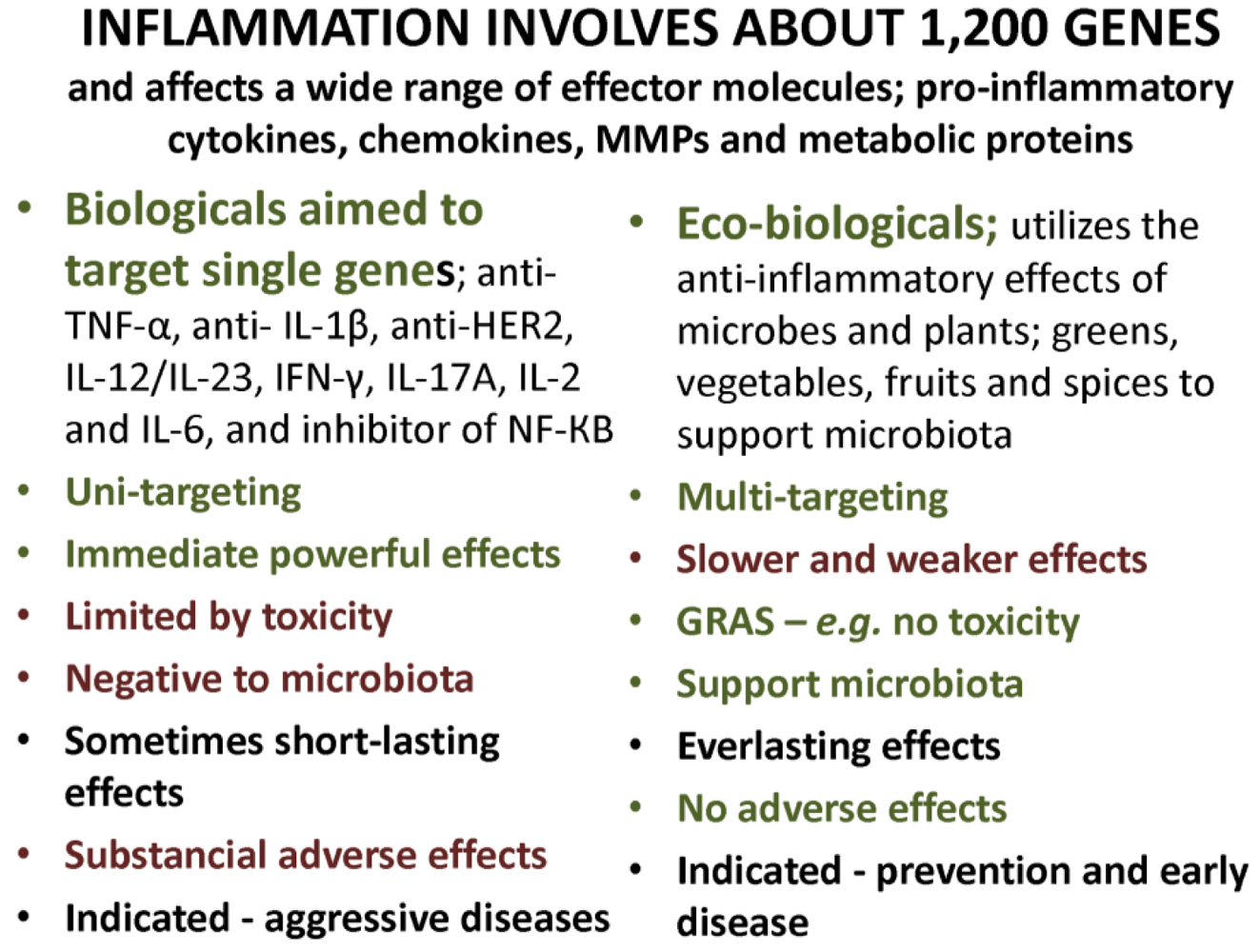
        </caption>
        <graphic xmlns:xlink="http://www.w3.org/1999/xlink" xlink:href="nutrients-05-00162-g002.tif"/>
      </fig>
    </sec>
    <sec>
      <title>16. Asian Foods Associated with Less Disease</title>
      <p>Several population-based studies indicate that people in Southeast Asian countries have a much lower risk of developing colon, gastrointestinal, prostate, breast, and other cancers than their Western counterparts. They also demonstrate significantly reduced incidence, at least when living under rural conditions, of other chronic diseases such as coronary heart diseases, neuro-degenerative diseases, diabetes, inflammatory bowel diseases, <italic>etc.</italic> A significantly lower morbidity and mortality is often observed in countries in this part of the world. Morbidity and mortality in critical illness might also be significantly reduced in Southeast Asian countries, especially when compared to the West. It is likely that the frequent use in these countries of dietary constituents containing antioxidant/chemo-preventive molecules (see <xref ref-type="fig" rid="nutrients-05-00162-f003">Figure 3</xref>), such as garlic, ginger, soybeans, turmeric, onion, tomatoes, cruciferous vegetables, chilies, and green tea, and many others, may play an important role not only in protection from chronic diseases, but also the poor outcome in critical care, as these dietary agents have documented ability to suppress transformative, hyper-proliferative, and inflammatory processes [<xref ref-type="bibr" rid="B144-nutrients-05-00162">144</xref>].</p>
      <fig id="nutrients-05-00162-f003" position="float">
        <label>Figure 3</label>
        <caption>
          <p>Examples of foods rich in key nutrients, which might be tried in future nutrition solutions both for healthy and critically ill individuals. </p>

        </caption>
        <graphic xmlns:xlink="http://www.w3.org/1999/xlink" xlink:href="nutrients-05-00162-g003.tif"/>
      </fig>
      <p>The present knowledge, as obtained from extensive research, especially in recent years, suggests that good health and well-being, in addition to regular physical exercise, good sleep and control of stress/spiritual harmony is strongly associated with the food we eat, and its influence on bodily functions, particularly microbiota. It is unfortunate that the sickest patients are more or less in constant stress, cannot exercise, and receive the worst nutrition. The modification of these conditions should be a highly prioritized challenge. </p>
    </sec>
    <sec>
      <title>17. Seven NOs and Three YESes!</title>
      <p>I suggested, in a recent review, ten important principles in striving for optimal nutrition [<xref ref-type="bibr" rid="B78-nutrients-05-00162">78</xref>]:</p>
  <list list-type="bullet">
   <list-item>
    <p>Restrict intake of insulinogenic, IGF1-rich or IGF1-stimulatory and Toll-stimulatory foods, such as refined carbohydrates: cereals, bread, sweets, cookies, rice, pasta, cooked tubers, including potatoes—these are foods which are absorbed high up in the small intestine and are of minimal benefit to microbiota.</p>
   </list-item>
   <list-item>
    <p>Restrict daily intake of fructose to below 25 grams a day.</p>
   </list-item>
   <list-item>
    <p>Restrict intake of dairy products, especially butter, cheese and milk powder, rich in saturated fats, hormones and growth factors such as IGF1, and also meat intake, especially inflammation-inducing, processed and cured meat such as bacon and sausages. See also [<xref ref-type="bibr" rid="B145-nutrients-05-00162">145</xref>,<xref ref-type="bibr" rid="B146-nutrients-05-00162">146</xref>,<xref ref-type="bibr" rid="B147-nutrients-05-00162">147</xref>].</p>
   </list-item>
   <list-item>
    <p>Restrict/eliminate intake of foods heated above 100 °C, known to be rich in the inflammation-inducing molecules AGEs and ALEs, and particularly foods heated above 130 °C, as foods with increased temperature become increasingly rich in pro-inflammatory and carcinogenic substances such as acrylamide and heterocyclic amines, e.g., fried and grilled foods, and toasted and high-temperature baked breads. See also [<xref ref-type="bibr" rid="B145-nutrients-05-00162">145</xref>,<xref ref-type="bibr" rid="B146-nutrients-05-00162">146</xref>,<xref ref-type="bibr" rid="B147-nutrients-05-00162">147</xref>].</p>
   </list-item>
   <list-item>
    <p>Restrict exposure to microbe-derived high inflammation-inducing endotoxins, especially found in meat hung for several days, hard cheeses, pork and ice creams.</p>
   </list-item>
   <list-item>
    <p>Restrict, eventually eliminate, intake of foods rich in proteotoxins such as casein, gluten and zein.</p>
   </list-item>
   <list-item>
    <p>Restrict intake of chemicals, including pharmaceutical drugs, to only what is absolutely necessary, as most chemicals are likely to be detrimental to microbiota.</p>
   </list-item>
   <list-item>
    <p>Increase dramatically the intake of fresh and raw greens, fresh spices and vegetables, rich in antioxidants, fibers, minerals and nutrients, but also inflammation-controlling factors such as curcumin, resveratrol and many others—see <xref ref-type="fig" rid="nutrients-05-00162-f003">Figure 3</xref>.</p>
   </list-item>
   <list-item>
    <p>Increase/favor intake of ancient antioxidant-rich, high-fiber, low-calorie-containing grains such as buckwheat, amaranth, chia, lupin, millet, quinoa, sorghum, taro, teff, <italic>etc</italic>., and also the intake of beans, peas, chickpeas, lentils, nuts and almonds. See <xref ref-type="table" rid="nutrients-05-00162-t012">Table 12</xref>.</p>
   </list-item>
   <list-item>
    <p>Supplement large doses of vitamin D and omega fatty acids, both of special importance for control of inflammation and for function of microbiota. If ill—also supplement pro-/synbiotics, but only brands with documented clinical effects.</p>
   </list-item>
  </list>	  
    </sec>
    <sec>
      <title>18. Nutrition of the Sick Made to Mimic Healthy Foods for the Healthy</title>
      <p>If supplies of health-supporting nutrients are important to already healthy individuals, there is no doubt that it is even more important for ill patients. It is increasingly recognized that the artificial foods available today, whether made as pet foods, baby formulas or clinical nutrition solutions, often contribute to the development or aggravation of disease. It is especially so with the clinical nutrition solutions presently on the market, often produced from cheap raw materials such as evaporated milk or milk powder, and are not made to mimic natural healthy foods. Patients are not all the same, and they have different needs. Consequently, requests are made for specific formulations for conditions such as diabetes [<xref ref-type="bibr" rid="B148-nutrients-05-00162">148</xref>] and obesity [<xref ref-type="bibr" rid="B149-nutrients-05-00162">149</xref>]. Currently, there are approximately 230 different enteral feeding formulas and nutrition supplements commercially available [<xref ref-type="bibr" rid="B149-nutrients-05-00162">149</xref>], though there should be a place for more specialized “adapted-to-need” formulas.</p>
    </sec>
    <sec>
      <title>19. Source of Protein Is Critical</title>
      <p>The protein needed in the formula can be obtained from a large variety of sources, animal proteins, as well as plant proteins. Animal proteins commonly used in clinical nutrition formulas are usually milk based and consist either of casein (80% of milk proteins), whey (20% of milk proteins), or a mixture of both. Caseins are colloidal aggregations of as1-, as2-, b- and k-, while whey comprises fractions of β-lactoglobulin, α-lactalbumin, lactoferrin, various immunoglobulins, proteose-peptone and serum albumin. All proteins, irrespective of source, seem to be effectively metabolized in the small intestine. A recent study in healthy humans suggests that proteins that pass the terminal ileum are already at that stage dominated by bacterial protein; ~60% bacterial protein, ~15% mucin protein, ~7% soluble-free protein, and ~5% protein from intact mucosal cells, indicating a substantial microbial activity already within the human distal small intestine [<xref ref-type="bibr" rid="B150-nutrients-05-00162">150</xref>]. </p>
      <p>Limited data seems to be available to specifically support the choice of these protein sources. The biological effects vary between different types of proteins. Some proteins, such as Alpha-lactalbumin, gelatin and gelatin fortified with tryptophan, are reported to provide a higher degree of satiety (approx. 40%) than any of the commonly used proteins in nutrition formulas—casein, soy, whey, whey fortified with glycomacropeptide (GMP), for example—thus inducing a a significant reduction in energy intake (approx. 20%) [<xref ref-type="bibr" rid="B151-nutrients-05-00162">151</xref>]. Varying types of proteins are also absorbed differently and will consequently influence insulin response: Significant differences between fast-absorbing whey and soy and slow-absorbing casein have been observed [<xref ref-type="bibr" rid="B152-nutrients-05-00162">152</xref>].</p>
    </sec>
    <sec>
      <title>20. Muscle Protein Synthesis Varies with Type of Protein Supplied</title>
      <p>Enteral nutrients (EN) are known to potentiate the action of glucagon-like peptide-2 (GLP-2), a nutrient-regulated intestinotrophic hormone, derived from proglucagon in the distal intestine. When the ability of different proteins—casein, hydrolyzed soy, whey protein concentrate (WPC), and combined hydrolyzed WPC and casein—were tried in an animal study, only whey protein demonstrated the potential to enhance the ability of GLP-2 to reverse mucosal hypoplasia and increase mucosal cellularity, as well as the absorptive surface area [<xref ref-type="bibr" rid="B153-nutrients-05-00162">153</xref>]. Emerging evidence support that consumption of different types of proteins will have different stimulatory effects on the amplitude, and possibly also duration, of muscle protein synthesis after feeding, being greater after whey or soy protein consumption than after casein, both when measured at rest and after exercise [<xref ref-type="bibr" rid="B154-nutrients-05-00162">154</xref>].</p>
      <p>The capacity of the proteins to inhibit systemic inflammation is of particular importance. When in an animal study the ability of three different protein sources to resist LPS-induced systemic inflammation was studied, a whey-based formula (Peptaman AF, Nestlé Healthcare Nutrition) was demonstrated as significantly superior to a commercial casein-based diet (Promote<sup>®</sup> Abbott) and a standard soy-based diet high in cysteine and crude fiber [<xref ref-type="bibr" rid="B49-nutrients-05-00162">49</xref>]. Another animal study demonstrated that the supply of whey protein to exercise-trained rats led to, in comparison to casein-supplied and soy-supplied animals, significantly higher levels of liver glycogen [<xref ref-type="bibr" rid="B155-nutrients-05-00162">155</xref>]. Furthermore, a recent animal study suggests that whey proteins might possess decidely stronger anti-inflammatory abilities and to significantly decrease levels of IL-1β, TNF-α, IL-6, IL-4, malondialdehyde (MDA), nitric oxide (NO), reactive oxygen species (ROS), and neutrophil infiltration, while reducing wound healing time [<xref ref-type="bibr" rid="B156-nutrients-05-00162">156</xref>]. </p>
    </sec>
    <sec>
      <title>21. Plant-Based Proteins May Have Advantages</title>
      <p>The use of whey proteins seems to have benefits, particularly over casein-based proteins, and most likely also over soy-derived proteins. It is unfortunate that similar information from human studies are largely lacking, despite widespread clinical use of milk-based formulations. However, a recent study in young boys fed casein demonstrated a significant 15% (<italic>P</italic> &lt; 0.0001) increase in pro-inflammatory IGF1/s, but no changes in fasting insulin (<italic>P</italic> = 0.36), while boys fed whey instead had a 21% (<italic>P</italic> = 0.006) increase in fasting insulin, and no change in IGF-1 (<italic>P</italic> = 0.27) [<xref ref-type="bibr" rid="B157-nutrients-05-00162">157</xref>]. A critical review examining twenty-five recently published intervention trials examining chronic and/or acute effects of whey protein supplementation on lipid and glucose metabolism, blood pressure, vascular function and on the musculoskeletal system, concluded that although whey protein may affect glucose metabolism and muscle protein synthesis, the evidence for its clinical efficacy is not strong enough to make final recommendations for its use [<xref ref-type="bibr" rid="B158-nutrients-05-00162">158</xref>]. </p>
      <p>Plant-based proteins might have advantages. A recent study [<xref ref-type="bibr" rid="B159-nutrients-05-00162">159</xref>] demonstrated a great potential of feeding rice protein, especially as it seems to possess the strong ability to improve oxidative stress through enzymatic and non-enzymatic antioxidative defense mechanisms; the total antioxidative capacity (T-AOC), mRNA levels of glutamate cysteine ligase catalytic subunit (GCLC) and glutamate cysteine ligase modulatory subunit (GCLM) mRNA levels, antioxidative enzyme activities (T-SOD and CAT) and glutathione metabolism related enzyme activities. γ-glutamylcysteine synthetase (γ-GCS), glutathione S-transferase (GST), glutathione reductase (GR) and glutathione peroxidase (GSHPx) were all effectively stimulated by feeding rice protein when compared to feeding casein. Feeding rice protein did significantly reduce the hepatic levels of markers of inflammation such as malondialdehyde (MDA) and protein carbonyl (PCO) [<xref ref-type="bibr" rid="B159-nutrients-05-00162">159</xref>].</p>
      <table-wrap id="nutrients-05-00162-t012" position="float">
        <object-id pub-id-type="pii">nutrients-05-00162-t012_Table 12</object-id>
        <label>Table 12</label>
        <caption>
          <p>Chemical composition of amaranth, quinoa, buckwheat in comparison to wheat seeds [<xref ref-type="bibr" rid="B159-nutrients-05-00162">159</xref>].</p>
        </caption>
        <table>
          <thead>
            <tr>
              <th align="center" valign="middle">Seed</th>
              <th align="center" valign="middle">Protein</th>
              <th align="center" valign="middle">Fat</th>
              <th align="center" valign="middle">Total starch</th>
              <th align="center" valign="middle">Dietary fiber</th>
            </tr>
          </thead>
          <tbody>
            <tr>
              <td align="center" valign="middle">Amaranth</td>
              <td align="center" valign="middle">16.5</td>
              <td align="center" valign="middle">5.7</td>
              <td align="center" valign="middle">61.5</td>
              <td align="center" valign="middle">20.6</td>
            </tr>
            <tr>
              <td align="center" valign="middle">Quinoa</td>
              <td align="center" valign="middle">14.5</td>
              <td align="center" valign="middle">5.2</td>
              <td align="center" valign="middle">64.2</td>
              <td align="center" valign="middle">14.2</td>
            </tr>
            <tr>
              <td align="center" valign="middle">Buckwheat</td>
              <td align="center" valign="middle">12.5</td>
              <td align="center" valign="middle">2.1</td>
              <td align="center" valign="middle">58.9</td>
              <td align="center" valign="middle">29.5</td>
            </tr>
            <tr>
              <td align="center" valign="middle">Wheat</td>
              <td align="center" valign="middle">12.0</td>
              <td align="center" valign="middle">2.5</td>
              <td align="center" valign="middle">63.0</td>
              <td align="center" valign="middle">17.4</td>
            </tr>
          </tbody>
        </table>
      </table-wrap>
    </sec>
    <sec>
      <title>22. Pseudocereals—A Promising Alternative Protein Source</title>
      <p>So-called pseudocereals—amaranth, quinoa and buckwheat, to name a few examples—are known to have a somewhat higher content of protein than, for instance, wheat. They decidedly have a higher fat content (amaranth and quinoa) and also a favorable content of dietary fibers (especially amaranth and buckwheat), thereby possibly representing promising alternatives for the production of clinical nutrition formulas—see <xref ref-type="table" rid="nutrients-05-00162-t012">Table 12</xref> [<xref ref-type="bibr" rid="B160-nutrients-05-00162">160</xref>]. The composition of fat in amaranth, quinoa, buckwheat and wheat seeds is similarly favorable with their high content of oleic acid (C18:1): amaranth 23.7; quinoa 26.7; buckwheat 33.6; wheat 13.2. For monounsaturated fats: amaranth 23.9; quinoa 28.1; buckwheat 34.7; and wheat 13.4—all g/100 g. </p>
      <p>Cereals, pseudocereals, and leguminous flours are all known to have a high content of amino acids [<xref ref-type="bibr" rid="B160-nutrients-05-00162">160</xref>], and an amino acid pattern much similar to the human muscle—especially buckwheat—and to constitute excellent substrates for the biosynthesis of γ-aminobutyric acid (GABA), which is known to effectively reduce inflammation and prevent tissue injury [<xref ref-type="bibr" rid="B161-nutrients-05-00162">161</xref>], but also to have strong “calming effects,” effective against fear, anxiety, depression, headaches and other mental conditions [<xref ref-type="bibr" rid="B162-nutrients-05-00162">162</xref>]. Strains of <italic>Lactobacillus plantarum</italic> and <italic>Lactococcus lactis</italic> have been proven effective to ferment cereals, pseudocereals, and leguminous flours and effectively release amino acids and GABA. A blend of buckwheat, amaranth, chickpea and quinoa flours in the proportions 1:1:5.3:1, when fermented with <italic>L. plantarum C48</italic>, was recently demonstrated to produce a high concentration of free amino acids (<italic>ca.</italic> 4467 mg/kg) and GABA (504 mg/kg) [<xref ref-type="bibr" rid="B163-nutrients-05-00162">163</xref>,<xref ref-type="bibr" rid="B164-nutrients-05-00162">164</xref>]. It is my opinion that, in the future, it should be possible to use a similar technology to produce new, hopefully more efficient clinical nutrition formulations.</p>
    </sec>
    <sec>
      <title>23. Source of Fats for Clinical Nutrition</title>
      <p>Mainly three other fat emulsions, apart from the commonly used soybean oil (SO)-based emulsions, have been used in parenteral nutrition formulas: medium-chain triglycerides (MCTs), olive oils (OOs), and fish oil (FOs). Enteral nutrition solutions have, to a large extent, been done to mimic parenteral nutrition solutions. It is most likely, as different oils are metabolized via different pathways, that various fats may affect different functions in the body; they may either induce or inhibit inflammation in the body or reduce or enhance immune suppression. A recent small study compared 12 patients receiving a mixture of soybean and medium-chain triglyceride oils (SMO) with 18 patients receiving a fat emulsion with part of the lipid replaced by fish oil, consequently reporting a trend toward reduced serum inflammatory cytokines in the fish-oil group as significant differences in interleukin (IL)-1, IL-8, and interferon (IFN)-γ was observed on postoperative day 4 (<italic>P</italic> &lt; 0.05) and IL-1, IL-8, IFN-γ, IL-6, and tumor necrosis factor-α on postoperative day 7 (<italic>P</italic> &lt; 0.05) [<xref ref-type="bibr" rid="B165-nutrients-05-00162">165</xref>]. Although not statistically significant, a reduction in postoperative liver dysfunction (fish-oil group <italic>vs.</italic> SMO group: 33% <italic>vs.</italic> 50%) and infection rate (fish-oil group <italic>vs.</italic> SMO group: 28% <italic>vs. </italic>42%) [<xref ref-type="bibr" rid="B165-nutrients-05-00162">165</xref>] was observed. However, other similar recent studies have found no significant difference between such groups [<xref ref-type="bibr" rid="B166-nutrients-05-00162">166</xref>]. </p>
    </sec>
    <sec>
      <title>24. Omega-3-Based Emulsions Receive Increasing Interest</title>
      <p>Lipid mediators derived from the <italic>n</italic>-3 fatty acids eicosapentaenoic acid (EPA) or docosahexaenoic acid (DHA) are increasingly used in clinical nutrition to reduce systemic inflammation. Intercellular mediators such as protectins and resolvins, known to either protect from, or induce resolution of, inflammation, are generated from <italic>n</italic>-3 fatty acids in the body [<xref ref-type="bibr" rid="B167-nutrients-05-00162">167</xref>]. Experimental data suggest that <italic>n</italic>-3 fatty acids may improve acute lung injury and sepsis. Application of <italic>n</italic>-3 fatty acids to patients undergoing major surgery seems to provide some, although not dramatically different, beneficial effects—reduction of length of stay and decrease of infectious complications [<xref ref-type="bibr" rid="B168-nutrients-05-00162">168</xref>,<xref ref-type="bibr" rid="B169-nutrients-05-00162">169</xref>]. Recent human studies are, however, seemingly unable to support such conclusions, at least for critically ill patients on mechanical ventilation. A recent multicenter study [<xref ref-type="bibr" rid="B170-nutrients-05-00162">170</xref>] was undertaken involving 272 adults provided within 48 h of developing acute lung injury and requiring mechanical ventilation enteral supplementation of <italic>n</italic>-3 fatty acids, γ-linolenic acid, and antioxidants. The patients receiving the <italic>n</italic>-3 supplement demonstrated, compared to iso-caloric controls, an eight-fold increase in plasma eicosapentaenoic acid levels, more ventilator-free days (14.0 <italic>vs.</italic> 17.2; <italic>P</italic> = 0.02) (difference, −3.2 (95% CI, −5.8 to −0.7)), more intensive care unit-free days (14.0 <italic>vs.</italic> 16.7; <italic>P</italic> = 0.04), and fewer non-pulmonary organ failure-free days (12.3 <italic>vs.</italic> 15.5; <italic>P</italic> = 0.02). However, the sixty-day hospital mortality was 26.6% in the <italic>n</italic>-3 group <italic>vs</italic>. 16.3% in the control group (<italic>p</italic> = 0.054), and adjusted 60-day mortality was in the <italic>n</italic>-3 and control groups, respectively 25.1% and 17.6% (<italic>P</italic> = 0.11). Use of the <italic>n</italic>-3 supplement did also result in more days with diarrhea (29% <italic>vs.</italic> 21%; <italic>P</italic> = 0.001) [<xref ref-type="bibr" rid="B170-nutrients-05-00162">170</xref>].</p>
      <p>Sixty-four adult patients undergoing surgery for gastrointestinal diseases were randomly assigned to receive isocaloric and isonitrogenous total parenteral nutrition with either an ω-3 fatty acid-enriched emulsion (Lipoplus, <italic>n</italic> = 32) or medium-chain triacylglycerols/long-chain triacylglycerols (Lipofundin; <italic>n</italic> = 32) for 5 days after surgery [<xref ref-type="bibr" rid="B171-nutrients-05-00162">171</xref>]. Total bilirubin decreased faster in the ω-3 fatty acid-enriched group (<italic>p</italic> = 0.017), and the so-called activated partial thromboplastin time was significantly prolonged between days 1 to 3 (<italic>p</italic> = 0.002) than in the other group. Although no differences were observed in C-reactive protein, interleukin (IL)-1, IL-8, IL-10, vascular endothelial growth factor (VEGF), and distribution of the T-cell subpopulation between the two groups, significant decreases in IL-6, tumor necrosis factor-α, and nuclear factor-κB, occurred in parallel to significant increases in leukotriene B5/leukotriene B4 [<xref ref-type="bibr" rid="B171-nutrients-05-00162">171</xref>]. </p>
    </sec>
    <sec>
      <title>25. Olive Oil-Enriched Emulsions May Have Benefits</title>
      <p>Other plant-based sources of fat for clinical nutrition have also been tried. A recent study [<xref ref-type="bibr" rid="B172-nutrients-05-00162">172</xref>] compared parenteral administration to critically ill adults of an olive oil-based lipid emulsion with a standard soybean oil-based lipid emulsion, and found no differences in: rates of infectious and noninfectious complications, glycemic control, inflammatory and oxidative stress markers, and immune function. However, another recent prospective, randomized, controlled crossover study done by the same group and focusing on vascular, metabolic, immune, and inflammatory effects of 24-h parenteral infusion of an olive oil-based emulsion (ClinOleic) reported definite advantages of the olive-oil based formula compared to a soybean oil-based lipid emulsion (Intralipid); the soybean oil-based lipid emulsion increased blood pressure and impaired endothelial function—no such changes were observed with the use olive oil-based lipid emulsion or lipid-free enteral nutrition solutions [<xref ref-type="bibr" rid="B173-nutrients-05-00162">173</xref>].</p>
    </sec>
    <sec>
      <title>26. A Great Need for New Enteral Nutrition Formulas</title>
      <p>The shift in clinical praxis from an almost total parenteral nutrition praxis to an enteral nutrition-dominated praxis in post-surgical, post-trauma and critically ill patients has changed dramatically in clinical praxis and contributed to significant improvement in clinical outcome. However, the formulas for enteral nutrition have not changed to the extent that could have been expected; they continue to look much as they do when constructed for parenteral use. Although the knowledge about healthy and unhealthy foods has increased dramatically, and eating habits at least among health-concerned individuals have changed considerably, this information has not translated into a new generation of enteral nutrition formulas made to mimic natural healthy foods: rich in greens, never heated to high temperatures (low content of AGE and ALE), with no ingredients of proteotoxins such as gluten, casein and zein, <italic>etc.</italic> The content of plant-based foods—especially green leaves—match human dietary needs closer than other foods, and increasing evidence suggests this will lead to improved immune functions, increased resistance to disease and profoundly stronger tissues, especially muscles and tendons. There are thousands of varieties of greens and plant foods and each one has its own unique set of nutrients, which is why it is important to eat a variety of foods. Green smoothies rich in raw foods, greens (liquidized salads), avocadoes, bananas, carrots, fruits, <italic>etc.</italic>, as well as fresh raw-food based soups like the Spanish gazpacho, could constitute interesting alternatives, if hygienic conditions could be solved. </p>
    </sec>
    <sec>
      <title>27. Avocado: A Unique Fruit Rich in Healthy Oils, but Also Antioxidants</title>
      <p>The increased interest in recent years in olive oil as a source of healthy fats is accompanied by interest in other plant-based sources of fats, such as avocado, coconut and red palm tree fruits. The last two had been demonized in the past due to their high content of saturated fat, but today, they are increasingly recognized for their health-promoting ingredients and clinical effects. The avocado fruit are especially rich in monosaturated fats, vitamins E and C, as well as carotenoids and sterols, important ingredients that possess antioxidant and radical scavenging activities often deficient in people in Western societies. Avocado is also particularly rich in lutein, alpha-carotene, beta-carotene, neoxanthin, violaxanthin, zeaxanthin, antheraxanthin, chlorophylls, and pheophytins. Supply of avocado or avocado oil has been shown to increase the uptake of carotenoids several-fold; lutein by 5 times, alpha-carotene 7 times, and beta-carotene 15 times [<xref ref-type="bibr" rid="B174-nutrients-05-00162">174</xref>]. Avocado oil has also been shown to reduce inflammation and protect tissues from destruction, especially observed on the musculoskeletal system [<xref ref-type="bibr" rid="B175-nutrients-05-00162">175</xref>]. </p>
    </sec>
    <sec>
      <title>28. Red Palm Oil: Rich in Vitamin A, MUFAs and Unsaturated Fats</title>
      <p>The lipid profile of palm oil has a near 1:1 ratio of saturated to unsaturated fatty acids. It is regarded as the richest natural source of dietary pro-vitamin A carotenes, said to contain 15 times more pro-vitamin A carotenes than carrots and 300 times more than tomatoes; one teaspoon of red palm oil per day is enough to supply the recommended daily allowance (RDA) of vitamin A for children [<xref ref-type="bibr" rid="B176-nutrients-05-00162">176</xref>]. It is also a most abundant natural source of vitamin E, α-tocotrienol, and α-iocotrienol, lycopenes, squalene, Co-enzyme Q10, and saturated and unsaturated fatty acids (known to maximize absorption of carotenoid anti-oxidants). It is reported to possess unique tissue-protective capacity and especially strong neuro-protective properties. Palm oil-derived α-tocotrienol is said to reach the brain in sufficient quantity to attenuate stroke-mediated neuropathy [<xref ref-type="bibr" rid="B177-nutrients-05-00162">177</xref>]. Red palm oil with its high level of saturated fatty acid seems not, as feared earlier, to promote atherosclerosis and/or arterial thrombosis. The reason could be that most of the saturated fat in palm oil is medium-chain fatty acids (MCFA), which is absorbed directly into the portal vein, and rapidly transported to the liver for beta-oxidation, while long-chain fatty acids (LCFA), in the form of triacylglycerols, which dominate Western-type foods, are absorbed via the intestinal lymphatic ducts and transported by chylomicrons through the thoracic duct and directly into the systemic circulation, leading to a difference that could explain the dramatically different effects on systemic inflammation and health [<xref ref-type="bibr" rid="B178-nutrients-05-00162">178</xref>].</p>
    </sec>
    <sec>
      <title>29. Red Palm Oil (and Coconut Oil): Effective against Inflammation</title>
      <p>As a matter of fact, red palm oil has been reported to reduce the risk of arterial thrombosis and/or atherosclerosis, to inhibit endogenous cholesterol biosynthesis, platelet aggregation, reduce oxidative stress and significantly reduce blood pressure. It is suggested that dietary red palm oil, consumed in moderation by animals and humans, have the ability to promote efficient utilization of nutrients, activate hepatic metabolism of drugs, facilitate hemoglobinization of red blood cells and improve immune function [<xref ref-type="bibr" rid="B176-nutrients-05-00162">176</xref>]. In large parts of Africa, red palm oil is also regarded as potent inhibitor of the progress of HIV, but studies are lacking to support this belief. A recent <italic>in vitro </italic>study on human monocytic cells confirm that red palm oil has a remarkable ability to effectively inhibit LPS-induced generation of NO, production of PGE2, stimulation of secretion of pro-inflammatory cytokines (TNF-a, IL-4, and IL-8), and expression of iNOS, COX-2, and NF-jB [<xref ref-type="bibr" rid="B179-nutrients-05-00162">179</xref>]. The production of PGE2 and down-regulating of the expression of COX-2 and iNOS occurred in a dose-dependent manner, observations that support the potent anti-inflammatory activity of red palm oil with blockage of NF-КB activation and selective inhibition of COX-2 expression [<xref ref-type="bibr" rid="B180-nutrients-05-00162">180</xref>]. Studies demonstrating the ability of red palm oil to protect against ischemia and reperfusion injuries of the heart is most promising [<xref ref-type="bibr" rid="B180-nutrients-05-00162">180</xref>,<xref ref-type="bibr" rid="B181-nutrients-05-00162">181</xref>,<xref ref-type="bibr" rid="B182-nutrients-05-00162">182</xref>] and merits further investigations.</p>
    </sec>
    <sec>
      <title>30. Medium-Chain Fatty Acids Have Anti-Infectious Effects and Do Not Produce Resistance!</title>
      <p>Plant oil such as coconut or palm oil are rich in capric acid (C10:0) and lauric acid (C12:0), as well as the essential fatty acid, linoleic acid (C18:2). Capric acid (C10:0) and lauric acid (C12:0), also found in safflower oil, evening primrose oil and poppy-seed oil, are all recognized for their powerful bactericidal effects on a large number of bacteria, viruses and funguses. This information supports the specific role of these lipids on innate immunity. Specific fatty acids, especially those associated with phospholipids and particularly sphingolipids, are deeply involved in the physical barriers, permeability barriers, and immunologic barrier functions both of the skin and mucosal surfaces. The antibacterial actions of free fatty acids (FFAs) are typically broad spectrum and of potencies comparable to natural antimicrobial peptides (AMPs). While FFAs are not as structurally diverse as the more widely studied AMPs, their importance in the human innate immune system is well established, particularly in the defense of skin and mucosal surfaces [<xref ref-type="bibr" rid="B183-nutrients-05-00162">183</xref>]. Furthermore, the fact that FFA-resistant phenotypes as seen with conventional antibiotics rarely exist with antimicrobial fatty acids, makes plant-derived FFAs especially attractive for use both in medicine and in clinical nutrition. </p>
    </sec>
    <sec>
      <title>31. Urgent Need for New Eco-Biological Formulas</title>
      <p>Disciplines like immunotoxicology and immunopharmacology are still in their infancy. Much evidence exists to support that the drugs we often use in ICUs have strong and hitherto sometimes unrecognized and often ignored negative influences on the immune system and to resistance against inflammation and infection [<xref ref-type="bibr" rid="B184-nutrients-05-00162">184</xref>]. The increasing information about the damage that most pharmaceuticals produce on microbiota renders it urgent for priority to be given to choice and use of pharmaceuticals, especially for the critically ill. It remains a great dilemma and a completely unsolved issue that the sickest and most demanding patients are not only under constant mental and physical stress with no chance of physical exercise, but also receive the most incomplete—even dangerous—nutrition, often containing ingredients documented to escalate inflammation and contribute to increased morbidity. </p>
      <p>There is an urgent need for a completely new set of enteral nutrition formulas. The formulas presently used are only slightly different compared to the artificial formulas used for parenteral nutrition, made mainly to provide calories and to support a favorable nitrogen balance. New insights necessitate formulas made mainly or entirely with the goal of restoring homeostasis in inflammation and immune functions. The new science of nutrigenomics provides tools to identify the effects of various food ingredients and their effects on various genes, particularly those associated with inflammation and immune functions. Immediate attempts should be made to avoid nutrition formula ingredients such as long-chain saturated fats, trans-fatty acids, advanced glycation end products (AGEs) [<xref ref-type="bibr" rid="B145-nutrients-05-00162">145</xref>,<xref ref-type="bibr" rid="B146-nutrients-05-00162">146</xref>,<xref ref-type="bibr" rid="B147-nutrients-05-00162">147</xref>], hormones, and various stress molecules and sugars, particularly fructose. Future enteral nutrition formulas should be made to mimic normal food as closely as possible. Certainly, some already-used regular foods, such as Mediterranean raw soups like the Spanish gazpacho and various other vegetable and fish soups, can be adapted for clinical use and provided, if necessary also by tube-feeding. Green leaves, fresh vegetable and fruit juices/smoothies can easily be adapted for clinical use and probiotic bacteria, prebiotic fibers, and plant antioxidants, various polyphenols, such as curcumenoids and resveratrol and similar molecules, can be mixed into these solutions. I have only recently realized the special importance of green leaves, especially when compared to roots; they have a low content of energy, but are enormously richn in important nutrients, minerals, vitamins, antioxidants—some being hundreds or thousand times richer in the leaves than in the roots—see <xref ref-type="table" rid="nutrients-05-00162-t013">Table 13</xref> [<xref ref-type="bibr" rid="B185-nutrients-05-00162">185</xref>]. </p>
      <table-wrap id="nutrients-05-00162-t013" position="float">
        <object-id pub-id-type="pii">nutrients-05-00162-t013_Table 13</object-id>
        <label>Table 13</label>
        <caption>
          <p>Differences in ingredients between greens and roots of the same plant [<xref ref-type="bibr" rid="B184-nutrients-05-00162">184</xref>].</p>
        </caption>
        <table>
          <thead>
            <tr>
              <th align="center" valign="middle">Nutrients</th>
              <th align="center" valign="middle">Beets 100 g</th>
              <th colspan="3" align="center" valign="middle">Beet greens 100 g Difference %</th>
            </tr>
          </thead>
          <tbody>
            <tr>
              <td align="center" valign="middle">Calories</td>
              <td align="center" valign="middle">43.00 </td>
              <td rowspan="18" align="center" valign="middle">　</td>
              <td align="center" valign="middle">22.00 </td>
              <td align="center" valign="middle">−51</td>
            </tr>
            <tr>
              <td align="center" valign="middle">Protein (g)</td>
              <td align="center" valign="middle">1.61 </td>
              <td align="center" valign="middle">2.20 </td>
              <td align="center" valign="middle">+35</td>
            </tr>
            <tr>
              <td align="center" valign="middle">Fat total (g)</td>
              <td align="center" valign="middle">0.17 </td>
              <td align="center" valign="middle">0.13 </td>
              <td align="center" valign="middle">−76</td>
            </tr>
            <tr>
              <td align="center" valign="middle">Carbohydrate (g)</td>
              <td align="center" valign="middle">9.56 </td>
              <td align="center" valign="middle">4.33 </td>
              <td align="center" valign="middle">−45</td>
            </tr>
            <tr>
              <td align="center" valign="middle">Fiber Total (g)</td>
              <td align="center" valign="middle">2.80 </td>
              <td align="center" valign="middle">3.70 </td>
              <td align="center" valign="middle">+32</td>
            </tr>
            <tr>
              <td align="center" valign="middle">Sugar Total (g)</td>
              <td align="center" valign="middle">6.76 </td>
              <td align="center" valign="middle">0.50 </td>
              <td align="center" valign="middle">−740</td>
            </tr>
            <tr>
              <td align="center" valign="middle">Calcium (mg)</td>
              <td align="center" valign="middle">16.00 </td>
              <td align="center" valign="middle">117.00 </td>
              <td align="center" valign="middle">+731</td>
            </tr>
            <tr>
              <td align="center" valign="middle">Iron (mg)</td>
              <td align="center" valign="middle">0.80 </td>
              <td align="center" valign="middle">2.57 </td>
              <td align="center" valign="middle">+321</td>
            </tr>
            <tr>
              <td align="center" valign="middle">Magnesium (mg)</td>
              <td align="center" valign="middle">23.00 </td>
              <td align="center" valign="middle">70.00 </td>
              <td align="center" valign="middle">+304</td>
            </tr>
            <tr>
              <td align="center" valign="middle">Potassium (mg)</td>
              <td align="center" valign="middle">325.00 </td>
              <td align="center" valign="middle">762.00 </td>
              <td align="center" valign="middle">+235</td>
            </tr>
            <tr>
              <td align="center" valign="middle">Sodium (mg)</td>
              <td align="center" valign="middle">78.00 </td>
              <td align="center" valign="middle">226.00 </td>
              <td align="center" valign="middle">+290</td>
            </tr>
            <tr>
              <td align="center" valign="middle">Copper (mg)</td>
              <td align="center" valign="middle">0.08 </td>
              <td align="center" valign="middle">0.19 </td>
              <td align="center" valign="middle">+238</td>
            </tr>
            <tr>
              <td align="center" valign="middle">Selenium (mg)</td>
              <td align="center" valign="middle">0.70 </td>
              <td align="center" valign="middle">0.90 </td>
              <td align="center" valign="middle">+29</td>
            </tr>
            <tr>
              <td align="center" valign="middle">Vitamin C (mg)</td>
              <td align="center" valign="middle">4.90 </td>
              <td align="center" valign="middle">30.00 </td>
              <td align="center" valign="middle">+500</td>
            </tr>
            <tr>
              <td align="center" valign="middle">Riboflavin (mg)</td>
              <td align="center" valign="middle">0.04 </td>
              <td align="center" valign="middle">0.22 </td>
              <td align="center" valign="middle">+612</td>
            </tr>
            <tr>
              <td align="center" valign="middle">Vitamin A (IU)</td>
              <td align="center" valign="middle">33.00 </td>
              <td align="center" valign="middle">6326.00 </td>
              <td align="center" valign="middle">+19,169</td>
            </tr>
            <tr>
              <td align="center" valign="middle">Vitamin E (mg)</td>
              <td align="center" valign="middle">0.04 </td>
              <td align="center" valign="middle">1.50 </td>
              <td align="center" valign="middle">+3750</td>
            </tr>
            <tr>
              <td align="center" valign="middle">Vitamin K (mcg)</td>
              <td align="center" valign="middle">0.20 </td>
              <td align="center" valign="middle">400.00 </td>
              <td align="center" valign="middle">+200,000</td>
            </tr>
          </tbody>
        </table>
      </table-wrap>
    </sec>
    <sec>
      <title>32. Restoring Microbiota—Key to Success?</title>
      <p>Studies of the critically ill, especially those with systemic inflammatory reaction syndrome (SIRS), report severe dysbiosis. When compared with healthy volunteers, they often have 10,000 times fewer total anaerobes, including the “beneficial” Bifidobacterium and Lactobacillus, and 100 times more “pathogenic” bacteria, such as Staphylococcus bacteria. The content in the gut of organic acids, in general, but butyric and propionic acids, in particular, are severely reduced. Recent studies report the production of “mucosa-tightening” butyric acid as almost extinct (from 16.6 ± 6.7 to 0.9 ± 2.3) [<xref ref-type="bibr" rid="B72-nutrients-05-00162">72</xref>,<xref ref-type="bibr" rid="B73-nutrients-05-00162">73</xref>,<xref ref-type="bibr" rid="B74-nutrients-05-00162">74</xref>].</p>
      <p>The incidence of organ failure and ICU mortality is reported to be significantly higher in patients with profound reductions in size and diversity of microbiota, especially when associated with a massive presence of enterococci and with the use of antibiotics, especially clindamycin [<xref ref-type="bibr" rid="B186-nutrients-05-00162">186</xref>]. Information like this provides strong support to efforts to prevent dysfunctioning microbiota, “dysbiosis” and, when needed—as it always is for critically ill patients—strong and forceful efforts to restore homeostasis in microbiota, the ideal state of balance being called “eubiosis”. Recent cutting-edge results from the supplementation of synbiotics to postoperative and critically ill patients as discussed earlier, support recommendations to routinely supplement specific LAB and fibers (synbiotics) to a wide group of patients undergoing major medical or surgical treatments or suffering from polytrauma or medical emergencies such as acute pancreatitis or myocardial infarction. For patients who cannot tolerate enteral feeding, administration of synbiotics by enemas with live LAB may be a treatment option. It is important to remember that most patients do not die of their disease but from a disordered physiology caused by either the disease or, as often happens, by the treatments. </p>
    </sec>
  </body>
  <back>
    <notes>
      <title>Conflict of Interest</title>
      <p>The author owns shares in several nutrition and probiotic companies.</p>
    </notes>
    <ref-list>
      <title>References</title>
      <ref id="B1-nutrients-05-00162">
        <label>1.</label>
        <citation citation-type="journal">
          <person-group person-group-type="author">
            <name>
              <surname>Kumar</surname>
              <given-names>G.</given-names>
            </name>
            <name>
              <surname>Kumar</surname>
              <given-names>N.</given-names>
            </name>
            <name>
              <surname>Taneja</surname>
              <given-names>A.</given-names>
            </name>
            <name>
              <surname>Kaleekal</surname>
              <given-names>T.</given-names>
            </name>
            <name>
              <surname>Tarima</surname>
              <given-names>S.</given-names>
            </name>
            <name>
              <surname>McGinley</surname>
              <given-names>E.</given-names>
            </name>
            <name>
              <surname>Jimenez</surname>
              <given-names>E.</given-names>
            </name>
            <name>
              <surname>Mohan</surname>
              <given-names>A.</given-names>
            </name>
            <name>
              <surname>Khan</surname>
              <given-names>R.A.</given-names>
            </name>
            <name>
              <surname>Whittle</surname>
              <given-names>J.</given-names>
            </name>
            <name>
              <surname>Jacobs</surname>
              <given-names>E.</given-names>
            </name>
            <name>
              <surname>Nanchal</surname>
              <given-names>R.</given-names>
            </name>
          </person-group>
          <article-title>Nationwide trends of severe sepsis in the twenty fi rst century (2000-2007)</article-title>
          <source>Chest</source>
          <year>2011</year>
          <volume>140</volume>
          <fpage>1223</fpage>
          <lpage>1231</lpage>
        <pub-id pub-id-type="doi">10.1378/chest.11-0352</pub-id><pub-id pub-id-type="pmid">21852297</pub-id></citation>
      </ref>
      <ref id="B2-nutrients-05-00162">
        <label>2.</label>
        <citation citation-type="web">
          <person-group person-group-type="author">
            <name>
              <surname>Hall</surname>
              <given-names>M.J.</given-names>
            </name>
            <name>
              <surname>Williams</surname>
              <given-names>S.J.</given-names>
            </name>
            <name>
              <surname>DeFrances</surname>
              <given-names>C.J.</given-names>
            </name>
            <name>
              <surname>Golosinsky</surname>
              <given-names>A.</given-names>
            </name>
          </person-group>
          <article-title>Inpatient care for septicemia or sepsis: A challenge for patients and hospitals</article-title>
          <access-date>(accessed on 16 November 2012)</access-date>
          <comment>Available online:<ext-link xmlns:xlink="http://www.w3.org/1999/xlink" xlink:href="http://www.cdc.gov/nchs/data/databriefs/db62.pdf" ext-link-type="uri">http://www.cdc.gov/nchs/data/databriefs/db62.pdf</ext-link></comment>
        </citation>
      </ref>
      <ref id="B3-nutrients-05-00162">
        <label>3.</label>
        <citation citation-type="journal">
          <person-group person-group-type="author">
            <name>
              <surname>Vincent</surname>
              <given-names>J.L.</given-names>
            </name>
          </person-group>
          <article-title>Increasing awareness of sepsis: World Sepsis Day</article-title>
          <source>Crit. Care</source>
          <year>2012</year>
          <volume>16</volume>
          <fpage>152</fpage>
          <pub-id pub-id-type="doi">10.1186/cc11511</pub-id>
        </citation>
      </ref>
      <ref id="B4-nutrients-05-00162">
        <label>4.</label>
        <citation citation-type="journal">
          <person-group person-group-type="author">
            <name>
              <surname>Guggenbichler</surname>
              <given-names>J.P.</given-names>
            </name>
            <name>
              <surname>Assadian</surname>
              <given-names>O.</given-names>
            </name>
            <name>
              <surname>Boeswald</surname>
              <given-names>M.</given-names>
            </name>
            <name>
              <surname>Kramer</surname>
              <given-names>A.</given-names>
            </name>
          </person-group>
          <article-title>Incidence and clinical implication of nosocomial infections associated with implantable biomaterials—catheters, ventilator-associated pneumonia, urinary tract infections</article-title>
          <source>GMS Krankenhhyg. Interdiszip.</source>
          <year>2011</year>
          <volume>6</volume>
          <fpage>1</fpage>
        </citation>
      </ref>
      <ref id="B5-nutrients-05-00162">
        <label>5.</label>
        <citation citation-type="journal">
          <person-group person-group-type="author">
            <name>
              <surname>Weiser</surname>
              <given-names>T.G.</given-names>
            </name>
            <name>
              <surname>Regenbogen</surname>
              <given-names>S.E.</given-names>
            </name>
            <name>
              <surname>Thompson</surname>
              <given-names>K.D.</given-names>
            </name>
            <name>
              <surname>Haynes</surname>
              <given-names>A.B.</given-names>
            </name>
            <name>
              <surname>Lipsitz</surname>
              <given-names>S.R.</given-names>
            </name>
            <name>
              <surname>Berry</surname>
              <given-names>W.R.</given-names>
            </name>
            <name>
              <surname>Gawande</surname>
              <given-names>A.A.</given-names>
            </name>
          </person-group>
          <article-title>An estimation of the global volume of surgery: A modelling strategy based on available data</article-title>
          <source>Lancet</source>
          <year>2008</year>
          <volume>372</volume>
          <fpage>139</fpage>
          <lpage>144</lpage>
        <pub-id pub-id-type="doi">10.1016/S0140-6736(08)60878-8</pub-id><pub-id pub-id-type="pmid">18582931</pub-id></citation>
      </ref>
      <ref id="B6-nutrients-05-00162">
        <label>6.</label>
        <citation citation-type="journal">
          <person-group person-group-type="author">
            <name>
              <surname>Pearse</surname>
              <given-names>R.M.</given-names>
            </name>
            <name>
              <surname>Moreno</surname>
              <given-names>R.P.</given-names>
            </name>
            <name>
              <surname>Bauer</surname>
              <given-names>P.</given-names>
            </name>
            <name>
              <surname>Pelosi</surname>
              <given-names>P.</given-names>
            </name>
            <name>
              <surname>Metnitz</surname>
              <given-names>P.</given-names>
            </name>
            <name>
              <surname>Spies</surname>
              <given-names>C.</given-names>
            </name>
            <name>
              <surname>Vallet</surname>
              <given-names>B.</given-names>
            </name>
            <name>
              <surname>Vincent</surname>
              <given-names>J.L.</given-names>
            </name>
            <name>
              <surname>Hoeft</surname>
              <given-names>A.</given-names>
            </name>
            <name>
              <surname>Rhodes</surname>
              <given-names>A.</given-names>
            </name>
            <etal/>
          </person-group>
          <article-title>Mortality after surgery in Europe: A 7 day cohort study</article-title>
          <source>Lancet</source>
          <year>2012</year>
          <volume>380</volume>
          <fpage>1059</fpage>
          <lpage>1065</lpage>
        <pub-id pub-id-type="doi">10.1016/S0140-6736(12)61148-9</pub-id><pub-id pub-id-type="pmid">22998715</pub-id></citation>
      </ref>
      <ref id="B7-nutrients-05-00162">
        <label>7.</label>
        <citation citation-type="journal">
          <person-group person-group-type="author">
            <name>
              <surname>Khuri</surname>
              <given-names>S.F.</given-names>
            </name>
            <name>
              <surname>Henderson</surname>
              <given-names>W.G.</given-names>
            </name>
            <name>
              <surname>DePalma</surname>
              <given-names>R.G.</given-names>
            </name>
            <name>
              <surname>Mosca</surname>
              <given-names>C.</given-names>
            </name>
            <name>
              <surname>Healey</surname>
              <given-names>N.A.</given-names>
            </name>
            <name>
              <surname>Kumbhani</surname>
              <given-names>D.J.</given-names>
            </name>
          </person-group>
          <article-title>Determinants of long-term survival after major surgery and the adverse eff ect of postoperative complications</article-title>
          <source>Ann. Surg.</source>
          <year>2005</year>
          <volume>242</volume>
          <fpage>326</fpage>
          <lpage>341</lpage>
        <pub-id pub-id-type="pmid">16135919</pub-id></citation>
      </ref>
      <ref id="B8-nutrients-05-00162">
        <label>8.</label>
        <citation citation-type="journal">
          <person-group person-group-type="author">
            <name>
              <surname>Pearse</surname>
              <given-names>R.M.</given-names>
            </name>
            <name>
              <surname>Harrison</surname>
              <given-names>D.A.</given-names>
            </name>
            <name>
              <surname>James</surname>
              <given-names>P.</given-names>
            </name>
            <name>
              <surname>Watson</surname>
              <given-names>D.</given-names>
            </name>
            <name>
              <surname>Hinds</surname>
              <given-names>C.</given-names>
            </name>
            <name>
              <surname>Rhodes</surname>
              <given-names>A.</given-names>
            </name>
            <name>
              <surname>Grounds</surname>
              <given-names>R.M.</given-names>
            </name>
            <name>
              <surname>Bennett</surname>
              <given-names>E.D.</given-names>
            </name>
          </person-group>
          <article-title>Identification and characterisation of the high-risk surgical population in the United Kingdom</article-title>
          <source>Crit. Care</source>
          <year>2006</year>
          <volume>10</volume>
          <fpage>R81</fpage>
          <pub-id pub-id-type="doi">10.1186/cc4928</pub-id>
        </citation>
      </ref>
      <ref id="B9-nutrients-05-00162">
        <label>9.</label>
        <citation citation-type="journal">
          <person-group person-group-type="author">
            <name>
              <surname>Jhanji</surname>
              <given-names>S.</given-names>
            </name>
            <name>
              <surname>Thomas</surname>
              <given-names>B.</given-names>
            </name>
            <name>
              <surname>Ely</surname>
              <given-names>A.</given-names>
            </name>
            <name>
              <surname>Watson</surname>
              <given-names>D.</given-names>
            </name>
            <name>
              <surname>Hinds</surname>
              <given-names>C.J.</given-names>
            </name>
            <name>
              <surname>Pearse</surname>
              <given-names>R.M.</given-names>
            </name>
          </person-group>
          <article-title>Mortality and utilisation of critical care resources amongst high-risk surgical patients in a large NHS trust</article-title>
          <source>Anaesthesia</source>
          <year>2008</year>
          <volume>63</volume>
          <fpage>695</fpage>
          <lpage>700</lpage>
          <pub-id pub-id-type="doi">10.1111/j.1365-2044.2008.05560.x</pub-id>
        </citation>
      </ref>
      <ref id="B10-nutrients-05-00162">
        <label>10.</label>
        <citation citation-type="book">
          <person-group person-group-type="author">
            <name>
              <surname>Findlay</surname>
              <given-names>G.</given-names>
            </name>
            <name>
              <surname>Goodwin</surname>
              <given-names>A.</given-names>
            </name>
            <name>
              <surname>Protopappa</surname>
              <given-names>K.</given-names>
            </name>
            <name>
              <surname>Smith</surname>
              <given-names>N.</given-names>
            </name>
            <name>
              <surname>Mason</surname>
              <given-names>M.</given-names>
            </name>
          </person-group>
          <source>Knowing the Risk: A Review of the Peri-Operative Care of Surgical Patients</source>
          <publisher-name>National Confidential Enquiry into Patient Outcome and Death</publisher-name>
          <publisher-loc>London, UK</publisher-loc>
          <year>2011</year>
        </citation>
      </ref>
      <ref id="B11-nutrients-05-00162">
        <label>11.</label>
        <citation citation-type="journal">
          <person-group person-group-type="author">
            <name>
              <surname>Head</surname>
              <given-names>J.</given-names>
            </name>
            <name>
              <surname>Ferrie</surname>
              <given-names>J.E.</given-names>
            </name>
            <name>
              <surname>Alexanderson</surname>
              <given-names>K.</given-names>
            </name>
            <name>
              <surname>Westerlund</surname>
              <given-names>H.</given-names>
            </name>
            <name>
              <surname>Vahtera</surname>
              <given-names>J.</given-names>
            </name>
            <name>
              <surname>Kivimaki</surname>
              <given-names>M.</given-names>
            </name>
          </person-group>
          <article-title>Diagnosis-specific sickness absence as a predictor of mortality: the Whitehall II prospective cohort study</article-title>
          <source>BMJ</source>
          <year>2008</year>
          <volume>337</volume>
          <fpage>a1469</fpage>
        <pub-id pub-id-type="doi">10.1136/bmj.a1469</pub-id><pub-id pub-id-type="pmid">18832415</pub-id></citation>
      </ref>
      <ref id="B12-nutrients-05-00162">
        <label>12.</label>
        <citation citation-type="journal">
          <person-group person-group-type="author">
            <name>
              <surname>Jencks</surname>
              <given-names>S.F.</given-names>
            </name>
            <name>
              <surname>Williams</surname>
              <given-names>M.V.</given-names>
            </name>
            <name>
              <surname>Coleman</surname>
              <given-names>E.A.</given-names>
            </name>
          </person-group>
          <article-title>Rehospitalizations among patients in the Medicare fee-for-service program</article-title>
          <source>N. Engl. J. Med.</source>
          <year>2009</year>
          <volume>360</volume>
          <fpage>1418</fpage>
          <lpage>1428</lpage>
          <pub-id pub-id-type="doi">10.1056/NEJMsa0803563</pub-id>
        </citation>
      </ref>
      <ref id="B13-nutrients-05-00162">
        <label>13.</label>
        <citation citation-type="journal">
          <person-group person-group-type="author">
            <name>
              <surname>Derogar</surname>
              <given-names>M.</given-names>
            </name>
            <name>
              <surname>Orsini</surname>
              <given-names>N.</given-names>
            </name>
            <name>
              <surname>Sadr-Azodi</surname>
              <given-names>O.</given-names>
            </name>
            <name>
              <surname>Lagergren</surname>
              <given-names>P.</given-names>
            </name>
          </person-group>
          <article-title>Influence of major postoperative complications on health-related quality of life among long-term survivors of esophageal cancer surgery</article-title>
          <source>J. Clin. Oncol.</source>
          <year>2012</year>
          <volume>30</volume>
          <fpage>1615</fpage>
          <lpage>1619</lpage>
          <pub-id pub-id-type="doi">10.1200/JCO.2011.40.3568</pub-id>
        </citation>
      </ref>
      <ref id="B14-nutrients-05-00162">
        <label>14.</label>
        <citation citation-type="journal">
          <person-group person-group-type="author">
            <name>
              <surname>Dombrovskiy</surname>
              <given-names>V.Y.</given-names>
            </name>
            <name>
              <surname>Martin</surname>
              <given-names>A.A.</given-names>
            </name>
            <name>
              <surname>Sunderram</surname>
              <given-names>J.</given-names>
            </name>
            <name>
              <surname>Paz</surname>
              <given-names>H.L.</given-names>
            </name>
          </person-group>
          <article-title>Facing the challenge: Decreasing case fatality rates in severe sepsis despite increasing hospitalizations</article-title>
          <source>Crit. Care Med.</source>
          <year>2005</year>
          <volume>33</volume>
          <fpage>2555</fpage>
          <lpage>2562</lpage>
          <pub-id pub-id-type="doi">10.1097/01.CCM.0000186748.64438.7B</pub-id>
        </citation>
      </ref>
      <ref id="B15-nutrients-05-00162">
        <label>15.</label>
        <citation citation-type="journal">
          <person-group person-group-type="author">
            <name>
              <surname>Dombrovskiy</surname>
              <given-names>V.Y.</given-names>
            </name>
            <name>
              <surname>Martin</surname>
              <given-names>A.A.</given-names>
            </name>
            <name>
              <surname>Sunderram</surname>
              <given-names>J.</given-names>
            </name>
            <name>
              <surname>Paz</surname>
              <given-names>H.L.</given-names>
            </name>
          </person-group>
          <article-title>Rapid increase in hospitalization and mortality rates for severe sepsis in the United States: A trend analysis from 1993 to 2003</article-title>
          <source>Crit. Care Med.</source>
          <year>2007</year>
          <volume>35</volume>
          <fpage>1244</fpage>
          <lpage>1250</lpage>
          <pub-id pub-id-type="doi">10.1097/01.CCM.0000261890.41311.E9</pub-id>
        </citation>
      </ref>
      <ref id="B16-nutrients-05-00162">
        <label>16.</label>
        <citation citation-type="journal">
          <person-group person-group-type="author">
            <name>
              <surname>Vogel</surname>
              <given-names>T.R.</given-names>
            </name>
            <name>
              <surname>Dombrovskiy</surname>
              <given-names>V.Y.</given-names>
            </name>
            <name>
              <surname>Carson</surname>
              <given-names>J.L.</given-names>
            </name>
            <name>
              <surname>Graham</surname>
              <given-names>A.M.</given-names>
            </name>
            <name>
              <surname>Lowry</surname>
              <given-names>S.F.</given-names>
            </name>
          </person-group>
          <article-title>Postoperative sepsis in the United States</article-title>
          <source>Ann. Surg.</source>
          <year>2010</year>
          <volume>252</volume>
          <fpage>1065</fpage>
          <lpage>1071</lpage>
          <pub-id pub-id-type="doi">10.1097/SLA.0b013e3181dcf36e</pub-id>
        </citation>
      </ref>
      <ref id="B17-nutrients-05-00162">
        <label>17.</label>
        <citation citation-type="journal">
          <person-group person-group-type="author">
            <name>
              <surname>Arias</surname>
              <given-names>E.</given-names>
            </name>
            <name>
              <surname>Smith</surname>
              <given-names>B.L.</given-names>
            </name>
          </person-group>
          <article-title>Deaths: Preliminary data for 2001</article-title>
          <source>Natl. Vital Stat. Rep.</source>
          <year>2003</year>
          <volume>51</volume>
          <fpage>1</fpage>
          <lpage>44</lpage>
        <pub-id pub-id-type="pmid">12918931</pub-id></citation>
      </ref>
      <ref id="B18-nutrients-05-00162">
        <label>18.</label>
        <citation citation-type="journal">
          <person-group person-group-type="author">
            <name>
              <surname>Angus</surname>
              <given-names>D.C.</given-names>
            </name>
            <name>
              <surname>Linde-Zwirble</surname>
              <given-names>W.T.</given-names>
            </name>
            <name>
              <surname>Lidicker</surname>
              <given-names>J.</given-names>
            </name>
            <name>
              <surname>Clermont</surname>
              <given-names>G.</given-names>
            </name>
            <name>
              <surname>Carcillo</surname>
              <given-names>J.</given-names>
            </name>
            <name>
              <surname>Pinsky</surname>
              <given-names>M.R.</given-names>
            </name>
          </person-group>
          <article-title>Epidemiology of severe sepsis in the United States: Analysis of incidence, outcome and associated costs of care</article-title>
          <source>Crit. Care Med.</source>
          <year>2001</year>
          <volume>29</volume>
          <fpage>1303</fpage>
          <lpage>1310</lpage>
          <pub-id pub-id-type="doi">10.1097/00003246-200107000-00002</pub-id>
        </citation>
      </ref>
      <ref id="B19-nutrients-05-00162">
        <label>19.</label>
        <citation citation-type="journal">
          <person-group person-group-type="author">
            <name>
              <surname>Elias</surname>
              <given-names>A.C.</given-names>
            </name>
            <name>
              <surname>Matsuo</surname>
              <given-names>T.</given-names>
            </name>
            <name>
              <surname>Grion</surname>
              <given-names>C.M.</given-names>
            </name>
            <name>
              <surname>Cardoso</surname>
              <given-names>L.T.</given-names>
            </name>
            <name>
              <surname>Verri</surname>
              <given-names>P.H.</given-names>
            </name>
          </person-group>
          <article-title>Incidence and risk factors forsepsisin surgical patients: A cohort study</article-title>
          <source>J. Crit. Care</source>
          <year>2012</year>
          <volume>27</volume>
          <fpage>159</fpage>
          <lpage>166</lpage>
        <pub-id pub-id-type="pmid">22172797</pub-id></citation>
      </ref>
      <ref id="B20-nutrients-05-00162">
        <label>20.</label>
        <citation citation-type="journal">
          <person-group person-group-type="author">
            <name>
              <surname>Beghetto</surname>
              <given-names>M.G.</given-names>
            </name>
            <name>
              <surname>Victorino</surname>
              <given-names>J.</given-names>
            </name>
            <name>
              <surname>Teixeira</surname>
              <given-names>L.</given-names>
            </name>
            <name>
              <surname>de Azevedo</surname>
              <given-names>M.J.</given-names>
            </name>
          </person-group>
          <article-title>Parenteral nutrition as a risk factor or central venous catheter-related infection</article-title>
          <source>JPEN J. Parenter. Enteral Nutr.</source>
          <year>2005</year>
          <volume>29</volume>
          <fpage>367</fpage>
          <lpage>373</lpage>
          <pub-id pub-id-type="doi">10.1177/0148607105029005367</pub-id>
        </citation>
      </ref>
      <ref id="B21-nutrients-05-00162">
        <label>21.</label>
        <citation citation-type="journal">
          <person-group person-group-type="author">
            <name>
              <surname>Wren</surname>
              <given-names>S.M.</given-names>
            </name>
            <name>
              <surname>Ahmed</surname>
              <given-names>N.</given-names>
            </name>
            <name>
              <surname>Jamal</surname>
              <given-names>A.</given-names>
            </name>
            <name>
              <surname>Safadi</surname>
              <given-names>B.Y.</given-names>
            </name>
          </person-group>
          <article-title>Preoperative oral antibiotics in colorectal surgery increase the rate of Clostridium difficile colitis</article-title>
          <source>Arch. Surg.</source>
          <year>2005</year>
          <volume>140</volume>
          <fpage>752</fpage>
          <lpage>756</lpage>
          <pub-id pub-id-type="doi">10.1001/archsurg.140.8.752</pub-id>
        </citation>
      </ref>
      <ref id="B22-nutrients-05-00162">
        <label>22.</label>
        <citation citation-type="journal">
          <person-group person-group-type="author">
            <name>
              <surname>Bucher</surname>
              <given-names>P.</given-names>
            </name>
            <name>
              <surname>Gervaz</surname>
              <given-names>P.</given-names>
            </name>
            <name>
              <surname>Soravia</surname>
              <given-names>C.</given-names>
            </name>
            <name>
              <surname>Mermillod</surname>
              <given-names>B.</given-names>
            </name>
            <name>
              <surname>Erne</surname>
              <given-names>M.</given-names>
            </name>
            <name>
              <surname>Morel</surname>
              <given-names>P.</given-names>
            </name>
          </person-group>
          <article-title>Randomized clinical trial of mechanical bowel preparation <italic>versus</italic> no preparation before elective left-sided colorectal surgery</article-title>
          <source>Br. J. Surg.</source>
          <year>2005</year>
          <volume>92</volume>
          <fpage>409</fpage>
          <lpage>414</lpage>
          <pub-id pub-id-type="doi">10.1002/bjs.4900</pub-id>
        </citation>
      </ref>
      <ref id="B23-nutrients-05-00162">
        <label>23.</label>
        <citation citation-type="journal">
          <person-group person-group-type="author">
            <name>
              <surname>Bucher</surname>
              <given-names>P.</given-names>
            </name>
            <name>
              <surname>Gervaz</surname>
              <given-names>P.</given-names>
            </name>
            <name>
              <surname>Egger</surname>
              <given-names>J.F.</given-names>
            </name>
            <name>
              <surname>Soravia</surname>
              <given-names>C.</given-names>
            </name>
            <name>
              <surname>Morel</surname>
              <given-names>P.</given-names>
            </name>
          </person-group>
          <article-title>Morphologic alterations associated with mechanical bowel preparation before elective colorectal surgery: A randomized trial</article-title>
          <source>Dis. Colon Rectum</source>
          <year>2006</year>
          <volume>49</volume>
          <fpage>109</fpage>
          <lpage>112</lpage>
        <pub-id pub-id-type="doi">10.1007/s10350-005-0215-5</pub-id><pub-id pub-id-type="pmid">16273330</pub-id></citation>
      </ref>
      <ref id="B24-nutrients-05-00162">
        <label>24.</label>
        <citation citation-type="journal">
          <person-group person-group-type="author">
            <name>
              <surname>Wunsch</surname>
              <given-names>H.</given-names>
            </name>
            <name>
              <surname>Linde-Zwirble</surname>
              <given-names>W.T.</given-names>
            </name>
            <name>
              <surname>Angus</surname>
              <given-names>D.C.</given-names>
            </name>
            <name>
              <surname>Hartman</surname>
              <given-names>M.E.</given-names>
            </name>
            <name>
              <surname>Milbrandt</surname>
              <given-names>E.B.</given-names>
            </name>
            <name>
              <surname>Kahn</surname>
              <given-names>J.M.</given-names>
            </name>
          </person-group>
          <article-title>The epidemiology of mechanical ventilation use in the United States</article-title>
          <source>Crit. Care Med.</source>
          <year>2010</year>
          <volume>38</volume>
          <fpage>1947</fpage>
          <lpage>1953</lpage>
        <pub-id pub-id-type="pmid">20639743</pub-id></citation>
      </ref>
      <ref id="B25-nutrients-05-00162">
        <label>25.</label>
        <citation citation-type="journal">
          <person-group person-group-type="author">
            <name>
              <surname>Haskel</surname>
              <given-names>Y.</given-names>
            </name>
            <name>
              <surname>Xu</surname>
              <given-names>D.</given-names>
            </name>
            <name>
              <surname>Lu</surname>
              <given-names>Q.</given-names>
            </name>
            <name>
              <surname>Deitch</surname>
              <given-names>E.</given-names>
            </name>
          </person-group>
          <article-title>Elemental diet-induced bacterial translocation can be hormonally modulated</article-title>
          <source>Ann. Surg.</source>
          <year>1993</year>
          <volume>217</volume>
          <fpage>634</fpage>
          <lpage>642</lpage>
          <pub-id pub-id-type="doi">10.1097/00000658-199306000-00005</pub-id>
        </citation>
      </ref>
      <ref id="B26-nutrients-05-00162">
        <label>26.</label>
        <citation citation-type="journal">
          <person-group person-group-type="author">
            <name>
              <surname>Deitch</surname>
              <given-names>E.</given-names>
            </name>
            <name>
              <surname>Xu</surname>
              <given-names>D.</given-names>
            </name>
            <name>
              <surname>Naruhn</surname>
              <given-names>M.B.</given-names>
            </name>
            <name>
              <surname>Deitch</surname>
              <given-names>D.C.</given-names>
            </name>
            <name>
              <surname>Lu</surname>
              <given-names>Q.</given-names>
            </name>
            <name>
              <surname>Mario</surname>
              <given-names>A.A.</given-names>
            </name>
          </person-group>
          <article-title>Elemental diet and IV-TPN-induced bacterial translocation is associated with loss of intestinal mucosal barrier function against bacteria</article-title>
          <source>Ann. Surg.</source>
          <year>1995</year>
          <volume>221</volume>
          <fpage>299</fpage>
          <lpage>307</lpage>
          <pub-id pub-id-type="doi">10.1097/00000658-199503000-00013</pub-id>
        </citation>
      </ref>
      <ref id="B27-nutrients-05-00162">
        <label>27.</label>
        <citation citation-type="journal">
          <person-group person-group-type="author">
            <name>
              <surname>Herndon</surname>
              <given-names>D.N.</given-names>
            </name>
            <name>
              <surname>Barrow</surname>
              <given-names>R.E.</given-names>
            </name>
            <name>
              <surname>Stein</surname>
              <given-names>M.</given-names>
            </name>
            <name>
              <surname>Linares</surname>
              <given-names>H.</given-names>
            </name>
            <name>
              <surname>Rutan</surname>
              <given-names>T.C.</given-names>
            </name>
            <name>
              <surname>Rutan</surname>
              <given-names>R.</given-names>
            </name>
            <name>
              <surname>Abston</surname>
              <given-names>S.</given-names>
            </name>
          </person-group>
          <article-title>Increased mortality with intravenous supplemental feeding in severely burned patients</article-title>
          <source>J. Burn Care. Rehabil.</source>
          <year>1989</year>
          <volume>10</volume>
          <fpage>309</fpage>
          <lpage>313</lpage>
          <pub-id pub-id-type="doi">10.1097/00004630-198907000-00004</pub-id>
        </citation>
      </ref>
      <ref id="B28-nutrients-05-00162">
        <label>28.</label>
        <citation citation-type="journal">
          <person-group person-group-type="author">
            <name>
              <surname>Lange</surname>
              <given-names>H.</given-names>
            </name>
          </person-group>
          <article-title>Multiorgan dysfunction syndrome: how water might contribute to its progression</article-title>
          <source>J. Cell. Mol. Med.</source>
          <year>2002</year>
          <volume>6</volume>
          <fpage>653</fpage>
          <lpage>660</lpage>
          <pub-id pub-id-type="doi">10.1111/j.1582-4934.2002.tb00464.x</pub-id>
        </citation>
      </ref>
      <ref id="B29-nutrients-05-00162">
        <label>29.</label>
        <citation citation-type="journal">
          <person-group person-group-type="author">
            <name>
              <surname>Lobo</surname>
              <given-names>D.N.</given-names>
            </name>
            <name>
              <surname>Bostock</surname>
              <given-names>K.A.</given-names>
            </name>
            <name>
              <surname>Neal</surname>
              <given-names>K.R.</given-names>
            </name>
            <name>
              <surname>Perkins</surname>
              <given-names>A.C.</given-names>
            </name>
            <name>
              <surname>Rowlands</surname>
              <given-names>B.J.</given-names>
            </name>
            <name>
              <surname>Allison</surname>
              <given-names>S.P.</given-names>
            </name>
          </person-group>
          <article-title>Effect of salt and water balance on recovery of gastrointestinal function after elective colonic resection: a randomised controlled trial</article-title>
          <source>Lancet</source>
          <year>2002</year>
          <volume>359</volume>
          <fpage>1812</fpage>
          <lpage>1818</lpage>
          <pub-id pub-id-type="doi">10.1016/S0140-6736(02)08711-1</pub-id>
        </citation>
      </ref>
      <ref id="B30-nutrients-05-00162">
        <label>30.</label>
        <citation citation-type="journal">
          <person-group person-group-type="author">
            <name>
              <surname>Macafee</surname>
              <given-names>D.A.L.</given-names>
            </name>
            <name>
              <surname>Allison</surname>
              <given-names>S.P.</given-names>
            </name>
            <name>
              <surname>Lobo</surname>
              <given-names>D.N.</given-names>
            </name>
          </person-group>
          <article-title>Some interactions between gastrointestinal function and fluid and electrolyte homeostasis</article-title>
          <source>Curr. Opin. Clin. Nutr. Metab. Care</source>
          <year>2005</year>
          <volume>8</volume>
          <fpage>197</fpage>
          <lpage>203</lpage>
          <pub-id pub-id-type="doi">10.1097/00075197-200503000-00015</pub-id>
        </citation>
      </ref>
      <ref id="B31-nutrients-05-00162">
        <label>31.</label>
        <citation citation-type="journal">
          <person-group person-group-type="author">
            <name>
              <surname>Wan</surname>
              <given-names>J.M.F.</given-names>
            </name>
            <name>
              <surname>Teo</surname>
              <given-names>T.C.</given-names>
            </name>
            <name>
              <surname>Babayan</surname>
              <given-names>V.K.</given-names>
            </name>
            <name>
              <surname>Blackburn</surname>
              <given-names>G.L.</given-names>
            </name>
          </person-group>
          <article-title>Invited comment: Lipids and the development of immune dysfunction and infection</article-title>
          <source>JPEN J. Parenter. Enteral Nutr.</source>
          <year>1988</year>
          <volume>12</volume>
          <fpage>43</fpage>
          <lpage>52</lpage>
          <pub-id pub-id-type="doi">10.1177/014860718801200603</pub-id>
        </citation>
      </ref>
      <ref id="B32-nutrients-05-00162">
        <label>32.</label>
        <citation citation-type="journal">
          <person-group person-group-type="author">
            <name>
              <surname>Van der Poll</surname>
              <given-names>T.</given-names>
            </name>
            <name>
              <surname>Coyle</surname>
              <given-names>S.M.</given-names>
            </name>
            <name>
              <surname>Levi</surname>
              <given-names>M.</given-names>
            </name>
            <name>
              <surname>Boermeester</surname>
              <given-names>M.A.</given-names>
            </name>
            <name>
              <surname>Braxton</surname>
              <given-names>C.C.</given-names>
            </name>
            <name>
              <surname>Jansen</surname>
              <given-names>P.</given-names>
            </name>
            <name>
              <surname>Hack</surname>
              <given-names>C.E.</given-names>
            </name>
            <name>
              <surname>Lowry</surname>
              <given-names>S.F.</given-names>
            </name>
          </person-group>
          <article-title>Fat emulsion infusion potentiates coagulation activation during human endotoxemia</article-title>
          <source>Thrombosis Heamostasis</source>
          <year>1996</year>
          <volume>75</volume>
          <fpage>83</fpage>
          <lpage>86</lpage>
        </citation>
      </ref>
      <ref id="B33-nutrients-05-00162">
        <label>33.</label>
        <citation citation-type="journal">
          <person-group person-group-type="author">
            <name>
              <surname>Lin</surname>
              <given-names>B.F.</given-names>
            </name>
            <name>
              <surname>Huang</surname>
              <given-names>C.C.</given-names>
            </name>
            <name>
              <surname>Chiang</surname>
              <given-names>B.L.</given-names>
            </name>
            <name>
              <surname>Jeng</surname>
              <given-names>S.J.</given-names>
            </name>
          </person-group>
          <article-title>Dietary fat influences Ia antigen expression, cytokines and prostaglandin E<sub>2</sub> production in immune cells in autoimmune-prone NZBxNZW F1 mice</article-title>
          <source>Br. J. Nutr.</source>
          <year>1996</year>
          <volume>75</volume>
          <fpage>711</fpage>
          <lpage>722</lpage>
          <pub-id pub-id-type="doi">10.1079/BJN19960175</pub-id>
        </citation>
      </ref>
      <ref id="B34-nutrients-05-00162">
        <label>34.</label>
        <citation citation-type="journal">
          <person-group person-group-type="author">
            <name>
              <surname>Umpierrez</surname>
              <given-names>G.E.</given-names>
            </name>
            <name>
              <surname>Isaacs</surname>
              <given-names>S.D.</given-names>
            </name>
            <name>
              <surname>Bazargan</surname>
              <given-names>N.</given-names>
            </name>
            <name>
              <surname>You</surname>
              <given-names>X.</given-names>
            </name>
            <name>
              <surname>Thaler</surname>
              <given-names>L.M.</given-names>
            </name>
            <name>
              <surname>Kitabchi</surname>
              <given-names>A.E.</given-names>
            </name>
          </person-group>
          <article-title>Hyperglycemia: An independent marker of in-hospital mortality in patients with undiagnosed diabetes</article-title>
          <source>J. Clin. Endocrinol. Metab.</source>
          <year>2002</year>
          <volume>87</volume>
          <fpage>978</fpage>
          <lpage>962</lpage>
          <pub-id pub-id-type="doi">10.1210/jc.87.3.978</pub-id>
        </citation>
      </ref>
      <ref id="B35-nutrients-05-00162">
        <label>35.</label>
        <citation citation-type="journal">
          <person-group person-group-type="author">
            <name>
              <surname>Mesotten</surname>
              <given-names>D.</given-names>
            </name>
            <name>
              <surname>Van den Berghe</surname>
              <given-names>G.</given-names>
            </name>
          </person-group>
          <article-title>Clinical potential of insulin therapy in critically ill patients</article-title>
          <source>Drugs</source>
          <year>2003</year>
          <volume>63</volume>
          <fpage>625</fpage>
          <lpage>636</lpage>
          <pub-id pub-id-type="doi">10.2165/00003495-200363070-00001</pub-id>
        </citation>
      </ref>
      <ref id="B36-nutrients-05-00162">
        <label>36.</label>
        <citation citation-type="journal">
          <person-group person-group-type="author">
            <name>
              <surname>Mesotten</surname>
              <given-names>D.</given-names>
            </name>
            <name>
              <surname>van den Berghe</surname>
              <given-names>G.</given-names>
            </name>
          </person-group>
          <article-title>Glycemic targets and approaches to management of the patient with critical illness</article-title>
          <source>Curr. Diab. Rep.</source>
          <year>2012</year>
          <volume>12</volume>
          <fpage>101</fpage>
          <lpage>107</lpage>
          <pub-id pub-id-type="doi">10.1007/s11892-011-0241-8</pub-id>
        </citation>
      </ref>
      <ref id="B37-nutrients-05-00162">
        <label>37.</label>
        <citation citation-type="journal">
          <person-group person-group-type="author">
            <name>
              <surname>Bulger</surname>
              <given-names>E.M.</given-names>
            </name>
          </person-group>
          <article-title>7.5% saline and 7.5% saline/6% dextran for hypovolemic shock</article-title>
          <source>J. Trauma</source>
          <year>2011</year>
          <volume>70</volume>
          <fpage>S27</fpage>
          <lpage>S29</lpage>
          <pub-id pub-id-type="doi">10.1097/TA.0b013e31821a559a</pub-id>
        </citation>
      </ref>
      <ref id="B38-nutrients-05-00162">
        <label>38.</label>
        <citation citation-type="journal">
          <person-group person-group-type="author">
            <name>
              <surname>Reinhart</surname>
              <given-names>K.</given-names>
            </name>
            <name>
              <surname>Perner</surname>
              <given-names>A.</given-names>
            </name>
            <name>
              <surname>Sprung</surname>
              <given-names>C.L.</given-names>
            </name>
            <name>
              <surname>Jaeschke</surname>
              <given-names>R.</given-names>
            </name>
            <name>
              <surname>Schortgen</surname>
              <given-names>F.</given-names>
            </name>
            <name>
              <surname>Johan Groeneveld</surname>
              <given-names>A.B.</given-names>
            </name>
            <name>
              <surname>Beale</surname>
              <given-names>R.</given-names>
            </name>
            <name>
              <surname>Hartog</surname>
              <given-names>C.S.</given-names>
            </name>
          </person-group>
          <article-title>European Society of Intensive Care Medicine<bold><italic>.</italic></bold> Consensus statement of the ESICM task force on colloid volume therapy in critically ill patients</article-title>
          <source>Intensive Care Med.</source>
          <year>2012</year>
          <volume>38</volume>
          <fpage>368</fpage>
          <lpage>383</lpage>
        <pub-id pub-id-type="doi">10.1007/s00134-012-2472-9</pub-id><pub-id pub-id-type="pmid">22323076</pub-id></citation>
      </ref>
      <ref id="B39-nutrients-05-00162">
        <label>39.</label>
        <citation citation-type="journal">
          <person-group person-group-type="author">
            <name>
              <surname>Elmér</surname>
              <given-names>O.</given-names>
            </name>
            <name>
              <surname>Göransson</surname>
              <given-names>G.</given-names>
            </name>
            <name>
              <surname>Saku</surname>
              <given-names>M.</given-names>
            </name>
            <name>
              <surname>Bengmark</surname>
              <given-names>S.</given-names>
            </name>
          </person-group>
          <article-title>Influence of physiological saline, dextran 70, hydroxyethyl starch, degraded gelatin, and fat emulsion solutions on screen filtration pressure</article-title>
          <source>Eur. Surg. Res.</source>
          <year>1977</year>
          <volume>9</volume>
          <fpage>85</fpage>
          <lpage>95</lpage>
        <pub-id pub-id-type="pmid">67041</pub-id></citation>
      </ref>
      <ref id="B40-nutrients-05-00162">
        <label>40.</label>
        <citation citation-type="journal">
          <person-group person-group-type="author">
            <name>
              <surname>Zoucas</surname>
              <given-names>E.</given-names>
            </name>
            <name>
              <surname>Göransson</surname>
              <given-names>G.</given-names>
            </name>
            <name>
              <surname>Bengmark</surname>
              <given-names>S.</given-names>
            </name>
          </person-group>
          <article-title>Colloid-induced changes in bleeding following liver resection in the rat</article-title>
          <source>Res. Exp. Med. (Berl.)</source>
          <year>1984</year>
          <volume>184</volume>
          <fpage>251</fpage>
          <lpage>258</lpage>
          <pub-id pub-id-type="doi">10.1007/BF01852384</pub-id>
        </citation>
      </ref>
      <ref id="B41-nutrients-05-00162">
        <label>41.</label>
        <citation citation-type="journal">
          <person-group person-group-type="author">
            <name>
              <surname>Andersson</surname>
              <given-names>R.</given-names>
            </name>
            <name>
              <surname>Alwmark</surname>
              <given-names>A.</given-names>
            </name>
            <name>
              <surname>Bengmark</surname>
              <given-names>S.</given-names>
            </name>
          </person-group>
          <article-title>Influence of dextran on pneumococcal septicemia in splenic artery-ligated or splenectomized rats</article-title>
          <source>Res. Exp. Med. (Berl.)</source>
          <year>1987</year>
          <volume>187</volume>
          <fpage>423</fpage>
          <lpage>427</lpage>
          <pub-id pub-id-type="doi">10.1007/BF01852180</pub-id>
        </citation>
      </ref>
      <ref id="B42-nutrients-05-00162">
        <label>42.</label>
        <citation citation-type="journal">
          <person-group person-group-type="author">
            <name>
              <surname>Andersson</surname>
              <given-names>R.</given-names>
            </name>
            <name>
              <surname>Tranberg</surname>
              <given-names>K.G.</given-names>
            </name>
            <name>
              <surname>Alwmark</surname>
              <given-names>A.</given-names>
            </name>
            <name>
              <surname>Bengmark</surname>
              <given-names>S.</given-names>
            </name>
          </person-group>
          <article-title>Factors influencing the outcome of <italic>E. coli</italic> peritonitis in rats</article-title>
          <source>Acta Chir. Scand.</source>
          <year>1989</year>
          <volume>155</volume>
          <fpage>155</fpage>
          <lpage>157</lpage>
        <pub-id pub-id-type="pmid">2472721</pub-id></citation>
      </ref>
      <ref id="B43-nutrients-05-00162">
        <label>43.</label>
        <citation citation-type="journal">
          <person-group person-group-type="author">
            <name>
              <surname>Perner</surname>
              <given-names>A.</given-names>
            </name>
            <name>
              <surname>Haase</surname>
              <given-names>N.</given-names>
            </name>
            <name>
              <surname>Guttormsen</surname>
              <given-names>A.B.</given-names>
            </name>
            <name>
              <surname>Tenhunen</surname>
              <given-names>J.</given-names>
            </name>
            <name>
              <surname>Klemenzson</surname>
              <given-names>G.</given-names>
            </name>
            <name>
              <surname>Åneman</surname>
              <given-names>A.</given-names>
            </name>
            <name>
              <surname>Madsen</surname>
              <given-names>K.R.</given-names>
            </name>
            <name>
              <surname>Møller</surname>
              <given-names>M.H.</given-names>
            </name>
            <name>
              <surname>Elkjær</surname>
              <given-names>J.M.</given-names>
            </name>
            <name>
              <surname>Poulsen</surname>
              <given-names>L.M.</given-names>
            </name>
            <etal/>
          </person-group>
          <article-title>Hydroxyethyl Starch 130/0.42 <italic> versus</italic> Hydroxyethyl Starch 130/0.42 <italic> versus</italic> Ringer’s Acetate in Severe Sepsis</article-title>
          <source>N. Engl. J. Med.</source>
          <year>2012</year>
          <volume>367</volume>
          <fpage>124</fpage>
          <lpage>134</lpage>
          <pub-id pub-id-type="doi">10.1056/NEJMoa1204242</pub-id>
        </citation>
      </ref>
      <ref id="B44-nutrients-05-00162">
        <label>44.</label>
        <citation citation-type="journal">
          <person-group person-group-type="author">
            <name>
              <surname>Sandström</surname>
              <given-names>R.</given-names>
            </name>
            <name>
              <surname>Drott</surname>
              <given-names>C.</given-names>
            </name>
            <name>
              <surname>Hyltander</surname>
              <given-names>A.</given-names>
            </name>
            <name>
              <surname>Arfvidsson</surname>
              <given-names>B.</given-names>
            </name>
            <name>
              <surname>Schersten</surname>
              <given-names>T.</given-names>
            </name>
            <name>
              <surname>Wickström</surname>
              <given-names>I.</given-names>
            </name>
            <name>
              <surname>Lundholm</surname>
              <given-names>K.</given-names>
            </name>
          </person-group>
          <article-title>The effect of postoperative intravenous feeding (TPN) on outcome following major surgery evaluated in a randomized study</article-title>
          <source>Ann. Surg.</source>
          <year>1993</year>
          <volume>217</volume>
          <fpage>185</fpage>
          <lpage>195</lpage>
          <pub-id pub-id-type="doi">10.1097/00000658-199302000-00013</pub-id>
        </citation>
      </ref>
      <ref id="B45-nutrients-05-00162">
        <label>45.</label>
        <citation citation-type="journal">
          <person-group person-group-type="author">
            <name>
              <surname>Heslin</surname>
              <given-names>M.J.</given-names>
            </name>
            <name>
              <surname>Latkany</surname>
              <given-names>L.</given-names>
            </name>
            <name>
              <surname>Leung</surname>
              <given-names>D.</given-names>
            </name>
            <name>
              <surname>Brooks</surname>
              <given-names>A.D.</given-names>
            </name>
            <name>
              <surname>Hochwald</surname>
              <given-names>S.N.</given-names>
            </name>
            <name>
              <surname>Pisters</surname>
              <given-names>P.W.</given-names>
            </name>
            <name>
              <surname>Shike</surname>
              <given-names>M.</given-names>
            </name>
            <name>
              <surname>Brennan</surname>
              <given-names>M.F.</given-names>
            </name>
          </person-group>
          <article-title>A prospective randomized trial of early enteral feeding after resection of upper gastrointestinal malignancy</article-title>
          <source>Ann. Surg.</source>
          <year>1997</year>
          <volume>226</volume>
          <fpage>567</fpage>
          <lpage>580</lpage>
          <pub-id pub-id-type="doi">10.1097/00000658-199710000-00016</pub-id>
        </citation>
      </ref>
      <ref id="B46-nutrients-05-00162">
        <label>46.</label>
        <citation citation-type="journal">
          <person-group person-group-type="author">
            <name>
              <surname>Haskel</surname>
              <given-names>Y.</given-names>
            </name>
            <name>
              <surname>Xu</surname>
              <given-names>D.</given-names>
            </name>
            <name>
              <surname>Lu</surname>
              <given-names>Q.</given-names>
            </name>
            <name>
              <surname>Deitch</surname>
              <given-names>E.</given-names>
            </name>
          </person-group>
          <article-title>Bombesin protects against bacterial translocation induced by three commercially available liquid enteral diets: a prospective, randomized, multigroup trial</article-title>
          <source>Crit. Care Med.</source>
          <year>1994</year>
          <volume>22</volume>
          <fpage>108</fpage>
          <lpage>113</lpage>
        <pub-id pub-id-type="pmid">8124951</pub-id></citation>
      </ref>
      <ref id="B47-nutrients-05-00162">
        <label>47.</label>
        <citation citation-type="journal">
          <person-group person-group-type="author">
            <name>
              <surname>Haskel</surname>
              <given-names>Y.</given-names>
            </name>
            <name>
              <surname>Xu</surname>
              <given-names>D.</given-names>
            </name>
            <name>
              <surname>Lu</surname>
              <given-names>Q.</given-names>
            </name>
            <name>
              <surname>Deitch</surname>
              <given-names>E.</given-names>
            </name>
          </person-group>
          <article-title>The modulatory role of gut hormones in elemental diet and intravenous total parenteral nutrition-induced bacterial translocation in rats</article-title>
          <source>JPEN J. Parenter. Enteral Nutr.</source>
          <year>1994</year>
          <volume>18</volume>
          <fpage>159</fpage>
          <lpage>166</lpage>
        <pub-id pub-id-type="doi">10.1177/0148607194018002159</pub-id><pub-id pub-id-type="pmid">8201752</pub-id></citation>
      </ref>
      <ref id="B48-nutrients-05-00162">
        <label>48.</label>
        <citation citation-type="journal">
          <person-group person-group-type="author">
            <name>
              <surname>Slotwinski</surname>
              <given-names>R.</given-names>
            </name>
            <name>
              <surname>Olszewski</surname>
              <given-names>W.L.</given-names>
            </name>
            <name>
              <surname>Slotkowski</surname>
              <given-names>M.</given-names>
            </name>
            <name>
              <surname>Lech</surname>
              <given-names>G.</given-names>
            </name>
            <name>
              <surname>Zaleska</surname>
              <given-names>M.</given-names>
            </name>
            <name>
              <surname>Slotwinska</surname>
              <given-names>S.</given-names>
            </name>
            <name>
              <surname>Krasnodebski</surname>
              <given-names>W.I.</given-names>
            </name>
          </person-group>
          <article-title>Can the interleukin-1 receptor antagonist (IL-1ra) be a marker of anti-inflammatory response to enteral immunonutrition in malnourished patients after pancreaticoduodenectomy?</article-title>
          <source>J. Pancreas</source>
          <year>2007</year>
          <volume>8</volume>
          <fpage>759</fpage>
          <lpage>769</lpage>
        </citation>
      </ref>
      <ref id="B49-nutrients-05-00162">
        <label>49.</label>
        <citation citation-type="journal">
          <person-group person-group-type="author">
            <name>
              <surname>Oz</surname>
              <given-names>H.S.</given-names>
            </name>
            <name>
              <surname>Chen</surname>
              <given-names>T.S.</given-names>
            </name>
            <name>
              <surname>Neuman</surname>
              <given-names>M.</given-names>
            </name>
          </person-group>
          <article-title>Nutrition intervention: A strategy against systemic inflammatory syndrome</article-title>
          <source>JPEN J. Parenter. Enteral Nutr.</source>
          <year>2009</year>
          <volume>33</volume>
          <fpage>380</fpage>
          <lpage>389</lpage>
          <pub-id pub-id-type="doi">10.1177/0148607108327194</pub-id>
        </citation>
      </ref>
      <ref id="B50-nutrients-05-00162">
        <label>50.</label>
        <citation citation-type="journal">
          <person-group person-group-type="author">
            <name>
              <surname>Kaido</surname>
              <given-names>T.</given-names>
            </name>
            <name>
              <surname>Ogura</surname>
              <given-names>Y.</given-names>
            </name>
            <name>
              <surname>Ogawa</surname>
              <given-names>K.</given-names>
            </name>
            <name>
              <surname>Hata</surname>
              <given-names>K.</given-names>
            </name>
            <name>
              <surname>Yoshizawa</surname>
              <given-names>A.</given-names>
            </name>
            <name>
              <surname>Yagi</surname>
              <given-names>S.</given-names>
            </name>
            <name>
              <surname>Uemoto</surname>
              <given-names>S.</given-names>
            </name>
          </person-group>
          <article-title>Effects of post-transplant enteral nutrition with an immunomodulating diet containing hydrolyzed whey peptide after liver transplantation</article-title>
          <source>World J. Surg.</source>
          <year>2012</year>
          <volume>36</volume>
          <fpage>1666</fpage>
          <lpage>1671</lpage>
          <pub-id pub-id-type="doi">10.1007/s00268-012-1529-9</pub-id>
        </citation>
      </ref>
      <ref id="B51-nutrients-05-00162">
        <label>51.</label>
        <citation citation-type="journal">
          <person-group person-group-type="author">
            <name>
              <surname>Menges</surname>
              <given-names>T.</given-names>
            </name>
            <name>
              <surname>Engel</surname>
              <given-names>J.</given-names>
            </name>
            <name>
              <surname>Welters</surname>
              <given-names>I.</given-names>
            </name>
            <name>
              <surname>Wagner</surname>
              <given-names>R.M.</given-names>
            </name>
            <name>
              <surname>Little</surname>
              <given-names>S.</given-names>
            </name>
            <name>
              <surname>Ruwoldt</surname>
              <given-names>R.</given-names>
            </name>
            <name>
              <surname>Wollbrueck</surname>
              <given-names>M.</given-names>
            </name>
            <name>
              <surname>Hempelmann</surname>
              <given-names>G.</given-names>
            </name>
          </person-group>
          <article-title>Changes in blood lymphocyte populations after multiple trauma</article-title>
          <source>Crit. Care Med.</source>
          <year>1999</year>
          <volume>27</volume>
          <fpage>733</fpage>
          <lpage>740</lpage>
        <pub-id pub-id-type="doi">10.1097/00003246-199904000-00026</pub-id><pub-id pub-id-type="pmid">10321662</pub-id></citation>
      </ref>
      <ref id="B52-nutrients-05-00162">
        <label>52.</label>
        <citation citation-type="journal">
          <person-group person-group-type="author">
            <name>
              <surname>Zahorec</surname>
              <given-names>R.</given-names>
            </name>
          </person-group>
          <article-title>Ratio of neutrophil to lymphocyte counts—rapid and simple parameter of systemic inflammation and stress in critically ill</article-title>
          <source>Bratisl. Lek. Listy</source>
          <year>2001</year>
          <volume>102</volume>
          <fpage>5</fpage>
          <lpage>14</lpage>
        <pub-id pub-id-type="pmid">11723675</pub-id></citation>
      </ref>
      <ref id="B53-nutrients-05-00162">
        <label>53.</label>
        <citation citation-type="journal">
          <person-group person-group-type="author">
            <name>
              <surname>Kalff</surname>
              <given-names>C.</given-names>
            </name>
            <name>
              <surname>Carlos</surname>
              <given-names>T.M.</given-names>
            </name>
            <name>
              <surname>Schraut</surname>
              <given-names>W.H.</given-names>
            </name>
            <name>
              <surname>Billiar</surname>
              <given-names>T.R.</given-names>
            </name>
            <name>
              <surname>Simmons</surname>
              <given-names>R.L.</given-names>
            </name>
            <name>
              <surname>Bauer</surname>
              <given-names>A.J.</given-names>
            </name>
          </person-group>
          <article-title>Surgically induced leukocytic infiltrates within the rat intestinal muscularis mediate postoperative ileus</article-title>
          <source>Gastroenterology</source>
          <year>1999</year>
          <volume>117</volume>
          <fpage>378</fpage>
          <lpage>387</lpage>
          <pub-id pub-id-type="doi">10.1053/gast.1999.0029900378</pub-id>
        </citation>
      </ref>
      <ref id="B54-nutrients-05-00162">
        <label>54.</label>
        <citation citation-type="journal">
          <person-group person-group-type="author">
            <name>
              <surname>De Jonge</surname>
              <given-names>W.J.</given-names>
            </name>
            <name>
              <surname>Van den Wungaard</surname>
              <given-names>R.M.</given-names>
            </name>
            <name>
              <surname>The</surname>
              <given-names>F.O.</given-names>
            </name>
            <name>
              <surname>Ter Bek</surname>
              <given-names>M.L.</given-names>
            </name>
            <name>
              <surname>Bennink</surname>
              <given-names>R.J.</given-names>
            </name>
            <name>
              <surname>Tytgat</surname>
              <given-names>G.N.J.</given-names>
            </name>
          </person-group>
          <article-title>Postoperative ileus is maintained by intestinal immune infiltrates that activate inhibitory neural pathways in mice</article-title>
          <source>Gastroenterology</source>
          <year>2003</year>
          <volume>125</volume>
          <fpage>1137</fpage>
          <lpage>1147</lpage>
        <pub-id pub-id-type="doi">10.1016/S0016-5085(03)01197-1</pub-id><pub-id pub-id-type="pmid">14517797</pub-id></citation>
      </ref>
      <ref id="B55-nutrients-05-00162">
        <label>55.</label>
        <citation citation-type="journal">
          <person-group person-group-type="author">
            <name>
              <surname>Kubes</surname>
              <given-names>P.</given-names>
            </name>
            <name>
              <surname>Hunter</surname>
              <given-names>J.</given-names>
            </name>
            <name>
              <surname>Granger</surname>
              <given-names>D.N.</given-names>
            </name>
          </person-group>
          <article-title>Ischemia/reperfusion induced feline intestinal dysfunction: importance of granulocyte recruitment</article-title>
          <source>Gastroenterology</source>
          <year>1992</year>
          <volume>103</volume>
          <fpage>807</fpage>
          <lpage>812</lpage>
        <pub-id pub-id-type="pmid">1323498</pub-id></citation>
      </ref>
      <ref id="B56-nutrients-05-00162">
        <label>56.</label>
        <citation citation-type="journal">
          <person-group person-group-type="author">
            <name>
              <surname>Wei</surname>
              <given-names>L.</given-names>
            </name>
            <name>
              <surname>Wei</surname>
              <given-names>H.</given-names>
            </name>
            <name>
              <surname>Frenkel</surname>
              <given-names>K.</given-names>
            </name>
          </person-group>
          <article-title>Sensitivity to tumor promotion of SENCAR and C57BL/6J mice correlates with oxidative events and DNA damage</article-title>
          <source>Carcinogenesis</source>
          <year>1993</year>
          <volume>14</volume>
          <fpage>841</fpage>
          <lpage>847</lpage>
          <pub-id pub-id-type="doi">10.1093/carcin/14.5.841</pub-id>
        </citation>
      </ref>
      <ref id="B57-nutrients-05-00162">
        <label>57.</label>
        <citation citation-type="journal">
          <person-group person-group-type="author">
            <name>
              <surname>Steinberg</surname>
              <given-names>K.P.</given-names>
            </name>
            <name>
              <surname>Milberg</surname>
              <given-names>J.A.</given-names>
            </name>
            <name>
              <surname>Martin</surname>
              <given-names>T.A.</given-names>
            </name>
            <name>
              <surname>Maunder</surname>
              <given-names>R.J.</given-names>
            </name>
            <name>
              <surname>Cockrill</surname>
              <given-names>B.A.</given-names>
            </name>
            <name>
              <surname>Hudson</surname>
              <given-names>L.D.</given-names>
            </name>
          </person-group>
          <article-title>Evolution of bronchoalveolar cell populations in the adult respiratory distress syndrome</article-title>
          <source>Am. J. Respir. Crit. Care Med.</source>
          <year>1994</year>
          <volume>150</volume>
          <fpage>113</fpage>
          <lpage>122</lpage>
        <pub-id pub-id-type="pmid">8025736</pub-id></citation>
      </ref>
      <ref id="B58-nutrients-05-00162">
        <label>58.</label>
        <citation citation-type="journal">
          <person-group person-group-type="author">
            <name>
              <surname>Sookhai</surname>
              <given-names>S.</given-names>
            </name>
            <name>
              <surname>Wang</surname>
              <given-names>J.H.</given-names>
            </name>
            <name>
              <surname>McCourt</surname>
              <given-names>M.</given-names>
            </name>
            <name>
              <surname>Di Wu</surname>
              <given-names>Q.</given-names>
            </name>
            <name>
              <surname>Kirwan</surname>
              <given-names>H.D.</given-names>
            </name>
            <name>
              <surname>Redmond</surname>
              <given-names>H.P.</given-names>
            </name>
          </person-group>
          <article-title>A novel mechanism for attenuating neutrophil-mediated lung injury <italic> in vivo</italic></article-title>
          <source>Surg. Forum</source>
          <year>1999</year>
          <volume>50</volume>
          <fpage>205</fpage>
          <lpage>208</lpage>
        </citation>
      </ref>
      <ref id="B59-nutrients-05-00162">
        <label>59.</label>
        <citation citation-type="journal">
          <person-group person-group-type="author">
            <name>
              <surname>Ho</surname>
              <given-names>J.S.</given-names>
            </name>
            <name>
              <surname>Buchweitz</surname>
              <given-names>J.P.</given-names>
            </name>
            <name>
              <surname>Roth</surname>
              <given-names>R.A.</given-names>
            </name>
            <name>
              <surname>Ganey</surname>
              <given-names>P.E.</given-names>
            </name>
          </person-group>
          <article-title>Identification of factors from rat neutrophil responsible for cytotoxicity to isolated hepatocytes</article-title>
          <source>J. Leukoc. Biol.</source>
          <year>1996</year>
          <volume>59</volume>
          <fpage>716</fpage>
          <lpage>724</lpage>
        <pub-id pub-id-type="pmid">8656057</pub-id></citation>
      </ref>
      <ref id="B60-nutrients-05-00162">
        <label>60.</label>
        <citation citation-type="journal">
          <person-group person-group-type="author">
            <name>
              <surname>Lowell</surname>
              <given-names>C.A.</given-names>
            </name>
            <name>
              <surname>Bertin</surname>
              <given-names>G.</given-names>
            </name>
          </person-group>
          <article-title>Resistance to endotoxic shock and reduced neutrophil migration in mice deficient for the Src-family kinases Hck and Fgr</article-title>
          <source>Proc. Natl. Acad. Sci. USA</source>
          <year>1998</year>
          <volume>95</volume>
          <fpage>7580</fpage>
          <lpage>7584</lpage>
          <pub-id pub-id-type="doi">10.1073/pnas.95.13.7580</pub-id>
        </citation>
      </ref>
      <ref id="B61-nutrients-05-00162">
        <label>61.</label>
        <citation citation-type="journal">
          <person-group person-group-type="author">
            <name>
              <surname>Goris</surname>
              <given-names>R.J.</given-names>
            </name>
            <name>
              <surname>Boekholtz</surname>
              <given-names>W.K.</given-names>
            </name>
            <name>
              <surname>van Bebber</surname>
              <given-names>I.P.</given-names>
            </name>
            <name>
              <surname>Nuytinck</surname>
              <given-names>J.K.</given-names>
            </name>
            <name>
              <surname>Schillings</surname>
              <given-names>P.H.</given-names>
            </name>
          </person-group>
          <article-title>Multiple-organ failure and sepsis without bacteria. An experimental model</article-title>
          <source>Arch. Surg.</source>
          <year>1986</year>
          <volume>121</volume>
          <fpage>897</fpage>
          <lpage>901</lpage>
          <pub-id pub-id-type="doi">10.1001/archsurg.1986.01400080039006</pub-id>
        </citation>
      </ref>
      <ref id="B62-nutrients-05-00162">
        <label>62.</label>
        <citation citation-type="journal">
          <person-group person-group-type="author">
            <name>
              <surname>Wilson</surname>
              <given-names>M.R.</given-names>
            </name>
            <name>
              <surname>Choudhury</surname>
              <given-names>S.</given-names>
            </name>
            <name>
              <surname>Takata</surname>
              <given-names>M.</given-names>
            </name>
          </person-group>
          <article-title>Pulmonary inflammation induced by high-stretch ventilation is mediated by tumor necrosis factor signaling in mice</article-title>
          <source>Am. J. Physiol. Lung Cell Mol. Physiol.</source>
          <year>2005</year>
          <volume>288</volume>
          <fpage>L599</fpage>
          <lpage>L607</lpage>
        <pub-id pub-id-type="pmid">15489373</pub-id></citation>
      </ref>
      <ref id="B63-nutrients-05-00162">
        <label>63.</label>
        <citation citation-type="journal">
          <person-group person-group-type="author">
            <name>
              <surname>Rassias</surname>
              <given-names>A.J.</given-names>
            </name>
            <name>
              <surname>Marrin</surname>
              <given-names>C.A.S.</given-names>
            </name>
            <name>
              <surname>Arruda</surname>
              <given-names>J.</given-names>
            </name>
            <name>
              <surname>Whalen</surname>
              <given-names>P.K.</given-names>
            </name>
            <name>
              <surname>Beach</surname>
              <given-names>M.</given-names>
            </name>
            <name>
              <surname>Yeager</surname>
              <given-names>M.P.</given-names>
            </name>
          </person-group>
          <article-title>Insulin infusion improves neutrophil function in diabetic cardiac surgery patients</article-title>
          <source>Anaesth. Analg.</source>
          <year>1999</year>
          <volume>88</volume>
          <fpage>1011</fpage>
          <lpage>1016</lpage>
        </citation>
      </ref>
      <ref id="B64-nutrients-05-00162">
        <label>64.</label>
        <citation citation-type="journal">
          <person-group person-group-type="author">
            <name>
              <surname>O´Brien</surname>
              <given-names>G.</given-names>
            </name>
            <name>
              <surname>Shields</surname>
              <given-names>C.J.</given-names>
            </name>
            <name>
              <surname>Winter</surname>
              <given-names>D.C.</given-names>
            </name>
            <name>
              <surname>Dillin</surname>
              <given-names>J.P.</given-names>
            </name>
            <name>
              <surname>Kirwan</surname>
              <given-names>W.O.</given-names>
            </name>
            <name>
              <surname>Redmont</surname>
              <given-names>H.P.</given-names>
            </name>
          </person-group>
          <article-title>Cyclooxygenase-2 plays a central role in the genesis of pancreatitis and associated lung injury</article-title>
          <source>Hepatobil. Pancreat. Dis. Int.</source>
          <year>2005</year>
          <volume>4</volume>
          <fpage>126</fpage>
          <lpage>129</lpage>
        </citation>
      </ref>
      <ref id="B65-nutrients-05-00162">
        <label>65.</label>
        <citation citation-type="book">
          <person-group person-group-type="author">
            <name>
              <surname>Bengmark</surname>
              <given-names>S.</given-names>
            </name>
          </person-group>
          <article-title>Control of systemic inflammation and chronic disease-the use of turmeric and curcumenoids</article-title>
          <source>Nutrigenomics and Proteonomics in Health and Disease. Food Factors and Gene Interaction</source>
          <person-group person-group-type="editor">
            <name>
              <surname>Mine</surname>
              <given-names>Y.</given-names>
            </name>
            <name>
              <surname>Miyashita</surname>
              <given-names>K.</given-names>
            </name>
            <name>
              <surname>Shahidi</surname>
              <given-names>F.</given-names>
            </name>
          </person-group>
          <publisher-name>Wiley-Blackwell</publisher-name>
          <publisher-loc>Chichester, West Sussex, UK</publisher-loc>
          <year>2009</year>
          <fpage>161</fpage>
          <lpage>180</lpage>
        </citation>
      </ref>
      <ref id="B66-nutrients-05-00162">
        <label>66.</label>
        <citation citation-type="journal">
          <person-group person-group-type="author">
            <name>
              <surname>Lee</surname>
              <given-names>J.C.</given-names>
            </name>
            <name>
              <surname>Kinniry</surname>
              <given-names>P.A.</given-names>
            </name>
            <name>
              <surname>Arguiri</surname>
              <given-names>E.</given-names>
            </name>
            <name>
              <surname>Serota</surname>
              <given-names>M.</given-names>
            </name>
            <name>
              <surname>Kanterakis</surname>
              <given-names>S.</given-names>
            </name>
            <name>
              <surname>Chatterjee</surname>
              <given-names>S.</given-names>
            </name>
            <name>
              <surname>Solomides</surname>
              <given-names>C.C.</given-names>
            </name>
            <name>
              <surname>Javvadi</surname>
              <given-names>P.</given-names>
            </name>
            <name>
              <surname>Koumenis</surname>
              <given-names>C.</given-names>
            </name>
            <name>
              <surname>Cengel</surname>
              <given-names>K.A.</given-names>
            </name>
            <name>
              <surname>Christofidou-Solomidou</surname>
              <given-names>M.</given-names>
            </name>
          </person-group>
          <article-title>Dietary curcumin increases antioxidant defenses in lung, ameliorates radiation-induced pulmonary fibrosis, and improves survival in mice</article-title>
          <source>Radiat. Res.</source>
          <year>2010</year>
          <volume>173</volume>
          <fpage>590</fpage>
          <lpage>601</lpage>
          <pub-id pub-id-type="doi">10.1667/RR1522.1</pub-id>
        </citation>
      </ref>
      <ref id="B67-nutrients-05-00162">
        <label>67.</label>
        <citation citation-type="journal">
          <person-group person-group-type="author">
            <name>
              <surname>Landi-Librandi</surname>
              <given-names>A.P.</given-names>
            </name>
            <name>
              <surname>Caleiro Seixas Azzolini</surname>
              <given-names>A.E.</given-names>
            </name>
            <name>
              <surname>de Oliveira</surname>
              <given-names>C.A.</given-names>
            </name>
            <name>
              <surname>Lucisano-Valim</surname>
              <given-names>Y.M.</given-names>
            </name>
          </person-group>
          <article-title>Inhibitory activity of liposomal flavonoids during oxidative metabolism of human neutrophils upon stimulation with immune complexes and phorbol ester</article-title>
          <source>Drug Deliv.</source>
          <year>2012</year>
          <volume>19</volume>
          <fpage>177</fpage>
          <lpage>187</lpage>
          <pub-id pub-id-type="doi">10.3109/10717544.2012.679710</pub-id>
        </citation>
      </ref>
      <ref id="B68-nutrients-05-00162">
        <label>68.</label>
        <citation citation-type="book">
          <person-group person-group-type="author">
            <name>
              <surname>Bengmark</surname>
              <given-names>S.</given-names>
            </name>
          </person-group>
          <article-title>Synbiotics in human Medicine</article-title>
          <source>Therapeutic Microbiology: Probiotics and Related Strategies</source>
          <person-group person-group-type="editor">
            <name>
              <surname>Versalovic</surname>
              <given-names>J.</given-names>
            </name>
            <name>
              <surname>Wilson</surname>
              <given-names>M.</given-names>
            </name>
          </person-group>
          <publisher-name>ASM Press</publisher-name>
          <publisher-loc>Washington, DC, USA</publisher-loc>
          <year>2008</year>
          <fpage>307</fpage>
          <lpage>321</lpage>
        </citation>
      </ref>
      <ref id="B69-nutrients-05-00162">
        <label>69.</label>
        <citation citation-type="journal">
          <person-group person-group-type="author">
            <name>
              <surname>Bengmark</surname>
              <given-names>S.</given-names>
            </name>
          </person-group>
          <article-title>Gut microbiota, immune development and function</article-title>
          <source>Pharmacol. Res.</source>
          <year>2012</year>
          <pub-id pub-id-type="doi">10.1016/j.phrs.2012.09.002</pub-id>
        </citation>
      </ref>
      <ref id="B70-nutrients-05-00162">
        <label>70.</label>
        <citation citation-type="journal">
          <person-group person-group-type="author">
            <name>
              <surname>Ilkgul</surname>
              <given-names>O.</given-names>
            </name>
            <name>
              <surname>Aydede</surname>
              <given-names>H.</given-names>
            </name>
            <name>
              <surname>Erhan</surname>
              <given-names>Y.</given-names>
            </name>
            <name>
              <surname>Surucuoglu</surname>
              <given-names>S.</given-names>
            </name>
            <name>
              <surname>Gazi</surname>
              <given-names>H.</given-names>
            </name>
            <name>
              <surname>Vatansever</surname>
              <given-names>S.</given-names>
            </name>
            <name>
              <surname>Taneli</surname>
              <given-names>F.</given-names>
            </name>
            <name>
              <surname>Ulman</surname>
              <given-names>C.</given-names>
            </name>
            <name>
              <surname>Kose</surname>
              <given-names>C.</given-names>
            </name>
            <name>
              <surname>Bengmark</surname>
              <given-names>S.</given-names>
            </name>
          </person-group>
          <article-title>Subcutaneous administration of live lactobacillus prevents sepsis-induced lung organ failure in rats</article-title>
          <source>Br. J. Int. Care</source>
          <year>2005</year>
          <volume>15</volume>
          <fpage>52</fpage>
          <lpage>57</lpage>
        </citation>
      </ref>
      <ref id="B71-nutrients-05-00162">
        <label>71.</label>
        <citation citation-type="journal">
          <person-group person-group-type="author">
            <name>
              <surname>Tok</surname>
              <given-names>D.</given-names>
            </name>
            <name>
              <surname>Ilkgul</surname>
              <given-names>O.</given-names>
            </name>
            <name>
              <surname>Bengmark</surname>
              <given-names>S.</given-names>
            </name>
            <name>
              <surname>Aydede</surname>
              <given-names>H.</given-names>
            </name>
            <name>
              <surname>Erhan</surname>
              <given-names>Y.</given-names>
            </name>
            <name>
              <surname>Taneli</surname>
              <given-names>F.</given-names>
            </name>
            <name>
              <surname>Ulman</surname>
              <given-names>C.</given-names>
            </name>
            <name>
              <surname>Vatansever</surname>
              <given-names>S.</given-names>
            </name>
            <name>
              <surname>Kose</surname>
              <given-names>C.</given-names>
            </name>
            <name>
              <surname>Ok</surname>
              <given-names>G.</given-names>
            </name>
          </person-group>
          <article-title>Pretreatment with pro- and synbiotics reduces peritonitis-induced acute lung injury in rats</article-title>
          <source>J. Trauma</source>
          <year>2007</year>
          <volume>62</volume>
          <fpage>880</fpage>
          <lpage>885</lpage>
          <pub-id pub-id-type="doi">10.1097/01.ta.0000236019.00650.00</pub-id>
        </citation>
      </ref>
      <ref id="B72-nutrients-05-00162">
        <label>72.</label>
        <citation citation-type="journal">
          <person-group person-group-type="author">
            <name>
              <surname>Shimizu</surname>
              <given-names>K.</given-names>
            </name>
            <name>
              <surname>Ogura</surname>
              <given-names>H.</given-names>
            </name>
            <name>
              <surname>Goto</surname>
              <given-names>M.</given-names>
            </name>
            <name>
              <surname>Asahara</surname>
              <given-names>T.</given-names>
            </name>
            <name>
              <surname>Nomoto</surname>
              <given-names>K.</given-names>
            </name>
            <name>
              <surname>Morotomi</surname>
              <given-names>M.</given-names>
            </name>
            <name>
              <surname>Yoshiya</surname>
              <given-names>K.</given-names>
            </name>
            <name>
              <surname>Matsushima</surname>
              <given-names>A.</given-names>
            </name>
            <name>
              <surname>Sumi</surname>
              <given-names>Y.</given-names>
            </name>
            <name>
              <surname>Kuwagata</surname>
              <given-names>Y.</given-names>
            </name>
            <name>
              <surname>Tanaka</surname>
              <given-names>H.</given-names>
            </name>
            <name>
              <surname>Shimazu</surname>
              <given-names>T.</given-names>
            </name>
            <name>
              <surname>Sugimoto</surname>
              <given-names>H.</given-names>
            </name>
          </person-group>
          <article-title>Altered gut flora and environment in patients with severe SIRS</article-title>
          <source>J. Trauma</source>
          <year>2006</year>
          <volume>60</volume>
          <fpage>126</fpage>
          <lpage>133</lpage>
          <pub-id pub-id-type="doi">10.1097/01.ta.0000197374.99755.fe</pub-id>
        </citation>
      </ref>
      <ref id="B73-nutrients-05-00162">
        <label>73.</label>
        <citation citation-type="journal">
          <person-group person-group-type="author">
            <name>
              <surname>Shimizu</surname>
              <given-names>K.</given-names>
            </name>
            <name>
              <surname>Ogura</surname>
              <given-names>H.</given-names>
            </name>
            <name>
              <surname>Asahara</surname>
              <given-names>T.</given-names>
            </name>
            <name>
              <surname>Nomoto</surname>
              <given-names>K.</given-names>
            </name>
            <name>
              <surname>Morotomi</surname>
              <given-names>M.</given-names>
            </name>
            <name>
              <surname>Nakahori</surname>
              <given-names>Y.</given-names>
            </name>
            <name>
              <surname>Osuka</surname>
              <given-names>A.</given-names>
            </name>
            <name>
              <surname>Yamano</surname>
              <given-names>S.</given-names>
            </name>
            <name>
              <surname>Goto</surname>
              <given-names>M.</given-names>
            </name>
            <name>
              <surname>Matsushima</surname>
              <given-names>A.</given-names>
            </name>
            <name>
              <surname>Tasaki</surname>
              <given-names>O.</given-names>
            </name>
            <name>
              <surname>Kuwagata</surname>
              <given-names>Y.</given-names>
            </name>
            <name>
              <surname>Sugimoto</surname>
              <given-names>H.</given-names>
            </name>
          </person-group>
          <article-title>Gastrointestinal dysmotility is associated with altered gut flora and septic mortality in patients with severe systemic inflammatory response syndrome: A preliminary study</article-title>
          <source>Neurogastroenterol. Motil.</source>
          <year>2011</year>
          <volume>23</volume>
          <fpage>330</fpage>
          <lpage>335</lpage>
          <pub-id pub-id-type="doi">10.1111/j.1365-2982.2010.01653.x</pub-id>
        </citation>
      </ref>
      <ref id="B74-nutrients-05-00162">
        <label>74.</label>
        <citation citation-type="journal">
          <person-group person-group-type="author">
            <name>
              <surname>Shimizu</surname>
              <given-names>K.</given-names>
            </name>
            <name>
              <surname>Ogura</surname>
              <given-names>H.</given-names>
            </name>
            <name>
              <surname>Goto</surname>
              <given-names>M.</given-names>
            </name>
            <name>
              <surname>Asahara</surname>
              <given-names>T.</given-names>
            </name>
            <name>
              <surname>Nomoto</surname>
              <given-names>K.</given-names>
            </name>
            <name>
              <surname>Morotomi</surname>
              <given-names>M.</given-names>
            </name>
            <name>
              <surname>Matsushima</surname>
              <given-names>A.</given-names>
            </name>
            <name>
              <surname>Tasaki</surname>
              <given-names>O.</given-names>
            </name>
            <name>
              <surname>Fujita</surname>
              <given-names>K.</given-names>
            </name>
            <name>
              <surname>Hosotsubo</surname>
              <given-names>H.</given-names>
            </name>
            <name>
              <surname>Kuwagata</surname>
              <given-names>Y.</given-names>
            </name>
            <name>
              <surname>Tanaka</surname>
              <given-names>H.</given-names>
            </name>
            <name>
              <surname>Shimazu</surname>
              <given-names>T.</given-names>
            </name>
            <name>
              <surname>Sugimoto</surname>
              <given-names>H.</given-names>
            </name>
          </person-group>
          <article-title>Synbiotics decrease the incidence of septic complications in patients with severe SIRS: A preliminary report</article-title>
          <source>Dig. Dis. Sci.</source>
          <year>2009</year>
          <volume>54</volume>
          <fpage>1071</fpage>
          <lpage>1078</lpage>
          <pub-id pub-id-type="doi">10.1007/s10620-008-0460-2</pub-id>
        </citation>
      </ref>
      <ref id="B75-nutrients-05-00162">
        <label>75.</label>
        <citation citation-type="journal">
          <person-group person-group-type="author">
            <name>
              <surname>Neish</surname>
              <given-names>A.</given-names>
            </name>
          </person-group>
          <article-title>Microbes in gastrointestinal health and disease</article-title>
          <source>Gastroenterology</source>
          <year>2009</year>
          <volume>136</volume>
          <fpage>65</fpage>
          <lpage>80</lpage>
          <pub-id pub-id-type="doi">10.1053/j.gastro.2008.10.080</pub-id>
        </citation>
      </ref>
      <ref id="B76-nutrients-05-00162">
        <label>76.</label>
        <citation citation-type="journal">
          <person-group person-group-type="author">
            <name>
              <surname>Frank</surname>
              <given-names>D.N.</given-names>
            </name>
            <name>
              <surname>Pace</surname>
              <given-names>N.R.</given-names>
            </name>
          </person-group>
          <article-title>Gastrointestinal microbiology enters the metagenomics era</article-title>
          <source>Curr. Opin. Gastroenterol.</source>
          <year>2008</year>
          <volume>24</volume>
          <fpage>4</fpage>
          <lpage>10</lpage>
          <pub-id pub-id-type="doi">10.1097/MOG.0b013e3282f2b0e8</pub-id>
        </citation>
      </ref>
      <ref id="B77-nutrients-05-00162">
        <label>77.</label>
        <citation citation-type="journal">
          <person-group person-group-type="author">
            <name>
              <surname>Arumugam</surname>
              <given-names>M.</given-names>
            </name>
            <name>
              <surname>Raes</surname>
              <given-names>J.</given-names>
            </name>
            <name>
              <surname>Pelletier</surname>
              <given-names>E.</given-names>
            </name>
            <name>
              <surname>Le Paslier</surname>
              <given-names>D.</given-names>
            </name>
            <name>
              <surname>Yamada</surname>
              <given-names>T.</given-names>
            </name>
            <name>
              <surname>Mende</surname>
              <given-names>D.R.</given-names>
            </name>
            <name>
              <surname>Fernandes</surname>
              <given-names>G.R.</given-names>
            </name>
            <name>
              <surname>Tap</surname>
              <given-names>J.</given-names>
            </name>
            <name>
              <surname>Bruls</surname>
              <given-names>T.</given-names>
            </name>
            <name>
              <surname>Batto</surname>
              <given-names>J.M.</given-names>
            </name>
            <etal/>
          </person-group>
          <article-title>Enterotypes of the human gut microbiome</article-title>
          <source>Nature</source>
          <year>2011</year>
          <volume>473</volume>
          <fpage>174</fpage>
          <lpage>180</lpage>
        <pub-id pub-id-type="doi">10.1038/nature09944</pub-id><pub-id pub-id-type="pmid">21508958</pub-id></citation>
      </ref>
      <ref id="B78-nutrients-05-00162">
        <label>78.</label>
        <citation citation-type="journal">
          <person-group person-group-type="author">
            <name>
              <surname>Ursell</surname>
              <given-names>L.K.</given-names>
            </name>
            <name>
              <surname>Clemente</surname>
              <given-names>J.C.</given-names>
            </name>
            <name>
              <surname>Rideout</surname>
              <given-names>J.R.</given-names>
            </name>
            <name>
              <surname>Gevers</surname>
              <given-names>D.</given-names>
            </name>
            <name>
              <surname>Caporaso</surname>
              <given-names>J.G.</given-names>
            </name>
            <name>
              <surname>Knight</surname>
              <given-names>R.</given-names>
            </name>
          </person-group>
          <article-title>The interpersonal and intrapersonal diversity of human-associated microbiota in key body sites</article-title>
          <source>J. Allergy Clin. Immunol.</source>
          <year>2012</year>
          <volume>129</volume>
          <fpage>1204</fpage>
          <lpage>1208</lpage>
          <pub-id pub-id-type="doi">10.1016/j.jaci.2012.03.010</pub-id>
        </citation>
      </ref>
      <ref id="B79-nutrients-05-00162">
        <label>79.</label>
        <citation citation-type="journal">
          <person-group person-group-type="author">
            <name>
              <surname>Clemente</surname>
              <given-names>J.C.</given-names>
            </name>
            <name>
              <surname>Ursell</surname>
              <given-names>L.K.</given-names>
            </name>
            <name>
              <surname>Parfrey</surname>
              <given-names>L.W.</given-names>
            </name>
            <name>
              <surname>Knight</surname>
              <given-names>R.</given-names>
            </name>
          </person-group>
          <article-title>The impact of the gut microbiota on human health: an integrative view</article-title>
          <source>Cell</source>
          <year>2012</year>
          <volume>148</volume>
          <fpage>1258</fpage>
          <lpage>1270</lpage>
          <pub-id pub-id-type="doi">10.1016/j.cell.2012.01.035</pub-id>
        </citation>
      </ref>
      <ref id="B80-nutrients-05-00162">
        <label>80.</label>
        <citation citation-type="journal">
          <person-group person-group-type="author">
            <name>
              <surname>Ley</surname>
              <given-names>R.E.</given-names>
            </name>
            <name>
              <surname>Hamady</surname>
              <given-names>M.</given-names>
            </name>
            <name>
              <surname>Lozupone</surname>
              <given-names>C.</given-names>
            </name>
            <name>
              <surname>Turnbaugh</surname>
              <given-names>P.J.</given-names>
            </name>
            <name>
              <surname>Ramey</surname>
              <given-names>R.R.</given-names>
            </name>
            <name>
              <surname>Bircher</surname>
              <given-names>J.S.</given-names>
            </name>
            <name>
              <surname>Schlegel</surname>
              <given-names>M.L.</given-names>
            </name>
            <name>
              <surname>Tucker</surname>
              <given-names>T.A.</given-names>
            </name>
            <name>
              <surname>Schrenzel</surname>
              <given-names>M.D.</given-names>
            </name>
            <name>
              <surname>Knight</surname>
              <given-names>R.</given-names>
            </name>
            <name>
              <surname>Gordon</surname>
              <given-names>J.I.</given-names>
            </name>
          </person-group>
          <article-title>Evolution of mammals and their gut microbes</article-title>
          <source>Science</source>
          <year>2008</year>
          <volume>320</volume>
          <fpage>1647</fpage>
          <lpage>1651</lpage>
        <pub-id pub-id-type="doi">10.1126/science.1155725</pub-id><pub-id pub-id-type="pmid">18497261</pub-id></citation>
      </ref>
      <ref id="B81-nutrients-05-00162">
        <label>81.</label>
        <citation citation-type="journal">
          <person-group person-group-type="author">
            <name>
              <surname>Muegge</surname>
              <given-names>B.D.</given-names>
            </name>
            <name>
              <surname>Kuczynski</surname>
              <given-names>J.</given-names>
            </name>
            <name>
              <surname>Knights</surname>
              <given-names>D.</given-names>
            </name>
            <name>
              <surname>Clemente</surname>
              <given-names>J.C.</given-names>
            </name>
            <name>
              <surname>Gonzalez</surname>
              <given-names>A.</given-names>
            </name>
            <name>
              <surname>Fontana</surname>
              <given-names>L.</given-names>
            </name>
            <name>
              <surname>Henrissat</surname>
              <given-names>B.</given-names>
            </name>
            <name>
              <surname>Knight</surname>
              <given-names>R.</given-names>
            </name>
            <name>
              <surname>Gordon</surname>
              <given-names>J.I.</given-names>
            </name>
          </person-group>
          <article-title>Diet drives convergence in gut microbiome functions across mammalian phylogeny and within humans</article-title>
          <source>Science</source>
          <year>2011</year>
          <volume>332</volume>
          <fpage>970</fpage>
          <lpage>974</lpage>
        <pub-id pub-id-type="doi">10.1126/science.1198719</pub-id><pub-id pub-id-type="pmid">21596990</pub-id></citation>
      </ref>
      <ref id="B82-nutrients-05-00162">
        <label>82.</label>
        <citation citation-type="journal">
          <person-group person-group-type="author">
            <name>
              <surname>Wu</surname>
              <given-names>G.D.</given-names>
            </name>
            <name>
              <surname>Chen</surname>
              <given-names>J.</given-names>
            </name>
            <name>
              <surname>Hoffmann</surname>
              <given-names>C.</given-names>
            </name>
            <name>
              <surname>Bittinger</surname>
              <given-names>K.</given-names>
            </name>
            <name>
              <surname>Chen</surname>
              <given-names>Y.Y.</given-names>
            </name>
            <name>
              <surname>Keilbaugh</surname>
              <given-names>S.A.</given-names>
            </name>
            <name>
              <surname>Bewtra</surname>
              <given-names>M.</given-names>
            </name>
            <name>
              <surname>Knights</surname>
              <given-names>D.</given-names>
            </name>
            <name>
              <surname>Walters</surname>
              <given-names>W.A.</given-names>
            </name>
            <name>
              <surname>Knight</surname>
              <given-names>R.</given-names>
            </name>
            <etal/>
          </person-group>
          <article-title>Linking long-term dietary patterns with gut microbial enterotypes</article-title>
          <source>Science</source>
          <year>2011</year>
          <volume>334</volume>
          <fpage>105</fpage>
          <lpage>108</lpage>
          <pub-id pub-id-type="doi">10.1126/science.1208344</pub-id>
        </citation>
      </ref>
      <ref id="B83-nutrients-05-00162">
        <label>83.</label>
        <citation citation-type="journal">
          <person-group person-group-type="author">
            <name>
              <surname>Matafome</surname>
              <given-names>P.</given-names>
            </name>
            <name>
              <surname>Santos-Silva</surname>
              <given-names>D.</given-names>
            </name>
            <name>
              <surname>Crisóstomo</surname>
              <given-names>J.</given-names>
            </name>
            <name>
              <surname>Rodrigues</surname>
              <given-names>T.</given-names>
            </name>
            <name>
              <surname>Rodrigues</surname>
              <given-names>L.</given-names>
            </name>
            <name>
              <surname>Sena</surname>
              <given-names>C.M.</given-names>
            </name>
            <name>
              <surname>Pereira</surname>
              <given-names>P.</given-names>
            </name>
            <name>
              <surname>Seiça</surname>
              <given-names>R.</given-names>
            </name>
          </person-group>
          <article-title>Methylglyoxal causes structural and functional alterations in adipose tissue independently of obesity</article-title>
          <source>Arch. Physiol. Biochem.</source>
          <year>2012</year>
          <volume>118</volume>
          <fpage>58</fpage>
          <lpage>68</lpage>
          <pub-id pub-id-type="doi">10.3109/13813455.2012.658065</pub-id>
        </citation>
      </ref>
      <ref id="B84-nutrients-05-00162">
        <label>84.</label>
        <citation citation-type="journal">
          <person-group person-group-type="author">
            <name>
              <surname>Sekirov</surname>
              <given-names>I.</given-names>
            </name>
            <name>
              <surname>Russel</surname>
              <given-names>S.L.</given-names>
            </name>
            <name>
              <surname>Antunes</surname>
              <given-names>C.M.</given-names>
            </name>
            <name>
              <surname>Finlay</surname>
              <given-names>B.B.</given-names>
            </name>
          </person-group>
          <article-title>Gut microbiota in health and disease</article-title>
          <source>Physiol. Rev.</source>
          <year>2010</year>
          <volume>90</volume>
          <fpage>859</fpage>
          <lpage>904</lpage>
          <pub-id pub-id-type="doi">10.1152/physrev.00045.2009</pub-id>
        </citation>
      </ref>
      <ref id="B85-nutrients-05-00162">
        <label>85.</label>
        <citation citation-type="journal">
          <person-group person-group-type="author">
            <name>
              <surname>Tap</surname>
              <given-names>J.</given-names>
            </name>
            <name>
              <surname>Mondot</surname>
              <given-names>S.</given-names>
            </name>
            <name>
              <surname>Levenez</surname>
              <given-names>F.</given-names>
            </name>
            <name>
              <surname>Pelletier</surname>
              <given-names>E.</given-names>
            </name>
            <name>
              <surname>Caron</surname>
              <given-names>C.</given-names>
            </name>
            <name>
              <surname>Furet</surname>
              <given-names>J.P.</given-names>
            </name>
            <name>
              <surname>Ugarte</surname>
              <given-names>E.</given-names>
            </name>
            <name>
              <surname>Muñoz-Tamayo</surname>
              <given-names>R.</given-names>
            </name>
            <name>
              <surname>Paslier</surname>
              <given-names>D.L.</given-names>
            </name>
            <name>
              <surname>Nalin</surname>
              <given-names>R.</given-names>
            </name>
            <name>
              <surname>Dore</surname>
              <given-names>J.</given-names>
            </name>
            <name>
              <surname>Leclerc</surname>
              <given-names>M.</given-names>
            </name>
          </person-group>
          <article-title>Towards the human intestinal microbiota phylogenetic core</article-title>
          <source>Environ. Microbiol.</source>
          <year>2009</year>
          <volume>11</volume>
          <fpage>2574</fpage>
          <lpage>2584</lpage>
          <pub-id pub-id-type="doi">10.1111/j.1462-2920.2009.01982.x</pub-id>
        </citation>
      </ref>
      <ref id="B86-nutrients-05-00162">
        <label>86.</label>
        <citation citation-type="journal">
          <person-group person-group-type="author">
            <name>
              <surname>Håkansson</surname>
              <given-names>Å.</given-names>
            </name>
            <name>
              <surname>Molin</surname>
              <given-names>G.</given-names>
            </name>
          </person-group>
          <article-title>Gut microbiota and inflammation</article-title>
          <source>Nutrients</source>
          <year>2011</year>
          <volume>3</volume>
          <fpage>637</fpage>
          <lpage>382</lpage>
          <pub-id pub-id-type="doi">10.3390/nu3060637</pub-id>
        </citation>
      </ref>
      <ref id="B87-nutrients-05-00162">
        <label>87.</label>
        <citation citation-type="journal">
          <person-group person-group-type="author">
            <name>
              <surname>Stearns</surname>
              <given-names>J.C.</given-names>
            </name>
            <name>
              <surname>Lynch</surname>
              <given-names>M.D.J.</given-names>
            </name>
            <name>
              <surname>Senadheera</surname>
              <given-names>D.B.</given-names>
            </name>
            <name>
              <surname>Tenenbaum</surname>
              <given-names>H.C.</given-names>
            </name>
            <name>
              <surname>Goldberg</surname>
              <given-names>M.B.</given-names>
            </name>
            <name>
              <surname>Cvitkovitch</surname>
              <given-names>D.G.</given-names>
            </name>
            <name>
              <surname>Croitoru</surname>
              <given-names>K.</given-names>
            </name>
            <name>
              <surname>Moreno-Hagelsieb</surname>
              <given-names>G.</given-names>
            </name>
            <name>
              <surname>Neufeld</surname>
              <given-names>J.D.</given-names>
            </name>
          </person-group>
          <article-title>Bacterial biogeography of the human digestive tract</article-title>
          <source>Sci. Rep.</source>
          <year>2011</year>
          <volume>1</volume>
          <fpage>170</fpage>
        <pub-id pub-id-type="pmid">22355685</pub-id></citation>
      </ref>
      <ref id="B88-nutrients-05-00162">
        <label>88.</label>
        <citation citation-type="book">
          <person-group person-group-type="author">
            <name>
              <surname>Ekberg</surname>
              <given-names>H.</given-names>
            </name>
          </person-group>
          <article-title>Colorectal liver cancer, resection and regional chemotherapy</article-title>
          <source>Bulletin from Department of Surgery</source>
          <publisher-name>Lund University</publisher-name>
          <publisher-loc>Lund, Sweden</publisher-loc>
          <year>1986</year>
          <fpage>1</fpage>
          <lpage>76</lpage>
        </citation>
      </ref>
      <ref id="B89-nutrients-05-00162">
        <label>89.</label>
        <citation citation-type="journal">
          <person-group person-group-type="author">
            <name>
              <surname>Ekberg</surname>
              <given-names>H.</given-names>
            </name>
            <name>
              <surname>Tranberg</surname>
              <given-names>K.G.</given-names>
            </name>
            <name>
              <surname>Andersson</surname>
              <given-names>R.</given-names>
            </name>
            <name>
              <surname>Jeppsson</surname>
              <given-names>B.</given-names>
            </name>
            <name>
              <surname>Bengmark</surname>
              <given-names>S.</given-names>
            </name>
          </person-group>
          <article-title>Major liver resection: Perioperative course and management</article-title>
          <source>Surgery</source>
          <year>1986</year>
          <volume>100</volume>
          <fpage>1</fpage>
          <lpage>8</lpage>
        <pub-id pub-id-type="pmid">3014674</pub-id></citation>
      </ref>
      <ref id="B90-nutrients-05-00162">
        <label>90.</label>
        <citation citation-type="journal">
          <person-group person-group-type="author">
            <name>
              <surname>Gustafsson</surname>
              <given-names>B.E.</given-names>
            </name>
          </person-group>
          <article-title>The physiological importance of the colonic microflora</article-title>
          <source>Scand. J. Gastroenterol.</source>
          <year>1982</year>
          <volume>77</volume>
          <fpage>S117</fpage>
          <lpage>S131</lpage>
        </citation>
      </ref>
      <ref id="B91-nutrients-05-00162">
        <label>91.</label>
        <citation citation-type="journal">
          <person-group person-group-type="author">
            <name>
              <surname>Gilliland</surname>
              <given-names>S.E.</given-names>
            </name>
            <name>
              <surname>Speck</surname>
              <given-names>M.L.</given-names>
            </name>
          </person-group>
          <article-title>Antagonistic action of <italic>Lactobacillus acidophilus </italic>towards intestinal and food-borne pathogens in associative cultures</article-title>
          <source>J. Food Prot.</source>
          <year>1977</year>
          <volume>40</volume>
          <fpage>820</fpage>
          <lpage>823</lpage>
        </citation>
      </ref>
      <ref id="B92-nutrients-05-00162">
        <label>92.</label>
        <citation citation-type="journal">
          <person-group person-group-type="author">
            <name>
              <surname>Johansson</surname>
              <given-names>M.L.</given-names>
            </name>
            <name>
              <surname>Molin</surname>
              <given-names>G.</given-names>
            </name>
            <name>
              <surname>Jeppsson</surname>
              <given-names>B.</given-names>
            </name>
            <name>
              <surname>Nobaek</surname>
              <given-names>S.</given-names>
            </name>
            <name>
              <surname>Ahrné</surname>
              <given-names>S.</given-names>
            </name>
            <name>
              <surname>Bengmark</surname>
              <given-names>S.</given-names>
            </name>
          </person-group>
          <article-title>Administration of different Lactobacillus strains in fermented oatmeal soup: <italic>in vivo </italic>colonization of human intestinal mucosa and effect on the indigenous flora</article-title>
          <source>Appl. Environ. Microbiol.</source>
          <year>1993</year>
          <volume>59</volume>
          <fpage>15</fpage>
          <lpage>20</lpage>
        <pub-id pub-id-type="pmid">8439146</pub-id></citation>
      </ref>
      <ref id="B93-nutrients-05-00162">
        <label>93.</label>
        <citation citation-type="journal">
          <person-group person-group-type="author">
            <name>
              <surname>Molin</surname>
              <given-names>G.</given-names>
            </name>
            <name>
              <surname>Andersson</surname>
              <given-names>R.</given-names>
            </name>
            <name>
              <surname>Ahrné</surname>
              <given-names>S.</given-names>
            </name>
            <name>
              <surname>Lönner</surname>
              <given-names>C.</given-names>
            </name>
            <name>
              <surname>Marklinder</surname>
              <given-names>I.</given-names>
            </name>
            <name>
              <surname>Johansson</surname>
              <given-names>M.L.</given-names>
            </name>
            <name>
              <surname>Jeppsson</surname>
              <given-names>B.</given-names>
            </name>
            <name>
              <surname>Bengmark</surname>
              <given-names>S.</given-names>
            </name>
          </person-group>
          <article-title>Effect of fermented oatmeal soup on the cholesterol level and the Lactobacillus colonization of rat intestinal mucosa</article-title>
          <source>Antonie Van Leeuwenhoek</source>
          <year>1992</year>
          <volume>61</volume>
          <fpage>167</fpage>
          <lpage>173</lpage>
          <pub-id pub-id-type="doi">10.1007/BF00584223</pub-id>
        </citation>
      </ref>
      <ref id="B94-nutrients-05-00162">
        <label>94.</label>
        <citation citation-type="journal">
          <person-group person-group-type="author">
            <name>
              <surname>Molin</surname>
              <given-names>G.</given-names>
            </name>
            <name>
              <surname>Jeppsson</surname>
              <given-names>B.</given-names>
            </name>
            <name>
              <surname>Johansson</surname>
              <given-names>M.L.</given-names>
            </name>
            <name>
              <surname>Ahrné</surname>
              <given-names>S.</given-names>
            </name>
            <name>
              <surname>Nobaek</surname>
              <given-names>S.</given-names>
            </name>
            <name>
              <surname>Ståhl</surname>
              <given-names>M.</given-names>
            </name>
            <name>
              <surname>Bengmark</surname>
              <given-names>S.</given-names>
            </name>
          </person-group>
          <article-title>Numerical taxonomy of <italic>Lactobacillus</italic> spp. associated with healthy and diseased mucosa of the human intestines</article-title>
          <source>J. Appl. Bacteriol.</source>
          <year>1993</year>
          <volume>74</volume>
          <fpage>314</fpage>
          <lpage>323</lpage>
          <pub-id pub-id-type="doi">10.1111/j.1365-2672.1993.tb03031.x</pub-id>
        </citation>
      </ref>
      <ref id="B95-nutrients-05-00162">
        <label>95.</label>
        <citation citation-type="journal">
          <person-group person-group-type="author">
            <name>
              <surname>Lan</surname>
              <given-names>J.G.</given-names>
            </name>
            <name>
              <surname>Yamagisawa</surname>
              <given-names>N.</given-names>
            </name>
          </person-group>
          <article-title>Isolation, selection and characteristics of <italic>Lactobacillus paracasei</italic> ssp. paracasei isolate F19</article-title>
          <source>Microb. Ecol. Health Dis.</source>
          <year>2002</year>
          <volume>3</volume>
          <fpage>S4</fpage>
          <lpage>S6</lpage>
        </citation>
      </ref>
      <ref id="B96-nutrients-05-00162">
        <label>96.</label>
        <citation citation-type="journal">
          <person-group person-group-type="author">
            <name>
              <surname>Kruszewska</surname>
              <given-names>K.</given-names>
            </name>
            <name>
              <surname>Lan</surname>
              <given-names>J.</given-names>
            </name>
            <name>
              <surname>Lorca</surname>
              <given-names>G.</given-names>
            </name>
            <name>
              <surname>Yanagisawa</surname>
              <given-names>N.</given-names>
            </name>
            <name>
              <surname>Marklinder</surname>
              <given-names>I.</given-names>
            </name>
            <name>
              <surname>Ljungh</surname>
              <given-names>Å.</given-names>
            </name>
          </person-group>
          <article-title>Selection of lactic acid bacteria as probiotic strains by <italic> in vitro</italic> tests</article-title>
          <source>Microecol. Ther.</source>
          <year>2002</year>
          <volume>29</volume>
          <fpage>37</fpage>
          <lpage>51</lpage>
        </citation>
      </ref>
      <ref id="B97-nutrients-05-00162">
        <label>97.</label>
        <citation citation-type="journal">
          <person-group person-group-type="author">
            <name>
              <surname>Rayes</surname>
              <given-names>N.</given-names>
            </name>
            <name>
              <surname>Hansen</surname>
              <given-names>S.</given-names>
            </name>
            <name>
              <surname>Seehöfer</surname>
              <given-names>D.</given-names>
            </name>
            <name>
              <surname>Müller</surname>
              <given-names>A.R.</given-names>
            </name>
            <name>
              <surname>Serke</surname>
              <given-names>S.</given-names>
            </name>
            <name>
              <surname>Bengmark</surname>
              <given-names>S.</given-names>
            </name>
            <name>
              <surname>Neuhaus</surname>
              <given-names>P.</given-names>
            </name>
          </person-group>
          <article-title>Early enteral supply of fiber and Lactobacilli <italic> versus</italic> conventional nutrition: a controlled trial in patients with major abdominal surgery</article-title>
          <source>Nutrition</source>
          <year>2002</year>
          <volume>18</volume>
          <fpage>609</fpage>
          <lpage>615</lpage>
          <pub-id pub-id-type="doi">10.1016/S0899-9007(02)00811-0</pub-id>
        </citation>
      </ref>
      <ref id="B98-nutrients-05-00162">
        <label>98.</label>
        <citation citation-type="journal">
          <person-group person-group-type="author">
            <name>
              <surname>Rayes</surname>
              <given-names>N.</given-names>
            </name>
            <name>
              <surname>Seehöfer</surname>
              <given-names>D.</given-names>
            </name>
            <name>
              <surname>Theruvath</surname>
              <given-names>T.</given-names>
            </name>
            <name>
              <surname>Mogl</surname>
              <given-names>M.</given-names>
            </name>
            <name>
              <surname>Langrehr</surname>
              <given-names>J.M.</given-names>
            </name>
            <name>
              <surname>Nüssler</surname>
              <given-names>N.C.</given-names>
            </name>
            <name>
              <surname>Bengmark</surname>
              <given-names>S.</given-names>
            </name>
            <name>
              <surname>Neuhaus</surname>
              <given-names>P.</given-names>
            </name>
          </person-group>
          <article-title>Effect of enteral nutrition and synbiotics on bacterial infection rates after pylorus-preserving pancreatoduodenectomy: a randomized, double-blind trial</article-title>
          <source>Ann. Surg.</source>
          <year>2007</year>
          <volume>246</volume>
          <fpage>36</fpage>
          <lpage>41</lpage>
          <pub-id pub-id-type="doi">10.1097/01.sla.0000259442.78947.19</pub-id>
        </citation>
      </ref>
      <ref id="B99-nutrients-05-00162">
        <label>99.</label>
        <citation citation-type="commun">
          <person-group person-group-type="author">
            <name>
              <surname>Han</surname>
              <given-names>C.M.</given-names>
            </name>
          </person-group>
          <source>Personal communication</source>
          <publisher-name>Medical School, Zhejiang University</publisher-name>
          <publisher-loc>Hangzhou, China</publisher-loc>
          <year>2012</year>
        </citation>
      </ref>
      <ref id="B100-nutrients-05-00162">
        <label>100.</label>
        <citation citation-type="journal">
          <person-group person-group-type="author">
            <name>
              <surname>Rayes</surname>
              <given-names>N.</given-names>
            </name>
            <name>
              <surname>Seehöfer</surname>
              <given-names>D.</given-names>
            </name>
            <name>
              <surname>Hansen</surname>
              <given-names>S.</given-names>
            </name>
            <name>
              <surname>Boucsein</surname>
              <given-names>K.</given-names>
            </name>
            <name>
              <surname>Müller</surname>
              <given-names>A.R.</given-names>
            </name>
            <name>
              <surname>Serke</surname>
              <given-names>S.</given-names>
            </name>
            <name>
              <surname>Bengmark</surname>
              <given-names>S.</given-names>
            </name>
            <name>
              <surname>Neuhaus</surname>
              <given-names>P.</given-names>
            </name>
          </person-group>
          <article-title>Early enteral supply of lactobacillus and fiber <italic> versus</italic> selective bowel decontamination: A controlled trial in liver transplant recipients</article-title>
          <source>Transplantation</source>
          <year>2002</year>
          <volume>74</volume>
          <fpage>123</fpage>
          <lpage>127</lpage>
          <pub-id pub-id-type="doi">10.1097/00007890-200207150-00021</pub-id>
        </citation>
      </ref>
      <ref id="B101-nutrients-05-00162">
        <label>101.</label>
        <citation citation-type="journal">
          <person-group person-group-type="author">
            <name>
              <surname>Rayes</surname>
              <given-names>N.</given-names>
            </name>
            <name>
              <surname>Seehöfer</surname>
              <given-names>D.</given-names>
            </name>
            <name>
              <surname>Theruvath</surname>
              <given-names>T.</given-names>
            </name>
            <name>
              <surname>Schiller</surname>
              <given-names>R.A.</given-names>
            </name>
            <name>
              <surname>Langrehr</surname>
              <given-names>J.M.</given-names>
            </name>
            <name>
              <surname>Jonas</surname>
              <given-names>S.</given-names>
            </name>
            <name>
              <surname>Bengmark</surname>
              <given-names>S.</given-names>
            </name>
            <name>
              <surname>Neuhaus</surname>
              <given-names>P.</given-names>
            </name>
          </person-group>
          <article-title>Supply of pre- and probiotics reduces bacterial infection rates after liver transplantation—a randomized, double-blind trial</article-title>
          <source>Am. J. Transplant.</source>
          <year>2005</year>
          <volume>5</volume>
          <fpage>125</fpage>
          <lpage>130</lpage>
          <pub-id pub-id-type="doi">10.1111/j.1600-6143.2004.00649.x</pub-id>
        </citation>
      </ref>
      <ref id="B102-nutrients-05-00162">
        <label>102.</label>
        <citation citation-type="journal">
          <person-group person-group-type="author">
            <name>
              <surname>Spindler-Vesel</surname>
              <given-names>A.</given-names>
            </name>
            <name>
              <surname>Bengmark</surname>
              <given-names>S.</given-names>
            </name>
            <name>
              <surname>Vovk</surname>
              <given-names>I.</given-names>
            </name>
            <name>
              <surname>Cerovic</surname>
              <given-names>O.</given-names>
            </name>
            <name>
              <surname>Kompan</surname>
              <given-names>L.</given-names>
            </name>
          </person-group>
          <article-title>Synbiotics, pre-biotics, glutamine, or peptide in early enteral nutrition: a randomized study in trauma patients</article-title>
          <source>JPEN J. Parenter. Enteral Nutr.</source>
          <year>2007</year>
          <volume>31</volume>
          <fpage>119</fpage>
          <lpage>126</lpage>
          <pub-id pub-id-type="doi">10.1177/0148607107031002119</pub-id>
        </citation>
      </ref>
      <ref id="B103-nutrients-05-00162">
        <label>103.</label>
        <citation citation-type="journal">
          <person-group person-group-type="author">
            <name>
              <surname>Kotzampassi</surname>
              <given-names>K.</given-names>
            </name>
            <name>
              <surname>Giamerellos-Bourboulis</surname>
              <given-names>E.J.</given-names>
            </name>
            <name>
              <surname>Voudouris</surname>
              <given-names>A.</given-names>
            </name>
            <name>
              <surname>Kazamias</surname>
              <given-names>P.</given-names>
            </name>
            <name>
              <surname>Eleftheriadis</surname>
              <given-names>E.</given-names>
            </name>
          </person-group>
          <article-title>Benefits of Synbiotic 2000 Forte in critically ill trauma patients-early results of a randomized controlled trial</article-title>
          <source>World J. Surg.</source>
          <year>2006</year>
          <volume>30</volume>
          <fpage>1848</fpage>
          <lpage>1855</lpage>
          <pub-id pub-id-type="doi">10.1007/s00268-005-0653-1</pub-id>
        </citation>
      </ref>
      <ref id="B104-nutrients-05-00162">
        <label>104.</label>
        <citation citation-type="journal">
          <person-group person-group-type="author">
            <name>
              <surname>Giamarellos-Bourboulis</surname>
              <given-names>E.J.</given-names>
            </name>
            <name>
              <surname>Bengmark</surname>
              <given-names>S.</given-names>
            </name>
            <name>
              <surname>Kanellakopoulou</surname>
              <given-names>K.</given-names>
            </name>
            <name>
              <surname>Kotzampassi</surname>
              <given-names>K.</given-names>
            </name>
          </person-group>
          <article-title>Pro- and synbiotics to control inflammation and infection in patients with multiple injuries</article-title>
          <source>J. Trauma</source>
          <year>2009</year>
          <volume>67</volume>
          <fpage>815</fpage>
          <lpage>818</lpage>
          <pub-id pub-id-type="doi">10.1097/TA.0b013e31819d979e</pub-id>
        </citation>
      </ref>
      <ref id="B105-nutrients-05-00162">
        <label>105.</label>
        <citation citation-type="journal">
          <person-group person-group-type="author">
            <name>
              <surname>Koutelidakis</surname>
              <given-names>I.M.</given-names>
            </name>
            <name>
              <surname>Bezirtzoglou</surname>
              <given-names>E.</given-names>
            </name>
            <name>
              <surname>Giamarellos-Bourboulis</surname>
              <given-names>E.J.</given-names>
            </name>
            <name>
              <surname>Grosomanidis</surname>
              <given-names>V.</given-names>
            </name>
            <name>
              <surname>Kotzampassi</surname>
              <given-names>K.</given-names>
            </name>
          </person-group>
          <article-title>Impact of synbiotics on the intestinal flora of critically ill patients with multiple injuries</article-title>
          <source>Int. J. Antimicrob. Agents</source>
          <year>2010</year>
          <volume>36</volume>
          <fpage>90</fpage>
          <lpage>91</lpage>
          <pub-id pub-id-type="doi">10.1016/j.ijantimicag.2010.02.012</pub-id>
        </citation>
      </ref>
      <ref id="B106-nutrients-05-00162">
        <label>106.</label>
        <citation citation-type="journal">
          <person-group person-group-type="author">
            <name>
              <surname>Oláh</surname>
              <given-names>A.</given-names>
            </name>
            <name>
              <surname>Belágyi</surname>
              <given-names>T.</given-names>
            </name>
            <name>
              <surname>Issekutz</surname>
              <given-names>Á.</given-names>
            </name>
            <name>
              <surname>Gamal</surname>
              <given-names>M.E.</given-names>
            </name>
            <name>
              <surname>Bengmark</surname>
              <given-names>S.</given-names>
            </name>
          </person-group>
          <article-title>Early enteral nutrition with specific lactobacillus and fibre reduces sepsis in severe acute pancreatitis</article-title>
          <source>Br. J. Surg.</source>
          <year>2002</year>
          <volume>89</volume>
          <fpage>1103</fpage>
          <lpage>1107</lpage>
          <pub-id pub-id-type="doi">10.1046/j.1365-2168.2002.02189.x</pub-id>
        </citation>
      </ref>
      <ref id="B107-nutrients-05-00162">
        <label>107.</label>
        <citation citation-type="journal">
          <person-group person-group-type="author">
            <name>
              <surname>Oláh</surname>
              <given-names>A.</given-names>
            </name>
            <name>
              <surname>Belágyi</surname>
              <given-names>T.</given-names>
            </name>
            <name>
              <surname>Pótó</surname>
              <given-names>L.</given-names>
            </name>
            <name>
              <surname>Romics</surname>
              <given-names>L.</given-names>
              <suffix>Jr.</suffix>
            </name>
            <name>
              <surname>Bengmark</surname>
              <given-names>S.</given-names>
            </name>
          </person-group>
          <article-title>Synbiotic control of inflammation and infection in severe acute pancreatitis, a prospective randomized double blind study</article-title>
          <source>Hepatogastroenterology</source>
          <year>2007</year>
          <volume>54</volume>
          <fpage>590</fpage>
          <lpage>594</lpage>
        <pub-id pub-id-type="pmid">17523328</pub-id></citation>
      </ref>
      <ref id="B108-nutrients-05-00162">
        <label>108.</label>
        <citation citation-type="journal">
          <person-group person-group-type="author">
            <name>
              <surname>Plaudis</surname>
              <given-names>H.</given-names>
            </name>
            <name>
              <surname>Pupelis</surname>
              <given-names>G.</given-names>
            </name>
            <name>
              <surname>Zeiza</surname>
              <given-names>K.</given-names>
            </name>
            <name>
              <surname>Boka</surname>
              <given-names>V.</given-names>
            </name>
          </person-group>
          <article-title>Early Low Volume Oral Synbiotic/Prebiotic Supplemented Enteral Stimulation of the Gut in Patients with Severe Acute Pancreatitis: A Prospective Feasibility Study</article-title>
          <source>Acta Chir. Belg.</source>
          <year>2012</year>
          <volume>112</volume>
          <fpage>131</fpage>
          <lpage>138</lpage>
        <pub-id pub-id-type="pmid">22571076</pub-id></citation>
      </ref>
      <ref id="B109-nutrients-05-00162">
        <label>109.</label>
        <citation citation-type="journal">
          <person-group person-group-type="author">
            <name>
              <surname>Butterworth</surname>
              <given-names>R.F.</given-names>
            </name>
          </person-group>
          <article-title>Hepatic encephalopathy: A central neuroinflammator1 disorder?</article-title>
          <source>Hepatology</source>
          <year>2011</year>
          <volume>53</volume>
          <fpage>1372</fpage>
          <lpage>1376</lpage>
          <pub-id pub-id-type="doi">10.1002/hep.24228</pub-id>
        </citation>
      </ref>
      <ref id="B110-nutrients-05-00162">
        <label>110.</label>
        <citation citation-type="journal">
          <person-group person-group-type="author">
            <name>
              <surname>Eutamene</surname>
              <given-names>H.</given-names>
            </name>
            <name>
              <surname>Bueno</surname>
              <given-names>L.</given-names>
            </name>
          </person-group>
          <article-title>Role of probiotics in correcting abnormalities of colonic flora induced by stress</article-title>
          <source>Gut</source>
          <year>2007</year>
          <volume>56</volume>
          <fpage>1495</fpage>
          <lpage>1497</lpage>
          <pub-id pub-id-type="doi">10.1136/gut.2007.124040</pub-id>
        </citation>
      </ref>
      <ref id="B111-nutrients-05-00162">
        <label>111.</label>
        <citation citation-type="journal">
          <person-group person-group-type="author">
            <name>
              <surname>Ait-Belgnaoui</surname>
              <given-names>A.</given-names>
            </name>
            <name>
              <surname>Durand</surname>
              <given-names>H.</given-names>
            </name>
            <name>
              <surname>Cartier</surname>
              <given-names>C.</given-names>
            </name>
            <name>
              <surname>Chaumaz</surname>
              <given-names>G.</given-names>
            </name>
            <name>
              <surname>Eutamene</surname>
              <given-names>H.</given-names>
            </name>
            <name>
              <surname>Ferrier</surname>
              <given-names>L.</given-names>
            </name>
            <name>
              <surname>Houdeau</surname>
              <given-names>E.</given-names>
            </name>
            <name>
              <surname>Fioramonti</surname>
              <given-names>J.</given-names>
            </name>
            <name>
              <surname>Bueno</surname>
              <given-names>L.</given-names>
            </name>
            <name>
              <surname>Theodorou</surname>
              <given-names>V.</given-names>
            </name>
          </person-group>
          <article-title>Prevention of gut leakiness by a probiotic treatment leads to attenuated HPA response to an acute psychological stress in rats</article-title>
          <source>Psychoneuroendocrinoloy</source>
          <year>2012</year>
          <volume>37</volume>
          <fpage>1885</fpage>
          <lpage>1895</lpage>
          <pub-id pub-id-type="doi">10.1016/j.psyneuen.2012.03.024</pub-id>
        </citation>
      </ref>
      <ref id="B112-nutrients-05-00162">
        <label>112.</label>
        <citation citation-type="journal">
          <person-group person-group-type="author">
            <name>
              <surname>Liu</surname>
              <given-names>Q.</given-names>
            </name>
            <name>
              <surname>Duan</surname>
              <given-names>Z.P.</given-names>
            </name>
            <name>
              <surname>Ha</surname>
              <given-names>D.K.</given-names>
            </name>
            <name>
              <surname>Bengmark</surname>
              <given-names>S.</given-names>
            </name>
            <name>
              <surname>Kurtovic</surname>
              <given-names>J.</given-names>
            </name>
            <name>
              <surname>Riordan</surname>
              <given-names>S.M.</given-names>
            </name>
          </person-group>
          <article-title>Synbiotic modulation of gut flora: effect on minimal hepatic encephalopathy in patients with cirrhosis</article-title>
          <source>Hepatology</source>
          <year>2004</year>
          <volume>39</volume>
          <fpage>1441</fpage>
          <lpage>1449</lpage>
          <pub-id pub-id-type="doi">10.1002/hep.20194</pub-id>
        </citation>
      </ref>
      <ref id="B113-nutrients-05-00162">
        <label>113.</label>
        <citation citation-type="journal">
          <person-group person-group-type="author">
            <name>
              <surname>Riordan</surname>
              <given-names>S.M.</given-names>
            </name>
            <name>
              <surname>Skinner</surname>
              <given-names>N.A.</given-names>
            </name>
            <name>
              <surname>McIver</surname>
              <given-names>C.J.</given-names>
            </name>
            <name>
              <surname>Liu</surname>
              <given-names>Q.</given-names>
            </name>
            <name>
              <surname>Bengmark</surname>
              <given-names>S.</given-names>
            </name>
            <name>
              <surname>Bihari</surname>
              <given-names>D.</given-names>
            </name>
            <name>
              <surname>Visvanathan</surname>
              <given-names>K.</given-names>
            </name>
          </person-group>
          <article-title>Synbiotic-associated improvement in liver function in cirrhotic patients: Relation to changes in circulating cytokine messenger RNA and protein levels</article-title>
          <source>Microb. Ecol. Health Dis.</source>
          <year>2007</year>
          <volume>19</volume>
          <fpage>7</fpage>
          <lpage>16</lpage>
          <pub-id pub-id-type="doi">10.1080/08910600601178709</pub-id>
        </citation>
      </ref>
      <ref id="B114-nutrients-05-00162">
        <label>114.</label>
        <citation citation-type="journal">
          <person-group person-group-type="author">
            <name>
              <surname>Bengmark</surname>
              <given-names>S.</given-names>
            </name>
          </person-group>
          <article-title>Bio-ecological control of chronic liver disease and encephalopathy</article-title>
          <source>Metab. Brain Dis.</source>
          <year>2009</year>
          <volume>24</volume>
          <fpage>223</fpage>
          <lpage>236</lpage>
          <pub-id pub-id-type="doi">10.1007/s11011-008-9128-z</pub-id>
        </citation>
      </ref>
      <ref id="B115-nutrients-05-00162">
        <label>115.</label>
        <citation citation-type="journal">
          <person-group person-group-type="author">
            <name>
              <surname>Brenchley</surname>
              <given-names>J.M.</given-names>
            </name>
            <name>
              <surname>Price</surname>
              <given-names>D.A.</given-names>
            </name>
            <name>
              <surname>Schacker</surname>
              <given-names>T.W.</given-names>
            </name>
            <name>
              <surname>Asher</surname>
              <given-names>T.E.</given-names>
            </name>
            <name>
              <surname>Silvestri</surname>
              <given-names>G.</given-names>
            </name>
            <name>
              <surname>Rao</surname>
              <given-names>S.</given-names>
            </name>
            <name>
              <surname>Kazzaz</surname>
              <given-names>Z.</given-names>
            </name>
            <name>
              <surname>Bornstein</surname>
              <given-names>E.</given-names>
            </name>
            <name>
              <surname>Lambotte</surname>
              <given-names>O.</given-names>
            </name>
            <name>
              <surname>Altmann</surname>
              <given-names>D.</given-names>
            </name>
            <etal/>
          </person-group>
          <article-title>Microbial translocation is a cause of systemic immune activation in chronic HIV infection</article-title>
          <source>Nat. Med.</source>
          <year>2006</year>
          <volume>12</volume>
          <fpage>1365</fpage>
          <lpage>1371</lpage>
        <pub-id pub-id-type="pmid">17115046</pub-id></citation>
      </ref>
      <ref id="B116-nutrients-05-00162">
        <label>116.</label>
        <citation citation-type="journal">
          <person-group person-group-type="author">
            <name>
              <surname>Gori</surname>
              <given-names>A.</given-names>
            </name>
            <name>
              <surname>Tincati</surname>
              <given-names>C.</given-names>
            </name>
            <name>
              <surname>Rizzardini</surname>
              <given-names>G.</given-names>
            </name>
            <name>
              <surname>Torti</surname>
              <given-names>C.</given-names>
            </name>
            <name>
              <surname>Quirino</surname>
              <given-names>T.</given-names>
            </name>
            <name>
              <surname>Haarman</surname>
              <given-names>M.</given-names>
            </name>
            <name>
              <surname>Amor</surname>
              <given-names>K.B.</given-names>
            </name>
            <name>
              <surname>van Schaik</surname>
              <given-names>J.</given-names>
            </name>
            <name>
              <surname>Vriesema</surname>
              <given-names>A.</given-names>
            </name>
            <name>
              <surname>Knol</surname>
              <given-names>J.</given-names>
            </name>
            <etal/>
          </person-group>
          <article-title>Early impairment of gut function and gut flora supporting a role for alteration of gastrointestinal mucosa in human immunodeficiency virus pathogenesis</article-title>
          <source>J. Clin. Microbiol.</source>
          <year>2008</year>
          <volume>46</volume>
          <fpage>757</fpage>
          <pub-id pub-id-type="doi">10.1128/JCM.01729-07</pub-id>
        </citation>
      </ref>
      <ref id="B117-nutrients-05-00162">
        <label>117.</label>
        <citation citation-type="journal">
          <person-group person-group-type="author">
            <name>
              <surname>Ellis</surname>
              <given-names>C.L.</given-names>
            </name>
            <name>
              <surname>Ma</surname>
              <given-names>C.M.</given-names>
            </name>
            <name>
              <surname>Mann</surname>
              <given-names>S.K.</given-names>
            </name>
            <name>
              <surname>Li</surname>
              <given-names>S.C.</given-names>
            </name>
            <name>
              <surname>Wu</surname>
              <given-names>J.</given-names>
            </name>
            <name>
              <surname>Knight</surname>
              <given-names>T.H.</given-names>
            </name>
            <name>
              <surname>Yotter</surname>
              <given-names>T.</given-names>
            </name>
            <name>
              <surname>Hayes</surname>
              <given-names>T.L.</given-names>
            </name>
            <name>
              <surname>Maniar</surname>
              <given-names>A.H.</given-names>
            </name>
            <name>
              <surname>Troia-Cancio</surname>
              <given-names>P.V.</given-names>
            </name>
            <etal/>
          </person-group>
          <article-title>Molecular characterization of stool microbiota in  HIV-infected subjects by panbacterial and order-level 16S Ribosomal DNA (rDNA) quantification and correlations with immune activation</article-title>
          <source>J. Acquir. Immune Defic. Syndr.</source>
          <year>2011</year>
          <volume>57</volume>
          <fpage>363</fpage>
          <lpage>370</lpage>
          <pub-id pub-id-type="doi">10.1097/QAI.0b013e31821a603c</pub-id>
        </citation>
      </ref>
      <ref id="B118-nutrients-05-00162">
        <label>118.</label>
        <citation citation-type="journal">
          <person-group person-group-type="author">
            <name>
              <surname>Cunningham-Rundles</surname>
              <given-names>S.</given-names>
            </name>
            <name>
              <surname>Ahrné</surname>
              <given-names>S.</given-names>
            </name>
            <name>
              <surname>Johann-Liang</surname>
              <given-names>R.</given-names>
            </name>
            <name>
              <surname>Abuav</surname>
              <given-names>R.</given-names>
            </name>
            <name>
              <surname>Dunn-Navarra</surname>
              <given-names>A.M.</given-names>
            </name>
            <name>
              <surname>Grassey</surname>
              <given-names>C.</given-names>
            </name>
            <name>
              <surname>Bengmark</surname>
              <given-names>S.</given-names>
            </name>
            <name>
              <surname>Cervia</surname>
              <given-names>J.S.</given-names>
            </name>
          </person-group>
          <article-title>Effect of probiotic bacteria on microbial host defense, growth, and immune function in human immunodeficiency virus type-1 infection</article-title>
          <source>Nutrients</source>
          <year>2011</year>
          <volume>3</volume>
          <fpage>1042</fpage>
          <lpage>1070</lpage>
          <pub-id pub-id-type="doi">10.3390/nu3121042</pub-id>
        </citation>
      </ref>
      <ref id="B119-nutrients-05-00162">
        <label>119.</label>
        <citation citation-type="journal">
          <person-group person-group-type="author">
            <name>
              <surname>Hummelen</surname>
              <given-names>R.</given-names>
            </name>
            <name>
              <surname>Changalucha</surname>
              <given-names>J.</given-names>
            </name>
            <name>
              <surname>Butamanya</surname>
              <given-names>N.L.</given-names>
            </name>
            <name>
              <surname>Cook</surname>
              <given-names>A.</given-names>
            </name>
            <name>
              <surname>Habbema</surname>
              <given-names>J.D.</given-names>
            </name>
            <name>
              <surname>Reid</surname>
              <given-names>G. </given-names>
            </name>
          </person-group>
          <article-title><italic>Lactobacillus rhamnosus</italic> GR-1 and <italic>L. reuteri</italic> RC-14 to prevent or cure bacterial vaginosis among women with HIV</article-title>
          <source>Int. J. Gynaecol. Obstet.</source>
          <year>2010</year>
          <volume>111</volume>
          <fpage>245</fpage>
          <lpage>248</lpage>
          <pub-id pub-id-type="doi">10.1016/j.ijgo.2010.07.008</pub-id>
        </citation>
      </ref>
      <ref id="B120-nutrients-05-00162">
        <label>120.</label>
        <citation citation-type="journal">
          <person-group person-group-type="author">
            <name>
              <surname>Hummelen</surname>
              <given-names>R.</given-names>
            </name>
            <name>
              <surname>Changalucha</surname>
              <given-names>J.</given-names>
            </name>
            <name>
              <surname>Butamanya</surname>
              <given-names>N.L.</given-names>
            </name>
            <name>
              <surname>Koyama</surname>
              <given-names>T.E.</given-names>
            </name>
            <name>
              <surname>Cook</surname>
              <given-names>A.</given-names>
            </name>
            <name>
              <surname>Habbema</surname>
              <given-names>J.D.</given-names>
            </name>
            <name>
              <surname>Reid</surname>
              <given-names>G.</given-names>
            </name>
          </person-group>
          <article-title>Effect of 25 weeks probiotic supplementation on immune function of HIV patients</article-title>
          <source>Gut Microbes</source>
          <year>2011</year>
          <volume>2</volume>
          <fpage>80</fpage>
          <lpage>85</lpage>
          <pub-id pub-id-type="doi">10.4161/gmic.2.2.15787</pub-id>
        </citation>
      </ref>
      <ref id="B121-nutrients-05-00162">
        <label>121.</label>
        <citation citation-type="journal">
          <person-group person-group-type="author">
            <name>
              <surname>Hummelen</surname>
              <given-names>R.</given-names>
            </name>
            <name>
              <surname>Hemsworth</surname>
              <given-names>J.</given-names>
            </name>
            <name>
              <surname>Changalucha</surname>
              <given-names>J.</given-names>
            </name>
            <name>
              <surname>Butamanya</surname>
              <given-names>N.L.</given-names>
            </name>
            <name>
              <surname>Hekmat</surname>
              <given-names>S.</given-names>
            </name>
            <name>
              <surname>Habbema</surname>
              <given-names>J.D.</given-names>
            </name>
            <name>
              <surname>Reid</surname>
              <given-names>G.</given-names>
            </name>
          </person-group>
          <article-title>Effect of micronutrient and probiotic fortified yogurt on immune-function of anti-retroviral therapy naive HIV patients</article-title>
          <source>Nutrients</source>
          <year>2011</year>
          <volume>3</volume>
          <fpage>897</fpage>
          <lpage>909</lpage>
          <pub-id pub-id-type="doi">10.3390/nu3100897</pub-id>
        </citation>
      </ref>
      <ref id="B122-nutrients-05-00162">
        <label>122.</label>
        <citation citation-type="journal">
          <person-group person-group-type="author">
            <name>
              <surname>Schunter</surname>
              <given-names>M.</given-names>
            </name>
            <name>
              <surname>Chu</surname>
              <given-names>H.</given-names>
            </name>
            <name>
              <surname>Hayes</surname>
              <given-names>T.L.</given-names>
            </name>
            <name>
              <surname>McConnell</surname>
              <given-names>D.L.</given-names>
            </name>
            <name>
              <surname>Crawford</surname>
              <given-names>S.S.</given-names>
            </name>
            <name>
              <surname>Luciw</surname>
              <given-names>P.A.</given-names>
            </name>
            <name>
              <surname>Bengmark</surname>
              <given-names>S.</given-names>
            </name>
            <name>
              <surname>Asmuth</surname>
              <given-names>D.M.</given-names>
            </name>
            <name>
              <surname>Brown</surname>
              <given-names>J.</given-names>
            </name>
            <name>
              <surname>Bevins</surname>
              <given-names>C.L.</given-names>
            </name>
            <etal/>
          </person-group>
          <article-title>Randomized Pilot Trial of a Synbiotic Dietary Supplement in Chronic HIV-1 Infection</article-title>
          <source>BMC Complement Altern. Med.</source>
          <year>2012</year>
          <volume>12</volume>
          <fpage>84</fpage>
        <pub-id pub-id-type="doi">10.1186/1472-6882-12-84</pub-id><pub-id pub-id-type="pmid">22747752</pub-id></citation>
      </ref>
      <ref id="B123-nutrients-05-00162">
        <label>123.</label>
        <citation citation-type="journal">
          <person-group person-group-type="author">
            <name>
              <surname>Calvano</surname>
              <given-names>S.E.</given-names>
            </name>
            <name>
              <surname>Xiao</surname>
              <given-names>W.</given-names>
            </name>
            <name>
              <surname>Richards</surname>
              <given-names>D.R.</given-names>
            </name>
            <name>
              <surname>Felciano</surname>
              <given-names>R.M.</given-names>
            </name>
            <name>
              <surname>Baker</surname>
              <given-names>H.V.</given-names>
            </name>
            <name>
              <surname>Cho</surname>
              <given-names>R.J.</given-names>
            </name>
            <name>
              <surname>Chen</surname>
              <given-names>R.O.</given-names>
            </name>
            <name>
              <surname>Brownstein</surname>
              <given-names>B.H.</given-names>
            </name>
            <name>
              <surname>Cobb</surname>
              <given-names>J.P.</given-names>
            </name>
            <name>
              <surname>Tschoeke</surname>
              <given-names>S.K.</given-names>
            </name>
            <etal/>
          </person-group>
          <article-title>A network-based analysis of systemic inflammation in humans</article-title>
          <source>Nature</source>
          <year>2005</year>
          <volume>13</volume>
          <fpage>1032</fpage>
          <lpage>1037</lpage>
        </citation>
      </ref>
      <ref id="B124-nutrients-05-00162">
        <label>124.</label>
        <citation citation-type="journal">
          <person-group person-group-type="author">
            <name>
              <surname>Loza</surname>
              <given-names>M.J.</given-names>
            </name>
            <name>
              <surname>McCall</surname>
              <given-names>C.E.</given-names>
            </name>
            <name>
              <surname>Li</surname>
              <given-names>L.</given-names>
            </name>
            <name>
              <surname>Isaacs</surname>
              <given-names>W.B.</given-names>
            </name>
            <name>
              <surname>Xu</surname>
              <given-names>J.</given-names>
            </name>
            <name>
              <surname>Chang</surname>
              <given-names>B.L.</given-names>
            </name>
          </person-group>
          <article-title>Assembly of inflammation-related genes for pathway-focused genetic analysis</article-title>
          <source>PLoS One</source>
          <year>2007</year>
          <volume>2</volume>
          <fpage>e1035</fpage>
          <pub-id pub-id-type="doi">10.1371/journal.pone.0001035</pub-id>
        </citation>
      </ref>
      <ref id="B125-nutrients-05-00162">
        <label>125.</label>
        <citation citation-type="journal">
          <person-group person-group-type="author">
            <name>
              <surname>Seok</surname>
              <given-names>J.</given-names>
            </name>
            <name>
              <surname>Xiao</surname>
              <given-names>W.</given-names>
            </name>
            <name>
              <surname>Moldawer</surname>
              <given-names>L.L.</given-names>
            </name>
            <name>
              <surname>Davis</surname>
              <given-names>R.W.</given-names>
            </name>
            <name>
              <surname>Covert</surname>
              <given-names>M.W.</given-names>
            </name>
          </person-group>
          <article-title>A dynamic network of transcription in LPS-treated human subjects</article-title>
          <source>BMC Syst. Biol.</source>
          <year>2009</year>
          <volume>3</volume>
          <fpage>78</fpage>
          <pub-id pub-id-type="doi">10.1186/1752-0509-3-78</pub-id>
        </citation>
      </ref>
      <ref id="B126-nutrients-05-00162">
        <label>126.</label>
        <citation citation-type="journal">
          <person-group person-group-type="author">
            <name>
              <surname>Burcelin</surname>
              <given-names>R.</given-names>
            </name>
            <name>
              <surname>Serino</surname>
              <given-names>M.</given-names>
            </name>
            <name>
              <surname>Chabo</surname>
              <given-names>C.</given-names>
            </name>
            <name>
              <surname>Blasco-Baque</surname>
              <given-names>V.</given-names>
            </name>
            <name>
              <surname>Amar</surname>
              <given-names>J.</given-names>
            </name>
          </person-group>
          <article-title>Gut microbiota and diabetes: from pathogenesis to therapeutic perspective</article-title>
          <source>Acta Diabetol.</source>
          <year>2011</year>
          <volume>48</volume>
          <fpage>257</fpage>
          <lpage>273</lpage>
          <pub-id pub-id-type="doi">10.1007/s00592-011-0333-6</pub-id>
        </citation>
      </ref>
      <ref id="B127-nutrients-05-00162">
        <label>127.</label>
        <citation citation-type="journal">
          <person-group person-group-type="author">
            <name>
              <surname>Festi</surname>
              <given-names>D.</given-names>
            </name>
            <name>
              <surname>Schiumerini</surname>
              <given-names>R.</given-names>
            </name>
            <name>
              <surname>Birtolo</surname>
              <given-names>C.</given-names>
            </name>
            <name>
              <surname>Marzi</surname>
              <given-names>L.</given-names>
            </name>
            <name>
              <surname>Montrone</surname>
              <given-names>L.</given-names>
            </name>
            <name>
              <surname>Scaioli</surname>
              <given-names>E.</given-names>
            </name>
            <name>
              <surname>Di Biase</surname>
              <given-names>A.R.</given-names>
            </name>
            <name>
              <surname>Colecchia</surname>
              <given-names>A.</given-names>
            </name>
          </person-group>
          <article-title>Gut microbiota and its pathophysiology in disease paradigms</article-title>
          <source>Dig. Dis.</source>
          <year>2011</year>
          <volume>29</volume>
          <fpage>518</fpage>
          <lpage>524</lpage>
          <pub-id pub-id-type="doi">10.1159/000332975</pub-id>
        </citation>
      </ref>
      <ref id="B128-nutrients-05-00162">
        <label>128.</label>
        <citation citation-type="journal">
          <person-group person-group-type="author">
            <name>
              <surname>Leavy</surname>
              <given-names>O.</given-names>
            </name>
          </person-group>
          <article-title>Inflammation: Trauma kicks up a storm</article-title>
          <source>Nat. Rev. Immunol.</source>
          <year>2011</year>
          <volume>12</volume>
          <fpage>3</fpage>
        <pub-id pub-id-type="pmid">22173479</pub-id></citation>
      </ref>
      <ref id="B129-nutrients-05-00162">
        <label>129.</label>
        <citation citation-type="journal">
          <person-group person-group-type="author">
            <name>
              <surname>London</surname>
              <given-names>N.R.</given-names>
            </name>
            <name>
              <surname>Zhu</surname>
              <given-names>W.</given-names>
            </name>
            <name>
              <surname>Bozza</surname>
              <given-names>F.A.</given-names>
            </name>
            <name>
              <surname>Smith</surname>
              <given-names>M.C.</given-names>
            </name>
            <name>
              <surname>Greif</surname>
              <given-names>D.M.</given-names>
            </name>
            <name>
              <surname>Sorensen</surname>
              <given-names>L.K.</given-names>
            </name>
            <name>
              <surname>Chen</surname>
              <given-names>L.</given-names>
            </name>
            <name>
              <surname>Kaminoh</surname>
              <given-names>Y.</given-names>
            </name>
            <name>
              <surname>Chan</surname>
              <given-names>A.C.</given-names>
            </name>
            <name>
              <surname>Passi</surname>
              <given-names>S.F.</given-names>
            </name>
            <etal/>
          </person-group>
          <article-title>Targeting Robo4-dependent Slit signaling to survive the cytokine storm in sepsis and influenza</article-title>
          <source>Sci. Transl. Med.</source>
          <year>2010</year>
          <volume>2</volume>
          <fpage>23</fpage>
          <lpage>ra19</lpage>
          <pub-id pub-id-type="doi">10.1126/scitranslmed.3000678</pub-id>
        </citation>
      </ref>
      <ref id="B130-nutrients-05-00162">
        <label>130.</label>
        <citation citation-type="journal">
          <person-group person-group-type="author">
            <name>
              <surname>Thomas</surname>
              <given-names>E.L.</given-names>
            </name>
            <name>
              <surname>Saeed</surname>
              <given-names>N.</given-names>
            </name>
            <name>
              <surname>Hajnal</surname>
              <given-names>J.V.</given-names>
            </name>
            <name>
              <surname>Goldstone</surname>
              <given-names>A.P.</given-names>
            </name>
            <name>
              <surname>Frost</surname>
              <given-names>G.</given-names>
            </name>
            <name>
              <surname>Bell</surname>
              <given-names>J.D.</given-names>
            </name>
          </person-group>
          <article-title>Magnetic resonance imaging of total body fat</article-title>
          <source>J. Appl. Physiol.</source>
          <year>1998</year>
          <volume>85</volume>
          <fpage>1778</fpage>
          <lpage>1785</lpage>
        <pub-id pub-id-type="pmid">9804581</pub-id></citation>
      </ref>
      <ref id="B131-nutrients-05-00162">
        <label>131.</label>
        <citation citation-type="journal">
          <person-group person-group-type="author">
            <name>
              <surname>Alessi</surname>
              <given-names>M.C.</given-names>
            </name>
            <name>
              <surname>Peiretti</surname>
              <given-names>F.</given-names>
            </name>
            <name>
              <surname>Morange</surname>
              <given-names>P.</given-names>
            </name>
            <name>
              <surname>Henry</surname>
              <given-names>M.</given-names>
            </name>
            <name>
              <surname>Nalbone</surname>
              <given-names>G.</given-names>
            </name>
            <name>
              <surname>Juhan-Vague</surname>
              <given-names>I.</given-names>
            </name>
          </person-group>
          <article-title>Production of plasminogen activator inhibitor 1 by human adipose tissue: Possible link between visceral fat accumulation and vascular disease</article-title>
          <source>Diabetes</source>
          <year>1997</year>
          <volume>46</volume>
          <fpage>860</fpage>
          <lpage>867</lpage>
        <pub-id pub-id-type="doi">10.2337/diabetes.46.5.860</pub-id><pub-id pub-id-type="pmid">9133556</pub-id></citation>
      </ref>
      <ref id="B132-nutrients-05-00162">
        <label>132.</label>
        <citation citation-type="journal">
          <person-group person-group-type="author">
            <name>
              <surname>Almersjö</surname>
              <given-names>O.</given-names>
            </name>
            <name>
              <surname>Bengmark</surname>
              <given-names>S.</given-names>
            </name>
            <name>
              <surname>Engevik</surname>
              <given-names>L.</given-names>
            </name>
            <name>
              <surname>Kerstell</surname>
              <given-names>J.</given-names>
            </name>
            <name>
              <surname>Svanborg</surname>
              <given-names>A.</given-names>
            </name>
          </person-group>
          <article-title>Serum lipids after extensiveliver resectionin man</article-title>
          <source>Acta Hepatosplenol.</source>
          <year>1968</year>
          <volume>15</volume>
          <fpage>1</fpage>
          <lpage>12</lpage>
        <pub-id pub-id-type="pmid">5664638</pub-id></citation>
      </ref>
      <ref id="B133-nutrients-05-00162">
        <label>133.</label>
        <citation citation-type="journal">
          <person-group person-group-type="author">
            <name>
              <surname>Bengmark</surname>
              <given-names>S.</given-names>
            </name>
          </person-group>
          <article-title>Liver steatosis and liver resection</article-title>
          <source>Digestion</source>
          <year>1969</year>
          <volume>2</volume>
          <fpage>304</fpage>
          <lpage>311</lpage>
          <pub-id pub-id-type="doi">10.1159/000196955</pub-id>
        </citation>
      </ref>
      <ref id="B134-nutrients-05-00162">
        <label>134.</label>
        <citation citation-type="journal">
          <person-group person-group-type="author">
            <name>
              <surname>Henao-Mejia</surname>
              <given-names>J.</given-names>
            </name>
            <name>
              <surname>Elinav</surname>
              <given-names>E.</given-names>
            </name>
            <name>
              <surname>Jin</surname>
              <given-names>C.</given-names>
            </name>
            <name>
              <surname>Hao</surname>
              <given-names>L.</given-names>
            </name>
            <name>
              <surname>Mehal</surname>
              <given-names>W.Z.</given-names>
            </name>
            <name>
              <surname>Strowig</surname>
              <given-names>T.</given-names>
            </name>
            <name>
              <surname>Thaiss</surname>
              <given-names>C.A.</given-names>
            </name>
            <name>
              <surname>Kau</surname>
              <given-names>A.L.</given-names>
            </name>
            <name>
              <surname>Eisenbarth</surname>
              <given-names>S.C.</given-names>
            </name>
            <name>
              <surname>Jurczak</surname>
              <given-names>M.J.</given-names>
            </name>
            <etal/>
          </person-group>
          <article-title>Inflammasome-mediated dysbiosis regulates progression of NAFLD and obesity</article-title>
          <source>Nature</source>
          <year>2012</year>
          <volume>482</volume>
          <fpage>179</fpage>
          <lpage>185</lpage>
        <pub-id pub-id-type="pmid">22297845</pub-id></citation>
      </ref>
      <ref id="B135-nutrients-05-00162">
        <label>135.</label>
        <citation citation-type="journal">
          <person-group person-group-type="author">
            <name>
              <surname>Bengmark</surname>
              <given-names>S.</given-names>
            </name>
            <name>
              <surname>Olsson</surname>
              <given-names>R.</given-names>
            </name>
            <name>
              <surname>Svanborg</surname>
              <given-names>A.</given-names>
            </name>
          </person-group>
          <article-title>Fat infiltration after partial hepatectomy, changes in glycerides, cholesterol and phospholipids in the residual liver of the rat</article-title>
          <source>Acta Hepatosplenol.</source>
          <year>1964</year>
          <volume>11</volume>
          <fpage>276</fpage>
          <lpage>285</lpage>
        <pub-id pub-id-type="pmid">14325227</pub-id></citation>
      </ref>
      <ref id="B136-nutrients-05-00162">
        <label>136.</label>
        <citation citation-type="journal">
          <person-group person-group-type="author">
            <name>
              <surname>Girish</surname>
              <given-names>C.</given-names>
            </name>
            <name>
              <surname>Pradhan</surname>
              <given-names>S.C.</given-names>
            </name>
          </person-group>
          <article-title>Hepatoprotective activities of picroliv, curcumin, and ellagic acid compared to silymarin on carbon-tetrachloride-induced liver toxicity in mice</article-title>
          <source>J. Pharmacol. Pharmacother.</source>
          <year>2012</year>
          <volume>3</volume>
          <fpage>149</fpage>
          <lpage>155</lpage>
        <pub-id pub-id-type="pmid">22629090</pub-id></citation>
      </ref>
      <ref id="B137-nutrients-05-00162">
        <label>137.</label>
        <citation citation-type="journal">
          <person-group person-group-type="author">
            <name>
              <surname>Xu</surname>
              <given-names>R.Y.</given-names>
            </name>
            <name>
              <surname>Wan</surname>
              <given-names>Y.P.</given-names>
            </name>
            <name>
              <surname>Fang</surname>
              <given-names>Q.Y.</given-names>
            </name>
            <name>
              <surname>Lu</surname>
              <given-names>W.</given-names>
            </name>
            <name>
              <surname>Cai</surname>
              <given-names>W.</given-names>
            </name>
          </person-group>
          <article-title>Supplementation with probiotics modifies gut flora and attenuates liver fat accumulation in rat nonalcoholic fatty liver disease model</article-title>
          <source>J. Clin. Biochem. Nutr.</source>
          <year>2012</year>
          <volume>50</volume>
          <fpage>72</fpage>
          <lpage>77</lpage>
        <pub-id pub-id-type="pmid">22247604</pub-id></citation>
      </ref>
      <ref id="B138-nutrients-05-00162">
        <label>138.</label>
        <citation citation-type="journal">
          <person-group person-group-type="author">
            <name>
              <surname>Seehofer</surname>
              <given-names>D.</given-names>
            </name>
            <name>
              <surname>Schirmeier</surname>
              <given-names>A.</given-names>
            </name>
            <name>
              <surname>Bengmark</surname>
              <given-names>S.</given-names>
            </name>
            <name>
              <surname>Cho</surname>
              <given-names>S.Y.</given-names>
            </name>
            <name>
              <surname>Koch</surname>
              <given-names>M.</given-names>
            </name>
            <name>
              <surname>Lederer</surname>
              <given-names>A.</given-names>
            </name>
            <name>
              <surname>Rayes</surname>
              <given-names>N.</given-names>
            </name>
            <name>
              <surname>Menger</surname>
              <given-names>M.D.</given-names>
            </name>
            <name>
              <surname>Neuhaus</surname>
              <given-names>P.</given-names>
            </name>
            <name>
              <surname>Nüssler</surname>
              <given-names>A.K.</given-names>
            </name>
          </person-group>
          <article-title>Curcumin attenuates oxidative stress and inflammatory response in the early phase after partial hepatectomy with simultaneous intraabdominal infection in rats</article-title>
          <source>J. Surg. Res.</source>
          <year>2010</year>
          <volume>159</volume>
          <fpage>497</fpage>
          <lpage>502</lpage>
          <pub-id pub-id-type="doi">10.1016/j.jss.2008.12.006</pub-id>
        </citation>
      </ref>
      <ref id="B139-nutrients-05-00162">
        <label>139.</label>
        <citation citation-type="journal">
          <person-group person-group-type="author">
            <name>
              <surname>Kuo</surname>
              <given-names>J.J.</given-names>
            </name>
            <name>
              <surname>Chang</surname>
              <given-names>H.H.</given-names>
            </name>
            <name>
              <surname>Tsai</surname>
              <given-names>T.H.</given-names>
            </name>
            <name>
              <surname>Lee</surname>
              <given-names>T.Y.</given-names>
            </name>
          </person-group>
          <article-title>Positive effect of curcumin on inflammation and mitochondrial dysfunction in obese mice with liver steatosis</article-title>
          <source>Int. J. Mol. Med.</source>
          <year>2012</year>
          <volume>30</volume>
          <fpage>673</fpage>
          <lpage>679</lpage>
        <pub-id pub-id-type="pmid">22751848</pub-id></citation>
      </ref>
      <ref id="B140-nutrients-05-00162">
        <label>140.</label>
        <citation citation-type="journal">
          <person-group person-group-type="author">
            <name>
              <surname>Müller-Ladner</surname>
              <given-names>U.</given-names>
            </name>
            <name>
              <surname>Pap</surname>
              <given-names>T.</given-names>
            </name>
            <name>
              <surname>Gay</surname>
              <given-names>R.E.</given-names>
            </name>
            <name>
              <surname>Neidhart</surname>
              <given-names>M.</given-names>
            </name>
            <name>
              <surname>Gay</surname>
              <given-names>S.</given-names>
            </name>
          </person-group>
          <article-title>Mechanisms of disease: the molecular and cellular basis of joint destruction in rheumatoid arthritis</article-title>
          <source>Nat. Clin. Pract. Rheumatol.</source>
          <year>2005</year>
          <volume>1</volume>
          <fpage>102</fpage>
          <lpage>110</lpage>
          <pub-id pub-id-type="doi">10.1038/ncprheum0047</pub-id>
        </citation>
      </ref>
      <ref id="B141-nutrients-05-00162">
        <label>141.</label>
        <citation citation-type="journal">
          <person-group person-group-type="author">
            <name>
              <surname>Simmonds</surname>
              <given-names>R.E.</given-names>
            </name>
            <name>
              <surname>Foxwell</surname>
              <given-names>B.M.</given-names>
            </name>
          </person-group>
          <article-title>Signalling, inflammation and arthritis NF-κB and its relevance to arthritis and inflammation</article-title>
          <source>Rheumatology</source>
          <year>2008</year>
          <volume>47</volume>
          <fpage>584</fpage>
          <lpage>590</lpage>
          <pub-id pub-id-type="doi">10.1093/rheumatology/kem298</pub-id>
        </citation>
      </ref>
      <ref id="B142-nutrients-05-00162">
        <label>142.</label>
        <citation citation-type="journal">
          <person-group person-group-type="author">
            <name>
              <surname>Perrier</surname>
              <given-names>C.</given-names>
            </name>
            <name>
              <surname>Rutgeerts</surname>
              <given-names>P.</given-names>
            </name>
          </person-group>
          <article-title>Cytokine blockade in inflammatory bowel diseases</article-title>
          <source>Immunotherapy</source>
          <year>2011</year>
          <volume>3</volume>
          <fpage>1341</fpage>
          <lpage>1352</lpage>
          <pub-id pub-id-type="doi">10.2217/imt.11.122</pub-id>
        </citation>
      </ref>
      <ref id="B143-nutrients-05-00162">
        <label>143.</label>
        <citation citation-type="journal">
          <person-group person-group-type="author">
            <name>
              <surname>Mancini</surname>
              <given-names>G.B.</given-names>
            </name>
            <name>
              <surname>Baker</surname>
              <given-names>S.</given-names>
            </name>
            <name>
              <surname>Bergeron</surname>
              <given-names>J.</given-names>
            </name>
            <name>
              <surname>Fitchett</surname>
              <given-names>D.</given-names>
            </name>
            <name>
              <surname>Frohlich</surname>
              <given-names>J.</given-names>
            </name>
            <name>
              <surname>Genest</surname>
              <given-names>J.</given-names>
            </name>
            <name>
              <surname>Gupta</surname>
              <given-names>M.</given-names>
            </name>
            <name>
              <surname>Hegele</surname>
              <given-names>R.A.</given-names>
            </name>
            <name>
              <surname>Ng</surname>
              <given-names>D.</given-names>
            </name>
            <name>
              <surname>Pope</surname>
              <given-names>J.</given-names>
            </name>
          </person-group>
          <article-title>Diagnosis, prevention, and management of statin adverse effects and intolerance: proceedings of a Canadian Working Group Consensus Conference</article-title>
          <source>Can. J. Cardiol.</source>
          <year>2011</year>
          <volume>27</volume>
          <fpage>635</fpage>
          <lpage>662</lpage>
        <pub-id pub-id-type="doi">10.1016/j.cjca.2011.05.007</pub-id><pub-id pub-id-type="pmid">21963058</pub-id></citation>
      </ref>
      <ref id="B144-nutrients-05-00162">
        <label>144.</label>
        <citation citation-type="journal">
          <person-group person-group-type="author">
            <name>
              <surname>Aggarwal</surname>
              <given-names>B.B.</given-names>
            </name>
            <name>
              <surname>Sethi</surname>
              <given-names>G.</given-names>
            </name>
            <name>
              <surname>Baladandayuthapani</surname>
              <given-names>V.</given-names>
            </name>
            <name>
              <surname>Krishnan</surname>
              <given-names>S.</given-names>
            </name>
            <name>
              <surname>Shishodia</surname>
              <given-names>S.</given-names>
            </name>
          </person-group>
          <article-title>Targeting cell signaling pathways for drug discovery: an old lock needs a new key</article-title>
          <source>J. Cell. Biochem.</source>
          <year>2007</year>
          <volume>102</volume>
          <fpage>580</fpage>
          <lpage>592</lpage>
          <pub-id pub-id-type="doi">10.1002/jcb.21500</pub-id>
        </citation>
      </ref>
      <ref id="B145-nutrients-05-00162">
        <label>145.</label>
        <citation citation-type="journal">
          <person-group person-group-type="author">
            <name>
              <surname>Bengmark</surname>
              <given-names>S.</given-names>
            </name>
          </person-group>
          <article-title>Advanced glycation and lipoxidation end products—amplifiers of inflammation: The role of food</article-title>
          <source>JPEN J. Parenter. Enteral Nutr.</source>
          <year>2007</year>
          <volume>31</volume>
          <fpage>430</fpage>
          <lpage>440</lpage>
          <pub-id pub-id-type="doi">10.1177/0148607107031005430</pub-id>
        </citation>
      </ref>
      <ref id="B146-nutrients-05-00162">
        <label>146.</label>
        <citation citation-type="book">
          <person-group person-group-type="author">
            <name>
              <surname>Bengmark</surname>
              <given-names>S.</given-names>
            </name>
          </person-group>
          <article-title>ALE RAGE and disease—a foods perspective</article-title>
          <source>Handbook of Prebiotic and Probiotic Ingredients: Health Benefits and Food Applications</source>
          <person-group person-group-type="editor">
            <name>
              <surname>Cho</surname>
              <given-names>S.S.</given-names>
            </name>
            <name>
              <surname>Finocchiaro</surname>
              <given-names>T.</given-names>
            </name>
          </person-group>
          <publisher-name>CRC Press, Taylor and Francis Group</publisher-name>
          <publisher-loc>Boca Raton, FL, USA</publisher-loc>
          <year>2010</year>
          <fpage>139</fpage>
          <lpage>162</lpage>
        </citation>
      </ref>
      <ref id="B147-nutrients-05-00162">
        <label>147.</label>
        <citation citation-type="book">
          <person-group person-group-type="author">
            <name>
              <surname>Bengmark</surname>
              <given-names>S.</given-names>
            </name>
          </person-group>
          <article-title>Modified Amino Acid-Based Molecules: Accumulation and Health Implications</article-title>
          <source>Amino Acids in Human Nutrition and Health</source>
          <person-group person-group-type="editor">
            <name>
              <surname>Mello</surname>
              <given-names>J.F.D.</given-names>
            </name>
          </person-group>
          <publisher-name>CABI</publisher-name>
          <publisher-loc>Wallingford, UK</publisher-loc>
          <year>2011</year>
          <fpage>382</fpage>
          <lpage>405</lpage>
        </citation>
      </ref>
      <ref id="B148-nutrients-05-00162">
        <label>148.</label>
        <citation citation-type="journal">
          <person-group person-group-type="author">
            <name>
              <surname>Vanschoonbeek</surname>
              <given-names>K.</given-names>
            </name>
            <name>
              <surname>Lansink</surname>
              <given-names>M.</given-names>
            </name>
            <name>
              <surname>van Laere</surname>
              <given-names>K.M.</given-names>
            </name>
            <name>
              <surname>Senden</surname>
              <given-names>J.M.</given-names>
            </name>
            <name>
              <surname>Verdijk</surname>
              <given-names>L.B.</given-names>
            </name>
            <name>
              <surname>van Loon</surname>
              <given-names>L.J.</given-names>
            </name>
          </person-group>
          <article-title>Slowly digestible carbohydrate sources can be used to attenuate the postprandial glycemic response to the ingestion of diabetes-specific enteral formulas</article-title>
          <source>Diabetes Educ.</source>
          <year>2009</year>
          <volume>35</volume>
          <fpage>631</fpage>
          <lpage>640</lpage>
          <pub-id pub-id-type="doi">10.1177/0145721709335466</pub-id>
        </citation>
      </ref>
      <ref id="B149-nutrients-05-00162">
        <label>149.</label>
        <citation citation-type="journal">
          <person-group person-group-type="author">
            <name>
              <surname>Martindale</surname>
              <given-names>R.G.</given-names>
            </name>
            <name>
              <surname>DeLegge</surname>
              <given-names>M.</given-names>
            </name>
            <name>
              <surname>McClave</surname>
              <given-names>S.</given-names>
            </name>
            <name>
              <surname>Monroe</surname>
              <given-names>C.</given-names>
            </name>
            <name>
              <surname>Smith</surname>
              <given-names>V.</given-names>
            </name>
            <name>
              <surname>Kiraly</surname>
              <given-names>L.</given-names>
            </name>
          </person-group>
          <article-title>Nutrition delivery for obese ICU patients: Delivery issues, lack of guidelines, and missed opportunities</article-title>
          <source>JPEN J. Parenter. Enteral Nutr.</source>
          <year>2011</year>
          <volume>35</volume>
          <fpage>S80</fpage>
          <lpage>S87</lpage>
          <pub-id pub-id-type="doi">10.1177/0148607111415532</pub-id>
        </citation>
      </ref>
      <ref id="B150-nutrients-05-00162">
        <label>150.</label>
        <citation citation-type="journal">
          <person-group person-group-type="author">
            <name>
              <surname>Miner-Williams</surname>
              <given-names>W.</given-names>
            </name>
            <name>
              <surname>Deglaire</surname>
              <given-names>A.</given-names>
            </name>
            <name>
              <surname>Benamouzig</surname>
              <given-names>R.</given-names>
            </name>
            <name>
              <surname>Fuller</surname>
              <given-names>M.F.</given-names>
            </name>
            <name>
              <surname>Tomé</surname>
              <given-names>D.</given-names>
            </name>
            <name>
              <surname>Moughan</surname>
              <given-names>P.J.</given-names>
            </name>
          </person-group>
          <article-title>Endogenous proteins in terminal ileal digesta of adult subjects fed acasein-based diet</article-title>
          <source>Am. J. Clin. Nutr.</source>
          <year>2012</year>
          <volume>96</volume>
          <fpage>508</fpage>
          <lpage>515</lpage>
          <pub-id pub-id-type="doi">10.3945/ajcn.111.033472</pub-id>
        </citation>
      </ref>
      <ref id="B151-nutrients-05-00162">
        <label>151.</label>
        <citation citation-type="journal">
          <person-group person-group-type="author">
            <name>
              <surname>Veldhorst</surname>
              <given-names>M.A.</given-names>
            </name>
            <name>
              <surname>Nieuwenhuizen</surname>
              <given-names>A.G.</given-names>
            </name>
            <name>
              <surname>Hochstenbach-Waelen</surname>
              <given-names>A.</given-names>
            </name>
            <name>
              <surname>Westerterp</surname>
              <given-names>K.R.</given-names>
            </name>
            <name>
              <surname>Engelen</surname>
              <given-names>M.P.</given-names>
            </name>
            <name>
              <surname>Deutz</surname>
              <given-names>N.E.</given-names>
            </name>
            <name>
              <surname>Westerterp-Plantenga</surname>
              <given-names>M.S.</given-names>
            </name>
          </person-group>
          <article-title>A breakfast with alpha-lactalbumin, gelatin, or gelatin + TRP lowers energy intake at lunch compared with a breakfast with casein, soy, whey, or whey-GMP</article-title>
          <source>Clin. Nutr.</source>
          <year>2009</year>
          <volume>28</volume>
          <fpage>147</fpage>
          <lpage>155</lpage>
          <pub-id pub-id-type="doi">10.1016/j.clnu.2008.12.003</pub-id>
        </citation>
      </ref>
      <ref id="B152-nutrients-05-00162">
        <label>152.</label>
        <citation citation-type="journal">
          <person-group person-group-type="author">
            <name>
              <surname>Ang</surname>
              <given-names>M.</given-names>
            </name>
            <name>
              <surname>Müller</surname>
              <given-names>A.S.</given-names>
            </name>
            <name>
              <surname>Wagenlehner</surname>
              <given-names>F.</given-names>
            </name>
            <name>
              <surname>Pilatz</surname>
              <given-names>A.</given-names>
            </name>
            <name>
              <surname>Linn</surname>
              <given-names>T.</given-names>
            </name>
          </person-group>
          <article-title>Combining protein and carbohydrate increases postprandial insulin levels but does not improve glucose response in patients with type 2 diabetes</article-title>
          <source>Metabolism</source>
          <year>2012</year>
          <volume>61</volume>
          <fpage>1696</fpage>
          <lpage>1702</lpage>
          <pub-id pub-id-type="doi">10.1016/j.metabol.2012.05.008</pub-id>
        </citation>
      </ref>
      <ref id="B153-nutrients-05-00162">
        <label>153.</label>
        <citation citation-type="journal">
          <person-group person-group-type="author">
            <name>
              <surname>Liu</surname>
              <given-names>X.</given-names>
            </name>
            <name>
              <surname>Murali</surname>
              <given-names>S.G.</given-names>
            </name>
            <name>
              <surname>Holst</surname>
              <given-names>J.J.</given-names>
            </name>
            <name>
              <surname>Ney</surname>
              <given-names>D.M.</given-names>
            </name>
          </person-group>
          <article-title>Wheyprotein potentiates the intestinotrophic action of glucagon-like peptide-2 in parenterally fed rats</article-title>
          <source>Am. J. Physiol. Regul. Integr. Comp. Physiol.</source>
          <year>2009</year>
          <volume>297</volume>
          <fpage>R1554</fpage>
          <lpage>R1562</lpage>
          <pub-id pub-id-type="doi">10.1152/ajpregu.00423.2009</pub-id>
        </citation>
      </ref>
      <ref id="B154-nutrients-05-00162">
        <label>154.</label>
        <citation citation-type="journal">
          <person-group person-group-type="author">
            <name>
              <surname>Tang</surname>
              <given-names>J.E.</given-names>
            </name>
            <name>
              <surname>Moore</surname>
              <given-names>D.R.</given-names>
            </name>
            <name>
              <surname>Kujbida</surname>
              <given-names>G.W.</given-names>
            </name>
            <name>
              <surname>Tarnopolsky</surname>
              <given-names>M.A.</given-names>
            </name>
            <name>
              <surname>Phillips</surname>
              <given-names>S.M.</given-names>
            </name>
          </person-group>
          <article-title>Ingestion of whey hydrolysate, casein, or soy protein isolate: effects on mixed muscle protein synthesis at rest and following resistance exercise in young men</article-title>
          <source>J. Appl. Physiol.</source>
          <year>2009</year>
          <volume>107</volume>
          <fpage>987</fpage>
          <lpage>992</lpage>
          <pub-id pub-id-type="doi">10.1152/japplphysiol.00076.2009</pub-id>
        </citation>
      </ref>
      <ref id="B155-nutrients-05-00162">
        <label>155.</label>
        <citation citation-type="journal">
          <person-group person-group-type="author">
            <name>
              <surname>Morifuji</surname>
              <given-names>M.</given-names>
            </name>
            <name>
              <surname>Sakai</surname>
              <given-names>K.</given-names>
            </name>
            <name>
              <surname>Sugiura</surname>
              <given-names>K.</given-names>
            </name>
          </person-group>
          <article-title>Dietary whey protein modulates liver glycogen level and glycoregulatory enzyme activities in exercise-trained rats</article-title>
          <source>Exp. Biol. Med. (Maywood) </source>
          <year>2005</year>
          <volume>230</volume>
          <fpage>23</fpage>
          <lpage>30</lpage>
        </citation>
      </ref>
      <ref id="B156-nutrients-05-00162">
        <label>156.</label>
        <citation citation-type="journal">
          <person-group person-group-type="author">
            <name>
              <surname>Ebaid</surname>
              <given-names>H.</given-names>
            </name>
            <name>
              <surname>Salem</surname>
              <given-names>A.</given-names>
            </name>
            <name>
              <surname>Sayed</surname>
              <given-names>A.</given-names>
            </name>
            <name>
              <surname>Metwalli</surname>
              <given-names>A.</given-names>
            </name>
          </person-group>
          <article-title>Whey proteinenhances normal inflammatory responses during cutaneous wound healing in diabetic rats</article-title>
          <source>Lipids Health Dis.</source>
          <year>2011</year>
          <volume>10</volume>
          <fpage>235</fpage>
          <pub-id pub-id-type="doi">10.1186/1476-511X-10-235</pub-id>
        </citation>
      </ref>
      <ref id="B157-nutrients-05-00162">
        <label>157.</label>
        <citation citation-type="journal">
          <person-group person-group-type="author">
            <name>
              <surname>Hoppe</surname>
              <given-names>C.</given-names>
            </name>
            <name>
              <surname>Mølgaard</surname>
              <given-names>C.</given-names>
            </name>
            <name>
              <surname>Dalum</surname>
              <given-names>C.</given-names>
            </name>
            <name>
              <surname>Vaag</surname>
              <given-names>A.</given-names>
            </name>
            <name>
              <surname>Michaelsen</surname>
              <given-names>K.F.</given-names>
            </name>
          </person-group>
          <article-title>Differential effects of casein versus whey on fasting plasma levels of insulin, IGF-1 and IGF-1/IGFBP-3: results from a randomized 7-day supplementation study in prepubertal boys</article-title>
          <source>Eur. J. Clin. Nutr.</source>
          <year>2009</year>
          <volume>63</volume>
          <fpage>1076</fpage>
          <lpage>1083</lpage>
          <pub-id pub-id-type="doi">10.1038/ejcn.2009.34</pub-id>
        </citation>
      </ref>
      <ref id="B158-nutrients-05-00162">
        <label>158.</label>
        <citation citation-type="journal">
          <person-group person-group-type="author">
            <name>
              <surname>Graf</surname>
              <given-names>S.</given-names>
            </name>
            <name>
              <surname>Egert</surname>
              <given-names>S.</given-names>
            </name>
            <name>
              <surname>Heer</surname>
              <given-names>M.</given-names>
            </name>
          </person-group>
          <article-title>Effects of whey protein supplements on metabolism: Evidence from human intervention studies</article-title>
          <source>Curr. Opin. Clin. Nutr. Metab. Care</source>
          <year>2011</year>
          <volume>14</volume>
          <fpage>569</fpage>
          <lpage>580</lpage>
          <pub-id pub-id-type="doi">10.1097/MCO.0b013e32834b89da</pub-id>
        </citation>
      </ref>
      <ref id="B159-nutrients-05-00162">
        <label>159.</label>
        <citation citation-type="journal">
          <person-group person-group-type="author">
            <name>
              <surname>Yang</surname>
              <given-names>L.</given-names>
            </name>
            <name>
              <surname>Chen</surname>
              <given-names>J.H.</given-names>
            </name>
            <name>
              <surname>Xu</surname>
              <given-names>T.</given-names>
            </name>
            <name>
              <surname>Zhou</surname>
              <given-names>A.S.</given-names>
            </name>
            <name>
              <surname>Yang</surname>
              <given-names>H.K.</given-names>
            </name>
          </person-group>
          <article-title>Rice protein improves oxidative stress by regulating glutathione metabolism and attenuating oxidative damage to lipids and proteins in rats</article-title>
          <source>Life Sci.</source>
          <year>2012</year>
          <volume>91</volume>
          <fpage>389</fpage>
          <lpage>394</lpage>
          <pub-id pub-id-type="doi">10.1016/j.lfs.2012.08.003</pub-id>
        </citation>
      </ref>
      <ref id="B160-nutrients-05-00162">
        <label>160.</label>
        <citation citation-type="journal">
          <person-group person-group-type="author">
            <name>
              <surname>Alvarez-Jubete</surname>
              <given-names>L.</given-names>
            </name>
            <name>
              <surname>Arendt</surname>
              <given-names>E.K.</given-names>
            </name>
            <name>
              <surname>Gallagher</surname>
              <given-names>E.</given-names>
            </name>
          </person-group>
          <article-title>Nutritive value and chemical composition of pseudocereals as gluten-free ingredients</article-title>
          <source>Int. J. Food Sci. Nutr.</source>
          <year>2009</year>
          <volume>60</volume>
          <fpage>S240</fpage>
          <lpage>S257</lpage>
          <pub-id pub-id-type="doi">10.1080/09637480902950597</pub-id>
        </citation>
      </ref>
      <ref id="B161-nutrients-05-00162">
        <label>161.</label>
        <citation citation-type="journal">
          <person-group person-group-type="author">
            <name>
              <surname>Chintagari</surname>
              <given-names>N.R.</given-names>
            </name>
            <name>
              <surname>Liu</surname>
              <given-names>L.</given-names>
            </name>
          </person-group>
          <article-title>GABA receptor ameliorates ventilator-induced lung injury in rats by improving alveolar fluid clearance</article-title>
          <source>Crit. Care</source>
          <year>2012</year>
          <volume>16</volume>
          <fpage>R55</fpage>
          <pub-id pub-id-type="doi">10.1186/cc11298</pub-id>
        </citation>
      </ref>
      <ref id="B162-nutrients-05-00162">
        <label>162.</label>
        <citation citation-type="journal">
          <person-group person-group-type="author">
            <name>
              <surname>Schep</surname>
              <given-names>L.J.</given-names>
            </name>
            <name>
              <surname>Knudsen</surname>
              <given-names>K.</given-names>
            </name>
            <name>
              <surname>Slaughter</surname>
              <given-names>R.J.</given-names>
            </name>
            <name>
              <surname>Vale</surname>
              <given-names>J.A.</given-names>
            </name>
            <name>
              <surname>Mégarbane</surname>
              <given-names>B.</given-names>
            </name>
          </person-group>
          <article-title>The clinical toxicology of γ-hydroxybutyrate, γ-butyrolactone and 1,4-butanediol</article-title>
          <source>Clin. Toxicol.</source>
          <year>2012</year>
          <volume>5</volume>
          <fpage>458</fpage>
          <lpage>470</lpage>
        </citation>
      </ref>
      <ref id="B163-nutrients-05-00162">
        <label>163.</label>
        <citation citation-type="journal">
          <person-group person-group-type="author">
            <name>
              <surname>Coda</surname>
              <given-names>R.</given-names>
            </name>
            <name>
              <surname>Rizzello</surname>
              <given-names>C.G.</given-names>
            </name>
            <name>
              <surname>Gobbetti</surname>
              <given-names>M.</given-names>
            </name>
          </person-group>
          <article-title>Use of sourdough fermentation and pseudo-cereals and leguminous flours for the making of a functional bread enriched of gamma-aminobutyric acid (GABA)</article-title>
          <source>Int. J. Food Microbiol.</source>
          <year>2010</year>
          <volume>137</volume>
          <fpage>236</fpage>
          <lpage>245</lpage>
          <pub-id pub-id-type="doi">10.1016/j.ijfoodmicro.2009.12.010</pub-id>
        </citation>
      </ref>
      <ref id="B164-nutrients-05-00162">
        <label>164.</label>
        <citation citation-type="journal">
          <person-group person-group-type="author">
            <name>
              <surname>Coda</surname>
              <given-names>R.</given-names>
            </name>
            <name>
              <surname>Di Cagno</surname>
              <given-names>R.</given-names>
            </name>
            <name>
              <surname>Rizzello</surname>
              <given-names>C.G.</given-names>
            </name>
            <name>
              <surname>Nionelli</surname>
              <given-names>L.</given-names>
            </name>
            <name>
              <surname>Edema</surname>
              <given-names>M.O.</given-names>
            </name>
            <name>
              <surname>Gobbetti</surname>
              <given-names>M.</given-names>
            </name>
          </person-group>
          <article-title>Utilization of African grains for sourdough bread making</article-title>
          <source>J. Food Sci.</source>
          <year>2011</year>
          <volume>76</volume>
          <fpage>M329</fpage>
          <lpage>M335</lpage>
          <pub-id pub-id-type="doi">10.1111/j.1750-3841.2011.02240.x</pub-id>
        </citation>
      </ref>
      <ref id="B165-nutrients-05-00162">
        <label>165.</label>
        <citation citation-type="journal">
          <person-group person-group-type="author">
            <name>
              <surname>Han</surname>
              <given-names>Y.Y.</given-names>
            </name>
            <name>
              <surname>Lai</surname>
              <given-names>S.L.</given-names>
            </name>
            <name>
              <surname>Ko</surname>
              <given-names>W.J.</given-names>
            </name>
            <name>
              <surname>Chou</surname>
              <given-names>C.H.</given-names>
            </name>
            <name>
              <surname>Lai</surname>
              <given-names>H.S.</given-names>
            </name>
          </person-group>
          <article-title>Effects of fish oil on inflammatory modulation in surgical intensive care unit patients</article-title>
          <source>Nutr. Clin. Pract.</source>
          <year>2012</year>
          <volume>27</volume>
          <fpage>91</fpage>
          <lpage>98</lpage>
          <pub-id pub-id-type="doi">10.1177/0884533611429796</pub-id>
        </citation>
      </ref>
      <ref id="B166-nutrients-05-00162">
        <label>166.</label>
        <citation citation-type="journal">
          <person-group person-group-type="author">
            <name>
              <surname>Versleijen</surname>
              <given-names>M.W.</given-names>
            </name>
            <name>
              <surname>Roelofs</surname>
              <given-names>H.M.</given-names>
            </name>
            <name>
              <surname>Rombouts</surname>
              <given-names>C.</given-names>
            </name>
            <name>
              <surname>Hermans</surname>
              <given-names>P.W.</given-names>
            </name>
            <name>
              <surname>Noakes</surname>
              <given-names>P.S.</given-names>
            </name>
            <name>
              <surname>Calder</surname>
              <given-names>P.C.</given-names>
            </name>
            <name>
              <surname>Wanten</surname>
              <given-names>G.J.</given-names>
            </name>
          </person-group>
          <article-title>Short-term infusion of a fish oil-based lipid emulsion modulates fatty acid status, but notimmunefunction or (anti)oxidant balance: a randomized cross-over study</article-title>
          <source>Eur. J. Clin. Invest.</source>
          <year>2012</year>
          <volume>42</volume>
          <fpage>290</fpage>
          <lpage>302</lpage>
          <pub-id pub-id-type="doi">10.1111/j.1365-2362.2011.02582.x</pub-id>
        </citation>
      </ref>
      <ref id="B167-nutrients-05-00162">
        <label>167.</label>
        <citation citation-type="journal">
          <person-group person-group-type="author">
            <name>
              <surname>Levy</surname>
              <given-names>B.D.</given-names>
            </name>
          </person-group>
          <article-title>Resolvins and protectins: Natural pharmacophores for resolution biology</article-title>
          <source>Prostaglandins Leukot. Essent. Fatty Acids</source>
          <year>2010</year>
          <volume>82</volume>
          <fpage>327</fpage>
          <lpage>332</lpage>
          <pub-id pub-id-type="doi">10.1016/j.plefa.2010.02.003</pub-id>
        </citation>
      </ref>
      <ref id="B168-nutrients-05-00162">
        <label>168.</label>
        <citation citation-type="journal">
          <person-group person-group-type="author">
            <name>
              <surname>Ott</surname>
              <given-names>J.</given-names>
            </name>
            <name>
              <surname>Hiesgen</surname>
              <given-names>C.</given-names>
            </name>
            <name>
              <surname>Mayer</surname>
              <given-names>K.</given-names>
            </name>
          </person-group>
          <article-title>Lipids in critical care medicine</article-title>
          <source>Prostaglandins Leukot. Essent. Fatty Acids</source>
          <year>2011</year>
          <volume>85</volume>
          <fpage>267</fpage>
          <lpage>273</lpage>
          <pub-id pub-id-type="doi">10.1016/j.plefa.2011.04.011</pub-id>
        </citation>
      </ref>
      <ref id="B169-nutrients-05-00162">
        <label>169.</label>
        <citation citation-type="journal">
          <person-group person-group-type="author">
            <name>
              <surname>van der Meij</surname>
              <given-names>B.S.</given-names>
            </name>
            <name>
              <surname>van Bokhorst-de van der Schueren</surname>
              <given-names>M.A.</given-names>
            </name>
            <name>
              <surname>Langius</surname>
              <given-names>J.A.</given-names>
            </name>
            <name>
              <surname>Brouwer</surname>
              <given-names>I.A.</given-names>
            </name>
            <name>
              <surname>van Leeuwen</surname>
              <given-names>P.A.</given-names>
            </name>
          </person-group>
          <article-title><italic>n</italic>-3 PUFAs in cancer, surgery, and critical care: A systematic review on clinical effects, incorporation, and washout of oral or enteral compared with parenteral supplementation</article-title>
          <source>Am. J. Clin. Nutr.</source>
          <year>2011</year>
          <volume>94</volume>
          <fpage>1248</fpage>
          <lpage>1265</lpage>
          <pub-id pub-id-type="doi">10.3945/ajcn.110.007377</pub-id>
        </citation>
      </ref>
      <ref id="B170-nutrients-05-00162">
        <label>170.</label>
        <citation citation-type="journal">
          <person-group person-group-type="author">
            <name>
              <surname>Rice</surname>
              <given-names>T.W.</given-names>
            </name>
            <name>
              <surname>Wheeler</surname>
              <given-names>A.P.</given-names>
            </name>
            <name>
              <surname>Thompson</surname>
              <given-names>B.T.</given-names>
            </name>
            <name>
              <surname>deBoisblanc</surname>
              <given-names>B.P.</given-names>
            </name>
            <name>
              <surname>Steingrub</surname>
              <given-names>J.</given-names>
            </name>
            <name>
              <surname>Rock</surname>
              <given-names>P.</given-names>
            </name>
          </person-group>
          <article-title>NIH NHLBI Acute Respiratory Distress Syndrome Network of Investigators. Enteral omega-3 fatty acid, gamma-linolenic acid, and antioxidant supplementation in acute lung injury</article-title>
          <source>JAMA</source>
          <year>2011</year>
          <volume>306</volume>
          <fpage>1574</fpage>
          <lpage>1581</lpage>
          <pub-id pub-id-type="doi">10.1001/jama.2011.1435</pub-id>
        </citation>
      </ref>
      <ref id="B171-nutrients-05-00162">
        <label>171.</label>
        <citation citation-type="journal">
          <person-group person-group-type="author">
            <name>
              <surname>Wang</surname>
              <given-names>J.</given-names>
            </name>
            <name>
              <surname>Yu</surname>
              <given-names>J.C.</given-names>
            </name>
            <name>
              <surname>Kang</surname>
              <given-names>W.M.</given-names>
            </name>
            <name>
              <surname>Ma</surname>
              <given-names>Z.Q.</given-names>
            </name>
          </person-group>
          <article-title>Superiority of a fish oil-enriched emulsion to medium-chain triacylglycerols/long-chain triacylglycerols in gastrointestinal surgery patients: A randomized clinical trial</article-title>
          <source>Nutrtion</source>
          <year>2012</year>
          <volume>28</volume>
          <fpage>623</fpage>
          <lpage>629</lpage>
        </citation>
      </ref>
      <ref id="B172-nutrients-05-00162">
        <label>172.</label>
        <citation citation-type="journal">
          <person-group person-group-type="author">
            <name>
              <surname>Umpierrez</surname>
              <given-names>G.E.</given-names>
            </name>
            <name>
              <surname>Spiegelman</surname>
              <given-names>R.</given-names>
            </name>
            <name>
              <surname>Zhao</surname>
              <given-names>V.</given-names>
            </name>
            <name>
              <surname>Smiley</surname>
              <given-names>D.D.</given-names>
            </name>
            <name>
              <surname>Pinzon</surname>
              <given-names>I.</given-names>
            </name>
            <name>
              <surname>Griffith</surname>
              <given-names>D.P.</given-names>
            </name>
            <name>
              <surname>Peng</surname>
              <given-names>L.</given-names>
            </name>
            <name>
              <surname>Morris</surname>
              <given-names>T.</given-names>
            </name>
            <name>
              <surname>Luo</surname>
              <given-names>M.</given-names>
            </name>
            <name>
              <surname>Garcia</surname>
              <given-names>H.</given-names>
            </name>
            <name>
              <surname>Thomas</surname>
              <given-names>C.</given-names>
            </name>
            <name>
              <surname>Newton</surname>
              <given-names>C.A.</given-names>
            </name>
            <name>
              <surname>Ziegler</surname>
              <given-names>T.R.</given-names>
            </name>
          </person-group>
          <article-title>A double-blind, randomized clinical trial comparing soybean oil-based <italic> versus</italic> olive oil-based lipid emulsions in adult medical-surgical intensive care unit patients requiring parenteral nutrition</article-title>
          <source>Crit. Care Med.</source>
          <year>2012</year>
          <volume>40</volume>
          <fpage>1792</fpage>
          <lpage>1798</lpage>
        <pub-id pub-id-type="doi">10.1097/CCM.0b013e3182474bf9</pub-id><pub-id pub-id-type="pmid">22488002</pub-id></citation>
      </ref>
      <ref id="B173-nutrients-05-00162">
        <label>173.</label>
        <citation citation-type="journal">
          <person-group person-group-type="author">
            <name>
              <surname>Siqueira</surname>
              <given-names>J.</given-names>
            </name>
            <name>
              <surname>Smiley</surname>
              <given-names>D.</given-names>
            </name>
            <name>
              <surname>Newton</surname>
              <given-names>C.</given-names>
            </name>
            <name>
              <surname>Le</surname>
              <given-names>N.A.</given-names>
            </name>
            <name>
              <surname>Gosmanov</surname>
              <given-names>A.R.</given-names>
            </name>
            <name>
              <surname>Spiegelman</surname>
              <given-names>R.</given-names>
            </name>
            <name>
              <surname>Peng</surname>
              <given-names>L.</given-names>
            </name>
            <name>
              <surname>Osteen</surname>
              <given-names>S.J.</given-names>
            </name>
            <name>
              <surname>Jones</surname>
              <given-names>D.P.</given-names>
            </name>
            <name>
              <surname>Quyyumi</surname>
              <given-names>A.A.</given-names>
            </name>
            <name>
              <surname>Ziegler</surname>
              <given-names>T.R.</given-names>
            </name>
            <name>
              <surname>Umpierrez</surname>
              <given-names>G.E.</given-names>
            </name>
          </person-group>
          <article-title>Substitution of standard soybean oil with olive oil-based lipid emulsion in parenteral nutrition: comparison of vascular, metabolic, and inflammatory effects</article-title>
          <source>J. Clin. Endocrinol. Metab.</source>
          <year>2011</year>
          <volume>96</volume>
          <fpage>3207</fpage>
          <lpage>3216</lpage>
        <pub-id pub-id-type="doi">10.1210/jc.2011-0480</pub-id><pub-id pub-id-type="pmid">21832112</pub-id></citation>
      </ref>
      <ref id="B174-nutrients-05-00162">
        <label>174.</label>
        <citation citation-type="journal">
          <person-group person-group-type="author">
            <name>
              <surname>Unlu</surname>
              <given-names>N.Z.</given-names>
            </name>
            <name>
              <surname>Bohn</surname>
              <given-names>T.</given-names>
            </name>
            <name>
              <surname>Clinton</surname>
              <given-names>S.K.</given-names>
            </name>
            <name>
              <surname>Schwartz</surname>
              <given-names>S.J.</given-names>
            </name>
          </person-group>
          <article-title>Carotenoid absorption from salad and salsa by humans is enhanced by the addition of avocado or avocado oil</article-title>
          <source>J. Nutr.</source>
          <year>2005</year>
          <volume>135</volume>
          <fpage>431</fpage>
          <lpage>436</lpage>
        <pub-id pub-id-type="pmid">15735074</pub-id></citation>
      </ref>
      <ref id="B175-nutrients-05-00162">
        <label>175.</label>
        <citation citation-type="journal">
          <person-group person-group-type="author">
            <name>
              <surname>Boileau</surname>
              <given-names>C.</given-names>
            </name>
            <name>
              <surname>Martel-Pelletier</surname>
              <given-names>J.</given-names>
            </name>
            <name>
              <surname>Caron</surname>
              <given-names>J.</given-names>
            </name>
            <name>
              <surname>Msika</surname>
              <given-names>P.</given-names>
            </name>
            <name>
              <surname>Guillou</surname>
              <given-names>G.B.</given-names>
            </name>
            <name>
              <surname>Baudouin</surname>
              <given-names>C.</given-names>
            </name>
          </person-group>
          <article-title>Protective effects of total fraction of avocado/soybean unsaponifiables on the structural changes in experimental dog osteoarthritis: inhibition of nitric oxide synthase and matrix metalloproteinase-13</article-title>
          <source>Arthritis Res. Ther.</source>
          <year>2009</year>
          <volume>11</volume>
          <fpage>R41</fpage>
          <pub-id pub-id-type="doi">10.1186/ar2649</pub-id>
        </citation>
      </ref>
      <ref id="B176-nutrients-05-00162">
        <label>176.</label>
        <citation citation-type="journal">
          <person-group person-group-type="author">
            <name>
              <surname>Oguntibeju</surname>
              <given-names>O.O.</given-names>
            </name>
            <name>
              <surname>Esterhuyse</surname>
              <given-names>A.J.</given-names>
            </name>
            <name>
              <surname>Truter</surname>
              <given-names>E.J.</given-names>
            </name>
          </person-group>
          <article-title>Red palm oil: nutritional, physiological and therapeutic roles in improving human wellbeing and quality of life</article-title>
          <source>Br. J. Biomed. Sci.</source>
          <year>2009</year>
          <volume>66</volume>
          <fpage>216</fpage>
          <lpage>222</lpage>
        <pub-id pub-id-type="pmid">20095133</pub-id></citation>
      </ref>
      <ref id="B177-nutrients-05-00162">
        <label>177.</label>
        <citation citation-type="journal">
          <person-group person-group-type="author">
            <name>
              <surname>Sen</surname>
              <given-names>C.K.</given-names>
            </name>
            <name>
              <surname>Rink</surname>
              <given-names>C.</given-names>
            </name>
            <name>
              <surname>Khanna</surname>
              <given-names>S.</given-names>
            </name>
          </person-group>
          <article-title>Palm oil-derived natural vitamin E alpha-tocotrienol in brain health and disease</article-title>
          <source>J. Am. Coll. Nutr.</source>
          <year>2010</year>
          <volume>29</volume>
          <fpage>S314</fpage>
          <lpage>S323</lpage>
        </citation>
      </ref>
      <ref id="B178-nutrients-05-00162">
        <label>178.</label>
        <citation citation-type="journal">
          <person-group person-group-type="author">
            <name>
              <surname>Takeuchi</surname>
              <given-names>H.</given-names>
            </name>
            <name>
              <surname>Sekine</surname>
              <given-names>S.</given-names>
            </name>
            <name>
              <surname>Kojima</surname>
              <given-names>K.</given-names>
            </name>
            <name>
              <surname>Aoyama</surname>
              <given-names>T.</given-names>
            </name>
          </person-group>
          <article-title>The application of medium-chainfatty acids: edible oil with a suppressing effect on body fat accumulation</article-title>
          <source>Asia Pac. J. Clin. Nutr.</source>
          <year>2008</year>
          <volume>17</volume>
          <fpage>S320</fpage>
          <lpage>S323</lpage>
        </citation>
      </ref>
      <ref id="B179-nutrients-05-00162">
        <label>179.</label>
        <citation citation-type="journal">
          <person-group person-group-type="author">
            <name>
              <surname>Wu</surname>
              <given-names>S.J.</given-names>
            </name>
            <name>
              <surname>Liu</surname>
              <given-names>P.L.</given-names>
            </name>
            <name>
              <surname>Ng</surname>
              <given-names>L.T.</given-names>
            </name>
          </person-group>
          <article-title>Tocotrienol-rich fraction ofpalm oilexhibits anti-inflammatory property by suppressing the expression of inflammatory mediators in human monocytic cells</article-title>
          <source>Mol. Nutr. Food Res.</source>
          <year>2008</year>
          <volume>52</volume>
          <fpage>921</fpage>
          <lpage>929</lpage>
          <pub-id pub-id-type="doi">10.1002/mnfr.200700418</pub-id>
        </citation>
      </ref>
      <ref id="B180-nutrients-05-00162">
        <label>180.</label>
        <citation citation-type="journal">
          <person-group person-group-type="author">
            <name>
              <surname>Esterhuyse</surname>
              <given-names>A.J.</given-names>
            </name>
            <name>
              <surname>Du Toit</surname>
              <given-names>E.F.</given-names>
            </name>
            <name>
              <surname>Van Rooyen</surname>
              <given-names>J.</given-names>
            </name>
          </person-group>
          <article-title>Dietary Red Palm Oil supplementation protects against the consequences of global ischaemia in the isolated perfused rat heart</article-title>
          <source>Asia Pac. J. Clin. Nutr.</source>
          <year>2005</year>
          <volume>14</volume>
          <fpage>1</fpage>
          <lpage>7</lpage>
        </citation>
      </ref>
      <ref id="B181-nutrients-05-00162">
        <label>181.</label>
        <citation citation-type="journal">
          <person-group person-group-type="author">
            <name>
              <surname>Esterhuyse</surname>
              <given-names>A.J.</given-names>
            </name>
            <name>
              <surname>Du Toit</surname>
              <given-names>E.F.</given-names>
            </name>
            <name>
              <surname>Benadè</surname>
              <given-names>A.J.S.</given-names>
            </name>
            <name>
              <surname>van Rooyen</surname>
              <given-names>J.</given-names>
            </name>
          </person-group>
          <article-title>Dietary Red Palm Oil improves reperfusion cardiac function in the isolated perfused rat heart of animals fed a high cholesterol diet</article-title>
          <source>Prostaglandins Leukot. Essent. Fatty Acids</source>
          <year>2005</year>
          <volume>72</volume>
          <fpage>153</fpage>
          <lpage>161</lpage>
          <pub-id pub-id-type="doi">10.1016/j.plefa.2004.10.014</pub-id>
        </citation>
      </ref>
      <ref id="B182-nutrients-05-00162">
        <label>182.</label>
        <citation citation-type="journal">
          <person-group person-group-type="author">
            <name>
              <surname>van Rooyen</surname>
              <given-names>J.</given-names>
            </name>
            <name>
              <surname>Esterhuyse</surname>
              <given-names>A.J.</given-names>
            </name>
            <name>
              <surname>Engelbrecht</surname>
              <given-names>A.M.</given-names>
            </name>
            <name>
              <surname>du Toit</surname>
              <given-names>E.F.</given-names>
            </name>
          </person-group>
          <article-title>Health benefits of a natural carotenoid rich oil: a proposed mechanism of protection against ischaemia/reperfusion injury</article-title>
          <source>Asia Pac. J. Clin. Nutr.</source>
          <year>2008</year>
          <volume>17</volume>
          <fpage>S316</fpage>
          <lpage>S319</lpage>
        </citation>
      </ref>
      <ref id="B183-nutrients-05-00162">
        <label>183.</label>
        <citation citation-type="journal">
          <person-group person-group-type="author">
            <name>
              <surname>Desbois</surname>
              <given-names>A.P.</given-names>
            </name>
            <name>
              <surname>Smith</surname>
              <given-names>V.J.</given-names>
            </name>
          </person-group>
          <article-title>Antibacterial free fatty acids: Activities, mechanisms of action and biotechnological potential</article-title>
          <source>Appl. Microbiol. Biotechnol.</source>
          <year>2010</year>
          <volume>85</volume>
          <fpage>1629</fpage>
          <lpage>1642</lpage>
          <pub-id pub-id-type="doi">10.1007/s00253-009-2355-3</pub-id>
        </citation>
      </ref>
      <ref id="B184-nutrients-05-00162">
        <label>184.</label>
        <citation citation-type="journal">
          <person-group person-group-type="author">
            <name>
              <surname>Descotes</surname>
              <given-names>J.</given-names>
            </name>
          </person-group>
          <article-title>Immunotoxicology: Role in the safety assessment of drugs</article-title>
          <source>Drug Saf.</source>
          <year>2005</year>
          <volume>28</volume>
          <fpage>127</fpage>
          <lpage>136</lpage>
          <pub-id pub-id-type="doi">10.2165/00002018-200528020-00004</pub-id>
        </citation>
      </ref>
      <ref id="B185-nutrients-05-00162">
        <label>185.</label>
        <citation citation-type="book">
          <person-group person-group-type="author">
            <name>
              <surname>Boutenko</surname>
              <given-names>V.</given-names>
            </name>
          </person-group>
          <source>Green for Life</source>
          <publisher-name>North Atlantic Books</publisher-name>
          <publisher-loc>Berkeley, CA, USA</publisher-loc>
          <year>2010</year>
        </citation>
      </ref>
      <ref id="B186-nutrients-05-00162">
        <label>186.</label>
        <citation citation-type="journal">
          <person-group person-group-type="author">
            <name>
              <surname>Iapichino</surname>
              <given-names>G.</given-names>
            </name>
            <name>
              <surname>Callegari</surname>
              <given-names>M.L.</given-names>
            </name>
            <name>
              <surname>Marzorati</surname>
              <given-names>S.</given-names>
            </name>
            <name>
              <surname>Cigada</surname>
              <given-names>M.</given-names>
            </name>
            <name>
              <surname>Corbella</surname>
              <given-names>D.</given-names>
            </name>
            <name>
              <surname>Ferrari</surname>
              <given-names>S.</given-names>
            </name>
            <name>
              <surname>Morelli</surname>
              <given-names>L.</given-names>
            </name>
          </person-group>
          <article-title>Impact of antibiotics on the gut microbiota of critically ill patients</article-title>
          <source>J. Med. Microbiol.</source>
          <year>2008</year>
          <volume>57</volume>
          <fpage>1007</fpage>
          <lpage>1014</lpage>
          <pub-id pub-id-type="doi">10.1099/jmm.0.47387-0</pub-id>
        </citation>
      </ref>
    </ref-list>
  </back>
</article>