<?xml version="1.0" encoding="UTF-8"?>
<!DOCTYPE article PUBLIC "-//NLM//DTD Journal Publishing DTD v2.3 20070202//EN" "journalpublishing.dtd">
<article xmlns:mml="http://www.w3.org/1998/Math/MathML" xmlns:xlink="http://www.w3.org/1999/xlink" xml:lang="en" article-type="research-article">
  <front>
    <journal-meta>
      <journal-id journal-id-type="publisher-id">nutrients</journal-id>
      <journal-title>Nutrients</journal-title>
      <abbrev-journal-title abbrev-type="publisher">Nutrients</abbrev-journal-title>
      <abbrev-journal-title abbrev-type="pubmed">Nutrients</abbrev-journal-title>
      <issn pub-type="epub">2072-6643</issn>
      <publisher>
        <publisher-name>MDPI</publisher-name>
      </publisher>
    </journal-meta>
    <article-meta>
      <article-id pub-id-type="doi">10.3390/nu4091213</article-id>
      <article-id pub-id-type="publisher-id">nutrients-04-01213</article-id>
      <article-categories>
        <subj-group>
          <subject>Article</subject>
        </subj-group>
      </article-categories>
      <title-group>
        <article-title>Assessing the Relationship between Vitamin D<sub>3</sub> and Stratum Corneum Hydration for the Treatment of Xerotic Skin</article-title>
      </title-group>
      
      <contrib-group>
        <contrib contrib-type="author">
          <name>
            <surname>Russell</surname>
            <given-names>Meghan</given-names>
          </name>
        </contrib>
      </contrib-group>
      <aff id="af1-nutrients-04-01213">Johnson and Johnson Skin Research Center, CPPW, Johnson &amp; Johnson Consumer Companies, Inc., Skillman, NJ 08558, USA; Email: <email>mrusse2@its.jnj.com</email>; Tel.: +1-908-874-1259; Fax: +1-908-874-1254</aff>
      <pub-date pub-type="epub">
        <day>04</day>
        <month>09</month>
        <year>2012</year>
      </pub-date>
      <pub-date pub-type="collection"><month>09</month>
        <year>2012</year>
      </pub-date>
      <volume>4</volume>
      <issue>9</issue>
      <fpage>1213</fpage>
      <lpage>1218</lpage>
      <history>
        <date date-type="received">
          <day>02</day>
          <month>07</month>
          <year>2012</year>
        </date>
        <date date-type="rev-recd">
          <day>31</day>
          <month>07</month>
          <year>2012</year>
        </date>
        <date date-type="accepted">
          <day>27</day>
          <month>08</month>
          <year>2012</year>
        </date>
      </history>
      <permissions>
        <copyright-statement>©  2012 by the authors; licensee MDPI, Basel, Switzerland.</copyright-statement>
        <copyright-year>2012</copyright-year>
        <license xmlns:xlink="http://www.w3.org/1999/xlink" license-type="open-access" xlink:href="http://creativecommons.org/licenses/by/3.0/">
          <p>This article is an open-access article distributed under the terms and conditions of the Creative Commons Attribution license (http://creativecommons.org/licenses/by/3.0/).</p>
        </license>
      </permissions>
      <abstract>
        <p>Vitamin D<sub>3</sub> has been called the “sunshine” vitamin since the formation of vitamin D is mediated by exposure to sunlight. Vitamin D<sub>3</sub> is linked to many health benefits, however serum levels of vitamin D<sub>3</sub> have been decreasing over the last few decades and the lower levels of vitamin D<sub>3</sub> may have consequences on normal physiology. We investigated the association between serum 25-hydroxyvitamin D (25(OH)D) levels and stratum corneum conductance as well as the effect of topical application of cholecalciferol (vitamin D<sub>3</sub>) on dry skin. Eighty three subjects were recruited and blood serum levels and skin conductance measurements were taken after a one week washout. A correlation was observed between vitamin D levels and skin moisture content, individuals with lower levels of vitamin D had lower average skin moisture. Subsequently, a 3-week split leg, randomized, vehicle controlled clinical study was conducted on a subset of 61 of the above individuals who were identified with non-sufficient vitamin D serum levels. Topical supplementation with cholecalciferol significantly increased measurements of skin moisturization and resulted in improvements in subjective clinical grading of dry skin. Taken together our finding suggest a relationship between serum vitamin D<sub>3</sub> (25(OH)D) levels and hydration of the stratum corneum and further demonstrate the skin moisture benefit from topical application of vitamin D<sub>3</sub>.</p>
      </abstract>
      <kwd-group>
        <kwd>vitamin D</kwd>
        <kwd>cholecalciferol</kwd>
        <kwd>skin moisturization</kwd>
        <kwd>wintertime dry skin</kwd>
      </kwd-group>
    </article-meta>
  </front>
  <body>
    <sec sec-type="intro">
      <title>1. Introduction</title>
      <p>Vitamin D has long been known to increase calcium absorption for bone health, but recently has been associated with several other health benefits including cancer prevention, autoimmune disease and cardiovascular disease [<xref ref-type="bibr" rid="B1-nutrients-04-01213">1</xref>]. Vitamin D<sub>3</sub> is synthesized in the skin and lasts twice as long as vitamin D ingested from the diet [<xref ref-type="bibr" rid="B2-nutrients-04-01213">2</xref>]. 7-Dehydrocholesterol is converted to cholecalciferol (vitamin D<sub>3</sub>) in the skin when exposed to UVB radiation and then hydroxyalated to 25 hydroxyvitamin D<sub>3</sub> (25(OH)D) and then further hydroxyalated to 1,25 dihyroxyvitamin D<sub>3</sub> (calcitriol). Calcitriol is known to modulate proliferation and differentiation of keratinocytes [<xref ref-type="bibr" rid="B3-nutrients-04-01213">3</xref>] and analogs of vitamin D<sub>3</sub> have been used to normalize hyperproliferation present in psoriatic skin. Research has been conducted on serum vitamin D<sub>3</sub> (25(OH)D) levels, but little is known about skin levels of vitamin D<sub>3</sub> and even less is known about its topical benefits in normal skin. There has been research showing that vitamin D serum deficiency could be related to severity of atopic dermatitis, as skin barrier dysfunction [<xref ref-type="bibr" rid="B4-nutrients-04-01213">4</xref>]. This investigation was conducted to examine the association between serum 25-hydroxyvitamin D (25(OH)D) levels and stratum corneum hydration levels based on conductance measurements. We further explored the effect of topical application of cholecalciferol (vitamin D<sub>3</sub>) on dry skin. </p>
    </sec>
    <sec sec-type="methods">
      <title>2. Methods</title>
      <sec>
        <title>2.1. Baseline Study</title>
        <p>A total of 83 female subjects (age 18–45, <italic>n</italic> = 51 Caucasian (Fitzpatrick skin type I–IV) and <italic>n</italic> = 32 African Americans (Fitzpatrick skin type V–VI)) were recruited for this study which was conducted at an independent clinical site in the northeast US during March 2010. Subjects below the age of 45 were selected with no symptoms of menopause or pre-menopause as not to confound the results. Recruitment was designed to select for subjects with lower serum vitamin D<sub>3</sub> levels, since addition of topical vitamin D<sub>3</sub> might be most beneficial for this population. Inclusion criteria included a lifestyle with self-perceived poor eating habits, including less than 227 g of milk consumption per day and no vitamin supplementation. Subjects were excluded if they had vacationed in a sunny climate or had frequented tanning beds in the last three months as well as overly active in outside activities. Subjects were also excluded if they had active symptoms of skin conditions on their legs, including atopic dermatitis. Included were females who use moisturizer on their legs at least five times per week based upon the target audience for the finished product. The clinical investigation, including the informed consent, was reviewed by an Institutional Review Board (Allendale, NJ) and approved prior to the start of the study.</p>
        <p>A blood sample was taken from subjects at baseline for serum vitamin D<sub>3</sub> (25(OH)D) determination via HPLC/MS (Vitamin Diagnostics Laboratory in Keyport, NJ). </p>
        <p>Subjects had a one week washout where they discontinued all moisturizer use and substituted their body cleanser with a supplied body wash (Johnson’s<sup>®</sup> head-to-toe<sup>®</sup> baby wash) known to be mild to be consistent across all panelists. Skin conductance measurements were taken in triplicate on the lower lateral leg at the end of the one week period with a Skicon 200 (I.B.S. Co. Ltd., Japan) using a MT-8C probe and mean values were calculated.</p>
      </sec>
      <sec>
        <title>2.2. Treatment Study</title>
        <p>Subsequently, a 3-week split leg, randomized, vehicle controlled clinical study was also conducted on a subset of 61 of the above individuals (<italic>n</italic> = 34 Caucasians (Fitzpatrick skin type I–IV) and <italic>n</italic> = 27 African Americans (Fitzpatrick skin type V–VI)) who were willing to continue in the study and were in the non-sufficient category (insufficient and deficient categories). Subjects applied moisturizer containing 10 μg/g vitamin D<sub>3</sub> (cholecalciferol) and a vehicle twice a day on each leg. The vehicle used in both groups was an oil in water emulsion that contained glycerin, petrolatum and dimethicone. The application was self-performed with instructions of two pumps per lower leg from the knee to the ankle. The leg is a well characterized body location for conducting studies of skin moisture content and for evaluating the appearance of dry skin. The vehicle was identical to the active formula just without containing cholecalciferol. At baseline and 3 weeks skin conductance, visual evaluation of dryness by an expert grader and self-assessment were performed. The expert grader measured on a predetermined scale of 0–4 for normal to severe skin based on previous training. The subjects used a 0–10 scale with descriptive anchors to self report skin conditions. Both the expert grader and subjects were blinded to the active and the lotions appeared identical in the same packaging. All measurements were performed in a humidity and temperature controlled room with no current product application on their legs.</p>
      </sec>
      <sec>
        <title>2.3. Statistical Analysis</title>
        <p>ANOVA was used to compare multiple independent groups for deficient <italic>vs.</italic> insufficient <italic>vs.</italic> sufficient. The Wilcoxon Signed Rank test was used to compare treatment <italic>vs.</italic> placebo for the same person. </p>
      </sec>
    </sec>
    <sec sec-type="results">
      <title>3. Results</title>
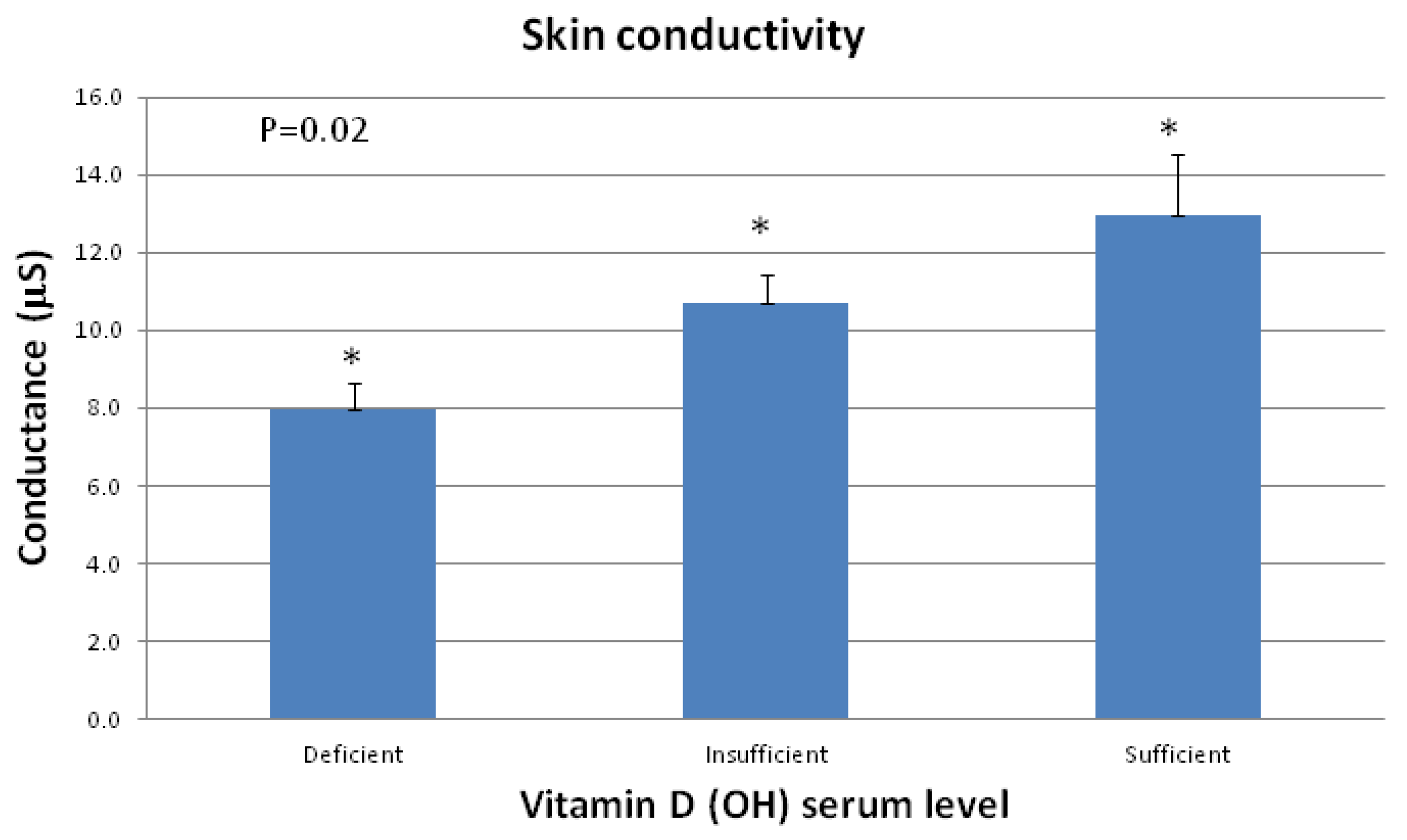
      <p>Serum 25(OH)D levels ranged from 4.8 to 48.8 ng/mL with 19 subjects classified as deficient (&lt;10 ng/mL), 53 as insufficient (10–30 ng/mL) and 11 subjects as sufficient (&gt;30 ng/mL) based on published literature [<xref ref-type="bibr" rid="B5-nutrients-04-01213">5</xref>]. A non-invasive measurement was used to assess stratum corneum water content. This instrument measures the high frequency conductance of skin which correlates with skin surface water content [<xref ref-type="bibr" rid="B6-nutrients-04-01213">6</xref>]. <xref ref-type="fig" rid="nutrients-04-01213-f001">Figure 1</xref> shows that as serum 25(OH)D levels increased, skin conductance also increased (<italic>p</italic> = 0.02, ANOVA). Mean ± SEM values were 7.9 ± 0.69 μS, 10.7 ± 0.72 μS and 13.0 ± 1.57 μS for deficient, insufficient and sufficient subjects respectively.</p>
      
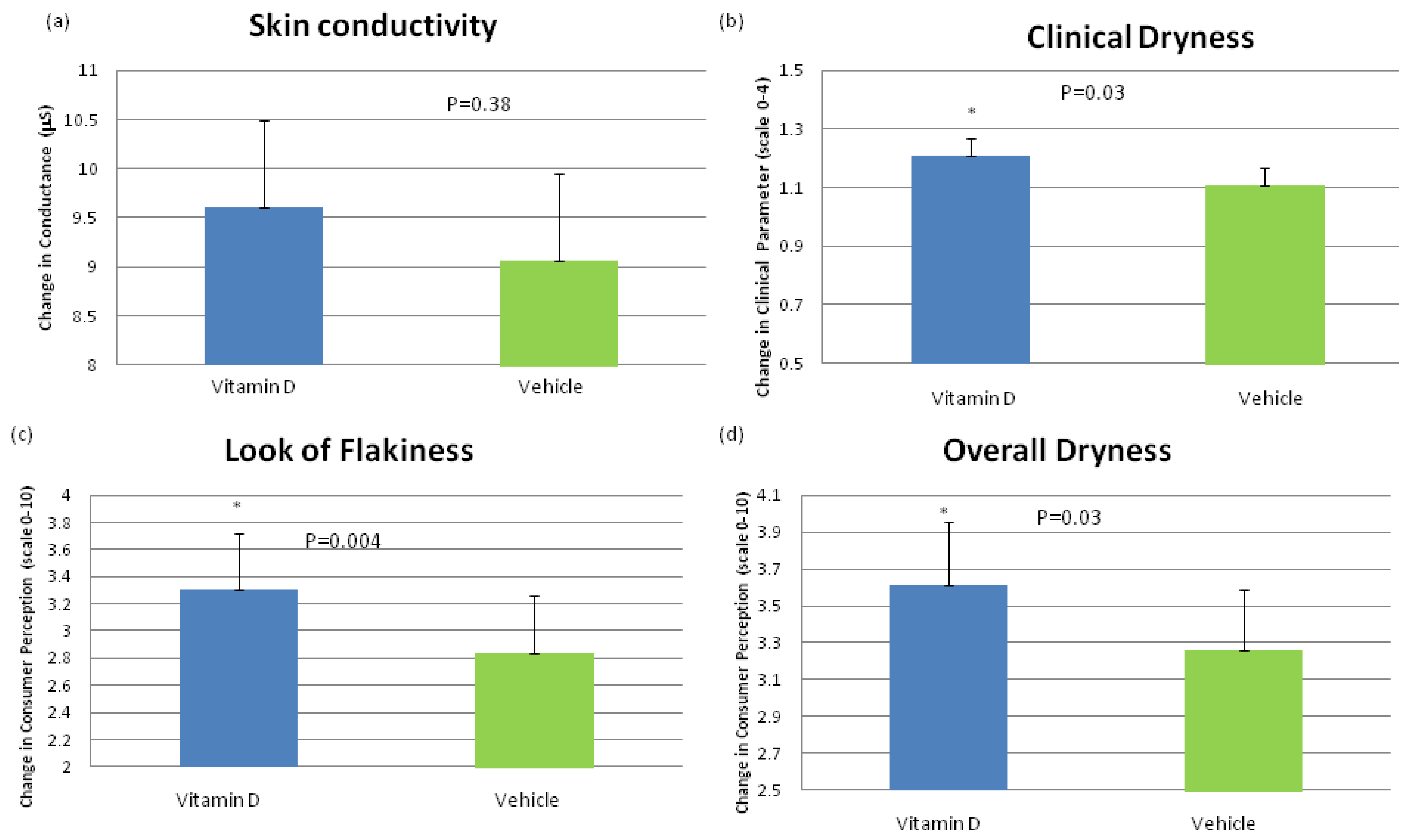
      <p>In the subset of subjects with non-sufficient vitamin D<sub>3</sub> levels, (<italic>n</italic> = 61 including those deficient and insufficient), the addition of vitamin D<sub>3</sub> to the moisturizing formulation significantly improved (<italic>p</italic> &lt; 0.05 Wilcoxon Signed Rank Test) dryness both in clinical grading and by self assessment over the vehicle at 3 weeks (<xref ref-type="fig" rid="nutrients-04-01213-f002">Figure 2</xref>b,d). The look of flakes was also statistically significant (<italic>p</italic> &lt; 0.05 Wilcoxon Signed Rank Test) by self assessment (<xref ref-type="fig" rid="nutrients-04-01213-f002">Figure 2</xref>c). Vitamin D<sub>3</sub> addition to a topical moisturizer increased skin conductance over the vehicle, but did not reach statistical significance in this study utilizing ANOVA (<xref ref-type="fig" rid="nutrients-04-01213-f002">Figure 2</xref>a). There was a significant increase in conductance when comparing before and after treatment in both groups. This is probably due to the high emolliency of the vehicle used.</p>
      <fig id="nutrients-04-01213-f001" position="anchor">
        <label>Figure 1</label>
        <caption>
          <p>Subjects were categorized by their vitamin D (OH) serum levels. A statistically significant (ANOVA, <italic>p</italic> &lt; 0.05) effect of serum 25(OH)D levels and skin conductance was observed. As serum 25(OH)D levels increased, skin conductance also increased.</p>
        </caption>
        <graphic xmlns:xlink="http://www.w3.org/1999/xlink" xlink:href="nutrients-04-01213-g001.tif"/>
      </fig>
      <fig id="nutrients-04-01213-f002" position="anchor">
        <label>Figure 2</label>
        <caption>
          <p>Mean change at week 3 from baseline for (<bold>a</bold>) skin conductivity; (<bold>b</bold>) clinical grading of visual dryness; (<bold>c</bold>) subject perception of visual skin dryness; and (<bold>d</bold>) subject perception of overall dryness. A subset of non-sufficient-vitamin D (OH) serum subjects was analyzed. The addition of vitamin D to a moisturizing formula significantly (Wilcoxon Signed Rank Test, <italic>p</italic> &lt; 0.05) improved clinical grading of visual dryness and consumer perception of flakiness and dryness over the moisturizing formula alone. There was a trend in vitamin D over the vehicle in skin conductivity. </p>
        </caption>
        <graphic xmlns:xlink="http://www.w3.org/1999/xlink" xlink:href="nutrients-04-01213-g002.tif"/>
      </fig>
    </sec>
    <sec sec-type="discussion">
      <title>4. Discussion</title>
      <p>The number of patients with non-sufficient vitamin D<sub>3</sub> levels may be rising in the population [<xref ref-type="bibr" rid="B7-nutrients-04-01213">7</xref>]. This could be due to the low consumption of vitamin D fortified foods and the increased awareness of skin cancer through UVB exposure [<xref ref-type="bibr" rid="B1-nutrients-04-01213">1</xref>]. There are a few demographic groups that are more at risk for being vitamin D<sub>3</sub> (25(OH)D) insufficient including females, African Americans, and those with higher body mass index [<xref ref-type="bibr" rid="B8-nutrients-04-01213">8</xref>]. It is estimated that 3 out of every 4 Americans [<xref ref-type="bibr" rid="B9-nutrients-04-01213">9</xref>] and 1 billion people worldwide are insufficient [<xref ref-type="bibr" rid="B1-nutrients-04-01213">1</xref>]. </p>
      <p>The current study demonstrates a relationship between a subject’s vitamin D<sub>3</sub> (25(OH)D) serum levels and their innate skin hydration state. These results in <xref ref-type="fig" rid="nutrients-04-01213-f001">Figure 1</xref> demonstrate that as vitamin D<sub>3</sub> serum level decreases, skin conductance measurements also decreased indicating that the subject’s skin was drier. Furthermore, topical application of vitamin D<sub>3</sub> was shown to enhance skin conductance reflected in an increase in moisture levels in the skin for subjects with non-sufficient levels of vitamin D<sub>3</sub>. Interestingly, there is a strong seasonal variation in 25-hydroxyvitamin D levels with significantly lower values in the winter which coincides with wintertime dry skin [<xref ref-type="bibr" rid="B10-nutrients-04-01213">10</xref>]. The onset of winter xerosis results in a transient but acute perturbation of filaggrin proteolysis [<xref ref-type="bibr" rid="B11-nutrients-04-01213">11</xref>] and vitamin D analogs have been shown to increase filaggrin expression [<xref ref-type="bibr" rid="B12-nutrients-04-01213">12</xref>]. Vitamin D<sub>3</sub> (cholecalciferol) may have potential role in increasing filaggrin and NMF. These results suggest that diminished 25-hydroxyvitamin D levels may be a factor contributing to xerotic skin. Other research supports the hypothesis that vitamin D<sub>3</sub> serum deficiency may be related to dry skin states including atopic dermatitis [<xref ref-type="bibr" rid="B4-nutrients-04-01213">4</xref>]. </p>
    </sec>
    <sec sec-type="conclusions">
      <title>5. Conclusions</title>
      <p>Overall these findings suggest a relationship between serum vitamin D<sub>3</sub> (25(OH)D) levels and hydration of the stratum corneum and further demonstrate the skin moisture benefit from topical application of vitamin D<sub>3</sub>. Future studies could explore optimal levels of skin vitamin D and the relationship with serum levels, as well as mechanistic studies to understand the influence of vitamin D<sub>3</sub> on xerotic skin.</p>
    </sec>
    
  </body>
  <back>
  <ack>
      <title>Acknowledgments</title>
      <p>The author would like to acknowledge technical contributions by Michael Anthonavage, Christina Lee, and Peter Lyte, as well as advice and direction from Samantha Tucker-Samaras and Michael Southall.</p>
    </ack>
    <notes>
      <title>Conflict of Interest</title>
      <p>This work was supported in full by Johnson and Johnson Skin Research Center, CPPW, a unit of Johnson &amp; Johnson Consumer Companies, Inc., Skillman, NJ, USA.</p>
    </notes>
    <ref-list>
      <title>References</title>
      <ref id="B1-nutrients-04-01213">
        <label>1.</label>
        <citation citation-type="journal">
          <person-group person-group-type="author">
            <name>
              <surname>Holick</surname>
              <given-names>M.F.</given-names>
            </name>
          </person-group>
          <article-title>Vitamin D deficiency</article-title>
          <source>N. Engl. J. Med.</source>
          <year>2007</year>
          <volume>357</volume>
          <fpage>266</fpage>
          <lpage>281</lpage>
          <pub-id pub-id-type="doi">10.1056/NEJMra070553</pub-id>
        </citation>
      </ref>
      <ref id="B2-nutrients-04-01213">
        <label>2.</label>
        <citation citation-type="book">
          <person-group person-group-type="author">
            <name>
              <surname>Holick</surname>
              <given-names>M.F.</given-names>
            </name>
          </person-group>
          <source>The Vitamin D Solution A 3-Step Stategy to Cure Our Most Common Health Problem</source>
          <publisher-name>Hudson Street Press</publisher-name>
          <publisher-loc>New York, NY, USA</publisher-loc>
          <year>2010</year>
        </citation>
      </ref>
      <ref id="B3-nutrients-04-01213">
        <label>3.</label>
        <citation citation-type="journal">
          <person-group person-group-type="author">
            <name>
              <surname>Gibbs</surname>
              <given-names>S.</given-names>
            </name>
            <name>
              <surname>Backendorf</surname>
              <given-names>C.</given-names>
            </name>
            <name>
              <surname>Ponec</surname>
              <given-names>M.</given-names>
            </name>
          </person-group>
          <article-title>Regulation of keratinocyte proliferation and differentiation by all-<italic>trans</italic>-retinoic acid, 9-<italic>cis</italic>-retinoic acid and 1,25-dihydroxy vitamin D<sub>3</sub></article-title>
          <source>Arch. Dermatol. Res.</source>
          <year>1996</year>
          <volume>288</volume>
          <fpage>729</fpage>
          <lpage>738</lpage>
        <pub-id pub-id-type="doi">10.1007/BF02505289</pub-id><pub-id pub-id-type="pmid">8950452</pub-id></citation>
      </ref>
      <ref id="B4-nutrients-04-01213">
        <label>4.</label>
        <citation citation-type="journal">
          <person-group person-group-type="author">
            <name>
              <surname>Peroni</surname>
              <given-names>D.G.</given-names>
            </name>
            <name>
              <surname>Piacentini</surname>
              <given-names>G.L.</given-names>
            </name>
            <name>
              <surname>Cametti</surname>
              <given-names>E.</given-names>
            </name>
            <name>
              <surname>Chinellato</surname>
              <given-names>I.</given-names>
            </name>
            <name>
              <surname>Boner</surname>
              <given-names>A.L.</given-names>
            </name>
          </person-group>
          <article-title>Correlation between serum 25-hydroxyvitamin D levels and severity of atopic dermatitis in children</article-title>
          <source>Br. J. Dermatol.</source>
          <year>2011</year>
          <volume>164</volume>
          <fpage>1078</fpage>
          <lpage>1082</lpage>
          <pub-id pub-id-type="doi">10.1111/j.1365-2133.2010.10147.x</pub-id>
        </citation>
      </ref>
      <ref id="B5-nutrients-04-01213">
        <label>5.</label>
        <citation citation-type="journal">
          <person-group person-group-type="author">
            <name>
              <surname>Asgari</surname>
              <given-names>M.M.</given-names>
            </name>
            <name>
              <surname>Tang</surname>
              <given-names>J.</given-names>
            </name>
            <name>
              <surname>Warton</surname>
              <given-names>M.E.</given-names>
            </name>
            <name>
              <surname>Chren</surname>
              <given-names>M.M.</given-names>
            </name>
            <name>
              <surname>Quesenberry</surname>
              <given-names>C.P.</given-names>
              <suffix>Jr.</suffix>
            </name>
            <name>
              <surname>Bikle</surname>
              <given-names>D.</given-names>
            </name>
            <name>
              <surname>Horst</surname>
              <given-names>R.L.</given-names>
            </name>
            <name>
              <surname>Orentreich</surname>
              <given-names>N.</given-names>
            </name>
            <name>
              <surname>Vogelman</surname>
              <given-names>J.H.</given-names>
            </name>
            <name>
              <surname>Friedman</surname>
              <given-names>G.D.</given-names>
            </name>
          </person-group>
          <article-title>Association of prediagnostic serum vitamin D levels with the development of basal cell carcinoma</article-title>
          <source>J. Invest. Dermatol.</source>
          <year>2010</year>
          <volume>130</volume>
          <fpage>1438</fpage>
          <lpage>1443</lpage>
        <pub-id pub-id-type="doi">10.1038/jid.2009.402</pub-id><pub-id pub-id-type="pmid">20043012</pub-id></citation>
      </ref>
      <ref id="B6-nutrients-04-01213">
        <label>6.</label>
        <citation citation-type="journal">
          <person-group person-group-type="author">
            <name>
              <surname>Berardesca</surname>
              <given-names>E.</given-names>
            </name>
          </person-group>
          <article-title>EEMCO guidance for the assessment of stratum corneum hydration: Electrical methods</article-title>
          <source>Skin Res. Technol.</source>
          <year>1997</year>
          <volume>3</volume>
          <fpage>126</fpage>
          <lpage>132</lpage>
          <pub-id pub-id-type="doi">10.1111/j.1600-0846.1997.tb00174.x</pub-id>
        </citation>
      </ref>
      <ref id="B7-nutrients-04-01213">
        <label>7.</label>
        <citation citation-type="journal">
          <person-group person-group-type="author">
            <name>
              <surname>Chen</surname>
              <given-names>T.C.</given-names>
            </name>
            <name>
              <surname>Chimeh</surname>
              <given-names>F.</given-names>
            </name>
            <name>
              <surname>Lu</surname>
              <given-names>Z.</given-names>
            </name>
            <name>
              <surname>Mathieu</surname>
              <given-names>J.</given-names>
            </name>
            <name>
              <surname>Person</surname>
              <given-names>K.S.</given-names>
            </name>
            <name>
              <surname>Zhang</surname>
              <given-names>A.</given-names>
            </name>
            <name>
              <surname>Kohn</surname>
              <given-names>N.</given-names>
            </name>
            <name>
              <surname>Martinello</surname>
              <given-names>S.</given-names>
            </name>
            <name>
              <surname>Berkowitz</surname>
              <given-names>R.</given-names>
            </name>
            <name>
              <surname>Holick</surname>
              <given-names>M.F.</given-names>
            </name>
          </person-group>
          <article-title>Factors that influence the cutaneous synthesis and dietary sources of vitamin D</article-title>
          <source>Arch. Biochem. Biophys.</source>
          <year>2007</year>
          <volume>460</volume>
          <fpage>213</fpage>
          <lpage>217</lpage>
        <pub-id pub-id-type="doi">10.1016/j.abb.2006.12.017</pub-id><pub-id pub-id-type="pmid">17254541</pub-id></citation>
      </ref>
      <ref id="B8-nutrients-04-01213">
        <label>8.</label>
        <citation citation-type="journal">
          <person-group person-group-type="author">
            <name>
              <surname>Yetley</surname>
              <given-names>E.A.</given-names>
            </name>
          </person-group>
          <article-title>Assessing the vitamin D status of the US population</article-title>
          <source>Am. J. Clin. Nutr.</source>
          <year>2008</year>
          <volume>88</volume>
          <fpage>558S</fpage>
          <lpage>564S</lpage>
        <pub-id pub-id-type="pmid">18689402</pub-id></citation>
      </ref>
      <ref id="B9-nutrients-04-01213">
        <label>9.</label>
        <citation citation-type="journal">
          <person-group person-group-type="author">
            <name>
              <surname>Ginde</surname>
              <given-names>A.A.</given-names>
            </name>
            <name>
              <surname>Liu</surname>
              <given-names>M.C.</given-names>
            </name>
            <name>
              <surname>Camargo</surname>
              <given-names>C.A.</given-names>
              <suffix>Jr.</suffix>
            </name>
          </person-group>
          <article-title>Demographic differences and trends of vitamin D insufficiency in the US population, 1988–2004</article-title>
          <source>Arch. Intern. Med.</source>
          <year>2009</year>
          <volume>169</volume>
          <fpage>626</fpage>
          <lpage>632</lpage>
        <pub-id pub-id-type="doi">10.1001/archinternmed.2008.604</pub-id><pub-id pub-id-type="pmid">19307527</pub-id></citation>
      </ref>
      <ref id="B10-nutrients-04-01213">
        <label>10.</label>
        <citation citation-type="journal">
          <person-group person-group-type="author">
            <name>
              <surname>Harris</surname>
              <given-names>S.S.</given-names>
            </name>
            <name>
              <surname>Dawson-Hughes</surname>
              <given-names>B.</given-names>
            </name>
          </person-group>
          <article-title>Seasonal changes in plasma 25-hydroxyvitamin D concentrations of young American black and white women</article-title>
          <source>Am. J. Clin. Nutr.</source>
          <year>1998</year>
          <volume>67</volume>
          <fpage>1232</fpage>
          <lpage>1236</lpage>
        <pub-id pub-id-type="pmid">9625098</pub-id></citation>
      </ref>
      <ref id="B11-nutrients-04-01213">
        <label>11.</label>
        <citation citation-type="book">
          <source>Skin Moisturization (Cosmetic Science and Technology)</source>
          <person-group person-group-type="editor">
            <name>
              <surname>Leyden</surname>
              <given-names>J.J.</given-names>
            </name>
            <name>
              <surname>Rawlings</surname>
              <given-names>A.V.</given-names>
            </name>
          </person-group>
          <publisher-name>Marcel Dekker, Inc.</publisher-name>
          <publisher-loc>New York, NY, USA</publisher-loc>
          <year>2002</year>
          <volume>25</volume>
          <fpage>138</fpage>
        </citation>
      </ref>
      <ref id="B12-nutrients-04-01213">
        <label>12.</label>
        <citation citation-type="journal">
          <person-group person-group-type="author">
            <name>
              <surname>Reichrath</surname>
              <given-names>J.</given-names>
            </name>
            <name>
              <surname>Müller</surname>
              <given-names>S.M.</given-names>
            </name>
            <name>
              <surname>Kerber</surname>
              <given-names>A.</given-names>
            </name>
            <name>
              <surname>Baum</surname>
              <given-names>H.P.</given-names>
            </name>
            <name>
              <surname>Bahmer</surname>
              <given-names>F.A.</given-names>
            </name>
          </person-group>
          <article-title>Biologic effects of topical calcipotriol (MC 903) treatment in psoriatic skin</article-title>
          <source>J. Am. Acad. Dermatol.</source>
          <year>1997</year>
          <volume>36</volume>
          <fpage>19</fpage>
          <lpage>28</lpage>
          <pub-id pub-id-type="doi">10.1016/S0190-9622(97)70320-7</pub-id>
        </citation>
      </ref>
    </ref-list>
  </back>
</article>