
<?xml version="1.0" encoding="UTF-8"?>
<!DOCTYPE article PUBLIC "-//NLM//DTD Journal Publishing DTD v2.3 20070202//EN" "journalpublishing.dtd">
<article xmlns:mml="http://www.w3.org/1998/Math/MathML" xmlns:xlink="http://www.w3.org/1999/xlink" xml:lang="en" article-type="review-article">
  <front>
    <journal-meta>
      <journal-id journal-id-type="publisher-id">nutrients</journal-id>
      <journal-title>Nutrients</journal-title>
      <abbrev-journal-title abbrev-type="publisher">Nutrients</abbrev-journal-title>
      <abbrev-journal-title abbrev-type="pubmed">Nutrients</abbrev-journal-title>
      <issn pub-type="epub">2072-6643</issn>
      <publisher>
        <publisher-name>MDPI</publisher-name>
      </publisher>
    </journal-meta>
    <article-meta>
      <article-id pub-id-type="doi">10.3390/nu4080875</article-id>
      <article-id pub-id-type="publisher-id">nutrients-04-00875</article-id>
      <article-categories>
        <subj-group>
          <subject>Review</subject>
        </subj-group>
      </article-categories>
      <title-group>
        <article-title>Cellular Mechanisms of Zinc Dysregulation: A Perspective on Zinc Homeostasis as an Etiological Factor in the Development and Progression of Breast Cancer</article-title>
      </title-group>
	  <contrib-group>
        <contrib contrib-type="author">
          <name>
            <surname>Alam</surname>
            <given-names>Samina</given-names>
          </name>
          <xref rid="af1-nutrients-04-00875" ref-type="aff">1</xref>
        </contrib>
        <contrib contrib-type="author">
          <name>
            <surname>Kelleher</surname>
            <given-names>Shannon L.</given-names>
          </name>
          <xref rid="af1-nutrients-04-00875" ref-type="aff">1</xref>
          <xref rid="af2-nutrients-04-00875" ref-type="aff">2</xref>
          <xref rid="af3-nutrients-04-00875" ref-type="aff">3</xref>
          <xref rid="c1-nutrients-04-00875" ref-type="corresp">*</xref>
        </contrib>
      </contrib-group>
      
      <aff id="af1-nutrients-04-00875"><label>1 </label>Department of Nutritional Sciences, The Pennsylvania State University, University Park, PA 16802, USA; Email: <email>sra116@psu.edu</email></aff>
      <aff id="af2-nutrients-04-00875"><label>2 </label>Department of Surgery, the Pennsylvania State University College of Medicine, Hershey, PA 17033, USA</aff>
      <aff id="af3-nutrients-04-00875"><label>3 </label>Cell and Molecular Physiology, the Pennsylvania State University College of Medicine, Hershey, PA 17033, USA</aff>
      <author-notes>
        <corresp id="c1-nutrients-04-00875"><label>*</label> Author  to whom correspondence should be addressed; Email: <email>slk39@psu.edu</email>; Tel.: +1-814-863-9680; Fax: +1-814-863-6103.</corresp>
      </author-notes>
      <pub-date pub-type="epub">
        <day>30</day>
        <month>07</month>
        <year>2012</year>
      </pub-date>
      <pub-date pub-type="collection">
	  <month>08</month>
        <year>2012</year>
      </pub-date>
      <volume>4</volume>
      <issue>8</issue>
      <fpage>875</fpage>
      <lpage>903</lpage>
      <history>
        <date date-type="received">
          <day>29</day>
          <month>05</month>
          <year>2012</year>
        </date>
        <date date-type="rev-recd">
          <day>11</day>
          <month>07</month>
          <year>2012</year>
        </date>
        <date date-type="accepted">
          <day>17</day>
          <month>07</month>
          <year>2012</year>
        </date>
      </history>
      <permissions>
        <copyright-statement>©  2012 by the authors; licensee MDPI, Basel, Switzerland.</copyright-statement>
        <copyright-year>2012</copyright-year>
        <license xmlns:xlink="http://www.w3.org/1999/xlink" license-type="open-access" xlink:href="http://creativecommons.org/licenses/by/3.0/">
          <p>This article is an open-access article distributed under the terms and conditions of the Creative Commons Attribution license (<uri>http://creativecommons.org/licenses/by/3.0/</uri>).</p>
        </license>
      </permissions>
      <abstract>
        <p>Worldwide, breast cancer is the most commonly diagnosed cancer among women and is the leading cause of female cancer deaths. Zinc (Zn) functions as an antioxidant and plays a role in maintaining genomic stability. Zn deficiency results in oxidative DNA damage and increased cancer risk. Studies suggest an inverse association between dietary and plasma Zn levels and the risk for developing breast cancer. In contrast, breast tumor biopsies display significantly higher Zn levels compared with normal tissue. Zn accumulation in tumor tissue also correlates with increased levels of Zn importing proteins. Further, aberrant expression of Zn transporters in tumors correlates with malignancy, suggesting that altered metal homeostasis in the breast could contribute to malignant transformation and the severity of cancer. However, studies have yet to link dysregulated Zn transport and abnormal Zn-dependent functions in breast cancer development. Herein, we summarize studies that address the multi-modal role of Zn dyshomeostasis in breast cancer with respect to the role of Zn in modulating oxidative stress, DNA damage response/repair pathways and cell proliferation/apoptosis, and the relationship to aberrant regulation of Zn transporters. We also compare Zn dysregulation in breast tissue to that of prostate, pancreatic and ovarian cancer where possible. </p>
      </abstract>
      <kwd-group>
        <kwd>breast cancer</kwd>
        <kwd>zinc homeostasis</kwd>
        <kwd>oxidative stress</kwd>
        <kwd>DNA damage/repair</kwd>
        <kwd>transcription</kwd>
        <kwd>zinc transport</kwd>
        <kwd>cell cycle</kwd>
        <kwd>proliferation</kwd>
        <kwd>cell signaling</kwd>
        <kwd>apoptosis</kwd>
      </kwd-group>
    </article-meta>
  </front>
  <body>
    <sec sec-type="intro">
      <title>1. Introduction</title>
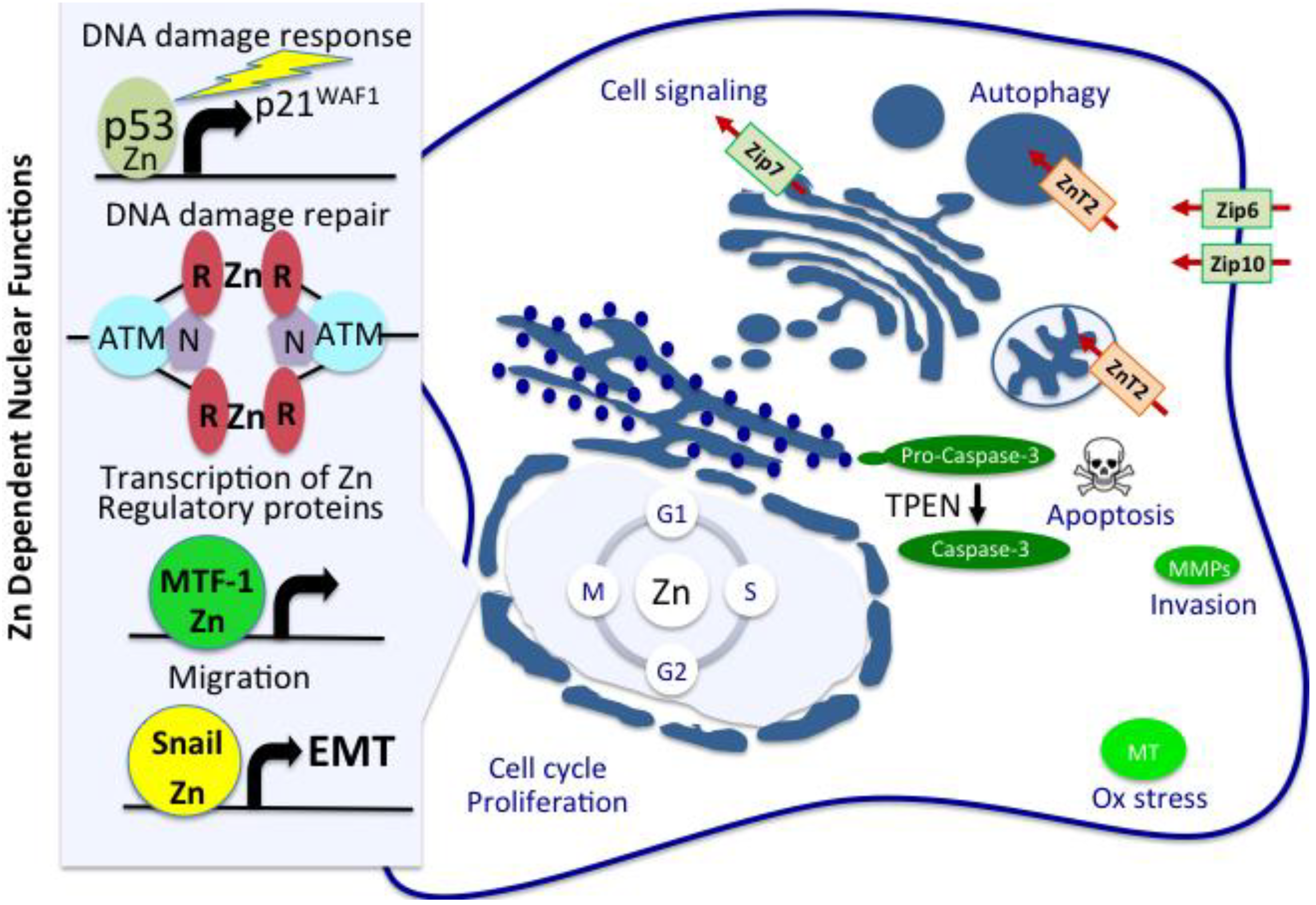
      <p>Worldwide, breast cancer is the most commonly diagnosed cancer among women and is the leading cause of female cancer deaths [<xref ref-type="bibr" rid="B1-nutrients-04-00875">1</xref>]. In 2008, women diagnosed with breast cancer accounted for 23%, of total cancer cases, and 14% of total cancer deaths resulted from this cancer [<xref ref-type="bibr" rid="B1-nutrients-04-00875">1</xref>]. Numerous studies document both molecular and genetic factors as initiators and promoters of breast tissue oncogenesis [<xref ref-type="bibr" rid="B2-nutrients-04-00875">2</xref>]. Among these categories, deregulated mechanisms contributing to increased oxidative stress and consequent genomic instability play an important role in the development of a variety of human diseases, including breast cancer [<xref ref-type="bibr" rid="B3-nutrients-04-00875">3</xref>,<xref ref-type="bibr" rid="B4-nutrients-04-00875">4</xref>]. Inadequate nutrition translates to dietary deficiencies of key micronutrients that could manifest as increased cellular stress and associated DNA damage [<xref ref-type="bibr" rid="B5-nutrients-04-00875">5</xref>,<xref ref-type="bibr" rid="B6-nutrients-04-00875">6</xref>,<xref ref-type="bibr" rid="B7-nutrients-04-00875">7</xref>]. In this regard, Zn is an essential trace element and its functions as an antioxidant and its role in the maintenance of genomic stability have been widely reported [<xref ref-type="bibr" rid="B8-nutrients-04-00875">8</xref>]. Epidemiological studies have established a link between dietary Zn deficiency and an increased risk of developing cancer [<xref ref-type="bibr" rid="B9-nutrients-04-00875">9</xref>]. Zn deficiency is a global public health problem, leaving ~2 billion people at risk for deficiency of this trace metal [<xref ref-type="bibr" rid="B10-nutrients-04-00875">10</xref>]. In the US, almost 10% of the population does not absorb an adequate amount of Zn from the diet [<xref ref-type="bibr" rid="B10-nutrients-04-00875">10</xref>]. The global effect of Zn deficiency and its link to cancer can certainly be appreciated considering that this biologically essential metal is a component of approximately 3000 proteins (almost 10% of total proteins) [<xref ref-type="bibr" rid="B11-nutrients-04-00875">11</xref>], of which more than 300 enzymes require Zn as a cofactor [<xref ref-type="bibr" rid="B12-nutrients-04-00875">12</xref>]. Subsets of these proteins are involved in the defense against oxidative stress, including metallothionein [<xref ref-type="bibr" rid="B13-nutrients-04-00875">13</xref>], and Cu/Zn superoxide dismutase (SOD) [<xref ref-type="bibr" rid="B14-nutrients-04-00875">14</xref>], proteins controlling responses to DNA damage and repair [<xref ref-type="bibr" rid="B15-nutrients-04-00875">15</xref>,<xref ref-type="bibr" rid="B16-nutrients-04-00875">16</xref>,<xref ref-type="bibr" rid="B17-nutrients-04-00875">17</xref>,<xref ref-type="bibr" rid="B18-nutrients-04-00875">18</xref>], intracellular signaling enzymes [<xref ref-type="bibr" rid="B19-nutrients-04-00875">19</xref>,<xref ref-type="bibr" rid="B20-nutrients-04-00875">20</xref>], more than 2000 transcription factors (Zn-finger proteins) that require Zn for their structural stability and binding to DNA [<xref ref-type="bibr" rid="B21-nutrients-04-00875">21</xref>,<xref ref-type="bibr" rid="B22-nutrients-04-00875">22</xref>], and matrix metalloproteinases (MMPs), a family of Zn-dependent endopeptidases that regulate tissue remodeling [<xref ref-type="bibr" rid="B23-nutrients-04-00875">23</xref>]. Zn also functions as an intracellular second messenger [<xref ref-type="bibr" rid="B24-nutrients-04-00875">24</xref>] and is critical for cell proliferation, cell cycle regulation, differentiation and apoptosis [<xref ref-type="bibr" rid="B25-nutrients-04-00875">25</xref>,<xref ref-type="bibr" rid="B26-nutrients-04-00875">26</xref>,<xref ref-type="bibr" rid="B27-nutrients-04-00875">27</xref>,<xref ref-type="bibr" rid="B28-nutrients-04-00875">28</xref>,<xref ref-type="bibr" rid="B29-nutrients-04-00875">29</xref>]. Cumulatively, the antioxidant and anti-carcinogenesis mechanisms associated with Zn homeostasis appear to play an inhibitory role on neoplastic cell growth. In this review, we explore each of these functional categories with regard to our current understanding of the consequences resulting from Zn dysregulation in breast tissues and the development of breast cancer (<xref ref-type="fig" rid="nutrients-04-00875-f001">Figure 1</xref>).</p>
      <fig id="nutrients-04-00875-f001" position="anchor">
        <label>Figure 1</label>
        <caption>
          <p>Homeostatic role of Zn in cellular functions which potentially link to initiation and progression of breast cancer. Zn is a biologically essential metal and is a cofactor for more than 300 enzymes and proteins involved in the defense against oxidative stress, including metallothionein, proteins controlling responses to DNA damage and repair (p53; ATM/MRN), intracellular signaling enzymes, more than 2000 transcription factors that require Zn for their structural stability and binding to DNA, also known as Zn-finger proteins, including MTF-1, which controls transcription of Zn regulatory proteins such as metallothionein (MT), and matrix metalloproteinases (MMPs), a family of Zn-dependent endopeptidases which regulate tissue remodeling. Zn also functions as an intracellular second messenger, cytosolic levels of which are tightly controlled by coordinate regulation of ZnTs and ZIPs. In addition, Zn is critical for cell proliferation, cell cycle regulation, differentiation and apoptosis. Cumulatively, the antioxidant and anti-carcinogenesis mechanisms associated with Zn homeostasis appear to play an inhibitory role on neoplastic cell growth.</p>
        </caption>
        <graphic xmlns:xlink="http://www.w3.org/1999/xlink" xlink:href="nutrients-04-00875-g001.tif"/>
      </fig>
    </sec>
    <sec>
      <title>2. Comparative Plasma and Tumor Zinc Levels and Breast Cancer Risk</title>
      <p>The role of Zn as an antioxidant has attracted considerable attention, particularly with regard to cellular controls that regulate Zn dyshomeostasis in cancer [<xref ref-type="bibr" rid="B26-nutrients-04-00875">26</xref>]. Although serum Zn levels are considered a poor indicator of Zn status, serum Zn levels are generally low in patients with multiple cancers [<xref ref-type="bibr" rid="B30-nutrients-04-00875">30</xref>], including patients with squamous esophageal cancer [<xref ref-type="bibr" rid="B31-nutrients-04-00875">31</xref>], malignant prostate cancer [<xref ref-type="bibr" rid="B32-nutrients-04-00875">32</xref>], ovarian cancer [<xref ref-type="bibr" rid="B33-nutrients-04-00875">33</xref>], and cancers of the gallbladder [<xref ref-type="bibr" rid="B34-nutrients-04-00875">34</xref>], lung [<xref ref-type="bibr" rid="B35-nutrients-04-00875">35</xref>], colon, head and neck [<xref ref-type="bibr" rid="B36-nutrients-04-00875">36</xref>], and bronchus [<xref ref-type="bibr" rid="B35-nutrients-04-00875">35</xref>]. Multiple studies also show a relationship between low plasma Zn levels and the risk for developing breast cancer [<xref ref-type="bibr" rid="B37-nutrients-04-00875">37</xref>,<xref ref-type="bibr" rid="B38-nutrients-04-00875">38</xref>,<xref ref-type="bibr" rid="B39-nutrients-04-00875">39</xref>], prompting the suggestion that plasma Zn levels can be used as a prognostic as well as a therapeutic marker for breast cancer [<xref ref-type="bibr" rid="B40-nutrients-04-00875">40</xref>,<xref ref-type="bibr" rid="B41-nutrients-04-00875">41</xref>,<xref ref-type="bibr" rid="B42-nutrients-04-00875">42</xref>]. Other studies also considered analysis of Zn levels in erythrocytes to be a more accurate indicator [<xref ref-type="bibr" rid="B43-nutrients-04-00875">43</xref>], since significantly lower Zn levels in erythrocytes in women with breast cancer compared with normal women could not be attributed to dietary Zn insufficiency [<xref ref-type="bibr" rid="B44-nutrients-04-00875">44</xref>].</p>
      <p>Zn dyshomeostasis displays an added layer of complexity when studies are considered that address the differential regulation of serum Zn levels of cancer patients compared to its levels in the corresponding tumor tissues. Breast biopsies from cancer patients have significantly higher Zn levels compared with normal breast tissue [<xref ref-type="bibr" rid="B45-nutrients-04-00875">45</xref>,<xref ref-type="bibr" rid="B46-nutrients-04-00875">46</xref>,<xref ref-type="bibr" rid="B47-nutrients-04-00875">47</xref>,<xref ref-type="bibr" rid="B48-nutrients-04-00875">48</xref>]. Epidemiological studies have established a relationship between high breast tissue Zn levels and development of breast cancer [<xref ref-type="bibr" rid="B49-nutrients-04-00875">49</xref>]. Zn accumulation in tumor tissues is correlated with increased expression of cellular Zn importing proteins compared with normal tissues, suggesting that tumor cells selectively increase Zn uptake using common mechanisms [<xref ref-type="bibr" rid="B26-nutrients-04-00875">26</xref>]. Likewise, expression levels of Zn transporters in tumors also correlate with their malignancy, suggesting that altered Zn homeostasis could contribute to the severity of cancer [<xref ref-type="bibr" rid="B50-nutrients-04-00875">50</xref>,<xref ref-type="bibr" rid="B51-nutrients-04-00875">51</xref>,<xref ref-type="bibr" rid="B52-nutrients-04-00875">52</xref>]. Together, this supports the idea that abnormal Zn metabolism is a common link in cancer development [<xref ref-type="bibr" rid="B30-nutrients-04-00875">30</xref>]. Elevated tumor Zn levels are also characteristic of patients displaying other cancer types [<xref ref-type="bibr" rid="B30-nutrients-04-00875">30</xref>,<xref ref-type="bibr" rid="B31-nutrients-04-00875">31</xref>,<xref ref-type="bibr" rid="B53-nutrients-04-00875">53</xref>,<xref ref-type="bibr" rid="B54-nutrients-04-00875">54</xref>] supporting the idea that abnormal Zn metabolism is a common link in cancer development. Despite multiple studies that implicate altered Zn metabolism in the development of breast cancer [<xref ref-type="bibr" rid="B47-nutrients-04-00875">47</xref>,<xref ref-type="bibr" rid="B48-nutrients-04-00875">48</xref>,<xref ref-type="bibr" rid="B55-nutrients-04-00875">55</xref>,<xref ref-type="bibr" rid="B56-nutrients-04-00875">56</xref>,<xref ref-type="bibr" rid="B57-nutrients-04-00875">57</xref>], concrete evidence linking Zn dyshomeostasis as an etiological factor has yet to be revealed. In this review we discuss the current knowledge of the functional role of cellular Zn and the studies that link defects in Zn homeostasis, with alterations in mechanisms that potentially contribute to initiation and progression of breast cancer.</p>
    </sec>
    <sec>
      <title>3. Zinc and Oxidative Stress</title>
      <p>Studies in humans [<xref ref-type="bibr" rid="B9-nutrients-04-00875">9</xref>,<xref ref-type="bibr" rid="B58-nutrients-04-00875">58</xref>], animal models [<xref ref-type="bibr" rid="B59-nutrients-04-00875">59</xref>,<xref ref-type="bibr" rid="B60-nutrients-04-00875">60</xref>], and cultured cells [<xref ref-type="bibr" rid="B61-nutrients-04-00875">61</xref>] provide support for the link between Zn deficiency and its regulation of oxidative stress. Zn is an essential cofactor for the activity of a number of proteins that play a role in combatting oxidative stress, such as metallothioneins [<xref ref-type="bibr" rid="B13-nutrients-04-00875">13</xref>] and Cu/Zn SOD [<xref ref-type="bibr" rid="B62-nutrients-04-00875">62</xref>]. Zn is also a cofactor for proteins involved in mediating DNA damage response and repair, such as the p53 tumor suppressor protein [<xref ref-type="bibr" rid="B13-nutrients-04-00875">13</xref>]. Therefore, suboptimal Zn intake may promote the generation of oxidative stress, and single and double DNA strand breaks similar to radiation induced DNA damage [<xref ref-type="bibr" rid="B63-nutrients-04-00875">63</xref>,<xref ref-type="bibr" rid="B64-nutrients-04-00875">64</xref>]. Compromised DNA integrity, impaired functioning of DNA repair enzymes and loss of DNA surveillance mechanisms are associated with increased risk of cancer initiation and progression [<xref ref-type="bibr" rid="B18-nutrients-04-00875">18</xref>,<xref ref-type="bibr" rid="B25-nutrients-04-00875">25</xref>,<xref ref-type="bibr" rid="B28-nutrients-04-00875">28</xref>,<xref ref-type="bibr" rid="B65-nutrients-04-00875">65</xref>,<xref ref-type="bibr" rid="B66-nutrients-04-00875">66</xref>].</p>
    </sec>
    <sec>
      <title>4. Zinc-Metallothionein Regulation of Oxidative Stress and Chemoresistance in Breast Cancer</title>
      <p>Metallothioneins are stress-inducible proteins with antioxidant properties that protect cells against the generation of free radicals and reactive oxygen species [<xref ref-type="bibr" rid="B13-nutrients-04-00875">13</xref>]. Metallothioneins are cysteine-rich, low molecular weight proteins that have a specific and high binding affinity for biologically essential metals such as Zn and Cu [<xref ref-type="bibr" rid="B13-nutrients-04-00875">13</xref>]. Metallothioneins buffer cytosolic Zn and maintain negligible amounts of “free” cytosolic Zn [<xref ref-type="bibr" rid="B67-nutrients-04-00875">67</xref>]. Tight control of cytosolic Zn buffering is necessary for maintaining the redox status of the cells, as both increased and decreased Zn levels induce oxidative stress [<xref ref-type="bibr" rid="B68-nutrients-04-00875">68</xref>]. Sequestration of Zn via binding to redox-sensitive cysteine moieties allows metallothioneins to act as a Zn-donor or a Zn-acceptor (apo-metallothionein), which in turn allows for reversible transfer of Zn ions to many cellular proteins, such as DNA and RNA polymerases and transcription factors [<xref ref-type="bibr" rid="B69-nutrients-04-00875">69</xref>]. In this way, apo-metallothionein is known to inactivate the DNA binding capacity of Zn finger transcription factors in vitro [<xref ref-type="bibr" rid="B69-nutrients-04-00875">69</xref>,<xref ref-type="bibr" rid="B70-nutrients-04-00875">70</xref>], whereas the Zn-bound metallothioneins restore their activity [<xref ref-type="bibr" rid="B70-nutrients-04-00875">70</xref>]. Additionally, because of high cysteine content, metallothioneins defend against oxidative stress by binding to free radicals acting as potent scavenger of reactive oxygen species (ROS), such as hydrogen peroxide (H<sub>2</sub>O<sub>2</sub>), superoxide (O<sub>2</sub><sup>−</sup>), nitric oxide (NO) and hydroxyl (OH) radicals [<xref ref-type="bibr" rid="B71-nutrients-04-00875">71</xref>]. Metallothionein-mediated scavenging of free radicals protects macromolecules such as DNA, proteins and lipids against oxidative damage from these highly reactive compounds [<xref ref-type="bibr" rid="B72-nutrients-04-00875">72</xref>,<xref ref-type="bibr" rid="B73-nutrients-04-00875">73</xref>].</p>
      <p>Metallothionein expression is deregulated in breast cancer. High metallothionein expression correlates with chemoresistance and poor prognosis [<xref ref-type="bibr" rid="B74-nutrients-04-00875">74</xref>,<xref ref-type="bibr" rid="B75-nutrients-04-00875">75</xref>]. Metallothioneins participate in carcinogenesis through at least two mechanisms that promote the development of chemo- or radioresistant tumor cells. First, elevated metallothionein levels in cancer cells protect against free-radical damage, thereby inhibiting apoptosis and promoting cell proliferation, and supporting uncontrolled growth [<xref ref-type="bibr" rid="B76-nutrients-04-00875">76</xref>]. Secondly, metallothionein interaction with Zn ions is involved in regulating multiple transcription factors, contributing towards carcinogenesis [<xref ref-type="bibr" rid="B13-nutrients-04-00875">13</xref>,<xref ref-type="bibr" rid="B76-nutrients-04-00875">76</xref>,<xref ref-type="bibr" rid="B77-nutrients-04-00875">77</xref>]. Increased metallothionein expression is positively associated with histological grade in invasive breast ductal carcinoma [<xref ref-type="bibr" rid="B78-nutrients-04-00875">78</xref>,<xref ref-type="bibr" rid="B79-nutrients-04-00875">79</xref>], and resistance to radiation [<xref ref-type="bibr" rid="B80-nutrients-04-00875">80</xref>] as well as chemotherapeutics [<xref ref-type="bibr" rid="B81-nutrients-04-00875">81</xref>]. Invasive ductal breast carcinomas overexpress metallothionein, whereas their lobular counterparts express metallothionein weakly [<xref ref-type="bibr" rid="B82-nutrients-04-00875">82</xref>,<xref ref-type="bibr" rid="B83-nutrients-04-00875">83</xref>]. While mechanisms responsible for metallothionein deregulation in breast cancer cells are still under investigation, it has been proposed that the de-differentiated status of cancer cells could play a role in the induction of this protein [<xref ref-type="bibr" rid="B84-nutrients-04-00875">84</xref>]. Therefore, metallothionein expression could be a useful marker of less differentiated, more aggressive breast cancer phenotype [<xref ref-type="bibr" rid="B83-nutrients-04-00875">83</xref>].</p>
    </sec>
    <sec>
      <title>5. Zinc Regulation of p53 Activation, ATM/MRN Mediated DNA Damage Response and Repair</title>
      <p>Zn is required by multiple proteins in DNA replicative machinery including DNA and RNA polymerases, and transcription factors including p53 [<xref ref-type="bibr" rid="B85-nutrients-04-00875">85</xref>]. Normal cells respond to DNA damage via induction of p53 protein levels, which transcriptionally regulates multiple functions related to DNA repair, cell cycle checkpoint regulation and induction of apoptosis [<xref ref-type="bibr" rid="B86-nutrients-04-00875">86</xref>,<xref ref-type="bibr" rid="B87-nutrients-04-00875">87</xref>]. In response to DNA damage signals, p53 either mediates G1 phase cell cycle arrest by inducing transcription of the cyclin-dependent kinase inhibitor p21<sup>WAF1</sup> thereby allowing time for DNA repair, or activating cell death by triggering apoptosis [<xref ref-type="bibr" rid="B88-nutrients-04-00875">88</xref>]. Zn deficiency increases oxidative DNA damage [<xref ref-type="bibr" rid="B27-nutrients-04-00875">27</xref>] and induces chromosome breaks [<xref ref-type="bibr" rid="B59-nutrients-04-00875">59</xref>,<xref ref-type="bibr" rid="B89-nutrients-04-00875">89</xref>]. Additionally, Zn deficiency increases p53 expression in response to DNA damage, but impairs the ability of p53 to bind DNA [<xref ref-type="bibr" rid="B66-nutrients-04-00875">66</xref>]. The p53 protein DNA binding domain is stabilized by a Zn ion, which is necessary for maintaining a functionally active conformation [<xref ref-type="bibr" rid="B90-nutrients-04-00875">90</xref>]. Under Zn deficient conditions, apo-metallothionein can chelate Zn from p53 and disrupt architecture of the DNA binding domain, allowing the protein to adopt a conformation identical to mutant forms of p53 [<xref ref-type="bibr" rid="B91-nutrients-04-00875">91</xref>,<xref ref-type="bibr" rid="B92-nutrients-04-00875">92</xref>] and inactivating the protein [<xref ref-type="bibr" rid="B89-nutrients-04-00875">89</xref>]. Persistent apo-metallothionein overexpression in tumor cells may promote increased proliferation and survival through promotion of cellular conditions that are essentially devoid of wild-type p53 functions [<xref ref-type="bibr" rid="B93-nutrients-04-00875">93</xref>]. It is of note that p53 mutations in breast cancer [<xref ref-type="bibr" rid="B87-nutrients-04-00875">87</xref>], often correlate with high grade and triple negative cancers [<xref ref-type="bibr" rid="B94-nutrients-04-00875">94</xref>,<xref ref-type="bibr" rid="B95-nutrients-04-00875">95</xref>].</p>
      <p>Transcriptional activation of p53 is regulated via phosphorylation of its Ser<sup>15</sup> residue, mediated by the upstream ataxia-telangiectasia mutated (ATM) protein [<xref ref-type="bibr" rid="B96-nutrients-04-00875">96</xref>]. The ATM protein itself is activated in response to DNA double-strand breaks via autophosphorylation of Ser<sup>1981</sup> [<xref ref-type="bibr" rid="B97-nutrients-04-00875">97</xref>]. Interestingly, ATM is also activated in response to conditions of oxidative stress where oxidation creates a disulfide-cross-linked ATM dimer [<xref ref-type="bibr" rid="B96-nutrients-04-00875">96</xref>]. Activation of ATM is further dependent upon upstream signaling of the Mre11 (Mre11/Rad50/Nbs1) (MRN) protein complex, which is the primary sensor of DNA double-strand breaks [<xref ref-type="bibr" rid="B98-nutrients-04-00875">98</xref>]. The Mre11 complex recruits activated ATM and binds to the free ends of the damaged DNA. This bridges the broken ends of the DNA double-strand break to the CXXC sequence in the middle of Rad50, in a Zn-dependent manner [<xref ref-type="bibr" rid="B98-nutrients-04-00875">98</xref>]. These studies highlight the role of Zn in activating enzymes that regulate DNA damage response and repair. Thus Zn deficiency consequently impair DNA damage response mechanisms, facilitate the loss of DNA integrity and increase cancer risk [<xref ref-type="bibr" rid="B28-nutrients-04-00875">28</xref>].</p>
      <p>A well known tumor suppressor BRCA1, a product of the familial breast cancer susceptibility gene, also plays a role in maintaining chromosomal stability [<xref ref-type="bibr" rid="B99-nutrients-04-00875">99</xref>]. In response to ionizing radiation, BRCA1 is phosphorylated by ATM and CHK2, followed by its recruitment to Mre11 (Rad50/Mre11/Nbs1) containing protein complexes where BRCA1 regulates chromatin remodeling, transcription regulatory factors and proteins which control cell cycle [<xref ref-type="bibr" rid="B100-nutrients-04-00875">100</xref>]. The BRCA1 protein contains an amino terminal RING finger domain containing several cysteine residues which form two potential Zn binding motifs [<xref ref-type="bibr" rid="B101-nutrients-04-00875">101</xref>]. However, Zn-dependent BRCA1 DNA binding has yet to be demonstrated. Therefore, mechanisms responsible for physically recruiting BRCA1 to regulatory sites of its transcriptional targets was a mystery until the discovery of ZBRK1, a transcription factor with multiple Zn-binding motifs, which interacts with BRCA1, and is capable of sequence specific DNA binding [<xref ref-type="bibr" rid="B100-nutrients-04-00875">100</xref>]. Recruitment of this protein complex to relevant promoters containing ZBRK1 binding motifs, such as GADD45, controls downstream activities such as growth arrest and DNA damage response/repair [<xref ref-type="bibr" rid="B100-nutrients-04-00875">100</xref>].</p>
    </sec>
    <sec>
      <title>6. Zinc Regulation of Cell Proliferation, Signaling and Apoptosis</title>
      <p>Cell cycle: Zn is an essential cofactor for cell proliferation, differentiation and apoptosis [<xref ref-type="bibr" rid="B29-nutrients-04-00875">29</xref>]. During normal cell cycle progression, Zn is requisite for G1/S transition and DNA synthesis [<xref ref-type="bibr" rid="B102-nutrients-04-00875">102</xref>,<xref ref-type="bibr" rid="B103-nutrients-04-00875">103</xref>,<xref ref-type="bibr" rid="B104-nutrients-04-00875">104</xref>,<xref ref-type="bibr" rid="B105-nutrients-04-00875">105</xref>]. Zn limitation causes DNA synthesis and growth arrest indicating that Zn is also required for S phase, thereby potentiating a growth period enriched in both cellular transcription and translation [<xref ref-type="bibr" rid="B106-nutrients-04-00875">106</xref>]. Since Zn is a structural element in a number of proteins that regulate multiple S phase functions including transcription [<xref ref-type="bibr" rid="B107-nutrients-04-00875">107</xref>], DNA synthesis [<xref ref-type="bibr" rid="B108-nutrients-04-00875">108</xref>], aminoacyl-tRNA synthesis [<xref ref-type="bibr" rid="B109-nutrients-04-00875">109</xref>], and ribosomal functions [<xref ref-type="bibr" rid="B110-nutrients-04-00875">110</xref>], Zn deficiency is also associated with S phase slow-down. Lastly, Zn is also required for the subsequent G2/M transition phase [<xref ref-type="bibr" rid="B105-nutrients-04-00875">105</xref>]. Under normal conditions, the Cdc25C is a Zn-binding metalloprotein that dephosphorylates and activates the Cyclin B/cdk1 complex which then regulates entry and progression through mitosis [<xref ref-type="bibr" rid="B111-nutrients-04-00875">111</xref>]. However, Zn chelation with the cell permeable Zn chelator, TPEN (<italic>N</italic>,<italic>N</italic>,<italic>N</italic>′-tetrakis(2-pyridylmethylbrethylenediamine), inhibits Cdc25C-cdk1 activity and blocks the G2/M transition phase [<xref ref-type="bibr" rid="B112-nutrients-04-00875">112</xref>]. These studies highlight the role of fluctuations in intracellular Zn levels in modulation of multiple proteins that regulate the cell cycle [<xref ref-type="bibr" rid="B113-nutrients-04-00875">113</xref>], and may thus be deregulated in breast cancer.</p>
      <p>Cell signaling: The effect of Zn deficiency/chelation and Zn supplementation has also been investigated on mitogenic signaling pathways in response to growth factor activation [<xref ref-type="bibr" rid="B29-nutrients-04-00875">29</xref>]. Zn regulation of protein phosphatases is an important regulatory component of Zn-mediated signaling pathway. Zn activates mitogen activated protein kinases (MAPK) including ERK1/2, JNK and p38 [<xref ref-type="bibr" rid="B114-nutrients-04-00875">114</xref>,<xref ref-type="bibr" rid="B115-nutrients-04-00875">115</xref>,<xref ref-type="bibr" rid="B116-nutrients-04-00875">116</xref>], as well as tyrosine kinases, Src/EGFR, IRS1/2 and IGF1 receptor regulated signaling pathways [<xref ref-type="bibr" rid="B117-nutrients-04-00875">117</xref>,<xref ref-type="bibr" rid="B118-nutrients-04-00875">118</xref>,<xref ref-type="bibr" rid="B119-nutrients-04-00875">119</xref>]. These cascades are inactivated by Zn-dependent dephosphorylation [<xref ref-type="bibr" rid="B115-nutrients-04-00875">115</xref>,<xref ref-type="bibr" rid="B120-nutrients-04-00875">120</xref>]. In addition, Zn increases the affinity of both IGF-1 and IGF-2 for the type 1 IGF receptor tyrosine kinases (RTKs) [<xref ref-type="bibr" rid="B121-nutrients-04-00875">121</xref>] and Zn deficiency diminishes levels of insulin-like growth factor-1 (IGF-1) [<xref ref-type="bibr" rid="B122-nutrients-04-00875">122</xref>]. Zn chelation with the cell impermeable Zn chelator, DTPA (diethylenetriaminepentaacetate), partially abolishes IGF-1 stimulation of MAPK [<xref ref-type="bibr" rid="B123-nutrients-04-00875">123</xref>]. On the other hand, Zn stimulates protein tyrosine phosphorylation and MAPK activity [<xref ref-type="bibr" rid="B114-nutrients-04-00875">114</xref>] and epidermal growth factor (EGF) receptor phosphorylation and MAPK activation [<xref ref-type="bibr" rid="B119-nutrients-04-00875">119</xref>]. Zn stimulation of tyrosine phosphorylation is partially due to the inhibition of various protein tyrosine phosphatases [<xref ref-type="bibr" rid="B117-nutrients-04-00875">117</xref>], which are inhibited by Zn [<xref ref-type="bibr" rid="B118-nutrients-04-00875">118</xref>] with constants as low as 15 nM [<xref ref-type="bibr" rid="B117-nutrients-04-00875">117</xref>,<xref ref-type="bibr" rid="B124-nutrients-04-00875">124</xref>].</p>
      <p>Apoptosis: Zn deficiency also manifests as disrupted growth factor-mediated signaling and apoptosis [<xref ref-type="bibr" rid="B125-nutrients-04-00875">125</xref>]. Under normal conditions, signaling mediated via RTKs phosphorylate and activate pro-survival and mitogenic kinases such as AKT and ERK serine-threonine kinases [<xref ref-type="bibr" rid="B29-nutrients-04-00875">29</xref>]. In turn phospho-AKT and ERK modulate downstream pathways of cell proliferation, survival and death by phosphorylating the pro-apoptotic protein BAD and facilitating its sequestration in the cytosol by the “14-3-3 proteins” [<xref ref-type="bibr" rid="B126-nutrients-04-00875">126</xref>]. The 14-3-3 proteins are regulatory proteins that bind to phosphorylated serine/threonine motifs and control multiple cellular functions including cell cycle, apoptosis, signal transduction, malignant transformation, cellular metabolism, vesicular transport, DNA replication and repair [<xref ref-type="bibr" rid="B127-nutrients-04-00875">127</xref>]. Also, the pro-survival proteins, BCL-2 and BCL-X<sub>L</sub>, and pro-apoptotic BCL-2 family of proteins, BAX and BAD [<xref ref-type="bibr" rid="B125-nutrients-04-00875">125</xref>] are central to activation of mitochondrial outer membrane permeabilization and resultant loss of cytochrome <italic>c</italic>. Under normal conditions, BAX and BAD are localized in the cytosol, while BCL-2 family members are located in the outer mitochondrial membrane [<xref ref-type="bibr" rid="B125-nutrients-04-00875">125</xref>]. Apoptotic stimuli trigger BAD dephosphorylation thereby facilitating its release from 14-3-3 proteins, regulating the conformational activation of BAX, promoting the migration of both BAD and BAX to the mitochondria [<xref ref-type="bibr" rid="B125-nutrients-04-00875">125</xref>]. BAD/BCL-2 heterodimerization sequesters BCL-2 and results in BAX permeation of both the outer and inner mitochondrial membranes resulting in the loss of the inner mitochondrial transmembrane potential (ΔΨ<sub>m</sub>) and release of cytochrome <italic>c</italic>, and downstream activation of the caspase cascade culminating in caspase-3 cleavage [<xref ref-type="bibr" rid="B125-nutrients-04-00875">125</xref>]. In parallel, Zn deficiency increases maintenance of the hypo-phosphorylated forms of AKT and ERK allowing for BAD translocation to the mitochondria, and BAX and BAD/BAX mediated cell death via activation of the intrinsic cell death pathway [<xref ref-type="bibr" rid="B128-nutrients-04-00875">128</xref>]. Further, Zn deficient cellular conditions may act to directly activate caspases [<xref ref-type="bibr" rid="B125-nutrients-04-00875">125</xref>]. Zn deficiency-induced decline of the inner mitochondrial transmembrane potential is followed by caspase-3 activation [<xref ref-type="bibr" rid="B129-nutrients-04-00875">129</xref>], which suggests that Zn regulates caspase activity [<xref ref-type="bibr" rid="B130-nutrients-04-00875">130</xref>,<xref ref-type="bibr" rid="B131-nutrients-04-00875">131</xref>,<xref ref-type="bibr" rid="B132-nutrients-04-00875">132</xref>]. TPEN-mediated Zn chelation increases cytosolic caspase-3 activity [<xref ref-type="bibr" rid="B133-nutrients-04-00875">133</xref>]. In addition, treatment of the human breast cancer cell lines MCF-7 and MDA-MB-468 with both TPEN and DTPA, activates caspase-9 and the intrinsic apoptosis pathway [<xref ref-type="bibr" rid="B134-nutrients-04-00875">134</xref>].</p>
      <p>Conditions of Zn deficiency promote an environment conducive for the production of ROS which could also contribute to apoptosis induction [<xref ref-type="bibr" rid="B125-nutrients-04-00875">125</xref>]. Zn deficiency-induced oxidative stress occurs in association with iron accumulation in protein sites previously occupied by Zn. This can induce reactions that lead to the formation of ROS which damages cellular macromolecules [<xref ref-type="bibr" rid="B135-nutrients-04-00875">135</xref>]. Mitochondria also produce ROS, leakage of which can occur as a consequence of chemical and physical damage, or via breech of pore forming proteins such as BAX [<xref ref-type="bibr" rid="B136-nutrients-04-00875">136</xref>]. In contrast, breast cancer cells are unique in that mechanisms that regulate the ability of malignant breast cells to accumulate high levels of Zn also confer protection from undergoing apoptosis [<xref ref-type="bibr" rid="B52-nutrients-04-00875">52</xref>,<xref ref-type="bibr" rid="B137-nutrients-04-00875">137</xref>]. Zn-induced apoptosis in MCF-7 cells required the presence of functional p53 expression and p53 translocation to mitochondria, dissipation of the mitochondrial membrane potential and mitochondrial translocation of Bax [<xref ref-type="bibr" rid="B138-nutrients-04-00875">138</xref>]. Additionally, Zn-induced apoptosis in MCF-7 cells was shown to be due to a p53/ROS dependent function since p53 negative breast cancer cell lines did not undergo apoptosis in response to Zn [<xref ref-type="bibr" rid="B138-nutrients-04-00875">138</xref>]. Conventional breast cancer therapeutics have already begun, perhaps unknowingly, to target Zn regulated pathways of cell death. Tamoxifen activates ROS-mediated oxidative stress, promotes Zn accumulation in acidic autophagic vacuoles, and potentiates lysosomal membrane permeabilization and cathepsin D release [<xref ref-type="bibr" rid="B139-nutrients-04-00875">139</xref>].</p>
    </sec>
    <sec>
      <title>7. Zinc Regulation of MMPs in Mammary Gland Development and Cancer</title>
      <p>MMPs play a central role in normal physiological conditions, such as proliferation, cell motility, remodeling, wound healing [<xref ref-type="bibr" rid="B140-nutrients-04-00875">140</xref>,<xref ref-type="bibr" rid="B141-nutrients-04-00875">141</xref>]. MMP overexpression and activation contributes to tumorigenesis via promoting various pathological conditions such tumor invasion, metastasis and angiogenesis [<xref ref-type="bibr" rid="B140-nutrients-04-00875">140</xref>,<xref ref-type="bibr" rid="B141-nutrients-04-00875">141</xref>]. MMPs are a subfamily of Zn-dependent matrix metalloproteinases characterized by their HEXXHXXGXXH Zn-binding motif [<xref ref-type="bibr" rid="B140-nutrients-04-00875">140</xref>]. MMPs mediate proteolysis of extracellular matrix (ECM) components and numerous other proteins, which facilitates movement of cells through ECM, and cleaves cell-ECM adhesion proteins and cell-cell junction proteins. MMP activation promotes cell migration and invasion of breast cancer cells [<xref ref-type="bibr" rid="B142-nutrients-04-00875">142</xref>]. In humans there are 26 different MMP proteins which are all characterized by their multi-domain structures [<xref ref-type="bibr" rid="B143-nutrients-04-00875">143</xref>]. Most MMPs are secreted as latent precursors, which are proteolytically activated in the pericellular and extracellular space [<xref ref-type="bibr" rid="B140-nutrients-04-00875">140</xref>]. The MMP propeptide domain contains an unpaired cysteine residue, which folds over and interacts with the Zn ion present in the catalytic domain to maintain the enzyme in its latent form (also referred to as the “cysteine-switch”) [<xref ref-type="bibr" rid="B141-nutrients-04-00875">141</xref>]. Disruption of the cysteine-Zn interaction causes protein unfolding which activates the enzyme exposing the active site to the ligand [<xref ref-type="bibr" rid="B141-nutrients-04-00875">141</xref>]. Once mature, extracellular MMP activity can be inhibited via binding of TIMPs, tissue inhibitors of MMPs [<xref ref-type="bibr" rid="B141-nutrients-04-00875">141</xref>]. TIMPs non-covalently bind MMPs associated with the catalytic site of the mature enzyme [<xref ref-type="bibr" rid="B144-nutrients-04-00875">144</xref>]. Strictly conserved cysteine residues in the TIMP protein are necessary for chelating Zn ion in the active site of MMP thereby controlling its activity [<xref ref-type="bibr" rid="B145-nutrients-04-00875">145</xref>]. Structural changes during ductal development in the normal mammary gland as well as remodeling during pregnancy, lactation and involution involves MMP-mediated breakdown and re-synthesis of ECM components, whereas pathological changes such as mammary tumor growth and invasion also involves ECM disruption [<xref ref-type="bibr" rid="B140-nutrients-04-00875">140</xref>]. The cysteine switch may also be disrupted by oxidation of cysteine by reactive oxygen species, thereby disrupting the thiol-Zn interaction, which leads to allosteric relocation of the pro-domain, leading to activation of the enzyme with the pro-peptide still attached [<xref ref-type="bibr" rid="B146-nutrients-04-00875">146</xref>].</p>
      <p>Deregulation of MMP functions in cancer plays a significant role in tumor invasion and metastasis, activities which are highly dependent on Zn binding to the catalytic site [<xref ref-type="bibr" rid="B146-nutrients-04-00875">146</xref>]. Therefore, here we briefly touch on early steps of MMP synthesis and acquisition of Zn as a catalytic factor. During biosynthesis, numerous Zn requiring enzymes, including MMPs, co-localize with Zn pools in the early secretory pathway [<xref ref-type="bibr" rid="B147-nutrients-04-00875">147</xref>]. It is likely that Zn transported into these compartments is used for metallation of the catalytic domain of the newly synthesized MMPs before being secreted, although direct evidence is lacking [<xref ref-type="bibr" rid="B147-nutrients-04-00875">147</xref>]. From the viewpoint of increased cellular Zn concentrations in breast cancer cells, whether changes in Zn concentrations in the secretory compartment affect MMP activation have not been addressed, and whether these changes affect the affinity of MMP for Zn is currently unknown.</p>
    </sec>
    <sec>
      <title>8. Regulation of Cellular Zinc Homeostasis</title>
      <p>Zn is an abundant and essential trace element found in relatively high concentrations in all body tissues and secretions. Total body Zn content is about 1.4–2.3 g [<xref ref-type="bibr" rid="B26-nutrients-04-00875">26</xref>]. Zn is compartmentalized within intracellular organelles including the nucleus, endoplasmic reticulum, Golgi apparatus, endosomes/lysosomes and the mitochondria [<xref ref-type="bibr" rid="B148-nutrients-04-00875">148</xref>,<xref ref-type="bibr" rid="B149-nutrients-04-00875">149</xref>,<xref ref-type="bibr" rid="B150-nutrients-04-00875">150</xref>]. Many cell types also contain vesicular structures called zincosomes that sequester high amounts of Zn and release it upon stimulation by multiple signals including growth factors [<xref ref-type="bibr" rid="B52-nutrients-04-00875">52</xref>,<xref ref-type="bibr" rid="B117-nutrients-04-00875">117</xref>]. It is important to note that “free Zn” is negligible as Zn is most often found associated with proteins and small molecular weight ligands. Despite these details, the function of Zn in subcellular compartments is still not clearly defined [<xref ref-type="bibr" rid="B151-nutrients-04-00875">151</xref>]. Zn-specific fluorophores suggest that labile nuclear Zn is significantly below cytoplasmic levels [<xref ref-type="bibr" rid="B152-nutrients-04-00875">152</xref>,<xref ref-type="bibr" rid="B153-nutrients-04-00875">153</xref>]. The development of ratiometric Zn-selective sensors for quantitatively measuring intracellular ions are beginning to improve our understanding [<xref ref-type="bibr" rid="B154-nutrients-04-00875">154</xref>]. Using a mitochondria-specific ratiometric probe, mitochondrial Zn concentration is calculated to be ~70 pM [<xref ref-type="bibr" rid="B151-nutrients-04-00875">151</xref>]. Fluorescence resonance energy transfer (FRET)-based genetically encoded metal-ion biosensors are also emerging as important tools to visualize metal-ion dynamics in live cells, including those of Zn-based sensors [<xref ref-type="bibr" rid="B155-nutrients-04-00875">155</xref>]. Multidimensional visualization of target molecules with the use of these biosensors is rendered complex considering their dynamic range and response kinetics, both properties which affect their spatial as well as temporal resolution. Use of these tools was used to specifically resolve cellular heterogeneity of Zn pools as multiple subpopulations, which could be further subdivided into populations exhibiting dynamic FRET response (expected Zn response), as well as subpopulations exhibiting static FRET response (negligible or weak Zn response) [<xref ref-type="bibr" rid="B155-nutrients-04-00875">155</xref>]. It has been suggested that cellular energy expenditure to minimize nuclear labile Zn on a level below that of cytoplasmic concentrations, and further regulate cytoplasmic vesicular sequestration, plays a role in keeping check on the effect of labile Zn in multiple cell functions, signaling pathways and apoptosis induction [<xref ref-type="bibr" rid="B156-nutrients-04-00875">156</xref>]. Insight into the regulation of Zn distribution on cell function is critical to improving our understanding of the role of Zn dysregulation in disease.</p>
      <p>Intracellular Zn compartmentalization is tightly regulated by two families of Zn transporters [<xref ref-type="bibr" rid="B148-nutrients-04-00875">148</xref>,<xref ref-type="bibr" rid="B157-nutrients-04-00875">157</xref>]. The ZnT (SLC30A) family (ZnT1-ZnT10) of Zn transporters regulates intracellular Zn levels by transporting Zn from the cytoplasm into the lumen of organelles or across the cell membrane into the intracellular milieu [<xref ref-type="bibr" rid="B148-nutrients-04-00875">148</xref>,<xref ref-type="bibr" rid="B157-nutrients-04-00875">157</xref>]. In contrast, the ZIP (SLC39A) family (ZIP1-ZIP14) of Zn transporters, is responsible for increasing cytoplasmic Zn levels by transporting Zn into the cytoplasm from within the lumen of organelles or across the cell membrane [<xref ref-type="bibr" rid="B148-nutrients-04-00875">148</xref>,<xref ref-type="bibr" rid="B157-nutrients-04-00875">157</xref>]. In this review, we discuss intracellular Zn regulation, functional expression and localization of the two families of Zn transporters with respect to what has been reported about their dysregulation in breast cancer.</p>
    </sec>
    <sec>
      <title>9. Zinc Transporters Associated with Breast Tissue Carcinogenesis</title>
      <p>Normal mammary gland development and function is highly dependent on Zn homeostasis [<xref ref-type="bibr" rid="B148-nutrients-04-00875">148</xref>] which is necessary for the tight coupling of cell proliferation [<xref ref-type="bibr" rid="B158-nutrients-04-00875">158</xref>] and programmed cell death [<xref ref-type="bibr" rid="B125-nutrients-04-00875">125</xref>]. The Zn transporting network in the mammary gland is unique in that it plays a dual role in maintaining normal Zn levels for basic cellular Zn requirements coupled to Zn secretion during lactation and is under the control of the lactogenic hormones such as prolactin [<xref ref-type="bibr" rid="B148-nutrients-04-00875">148</xref>]. Since the signaling pathways that modulate cell growth in cancer cells also abrogate the controls for cell death, understanding Zn dysregulation in the context of breast cancer development could be important in prevention, diagnosis, targeted therapeutics design and management of the disease [<xref ref-type="bibr" rid="B148-nutrients-04-00875">148</xref>]. Examination of breast cancer biopsies as well as cultured cells have shown abnormal expression of multiple proteins that play a role in Zn homeostasis, including ZIP6 [<xref ref-type="bibr" rid="B51-nutrients-04-00875">51</xref>], ZIP7 [<xref ref-type="bibr" rid="B52-nutrients-04-00875">52</xref>], ZIP10 [<xref ref-type="bibr" rid="B50-nutrients-04-00875">50</xref>], and ZnT2 [<xref ref-type="bibr" rid="B159-nutrients-04-00875">159</xref>]. Here we discuss what is currently known about the functional defects in these individual components of the Zn regulatory network and downstream consequences of which could promote breast cancer development. In addition, we compare deregulation of specific Zn transporters in breast cancer with other hormonally regulated cancers, such as prostate, pancreatic and ovarian cancers, as reported in current literature. </p>
      <p>ZIP6: Normally, ZIP6 localizes to the plasma membrane of mammary epithelial cells and imports Zn into the cytoplasm [<xref ref-type="bibr" rid="B148-nutrients-04-00875">148</xref>,<xref ref-type="bibr" rid="B157-nutrients-04-00875">157</xref>]. Upregulated ZIP6 protein levels in tissue biopsies from breast cancer patients are positively correlated with estrogen receptor (ER+) [<xref ref-type="bibr" rid="B160-nutrients-04-00875">160</xref>,<xref ref-type="bibr" rid="B161-nutrients-04-00875">161</xref>], and is also a marker for the luminal A subtype of clinical beast cancer [<xref ref-type="bibr" rid="B162-nutrients-04-00875">162</xref>]. Additionally, ZIP6 protein expression is upregulated in estrogen treated MCF-7 and ZR-75 breast cells [<xref ref-type="bibr" rid="B163-nutrients-04-00875">163</xref>,<xref ref-type="bibr" rid="B164-nutrients-04-00875">164</xref>], suggesting ER modulated dysregulation of Zn homeostasis [<xref ref-type="bibr" rid="B148-nutrients-04-00875">148</xref>]. High levels of ZIP6 expression is found in metastatic breast cancer cells [<xref ref-type="bibr" rid="B165-nutrients-04-00875">165</xref>,<xref ref-type="bibr" rid="B166-nutrients-04-00875">166</xref>] and is positively correlated with lymph node metastasis [<xref ref-type="bibr" rid="B167-nutrients-04-00875">167</xref>,<xref ref-type="bibr" rid="B168-nutrients-04-00875">168</xref>], suggesting the possibility that ZIP6 plays a role in progression.</p>
      <p>Mechanisms through which ZIP6 restricts metastasis are thought to be related to its ability to abrogate cell to cell contacts via modulation of epithelial-mesenchymal transition (EMT) [<xref ref-type="bibr" rid="B169-nutrients-04-00875">169</xref>]. During zebrafish embryonic development specifically the gastrula stage, ZIP6 expression is dependent on the STAT3 transcription factor [<xref ref-type="bibr" rid="B170-nutrients-04-00875">170</xref>]. Further, ZIP6 regulates the nuclear translocation of the Zn-finger protein Snail, which is a transcriptional repressor of the epithelial adhesion molecule E-cadherin [<xref ref-type="bibr" rid="B171-nutrients-04-00875">171</xref>,<xref ref-type="bibr" rid="B172-nutrients-04-00875">172</xref>]. ZIP6 over-expression in breast tumors and cancer cell lines is correlated with phosphorylated (activated) STAT3 [<xref ref-type="bibr" rid="B173-nutrients-04-00875">173</xref>] and Snail expression in breast tumor biopsies is positively associated poor survival [<xref ref-type="bibr" rid="B174-nutrients-04-00875">174</xref>,<xref ref-type="bibr" rid="B175-nutrients-04-00875">175</xref>,<xref ref-type="bibr" rid="B176-nutrients-04-00875">176</xref>]. ZIP6 controls EMT by decreasing E-cadherin in the MCF7 [<xref ref-type="bibr" rid="B177-nutrients-04-00875">177</xref>] and T47D [<xref ref-type="bibr" rid="B178-nutrients-04-00875">178</xref>] cells. Importantly, high ZIP6 protein levels correlate with less aggressive tumors [<xref ref-type="bibr" rid="B179-nutrients-04-00875">179</xref>] thus ZIP6 has been suggested to play a role in potentially modulating constraining mechanisms relating to tumor proliferation and adhesion [<xref ref-type="bibr" rid="B178-nutrients-04-00875">178</xref>].</p>
      <p>Lastly, a unique characteristic of ZIP6 is the highly conserved putative metalloprotease motif (HEXPHEXGD) that resembles the active site motif found in MMPs [<xref ref-type="bibr" rid="B166-nutrients-04-00875">166</xref>,<xref ref-type="bibr" rid="B180-nutrients-04-00875">180</xref>,<xref ref-type="bibr" rid="B181-nutrients-04-00875">181</xref>]. Increased expression levels of certain MMPs are associated with tumor growth, invasion, metastasis and angiogenesis and correlates with poor prognosis [<xref ref-type="bibr" rid="B182-nutrients-04-00875">182</xref>]. Expression of MMPs is also upregulated during EMT and correlates with tumor cell invasion and metastatic potential [<xref ref-type="bibr" rid="B183-nutrients-04-00875">183</xref>]. MMPs can disrupt cell adhesion by processing components of cell-cell and cell-extracellular matrix contacts, and interference with functions of E-cadherin, which are specifically associated with epithelial cell-cell adhesion [<xref ref-type="bibr" rid="B183-nutrients-04-00875">183</xref>,<xref ref-type="bibr" rid="B184-nutrients-04-00875">184</xref>,<xref ref-type="bibr" rid="B185-nutrients-04-00875">185</xref>]. MMP processing of E-cadherin and its downregulation are critical steps in the initiation of the EMT process [<xref ref-type="bibr" rid="B186-nutrients-04-00875">186</xref>] and contributes to migration and metastases of cancer cells [<xref ref-type="bibr" rid="B183-nutrients-04-00875">183</xref>,<xref ref-type="bibr" rid="B187-nutrients-04-00875">187</xref>,<xref ref-type="bibr" rid="B188-nutrients-04-00875">188</xref>]. Further investigation is needed to examine the mechanistic role of ZIP6 in the regulation of cellular Zn pools, cellular adhesion and their inter-relationship in breast cancer transition and/or metastasis.</p>
      <p>ZIP7: In normal cells, the intracellular free Zn concentration changes in response to extracellular stimuli resulting in cellular changes that are categorized as “early” and “late” events [<xref ref-type="bibr" rid="B189-nutrients-04-00875">189</xref>]. Early Zn signaling is shown to originate from the endoplasmic reticulum and is dependent on calcium influx and MAPK activation, and was observed several minutes after stimulation [<xref ref-type="bibr" rid="B24-nutrients-04-00875">24</xref>]. Thus released, free Zn levels could activate/suppress intracellular signaling molecules such as tyrosine phosphatases [<xref ref-type="bibr" rid="B117-nutrients-04-00875">117</xref>]. In contrast, late Zn signaling is detected several hours after extracellular stimulation and is dependent on transcriptional regulation of Zn transporter expression [<xref ref-type="bibr" rid="B24-nutrients-04-00875">24</xref>]. Intriguing evidence suggest that the Zn transported by ZIP7 acts like an early wave intracellular second messenger [<xref ref-type="bibr" rid="B24-nutrients-04-00875">24</xref>]. ZIP7-mediated Zn released from the endoplasmic reticulum activates tyrosine kinase [<xref ref-type="bibr" rid="B52-nutrients-04-00875">52</xref>]. Tyrosine kinase activation results from Zn-dependent association of ZIP7 with the protein kinase CK2, with simultaneous CK2 mediated phosphorylation of ZIP7 on Ser<sup>275</sup> and Ser<sup>276</sup> residues [<xref ref-type="bibr" rid="B190-nutrients-04-00875">190</xref>]. Since targeting ZIP7-mediated Zn release in breast cancer cells led to loss of cell proliferation control and invasion [<xref ref-type="bibr" rid="B52-nutrients-04-00875">52</xref>], CK2 regulated phosphorylation of ZIP7 suggests the possibility of targeting CK2 for treatment of breast cancer [<xref ref-type="bibr" rid="B190-nutrients-04-00875">190</xref>].</p>
      <p>ZIP7 expression has been associated with breast cancer progression [<xref ref-type="bibr" rid="B52-nutrients-04-00875">52</xref>]. Studies using the MCF-7 and tamoxifen-resistant (TamR) human breast cancer cell lines showed that ZIP7 mediates a greater increase in intracellular Zn levels in the TamR cell line compared with the non-TamR counterparts, and consequently leads to activation of EGFR, Src, and IGF-1R regulated signaling pathways, promoting growth and invasion [<xref ref-type="bibr" rid="B52-nutrients-04-00875">52</xref>,<xref ref-type="bibr" rid="B162-nutrients-04-00875">162</xref>]. Under these conditions, both ZIP7 and EGFR are overexpressed and downregulation of ZIP7 decreases intracellular Zn levels and reduces cell migration through inactivation of EGFR-mediated signaling [<xref ref-type="bibr" rid="B162-nutrients-04-00875">162</xref>]. In a related line of reasoning, EGFR activation correlates with neoplastic progression and its over-expression in tumors has been correlated with poor survival [<xref ref-type="bibr" rid="B191-nutrients-04-00875">191</xref>]. It is of note that since ZIP7 localizes to the endoplasmic reticulum/Golgi membrane, ZIP7-mediated Zn movement from these compartments may activate tyrosine kinase regulated signaling pathways [<xref ref-type="bibr" rid="B192-nutrients-04-00875">192</xref>]. </p>
      <p>ZIP10: Like ZIP6, ZIP10 expression is related to metastatic breast cancer [<xref ref-type="bibr" rid="B157-nutrients-04-00875">157</xref>]. Tumor samples derived from breast cancer biopsies show a significant association between ZIP10 mRNA expression with metastasis to the lymph node [<xref ref-type="bibr" rid="B50-nutrients-04-00875">50</xref>]. Increased ZIP10 mRNA levels are expressed in highly invasive breast cancer cell lines such as MDA-MB-231 and MDA-MB-435S [<xref ref-type="bibr" rid="B50-nutrients-04-00875">50</xref>]. Further, attenuation of ZIP10 expression and treatment with the Zn-chelator TPEN correlates with decreased intracellular Zn and migration in MDA-MB-231 cells [<xref ref-type="bibr" rid="B50-nutrients-04-00875">50</xref>]. These studies support the role of ZIP10 for migration potential in breast cancer cells. Greater understanding of ZIP10/Zn associated mechanisms related to cell signaling and motility remains to be elucidated. </p>
      <p>ZnT2: ZnT2 is abundantly expressed in the mammary gland and is over-expressed in ER + T47D cells [<xref ref-type="bibr" rid="B159-nutrients-04-00875">159</xref>,<xref ref-type="bibr" rid="B193-nutrients-04-00875">193</xref>,<xref ref-type="bibr" rid="B194-nutrients-04-00875">194</xref>]. T47D cells are essentially devoid of metallothionein expression and as a result cannot buffer free Zn in the cytoplasm. Hyperaccumulation of Zn in the malignant T47D breast tumor cells is correlated with ZnT2 overexpression and increased vesicular Zn pools [<xref ref-type="bibr" rid="B159-nutrients-04-00875">159</xref>]. Further, attenuation of ZnT2 increases cytosolic Zn pools and induces autophagy, suggesting that abundant ZnT2 expression in malignant cells protects the metallothionein-null breast tumor cells from Zn-induced cytotoxicity by redirecting Zn into vesicular compartments [<xref ref-type="bibr" rid="B159-nutrients-04-00875">159</xref>]. Since malignant breast cancer cells accumulate Zn [<xref ref-type="bibr" rid="B45-nutrients-04-00875">45</xref>,<xref ref-type="bibr" rid="B46-nutrients-04-00875">46</xref>], and exposure to high levels of Zn activates apoptosis [<xref ref-type="bibr" rid="B195-nutrients-04-00875">195</xref>], mechanisms have evolved to protect cells against Zn modulated cell death. Two genetic variants of ZnT2 have been characterized that were subsequently shown to dysregulate Zn transport in normal mammary epithelial cells, which may further implicate ZnT2 dysfunction with breast disease [<xref ref-type="bibr" rid="B149-nutrients-04-00875">149</xref>].</p>
    </sec>
    <sec>
      <title>10. Dysregulation of Zinc Metabolism in Other Hormonally Regulated Cancers</title>
      <p>In recent years, increasing evidence has implicated abnormal Zn homeostasis in the development of multiple cancers, including prostate, pancreatic and ovarian cancers. However, no common mechanisms have been established with respect to Zn dysregulation and cancer development. Interestingly, a diverse group of ZIPs other than ones that are associated with breast cancer, have also been reported to play a role in regulating cell proliferation and apoptosis in prostate, pancreatic and ovarian cancers. This suggests that Zn dysregulation in cancer is cell type specific. Although the different cancers showed differential sensitivity to Zn exposure and ability to undergo cell death, a common target appears to be the activation of the intrinsic apoptotic pathway by Zn exposure at the level of the mitochondria. In order to highlight similarities and differences observed in Zn transporter expression and function in breast cancer compared with other hormonally regulated cancers, we present a brief discussion on what is known about deregulation of other Zn transporters and the relationships to defects in Zn metabolism in prostate, pancreatic and ovarian cancer. Overall, these studies highlight the observation that cells derived from different cancer types appear to display varying thresholds for Zn exposure and Zn regulated apoptosis induction.</p>
      <p>Prostate cancer: Zn dyshomeostasis in prostate cancer is opposite in nature to that observed in breast cancer. Prostate tissue contains the highest Zn concentration of all soft tissues [<xref ref-type="bibr" rid="B196-nutrients-04-00875">196</xref>]. Normal human prostate glandular epithelial cells accumulate high levels of Zn via ZIP1 regulated uptake [<xref ref-type="bibr" rid="B197-nutrients-04-00875">197</xref>,<xref ref-type="bibr" rid="B198-nutrients-04-00875">198</xref>], in addition to activities of ZIP2 and ZIP3 [<xref ref-type="bibr" rid="B199-nutrients-04-00875">199</xref>]. Normally, Zn accumulation in prostate cells inhibits growth and proliferation, as well as invasiveness/motility and induction of mitochondrial apoptosis [<xref ref-type="bibr" rid="B199-nutrients-04-00875">199</xref>]. ZIP1 is localized to the basal membrane and appears to be important for Zn uptake from the circulation as the primary source of cellular Zn, whereas ZIP2 and ZIP3 are localized predominantly to the apical membrane [<xref ref-type="bibr" rid="B199-nutrients-04-00875">199</xref>]. Although abundant ZIP1, ZIP2 and ZIP3 expression is also observed in hyperplastic prostate epithelial cells, their respective protein levels are downregulated in malignant cells [<xref ref-type="bibr" rid="B200-nutrients-04-00875">200</xref>]. Cellular Zn levels are significantly decreased in prostate cancer [<xref ref-type="bibr" rid="B196-nutrients-04-00875">196</xref>] and downregulation of transporter expression in malignant tissue correlates with marked depletion of Zn levels [<xref ref-type="bibr" rid="B200-nutrients-04-00875">200</xref>]. Since high Zn levels impose tumor suppressive effects in normal prostate cells, gene silencing of these transporters is required for malignant progression. Since downregulation of all three transporters is associated with loss of Zn and malignancy [<xref ref-type="bibr" rid="B199-nutrients-04-00875">199</xref>], ZIP1, ZIP2 and ZIP3 are regarded as tumor suppressors in prostate cancer [<xref ref-type="bibr" rid="B201-nutrients-04-00875">201</xref>]. In addition, extracellular Zn is thought to play a role in cell signaling. Recent studies have reported that the extracellular Zn concentration can be sensed by cell membrane G-protein-coupled receptors(s) called ZnR [<xref ref-type="bibr" rid="B202-nutrients-04-00875">202</xref>]. More recent studies suggest that an orphan G-protein-coupled receptor GPR39 is a Zn receptor which is differentially and spatially expressed in specific regions of the mouse prostate, suggesting that GPR39 could play an important role in sensing Zn for normal prostate functions [<xref ref-type="bibr" rid="B203-nutrients-04-00875">203</xref>]. In addition, recent studies directly link the role of GPR39 in mediating Zn signaling via activation of the MAPK pathway leading to downstream activation of epithelial repair [<xref ref-type="bibr" rid="B204-nutrients-04-00875">204</xref>].</p>
      <p>In normal prostate cells, the anti-tumor mechanisms resulting from high intracellular Zn levels are a consequence of a regulatory step in intermediary mitochondrial metabolism and bioenergetics [<xref ref-type="bibr" rid="B205-nutrients-04-00875">205</xref>,<xref ref-type="bibr" rid="B206-nutrients-04-00875">206</xref>]. High levels of mitochondrial Zn accumulation is necessary for non-malignant prostate cells to synthesize, accumulate and secrete high levels of citrate into the prostatic fluid, a major function of the prostate gland [<xref ref-type="bibr" rid="B206-nutrients-04-00875">206</xref>]. In the mitochondria, Zn inhibits the activity of the enzyme m-aconitase, which prevents citrate oxidation via the Krebs cycle [<xref ref-type="bibr" rid="B205-nutrients-04-00875">205</xref>,<xref ref-type="bibr" rid="B207-nutrients-04-00875">207</xref>,<xref ref-type="bibr" rid="B208-nutrients-04-00875">208</xref>,<xref ref-type="bibr" rid="B209-nutrients-04-00875">209</xref>]. This is in contrast to most other mammalian cells where citrate oxidation is an essential bioenergetic step and complete glucose oxidation yields 38 ATP molecules [<xref ref-type="bibr" rid="B205-nutrients-04-00875">205</xref>,<xref ref-type="bibr" rid="B207-nutrients-04-00875">207</xref>,<xref ref-type="bibr" rid="B208-nutrients-04-00875">208</xref>,<xref ref-type="bibr" rid="B209-nutrients-04-00875">209</xref>]. Malignant prostate cells which have lost the ability to accumulate Zn undergo a metabolic transformation from citrate-producing to citrate-oxidizing cells [<xref ref-type="bibr" rid="B205-nutrients-04-00875">205</xref>,<xref ref-type="bibr" rid="B207-nutrients-04-00875">207</xref>,<xref ref-type="bibr" rid="B208-nutrients-04-00875">208</xref>,<xref ref-type="bibr" rid="B209-nutrients-04-00875">209</xref>]. In malignant cells, the absence of high mitochondrial Zn levels lowers the inhibitory threshold which activates m-aconitase, leading to complete oxidation of glucose [<xref ref-type="bibr" rid="B205-nutrients-04-00875">205</xref>,<xref ref-type="bibr" rid="B207-nutrients-04-00875">207</xref>,<xref ref-type="bibr" rid="B208-nutrients-04-00875">208</xref>,<xref ref-type="bibr" rid="B209-nutrients-04-00875">209</xref>]. Additionally, in normal cells, Zn inhibits terminal oxidation in mitochondria at the level of Complex I and/or II [<xref ref-type="bibr" rid="B210-nutrients-04-00875">210</xref>]. In contrast, constitutive activity of complexes I-IV in malignant prostate mitochondria are 50%<italic>–</italic>80% lower than in liver mitochondria [<xref ref-type="bibr" rid="B210-nutrients-04-00875">210</xref>,<xref ref-type="bibr" rid="B211-nutrients-04-00875">211</xref>]. Thus, the process of high levels of Zn accumulation and its inhibitory effects on citrate oxidation are unique metabolic activities in the prostate gland and relate to Zn regulation of tumor suppression activities. Prostate mitochondria sequester as much as 30% of cellular Zn [<xref ref-type="bibr" rid="B212-nutrients-04-00875">212</xref>], however, mechanisms of Zn uptake/transport into these mitochondria are as yet unknown. Low molecular weight Zn ligands (&lt;10 kDa) such as metallothionein, citrate, aspartate and histidine constitute the source of Zn-binding and transport into the mitochondria [<xref ref-type="bibr" rid="B56-nutrients-04-00875">56</xref>,<xref ref-type="bibr" rid="B212-nutrients-04-00875">212</xref>,<xref ref-type="bibr" rid="B213-nutrients-04-00875">213</xref>,<xref ref-type="bibr" rid="B214-nutrients-04-00875">214</xref>,<xref ref-type="bibr" rid="B215-nutrients-04-00875">215</xref>,<xref ref-type="bibr" rid="B216-nutrients-04-00875">216</xref>]. In the case of prostate cells, citrate is a ligand for Zn [<xref ref-type="bibr" rid="B217-nutrients-04-00875">217</xref>]. A putative mitochondrial Zn uptake transporter activity capable of importing Zn from cytosolic Zn ligands has been identified in prostate mitochondria but remains to be characterized [<xref ref-type="bibr" rid="B210-nutrients-04-00875">210</xref>,<xref ref-type="bibr" rid="B216-nutrients-04-00875">216</xref>]. Thus, in addition to downregulated expression of ZIP1, ZIP2 and ZIP3, the decline in mitochondrial Zn levels in malignant prostate cells is also attributed to reduced citrate levels which function as the major Zn ligands. </p>
      <p>Prostate cancer cells exposed to Zn undergo apoptosis and is a direct effect of Zn on mitochondria resulting in cytochrome <italic>c</italic> release and caspase-3 activation [<xref ref-type="bibr" rid="B218-nutrients-04-00875">218</xref>,<xref ref-type="bibr" rid="B219-nutrients-04-00875">219</xref>]. Studies show that this Zn mediated effect on mitochondria is due to increased Bax-mitochondrial interaction and Bax-induced pore formation which preceded cytochrome <italic>c</italic> release [<xref ref-type="bibr" rid="B220-nutrients-04-00875">220</xref>]. Zn differentially increases the levels of Bax without increasing levels of Bcl<sub>2</sub>, increasing the Bax/Bcl<sub>2</sub> ratio, indicating death signals which favor apoptosis induction [<xref ref-type="bibr" rid="B220-nutrients-04-00875">220</xref>]. The anti-tumor effects of high Zn levels inhibit invasiveness and metastasis of malignant prostate cells [<xref ref-type="bibr" rid="B221-nutrients-04-00875">221</xref>]. Aminopeptidase N purified from human prostate was irreversibly inhibited by Zn suggesting that this protein could be associated with invasive capacity [<xref ref-type="bibr" rid="B222-nutrients-04-00875">222</xref>].</p>
      <p>Ovarian cancer: Abnormal Zn homeostasis in ovarian cancer cells display similarities to malignant prostate cancer cells. Intracellular Zn levels in ovarian tumor tissues are also significantly lower than the levels found in benign tissues [<xref ref-type="bibr" rid="B223-nutrients-04-00875">223</xref>]. It is also noteworthy that patients with ovarian cancer exhibit lower serum Zn levels compared with normal controls [<xref ref-type="bibr" rid="B33-nutrients-04-00875">33</xref>], similar to patients with breast cancer [<xref ref-type="bibr" rid="B37-nutrients-04-00875">37</xref>,<xref ref-type="bibr" rid="B38-nutrients-04-00875">38</xref>]. There is very limited information regarding the relationship between Zn dyshomeostasis and ovarian cancer. Expression and functions of Zn transporters in relation to decreased cellular Zn levels and related mechanisms to progression of ovarian cancer have yet to be explored. Similar to prostate cancer cells, Zn treatment of the OVCAR-3 ovarian cancer cells increases Zn accumulation and activates apoptosis, which is regulated through increased Bax/Bcl<sub>2</sub> ratio and activation of caspase-3 [<xref ref-type="bibr" rid="B224-nutrients-04-00875">224</xref>]. More specifically, treatment of A2780 ovarian cancer cell line with Zn ionophores induces apoptosis and necrosis, and is associated with Akt and NF-kappaB signaling pathways [<xref ref-type="bibr" rid="B225-nutrients-04-00875">225</xref>]. As both proteins normally regulate pathways promoting cell survival, this provides evidence that cellular Zn levels play a critical role in ovarian cancer progression [<xref ref-type="bibr" rid="B225-nutrients-04-00875">225</xref>].</p>
      <p>Pancreatic cancer: A recent study addressed the role of Zn and ZIP4 in the development of pancreatic cancer [<xref ref-type="bibr" rid="B57-nutrients-04-00875">57</xref>]. ZIP4 expression is markedly increased in malignant tissue compared to the surrounding normal tissue and is expressed in pancreatic cancer cell lines. In vitro studies show that ZIP4 expression is correlated with increased cellular Zn accumulation and increased cell proliferation [<xref ref-type="bibr" rid="B57-nutrients-04-00875">57</xref>], suggesting similarities to abnormal Zn homeostasis in breast cancer cells. The same study also showed increased ZIP4 expression in xenografts that correlates with increased tumor Zn levels and tumor growth [<xref ref-type="bibr" rid="B57-nutrients-04-00875">57</xref>]. The association of ZIP4 in the development and progression of pancreatic cancer is a surprising observation, since ZIP4 is normally expressed along the entire gastrointestinal tract and functions in the uptake of dietary Zn from the apical membrane [<xref ref-type="bibr" rid="B226-nutrients-04-00875">226</xref>]. The potential role of ZIP4 as an anti-apoptotic protein was shown using RNAi knockdown in mouse Hepa cells, which results in increased apoptosis and decreased migration, whereas its overexpression in Hepa and MCF-7 cells enhances migration [<xref ref-type="bibr" rid="B227-nutrients-04-00875">227</xref>]. Clinical evidence suggests that liver tissues derived from patients with hepatocellular cancer contain significantly lower levels of Zn than the corresponding normal tissues [<xref ref-type="bibr" rid="B201-nutrients-04-00875">201</xref>,<xref ref-type="bibr" rid="B228-nutrients-04-00875">228</xref>], suggesting similarities with malignant prostate cells. A more recent study reported that silencing of ZIP3 gene expression was associated with pancreatic adenocarcinoma [<xref ref-type="bibr" rid="B229-nutrients-04-00875">229</xref>]. Loss of ZIP3 was correlated with loss of Zn in ductal and acinar epithelium in adenocarcinoma compared with normal epithelium [<xref ref-type="bibr" rid="B229-nutrients-04-00875">229</xref>].</p>
      <p>The effect of Zn treatment on pancreatic cancer cells has shown conflicting results. In one study, Zn inhibited caspase-3 and caspase-8 activation and decreased ratios of pro-apoptotic <italic>versus</italic> anti-apoptotic proteins of the Bcl<sub>2</sub> family displaying growth-promoting/anti-apoptotic effects [<xref ref-type="bibr" rid="B230-nutrients-04-00875">230</xref>]. Treatment of these cells with TPEN induced Zn depletion and apoptosis induction. Another study showed that Zn treatment of pancreatic cancer cells induced cellular Zn accumulation, increased ROS production and apoptosis induction [<xref ref-type="bibr" rid="B231-nutrients-04-00875">231</xref>]. In this study, Zn regulated ROS production was shown to cause nuclear translocation of AIF and resulted in apoptosis induction, thereby completely bypassing mitochondrial activation of caspase-3 and caspase-8 activation. The disparity in the outcome of the two studies is unknown.</p>
    </sec>
    <sec>
      <title>11. Perspective</title>
      <p>Normal pathways of Zn regulation play an important role in a multitude of cellular housekeeping functions. Thus, the ubiquitous nature of Zn creates a difficult task when attempting to isolate specific pathways that are deregulated in breast cancer. The ability of Zn to regulate oxidative stress in cells has the potential to modulate functions of redox-sensitive proteins, as well as induce oxidative modifications on damaged DNA. Zn regulation of DNA damage response/repair pathways and their regulatory link with Zn-dependent cell proliferation/cell death pathways deserves a fresh approach with respect to development of targeted therapeutics. On the other hand, deregulated Zn transporter functions have gained a lot of attention in terms of their expression and activities in modulating intracellular Zn levels and their correlation with not only breast cancer, but also other cancers in tissues that are also hormonally regulated. Control of intracellular Zn fluxes is a dynamic process, and the role of Zn transporters in regulating availability of Zn to regions of specific cellular functions suggest that subcellular compartmentalization of Zn transporters in vicinity of their target proteins/signaling pathways could play a critical role in timing of Zn-dependent mechanisms. Differences in the regulation of such compartmentalization could also drive cell-specific differences. Abnormalities in cellular sorting mechanisms that determine compartmentalization of Zn regulated functions could potentially result in tumorigenesis. In this respect, abnormal functioning of both ZnTs as well as ZIPs and imbalances in their activities could play a role in Zn dyshomeostasis and cancer development. This may provide the potential for identifying novel targets for not only breast cancer, but other cancers that display abnormal Zn homeostasis, and should be addressed in future studies.</p>
    </sec>
    
  </body>
  <back><ack>
      <title>Acknowledgments</title>
      <p>We thank S. Hennigar for his help with the artwork and Z. Bostanci for critically reading the manuscript.</p>
    </ack>
    <notes>
      <title>Conflict of Interest</title>
      <p>The authors declare no conflict of interest.</p>
    </notes>
    <ref-list>
      <title>References</title>
      <ref id="B1-nutrients-04-00875">
        <label>1.</label>
        <citation citation-type="journal">
          <person-group person-group-type="author">
            <name>
              <surname>Jemal</surname>
              <given-names>A.</given-names>
            </name>
            <name>
              <surname>Bray</surname>
              <given-names>F.</given-names>
            </name>
            <name>
              <surname>Center</surname>
              <given-names>M.M.</given-names>
            </name>
            <name>
              <surname>Ferlay</surname>
              <given-names>J.</given-names>
            </name>
            <name>
              <surname>Ward</surname>
              <given-names>E.</given-names>
            </name>
            <name>
              <surname>Forman</surname>
              <given-names>D.</given-names>
            </name>
          </person-group>
          <article-title>Global cancer statistics</article-title>
          <source>CA Cancer J.Clin.</source>
          <year>2011</year>
          <volume>61</volume>
          <fpage>69</fpage>
          <lpage>90</lpage>
          <pub-id pub-id-type="doi">10.3322/caac.20107</pub-id>
        </citation>
      </ref>
      <ref id="B2-nutrients-04-00875">
        <label>2.</label>
        <citation citation-type="journal">
          <person-group person-group-type="author">
            <name>
              <surname>Hanahan</surname>
              <given-names>D.</given-names>
            </name>
            <name>
              <surname>Weinberg</surname>
              <given-names>R.A.</given-names>
            </name>
          </person-group>
          <article-title>The hallmarks of cancer</article-title>
          <source>Cell</source>
          <year>2000</year>
          <volume>100</volume>
          <fpage>57</fpage>
          <lpage>70</lpage>
          <pub-id pub-id-type="doi">10.1016/S0092-8674(00)81683-9</pub-id>
        </citation>
      </ref>
      <ref id="B3-nutrients-04-00875">
        <label>3.</label>
        <citation citation-type="journal">
          <person-group person-group-type="author">
            <name>
              <surname>Garcia</surname>
              <given-names>A.G.</given-names>
            </name>
            <name>
              <surname>Rodriguez-Rocha</surname>
              <given-names>H.</given-names>
            </name>
            <name>
              <surname>Madayiputhiya</surname>
              <given-names>N.</given-names>
            </name>
            <name>
              <surname>Pappa</surname>
              <given-names>A.</given-names>
            </name>
            <name>
              <surname>Panayiotidis</surname>
              <given-names>M.I.</given-names>
            </name>
            <name>
              <surname>Franco</surname>
              <given-names>R.</given-names>
            </name>
          </person-group>
          <article-title>Biomarkers of Protein oxidation in human disease</article-title>
          <source>Curr. Mol. Med.</source>
          <year>2012</year>
          <volume>12</volume>
          <fpage>681</fpage>
          <lpage>697</lpage>
          <pub-id pub-id-type="doi">10.2174/156652412800792543</pub-id>
        </citation>
      </ref>
      <ref id="B4-nutrients-04-00875">
        <label>4.</label>
        <citation citation-type="journal">
          <person-group person-group-type="author">
            <name>
              <surname>Acharya</surname>
              <given-names>A.</given-names>
            </name>
            <name>
              <surname>Das</surname>
              <given-names>I.</given-names>
            </name>
            <name>
              <surname>Chandhok</surname>
              <given-names>D.</given-names>
            </name>
            <name>
              <surname>Saha</surname>
              <given-names>T.</given-names>
            </name>
          </person-group>
          <article-title>Redox regulation in cancer: A double-edged sword with therapeutic potential</article-title>
          <source>Oxid. Med. Cell. Longev.</source>
          <year>2010</year>
          <volume>3</volume>
          <fpage>23</fpage>
          <lpage>34</lpage>
          <pub-id pub-id-type="doi">10.4161/oxim.3.1.10095</pub-id>
        </citation>
      </ref>
      <ref id="B5-nutrients-04-00875">
        <label>5.</label>
        <citation citation-type="journal">
          <person-group person-group-type="author">
            <name>
              <surname>Milner</surname>
              <given-names>J.A.</given-names>
            </name>
          </person-group>
          <article-title>Molecular targets for bioactive food components</article-title>
          <source>J. Nutr.</source>
          <year>2004</year>
          <volume>134</volume>
          <fpage>2492S</fpage>
          <lpage>2498S</lpage>
        <pub-id pub-id-type="pmid">15333748</pub-id></citation>
      </ref>
      <ref id="B6-nutrients-04-00875">
        <label>6.</label>
        <citation citation-type="journal">
          <person-group person-group-type="author">
            <name>
              <surname>Finley</surname>
              <given-names>J.W.</given-names>
            </name>
          </person-group>
          <article-title>Proposed criteria for assessing the efficacy of cancer reduction by plant foods enriched in carotenoids, glucosinolates, polyphenols and selenocompounds</article-title>
          <source>Ann. Bot.</source>
          <year>2005</year>
          <volume>95</volume>
          <fpage>1075</fpage>
          <lpage>1096</lpage>
          <pub-id pub-id-type="doi">10.1093/aob/mci123</pub-id>
        </citation>
      </ref>
      <ref id="B7-nutrients-04-00875">
        <label>7.</label>
        <citation citation-type="journal">
          <person-group person-group-type="author">
            <name>
              <surname>Fenech</surname>
              <given-names>M.</given-names>
            </name>
            <name>
              <surname>Ferguson</surname>
              <given-names>L.R.</given-names>
            </name>
          </person-group>
          <article-title>Vitamins/minerals and genomic stability in humans</article-title>
          <source>Mut. Res.</source>
          <year>2001</year>
          <volume>475</volume>
          <fpage>1</fpage>
          <lpage>6</lpage>
          <pub-id pub-id-type="doi">10.1016/S0027-5107(01)00069-0</pub-id>
        </citation>
      </ref>
      <ref id="B8-nutrients-04-00875">
        <label>8.</label>
        <citation citation-type="journal">
          <person-group person-group-type="author">
            <name>
              <surname>Eide</surname>
              <given-names>D.J.</given-names>
            </name>
          </person-group>
          <article-title>The oxidative stress of zinc deficiency</article-title>
          <source>Metallomics</source>
          <year>2011</year>
          <volume>3</volume>
          <fpage>1124</fpage>
          <lpage>1129</lpage>
          <pub-id pub-id-type="doi">10.1039/c1mt00064k</pub-id>
        </citation>
      </ref>
      <ref id="B9-nutrients-04-00875">
        <label>9.</label>
        <citation citation-type="journal">
          <person-group person-group-type="author">
            <name>
              <surname>Leone</surname>
              <given-names>N.</given-names>
            </name>
            <name>
              <surname>Courbon</surname>
              <given-names>D.</given-names>
            </name>
            <name>
              <surname>Ducimetiere</surname>
              <given-names>P.</given-names>
            </name>
            <name>
              <surname>Zureik</surname>
              <given-names>M.</given-names>
            </name>
          </person-group>
          <article-title>Zinc, copper, and magnesium and risks for all-cause, cancer, and cardiovascular mortality</article-title>
          <source>Epidemiology</source>
          <year>2006</year>
          <volume>17</volume>
          <fpage>308</fpage>
          <lpage>314</lpage>
        <pub-id pub-id-type="doi">10.1097/01.ede.0000209454.41466.b7</pub-id><pub-id pub-id-type="pmid">16570028</pub-id></citation>
      </ref>
      <ref id="B10-nutrients-04-00875">
        <label>10.</label>
        <citation citation-type="journal">
		<collab>International Zinc Nutrition Consultative Group (IZiNCG)</collab>
          <person-group person-group-type="author">
            <name>
              <surname>Brown</surname>
              <given-names>K.H.</given-names>
            </name>
            <name>
              <surname>Rivera</surname>
              <given-names>J.A.</given-names>
            </name>
            <name>
              <surname>Bhutta</surname>
              <given-names>Z.</given-names>
            </name>
            <name>
              <surname>Gibson</surname>
              <given-names>R.S.</given-names>
            </name>
            <name>
              <surname>King</surname>
              <given-names>J.C.</given-names>
            </name>
            <name>
              <surname>Lonnerdal</surname>
              <given-names>B.</given-names>
            </name>
            <name>
              <surname>Ruel</surname>
              <given-names>M.T.</given-names>
            </name>
            <name>
              <surname>Sandtrom</surname>
              <given-names>B.</given-names>
            </name>
            <name>
              <surname>Wasantwisut</surname>
              <given-names>E.</given-names>
            </name>
            <name>
              <surname>Hotz</surname>
              <given-names>C.</given-names>
            </name>
          </person-group>
          <article-title>International Zinc Nutrition Consultative Group (IZiNCG) technical document #1. Assessment of the risk of zinc deficiency in populations and options for its control</article-title>
          <source>Food Nutr. Bull.</source>
          <year>2004</year>
          <volume>25</volume>
          <fpage>S99</fpage>
          <lpage>S203</lpage>
        <pub-id pub-id-type="pmid">18046856</pub-id></citation>
      </ref>
      <ref id="B11-nutrients-04-00875">
        <label>11.</label>
        <citation citation-type="journal">
          <person-group person-group-type="author">
            <name>
              <surname>Andreini</surname>
              <given-names>C.</given-names>
            </name>
            <name>
              <surname>Banci</surname>
              <given-names>L.</given-names>
            </name>
            <name>
              <surname>Bertini</surname>
              <given-names>I.</given-names>
            </name>
            <name>
              <surname>Rosato</surname>
              <given-names>A.</given-names>
            </name>
          </person-group>
          <article-title>Counting the zinc-proteins encoded in the human genome</article-title>
          <source>J. Proteome Res.</source>
          <year>2006</year>
          <volume>5</volume>
          <fpage>196</fpage>
          <lpage>201</lpage>
          <pub-id pub-id-type="doi">10.1021/pr050361j</pub-id>
        </citation>
      </ref>
      <ref id="B12-nutrients-04-00875">
        <label>12.</label>
        <citation citation-type="journal">
          <person-group person-group-type="author">
            <name>
              <surname>Rink</surname>
              <given-names>L.</given-names>
            </name>
            <name>
              <surname>Gabriel</surname>
              <given-names>P.</given-names>
            </name>
          </person-group>
          <article-title>Zinc and the immune system</article-title>
          <source>Proc. Nutr. Soc.</source>
          <year>2000</year>
          <volume>59</volume>
          <fpage>541</fpage>
          <lpage>552</lpage>
          <pub-id pub-id-type="doi">10.1017/S0029665100000781</pub-id>
        </citation>
      </ref>
      <ref id="B13-nutrients-04-00875">
        <label>13.</label>
        <citation citation-type="journal">
          <person-group person-group-type="author">
            <name>
              <surname>Theocharis</surname>
              <given-names>S.E.</given-names>
            </name>
            <name>
              <surname>Margeli</surname>
              <given-names>A.P.</given-names>
            </name>
            <name>
              <surname>Klijanienko</surname>
              <given-names>J.T.</given-names>
            </name>
            <name>
              <surname>Kouraklis</surname>
              <given-names>G.P.</given-names>
            </name>
          </person-group>
          <article-title>Metallothionein expression in human neoplasia</article-title>
          <source>Histopathology</source>
          <year>2004</year>
          <volume>45</volume>
          <fpage>103</fpage>
          <lpage>118</lpage>
          <pub-id pub-id-type="doi">10.1111/j.1365-2559.2004.01922.x</pub-id>
        </citation>
      </ref>
      <ref id="B14-nutrients-04-00875">
        <label>14.</label>
        <citation citation-type="journal">
          <person-group person-group-type="author">
            <name>
              <surname>Oteiza</surname>
              <given-names>P.I.</given-names>
            </name>
            <name>
              <surname>Clegg</surname>
              <given-names>M.S.</given-names>
            </name>
            <name>
              <surname>Keen</surname>
              <given-names>C.L.</given-names>
            </name>
          </person-group>
          <article-title>Short-term zinc deficiency affects nuclear factor-kappab nuclear binding activity in rat testes</article-title>
          <source>J. Nutr.</source>
          <year>2001</year>
          <volume>131</volume>
          <fpage>21</fpage>
          <lpage>26</lpage>
        <pub-id pub-id-type="pmid">11208933</pub-id></citation>
      </ref>
      <ref id="B15-nutrients-04-00875">
        <label>15.</label>
        <citation citation-type="journal">
          <person-group person-group-type="author">
            <name>
              <surname>Prasad</surname>
              <given-names>A.S.</given-names>
            </name>
          </person-group>
          <article-title>Zinc deficiency in humans: A neglected problem</article-title>
          <source>J. Am. Coll. Nutr.</source>
          <year>1998</year>
          <volume>17</volume>
          <fpage>542</fpage>
          <lpage>543</lpage>
        <pub-id pub-id-type="pmid">9853531</pub-id></citation>
      </ref>
      <ref id="B16-nutrients-04-00875">
        <label>16.</label>
        <citation citation-type="journal">
          <person-group person-group-type="author">
            <name>
              <surname>Prasad</surname>
              <given-names>A.S.</given-names>
            </name>
          </person-group>
          <article-title>Zinc deficiency</article-title>
          <source>BMJ</source>
          <year>2003</year>
          <volume>326</volume>
          <fpage>409</fpage>
          <lpage>410</lpage>
          <pub-id pub-id-type="doi">10.1136/bmj.326.7386.409</pub-id>
        </citation>
      </ref>
      <ref id="B17-nutrients-04-00875">
        <label>17.</label>
        <citation citation-type="journal">
          <person-group person-group-type="author">
            <name>
              <surname>Song</surname>
              <given-names>Y.</given-names>
            </name>
            <name>
              <surname>Chung</surname>
              <given-names>C.S.</given-names>
            </name>
            <name>
              <surname>Bruno</surname>
              <given-names>R.S.</given-names>
            </name>
            <name>
              <surname>Traber</surname>
              <given-names>M.G.</given-names>
            </name>
            <name>
              <surname>Brown</surname>
              <given-names>K.H.</given-names>
            </name>
            <name>
              <surname>King</surname>
              <given-names>J.C.</given-names>
            </name>
            <name>
              <surname>Ho</surname>
              <given-names>E.</given-names>
            </name>
          </person-group>
          <article-title>Dietary zinc restriction and repletion affects DNA integrity in healthy men</article-title>
          <source>Am. J. Clin. Nutr.</source>
          <year>2009</year>
          <volume>90</volume>
          <fpage>321</fpage>
          <lpage>328</lpage>
          <pub-id pub-id-type="doi">10.3945/ajcn.2008.27300</pub-id>
        </citation>
      </ref>
      <ref id="B18-nutrients-04-00875">
        <label>18.</label>
        <citation citation-type="journal">
          <person-group person-group-type="author">
            <name>
              <surname>Song</surname>
              <given-names>Y.</given-names>
            </name>
            <name>
              <surname>Leonard</surname>
              <given-names>S.W.</given-names>
            </name>
            <name>
              <surname>Traber</surname>
              <given-names>M.G.</given-names>
            </name>
            <name>
              <surname>Ho</surname>
              <given-names>E.</given-names>
            </name>
          </person-group>
          <article-title>Zinc deficiency affects DNA damage, oxidative stress, antioxidant defenses, and DNA repair in rats</article-title>
          <source>J. Nutr.</source>
          <year>2009</year>
          <volume>139</volume>
          <fpage>1626</fpage>
          <lpage>1631</lpage>
          <pub-id pub-id-type="doi">10.3945/jn.109.106369</pub-id>
        </citation>
      </ref>
      <ref id="B19-nutrients-04-00875">
        <label>19.</label>
        <citation citation-type="journal">
          <person-group person-group-type="author">
            <name>
              <surname>Vallee</surname>
              <given-names>B.L.</given-names>
            </name>
            <name>
              <surname>Auld</surname>
              <given-names>D.S.</given-names>
            </name>
          </person-group>
          <article-title>Cocatalytic zinc motifs in enzyme catalysis</article-title>
          <source>Proc. Natl. Acad. Sci. USA</source>
          <year>1993</year>
          <volume>90</volume>
          <fpage>2715</fpage>
          <lpage>2718</lpage>
          <pub-id pub-id-type="doi">10.1073/pnas.90.7.2715</pub-id>
        </citation>
      </ref>
      <ref id="B20-nutrients-04-00875">
        <label>20.</label>
        <citation citation-type="journal">
          <person-group person-group-type="author">
            <name>
              <surname>Prasad</surname>
              <given-names>A.S.</given-names>
            </name>
          </person-group>
          <article-title>Zinc: An overview</article-title>
          <source>Nutrition</source>
          <year>1995</year>
          <volume>11</volume>
          <fpage>93</fpage>
          <lpage>99</lpage>
        <pub-id pub-id-type="pmid">7749260</pub-id></citation>
      </ref>
      <ref id="B21-nutrients-04-00875">
        <label>21.</label>
        <citation citation-type="journal">
          <person-group person-group-type="author">
            <name>
              <surname>Brown</surname>
              <given-names>K.H.</given-names>
            </name>
            <name>
              <surname>Peerson</surname>
              <given-names>J.M.</given-names>
            </name>
            <name>
              <surname>Rivera</surname>
              <given-names>J.</given-names>
            </name>
            <name>
              <surname>Allen</surname>
              <given-names>L.H.</given-names>
            </name>
          </person-group>
          <article-title>Effect of supplemental zinc on the growth and serum zinc concentrations of prepubertal children: A meta-analysis of randomized controlled trials</article-title>
          <source>Am. J. Clin. Nutr.</source>
          <year>2002</year>
          <volume>75</volume>
          <fpage>1062</fpage>
          <lpage>1071</lpage>
        <pub-id pub-id-type="pmid">12036814</pub-id></citation>
      </ref>
      <ref id="B22-nutrients-04-00875">
        <label>22.</label>
        <citation citation-type="journal">
          <person-group person-group-type="author">
            <name>
              <surname>Prasad</surname>
              <given-names>A.S.</given-names>
            </name>
            <name>
              <surname>Beck</surname>
              <given-names>F.W.</given-names>
            </name>
            <name>
              <surname>Snell</surname>
              <given-names>D.C.</given-names>
            </name>
            <name>
              <surname>Kucuk</surname>
              <given-names>O.</given-names>
            </name>
          </person-group>
          <article-title>Zinc in cancer prevention</article-title>
          <source>Nutr. Cancer</source>
          <year>2009</year>
          <volume>61</volume>
          <fpage>879</fpage>
          <lpage>887</lpage>
          <pub-id pub-id-type="doi">10.1080/01635580903285122</pub-id>
        </citation>
      </ref>
      <ref id="B23-nutrients-04-00875">
        <label>23.</label>
        <citation citation-type="journal">
          <person-group person-group-type="author">
            <name>
              <surname>Lin</surname>
              <given-names>C.Y.</given-names>
            </name>
            <name>
              <surname>Tsai</surname>
              <given-names>P.H.</given-names>
            </name>
            <name>
              <surname>Kandaswami</surname>
              <given-names>C.C.</given-names>
            </name>
            <name>
              <surname>Lee</surname>
              <given-names>P.P.</given-names>
            </name>
            <name>
              <surname>Huang</surname>
              <given-names>C.J.</given-names>
            </name>
            <name>
              <surname>Hwang</surname>
              <given-names>J.J.</given-names>
            </name>
            <name>
              <surname>Lee</surname>
              <given-names>M.T.</given-names>
            </name>
          </person-group>
          <article-title>Matrix metalloproteinase-9 cooperates with transcription factor Snail to induce epithelial-mesenchymal transition</article-title>
          <source>Cancer Sci.</source>
          <year>2011</year>
          <volume>102</volume>
          <fpage>815</fpage>
          <lpage>827</lpage>
          <pub-id pub-id-type="doi">10.1111/j.1349-7006.2011.01861.x</pub-id>
        </citation>
      </ref>
      <ref id="B24-nutrients-04-00875">
        <label>24.</label>
        <citation citation-type="journal">
          <person-group person-group-type="author">
            <name>
              <surname>Yamasaki</surname>
              <given-names>S.</given-names>
            </name>
            <name>
              <surname>Sakata-Sogawa</surname>
              <given-names>K.</given-names>
            </name>
            <name>
              <surname>Hasegawa</surname>
              <given-names>A.</given-names>
            </name>
            <name>
              <surname>Suzuki</surname>
              <given-names>T.</given-names>
            </name>
            <name>
              <surname>Kabu</surname>
              <given-names>K.</given-names>
            </name>
            <name>
              <surname>Sato</surname>
              <given-names>E.</given-names>
            </name>
            <name>
              <surname>Kurosaki</surname>
              <given-names>T.</given-names>
            </name>
            <name>
              <surname>Yamashita</surname>
              <given-names>S.</given-names>
            </name>
            <name>
              <surname>Tokunaga</surname>
              <given-names>M.</given-names>
            </name>
            <name>
              <surname>Nishida</surname>
              <given-names>K.</given-names>
            </name>
            <etal/>
          </person-group>
          <article-title>Zinc is a novel intracellular second messenger</article-title>
          <source>J. Cell Biol.</source>
          <year>2007</year>
          <volume>177</volume>
          <fpage>637</fpage>
          <lpage>645</lpage>
          <pub-id pub-id-type="doi">10.1083/jcb.200702081</pub-id>
        </citation>
      </ref>
      <ref id="B25-nutrients-04-00875">
        <label>25.</label>
        <citation citation-type="journal">
          <person-group person-group-type="author">
            <name>
              <surname>Sharif</surname>
              <given-names>R.</given-names>
            </name>
            <name>
              <surname>Thomas</surname>
              <given-names>P.</given-names>
            </name>
            <name>
              <surname>Zalewski</surname>
              <given-names>P.</given-names>
            </name>
            <name>
              <surname>Fenech</surname>
              <given-names>M.</given-names>
            </name>
          </person-group>
          <article-title>The role of zinc in genomic stability</article-title>
          <source>Mutat. Res.</source>
          <year>2011</year>
          <volume>733</volume>
          <fpage>111</fpage>
          <lpage>121</lpage>
        <pub-id pub-id-type="pmid">21939673</pub-id></citation>
      </ref>
      <ref id="B26-nutrients-04-00875">
        <label>26.</label>
        <citation citation-type="journal">
          <person-group person-group-type="author">
            <name>
              <surname>Chasapis</surname>
              <given-names>C.T.</given-names>
            </name>
            <name>
              <surname>Loutsidou</surname>
              <given-names>A.C.</given-names>
            </name>
            <name>
              <surname>Spiliopoulou</surname>
              <given-names>C.A.</given-names>
            </name>
            <name>
              <surname>Stefanidou</surname>
              <given-names>M.E.</given-names>
            </name>
          </person-group>
          <article-title>Zinc and human health: An update</article-title>
          <source>Arch. Toxicol.</source>
          <year>2011</year>
          <volume>86</volume>
          <fpage>521</fpage>
          <lpage>534</lpage>
        <pub-id pub-id-type="pmid">22071549</pub-id></citation>
      </ref>
      <ref id="B27-nutrients-04-00875">
        <label>27.</label>
        <citation citation-type="journal">
          <person-group person-group-type="author">
            <name>
              <surname>Ho</surname>
              <given-names>E.</given-names>
            </name>
            <name>
              <surname>Courtemanche</surname>
              <given-names>C.</given-names>
            </name>
            <name>
              <surname>Ames</surname>
              <given-names>B.N.</given-names>
            </name>
          </person-group>
          <article-title>Zinc deficiency induces oxidative DNA damage and increases p53 expression in human lung fibroblasts</article-title>
          <source>J. Nutr.</source>
          <year>2003</year>
          <volume>133</volume>
          <fpage>2543</fpage>
          <lpage>2548</lpage>
        <pub-id pub-id-type="pmid">12888634</pub-id></citation>
      </ref>
      <ref id="B28-nutrients-04-00875">
        <label>28.</label>
        <citation citation-type="journal">
          <person-group person-group-type="author">
            <name>
              <surname>Ho</surname>
              <given-names>E.</given-names>
            </name>
          </person-group>
          <article-title>Zinc deficiency, DNA damage and cancer risk</article-title>
          <source>J. Nutr. Biochem.</source>
          <year>2004</year>
          <volume>15</volume>
          <fpage>572</fpage>
          <lpage>578</lpage>
          <pub-id pub-id-type="doi">10.1016/j.jnutbio.2004.07.005</pub-id>
        </citation>
      </ref>
      <ref id="B29-nutrients-04-00875">
        <label>29.</label>
        <citation citation-type="journal">
          <person-group person-group-type="author">
            <name>
              <surname>Beyersmann</surname>
              <given-names>D.</given-names>
            </name>
            <name>
              <surname>Haase</surname>
              <given-names>H.</given-names>
            </name>
          </person-group>
          <article-title>Functions of zinc in signaling, proliferation and differentiation of mammalian cells</article-title>
          <source>Biometals</source>
          <year>2001</year>
          <volume>14</volume>
          <fpage>331</fpage>
          <lpage>341</lpage>
          <pub-id pub-id-type="doi">10.1023/A:1012905406548</pub-id>
        </citation>
      </ref>
      <ref id="B30-nutrients-04-00875">
        <label>30.</label>
        <citation citation-type="journal">
          <person-group person-group-type="author">
            <name>
              <surname>John</surname>
              <given-names>E.</given-names>
            </name>
            <name>
              <surname>Laskow</surname>
              <given-names>T.C.</given-names>
            </name>
            <name>
              <surname>Buchser</surname>
              <given-names>W.J.</given-names>
            </name>
            <name>
              <surname>Pitt</surname>
              <given-names>B.R.</given-names>
            </name>
            <name>
              <surname>Basse</surname>
              <given-names>P.H.</given-names>
            </name>
            <name>
              <surname>Butterfield</surname>
              <given-names>L.H.</given-names>
            </name>
            <name>
              <surname>Kalinski</surname>
              <given-names>P.</given-names>
            </name>
            <name>
              <surname>Lotze</surname>
              <given-names>M.T.</given-names>
            </name>
          </person-group>
          <article-title>Zinc in innate and adaptive tumor immunity</article-title>
          <source>J. Transl. Med.</source>
          <year>2010</year>
          <volume>8</volume>
          <fpage>118</fpage>
          <pub-id pub-id-type="doi">10.1186/1479-5876-8-118</pub-id>
        </citation>
      </ref>
      <ref id="B31-nutrients-04-00875">
        <label>31.</label>
        <citation citation-type="journal">
          <person-group person-group-type="author">
            <name>
              <surname>Poo</surname>
              <given-names>J.L.</given-names>
            </name>
            <name>
              <surname>Romero</surname>
              <given-names>R.R.</given-names>
            </name>
            <name>
              <surname>Robles</surname>
              <given-names>J.A.</given-names>
            </name>
            <name>
              <surname>Montemayor</surname>
              <given-names>A.C.</given-names>
            </name>
            <name>
              <surname>Isoard</surname>
              <given-names>F.</given-names>
            </name>
            <name>
              <surname>Estanes</surname>
              <given-names>A.</given-names>
            </name>
            <name>
              <surname>Uribe</surname>
              <given-names>M.</given-names>
            </name>
          </person-group>
          <article-title>Diagnostic value of the copper/zinc ratio in digestive cancer: A case control study</article-title>
          <source>Arch. Med. Res.</source>
          <year>1997</year>
          <volume>28</volume>
          <fpage>259</fpage>
          <lpage>263</lpage>
        <pub-id pub-id-type="pmid">9204619</pub-id></citation>
      </ref>
      <ref id="B32-nutrients-04-00875">
        <label>32.</label>
        <citation citation-type="journal">
          <person-group person-group-type="author">
            <name>
              <surname>Goel</surname>
              <given-names>T.</given-names>
            </name>
            <name>
              <surname>Sankhwar</surname>
              <given-names>S.N.</given-names>
            </name>
          </person-group>
          <article-title>Comparative study of zinc levels in benign and malignant lesions of the prostate</article-title>
          <source>Scand. J. Urol. Nephrol.</source>
          <year>2006</year>
          <volume>40</volume>
          <fpage>108</fpage>
          <lpage>112</lpage>
          <pub-id pub-id-type="doi">10.1080/00365590500368922</pub-id>
        </citation>
      </ref>
      <ref id="B33-nutrients-04-00875">
        <label>33.</label>
        <citation citation-type="journal">
          <person-group person-group-type="author">
            <name>
              <surname>Gal</surname>
              <given-names>D.</given-names>
            </name>
            <name>
              <surname>Lischinsky</surname>
              <given-names>S.</given-names>
            </name>
            <name>
              <surname>Friedman</surname>
              <given-names>M.</given-names>
            </name>
            <name>
              <surname>Zinder</surname>
              <given-names>O.</given-names>
            </name>
          </person-group>
          <article-title>Prediction of the presence of ovarian cancer at surgery by an immunochemical panel: CA 125 and copper-to-zinc ratio</article-title>
          <source>Gynecol. Oncol.</source>
          <year>1989</year>
          <volume>35</volume>
          <fpage>246</fpage>
          <lpage>250</lpage>
          <pub-id pub-id-type="doi">10.1016/0090-8258(89)90053-X</pub-id>
        </citation>
      </ref>
      <ref id="B34-nutrients-04-00875">
        <label>34.</label>
        <citation citation-type="journal">
          <person-group person-group-type="author">
            <name>
              <surname>Gupta</surname>
              <given-names>S.K.</given-names>
            </name>
            <name>
              <surname>Singh</surname>
              <given-names>S.P.</given-names>
            </name>
            <name>
              <surname>Shukla</surname>
              <given-names>V.K.</given-names>
            </name>
          </person-group>
          <article-title>Copper, zinc, and Cu/Zn ratio in carcinoma of the gallbladde</article-title>
          <source>J. Surg. Oncol.</source>
          <year>2005</year>
          <volume>91</volume>
          <fpage>204</fpage>
          <lpage>208</lpage>
          <pub-id pub-id-type="doi">10.1002/jso.20306</pub-id>
        </citation>
      </ref>
      <ref id="B35-nutrients-04-00875">
        <label>35.</label>
        <citation citation-type="journal">
          <person-group person-group-type="author">
            <name>
              <surname>Issell</surname>
              <given-names>B.F.</given-names>
            </name>
            <name>
              <surname>MacFadyen</surname>
              <given-names>B.V.</given-names>
            </name>
            <name>
              <surname>Gum</surname>
              <given-names>E.T.</given-names>
            </name>
            <name>
              <surname>Valdivieso</surname>
              <given-names>M.</given-names>
            </name>
            <name>
              <surname>Dudrick</surname>
              <given-names>S.J.</given-names>
            </name>
            <name>
              <surname>Bodey</surname>
              <given-names>G.P.</given-names>
            </name>
          </person-group>
          <article-title>Serum zinc levels in lung cancer patients</article-title>
          <source>Cancer</source>
          <year>1981</year>
          <volume>47</volume>
          <fpage>1845</fpage>
          <lpage>1848</lpage>
          <pub-id pub-id-type="doi">10.1002/1097-0142(19810401)47:7&lt;1845::AID-CNCR2820470721&gt;3.0.CO;2-B</pub-id>
        </citation>
      </ref>
      <ref id="B36-nutrients-04-00875">
        <label>36.</label>
        <citation citation-type="journal">
          <person-group person-group-type="author">
            <name>
              <surname>Buntzel</surname>
              <given-names>J.</given-names>
            </name>
            <name>
              <surname>Bruns</surname>
              <given-names>F.</given-names>
            </name>
            <name>
              <surname>Glatzel</surname>
              <given-names>M.</given-names>
            </name>
            <name>
              <surname>Garayev</surname>
              <given-names>A.</given-names>
            </name>
            <name>
              <surname>Mucke</surname>
              <given-names>R.</given-names>
            </name>
            <name>
              <surname>Kisters</surname>
              <given-names>K.</given-names>
            </name>
            <name>
              <surname>Schafer</surname>
              <given-names>U.</given-names>
            </name>
            <name>
              <surname>Schonekaes</surname>
              <given-names>K.</given-names>
            </name>
            <name>
              <surname>Micke</surname>
              <given-names>O.</given-names>
            </name>
          </person-group>
          <article-title>Zinc concentrations in serum during head and neck cancer progression</article-title>
          <source>Anticancer Res.</source>
          <year>2007</year>
          <volume>27</volume>
          <fpage>1941</fpage>
          <lpage>1943</lpage>
        <pub-id pub-id-type="pmid">17649800</pub-id></citation>
      </ref>
      <ref id="B37-nutrients-04-00875">
        <label>37.</label>
        <citation citation-type="journal">
          <person-group person-group-type="author">
            <name>
              <surname>Schlag</surname>
              <given-names>P.</given-names>
            </name>
            <name>
              <surname>Seeling</surname>
              <given-names>W.</given-names>
            </name>
            <name>
              <surname>Merkle</surname>
              <given-names>P.</given-names>
            </name>
            <name>
              <surname>Betzler</surname>
              <given-names>M.</given-names>
            </name>
          </person-group>
          <article-title>Changes of serum-zinc in breast cancer (author’s transl) (in German)</article-title>
          <source>Langenbecks Arch. Chir.</source>
          <year>1978</year>
          <volume>346</volume>
          <fpage>129</fpage>
          <lpage>133</lpage>
          <pub-id pub-id-type="doi">10.1007/BF01261399</pub-id>
        </citation>
      </ref>
      <ref id="B38-nutrients-04-00875">
        <label>38.</label>
        <citation citation-type="journal">
          <person-group person-group-type="author">
            <name>
              <surname>Kuo</surname>
              <given-names>H.W.</given-names>
            </name>
            <name>
              <surname>Chen</surname>
              <given-names>S.F.</given-names>
            </name>
            <name>
              <surname>Wu</surname>
              <given-names>C.C.</given-names>
            </name>
            <name>
              <surname>Chen</surname>
              <given-names>D.R.</given-names>
            </name>
            <name>
              <surname>Lee</surname>
              <given-names>J.H.</given-names>
            </name>
          </person-group>
          <article-title>Serum and tissue trace elements in patients with breast cancer in Taiwan</article-title>
          <source>Biol. TraceElem. Res.</source>
          <year>2002</year>
          <volume>89</volume>
          <fpage>1</fpage>
          <lpage>11</lpage>
          <pub-id pub-id-type="doi">10.1385/BTER:89:1:1</pub-id>
        </citation>
      </ref>
      <ref id="B39-nutrients-04-00875">
        <label>39.</label>
        <citation citation-type="journal">
          <person-group person-group-type="author">
            <name>
              <surname>Adzersen</surname>
              <given-names>K.H.</given-names>
            </name>
            <name>
              <surname>Jess</surname>
              <given-names>P.</given-names>
            </name>
            <name>
              <surname>Freivogel</surname>
              <given-names>K.W.</given-names>
            </name>
            <name>
              <surname>Gerhard</surname>
              <given-names>I.</given-names>
            </name>
            <name>
              <surname>Bastert</surname>
              <given-names>G.</given-names>
            </name>
          </person-group>
          <article-title>Raw and cooked vegetables, fruits, selected micronutrients, and breast cancer risk: A case-control study in Germany</article-title>
          <source>Nutr. Cancer</source>
          <year>2003</year>
          <volume>46</volume>
          <fpage>131</fpage>
          <lpage>137</lpage>
          <pub-id pub-id-type="doi">10.1207/S15327914NC4602_05</pub-id>
        </citation>
      </ref>
      <ref id="B40-nutrients-04-00875">
        <label>40.</label>
        <citation citation-type="journal">
          <person-group person-group-type="author">
            <name>
              <surname>Oyama</surname>
              <given-names>T.</given-names>
            </name>
            <name>
              <surname>Kawamoto</surname>
              <given-names>T.</given-names>
            </name>
            <name>
              <surname>Matsuno</surname>
              <given-names>K.</given-names>
            </name>
            <name>
              <surname>Osaki</surname>
              <given-names>T.</given-names>
            </name>
            <name>
              <surname>Matsumoto</surname>
              <given-names>A.</given-names>
            </name>
            <name>
              <surname>Isse</surname>
              <given-names>T.</given-names>
            </name>
            <name>
              <surname>Nakata</surname>
              <given-names>S.</given-names>
            </name>
            <name>
              <surname>Ozaki</surname>
              <given-names>S.</given-names>
            </name>
            <name>
              <surname>Sugaya</surname>
              <given-names>M.</given-names>
            </name>
            <name>
              <surname>Yasuda</surname>
              <given-names>M.</given-names>
            </name>
            <etal/>
          </person-group>
          <article-title>A case-case study comparing the usefulness of serum trace elements (Cu, Zn and Se) and tumor markers (CEA, SCC and SLX) in non-small cell lung cancer patients</article-title>
          <source>Anticancer Res.</source>
          <year>2003</year>
          <volume>23</volume>
          <fpage>605</fpage>
          <lpage>612</lpage>
        <pub-id pub-id-type="pmid">12680155</pub-id></citation>
      </ref>
      <ref id="B41-nutrients-04-00875">
        <label>41.</label>
        <citation citation-type="journal">
          <person-group person-group-type="author">
            <name>
              <surname>Oyama</surname>
              <given-names>T.</given-names>
            </name>
            <name>
              <surname>Matsuno</surname>
              <given-names>K.</given-names>
            </name>
            <name>
              <surname>Kawamoto</surname>
              <given-names>T.</given-names>
            </name>
            <name>
              <surname>Mitsudomi</surname>
              <given-names>T.</given-names>
            </name>
            <name>
              <surname>Shirakusa</surname>
              <given-names>T.</given-names>
            </name>
            <name>
              <surname>Kodama</surname>
              <given-names>Y.</given-names>
            </name>
          </person-group>
          <article-title>Efficiency of serum copper/zinc ratio for differential diagnosis of patients with and without lung cancer</article-title>
          <source>Biol. Trace Elem. Res.</source>
          <year>1994</year>
          <volume>42</volume>
          <fpage>115</fpage>
          <lpage>127</lpage>
          <pub-id pub-id-type="doi">10.1007/BF02785383</pub-id>
        </citation>
      </ref>
      <ref id="B42-nutrients-04-00875">
        <label>42.</label>
        <citation citation-type="journal">
          <person-group person-group-type="author">
            <name>
              <surname>Kopanski</surname>
              <given-names>Z.</given-names>
            </name>
            <name>
              <surname>Piekoszewski</surname>
              <given-names>W.</given-names>
            </name>
            <name>
              <surname>Habiniak</surname>
              <given-names>J.</given-names>
            </name>
            <name>
              <surname>Wojewoda</surname>
              <given-names>T.</given-names>
            </name>
            <name>
              <surname>Wojewoda</surname>
              <given-names>A.</given-names>
            </name>
            <name>
              <surname>Schlegel-Zawadzka</surname>
              <given-names>M.</given-names>
            </name>
            <name>
              <surname>Sibiga</surname>
              <given-names>W.</given-names>
            </name>
          </person-group>
          <article-title>The clinical value of the determinations in the serum of zinc concentration in women with breast cancer</article-title>
          <source>Folia Histochem. Cytobiol.</source>
          <year>2001</year>
          <volume>39</volume>
          <fpage>84</fpage>
          <lpage>86</lpage>
        <pub-id pub-id-type="pmid">11820639</pub-id></citation>
      </ref>
      <ref id="B43-nutrients-04-00875">
        <label>43.</label>
        <citation citation-type="book">
          <person-group person-group-type="author">
            <name>
              <surname>Gibson</surname>
              <given-names>R.S.</given-names>
            </name>
          </person-group>
          <article-title>Assessment of trace Element Status</article-title>
          <source>Principles of Nutritional Assessment</source>
          <person-group person-group-type="editor">
            <name>
              <surname>Gibson</surname>
              <given-names>R.S.</given-names>
            </name>
          </person-group>
          <publisher-name>Oxford University Press</publisher-name>
          <publisher-loc>New York, NY, USA</publisher-loc>
          <year>1990</year>
        </citation>
      </ref>
      <ref id="B44-nutrients-04-00875">
        <label>44.</label>
        <citation citation-type="journal">
          <person-group person-group-type="author">
            <name>
              <surname>Tinoco-Veras</surname>
              <given-names>C.M.</given-names>
            </name>
            <name>
              <surname>Bezerra Sousa</surname>
              <given-names>M.S.</given-names>
            </name>
            <name>
              <surname>da Silva</surname>
              <given-names>B.B.</given-names>
            </name>
            <name>
              <surname>Franciscato Cozzolino</surname>
              <given-names>S.M.</given-names>
            </name>
            <name>
              <surname>Viana Pires</surname>
              <given-names>L.</given-names>
            </name>
            <name>
              <surname>Coelho Pimentel</surname>
              <given-names>J.A.</given-names>
            </name>
            <name>
              <surname>do Nascimento-Nogueira</surname>
              <given-names>N.</given-names>
            </name>
            <name>
              <surname>do Nascimento-Marreiro</surname>
              <given-names>D.</given-names>
            </name>
          </person-group>
          <article-title>Analysis of plasma and erythrocyte zinc levels in premenopausal women with breast cancer</article-title>
          <source>Nutr. Hosp.</source>
          <year>2011</year>
          <volume>26</volume>
          <fpage>293</fpage>
          <lpage>297</lpage>
        <pub-id pub-id-type="pmid">21666965</pub-id></citation>
      </ref>
      <ref id="B45-nutrients-04-00875">
        <label>45.</label>
        <citation citation-type="journal">
          <person-group person-group-type="author">
            <name>
              <surname>Geraki</surname>
              <given-names>K.</given-names>
            </name>
            <name>
              <surname>Farquharson</surname>
              <given-names>M.J.</given-names>
            </name>
            <name>
              <surname>Bradley</surname>
              <given-names>D.A.</given-names>
            </name>
          </person-group>
          <article-title>Concentrations of Fe, Cu and Zn in breast tissue: A synchrotron XRF study</article-title>
          <source>Phys. Med. Biol.</source>
          <year>2002</year>
          <volume>47</volume>
          <fpage>2327</fpage>
          <lpage>2339</lpage>
          <pub-id pub-id-type="doi">10.1088/0031-9155/47/13/310</pub-id>
        </citation>
      </ref>
      <ref id="B46-nutrients-04-00875">
        <label>46.</label>
        <citation citation-type="journal">
          <person-group person-group-type="author">
            <name>
              <surname>Geraki</surname>
              <given-names>K.</given-names>
            </name>
            <name>
              <surname>Farquharson</surname>
              <given-names>M.J.</given-names>
            </name>
            <name>
              <surname>Bradley</surname>
              <given-names>D.A.</given-names>
            </name>
          </person-group>
          <article-title>X-ray fluorescence and energy dispersive X-ray diffraction for the quantification of elemental concentrations in breast tissue</article-title>
          <source>Phys. Med. Biol.</source>
          <year>2004</year>
          <volume>49</volume>
          <fpage>99</fpage>
          <lpage>110</lpage>
        <pub-id pub-id-type="doi">10.1088/0031-9155/49/1/007</pub-id><pub-id pub-id-type="pmid">14971775</pub-id></citation>
      </ref>
      <ref id="B47-nutrients-04-00875">
        <label>47.</label>
        <citation citation-type="journal">
          <person-group person-group-type="author">
            <name>
              <surname>Margalioth</surname>
              <given-names>E.J.</given-names>
            </name>
            <name>
              <surname>Schenker</surname>
              <given-names>J.G.</given-names>
            </name>
            <name>
              <surname>Chevion</surname>
              <given-names>M.</given-names>
            </name>
          </person-group>
          <article-title>Copper and zinc levels in normal and malignant tissues</article-title>
          <source>Cancer</source>
          <year>1983</year>
          <volume>52</volume>
          <fpage>868</fpage>
          <lpage>872</lpage>
          <pub-id pub-id-type="doi">10.1002/1097-0142(19830901)52:5&lt;868::AID-CNCR2820520521&gt;3.0.CO;2-K</pub-id>
        </citation>
      </ref>
      <ref id="B48-nutrients-04-00875">
        <label>48.</label>
        <citation citation-type="journal">
          <person-group person-group-type="author">
            <name>
              <surname>Santoliquido</surname>
              <given-names>P.M.</given-names>
            </name>
            <name>
              <surname>Southwick</surname>
              <given-names>H.W.</given-names>
            </name>
            <name>
              <surname>Olwin</surname>
              <given-names>J.H.</given-names>
            </name>
          </person-group>
          <article-title>Trace metal levels in cancer of the breast</article-title>
          <source>Surg. Gynecol. Obstet.</source>
          <year>1976</year>
          <volume>142</volume>
          <fpage>65</fpage>
          <lpage>70</lpage>
        <pub-id pub-id-type="pmid">1244691</pub-id></citation>
      </ref>
      <ref id="B49-nutrients-04-00875">
        <label>49.</label>
        <citation citation-type="journal">
          <person-group person-group-type="author">
            <name>
              <surname>Cui</surname>
              <given-names>Y.</given-names>
            </name>
            <name>
              <surname>Vogt</surname>
              <given-names>S.</given-names>
            </name>
            <name>
              <surname>Olson</surname>
              <given-names>N.</given-names>
            </name>
            <name>
              <surname>Glass</surname>
              <given-names>A.G.</given-names>
            </name>
            <name>
              <surname>Rohan</surname>
              <given-names>T.E.</given-names>
            </name>
          </person-group>
          <article-title>Levels of zinc, selenium, calcium, and iron in benign breast tissue and risk of subsequent breast cancer</article-title>
          <source>Cancer Epidemiol. Biomark. Prev.</source>
          <year>2007</year>
          <volume>16</volume>
          <fpage>1682</fpage>
          <lpage>1685</lpage>
          <pub-id pub-id-type="doi">10.1158/1055-9965.EPI-07-0187</pub-id>
        </citation>
      </ref>
      <ref id="B50-nutrients-04-00875">
        <label>50.</label>
        <citation citation-type="journal">
          <person-group person-group-type="author">
            <name>
              <surname>Kagara</surname>
              <given-names>N.</given-names>
            </name>
            <name>
              <surname>Tanaka</surname>
              <given-names>N.</given-names>
            </name>
            <name>
              <surname>Noguchi</surname>
              <given-names>S.</given-names>
            </name>
            <name>
              <surname>Hirano</surname>
              <given-names>T.</given-names>
            </name>
          </person-group>
          <article-title>Zinc and its transporter ZIP10 are involved in invasive behavior of breast cancer cells</article-title>
          <source>Cancer Sci.</source>
          <year>2007</year>
          <volume>98</volume>
          <fpage>692</fpage>
          <lpage>697</lpage>
          <pub-id pub-id-type="doi">10.1111/j.1349-7006.2007.00446.x</pub-id>
        </citation>
      </ref>
      <ref id="B51-nutrients-04-00875">
        <label>51.</label>
        <citation citation-type="journal">
          <person-group person-group-type="author">
            <name>
              <surname>Taylor</surname>
              <given-names>K.M.</given-names>
            </name>
          </person-group>
          <article-title>LIV-1 breast cancer protein belongs to new family of histidine-rich membrane proteins with potential to control intracellular Zn<sup>2+</sup> homeostasis</article-title>
          <source>IUBMB Life</source>
          <year>2000</year>
          <volume>49</volume>
          <fpage>249</fpage>
          <lpage>253</lpage>
          <pub-id pub-id-type="doi">10.1080/15216540050033087</pub-id>
        </citation>
      </ref>
      <ref id="B52-nutrients-04-00875">
        <label>52.</label>
        <citation citation-type="journal">
          <person-group person-group-type="author">
            <name>
              <surname>Taylor</surname>
              <given-names>K.M.</given-names>
            </name>
            <name>
              <surname>Vichova</surname>
              <given-names>P.</given-names>
            </name>
            <name>
              <surname>Jordan</surname>
              <given-names>N.</given-names>
            </name>
            <name>
              <surname>Hiscox</surname>
              <given-names>S.</given-names>
            </name>
            <name>
              <surname>Hendley</surname>
              <given-names>R.</given-names>
            </name>
            <name>
              <surname>Nicholson</surname>
              <given-names>R.I.</given-names>
            </name>
          </person-group>
          <article-title>ZIP7-mediated intracellular zinc transport contributes to aberrant growth factor signaling in antihormone-resistant breast cancer cells</article-title>
          <source>Endocrinology</source>
          <year>2008</year>
          <volume>149</volume>
          <fpage>4912</fpage>
          <lpage>4920</lpage>
          <pub-id pub-id-type="doi">10.1210/en.2008-0351</pub-id>
        </citation>
      </ref>
      <ref id="B53-nutrients-04-00875">
        <label>53.</label>
        <citation citation-type="journal">
          <person-group person-group-type="author">
            <name>
              <surname>Lipman</surname>
              <given-names>T.O.</given-names>
            </name>
            <name>
              <surname>Diamond</surname>
              <given-names>A.</given-names>
            </name>
            <name>
              <surname>Mellow</surname>
              <given-names>M.H.</given-names>
            </name>
            <name>
              <surname>Patterson</surname>
              <given-names>K.Y.</given-names>
            </name>
          </person-group>
          <article-title>Esophageal zinc content in human squamous esophageal cancer</article-title>
          <source>J. Am. Coll. Nutr.</source>
          <year>1987</year>
          <volume>6</volume>
          <fpage>41</fpage>
          <lpage>46</lpage>
        <pub-id pub-id-type="pmid">3584728</pub-id></citation>
      </ref>
      <ref id="B54-nutrients-04-00875">
        <label>54.</label>
        <citation citation-type="journal">
          <person-group person-group-type="author">
            <name>
              <surname>Mellow</surname>
              <given-names>M.H.</given-names>
            </name>
            <name>
              <surname>Layne</surname>
              <given-names>E.A.</given-names>
            </name>
            <name>
              <surname>Lipman</surname>
              <given-names>T.O.</given-names>
            </name>
            <name>
              <surname>Kaushik</surname>
              <given-names>M.</given-names>
            </name>
            <name>
              <surname>Hostetler</surname>
              <given-names>C.</given-names>
            </name>
            <name>
              <surname>Smith</surname>
              <given-names>J.C.</given-names>
              <suffix>Jr.</suffix>
            </name>
          </person-group>
          <article-title>Plasma zinc and vitamin A in human squamous carcinoma of the esophagus</article-title>
          <source>Cancer</source>
          <year>1983</year>
          <volume>51</volume>
          <fpage>1615</fpage>
          <lpage>1620</lpage>
        <pub-id pub-id-type="doi">10.1002/1097-0142(19830501)51:9&lt;1615::AID-CNCR2820510911&gt;3.0.CO;2-O</pub-id><pub-id pub-id-type="pmid">6831364</pub-id></citation>
      </ref>
      <ref id="B55-nutrients-04-00875">
        <label>55.</label>
        <citation citation-type="journal">
          <person-group person-group-type="author">
            <name>
              <surname>Chakravarty</surname>
              <given-names>P.K.</given-names>
            </name>
            <name>
              <surname>Ghosh</surname>
              <given-names>A.</given-names>
            </name>
            <name>
              <surname>Chowdhury</surname>
              <given-names>J.R.</given-names>
            </name>
          </person-group>
          <article-title>Zinc in human malignancies</article-title>
          <source>Neoplasma</source>
          <year>1986</year>
          <volume>33</volume>
          <fpage>85</fpage>
          <lpage>90</lpage>
        <pub-id pub-id-type="pmid">3960212</pub-id></citation>
      </ref>
      <ref id="B56-nutrients-04-00875">
        <label>56.</label>
        <citation citation-type="journal">
          <person-group person-group-type="author">
            <name>
              <surname>Costello</surname>
              <given-names>L.C.</given-names>
            </name>
            <name>
              <surname>Feng</surname>
              <given-names>P.</given-names>
            </name>
            <name>
              <surname>Milon</surname>
              <given-names>B.</given-names>
            </name>
            <name>
              <surname>Tan</surname>
              <given-names>M.</given-names>
            </name>
            <name>
              <surname>Franklin</surname>
              <given-names>R.B.</given-names>
            </name>
          </person-group>
          <article-title>Role of zinc in the pathogenesis and treatment of prostate cancer: Critical issues to resolve</article-title>
          <source>Prostate Cancer Prostatic Dis.</source>
          <year>2004</year>
          <volume>7</volume>
          <fpage>111</fpage>
          <lpage>117</lpage>
          <pub-id pub-id-type="doi">10.1038/sj.pcan.4500712</pub-id>
        </citation>
      </ref>
      <ref id="B57-nutrients-04-00875">
        <label>57.</label>
        <citation citation-type="journal">
          <person-group person-group-type="author">
            <name>
              <surname>Li</surname>
              <given-names>M.</given-names>
            </name>
            <name>
              <surname>Zhang</surname>
              <given-names>Y.</given-names>
            </name>
            <name>
              <surname>Liu</surname>
              <given-names>Z.</given-names>
            </name>
            <name>
              <surname>Bharadwaj</surname>
              <given-names>U.</given-names>
            </name>
            <name>
              <surname>Wang</surname>
              <given-names>H.</given-names>
            </name>
            <name>
              <surname>Wang</surname>
              <given-names>X.</given-names>
            </name>
            <name>
              <surname>Zhang</surname>
              <given-names>S.</given-names>
            </name>
            <name>
              <surname>Liuzzi</surname>
              <given-names>J.P.</given-names>
            </name>
            <name>
              <surname>Chang</surname>
              <given-names>S.M.</given-names>
            </name>
            <name>
              <surname>Cousins</surname>
              <given-names>R.J.</given-names>
            </name>
            <etal/>
          </person-group>
          <article-title>Aberrant expression of zinc transporter ZIP4 (SLC39A4) significantly contributes to human pancreatic cancer pathogenesis and progression</article-title>
          <source>Proc. Natl. Acad. Sci. USA</source>
          <year>2007</year>
          <volume>104</volume>
          <fpage>18636</fpage>
          <lpage>18641</lpage>
        <pub-id pub-id-type="doi">10.1073/pnas.0709307104</pub-id><pub-id pub-id-type="pmid">18003899</pub-id></citation>
      </ref>
      <ref id="B58-nutrients-04-00875">
        <label>58.</label>
        <citation citation-type="journal">
          <person-group person-group-type="author">
            <name>
              <surname>Wu</surname>
              <given-names>T.</given-names>
            </name>
            <name>
              <surname>Sempos</surname>
              <given-names>C.T.</given-names>
            </name>
            <name>
              <surname>Freudenheim</surname>
              <given-names>J.L.</given-names>
            </name>
            <name>
              <surname>Muti</surname>
              <given-names>P.</given-names>
            </name>
            <name>
              <surname>Smit</surname>
              <given-names>E.</given-names>
            </name>
          </person-group>
          <article-title>Serum iron, copper and zinc concentrations and risk of cancer mortality in US adults</article-title>
          <source>Ann. Epidemiol.</source>
          <year>2004</year>
          <volume>14</volume>
          <fpage>195</fpage>
          <lpage>201</lpage>
          <pub-id pub-id-type="doi">10.1016/S1047-2797(03)00119-4</pub-id>
        </citation>
      </ref>
      <ref id="B59-nutrients-04-00875">
        <label>59.</label>
        <citation citation-type="journal">
          <person-group person-group-type="author">
            <name>
              <surname>Golub</surname>
              <given-names>M.S.</given-names>
            </name>
            <name>
              <surname>Gershwin</surname>
              <given-names>M.E.</given-names>
            </name>
            <name>
              <surname>Hurley</surname>
              <given-names>L.S.</given-names>
            </name>
            <name>
              <surname>Hendrickx</surname>
              <given-names>A.G.</given-names>
            </name>
            <name>
              <surname>Saito</surname>
              <given-names>W.Y.</given-names>
            </name>
          </person-group>
          <article-title>Studies of marginal zinc deprivation in rhesus monkeys: Infant behavior</article-title>
          <source>Am. J. Clin. Nutr.</source>
          <year>1985</year>
          <volume>42</volume>
          <fpage>1229</fpage>
          <lpage>1239</lpage>
        <pub-id pub-id-type="pmid">4072958</pub-id></citation>
      </ref>
      <ref id="B60-nutrients-04-00875">
        <label>60.</label>
        <citation citation-type="journal">
          <person-group person-group-type="author">
            <name>
              <surname>Oteiza</surname>
              <given-names>P.I.</given-names>
            </name>
            <name>
              <surname>Olin</surname>
              <given-names>K.L.</given-names>
            </name>
            <name>
              <surname>Fraga</surname>
              <given-names>C.G.</given-names>
            </name>
            <name>
              <surname>Keen</surname>
              <given-names>C.L.</given-names>
            </name>
          </person-group>
          <article-title>Zinc deficiency causes oxidative damage to proteins, lipids and DNA in rat testes</article-title>
          <source>J. Nutr.</source>
          <year>1995</year>
          <volume>125</volume>
          <fpage>823</fpage>
          <lpage>829</lpage>
        <pub-id pub-id-type="pmid">7722683</pub-id></citation>
      </ref>
      <ref id="B61-nutrients-04-00875">
        <label>61.</label>
        <citation citation-type="journal">
          <person-group person-group-type="author">
            <name>
              <surname>Oteiza</surname>
              <given-names>P.I.</given-names>
            </name>
            <name>
              <surname>Clegg</surname>
              <given-names>M.S.</given-names>
            </name>
            <name>
              <surname>Zago</surname>
              <given-names>M.P.</given-names>
            </name>
            <name>
              <surname>Keen</surname>
              <given-names>C.L.</given-names>
            </name>
          </person-group>
          <article-title>Zinc deficiency induces oxidative stress and AP-1 activation in 3T3 cells</article-title>
          <source>Free Radic. Biol. Med.</source>
          <year>2000</year>
          <volume>28</volume>
          <fpage>1091</fpage>
          <lpage>1099</lpage>
          <pub-id pub-id-type="doi">10.1016/S0891-5849(00)00200-8</pub-id>
        </citation>
      </ref>
      <ref id="B62-nutrients-04-00875">
        <label>62.</label>
        <citation citation-type="journal">
          <person-group person-group-type="author">
            <name>
              <surname>Dreosti</surname>
              <given-names>I.E.</given-names>
            </name>
          </person-group>
          <article-title>Zinc and the gene</article-title>
          <source>Mutat. Res.</source>
          <year>2001</year>
          <volume>475</volume>
          <fpage>161</fpage>
          <lpage>167</lpage>
          <pub-id pub-id-type="doi">10.1016/S0027-5107(01)00067-7</pub-id>
        </citation>
      </ref>
      <ref id="B63-nutrients-04-00875">
        <label>63.</label>
        <citation citation-type="journal">
          <person-group person-group-type="author">
            <name>
              <surname>Ames</surname>
              <given-names>B.N.</given-names>
            </name>
            <name>
              <surname>Gold</surname>
              <given-names>L.S.</given-names>
            </name>
          </person-group>
          <article-title>Paracelsus to parascience: The environmental cancer distraction</article-title>
          <source>Mutat. Res.</source>
          <year>2000</year>
          <volume>447</volume>
          <fpage>3</fpage>
          <lpage>13</lpage>
          <pub-id pub-id-type="doi">10.1016/S0027-5107(99)00194-3</pub-id>
        </citation>
      </ref>
      <ref id="B64-nutrients-04-00875">
        <label>64.</label>
        <citation citation-type="journal">
          <person-group person-group-type="author">
            <name>
              <surname>Blount</surname>
              <given-names>B.C.</given-names>
            </name>
            <name>
              <surname>Mack</surname>
              <given-names>M.M.</given-names>
            </name>
            <name>
              <surname>Wehr</surname>
              <given-names>C.M.</given-names>
            </name>
            <name>
              <surname>MacGregor</surname>
              <given-names>J.T.</given-names>
            </name>
            <name>
              <surname>Hiatt</surname>
              <given-names>R.A.</given-names>
            </name>
            <name>
              <surname>Wang</surname>
              <given-names>G.</given-names>
            </name>
            <name>
              <surname>Wickramasinghe</surname>
              <given-names>S.N.</given-names>
            </name>
            <name>
              <surname>Everson</surname>
              <given-names>R.B.</given-names>
            </name>
            <name>
              <surname>Ames</surname>
              <given-names>B.N.</given-names>
            </name>
          </person-group>
          <article-title>Folate deficiency causes uracil misincorporation into human DNA and chromosome breakage: Implications for cancer and neuronal damage</article-title>
          <source>Proc. Natl. Acad. Sci. USA</source>
          <year>1997</year>
          <volume>94</volume>
          <fpage>3290</fpage>
          <lpage>3295</lpage>
        <pub-id pub-id-type="doi">10.1073/pnas.94.7.3290</pub-id><pub-id pub-id-type="pmid">9096386</pub-id></citation>
      </ref>
      <ref id="B65-nutrients-04-00875">
        <label>65.</label>
        <citation citation-type="journal">
          <person-group person-group-type="author">
            <name>
              <surname>Prasad</surname>
              <given-names>A.S.</given-names>
            </name>
            <name>
              <surname>Beck</surname>
              <given-names>F.W.</given-names>
            </name>
            <name>
              <surname>Bao</surname>
              <given-names>B.</given-names>
            </name>
            <name>
              <surname>Fitzgerald</surname>
              <given-names>J.T.</given-names>
            </name>
            <name>
              <surname>Snell</surname>
              <given-names>D.C.</given-names>
            </name>
            <name>
              <surname>Steinberg</surname>
              <given-names>J.D.</given-names>
            </name>
            <name>
              <surname>Cardozo</surname>
              <given-names>L.J.</given-names>
            </name>
          </person-group>
          <article-title>Zinc supplementation decreases incidence of infections in the elderly: Effect of zinc on generation of cytokines and oxidative stress</article-title>
          <source>Am. J. Clin. Nutr.</source>
          <year>2007</year>
          <volume>85</volume>
          <fpage>837</fpage>
          <lpage>844</lpage>
        <pub-id pub-id-type="pmid">17344507</pub-id></citation>
      </ref>
      <ref id="B66-nutrients-04-00875">
        <label>66.</label>
        <citation citation-type="journal">
          <person-group person-group-type="author">
            <name>
              <surname>Ho</surname>
              <given-names>E.</given-names>
            </name>
            <name>
              <surname>Ames</surname>
              <given-names>B.N.</given-names>
            </name>
          </person-group>
          <article-title>Low intracellular zinc induces oxidative DNA damage, disrupts p53, NFkappa B, and AP1 DNA binding, and affects DNA repair in a rat glioma cell line</article-title>
          <source>Proc. Natl. Acad. Sci. USA</source>
          <year>2002</year>
          <volume>99</volume>
          <fpage>16770</fpage>
          <lpage>16775</lpage>
        <pub-id pub-id-type="doi">10.1073/pnas.222679399</pub-id><pub-id pub-id-type="pmid">12481036</pub-id></citation>
      </ref>
      <ref id="B67-nutrients-04-00875">
        <label>67.</label>
        <citation citation-type="journal">
          <person-group person-group-type="author">
            <name>
              <surname>Vallee</surname>
              <given-names>B.L.</given-names>
            </name>
            <name>
              <surname>Auld</surname>
              <given-names>D.S.</given-names>
            </name>
          </person-group>
          <article-title>Zinc metallochemistry in biochemistry</article-title>
          <source>EXS</source>
          <year>1995</year>
          <volume>73</volume>
          <fpage>259</fpage>
          <lpage>277</lpage>
        <pub-id pub-id-type="pmid">7579976</pub-id></citation>
      </ref>
      <ref id="B68-nutrients-04-00875">
        <label>68.</label>
        <citation citation-type="journal">
          <person-group person-group-type="author">
            <name>
              <surname>Maret</surname>
              <given-names>W.</given-names>
            </name>
          </person-group>
          <article-title>Zinc coordination environments in proteins as redox sensors and signal transducers</article-title>
          <source>Antioxid. RedoxSignal.</source>
          <year>2006</year>
          <volume>8</volume>
          <fpage>1419</fpage>
          <lpage>1441</lpage>
          <pub-id pub-id-type="doi">10.1089/ars.2006.8.1419</pub-id>
        </citation>
      </ref>
      <ref id="B69-nutrients-04-00875">
        <label>69.</label>
        <citation citation-type="journal">
          <person-group person-group-type="author">
            <name>
              <surname>Zeng</surname>
              <given-names>J.</given-names>
            </name>
            <name>
              <surname>Heuchel</surname>
              <given-names>R.</given-names>
            </name>
            <name>
              <surname>Schaffner</surname>
              <given-names>W.</given-names>
            </name>
            <name>
              <surname>Kagi</surname>
              <given-names>J.H.</given-names>
            </name>
          </person-group>
          <article-title>Thionein (apometallothionein) can modulate DNA binding and transcription activation by zinc finger containing factor Sp1</article-title>
          <source>FEBSLett.</source>
          <year>1991</year>
          <volume>279</volume>
          <fpage>310</fpage>
          <lpage>312</lpage>
          <pub-id pub-id-type="doi">10.1016/0014-5793(91)80175-3</pub-id>
        </citation>
      </ref>
      <ref id="B70-nutrients-04-00875">
        <label>70.</label>
        <citation citation-type="journal">
          <person-group person-group-type="author">
            <name>
              <surname>Zeng</surname>
              <given-names>J.</given-names>
            </name>
            <name>
              <surname>Vallee</surname>
              <given-names>B.L.</given-names>
            </name>
            <name>
              <surname>Kagi</surname>
              <given-names>J.H.</given-names>
            </name>
          </person-group>
          <article-title>Zinc transfer from transcription factor IIIA fingers to thionein clusters</article-title>
          <source>Proc. Natl. Acad. Sci. USA</source>
          <year>1991</year>
          <volume>88</volume>
          <fpage>9984</fpage>
          <lpage>9988</lpage>
        <pub-id pub-id-type="doi">10.1073/pnas.88.22.9984</pub-id><pub-id pub-id-type="pmid">1835092</pub-id></citation>
      </ref>
      <ref id="B71-nutrients-04-00875">
        <label>71.</label>
        <citation citation-type="journal">
          <person-group person-group-type="author">
            <name>
              <surname>Zangger</surname>
              <given-names>K.</given-names>
            </name>
            <name>
              <surname>Oz</surname>
              <given-names>G.</given-names>
            </name>
            <name>
              <surname>Haslinger</surname>
              <given-names>E.</given-names>
            </name>
            <name>
              <surname>Kunert</surname>
              <given-names>O.</given-names>
            </name>
            <name>
              <surname>Armitage</surname>
              <given-names>I.M.</given-names>
            </name>
          </person-group>
          <article-title>Nitric oxide selectively releases metals from the amino-terminal domain of metallothioneins: Potential role at inflammatory sites</article-title>
          <source>FASEB J.</source>
          <year>2001</year>
          <volume>15</volume>
          <fpage>1303</fpage>
          <lpage>1305</lpage>
        <pub-id pub-id-type="pmid">11344121</pub-id></citation>
      </ref>
      <ref id="B72-nutrients-04-00875">
        <label>72.</label>
        <citation citation-type="journal">
          <person-group person-group-type="author">
            <name>
              <surname>Sato</surname>
              <given-names>M.</given-names>
            </name>
            <name>
              <surname>Bremner</surname>
              <given-names>I.</given-names>
            </name>
          </person-group>
          <article-title>Oxygen free radicals and metallothionein</article-title>
          <source>Free Radic. Biol. Med.</source>
          <year>1993</year>
          <volume>14</volume>
          <fpage>325</fpage>
          <lpage>337</lpage>
          <pub-id pub-id-type="doi">10.1016/0891-5849(93)90029-T</pub-id>
        </citation>
      </ref>
      <ref id="B73-nutrients-04-00875">
        <label>73.</label>
        <citation citation-type="journal">
          <person-group person-group-type="author">
            <name>
              <surname>Cai</surname>
              <given-names>L.</given-names>
            </name>
            <name>
              <surname>Klein</surname>
              <given-names>J.B.</given-names>
            </name>
            <name>
              <surname>Kang</surname>
              <given-names>Y.J.</given-names>
            </name>
          </person-group>
          <article-title>Metallothionein inhibits peroxynitrite-induced DNA and lipoprotein damage</article-title>
          <source>J. Biol. Chem.</source>
          <year>2000</year>
          <volume>275</volume>
          <fpage>38957</fpage>
          <lpage>38960</lpage>
          <pub-id pub-id-type="doi">10.1074/jbc.C000593200</pub-id>
        </citation>
      </ref>
      <ref id="B74-nutrients-04-00875">
        <label>74.</label>
        <citation citation-type="journal">
          <person-group person-group-type="author">
            <name>
              <surname>Surowiak</surname>
              <given-names>P.</given-names>
            </name>
            <name>
              <surname>Matkowski</surname>
              <given-names>R.</given-names>
            </name>
            <name>
              <surname>Materna</surname>
              <given-names>V.</given-names>
            </name>
            <name>
              <surname>Gyorffy</surname>
              <given-names>B.</given-names>
            </name>
            <name>
              <surname>Wojnar</surname>
              <given-names>A.</given-names>
            </name>
            <name>
              <surname>Pudelko</surname>
              <given-names>M.</given-names>
            </name>
            <name>
              <surname>Dziegiel</surname>
              <given-names>P.</given-names>
            </name>
            <name>
              <surname>Kornafel</surname>
              <given-names>J.</given-names>
            </name>
            <name>
              <surname>Zabel</surname>
              <given-names>M.</given-names>
            </name>
          </person-group>
          <article-title>Elevated metallothionein (MT) expression in invasive ductal breast cancers predicts tamoxifen resistance</article-title>
          <source>Histol. Histopathol.</source>
          <year>2005</year>
          <volume>20</volume>
          <fpage>1037</fpage>
          <lpage>1044</lpage>
        <pub-id pub-id-type="pmid">16136485</pub-id></citation>
      </ref>
      <ref id="B75-nutrients-04-00875">
        <label>75.</label>
        <citation citation-type="journal">
          <person-group person-group-type="author">
            <name>
              <surname>Petros</surname>
              <given-names>W.P.</given-names>
            </name>
            <name>
              <surname>Hopkins</surname>
              <given-names>P.J.</given-names>
            </name>
            <name>
              <surname>Spruill</surname>
              <given-names>S.</given-names>
            </name>
            <name>
              <surname>Broadwater</surname>
              <given-names>G.</given-names>
            </name>
            <name>
              <surname>Vredenburgh</surname>
              <given-names>J.J.</given-names>
            </name>
            <name>
              <surname>Colvin</surname>
              <given-names>O.M.</given-names>
            </name>
            <name>
              <surname>Peters</surname>
              <given-names>W.P.</given-names>
            </name>
            <name>
              <surname>Jones</surname>
              <given-names>R.B.</given-names>
            </name>
            <name>
              <surname>Hall</surname>
              <given-names>J.</given-names>
            </name>
            <name>
              <surname>Marks</surname>
              <given-names>J.R.</given-names>
            </name>
          </person-group>
          <article-title>Associations between drug metabolism genotype, chemotherapy pharmacokinetics, and overall survival in patients with breast cancer</article-title>
          <source>J. Clin. Oncol.</source>
          <year>2005</year>
          <volume>23</volume>
          <fpage>6117</fpage>
          <lpage>6125</lpage>
        <pub-id pub-id-type="doi">10.1200/JCO.2005.06.075</pub-id><pub-id pub-id-type="pmid">16087946</pub-id></citation>
      </ref>
      <ref id="B76-nutrients-04-00875">
        <label>76.</label>
        <citation citation-type="journal">
          <person-group person-group-type="author">
            <name>
              <surname>Cherian</surname>
              <given-names>M.G.</given-names>
            </name>
            <name>
              <surname>Howell</surname>
              <given-names>S.B.</given-names>
            </name>
            <name>
              <surname>Imura</surname>
              <given-names>N.</given-names>
            </name>
            <name>
              <surname>Klaassen</surname>
              <given-names>C.D.</given-names>
            </name>
            <name>
              <surname>Koropatnick</surname>
              <given-names>J.</given-names>
            </name>
            <name>
              <surname>Lazo</surname>
              <given-names>J.S.</given-names>
            </name>
            <name>
              <surname>Waalkes</surname>
              <given-names>M.P.</given-names>
            </name>
          </person-group>
          <article-title>Role of metallothionein in carcinogenesis</article-title>
          <source>Toxicol. Appl. Pharmacol.</source>
          <year>1994</year>
          <volume>126</volume>
          <fpage>1</fpage>
          <lpage>5</lpage>
          <pub-id pub-id-type="doi">10.1006/taap.1994.1083</pub-id>
        </citation>
      </ref>
      <ref id="B77-nutrients-04-00875">
        <label>77.</label>
        <citation citation-type="journal">
          <person-group person-group-type="author">
            <name>
              <surname>Theocharis</surname>
              <given-names>S.E.</given-names>
            </name>
            <name>
              <surname>Margeli</surname>
              <given-names>A.P.</given-names>
            </name>
            <name>
              <surname>Koutselinis</surname>
              <given-names>A.</given-names>
            </name>
          </person-group>
          <article-title>Metallothionein: A multifunctional protein from toxicity to cancer</article-title>
          <source>Int. J. Biol. Markers</source>
          <year>2003</year>
          <volume>18</volume>
          <fpage>162</fpage>
          <lpage>169</lpage>
        <pub-id pub-id-type="pmid">14535585</pub-id></citation>
      </ref>
      <ref id="B78-nutrients-04-00875">
        <label>78.</label>
        <citation citation-type="journal">
          <person-group person-group-type="author">
            <name>
              <surname>Yap</surname>
              <given-names>X.</given-names>
            </name>
            <name>
              <surname>Tan</surname>
              <given-names>H.Y.</given-names>
            </name>
            <name>
              <surname>Huang</surname>
              <given-names>J.</given-names>
            </name>
            <name>
              <surname>Lai</surname>
              <given-names>Y.</given-names>
            </name>
            <name>
              <surname>Yip</surname>
              <given-names>G.W.</given-names>
            </name>
            <name>
              <surname>Tan</surname>
              <given-names>P.H.</given-names>
            </name>
            <name>
              <surname>Bay</surname>
              <given-names>B.H.</given-names>
            </name>
          </person-group>
          <article-title>Over-expression of metallothionein predicts chemoresistance in breast cancer</article-title>
          <source>J. Pathol.</source>
          <year>2009</year>
          <volume>217</volume>
          <fpage>563</fpage>
          <lpage>570</lpage>
          <pub-id pub-id-type="doi">10.1002/path.2489</pub-id>
        </citation>
      </ref>
      <ref id="B79-nutrients-04-00875">
        <label>79.</label>
        <citation citation-type="journal">
          <person-group person-group-type="author">
            <name>
              <surname>Jin</surname>
              <given-names>R.</given-names>
            </name>
            <name>
              <surname>Bay</surname>
              <given-names>B.H.</given-names>
            </name>
            <name>
              <surname>Chow</surname>
              <given-names>V.T.</given-names>
            </name>
            <name>
              <surname>Tan</surname>
              <given-names>P.H.</given-names>
            </name>
          </person-group>
          <article-title>Metallothionein 1F mRNA expression correlates with histological grade in breast carcinoma</article-title>
          <source>Breast Cancer Res. Treat.</source>
          <year>2001</year>
          <volume>66</volume>
          <fpage>265</fpage>
          <lpage>272</lpage>
          <pub-id pub-id-type="doi">10.1023/A:1010658907462</pub-id>
        </citation>
      </ref>
      <ref id="B80-nutrients-04-00875">
        <label>80.</label>
        <citation citation-type="journal">
          <person-group person-group-type="author">
            <name>
              <surname>Bakka</surname>
              <given-names>A.</given-names>
            </name>
            <name>
              <surname>Endresen</surname>
              <given-names>L.</given-names>
            </name>
            <name>
              <surname>Johnsen</surname>
              <given-names>A.B.</given-names>
            </name>
            <name>
              <surname>Edminson</surname>
              <given-names>P.D.</given-names>
            </name>
            <name>
              <surname>Rugstad</surname>
              <given-names>H.E.</given-names>
            </name>
          </person-group>
          <article-title>Resistance against cis-dichlorodiammineplatinum in cultured cells with a high content of metallothionein</article-title>
          <source>Toxicol. Appl. Pharmacol.</source>
          <year>1981</year>
          <volume>61</volume>
          <fpage>215</fpage>
          <lpage>226</lpage>
          <pub-id pub-id-type="doi">10.1016/0041-008X(81)90411-7</pub-id>
        </citation>
      </ref>
      <ref id="B81-nutrients-04-00875">
        <label>81.</label>
        <citation citation-type="journal">
          <person-group person-group-type="author">
            <name>
              <surname>Satoh</surname>
              <given-names>M.</given-names>
            </name>
            <name>
              <surname>Cherian</surname>
              <given-names>M.G.</given-names>
            </name>
            <name>
              <surname>Imura</surname>
              <given-names>N.</given-names>
            </name>
            <name>
              <surname>Shimizu</surname>
              <given-names>H.</given-names>
            </name>
          </person-group>
          <article-title>Modulation of resistance to anticancer drugs by inhibition of metallothionein synthesis</article-title>
          <source>Cancer Res.</source>
          <year>1994</year>
          <volume>54</volume>
          <fpage>5255</fpage>
          <lpage>5257</lpage>
        <pub-id pub-id-type="pmid">7923149</pub-id></citation>
      </ref>
      <ref id="B82-nutrients-04-00875">
        <label>82.</label>
        <citation citation-type="journal">
          <person-group person-group-type="author">
            <name>
              <surname>Bier</surname>
              <given-names>B.</given-names>
            </name>
            <name>
              <surname>Douglas-Jones</surname>
              <given-names>A.</given-names>
            </name>
            <name>
              <surname>Totsch</surname>
              <given-names>M.</given-names>
            </name>
            <name>
              <surname>Dockhorn-Dworniczak</surname>
              <given-names>B.</given-names>
            </name>
            <name>
              <surname>Bocker</surname>
              <given-names>W.</given-names>
            </name>
            <name>
              <surname>Jasani</surname>
              <given-names>B.</given-names>
            </name>
            <name>
              <surname>Schmid</surname>
              <given-names>K.W.</given-names>
            </name>
          </person-group>
          <article-title>Immunohistochemical demonstration of metallothionein in normal human breast tissue and benign and malignant breast lesions</article-title>
          <source>Breast Cancer Res. Treat.</source>
          <year>1994</year>
          <volume>30</volume>
          <fpage>213</fpage>
          <lpage>221</lpage>
          <pub-id pub-id-type="doi">10.1007/BF00665963</pub-id>
        </citation>
      </ref>
      <ref id="B83-nutrients-04-00875">
        <label>83.</label>
        <citation citation-type="journal">
          <person-group person-group-type="author">
            <name>
              <surname>Fresno</surname>
              <given-names>M.</given-names>
            </name>
            <name>
              <surname>Wu</surname>
              <given-names>W.</given-names>
            </name>
            <name>
              <surname>Rodriguez</surname>
              <given-names>J.M.</given-names>
            </name>
            <name>
              <surname>Nadji</surname>
              <given-names>M.</given-names>
            </name>
          </person-group>
          <article-title>Localization of metallothionein in breast carcinomas. An immunohistochemical study</article-title>
          <source>Virchows Arch. APathol. Anat. Histopathol.</source>
          <year>1993</year>
          <volume>423</volume>
          <fpage>215</fpage>
          <lpage>219</lpage>
          <pub-id pub-id-type="doi">10.1007/BF01614773</pub-id>
        </citation>
      </ref>
      <ref id="B84-nutrients-04-00875">
        <label>84.</label>
        <citation citation-type="journal">
          <person-group person-group-type="author">
            <name>
              <surname>Oyama</surname>
              <given-names>T.</given-names>
            </name>
            <name>
              <surname>Take</surname>
              <given-names>H.</given-names>
            </name>
            <name>
              <surname>Hikino</surname>
              <given-names>T.</given-names>
            </name>
            <name>
              <surname>Iino</surname>
              <given-names>Y.</given-names>
            </name>
            <name>
              <surname>Nakajima</surname>
              <given-names>T.</given-names>
            </name>
          </person-group>
          <article-title>Immunohistochemical expression of metallothionein in invasive breast cancer in relation to proliferative activity, histology and prognosis</article-title>
          <source>Oncology</source>
          <year>1996</year>
          <volume>53</volume>
          <fpage>112</fpage>
          <lpage>117</lpage>
          <pub-id pub-id-type="doi">10.1159/000227546</pub-id>
        </citation>
      </ref>
      <ref id="B85-nutrients-04-00875">
        <label>85.</label>
        <citation citation-type="journal">
          <person-group person-group-type="author">
            <name>
              <surname>Witkiewicz-Kucharczyk</surname>
              <given-names>A.</given-names>
            </name>
            <name>
              <surname>Bal</surname>
              <given-names>W.</given-names>
            </name>
          </person-group>
          <article-title>Damage of zinc fingers in DNA repair proteins, a novel molecular mechanism in carcinogenesis</article-title>
          <source>Toxicol. Lett.</source>
          <year>2006</year>
          <volume>162</volume>
          <fpage>29</fpage>
          <lpage>42</lpage>
        <pub-id pub-id-type="doi">10.1016/j.toxlet.2005.10.018</pub-id><pub-id pub-id-type="pmid">16310985</pub-id></citation>
      </ref>
      <ref id="B86-nutrients-04-00875">
        <label>86.</label>
        <citation citation-type="journal">
          <person-group person-group-type="author">
            <name>
              <surname>Harris</surname>
              <given-names>C.C.</given-names>
            </name>
          </person-group>
          <article-title>Structure and function of the p53 tumor suppressor gene: Clues for rational cancer therapeutic strategies</article-title>
          <source>J. Natl. Cancer Inst.</source>
          <year>1996</year>
          <volume>88</volume>
          <fpage>1442</fpage>
          <lpage>1455</lpage>
          <pub-id pub-id-type="doi">10.1093/jnci/88.20.1442</pub-id>
        </citation>
      </ref>
      <ref id="B87-nutrients-04-00875">
        <label>87.</label>
        <citation citation-type="journal">
          <person-group person-group-type="author">
            <name>
              <surname>Gasco</surname>
              <given-names>M.</given-names>
            </name>
            <name>
              <surname>Shami</surname>
              <given-names>S.</given-names>
            </name>
            <name>
              <surname>Crook</surname>
              <given-names>T.</given-names>
            </name>
          </person-group>
          <article-title>The p53 pathway in breast cancer</article-title>
          <source>Breast Cancer Res.</source>
          <year>2002</year>
          <volume>4</volume>
          <fpage>70</fpage>
          <lpage>76</lpage>
        <pub-id pub-id-type="pmid">11879567</pub-id></citation>
      </ref>
      <ref id="B88-nutrients-04-00875">
        <label>88.</label>
        <citation citation-type="journal">
          <person-group person-group-type="author">
            <name>
              <surname>Bartek</surname>
              <given-names>J.</given-names>
            </name>
            <name>
              <surname>Lukas</surname>
              <given-names>J.</given-names>
            </name>
          </person-group>
          <article-title>Pathways governing G1/S transition and their response to DNA damage</article-title>
          <source>FEBS Lett.</source>
          <year>2001</year>
          <volume>490</volume>
          <fpage>117</fpage>
          <lpage>122</lpage>
          <pub-id pub-id-type="doi">10.1016/S0014-5793(01)02114-7</pub-id>
        </citation>
      </ref>
      <ref id="B89-nutrients-04-00875">
        <label>89.</label>
        <citation citation-type="journal">
          <person-group person-group-type="author">
            <name>
              <surname>Hainaut</surname>
              <given-names>P.</given-names>
            </name>
            <name>
              <surname>Milner</surname>
              <given-names>J.</given-names>
            </name>
          </person-group>
          <article-title>A structural role for metal ions in the “wild-type” conformation of the tumor suppressor protein p53</article-title>
          <source>Cancer Res.</source>
          <year>1993</year>
          <volume>53</volume>
          <fpage>1739</fpage>
          <lpage>1742</lpage>
        <pub-id pub-id-type="pmid">8467489</pub-id></citation>
      </ref>
      <ref id="B90-nutrients-04-00875">
        <label>90.</label>
        <citation citation-type="journal">
          <person-group person-group-type="author">
            <name>
              <surname>Cho</surname>
              <given-names>Y.</given-names>
            </name>
            <name>
              <surname>Gorina</surname>
              <given-names>S.</given-names>
            </name>
            <name>
              <surname>Jeffrey</surname>
              <given-names>P.D.</given-names>
            </name>
            <name>
              <surname>Pavletich</surname>
              <given-names>N.P.</given-names>
            </name>
          </person-group>
          <article-title>Crystal structure of a p53 tumor suppressor-DNA complex: Understanding tumorigenic mutations</article-title>
          <source>Science</source>
          <year>1994</year>
          <volume>265</volume>
          <fpage>346</fpage>
          <lpage>355</lpage>
        <pub-id pub-id-type="doi">10.1126/science.8023157</pub-id><pub-id pub-id-type="pmid">8023157</pub-id></citation>
      </ref>
      <ref id="B91-nutrients-04-00875">
        <label>91.</label>
        <citation citation-type="journal">
          <person-group person-group-type="author">
            <name>
              <surname>Meplan</surname>
              <given-names>C.</given-names>
            </name>
            <name>
              <surname>Richard</surname>
              <given-names>M.J.</given-names>
            </name>
            <name>
              <surname>Hainaut</surname>
              <given-names>P.</given-names>
            </name>
          </person-group>
          <article-title>Metalloregulation of the tumor suppressor protein p53: Zinc mediates the renaturation of p53 after exposure to metal chelators in vitro and in intact cells</article-title>
          <source>Oncogene</source>
          <year>2000</year>
          <volume>19</volume>
          <fpage>5227</fpage>
          <lpage>5236</lpage>
          <pub-id pub-id-type="doi">10.1038/sj.onc.1203907</pub-id>
        </citation>
      </ref>
      <ref id="B92-nutrients-04-00875">
        <label>92.</label>
        <citation citation-type="journal">
          <person-group person-group-type="author">
            <name>
              <surname>Meplan</surname>
              <given-names>C.</given-names>
            </name>
            <name>
              <surname>Richard</surname>
              <given-names>M.J.</given-names>
            </name>
            <name>
              <surname>Hainaut</surname>
              <given-names>P.</given-names>
            </name>
          </person-group>
          <article-title>Redox signalling and transition metals in the control of the p53 pathway</article-title>
          <source>Biochem. Pharmacol.</source>
          <year>2000</year>
          <volume>59</volume>
          <fpage>25</fpage>
          <lpage>33</lpage>
        <pub-id pub-id-type="doi">10.1016/S0006-2952(99)00297-X</pub-id><pub-id pub-id-type="pmid">10605931</pub-id></citation>
      </ref>
      <ref id="B93-nutrients-04-00875">
        <label>93.</label>
        <citation citation-type="journal">
          <person-group person-group-type="author">
            <name>
              <surname>Abdel-Mageed</surname>
              <given-names>A.</given-names>
            </name>
            <name>
              <surname>Agrawal</surname>
              <given-names>K.C.</given-names>
            </name>
          </person-group>
          <article-title>Antisense down-regulation of metallothionein induces growth arrest and apoptosis in human breast carcinoma cells</article-title>
          <source>Cancer Gene Ther.</source>
          <year>1997</year>
          <volume>4</volume>
          <fpage>199</fpage>
          <lpage>207</lpage>
        <pub-id pub-id-type="doi">10.1038/sj.gt.3300391</pub-id><pub-id pub-id-type="pmid">9171939</pub-id></citation>
      </ref>
      <ref id="B94-nutrients-04-00875">
        <label>94.</label>
        <citation citation-type="journal">
          <person-group person-group-type="author">
            <name>
              <surname>Chae</surname>
              <given-names>B.J.</given-names>
            </name>
            <name>
              <surname>Bae</surname>
              <given-names>J.S.</given-names>
            </name>
            <name>
              <surname>Lee</surname>
              <given-names>A.</given-names>
            </name>
            <name>
              <surname>Park</surname>
              <given-names>W.C.</given-names>
            </name>
            <name>
              <surname>Seo</surname>
              <given-names>Y.J.</given-names>
            </name>
            <name>
              <surname>Song</surname>
              <given-names>B.J.</given-names>
            </name>
            <name>
              <surname>Kim</surname>
              <given-names>J.S.</given-names>
            </name>
            <name>
              <surname>Jung</surname>
              <given-names>S.S.</given-names>
            </name>
          </person-group>
          <article-title>p53 as a specific prognostic factor in triple-negative breast cancer</article-title>
          <source>Jpn. J. Clin. Oncol.</source>
          <year>2009</year>
          <volume>39</volume>
          <fpage>217</fpage>
          <lpage>224</lpage>
          <pub-id pub-id-type="doi">10.1093/jjco/hyp007</pub-id>
        </citation>
      </ref>
      <ref id="B95-nutrients-04-00875">
        <label>95.</label>
        <citation citation-type="journal">
          <person-group person-group-type="author">
            <name>
              <surname>Rossner</surname>
              <given-names>P.</given-names>
              <suffix>Jr.</suffix>
            </name>
            <name>
              <surname>Gammon</surname>
              <given-names>M.D.</given-names>
            </name>
            <name>
              <surname>Zhang</surname>
              <given-names>Y.J.</given-names>
            </name>
            <name>
              <surname>Terry</surname>
              <given-names>M.B.</given-names>
            </name>
            <name>
              <surname>Hibshoosh</surname>
              <given-names>H.</given-names>
            </name>
            <name>
              <surname>Memeo</surname>
              <given-names>L.</given-names>
            </name>
            <name>
              <surname>Mansukhani</surname>
              <given-names>M.</given-names>
            </name>
            <name>
              <surname>Long</surname>
              <given-names>C.M.</given-names>
            </name>
            <name>
              <surname>Garbowski</surname>
              <given-names>G.</given-names>
            </name>
            <name>
              <surname>Agrawal</surname>
              <given-names>M.</given-names>
            </name>
            <etal/>
          </person-group>
          <article-title>Mutations in p53, p53 protein overexpression and breast cancer survival</article-title>
          <source>J. Cell. Mol. Med.</source>
          <year>2009</year>
          <volume>13</volume>
          <fpage>3847</fpage>
          <lpage>3857</lpage>
          <pub-id pub-id-type="doi">10.1111/j.1582-4934.2008.00553.x</pub-id>
        </citation>
      </ref>
      <ref id="B96-nutrients-04-00875">
        <label>96.</label>
        <citation citation-type="journal">
          <person-group person-group-type="author">
            <name>
              <surname>Guo</surname>
              <given-names>Z.</given-names>
            </name>
            <name>
              <surname>Kozlov</surname>
              <given-names>S.</given-names>
            </name>
            <name>
              <surname>Lavin</surname>
              <given-names>M.F.</given-names>
            </name>
            <name>
              <surname>Person</surname>
              <given-names>M.D.</given-names>
            </name>
            <name>
              <surname>Paull</surname>
              <given-names>T.T.</given-names>
            </name>
          </person-group>
          <article-title>ATM activation by oxidative stress</article-title>
          <source>Science</source>
          <year>2010</year>
          <volume>330</volume>
          <fpage>517</fpage>
          <lpage>521</lpage>
        <pub-id pub-id-type="doi">10.1126/science.1192912</pub-id><pub-id pub-id-type="pmid">20966255</pub-id></citation>
      </ref>
      <ref id="B97-nutrients-04-00875">
        <label>97.</label>
        <citation citation-type="journal">
          <person-group person-group-type="author">
            <name>
              <surname>So</surname>
              <given-names>S.</given-names>
            </name>
            <name>
              <surname>Davis</surname>
              <given-names>A.J.</given-names>
            </name>
            <name>
              <surname>Chen</surname>
              <given-names>D.J.</given-names>
            </name>
          </person-group>
          <article-title>Autophosphorylation at serine 1981 stabilizes ATM at DNA damage sites</article-title>
          <source>J. Cell Biol.</source>
          <year>2009</year>
          <volume>187</volume>
          <fpage>977</fpage>
          <lpage>990</lpage>
          <pub-id pub-id-type="doi">10.1083/jcb.200906064</pub-id>
        </citation>
      </ref>
      <ref id="B98-nutrients-04-00875">
        <label>98.</label>
        <citation citation-type="journal">
          <person-group person-group-type="author">
            <name>
              <surname>Lavin</surname>
              <given-names>M.F.</given-names>
            </name>
          </person-group>
          <article-title>ATM and the Mre11 complex combine to recognize and signal DNA double-strand breaks</article-title>
          <source>Oncogene</source>
          <year>2007</year>
          <volume>26</volume>
          <fpage>7749</fpage>
          <lpage>7758</lpage>
          <pub-id pub-id-type="doi">10.1038/sj.onc.1210880</pub-id>
        </citation>
      </ref>
      <ref id="B99-nutrients-04-00875">
        <label>99.</label>
        <citation citation-type="journal">
          <person-group person-group-type="author">
            <name>
              <surname>Venkitaraman</surname>
              <given-names>A.R.</given-names>
            </name>
          </person-group>
          <article-title>Cancer susceptibility and the functions of BRCA1 and BRCA2</article-title>
          <source>Cell</source>
          <year>2002</year>
          <volume>108</volume>
          <fpage>171</fpage>
          <lpage>182</lpage>
          <pub-id pub-id-type="doi">10.1016/S0092-8674(02)00615-3</pub-id>
        </citation>
      </ref>
      <ref id="B100-nutrients-04-00875">
        <label>100.</label>
        <citation citation-type="journal">
          <person-group person-group-type="author">
            <name>
              <surname>MacLachlan</surname>
              <given-names>T.K.</given-names>
            </name>
            <name>
              <surname>El-Deiry</surname>
              <given-names>W.S.</given-names>
            </name>
          </person-group>
          <article-title>Pointing (zinc) fingers at BRCA1 targets</article-title>
          <source>Nat. Med.</source>
          <year>2000</year>
          <volume>6</volume>
          <fpage>1318</fpage>
          <lpage>1319</lpage>
          <pub-id pub-id-type="doi">10.1038/82119</pub-id>
        </citation>
      </ref>
      <ref id="B101-nutrients-04-00875">
        <label>101.</label>
        <citation citation-type="journal">
          <person-group person-group-type="author">
            <name>
              <surname>Roehm</surname>
              <given-names>P.C.</given-names>
            </name>
            <name>
              <surname>Berg</surname>
              <given-names>J.M.</given-names>
            </name>
          </person-group>
          <article-title>Sequential metal binding by the RING finger domain of BRCA1</article-title>
          <source>Biochemistry</source>
          <year>1997</year>
          <volume>36</volume>
          <fpage>10240</fpage>
          <lpage>10245</lpage>
          <pub-id pub-id-type="doi">10.1021/bi970863d</pub-id>
        </citation>
      </ref>
      <ref id="B102-nutrients-04-00875">
        <label>102.</label>
        <citation citation-type="journal">
          <person-group person-group-type="author">
            <name>
              <surname>Chesters</surname>
              <given-names>J.K.</given-names>
            </name>
            <name>
              <surname>Petrie</surname>
              <given-names>L.</given-names>
            </name>
            <name>
              <surname>Vint</surname>
              <given-names>H.</given-names>
            </name>
          </person-group>
          <article-title>Specificity and timing of the Zn<sup>2+</sup> requirement for DNA synthesis by 3T3 cells</article-title>
          <source>Exp. CellRes.</source>
          <year>1989</year>
          <volume>184</volume>
          <fpage>499</fpage>
          <lpage>508</lpage>
          <pub-id pub-id-type="doi">10.1016/0014-4827(89)90347-9</pub-id>
        </citation>
      </ref>
      <ref id="B103-nutrients-04-00875">
        <label>103.</label>
        <citation citation-type="journal">
          <person-group person-group-type="author">
            <name>
              <surname>Chesters</surname>
              <given-names>J.K.</given-names>
            </name>
            <name>
              <surname>Petrie</surname>
              <given-names>L.</given-names>
            </name>
            <name>
              <surname>Travis</surname>
              <given-names>A.J.</given-names>
            </name>
          </person-group>
          <article-title>A requirement for Zn<sup>2+</sup> for the induction of thymidine kinase but not ornithine decarboxylase in 3T3 cells stimulated from quiescence</article-title>
          <source>Biochem. J.</source>
          <year>1990</year>
          <volume>272</volume>
          <fpage>525</fpage>
          <lpage>527</lpage>
        <pub-id pub-id-type="pmid">2268279</pub-id></citation>
      </ref>
      <ref id="B104-nutrients-04-00875">
        <label>104.</label>
        <citation citation-type="journal">
          <person-group person-group-type="author">
            <name>
              <surname>Chesters</surname>
              <given-names>J.K.</given-names>
            </name>
            <name>
              <surname>Boyne</surname>
              <given-names>R.</given-names>
            </name>
          </person-group>
          <article-title>Nature of the Zn<sup>2+</sup> requirement for DNA synthesis by 3T3 cells</article-title>
          <source>Exp. CellRes.</source>
          <year>1991</year>
          <volume>192</volume>
          <fpage>631</fpage>
          <lpage>634</lpage>
          <pub-id pub-id-type="doi">10.1016/0014-4827(91)90085-9</pub-id>
        </citation>
      </ref>
      <ref id="B105-nutrients-04-00875">
        <label>105.</label>
        <citation citation-type="journal">
          <person-group person-group-type="author">
            <name>
              <surname>Chesters</surname>
              <given-names>J.K.</given-names>
            </name>
            <name>
              <surname>Petrie</surname>
              <given-names>L.</given-names>
            </name>
          </person-group>
          <article-title>A possible role for cyclins in the zinc requirements during G1 and G2 phases of the cell cycle</article-title>
          <source>J. Nutr. Biochem.</source>
          <year>1999</year>
          <volume>10</volume>
          <fpage>279</fpage>
          <lpage>290</lpage>
          <pub-id pub-id-type="doi">10.1016/S0955-2863(99)00009-1</pub-id>
        </citation>
      </ref>
      <ref id="B106-nutrients-04-00875">
        <label>106.</label>
        <citation citation-type="journal">
          <person-group person-group-type="author">
            <name>
              <surname>Prasad</surname>
              <given-names>A.S.</given-names>
            </name>
            <name>
              <surname>Beck</surname>
              <given-names>F.W.</given-names>
            </name>
            <name>
              <surname>Endre</surname>
              <given-names>L.</given-names>
            </name>
            <name>
              <surname>Handschu</surname>
              <given-names>W.</given-names>
            </name>
            <name>
              <surname>Kukuruga</surname>
              <given-names>M.</given-names>
            </name>
            <name>
              <surname>Kumar</surname>
              <given-names>G.</given-names>
            </name>
          </person-group>
          <article-title>Zinc deficiency affects cell cycle and deoxythymidine kinase gene expression in HUT-78 cells</article-title>
          <source>J. Lab. Clin. Med.</source>
          <year>1996</year>
          <volume>128</volume>
          <fpage>51</fpage>
          <lpage>60</lpage>
          <pub-id pub-id-type="doi">10.1016/S0022-2143(96)90113-4</pub-id>
        </citation>
      </ref>
      <ref id="B107-nutrients-04-00875">
        <label>107.</label>
        <citation citation-type="journal">
          <person-group person-group-type="author">
            <name>
              <surname>Wu</surname>
              <given-names>F.Y.</given-names>
            </name>
            <name>
              <surname>Huang</surname>
              <given-names>W.J.</given-names>
            </name>
            <name>
              <surname>Sinclair</surname>
              <given-names>R.B.</given-names>
            </name>
            <name>
              <surname>Powers</surname>
              <given-names>L.</given-names>
            </name>
          </person-group>
          <article-title>The structure of the zinc sites of <italic>Escherichia coli</italic> DNA-dependent RNA polymerase</article-title>
          <source>J. Biol. Chem.</source>
          <year>1992</year>
          <volume>267</volume>
          <fpage>25560</fpage>
          <lpage>25567</lpage>
        <pub-id pub-id-type="pmid">1460051</pub-id></citation>
      </ref>
      <ref id="B108-nutrients-04-00875">
        <label>108.</label>
        <citation citation-type="journal">
          <person-group person-group-type="author">
            <name>
              <surname>Springgate</surname>
              <given-names>C.F.</given-names>
            </name>
            <name>
              <surname>Mildvan</surname>
              <given-names>A.S.</given-names>
            </name>
            <name>
              <surname>Abramson</surname>
              <given-names>R.</given-names>
            </name>
            <name>
              <surname>Engle</surname>
              <given-names>J.L.</given-names>
            </name>
            <name>
              <surname>Loeb</surname>
              <given-names>L.A.</given-names>
            </name>
          </person-group>
          <article-title><italic>Escherichia coli</italic> deoxyribonucleic acid polymerase I, a zinc metalloenzyme. Nuclear quadrupolar relaxation studies of the role of bound zinc</article-title>
          <source>J. Biol. Chem.</source>
          <year>1973</year>
          <volume>248</volume>
          <fpage>5987</fpage>
          <lpage>5993</lpage>
        <pub-id pub-id-type="pmid">4580048</pub-id></citation>
      </ref>
      <ref id="B109-nutrients-04-00875">
        <label>109.</label>
        <citation citation-type="journal">
          <person-group person-group-type="author">
            <name>
              <surname>Hicks</surname>
              <given-names>S.E.</given-names>
            </name>
            <name>
              <surname>Wallwork</surname>
              <given-names>J.C.</given-names>
            </name>
          </person-group>
          <article-title>Effect of dietary zinc deficiency on protein synthesis in cell-free systems isolated from rat liver</article-title>
          <source>J. Nutr.</source>
          <year>1987</year>
          <volume>117</volume>
          <fpage>1234</fpage>
          <lpage>1240</lpage>
        <pub-id pub-id-type="pmid">3612302</pub-id></citation>
      </ref>
      <ref id="B110-nutrients-04-00875">
        <label>110.</label>
        <citation citation-type="journal">
          <person-group person-group-type="author">
            <name>
              <surname>Hard</surname>
              <given-names>T.</given-names>
            </name>
            <name>
              <surname>Rak</surname>
              <given-names>A.</given-names>
            </name>
            <name>
              <surname>Allard</surname>
              <given-names>P.</given-names>
            </name>
            <name>
              <surname>Kloo</surname>
              <given-names>L.</given-names>
            </name>
            <name>
              <surname>Garber</surname>
              <given-names>M.</given-names>
            </name>
          </person-group>
          <article-title>The solution structure of ribosomal protein L36 from Thermus thermophilus reveals a zinc-ribbon-like fold</article-title>
          <source>J. Mol. Biol.</source>
          <year>2000</year>
          <volume>296</volume>
          <fpage>169</fpage>
          <lpage>180</lpage>
          <pub-id pub-id-type="doi">10.1006/jmbi.1999.3433</pub-id>
        </citation>
      </ref>
      <ref id="B111-nutrients-04-00875">
        <label>111.</label>
        <citation citation-type="journal">
          <person-group person-group-type="author">
            <name>
              <surname>Ducruet</surname>
              <given-names>A.P.</given-names>
            </name>
            <name>
              <surname>Vogt</surname>
              <given-names>A.</given-names>
            </name>
            <name>
              <surname>Wipf</surname>
              <given-names>P.</given-names>
            </name>
            <name>
              <surname>Lazo</surname>
              <given-names>J.S.</given-names>
            </name>
          </person-group>
          <article-title>Dual specificity protein phosphatases: Therapeutic targets for cancer and Alzheimer’s disease</article-title>
          <source>Annu. Rev. Pharmacol. Toxicol.</source>
          <year>2005</year>
          <volume>45</volume>
          <fpage>725</fpage>
          <lpage>750</lpage>
          <pub-id pub-id-type="doi">10.1146/annurev.pharmtox.45.120403.100040</pub-id>
        </citation>
      </ref>
      <ref id="B112-nutrients-04-00875">
        <label>112.</label>
        <citation citation-type="journal">
          <person-group person-group-type="author">
            <name>
              <surname>Sun</surname>
              <given-names>L.</given-names>
            </name>
            <name>
              <surname>Chai</surname>
              <given-names>Y.</given-names>
            </name>
            <name>
              <surname>Hannigan</surname>
              <given-names>R.</given-names>
            </name>
            <name>
              <surname>Bhogaraju</surname>
              <given-names>V.K.</given-names>
            </name>
            <name>
              <surname>Machaca</surname>
              <given-names>K.</given-names>
            </name>
          </person-group>
          <article-title>Zinc regulates the ability of Cdc25C to activate MPF/cdk1</article-title>
          <source>J. Cell. Physiol.</source>
          <year>2007</year>
          <volume>213</volume>
          <fpage>98</fpage>
          <lpage>104</lpage>
          <pub-id pub-id-type="doi">10.1002/jcp.21090</pub-id>
        </citation>
      </ref>
      <ref id="B113-nutrients-04-00875">
        <label>113.</label>
        <citation citation-type="journal">
          <person-group person-group-type="author">
            <name>
              <surname>Li</surname>
              <given-names>Y.</given-names>
            </name>
            <name>
              <surname>Maret</surname>
              <given-names>W.</given-names>
            </name>
          </person-group>
          <article-title>Transient fluctuations of intracellular zinc ions in cell proliferation</article-title>
          <source>Exp. CellRes.</source>
          <year>2009</year>
          <volume>315</volume>
          <fpage>2463</fpage>
          <lpage>2470</lpage>
          <pub-id pub-id-type="doi">10.1016/j.yexcr.2009.05.016</pub-id>
        </citation>
      </ref>
      <ref id="B114-nutrients-04-00875">
        <label>114.</label>
        <citation citation-type="journal">
          <person-group person-group-type="author">
            <name>
              <surname>Hansson</surname>
              <given-names>A.</given-names>
            </name>
          </person-group>
          <article-title>Extracellular zinc ions induces mitogen-activated protein kinase activity and protein tyrosine phosphorylation in bombesin-sensitive Swiss 3T3 fibroblasts</article-title>
          <source>Arch. Biochem. Biophys.</source>
          <year>1996</year>
          <volume>328</volume>
          <fpage>233</fpage>
          <lpage>238</lpage>
          <pub-id pub-id-type="doi">10.1006/abbi.1996.0168</pub-id>
        </citation>
      </ref>
      <ref id="B115-nutrients-04-00875">
        <label>115.</label>
        <citation citation-type="journal">
          <person-group person-group-type="author">
            <name>
              <surname>Kim</surname>
              <given-names>Y.M.</given-names>
            </name>
            <name>
              <surname>Reed</surname>
              <given-names>W.</given-names>
            </name>
            <name>
              <surname>Wu</surname>
              <given-names>W.</given-names>
            </name>
            <name>
              <surname>Bromberg</surname>
              <given-names>P.A.</given-names>
            </name>
            <name>
              <surname>Graves</surname>
              <given-names>L.M.</given-names>
            </name>
            <name>
              <surname>Samet</surname>
              <given-names>J.M.</given-names>
            </name>
          </person-group>
          <article-title>Zn<sup>2+</sup>-induced IL-8 expression involves AP-1, JNK, and ERK activities in human airway epithelial cells</article-title>
          <source>Am. J. Physiol. Lung Cell. Mol. Physiol.</source>
          <year>2006</year>
          <volume>290</volume>
          <fpage>L1028</fpage>
          <lpage>L1035</lpage>
          <pub-id pub-id-type="doi">10.1152/ajplung.00479.2005</pub-id>
        </citation>
      </ref>
      <ref id="B116-nutrients-04-00875">
        <label>116.</label>
        <citation citation-type="journal">
          <person-group person-group-type="author">
            <name>
              <surname>Ho</surname>
              <given-names>Y.</given-names>
            </name>
            <name>
              <surname>Samarasinghe</surname>
              <given-names>R.</given-names>
            </name>
            <name>
              <surname>Knoch</surname>
              <given-names>M.E.</given-names>
            </name>
            <name>
              <surname>Lewis</surname>
              <given-names>M.</given-names>
            </name>
            <name>
              <surname>Aizenman</surname>
              <given-names>E.</given-names>
            </name>
            <name>
              <surname>DeFranco</surname>
              <given-names>D.B.</given-names>
            </name>
          </person-group>
          <article-title>Selective inhibition of mitogen-activated protein kinase phosphatases by zinc accounts for extracellular signal-regulated kinase 1/2-dependent oxidative neuronal cell death</article-title>
          <source>Mol. Pharmacol.</source>
          <year>2008</year>
          <volume>74</volume>
          <fpage>1141</fpage>
          <lpage>1151</lpage>
        <pub-id pub-id-type="doi">10.1124/mol.108.049064</pub-id><pub-id pub-id-type="pmid">18635668</pub-id></citation>
      </ref>
      <ref id="B117-nutrients-04-00875">
        <label>117.</label>
        <citation citation-type="journal">
          <person-group person-group-type="author">
            <name>
              <surname>Haase</surname>
              <given-names>H.</given-names>
            </name>
            <name>
              <surname>Maret</surname>
              <given-names>W.</given-names>
            </name>
          </person-group>
          <article-title>Intracellular zinc fluctuations modulate protein tyrosine phosphatase activity in insulin/insulin-like growth factor-1 signaling</article-title>
          <source>Exp. CellRes.</source>
          <year>2003</year>
          <volume>291</volume>
          <fpage>289</fpage>
          <lpage>298</lpage>
          <pub-id pub-id-type="doi">10.1016/S0014-4827(03)00406-3</pub-id>
        </citation>
      </ref>
      <ref id="B118-nutrients-04-00875">
        <label>118.</label>
        <citation citation-type="journal">
          <person-group person-group-type="author">
            <name>
              <surname>Wu</surname>
              <given-names>W.</given-names>
            </name>
            <name>
              <surname>Graves</surname>
              <given-names>L.M.</given-names>
            </name>
            <name>
              <surname>Gill</surname>
              <given-names>G.N.</given-names>
            </name>
            <name>
              <surname>Parsons</surname>
              <given-names>S.J.</given-names>
            </name>
            <name>
              <surname>Samet</surname>
              <given-names>J.M.</given-names>
            </name>
          </person-group>
          <article-title>Src-dependent phosphorylation of the epidermal growth factor receptor on tyrosine 845 is required for zinc-induced Ras activation</article-title>
          <source>J. Biol. Chem.</source>
          <year>2002</year>
          <volume>277</volume>
          <fpage>24252</fpage>
          <lpage>24257</lpage>
        <pub-id pub-id-type="doi">10.1074/jbc.M200437200</pub-id><pub-id pub-id-type="pmid">11983694</pub-id></citation>
      </ref>
      <ref id="B119-nutrients-04-00875">
        <label>119.</label>
        <citation citation-type="journal">
          <person-group person-group-type="author">
            <name>
              <surname>Wu</surname>
              <given-names>W.</given-names>
            </name>
            <name>
              <surname>Graves</surname>
              <given-names>L.M.</given-names>
            </name>
            <name>
              <surname>Jaspers</surname>
              <given-names>I.</given-names>
            </name>
            <name>
              <surname>Devlin</surname>
              <given-names>R.B.</given-names>
            </name>
            <name>
              <surname>Reed</surname>
              <given-names>W.</given-names>
            </name>
            <name>
              <surname>Samet</surname>
              <given-names>J.M.</given-names>
            </name>
          </person-group>
          <article-title>Activation of the EGF receptor signaling pathway in human airway epithelial cells exposed to metals</article-title>
          <source>Am. J. Physiol.</source>
          <year>1999</year>
          <volume>277</volume>
          <fpage>L924</fpage>
          <lpage>L931</lpage>
        <pub-id pub-id-type="pmid">10564177</pub-id></citation>
      </ref>
      <ref id="B120-nutrients-04-00875">
        <label>120.</label>
        <citation citation-type="journal">
          <person-group person-group-type="author">
            <name>
              <surname>Bourdeau</surname>
              <given-names>A.</given-names>
            </name>
            <name>
              <surname>Dube</surname>
              <given-names>N.</given-names>
            </name>
            <name>
              <surname>Tremblay</surname>
              <given-names>M.L.</given-names>
            </name>
          </person-group>
          <article-title>Cytoplasmic protein tyrosine phosphatases, regulation and function: The roles of PTP1B and TC-PTP</article-title>
          <source>Curr. Opin. CellBiol.</source>
          <year>2005</year>
          <volume>17</volume>
          <fpage>203</fpage>
          <lpage>209</lpage>
        <pub-id pub-id-type="doi">10.1016/j.ceb.2005.02.001</pub-id></citation>
      </ref>
      <ref id="B121-nutrients-04-00875">
        <label>121.</label>
        <citation citation-type="journal">
          <person-group person-group-type="author">
            <name>
              <surname>McCusker</surname>
              <given-names>R.H.</given-names>
            </name>
            <name>
              <surname>Kaleko</surname>
              <given-names>M.</given-names>
            </name>
            <name>
              <surname>Sackett</surname>
              <given-names>R.L.</given-names>
            </name>
          </person-group>
          <article-title>Multivalent cations and ligand affinity of the type 1 insulin-like growth factor receptor on P2A2-LISN muscle cells</article-title>
          <source>J. Cell. Physiol.</source>
          <year>1998</year>
          <volume>176</volume>
          <fpage>392</fpage>
          <lpage>401</lpage>
        <pub-id pub-id-type="doi">10.1002/(SICI)1097-4652(199808)176:2&lt;392::AID-JCP18&gt;3.0.CO;2-5</pub-id><pub-id pub-id-type="pmid">9648927</pub-id></citation>
      </ref>
      <ref id="B122-nutrients-04-00875">
        <label>122.</label>
        <citation citation-type="journal">
          <person-group person-group-type="author">
            <name>
              <surname>Cossack</surname>
              <given-names>Z.T.</given-names>
            </name>
          </person-group>
          <article-title>Decline in somatomedin-C (insulin-like growth factor-1) with experimentally induced zinc deficiency in human subjects</article-title>
          <source>Clin. Nutr.</source>
          <year>1991</year>
          <volume>10</volume>
          <fpage>284</fpage>
          <lpage>291</lpage>
          <pub-id pub-id-type="doi">10.1016/0261-5614(91)90008-Z</pub-id>
        </citation>
      </ref>
      <ref id="B123-nutrients-04-00875">
        <label>123.</label>
        <citation citation-type="journal">
          <person-group person-group-type="author">
            <name>
              <surname>Lefebvre</surname>
              <given-names>D.</given-names>
            </name>
            <name>
              <surname>Boney</surname>
              <given-names>C.M.</given-names>
            </name>
            <name>
              <surname>Ketelslegers</surname>
              <given-names>J.M.</given-names>
            </name>
            <name>
              <surname>Thissen</surname>
              <given-names>J.P.</given-names>
            </name>
          </person-group>
          <article-title>Inhibition of insulin-like growth factor-I mitogenic action by zinc chelation is associated with a decreased mitogen-activated protein kinase activation in RAT-1 fibroblasts</article-title>
          <source>FEBS Lett.</source>
          <year>1999</year>
          <volume>449</volume>
          <fpage>284</fpage>
          <lpage>288</lpage>
          <pub-id pub-id-type="doi">10.1016/S0014-5793(99)00419-6</pub-id>
        </citation>
      </ref>
      <ref id="B124-nutrients-04-00875">
        <label>124.</label>
        <citation citation-type="journal">
          <person-group person-group-type="author">
            <name>
              <surname>Krezel</surname>
              <given-names>A.</given-names>
            </name>
            <name>
              <surname>Maret</surname>
              <given-names>W.</given-names>
            </name>
          </person-group>
          <article-title>Thionein/metallothionein control Zn(II) availability and the activity of enzymes</article-title>
          <source>J. Biol. Inorg. Chem.</source>
          <year>2008</year>
          <volume>13</volume>
          <fpage>401</fpage>
          <lpage>409</lpage>
          <pub-id pub-id-type="doi">10.1007/s00775-007-0330-y</pub-id>
        </citation>
      </ref>
      <ref id="B125-nutrients-04-00875">
        <label>125.</label>
        <citation citation-type="journal">
          <person-group person-group-type="author">
            <name>
              <surname>Clegg</surname>
              <given-names>M.S.</given-names>
            </name>
            <name>
              <surname>Hanna</surname>
              <given-names>L.A.</given-names>
            </name>
            <name>
              <surname>Niles</surname>
              <given-names>B.J.</given-names>
            </name>
            <name>
              <surname>Momma</surname>
              <given-names>T.Y.</given-names>
            </name>
            <name>
              <surname>Keen</surname>
              <given-names>C.L.</given-names>
            </name>
          </person-group>
          <article-title>Zinc deficiency-induced cell death</article-title>
          <source>IUBMB Life</source>
          <year>2005</year>
          <volume>57</volume>
          <fpage>661</fpage>
          <lpage>669</lpage>
          <pub-id pub-id-type="doi">10.1080/15216540500264554</pub-id>
        </citation>
      </ref>
      <ref id="B126-nutrients-04-00875">
        <label>126.</label>
        <citation citation-type="journal">
          <person-group person-group-type="author">
            <name>
              <surname>Claerhout</surname>
              <given-names>S.</given-names>
            </name>
            <name>
              <surname>Decraene</surname>
              <given-names>D.</given-names>
            </name>
            <name>
              <surname>Van Laethem</surname>
              <given-names>A.</given-names>
            </name>
            <name>
              <surname>Van Kelst</surname>
              <given-names>S.</given-names>
            </name>
            <name>
              <surname>Agostinis</surname>
              <given-names>P.</given-names>
            </name>
            <name>
              <surname>Garmyn</surname>
              <given-names>M.</given-names>
            </name>
          </person-group>
          <article-title>AKT delays the early-activated apoptotic pathway in UVB-irradiated keratinocytes via BAD translocation</article-title>
          <source>J. Invest. Dermatol.</source>
          <year>2007</year>
          <volume>127</volume>
          <fpage>429</fpage>
          <lpage>438</lpage>
        <pub-id pub-id-type="doi">10.1038/sj.jid.5700533</pub-id><pub-id pub-id-type="pmid">16932738</pub-id></citation>
      </ref>
      <ref id="B127-nutrients-04-00875">
        <label>127.</label>
        <citation citation-type="journal">
          <person-group person-group-type="author">
            <name>
              <surname>Yang</surname>
              <given-names>X.</given-names>
            </name>
            <name>
              <surname>Cao</surname>
              <given-names>W.</given-names>
            </name>
            <name>
              <surname>Zhang</surname>
              <given-names>L.</given-names>
            </name>
            <name>
              <surname>Zhang</surname>
              <given-names>W.</given-names>
            </name>
            <name>
              <surname>Zhang</surname>
              <given-names>X.</given-names>
            </name>
            <name>
              <surname>Lin</surname>
              <given-names>H.</given-names>
            </name>
          </person-group>
          <article-title>Targeting 14-3-3zeta in cancer therapy</article-title>
          <source>Cancer Gene Ther.</source>
          <year>2012</year>
          <volume>19</volume>
          <fpage>153</fpage>
          <lpage>159</lpage>
        <pub-id pub-id-type="doi">10.1038/cgt.2011.85</pub-id><pub-id pub-id-type="pmid">22193627</pub-id></citation>
      </ref>
      <ref id="B128-nutrients-04-00875">
        <label>128.</label>
        <citation citation-type="journal">
          <person-group person-group-type="author">
            <name>
              <surname>King</surname>
              <given-names>L.E.</given-names>
            </name>
            <name>
              <surname>Osati-Ashtiani</surname>
              <given-names>F.</given-names>
            </name>
            <name>
              <surname>Fraker</surname>
              <given-names>P.J.</given-names>
            </name>
          </person-group>
          <article-title>Apoptosis plays a distinct role in the loss of precursor lymphocytes during zinc deficiency in mice</article-title>
          <source>J. Nutr.</source>
          <year>2002</year>
          <volume>132</volume>
          <fpage>974</fpage>
          <lpage>979</lpage>
        <pub-id pub-id-type="pmid">11983824</pub-id></citation>
      </ref>
      <ref id="B129-nutrients-04-00875">
        <label>129.</label>
        <citation citation-type="journal">
          <person-group person-group-type="author">
            <name>
              <surname>Duffy</surname>
              <given-names>J.Y.</given-names>
            </name>
            <name>
              <surname>Miller</surname>
              <given-names>C.M.</given-names>
            </name>
            <name>
              <surname>Rutschilling</surname>
              <given-names>G.L.</given-names>
            </name>
            <name>
              <surname>Ridder</surname>
              <given-names>G.M.</given-names>
            </name>
            <name>
              <surname>Clegg</surname>
              <given-names>M.S.</given-names>
            </name>
            <name>
              <surname>Keen</surname>
              <given-names>C.L.</given-names>
            </name>
            <name>
              <surname>Daston</surname>
              <given-names>G.P.</given-names>
            </name>
          </person-group>
          <article-title>A decrease in intracellular zinc level precedes the detection of early indicators of apoptosis in HL-60 cells</article-title>
          <source>Apoptosis</source>
          <year>2001</year>
          <volume>6</volume>
          <fpage>161</fpage>
          <lpage>172</lpage>
          <pub-id pub-id-type="doi">10.1023/A:1011380508902</pub-id>
        </citation>
      </ref>
      <ref id="B130-nutrients-04-00875">
        <label>130.</label>
        <citation citation-type="journal">
          <person-group person-group-type="author">
            <name>
              <surname>Kolenko</surname>
              <given-names>V.M.</given-names>
            </name>
            <name>
              <surname>Uzzo</surname>
              <given-names>R.G.</given-names>
            </name>
            <name>
              <surname>Dulin</surname>
              <given-names>N.</given-names>
            </name>
            <name>
              <surname>Hauzman</surname>
              <given-names>E.</given-names>
            </name>
            <name>
              <surname>Bukowski</surname>
              <given-names>R.</given-names>
            </name>
            <name>
              <surname>Finke</surname>
              <given-names>J.H.</given-names>
            </name>
          </person-group>
          <article-title>Mechanism of apoptosis induced by zinc deficiency in peripheral blood T lymphocytes</article-title>
          <source>Apoptosis</source>
          <year>2001</year>
          <volume>6</volume>
          <fpage>419</fpage>
          <lpage>429</lpage>
          <pub-id pub-id-type="doi">10.1023/A:1012497926537</pub-id>
        </citation>
      </ref>
      <ref id="B131-nutrients-04-00875">
        <label>131.</label>
        <citation citation-type="journal">
          <person-group person-group-type="author">
            <name>
              <surname>Chimienti</surname>
              <given-names>F.</given-names>
            </name>
            <name>
              <surname>Seve</surname>
              <given-names>M.</given-names>
            </name>
            <name>
              <surname>Richard</surname>
              <given-names>S.</given-names>
            </name>
            <name>
              <surname>Mathieu</surname>
              <given-names>J.</given-names>
            </name>
            <name>
              <surname>Favier</surname>
              <given-names>A.</given-names>
            </name>
          </person-group>
          <article-title>Role of cellular zinc in programmed cell death: Temporal relationship between zinc depletion, activation of caspases, and cleavage of Sp family transcription factors</article-title>
          <source>Biochem. Pharmacol.</source>
          <year>2001</year>
          <volume>62</volume>
          <fpage>51</fpage>
          <lpage>62</lpage>
        <pub-id pub-id-type="doi">10.1016/S0006-2952(01)00624-4</pub-id><pub-id pub-id-type="pmid">11377396</pub-id></citation>
      </ref>
      <ref id="B132-nutrients-04-00875">
        <label>132.</label>
        <citation citation-type="journal">
          <person-group person-group-type="author">
            <name>
              <surname>Takahashi</surname>
              <given-names>A.</given-names>
            </name>
            <name>
              <surname>Alnemri</surname>
              <given-names>E.S.</given-names>
            </name>
            <name>
              <surname>Lazebnik</surname>
              <given-names>Y.A.</given-names>
            </name>
            <name>
              <surname>Fernandes-Alnemri</surname>
              <given-names>T.</given-names>
            </name>
            <name>
              <surname>Litwack</surname>
              <given-names>G.</given-names>
            </name>
            <name>
              <surname>Moir</surname>
              <given-names>R.D.</given-names>
            </name>
            <name>
              <surname>Goldman</surname>
              <given-names>R.D.</given-names>
            </name>
            <name>
              <surname>Poirier</surname>
              <given-names>G.G.</given-names>
            </name>
            <name>
              <surname>Kaufmann</surname>
              <given-names>S.H.</given-names>
            </name>
            <name>
              <surname>Earnshaw</surname>
              <given-names>W.C.</given-names>
            </name>
          </person-group>
          <article-title>Cleavage of lamin A by Mch2 alpha but not CPP32: Multiple interleukin 1 beta-converting enzyme-related proteases with distinct substrate recognition properties are active in apoptosis</article-title>
          <source>Proc. Natl. Acad. Sci. USA</source>
          <year>1996</year>
          <volume>93</volume>
          <fpage>8395</fpage>
          <lpage>8400</lpage>
        <pub-id pub-id-type="doi">10.1073/pnas.93.16.8395</pub-id><pub-id pub-id-type="pmid">8710882</pub-id></citation>
      </ref>
      <ref id="B133-nutrients-04-00875">
        <label>133.</label>
        <citation citation-type="journal">
          <person-group person-group-type="author">
            <name>
              <surname>Jankowski-Hennig</surname>
              <given-names>M.A.</given-names>
            </name>
            <name>
              <surname>Clegg</surname>
              <given-names>M.S.</given-names>
            </name>
            <name>
              <surname>Daston</surname>
              <given-names>G.P.</given-names>
            </name>
            <name>
              <surname>Rogers</surname>
              <given-names>J.M.</given-names>
            </name>
            <name>
              <surname>Keen</surname>
              <given-names>C.L.</given-names>
            </name>
          </person-group>
          <article-title>Zinc-deficient rat embryos have increased caspase 3-like activity and apoptosis</article-title>
          <source>Biochem. Biophys. Res. Commun.</source>
          <year>2000</year>
          <volume>271</volume>
          <fpage>250</fpage>
          <lpage>256</lpage>
        <pub-id pub-id-type="doi">10.1006/bbrc.2000.2608</pub-id><pub-id pub-id-type="pmid">10777711</pub-id></citation>
      </ref>
      <ref id="B134-nutrients-04-00875">
        <label>134.</label>
        <citation citation-type="journal">
          <person-group person-group-type="author">
            <name>
              <surname>Hashemi</surname>
              <given-names>M.</given-names>
            </name>
            <name>
              <surname>Ghavami</surname>
              <given-names>S.</given-names>
            </name>
            <name>
              <surname>Eshraghi</surname>
              <given-names>M.</given-names>
            </name>
            <name>
              <surname>Booy</surname>
              <given-names>E.P.</given-names>
            </name>
            <name>
              <surname>Los</surname>
              <given-names>M.</given-names>
            </name>
          </person-group>
          <article-title>Cytotoxic effects of intra and extracellular zinc chelation on human breast cancer cells</article-title>
          <source>Eur. J. Pharmacol.</source>
          <year>2007</year>
          <volume>557</volume>
          <fpage>9</fpage>
          <lpage>19</lpage>
          <pub-id pub-id-type="doi">10.1016/j.ejphar.2006.11.010</pub-id>
        </citation>
      </ref>
      <ref id="B135-nutrients-04-00875">
        <label>135.</label>
        <citation citation-type="journal">
          <person-group person-group-type="author">
            <name>
              <surname>Mackenzie</surname>
              <given-names>G.G.</given-names>
            </name>
            <name>
              <surname>Keen</surname>
              <given-names>C.L.</given-names>
            </name>
            <name>
              <surname>Oteiza</surname>
              <given-names>P.I.</given-names>
            </name>
          </person-group>
          <article-title>Zinc status of human IMR-32 neuroblastoma cells influences their susceptibility to iron-induced oxidative stress</article-title>
          <source>Dev. Neurosci.</source>
          <year>2002</year>
          <volume>24</volume>
          <fpage>125</fpage>
          <lpage>133</lpage>
          <pub-id pub-id-type="doi">10.1159/000065691</pub-id>
        </citation>
      </ref>
      <ref id="B136-nutrients-04-00875">
        <label>136.</label>
        <citation citation-type="journal">
          <person-group person-group-type="author">
            <name>
              <surname>Cadenas</surname>
              <given-names>E.</given-names>
            </name>
          </person-group>
          <article-title>Mitochondrial free radical production and cell signaling</article-title>
          <source>Mol. Aspects Med.</source>
          <year>2004</year>
          <volume>25</volume>
          <fpage>17</fpage>
          <lpage>26</lpage>
          <pub-id pub-id-type="doi">10.1016/j.mam.2004.02.005</pub-id>
        </citation>
      </ref>
      <ref id="B137-nutrients-04-00875">
        <label>137.</label>
        <citation citation-type="journal">
          <person-group person-group-type="author">
            <name>
              <surname>Gumulec</surname>
              <given-names>J.</given-names>
            </name>
            <name>
              <surname>Masarik</surname>
              <given-names>M.</given-names>
            </name>
            <name>
              <surname>Krizkova</surname>
              <given-names>S.</given-names>
            </name>
            <name>
              <surname>Adam</surname>
              <given-names>V.</given-names>
            </name>
            <name>
              <surname>Hubalek</surname>
              <given-names>J.</given-names>
            </name>
            <name>
              <surname>Hrabeta</surname>
              <given-names>J.</given-names>
            </name>
            <name>
              <surname>Eckschlager</surname>
              <given-names>T.</given-names>
            </name>
            <name>
              <surname>Stiborova</surname>
              <given-names>M.</given-names>
            </name>
            <name>
              <surname>Kizek</surname>
              <given-names>R.</given-names>
            </name>
          </person-group>
          <article-title>Insight to physiology and pathology of zinc(II) ions and their actions in breast and prostate carcinoma</article-title>
          <source>Curr. Med. Chem.</source>
          <year>2011</year>
          <volume>18</volume>
          <fpage>5041</fpage>
          <lpage>5051</lpage>
          <pub-id pub-id-type="doi">10.2174/092986711797636126</pub-id>
        </citation>
      </ref>
      <ref id="B138-nutrients-04-00875">
        <label>138.</label>
        <citation citation-type="journal">
          <person-group person-group-type="author">
            <name>
              <surname>Ostrakhovitch</surname>
              <given-names>E.A.</given-names>
            </name>
            <name>
              <surname>Cherian</surname>
              <given-names>M.G.</given-names>
            </name>
          </person-group>
          <article-title>Role of p53 and reactive oxygen species in apoptotic response to copper and zinc in epithelial breast cancer cells</article-title>
          <source>Apoptosis</source>
          <year>2005</year>
          <volume>10</volume>
          <fpage>111</fpage>
          <lpage>121</lpage>
          <pub-id pub-id-type="doi">10.1007/s10495-005-6066-7</pub-id>
        </citation>
      </ref>
      <ref id="B139-nutrients-04-00875">
        <label>139.</label>
        <citation citation-type="journal">
          <person-group person-group-type="author">
            <name>
              <surname>Hwang</surname>
              <given-names>J.J.</given-names>
            </name>
            <name>
              <surname>Kim</surname>
              <given-names>H.N.</given-names>
            </name>
            <name>
              <surname>Kim</surname>
              <given-names>J.</given-names>
            </name>
            <name>
              <surname>Cho</surname>
              <given-names>D.H.</given-names>
            </name>
            <name>
              <surname>Kim</surname>
              <given-names>M.J.</given-names>
            </name>
            <name>
              <surname>Kim</surname>
              <given-names>Y.S.</given-names>
            </name>
            <name>
              <surname>Kim</surname>
              <given-names>Y.</given-names>
            </name>
            <name>
              <surname>Park</surname>
              <given-names>S.J.</given-names>
            </name>
            <name>
              <surname>Koh</surname>
              <given-names>J.Y.</given-names>
            </name>
          </person-group>
          <article-title>Zinc(II) ion mediates tamoxifen-induced autophagy and cell death in MCF-7 breast cancer cell line</article-title>
          <source>Biometals</source>
          <year>2010</year>
          <volume>23</volume>
          <fpage>997</fpage>
          <lpage>1013</lpage>
          <pub-id pub-id-type="doi">10.1007/s10534-010-9346-9</pub-id>
        </citation>
      </ref>
      <ref id="B140-nutrients-04-00875">
        <label>140.</label>
        <citation citation-type="journal">
          <person-group person-group-type="author">
            <name>
              <surname>Hadler-Olsen</surname>
              <given-names>E.</given-names>
            </name>
            <name>
              <surname>Fadnes</surname>
              <given-names>B.</given-names>
            </name>
            <name>
              <surname>Sylte</surname>
              <given-names>I.</given-names>
            </name>
            <name>
              <surname>Uhlin-Hansen</surname>
              <given-names>L.</given-names>
            </name>
            <name>
              <surname>Winberg</surname>
              <given-names>J.O.</given-names>
            </name>
          </person-group>
          <article-title>Regulation of matrix metalloproteinase activity in health and disease</article-title>
          <source>FEBS J.</source>
          <year>2011</year>
          <volume>278</volume>
          <fpage>28</fpage>
          <lpage>45</lpage>
          <pub-id pub-id-type="doi">10.1111/j.1742-4658.2010.07920.x</pub-id>
        </citation>
      </ref>
      <ref id="B141-nutrients-04-00875">
        <label>141.</label>
        <citation citation-type="journal">
          <person-group person-group-type="author">
            <name>
              <surname>Benaud</surname>
              <given-names>C.</given-names>
            </name>
            <name>
              <surname>Dickson</surname>
              <given-names>R.B.</given-names>
            </name>
            <name>
              <surname>Thompson</surname>
              <given-names>E.W.</given-names>
            </name>
          </person-group>
          <article-title>Roles of the matrix metalloproteinases in mammary gland development and cancer</article-title>
          <source>Breast Cancer Res. Treat.</source>
          <year>1998</year>
          <volume>50</volume>
          <fpage>97</fpage>
          <lpage>116</lpage>
          <pub-id pub-id-type="doi">10.1023/A:1006061115909</pub-id>
        </citation>
      </ref>
      <ref id="B142-nutrients-04-00875">
        <label>142.</label>
        <citation citation-type="journal">
          <person-group person-group-type="author">
            <name>
              <surname>Radisky</surname>
              <given-names>E.S.</given-names>
            </name>
            <name>
              <surname>Radisky</surname>
              <given-names>D.C.</given-names>
            </name>
          </person-group>
          <article-title>Matrix metalloproteinase-induced epithelial-mesenchymal transition in breast cancer</article-title>
          <source>J. Mammary Gland Biol. Neoplasia</source>
          <year>2010</year>
          <volume>15</volume>
          <fpage>201</fpage>
          <lpage>212</lpage>
          <pub-id pub-id-type="doi">10.1007/s10911-010-9177-x</pub-id>
        </citation>
      </ref>
      <ref id="B143-nutrients-04-00875">
        <label>143.</label>
        <citation citation-type="journal">
          <person-group person-group-type="author">
            <name>
              <surname>Overall</surname>
              <given-names>C.M.</given-names>
            </name>
          </person-group>
          <article-title>Molecular determinants of metalloproteinase substrate specificity: Matrix metalloproteinase substrate binding domains, modules, and exosite</article-title>
          <source>Mol. Biotechnol.</source>
          <year>2002</year>
          <volume>22</volume>
          <fpage>51</fpage>
          <lpage>86</lpage>
          <pub-id pub-id-type="doi">10.1385/MB:22:1:051</pub-id>
        </citation>
      </ref>
      <ref id="B144-nutrients-04-00875">
        <label>144.</label>
        <citation citation-type="journal">
          <person-group person-group-type="author">
            <name>
              <surname>Birkedal-Hansen</surname>
              <given-names>H.</given-names>
            </name>
            <name>
              <surname>Moore</surname>
              <given-names>W.G.</given-names>
            </name>
            <name>
              <surname>Bodden</surname>
              <given-names>M.K.</given-names>
            </name>
            <name>
              <surname>Windsor</surname>
              <given-names>L.J.</given-names>
            </name>
            <name>
              <surname>Birkedal-Hansen</surname>
              <given-names>B.</given-names>
            </name>
            <name>
              <surname>DeCarlo</surname>
              <given-names>A.</given-names>
            </name>
            <name>
              <surname>Engler</surname>
              <given-names>J.A.</given-names>
            </name>
          </person-group>
          <article-title>Matrix metalloproteinases: A review</article-title>
          <source>Crit. Rev. Oral Biol. Med.</source>
          <year>1993</year>
          <volume>4</volume>
          <fpage>197</fpage>
          <lpage>250</lpage>
        <pub-id pub-id-type="pmid">8435466</pub-id></citation>
      </ref>
      <ref id="B145-nutrients-04-00875">
        <label>145.</label>
        <citation citation-type="journal">
          <person-group person-group-type="author">
            <name>
              <surname>Folgueras</surname>
              <given-names>A.R.</given-names>
            </name>
            <name>
              <surname>Pendas</surname>
              <given-names>A.M.</given-names>
            </name>
            <name>
              <surname>Sanchez</surname>
              <given-names>L.M.</given-names>
            </name>
            <name>
              <surname>Lopez-Otin</surname>
              <given-names>C.</given-names>
            </name>
          </person-group>
          <article-title>Matrix metalloproteinases in cancer: From new functions to improved inhibition strategies</article-title>
          <source>Int. J. Dev. Biol.</source>
          <year>2004</year>
          <volume>48</volume>
          <fpage>411</fpage>
          <lpage>424</lpage>
          <pub-id pub-id-type="doi">10.1387/ijdb.041811af</pub-id>
        </citation>
      </ref>
      <ref id="B146-nutrients-04-00875">
        <label>146.</label>
        <citation citation-type="journal">
          <person-group person-group-type="author">
            <name>
              <surname>Klein</surname>
              <given-names>T.</given-names>
            </name>
            <name>
              <surname>Bischoff</surname>
              <given-names>R.</given-names>
            </name>
          </person-group>
          <article-title>Physiology and pathophysiology of matrix metalloproteases</article-title>
          <source>Amino Acids</source>
          <year>2011</year>
          <volume>41</volume>
          <fpage>271</fpage>
          <lpage>290</lpage>
          <pub-id pub-id-type="doi">10.1007/s00726-010-0689-x</pub-id>
        </citation>
      </ref>
      <ref id="B147-nutrients-04-00875">
        <label>147.</label>
        <citation citation-type="journal">
          <person-group person-group-type="author">
            <name>
              <surname>Kambe</surname>
              <given-names>T.</given-names>
            </name>
          </person-group>
          <article-title>An overview of a wide range of functions of ZnT and Zip zinc transporters in the secretory pathway</article-title>
          <source>Biosci. Biotechnol. Biochem.</source>
          <year>2011</year>
          <volume>75</volume>
          <fpage>1036</fpage>
          <lpage>1043</lpage>
          <pub-id pub-id-type="doi">10.1271/bbb.110056</pub-id>
        </citation>
      </ref>
      <ref id="B148-nutrients-04-00875">
        <label>148.</label>
        <citation citation-type="journal">
          <person-group person-group-type="author">
            <name>
              <surname>Kelleher</surname>
              <given-names>S.L.</given-names>
            </name>
            <name>
              <surname>Seo</surname>
              <given-names>Y.A.</given-names>
            </name>
            <name>
              <surname>Lopez</surname>
              <given-names>V.</given-names>
            </name>
          </person-group>
          <article-title>Mammary gland zinc metabolism: Regulation and dysregulation</article-title>
          <source>Genes Nutr.</source>
          <year>2009</year>
          <volume>4</volume>
          <fpage>83</fpage>
          <lpage>94</lpage>
          <pub-id pub-id-type="doi">10.1007/s12263-009-0119-4</pub-id>
        </citation>
      </ref>
      <ref id="B149-nutrients-04-00875">
        <label>149.</label>
        <citation citation-type="journal">
          <person-group person-group-type="author">
            <name>
              <surname>Seo</surname>
              <given-names>Y.A.</given-names>
            </name>
            <name>
              <surname>Lopez</surname>
              <given-names>V.</given-names>
            </name>
            <name>
              <surname>Kelleher</surname>
              <given-names>S.L.</given-names>
            </name>
          </person-group>
          <article-title>A histidine-rich motif mediates mitochondrial localization of ZnT2 to modulate mitochondrial function</article-title>
          <source>Am. J. Physiol. Cell Physiol.</source>
          <year>2011</year>
          <volume>300</volume>
          <fpage>C1479</fpage>
          <lpage>C1489</lpage>
          <pub-id pub-id-type="doi">10.1152/ajpcell.00420.2010</pub-id>
        </citation>
      </ref>
      <ref id="B150-nutrients-04-00875">
        <label>150.</label>
        <citation citation-type="journal">
          <person-group person-group-type="author">
            <name>
              <surname>Kelleher</surname>
              <given-names>S.L.</given-names>
            </name>
            <name>
              <surname>McCormick</surname>
              <given-names>N.H.</given-names>
            </name>
            <name>
              <surname>Velasquez</surname>
              <given-names>V.</given-names>
            </name>
            <name>
              <surname>Lopez</surname>
              <given-names>V.</given-names>
            </name>
          </person-group>
          <article-title>Zinc in specialized secretory tissues: Roles in the pancreas, prostate, and mammary gland</article-title>
          <source>Adv. Nutr.</source>
          <year>2011</year>
          <volume>2</volume>
          <fpage>101</fpage>
          <lpage>111</lpage>
          <pub-id pub-id-type="doi">10.3945/an.110.000232</pub-id>
        </citation>
      </ref>
      <ref id="B151-nutrients-04-00875">
        <label>151.</label>
        <citation citation-type="journal">
          <person-group person-group-type="author">
            <name>
              <surname>Xue</surname>
              <given-names>L.</given-names>
            </name>
            <name>
              <surname>Li</surname>
              <given-names>G.</given-names>
            </name>
            <name>
              <surname>Yu</surname>
              <given-names>C.</given-names>
            </name>
            <name>
              <surname>Jiang</surname>
              <given-names>H.</given-names>
            </name>
          </person-group>
          <article-title>A ratiometric and targetable fluorescent sensor for quantification of mitochondrial zinc ions</article-title>
          <source>Chemistry</source>
          <year>2012</year>
          <volume>18</volume>
          <fpage>1050</fpage>
          <lpage>1054</lpage>
        <pub-id pub-id-type="doi">10.1002/chem.201103007</pub-id><pub-id pub-id-type="pmid">22190110</pub-id></citation>
      </ref>
      <ref id="B152-nutrients-04-00875">
        <label>152.</label>
        <citation citation-type="journal">
          <person-group person-group-type="author">
            <name>
              <surname>Zalewski</surname>
              <given-names>P.D.</given-names>
            </name>
            <name>
              <surname>Forbes</surname>
              <given-names>I.J.</given-names>
            </name>
            <name>
              <surname>Betts</surname>
              <given-names>W.H.</given-names>
            </name>
          </person-group>
          <article-title>Correlation of apoptosis with change in intracellular labile Zn(II) using zinquin [(2-methyl-8-<italic>p</italic>-toluenesulphonamido-6-quinolyloxy)acetic acid], a new specific fluorescent probe for Zn(II)</article-title>
          <source>Biochem. J.</source>
          <year>1993</year>
          <volume>296</volume>
          <fpage>403</fpage>
          <lpage>408</lpage>
        <pub-id pub-id-type="pmid">8257431</pub-id></citation>
      </ref>
      <ref id="B153-nutrients-04-00875">
        <label>153.</label>
        <citation citation-type="journal">
          <person-group person-group-type="author">
            <name>
              <surname>Haase</surname>
              <given-names>H.</given-names>
            </name>
            <name>
              <surname>Beyersmann</surname>
              <given-names>D.</given-names>
            </name>
          </person-group>
          <article-title>Uptake and intracellular distribution of labile and total Zn(II) in C6 rat glioma cells investigated with fluorescent probes and atomic absorption</article-title>
          <source>Biometals</source>
          <year>1999</year>
          <volume>12</volume>
          <fpage>247</fpage>
          <lpage>254</lpage>
          <pub-id pub-id-type="doi">10.1023/A:1009232311677</pub-id>
        </citation>
      </ref>
      <ref id="B154-nutrients-04-00875">
        <label>154.</label>
        <citation citation-type="journal">
          <person-group person-group-type="author">
            <name>
              <surname>Dunn</surname>
              <given-names>K.W.</given-names>
            </name>
            <name>
              <surname>Mayor</surname>
              <given-names>S.</given-names>
            </name>
            <name>
              <surname>Myers</surname>
              <given-names>J.N.</given-names>
            </name>
            <name>
              <surname>Maxfield</surname>
              <given-names>F.R.</given-names>
            </name>
          </person-group>
          <article-title>Applications of ratio fluorescence microscopy in the study of cell physiology</article-title>
          <source>FASEB J.</source>
          <year>1994</year>
          <volume>8</volume>
          <fpage>573</fpage>
          <lpage>582</lpage>
        <pub-id pub-id-type="pmid">8005385</pub-id></citation>
      </ref>
      <ref id="B155-nutrients-04-00875">
        <label>155.</label>
        <citation citation-type="journal">
          <person-group person-group-type="author">
            <name>
              <surname>Ma</surname>
              <given-names>H.</given-names>
            </name>
            <name>
              <surname>Gibson</surname>
              <given-names>E.A.</given-names>
            </name>
            <name>
              <surname>Dittmer</surname>
              <given-names>P.J.</given-names>
            </name>
            <name>
              <surname>Jimenez</surname>
              <given-names>R.</given-names>
            </name>
            <name>
              <surname>Palmer</surname>
              <given-names>A.E.</given-names>
            </name>
          </person-group>
          <article-title>High-throughput examination of fluorescence resonance energy transfer-detected metal-ion response in mammalian cells</article-title>
          <source>J. Am. Chem. Soc.</source>
          <year>2012</year>
          <volume>134</volume>
          <fpage>2488</fpage>
          <lpage>2491</lpage>
        <pub-id pub-id-type="doi">10.1021/ja2101592</pub-id><pub-id pub-id-type="pmid">22260720</pub-id></citation>
      </ref>
      <ref id="B156-nutrients-04-00875">
        <label>156.</label>
        <citation citation-type="journal">
          <person-group person-group-type="author">
            <name>
              <surname>Haase</surname>
              <given-names>H.</given-names>
            </name>
            <name>
              <surname>Beyersmann</surname>
              <given-names>D.</given-names>
            </name>
          </person-group>
          <article-title>Intracellular zinc distribution and transport in C6 rat glioma cells</article-title>
          <source>Biochem. Biophys. Res. Commun.</source>
          <year>2002</year>
          <volume>296</volume>
          <fpage>923</fpage>
          <lpage>928</lpage>
          <pub-id pub-id-type="doi">10.1016/S0006-291X(02)02017-X</pub-id>
        </citation>
      </ref>
      <ref id="B157-nutrients-04-00875">
        <label>157.</label>
        <citation citation-type="journal">
          <person-group person-group-type="author">
            <name>
              <surname>Lichten</surname>
              <given-names>L.A.</given-names>
            </name>
            <name>
              <surname>Cousins</surname>
              <given-names>R.J.</given-names>
            </name>
          </person-group>
          <article-title>Mammalian zinc transporters: Nutritional and physiologic regulation</article-title>
          <source>Annu. Rev. Nutr.</source>
          <year>2009</year>
          <volume>29</volume>
          <fpage>153</fpage>
          <lpage>176</lpage>
          <pub-id pub-id-type="doi">10.1146/annurev-nutr-033009-083312</pub-id>
        </citation>
      </ref>
      <ref id="B158-nutrients-04-00875">
        <label>158.</label>
        <citation citation-type="journal">
          <person-group person-group-type="author">
            <name>
              <surname>MacDonald</surname>
              <given-names>R.S.</given-names>
            </name>
          </person-group>
          <article-title>The role of zinc in growth and cell proliferation</article-title>
          <source>J. Nutr.</source>
          <year>2000</year>
          <volume>130</volume>
          <fpage>1500S</fpage>
          <lpage>1508S</lpage>
        <pub-id pub-id-type="pmid">10801966</pub-id></citation>
      </ref>
      <ref id="B159-nutrients-04-00875">
        <label>159.</label>
        <citation citation-type="journal">
          <person-group person-group-type="author">
            <name>
              <surname>Lopez</surname>
              <given-names>V.</given-names>
            </name>
            <name>
              <surname>Foolad</surname>
              <given-names>F.</given-names>
            </name>
            <name>
              <surname>Kelleher</surname>
              <given-names>S.L.</given-names>
            </name>
          </person-group>
          <article-title>ZnT2-overexpression represses the cytotoxic effects of zinc hyper-accumulation in malignant metallothionein-null T47D breast tumor cells</article-title>
          <source>Cancer Lett.</source>
          <year>2011</year>
          <volume>304</volume>
          <fpage>41</fpage>
          <lpage>51</lpage>
          <pub-id pub-id-type="doi">10.1016/j.canlet.2011.01.027</pub-id>
        </citation>
      </ref>
      <ref id="B160-nutrients-04-00875">
        <label>160.</label>
        <citation citation-type="journal">
          <person-group person-group-type="author">
            <name>
              <surname>Schneider</surname>
              <given-names>J.</given-names>
            </name>
            <name>
              <surname>Ruschhaupt</surname>
              <given-names>M.</given-names>
            </name>
            <name>
              <surname>Buness</surname>
              <given-names>A.</given-names>
            </name>
            <name>
              <surname>Asslaber</surname>
              <given-names>M.</given-names>
            </name>
            <name>
              <surname>Regitnig</surname>
              <given-names>P.</given-names>
            </name>
            <name>
              <surname>Zatloukal</surname>
              <given-names>K.</given-names>
            </name>
            <name>
              <surname>Schippinger</surname>
              <given-names>W.</given-names>
            </name>
            <name>
              <surname>Ploner</surname>
              <given-names>F.</given-names>
            </name>
            <name>
              <surname>Poustka</surname>
              <given-names>A.</given-names>
            </name>
            <name>
              <surname>Sultmann</surname>
              <given-names>H.</given-names>
            </name>
          </person-group>
          <article-title>Identification and meta-analysis of a small gene expression signature for the diagnosis of estrogen receptor status in invasive ductal breast cancer</article-title>
          <source>Int. J. Cancer</source>
          <year>2006</year>
          <volume>119</volume>
          <fpage>2974</fpage>
          <lpage>2979</lpage>
        <pub-id pub-id-type="doi">10.1002/ijc.22234</pub-id><pub-id pub-id-type="pmid">17019712</pub-id></citation>
      </ref>
      <ref id="B161-nutrients-04-00875">
        <label>161.</label>
        <citation citation-type="journal">
          <person-group person-group-type="author">
            <name>
              <surname>Tozlu</surname>
              <given-names>S.</given-names>
            </name>
            <name>
              <surname>Girault</surname>
              <given-names>I.</given-names>
            </name>
            <name>
              <surname>Vacher</surname>
              <given-names>S.</given-names>
            </name>
            <name>
              <surname>Vendrell</surname>
              <given-names>J.</given-names>
            </name>
            <name>
              <surname>Andrieu</surname>
              <given-names>C.</given-names>
            </name>
            <name>
              <surname>Spyratos</surname>
              <given-names>F.</given-names>
            </name>
            <name>
              <surname>Cohen</surname>
              <given-names>P.</given-names>
            </name>
            <name>
              <surname>Lidereau</surname>
              <given-names>R.</given-names>
            </name>
            <name>
              <surname>Bieche</surname>
              <given-names>I.</given-names>
            </name>
          </person-group>
          <article-title>Identification of novel genes that co-cluster with estrogen receptor alpha in breast tumor biopsy specimens, using a large-scale real-time reverse transcription-PCR approach</article-title>
          <source>Endocr. Relat. Cancer</source>
          <year>2006</year>
          <volume>13</volume>
          <fpage>1109</fpage>
          <lpage>1120</lpage>
          <pub-id pub-id-type="doi">10.1677/erc.1.01120</pub-id>
        </citation>
      </ref>
      <ref id="B162-nutrients-04-00875">
        <label>162.</label>
        <citation citation-type="journal">
          <person-group person-group-type="author">
            <name>
              <surname>Taylor</surname>
              <given-names>K.M.</given-names>
            </name>
          </person-group>
          <article-title>A distinct role in breast cancer for two LIV-1 family zinc transporters</article-title>
          <source>Biochem. Soc. Trans.</source>
          <year>2008</year>
          <volume>36</volume>
          <fpage>1247</fpage>
          <lpage>1251</lpage>
          <pub-id pub-id-type="doi">10.1042/BST0361247</pub-id>
        </citation>
      </ref>
      <ref id="B163-nutrients-04-00875">
        <label>163.</label>
        <citation citation-type="journal">
          <person-group person-group-type="author">
            <name>
              <surname>El-Tanani</surname>
              <given-names>M.K.</given-names>
            </name>
            <name>
              <surname>Green</surname>
              <given-names>C.D.</given-names>
            </name>
          </person-group>
          <article-title>Interaction between estradiol and growth factors in the regulation of specific gene expression in MCF-7 human breast cancer cells</article-title>
          <source>J. Steroid Biochem. Mol. Biol.</source>
          <year>1997</year>
          <volume>60</volume>
          <fpage>269</fpage>
          <lpage>276</lpage>
          <pub-id pub-id-type="doi">10.1016/S0960-0760(96)00226-9</pub-id>
        </citation>
      </ref>
      <ref id="B164-nutrients-04-00875">
        <label>164.</label>
        <citation citation-type="journal">
          <person-group person-group-type="author">
            <name>
              <surname>Manning</surname>
              <given-names>D.L.</given-names>
            </name>
            <name>
              <surname>Daly</surname>
              <given-names>R.J.</given-names>
            </name>
            <name>
              <surname>Lord</surname>
              <given-names>P.G.</given-names>
            </name>
            <name>
              <surname>Kelly</surname>
              <given-names>K.F.</given-names>
            </name>
            <name>
              <surname>Green</surname>
              <given-names>C.D.</given-names>
            </name>
          </person-group>
          <article-title>Effects of oestrogen on the expression of a 4.4 kb mRNA in the ZR-75-1 human breast cancer cell line</article-title>
          <source>Mol. Cell. Endocrinol.</source>
          <year>1988</year>
          <volume>59</volume>
          <fpage>205</fpage>
          <lpage>212</lpage>
          <pub-id pub-id-type="doi">10.1016/0303-7207(88)90105-0</pub-id>
        </citation>
      </ref>
      <ref id="B165-nutrients-04-00875">
        <label>165.</label>
        <citation citation-type="journal">
          <person-group person-group-type="author">
            <name>
              <surname>McClelland</surname>
              <given-names>R.A.</given-names>
            </name>
            <name>
              <surname>Manning</surname>
              <given-names>D.L.</given-names>
            </name>
            <name>
              <surname>Gee</surname>
              <given-names>J.M.</given-names>
            </name>
            <name>
              <surname>Willsher</surname>
              <given-names>P.</given-names>
            </name>
            <name>
              <surname>Robertson</surname>
              <given-names>J.F.</given-names>
            </name>
            <name>
              <surname>Ellis</surname>
              <given-names>I.O.</given-names>
            </name>
            <name>
              <surname>Blamey</surname>
              <given-names>R.W.</given-names>
            </name>
            <name>
              <surname>Nicholson</surname>
              <given-names>R.I.</given-names>
            </name>
          </person-group>
          <article-title>Oestrogen-regulated genes in breast cancer: Association of pLIV1 with response to endocrine therapy</article-title>
          <source>Br. J. Cancer</source>
          <year>1998</year>
          <volume>77</volume>
          <fpage>1653</fpage>
          <lpage>1656</lpage>
          <pub-id pub-id-type="doi">10.1038/bjc.1998.271</pub-id>
        </citation>
      </ref>
      <ref id="B166-nutrients-04-00875">
        <label>166.</label>
        <citation citation-type="journal">
          <person-group person-group-type="author">
            <name>
              <surname>Taylor</surname>
              <given-names>K.M.</given-names>
            </name>
            <name>
              <surname>Nicholson</surname>
              <given-names>R.I.</given-names>
            </name>
          </person-group>
          <article-title>The LZT proteins; the LIV-1 subfamily of zinc transporters</article-title>
          <source>Biochim. Biophysic. Acta.</source>
          <year>2003</year>
          <volume>1611</volume>
          <fpage>16</fpage>
          <lpage>30</lpage>
        <pub-id pub-id-type="doi">10.1016/S0005-2736(03)00048-8</pub-id></citation>
      </ref>
      <ref id="B167-nutrients-04-00875">
        <label>167.</label>
        <citation citation-type="journal">
          <person-group person-group-type="author">
            <name>
              <surname>Manning</surname>
              <given-names>D.L.</given-names>
            </name>
            <name>
              <surname>McClelland</surname>
              <given-names>R.A.</given-names>
            </name>
            <name>
              <surname>Gee</surname>
              <given-names>J.M.</given-names>
            </name>
            <name>
              <surname>Chan</surname>
              <given-names>C.M.</given-names>
            </name>
            <name>
              <surname>Green</surname>
              <given-names>C.D.</given-names>
            </name>
            <name>
              <surname>Blamey</surname>
              <given-names>R.W.</given-names>
            </name>
            <name>
              <surname>Nicholson</surname>
              <given-names>R.I.</given-names>
            </name>
          </person-group>
          <article-title>The role of four oestrogen-responsive genes, pLIV1, pS2, pSYD3 and pSYD8, in predicting responsiveness to endocrine therapy in primary breast cancer</article-title>
          <source>Eur. J. Cancer</source>
          <year>1993</year>
          <volume>29A</volume>
          <fpage>1462</fpage>
          <lpage>1468</lpage>
        <pub-id pub-id-type="pmid">8398276</pub-id></citation>
      </ref>
      <ref id="B168-nutrients-04-00875">
        <label>168.</label>
        <citation citation-type="journal">
          <person-group person-group-type="author">
            <name>
              <surname>Manning</surname>
              <given-names>D.L.</given-names>
            </name>
            <name>
              <surname>Robertson</surname>
              <given-names>J.F.</given-names>
            </name>
            <name>
              <surname>Ellis</surname>
              <given-names>I.O.</given-names>
            </name>
            <name>
              <surname>Elston</surname>
              <given-names>C.W.</given-names>
            </name>
            <name>
              <surname>McClelland</surname>
              <given-names>R.A.</given-names>
            </name>
            <name>
              <surname>Gee</surname>
              <given-names>J.M.</given-names>
            </name>
            <name>
              <surname>Jones</surname>
              <given-names>R.J.</given-names>
            </name>
            <name>
              <surname>Green</surname>
              <given-names>C.D.</given-names>
            </name>
            <name>
              <surname>Cannon</surname>
              <given-names>P.</given-names>
            </name>
            <name>
              <surname>Blamey</surname>
              <given-names>R.W.</given-names>
            </name>
            <etal/>
          </person-group>
          <article-title>Oestrogen-regulated genes in breast cancer: Association of pLIV1 with lymph node involvement</article-title>
          <source>Eur. J. Cancer</source>
          <year>1994</year>
          <volume>30A</volume>
          <fpage>675</fpage>
          <lpage>678</lpage>
        <pub-id pub-id-type="pmid">8080686</pub-id></citation>
      </ref>
      <ref id="B169-nutrients-04-00875">
        <label>169.</label>
        <citation citation-type="journal">
          <person-group person-group-type="author">
            <name>
              <surname>Cousins</surname>
              <given-names>R.J.</given-names>
            </name>
            <name>
              <surname>Liuzzi</surname>
              <given-names>J.P.</given-names>
            </name>
            <name>
              <surname>Lichten</surname>
              <given-names>L.A.</given-names>
            </name>
          </person-group>
          <article-title>Mammalian zinc transport, trafficking, and signal</article-title>
          <source>J. Biol. Chem.</source>
          <year>2006</year>
          <volume>281</volume>
          <fpage>24085</fpage>
          <lpage>24089</lpage>
        <pub-id pub-id-type="doi">10.1074/jbc.R600011200</pub-id><pub-id pub-id-type="pmid">16793761</pub-id></citation>
      </ref>
      <ref id="B170-nutrients-04-00875">
        <label>170.</label>
        <citation citation-type="journal">
          <person-group person-group-type="author">
            <name>
              <surname>Yamashita</surname>
              <given-names>S.</given-names>
            </name>
            <name>
              <surname>Miyagi</surname>
              <given-names>C.</given-names>
            </name>
            <name>
              <surname>Fukada</surname>
              <given-names>T.</given-names>
            </name>
            <name>
              <surname>Kagara</surname>
              <given-names>N.</given-names>
            </name>
            <name>
              <surname>Che</surname>
              <given-names>Y.S.</given-names>
            </name>
            <name>
              <surname>Hirano</surname>
              <given-names>T.</given-names>
            </name>
          </person-group>
          <article-title>Zinc transporter LIVI controls epithelial-mesenchymal transition in zebrafish gastrula organizer</article-title>
          <source>Nature</source>
          <year>2004</year>
          <volume>429</volume>
          <fpage>298</fpage>
          <lpage>302</lpage>
        <pub-id pub-id-type="doi">10.1038/nature02545</pub-id><pub-id pub-id-type="pmid">15129296</pub-id></citation>
      </ref>
      <ref id="B171-nutrients-04-00875">
        <label>171.</label>
        <citation citation-type="journal">
          <person-group person-group-type="author">
            <name>
              <surname>Cano</surname>
              <given-names>A.</given-names>
            </name>
            <name>
              <surname>Perez-Moreno</surname>
              <given-names>M.A.</given-names>
            </name>
            <name>
              <surname>Rodrigo</surname>
              <given-names>I.</given-names>
            </name>
            <name>
              <surname>Locascio</surname>
              <given-names>A.</given-names>
            </name>
            <name>
              <surname>Blanco</surname>
              <given-names>M.J.</given-names>
            </name>
            <name>
              <surname>del Barrio</surname>
              <given-names>M.G.</given-names>
            </name>
            <name>
              <surname>Portillo</surname>
              <given-names>F.</given-names>
            </name>
            <name>
              <surname>Nieto</surname>
              <given-names>M.A.</given-names>
            </name>
          </person-group>
          <article-title>The transcription factor snail controls epithelial-mesenchymal transitions by repressing E-cadherin expression</article-title>
          <source>Nat. Cell Biol.</source>
          <year>2000</year>
          <volume>2</volume>
          <fpage>76</fpage>
          <lpage>83</lpage>
        <pub-id pub-id-type="doi">10.1038/35000025</pub-id><pub-id pub-id-type="pmid">10655586</pub-id></citation>
      </ref>
      <ref id="B172-nutrients-04-00875">
        <label>172.</label>
        <citation citation-type="journal">
          <person-group person-group-type="author">
            <name>
              <surname>Zhou</surname>
              <given-names>B.P.</given-names>
            </name>
            <name>
              <surname>Hung</surname>
              <given-names>M.C.</given-names>
            </name>
          </person-group>
          <article-title>Wnt, hedgehog and snail: Sister pathways that control by GSK-3beta and beta-Trcp in the regulation of metastasis</article-title>
          <source>Cell Cycle</source>
          <year>2005</year>
          <volume>4</volume>
          <fpage>772</fpage>
          <lpage>776</lpage>
          <pub-id pub-id-type="doi">10.4161/cc.4.6.1744</pub-id>
        </citation>
      </ref>
      <ref id="B173-nutrients-04-00875">
        <label>173.</label>
        <citation citation-type="journal">
          <person-group person-group-type="author">
            <name>
              <surname>Devarajan</surname>
              <given-names>E.</given-names>
            </name>
            <name>
              <surname>Huang</surname>
              <given-names>S.</given-names>
            </name>
          </person-group>
          <article-title>STAT3 as a central regulator of tumor metastases</article-title>
          <source>Curr. Mol. Med.</source>
          <year>2009</year>
          <volume>9</volume>
          <fpage>626</fpage>
          <lpage>633</lpage>
          <pub-id pub-id-type="doi">10.2174/156652409788488720</pub-id>
        </citation>
      </ref>
      <ref id="B174-nutrients-04-00875">
        <label>174.</label>
        <citation citation-type="journal">
          <person-group person-group-type="author">
            <name>
              <surname>Sorlie</surname>
              <given-names>T.</given-names>
            </name>
            <name>
              <surname>Perou</surname>
              <given-names>C.M.</given-names>
            </name>
            <name>
              <surname>Tibshirani</surname>
              <given-names>R.</given-names>
            </name>
            <name>
              <surname>Aas</surname>
              <given-names>T.</given-names>
            </name>
            <name>
              <surname>Geisler</surname>
              <given-names>S.</given-names>
            </name>
            <name>
              <surname>Johnsen</surname>
              <given-names>H.</given-names>
            </name>
            <name>
              <surname>Hastie</surname>
              <given-names>T.</given-names>
            </name>
            <name>
              <surname>Eisen</surname>
              <given-names>M.B.</given-names>
            </name>
            <name>
              <surname>van de Rijn</surname>
              <given-names>M.</given-names>
            </name>
            <name>
              <surname>Jeffrey</surname>
              <given-names>S.S.</given-names>
            </name>
            <etal/>
          </person-group>
          <article-title>Gene expression patterns of breast carcinomas distinguish tumor subclasses with clinical implications</article-title>
          <source>Proc. Natl. Acad. Sci. USA</source>
          <year>2001</year>
          <volume>98</volume>
          <fpage>10869</fpage>
          <lpage>10874</lpage>
        <pub-id pub-id-type="doi">10.1073/pnas.191367098</pub-id><pub-id pub-id-type="pmid">11553815</pub-id></citation>
      </ref>
      <ref id="B175-nutrients-04-00875">
        <label>175.</label>
        <citation citation-type="journal">
          <person-group person-group-type="author">
            <name>
              <surname>Van’t Veer</surname>
              <given-names>L.J.</given-names>
            </name>
            <name>
              <surname>Paik</surname>
              <given-names>S.</given-names>
            </name>
            <name>
              <surname>Hayes</surname>
              <given-names>D.F.</given-names>
            </name>
          </person-group>
          <article-title>Gene expression profiling of breast cancer: A new tumor marker</article-title>
          <source>J. Clin. Oncol.</source>
          <year>2005</year>
          <volume>23</volume>
          <fpage>1631</fpage>
          <lpage>1635</lpage>
          <pub-id pub-id-type="doi">10.1200/JCO.2005.12.005</pub-id>
        </citation>
      </ref>
      <ref id="B176-nutrients-04-00875">
        <label>176.</label>
        <citation citation-type="journal">
          <person-group person-group-type="author">
            <name>
              <surname>Wang</surname>
              <given-names>Y.</given-names>
            </name>
            <name>
              <surname>Klijn</surname>
              <given-names>J.G.</given-names>
            </name>
            <name>
              <surname>Zhang</surname>
              <given-names>Y.</given-names>
            </name>
            <name>
              <surname>Sieuwerts</surname>
              <given-names>A.M.</given-names>
            </name>
            <name>
              <surname>Look</surname>
              <given-names>M.P.</given-names>
            </name>
            <name>
              <surname>Yang</surname>
              <given-names>F.</given-names>
            </name>
            <name>
              <surname>Talantov</surname>
              <given-names>D.</given-names>
            </name>
            <name>
              <surname>Timmermans</surname>
              <given-names>M.</given-names>
            </name>
            <name>
              <surname>Meijer-van Gelder</surname>
              <given-names>M.E.</given-names>
            </name>
            <name>
              <surname>Yu</surname>
              <given-names>J.</given-names>
            </name>
            <etal/>
          </person-group>
          <article-title>Gene-expression profiles to predict distant metastasis of lymph-node-negative primary breast cancer</article-title>
          <source>Lancet</source>
          <year>2005</year>
          <volume>365</volume>
          <fpage>671</fpage>
          <lpage>679</lpage>
        <pub-id pub-id-type="pmid">15721472</pub-id></citation>
      </ref>
      <ref id="B177-nutrients-04-00875">
        <label>177.</label>
        <citation citation-type="journal">
          <person-group person-group-type="author">
            <name>
              <surname>Shen</surname>
              <given-names>H.</given-names>
            </name>
            <name>
              <surname>Qin</surname>
              <given-names>H.</given-names>
            </name>
            <name>
              <surname>Guo</surname>
              <given-names>J.</given-names>
            </name>
          </person-group>
          <article-title>Concordant correlation of LIV-1 and E-cadherin expression in human breast cancer cell MCF-7</article-title>
          <source>Mol. Biol. Rep.</source>
          <year>2009</year>
          <volume>36</volume>
          <fpage>653</fpage>
          <lpage>659</lpage>
          <pub-id pub-id-type="doi">10.1007/s11033-008-9225-4</pub-id>
        </citation>
      </ref>
      <ref id="B178-nutrients-04-00875">
        <label>178.</label>
        <citation citation-type="journal">
          <person-group person-group-type="author">
            <name>
              <surname>Lopez</surname>
              <given-names>V.</given-names>
            </name>
            <name>
              <surname>Kelleher</surname>
              <given-names>S.L.</given-names>
            </name>
          </person-group>
          <article-title>Zip6-attenuation promotes epithelial-to-mesenchymal transition in ductal breast tumor (T47D) cells</article-title>
          <source>Exp. CellRes.</source>
          <year>2010</year>
          <volume>316</volume>
          <fpage>366</fpage>
          <lpage>375</lpage>
          <pub-id pub-id-type="doi">10.1016/j.yexcr.2009.10.011</pub-id>
        </citation>
      </ref>
      <ref id="B179-nutrients-04-00875">
        <label>179.</label>
        <citation citation-type="journal">
          <person-group person-group-type="author">
            <name>
              <surname>Kasper</surname>
              <given-names>G.</given-names>
            </name>
            <name>
              <surname>Weiser</surname>
              <given-names>A.A.</given-names>
            </name>
            <name>
              <surname>Rump</surname>
              <given-names>A.</given-names>
            </name>
            <name>
              <surname>Sparbier</surname>
              <given-names>K.</given-names>
            </name>
            <name>
              <surname>Dahl</surname>
              <given-names>E.</given-names>
            </name>
            <name>
              <surname>Hartmann</surname>
              <given-names>A.</given-names>
            </name>
            <name>
              <surname>Wild</surname>
              <given-names>P.</given-names>
            </name>
            <name>
              <surname>Schwidetzky</surname>
              <given-names>U.</given-names>
            </name>
            <name>
              <surname>Castanos-Velez</surname>
              <given-names>E.</given-names>
            </name>
            <name>
              <surname>Lehmann</surname>
              <given-names>K.</given-names>
            </name>
          </person-group>
          <article-title>Expression levels of the putative zinc transporter LIV-1 are associated with a better outcome of breast cancer patients</article-title>
          <source>Int. J. Cancer</source>
          <year>2005</year>
          <volume>117</volume>
          <fpage>961</fpage>
          <lpage>973</lpage>
          <pub-id pub-id-type="doi">10.1002/ijc.21235</pub-id>
        </citation>
      </ref>
      <ref id="B180-nutrients-04-00875">
        <label>180.</label>
        <citation citation-type="journal">
          <person-group person-group-type="author">
            <name>
              <surname>Liuzzi</surname>
              <given-names>J.P.</given-names>
            </name>
            <name>
              <surname>Cousins</surname>
              <given-names>R.J.</given-names>
            </name>
          </person-group>
          <article-title>Mammalian zinc transporters</article-title>
          <source>Annu. Rev. Nutr.</source>
          <year>2004</year>
          <volume>24</volume>
          <fpage>151</fpage>
          <lpage>172</lpage>
          <pub-id pub-id-type="doi">10.1146/annurev.nutr.24.012003.132402</pub-id>
        </citation>
      </ref>
      <ref id="B181-nutrients-04-00875">
        <label>181.</label>
        <citation citation-type="journal">
          <person-group person-group-type="author">
            <name>
              <surname>Taylor</surname>
              <given-names>K.M.</given-names>
            </name>
            <name>
              <surname>Morgan</surname>
              <given-names>H.E.</given-names>
            </name>
            <name>
              <surname>Smart</surname>
              <given-names>K.</given-names>
            </name>
            <name>
              <surname>Zahari</surname>
              <given-names>N.M.</given-names>
            </name>
            <name>
              <surname>Pumford</surname>
              <given-names>S.</given-names>
            </name>
            <name>
              <surname>Ellis</surname>
              <given-names>I.O.</given-names>
            </name>
            <name>
              <surname>Robertson</surname>
              <given-names>J.F.</given-names>
            </name>
            <name>
              <surname>Nicholson</surname>
              <given-names>R.I.</given-names>
            </name>
          </person-group>
          <article-title>The emerging role of the LIV-1 subfamily of zinc transporters in breast cancer</article-title>
          <source>Mol. Med.</source>
          <year>2007</year>
          <volume>13</volume>
          <fpage>396</fpage>
          <lpage>406</lpage>
        <pub-id pub-id-type="pmid">17673939</pub-id></citation>
      </ref>
      <ref id="B182-nutrients-04-00875">
        <label>182.</label>
        <citation citation-type="journal">
          <person-group person-group-type="author">
            <name>
              <surname>Egeblad</surname>
              <given-names>M.</given-names>
            </name>
            <name>
              <surname>Werb</surname>
              <given-names>Z.</given-names>
            </name>
          </person-group>
          <article-title>New functions for the matrix metalloproteinases in cancer progression</article-title>
          <source>Nat. Rev. Cancer</source>
          <year>2002</year>
          <volume>2</volume>
          <fpage>161</fpage>
          <lpage>174</lpage>
          <pub-id pub-id-type="doi">10.1038/nrc745</pub-id>
        </citation>
      </ref>
      <ref id="B183-nutrients-04-00875">
        <label>183.</label>
        <citation citation-type="journal">
          <person-group person-group-type="author">
            <name>
              <surname>Orlichenko</surname>
              <given-names>L.S.</given-names>
            </name>
            <name>
              <surname>Radisky</surname>
              <given-names>D.C.</given-names>
            </name>
          </person-group>
          <article-title>Matrix metalloproteinases stimulate epithelial-mesenchymal transition during tumor development</article-title>
          <source>Clin. Exp. Metastasis</source>
          <year>2008</year>
          <volume>25</volume>
          <fpage>593</fpage>
          <lpage>600</lpage>
          <pub-id pub-id-type="doi">10.1007/s10585-008-9143-9</pub-id>
        </citation>
      </ref>
      <ref id="B184-nutrients-04-00875">
        <label>184.</label>
        <citation citation-type="journal">
          <person-group person-group-type="author">
            <name>
              <surname>McGuire</surname>
              <given-names>J.K.</given-names>
            </name>
            <name>
              <surname>Li</surname>
              <given-names>Q.</given-names>
            </name>
            <name>
              <surname>Parks</surname>
              <given-names>W.C.</given-names>
            </name>
          </person-group>
          <article-title>Matrilysin (matrix metalloproteinase-7) mediates E-cadherin ectodomain shedding in injured lung epithelium</article-title>
          <source>Am. J. Pathol.</source>
          <year>2003</year>
          <volume>162</volume>
          <fpage>1831</fpage>
          <lpage>1843</lpage>
          <pub-id pub-id-type="doi">10.1016/S0002-9440(10)64318-0</pub-id>
        </citation>
      </ref>
      <ref id="B185-nutrients-04-00875">
        <label>185.</label>
        <citation citation-type="journal">
          <person-group person-group-type="author">
            <name>
              <surname>Sternlicht</surname>
              <given-names>M.D.</given-names>
            </name>
            <name>
              <surname>Werb</surname>
              <given-names>Z.</given-names>
            </name>
          </person-group>
          <article-title>How matrix metalloproteinases regulate cell behavior</article-title>
          <source>Annu. Rev. Cell Dev. Biol.</source>
          <year>2001</year>
          <volume>17</volume>
          <fpage>463</fpage>
          <lpage>516</lpage>
          <pub-id pub-id-type="doi">10.1146/annurev.cellbio.17.1.463</pub-id>
        </citation>
      </ref>
      <ref id="B186-nutrients-04-00875">
        <label>186.</label>
        <citation citation-type="journal">
          <person-group person-group-type="author">
            <name>
              <surname>Wu</surname>
              <given-names>Y.</given-names>
            </name>
            <name>
              <surname>Zhou</surname>
              <given-names>B.P.</given-names>
            </name>
          </person-group>
          <article-title>New insights of epithelial-mesenchymal transition in cancer metastasis</article-title>
          <source>ActaBiochim. Biophys. Sin.</source>
          <year>2008</year>
          <volume>40</volume>
          <fpage>643</fpage>
          <lpage>650</lpage>
        <pub-id pub-id-type="doi">10.1111/j.1745-7270.2008.00443.x</pub-id></citation>
      </ref>
      <ref id="B187-nutrients-04-00875">
        <label>187.</label>
        <citation citation-type="journal">
          <person-group person-group-type="author">
            <name>
              <surname>Radisky</surname>
              <given-names>D.C.</given-names>
            </name>
            <name>
              <surname>Levy</surname>
              <given-names>D.D.</given-names>
            </name>
            <name>
              <surname>Littlepage</surname>
              <given-names>L.E.</given-names>
            </name>
            <name>
              <surname>Liu</surname>
              <given-names>H.</given-names>
            </name>
            <name>
              <surname>Nelson</surname>
              <given-names>C.M.</given-names>
            </name>
            <name>
              <surname>Fata</surname>
              <given-names>J.E.</given-names>
            </name>
            <name>
              <surname>Leake</surname>
              <given-names>D.</given-names>
            </name>
            <name>
              <surname>Godden</surname>
              <given-names>E.L.</given-names>
            </name>
            <name>
              <surname>Albertson</surname>
              <given-names>D.G.</given-names>
            </name>
            <name>
              <surname>Nieto</surname>
              <given-names>M.A.</given-names>
            </name>
            <etal/>
          </person-group>
          <article-title>Rac1b and reactive oxygen species mediate MMP-3-induced EMT and genomic instability</article-title>
          <source>Nature</source>
          <year>2005</year>
          <volume>436</volume>
          <fpage>123</fpage>
          <lpage>127</lpage>
        <pub-id pub-id-type="doi">10.1038/nature03688</pub-id><pub-id pub-id-type="pmid">16001073</pub-id></citation>
      </ref>
      <ref id="B188-nutrients-04-00875">
        <label>188.</label>
        <citation citation-type="journal">
          <person-group person-group-type="author">
            <name>
              <surname>Thiery</surname>
              <given-names>J.P.</given-names>
            </name>
            <name>
              <surname>Sleeman</surname>
              <given-names>J.P.</given-names>
            </name>
          </person-group>
          <article-title>Complex networks orchestrate epithelial-mesenchymal transitions</article-title>
          <source>Nat. Rev. Mol. Cell Biol.</source>
          <year>2006</year>
          <volume>7</volume>
          <fpage>131</fpage>
          <lpage>142</lpage>
          <pub-id pub-id-type="doi">10.1038/nrm1835</pub-id>
        </citation>
      </ref>
      <ref id="B189-nutrients-04-00875">
        <label>189.</label>
        <citation citation-type="journal">
          <person-group person-group-type="author">
            <name>
              <surname>Fukada</surname>
              <given-names>T.</given-names>
            </name>
            <name>
              <surname>Yamasaki</surname>
              <given-names>S.</given-names>
            </name>
            <name>
              <surname>Nishida</surname>
              <given-names>K.</given-names>
            </name>
            <name>
              <surname>Murakami</surname>
              <given-names>M.</given-names>
            </name>
            <name>
              <surname>Hirano</surname>
              <given-names>T.</given-names>
            </name>
          </person-group>
          <article-title>Zinc homeostasis and signaling in health and diseases: Zinc signaling</article-title>
          <source>J. Biol. Inorg. Chem.</source>
          <year>2011</year>
          <volume>16</volume>
          <fpage>1123</fpage>
          <lpage>1134</lpage>
          <pub-id pub-id-type="doi">10.1007/s00775-011-0797-4</pub-id>
        </citation>
      </ref>
      <ref id="B190-nutrients-04-00875">
        <label>190.</label>
        <citation citation-type="journal">
          <person-group person-group-type="author">
            <name>
              <surname>Taylor</surname>
              <given-names>K.M.</given-names>
            </name>
            <name>
              <surname>Hiscox</surname>
              <given-names>S.</given-names>
            </name>
            <name>
              <surname>Nicholson</surname>
              <given-names>R.I.</given-names>
            </name>
            <name>
              <surname>Hogstrand</surname>
              <given-names>C.</given-names>
            </name>
            <name>
              <surname>Kille</surname>
              <given-names>P.</given-names>
            </name>
          </person-group>
          <article-title>Protein kinase CK2 triggers cytosolic zinc signaling pathways by phosphorylation of zinc channel ZIP7</article-title>
          <source>Sci. Signal.</source>
          <year>2012</year>
          <volume>5</volume>
        </citation>
      </ref>
      <ref id="B191-nutrients-04-00875">
        <label>191.</label>
        <citation citation-type="journal">
          <person-group person-group-type="author">
            <name>
              <surname>Barr</surname>
              <given-names>S.</given-names>
            </name>
            <name>
              <surname>Thomson</surname>
              <given-names>S.</given-names>
            </name>
            <name>
              <surname>Buck</surname>
              <given-names>E.</given-names>
            </name>
            <name>
              <surname>Russo</surname>
              <given-names>S.</given-names>
            </name>
            <name>
              <surname>Petti</surname>
              <given-names>F.</given-names>
            </name>
            <name>
              <surname>Sujka-Kwok</surname>
              <given-names>I.</given-names>
            </name>
            <name>
              <surname>Eyzaguirre</surname>
              <given-names>A.</given-names>
            </name>
            <name>
              <surname>Rosenfeld-Franklin</surname>
              <given-names>M.</given-names>
            </name>
            <name>
              <surname>Gibson</surname>
              <given-names>N.W.</given-names>
            </name>
            <name>
              <surname>Miglarese</surname>
              <given-names>M.</given-names>
            </name>
            <etal/>
          </person-group>
          <article-title>Bypassing cellular EGF receptor dependence through epithelial-to-mesenchymal-like transitions</article-title>
          <source>Clin. Exp. Metastasis</source>
          <year>2008</year>
          <volume>25</volume>
          <fpage>685</fpage>
          <lpage>693</lpage>
          <pub-id pub-id-type="doi">10.1007/s10585-007-9121-7</pub-id>
        </citation>
      </ref>
      <ref id="B192-nutrients-04-00875">
        <label>192.</label>
        <citation citation-type="journal">
          <person-group person-group-type="author">
            <name>
              <surname>Hogstrand</surname>
              <given-names>C.</given-names>
            </name>
            <name>
              <surname>Kille</surname>
              <given-names>P.</given-names>
            </name>
            <name>
              <surname>Nicholson</surname>
              <given-names>R.I.</given-names>
            </name>
            <name>
              <surname>Taylor</surname>
              <given-names>K.M.</given-names>
            </name>
          </person-group>
          <article-title>Zinc transporters and cancer: A potential role for ZIP7 as a hub for tyrosine kinase activation</article-title>
          <source>Trends Mol. Med.</source>
          <year>2009</year>
          <volume>15</volume>
          <fpage>101</fpage>
          <lpage>111</lpage>
          <pub-id pub-id-type="doi">10.1016/j.molmed.2009.01.004</pub-id>
        </citation>
      </ref>
      <ref id="B193-nutrients-04-00875">
        <label>193.</label>
        <citation citation-type="journal">
          <person-group person-group-type="author">
            <name>
              <surname>Chowanadisai</surname>
              <given-names>W.</given-names>
            </name>
            <name>
              <surname>Lonnerdal</surname>
              <given-names>B.</given-names>
            </name>
            <name>
              <surname>Kelleher</surname>
              <given-names>S.L.</given-names>
            </name>
          </person-group>
          <article-title>Identification of a mutation in SLC30A2 (ZnT-2) in women with low milk zinc concentration that results in transient neonatal zinc deficiency</article-title>
          <source>J. Biol. Chem.</source>
          <year>2006</year>
          <volume>281</volume>
          <fpage>39699</fpage>
          <lpage>39707</lpage>
        <pub-id pub-id-type="doi">10.1074/jbc.M605821200</pub-id><pub-id pub-id-type="pmid">17065149</pub-id></citation>
      </ref>
      <ref id="B194-nutrients-04-00875">
        <label>194.</label>
        <citation citation-type="journal">
          <person-group person-group-type="author">
            <name>
              <surname>Kelleher</surname>
              <given-names>S.L.</given-names>
            </name>
            <name>
              <surname>Lonnerdal</surname>
              <given-names>B.</given-names>
            </name>
          </person-group>
          <article-title>Zn transporter levels and localization change throughout lactation in rat mammary gland and are regulated by Zn in mammary cells</article-title>
          <source>J. Nutr.</source>
          <year>2003</year>
          <volume>133</volume>
          <fpage>3378</fpage>
          <lpage>3385</lpage>
        <pub-id pub-id-type="pmid">14608047</pub-id></citation>
      </ref>
      <ref id="B195-nutrients-04-00875">
        <label>195.</label>
        <citation citation-type="journal">
          <person-group person-group-type="author">
            <name>
              <surname>Truong-Tran</surname>
              <given-names>A.Q.</given-names>
            </name>
            <name>
              <surname>Ho</surname>
              <given-names>L.H.</given-names>
            </name>
            <name>
              <surname>Chai</surname>
              <given-names>F.</given-names>
            </name>
            <name>
              <surname>Zalewski</surname>
              <given-names>P.D.</given-names>
            </name>
          </person-group>
          <article-title>Cellular zinc fluxes and the regulation of apoptosis/gene-directed cell death</article-title>
          <source>J. Nutr.</source>
          <year>2000</year>
          <volume>130</volume>
          <fpage>1459</fpage>
          <lpage>1466</lpage>
        </citation>
      </ref>
      <ref id="B196-nutrients-04-00875">
        <label>196.</label>
        <citation citation-type="journal">
          <person-group person-group-type="author">
            <name>
              <surname>Ho</surname>
              <given-names>E.</given-names>
            </name>
            <name>
              <surname>Song</surname>
              <given-names>Y.</given-names>
            </name>
          </person-group>
          <article-title>Zinc and prostatic cancer</article-title>
          <source>Curr. Opin. Clin. Nutr. Metab. Care</source>
          <year>2009</year>
          <volume>12</volume>
          <fpage>640</fpage>
          <lpage>645</lpage>
          <pub-id pub-id-type="doi">10.1097/MCO.0b013e32833106ee</pub-id>
        </citation>
      </ref>
      <ref id="B197-nutrients-04-00875">
        <label>197.</label>
        <citation citation-type="journal">
          <person-group person-group-type="author">
            <name>
              <surname>Costello</surname>
              <given-names>L.C.</given-names>
            </name>
            <name>
              <surname>Liu</surname>
              <given-names>Y.</given-names>
            </name>
            <name>
              <surname>Zou</surname>
              <given-names>J.</given-names>
            </name>
            <name>
              <surname>Franklin</surname>
              <given-names>R.B.</given-names>
            </name>
          </person-group>
          <article-title>Evidence for a zinc uptake transporter in human prostate cancer cells which is regulated by prolactin and testosterone</article-title>
          <source>J. Biol. Chem.</source>
          <year>1999</year>
          <volume>274</volume>
          <fpage>17499</fpage>
          <lpage>17504</lpage>
        <pub-id pub-id-type="doi">10.1074/jbc.274.25.17499</pub-id><pub-id pub-id-type="pmid">10364181</pub-id></citation>
      </ref>
      <ref id="B198-nutrients-04-00875">
        <label>198.</label>
        <citation citation-type="journal">
          <person-group person-group-type="author">
            <name>
              <surname>Franklin</surname>
              <given-names>R.B.</given-names>
            </name>
            <name>
              <surname>Ma</surname>
              <given-names>J.</given-names>
            </name>
            <name>
              <surname>Zou</surname>
              <given-names>J.</given-names>
            </name>
            <name>
              <surname>Guan</surname>
              <given-names>Z.</given-names>
            </name>
            <name>
              <surname>Kukoyi</surname>
              <given-names>B.I.</given-names>
            </name>
            <name>
              <surname>Feng</surname>
              <given-names>P.</given-names>
            </name>
            <name>
              <surname>Costello</surname>
              <given-names>L.C.</given-names>
            </name>
          </person-group>
          <article-title>Human ZIP1 is a major zinc uptake transporter for the accumulation of zinc in prostate cells</article-title>
          <source>J. Inorg. Biochem.</source>
          <year>2003</year>
          <volume>96</volume>
          <fpage>435</fpage>
          <lpage>442</lpage>
          <pub-id pub-id-type="doi">10.1016/S0162-0134(03)00249-6</pub-id>
        </citation>
      </ref>
      <ref id="B199-nutrients-04-00875">
        <label>199.</label>
        <citation citation-type="journal">
          <person-group person-group-type="author">
            <name>
              <surname>Desouki</surname>
              <given-names>M.M.</given-names>
            </name>
            <name>
              <surname>Geradts</surname>
              <given-names>J.</given-names>
            </name>
            <name>
              <surname>Milon</surname>
              <given-names>B.</given-names>
            </name>
            <name>
              <surname>Franklin</surname>
              <given-names>R.B.</given-names>
            </name>
            <name>
              <surname>Costello</surname>
              <given-names>L.C.</given-names>
            </name>
          </person-group>
          <article-title>hZip2 and hZip3 zinc transporters are down regulated in human prostate adenocarcinomatous glands</article-title>
          <source>Mol. Cancer</source>
          <year>2007</year>
          <volume>6</volume>
          <fpage>37</fpage>
        <pub-id pub-id-type="pmid">17550612</pub-id></citation>
      </ref>
      <ref id="B200-nutrients-04-00875">
        <label>200.</label>
        <citation citation-type="journal">
          <person-group person-group-type="author">
            <name>
              <surname>Franklin</surname>
              <given-names>R.B.</given-names>
            </name>
            <name>
              <surname>Feng</surname>
              <given-names>P.</given-names>
            </name>
            <name>
              <surname>Milon</surname>
              <given-names>B.</given-names>
            </name>
            <name>
              <surname>Desouki</surname>
              <given-names>M.M.</given-names>
            </name>
            <name>
              <surname>Singh</surname>
              <given-names>K.K.</given-names>
            </name>
            <name>
              <surname>Kajdacsy-Balla</surname>
              <given-names>A.</given-names>
            </name>
            <name>
              <surname>Bagasra</surname>
              <given-names>O.</given-names>
            </name>
            <name>
              <surname>Costello</surname>
              <given-names>L.C.</given-names>
            </name>
          </person-group>
          <article-title>hZIP1 zinc uptake transporter down regulation and zinc depletion in prostate cancer</article-title>
          <source>Mol. Cancer</source>
          <year>2005</year>
          <volume>4</volume>
          <fpage>32</fpage>
          <pub-id pub-id-type="doi">10.1186/1476-4598-4-32</pub-id>
        </citation>
      </ref>
      <ref id="B201-nutrients-04-00875">
        <label>201.</label>
        <citation citation-type="journal">
          <person-group person-group-type="author">
            <name>
              <surname>Franklin</surname>
              <given-names>R.B.</given-names>
            </name>
            <name>
              <surname>Costello</surname>
              <given-names>L.C.</given-names>
            </name>
          </person-group>
          <article-title>The important role of the apoptotic effects of zinc in the development of cancers</article-title>
          <source>J. Cell. Biochem.</source>
          <year>2009</year>
          <volume>106</volume>
          <fpage>750</fpage>
          <lpage>757</lpage>
          <pub-id pub-id-type="doi">10.1002/jcb.22049</pub-id>
        </citation>
      </ref>
      <ref id="B202-nutrients-04-00875">
        <label>202.</label>
        <citation citation-type="journal">
          <person-group person-group-type="author">
            <name>
              <surname>Hershfinkel</surname>
              <given-names>M.</given-names>
            </name>
            <name>
              <surname>Moran</surname>
              <given-names>A.</given-names>
            </name>
            <name>
              <surname>Grossman</surname>
              <given-names>N.</given-names>
            </name>
            <name>
              <surname>Sekler</surname>
              <given-names>I.</given-names>
            </name>
          </person-group>
          <article-title>A zinc-sensing receptor triggers the release of intracellular Ca<sup>2+</sup> and regulates ion transport</article-title>
          <source>Proc. Natl. Acad. Sci. USA</source>
          <year>2001</year>
          <volume>98</volume>
          <fpage>11749</fpage>
          <lpage>11754</lpage>
        <pub-id pub-id-type="doi">10.1073/pnas.201193398</pub-id><pub-id pub-id-type="pmid">11573009</pub-id></citation>
      </ref>
      <ref id="B203-nutrients-04-00875">
        <label>203.</label>
        <citation citation-type="journal">
          <person-group person-group-type="author">
            <name>
              <surname>Zhang</surname>
              <given-names>Y.</given-names>
            </name>
            <name>
              <surname>Zhao</surname>
              <given-names>H.</given-names>
            </name>
            <name>
              <surname>Peng</surname>
              <given-names>H.</given-names>
            </name>
            <name>
              <surname>Hu</surname>
              <given-names>Z.</given-names>
            </name>
            <name>
              <surname>Ning</surname>
              <given-names>L.</given-names>
            </name>
            <name>
              <surname>Cao</surname>
              <given-names>Y.</given-names>
            </name>
            <name>
              <surname>Tan</surname>
              <given-names>Y.</given-names>
            </name>
            <name>
              <surname>Duan</surname>
              <given-names>E.</given-names>
            </name>
          </person-group>
          <article-title>GPR39, a putative receptor of Zn<sup>2+</sup>, is region specifically localized in different lobes of the mouse prostate</article-title>
          <source>Urology</source>
          <year>2011</year>
          <volume>77</volume>
          <fpage>1010.e1</fpage>
          <lpage>1010.e6</lpage>
        <pub-id pub-id-type="doi">10.1016/j.urology.2010.10.045</pub-id></citation>
      </ref>
      <ref id="B204-nutrients-04-00875">
        <label>204.</label>
        <citation citation-type="journal">
          <person-group person-group-type="author">
            <name>
              <surname>Sharir</surname>
              <given-names>H.</given-names>
            </name>
            <name>
              <surname>Zinger</surname>
              <given-names>A.</given-names>
            </name>
            <name>
              <surname>Nevo</surname>
              <given-names>A.</given-names>
            </name>
            <name>
              <surname>Sekler</surname>
              <given-names>I.</given-names>
            </name>
            <name>
              <surname>Hershfinkel</surname>
              <given-names>M.</given-names>
            </name>
          </person-group>
          <article-title>Zinc released from injured cells is acting via the Zn<sup>2+</sup>-sensing receptor, ZnR, to trigger signaling leading to epithelial repair</article-title>
          <source>J. Biol. Chem.</source>
          <year>2010</year>
          <volume>285</volume>
          <fpage>26097</fpage>
          <lpage>26106</lpage>
        <pub-id pub-id-type="doi">10.1074/jbc.M110.107490</pub-id><pub-id pub-id-type="pmid">20522546</pub-id></citation>
      </ref>
      <ref id="B205-nutrients-04-00875">
        <label>205.</label>
        <citation citation-type="journal">
          <person-group person-group-type="author">
            <name>
              <surname>Costello</surname>
              <given-names>L.C.</given-names>
            </name>
            <name>
              <surname>Franklin</surname>
              <given-names>R.B.</given-names>
            </name>
          </person-group>
          <article-title>The clinical relevance of the metabolism of prostate cancer; zinc and tumor suppression: Connecting the dots</article-title>
          <source>Mol. Cancer</source>
          <year>2006</year>
          <volume>5</volume>
          <fpage>17</fpage>
          <pub-id pub-id-type="doi">10.1186/1476-4598-5-17</pub-id>
        </citation>
      </ref>
      <ref id="B206-nutrients-04-00875">
        <label>206.</label>
        <citation citation-type="journal">
          <person-group person-group-type="author">
            <name>
              <surname>Franklin</surname>
              <given-names>R.B.</given-names>
            </name>
            <name>
              <surname>Costello</surname>
              <given-names>L.C.</given-names>
            </name>
          </person-group>
          <article-title>Zinc as an anti-tumor agent in prostate cancer and in other cancers</article-title>
          <source>Arch. Biochem. Biophys.</source>
          <year>2007</year>
          <volume>463</volume>
          <fpage>211</fpage>
          <lpage>217</lpage>
          <pub-id pub-id-type="doi">10.1016/j.abb.2007.02.033</pub-id>
        </citation>
      </ref>
      <ref id="B207-nutrients-04-00875">
        <label>207.</label>
        <citation citation-type="journal">
          <person-group person-group-type="author">
            <name>
              <surname>Costello</surname>
              <given-names>L.C.</given-names>
            </name>
            <name>
              <surname>Franklin</surname>
              <given-names>R.B.</given-names>
            </name>
          </person-group>
          <article-title>Why do tumour cells glycolyse?”: From glycolysis through citrate to lipogenesis</article-title>
          <source>Mol. Cell. Biochem.</source>
          <year>2005</year>
          <volume>280</volume>
          <fpage>1</fpage>
          <lpage>8</lpage>
        <pub-id pub-id-type="doi">10.1007/s11010-005-8841-8</pub-id><pub-id pub-id-type="pmid">16511951</pub-id></citation>
      </ref>
      <ref id="B208-nutrients-04-00875">
        <label>208.</label>
        <citation citation-type="journal">
          <person-group person-group-type="author">
            <name>
              <surname>Franklin</surname>
              <given-names>R.B.</given-names>
            </name>
            <name>
              <surname>Milon</surname>
              <given-names>B.</given-names>
            </name>
            <name>
              <surname>Feng</surname>
              <given-names>P.</given-names>
            </name>
            <name>
              <surname>Costello</surname>
              <given-names>L.C.</given-names>
            </name>
          </person-group>
          <article-title>Zinc and zinc transporters in normal prostate and the pathogenesis of prostate cancer</article-title>
          <source>Front. Biosci.</source>
          <year>2005</year>
          <volume>10</volume>
          <fpage>2230</fpage>
          <lpage>2239</lpage>
          <pub-id pub-id-type="doi">10.2741/1692</pub-id>
        </citation>
      </ref>
      <ref id="B209-nutrients-04-00875">
        <label>209.</label>
        <citation citation-type="journal">
          <person-group person-group-type="author">
            <name>
              <surname>Costello</surname>
              <given-names>L.C.</given-names>
            </name>
            <name>
              <surname>Franklin</surname>
              <given-names>R.B.</given-names>
            </name>
            <name>
              <surname>Feng</surname>
              <given-names>P.</given-names>
            </name>
          </person-group>
          <article-title>Mitochondrial function, zinc, and intermediary metabolism relationships in normal prostate and prostate cancer</article-title>
          <source>Mitochondrion</source>
          <year>2005</year>
          <volume>5</volume>
          <fpage>143</fpage>
          <lpage>153</lpage>
          <pub-id pub-id-type="doi">10.1016/j.mito.2005.02.001</pub-id>
        </citation>
      </ref>
      <ref id="B210-nutrients-04-00875">
        <label>210.</label>
        <citation citation-type="journal">
          <person-group person-group-type="author">
            <name>
              <surname>Costello</surname>
              <given-names>L.C.</given-names>
            </name>
            <name>
              <surname>Guan</surname>
              <given-names>Z.</given-names>
            </name>
            <name>
              <surname>Kukoyi</surname>
              <given-names>B.</given-names>
            </name>
            <name>
              <surname>Feng</surname>
              <given-names>P.</given-names>
            </name>
            <name>
              <surname>Franklin</surname>
              <given-names>R.B.</given-names>
            </name>
          </person-group>
          <article-title>Terminal oxidation and the effects of zinc in prostate <italic>versus</italic> liver mitochondria</article-title>
          <source>Mitochondrion</source>
          <year>2004</year>
          <volume>4</volume>
          <fpage>331</fpage>
          <lpage>338</lpage>
          <pub-id pub-id-type="doi">10.1016/j.mito.2004.07.031</pub-id>
        </citation>
      </ref>
      <ref id="B211-nutrients-04-00875">
        <label>211.</label>
        <citation citation-type="journal">
          <person-group person-group-type="author">
            <name>
              <surname>Costello</surname>
              <given-names>L.C.</given-names>
            </name>
            <name>
              <surname>Franklin</surname>
              <given-names>R.</given-names>
            </name>
            <name>
              <surname>Stacey</surname>
              <given-names>R.</given-names>
            </name>
          </person-group>
          <article-title>Mitochondrial isocitrate dehydrogenase and isocitrate oxidation of rat ventral prostate</article-title>
          <source>Enzyme</source>
          <year>1976</year>
          <volume>21</volume>
          <fpage>495</fpage>
          <lpage>506</lpage>
        <pub-id pub-id-type="pmid">12937</pub-id></citation>
      </ref>
      <ref id="B212-nutrients-04-00875">
        <label>212.</label>
        <citation citation-type="journal">
          <person-group person-group-type="author">
            <name>
              <surname>Dhar</surname>
              <given-names>N.K.</given-names>
            </name>
            <name>
              <surname>Goel</surname>
              <given-names>T.C.</given-names>
            </name>
            <name>
              <surname>Dube</surname>
              <given-names>P.C.</given-names>
            </name>
            <name>
              <surname>Chowdhury</surname>
              <given-names>A.R.</given-names>
            </name>
            <name>
              <surname>Kar</surname>
              <given-names>A.B.</given-names>
            </name>
          </person-group>
          <article-title>Distribution and concentration of zinc in the subcellular fractions of benign hyperplastic and malignant neoplastic human prostate</article-title>
          <source>Exp. Mol. Pathol.</source>
          <year>1973</year>
          <volume>19</volume>
          <fpage>139</fpage>
          <lpage>142</lpage>
          <pub-id pub-id-type="doi">10.1016/0014-4800(73)90073-7</pub-id>
        </citation>
      </ref>
      <ref id="B213-nutrients-04-00875">
        <label>213.</label>
        <citation citation-type="journal">
          <person-group person-group-type="author">
            <name>
              <surname>Ye</surname>
              <given-names>B.</given-names>
            </name>
            <name>
              <surname>Maret</surname>
              <given-names>W.</given-names>
            </name>
            <name>
              <surname>Vallee</surname>
              <given-names>B.L.</given-names>
            </name>
          </person-group>
          <article-title>Zinc metallothionein imported into liver mitochondria modulates respiration</article-title>
          <source>Proc. Natl. Acad. Sci. USA</source>
          <year>2001</year>
          <volume>98</volume>
          <fpage>2317</fpage>
          <lpage>2322</lpage>
          <pub-id pub-id-type="doi">10.1073/pnas.041619198</pub-id>
        </citation>
      </ref>
      <ref id="B214-nutrients-04-00875">
        <label>214.</label>
        <citation citation-type="journal">
          <person-group person-group-type="author">
            <name>
              <surname>Maret</surname>
              <given-names>W.</given-names>
            </name>
          </person-group>
          <article-title>Oxidative metal release from metallothionein via zinc-thiol/disulfide interchange</article-title>
          <source>Proc. Natl. Acad. Sci. USA.</source>
          <year>1994</year>
          <volume>91</volume>
          <fpage>237</fpage>
          <lpage>241</lpage>
          <pub-id pub-id-type="doi">10.1073/pnas.91.1.237</pub-id>
        </citation>
      </ref>
      <ref id="B215-nutrients-04-00875">
        <label>215.</label>
        <citation citation-type="journal">
          <person-group person-group-type="author">
            <name>
              <surname>Costello</surname>
              <given-names>L.C.</given-names>
            </name>
            <name>
              <surname>Guan</surname>
              <given-names>Z.</given-names>
            </name>
            <name>
              <surname>Franklin</surname>
              <given-names>R.B.</given-names>
            </name>
            <name>
              <surname>Feng</surname>
              <given-names>P.</given-names>
            </name>
          </person-group>
          <article-title>Metallothionein can function as a chaperone for zinc uptake transport into prostate and liver mitochondria</article-title>
          <source>J. Inorg. Biochem.</source>
          <year>2004</year>
          <volume>98</volume>
          <fpage>664</fpage>
          <lpage>666</lpage>
          <pub-id pub-id-type="doi">10.1016/j.jinorgbio.2004.02.005</pub-id>
        </citation>
      </ref>
      <ref id="B216-nutrients-04-00875">
        <label>216.</label>
        <citation citation-type="journal">
          <person-group person-group-type="author">
            <name>
              <surname>Guan</surname>
              <given-names>Z.</given-names>
            </name>
            <name>
              <surname>Kukoyi</surname>
              <given-names>B.</given-names>
            </name>
            <name>
              <surname>Feng</surname>
              <given-names>P.</given-names>
            </name>
            <name>
              <surname>Kennedy</surname>
              <given-names>M.C.</given-names>
            </name>
            <name>
              <surname>Franklin</surname>
              <given-names>R.B.</given-names>
            </name>
            <name>
              <surname>Costello</surname>
              <given-names>L.C.</given-names>
            </name>
          </person-group>
          <article-title>Kinetic identification of a mitochondrial zinc uptake transport process in prostate cells</article-title>
          <source>J. Inorg. Biochem.</source>
          <year>2003</year>
          <volume>97</volume>
          <fpage>199</fpage>
          <lpage>206</lpage>
          <pub-id pub-id-type="doi">10.1016/S0162-0134(03)00291-5</pub-id>
        </citation>
      </ref>
      <ref id="B217-nutrients-04-00875">
        <label>217.</label>
        <citation citation-type="journal">
          <person-group person-group-type="author">
            <name>
              <surname>Singh</surname>
              <given-names>K.K.</given-names>
            </name>
            <name>
              <surname>Desouki</surname>
              <given-names>M.M.</given-names>
            </name>
            <name>
              <surname>Franklin</surname>
              <given-names>R.B.</given-names>
            </name>
            <name>
              <surname>Costello</surname>
              <given-names>L.C.</given-names>
            </name>
          </person-group>
          <article-title>Mitochondrial aconitase and citrate metabolism in malignant and nonmalignant human prostate tissues</article-title>
          <source>Mol. Cancer</source>
          <year>2006</year>
          <volume>5</volume>
          <fpage>14</fpage>
          <pub-id pub-id-type="doi">10.1186/1476-4598-5-14</pub-id>
        </citation>
      </ref>
      <ref id="B218-nutrients-04-00875">
        <label>218.</label>
        <citation citation-type="journal">
          <person-group person-group-type="author">
            <name>
              <surname>Feng</surname>
              <given-names>P.</given-names>
            </name>
            <name>
              <surname>Liang</surname>
              <given-names>J.Y.</given-names>
            </name>
            <name>
              <surname>Li</surname>
              <given-names>T.L.</given-names>
            </name>
            <name>
              <surname>Guan</surname>
              <given-names>Z.X.</given-names>
            </name>
            <name>
              <surname>Zou</surname>
              <given-names>J.</given-names>
            </name>
            <name>
              <surname>Franklin</surname>
              <given-names>R.</given-names>
            </name>
            <name>
              <surname>Costello</surname>
              <given-names>L.C.</given-names>
            </name>
          </person-group>
          <article-title>Zinc induces mitochondria apoptogenesis in prostate cells</article-title>
          <source>Mol. Urol.</source>
          <year>2000</year>
          <volume>4</volume>
          <fpage>31</fpage>
          <lpage>36</lpage>
        <pub-id pub-id-type="pmid">10851304</pub-id></citation>
      </ref>
      <ref id="B219-nutrients-04-00875">
        <label>219.</label>
        <citation citation-type="journal">
          <person-group person-group-type="author">
            <name>
              <surname>Feng</surname>
              <given-names>P.</given-names>
            </name>
            <name>
              <surname>Li</surname>
              <given-names>T.L.</given-names>
            </name>
            <name>
              <surname>Guan</surname>
              <given-names>Z.X.</given-names>
            </name>
            <name>
              <surname>Franklin</surname>
              <given-names>R.B.</given-names>
            </name>
            <name>
              <surname>Costello</surname>
              <given-names>L.C.</given-names>
            </name>
          </person-group>
          <article-title>Direct effect of zinc on mitochondrial apoptogenesis in prostate cells</article-title>
          <source>Prostate</source>
          <year>2002</year>
          <volume>52</volume>
          <fpage>311</fpage>
          <lpage>318</lpage>
          <pub-id pub-id-type="doi">10.1002/pros.10128</pub-id>
        </citation>
      </ref>
      <ref id="B220-nutrients-04-00875">
        <label>220.</label>
        <citation citation-type="journal">
          <person-group person-group-type="author">
            <name>
              <surname>Feng</surname>
              <given-names>P.</given-names>
            </name>
            <name>
              <surname>Li</surname>
              <given-names>T.</given-names>
            </name>
            <name>
              <surname>Guan</surname>
              <given-names>Z.</given-names>
            </name>
            <name>
              <surname>Franklin</surname>
              <given-names>R.B.</given-names>
            </name>
            <name>
              <surname>Costello</surname>
              <given-names>L.C.</given-names>
            </name>
          </person-group>
          <article-title>The involvement of Bax in zinc-induced mitochondrial apoptogenesis in malignant prostate cells</article-title>
          <source>Mol. Cancer</source>
          <year>2008</year>
          <volume>7</volume>
          <fpage>25</fpage>
          <pub-id pub-id-type="doi">10.1186/1476-4598-7-25</pub-id>
        </citation>
      </ref>
      <ref id="B221-nutrients-04-00875">
        <label>221.</label>
        <citation citation-type="journal">
          <person-group person-group-type="author">
            <name>
              <surname>Uzzo</surname>
              <given-names>R.G.</given-names>
            </name>
            <name>
              <surname>Crispen</surname>
              <given-names>P.L.</given-names>
            </name>
            <name>
              <surname>Golovine</surname>
              <given-names>K.</given-names>
            </name>
            <name>
              <surname>Makhov</surname>
              <given-names>P.</given-names>
            </name>
            <name>
              <surname>Horwitz</surname>
              <given-names>E.M.</given-names>
            </name>
            <name>
              <surname>Kolenko</surname>
              <given-names>V.M.</given-names>
            </name>
          </person-group>
          <article-title>Diverse effects of zinc on NF-kappaB and AP-1 transcription factors: Implications for prostate cancer progression</article-title>
          <source>Carcinogenesis</source>
          <year>2006</year>
          <volume>27</volume>
          <fpage>1980</fpage>
          <lpage>1990</lpage>
          <pub-id pub-id-type="doi">10.1093/carcin/bgl034</pub-id>
        </citation>
      </ref>
      <ref id="B222-nutrients-04-00875">
        <label>222.</label>
        <citation citation-type="journal">
          <person-group person-group-type="author">
            <name>
              <surname>Ishii</surname>
              <given-names>K.</given-names>
            </name>
            <name>
              <surname>Usui</surname>
              <given-names>S.</given-names>
            </name>
            <name>
              <surname>Sugimura</surname>
              <given-names>Y.</given-names>
            </name>
            <name>
              <surname>Yoshida</surname>
              <given-names>S.</given-names>
            </name>
            <name>
              <surname>Hioki</surname>
              <given-names>T.</given-names>
            </name>
            <name>
              <surname>Tatematsu</surname>
              <given-names>M.</given-names>
            </name>
            <name>
              <surname>Yamamoto</surname>
              <given-names>H.</given-names>
            </name>
            <name>
              <surname>Hirano</surname>
              <given-names>K.</given-names>
            </name>
          </person-group>
          <article-title>Aminopeptidase N regulated by zinc in human prostate participates in tumor cell invasion</article-title>
          <source>Int. J. Cancer.</source>
          <year>2001</year>
          <volume>92</volume>
          <fpage>49</fpage>
          <lpage>54</lpage>
        <pub-id pub-id-type="doi">10.1002/1097-0215(200102)9999:9999&lt;::AID-IJC1161&gt;3.0.CO;2-S</pub-id><pub-id pub-id-type="pmid">11279605</pub-id></citation>
      </ref>
      <ref id="B223-nutrients-04-00875">
        <label>223.</label>
        <citation citation-type="journal">
          <person-group person-group-type="author">
            <name>
              <surname>Lightman</surname>
              <given-names>A.</given-names>
            </name>
            <name>
              <surname>Brandes</surname>
              <given-names>J.M.</given-names>
            </name>
            <name>
              <surname>Binur</surname>
              <given-names>N.</given-names>
            </name>
            <name>
              <surname>Drugan</surname>
              <given-names>A.</given-names>
            </name>
            <name>
              <surname>Zinder</surname>
              <given-names>O.</given-names>
            </name>
          </person-group>
          <article-title>Use of the serum copper/zinc ratio in the differential diagnosis of ovarian malignancy</article-title>
          <source>Clin. Chem.</source>
          <year>1986</year>
          <volume>32</volume>
          <fpage>101</fpage>
          <lpage>103</lpage>
        <pub-id pub-id-type="pmid">3940688</pub-id></citation>
      </ref>
      <ref id="B224-nutrients-04-00875">
        <label>224.</label>
        <citation citation-type="journal">
          <person-group person-group-type="author">
            <name>
              <surname>Bae</surname>
              <given-names>S.N.</given-names>
            </name>
            <name>
              <surname>Lee</surname>
              <given-names>Y.S.</given-names>
            </name>
            <name>
              <surname>Kim</surname>
              <given-names>M.Y.</given-names>
            </name>
            <name>
              <surname>Kim</surname>
              <given-names>J.D.</given-names>
            </name>
            <name>
              <surname>Park</surname>
              <given-names>L.O.</given-names>
            </name>
          </person-group>
          <article-title>Antiproliferative and apoptotic effects of zinc-citrate compound (CIZAR(R)) on human epithelial ovarian cancer cell line, OVCAR-3</article-title>
          <source>Gynecol. Oncol.</source>
          <year>2006</year>
          <volume>103</volume>
          <fpage>127</fpage>
          <lpage>136</lpage>
          <pub-id pub-id-type="doi">10.1016/j.ygyno.2006.02.009</pub-id>
        </citation>
      </ref>
      <ref id="B225-nutrients-04-00875">
        <label>225.</label>
        <citation citation-type="journal">
          <person-group person-group-type="author">
            <name>
              <surname>Ding</surname>
              <given-names>W.Q.</given-names>
            </name>
            <name>
              <surname>Yu</surname>
              <given-names>H.J.</given-names>
            </name>
            <name>
              <surname>Lind</surname>
              <given-names>S.E.</given-names>
            </name>
          </person-group>
          <article-title>Zinc-binding compounds induce cancer cell death via distinct modes of action</article-title>
          <source>Cancer Lett.</source>
          <year>2008</year>
          <volume>271</volume>
          <fpage>251</fpage>
          <lpage>259</lpage>
          <pub-id pub-id-type="doi">10.1016/j.canlet.2008.06.011</pub-id>
        </citation>
      </ref>
      <ref id="B226-nutrients-04-00875">
        <label>226.</label>
        <citation citation-type="journal">
          <person-group person-group-type="author">
            <name>
              <surname>Cousins</surname>
              <given-names>R.J.</given-names>
            </name>
          </person-group>
          <article-title>Gastrointestinal factors influencing zinc absorption and homeostasis</article-title>
          <source>Int. J. Vitam. Nutr. Res.</source>
          <year>2010</year>
          <volume>80</volume>
          <fpage>243</fpage>
          <lpage>248</lpage>
        <pub-id pub-id-type="doi">10.1024/0300-9831/a000030</pub-id><pub-id pub-id-type="pmid">21462106</pub-id></citation>
      </ref>
      <ref id="B227-nutrients-04-00875">
        <label>227.</label>
        <citation citation-type="journal">
          <person-group person-group-type="author">
            <name>
              <surname>Weaver</surname>
              <given-names>B.P.</given-names>
            </name>
            <name>
              <surname>Zhang</surname>
              <given-names>Y.</given-names>
            </name>
            <name>
              <surname>Hiscox</surname>
              <given-names>S.</given-names>
            </name>
            <name>
              <surname>Guo</surname>
              <given-names>G.L.</given-names>
            </name>
            <name>
              <surname>Apte</surname>
              <given-names>U.</given-names>
            </name>
            <name>
              <surname>Taylor</surname>
              <given-names>K.M.</given-names>
            </name>
            <name>
              <surname>Sheline</surname>
              <given-names>C.T.</given-names>
            </name>
            <name>
              <surname>Wang</surname>
              <given-names>L.</given-names>
            </name>
            <name>
              <surname>Andrews</surname>
              <given-names>G.K.</given-names>
            </name>
          </person-group>
          <article-title>Zip4 (Slc39a4) expression is activated in hepatocellular carcinomas and functions to repress apoptosis, enhance cell cycle and increase migration</article-title>
          <source>PLoS One</source>
          <year>2010</year>
          <volume>5</volume>
          <fpage>e13158</fpage>
        <pub-id pub-id-type="doi">10.1371/journal.pone.0013158</pub-id><pub-id pub-id-type="pmid">20957146</pub-id></citation>
      </ref>
      <ref id="B228-nutrients-04-00875">
        <label>228.</label>
        <citation citation-type="journal">
          <person-group person-group-type="author">
            <name>
              <surname>Ebara</surname>
              <given-names>M.</given-names>
            </name>
            <name>
              <surname>Fukuda</surname>
              <given-names>H.</given-names>
            </name>
            <name>
              <surname>Hatano</surname>
              <given-names>R.</given-names>
            </name>
            <name>
              <surname>Saisho</surname>
              <given-names>H.</given-names>
            </name>
            <name>
              <surname>Nagato</surname>
              <given-names>Y.</given-names>
            </name>
            <name>
              <surname>Suzuki</surname>
              <given-names>K.</given-names>
            </name>
            <name>
              <surname>Nakajima</surname>
              <given-names>K.</given-names>
            </name>
            <name>
              <surname>Yukawa</surname>
              <given-names>M.</given-names>
            </name>
            <name>
              <surname>Kondo</surname>
              <given-names>F.</given-names>
            </name>
            <name>
              <surname>Nakayama</surname>
              <given-names>A.</given-names>
            </name>
            <etal/>
          </person-group>
          <article-title>Relationship between copper, zinc and metallothionein in hepatocellular carcinoma and its surrounding liver parenchyma</article-title>
          <source>J. Hepatol.</source>
          <year>2000</year>
          <volume>33</volume>
          <fpage>415</fpage>
          <lpage>422</lpage>
          <pub-id pub-id-type="doi">10.1016/S0168-8278(00)80277-9</pub-id>
        </citation>
      </ref>
      <ref id="B229-nutrients-04-00875">
        <label>229.</label>
        <citation citation-type="journal">
          <person-group person-group-type="author">
            <name>
              <surname>Costello</surname>
              <given-names>L.C.</given-names>
            </name>
            <name>
              <surname>Levy</surname>
              <given-names>B.A.</given-names>
            </name>
            <name>
              <surname>Desouki</surname>
              <given-names>M.M.</given-names>
            </name>
            <name>
              <surname>Zou</surname>
              <given-names>J.</given-names>
            </name>
            <name>
              <surname>Bagasra</surname>
              <given-names>O.</given-names>
            </name>
            <name>
              <surname>Johnson</surname>
              <given-names>L.A.</given-names>
            </name>
            <name>
              <surname>Hanna</surname>
              <given-names>N.</given-names>
            </name>
            <name>
              <surname>Franklin</surname>
              <given-names>R.B.</given-names>
            </name>
          </person-group>
          <article-title>Decreased zinc and downregulation of ZIP3 zinc uptake transporter in the development of pancreatic adenocarcinoma</article-title>
          <source>Cancer Biol. Ther.</source>
          <year>2011</year>
          <volume>12</volume>
          <fpage>297</fpage>
          <lpage>303</lpage>
          <pub-id pub-id-type="doi">10.4161/cbt.12.4.16356</pub-id>
        </citation>
      </ref>
      <ref id="B230-nutrients-04-00875">
        <label>230.</label>
        <citation citation-type="journal">
          <person-group person-group-type="author">
            <name>
              <surname>Donadelli</surname>
              <given-names>M.</given-names>
            </name>
            <name>
              <surname>Dalla Pozza</surname>
              <given-names>E.</given-names>
            </name>
            <name>
              <surname>Costanzo</surname>
              <given-names>C.</given-names>
            </name>
            <name>
              <surname>Scupoli</surname>
              <given-names>M.T.</given-names>
            </name>
            <name>
              <surname>Scarpa</surname>
              <given-names>A.</given-names>
            </name>
            <name>
              <surname>Palmieri</surname>
              <given-names>M.</given-names>
            </name>
          </person-group>
          <article-title>Zinc depletion efficiently inhibits pancreatic cancer cell growth by increasing the ratio of antiproliferative/proliferative genes</article-title>
          <source>J. Cell. Biochem.</source>
          <year>2008</year>
          <volume>104</volume>
          <fpage>202</fpage>
          <lpage>212</lpage>
        <pub-id pub-id-type="doi">10.1002/jcb.21613</pub-id><pub-id pub-id-type="pmid">17979179</pub-id></citation>
      </ref>
      <ref id="B231-nutrients-04-00875">
        <label>231.</label>
        <citation citation-type="journal">
          <person-group person-group-type="author">
            <name>
              <surname>Donadelli</surname>
              <given-names>M.</given-names>
            </name>
            <name>
              <surname>Dalla Pozza</surname>
              <given-names>E.</given-names>
            </name>
            <name>
              <surname>Scupoli</surname>
              <given-names>M.T.</given-names>
            </name>
            <name>
              <surname>Costanzo</surname>
              <given-names>C.</given-names>
            </name>
            <name>
              <surname>Scarpa</surname>
              <given-names>A.</given-names>
            </name>
            <name>
              <surname>Palmieri</surname>
              <given-names>M.</given-names>
            </name>
          </person-group>
          <article-title>Intracellular zinc increase inhibits p53(−/−) pancreatic adenocarcinoma cell growth by ROS/AIF-mediated apoptosis</article-title>
          <source>Biochim. Biophys. Acta</source>
          <year>2009</year>
          <volume>1793</volume>
          <fpage>273</fpage>
          <lpage>280</lpage>
          <pub-id pub-id-type="doi">10.1016/j.bbamcr.2008.09.010</pub-id>
        </citation>
      </ref>
    </ref-list>
  </back>
</article>