<?xml version="1.0" encoding="UTF-8"?>
<!DOCTYPE article PUBLIC "-//NLM//DTD Journal Publishing DTD v2.3 20070202//EN" "journalpublishing.dtd">
<article xmlns:mml="http://www.w3.org/1998/Math/MathML" xmlns:xlink="http://www.w3.org/1999/xlink" xml:lang="en" article-type="review-article">
  <front>
    <journal-meta>
      <journal-id journal-id-type="publisher-id">nutrients</journal-id>
      <journal-title>Nutrients</journal-title>
      <abbrev-journal-title abbrev-type="publisher">Nutrients</abbrev-journal-title>
      <abbrev-journal-title abbrev-type="pubmed">Nutrients</abbrev-journal-title>
      <issn pub-type="epub">2072-6643</issn>
      <publisher>
        <publisher-name>MDPI</publisher-name>
      </publisher>
    </journal-meta>
    <article-meta>
      <article-id pub-id-type="doi">10.3390/nu4070676</article-id>
      <article-id pub-id-type="publisher-id">nutrients-04-00676</article-id>
      <article-categories>
        <subj-group>
          <subject>Review</subject>
        </subj-group>
      </article-categories>
      <title-group>
        <article-title>Zinc and Regulation of Inflammatory Cytokines: Implications for Cardiometabolic Disease</article-title>
      </title-group>
      <contrib-group>
        <contrib contrib-type="author">
          <name>
            <surname>Foster</surname>
            <given-names>Meika</given-names>
          </name>
        </contrib>
        <contrib contrib-type="author">
          <name>
            <surname>Samman</surname>
            <given-names>Samir</given-names>
          </name>
          <xref rid="c1-nutrients-04-00676" ref-type="corresp">*</xref>
        </contrib>
      </contrib-group>
      <aff id="af1-nutrients-04-00676">Discipline of Nutrition and Metabolism, School of Molecular Bioscience, University of Sydney, Sydney, NSW 2006, Australia; Email: <email>meika.foster@sydney.edu.au</email> </aff>
      <author-notes>
        <corresp id="c1-nutrients-04-00676"><label>*</label> Author to whom correspondence should be addressed; Email: <email>samir.samman@sydney.edu.au</email>; Tel.: +61-2-9351-2476; Fax: +61-2-9351-6022.</corresp>
      </author-notes>
      <pub-date pub-type="epub">
        <day>04</day>
        <month>07</month>
        <year>2012</year>
      </pub-date>
      <pub-date pub-type="collection">
        <month>07</month>
        <year>2012</year>
      </pub-date>
      <volume>4</volume>
      <issue>7</issue>
      <fpage>676</fpage>
      <lpage>694</lpage>
      <history>
        <date date-type="received">
          <day>28</day>
          <month>04</month>
          <year>2012</year>
        </date>
        <date date-type="rev-recd">
          <day>08</day>
          <month>06</month>
          <year>2012</year>
        </date>
        <date date-type="accepted">
          <day>25</day>
          <month>06</month>
          <year>2012</year>
        </date>
      </history>
      <permissions>
        <copyright-statement>© 2012 by the authors; licensee MDPI, Basel, Switzerland.</copyright-statement>
        <copyright-year>2012</copyright-year>
        <license xmlns:xlink="http://www.w3.org/1999/xlink" license-type="open-access" xlink:href="http://creativecommons.org/licenses/by/3.0/">
          <p>This article is an open-access article distributed under the terms and conditions of the Creative Commons Attribution license (http://creativecommons.org/licenses/by/3.0/).</p>
        </license>
      </permissions>
      <abstract>
        <p>In atherosclerosis and diabetes mellitus, the concomitant presence of low-grade systemic inflammation and mild zinc deficiency highlights a role for zinc nutrition in the management of chronic disease. This review aims to evaluate the literature that reports on the interactions of zinc and cytokines. In humans, inflammatory cytokines have been shown both to up- and down-regulate the expression of specific cellular zinc transporters in response to an increased demand for zinc in inflammatory conditions. The acute phase response includes a rapid decline in the plasma zinc concentration as a result of the redistribution of zinc into cellular compartments. Zinc deficiency influences the generation of cytokines, including IL-1β, IL-2, IL-6, and TNF-α, and in response to zinc supplementation plasma cytokines exhibit a dose-dependent response. The mechanism of action may reflect the ability of zinc to either induce or inhibit the activation of NF-κB. Confounders in understanding the zinc-cytokine relationship on the basis of <italic>in vitro</italic> experimentation include methodological issues such as the cell type and the means of activating cells in culture. Impaired zinc homeostasis and chronic inflammation feature prominently in a number of cardiometabolic diseases. Given the high prevalence of zinc deficiency and chronic disease globally, the interplay of zinc and inflammation warrants further examination.</p>
      </abstract>
      <kwd-group>
        <kwd>zinc</kwd>
        <kwd>inflammation</kwd>
        <kwd>cytokines</kwd>
        <kwd>atherosclerosis</kwd>
        <kwd>diabetes mellitus</kwd>
      </kwd-group>
    </article-meta>
  </front>
  <body>
    <sec sec-type="intro">
      <title>1. Introduction</title>
      <p>Zinc was established as an essential trace element in 1961 following the discovery of zinc deficiency in humans [<xref ref-type="bibr" rid="B1-nutrients-04-00676">1</xref>]. It is one of the most abundant elements within cells and is necessary for a broad range of physiological processes. Zinc is an integral component of proteins involved in cell structures and the stabilisation of cell membranes. It functions to maintain the structural integrity of as many as 3000 transcription factors in the human genome and is essential for the biological activity of more than 300 zinc metalloenzymes [<xref ref-type="bibr" rid="B2-nutrients-04-00676">2</xref>]. In addition to its numerous structural and catalytic functions, zinc is involved in the regulation of an extensive variety of genes, impacting such diverse processes as protein-protein interactions, nucleic acid metabolism, cell replication, apoptosis, and signal transduction [<xref ref-type="bibr" rid="B3-nutrients-04-00676">3</xref>]. The small proportion of readily exchangeable or “free” zinc within cells [<xref ref-type="bibr" rid="B4-nutrients-04-00676">4</xref>] recently has been ascribed neurotransmitter functions [<xref ref-type="bibr" rid="B5-nutrients-04-00676">5</xref>], highlighting the diverse roles of zinc in biology.</p>
      <p>Zinc deficiency is reported to contribute significantly to the global burden of disease [<xref ref-type="bibr" rid="B6-nutrients-04-00676">6</xref>]. Although severe zinc deficiency is relatively rare in developed countries, based on population estimates of dietary zinc intake less acute deficiency states are believed to be highly prevalent [<xref ref-type="bibr" rid="B7-nutrients-04-00676">7</xref>]. In addition to inadequate dietary zinc intake, deficiency may result from impaired absorption or resorption or increased excretion of zinc; conditions such as chronic diarrhea, extensive burns, or traumatic and surgical wounds increase endogenous zinc losses. An initial consequence of zinc deficiency is an impairment of immunological functions [<xref ref-type="bibr" rid="B8-nutrients-04-00676">8</xref>]. The wide involvement of zinc in the immune system [<xref ref-type="bibr" rid="B9-nutrients-04-00676">9</xref>] includes an ability to influence the production and signalling of numerous inflammatory cytokines in a variety of cell types [<xref ref-type="bibr" rid="B10-nutrients-04-00676">10</xref>,<xref ref-type="bibr" rid="B11-nutrients-04-00676">11</xref>] (<xref ref-type="table" rid="nutrients-04-00676-t001">Table 1</xref>). </p>
      <table-wrap id="nutrients-04-00676-t001" position="anchor">
        <object-id pub-id-type="pii">nutrients-04-00676-t001_Table 1</object-id>
        <label>Table 1</label>
        <caption>
          <p>Selected cytokines: cell sources and examples of their principal functions in inflammation.</p>
        </caption>
        <table>
          <thead>
            <tr>
              <th align="center" valign="top">Cytokine</th>
              <th align="center" valign="top">Primary Cell Sources</th>
              <th align="center" valign="top">Key Functions in Inflammation</th>
            </tr>
          </thead>
          <tbody>
            <tr>
              <td align="left" valign="top">IL-1</td>
              <td align="left" valign="top">Macrophages Endothelial cells</td>
              <td align="left" valign="top">Synthesis of acute phase proteins by hepatocytes; Local and systemic inflammatory effects</td>
            </tr>
            <tr>
              <td align="left" valign="top">IL-2</td>
              <td align="left" valign="top">Activated T cells Th1 cells</td>
              <td align="left" valign="top">Proliferation of T cells, B cells; Proliferation and activation of NK cells</td>
            </tr>
            <tr>
              <td align="left" valign="top">IL-6</td>
              <td align="left" valign="top">Macrophages Th2 cells Endothelial cells Adipocytes Myocytes Osteoblasts</td>
              <td align="left" valign="top">Synthesis of acute phase proteins by hepatocytes; Proliferation of B cells; Down-regulation of IL-1 and TNF production; Activation of immune cells, osteoclasts, endothelial cells; Hypothalamic Pituitary Axis—fever &amp; hormone release</td>
            </tr>
            <tr>
              <td align="left" valign="top">IL-10</td>
              <td align="left" valign="top">MacrophagesTh2 cells</td>
              <td align="left" valign="top">Resolution of inflammation; Inhibition of Th1 inflammatory cytokine synthesis; Inhibition of activated macrophages and dendritic cells</td>
            </tr>
            <tr>
              <td align="left" valign="top">IL-12</td>
              <td align="left" valign="top">Macrophages Dendritic cells</td>
              <td align="left" valign="top">Promotion of Th1 differentiation; Stimulation of IFN-γ production by T cells, NK cells</td>
            </tr>
            <tr>
              <td align="left" valign="top">TNF-α</td>
              <td align="left" valign="top">Macrophages T cells NK cells Lymphoid cells Endothelial cells Adipocytes Cardiac myocytes Fibroblasts Neuronal cells</td>
              <td align="left" valign="top">Synthesis of acute phase proteins by hepatocytes; Recruitment and activation of neutrophils and monocytes at sites of infection; Stimulation of CRP release from liver; Activation of NF-κB pathway; Induction of insulin resistance</td>
            </tr>
            <tr>
              <td align="left" valign="top">TGF-β</td>
              <td align="left" valign="top">Macrophages T cells</td>
              <td align="left" valign="top">Resolution of inflammation; Limit production of IL-2, IFN-γ, and TNF; Inhibition of proliferation/activation of B cells, T cells, macrophages.</td>
            </tr>
            <tr>
              <td align="left" valign="top">IFN-γ</td>
              <td align="left" valign="top">Th1 cells NK cells</td>
              <td align="left" valign="top">Activation of macrophages; Suppression of Th2 cell activity; Promotion of leukocyte migration</td>
            </tr>
          </tbody>
        </table>
		<table-wrap-foot>
		<fn>
        <p>Abbreviations: IFN, interferon; IL, interleukin; NK, natural killer; NF-κB, nuclear factor-kappaB; Th, T helper; TGF, transforming growth factor; TNF, tumour necrosis factor [<xref ref-type="bibr" rid="B10-nutrients-04-00676">10</xref>,<xref ref-type="bibr" rid="B11-nutrients-04-00676">11</xref>].</p>
		</fn>
		</table-wrap-foot>
      </table-wrap>
      <p>Inflammation (INF) is an integral part of the innate immune system’s response to trauma or infection. The acute inflammatory response is initiated upon detection of inducers, such as microbial infections, oxygen radicals, and tissue damage, by sensors such as Toll-like receptors (TLR) and other pattern recognition receptors. The purpose of INF is to protect the host from the spread of infection or tissue damage, whereupon the inflammatory response is resolved and homeostasis is restored. In typical cases, the inflammatory response is localised to the site where the inflammatory inducer is present; however an increasing number of inflammatory conditions have been described where the initiating trigger is not well defined and INF appears to be chronic [<xref ref-type="bibr" rid="B12-nutrients-04-00676">12</xref>,<xref ref-type="bibr" rid="B13-nutrients-04-00676">13</xref>]. The redistribution of zinc in such conditions affects zinc homeostasis [<xref ref-type="bibr" rid="B14-nutrients-04-00676">14</xref>]. The aim of this review is to evaluate the literature on the interactions of zinc and cytokines in cardiometabolic disease. The presence of low-grade systemic INF in conjunction with perturbed zinc homeostasis in chronic disorders, such as atherosclerosis and diabetes mellitus (DM), highlights a role for zinc nutrition in the management of cardiometabolic symptoms [<xref ref-type="bibr" rid="B15-nutrients-04-00676">15</xref>].</p>
    </sec>
    <sec>
      <title>2. Zinc Homeostasis and Inflammation</title>
      <p>In humans, homeostatic mechanisms maintain plasma zinc within a concentration range of approximately 10 to 18 μmol/L. Cells are dependent on plasma to supply them with a constant supply of zinc to sustain normal function. In zinc deficiency, immune cells may be the first to respond to a change in zinc status even before plasma zinc concentrations fall below the normal range [<xref ref-type="bibr" rid="B16-nutrients-04-00676">16</xref>]. Cellular zinc concentrations are maintained by two classes of zinc transporters: the ZnT (SLC30) and Zip (SLC39) zinc transporter families. ZnT transporters promote cellular zinc efflux or its sequestration into intracellular organelles; conversely, Zip transporters facilitate extracellular or organellar zinc influx into the cytoplasm. Metallothionein (MT) also is believed to play a central role in the maintenance of zinc homeostasis by trafficking zinc through the cell and releasing it to zinc-requiring proteins. INF has been associated with modulated zinc transporter [<xref ref-type="bibr" rid="B17-nutrients-04-00676">17</xref>,<xref ref-type="bibr" rid="B18-nutrients-04-00676">18</xref>,<xref ref-type="bibr" rid="B19-nutrients-04-00676">19</xref>,<xref ref-type="bibr" rid="B20-nutrients-04-00676">20</xref>] and MT [<xref ref-type="bibr" rid="B21-nutrients-04-00676">21</xref>,<xref ref-type="bibr" rid="B22-nutrients-04-00676">22</xref>] expression in a variety of cell types. Inflammatory cytokines have been reported both to up- and down-regulate the expression of specific ZnT and Zip transcripts [<xref ref-type="bibr" rid="B19-nutrients-04-00676">19</xref>,<xref ref-type="bibr" rid="B23-nutrients-04-00676">23</xref>]; the net effect of the altered zinc transporter expression profile has been hypothesized to maintain or increase intracellular zinc in response to an increased demand for zinc in inflammatory conditions [<xref ref-type="bibr" rid="B19-nutrients-04-00676">19</xref>].</p>
    </sec>
    <sec>
      <title>3. Zinc Status and Cytokines</title>
      <p>The acute phase response to stress, trauma, and infection includes a transient and rapid decline in the plasma zinc concentration as a result of the redistribution of zinc into the cellular compartment. The increase in intracellular zinc is proposed to supply additional zinc for protein synthesis, neutralization of reactive nitrogen and oxygen species, and prevention of microbial invasion [<xref ref-type="bibr" rid="B24-nutrients-04-00676">24</xref>]. Zinc redistribution in inflammatory conditions appears to be mediated at least partially by cytokines; the exogenous administration of lipopolysaccharide (LPS) in healthy humans resulted in a rapid decrease in the serum zinc concentration that was preceded by prominent increases in TNF-α and IL-6 levels [<xref ref-type="bibr" rid="B25-nutrients-04-00676">25</xref>]. Cross-sectional studies support a relationship between cytokine and plasma zinc concentrations in trauma and infection. Patients with severe closed head injury exhibit hypozincemia along with a prominent cytokine and acute phase response [<xref ref-type="bibr" rid="B26-nutrients-04-00676">26</xref>]. In critically ill infected and noninfected adults assessed early after intensive care unit admission, lower plasma zinc concentrations were associated with higher illness scores and increased cytokine production [<xref ref-type="bibr" rid="B17-nutrients-04-00676">17</xref>].</p>
      <sec>
        <title>3.1. Cytokines in Chronic Inflammation</title>
        <p>Chronic INF is characterised by elevated production of inflammatory cytokines [<xref ref-type="bibr" rid="B27-nutrients-04-00676">27</xref>]. A relationship between zinc status and cytokine production is reported in conditions associated with chronic INF. In overweight and obese adults, participants with low dietary zinc intakes (5.7 mg/day) were found to have lower plasma zinc concentration, intracellular zinc content, and intracellular free zinc levels and upregulated IL-1α, IL-1β, and IL-6 genes compared to overweight and obese participants with zinc intakes (12.2 mg/day) that met recommended dietary requirements [<xref ref-type="bibr" rid="B28-nutrients-04-00676">28</xref>]. </p>
      </sec>
      <sec>
        <title>3.2. Human Zinc Deficiency</title>
        <p>The generation of a variety of cytokines, including IL-1β, IL-2, IL-6, and TNF-α, is reportedly influenced by mild to moderate zinc deficiency in humans. IL-1β production was found to be higher in LPS-stimulated peripheral blood mononuclear cells (PBMC) from zinc-deficient adults (as induced by experimental diet) compared to their zinc-sufficient counterparts [<xref ref-type="bibr" rid="B29-nutrients-04-00676">29</xref>,<xref ref-type="bibr" rid="B30-nutrients-04-00676">30</xref>]. Compared to zinc-sufficient individuals (as defined by the zinc concentration of lymphocytes, granulocytes, and platelets), phytohaemagglutinin (PHA)-induced production of IL-2 was lower in PBMC of zinc deficient patients with head and neck cancer and in zinc-deficient healthy volunteers [<xref ref-type="bibr" rid="B29-nutrients-04-00676">29</xref>]. Consistent results were observed also in an elderly population, with lower IL-2 and IL-2Rα mRNA observed in PBMC isolated from zinc-deficient (defined as plasma zinc &lt;90 µg/dL (13.8 µmol/L)) compared to zinc-sufficient subjects [<xref ref-type="bibr" rid="B31-nutrients-04-00676">31</xref>]. After a 10 week zinc-restricted (4.6 mg/day) diet, the PHA-stimulated secretion of IL-2R was reduced in PBMC of healthy men [<xref ref-type="bibr" rid="B32-nutrients-04-00676">32</xref>].</p>
        <p>Inconsistent results have been reported for IL-6. Zinc deficiency, defined as a plasma zinc concentration &lt;9.95 mmol/L, in Indonesian infants was accompanied by lower production of IL-6 after <italic>ex vivo</italic> stimulation of whole blood with LPS and PHA [<xref ref-type="bibr" rid="B33-nutrients-04-00676">33</xref>], while no significant differences between zinc-sufficient and zinc-deficient adults were observed in the production of IL-6 in PBMC stimulated with PHA alone [<xref ref-type="bibr" rid="B29-nutrients-04-00676">29</xref>]. In a similar vein, divergent results have been reported for TNF-α, which was higher in LPS-stimulated [<xref ref-type="bibr" rid="B30-nutrients-04-00676">30</xref>] and lower in PHA-stimulated [<xref ref-type="bibr" rid="B29-nutrients-04-00676">29</xref>] PBMC from zinc-deficient subjects, suggesting that the source of cell-stimulation influences cytokine production. </p>
      </sec>
      <sec>
        <title>3.3. Zinc Supplementation Studies in Humans</title>
        <p>Human intervention studies measuring the effects of zinc on plasma cytokine concentrations or cytokine production in primary human blood cells are shown in <xref ref-type="table" rid="nutrients-04-00676-t002">Table 2</xref> [<xref ref-type="bibr" rid="B34-nutrients-04-00676">34</xref>,<xref ref-type="bibr" rid="B35-nutrients-04-00676">35</xref>,<xref ref-type="bibr" rid="B36-nutrients-04-00676">36</xref>,<xref ref-type="bibr" rid="B37-nutrients-04-00676">37</xref>,<xref ref-type="bibr" rid="B38-nutrients-04-00676">38</xref>,<xref ref-type="bibr" rid="B39-nutrients-04-00676">39</xref>,<xref ref-type="bibr" rid="B40-nutrients-04-00676">40</xref>,<xref ref-type="bibr" rid="B41-nutrients-04-00676">41</xref>,<xref ref-type="bibr" rid="B42-nutrients-04-00676">42</xref>,<xref ref-type="bibr" rid="B43-nutrients-04-00676">43</xref>,<xref ref-type="bibr" rid="B44-nutrients-04-00676">44</xref>]. Supplementation with ≥45 mg zinc/day has been reported to decrease <italic>ex vivo</italic> generated levels of pro-inflammatory cytokine mRNA and proteins in stimulated mononuclear cells [<xref ref-type="bibr" rid="B34-nutrients-04-00676">34</xref>,<xref ref-type="bibr" rid="B35-nutrients-04-00676">35</xref>,<xref ref-type="bibr" rid="B37-nutrients-04-00676">37</xref>]. Conversely, increased cytokine concentrations have been shown in stimulated mononuclear cells isolated from populations supplemented with ≤20 mg zinc/day [<xref ref-type="bibr" rid="B39-nutrients-04-00676">39</xref>,<xref ref-type="bibr" rid="B40-nutrients-04-00676">40</xref>,<xref ref-type="bibr" rid="B41-nutrients-04-00676">41</xref>], suggesting a zinc dose-response. Measurements of plasma cytokine concentrations in response to zinc supplementation support a difference in effect depending on zinc dose; plasma concentrations of IL-6 have been shown to decrease with zinc supplementation of 45 mg/day [<xref ref-type="bibr" rid="B36-nutrients-04-00676">36</xref>] but to increase with 10 mg zinc/day [<xref ref-type="bibr" rid="B42-nutrients-04-00676">42</xref>,<xref ref-type="bibr" rid="B43-nutrients-04-00676">43</xref>]. The significance of these changes is unclear but the ability of zinc supplementation to influence cytokine concentrations in humans is consistently reported.</p>
      </sec>
      <sec>
        <title>3.4. <italic>In Vitro</italic> Studies in Human Cells</title>
        <p>A number of <italic>in vitro</italic> studies have measured inflammatory cytokine production in response to zinc depletion or supplementation in stimulated and unstimulated cells. In PHA- and phorbol myristate acetate (PMA)-stimulated HUT-78 cells, mRNA levels of IFN-γ were increased in zinc-sufficient (15 µM) compared to zinc-deficient (1 µM) cells [<xref ref-type="bibr" rid="B45-nutrients-04-00676">45</xref>]. In PHA- and PMA-activated human Jurkat T cells, supplementation with 50 or 100 µM zinc significantly reduced IFN-γ mRNA expression without affecting cell viability; in contrast, cells without stimulation did not express IFN-γ [<xref ref-type="bibr" rid="B46-nutrients-04-00676">46</xref>]. Together these results suggest that in inflammatory conditions IFN-γ gene expression is reduced both by zinc deficiency and zinc supplementation. </p>
        <p>After PMA or LPS stimulation, human derived-promyelocytic leukemia (HL-60) and human vascular endothelial cells cultured in 1 µM zinc (zinc-deficiency) demonstrated significantly higher generation of TNF-α and IL-1β cytokines than cells cultured in 15 µM zinc (physiologic conditions) [<xref ref-type="bibr" rid="B47-nutrients-04-00676">47</xref>]. The effect of zinc deficiency on cytokine concentrations was not apparent in unstimulated cells; before PMA or LPS stimulation, both groups of cells produced only trace amounts of TNF-α and IL-1β regardless of the zinc concentration of the media and despite adverse changes in oxidative stress markers in the zinc deficient cells [<xref ref-type="bibr" rid="B47-nutrients-04-00676">47</xref>]. Similarly, in unstimulated THP-1 monocytic cells no significant effects of the addition of 120 µM zinc on TNF-α, IL-1β, and IL-6 concentrations were observed, however zinc activated the release of IL-8 [<xref ref-type="bibr" rid="B48-nutrients-04-00676">48</xref>]. In human promonocytic HL-CZ cells, 150 µM zinc increased IL-6 as well as IL-8 levels [<xref ref-type="bibr" rid="B49-nutrients-04-00676">49</xref>], which may reflect the higher zinc concentration or cell-specific differences in cytokine release.</p>
        <p>Cell culture studies using primary human cells demonstrate effects of zinc on cytokines that differ according to the zinc concentration and activation state of the cell (<xref ref-type="table" rid="nutrients-04-00676-t003">Table 3</xref>) [<xref ref-type="bibr" rid="B50-nutrients-04-00676">50</xref>,<xref ref-type="bibr" rid="B51-nutrients-04-00676">51</xref>,<xref ref-type="bibr" rid="B52-nutrients-04-00676">52</xref>,<xref ref-type="bibr" rid="B53-nutrients-04-00676">53</xref>,<xref ref-type="bibr" rid="B54-nutrients-04-00676">54</xref>,<xref ref-type="bibr" rid="B55-nutrients-04-00676">55</xref>,<xref ref-type="bibr" rid="B56-nutrients-04-00676">56</xref>]. Zinc treatment enhanced IFN-γ &amp; IL-10 concentrations in PHA-stimulated PBMC [<xref ref-type="bibr" rid="B50-nutrients-04-00676">50</xref>] and IL-1β &amp; TNF-α in LPS-stimulated cells, while zinc down-regulated levels of IL-1β &amp; TNF-α in PBMC stimulated with superantigens [<xref ref-type="bibr" rid="B55-nutrients-04-00676">55</xref>]. In PBMC isolated from healthy adults and treated for 24 hours with 3 or 30 µM zinc, no difference was observed in the concentration of TNF-α, IL-1β, IL-6, IL-12 and IFN-γ; however, an increase in all cytokines was seen with ≥100 µM zinc [<xref ref-type="bibr" rid="B52-nutrients-04-00676">52</xref>], which may indicate that high extracellular zinc concentrations act as inflammatory triggers in primary mononuclear cells. </p>
        <table-wrap id="nutrients-04-00676-t002" position="anchor">
          <object-id pub-id-type="pii">nutrients-04-00676-t002_Table 2</object-id>
          <label>Table 2</label>
          <caption>
            <p>Effects of zinc supplementation in humans on plasma cytokine concentrations or cytokine release in isolated blood cells.</p>
          </caption>
          <table>
            <thead>
              <tr>
                <th align="center" valign="top">Author, Year</th>
                <th align="center" valign="top">Description of Participants</th>
                <th align="center" valign="top">Study Design/Cell Culture Conditions</th>
                <th align="center" valign="top">Zn Dose (mg/day)</th>
                <th align="center" valign="top">Outcome</th>
              </tr>
            </thead>
            <tbody>
              <tr>
                <td align="left" valign="top">Bao 
                <italic>et al.</italic>, 2008 [<xref ref-type="bibr" rid="B34-nutrients-04-00676">34</xref>]</td>
                <td align="left" valign="top">36 adults with sickle cell disease; M &amp; F; 18–47 years</td>
                <td align="left" valign="top">RCT, parallel, 13 weeks; isolated PBMCs stimulated with LPS or PHA-P for 24 h</td>
                <td align="center" valign="top">75</td>
                <td align="left" valign="top">Decrease in LPS-induced TNF-α &amp; IL-1β mRNA &amp; protein concentrations &amp; increase in PHA-P induced IL-2 mRNA concentrations in Zn compared to placebo group</td>
              </tr>
              <tr>
                <td align="left" valign="top">Prasad 
                <italic>et al.</italic>, 2007 [<xref ref-type="bibr" rid="B35-nutrients-04-00676">35</xref>]</td>
                <td align="left" valign="top">50 healthy older adults; M &amp; F; 55–87 years/whole blood stimulated for 4 h &amp; isolated PBMCs for 24 h with LPS</td>
                <td align="left" valign="top">RCT, parallel, 52 weeks; isolated whole blood cells or PBMCs stimulated with LPS for 4 or 24 h</td>
                <td align="center" valign="top">45</td>
                <td align="left" valign="top">No change in % of whole blood cells positive for IL-1β or TNF-α in Zn supplement group; decrease in 
                <italic>ex vivo</italic> generation of TNF-α in PBMCs from Zn supplement group</td>
              </tr>
              <tr>
                <td align="left" valign="top">Bao 
                <italic>et al.</italic>, 2010 [<xref ref-type="bibr" rid="B36-nutrients-04-00676">36</xref>]</td>
                <td align="left" valign="top">40 healthy older adults; M &amp; F; 56–83 years</td>
                <td align="left" valign="top">RCT, parallel, 26 weeks</td>
                <td align="center" valign="top">45</td>
                <td align="left" valign="top">Decrease in plasma IL-6 concentrations in Zn supplement group</td>
              </tr>
              <tr>
                <td align="left" valign="top">Prasad 
                <italic>et al.</italic>, 2004 [<xref ref-type="bibr" rid="B37-nutrients-04-00676">37</xref>]</td>
                <td align="left" valign="top">20 healthy adults; M &amp; F; 19–50 years</td>
                <td align="left" valign="top">RCT, parallel, 8 weeks; isolated PBMCs stimulated with LPS for 24 h</td>
                <td align="center" valign="top">45</td>
                <td align="left" valign="top">Zn reduced concentrations of LPS-induced TNF-α &amp; IL-1β mRNAs</td>
              </tr>
              <tr>
                <td align="left" valign="top">Raqib 
                <italic>et al.</italic>, 2004 [<xref ref-type="bibr" rid="B38-nutrients-04-00676">38</xref>]</td>
                <td align="left" valign="top">56 
                <italic>Shigella</italic>-infected children; M &amp; F; 1–5 years</td>
                <td align="left" valign="top">RCT, parallel, 2 weeks; isolated PBMCs stimulated with PHA for 72 h</td>
                <td align="center" valign="top">20</td>
                <td align="left" valign="top">No significant effects of Zn on PHA-induced release of IL-1β, IL-2, or IFN-γ</td>
              </tr>
              <tr>
                <td align="left" valign="top">Sandstead 
                <italic>et al.</italic>, 2008 [<xref ref-type="bibr" rid="B39-nutrients-04-00676">39</xref>]</td>
                <td align="left" valign="top">54 children; M &amp; F; 6–7 years</td>
                <td align="left" valign="top">RCT, parallel, 10 weeks; isolated PBMC stimulated with PHA-P for 48 h</td>
                <td align="center" valign="top">20 <sup>a</sup></td>
                <td align="left" valign="top">Greater release of IL-2 &amp; IFN-γ in stimulated cells derived from Zn supplemented compared to control subjects</td>
              </tr>
              <tr>
                <td align="left" valign="top">Aydemir 
                <italic>et al.</italic>, 2006 [<xref ref-type="bibr" rid="B40-nutrients-04-00676">40</xref>]</td>
                <td align="left" valign="top">adults; M; 19–31 years</td>
                <td align="left" valign="top">controlled before &amp; after trial, 10 days; isolated cells stimulated with LPS for 2 h or by antigen presentation for 2 days</td>
                <td align="center" valign="top">15</td>
                <td align="left" valign="top">Greater release of TNF-α, IL-1β, IFN-γ in stimulated cells (monocytes, granulocytes, &amp; T lymphocytes, respectively) derived from Zn supplemented subjects compared to placebo</td>
              </tr>
              <tr>
                <td align="left" valign="top">Kahmann 
                <italic>et al.</italic>, 2008 [<xref ref-type="bibr" rid="B41-nutrients-04-00676">41</xref>]</td>
                <td align="left" valign="top">19 healthy older adults; M &amp; F; 65–82 years</td>
                <td align="left" valign="top">uncontrolled before &amp; after trial, 48 days; isolated PBMCs stimulated with LPS or SPEA for 72 h</td>
                <td align="center" valign="top">10</td>
                <td align="left" valign="top">Zn supplementation resulted in lower basal IL-6, higher LPS-induced IL-6, &amp; higher SPEA-induced TNF-α &amp; IFN-γ concentrations</td>
              </tr>
              <tr>
                <td align="left" valign="top">Mariani 
                <italic>et al.</italic>, 2008 [<xref ref-type="bibr" rid="B42-nutrients-04-00676">42</xref>]</td>
                <td align="left" valign="top">39 healthy older adults; M &amp; F; 60–83 years</td>
                <td align="left" valign="top">uncontrolled before &amp; after trial, 48 days</td>
                <td align="center" valign="top">10</td>
                <td align="left" valign="top">Increase in plasma IL-6 concentrations with Zn</td>
              </tr>
              <tr>
                <td align="left" valign="top">Mocchegiani 
                <italic>et al.</italic>, 2008 [<xref ref-type="bibr" rid="B43-nutrients-04-00676">43</xref>]</td>
                <td align="left" valign="top">110 healthy older adults; M &amp; F; 65–85 years</td>
                <td align="left" valign="top">uncontrolled before &amp; after trial, 48 days</td>
                <td align="center" valign="top">10</td>
                <td align="left" valign="top">No change in TNF-α but increase in plasma IL-6 concentrations with Zn</td>
              </tr>
              <tr>
                <td align="left" valign="top">Kara 
                <italic>et al.</italic>, 2011 [<xref ref-type="bibr" rid="B44-nutrients-04-00676">44</xref>]</td>
                <td align="left" valign="top">40 athletes and sedentary young adults; M; 15–17 years</td>
                <td align="left" valign="top">controlled before &amp; after trial, 8 weeks</td>
                <td align="center" valign="top">5 <sup>b</sup></td>
                <td align="left" valign="top">Zn supplementation resulted in higher serum IL-2, TNF-α &amp; IFN-γ concentrations compared to non-supplemented individuals, irrespective of exercise</td>
              </tr>
            </tbody>
          </table>
		<table-wrap-foot>
		<fn>
        <p><sup>a</sup> Zinc supplement provided for 5 days per week; <sup>b</sup> Supplementation dose determined as mg/kg.</p>
		</fn>
		</table-wrap-foot>
        </table-wrap>
        <table-wrap id="nutrients-04-00676-t003" position="anchor">
          <object-id pub-id-type="pii">nutrients-04-00676-t003_Table 3</object-id>
          <label>Table 3</label>
          <caption>
            <p><italic>In vitro</italic> studies that report on the effects of zinc treatment on cytokine production in primary human blood cells.</p>
          </caption>
          <table>
            <thead>
              <tr>
                <th align="center" valign="top">Author, Year</th>
                <th align="center" valign="top">Treatment</th>
                <th align="center" valign="top">Outcome</th>
              </tr>
            </thead>
            <tbody>
              <tr>
                <td align="left" valign="top">Metz 
                <italic>et al.</italic>, 2007 [<xref ref-type="bibr" rid="B50-nutrients-04-00676">50</xref>]</td>
                <td align="left" valign="top">PBMC were supplemented with 30, 60 µM Zn or 1 µM TPEN for 7 days before stimulation with PHA for 24 h</td>
                <td align="left" valign="top">PHA-stimulated IFN-γ &amp; IL-10 concentrations were higher in cells pre-treated with 60 µM Zn</td>
              </tr>
              <tr>
                <td align="left" valign="top">Poleganov 
                <italic>et al.</italic>, 2007 [<xref ref-type="bibr" rid="B51-nutrients-04-00676">51</xref>]</td>
                <td align="left" valign="top">PBMC were supplemented with 7.5, 15, 30 µM Zn &amp; stimulated with IL-1β, IL-12, or IL-18 for 39 h</td>
                <td align="left" valign="top">Zn amplified the induction of IFN-γ by IL-1β, IL-12 &amp; IL-18</td>
              </tr>
              <tr>
                <td align="left" valign="top">Chang 
                <italic>et al.</italic>, 2006 [<xref ref-type="bibr" rid="B52-nutrients-04-00676">52</xref>]</td>
                <td align="left" valign="top">PBMC were treated with 3, 30, 100, 300, 1000 µM Zn for 24 h</td>
                <td align="left" valign="top">TNF-α, IL-1β, IL-6, IL-12, and IFN-γ concentrations increased at zinc concentrations ≥100 µM in combination with decreased cell proliferation</td>
              </tr>
              <tr>
                <td align="left" valign="top">von Bulow 
                <italic>et al.</italic>, 2005 [<xref ref-type="bibr" rid="B53-nutrients-04-00676">53</xref>]</td>
                <td align="left" valign="top">PBMC were treated with 25 µM Zn plus 50 µM pyrithione &amp; stimulated with LPS for 24 h; primary monocytes were incubated with 25, 125 µM Zn for 1 h before addition of LPS (250 ng/mL) for 24 h, or stimulated with 1 µM Zn plus pyrithione (50 µM) &amp; LPS for 24 h</td>
                <td align="left" valign="top">Application of zinc plus pyrithione blocked LPS-induced release of IL-1β &amp; TNF-α in PBMC; in monocytes, 125 µM Zn significantly inhibited TNF-α release compared to controls; the application of zinc plus the pyrithione ionophore abrogated LPS-induced release of IL-1β &amp; TNF-α</td>
              </tr>
              <tr>
                <td align="left" valign="top">Wellinghausen 
                <italic>et al.</italic>, 1997 [<xref ref-type="bibr" rid="B54-nutrients-04-00676">54</xref>]</td>
                <td align="left" valign="top">PBMC in serum-free medium were stimulated with 100 µM Zn for 48 h</td>
                <td align="left" valign="top">Zn increased IL-1β concentrations; Zn-induced secretion of IFN-γ was not measurable</td>
              </tr>
              <tr>
                <td align="left" valign="top">Driessen 
                <italic>et al.</italic>, 1995 [<xref ref-type="bibr" rid="B55-nutrients-04-00676">55</xref>]</td>
                <td align="left" valign="top">PBMC were supplemented with 12.5, 25, 50, 100 µM Zn &amp; stimulated with LPS, SEA, or SEE for 24 h (TNF-α), 48 h (IL-1β), &amp; 72 h (IFN-γ)</td>
                <td align="left" valign="top">IL-1β &amp; TNF-α concentrations in LPS-stimulated cells were enhanced by the addition of Zn in a concentration-dependent manner; Zn down-regulated levels of IL-1β &amp; TNF-α in cells stimulated with SEA &amp; SEE superantigens</td>
              </tr>
              <tr>
                <td align="left" valign="top">Scuderi, 1990 [
                <xref ref-type="bibr" rid="B56-nutrients-04-00676">56</xref>]</td>
                <td align="left" valign="top">PBMC were incubated with 30, 60, 120, 250, 500, 1000, 2000 µM Zn for 18 h; in addition, cells were incubated with 63, 125, 250, 500, 1000 µM Zn plus a substimulatory concentration of LPS (0.01 pg/mL)</td>
                <td align="left" valign="top">Addition of Zn resulted in a concentration-dependent stimulation of TNF (with a peak at 250 µM) &amp; IL-1β (peak at 120 µM), IL-6 was unaffected by Zn; Zn &amp; LPS in combination resulted in a synergistic stimulation of TNF but not IL-1β secretion</td>
              </tr>
            </tbody>
          </table>
        </table-wrap>
      </sec>
    </sec>
    <sec>
      <title>4. Immune Cells</title>
      <p>Zinc may affect the generation of cytokines by influencing the normal development and function of immune cells. Cytokines are produced by a variety of cells, although most commonly from T lymphocytes and macrophages [<xref ref-type="bibr" rid="B11-nutrients-04-00676">11</xref>]. Experimental zinc deficiency decreases the activity of serum thymulin, which is required for the maturation of T-helper cells [<xref ref-type="bibr" rid="B57-nutrients-04-00676">57</xref>], leads to an imbalance of T-helper 1 (Th<sub>1</sub>) and T-helper 2 (Th<sub>2</sub>) functions, decreases the recruitment of T-naive cells [<xref ref-type="bibr" rid="B58-nutrients-04-00676">58</xref>], and reduces natural-killer (NK) cell lytic activity [<xref ref-type="bibr" rid="B59-nutrients-04-00676">59</xref>].</p>
      <p>A number of studies suggest that zinc may influence the function of polymorphonuclear neutrophils (PMNs). PMNs are an important component of the acute inflammatory response, providing the primary cellular defense against bacteria in humans [<xref ref-type="bibr" rid="B60-nutrients-04-00676">60</xref>]. Beyond their traditional role as professional phagocytes, neutrophils can be induced to express a variety of cytokines, including TNF-α, IL-1β, and IL-12, and chemokines, such as IL-8 [<xref ref-type="bibr" rid="B61-nutrients-04-00676">61</xref>]. <italic>In vitro</italic> zinc deficiency studies have found that zinc depletion disrupts cell membrane barrier integrity and induces increases in the secretion of IL-8 and neutrophil transmigration [<xref ref-type="bibr" rid="B62-nutrients-04-00676">62</xref>]. Zinc also may modulate the oxidative burst that is generated by PMNs as part of their microbicidal activity. Stimulated PMNs released lower levels of superoxide anion (O<sub>2</sub><sup>−</sup>) in the presence of 20 μmol extracellular zinc compared to untreated cells; in contrast, PMNs exposed to 200 μmol zinc generated higher O<sub>2</sub><sup>−</sup> levels [<xref ref-type="bibr" rid="B63-nutrients-04-00676">63</xref>]. Substantial evidence implicates a pathogenic role for PMN-derived oxygen metabolites in a range of disorders that are associated with perturbed zinc homeostasis and oxidative stress, including myocardial injury and arrhythmias during ischaemia and reperfusion [<xref ref-type="bibr" rid="B15-nutrients-04-00676">15</xref>,<xref ref-type="bibr" rid="B64-nutrients-04-00676">64</xref>].</p>
      <p>Microarray analysis in the HUT-78 human T-lymphoma cell line provides evidence for a shift in global gene expression during zinc deficiency. Zinc deficient conditions affected gene expression of proteins that are associated with T-cell receptor subunits, antigen recognition molecules, adhesion molecules, and genes associated with lymphoid function. When zinc deficient HUT-78 cells were stimulated, gene expression of molecules associated with IL-1β responsiveness was increased and expression of IL-2R, IL-6R, and IL-4 was decreased compared to zinc adequate controls. An increase was observed also in the gene expression of molecules found in atherosclerosis, e.g., PTX3, which is rapidly induced by IL-1β [<xref ref-type="bibr" rid="B30-nutrients-04-00676">30</xref>].</p>
    </sec>
    <sec>
      <title>5. Key Signaling Mechanisms: NF-κB and Nitric Oxide</title>
      <p>The ability of zinc to regulate both negatively and positively the signalling pathways of TLR and the IL-1 and TNF receptors (IL-1R and TNF-R, respectively) may reflect its ability to induce or inhibit the activation of NF-κB, a ubiquitously expressed nuclear transcription factor that is critically involved in proliferation, immunity, INF, and apoptosis [<xref ref-type="bibr" rid="B15-nutrients-04-00676">15</xref>]. The TLR, IL-1R, and TNF-R signalling pathways converge on a common IκB kinase complex that phosphorylates the NF-κB inhibitory protein, IκBα, resulting in the release of NF-κB and its translocation to the nucleus [<xref ref-type="bibr" rid="B65-nutrients-04-00676">65</xref>]. </p>
      <p>Zinc has been depicted as both a negative and positive regulator of NF-κB. <italic>In vitro</italic>, incubation of HUT-78 (Th0) cells in media containing either low (1 μM) or high (50 μM or 100 μM) zinc concentrations decreased the activation of NF-κB and the expression levels of IL-2, IL-2R, and TNF-α compared to cells grown in 15 μM zinc medium. Cell growth (but not cell viability) was observed to be lower in the 1 μM, 50 μM and 100 μM zinc media, suggesting an altered cellular metabolism in cells exposed to non-physiological concentrations of extracellular zinc [<xref ref-type="bibr" rid="B66-nutrients-04-00676">66</xref>]. </p>
      <p>In contrast, the lipopolysaccaride (LPS)-induced activation of NF-κB was decreased in a concentration-dependent manner in human monocytes cultured in 10 μM, 20 μM, and 45 μM zinc/pyrithione (50 μM) [<xref ref-type="bibr" rid="B67-nutrients-04-00676">67</xref>]. In line with this result, HL-60 and human vascular endothelial cells cultured in 15 μM zinc demonstrated significantly increased concentrations of A20 protein after stimulation with PMA or LPS compared to stimulated cells cultured in 1 μM zinc [<xref ref-type="bibr" rid="B47-nutrients-04-00676">47</xref>]; A20 has been shown to inhibit TNF-α and IL-1β induced activation of NF-κB in endothelial cells [<xref ref-type="bibr" rid="B68-nutrients-04-00676">68</xref>], suggesting that it acts as a general inhibitor of NF-κB activation. Conversely, exposure of cultured human airway epithelial cells to 50 μM of zinc increased NF-κB-dependent transcriptional activity compared to control cells [<xref ref-type="bibr" rid="B69-nutrients-04-00676">69</xref>], indicating that the effects of zinc on NF-κB activation may be cell specific. Differences in cell type and study model, the zinc concentrations used, and the impact of various agents (such as chelating agents and zinc ionophores) on intracellular free zinc fluctuations make apparently contradictory <italic>in vitro</italic> observations of the effect of zinc on NF-κB activation difficult to reconcile.</p>
      <p><italic>In vivo</italic>, the effects of zinc on NF-κB activity appear to depend on the health and/or zinc status of the host. Diet-induced zinc deficiency in a murine model of polymicrobial sepsis enhanced NF-κB p65 DNA binding activity in vital organs and the expression of a range of NF-κB targeted genes known to increase systemic INF. Short term zinc repletion before the onset of sepsis significantly reduced these effects [<xref ref-type="bibr" rid="B70-nutrients-04-00676">70</xref>]. In humans, NF-κB activation and the mRNA levels of the NF-κB-regulated IL-2 cytokine and IL-2Rα receptor were found to be decreased in the peripheral blood mononuclear cells of elderly subjects with plasma zinc concentrations below the normal range (110 ± 10 µg/dL (16.8 ± 1.5 µmol/L)) compared to those with normal plasma zinc values. These effects were corrected with zinc supplementation of 45 mg/day Zn gluconate [<xref ref-type="bibr" rid="B31-nutrients-04-00676">31</xref>]. </p>
      <p>NO is an endogenous signalling molecule that is also involved in the inflammatory response of IL-1 and TLR ligands [<xref ref-type="bibr" rid="B71-nutrients-04-00676">71</xref>]. It is synthesized from <sc>L</sc>-arginine and O<sub>2</sub> by members of the nitric oxide synthase (NOS) family of dimeric enzymes. The release of NO by the endothelium plays a key role in vascular homeostasis. Its anti-inflammatory actions include the inhibition of caspases, and thus IL-1β and IL-18 generation, and suppression of the clonal expansion of T-cells [<xref ref-type="bibr" rid="B72-nutrients-04-00676">72</xref>]. The zinc-dependent enzymes CuZnSOD and EC-SOD function to protect the cellular availability of NO, and therefore its anti-inflammatory functions, by controlling O<sub>2</sub><sup>•−</sup> concentrations. Excess O<sub>2</sub><sup>•−</sup> reacts with NO to form ONOO<sup>−</sup>. The ONOO<sup>−</sup> anion in turn oxidizes the zinc-thiolate cluster at the dimer interface of endothelial NOS (eNOS), leading to the release of zinc and consequent dimer disruption and uncoupling of the enzyme; uncoupled eNOS demonstrates increased O<sub>2</sub><sup>•−</sup> production and decreased NO synthesis [<xref ref-type="bibr" rid="B73-nutrients-04-00676">73</xref>]. Numerous studies have reported that eNOS uncoupling is an important mechanism of pathologic O<sub>2</sub><sup>•−</sup> production in the vascular endothelium [<xref ref-type="bibr" rid="B74-nutrients-04-00676">74</xref>]. NADPH oxidase also has been proposed to play a central role in eNOS uncoupling [<xref ref-type="bibr" rid="B75-nutrients-04-00676">75</xref>]. An increased expression of the p22<sup>phox</sup> subunit of NADPH oxidase has been demonstrated in the walls of human coronary atherosclerotic arteries [<xref ref-type="bibr" rid="B76-nutrients-04-00676">76</xref>], and NADPH oxidase appears able to be activated by zinc [<xref ref-type="bibr" rid="B77-nutrients-04-00676">77</xref>]. Localized zinc deficiency or the potential for zinc to be aberrantly redistributed among target proteins and intracellular compartments during the atherosclerotic process likely ameliorates this protective effect.</p>
    </sec>
    <sec>
      <title>6. Cardiometabolic Disease</title>
      <p>An altered distribution of zinc among its principal plasma proteins has been observed in atherosclerosis [<xref ref-type="bibr" rid="B15-nutrients-04-00676">15</xref>,<xref ref-type="bibr" rid="B78-nutrients-04-00676">78</xref>] and the ease with which labile zinc is transported into endothelial cells [<xref ref-type="bibr" rid="B79-nutrients-04-00676">79</xref>] suggests that the vascular endothelium may be particularly affected by perturbations in zinc homeostasis and metabolism [<xref ref-type="bibr" rid="B80-nutrients-04-00676">80</xref>]. There are conflicting reports of the relationship between atherosclerosis and zinc status, as assessed by dietary intake of zinc and/or the measurement of zinc concentrations in healthy and diseased tissues; the balance of epidemiological studies points to an association between zinc deficiency and atherosclerosis however the studies are hampered by the lack of a decisive biomarker of zinc status. Zinc has also been linked to several cardiovascular risk factors including plasma lipoprotein concentrations, haemostasis and antioxidant status [<xref ref-type="bibr" rid="B81-nutrients-04-00676">81</xref>]. Clinical trials are mainly of zinc supplementation, and these show a decrease in plasma high-density lipoprotein cholesterol concentrations leading to an increased risk of heart disease [<xref ref-type="bibr" rid="B82-nutrients-04-00676">82</xref>]. Impaired zinc homeostasis has been associated with increased levels of oxidative stress and the induction of widespread genomic and proteomic changes that relate to cardiovascular disease. </p>
      <p>Zinc deficiency has been suggested to exacerbate the detrimental effects of specific fatty acids, such as linoleic acid, and inflammatory cytokines, such as TNF-α, on vascular endothelial functions. Endothelial cells rendered zinc deficient demonstrated considerably higher levels of apoptotic cell death and caspase-3 activity than control cells when stimulated with linoleic acid and TNF-α. This effect was blocked by concurrent administration of zinc to the culture medium [<xref ref-type="bibr" rid="B83-nutrients-04-00676">83</xref>]. Conversely, increases in intracellular free zinc concentrations resulted in a rise in oxidative stress-related apoptosis of endothelial cells [<xref ref-type="bibr" rid="B84-nutrients-04-00676">84</xref>], highlighting that a change in the cellular zinc concentration in either direction could promote cell death in the endothelium.</p>
      <p>Potential mechanisms of the influence of zinc on atherogenesis studied in rodent models and in cell culture include its interaction with a wide range of cellular redox and inflammatory processes, such as NF-κB, NO, PPAR, and PKC signalling pathways. Cellular zinc deficiency has been shown to upregulate NF-κB activity in endothelial cells [<xref ref-type="bibr" rid="B85-nutrients-04-00676">85</xref>] and high concentrations of NF-κB have been found to be present in the smooth muscle cells of the atherosclerotic lesion [<xref ref-type="bibr" rid="B86-nutrients-04-00676">86</xref>]. NF-κB is a component of the adhesion molecule upregulation process; is involved in the promotion of smooth muscle cell proliferation [<xref ref-type="bibr" rid="B87-nutrients-04-00676">87</xref>]; and mediates signal transduction by TLR, which play an important role in the initiation of the innate immune response and are implicated in atherogenesis [<xref ref-type="bibr" rid="B88-nutrients-04-00676">88</xref>]. The release of NO by the endothelium plays a role in vascular homeostasis. One way in which the relationship between NO and zinc may promote atherogenesis relates to Nrf2 expression in vascular cells, which is a key factor in the cellular protection against oxidative stress and INF. A release of intracellular zinc from proteins containing zinc-sulfur complexes, stimulated by inducible NOS-derived NO, has been shown to be a critical component of an Nrf2-dependent signaling pathway that activates the glutathione redox cycle in endothelial cells, ultimately protecting against oxidative damage [<xref ref-type="bibr" rid="B89-nutrients-04-00676">89</xref>].</p>
      <p>The anti-inflammatory and antioxidant potential of zinc is supported by a recent zinc supplementation study. In a trial in healthy elderly subjects, supplementation with 45 mg Zn/day for 6 months compared to placebo was associated with an increase in plasma antioxidant power (represented by ascorbate equivalent units, U/mL) and a decrease in plasma concentrations of CRP, IL-6, macrophage chemo-attractant protein 1 (MCP-1), vascular endothelial cell adhesion molecule 1 (VCAM-1), and oxidative stress markers [<xref ref-type="bibr" rid="B36-nutrients-04-00676">36</xref>]. Taken together with the potential high-density-lipoprotein-raising effect of zinc [<xref ref-type="bibr" rid="B82-nutrients-04-00676">82</xref>], these data indicate that zinc may exert an atheroprotective effect under some conditions [<xref ref-type="bibr" rid="B36-nutrients-04-00676">36</xref>].</p>
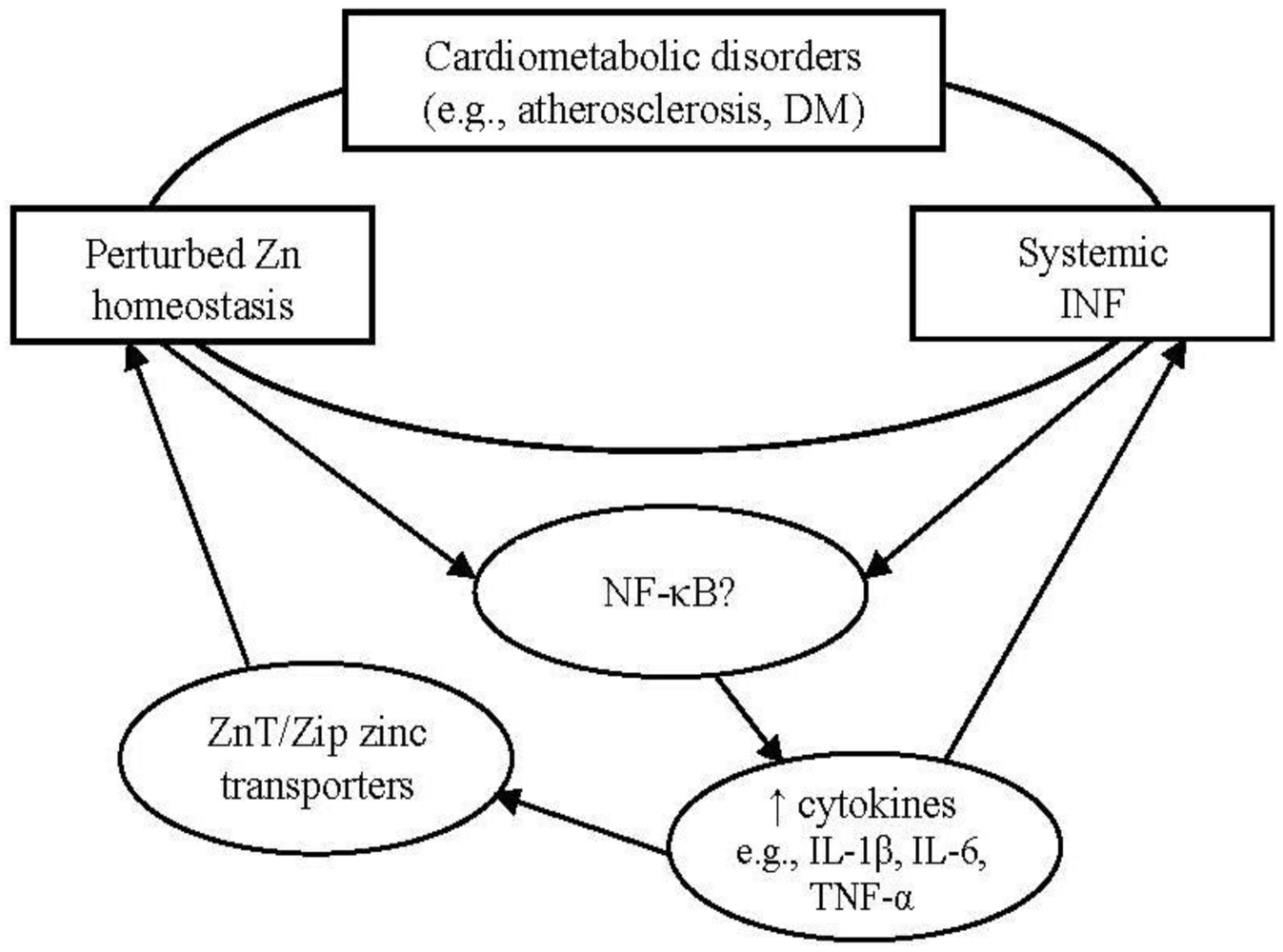
      <p>Perturbed zinc homeostasis has been observed also in DM. Both Type 1 and Type 2 DM exhibit an impaired immune function as part of their pathogenesis that ultimately results in a decreased functional β-cell mass; while Type 1 DM is primarily an autoimmune disorder that leads to rapid β-cell destruction, the failure of β-cells in Type 2 DM occurs over a prolonged period and involves the chronic activation of the innate immune system [<xref ref-type="bibr" rid="B90-nutrients-04-00676">90</xref>]. The sustained or aberrant expression in DM of a number of immune mediators, including NF-κB, IL-1β and IL-6, suggests a potential interaction between the impaired immunity and the perturbed cellular zinc homeostasis associated with the disease. An overview of the proposed interrelationship between impaired zinc homeostasis, systemic INF, and cardiometabolic disorders is depicted in <xref ref-type="fig" rid="nutrients-04-00676-f001">Figure 1</xref>.</p>
      <fig id="nutrients-04-00676-f001" position="anchor">
        <label>Figure 1</label>
        <caption>
          <p>Potential interrelationship between cardiometabolic disorders, perturbed zinc homeostasis, and systemic inflammation. Cardiometabolic disorders, such as atherosclerosis and DM, often are associated with impaired zinc homeostasis and low-grade systemic INF. Depending on the health and/or zinc status of the host, zinc may enhance the expression of a range of NF-κB targeted genes known to increase systemic INF, including inflammatory cytokines. Cytokines have been shown to modulate the expression of zinc transporters, suggesting that non-resolving INF may contribute to perturbed zinc homeostasis.</p>
        </caption>
        <graphic xmlns:xlink="http://www.w3.org/1999/xlink" xlink:href="nutrients-04-00676-g001.tif"/>
      </fig>
      <p>Zinc has the ability to regulate both negatively and positively the signalling pathways of TLR and the IL-1 receptor, which may reflect its ability to induce or inhibit NF-κB activation. Increased concentrations of IL-1β have been observed in the pancreatic islet in humans with Type 2 DM [<xref ref-type="bibr" rid="B91-nutrients-04-00676">91</xref>], and human islets have been shown to respond to metabolic stress <italic>in vitro</italic> by increasing IL-6 release [<xref ref-type="bibr" rid="B92-nutrients-04-00676">92</xref>]. A prospective examination of the effects of IL-1β, IL-6, and TNF-α on the development of Type 2 DM found that participants with detectable levels of IL-1β and elevated concentrations of IL-6 in plasma had a threefold increased risk of developing DM compared to the reference group [<xref ref-type="bibr" rid="B93-nutrients-04-00676">93</xref>]. Both IL-1β and IL-6 are pleiotropic and are known to exert both beneficial and detrimental effects on a variety of cell types, including the pancreatic β-cells, depending on the cytokine concentration and the duration of exposure. Higher doses and longer exposure times impair glucose-stimulated insulin secretion and, at least in the case of IL-1β, increase β-cell apoptosis [<xref ref-type="bibr" rid="B94-nutrients-04-00676">94</xref>]. </p>
      <p>The characterizing feature of DM is the presence of chronic hyperglycemia, which is known to enhance oxidant production and impair antioxidant defense mechanisms [<xref ref-type="bibr" rid="B95-nutrients-04-00676">95</xref>,<xref ref-type="bibr" rid="B96-nutrients-04-00676">96</xref>]. Zinc supplementation has been reported to decrease cytokine levels [<xref ref-type="bibr" rid="B36-nutrients-04-00676">36</xref>] and glycemic marker concentrations [<xref ref-type="bibr" rid="B97-nutrients-04-00676">97</xref>,<xref ref-type="bibr" rid="B98-nutrients-04-00676">98</xref>], suggesting that hyperglycemia and chronic INF in type 2 DM are connected. In a preliminary evaluation of clinical trials investigating the effect of zinc supplementation on fasting blood glucose and serum insulin concentrations, a small but statistically significant reduction in fasting glucose concentrations was observed after zinc supplementation and in secondary analyses of participants with chronic metabolic disease, zinc supplementation produced a greater reduction in plasma glucose concentrations compared to the effect that was observed in healthy participants [<xref ref-type="bibr" rid="B99-nutrients-04-00676">99</xref>]. The significant albeit modest reduction in plasma glucose concentrations, suggest that zinc contributes to the management of hyperglycemia, and thereby reduces INF, in individuals with chronic metabolic disease.</p>
      <p>β-cell destruction can be mediated by autoreactive T-lymphocytes such as CD4<sup>+</sup> and CD8<sup>+</sup> cells; cytokines have been shown to induce the expression of the Fas (CD95, APO-1) receptor in the β-cell, thereby sensitizing it to T-lymphocyte mediated destruction [<xref ref-type="bibr" rid="B90-nutrients-04-00676">90</xref>]. The involvement of T-cells in β-cell failure, and INF more broadly, may further implicate perturbations in zinc homeostasis in the pathogenesis of DM. Zinc deficiency is well-known to disrupt the development and function of T-cells by causing, for instance, a reduction in thymic involution [<xref ref-type="bibr" rid="B100-nutrients-04-00676">100</xref>] and a decrease in the CD4<sup>+</sup> to CD8<sup>+</sup> cell ratio [<xref ref-type="bibr" rid="B8-nutrients-04-00676">8</xref>], both effects that have been shown to be corrected by zinc supplementation in humans.</p>
    </sec>
    <sec sec-type="conclusions">
      <title>7. Conclusions</title>
      <p>Recognition of the public health importance of zinc continues to expand, as does knowledge of the multitude of biological pathways affected by zinc and its interaction with INF. Impaired zinc homeostasis, chronic INF, and increased levels of oxidative stress feature prominently in a number of cardiometabolic diseases, including atherosclerosis and DM. Positive indications for zinc supplementation in ameliorating INF and oxidative stress in cardiometabolic disorders raise the possibility of specific therapeutic manipulation by zinc-based treatments [<xref ref-type="bibr" rid="B15-nutrients-04-00676">15</xref>,<xref ref-type="bibr" rid="B101-nutrients-04-00676">101</xref>], however caution is required in the administration of zinc in the clinical setting. Given the potential for high zinc doses to produce adverse effects, including the inhibition of T-cell functions and aberrant expression of cytokines [<xref ref-type="bibr" rid="B102-nutrients-04-00676">102</xref>] and a decrease in Cu-Zn superoxide dismutase activity [<xref ref-type="bibr" rid="B103-nutrients-04-00676">103</xref>], further well-designed randomized controlled trials are necessary to provide cogent insight into safe and desirable levels of zinc supplementation in varied populations. Additional investigations of the molecular mechanisms that underpin the sensing and distribution of zinc also are necessary to explain their effects in humans.</p>
    </sec>
  </body>
  <back>
    <notes>
      <title>Conflict of Interest</title>
      <p>The authors declare no conflicts of interest.</p>
    </notes>
    <ref-list>
      <title>References</title>
      <ref id="B1-nutrients-04-00676">
        <label>1.</label>
        <citation citation-type="journal">
          <person-group person-group-type="author">
            <name>
              <surname>Prasad</surname>
              <given-names>A.S.</given-names>
            </name>
            <name>
              <surname>Halsted</surname>
              <given-names>J.A.</given-names>
            </name>
            <name>
              <surname>Nadimi</surname>
              <given-names>M.</given-names>
            </name>
          </person-group>
          <article-title>Syndrome of iron deficiency anaemia, hepatosplenomegaly, hypogonadism, dwarfism and geophagia</article-title>
          <source>Am. J. Med.</source>
          <year>1961</year>
          <volume>31</volume>
          <fpage>532</fpage>
          <lpage>546</lpage>
          <pub-id pub-id-type="doi">10.1016/0002-9343(61)90137-1</pub-id>
        </citation>
      </ref>
      <ref id="B2-nutrients-04-00676">
        <label>2.</label>
        <citation citation-type="journal">
          <person-group person-group-type="author">
            <name>
              <surname>Vallee</surname>
              <given-names>B.L.</given-names>
            </name>
            <name>
              <surname>Falchuk</surname>
              <given-names>K.H.</given-names>
            </name>
          </person-group>
          <article-title>The biochemical basis of zinc physiology</article-title>
          <source>Physiol. Rev.</source>
          <year>1993</year>
          <volume>73</volume>
          <fpage>79</fpage>
          <lpage>118</lpage>
          <pub-id pub-id-type="doi">10.2466/pr0.1993.73.1.79</pub-id>
        </citation>
      </ref>
      <ref id="B3-nutrients-04-00676">
        <label>3.</label>
        <citation citation-type="journal">
          <person-group person-group-type="author">
            <name>
              <surname>Beyersmann</surname>
              <given-names>D.</given-names>
            </name>
            <name>
              <surname>Haase</surname>
              <given-names>H.</given-names>
            </name>
          </person-group>
          <article-title>Functions of zinc in signaling, proliferation and differentiation of mammalian cells</article-title>
          <source>Biometals</source>
          <year>2001</year>
          <volume>14</volume>
          <fpage>331</fpage>
          <lpage>341</lpage>
          <pub-id pub-id-type="doi">10.1023/A:1012905406548</pub-id>
        </citation>
      </ref>
      <ref id="B4-nutrients-04-00676">
        <label>4.</label>
        <citation citation-type="journal">
          <person-group person-group-type="author">
            <name>
              <surname>Krężel</surname>
              <given-names>A.</given-names>
            </name>
            <name>
              <surname>Maret</surname>
              <given-names>W.</given-names>
            </name>
          </person-group>
          <article-title>Zinc-buffering capacity of a eukaryotic cell at physiological pZn</article-title>
          <source>J. Biol. Inorg. Chem.</source>
          <year>2006</year>
          <volume>11</volume>
          <fpage>1049</fpage>
          <lpage>1062</lpage>
          <pub-id pub-id-type="doi">10.1007/s00775-006-0150-5</pub-id>
        </citation>
      </ref>
      <ref id="B5-nutrients-04-00676">
        <label>5.</label>
        <citation citation-type="journal">
          <person-group person-group-type="author">
            <name>
              <surname>Frederickson</surname>
              <given-names>C.J.</given-names>
            </name>
            <name>
              <surname>Koh</surname>
              <given-names>J.Y.</given-names>
            </name>
            <name>
              <surname>Bush</surname>
              <given-names>A.I.</given-names>
            </name>
          </person-group>
          <article-title>The neurobiology of zinc in health and disease</article-title>
          <source>Nat. Rev. Neurosci.</source>
          <year>2005</year>
          <volume>6</volume>
          <fpage>449</fpage>
          <lpage>462</lpage>
          <pub-id pub-id-type="doi">10.1038/nrn1671</pub-id>
        </citation>
      </ref>
      <ref id="B6-nutrients-04-00676">
        <label>6.</label>
        <citation citation-type="journal">
          <person-group person-group-type="author">
            <name>
              <surname>Ezzati</surname>
              <given-names>M.</given-names>
            </name>
            <name>
              <surname>Lopez</surname>
              <given-names>A.D.</given-names>
            </name>
            <name>
              <surname>Rodgers</surname>
              <given-names>A.</given-names>
            </name>
            <name>
              <surname>Vander Hoorn</surname>
              <given-names>S.</given-names>
            </name>
            <name>
              <surname>Murray</surname>
              <given-names>C.J.L.</given-names>
            </name>
          </person-group>
          <article-title>Comparative Risk Assessment Collaborating Group. Selected major risk factors and global and regional burden of disease</article-title>
          <source>Lancet</source>
          <year>2002</year>
          <volume>360</volume>
          <fpage>1347</fpage>
          <lpage>1360</lpage>
        <pub-id pub-id-type="doi">10.1016/S0140-6736(02)11403-6</pub-id><pub-id pub-id-type="pmid">12423980</pub-id></citation>
      </ref>
      <ref id="B7-nutrients-04-00676">
        <label>7.</label>
        <citation citation-type="journal">
          <person-group person-group-type="author">
            <name>
              <surname>Wuehler</surname>
              <given-names>S.E.</given-names>
            </name>
            <name>
              <surname>Peerson</surname>
              <given-names>J.M.</given-names>
            </name>
            <name>
              <surname>Brown</surname>
              <given-names>K.H.</given-names>
            </name>
          </person-group>
          <article-title>Use of national food balance data to estimate the adequacy of zinc in national food supplies: Methodology and regional estimates</article-title>
          <source>Public Health Nutr.</source>
          <year>2005</year>
          <volume>8</volume>
          <fpage>812</fpage>
          <lpage>819</lpage>
        <pub-id pub-id-type="pmid">16277796</pub-id></citation>
      </ref>
      <ref id="B8-nutrients-04-00676">
        <label>8.</label>
        <citation citation-type="journal">
          <person-group person-group-type="author">
            <name>
              <surname>Prasad</surname>
              <given-names>A.S.</given-names>
            </name>
          </person-group>
          <article-title>Zinc in human health: Effect of zinc on immune cells</article-title>
          <source>Mol. Med.</source>
          <year>2008</year>
          <volume>14</volume>
          <fpage>353</fpage>
          <lpage>357</lpage>
          <pub-id pub-id-type="doi">10.1007/s00894-008-0277-0</pub-id>
        </citation>
      </ref>
      <ref id="B9-nutrients-04-00676">
        <label>9.</label>
        <citation citation-type="journal">
          <person-group person-group-type="author">
            <name>
              <surname>Kruse-Jarres</surname>
              <given-names>J.D.</given-names>
            </name>
          </person-group>
          <article-title>The significance of zinc for humoral and cellular immunity</article-title>
          <source>J. Trace Elem. Electrolytes Health Dis.</source>
          <year>1989</year>
          <volume>3</volume>
          <fpage>1</fpage>
          <lpage>8</lpage>
        <pub-id pub-id-type="pmid">2535314</pub-id></citation>
      </ref>
      <ref id="B10-nutrients-04-00676">
        <label>10.</label>
        <citation citation-type="book">
          <person-group person-group-type="author">
            <name>
              <surname>Abbas</surname>
              <given-names>A.K.</given-names>
            </name>
            <name>
              <surname>Lichtman</surname>
              <given-names>A.H.</given-names>
            </name>
          </person-group>
          <source>Cellular and Molecular Immunology</source>
          <edition>5th</edition>
          <publisher-name>Elsevier Saunders</publisher-name>
          <publisher-loc>Philadelphia, PA, USA</publisher-loc>
          <year>2005</year>
        </citation>
      </ref>
      <ref id="B11-nutrients-04-00676">
        <label>11.</label>
        <citation citation-type="journal">
          <person-group person-group-type="author">
            <name>
              <surname>Zhou</surname>
              <given-names>X.</given-names>
            </name>
            <name>
              <surname>Fragala</surname>
              <given-names>M.S.</given-names>
            </name>
            <name>
              <surname>McElhaney</surname>
              <given-names>J.E.</given-names>
            </name>
            <name>
              <surname>Kuchel</surname>
              <given-names>G.A.</given-names>
            </name>
          </person-group>
          <article-title>Conceptual and methodological issues relevant to cytokine and inflammatory marker measurements in clinical research</article-title>
          <source>Curr. Opin. Clin. Nutr. Metab. Care</source>
          <year>2010</year>
          <volume>13</volume>
          <fpage>541</fpage>
          <lpage>547</lpage>
          <pub-id pub-id-type="doi">10.1097/MCO.0b013e32833cf3bc</pub-id>
        </citation>
      </ref>
      <ref id="B12-nutrients-04-00676">
        <label>12.</label>
        <citation citation-type="journal">
          <person-group person-group-type="author">
            <name>
              <surname>Medzhitov</surname>
              <given-names>R.</given-names>
            </name>
          </person-group>
          <article-title>Inflammation 2010: New adventures of an old flame</article-title>
          <source>Cell</source>
          <year>2010</year>
          <volume>140</volume>
          <fpage>771</fpage>
          <lpage>776</lpage>
          <pub-id pub-id-type="doi">10.1016/j.cell.2010.03.006</pub-id>
        </citation>
      </ref>
      <ref id="B13-nutrients-04-00676">
        <label>13.</label>
        <citation citation-type="journal">
          <person-group person-group-type="author">
            <name>
              <surname>Nathan</surname>
              <given-names>C.</given-names>
            </name>
            <name>
              <surname>Ding</surname>
              <given-names>A.</given-names>
            </name>
          </person-group>
          <article-title>Nonresolving inflammation</article-title>
          <source>Cell</source>
          <year>2010</year>
          <volume>140</volume>
          <fpage>871</fpage>
          <lpage>882</lpage>
          <pub-id pub-id-type="doi">10.1016/j.cell.2010.02.029</pub-id>
        </citation>
      </ref>
      <ref id="B14-nutrients-04-00676">
        <label>14.</label>
        <citation citation-type="journal">
          <person-group person-group-type="author">
            <name>
              <surname>Krebs</surname>
              <given-names>N.E.</given-names>
            </name>
            <name>
              <surname>Hambidge</surname>
              <given-names>K.M.</given-names>
            </name>
          </person-group>
          <article-title>Zinc metabolism and homeostasis: The application of tracer techniques to human zinc physiology</article-title>
          <source>Biometals</source>
          <year>2001</year>
          <volume>14</volume>
          <fpage>397</fpage>
          <lpage>412</lpage>
          <pub-id pub-id-type="doi">10.1023/A:1012942409274</pub-id>
        </citation>
      </ref>
      <ref id="B15-nutrients-04-00676">
        <label>15.</label>
        <citation citation-type="journal">
          <person-group person-group-type="author">
            <name>
              <surname>Foster</surname>
              <given-names>M.</given-names>
            </name>
            <name>
              <surname>Samman</surname>
              <given-names>S.</given-names>
            </name>
          </person-group>
          <article-title>Zinc and redox signaling: Perturbations associated with cardiovascular disease and diabetes mellitus</article-title>
          <source>Antioxid. Redox Signal.</source>
          <year>2010</year>
          <volume>13</volume>
          <fpage>1549</fpage>
          <lpage>1573</lpage>
          <pub-id pub-id-type="doi">10.1089/ars.2010.3111</pub-id>
        </citation>
      </ref>
      <ref id="B16-nutrients-04-00676">
        <label>16.</label>
        <citation citation-type="journal">
          <person-group person-group-type="author">
            <name>
              <surname>Prasad</surname>
              <given-names>A.S.</given-names>
            </name>
          </person-group>
          <article-title>Zinc and immunity</article-title>
          <source>Mol. Cell. Biochem.</source>
          <year>1998</year>
          <volume>188</volume>
          <fpage>63</fpage>
          <lpage>69</lpage>
          <pub-id pub-id-type="doi">10.1023/A:1006868305749</pub-id>
        </citation>
      </ref>
      <ref id="B17-nutrients-04-00676">
        <label>17.</label>
        <citation citation-type="journal">
          <person-group person-group-type="author">
            <name>
              <surname>Besecker</surname>
              <given-names>B.Y.</given-names>
            </name>
            <name>
              <surname>Exline</surname>
              <given-names>M.C.</given-names>
            </name>
            <name>
              <surname>Hollyfield</surname>
              <given-names>J.</given-names>
            </name>
            <name>
              <surname>Phillips</surname>
              <given-names>G.</given-names>
            </name>
            <name>
              <surname>Disilvestro</surname>
              <given-names>R.A.</given-names>
            </name>
            <name>
              <surname>Wewers</surname>
              <given-names>M.D.</given-names>
            </name>
            <name>
              <surname>Knoell</surname>
              <given-names>D.L.</given-names>
            </name>
          </person-group>
          <article-title>A comparison of zinc metabolism, inflammation, and disease severity in critically ill infected and noninfected adults early after intensive care unit admission</article-title>
          <source>Am. J. Clin. Nutr.</source>
          <year>2011</year>
          <volume>93</volume>
          <fpage>1356</fpage>
          <lpage>1364</lpage>
          <pub-id pub-id-type="doi">10.3945/ajcn.110.008417</pub-id>
        </citation>
      </ref>
      <ref id="B18-nutrients-04-00676">
        <label>18.</label>
        <citation citation-type="journal">
          <person-group person-group-type="author">
            <name>
              <surname>Egefjord</surname>
              <given-names>L.</given-names>
            </name>
            <name>
              <surname>Jensen</surname>
              <given-names>J.L.</given-names>
            </name>
            <name>
              <surname>Bang-Berthelsen</surname>
              <given-names>C.H.</given-names>
            </name>
            <name>
              <surname>Petersen</surname>
              <given-names>A.B.</given-names>
            </name>
            <name>
              <surname>Smidt</surname>
              <given-names>K.</given-names>
            </name>
            <name>
              <surname>Schmitz</surname>
              <given-names>O.</given-names>
            </name>
            <name>
              <surname>Karlsen</surname>
              <given-names>A.E.</given-names>
            </name>
            <name>
              <surname>Pociot</surname>
              <given-names>F.</given-names>
            </name>
            <name>
              <surname>Chimienti</surname>
              <given-names>F.</given-names>
            </name>
            <name>
              <surname>Rungby</surname>
              <given-names>J.</given-names>
            </name>
            <name>
              <surname>Magnusson</surname>
              <given-names>N.E.</given-names>
            </name>
          </person-group>
          <article-title>Zinc transporter gene expression is regulated by pro-inflammatory cytokines: A potential role for zinc transporters in beta-cell apoptosis?</article-title>
          <source>BMC Endocr. Disord.</source>
          <year>2009</year>
          <volume>9</volume>
          <fpage>7</fpage>
          <pub-id pub-id-type="doi">10.1186/1472-6823-9-7</pub-id>
        </citation>
      </ref>
      <ref id="B19-nutrients-04-00676">
        <label>19.</label>
        <citation citation-type="journal">
          <person-group person-group-type="author">
            <name>
              <surname>Lang</surname>
              <given-names>C.</given-names>
            </name>
            <name>
              <surname>Murgia</surname>
              <given-names>C.</given-names>
            </name>
            <name>
              <surname>Leong</surname>
              <given-names>M.</given-names>
            </name>
            <name>
              <surname>Tan</surname>
              <given-names>L.W.</given-names>
            </name>
            <name>
              <surname>Perozzi</surname>
              <given-names>G.</given-names>
            </name>
            <name>
              <surname>Knight</surname>
              <given-names>D.</given-names>
            </name>
            <name>
              <surname>Ruffin</surname>
              <given-names>R.</given-names>
            </name>
            <name>
              <surname>Zalewski</surname>
              <given-names>P.</given-names>
            </name>
          </person-group>
          <article-title>Anti-inflammatory effects of zinc and alterations in zinc transporter mRNA in mouse models of allergic inflammation</article-title>
          <source>Am. J. Physiol. Lung Cell. Mol. Physiol.</source>
          <year>2007</year>
          <volume>292</volume>
          <fpage>L577</fpage>
          <lpage>L584</lpage>
        <pub-id pub-id-type="pmid">17085522</pub-id></citation>
      </ref>
      <ref id="B20-nutrients-04-00676">
        <label>20.</label>
        <citation citation-type="journal">
          <person-group person-group-type="author">
            <name>
              <surname>Liuzzi</surname>
              <given-names>J.P.</given-names>
            </name>
            <name>
              <surname>Lichten</surname>
              <given-names>L.A.</given-names>
            </name>
            <name>
              <surname>Rivera</surname>
              <given-names>S.</given-names>
            </name>
            <name>
              <surname>Blanchard</surname>
              <given-names>R.K.</given-names>
            </name>
            <name>
              <surname>Aydemir</surname>
              <given-names>T.B.</given-names>
            </name>
            <name>
              <surname>Knutson</surname>
              <given-names>M.D.</given-names>
            </name>
            <name>
              <surname>Ganz</surname>
              <given-names>T.</given-names>
            </name>
            <name>
              <surname>Cousins</surname>
              <given-names>R.J.</given-names>
            </name>
          </person-group>
          <article-title>Interleukin-6 regulates the zinc transporter Zip14 in liver and contributes to the hypozincemia of the acute-phase response</article-title>
          <source>Proc. Natl. Acad. Sci. USA</source>
          <year>2005</year>
          <volume>102</volume>
          <fpage>6843</fpage>
          <lpage>6848</lpage>
        <pub-id pub-id-type="doi">10.1073/pnas.0502257102</pub-id><pub-id pub-id-type="pmid">15863613</pub-id></citation>
      </ref>
      <ref id="B21-nutrients-04-00676">
        <label>21.</label>
        <citation citation-type="journal">
          <person-group person-group-type="author">
            <name>
              <surname>Cousins</surname>
              <given-names>R.J.</given-names>
            </name>
            <name>
              <surname>Leinart</surname>
              <given-names>A.S.</given-names>
            </name>
          </person-group>
          <article-title>Tissue-specific regulation of zinc metabolism and metallothionein genes by interleukin 1</article-title>
          <source>FASEB J.</source>
          <year>1988</year>
          <volume>2</volume>
          <fpage>2884</fpage>
          <lpage>2890</lpage>
        <pub-id pub-id-type="pmid">2458983</pub-id></citation>
      </ref>
      <ref id="B22-nutrients-04-00676">
        <label>22.</label>
        <citation citation-type="journal">
          <person-group person-group-type="author">
            <name>
              <surname>De</surname>
              <given-names>S.K.</given-names>
            </name>
            <name>
              <surname>McMaster</surname>
              <given-names>M.T.</given-names>
            </name>
            <name>
              <surname>Andrews</surname>
              <given-names>G.K.</given-names>
            </name>
          </person-group>
          <article-title>Endotoxin induction of murine metallothionein gene expression</article-title>
          <source>J. Biol. Chem.</source>
          <year>1990</year>
          <volume>265</volume>
          <fpage>15267</fpage>
          <lpage>15274</lpage>
        <pub-id pub-id-type="pmid">2203773</pub-id></citation>
      </ref>
      <ref id="B23-nutrients-04-00676">
        <label>23.</label>
        <citation citation-type="journal">
          <person-group person-group-type="author">
            <name>
              <surname>Lichten</surname>
              <given-names>L.A.</given-names>
            </name>
            <name>
              <surname>Cousins</surname>
              <given-names>R.J.</given-names>
            </name>
          </person-group>
          <article-title>Mammalian zinc transporters: Nutritional and physiological regulation</article-title>
          <source>Annu. Rev. Nutr.</source>
          <year>2009</year>
          <volume>29</volume>
          <fpage>153</fpage>
          <lpage>176</lpage>
          <pub-id pub-id-type="doi">10.1146/annurev-nutr-033009-083312</pub-id>
        </citation>
      </ref>
      <ref id="B24-nutrients-04-00676">
        <label>24.</label>
        <citation citation-type="journal">
          <person-group person-group-type="author">
            <name>
              <surname>Kim</surname>
              <given-names>S.</given-names>
            </name>
            <name>
              <surname>Watanabe</surname>
              <given-names>K.</given-names>
            </name>
            <name>
              <surname>Shirahata</surname>
              <given-names>T.</given-names>
            </name>
            <name>
              <surname>Watarai</surname>
              <given-names>M.</given-names>
            </name>
          </person-group>
          <article-title>Zinc uptake system (<italic>znuA</italic> locus) of <italic>Brucella abortus</italic> is essential for intracellular survival and virulence in mice</article-title>
          <source>J. Vet. Med. Sci.</source>
          <year>2004</year>
          <volume>66</volume>
          <fpage>1059</fpage>
          <lpage>1063</lpage>
          <pub-id pub-id-type="doi">10.1292/jvms.66.1059</pub-id>
        </citation>
      </ref>
      <ref id="B25-nutrients-04-00676">
        <label>25.</label>
        <citation citation-type="journal">
          <person-group person-group-type="author">
            <name>
              <surname>Gaetke</surname>
              <given-names>L.M.</given-names>
            </name>
            <name>
              <surname>McClain</surname>
              <given-names>C.J.</given-names>
            </name>
            <name>
              <surname>Talwalkar</surname>
              <given-names>R.T.</given-names>
            </name>
            <name>
              <surname>Shedlofsky</surname>
              <given-names>S.I.</given-names>
            </name>
          </person-group>
          <article-title>Effects of endotoxin on zinc metabolism in human volunteers</article-title>
          <source>Am. J. Physiol.</source>
          <year>1997</year>
          <volume>272</volume>
          <fpage>E952</fpage>
          <lpage>E956</lpage>
        <pub-id pub-id-type="pmid">9227437</pub-id></citation>
      </ref>
      <ref id="B26-nutrients-04-00676">
        <label>26.</label>
        <citation citation-type="journal">
          <person-group person-group-type="author">
            <name>
              <surname>Young</surname>
              <given-names>B.</given-names>
            </name>
            <name>
              <surname>Ott</surname>
              <given-names>L.</given-names>
            </name>
            <name>
              <surname>Kasarskis</surname>
              <given-names>E.</given-names>
            </name>
            <name>
              <surname>Rapp</surname>
              <given-names>R.</given-names>
            </name>
            <name>
              <surname>Moles</surname>
              <given-names>K.</given-names>
            </name>
            <name>
              <surname>Dempsey</surname>
              <given-names>R.J.</given-names>
            </name>
            <name>
              <surname>Tibbs</surname>
              <given-names>P.A.</given-names>
            </name>
            <name>
              <surname>Kryscio</surname>
              <given-names>R.</given-names>
            </name>
            <name>
              <surname>McClain</surname>
              <given-names>C.</given-names>
            </name>
          </person-group>
          <article-title>Zinc supplementation is associated with improved neurologic recovery rate and visceral protein levels of patients with severe closed head injury</article-title>
          <source>J. Neurotrauma</source>
          <year>1996</year>
          <volume>13</volume>
          <fpage>25</fpage>
          <lpage>34</lpage>
          <pub-id pub-id-type="doi">10.1089/neu.1996.13.25</pub-id>
        </citation>
      </ref>
      <ref id="B27-nutrients-04-00676">
        <label>27.</label>
        <citation citation-type="journal">
          <person-group person-group-type="author">
            <name>
              <surname>Hotamisligil</surname>
              <given-names>G.S.</given-names>
            </name>
          </person-group>
          <article-title>Inflammation and metabolic disorders</article-title>
          <source>Nature</source>
          <year>2006</year>
          <volume>444</volume>
          <fpage>860</fpage>
          <lpage>867</lpage>
          <pub-id pub-id-type="doi">10.1038/nature05485</pub-id>
        </citation>
      </ref>
      <ref id="B28-nutrients-04-00676">
        <label>28.</label>
        <citation citation-type="journal">
          <person-group person-group-type="author">
            <name>
              <surname>Costarelli</surname>
              <given-names>L.</given-names>
            </name>
            <name>
              <surname>Muti</surname>
              <given-names>E.</given-names>
            </name>
            <name>
              <surname>Malavolta</surname>
              <given-names>M.</given-names>
            </name>
            <name>
              <surname>Cipriano</surname>
              <given-names>C.</given-names>
            </name>
            <name>
              <surname>Giacconi</surname>
              <given-names>R.</given-names>
            </name>
            <name>
              <surname>Tesei</surname>
              <given-names>S.</given-names>
            </name>
            <name>
              <surname>Piacenza</surname>
              <given-names>F.</given-names>
            </name>
            <name>
              <surname>Pierpaoli</surname>
              <given-names>S.</given-names>
            </name>
            <name>
              <surname>Gasparini</surname>
              <given-names>N.</given-names>
            </name>
            <name>
              <surname>Faloia</surname>
              <given-names>E.</given-names>
            </name>
            <etal/>
          </person-group>
          <article-title>Distinctive modulation of inflammatory and metabolic parameters in relation to zinc nutritional status in adult overweight/obese subjects</article-title>
          <source>J. Nutr. Biochem.</source>
          <year>2010</year>
          <volume>21</volume>
          <fpage>432</fpage>
          <lpage>437</lpage>
          <pub-id pub-id-type="doi">10.1016/j.jnutbio.2009.02.001</pub-id>
        </citation>
      </ref>
      <ref id="B29-nutrients-04-00676">
        <label>29.</label>
        <citation citation-type="journal">
          <person-group person-group-type="author">
            <name>
              <surname>Prasad</surname>
              <given-names>A.S.</given-names>
            </name>
            <name>
              <surname>Beck</surname>
              <given-names>F.W.</given-names>
            </name>
            <name>
              <surname>Grabowski</surname>
              <given-names>S.M.</given-names>
            </name>
            <name>
              <surname>Kaplan</surname>
              <given-names>J.</given-names>
            </name>
            <name>
              <surname>Mathog</surname>
              <given-names>R.H.</given-names>
            </name>
          </person-group>
          <article-title>Zinc deficiency: Changes in cytokine production and T-cell subpopulations in patients with head and neck cancer and in noncancer subjects</article-title>
          <source>Proc. Assoc. Am. Physicians</source>
          <year>1997</year>
          <volume>109</volume>
          <fpage>68</fpage>
          <lpage>77</lpage>
        <pub-id pub-id-type="pmid">9010918</pub-id></citation>
      </ref>
      <ref id="B30-nutrients-04-00676">
        <label>30.</label>
        <citation citation-type="journal">
          <person-group person-group-type="author">
            <name>
              <surname>Beck</surname>
              <given-names>F.W.</given-names>
            </name>
            <name>
              <surname>Li</surname>
              <given-names>Y.</given-names>
            </name>
            <name>
              <surname>Bao</surname>
              <given-names>B.</given-names>
            </name>
            <name>
              <surname>Prasad</surname>
              <given-names>A.S.</given-names>
            </name>
            <name>
              <surname>Sarkar</surname>
              <given-names>F.H.</given-names>
            </name>
          </person-group>
          <article-title>Evidence for reprogramming global gene expression during zinc deficiency in the HUT-78 cell line</article-title>
          <source>Nutrition</source>
          <year>2006</year>
          <volume>22</volume>
          <fpage>1045</fpage>
          <lpage>1056</lpage>
        <pub-id pub-id-type="doi">10.1016/j.nut.2006.08.001</pub-id><pub-id pub-id-type="pmid">16979875</pub-id></citation>
      </ref>
      <ref id="B31-nutrients-04-00676">
        <label>31.</label>
        <citation citation-type="journal">
          <person-group person-group-type="author">
            <name>
              <surname>Prasad</surname>
              <given-names>A.S.</given-names>
            </name>
            <name>
              <surname>Bao</surname>
              <given-names>B.</given-names>
            </name>
            <name>
              <surname>Beck</surname>
              <given-names>F.W.J.</given-names>
            </name>
            <name>
              <surname>Sarkar</surname>
              <given-names>F.H.</given-names>
            </name>
          </person-group>
          <article-title>Correction of interleukin-2 gene expression by <italic>in vitro</italic> zinc addition to mononuclear cells from zinc-deficient human subjects: A specific test for zinc deficiency in humans</article-title>
          <source>Transl. Res.</source>
          <year>2006</year>
          <volume>148</volume>
          <fpage>325</fpage>
          <lpage>333</lpage>
          <pub-id pub-id-type="doi">10.1016/j.trsl.2006.07.008</pub-id>
        </citation>
      </ref>
      <ref id="B32-nutrients-04-00676">
        <label>32.</label>
        <citation citation-type="journal">
          <person-group person-group-type="author">
            <name>
              <surname>Pinna</surname>
              <given-names>K.</given-names>
            </name>
            <name>
              <surname>Kelley</surname>
              <given-names>D.S.</given-names>
            </name>
            <name>
              <surname>Taylor</surname>
              <given-names>P.C.</given-names>
            </name>
            <name>
              <surname>King</surname>
              <given-names>J.C.</given-names>
            </name>
          </person-group>
          <article-title>Immune functions are maintained in healthy men with low zinc intake</article-title>
          <source>J. Nutr.</source>
          <year>2002</year>
          <volume>132</volume>
          <fpage>2033</fpage>
          <lpage>2036</lpage>
        <pub-id pub-id-type="pmid">12097688</pub-id></citation>
      </ref>
      <ref id="B33-nutrients-04-00676">
        <label>33.</label>
        <citation citation-type="journal">
          <person-group person-group-type="author">
            <name>
              <surname>Wieringa</surname>
              <given-names>F.T.</given-names>
            </name>
            <name>
              <surname>Dijkhuizen</surname>
              <given-names>M.A.</given-names>
            </name>
            <name>
              <surname>West</surname>
              <given-names>C.E.</given-names>
            </name>
            <name>
              <surname>van der Ven-Jongekrijg</surname>
              <given-names>J.</given-names>
            </name>
            <name>
              <surname>van der Meer</surname>
              <given-names>J.W.</given-names>
            </name>
            <name>
              <surname>Muhilal</surname>
            </name>
          </person-group>
          <article-title>Reduced production of immunoregulatory cytokines in vitamin A- and zinc-deficient Indonesian infants</article-title>
          <source>Eur. J. Clin. Nutr.</source>
          <year>2004</year>
          <volume>58</volume>
          <fpage>1498</fpage>
          <lpage>1504</lpage>
          <pub-id pub-id-type="doi">10.1038/sj.ejcn.1601998</pub-id>
        </citation>
      </ref>
      <ref id="B34-nutrients-04-00676">
        <label>34.</label>
        <citation citation-type="journal">
          <person-group person-group-type="author">
            <name>
              <surname>Bao</surname>
              <given-names>B.</given-names>
            </name>
            <name>
              <surname>Prasad</surname>
              <given-names>A.S.</given-names>
            </name>
            <name>
              <surname>Beck</surname>
              <given-names>F.W.J.</given-names>
            </name>
            <name>
              <surname>Snell</surname>
              <given-names>D.</given-names>
            </name>
            <name>
              <surname>Suneja</surname>
              <given-names>A.</given-names>
            </name>
            <name>
              <surname>Sarkar</surname>
              <given-names>F.H.</given-names>
            </name>
            <name>
              <surname>Doshi</surname>
              <given-names>N.</given-names>
            </name>
            <name>
              <surname>Fitzgerald</surname>
              <given-names>J.T.</given-names>
            </name>
            <name>
              <surname>Swerdlow</surname>
              <given-names>P.</given-names>
            </name>
          </person-group>
          <article-title>Zinc supplementation decreases oxidative stress, incidence of infection, and generation of inflammatory cytokines in sickle cell disease patients</article-title>
          <source>Transl. Res.</source>
          <year>2008</year>
          <volume>152</volume>
          <fpage>67</fpage>
          <lpage>80</lpage>
          <pub-id pub-id-type="doi">10.1016/j.trsl.2008.06.001</pub-id>
        </citation>
      </ref>
      <ref id="B35-nutrients-04-00676">
        <label>35.</label>
        <citation citation-type="journal">
          <person-group person-group-type="author">
            <name>
              <surname>Prasad</surname>
              <given-names>A.S.</given-names>
            </name>
            <name>
              <surname>Beck</surname>
              <given-names>F.W.J.</given-names>
            </name>
            <name>
              <surname>Bao</surname>
              <given-names>B.</given-names>
            </name>
            <name>
              <surname>Fitzgerald</surname>
              <given-names>J.T.</given-names>
            </name>
            <name>
              <surname>Snell</surname>
              <given-names>D.C.</given-names>
            </name>
            <name>
              <surname>Steinberg</surname>
              <given-names>J.D.</given-names>
            </name>
            <name>
              <surname>Cardozo</surname>
              <given-names>L.J.</given-names>
            </name>
          </person-group>
          <article-title>Zinc supplementation decreases incidence of infections in the elderly: Effect of zinc on generation of cytokines and oxidative stress</article-title>
          <source>Am. J. Clin. Nutr.</source>
          <year>2007</year>
          <volume>85</volume>
          <fpage>837</fpage>
          <lpage>844</lpage>
        <pub-id pub-id-type="pmid">17344507</pub-id></citation>
      </ref>
      <ref id="B36-nutrients-04-00676">
        <label>36.</label>
        <citation citation-type="journal">
          <person-group person-group-type="author">
            <name>
              <surname>Bao</surname>
              <given-names>B.</given-names>
            </name>
            <name>
              <surname>Prasad</surname>
              <given-names>A.S.</given-names>
            </name>
            <name>
              <surname>Beck</surname>
              <given-names>F.W.J.</given-names>
            </name>
            <name>
              <surname>Fitzgerald</surname>
              <given-names>J.T.</given-names>
            </name>
            <name>
              <surname>Snell</surname>
              <given-names>D.</given-names>
            </name>
            <name>
              <surname>Bao</surname>
              <given-names>G.W.</given-names>
            </name>
            <name>
              <surname>Singh</surname>
              <given-names>T.</given-names>
            </name>
            <name>
              <surname>Cardozo</surname>
              <given-names>L.J.</given-names>
            </name>
          </person-group>
          <article-title>Zinc decreases C-reactive protein, lipid peroxidation, and inflammatory cytokines in elderly subjects: A potential implication of zinc as an atheroprotective agent</article-title>
          <source>Am. J. Clin. Nutr.</source>
          <year>2010</year>
          <volume>91</volume>
          <fpage>1634</fpage>
          <lpage>1641</lpage>
          <pub-id pub-id-type="doi">10.3945/ajcn.2009.28836</pub-id>
        </citation>
      </ref>
      <ref id="B37-nutrients-04-00676">
        <label>37.</label>
        <citation citation-type="journal">
          <person-group person-group-type="author">
            <name>
              <surname>Prasad</surname>
              <given-names>A.S.</given-names>
            </name>
            <name>
              <surname>Bao</surname>
              <given-names>B.</given-names>
            </name>
            <name>
              <surname>Beck</surname>
              <given-names>F.W.J.</given-names>
            </name>
            <name>
              <surname>Kucuk</surname>
              <given-names>O.</given-names>
            </name>
            <name>
              <surname>Sarkar</surname>
              <given-names>F.H.</given-names>
            </name>
          </person-group>
          <article-title>Antioxidant effect of zinc in humans</article-title>
          <source>Free Radic. Biol. Med.</source>
          <year>2004</year>
          <volume>37</volume>
          <fpage>1182</fpage>
          <lpage>1190</lpage>
          <pub-id pub-id-type="doi">10.1016/j.freeradbiomed.2004.07.007</pub-id>
        </citation>
      </ref>
      <ref id="B38-nutrients-04-00676">
        <label>38.</label>
        <citation citation-type="journal">
          <person-group person-group-type="author">
            <name>
              <surname>Raqib</surname>
              <given-names>R.</given-names>
            </name>
            <name>
              <surname>Roy</surname>
              <given-names>S.K.</given-names>
            </name>
            <name>
              <surname>Rahman</surname>
              <given-names>M.J.</given-names>
            </name>
            <name>
              <surname>Azim</surname>
              <given-names>T.</given-names>
            </name>
            <name>
              <surname>Ameer</surname>
              <given-names>S.S.</given-names>
            </name>
            <name>
              <surname>Chisti</surname>
              <given-names>J.</given-names>
            </name>
            <name>
              <surname>Andersson</surname>
              <given-names>J.</given-names>
            </name>
          </person-group>
          <article-title>Effect of zinc supplementation on immune and inflammatory responses in pediatric patients with shigellosis</article-title>
          <source>Am. J. Clin. Nutr.</source>
          <year>2004</year>
          <volume>79</volume>
          <fpage>444</fpage>
          <lpage>450</lpage>
        <pub-id pub-id-type="pmid">14985220</pub-id></citation>
      </ref>
      <ref id="B39-nutrients-04-00676">
        <label>39.</label>
        <citation citation-type="journal">
          <person-group person-group-type="author">
            <name>
              <surname>Sandstead</surname>
              <given-names>H.H.</given-names>
            </name>
            <name>
              <surname>Prasad</surname>
              <given-names>A.S.</given-names>
            </name>
            <name>
              <surname>Penland</surname>
              <given-names>J.G.</given-names>
            </name>
            <name>
              <surname>Beck</surname>
              <given-names>F.W.J.</given-names>
            </name>
            <name>
              <surname>Kaplan</surname>
              <given-names>J.</given-names>
            </name>
            <name>
              <surname>Egger</surname>
              <given-names>N.G.</given-names>
            </name>
            <name>
              <surname>Alcock</surname>
              <given-names>N.W.</given-names>
            </name>
            <name>
              <surname>Carroll</surname>
              <given-names>R.M.</given-names>
            </name>
            <name>
              <surname>Ramanujam</surname>
              <given-names>V.M.S.</given-names>
            </name>
            <name>
              <surname>Dayal</surname>
              <given-names>H.H.</given-names>
            </name>
            <etal/>
          </person-group>
          <article-title>Zinc deficiency in Mexican American children: Influence of zinc and other micronutrients on T cells, cytokines, and antiinflammatory plasma proteins</article-title>
          <source>Am. J. Clin. Nutr.</source>
          <year>2008</year>
          <volume>88</volume>
          <fpage>1067</fpage>
          <lpage>1073</lpage>
        <pub-id pub-id-type="pmid">18842795</pub-id></citation>
      </ref>
      <ref id="B40-nutrients-04-00676">
        <label>40.</label>
        <citation citation-type="journal">
          <person-group person-group-type="author">
            <name>
              <surname>Aydemir</surname>
              <given-names>T.B.</given-names>
            </name>
            <name>
              <surname>Blanchard</surname>
              <given-names>R.K.</given-names>
            </name>
            <name>
              <surname>Cousins</surname>
              <given-names>R.J.</given-names>
            </name>
          </person-group>
          <article-title>Zinc supplementation of young men alters metallothionein, zinc transporter, and cytokine gene expression in leukocyte populations</article-title>
          <source>Proc. Natl. Acad. Sci. USA</source>
          <year>2006</year>
          <volume>103</volume>
          <fpage>1699</fpage>
          <lpage>1704</lpage>
        <pub-id pub-id-type="doi">10.1073/pnas.0510407103</pub-id><pub-id pub-id-type="pmid">16434472</pub-id></citation>
      </ref>
      <ref id="B41-nutrients-04-00676">
        <label>41.</label>
        <citation citation-type="journal">
          <person-group person-group-type="author">
            <name>
              <surname>Kahmann</surname>
              <given-names>L.</given-names>
            </name>
            <name>
              <surname>Uciechowski</surname>
              <given-names>P.</given-names>
            </name>
            <name>
              <surname>Warmuth</surname>
              <given-names>S.</given-names>
            </name>
            <name>
              <surname>Plümäkers</surname>
              <given-names>B.</given-names>
            </name>
            <name>
              <surname>Gressner</surname>
              <given-names>A.M.</given-names>
            </name>
            <name>
              <surname>Malavolta</surname>
              <given-names>M.</given-names>
            </name>
            <name>
              <surname>Mocchegiani</surname>
              <given-names>E.</given-names>
            </name>
            <name>
              <surname>Rink</surname>
              <given-names>L.</given-names>
            </name>
          </person-group>
          <article-title>Zinc supplementation in the elderly reduces spontaneous inflammatory cytokine release and restores T cell functions</article-title>
          <source>Rejuvenation Res.</source>
          <year>2008</year>
          <volume>11</volume>
          <fpage>227</fpage>
          <lpage>237</lpage>
          <pub-id pub-id-type="doi">10.1089/rej.2007.0613</pub-id>
        </citation>
      </ref>
      <ref id="B42-nutrients-04-00676">
        <label>42.</label>
        <citation citation-type="journal">
          <person-group person-group-type="author">
            <name>
              <surname>Mariani</surname>
              <given-names>E.</given-names>
            </name>
            <name>
              <surname>Cattini</surname>
              <given-names>L.</given-names>
            </name>
            <name>
              <surname>Neri</surname>
              <given-names>S.</given-names>
            </name>
            <name>
              <surname>Malavolta</surname>
              <given-names>M.</given-names>
            </name>
            <name>
              <surname>Mocchegiani</surname>
              <given-names>E.</given-names>
            </name>
            <name>
              <surname>Ravaglia</surname>
              <given-names>G.</given-names>
            </name>
            <name>
              <surname>Facchini</surname>
              <given-names>A.</given-names>
            </name>
          </person-group>
          <article-title>Simultaneous evaluation of circulating chemokine and cytokine profiles in elderly subjects by multiplex technology: Relationship with zinc status</article-title>
          <source>Biogerontology</source>
          <year>2008</year>
          <volume>7</volume>
          <fpage>449</fpage>
          <lpage>459</lpage>
        </citation>
      </ref>
      <ref id="B43-nutrients-04-00676">
        <label>43.</label>
        <citation citation-type="journal">
          <person-group person-group-type="author">
            <name>
              <surname>Mocchegiani</surname>
              <given-names>E.</given-names>
            </name>
            <name>
              <surname>Giacconi</surname>
              <given-names>R.</given-names>
            </name>
            <name>
              <surname>Costarelli</surname>
              <given-names>L.</given-names>
            </name>
            <name>
              <surname>Muti</surname>
              <given-names>E.</given-names>
            </name>
            <name>
              <surname>Cipriano</surname>
              <given-names>C.</given-names>
            </name>
            <name>
              <surname>Tesei</surname>
              <given-names>S.</given-names>
            </name>
            <name>
              <surname>Pierpaoli</surname>
              <given-names>S.</given-names>
            </name>
            <name>
              <surname>Giuli</surname>
              <given-names>C.</given-names>
            </name>
            <name>
              <surname>Papa</surname>
              <given-names>R.</given-names>
            </name>
            <name>
              <surname>Marcellini</surname>
              <given-names>F.</given-names>
            </name>
            <etal/>
          </person-group>
          <article-title>Zinc deficiency and IL-6–174G/C polymorphism in old people from different European countries: Effect of zinc supplementation. ZINCAGE study</article-title>
          <source>Exp. Gerontol.</source>
          <year>2008</year>
          <volume>43</volume>
          <fpage>433</fpage>
          <lpage>444</lpage>
          <pub-id pub-id-type="doi">10.1016/j.exger.2008.01.001</pub-id>
        </citation>
      </ref>
      <ref id="B44-nutrients-04-00676">
        <label>44.</label>
        <citation citation-type="journal">
          <person-group person-group-type="author">
            <name>
              <surname>Kara</surname>
              <given-names>E.</given-names>
            </name>
            <name>
              <surname>Ozal</surname>
              <given-names>M.</given-names>
            </name>
            <name>
              <surname>Gunay</surname>
              <given-names>M.</given-names>
            </name>
            <name>
              <surname>Kilic</surname>
              <given-names>M.</given-names>
            </name>
            <name>
              <surname>Baltaci</surname>
              <given-names>A.K.</given-names>
            </name>
            <name>
              <surname>Mogulkoc</surname>
              <given-names>R.</given-names>
            </name>
          </person-group>
          <article-title>Effects of exercise and zinc supplementation on cytokine release in young wrestlers</article-title>
          <source>Biol. Trace Elem. Res.</source>
          <year>2011</year>
          <volume>143</volume>
          <fpage>1435</fpage>
          <lpage>1440</lpage>
          <pub-id pub-id-type="doi">10.1007/s12011-011-9005-1</pub-id>
        </citation>
      </ref>
      <ref id="B45-nutrients-04-00676">
        <label>45.</label>
        <citation citation-type="journal">
          <person-group person-group-type="author">
            <name>
              <surname>Bao</surname>
              <given-names>B.</given-names>
            </name>
            <name>
              <surname>Prasad</surname>
              <given-names>A.S.</given-names>
            </name>
            <name>
              <surname>Beck</surname>
              <given-names>F.W.</given-names>
            </name>
            <name>
              <surname>Bao</surname>
              <given-names>G.W.</given-names>
            </name>
            <name>
              <surname>Singh</surname>
              <given-names>T.</given-names>
            </name>
            <name>
              <surname>Ali</surname>
              <given-names>S.</given-names>
            </name>
            <name>
              <surname>Sarkar</surname>
              <given-names>F.H.</given-names>
            </name>
          </person-group>
          <article-title>Intracellular free zinc up-regulates IFN-γ and T-bet essential for Th1 differentiation in Con-A stimulated HUT-78 cells</article-title>
          <source>Biochem. Biophys. Res. Commun.</source>
          <year>2011</year>
          <volume>407</volume>
          <fpage>703</fpage>
          <lpage>707</lpage>
          <pub-id pub-id-type="doi">10.1016/j.bbrc.2011.03.084</pub-id>
        </citation>
      </ref>
      <ref id="B46-nutrients-04-00676">
        <label>46.</label>
        <citation citation-type="journal">
          <person-group person-group-type="author">
            <name>
              <surname>Hayashi</surname>
              <given-names>K.</given-names>
            </name>
            <name>
              <surname>Ishizuka</surname>
              <given-names>S.</given-names>
            </name>
            <name>
              <surname>Yokoyama</surname>
              <given-names>C.</given-names>
            </name>
            <name>
              <surname>Hatae</surname>
              <given-names>T.</given-names>
            </name>
          </person-group>
          <article-title>Attenuation of interferon-gamma mRNA expression in activated Jurkat T cells by exogenous zinc via down-regulation of the calcium-independent PKC-AP-1 signaling pathway</article-title>
          <source>Life Sci.</source>
          <year>2008</year>
          <volume>83</volume>
          <fpage>6</fpage>
          <lpage>11</lpage>
          <pub-id pub-id-type="doi">10.1016/j.lfs.2008.04.022</pub-id>
        </citation>
      </ref>
      <ref id="B47-nutrients-04-00676">
        <label>47.</label>
        <citation citation-type="journal">
          <person-group person-group-type="author">
            <name>
              <surname>Prasad</surname>
              <given-names>A.S.</given-names>
            </name>
            <name>
              <surname>Bao</surname>
              <given-names>B.</given-names>
            </name>
            <name>
              <surname>Beck</surname>
              <given-names>F.W.J.</given-names>
            </name>
            <name>
              <surname>Sarkar</surname>
              <given-names>F.H.</given-names>
            </name>
          </person-group>
          <article-title>Zinc-suppressed inflammatory cytokines by induction of A20-mediated inhibition of nuclear factor-κB</article-title>
          <source>Nutrition</source>
          <year>2011</year>
          <volume>27</volume>
          <fpage>816</fpage>
          <lpage>823</lpage>
          <pub-id pub-id-type="doi">10.1016/j.nut.2010.08.010</pub-id>
        </citation>
      </ref>
      <ref id="B48-nutrients-04-00676">
        <label>48.</label>
        <citation citation-type="journal">
          <person-group person-group-type="author">
            <name>
              <surname>Freitas</surname>
              <given-names>M.</given-names>
            </name>
            <name>
              <surname>Fernandes</surname>
              <given-names>E.</given-names>
            </name>
          </person-group>
          <article-title>Zinc, cadmium and nickel increase the activation of NF-κB and the release of cytokines from THP-1 monocytic cells</article-title>
          <source>Metallomics</source>
          <year>2011</year>
          <volume>3</volume>
          <fpage>1238</fpage>
          <lpage>1243</lpage>
          <pub-id pub-id-type="doi">10.1039/c1mt00050k</pub-id>
        </citation>
      </ref>
      <ref id="B49-nutrients-04-00676">
        <label>49.</label>
        <citation citation-type="journal">
          <person-group person-group-type="author">
            <name>
              <surname>Tsou</surname>
              <given-names>T.C.</given-names>
            </name>
            <name>
              <surname>Chao</surname>
              <given-names>H.R.</given-names>
            </name>
            <name>
              <surname>Yeh</surname>
              <given-names>S.C.</given-names>
            </name>
            <name>
              <surname>Tsai</surname>
              <given-names>F.Y.</given-names>
            </name>
            <name>
              <surname>Lin</surname>
              <given-names>H.J.</given-names>
            </name>
          </person-group>
          <article-title>Zinc induces chemokine and inflammatory cytokine release from human promonocytes</article-title>
          <source>J. Hazard. Mater.</source>
          <year>2011</year>
          <volume>196</volume>
          <fpage>335</fpage>
          <lpage>341</lpage>
        <pub-id pub-id-type="pmid">21974847</pub-id></citation>
      </ref>
      <ref id="B50-nutrients-04-00676">
        <label>50.</label>
        <citation citation-type="journal">
          <person-group person-group-type="author">
            <name>
              <surname>Metz</surname>
              <given-names>C.H.</given-names>
            </name>
            <name>
              <surname>Schröder</surname>
              <given-names>A.K.</given-names>
            </name>
            <name>
              <surname>Overbeck</surname>
              <given-names>S.</given-names>
            </name>
            <name>
              <surname>Kahmann</surname>
              <given-names>L.</given-names>
            </name>
            <name>
              <surname>Plümäkers</surname>
              <given-names>B.</given-names>
            </name>
            <name>
              <surname>Rink</surname>
              <given-names>L.</given-names>
            </name>
          </person-group>
          <article-title>T-helper type 1 cytokine release is enhanced by <italic>in vitro</italic> zinc supplementation due to increased natural killer cells</article-title>
          <source>Nutrition</source>
          <year>2007</year>
          <volume>23</volume>
          <fpage>157</fpage>
          <lpage>163</lpage>
          <pub-id pub-id-type="doi">10.1016/j.nut.2006.10.007</pub-id>
        </citation>
      </ref>
      <ref id="B51-nutrients-04-00676">
        <label>51.</label>
        <citation citation-type="journal">
          <person-group person-group-type="author">
            <name>
              <surname>Poleganov</surname>
              <given-names>M.A.</given-names>
            </name>
            <name>
              <surname>Pfeilschifter</surname>
              <given-names>J.</given-names>
            </name>
            <name>
              <surname>Mühl</surname>
              <given-names>H.</given-names>
            </name>
          </person-group>
          <article-title>Expanding extracellular zinc beyond levels reflecting the albumin-bound plasma zinc pool potentiates the capability of IL-1β, IL-18, and IL-12 to act as IFN-γ-inducing factors on PBMC</article-title>
          <source>J. Interferon Cytokine Res.</source>
          <year>2007</year>
          <volume>27</volume>
          <fpage>997</fpage>
          <lpage>1001</lpage>
          <pub-id pub-id-type="doi">10.1089/jir.2007.0037</pub-id>
        </citation>
      </ref>
      <ref id="B52-nutrients-04-00676">
        <label>52.</label>
        <citation citation-type="journal">
          <person-group person-group-type="author">
            <name>
              <surname>Chang</surname>
              <given-names>K.L.</given-names>
            </name>
            <name>
              <surname>Hung</surname>
              <given-names>T.C.</given-names>
            </name>
            <name>
              <surname>Hsieh</surname>
              <given-names>B.S.</given-names>
            </name>
            <name>
              <surname>Chen</surname>
              <given-names>Y.H.</given-names>
            </name>
            <name>
              <surname>Chen</surname>
              <given-names>T.F.</given-names>
            </name>
            <name>
              <surname>Cheng</surname>
              <given-names>H.L.</given-names>
            </name>
          </person-group>
          <article-title>Zinc at pharmacologic concentrations affects cytokine expression and induces apoptosis of human peripheral blood mononuclear cells</article-title>
          <source>Nutrition</source>
          <year>2006</year>
          <volume>22</volume>
          <fpage>465</fpage>
          <lpage>474</lpage>
          <pub-id pub-id-type="doi">10.1016/j.nut.2005.11.009</pub-id>
        </citation>
      </ref>
      <ref id="B53-nutrients-04-00676">
        <label>53.</label>
        <citation citation-type="journal">
          <person-group person-group-type="author">
            <name>
              <surname>Von Bülow</surname>
              <given-names>V.</given-names>
            </name>
            <name>
              <surname>Rink</surname>
              <given-names>L.</given-names>
            </name>
            <name>
              <surname>Haase</surname>
              <given-names>H.</given-names>
            </name>
          </person-group>
          <article-title>Zinc-mediated inhibition of cyclic nucleotide phosphodiesterase activity and expression suppresses TNF-alpha and IL-1 beta production in monocytes by elevation of guanosine 3′,5′-cyclic monophosphate</article-title>
          <source>J. Immunol.</source>
          <year>2005</year>
          <volume>175</volume>
          <fpage>4697</fpage>
          <lpage>4705</lpage>
        <pub-id pub-id-type="pmid">16177117</pub-id></citation>
      </ref>
      <ref id="B54-nutrients-04-00676">
        <label>54.</label>
        <citation citation-type="journal">
          <person-group person-group-type="author">
            <name>
              <surname>Wellinghausen</surname>
              <given-names>N.</given-names>
            </name>
            <name>
              <surname>Martin</surname>
              <given-names>M.</given-names>
            </name>
            <name>
              <surname>Rink</surname>
              <given-names>L.</given-names>
            </name>
          </person-group>
          <article-title>Zinc inhibits interleukin-1-dependent T cell stimulation</article-title>
          <source>Eur. J. Immunol.</source>
          <year>1997</year>
          <volume>27</volume>
          <fpage>2529</fpage>
          <lpage>2535</lpage>
          <pub-id pub-id-type="doi">10.1002/eji.1830271010</pub-id>
        </citation>
      </ref>
      <ref id="B55-nutrients-04-00676">
        <label>55.</label>
        <citation citation-type="journal">
          <person-group person-group-type="author">
            <name>
              <surname>Driessen</surname>
              <given-names>C.</given-names>
            </name>
            <name>
              <surname>Hirv</surname>
              <given-names>K.</given-names>
            </name>
            <name>
              <surname>Wellinghausen</surname>
              <given-names>N.</given-names>
            </name>
            <name>
              <surname>Kirchner</surname>
              <given-names>H.</given-names>
            </name>
            <name>
              <surname>Rink</surname>
              <given-names>L.</given-names>
            </name>
          </person-group>
          <article-title>Influence of serum on zinc, toxic shock syndrome toxin-1, and lipopolysaccharide-induced production of IFN-gamma and IL-1 beta by human mononuclear cells</article-title>
          <source>J. Leukoc. Biol.</source>
          <year>1995</year>
          <volume>57</volume>
          <fpage>904</fpage>
          <lpage>908</lpage>
        <pub-id pub-id-type="pmid">7790774</pub-id></citation>
      </ref>
      <ref id="B56-nutrients-04-00676">
        <label>56.</label>
        <citation citation-type="journal">
          <person-group person-group-type="author">
            <name>
              <surname>Scuderi</surname>
              <given-names>P.</given-names>
            </name>
          </person-group>
          <article-title>Differential effects of copper and zinc on human peripheral blood monocyte cytokine secretion</article-title>
          <source>Cell. Immunol.</source>
          <year>1990</year>
          <volume>126</volume>
          <fpage>391</fpage>
          <lpage>405</lpage>
          <pub-id pub-id-type="doi">10.1016/0008-8749(90)90330-T</pub-id>
        </citation>
      </ref>
      <ref id="B57-nutrients-04-00676">
        <label>57.</label>
        <citation citation-type="journal">
          <person-group person-group-type="author">
            <name>
              <surname>Prasad</surname>
              <given-names>A.S.</given-names>
            </name>
          </person-group>
          <article-title>Zinc: Mechanisms of host defense</article-title>
          <source>J. Nutr.</source>
          <year>2007</year>
          <volume>137</volume>
          <fpage>1345</fpage>
          <lpage>1349</lpage>
        <pub-id pub-id-type="pmid">17449604</pub-id></citation>
      </ref>
      <ref id="B58-nutrients-04-00676">
        <label>58.</label>
        <citation citation-type="journal">
          <person-group person-group-type="author">
            <name>
              <surname>Beck</surname>
              <given-names>F.W.J.</given-names>
            </name>
            <name>
              <surname>Prasad</surname>
              <given-names>A.S.</given-names>
            </name>
            <name>
              <surname>Kaplan</surname>
              <given-names>J.</given-names>
            </name>
            <name>
              <surname>Fitzgerald</surname>
              <given-names>J.T.</given-names>
            </name>
            <name>
              <surname>Brewer</surname>
              <given-names>G.J.</given-names>
            </name>
          </person-group>
          <article-title>Changes in cytokine production and T cell subpopulations in experimentally induced zinc-deficient humans</article-title>
          <source>Am. J. Physiol.</source>
          <year>1997</year>
          <volume>272</volume>
          <fpage>E1002</fpage>
          <lpage>E1007</lpage>
        <pub-id pub-id-type="pmid">9227444</pub-id></citation>
      </ref>
      <ref id="B59-nutrients-04-00676">
        <label>59.</label>
        <citation citation-type="journal">
          <person-group person-group-type="author">
            <name>
              <surname>Tapazoglou</surname>
              <given-names>E.</given-names>
            </name>
            <name>
              <surname>Prasad</surname>
              <given-names>A.S.</given-names>
            </name>
            <name>
              <surname>Hill</surname>
              <given-names>G.</given-names>
            </name>
            <name>
              <surname>Brewer</surname>
              <given-names>G.J.</given-names>
            </name>
            <name>
              <surname>Kaplan</surname>
              <given-names>J.</given-names>
            </name>
          </person-group>
          <article-title>Decreased natural killer cell activity in zinc deficient subjects with sickle cell disease</article-title>
          <source>J. Lab. Clin. Med.</source>
          <year>1985</year>
          <volume>105</volume>
          <fpage>19</fpage>
          <lpage>22</lpage>
        <pub-id pub-id-type="pmid">3968462</pub-id></citation>
      </ref>
      <ref id="B60-nutrients-04-00676">
        <label>60.</label>
        <citation citation-type="journal">
          <person-group person-group-type="author">
            <name>
              <surname>Fantone</surname>
              <given-names>J.C.</given-names>
            </name>
            <name>
              <surname>Ward</surname>
              <given-names>P.A.</given-names>
            </name>
          </person-group>
          <article-title>Polymorphonuclear leukocyte-mediated cell and tissue injury: Oxygen metabolites and their relations to human disease</article-title>
          <source>Hum. Pathol.</source>
          <year>1985</year>
          <volume>16</volume>
          <fpage>973</fpage>
          <lpage>978</lpage>
          <pub-id pub-id-type="doi">10.1016/S0046-8177(85)80273-2</pub-id>
        </citation>
      </ref>
      <ref id="B61-nutrients-04-00676">
        <label>61.</label>
        <citation citation-type="journal">
          <person-group person-group-type="author">
            <name>
              <surname>Scapini</surname>
              <given-names>P.</given-names>
            </name>
            <name>
              <surname>Lapinet-Vera</surname>
              <given-names>J.A.</given-names>
            </name>
            <name>
              <surname>Gasperini</surname>
              <given-names>S.</given-names>
            </name>
            <name>
              <surname>Calzetti</surname>
              <given-names>F.</given-names>
            </name>
            <name>
              <surname>Bazzoni</surname>
              <given-names>F.</given-names>
            </name>
            <name>
              <surname>Cassatella</surname>
              <given-names>M.A.</given-names>
            </name>
          </person-group>
          <article-title>The neutrophil as a cellular source of chemokines</article-title>
          <source>Immunol. Rev.</source>
          <year>2000</year>
          <volume>177</volume>
          <fpage>195</fpage>
          <lpage>203</lpage>
        <pub-id pub-id-type="doi">10.1034/j.1600-065X.2000.17706.x</pub-id><pub-id pub-id-type="pmid">11138776</pub-id></citation>
      </ref>
      <ref id="B62-nutrients-04-00676">
        <label>62.</label>
        <citation citation-type="journal">
          <person-group person-group-type="author">
            <name>
              <surname>Finamore</surname>
              <given-names>A.</given-names>
            </name>
            <name>
              <surname>Massimi</surname>
              <given-names>M.</given-names>
            </name>
            <name>
              <surname>Conti Devirgiliis</surname>
              <given-names>L.</given-names>
            </name>
            <name>
              <surname>Mengheri</surname>
              <given-names>E.</given-names>
            </name>
          </person-group>
          <article-title>Zinc deficiency induces membrane barrier damage and increases neutrophil transmigration in Caco-2 cells</article-title>
          <source>J. Nutr.</source>
          <year>2008</year>
          <volume>138</volume>
          <fpage>1664</fpage>
          <lpage>1670</lpage>
        <pub-id pub-id-type="pmid">18716167</pub-id></citation>
      </ref>
      <ref id="B63-nutrients-04-00676">
        <label>63.</label>
        <citation citation-type="journal">
          <person-group person-group-type="author">
            <name>
              <surname>Gavella</surname>
              <given-names>M.</given-names>
            </name>
            <name>
              <surname>Lipovac</surname>
              <given-names>V.</given-names>
            </name>
            <name>
              <surname>Car</surname>
              <given-names>A.</given-names>
            </name>
          </person-group>
          <article-title><italic>In vitro</italic> effect of zinc on superoxide anion production by polymorphonuclear leukocytes of diabetic patients</article-title>
          <source>Acta Diabetol.</source>
          <year>2000</year>
          <volume>37</volume>
          <fpage>135</fpage>
          <lpage>137</lpage>
          <pub-id pub-id-type="doi">10.1007/s005920070016</pub-id>
        </citation>
      </ref>
      <ref id="B64-nutrients-04-00676">
        <label>64.</label>
        <citation citation-type="journal">
          <person-group person-group-type="author">
            <name>
              <surname>Siminiak</surname>
              <given-names>T.</given-names>
            </name>
            <name>
              <surname>Flores</surname>
              <given-names>N.A.</given-names>
            </name>
            <name>
              <surname>Sheridan</surname>
              <given-names>D.J.</given-names>
            </name>
          </person-group>
          <article-title>Neutrophil interactions with endothelium and platelets: Possible role in the development of cardiovascular injury</article-title>
          <source>Eur. Heart J.</source>
          <year>1995</year>
          <volume>16</volume>
          <fpage>160</fpage>
          <lpage>170</lpage>
        <pub-id pub-id-type="pmid">7744086</pub-id></citation>
      </ref>
      <ref id="B65-nutrients-04-00676">
        <label>65.</label>
        <citation citation-type="journal">
          <person-group person-group-type="author">
            <name>
              <surname>Verstrepen</surname>
              <given-names>L.</given-names>
            </name>
            <name>
              <surname>Bekaert</surname>
              <given-names>T.</given-names>
            </name>
            <name>
              <surname>Chau</surname>
              <given-names>T.L.</given-names>
            </name>
            <name>
              <surname>Tavernier</surname>
              <given-names>J.</given-names>
            </name>
            <name>
              <surname>Chariot</surname>
              <given-names>A.</given-names>
            </name>
            <name>
              <surname>Beyaert</surname>
              <given-names>R.</given-names>
            </name>
          </person-group>
          <article-title>TLR-4, IL-1R and TNF-R signaling to NF-κB: Variations on a common theme</article-title>
          <source>Cell. Mol. Life Sci.</source>
          <year>2008</year>
          <volume>65</volume>
          <fpage>2964</fpage>
          <lpage>2978</lpage>
          <pub-id pub-id-type="doi">10.1007/s00018-008-8064-8</pub-id>
        </citation>
      </ref>
      <ref id="B66-nutrients-04-00676">
        <label>66.</label>
        <citation citation-type="journal">
          <person-group person-group-type="author">
            <name>
              <surname>Bao</surname>
              <given-names>B.</given-names>
            </name>
            <name>
              <surname>Prasad</surname>
              <given-names>A.</given-names>
            </name>
            <name>
              <surname>Beck</surname>
              <given-names>F.W.</given-names>
            </name>
            <name>
              <surname>Suneja</surname>
              <given-names>A.</given-names>
            </name>
            <name>
              <surname>Sarkar</surname>
              <given-names>F.</given-names>
            </name>
          </person-group>
          <article-title>Toxic effect of zinc on NF-kappaB, IL-2, IL-2 receptor alpha, and TNF-alpha in HUT-78 (Th(0)) cells</article-title>
          <source>Toxicol. Lett.</source>
          <year>2006</year>
          <volume>166</volume>
          <fpage>222</fpage>
          <lpage>228</lpage>
          <pub-id pub-id-type="doi">10.1016/j.toxlet.2006.07.306</pub-id>
        </citation>
      </ref>
      <ref id="B67-nutrients-04-00676">
        <label>67.</label>
        <citation citation-type="journal">
          <person-group person-group-type="author">
            <name>
              <surname>von Bülow</surname>
              <given-names>V.</given-names>
            </name>
            <name>
              <surname>Dubben</surname>
              <given-names>S.</given-names>
            </name>
            <name>
              <surname>Engelhardt</surname>
              <given-names>G.</given-names>
            </name>
            <name>
              <surname>Hebel</surname>
              <given-names>S.</given-names>
            </name>
            <name>
              <surname>Plümäkers</surname>
              <given-names>B.</given-names>
            </name>
            <name>
              <surname>Heine</surname>
              <given-names>H.</given-names>
            </name>
            <name>
              <surname>Rink</surname>
              <given-names>L.</given-names>
            </name>
            <name>
              <surname>Haase</surname>
              <given-names>H.</given-names>
            </name>
          </person-group>
          <article-title>Zinc-dependent suppression of TNF-α production is mediated by protein kinase A-induced inhibition of Raf-1, IκB Kinase β, and NF-κB</article-title>
          <source>J. Immunol.</source>
          <year>2007</year>
          <volume>179</volume>
          <fpage>4180</fpage>
          <lpage>4186</lpage>
        <pub-id pub-id-type="pmid">17785857</pub-id></citation>
      </ref>
      <ref id="B68-nutrients-04-00676">
        <label>68.</label>
        <citation citation-type="journal">
          <person-group person-group-type="author">
            <name>
              <surname>Song</surname>
              <given-names>H.Y.</given-names>
            </name>
            <name>
              <surname>Rothe</surname>
              <given-names>M.</given-names>
            </name>
            <name>
              <surname>Goeddel</surname>
              <given-names>D.V.</given-names>
            </name>
          </person-group>
          <article-title>The tumor necrosis factor-inducible zinc finger protein A20 interacts with TRAF1/TRAF2 and inhibits NF-κB activation</article-title>
          <source>Proc. Natl. Acad. Sci. USA</source>
          <year>1996</year>
          <volume>93</volume>
          <fpage>6721</fpage>
          <lpage>6725</lpage>
        <pub-id pub-id-type="doi">10.1073/pnas.93.13.6721</pub-id><pub-id pub-id-type="pmid">8692885</pub-id></citation>
      </ref>
      <ref id="B69-nutrients-04-00676">
        <label>69.</label>
        <citation citation-type="journal">
          <person-group person-group-type="author">
            <name>
              <surname>Kim</surname>
              <given-names>Y.M.</given-names>
            </name>
            <name>
              <surname>Cao</surname>
              <given-names>D.</given-names>
            </name>
            <name>
              <surname>Reed</surname>
              <given-names>W.</given-names>
            </name>
            <name>
              <surname>Wu</surname>
              <given-names>W.</given-names>
            </name>
            <name>
              <surname>Jaspers</surname>
              <given-names>I.</given-names>
            </name>
            <name>
              <surname>Tal</surname>
              <given-names>T.</given-names>
            </name>
            <name>
              <surname>Bromberg</surname>
              <given-names>P.A.</given-names>
            </name>
            <name>
              <surname>Samet</surname>
              <given-names>J.M.</given-names>
            </name>
          </person-group>
          <article-title>Zn<sup>2+</sup>-induced NF-κB-dependent transcriptional activity involves site-specific p65/RelA phosphorylation</article-title>
          <source>Cell. Signal.</source>
          <year>2007</year>
          <volume>19</volume>
          <fpage>538</fpage>
          <lpage>546</lpage>
          <pub-id pub-id-type="doi">10.1016/j.cellsig.2006.08.003</pub-id>
        </citation>
      </ref>
      <ref id="B70-nutrients-04-00676">
        <label>70.</label>
        <citation citation-type="journal">
          <person-group person-group-type="author">
            <name>
              <surname>Bao</surname>
              <given-names>S.</given-names>
            </name>
            <name>
              <surname>Liu</surname>
              <given-names>M.J.</given-names>
            </name>
            <name>
              <surname>Lee</surname>
              <given-names>B.</given-names>
            </name>
            <name>
              <surname>Besecker</surname>
              <given-names>B.</given-names>
            </name>
            <name>
              <surname>Lai</surname>
              <given-names>J.P.</given-names>
            </name>
            <name>
              <surname>Guttridge</surname>
              <given-names>D.C.</given-names>
            </name>
            <name>
              <surname>Knoell</surname>
              <given-names>D.L.</given-names>
            </name>
          </person-group>
          <article-title>Zinc modulates the innate immune response <italic>in vivo</italic> to polymicrobial sepsis through regulation of NF-κB</article-title>
          <source>Am. J. Physiol. Lung Cell. Mol. Physiol.</source>
          <year>2010</year>
          <volume>298</volume>
          <fpage>L744</fpage>
          <lpage>L754</lpage>
          <pub-id pub-id-type="doi">10.1152/ajplung.00368.2009</pub-id>
        </citation>
      </ref>
      <ref id="B71-nutrients-04-00676">
        <label>71.</label>
        <citation citation-type="journal">
          <person-group person-group-type="author">
            <name>
              <surname>Dinarello</surname>
              <given-names>C.A.</given-names>
            </name>
          </person-group>
          <article-title>Immunological and inflammatory functions of the Interleukin-1 family</article-title>
          <source>Annu. Rev. Immunol.</source>
          <year>2009</year>
          <volume>27</volume>
          <fpage>519</fpage>
          <lpage>550</lpage>
          <pub-id pub-id-type="doi">10.1146/annurev.immunol.021908.132612</pub-id>
        </citation>
      </ref>
      <ref id="B72-nutrients-04-00676">
        <label>72.</label>
        <citation citation-type="journal">
          <person-group person-group-type="author">
            <name>
              <surname>Bogdan</surname>
              <given-names>C.</given-names>
            </name>
          </person-group>
          <article-title>Nitric oxide and the immune response</article-title>
          <source>Nat. Immunol.</source>
          <year>2001</year>
          <volume>2</volume>
          <fpage>907</fpage>
          <lpage>916</lpage>
          <pub-id pub-id-type="doi">10.1038/ni1001-907</pub-id>
        </citation>
      </ref>
      <ref id="B73-nutrients-04-00676">
        <label>73.</label>
        <citation citation-type="journal">
          <person-group person-group-type="author">
            <name>
              <surname>Zou</surname>
              <given-names>M.H.</given-names>
            </name>
            <name>
              <surname>Shi</surname>
              <given-names>C.</given-names>
            </name>
            <name>
              <surname>Cohen</surname>
              <given-names>R.A.</given-names>
            </name>
          </person-group>
          <article-title>Oxidation of the zinc-thiolate complex and uncoupling of endothelial nitric oxide synthase by peroxynitrite</article-title>
          <source>J. Clin. Invest.</source>
          <year>2002</year>
          <volume>109</volume>
          <fpage>817</fpage>
          <lpage>826</lpage>
        <pub-id pub-id-type="pmid">11901190</pub-id></citation>
      </ref>
      <ref id="B74-nutrients-04-00676">
        <label>74.</label>
        <citation citation-type="journal">
          <person-group person-group-type="author">
            <name>
              <surname>Thomas</surname>
              <given-names>S.R.</given-names>
            </name>
            <name>
              <surname>Witting</surname>
              <given-names>P.K.</given-names>
            </name>
            <name>
              <surname>Drummond</surname>
              <given-names>G.R.</given-names>
            </name>
          </person-group>
          <article-title>Redox control of endothelial function and dysfunction: Molecular mechanisms and therapeutic opportunities</article-title>
          <source>Antioxid. Redox Signal.</source>
          <year>2008</year>
          <volume>10</volume>
          <fpage>1713</fpage>
          <lpage>1765</lpage>
          <pub-id pub-id-type="doi">10.1089/ars.2008.2027</pub-id>
        </citation>
      </ref>
      <ref id="B75-nutrients-04-00676">
        <label>75.</label>
        <citation citation-type="journal">
          <person-group person-group-type="author">
            <name>
              <surname>Xu</surname>
              <given-names>J.</given-names>
            </name>
            <name>
              <surname>Xie</surname>
              <given-names>Z.</given-names>
            </name>
            <name>
              <surname>Reece</surname>
              <given-names>R.</given-names>
            </name>
            <name>
              <surname>Pimental</surname>
              <given-names>D.</given-names>
            </name>
            <name>
              <surname>Zou</surname>
              <given-names>M.H.</given-names>
            </name>
          </person-group>
          <article-title>Uncoupling of endothelial nitric oxidase synthase by hypochlorous acid. Role of NAD(P)H oxidase-derived superoxide and peroxynitrite</article-title>
          <source>Arterioscler. Thromb. Vasc. Biol.</source>
          <year>2006</year>
          <volume>26</volume>
          <fpage>2688</fpage>
          <lpage>2695</lpage>
          <pub-id pub-id-type="doi">10.1161/01.ATV.0000249394.94588.82</pub-id>
        </citation>
      </ref>
      <ref id="B76-nutrients-04-00676">
        <label>76.</label>
        <citation citation-type="journal">
          <person-group person-group-type="author">
            <name>
              <surname>Azumi</surname>
              <given-names>H.</given-names>
            </name>
            <name>
              <surname>Inoue</surname>
              <given-names>N.</given-names>
            </name>
            <name>
              <surname>Takeshita</surname>
              <given-names>S.</given-names>
            </name>
            <name>
              <surname>Rikitake</surname>
              <given-names>Y.</given-names>
            </name>
            <name>
              <surname>Kawashima</surname>
              <given-names>S.</given-names>
            </name>
            <name>
              <surname>Hayashi</surname>
              <given-names>Y.</given-names>
            </name>
            <name>
              <surname>Itoh</surname>
              <given-names>H.</given-names>
            </name>
            <name>
              <surname>Yokoyama</surname>
              <given-names>M.</given-names>
            </name>
          </person-group>
          <article-title>Expression of NADH/NADPH oxidase p22<sup>phox</sup> in human coronary arteries</article-title>
          <source>Circulation</source>
          <year>1999</year>
          <volume>100</volume>
          <fpage>1494</fpage>
          <lpage>1498</lpage>
          <pub-id pub-id-type="doi">10.1161/01.CIR.100.14.1494</pub-id>
        </citation>
      </ref>
      <ref id="B77-nutrients-04-00676">
        <label>77.</label>
        <citation citation-type="journal">
          <person-group person-group-type="author">
            <name>
              <surname>Matsunaga</surname>
              <given-names>Y.</given-names>
            </name>
            <name>
              <surname>Kawai</surname>
              <given-names>Y.</given-names>
            </name>
            <name>
              <surname>Kohda</surname>
              <given-names>Y.</given-names>
            </name>
            <name>
              <surname>Gemba</surname>
              <given-names>M.</given-names>
            </name>
          </person-group>
          <article-title>Involvement of activation of NADPH oxidase and extracellular signal-regulated kinase (ERK) in renal cell injury induced by zinc</article-title>
          <source>J. Toxicol. Sci.</source>
          <year>2005</year>
          <volume>30</volume>
          <fpage>135</fpage>
          <lpage>144</lpage>
          <pub-id pub-id-type="doi">10.2131/jts.30.135</pub-id>
        </citation>
      </ref>
      <ref id="B78-nutrients-04-00676">
        <label>78.</label>
        <citation citation-type="book">
          <person-group person-group-type="author">
            <name>
              <surname>Foster</surname>
              <given-names>M.</given-names>
            </name>
            <name>
              <surname>Samman</surname>
              <given-names>S.</given-names>
            </name>
          </person-group>
          <article-title>Zinc and Atherosclerosis: Clinical Observations and Potential Mechanisms</article-title>
          <source>Zinc and Human Health: Biomedical and Health Research</source>
          <person-group person-group-type="editor">
            <name>
              <surname>Rink</surname>
              <given-names>L.</given-names>
            </name>
          </person-group>
          <publisher-name>IOS Press</publisher-name>
          <publisher-loc>Amsterdam, The Netherlands</publisher-loc>
          <year>2011</year>
          <volume>76</volume>
          <fpage>347</fpage>
          <lpage>372</lpage>
        </citation>
      </ref>
      <ref id="B79-nutrients-04-00676">
        <label>79.</label>
        <citation citation-type="journal">
          <person-group person-group-type="author">
            <name>
              <surname>Rowe</surname>
              <given-names>D.J.</given-names>
            </name>
            <name>
              <surname>Bobilya</surname>
              <given-names>D.J.</given-names>
            </name>
          </person-group>
          <article-title>Albumin facilitates zinc acquisition by endothelial cells</article-title>
          <source>Proc. Soc. Exp. Biol. Med.</source>
          <year>2000</year>
          <volume>224</volume>
          <fpage>178</fpage>
          <lpage>186</lpage>
          <pub-id pub-id-type="doi">10.1046/j.1525-1373.2000.22418.x</pub-id>
        </citation>
      </ref>
      <ref id="B80-nutrients-04-00676">
        <label>80.</label>
        <citation citation-type="journal">
          <person-group person-group-type="author">
            <name>
              <surname>Beattie</surname>
              <given-names>J.H.</given-names>
            </name>
            <name>
              <surname>Kwun</surname>
              <given-names>I.S.</given-names>
            </name>
          </person-group>
          <article-title>Is zinc deficiency a risk factor for atherosclerosis?</article-title>
          <source>Br. J. Nutr.</source>
          <year>2004</year>
          <volume>91</volume>
          <fpage>177</fpage>
          <lpage>181</lpage>
          <pub-id pub-id-type="doi">10.1079/BJN20031072</pub-id>
        </citation>
      </ref>
      <ref id="B81-nutrients-04-00676">
        <label>81.</label>
        <citation citation-type="journal">
          <person-group person-group-type="author">
            <name>
              <surname>Hughes</surname>
              <given-names>S.</given-names>
            </name>
            <name>
              <surname>Samman</surname>
              <given-names>S.</given-names>
            </name>
          </person-group>
          <article-title>The effect of zinc supplementation in humans on plasma lipids, antioxidant status, and thrombogenesis</article-title>
          <source>J. Am. Coll. Nutr.</source>
          <year>2006</year>
          <volume>25</volume>
          <fpage>285</fpage>
          <lpage>291</lpage>
        <pub-id pub-id-type="pmid">16943449</pub-id></citation>
      </ref>
      <ref id="B82-nutrients-04-00676">
        <label>82.</label>
        <citation citation-type="journal">
          <person-group person-group-type="author">
            <name>
              <surname>Foster</surname>
              <given-names>M.</given-names>
            </name>
            <name>
              <surname>Petocz</surname>
              <given-names>P.</given-names>
            </name>
            <name>
              <surname>Samman</surname>
              <given-names>S.</given-names>
            </name>
          </person-group>
          <article-title>Effects of zinc on plasma lipoprotein cholesterol concentrations in humans: A meta-analysis of randomised controlled trials</article-title>
          <source>Atherosclerosis</source>
          <year>2010</year>
          <volume>210</volume>
          <fpage>344</fpage>
          <lpage>352</lpage>
          <pub-id pub-id-type="doi">10.1016/j.atherosclerosis.2009.11.038</pub-id>
        </citation>
      </ref>
      <ref id="B83-nutrients-04-00676">
        <label>83.</label>
        <citation citation-type="journal">
          <person-group person-group-type="author">
            <name>
              <surname>Meerarani</surname>
              <given-names>P.</given-names>
            </name>
            <name>
              <surname>Ramadass</surname>
              <given-names>P.</given-names>
            </name>
            <name>
              <surname>Toborek</surname>
              <given-names>M.</given-names>
            </name>
            <name>
              <surname>Bauer</surname>
              <given-names>H.C.</given-names>
            </name>
            <name>
              <surname>Bauer</surname>
              <given-names>H.</given-names>
            </name>
            <name>
              <surname>Hennig</surname>
              <given-names>B.</given-names>
            </name>
          </person-group>
          <article-title>Zinc protects against apoptosis of endothelial cells induced by linoleic acid and tumor necrosis factor alpha</article-title>
          <source>Am. J. Clin. Nutr.</source>
          <year>2000</year>
          <volume>71</volume>
          <fpage>81</fpage>
          <lpage>87</lpage>
        <pub-id pub-id-type="pmid">10617950</pub-id></citation>
      </ref>
      <ref id="B84-nutrients-04-00676">
        <label>84.</label>
        <citation citation-type="journal">
          <person-group person-group-type="author">
            <name>
              <surname>Wiseman</surname>
              <given-names>D.A.</given-names>
            </name>
            <name>
              <surname>Wells</surname>
              <given-names>S.M.</given-names>
            </name>
            <name>
              <surname>Hubbard</surname>
              <given-names>M.</given-names>
            </name>
            <name>
              <surname>Welker</surname>
              <given-names>J.E.</given-names>
            </name>
            <name>
              <surname>Black</surname>
              <given-names>S.M.</given-names>
            </name>
          </person-group>
          <article-title>Alterations in zinc homeostasis underlie endothelial cell death induced by oxidative stress from acute exposure to hydrogen peroxide</article-title>
          <source>Am. J. Physiol. Lung Cell. Mol. Physiol.</source>
          <year>2007</year>
          <volume>292</volume>
          <fpage>L165</fpage>
          <lpage>L177</lpage>
        <pub-id pub-id-type="pmid">16936243</pub-id></citation>
      </ref>
      <ref id="B85-nutrients-04-00676">
        <label>85.</label>
        <citation citation-type="journal">
          <person-group person-group-type="author">
            <name>
              <surname>Hennig</surname>
              <given-names>B.</given-names>
            </name>
            <name>
              <surname>Meerarani</surname>
              <given-names>P.</given-names>
            </name>
            <name>
              <surname>Toborek</surname>
              <given-names>M.</given-names>
            </name>
            <name>
              <surname>McClain</surname>
              <given-names>C.J.</given-names>
            </name>
          </person-group>
          <article-title>Antioxidant-like properties of zinc in activated endothelial cells</article-title>
          <source>J. Am. Coll. Nutr.</source>
          <year>1999</year>
          <volume>18</volume>
          <fpage>152</fpage>
          <lpage>158</lpage>
        <pub-id pub-id-type="pmid">10204831</pub-id></citation>
      </ref>
      <ref id="B86-nutrients-04-00676">
        <label>86.</label>
        <citation citation-type="journal">
          <person-group person-group-type="author">
            <name>
              <surname>Bourcier</surname>
              <given-names>T.</given-names>
            </name>
            <name>
              <surname>Sukhova</surname>
              <given-names>G.</given-names>
            </name>
            <name>
              <surname>Libby</surname>
              <given-names>P.</given-names>
            </name>
          </person-group>
          <article-title>The nuclear factor kB signaling pathway participates in dysregulation of vascular smooth muscle cells <italic>in vitro</italic> and in human atherosclerosis</article-title>
          <source>J. Biol. Chem.</source>
          <year>1997</year>
          <volume>272</volume>
          <fpage>15817</fpage>
          <lpage>15824</lpage>
        <pub-id pub-id-type="doi">10.1074/jbc.272.25.15817</pub-id><pub-id pub-id-type="pmid">9188479</pub-id></citation>
      </ref>
      <ref id="B87-nutrients-04-00676">
        <label>87.</label>
        <citation citation-type="journal">
          <person-group person-group-type="author">
            <name>
              <surname>De Martin</surname>
              <given-names>R.</given-names>
            </name>
            <name>
              <surname>Hoeth</surname>
              <given-names>M.</given-names>
            </name>
            <name>
              <surname>Hofer-Warbinek</surname>
              <given-names>R.</given-names>
            </name>
            <name>
              <surname>Schmid</surname>
              <given-names>J.A.</given-names>
            </name>
          </person-group>
          <article-title>The transcription factor NF-κB and the regulation of vascular cell function</article-title>
          <source>Arterioscler. Thromb. Vasc. Biol.</source>
          <year>2000</year>
          <volume>20</volume>
          <fpage>e83</fpage>
          <lpage>e88</lpage>
          <pub-id pub-id-type="doi">10.1161/01.ATV.20.11.e83</pub-id>
        </citation>
      </ref>
      <ref id="B88-nutrients-04-00676">
        <label>88.</label>
        <citation citation-type="journal">
          <person-group person-group-type="author">
            <name>
              <surname>Pasterkamp</surname>
              <given-names>G.</given-names>
            </name>
            <name>
              <surname>van Keulen</surname>
              <given-names>J.K.</given-names>
            </name>
            <name>
              <surname>de Kleijn</surname>
              <given-names>D.P.V.</given-names>
            </name>
          </person-group>
          <article-title>Role of Toll-like receptor 4 in the initiation and progression of atherosclerotic disease</article-title>
          <source>Eur. J. Clin. Invest.</source>
          <year>2004</year>
          <volume>34</volume>
          <fpage>328</fpage>
          <lpage>334</lpage>
          <pub-id pub-id-type="doi">10.1111/j.1365-2362.2004.01338.x</pub-id>
        </citation>
      </ref>
      <ref id="B89-nutrients-04-00676">
        <label>89.</label>
        <citation citation-type="journal">
          <person-group person-group-type="author">
            <name>
              <surname>Cortese-Krott</surname>
              <given-names>M.M.</given-names>
            </name>
            <name>
              <surname>Suschek</surname>
              <given-names>C.V.</given-names>
            </name>
            <name>
              <surname>Wetzel</surname>
              <given-names>W.</given-names>
            </name>
            <name>
              <surname>Kröncke</surname>
              <given-names>K.D.</given-names>
            </name>
            <name>
              <surname>Kolb-Bachofen</surname>
              <given-names>V.</given-names>
            </name>
          </person-group>
          <article-title>Nitric oxide-mediated protection of endothelial cells from hydrogen peroxide is mediated by intracellular zinc and glutathione</article-title>
          <source>Am. J. Physiol. Cell Physiol.</source>
          <year>2009</year>
          <volume>296</volume>
          <fpage>811</fpage>
          <lpage>820</lpage>
          <pub-id pub-id-type="doi">10.1152/ajpcell.00643.2008</pub-id>
        </citation>
      </ref>
      <ref id="B90-nutrients-04-00676">
        <label>90.</label>
        <citation citation-type="journal">
          <person-group person-group-type="author">
            <name>
              <surname>Donath</surname>
              <given-names>M.Y.</given-names>
            </name>
            <name>
              <surname>Størling</surname>
              <given-names>J.</given-names>
            </name>
            <name>
              <surname>Maedler</surname>
              <given-names>K.</given-names>
            </name>
            <name>
              <surname>Mandrup-Poulsen</surname>
              <given-names>T.</given-names>
            </name>
          </person-group>
          <article-title>Inflammatory mediators and islet beta-cell failure: A link between type 1 and type 2 diabetes</article-title>
          <source>J. Mol. Med.</source>
          <year>2003</year>
          <volume>81</volume>
          <fpage>455</fpage>
          <lpage>470</lpage>
          <pub-id pub-id-type="doi">10.1007/s00109-003-0450-y</pub-id>
        </citation>
      </ref>
      <ref id="B91-nutrients-04-00676">
        <label>91.</label>
        <citation citation-type="journal">
          <person-group person-group-type="author">
            <name>
              <surname>Maedler</surname>
              <given-names>K.</given-names>
            </name>
            <name>
              <surname>Sergeev</surname>
              <given-names>P.</given-names>
            </name>
            <name>
              <surname>Ris</surname>
              <given-names>F.</given-names>
            </name>
            <name>
              <surname>Oberholzer</surname>
              <given-names>J.</given-names>
            </name>
            <name>
              <surname>Joller-Jemelka</surname>
              <given-names>H.I.</given-names>
            </name>
            <name>
              <surname>Spinas</surname>
              <given-names>G.A.</given-names>
            </name>
            <name>
              <surname>Kaiser</surname>
              <given-names>N.</given-names>
            </name>
            <name>
              <surname>Halban</surname>
              <given-names>P.A.</given-names>
            </name>
            <name>
              <surname>Donath</surname>
              <given-names>M.Y.</given-names>
            </name>
          </person-group>
          <article-title>Glucose-induced beta cell production of IL1-beta contributes to glucotoxicity in human pancreatic islets</article-title>
          <source>J. Clin. Invest.</source>
          <year>2002</year>
          <volume>110</volume>
          <fpage>851</fpage>
          <lpage>860</lpage>
        <pub-id pub-id-type="pmid">12235117</pub-id></citation>
      </ref>
      <ref id="B92-nutrients-04-00676">
        <label>92.</label>
        <citation citation-type="journal">
          <person-group person-group-type="author">
            <name>
              <surname>Ehses</surname>
              <given-names>J.A.</given-names>
            </name>
            <name>
              <surname>Perren</surname>
              <given-names>A.</given-names>
            </name>
            <name>
              <surname>Eppler</surname>
              <given-names>E.</given-names>
            </name>
            <name>
              <surname>Ribaux</surname>
              <given-names>P.</given-names>
            </name>
            <name>
              <surname>Pospisilik</surname>
              <given-names>J.A.</given-names>
            </name>
            <name>
              <surname>Maor-Cahn</surname>
              <given-names>R.</given-names>
            </name>
            <name>
              <surname>Gueripel</surname>
              <given-names>X.</given-names>
            </name>
            <name>
              <surname>Ellingsgaard</surname>
              <given-names>H.</given-names>
            </name>
            <name>
              <surname>Schneider</surname>
              <given-names>M.K.</given-names>
            </name>
            <name>
              <surname>Biollaz</surname>
              <given-names>G.</given-names>
            </name>
            <etal/>
          </person-group>
          <article-title>Increased number of islet-associated macrophages in type 2 diabetes</article-title>
          <source>Diabetes</source>
          <year>2007</year>
          <volume>56</volume>
          <fpage>2356</fpage>
          <lpage>2370</lpage>
        <pub-id pub-id-type="doi">10.2337/db06-1650</pub-id><pub-id pub-id-type="pmid">17579207</pub-id></citation>
      </ref>
      <ref id="B93-nutrients-04-00676">
        <label>93.</label>
        <citation citation-type="journal">
          <person-group person-group-type="author">
            <name>
              <surname>Spranger</surname>
              <given-names>J.</given-names>
            </name>
            <name>
              <surname>Kroke</surname>
              <given-names>A.</given-names>
            </name>
            <name>
              <surname>Möhlig</surname>
              <given-names>M.</given-names>
            </name>
            <name>
              <surname>Hoffman</surname>
              <given-names>K.</given-names>
            </name>
            <name>
              <surname>Bergmann</surname>
              <given-names>M.M.</given-names>
            </name>
            <name>
              <surname>Ristow</surname>
              <given-names>M.</given-names>
            </name>
            <name>
              <surname>Boeing</surname>
              <given-names>H.</given-names>
            </name>
            <name>
              <surname>Pfeiffer</surname>
              <given-names>A.F.</given-names>
            </name>
          </person-group>
          <article-title>Inflammatory cytokines and the risk to develop type 2 diabetes: Results of the prospective population-based European Prospective Investigation into Cancer and Nutrition (EPIC)-Potsdam Study</article-title>
          <source>Diabetes</source>
          <year>2003</year>
          <volume>52</volume>
          <fpage>812</fpage>
          <lpage>817</lpage>
          <pub-id pub-id-type="doi">10.2337/diabetes.52.3.812</pub-id>
        </citation>
      </ref>
      <ref id="B94-nutrients-04-00676">
        <label>94.</label>
        <citation citation-type="journal">
          <person-group person-group-type="author">
            <name>
              <surname>Donath</surname>
              <given-names>M.Y.</given-names>
            </name>
            <name>
              <surname>Böni-Schnetzler</surname>
              <given-names>M.</given-names>
            </name>
            <name>
              <surname>Ellingsgaard</surname>
              <given-names>H.</given-names>
            </name>
            <name>
              <surname>Halban</surname>
              <given-names>P.A.</given-names>
            </name>
            <name>
              <surname>Ehses</surname>
              <given-names>J.A.</given-names>
            </name>
          </person-group>
          <article-title>Cytokine production by islets in health and diabetes: Cellular origin, regulation and function</article-title>
          <source>Trends Endocrinol. Metab.</source>
          <year>2010</year>
          <volume>21</volume>
          <fpage>261</fpage>
          <lpage>267</lpage>
          <pub-id pub-id-type="doi">10.1016/j.tem.2009.12.010</pub-id>
        </citation>
      </ref>
      <ref id="B95-nutrients-04-00676">
        <label>95.</label>
        <citation citation-type="journal">
          <person-group person-group-type="author">
            <name>
              <surname>Arai</surname>
              <given-names>K.</given-names>
            </name>
            <name>
              <surname>Iizuka</surname>
              <given-names>S.</given-names>
            </name>
            <name>
              <surname>Tada</surname>
              <given-names>Y.</given-names>
            </name>
            <name>
              <surname>Oikawa</surname>
              <given-names>K.</given-names>
            </name>
            <name>
              <surname>Taniguchi</surname>
              <given-names>N.</given-names>
            </name>
          </person-group>
          <article-title>Increase in the glucosylated form of erythrocyte Cu-Zn-superoxide dismutase in diabetes and close association of the nonenzymatic glucosylation with the enzyme activity</article-title>
          <source>Biochim. Biophys. Acta</source>
          <year>1987</year>
          <volume>924</volume>
          <fpage>292</fpage>
          <lpage>296</lpage>
          <pub-id pub-id-type="doi">10.1016/0304-4165(87)90025-0</pub-id>
        </citation>
      </ref>
      <ref id="B96-nutrients-04-00676">
        <label>96.</label>
        <citation citation-type="journal">
          <person-group person-group-type="author">
            <name>
              <surname>King</surname>
              <given-names>G.L.</given-names>
            </name>
            <name>
              <surname>Loeken</surname>
              <given-names>M.R.</given-names>
            </name>
          </person-group>
          <article-title>Hyperglycemia-induced oxidative stress in diabetic complications</article-title>
          <source>Histochem. Cell Biol.</source>
          <year>2004</year>
          <volume>122</volume>
          <fpage>333</fpage>
          <lpage>338</lpage>
          <pub-id pub-id-type="doi">10.1007/s00418-004-0678-9</pub-id>
        </citation>
      </ref>
      <ref id="B97-nutrients-04-00676">
        <label>97.</label>
        <citation citation-type="journal">
          <person-group person-group-type="author">
            <name>
              <surname>Gupta</surname>
              <given-names>R.</given-names>
            </name>
            <name>
              <surname>Garg</surname>
              <given-names>V.K.</given-names>
            </name>
            <name>
              <surname>Mathur</surname>
              <given-names>D.K.</given-names>
            </name>
            <name>
              <surname>Goyal</surname>
              <given-names>R.K.</given-names>
            </name>
          </person-group>
          <article-title>Oral zinc therapy in diabetic neuropathy</article-title>
          <source>J. Assoc. Physicians India</source>
          <year>1998</year>
          <volume>46</volume>
          <fpage>939</fpage>
          <lpage>942</lpage>
        <pub-id pub-id-type="pmid">11229219</pub-id></citation>
      </ref>
      <ref id="B98-nutrients-04-00676">
        <label>98.</label>
        <citation citation-type="journal">
          <person-group person-group-type="author">
            <name>
              <surname>Kajanachumpol</surname>
              <given-names>S.</given-names>
            </name>
            <name>
              <surname>Srisurapanon</surname>
              <given-names>S.</given-names>
            </name>
            <name>
              <surname>Supanit</surname>
              <given-names>I.</given-names>
            </name>
            <name>
              <surname>Roongpisuthipong</surname>
              <given-names>C.</given-names>
            </name>
            <name>
              <surname>Apibal</surname>
              <given-names>S.</given-names>
            </name>
          </person-group>
          <article-title>Effect of zinc supplementation on zinc status, copper status and cellular immunity in elderly patients with diabetes mellitus</article-title>
          <source>J. Med. Assoc. Thail.</source>
          <year>1995</year>
          <volume>78</volume>
          <fpage>344</fpage>
          <lpage>349</lpage>
        </citation>
      </ref>
      <ref id="B99-nutrients-04-00676">
        <label>99.</label>
        <citation citation-type="confproc">
          <person-group person-group-type="author">
            <name>
              <surname>Samman</surname>
              <given-names>S.</given-names>
            </name>
            <name>
              <surname>Foster</surname>
              <given-names>M.</given-names>
            </name>
            <name>
              <surname>Capdor</surname>
              <given-names>J.</given-names>
            </name>
            <name>
              <surname>Stathakis</surname>
              <given-names>E.</given-names>
            </name>
          </person-group>
          <article-title>Zinc, diabetes mellitus and cardiovascular disease in humans: A critical appraisal</article-title>
          <source>Proceedings of International Society for Zinc Biology Conference</source>
          <conf-loc>Melbourne, Australia</conf-loc>
          <conf-date>15–19 January 2012</conf-date>
          <comment>Abstract #71</comment>
        </citation>
      </ref>
      <ref id="B100-nutrients-04-00676">
        <label>100.</label>
        <citation citation-type="journal">
          <person-group person-group-type="author">
            <name>
              <surname>Wellinghausen</surname>
              <given-names>N.</given-names>
            </name>
            <name>
              <surname>Kirchner</surname>
              <given-names>H.</given-names>
            </name>
            <name>
              <surname>Rink</surname>
              <given-names>L.</given-names>
            </name>
          </person-group>
          <article-title>The immunobiology of zinc</article-title>
          <source>Immunol. Today</source>
          <year>1997</year>
          <volume>18</volume>
          <fpage>519</fpage>
          <lpage>521</lpage>
          <pub-id pub-id-type="doi">10.1016/S0167-5699(97)01146-8</pub-id>
        </citation>
      </ref>
      <ref id="B101-nutrients-04-00676">
        <label>101.</label>
        <citation citation-type="journal">
          <person-group person-group-type="author">
            <name>
              <surname>Cave</surname>
              <given-names>A.C.</given-names>
            </name>
            <name>
              <surname>Brewer</surname>
              <given-names>A.C.</given-names>
            </name>
            <name>
              <surname>Narayanapanicker</surname>
              <given-names>A.</given-names>
            </name>
            <name>
              <surname>Ray</surname>
              <given-names>R.</given-names>
            </name>
            <name>
              <surname>Grieve</surname>
              <given-names>D.J.</given-names>
            </name>
            <name>
              <surname>Walker</surname>
              <given-names>S.</given-names>
            </name>
            <name>
              <surname>Shah</surname>
              <given-names>A.M.</given-names>
            </name>
          </person-group>
          <article-title>NADPH oxidases in cardiovascular health and disease</article-title>
          <source>Antioxid. Redox Signal.</source>
          <year>2006</year>
          <volume>8</volume>
          <fpage>691</fpage>
          <lpage>728</lpage>
          <pub-id pub-id-type="doi">10.1089/ars.2006.8.691</pub-id>
        </citation>
      </ref>
      <ref id="B102-nutrients-04-00676">
        <label>102.</label>
        <citation citation-type="journal">
          <person-group person-group-type="author">
            <name>
              <surname>Ibs</surname>
              <given-names>K.H.</given-names>
            </name>
            <name>
              <surname>Rink</surname>
              <given-names>L.</given-names>
            </name>
          </person-group>
          <article-title>Zinc-altered immune function</article-title>
          <source>J. Nutr.</source>
          <year>2003</year>
          <volume>133</volume>
          <fpage>1452</fpage>
          <lpage>1456</lpage>
        </citation>
      </ref>
      <ref id="B103-nutrients-04-00676">
        <label>103.</label>
        <citation citation-type="journal">
          <person-group person-group-type="author">
            <name>
              <surname>Samman</surname>
              <given-names>S.</given-names>
            </name>
          </person-group>
          <article-title>Dietary <italic>versus</italic> cellular zinc: The antioxidant paradox</article-title>
          <source>Free Radic. Biol. Med.</source>
          <year>1993</year>
          <volume>14</volume>
          <fpage>95</fpage>
          <lpage>96</lpage>
          <pub-id pub-id-type="doi">10.1016/0891-5849(93)90514-U</pub-id>
        </citation>
      </ref>
    </ref-list>
  </back>
</article>