<?xml version="1.0" encoding="UTF-8"?>
<!DOCTYPE article PUBLIC "-//NLM//DTD Journal Publishing DTD v2.3 20070202//EN" "journalpublishing.dtd">
<article xmlns:mml="http://www.w3.org/1998/Math/MathML" xmlns:xlink="http://www.w3.org/1999/xlink" xml:lang="en" article-type="review-article">
  <front>
    <journal-meta>
      <journal-id journal-id-type="publisher-id">nutrients</journal-id>
      <journal-title>Nutrients</journal-title>
      <abbrev-journal-title abbrev-type="publisher">Nutrients</abbrev-journal-title>
      <abbrev-journal-title abbrev-type="pubmed">Nutrients</abbrev-journal-title>
      <issn pub-type="epub">2072-6643</issn>
      <publisher>
        <publisher-name>MDPI</publisher-name>
      </publisher>
    </journal-meta>
    <article-meta>
      <article-id pub-id-type="doi">10.3390/nu4111610</article-id>
      <article-id pub-id-type="publisher-id">nutrients-04-01610</article-id>
      <article-categories>
        <subj-group>
          <subject>Review</subject>
        </subj-group>
      </article-categories>
      <title-group>
        <article-title>Vitamin D Interactions with Soy Isoflavones on Bone after Menopause: A Review</article-title>
      </title-group>
	  <contrib-group>
        <contrib contrib-type="author">
          <name>
            <surname>Park</surname>
            <given-names>Clara Y.</given-names>
          </name>
        </contrib>
        <contrib contrib-type="author">
          <name>
            <surname>Weaver</surname>
            <given-names>Connie M.</given-names>
          </name>
          <xref rid="c1-nutrients-04-01610" ref-type="corresp">*</xref>
        </contrib>
      </contrib-group>
      
      <aff id="af1-nutrients-04-01610">Department of Nutrition Science, Purdue University, 700 W State St, West Lafayette, IN 47907, USA; Email: <email>cypark@purdue.edu</email></aff>
      <author-notes>
        <corresp id="c1-nutrients-04-01610"><label>*</label> Author to whom correspondence should be addressed; Email: <email>weavercm@purdue.edu</email>; Tel.: +1-765-494-8237; Fax: +1-765-494-0674.</corresp>
      </author-notes>
      <pub-date pub-type="epub">
        <day>06</day>
        <month>11</month>
        <year>2012</year>
      </pub-date>
      <pub-date pub-type="collection">
	  <month>11</month>
        <year>2012</year>
      </pub-date>
      <volume>4</volume>
      <issue>11</issue>
      <fpage>1610</fpage>
      <lpage>1621</lpage>
      <history>
        <date date-type="received">
          <day>17</day>
          <month>08</month>
          <year>2012</year>
        </date>
        <date date-type="rev-recd">
          <day>26</day>
          <month>10</month>
          <year>2012</year>
        </date>
        <date date-type="accepted">
          <day>30</day>
          <month>10</month>
          <year>2012</year>
        </date>
      </history>
      <permissions>
        <copyright-statement>©  2012 by the authors; licensee MDPI, Basel, Switzerland.</copyright-statement>
        <copyright-year>2012</copyright-year>
        <license xmlns:xlink="http://www.w3.org/1999/xlink" license-type="open-access" xlink:href="http://creativecommons.org/licenses/by/3.0/">
          <p>This article is an open-access article distributed under the terms and conditions of the Creative Commons Attribution license (<uri>http://creativecommons.org/licenses/by/3.0/</uri>).</p>
        </license>
      </permissions>
      <abstract>
        <p>Vitamin D is known to increase Ca absorption in adults. However, the threshold vitamin D status to benefit Ca absorption is lower than the target vitamin D status for higher bone mineral density and lower fracture risk, pointing to another pathway for vitamin D to benefit bone. One possibility is by affecting osteoblast and osteoclasts directly. Vitamin D-related bone metabolism may also be affected by soy isoflavones, which selectively bind to the estrogen receptor β and may reduce bone loss in postmenopausal women. We discuss a possible synergistic effect of soy isoflavones and vitamin D on bone by affecting osteoblast and osteoclast formation and activity in postmenopausal women.</p>
      </abstract>
      <kwd-group>
        <kwd>vitamin D</kwd>
        <kwd>phytoestrogen</kwd>
        <kwd>soy isoflavones</kwd>
        <kwd>bone</kwd>
        <kwd>postmenopause</kwd>
      </kwd-group>
    </article-meta>
  </front>
  <body>
    <sec sec-type="intro">
      <title>1. Introduction</title>
      <p>Osteoporosis, “the thinning of the bone tissue and loss of bone density over time” [<xref ref-type="bibr" rid="B1-nutrients-04-01610">1</xref>], is a major cause of fractures that accompany morbidity and complications that lead to death, especially in older people. Twenty-four percent of women over 50 years who experience hip fractures die within one year [<xref ref-type="bibr" rid="B2-nutrients-04-01610">2</xref>]. Even for those who survive, quality of life drastically decreases as most become home-bound or require support for daily activities. In the United States, approximately 10 million people were affected by osteoporosis in 2006, and the rate of hospitalization involving injury likely due to osteoporosis increased 55% in 2006 since 1995 [<xref ref-type="bibr" rid="B3-nutrients-04-01610">3</xref>]. Osteoporosis-related fracture costs in 2005 were estimated at $19 billion and this figure is estimated to increase to $25.3 billion by 2025 [<xref ref-type="bibr" rid="B2-nutrients-04-01610">2</xref>]. </p>
      <p>Older adults, especially postmenopausal women, are more susceptible to osteoporosis due to estrogen deficiency which promotes bone resorption and inadequate intake of calcium (Ca) and vitamin D, two important nutrients to protect bone health [<xref ref-type="bibr" rid="B4-nutrients-04-01610">4</xref>]. The traditionally known mechanism for vitamin D to benefit Ca metabolism is through increasing Ca absorption. However, recent data and meta-analyses reveal that the vitamin D level that benefits Ca absorption is inconsistent with the level that optimizes bone mineral density (BMD), which is directly correlated to osteoporosis and hip fracture risk [<xref ref-type="bibr" rid="B5-nutrients-04-01610">5</xref>]. Similar to Ca and vitamin D, other nutrients may also have an interactive effect on bone health, especially during estrogen deficiency. One proposed mechanism of vitamin D benefiting BMD may be through a synergistic effect with phytoestrogens. In this review, we will briefly discuss the knowledge gaps and possible mechanisms of vitamin D and phytoestrogens on bone health. Among the wide variety of phytoestrogens, we will focus on soy isoflavones genistein and daidzein, as relatively more research has been reported on these compounds.</p>
    </sec>
    <sec>
      <title>2. Vitamin D and Ca Absorption</title>
      <p>The effect of vitamin D on Ca absorption has been well understood and thought to be the major pathway to affect bone health. Vitamin D can be obtained through oral intake or cutaneous synthesis when UV reacts with 7-dehydrocholesterol. Vitamin D is converted to 25-hydroxyvitamin D (25(OH)D) in the liver. 25(OH)D is known to be the status marker of vitamin D, due to its longer (3–4 weeks) half-life. Parathyroid hormone (PTH) and 1,25-dihydroxyvitamin D (1,25(OH)<sub>2</sub>D), the active form of vitamin D, signal the regulation of Ca homeostasis. Ca metabolism is traditionally known to be regulated mainly through absorption, reabsorption, and resorption in the intestine, kidney, and bone, respectively, primarily to control serum Ca concentration. When Ca intake is low, the drop in serum Ca concentration is detected by the calcium sensing receptors on the parathyroid gland. This triggers parathyroid hormone secretion, which induces hydroxylation of 25(OH)D to 1,25(OH)<sub>2</sub>D, bone resorption, and renal reabsorption of Ca. Elevated serum 1,25(OH)<sub>2</sub>D levels stimulate the transcription of genes regulating Ca absorption in the intestine, such as TRPV6, calbindinD<sub>9k</sub>, and PMCA1b [<xref ref-type="bibr" rid="B6-nutrients-04-01610">6</xref>], and reabsorption in the kidney, <italic>i.e.</italic>, TRPV5 and TRPV6, calbindinD<sub>28k</sub> and PMCA. The effect of 1,25(OH)<sub>2</sub>D on intestinal gene transcription is more effective than renal gene transcription, and consequently Ca absorption is more affected by circulating 1,25(OH)<sub>2</sub>D than reabsorption. As vitamin D and 25(OH)D are precursors of 1,25(OH)<sub>2</sub>D, it is thought that higher vitamin D intake and higher serum 25(OH)D status, indicating adequate substrate for 1,25(OH)<sub>2</sub>D production, will lead to increased Ca absorption. As a result, when dosed orally or subcutaneously with 1,25(OH)<sub>2</sub>D, Ca absorption increased in rats and humans [<xref ref-type="bibr" rid="B7-nutrients-04-01610">7</xref>,<xref ref-type="bibr" rid="B8-nutrients-04-01610">8</xref>]. Increased 1,25(OH)<sub>2</sub>D and serum Ca concentration provide a negative feedback on PTH release so that serum Ca concentration is maintained within a tight window. Once serum Ca is maintained, excess Ca from absorption is deposited in the bones or excreted through urine as PTH is suppressed. Through this process, vitamin D can stimulate Ca absorption, the primary step to increase BMD.</p>
      <p>Clinical trials have pointed to a threshold 25(OH)D level of ~20 nmol/L to maximize vitamin D-mediated Ca absorption in adults. Previous research using crude methods resulted in a relatively large increase (65% higher than baseline) in fractional Ca absorption with increased vitamin D status (36.5 nmol/L increase) [<xref ref-type="bibr" rid="B9-nutrients-04-01610">9</xref>]. However, cross-sectional data using the double isotope gold-standard method resulted in Ca absorption to be significantly low only when 25(OH)D was below 20 nmol/L in adults [<xref ref-type="bibr" rid="B10-nutrients-04-01610">10</xref>,<xref ref-type="bibr" rid="B11-nutrients-04-01610">11</xref>,<xref ref-type="bibr" rid="B12-nutrients-04-01610">12</xref>]. Intervention trials also using the double isotope method found no difference in Ca absorption with vitamin D supplementation [<xref ref-type="bibr" rid="B13-nutrients-04-01610">13</xref>] or a minimal (absolute 3%) increase despite the 200% increase in 25(OH)D [<xref ref-type="bibr" rid="B12-nutrients-04-01610">12</xref>] in women with mean baseline vitamin D status over 50 nmol/L. In addition, serum concentration of the active vitamin D metabolite, 1,25(OH)<sub>2</sub>D, is positively correlated with Ca absorption [<xref ref-type="bibr" rid="B14-nutrients-04-01610">14</xref>,<xref ref-type="bibr" rid="B15-nutrients-04-01610">15</xref>], but in many cases vitamin D supplementation does not increase circulating 1,25(OH)<sub>2</sub>D concentration [<xref ref-type="bibr" rid="B7-nutrients-04-01610">7</xref>]. Though vitamin D is essential for Ca absorption at levels below 20 nmol/L, it is possible that vitamin D can benefit bone at higher levels through other mechanisms.</p>
    </sec>
    <sec>
      <title>3. Vitamin D and BMD</title>
      <p>Despite the 20 nmol/L threshold for maximal vitamin D-activated Ca absorption, much data has been presented that higher vitamin D status is required to maximize BMD in adults. Vitamin D status and BMD were positively correlated in monkeys that received oophorectomy [<xref ref-type="bibr" rid="B16-nutrients-04-01610">16</xref>] and postmenopausal women. Bischoff-Ferrari and colleagues [<xref ref-type="bibr" rid="B17-nutrients-04-01610">17</xref>] report that serum 25(OH)D status was positively related to BMD. The recent Recommended Dietary Allowances (RDA) for vitamin D for those over 50 years (51–70 years: 600 IU/day, 71 years and older: 800 IU/day) were established based on vitamin D supplementation doses that decreased fracture risk [<xref ref-type="bibr" rid="B18-nutrients-04-01610">18</xref>]. The target serum 25-hydroxyvitamin D (25(OH)D) level was 50 nmol/L to meet 97.5% of the populations needs. When supplemented with Ca and vitamin D, but not Ca only, BMD was protected in adults with lower (&lt;68 nmol/L) baseline 25(OH)D levels compared to placebo [<xref ref-type="bibr" rid="B13-nutrients-04-01610">13</xref>]. Even Finish adolescent girls with low baseline vitamin D status had a larger increase in femoral BMC with vitamin D supplementation [<xref ref-type="bibr" rid="B19-nutrients-04-01610">19</xref>], despite the negative relationship of vitamin D status and Ca absorption in adolescents reported by others [<xref ref-type="bibr" rid="B20-nutrients-04-01610">20</xref>,<xref ref-type="bibr" rid="B21-nutrients-04-01610">21</xref>,<xref ref-type="bibr" rid="B22-nutrients-04-01610">22</xref>]. Therefore, vitamin D may benefit bone independent of Ca absorption.</p>
      <p>Increasing evidence has emerged on the local action of vitamin D. The VDR and 1α-hydroxylase (1αOHase) activity has been discovered in bone cells [<xref ref-type="bibr" rid="B23-nutrients-04-01610">23</xref>]. It has been known that 1,25(OH)<sub>2</sub>D bound to the VDR induces osteoblast, the bone-forming cell, function by activating collagen type 1α, osteocalcin and alkaline phosphatase gene transcription [<xref ref-type="bibr" rid="B24-nutrients-04-01610">24</xref>]. 1,25(OH)<sub>2</sub>D also inhibits Runx, which stimulates differentiation of mesenchymal progenitor cells to pre-osteoblasts, and pre-osteoblasts to osteoblasts. However, mature osteoblasts are activated by 1,25(OH)<sub>2</sub>D, and the receptor for activation of NFkB ligand (RANKL) binds to RANK on pre-osteoclasts. As a result, osteoclastogenesis occurs and bone resorption is increased. In mice, overexpression of VDR in mature osteoblasts increased bone formation and decreased bone resorption in tibial cortical bone and vertebral trabecular bone, respectively [<xref ref-type="bibr" rid="B25-nutrients-04-01610">25</xref>]. Also, a decrease in osteoclast and osteoid surface and width, mineralizing surface, and increase in formation period was observed as serum 25(OH)D concentration increased, regardless of circulating 1,25(OH)<sub>2</sub>D levels [<xref ref-type="bibr" rid="B26-nutrients-04-01610">26</xref>]. Much research is still needed to understand the direct effects of vitamin D on bone metabolism.</p>
      <p>The effect of vitamin D on BMD also has a threshold and the effect may vary with Ca intake. At serum 25(OH)D levels beyond 104 nmol/L, Fleet <italic>et al.</italic> [<xref ref-type="bibr" rid="B27-nutrients-04-01610">27</xref>] reported no effect of vitamin D on BMD in young rats regardless of Ca intake (0.25% or 0.5%). At moderate intakes of Ca (0.5%) and realistic doses of vitamin D (range 25 to 1000 IU/kg diet), vitamin D increased trabecular BMD, BMC, and bone volume, but not femur BMD in growing male rats [<xref ref-type="bibr" rid="B28-nutrients-04-01610">28</xref>]. In young female rats with low Ca intakes (0.1%), vitamin D intake reduced trabecular number, thickness, and percent cancellous bone [<xref ref-type="bibr" rid="B29-nutrients-04-01610">29</xref>]. However, rats fed a normal (0.5%) Ca diet were not affected by vitamin D on any of these parameters. In older men and women, only those with Ca intakes lower than the median (716 mg/day) had a relationship between serum 25(OH)D and hip BMD, serum Ca, and serum PTH at 6 and 12 months [<xref ref-type="bibr" rid="B30-nutrients-04-01610">30</xref>]. Some studies show an increase of BMD and decreased fracture risk when supplemented with both Ca and vitamin D compared to placebo [<xref ref-type="bibr" rid="B13-nutrients-04-01610">13</xref>,<xref ref-type="bibr" rid="B31-nutrients-04-01610">31</xref>,<xref ref-type="bibr" rid="B32-nutrients-04-01610">32</xref>] but this combined treatment was not significantly different from the effect of a single nutrient effect [<xref ref-type="bibr" rid="B13-nutrients-04-01610">13</xref>,<xref ref-type="bibr" rid="B33-nutrients-04-01610">33</xref>]. Though the individual benefits of Ca and vitamin D are not always conclusive, the benefit of the combination of Ca and vitamin D supplementation on bone is evident [<xref ref-type="bibr" rid="B34-nutrients-04-01610">34</xref>].</p>
    </sec>
    <sec>
      <title>4. Soy Isoflavones and Bone</title>
      <p>Some plant-derived compounds that have structural similarity to estrogen, phytoestrogens, are able to bind to the estrogen receptor (ER). The results of phytoestrogen interventions on bone health outcomes vary due to the type of phytoestrogen. Therefore, in this paper we will focus on soy-derived isoflavones genistein and daidzein. The decrease of estrogen [<xref ref-type="bibr" rid="B35-nutrients-04-01610">35</xref>,<xref ref-type="bibr" rid="B36-nutrients-04-01610">36</xref>,<xref ref-type="bibr" rid="B37-nutrients-04-01610">37</xref>] or the impaired responsiveness of bone to low sex steroid concentrations [<xref ref-type="bibr" rid="B38-nutrients-04-01610">38</xref>] during aging, and especially menopause, negatively affects bone health. Hormone replacement therapy (HRT) prevents bone loss and increases bone mass in postmenopausal women [<xref ref-type="bibr" rid="B39-nutrients-04-01610">39</xref>], but with additional side effects such as invasive breast cancer [<xref ref-type="bibr" rid="B40-nutrients-04-01610">40</xref>]. This peaked interest on the effectiveness of phytoestrogens on bone health promotion. Phytoestrogens bind to both α- and β-form ER but preferentially bind to the β-form ER (ERβ). The ERβ is thought to have anti-proliferative effects, thus being a possible target pathway to prevent reproductive cancer while enhancing bone health in post-menopausal women. Most genistein treatment effects disappeared from rat mandibular condyle osteoblasts when ERβ was silenced [<xref ref-type="bibr" rid="B41-nutrients-04-01610">41</xref>]. Thus, phytoestrogens may protect bone by binding to the ER, especially in estrogen-deficient post-menopausal women.</p>
      <p>The effects of isoflavones on bone are thought to be through affecting the bone cells directly, rather than affecting Ca absorption. This is based, in part, on the lack of dose responsive effect of dietary genistein or daidzein in trans-epithelial transport of Ca in ERβ-expressing Caco-2 cell cultures [<xref ref-type="bibr" rid="B42-nutrients-04-01610">42</xref>]. Caco-2 cells responded to genistein and daidzein similarly to 17β-estrogen with no effect on calbindinD<sub>9k</sub>, an intestinal Ca transport protein [<xref ref-type="bibr" rid="B43-nutrients-04-01610">43</xref>]. Furthermore, increasing levels of soy isoflavones had no effect on Ca absorption in postmenopausal women [<xref ref-type="bibr" rid="B44-nutrients-04-01610">44</xref>,<xref ref-type="bibr" rid="B45-nutrients-04-01610">45</xref>]. On the other hand, it has been shown that isoflavones reach the bone tissue [<xref ref-type="bibr" rid="B46-nutrients-04-01610">46</xref>]. Low-dose daidzein induced nucleus ERβ, while 17β-estrogen increased ERα in young piglet bone cells [<xref ref-type="bibr" rid="B47-nutrients-04-01610">47</xref>]. Genistein also increased ERβ expression in rat mandibular subchondrial bone [<xref ref-type="bibr" rid="B41-nutrients-04-01610">41</xref>]. By binding to ERβ in osteoblastic cells <italic>in vitro</italic>, phytoestrogens induce production of osteoprotegerin (OPG). OPG competes with RANKL and prevents maturation of pre-osteoclasts and thus, resorption [<xref ref-type="bibr" rid="B48-nutrients-04-01610">48</xref>]. In piglets, daidzein increased osteoblast differentiation, secretion of OPG and RANKL, and bone mineralization more potently than the same dose of 17β-estrogen [<xref ref-type="bibr" rid="B47-nutrients-04-01610">47</xref>]. In porcine bone marrow, daidzein suppressed 1,25(OH)<sub>2</sub>D-induced TRAP-positive multi-nucleated cell formation, decreased resorption activity, and increased ER expression and apoptosis through caspase-8 and caspase-3 fragmentation in mono-nucleated cells [<xref ref-type="bibr" rid="B49-nutrients-04-01610">49</xref>]. In humans, genistein supplementation for 1 and 2 years in osteopenic post-menopausal women resulted in a greater decrease in soluble RANKL/OPG by increasing OPG and decreasing soluble RANKL [<xref ref-type="bibr" rid="B50-nutrients-04-01610">50</xref>]. These evidences imply that genistein and daidzein induce ERβ transcription and binding and reduce mature osteoclastogenesis, and hence bone resorption.</p>
      <p>The effect of soy isoflavones on bone in rodent and human trials has mixed results. Genistein positively affected rat mandibular subchondral bone BMD, bone volume, and trabecular bone in a dose-dependent manner [<xref ref-type="bibr" rid="B41-nutrients-04-01610">41</xref>]. In OVX rodents, genistein supplementation improved femoral total and trabecular BMD [<xref ref-type="bibr" rid="B51-nutrients-04-01610">51</xref>]. Mathey <italic>et al.</italic> [<xref ref-type="bibr" rid="B52-nutrients-04-01610">52</xref>] report the benefits of genistein, daidzein, and equol, the metabolite of daidzein, on total and metaphyseal femoral BMD are similar in OVX rats. The effect of genistein and daidzein on bone has also been reported to be similar by others, but an uterotrophic effect of equol has additionally been observed [<xref ref-type="bibr" rid="B53-nutrients-04-01610">53</xref>]. Others report equol supplementation improved femur calcium, but trabecular structure was diminished and uterotropic effects were also seen at higher doses [<xref ref-type="bibr" rid="B54-nutrients-04-01610">54</xref>]. In humans, osteopenic postmenopausal women receiving 54 mg of genistein/day for 24 months were protected from bone loss at the lumbar spine and femoral neck [<xref ref-type="bibr" rid="B55-nutrients-04-01610">55</xref>]. In a shorter 6 month study, 90 mg/day of soy isoflavones protected postmenopausal women against lumbar spine bone loss [<xref ref-type="bibr" rid="B56-nutrients-04-01610">56</xref>]. Commercial soy isoflavone supplement intake (150–220 mg/day, containing daidzin, glycitin, genistin compounds) for 50 days suppressed bone resorption [<xref ref-type="bibr" rid="B43-nutrients-04-01610">43</xref>] while up to 135 mg/day of soy isoflavones (daidzin, glycitin, genistin compounds and puerarin, formononectin, or biochanin A) did not show any benefit on bone turnover assessed by urinary excretion of <sup>41</sup>Ca from pre-labeled bone in a similar population [<xref ref-type="bibr" rid="B42-nutrients-04-01610">42</xref>]. Others report 2 years of 120 mg/day soy isoflavone supplementation in healthy postmenopausal women protected against whole body bone loss, but not specific sites, such as lumbar spine, femoral neck, or total hip [<xref ref-type="bibr" rid="B57-nutrients-04-01610">57</xref>]. Neither Taiwanese post-menopausal women [<xref ref-type="bibr" rid="B58-nutrients-04-01610">58</xref>], nor US women within 1–5 years of menopause [<xref ref-type="bibr" rid="B59-nutrients-04-01610">59</xref>] benefitted from 2 years of soy isoflavone supplementation. The inconsistent results in human studies compared to rodent research may partially be to due the diverse genetic and environmental factors that contribute to the individual capacity of producing equol from daidzein [<xref ref-type="bibr" rid="B60-nutrients-04-01610">60</xref>]. Though all rats are equol producers, not all humans produce equol and equol producing capacity may change within an individual over time, possibly 2.5 years. [<xref ref-type="bibr" rid="B61-nutrients-04-01610">61</xref>]. Thus, race, menopausal stage, equol production, dose of soy isoflavone, and bone site may be factors to consider when assessing the effect of soy phytoestrogens in humans.</p>
    </sec>
    <sec>
      <title>5. Soy Isoflavones, Vitamin D and Bone</title>
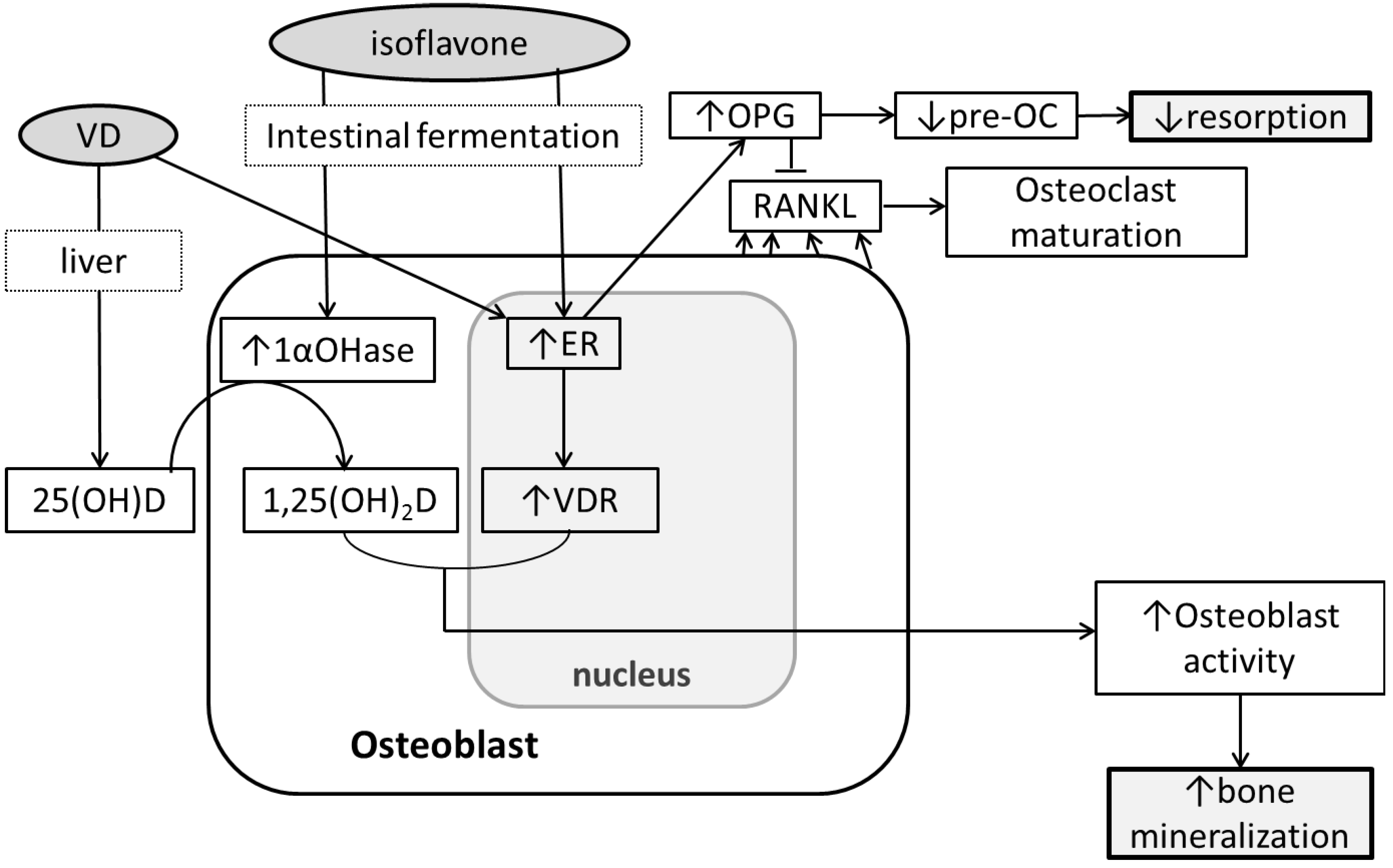
      <p>The possibility of soy isoflavones and vitamin D impacting Ca and bone metabolism has been investigated through cell cultures and animal models. In intestinal cancer cells, genistein up-regulates VDR transcription and VDR expression possibly through the ER and MAPK signaling pathway [<xref ref-type="bibr" rid="B62-nutrients-04-01610">62</xref>] but no reported increase in Ca absorption [<xref ref-type="bibr" rid="B43-nutrients-04-01610">43</xref>]. One proposed mechanism is that phytoestrogens increase VDR and vitamin D metabolites in bone cells. It has been reported that estrogen upregulates VDR in osteoblast-like cells [<xref ref-type="bibr" rid="B63-nutrients-04-01610">63</xref>,<xref ref-type="bibr" rid="B64-nutrients-04-01610">64</xref>]. Also, genistein and daidzein increased the expression of CYP27B1 mRNA and suppressed CYP24 mRNA expression, the enzymes that activate and deactivate 1,25(OH)<sub>2</sub>D, respectively, in colon cancer cells [<xref ref-type="bibr" rid="B65-nutrients-04-01610">65</xref>]. Intake of cowpea isoflavones and 17β-estradiol independently affected vitamin D status, BMD and BMC in osteoporotic rats fed a low Ca low vitamin D diet (0.15% Ca and 0.1 IU vitamin D/day) [<xref ref-type="bibr" rid="B66-nutrients-04-01610">66</xref>]. In early postmenopausal women, 2-year soy isoflavone supplementation reduced the loss of spinal BMD only in those with 25(OH)D below 50 nmol/L [<xref ref-type="bibr" rid="B59-nutrients-04-01610">59</xref>]. The soy isoflavones may have stimulated 1,25(OH)<sub>2</sub>D production under conditions of the low levels of substrate 25(OH)D. Though <italic>in vitro</italic>, rodent, and clinical studies suggest a relationship, more evidence must be provided to test this hypothesis and elucidate the mechanism. Another proposed mechanism is that vitamin D analogs induce ER transcription. This has been reported in the JK 1624F<sub>2</sub>-2 (JFK) analog in pre- and post-menopausal women’s bone cells [<xref ref-type="bibr" rid="B65-nutrients-04-01610">65</xref>]. The synergistic effect of 1,25(OH)<sub>2</sub>D and 17β-estradiol increased osteoblastic MC3T3-E1 cell proliferation and viability [<xref ref-type="bibr" rid="B67-nutrients-04-01610">67</xref>]. Post-menopausal women receiving HRT and low amounts of vitamin D + Ca supplements (300 IU vitamin D + 93 mg Ca/day), but not those receiving HRT only, for 4 years had higher BMD compared to controls that did not receive HRT, vitamin D, nor Ca [<xref ref-type="bibr" rid="B68-nutrients-04-01610">68</xref>]. A similar effect by vitamin D and phytoestrogens may be possible, but no randomized controlled trial to investigate the synergistic effect of phytoestrogens and vitamin D has yet been reported. There may also be a threshold of the synergistic benefit of phytoestrogens and vitamin D as seen in OVX rats where genistein aglycones up to 54 mg/day human equivalent daily doses benefitted bone at standard Ca and vitamin D intakes, but not with higher Ca and vitamin D intakes [<xref ref-type="bibr" rid="B69-nutrients-04-01610">69</xref>]. Vitamin D and phytoestrogens may have a synergistic effect on bone (<xref ref-type="fig" rid="nutrients-04-01610-f001">Figure 1</xref>) but the mechanism is still unclear and whether animal experiments can be translated into clinical effects has not been studied.</p>
      <fig id="nutrients-04-01610-f001" position="anchor">
        <label>Figure 1</label>
        <caption>
          <p>Possible mechanisms of the effect of soy isoflavones and vitamin D on bone metabolism. Soy isoflavones and vitamin D (VD) can synergistically stimulate bone formation through inducing 1,25-dihydroxyvitamin D synthesis and vitamin D receptor (VDR) expression. 1,25(OH)<sub>2</sub>D bound to VDR can induce osteoblast activity and bone formation. Also, bone resorption may be reduced through inducing estrogen receptor (ER) expression, which is affected by VD and soy isoflavones. An increase in ER can lead to an increase in OPG formation and thus prevents osteoclast (OC) maturation, resulting in less bone resorption.</p>
        </caption>
        <graphic xmlns:xlink="http://www.w3.org/1999/xlink" xlink:href="nutrients-04-01610-g001.tif"/>
      </fig>
    </sec>
    <sec sec-type="conclusions">
      <title>6. Conclusions</title>
      <p>This review summarizes the evidence to support the possible benefit of the combination of vitamin D and soy phytoestrogens on post-menopausal bone loss. Clinical evidence for maximal vitamin D-mediated Ca absorption does not completely explain the optimal vitamin D status for maximal BMD or BMC and lacks correlation of vitamin D-related Ca absorption and BMD or BMC in post-menopausal women. The benefit of vitamin D on bone seems to be stronger through the direct effect on osteoblasts and osteoclasts. Soy phytoestrogens in combination with vitamin D may synergistically induce osteoblast activation and prevent pre-osteoclast and osteoclast differentiation, through the increase of vitamin D metabolites, VDR, and ER actions. More research is required to identify the causal factors and the mechanism of the benefits of vitamin D and phytoestrogens on bone in post-menopausal women.</p>
    </sec>
    
  </body>
  <back><notes>
      <title>Conflict of Interest</title>
      <p>Clara Y. Park declares no conflict of interest. Connie M. Weaver is on the following editorial boards: Osteoporosis International, Current Translational Geriatric &amp; Experimental Gerontology, Journal of Bone and Mineral Research, Nutritiongate.com Board, Nutrition Research Reviews, Academic Press, Food Science &amp; Technology Book Series and Advances in Food &amp; Nutrition Research. She is also on the advisory board for the following: GEN YOUth Foundation, International Life Science Institute, Pharmavite.</p>
    </notes>
    <ref-list>
      <title>References</title>
      <ref id="B1-nutrients-04-01610">
        <label>1.</label>
        <citation citation-type="web">
          <article-title>Pubmed Health: Osteoporosis—Overview</article-title>
          <access-date>(accessed on 22 March 2012)</access-date>
          <comment>Available online:<ext-link xmlns:xlink="http://www.w3.org/1999/xlink" xlink:href="http://www.ncbi.nlm.nih.gov/pubmedhealth/PMH0001400/" ext-link-type="uri">http://www.ncbi.nlm.nih.gov/pubmedhealth/PMH0001400/</ext-link></comment>
        </citation>
      </ref>
      <ref id="B2-nutrients-04-01610">
        <label>2.</label>
        <citation citation-type="web">
          <article-title>What Is Osteoporosis?</article-title>
          <access-date>(accessed on 15 November 2012)</access-date>
          <comment>Available online:<ext-link xmlns:xlink="http://www.w3.org/1999/xlink" xlink:href="http://www.nof.org/articles/7" ext-link-type="uri">http://www.nof.org/articles/7</ext-link></comment>
        </citation>
      </ref>
      <ref id="B3-nutrients-04-01610">
        <label>3.</label>
        <citation citation-type="book">
          <person-group person-group-type="author">
            <name>
              <surname>Russo</surname>
              <given-names>A.</given-names>
            </name>
            <name>
              <surname>Holmquist</surname>
              <given-names>L.</given-names>
            </name>
            <name>
              <surname>Elixhauser</surname>
              <given-names>A.</given-names>
            </name>
          </person-group>
          <source>U.S. Hospitalizations Involving Osteoporosis and Injury, 2006; Statistical Brief #76</source>
          <publisher-name>Agency for Health Care Policy and Research (US)</publisher-name>
          <publisher-loc>Rockville, MD, USA</publisher-loc>
          <year>2009</year>
        </citation>
      </ref>
      <ref id="B4-nutrients-04-01610">
        <label>4.</label>
        <citation citation-type="journal">
          <person-group person-group-type="author">
            <name>
              <surname>Heaney</surname>
              <given-names>R.P.</given-names>
            </name>
            <name>
              <surname>Weaver</surname>
              <given-names>C.M.</given-names>
            </name>
          </person-group>
          <article-title>Calcium and vitamin D</article-title>
          <source>Endocrinol. Metab. Clin. North Am.</source>
          <year>2003</year>
          <volume>32</volume>
          <fpage>181</fpage>
          <lpage>194</lpage>
          <pub-id pub-id-type="doi">10.1016/S0889-8529(02)00063-4</pub-id>
        </citation>
      </ref>
      <ref id="B5-nutrients-04-01610">
        <label>5.</label>
        <citation citation-type="journal">
          <person-group person-group-type="author">
            <name>
              <surname>Schuit</surname>
              <given-names>S.C.</given-names>
            </name>
            <name>
              <surname>van der Klift</surname>
              <given-names>M.</given-names>
            </name>
            <name>
              <surname>Weel</surname>
              <given-names>A.E.</given-names>
            </name>
            <name>
              <surname>de Laet</surname>
              <given-names>C.E.</given-names>
            </name>
            <name>
              <surname>Burger</surname>
              <given-names>H.</given-names>
            </name>
            <name>
              <surname>Seeman</surname>
              <given-names>E.</given-names>
            </name>
            <name>
              <surname>Hofman</surname>
              <given-names>A.</given-names>
            </name>
            <name>
              <surname>Uitterlinden</surname>
              <given-names>A.G.</given-names>
            </name>
            <name>
              <surname>van Leeuwen</surname>
              <given-names>J.P.</given-names>
            </name>
            <name>
              <surname>Pols</surname>
              <given-names>H.A.</given-names>
            </name>
          </person-group>
          <article-title>Fracture incidence and association with bone mineral density in elderly men and women: The Rotterdam Study</article-title>
          <source>Bone</source>
          <year>2004</year>
          <volume>34</volume>
          <fpage>195</fpage>
          <lpage>202</lpage>
          <pub-id pub-id-type="doi">10.1016/j.bone.2003.10.001</pub-id>
        </citation>
      </ref>
      <ref id="B6-nutrients-04-01610">
        <label>6.</label>
        <citation citation-type="journal">
          <person-group person-group-type="author">
            <name>
              <surname>Lips</surname>
              <given-names>P.</given-names>
            </name>
          </person-group>
          <article-title>Vitamin D physiology</article-title>
          <source>Prog. Biophys. Mol. Biol.</source>
          <year>2006</year>
          <volume>92</volume>
          <fpage>4</fpage>
          <lpage>8</lpage>
          <pub-id pub-id-type="doi">10.1016/j.pbiomolbio.2006.02.016</pub-id>
        </citation>
      </ref>
      <ref id="B7-nutrients-04-01610">
        <label>7.</label>
        <citation citation-type="journal">
          <person-group person-group-type="author">
            <name>
              <surname>Heaney</surname>
              <given-names>R.P.</given-names>
            </name>
            <name>
              <surname>Barger-Lux</surname>
              <given-names>M.J.</given-names>
            </name>
            <name>
              <surname>Dowell</surname>
              <given-names>M.S.</given-names>
            </name>
            <name>
              <surname>Chen</surname>
              <given-names>T.C.</given-names>
            </name>
            <name>
              <surname>Holick</surname>
              <given-names>M.F.</given-names>
            </name>
          </person-group>
          <article-title>Calcium absorptive effects of vitamin D and its major metabolites</article-title>
          <source>J. Clin. Endocrinol. Metab.</source>
          <year>1997</year>
          <volume>2</volume>
          <fpage>4111</fpage>
          <lpage>4116</lpage>
        </citation>
      </ref>
      <ref id="B8-nutrients-04-01610">
        <label>8.</label>
        <citation citation-type="journal">
          <person-group person-group-type="author">
            <name>
              <surname>Francis</surname>
              <given-names>R.M.</given-names>
            </name>
            <name>
              <surname>Peacock</surname>
              <given-names>M.</given-names>
            </name>
          </person-group>
          <article-title>Local action of oral 1,25-dihydroxycholecalciferol on calcium absorption in osteoporosis</article-title>
          <source>Am. J. Clin. Nutr.</source>
          <year>1987</year>
          <volume>46</volume>
          <fpage>315</fpage>
          <lpage>318</lpage>
        <pub-id pub-id-type="pmid">3618534</pub-id></citation>
      </ref>
      <ref id="B9-nutrients-04-01610">
        <label>9.</label>
        <citation citation-type="journal">
          <person-group person-group-type="author">
            <name>
              <surname>Heaney</surname>
              <given-names>R.P.</given-names>
            </name>
            <name>
              <surname>Dowell</surname>
              <given-names>M.S.</given-names>
            </name>
            <name>
              <surname>Hale</surname>
              <given-names>C.A.</given-names>
            </name>
            <name>
              <surname>Bendich</surname>
              <given-names>A.</given-names>
            </name>
          </person-group>
          <article-title>Calcium absorption varies within the reference range for serum 25-hydroxyvitamin D</article-title>
          <source>J. Am. Coll. Nutr.</source>
          <year>2003</year>
          <volume>22</volume>
          <fpage>142</fpage>
          <lpage>146</lpage>
        <pub-id pub-id-type="pmid">12672710</pub-id></citation>
      </ref>
      <ref id="B10-nutrients-04-01610">
        <label>10.</label>
        <citation citation-type="journal">
          <person-group person-group-type="author">
            <name>
              <surname>Need</surname>
              <given-names>A.G.</given-names>
            </name>
            <name>
              <surname>Nordin</surname>
              <given-names>B.E.</given-names>
            </name>
          </person-group>
          <article-title>Misconceptions—vitamin D insufficiency causes malabsorption of calcium</article-title>
          <source>Bone</source>
          <year>2008</year>
          <volume>42</volume>
          <fpage>1021</fpage>
          <lpage>1024</lpage>
          <pub-id pub-id-type="doi">10.1016/j.bone.2008.01.012</pub-id>
        </citation>
      </ref>
      <ref id="B11-nutrients-04-01610">
        <label>11.</label>
        <citation citation-type="journal">
          <person-group person-group-type="author">
            <name>
              <surname>Need</surname>
              <given-names>A.G.</given-names>
            </name>
            <name>
              <surname>O’Loughlin</surname>
              <given-names>P.D.</given-names>
            </name>
            <name>
              <surname>Morris</surname>
              <given-names>H.A.</given-names>
            </name>
            <name>
              <surname>Coates</surname>
              <given-names>P.S.</given-names>
            </name>
            <name>
              <surname>Horowitz</surname>
              <given-names>M.</given-names>
            </name>
            <name>
              <surname>Nordin</surname>
              <given-names>B.E.</given-names>
            </name>
          </person-group>
          <article-title>Vitamin D metabolites and calcium absorption in severe vitamin D deficiency</article-title>
          <source>J. Bone Miner. Res.</source>
          <year>2008</year>
          <volume>23</volume>
          <fpage>1859</fpage>
          <lpage>1863</lpage>
          <pub-id pub-id-type="doi">10.1359/jbmr.080607</pub-id>
        </citation>
      </ref>
      <ref id="B12-nutrients-04-01610">
        <label>12.</label>
        <citation citation-type="journal">
          <person-group person-group-type="author">
            <name>
              <surname>Hansen</surname>
              <given-names>K.E.</given-names>
            </name>
            <name>
              <surname>Jones</surname>
              <given-names>A.N.</given-names>
            </name>
            <name>
              <surname>Lindstrom</surname>
              <given-names>M.J.</given-names>
            </name>
            <name>
              <surname>Davis</surname>
              <given-names>L.A.</given-names>
            </name>
            <name>
              <surname>Engelke</surname>
              <given-names>J.A.</given-names>
            </name>
            <name>
              <surname>Shafer</surname>
              <given-names>M.M.</given-names>
            </name>
          </person-group>
          <article-title>Vitamin D insufficiency: Disease or no disease?</article-title>
          <source>J. Bone Miner. Res.</source>
          <year>2008</year>
          <volume>23</volume>
          <fpage>1052</fpage>
          <lpage>1060</lpage>
          <pub-id pub-id-type="doi">10.1359/jbmr.080230</pub-id>
        </citation>
      </ref>
      <ref id="B13-nutrients-04-01610">
        <label>13.</label>
        <citation citation-type="journal">
          <person-group person-group-type="author">
            <name>
              <surname>Zhu</surname>
              <given-names>K.</given-names>
            </name>
            <name>
              <surname>Devine</surname>
              <given-names>A.</given-names>
            </name>
            <name>
              <surname>Dick</surname>
              <given-names>I.M.</given-names>
            </name>
            <name>
              <surname>Wilson</surname>
              <given-names>S.G.</given-names>
            </name>
            <name>
              <surname>Prince</surname>
              <given-names>R.L.</given-names>
            </name>
          </person-group>
          <article-title>Effects of calcium and vitamin D supplementation on hip bone mineral density and calcium-related analytes in elderly ambulatory Australian women: A five-year randomized controlled trial</article-title>
          <source>J. Clin. Endocrinol. Metab.</source>
          <year>2008</year>
          <volume>93</volume>
          <fpage>743</fpage>
          <lpage>749</lpage>
        <pub-id pub-id-type="pmid">18089701</pub-id></citation>
      </ref>
      <ref id="B14-nutrients-04-01610">
        <label>14.</label>
        <citation citation-type="journal">
          <person-group person-group-type="author">
            <name>
              <surname>Aloia</surname>
              <given-names>J.F.</given-names>
            </name>
            <name>
              <surname>Chen</surname>
              <given-names>D.G.</given-names>
            </name>
            <name>
              <surname>Yeh</surname>
              <given-names>J.K.</given-names>
            </name>
            <name>
              <surname>Chen</surname>
              <given-names>H.</given-names>
            </name>
          </person-group>
          <article-title>Serum vitamin D metabolites and intestinal calcium absorption efficiency in women</article-title>
          <source>Am. J. Clin. Nutr.</source>
          <year>2010</year>
          <volume>92</volume>
          <fpage>835</fpage>
          <lpage>840</lpage>
          <pub-id pub-id-type="doi">10.3945/ajcn.2010.29553</pub-id>
        </citation>
      </ref>
      <ref id="B15-nutrients-04-01610">
        <label>15.</label>
        <citation citation-type="journal">
          <person-group person-group-type="author">
            <name>
              <surname>Need</surname>
              <given-names>A.G.</given-names>
            </name>
            <name>
              <surname>Kemp</surname>
              <given-names>A.</given-names>
            </name>
            <name>
              <surname>Giles</surname>
              <given-names>N.</given-names>
            </name>
            <name>
              <surname>Morris</surname>
              <given-names>H.A.</given-names>
            </name>
            <name>
              <surname>Horowitz</surname>
              <given-names>M.</given-names>
            </name>
            <name>
              <surname>Nordin</surname>
              <given-names>B.E.</given-names>
            </name>
          </person-group>
          <article-title>Relationships between intestinal calcium absorption, serum vitamin D metabolites and smoking in postmenopausal women</article-title>
          <source>Osteoporos. Int.</source>
          <year>2002</year>
          <volume>13</volume>
          <fpage>83</fpage>
          <lpage>88</lpage>
          <pub-id pub-id-type="doi">10.1007/s198-002-8342-9</pub-id>
        </citation>
      </ref>
      <ref id="B16-nutrients-04-01610">
        <label>16.</label>
        <citation citation-type="journal">
          <person-group person-group-type="author">
            <name>
              <surname>Schnatz</surname>
              <given-names>P.F.</given-names>
            </name>
            <name>
              <surname>Marakovits</surname>
              <given-names>K.A.</given-names>
            </name>
            <name>
              <surname>O’Sullivan</surname>
              <given-names>D.M.</given-names>
            </name>
            <name>
              <surname>Ethun</surname>
              <given-names>K.</given-names>
            </name>
            <name>
              <surname>Clarkson</surname>
              <given-names>T.B.</given-names>
            </name>
            <name>
              <surname>Appt</surname>
              <given-names>S.E.</given-names>
            </name>
          </person-group>
          <article-title>Response to an adequate dietary intake of vitamin D<sub>3</sub> modulates the effect of estrogen therapy on bone density</article-title>
          <source>J. Womens Health (Larchmt.)</source>
          <year>2012</year>
          <volume>21</volume>
          <fpage>858</fpage>
          <lpage>864</lpage>
          <pub-id pub-id-type="doi">10.1089/jwh.2011.3244</pub-id>
        </citation>
      </ref>
      <ref id="B17-nutrients-04-01610">
        <label>17.</label>
        <citation citation-type="journal">
          <person-group person-group-type="author">
            <name>
              <surname>Bischoff-Ferrari</surname>
              <given-names>H.A.</given-names>
            </name>
            <name>
              <surname>Kiel</surname>
              <given-names>D.P.</given-names>
            </name>
            <name>
              <surname>Dawson-Hughes</surname>
              <given-names>B.</given-names>
            </name>
            <name>
              <surname>Orav</surname>
              <given-names>J.E.</given-names>
            </name>
            <name>
              <surname>Li</surname>
              <given-names>R.</given-names>
            </name>
            <name>
              <surname>Spiegelman</surname>
              <given-names>D.</given-names>
            </name>
            <name>
              <surname>Dietrich</surname>
              <given-names>T.</given-names>
            </name>
            <name>
              <surname>Willett</surname>
              <given-names>W.C.</given-names>
            </name>
          </person-group>
          <article-title>Dietary calcium and serum 25-hydroxyvitamin D status in relation to BMD among U.S. adults</article-title>
          <source>J. Bone Miner. Res.</source>
          <year>2009</year>
          <volume>24</volume>
          <fpage>935</fpage>
          <lpage>942</lpage>
          <pub-id pub-id-type="doi">10.1359/jbmr.081242</pub-id>
        </citation>
      </ref>
      <ref id="B18-nutrients-04-01610">
        <label>18.</label>
        <citation citation-type="book">
		<collab>Institute of Medicine.</collab>
          <source>Dietary Reference Intakes for Calcium and Vitamin D</source>
          <publisher-name>The National Academies Press</publisher-name>
          <publisher-loc>Washington, DC, USA</publisher-loc>
          <year>2011</year>
        </citation>
      </ref>
      <ref id="B19-nutrients-04-01610">
        <label>19.</label>
        <citation citation-type="journal">
          <person-group person-group-type="author">
            <name>
              <surname>Viljakainen</surname>
              <given-names>H.T.</given-names>
            </name>
            <name>
              <surname>Natri</surname>
              <given-names>A.M.</given-names>
            </name>
            <name>
              <surname>Kärkkäinen</surname>
              <given-names>M.</given-names>
            </name>
            <name>
              <surname>Huttunen</surname>
              <given-names>M.M.</given-names>
            </name>
            <name>
              <surname>Palssa</surname>
              <given-names>A.</given-names>
            </name>
            <name>
              <surname>Jakobsen</surname>
              <given-names>J.</given-names>
            </name>
            <name>
              <surname>Cashman</surname>
              <given-names>K.D.</given-names>
            </name>
            <name>
              <surname>Mølgaard</surname>
              <given-names>C.</given-names>
            </name>
            <name>
              <surname>Lamberg-Allardt</surname>
              <given-names>C.</given-names>
            </name>
          </person-group>
          <article-title>A positive dose-response effect of vitamin D supplementation on site-specific bone mineral augmentation in adolescent girls: A double-blinded randomized placebo-controlled 1-year intervention</article-title>
          <source>J. Bone Miner. Res.</source>
          <year>2006</year>
          <volume>21</volume>
          <fpage>836</fpage>
          <lpage>844</lpage>
          <pub-id pub-id-type="doi">10.1359/jbmr.060302</pub-id>
        </citation>
      </ref>
      <ref id="B20-nutrients-04-01610">
        <label>20.</label>
        <citation citation-type="journal">
          <person-group person-group-type="author">
            <name>
              <surname>Abrams</surname>
              <given-names>S.A.</given-names>
            </name>
            <name>
              <surname>Hicks</surname>
              <given-names>P.D.</given-names>
            </name>
            <name>
              <surname>Hawthorne</surname>
              <given-names>K.M.</given-names>
            </name>
          </person-group>
          <article-title>Higher serum 25-hydroxyvitamin D levels in school-age children are inconsistently associated with increased calcium absorption</article-title>
          <source>J. Clin. Endocrinol. Metab.</source>
          <year>2009</year>
          <volume>94</volume>
          <fpage>2421</fpage>
          <lpage>2427</lpage>
          <pub-id pub-id-type="doi">10.1210/jc.2008-2587</pub-id>
        </citation>
      </ref>
      <ref id="B21-nutrients-04-01610">
        <label>21.</label>
        <citation citation-type="journal">
          <person-group person-group-type="author">
            <name>
              <surname>Lee</surname>
              <given-names>W.T.</given-names>
            </name>
            <name>
              <surname>Cheng</surname>
              <given-names>J.C.</given-names>
            </name>
            <name>
              <surname>Jiang</surname>
              <given-names>J.</given-names>
            </name>
            <name>
              <surname>Hu</surname>
              <given-names>P.</given-names>
            </name>
            <name>
              <surname>Hu</surname>
              <given-names>X.</given-names>
            </name>
            <name>
              <surname>Roberts</surname>
              <given-names>D.C.</given-names>
            </name>
          </person-group>
          <article-title>Calcium absorption measured by stable calcium isotopes (<sup>42</sup>Ca &amp; <sup>44</sup>Ca) among Northern Chinese adolescents with low vitamin D status</article-title>
          <source>J. Orthop. Surg. (Hong Kong)</source>
          <year>2002</year>
          <volume>10</volume>
          <fpage>61</fpage>
          <lpage>66</lpage>
        </citation>
      </ref>
      <ref id="B22-nutrients-04-01610">
        <label>22.</label>
        <citation citation-type="journal">
          <person-group person-group-type="author">
            <name>
              <surname>Park</surname>
              <given-names>C.Y.</given-names>
            </name>
            <name>
              <surname>Hill</surname>
              <given-names>K.M.</given-names>
            </name>
            <name>
              <surname>Elble</surname>
              <given-names>A.E.</given-names>
            </name>
            <name>
              <surname>Martin</surname>
              <given-names>B.R.</given-names>
            </name>
            <name>
              <surname>DiMeglio</surname>
              <given-names>L.A.</given-names>
            </name>
            <name>
              <surname>Peacock</surname>
              <given-names>M.</given-names>
            </name>
            <name>
              <surname>McCabe</surname>
              <given-names>G.P.</given-names>
            </name>
            <name>
              <surname>Weaver</surname>
              <given-names>C.M.</given-names>
            </name>
          </person-group>
          <article-title>Daily supplementation with 25 μg cholecalciferol does not increase calcium absorption or skeletal retention in adolescent girls with low serum 25-hydroxyvitamin D</article-title>
          <source>J. Nutr.</source>
          <year>2010</year>
          <volume>140</volume>
          <fpage>2139</fpage>
          <lpage>2144</lpage>
          <pub-id pub-id-type="doi">10.3945/jn.110.124891</pub-id>
        </citation>
      </ref>
      <ref id="B23-nutrients-04-01610">
        <label>23.</label>
        <citation citation-type="journal">
          <person-group person-group-type="author">
            <name>
              <surname>Howard</surname>
              <given-names>G.A.</given-names>
            </name>
            <name>
              <surname>Turner</surname>
              <given-names>R.T.</given-names>
            </name>
            <name>
              <surname>Sherrard</surname>
              <given-names>D.J.</given-names>
            </name>
            <name>
              <surname>Baylink</surname>
              <given-names>D.J.</given-names>
            </name>
          </person-group>
          <article-title>Human bone cells in culture metabolize 25-hydroxyvitamin D3 to 1,25-dihydroxyvitamin D3 and 24,25-dihydroxyvitamin D3</article-title>
          <source>J. Biol. Chem.</source>
          <year>1981</year>
          <volume>256</volume>
          <fpage>7738</fpage>
          <lpage>7740</lpage>
        <pub-id pub-id-type="pmid">6973569</pub-id></citation>
      </ref>
      <ref id="B24-nutrients-04-01610">
        <label>24.</label>
        <citation citation-type="journal">
          <person-group person-group-type="author">
            <name>
              <surname>Van Leeuwen</surname>
              <given-names>J.P.</given-names>
            </name>
            <name>
              <surname>van Driel</surname>
              <given-names>M.</given-names>
            </name>
            <name>
              <surname>van den Bemd</surname>
              <given-names>G.J.</given-names>
            </name>
            <name>
              <surname>Pols</surname>
              <given-names>H.A.</given-names>
            </name>
          </person-group>
          <article-title>Vitamin D control of osteoblast function and bone extracellular matrix mineralization</article-title>
          <source>Crit. Rev. Eukaryot. Gene Expr.</source>
          <year>2001</year>
          <volume>11</volume>
          <fpage>199</fpage>
          <lpage>226</lpage>
        <pub-id pub-id-type="pmid">11693961</pub-id></citation>
      </ref>
      <ref id="B25-nutrients-04-01610">
        <label>25.</label>
        <citation citation-type="journal">
          <person-group person-group-type="author">
            <name>
              <surname>Gardiner</surname>
              <given-names>E.M.</given-names>
            </name>
            <name>
              <surname>Baldock</surname>
              <given-names>P.A.</given-names>
            </name>
            <name>
              <surname>Thomas</surname>
              <given-names>G.P.</given-names>
            </name>
            <name>
              <surname>Sims</surname>
              <given-names>N.A.</given-names>
            </name>
            <name>
              <surname>Henderson</surname>
              <given-names>N.K.</given-names>
            </name>
            <name>
              <surname>Hollis</surname>
              <given-names>B.</given-names>
            </name>
            <name>
              <surname>White</surname>
              <given-names>C.P.</given-names>
            </name>
            <name>
              <surname>Sunn</surname>
              <given-names>K.L.</given-names>
            </name>
            <name>
              <surname>Morrison</surname>
              <given-names>N.A.</given-names>
            </name>
            <name>
              <surname>Walsh</surname>
              <given-names>W.R.</given-names>
            </name>
            <name>
              <surname>Eisman</surname>
              <given-names>J.A.</given-names>
            </name>
          </person-group>
          <article-title>Increased formation and decreased resorption of bone in mice with elevated vitamin D receptor in mature cells of the osteoblastic lineage</article-title>
          <source>FASEB J.</source>
          <year>2000</year>
          <volume>14</volume>
          <fpage>1908</fpage>
          <lpage>1916</lpage>
          <pub-id pub-id-type="doi">10.1096/fj.99-1075com</pub-id>
        </citation>
      </ref>
      <ref id="B26-nutrients-04-01610">
        <label>26.</label>
        <citation citation-type="journal">
          <person-group person-group-type="author">
            <name>
              <surname>Anderson</surname>
              <given-names>P.H.</given-names>
            </name>
            <name>
              <surname>Sawyer</surname>
              <given-names>R.K.</given-names>
            </name>
            <name>
              <surname>Moore</surname>
              <given-names>A.J.</given-names>
            </name>
            <name>
              <surname>May</surname>
              <given-names>B.K.</given-names>
            </name>
            <name>
              <surname>O’Loughlin</surname>
              <given-names>P.D.</given-names>
            </name>
            <name>
              <surname>Morris</surname>
              <given-names>H.A.</given-names>
            </name>
          </person-group>
          <article-title>Vitamin D depletion induces RANKL-mediated osteoclastogenesis and bone loss in a rodent model</article-title>
          <source>J. Bone Miner. Res.</source>
          <year>2008</year>
          <volume>23</volume>
          <fpage>1789</fpage>
          <lpage>1797</lpage>
          <pub-id pub-id-type="doi">10.1359/jbmr.080616</pub-id>
        </citation>
      </ref>
      <ref id="B27-nutrients-04-01610">
        <label>27.</label>
        <citation citation-type="journal">
          <person-group person-group-type="author">
            <name>
              <surname>Fleet</surname>
              <given-names>J.C.</given-names>
            </name>
            <name>
              <surname>Gliniak</surname>
              <given-names>C.</given-names>
            </name>
            <name>
              <surname>Zhang</surname>
              <given-names>Z.</given-names>
            </name>
            <name>
              <surname>Xue</surname>
              <given-names>Y.</given-names>
            </name>
            <name>
              <surname>Smith</surname>
              <given-names>K.B.</given-names>
            </name>
            <name>
              <surname>McCreedy</surname>
              <given-names>R.</given-names>
            </name>
            <name>
              <surname>Adedokun</surname>
              <given-names>S.A.</given-names>
            </name>
          </person-group>
          <article-title>Serum metabolite profiles and target tissue gene expression define the effect of cholecalciferol intake on calcium metabolism in rats and mice</article-title>
          <source>J. Nutr.</source>
          <year>2008</year>
          <volume>138</volume>
          <fpage>1114</fpage>
          <lpage>1120</lpage>
        <pub-id pub-id-type="pmid">18492843</pub-id></citation>
      </ref>
      <ref id="B28-nutrients-04-01610">
        <label>28.</label>
        <citation citation-type="journal">
          <person-group person-group-type="author">
            <name>
              <surname>Hohman</surname>
              <given-names>E.E.</given-names>
            </name>
            <name>
              <surname>Martin</surname>
              <given-names>B.R.</given-names>
            </name>
            <name>
              <surname>Lachcik</surname>
              <given-names>P.J.</given-names>
            </name>
            <name>
              <surname>Gordon</surname>
              <given-names>D.T.</given-names>
            </name>
            <name>
              <surname>Fleet</surname>
              <given-names>J.C.</given-names>
            </name>
            <name>
              <surname>Weaver</surname>
              <given-names>C.M.</given-names>
            </name>
          </person-group>
          <article-title>Bioavailability and efficacy of vitamin D2 from UV-irradiated yeast in growing, vitamin D-deficient rats</article-title>
          <source>J. Agric. Food Chem.</source>
          <year>2011</year>
          <volume>59</volume>
          <fpage>2341</fpage>
          <lpage>2346</lpage>
          <pub-id pub-id-type="doi">10.1021/jf104679c</pub-id>
        </citation>
      </ref>
      <ref id="B29-nutrients-04-01610">
        <label>29.</label>
        <citation citation-type="journal">
          <person-group person-group-type="author">
            <name>
              <surname>Iwamoto</surname>
              <given-names>J.</given-names>
            </name>
            <name>
              <surname>Takeda</surname>
              <given-names>T.</given-names>
            </name>
            <name>
              <surname>Ichimura</surname>
              <given-names>S.</given-names>
            </name>
            <name>
              <surname>Sato</surname>
              <given-names>Y.</given-names>
            </name>
            <name>
              <surname>Yeh</surname>
              <given-names>J.K.</given-names>
            </name>
          </person-group>
          <article-title>Differential effect of vitamin K and vitamin D supplementation on bone mass in young rats fed normal or low calcium diet</article-title>
          <source>Yonsei Med. J.</source>
          <year>2004</year>
          <volume>45</volume>
          <fpage>314</fpage>
          <lpage>324</lpage>
        <pub-id pub-id-type="pmid">15119005</pub-id></citation>
      </ref>
      <ref id="B30-nutrients-04-01610">
        <label>30.</label>
        <citation citation-type="journal">
          <person-group person-group-type="author">
            <name>
              <surname>Peacock</surname>
              <given-names>M.</given-names>
            </name>
            <name>
              <surname>Liu</surname>
              <given-names>G.</given-names>
            </name>
            <name>
              <surname>Carey</surname>
              <given-names>M.</given-names>
            </name>
            <name>
              <surname>McClintock</surname>
              <given-names>R.</given-names>
            </name>
            <name>
              <surname>Ambrosius</surname>
              <given-names>W.</given-names>
            </name>
            <name>
              <surname>Hui</surname>
              <given-names>S.</given-names>
            </name>
            <name>
              <surname>Johnston</surname>
              <given-names>C.C.</given-names>
            </name>
          </person-group>
          <article-title>Effect of calcium or 25OH vitamin D3 dietary supplementation on bone loss at the hip in men and women over the age of 60</article-title>
          <source>J. Clin. Endocrinol. Metab.</source>
          <year>2000</year>
          <volume>85</volume>
          <fpage>3011</fpage>
          <lpage>3019</lpage>
          <pub-id pub-id-type="doi">10.1210/jc.85.9.3011</pub-id>
        </citation>
      </ref>
      <ref id="B31-nutrients-04-01610">
        <label>31.</label>
        <citation citation-type="journal">
          <person-group person-group-type="author">
            <name>
              <surname>Chapuy</surname>
              <given-names>M.C.</given-names>
            </name>
            <name>
              <surname>Arlot</surname>
              <given-names>M.E.</given-names>
            </name>
            <name>
              <surname>Duboeuf</surname>
              <given-names>F.</given-names>
            </name>
            <name>
              <surname>Brun</surname>
              <given-names>J.</given-names>
            </name>
            <name>
              <surname>Crouzet</surname>
              <given-names>B.</given-names>
            </name>
            <name>
              <surname>Arnaud</surname>
              <given-names>S.</given-names>
            </name>
            <name>
              <surname>Delmas</surname>
              <given-names>P.D.</given-names>
            </name>
            <name>
              <surname>Meunier</surname>
              <given-names>P.J.</given-names>
            </name>
          </person-group>
          <article-title>Vitamin D3 and calcium to prevent hip fractures in the elderly women</article-title>
          <source>N. Engl. J. Med.</source>
          <year>1992</year>
          <volume>327</volume>
          <fpage>1637</fpage>
          <lpage>1642</lpage>
          <pub-id pub-id-type="doi">10.1056/NEJM199212033272305</pub-id>
        </citation>
      </ref>
      <ref id="B32-nutrients-04-01610">
        <label>32.</label>
        <citation citation-type="journal">
          <person-group person-group-type="author">
            <name>
              <surname>Dawson-Hughes</surname>
              <given-names>B.</given-names>
            </name>
            <name>
              <surname>Harris</surname>
              <given-names>S.S.</given-names>
            </name>
            <name>
              <surname>Dallal</surname>
              <given-names>G.E.</given-names>
            </name>
            <name>
              <surname>Krall</surname>
              <given-names>E.A.</given-names>
            </name>
            <name>
              <surname>Dallal</surname>
              <given-names>G.E.</given-names>
            </name>
          </person-group>
          <article-title>Effect of calcium and vitamin D supplementation on bone density in men and women 65 years of age or older</article-title>
          <source>N. Engl. J. Med.</source>
          <year>1997</year>
          <volume>337</volume>
          <fpage>670</fpage>
          <lpage>676</lpage>
          <pub-id pub-id-type="doi">10.1056/NEJM199709043371003</pub-id>
        </citation>
      </ref>
      <ref id="B33-nutrients-04-01610">
        <label>33.</label>
        <citation citation-type="journal">
          <person-group person-group-type="author">
            <name>
              <surname>Grant</surname>
              <given-names>A.M.</given-names>
            </name>
            <name>
              <surname>Avenell</surname>
              <given-names>A.</given-names>
            </name>
            <name>
              <surname>Campbell</surname>
              <given-names>M.K.</given-names>
            </name>
            <name>
              <surname>McDonald</surname>
              <given-names>A.M.</given-names>
            </name>
            <name>
              <surname>MacLennan</surname>
              <given-names>G.S.</given-names>
            </name>
            <name>
              <surname>McPherson</surname>
              <given-names>G.C.</given-names>
            </name>
            <name>
              <surname>Anderson</surname>
              <given-names>F.H.</given-names>
            </name>
            <name>
              <surname>Cooper</surname>
              <given-names>C.</given-names>
            </name>
            <name>
              <surname>Francis</surname>
              <given-names>R.M.</given-names>
            </name>
            <name>
              <surname>Donaldson</surname>
              <given-names>C.</given-names>
            </name>
            <etal/>
          </person-group>
          <article-title>Oral vitamin D3 and calcium for secondary prevention of low-trauma fractures in elderly people (Randomised Evaluation of Calcium Or vitamin D, RECORD): A randomised placebo-controlled trial</article-title>
          <source>Lancet</source>
          <year>2005</year>
          <volume>365</volume>
          <fpage>1621</fpage>
          <lpage>1628</lpage>
        <pub-id pub-id-type="doi">10.1016/S0140-6736(05)63013-9</pub-id><pub-id pub-id-type="pmid">15885294</pub-id></citation>
      </ref>
      <ref id="B34-nutrients-04-01610">
        <label>34.</label>
        <citation citation-type="other">
          <person-group person-group-type="author">
            <name>
              <surname>Chung</surname>
              <given-names>M.</given-names>
            </name>
            <name>
              <surname>Balk</surname>
              <given-names>E.M.</given-names>
            </name>
            <name>
              <surname>Brendel</surname>
              <given-names>M.</given-names>
            </name>
            <name>
              <surname>Ip</surname>
              <given-names>S.</given-names>
            </name>
            <name>
              <surname>Lau</surname>
              <given-names>J.</given-names>
            </name>
            <name>
              <surname>Lee</surname>
              <given-names>J.</given-names>
            </name>
            <name>
              <surname>Lichtenstein</surname>
              <given-names>A.</given-names>
            </name>
            <name>
              <surname>Patel</surname>
              <given-names>K.</given-names>
            </name>
            <name>
              <surname>Raman</surname>
              <given-names>G.</given-names>
            </name>
            <name>
              <surname>Tatsioni</surname>
              <given-names>A.</given-names>
            </name>
            <etal/>
          </person-group>
          <source>Vitamin D and Calcium: A Systematic Review of Health Outcomes; Evidence Reports/Technology Assessments, No. 183</source>
          <publisher-name>Agency for Healthcare Research and Quality</publisher-name>
          <publisher-loc>Rockville, MD, USA</publisher-loc>
          <month>August</month>
          <year>2009</year>
        </citation>
      </ref>
      <ref id="B35-nutrients-04-01610">
        <label>35.</label>
        <citation citation-type="journal">
          <person-group person-group-type="author">
            <name>
              <surname>Venken</surname>
              <given-names>K.</given-names>
            </name>
            <name>
              <surname>Callewaert</surname>
              <given-names>F.</given-names>
            </name>
            <name>
              <surname>Boonen</surname>
              <given-names>S.</given-names>
            </name>
            <name>
              <surname>Vanderschueren</surname>
              <given-names>D.</given-names>
            </name>
          </person-group>
          <article-title>Sex hormones, their receptors and bone health</article-title>
          <source>Osteoporos. Int.</source>
          <year>2008</year>
          <volume>19</volume>
          <fpage>1517</fpage>
          <lpage>1525</lpage>
          <pub-id pub-id-type="doi">10.1007/s00198-008-0609-z</pub-id>
        </citation>
      </ref>
      <ref id="B36-nutrients-04-01610">
        <label>36.</label>
        <citation citation-type="journal">
          <person-group person-group-type="author">
            <name>
              <surname>Riggs</surname>
              <given-names>B.L.</given-names>
            </name>
            <name>
              <surname>Khosla</surname>
              <given-names>S.</given-names>
            </name>
            <name>
              <surname>Melton</surname>
              <given-names>L.J.</given-names>
            </name>
          </person-group>
          <article-title>A unitary model for involutional osteoporosis: Estrogen deficiency causes both type I and type II osteoporosis in postmenopausal women and contributes to bone loss in aging men</article-title>
          <source>J. Bone Miner. Res.</source>
          <year>1998</year>
          <volume>13</volume>
          <fpage>763</fpage>
          <lpage>773</lpage>
          <pub-id pub-id-type="doi">10.1359/jbmr.1998.13.5.763</pub-id>
        </citation>
      </ref>
      <ref id="B37-nutrients-04-01610">
        <label>37.</label>
        <citation citation-type="gov">
          <source>Bone Health and Osteoporosis: A Report of the Surgeon General</source>
          <publisher-name>Office of the Surgeon General (US)</publisher-name>
          <publisher-loc>Rockville, MD, USA</publisher-loc>
          <year>2004</year>
        </citation>
      </ref>
      <ref id="B38-nutrients-04-01610">
        <label>38.</label>
        <citation citation-type="journal">
          <person-group person-group-type="author">
            <name>
              <surname>Riggs</surname>
              <given-names>B.L.</given-names>
            </name>
            <name>
              <surname>Khosla</surname>
              <given-names>S.</given-names>
            </name>
            <name>
              <surname>Atkinson</surname>
              <given-names>E.J.</given-names>
            </name>
            <name>
              <surname>Dunstan</surname>
              <given-names>C.R.</given-names>
            </name>
            <name>
              <surname>Melton</surname>
              <given-names>L.J.</given-names>
            </name>
          </person-group>
          <article-title>Evidence that type I osteoporosis results from enhanced responsiveness of bone to estrogen deficiency</article-title>
          <source>Osteoporos. Int.</source>
          <year>2003</year>
          <volume>14</volume>
          <fpage>728</fpage>
          <lpage>733</lpage>
          <pub-id pub-id-type="doi">10.1007/s00198-003-1437-9</pub-id>
        </citation>
      </ref>
      <ref id="B39-nutrients-04-01610">
        <label>39.</label>
        <citation citation-type="journal">
          <person-group person-group-type="author">
            <name>
              <surname>Wimalawansa</surname>
              <given-names>S.J.</given-names>
            </name>
          </person-group>
          <article-title>A four-year randomized controlled trial of hormone replacement and bisphosphonate, alone or in combination, in women with postmenopausal osteoporosis</article-title>
          <source>Am. J. Med.</source>
          <year>1998</year>
          <volume>104</volume>
          <fpage>219</fpage>
          <lpage>226</lpage>
          <pub-id pub-id-type="doi">10.1016/S0002-9343(98)00029-1</pub-id>
        </citation>
      </ref>
      <ref id="B40-nutrients-04-01610">
        <label>40.</label>
        <citation citation-type="journal">
          <person-group person-group-type="author">
            <name>
              <surname>Rossouw</surname>
              <given-names>J.E.</given-names>
            </name>
            <name>
              <surname>Anderson</surname>
              <given-names>G.L.</given-names>
            </name>
            <name>
              <surname>Prentice</surname>
              <given-names>R.L.</given-names>
            </name>
            <name>
              <surname>LaCroix</surname>
              <given-names>A.Z.</given-names>
            </name>
            <name>
              <surname>Kooperberg</surname>
              <given-names>C.</given-names>
            </name>
            <name>
              <surname>Stefanick</surname>
              <given-names>M.L.</given-names>
            </name>
            <name>
              <surname>Jackson</surname>
              <given-names>R.D.</given-names>
            </name>
            <name>
              <surname>Beresford</surname>
              <given-names>S.A.</given-names>
            </name>
            <name>
              <surname>Howard</surname>
              <given-names>B.V.</given-names>
            </name>
            <name>
              <surname>Johnson</surname>
              <given-names>K.C.</given-names>
            </name>
            <etal/>
          </person-group>
          <article-title>Risks and benefits of estrogen plus progestin in healthy postmenopausal women: principal results From the Women’s Health Initiative randomized controlled trial</article-title>
          <source>JAMA</source>
          <year>2002</year>
          <volume>288</volume>
          <fpage>321</fpage>
          <lpage>333</lpage>
        <pub-id pub-id-type="doi">10.1001/jama.288.3.321</pub-id><pub-id pub-id-type="pmid">12117397</pub-id></citation>
      </ref>
      <ref id="B41-nutrients-04-01610">
        <label>41.</label>
        <citation citation-type="journal">
          <person-group person-group-type="author">
            <name>
              <surname>Li</surname>
              <given-names>Y.Q.</given-names>
            </name>
            <name>
              <surname>Xing</surname>
              <given-names>X.H.</given-names>
            </name>
            <name>
              <surname>Wang</surname>
              <given-names>H.</given-names>
            </name>
            <name>
              <surname>Weng</surname>
              <given-names>X.L.</given-names>
            </name>
            <name>
              <surname>Yu</surname>
              <given-names>S.B.</given-names>
            </name>
            <name>
              <surname>Dong</surname>
              <given-names>G.Y.</given-names>
            </name>
          </person-group>
          <article-title>Dose-dependent effects of genistein on bone homeostasis in rats’ mandibular subchondral bone</article-title>
          <source>Acta Pharmacol. Sin.</source>
          <year>2012</year>
          <volume>33</volume>
          <fpage>66</fpage>
          <lpage>74</lpage>
          <pub-id pub-id-type="doi">10.1038/aps.2011.136</pub-id>
        </citation>
      </ref>
      <ref id="B42-nutrients-04-01610">
        <label>42.</label>
        <citation citation-type="journal">
          <person-group person-group-type="author">
            <name>
              <surname>Cotter</surname>
              <given-names>A.A.</given-names>
            </name>
            <name>
              <surname>Cashman</surname>
              <given-names>K.D.</given-names>
            </name>
          </person-group>
          <article-title>Lack of dose-responsive effect of dietary phyto-oestrogens on transepithelial calcium transport in human intestinal-like Caco-2 cells</article-title>
          <source>Br. J. Nutr.</source>
          <year>2004</year>
          <volume>91</volume>
          <fpage>5</fpage>
          <lpage>9</lpage>
          <pub-id pub-id-type="doi">10.1079/BJN20031007</pub-id>
        </citation>
      </ref>
      <ref id="B43-nutrients-04-01610">
        <label>43.</label>
        <citation citation-type="journal">
          <person-group person-group-type="author">
            <name>
              <surname>Cotter</surname>
              <given-names>A.A.</given-names>
            </name>
            <name>
              <surname>Jewell</surname>
              <given-names>C.</given-names>
            </name>
            <name>
              <surname>Cashman</surname>
              <given-names>K.D.</given-names>
            </name>
          </person-group>
          <article-title>The effect of oestrogen and dietary phyto-oestrogens on transepithelial calcium transport in human intestinal-like Caco-2 cells</article-title>
          <source>Br. J. Nutr.</source>
          <year>2003</year>
          <volume>89</volume>
          <fpage>755</fpage>
          <lpage>765</lpage>
          <pub-id pub-id-type="doi">10.1079/BJN2003848</pub-id>
        </citation>
      </ref>
      <ref id="B44-nutrients-04-01610">
        <label>44.</label>
        <citation citation-type="journal">
          <person-group person-group-type="author">
            <name>
              <surname>Cheong</surname>
              <given-names>J.M.</given-names>
            </name>
            <name>
              <surname>Martin</surname>
              <given-names>B.R.</given-names>
            </name>
            <name>
              <surname>Jackson</surname>
              <given-names>G.S.</given-names>
            </name>
            <name>
              <surname>Elmore</surname>
              <given-names>D.</given-names>
            </name>
            <name>
              <surname>McCabe</surname>
              <given-names>G.P.</given-names>
            </name>
            <name>
              <surname>Nolan</surname>
              <given-names>J.R.</given-names>
            </name>
            <name>
              <surname>Barnes</surname>
              <given-names>S.</given-names>
            </name>
            <name>
              <surname>Peacock</surname>
              <given-names>M.</given-names>
            </name>
            <name>
              <surname>Weaver</surname>
              <given-names>C.M.</given-names>
            </name>
          </person-group>
          <article-title>Soy isoflavones do not affect bone resorption in postmenopausal women: A dose-response study using a novel approach with <sup>41</sup>Ca</article-title>
          <source>J. Clin. Endocrinol. Metab.</source>
          <year>2007</year>
          <volume>92</volume>
          <fpage>577</fpage>
          <lpage>582</lpage>
        <pub-id pub-id-type="pmid">17148567</pub-id></citation>
      </ref>
      <ref id="B45-nutrients-04-01610">
        <label>45.</label>
        <citation citation-type="journal">
          <person-group person-group-type="author">
            <name>
              <surname>Weaver</surname>
              <given-names>C.M.</given-names>
            </name>
            <name>
              <surname>Martin</surname>
              <given-names>B.R.</given-names>
            </name>
            <name>
              <surname>Jackson</surname>
              <given-names>G.S.</given-names>
            </name>
            <name>
              <surname>McCabe</surname>
              <given-names>G.P.</given-names>
            </name>
            <name>
              <surname>Nolan</surname>
              <given-names>J.R.</given-names>
            </name>
            <name>
              <surname>McCabe</surname>
              <given-names>L.D.</given-names>
            </name>
            <name>
              <surname>Barnes</surname>
              <given-names>S.</given-names>
            </name>
            <name>
              <surname>Reinwald</surname>
              <given-names>S.</given-names>
            </name>
            <name>
              <surname>Boris</surname>
              <given-names>M.E.</given-names>
            </name>
            <name>
              <surname>Peacock</surname>
              <given-names>M.</given-names>
            </name>
          </person-group>
          <article-title>Antiresorptive effects of phytoestrogen supplements compared with estradiol or risedronate in postmenopausal women using 41Ca methodology</article-title>
          <source>J. Clin. Endocrinol. Metab.</source>
          <year>2009</year>
          <volume>94</volume>
          <fpage>3798</fpage>
          <lpage>3805</lpage>
        <pub-id pub-id-type="doi">10.1210/jc.2009-0332</pub-id><pub-id pub-id-type="pmid">19584189</pub-id></citation>
      </ref>
      <ref id="B46-nutrients-04-01610">
        <label>46.</label>
        <citation citation-type="journal">
          <person-group person-group-type="author">
            <name>
              <surname>Mun</surname>
              <given-names>J.G.</given-names>
            </name>
            <name>
              <surname>Grannan</surname>
              <given-names>M.D.</given-names>
            </name>
            <name>
              <surname>Lachcik</surname>
              <given-names>P.J.</given-names>
            </name>
            <name>
              <surname>Rogers</surname>
              <given-names>R.B.</given-names>
            </name>
            <name>
              <surname>Yousef</surname>
              <given-names>G.G.</given-names>
            </name>
            <name>
              <surname>Grace</surname>
              <given-names>M.H.</given-names>
            </name>
            <name>
              <surname>Janle</surname>
              <given-names>E.M.</given-names>
            </name>
            <name>
              <surname>Wu</surname>
              <given-names>Q.L.</given-names>
            </name>
            <name>
              <surname>Simon</surname>
              <given-names>J.E.</given-names>
            </name>
            <name>
              <surname>Weaver</surname>
              <given-names>C.M.</given-names>
            </name>
            <name>
              <surname>Lila</surname>
              <given-names>M.A.</given-names>
            </name>
          </person-group>
          <article-title>Tracking deposition of a 14C-radiolabeled kudzu hairy root-derived isoflavone-rich fraction into bone</article-title>
          <source>Exp. Biol. Med. (Maywood)</source>
          <year>2010</year>
          <volume>235</volume>
          <fpage>1224</fpage>
          <lpage>1235</lpage>
          <pub-id pub-id-type="doi">10.1258/ebm.2010.010134</pub-id>
        </citation>
      </ref>
      <ref id="B47-nutrients-04-01610">
        <label>47.</label>
        <citation citation-type="journal">
          <person-group person-group-type="author">
            <name>
              <surname>De Wilde</surname>
              <given-names>A.</given-names>
            </name>
            <name>
              <surname>Lieberherr</surname>
              <given-names>M.</given-names>
            </name>
            <name>
              <surname>Colin</surname>
              <given-names>C.</given-names>
            </name>
            <name>
              <surname>Pointillart</surname>
              <given-names>A.</given-names>
            </name>
          </person-group>
          <article-title>A low dose of daidzein acts as an ERbeta-selective agonist in trabecular osteoblasts of young female piglets</article-title>
          <source>J. Cell. Physiol.</source>
          <year>2004</year>
          <volume>200</volume>
          <fpage>253</fpage>
          <lpage>262</lpage>
          <pub-id pub-id-type="doi">10.1002/jcp.20008</pub-id>
        </citation>
      </ref>
      <ref id="B48-nutrients-04-01610">
        <label>48.</label>
        <citation citation-type="journal">
          <person-group person-group-type="author">
            <name>
              <surname>Simonet</surname>
              <given-names>W.S.</given-names>
            </name>
            <name>
              <surname>Lacey</surname>
              <given-names>D.L.</given-names>
            </name>
            <name>
              <surname>Dunstan</surname>
              <given-names>C.R.</given-names>
            </name>
            <name>
              <surname>Kelley</surname>
              <given-names>M.</given-names>
            </name>
            <name>
              <surname>Chang</surname>
              <given-names>M.-S.</given-names>
            </name>
            <name>
              <surname>Lothy</surname>
              <given-names>R.</given-names>
            </name>
            <name>
              <surname>Nguyen</surname>
              <given-names>H.Q.</given-names>
            </name>
            <name>
              <surname>Wooden</surname>
              <given-names>S.</given-names>
            </name>
            <name>
              <surname>Bennett</surname>
              <given-names>L.</given-names>
            </name>
            <name>
              <surname>Boone</surname>
              <given-names>T.</given-names>
            </name>
            <etal/>
          </person-group>
          <article-title>Osteoprotegerin: A novel secreted protein involved in the regulation of bone density</article-title>
          <source>Cell</source>
          <year>1997</year>
          <volume>89</volume>
          <fpage>309</fpage>
          <lpage>319</lpage>
          <pub-id pub-id-type="doi">10.1016/S0092-8674(00)80209-3</pub-id>
        </citation>
      </ref>
      <ref id="B49-nutrients-04-01610">
        <label>49.</label>
        <citation citation-type="journal">
          <person-group person-group-type="author">
            <name>
              <surname>Rassi</surname>
              <given-names>C.M.</given-names>
            </name>
            <name>
              <surname>Lieberherr</surname>
              <given-names>M.</given-names>
            </name>
            <name>
              <surname>Chaumaz</surname>
              <given-names>G.</given-names>
            </name>
            <name>
              <surname>Pointillart</surname>
              <given-names>A.</given-names>
            </name>
            <name>
              <surname>Cournot</surname>
              <given-names>G.</given-names>
            </name>
          </person-group>
          <article-title>Down-regulation of osteoclast differentiation by daidzein via caspase 3</article-title>
          <source>J. Bone Miner. Res.</source>
          <year>2002</year>
          <volume>17</volume>
          <fpage>630</fpage>
          <lpage>638</lpage>
          <pub-id pub-id-type="doi">10.1359/jbmr.2002.17.4.630</pub-id>
        </citation>
      </ref>
      <ref id="B50-nutrients-04-01610">
        <label>50.</label>
        <citation citation-type="journal">
          <person-group person-group-type="author">
            <name>
              <surname>Marini</surname>
              <given-names>H.</given-names>
            </name>
            <name>
              <surname>Minutoli</surname>
              <given-names>L.</given-names>
            </name>
            <name>
              <surname>Polito</surname>
              <given-names>F.</given-names>
            </name>
            <name>
              <surname>Bitto</surname>
              <given-names>A.</given-names>
            </name>
            <name>
              <surname>Altavilla</surname>
              <given-names>D.</given-names>
            </name>
            <name>
              <surname>Atteritano</surname>
              <given-names>M.</given-names>
            </name>
            <name>
              <surname>Gaudio</surname>
              <given-names>A.</given-names>
            </name>
            <name>
              <surname>Mazzaferro</surname>
              <given-names>S.</given-names>
            </name>
            <name>
              <surname>Frisina</surname>
              <given-names>A.</given-names>
            </name>
            <name>
              <surname>Frisina</surname>
              <given-names>N.</given-names>
            </name>
            <etal/>
          </person-group>
          <article-title>OPG and sRANKL serum concentrations in osteopenic, postmenopausal women after 2-year genistein administration</article-title>
          <source>J. Bone Miner. Res.</source>
          <year>2008</year>
          <volume>23</volume>
          <fpage>715</fpage>
          <lpage>720</lpage>
          <pub-id pub-id-type="doi">10.1359/jbmr.080201</pub-id>
        </citation>
      </ref>
      <ref id="B51-nutrients-04-01610">
        <label>51.</label>
        <citation citation-type="journal">
          <person-group person-group-type="author">
            <name>
              <surname>Legette</surname>
              <given-names>L.L.</given-names>
            </name>
            <name>
              <surname>Lee</surname>
              <given-names>W.H.</given-names>
            </name>
            <name>
              <surname>Martin</surname>
              <given-names>B.R.</given-names>
            </name>
            <name>
              <surname>Story</surname>
              <given-names>J.A.</given-names>
            </name>
            <name>
              <surname>Arabshahi</surname>
              <given-names>A.</given-names>
            </name>
            <name>
              <surname>Barnes</surname>
              <given-names>S.</given-names>
            </name>
            <name>
              <surname>Weaver</surname>
              <given-names>C.M.</given-names>
            </name>
          </person-group>
          <article-title>Genistein, a phytoestrogen, improves total cholesterol, and Synergy, a prebiotic, improves calcium utilization, but there were no synergistic effects</article-title>
          <source>Menopause</source>
          <year>2011</year>
          <volume>18</volume>
          <fpage>923</fpage>
          <lpage>931</lpage>
          <pub-id pub-id-type="doi">10.1097/gme.0b013e3182116e81</pub-id>
        </citation>
      </ref>
      <ref id="B52-nutrients-04-01610">
        <label>52.</label>
        <citation citation-type="journal">
          <person-group person-group-type="author">
            <name>
              <surname>Mathey</surname>
              <given-names>J.</given-names>
            </name>
            <name>
              <surname>Mardon</surname>
              <given-names>J.</given-names>
            </name>
            <name>
              <surname>Fokialakis</surname>
              <given-names>N.</given-names>
            </name>
            <name>
              <surname>Puel</surname>
              <given-names>C.</given-names>
            </name>
            <name>
              <surname>Kati-Coulibaly</surname>
              <given-names>S.</given-names>
            </name>
            <name>
              <surname>Mitakou</surname>
              <given-names>S.</given-names>
            </name>
            <name>
              <surname>Bennetau-Pelissero</surname>
              <given-names>C.</given-names>
            </name>
            <name>
              <surname>Lamothe</surname>
              <given-names>V.</given-names>
            </name>
            <name>
              <surname>Davicco</surname>
              <given-names>M.J.</given-names>
            </name>
            <name>
              <surname>Lebecque</surname>
              <given-names>P.</given-names>
            </name>
            <etal/>
          </person-group>
          <article-title>Modulation of soy isoflavones bioavailability and subsequent effects on bone health in ovariectomized rats: The case for equol</article-title>
          <source>Osteoporos. Int.</source>
          <year>2007</year>
          <volume>18</volume>
          <fpage>671</fpage>
          <lpage>679</lpage>
        <pub-id pub-id-type="doi">10.1007/s00198-007-0351-y</pub-id><pub-id pub-id-type="pmid">17333448</pub-id></citation>
      </ref>
      <ref id="B53-nutrients-04-01610">
        <label>53.</label>
        <citation citation-type="journal">
          <person-group person-group-type="author">
            <name>
              <surname>Phrakonkham</surname>
              <given-names>P.</given-names>
            </name>
            <name>
              <surname>Chevalier</surname>
              <given-names>J.</given-names>
            </name>
            <name>
              <surname>Desmetz</surname>
              <given-names>C.</given-names>
            </name>
            <name>
              <surname>Pinnert</surname>
              <given-names>M.F.</given-names>
            </name>
            <name>
              <surname>Bergès</surname>
              <given-names>R.</given-names>
            </name>
            <name>
              <surname>Jover</surname>
              <given-names>E.</given-names>
            </name>
            <name>
              <surname>Davicco</surname>
              <given-names>M.J.</given-names>
            </name>
            <name>
              <surname>Bennetau-Pelissero</surname>
              <given-names>C.</given-names>
            </name>
            <name>
              <surname>Coxam</surname>
              <given-names>V.</given-names>
            </name>
            <name>
              <surname>Artur</surname>
              <given-names>Y.</given-names>
            </name>
            <name>
              <surname>Canivenc-Lavier</surname>
              <given-names>M.C.</given-names>
            </name>
          </person-group>
          <article-title>Isoflavonoid-based bone-sparing treatments exert a low activity on reproductive organs and on hepatic metabolism of estradiol in ovariectomized rats</article-title>
          <source>Toxicol. Appl. Pharmacol.</source>
          <year>2007</year>
          <volume>224</volume>
          <fpage>105</fpage>
          <lpage>115</lpage>
          <pub-id pub-id-type="doi">10.1016/j.taap.2007.06.012</pub-id>
        </citation>
      </ref>
      <ref id="B54-nutrients-04-01610">
        <label>54.</label>
        <citation citation-type="journal">
          <person-group person-group-type="author">
            <name>
              <surname>Legette</surname>
              <given-names>L.L.</given-names>
            </name>
            <name>
              <surname>Martin</surname>
              <given-names>B.R.</given-names>
            </name>
            <name>
              <surname>Shahnazari</surname>
              <given-names>M.</given-names>
            </name>
            <name>
              <surname>Lee</surname>
              <given-names>W.H.</given-names>
            </name>
            <name>
              <surname>Helferich</surname>
              <given-names>W.G.</given-names>
            </name>
            <name>
              <surname>Qian</surname>
              <given-names>J.</given-names>
            </name>
            <name>
              <surname>Waters</surname>
              <given-names>D.J.</given-names>
            </name>
            <name>
              <surname>Arabshahi</surname>
              <given-names>A.</given-names>
            </name>
            <name>
              <surname>Barnes</surname>
              <given-names>S.</given-names>
            </name>
            <name>
              <surname>Welch</surname>
              <given-names>J.</given-names>
            </name>
            <etal/>
          </person-group>
          <article-title>Supplemental dietary racemic equol has modest benefits to bone but has mild uterotropic activity in ovariectomized rats</article-title>
          <source>J. Nutr.</source>
          <year>2009</year>
          <volume>139</volume>
          <fpage>1908</fpage>
          <lpage>1913</lpage>
          <pub-id pub-id-type="doi">10.3945/jn.109.108225</pub-id>
        </citation>
      </ref>
      <ref id="B55-nutrients-04-01610">
        <label>55.</label>
        <citation citation-type="journal">
          <person-group person-group-type="author">
            <name>
              <surname>Marini</surname>
              <given-names>H.</given-names>
            </name>
            <name>
              <surname>Minutoli</surname>
              <given-names>L.</given-names>
            </name>
            <name>
              <surname>Polito</surname>
              <given-names>F.</given-names>
            </name>
            <name>
              <surname>Bitto</surname>
              <given-names>A.</given-names>
            </name>
            <name>
              <surname>Altavilla</surname>
              <given-names>D.</given-names>
            </name>
            <name>
              <surname>Atteritano</surname>
              <given-names>M.</given-names>
            </name>
            <name>
              <surname>Gaudio</surname>
              <given-names>A.</given-names>
            </name>
            <name>
              <surname>Mazzaferro</surname>
              <given-names>S.</given-names>
            </name>
            <name>
              <surname>Frisina</surname>
              <given-names>A.</given-names>
            </name>
            <name>
              <surname>Frisina</surname>
              <given-names>N.</given-names>
            </name>
            <etal/>
          </person-group>
          <article-title>Effects of the phytoestrogen genistein on bone metabolism in osteopenic postmenopausal women: A randomized trial</article-title>
          <source>Ann. Intern. Med.</source>
          <year>2007</year>
          <volume>146</volume>
          <fpage>839</fpage>
          <lpage>847</lpage>
        <pub-id pub-id-type="pmid">17577003</pub-id></citation>
      </ref>
      <ref id="B56-nutrients-04-01610">
        <label>56.</label>
        <citation citation-type="journal">
          <person-group person-group-type="author">
            <name>
              <surname>Potter</surname>
              <given-names>S.M.</given-names>
            </name>
            <name>
              <surname>Baum</surname>
              <given-names>J.A.</given-names>
            </name>
            <name>
              <surname>Teng</surname>
              <given-names>H.</given-names>
            </name>
            <name>
              <surname>Stillman</surname>
              <given-names>R.J.</given-names>
            </name>
            <name>
              <surname>Shay</surname>
              <given-names>N.F.</given-names>
            </name>
            <name>
              <surname>Erdman</surname>
              <given-names>J.W.</given-names>
            </name>
          </person-group>
          <article-title>Soy protein and isoflavones: Their effects on blood lipids and bone density in postmenopausal women</article-title>
          <source>Am. J. Clin. Nutr.</source>
          <year>1998</year>
          <volume>68</volume>
          <fpage>1375</fpage>
          <lpage>1379</lpage>
        </citation>
      </ref>
      <ref id="B57-nutrients-04-01610">
        <label>57.</label>
        <citation citation-type="journal">
          <person-group person-group-type="author">
            <name>
              <surname>Wong</surname>
              <given-names>W.W.</given-names>
            </name>
            <name>
              <surname>Lewis</surname>
              <given-names>R.D.</given-names>
            </name>
            <name>
              <surname>Steinberg</surname>
              <given-names>F.M.</given-names>
            </name>
            <name>
              <surname>Murray</surname>
              <given-names>M.J.</given-names>
            </name>
            <name>
              <surname>Cramer</surname>
              <given-names>M.A.</given-names>
            </name>
            <name>
              <surname>Amato</surname>
              <given-names>P.</given-names>
            </name>
            <name>
              <surname>Young</surname>
              <given-names>R.L.</given-names>
            </name>
            <name>
              <surname>Barnes</surname>
              <given-names>S.</given-names>
            </name>
            <name>
              <surname>Ellis</surname>
              <given-names>K.J.</given-names>
            </name>
            <name>
              <surname>Shypailo</surname>
              <given-names>R.J.</given-names>
            </name>
            <etal/>
          </person-group>
          <article-title>Soy isoflavone supplementation and bone mineral density in menopausal women: a 2-y multicenter clinical trial</article-title>
          <source>Am. J. Clin. Nutr.</source>
          <year>2009</year>
          <volume>90</volume>
          <fpage>1433</fpage>
          <lpage>1439</lpage>
          <pub-id pub-id-type="doi">10.3945/ajcn.2009.28001</pub-id>
        </citation>
      </ref>
      <ref id="B58-nutrients-04-01610">
        <label>58.</label>
        <citation citation-type="journal">
          <person-group person-group-type="author">
            <name>
              <surname>Tai</surname>
              <given-names>T.Y.</given-names>
            </name>
            <name>
              <surname>Tsai</surname>
              <given-names>K.S.</given-names>
            </name>
            <name>
              <surname>Tu</surname>
              <given-names>S.T.</given-names>
            </name>
            <name>
              <surname>Wu</surname>
              <given-names>J.S.</given-names>
            </name>
            <name>
              <surname>Chang</surname>
              <given-names>C.I.</given-names>
            </name>
            <name>
              <surname>Chen</surname>
              <given-names>C.L.</given-names>
            </name>
            <name>
              <surname>Shaw</surname>
              <given-names>N.S.</given-names>
            </name>
            <name>
              <surname>Peng</surname>
              <given-names>H.Y.</given-names>
            </name>
            <name>
              <surname>Wang</surname>
              <given-names>S.Y.</given-names>
            </name>
            <name>
              <surname>Wu</surname>
              <given-names>C.H.</given-names>
            </name>
          </person-group>
          <article-title>The effect of soy isoflavone on bone mineral density in postmenopausal Taiwanese women with bone loss: A 2-year randomized double-blind placebo-controlled study</article-title>
          <source>Osteoporos. Int.</source>
          <year>2012</year>
          <volume>23</volume>
          <fpage>1571</fpage>
          <lpage>1580</lpage>
          <pub-id pub-id-type="doi">10.1007/s00198-011-1750-7</pub-id>
        </citation>
      </ref>
      <ref id="B59-nutrients-04-01610">
        <label>59.</label>
        <citation citation-type="journal">
          <person-group person-group-type="author">
            <name>
              <surname>Levis</surname>
              <given-names>S.</given-names>
            </name>
            <name>
              <surname>Strickman-Stein</surname>
              <given-names>N.</given-names>
            </name>
            <name>
              <surname>Ganjei-Azar</surname>
              <given-names>P.</given-names>
            </name>
            <name>
              <surname>Xu</surname>
              <given-names>P.</given-names>
            </name>
            <name>
              <surname>Doerge</surname>
              <given-names>D.R.</given-names>
            </name>
            <name>
              <surname>Krischer</surname>
              <given-names>J.</given-names>
            </name>
          </person-group>
          <article-title>Soy isoflavones in the prevention of menopausal bone loss and menopausal symptoms: A randomized, double-blind trial</article-title>
          <source>Arch. Intern. Med.</source>
          <year>2011</year>
          <volume>171</volume>
          <fpage>1363</fpage>
          <lpage>1369</lpage>
        <pub-id pub-id-type="doi">10.1001/archinternmed.2011.330</pub-id><pub-id pub-id-type="pmid">21824950</pub-id></citation>
      </ref>
      <ref id="B60-nutrients-04-01610">
        <label>60.</label>
        <citation citation-type="journal">
          <person-group person-group-type="author">
            <name>
              <surname>Setchell</surname>
              <given-names>K.D.</given-names>
            </name>
            <name>
              <surname>Brown</surname>
              <given-names>N.M.</given-names>
            </name>
            <name>
              <surname>Lydeking-Olsen</surname>
              <given-names>E.</given-names>
            </name>
          </person-group>
          <article-title>The clinical importance of the metabolite equol-a clue to the effectiveness of soy and its isoflavones</article-title>
          <source>J. Nutr.</source>
          <year>2002</year>
          <volume>132</volume>
          <fpage>3577</fpage>
          <lpage>3584</lpage>
        <pub-id pub-id-type="pmid">12468591</pub-id></citation>
      </ref>
      <ref id="B61-nutrients-04-01610">
        <label>61.</label>
        <citation citation-type="journal">
          <person-group person-group-type="author">
            <name>
              <surname>Franke</surname>
              <given-names>A.A.</given-names>
            </name>
            <name>
              <surname>Lai</surname>
              <given-names>J.F.</given-names>
            </name>
            <name>
              <surname>Halm</surname>
              <given-names>B.M.</given-names>
            </name>
            <name>
              <surname>Pagano</surname>
              <given-names>I.</given-names>
            </name>
            <name>
              <surname>Kono</surname>
              <given-names>N.</given-names>
            </name>
            <name>
              <surname>Mack</surname>
              <given-names>W.J.</given-names>
            </name>
            <name>
              <surname>Hodis</surname>
              <given-names>H.N.</given-names>
            </name>
          </person-group>
          <article-title>Equol production changes over time in postmenopausal women</article-title>
          <source>J. Nutr. Biochem.</source>
          <year>2012</year>
          <volume>23</volume>
          <fpage>573</fpage>
          <lpage>579</lpage>
          <pub-id pub-id-type="doi">10.1016/j.jnutbio.2011.03.002</pub-id>
        </citation>
      </ref>
      <ref id="B62-nutrients-04-01610">
        <label>62.</label>
        <citation citation-type="journal">
          <person-group person-group-type="author">
            <name>
              <surname>Gilad</surname>
              <given-names>L.A.</given-names>
            </name>
            <name>
              <surname>Tirosh</surname>
              <given-names>O.</given-names>
            </name>
            <name>
              <surname>Schwartz</surname>
              <given-names>B.</given-names>
            </name>
          </person-group>
          <article-title>Phytoestrogens regulate transcription and translation of vitamin D receptor in colon cancer cells</article-title>
          <source>J. Endocrinol.</source>
          <year>2006</year>
          <volume>191</volume>
          <fpage>387</fpage>
          <lpage>398</lpage>
          <pub-id pub-id-type="doi">10.1677/joe.1.06930</pub-id>
        </citation>
      </ref>
      <ref id="B63-nutrients-04-01610">
        <label>63.</label>
        <citation citation-type="journal">
          <person-group person-group-type="author">
            <name>
              <surname>Liel</surname>
              <given-names>Y.</given-names>
            </name>
            <name>
              <surname>Kraus</surname>
              <given-names>S.</given-names>
            </name>
            <name>
              <surname>Levy</surname>
              <given-names>J.</given-names>
            </name>
            <name>
              <surname>Shany</surname>
              <given-names>S.</given-names>
            </name>
          </person-group>
          <article-title>Evidence that estrogens modulate activity and increase the number of 1,25-dihydroxyvitamin D receptors in osteoblast-like cells (ROS 17/2.8)</article-title>
          <source>Endocrinology</source>
          <year>1992</year>
          <volume>130</volume>
          <fpage>2597</fpage>
          <lpage>2601</lpage>
          <pub-id pub-id-type="doi">10.1210/en.130.5.2597</pub-id>
        </citation>
      </ref>
      <ref id="B64-nutrients-04-01610">
        <label>64.</label>
        <citation citation-type="journal">
          <person-group person-group-type="author">
            <name>
              <surname>Ishibe</surname>
              <given-names>M.</given-names>
            </name>
            <name>
              <surname>Nojima</surname>
              <given-names>T.</given-names>
            </name>
            <name>
              <surname>Ishibashi</surname>
              <given-names>T.</given-names>
            </name>
            <name>
              <surname>Koda</surname>
              <given-names>T.</given-names>
            </name>
            <name>
              <surname>Kaneda</surname>
              <given-names>K.</given-names>
            </name>
            <name>
              <surname>Rosier</surname>
              <given-names>R.N.</given-names>
            </name>
            <name>
              <surname>Puzas</surname>
              <given-names>J.E.</given-names>
            </name>
          </person-group>
          <article-title>17 beta-estradiol increases the receptor number and modulates the action of 1,25-dihydroxyvitamin D3 in human osteosarcoma-derived osteoblast-like cells</article-title>
          <source>Calcif. Tissue Int.</source>
          <year>1995</year>
          <volume>57</volume>
          <fpage>430</fpage>
          <lpage>435</lpage>
          <pub-id pub-id-type="doi">10.1007/BF00301946</pub-id>
        </citation>
      </ref>
      <ref id="B65-nutrients-04-01610">
        <label>65.</label>
        <citation citation-type="journal">
          <person-group person-group-type="author">
            <name>
              <surname>Somjen</surname>
              <given-names>D.</given-names>
            </name>
            <name>
              <surname>Katzburg</surname>
              <given-names>S.</given-names>
            </name>
            <name>
              <surname>Kohen</surname>
              <given-names>F.</given-names>
            </name>
            <name>
              <surname>Gayer</surname>
              <given-names>B.</given-names>
            </name>
            <name>
              <surname>Sharon</surname>
              <given-names>O.</given-names>
            </name>
            <name>
              <surname>Hendel</surname>
              <given-names>D.</given-names>
            </name>
            <name>
              <surname>Posner</surname>
              <given-names>G.H.</given-names>
            </name>
            <name>
              <surname>Kaye</surname>
              <given-names>A.M.</given-names>
            </name>
          </person-group>
          <article-title>Responsiveness to phytoestrogens in primary human osteoblasts is modulated differentially by a “less-calcemic” analog of 1,25 dihydroxyvitamin D<sub>3</sub>: JK 1624F<sub>2</sub>-2 (JKF)</article-title>
          <source>J. Steroid Biochem. Mol. Biol.</source>
          <year>2006</year>
          <volume>98</volume>
          <fpage>139</fpage>
          <lpage>146</lpage>
          <pub-id pub-id-type="doi">10.1016/j.jsbmb.2005.08.016</pub-id>
        </citation>
      </ref>
      <ref id="B66-nutrients-04-01610">
        <label>66.</label>
        <citation citation-type="journal">
          <person-group person-group-type="author">
            <name>
              <surname>Chennaiah</surname>
              <given-names>S.</given-names>
            </name>
            <name>
              <surname>Vijayalakshmi</surname>
              <given-names>V.</given-names>
            </name>
            <name>
              <surname>Suresh</surname>
              <given-names>C.</given-names>
            </name>
          </person-group>
          <article-title>Effect of the supplementation of dietary rich phytoestrogens in altering the vitamin D levels in diet induced osteoporotic rat model</article-title>
          <source>J. Steroid Biochem. Mol. Biol.</source>
          <year>2010</year>
          <volume>121</volume>
          <fpage>268</fpage>
          <lpage>272</lpage>
          <pub-id pub-id-type="doi">10.1016/j.jsbmb.2010.03.070</pub-id>
        </citation>
      </ref>
      <ref id="B67-nutrients-04-01610">
        <label>67.</label>
        <citation citation-type="journal">
          <person-group person-group-type="author">
            <name>
              <surname>Song</surname>
              <given-names>L.</given-names>
            </name>
            <name>
              <surname>Zhang</surname>
              <given-names>X.</given-names>
            </name>
            <name>
              <surname>Zhou</surname>
              <given-names>Y.</given-names>
            </name>
          </person-group>
          <article-title>A synergetic role of 1,25-dihydroxyvitamin D<sub>3</sub> in 17β-estradial induced-proliferation and differentiation of osteoblastic MC3T3-E1 cells</article-title>
          <source>Eur. J. Pharmacol.</source>
          <year>2011</year>
          <volume>659</volume>
          <fpage>273</fpage>
          <lpage>280</lpage>
          <pub-id pub-id-type="doi">10.1016/j.ejphar.2011.01.003</pub-id>
        </citation>
      </ref>
      <ref id="B68-nutrients-04-01610">
        <label>68.</label>
        <citation citation-type="journal">
          <person-group person-group-type="author">
            <name>
              <surname>Tuppurainen</surname>
              <given-names>M.T.</given-names>
            </name>
            <name>
              <surname>Komulainen</surname>
              <given-names>M.</given-names>
            </name>
            <name>
              <surname>Kröger</surname>
              <given-names>H.</given-names>
            </name>
            <name>
              <surname>Honkanen</surname>
              <given-names>R.</given-names>
            </name>
            <name>
              <surname>Jurvelin</surname>
              <given-names>J.</given-names>
            </name>
            <name>
              <surname>Puntila</surname>
              <given-names>E.</given-names>
            </name>
            <name>
              <surname>Heikkinen</surname>
              <given-names>A.M.</given-names>
            </name>
            <name>
              <surname>Alhava</surname>
              <given-names>E.</given-names>
            </name>
            <name>
              <surname>Saarikoski</surname>
              <given-names>S.</given-names>
            </name>
          </person-group>
          <article-title>Does vitamin D strengthen the increase in femoral neck BMD in osteoporotic women treated with estrogen?</article-title>
          <source>Osteoporos. Int.</source>
          <year>1998</year>
          <volume>8</volume>
          <fpage>32</fpage>
          <lpage>38</lpage>
          <pub-id pub-id-type="doi">10.1007/s001980050045</pub-id>
        </citation>
      </ref>
      <ref id="B69-nutrients-04-01610">
        <label>69.</label>
        <citation citation-type="journal">
          <person-group person-group-type="author">
            <name>
              <surname>Bitto</surname>
              <given-names>A.</given-names>
            </name>
            <name>
              <surname>Marini</surname>
              <given-names>H.</given-names>
            </name>
            <name>
              <surname>Burnett</surname>
              <given-names>B.P.</given-names>
            </name>
            <name>
              <surname>Polito</surname>
              <given-names>F.</given-names>
            </name>
            <name>
              <surname>Levy</surname>
              <given-names>R.M.</given-names>
            </name>
            <name>
              <surname>Irrera</surname>
              <given-names>N.</given-names>
            </name>
            <name>
              <surname>Minutoli</surname>
              <given-names>L.</given-names>
            </name>
            <name>
              <surname>Adamo</surname>
              <given-names>E.B.</given-names>
            </name>
            <name>
              <surname>Squadrito</surname>
              <given-names>F.</given-names>
            </name>
            <name>
              <surname>Altavilla</surname>
              <given-names>D.</given-names>
            </name>
          </person-group>
          <article-title>Genistein aglycone effect on bone loss is not enhanced by supplemental calcium and vitamin D3: A dose ranging experimental study</article-title>
          <source>Phytomedicine</source>
          <year>2011</year>
          <volume>18</volume>
          <fpage>879</fpage>
          <lpage>886</lpage>
          <pub-id pub-id-type="doi">10.1016/j.phymed.2011.02.003</pub-id>
        </citation>
      </ref>
    </ref-list>
  </back>
</article>