
<?xml version="1.0" encoding="UTF-8"?>
<!DOCTYPE article PUBLIC "-//NLM//DTD Journal Publishing DTD v2.3 20070202//EN" "journalpublishing.dtd">
<article xmlns:mml="http://www.w3.org/1998/Math/MathML" xmlns:xlink="http://www.w3.org/1999/xlink" xml:lang="en" article-type="review-article">
  <front>
    <journal-meta>
      <journal-id journal-id-type="publisher-id">viruses</journal-id>
      <journal-title>Viruses</journal-title>
      <abbrev-journal-title abbrev-type="publisher">Viruses</abbrev-journal-title>
      <abbrev-journal-title abbrev-type="pubmed">Viruses</abbrev-journal-title>
      <issn pub-type="epub">1999-4915</issn>
      <publisher>
        <publisher-name>MDPI</publisher-name>
      </publisher>
    </journal-meta>
    <article-meta>
      <article-id pub-id-type="doi">10.3390/v4071034</article-id>
      <article-id pub-id-type="publisher-id">viruses-04-01034</article-id>
      <article-categories>
        <subj-group>
          <subject>Review</subject>
        </subj-group>
      </article-categories>
      <title-group>
        <article-title>Photodynamic Inactivation of Mammalian Viruses and Bacteriophages</article-title>
      </title-group>
      <contrib-group>
        <contrib contrib-type="author">
          <name>
            <surname>Costa</surname>
            <given-names>Liliana</given-names>
          </name>
          <xref rid="af1-viruses-04-01034" ref-type="aff">1</xref>
        </contrib>
        <contrib contrib-type="author">
          <name>
            <surname>Faustino</surname>
            <given-names>Maria Amparo F.</given-names>
          </name>
          <xref rid="af2-viruses-04-01034" ref-type="aff">2</xref>
        </contrib>
        <contrib contrib-type="author">
          <name>
            <surname>Neves</surname>
            <given-names>Maria Graça P. M. S.</given-names>
          </name>
          <xref rid="af2-viruses-04-01034" ref-type="aff">2</xref>
        </contrib>
        <contrib contrib-type="author">
          <name>
            <surname>Cunha</surname>
            <given-names>Ângela</given-names>
          </name>
          <xref rid="af1-viruses-04-01034" ref-type="aff">1</xref>
        </contrib>
        <contrib contrib-type="author">
          <name>
            <surname>Almeida</surname>
            <given-names>Adelaide</given-names>
          </name>
          <xref rid="af1-viruses-04-01034" ref-type="aff">1</xref>
          <xref rid="c1-viruses-04-01034" ref-type="corresp">*</xref>
        </contrib>
      </contrib-group>
      <aff id="af1-viruses-04-01034"><label>1 </label>Department of Biology and CESAM, University of Aveiro, 3810-193 Aveiro, Portugal; Email: <email>lcosta@ua.pt</email> (L.C.); <email>acunha@ua.pt</email> (A.C.)</aff>
      <aff id="af2-viruses-04-01034"><label>2 </label>Department of Chemistry and QOPNA, University of Aveiro, 3810-193 Aveiro, Portugal; Email: <email>faustino@ua.pt</email> (M.A.F.F.); <email>gneves@ua.pt</email> (M.G.P.M.S.N.)</aff>
      <author-notes>
        <corresp id="c1-viruses-04-01034"><label>*</label> Author to whom correspondence should be addressed; Email: <email>aalmeida@ua.pt</email>; Tel.: +351-234-370-350; Fax: +351-234-372-587.</corresp>
      </author-notes>
      <pub-date pub-type="epub">
        <day>26</day>
        <month>06</month>
        <year>2012</year>
      </pub-date>
      <pub-date pub-type="collection">
        <month>07</month>
        <year>2012</year>
      </pub-date>
      <volume>4</volume>
      <issue>7</issue>
      <fpage>1034</fpage>
      <lpage>1074</lpage>
      <history>
        <date date-type="received">
          <day>11</day>
          <month>05</month>
          <year>2012</year>
        </date>
        <date date-type="rev-recd">
          <day>12</day>
          <month>06</month>
          <year>2012</year>
        </date>
        <date date-type="accepted">
          <day>13</day>
          <month>06</month>
          <year>2012</year>
        </date>
      </history>
      <permissions>
        <copyright-statement>© 2012 by the authors; licensee MDPI, Basel, Switzerland.</copyright-statement>
        <copyright-year>2012</copyright-year>
        <license xmlns:xlink="http://www.w3.org/1999/xlink" license-type="open-access" xlink:href="http://creativecommons.org/licenses/by/3.0/">
          <p>This article is an open-access article distributed under the terms and conditions of the Creative Commons Attribution license (http://creativecommons.org/licenses/by/3.0/).</p>
        </license>
      </permissions>
      <abstract>
        <p>Photodynamic inactivation (PDI) has been used to inactivate microorganisms through the use of photosensitizers. The inactivation of mammalian viruses and bacteriophages by photosensitization has been applied with success since the first decades of the last century. Due to the fact that mammalian viruses are known to pose a threat to public health and that bacteriophages are frequently used as models of mammalian viruses, it is important to know and understand the mechanisms and photodynamic procedures involved in their photoinactivation. The aim of this review is to (i) summarize the main approaches developed until now for the photodynamic inactivation of bacteriophages and mammalian viruses and, (ii) discuss and compare the present state of the art of mammalian viruses PDI with phage photoinactivation, with special focus on the most relevant mechanisms, molecular targets and factors affecting the viral inactivation process.</p>
      </abstract>
      <kwd-group>
        <kwd>bacteriophages</kwd>
        <kwd>mammalian viruses</kwd>
        <kwd>photodynamic therapy</kwd>
        <kwd>photosensitizer</kwd>
        <kwd>viral photoinactivation process</kwd>
      </kwd-group>
    </article-meta>
  </front>
  <body>
    <sec>
      <title>Nomenclature</title>
	  <def-list>
	  <def-item>
	  <term>AlPcS<sub>4</sub></term>
	  <def><p>Aluminum phthalocyanine tetrasulfonate</p></def>
	  </def-item>
	  <def-item>
	  <term>AZT</term>
	  <def><p>Azidothymidine</p></def>
	  </def-item>
	  <def-item>
	  <term>BVDV</term>
	  <def><p>Bovine viral diarrhea virus</p></def>
	  </def-item>
	  <def-item>
	  <term>DMTU</term>
	  <def><p>Dimethylthiourea</p></def>
	  </def-item>
	  <def-item>
	  <term>EMCV</term>
	  <def><p>Encephalomyocarditis virus</p></def>
	  </def-item>
	  <def-item>
	  <term>HAV</term>
	  <def><p>Hepatitis A virus</p></def>
	  </def-item>
	  <def-item>
	  <term>HBV</term>
	  <def><p>Hepatitis B virus</p></def>
	  </def-item>
	  <def-item>
	  <term>HCV</term>
	  <def><p>Hepatitis C virus</p></def>
	  </def-item>
	  <def-item>
	  <term>HIV</term>
	  <def><p>Human immunodeficiency virus</p></def>
	  </def-item>
	  <def-item>
	  <term>HPV</term>
	  <def><p>Human papillomatosis virus</p></def>
	  </def-item>
	  <def-item>
	  <term>HSV</term>
	  <def><p>Herpes simplex virus</p></def>
	  </def-item>
	  <def-item>
	  <term>LED</term>
	  <def><p>Light emitting diode</p></def>
	  </def-item>
	  <def-item>
	  <term>MB</term>
	  <def><p>Methylene blue</p></def>
	  </def-item>
	  <def-item>
	  <term>NM</term>
	  <def><p>Not mentioned</p></def>
	  </def-item>
	  <def-item>
	  <term>NQ</term>
	  <def><p>Not quantified</p></def>
	  </def-item>
	  <def-item>
	  <term>Pc<sub>4</sub></term>
	  <def><p>Silicon phthalocyanine</p></def>
	  </def-item>
	  <def-item>
	  <term>PDI</term>
	  <def><p>Photodynamic inactivation</p></def>
	  </def-item>
	  <def-item>
	  <term>PS</term>
	  <def><p>Photosensitizer</p></def>
	  </def-item>
	  <def-item>
	  <term>ROS</term>
	  <def><p>Reactive oxygen species</p></def>
	  </def-item>
	  <def-item>
	  <term>SFV</term>
	  <def><p>Semliki Forest virus</p></def>
	  </def-item>
	  <def-item>
	  <term>SHV</term>
	  <def><p>Suid herpes virus</p></def>
	  </def-item>
	  <def-item>
	  <term>SOD</term>
	  <def><p>Superoxide dismutase</p></def>
	  </def-item>
	  <def-item>
	  <term>SSB</term>
	  <def><p>Singlet strand breaks</p></def>
	  </def-item>
	  <def-item>
	  <term>Tri-Py<sup>+</sup>-Me-PF</term>
	  <def><p>5-(pentafluorophenyl)-10,15,20-tris(1-methylpyridinium-4-yl)porphyrin tri-iodide</p></def>
	  </def-item>
	  <def-item>
	  <term>VSV</term>
	  <def><p>Vesicular stomatitis virus</p></def>
	  </def-item>
	  <def-item>
	  <term>VZV</term>
	  <def><p>Varicella zoster virus</p></def>
	  </def-item>
	  <def-item>
	  <term><sup>1</sup>O<sub>2</sub></term>
	  <def><p>Singlet oxygen</p></def>
	  </def-item>
	  <def-item>
	  <term><sup>3</sup>O<sub>2</sub></term>
	  <def><p>Molecular oxygen</p></def>
	  </def-item>
	  <def-item>
	  <term><sup>1</sup>PS</term>
	  <def><p>Ground state photosensitizer</p></def>
	  </def-item>
	  <def-item>
	  <term><sup>3</sup>PS<sup>*</sup></term>
	  <def><p>Triplet excited state photosensitizer</p></def>
	  </def-item>
	  </def-list>
    </sec>
    <sec sec-type="intro">
      <title>1. Introduction</title>
      <p>Humans are exposed to pathogenic viruses through various routes and the development of viral-induced diseases is a common occurrence.</p>
      <p>Although the transmission of viral diseases has been reduced by the development of good water supplies and hygienic-based procedures for a whole range of human activities [<xref ref-type="bibr" rid="B1-viruses-04-01034">1</xref>], pathogenic viruses are still the causative agents of many diseases in humans and other species. The most usual human diseases caused by viruses include the common cold (coronaviruses), influenza (influenza viruses), chickenpox (varicella zoster virus), cold sores (herpes simplex virus), gastroenteritis and diarrhoea (caliciviruses, rotaviruses and adenoviruses) [<xref ref-type="bibr" rid="B2-viruses-04-01034">2</xref>,<xref ref-type="bibr" rid="B3-viruses-04-01034">3</xref>]. Pathogenic viruses are also implicated in serious diseases, such as Ebola (Ebola virus), AIDS (immunodeficiency viruses), avian influenza and sudden acute respiratory syndrome (SARS) (SARS-coronavirus), and they are also an established cause of cancer (papillomavirus, hepatitis B and C viruses, Epstein–Barr virus, Kaposi’s sarcoma-associated herpes virus, human T-lymphotropic virus, and Merkel cell polyomavirus) [<xref ref-type="bibr" rid="B4-viruses-04-01034">4</xref>]. </p>
      <p>The enhanced implication of viruses in severe infectious diseases and the increasing knowledge about the complex mechanisms of viral pathogenesis have greatly contributed to the rapid development of antiviral drugs. Consequently, the use of antivirals has largely increased in the last years and resistance to antiviral drugs is now well documented for several pathogenic viruses [<xref ref-type="bibr" rid="B5-viruses-04-01034">5</xref>,<xref ref-type="bibr" rid="B6-viruses-04-01034">6</xref>,<xref ref-type="bibr" rid="B7-viruses-04-01034">7</xref>,<xref ref-type="bibr" rid="B8-viruses-04-01034">8</xref>,<xref ref-type="bibr" rid="B9-viruses-04-01034">9</xref>,<xref ref-type="bibr" rid="B10-viruses-04-01034">10</xref>]. Moreover, as viruses are genetically flexible, they may mutate quickly and mutations come as no surprises, leading to the development of resistance to conventional antiviral drugs. Consequently, the emergence of antiviral drug can become a great problem, such the resistance observed for bacteria relative to antibiotics. So, alternative methods unlikely to cause resistance are required. Photodynamic inactivation (PDI) of viruses represents a promising and inexpensive potential alternative to meet that need.</p>
      <p>The sensitivity of viruses to photodynamic procedures was reported in the 1930s [<xref ref-type="bibr" rid="B11-viruses-04-01034">11</xref>,<xref ref-type="bibr" rid="B12-viruses-04-01034">12</xref>] but only within the last 30 years, with the development of new active molecules, namely photosensitizers (PS), and an increment of light technologies (lasers, LED, portability, <italic>etc.</italic>), have photodynamic techniques for the inactivation of viruses received growing attention [<xref ref-type="bibr" rid="B13-viruses-04-01034">13</xref>]. Most of the clinical applications of PDI for treatment of infections have so far been directed to viral lesions [<xref ref-type="bibr" rid="B14-viruses-04-01034">14</xref>]. Clinical PDI was first applied to the treatment of herpes infection in the early 1970s [<xref ref-type="bibr" rid="B15-viruses-04-01034">15</xref>], particularly for herpes genitalis. Since then, a great variety of viruses has been effectively inactivated by photodynamic treatment using <italic>in vitro</italic> conditions [<xref ref-type="bibr" rid="B16-viruses-04-01034">16</xref>] but, considering the clinical use of viral PDI, the procedures are limited to the treatment of papillomatosis, caused by human papillomatosis virus (HPV), like laryngeal papillomatosis [<xref ref-type="bibr" rid="B17-viruses-04-01034">17</xref>] and epidermodysplasia verruciformis [<xref ref-type="bibr" rid="B18-viruses-04-01034">18</xref>] and, in a small scale, to the treatment of viral complications in AIDS patients [<xref ref-type="bibr" rid="B19-viruses-04-01034">19</xref>,<xref ref-type="bibr" rid="B20-viruses-04-01034">20</xref>]. However, considerable progress has been made in the viral photodynamic disinfection of blood products. The major threat of viral contamination in blood and blood products comes from the immunodeficiency viruses (HIV) [<xref ref-type="bibr" rid="B21-viruses-04-01034">21</xref>], hepatitis viruses [<xref ref-type="bibr" rid="B21-viruses-04-01034">21</xref>,<xref ref-type="bibr" rid="B22-viruses-04-01034">22</xref>,<xref ref-type="bibr" rid="B23-viruses-04-01034">23</xref>], cytomegalovirus [<xref ref-type="bibr" rid="B23-viruses-04-01034">23</xref>], human parvovirus B19 [<xref ref-type="bibr" rid="B24-viruses-04-01034">24</xref>] and human T-cell lymphotropic virus type I and type II [<xref ref-type="bibr" rid="B23-viruses-04-01034">23</xref>]. HIV has been inactivated <italic>in vitro</italic> following a photodynamic procedure [<xref ref-type="bibr" rid="B25-viruses-04-01034">25</xref>,<xref ref-type="bibr" rid="B26-viruses-04-01034">26</xref>,<xref ref-type="bibr" rid="B27-viruses-04-01034">27</xref>,<xref ref-type="bibr" rid="B28-viruses-04-01034">28</xref>,<xref ref-type="bibr" rid="B29-viruses-04-01034">29</xref>,<xref ref-type="bibr" rid="B30-viruses-04-01034">30</xref>,<xref ref-type="bibr" rid="B31-viruses-04-01034">31</xref>,<xref ref-type="bibr" rid="B32-viruses-04-01034">32</xref>,<xref ref-type="bibr" rid="B33-viruses-04-01034">33</xref>,<xref ref-type="bibr" rid="B34-viruses-04-01034">34</xref>,<xref ref-type="bibr" rid="B35-viruses-04-01034">35</xref>,<xref ref-type="bibr" rid="B36-viruses-04-01034">36</xref>,<xref ref-type="bibr" rid="B37-viruses-04-01034">37</xref>,<xref ref-type="bibr" rid="B38-viruses-04-01034">38</xref>,<xref ref-type="bibr" rid="B39-viruses-04-01034">39</xref>]. The photoinactivation of hepatitis viruses in blood products has also been successfully tested against the hepatitis C virus (HCV) [<xref ref-type="bibr" rid="B37-viruses-04-01034">37</xref>,<xref ref-type="bibr" rid="B40-viruses-04-01034">40</xref>,<xref ref-type="bibr" rid="B41-viruses-04-01034">41</xref>,<xref ref-type="bibr" rid="B42-viruses-04-01034">42</xref>], hepatitis B virus (HBV) [<xref ref-type="bibr" rid="B43-viruses-04-01034">43</xref>] and hepatitis A virus (HAV) [<xref ref-type="bibr" rid="B44-viruses-04-01034">44</xref>]. Inactivation of cytomegalovirus [<xref ref-type="bibr" rid="B45-viruses-04-01034">45</xref>], human parvovirus B19 [<xref ref-type="bibr" rid="B46-viruses-04-01034">46</xref>] and human T-cell lymphotropic virus [<xref ref-type="bibr" rid="B47-viruses-04-01034">47</xref>] in blood products was also efficiently achieved after photodynamic treatment.</p>
      <p>The availability of a simple and quantitative assay to follow the viral photoinactivation process is important. Traditional viral quantification techniques, such as <italic>in vitro</italic> viral cultures, are time-consuming and labor-intensive processes. Molecular quantitative methods such as nucleic acid amplification procedures, including real time PCR, are rapid and sensitive but detect only viral nucleic acid and do not determine infectivity. When the virucidal properties of different photosensitizing compounds are initially evaluated, bacteriophages can be useful as surrogates of mammalian viruses. The reasons for their use are: (i) the detection methods are much simpler, faster and cheaper than those of mammalian viruses, avoiding the advanced facilities and equipment needed for propagating human pathogens; (ii) they are non-pathogenic to humans; (iii) they can be grown to higher titers than most mammalian viruses and, therefore, enhancing the sensitivity of the assay; (iv) the results of bacteriophages assays are available within several hours post-inoculation, instead of the days or weeks required by mammalian viruses infectivity-based assays; (v) they are at least as resistant as the mammalian viruses to environmental factors and to water treatment [<xref ref-type="bibr" rid="B48-viruses-04-01034">48</xref>].</p>
      <p>It has been shown that enveloped viruses are significantly more sensitive to photodynamic destruction than non-enveloped viruses [<xref ref-type="bibr" rid="B49-viruses-04-01034">49</xref>,<xref ref-type="bibr" rid="B50-viruses-04-01034">50</xref>]. As most of the bacteriophages are non-enveloped, they are more difficult to suffer photoinactivation than the enveloped viruses. In general, this property makes them good indicators to evaluate the efficiency of viral PDI. A PDI protocol that is effective to inactivate a non-enveloped phage will most likely be effective against enveloped mammalian viruses.</p>
      <p>Several bacteriophages were used in photoinactivation studies as surrogates for mammalian viruses, e.g., MS2 [<xref ref-type="bibr" rid="B44-viruses-04-01034">44</xref>], M13 [<xref ref-type="bibr" rid="B51-viruses-04-01034">51</xref>,<xref ref-type="bibr" rid="B52-viruses-04-01034">52</xref>], PM2 [<xref ref-type="bibr" rid="B53-viruses-04-01034">53</xref>], Qβ [<xref ref-type="bibr" rid="B54-viruses-04-01034">54</xref>,<xref ref-type="bibr" rid="B55-viruses-04-01034">55</xref>,<xref ref-type="bibr" rid="B56-viruses-04-01034">56</xref>], PRD1 [<xref ref-type="bibr" rid="B57-viruses-04-01034">57</xref>], λ [<xref ref-type="bibr" rid="B58-viruses-04-01034">58</xref>,<xref ref-type="bibr" rid="B59-viruses-04-01034">59</xref>], φ6 [<xref ref-type="bibr" rid="B60-viruses-04-01034">60</xref>], R17 [<xref ref-type="bibr" rid="B60-viruses-04-01034">60</xref>], <italic>Serratia</italic> phage <italic>kappa</italic> [<xref ref-type="bibr" rid="B61-viruses-04-01034">61</xref>], T5 [<xref ref-type="bibr" rid="B62-viruses-04-01034">62</xref>], T3 [<xref ref-type="bibr" rid="B63-viruses-04-01034">63</xref>], T7 [<xref ref-type="bibr" rid="B57-viruses-04-01034">57</xref>,<xref ref-type="bibr" rid="B64-viruses-04-01034">64</xref>] and T4-like [<xref ref-type="bibr" rid="B65-viruses-04-01034">65</xref>,<xref ref-type="bibr" rid="B66-viruses-04-01034">66</xref>,<xref ref-type="bibr" rid="B67-viruses-04-01034">67</xref>,<xref ref-type="bibr" rid="B68-viruses-04-01034">68</xref>], and the results show that they are effectively photoinactivated.</p>
    </sec>
    <sec>
      <title>2. Antimicrobial PDI</title>
      <p>PDI is a simple and controllable method for the inactivation of microorganisms based on the production of reactive oxygen species (ROS) (free radicals and singlet oxygen). This technology requires the combined action of oxygen, light and a photosensitizer (PS), which absorbs and uses the energy from light to produce those ROS [<xref ref-type="bibr" rid="B69-viruses-04-01034">69</xref>]. Therefore, the photodynamic effects depend on multiple variables including: the structural features of the PS, the concentrations of PS and molecular oxygen, and the properties of the light used (e.g., wavelength, type, dose and fluence rate) [<xref ref-type="bibr" rid="B66-viruses-04-01034">66</xref>,<xref ref-type="bibr" rid="B67-viruses-04-01034">67</xref>,<xref ref-type="bibr" rid="B69-viruses-04-01034">69</xref>,<xref ref-type="bibr" rid="B70-viruses-04-01034">70</xref>,<xref ref-type="bibr" rid="B71-viruses-04-01034">71</xref>,<xref ref-type="bibr" rid="B72-viruses-04-01034">72</xref>]. Changes in any of these parameters will affect the rate of microbial photoinactivation [<xref ref-type="bibr" rid="B66-viruses-04-01034">66</xref>,<xref ref-type="bibr" rid="B67-viruses-04-01034">67</xref>,<xref ref-type="bibr" rid="B73-viruses-04-01034">73</xref>,<xref ref-type="bibr" rid="B74-viruses-04-01034">74</xref>].</p>
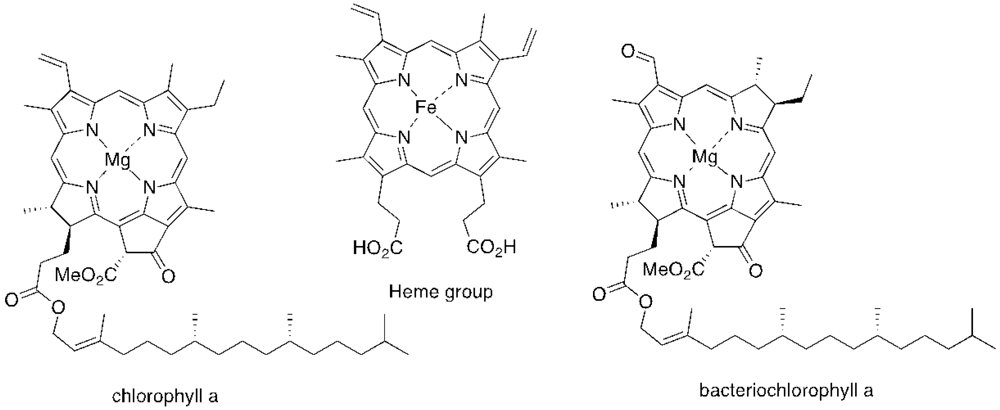
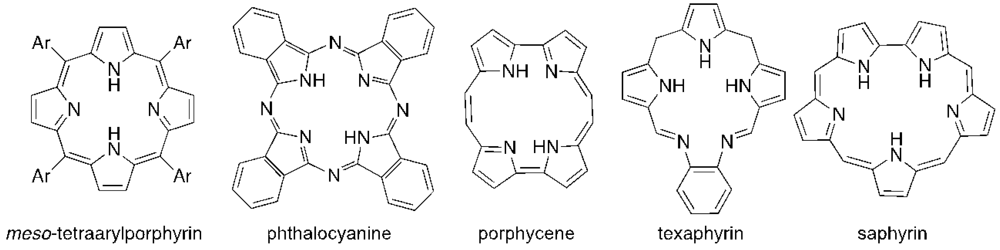
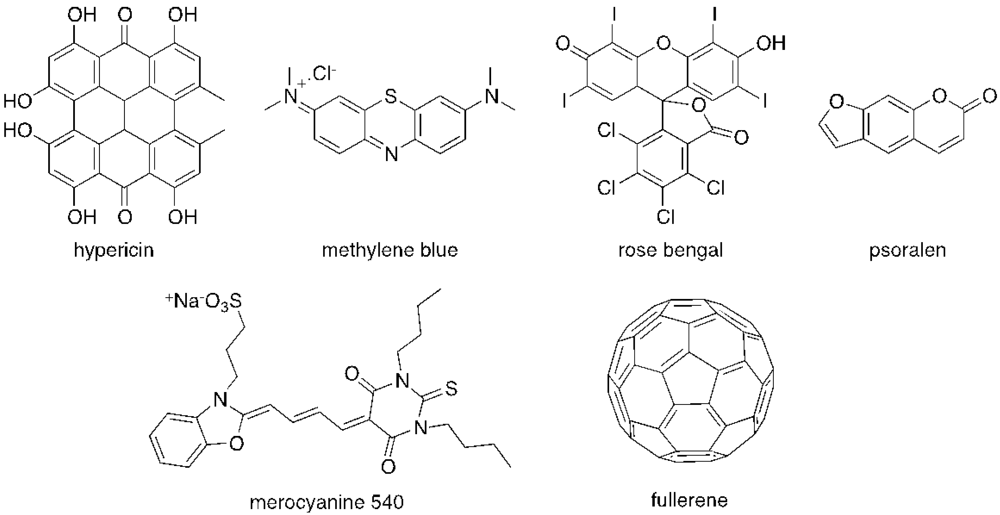
      <p>The majority of PS used in PDI is derived from tetrapyrrolic macrocycles known as porphyrins. These chromophores and their analogs, such as chlorins and bacteriochlorins, are involved in very important biological functions, such as respiration (heme group) and photosynthesis (chlorophyll and bacteriochlorophyll (<xref ref-type="fig" rid="viruses-04-01034-f001">Figure 1</xref>). Based on these macrocycles, the scientific community was able to develop a number of synthetic analogs, such as <italic>meso</italic>-tetraarylporphyrins, phthalocyanines, texaphyrins, porphycenes and saphyrins, which proved to have very promising features for being used as PS (<xref ref-type="fig" rid="viruses-04-01034-f002">Figure 2</xref>) [<xref ref-type="bibr" rid="B16-viruses-04-01034">16</xref>]. Also, non-tetrapyrrolic derivatives, such as the naturally occurring hypericin, or synthetic dyes like toluidine blue O, rose bengal, eosin, methylene blue (MB) and fullerenes, were considered in many PDI studies (<xref ref-type="fig" rid="viruses-04-01034-f003">Figure 3</xref>) [<xref ref-type="bibr" rid="B71-viruses-04-01034">71</xref>].</p>
      <p>In order to be efficient, photosensitizing agents used for viral PDI must bind specifically to vital viral components, such as lipid envelope (when present), the protein coat or to the nucleic acids [<xref ref-type="bibr" rid="B55-viruses-04-01034">55</xref>].</p>
      <fig id="viruses-04-01034-f001" position="anchor">
        <label>Figure 1</label>
        <caption>
          <p>Structure of some tetrapyrrolic macrocycles with natural occurrence.</p>
        </caption>
        <graphic xmlns:xlink="http://www.w3.org/1999/xlink" xlink:href="viruses-04-01034-g001.tif"/>
      </fig>
      <fig id="viruses-04-01034-f002" position="anchor">
        <label>Figure 2</label>
        <caption>
          <p>Skeletons of some synthetic pyrrolic macrocycles used as photosensitizers.</p>
        </caption>
        <graphic xmlns:xlink="http://www.w3.org/1999/xlink" xlink:href="viruses-04-01034-g002.tif"/>
      </fig>
      <fig id="viruses-04-01034-f003" position="anchor">
        <label>Figure 3</label>
        <caption>
          <p>Structure of some non-tetrapyrrolic photosensitizers.</p>
        </caption>
        <graphic xmlns:xlink="http://www.w3.org/1999/xlink" xlink:href="viruses-04-01034-g003.tif"/>
      </fig>
      <p>The efficiency of mammalian viruses and bacteriophages PDI has been described for porphyrin derivatives, chlorin derivatives, chlorophyll derivatives, phthalocyanine derivatives, hypericin, methylene blue, rose bengal, merocyanine 540, proflavine, and fullerene derivatives (<xref ref-type="table" rid="viruses-04-01034-t001">Table 1</xref>).</p>
      <table-wrap id="viruses-04-01034-t001" position="anchor">
        <object-id pub-id-type="pii">viruses-04-01034-t001_Table 1</object-id>
        <label>Table 1</label>
        <caption>
          <p>Some PS used for mammalian viruses and bacteriophages PDI.</p>
        </caption>
        <table rules="all" style="border: solid thin">
<thead>
            <tr>
              <th align="left" valign="middle">Photosensitizer</th>
              <th align="center" valign="middle">Microorganism</th>
              <th align="center" valign="middle">PDI</th>
              <th align="center" valign="middle">Reference</th>
            </tr>
          </thead>
          <tbody>
            <tr>
              <td align="left" valign="middle">
                <bold>Mammalian viruses</bold>
              </td>
              <td align="center" valign="middle"> </td>
              <td align="center" valign="middle"> </td>
              <td align="center" valign="middle"> </td>
            </tr>
            <tr>
              <td rowspan="2" align="left" valign="middle">Hematoporphyrin derivative</td>
              <td align="center" valign="middle">HSV-1</td>
              <td align="center" valign="middle">7 log</td>
              <td align="center" valign="middle">[<xref ref-type="bibr" rid="B75-viruses-04-01034">75</xref>]</td>
            </tr>
            <tr>
              <td align="center" valign="middle">HSV-1</td>
              <td align="center" valign="middle">&lt;0.8 log</td>
              <td align="center" valign="middle">[<xref ref-type="bibr" rid="B36-viruses-04-01034">36</xref>]</td>
            </tr>
            <tr>
              <td align="left" valign="middle">Uroporphyrin</td>
              <td align="center" valign="middle">Adenovirus</td>
              <td align="center" valign="middle">7 log</td>
              <td align="center" valign="middle">[<xref ref-type="bibr" rid="B76-viruses-04-01034">76</xref>]</td>
            </tr>
            <tr>
              <td align="left" valign="middle">Natural metalloporphyrin derivatives</td>
              <td align="center" valign="middle">HIV-1</td>
              <td align="center" valign="middle">&lt;0.8 log</td>
              <td align="center" valign="middle">[<xref ref-type="bibr" rid="B36-viruses-04-01034">36</xref>]</td>
            </tr>
            <tr>
              <td align="left" valign="middle">Chlorophyll derivatives</td>
              <td align="center" valign="middle">VSV</td>
              <td align="center" valign="middle">~6 log</td>
              <td align="center" valign="middle">[<xref ref-type="bibr" rid="B77-viruses-04-01034">77</xref>]</td>
            </tr>
            <tr>
              <td rowspan="2" align="left" valign="middle">7-despropionate-7-hydroxypropylmesopyropheophorbide a</td>
              <td align="center" valign="middle">BVDV</td>
              <td align="center" valign="middle">~5 log</td>
              <td rowspan="2" align="center" valign="middle">[<xref ref-type="bibr" rid="B78-viruses-04-01034">78</xref>]</td>
            </tr>
            <tr style="border-top: hidden">
              <td align="center" valign="middle">EMCV</td>
              <td align="center" valign="middle">~0.2 log</td>
            </tr>
            <tr>
              <td align="left" valign="middle">Benzoporphyrin derivative monoacid ring A</td>
              <td align="center" valign="middle">HIV-1</td>
              <td align="center" valign="middle">&gt;4 log</td>
              <td align="center" valign="middle">[<xref ref-type="bibr" rid="B33-viruses-04-01034">33</xref>]</td>
            </tr>
            <tr>
              <td rowspan="2" align="left" valign="middle">Glycoconjugated 
              <italic>meso</italic>-tetraarylporphyrin derivatives</td>
              <td align="center" valign="middle">HSV-1</td>
              <td align="center" valign="middle">6 log</td>
              <td rowspan="2" align="center" valign="middle">[<xref ref-type="bibr" rid="B79-viruses-04-01034">79</xref>]</td>
            </tr>
            <tr style="border-top: hidden">
              <td align="center" valign="middle">HSV-2</td>
              <td align="center" valign="middle">6 log</td>
            </tr>
            <tr>
              <td align="left" valign="middle">Metallo tetrasulfonated 
              <italic>meso</italic>-tetraarylporphyrin derivatives</td>
              <td align="center" valign="middle">HIV-1</td>
              <td align="center" valign="middle">≤2 log</td>
              <td align="center" valign="middle">[<xref ref-type="bibr" rid="B36-viruses-04-01034">36</xref>]</td>
            </tr>
            <tr>
              <td rowspan="2" align="left" valign="middle">Tetrasulfonated 
              <italic>meso</italic>-tetraarylporphyrin derivatives</td>
              <td align="center" valign="middle">HIV-1</td>
              <td align="center" valign="middle">≤2 log</td>
              <td align="center" valign="middle">[<xref ref-type="bibr" rid="B36-viruses-04-01034">36</xref>]</td>
            </tr>
            <tr>
              <td align="center" valign="middle">HAV</td>
              <td align="center" valign="middle">~4 log</td>
              <td align="center" valign="middle">[<xref ref-type="bibr" rid="B44-viruses-04-01034">44</xref>]</td>
            </tr>
            <tr>
              <td align="left" valign="middle"><italic>meso</italic>-Tetrakis(1-methylpyridinium-4-yl)porphyrin</td>
              <td align="center" valign="middle">HAV</td>
              <td align="center" valign="middle">~4 log</td>
              <td align="center" valign="middle">[<xref ref-type="bibr" rid="B44-viruses-04-01034">44</xref>]</td>
            </tr>
            <tr>
              <td align="left" valign="middle"><italic>meso</italic>-Tetrakis(1-butylpyridinium-4-yl)porphyrin</td>
              <td align="center" valign="middle">HAV</td>
              <td align="center" valign="middle">&gt;3.8 log</td>
              <td align="center" valign="middle">[<xref ref-type="bibr" rid="B44-viruses-04-01034">44</xref>]</td>
            </tr>
            <tr>
              <td align="left" valign="middle"><italic>meso</italic>-Tetrakis(1-octylpyridinium-4-yl)porphyrin</td>
              <td align="center" valign="middle">HAV</td>
              <td align="center" valign="middle">&gt;3.9 log</td>
              <td align="center" valign="middle">[<xref ref-type="bibr" rid="B44-viruses-04-01034">44</xref>]</td>
            </tr>
            <tr>
              <td align="left" valign="middle">Cationic β-vinyl substituted 
              <italic>meso</italic>-tetraphenylporphyrin derivatives</td>
              <td align="center" valign="middle">HSV-1</td>
              <td align="center" valign="middle">&lt;3 log</td>
              <td align="center" valign="middle">[<xref ref-type="bibr" rid="B80-viruses-04-01034">80</xref>]</td>
            </tr>
            <tr>
              <td align="left" valign="middle">Aluminum dibenzodisulfophthalocyanine</td>
              <td align="center" valign="middle">HIV-1</td>
              <td align="center" valign="middle">3.7 log</td>
              <td align="center" valign="middle">[<xref ref-type="bibr" rid="B49-viruses-04-01034">49</xref>]</td>
            </tr>
            <tr>
              <td rowspan="3" align="left" valign="middle">Aluminum phthalocyanine tetrasulfonate</td>
              <td align="center" valign="middle">HIV-1</td>
              <td align="center" valign="middle">&gt;5 log</td>
              <td align="center" valign="middle">[<xref ref-type="bibr" rid="B49-viruses-04-01034">49</xref>]</td>
            </tr>
            <tr>
              <td align="center" valign="middle">VSV</td>
              <td align="center" valign="middle">4.2 log</td>
              <td align="center" valign="middle">[<xref ref-type="bibr" rid="B82-viruses-04-01034">82</xref>]</td>
            </tr>
            <tr>
              <td align="center" valign="middle">Adenovirus</td>
              <td align="center" valign="middle">4 log</td>
              <td align="center" valign="middle">[<xref ref-type="bibr" rid="B76-viruses-04-01034">76</xref>]</td>
            </tr>
            <tr>
              <td align="left" valign="middle">Silicon phthalocyanine derivative</td>
              <td align="center" valign="middle">VSV</td>
              <td align="center" valign="middle">4 log</td>
              <td align="center" valign="middle">[<xref ref-type="bibr" rid="B82-viruses-04-01034">82</xref>]</td>
            </tr>
            <tr>
              <td rowspan="2" align="left" valign="middle">Cationic phthalocyanines</td>
              <td align="center" valign="middle">HIV-1</td>
              <td align="center" valign="middle">&gt;5 log</td>
              <td align="center" valign="middle">[<xref ref-type="bibr" rid="B49-viruses-04-01034">49</xref>]</td>
            </tr>
            <tr>
              <td align="center" valign="middle">HSV-1</td>
              <td align="center" valign="middle">≥5 log</td>
              <td align="center" valign="middle">[<xref ref-type="bibr" rid="B83-viruses-04-01034">83</xref>]</td>
            </tr>
            <tr>
              <td rowspan="4" align="left" valign="middle">Hypericin</td>
              <td align="center" valign="middle">HIV-1</td>
              <td align="center" valign="middle">NQ</td>
              <td rowspan="4" align="center" valign="middle">[<xref ref-type="bibr" rid="B30-viruses-04-01034">30</xref>]</td>
            </tr>
            <tr>
              <td align="center" valign="middle">VSV</td>
              <td align="center" valign="middle">4-5 log</td>
            </tr>
            <tr>
              <td align="center" valign="middle">Influenza virus</td>
              <td align="center" valign="middle">NQ</td>
            </tr>
            <tr>
              <td align="center" valign="middle">Sendai virus</td>
              <td align="center" valign="middle">NQ</td>
            </tr>
            <tr>
              <td rowspan="9" align="left" valign="middle">Methylene blue</td>
              <td align="center" valign="middle">VSV</td>
              <td align="center" valign="middle">4.7 log</td>
              <td align="center" valign="middle">[<xref ref-type="bibr" rid="B81-viruses-04-01034">81</xref>]</td>
            </tr>
            <tr>
              <td align="center" valign="middle">HSV-1</td>
              <td align="center" valign="middle">5 log</td>
              <td align="center" valign="middle">[<xref ref-type="bibr" rid="B84-viruses-04-01034">84</xref>]</td>
            </tr>
            <tr>
              <td align="center" valign="middle">SHV-1</td>
              <td align="center" valign="middle">2.5 log</td>
              <td align="center" valign="middle">[<xref ref-type="bibr" rid="B84-viruses-04-01034">84</xref>]</td>
            </tr>
            <tr>
              <td align="center" valign="middle">HCV</td>
              <td align="center" valign="middle">&lt;2 log</td>
              <td align="center" valign="middle">[<xref ref-type="bibr" rid="B41-viruses-04-01034">41</xref>]</td>
            </tr>
            <tr>
              <td align="center" valign="middle">HIV-1</td>
              <td align="center" valign="middle">&lt;2 log</td>
              <td align="center" valign="middle">[<xref ref-type="bibr" rid="B41-viruses-04-01034">41</xref>]</td>
            </tr>
            <tr>
              <td align="center" valign="middle">Adenovirus</td>
              <td align="center" valign="middle">7 log</td>
              <td align="center" valign="middle">[<xref ref-type="bibr" rid="B76-viruses-04-01034">76</xref>]</td>
            </tr>
            <tr>
              <td align="center" valign="middle">Dengue virus</td>
              <td align="center" valign="middle">5–6.4 log</td>
              <td align="center" valign="middle">[<xref ref-type="bibr" rid="B74-viruses-04-01034">74</xref>]</td>
            </tr>
            <tr>
              <td align="center" valign="middle">Enterovirus 71</td>
              <td align="center" valign="middle">~8 log</td>
              <td align="center" valign="middle">[<xref ref-type="bibr" rid="B85-viruses-04-01034">85</xref>]</td>
            </tr>
            <tr>
              <td align="center" valign="middle">Vaccinia virus</td>
              <td align="center" valign="middle">5 log</td>
              <td align="center" valign="middle">[<xref ref-type="bibr" rid="B86-viruses-04-01034">86</xref>]</td>
            </tr>
            <tr>
              <td align="left" valign="middle">Phenothiazine derivatives</td>
              <td align="center" valign="middle">VSV</td>
              <td align="center" valign="middle">&gt;4.4 log</td>
              <td align="center" valign="middle">[<xref ref-type="bibr" rid="B60-viruses-04-01034">60</xref>]</td>
            </tr>
            <tr>
              <td rowspan="6" align="left" valign="middle">Rose bengal</td>
              <td align="center" valign="middle">Vaccinia virus</td>
              <td align="center" valign="middle">5 log</td>
              <td align="center" valign="middle">[<xref ref-type="bibr" rid="B86-viruses-04-01034">86</xref>]</td>
            </tr>
            <tr>
              <td align="center" valign="middle">HIV-1</td>
              <td align="center" valign="middle">NQ</td>
              <td rowspan="4" align="center" valign="middle">[<xref ref-type="bibr" rid="B30-viruses-04-01034">30</xref>]</td>
            </tr>
            <tr>
              <td align="center" valign="middle">VSV</td>
              <td align="center" valign="middle">4–5 log</td>
            </tr>
            <tr>
              <td align="center" valign="middle">Influenza virus</td>
              <td align="center" valign="middle">NQ</td>
            </tr>
            <tr>
              <td align="center" valign="middle">Sendai virus</td>
              <td align="center" valign="middle">NQ</td>
            </tr>
            <tr>
              <td align="center" valign="middle">Adenovirus</td>
              <td align="center" valign="middle">7 log</td>
              <td align="center" valign="middle">[<xref ref-type="bibr" rid="B76-viruses-04-01034">76</xref>]</td>
            </tr>
            <tr>
              <td rowspan="2" align="left" valign="middle">Buckminsterfullerene</td>
              <td align="center" valign="middle">SFV</td>
              <td align="center" valign="middle">7 log</td>
              <td rowspan="2" align="center" valign="middle">[<xref ref-type="bibr" rid="B50-viruses-04-01034">50</xref>]</td>
            </tr>
            <tr style="border-top: hidden">
              <td align="center" valign="middle">VSV</td>
              <td align="center" valign="middle">7 log</td>
            </tr>
            <tr>
              <td align="left" valign="middle">Merocyanine 540</td>
              <td align="center" valign="middle">HSV-1</td>
              <td align="center" valign="middle">5–6 log</td>
              <td align="center" valign="middle">[<xref ref-type="bibr" rid="B45-viruses-04-01034">45</xref>]</td>
            </tr>
            <tr>
              <td colspan="4" align="left" valign="middle">
                <bold>Bacteriophages</bold>
              </td>
            </tr>
            <tr>
              <td rowspan="2" align="left" valign="middle">Glycoconjugated 
              <italic>meso</italic>-tetraarylporphyrins</td>
              <td align="center" valign="middle">T7 phage</td>
              <td align="center" valign="middle">&lt;3 log</td>
              <td align="center" valign="middle">[<xref ref-type="bibr" rid="B64-viruses-04-01034">64</xref>]</td>
            </tr>
            <tr>
              <td align="center" valign="middle">T7 phage</td>
              <td align="center" valign="middle">&lt;3.5 log</td>
              <td align="center" valign="middle">[<xref ref-type="bibr" rid="B87-viruses-04-01034">87</xref>]</td>
            </tr>
            <tr>
              <td align="left" valign="middle">Tetrasulfonated 
              <italic>meso</italic>-tetraarylporphyrin derivatives</td>
              <td align="center" valign="middle">MS2 phage</td>
              <td align="center" valign="middle">&gt;3.8 log</td>
              <td align="center" valign="middle">[<xref ref-type="bibr" rid="B44-viruses-04-01034">44</xref>]</td>
            </tr>
            <tr>
              <td rowspan="4" align="left" valign="middle"><italic>meso</italic>-Tetrakis(1-methylpyridinium-4-yl)porphyrin</td>
              <td align="center" valign="middle">λ phage</td>
              <td align="center" valign="middle">&lt;7 log</td>
              <td align="center" valign="middle">[<xref ref-type="bibr" rid="B58-viruses-04-01034">58</xref>]</td>
            </tr>
            <tr>
              <td align="center" valign="middle">MS2 phage</td>
              <td align="center" valign="middle">&gt;4.1 log</td>
              <td align="center" valign="middle">[<xref ref-type="bibr" rid="B44-viruses-04-01034">44</xref>]</td>
            </tr>
            <tr>
              <td align="center" valign="middle">T4 phage</td>
              <td align="center" valign="middle">7 log</td>
              <td align="center" valign="middle">[<xref ref-type="bibr" rid="B66-viruses-04-01034">66</xref>,<xref ref-type="bibr" rid="B67-viruses-04-01034">67</xref>]</td>
            </tr>
            <tr>
              <td align="center" valign="middle">T7 phage</td>
              <td align="center" valign="middle">&lt;4 log</td>
              <td align="center" valign="middle">[<xref ref-type="bibr" rid="B88-viruses-04-01034">88</xref>]</td>
            </tr>
            <tr>
              <td align="left" valign="middle">5-(pentafluorophenyl)-10,15,20-tris(1-methylpyridinium-4-yl)porphyrin</td>
              <td align="center" valign="middle">T4 phage</td>
              <td align="center" valign="middle">7 log</td>
              <td align="center" valign="middle">[<xref ref-type="bibr" rid="B66-viruses-04-01034">66</xref>,<xref ref-type="bibr" rid="B67-viruses-04-01034">67</xref>,<xref ref-type="bibr" rid="B68-viruses-04-01034">68</xref>]</td>
            </tr>
            <tr>
              <td align="left" valign="middle">5-(4-methoxicarbonylphenyl)-10,15,20-tris(1-methylpyridinium-4-yl)porphyrin</td>
              <td align="center" valign="middle">T4 phage</td>
              <td align="center" valign="middle">7 log</td>
              <td align="center" valign="middle">[<xref ref-type="bibr" rid="B66-viruses-04-01034">66</xref>]</td>
            </tr>
            <tr>
              <td align="left" valign="middle">5-(4-carboxyphenyl)-10,15,20-tris(1-methylpyridinium-4-yl)porphyrin</td>
              <td align="center" valign="middle">T4 phage</td>
              <td align="center" valign="middle">3.9 log</td>
              <td align="center" valign="middle">[<xref ref-type="bibr" rid="B66-viruses-04-01034">66</xref>]</td>
            </tr>
            <tr>
              <td align="left" valign="middle">5,10-bis(4-carboxyphenyl)-15,20-bis(1-methylpyridinium-4-yl)porphyrin</td>
              <td align="center" valign="middle">T4 phage</td>
              <td align="center" valign="middle">1.4 log</td>
              <td align="center" valign="middle">[<xref ref-type="bibr" rid="B66-viruses-04-01034">66</xref>]</td>
            </tr>
            <tr>
              <td align="left" valign="middle">5,15-bis(4-carboxyphenyl)-10,20-bis(1-methylpyridinium-4-yl)porphyrin</td>
              <td align="center" valign="middle">T4 phage</td>
              <td align="center" valign="middle">1.2 log</td>
              <td align="center" valign="middle">[<xref ref-type="bibr" rid="B66-viruses-04-01034">66</xref>]</td>
            </tr>
            <tr>
              <td align="left" valign="middle">5,10,15-tris(1-methylpyridinium-4-yl)-20-phenylporphyrin</td>
              <td align="center" valign="middle">T7 phage</td>
              <td align="center" valign="middle">1.7 log</td>
              <td align="center" valign="middle">[<xref ref-type="bibr" rid="B88-viruses-04-01034">88</xref>]</td>
            </tr>
            <tr>
              <td rowspan="5" align="left" valign="middle">Methylene blue</td>
              <td align="center" valign="middle"><italic>Serratia</italic> phage <italic>kappa</italic></td>
              <td align="center" valign="middle">&gt;4 log</td>
              <td align="center" valign="middle">[<xref ref-type="bibr" rid="B61-viruses-04-01034">61</xref>]</td>
            </tr>
            <tr>
              <td align="center" valign="middle">M13 phage</td>
              <td align="center" valign="middle">2.2 log</td>
              <td align="center" valign="middle">[<xref ref-type="bibr" rid="B52-viruses-04-01034">52</xref>,<xref ref-type="bibr" rid="B81-viruses-04-01034">81</xref>]</td>
            </tr>
            <tr>
              <td align="center" valign="middle">f2 phage</td>
              <td align="center" valign="middle">5 log</td>
              <td align="center" valign="middle">[<xref ref-type="bibr" rid="B56-viruses-04-01034">56</xref>]</td>
            </tr>
            <tr>
              <td align="center" valign="middle">Qβ phage</td>
              <td align="center" valign="middle">7–8 log</td>
              <td align="center" valign="middle">[<xref ref-type="bibr" rid="B56-viruses-04-01034">56</xref>]</td>
            </tr>
            <tr>
              <td align="center" valign="middle">Qβ phage</td>
              <td align="center" valign="middle">7–8 log</td>
              <td align="center" valign="middle">[<xref ref-type="bibr" rid="B89-viruses-04-01034">89</xref>]</td>
            </tr>
            <tr>
              <td rowspan="2" align="left" valign="middle">Phenothiazine derivatives</td>
              <td align="center" valign="middle">R17 phage</td>
              <td align="center" valign="middle">4–7 log</td>
              <td rowspan="2" align="center" valign="middle">[<xref ref-type="bibr" rid="B60-viruses-04-01034">60</xref>]</td>
            </tr>
            <tr style="border-top: hidden">
              <td align="center" valign="middle">φ6</td>
              <td align="center" valign="middle">4–6.5 log</td>
            </tr>
            <tr>
              <td rowspan="2" align="left" valign="middle">Rose bengal</td>
              <td align="center" valign="middle">PRD1 phage</td>
              <td align="center" valign="middle">~3.5 log*</td>
              <td rowspan="2" align="center" valign="middle">[<xref ref-type="bibr" rid="B57-viruses-04-01034">57</xref>]</td>
            </tr>
            <tr style="border-top: hidden">
              <td align="center" valign="middle">T7 phage</td>
              <td align="center" valign="middle">~4.5 log*</td>
            </tr>
            <tr>
              <td align="left" valign="middle">Riboflavin</td>
              <td align="center" valign="middle">λ phage</td>
              <td align="center" valign="middle">&lt;4 log</td>
              <td align="center" valign="middle">[<xref ref-type="bibr" rid="B59-viruses-04-01034">59</xref>]</td>
            </tr>
            <tr>
              <td rowspan="2" align="left" valign="middle">Proflavine</td>
              <td align="center" valign="middle"><italic>Serratia</italic> phage <italic>kappa</italic></td>
              <td align="center" valign="middle">4 log</td>
              <td align="center" valign="middle">[<xref ref-type="bibr" rid="B61-viruses-04-01034">61</xref>]</td>
            </tr>
            <tr>
              <td align="center" valign="middle">T3 phage</td>
              <td align="center" valign="middle">7–11 log</td>
              <td align="center" valign="middle">[<xref ref-type="bibr" rid="B63-viruses-04-01034">63</xref>]</td>
            </tr>
            <tr>
              <td rowspan="4" align="left" valign="middle">Polyhydroxylated fullerene</td>
              <td align="center" valign="middle">MS2 phage</td>
              <td align="center" valign="middle">~4 log</td>
              <td align="center" valign="middle">[<xref ref-type="bibr" rid="B90-viruses-04-01034">90</xref>]</td>
            </tr>
            <tr>
              <td align="center" valign="middle">PRD1 phage</td>
              <td align="center" valign="middle">~2.5 log*</td>
              <td rowspan="3" align="center" valign="middle">[<xref ref-type="bibr" rid="B57-viruses-04-01034">57</xref>]</td>
            </tr>
            <tr style="border-top: hidden">
              <td align="center" valign="middle">T7 phage</td>
              <td align="center" valign="middle">~3.5 log*</td>
            </tr>
            <tr style="border-top: hidden">
              <td align="center" valign="middle">MS2 phage</td>
              <td align="center" valign="middle">~5 log*</td>
            </tr>
          </tbody>
        </table>
		<table-wrap-foot>
		<fn>
        <p>*log(N/N0)</p>
		</fn>
		</table-wrap-foot>
      </table-wrap>
      <p>Besides this, viral PDI has also been described for phthalocyanine derivatives [<xref ref-type="bibr" rid="B81-viruses-04-01034">81</xref>], methylene blue [<xref ref-type="bibr" rid="B53-viruses-04-01034">53</xref>,<xref ref-type="bibr" rid="B62-viruses-04-01034">62</xref>,<xref ref-type="bibr" rid="B91-viruses-04-01034">91</xref>,<xref ref-type="bibr" rid="B92-viruses-04-01034">92</xref>], toluidine blue O [<xref ref-type="bibr" rid="B53-viruses-04-01034">53</xref>,<xref ref-type="bibr" rid="B62-viruses-04-01034">62</xref>,<xref ref-type="bibr" rid="B93-viruses-04-01034">93</xref>], neutral red [<xref ref-type="bibr" rid="B93-viruses-04-01034">93</xref>], proflavine [<xref ref-type="bibr" rid="B93-viruses-04-01034">93</xref>], azure B [<xref ref-type="bibr" rid="B53-viruses-04-01034">53</xref>] and merocyanine 540 [<xref ref-type="bibr" rid="B45-viruses-04-01034">45</xref>,<xref ref-type="bibr" rid="B47-viruses-04-01034">47</xref>,<xref ref-type="bibr" rid="B94-viruses-04-01034">94</xref>].</p>
    </sec>
    <sec>
      <title>3. Mechanisms of Photodynamic Inactivation</title>
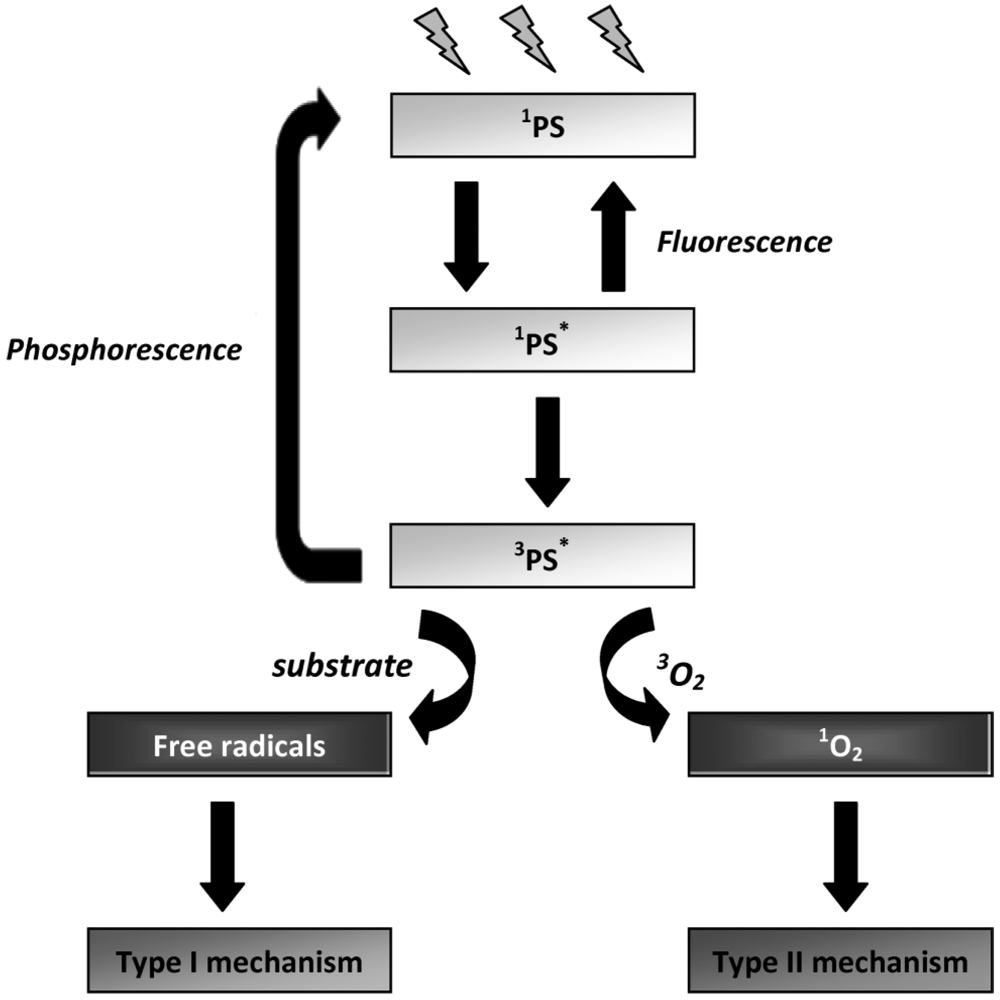
      <p>The mechanisms of PDI are based on the ability of the PS to absorb energy from light and transfer that energy to molecular oxygen. In the dark, the electronic configuration of a PS exists in the so-called ground state. The absorption, by the PS, of a photon at an appropriate wavelength initially leads to the production of an unstable, electronically-excited state of the PS molecule (the lifetime of this state ranges from 10<sup>−9</sup> to 10<sup>−6</sup> s) [<xref ref-type="bibr" rid="B95-viruses-04-01034">95</xref>]. The excited PS molecule can then decay to the ground state by emission of light (radiative pathway - fluorescence) or by intersystem crossing, affording the excited triplet state which has a longer lifetime (10<sup>−3</sup> to 10 s) [<xref ref-type="bibr" rid="B95-viruses-04-01034">95</xref>]. At this point, the PS can reach the ground state either by spin inversion followed by phosphorescence emission, or by a non-radiative process. Due to the longer lifetime of the PS triplet state, this excited state can also react in one of two ways (<xref ref-type="fig" rid="viruses-04-01034-f002">Figure 2</xref>): by initiating photochemical reactions that can directly generate reactive oxygen species (ROS) (type I pathway), or indirectly by energy transfer to molecular oxygen (type II pathway), leading to the formation of singlet oxygen (<xref ref-type="fig" rid="viruses-04-01034-f004">Figure 4</xref>). These events afford toxic species which are responsible for the irreparable oxidative damages induced to important biological targets [<xref ref-type="bibr" rid="B1-viruses-04-01034">1</xref>,<xref ref-type="bibr" rid="B69-viruses-04-01034">69</xref>,<xref ref-type="bibr" rid="B95-viruses-04-01034">95</xref>,<xref ref-type="bibr" rid="B96-viruses-04-01034">96</xref>].</p>
      <fig id="viruses-04-01034-f004" position="anchor">
        <label>Figure 4</label>
        <caption>
          <p>Schematic representation of the photosensitization process (adapted from [<xref ref-type="bibr" rid="B97-viruses-04-01034">97</xref>]).</p>
        </caption>
        <graphic xmlns:xlink="http://www.w3.org/1999/xlink" xlink:href="viruses-04-01034-g004.tif"/>
      </fig>
      <sec>
        <title>3.1. Type I and Type II Mechanisms</title>
        <p>Type I mechanism involves hydrogen-atom abstraction or electron-transfer between the excited PS and a substrate, yielding free radicals [Equations (1) and (2)]. These radicals can react with oxygen to form active oxygen species, such as the superoxide radical anion [Equation (3)]. Superoxide is not particularly reactive in biological systems but, when protonated, can lead to the production of hydrogen peroxide and oxygen [Equations (4) and (5)] or highly reactive hydroxyl radicals [Equations (6)–(8)] [<xref ref-type="bibr" rid="B98-viruses-04-01034">98</xref>]. Type II photooxidation is considerably less complex mechanistically than type I and in general there are far fewer products [<xref ref-type="bibr" rid="B99-viruses-04-01034">99</xref>]. In this pathway, the excited triplet state PS (<sup>3</sup>PS*) can transfer the excess energy to molecular oxygen (<sup>3</sup>O<sub>2</sub>) and relax to its ground state (<sup>1</sup>PS) creating an excited singlet molecular oxygen (<sup>1</sup>O<sub>2</sub>) [Equation (9)] [<xref ref-type="bibr" rid="B69-viruses-04-01034">69</xref>]. <sup>1</sup>O<sub>2 </sub>is highly electrophilic and can interact with numerous enzymes, leading to the inhibition of protein synthesis and molecular alteration of DNA strands, which alters the transcription of the genetic material during its replication (mutagenic effect) and, in this way, leading to microbial death [Equation (10)] [<xref ref-type="bibr" rid="B98-viruses-04-01034">98</xref>,<xref ref-type="bibr" rid="B100-viruses-04-01034">100</xref>]. Like nucleic acids and proteins, unsaturated lipids are also prominent targets of <sup>1</sup>O<sub>2 </sub>and free radical attack. Lipid peroxidation-ensuing reactions can alter surrounding proteins, nucleic acids and other molecules, in addition to the lipids themselves [<xref ref-type="bibr" rid="B98-viruses-04-01034">98</xref>]. Therefore, it is likely that damage of different kinds caused to the viral envelope is important in the process of microbial inactivation [<xref ref-type="bibr" rid="B13-viruses-04-01034">13</xref>]. </p>
        <p><inline-graphic xmlns:xlink="http://www.w3.org/1999/xlink" xlink:href="viruses-04-01034-i001.tif"/></p>
        <p>Both type I and type II mechanisms can occur simultaneously or exclusively, and the ratio between these processes depends on the PS used and on the concentrations of substrate and oxygen [<xref ref-type="bibr" rid="B95-viruses-04-01034">95</xref>]. The competition between organic substrates and molecular oxygen for the <sup>3</sup>PS<sup>*</sup> determines whether the reaction pathway is type I or type II and the predominant mechanism can be changed during the course of the PDI process [<xref ref-type="bibr" rid="B101-viruses-04-01034">101</xref>]. </p>
      </sec>
      <sec>
        <title>3.2. Evaluation of the Specific Involvement of Type I and Type II Mechanisms</title>
        <p>An important goal in the investigation of viral PDI is to identify the type of mechanism involved (type I or type II) in the presence of a selected PS [<xref ref-type="bibr" rid="B102-viruses-04-01034">102</xref>]. The simple detection of a reactive species does not necessarily explain the mechanism by which a specific PS induces the toxic effect. It is generally easier to draw a negative conclusion, <italic>i.e.</italic>, if singlet oxygen is absent, it cannot be the reactive species responsible for the photodynamic effect [<xref ref-type="bibr" rid="B103-viruses-04-01034">103</xref>]. The simplest approach for determining whether singlet oxygen (type II mechanism) or free radicals (type I mechanism) is involved in the photodynamic process is to study the inhibitory effects of various scavengers, <italic>i.e.</italic>, compounds that can intercept these ROS at high rates and in a putatively selective manner [<xref ref-type="bibr" rid="B99-viruses-04-01034">99</xref>,<xref ref-type="bibr" rid="B101-viruses-04-01034">101</xref>,<xref ref-type="bibr" rid="B104-viruses-04-01034">104</xref>].</p>
        <sec>
          <title>3.2.1. Type I Mechanism Scavengers</title>
          <p>A first line of defence against ROS is, of course, the protection against their formation. However, the interception of the damaging species once formed, to prevent it from further deleterious reactions, is also a deactivation strategy of defence. In general, free radical scavengers neutralize the radical species by donating one of their own electrons. The quenching agents themselves are not particularly toxic before and after the electron donation [<xref ref-type="bibr" rid="B105-viruses-04-01034">105</xref>].</p>
          <p>Three different types of quenching are possible, which include the transfer of the radical character with the formation of a reactive scavenger-derived radical; trapping of free radicals with the formation of a stable or inert free radical trap; and molecules which mimic quenching enzyme activities. In general, scavenger molecules either prevent free radicals from being formed or remove them before they can damage vital molecular components [<xref ref-type="bibr" rid="B105-viruses-04-01034">105</xref>].</p>
          <p>Several free radical scavengers have been used to evaluate the specific involvement of type I mechanism during mammalian viruses and bacteriophages PDI with different PS (<xref ref-type="table" rid="viruses-04-01034-t002">Table 2</xref>).</p>
          <table-wrap id="viruses-04-01034-t002" position="anchor">
            <object-id pub-id-type="pii">viruses-04-01034-t002_Table 2</object-id>
            <label>Table 2</label>
            <caption>
              <p>Free radical scavengers used in mammalian viruses and bacteriophages PDI.</p>
            </caption>
            <table rules="all" style="border: solid thin">
  <thead>
    <tr>
                  <th align="center" valign="middle">PS</th>
      <th align="center" valign="middle">Scavenger</th>
                  <th align="center" valign="middle">Microorganism</th>
                  <th align="center" valign="middle">Scavenger protection</th>
                  <th align="center" valign="middle">Reference</th>
                </tr>
  </thead>
  <tbody>
                <tr>
                  <td align="left" valign="middle">
                    <bold>Mammalian viruses</bold>
                  </td>
                  <td align="center" valign="middle"> </td>
                  <td align="center" valign="middle"> </td>
                  <td align="center" valign="middle"> </td>
                  <td align="center" valign="middle"> </td>
                </tr>
                <tr>
                  <td rowspan="4" align="left" valign="middle">Aluminum phthalocyanine tetrasulfonate</td>
                  <td align="center" valign="middle">Reduced glutathione</td>
                  <td rowspan="4" align="center" valign="middle">VSV</td>
                  <td align="center" valign="middle">Little/no effect</td>
                  <td rowspan="4" align="center" valign="middle">[<xref ref-type="bibr" rid="B106-viruses-04-01034">106</xref>]</td>
                </tr>
                <tr style="border-top: hidden">
                  <td align="center" valign="middle">Mannitol</td>
                  <td align="center" valign="middle">Little/no effect</td>
                </tr>
                <tr style="border-top: hidden">
                  <td align="center" valign="middle">Glycerol</td>
                  <td align="center" valign="middle">Little/no effect</td>
                </tr>
                <tr style="border-top: hidden">
                  <td align="center" valign="middle">SOD</td>
                  <td align="center" valign="middle">Little/no effect</td>
                </tr>
                <tr>
                  <td rowspan="4" align="left" valign="middle">Polyhydroxylated fullerene</td>
                  <td rowspan="2" align="center" valign="middle">Glutathione (2.0 mM)</td>
                  <td align="center" valign="middle">SFV</td>
                  <td align="center" valign="middle">no effect</td>
                  <td rowspan="2" align="center" valign="middle">[<xref ref-type="bibr" rid="B50-viruses-04-01034">50</xref>]</td>
                </tr>
                <tr style="border-top: hidden">
                  <td align="center" valign="middle">VSV</td>
                  <td align="center" valign="middle">no effect</td>
                </tr>
                <tr>
                  <td rowspan="2" align="center" valign="middle">Hydroquinone (2.0 mM)</td>
                  <td align="center" valign="middle">SFV</td>
                  <td align="center" valign="middle">no effect</td>
                  <td rowspan="2" align="center" valign="middle">[<xref ref-type="bibr" rid="B50-viruses-04-01034">50</xref>]</td>
                </tr>
                <tr style="border-top: hidden">
                  <td align="center" valign="middle">VSV</td>
                  <td align="center" valign="middle">no effect</td>
                </tr>
                <tr>
                  <td rowspan="3" align="left" valign="middle">Merocyanine 540</td>
                  <td align="center" valign="middle">Glutathione (10 and 30 mmol L<sup>−1</sup>)</td>
                  <td rowspan="3" align="center" valign="middle">HSV-1</td>
                  <td align="center" valign="middle">30-50%</td>
                  <td rowspan="3" align="center" valign="middle">[<xref ref-type="bibr" rid="B45-viruses-04-01034">45</xref>]</td>
                </tr>
                <tr style="border-top: hidden">
                  <td align="center" valign="middle">Cysteamine (10 and 30 mmol L<sup>−1</sup>)</td>
                  <td align="center" valign="middle">60-70%</td>
                </tr>
                <tr style="border-top: hidden">
                  <td align="center" valign="middle">SOD (1.5 to 29 U mL<sup>−1</sup>)</td>
                  <td align="center" valign="middle">no effect</td>
                </tr>
                <tr>
                  <td rowspan="4" align="left" valign="middle">Methylene blue</td>
                  <td align="center" valign="middle">Mannitol (100 mM)</td>
                  <td rowspan="4" align="center" valign="middle">HSV-1</td>
                  <td align="center" valign="middle">24%</td>
                  <td rowspan="4" align="center" valign="middle">[<xref ref-type="bibr" rid="B84-viruses-04-01034">84</xref>]</td>
                </tr>
                <tr style="border-top: hidden">
                  <td align="center" valign="middle">Glycerol (10 mM)</td>
                  <td align="center" valign="middle">24%</td>
                </tr>
                <tr style="border-top: hidden">
                  <td align="center" valign="middle">SOD (300 U mL<sup>−1</sup>)</td>
                  <td align="center" valign="middle">24%</td>
                </tr>
                <tr style="border-top: hidden">
                  <td align="center" valign="middle">Catalase (30 U mL<sup>−1</sup>)</td>
                  <td align="center" valign="middle">24%</td>
                </tr>
                <tr>
                  <td align="left" valign="middle">
                    <bold>Bacteriophages</bold>
                  </td>
                  <td align="center" valign="middle"> </td>
                  <td align="center" valign="middle"> </td>
                  <td align="center" valign="middle"> </td>
                  <td align="center" valign="middle"> </td>
                </tr>
                <tr>
                  <td align="left" valign="middle">5,10,15-(4-β-
                  <sc>D</sc>-glucosylphenyl)-20-phenylporphyrin</td>
                  <td align="center" valign="middle">DMTU (0.1–5.0 mM)</td>
                  <td align="center" valign="middle">T7 phage</td>
                  <td align="center" valign="middle">44%</td>
                  <td align="center" valign="middle">[<xref ref-type="bibr" rid="B64-viruses-04-01034">64</xref>]</td>
                </tr>
                <tr>
                  <td align="left" valign="middle">5,10.15,20-Tetrakis(4-β-
                  <sc>D</sc>-glucosylphenyl) porphyrin</td>
                  <td align="center" valign="middle">DMTU (0.1–5.0 mM)</td>
                  <td align="center" valign="middle">T7 phage</td>
                  <td align="center" valign="middle">79%</td>
                  <td align="center" valign="middle">[<xref ref-type="bibr" rid="B64-viruses-04-01034">64</xref>]</td>
                </tr>
                <tr>
                  <td align="left" valign="middle">5,10,15-(4-β-
                  <sc>D</sc>-galactosylphenyl)-20-(pentafluorophenyl)-porphyrin</td>
                  <td align="center" valign="middle">DMTU (0.1–5.0 mM)</td>
                  <td align="center" valign="middle">T7 phage</td>
                  <td align="center" valign="middle">89%</td>
                  <td align="center" valign="middle">[<xref ref-type="bibr" rid="B87-viruses-04-01034">87</xref>]</td>
                </tr>
                <tr>
                  <td rowspan="3" align="left" valign="middle">5-(pentafluorophenyl)-10,15,20-tris(1-methylpyridinium-4- yl)porphyrin</td>
                  <td rowspan="2" align="center" valign="middle">D-mannitol (100 mM)</td>
                  <td align="center" valign="middle">T4 phage </td>
                  <td align="center" valign="middle">20% </td>
                  <td rowspan="2" align="center" valign="middle">[<xref ref-type="bibr" rid="B107-viruses-04-01034">107</xref>]</td>
                </tr>
                <tr style="border-top: hidden">
                  <td align="center" valign="middle">Qβ</td>
                  <td align="center" valign="middle">no effect</td>
                </tr>
                <tr>
                  <td align="center" valign="middle">L-cysteine (100 mM)</td>
                  <td align="center" valign="middle">T4 phage</td>
                  <td align="center" valign="middle">9%</td>
                  <td align="center" valign="middle">[<xref ref-type="bibr" rid="B107-viruses-04-01034">107</xref>]</td>
                </tr>
                <tr>
                  <td align="left" valign="middle">5,10,15,20-tetrakis(1-methylpyridinium-4-yl)porphyrin</td>
                  <td align="center" valign="middle">D-mannitol (100 mM)</td>
                  <td align="center" valign="middle">T4 phage</td>
                  <td align="center" valign="middle">no effect</td>
                  <td align="center" valign="middle">[<xref ref-type="bibr" rid="B107-viruses-04-01034">107</xref>]</td>
                </tr>
                <tr>
                  <td align="left" valign="middle">Proflavine</td>
                  <td align="center" valign="middle">L-cysteine (0.025 M)</td>
                  <td align="center" valign="middle">T3 phage</td>
                  <td align="center" valign="middle">75–80%</td>
                  <td align="center" valign="middle">[<xref ref-type="bibr" rid="B63-viruses-04-01034">63</xref>]</td>
                </tr>
                <tr>
                  <td align="left" valign="middle">Polyhydroxylated fullerene</td>
                  <td align="center" valign="middle">SOD</td>
                  <td align="center" valign="middle">MS2 phage</td>
                  <td align="center" valign="middle">no effect</td>
                  <td align="center" valign="middle">[<xref ref-type="bibr" rid="B90-viruses-04-01034">90</xref>]</td>
                </tr>
  </tbody>
            </table>
          </table-wrap>
        <sec>
          <title>3.2.1.1. Free Radicals in PDI of Mammalian Viruses</title>
          <p>Free radical species had, in general, little or no effect on the photoinactivation of the studied mammalian viruses (<xref ref-type="table" rid="viruses-04-01034-t002">Table 2</xref>). In fact, it can be observed that the rate of inactivation of HSV [<xref ref-type="bibr" rid="B45-viruses-04-01034">45</xref>,<xref ref-type="bibr" rid="B84-viruses-04-01034">84</xref>,<xref ref-type="bibr" rid="B106-viruses-04-01034">106</xref>], influenza virus [<xref ref-type="bibr" rid="B108-viruses-04-01034">108</xref>], Semliki Forest virus (SFV) and VSV [<xref ref-type="bibr" rid="B50-viruses-04-01034">50</xref>] in the presence of different PS and scavengers like glutathione, D-mannitol, glycerol, superoxide dismutase (SOD), catalase and hydroquinone was not significantly affected. Although this data suggest that free radicals are not major players in the viral inactivation process, the participation of type I reaction pathways cannot be ruled out, as was shown by the considerable level of protection afforded by glutathione and cysteamine when merocyanine 540 was used as PS for inactivation of HSV-1 [<xref ref-type="bibr" rid="B45-viruses-04-01034">45</xref>].</p>
        </sec>
        <sec>
          <title>3.2.1.2. Free Radicals in PDI of Bacteriophages</title>
          <p>The photoinactivation rate of some bacteriophages can be reduced in the presence of free radical scavengers, suggesting a contribution of radical species in the inactivation process (<xref ref-type="table" rid="viruses-04-01034-t002">Table 2</xref>). In particular, it was reported that the inhibition of T7 phage photoinactivation in the presence of glycoconjugated <italic>meso</italic>-tetraarylporphyrins varied according to the structure of the PS and the concentration of dimethylthiourea (DMTU) [<xref ref-type="bibr" rid="B64-viruses-04-01034">64</xref>,<xref ref-type="bibr" rid="B87-viruses-04-01034">87</xref>]. In fact, T7 phage PDI by <italic>meso</italic>-tetrakis(4-β-<sc>D</sc>-glucosylphenyl)porphyrin [<xref ref-type="bibr" rid="B64-viruses-04-01034">64</xref>] and 5,10,15-(4-β-<sc>D</sc>-galactosylphenyl)-20-(pentafluorophenyl)porphyrin [<xref ref-type="bibr" rid="B87-viruses-04-01034">87</xref>] seemed to be mainly mediated by free radical species, as revealed by the protection effect of free radical scavenger DMTU, contrary to T7 phage photosensitization by 5,10,15-(4-β-<sc>D</sc>-glucosylphenyl)-20-phenylporphyrin, which revealed a significantly smaller contribution from type I mechanism. The highest inhibition was reached at about 1.0 mM of DMTU; further increase in scavenger concentration did not decrease the slope of photoinduced inactivation of phages. However, in spite of inhibiting the efficacy of the PS, DMTU did not completely inhibit T7 phage PDI [<xref ref-type="bibr" rid="B64-viruses-04-01034">64</xref>,<xref ref-type="bibr" rid="B87-viruses-04-01034">87</xref>]. Similar results were reported for T3 phage in the presence of L-cysteine as the scavenger and proflavine as the PS. However, the photoinactivation rate of MS2 by a polydroxylated fullerene was not affected by the presence of SOD, suggesting a negligible contribution of radical species, such as the superoxide radical anion [<xref ref-type="bibr" rid="B90-viruses-04-01034">90</xref>]. T4-like phage PDI was also little or not affected by the presence of free radical scavengers L-cysteine and D-mannitol in the presence of porphyrin derivatives, leading to the conclusion that free radical species are not major participants in phage PDI [<xref ref-type="bibr" rid="B107-viruses-04-01034">107</xref>].</p>
        </sec>
        </sec>
        <sec>
          <title>3.2.2. Type II Mechanism Quenchers</title>
          <p>In general, the action of chemical singlet oxygen quenchers involves the reaction of singlet oxygen with the quenching agent, producing an oxidized product. Another possibility is the deactivation of singlet oxygen to ground state (<sup>3</sup>O<sub>2</sub>) by physical quenching, achieved by either energy or charge transfer, without consumption of oxygen or product formation [<xref ref-type="bibr" rid="B101-viruses-04-01034">101</xref>,<xref ref-type="bibr" rid="B109-viruses-04-01034">109</xref>]. Residues of histidine, tryptophan and tyrosine in proteins are considered to be major natural quenchers of singlet oxygen [<xref ref-type="bibr" rid="B110-viruses-04-01034">110</xref>].</p>
          <p>Several singlet oxygen quenchers have been used to evaluate the specific involvement of type II mechanism during viral PDI with different PS (<xref ref-type="table" rid="viruses-04-01034-t003">Table 3</xref>).</p>
          <table-wrap id="viruses-04-01034-t003" position="anchor">
            <object-id pub-id-type="pii">viruses-04-01034-t003_Table 3</object-id>
            <label>Table 3</label>
            <caption>
              <p>Singlet oxygen quenchers used on mammalian viruses and bacteriophage PDI.</p>
            </caption>
            <table rules="all" style="border: solid thin">
  <thead>
    <tr>
      <th align="center" valign="middle">PS</th>
                  <th align="center" valign="middle">Quencher</th>
                  <th align="center" valign="middle">Microorganism</th>
                  <th align="center" valign="middle">Quencher protection</th>
                  <th align="center" valign="middle">Reference</th>
                </tr>
  </thead>
  <tbody>
                <tr>
                  <td align="left" valign="middle">
                    <bold>Mammalian viruses</bold>
                  </td>
                  <td align="center" valign="middle"> </td>
                  <td align="center" valign="middle"> </td>
                  <td align="center" valign="middle"> </td>
                  <td align="center" valign="middle"> </td>
                </tr>
                <tr>
                  <td rowspan="2" align="left" valign="middle">Aluminum phthalocyanine tetrasulfonate</td>
                  <td align="center" valign="middle">Sodium azide</td>
                  <td align="center" valign="middle">VSV</td>
                  <td align="center" valign="middle">significant effect</td>
                  <td rowspan="2" align="center" valign="middle">[<xref ref-type="bibr" rid="B106-viruses-04-01034">106</xref>]</td>
                </tr>
                <tr style="border-top: hidden">
                  <td align="center" valign="middle">Tryptophan</td>
                  <td align="center" valign="middle">VSV</td>
                  <td align="center" valign="middle">Significant effect</td>
                </tr>
    <tr>
      <td rowspan="2" align="left" valign="middle">Rose bengal</td>
      <td align="center" valign="middle">β-carotene</td>
                  <td rowspan="2" align="center" valign="middle">Influenza virus</td>
                  <td rowspan="2" align="center" valign="middle">Significant effect</td>
                  <td rowspan="2" align="center" valign="middle">[<xref ref-type="bibr" rid="B108-viruses-04-01034">108</xref>]</td>
                </tr>
                <tr style="border-top: hidden">
                  <td align="center" valign="middle">Sodium azide</td>
                </tr>
                <tr>
                  <td align="left" valign="middle">Hypericin</td>
                  <td align="center" valign="middle">Sodium azide</td>
                  <td align="center" valign="middle">HIV</td>
                  <td align="center" valign="middle">Significant effect</td>
                  <td align="center" valign="middle">[<xref ref-type="bibr" rid="B111-viruses-04-01034">111</xref>]</td>
                </tr>
    <tr>
      <td align="left" valign="middle">Methylene blue</td>
      <td align="center" valign="middle">Imidazole (5.0 and 10 mM)</td>
                  <td align="center" valign="middle">HSV-1</td>
                  <td align="center" valign="middle">55–75%</td>
                  <td align="center" valign="middle">[<xref ref-type="bibr" rid="B84-viruses-04-01034">84</xref>]</td>
                </tr>
                <tr>
                  <td align="left" valign="middle">
                    <bold>Bacteriophages</bold>
                  </td>
                  <td align="center" valign="middle"> </td>
                  <td align="center" valign="middle"> </td>
                  <td align="center" valign="middle"> </td>
                  <td align="center" valign="middle"> </td>
                </tr>
                <tr>
                  <td align="left" valign="middle">5,10,15-(4-β-
                  <sc>D</sc>-galactosylphenyl)-20-(pentafluorophenyl)porphyrin</td>
                  <td align="center" valign="middle">Sodium azide (0.1–5.0 mM)</td>
                  <td align="center" valign="middle">T7 phage</td>
                  <td align="center" valign="middle">38%</td>
                  <td align="center" valign="middle">[<xref ref-type="bibr" rid="B87-viruses-04-01034">87</xref>]</td>
                </tr>
                <tr>
                  <td rowspan="3" align="left" valign="middle">5-(pentafluorophenyl)-10,15,20-tris(1-methylpyridinium-4-yl)porphyrin</td>
                  <td rowspan="2" align="center" valign="middle">Sodium azide (100 mM)</td>
                  <td align="center" valign="middle">T4 phage</td>
                  <td align="center" valign="middle">80%</td>
                  <td rowspan="3" align="center" valign="middle">[<xref ref-type="bibr" rid="B107-viruses-04-01034">107</xref>]</td>
                </tr>
                <tr style="border-top: hidden">
                  <td align="center" valign="middle">Qβ</td>
                  <td align="center" valign="middle">39%</td>
                </tr>
                <tr>
                  <td align="center" valign="middle">L-histidine (50 mM)</td>
                  <td align="center" valign="middle">T4 phage</td>
                  <td align="center" valign="middle">74%</td>
                </tr>
                <tr>
                  <td rowspan="2" align="left" valign="middle"><italic>meso</italic>-tetrakis(1-methylpyridinium-4-yl)porphyrin</td>
                  <td align="center" valign="middle">Sodium azide (100 mM)</td>
                  <td align="center" valign="middle">T4 phage</td>
                  <td align="center" valign="middle">90%</td>
                  <td rowspan="2" align="center" valign="middle">[<xref ref-type="bibr" rid="B107-viruses-04-01034">107</xref>]</td>
                </tr>
                <tr>
                  <td align="center" valign="middle">L-histidine (100 mM)</td>
                  <td align="center" valign="middle">T4 phage</td>
                  <td align="center" valign="middle">78%</td>
                </tr>
                <tr>
                  <td align="left" valign="middle">5,10,15,20-Tetrakis(4-β-
                  <sc>D</sc>-glucosylphenyl)porphyrin</td>
                  <td align="center" valign="middle">1,3-diphenylisobenzofuran (0.1-5.0 mM)</td>
                  <td align="center" valign="middle">T7 phage</td>
                  <td align="center" valign="middle">42%</td>
                  <td align="center" valign="middle">[<xref ref-type="bibr" rid="B64-viruses-04-01034">64</xref>]</td>
                </tr>
                <tr>
                  <td align="left" valign="middle">5,10,15-(4-β-
                  <sc>D</sc>-glucosylphenyl)-20-phenylporphyrin</td>
                  <td align="center" valign="middle">1,3-diphenylisobenzofuran (0.1-5.0 mM)</td>
                  <td align="center" valign="middle">T7 phage</td>
                  <td align="center" valign="middle">74%</td>
                  <td align="center" valign="middle">[<xref ref-type="bibr" rid="B64-viruses-04-01034">64</xref>]</td>
                </tr>
                <tr>
                  <td rowspan="3" align="left" valign="middle">Polyhydroxylated fullerene</td>
                  <td rowspan="2" align="center" valign="middle">β-carotene</td>
                  <td align="center" valign="middle">T7 phage</td>
                  <td align="center" valign="middle">69%</td>
                  <td rowspan="2" align="center" valign="middle">[<xref ref-type="bibr" rid="B57-viruses-04-01034">57</xref>]</td>
                </tr>
                <tr style="border-top: hidden">
                  <td align="center" valign="middle">PRD1 phage</td>
                  <td align="center" valign="middle">56%</td>
                </tr>
                <tr>
                  <td align="center" valign="middle">β-carotene (26 μM)</td>
                  <td align="center" valign="middle">MS2 phage</td>
                  <td align="center" valign="middle">50–60%</td>
                  <td align="center" valign="middle">[<xref ref-type="bibr" rid="B90-viruses-04-01034">90</xref>]</td>
                </tr>
                <tr>
                  <td align="left" valign="middle">Rose bengal</td>
                  <td align="center" valign="middle">Sodium azide (3.5–35 mM)</td>
                  <td align="center" valign="middle">M13 phage</td>
                  <td align="center" valign="middle">31%</td>
                  <td align="center" valign="middle">[<xref ref-type="bibr" rid="B52-viruses-04-01034">52</xref>]</td>
                </tr>
  </tbody>
            </table>
          </table-wrap>
        <sec>
          <title>3.2.2.1. Singlet Oxygen in PDI of Mammalian Viruses</title>
          <p>Singlet oxygen seems to be the most important mediator of virucidal activity (<xref ref-type="table" rid="viruses-04-01034-t003">Table 3</xref>) on mammalian viruses. The rate of viral photoinactivation is significantly inhibited by oxygen removal or by addition of singlet oxygen quenchers, such as β-carotene, imidazole, L-histidine or sodium azide [<xref ref-type="bibr" rid="B45-viruses-04-01034">45</xref>,<xref ref-type="bibr" rid="B84-viruses-04-01034">84</xref>,<xref ref-type="bibr" rid="B106-viruses-04-01034">106</xref>,<xref ref-type="bibr" rid="B107-viruses-04-01034">107</xref>,<xref ref-type="bibr" rid="B108-viruses-04-01034">108</xref>]. Hypericin may induce photochemical alterations on HIV major capsid protein p24, which are inhibited by sodium azide, suggesting that the damage results from singlet oxygen [<xref ref-type="bibr" rid="B111-viruses-04-01034">111</xref>]. When merocyanine 540 [<xref ref-type="bibr" rid="B45-viruses-04-01034">45</xref>], phthalocyanine derivatives [<xref ref-type="bibr" rid="B106-viruses-04-01034">106</xref>] or rose bengal [<xref ref-type="bibr" rid="B108-viruses-04-01034">108</xref>] were used as PS, the results suggest that <sup>1</sup>O<sub>2</sub> is the main cytotoxic species involved in VSV photoinactivation, while type I reactants such as hydroxyl radicals are less important.</p>
        </sec>
        <sec>
          <title>3.2.2.2. Singlet Oxygen in PDI of Bacteriophages</title>
          <p>Considering the PDI of bacteriophages in the presence of singlet oxygen quenchers, the results (<xref ref-type="table" rid="viruses-04-01034-t003">Table 3</xref>) suggest that, in most of the studied cases, singlet oxygen is an important mediator of the toxic effect induced by PDI. However, the participation of free radicals cannot be ruled out. For instance, the inactivation of M13 bacteriophage by MB was inhibited from 1.72 log to 0.54 log by sodium azide in a quencher dose-dependent mode, up to a concentration of 3.5 mM. However, photoinactivation occurred even in the presence of sodium azide, suggesting that both type I and type II mechanisms may be involved in the M13 photoinactivation process. In the presence of quencher concentrations ranging from 3.5 to 35 mM, a sodium azide protective effect was not observed, as evidenced by increasing rates of M13 phage photoinactivation, reaching a plateau thereafter [<xref ref-type="bibr" rid="B52-viruses-04-01034">52</xref>]. Also, the effect of singlet oxygen quenchers and of hydrogen peroxide indicated singlet oxygen as the main factor responsible for the loss of biological activity of bacteriophage M13 by rose bengal [<xref ref-type="bibr" rid="B51-viruses-04-01034">51</xref>].</p>
          <p>The efficiency of 5,10,15-(4-β-D-galactosylphenyl)-20-(pentafluorophenyl)porphyrin to photoinactivate T7 phage decreased in 38% in the presence of sodium azide [<xref ref-type="bibr" rid="B87-viruses-04-01034">87</xref>]. This result, and the ones obtained in the presence of DMTU (<xref ref-type="table" rid="viruses-04-01034-t002">Table 2</xref>), proved that for this PS, both mechanisms play a role in T7 phage photoinactivation, with type I being the predominant one. Similar results were obtained by Gábor <italic>et al.</italic> [<xref ref-type="bibr" rid="B64-viruses-04-01034">64</xref>] in the presence of glycoconjugated <italic>meso</italic>-tetraarylporphyrin derivatives as PS and using 1,3-diphenylisobenzofuran as the singlet oxygen quencher. When T7 phage was phototreated with 5,10,15,20-tetrakis(4-β-D-glucosylphenyl)porphyrin, the rate of inactivation decreased 42% in the presence of 1,3-diphenylisobenzofuran. When 5,10,15-(4-β-D-glucosylphenyl)-20-phenylporphyrin was used, the rate of protection substantially increased (74%). It can then be concluded that the type of PDI mechanism depends on the PS structure, with the symmetric derivative exerting its toxic effect mainly via the generation of free radicals, whether the asymmetric derivative proceeds mainly by singlet production [<xref ref-type="bibr" rid="B64-viruses-04-01034">64</xref>]. However, in the study of Egyeki <italic>et al.</italic> [<xref ref-type="bibr" rid="B87-viruses-04-01034">87</xref>] using the same asymmetric 5,10,15-(4-β-D-galactosylphenyl)-20-(pentafluorophenyl)porphyrin as PS, and the same phage, the toxic effect occurred mainly via free radical generation. Besides this, the contribution of type I and type II processes was PS concentration-dependent and the sum of the photoinactivation rate measured in the presence of scavengers was smaller than the one measured without the scavengers. This result may imply a synergism between singlet oxygen and hydroxyl radical-mediated damages or it can also be supposed that the efficiency of neither scavenger is 100% [<xref ref-type="bibr" rid="B64-viruses-04-01034">64</xref>,<xref ref-type="bibr" rid="B87-viruses-04-01034">87</xref>].</p>
          <p>A recent study showed that irradiation of polyhydroxylated fullerene suspensions (40 μM) in the presence of β-carotene reduced the photoinactivation rate of PRD1 and T7 phages, demonstrating singlet oxygen involvement [<xref ref-type="bibr" rid="B57-viruses-04-01034">57</xref>]. Also, when the T4-like phage was irradiated in the presence of porphyrin derivatives and singlet oxygen quenchers sodium azide and L-histidine, the rate of phage inactivation was considerably reduced, suggesting that singlet oxygen may be an important mediator of the virucidal activity of these PS [<xref ref-type="bibr" rid="B107-viruses-04-01034">107</xref>]. However, from the data obtained, other inactivation mechanisms cannot be excluded [<xref ref-type="bibr" rid="B57-viruses-04-01034">57</xref>,<xref ref-type="bibr" rid="B107-viruses-04-01034">107</xref>].</p>
          <p>Although some data about the importance of the type I and II mechanisms in PDI of bacteriophages are discrepant, in general, it seems that the type II pathway is more important than the type I mechanism in phage PDI. On the other hand, there are only a few studies focusing on the simultaneous effect of singlet oxygen and free radicals scavengers under the same protocol of viral PDI [<xref ref-type="bibr" rid="B64-viruses-04-01034">64</xref>,<xref ref-type="bibr" rid="B84-viruses-04-01034">84</xref>,<xref ref-type="bibr" rid="B87-viruses-04-01034">87</xref>,<xref ref-type="bibr" rid="B90-viruses-04-01034">90</xref>,<xref ref-type="bibr" rid="B106-viruses-04-01034">106</xref>,<xref ref-type="bibr" rid="B107-viruses-04-01034">107</xref>].</p>
        </sec>
        </sec>
      </sec>
    </sec>
    <sec>
      <title>4. Molecular Targets of Antiviral PDI</title>
      <p>The short-lived ROS generated by photodynamic mechanisms are responsible for the damage induced to critical molecular targets [<xref ref-type="bibr" rid="B112-viruses-04-01034">112</xref>]. Different viral targets, such as the envelope lipids and proteins, capsid and core proteins and the nucleic acid can be attacked by singlet oxygen and/or other ROS (hydrogen peroxide, superoxide and hydroxyl radicals) to achieve the loss of infectivity [<xref ref-type="bibr" rid="B84-viruses-04-01034">84</xref>]. For a better understanding of the photoinactivation process, the knowledge of how the molecular targets are affected by PDI assumes a great importance [<xref ref-type="bibr" rid="B113-viruses-04-01034">113</xref>]. For this reason, a detailed photophysical and photochemical study of the interactions between the toxic species generated by the PS and key biomolecules such as lipids, proteins and nucleic acids is essential for the knowledge and prediction of photosensitization process efficiency [<xref ref-type="bibr" rid="B114-viruses-04-01034">114</xref>]. However, the studies performed show that the primary target of PDI depends on the chemical structure of the PS, the targeted virus and the mechanism of photoinactivation [<xref ref-type="bibr" rid="B64-viruses-04-01034">64</xref>]. </p>
      <sec>
        <title>4.1. Nucleic Acids</title>
        <p>Depending upon the viruses, the nucleic acid can be either DNA or RNA (single or double stranded). The size of the nucleic acid also varies depending on the viruses. Several studies have shown that both DNA and RNA mammalian viruses and phages are efficiently inactivated by PDI. There is now considerable information that PS like MB can bind to and penetrate viral membranes, whereupon they intercalate with nucleic acids. Upon activation by light, the generated ROS can cause the destruction of the nucleic acids, particularly at guanine residues, preventing viral replication [<xref ref-type="bibr" rid="B115-viruses-04-01034">115</xref>]. However, there is a difference in target selectivity depending on the mechanism involved: sugar moieties are usually attacked by radicals (generated via type I process) and guanine residues are the targets of singlet oxygen (generated via type II process) [<xref ref-type="bibr" rid="B97-viruses-04-01034">97</xref>].</p>
        <sec>
          <title>4.1.1. DNA Damage</title>
          <p>From the four DNA bases, guanine is the most susceptible component to suffer a type I photosensitization reaction, due to the fact that it exhibits the lowest oxidation potential among DNA bases and it is the only base that can be oxidized by singlet oxygen (type II process) [<xref ref-type="bibr" rid="B116-viruses-04-01034">116</xref>].</p>
          <p>The treatment of viruses with MB and other heterocyclic dyes resulted in the damage of viral DNA [<xref ref-type="bibr" rid="B53-viruses-04-01034">53</xref>,<xref ref-type="bibr" rid="B65-viruses-04-01034">65</xref>,<xref ref-type="bibr" rid="B75-viruses-04-01034">75</xref>,<xref ref-type="bibr" rid="B76-viruses-04-01034">76</xref>] either by base modification or base loss, single strand breaks (SSB), or cross-links of DNA with proteins [<xref ref-type="bibr" rid="B34-viruses-04-01034">34</xref>,<xref ref-type="bibr" rid="B75-viruses-04-01034">75</xref>,<xref ref-type="bibr" rid="B81-viruses-04-01034">81</xref>,<xref ref-type="bibr" rid="B88-viruses-04-01034">88</xref>,<xref ref-type="bibr" rid="B117-viruses-04-01034">117</xref>]. It is known that cationic porphyrins can bind to nucleic acids via intercalation into base pairs or self-stacking, inducing lesions upon photoinactivation due to the easy oxidation of guanine residues [<xref ref-type="bibr" rid="B118-viruses-04-01034">118</xref>,<xref ref-type="bibr" rid="B119-viruses-04-01034">119</xref>,<xref ref-type="bibr" rid="B120-viruses-04-01034">120</xref>].</p>
          <p>The binding of cationic porphyrins to DNA is presumably due to the electrostatic interaction between the positively-charged substituents in the porphyrin macrocycle and the negatively charged phosphate oxygen atoms of DNA [<xref ref-type="bibr" rid="B120-viruses-04-01034">120</xref>]. However, porphyrin binding to DNA is not a prerequisite for an efficient photosensitization, since free porphyrins are more effective in virus inactivation than the DNA-bound species [<xref ref-type="bibr" rid="B88-viruses-04-01034">88</xref>]. This observation, which is in conflict with the generally accepted idea that the porphyrin molecule must be in close vicinity with the site of photosensitized damage, may be explained by the lower quantum yield of singlet oxygen by the bound porphyrin when compared with the free one [<xref ref-type="bibr" rid="B88-viruses-04-01034">88</xref>].</p>
        <sec>
          <title>4.1.1.1. Damages in the DNA of Mammalian Viruses</title>
          <p>Viral DNA is thought to be a critical target structure for PDI by MB and light [<xref ref-type="bibr" rid="B93-viruses-04-01034">93</xref>]. DNA isolated from adenovirus treated with 1.3 μM MB exhibited a smear in Southern blot analysis, indicative of random DNA fragmentation [<xref ref-type="bibr" rid="B76-viruses-04-01034">76</xref>]. MB plus light treatment of HSV-1 gives rise to DNA damage and blocks DNA replication [<xref ref-type="bibr" rid="B121-viruses-04-01034">121</xref>]. </p>
        </sec>
        <sec>
          <title>4.1.1.2. Damage in the DNA of Bacteriophages</title>
          <p>An internal component of T4 phage has been suggested as an important target because MB needs to cross the outer barrier made by its protein capsids in order to produce a significant effect [<xref ref-type="bibr" rid="B65-viruses-04-01034">65</xref>]. In fact, some of the irradiated phages could still inject functional genetic material but have lost their ability to form plaques, suggesting that their DNA was damaged. Protein synthesis was also severely impaired [<xref ref-type="bibr" rid="B65-viruses-04-01034">65</xref>]. Treatment of M13 phage with MB and aluminum phthalocyanine tetrasulfonate (AlPcS<sub>4</sub>) caused strand breaks and piperidine-labile bonds in DNA, which is correlated with the loss of infectivity. This is in agreement with the proposal that lesions of the viral genome might be responsible for the lethality induced by sensitization [<xref ref-type="bibr" rid="B81-viruses-04-01034">81</xref>]. DNA strand cleavage was found to be MB concentration and light dose dependent. Viral inactivation and DNA damage were found to be oxygen-dependent processes. However, DNA damage was not correlated with the loss of PM2 phage infectivity, as observed in transfection studies which measured the infectivity of the extracted viral DNA, indicating that DNA from MB-treated phage was just as capable of generating progeny virus as the untreated controls [<xref ref-type="bibr" rid="B53-viruses-04-01034">53</xref>]. The observed DNA damage is not correlated with loss of phage infectivity and may not be the prime target of viral PDI, because 100% of closed circular DNA was recovered from the MB phototreated PM2 phage [<xref ref-type="bibr" rid="B53-viruses-04-01034">53</xref>]. Concerning the effects of PDI on isolated viral DNA, treatment of M13mp2 DNA with increasing concentrations of MB, in the presence of light, yielded increasing amounts of 8-oxo-7,8-dihydro-2'-deoxyguanosine (8-oxodguo), a prevalent adduct produced by singlet oxygen and perhaps by oxygen free radicals. At 100 μM MB, 1 residue of 8-oxodguo was produced for every 40 residues of deoxyguanosine in DNA. Thus, treatment of M13mp2 DNA with MB plus light resulted in putative alterations at deoxyguanosine residues that impede the progression of DNA synthesis <italic>in vitro</italic> [<xref ref-type="bibr" rid="B116-viruses-04-01034">116</xref>].</p>
        </sec>
        </sec>
        <sec>
          <title>4.1.2. RNA Damage</title>
          <p>RNA has been suggested to be a key factor in viral PDI with many PS, but direct evidence of a correlation between RNA damage and infectivity loss has not been reported yet, as is the case of VSV when treated with phthalocyanine derivatives [<xref ref-type="bibr" rid="B81-viruses-04-01034">81</xref>]. In RNA, as for DNA [<xref ref-type="bibr" rid="B71-viruses-04-01034">71</xref>], guanine is suggested as the major target for oxidation by photosensitizing agents and light. </p>
        <sec>
          <title>4.1.2.1. Damage in the RNA of Mammalian Viruses</title>
          <p>VSV genome was damaged by 30 μg mL<sup>−</sup><sup>1</sup> of a chlorophyll derivative and red light illumination which caused a decrease of as much as 85% in RNA polymerase activity, which can be due to damage in the viral RNA polymerase complex, and 98% inhibition of viral RNA synthesis in 6 hours [<xref ref-type="bibr" rid="B77-viruses-04-01034">77</xref>]. According to Moor <italic>et al.</italic> [<xref ref-type="bibr" rid="B82-viruses-04-01034">82</xref>], the RNA and/or the RNA polymerase complex of VSV might be a major target for its photoinactivation by AlPcS<sub>4</sub> and MB. MB and phthalocyanine derivatives inactivated VSV and inhibited fusion of the virus envelope with Vero cells. The degree of inhibition was small compared to the extent of virus inactivation, suggesting that non-membrane targets, like the viral RNA, might be involved in VSV photoinactivation. However, there is no report of a correlation between RNA damage and loss of infectivity [<xref ref-type="bibr" rid="B81-viruses-04-01034">81</xref>]. Photoinactivation of HIV-1 by MB and light lead to destruction of its RNA [<xref ref-type="bibr" rid="B34-viruses-04-01034">34</xref>].</p>
        </sec>
        <sec>
          <title>4.1.2.2. Damage in the RNA of Bacteriophages</title>
          <p>Following MB plus light exposure, the Qβ RNA genome exhibited sufficient lethal lesions to account for phage inactivation [<xref ref-type="bibr" rid="B122-viruses-04-01034">122</xref>]. However, the protein component of the phage also exerted some effect in viral PDI [<xref ref-type="bibr" rid="B122-viruses-04-01034">122</xref>]. In a comparison of RNA photoinactivation using MB and rose bengal as the PS, Schneider <italic>et al.</italic> [<xref ref-type="bibr" rid="B54-viruses-04-01034">54</xref>] suggested a causal relationship between 8-oxodguo formation in RNA and R17 and Qβ bacteriophage inactivation. However, no direct relationship between photodynamically induced RNA damage and viral inactivation was described [<xref ref-type="bibr" rid="B54-viruses-04-01034">54</xref>]. 8-oxodguo formation or oxidative damage of Qβ RNA alone does not directly account for the lethal event of the virus. Directly treating extracted phage RNA with MB and light caused a loss of activity in the infectious RNA assay but there was a much greater loss of activity if the phage RNA was treated with MB and light in the phage <italic>per se</italic>. The results demonstrated that Qβ RNA infectious activity is significantly more affected by photoinactivation in its protein-associated virion state as compared with its purified isolated polymer state [<xref ref-type="bibr" rid="B92-viruses-04-01034">92</xref>,<xref ref-type="bibr" rid="B122-viruses-04-01034">122</xref>]. Inactivation of purified RNA by MB and light, in the absence of proteins, most likely occurs due to oxidative damage to the RNA at the site at which MB is bound and might involve oxidized bases such as 8-oxoguanine or strand breaks [<xref ref-type="bibr" rid="B122-viruses-04-01034">122</xref>].</p>
          <p>In spite of the reduced number of reports focusing on the damage induced by PDI in the nucleic acids of mammalian viruses and bacteriophages, it can be concluded that both DNA and RNA are potential targets of viral PDI. However, there are no studies specifically focusing on the damages induced to DNA and RNA of both mammalian viruses and bacteriophages under the same PDI protocol.</p>
        </sec>
        </sec>
      </sec>
      <sec>
        <title>4.2. Outer Structures</title>
        <p>Enveloped viruses are inactivated more rapidly than non-enveloped viruses because the destruction of the envelope structure is generally accompanied by loss of virus infectivity [<xref ref-type="bibr" rid="B13-viruses-04-01034">13</xref>,<xref ref-type="bibr" rid="B40-viruses-04-01034">40</xref>,<xref ref-type="bibr" rid="B94-viruses-04-01034">94</xref>,<xref ref-type="bibr" rid="B123-viruses-04-01034">123</xref>,<xref ref-type="bibr" rid="B124-viruses-04-01034">124</xref>]. The damages caused by photodynamic reactions on unsaturated lipids present in their envelopes and/or on major envelope proteins, which act as PS binding-sites, modify their structure and avoid cell infection and virus replication [<xref ref-type="bibr" rid="B50-viruses-04-01034">50</xref>,<xref ref-type="bibr" rid="B84-viruses-04-01034">84</xref>]. However, some studies showed that non-enveloped viruses can also be efficiently inactivated by the toxic action of PS [<xref ref-type="bibr" rid="B55-viruses-04-01034">55</xref>,<xref ref-type="bibr" rid="B56-viruses-04-01034">56</xref>,<xref ref-type="bibr" rid="B58-viruses-04-01034">58</xref>,<xref ref-type="bibr" rid="B62-viruses-04-01034">62</xref>,<xref ref-type="bibr" rid="B64-viruses-04-01034">64</xref>,<xref ref-type="bibr" rid="B65-viruses-04-01034">65</xref>,<xref ref-type="bibr" rid="B66-viruses-04-01034">66</xref>,<xref ref-type="bibr" rid="B67-viruses-04-01034">67</xref>,<xref ref-type="bibr" rid="B73-viruses-04-01034">73</xref>,<xref ref-type="bibr" rid="B81-viruses-04-01034">81</xref>,<xref ref-type="bibr" rid="B87-viruses-04-01034">87</xref>,<xref ref-type="bibr" rid="B88-viruses-04-01034">88</xref>,<xref ref-type="bibr" rid="B94-viruses-04-01034">94</xref>,<xref ref-type="bibr" rid="B122-viruses-04-01034">122</xref>].</p>
        <p>The higher susceptibility to PDI of enveloped viruses, relatively to non-enveloped viruses, indicates that the viral envelope may be a more important target than nucleic acids for photosensitization. It also indicates that the unsaturated lipids present in the envelope, as well as the major envelope proteins, are important PDI targets. However, as far as it is known, no studies focus on the degradation of viral envelope lipids after PDI or even on other viral internal lipids. There are, however, many studies about the effects of PDI on viral envelope proteins as well as on other core proteins.</p>
        <p>The statement that enveloped viruses are more easily inactivated than non-enveloped ones is only based in indirect studies which compare the inactivation results of enveloped and non-enveloped viruses. The enveloped viruses used in PDI protocols [<xref ref-type="bibr" rid="B30-viruses-04-01034">30</xref>,<xref ref-type="bibr" rid="B36-viruses-04-01034">36</xref>,<xref ref-type="bibr" rid="B45-viruses-04-01034">45</xref>,<xref ref-type="bibr" rid="B77-viruses-04-01034">77</xref>,<xref ref-type="bibr" rid="B81-viruses-04-01034">81</xref>,<xref ref-type="bibr" rid="B82-viruses-04-01034">82</xref>,<xref ref-type="bibr" rid="B83-viruses-04-01034">83</xref>] were only assayed for their protein alterations and no additional experimental work was done concerning their lipids. However, the results of PDI obtained by Lytle <italic>et al.</italic> [<xref ref-type="bibr" rid="B94-viruses-04-01034">94</xref>] with the enveloped φ6 phage, although indirectly, are in good accordance with what is reported in the literature about the major contribution from lipids for the viral photoinactivation process. </p>
        <p>Relative to proteins degradation by PDI, the results of different studies showed that the main damage is the formation of protein cross-links, followed by other types of damage, which include loss of proteins, alterations in protein molecular conformation, mass and charge, and alterations in protein band intensity (<xref ref-type="table" rid="viruses-04-01034-t004">Table 4</xref>).</p>
        <p>When proteins are irradiated with UV or visible light in the presence of a PS, photooxidation of sensitive amino acid residues such as cysteine, L-histidine, tyrosine, methionine and tryptophan, and covalent cross-linking of peptide chains can be observed, leading to the formation of molecular aggregates [<xref ref-type="bibr" rid="B125-viruses-04-01034">125</xref>,<xref ref-type="bibr" rid="B126-viruses-04-01034">126</xref>], disrupting their normal folding conformation, thus forcing them into other conformations that affect their normal functioning [<xref ref-type="bibr" rid="B127-viruses-04-01034">127</xref>]. In fact, the formation of cross-linked/aggregated material appears to be a major consequence of photosensitized-mediated protein oxidation [<xref ref-type="bibr" rid="B128-viruses-04-01034">128</xref>], and it has been demonstrated that the formation of protein cross-links is not a primary photodynamic event, but a secondary reaction between the photooxidation products of sensitive amino acid residues and other groups in the protein [<xref ref-type="bibr" rid="B126-viruses-04-01034">126</xref>].</p>
        <p>The PS <italic>per se</italic> can induce alterations in the folding of some enzymes, leading to the exposure of some amino acid residues normally shielded in the protein, and to the shielding of others usually exposed in the molecule. These protein modifications lead to changes in properties such as solubility, proteolytic susceptibility, absorbance, and fluorescence emission of several of their amino acids. These alterations are mainly mediated by hydrogen peroxide and hydroxyl radical generation, although singlet oxygen mediated reactions could also occur [<xref ref-type="bibr" rid="B129-viruses-04-01034">129</xref>]. The amino acids located in the surface of the protein are photooxidized at a much faster rate than the residues buried in the interior of the molecule. If a protein is completely unfolded, susceptible amino acids may also be attacked and photodegraded [<xref ref-type="bibr" rid="B103-viruses-04-01034">103</xref>,<xref ref-type="bibr" rid="B130-viruses-04-01034">130</xref>].</p>
        <table-wrap id="viruses-04-01034-t004" position="anchor">
          <object-id pub-id-type="pii">viruses-04-01034-t004_Table 4</object-id>
          <label>Table 4</label>
          <caption>
            <p>Degradation of viral outer structures after mammalian viruses and bacteriophages PDI.</p>
          </caption>
          <table rules="all" style="border: solid thin">
<thead>
              <tr>
                <th align="center" valign="middle">Virus</th>
                <th align="center" valign="middle">Type of damage</th>
                <th align="center" valign="middle">PS</th>
                <th align="center" valign="middle">Reference</th>
              </tr>
            </thead>
            <tbody>
              <tr>
                <td align="left" valign="middle">
                  <bold>Enveloped-mammalian viruses</bold>
                </td>
                <td align="center" valign="middle"> </td>
                <td align="center" valign="middle"> </td>
                <td align="center" valign="middle"> </td>
              </tr>
              <tr>
                <td rowspan="3" align="left" valign="middle">HSV-1</td>
                <td align="center" valign="middle">Viral envelope (reduced ability to adhere to and penetrate host cells)</td>
                <td align="center" valign="middle">Merocyanine 540</td>
                <td align="center" valign="middle">[<xref ref-type="bibr" rid="B45-viruses-04-01034">45</xref>]</td>
              </tr>
              <tr>
                <td align="center" valign="middle">Viral envelope (prevention of viral adsorption and host penetration)</td>
                <td align="center" valign="middle">Phthalocyanine derivatives</td>
                <td align="center" valign="middle">[<xref ref-type="bibr" rid="B131-viruses-04-01034">131</xref>]</td>
              </tr>
              <tr>
                <td align="center" valign="middle">Glycoprotein D; loss of proteins; dimerization; protein cross-links; alterations in protein molecular mass and charge</td>
                <td align="center" valign="middle">Phthalocyanine derivatives</td>
                <td align="center" valign="middle">[<xref ref-type="bibr" rid="B83-viruses-04-01034">83</xref>]</td>
              </tr>
              <tr>
                <td align="left" valign="middle">HSV-2</td>
                <td align="center" valign="middle">Viral envelope (prevention of viral adsorption and host penetration)</td>
                <td align="center" valign="middle">Phthalocyanine derivatives</td>
                <td align="center" valign="middle">[<xref ref-type="bibr" rid="B131-viruses-04-01034">131</xref>]</td>
              </tr>
              <tr>
                <td align="left" valign="middle">HSV</td>
                <td align="center" valign="middle">Protein cross-links</td>
                <td align="center" valign="middle">Phthalocyanine derivatives</td>
                <td align="center" valign="middle">[<xref ref-type="bibr" rid="B132-viruses-04-01034">132</xref>]</td>
              </tr>
              <tr>
                <td align="left" valign="middle">VZV</td>
                <td align="center" valign="middle">Viral envelope (prevention of viral adsorption and host penetration)</td>
                <td align="center" valign="middle">Phthalocyanine derivatives</td>
                <td align="center" valign="middle">[<xref ref-type="bibr" rid="B131-viruses-04-01034">131</xref>]</td>
              </tr>
              <tr>
                <td align="left" valign="middle">HIV</td>
                <td align="center" valign="middle">Major capsid protein p24</td>
                <td align="center" valign="middle">Hypericin</td>
                <td align="center" valign="middle">[<xref ref-type="bibr" rid="B111-viruses-04-01034">111</xref>]</td>
              </tr>
              <tr>
                <td rowspan="4" align="left" valign="middle">HIV-1</td>
                <td align="center" valign="middle">Loss of infectivity; loss of fusion function; membrane proteins cross-links</td>
                <td align="center" valign="middle">Hypericin</td>
                <td align="center" valign="middle">[<xref ref-type="bibr" rid="B30-viruses-04-01034">30</xref>]</td>
              </tr>
              <tr>
                <td align="center" valign="middle">Loss of infectivity; loss of fusion function; membrane proteins cross-links</td>
                <td align="center" valign="middle">Rose bengal</td>
                <td align="center" valign="middle">[<xref ref-type="bibr" rid="B30-viruses-04-01034">30</xref>]</td>
              </tr>
              <tr>
                <td align="center" valign="middle">p24 and gp120 proteins; protein cross-links</td>
                <td align="center" valign="middle">MB</td>
                <td align="center" valign="middle">[<xref ref-type="bibr" rid="B34-viruses-04-01034">34</xref>]</td>
              </tr>
              <tr>
                <td align="center" valign="middle">Inhibition of cell fusion activity of Env proteins</td>
                <td align="center" valign="middle">Natural and sulfonated tetraarylporphyrins</td>
                <td align="center" valign="middle">[<xref ref-type="bibr" rid="B36-viruses-04-01034">36</xref>]</td>
              </tr>
              <tr>
                <td rowspan="6" align="left" valign="middle">VSV</td>
                <td align="center" valign="middle">Loss of infectivity; loss of fusion function; cross-linking of G and M proteins</td>
                <td align="center" valign="middle">Hypericin</td>
                <td align="center" valign="middle">[<xref ref-type="bibr" rid="B30-viruses-04-01034">30</xref>]</td>
              </tr>
              <tr>
                <td align="center" valign="middle">Loss of infectivity; loss of fusion function; cross-linking of G and M proteins</td>
                <td align="center" valign="middle">Rose bengal</td>
                <td align="center" valign="middle">[<xref ref-type="bibr" rid="B30-viruses-04-01034">30</xref>]</td>
              </tr>
              <tr>
                <td align="center" valign="middle">Inhibition of fusion of the envelope to Vero cells; G protein</td>
                <td align="center" valign="middle">MB</td>
                <td align="center" valign="middle">[<xref ref-type="bibr" rid="B81-viruses-04-01034">81</xref>]</td>
              </tr>
              <tr>
                <td align="center" valign="middle">Inhibition of fusion of the envelope to Vero cells; G protein</td>
                <td align="center" valign="middle">Aluminum phthalocyanine tetrasulfonate</td>
                <td align="center" valign="middle">[<xref ref-type="bibr" rid="B81-viruses-04-01034">81</xref>]</td>
              </tr>
              <tr>
                <td align="center" valign="middle">G and M proteins; protein cross-links</td>
                <td align="center" valign="middle">Phthalocyanine derivatives</td>
                <td align="center" valign="middle">[<xref ref-type="bibr" rid="B82-viruses-04-01034">82</xref>]</td>
              </tr>
              <tr>
                <td align="center" valign="middle">G, M, L and N proteins; protein cross-links</td>
                <td align="center" valign="middle">Chlorophyll derivatives</td>
                <td align="center" valign="middle">[<xref ref-type="bibr" rid="B77-viruses-04-01034">77</xref>]</td>
              </tr>
              <tr>
                <td rowspan="3" align="left" valign="middle">Influenza virus</td>
                <td align="center" valign="middle">Loss of infectivity; loss of fusion function; cross-linking of G and M proteins</td>
                <td align="center" valign="middle">Hypericin</td>
                <td align="center" valign="middle">[<xref ref-type="bibr" rid="B30-viruses-04-01034">30</xref>]</td>
              </tr>
              <tr>
                <td align="center" valign="middle">Loss of infectivity; loss of fusion function; cross-linking of G and M proteins</td>
                <td align="center" valign="middle">Rose bengal</td>
                <td align="center" valign="middle">[<xref ref-type="bibr" rid="B30-viruses-04-01034">30</xref>]</td>
              </tr>
              <tr>
                <td align="center" valign="middle">Loss of infectivity; HA fusion protein; protein cross-links</td>
                <td align="center" valign="middle">Rose bengal</td>
                <td align="center" valign="middle">[<xref ref-type="bibr" rid="B108-viruses-04-01034">108</xref>]</td>
              </tr>
              <tr>
                <td rowspan="2" align="left" valign="middle">Sendai virus</td>
                <td align="center" valign="middle">Loss of infectivity; loss of fusion function; cross-linking of G and M proteins</td>
                <td align="center" valign="middle">Hypericin</td>
                <td align="center" valign="middle">[<xref ref-type="bibr" rid="B30-viruses-04-01034">30</xref>]</td>
              </tr>
              <tr>
                <td align="center" valign="middle">Loss of infectivity; loss of fusion function; cross-linking of G and M proteins</td>
                <td align="center" valign="middle">Rose bengal</td>
                <td align="center" valign="middle">[<xref ref-type="bibr" rid="B30-viruses-04-01034">30</xref>]</td>
              </tr>
              <tr>
                <td align="left" valign="middle">Vaccinia virus</td>
                <td align="center" valign="middle">Histidine residues in virus proteins</td>
                <td align="center" valign="middle">Rose bengal</td>
                <td align="center" valign="middle">[<xref ref-type="bibr" rid="B86-viruses-04-01034">86</xref>]</td>
              </tr>
              <tr>
                <td align="left" valign="middle">Human cytomegalovirus</td>
                <td align="center" valign="middle">Viral envelope (reduced ability to adhere to and penetrate host cells)</td>
                <td align="center" valign="middle">Merocyanine 540</td>
                <td align="center" valign="middle">[<xref ref-type="bibr" rid="B45-viruses-04-01034">45</xref>]</td>
              </tr>
              <tr>
                <td rowspan="2" align="left" valign="middle">Sindbis virus</td>
                <td align="center" valign="middle">Viral envelope (reduced ability to adhere to and penetrate host cells)</td>
                <td align="center" valign="middle">Merocyanine 540</td>
                <td align="center" valign="middle">[<xref ref-type="bibr" rid="B47-viruses-04-01034">47</xref>]</td>
              </tr>
              <tr>
                <td align="center" valign="middle">Viral capsid protein</td>
                <td align="center" valign="middle">Hypericin</td>
                <td align="center" valign="middle">[<xref ref-type="bibr" rid="B133-viruses-04-01034">133</xref>]</td>
              </tr>
              <tr>
                <td align="left" valign="middle">Friend erythroleukemia virus</td>
                <td align="center" valign="middle">Viral envelope (reduced ability to adhere to and penetrate host cells)</td>
                <td align="center" valign="middle">Merocyanine 540</td>
                <td align="center" valign="middle">[<xref ref-type="bibr" rid="B134-viruses-04-01034">134</xref>]</td>
              </tr>
              <tr>
                <td align="left" valign="middle">
                  <bold>Non-enveloped mammalian viruses</bold>
                </td>
                <td align="center" valign="middle"> </td>
                <td align="center" valign="middle"> </td>
                <td align="center" valign="middle"> </td>
              </tr>
              <tr>
                <td align="left" valign="middle">Adenovirus</td>
                <td align="center" valign="middle">Not damaged</td>
                <td align="center" valign="middle">Phthalocyanine derivatives</td>
                <td align="center" valign="middle">[<xref ref-type="bibr" rid="B131-viruses-04-01034">131</xref>]</td>
              </tr>
              <tr>
                <td align="left" valign="middle">Enterovirus 71</td>
                <td align="center" valign="middle">Appearance/disappearance of protein bands; increase of the protein band intensity</td>
                <td align="center" valign="middle">Methylene blue</td>
                <td align="center" valign="middle">[<xref ref-type="bibr" rid="B85-viruses-04-01034">85</xref>]</td>
              </tr>
              <tr>
                <td rowspan="4" align="left" valign="middle">T7 phage</td>
                <td align="center" valign="middle">Protein capsid; loosening of the protein-DNA interaction</td>
                <td align="center" valign="middle">Glycoconjugated 
                <italic>meso</italic>-tetraarylporphyrins</td>
                <td align="center" valign="middle">[<xref ref-type="bibr" rid="B64-viruses-04-01034">64</xref>]</td>
              </tr>
              <tr>
                <td align="center" valign="middle">Capsid and core proteins; loosening of protein-DNA interaction</td>
                <td align="center" valign="middle">Glycoconjugated 
                <italic>meso</italic>-tetraarylporphyrins</td>
                <td align="center" valign="middle">[<xref ref-type="bibr" rid="B87-viruses-04-01034">87</xref>]</td>
              </tr>
              <tr>
                <td align="center" valign="middle">Capsid proteins; protein cross-links</td>
                <td align="center" valign="middle"><italic>meso</italic>-Tetrakis(1-methylpyridinium-4-yl)porphyrin</td>
                <td align="center" valign="middle">[<xref ref-type="bibr" rid="B88-viruses-04-01034">88</xref>]</td>
              </tr>
              <tr>
                <td align="center" valign="middle">Capsid proteins; protein cross-links</td>
                <td align="center" valign="middle">Polyhydroxylated fullerene</td>
                <td align="center" valign="middle">[<xref ref-type="bibr" rid="B57-viruses-04-01034">57</xref>]</td>
              </tr>
              <tr>
                <td align="left" valign="middle">M13 phage</td>
                <td align="center" valign="middle">Coat protein</td>
                <td align="center" valign="middle">Methylene blueAluminum phthalocyanine tetrasulfunate</td>
                <td align="center" valign="middle">[<xref ref-type="bibr" rid="B81-viruses-04-01034">81</xref>]</td>
              </tr>
              <tr>
                <td align="left" valign="middle">PRD1 phage</td>
                <td align="center" valign="middle">Capsid proteins; protein cross-links; phospholipids (less affected)</td>
                <td align="center" valign="middle">Polyhydroxylated fullerene</td>
                <td align="center" valign="middle">[<xref ref-type="bibr" rid="B57-viruses-04-01034">57</xref>]</td>
              </tr>
              <tr>
                <td rowspan="2" align="left" valign="middle">Qβ phage</td>
                <td align="center" valign="middle">Coat and maturation (A) proteins; formation of protein carbonyls; RNA-protein cross-links</td>
                <td align="center" valign="middle">Methylene blue</td>
                <td align="center" valign="middle">[<xref ref-type="bibr" rid="B89-viruses-04-01034">89</xref>]</td>
              </tr>
              <tr>
                <td align="center" valign="middle">RNA-protein cross-links</td>
                <td align="center" valign="middle">Methylene blue </td>
                <td align="center" valign="middle">[<xref ref-type="bibr" rid="B92-viruses-04-01034">92</xref>]</td>
              </tr>
              <tr>
                <td align="left" valign="middle">MS2 phage</td>
                <td align="center" valign="middle">A protein</td>
                <td align="center" valign="middle">Polyhydroxylated fullerene</td>
                <td align="center" valign="middle">[<xref ref-type="bibr" rid="B57-viruses-04-01034">57</xref>]</td>
              </tr>
            </tbody>
          </table>
        </table-wrap>
        <sec>
          <title>4.2.1. Damage on Mammalian Viral Outer Structures</title>
          <p>It has been shown that enveloped viruses can be inactivated due to protein damage [<xref ref-type="bibr" rid="B30-viruses-04-01034">30</xref>,<xref ref-type="bibr" rid="B82-viruses-04-01034">82</xref>,<xref ref-type="bibr" rid="B83-viruses-04-01034">83</xref>,<xref ref-type="bibr" rid="B131-viruses-04-01034">131</xref>]. However, while the same treatment is reported to be ineffective against some non-enveloped viruses [<xref ref-type="bibr" rid="B83-viruses-04-01034">83</xref>,<xref ref-type="bibr" rid="B131-viruses-04-01034">131</xref>], the results from Wong <italic>et al.</italic> [<xref ref-type="bibr" rid="B85-viruses-04-01034">85</xref>] showed that even a non-enveloped virus can be efficiently inactivated due to the damage induced by PDI to its viral proteins (<xref ref-type="table" rid="viruses-04-01034-t004">Table 4</xref>).</p>
          <p>The proteins in the viral envelope of HSV-1 were considered to be major targets of merocyanine 540 photosensitization [<xref ref-type="bibr" rid="B45-viruses-04-01034">45</xref>]. Some phthalocyanine derivatives have been shown to induce cross-links in HSV protein that might be responsible for the observed loss of infectivity [<xref ref-type="bibr" rid="B132-viruses-04-01034">132</xref>]. Protein analysis by SDS-PAGE, after treatment with phthalocyanine derivatives, revealed irreversible changes in the HSV-1 envelope proteins, which were reflected by the loss of many proteins, the appearance of cross‑linked material on the top of the gel and by alterations in the molecular mass and molecular charge of the proteins. These alterations contribute, in all likelihood to HSV-1 inactivation [<xref ref-type="bibr" rid="B83-viruses-04-01034">83</xref>]. </p>
          <p>In VSV treated with 3.75–30 μL mL<sup>−1</sup> of chlorophyll derivatives and light, the M protein band was not detected, which was accompanied by a decrease in the intensity of the G protein band [<xref ref-type="bibr" rid="B77-viruses-04-01034">77</xref>]. Large complexes of proteins were also detected on the top of the gel, indicating that viral PDI cross-linked the proteins [<xref ref-type="bibr" rid="B77-viruses-04-01034">77</xref>]. Using a fusion assay and protein analysis, it was shown that MB and AlPcS<sub>4</sub> caused a decrease in the intensity of the G-protein (which is known to play a crucial role in binding VSV to the host cell) band and a slight decrease in the intensity of M protein (matrix protein) band and protein cross-links. However, the observed damage in viral proteins could not account for VSV PDI [<xref ref-type="bibr" rid="B82-viruses-04-01034">82</xref>]. VSV was inactivated by MB and phthalocyanine derivatives, which inhibited the fusion of the virus envelope to Vero cells. However, the degree of this inhibition was small compared to the extent of virus inactivation (43% inhibition <italic>vs.</italic> 4.7 log or 99.998% inactivation, for MB) [<xref ref-type="bibr" rid="B81-viruses-04-01034">81</xref>]. Abe and Wagner [<xref ref-type="bibr" rid="B81-viruses-04-01034">81</xref>] also found few changes in the relative abundance of VSV G protein after MB and AlPcS4 phototreatment, and they also observed additional protein bands on SDS-PAGE analysis [<xref ref-type="bibr" rid="B81-viruses-04-01034">81</xref>]. It was found, by Western blot analysis, that HIV-1 p24 and gp120 proteins were altered in size, possibly due to cross-linking, after MB phototreatment [<xref ref-type="bibr" rid="B34-viruses-04-01034">34</xref>]. However, using the same PS, AlpcS<sub>4</sub> and MB, no changes in protein patterns after SDS-PAGE of the viral proteins were observed, under conditions that caused complete VSV inactivation [<xref ref-type="bibr" rid="B135-viruses-04-01034">135</xref>].</p>
          <p>The results from Vzorov <italic>et al.</italic> [<xref ref-type="bibr" rid="B36-viruses-04-01034">36</xref>] indicated that the porphyrins inhibited the cell fusion activity of HIV Env proteins (a biological function that is important for viral entry as well as induction of viral cytopathic effects) when expressed from recombinant vectors. These results showed that the viral Env protein is an important target of these compounds [<xref ref-type="bibr" rid="B36-viruses-04-01034">36</xref>].</p>
          <p>PDI of influenza virus by rose bengal altered the HA fusion protein and led to protein cross-links [<xref ref-type="bibr" rid="B108-viruses-04-01034">108</xref>].</p>
          <p>Photoinactivation of vaccinia virus with rose bengal significantly altered the concentration and oxidized histidine in vaccinia virus protein, suggesting that inactivation was attributed to alterations in viral proteins, as opposed to nucleic acids [<xref ref-type="bibr" rid="B86-viruses-04-01034">86</xref>].</p>
          <p>Treatment of of influenza and Sindbis viruses by hypericin [<xref ref-type="bibr" rid="B30-viruses-04-01034">30</xref>], lead to an extensive cross-linking of the envelope proteins, which may have impaired the capacity of the viruses to adhere to and penetrate the host cells.</p>
          <p>The protein profile of the non-enveloped enterovirus 71 was considerably altered after a low dose PDI and a MB concentration ≥0.5 μM, as revealed by a smearing and the disappearance of several protein bands [<xref ref-type="bibr" rid="B85-viruses-04-01034">85</xref>]. However, enterovirus 71 PDI was also due to damages in the viral genome [<xref ref-type="bibr" rid="B85-viruses-04-01034">85</xref>]. </p>
        </sec>
        <sec>
          <title>4.2.2. Damages on Bacteriophage Outer Structures</title>
          <p>In spite of the limited available data for enveloped bacteriophages, substantially higher photoinactivation rates compared with other non-enveloped phages were described [<xref ref-type="bibr" rid="B94-viruses-04-01034">94</xref>]. The photoinactivation by merocyanine 540 of four bacteriophages, two non-enveloped phages without lipids (phi X174 and T7), a non-enveloped phage with lipids (PRD1), and an enveloped phage with an external lipoprotein envelope (phi 6) was studied by Lytle <italic>et al.</italic> [<xref ref-type="bibr" rid="B94-viruses-04-01034">94</xref>]. The survival curves of the different viruses clearly demonstrated different levels of sensitivity to photoinactivation by this PS, with phi 6 being the most sensitive, followed by T7 (21-fold less sensitive). While both PRD1 and phi 6 have lipid components, only phi 6 was photoinactivated by the PS. Thus, the internal lipid components of PRD1 were not sufficient to allow photoinactivation by merocyanine 540. A higher inactivation rate with a fullerene derivative was also observed by Hotze <italic>et al.</italic> [<xref ref-type="bibr" rid="B57-viruses-04-01034">57</xref>] for a phage without lipids (T7 phage) than for PRD1 phage. The dissimilarities in phage composition resulted from differential resistance to singlet oxygen by the outer structures, since PRD1 has a double capsid with an internal lipid membrane, whereas T7 has a single proteinaceous capsid lacking lipids, and both phages contain double stranded DNA with similar GC content (48% for T7 and 51% for PRD1) [<xref ref-type="bibr" rid="B57-viruses-04-01034">57</xref>]. Phage proteins were significantly affected by photosensitization (30–92%) when compared to the relatively smaller effect on nucleic acids in both PRD1 and T7, and lipids in PRD1 phage (≤13%), as assessed by FTIR spectra analysis [<xref ref-type="bibr" rid="B57-viruses-04-01034">57</xref>]. The higher T7 phage inactivation is consistent with greater damage to its proteinaceous capsid. Besides this, SDS-PAGE analysis further evidenced that oxidative cross-linking of capsid proteins induced by exogenous singlet oxygen is the likely cause of phage inactivation [<xref ref-type="bibr" rid="B57-viruses-04-01034">57</xref>]. The high propensity for MS2 phage inactivation by this PS (compared to PRD1 and T7 phages) possibly arises from damage to its A protein, which is necessary for infecting its host <italic>Escherichia coli</italic> since it contains highly reactive amino acids such as methionine, cysteine, histidine, and tyrosine and not to damages to the nucleic acid [<xref ref-type="bibr" rid="B57-viruses-04-01034">57</xref>]. Glycosylated substituted porphyrins led to structural changes at the protein capsid and/or loosening of the protein-DNA interaction, which can be responsible for T7 phage inactivation [<xref ref-type="bibr" rid="B64-viruses-04-01034">64</xref>]. Besides of the alteration of the DNA structure, the phototreatment pointed to significant alterations in the protein structure and/or in the DNA-protein interaction, which may be the cause of photodynamic inactivation [<xref ref-type="bibr" rid="B87-viruses-04-01034">87</xref>,<xref ref-type="bibr" rid="B88-viruses-04-01034">88</xref>]. The alterations in the DNA secondary structure might also be the result of photochemical damage in phage capsid proteins and consequent disruption of the phage particle. Photomodification of core proteins can also lead to phage inactivation, even if the primary structure of the DNA part is preserved, since these proteins play an important role in the early events of infection and DNA penetration [<xref ref-type="bibr" rid="B87-viruses-04-01034">87</xref>]. The damage of T7 nucleoprotein is a complex process and clearly both phage DNA and protein capsid are affected by photoreactions [<xref ref-type="bibr" rid="B88-viruses-04-01034">88</xref>]. Irradiation of Qβ bacteriophage in the presence of increasing concentrations of MB resulted in exponentially increasing amounts of viral RNA-protein cross-linkage products, and this is probably the most important event in viral inactivation [<xref ref-type="bibr" rid="B92-viruses-04-01034">92</xref>]. The RNA genome of Qβ bacteriophage contained sufficiently lethal lesions following MB plus light exposure to account for the resulting phage inactivation. Nevertheless, the data also indicate that the protein component of the phage somehow contributes to the inactivation of the phage [<xref ref-type="bibr" rid="B122-viruses-04-01034">122</xref>]. The protein component of Qβ phage is involved in the process of photoinactivation because the formation of protein carbonyls and RNA-protein cross-links were efficiently formed by MB plus light exposure [<xref ref-type="bibr" rid="B89-viruses-04-01034">89</xref>]. The close correlation of cross-link formation with phage inactivation and the expectation that even one such cross-link in a phage genome would be lethal makes the RNA-protein cross-link lesion a strong candidate for the primary inactivating lesion of Qβ phage exposed to MB and light [<xref ref-type="bibr" rid="B122-viruses-04-01034">122</xref>]. </p>
          <p>Little alteration of M13 phage proteins on SDS-PAGE after MB and AlPcS<sub>4</sub> photoinactivation was observed by Abe and Wagner [<xref ref-type="bibr" rid="B81-viruses-04-01034">81</xref>]. The results of Zupán <italic>et al.</italic> [<xref ref-type="bibr" rid="B136-viruses-04-01034">136</xref>], suggested that the tetracationic porphyrin <italic>meso</italic>-tetrakis(1-methylpyridinium-4-yl)porphyrin did not interact with capsid proteins and did not disturb protein-DNA interaction, even if it has a strong stabilization effect on the intraphage DNA.</p>
        </sec>
      </sec>
    </sec>
    <sec>
      <title>5. Resistance to PDI and Recovery of Viability</title>
      <p>The development of increasing numbers of antiviral agents over the past decades, in the same way as with antibiotics, has provided the clinician with therapeutic options previously unavailable. With the increasing utilization of antiviral drugs, however, has come an enhanced appreciation of the development of antiviral resistance [<xref ref-type="bibr" rid="B1-viruses-04-01034">1</xref>,<xref ref-type="bibr" rid="B7-viruses-04-01034">7</xref>,<xref ref-type="bibr" rid="B137-viruses-04-01034">137</xref>,<xref ref-type="bibr" rid="B138-viruses-04-01034">138</xref>,<xref ref-type="bibr" rid="B139-viruses-04-01034">139</xref>,<xref ref-type="bibr" rid="B140-viruses-04-01034">140</xref>]. Drug resistance is costly to the health service, to the patient who fails to gain maximum therapeutic benefit, and for the community in which resistant viruses may be spread [<xref ref-type="bibr" rid="B9-viruses-04-01034">9</xref>]. </p>
      <p>There is now an urgent need for the development of novel, convenient and inexpensive measures for combating antimicrobial-untreatable infections and limiting the development of additional antimicrobial resistant microorganisms. Photodynamic technology may provide one approach to meet this need, both in terms of therapy and in terms of sterilization, by a mechanism that is markedly different from that typical of most antimicrobials [<xref ref-type="bibr" rid="B1-viruses-04-01034">1</xref>,<xref ref-type="bibr" rid="B141-viruses-04-01034">141</xref>,<xref ref-type="bibr" rid="B142-viruses-04-01034">142</xref>].</p>
      <p>As mentioned before, photosensitization involves the generation of singlet oxygen and free radical species, which cause molecular damage. Whether microorganisms could develop resistance to these active oxygen species is still questionable [<xref ref-type="bibr" rid="B143-viruses-04-01034">143</xref>] and, consequently, the development of microbial resistance to photosensitization is still under debate. Until now, the development of microbial resistance to PDI is not known and is thought very improbable to be developed. In general, the development of resistance to PDI by microbial strains should be considered as an unlikely event since this process is typically multi-target, with ROS causing damage to many microbial components, which is at a variance with the mechanism of action of most antimicrobial drugs [<xref ref-type="bibr" rid="B139-viruses-04-01034">139</xref>,<xref ref-type="bibr" rid="B144-viruses-04-01034">144</xref>,<xref ref-type="bibr" rid="B145-viruses-04-01034">145</xref>]. In contrast to most common antimicrobials, the number of molecular alterations required to ensure survival would be too great and the microorganism would require multi-site mutations to become highly resistant, an event with significantly lower probability than single-site mutations, which is often sufficient for conferring resistance to small-molecule inhibitors [<xref ref-type="bibr" rid="B42-viruses-04-01034">42</xref>,<xref ref-type="bibr" rid="B146-viruses-04-01034">146</xref>]. This particular property of antimicrobial PDI is important regarding the repeated treatment of chronic and/or recurrent infections [<xref ref-type="bibr" rid="B139-viruses-04-01034">139</xref>].</p>
      <p>Antimicrobial PDI, when compared to standard treatments which may require application for several weeks to achieve an effective killing of the microorganism, shortly after initiation of light exposure, exhibits serious and irreversible damage of microorganisms [<xref ref-type="bibr" rid="B66-viruses-04-01034">66</xref>,<xref ref-type="bibr" rid="B68-viruses-04-01034">68</xref>]. This damage does not allow the creation or operation of any kind of anti-drug or mutagenic mechanism. Antimicrobial PDI is therefore very effective and, up until now, no photosensitization-resistant mutants have been found [<xref ref-type="bibr" rid="B68-viruses-04-01034">68</xref>].</p>
      <sec>
        <title>5.1. Resistance of Mammalian Viruses and Recovery of Viability after Photosensitization</title>
        <p>Data from North <italic>et al.</italic> [<xref ref-type="bibr" rid="B33-viruses-04-01034">33</xref>] show that HIV azidothymidine (AZT)-resistant strains were as susceptible as the AZT-sensitive ones to photosensitization with a benzoporphyrin derivative. This finding comes as no surprise since the mechanisms of action of AZT (inhibition of reverse transcription) and light-activated benzoporphyrin derivative are different. Thus, mutations in the virus that occur at the reverse transcriptase level will not affect photodynamic destruction [<xref ref-type="bibr" rid="B33-viruses-04-01034">33</xref>].</p>
        <p>Studies focusing on the possible development of viral resistance are extremely scarce and little is known about the recovery of viral viability after consecutive photodynamic treatments.</p>
      </sec>
      <sec>
        <title>5.2. Bacteriophage Resistance and Viability Recovery after Photosensitization</title>
        <p>Concerning bacteriophages, there is only one study focusing on the possible development of viral resistance after photosensitization [<xref ref-type="bibr" rid="B68-viruses-04-01034">68</xref>]. After 10 consecutive cycles of photodynamic treatment, a T4-like phage, in the presence of the tricationic porphyrin 5-(pentafluorophenyl)-10,15,20-tris(1-methylpyridinium-4-yl)porphyrin (Tri-Py<sup>+</sup>-Me-PF) at 5.0 μM under white light irradiation, exhibited no changes in the rate of photoinactivation during the course of the experiments, meaning that no resistance was observed. If phage resistance would occur, important reductions on phage photoinactivation efficiency would be detected between experiments. Besides that, T4-like phage did not recover its viability after exposure to Tri-Py<sup>+</sup>-Me-PF during 120 min of irradiation [<xref ref-type="bibr" rid="B68-viruses-04-01034">68</xref>]. In a preliminary study by Perdrau and Todd [<xref ref-type="bibr" rid="B12-viruses-04-01034">12</xref>], all attempts at reactivating the inactivated <italic>Staphylococcus</italic> phage by MB were unsuccessful. </p>
      </sec>
    </sec>
    <sec>
      <title>6. Factors Affecting Viral PDI</title>
      <sec>
        <title>6.1. Effect of the Number of Charges, Symmetry, Size of Meso Substituent Groups and Photosensitizer Concentration</title>
        <p>It has been shown that the location and binding site of the PS, which is highly dependent on the structure and intramolecular charge distribution, is an important factor in microbial PDI [<xref ref-type="bibr" rid="B143-viruses-04-01034">143</xref>,<xref ref-type="bibr" rid="B147-viruses-04-01034">147</xref>].</p>
        <p>In terms of molecular structure, molecular charge is important in determining antimicrobial activity. Positively charged PS are generally more efficient and can act at lower concentrations than neutral and anionic PS molecules [<xref ref-type="bibr" rid="B144-viruses-04-01034">144</xref>]. The positive charges on the PS molecule appear to promote a tight electrostatic interaction between the positively charged PS and the negatively charged sites at the viral capsids and envelopes, orientating the PS toward sites which are critical for the stability and metabolism of a particular microorganism [<xref ref-type="bibr" rid="B44-viruses-04-01034">44</xref>,<xref ref-type="bibr" rid="B147-viruses-04-01034">147</xref>,<xref ref-type="bibr" rid="B148-viruses-04-01034">148</xref>]. This kind of association increases the efficiency of the photoinactivation process.</p>
        <p>Cationic PS photodamage can be induced in nucleic acid or viral outer structures by PS binding or by PS localized in its vicinity [<xref ref-type="bibr" rid="B136-viruses-04-01034">136</xref>]. For instance, it is more likely that positively charged PS will be effective in causing nucleic acid damage than will neutral or anionic congeners, which mainly act against the outer side of the microorganism [<xref ref-type="bibr" rid="B149-viruses-04-01034">149</xref>].</p>
        <p>The symmetry and the size of the chain of <italic>meso</italic> substituent groups also affect the photodynamic effect. PS with opposite charged groups are more symmetrical than PS with adjacent charged groups. The adjacent positive charges in the PS macrocycle should result in a molecular distortion due to electrostatic repulsion [<xref ref-type="bibr" rid="B150-viruses-04-01034">150</xref>]. The toxicity of a PS can be modulated by the introduction of selected substituents on the macrocycle periphery. In this way, the physicochemical properties of a synthetic PS can be manipulated in order to enhance its interactions with the structural features of the viruses, such as viral capsids, and to minimize the interactions with plasma membranes or mammalian cell membranes [<xref ref-type="bibr" rid="B44-viruses-04-01034">44</xref>]. </p>
        <p>The amphiphilic nature of a PS is another important feature affecting PDI efficiency and can be modulated by the introduction of adequate functionalities in the macrocycle periphery, such as different numbers of positive charges, an asymmetrical charge distribution, or introduction of aromatic hydrocarbon side chains [<xref ref-type="bibr" rid="B16-viruses-04-01034">16</xref>,<xref ref-type="bibr" rid="B151-viruses-04-01034">151</xref>]. </p>
        <p>PS concentration is also an important parameter that must be taken into account since viral PDI was shown to be strongly influenced by PS concentration. Increasing the PS concentration reduces the time needed to achieve complete viral inactivation, thus increasing the efficiency of a particular PDI protocol [<xref ref-type="bibr" rid="B66-viruses-04-01034">66</xref>].</p>
        <sec>
          <title>6.1.1. Mammalian Viruses PDI</title>
          <p>Complete inactivation of VSV (4.2 log) can be obtained by treating it with 1.0 μM of the anionic phthalocyanine derivative AlPcS<sub>4</sub> and 5 min illumination with red light. For the neutral phthalocyanine derivative (Pc<sub>4</sub>), complete inactivation (4 log) was achieved using a much lower amount of PS (4.5 nM) in combination with 10 min illumination [<xref ref-type="bibr" rid="B82-viruses-04-01034">82</xref>]. The inactivation of VSV in PBS showed a linear relationship with illumination time [<xref ref-type="bibr" rid="B82-viruses-04-01034">82</xref>]. Inactivation of the fusion activity of VSV, influenza and Sendai viruses was reached with nanomolar concentrations of hypericin and rose bengal and was absolutely dependent upon light and increased with increasing time of illumination [<xref ref-type="bibr" rid="B30-viruses-04-01034">30</xref>]. HAV in PBS or plasma was completely inactivated within 10 min (&gt;3.7 log) by the cationic symmetric porphyrin <italic>meso</italic>-tetrakis(1-methylpyridinium-4-yl)porphyrin. In contrast, inactivation of HAV to 3.6 log with the anionic symmetric porphyrin <italic>meso</italic>-tetrakis(4-sulfonatephenyl)porphyrin required 90 min [<xref ref-type="bibr" rid="B44-viruses-04-01034">44</xref>]. The rate and extent of inactivation appeared to vary with the nature of the <italic>meso</italic> substituent groups [<xref ref-type="bibr" rid="B44-viruses-04-01034">44</xref>]. HIV and VSV lost infectivity upon illumination with hypericin and rose bengal in a concentration-dependent manner [<xref ref-type="bibr" rid="B30-viruses-04-01034">30</xref>].</p>
        </sec>
        <sec>
          <title>6.1.2. Bacteriophage PDI</title>
          <p>MS2 phage inactivation has been observed with neutral porphyrin derivatives. However, this required higher irradiation periods (30 min) than for the cationic ones (1 min) [<xref ref-type="bibr" rid="B44-viruses-04-01034">44</xref>]. Neutral glycosylated substituted porphyrins can also significantly photoinactivate the T7 phage [<xref ref-type="bibr" rid="B64-viruses-04-01034">64</xref>,<xref ref-type="bibr" rid="B87-viruses-04-01034">87</xref>]. The T4-like phage PDI was achieved by exposing the phage in the presence of six cationic porphyrins at different concentrations (0.5, 1.0 and 5.0 μM) to white light for 270 min. The results showed that phage photoinactivation varied according with the PS concentration, with higher concentrations being the most efficient ones [<xref ref-type="bibr" rid="B66-viruses-04-01034">66</xref>]. The T4-like phage PDI also varied with the number of porphyrin charges, with tri- and tetracationic porphyrin derivatives being more effective in viral inactivation that the dicationic ones, which inactivated the phage below the limit of detection. Tetra- and tricationic porphyrin derivatives (<italic>meso</italic>-tetrakis(1-methylpyridinium-4-yl)porphyrin and 5-(pentafluorophenyl)-10,15,20-tris(1-methylpyridinium-4-yl)porphyrin, respectively) lead to complete T4-like phage inactivation (~7 log) after 270 min of irradiation with 40 W m<sup>−2</sup> [<xref ref-type="bibr" rid="B66-viruses-04-01034">66</xref>]. This tetracationic porphyrin showed similar results in another study (7 log of reduction) for lambda phage inactivation, when irradiated with light of 658 nm [<xref ref-type="bibr" rid="B58-viruses-04-01034">58</xref>]. Increasing porphyrin concentration at a fixed light dose leads to increased viral inactivation [<xref ref-type="bibr" rid="B58-viruses-04-01034">58</xref>]. A concentration-dependent effect was also detected with a porphyrin derivative [<xref ref-type="bibr" rid="B87-viruses-04-01034">87</xref>], but over 2.0 μM of PS the process was saturated. A further increase in porphyrin concentration did not lead to a higher inactivation rate of T7 phage. Aggregation and/or photobleaching of PS are likely explanations [<xref ref-type="bibr" rid="B87-viruses-04-01034">87</xref>]. Cationic <italic>meso</italic>-tetrakis(1-alkylpyridinium-4-yl)porphyrin derivatives with different alkyl substituent groups were tested for MS2 phage inactivation but, with the exception of 5,10,15,20-tetrakis(4-sulfonatophenyl)porphyrin, showed toxicity even in the absence of light [<xref ref-type="bibr" rid="B44-viruses-04-01034">44</xref>]. </p>
          <p>In a study conducted by Gábor <italic>et al.</italic> [<xref ref-type="bibr" rid="B64-viruses-04-01034">64</xref>], the porphyrin derivative with symmetrical glycosylated groups was found to be twice as effective as the asymmetrical one on the inactivation process of T7 phage. According to Costa and colleagues [<xref ref-type="bibr" rid="B66-viruses-04-01034">66</xref>], the rate of T4-like phage inactivation was also dependent on the lipophilic character of the <italic>meso</italic>-substituent groups. The presence of a lipophilic aryl group in one of the <italic>meso</italic> positions of the porphyrin core appears to have an important role in phage inactivation, affecting the rate and efficiency of T4-like phage [<xref ref-type="bibr" rid="B66-viruses-04-01034">66</xref>]. Casteel <italic>et al.</italic> [<xref ref-type="bibr" rid="B44-viruses-04-01034">44</xref>] have also observed differences in the photoinactivation rate of MS2 phage when they used PS with different alkyl substituent groups and concluded that the rate and extent of inactivation appeared to vary with the nature of the <italic>meso</italic> substituent groups.</p>
        </sec>
      </sec>
      <sec>
        <title>6.2. Effect of Different Light Sources and Fluence Rate on Antimicrobial PDT</title>
        <p>PDT requires a source of light to activate the PS by exposing it to visible or near-visible light at a specific wavelength [<xref ref-type="bibr" rid="B152-viruses-04-01034">152</xref>]. The light source for PDT must also exhibit suitable spectral characteristics coinciding preferentially with the maximum absorption wavelength range of the PS, applied in order to generate enough ROS to produce an efficient toxic effect [<xref ref-type="bibr" rid="B153-viruses-04-01034">153</xref>].</p>
        <p>In parallel with the advances in chemistry (related with the discovery and synthesis of new and more efficient PS) there has also been much activity in developing new light sources, better suited for the photosensitization process. Briefly, these include user-friendly lasers frequently based on solid state laser diodes, as well as inexpensive light emitting diodes (LED) and filtered broad-band lamps [<xref ref-type="bibr" rid="B154-viruses-04-01034">154</xref>]. </p>
        <p>PS activation has been achieved via a variety of light sources, such as arc plasma discharge lamps, metal halogen lamps, slide projector illumination assemblies, and a variety of lasers. For treatment of larger areas, non-coherent light sources, such as tungsten filament, quartz halogen, xenon arc, metal halide, and phosphor-coated sodium lamps, are in use. Recently, non-laser light sources, such as LED, have also been applied in PDT. These light sources are much less expensive and small, lightweight and highly flexible, its lifetime can reach up to one hundred thousands hours, and can be manufactured to wavelengths that activate commercially available PS [<xref ref-type="bibr" rid="B152-viruses-04-01034">152</xref>,<xref ref-type="bibr" rid="B155-viruses-04-01034">155</xref>,<xref ref-type="bibr" rid="B156-viruses-04-01034">156</xref>,<xref ref-type="bibr" rid="B157-viruses-04-01034">157</xref>,<xref ref-type="bibr" rid="B158-viruses-04-01034">158</xref>,<xref ref-type="bibr" rid="B159-viruses-04-01034">159</xref>].</p>
        <p>At first glance, the available literature on fluence rate effects for PDT seems contradictory. Some studies indicate less damage at low fluence rate, others indicate more killing at lower, compared to higher, fluence rates for the same total fluence and some indicate no influence of fluence rate at all [<xref ref-type="bibr" rid="B152-viruses-04-01034">152</xref>,<xref ref-type="bibr" rid="B157-viruses-04-01034">157</xref>,<xref ref-type="bibr" rid="B158-viruses-04-01034">158</xref>]. A reduction in the fluence rate lowers the rate of oxygen consumption, thereby extending the radius over which singlet oxygen may be formed and consequently increasing the phototoxic effect [<xref ref-type="bibr" rid="B159-viruses-04-01034">159</xref>]. Qin <italic>et al.</italic> [<xref ref-type="bibr" rid="B160-viruses-04-01034">160</xref>] showed that an increase in the fluence rate increases microbial damage, although, it seems to have an upper limit of photons to observe this effect. Since each PS molecule can only absorb one photon at a time, when the number of light photons bypasses the number of PS molecules, the PS will no longer be able to absorb the photons “in excess” and the rate of PDI will not increase. In fact, if the number of photons is higher than this limit, the antimicrobial effect will decrease because the dye in suspension will not absorb all the excess light [<xref ref-type="bibr" rid="B160-viruses-04-01034">160</xref>]. Schindl <italic>et al.</italic> [<xref ref-type="bibr" rid="B161-viruses-04-01034">161</xref>] referred that the biological effect of light depends on the fluence, irrespective of the time over which this dose is delivered. Maclean <italic>et al.</italic> [<xref ref-type="bibr" rid="B162-viruses-04-01034">162</xref>] also indicate that the inactivating light may be applied at high irradiance over a short time or at lower irradiance over a longer time. A numerical model, assuming that the rate of photodynamic damage occurring at time <italic>t</italic> is proportional to the fluence rate at that time and the local concentrations of PS and oxygen can be established. However, according to this model, relatively low fluence rates can be nearly as effective as high fluence rate sources if applied over the same period of time [<xref ref-type="bibr" rid="B163-viruses-04-01034">163</xref>].</p>
        <p>There is also a direct correlation between the phototoxic effect and the PS concentration and light fluence. With a lowering of the PS concentration, more light has to be applied to achieve identical effects, and <italic>vice versa</italic>. Lower doses of PS require higher activating light fluences, and higher fluence requires a longer duration of light application [<xref ref-type="bibr" rid="B96-viruses-04-01034">96</xref>]. </p>
        <sec>
          <title>6.2.1. Effect of Light on Mammalian Viruses PDI</title>
          <p>The effects of dengue virus inactivation were increased with the increase of MB concentration, the enhancement of power density of the light source and the extension of illumination time, as well as the decrease of illumination distance. This enabled the narrow bandwidth light system to kill or inactivate the enveloped virus at much greater distance in much shorter time [<xref ref-type="bibr" rid="B74-viruses-04-01034">74</xref>]. VSV in the presence of MB was rapidly inactivated by red (provided by LED incident light at 272 W cm<sup>−</sup><sup>2</sup>) or green-yellow light (provided by low-pressure sodium lamps at a fluence rate of 165 W cm<sup>−</sup><sup>2</sup>) but slower by white light (provided by a bank of fluorescent tubes at a fluence rate of 42 W cm<sup>−</sup><sup>2</sup>) [<xref ref-type="bibr" rid="B46-viruses-04-01034">46</xref>], showing that higher power densities produce a high rate of viral inactivation than low fluence rates. Wagner <italic>et al.</italic> [<xref ref-type="bibr" rid="B164-viruses-04-01034">164</xref>] also showed that red light of 9 W m<sup>−</sup><sup>2</sup>, given at a total dose of 1.8 × 10<sup>4</sup> and 3.2 × 10<sup>4</sup> J m<sup>-2</sup>, inactivated MB-treated VSV by 6 and ≥7 log, respectively. VSV inactivation was linearly dependent on the fluence rate of red light illumination [<xref ref-type="bibr" rid="B165-viruses-04-01034">165</xref>]. </p>
        </sec>
        <sec>
          <title>6.2.2. Effect of Light on Bacteriophage PDI</title>
          <p>In terms of what is known about phage PDI, only one study focusing on the effect of different light sources and power densities [<xref ref-type="bibr" rid="B67-viruses-04-01034">67</xref>] exists. In this study, cationic porphyrin derivatives (<italic>meso</italic>-tetrakis(1-methylpyridinium-4-yl)porphyrin and 5-(pentafluorophenyl)-10,15,20-tris(1-methylpyridinium-4-yl)porphyrin), when irradiated with different sources of light (fluorescent PAR lamps, sun light and halogen lamp) with fluence rates ranging from 40 W m<sup>−2</sup> to 1690 W m<sup>−2</sup>, efficiently photoinactivated non-enveloped phages. All light sources tested lead to reductions of about 7 log for the somatic T4-like phage. However, the rate and the extent of inactivation were dependent on the light source, namely when low fluence rates were used (40 W m<sup>−2</sup>) and on the energy dose, being considerably more effective when light was delivered at a lower fluence rate. However, depending on the light source used, different irradiation periods were required to inactivate T4-like phage to the limits of detection. The results also showed that the efficacy of T4-like phage inactivation, using the same fluence rate, was dependent on the light source used, in particular when the light is delivered at a low fluence rate. M13 phage was phototreated with 5.0 μM MB and was inactivated in an irradiation dose-dependent manner [<xref ref-type="bibr" rid="B52-viruses-04-01034">52</xref>]. Kastury and Platz [<xref ref-type="bibr" rid="B58-viruses-04-01034">58</xref>] showed that increasing the concentration of a PS at a fixed light dose leads to increased viral inactivation as does an increase in the total light exposure at a fixed PS concentration. The inactivation rate of T1 bacteriophage increased with increasing fluence rate, indicating that the distance of the sample from the light source is a variable which must be controlled [<xref ref-type="bibr" rid="B73-viruses-04-01034">73</xref>]. At higher PS concentrations, the inactivation rate reaches a maximum and then decreases, because the filtering effect of the dye decreases the effective fluence rate [<xref ref-type="bibr" rid="B73-viruses-04-01034">73</xref>]. In a simple model purposed by Lee <italic>et al.</italic> [<xref ref-type="bibr" rid="B56-viruses-04-01034">56</xref>], the phage survival ratio can also be considered as a decreasing exponential fraction of the light fluence (assuming that the fluence is uniform throughout the system).</p>
        </sec>
      </sec>
    </sec>
    <sec>
      <title>7. Conclusion</title>
      <p>The efficiency of different types of PS in viral PDI has been proved for different types of mammalian viruses and bacteriophages, whether they are enveloped or non-enveloped, for either DNA or RNA viruses. Even though enveloped viruses are more easily inactivated than non-enveloped ones, several studies confirm that non-enveloped mammalian viruses and phages can be efficiently inactivated by PDI. The type of viral nucleic acid has not been described as an important factor affecting viral photoinactivation but, as far as it is known, no studies specifically focus on the photoinactivation behaviour of DNA and RNA viruses. However, RNA phage MS2 was highly susceptible to photoinactivation when compared with DNA phages under the same conditions of photosensitization.</p>
      <p>The type of mechanisms involved in the process of viral photosensitization was already elucidated and singlet oxygen and free radical species were identified as important contributors for an effective viral PDI. However, the contribution of singlet oxygen seems to be more pronounced in mammalian viruses and bacteriophage PDI. There are, however, few studies simultaneously comparing the contribution of both types of mechanisms (type I and type II) involved in viral PDI. The primary targets for the photoinactivation of viruses, whether treating mammalian viruses or phages, are the outer structures. Although there are several studies about the specific effects of PDI on viral proteins, for different types of mammalian viruses and phages, there are no studies concerning the specific effects of PDI on viral lipids. However, it has been clearly shown that enveloped viruses are more easily inactivated than their non-enveloped counterparts, which imply that the lipids present on viral envelopes are important targets of viral PDI.</p>
      <p>PS are effective in inactivating the phages to the limits of detection in a way that they do not recover viability, avoiding the development of viral resistance. Nothing is known yet for the particular case of mammalian viruses but, as the viral targets are the same for mammalian viruses and phages, it is also expected that no resistance will be developed in the case of mammalian viruses. Besides that, antiviral PDI is equally effective whether the mammalian virus is sensitive or resistant to conventional antiviral agents. Taking into account all these advantages, PDI for viral inactivation can be regarded as a promising alternative therapy to conventional antiviral treatments, namely for the disinfection of blood and blood products, preventing viral contamination and for the treatment of wound and burn infections. Viral PDI has a fast mode of action and has also the additional benefits of being more economical and an environmental friendly technology, which might be successfully used also in the environmental field for wastewater, drinking water and fish-farming water disinfection.</p>
      <p>Different PS concentrations and different light sources and fluence rates were tested, showing that they are important PDI parameters that must inevitably be taken into account when a viral photosensitization protocol has to be elaborated. The inactivation of mammalian viruses and phages can be attained at micromolar-level PS concentrations and different light sources are equally effective, depending on the final dose at which the viruses are exposed to. Besides that, PS can also be modulated by the addition of different <italic>meso</italic> substituent groups and positive charges in order to facilitate their interactions with the viruses, making them more efficient for mammalian viruses and phage PDI.</p>
      <p>The similarity of the results obtained for mammalian viruses and bacteriophages show that they exhibit a similar behaviour when submitted to viral photoinactivation techniques: (i) the PS used for viral PDI were equally effective in the photoinactivation of mammalian viruses and bacteriophages; (ii) the mechanism of mammalian viruses and bacteriophage photosensitization involves the production of singlet oxygen (type II mechanism) with a slight contribution of free radical species (type I mechanism); (iii) singlet oxygen and free radicals were shown to affect viral nucleic acids and also the proteins and lipids present in the mammalian viruses and bacteriophage outer surfaces, with the latter being considerably more affected by PDI; and (iv) the rate and extent of mammalian viruses and phage PDI is also affected by the same factors, like the PS concentration and number of positive charges, the nature and position of <italic>meso</italic> substituent groups, the fluence rate and energy dose. Consequently, it is important to persist in the development of more PDI phage studies to clarify some aspects of viral PDI, such as influence of viral nucleic acid type (DNA or RNA) in the photoinactivation efficiency and the possibility of viral resistance development and viability recovery after photosensitization. It will also be important to study the synergistic effect between viral PDI and antiviral classical methodologies using bacteriophages as models of mammalian virus’ photoinactivation.</p>
    </sec>
  </body>
  <back>
    <ack>
      <title>Acknowledgments</title>
      <p>Thanks are due to the University of Aveiro, Fundação para a Ciência e a Tecnologia (FCT) and FEDER for funding the QOPNA unit (project PEst-C/QUI/UI0062/2011) and to Centre for Environmental and Marine Studies (CESAM) for funding the Microbiology Research Group. Liliana Costa is also grateful to FCT for her grant (SFRH/BD/39906/2007).</p>
    </ack>
	<notes>
      <title>Conflict of Interest</title>
      <p>The authors declare no conflict of interest.</p>
	  </notes>
    <ref-list>
      <title>References and Notes</title>
      <ref id="B1-viruses-04-01034">
        <label>1.</label>
        <citation citation-type="journal">
          <person-group person-group-type="author">
            <name>
              <surname>Jori</surname>
              <given-names>G.</given-names>
            </name>
            <name>
              <surname>Brown</surname>
              <given-names>S.B.</given-names>
            </name>
          </person-group>
          <article-title>Photosensitized inactivation of microorganisms</article-title>
          <source>Photochem. Photobio. Sci.</source>
          <year>2004</year>
          <volume>3</volume>
          <fpage>403</fpage>
          <lpage>405</lpage>
          <pub-id pub-id-type="doi">10.1039/b311904c</pub-id>
        </citation>
      </ref>
      <ref id="B2-viruses-04-01034">
        <label>2.</label>
        <citation citation-type="journal">
          <person-group person-group-type="author">
            <name>
              <surname>van Der Poel</surname>
              <given-names>W.H.</given-names>
            </name>
            <name>
              <surname>Vinjé</surname>
              <given-names>J.</given-names>
            </name>
            <name>
              <surname>van Der Heide</surname>
              <given-names>R.</given-names>
            </name>
            <name>
              <surname>Herrera</surname>
              <given-names>M.I.</given-names>
            </name>
            <name>
              <surname>Vivo</surname>
              <given-names>A.</given-names>
            </name>
            <name>
              <surname>Koopmans</surname>
              <given-names>M.P.</given-names>
            </name>
          </person-group>
          <article-title>Norwalk-like calicivirus genes in farm animals</article-title>
          <source>Emerg. Infect. Dis.</source>
          <year>2000</year>
          <volume>6</volume>
          <fpage>36</fpage>
          <lpage>41</lpage>
        <pub-id pub-id-type="doi">10.3201/eid0601.000106</pub-id><pub-id pub-id-type="pmid">10653567</pub-id></citation>
      </ref>
      <ref id="B3-viruses-04-01034">
        <label>3.</label>
        <citation citation-type="journal">
          <person-group person-group-type="author">
            <name>
              <surname>Blerkom</surname>
              <given-names>L.V.L.</given-names>
            </name>
          </person-group>
          <article-title>Role of viruses in human evolution</article-title>
          <source>Yearbk. Phys. Anthropol.</source>
          <year>2009</year>
          <volume>46</volume>
          <fpage>14</fpage>
          <lpage>46</lpage>
        </citation>
      </ref>
      <ref id="B4-viruses-04-01034">
        <label>4.</label>
        <citation citation-type="journal">
          <person-group person-group-type="author">
            <name>
              <surname>Pulitzer</surname>
              <given-names>M.P.</given-names>
            </name>
            <name>
              <surname>Amin</surname>
              <given-names>B.D.</given-names>
            </name>
            <name>
              <surname>Busam</surname>
              <given-names>K.J.</given-names>
            </name>
          </person-group>
          <article-title>Merkel cell carcinoma: Review</article-title>
          <source>Adv. Anat. Pathol.</source>
          <year>2009</year>
          <volume>16</volume>
          <fpage>135</fpage>
          <lpage>44</lpage>
          <pub-id pub-id-type="doi">10.1097/PAP.0b013e3181a12f5a</pub-id>
        </citation>
      </ref>
      <ref id="B5-viruses-04-01034">
        <label>5.</label>
        <citation citation-type="journal">
          <person-group person-group-type="author">
            <name>
              <surname>Sullivan</surname>
              <given-names>V.</given-names>
            </name>
            <name>
              <surname>Biron</surname>
              <given-names>K.K.</given-names>
            </name>
            <name>
              <surname>Talarico</surname>
              <given-names>C.</given-names>
            </name>
            <name>
              <surname>Stanat</surname>
              <given-names>S.C.</given-names>
            </name>
            <name>
              <surname>Davis</surname>
              <given-names>M.</given-names>
            </name>
            <name>
              <surname>Pozzi</surname>
              <given-names>L.M.</given-names>
            </name>
            <name>
              <surname>Coen</surname>
              <given-names>D.M.</given-names>
            </name>
          </person-group>
          <article-title>A point mutation in the human cytomegalovirus DNA polymerase gene confers resistance to ganciclovir and phosphonylmethoxyalkyl derivatives</article-title>
          <source>Antimicrob. Agents Ch.</source>
          <year>1993</year>
          <volume>37</volume>
          <fpage>19</fpage>
          <lpage>25</lpage>
        <pub-id pub-id-type="doi">10.1128/AAC.37.1.19</pub-id></citation>
      </ref>
      <ref id="B6-viruses-04-01034">
        <label>6.</label>
        <citation citation-type="journal">
          <person-group person-group-type="author">
            <name>
              <surname>Smee</surname>
              <given-names>D.F.</given-names>
            </name>
            <name>
              <surname>Barnett</surname>
              <given-names>B.B.</given-names>
            </name>
            <name>
              <surname>Sidwell</surname>
              <given-names>R.W.</given-names>
            </name>
            <name>
              <surname>Reist</surname>
              <given-names>E.J.</given-names>
            </name>
            <name>
              <surname>Holy</surname>
              <given-names>A.</given-names>
            </name>
          </person-group>
          <article-title>Antiviral activities of nucleosides and nucleotides against wild-type and drug-resistant strains of murine cytomegalovirus</article-title>
          <source>Antivir. Res.</source>
          <year>1995</year>
          <volume>26</volume>
          <fpage>1</fpage>
          <lpage>9</lpage>
          <pub-id pub-id-type="doi">10.1016/0166-3542(94)00061-C</pub-id>
        </citation>
      </ref>
      <ref id="B7-viruses-04-01034">
        <label>7.</label>
        <citation citation-type="journal">
          <person-group person-group-type="author">
            <name>
              <surname>Kimberlin</surname>
              <given-names>D.W.</given-names>
            </name>
            <name>
              <surname>Whitley</surname>
              <given-names>R.J.</given-names>
            </name>
          </person-group>
          <article-title>Antiviral resistance: Mechanisms, clinical significance, and future implications</article-title>
          <source>J. Antimicrob. Chemother.</source>
          <year>1996</year>
          <volume>37</volume>
          <fpage>403</fpage>
          <lpage>421</lpage>
          <pub-id pub-id-type="doi">10.1093/jac/37.3.403</pub-id>
        </citation>
      </ref>
      <ref id="B8-viruses-04-01034">
        <label>8.</label>
        <citation citation-type="journal">
          <person-group person-group-type="author">
            <name>
              <surname>Jabs</surname>
              <given-names>D.A.</given-names>
            </name>
            <name>
              <surname>Enger</surname>
              <given-names>C.</given-names>
            </name>
            <name>
              <surname>Forman</surname>
              <given-names>M.</given-names>
            </name>
            <name>
              <surname>Dunn</surname>
              <given-names>J.P.</given-names>
            </name>
          </person-group>
          <article-title>for The cytomegalovirus retinitis and viral resistance study group. Incidence of foscarnet resistance and cidofovir resistance in patients treated for cytomegalovirus retinitis</article-title>
          <source>Antimicrob. Agents Chemother.</source>
          <year>1998</year>
          <volume>42</volume>
          <fpage>2240</fpage>
          <lpage>2244</lpage>
        <pub-id pub-id-type="pmid">9736542</pub-id></citation>
      </ref>
      <ref id="B9-viruses-04-01034">
        <label>9.</label>
        <citation citation-type="journal">
          <person-group person-group-type="author">
            <name>
              <surname>Pillay</surname>
              <given-names>D.</given-names>
            </name>
            <name>
              <surname>Zambon</surname>
              <given-names>M.</given-names>
            </name>
          </person-group>
          <article-title>Antiviral drug resistance</article-title>
          <source>Br. Med. J.</source>
          <year>1998</year>
          <volume>317</volume>
          <fpage>660</fpage>
          <lpage>662</lpage>
          <pub-id pub-id-type="doi">10.1136/bmj.317.7159.660</pub-id>
        </citation>
      </ref>
      <ref id="B10-viruses-04-01034">
        <label>10.</label>
        <citation citation-type="journal">
          <person-group person-group-type="author">
            <name>
              <surname>Smee</surname>
              <given-names>D.F.</given-names>
            </name>
            <name>
              <surname>Sidwell</surname>
              <given-names>R.W.</given-names>
            </name>
            <name>
              <surname>Kefauver</surname>
              <given-names>D.</given-names>
            </name>
            <name>
              <surname>Bray</surname>
              <given-names>M.</given-names>
            </name>
            <name>
              <surname>Huggins</surname>
              <given-names>J.W.</given-names>
            </name>
          </person-group>
          <article-title>Characterization of wild-type and cidofovir-resistant strains of camelpox, cowpox, monkeypox, and vaccinia viruses</article-title>
          <source>Antimicrob. Agents Ch.</source>
          <year>2002</year>
          <volume>46</volume>
          <fpage>1329</fpage>
          <lpage>1335</lpage>
          <pub-id pub-id-type="doi">10.1128/AAC.46.5.1329-1335.2002</pub-id>
        </citation>
      </ref>
      <ref id="B11-viruses-04-01034">
        <label>11.</label>
        <citation citation-type="journal">
          <person-group person-group-type="author">
            <name>
              <surname>Schultz</surname>
              <given-names>E.W.</given-names>
            </name>
            <name>
              <surname>Krueger</surname>
              <given-names>A.P.</given-names>
            </name>
          </person-group>
          <article-title>Inactivation of <italic>Staphylococcus</italic> bacteriophage by methylene blue</article-title>
          <source>P. Soc. Exp. Biol. Med.</source>
          <year>1928</year>
          <volume>26</volume>
          <fpage>100</fpage>
          <lpage>101</lpage>
        </citation>
      </ref>
      <ref id="B12-viruses-04-01034">
        <label>12.</label>
        <citation citation-type="journal">
          <person-group person-group-type="author">
            <name>
              <surname>Perdrau</surname>
              <given-names>J.R.</given-names>
            </name>
            <name>
              <surname>Todd</surname>
              <given-names>C.</given-names>
            </name>
          </person-group>
          <article-title>The photodynamic action of methylene blue on certain viruses</article-title>
          <source>Proc. Roy. Soc. Lond. B Biol. Sci.</source>
          <year>1933</year>
          <volume>112</volume>
          <fpage>288</fpage>
          <lpage>298</lpage>
          <pub-id pub-id-type="doi">10.1098/rspb.1933.0011</pub-id>
        </citation>
      </ref>
      <ref id="B13-viruses-04-01034">
        <label>13.</label>
        <citation citation-type="journal">
          <person-group person-group-type="author">
            <name>
              <surname>Käsermann</surname>
              <given-names>F.</given-names>
            </name>
            <name>
              <surname>Kempf</surname>
              <given-names>C.</given-names>
            </name>
          </person-group>
          <article-title>Buckminsterfullerene and photodynamic inactivation of viruses</article-title>
          <source>Rev. Med. Virol.</source>
          <year>1998</year>
          <volume>8</volume>
          <fpage>143</fpage>
          <lpage>151</lpage>
          <pub-id pub-id-type="doi">10.1002/(SICI)1099-1654(199807/09)8:3&lt;143::AID-RMV214&gt;3.0.CO;2-B</pub-id>
        </citation>
      </ref>
      <ref id="B14-viruses-04-01034">
        <label>14.</label>
        <citation citation-type="journal">
          <person-group person-group-type="author">
            <name>
              <surname>Hamblin</surname>
              <given-names>M.R.</given-names>
            </name>
            <name>
              <surname>Hasan</surname>
              <given-names>T.</given-names>
            </name>
          </person-group>
          <article-title>Photodynamic therapy: A new antimicrobial approach to infectious disease?</article-title>
          <source>Photoch. Photobio. Sci.</source>
          <year>2004</year>
          <volume>5</volume>
          <fpage>436</fpage>
          <lpage>450</lpage>
          <pub-id pub-id-type="doi">10.1039/b311900a</pub-id>
        </citation>
      </ref>
      <ref id="B15-viruses-04-01034">
        <label>15.</label>
        <citation citation-type="journal">
          <person-group person-group-type="author">
            <name>
              <surname>Felber</surname>
              <given-names>T.D.</given-names>
            </name>
            <name>
              <surname>Smith</surname>
              <given-names>E.B.</given-names>
            </name>
            <name>
              <surname>Knox</surname>
              <given-names>J.M.</given-names>
            </name>
            <name>
              <surname>Wallis</surname>
              <given-names>C.</given-names>
            </name>
            <name>
              <surname>Melnick</surname>
              <given-names>J.L.</given-names>
            </name>
          </person-group>
          <article-title>Photodynamic inactivation of herpes simplex: Report of a clinical trial</article-title>
          <source>J. Am. Med. Assoc.</source>
          <year>1973</year>
          <volume>92</volume>
          <fpage>223</fpage>
          <lpage>289</lpage>
        </citation>
      </ref>
      <ref id="B16-viruses-04-01034">
        <label>16.</label>
        <citation citation-type="book">
          <person-group person-group-type="author">
            <name>
              <surname>Almeida</surname>
              <given-names>A.</given-names>
            </name>
            <name>
              <surname>Cunha</surname>
              <given-names>A.</given-names>
            </name>
            <name>
              <surname>Faustino</surname>
              <given-names>M.A.F.</given-names>
            </name>
            <name>
              <surname>Tomé</surname>
              <given-names>A.C.</given-names>
            </name>
            <name>
              <surname>Neves</surname>
              <given-names>M.G.P.M.S.</given-names>
            </name>
          </person-group>
          <article-title>Porphyrins as antimicrobial photosensitizing agents</article-title>
          <source>Photodynamic Inactivation of Microbial Pathogens: Medical and Environmental Applications</source>
          <publisher-name>Royal Society of Chemistry</publisher-name>
          <publisher-loc>Cambridge, UK</publisher-loc>
          <year>2011</year>
          <fpage>83</fpage>
          <lpage>160</lpage>
        </citation>
      </ref>
      <ref id="B17-viruses-04-01034">
        <label>17.</label>
        <citation citation-type="journal">
          <person-group person-group-type="author">
            <name>
              <surname>Mullooly</surname>
              <given-names>V.M.</given-names>
            </name>
            <name>
              <surname>Abramson</surname>
              <given-names>A.L.</given-names>
            </name>
            <name>
              <surname>Shikowitz</surname>
              <given-names>M.J.</given-names>
            </name>
          </person-group>
          <article-title>Dihemato-porphyrin ether-induced photosensitivity in laryngeal papilloma patients</article-title>
          <source>Laser. Surg. Med.</source>
          <year>1990</year>
          <volume>10</volume>
          <fpage>349</fpage>
          <lpage>356</lpage>
          <pub-id pub-id-type="doi">10.1002/lsm.1900100408</pub-id>
        </citation>
      </ref>
      <ref id="B18-viruses-04-01034">
        <label>18.</label>
        <citation citation-type="journal">
          <person-group person-group-type="author">
            <name>
              <surname>Karrer</surname>
              <given-names>S.</given-names>
            </name>
            <name>
              <surname>Szeimies</surname>
              <given-names>R.M.</given-names>
            </name>
            <name>
              <surname>Abels</surname>
              <given-names>C.</given-names>
            </name>
            <name>
              <surname>Wlotzke</surname>
              <given-names>U.</given-names>
            </name>
            <name>
              <surname>Stolz</surname>
              <given-names>W.</given-names>
            </name>
            <name>
              <surname>Landthaler</surname>
              <given-names>M.</given-names>
            </name>
          </person-group>
          <article-title>Epidermodysplasia verruciformis treated using topical 5-aminolaevulinic acid photodynamic therapy</article-title>
          <source>Br. J. Dermatol.</source>
          <year>1999</year>
          <volume>140</volume>
          <fpage>935</fpage>
          <lpage>938</lpage>
          <pub-id pub-id-type="doi">10.1046/j.1365-2133.1999.02830.x</pub-id>
        </citation>
      </ref>
      <ref id="B19-viruses-04-01034">
        <label>19.</label>
        <citation citation-type="journal">
          <person-group person-group-type="author">
            <name>
              <surname>Lavie</surname>
              <given-names>G.</given-names>
            </name>
            <name>
              <surname>Mazur</surname>
              <given-names>Y.</given-names>
            </name>
            <name>
              <surname>Lavie</surname>
              <given-names>D.</given-names>
            </name>
            <name>
              <surname>Meruelo</surname>
              <given-names>D.</given-names>
            </name>
          </person-group>
          <article-title>The chemical and biological properties of hypericin—A compound with a broad spectrum of biological activities</article-title>
          <source>Med. Res. Rev.</source>
          <year>1995</year>
          <volume>15</volume>
          <fpage>111</fpage>
          <lpage>119</lpage>
          <pub-id pub-id-type="doi">10.1002/med.2610150203</pub-id>
        </citation>
      </ref>
      <ref id="B20-viruses-04-01034">
        <label>20.</label>
        <citation citation-type="journal">
          <person-group person-group-type="author">
            <name>
              <surname>Smetana</surname>
              <given-names>Z.</given-names>
            </name>
            <name>
              <surname>Malik</surname>
              <given-names>Z.</given-names>
            </name>
            <name>
              <surname>Orenstein</surname>
              <given-names>A.</given-names>
            </name>
            <name>
              <surname>Mendelson</surname>
              <given-names>E.</given-names>
            </name>
            <name>
              <surname>Ben-Hur</surname>
              <given-names>E.</given-names>
            </name>
          </person-group>
          <article-title>Treatment of viral infections with 5-aminolevulinic acid and light</article-title>
          <source>Laser. Surg. Med.</source>
          <year>1997</year>
          <volume>21</volume>
          <fpage>351</fpage>
          <lpage>358</lpage>
          <pub-id pub-id-type="doi">10.1002/(SICI)1096-9101(1997)21:4&lt;351::AID-LSM6&gt;3.0.CO;2-P</pub-id>
        </citation>
      </ref>
      <ref id="B21-viruses-04-01034">
        <label>21.</label>
        <citation citation-type="journal">
          <person-group person-group-type="author">
            <name>
              <surname>Sloand</surname>
              <given-names>E.M.</given-names>
            </name>
            <name>
              <surname>Pitt</surname>
              <given-names>E.</given-names>
            </name>
            <name>
              <surname>Klein</surname>
              <given-names>H.G.</given-names>
            </name>
          </person-group>
          <article-title>Safety of the blood supply</article-title>
          <source>J. Am. Med. Assoc.</source>
          <year>1995</year>
          <volume>274</volume>
          <fpage>1368</fpage>
          <lpage>1373</lpage>
        <pub-id pub-id-type="doi">10.1001/jama.1995.03530170048031</pub-id></citation>
      </ref>
      <ref id="B22-viruses-04-01034">
        <label>22.</label>
        <citation citation-type="journal">
          <person-group person-group-type="author">
            <name>
              <surname>Mannucci</surname>
              <given-names>P.M.</given-names>
            </name>
          </person-group>
          <article-title>Outbreak of hepatitis A among Italian patients with haemophilia</article-title>
          <source>Lancet</source>
          <year>1992</year>
          <volume>339</volume>
          <fpage>819</fpage>
          <pub-id pub-id-type="doi">10.1016/0140-6736(92)91955-8</pub-id>
        </citation>
      </ref>
      <ref id="B23-viruses-04-01034">
        <label>23.</label>
        <citation citation-type="journal">
          <person-group person-group-type="author">
            <name>
              <surname>Klein</surname>
              <given-names>H.G.</given-names>
            </name>
          </person-group>
          <article-title>Oxygen carriers and transfusion medicine</article-title>
          <source>Artif. Cell. Blood Substit. Biotechnol.</source>
          <year>1994</year>
          <volume>22</volume>
          <fpage>123</fpage>
          <lpage>135</lpage>
          <pub-id pub-id-type="doi">10.3109/10731199409117408</pub-id>
        </citation>
      </ref>
      <ref id="B24-viruses-04-01034">
        <label>24.</label>
        <citation citation-type="journal">
          <person-group person-group-type="author">
            <name>
              <surname>Azzi</surname>
              <given-names>A.</given-names>
            </name>
            <name>
              <surname>Fanci</surname>
              <given-names>R.</given-names>
            </name>
            <name>
              <surname>Ciappi</surname>
              <given-names>S.</given-names>
            </name>
            <name>
              <surname>Zakrzewska</surname>
              <given-names>K.</given-names>
            </name>
            <name>
              <surname>Bosi</surname>
              <given-names>A.</given-names>
            </name>
          </person-group>
          <article-title>Human parvovirus B19 infection in bone marrow transplantation patients</article-title>
          <source>Am. J. Hematol.</source>
          <year>1993</year>
          <volume>44</volume>
          <fpage>207</fpage>
          <lpage>209</lpage>
          <pub-id pub-id-type="doi">10.1002/ajh.2830440314</pub-id>
        </citation>
      </ref>
      <ref id="B25-viruses-04-01034">
        <label>25.</label>
        <citation citation-type="journal">
          <person-group person-group-type="author">
            <name>
              <surname>Asanaka</surname>
              <given-names>M.</given-names>
            </name>
            <name>
              <surname>Kurimura</surname>
              <given-names>T.</given-names>
            </name>
            <name>
              <surname>Toya</surname>
              <given-names>H.</given-names>
            </name>
            <name>
              <surname>Ogaki</surname>
              <given-names>J.</given-names>
            </name>
          </person-group>
          <article-title>Anti-HIV activity of protoporphyrin</article-title>
          <source>AIDS</source>
          <year>1989</year>
          <volume>3</volume>
          <fpage>403</fpage>
          <lpage>404</lpage>
          <pub-id pub-id-type="doi">10.1097/00002030-198906000-00014</pub-id>
        </citation>
      </ref>
      <ref id="B26-viruses-04-01034">
        <label>26.</label>
        <citation citation-type="journal">
          <person-group person-group-type="author">
            <name>
              <surname>Dixon</surname>
              <given-names>D.W.</given-names>
            </name>
            <name>
              <surname>Marzilli</surname>
              <given-names>L.G.</given-names>
            </name>
            <name>
              <surname>Schinazi</surname>
              <given-names>R.F.</given-names>
            </name>
          </person-group>
          <article-title>Porphyrins as agents against the human immunodeficiency virus</article-title>
          <source>Ann. N. Y. Acad. Sci.</source>
          <year>1990</year>
          <volume>616</volume>
          <fpage>511</fpage>
          <lpage>513</lpage>
          <pub-id pub-id-type="doi">10.1111/j.1749-6632.1990.tb17878.x</pub-id>
        </citation>
      </ref>
      <ref id="B27-viruses-04-01034">
        <label>27.</label>
        <citation citation-type="journal">
          <person-group person-group-type="author">
            <name>
              <surname>Lambrecht</surname>
              <given-names>B.</given-names>
            </name>
            <name>
              <surname>Mohr</surname>
              <given-names>H.</given-names>
            </name>
            <name>
              <surname>Knuver-Hopf</surname>
              <given-names>J.</given-names>
            </name>
            <name>
              <surname>Schmitt</surname>
              <given-names>H.</given-names>
            </name>
          </person-group>
          <article-title>Photoinactivation of viruses in human fresh plasma by phenothiazine dyes in combination with visible light</article-title>
          <source>Vox Sang.</source>
          <year>1991</year>
          <volume>60</volume>
          <fpage>207</fpage>
          <lpage>213</lpage>
          <pub-id pub-id-type="doi">10.1111/j.1423-0410.1991.tb00907.x</pub-id>
        </citation>
      </ref>
      <ref id="B28-viruses-04-01034">
        <label>28.</label>
        <citation citation-type="journal">
          <person-group person-group-type="author">
            <name>
              <surname>Levere</surname>
              <given-names>R.D.</given-names>
            </name>
            <name>
              <surname>Gong</surname>
              <given-names>Y.F.</given-names>
            </name>
            <name>
              <surname>Kappas</surname>
              <given-names>A.</given-names>
            </name>
            <name>
              <surname>Bucher</surname>
              <given-names>D.J.</given-names>
            </name>
            <name>
              <surname>Wormser</surname>
              <given-names>G.</given-names>
            </name>
            <name>
              <surname>Abraham</surname>
              <given-names>N.G.</given-names>
            </name>
          </person-group>
          <article-title>Heme inhibits human immunodeficiency virus 1 replication in cell cultures and enhances the antiviral effect of zidovudine</article-title>
          <source>Proc. Natl. Acad. Sci. U. S. A.</source>
          <year>1991</year>
          <volume>88</volume>
          <fpage>1756</fpage>
          <lpage>1759</lpage>
        <pub-id pub-id-type="doi">10.1073/pnas.88.5.1756</pub-id><pub-id pub-id-type="pmid">2000384</pub-id></citation>
      </ref>
      <ref id="B29-viruses-04-01034">
        <label>29.</label>
        <citation citation-type="journal">
          <person-group person-group-type="author">
            <name>
              <surname>Matthews</surname>
              <given-names>J.L.</given-names>
            </name>
            <name>
              <surname>Sogandares-Bernal</surname>
              <given-names>F.</given-names>
            </name>
            <name>
              <surname>Judy</surname>
              <given-names>M.</given-names>
            </name>
            <name>
              <surname>Gulliya</surname>
              <given-names>K.</given-names>
            </name>
            <name>
              <surname>Newman</surname>
              <given-names>J.</given-names>
            </name>
            <name>
              <surname>Chanh</surname>
              <given-names>T.</given-names>
            </name>
            <name>
              <surname>Marengo-Rowe</surname>
              <given-names>A.J.</given-names>
            </name>
          </person-group>
          <article-title>Inactivation of viruses with photoactive compounds</article-title>
          <source>Blood Cell.</source>
          <year>1992</year>
          <volume>18</volume>
          <fpage>75</fpage>
          <lpage>88</lpage>
        </citation>
      </ref>
      <ref id="B30-viruses-04-01034">
        <label>30.</label>
        <citation citation-type="journal">
          <person-group person-group-type="author">
            <name>
              <surname>Lenard</surname>
              <given-names>J.</given-names>
            </name>
            <name>
              <surname>Rabson</surname>
              <given-names>A.</given-names>
            </name>
            <name>
              <surname>Vanderoef</surname>
              <given-names>R.</given-names>
            </name>
          </person-group>
          <article-title>Photodynamic inactivation of infectivity of humam immunodeficiency virus and other enveloped viruses using hypericin and rose bengal: Inhibition of fusion and syncytia formation</article-title>
          <source>Proc. Natl. Acad. Sci. U. S. A.</source>
          <year>1993</year>
          <volume>90</volume>
          <fpage>158</fpage>
          <lpage>162</lpage>
        <pub-id pub-id-type="doi">10.1073/pnas.90.1.158</pub-id><pub-id pub-id-type="pmid">7678335</pub-id></citation>
      </ref>
      <ref id="B31-viruses-04-01034">
        <label>31.</label>
        <citation citation-type="journal">
          <person-group person-group-type="author">
            <name>
              <surname>Neurath</surname>
              <given-names>A.R.</given-names>
            </name>
            <name>
              <surname>Strick</surname>
              <given-names>N.</given-names>
            </name>
            <name>
              <surname>Jiang</surname>
              <given-names>S.</given-names>
            </name>
          </person-group>
          <article-title>Rapid prescreening for antiviral agents against HIV-1 based on their inhibitory activity in site-directed immunoassays—Approaches applicable to epidemic HIV-1 strains</article-title>
          <source>Antivir. Chem. Chemother.</source>
          <year>1993</year>
          <volume>4</volume>
          <fpage>207</fpage>
          <lpage>214</lpage>
        </citation>
      </ref>
      <ref id="B32-viruses-04-01034">
        <label>32.</label>
        <citation citation-type="journal">
          <person-group person-group-type="author">
            <name>
              <surname>Debnath</surname>
              <given-names>A.K.</given-names>
            </name>
            <name>
              <surname>Jiang</surname>
              <given-names>S.</given-names>
            </name>
            <name>
              <surname>Strick</surname>
              <given-names>N.</given-names>
            </name>
            <name>
              <surname>Lin</surname>
              <given-names>K.</given-names>
            </name>
            <name>
              <surname>Haberfield</surname>
              <given-names>P.</given-names>
            </name>
            <name>
              <surname>Neurath</surname>
              <given-names>A.R.</given-names>
            </name>
          </person-group>
          <article-title>3-Dimensional structure-activity analysis of a series of porphyrin derivatives withanti-HIV-1 activity targeted to the v3 loop of the gp120 envelope glycoprotein of the human-immunodeficiency-virus type 1</article-title>
          <source>J. Med. Chem.</source>
          <year>1994</year>
          <volume>37</volume>
          <fpage>1099</fpage>
          <lpage>1108</lpage>
          <pub-id pub-id-type="doi">10.1021/jm00034a007</pub-id>
        </citation>
      </ref>
      <ref id="B33-viruses-04-01034">
        <label>33.</label>
        <citation citation-type="journal">
          <person-group person-group-type="author">
            <name>
              <surname>North</surname>
              <given-names>J.</given-names>
            </name>
            <name>
              <surname>Coombs</surname>
              <given-names>R.</given-names>
            </name>
            <name>
              <surname>Levy</surname>
              <given-names>J.</given-names>
            </name>
          </person-group>
          <article-title>Photodynamic inactivation of free and cell-associated HIV-1 using the photosensitizer, benzoporphyrin derivative</article-title>
          <source>J. Acquir. Immune Defic. Syndr.</source>
          <year>1994</year>
          <volume>7</volume>
          <fpage>891</fpage>
          <lpage>898</lpage>
        <pub-id pub-id-type="pmid">8051619</pub-id></citation>
      </ref>
      <ref id="B34-viruses-04-01034">
        <label>34.</label>
        <citation citation-type="journal">
          <person-group person-group-type="author">
            <name>
              <surname>Bachmann</surname>
              <given-names>B.K-H.J.B.</given-names>
            </name>
            <name>
              <surname>Lambrecht</surname>
              <given-names>B.</given-names>
            </name>
            <name>
              <surname>Mohr</surname>
              <given-names>H.</given-names>
            </name>
          </person-group>
          <article-title>Target structures for HIV-1 inactivation by methylene blue and light</article-title>
          <source>J. Med. Virol.</source>
          <year>1995</year>
          <volume>47</volume>
          <fpage>172</fpage>
          <lpage>178</lpage>
          <pub-id pub-id-type="doi">10.1002/jmv.1890470211</pub-id>
        </citation>
      </ref>
      <ref id="B35-viruses-04-01034">
        <label>35.</label>
        <citation citation-type="journal">
          <person-group person-group-type="author">
            <name>
              <surname>Song</surname>
              <given-names>R.</given-names>
            </name>
            <name>
              <surname>Witvrouw</surname>
              <given-names>M.</given-names>
            </name>
            <name>
              <surname>Schols</surname>
              <given-names>D.</given-names>
            </name>
            <name>
              <surname>Robert</surname>
              <given-names>A.</given-names>
            </name>
            <name>
              <surname>Balzarini</surname>
              <given-names>J.</given-names>
            </name>
            <name>
              <surname>De Clercq</surname>
              <given-names>E.</given-names>
            </name>
            <name>
              <surname>Bernadou</surname>
              <given-names>J.</given-names>
            </name>
            <name>
              <surname>Meunier</surname>
              <given-names>B.</given-names>
            </name>
          </person-group>
          <article-title>Anti-HIV activities of anionic metalloporphyrins and related compounds</article-title>
          <source>Antivir. Chem. Chemother.</source>
          <year>1997</year>
          <volume>8</volume>
          <fpage>85</fpage>
          <lpage>97</lpage>
        </citation>
      </ref>
      <ref id="B36-viruses-04-01034">
        <label>36.</label>
        <citation citation-type="journal">
          <person-group person-group-type="author">
            <name>
              <surname>Vzorov</surname>
              <given-names>A.N.</given-names>
            </name>
            <name>
              <surname>Dixon</surname>
              <given-names>D.W.</given-names>
            </name>
            <name>
              <surname>Trommel</surname>
              <given-names>J.S.</given-names>
            </name>
            <name>
              <surname>Marzilli</surname>
              <given-names>L.G.</given-names>
            </name>
            <name>
              <surname>Compans</surname>
              <given-names>R.W.</given-names>
            </name>
          </person-group>
          <article-title>Inactivation of human immunodeficiency virus type 1 by porphyrins</article-title>
          <source>Antimicrob. Agents Ch.</source>
          <year>2002</year>
          <volume>46</volume>
          <fpage>3917</fpage>
          <lpage>3925</lpage>
          <pub-id pub-id-type="doi">10.1128/AAC.46.12.3917-3925.2002</pub-id>
        </citation>
      </ref>
      <ref id="B37-viruses-04-01034">
        <label>37.</label>
        <citation citation-type="journal">
          <person-group person-group-type="author">
            <name>
              <surname>Vanyur</surname>
              <given-names>R.</given-names>
            </name>
            <name>
              <surname>Heberger</surname>
              <given-names>K.</given-names>
            </name>
            <name>
              <surname>Jakus</surname>
              <given-names>J.</given-names>
            </name>
          </person-group>
          <article-title>Prediction of anti-HIV-1 activity of a series of tetrapyrrole molecules</article-title>
          <source>J. Chem. Inform. Comput. Sci.</source>
          <year>2003</year>
          <volume>43</volume>
          <fpage>1829</fpage>
          <lpage>1836</lpage>
          <pub-id pub-id-type="doi">10.1021/ci0304627</pub-id>
        </citation>
      </ref>
      <ref id="B38-viruses-04-01034">
        <label>38.</label>
        <citation citation-type="journal">
          <person-group person-group-type="author">
            <name>
              <surname>Dairou</surname>
              <given-names>J.</given-names>
            </name>
            <name>
              <surname>Vever-Bizet</surname>
              <given-names>C.</given-names>
            </name>
            <name>
              <surname>D. Brault</surname>
              <given-names>D.</given-names>
            </name>
          </person-group>
          <article-title>Interaction of sulfonated anionic porphyrins with HIV glycoprotein gp120: photodamages revealed by inhibition of antibody binding to V3 and C5 domains</article-title>
          <source>Antivir. Res.</source>
          <year>2004</year>
          <volume>61</volume>
          <fpage>37</fpage>
          <lpage>47</lpage>
        <pub-id pub-id-type="doi">10.1016/S0166-3542(03)00176-1</pub-id><pub-id pub-id-type="pmid">14670592</pub-id></citation>
      </ref>
      <ref id="B39-viruses-04-01034">
        <label>39.</label>
        <citation citation-type="journal">
          <person-group person-group-type="author">
            <name>
              <surname>Marchesan</surname>
              <given-names>S.</given-names>
            </name>
            <name>
              <surname>Da Ros</surname>
              <given-names>T.</given-names>
            </name>
            <name>
              <surname>Spalluto</surname>
              <given-names>G.</given-names>
            </name>
            <name>
              <surname>Balzarini</surname>
              <given-names>J.</given-names>
            </name>
            <name>
              <surname>Prato</surname>
              <given-names>M.</given-names>
            </name>
          </person-group>
          <article-title>Anti-HIV properties of cationic fullerene derivatives</article-title>
          <source>Bioorg. Med. Chem. Lett.</source>
          <year>2005</year>
          <volume>15</volume>
          <fpage>3615</fpage>
          <lpage>3618</lpage>
        <pub-id pub-id-type="doi">10.1016/j.bmcl.2005.05.069</pub-id><pub-id pub-id-type="pmid">15978810</pub-id></citation>
      </ref>
      <ref id="B40-viruses-04-01034">
        <label>40.</label>
        <citation citation-type="journal">
          <person-group person-group-type="author">
            <name>
              <surname>North</surname>
              <given-names>J.</given-names>
            </name>
            <name>
              <surname>Freeman</surname>
              <given-names>S.</given-names>
            </name>
            <name>
              <surname>Overbaugh</surname>
              <given-names>J.</given-names>
            </name>
            <name>
              <surname>Levy</surname>
              <given-names>J.</given-names>
            </name>
            <name>
              <surname>Lansman</surname>
              <given-names>R.</given-names>
            </name>
          </person-group>
          <article-title>Photodynamic inactivation of retrovirus by benzoporphyrin derivative: A feline leukemia virus model</article-title>
          <source>Transfusion</source>
          <year>1992</year>
          <volume>32</volume>
          <fpage>121</fpage>
          <lpage>128</lpage>
        <pub-id pub-id-type="doi">10.1046/j.1537-2995.1992.32292180139.x</pub-id><pub-id pub-id-type="pmid">1371895</pub-id></citation>
      </ref>
      <ref id="B41-viruses-04-01034">
        <label>41.</label>
        <citation citation-type="journal">
          <person-group person-group-type="author">
            <name>
              <surname>Müller-Breitkreutz</surname>
              <given-names>K.</given-names>
            </name>
            <name>
              <surname>Mohr</surname>
              <given-names>H.</given-names>
            </name>
          </person-group>
          <article-title>Hepatitis C and human immunodeficiency virus RNA degradation by methylene blue/light treatment of human plasma</article-title>
          <source>J. Med. Virol.</source>
          <year>1998</year>
          <volume>56</volume>
          <fpage>239</fpage>
          <lpage>245</lpage>
          <pub-id pub-id-type="doi">10.1002/(SICI)1096-9071(199811)56:3&lt;239::AID-JMV11&gt;3.0.CO;2-9</pub-id>
        </citation>
      </ref>
      <ref id="B42-viruses-04-01034">
        <label>42.</label>
        <citation citation-type="journal">
          <person-group person-group-type="author">
            <name>
              <surname>Cheng</surname>
              <given-names>Y.</given-names>
            </name>
            <name>
              <surname>Tsou</surname>
              <given-names>L.K.</given-names>
            </name>
            <name>
              <surname>Cai</surname>
              <given-names>J.</given-names>
            </name>
            <name>
              <surname>Aya</surname>
              <given-names>T.</given-names>
            </name>
            <name>
              <surname>Dutschman</surname>
              <given-names>G.E.</given-names>
            </name>
            <name>
              <surname>Gullen</surname>
              <given-names>E.A.</given-names>
            </name>
            <name>
              <surname>Grill</surname>
              <given-names>S.P.</given-names>
            </name>
            <name>
              <surname>Chen</surname>
              <given-names>A.P-C.</given-names>
            </name>
            <name>
              <surname>Lindenbach</surname>
              <given-names>B.D.</given-names>
            </name>
            <name>
              <surname>Hamilton</surname>
              <given-names>A.D.</given-names>
            </name>
            <name>
              <surname>Cheng</surname>
              <given-names>Y-C.</given-names>
            </name>
          </person-group>
          <article-title>A novel class of meso-tetrakis-porphyrin derivatives exhibits potent activities against hepatitis C virus genotype 1b replicons <italic>in vitro</italic></article-title>
          <source>Antimicrob. Agents Ch.</source>
          <year>2010</year>
          <volume>54</volume>
          <fpage>197</fpage>
          <lpage>206</lpage>
        <pub-id pub-id-type="doi">10.1128/AAC.01206-09</pub-id></citation>
      </ref>
      <ref id="B43-viruses-04-01034">
        <label>43.</label>
        <citation citation-type="journal">
          <person-group person-group-type="author">
            <name>
              <surname>Lin</surname>
              <given-names>L.</given-names>
            </name>
            <name>
              <surname>Hu</surname>
              <given-names>J.</given-names>
            </name>
          </person-group>
          <article-title>Inhibition of hepadnavirus reverse transcriptase RNA interaction by porphyrin compounds</article-title>
          <source>J. Virol.</source>
          <year>2008</year>
          <volume>82</volume>
          <fpage>2305</fpage>
          <lpage>2312</lpage>
          <pub-id pub-id-type="doi">10.1128/JVI.02147-07</pub-id>
        </citation>
      </ref>
      <ref id="B44-viruses-04-01034">
        <label>44.</label>
        <citation citation-type="journal">
          <person-group person-group-type="author">
            <name>
              <surname>Casteel</surname>
              <given-names>B.M.J.</given-names>
            </name>
            <name>
              <surname>Jayaraj</surname>
              <given-names>K.</given-names>
            </name>
            <name>
              <surname>Avram</surname>
              <given-names>G.</given-names>
            </name>
            <name>
              <surname>Bail</surname>
              <given-names>L.M.</given-names>
            </name>
            <name>
              <surname>Sobsey</surname>
              <given-names>M.D.</given-names>
            </name>
          </person-group>
          <article-title>Photoinactivation of hepatitis A virus by synthetic porphyrins</article-title>
          <source>Photochem. Photobiol.</source>
          <year>2004</year>
          <volume>80</volume>
          <fpage>294</fpage>
          <lpage>300</lpage>
          <pub-id pub-id-type="doi">10.1562/2004-04-05-RA-134.1</pub-id>
        </citation>
      </ref>
      <ref id="B45-viruses-04-01034">
        <label>45.</label>
        <citation citation-type="journal">
          <person-group person-group-type="author">
            <name>
              <surname>O’Brien</surname>
              <given-names>J.M.</given-names>
            </name>
            <name>
              <surname>Gaffney</surname>
              <given-names>D.K.</given-names>
            </name>
            <name>
              <surname>Wang</surname>
              <given-names>T.P.</given-names>
            </name>
            <name>
              <surname>Sieber</surname>
              <given-names>F.</given-names>
            </name>
          </person-group>
          <article-title>Merocyanine 540 sensitized photoinactivation of enveloped viruses in blood products: Site and mechanism of phototoxicity</article-title>
          <source>Blood</source>
          <year>1992</year>
          <volume>80</volume>
          <fpage>277</fpage>
          <lpage>285</lpage>
        <pub-id pub-id-type="pmid">1319237</pub-id></citation>
      </ref>
      <ref id="B46-viruses-04-01034">
        <label>46.</label>
        <citation citation-type="journal">
          <person-group person-group-type="author">
            <name>
              <surname>Mohr</surname>
              <given-names>H.</given-names>
            </name>
            <name>
              <surname>Bachmann</surname>
              <given-names>B.</given-names>
            </name>
            <name>
              <surname>Klein-Struckmeier</surname>
              <given-names>A.</given-names>
            </name>
            <name>
              <surname>Lambrecht</surname>
              <given-names>B.</given-names>
            </name>
          </person-group>
          <article-title>Virus inactivation of blood products by phenothiazine dyes and light</article-title>
          <source>Photochem. Photobiol.</source>
          <year>1997</year>
          <volume>65</volume>
          <fpage>441</fpage>
          <lpage>445</lpage>
          <pub-id pub-id-type="doi">10.1111/j.1751-1097.1997.tb08586.x</pub-id>
        </citation>
      </ref>
      <ref id="B47-viruses-04-01034">
        <label>47.</label>
        <citation citation-type="journal">
          <person-group person-group-type="author">
            <name>
              <surname>Sieber</surname>
              <given-names>F.</given-names>
            </name>
            <name>
              <surname>O’Brien</surname>
              <given-names>J.M.</given-names>
            </name>
            <name>
              <surname>Krueger</surname>
              <given-names>G.J.</given-names>
            </name>
            <name>
              <surname>Schober</surname>
              <given-names>S.L.</given-names>
            </name>
            <name>
              <surname>Burns</surname>
              <given-names>W.H.</given-names>
            </name>
            <name>
              <surname>Sharkis</surname>
              <given-names>S.J.</given-names>
            </name>
            <name>
              <surname>Sensenbrenner</surname>
              <given-names>L.L.</given-names>
            </name>
          </person-group>
          <article-title>Antiviral activity of merocyanine 540</article-title>
          <source>Photochem. Photobiol.</source>
          <year>1987</year>
          <volume>46</volume>
          <fpage>707</fpage>
          <lpage>711</lpage>
          <pub-id pub-id-type="doi">10.1111/j.1751-1097.1987.tb04836.x</pub-id>
        </citation>
      </ref>
      <ref id="B48-viruses-04-01034">
        <label>48.</label>
        <citation citation-type="journal">
          <person-group person-group-type="author">
            <name>
              <surname>Leclerc</surname>
              <given-names>H.</given-names>
            </name>
            <name>
              <surname>Edberg</surname>
              <given-names>S.</given-names>
            </name>
            <name>
              <surname>Pierzo</surname>
              <given-names>V.</given-names>
            </name>
            <name>
              <surname>Delattre</surname>
              <given-names>J.M.</given-names>
            </name>
          </person-group>
          <article-title>Bacteriophages as indicators of enteric viruses and public health risk in groundwaters. A review</article-title>
          <source>J. Appl. Microbiol.</source>
          <year>2000</year>
          <volume>88</volume>
          <fpage>5</fpage>
          <lpage>21</lpage>
        <pub-id pub-id-type="pmid">10735238</pub-id></citation>
      </ref>
      <ref id="B49-viruses-04-01034">
        <label>49.</label>
        <citation citation-type="journal">
          <person-group person-group-type="author">
            <name>
              <surname>Rywkin</surname>
              <given-names>S.</given-names>
            </name>
            <name>
              <surname>Ben-Hur</surname>
              <given-names>E.</given-names>
            </name>
            <name>
              <surname>Malik</surname>
              <given-names>Z.</given-names>
            </name>
            <name>
              <surname>Prince</surname>
              <given-names>A.M.</given-names>
            </name>
            <name>
              <surname>Li</surname>
              <given-names>Y.S.</given-names>
            </name>
            <name>
              <surname>Kenney</surname>
              <given-names>M.E.</given-names>
            </name>
            <name>
              <surname>Oleinick</surname>
              <given-names>N.L.</given-names>
            </name>
            <name>
              <surname>Horowitz</surname>
              <given-names>B.</given-names>
            </name>
          </person-group>
          <article-title>New phthalocynanines for photodynamic virus inactivation in red blood cell concentrates</article-title>
          <source>Photochem. Photobiol.</source>
          <year>1994</year>
          <volume>60</volume>
          <fpage>165</fpage>
          <lpage>170</lpage>
          <pub-id pub-id-type="doi">10.1111/j.1751-1097.1994.tb05085.x</pub-id>
        </citation>
      </ref>
      <ref id="B50-viruses-04-01034">
        <label>50.</label>
        <citation citation-type="journal">
          <person-group person-group-type="author">
            <name>
              <surname>Käsermann</surname>
              <given-names>F.</given-names>
            </name>
            <name>
              <surname>Kempf</surname>
              <given-names>C.</given-names>
            </name>
          </person-group>
          <article-title>Photodynamic inactivation of enveloped viruses by buckminsterfullerene</article-title>
          <source>Antivir. Res.</source>
          <year>1997</year>
          <volume>34</volume>
          <fpage>65</fpage>
          <lpage>70</lpage>
        <pub-id pub-id-type="doi">10.1016/S0166-3542(96)01207-7</pub-id><pub-id pub-id-type="pmid">9107386</pub-id></citation>
      </ref>
      <ref id="B51-viruses-04-01034">
        <label>51.</label>
        <citation citation-type="journal">
          <person-group person-group-type="author">
            <name>
              <surname>DiMascio</surname>
              <given-names>P.</given-names>
            </name>
            <name>
              <surname>Wefers</surname>
              <given-names>H.</given-names>
            </name>
            <name>
              <surname>Do-Thi</surname>
              <given-names>H-P.</given-names>
            </name>
            <name>
              <surname>Lafleur</surname>
              <given-names>M.V.M.</given-names>
            </name>
            <name>
              <surname>Sies</surname>
              <given-names>H.</given-names>
            </name>
          </person-group>
          <article-title>Singlet molecular oxygen causes loss of biological activity in plasmid and bacteriophage DNA and induces single strand breaks</article-title>
          <source>Biochim. Biophys. Acta</source>
          <year>1989</year>
          <volume>1007</volume>
          <fpage>151</fpage>
          <lpage>157</lpage>
        <pub-id pub-id-type="doi">10.1016/0167-4781(89)90033-X</pub-id><pub-id pub-id-type="pmid">2920171</pub-id></citation>
      </ref>
      <ref id="B52-viruses-04-01034">
        <label>52.</label>
        <citation citation-type="journal">
          <person-group person-group-type="author">
            <name>
              <surname>Abe</surname>
              <given-names>H.</given-names>
            </name>
            <name>
              <surname>Ikebuchi</surname>
              <given-names>K.</given-names>
            </name>
            <name>
              <surname>Wagner</surname>
              <given-names>S.J.</given-names>
            </name>
            <name>
              <surname>Kuwabara</surname>
              <given-names>M.</given-names>
            </name>
            <name>
              <surname>Kamo</surname>
              <given-names>N.</given-names>
            </name>
            <name>
              <surname>Sekiguchi</surname>
              <given-names>S.</given-names>
            </name>
          </person-group>
          <article-title>Potential involvement of both type I and type II mechanisms in M13 virus inactivation by methylene blue photosensitization</article-title>
          <source>Photochem. Photobiol.</source>
          <year>1997</year>
          <volume>66</volume>
          <fpage>204</fpage>
          <lpage>208</lpage>
          <pub-id pub-id-type="doi">10.1111/j.1751-1097.1997.tb08644.x</pub-id>
        </citation>
      </ref>
      <ref id="B53-viruses-04-01034">
        <label>53.</label>
        <citation citation-type="journal">
          <person-group person-group-type="author">
            <name>
              <surname>Specht</surname>
              <given-names>K.G.</given-names>
            </name>
          </person-group>
          <article-title>The role of DNA damage in PM2 viral inactivation by methylene blue photosensitization</article-title>
          <source>Photochem. Photobiol.</source>
          <year>1994</year>
          <volume>59</volume>
          <fpage>506</fpage>
          <lpage>514</lpage>
          <pub-id pub-id-type="doi">10.1111/j.1751-1097.1994.tb02976.x</pub-id>
        </citation>
      </ref>
      <ref id="B54-viruses-04-01034">
        <label>54.</label>
        <citation citation-type="journal">
          <person-group person-group-type="author">
            <name>
              <surname>Schneider</surname>
              <given-names>J.E.</given-names>
            </name>
            <name>
              <surname>Philips</surname>
              <given-names>J.R.</given-names>
            </name>
            <name>
              <surname>Pye</surname>
              <given-names>Q.</given-names>
            </name>
            <name>
              <surname>Maidt</surname>
              <given-names>M.L.</given-names>
            </name>
            <name>
              <surname>Price</surname>
              <given-names>S.</given-names>
            </name>
            <name>
              <surname>Floyd</surname>
              <given-names>R.A.</given-names>
            </name>
          </person-group>
          <article-title>Methylene blue and rose bengal photoinactivation of RNA bacteriophages: Comparative studies of 8-oxoguanine formation in isolated RNA</article-title>
          <source>Arch. Biochem. Biophys.</source>
          <year>1993</year>
          <volume>301</volume>
          <fpage>91</fpage>
          <lpage>97</lpage>
          <pub-id pub-id-type="doi">10.1006/abbi.1993.1119</pub-id>
        </citation>
      </ref>
      <ref id="B55-viruses-04-01034">
        <label>55.</label>
        <citation citation-type="journal">
          <person-group person-group-type="author">
            <name>
              <surname>Jockush</surname>
              <given-names>S.</given-names>
            </name>
            <name>
              <surname>Lee</surname>
              <given-names>D.</given-names>
            </name>
            <name>
              <surname>Turro</surname>
              <given-names>N.J.</given-names>
            </name>
            <name>
              <surname>Leonard</surname>
              <given-names>E.F.</given-names>
            </name>
          </person-group>
          <article-title>Photoinduced inactivation of viruses: Adsorption of methylene blue, thionine and thiopyronine on Qβ bacteriophage</article-title>
          <source>Proc. Natl. Acad. Sci. U. S. A.</source>
          <year>1996</year>
          <volume>93</volume>
          <fpage>7446</fpage>
          <lpage>7451</lpage>
        <pub-id pub-id-type="doi">10.1073/pnas.93.15.7446</pub-id><pub-id pub-id-type="pmid">8755492</pub-id></citation>
      </ref>
      <ref id="B56-viruses-04-01034">
        <label>56.</label>
        <citation citation-type="journal">
          <person-group person-group-type="author">
            <name>
              <surname>Lee</surname>
              <given-names>D.</given-names>
            </name>
            <name>
              <surname>Foux</surname>
              <given-names>M.</given-names>
            </name>
            <name>
              <surname>Leonard</surname>
              <given-names>E.F.</given-names>
            </name>
          </person-group>
          <article-title>The effects of methylene blue and oxygen concentration on the photoinactivation of Qβ bacteriophage</article-title>
          <source>Photochem. Photobiol.</source>
          <year>1997</year>
          <volume>65</volume>
          <fpage>161</fpage>
          <lpage>165</lpage>
          <pub-id pub-id-type="doi">10.1111/j.1751-1097.1997.tb01893.x</pub-id>
        </citation>
      </ref>
      <ref id="B57-viruses-04-01034">
        <label>57.</label>
        <citation citation-type="journal">
          <person-group person-group-type="author">
            <name>
              <surname>Hotze</surname>
              <given-names>E.M.</given-names>
            </name>
            <name>
              <surname>Badireddy</surname>
              <given-names>A.R.</given-names>
            </name>
            <name>
              <surname>Chellam</surname>
              <given-names>S.</given-names>
            </name>
            <name>
              <surname>Wiesner</surname>
              <given-names>M.R.</given-names>
            </name>
          </person-group>
          <article-title>Mechanisms of bacteriophage inactivation via singlet oxygen generation in UV illuminated fullerol suspensions</article-title>
          <source>Environ. Sci. Tech.</source>
          <year>2009</year>
          <volume>43</volume>
          <fpage>6639</fpage>
          <lpage>6645</lpage>
          <pub-id pub-id-type="doi">10.1021/es901110m</pub-id>
        </citation>
      </ref>
      <ref id="B58-viruses-04-01034">
        <label>58.</label>
        <citation citation-type="journal">
          <person-group person-group-type="author">
            <name>
              <surname>Kasturi</surname>
              <given-names>C.</given-names>
            </name>
            <name>
              <surname>Platz</surname>
              <given-names>M.S.</given-names>
            </name>
          </person-group>
          <article-title>Inactivation of lambda phage with 658 nm light using a DNA binding porphyrin sensitizer</article-title>
          <source>Photochem. Photobiol.</source>
          <year>1992</year>
          <volume>56</volume>
          <fpage>427</fpage>
          <lpage>429</lpage>
          <pub-id pub-id-type="doi">10.1111/j.1751-1097.1992.tb02184.x</pub-id>
        </citation>
      </ref>
      <ref id="B59-viruses-04-01034">
        <label>59.</label>
        <citation citation-type="journal">
          <person-group person-group-type="author">
            <name>
              <surname>Martin</surname>
              <given-names>C.B.</given-names>
            </name>
            <name>
              <surname>Wilfong</surname>
              <given-names>E.</given-names>
            </name>
            <name>
              <surname>Ruane</surname>
              <given-names>P.</given-names>
            </name>
            <name>
              <surname>Goodrich</surname>
              <given-names>R.</given-names>
            </name>
            <name>
              <surname>Platz</surname>
              <given-names>M.</given-names>
            </name>
          </person-group>
          <article-title>An action spectrum of the riboflavin-photosensitized inactivation of lambda phage</article-title>
          <source>Photochem. Photobiol.</source>
          <year>2005</year>
          <volume>81</volume>
          <fpage>474</fpage>
          <lpage>480</lpage>
          <pub-id pub-id-type="doi">10.1562/2004-08-25-RA-292.1</pub-id>
        </citation>
      </ref>
      <ref id="B60-viruses-04-01034">
        <label>60.</label>
        <citation citation-type="journal">
          <person-group person-group-type="author">
            <name>
              <surname>Wagner</surname>
              <given-names>S.J.</given-names>
            </name>
            <name>
              <surname>Skripchenkol</surname>
              <given-names>A.</given-names>
            </name>
            <name>
              <surname>Robinenel</surname>
              <given-names>D.</given-names>
            </name>
            <name>
              <surname>Foley</surname>
              <given-names>J.W.</given-names>
            </name>
            <name>
              <surname>Cincotta</surname>
              <given-names>L.</given-names>
            </name>
          </person-group>
          <article-title>Factors affecting virus photoinactivation by a series of phenothiazine dyes</article-title>
          <source>Photochem. Photobiol.</source>
          <year>1998</year>
          <volume>67</volume>
          <fpage>343</fpage>
          <lpage>349</lpage>
          <pub-id pub-id-type="doi">10.1111/j.1751-1097.1998.tb05208.x</pub-id>
        </citation>
      </ref>
      <ref id="B61-viruses-04-01034">
        <label>61.</label>
        <citation citation-type="journal">
          <person-group person-group-type="author">
            <name>
              <surname>Brendel</surname>
              <given-names>M.</given-names>
            </name>
          </person-group>
          <article-title>Different photodynamic action of proflavine and methylene blue on bacteriophage. I. Host cell reactivation of <italic>Serratia</italic>phage <italic>kappa</italic></article-title>
          <source>Mol. Gen. Genet.</source>
          <year>1970</year>
          <volume>108</volume>
          <fpage>303</fpage>
          <lpage>311</lpage>
          <pub-id pub-id-type="doi">10.1007/BF00267767</pub-id>
        </citation>
      </ref>
      <ref id="B62-viruses-04-01034">
        <label>62.</label>
        <citation citation-type="journal">
          <person-group person-group-type="author">
            <name>
              <surname>Yamamoto</surname>
              <given-names>N.</given-names>
            </name>
          </person-group>
          <article-title>Photodynamic inactivation of bacteriophage and its inhibition</article-title>
          <source>J. Bacteriol.</source>
          <year>1957</year>
          <volume>6</volume>
          <fpage>510</fpage>
          <lpage>521</lpage>
        </citation>
      </ref>
      <ref id="B63-viruses-04-01034">
        <label>63.</label>
        <citation citation-type="journal">
          <person-group person-group-type="author">
            <name>
              <surname>Witmer</surname>
              <given-names>H.</given-names>
            </name>
            <name>
              <surname>Fraser</surname>
              <given-names>D.</given-names>
            </name>
          </person-group>
          <article-title>Photodynamic action of proflavine on coliphage T3 II. Protection by L-cysteine</article-title>
          <source>J. Virol.</source>
          <year>1971</year>
          <volume>7</volume>
          <fpage>319</fpage>
          <lpage>322</lpage>
        <pub-id pub-id-type="pmid">4927524</pub-id></citation>
      </ref>
      <ref id="B64-viruses-04-01034">
        <label>64.</label>
        <citation citation-type="journal">
          <person-group person-group-type="author">
            <name>
              <surname>Gábor</surname>
              <given-names>F.</given-names>
            </name>
            <name>
              <surname>Szolnoki</surname>
              <given-names>J.</given-names>
            </name>
            <name>
              <surname>Tóth</surname>
              <given-names>K.</given-names>
            </name>
            <name>
              <surname>Fekete</surname>
              <given-names>A.</given-names>
            </name>
            <name>
              <surname>Maillard</surname>
              <given-names>P.</given-names>
            </name>
            <name>
              <surname>Csík</surname>
              <given-names>G.</given-names>
            </name>
          </person-group>
          <article-title>Photoinduced inactivation of T7 phage sensitized by symmetrically and asymmetrically substituted tetraphenyl porphyrin: comparison of efficiency and mechanism of action</article-title>
          <source>Photochem. Photobiol.</source>
          <year>2001</year>
          <volume>73</volume>
          <fpage>304</fpage>
          <lpage>311</lpage>
          <pub-id pub-id-type="doi">10.1562/0031-8655(2001)073&lt;0304:PIOTPS&gt;2.0.CO;2</pub-id>
        </citation>
      </ref>
      <ref id="B65-viruses-04-01034">
        <label>65.</label>
        <citation citation-type="journal">
          <person-group person-group-type="author">
            <name>
              <surname>Kadish</surname>
              <given-names>L.L.</given-names>
            </name>
            <name>
              <surname>Fisher</surname>
              <given-names>D.B.</given-names>
            </name>
            <name>
              <surname>Pardee</surname>
              <given-names>A.B.</given-names>
            </name>
          </person-group>
          <article-title>Photodynamic inactivation of free and vegetative bacteriophage T4</article-title>
          <source>Biochim. Biophys. Acta</source>
          <year>1967</year>
          <volume>138</volume>
          <fpage>57</fpage>
          <lpage>65</lpage>
        <pub-id pub-id-type="doi">10.1016/0005-2787(67)90585-0</pub-id><pub-id pub-id-type="pmid">6048293</pub-id></citation>
      </ref>
      <ref id="B66-viruses-04-01034">
        <label>66.</label>
        <citation citation-type="journal">
          <person-group person-group-type="author">
            <name>
              <surname>Costa</surname>
              <given-names>L.</given-names>
            </name>
            <name>
              <surname>Alves</surname>
              <given-names>E.</given-names>
            </name>
            <name>
              <surname>Carvalho</surname>
              <given-names>C.M.B.</given-names>
            </name>
            <name>
              <surname>Tomé</surname>
              <given-names>J.P.C.</given-names>
            </name>
            <name>
              <surname>Faustino</surname>
              <given-names>M.A.F.</given-names>
            </name>
            <name>
              <surname>Neves</surname>
              <given-names>M.G.P.M.S.</given-names>
            </name>
            <name>
              <surname>Tomé</surname>
              <given-names>A.C.</given-names>
            </name>
            <name>
              <surname>Cavaleiro</surname>
              <given-names>J.A.S.</given-names>
            </name>
            <name>
              <surname>Cunha</surname>
              <given-names>A.</given-names>
            </name>
            <name>
              <surname>Almeida</surname>
              <given-names>A.</given-names>
            </name>
          </person-group>
          <article-title>Sewage bacteriophage photoinactivation by cationic porphyrins: a study of charge effect</article-title>
          <source>Photochem. Photobio. Sci.</source>
          <year>2008</year>
          <volume>7</volume>
          <fpage>415</fpage>
          <lpage>422</lpage>
        <pub-id pub-id-type="doi">10.1039/b712749a</pub-id></citation>
      </ref>
      <ref id="B67-viruses-04-01034">
        <label>67.</label>
        <citation citation-type="journal">
          <person-group person-group-type="author">
            <name>
              <surname>Costa</surname>
              <given-names>L.</given-names>
            </name>
            <name>
              <surname>Carvalho</surname>
              <given-names>C.M.B.</given-names>
            </name>
            <name>
              <surname>Faustino</surname>
              <given-names>M.A.F.</given-names>
            </name>
            <name>
              <surname>Neves</surname>
              <given-names>M.G.P.M.S.</given-names>
            </name>
            <name>
              <surname>Tomé</surname>
              <given-names>J.P.C.</given-names>
            </name>
            <name>
              <surname>Tomé</surname>
              <given-names>A.C.</given-names>
            </name>
            <name>
              <surname>Cavaleiro</surname>
              <given-names>J.A.S.</given-names>
            </name>
            <name>
              <surname>Cunha</surname>
              <given-names>Â.</given-names>
            </name>
            <name>
              <surname>Almeida</surname>
              <given-names>A.</given-names>
            </name>
          </person-group>
          <article-title>Sewage bacteriophage inactivation by cationic porphyrins: influence of light parameters</article-title>
          <source>Photochem. Photobio. Sci.</source>
          <year>2010</year>
          <volume>9</volume>
          <fpage>1126</fpage>
          <lpage>1133</lpage>
        <pub-id pub-id-type="doi">10.1039/c0pp00051e</pub-id></citation>
      </ref>
      <ref id="B68-viruses-04-01034">
        <label>68.</label>
        <citation citation-type="journal">
          <person-group person-group-type="author">
            <name>
              <surname>Costa</surname>
              <given-names>L.</given-names>
            </name>
            <name>
              <surname>Tomé</surname>
              <given-names>J.P.C.</given-names>
            </name>
            <name>
              <surname>Neves</surname>
              <given-names>M.G.P.M.S.</given-names>
            </name>
            <name>
              <surname>Tomé</surname>
              <given-names>A.C.</given-names>
            </name>
            <name>
              <surname>Cavaleiro</surname>
              <given-names>J.A.S.</given-names>
            </name>
            <name>
              <surname>Faustino</surname>
              <given-names>M.A.F.</given-names>
            </name>
            <name>
              <surname>Cunha</surname>
              <given-names>Â.</given-names>
            </name>
            <name>
              <surname>Gomes</surname>
              <given-names>N.C.M.</given-names>
            </name>
            <name>
              <surname>Almeida</surname>
              <given-names>A.</given-names>
            </name>
          </person-group>
          <article-title>Evaluation of resistance development and viability recovery by a non-enveloped virus after repeated cycles of aPDT</article-title>
          <source>Antivir. Res.</source>
          <year>2011</year>
          <volume>91</volume>
          <fpage>278</fpage>
          <lpage>282</lpage>
          <pub-id pub-id-type="doi">10.1016/j.antiviral.2011.06.007</pub-id>
        </citation>
      </ref>
      <ref id="B69-viruses-04-01034">
        <label>69.</label>
        <citation citation-type="journal">
          <person-group person-group-type="author">
            <name>
              <surname>DeRosa</surname>
              <given-names>M.C.</given-names>
            </name>
            <name>
              <surname>Crutchley</surname>
              <given-names>R.J.</given-names>
            </name>
          </person-group>
          <article-title>Photosensitized singlet oxygen and its applications</article-title>
          <source>Coord. Chem. Rev.</source>
          <year>2002</year>
          <volume>233–234</volume>
          <fpage>351</fpage>
          <lpage>371</lpage>
        </citation>
      </ref>
      <ref id="B70-viruses-04-01034">
        <label>70.</label>
        <citation citation-type="journal">
          <person-group person-group-type="author">
            <name>
              <surname>Capella</surname>
              <given-names>M.A.M.</given-names>
            </name>
            <name>
              <surname>Capella</surname>
              <given-names>L.S.</given-names>
            </name>
          </person-group>
          <article-title>A light in multidrug resistance: Photodynamic treatment of multidrug-resistant tumors</article-title>
          <source>J. Biomed. Sci.</source>
          <year>2003</year>
          <volume>10</volume>
          <fpage>361</fpage>
          <lpage>366</lpage>
          <pub-id pub-id-type="doi">10.1007/BF02256427</pub-id>
        </citation>
      </ref>
      <ref id="B71-viruses-04-01034">
        <label>71.</label>
        <citation citation-type="journal">
          <person-group person-group-type="author">
            <name>
              <surname>Castano</surname>
              <given-names>A.P.</given-names>
            </name>
            <name>
              <surname>Demidova</surname>
              <given-names>T.N.</given-names>
            </name>
            <name>
              <surname>Hamblin</surname>
              <given-names>M.R.</given-names>
            </name>
          </person-group>
          <article-title>Mechanisms in photodynamic therapy: Part one-photosensitizers, photochemistry and cellular localization</article-title>
          <source>Photodiagn. Photodyn.</source>
          <year>2004</year>
          <volume>1</volume>
          <fpage>279</fpage>
          <lpage>293</lpage>
          <pub-id pub-id-type="doi">10.1016/S1572-1000(05)00007-4</pub-id>
        </citation>
      </ref>
      <ref id="B72-viruses-04-01034">
        <label>72.</label>
        <citation citation-type="journal">
          <person-group person-group-type="author">
            <name>
              <surname>Prates</surname>
              <given-names>R.A.</given-names>
            </name>
            <name>
              <surname>da Silva</surname>
              <given-names>E.G.</given-names>
            </name>
            <name>
              <surname>Yomada</surname>
              <given-names>A.M.</given-names>
			  <suffix>Jr.</suffix>
            </name>
            <name>
              <surname>Suzuki</surname>
              <given-names>L.C.</given-names>
            </name>
            <name>
              <surname>Paula</surname>
              <given-names>C.R.</given-names>
            </name>
            <name>
              <surname>Ribeiro</surname>
              <given-names>M.S.</given-names>
            </name>
          </person-group>
          <article-title>Light parameters influence cell viability in antifungal photodynamic therapy in a fluence and rate fluence dependent manner</article-title>
          <source>Laser Phys.</source>
          <year>2009</year>
          <volume>19</volume>
          <fpage>1038</fpage>
          <lpage>1044</lpage>
        <pub-id pub-id-type="doi">10.1134/S1054660X09050284</pub-id></citation>
      </ref>
      <ref id="B73-viruses-04-01034">
        <label>73.</label>
        <citation citation-type="journal">
          <person-group person-group-type="author">
            <name>
              <surname>Welsh</surname>
              <given-names>J.N.</given-names>
            </name>
            <name>
              <surname>Adams</surname>
              <given-names>M.H.</given-names>
            </name>
          </person-group>
          <article-title>Photodynamic inactivation of bacteriophage</article-title>
          <source>J. Bacteriol.</source>
          <year>1954</year>
          <volume>1</volume>
          <fpage>122</fpage>
          <lpage>127</lpage>
        </citation>
      </ref>
      <ref id="B74-viruses-04-01034">
        <label>74.</label>
        <citation citation-type="journal">
          <person-group person-group-type="author">
            <name>
              <surname>Huang</surname>
              <given-names>Q.</given-names>
            </name>
            <name>
              <surname>Fu</surname>
              <given-names>W-L.</given-names>
            </name>
            <name>
              <surname>Chen</surname>
              <given-names>B.</given-names>
            </name>
            <name>
              <surname>Huang</surname>
              <given-names>J-F.</given-names>
            </name>
            <name>
              <surname>Zhang</surname>
              <given-names>X.</given-names>
            </name>
            <name>
              <surname>Xue</surname>
              <given-names>Q.</given-names>
            </name>
          </person-group>
          <article-title>Inactivation of dengue virus by methylene blue/narrow bandwidth light system</article-title>
          <source>J. Photochem. Photobiol. B Biol.</source>
          <year>2004</year>
          <volume>77</volume>
          <fpage>39</fpage>
          <lpage>43</lpage>
        </citation>
      </ref>
      <ref id="B75-viruses-04-01034">
        <label>75.</label>
        <citation citation-type="journal">
          <person-group person-group-type="author">
            <name>
              <surname>Schnipper</surname>
              <given-names>L.E.</given-names>
            </name>
            <name>
              <surname>Lewin</surname>
              <given-names>A.A.</given-names>
            </name>
            <name>
              <surname>Swartz</surname>
              <given-names>M.</given-names>
            </name>
            <name>
              <surname>Crumpacker</surname>
              <given-names>C.S.</given-names>
            </name>
          </person-group>
          <article-title>Mechanisms of photodynamic inactivation of herpes simplex viruses; comparison between methylene blue, light plus electricity, and hematoporphyrin plus light</article-title>
          <source>J. Clin. Investig.</source>
          <year>1980</year>
          <volume>65</volume>
          <fpage>432</fpage>
          <lpage>438</lpage>
          <pub-id pub-id-type="doi">10.1172/JCI109686</pub-id>
        </citation>
      </ref>
      <ref id="B76-viruses-04-01034">
        <label>76.</label>
        <citation citation-type="journal">
          <person-group person-group-type="author">
            <name>
              <surname>Schagen</surname>
              <given-names>F.H.E.</given-names>
            </name>
            <name>
              <surname>Moor</surname>
              <given-names>A.C.E.</given-names>
            </name>
            <name>
              <surname>Cheong</surname>
              <given-names>S.C.</given-names>
            </name>
            <name>
              <surname>Cramer</surname>
              <given-names>S.J.</given-names>
            </name>
            <name>
              <surname>van Ormondt</surname>
              <given-names>H.</given-names>
            </name>
            <name>
              <surname>van der Eb</surname>
              <given-names>A.J.</given-names>
            </name>
            <name>
              <surname>Dubbelman</surname>
              <given-names>T.M.A.R.</given-names>
            </name>
            <name>
              <surname>Hoeben</surname>
              <given-names>R.C.</given-names>
            </name>
          </person-group>
          <article-title>Photodynamic treatment of adenoviral vectors with visible light: An easy and convenient method for viral inactivation</article-title>
          <source>Gene Ther.</source>
          <year>1999</year>
          <volume>6</volume>
          <fpage>873</fpage>
          <lpage>881</lpage>
        <pub-id pub-id-type="doi">10.1038/sj.gt.3300897</pub-id><pub-id pub-id-type="pmid">10505113</pub-id></citation>
      </ref>
      <ref id="B77-viruses-04-01034">
        <label>77.</label>
        <citation citation-type="journal">
          <person-group person-group-type="author">
            <name>
              <surname>Lim</surname>
              <given-names>D-S.</given-names>
            </name>
            <name>
              <surname>Ko</surname>
              <given-names>S-H.</given-names>
            </name>
            <name>
              <surname>Kim</surname>
              <given-names>S-J.</given-names>
            </name>
            <name>
              <surname>Park</surname>
              <given-names>Y-J.</given-names>
            </name>
            <name>
              <surname>Park</surname>
              <given-names>J-H.</given-names>
            </name>
            <name>
              <surname>Lee</surname>
              <given-names>W-Y.</given-names>
            </name>
          </person-group>
          <article-title>Photoinactivation of vesicular stomatitis virus by a photodynamic agent, chlorophyll derivatives from silkworm excreta</article-title>
          <source>J. Photochem. Photobiol. B Biol.</source>
          <year>2002</year>
          <volume>67</volume>
          <fpage>149</fpage>
          <lpage>156</lpage>
          <pub-id pub-id-type="doi">10.1016/S1011-1344(02)00318-4</pub-id>
        </citation>
      </ref>
      <ref id="B78-viruses-04-01034">
        <label>78.</label>
        <citation citation-type="journal">
          <person-group person-group-type="author">
            <name>
              <surname>Sagristá</surname>
              <given-names>M.L.</given-names>
            </name>
            <name>
              <surname>Postigo</surname>
              <given-names>F.</given-names>
            </name>
            <name>
              <surname>De Madariaga</surname>
              <given-names>M.A.</given-names>
            </name>
            <name>
              <surname>Pinto</surname>
              <given-names>R.M.</given-names>
            </name>
            <name>
              <surname>Caballero</surname>
              <given-names>S.</given-names>
            </name>
            <name>
              <surname>Bosch</surname>
              <given-names>A.</given-names>
            </name>
            <name>
              <surname>Vallés</surname>
              <given-names>M.A.</given-names>
            </name>
            <name>
              <surname>Mora</surname>
              <given-names>M.</given-names>
            </name>
          </person-group>
          <article-title>Photodynamic inactivation of viruses by immobilized chlorine-containing liposomes</article-title>
          <source>J. Porphyrin Phthalocyanines.</source>
          <year>2009</year>
          <volume>13</volume>
          <fpage>578</fpage>
          <lpage>588</lpage>
          <pub-id pub-id-type="doi">10.1142/S1088424609000759</pub-id>
        </citation>
      </ref>
      <ref id="B79-viruses-04-01034">
        <label>79.</label>
        <citation citation-type="journal">
          <person-group person-group-type="author">
            <name>
              <surname>Tomé</surname>
              <given-names>J.P.C.</given-names>
            </name>
            <name>
              <surname>Neves</surname>
              <given-names>M.G.P.M.S.</given-names>
            </name>
            <name>
              <surname>Tomé</surname>
              <given-names>A.C.</given-names>
            </name>
            <name>
              <surname>Cavaleiro</surname>
              <given-names>J.A.S.</given-names>
            </name>
            <name>
              <surname>Mendonça</surname>
              <given-names>A.F.</given-names>
            </name>
            <name>
              <surname>Pegado</surname>
              <given-names>I.N.</given-names>
            </name>
            <name>
              <surname>Duarte</surname>
              <given-names>R.</given-names>
            </name>
            <name>
              <surname>Valdeira</surname>
              <given-names>M.L.</given-names>
            </name>
          </person-group>
          <article-title>Synthesis of glycoporphyrin derivatives and their antiviral activity against herpes simplex virus types 1 and 2</article-title>
          <source>Bioorg. Med. Chem.</source>
          <year>2005</year>
          <volume>13</volume>
          <fpage>3878</fpage>
          <lpage>3888</lpage>
        <pub-id pub-id-type="doi">10.1016/j.bmc.2005.04.015</pub-id><pub-id pub-id-type="pmid">15911304</pub-id></citation>
      </ref>
      <ref id="B80-viruses-04-01034">
        <label>80.</label>
        <citation citation-type="journal">
          <person-group person-group-type="author">
            <name>
              <surname>Silva</surname>
              <given-names>E.M.P.</given-names>
            </name>
            <name>
              <surname>Giuntini</surname>
              <given-names>F.</given-names>
            </name>
            <name>
              <surname>Faustino</surname>
              <given-names>M.A.F.</given-names>
            </name>
            <name>
              <surname>Tomé</surname>
              <given-names>J.P.C.</given-names>
            </name>
            <name>
              <surname>Neves</surname>
              <given-names>M.G.P.M.S.</given-names>
            </name>
            <name>
              <surname>Tomé</surname>
              <given-names>A.C.</given-names>
            </name>
            <name>
              <surname>Silva</surname>
              <given-names>A.M.S.</given-names>
            </name>
            <name>
              <surname>Santana-Marques</surname>
              <given-names>M.G.</given-names>
            </name>
            <name>
              <surname>Ferrer-Correia</surname>
              <given-names>A.J.</given-names>
            </name>
            <name>
              <surname>Cavaleiro</surname>
              <given-names>J.A.S.</given-names>
            </name>
            <etal/>
          </person-group>
          <article-title>Synthesis of cationic β-vinyl substituted <italic>meso</italic>-tetraphenylporphyrins and their <italic>in vitro</italic>  activity against herpes simplex virus type 1</article-title>
          <source>Bioorg. Med. Chem. Lett.</source>
          <year>2005</year>
          <volume>15</volume>
          <fpage>3333</fpage>
          <lpage>3337</lpage>
        <pub-id pub-id-type="doi">10.1016/j.bmcl.2005.05.044</pub-id><pub-id pub-id-type="pmid">15951174</pub-id></citation>
      </ref>
      <ref id="B81-viruses-04-01034">
        <label>81.</label>
        <citation citation-type="journal">
          <person-group person-group-type="author">
            <name>
              <surname>Abe</surname>
              <given-names>H.</given-names>
            </name>
            <name>
              <surname>Wagner</surname>
              <given-names>S.J.</given-names>
            </name>
          </person-group>
          <article-title>Analysis of viral DNA, protein and envelope damage after methylene blue, phthalocyanine derivative or merocyanine 540 photosensitization</article-title>
          <source>Photochem. Photobiol.</source>
          <year>1995</year>
          <volume>61</volume>
          <fpage>402</fpage>
          <lpage>409</lpage>
          <pub-id pub-id-type="doi">10.1111/j.1751-1097.1995.tb08630.x</pub-id>
        </citation>
      </ref>
      <ref id="B82-viruses-04-01034">
        <label>82.</label>
        <citation citation-type="journal">
          <person-group person-group-type="author">
            <name>
              <surname>Moor</surname>
              <given-names>A.C.E.</given-names>
            </name>
            <name>
              <surname>Wagenaars-van Gompel</surname>
              <given-names>A.E.</given-names>
            </name>
            <name>
              <surname>Brand</surname>
              <given-names>A.</given-names>
            </name>
            <name>
              <surname>Dubbelman</surname>
              <given-names>T.M.A.R.</given-names>
            </name>
            <name>
              <surname>Van Steveninck</surname>
              <given-names>J.</given-names>
            </name>
          </person-group>
          <article-title>Primary targets for photoinactivation of vesicular stomatitis virus by AlPcS<sub>4</sub> or Pc<sub>4</sub> and red light</article-title>
          <source>Photochem. Photobiol.</source>
          <year>1997</year>
          <volume>65</volume>
          <fpage>465</fpage>
          <lpage>470</lpage>
          <pub-id pub-id-type="doi">10.1111/j.1751-1097.1997.tb08591.x</pub-id>
        </citation>
      </ref>
      <ref id="B83-viruses-04-01034">
        <label>83.</label>
        <citation citation-type="journal">
          <person-group person-group-type="author">
            <name>
              <surname>Smetana</surname>
              <given-names>Z.</given-names>
            </name>
            <name>
              <surname>Ben-Hur</surname>
              <given-names>E.</given-names>
            </name>
            <name>
              <surname>Mendelson</surname>
              <given-names>E.</given-names>
            </name>
            <name>
              <surname>Salzberg</surname>
              <given-names>S.</given-names>
            </name>
            <name>
              <surname>Wagner</surname>
              <given-names>P.</given-names>
            </name>
            <name>
              <surname>Malik</surname>
              <given-names>Z.</given-names>
            </name>
          </person-group>
          <article-title>Herpes simplex virus proteins are damaged following photodynamic inactivation with phthalocyanines</article-title>
          <source>J. Photochem. Photobiol. B Biol.</source>
          <year>1998</year>
          <volume>44</volume>
          <fpage>77</fpage>
          <lpage>83</lpage>
          <pub-id pub-id-type="doi">10.1016/S1011-1344(98)00124-9</pub-id>
        </citation>
      </ref>
      <ref id="B84-viruses-04-01034">
        <label>84.</label>
        <citation citation-type="journal">
          <person-group person-group-type="author">
            <name>
              <surname>Müller-Breitkreutz</surname>
              <given-names>K.</given-names>
            </name>
            <name>
              <surname>Mohr</surname>
              <given-names>H.</given-names>
            </name>
            <name>
              <surname>Briviba</surname>
              <given-names>K.</given-names>
            </name>
            <name>
              <surname>Sies</surname>
              <given-names>H.</given-names>
            </name>
          </person-group>
          <article-title>Inactivation of viruses by chemically and photochemically generated singlet molecular oxygen</article-title>
          <source>J. Photochem. Photobiol. B Biol.</source>
          <year>1995</year>
          <volume>30</volume>
          <fpage>63</fpage>
          <lpage>70</lpage>
          <pub-id pub-id-type="doi">10.1016/1011-1344(95)07150-Z</pub-id>
        </citation>
      </ref>
      <ref id="B85-viruses-04-01034">
        <label>85.</label>
        <citation citation-type="journal">
          <person-group person-group-type="author">
            <name>
              <surname>Wong</surname>
              <given-names>T-W.</given-names>
            </name>
            <name>
              <surname>Huang</surname>
              <given-names>H-J.</given-names>
            </name>
            <name>
              <surname>Wang</surname>
              <given-names>Y-F. </given-names>
            </name>
            <name>
              <surname>Lee</surname>
              <given-names>Y-P. </given-names>
            </name>
            <name>
              <surname>Huang</surname>
              <given-names>C-C. </given-names>
            </name>
            <name>
              <surname>Yu</surname>
              <given-names>C-K.</given-names>
            </name>
          </person-group>
          <article-title>Methylene blue-mediated photodynamic inactivation as a novel disinfectant of enterovirus 71</article-title>
          <source>J. Antimicrob. Chemother.</source>
          <year>2010</year>
          <volume>65</volume>
          <fpage>2176</fpage>
          <lpage>2182</lpage>
          <pub-id pub-id-type="doi">10.1093/jac/dkq301</pub-id>
        </citation>
      </ref>
      <ref id="B86-viruses-04-01034">
        <label>86.</label>
        <citation citation-type="journal">
          <person-group person-group-type="author">
            <name>
              <surname>Turner</surname>
              <given-names>G.S.</given-names>
            </name>
            <name>
              <surname>Kaplan</surname>
              <given-names>C.</given-names>
            </name>
          </person-group>
          <article-title>Photoinactivation of vaccinia virus with rose bengal</article-title>
          <source>J. Gen. Virol.</source>
          <year>1968</year>
          <volume>3</volume>
          <fpage>433</fpage>
          <lpage>443</lpage>
          <pub-id pub-id-type="doi">10.1099/0022-1317-3-3-433</pub-id>
        </citation>
      </ref>
      <ref id="B87-viruses-04-01034">
        <label>87.</label>
        <citation citation-type="journal">
          <person-group person-group-type="author">
            <name>
              <surname>Egyeki</surname>
              <given-names>M.</given-names>
            </name>
            <name>
              <surname>Turóczy</surname>
              <given-names>G.</given-names>
            </name>
            <name>
              <surname>Majer</surname>
              <given-names>Zs.</given-names>
            </name>
            <name>
              <surname>Tóth</surname>
              <given-names>K.</given-names>
            </name>
            <name>
              <surname>Fekete</surname>
              <given-names>A.</given-names>
            </name>
            <name>
              <surname>Maillard</surname>
              <given-names>Ph.</given-names>
            </name>
            <name>
              <surname>Csík</surname>
              <given-names>G.</given-names>
            </name>
          </person-group>
          <article-title>Photosensitized inactivation of T7 phage as surrogate of non-enveloped DNA viruses: Efficiency and mechanism of action</article-title>
          <source>Biochim. Biophys. Acta</source>
          <year>2003</year>
          <volume>1624</volume>
          <fpage>115</fpage>
          <lpage>124</lpage>
          <pub-id pub-id-type="doi">10.1016/j.bbagen.2003.10.003</pub-id>
        </citation>
      </ref>
      <ref id="B88-viruses-04-01034">
        <label>88.</label>
        <citation citation-type="journal">
          <person-group person-group-type="author">
            <name>
              <surname>Zupán</surname>
              <given-names>K.</given-names>
            </name>
            <name>
              <surname>Egyeki</surname>
              <given-names>M.</given-names>
            </name>
            <name>
              <surname>Tóth</surname>
              <given-names>K.</given-names>
            </name>
            <name>
              <surname>Fekete</surname>
              <given-names>A.</given-names>
            </name>
            <name>
              <surname>Herényi</surname>
              <given-names>L.</given-names>
            </name>
            <name>
              <surname>Módos</surname>
              <given-names>K.</given-names>
            </name>
            <name>
              <surname>Csík</surname>
              <given-names>G.</given-names>
            </name>
          </person-group>
          <article-title>Comparison of the efficiency and the specificity of DNA-bound and free cationic porphyrin in photodynamic virus inactivation</article-title>
          <source>J. Photochem. Photobiol. B Biol.</source>
          <year>2008</year>
          <volume>90</volume>
          <fpage>105</fpage>
          <lpage>112</lpage>
          <pub-id pub-id-type="doi">10.1016/j.jphotobiol.2007.11.007</pub-id>
        </citation>
      </ref>
      <ref id="B89-viruses-04-01034">
        <label>89.</label>
        <citation citation-type="journal">
          <person-group person-group-type="author">
            <name>
              <surname>Schneider</surname>
              <given-names>J.E.</given-names>
              <suffix>Jr.</suffix>
            </name>
            <name>
              <surname>Tabatabale</surname>
              <given-names>T.</given-names>
            </name>
            <name>
              <surname>Maidt</surname>
              <given-names>L.</given-names>
            </name>
            <name>
              <surname>Smith</surname>
              <given-names>R.H.</given-names>
            </name>
            <name>
              <surname>Nguyen</surname>
              <given-names>X.</given-names>
            </name>
            <name>
              <surname>Pye</surname>
              <given-names>Q.</given-names>
            </name>
            <name>
              <surname>Floyd</surname>
              <given-names>R.A.</given-names>
            </name>
          </person-group>
          <article-title>Potential mechanisms of photodynamic inactivation of virus by methylene blue I. RNA-protein crosslinks and other oxidative lesions in Qβ bacteriophage</article-title>
          <source>Photochem. Photobiol.</source>
          <year>1998</year>
          <volume>67</volume>
          <fpage>350</fpage>
          <lpage>357</lpage>
          <pub-id pub-id-type="doi">10.1111/j.1751-1097.1998.tb05209.x</pub-id>
        </citation>
      </ref>
      <ref id="B90-viruses-04-01034">
        <label>90.</label>
        <citation citation-type="journal">
          <person-group person-group-type="author">
            <name>
              <surname>Badireddy</surname>
              <given-names>A.R.</given-names>
            </name>
            <name>
              <surname>Hotze</surname>
              <given-names>E.M.</given-names>
            </name>
            <name>
              <surname>Chellam</surname>
              <given-names>S.</given-names>
            </name>
            <name>
              <surname>Alvarez</surname>
              <given-names>P.J.J.</given-names>
            </name>
            <name>
              <surname>Wiesner</surname>
              <given-names>M.R.</given-names>
            </name>
          </person-group>
          <article-title>Inactivation of bacteriophages via photosensitization of fullerol nanoparticles</article-title>
          <source>Environ. Sci. Tech.</source>
          <year>2007</year>
          <volume>41</volume>
          <fpage>6627</fpage>
          <lpage>6632</lpage>
          <pub-id pub-id-type="doi">10.1021/es0708215</pub-id>
        </citation>
      </ref>
      <ref id="B91-viruses-04-01034">
        <label>91.</label>
        <citation citation-type="journal">
          <person-group person-group-type="author">
            <name>
              <surname>Marotti</surname>
              <given-names>J.</given-names>
            </name>
            <name>
              <surname>Aranha</surname>
              <given-names>A.C.C.</given-names>
            </name>
            <name>
              <surname>Eduardo</surname>
              <given-names>C.D.P.</given-names>
            </name>
            <name>
              <surname>Ribeiro</surname>
              <given-names>M.S.</given-names>
            </name>
          </person-group>
          <article-title>Photodynamic therapy can be effective as a treatment for herpes simplex labialis</article-title>
          <source>Photomed. Laser Surg.</source>
          <year>2009</year>
          <volume>27</volume>
          <fpage>357</fpage>
          <lpage>363</lpage>
          <pub-id pub-id-type="doi">10.1089/pho.2008.2268</pub-id>
        </citation>
      </ref>
      <ref id="B92-viruses-04-01034">
        <label>92.</label>
        <citation citation-type="journal">
          <person-group person-group-type="author">
            <name>
              <surname>Floyd</surname>
              <given-names>R.A.</given-names>
            </name>
            <name>
              <surname>Schneider</surname>
              <given-names>J.E.</given-names>
            </name>
            <name>
              <surname>Dittmer</surname>
              <given-names>D.P.</given-names>
            </name>
          </person-group>
          <article-title>Methylene blue photoinactivation of RNA viruses</article-title>
          <source>Antivir. Res.</source>
          <year>2004</year>
          <volume>61</volume>
          <fpage>141</fpage>
          <lpage>151</lpage>
        <pub-id pub-id-type="doi">10.1016/j.antiviral.2003.11.004</pub-id><pub-id pub-id-type="pmid">15168794</pub-id></citation>
      </ref>
      <ref id="B93-viruses-04-01034">
        <label>93.</label>
        <citation citation-type="journal">
          <person-group person-group-type="author">
            <name>
              <surname>Wallis</surname>
              <given-names>C.</given-names>
            </name>
            <name>
              <surname>Melnick</surname>
              <given-names>J.L.</given-names>
            </name>
          </person-group>
          <article-title>Photodynamic inactivation of animal viruses: A review</article-title>
          <source>Photochem. Photobiol.</source>
          <year>1965</year>
          <volume>4</volume>
          <fpage>159</fpage>
          <lpage>170</lpage>
          <pub-id pub-id-type="doi">10.1111/j.1751-1097.1965.tb05733.x</pub-id>
        </citation>
      </ref>
      <ref id="B94-viruses-04-01034">
        <label>94.</label>
        <citation citation-type="journal">
          <person-group person-group-type="author">
            <name>
              <surname>Lytle</surname>
              <given-names>C.D.</given-names>
            </name>
            <name>
              <surname>Budacz</surname>
              <given-names>A.P.</given-names>
            </name>
            <name>
              <surname>Keville</surname>
              <given-names>E.</given-names>
            </name>
            <name>
              <surname>Miller</surname>
              <given-names>S.A.</given-names>
            </name>
            <name>
              <surname>Prodouz</surname>
              <given-names>K.N.</given-names>
            </name>
          </person-group>
          <article-title>Differential inactivation of surrogate viruses with merocyanine 540</article-title>
          <source>Photochem. Photobiol.</source>
          <year>1991</year>
          <volume>54</volume>
          <fpage>489</fpage>
          <lpage>493</lpage>
          <pub-id pub-id-type="doi">10.1111/j.1751-1097.1991.tb02047.x</pub-id>
        </citation>
      </ref>
      <ref id="B95-viruses-04-01034">
        <label>95.</label>
        <citation citation-type="journal">
          <person-group person-group-type="author">
            <name>
              <surname>Via</surname>
              <given-names>L.D.</given-names>
            </name>
            <name>
              <surname>Magno</surname>
              <given-names>S.M.</given-names>
            </name>
          </person-group>
          <article-title>Photochemotherapy in the treatment of cancer</article-title>
          <source>Curr. Med. Chem.</source>
          <year>2001</year>
          <volume>8</volume>
          <fpage>1405</fpage>
          <lpage>1418</lpage>
        <pub-id pub-id-type="doi">10.2174/0929867013372076</pub-id><pub-id pub-id-type="pmid">11562274</pub-id></citation>
      </ref>
      <ref id="B96-viruses-04-01034">
        <label>96.</label>
        <citation citation-type="journal">
          <person-group person-group-type="author">
            <name>
              <surname>Schmidt-Erfurth</surname>
              <given-names>U.</given-names>
            </name>
            <name>
              <surname>Hasan</surname>
              <given-names>T.</given-names>
            </name>
          </person-group>
          <article-title>Mechanisms of action of photodynamic therapy with verteporfin for the treatment of age-related macular degeneration</article-title>
          <source>Surv. Ophthalmol.</source>
          <year>2000</year>
          <volume>45</volume>
          <fpage>195</fpage>
          <lpage>214</lpage>
          <pub-id pub-id-type="doi">10.1016/S0039-6257(00)00158-2</pub-id>
        </citation>
      </ref>
      <ref id="B97-viruses-04-01034">
        <label>97.</label>
        <citation citation-type="journal">
          <person-group person-group-type="author">
            <name>
              <surname>Wainwright</surname>
              <given-names>M.</given-names>
            </name>
          </person-group>
          <article-title>Photodynamic antimicrobial chemotherapy (PACT)</article-title>
          <source>J. Antimicrob. Chemother.</source>
          <year>1998</year>
          <volume>42</volume>
          <fpage>13</fpage>
          <lpage>28</lpage>
          <pub-id pub-id-type="doi">10.1093/jac/42.1.13</pub-id>
        </citation>
      </ref>
      <ref id="B98-viruses-04-01034">
        <label>98.</label>
        <citation citation-type="book">
          <person-group person-group-type="author">
            <name>
              <surname>Bonnett</surname>
              <given-names>R.</given-names>
            </name>
          </person-group>
          <source>Chemical Aspects of Photodynamic Therapy</source>
          <publisher-name>Gordon and Breach Science Publishers</publisher-name>
          <publisher-loc>Amsterdam, The Netherlands</publisher-loc>
          <year>2000</year>
        </citation>
      </ref>
      <ref id="B99-viruses-04-01034">
        <label>99.</label>
        <citation citation-type="journal">
          <person-group person-group-type="author">
            <name>
              <surname>Girotti</surname>
              <given-names>A.W.</given-names>
            </name>
          </person-group>
          <article-title>Photosensitized oxidation of membrane lipids: Reaction pathways, cytotoxic effects, and cytoprotective mechanisms</article-title>
          <source>J. Photochem. Photobiol. B Biol.</source>
          <year>2001</year>
          <volume>63</volume>
          <fpage>103</fpage>
          <lpage>113</lpage>
          <pub-id pub-id-type="doi">10.1016/S1011-1344(01)00207-X</pub-id>
        </citation>
      </ref>
      <ref id="B100-viruses-04-01034">
        <label>100.</label>
        <citation citation-type="journal">
          <person-group person-group-type="author">
            <name>
              <surname>Calin</surname>
              <given-names>M.A.</given-names>
            </name>
            <name>
              <surname>Parasca</surname>
              <given-names>S.V.</given-names>
            </name>
          </person-group>
          <article-title>Light sources for photodynamic inactivation of bacteria</article-title>
          <source>Laser Med. Sci.</source>
          <year>2009</year>
          <volume>24</volume>
          <fpage>453</fpage>
          <lpage>460</lpage>
          <pub-id pub-id-type="doi">10.1007/s10103-008-0588-5</pub-id>
        </citation>
      </ref>
      <ref id="B101-viruses-04-01034">
        <label>101.</label>
        <citation citation-type="journal">
          <person-group person-group-type="author">
            <name>
              <surname>Min</surname>
              <given-names>D.B.</given-names>
            </name>
            <name>
              <surname>Boff</surname>
              <given-names>J.M.</given-names>
            </name>
          </person-group>
          <article-title>Chemistry and reaction of singlet oxygen in foods</article-title>
          <source>Compr. Rev. Food Sci. Food Saf.</source>
          <year>2002</year>
          <volume>1</volume>
          <fpage>58</fpage>
          <lpage>72</lpage>
          <pub-id pub-id-type="doi">10.1111/j.1541-4337.2002.tb00007.x</pub-id>
        </citation>
      </ref>
      <ref id="B102-viruses-04-01034">
        <label>102.</label>
        <citation citation-type="journal">
          <person-group person-group-type="author">
            <name>
              <surname>Maisch</surname>
              <given-names>T.</given-names>
            </name>
            <name>
              <surname>Bosl</surname>
              <given-names>C.</given-names>
            </name>
            <name>
              <surname>Szeimies</surname>
              <given-names>R.M.</given-names>
            </name>
            <name>
              <surname>Lehn</surname>
              <given-names>N.</given-names>
            </name>
            <name>
              <surname>Abels</surname>
              <given-names>C.</given-names>
            </name>
          </person-group>
          <article-title>Photodynamic effects of novel XF porphyrin derivativeson prokaryotic and eukaryotic cells</article-title>
          <source>Antimicrob. Agents Ch.</source>
          <year>2005</year>
          <volume>49</volume>
          <fpage>1542</fpage>
          <lpage>1552</lpage>
        <pub-id pub-id-type="doi">10.1128/AAC.49.4.1542-1552.2005</pub-id></citation>
      </ref>
      <ref id="B103-viruses-04-01034">
        <label>103.</label>
        <citation citation-type="journal">
          <person-group person-group-type="author">
            <name>
              <surname>Ochsner</surname>
              <given-names>M.</given-names>
            </name>
          </person-group>
          <article-title>Photophysical and photobiological processes in the photodynamic therapy of tumours</article-title>
          <source>J. Photochem. Photobiol. B Biol.</source>
          <year>1997</year>
          <volume>39</volume>
          <fpage>1</fpage>
          <lpage>18</lpage>
          <pub-id pub-id-type="doi">10.1016/S1011-1344(96)07428-3</pub-id>
        </citation>
      </ref>
      <ref id="B104-viruses-04-01034">
        <label>104.</label>
        <citation citation-type="journal">
          <person-group person-group-type="author">
            <name>
              <surname>Wondrak</surname>
              <given-names>G.T.</given-names>
            </name>
            <name>
              <surname>Jacobson</surname>
              <given-names>M.K.</given-names>
            </name>
            <name>
              <surname>Jacobson</surname>
              <given-names>E.L.</given-names>
            </name>
          </person-group>
          <article-title>Identification of quenchers of photoexcited states as novel agents for skin photoprotection</article-title>
          <source>J. Pharmacol. Exp. Therapeut.</source>
          <year>2005</year>
          <volume>312</volume>
          <fpage>482</fpage>
          <lpage>491</lpage>
        </citation>
      </ref>
      <ref id="B105-viruses-04-01034">
        <label>105.</label>
        <citation citation-type="journal">
          <person-group person-group-type="author">
            <name>
              <surname>Sies</surname>
              <given-names>H.</given-names>
            </name>
          </person-group>
          <article-title>Oxidative stress: Oxidants and antioxidants</article-title>
          <source>Exp. Physiol.</source>
          <year>1997</year>
          <volume>82</volume>
          <fpage>291</fpage>
          <lpage>295</lpage>
        <pub-id pub-id-type="pmid">9129943</pub-id></citation>
      </ref>
      <ref id="B106-viruses-04-01034">
        <label>106.</label>
        <citation citation-type="journal">
          <person-group person-group-type="author">
            <name>
              <surname>Rywkin</surname>
              <given-names>S.</given-names>
            </name>
            <name>
              <surname>Lenny</surname>
              <given-names>L.</given-names>
            </name>
            <name>
              <surname>Goldstein</surname>
              <given-names>J.</given-names>
            </name>
            <name>
              <surname>Geacintov</surname>
              <given-names>N.E.</given-names>
            </name>
            <name>
              <surname>Margolis-Nunno</surname>
              <given-names>H.</given-names>
            </name>
            <name>
              <surname>Horowitz</surname>
              <given-names>B.</given-names>
            </name>
          </person-group>
          <article-title>Importance of type I and type II mechanisms in the photodynamic inactivation of viruses in blood with aluminum phthalocyanine derivatives</article-title>
          <source>Photochem. Photobiol.</source>
          <year>1992</year>
          <volume>56</volume>
          <fpage>463</fpage>
          <lpage>469</lpage>
          <pub-id pub-id-type="doi">10.1111/j.1751-1097.1992.tb02189.x</pub-id>
        </citation>
      </ref>
      <ref id="B107-viruses-04-01034">
        <label>107.</label>
        <citation citation-type="journal">
          <person-group person-group-type="author">
            <name>
              <surname>Costa</surname>
              <given-names>L.</given-names>
            </name>
            <name>
              <surname>Tomé</surname>
              <given-names>J.P.C.</given-names>
            </name>
            <name>
              <surname>Faustino</surname>
              <given-names>M.A.F.</given-names>
            </name>
            <name>
              <surname>Neves</surname>
              <given-names>M.G.P.S.</given-names>
            </name>
            <name>
              <surname>Tomé</surname>
              <given-names>A.C.</given-names>
            </name>
            <name>
              <surname>Cavaleiro</surname>
              <given-names>J.A.S.</given-names>
            </name>
            <name>
              <surname>Cunha</surname>
              <given-names>A.</given-names>
            </name>
            <name>
              <surname>Almeida</surname>
              <given-names>A.</given-names>
            </name>
          </person-group>
          <article-title>Involvement of type I and type II mechanisms on the photoinactivation of non-enveloped DNA and RNA bacteriophages</article-title>
          <source>Environ. Sci. Tech.</source>
          <year>2012</year>
          <comment>submitted for publication</comment>
        </citation>
      </ref>
      <ref id="B108-viruses-04-01034">
        <label>108.</label>
        <citation citation-type="journal">
          <person-group person-group-type="author">
            <name>
              <surname>Lenard</surname>
              <given-names>J.</given-names>
            </name>
            <name>
              <surname>Vanderoef</surname>
              <given-names>R.</given-names>
            </name>
          </person-group>
          <article-title>Photoinactivation of influenza virus fusion and infectivity by rose bengal</article-title>
          <source>Photochem. Photobiol.</source>
          <year>1993</year>
          <volume>58</volume>
          <fpage>527</fpage>
          <lpage>531</lpage>
          <pub-id pub-id-type="doi">10.1111/j.1751-1097.1993.tb04926.x</pub-id>
        </citation>
      </ref>
      <ref id="B109-viruses-04-01034">
        <label>109.</label>
        <citation citation-type="journal">
          <person-group person-group-type="author">
            <name>
              <surname>Bisby</surname>
              <given-names>R.H.</given-names>
            </name>
            <name>
              <surname>Morgan</surname>
              <given-names>C.G.</given-names>
            </name>
            <name>
              <surname>Hamblett</surname>
              <given-names>I.</given-names>
            </name>
            <name>
              <surname>Gorman</surname>
              <given-names>A.A.</given-names>
            </name>
          </person-group>
          <article-title>1999. Quenching of singlet oxygen by trolox c, ascorbate, and amino acids: effects on pH and temperature</article-title>
          <source>J. Phys. Chem. A</source>
          <year>1999</year>
          <volume>103</volume>
          <fpage>7454</fpage>
          <lpage>7459</lpage>
        <pub-id pub-id-type="doi">10.1021/jp990838c</pub-id></citation>
      </ref>
      <ref id="B110-viruses-04-01034">
        <label>110.</label>
        <citation citation-type="journal">
          <person-group person-group-type="author">
            <name>
              <surname>Baker</surname>
              <given-names>A.</given-names>
            </name>
            <name>
              <surname>Kanofsky</surname>
              <given-names>J.R.</given-names>
            </name>
          </person-group>
          <article-title>Quenching of singlet oxygen bybiomolecules from Ll210 leukemia cells</article-title>
          <source>Photochem. Photobiol.</source>
          <year>1992</year>
          <volume>55</volume>
          <fpage>523</fpage>
          <lpage>528</lpage>
          <pub-id pub-id-type="doi">10.1111/j.1751-1097.1992.tb04273.x</pub-id>
        </citation>
      </ref>
      <ref id="B111-viruses-04-01034">
        <label>111.</label>
        <citation citation-type="journal">
          <person-group person-group-type="author">
            <name>
              <surname>Degar</surname>
              <given-names>S.</given-names>
            </name>
            <name>
              <surname>Prince</surname>
              <given-names>A.M.</given-names>
            </name>
            <name>
              <surname>Pascual</surname>
              <given-names>D.</given-names>
            </name>
            <name>
              <surname>Lavie</surname>
              <given-names>G.</given-names>
            </name>
            <name>
              <surname>Levin</surname>
              <given-names>B.</given-names>
            </name>
            <name>
              <surname>Mazur</surname>
              <given-names>Y.</given-names>
            </name>
            <name>
              <surname>Lavie</surname>
              <given-names>D.</given-names>
            </name>
            <name>
              <surname>Ehrlich</surname>
              <given-names>L.S.</given-names>
            </name>
            <name>
              <surname>Carter</surname>
              <given-names>C.</given-names>
            </name>
            <name>
              <surname>Meruelo</surname>
              <given-names>D.</given-names>
            </name>
          </person-group>
          <article-title>Inactivation of the human immunodeficiency virus by hypericin: Evidence for photochemical alterations of p24 and a block in uncoating</article-title>
          <source>AIDS Res. Hum. Retrovir.</source>
          <year>1992</year>
          <volume>8</volume>
          <fpage>1929</fpage>
          <lpage>1936</lpage>
          <pub-id pub-id-type="doi">10.1089/aid.1992.8.1929</pub-id>
        </citation>
      </ref>
      <ref id="B112-viruses-04-01034">
        <label>112.</label>
        <citation citation-type="journal">
          <person-group person-group-type="author">
            <name>
              <surname>Wainwright</surname>
              <given-names>M.</given-names>
            </name>
          </person-group>
          <article-title>Local treatment of viral disease using photodynamic therapy</article-title>
          <source>Int. J. Antimicrob. Agents</source>
          <year>2003</year>
          <volume>21</volume>
          <fpage>510</fpage>
          <lpage>520</lpage>
          <pub-id pub-id-type="doi">10.1016/S0924-8579(03)00035-9</pub-id>
        </citation>
      </ref>
      <ref id="B113-viruses-04-01034">
        <label>113.</label>
        <citation citation-type="journal">
          <person-group person-group-type="author">
            <name>
              <surname>Garcia</surname>
              <given-names>G.</given-names>
            </name>
            <name>
              <surname>Sarrazy</surname>
              <given-names>V.</given-names>
            </name>
            <name>
              <surname>Sol</surname>
              <given-names>V.</given-names>
            </name>
            <name>
              <surname>Morvan</surname>
              <given-names>C.L.</given-names>
            </name>
            <name>
              <surname>Granet</surname>
              <given-names>R.</given-names>
            </name>
            <name>
              <surname>Alves</surname>
              <given-names>S.</given-names>
            </name>
            <name>
              <surname>Krausz</surname>
              <given-names>P.</given-names>
            </name>
          </person-group>
          <article-title>DNA photocleavage by porphyrin–polyamine conjugates</article-title>
          <source>Bioorg. Med. Chem.</source>
          <year>2009</year>
          <volume>17</volume>
          <fpage>767</fpage>
          <lpage>776</lpage>
        <pub-id pub-id-type="doi">10.1016/j.bmc.2008.11.047</pub-id><pub-id pub-id-type="pmid">19097912</pub-id></citation>
      </ref>
      <ref id="B114-viruses-04-01034">
        <label>114.</label>
        <citation citation-type="journal">
          <person-group person-group-type="author">
            <name>
              <surname>Miranda</surname>
              <given-names>M.A.</given-names>
            </name>
          </person-group>
          <article-title>Photosensitization by drugs</article-title>
          <source>Pure Appl. Chem.</source>
          <year>2001</year>
          <volume>73</volume>
          <fpage>481</fpage>
          <lpage>486</lpage>
          <pub-id pub-id-type="doi">10.1351/pac200173030481</pub-id>
        </citation>
      </ref>
      <ref id="B115-viruses-04-01034">
        <label>115.</label>
        <citation citation-type="journal">
          <person-group person-group-type="author">
            <name>
              <surname>Wainwright</surname>
              <given-names>M.</given-names>
            </name>
          </person-group>
          <article-title>The use of methylene blue derivatives in blood product disinfection</article-title>
          <source>Int. J. Antimicrob. Agents</source>
          <year>2000</year>
          <volume>16</volume>
          <fpage>381</fpage>
          <lpage>394</lpage>
          <pub-id pub-id-type="doi">10.1016/S0924-8579(00)00207-7</pub-id>
        </citation>
      </ref>
      <ref id="B116-viruses-04-01034">
        <label>116.</label>
        <citation citation-type="journal">
          <person-group person-group-type="author">
            <name>
              <surname>McBride</surname>
              <given-names>T.J.</given-names>
            </name>
            <name>
              <surname>Schneider</surname>
              <given-names>J.E.</given-names>
            </name>
            <name>
              <surname>Floyd</surname>
              <given-names>R.E.</given-names>
            </name>
            <name>
              <surname>Loeb</surname>
              <given-names>L.A.</given-names>
            </name>
          </person-group>
          <article-title>Mutations induced by methylene blue plus light in single stranded M13mp2</article-title>
          <source>Proc. Natl. Acad. Sci. U. S. A.</source>
          <year>1992</year>
          <volume>89</volume>
          <fpage>6866</fpage>
          <lpage>6870</lpage>
        <pub-id pub-id-type="doi">10.1073/pnas.89.15.6866</pub-id><pub-id pub-id-type="pmid">1495976</pub-id></citation>
      </ref>
      <ref id="B117-viruses-04-01034">
        <label>117.</label>
        <citation citation-type="journal">
          <person-group person-group-type="author">
            <name>
              <surname>OhUigin</surname>
              <given-names>C.</given-names>
            </name>
            <name>
              <surname>McConnell</surname>
              <given-names>D.J.</given-names>
            </name>
            <name>
              <surname>Kelly</surname>
              <given-names>J.M.</given-names>
            </name>
            <name>
              <surname>van der Putten</surname>
              <given-names>W.J.M.</given-names>
            </name>
          </person-group>
          <article-title>Methylene blue photosensitised strand cleavage of DNA: Effects of dye binding and oxygen</article-title>
          <source>Nucleic Acids Res.</source>
          <year>1987</year>
          <volume>15</volume>
          <fpage>7411</fpage>
          <lpage>7427</lpage>
          <pub-id pub-id-type="doi">10.1093/nar/15.18.7411</pub-id>
        </citation>
      </ref>
      <ref id="B118-viruses-04-01034">
        <label>118.</label>
        <citation citation-type="journal">
          <person-group person-group-type="author">
            <name>
              <surname>Mettath</surname>
              <given-names>S.</given-names>
            </name>
            <name>
              <surname>Munson</surname>
              <given-names>B.R.</given-names>
            </name>
            <name>
              <surname>Pandey</surname>
              <given-names>R.K.</given-names>
            </name>
          </person-group>
          <article-title>DNA interaction and photocleavage properties of porphyrins containing cationic substituents at the peripheral position</article-title>
          <source>Bioconjugate Chem.</source>
          <year>1999</year>
          <volume>10</volume>
          <fpage>94</fpage>
          <lpage>102</lpage>
          <pub-id pub-id-type="doi">10.1021/bc9800872</pub-id>
        </citation>
      </ref>
      <ref id="B119-viruses-04-01034">
        <label>119.</label>
        <citation citation-type="journal">
          <person-group person-group-type="author">
            <name>
              <surname>Kubát</surname>
              <given-names>P.</given-names>
            </name>
            <name>
              <surname>Lang</surname>
              <given-names>K.</given-names>
            </name>
            <name>
              <surname>Anzenbacher</surname>
              <given-names>P.</given-names>
              <suffix>Jr.</suffix>
            </name>
            <name>
              <surname>Jursíkova</surname>
              <given-names>K.</given-names>
            </name>
            <name>
              <surname>Král</surname>
              <given-names>V.</given-names>
            </name>
            <name>
              <surname>Ehrenberg</surname>
              <given-names>B. </given-names>
            </name>
          </person-group>
          <article-title>Interaction of novel cationic <italic>meso</italic>-tetraphenylporphyrins in the ground and excited states with DNA and nucleotides</article-title>
          <source>J. Chem. Soc., Perkin Trans. 1</source>
          <year>2000</year>
          <volume>1</volume>
          <fpage>933</fpage>
          <lpage>941</lpage>
        </citation>
      </ref>
      <ref id="B120-viruses-04-01034">
        <label>120.</label>
        <citation citation-type="journal">
          <person-group person-group-type="author">
            <name>
              <surname>Caminos</surname>
              <given-names>D.A.</given-names>
            </name>
            <name>
              <surname>Durantini</surname>
              <given-names>E.N.</given-names>
            </name>
          </person-group>
          <article-title>Interaction and photodynamic activity of cationic porphyrin derivativesbearing different patterns of charge distribution with GMP and DNA</article-title>
          <source>J. Photochem. Photobiol. A: Chem.</source>
          <year>2008</year>
          <volume>198</volume>
          <fpage>274</fpage>
          <lpage>281</lpage>
          <pub-id pub-id-type="doi">10.1016/j.jphotochem.2008.04.005</pub-id>
        </citation>
      </ref>
      <ref id="B121-viruses-04-01034">
        <label>121.</label>
        <citation citation-type="journal">
          <person-group person-group-type="author">
            <name>
              <surname>Müller-Breitkreutz</surname>
              <given-names>K.</given-names>
            </name>
            <name>
              <surname>Mohr</surname>
              <given-names>H.</given-names>
            </name>
          </person-group>
          <article-title>Infection cycle of herpes viruses after photodynamic treatment with methylene blue and light</article-title>
          <source>Transfusions Medizin</source>
          <year>1997</year>
          <volume>34</volume>
          <fpage>37</fpage>
          <lpage>42</lpage>
        </citation>
      </ref>
      <ref id="B122-viruses-04-01034">
        <label>122.</label>
        <citation citation-type="journal">
          <person-group person-group-type="author">
            <name>
              <surname>Schneider</surname>
              <given-names>J.E.</given-names>
              <suffix>Jr.</suffix>
            </name>
            <name>
              <surname>Pye</surname>
              <given-names>Q.</given-names>
            </name>
            <name>
              <surname>Floyd</surname>
              <given-names>R.A.</given-names>
            </name>
          </person-group>
          <article-title>Qβ bacteriophage photoinactivated by methylene blue plus light involves inactivation of its genomic RNA</article-title>
          <source>Photochem. Photobiol.</source>
          <year>1999</year>
          <volume>70</volume>
          <fpage>902</fpage>
          <lpage>909</lpage>
          <pub-id pub-id-type="doi">10.1111/j.1751-1097.1999.tb08300.x</pub-id>
        </citation>
      </ref>
      <ref id="B123-viruses-04-01034">
        <label>123.</label>
        <citation citation-type="journal">
          <person-group person-group-type="author">
            <name>
              <surname>Smetana</surname>
              <given-names>Z.</given-names>
            </name>
            <name>
              <surname>Mendelson</surname>
              <given-names>E.</given-names>
            </name>
            <name>
              <surname>Manor</surname>
              <given-names>J.</given-names>
            </name>
            <name>
              <surname>Van Lier</surname>
              <given-names>J.E.</given-names>
            </name>
            <name>
              <surname>Ben-Hur</surname>
              <given-names>E.</given-names>
            </name>
            <name>
              <surname>Salzberg</surname>
              <given-names>S.</given-names>
            </name>
            <name>
              <surname>Malik</surname>
              <given-names>Z.</given-names>
            </name>
          </person-group>
          <article-title>Photodynamic inactivation of herpes simplex viruses with phthalocyanine derivatives</article-title>
          <source>J. Photochem. Photobiol. B: Biol.</source>
          <year>1994</year>
          <volume>22</volume>
          <fpage>37</fpage>
          <lpage>43</lpage>
          <pub-id pub-id-type="doi">10.1016/1011-1344(93)06949-4</pub-id>
        </citation>
      </ref>
      <ref id="B124-viruses-04-01034">
        <label>124.</label>
        <citation citation-type="journal">
          <person-group person-group-type="author">
            <name>
              <surname>Ben-Hur</surname>
              <given-names>E.</given-names>
            </name>
            <name>
              <surname>Horowitz</surname>
              <given-names>B.</given-names>
            </name>
          </person-group>
          <article-title>Virus inactivation in blood</article-title>
          <source>AIDS</source>
          <year>1996</year>
          <volume>11</volume>
          <fpage>1183</fpage>
          <lpage>1190</lpage>
          <pub-id pub-id-type="doi">10.1097/00002030-199609000-00002</pub-id>
        </citation>
      </ref>
      <ref id="B125-viruses-04-01034">
        <label>125.</label>
        <citation citation-type="journal">
          <person-group person-group-type="author">
            <name>
              <surname>Girotti</surname>
              <given-names>A.W.</given-names>
            </name>
          </person-group>
          <article-title>Photodynamic action of protoporphyrin IX on human erythrocytes: Cross-linking of membrane proteins</article-title>
          <source>Biochem. Biophys. Res. Comm.</source>
          <year>1976</year>
          <volume>72</volume>
          <fpage>1367</fpage>
          <lpage>1374</lpage>
          <pub-id pub-id-type="doi">10.1016/S0006-291X(76)80165-9</pub-id>
        </citation>
      </ref>
      <ref id="B126-viruses-04-01034">
        <label>126.</label>
        <citation citation-type="journal">
          <person-group person-group-type="author">
            <name>
              <surname>Verweij</surname>
              <given-names>H.</given-names>
            </name>
            <name>
              <surname>van Steveninck</surname>
              <given-names>J.</given-names>
            </name>
          </person-group>
          <article-title>Model studies on photodynamic cross-linking</article-title>
          <source>Photochem. Photobiol.</source>
          <year>1982</year>
          <volume>35</volume>
          <fpage>265</fpage>
          <lpage>267</lpage>
          <pub-id pub-id-type="doi">10.1111/j.1751-1097.1982.tb03845.x</pub-id>
        </citation>
      </ref>
      <ref id="B127-viruses-04-01034">
        <label>127.</label>
        <citation citation-type="journal">
          <person-group person-group-type="author">
            <name>
              <surname>Macdonald</surname>
              <given-names>I.J.</given-names>
            </name>
            <name>
              <surname>Dougherty</surname>
              <given-names>T.J.</given-names>
            </name>
          </person-group>
          <article-title>Basic principles of photodynamic therapy</article-title>
          <source>J. Porphyrin Phthalocyanines</source>
          <year>2001</year>
          <volume>5</volume>
          <fpage>105</fpage>
          <lpage>129</lpage>
          <pub-id pub-id-type="doi">10.1002/jpp.328</pub-id>
        </citation>
      </ref>
      <ref id="B128-viruses-04-01034">
        <label>128.</label>
        <citation citation-type="journal">
          <person-group person-group-type="author">
            <name>
              <surname>Davies</surname>
              <given-names>M.J.</given-names>
            </name>
          </person-group>
          <article-title>Singlet oxygen-mediated damage to proteins and its consequences</article-title>
          <source>Biochem. Biophys. Res. Comm.</source>
          <year>2003</year>
          <volume>305</volume>
          <fpage>761</fpage>
          <lpage>770</lpage>
          <pub-id pub-id-type="doi">10.1016/S0006-291X(03)00817-9</pub-id>
        </citation>
      </ref>
      <ref id="B129-viruses-04-01034">
        <label>129.</label>
        <citation citation-type="journal">
          <person-group person-group-type="author">
            <name>
              <surname>Afonso</surname>
              <given-names>S.G.</given-names>
            </name>
            <name>
              <surname>Enriquez</surname>
              <given-names>S.R.</given-names>
            </name>
            <name>
              <surname>Batlle</surname>
              <given-names>C.A.M.</given-names>
            </name>
          </person-group>
          <article-title>The photodynamic and non photodynamic actions of porphyrins</article-title>
          <source>Braz. J. Med. Biol. Res.</source>
          <year>1999</year>
          <volume>32</volume>
          <fpage>255</fpage>
          <lpage>266</lpage>
        <pub-id pub-id-type="pmid">10347781</pub-id></citation>
      </ref>
      <ref id="B130-viruses-04-01034">
        <label>130.</label>
        <citation citation-type="journal">
          <person-group person-group-type="author">
            <name>
              <surname>Jori</surname>
              <given-names>G.</given-names>
            </name>
            <name>
              <surname>Galiazzo</surname>
              <given-names>G.</given-names>
            </name>
            <name>
              <surname>Tamburro</surname>
              <given-names>A.M.</given-names>
            </name>
            <name>
              <surname>Scoffone</surname>
              <given-names>E.</given-names>
            </name>
          </person-group>
          <article-title>Dye-sensitized photooxidation as a tool for determining the degree of exposure of amino acid residues in proteins</article-title>
          <source>J. Biol. Chem.</source>
          <year>1970</year>
          <volume>245</volume>
          <fpage>3375</fpage>
          <lpage>3383</lpage>
        <pub-id pub-id-type="pmid">5459641</pub-id></citation>
      </ref>
      <ref id="B131-viruses-04-01034">
        <label>131.</label>
        <citation citation-type="journal">
          <person-group person-group-type="author">
            <name>
              <surname>Malik</surname>
              <given-names>Z.</given-names>
            </name>
            <name>
              <surname>Ladan</surname>
              <given-names>H.</given-names>
            </name>
            <name>
              <surname>Nitzan</surname>
              <given-names>Y.</given-names>
            </name>
            <name>
              <surname>Smetana</surname>
              <given-names>Z.</given-names>
            </name>
          </person-group>
          <article-title>Antimicrobial and antiviral activity of porphyrin photosensitization</article-title>
          <source>Proc. SPIE</source>
          <year>1993</year>
		  <volume>2078</volume>
          <fpage>305</fpage>
          <lpage>312</lpage>
        </citation>
      </ref>
      <ref id="B132-viruses-04-01034">
        <label>132.</label>
        <citation citation-type="journal">
          <person-group person-group-type="author">
            <name>
              <surname>Malik</surname>
              <given-names>Z.</given-names>
            </name>
            <name>
              <surname>Smetana</surname>
              <given-names>Z.</given-names>
            </name>
            <name>
              <surname>Mendelson</surname>
              <given-names>E.</given-names>
            </name>
            <name>
              <surname>Wagner</surname>
              <given-names>P.</given-names>
            </name>
            <name>
              <surname>Salzberg</surname>
              <given-names>S.</given-names>
            </name>
            <name>
              <surname>Ben-Hur</surname>
              <given-names>E.</given-names>
            </name>
          </person-group>
          <article-title>Alteration in herpes simplex virus proteins following photodynamic treatment with phthalocyanines</article-title>
          <source>Photochem. Photobiol.</source>
          <year>1996</year>
          <volume>63</volume>
          <fpage>59S</fpage>
        </citation>
      </ref>
      <ref id="B133-viruses-04-01034">
        <label>133.</label>
        <citation citation-type="journal">
          <person-group person-group-type="author">
            <name>
              <surname>Yip</surname>
              <given-names>L.</given-names>
            </name>
            <name>
              <surname>Hudson</surname>
              <given-names>J.B.</given-names>
            </name>
            <name>
              <surname>Gruszecka-Kowalik</surname>
              <given-names>E.</given-names>
            </name>
            <name>
              <surname>Zalkow</surname>
              <given-names>L.H.</given-names>
            </name>
            <name>
              <surname>Neil Towers</surname>
              <given-names>G.H.N.</given-names>
            </name>
          </person-group>
          <article-title>Antiviral activity of a derivative of the photosensitive compound hypericin</article-title>
          <source>Phytomedicine</source>
          <year>1996</year>
          <volume>2</volume>
          <fpage>185</fpage>
          <lpage>190</lpage>
        </citation>
      </ref>
      <ref id="B134-viruses-04-01034">
        <label>134.</label>
        <citation citation-type="journal">
          <person-group person-group-type="author">
            <name>
              <surname>Sieber</surname>
              <given-names>F.</given-names>
            </name>
            <name>
              <surname>Krueger</surname>
              <given-names>G.J.</given-names>
            </name>
            <name>
              <surname>O’Brien</surname>
              <given-names>J.M.</given-names>
            </name>
            <name>
              <surname>Schober</surname>
              <given-names>S.L.</given-names>
            </name>
            <name>
              <surname>Sensenbrenner</surname>
              <given-names>L.L.</given-names>
            </name>
            <name>
              <surname>Sharkis</surname>
              <given-names>S.J.</given-names>
            </name>
          </person-group>
          <article-title>Inactivation of Friend erythroleukemia virus and Friend virus-transformed cells by merocyanine 540-mediated photosensitization</article-title>
          <source>Blood</source>
          <year>1989</year>
          <volume>73</volume>
          <fpage>345</fpage>
          <lpage>350</lpage>
        <pub-id pub-id-type="pmid">2910366</pub-id></citation>
      </ref>
      <ref id="B135-viruses-04-01034">
        <label>135.</label>
        <citation citation-type="journal">
          <person-group person-group-type="author">
            <name>
              <surname>Melki</surname>
              <given-names>R.</given-names>
            </name>
            <name>
              <surname>Gaudin</surname>
              <given-names>Y.</given-names>
            </name>
            <name>
              <surname>Blondel</surname>
              <given-names>D.</given-names>
            </name>
          </person-group>
          <article-title>Interaction between tubulin and the viral matrix protein of vesicular stomatitis virus: possible implications in the viral cytopathic effect</article-title>
          <source>Virology</source>
          <year>1994</year>
          <volume>202</volume>
          <fpage>339</fpage>
          <lpage>347</lpage>
          <pub-id pub-id-type="doi">10.1006/viro.1994.1350</pub-id>
        </citation>
      </ref>
      <ref id="B136-viruses-04-01034">
        <label>136.</label>
        <citation citation-type="journal">
          <person-group person-group-type="author">
            <name>
              <surname>Zupán</surname>
              <given-names>K.</given-names>
            </name>
            <name>
              <surname>Herényi</surname>
              <given-names>L.</given-names>
            </name>
            <name>
              <surname>Tóth</surname>
              <given-names>K.</given-names>
            </name>
            <name>
              <surname>Majer</surname>
              <given-names>Z.</given-names>
            </name>
            <name>
              <surname>Csík</surname>
              <given-names>G.</given-names>
            </name>
          </person-group>
          <article-title>Binding of cationic porphyrin to isolated and encapsidated viral DNA analyzed by comprehensive spectroscopic methods</article-title>
          <source>Biochemistry</source>
          <year>2004</year>
          <volume>43</volume>
          <fpage>9151</fpage>
          <lpage>9159</lpage>
        <pub-id pub-id-type="doi">10.1021/bi0495477</pub-id><pub-id pub-id-type="pmid">15248772</pub-id></citation>
      </ref>
      <ref id="B137-viruses-04-01034">
        <label>137.</label>
        <citation citation-type="journal">
          <person-group person-group-type="author">
            <name>
              <surname>Yoshikawa</surname>
              <given-names>T.T.</given-names>
            </name>
          </person-group>
          <article-title>Antimicrobial resistance and aging: beginning of the end of the antibiotic era?</article-title>
          <source>J. Am. Geriatr. Soc.</source>
          <year>2002</year>
          <volume>50</volume>
          <fpage>S226</fpage>
          <lpage>S229</lpage>
          <pub-id pub-id-type="doi">10.1046/j.1532-5415.50.7s.2.x</pub-id>
        </citation>
      </ref>
      <ref id="B138-viruses-04-01034">
        <label>138.</label>
        <citation citation-type="journal">
          <person-group person-group-type="author">
            <name>
              <surname>Malik</surname>
              <given-names>Z.</given-names>
            </name>
            <name>
              <surname>Gozhansky</surname>
              <given-names>S.</given-names>
            </name>
            <name>
              <surname>Nitzan</surname>
              <given-names>Y.</given-names>
            </name>
          </person-group>
          <article-title>Effects of photoactivated HPD on bacteria and antibiotic resistance</article-title>
          <source>Microbios Lett.</source>
          <year>1982</year>
          <volume>21</volume>
          <fpage>103</fpage>
          <lpage>112</lpage>
        </citation>
      </ref>
      <ref id="B139-viruses-04-01034">
        <label>139.</label>
        <citation citation-type="journal">
          <person-group person-group-type="author">
            <name>
              <surname>Maisch</surname>
              <given-names>T.</given-names>
            </name>
            <name>
              <surname>Szeimies</surname>
              <given-names>R-M.</given-names>
            </name>
            <name>
              <surname>Jori</surname>
              <given-names>G.</given-names>
            </name>
            <name>
              <surname>Abels</surname>
              <given-names>C.</given-names>
            </name>
          </person-group>
          <article-title>Antibacterial photodynamic therapy in dermatology</article-title>
          <source>Photochem. Photobio. Sci.</source>
          <year>2004</year>
          <volume>3</volume>
          <fpage>907</fpage>
          <lpage>917</lpage>
          <pub-id pub-id-type="doi">10.1039/b407622b</pub-id>
        </citation>
      </ref>
      <ref id="B140-viruses-04-01034">
        <label>140.</label>
        <citation citation-type="journal">
          <person-group person-group-type="author">
            <name>
              <surname>Pillay</surname>
              <given-names>D.</given-names>
            </name>
          </person-group>
          <article-title>Emergence and control of resistance to antiviral drugs in resistance in herpes viruses, hepatitis B virus, and HIV</article-title>
          <source>Commun. Dis. Public Health</source>
          <year>1998</year>
          <volume>1</volume>
          <fpage>5</fpage>
          <lpage>13</lpage>
        <pub-id pub-id-type="pmid">9718831</pub-id></citation>
      </ref>
      <ref id="B141-viruses-04-01034">
        <label>141.</label>
        <citation citation-type="journal">
          <person-group person-group-type="author">
            <name>
              <surname>Reddi</surname>
              <given-names>E.</given-names>
            </name>
            <name>
              <surname>Ceccon</surname>
              <given-names>M.</given-names>
            </name>
            <name>
              <surname>Valduga</surname>
              <given-names>G.</given-names>
            </name>
            <name>
              <surname>Jori</surname>
              <given-names>G.</given-names>
            </name>
            <name>
              <surname>Bommer</surname>
              <given-names>J.C.</given-names>
            </name>
            <name>
              <surname>Elisei</surname>
              <given-names>F.</given-names>
            </name>
            <name>
              <surname>Latterini</surname>
              <given-names>L.</given-names>
            </name>
            <name>
              <surname>Mazzucato</surname>
              <given-names>U.</given-names>
            </name>
          </person-group>
          <article-title>Photophysical properties and antibacterial activity of <italic>meso</italic>-substituted cationic porphyrins</article-title>
          <source>Photochem. Photobiol.</source>
          <year>2002</year>
          <volume>75</volume>
          <fpage>462</fpage>
          <lpage>470</lpage>
          <pub-id pub-id-type="doi">10.1562/0031-8655(2002)075&lt;0462:PPAAAO&gt;2.0.CO;2</pub-id>
        </citation>
      </ref>
      <ref id="B142-viruses-04-01034">
        <label>142.</label>
        <citation citation-type="journal">
          <person-group person-group-type="author">
            <name>
              <surname>Jori</surname>
              <given-names>G.</given-names>
            </name>
            <name>
              <surname>Coppellotti</surname>
              <given-names>O.</given-names>
            </name>
          </person-group>
          <article-title>Inactivation of pathogenic microorganisms by photodynamic techniques: Mechanistic aspects and perspective applications</article-title>
          <source>Anti-Infect. Agents Med. Chem.</source>
          <year>2007</year>
          <volume>6</volume>
          <fpage>119</fpage>
          <lpage>131</lpage>
        <pub-id pub-id-type="doi">10.2174/187152107780361652</pub-id></citation>
      </ref>
      <ref id="B143-viruses-04-01034">
        <label>143.</label>
        <citation citation-type="journal">
          <person-group person-group-type="author">
            <name>
              <surname>Minnock</surname>
              <given-names>A.</given-names>
            </name>
            <name>
              <surname>Vernon</surname>
              <given-names>D.I.</given-names>
            </name>
            <name>
              <surname>Schofield</surname>
              <given-names>J.</given-names>
            </name>
            <name>
              <surname>Griffiths</surname>
              <given-names>J.</given-names>
            </name>
            <name>
              <surname>Parish</surname>
              <given-names>J.H.</given-names>
            </name>
            <name>
              <surname>Brown</surname>
              <given-names>S.B.</given-names>
            </name>
          </person-group>
          <article-title>Mechanism of uptake of a cationic water-soluble pyridinium zinc phthalocyanine across the outer membrane of <italic>Escherichia coli</italic></article-title>
          <source>Antimicrob. Agents Ch.</source>
          <year>2000</year>
          <volume>44</volume>
          <fpage>522</fpage>
          <lpage>527</lpage>
          <pub-id pub-id-type="doi">10.1128/AAC.44.3.522-527.2000</pub-id>
        </citation>
      </ref>
      <ref id="B144-viruses-04-01034">
        <label>144.</label>
        <citation citation-type="journal">
          <person-group person-group-type="author">
            <name>
              <surname>Demidova</surname>
              <given-names>T.</given-names>
            </name>
            <name>
              <surname>Hamblin</surname>
              <given-names>M.</given-names>
            </name>
          </person-group>
          <article-title>Effects of cell-photosensitizer binding and cell density on microbial photoinactivation</article-title>
          <source>Antimicrob. Agents Ch.</source>
          <year>2005</year>
          <volume>6</volume>
          <fpage>2329</fpage>
          <lpage>2335</lpage>
          <pub-id pub-id-type="doi">10.1128/AAC.49.6.2329-2335.2005</pub-id>
        </citation>
      </ref>
      <ref id="B145-viruses-04-01034">
        <label>145.</label>
        <citation citation-type="journal">
          <person-group person-group-type="author">
            <name>
              <surname>Jori</surname>
              <given-names>G.</given-names>
            </name>
            <name>
              <surname>Fabris</surname>
              <given-names>C.</given-names>
            </name>
            <name>
              <surname>Soncin</surname>
              <given-names>M.</given-names>
            </name>
            <name>
              <surname>Ferro</surname>
              <given-names>S.</given-names>
            </name>
            <name>
              <surname>Coppellotti</surname>
              <given-names>O.</given-names>
            </name>
            <name>
              <surname>Dei</surname>
              <given-names>D.</given-names>
            </name>
            <name>
              <surname>Fantetti</surname>
              <given-names>L.</given-names>
            </name>
            <name>
              <surname>Chiti</surname>
              <given-names>G.</given-names>
            </name>
            <name>
              <surname>Roncucci</surname>
              <given-names>G.</given-names>
            </name>
          </person-group>
          <article-title>Photodynamic therapy in the treatment of microbial infections: Basic principles and perspective applications</article-title>
          <source>Laser. Surg. Med.</source>
          <year>2006</year>
          <volume>38</volume>
          <fpage>468</fpage>
          <lpage>481</lpage>
          <pub-id pub-id-type="doi">10.1002/lsm.20361</pub-id>
        </citation>
      </ref>
      <ref id="B146-viruses-04-01034">
        <label>146.</label>
        <citation citation-type="journal">
          <person-group person-group-type="author">
            <name>
              <surname>Wainwright</surname>
              <given-names>M.</given-names>
            </name>
          </person-group>
          <article-title>Photoantimicrobials—So what’s stopping us?</article-title>
          <source>Photodiagn. Photodyn.</source>
          <year>2009</year>
          <volume>6</volume>
          <fpage>167</fpage>
          <lpage>169</lpage>
          <pub-id pub-id-type="doi">10.1016/j.pdpdt.2009.10.007</pub-id>
        </citation>
      </ref>
      <ref id="B147-viruses-04-01034">
        <label>147.</label>
        <citation citation-type="journal">
          <person-group person-group-type="author">
            <name>
              <surname>Merchat</surname>
              <given-names>M.</given-names>
            </name>
            <name>
              <surname>Bertolini</surname>
              <given-names>G.</given-names>
            </name>
            <name>
              <surname>Giacomini</surname>
              <given-names>P.</given-names>
            </name>
            <name>
              <surname>Villanueva</surname>
              <given-names>A.</given-names>
            </name>
            <name>
              <surname>Jori</surname>
              <given-names>G.</given-names>
            </name>
          </person-group>
          <article-title><italic>Meso</italic>-substituted cationic porphyrins as efficient photosensitizers of Gram-positive and Gram-negative bacteria</article-title>
          <source>J. Photochem. Photobiol.</source>
          <year>1996</year>
          <volume>32</volume>
          <fpage>153</fpage>
          <lpage>157</lpage>
          <pub-id pub-id-type="doi">10.1016/1011-1344(95)07147-4</pub-id>
        </citation>
      </ref>
      <ref id="B148-viruses-04-01034">
        <label>148.</label>
        <citation citation-type="journal">
          <person-group person-group-type="author">
            <name>
              <surname>Dowd</surname>
              <given-names>S.E.</given-names>
            </name>
            <name>
              <surname>Pillai</surname>
              <given-names>S.D.</given-names>
            </name>
            <name>
              <surname>Wang</surname>
              <given-names>S.</given-names>
            </name>
            <name>
              <surname>Corapcioglu</surname>
              <given-names>M.Y.</given-names>
            </name>
          </person-group>
          <article-title>Delineating the specific influence of virus isoelectric point and size on virus adsorption and transport through sandy soils</article-title>
          <source>Appl. Environ. Microbiol.</source>
          <year>1998</year>
          <volume>64</volume>
          <fpage>405</fpage>
          <lpage>410</lpage>
        <pub-id pub-id-type="pmid">9464373</pub-id></citation>
      </ref>
      <ref id="B149-viruses-04-01034">
        <label>149.</label>
        <citation citation-type="journal">
          <person-group person-group-type="author">
            <name>
              <surname>Wainwright</surname>
              <given-names>W.</given-names>
            </name>
          </person-group>
          <article-title>Photoantimicrobials—A PACT against resistance and infection</article-title>
          <source>Drugs Future</source>
          <year>2004</year>
          <volume>29</volume>
          <fpage>85</fpage>
          <lpage>93</lpage>
          <pub-id pub-id-type="doi">10.1358/dof.2004.029.01.777826</pub-id>
        </citation>
      </ref>
      <ref id="B150-viruses-04-01034">
        <label>150.</label>
        <citation citation-type="journal">
          <person-group person-group-type="author">
            <name>
              <surname>Kessel</surname>
              <given-names>D.</given-names>
            </name>
            <name>
              <surname>Raymund</surname>
              <given-names>L.</given-names>
            </name>
            <name>
              <surname>Vicente</surname>
              <given-names>M.G.H.</given-names>
            </name>
          </person-group>
          <article-title>Localization and photodynamic efficacy of two cationic porphyrins varying in charge distribution</article-title>
          <source>Photochem. Photobiol.</source>
          <year>2003</year>
          <volume>78</volume>
          <fpage>431</fpage>
          <lpage>435</lpage>
          <pub-id pub-id-type="doi">10.1562/0031-8655(2003)078&lt;0431:LAPEOT&gt;2.0.CO;2</pub-id>
        </citation>
      </ref>
      <ref id="B151-viruses-04-01034">
        <label>151.</label>
        <citation citation-type="journal">
          <person-group person-group-type="author">
            <name>
              <surname>Banfi</surname>
              <given-names>S.</given-names>
            </name>
            <name>
              <surname>Caruso</surname>
              <given-names>E.</given-names>
            </name>
            <name>
              <surname>Buccafurni</surname>
              <given-names>L.</given-names>
            </name>
            <name>
              <surname>Battini</surname>
              <given-names>V.</given-names>
            </name>
            <name>
              <surname>Zazzaron</surname>
              <given-names>S.</given-names>
            </name>
            <name>
              <surname>Barbieri</surname>
              <given-names>P.</given-names>
            </name>
            <name>
              <surname>Orlandi</surname>
              <given-names>V.</given-names>
            </name>
          </person-group>
          <article-title>Antibacterial activity of tetraaryl-porphyrin photosensitizers: An <italic>in vivo</italic> study on Gram negative and Gram positive bacteria</article-title>
          <source>J. Photochem. Photobiol. B Biol.</source>
          <year>2006</year>
          <volume>85</volume>
          <fpage>28</fpage>
          <lpage>38</lpage>
          <pub-id pub-id-type="doi">10.1016/j.jphotobiol.2006.04.003</pub-id>
        </citation>
      </ref>
      <ref id="B152-viruses-04-01034">
        <label>152.</label>
        <citation citation-type="journal">
          <person-group person-group-type="author">
            <name>
              <surname>Konopka</surname>
              <given-names>K.</given-names>
            </name>
            <name>
              <surname>Goslinski</surname>
              <given-names>T.</given-names>
            </name>
          </person-group>
          <article-title>Photodynamic therapy in dentistry</article-title>
          <source>Crit. Rev. Oral Biol. Med.</source>
          <year>2007</year>
          <volume>8</volume>
          <fpage>694</fpage>
          <lpage>707</lpage>
        </citation>
      </ref>
      <ref id="B153-viruses-04-01034">
        <label>153.</label>
        <citation citation-type="journal">
          <person-group person-group-type="author">
            <name>
              <surname>Robertson</surname>
              <given-names>C.A.</given-names>
            </name>
            <name>
              <surname>Evans</surname>
              <given-names>D.H.</given-names>
            </name>
            <name>
              <surname>Abrahamse</surname>
              <given-names>H.</given-names>
            </name>
          </person-group>
          <article-title>Photodynamic therapy (PDT): A short review on cellular mechanisms and cancer research applications for PDT</article-title>
          <source>J. Photochem. Photobiol. B Biol.</source>
          <year>2009</year>
          <volume>96</volume>
          <fpage>1</fpage>
          <lpage>8</lpage>
          <pub-id pub-id-type="doi">10.1016/j.jphotobiol.2009.04.001</pub-id>
        </citation>
      </ref>
      <ref id="B154-viruses-04-01034">
        <label>154.</label>
        <citation citation-type="journal">
          <person-group person-group-type="author">
            <name>
              <surname>Brancaleon</surname>
              <given-names>L.</given-names>
            </name>
            <name>
              <surname>Moseley</surname>
              <given-names>H.</given-names>
            </name>
          </person-group>
          <article-title>Laser and non-laser light sources for photodynamic therapy</article-title>
          <source>Laser Med. Sci.</source>
          <year>2002</year>
          <volume>17</volume>
          <fpage>173</fpage>
          <lpage>186</lpage>
          <pub-id pub-id-type="doi">10.1007/s101030200027</pub-id>
        </citation>
      </ref>
      <ref id="B155-viruses-04-01034">
        <label>155.</label>
        <citation citation-type="journal">
          <person-group person-group-type="author">
            <name>
              <surname>Veenhuizen</surname>
              <given-names>R.B.</given-names>
            </name>
            <name>
              <surname>Stewart</surname>
              <given-names>F.A.</given-names>
            </name>
          </person-group>
          <article-title>The importance of fluence rate in photodynamic therapy: Is there a parallel with ionizing radiation dose-rate effects?</article-title>
          <source>Radiother. Oncol.</source>
          <year>1995</year>
          <volume>37</volume>
          <fpage>131</fpage>
          <lpage>135</lpage>
          <pub-id pub-id-type="doi">10.1016/0167-8140(95)01626-R</pub-id>
        </citation>
      </ref>
      <ref id="B156-viruses-04-01034">
        <label>156.</label>
        <citation citation-type="journal">
          <person-group person-group-type="author">
            <name>
              <surname>Allison</surname>
              <given-names>R.R.</given-names>
            </name>
            <name>
              <surname>Mota</surname>
              <given-names>H.C.</given-names>
            </name>
            <name>
              <surname>Sibata</surname>
              <given-names>C.H.</given-names>
            </name>
          </person-group>
          <article-title>Clinical PD/PDT in North America: an historical review</article-title>
          <source>Photodiagn. Photodyn.</source>
          <year>2004</year>
          <volume>1</volume>
          <fpage>263</fpage>
          <lpage>277</lpage>
          <pub-id pub-id-type="doi">10.1016/S1572-1000(04)00084-5</pub-id>
        </citation>
      </ref>
      <ref id="B157-viruses-04-01034">
        <label>157.</label>
        <citation citation-type="journal">
          <person-group person-group-type="author">
            <name>
              <surname>Juzeniene</surname>
              <given-names>A.</given-names>
            </name>
            <name>
              <surname>Juzena</surname>
              <given-names>P.</given-names>
            </name>
            <name>
              <surname>Ma</surname>
              <given-names>L-W.</given-names>
            </name>
            <name>
              <surname>Iani</surname>
              <given-names>V.</given-names>
            </name>
            <name>
              <surname>Moan</surname>
              <given-names>J.</given-names>
            </name>
          </person-group>
          <article-title>Effectiveness of different light sources for 5-aminolevulinic acid photodynamic therapy</article-title>
          <source>Laser Med. Sci.</source>
          <year>2004</year>
          <volume>19</volume>
          <fpage>139</fpage>
          <lpage>149</lpage>
          <pub-id pub-id-type="doi">10.1007/s10103-004-0314-x</pub-id>
        </citation>
      </ref>
      <ref id="B158-viruses-04-01034">
        <label>158.</label>
        <citation citation-type="journal">
          <person-group person-group-type="author">
            <name>
              <surname>Kübler</surname>
              <given-names>A.C.</given-names>
            </name>
          </person-group>
          <article-title>Photodynamic therapy</article-title>
          <source>Med. Laser Appl.</source>
          <year>2005</year>
          <volume>20</volume>
          <fpage>37</fpage>
          <lpage>45</lpage>
          <pub-id pub-id-type="doi">10.1016/j.mla.2005.02.001</pub-id>
        </citation>
      </ref>
      <ref id="B159-viruses-04-01034">
        <label>159.</label>
        <citation citation-type="journal">
          <person-group person-group-type="author">
            <name>
              <surname>Lukšiene</surname>
              <given-names>Z.</given-names>
            </name>
          </person-group>
          <article-title>New approach to inactivation of harmful and pathogenic microorganisms by photosensitization</article-title>
          <source>Food Tech. Biotechnol.</source>
          <year>2005</year>
          <volume>43</volume>
          <fpage>411</fpage>
          <lpage>418</lpage>
        </citation>
      </ref>
      <ref id="B160-viruses-04-01034">
        <label>160.</label>
        <citation citation-type="journal">
          <person-group person-group-type="author">
            <name>
              <surname>Qin</surname>
              <given-names>Y.</given-names>
            </name>
            <name>
              <surname>Luan</surname>
              <given-names>X.</given-names>
            </name>
            <name>
              <surname>Bi</surname>
              <given-names>L.</given-names>
            </name>
            <name>
              <surname>He</surname>
              <given-names>G.</given-names>
            </name>
            <name>
              <surname>Bai</surname>
              <given-names>X.</given-names>
            </name>
            <name>
              <surname>Zhou</surname>
              <given-names>C.</given-names>
            </name>
            <name>
              <surname>Zhang</surname>
              <given-names>Z.</given-names>
            </name>
          </person-group>
          <article-title>Toluidine blue-mediated photoinactivation of periodontal pathogens from supragingival plaques</article-title>
          <source>Laser Med. Sci.</source>
          <year>2008</year>
          <volume>23</volume>
          <fpage>49</fpage>
          <lpage>54</lpage>
          <pub-id pub-id-type="doi">10.1016/j.mla.2008.02.003</pub-id>
        </citation>
      </ref>
      <ref id="B161-viruses-04-01034">
        <label>161.</label>
        <citation citation-type="journal">
          <person-group person-group-type="author">
            <name>
              <surname>Schindl</surname>
              <given-names>A.</given-names>
            </name>
            <name>
              <surname>Rosado-Sholosser</surname>
              <given-names>B.</given-names>
            </name>
            <name>
              <surname>Trautinger</surname>
              <given-names>F.</given-names>
            </name>
          </person-group>
          <article-title>Reciprocity regulation in photobiology: An overview (in German)</article-title>
          <source>Hautarzt</source>
          <year>2001</year>
          <volume>52</volume>
          <fpage>779</fpage>
          <lpage>785</lpage>
          <pub-id pub-id-type="doi">10.1007/s001050170065</pub-id>
        </citation>
      </ref>
      <ref id="B162-viruses-04-01034">
        <label>162.</label>
        <citation citation-type="journal">
          <person-group person-group-type="author">
            <name>
              <surname>Maclean</surname>
              <given-names>M.</given-names>
            </name>
            <name>
              <surname>MacGregor</surname>
              <given-names>S.J.</given-names>
            </name>
            <name>
              <surname>Anderson</surname>
              <given-names>J.G.</given-names>
            </name>
            <name>
              <surname>Woolsey</surname>
              <given-names>G.A.</given-names>
            </name>
          </person-group>
          <article-title>The role of oxygen in the visible-light inactivation of <italic>Staphylococcus aureus</italic></article-title>
          <source>J. Photochem. Photobiol. B Biol.</source>
          <year>2008</year>
          <volume>92</volume>
          <fpage>180</fpage>
          <lpage>184</lpage>
          <pub-id pub-id-type="doi">10.1016/j.jphotobiol.2008.06.006</pub-id>
        </citation>
      </ref>
      <ref id="B163-viruses-04-01034">
        <label>163.</label>
        <citation citation-type="journal">
          <person-group person-group-type="author">
            <name>
              <surname>Langmack</surname>
              <given-names>K.</given-names>
            </name>
            <name>
              <surname>Mehta</surname>
              <given-names>R.</given-names>
            </name>
            <name>
              <surname>Twyman</surname>
              <given-names>P.</given-names>
            </name>
            <name>
              <surname>Norris</surname>
              <given-names>P.</given-names>
            </name>
          </person-group>
          <article-title>Topical photodynamic therapy at low fluence rates—theory and practice</article-title>
          <source>J. Photochem. Photobiol. B Biol.</source>
          <year>2001</year>
          <volume>60</volume>
          <fpage>37</fpage>
          <lpage>43</lpage>
          <pub-id pub-id-type="doi">10.1016/S1011-1344(01)00116-6</pub-id>
        </citation>
      </ref>
      <ref id="B164-viruses-04-01034">
        <label>164.</label>
        <citation citation-type="journal">
          <person-group person-group-type="author">
            <name>
              <surname>Wagner</surname>
              <given-names>S.J.</given-names>
            </name>
            <name>
              <surname>Storry</surname>
              <given-names>J.R.</given-names>
            </name>
            <name>
              <surname>Mallory</surname>
              <given-names>D.A.</given-names>
            </name>
            <name>
              <surname>Stromberg</surname>
              <given-names>R.R.</given-names>
            </name>
            <name>
              <surname>Benade</surname>
              <given-names>L.E.</given-names>
            </name>
            <name>
              <surname>Friedman</surname>
              <given-names>L.I.</given-names>
            </name>
          </person-group>
          <article-title>Red cell alterations associated with virucidal methylene blue phototreatment</article-title>
          <source>Transfusion</source>
          <year>1993</year>
          <volume>33</volume>
          <fpage>30</fpage>
          <lpage>36</lpage>
        <pub-id pub-id-type="doi">10.1046/j.1537-2995.1993.33193142306.x</pub-id><pub-id pub-id-type="pmid">8380945</pub-id></citation>
      </ref>
      <ref id="B165-viruses-04-01034">
        <label>165.</label>
        <citation citation-type="journal">
          <person-group person-group-type="author">
            <name>
              <surname>Wagner</surname>
              <given-names>S.J.</given-names>
            </name>
          </person-group>
          <article-title>Virus inactivation in blood components by photoactive phenothiazine dyes</article-title>
          <source>Transfus. Med. Rev.</source>
          <year>2002</year>
          <volume>16</volume>
          <fpage>61</fpage>
          <lpage>66</lpage>
          <pub-id pub-id-type="doi">10.1053/tmrv.2002.29405</pub-id>
        </citation>
      </ref>
    </ref-list>
  </back>
</article>