
<?xml version="1.0" encoding="UTF-8"?>
<!DOCTYPE article PUBLIC "-//NLM//DTD Journal Publishing DTD v2.3 20070202//EN" "journalpublishing.dtd">
<article xmlns:mml="http://www.w3.org/1998/Math/MathML" xmlns:xlink="http://www.w3.org/1999/xlink" article-type="review-article">
  <front>
<journal-meta>
<journal-id journal-id-type="publisher-id">7</journal-id>
<journal-title>Viruses</journal-title>
<abbrev-journal-title abbrev-type="publisher">Viruses</abbrev-journal-title>
<abbrev-journal-title abbrev-type="pubmed">Viruses</abbrev-journal-title>
<abbrev-journal-title abbrev-type="system">Viruses</abbrev-journal-title>
<abbrev-journal-title>Viruses</abbrev-journal-title>
<issn pub-type="epub">1999-4915</issn>
<publisher>
<publisher-name>Molecular Diversity Preservation International</publisher-name>
</publisher>
<abbrev-journal-title abbrev-type="publisher">Viruses</abbrev-journal-title><abbrev-journal-title abbrev-type="pubmed">Viruses</abbrev-journal-title><abbrev-journal-title abbrev-type="system">viruses</abbrev-journal-title></journal-meta>
<article-meta><article-id pub-id-type="pii">viruses-02-00435</article-id>
<article-id pub-id-type="pii">Viruses-02-00435</article-id>
<article-id pub-id-type="doi">10.3390/v2020435</article-id>
<article-id pub-id-type="publisher-id">v2020435</article-id>	
<article-categories>
	<subj-group>
	<subject>Review</subject>
	</subj-group>
</article-categories>
      <title-group>
        <article-title>Heterologous Prime-Boost HIV-1 Vaccination Regimens in Pre-Clinical and Clinical Trials</article-title>
      </title-group>
      <contrib-group>
        <contrib contrib-type="author">
          <name>
            <surname>Brown</surname>
            <given-names>Scott A.</given-names>
          </name>
          <xref rid="aff1" ref-type="aff">1</xref>
          <xref rid="aff2" ref-type="aff">2</xref>
        </contrib>
        <contrib contrib-type="author">
          <name>
            <surname>Surman</surname>
            <given-names>Sherri L.</given-names>
          </name>
          <xref rid="aff2" ref-type="aff">2</xref>
        </contrib>
        <contrib contrib-type="author">
          <name>
            <surname>Sealy</surname>
            <given-names>Robert</given-names>
          </name>
          <xref rid="aff2" ref-type="aff">2</xref>
        </contrib>
        <contrib contrib-type="author">
          <name>
            <surname>Jones</surname>
            <given-names>Bart G.</given-names>
          </name>
          <xref rid="aff2" ref-type="aff">2</xref>
        </contrib>
        <contrib contrib-type="author">
          <name>
            <surname>Slobod</surname>
            <given-names>Karen S.</given-names>
          </name>
          <xref rid="aff3" ref-type="aff">3</xref>
        </contrib>
        <contrib contrib-type="author">
          <name>
            <surname>Branum</surname>
            <given-names>Kristen</given-names>
          </name>
          <xref rid="aff2" ref-type="aff">2</xref>
        </contrib>
        <contrib contrib-type="author">
          <name>
            <surname>Lockey</surname>
            <given-names>Timothy D.</given-names>
          </name>
          <xref rid="aff2" ref-type="aff">4</xref>
        </contrib>
        <contrib contrib-type="author">
          <name>
            <surname>Howlett</surname>
            <given-names>Nanna</given-names>
          </name>
          <xref rid="aff2" ref-type="aff">2</xref>
        </contrib>
        <contrib contrib-type="author">
          <name>
            <surname>Freiden</surname>
            <given-names>Pamela</given-names>
          </name>
          <xref rid="aff2" ref-type="aff">2</xref>
        </contrib>
        <contrib contrib-type="author">
          <name>
            <surname>Flynn</surname>
            <given-names>Patricia</given-names>
          </name>
          <xref rid="aff2" ref-type="aff">2</xref>
          <xref rid="aff5" ref-type="aff">5</xref>
        </contrib>
        <contrib contrib-type="author">
          <name>
            <surname>Hurwitz</surname>
            <given-names>Julia L.</given-names>
          </name>
          <xref rid="aff1" ref-type="aff">1</xref>
          <xref rid="aff2" ref-type="aff">2</xref>
          <xref rid="aff6" ref-type="aff">6</xref>
          <xref ref-type="corresp" rid="c1">*</xref>
        </contrib>
      </contrib-group>
<aff id="aff1"><label>1</label>Department of Immunology, St. Jude Children's Research Hospital, 262 Danny Thomas Place, Memphis, TN, USA; E-Mail: scott.brown@stjude.org (S.A.B.)</aff>
<aff id="aff2"><label>2</label>Department of Infectious Diseases, St. Jude Children's Research Hospital, 262 Danny Thomas Place, Memphis, TN, USA; E-Mails: sherri.surman@stjude.org (S.L.S.); bob.sealy@stjude.org (R.S.); bart.jones@stjude.org (B.G.J.); kristen.branum@stjude.org (K.B.); nanna.howlett@stjude.org (N.H.); pamela.freiden@stjude.org (P.F.); patricia.flynn@stjude.org (P.F.)</aff>
<aff id="aff3"><label>3</label>Early Development, Novartis Vaccines and Diagnostics, 350 Mass Ave. Cambridge, MA 02139, USA; E-Mail: karen.slobod@novartis.com (K.S.S.)</aff>
<aff id="aff4"><label>4</label>Department of Therapeutics, Production and Quality, St. Jude Children's Research Hospital, 262 Danny Thomas Place, Memphis, TN, USA; E-Mail: timothy.lockey@stjude.org (T.D.L.)</aff>
<aff id="aff5"><label>5</label>Department of Pediatrics, University of Tennessee, Memphis, TN 38163, USA</aff>
<aff id="aff6"><label>6</label>Department of Pathology, University of Tennessee, Memphis, TN 38163, USA</aff>
      <author-notes>
        <corresp id="c1">Author to whom correspondence should be addressed; E-Mail: julia.hurwitz@stjude.org (J.L.H.); Tel.: +1-901-595-2464; Fax: +1-901-595-3099.</corresp>
      </author-notes>
      <pub-date pub-type="epub">
        <day>01</day>
        <month>02</month>
        <year>2010</year>
      </pub-date>
      <volume>2</volume>
      <issue>2</issue>
      <fpage>435</fpage>
      <lpage>467</lpage>
      <history>
        <date date-type="received">
          <day>30</day>
          <month>09</month>
          <year>2009</year>
        </date>
        <date date-type="rev-recd">
          <day>12</day>
          <month>01</month>
          <year>2010</year>
        </date>
        <date date-type="accepted">
          <day>22</day>
          <month>01</month>
          <year>2010</year>
        </date>
      </history>
      <permissions>
        <copyright-statement>©  2010 by the authors; licensee Molecular Diversity Preservation International, Basel, Switzerland</copyright-statement>
        <copyright-year>2010</copyright-year>
        <license xmlns:xlink="http://www.w3.org/1999/xlink" license-type="open-access" xlink:href="http://creativecommons.org/licenses/by/3.0/">
          <p>This is an open-access article distributed under the terms of the Creative Commons Attribution License, which permits unrestricted use, distribution, and reproduction in any medium, provided the original work is properly cited.</p>
        </license>
      </permissions>
      <abstract>
        <p>Currently, there are more than 30 million people infected with HIV-1 and thousands more are infected each day. Vaccination is the single most effective mechanism for prevention of viral disease, and after more than 25 years of research, one vaccine has shown somewhat encouraging results in an advanced clinical efficacy trial. A modified intent-to-treat analysis of trial results showed that infection was approximately 30% lower in the vaccine group compared to the placebo group. The vaccine was administered using a heterologous prime-boost regimen in which both target antigens and delivery vehicles were changed during the course of inoculations. Here we examine the complexity of heterologous prime-boost immunizations. We show that the use of different delivery vehicles in prime and boost inoculations can help to avert the inhibitory effects caused by vector-specific immune responses. We also show that the introduction of new antigens into boost inoculations can be advantageous, demonstrating that the effect of ‘original antigenic sin’ is not absolute. Pre-clinical and clinical studies are reviewed, including our own work with a three-vector vaccination regimen using recombinant DNA, virus (Sendai virus or vaccinia virus) and protein. Promising preliminary results suggest that the heterologous prime-boost strategy may possibly provide a foundation for the future prevention of HIV-1 infections in humans.<bold> </bold></p>
      </abstract>
      <kwd-group>
        <kwd>HIV-1</kwd>
        <kwd>prime-boost</kwd>
        <kwd>heterologous</kwd>
        <kwd>Sendai virus</kwd>
        <kwd>clinical trials</kwd>
      </kwd-group>
    <supplement>2010</supplement></article-meta>
  </front>
  <body>
    <sec sec-type="intro">
      <title>1. Introduction</title>
      <p>Tens of millions of individuals are currently living with HIV-1. In the United States alone, despite plentiful resources, there are an estimated one million individuals infected with HIV-1, and approximately 55,000 new infections each year [<xref ref-type="bibr" rid="B1">1</xref>,<xref ref-type="bibr" rid="B2">2</xref>]. Vaccination remains among the highest health priorities, and despite many past disappointments in HIV-1 vaccine clinical trials, recent results from a phase III study suggest that progress is being made toward the development of a protective product [<xref ref-type="bibr" rid="B3">3-7</xref>]. The trial was named RV 144 and was conducted in Thailand with more than 16,000 study participants. The vaccine regimen employed a heterologous prime-boost strategy. One vaccine component was a recombinant canarypox vector, ALVAC-HIV (vCP1521), produced by Aventis Pasteur. This vector expressed HIV-1 envelope (from CRF01_AE 92TH023 and LAI viruses), gag (LAI) and protease (LAI) sequences. The second vaccine component was a mixture of two CHO-derived HIV-1 envelope proteins formulated in alum, named AIDSVAX B/E, produced by Vaxgen. These protein sequences derived from CRF01_AE A244 and MN [<xref ref-type="bibr" rid="B8">8</xref>]. Trial participants were first inoculated with vCP1521 on weeks 0 and 4. They were then inoculated with vCP1521 mixed with AIDSVAX B/E on weeks 12 and 24. When the outcome of vaccinations was evaluated by a modified intent-to-treat analysis, results showed that there were approximately 30% fewer infections in the vaccinated group compared to the placebo control group. These somewhat encouraging results provide a stepping stone for the production of improved vaccines. Here we will examine the obstacles presented by HIV-1 and the means by which a heterologous prime-boost vaccine might overcome them.</p>
    </sec>
    <sec>
      <title>2. The obstacles presented by HIV-1</title>
      <sec>
        <title>2.1. Antigen diversity</title>
        <p>One of the biggest challenges in HIV-1 vaccine design is posed by the striking diversity of HIV-1 proteins. This virus mutates at an impressive rate due to its error-prone reverse transcriptase and lack of proof-reading capacity [<xref ref-type="bibr" rid="B9">9-11</xref>]<italic>. </italic>The envelope protein is most diverse [<xref ref-type="bibr" rid="B10">10-12</xref>], but none of the viral proteins, either internal or external, are entirely conserved. Animal studies have shown repeatedly that HIV-1 readily escapes a focused immune response, whether B-cell or T-cell mediated [<xref ref-type="bibr" rid="B13">13</xref>,<xref ref-type="bibr" rid="B14">14</xref>].</p>
        <p>One might be inclined to describe the diversity of HIV-1 proteins as limitless, but requirements for protein function impose some limits. For example, the envelope protein must bind the highly conserved CD4 and co-receptor molecules to mediate the fusion of virus and host cell target membranes [<xref ref-type="bibr" rid="B15">15</xref>]. These requirements levy constraints on the number of mutually exclusive three-dimensional structures that a functional protein can assume.</p>
        <sec>
          <title>2.1.1. Conserved determinants within HIV-1 as targets for vaccine design </title>
          <p>A popular strategy in the HIV-1 field is to identify a B-cell or T-cell determinant that is conserved or semi-conserved across all HIV-1 isolates and to mark this as a central target for vaccine design. If a conserved determinant can be associated with a protective response and then rendered immunogenic in all humans, this could be the basis of a successful vaccine. In the 1990s, for example, vaccine developers began to target semi-conserved determinants in the V3 loop [<xref ref-type="bibr" rid="B16">16</xref>,<xref ref-type="bibr" rid="B17">17</xref>], once termed the principal neutralizing determinant (PND) of HIV-1. Numerous additional neutralizing determinants have since been targeted [<xref ref-type="bibr" rid="B18">18-21</xref>]. Once a conserved determinant is recognized, researchers seek methods to present that determinant to the immune system, in some cases by unmasking the determinant via HIV-1 gene manipulation (e.g., by removal of a variable region on the envelope protein [<xref ref-type="bibr" rid="B22">22</xref>,<xref ref-type="bibr" rid="B23">23</xref>] or by stabilization of an envelope-CD4 fusion intermediate [<xref ref-type="bibr" rid="B24">24</xref>,<xref ref-type="bibr" rid="B25">25</xref>]). </p>
          <p>Attempts to render a conserved determinant immunogenic for all humans have not yet been successful, a situation which may reflect the many years of co-evolution between HIV-1 and its human host. In essence, evolution has selected HIV-1 proteins that accept variation among important B-cell and T-cell target epitopes and can thus escape a focused immune response. Conserved determinants, by definition, are those that resist immune pressure. Either their recognition by the immune system is inconsequential to virus growth, or they evade immune responses (e.g., neutralizing antibodies) by (i) concealment beneath variable protein fragments or sugar groups, or (ii) mimicry of ‘self’ proteins toward which humans are tolerant [<xref ref-type="bibr" rid="B26">26</xref>]. The unfortunate outcome is that protective immune responses toward conserved HIV-1 determinants are rare in healthy humans and difficult to induce. </p>
        </sec>
        <sec>
          <title>2.1.2. Harnessing diverse lymphocytes to target a diverse pathogen</title>
          <p>An alternative strategy, based on impressive successes in other vaccine fields, is to formulate vaccine cocktails representative of pathogen diversity. This strategy is aimed at harnessing the full capacity of the immune system rather than a few rare antibodies or T-cell receptors (TCR). Indeed, the strength of the immune system lies in its capacity to respond to an enormous repertoire of antigens. A sophisticated mechanism of rearrangement among immunoglobulin or TCR variable, diversity, joining and constant region genes makes this possible, as each combination yields a different receptor with capacity to recognize a different pathogen or foreign particle via a lock-and-key type interaction. The number of distinct receptors is further increased by imprecise gene joining mechanisms as well as n- and p-region additions [<xref ref-type="bibr" rid="B27">27</xref>]. Because of the impressive diversity of receptors in the immune system, virtually every pathogen in nature can be countered by a ‘specific’ set of B-cell and T-cell populations. It may be particularly useful to harness this army of immune effectors when tackling a diverse pathogen like HIV-1. </p>
          <p>To create vaccine cocktails, researchers in other fields generally group pathogens by antigenic structure, most often defined by antibody recognition patterns. Once antigens are grouped, representative members from each group are assembled into vaccines to activate respective B-cell and T-cell populations. It is noteworthy that in past years, antigenicity was generally defined by functional assays rather than by evaluation of amino acid similarities/differences between two proteins. This was in part due to technological limitations, but provided some advantage given that (i) two proteins may differ at only one amino acid, but may assume different 3-dimensional antigenic structures, and (ii) conversely, two proteins with multiple amino acid changes may be structurally and antigenically alike [<xref ref-type="bibr" rid="B28">28</xref>]. </p>
          <p>The individual antibodies induced by cocktail vaccines need not be ‘broadly-neutralizing’ provided that they function together to target the breadth of pathogen diversity [<xref ref-type="bibr" rid="B29">29</xref>]. As examples, cocktail approaches have been successfully employed to tackle polio virus (trivalent), seasonal influenza virus (trivalent), rotavirus (pentavalent [<xref ref-type="bibr" rid="B30">30</xref>]), papillomavirus (quadravalent[<xref ref-type="bibr" rid="B31">31</xref>]) and pneumococcus (7,9,10,11 or 23-valent [<xref ref-type="bibr" rid="B32">32</xref>,<xref ref-type="bibr" rid="B33">33</xref>]). In the HIV-1 vaccine field, cocktail approaches are gaining favor. The vaccine in the recent RV 144 clinical trial included proteins from several different viruses and conferred a hint of protection to vaccinees. Perhaps larger cocktail vaccines, currently under development, will enhance protective efficacy in future clinical trials.</p>
        </sec>
      </sec>
      <sec>
        <title>2.2. The chronic nature of HIV-1 infection</title>
        <p>The chronic nature of HIV-1 infection is another obstacle often perceived as a major hindrance to HIV-1 vaccine development. However, this feature is perhaps more problematic for the development of viral therapies than for the development of vaccines. In recent years, successful vaccines have been developed and licensed against viruses that are associated with chronic infection, even though the development of therapies or cures has been difficult (e.g., Varicella zoster virus and papilloma virus [<xref ref-type="bibr" rid="B31">31</xref>,<xref ref-type="bibr" rid="B34">34</xref>]). Like HIV-1, these viruses can persist for long periods without disease, co-existing with the immune response. However, an insult to the immune system (whether related or unrelated to the virus infection) can associate with virus flare, sometimes with a fatal outcome [<xref ref-type="bibr" rid="B35">35</xref>,<xref ref-type="bibr" rid="B36">36</xref>]. </p>
        <p>The complexity of chronic virus disease highlights the importance of preventive measures, as it is far easier to block virus at the moment of first exposure than after the establishment of chronic infection. The history of effective vaccines against herpes and papilloma viruses demonstrates that even when certain viruses cannot be cleared from infected humans, successful vaccines can be designed. </p>
      </sec>
    </sec>
    <sec>
      <title>3. HIV-1 vaccine development: non recombinant vaccine strategies</title>
      <sec>
        <title>3.1. Killed vaccines</title>
        <p>One of the first vaccines to be tested in the HIV-1 field was the killed virus vaccine. At first glance, this strategy appeared successful when tested in an SIV macaque model [<xref ref-type="bibr" rid="B37">37</xref>] , but excitement turned to disappointment when it was discovered that the protective response was a consequence of experimental design. As it turned out, the vaccine and challenge virus stocks had been propagated on human cells and the protective immune responses in macaques were generated toward human MHC proteins that were incorporated into viral membranes [<xref ref-type="bibr" rid="B38">38</xref>,<xref ref-type="bibr" rid="B39">39</xref>]. An additional disappointment came when certain viral purification methods were found to release envelope proteins from the virus surface. Finally, there was the lingering concern that virus inactivation might not be 100% complete and that ‘killed’ HIV-1 vaccines might infect healthy volunteers. Despite the original disappointments associated with the killed vaccine approach, research continues in this area. Inactivation and purification procedures have been refined so that there is convincing kill with retention of immunogenic envelope proteins [<xref ref-type="bibr" rid="B40">40</xref>]. Perhaps these results will one day renew enthusiasm for advanced testing of the killed HIV-1 vaccine approach.</p>
      </sec>
      <sec>
        <title>3.2. Attenuated Virus Vaccines</title>
        <p>The attenuation of virus was a second method used in early research in the HIV-1 field. As with the killed vaccine approach, first results were promising. A nef-deletion mutant was produced that protected macaques from SIV infection, provided that there was a several month delay between vaccination and challenge [<xref ref-type="bibr" rid="B41">41</xref>]. However, success was again transient. Disappointment came when a fraction of animals infected with the attenuated virus vaccines experienced morbidity and mortality [<xref ref-type="bibr" rid="B42">42</xref>]. These incidents validated previous concerns that attenuated vaccines might not be safe [<xref ref-type="bibr" rid="B43">43</xref>,<xref ref-type="bibr" rid="B44">44</xref>]. The virus was capable of repairing the nef deletion mutation and reverting to wildtype phenotype [<xref ref-type="bibr" rid="B43">43</xref>,<xref ref-type="bibr" rid="B45">45</xref>]. Investigators next sought to strike a balance between virus attenuation and immunogenicity by introducing additional mutations into vaccines. Enhanced safety was achieved when double or triple mutations were introduced into the virus genome, but this additional crippling of virus replication also resulted in weaker immune responses that failed to confer complete protective immunity [<xref ref-type="bibr" rid="B46">46</xref>]. </p>
        <p>Numerous laboratories have now demonstrated that infection with one immunodeficiency virus (SIV or SHIV) can protect against subsequent infection with another [<xref ref-type="bibr" rid="B47">47-50</xref>]. How can this be explained? Perhaps the protection induced by live virus vaccines is dependent on a complex interplay between virus and the immune response. Once a virus establishes itself in a safe sanctuary (e.g. in the brain) it may mutate repeatedly. Over the course of months, the immune system is therefore exposed to a cocktail of new antigens created by escape mutation [<xref ref-type="bibr" rid="B14">14</xref>]. Possibly, cocktails induce a variety of heterogeneous B cells and T cells, each with a different antigenic specificity and each able to tackle a different virus subset. Together the lymphocytes work as an army [<xref ref-type="bibr" rid="B29">29</xref>] to survey the full population of variant viruses. Viral infections from an exogenous source may then be blocked, because each challenge virus matches at least one of the escape variants in the natural vaccine by antigenicity.</p>
        <p>This explanation for virus-induced protective immunity might explain the failure of the double- or triple-deletion viral vaccines. When virus growth is severely attenuated by the introduction of multiple mutations, the generation of escape mutants is curtailed and diverse antigens do not evolve. The vaccine is no longer a cocktail, and responding lymphocytes are not diverse. Vaccine efficacy is lost when a focused response cannot recognize the numerous viral variants of nature. </p>
        <p>As with the killed vaccine, the attenuated virus vaccine approach remains a topic of active research. Scientists will continue to seek a balance between vaccine safety and the induction of robust, heterogeneous immune cells. </p>
      </sec>
    </sec>
    <sec>
      <title>4. Recombinant vaccine strategies</title>
      <sec>
        <title>4.1. Introduction of recombinant vectors</title>
        <p>The discovery of HIV-1 as the cause of AIDS coincided temporally with an explosive use of recombinant nucleic acid technology [<xref ref-type="bibr" rid="B51">51-53</xref>]. It is not surprising that vaccine developers harnessed this technology to create recombinant vaccines with dozens of different vector systems. To date, recombinant SIV or HIV-1 vaccine products have been based on vectors including leishmania [<xref ref-type="bibr" rid="B54">54</xref>], baculovirus [<xref ref-type="bibr" rid="B55">55</xref>], Semlicki Forest virus [<xref ref-type="bibr" rid="B56">56</xref>,<xref ref-type="bibr" rid="B57">57</xref>], Venezuelan equine encephalitis virus [<xref ref-type="bibr" rid="B58">58</xref>], adenovirus [<xref ref-type="bibr" rid="B59">59</xref>], adeno-associated virus [<xref ref-type="bibr" rid="B60">60</xref>,<xref ref-type="bibr" rid="B61">61</xref>], vaccinia virus [<xref ref-type="bibr" rid="B62">62</xref>], modified vaccinia ankara (MVA [<xref ref-type="bibr" rid="B63">63</xref>,<xref ref-type="bibr" rid="B64">64</xref>]), canarypox, fowlpox [<xref ref-type="bibr" rid="B65">65-67</xref>], yeast [<xref ref-type="bibr" rid="B68">68</xref>], vesicular stomatitis virus [<xref ref-type="bibr" rid="B69">69</xref>], <italic>Listeria monocytogenes</italic> [<xref ref-type="bibr" rid="B70">70</xref>], phage [<xref ref-type="bibr" rid="B71">71</xref>], ovine atadenovirus [<xref ref-type="bibr" rid="B72">72</xref>], <italic>Mycobacterium tuberculosis</italic> [<xref ref-type="bibr" rid="B73">73</xref>], foamy virus [<xref ref-type="bibr" rid="B74">74</xref>], influenza virus [<xref ref-type="bibr" rid="B75">75</xref>], coxsackievirus [<xref ref-type="bibr" rid="B76">76</xref>], lentivirus [<xref ref-type="bibr" rid="B77">77</xref>], <italic>Salmonella</italic> [<xref ref-type="bibr" rid="B78">78</xref>], BCG [<xref ref-type="bibr" rid="B79">79</xref>], herpes simplex virus [<xref ref-type="bibr" rid="B80">80</xref>], Australian Flavivirus Kunjin [<xref ref-type="bibr" rid="B81">81</xref>], measles virus [<xref ref-type="bibr" rid="B82">82</xref>], mumps virus [<xref ref-type="bibr" rid="B83">83</xref>], rabies virus [<xref ref-type="bibr" rid="B84">84</xref>] and plant plastids [<xref ref-type="bibr" rid="B85">85</xref>]. Naked DNA was also proven to be an effective vaccine by Dr. Webster of St. Jude Children's Research Hospital and Dr. Robinson of the University of Massachusetts when DNA-primed chickens and ferrets were protected from challenge with influenza virus, and has since been used as a vector in the HIV-1 vaccine field [<xref ref-type="bibr" rid="B86">86-89</xref>]. </p>
        <p>Some of the first recombinant vector systems were used to produce soluble viral antigens in culture<italic>, </italic>often formulated with adjuvants for pre-clinical and clinical research [<xref ref-type="bibr" rid="B90">90</xref>]. Vaccinations with soluble recombinant protein products typically elicit B-cell and CD4+ T-cell activities. With these products, CD8+ T-cell function is generally weak, because the classical mode of antigen processing for CD8+ T-cell responses requires endogenous protein expression [<xref ref-type="bibr" rid="B27">27</xref>]. Certain adjuvants have been shown to enhance CD8+ T-cell activity by promoting antigen cross-presentation, thus heightening the attraction of the soluble protein vaccine approach [<xref ref-type="bibr" rid="B91">91</xref>]. The DNA and live viral vector vaccines provide added benefit to soluble protein vaccines in that they instruct endogenous protein expression by the vaccinated host cell, and in the case of virus, can induce remarkably durable CD8+ T-cell, CD4+ T-cell and B-cell activities [<xref ref-type="bibr" rid="B27">27</xref>,<xref ref-type="bibr" rid="B92">92-94</xref>]. </p>
      </sec>
      <sec>
        <title>4.2. HIV-1 gene modifications</title>
        <p>Molecular biology enables construction of multiple delivery vehicles and also assists the modification of vaccine antigens. Therefore, researchers have tested a great number of HIV or SIV antigen modifications. Genetic manipulations include the deletion of selected protein fragments [<xref ref-type="bibr" rid="B95">95</xref>], the creation of computer-designed sequences (e.g., ancestral, consensus, mosaic sequences [<xref ref-type="bibr" rid="B96">96-99</xref>]) and/or the alteration of post-translational modifications (e.g., removal of potential di-sulfide bonds or glycosylation sites [<xref ref-type="bibr" rid="B23">23</xref>,<xref ref-type="bibr" rid="B100">100</xref>]). In fact, proteins can be entirely scrambled to yield products with little similarity to their original template [<xref ref-type="bibr" rid="B101">101</xref>]. </p>
        <p>The study of modified proteins has been highly instructive, and has demonstrated that protein modifications may significantly impact antigenicity, both positively and negatively. Even when mutations are introduced into positions distant from a targeted epitope, they may alter epitope presentation. For example, the three dimensional structure upon which many B-cell epitopes are dependent, may be altered when a mutation is introduced at a distant site [<xref ref-type="bibr" rid="B102">102</xref>]. T-cell determinants can also be affected by mutations outside the target peptide, because the release of peptide for association with MHC depends on protein fragmentation, which in turn depends on disulfide bonds, protease cut-sites and glycosylation [<xref ref-type="bibr" rid="B103">103-105</xref>]. </p>
        <p>Debates continue as to how extensively epitopes should be modified from their natural context in candidate vaccines. It has been thought preferable to mimic the post-translational modifications typical of HIV-1-infected mammalian cells, discouraging the early use of recombinant baculovirus or yeast vectors [<xref ref-type="bibr" rid="B90">90</xref>,<xref ref-type="bibr" rid="B106">106</xref>]. Nevertheless, HIV-1 epitopes have since been expressed by numerous vectors that do not instruct post-translational modifications typical of the mammalian cell [<xref ref-type="bibr" rid="B70">70</xref>,<xref ref-type="bibr" rid="B71">71</xref>]. Discussions are ongoing as researchers strive to balance the flexibility of recombinant technology with their charge to mimic the natural epitopes of HIV-1.</p>
      </sec>
    </sec>
    <sec>
      <title>5. Prime-boost vaccine regimens </title>
      <sec>
        <title>5.1. Prime-boost with one or two delivery vehicles</title>
        <p>The prime-boost strategy is routinely used in vaccination regimens to increase the magnitude of an immune response. Classical immune tests show that when the immune system is activated upon delivery of a foreign antigen, allowed to rest, and then reactivated, there can be an enormous improvement in both B-cell and T-cell responsiveness [<xref ref-type="bibr" rid="B27">27</xref>]. Boosting is relatively simple when a pre-formed antigen is used, but becomes more difficult when the same live virus vector is used repeatedly to direct antigen expression by host cells. In the latter instance, an anti-vector immune response (induced by the priming vaccine) can block efficacy of the boost. For example, when vaccinia virus is used to prime an immune response, vaccinia virus-specific immune responses can be so robust that a boost inoculation with vaccinia virus will not ‘take’. Essentially, the boost vaccine is quelled before it can instruct host cells to express foreign protein, and therefore provides little improvement to the vaccination regimen. </p>
        <p>To overcome the vector-specific immunity induced by an initial prime, one can use a different vector for the boost. This strategy protects the boost vaccine from vector-specific antibodies and also protects infected host cells from vector-specific cytotoxic attack. One further advantage of the heterologous prime-boost strategy is that two different vectors may be selected to target two different lymphocyte subsets [<xref ref-type="bibr" rid="B107">107</xref>].</p>
        <p>In the early 1990s, the value of the heterologous prime boost in the context of HIV-1 vaccinations was demonstrated by Hu <italic>et al.</italic> Briefly, investigators used a recombinant vaccinia virus that expressed an HIV-1 (BRU) envelope for the priming of small animals, and followed this with a purified HIV-1 envelope protein boost [<xref ref-type="bibr" rid="B108">108</xref>]. They next tested the heterologous prime-boost strategy in non-human primates. In this experiment, they demonstrated that an envelope vaccine administered by heterologous prime-boost was fully protective against SIV infection provided that the SIV antigens were identical between vaccine and challenge virus [<xref ref-type="bibr" rid="B109">109</xref>]. </p>
        <p>In the mid-1990s, our own group collaborated with researchers from the University of Massachusetts, to test a prime-boost regimen using DNA and vaccinia viruses each expressing HIV-1 envelope proteins. We demonstrated that although repeated inoculations with the recombinant DNA vaccine induced relatively weak responses, a single boost with recombinant vaccinia viruses improved immune responses by 1-2 orders of magnitude. This response also exceeded that which could be induced with vaccinia virus alone [<xref ref-type="bibr" rid="B110">110</xref>]. At the same time, Ramsay <italic>et al</italic>. tested DNA and fowlpox virus in a prime-boost regimen, with similar results [<xref ref-type="bibr" rid="B111">111-113</xref>]. </p>
        <p>The prime boost strategy has now been adopted by many research groups in HIV-1 and other fields [<xref ref-type="bibr" rid="B71">71</xref>,<xref ref-type="bibr" rid="B83">83</xref>,<xref ref-type="bibr" rid="B99">99</xref>,<xref ref-type="bibr" rid="B114">114</xref>,<xref ref-type="bibr" rid="B115">115</xref>]. There are many variations on the theme such as the use of a DNA prime and NYVAC boost [<xref ref-type="bibr" rid="B116">116</xref>], a DNA prime and adenovirus boost [<xref ref-type="bibr" rid="B117">117</xref>], a DNA prime and vesicular stomatitis virus boost [<xref ref-type="bibr" rid="B118">118</xref>], a mumps virus prime and a vesicular stomatitis virus boost [<xref ref-type="bibr" rid="B83">83</xref>], a DNA prime and protein boost [<xref ref-type="bibr" rid="B115">115</xref>,<xref ref-type="bibr" rid="B119">119</xref>], a DNA prime and recombinant phage boost [<xref ref-type="bibr" rid="B71">71</xref>], an MVA prime and a fowlpox boost [<xref ref-type="bibr" rid="B120">120</xref>] or an adenovirus prime and a protein, peptide or chimeric alphavirus replicon particle boost [<xref ref-type="bibr" rid="B121">121-124</xref>]. As new vectors are developed, these are often tested in prime-boost strategies. For example, adenoviruses from chimpanzees have been tested as a means to overcome the ad5-specific pre-existing immunity in humans that is known to hamper vaccine efficacy (as was the case in the disappointing Merck-sponsored STEP trial [<xref ref-type="bibr" rid="B7">7</xref>]). If used in a prime-boost protocol, the vector specific response induced by one serotype of adenovirus (e.g., adC6) need not inhibit the ‘take’ of a boost vaccine (e.g., adC7, [<xref ref-type="bibr" rid="B125">125</xref>,<xref ref-type="bibr" rid="B126">126</xref>]). </p>
        <p>The prime-boost strategy with heterologous vectors is also showing promise in clinical trials, as indicated by the moderately successful RV 144 trial [<xref ref-type="bibr" rid="B3">3</xref>]. Another example of a prime-boost protocol in the clinic is the PAVE 100 study, redesigned as HVTN 505. This DNA-adenovirus prime-boost vaccine includes 3 HIV-1 envelopes (clades A, B,and C), as well as gag, pol and nef [<xref ref-type="bibr" rid="B127">127</xref>,<xref ref-type="bibr" rid="B128">128</xref>]. Still another prime-boost strategy uses DNA and MVA vectors. An early test of DNA-MVA was with recombinants expressing T-cell peptides. Results were discouraging in that immune responses were induced in only a small fraction of vaccinated individuals [<xref ref-type="bibr" rid="B4">4</xref>]. More recently, the DNA-MVA prime-boost protocol has been employed to deliver proteins rather than peptides [<xref ref-type="bibr" rid="B129">129-131</xref>], yielding better outcomes. A GeoVax DNA-MVA clade B vaccine is now in a Phase IIa trial, HVTN 205. The DNA component expresses gag, protease, reverse transcriptase, envelope, vpu, tat and rev sequences, while the MVA component expresses gag, protease, reverse transcriptase and envelope sequences [<xref ref-type="bibr" rid="B132">132</xref>]. Another group is using the DNA-MVA prime-boost strategy to present 4 envelopes plus rev, gag, pol and reverse transcriptase (described in more detail below [<xref ref-type="bibr" rid="B130">130</xref>,<xref ref-type="bibr" rid="B131">131</xref>,<xref ref-type="bibr" rid="B133">133-135</xref>]). An additional vaccine strategy forwarded by investigators at the University of Massachusetts Medical School and Advanced Bioscience Laboratories involves the use of a DNA-protein prime-boost regimen to deliver 5 envelope proteins from 4 different clades and gag [<xref ref-type="bibr" rid="B107">107</xref>,<xref ref-type="bibr" rid="B119">119</xref>,<xref ref-type="bibr" rid="B136">136</xref>,<xref ref-type="bibr" rid="B137">137</xref>].</p>
        <p>As time progresses, researchers are becoming increasingly aware of the need to represent more than one virus isolate in HIV-1 vaccines [<xref ref-type="bibr" rid="B138">138</xref>,<xref ref-type="bibr" rid="B139">139</xref>], explaining the inclusion of 3, 4 or more envelopes in several current clinical vaccine formulations. The advancement of this strategy to clinical trials was prompted by a number of small and large animal pre-clinical studies comparing individual envelopes with envelope cocktails. Results demonstrated that the cocktails elicited qualitatively improved immune responses compared to single-envelope vaccines [<xref ref-type="bibr" rid="B130">130</xref>,<xref ref-type="bibr" rid="B133">133</xref>,<xref ref-type="bibr" rid="B134">134</xref>,<xref ref-type="bibr" rid="B140">140-143</xref>]. The strategy was also prompted by successes in other vaccine fields with the cocktail approach (e.g., influenza virus, rotavirus, papilloma virus, varicella virus and polio virus fields). Clinical trial data show that envelope cocktail vaccines can elicit responses against heterologous and diverse panels of HIV-1 [<xref ref-type="bibr" rid="B136">136</xref>,<xref ref-type="bibr" rid="B144">144</xref>,<xref ref-type="bibr" rid="B145">145</xref>]. While the heterologous target viruses are not precisely represented by sequences in the vaccines, there is sufficient similarity between at least one of the vaccine components and each target to render immune responses cross-reactive.      </p>
      </sec>
      <sec>
        <title>5.2. Three or more vectors in prime-boost protocols</title>
        <p>In the late 1990s, we first tested a prime-boost-boost strategy, using three different vector systems to express HIV-1 envelope proteins [<xref ref-type="bibr" rid="B145">145-149</xref>]. Our vectors included recombinant DNA (D), recombinant virus (V, in this case vaccinia virus) and recombinant protein (P). Results demonstrated that three vaccinations with different vectors elicited durable B-cell and T-cell responses [<xref ref-type="bibr" rid="B147">147</xref>,<xref ref-type="bibr" rid="B148">148</xref>]. Research with three-vector systems have since been conducted by other groups in the context of HIV-1 and non-HIV-1 vaccines [<xref ref-type="bibr" rid="B150">150</xref>]. </p>
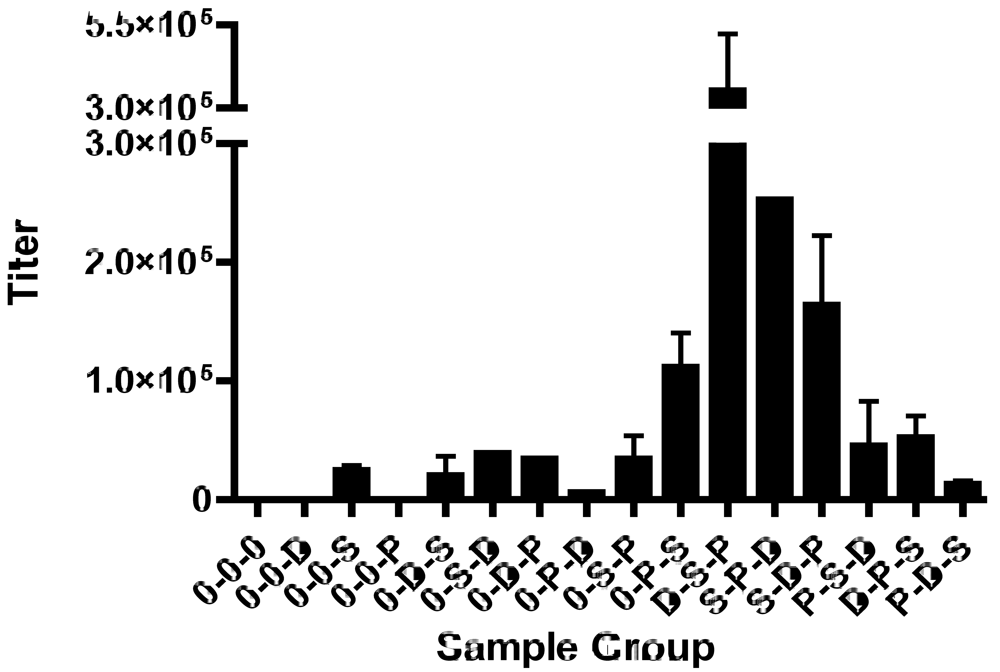
        <p>What is the best order of vaccinations when three vectors are used? When using recombinant vaccinia virus as the recombinant virus, we found that the order D-V-P was best [<xref ref-type="bibr" rid="B146">146</xref>]. We then asked if the optimal order of vector delivery would change if Sendai virus (SeV) was used as the viral component. To answer this question, we grouped mice to receive one, two or three of the D, SeV and P vaccines in different orders. Each vector was a UG92005 envelope recombinant. After vaccinations, mice were rested for eight months and then anti-envelope antibodies were tested in a UG92005-based envelope ELISA. The results of ELISAs are shown in <xref ref-type="fig" rid="figure1">Figure 1</xref>. </p>
        <p>We noted that virtually all of the animals that received recombinant SeV generated long-term immunity, a result which highlighted the well known association of live virus vaccines with durable immune responses [<xref ref-type="bibr" rid="B92">92-94</xref>,<xref ref-type="bibr" rid="B151">151</xref>]. The preliminary study results in <xref ref-type="fig" rid="figure1">Figure 1</xref> further showed<italic> </italic>that the more durable antibody immune responses were elicited when the SeV immunization was administered as the first or second inoculation (see D-S-P or S-P-D) rather than as the third immunication (see D-P-S or P-D-S). The result was confirmed in a repeat experiment. This phenomenon might be explained by our previous finding that a robust pre-existing T-cell response toward HIV-1 envelope can significantly inhibit the growth or ‘take’ of recombinant SeV [<xref ref-type="bibr" rid="B152">152</xref>]. The situation of vaccine inhibition is similar to that described previously in that a vector-specific response can quell the ‘take’ of a live virus boost. The difference in this case is that the pre-existing immune response targets the HIV-1 envelope passenger gene product rather than the delivery vehicle. If the immune response to the passenger gene product is too strong (in this case following D or P vaccines), the SeV vaccine may not ‘take’, yielding an inferior overall outcome. Results highlight the complexities of the prime-boost strategy and demonstrate how each inoculation can impact the efficacy of the next.</p>
        <p>Yu <italic>et al</italic>. have also examined a three-vectored prime-boost-boost regimen, in this case using DNA, adenovirus and SeV recombinants expressing gag antigens. They found that the vaccines delivered in the order DNA-SeV-adenovirus yielded slightly higher gag-specific CD8+ T-cell activities than vaccines delivered in the order DNA-adenovirus-SeV [<xref ref-type="bibr" rid="B150">150</xref>,<xref ref-type="bibr" rid="B153">153</xref>].</p>
<fig id="figure1" position="float">
<label>Figure 1</label>
<caption>
<p>Durable antibody responses elicited by successive HIV-1 envelope immunizations with three different recombinant delivery systems.<bold> </bold>Female C57BL/6 mice were purchased from the Jackson Laboratory (Bar Harbor, ME) and housed under specific pathogen-free conditions in a BL1 or BL2+ containment area at St. Jude Children’s Research Hospital animal facilities, with adherence to AAALAC Guidelines. Mice were grouped (n = 3) for immunizations with UG92005 (UG) envelope using recombinant vectors: (i) DNA (‘D’, 100 µg, carrying a gp140 envelope sequence) administered i.m. in the gastrocnemius muscles, (ii) CHO-derived recombinant UG envelope protein (‘P’, 2 µg, 100 µl gp140 envelope in PBS mixed with 100 µl CFA) administered i.p., and (iii) SeV (‘S’, 10<sup>4</sup> plaque forming units, carrying a gp120 envelope sequence for expression in infected cells) administered i.n.. Groups of mice received one, two or three of the recombinant vectors (or no vaccine, ‘0’), administered with one month intervals. Eight months after the completion of inoculations, ELISAs were performed with serially diluted serum samples. Antibody binding titers were determined using Prism Software (Non-Linear Regression, GraphPad Prism®, San Diego, CA). Mean titers and standard errors are shown. Some data points represent fewer than 3 animals due to mouse death or non-conformance of data to the non-linear regression curve (O-S-D, O-D-P, O-P-D, O-S-P, S-P-D, P-S-D). To perform the ELISA, 96-well plates (BD Biosciences, Franklin Lakes, NJ) were coated overnight at 4 °C with 2 µg/ml of purified CHO-derived UG gp140 envelope protein in PBS. The plates were washed three times with 0.05% Tween 20 in PBS, blocked with 1% BSA/PBS at room temperature for 1 h, and washed an additional three times. Samples were serially diluted in PBS to a final volume of 50 µl and were incubated in wells for 2 h at room temperature. After three washes, alkaline phosphatase-conjugated anti-mouse IgG1 (50 µl/well; Southern Biotechnology Associates, Birmingham, AL) diluted 1/1000 in 1% BSA/0.05% Tween 20/PBS was added for 1 h at room temperature. Following five washes, the assay was developed with 75 µl/well of p-nitrophenyl phosphate (Sigma-Aldrich) substrate (1 mg/ml in diethanolamine buffer) and was read at OD<sub>450nm</sub> after 1 hour at 37 °C.</p>
</caption>
<graphic xmlns:xlink="http://www.w3.org/1999/xlink" xlink:href="viruses-02-00435-g001.tif" scale="0"/>
</fig>        
      </sec>
      <sec>
        <title>5.3. Complex factors impact prime-boost vaccine outcomes</title>
        <p>A great number of factors will impact the final outcome of a prime-boost strategy, due to the important interplay between responses induced by each inoculation. A subtle balance must therefore be struck. On the one hand, the activation of naïve cells by a priming vaccine is desired. On the other hand, an overly robust primary immune response may be counter-productive if it inhibits the efficacy of a boost. DNA and virus vaccines are perhaps most sensitive to pre-existing immune responses, because they must transfect or infect host cells prior to production of the desired antigen. If/when host cells are susceptible to immune attack due to pre-existing immunity, the boost function may be reduced or eliminated. It is perhaps the case that a protein boost is most resilient to the effects of pre-existing immunity, because the antigen is preformed and its expression is not dependent on infection or transfection of the host cell.</p>
        <p>Not only will the immune response toward prime-boost vaccination depend on the selection of recombinant vectors and the order in which they are administered, but vaccine dose will also affect outcome<italic>.</italic> Again, a balance must be reached to successfully ‘prime’ the immune response without inhibiting the boost.<italic> </italic>The selection of a priming dose can sometimes be counter-intuitive in that an increase in dose does not always improve immunogenicity. This is because high-dose priming antigens can in some cases hinder a response to the boost inoculation and can also hinder the establishment of long-term immune memory [<xref ref-type="bibr" rid="B154">154</xref>,<xref ref-type="bibr" rid="B155">155</xref>]. In a hepatitis vaccine clinical study, researchers found that a dose as small as 2 µg DNA could be effective as part of a prime-boost regimen [<xref ref-type="bibr" rid="B156">156</xref>]. </p>
        <p>To complicate vaccine formulation further, it is noteworthy that a dose study in one species need not predict vaccine outcome in a second. As an example, a DNA dose escalation study in mice suggested that increases in DNA dose would improve immune activities, yet in macaques a 10-fold DNA dose escalation was not advantageous [<xref ref-type="bibr" rid="B157">157</xref>,<xref ref-type="bibr" rid="B158">158</xref>]. The situation becomes more complicated with each experimental change. Another example is provided by the opposing outcomes in studies of DNA-adenovirus prime-boost regimens in macaques. Whereas research in one system demonstrated complementary effects of a DNA prime and adenovirus boost [<xref ref-type="bibr" rid="B117">117</xref>], a more recent protection study showed no advantage conferred by a 400 mg DNA prime administered prior to an adenovirus boost [<xref ref-type="bibr" rid="B159">159</xref>]. </p>
        <p>Among the many factors influencing outcome in a prime-boost study are: (i) the vaccine vectors, (ii) vaccine doses, (iii) the interval between prime and boost, (iv) virus tropism for the host species, (v) non-vaccine sources of pre-existing immunity, (vi) the type of desired immune activity (e.g., B-cell <italic>versus</italic> T-cell, Th1 <italic>versus</italic> Th2), and (vii) the timing of desired immune function (acute <italic>versus</italic> long-term). When prime-boost regimens are newly designed, each factor deserves attention to ensure vaccine efficacy.</p>
      </sec>
    </sec>
    <sec>
      <title>6. Changing antigens during a prime-boost regimen</title>
      <sec>
        <title>6.1. Introducing variant antigens in prime-boost vaccine protocols: lessons from the influenza virus vaccine field and original antigenic sin</title>
        <p>The influenza virus, like HIV-1, encompasses a large diversity of viral proteins. The review of nucleic acid or amino acid sequences from influenza virus variants may be mind-boggling to the vaccine developer, but researchers have grouped viruses by antigenicity rather than by sequence to produce effective vaccines. </p>
        <p>Influenza virus vaccine developers must accommodate antigenic drift (moderate changes in viral proteins) as well as antigenic shift (major changes in viral proteins incurred when the virus jumps species) [<xref ref-type="bibr" rid="B160">160</xref>]. To deal with these temporal changes, vaccine developers produce new vaccines annually. They also produce novel vaccines in response to shifting viral variants, as for the recent H1N1 swine flu pandemic [<xref ref-type="bibr" rid="B161">161</xref>]. Humans who receive vaccines each year are exposed to ‘new’ heterologous influenza virus hemagglutinin and neuraminidase proteins with each boost inoculation.</p>
        <p>Original antigenic sin (OAS) was demonstrated decades ago in the context of immune responses toward influenza antigens. When humans or experimental animals experienced infections with related influenza viruses, their sera repeatedly showed higher neutralizing titers against the earlier encountered (‘original’) virus strain [<xref ref-type="bibr" rid="B162">162</xref>,<xref ref-type="bibr" rid="B163">163</xref>]. The common theme of pre-existing immunity may be central to the explanation of OAS. In this case, the immune system has memory for a portion of (but not all) epitopes on the challenge virus and may therefore hamper boost function. The concept is similar to that described above in the context of vector-specific or HIV-1-envelope-specific activities which can clear and weaken the boost inoculum. As before, clearance can be mediated by both humoral (B-cell) and cellular (T-cell) responses. In the case of humoral immunity, pre-existing antibodies may recognize and clear virus particles. In the case of cellular immunity, effectors can kill virus-infected targets that display viral peptides on membrane surfaces in the context of MHC. Together, immune effectors can reduce antigen load and durability of the boost. In this instance, whereas the transient appearance of boost antigen may suffice to drive re-activation and replication of memory cells responsive to the ‘old’ epitopes, the antigen load and persistence may be insufficient to activate naïve lymphocytes responsive to ‘new’ epitopes. The outcome is an improved response toward ‘old’ or ‘original’ epitopes, but a relatively weak response toward epitopes that are newly presented. </p>
        <p>Is OAS absolute? In a recent influenza virus study in mice, researchers confirmed the phenomenon of profound OAS [<xref ref-type="bibr" rid="B164">164</xref>]. In contrast, a recent study in humans revealed the opposite result [<xref ref-type="bibr" rid="B165">165</xref>]. In the latter case, humans who were vaccinated with the seasonal influenza virus vaccine responded better to ‘new’ <italic>versus</italic> ‘old’ epitopes. Results supported the theory upon which influenza virus vaccines are based, that the quality of immune responses can be improved by successive immunizations with related, but dissimilar influenza viral antigens. Contrasting results in OAS studies again illustrate that the rules driving immune responses to a prime-boost vaccine are not simple. As stated above, outcomes will depend on complex variables including (i) vaccine dose, (ii) interval between first and second antigen exposure, and (iii) relatedness of epitopes between old and new antigens. </p>
      </sec>
      <sec>
        <title>6.2. T-cells responsive to an epitope shared by prime and boost vaccines can assist B-cells responsive to a unique epitope in the boost</title>
        <p>Even though a vigorous pre-existing immune response may limit the load and persistence of boost antigens, memory cells can also play a positive role. Specifically, the CD4+ T cells that are primed by a first dose of vaccine may ‘help’ naïve lymphocytes to respond to novel epitopes in the boost inoculum. </p>
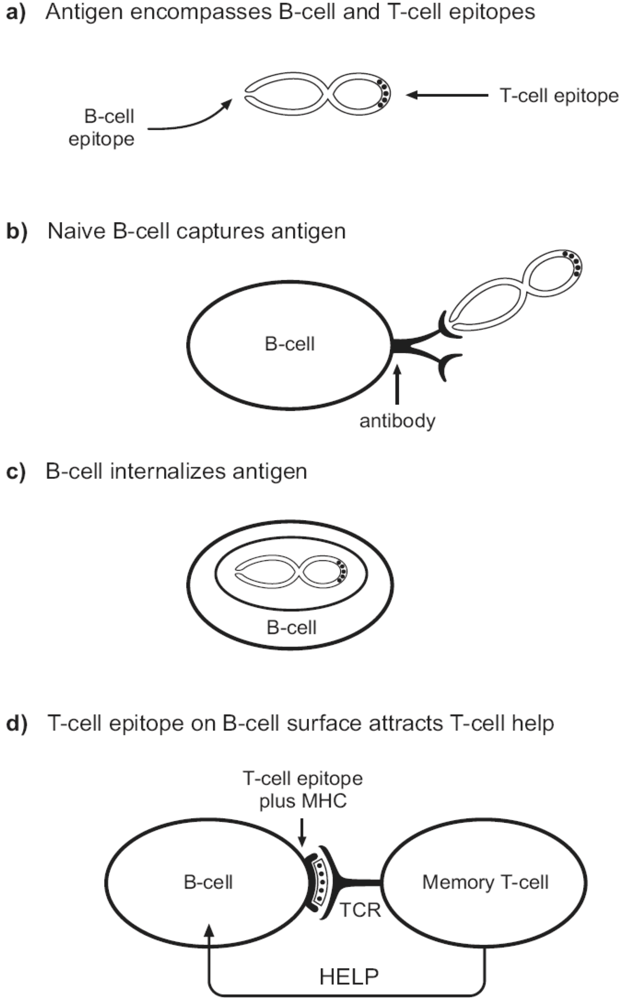
        <p>T-cell help is conferred by a variety of mechanisms including secretion of interleukins and activation of antigen presenting cells [<xref ref-type="bibr" rid="B27">27</xref>]. In <xref ref-type="fig" rid="figure2">Figure 2</xref> is illustrated the cognate B-cell:T-cell interactions that can enhance naive B-cell stimulation. Briefly, when a naïve B cell encounters antigen for the first time (<xref ref-type="fig" rid="figure2">Figure 2</xref>A), its antibody will bind and internalize the antigenic protein or particle (<xref ref-type="fig" rid="figure2">Figure 2</xref>A-C). Antigens are then fragmented for ultimate display on the cell surface in association with MHC class II. The peptide-MHC complex can then be bound by the TCR of a memory T cell (<xref ref-type="fig" rid="figure2">Figure 2</xref>D). Cognate B-cell:T-cell interactions then trigger the relay of ‘help’ (e.g., interleukin 4) for support of B-cell activation. It is noteworthy that the epitopes recognized by the B cells and T cells need not be the same. The T-cell epitope may be shared by the prime and boost vaccines, whereas the B-cell eptiope may be unique to the boost. It is only necessary that the two epitopes are linked on the antigen or particle to which antibody is bound [<xref ref-type="bibr" rid="B27">27</xref>]. The phenomenon can be observed when mice are primed with a vaccine <italic>in vivo</italic>, after which lymphocytes are exposed to a new determinant(s) linked to that vaccine <italic>in vitro</italic>. In this scenario, naïve B cells with specificity for the new determinant(s) are activated when they receive ‘help’ from the vaccine-induced memory T cells [<xref ref-type="bibr" rid="B166">166</xref>,<xref ref-type="bibr" rid="B167">167</xref>].</p>
        <p>The lesson from the above experiments is that a pre-existing immune response elicited by a priming vaccine can have both positive and negative effects on naïve responses to novel epitopes in a boost. The balance yields striking OAS in some circumstances, and relatively little OAS in others. </p>
      </sec>
      <sec>
        <title>6.3. HIV and OAS</title>
        <p>In 1991, Klinman <italic>et al</italic>. [<xref ref-type="bibr" rid="B168">168</xref>] described a study in which mice received sequential inoculations with gp120 proteins from independent isolates of HIV-1. The specificities of vaccine-induced plasma cells were then tested by positioning cells between two antigen coated surfaces. Secreted antibodies were examined by spot analyses for simultaneous recognition of two different antigens. Researchers found that OAS was a factor, just as had been the case in the influenza virus studies, but was not absolute; immune responses toward shared determinants were dominant, but responses to new antigens, presented in the boost inocula, were also observed. </p>
        <p>Zhan <italic>et al</italic>. later evaluated T-cell activities toward a heterologous prime-boost regimen in mice after successive immunizations with two different HIV-1 envelope gp140 constructs [<xref ref-type="bibr" rid="B169">169</xref>]. In this case, the two gp140 antigens 1007 and UG92005 carried very different immunodominant peptides [<xref ref-type="bibr" rid="B170">170</xref>,<xref ref-type="bibr" rid="B171">171</xref>]. Despite the inoculation of mice with one immunogen (1007) before the other (UG92005), T-cell responses toward the unique epitopes on each of the antigens were generated [<xref ref-type="bibr" rid="B169">169</xref>]. </p>
        <p>Wang <italic>et al</italic>. [<xref ref-type="bibr" rid="B172">172</xref>] also tested a heterologous prime-boost approach, in which peptides were used as a prime and a recombinant vaccinia virus was used to deliver the boost. They found that the first immunization had insignificant effect on the CD8+ T-cell dominance hierarchies induced by the second. Taken together, these results suggest that novel proteins and epitopes can be introduced in the boost phase of a prime-boost regimen to improve the quality of the HIV-1-specific response in both B-cell and T-cell populations. </p>
        <p>As stated above, the vaccine evaluated in the recent RV 144 clinical trial in Thailand presented heterologous proteins upon prime and boost. This prime-boost vaccine demonstrated a hint of protection whereas individual vaccines were not protective when administered alone [<xref ref-type="bibr" rid="B173">173</xref>]. While the precise mechanism of protection is not yet known, it is likely that the combination of ‘old’ and ‘new’ responses toward antigens in prime and boost vaccines lent to the moderate success. </p>
<fig id="figure2" position="float">
<label>Figure 2</label>
<caption>
<p>Cognate B-cell:T-cell interactions support T-cell help.<bold> </bold>This cartoon illustrates a situation in which a B cell and T cell recognize different determinants on the same particle (panel A). In this circumstance, the B-cell antibody may capture antigen via a lock-and-key type interaction (panel B). The antigen is then fragmented (panel C), after which the T-cell epitope is presented on the B-cell membrane as a complex with MHC. The peptide-MHC complex is bound by the T-cell receptor, after which ‘help’ may be relayed from the T cell to its B cell partner (panel D). </p>
</caption>
<graphic xmlns:xlink="http://www.w3.org/1999/xlink" xlink:href="viruses-02-00435-g002.tif" scale="0"/>
</fig>        
        <p>Perhaps the best example of incomplete OAS is demonstrated by infections with SIV, SHIV or HIV. As described above, an infected subject is exposed to a variety of viral variants over the course of time and responds with an ever-increasing quality of immune activity. That immune activity is often sufficient to confer protection against virus from an exogenous source [<xref ref-type="bibr" rid="B14">14</xref>,<xref ref-type="bibr" rid="B41">41</xref>,<xref ref-type="bibr" rid="B47">47</xref>,<xref ref-type="bibr" rid="B174">174</xref>,<xref ref-type="bibr" rid="B175">175</xref>]. It is worth contemplating that if a safe vaccine could recapitulate the immune responses induced by the successive antigens presented by natural infection, uninfected individuals might be fully protected from HIV-1.</p>
      </sec>
    </sec>
    <sec>
      <title>7. Changing both vectors and antigens during heterologous prime-boost immunizations in HIV-1 vaccine clinical trials</title>
      <p>Several clinical studies have now tested strategies that change both vectors and antigens during prime-boost regimens, as was the case in the RV 144 trial. For example, Gudmundsdotter <italic>et al</italic>. are currently testing a DNA vaccine that expresses envelopes from Subtypes A, B and C (A92UG031, LAI and 92BR025), rev from subtype B, gag from subtypes A and B, reverse transcriptase from subtype B, and a boost vaccine that is an MVA-Chiang Mai double recombinant (MVA-CMDR)(HIV MVA) expressing envelope and gag/pol sequences from Thai isolates CM235 and CM240 [<xref ref-type="bibr" rid="B131">131</xref>]. </p>
      <p>Our own research has involved clinical testing of a multi-envelope heterologous prime-boost approach using DNA, virus (vaccinia virus) and purified protein recombinants. The selection of envelopes for inclusion in our vaccine was based on (i) differing patterns in antibody binding studies [<xref ref-type="bibr" rid="B176">176</xref>], (ii) longitudinal capture from infected persons [<xref ref-type="bibr" rid="B138">138</xref>], and (iii) differing clades. This strategy was first tested in macaques and found to confer protection against a heterologous SHIV challenge [<xref ref-type="bibr" rid="B177">177</xref>] which was not represented by sequence in the vaccine. To test the concept in humans, we first demonstrated the safety of each of the three vectors D, V, and P in FDA- and IRB-approved phase I clinical studies [<xref ref-type="bibr" rid="B144">144</xref>,<xref ref-type="bibr" rid="B145">145</xref>,<xref ref-type="bibr" rid="B178">178</xref>]. We next designed a protocol, approved by the FDA and our local IRB, to vaccinate individuals with dozens of envelopes. Six successive immunizations (D-D-V-P-D-P) separated by 1 month intervals, were planned for each individual. The D vaccine included 51 recombinant plasmids each expressing a different envelope protein, administered as an i.m. inoculation of 100 micrograms; the vaccinia virus vaccine included 23 recombinant viruses, each expressing a different envelope protein (a subset of which were shared with the D vaccine), administered by s.q. inoculation with 10<sup>7</sup> total plaque forming units; the recombinant CHO-derived protein vaccine was 100 microgram purified envelope from HIV-1 isolate UG92005 (shared with D and V vaccines), administered i.m. as a formulation with 500 micrograms alum. The single protein immunization was administered to enhance both B-cell and T-cell responses. We emphasize that based on the mechanism described in <xref ref-type="fig" rid="figure2">Figure 2</xref>, a T cell which has responded to one envelope immunogen can ‘help’ a B cell which has responded to another, provided that the B cell displays the T-cell epitope on its surface. </p>
      <p>Based on a local administrative decision, only three individuals were ultimately enrolled in the study. The first participant received all 6 inoculations (D-D-V-P-D-P); the second participant received four inoculations (D-D-V-P), and the third recipient received three inoculations (D-D-V). All inoculations were well tolerated. Adverse events that were possibly, probably or definitely vaccine related were grade 1 only. </p>
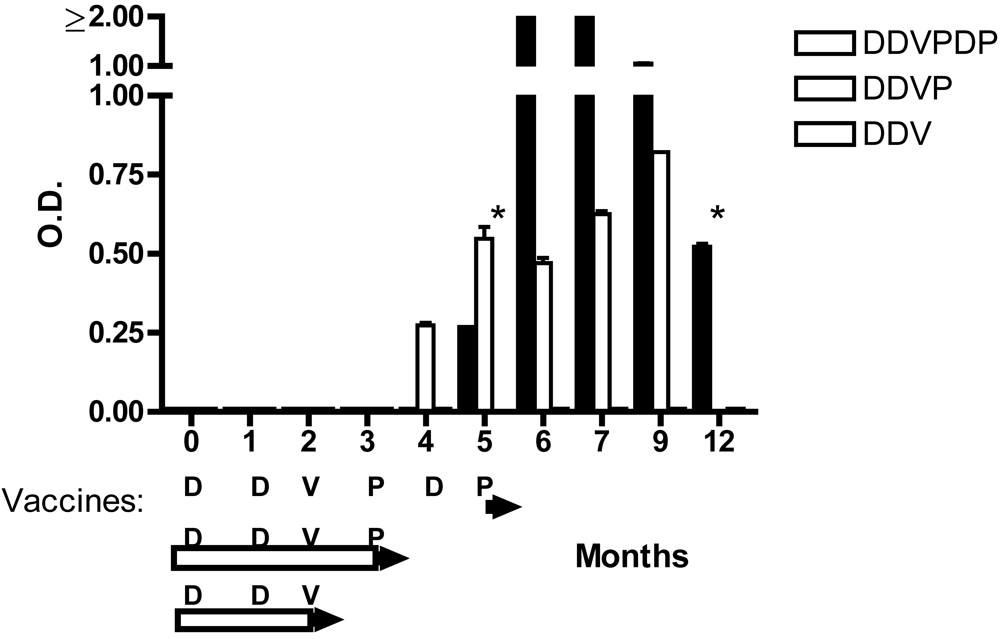
      <p>Preliminary tests of envelope-specific immune responses were conducted with the Abbott enzyme-linked immunosorbent assay (HIVAB HIV-1/HIV-2 (recombinant DNA) Abbott Laboratories, Abbott Park, IL, USA). This standardized assay is used worldwide as a diagnostic for HIV-1 infection and was conducted in the Clinical Pathology Department of St. Jude Children’s Research Hospital. There is a cut-off score for each test (ranging between 0.1 and 0.2 OD<sub>450nm</sub>). Absolute responses for HIV-1-infected persons in this test can be variable and often reach the assay peak value of ≥2. In <xref ref-type="fig" rid="figure3">Figure 3</xref>, results are shown for the three vaccinees. </p>
      <p>Participant 1 who received all six inoculations, generated the best response. An Abbott-positive response was first identified in this volunteer one month after the fifth immunization (D-D-V-P-D). One month after the sixth immunization (P), the participant exhibited peak absorbance levels in the Abbott assay (OD<sub>450nm</sub> ≥ 2). Significant responses persisted for at least seven months following the last inoculation.</p>
      <p>Participant 2, who received four immunizations (D-D-V-P) also generated significant envelope-specific activity. This response continued to improve throughout the observation period, but did not achieve peak values (within the observation period which ended 6 months after the final immunization). </p>
      <p>Participant 3, who received only D-D-V did not generate a positive response in the Abbott assay. Apparently, the combination of at least 4 immunizations and 3 vector systems was advantageous, distinguishing the positive responses in Participants 1 and 2 from the negative response in Participant 3. </p>
<fig id="figure3" position="float">
<label>Figure 3</label>
<caption>
<p>Antibody responses elicited by heterologous prime-boost vaccination of humans. Three study participants received three different vaccination regimens. Study Participant 1 (black bars) received D (month 0), D (month 1), V (month 2), P (month 3), D (month 4) and P (month 5). Participant 2 (clear bars) received the first four inoculations and Participant 3 (grey bars) received the first three inoculations. Sera were collected and tests were conducted with the Abbott enzyme-linked immunosorbent assay (HIVAB HIV-1/HIV-2 (recombinant DNA) Abbott Laboratories, Abbott Park, IL, USA). Asterisks indicate an absence of sample</p>
</caption>
<graphic xmlns:xlink="http://www.w3.org/1999/xlink" xlink:href="viruses-02-00435-g003.tif"/>
</fig>      
      <p>The antibodies with the strongest immune activity (from Participant 1 taken 1 month following the completion of all vaccinations) were also tested for neutralizing activity in a preliminary GHOST cell-based assay [<xref ref-type="bibr" rid="B145">145</xref>]. To conduct this study, antibodies were first purified over a protein G column to remove non-specific factors. Although immunoglobulin purification is not standard practice in the field, it may be essential to avoid the non-specific inhibitory or enhancing effects of serum components in the HIV-1 neutralization assay [<xref ref-type="bibr" rid="B179">179-182</xref>]. Such factors are particularly problematic when sera are tested at high concentrations and/or when results from parallel analyses with panels of unselected negative control sera are not available. In our study, of eight tested heterologous viruses, four viruses were neutralized at the 50% level by samples taken post-vaccination (diluted 1:5 relative to the original serum value), but not pre-vaccination. Positive tests were with viruses HIV-1<sub>IIIB</sub> (CXCR4), HIV-1<sub>30e</sub> (CXCR4), HIV-1<sub>SF2</sub> (CCR5) and HIV-1<sub>92HT593</sub> (CCR5), but not viruses HIV-1<sub>96ZM651</sub> (CCR5), HIV-1<sub>ZM53M</sub> (CCR5), HIV-1<sub>92UG029</sub> (CCR5) and HIV-1<sub>93UG082</sub> (CCR5). The neutralization of four heterologous viruses was promising and indicated the sharing of antigenic structures between at least one envelope in the vaccine and envelopes on test viruses.</p>
      <p>The relevance of neutralizing responses to protection <italic>in vivo</italic> is not known. Currently, there are no clear correlates of protection in the HIV-1 field. In fact, antibodies can demonstrate a much improved protective capacity <italic>in vivo</italic> <italic>versus</italic> <italic>in vitro</italic>. For example, in a macaque study, passive transfer of hyperimmune sera to naïve animals was fully protective against SIV, even when the same antibodies showed no neutralizing activity against the same challenge virus <italic>in vitro</italic> [<xref ref-type="bibr" rid="B183">183</xref>]. The neutralization assay is clearly able to measure some vaccine-induced antibody potentials, but misses critical antibody functions such as antibody-dependent cell-mediated cytotoxicity (ADCC) and antibody-dependent cell-mediated virus inhibition (ADCVI, [<xref ref-type="bibr" rid="B184">184-186</xref>]). Taken together, the preliminary clinical results with D-V-P vaccines demonstrate a degree of immune breadth and encourage continued testing of the vaccine concept with larger participant groups and larger virus panels. Preliminary results also reveal safety and immunogenicity of the vaccine in humans and show that responses are durable. </p>
      <p>What might be the mechanism responsible for antibody (and T-cell) durability, particularly in the context of a live virus infection (a single vaccinia virus inoculation elicits antibody responses that can persist for more than 70 years in humans [<xref ref-type="bibr" rid="B92">92-94</xref>,<xref ref-type="bibr" rid="B187">187-190</xref>])? Immune response durability has long been a topic of much debate. Some researchers argue that antigens (particularly viral antigens) are maintained <italic>in vivo</italic> for the long term and constitutively drive B cells to end-differentiate into antibody forming cells [<xref ref-type="bibr" rid="B191">191</xref>]. Other researchers, however, have shown that when B cells have lost their capacity to recognize an antigen, they still persist. The latter feature was best illustrated using a cre/lox recombination system with which antibody genes were intentionally altered among memory B cells <italic>in vivo</italic>. B-cells that had lost their capacity to recognize the priming antigen were nonetheless maintained [<xref ref-type="bibr" rid="B192">192</xref>]. These results suggest that immune responses are maintained by a combination of factors, including antigen, memory B cell, and antibody-forming cell persistence [<xref ref-type="bibr" rid="B191">191</xref>]. </p>
      <p>The proof-of-concept findings described by ourselves and others in pre-clinical and phase I/II clinical trials cannot predict protective efficacy, but in combination with the recent hint of success in the RV 144 trial, encourage further advancement of vaccine strategies that combine heterologous vectors and heterologous antigens in a prime-boost approach.</p>
    </sec>
    <sec>
      <title>8. Conclusion</title>
      <p>The heterologous prime-boost vaccination strategy can be used to harness robust and durable immune activity, and is particularly useful as a means to circumvent vector-specific inhibitory effects. In the context of a heterologous prime-boost, there are also inhibitory effects directed toward the passenger gene which can lend to ‘original antigenic sin’. Fortunately, this phenomenon is not absolute. The final outcome of prime-boost vaccinations is complex and will be influenced by multiple factors including: (i) the vaccine vectors, (ii) the vaccine doses, (iii) the interval between prime and boost, (iv) virus tropism for the host species, (v) non-vaccine sources of pre-existing immunity, (vi) the type of desired immune activity, and (vii) the timing of desired immune function. Despite the complexities posed by heterologous prime-boost vaccine protocols, the strategy holds enormous promise and might ultimately prevent the morbidity and mortality caused by HIV-1.<bold> </bold></p>
    </sec>
  </body>
  <back>
    <ack>
      <p>We thank Harold Stamey from the Tennessee Blood Services for providing samples for this study, and R.V. Srinivas, the NIH AIDS Reference Reagent Program (NARRP, Rockville, MD) and the World Health Organization Network for HIV Isolation and Characterization, for providing viruses. We thank Brita Brown, Amy Zirkel, Samantha D. Rencher, Suzette Wingo and Queen E. Rodgers for excellent technical assistance. We thank Randy Hayden (Pathology Department, St. Jude) for the conduct of Abbott ELISAs. We thank the volunteers who participated in the clinical studies. We thank C. Coleclough and S. Naron for critical reading of the manuscript and editorial suggestions. We thank the Animal Resource Center and Hartwell Center of St. Jude Children’s Research Hospital for support. This work was supported in part by NIH NIAID grants P01-AI45142, R21-AI056974 and R01-AI078819, NCI Cancer Center Support core grant P30-CA21765, the Federated Department Stores, the Mitchell Fund, the Carl C. Anderson Sr. and Marie Joe Anderson Charitable Foundation, the James B. Pendleton Charitable Trust, the Pioneer Fund and the American Lebanese Syrian-Associated Charities (ALSAC).</p>
    </ack>
    <ref-list>
      <ref id="B1">
        <citation citation-type="journal">
          <person-group person-group-type="author">
            <name>
              <surname>Hall</surname>
              <given-names>H.I.</given-names>
            </name>
            <name>
              <surname>Song</surname>
              <given-names>R.</given-names>
            </name>
            <name>
              <surname>Rhodes</surname>
              <given-names>P.</given-names>
            </name>
            <name>
              <surname>Prejean</surname>
              <given-names>J.</given-names>
            </name>
            <name>
              <surname>An</surname>
              <given-names>Q.</given-names>
            </name>
            <name>
              <surname>Lee</surname>
              <given-names>L.M.</given-names>
            </name>
            <name>
              <surname>Karon</surname>
              <given-names>J.</given-names>
            </name>
            <name>
              <surname>Brookmeyer</surname>
              <given-names>R.</given-names>
            </name>
            <name>
              <surname>Kaplan</surname>
              <given-names>E.H.</given-names>
            </name>
            <name>
              <surname>McKenna</surname>
              <given-names>M.T.</given-names>
            </name>
            <name>
              <surname>Janssen</surname>
              <given-names>R.S.</given-names>
            </name>
          </person-group>
          <article-title>Estimation of HIV incidence in the United States</article-title>
          <source>JAMA</source>
          <year>2008</year>
          <volume>300</volume>
          <fpage>520</fpage>
          <lpage>529</lpage>
          <pub-id pub-id-type="doi">10.1001/jama.300.5.520</pub-id>
          <pub-id pub-id-type="pmid">18677024</pub-id>
        </citation>
      </ref>
      <ref id="B2">
        <citation citation-type="journal">
          <article-title>HIV prevalence estimates--United States, 2006</article-title>
          <source>MMWR Morb Mortal Wkly Rep</source>
          <year>2008</year>
          <volume>57</volume>
          <fpage>1073</fpage>
          <lpage>1076</lpage>
          <pub-id pub-id-type="pmid">18830210</pub-id>
        </citation>
      </ref>
      <ref id="B3">
        <citation citation-type="journal">
          <person-group person-group-type="author">
            <name>
              <surname>McNeil Jr.</surname>
              <given-names>DG.</given-names>
            </name>
          </person-group>
          <article-title>For first time, AIDS Vaccine shows some success</article-title>
          <source>The New York Times</source>
          <year>2009</year>
        </citation>
      </ref>
      <ref id="B4">
        <citation citation-type="journal">
          <person-group person-group-type="author">
            <name>
              <surname>Cohen</surname>
              <given-names>J.</given-names>
            </name>
          </person-group>
          <article-title>AIDS vaccines. HIV dodges one-two punch</article-title>
          <source>Science</source>
          <year>2004</year>
          <volume>305</volume>
          <fpage>1545</fpage>
          <lpage>1547</lpage>
          <pub-id pub-id-type="doi">10.1126/science.305.5690.1545</pub-id>
          <pub-id pub-id-type="pmid">15361591</pub-id>
        </citation>
      </ref>
      <ref id="B5">
        <citation citation-type="journal">
          <person-group person-group-type="author">
            <name>
              <surname>Burton</surname>
              <given-names>D.R.</given-names>
            </name>
            <name>
              <surname>Desrosiers</surname>
              <given-names>R.C.</given-names>
            </name>
            <name>
              <surname>Doms</surname>
              <given-names>R.W.</given-names>
            </name>
            <name>
              <surname>Feinberg</surname>
              <given-names>M.B.</given-names>
            </name>
            <name>
              <surname>Gallo</surname>
              <given-names>R.C.</given-names>
            </name>
            <name>
              <surname>Hahn</surname>
              <given-names>B.</given-names>
            </name>
            <name>
              <surname>Hoxie</surname>
              <given-names>J.A.</given-names>
            </name>
            <name>
              <surname>Hunter</surname>
              <given-names>E.</given-names>
            </name>
            <name>
              <surname>Korber</surname>
              <given-names>B.</given-names>
            </name>
            <name>
              <surname>Landay</surname>
              <given-names>A.</given-names>
            </name>
            <name>
              <surname>Lederman</surname>
              <given-names>M.M.</given-names>
            </name>
            <name>
              <surname>Lieberman</surname>
              <given-names>J.</given-names>
            </name>
            <name>
              <surname>McCune</surname>
              <given-names>J.M.</given-names>
            </name>
            <name>
              <surname>Moore</surname>
              <given-names>J.P.</given-names>
            </name>
            <name>
              <surname>Nathanson</surname>
              <given-names>N.</given-names>
            </name>
            <name>
              <surname>Picker</surname>
              <given-names>L.</given-names>
            </name>
            <name>
              <surname>Richman</surname>
              <given-names>D.</given-names>
            </name>
            <name>
              <surname>Rinaldo</surname>
              <given-names>C.</given-names>
            </name>
            <name>
              <surname>Stevenson</surname>
              <given-names>M.</given-names>
            </name>
            <name>
              <surname>Watkins</surname>
              <given-names>D.I.</given-names>
            </name>
            <name>
              <surname>Wolinsky</surname>
              <given-names>S.M.</given-names>
            </name>
            <name>
              <surname>Zack</surname>
              <given-names>J.A.</given-names>
            </name>
          </person-group>
          <article-title>Public health. A sound rationale needed for phase III HIV-1 vaccine trials</article-title>
          <source>Science</source>
          <year>2004</year>
          <volume>303</volume>
          <fpage>316</fpage>
          <pub-id pub-id-type="doi">10.1126/science.1094620</pub-id>
          <pub-id pub-id-type="pmid">14726576</pub-id>
        </citation>
      </ref>
      <ref id="B6">
        <citation citation-type="journal">
          <person-group person-group-type="author">
            <name>
              <surname>Belshe</surname>
              <given-names>R.</given-names>
            </name>
            <name>
              <surname>Franchini</surname>
              <given-names>G.</given-names>
            </name>
            <name>
              <surname>Girard</surname>
              <given-names>M.P.</given-names>
            </name>
            <name>
              <surname>Gotch</surname>
              <given-names>F.</given-names>
            </name>
            <name>
              <surname>Kaleebu</surname>
              <given-names>P.</given-names>
            </name>
            <name>
              <surname>Marthas</surname>
              <given-names>M.L.</given-names>
            </name>
            <name>
              <surname>McChesney</surname>
              <given-names>M.B.</given-names>
            </name>
            <name>
              <surname>McCullough</surname>
              <given-names>R.</given-names>
            </name>
            <name>
              <surname>Mhalu</surname>
              <given-names>F.</given-names>
            </name>
            <name>
              <surname>Salmon-Ceron</surname>
              <given-names>D.</given-names>
            </name>
            <name>
              <surname>Sekaly</surname>
              <given-names>R.P.</given-names>
            </name>
            <name>
              <surname>Van</surname>
              <given-names>R.K.</given-names>
            </name>
            <name>
              <surname>Verrier</surname>
              <given-names>B.</given-names>
            </name>
            <name>
              <surname>Wahren</surname>
              <given-names>B.</given-names>
            </name>
            <name>
              <surname>Weissenbacher</surname>
              <given-names>M.</given-names>
            </name>
          </person-group>
          <article-title>Support for the RV144 HIV vaccine trial</article-title>
          <source>Science</source>
          <year>2004</year>
          <volume>305</volume>
          <fpage>177</fpage>
          <lpage>180</lpage>
          <pub-id pub-id-type="doi">10.1126/science.305.5681.177b</pub-id>
          <pub-id pub-id-type="pmid">15247455</pub-id>
        </citation>
      </ref>
      <ref id="B7">
        <citation citation-type="journal">
          <person-group person-group-type="author">
            <name>
              <surname>Robb</surname>
              <given-names>M.L.</given-names>
            </name>
          </person-group>
          <article-title>Failure of the Merck HIV vaccine: an uncertain step forward</article-title>
          <source>Lancet</source>
          <year>2008</year>
          <volume>372</volume>
          <fpage>1857</fpage>
          <lpage>1858</lpage>
          <pub-id pub-id-type="doi">10.1016/S0140-6736(08)61593-7</pub-id>
          <pub-id pub-id-type="pmid">19012958</pub-id>
        </citation>
      </ref>
      <ref id="B8">
        <citation citation-type="journal">
          <person-group person-group-type="author">
            <name>
              <surname>Nitayaphan</surname>
              <given-names>S.</given-names>
            </name>
            <name>
              <surname>Pitisuttithum</surname>
              <given-names>P.</given-names>
            </name>
            <name>
              <surname>Karnasuta</surname>
              <given-names>C.</given-names>
            </name>
            <name>
              <surname>Eamsila</surname>
              <given-names>C.</given-names>
            </name>
            <name>
              <surname>de</surname>
              <given-names>S.M.</given-names>
            </name>
            <name>
              <surname>Morgan</surname>
              <given-names>P.</given-names>
            </name>
            <name>
              <surname>Polonis</surname>
              <given-names>V.</given-names>
            </name>
            <name>
              <surname>Benenson</surname>
              <given-names>M.</given-names>
            </name>
            <name>
              <surname>vanCott</surname>
              <given-names>T.</given-names>
            </name>
            <name>
              <surname>Ratto-Kim</surname>
              <given-names>S.</given-names>
            </name>
            <name>
              <surname>Kim</surname>
              <given-names>J.</given-names>
            </name>
            <name>
              <surname>Thapinta</surname>
              <given-names>D.</given-names>
            </name>
            <name>
              <surname>Garner</surname>
              <given-names>R.</given-names>
            </name>
            <name>
              <surname>Bussaratid</surname>
              <given-names>V.</given-names>
            </name>
            <name>
              <surname>Singharaj</surname>
              <given-names>P.</given-names>
            </name>
            <name>
              <surname>el-Habib</surname>
              <given-names>R.</given-names>
            </name>
            <name>
              <surname>Gurunathan</surname>
              <given-names>S.</given-names>
            </name>
            <name>
              <surname>Heyward</surname>
              <given-names>W.</given-names>
            </name>
            <name>
              <surname>Birx</surname>
              <given-names>D.</given-names>
            </name>
            <name>
              <surname>McNeil</surname>
              <given-names>J.</given-names>
            </name>
            <name>
              <surname>Brown</surname>
              <given-names>A.E.</given-names>
            </name>
          </person-group>
          <article-title>Safety and immunogenicity of an HIV subtype B and E prime-boost vaccine combination in HIV-negative Thai adults</article-title>
          <source>J. Infect. Dis.</source>
          <year>2004</year>
          <volume>190</volume>
          <fpage>702</fpage>
          <lpage>706</lpage>
          <pub-id pub-id-type="doi">10.1086/422258</pub-id>
          <pub-id pub-id-type="pmid">15272397</pub-id>
        </citation>
      </ref>
      <ref id="B9">
        <citation citation-type="journal">
          <person-group person-group-type="author">
            <name>
              <surname>Roberts</surname>
              <given-names>J.D.</given-names>
            </name>
            <name>
              <surname>Bebenek</surname>
              <given-names>K.</given-names>
            </name>
            <name>
              <surname>Kunkel</surname>
              <given-names>T.A.</given-names>
            </name>
          </person-group>
          <article-title>The accuracy of reverse transcriptase from HIV-1</article-title>
          <source>Science</source>
          <year>1988</year>
          <volume>242</volume>
          <fpage>1171</fpage>
          <lpage>1173</lpage>
          <pub-id pub-id-type="pmid">2460925</pub-id>
        </citation>
      </ref>
      <ref id="B10">
        <citation citation-type="journal">
          <person-group person-group-type="author">
            <name>
              <surname>Kuiken</surname>
              <given-names>C.</given-names>
            </name>
            <name>
              <surname>Korber</surname>
              <given-names>B.</given-names>
            </name>
            <name>
              <surname>Shafer</surname>
              <given-names>R.W.</given-names>
            </name>
          </person-group>
          <article-title>HIV sequence databases</article-title>
          <source>AIDS Rev.</source>
          <year>2003</year>
          <volume>5</volume>
          <fpage>52</fpage>
          <lpage>61</lpage>
          <pub-id pub-id-type="pmid">12875108</pub-id>
        </citation>
      </ref>
      <ref id="B11">
        <citation citation-type="journal">
          <person-group person-group-type="author">
            <name>
              <surname>Gaschen</surname>
              <given-names>B.</given-names>
            </name>
            <name>
              <surname>Taylor</surname>
              <given-names>J.</given-names>
            </name>
            <name>
              <surname>Yusim</surname>
              <given-names>K.</given-names>
            </name>
            <name>
              <surname>Foley</surname>
              <given-names>B.</given-names>
            </name>
            <name>
              <surname>Gao</surname>
              <given-names>F.</given-names>
            </name>
            <name>
              <surname>Lang</surname>
              <given-names>D.</given-names>
            </name>
            <name>
              <surname>Novitsky</surname>
              <given-names>V.</given-names>
            </name>
            <name>
              <surname>Haynes</surname>
              <given-names>B.</given-names>
            </name>
            <name>
              <surname>Hahn</surname>
              <given-names>B.H.</given-names>
            </name>
            <name>
              <surname>Bhattacharya</surname>
              <given-names>T.</given-names>
            </name>
            <name>
              <surname>Korber</surname>
              <given-names>B.</given-names>
            </name>
          </person-group>
          <article-title>Diversity considerations in HIV-1 vaccine selection</article-title>
          <source>Science</source>
          <year>2002</year>
          <volume>296</volume>
          <fpage>2354</fpage>
          <lpage>2360</lpage>
          <pub-id pub-id-type="doi">10.1126/science.1070441</pub-id>
          <pub-id pub-id-type="pmid">12089434</pub-id>
        </citation>
      </ref>
      <ref id="B12">
        <citation citation-type="journal">
          <person-group person-group-type="author">
            <name>
              <surname>Lockey</surname>
              <given-names>T.D.</given-names>
            </name>
            <name>
              <surname>Hurwitz</surname>
              <given-names>J.L.</given-names>
            </name>
          </person-group>
          <article-title>Size-heterogeneous sequences mark hot spots for asparagine, serine, and threonine insertions in HIV type 1 envelope</article-title>
          <source>Aids Res. Hum. Retroviruses</source>
          <year>1998</year>
          <volume>14</volume>
          <fpage>717</fpage>
          <lpage>719</lpage>
          <pub-id pub-id-type="doi">10.1089/aid.1998.14.717</pub-id>
          <pub-id pub-id-type="pmid">9618085</pub-id>
        </citation>
      </ref>
      <ref id="B13">
        <citation citation-type="journal">
          <person-group person-group-type="author">
            <name>
              <surname>Barouch</surname>
              <given-names>D.H.</given-names>
            </name>
            <name>
              <surname>Kunstman</surname>
              <given-names>J.</given-names>
            </name>
            <name>
              <surname>Glowczwskie</surname>
              <given-names>J.</given-names>
            </name>
            <name>
              <surname>Kunstman</surname>
              <given-names>K.J.</given-names>
            </name>
            <name>
              <surname>Egan</surname>
              <given-names>M.A.</given-names>
            </name>
            <name>
              <surname>Peyerl</surname>
              <given-names>F.W.</given-names>
            </name>
            <name>
              <surname>Santra</surname>
              <given-names>S.</given-names>
            </name>
            <name>
              <surname>Kuroda</surname>
              <given-names>M.J.</given-names>
            </name>
            <name>
              <surname>Schmitz</surname>
              <given-names>J.E.</given-names>
            </name>
            <name>
              <surname>Beaudry</surname>
              <given-names>K.</given-names>
            </name>
            <name>
              <surname>Krivulka</surname>
              <given-names>G.R.</given-names>
            </name>
            <name>
              <surname>Lifton</surname>
              <given-names>M.A.</given-names>
            </name>
            <name>
              <surname>Gorgone</surname>
              <given-names>D.A.</given-names>
            </name>
            <name>
              <surname>Wolinsky</surname>
              <given-names>S.M.</given-names>
            </name>
            <name>
              <surname>Letvin</surname>
              <given-names>N.L.</given-names>
            </name>
          </person-group>
          <article-title>Viral escape from dominant simian immunodeficiency virus epitope-specific cytotoxic T lymphocytes in DNA-vaccinated rhesus monkeys</article-title>
          <source>J. Virol.</source>
          <year>2003</year>
          <volume>77</volume>
          <fpage>7367</fpage>
          <lpage>7375</lpage>
          <pub-id pub-id-type="doi">10.1128/JVI.77.13.7367-7375.2003</pub-id>
          <pub-id pub-id-type="pmid">12805435</pub-id>
        </citation>
      </ref>
      <ref id="B14">
        <citation citation-type="journal">
          <person-group person-group-type="author">
            <name>
              <surname>Wrin</surname>
              <given-names>T.</given-names>
            </name>
            <name>
              <surname>Crawford</surname>
              <given-names>L.</given-names>
            </name>
            <name>
              <surname>Sawyer</surname>
              <given-names>L.</given-names>
            </name>
            <name>
              <surname>Weber</surname>
              <given-names>P.</given-names>
            </name>
            <name>
              <surname>Sheppard</surname>
              <given-names>H.W.</given-names>
            </name>
            <name>
              <surname>Hanson</surname>
              <given-names>C.V.</given-names>
            </name>
          </person-group>
          <article-title>Neutralizing antibody responses to autologous and heterologous isolates of human immunodeficiency virus</article-title>
          <source>J. Acquir. Immune Defic. Syndr.</source>
          <year>1994</year>
          <volume>7</volume>
          <fpage>211</fpage>
          <lpage>219</lpage>
          <pub-id pub-id-type="pmid">8106963</pub-id>
        </citation>
      </ref>
      <ref id="B15">
        <citation citation-type="journal">
          <person-group person-group-type="author">
            <name>
              <surname>Siciliano</surname>
              <given-names>S.J.</given-names>
            </name>
            <name>
              <surname>Kuhmann</surname>
              <given-names>S.E.</given-names>
            </name>
            <name>
              <surname>Weng</surname>
              <given-names>Y.</given-names>
            </name>
            <name>
              <surname>Madani</surname>
              <given-names>N.</given-names>
            </name>
            <name>
              <surname>Springer</surname>
              <given-names>M.S.</given-names>
            </name>
            <name>
              <surname>Lineberger</surname>
              <given-names>J.E.</given-names>
            </name>
            <name>
              <surname>Danzeisen</surname>
              <given-names>R.</given-names>
            </name>
            <name>
              <surname>Miller</surname>
              <given-names>M.D.</given-names>
            </name>
            <name>
              <surname>Kavanaugh</surname>
              <given-names>M.P.</given-names>
            </name>
            <name>
              <surname>DeMartino</surname>
              <given-names>J.A.</given-names>
            </name>
            <name>
              <surname>Kabat</surname>
              <given-names>D.</given-names>
            </name>
          </person-group>
          <article-title>A critical site in the core of the CCR5 chemokine receptor required for binding and infectivity of human immunodeficiency virus type 1</article-title>
          <source>J. Biol. Chem.</source>
          <year>1999</year>
          <volume>274</volume>
          <fpage>1905</fpage>
          <lpage>1913</lpage>
          <pub-id pub-id-type="doi">10.1074/jbc.274.4.1905</pub-id>
          <pub-id pub-id-type="pmid">9890944</pub-id>
        </citation>
      </ref>
      <ref id="B16">
        <citation citation-type="journal">
          <person-group person-group-type="author">
            <name>
              <surname>LaRosa</surname>
              <given-names>G.J.</given-names>
            </name>
            <name>
              <surname>Davide</surname>
              <given-names>J.P.</given-names>
            </name>
            <name>
              <surname>Weinhold</surname>
              <given-names>K.</given-names>
            </name>
            <name>
              <surname>Waterbury</surname>
              <given-names>J.A.</given-names>
            </name>
            <name>
              <surname>Profy</surname>
              <given-names>A.T.</given-names>
            </name>
            <name>
              <surname>LEwis</surname>
              <given-names>J.A.</given-names>
            </name>
            <name>
              <surname>Lanlois</surname>
              <given-names>A.J.</given-names>
            </name>
            <name>
              <surname>Dreesman</surname>
              <given-names>G.R.</given-names>
            </name>
            <name>
              <surname>Boswell</surname>
              <given-names>R.N.</given-names>
            </name>
            <name>
              <surname>Shadduck</surname>
              <given-names>P.</given-names>
            </name>
            <name>
              <surname>Holley</surname>
              <given-names>L.H.</given-names>
            </name>
            <name>
              <surname>Karplus</surname>
              <given-names>M.</given-names>
            </name>
            <name>
              <surname>Bolognesi</surname>
              <given-names>D.P.</given-names>
            </name>
            <name>
              <surname>Matthews</surname>
              <given-names>T.J.</given-names>
            </name>
            <name>
              <surname>Emini</surname>
              <given-names>E.A.</given-names>
            </name>
            <name>
              <surname>Putney</surname>
              <given-names>S.D.</given-names>
            </name>
          </person-group>
          <article-title>Conserved sequence and structural elements in the HIV-1 principal neutralizing determinant</article-title>
          <source>Science</source>
          <year>1990</year>
          <volume>249</volume>
          <fpage>932</fpage>
          <lpage>935</lpage>
          <pub-id pub-id-type="pmid">2392685</pub-id>
        </citation>
      </ref>
      <ref id="B17">
        <citation citation-type="journal">
          <person-group person-group-type="author">
            <name>
              <surname>White-Scharf</surname>
              <given-names>M.E.</given-names>
            </name>
            <name>
              <surname>Potts</surname>
              <given-names>B.J.</given-names>
            </name>
            <name>
              <surname>Smith</surname>
              <given-names>L.M.</given-names>
            </name>
            <name>
              <surname>Sokolowski</surname>
              <given-names>K.A.</given-names>
            </name>
            <name>
              <surname>Rusche</surname>
              <given-names>J.R.</given-names>
            </name>
            <name>
              <surname>Silver</surname>
              <given-names>S.</given-names>
            </name>
          </person-group>
          <article-title>Broadly neutralizing monoclonal antibodies to the V3 region of HIV-1 can be elicited by peptide immunization</article-title>
          <source>Virology</source>
          <year>1993</year>
          <volume>192</volume>
          <fpage>197</fpage>
          <lpage>206</lpage>
          <pub-id pub-id-type="doi">10.1006/viro.1993.1022</pub-id>
          <pub-id pub-id-type="pmid">7685962</pub-id>
        </citation>
      </ref>
      <ref id="B18">
        <citation citation-type="journal">
          <person-group person-group-type="author">
            <name>
              <surname>Pinter</surname>
              <given-names>A.</given-names>
            </name>
            <name>
              <surname>Honnen</surname>
              <given-names>W.J.</given-names>
            </name>
            <name>
              <surname>Kayman</surname>
              <given-names>S.C.</given-names>
            </name>
            <name>
              <surname>Trochev</surname>
              <given-names>O.</given-names>
            </name>
            <name>
              <surname>Wu</surname>
              <given-names>Z.</given-names>
            </name>
          </person-group>
          <article-title>Potent neutralization of primary HIV-1 isolates by antibodies directed against epitopes present in the V1/V2 domain of HIV-1 gp120</article-title>
          <source>Vaccine</source>
          <year>1998</year>
          <volume>16</volume>
          <fpage>1803</fpage>
          <lpage>1811</lpage>
          <pub-id pub-id-type="doi">10.1016/S0264-410X(98)00182-0</pub-id>
          <pub-id pub-id-type="pmid">9795384</pub-id>
        </citation>
      </ref>
      <ref id="B19">
        <citation citation-type="journal">
          <person-group person-group-type="author">
            <name>
              <surname>Ferrari</surname>
              <given-names>G.</given-names>
            </name>
            <name>
              <surname>Kostyu</surname>
              <given-names>D.D.</given-names>
            </name>
            <name>
              <surname>Cox</surname>
              <given-names>J.</given-names>
            </name>
            <name>
              <surname>Dawson</surname>
              <given-names>D.V.</given-names>
            </name>
            <name>
              <surname>Flores</surname>
              <given-names>J.</given-names>
            </name>
            <name>
              <surname>Weinhold</surname>
              <given-names>K.J.</given-names>
            </name>
            <name>
              <surname>Osmanov</surname>
              <given-names>S.</given-names>
            </name>
          </person-group>
          <article-title>Identification of highly conserved and broadly cross-reactive HIV type 1 cytotoxic T lymphocyte epitopes as candidate immunogens for inclusion in Mycobacterium bovis BCG-vectored HIV vaccines</article-title>
          <source>Aids Res. Hum. Retroviruses</source>
          <year>2000</year>
          <volume>16</volume>
          <fpage>1433</fpage>
          <lpage>1443</lpage>
          <pub-id pub-id-type="pmid">11018863</pub-id>
        </citation>
      </ref>
      <ref id="B20">
        <citation citation-type="journal">
          <person-group person-group-type="author">
            <name>
              <surname>Chow</surname>
              <given-names>Y.H.</given-names>
            </name>
            <name>
              <surname>Wei</surname>
              <given-names>O.L.</given-names>
            </name>
            <name>
              <surname>Phogat</surname>
              <given-names>S.</given-names>
            </name>
            <name>
              <surname>Sidorov</surname>
              <given-names>I.A.</given-names>
            </name>
            <name>
              <surname>Fouts</surname>
              <given-names>T.R.</given-names>
            </name>
            <name>
              <surname>Broder</surname>
              <given-names>C.C.</given-names>
            </name>
            <name>
              <surname>Dimitrov</surname>
              <given-names>D.S.</given-names>
            </name>
          </person-group>
          <article-title>Conserved structures exposed in HIV-1 envelope glycoproteins stabilized by flexible linkers as potent entry inhibitors and potential immunogens</article-title>
          <source>Biochemistry</source>
          <year>2002</year>
          <volume>41</volume>
          <fpage>7176</fpage>
          <lpage>7182</lpage>
          <pub-id pub-id-type="doi">10.1021/bi025646d</pub-id>
          <pub-id pub-id-type="pmid">12033952</pub-id>
        </citation>
      </ref>
      <ref id="B21">
        <citation citation-type="journal">
          <person-group person-group-type="author">
            <name>
              <surname>Walker</surname>
              <given-names>L.M.</given-names>
            </name>
            <name>
              <surname>Phogat</surname>
              <given-names>S.K.</given-names>
            </name>
            <name>
              <surname>Chan-Hui</surname>
              <given-names>P.Y.</given-names>
            </name>
            <name>
              <surname>Wagner</surname>
              <given-names>D.</given-names>
            </name>
            <name>
              <surname>Phung</surname>
              <given-names>P.</given-names>
            </name>
            <name>
              <surname>Goss</surname>
              <given-names>J.L.</given-names>
            </name>
            <name>
              <surname>Wrin</surname>
              <given-names>T.</given-names>
            </name>
            <name>
              <surname>Simek</surname>
              <given-names>M.D.</given-names>
            </name>
            <name>
              <surname>Fling</surname>
              <given-names>S.</given-names>
            </name>
            <name>
              <surname>Mitcham</surname>
              <given-names>J.L.</given-names>
            </name>
            <name>
              <surname>Lehrman</surname>
              <given-names>J.K.</given-names>
            </name>
            <name>
              <surname>Priddy</surname>
              <given-names>F.H.</given-names>
            </name>
            <name>
              <surname>Olsen</surname>
              <given-names>O.A.</given-names>
            </name>
            <name>
              <surname>Frey</surname>
              <given-names>S.M.</given-names>
            </name>
            <name>
              <surname>Hammond</surname>
              <given-names>P.W.</given-names>
            </name>
            <name>
              <surname>Miiro</surname>
              <given-names>G.</given-names>
            </name>
            <name>
              <surname>Serwanga</surname>
              <given-names>J.</given-names>
            </name>
            <name>
              <surname>Pozniak</surname>
              <given-names>A.</given-names>
            </name>
            <name>
              <surname>McPhee</surname>
              <given-names>D.</given-names>
            </name>
            <name>
              <surname>Manigart</surname>
              <given-names>O.</given-names>
            </name>
            <name>
              <surname>Mwananyanda</surname>
              <given-names>L.</given-names>
            </name>
            <name>
              <surname>Karita</surname>
              <given-names>E.</given-names>
            </name>
            <name>
              <surname>Inwoley</surname>
              <given-names>A.</given-names>
            </name>
            <name>
              <surname>Jaoko</surname>
              <given-names>W.</given-names>
            </name>
            <name>
              <surname>Dehovitz</surname>
              <given-names>J.</given-names>
            </name>
            <name>
              <surname>Bekker</surname>
              <given-names>L.G.</given-names>
            </name>
            <name>
              <surname>Pitisuttithum</surname>
              <given-names>P.</given-names>
            </name>
            <name>
              <surname>Paris</surname>
              <given-names>R.</given-names>
            </name>
            <name>
              <surname>Allen</surname>
              <given-names>S.</given-names>
            </name>
            <name>
              <surname>Kaminsky</surname>
              <given-names>S.</given-names>
            </name>
            <name>
              <surname>Zamb</surname>
              <given-names>T.</given-names>
            </name>
            <name>
              <surname>Moyle</surname>
              <given-names>M.</given-names>
            </name>
            <name>
              <surname>Koff</surname>
              <given-names>W.C.</given-names>
            </name>
            <name>
              <surname>Poignard</surname>
              <given-names>P.</given-names>
            </name>
            <name>
              <surname>Burton</surname>
              <given-names>D.R.</given-names>
            </name>
          </person-group>
          <article-title>Broad and Potent Neutralizing Antibodies from an African Donor Reveal a New HIV-1 Vaccine Target</article-title>
          <source>Science</source>
          <year>2009</year>
          <volume>326</volume>
          <fpage>285</fpage>
          <lpage>289</lpage>
          <pub-id pub-id-type="doi">10.1126/science.1178746</pub-id>
          <pub-id pub-id-type="pmid">19729618</pub-id>
        </citation>
      </ref>
      <ref id="B22">
        <citation citation-type="journal">
          <person-group person-group-type="author">
            <name>
              <surname>Srivastava</surname>
              <given-names>I.K.</given-names>
            </name>
            <name>
              <surname>Stamatatos</surname>
              <given-names>L.</given-names>
            </name>
            <name>
              <surname>Kan</surname>
              <given-names>E.</given-names>
            </name>
            <name>
              <surname>Vajdy</surname>
              <given-names>M.</given-names>
            </name>
            <name>
              <surname>Lian</surname>
              <given-names>Y.</given-names>
            </name>
            <name>
              <surname>Hilt</surname>
              <given-names>S.</given-names>
            </name>
            <name>
              <surname>Martin</surname>
              <given-names>L.</given-names>
            </name>
            <name>
              <surname>Vita</surname>
              <given-names>C.</given-names>
            </name>
            <name>
              <surname>Zhu</surname>
              <given-names>P.</given-names>
            </name>
            <name>
              <surname>Roux</surname>
              <given-names>K.H.</given-names>
            </name>
            <name>
              <surname>Vojtech</surname>
              <given-names>L.</given-names>
            </name>
            <name>
              <surname>Montefiori</surname>
              <given-names>C.</given-names>
            </name>
            <name>
              <surname>Donnelly</surname>
              <given-names>J.</given-names>
            </name>
            <name>
              <surname>Ulmer</surname>
              <given-names>J.B.</given-names>
            </name>
            <name>
              <surname>Barnett</surname>
              <given-names>S.W.</given-names>
            </name>
          </person-group>
          <article-title>Purification, characterization, and immunogenicity of a soluble trimeric envelope protein containing a partial deletion of the V2 loop derived from SF162, an R5-tropic human immunodeficiency virus type 1 isolate</article-title>
          <source>J. Virol.</source>
          <year>2003</year>
          <volume>77</volume>
          <fpage>11244</fpage>
          <lpage>11259</lpage>
          <pub-id pub-id-type="doi">10.1128/JVI.77.20.11244-11259.2003</pub-id>
          <pub-id pub-id-type="pmid">14512572</pub-id>
        </citation>
      </ref>
      <ref id="B23">
        <citation citation-type="journal">
          <person-group person-group-type="author">
            <name>
              <surname>Koch</surname>
              <given-names>M.</given-names>
            </name>
            <name>
              <surname>Pancera</surname>
              <given-names>M.</given-names>
            </name>
            <name>
              <surname>Kwong</surname>
              <given-names>P.D.</given-names>
            </name>
            <name>
              <surname>Kolchinsky</surname>
              <given-names>P.</given-names>
            </name>
            <name>
              <surname>Grundner</surname>
              <given-names>C.</given-names>
            </name>
            <name>
              <surname>Wang</surname>
              <given-names>L.</given-names>
            </name>
            <name>
              <surname>Hendrickson</surname>
              <given-names>W.A.</given-names>
            </name>
            <name>
              <surname>Sodroski</surname>
              <given-names>J.</given-names>
            </name>
            <name>
              <surname>Wyatt</surname>
              <given-names>R.</given-names>
            </name>
          </person-group>
          <article-title>Structure-based, targeted deglycosylation of HIV-1 gp120 and effects on neutralization sensitivity and antibody recognition</article-title>
          <source>Virology</source>
          <year>2003</year>
          <volume>313</volume>
          <fpage>387</fpage>
          <lpage>400</lpage>
          <pub-id pub-id-type="doi">10.1016/S0042-6822(03)00294-0</pub-id>
          <pub-id pub-id-type="pmid">12954207</pub-id>
        </citation>
      </ref>
      <ref id="B24">
        <citation citation-type="journal">
          <person-group person-group-type="author">
            <name>
              <surname>Chakrabarti</surname>
              <given-names>B.K.</given-names>
            </name>
            <name>
              <surname>Kong</surname>
              <given-names>W.P.</given-names>
            </name>
            <name>
              <surname>Wu</surname>
              <given-names>B.Y.</given-names>
            </name>
            <name>
              <surname>Yang</surname>
              <given-names>Z.Y.</given-names>
            </name>
            <name>
              <surname>Friborg</surname>
              <given-names>J.</given-names>
            </name>
            <name>
              <surname>Ling</surname>
              <given-names>X.</given-names>
            </name>
            <name>
              <surname>King</surname>
              <given-names>S.R.</given-names>
            </name>
            <name>
              <surname>Montefiori</surname>
              <given-names>D.C.</given-names>
            </name>
            <name>
              <surname>Nabel</surname>
              <given-names>G.J.</given-names>
            </name>
          </person-group>
          <article-title>Modifications of the human immunodeficiency virus envelope glycoprotein enhance immunogenicity for genetic immunization</article-title>
          <source>J. Virol.</source>
          <year>2002</year>
          <volume>76</volume>
          <fpage>5357</fpage>
          <lpage>5368</lpage>
          <pub-id pub-id-type="doi">10.1128/JVI.76.11.5357-5368.2002</pub-id>
          <pub-id pub-id-type="pmid">11991964</pub-id>
        </citation>
      </ref>
      <ref id="B25">
        <citation citation-type="journal">
          <person-group person-group-type="author">
            <name>
              <surname>LaCasse</surname>
              <given-names>R.A.</given-names>
            </name>
            <name>
              <surname>Follis</surname>
              <given-names>K.E.</given-names>
            </name>
            <name>
              <surname>Trahey</surname>
              <given-names>M.</given-names>
            </name>
            <name>
              <surname>Scarborough</surname>
              <given-names>J.D.</given-names>
            </name>
            <name>
              <surname>Littman</surname>
              <given-names>D.R.</given-names>
            </name>
            <name>
              <surname>Nunberg</surname>
              <given-names>J.H.</given-names>
            </name>
          </person-group>
          <article-title>Fusion-competent vaccines: broad neutralization of primary isolates of HIV (Retraction: <italic>Science</italic><bold>2002</bold>, <italic>296</italic>, 1025)</article-title>
          <source>Science</source>
          <year>1999</year>
          <volume>283</volume>
          <fpage>357</fpage>
          <lpage>362</lpage>
          <pub-id pub-id-type="doi">10.1126/science.283.5400.357</pub-id>
          <pub-id pub-id-type="pmid">9888845</pub-id>
        </citation>
      </ref>
      <ref id="B26">
        <citation citation-type="journal">
          <person-group person-group-type="author">
            <name>
              <surname>Haynes</surname>
              <given-names>B.F.</given-names>
            </name>
            <name>
              <surname>Fleming</surname>
              <given-names>J.</given-names>
            </name>
            <name>
              <surname>St Clair</surname>
              <given-names>E.W.</given-names>
            </name>
            <name>
              <surname>Katinger</surname>
              <given-names>H.</given-names>
            </name>
            <name>
              <surname>Stiegler</surname>
              <given-names>G.</given-names>
            </name>
            <name>
              <surname>Kunert</surname>
              <given-names>R.</given-names>
            </name>
            <name>
              <surname>Robinson</surname>
              <given-names>J.</given-names>
            </name>
            <name>
              <surname>Scearce</surname>
              <given-names>R.M.</given-names>
            </name>
            <name>
              <surname>Plonk</surname>
              <given-names>K.</given-names>
            </name>
            <name>
              <surname>Staats</surname>
              <given-names>H.F.</given-names>
            </name>
            <name>
              <surname>Ortel</surname>
              <given-names>T.L.</given-names>
            </name>
            <name>
              <surname>Liao</surname>
              <given-names>H.X.</given-names>
            </name>
            <name>
              <surname>Alam</surname>
              <given-names>S.M.</given-names>
            </name>
          </person-group>
          <article-title>Cardiolipin polyspecific autoreactivity in two broadly neutralizing HIV-1 antibodies</article-title>
          <source>Science</source>
          <year>2005</year>
          <volume>308</volume>
          <fpage>1906</fpage>
          <lpage>1908</lpage>
          <pub-id pub-id-type="doi">10.1126/science.1111781</pub-id>
          <pub-id pub-id-type="pmid">15860590</pub-id>
        </citation>
      </ref>
      <ref id="B27">
        <citation citation-type="book">
          <person-group person-group-type="author">
            <name>
              <surname>Murphy K</surname>
              <given-names>Travers P</given-names>
            </name>
          </person-group>
          <publisher-name>Garland Science</publisher-name>
          <publisher-loc>New York, NY, USA</publisher-loc>
          <year>2008</year>
        </citation>
      </ref>
      <ref id="B28">
        <citation citation-type="journal">
          <person-group person-group-type="author">
            <name>
              <surname>Gerhard</surname>
              <given-names>W.</given-names>
            </name>
            <name>
              <surname>Yewdell</surname>
              <given-names>J.</given-names>
            </name>
            <name>
              <surname>Frankel</surname>
              <given-names>M.E.</given-names>
            </name>
            <name>
              <surname>Webster</surname>
              <given-names>R.</given-names>
            </name>
          </person-group>
          <article-title>Antigenic structure of influenza virus haemagglutinin defined by hybridoma antibodies</article-title>
          <source>Nature</source>
          <year>1981</year>
          <volume>290</volume>
          <fpage>713</fpage>
          <lpage>717</lpage>
          <pub-id pub-id-type="doi">10.1038/290713a0</pub-id>
          <pub-id pub-id-type="pmid">6163993</pub-id>
        </citation>
      </ref>
      <ref id="B29">
        <citation citation-type="journal">
          <person-group person-group-type="author">
            <name>
              <surname>Scheid</surname>
              <given-names>J.F.</given-names>
            </name>
            <name>
              <surname>Mouquet</surname>
              <given-names>H.</given-names>
            </name>
            <name>
              <surname>Feldhahn</surname>
              <given-names>N.</given-names>
            </name>
            <name>
              <surname>Seaman</surname>
              <given-names>M.S.</given-names>
            </name>
            <name>
              <surname>Velinzon</surname>
              <given-names>K.</given-names>
            </name>
            <name>
              <surname>Pietzsch</surname>
              <given-names>J.</given-names>
            </name>
            <name>
              <surname>Ott</surname>
              <given-names>R.G.</given-names>
            </name>
            <name>
              <surname>Anthony</surname>
              <given-names>R.M.</given-names>
            </name>
            <name>
              <surname>Zebroski</surname>
              <given-names>H.</given-names>
            </name>
            <name>
              <surname>Hurley</surname>
              <given-names>A.</given-names>
            </name>
            <name>
              <surname>Phogat</surname>
              <given-names>A.</given-names>
            </name>
            <name>
              <surname>Chakrabarti</surname>
              <given-names>B.</given-names>
            </name>
            <name>
              <surname>Li</surname>
              <given-names>Y.</given-names>
            </name>
            <name>
              <surname>Connors</surname>
              <given-names>M.</given-names>
            </name>
            <name>
              <surname>Pereyra</surname>
              <given-names>F.</given-names>
            </name>
            <name>
              <surname>Walker</surname>
              <given-names>B.D.</given-names>
            </name>
            <name>
              <surname>Wardemann</surname>
              <given-names>H.</given-names>
            </name>
            <name>
              <surname>Ho</surname>
              <given-names>D.</given-names>
            </name>
            <name>
              <surname>Wyatt</surname>
              <given-names>R.T.</given-names>
            </name>
            <name>
              <surname>Mascola</surname>
              <given-names>J.R.</given-names>
            </name>
            <name>
              <surname>Ravetch</surname>
              <given-names>J.V.</given-names>
            </name>
            <name>
              <surname>Nussenzweig</surname>
              <given-names>M.C.</given-names>
            </name>
          </person-group>
          <article-title>Broad diversity of neutralizing antibodies isolated from memory B cells in HIV-infected individuals</article-title>
          <source>Nature</source>
          <year>2009</year>
          <volume>458</volume>
          <fpage>636</fpage>
          <lpage>640</lpage>
          <pub-id pub-id-type="doi">10.1038/nature07930</pub-id>
          <pub-id pub-id-type="pmid">19287373</pub-id>
        </citation>
      </ref>
      <ref id="B30">
        <citation citation-type="journal">
          <person-group person-group-type="author">
            <name>
              <surname>Clark</surname>
              <given-names>H.F.</given-names>
            </name>
            <name>
              <surname>Offit</surname>
              <given-names>P.A.</given-names>
            </name>
            <name>
              <surname>Plotkin</surname>
              <given-names>S.A.</given-names>
            </name>
            <name>
              <surname>Heaton</surname>
              <given-names>P.M.</given-names>
            </name>
          </person-group>
          <article-title>The new pentavalent rotavirus vaccine composed of bovine (strain WC3) -human rotavirus reassortants</article-title>
          <source>Pediatr. Infect. Dis. J.</source>
          <year>2006</year>
          <volume>25</volume>
          <fpage>577</fpage>
          <lpage>583</lpage>
          <pub-id pub-id-type="doi">10.1097/01.inf.0000220283.58039.b6</pub-id>
          <pub-id pub-id-type="pmid">16804425</pub-id>
        </citation>
      </ref>
      <ref id="B31">
        <citation citation-type="journal">
          <person-group person-group-type="author">
            <name>
              <surname>Krogstad</surname>
              <given-names>P.</given-names>
            </name>
            <name>
              <surname>Cherry</surname>
              <given-names>J.D.</given-names>
            </name>
          </person-group>
          <article-title>Quadrivalent human vaccine - a call to action and for additional research</article-title>
          <source>Pediatr. Res.</source>
          <year>2007</year>
          <volume>62</volume>
          <fpage>527</fpage>
          <pub-id pub-id-type="doi">10.1203/PDR.0b013e31815b445b</pub-id>
          <pub-id pub-id-type="pmid">18049369</pub-id>
        </citation>
      </ref>
      <ref id="B32">
        <citation citation-type="journal">
          <person-group person-group-type="author">
            <name>
              <surname>Biagini</surname>
              <given-names>R.E.</given-names>
            </name>
            <name>
              <surname>Schlottmann</surname>
              <given-names>S.A.</given-names>
            </name>
            <name>
              <surname>Sammons</surname>
              <given-names>D.L.</given-names>
            </name>
            <name>
              <surname>Smith</surname>
              <given-names>J.P.</given-names>
            </name>
            <name>
              <surname>Snawder</surname>
              <given-names>J.C.</given-names>
            </name>
            <name>
              <surname>Striley</surname>
              <given-names>C.A.</given-names>
            </name>
            <name>
              <surname>MacKenzie</surname>
              <given-names>B.A.</given-names>
            </name>
            <name>
              <surname>Weissman</surname>
              <given-names>D.N.</given-names>
            </name>
          </person-group>
          <article-title>Method for simultaneous measurement of antibodies to 23 pneumococcal capsular polysaccharides</article-title>
          <source>Clin. Diagn. Lab. Immunol.</source>
          <year>2003</year>
          <volume>10</volume>
          <fpage>744</fpage>
          <lpage>750</lpage>
          <pub-id pub-id-type="pmid">12965898</pub-id>
        </citation>
      </ref>
      <ref id="B33">
        <citation citation-type="journal">
          <person-group person-group-type="author">
            <name>
              <surname>Vesikari</surname>
              <given-names>T.</given-names>
            </name>
            <name>
              <surname>Wysocki</surname>
              <given-names>J.</given-names>
            </name>
            <name>
              <surname>Chevallier</surname>
              <given-names>B.</given-names>
            </name>
            <name>
              <surname>Karvonen</surname>
              <given-names>A.</given-names>
            </name>
            <name>
              <surname>Czajka</surname>
              <given-names>H.</given-names>
            </name>
            <name>
              <surname>Arsene</surname>
              <given-names>J.P.</given-names>
            </name>
            <name>
              <surname>Lommel</surname>
              <given-names>P.</given-names>
            </name>
            <name>
              <surname>Dieussaert</surname>
              <given-names>I.</given-names>
            </name>
            <name>
              <surname>Schuerman</surname>
              <given-names>L.</given-names>
            </name>
          </person-group>
          <article-title>Immunogenicity of the 10-valent pneumococcal non-typeable Haemophilus influenzae protein D conjugate vaccine (PHiD-CV) compared to the licensed 7vCRM vaccine</article-title>
          <source>Pediatr. Infect. Dis. J.</source>
          <year>2009</year>
          <volume>28</volume>
          <fpage>S66</fpage>
          <lpage>S76</lpage>
          <pub-id pub-id-type="doi">10.1097/INF.0b013e318199f8ef</pub-id>
          <pub-id pub-id-type="pmid">19325449</pub-id>
        </citation>
      </ref>
      <ref id="B34">
        <citation citation-type="journal">
          <person-group person-group-type="author">
            <name>
              <surname>Hambleton</surname>
              <given-names>S.</given-names>
            </name>
          </person-group>
          <article-title>Prevention of varicella and zoster by live attenuated VZV vaccine</article-title>
          <source>Front Biosci.</source>
          <year>2008</year>
          <volume>13</volume>
          <fpage>2696</fpage>
          <lpage>2704</lpage>
          <pub-id pub-id-type="doi">10.2741/2876</pub-id>
          <pub-id pub-id-type="pmid">17981744</pub-id>
        </citation>
      </ref>
      <ref id="B35">
        <citation citation-type="journal">
          <article-title>Varicella-related deaths--United States, January 2003-June 2004</article-title>
          <source>MMWR Morb. Mortal Wkly. Rep.</source>
          <year>2005</year>
          <volume>54</volume>
          <fpage>272</fpage>
          <lpage>274</lpage>
          <pub-id pub-id-type="pmid">15788992</pub-id>
        </citation>
      </ref>
      <ref id="B36">
        <citation citation-type="journal">
          <person-group person-group-type="author">
            <name>
              <surname>Bjorklund</surname>
              <given-names>A.</given-names>
            </name>
            <name>
              <surname>Aschan</surname>
              <given-names>J.</given-names>
            </name>
            <name>
              <surname>Labopin</surname>
              <given-names>M.</given-names>
            </name>
            <name>
              <surname>Remberger</surname>
              <given-names>M.</given-names>
            </name>
            <name>
              <surname>Ringden</surname>
              <given-names>O.</given-names>
            </name>
            <name>
              <surname>Winiarski</surname>
              <given-names>J.</given-names>
            </name>
            <name>
              <surname>Ljungman</surname>
              <given-names>P.</given-names>
            </name>
          </person-group>
          <article-title>Risk factors for fatal infectious complications developing late after allogeneic stem cell transplantation</article-title>
          <source>Bone Marrow Transpl.</source>
          <year>2007</year>
          <volume>40</volume>
          <fpage>1055</fpage>
          <lpage>1062</lpage>
          <pub-id pub-id-type="doi">10.1038/sj.bmt.1705856</pub-id>
        </citation>
      </ref>
      <ref id="B37">
        <citation citation-type="journal">
          <person-group person-group-type="author">
            <name>
              <surname>Murphey-Corb</surname>
              <given-names>M.</given-names>
            </name>
            <name>
              <surname>Martin</surname>
              <given-names>L.N.</given-names>
            </name>
            <name>
              <surname>vison-Fairburn</surname>
              <given-names>B.</given-names>
            </name>
            <name>
              <surname>Montelaro</surname>
              <given-names>R.C.</given-names>
            </name>
            <name>
              <surname>Miller</surname>
              <given-names>M.</given-names>
            </name>
            <name>
              <surname>West</surname>
              <given-names>M.</given-names>
            </name>
            <name>
              <surname>Ohkawa</surname>
              <given-names>S.</given-names>
            </name>
            <name>
              <surname>Baskin</surname>
              <given-names>G.B.</given-names>
            </name>
            <name>
              <surname>Zhang</surname>
              <given-names>J.Y.</given-names>
            </name>
            <name>
              <surname>Putney</surname>
              <given-names>S.D.</given-names>
            </name>
          </person-group>
          <article-title>A formalin-inactivated whole SIV vaccine confers protection in macaques</article-title>
          <source>Science</source>
          <year>1989</year>
          <volume>246</volume>
          <fpage>1293</fpage>
          <lpage>1297</lpage>
          <pub-id pub-id-type="pmid">2555923</pub-id>
        </citation>
      </ref>
      <ref id="B38">
        <citation citation-type="journal">
          <person-group person-group-type="author">
            <name>
              <surname>Carmichael</surname>
              <given-names>A.J.</given-names>
            </name>
            <name>
              <surname>Sissons</surname>
              <given-names>J.G.</given-names>
            </name>
          </person-group>
          <article-title>Vaccines against HIV</article-title>
          <source>QJM</source>
          <year>1995</year>
          <volume>88</volume>
          <fpage>77</fpage>
          <lpage>79</lpage>
          <pub-id pub-id-type="pmid">7704566</pub-id>
        </citation>
      </ref>
      <ref id="B39">
        <citation citation-type="journal">
          <person-group person-group-type="author">
            <name>
              <surname>Stott</surname>
              <given-names>E.J.</given-names>
            </name>
          </person-group>
          <article-title>Anti-cell antibody in macaques</article-title>
          <source>Nature</source>
          <year>1991</year>
          <volume>353</volume>
          <fpage>393</fpage>
          <pub-id pub-id-type="doi">10.1038/353393a0</pub-id>
          <pub-id pub-id-type="pmid">1815549</pub-id>
        </citation>
      </ref>
      <ref id="B40">
        <citation citation-type="journal">
          <person-group person-group-type="author">
            <name>
              <surname>Sheppard</surname>
              <given-names>H.W.</given-names>
            </name>
          </person-group>
          <article-title>Inactivated- or Killed-Virus HIV/AIDS Vaccines</article-title>
          <source>Curr. Drug Targets Infect. Disord.</source>
          <year>2005</year>
          <volume>5</volume>
          <fpage>131</fpage>
          <lpage>141</lpage>
          <pub-id pub-id-type="doi">10.2174/1568005054201599</pub-id>
          <pub-id pub-id-type="pmid">15975019</pub-id>
        </citation>
      </ref>
      <ref id="B41">
        <citation citation-type="journal">
          <person-group person-group-type="author">
            <name>
              <surname>Daniel</surname>
              <given-names>M.D.</given-names>
            </name>
            <name>
              <surname>Kirchhoff</surname>
              <given-names>F.</given-names>
            </name>
            <name>
              <surname>Czajak</surname>
              <given-names>S.C.</given-names>
            </name>
            <name>
              <surname>Sehgal</surname>
              <given-names>P.K.</given-names>
            </name>
            <name>
              <surname>Desrosiers</surname>
              <given-names>R.C.</given-names>
            </name>
          </person-group>
          <article-title>Protective effects of a live attenuated SIV vaccine with a deletion in the nef gene</article-title>
          <source>Science</source>
          <year>1992</year>
          <volume>258</volume>
          <fpage>1938</fpage>
          <lpage>1941</lpage>
          <pub-id pub-id-type="pmid">1470917</pub-id>
        </citation>
      </ref>
      <ref id="B42">
        <citation citation-type="journal">
          <person-group person-group-type="author">
            <name>
              <surname>Hofmann-Lehmann</surname>
              <given-names>R.</given-names>
            </name>
            <name>
              <surname>Vlasak</surname>
              <given-names>J.</given-names>
            </name>
            <name>
              <surname>Williams</surname>
              <given-names>A.L.</given-names>
            </name>
            <name>
              <surname>Chenine</surname>
              <given-names>A.L.</given-names>
            </name>
            <name>
              <surname>McClure</surname>
              <given-names>H.M.</given-names>
            </name>
            <name>
              <surname>Anderson</surname>
              <given-names>D.C.</given-names>
            </name>
            <name>
              <surname>O'Neil</surname>
              <given-names>S.</given-names>
            </name>
            <name>
              <surname>Ruprecht</surname>
              <given-names>R.M.</given-names>
            </name>
          </person-group>
          <article-title>Live attenuated, nef-deleted SIV is pathogenic in most adult macaques after prolonged observation</article-title>
          <source>AIDS</source>
          <year>2003</year>
          <volume>17</volume>
          <fpage>157</fpage>
          <lpage>166</lpage>
          <pub-id pub-id-type="doi">10.1097/00002030-200301240-00004</pub-id>
          <pub-id pub-id-type="pmid">12545074</pub-id>
        </citation>
      </ref>
      <ref id="B43">
        <citation citation-type="journal">
          <person-group person-group-type="author">
            <name>
              <surname>Stahl-Hennig</surname>
              <given-names>C.</given-names>
            </name>
            <name>
              <surname>Dittmer</surname>
              <given-names>U.</given-names>
            </name>
            <name>
              <surname>Nisslein</surname>
              <given-names>T.</given-names>
            </name>
            <name>
              <surname>Pekrun</surname>
              <given-names>K.</given-names>
            </name>
            <name>
              <surname>Petry</surname>
              <given-names>H.</given-names>
            </name>
            <name>
              <surname>Jurkiewicz</surname>
              <given-names>E.</given-names>
            </name>
            <name>
              <surname>Fuchs</surname>
              <given-names>D.</given-names>
            </name>
            <name>
              <surname>Wachter</surname>
              <given-names>H.</given-names>
            </name>
            <name>
              <surname>Rud</surname>
              <given-names>E.W.</given-names>
            </name>
            <name>
              <surname>Hunsmann</surname>
              <given-names>G.</given-names>
            </name>
          </person-group>
          <article-title>Attenuated SIV imparts immunity to challenge with pathogenic spleen-derived SIV but cannot prevent repair of the nef deletion</article-title>
          <source>Immunol. Lett.</source>
          <year>1996</year>
          <volume>51</volume>
          <fpage>129</fpage>
          <lpage>135</lpage>
          <pub-id pub-id-type="doi">10.1016/0165-2478(96)02567-9</pub-id>
          <pub-id pub-id-type="pmid">8811357</pub-id>
        </citation>
      </ref>
      <ref id="B44">
        <citation citation-type="journal">
          <person-group person-group-type="author">
            <name>
              <surname>Whatmore</surname>
              <given-names>A.M.</given-names>
            </name>
            <name>
              <surname>Cook</surname>
              <given-names>N.</given-names>
            </name>
            <name>
              <surname>Hall</surname>
              <given-names>G.A.</given-names>
            </name>
            <name>
              <surname>Sharpe</surname>
              <given-names>S.</given-names>
            </name>
            <name>
              <surname>Rud</surname>
              <given-names>E.W.</given-names>
            </name>
            <name>
              <surname>Cranage</surname>
              <given-names>M.P.</given-names>
            </name>
          </person-group>
          <article-title>Repair and evolution of nef <italic>in vivo</italic> modulates simian immunodeficiency virus virulence</article-title>
          <source>J. Virol.</source>
          <year>1995</year>
          <volume>69</volume>
          <fpage>5117</fpage>
          <lpage>5123</lpage>
          <pub-id pub-id-type="pmid">7609080</pub-id>
        </citation>
      </ref>
      <ref id="B45">
        <citation citation-type="journal">
          <person-group person-group-type="author">
            <name>
              <surname>Baba</surname>
              <given-names>T.W.</given-names>
            </name>
            <name>
              <surname>Jeong</surname>
              <given-names>Y.S.</given-names>
            </name>
            <name>
              <surname>Pennick</surname>
              <given-names>D.</given-names>
            </name>
            <name>
              <surname>Bronson</surname>
              <given-names>R.</given-names>
            </name>
            <name>
              <surname>Greene</surname>
              <given-names>M.F.</given-names>
            </name>
            <name>
              <surname>Ruprecht</surname>
              <given-names>R.M.</given-names>
            </name>
          </person-group>
          <article-title>Pathogenicity of live, attenuated SIV after mucosal infection of neonatal macaques</article-title>
          <source>Science</source>
          <year>1995</year>
          <volume>267</volume>
          <fpage>1820</fpage>
          <lpage>1825</lpage>
          <pub-id pub-id-type="pmid">7892606</pub-id>
        </citation>
      </ref>
      <ref id="B46">
        <citation citation-type="journal">
          <person-group person-group-type="author">
            <name>
              <surname>Wyand</surname>
              <given-names>M.S.</given-names>
            </name>
            <name>
              <surname>Manson</surname>
              <given-names>K.H.</given-names>
            </name>
            <name>
              <surname>Garcia-Moll</surname>
              <given-names>M.</given-names>
            </name>
            <name>
              <surname>Montefiori</surname>
              <given-names>D.</given-names>
            </name>
            <name>
              <surname>Desrosiers</surname>
              <given-names>R.C.</given-names>
            </name>
          </person-group>
          <article-title>Vaccine protection by a triple deletion mutant of simian immunodeficiency virus</article-title>
          <source>J. Virol.</source>
          <year>1996</year>
          <volume>70</volume>
          <fpage>3724</fpage>
          <lpage>3733</lpage>
          <pub-id pub-id-type="pmid">8648707</pub-id>
        </citation>
      </ref>
      <ref id="B47">
        <citation citation-type="journal">
          <person-group person-group-type="author">
            <name>
              <surname>Sealy</surname>
              <given-names>R.</given-names>
            </name>
            <name>
              <surname>Zhan</surname>
              <given-names>X.</given-names>
            </name>
            <name>
              <surname>Lockey</surname>
              <given-names>T.D.</given-names>
            </name>
            <name>
              <surname>Martin</surname>
              <given-names>L.</given-names>
            </name>
            <name>
              <surname>Blanchard</surname>
              <given-names>J.</given-names>
            </name>
            <name>
              <surname>Traina-Dorge</surname>
              <given-names>V.</given-names>
            </name>
            <name>
              <surname>Hurwitz</surname>
              <given-names>J.L.</given-names>
            </name>
          </person-group>
          <article-title>SHIV infection protects against heterologous pathogenic SHIV challenge in macaques: a gold-standard for HIV-1 vaccine development?</article-title>
          <source>Curr. HIV Res.</source>
          <year>2009</year>
          <volume>7</volume>
          <fpage>497</fpage>
          <lpage>503</lpage>
          <pub-id pub-id-type="pmid">19925400</pub-id>
        </citation>
      </ref>
      <ref id="B48">
        <citation citation-type="journal">
          <person-group person-group-type="author">
            <name>
              <surname>Cranage</surname>
              <given-names>M.P.</given-names>
            </name>
            <name>
              <surname>Whatmore</surname>
              <given-names>A.M.</given-names>
            </name>
            <name>
              <surname>Sharpe</surname>
              <given-names>S.A.</given-names>
            </name>
            <name>
              <surname>Cook</surname>
              <given-names>N.</given-names>
            </name>
            <name>
              <surname>Polyanskaya</surname>
              <given-names>N.</given-names>
            </name>
            <name>
              <surname>Leech</surname>
              <given-names>S.</given-names>
            </name>
            <name>
              <surname>Smith</surname>
              <given-names>J.D.</given-names>
            </name>
            <name>
              <surname>Rud</surname>
              <given-names>E.W.</given-names>
            </name>
            <name>
              <surname>Dennis</surname>
              <given-names>M.J.</given-names>
            </name>
            <name>
              <surname>Hall</surname>
              <given-names>G.A.</given-names>
            </name>
          </person-group>
          <article-title>Macaques infected with live attenuated SIVmac are protected against superinfection via the rectal mucosa</article-title>
          <source>Virology</source>
          <year>1997</year>
          <volume>229</volume>
          <fpage>143</fpage>
          <lpage>154</lpage>
          <pub-id pub-id-type="doi">10.1006/viro.1996.8419</pub-id>
          <pub-id pub-id-type="pmid">9123856</pub-id>
        </citation>
      </ref>
      <ref id="B49">
        <citation citation-type="journal">
          <person-group person-group-type="author">
            <name>
              <surname>Stahl-Hennig</surname>
              <given-names>C.</given-names>
            </name>
            <name>
              <surname>Dittmer</surname>
              <given-names>U.</given-names>
            </name>
            <name>
              <surname>Nisslein</surname>
              <given-names>T.</given-names>
            </name>
            <name>
              <surname>Petry</surname>
              <given-names>H.</given-names>
            </name>
            <name>
              <surname>Jurkiewicz</surname>
              <given-names>E.</given-names>
            </name>
            <name>
              <surname>Fuchs</surname>
              <given-names>D.</given-names>
            </name>
            <name>
              <surname>Wachter</surname>
              <given-names>H.</given-names>
            </name>
            <name>
              <surname>Matz-Rensing</surname>
              <given-names>K.</given-names>
            </name>
            <name>
              <surname>Kuhn</surname>
              <given-names>E.M.</given-names>
            </name>
            <name>
              <surname>Kaup</surname>
              <given-names>F.J.</given-names>
            </name>
            <name>
              <surname>Rud</surname>
              <given-names>E.W.</given-names>
            </name>
            <name>
              <surname>Hunsmann</surname>
              <given-names>G.</given-names>
            </name>
          </person-group>
          <article-title>Rapid development of vaccine protection in macaques by live-attenuated simian immunodeficiency virus</article-title>
          <source>J. Gen. Virol.</source>
          <year>1996</year>
          <volume>77</volume>
          <fpage>2969</fpage>
          <lpage>2981</lpage>
          <pub-id pub-id-type="doi">10.1099/0022-1317-77-12-2969</pub-id>
          <pub-id pub-id-type="pmid">9000087</pub-id>
        </citation>
      </ref>
      <ref id="B50">
        <citation citation-type="journal">
          <person-group person-group-type="author">
            <name>
              <surname>Stephens</surname>
              <given-names>E.B.</given-names>
            </name>
            <name>
              <surname>Joag</surname>
              <given-names>S.V.</given-names>
            </name>
            <name>
              <surname>Atkinson</surname>
              <given-names>B.</given-names>
            </name>
            <name>
              <surname>Sahni</surname>
              <given-names>M.</given-names>
            </name>
            <name>
              <surname>Li</surname>
              <given-names>Z.</given-names>
            </name>
            <name>
              <surname>Foresman</surname>
              <given-names>L.</given-names>
            </name>
            <name>
              <surname>Adany</surname>
              <given-names>I.</given-names>
            </name>
            <name>
              <surname>Narayan</surname>
              <given-names>O.</given-names>
            </name>
          </person-group>
          <article-title>Infected macaques that controlled replication of SIVmac or nonpathogenic SHIV developed sterilizing resistance against pathogenic SHIV(KU-1)</article-title>
          <source>Virology</source>
          <year>1997</year>
          <volume>234</volume>
          <fpage>328</fpage>
          <lpage>339</lpage>
          <pub-id pub-id-type="doi">10.1006/viro.1997.8662</pub-id>
          <pub-id pub-id-type="pmid">9268165</pub-id>
        </citation>
      </ref>
      <ref id="B51">
        <citation citation-type="journal">
          <person-group person-group-type="author">
            <name>
              <surname>Maniatis</surname>
              <given-names>T.</given-names>
            </name>
            <name>
              <surname>Hardison</surname>
              <given-names>R.C.</given-names>
            </name>
            <name>
              <surname>Lacy</surname>
              <given-names>E.</given-names>
            </name>
            <name>
              <surname>Lauer</surname>
              <given-names>J.</given-names>
            </name>
            <name>
              <surname>O'Connell</surname>
              <given-names>C.</given-names>
            </name>
            <name>
              <surname>Quon</surname>
              <given-names>D.</given-names>
            </name>
            <name>
              <surname>Sim</surname>
              <given-names>G.K.</given-names>
            </name>
            <name>
              <surname>Efstratiadis</surname>
              <given-names>A.</given-names>
            </name>
          </person-group>
          <article-title>The isolation of structural genes from libraries of eucaryotic DNA</article-title>
          <source>Cell</source>
          <year>1978</year>
          <volume>15</volume>
          <fpage>687</fpage>
          <lpage>701</lpage>
          <pub-id pub-id-type="doi">10.1016/0092-8674(78)90036-3</pub-id>
          <pub-id pub-id-type="pmid">719759</pub-id>
        </citation>
      </ref>
      <ref id="B52">
        <citation citation-type="journal">
          <person-group person-group-type="author">
            <name>
              <surname>Grunstein</surname>
              <given-names>M.</given-names>
            </name>
            <name>
              <surname>Hogness</surname>
              <given-names>D.S.</given-names>
            </name>
          </person-group>
          <article-title>Colony hybridization: a method for the isolation of cloned DNAs that contain a specific gene</article-title>
          <source>Proc. Natl. Acad. Sci. USA</source>
          <year>1975</year>
          <volume>72</volume>
          <fpage>3961</fpage>
          <lpage>3965</lpage>
          <pub-id pub-id-type="doi">10.1073/pnas.72.10.3961</pub-id>
        </citation>
      </ref>
      <ref id="B53">
        <citation citation-type="journal">
          <person-group person-group-type="author">
            <name>
              <surname>Shubeita</surname>
              <given-names>H.E.</given-names>
            </name>
            <name>
              <surname>Sambrook</surname>
              <given-names>J.F.</given-names>
            </name>
            <name>
              <surname>McCormick</surname>
              <given-names>A.M.</given-names>
            </name>
          </person-group>
          <article-title>Molecular cloning and analysis of functional cDNA and genomic clones encoding bovine cellular retinoic acid-binding protein</article-title>
          <source>Proc. Natl. Acad. Sci. USA</source>
          <year>1987</year>
          <volume>84</volume>
          <fpage>5645</fpage>
          <lpage>5649</lpage>
          <pub-id pub-id-type="doi">10.1073/pnas.84.16.5645</pub-id>
        </citation>
      </ref>
      <ref id="B54">
        <citation citation-type="journal">
          <person-group person-group-type="author">
            <name>
              <surname>Breton</surname>
              <given-names>M.</given-names>
            </name>
            <name>
              <surname>Zhao</surname>
              <given-names>C.</given-names>
            </name>
            <name>
              <surname>Ouellette</surname>
              <given-names>M.</given-names>
            </name>
            <name>
              <surname>Tremblay</surname>
              <given-names>M.J.</given-names>
            </name>
            <name>
              <surname>Papadopoulou</surname>
              <given-names>B.</given-names>
            </name>
          </person-group>
          <article-title>A recombinant non-pathogenic Leishmania vaccine expressing human immunodeficiency virus 1 (HIV-1) Gag elicits cell-mediated immunity in mice and decreases HIV-1 replication in human tonsillar tissue following exposure to HIV-1 infection</article-title>
          <source>J. Gen. Virol.</source>
          <year>2007</year>
          <volume>88</volume>
          <fpage>217</fpage>
          <lpage>225</lpage>
          <pub-id pub-id-type="doi">10.1099/vir.0.81995-0</pub-id>
          <pub-id pub-id-type="pmid">17170454</pub-id>
        </citation>
      </ref>
      <ref id="B55">
        <citation citation-type="journal">
          <person-group person-group-type="author">
            <name>
              <surname>Farmer</surname>
              <given-names>J.L.</given-names>
            </name>
            <name>
              <surname>Hampton</surname>
              <given-names>R.G.</given-names>
            </name>
            <name>
              <surname>Boots</surname>
              <given-names>E.</given-names>
            </name>
          </person-group>
          <article-title>Flow cytometric assays for monitoring production of recombinant HIV-1 gp160 in insect cells infected with a baculovirus expression vector</article-title>
          <source>J. Virol. Meth.</source>
          <year>1989</year>
          <volume>26</volume>
          <fpage>279</fpage>
          <lpage>290</lpage>
          <pub-id pub-id-type="doi">10.1016/0166-0934(89)90110-9</pub-id>
        </citation>
      </ref>
      <ref id="B56">
        <citation citation-type="journal">
          <person-group person-group-type="author">
            <name>
              <surname>Hanke</surname>
              <given-names>T.</given-names>
            </name>
            <name>
              <surname>Barnfield</surname>
              <given-names>C.</given-names>
            </name>
            <name>
              <surname>Wee</surname>
              <given-names>E.G.</given-names>
            </name>
            <name>
              <surname>Agren</surname>
              <given-names>L.</given-names>
            </name>
            <name>
              <surname>Samuel</surname>
              <given-names>R.V.</given-names>
            </name>
            <name>
              <surname>Larke</surname>
              <given-names>N.</given-names>
            </name>
            <name>
              <surname>Liljestrom</surname>
              <given-names>P.</given-names>
            </name>
          </person-group>
          <article-title>Construction and immunogenicity in a prime-boost regimen of a Semliki Forest virus-vectored experimental HIV clade A vaccine</article-title>
          <source>J. Gen. Virol.</source>
          <year>2003</year>
          <volume>84</volume>
          <fpage>361</fpage>
          <lpage>368</lpage>
          <pub-id pub-id-type="doi">10.1099/vir.0.18738-0</pub-id>
          <pub-id pub-id-type="pmid">12560568</pub-id>
        </citation>
      </ref>
      <ref id="B57">
        <citation citation-type="journal">
          <person-group person-group-type="author">
            <name>
              <surname>Berglund</surname>
              <given-names>P.</given-names>
            </name>
            <name>
              <surname>Quesada-Rolander</surname>
              <given-names>M.</given-names>
            </name>
            <name>
              <surname>Putkonen</surname>
              <given-names>P.</given-names>
            </name>
            <name>
              <surname>Biberfeld</surname>
              <given-names>G.</given-names>
            </name>
            <name>
              <surname>Thorstensson</surname>
              <given-names>R.</given-names>
            </name>
            <name>
              <surname>Liljestrom</surname>
              <given-names>P.</given-names>
            </name>
          </person-group>
          <article-title>Outcome of immunization of cynomolgus monkeys with recombinant Semliki Forest virus encoding human immunodeficiency virus type 1 envelope protein and challenge with a high dose of SHIV-4 virus</article-title>
          <source>Aids Res. Hum. Retroviruses</source>
          <year>1997</year>
          <volume>13</volume>
          <fpage>1487</fpage>
          <lpage>1495</lpage>
          <pub-id pub-id-type="doi">10.1089/aid.1997.13.1487</pub-id>
          <pub-id pub-id-type="pmid">9390747</pub-id>
        </citation>
      </ref>
      <ref id="B58">
        <citation citation-type="journal">
          <person-group person-group-type="author">
            <name>
              <surname>Davis</surname>
              <given-names>N.L.</given-names>
            </name>
            <name>
              <surname>West</surname>
              <given-names>A.</given-names>
            </name>
            <name>
              <surname>Reap</surname>
              <given-names>E.</given-names>
            </name>
            <name>
              <surname>MacDonald</surname>
              <given-names>G.</given-names>
            </name>
            <name>
              <surname>Collier</surname>
              <given-names>M.</given-names>
            </name>
            <name>
              <surname>Dryga</surname>
              <given-names>S.</given-names>
            </name>
            <name>
              <surname>Maughan</surname>
              <given-names>M.</given-names>
            </name>
            <name>
              <surname>Connell</surname>
              <given-names>M.</given-names>
            </name>
            <name>
              <surname>Walker</surname>
              <given-names>C.</given-names>
            </name>
            <name>
              <surname>McGrath</surname>
              <given-names>K.</given-names>
            </name>
            <name>
              <surname>Cecil</surname>
              <given-names>C.</given-names>
            </name>
            <name>
              <surname>Ping</surname>
              <given-names>L.H.</given-names>
            </name>
            <name>
              <surname>Frelinger</surname>
              <given-names>J.</given-names>
            </name>
            <name>
              <surname>Olmsted</surname>
              <given-names>R.</given-names>
            </name>
          </person-group>
          <article-title>Alphavirus replicon particles as candidate HIV vaccines</article-title>
          <source>IUBMB Life</source>
          <year>2002</year>
          <volume>53</volume>
          <fpage>209</fpage>
          <lpage>211</lpage>
          <pub-id pub-id-type="doi">10.1080/15216540212657</pub-id>
          <pub-id pub-id-type="pmid">12120997</pub-id>
        </citation>
      </ref>
      <ref id="B59">
        <citation citation-type="journal">
          <person-group person-group-type="author">
            <name>
              <surname>Lubeck</surname>
              <given-names>M.D.</given-names>
            </name>
            <name>
              <surname>Natuk</surname>
              <given-names>R.J.</given-names>
            </name>
            <name>
              <surname>Chengalvala</surname>
              <given-names>M.</given-names>
            </name>
            <name>
              <surname>Chanda</surname>
              <given-names>P.K.</given-names>
            </name>
            <name>
              <surname>Murthy</surname>
              <given-names>K.K.</given-names>
            </name>
            <name>
              <surname>Murthy</surname>
              <given-names>S.</given-names>
            </name>
            <name>
              <surname>Mizutani</surname>
              <given-names>S.</given-names>
            </name>
            <name>
              <surname>Lee</surname>
              <given-names>S.G.</given-names>
            </name>
            <name>
              <surname>Wade</surname>
              <given-names>M.S.</given-names>
            </name>
            <name>
              <surname>Bhat</surname>
              <given-names>B.M.</given-names>
            </name>
          </person-group>
          <article-title>Immunogenicity of recombinant adenovirus-human immunodeficiency virus vaccines in chimpanzees following intranasal administration</article-title>
          <source>Aids Res. Hum. Retroviruses</source>
          <year>1994</year>
          <volume>10</volume>
          <fpage>1443</fpage>
          <lpage>1449</lpage>
          <pub-id pub-id-type="doi">10.1089/aid.1994.10.1443</pub-id>
          <pub-id pub-id-type="pmid">7888199</pub-id>
        </citation>
      </ref>
      <ref id="B60">
        <citation citation-type="journal">
          <person-group person-group-type="author">
            <name>
              <surname>Xin</surname>
              <given-names>K.Q.</given-names>
            </name>
            <name>
              <surname>Urabe</surname>
              <given-names>M.</given-names>
            </name>
            <name>
              <surname>Yang</surname>
              <given-names>J.</given-names>
            </name>
            <name>
              <surname>Nomiyama</surname>
              <given-names>K.</given-names>
            </name>
            <name>
              <surname>Mizukami</surname>
              <given-names>H.</given-names>
            </name>
            <name>
              <surname>Hamajima</surname>
              <given-names>K.</given-names>
            </name>
            <name>
              <surname>Nomiyama</surname>
              <given-names>H.</given-names>
            </name>
            <name>
              <surname>Saito</surname>
              <given-names>T.</given-names>
            </name>
            <name>
              <surname>Imai</surname>
              <given-names>M.</given-names>
            </name>
            <name>
              <surname>Monahan</surname>
              <given-names>J.</given-names>
            </name>
            <name>
              <surname>Okuda</surname>
              <given-names>K.</given-names>
            </name>
            <name>
              <surname>Ozawa</surname>
              <given-names>K.</given-names>
            </name>
            <name>
              <surname>Okuda</surname>
              <given-names>K.</given-names>
            </name>
          </person-group>
          <article-title>A novel recombinant adeno-associated virus vaccine induces a long-term humoral immune response to human immunodeficiency virus</article-title>
          <source>Hum. Gene Ther.</source>
          <year>2001</year>
          <volume>12</volume>
          <fpage>1047</fpage>
          <lpage>1061</lpage>
          <pub-id pub-id-type="pmid">11399227</pub-id>
        </citation>
      </ref>
      <ref id="B61">
        <citation citation-type="journal">
          <person-group person-group-type="author">
            <name>
              <surname>Lin</surname>
              <given-names>J.</given-names>
            </name>
            <name>
              <surname>Calcedo</surname>
              <given-names>R.</given-names>
            </name>
            <name>
              <surname>Vandenberghe</surname>
              <given-names>L.H.</given-names>
            </name>
            <name>
              <surname>Bell</surname>
              <given-names>P.</given-names>
            </name>
            <name>
              <surname>Somanathan</surname>
              <given-names>S.</given-names>
            </name>
            <name>
              <surname>Wilson</surname>
              <given-names>J.M.</given-names>
            </name>
          </person-group>
          <article-title>A new genetic vaccine platform based on an adeno-associated virus isolated from a rhesus macaque</article-title>
          <source>J. Virol.</source>
          <year>2009</year>
          <volume>83</volume>
          <fpage>12738</fpage>
          <lpage>12750</lpage>
          <pub-id pub-id-type="doi">10.1128/JVI.01441-09</pub-id>
          <pub-id pub-id-type="pmid">19812149</pub-id>
        </citation>
      </ref>
      <ref id="B62">
        <citation citation-type="journal">
          <person-group person-group-type="author">
            <name>
              <surname>Rencher</surname>
              <given-names>S.D.</given-names>
            </name>
            <name>
              <surname>Lockey</surname>
              <given-names>T.D.</given-names>
            </name>
            <name>
              <surname>Srinivas</surname>
              <given-names>R.V.</given-names>
            </name>
            <name>
              <surname>Owens</surname>
              <given-names>R.J.</given-names>
            </name>
            <name>
              <surname>Hurwitz</surname>
              <given-names>J.L.</given-names>
            </name>
          </person-group>
          <article-title>Eliciting HIV-1 envelope-specific antibodies with mixed vaccinia virus recombinants</article-title>
          <source>Vaccine</source>
          <year>1997</year>
          <volume>15</volume>
          <fpage>265</fpage>
          <lpage>272</lpage>
          <pub-id pub-id-type="doi">10.1016/S0264-410X(96)00185-5</pub-id>
          <pub-id pub-id-type="pmid">9139484</pub-id>
        </citation>
      </ref>
      <ref id="B63">
        <citation citation-type="journal">
          <person-group person-group-type="author">
            <name>
              <surname>Amara</surname>
              <given-names>R.R.</given-names>
            </name>
            <name>
              <surname>Villinger</surname>
              <given-names>F.</given-names>
            </name>
            <name>
              <surname>Altman</surname>
              <given-names>J.D.</given-names>
            </name>
            <name>
              <surname>Lydy</surname>
              <given-names>S.L.</given-names>
            </name>
            <name>
              <surname>O'Neil</surname>
              <given-names>S.P.</given-names>
            </name>
            <name>
              <surname>Staprans</surname>
              <given-names>S.I.</given-names>
            </name>
            <name>
              <surname>Montefiori</surname>
              <given-names>D.C.</given-names>
            </name>
            <name>
              <surname>Xu</surname>
              <given-names>Y.</given-names>
            </name>
            <name>
              <surname>Herndon</surname>
              <given-names>J.G.</given-names>
            </name>
            <name>
              <surname>Wyatt</surname>
              <given-names>L.S.</given-names>
            </name>
            <name>
              <surname>Candido</surname>
              <given-names>M.A.</given-names>
            </name>
            <name>
              <surname>Kozyr</surname>
              <given-names>N.L.</given-names>
            </name>
            <name>
              <surname>Earl</surname>
              <given-names>P.L.</given-names>
            </name>
            <name>
              <surname>Smith</surname>
              <given-names>J.M.</given-names>
            </name>
            <name>
              <surname>Ma</surname>
              <given-names>H.L.</given-names>
            </name>
            <name>
              <surname>Grimm</surname>
              <given-names>B.D.</given-names>
            </name>
            <name>
              <surname>Hulsey</surname>
              <given-names>M.L.</given-names>
            </name>
            <name>
              <surname>McClure</surname>
              <given-names>H.M.</given-names>
            </name>
            <name>
              <surname>McNicholl</surname>
              <given-names>J.M.</given-names>
            </name>
            <name>
              <surname>Moss</surname>
              <given-names>B.</given-names>
            </name>
            <name>
              <surname>Robinson</surname>
              <given-names>H.L.</given-names>
            </name>
          </person-group>
          <article-title>Control of a mucosal challenge and prevention of AIDS by a multiprotein DNA/MVA vaccine</article-title>
          <source>Vaccine</source>
          <year>2002</year>
          <volume>20</volume>
          <fpage>1949</fpage>
          <lpage>1955</lpage>
          <pub-id pub-id-type="doi">10.1016/S0264-410X(02)00076-2</pub-id>
          <pub-id pub-id-type="pmid">11983252</pub-id>
        </citation>
      </ref>
      <ref id="B64">
        <citation citation-type="journal">
          <person-group person-group-type="author">
            <name>
              <surname>Amara</surname>
              <given-names>R.R.</given-names>
            </name>
            <name>
              <surname>Smith</surname>
              <given-names>J.M.</given-names>
            </name>
            <name>
              <surname>Staprans</surname>
              <given-names>S.I.</given-names>
            </name>
            <name>
              <surname>Montefiori</surname>
              <given-names>D.C.</given-names>
            </name>
            <name>
              <surname>Villinger</surname>
              <given-names>F.</given-names>
            </name>
            <name>
              <surname>Altman</surname>
              <given-names>J.D.</given-names>
            </name>
            <name>
              <surname>O'Neil</surname>
              <given-names>S.P.</given-names>
            </name>
            <name>
              <surname>Kozyr</surname>
              <given-names>N.L.</given-names>
            </name>
            <name>
              <surname>Xu</surname>
              <given-names>Y.</given-names>
            </name>
            <name>
              <surname>Wyatt</surname>
              <given-names>L.S.</given-names>
            </name>
            <name>
              <surname>Earl</surname>
              <given-names>P.L.</given-names>
            </name>
            <name>
              <surname>Herndon</surname>
              <given-names>J.G.</given-names>
            </name>
            <name>
              <surname>McNicholl</surname>
              <given-names>J.M.</given-names>
            </name>
            <name>
              <surname>McClure</surname>
              <given-names>H.M.</given-names>
            </name>
            <name>
              <surname>Moss</surname>
              <given-names>B.</given-names>
            </name>
            <name>
              <surname>Robinson</surname>
              <given-names>H.L.</given-names>
            </name>
          </person-group>
          <article-title>Critical role for Env as well as Gag-Pol in control of a simian-human immunodeficiency virus 89.6P challenge by a DNA prime/recombinant modified vaccinia virus Ankara vaccine</article-title>
          <source>J. Virol.</source>
          <year>2002</year>
          <volume>76</volume>
          <fpage>6138</fpage>
          <lpage>6146</lpage>
          <pub-id pub-id-type="doi">10.1128/JVI.76.12.6138-6146.2002</pub-id>
          <pub-id pub-id-type="pmid">12021347</pub-id>
        </citation>
      </ref>
      <ref id="B65">
        <citation citation-type="journal">
          <person-group person-group-type="author">
            <name>
              <surname>Clements-Mann</surname>
              <given-names>M.L.</given-names>
            </name>
            <name>
              <surname>Weinhold</surname>
              <given-names>K.</given-names>
            </name>
            <name>
              <surname>Matthews</surname>
              <given-names>T.J.</given-names>
            </name>
            <name>
              <surname>Graham</surname>
              <given-names>B.S.</given-names>
            </name>
            <name>
              <surname>Gorse</surname>
              <given-names>G.J.</given-names>
            </name>
            <name>
              <surname>Keefer</surname>
              <given-names>M.C.</given-names>
            </name>
            <name>
              <surname>McElrath</surname>
              <given-names>M.J.</given-names>
            </name>
            <name>
              <surname>Hsieh</surname>
              <given-names>R.-H.</given-names>
            </name>
            <name>
              <surname>Mestecky</surname>
              <given-names>J.</given-names>
            </name>
            <name>
              <surname>Zolla-Pazner</surname>
              <given-names>S.</given-names>
            </name>
            <name>
              <surname>Mascola</surname>
              <given-names>J.</given-names>
            </name>
            <name>
              <surname>Schwartz</surname>
              <given-names>D.</given-names>
            </name>
            <name>
              <surname>Siliciano</surname>
              <given-names>R.</given-names>
            </name>
            <name>
              <surname>Corey</surname>
              <given-names>L.</given-names>
            </name>
            <name>
              <surname>Wright</surname>
              <given-names>P.F.</given-names>
            </name>
            <name>
              <surname>Belshe</surname>
              <given-names>R.</given-names>
            </name>
            <name>
              <surname>Dolin</surname>
              <given-names>R.</given-names>
            </name>
            <name>
              <surname>Jackson</surname>
              <given-names>S.</given-names>
            </name>
            <name>
              <surname>Xu</surname>
              <given-names>S.</given-names>
            </name>
            <name>
              <surname>Fast</surname>
              <given-names>P.</given-names>
            </name>
            <name>
              <surname>Walker</surname>
              <given-names>M.C.</given-names>
            </name>
            <name>
              <surname>Stablein</surname>
              <given-names>D.</given-names>
            </name>
            <name>
              <surname>Excler</surname>
              <given-names>J.-L.</given-names>
            </name>
            <name>
              <surname>Tartaglia</surname>
              <given-names>J.</given-names>
            </name>
            <name>
              <surname>Duliege</surname>
              <given-names>A.-M.</given-names>
            </name>
            <name>
              <surname>Sinangil</surname>
              <given-names>F.</given-names>
            </name>
            <name>
              <surname>Paoletti</surname>
              <given-names>E.</given-names>
            </name>
            <name>
              <surname>NIAID AIDS VACCINE EVALUATION GROUP</surname>
              <given-names/>
            </name>
          </person-group>
          <article-title>Immune responses to human immunodeficiency virus (HIV) type 1 induced by canarypox expressing HIV-1-MN gp120, HIV-1-SF2 recombinant gp120, or both vaccines in seronegative adults</article-title>
          <source>J. Infect. Dis.</source>
          <year>1998</year>
          <volume>177</volume>
          <fpage>1246</fpage>
        </citation>
      </ref>
      <ref id="B66">
        <citation citation-type="journal">
          <person-group person-group-type="author">
            <name>
              <surname>Pialoux</surname>
              <given-names>G.</given-names>
            </name>
            <name>
              <surname>Excler</surname>
              <given-names>J.-L.</given-names>
            </name>
            <name>
              <surname>Rivière</surname>
              <given-names>Y.</given-names>
            </name>
            <name>
              <surname>Gonzalez-Canali</surname>
              <given-names>G.</given-names>
            </name>
            <name>
              <surname>Feuillie</surname>
              <given-names>V.</given-names>
            </name>
            <name>
              <surname>Coulaud</surname>
              <given-names>P.</given-names>
            </name>
            <name>
              <surname>Gluckman</surname>
              <given-names>J.-C.</given-names>
            </name>
            <name>
              <surname>Matthews</surname>
              <given-names>T.J.</given-names>
            </name>
            <name>
              <surname>Meignier</surname>
              <given-names>B.</given-names>
            </name>
            <name>
              <surname>Kieny</surname>
              <given-names>M.-P.</given-names>
            </name>
            <name>
              <surname>Gonnet</surname>
              <given-names>P.</given-names>
            </name>
            <name>
              <surname>Diaz</surname>
              <given-names>I.</given-names>
            </name>
            <name>
              <surname>Méric</surname>
              <given-names>C.</given-names>
            </name>
            <name>
              <surname>Paoletti</surname>
              <given-names>E.</given-names>
            </name>
            <name>
              <surname>Tartaglia</surname>
              <given-names>J.</given-names>
            </name>
            <name>
              <surname>Salomon</surname>
              <given-names>H.</given-names>
            </name>
            <name>
              <surname>Plotkin</surname>
              <given-names>S.</given-names>
            </name>
            <name>
              <surname>The Agis Group</surname>
              <given-names/>
            </name>
            <name>
              <surname>L'Agence Natl de Recherche sur le Sida</surname>
              <given-names/>
            </name>
          </person-group>
          <article-title>A prime-boost approach to HIV preventive vaccine using a recombinant canarypox virus expressing glycoprotein 160 (MN) followed by a recombinant glycoprotein 160 (MN/LAI)</article-title>
          <source>Aids Res. Hum. Retroviruses</source>
          <year>1995</year>
          <volume>11</volume>
          <fpage>373</fpage>
          <lpage>381</lpage>
          <pub-id pub-id-type="doi">10.1089/aid.1995.11.373</pub-id>
          <pub-id pub-id-type="pmid">7598771</pub-id>
        </citation>
      </ref>
      <ref id="B67">
        <citation citation-type="journal">
          <person-group person-group-type="author">
            <name>
              <surname>Kent</surname>
              <given-names>S.J.</given-names>
            </name>
            <name>
              <surname>Zhao</surname>
              <given-names>A.</given-names>
            </name>
            <name>
              <surname>Best</surname>
              <given-names>S.J.</given-names>
            </name>
            <name>
              <surname>Chandler</surname>
              <given-names>J.D.</given-names>
            </name>
            <name>
              <surname>Boyle</surname>
              <given-names>D.B.</given-names>
            </name>
            <name>
              <surname>Ramshaw</surname>
              <given-names>I.A.</given-names>
            </name>
          </person-group>
          <article-title>Enhanced T-cell immunogenicity and protective efficacy of a human immunodeficiency virus type 1 vaccine regimen consisting of consecutive priming with DNA and boosting with recombinant fowlpox virus</article-title>
          <source>J. Virol.</source>
          <year>1998</year>
          <volume>72</volume>
          <fpage>10180</fpage>
          <lpage>10188</lpage>
          <pub-id pub-id-type="pmid">9811759</pub-id>
        </citation>
      </ref>
      <ref id="B68">
        <citation citation-type="journal">
          <person-group person-group-type="author">
            <name>
              <surname>Stubbs</surname>
              <given-names>A.C.</given-names>
            </name>
            <name>
              <surname>Martin</surname>
              <given-names>K.S.</given-names>
            </name>
            <name>
              <surname>Coeshott</surname>
              <given-names>C.</given-names>
            </name>
            <name>
              <surname>Skaates</surname>
              <given-names>S.V.</given-names>
            </name>
            <name>
              <surname>Kuritzkes</surname>
              <given-names>D.R.</given-names>
            </name>
            <name>
              <surname>Bellgrau</surname>
              <given-names>D.</given-names>
            </name>
            <name>
              <surname>Franzusoff</surname>
              <given-names>A.</given-names>
            </name>
            <name>
              <surname>Duke</surname>
              <given-names>R.C.</given-names>
            </name>
            <name>
              <surname>Wilson</surname>
              <given-names>C.C.</given-names>
            </name>
          </person-group>
          <article-title>Whole recombinant yeast vaccine activates dendritic cells and elicits protective cell-mediated immunity</article-title>
          <source>Nat. Med.</source>
          <year>2001</year>
          <volume>7</volume>
          <fpage>625</fpage>
          <lpage>629</lpage>
          <pub-id pub-id-type="doi">10.1038/87974</pub-id>
          <pub-id pub-id-type="pmid">11329066</pub-id>
        </citation>
      </ref>
      <ref id="B69">
        <citation citation-type="journal">
          <person-group person-group-type="author">
            <name>
              <surname>Haglund</surname>
              <given-names>K.</given-names>
            </name>
            <name>
              <surname>Leiner</surname>
              <given-names>I.</given-names>
            </name>
            <name>
              <surname>Kerksiek</surname>
              <given-names>K.</given-names>
            </name>
            <name>
              <surname>Buonocore</surname>
              <given-names>L.</given-names>
            </name>
            <name>
              <surname>Pamer</surname>
              <given-names>E.</given-names>
            </name>
            <name>
              <surname>Rose</surname>
              <given-names>J.K.</given-names>
            </name>
          </person-group>
          <article-title>Robust recall and long-term memory T-cell responses induced by prime-boost regimens with heterologous live viral vectors expressing human immunodeficiency virus type 1 Gag and Env proteins</article-title>
          <source>J. Virol.</source>
          <year>2002</year>
          <volume>76</volume>
          <fpage>7506</fpage>
          <lpage>7517</lpage>
          <pub-id pub-id-type="doi">10.1128/JVI.76.15.7506-7517.2002</pub-id>
          <pub-id pub-id-type="pmid">12097563</pub-id>
        </citation>
      </ref>
      <ref id="B70">
        <citation citation-type="journal">
          <person-group person-group-type="author">
            <name>
              <surname>Li</surname>
              <given-names>Z.</given-names>
            </name>
            <name>
              <surname>Zhang</surname>
              <given-names>M.</given-names>
            </name>
            <name>
              <surname>Zhou</surname>
              <given-names>C.</given-names>
            </name>
            <name>
              <surname>Zhao</surname>
              <given-names>X.</given-names>
            </name>
            <name>
              <surname>Iijima</surname>
              <given-names>N.</given-names>
            </name>
            <name>
              <surname>Frankel</surname>
              <given-names>F.R.</given-names>
            </name>
          </person-group>
          <article-title>Novel vaccination protocol with two live mucosal vectors elicits strong cell-mediated immunity in the vagina and protects against vaginal virus challenge</article-title>
          <source>J. Immunol.</source>
          <year>2008</year>
          <volume>180</volume>
          <fpage>2504</fpage>
          <lpage>2513</lpage>
          <pub-id pub-id-type="pmid">18250460</pub-id>
        </citation>
      </ref>
      <ref id="B71">
        <citation citation-type="journal">
          <person-group person-group-type="author">
            <name>
              <surname>Humbert</surname>
              <given-names>M.</given-names>
            </name>
            <name>
              <surname>Rasmussen</surname>
              <given-names>R.A.</given-names>
            </name>
            <name>
              <surname>Ong</surname>
              <given-names>H.</given-names>
            </name>
            <name>
              <surname>Kaiser</surname>
              <given-names>F.M.</given-names>
            </name>
            <name>
              <surname>Hu</surname>
              <given-names>S.L.</given-names>
            </name>
            <name>
              <surname>Ruprecht</surname>
              <given-names>R.M.</given-names>
            </name>
          </person-group>
          <article-title>Inducing cross-clade neutralizing antibodies against HIV-1 by immunofocusing</article-title>
          <source>PLoS ONE</source>
          <year>2008</year>
          <volume>3</volume>
          <fpage>e3937</fpage>
          <pub-id pub-id-type="doi">10.1371/journal.pone.0003937</pub-id>
          <pub-id pub-id-type="pmid">19081789</pub-id>
        </citation>
      </ref>
      <ref id="B72">
        <citation citation-type="journal">
          <person-group person-group-type="author">
            <name>
              <surname>Bridgeman</surname>
              <given-names>A.</given-names>
            </name>
            <name>
              <surname>Roshorm</surname>
              <given-names>Y.</given-names>
            </name>
            <name>
              <surname>Lockett</surname>
              <given-names>L.J.</given-names>
            </name>
            <name>
              <surname>Xu</surname>
              <given-names>Z.Z.</given-names>
            </name>
            <name>
              <surname>Hopkins</surname>
              <given-names>R.</given-names>
            </name>
            <name>
              <surname>Shaw</surname>
              <given-names>J.</given-names>
            </name>
            <name>
              <surname>Both</surname>
              <given-names>G.W.</given-names>
            </name>
            <name>
              <surname>Hanke</surname>
              <given-names>T.</given-names>
            </name>
          </person-group>
          <article-title>Ovine atadenovirus, a novel and highly immunogenic vector in prime-boost studies of a candidate HIV-1 vaccine</article-title>
          <source>Vaccine</source>
          <year>2009</year>
          <volume>28</volume>
          <fpage>474</fpage>
          <lpage>483</lpage>
          <pub-id pub-id-type="doi">10.1016/j.vaccine.2009.09.136</pub-id>
          <pub-id pub-id-type="pmid">19853074</pub-id>
        </citation>
      </ref>
      <ref id="B73">
        <citation citation-type="journal">
          <person-group person-group-type="author">
            <name>
              <surname>Ranganathan</surname>
              <given-names>U.D.</given-names>
            </name>
            <name>
              <surname>Larsen</surname>
              <given-names>M.H.</given-names>
            </name>
            <name>
              <surname>Kim</surname>
              <given-names>J.</given-names>
            </name>
            <name>
              <surname>Porcelli</surname>
              <given-names>S.A.</given-names>
            </name>
            <name>
              <surname>Jacobs</surname>
              <given-names>W.R.</given-names>
            </name>
            <name>
              <surname>Fennelly</surname>
              <given-names>G.J.</given-names>
            </name>
          </person-group>
          <article-title>Recombinant pro-apoptotic Mycobacterium tuberculosis generates CD8+ T cell responses against human immunodeficiency virus type 1 Env and M. tuberculosis in neonatal mice</article-title>
          <source>Vaccine</source>
          <year>2009</year>
          <volume>28</volume>
          <fpage>152</fpage>
          <lpage>161</lpage>
          <pub-id pub-id-type="doi">10.1016/j.vaccine.2009.09.087</pub-id>
          <pub-id pub-id-type="pmid">19808028</pub-id>
        </citation>
      </ref>
      <ref id="B74">
        <citation citation-type="journal">
          <person-group person-group-type="author">
            <name>
              <surname>Kiem</surname>
              <given-names>H.P.</given-names>
            </name>
            <name>
              <surname>Wu</surname>
              <given-names>R.A.</given-names>
            </name>
            <name>
              <surname>Sun</surname>
              <given-names>G.</given-names>
            </name>
            <name>
              <surname>von</surname>
              <given-names>L.D.</given-names>
            </name>
            <name>
              <surname>Rossi</surname>
              <given-names>J.J.</given-names>
            </name>
            <name>
              <surname>Trobridge</surname>
              <given-names>G.D.</given-names>
            </name>
          </person-group>
          <article-title>Foamy combinatorial anti-HIV vectors with MGMTP140K potently inhibit HIV-1 and SHIV replication and mediate selection <italic>in vivo</italic></article-title>
          <source>Gene Ther.</source>
          <year>2010</year>
          <volume>17</volume>
          <fpage>37</fpage>
          <lpage>49</lpage>
          <pub-id pub-id-type="doi">10.1038/gt.2009.118</pub-id>
          <pub-id pub-id-type="pmid">19741733</pub-id>
        </citation>
      </ref>
      <ref id="B75">
        <citation citation-type="journal">
          <person-group person-group-type="author">
            <name>
              <surname>de Goede</surname>
              <given-names>A.L.</given-names>
            </name>
            <name>
              <surname>Boers</surname>
              <given-names>P.H.</given-names>
            </name>
            <name>
              <surname>Dekker</surname>
              <given-names>L.J.</given-names>
            </name>
            <name>
              <surname>Osterhaus</surname>
              <given-names>A.D.</given-names>
            </name>
            <name>
              <surname>Gruters</surname>
              <given-names>R.A.</given-names>
            </name>
            <name>
              <surname>Rimmelzwaan</surname>
              <given-names>G.F.</given-names>
            </name>
          </person-group>
          <article-title>Characterization of recombinant influenza A virus as a vector for HIV-1 p17Gag</article-title>
          <source>Vaccine</source>
          <year>2009</year>
          <volume>27</volume>
          <fpage>5735</fpage>
          <lpage>5739</lpage>
          <pub-id pub-id-type="doi">10.1016/j.vaccine.2009.07.032</pub-id>
          <pub-id pub-id-type="pmid">19647812</pub-id>
        </citation>
      </ref>
      <ref id="B76">
        <citation citation-type="journal">
          <person-group person-group-type="author">
            <name>
              <surname>Miller</surname>
              <given-names>J.P.</given-names>
            </name>
            <name>
              <surname>Geng</surname>
              <given-names>Y.</given-names>
            </name>
            <name>
              <surname>Ng</surname>
              <given-names>H.L.</given-names>
            </name>
            <name>
              <surname>Yang</surname>
              <given-names>O.O.</given-names>
            </name>
            <name>
              <surname>Krogstad</surname>
              <given-names>P.</given-names>
            </name>
          </person-group>
          <article-title>Packaging limits and stability of HIV-1 sequences in a coxsackievirus B vector</article-title>
          <source>Vaccine</source>
          <year>2009</year>
          <volume>27</volume>
          <fpage>3992</fpage>
          <lpage>4000</lpage>
          <pub-id pub-id-type="doi">10.1016/j.vaccine.2009.04.035</pub-id>
          <pub-id pub-id-type="pmid">19389440</pub-id>
        </citation>
      </ref>
      <ref id="B77">
        <citation citation-type="journal">
          <person-group person-group-type="author">
            <name>
              <surname>Lemiale</surname>
              <given-names>F.</given-names>
            </name>
            <name>
              <surname>Korokhov</surname>
              <given-names>N.</given-names>
            </name>
          </person-group>
          <article-title>Lentiviral vectors for HIV disease prevention and treatment</article-title>
          <source>Vaccine</source>
          <year>2009</year>
          <volume>27</volume>
          <fpage>3443</fpage>
          <lpage>3449</lpage>
          <pub-id pub-id-type="doi">10.1016/j.vaccine.2009.01.055</pub-id>
          <pub-id pub-id-type="pmid">19201386</pub-id>
        </citation>
      </ref>
      <ref id="B78">
        <citation citation-type="journal">
          <person-group person-group-type="author">
            <name>
              <surname>Chin'ombe</surname>
              <given-names>N.</given-names>
            </name>
            <name>
              <surname>Bourn</surname>
              <given-names>W.R.</given-names>
            </name>
            <name>
              <surname>Williamson</surname>
              <given-names>A.L.</given-names>
            </name>
            <name>
              <surname>Shephard</surname>
              <given-names>E.G.</given-names>
            </name>
          </person-group>
          <article-title>Oral vaccination with a recombinant Salmonella vaccine vector provokes systemic HIV-1 subtype C Gag-specific CD4+ Th1 and Th2 cell immune responses in mice</article-title>
          <source>Virol. J.</source>
          <year>2009</year>
          <volume>6</volume>
          <fpage>87</fpage>
          <pub-id pub-id-type="doi">10.1186/1743-422X-6-87</pub-id>
        </citation>
      </ref>
      <ref id="B79">
        <citation citation-type="journal">
          <person-group person-group-type="author">
            <name>
              <surname>Chege</surname>
              <given-names>G.K.</given-names>
            </name>
            <name>
              <surname>Thomas</surname>
              <given-names>R.</given-names>
            </name>
            <name>
              <surname>Shephard</surname>
              <given-names>E.G.</given-names>
            </name>
            <name>
              <surname>Meyers</surname>
              <given-names>A.</given-names>
            </name>
            <name>
              <surname>Bourn</surname>
              <given-names>W.</given-names>
            </name>
            <name>
              <surname>Williamson</surname>
              <given-names>C.</given-names>
            </name>
            <name>
              <surname>Maclean</surname>
              <given-names>J.</given-names>
            </name>
            <name>
              <surname>Gray</surname>
              <given-names>C.M.</given-names>
            </name>
            <name>
              <surname>Rybicki</surname>
              <given-names>E.P.</given-names>
            </name>
            <name>
              <surname>Williamson</surname>
              <given-names>A.L.</given-names>
            </name>
          </person-group>
          <article-title>A prime-boost immunisation regimen using recombinant BCG and Pr55(gag) virus-like particle vaccines based on HIV type 1 subtype C successfully elicits Gag-specific responses in baboons</article-title>
          <source>Vaccine</source>
          <year>2009</year>
          <volume>27</volume>
          <fpage>4857</fpage>
          <lpage>4866</lpage>
          <pub-id pub-id-type="doi">10.1016/j.vaccine.2009.05.064</pub-id>
          <pub-id pub-id-type="pmid">19520196</pub-id>
        </citation>
      </ref>
      <ref id="B80">
        <citation citation-type="journal">
          <person-group person-group-type="author">
            <name>
              <surname>Kaur</surname>
              <given-names>A.</given-names>
            </name>
            <name>
              <surname>Sanford</surname>
              <given-names>H.B.</given-names>
            </name>
            <name>
              <surname>Garry</surname>
              <given-names>D.</given-names>
            </name>
            <name>
              <surname>Lang</surname>
              <given-names>S.</given-names>
            </name>
            <name>
              <surname>Klumpp</surname>
              <given-names>S.A.</given-names>
            </name>
            <name>
              <surname>Watanabe</surname>
              <given-names>D.</given-names>
            </name>
            <name>
              <surname>Bronson</surname>
              <given-names>R.T.</given-names>
            </name>
            <name>
              <surname>Lifson</surname>
              <given-names>J.D.</given-names>
            </name>
            <name>
              <surname>Rosati</surname>
              <given-names>M.</given-names>
            </name>
            <name>
              <surname>Pavlakis</surname>
              <given-names>G.N.</given-names>
            </name>
            <name>
              <surname>Felber</surname>
              <given-names>B.K.</given-names>
            </name>
            <name>
              <surname>Knipe</surname>
              <given-names>D.M.</given-names>
            </name>
            <name>
              <surname>Desrosiers</surname>
              <given-names>R.C.</given-names>
            </name>
          </person-group>
          <article-title>Ability of herpes simplex virus vectors to boost immune responses to DNA vectors and to protect against challenge by simian immunodeficiency virus</article-title>
          <source>Virology</source>
          <year>2007</year>
          <volume>357</volume>
          <fpage>199</fpage>
          <lpage>214</lpage>
          <pub-id pub-id-type="doi">10.1016/j.virol.2006.08.007</pub-id>
          <pub-id pub-id-type="pmid">16962628</pub-id>
        </citation>
      </ref>
      <ref id="B81">
        <citation citation-type="journal">
          <person-group person-group-type="author">
            <name>
              <surname>Kent</surname>
              <given-names>S.J.</given-names>
            </name>
            <name>
              <surname>De</surname>
              <given-names>R.R.</given-names>
            </name>
            <name>
              <surname>Mokhonov</surname>
              <given-names>V.V.</given-names>
            </name>
            <name>
              <surname>Mokhonova</surname>
              <given-names>E.I.</given-names>
            </name>
            <name>
              <surname>Fernandez</surname>
              <given-names>C.S.</given-names>
            </name>
            <name>
              <surname>Alcantara</surname>
              <given-names>S.</given-names>
            </name>
            <name>
              <surname>Rollman</surname>
              <given-names>E.</given-names>
            </name>
            <name>
              <surname>Mason</surname>
              <given-names>R.D.</given-names>
            </name>
            <name>
              <surname>Loh</surname>
              <given-names>L.</given-names>
            </name>
            <name>
              <surname>Peut</surname>
              <given-names>V.</given-names>
            </name>
            <name>
              <surname>Reece</surname>
              <given-names>J.C.</given-names>
            </name>
            <name>
              <surname>Wang</surname>
              <given-names>X.J.</given-names>
            </name>
            <name>
              <surname>Wilson</surname>
              <given-names>K.M.</given-names>
            </name>
            <name>
              <surname>Suhrbier</surname>
              <given-names>A.</given-names>
            </name>
            <name>
              <surname>Khromykh</surname>
              <given-names>A.</given-names>
            </name>
          </person-group>
          <article-title>Evaluation of recombinant Kunjin replicon SIV vaccines for protective efficacy in macaques</article-title>
          <source>Virology</source>
          <year>2008</year>
          <volume>374</volume>
          <fpage>528</fpage>
          <lpage>534</lpage>
          <pub-id pub-id-type="doi">10.1016/j.virol.2008.01.006</pub-id>
          <pub-id pub-id-type="pmid">18272194</pub-id>
        </citation>
      </ref>
      <ref id="B82">
        <citation citation-type="journal">
          <person-group person-group-type="author">
            <name>
              <surname>Liniger</surname>
              <given-names>M.</given-names>
            </name>
            <name>
              <surname>Zuniga</surname>
              <given-names>A.</given-names>
            </name>
            <name>
              <surname>Morin</surname>
              <given-names>T.N.</given-names>
            </name>
            <name>
              <surname>Combardiere</surname>
              <given-names>B.</given-names>
            </name>
            <name>
              <surname>Marty</surname>
              <given-names>R.</given-names>
            </name>
            <name>
              <surname>Wiegand</surname>
              <given-names>M.</given-names>
            </name>
            <name>
              <surname>Ilter</surname>
              <given-names>O.</given-names>
            </name>
            <name>
              <surname>Knuchel</surname>
              <given-names>M.</given-names>
            </name>
            <name>
              <surname>Naim</surname>
              <given-names>H.Y.</given-names>
            </name>
          </person-group>
          <article-title>Recombinant measles viruses expressing single or multiple antigens of human immunodeficiency virus (HIV-1) induce cellular and humoral immune responses</article-title>
          <source>Vaccine</source>
          <year>2009</year>
          <volume>27</volume>
          <fpage>3299</fpage>
          <lpage>3305</lpage>
          <pub-id pub-id-type="doi">10.1016/j.vaccine.2009.01.057</pub-id>
          <pub-id pub-id-type="pmid">19200842</pub-id>
        </citation>
      </ref>
      <ref id="B83">
        <citation citation-type="journal">
          <person-group person-group-type="author">
            <name>
              <surname>Xu</surname>
              <given-names>R.</given-names>
            </name>
            <name>
              <surname>Nasar</surname>
              <given-names>F.</given-names>
            </name>
            <name>
              <surname>Megati</surname>
              <given-names>S.</given-names>
            </name>
            <name>
              <surname>Luckay</surname>
              <given-names>A.</given-names>
            </name>
            <name>
              <surname>Lee</surname>
              <given-names>M.</given-names>
            </name>
            <name>
              <surname>Udem</surname>
              <given-names>S.A.</given-names>
            </name>
            <name>
              <surname>Eldridge</surname>
              <given-names>J.H.</given-names>
            </name>
            <name>
              <surname>Egan</surname>
              <given-names>M.A.</given-names>
            </name>
            <name>
              <surname>Emini</surname>
              <given-names>E.</given-names>
            </name>
            <name>
              <surname>Clarke</surname>
              <given-names>D.K.</given-names>
            </name>
          </person-group>
          <article-title>Prime-Boost Vaccination with Recombinant Mumps Virus and Recombinant Vesicular Stomatitis Virus Vectors Elicits an Enhanced HIV-1 Gag-Specific Cellular Immune Response in Rhesus Macaques</article-title>
          <source>J. Virol.</source>
          <year>2009</year>
        </citation>
      </ref>
      <ref id="B84">
        <citation citation-type="journal">
          <person-group person-group-type="author">
            <name>
              <surname>Faul</surname>
              <given-names>E.J.</given-names>
            </name>
            <name>
              <surname>Wanjalla</surname>
              <given-names>C.N.</given-names>
            </name>
            <name>
              <surname>McGettigan</surname>
              <given-names>J.P.</given-names>
            </name>
            <name>
              <surname>Schnell</surname>
              <given-names>M.J.</given-names>
            </name>
          </person-group>
          <article-title>Interferon-beta expressed by a rabies virus-based HIV-1 vaccine vector serves as a molecular adjuvant and decreases pathogenicity</article-title>
          <source>Virology</source>
          <year>2008</year>
          <volume>382</volume>
          <fpage>226</fpage>
          <lpage>238</lpage>
          <pub-id pub-id-type="doi">10.1016/j.virol.2008.09.019</pub-id>
          <pub-id pub-id-type="pmid">18945463</pub-id>
        </citation>
      </ref>
      <ref id="B85">
        <citation citation-type="journal">
          <person-group person-group-type="author">
            <name>
              <surname>McCabe</surname>
              <given-names>M.S.</given-names>
            </name>
            <name>
              <surname>Klaas</surname>
              <given-names>M.</given-names>
            </name>
            <name>
              <surname>Gonzalez-Rabade</surname>
              <given-names>N.</given-names>
            </name>
            <name>
              <surname>Poage</surname>
              <given-names>M.</given-names>
            </name>
            <name>
              <surname>Badillo-Corona</surname>
              <given-names>J.A.</given-names>
            </name>
            <name>
              <surname>Zhou</surname>
              <given-names>F.</given-names>
            </name>
            <name>
              <surname>Karcher</surname>
              <given-names>D.</given-names>
            </name>
            <name>
              <surname>Bock</surname>
              <given-names>R.</given-names>
            </name>
            <name>
              <surname>Gray</surname>
              <given-names>J.C.</given-names>
            </name>
            <name>
              <surname>Dix</surname>
              <given-names>P.J.</given-names>
            </name>
          </person-group>
          <article-title>Plastid transformation of high-biomass tobacco variety Maryland Mammoth for production of human immunodeficiency virus type 1 (HIV-1) p24 antigen</article-title>
          <source>Plant Biotechnol. J.</source>
          <year>2008</year>
        </citation>
      </ref>
      <ref id="B86">
        <citation citation-type="journal">
          <person-group person-group-type="author">
            <name>
              <surname>Robinson</surname>
              <given-names>H.L.</given-names>
            </name>
            <name>
              <surname>Hunt</surname>
              <given-names>L.A.</given-names>
            </name>
            <name>
              <surname>Webster</surname>
              <given-names>R.G.</given-names>
            </name>
          </person-group>
          <article-title>Protection against a lethal influenza virus challenge by immunization with a haemagglutinin-expressing plasmid DNA</article-title>
          <source>Vaccine</source>
          <year>1993</year>
          <volume>11</volume>
          <fpage>957</fpage>
          <lpage>960</lpage>
          <pub-id pub-id-type="doi">10.1016/0264-410X(93)90385-B</pub-id>
          <pub-id pub-id-type="pmid">8212843</pub-id>
        </citation>
      </ref>
      <ref id="B87">
        <citation citation-type="journal">
          <person-group person-group-type="author">
            <name>
              <surname>Webster</surname>
              <given-names>R.G.</given-names>
            </name>
            <name>
              <surname>Fynan</surname>
              <given-names>E.F.</given-names>
            </name>
            <name>
              <surname>Santoro</surname>
              <given-names>J.C.</given-names>
            </name>
            <name>
              <surname>Robinson</surname>
              <given-names>H.</given-names>
            </name>
          </person-group>
          <article-title>Protection of ferrets against influenza challenge with a DNA vaccine to the haemagglutinin</article-title>
          <source>Vaccine</source>
          <year>1994</year>
          <volume>12</volume>
          <fpage>1495</fpage>
          <lpage>1498</lpage>
          <pub-id pub-id-type="doi">10.1016/0264-410X(94)90071-X</pub-id>
          <pub-id pub-id-type="pmid">7879412</pub-id>
        </citation>
      </ref>
      <ref id="B88">
        <citation citation-type="journal">
          <person-group person-group-type="author">
            <name>
              <surname>Peet</surname>
              <given-names>N.</given-names>
            </name>
            <name>
              <surname>Delves</surname>
              <given-names>P.J.</given-names>
            </name>
            <name>
              <surname>de Souza</surname>
              <given-names>B.</given-names>
            </name>
            <name>
              <surname>Cambridge</surname>
              <given-names>G.</given-names>
            </name>
            <name>
              <surname>Wilkinson</surname>
              <given-names>L.</given-names>
            </name>
            <name>
              <surname>Klonisch</surname>
              <given-names>T.</given-names>
            </name>
            <name>
              <surname>Matear</surname>
              <given-names>P.</given-names>
            </name>
            <name>
              <surname>Vyakarnam</surname>
              <given-names>A.</given-names>
            </name>
            <name>
              <surname>Lund</surname>
              <given-names>T.</given-names>
            </name>
          </person-group>
          <article-title>The immune response to HIV gp120 induced by nucleic acid immunization (NAI)</article-title>
          <source>Ann. NY Acad. Sci.</source>
          <year>1995</year>
          <volume>772</volume>
          <fpage>257</fpage>
          <lpage>260</lpage>
          <pub-id pub-id-type="doi">10.1111/j.1749-6632.1995.tb44753.x</pub-id>
        </citation>
      </ref>
      <ref id="B89">
        <citation citation-type="journal">
          <person-group person-group-type="author">
            <name>
              <surname>Yao</surname>
              <given-names>Q.</given-names>
            </name>
            <name>
              <surname>Bu</surname>
              <given-names>Z.</given-names>
            </name>
            <name>
              <surname>Vzorov</surname>
              <given-names>A.</given-names>
            </name>
            <name>
              <surname>Yang</surname>
              <given-names>C.</given-names>
            </name>
            <name>
              <surname>Compans</surname>
              <given-names>R.W.</given-names>
            </name>
          </person-group>
          <article-title>Virus-like particle and DNA-based candidate AIDS vaccines</article-title>
          <source>Vaccine</source>
          <year>2003</year>
          <volume>21</volume>
          <fpage>638</fpage>
          <lpage>643</lpage>
          <pub-id pub-id-type="doi">10.1016/S0264-410X(02)00572-8</pub-id>
          <pub-id pub-id-type="pmid">12531332</pub-id>
        </citation>
      </ref>
      <ref id="B90">
        <citation citation-type="journal">
          <person-group person-group-type="author">
            <name>
              <surname>Bristow</surname>
              <given-names>R.G.</given-names>
            </name>
            <name>
              <surname>Douglas</surname>
              <given-names>A.R.</given-names>
            </name>
            <name>
              <surname>Skehel</surname>
              <given-names>J.J.</given-names>
            </name>
            <name>
              <surname>Daniels</surname>
              <given-names>R.S.</given-names>
            </name>
          </person-group>
          <article-title>Analysis of murine antibody responses to baculovirus-expressed human immunodeficiency virus type 1 envelope glycoproteins</article-title>
          <source>J. Gen. Virol.</source>
          <year>1994</year>
          <volume>75</volume>
          <fpage>2089</fpage>
          <lpage>2095</lpage>
          <pub-id pub-id-type="doi">10.1099/0022-1317-75-8-2089</pub-id>
          <pub-id pub-id-type="pmid">7519249</pub-id>
        </citation>
      </ref>
      <ref id="B91">
        <citation citation-type="journal">
          <person-group person-group-type="author">
            <name>
              <surname>Raychaudhuri</surname>
              <given-names>S.</given-names>
            </name>
            <name>
              <surname>Tonks</surname>
              <given-names>M.</given-names>
            </name>
            <name>
              <surname>Carbone</surname>
              <given-names>F.</given-names>
            </name>
            <name>
              <surname>Ryskamp</surname>
              <given-names>T.</given-names>
            </name>
            <name>
              <surname>Morrow</surname>
              <given-names>W.J.</given-names>
            </name>
            <name>
              <surname>Hanna</surname>
              <given-names>N.</given-names>
            </name>
          </person-group>
          <article-title>Induction of antigen-specific class I-restricted cytotoxic T cells by soluble proteins <italic>in vivo</italic></article-title>
          <source>Proc. Natl. Acad. Sci. USA</source>
          <year>1992</year>
          <volume>89</volume>
          <fpage>8308</fpage>
          <lpage>8312</lpage>
          <pub-id pub-id-type="doi">10.1073/pnas.89.17.8308</pub-id>
        </citation>
      </ref>
      <ref id="B92">
        <citation citation-type="journal">
          <person-group person-group-type="author">
            <name>
              <surname>Crotty</surname>
              <given-names>S.</given-names>
            </name>
            <name>
              <surname>Felgner</surname>
              <given-names>P.</given-names>
            </name>
            <name>
              <surname>Davies</surname>
              <given-names>H.</given-names>
            </name>
            <name>
              <surname>Glidewell</surname>
              <given-names>J.</given-names>
            </name>
            <name>
              <surname>Villarreal</surname>
              <given-names>L.</given-names>
            </name>
            <name>
              <surname>Ahmed</surname>
              <given-names>R.</given-names>
            </name>
          </person-group>
          <article-title>Cutting edge: long-term B cell memory in humans after smallpox vaccination</article-title>
          <source>J. Immunol.</source>
          <year>2003</year>
          <volume>171</volume>
          <fpage>4969</fpage>
          <lpage>4973</lpage>
          <pub-id pub-id-type="pmid">14607890</pub-id>
        </citation>
      </ref>
      <ref id="B93">
        <citation citation-type="journal">
          <person-group person-group-type="author">
            <name>
              <surname>Amanna</surname>
              <given-names>I.J.</given-names>
            </name>
            <name>
              <surname>Slifka</surname>
              <given-names>M.K.</given-names>
            </name>
            <name>
              <surname>Crotty</surname>
              <given-names>S.</given-names>
            </name>
          </person-group>
          <article-title>Immunity and immunological memory following smallpox vaccination</article-title>
          <source>Immunol. Rev.</source>
          <year>2006</year>
          <volume>211</volume>
          <fpage>320</fpage>
          <lpage>337</lpage>
          <pub-id pub-id-type="doi">10.1111/j.0105-2896.2006.00392.x</pub-id>
          <pub-id pub-id-type="pmid">16824139</pub-id>
        </citation>
      </ref>
      <ref id="B94">
        <citation citation-type="journal">
          <person-group person-group-type="author">
            <name>
              <surname>Hyland</surname>
              <given-names>L.</given-names>
            </name>
            <name>
              <surname>Sangster</surname>
              <given-names>M.</given-names>
            </name>
            <name>
              <surname>Sealy</surname>
              <given-names>R.</given-names>
            </name>
            <name>
              <surname>Coleclough</surname>
              <given-names>C.</given-names>
            </name>
          </person-group>
          <article-title>Respiratory virus infection of mice provokes a permanent humoral immune response</article-title>
          <source>J. Virol.</source>
          <year>1994</year>
          <volume>68</volume>
          <fpage>6083</fpage>
          <lpage>6086</lpage>
          <pub-id pub-id-type="pmid">8057487</pub-id>
        </citation>
      </ref>
      <ref id="B95">
        <citation citation-type="journal">
          <person-group person-group-type="author">
            <name>
              <surname>Barnett</surname>
              <given-names>S.W.</given-names>
            </name>
            <name>
              <surname>Srivastava</surname>
              <given-names>I.K.</given-names>
            </name>
            <name>
              <surname>Ulmer</surname>
              <given-names>J.B.</given-names>
            </name>
            <name>
              <surname>Donnelly</surname>
              <given-names>J.J.</given-names>
            </name>
            <name>
              <surname>Rappuoli</surname>
              <given-names>R.</given-names>
            </name>
          </person-group>
          <article-title>Development of V2-deleted trimeric envelope vaccine candidates from human immunodeficiency virus type 1 (HIV-1) subtypes B and C</article-title>
          <source>Microbes Infect.</source>
          <year>2005</year>
          <volume>7</volume>
          <fpage>1386</fpage>
          <lpage>1391</lpage>
          <pub-id pub-id-type="doi">10.1016/j.micinf.2005.07.018</pub-id>
          <pub-id pub-id-type="pmid">16275150</pub-id>
        </citation>
      </ref>
      <ref id="B96">
        <citation citation-type="journal">
          <person-group person-group-type="author">
            <name>
              <surname>Novitsky</surname>
              <given-names>V.</given-names>
            </name>
            <name>
              <surname>Smith</surname>
              <given-names>U.R.</given-names>
            </name>
            <name>
              <surname>Gilbert</surname>
              <given-names>P.</given-names>
            </name>
            <name>
              <surname>McLane</surname>
              <given-names>M.F.</given-names>
            </name>
            <name>
              <surname>Chigwedere</surname>
              <given-names>P.</given-names>
            </name>
            <name>
              <surname>Williamson</surname>
              <given-names>C.</given-names>
            </name>
            <name>
              <surname>Ndung'u</surname>
              <given-names>T.</given-names>
            </name>
            <name>
              <surname>Klein</surname>
              <given-names>I.</given-names>
            </name>
            <name>
              <surname>Chang</surname>
              <given-names>S.Y.</given-names>
            </name>
            <name>
              <surname>Peter</surname>
              <given-names>T.</given-names>
            </name>
            <name>
              <surname>Thior</surname>
              <given-names>I.</given-names>
            </name>
            <name>
              <surname>Foley</surname>
              <given-names>B.T.</given-names>
            </name>
            <name>
              <surname>Gaolekwe</surname>
              <given-names>S.</given-names>
            </name>
            <name>
              <surname>Rybak</surname>
              <given-names>N.</given-names>
            </name>
            <name>
              <surname>Gaseitsiwe</surname>
              <given-names>S.</given-names>
            </name>
            <name>
              <surname>Vannberg</surname>
              <given-names>F.</given-names>
            </name>
            <name>
              <surname>Marlink</surname>
              <given-names>R.</given-names>
            </name>
            <name>
              <surname>Lee</surname>
              <given-names>T.H.</given-names>
            </name>
            <name>
              <surname>Essex</surname>
              <given-names>M.</given-names>
            </name>
          </person-group>
          <article-title>Human immunodeficiency virus type 1 subtype C molecular phylogeny: consensus sequence for an AIDS vaccine design?</article-title>
          <source>J. Virol.</source>
          <year>2002</year>
          <volume>76</volume>
          <fpage>5435</fpage>
          <lpage>5451</lpage>
          <pub-id pub-id-type="doi">10.1128/JVI.76.11.5435-5451.2002</pub-id>
          <pub-id pub-id-type="pmid">11991972</pub-id>
        </citation>
      </ref>
      <ref id="B97">
        <citation citation-type="journal">
          <person-group person-group-type="author">
            <name>
              <surname>Korber</surname>
              <given-names>B.</given-names>
            </name>
            <name>
              <surname>Muldoon</surname>
              <given-names>M.</given-names>
            </name>
            <name>
              <surname>Theiler</surname>
              <given-names>J.</given-names>
            </name>
            <name>
              <surname>Gao</surname>
              <given-names>F.</given-names>
            </name>
            <name>
              <surname>Gupta</surname>
              <given-names>R.</given-names>
            </name>
            <name>
              <surname>Lapedes</surname>
              <given-names>A.</given-names>
            </name>
            <name>
              <surname>Hahn</surname>
              <given-names>B.H.</given-names>
            </name>
            <name>
              <surname>Wolinsky</surname>
              <given-names>S.</given-names>
            </name>
            <name>
              <surname>Bhattacharya</surname>
              <given-names>T.</given-names>
            </name>
          </person-group>
          <article-title>Timing the ancestor of the HIV-1 pandemic strains</article-title>
          <source>Science</source>
          <year>2000</year>
          <volume>288</volume>
          <fpage>1789</fpage>
          <lpage>1796</lpage>
          <pub-id pub-id-type="doi">10.1126/science.288.5472.1789</pub-id>
          <pub-id pub-id-type="pmid">10846155</pub-id>
        </citation>
      </ref>
      <ref id="B98">
        <citation citation-type="journal">
          <person-group person-group-type="author">
            <name>
              <surname>Thurmond</surname>
              <given-names>J.</given-names>
            </name>
            <name>
              <surname>Yoon</surname>
              <given-names>H.</given-names>
            </name>
            <name>
              <surname>Kuiken</surname>
              <given-names>C.</given-names>
            </name>
            <name>
              <surname>Yusim</surname>
              <given-names>K.</given-names>
            </name>
            <name>
              <surname>Perkins</surname>
              <given-names>S.</given-names>
            </name>
            <name>
              <surname>Theiler</surname>
              <given-names>J.</given-names>
            </name>
            <name>
              <surname>Bhattacharya</surname>
              <given-names>T.</given-names>
            </name>
            <name>
              <surname>Korber</surname>
              <given-names>B.</given-names>
            </name>
            <name>
              <surname>Fischer</surname>
              <given-names>W.</given-names>
            </name>
          </person-group>
          <article-title>Web-based design and evaluation of T-cell vaccine candidates</article-title>
          <source>Bioinformatics</source>
          <year>2008</year>
          <volume>24</volume>
          <fpage>1639</fpage>
          <lpage>1640</lpage>
          <pub-id pub-id-type="doi">10.1093/bioinformatics/btn251</pub-id>
          <pub-id pub-id-type="pmid">18515277</pub-id>
        </citation>
      </ref>
      <ref id="B99">
        <citation citation-type="journal">
          <person-group person-group-type="author">
            <name>
              <surname>Weaver</surname>
              <given-names>E.A.</given-names>
            </name>
            <name>
              <surname>Lu</surname>
              <given-names>Z.</given-names>
            </name>
            <name>
              <surname>Camacho</surname>
              <given-names>Z.T.</given-names>
            </name>
            <name>
              <surname>Moukdar</surname>
              <given-names>F.</given-names>
            </name>
            <name>
              <surname>Liao</surname>
              <given-names>H.X.</given-names>
            </name>
            <name>
              <surname>Ma</surname>
              <given-names>B.J.</given-names>
            </name>
            <name>
              <surname>Muldoon</surname>
              <given-names>M.</given-names>
            </name>
            <name>
              <surname>Theiler</surname>
              <given-names>J.</given-names>
            </name>
            <name>
              <surname>Nabel</surname>
              <given-names>G.J.</given-names>
            </name>
            <name>
              <surname>Letvin</surname>
              <given-names>N.L.</given-names>
            </name>
            <name>
              <surname>Korber</surname>
              <given-names>B.T.</given-names>
            </name>
            <name>
              <surname>Hahn</surname>
              <given-names>B.H.</given-names>
            </name>
            <name>
              <surname>Haynes</surname>
              <given-names>B.F.</given-names>
            </name>
            <name>
              <surname>Gao</surname>
              <given-names>F.</given-names>
            </name>
          </person-group>
          <article-title>Cross-subtype T-cell immune responses induced by a human immunodeficiency virus type 1 group m consensus env immunogen</article-title>
          <source>J. Virol.</source>
          <year>2006</year>
          <volume>80</volume>
          <fpage>6745</fpage>
          <lpage>6756</lpage>
          <pub-id pub-id-type="doi">10.1128/JVI.02484-05</pub-id>
          <pub-id pub-id-type="pmid">16809280</pub-id>
        </citation>
      </ref>
      <ref id="B100">
        <citation citation-type="journal">
          <person-group person-group-type="author">
            <name>
              <surname>Earl</surname>
              <given-names>P.L.</given-names>
            </name>
            <name>
              <surname>Koenig</surname>
              <given-names>S.</given-names>
            </name>
            <name>
              <surname>Moss</surname>
              <given-names>B.</given-names>
            </name>
          </person-group>
          <article-title>Biological and immunological properties of human immunodeficiency virus type 1 envelope glycoprotein: analysis of proteins with truncations and deletions expressed by recombinant vaccinia viruses</article-title>
          <source>J. Virol.</source>
          <year>1991</year>
          <volume>65</volume>
          <fpage>31</fpage>
          <lpage>41</lpage>
          <pub-id pub-id-type="pmid">1985202</pub-id>
        </citation>
      </ref>
      <ref id="B101">
        <citation citation-type="journal">
          <person-group person-group-type="author">
            <name>
              <surname>Thomson</surname>
              <given-names>S.A.</given-names>
            </name>
            <name>
              <surname>Jaramillo</surname>
              <given-names>A.B.</given-names>
            </name>
            <name>
              <surname>Shoobridge</surname>
              <given-names>M.</given-names>
            </name>
            <name>
              <surname>Dunstan</surname>
              <given-names>K.J.</given-names>
            </name>
            <name>
              <surname>Everett</surname>
              <given-names>B.</given-names>
            </name>
            <name>
              <surname>Ranasinghe</surname>
              <given-names>C.</given-names>
            </name>
            <name>
              <surname>Kent</surname>
              <given-names>S.J.</given-names>
            </name>
            <name>
              <surname>Gao</surname>
              <given-names>K.</given-names>
            </name>
            <name>
              <surname>Medveckzy</surname>
              <given-names>J.</given-names>
            </name>
            <name>
              <surname>Ffrench</surname>
              <given-names>R.A.</given-names>
            </name>
            <name>
              <surname>Ramshaw</surname>
              <given-names>I.A.</given-names>
            </name>
          </person-group>
          <article-title>Development of a synthetic consensus sequence scrambled antigen HIV-1 vaccine designed for global use</article-title>
          <source>Vaccine</source>
          <year>2005</year>
          <volume>23</volume>
          <fpage>4647</fpage>
          <lpage>4657</lpage>
          <pub-id pub-id-type="doi">10.1016/j.vaccine.2005.04.045</pub-id>
          <pub-id pub-id-type="pmid">15964105</pub-id>
        </citation>
      </ref>
      <ref id="B102">
        <citation citation-type="journal">
          <person-group person-group-type="author">
            <name>
              <surname>D'Costa</surname>
              <given-names>S.</given-names>
            </name>
            <name>
              <surname>Slobod</surname>
              <given-names>K.S.</given-names>
            </name>
            <name>
              <surname>Webster</surname>
              <given-names>R.G.</given-names>
            </name>
            <name>
              <surname>White</surname>
              <given-names>S.W.</given-names>
            </name>
            <name>
              <surname>Hurwitz</surname>
              <given-names>J.L.</given-names>
            </name>
          </person-group>
          <article-title>Structural features of HIV envelope defined by antibody escape mutant analysis</article-title>
          <source>Aids Res. Hum. Retroviruses</source>
          <year>2001</year>
          <volume>17</volume>
          <fpage>1205</fpage>
          <lpage>1209</lpage>
          <pub-id pub-id-type="pmid">11522189</pub-id>
        </citation>
      </ref>
      <ref id="B103">
        <citation citation-type="journal">
          <person-group person-group-type="author">
            <name>
              <surname>Sealy</surname>
              <given-names>R.</given-names>
            </name>
            <name>
              <surname>Chaka</surname>
              <given-names>W.</given-names>
            </name>
            <name>
              <surname>Surman</surname>
              <given-names>S.</given-names>
            </name>
            <name>
              <surname>Brown</surname>
              <given-names>S.A.</given-names>
            </name>
            <name>
              <surname>Cresswell</surname>
              <given-names>P.</given-names>
            </name>
            <name>
              <surname>Hurwitz</surname>
              <given-names>J.L.</given-names>
            </name>
          </person-group>
          <article-title>Target peptide sequence within infectious human immunodeficiency virus type 1 does not ensure envelope-specific T-helper cell reactivation: influences of cysteine protease and gamma interferon-induced thiol reductase activities</article-title>
          <source>Clin. Vaccine Immunol.</source>
          <year>2008</year>
          <volume>15</volume>
          <fpage>713</fpage>
          <lpage>719</lpage>
          <pub-id pub-id-type="doi">10.1128/CVI.00412-07</pub-id>
          <pub-id pub-id-type="pmid">18235043</pub-id>
        </citation>
      </ref>
      <ref id="B104">
        <citation citation-type="journal">
          <person-group person-group-type="author">
            <name>
              <surname>Maric</surname>
              <given-names>M.</given-names>
            </name>
            <name>
              <surname>Arunachalam</surname>
              <given-names>B.</given-names>
            </name>
            <name>
              <surname>Phan</surname>
              <given-names>U.T.</given-names>
            </name>
            <name>
              <surname>Dong</surname>
              <given-names>C.</given-names>
            </name>
            <name>
              <surname>Garrett</surname>
              <given-names>W.S.</given-names>
            </name>
            <name>
              <surname>Cannon</surname>
              <given-names>K.S.</given-names>
            </name>
            <name>
              <surname>Alfonso</surname>
              <given-names>C.</given-names>
            </name>
            <name>
              <surname>Karlsson</surname>
              <given-names>L.</given-names>
            </name>
            <name>
              <surname>Flavell</surname>
              <given-names>R.A.</given-names>
            </name>
            <name>
              <surname>Cresswell</surname>
              <given-names>P.</given-names>
            </name>
          </person-group>
          <article-title>Defective antigen processing in GILT-free mice</article-title>
          <source>Science</source>
          <year>2001</year>
          <volume>294</volume>
          <fpage>1361</fpage>
          <lpage>1365</lpage>
          <pub-id pub-id-type="doi">10.1126/science.1065500</pub-id>
          <pub-id pub-id-type="pmid">11701933</pub-id>
        </citation>
      </ref>
      <ref id="B105">
        <citation citation-type="journal">
          <person-group person-group-type="author">
            <name>
              <surname>Sjolander</surname>
              <given-names>S.</given-names>
            </name>
            <name>
              <surname>Bolmstedt</surname>
              <given-names>A.</given-names>
            </name>
            <name>
              <surname>Akerblom</surname>
              <given-names>L.</given-names>
            </name>
            <name>
              <surname>Horal</surname>
              <given-names>P.</given-names>
            </name>
            <name>
              <surname>Olofsson</surname>
              <given-names>S.</given-names>
            </name>
            <name>
              <surname>Morein</surname>
              <given-names>B.</given-names>
            </name>
            <name>
              <surname>Sjolander</surname>
              <given-names>A.</given-names>
            </name>
          </person-group>
          <article-title>N-linked glycans in the CD4-binding domain of human immunodeficiency virus type 1 envelope glycoprotein gp160 are essential for the <italic>in vivo</italic> priming of T cells recognizing an epitope located in their vicinity</article-title>
          <source>Virology</source>
          <year>1996</year>
          <volume>215</volume>
          <fpage>124</fpage>
          <lpage>133</lpage>
          <pub-id pub-id-type="doi">10.1006/viro.1996.0015</pub-id>
          <pub-id pub-id-type="pmid">8560759</pub-id>
        </citation>
      </ref>
      <ref id="B106">
        <citation citation-type="journal">
          <person-group person-group-type="author">
            <name>
              <surname>Esparza</surname>
              <given-names>J.</given-names>
            </name>
            <name>
              <surname>Heyward</surname>
              <given-names>W.L.</given-names>
            </name>
            <name>
              <surname>Osmanov</surname>
              <given-names>S.</given-names>
            </name>
          </person-group>
          <article-title>HIV vaccine development: from basic research to human trials</article-title>
          <source>AIDS</source>
          <year>1996</year>
          <volume>10</volume>
          <fpage>S123</fpage>
          <lpage>S132</lpage>
          <pub-id pub-id-type="doi">10.1097/00002030-199601001-00017</pub-id>
          <pub-id pub-id-type="pmid">8883619</pub-id>
        </citation>
      </ref>
      <ref id="B107">
        <citation citation-type="journal">
          <person-group person-group-type="author">
            <name>
              <surname>Lu</surname>
              <given-names>S.</given-names>
            </name>
          </person-group>
          <article-title>Heterologous prime-boost vaccination</article-title>
          <source>Curr. Opin. Immunol.</source>
          <year>2009</year>
          <volume>21</volume>
          <fpage>346</fpage>
          <lpage>351</lpage>
          <pub-id pub-id-type="doi">10.1016/j.coi.2009.05.016</pub-id>
          <pub-id pub-id-type="pmid">19500964</pub-id>
        </citation>
      </ref>
      <ref id="B108">
        <citation citation-type="journal">
          <person-group person-group-type="author">
            <name>
              <surname>Hu</surname>
              <given-names>S.L.</given-names>
            </name>
            <name>
              <surname>Klaniecki</surname>
              <given-names>J.</given-names>
            </name>
            <name>
              <surname>Dykers</surname>
              <given-names>T.</given-names>
            </name>
            <name>
              <surname>Sridhar</surname>
              <given-names>P.</given-names>
            </name>
            <name>
              <surname>Travis</surname>
              <given-names>B.M.</given-names>
            </name>
          </person-group>
          <article-title>Neutralizing antibodies against HIV-1 BRU and SF2 isolates generated in mice immunized with recombinant vaccinia virus expressing HIV-1 (BRU) envelope glycoproteins and boosted with homologous gp160</article-title>
          <source>Aids Res. Hum. Retroviruses</source>
          <year>1991</year>
          <volume>7</volume>
          <fpage>615</fpage>
          <lpage>620</lpage>
          <pub-id pub-id-type="doi">10.1089/aid.1991.7.615</pub-id>
          <pub-id pub-id-type="pmid">1768463</pub-id>
        </citation>
      </ref>
      <ref id="B109">
        <citation citation-type="journal">
          <person-group person-group-type="author">
            <name>
              <surname>Hu</surname>
              <given-names>S.-L.</given-names>
            </name>
            <name>
              <surname>Abrams</surname>
              <given-names>K.</given-names>
            </name>
            <name>
              <surname>Barber</surname>
              <given-names>G.N.</given-names>
            </name>
            <name>
              <surname>Moran</surname>
              <given-names>P.</given-names>
            </name>
            <name>
              <surname>Zarling</surname>
              <given-names>J.M.</given-names>
            </name>
            <name>
              <surname>Langlois</surname>
              <given-names>A.J.</given-names>
            </name>
            <name>
              <surname>Kuller</surname>
              <given-names>L.</given-names>
            </name>
            <name>
              <surname>Morton</surname>
              <given-names>W.R.</given-names>
            </name>
            <name>
              <surname>Benveniste</surname>
              <given-names>R.E.</given-names>
            </name>
          </person-group>
          <article-title>Protection of macaques against SIV infection by subunit vaccines of SIV envelope glycoprotein gp160</article-title>
          <source>Science</source>
          <year>1992</year>
          <volume>255</volume>
          <fpage>456</fpage>
          <lpage>459</lpage>
          <pub-id pub-id-type="pmid">1531159</pub-id>
        </citation>
      </ref>
      <ref id="B110">
        <citation citation-type="journal">
          <person-group person-group-type="author">
            <name>
              <surname>Richmond</surname>
              <given-names>J.F.L.</given-names>
            </name>
            <name>
              <surname>Mustafa</surname>
              <given-names>F.</given-names>
            </name>
            <name>
              <surname>Lu</surname>
              <given-names>S.</given-names>
            </name>
            <name>
              <surname>Santoro</surname>
              <given-names>J.C.</given-names>
            </name>
            <name>
              <surname>Weng</surname>
              <given-names>J.</given-names>
            </name>
            <name>
              <surname>O'Connell</surname>
              <given-names>M.</given-names>
            </name>
            <name>
              <surname>Fenyo</surname>
              <given-names>E.M.</given-names>
            </name>
            <name>
              <surname>Hurwitz</surname>
              <given-names>J.L.</given-names>
            </name>
            <name>
              <surname>Montefiori</surname>
              <given-names>D.C.</given-names>
            </name>
            <name>
              <surname>Robinson</surname>
              <given-names>H.L.</given-names>
            </name>
          </person-group>
          <article-title>Screening of HIV-1 Env glycoproteins for the ability to raise neutralizing antibody using DNA immunization and recombinant vaccinia virus boosting</article-title>
          <source>Virology</source>
          <year>1997</year>
          <volume>230</volume>
          <fpage>265</fpage>
          <lpage>274</lpage>
          <pub-id pub-id-type="doi">10.1006/viro.1997.8478</pub-id>
          <pub-id pub-id-type="pmid">9143282</pub-id>
        </citation>
      </ref>
      <ref id="B111">
        <citation citation-type="journal">
          <person-group person-group-type="author">
            <name>
              <surname>Ramsay</surname>
              <given-names>A.J.</given-names>
            </name>
            <name>
              <surname>Leong</surname>
              <given-names>K.H.</given-names>
            </name>
            <name>
              <surname>Ramshaw</surname>
              <given-names>I.A.</given-names>
            </name>
          </person-group>
          <article-title>DNA vaccination against virus infection and enhancement of antiviral immunity following consecutive immunization with DNA and viral vectors</article-title>
          <source>Immunol. Cell Biol.</source>
          <year>1997</year>
          <volume>75</volume>
          <fpage>382</fpage>
          <lpage>388</lpage>
          <pub-id pub-id-type="doi">10.1038/icb.1997.60</pub-id>
          <pub-id pub-id-type="pmid">9315482</pub-id>
        </citation>
      </ref>
      <ref id="B112">
        <citation citation-type="journal">
          <person-group person-group-type="author">
            <name>
              <surname>Ramshaw</surname>
              <given-names>I.A.</given-names>
            </name>
            <name>
              <surname>Ramsay</surname>
              <given-names>A.J.</given-names>
            </name>
          </person-group>
          <article-title>The prime-boost strategy: exciting prospects for improved vaccination</article-title>
          <source>Immunol. Today JID - 8008346</source>
          <year>2000</year>
          <volume>21</volume>
          <fpage>163</fpage>
          <lpage>165</lpage>
          <pub-id pub-id-type="doi">10.1016/S0167-5699(00)01612-1</pub-id>
        </citation>
      </ref>
      <ref id="B113">
        <citation citation-type="journal">
          <person-group person-group-type="author">
            <name>
              <surname>Estcourt</surname>
              <given-names>M.J.</given-names>
            </name>
            <name>
              <surname>Ramsay</surname>
              <given-names>A.J.</given-names>
            </name>
            <name>
              <surname>Brooks</surname>
              <given-names>A.</given-names>
            </name>
            <name>
              <surname>Thomson</surname>
              <given-names>S.A.</given-names>
            </name>
            <name>
              <surname>Medveckzy</surname>
              <given-names>C.J.</given-names>
            </name>
            <name>
              <surname>Ramshaw</surname>
              <given-names>I.A.</given-names>
            </name>
          </person-group>
          <article-title>Prime-boost immunization generates a high frequency, high-avidity CD8(+) cytotoxic T lymphocyte population</article-title>
          <source>Int. Immunol.</source>
          <year>2002</year>
          <volume>14</volume>
          <fpage>31</fpage>
          <lpage>37</lpage>
          <pub-id pub-id-type="doi">10.1093/intimm/14.1.31</pub-id>
          <pub-id pub-id-type="pmid">11751749</pub-id>
        </citation>
      </ref>
      <ref id="B114">
        <citation citation-type="journal">
          <person-group person-group-type="author">
            <name>
              <surname>McConkey</surname>
              <given-names>S.J.</given-names>
            </name>
            <name>
              <surname>Reece</surname>
              <given-names>W.H.</given-names>
            </name>
            <name>
              <surname>Moorthy</surname>
              <given-names>V.S.</given-names>
            </name>
            <name>
              <surname>Webster</surname>
              <given-names>D.</given-names>
            </name>
            <name>
              <surname>Dunachie</surname>
              <given-names>S.</given-names>
            </name>
            <name>
              <surname>Butcher</surname>
              <given-names>G.</given-names>
            </name>
            <name>
              <surname>Vuola</surname>
              <given-names>J.M.</given-names>
            </name>
            <name>
              <surname>Blanchard</surname>
              <given-names>T.J.</given-names>
            </name>
            <name>
              <surname>Gothard</surname>
              <given-names>P.</given-names>
            </name>
            <name>
              <surname>Watkins</surname>
              <given-names>K.</given-names>
            </name>
            <name>
              <surname>Hannan</surname>
              <given-names>C.M.</given-names>
            </name>
            <name>
              <surname>Everaere</surname>
              <given-names>S.</given-names>
            </name>
            <name>
              <surname>Brown</surname>
              <given-names>K.</given-names>
            </name>
            <name>
              <surname>Kester</surname>
              <given-names>K.E.</given-names>
            </name>
            <name>
              <surname>Cummings</surname>
              <given-names>J.</given-names>
            </name>
            <name>
              <surname>Williams</surname>
              <given-names>J.</given-names>
            </name>
            <name>
              <surname>Heppner</surname>
              <given-names>D.G.</given-names>
            </name>
            <name>
              <surname>Pathan</surname>
              <given-names>A.</given-names>
            </name>
            <name>
              <surname>Flanagan</surname>
              <given-names>K.</given-names>
            </name>
            <name>
              <surname>Arulanantham</surname>
              <given-names>N.</given-names>
            </name>
            <name>
              <surname>Roberts</surname>
              <given-names>M.T.</given-names>
            </name>
            <name>
              <surname>Roy</surname>
              <given-names>M.</given-names>
            </name>
            <name>
              <surname>Smith</surname>
              <given-names>G.L.</given-names>
            </name>
            <name>
              <surname>Schneider</surname>
              <given-names>J.</given-names>
            </name>
            <name>
              <surname>Peto</surname>
              <given-names>T.</given-names>
            </name>
            <name>
              <surname>Sinden</surname>
              <given-names>R.E.</given-names>
            </name>
            <name>
              <surname>Gilbert</surname>
              <given-names>S.C.</given-names>
            </name>
            <name>
              <surname>Hill</surname>
              <given-names>A.V.</given-names>
            </name>
          </person-group>
          <article-title>Enhanced T-cell immunogenicity of plasmid DNA vaccines boosted by recombinant modified vaccinia virus Ankara in humans</article-title>
          <source>Nat. Med.</source>
          <year>2003</year>
          <volume>9</volume>
          <fpage>729</fpage>
          <lpage>735</lpage>
          <pub-id pub-id-type="doi">10.1038/nm881</pub-id>
          <pub-id pub-id-type="pmid">12766765</pub-id>
        </citation>
      </ref>
      <ref id="B115">
        <citation citation-type="journal">
          <person-group person-group-type="author">
            <name>
              <surname>Shu</surname>
              <given-names>Y.</given-names>
            </name>
            <name>
              <surname>Winfrey</surname>
              <given-names>S.</given-names>
            </name>
            <name>
              <surname>Yang</surname>
              <given-names>Z.Y.</given-names>
            </name>
            <name>
              <surname>Xu</surname>
              <given-names>L.</given-names>
            </name>
            <name>
              <surname>Rao</surname>
              <given-names>S.S.</given-names>
            </name>
            <name>
              <surname>Srivastava</surname>
              <given-names>I.</given-names>
            </name>
            <name>
              <surname>Barnett</surname>
              <given-names>S.W.</given-names>
            </name>
            <name>
              <surname>Nabel</surname>
              <given-names>G.J.</given-names>
            </name>
            <name>
              <surname>Mascola</surname>
              <given-names>J.R.</given-names>
            </name>
          </person-group>
          <article-title>Efficient protein boosting after plasmid DNA or recombinant adenovirus immunization with HIV-1 vaccine constructs</article-title>
          <source>Vaccine</source>
          <year>2007</year>
          <volume>25</volume>
          <fpage>1398</fpage>
          <lpage>1408</lpage>
          <pub-id pub-id-type="doi">10.1016/j.vaccine.2006.10.046</pub-id>
          <pub-id pub-id-type="pmid">17113201</pub-id>
        </citation>
      </ref>
      <ref id="B116">
        <citation citation-type="journal">
          <person-group person-group-type="author">
            <name>
              <surname>Harari</surname>
              <given-names>A.</given-names>
            </name>
            <name>
              <surname>Bart</surname>
              <given-names>P.A.</given-names>
            </name>
            <name>
              <surname>Stohr</surname>
              <given-names>W.</given-names>
            </name>
            <name>
              <surname>Tapia</surname>
              <given-names>G.</given-names>
            </name>
            <name>
              <surname>Garcia</surname>
              <given-names>M.</given-names>
            </name>
            <name>
              <surname>Medjitna-Rais</surname>
              <given-names>E.</given-names>
            </name>
            <name>
              <surname>Burnet</surname>
              <given-names>S.</given-names>
            </name>
            <name>
              <surname>Cellerai</surname>
              <given-names>C.</given-names>
            </name>
            <name>
              <surname>Erlwein</surname>
              <given-names>O.</given-names>
            </name>
            <name>
              <surname>Barber</surname>
              <given-names>T.</given-names>
            </name>
            <name>
              <surname>Moog</surname>
              <given-names>C.</given-names>
            </name>
            <name>
              <surname>Liljestrom</surname>
              <given-names>P.</given-names>
            </name>
            <name>
              <surname>Wagner</surname>
              <given-names>R.</given-names>
            </name>
            <name>
              <surname>Wolf</surname>
              <given-names>H.</given-names>
            </name>
            <name>
              <surname>Kraehenbuhl</surname>
              <given-names>J.P.</given-names>
            </name>
            <name>
              <surname>Esteban</surname>
              <given-names>M.</given-names>
            </name>
            <name>
              <surname>Heeney</surname>
              <given-names>J.</given-names>
            </name>
            <name>
              <surname>Frachette</surname>
              <given-names>M.J.</given-names>
            </name>
            <name>
              <surname>Tartaglia</surname>
              <given-names>J.</given-names>
            </name>
            <name>
              <surname>McCormack</surname>
              <given-names>S.</given-names>
            </name>
            <name>
              <surname>Babiker</surname>
              <given-names>A.</given-names>
            </name>
            <name>
              <surname>Weber</surname>
              <given-names>J.</given-names>
            </name>
            <name>
              <surname>Pantaleo</surname>
              <given-names>G.</given-names>
            </name>
          </person-group>
          <article-title>An HIV-1 clade C DNA prime, NYVAC boost vaccine regimen induces reliable, polyfunctional, and long-lasting T cell responses</article-title>
          <source>J. Exp. Med.</source>
          <year>2008</year>
          <volume>205</volume>
          <fpage>63</fpage>
          <lpage>77</lpage>
          <pub-id pub-id-type="doi">10.1084/jem.20071331</pub-id>
          <pub-id pub-id-type="pmid">18195071</pub-id>
        </citation>
      </ref>
      <ref id="B117">
        <citation citation-type="journal">
          <person-group person-group-type="author">
            <name>
              <surname>Seaman</surname>
              <given-names>M.S.</given-names>
            </name>
            <name>
              <surname>Xu</surname>
              <given-names>L.</given-names>
            </name>
            <name>
              <surname>Beaudry</surname>
              <given-names>K.</given-names>
            </name>
            <name>
              <surname>Martin</surname>
              <given-names>K.L.</given-names>
            </name>
            <name>
              <surname>Beddall</surname>
              <given-names>M.H.</given-names>
            </name>
            <name>
              <surname>Miura</surname>
              <given-names>A.</given-names>
            </name>
            <name>
              <surname>Sambor</surname>
              <given-names>A.</given-names>
            </name>
            <name>
              <surname>Chakrabarti</surname>
              <given-names>B.K.</given-names>
            </name>
            <name>
              <surname>Huang</surname>
              <given-names>Y.</given-names>
            </name>
            <name>
              <surname>Bailer</surname>
              <given-names>R.</given-names>
            </name>
            <name>
              <surname>Koup</surname>
              <given-names>R.A.</given-names>
            </name>
            <name>
              <surname>Mascola</surname>
              <given-names>J.R.</given-names>
            </name>
            <name>
              <surname>Nabel</surname>
              <given-names>G.J.</given-names>
            </name>
            <name>
              <surname>Letvin</surname>
              <given-names>N.L.</given-names>
            </name>
          </person-group>
          <article-title>Multiclade human immunodeficiency virus type 1 envelope immunogens elicit broad cellular and humoral immunity in rhesus monkeys</article-title>
          <source>J. Virol.</source>
          <year>2005</year>
          <volume>79</volume>
          <fpage>2956</fpage>
          <lpage>2963</lpage>
          <pub-id pub-id-type="doi">10.1128/JVI.79.5.2956-2963.2005</pub-id>
          <pub-id pub-id-type="pmid">15709015</pub-id>
        </citation>
      </ref>
      <ref id="B118">
        <citation citation-type="journal">
          <person-group person-group-type="author">
            <name>
              <surname>Egan</surname>
              <given-names>M.A.</given-names>
            </name>
            <name>
              <surname>Chong</surname>
              <given-names>S.Y.</given-names>
            </name>
            <name>
              <surname>Megati</surname>
              <given-names>S.</given-names>
            </name>
            <name>
              <surname>Montefiori</surname>
              <given-names>D.C.</given-names>
            </name>
            <name>
              <surname>Rose</surname>
              <given-names>N.F.</given-names>
            </name>
            <name>
              <surname>Boyer</surname>
              <given-names>J.D.</given-names>
            </name>
            <name>
              <surname>Sidhu</surname>
              <given-names>M.K.</given-names>
            </name>
            <name>
              <surname>Quiroz</surname>
              <given-names>J.</given-names>
            </name>
            <name>
              <surname>Rosati</surname>
              <given-names>M.</given-names>
            </name>
            <name>
              <surname>Schadeck</surname>
              <given-names>E.B.</given-names>
            </name>
            <name>
              <surname>Pavlakis</surname>
              <given-names>G.N.</given-names>
            </name>
            <name>
              <surname>Weiner</surname>
              <given-names>D.B.</given-names>
            </name>
            <name>
              <surname>Rose</surname>
              <given-names>J.K.</given-names>
            </name>
            <name>
              <surname>Israel</surname>
              <given-names>Z.R.</given-names>
            </name>
            <name>
              <surname>Udem</surname>
              <given-names>S.A.</given-names>
            </name>
            <name>
              <surname>Eldridge</surname>
              <given-names>J.H.</given-names>
            </name>
          </person-group>
          <article-title>Priming with plasmid DNAs expressing interleukin-12 and simian immunodeficiency virus gag enhances the immunogenicity and efficacy of an experimental AIDS vaccine based on recombinant vesicular stomatitis virus</article-title>
          <source>Aids Res. Hum. Retroviruses</source>
          <year>2005</year>
          <volume>21</volume>
          <fpage>629</fpage>
          <lpage>643</lpage>
          <pub-id pub-id-type="doi">10.1089/aid.2005.21.629</pub-id>
          <pub-id pub-id-type="pmid">16060834</pub-id>
        </citation>
      </ref>
      <ref id="B119">
        <citation citation-type="journal">
          <person-group person-group-type="author">
            <name>
              <surname>Pal</surname>
              <given-names>R.</given-names>
            </name>
            <name>
              <surname>Kalyanaraman</surname>
              <given-names>V.S.</given-names>
            </name>
            <name>
              <surname>Nair</surname>
              <given-names>B.C.</given-names>
            </name>
            <name>
              <surname>Whitney</surname>
              <given-names>S.</given-names>
            </name>
            <name>
              <surname>Keen</surname>
              <given-names>T.</given-names>
            </name>
            <name>
              <surname>Hocker</surname>
              <given-names>L.</given-names>
            </name>
            <name>
              <surname>Hudacik</surname>
              <given-names>L.</given-names>
            </name>
            <name>
              <surname>Rose</surname>
              <given-names>N.</given-names>
            </name>
            <name>
              <surname>Mboudjeka</surname>
              <given-names>I.</given-names>
            </name>
            <name>
              <surname>Shen</surname>
              <given-names>S.</given-names>
            </name>
            <name>
              <surname>Wu-Chou</surname>
              <given-names>T.H.</given-names>
            </name>
            <name>
              <surname>Montefiori</surname>
              <given-names>D.</given-names>
            </name>
            <name>
              <surname>Mascola</surname>
              <given-names>J.</given-names>
            </name>
            <name>
              <surname>Markham</surname>
              <given-names>P.</given-names>
            </name>
            <name>
              <surname>Lu</surname>
              <given-names>S.</given-names>
            </name>
          </person-group>
          <article-title>Immunization of rhesus macaques with a polyvalent DNA prime/protein boost human immunodeficiency virus type 1 vaccine elicits protective antibody response against simian human immunodeficiency virus of R5 phenotype</article-title>
          <source>Virology</source>
          <year>2006</year>
          <volume>348</volume>
          <fpage>341</fpage>
          <lpage>353</lpage>
          <pub-id pub-id-type="doi">10.1016/j.virol.2005.12.029</pub-id>
          <pub-id pub-id-type="pmid">16460776</pub-id>
        </citation>
      </ref>
      <ref id="B120">
        <citation citation-type="journal">
          <person-group person-group-type="author">
            <name>
              <surname>Santra</surname>
              <given-names>S.</given-names>
            </name>
            <name>
              <surname>Sun</surname>
              <given-names>Y.</given-names>
            </name>
            <name>
              <surname>Parvani</surname>
              <given-names>J.G.</given-names>
            </name>
            <name>
              <surname>Philippon</surname>
              <given-names>V.</given-names>
            </name>
            <name>
              <surname>Wyand</surname>
              <given-names>M.S.</given-names>
            </name>
            <name>
              <surname>Manson</surname>
              <given-names>K.</given-names>
            </name>
            <name>
              <surname>Gomez-Yafal</surname>
              <given-names>A.</given-names>
            </name>
            <name>
              <surname>Mazzara</surname>
              <given-names>G.</given-names>
            </name>
            <name>
              <surname>Panicali</surname>
              <given-names>D.</given-names>
            </name>
            <name>
              <surname>Markham</surname>
              <given-names>P.D.</given-names>
            </name>
            <name>
              <surname>Montefiori</surname>
              <given-names>D.C.</given-names>
            </name>
            <name>
              <surname>Letvin</surname>
              <given-names>N.L.</given-names>
            </name>
          </person-group>
          <article-title>Heterologous prime/boost immunization of rhesus monkeys by using diverse poxvirus vectors</article-title>
          <source>J. Virol.</source>
          <year>2007</year>
          <volume>81</volume>
          <fpage>8563</fpage>
          <lpage>8570</lpage>
          <pub-id pub-id-type="doi">10.1128/JVI.00744-07</pub-id>
          <pub-id pub-id-type="pmid">17553898</pub-id>
        </citation>
      </ref>
      <ref id="B121">
        <citation citation-type="journal">
          <person-group person-group-type="author">
            <name>
              <surname>Lubeck</surname>
              <given-names>M.D.</given-names>
            </name>
            <name>
              <surname>Natuk</surname>
              <given-names>R.</given-names>
            </name>
            <name>
              <surname>Myagkikh</surname>
              <given-names>M.</given-names>
            </name>
            <name>
              <surname>Kalyan</surname>
              <given-names>N.</given-names>
            </name>
            <name>
              <surname>Aldrich</surname>
              <given-names>K.</given-names>
            </name>
            <name>
              <surname>Sinangil</surname>
              <given-names>F.</given-names>
            </name>
            <name>
              <surname>Alipanah</surname>
              <given-names>S.</given-names>
            </name>
            <name>
              <surname>Murthy</surname>
              <given-names>S.C.</given-names>
            </name>
            <name>
              <surname>Chanda</surname>
              <given-names>P.K.</given-names>
            </name>
            <name>
              <surname>Nigida</surname>
              <given-names>S.M.</given-names>
            </name>
            <name>
              <surname>Markham</surname>
              <given-names>P.D.</given-names>
            </name>
            <name>
              <surname>Zolla-Pazner</surname>
              <given-names>S.</given-names>
            </name>
            <name>
              <surname>Steimer</surname>
              <given-names>K.</given-names>
            </name>
            <name>
              <surname>Wade</surname>
              <given-names>M.</given-names>
            </name>
            <name>
              <surname>Reitz</surname>
              <given-names>M.S.</given-names>
            </name>
            <name>
              <surname>Arthur</surname>
              <given-names>L.O.</given-names>
            </name>
            <name>
              <surname>Mizutani</surname>
              <given-names>S.</given-names>
            </name>
            <name>
              <surname>Davis</surname>
              <given-names>A.</given-names>
            </name>
            <name>
              <surname>Hung</surname>
              <given-names>P.P.</given-names>
            </name>
            <name>
              <surname>Gallo</surname>
              <given-names>R.C.</given-names>
            </name>
            <name>
              <surname>Eichberg</surname>
              <given-names>J.</given-names>
            </name>
            <name>
              <surname>Robert-Guroff</surname>
              <given-names>M.</given-names>
            </name>
          </person-group>
          <article-title>Long-term protection of chimpanzees against high-dose HIV-1 challenge induced by immunization</article-title>
          <source>Nat. Med.</source>
          <year>1997</year>
          <volume>3</volume>
          <fpage>651</fpage>
          <lpage>658</lpage>
          <pub-id pub-id-type="doi">10.1038/nm0697-651</pub-id>
          <pub-id pub-id-type="pmid">9176492</pub-id>
        </citation>
      </ref>
      <ref id="B122">
        <citation citation-type="journal">
          <person-group person-group-type="author">
            <name>
              <surname>Zhao</surname>
              <given-names>J.</given-names>
            </name>
            <name>
              <surname>Pinczewski</surname>
              <given-names>J.</given-names>
            </name>
            <name>
              <surname>Gomez-Roman</surname>
              <given-names>V.R.</given-names>
            </name>
            <name>
              <surname>Venzon</surname>
              <given-names>D.</given-names>
            </name>
            <name>
              <surname>Kalyanaraman</surname>
              <given-names>V.S.</given-names>
            </name>
            <name>
              <surname>Markham</surname>
              <given-names>P.D.</given-names>
            </name>
            <name>
              <surname>Aldrich</surname>
              <given-names>K.</given-names>
            </name>
            <name>
              <surname>Moake</surname>
              <given-names>M.</given-names>
            </name>
            <name>
              <surname>Montefiori</surname>
              <given-names>D.C.</given-names>
            </name>
            <name>
              <surname>Lou</surname>
              <given-names>Y.</given-names>
            </name>
            <name>
              <surname>Pavlakis</surname>
              <given-names>G.N.</given-names>
            </name>
            <name>
              <surname>Robert-Guroff</surname>
              <given-names>M.</given-names>
            </name>
          </person-group>
          <article-title>Improved protection of rhesus macaques against intrarectal simian immunodeficiency virus SIV(mac251) challenge by a replication-competent Ad5hr-SIVenv/rev and Ad5hr-SIVgag recombinant priming/gp120 boosting regimen</article-title>
          <source>J. Virol.</source>
          <year>2003</year>
          <volume>77</volume>
          <fpage>8354</fpage>
          <lpage>8365</lpage>
          <pub-id pub-id-type="doi">10.1128/JVI.77.15.8354-8365.2003</pub-id>
          <pub-id pub-id-type="pmid">12857905</pub-id>
        </citation>
      </ref>
      <ref id="B123">
        <citation citation-type="journal">
          <person-group person-group-type="author">
            <name>
              <surname>Peng</surname>
              <given-names>B.</given-names>
            </name>
            <name>
              <surname>Wang</surname>
              <given-names>L.R.</given-names>
            </name>
            <name>
              <surname>Gomez-Roman</surname>
              <given-names>V.R.</given-names>
            </name>
            <name>
              <surname>vis-Warren</surname>
              <given-names>A.</given-names>
            </name>
            <name>
              <surname>Montefiori</surname>
              <given-names>D.C.</given-names>
            </name>
            <name>
              <surname>Kalyanaraman</surname>
              <given-names>V.S.</given-names>
            </name>
            <name>
              <surname>Venzon</surname>
              <given-names>D.</given-names>
            </name>
            <name>
              <surname>Zhao</surname>
              <given-names>J.</given-names>
            </name>
            <name>
              <surname>Kan</surname>
              <given-names>E.</given-names>
            </name>
            <name>
              <surname>Rowell</surname>
              <given-names>T.J.</given-names>
            </name>
            <name>
              <surname>Murthy</surname>
              <given-names>K.K.</given-names>
            </name>
            <name>
              <surname>Srivastava</surname>
              <given-names>I.</given-names>
            </name>
            <name>
              <surname>Barnett</surname>
              <given-names>S.W.</given-names>
            </name>
            <name>
              <surname>Robert-Guroff</surname>
              <given-names>M.</given-names>
            </name>
          </person-group>
          <article-title>Replicating rather than nonreplicating adenovirus-human immunodeficiency virus recombinant vaccines are better at eliciting potent cellular immunity and priming high-titer antibodies</article-title>
          <source>J. Virol.</source>
          <year>2005</year>
          <volume>79</volume>
          <fpage>10200</fpage>
          <lpage>10209</lpage>
          <pub-id pub-id-type="doi">10.1128/JVI.79.16.10200-10209.2005</pub-id>
          <pub-id pub-id-type="pmid">16051813</pub-id>
        </citation>
      </ref>
      <ref id="B124">
        <citation citation-type="journal">
          <person-group person-group-type="author">
            <name>
              <surname>Patterson</surname>
              <given-names>L.J.</given-names>
            </name>
            <name>
              <surname>Robert-Guroff</surname>
              <given-names>M.</given-names>
            </name>
          </person-group>
          <article-title>Replicating adenovirus vector prime/protein boost strategies for HIV vaccine development</article-title>
          <source>Expert Opin. Biol. Ther.</source>
          <year>2008</year>
          <volume>8</volume>
          <fpage>1347</fpage>
          <lpage>1363</lpage>
          <pub-id pub-id-type="doi">10.1517/14712598.8.9.1347</pub-id>
        </citation>
      </ref>
      <ref id="B125">
        <citation citation-type="journal">
          <person-group person-group-type="author">
            <name>
              <surname>Tatsis</surname>
              <given-names>N.</given-names>
            </name>
            <name>
              <surname>Lasaro</surname>
              <given-names>M.O.</given-names>
            </name>
            <name>
              <surname>Lin</surname>
              <given-names>S.W.</given-names>
            </name>
            <name>
              <surname>Xiang</surname>
              <given-names>Z.Q.</given-names>
            </name>
            <name>
              <surname>Zhou</surname>
              <given-names>D.</given-names>
            </name>
            <name>
              <surname>Dimenna</surname>
              <given-names>L.</given-names>
            </name>
            <name>
              <surname>Li</surname>
              <given-names>H.</given-names>
            </name>
            <name>
              <surname>Bian</surname>
              <given-names>A.</given-names>
            </name>
            <name>
              <surname>Abdulla</surname>
              <given-names>S.</given-names>
            </name>
            <name>
              <surname>Li</surname>
              <given-names>Y.</given-names>
            </name>
            <name>
              <surname>Giles-Davis</surname>
              <given-names>W.</given-names>
            </name>
            <name>
              <surname>Engram</surname>
              <given-names>J.</given-names>
            </name>
            <name>
              <surname>Ratcliffe</surname>
              <given-names>S.J.</given-names>
            </name>
            <name>
              <surname>Silvestri</surname>
              <given-names>G.</given-names>
            </name>
            <name>
              <surname>Ertl</surname>
              <given-names>H.C.</given-names>
            </name>
            <name>
              <surname>Betts</surname>
              <given-names>M.R.</given-names>
            </name>
          </person-group>
          <article-title>Adenovirus vector-induced immune responses in nonhuman primates: responses to prime boost regimens</article-title>
          <source>J. Immunol.</source>
          <year>2009</year>
          <volume>182</volume>
          <fpage>6587</fpage>
          <lpage>6599</lpage>
          <pub-id pub-id-type="doi">10.4049/jimmunol.0900317</pub-id>
          <pub-id pub-id-type="pmid">19414814</pub-id>
        </citation>
      </ref>
      <ref id="B126">
        <citation citation-type="journal">
          <person-group person-group-type="author">
            <name>
              <surname>Santra</surname>
              <given-names>S.</given-names>
            </name>
            <name>
              <surname>Sun</surname>
              <given-names>Y.</given-names>
            </name>
            <name>
              <surname>Korioth-Schmitz</surname>
              <given-names>B.</given-names>
            </name>
            <name>
              <surname>Fitzgerald</surname>
              <given-names>J.</given-names>
            </name>
            <name>
              <surname>Charbonneau</surname>
              <given-names>C.</given-names>
            </name>
            <name>
              <surname>Santos</surname>
              <given-names>G.</given-names>
            </name>
            <name>
              <surname>Seaman</surname>
              <given-names>M.S.</given-names>
            </name>
            <name>
              <surname>Ratcliffe</surname>
              <given-names>S.J.</given-names>
            </name>
            <name>
              <surname>Montefiori</surname>
              <given-names>D.C.</given-names>
            </name>
            <name>
              <surname>Nabel</surname>
              <given-names>G.J.</given-names>
            </name>
            <name>
              <surname>Ertl</surname>
              <given-names>H.C.</given-names>
            </name>
            <name>
              <surname>Letvin</surname>
              <given-names>N.L.</given-names>
            </name>
          </person-group>
          <article-title>Heterologous prime/boost immunizations of rhesus monkeys using chimpanzee adenovirus vectors</article-title>
          <source>Vaccine</source>
          <year>2009</year>
          <volume>27</volume>
          <fpage>5837</fpage>
          <lpage>5845</lpage>
          <pub-id pub-id-type="doi">10.1016/j.vaccine.2009.07.050</pub-id>
          <pub-id pub-id-type="pmid">19660588</pub-id>
        </citation>
      </ref>
      <ref id="B127">
        <citation citation-type="journal">
          <person-group person-group-type="author">
            <name>
              <surname>Fix A.</surname>
              <given-names/>
            </name>
          </person-group>
          <article-title>Vaccine Briefs: Phase II prime-boost trial begins in the US</article-title>
          <source>IAVI Report, The publication on AIDS Vaccine Research July-August 2009</source>
        </citation>
      </ref>
      <ref id="B128">
        <citation citation-type="journal">
          <person-group person-group-type="author">
            <name>
              <surname>Catanzaro</surname>
              <given-names>A.T.</given-names>
            </name>
            <name>
              <surname>Roederer</surname>
              <given-names>M.</given-names>
            </name>
            <name>
              <surname>Koup</surname>
              <given-names>R.A.</given-names>
            </name>
            <name>
              <surname>Bailer</surname>
              <given-names>R.T.</given-names>
            </name>
            <name>
              <surname>Enama</surname>
              <given-names>M.E.</given-names>
            </name>
            <name>
              <surname>Nason</surname>
              <given-names>M.C.</given-names>
            </name>
            <name>
              <surname>Martin</surname>
              <given-names>J.E.</given-names>
            </name>
            <name>
              <surname>Rucker</surname>
              <given-names>S.</given-names>
            </name>
            <name>
              <surname>Andrews</surname>
              <given-names>C.A.</given-names>
            </name>
            <name>
              <surname>Gomez</surname>
              <given-names>P.L.</given-names>
            </name>
            <name>
              <surname>Mascola</surname>
              <given-names>J.R.</given-names>
            </name>
            <name>
              <surname>Nabel</surname>
              <given-names>G.J.</given-names>
            </name>
            <name>
              <surname>Graham</surname>
              <given-names>B.S.</given-names>
            </name>
          </person-group>
          <article-title>Phase I clinical evaluation of a six-plasmid multiclade HIV-1 DNA candidate vaccine</article-title>
          <source>Vaccine</source>
          <year>2007</year>
          <volume>25</volume>
          <fpage>4085</fpage>
          <lpage>4092</lpage>
          <pub-id pub-id-type="doi">10.1016/j.vaccine.2007.02.050</pub-id>
          <pub-id pub-id-type="pmid">17391815</pub-id>
        </citation>
      </ref>
      <ref id="B129">
        <citation citation-type="journal">
          <person-group person-group-type="author">
            <name>
              <surname>Robinson</surname>
              <given-names>H.L.</given-names>
            </name>
          </person-group>
          <article-title>Working towards an HIV/AIDS vaccine</article-title>
          <source>Hum. Vaccin.</source>
          <year>2009</year>
          <volume>5</volume>
          <fpage>436</fpage>
          <lpage>438</lpage>
          <pub-id pub-id-type="pmid">19662687</pub-id>
        </citation>
      </ref>
      <ref id="B130">
        <citation citation-type="journal">
          <person-group person-group-type="author">
            <name>
              <surname>Brave</surname>
              <given-names>A.</given-names>
            </name>
            <name>
              <surname>Boberg</surname>
              <given-names>A.</given-names>
            </name>
            <name>
              <surname>Gudmundsdotter</surname>
              <given-names>L.</given-names>
            </name>
            <name>
              <surname>Rollman</surname>
              <given-names>E.</given-names>
            </name>
            <name>
              <surname>Hallermalm</surname>
              <given-names>K.</given-names>
            </name>
            <name>
              <surname>Ljungberg</surname>
              <given-names>K.</given-names>
            </name>
            <name>
              <surname>Blomberg</surname>
              <given-names>P.</given-names>
            </name>
            <name>
              <surname>Stout</surname>
              <given-names>R.</given-names>
            </name>
            <name>
              <surname>Paulie</surname>
              <given-names>S.</given-names>
            </name>
            <name>
              <surname>Sandstrom</surname>
              <given-names>E.</given-names>
            </name>
            <name>
              <surname>Biberfeld</surname>
              <given-names>G.</given-names>
            </name>
            <name>
              <surname>Earl</surname>
              <given-names>P.</given-names>
            </name>
            <name>
              <surname>Moss</surname>
              <given-names>B.</given-names>
            </name>
            <name>
              <surname>Cox</surname>
              <given-names>J.H.</given-names>
            </name>
            <name>
              <surname>Wahren</surname>
              <given-names>B.</given-names>
            </name>
          </person-group>
          <article-title>A new multi-clade DNA prime/recombinant MVA boost vaccine induces broad and high levels of HIV-1-specific CD8(+) T-cell and humoral responses in mice</article-title>
          <source>Mol. Ther.</source>
          <year>2007</year>
          <volume>15</volume>
          <fpage>1724</fpage>
          <lpage>1733</lpage>
          <pub-id pub-id-type="doi">10.1038/sj.mt.6300235</pub-id>
          <pub-id pub-id-type="pmid">17579577</pub-id>
        </citation>
      </ref>
      <ref id="B131">
        <citation citation-type="journal">
          <person-group person-group-type="author">
            <name>
              <surname>Gudmundsdotter</surname>
              <given-names>L.</given-names>
            </name>
            <name>
              <surname>Nilsson</surname>
              <given-names>C.</given-names>
            </name>
            <name>
              <surname>Brave</surname>
              <given-names>A.</given-names>
            </name>
            <name>
              <surname>Hejdeman</surname>
              <given-names>B.</given-names>
            </name>
            <name>
              <surname>Earl</surname>
              <given-names>P.</given-names>
            </name>
            <name>
              <surname>Moss</surname>
              <given-names>B.</given-names>
            </name>
            <name>
              <surname>Robb</surname>
              <given-names>M.</given-names>
            </name>
            <name>
              <surname>Cox</surname>
              <given-names>J.</given-names>
            </name>
            <name>
              <surname>Michael</surname>
              <given-names>N.</given-names>
            </name>
            <name>
              <surname>Marovich</surname>
              <given-names>M.</given-names>
            </name>
            <name>
              <surname>Biberfeld</surname>
              <given-names>G.</given-names>
            </name>
            <name>
              <surname>Sandstrom</surname>
              <given-names>E.</given-names>
            </name>
            <name>
              <surname>Wahren</surname>
              <given-names>B.</given-names>
            </name>
          </person-group>
          <article-title>Recombinant Modified Vaccinia Ankara (MVA) effectively boosts DNA-primed HIV-specific immune responses in humans despite pre-existing vaccinia immunity</article-title>
          <source>Vaccine</source>
          <year>2009</year>
          <volume>27</volume>
          <fpage>4468</fpage>
          <lpage>4474</lpage>
          <pub-id pub-id-type="doi">10.1016/j.vaccine.2009.05.018</pub-id>
          <pub-id pub-id-type="pmid">19450644</pub-id>
        </citation>
      </ref>
      <ref id="B132">
        <citation citation-type="journal">
          <person-group person-group-type="author">
            <name>
              <surname>Robinson</surname>
              <given-names>H.L.</given-names>
            </name>
            <name>
              <surname>Sharma</surname>
              <given-names>S.</given-names>
            </name>
            <name>
              <surname>Zhao</surname>
              <given-names>J.</given-names>
            </name>
            <name>
              <surname>Kannanganat</surname>
              <given-names>S.</given-names>
            </name>
            <name>
              <surname>Lai</surname>
              <given-names>L.</given-names>
            </name>
            <name>
              <surname>Chennareddi</surname>
              <given-names>L.</given-names>
            </name>
            <name>
              <surname>Yu</surname>
              <given-names>T.</given-names>
            </name>
            <name>
              <surname>Montefiori</surname>
              <given-names>D.C.</given-names>
            </name>
            <name>
              <surname>Amara</surname>
              <given-names>R.R.</given-names>
            </name>
            <name>
              <surname>Wyatt</surname>
              <given-names>L.S.</given-names>
            </name>
            <name>
              <surname>Moss</surname>
              <given-names>B.</given-names>
            </name>
          </person-group>
          <article-title>Immunogenicity in macaques of the clinical product for a clade B DNA/MVA HIV vaccine: elicitation of IFN-gamma, IL-2, and TNF-alpha coproducing CD4 and CD8 T cells</article-title>
          <source>Aids Res. Hum. Retroviruses</source>
          <year>2007</year>
          <volume>23</volume>
          <fpage>1555</fpage>
          <lpage>1562</lpage>
          <pub-id pub-id-type="doi">10.1089/aid.2007.0165</pub-id>
          <pub-id pub-id-type="pmid">18160013</pub-id>
        </citation>
      </ref>
      <ref id="B133">
        <citation citation-type="journal">
          <person-group person-group-type="author">
            <name>
              <surname>Rollman</surname>
              <given-names>E.</given-names>
            </name>
            <name>
              <surname>Hinkula</surname>
              <given-names>J.</given-names>
            </name>
            <name>
              <surname>Arteaga</surname>
              <given-names>J.</given-names>
            </name>
            <name>
              <surname>Zuber</surname>
              <given-names>B.</given-names>
            </name>
            <name>
              <surname>Kjerrstrom</surname>
              <given-names>A.</given-names>
            </name>
            <name>
              <surname>Liu</surname>
              <given-names>M.</given-names>
            </name>
            <name>
              <surname>Wahren</surname>
              <given-names>B.</given-names>
            </name>
            <name>
              <surname>Ljungberg</surname>
              <given-names>K.</given-names>
            </name>
          </person-group>
          <article-title>Multi-subtype gp160 DNA immunization induces broadly neutralizing anti-HIV antibodies</article-title>
          <source>Gene Ther.</source>
          <year>2004</year>
          <volume>11</volume>
          <fpage>1146</fpage>
          <lpage>1154</lpage>
          <pub-id pub-id-type="doi">10.1038/sj.gt.3302275</pub-id>
          <pub-id pub-id-type="pmid">15103320</pub-id>
        </citation>
      </ref>
      <ref id="B134">
        <citation citation-type="journal">
          <person-group person-group-type="author">
            <name>
              <surname>Rollman</surname>
              <given-names>E.</given-names>
            </name>
            <name>
              <surname>Brave</surname>
              <given-names>A.</given-names>
            </name>
            <name>
              <surname>Boberg</surname>
              <given-names>A.</given-names>
            </name>
            <name>
              <surname>Gudmundsdotter</surname>
              <given-names>L.</given-names>
            </name>
            <name>
              <surname>Engstrom</surname>
              <given-names>G.</given-names>
            </name>
            <name>
              <surname>Isaguliants</surname>
              <given-names>M.</given-names>
            </name>
            <name>
              <surname>Ljungberg</surname>
              <given-names>K.</given-names>
            </name>
            <name>
              <surname>Lundgren</surname>
              <given-names>B.</given-names>
            </name>
            <name>
              <surname>Blomberg</surname>
              <given-names>P.</given-names>
            </name>
            <name>
              <surname>Hinkula</surname>
              <given-names>J.</given-names>
            </name>
            <name>
              <surname>Hejdeman</surname>
              <given-names>B.</given-names>
            </name>
            <name>
              <surname>Sandstrom</surname>
              <given-names>E.</given-names>
            </name>
            <name>
              <surname>Liu</surname>
              <given-names>M.</given-names>
            </name>
            <name>
              <surname>Wahren</surname>
              <given-names>B.</given-names>
            </name>
          </person-group>
          <article-title>The rationale behind a vaccine based on multiple HIV antigens</article-title>
          <source>Microbes Infect.</source>
          <year>2005</year>
          <volume>7</volume>
          <fpage>1414</fpage>
          <lpage>1423</lpage>
          <pub-id pub-id-type="pmid">16257558</pub-id>
        </citation>
      </ref>
      <ref id="B135">
        <citation citation-type="journal">
          <person-group person-group-type="author">
            <name>
              <surname>Brave</surname>
              <given-names>A.</given-names>
            </name>
            <name>
              <surname>Ljungberg</surname>
              <given-names>K.</given-names>
            </name>
            <name>
              <surname>Boberg</surname>
              <given-names>A.</given-names>
            </name>
            <name>
              <surname>Rollman</surname>
              <given-names>E.</given-names>
            </name>
            <name>
              <surname>Isaguliants</surname>
              <given-names>M.</given-names>
            </name>
            <name>
              <surname>Lundgren</surname>
              <given-names>B.</given-names>
            </name>
            <name>
              <surname>Blomberg</surname>
              <given-names>P.</given-names>
            </name>
            <name>
              <surname>Hinkula</surname>
              <given-names>J.</given-names>
            </name>
            <name>
              <surname>Wahren</surname>
              <given-names>B.</given-names>
            </name>
          </person-group>
          <article-title>Multigene/multisubtype HIV-1 vaccine induces potent cellular and humoral immune responses by needle-free intradermal delivery</article-title>
          <source>Mol. Ther.</source>
          <year>2005</year>
          <volume>12</volume>
          <fpage>1197</fpage>
          <lpage>1205</lpage>
          <pub-id pub-id-type="doi">10.1016/j.ymthe.2005.06.473</pub-id>
          <pub-id pub-id-type="pmid">16112909</pub-id>
        </citation>
      </ref>
      <ref id="B136">
        <citation citation-type="journal">
          <person-group person-group-type="author">
            <name>
              <surname>Wang</surname>
              <given-names>S.</given-names>
            </name>
            <name>
              <surname>Kennedy</surname>
              <given-names>J.S.</given-names>
            </name>
            <name>
              <surname>West</surname>
              <given-names>K.</given-names>
            </name>
            <name>
              <surname>Montefiori</surname>
              <given-names>D.C.</given-names>
            </name>
            <name>
              <surname>Coley</surname>
              <given-names>S.</given-names>
            </name>
            <name>
              <surname>Lawrence</surname>
              <given-names>J.</given-names>
            </name>
            <name>
              <surname>Shen</surname>
              <given-names>S.</given-names>
            </name>
            <name>
              <surname>Green</surname>
              <given-names>S.</given-names>
            </name>
            <name>
              <surname>Rothman</surname>
              <given-names>A.L.</given-names>
            </name>
            <name>
              <surname>Ennis</surname>
              <given-names>F.A.</given-names>
            </name>
            <name>
              <surname>Arthos</surname>
              <given-names>J.</given-names>
            </name>
            <name>
              <surname>Pal</surname>
              <given-names>R.</given-names>
            </name>
            <name>
              <surname>Markham</surname>
              <given-names>P.</given-names>
            </name>
            <name>
              <surname>Lu</surname>
              <given-names>S.</given-names>
            </name>
          </person-group>
          <article-title>Cross-subtype antibody and cellular immune responses induced by a polyvalent DNA prime-protein boost HIV-1 vaccine in healthy human volunteers</article-title>
          <source>Vaccine</source>
          <year>2008</year>
          <volume>26</volume>
          <fpage>1098</fpage>
          <lpage>1110</lpage>
          <pub-id pub-id-type="doi">10.1016/j.vaccine.2007.12.024</pub-id>
          <pub-id pub-id-type="pmid">18243434</pub-id>
        </citation>
      </ref>
      <ref id="B137">
        <citation citation-type="journal">
          <person-group person-group-type="author">
            <name>
              <surname>Bansal</surname>
              <given-names>A.</given-names>
            </name>
            <name>
              <surname>Jackson</surname>
              <given-names>B.</given-names>
            </name>
            <name>
              <surname>West</surname>
              <given-names>K.</given-names>
            </name>
            <name>
              <surname>Wang</surname>
              <given-names>S.</given-names>
            </name>
            <name>
              <surname>Lu</surname>
              <given-names>S.</given-names>
            </name>
            <name>
              <surname>Kennedy</surname>
              <given-names>J.S.</given-names>
            </name>
            <name>
              <surname>Goepfert</surname>
              <given-names>P.A.</given-names>
            </name>
          </person-group>
          <article-title>Multifunctional T-cell characteristics induced by a polyvalent DNA prime/protein boost human immunodeficiency virus type 1 vaccine regimen given to healthy adults are dependent on the route and dose of administration</article-title>
          <source>J. Virol.</source>
          <year>2008</year>
          <volume>82</volume>
          <fpage>6458</fpage>
          <lpage>6469</lpage>
          <pub-id pub-id-type="doi">10.1128/JVI.00068-08</pub-id>
          <pub-id pub-id-type="pmid">18448544</pub-id>
        </citation>
      </ref>
      <ref id="B138">
        <citation citation-type="journal">
          <person-group person-group-type="author">
            <name>
              <surname>Rencher</surname>
              <given-names>S.D.</given-names>
            </name>
            <name>
              <surname>Slobod</surname>
              <given-names>K.S.</given-names>
            </name>
            <name>
              <surname>Dawson</surname>
              <given-names>D.</given-names>
            </name>
            <name>
              <surname>Lockey</surname>
              <given-names>T.D.</given-names>
            </name>
            <name>
              <surname>Hurwitz</surname>
              <given-names>J.L.</given-names>
            </name>
          </person-group>
          <article-title>Does the key to a successful HIV vaccine lie among the envelope sequences of infected individuals?</article-title>
          <source>Aids Res. Hum. Retroviruses</source>
          <year>1995</year>
          <volume>11</volume>
          <fpage>1131</fpage>
          <lpage>1133</lpage>
          <pub-id pub-id-type="doi">10.1089/aid.1995.11.1131</pub-id>
          <pub-id pub-id-type="pmid">8554911</pub-id>
        </citation>
      </ref>
      <ref id="B139">
        <citation citation-type="journal">
          <person-group person-group-type="author">
            <name>
              <surname>Slobod</surname>
              <given-names>K.S.</given-names>
            </name>
            <name>
              <surname>Hurwitz</surname>
              <given-names>J.L.</given-names>
            </name>
          </person-group>
          <article-title>Does envelope V3 peptide comprise the principal neutralizing determinant for HIV?</article-title>
          <source>Vaccine</source>
          <year>1995</year>
          <volume>13</volume>
          <fpage>129</fpage>
          <pub-id pub-id-type="doi">10.1016/0264-410X(95)80027-B</pub-id>
          <pub-id pub-id-type="pmid">7539198</pub-id>
        </citation>
      </ref>
      <ref id="B140">
        <citation citation-type="journal">
          <person-group person-group-type="author">
            <name>
              <surname>Ljungberg</surname>
              <given-names>K.</given-names>
            </name>
            <name>
              <surname>Rollman</surname>
              <given-names>E.</given-names>
            </name>
            <name>
              <surname>Eriksson</surname>
              <given-names>L.</given-names>
            </name>
            <name>
              <surname>Hinkula</surname>
              <given-names>J.</given-names>
            </name>
            <name>
              <surname>Wahren</surname>
              <given-names>B.</given-names>
            </name>
          </person-group>
          <article-title>Enhanced immune responses after DNA vaccination with combined envelope genes from different HIV-1 subtypes</article-title>
          <source>Virology</source>
          <year>2002</year>
          <volume>302</volume>
          <fpage>44</fpage>
          <lpage>57</lpage>
          <pub-id pub-id-type="doi">10.1006/viro.2002.1547</pub-id>
          <pub-id pub-id-type="pmid">12429515</pub-id>
        </citation>
      </ref>
      <ref id="B141">
        <citation citation-type="journal">
          <person-group person-group-type="author">
            <name>
              <surname>Hurwitz</surname>
              <given-names>J.L.</given-names>
            </name>
            <name>
              <surname>Slobod</surname>
              <given-names>K.S.</given-names>
            </name>
            <name>
              <surname>Lockey</surname>
              <given-names>T.D.</given-names>
            </name>
            <name>
              <surname>Wang</surname>
              <given-names>S.</given-names>
            </name>
            <name>
              <surname>Chou</surname>
              <given-names>T.H.</given-names>
            </name>
            <name>
              <surname>Lu</surname>
              <given-names>S.</given-names>
            </name>
          </person-group>
          <article-title>Application of the Polyvalent Approach to HIV-1 Vaccine Development</article-title>
          <source>Curr. Drug Targets Infect. Disord.</source>
          <year>2005</year>
          <volume>5</volume>
          <fpage>143</fpage>
          <lpage>156</lpage>
          <pub-id pub-id-type="doi">10.2174/1568005054201517</pub-id>
          <pub-id pub-id-type="pmid">15975020</pub-id>
        </citation>
      </ref>
      <ref id="B142">
        <citation citation-type="journal">
          <person-group person-group-type="author">
            <name>
              <surname>Chakrabarti</surname>
              <given-names>B.K.</given-names>
            </name>
            <name>
              <surname>Ling</surname>
              <given-names>X.</given-names>
            </name>
            <name>
              <surname>Yang</surname>
              <given-names>Z.Y.</given-names>
            </name>
            <name>
              <surname>Montefiori</surname>
              <given-names>D.C.</given-names>
            </name>
            <name>
              <surname>Panet</surname>
              <given-names>A.</given-names>
            </name>
            <name>
              <surname>Kong</surname>
              <given-names>W.P.</given-names>
            </name>
            <name>
              <surname>Welcher</surname>
              <given-names>B.</given-names>
            </name>
            <name>
              <surname>Louder</surname>
              <given-names>M.K.</given-names>
            </name>
            <name>
              <surname>Mascola</surname>
              <given-names>J.R.</given-names>
            </name>
            <name>
              <surname>Nabel</surname>
              <given-names>G.J.</given-names>
            </name>
          </person-group>
          <article-title>Expanded breadth of virus neutralization after immunization with a multiclade envelope HIV vaccine candidate</article-title>
          <source>Vaccine</source>
          <year>2005</year>
          <volume>23</volume>
          <fpage>3434</fpage>
          <lpage>3445</lpage>
          <pub-id pub-id-type="doi">10.1016/j.vaccine.2005.01.099</pub-id>
          <pub-id pub-id-type="pmid">15837367</pub-id>
        </citation>
      </ref>
      <ref id="B143">
        <citation citation-type="journal">
          <person-group person-group-type="author">
            <name>
              <surname>Kong</surname>
              <given-names>W.-P.</given-names>
            </name>
            <name>
              <surname>Huang</surname>
              <given-names>Y.</given-names>
            </name>
            <name>
              <surname>Yang</surname>
              <given-names>Z.-Y.</given-names>
            </name>
            <name>
              <surname>Chakrabarti</surname>
              <given-names>B.K.</given-names>
            </name>
            <name>
              <surname>Moodie</surname>
              <given-names>Z.</given-names>
            </name>
            <name>
              <surname>Nabel</surname>
              <given-names>G.J.</given-names>
            </name>
          </person-group>
          <article-title>Immunogenicity of multiple gene and clade human immunodeficiency virus type 1 DNA vaccines</article-title>
          <source>J. Virol.</source>
          <year>2003</year>
          <volume>77</volume>
          <fpage>12764</fpage>
          <lpage>12772</lpage>
          <pub-id pub-id-type="doi">10.1128/JVI.77.23.12764-12772.2003</pub-id>
          <pub-id pub-id-type="pmid">14610198</pub-id>
        </citation>
      </ref>
      <ref id="B144">
        <citation citation-type="journal">
          <person-group person-group-type="author">
            <name>
              <surname>Slobod</surname>
              <given-names>K.S.</given-names>
            </name>
            <name>
              <surname>Lockey</surname>
              <given-names>T.D.</given-names>
            </name>
            <name>
              <surname>Howlett</surname>
              <given-names>N.</given-names>
            </name>
            <name>
              <surname>Srinivas</surname>
              <given-names>R.V.</given-names>
            </name>
            <name>
              <surname>Rencher</surname>
              <given-names>S.D.</given-names>
            </name>
            <name>
              <surname>Freiden</surname>
              <given-names>P.J.</given-names>
            </name>
            <name>
              <surname>Doherty</surname>
              <given-names>P.C.</given-names>
            </name>
            <name>
              <surname>Hurwitz</surname>
              <given-names>J.L.</given-names>
            </name>
          </person-group>
          <article-title>Subcutaneous administration of a recombinant vaccinia virus vaccine expressing multiple envelopes of HIV-1</article-title>
          <source>Eur. J. Clin. Microbiol. Infect. Dis.</source>
          <year>2004</year>
          <volume>23</volume>
          <fpage>106</fpage>
          <lpage>110</lpage>
          <pub-id pub-id-type="doi">10.1007/s10096-003-1075-3</pub-id>
          <pub-id pub-id-type="pmid">14735404</pub-id>
        </citation>
      </ref>
      <ref id="B145">
        <citation citation-type="journal">
          <person-group person-group-type="author">
            <name>
              <surname>Sealy</surname>
              <given-names>R.</given-names>
            </name>
            <name>
              <surname>Slobod</surname>
              <given-names>K.S.</given-names>
            </name>
            <name>
              <surname>Flynn</surname>
              <given-names>P.</given-names>
            </name>
            <name>
              <surname>Branum</surname>
              <given-names>K.</given-names>
            </name>
            <name>
              <surname>Surman</surname>
              <given-names>S.</given-names>
            </name>
            <name>
              <surname>Jones</surname>
              <given-names>B.</given-names>
            </name>
            <name>
              <surname>Freiden</surname>
              <given-names>P.</given-names>
            </name>
            <name>
              <surname>Lockey</surname>
              <given-names>T.</given-names>
            </name>
            <name>
              <surname>Howlett</surname>
              <given-names>N.</given-names>
            </name>
            <name>
              <surname>Hurwitz</surname>
              <given-names>J.L.</given-names>
            </name>
          </person-group>
          <article-title>Preclinical and clinical development of a multi-envelope, DNA-virus-protein (D-V-P) HIV-1 vaccine</article-title>
          <source>Int. Rev. Immunol.</source>
          <year>2009</year>
          <volume>28</volume>
          <fpage>49</fpage>
          <lpage>68</lpage>
          <pub-id pub-id-type="doi">10.1080/08830180802495605</pub-id>
          <pub-id pub-id-type="pmid">19241253</pub-id>
        </citation>
      </ref>
      <ref id="B146">
        <citation citation-type="journal">
          <person-group person-group-type="author">
            <name>
              <surname>Caver</surname>
              <given-names>T.E.</given-names>
            </name>
            <name>
              <surname>Lockey</surname>
              <given-names>T.D.</given-names>
            </name>
            <name>
              <surname>Srinivas</surname>
              <given-names>R.V.</given-names>
            </name>
            <name>
              <surname>Webster</surname>
              <given-names>R.G.</given-names>
            </name>
            <name>
              <surname>Hurwitz</surname>
              <given-names>J.L.</given-names>
            </name>
          </person-group>
          <article-title>A novel vaccine regimen utilizing DNA, vaccinia virus and protein immunizations for HIV-1 envelope presentation</article-title>
          <source>Vaccine</source>
          <year>1999</year>
          <volume>17</volume>
          <fpage>1567</fpage>
          <lpage>1572</lpage>
          <pub-id pub-id-type="doi">10.1016/S0264-410X(98)00355-7</pub-id>
          <pub-id pub-id-type="pmid">10195794</pub-id>
        </citation>
      </ref>
      <ref id="B147">
        <citation citation-type="journal">
          <person-group person-group-type="author">
            <name>
              <surname>Stambas</surname>
              <given-names>J.</given-names>
            </name>
            <name>
              <surname>Brown</surname>
              <given-names>S.A.</given-names>
            </name>
            <name>
              <surname>Gutierrez</surname>
              <given-names>A.</given-names>
            </name>
            <name>
              <surname>Sealy</surname>
              <given-names>R.</given-names>
            </name>
            <name>
              <surname>Yue</surname>
              <given-names>W.</given-names>
            </name>
            <name>
              <surname>Jones</surname>
              <given-names>B.</given-names>
            </name>
            <name>
              <surname>Lockey</surname>
              <given-names>T.D.</given-names>
            </name>
            <name>
              <surname>Zirkel</surname>
              <given-names>A.</given-names>
            </name>
            <name>
              <surname>Freiden</surname>
              <given-names>P.</given-names>
            </name>
            <name>
              <surname>Brown</surname>
              <given-names>B.</given-names>
            </name>
            <name>
              <surname>Surman</surname>
              <given-names>S.</given-names>
            </name>
            <name>
              <surname>Coleclough</surname>
              <given-names>C.</given-names>
            </name>
            <name>
              <surname>Slobod</surname>
              <given-names>K.S.</given-names>
            </name>
            <name>
              <surname>Doherty</surname>
              <given-names>P.C.</given-names>
            </name>
            <name>
              <surname>Hurwitz</surname>
              <given-names>J.L.</given-names>
            </name>
          </person-group>
          <article-title>Long lived multi-isotype anti-HIV antibody responses following a prime-double boost immunization strategy</article-title>
          <source>Vaccine</source>
          <year>2005</year>
          <volume>23</volume>
          <fpage>2454</fpage>
          <lpage>2464</lpage>
          <pub-id pub-id-type="doi">10.1016/j.vaccine.2004.10.030</pub-id>
          <pub-id pub-id-type="pmid">15752831</pub-id>
        </citation>
      </ref>
      <ref id="B148">
        <citation citation-type="journal">
          <person-group person-group-type="author">
            <name>
              <surname>Hurwitz</surname>
              <given-names>J.L.</given-names>
            </name>
            <name>
              <surname>Zhan</surname>
              <given-names>X.</given-names>
            </name>
            <name>
              <surname>Brown</surname>
              <given-names>S.A.</given-names>
            </name>
            <name>
              <surname>Bonsignori</surname>
              <given-names>M.</given-names>
            </name>
            <name>
              <surname>Stambas</surname>
              <given-names>J.</given-names>
            </name>
            <name>
              <surname>Lockey</surname>
              <given-names>T.D.</given-names>
            </name>
            <name>
              <surname>Sealy</surname>
              <given-names>R.</given-names>
            </name>
            <name>
              <surname>Surman</surname>
              <given-names>S.</given-names>
            </name>
            <name>
              <surname>Freiden</surname>
              <given-names>P.</given-names>
            </name>
            <name>
              <surname>Jones</surname>
              <given-names>B.</given-names>
            </name>
            <name>
              <surname>Martin</surname>
              <given-names>L.</given-names>
            </name>
            <name>
              <surname>Blanchard</surname>
              <given-names>J.</given-names>
            </name>
            <name>
              <surname>Slobod</surname>
              <given-names>K.S.</given-names>
            </name>
          </person-group>
          <article-title>HIV-1 vaccine development: Tackling virus diversity with a multi-envelope cocktail</article-title>
          <source>Frontiers Bioscience</source>
          <year>2008</year>
          <volume>13</volume>
          <fpage>609</fpage>
          <lpage>620</lpage>
          <pub-id pub-id-type="doi">10.2741/2706</pub-id>
        </citation>
      </ref>
      <ref id="B149">
        <citation citation-type="journal">
          <person-group person-group-type="author">
            <name>
              <surname>Slobod</surname>
              <given-names>K.S.</given-names>
            </name>
            <name>
              <surname>Brown</surname>
              <given-names>S.A.</given-names>
            </name>
            <name>
              <surname>Surman</surname>
              <given-names>S.</given-names>
            </name>
            <name>
              <surname>Zirkel</surname>
              <given-names>A.</given-names>
            </name>
            <name>
              <surname>Jones</surname>
              <given-names>B.</given-names>
            </name>
            <name>
              <surname>Zhan</surname>
              <given-names>X.</given-names>
            </name>
            <name>
              <surname>Sealy</surname>
              <given-names>B.</given-names>
            </name>
            <name>
              <surname>Stambas</surname>
              <given-names>J.</given-names>
            </name>
            <name>
              <surname>Brown</surname>
              <given-names>B.</given-names>
            </name>
            <name>
              <surname>Bonsignori</surname>
              <given-names>M.</given-names>
            </name>
            <name>
              <surname>Lockey</surname>
              <given-names>T.D.</given-names>
            </name>
            <name>
              <surname>Freiden</surname>
              <given-names>P.</given-names>
            </name>
            <name>
              <surname>Hurwitz</surname>
              <given-names>J.L.</given-names>
            </name>
            <name>
              <surname>Doherty</surname>
              <given-names>P.C.</given-names>
            </name>
            <name>
              <surname>Coleclough</surname>
              <given-names>C.</given-names>
            </name>
          </person-group>
          <article-title>Overcoming diversity with a multi-envelope HIV vaccine</article-title>
          <source>Current Topics in Virology</source>
          <year>2004</year>
          <volume>4</volume>
          <fpage>159</fpage>
          <lpage>168</lpage>
        </citation>
      </ref>
      <ref id="B150">
        <citation citation-type="journal">
          <person-group person-group-type="author">
            <name>
              <surname>Yu</surname>
              <given-names>S.</given-names>
            </name>
            <name>
              <surname>Feng</surname>
              <given-names>X.</given-names>
            </name>
            <name>
              <surname>Shu</surname>
              <given-names>T.</given-names>
            </name>
            <name>
              <surname>Matano</surname>
              <given-names>T.</given-names>
            </name>
            <name>
              <surname>Hasegawa</surname>
              <given-names>M.</given-names>
            </name>
            <name>
              <surname>Wang</surname>
              <given-names>X.</given-names>
            </name>
            <name>
              <surname>Ma</surname>
              <given-names>H.</given-names>
            </name>
            <name>
              <surname>Li</surname>
              <given-names>H.</given-names>
            </name>
            <name>
              <surname>Li</surname>
              <given-names>Z.</given-names>
            </name>
            <name>
              <surname>Zeng</surname>
              <given-names>Y.</given-names>
            </name>
          </person-group>
          <article-title>Potent specific immune responses induced by prime-boost-boost strategies based on DNA, adenovirus, and Sendai virus vectors expressing gag gene of Chinese HIV-1 subtype B</article-title>
          <source>Vaccine</source>
          <year>2008</year>
          <volume>26</volume>
          <fpage>6124</fpage>
          <lpage>6131</lpage>
          <pub-id pub-id-type="doi">10.1016/j.vaccine.2008.09.017</pub-id>
          <pub-id pub-id-type="pmid">18812199</pub-id>
        </citation>
      </ref>
      <ref id="B151">
        <citation citation-type="journal">
          <person-group person-group-type="author">
            <name>
              <surname>Slifka</surname>
              <given-names>M.K.</given-names>
            </name>
            <name>
              <surname>Antia</surname>
              <given-names>R.</given-names>
            </name>
            <name>
              <surname>Whitmire</surname>
              <given-names>J.K.</given-names>
            </name>
            <name>
              <surname>Ahmed</surname>
              <given-names>R.</given-names>
            </name>
          </person-group>
          <article-title>Humoral immunity due to long-lived plasma cells</article-title>
          <source>Immunity</source>
          <year>1998</year>
          <volume>8</volume>
          <fpage>363</fpage>
          <lpage>372</lpage>
          <pub-id pub-id-type="doi">10.1016/S1074-7613(00)80541-5</pub-id>
        </citation>
      </ref>
      <ref id="B152">
        <citation citation-type="journal">
          <person-group person-group-type="author">
            <name>
              <surname>Brown</surname>
              <given-names>S.A.</given-names>
            </name>
            <name>
              <surname>Hurwitz</surname>
              <given-names>J.L.</given-names>
            </name>
            <name>
              <surname>Zirkel</surname>
              <given-names>A.</given-names>
            </name>
            <name>
              <surname>Surman</surname>
              <given-names>S.</given-names>
            </name>
            <name>
              <surname>Takimoto</surname>
              <given-names>T.</given-names>
            </name>
            <name>
              <surname>Alymova</surname>
              <given-names>I.</given-names>
            </name>
            <name>
              <surname>Coleclough</surname>
              <given-names>C.</given-names>
            </name>
            <name>
              <surname>Portner</surname>
              <given-names>A.</given-names>
            </name>
            <name>
              <surname>Doherty</surname>
              <given-names>P.C.</given-names>
            </name>
            <name>
              <surname>Slobod</surname>
              <given-names>K.S.</given-names>
            </name>
          </person-group>
          <article-title>A recombinant Sendai virus is controlled by CD4+ effector T cells responding to a secreted human immunodeficiency virus type 1 envelope glycoprotein</article-title>
          <source>J. Virol.</source>
          <year>2007</year>
          <volume>81</volume>
          <fpage>12535</fpage>
          <lpage>12542</lpage>
          <pub-id pub-id-type="doi">10.1128/JVI.00197-07</pub-id>
          <pub-id pub-id-type="pmid">17652379</pub-id>
        </citation>
      </ref>
      <ref id="B153">
        <citation citation-type="journal">
          <person-group person-group-type="author">
            <name>
              <surname>Matano</surname>
              <given-names>T.</given-names>
            </name>
            <name>
              <surname>Kano</surname>
              <given-names>M.</given-names>
            </name>
            <name>
              <surname>Nakamura</surname>
              <given-names>H.</given-names>
            </name>
            <name>
              <surname>Takeda</surname>
              <given-names>A.</given-names>
            </name>
            <name>
              <surname>Nagai</surname>
              <given-names>Y.</given-names>
            </name>
          </person-group>
          <article-title>Rapid appearance of secondary immune responses and protection from acute CD4 depletion after a highly pathogenic immunodeficiency virus challenge in macaques vaccinated with a DNA prime/Sendai virus vector boost regimen</article-title>
          <source>J. Virol.</source>
          <year>2001</year>
          <volume>75</volume>
          <fpage>11891</fpage>
          <lpage>11896</lpage>
          <pub-id pub-id-type="doi">10.1128/JVI.75.23.11891-11896.2001</pub-id>
          <pub-id pub-id-type="pmid">11689672</pub-id>
        </citation>
      </ref>
      <ref id="B154">
        <citation citation-type="journal">
          <person-group person-group-type="author">
            <name>
              <surname>Wherry</surname>
              <given-names>E.J.</given-names>
            </name>
            <name>
              <surname>McElhaugh</surname>
              <given-names>M.J.</given-names>
            </name>
            <name>
              <surname>Eisenlohr</surname>
              <given-names>L.C.</given-names>
            </name>
          </person-group>
          <article-title>Generation of CD8(+) T cell memory in response to low, high, and excessive levels of epitope</article-title>
          <source>J. Immunol.</source>
          <year>2002</year>
          <volume>168</volume>
          <fpage>4455</fpage>
          <lpage>4461</lpage>
          <pub-id pub-id-type="pmid">11970989</pub-id>
        </citation>
      </ref>
      <ref id="B155">
        <citation citation-type="journal">
          <person-group person-group-type="author">
            <name>
              <surname>Park</surname>
              <given-names>S.O.</given-names>
            </name>
            <name>
              <surname>Han</surname>
              <given-names>Y.W.</given-names>
            </name>
            <name>
              <surname>Aleyas</surname>
              <given-names>A.G.</given-names>
            </name>
            <name>
              <surname>George</surname>
              <given-names>J.A.</given-names>
            </name>
            <name>
              <surname>Yoon</surname>
              <given-names>H.A.</given-names>
            </name>
            <name>
              <surname>Lee</surname>
              <given-names>J.H.</given-names>
            </name>
            <name>
              <surname>Kang</surname>
              <given-names>H.Y.</given-names>
            </name>
            <name>
              <surname>Kang</surname>
              <given-names>S.H.</given-names>
            </name>
            <name>
              <surname>Eo</surname>
              <given-names>S.K.</given-names>
            </name>
          </person-group>
          <article-title>Low-dose antigen-experienced CD4(+) T cells display reduced clonal expansion but facilitate an effective memory pool in response to secondary exposure</article-title>
          <source>Immunology</source>
          <year>2008</year>
          <volume>123</volume>
          <fpage>426</fpage>
          <lpage>437</lpage>
          <pub-id pub-id-type="doi">10.1111/j.1365-2567.2007.02707.x</pub-id>
          <pub-id pub-id-type="pmid">17916164</pub-id>
        </citation>
      </ref>
      <ref id="B156">
        <citation citation-type="journal">
          <person-group person-group-type="author">
            <name>
              <surname>Moyes</surname>
              <given-names>C.D.</given-names>
            </name>
            <name>
              <surname>Milne</surname>
              <given-names>A.</given-names>
            </name>
            <name>
              <surname>Waldon</surname>
              <given-names>J.</given-names>
            </name>
          </person-group>
          <article-title>Very low dose hepatitis B vaccination in the newborn: anamnestic response to booster at four years</article-title>
          <source>J. Med. Virol.</source>
          <year>1990</year>
          <volume>30</volume>
          <fpage>216</fpage>
          <lpage>218</lpage>
          <pub-id pub-id-type="doi">10.1002/jmv.1890300314</pub-id>
          <pub-id pub-id-type="pmid">2140407</pub-id>
        </citation>
      </ref>
      <ref id="B157">
        <citation citation-type="journal">
          <person-group person-group-type="author">
            <name>
              <surname>Liu</surname>
              <given-names>J.</given-names>
            </name>
            <name>
              <surname>Hellerstein</surname>
              <given-names>M.</given-names>
            </name>
            <name>
              <surname>McDonnel</surname>
              <given-names>M.</given-names>
            </name>
            <name>
              <surname>Amara</surname>
              <given-names>R.R.</given-names>
            </name>
            <name>
              <surname>Wyatt</surname>
              <given-names>L.S.</given-names>
            </name>
            <name>
              <surname>Moss</surname>
              <given-names>B.</given-names>
            </name>
            <name>
              <surname>Robinson</surname>
              <given-names>H.L.</given-names>
            </name>
          </person-group>
          <article-title>Dose-response studies for the elicitation of CD8 T cells by a DNA vaccine, used alone or as the prime for a modified vaccinia Ankara boost</article-title>
          <source>Vaccine</source>
          <year>2007</year>
          <volume>25</volume>
          <fpage>2951</fpage>
          <lpage>2958</lpage>
          <pub-id pub-id-type="doi">10.1016/j.vaccine.2006.05.081</pub-id>
          <pub-id pub-id-type="pmid">17360078</pub-id>
        </citation>
      </ref>
      <ref id="B158">
        <citation citation-type="journal">
          <person-group person-group-type="author">
            <name>
              <surname>Smith</surname>
              <given-names>J.M.</given-names>
            </name>
            <name>
              <surname>Amara</surname>
              <given-names>R.R.</given-names>
            </name>
            <name>
              <surname>McClure</surname>
              <given-names>H.M.</given-names>
            </name>
            <name>
              <surname>Patel</surname>
              <given-names>M.</given-names>
            </name>
            <name>
              <surname>Sharma</surname>
              <given-names>S.</given-names>
            </name>
            <name>
              <surname>Yi</surname>
              <given-names>H.</given-names>
            </name>
            <name>
              <surname>Chennareddi</surname>
              <given-names>L.</given-names>
            </name>
            <name>
              <surname>Herndon</surname>
              <given-names>J.G.</given-names>
            </name>
            <name>
              <surname>Butera</surname>
              <given-names>S.T.</given-names>
            </name>
            <name>
              <surname>Heneine</surname>
              <given-names>W.</given-names>
            </name>
            <name>
              <surname>Ellenberger</surname>
              <given-names>D.L.</given-names>
            </name>
            <name>
              <surname>Parekh</surname>
              <given-names>B.</given-names>
            </name>
            <name>
              <surname>Earl</surname>
              <given-names>P.L.</given-names>
            </name>
            <name>
              <surname>Wyatt</surname>
              <given-names>L.S.</given-names>
            </name>
            <name>
              <surname>Moss</surname>
              <given-names>B.</given-names>
            </name>
            <name>
              <surname>Robinson</surname>
              <given-names>H.L.</given-names>
            </name>
          </person-group>
          <article-title>Multiprotein HIV type 1 clade B DNA/MVA vaccine: construction, safety, and immunogenicity in Macaques</article-title>
          <source>Aids Res. Hum. Retroviruses</source>
          <year>2004</year>
          <volume>20</volume>
          <fpage>654</fpage>
          <lpage>665</lpage>
          <pub-id pub-id-type="pmid">15242543</pub-id>
        </citation>
      </ref>
      <ref id="B159">
        <citation citation-type="journal">
          <person-group person-group-type="author">
            <name>
              <surname>Barouch</surname>
              <given-names>D.H.</given-names>
            </name>
            <name>
              <surname>Liu</surname>
              <given-names>J.</given-names>
            </name>
            <name>
              <surname>Lynch</surname>
              <given-names>D.M.</given-names>
            </name>
            <name>
              <surname>O'Brien</surname>
              <given-names>K.L.</given-names>
            </name>
            <name>
              <surname>La</surname>
              <given-names>P.A.</given-names>
            </name>
            <name>
              <surname>Simmons</surname>
              <given-names>N.L.</given-names>
            </name>
            <name>
              <surname>Riggs</surname>
              <given-names>A.M.</given-names>
            </name>
            <name>
              <surname>Clark</surname>
              <given-names>S.</given-names>
            </name>
            <name>
              <surname>Abbink</surname>
              <given-names>P.</given-names>
            </name>
            <name>
              <surname>Montefiori</surname>
              <given-names>D.C.</given-names>
            </name>
            <name>
              <surname>Landucci</surname>
              <given-names>G.</given-names>
            </name>
            <name>
              <surname>Forthal</surname>
              <given-names>D.N.</given-names>
            </name>
            <name>
              <surname>Self</surname>
              <given-names>S.G.</given-names>
            </name>
            <name>
              <surname>Carville</surname>
              <given-names>A.</given-names>
            </name>
            <name>
              <surname>Mansfield</surname>
              <given-names>K.</given-names>
            </name>
            <name>
              <surname>Goudsmit</surname>
              <given-names>J.</given-names>
            </name>
          </person-group>
          <article-title>Protective efficacy of a single immunization of a chimeric adenovirus vector-based vaccine against simian immunodeficiency virus challenge in rhesus monkeys</article-title>
          <source>J. Virol.</source>
          <year>2009</year>
          <volume>83</volume>
          <fpage>9584</fpage>
          <lpage>9590</lpage>
          <pub-id pub-id-type="doi">10.1128/JVI.00821-09</pub-id>
          <pub-id pub-id-type="pmid">19553307</pub-id>
        </citation>
      </ref>
      <ref id="B160">
        <citation citation-type="journal">
          <person-group person-group-type="author">
            <name>
              <surname>Ferguson</surname>
              <given-names>N.M.</given-names>
            </name>
            <name>
              <surname>Galvani</surname>
              <given-names>A.P.</given-names>
            </name>
            <name>
              <surname>Bush</surname>
              <given-names>R.M.</given-names>
            </name>
          </person-group>
          <article-title>Ecological and immunological determinants of influenza evolution</article-title>
          <source>Nature</source>
          <year>2003</year>
          <volume>422</volume>
          <fpage>428</fpage>
          <lpage>433</lpage>
          <pub-id pub-id-type="doi">10.1038/nature01509</pub-id>
          <pub-id pub-id-type="pmid">12660783</pub-id>
        </citation>
      </ref>
      <ref id="B161">
        <citation citation-type="journal">
          <person-group person-group-type="author">
            <name>
              <surname>Stone</surname>
              <given-names>R.</given-names>
            </name>
          </person-group>
          <article-title>Swine flu outbreak. China first to vaccinate against novel H1N1 virus</article-title>
          <source>Science</source>
          <year>2009</year>
          <volume>325</volume>
          <fpage>1482</fpage>
          <lpage>1483</lpage>
          <pub-id pub-id-type="doi">10.1126/science.325_1482</pub-id>
          <pub-id pub-id-type="pmid">19762610</pub-id>
        </citation>
      </ref>
      <ref id="B162">
        <citation citation-type="journal">
          <person-group person-group-type="author">
            <name>
              <surname>Fazekas de St.Groth</surname>
              <given-names>S.</given-names>
            </name>
            <name>
              <surname>Webster</surname>
              <given-names>R.G.</given-names>
            </name>
          </person-group>
          <article-title>Disquisitions on original antigenic sinI. Evidence in man</article-title>
          <source>J. Exp. Med.</source>
          <year>1966</year>
          <volume>124</volume>
          <fpage>331</fpage>
          <lpage>345</lpage>
          <pub-id pub-id-type="doi">10.1084/jem.124.3.331</pub-id>
          <pub-id pub-id-type="pmid">5922742</pub-id>
        </citation>
      </ref>
      <ref id="B163">
        <citation citation-type="journal">
          <person-group person-group-type="author">
            <name>
              <surname>Fazekas de St.Groth</surname>
              <given-names>S.</given-names>
            </name>
            <name>
              <surname>Webster</surname>
              <given-names>R.G.</given-names>
            </name>
          </person-group>
          <article-title>Disquisitions on original antigenic sinII. Proof in lower creatures</article-title>
          <source>J. Exp. Med.</source>
          <year>1966</year>
          <volume>124</volume>
          <fpage>347</fpage>
          <lpage>361</lpage>
          <pub-id pub-id-type="doi">10.1084/jem.124.3.347</pub-id>
          <pub-id pub-id-type="pmid">5926092</pub-id>
        </citation>
      </ref>
      <ref id="B164">
        <citation citation-type="journal">
          <person-group person-group-type="author">
            <name>
              <surname>Kim</surname>
              <given-names>J.H.</given-names>
            </name>
            <name>
              <surname>Skountzou</surname>
              <given-names>I.</given-names>
            </name>
            <name>
              <surname>Compans</surname>
              <given-names>R.</given-names>
            </name>
            <name>
              <surname>Jacob</surname>
              <given-names>J.</given-names>
            </name>
          </person-group>
          <article-title>Original antigenic sin responses to influenza viruses</article-title>
          <source>J. Immunol.</source>
          <year>2009</year>
          <volume>183</volume>
          <fpage>3294</fpage>
          <lpage>3301</lpage>
          <pub-id pub-id-type="doi">10.4049/jimmunol.0900398</pub-id>
          <pub-id pub-id-type="pmid">19648276</pub-id>
        </citation>
      </ref>
      <ref id="B165">
        <citation citation-type="journal">
          <person-group person-group-type="author">
            <name>
              <surname>Wrammert</surname>
              <given-names>J.</given-names>
            </name>
            <name>
              <surname>Smith</surname>
              <given-names>K.</given-names>
            </name>
            <name>
              <surname>Miller</surname>
              <given-names>J.</given-names>
            </name>
            <name>
              <surname>Langley</surname>
              <given-names>W.A.</given-names>
            </name>
            <name>
              <surname>Kokko</surname>
              <given-names>K.</given-names>
            </name>
            <name>
              <surname>Larsen</surname>
              <given-names>C.</given-names>
            </name>
            <name>
              <surname>Zheng</surname>
              <given-names>N.Y.</given-names>
            </name>
            <name>
              <surname>Mays</surname>
              <given-names>I.</given-names>
            </name>
            <name>
              <surname>Garman</surname>
              <given-names>L.</given-names>
            </name>
            <name>
              <surname>Helms</surname>
              <given-names>C.</given-names>
            </name>
            <name>
              <surname>James</surname>
              <given-names>J.</given-names>
            </name>
            <name>
              <surname>Air</surname>
              <given-names>G.M.</given-names>
            </name>
            <name>
              <surname>Capra</surname>
              <given-names>J.D.</given-names>
            </name>
            <name>
              <surname>Ahmed</surname>
              <given-names>R.</given-names>
            </name>
            <name>
              <surname>Wilson</surname>
              <given-names>P.C.</given-names>
            </name>
          </person-group>
          <article-title>Rapid cloning of high-affinity human monoclonal antibodies against influenza virus</article-title>
          <source>Nature</source>
          <year>2008</year>
          <volume>453</volume>
          <fpage>667</fpage>
          <lpage>671</lpage>
          <pub-id pub-id-type="doi">10.1038/nature06890</pub-id>
          <pub-id pub-id-type="pmid">18449194</pub-id>
        </citation>
      </ref>
      <ref id="B166">
        <citation citation-type="journal">
          <person-group person-group-type="author">
            <name>
              <surname>Gearhart</surname>
              <given-names>P.J.</given-names>
            </name>
            <name>
              <surname>Hurwitz</surname>
              <given-names>J.L.</given-names>
            </name>
            <name>
              <surname>Cebra</surname>
              <given-names>J.J.</given-names>
            </name>
          </person-group>
          <article-title>Successive switching of antibody isotype expressed within the lines of a B-cell clone</article-title>
          <source>Proc. Natl. Acad. Sci. USA</source>
          <year>1980</year>
          <volume>77</volume>
          <fpage>5424</fpage>
          <lpage>5428</lpage>
          <pub-id pub-id-type="doi">10.1073/pnas.77.9.5424</pub-id>
        </citation>
      </ref>
      <ref id="B167">
        <citation citation-type="journal">
          <person-group person-group-type="author">
            <name>
              <surname>Gearhart</surname>
              <given-names>P.J.</given-names>
            </name>
            <name>
              <surname>Sigal</surname>
              <given-names>N.H.</given-names>
            </name>
            <name>
              <surname>Klinman</surname>
              <given-names>N.R.</given-names>
            </name>
          </person-group>
          <article-title>Heterogeneity of the BALB/c antiphosphorylcholine antibody response at the precursor cell level</article-title>
          <source>J. Exp. Med.</source>
          <year>1975</year>
          <volume>141</volume>
          <fpage>56</fpage>
          <lpage>71</lpage>
          <pub-id pub-id-type="doi">10.1084/jem.141.1.56</pub-id>
          <pub-id pub-id-type="pmid">46913</pub-id>
        </citation>
      </ref>
      <ref id="B168">
        <citation citation-type="journal">
          <person-group person-group-type="author">
            <name>
              <surname>Klinman DM</surname>
              <given-names>Higgins KW</given-names>
            </name>
          </person-group>
          <article-title>Sequential immunizations with rgp120s from independent isolates of human immunodeficiency virus type 1 induce the preferential expansion of broadly crossreactive B cells</article-title>
          <source>J.Exp.Med.</source>
          <year>1991</year>
          <volume>173</volume>
          <fpage>881</fpage>
          <lpage>887</lpage>
          <pub-id pub-id-type="doi">10.1084/jem.173.4.881</pub-id>
          <pub-id pub-id-type="pmid">2007856</pub-id>
        </citation>
      </ref>
      <ref id="B169">
        <citation citation-type="journal">
          <person-group person-group-type="author">
            <name>
              <surname>Zhan</surname>
              <given-names>X.</given-names>
            </name>
            <name>
              <surname>Slobod</surname>
              <given-names>K.S.</given-names>
            </name>
            <name>
              <surname>Surman</surname>
              <given-names>S.</given-names>
            </name>
            <name>
              <surname>Brown</surname>
              <given-names>S.A.</given-names>
            </name>
            <name>
              <surname>Coleclough</surname>
              <given-names>C.</given-names>
            </name>
            <name>
              <surname>Hurwitz</surname>
              <given-names>J.L.</given-names>
            </name>
          </person-group>
          <article-title>Minor components of a multi-envelope HIV vaccine are recognized by type-specific T-helper cells</article-title>
          <source>Vaccine</source>
          <year>2004</year>
          <volume>22</volume>
          <fpage>1206</fpage>
          <lpage>1213</lpage>
          <pub-id pub-id-type="doi">10.1016/j.vaccine.2003.09.028</pub-id>
          <pub-id pub-id-type="pmid">15003649</pub-id>
        </citation>
      </ref>
      <ref id="B170">
        <citation citation-type="journal">
          <person-group person-group-type="author">
            <name>
              <surname>Surman</surname>
              <given-names>S.</given-names>
            </name>
            <name>
              <surname>Lockey</surname>
              <given-names>T.D.</given-names>
            </name>
            <name>
              <surname>Slobod</surname>
              <given-names>K.S.</given-names>
            </name>
            <name>
              <surname>Jones</surname>
              <given-names>B.</given-names>
            </name>
            <name>
              <surname>Riberdy</surname>
              <given-names>J.M.</given-names>
            </name>
            <name>
              <surname>White</surname>
              <given-names>S.W.</given-names>
            </name>
            <name>
              <surname>Doherty</surname>
              <given-names>P.C.</given-names>
            </name>
            <name>
              <surname>Hurwitz</surname>
              <given-names>J.L.</given-names>
            </name>
          </person-group>
          <article-title>Localization of CD4+ T cell epitope hotspots to exposed strands of HIV envelope glycoprotein suggests structural influences on antigen processing</article-title>
          <source>Proc. Natl. Acad. Sci. USA</source>
          <year>2001</year>
          <volume>98</volume>
          <fpage>4587</fpage>
          <lpage>4592</lpage>
          <pub-id pub-id-type="doi">10.1073/pnas.071063898</pub-id>
        </citation>
      </ref>
      <ref id="B171">
        <citation citation-type="journal">
          <person-group person-group-type="author">
            <name>
              <surname>Brown</surname>
              <given-names>S.A.</given-names>
            </name>
            <name>
              <surname>Stambas</surname>
              <given-names>J.</given-names>
            </name>
            <name>
              <surname>Zhan</surname>
              <given-names>X.</given-names>
            </name>
            <name>
              <surname>Slobod</surname>
              <given-names>K.S.</given-names>
            </name>
            <name>
              <surname>Coleclough</surname>
              <given-names>C.</given-names>
            </name>
            <name>
              <surname>Zirkel</surname>
              <given-names>A.</given-names>
            </name>
            <name>
              <surname>Surman</surname>
              <given-names>S.</given-names>
            </name>
            <name>
              <surname>White</surname>
              <given-names>S.W.</given-names>
            </name>
            <name>
              <surname>Doherty</surname>
              <given-names>P.C.</given-names>
            </name>
            <name>
              <surname>Hurwitz</surname>
              <given-names>J.L.</given-names>
            </name>
          </person-group>
          <article-title>Clustering of Th cell epitopes on exposed regions of HIV envelope despite defects in antibody activity</article-title>
          <source>J. Immunol.</source>
          <year>2003</year>
          <volume>171</volume>
          <fpage>4140</fpage>
          <lpage>4148</lpage>
          <pub-id pub-id-type="pmid">14530336</pub-id>
        </citation>
      </ref>
      <ref id="B172">
        <citation citation-type="journal">
          <person-group person-group-type="author">
            <name>
              <surname>Wang</surname>
              <given-names>Y.</given-names>
            </name>
            <name>
              <surname>Flesch</surname>
              <given-names>I.E.</given-names>
            </name>
            <name>
              <surname>Tscharke</surname>
              <given-names>D.C.</given-names>
            </name>
          </person-group>
          <article-title>Vaccinia virus CD8+ T-cell dominance hierarchies cannot be altered by prior immunization with individual peptides</article-title>
          <source>J. Virol.</source>
          <year>2009</year>
          <volume>83</volume>
          <fpage>9008</fpage>
          <lpage>9012</lpage>
          <pub-id pub-id-type="doi">10.1128/JVI.00410-09</pub-id>
          <pub-id pub-id-type="pmid">19535449</pub-id>
        </citation>
      </ref>
      <ref id="B173">
        <citation citation-type="journal">
          <person-group person-group-type="author">
            <name>
              <surname>Berman</surname>
              <given-names>P.W.</given-names>
            </name>
            <name>
              <surname>Gray</surname>
              <given-names>A.M.</given-names>
            </name>
            <name>
              <surname>Wrin</surname>
              <given-names>T.</given-names>
            </name>
            <name>
              <surname>Vennari</surname>
              <given-names>J.C.</given-names>
            </name>
            <name>
              <surname>Eastman</surname>
              <given-names>D.J.</given-names>
            </name>
            <name>
              <surname>Nakamura</surname>
              <given-names>G.R.</given-names>
            </name>
            <name>
              <surname>Francis</surname>
              <given-names>D.P.</given-names>
            </name>
            <name>
              <surname>Gorse</surname>
              <given-names>G.</given-names>
            </name>
            <name>
              <surname>Schwartz</surname>
              <given-names>D.H.</given-names>
            </name>
          </person-group>
          <article-title>Genetic and immunologic characterization of viruses infecting MN-rgp120-vaccinated volunteers</article-title>
          <source>J. Infect. Dis.</source>
          <year>1997</year>
          <volume>176</volume>
          <fpage>384</fpage>
          <lpage>397</lpage>
          <pub-id pub-id-type="pmid">9237703</pub-id>
        </citation>
      </ref>
      <ref id="B174">
        <citation citation-type="journal">
          <person-group person-group-type="author">
            <name>
              <surname>Gonzales</surname>
              <given-names>M.J.</given-names>
            </name>
            <name>
              <surname>Delwart</surname>
              <given-names>E.</given-names>
            </name>
            <name>
              <surname>Rhee</surname>
              <given-names>S.Y.</given-names>
            </name>
            <name>
              <surname>Tsui</surname>
              <given-names>R.</given-names>
            </name>
            <name>
              <surname>Zolopa</surname>
              <given-names>A.R.</given-names>
            </name>
            <name>
              <surname>Taylor</surname>
              <given-names>J.</given-names>
            </name>
            <name>
              <surname>Shafer</surname>
              <given-names>R.W.</given-names>
            </name>
          </person-group>
          <article-title>Lack of detectable human immunodeficiency virus type 1 superinfection during 1072 person-years of observation</article-title>
          <source>J. Infect. Dis.</source>
          <year>2003</year>
          <volume>188</volume>
          <fpage>397</fpage>
          <lpage>405</lpage>
          <pub-id pub-id-type="doi">10.1086/376534</pub-id>
          <pub-id pub-id-type="pmid">12870121</pub-id>
        </citation>
      </ref>
      <ref id="B175">
        <citation citation-type="journal">
          <person-group person-group-type="author">
            <name>
              <surname>Tsui</surname>
              <given-names>R.</given-names>
            </name>
            <name>
              <surname>Herring</surname>
              <given-names>B.L.</given-names>
            </name>
            <name>
              <surname>Barbour</surname>
              <given-names>J.D.</given-names>
            </name>
            <name>
              <surname>Grant</surname>
              <given-names>R.M.</given-names>
            </name>
            <name>
              <surname>Bacchetti</surname>
              <given-names>P.</given-names>
            </name>
            <name>
              <surname>Kral</surname>
              <given-names>A.</given-names>
            </name>
            <name>
              <surname>Edli</surname>
              <given-names>B.R.</given-names>
            </name>
            <name>
              <surname>Delwart</surname>
              <given-names>E.L.</given-names>
            </name>
          </person-group>
          <article-title>Human immunodeficiency virus type 1 superinfection was not detected following 215 years of injection drug user exposure</article-title>
          <source>J. Virol.</source>
          <year>2004</year>
          <volume>78</volume>
          <fpage>94</fpage>
          <lpage>103</lpage>
          <pub-id pub-id-type="doi">10.1128/JVI.78.1.94-103.2004</pub-id>
          <pub-id pub-id-type="pmid">14671091</pub-id>
        </citation>
      </ref>
      <ref id="B176">
        <citation citation-type="journal">
          <person-group person-group-type="author">
            <name>
              <surname>Slobod</surname>
              <given-names>K.S.</given-names>
            </name>
            <name>
              <surname>Coleclough</surname>
              <given-names>C.</given-names>
            </name>
            <name>
              <surname>Bonsignori</surname>
              <given-names>M.</given-names>
            </name>
            <name>
              <surname>Brown</surname>
              <given-names>S.A.</given-names>
            </name>
            <name>
              <surname>Zhan</surname>
              <given-names>X.</given-names>
            </name>
            <name>
              <surname>Surman</surname>
              <given-names>S.</given-names>
            </name>
            <name>
              <surname>Zirkel</surname>
              <given-names>A.</given-names>
            </name>
            <name>
              <surname>Jones</surname>
              <given-names>B.G.</given-names>
            </name>
            <name>
              <surname>Sealy</surname>
              <given-names>R.E.</given-names>
            </name>
            <name>
              <surname>Stambas</surname>
              <given-names>J.</given-names>
            </name>
            <name>
              <surname>Brown</surname>
              <given-names>B.</given-names>
            </name>
            <name>
              <surname>Lockey</surname>
              <given-names>T.D.</given-names>
            </name>
            <name>
              <surname>Freiden</surname>
              <given-names>P.J.</given-names>
            </name>
            <name>
              <surname>Doherty</surname>
              <given-names>P.C.</given-names>
            </name>
            <name>
              <surname>Blanchard</surname>
              <given-names>J.L.</given-names>
            </name>
            <name>
              <surname>Martin</surname>
              <given-names>L.N.</given-names>
            </name>
            <name>
              <surname>Hurwitz</surname>
              <given-names>J.L.</given-names>
            </name>
          </person-group>
          <article-title>HIV Vaccine Rationale, Design and Testing</article-title>
          <source>Curr. HIV Res.</source>
          <year>2005</year>
          <volume>3</volume>
          <fpage>107</fpage>
          <lpage>112</lpage>
          <pub-id pub-id-type="doi">10.2174/1570162053506928</pub-id>
          <pub-id pub-id-type="pmid">15853717</pub-id>
        </citation>
      </ref>
      <ref id="B177">
        <citation citation-type="journal">
          <person-group person-group-type="author">
            <name>
              <surname>Zhan</surname>
              <given-names>X.</given-names>
            </name>
            <name>
              <surname>Martin</surname>
              <given-names>L.N.</given-names>
            </name>
            <name>
              <surname>Slobod</surname>
              <given-names>K.S.</given-names>
            </name>
            <name>
              <surname>Coleclough</surname>
              <given-names>C.</given-names>
            </name>
            <name>
              <surname>Lockey</surname>
              <given-names>T.D.</given-names>
            </name>
            <name>
              <surname>Brown</surname>
              <given-names>S.A.</given-names>
            </name>
            <name>
              <surname>Stambas</surname>
              <given-names>J.</given-names>
            </name>
            <name>
              <surname>Bonsignori</surname>
              <given-names>M.</given-names>
            </name>
            <name>
              <surname>Sealy</surname>
              <given-names>R.E.</given-names>
            </name>
            <name>
              <surname>Blanchard</surname>
              <given-names>J.L.</given-names>
            </name>
            <name>
              <surname>Hurwitz</surname>
              <given-names>J.L.</given-names>
            </name>
          </person-group>
          <article-title>Multi-envelope HIV-1 vaccine devoid of SIV components controls disease in macaques challenged with heterologous pathogenic SHIV</article-title>
          <source>Vaccine</source>
          <year>2005</year>
          <volume>23</volume>
          <fpage>5306</fpage>
          <lpage>5320</lpage>
          <pub-id pub-id-type="doi">10.1016/j.vaccine.2005.07.008</pub-id>
          <pub-id pub-id-type="pmid">16095768</pub-id>
        </citation>
      </ref>
      <ref id="B178">
        <citation citation-type="journal">
          <person-group person-group-type="author">
            <name>
              <surname>Hurwitz</surname>
              <given-names>J.L.</given-names>
            </name>
            <name>
              <surname>Lockey</surname>
              <given-names>T.D.</given-names>
            </name>
            <name>
              <surname>Jones</surname>
              <given-names>B.</given-names>
            </name>
            <name>
              <surname>Freiden</surname>
              <given-names>P.</given-names>
            </name>
            <name>
              <surname>Sealy</surname>
              <given-names>R.</given-names>
            </name>
            <name>
              <surname>Coleman</surname>
              <given-names>J.</given-names>
            </name>
            <name>
              <surname>Howlett</surname>
              <given-names>N.</given-names>
            </name>
            <name>
              <surname>Branum</surname>
              <given-names>K.</given-names>
            </name>
            <name>
              <surname>Slobod</surname>
              <given-names>K.S.</given-names>
            </name>
          </person-group>
          <article-title>First phase I clinical trial of an HIV-1 subtype D gp140 envelope protein vaccine: immune activity induced in all study participants</article-title>
          <source>AIDS</source>
          <year>2008</year>
          <volume>22</volume>
          <fpage>149</fpage>
          <lpage>151</lpage>
          <pub-id pub-id-type="doi">10.1097/QAD.0b013e3282f174ed</pub-id>
          <pub-id pub-id-type="pmid">18090404</pub-id>
        </citation>
      </ref>
      <ref id="B179">
        <citation citation-type="journal">
          <person-group person-group-type="author">
            <name>
              <surname>Nara</surname>
              <given-names>P.L.</given-names>
            </name>
            <name>
              <surname>Lin</surname>
              <given-names>G.</given-names>
            </name>
          </person-group>
          <article-title>HIV-1: The Confounding Variables of Virus Neutralization</article-title>
          <source>Curr. Drug Targets Infect. Disord.</source>
          <year>2005</year>
          <volume>5</volume>
          <fpage>157</fpage>
          <lpage>170</lpage>
          <pub-id pub-id-type="doi">10.2174/1568005054201535</pub-id>
          <pub-id pub-id-type="pmid">15975021</pub-id>
        </citation>
      </ref>
      <ref id="B180">
        <citation citation-type="journal">
          <person-group person-group-type="author">
            <name>
              <surname>Lian</surname>
              <given-names>Y.</given-names>
            </name>
            <name>
              <surname>Srivastava</surname>
              <given-names>I.</given-names>
            </name>
            <name>
              <surname>Gomez-Roman</surname>
              <given-names>V.R.</given-names>
            </name>
            <name>
              <surname>zur</surname>
              <given-names>M.J.</given-names>
            </name>
            <name>
              <surname>Sun</surname>
              <given-names>Y.</given-names>
            </name>
            <name>
              <surname>Kan</surname>
              <given-names>E.</given-names>
            </name>
            <name>
              <surname>Hilt</surname>
              <given-names>S.</given-names>
            </name>
            <name>
              <surname>Engelbrecht</surname>
              <given-names>S.</given-names>
            </name>
            <name>
              <surname>Himathongkham</surname>
              <given-names>S.</given-names>
            </name>
            <name>
              <surname>Luciw</surname>
              <given-names>P.A.</given-names>
            </name>
            <name>
              <surname>Otten</surname>
              <given-names>G.</given-names>
            </name>
            <name>
              <surname>Ulmer</surname>
              <given-names>J.B.</given-names>
            </name>
            <name>
              <surname>Donnelly</surname>
              <given-names>J.J.</given-names>
            </name>
            <name>
              <surname>Rabussay</surname>
              <given-names>D.</given-names>
            </name>
            <name>
              <surname>Montefiori</surname>
              <given-names>D.</given-names>
            </name>
            <name>
              <surname>van Rensburg</surname>
              <given-names>E.J.</given-names>
            </name>
            <name>
              <surname>Barnett</surname>
              <given-names>S.W.</given-names>
            </name>
          </person-group>
          <article-title>Evaluation of envelope vaccines derived from the South African subtype C human immunodeficiency virus type 1 TV1 strain</article-title>
          <source>J. Virol.</source>
          <year>2005</year>
          <volume>79</volume>
          <fpage>13338</fpage>
          <lpage>13349</lpage>
          <pub-id pub-id-type="doi">10.1128/JVI.79.21.13338-13349.2005</pub-id>
          <pub-id pub-id-type="pmid">16227256</pub-id>
        </citation>
      </ref>
      <ref id="B181">
        <citation citation-type="journal">
          <person-group person-group-type="author">
            <name>
              <surname>Bures</surname>
              <given-names>R.</given-names>
            </name>
            <name>
              <surname>Gaitan</surname>
              <given-names>A.</given-names>
            </name>
            <name>
              <surname>Zhu</surname>
              <given-names>T.</given-names>
            </name>
            <name>
              <surname>Graziosi</surname>
              <given-names>C.</given-names>
            </name>
            <name>
              <surname>McGrath</surname>
              <given-names>K.M.</given-names>
            </name>
            <name>
              <surname>Tartaglia</surname>
              <given-names>J.</given-names>
            </name>
            <name>
              <surname>Caudrelier</surname>
              <given-names>P.</given-names>
            </name>
            <name>
              <surname>El Habib</surname>
              <given-names>R.</given-names>
            </name>
            <name>
              <surname>Klein</surname>
              <given-names>M.</given-names>
            </name>
            <name>
              <surname>Lazzarin</surname>
              <given-names>A.</given-names>
            </name>
            <name>
              <surname>Stablein</surname>
              <given-names>D.M.</given-names>
            </name>
            <name>
              <surname>Deers</surname>
              <given-names>M.</given-names>
            </name>
            <name>
              <surname>Corey</surname>
              <given-names>L.</given-names>
            </name>
            <name>
              <surname>Greenberg</surname>
              <given-names>M.L.</given-names>
            </name>
            <name>
              <surname>Schwartz</surname>
              <given-names>D.H.</given-names>
            </name>
            <name>
              <surname>Montefiori</surname>
              <given-names>D.C.</given-names>
            </name>
          </person-group>
          <article-title>Immunization with recombinant canarypox vectors expressing membrane-anchored glycoprotein 120 followed by glycoprotein 160 boosting fails to generate antibodies that neutralize R5 primary isolates of human immunodeficiency virus type 1</article-title>
          <source>Aids Res. Hum. Retroviruses</source>
          <year>2000</year>
          <volume>16</volume>
          <fpage>2019</fpage>
          <lpage>2035</lpage>
          <pub-id pub-id-type="pmid">11153085</pub-id>
        </citation>
      </ref>
      <ref id="B182">
        <citation citation-type="journal">
          <person-group person-group-type="author">
            <name>
              <surname>Hosoi</surname>
              <given-names>S.</given-names>
            </name>
            <name>
              <surname>Borsos</surname>
              <given-names>T.</given-names>
            </name>
            <name>
              <surname>Dunlop</surname>
              <given-names>N.</given-names>
            </name>
            <name>
              <surname>Nara</surname>
              <given-names>P.L.</given-names>
            </name>
          </person-group>
          <article-title>Heat-labile, complement-like factor(s) of animal sera prevent(s) HIV-1 infectivity <italic>in vitro</italic>. <italic/></article-title>
          <source>AIDS</source>
          <year>1990</year>
          <volume>3</volume>
          <fpage>366</fpage>
          <lpage>371</lpage>
        </citation>
      </ref>
      <ref id="B183">
        <citation citation-type="journal">
          <person-group person-group-type="author">
            <name>
              <surname>Van Rompay</surname>
              <given-names>K.K.</given-names>
            </name>
            <name>
              <surname>Berardi</surname>
              <given-names>C.J.</given-names>
            </name>
          </person-group>
          <article-title>Passive immunization of newborn rhesus macaques prevents oral simian immunodeficiency virus infection</article-title>
          <source>J. Infect. Dis.</source>
          <year>1998</year>
          <volume>177</volume>
          <fpage>1247</fpage>
          <lpage>1259</lpage>
          <pub-id pub-id-type="pmid">9593009</pub-id>
        </citation>
      </ref>
      <ref id="B184">
        <citation citation-type="journal">
          <person-group person-group-type="author">
            <name>
              <surname>Forthal</surname>
              <given-names>D.N.</given-names>
            </name>
            <name>
              <surname>Landucci</surname>
              <given-names>G.</given-names>
            </name>
            <name>
              <surname>Cole</surname>
              <given-names>K.S.</given-names>
            </name>
            <name>
              <surname>Marthas</surname>
              <given-names>M.</given-names>
            </name>
            <name>
              <surname>Becerra</surname>
              <given-names>J.C.</given-names>
            </name>
            <name>
              <surname>Van</surname>
              <given-names>R.K.</given-names>
            </name>
          </person-group>
          <article-title>Rhesus macaque polyclonal and monoclonal antibodies inhibit simian immunodeficiency virus in the presence of human or autologous rhesus effector cells</article-title>
          <source>J. Virol.</source>
          <year>2006</year>
          <volume>80</volume>
          <fpage>9217</fpage>
          <lpage>9225</lpage>
          <pub-id pub-id-type="doi">10.1128/JVI.02746-05</pub-id>
          <pub-id pub-id-type="pmid">16940533</pub-id>
        </citation>
      </ref>
      <ref id="B185">
        <citation citation-type="journal">
          <person-group person-group-type="author">
            <name>
              <surname>Holl</surname>
              <given-names>V.</given-names>
            </name>
            <name>
              <surname>Hemmerter</surname>
              <given-names>S.</given-names>
            </name>
            <name>
              <surname>Burrer</surname>
              <given-names>R.</given-names>
            </name>
            <name>
              <surname>Schmidt</surname>
              <given-names>S.</given-names>
            </name>
            <name>
              <surname>Bohbot</surname>
              <given-names>A.</given-names>
            </name>
            <name>
              <surname>Aubertin</surname>
              <given-names>A.M.</given-names>
            </name>
            <name>
              <surname>Moog</surname>
              <given-names>C.</given-names>
            </name>
          </person-group>
          <article-title>Involvement of Fc gamma RI (CD64) in the mechanism of HIV-1 inhibition by polyclonal IgG purified from infected patients in cultured monocyte-derived macrophages</article-title>
          <source>J. Immunol.</source>
          <year>2004</year>
          <volume>173</volume>
          <fpage>6274</fpage>
          <lpage>6283</lpage>
          <pub-id pub-id-type="pmid">15528366</pub-id>
        </citation>
      </ref>
      <ref id="B186">
        <citation citation-type="journal">
          <person-group person-group-type="author">
            <name>
              <surname>Gomez-Roman</surname>
              <given-names>V.R.</given-names>
            </name>
            <name>
              <surname>Florese</surname>
              <given-names>R.H.</given-names>
            </name>
            <name>
              <surname>Patterson</surname>
              <given-names>L.J.</given-names>
            </name>
            <name>
              <surname>Peng</surname>
              <given-names>B.</given-names>
            </name>
            <name>
              <surname>Venzon</surname>
              <given-names>D.</given-names>
            </name>
            <name>
              <surname>Aldrich</surname>
              <given-names>K.</given-names>
            </name>
            <name>
              <surname>Robert-Guroff</surname>
              <given-names>M.</given-names>
            </name>
          </person-group>
          <article-title>A simplified method for the rapid fluorometric assessment of antibody-dependent cell-mediated cytotoxicity</article-title>
          <source>J. Immunol. Methods</source>
          <year>2006</year>
          <volume>308</volume>
          <fpage>53</fpage>
          <lpage>67</lpage>
          <pub-id pub-id-type="doi">10.1016/j.jim.2005.09.018</pub-id>
          <pub-id pub-id-type="pmid">16343526</pub-id>
        </citation>
      </ref>
      <ref id="B187">
        <citation citation-type="journal">
          <person-group person-group-type="author">
            <name>
              <surname>Hammarlund</surname>
              <given-names>E.</given-names>
            </name>
            <name>
              <surname>Lewis</surname>
              <given-names>M.W.</given-names>
            </name>
            <name>
              <surname>Hansen</surname>
              <given-names>S.G.</given-names>
            </name>
            <name>
              <surname>Strelow</surname>
              <given-names>L.I.</given-names>
            </name>
            <name>
              <surname>Nelson</surname>
              <given-names>J.A.</given-names>
            </name>
            <name>
              <surname>Sexton</surname>
              <given-names>G.J.</given-names>
            </name>
            <name>
              <surname>Hanifin</surname>
              <given-names>J.M.</given-names>
            </name>
            <name>
              <surname>Slifka</surname>
              <given-names>M.K.</given-names>
            </name>
          </person-group>
          <article-title>Duration of antiviral immunity after smallpox vaccination</article-title>
          <source>Nat. Med.</source>
          <year>2003</year>
          <volume>9</volume>
          <fpage>1131</fpage>
          <lpage>1137</lpage>
          <pub-id pub-id-type="doi">10.1038/nm917</pub-id>
          <pub-id pub-id-type="pmid">12925846</pub-id>
        </citation>
      </ref>
      <ref id="B188">
        <citation citation-type="journal">
          <person-group person-group-type="author">
            <name>
              <surname>Jones</surname>
              <given-names>P.D.</given-names>
            </name>
            <name>
              <surname>Ada</surname>
              <given-names>G.L.</given-names>
            </name>
          </person-group>
          <article-title>Persistence of influenza virus-specific antibody-secreting cells and B-cell memory after primary murine influenza virus infection</article-title>
          <source>Cell Immunol.</source>
          <year>1987</year>
          <volume>109</volume>
          <fpage>53</fpage>
          <lpage>64</lpage>
          <pub-id pub-id-type="doi">10.1016/0008-8749(87)90291-7</pub-id>
          <pub-id pub-id-type="pmid">3498544</pub-id>
        </citation>
      </ref>
      <ref id="B189">
        <citation citation-type="journal">
          <person-group person-group-type="author">
            <name>
              <surname>Schwarze</surname>
              <given-names>J.</given-names>
            </name>
            <name>
              <surname>O'Donnell</surname>
              <given-names>D.R.</given-names>
            </name>
            <name>
              <surname>Rohwedder</surname>
              <given-names>A.</given-names>
            </name>
            <name>
              <surname>Openshaw</surname>
              <given-names>P.J.</given-names>
            </name>
          </person-group>
          <article-title>Latency and persistence of respiratory syncytial virus despite T cell immunity</article-title>
          <source>Am. J. Respir. Crit. Care Med.</source>
          <year>2004</year>
          <volume>169</volume>
          <fpage>801</fpage>
          <lpage>805</lpage>
          <pub-id pub-id-type="doi">10.1164/rccm.200308-1203OC</pub-id>
          <pub-id pub-id-type="pmid">14742302</pub-id>
        </citation>
      </ref>
      <ref id="B190">
        <citation citation-type="journal">
          <person-group person-group-type="author">
            <name>
              <surname>Turner</surname>
              <given-names>S.J.</given-names>
            </name>
            <name>
              <surname>Diaz</surname>
              <given-names>G.</given-names>
            </name>
            <name>
              <surname>Cross</surname>
              <given-names>R.</given-names>
            </name>
            <name>
              <surname>Doherty</surname>
              <given-names>P.C.</given-names>
            </name>
          </person-group>
          <article-title>Analysis of clonotype distribution and persistence for an influenza virus-specific CD8+ T cell response</article-title>
          <source>Immunity</source>
          <year>2003</year>
          <volume>18</volume>
          <fpage>549</fpage>
          <lpage>559</lpage>
          <pub-id pub-id-type="doi">10.1016/S1074-7613(03)00087-6</pub-id>
          <pub-id pub-id-type="pmid">12705857</pub-id>
        </citation>
      </ref>
      <ref id="B191">
        <citation citation-type="journal">
          <person-group person-group-type="author">
            <name>
              <surname>Gray</surname>
              <given-names>D.</given-names>
            </name>
          </person-group>
          <article-title>A role for antigen in the maintenance of immunological memory</article-title>
          <source>Nat Rev. Immunol.</source>
          <year>2002</year>
          <volume>2</volume>
          <fpage>60</fpage>
          <lpage>65</lpage>
          <pub-id pub-id-type="doi">10.1038/nri706</pub-id>
          <pub-id pub-id-type="pmid">11905839</pub-id>
        </citation>
      </ref>
      <ref id="B192">
        <citation citation-type="journal">
          <person-group person-group-type="author">
            <name>
              <surname>Maruyama</surname>
              <given-names>M.</given-names>
            </name>
            <name>
              <surname>Lam</surname>
              <given-names>K.P.</given-names>
            </name>
            <name>
              <surname>Rajewsky</surname>
              <given-names>K.</given-names>
            </name>
          </person-group>
          <article-title>Memory B-cell persistence is independent of persisting immunizing antigen</article-title>
          <source>Nature</source>
          <year>2000</year>
          <volume>407</volume>
          <fpage>636</fpage>
          <lpage>642</lpage>
          <pub-id pub-id-type="doi">10.1038/35036600</pub-id>
          <pub-id pub-id-type="pmid">11034213</pub-id>
        </citation>
      </ref>
    </ref-list>
  </back>
</article>