<?xml version="1.0" encoding="UTF-8"?>
<!DOCTYPE article PUBLIC "-//NLM//DTD Journal Publishing DTD v2.3 20070202//EN" "journalpublishing.dtd">
<article xmlns:xlink="http://www.w3.org/1999/xlink" xml:lang="en" article-type="research-article">
<front>
<journal-meta>
<journal-id journal-id-type="publisher-id">101238455</journal-id>
<journal-title>International Journal of Environmental Research and Public Health</journal-title>
<issn pub-type="ppub">1661-7827</issn>
<issn pub-type="epub">1660-4601</issn>
<publisher>
<publisher-name>Molecular Diversity Preservation International (MDPI)</publisher-name></publisher></journal-meta>
<article-meta>
<article-id pub-id-type="doi">10.3390/ijerph7052376</article-id>
<article-id pub-id-type="publisher-id">ijerph-07-02376</article-id>
<article-categories>
<subj-group>
<subject>Article</subject></subj-group></article-categories>
<title-group>
<article-title>Municipal Wastewater Effluents as a Source of Listerial Pathogens in the Aquatic Milieu of the Eastern Cape Province of South Africa: A Concern of Public Health Importance</article-title></title-group>
<contrib-group>
<contrib contrib-type="author">
<name><surname>Odjadjare</surname><given-names>Emmanuel E.O.</given-names></name><xref ref-type="aff" rid="af1-ijerph-07-02376">1</xref></contrib>
<contrib contrib-type="author">
<name><surname>Obi</surname><given-names>Larry C.</given-names></name><xref ref-type="aff" rid="af2-ijerph-07-02376">2</xref></contrib>
<contrib contrib-type="author">
<name><surname>Okoh</surname><given-names>Anthony I.</given-names></name><xref ref-type="aff" rid="af1-ijerph-07-02376">1</xref><xref ref-type="corresp" rid="c1-ijerph-07-02376">*</xref></contrib></contrib-group>
<aff id="af1-ijerph-07-02376">
<label>1</label> Applied and Environmental Microbiology Research Group (AEMREG), Department of Biochemistry and Microbiology, University of Fort Hare, Private Bag X1314, Alice 5700, South Africa; E-Mail: 
<email>eodjadjare@ufh.ac.za</email></aff>
<aff id="af2-ijerph-07-02376">
<label>2</label> Deputy Vice-Chancellor office, Walter Sisulu University, Umthata, South Africa; E-Mail: 
<email>obil@wsu.ac.za</email></aff>
<author-notes>
<corresp id="c1-ijerph-07-02376">
<label>*</label>Author to whom correspondence should be addressed; E-Mail: 
<email>aokoh@ufh.ac.za</email>; Tel: +27-406-022-365; Fax: +27-866-286-824.</corresp></author-notes>
<pub-date pub-type="epub">
<day>12</day>
<month>5</month>
<year>2010</year></pub-date>
<pub-date pub-type="ppub">
<month>5</month>
<year>2010</year></pub-date>
<volume>7</volume>
<issue>5</issue>
<fpage>2376</fpage>
<lpage>2394</lpage>
<history>
<date date-type="received">
<day>9</day>
<month>4</month>
<year>2010</year></date>
<date date-type="rev-recd">
<day>28</day>
<month>4</month>
<year>2010</year></date>
<date date-type="accepted">
<day>30</day>
<month>4</month>
<year>2010</year></date></history>
<permissions>
<copyright-statement>© 2010 by the authors; licensee Molecular Diversity Preservation International, Basel, Switzerland.</copyright-statement>
<copyright-year>2010</copyright-year>
<license license-type="open-access" xlink:href="http://creativecommons.org/licenses/by/3.0">
<p>This article is an open-access article distributed under the terms and conditions of the Creative Commons Attribution license (http://creativecommons.org/licenses/by/3.0/).</p></license></permissions>
<abstract>
<p>We evaluated the effluent quality of an urban wastewater treatment facility in South Africa and its impact on the receiving watershed for a period of 12 months. The prevalence and antimicrobial susceptibility of potential <italic>Listeria</italic> pathogens (<italic>L. ivanovii</italic> and <italic>L. innocua</italic>) and the physicochemical quality of the treated wastewater effluent was assessed, with a view to ascertain the potential health and environmental hazards of the discharged effluent. Total listerial density varied between 2.9 × 10<sup>0</sup> and 1.2 × 10<sup>5</sup> cfu/mL; free living <italic>Listeria</italic> species were more prevalent (84%), compared to <italic>Listeria</italic> species attached to planktons (59–75%). The treated effluent quality fell short of recommended standards for turbidity, dissolved oxygen, chemical oxygen demand, nitrite, phosphate and <italic>Listeria</italic> density; while pH, temperature, total dissolved solids and nitrate contents were compliant with target quality limits after treatment. The <italic>Listeria</italic> isolates (23) were sensitive to three (15%) of the 20 test antibiotics, and showed varying (4.5–91%) levels of resistance to 17 antibiotics. Of seven resistance gene markers assayed, only <italic>sulII</italic> genes were detected in five (22%) <italic>Listeria</italic> strains. The study demonstrates a potential negative impact of the wastewater effluent on the receiving environment and suggests a serious public health implication for those who depend on the receiving watershed for drinking and other purposes.</p></abstract>
<kwd-group>
<kwd>water quality</kwd>
<kwd><italic>Listeria</italic> pathogens</kwd>
<kwd>health/environmental impact</kwd>
<kwd>receiving watershed</kwd></kwd-group></article-meta></front>
<body>
<sec sec-type="intro">
<label>1.</label>
<title>Introduction</title>
<p><italic>Listeria</italic> is an emerging pathogen commonly associated with foodborne infections. Although seven species are recognized namely <italic>L. monocytogenes</italic>, <italic>L. ivanovii</italic>, <italic>L. innocua</italic>, <italic>L. seeligeri</italic>, <italic>L. welshimeri</italic>, <italic>L. grayii</italic> and <italic>L. murrayi</italic>, only two (<italic>L. monocytogenes</italic> and <italic>L. ivanovii</italic>) are pathogenic; the former is responsible for disease in both humans and animals, while the latter causes diseases mostly in ruminants but also in other animals [<xref ref-type="bibr" rid="b1-ijerph-07-02376">1</xref>,<xref ref-type="bibr" rid="b2-ijerph-07-02376">2</xref>]. There are reports, however, of <italic>L. seeligeri</italic> and <italic>L. ivanovii</italic> causing illnesses in humans [<xref ref-type="bibr" rid="b3-ijerph-07-02376">3</xref>,<xref ref-type="bibr" rid="b4-ijerph-07-02376">4</xref>], and <italic>L. innocua</italic> is occasionally associated with encephalitis in ruminants [<xref ref-type="bibr" rid="b5-ijerph-07-02376">5</xref>]. Other species are generally regarded as non-pathogenic [<xref ref-type="bibr" rid="b2-ijerph-07-02376">2</xref>].</p>
<p>The bacterium has been implicated in several foodborne outbreaks in the developed world [<xref ref-type="bibr" rid="b6-ijerph-07-02376">6</xref>,<xref ref-type="bibr" rid="b7-ijerph-07-02376">7</xref>] with little information on the existence of the pathogen in developing countries [<xref ref-type="bibr" rid="b6-ijerph-07-02376">6</xref>]. Although food is reported to be the major route of transmission of the pathogen, previous studies [<xref ref-type="bibr" rid="b8-ijerph-07-02376">8</xref>–<xref ref-type="bibr" rid="b13-ijerph-07-02376">13</xref>] indicated that <italic>Listeria</italic> is capable of surviving conventional wastewater treatment process even after disinfection; thus suggesting that wastewater may be significant in the epidemiology of the pathogen. This has serious public health implications for developing countries such as South Africa where a larger percentage of the population depend on surface water bodies that may be negatively impacted by untreated or inadequately treated wastewater for drinking and other purposes [<xref ref-type="bibr" rid="b14-ijerph-07-02376">14</xref>–<xref ref-type="bibr" rid="b16-ijerph-07-02376">16</xref>]. The existence of bacteria as free-living or attached cells was previously observed [<xref ref-type="bibr" rid="b17-ijerph-07-02376">17</xref>–<xref ref-type="bibr" rid="b19-ijerph-07-02376">19</xref>] to influence their capacity to resist disinfection and enhance resistance to antimicrobial therapy. Listerial resistance to antimicrobial therapy was also reported [<xref ref-type="bibr" rid="b20-ijerph-07-02376">20</xref>,<xref ref-type="bibr" rid="b21-ijerph-07-02376">21</xref>] to be mediated by certain resistance genes that encodes proteins which function in ways that inhibit or reduce the effects of antimicrobials on the pathogen.</p>
<p><italic>Listeria</italic> infections have the highest (up to 50%) mortality rate amongst foodborne pathogens [<xref ref-type="bibr" rid="b6-ijerph-07-02376">6</xref>], making the South African public particularly vulnerable in the event of an outbreak due to the high HIV/AIDS prevalence level and rate of drug and alcohol abuse in the country [<xref ref-type="bibr" rid="b22-ijerph-07-02376">22</xref>]. The potential severity of listeriosis outbreak on the public health notwithstanding, there is dearth of information on the prevalence of this pathogen in South Africa. More worrisome is the fact that globally, <italic>Listeria</italic> is not considered a waterborne pathogen in spite of reports in the literature [<xref ref-type="bibr" rid="b8-ijerph-07-02376">8</xref>–<xref ref-type="bibr" rid="b13-ijerph-07-02376">13</xref>,<xref ref-type="bibr" rid="b21-ijerph-07-02376">21</xref>] suggesting that the pathogen is well established in the water supply chain.</p>
<p>The etiology of many waterborne outbreaks in South Africa is not known [<xref ref-type="bibr" rid="b23-ijerph-07-02376">23</xref>]; this may be due to the religious focus on traditional waterborne pathogens by investigators. The dire need to preserve the public health however calls for the investigation of emerging waterborne pathogens that were hitherto not investigated or overlooked notwithstanding their potentials to survive and distribute within the water supply chain. The current study was therefore carried out to investigate the effluent quality (<italic>Listeria</italic> pathogens and physicochemical) of a typical urban wastewater treatment facility in South Africa and its impact on the receiving watershed; with emphasis on the potential public health and environmental hazards associated with the use of such waters.</p></sec>
<sec sec-type="materials|methods">
<label>2.</label>
<title>Materials and Methods</title>
<sec>
<label>2.1.</label>
<title>Description of Sampling Site</title>
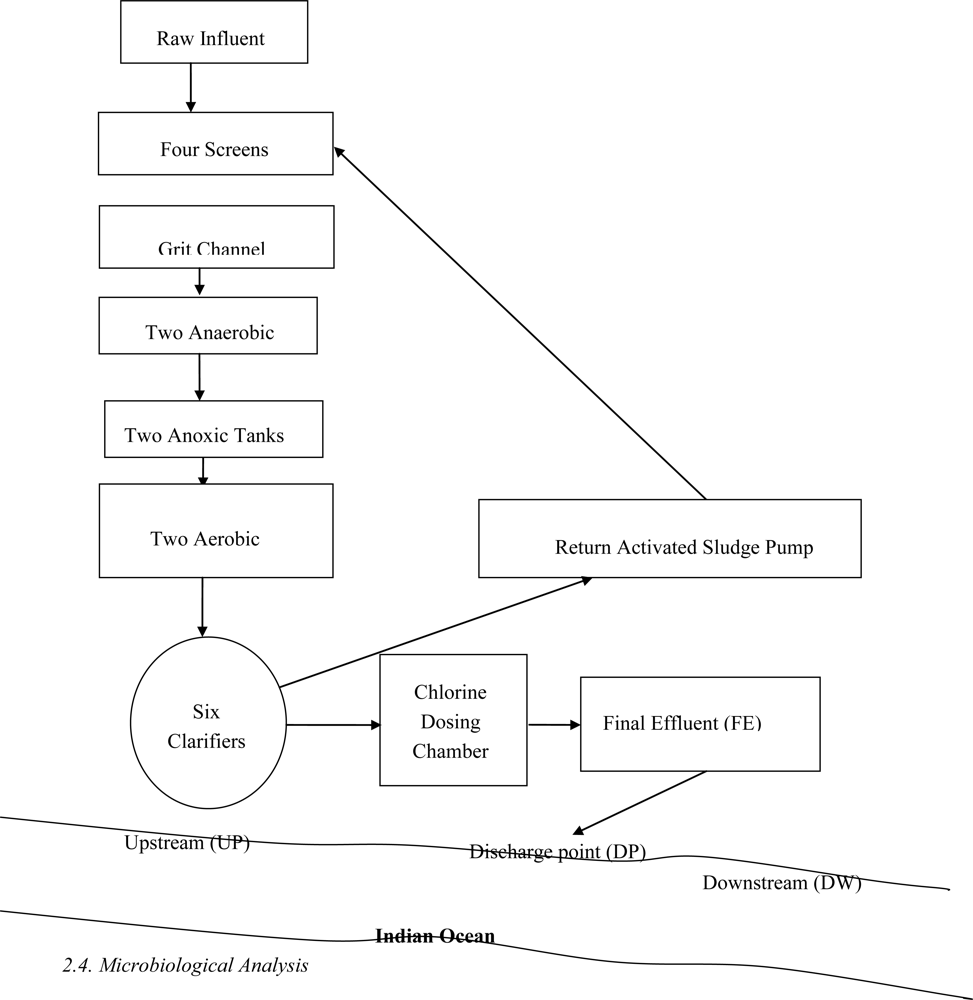
<p>The wastewater treatment plant (<xref ref-type="fig" rid="f1-ijerph-07-02376">Figure 1</xref>) is located in East London, a large and highly populated urban community in the Eastern Cape Province of South Africa, with the geographical coordinates: 32.97°S and 27.87°E. The plant receives municipal domestic sewage and a heavy industrial effluent and comprise of four screens, a grit channel, two anaerobic and two anoxic tanks and two aerobic tanks (each equipped with three vertically mounted mechanical aerators). The plant has six sedimentation tanks with the return activated sludge (RAS) pumped from the bottom of the clarifiers via the screens with raw sewage to the aeration tanks. Chlorine contact is carried out by means of a water pressure operated, wall mounted, gas chlorinator in a baffled reinforced concrete contact tank and the final effluent is discharged into the Indian Ocean. The average daily inflow of raw sewage during the study period was 32,000 m<sup>3</sup>/day, while the plant has a built in capacity of 40,000 m<sup>3</sup>/day.</p></sec>
<sec>
<label>2.2.</label>
<title>Sample Collection</title>
<p>Wastewater samples were collected on a monthly basis from the final effluent (FE), discharge point (DP), five hundred meters (500 m) upstream (UP) and five hundred meters (500 m) downstream (DW) of the discharge point between August 2007 and July 2008. Aqueous effluent samples were collected in duplicates in sterile one liter Nalgene bottles and transported in cooler boxes containing ice packs to the Applied and Environmental Microbiology Research Group (AEMREG) laboratory at the University of Fort Hare, Alice, South Africa for analyses. Sample bottles for the final effluents contained 0.1% sodium thiosulphate (3% solution) to neutralize the effect of the chlorine residual on the microflora. Processing of samples was done within 6 hours of sample collection.</p></sec>
<sec>
<label>2.3.</label>
<title>Sample Processing</title>
<p>Samples were processed according to the descriptions of Maugeri <italic>et al.</italic> [<xref ref-type="bibr" rid="b24-ijerph-07-02376">24</xref>] with modifications. Briefly, samples (one liter in duplicates) were filtered in the laboratory through 180-, 60- and 20-μm pore size nylon nets (Millipore Corp., Ireland) respectively; the water that flowed through the 20-μm pore size nylon nets was collected in clean sterile containers for planktonic (free-living) <italic>Listeria</italic> cells analyses. To obtain a final volume corresponding to 40× of the original sample, trapped planktons on the nets and adhering bacteria were resuspended in 25 mL of sterile phosphate-buffered saline (PBS). To detach adhering bacteria from the planktons, 12.5 g of sterile 0.1 mm glass beads (Biospec Products Inc., Bartlesville, OK 74005, USA) was weighed into the bacteria-plankton suspension, vortexed at high speed for 30 s and centrifuged at 3,000× g for 10 min at ambient temperature using the Beckman Model TJ-6 centrifuge. The glass beads were allowed to settle to the bottom of the centrifuge tube and the supernatant was used for plankton-associated <italic>Listeria</italic> analyses. Henceforth in this paper, plankton of sizes ≥ 180 μm, ≥ 60 μm ≤ 180 μm, and ≥ 20 μm ≤ 60 μm, shall simply be represented as 180 μm, 60 μm and 20 μm, respectively.</p></sec>
<sec sec-type="methods">
<label>2.4.</label>
<title>Microbiological Analysis</title>
<p>The isolation of <italic>Listeria</italic> species were done according to the description of Hitchins [<xref ref-type="bibr" rid="b25-ijerph-07-02376">25</xref>] with modifications. Briefly, aliquots of samples containing free-living and plankton-associated bacteria were directly inoculated onto <italic>Listeria</italic> chromogenic agar (LCA agar) (Pronadisa<sup>®</sup> Madrid, Spain) following standard spread plate technique and incubated for 24–48 h at 35 °C. Typical <italic>Listeria</italic> colonies appear blue-green on LCA agar plates while pathogenic <italic>Listeria</italic> species (<italic>Listeria monocytogenes</italic> and <italic>L. ivanovii</italic>) were surrounded by an opaque halo in addition to their blue-green color. Total <italic>Listeria</italic> counts were recorded and presumptive <italic>Listeria</italic> pathogens were isolated from the treated (chlorinated) effluent samples, purified and stored on nutrient agar slants at 4 °C for further analyses. The presumptive <italic>Listeria</italic> pathogens were further confirmed by standard cultural characteristics and biochemical reactions [<xref ref-type="bibr" rid="b25-ijerph-07-02376">25</xref>] and using the API <italic>Listeria</italic> kits (10 300, bioMerieux, South Africa). <italic>Listeria monocytogenes</italic> (ATCC 19115) and <italic>Staphylococcus aureus</italic> (ATCC 25923) were used as positive and negative controls, respectively.</p></sec>
<sec>
<label>2.5.</label>
<title>Physicochemical Analyses</title>
<p>All field meters and equipment were checked and appropriately calibrated according to the manufacturers’ instructions. pH, temperature, total dissolve solid (TDS), and dissolved oxygen (DO), were all determined on site using the multi-parameter ion specific meter (Hanna-BDH laboratory supplies). Turbidity and the concentrations of free chlorine residual in the final effluent samples were also determined on site using a microprocessor turbidity meter (HACH Company, model 2100P) and an ion-specific meter (Hanna Instruments, HI 93711) respectively. The concentrations of orthophosphate as P (PO<sub>4</sub>), nitrate (NO<sub>3</sub>), nitrite (NO<sub>2</sub>), and chemical oxygen demand (COD) were determined in the laboratory by the standard photometric method [<xref ref-type="bibr" rid="b26-ijerph-07-02376">26</xref>] using the spectroquant NOVA 60 photometer (Merck Pty Ltd). Samples for COD analyses were digested with a thermoreactor model TR 300 (Merck Pty Ltd) prior to analysis using the spectroquant NOVA 60 photometer.</p></sec>
<sec>
<label>2.6.</label>
<title>Antimicrobial Agents</title>
<p>Twenty antibiotics commonly used as therapy in human and veterinary listeriosis were employed in the antibiogram assay. The paper disks containing the antibiotics were obtained from Mast Diagnostics (Merseyside, United Kingdom) and includes: Amikacin (30 μg), Ciprofloxacin (5 μg), Aztreonam (30 μg), Linezolid (30 μg), Chloramphenicol (30 μg), Imipenem (10 μg), Ceftriaxone (30 μg), Meropenem (10 μg), Cephalothin (30 μg), Ertapenem (10 μg), Erythromycin (15 μg), Gatifloxacin (5 μg), Gentamicin (10 μg), Moxifloxacin (5 μg), Ampicillin (25 μg), Streptomycin (25 μg), Penicillin G (10 μg), Tetracycline (30 μg), Trimethoprim (5 μg), and Sulphamethoxazole (25 μg).</p></sec>
<sec>
<label>2.7.</label>
<title>Antibiotic Susceptibility Test</title>
<p>The antibiotic susceptibility test was performed and interpreted based on the disk diffusion method as described by the Clinical and Laboratory Standard Institute [<xref ref-type="bibr" rid="b27-ijerph-07-02376">27</xref>], using Mueller Hinton agar plates (Biolab, Merck, South Africa). The inhibition zone diameters (IZD) were interpreted according to CLSI standards for staphylococci due to lack of specific standards for <italic>Listeria</italic> species [<xref ref-type="bibr" rid="b28-ijerph-07-02376">28</xref>]. Interpretative standard for Linezolid was still under investigation for staphylococci at the time of this report, thus standard for <italic>Enterococcus</italic> species was applied for this antimicrobial agent.</p></sec>
<sec>
<label>2.8.</label>
<title>Bacterial DNA Extraction and Amplification of Antimicrobial Resistance Genes</title>
<p>DNA was isolated from pure cultures of the selected <italic>Listeria</italic> strains by the boiling method as described elsewhere [<xref ref-type="bibr" rid="b29-ijerph-07-02376">29</xref>]. Based on the <italic>in vitro</italic> antimicrobial susceptibility profile of the <italic>Listeria</italic> isolates, seven antimicrobial resistance genes including those encoding penicillin binding protein (<italic>penA</italic>); dihydropteroate synthetase type I (<italic>sulI</italic>); dihydropteroate synthetase type II (<italic>sulII</italic>); adenine methylase (<italic>ermA</italic>); erythromycin resistance methylase (<italic>ermB</italic>); erythromycin esterase type II (<italic>ereB</italic>); and β-lactamase-ampicillin resistance gene (<italic>ampC</italic>); were selected for screening. Oligonucleotide sequences and predicted amplicon sizes for the different antimicrobial resistance genes are listed in <xref ref-type="table" rid="t1-ijerph-07-02376">Table 1</xref>. Presence of antimicrobial resistance genes in the <italic>Listeria</italic> species were all determined by PCR technique according to the description of Srinivasan <italic>et al.</italic> [<xref ref-type="bibr" rid="b21-ijerph-07-02376">21</xref>].</p></sec>
<sec>
<label>2.9.</label>
<title>Statistical Analyses</title>
<p>Calculation of means and standard deviations were performed using Microsoft Excel Office 2007 version. Correlations (paired T-test) and test of significance (one-way ANOVA) were performed using SPSS 17.0 version for Windows program (SPSS, Inc.). All tests of significance and correlations were considered statistically significant at <italic>P</italic> values of &lt; 0.05 or &lt; 0.01.</p></sec></sec>
<sec sec-type="results">
<label>3.</label>
<title>Results</title>
<sec>
<label>3.1.</label>
<title>Abundance of Listeria</title>
<p>Total <italic>Listeria</italic> counts ranged from 2.9 × 10<sup>0</sup> to 1.2 × 10<sup>5</sup> cfu/mL (<xref ref-type="table" rid="t2-ijerph-07-02376">Table 2</xref>). The lowest count was observed during summer in the month of November 2007 at DW while the highest count was observed at the DP, also in the summer month of December 2007. Abundance of free-living <italic>Listeria</italic> species varied between 0 and 2.4×10<sup>3</sup> cfu/mL, with the highest count recorded at FE and DW in April 2008. <italic>Listeria</italic> species associated with plankton of sizes 180 μm, 60 μm, and 20 μm, were observed at population densities of 0 to 1.95 × 10<sup>3</sup> cfu/mL, 0 to 1.8 × 10<sup>2</sup> cfu/mL and 0 to 1.15 × 10<sup>5</sup> cfu/mL, respectively. The highest counts for the plankton-associated <italic>Listeria</italic> species were all observed at the DP in December 2007, June 2008 and December 2007 for 180 μm, 60 μm, and 20 μm categories, respectively. Listerial abundance did not vary significantly with season either as free-living or plankton-associated entities. The population of free-living <italic>Listeria</italic> species in the FE samples varied significantly (<italic>P</italic> &lt; 0.05) with those of large (180 μm) and medium sized (60 μm) planktons but not with small (20 μm) planktons. <italic>Listeria</italic> density did not vary significantly with the size of the planktons to which they attach at DP and DW. There was, however, significant difference (<italic>P</italic> &lt; 0.05) in listerial density between free-living <italic>Listeria</italic> populations and plankton-attached species of all categories at the UP sampling site.</p>
<p>There was significant (<italic>P &lt;</italic> 0.01) positive correlation between <italic>Listeria</italic> populations attached to large (180 μm) planktons and those attached to small (20 μm) planktons. Significant correlation was, however, not observed for other treatments with respect to listerio-plankton association.</p>
<p><xref ref-type="table" rid="t2-ijerph-07-02376">Table 2</xref> also shows the prevalence of <italic>Listeria</italic> during this study. <italic>Listeria</italic> species were isolated throughout the year from the treated effluents and the receiving watershed. Thirty-seven (84%) of all 44 samples (in duplicate) were positive for free-living <italic>Listeria</italic> species. Free-living <italic>Listeria</italic> species were isolated all year round except in DW (summer and early winter: May, 2008) and in UP (December 2007; May and June 2008). Seventy-five percent of all samples were positive for <italic>Listeria</italic> species associated with large (180 μm) plankton. Of these, <italic>Listeria</italic> was isolated from FE (11 samples), DP (nine samples), DW (seven samples) and UP (six samples). Twenty-six (59%) of all 44 samples were positive for <italic>Listeria</italic> species associated with medium-sized (60 μm) planktons, which were isolated from FE (10 samples), DP (eight samples), DW (three samples) and UP (five samples). <italic>Listeria</italic> species associated with small (20 μm) planktons were isolated in 30 (68%) of the 44 samples. FE samples were positive for this <italic>Listeria</italic> species in 10 samples, DP in nine samples, DW in five samples and UP in six samples.</p></sec>
<sec>
<label>3.2.</label>
<title>Physicochemical Analyses</title>
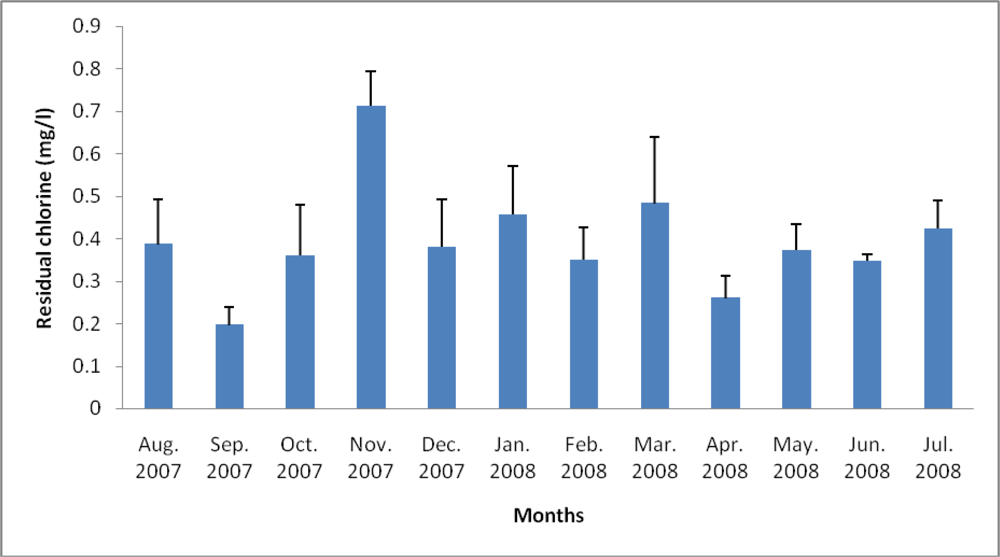
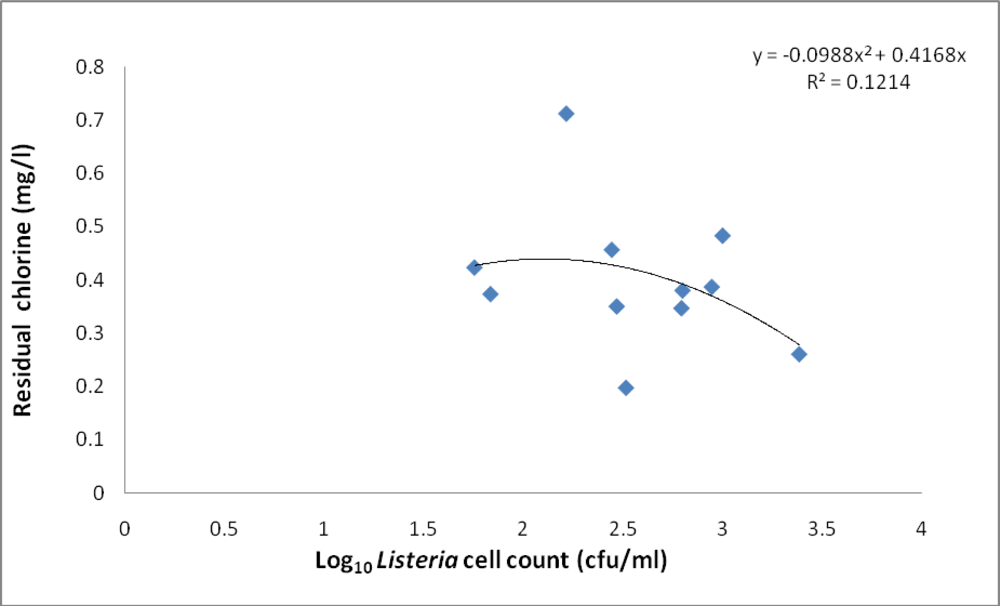
<p><xref ref-type="table" rid="t3-ijerph-07-02376">Table 3</xref> shows the range and annual mean values of some wastewater quality parameters before and after treatment of the wastewater under study. Significant differences was observed between raw sewage and treated effluent in terms of turbidity, DO, and PO<sub>4</sub> (<italic>P &lt;</italic> 0.01) and for nitrate (<italic>P &lt;</italic> 0.05). There was, however, no significant difference between treated and untreated wastewater for pH, temperature, TDS, COD, and NO<sub>2</sub>. <xref ref-type="fig" rid="f2-ijerph-07-02376">Figure 2</xref> shows the free chlorine residual (CR) of the final effluents during the 12 month study period. Chlorine residual ranged between 0.197 mg/L (September, 2007) and 0.71 mg/L (November, 2007). The relationship between residual chlorine and total <italic>Listeria</italic> count did not follow any defined trend (<xref ref-type="fig" rid="f3-ijerph-07-02376">Figure 3</xref>).</p></sec>
<sec>
<label>3.4.</label>
<title>Antibiogram and Resistance Gene Detection</title>
<p>Fifty-one presumptive <italic>Listeria</italic> pathogens were isolated from the final effluents following their morphological characteristics on LCA plates. Of the 51 isolates, 27 (53%) were confirmed to be <italic>L. ivanovii</italic>; 1 (2%) was <italic>L. innocua</italic> and the identity of the remaining 23 (45%) isolates were indeterminate by API test. Twenty-three (22 <italic>L. ivanovii</italic> and 1 <italic>L. innocua</italic>) of the 28 confirmed <italic>Listeria</italic> isolates were tested for phenotypic antibiotic susceptibility and the result is shown in <xref ref-type="table" rid="t4-ijerph-07-02376">Table 4</xref>. All 23 <italic>Listeria</italic> species were sensitive to three (15%) of the 20 test antibiotics including amikacin (aminoglycosides), meropenem, and ertapenem (carbapenems). Eight (35%) of the 23 <italic>Listeria</italic> isolates were moderately sensitive to moxifloxacin, cephalothin, gatifloxacin, ciprofloxacin and ceftriaxone; three strains showed moderate sensitivity to moxifloxacin, two to gatifloxacin, while the other three were each moderately sensitive to cephalothin, ciprofloxacin, and ceftriaxone. The test isolates showed resistance to 17 (85%) of the 20 antibiotics at percentages ranging from 4.5% to 91% (<xref ref-type="table" rid="t4-ijerph-07-02376">Table 4</xref>). Multiple antibiotic resistances was observed in 22 (95.7%) of the isolates in combinations ranging from four to 10 antibiotics; while one isolate showed resistance to a single antibiotic (aztreonam) (<xref ref-type="table" rid="t5-ijerph-07-02376">Table 5</xref>). Of the seven antimicrobial genes assayed in this study, only <italic>sulII</italic> genes were detected in five (22%) strains of <italic>Listeria ivanovii</italic> (<xref ref-type="table" rid="t6-ijerph-07-02376">Table 6</xref>).</p></sec></sec>
<sec sec-type="discussion">
<label>4.</label>
<title>Discussion</title>
<p>The relative abundance of free-living <italic>Listeria</italic> species found during this study and across all sampled sites is consistent with reports elsewhere [<xref ref-type="bibr" rid="b13-ijerph-07-02376">13</xref>,<xref ref-type="bibr" rid="b35-ijerph-07-02376">35</xref>]. There are no recommended standards specific for <italic>Listeria</italic> pathogens in water and wastewater samples in South Africa for obvious reasons; thus the fecal coliforms standard (0 cfu/100 ml) for domestic water uses [<xref ref-type="bibr" rid="b30-ijerph-07-02376">30</xref>] was applied in this report. Based on this standard, the water quality across the studied water system and throughout the year (<xref ref-type="table" rid="t2-ijerph-07-02376">Table 2</xref>) fell short of acceptable target limits for domestic applications, thus disqualifying the waters for use in drinking and other domestic purposes. <italic>Listeria</italic> abundance did not vary significantly with season, either as free-living or plankton-associated species, consistent with the observation of Murrel <italic>et al.</italic> [<xref ref-type="bibr" rid="b36-ijerph-07-02376">36</xref>], but contrary to our previous report [<xref ref-type="bibr" rid="b13-ijerph-07-02376">13</xref>]. The significant positive correlation observed between <italic>Listeria</italic> species attached to large (180 μm) planktons and those attached to small (20 μm) planktons suggests that the two groups of <italic>Listeria</italic> species may occupy the same niche in the ecosystem; this is contrary to our previous report [<xref ref-type="bibr" rid="b13-ijerph-07-02376">13</xref>], where <italic>Listeria</italic> species attached to large (180 μm) planktons negatively correlated with those attached to small (20 μm) planktons. The lack of significant correlations between and among other treatments in this study suggests that free-living <italic>Listeria</italic> species and <italic>Listeria</italic> species attached to medium-sized (60 μm) planktons occupy separate niches in the water system, different from those occupied by <italic>Listeria</italic> species attached to large (180 μm) and small (20 μm) planktons. The observation is consistent with those of Maugeri <italic>et al.</italic> [<xref ref-type="bibr" rid="b24-ijerph-07-02376">24</xref>] who reported lack of significant correlation between free-living bacteria and plankton associated bacterial populations in a marine coastal zone in Italy. However, another study [<xref ref-type="bibr" rid="b37-ijerph-07-02376">37</xref>] reported a negative correlation between planktonic <italic>Vibrio</italic> cells and sessile populations.</p>
<p><italic>Listeria</italic> species were isolated from all sampled sites and throughout the year during this study, suggesting a 100% prevalence of the pathogen in the water system. Consistent with observations in a previous study [<xref ref-type="bibr" rid="b13-ijerph-07-02376">13</xref>], free-living <italic>Listeria</italic> species were most prevalent (84%) both in treated effluent and the receiving watershed; followed by <italic>Listeria</italic> cells associated with planktons of sizes 180 μm (75%), 20 μm (68%), and 60 μm (59%), respectively. Corroborating this observation, Maugeri <italic>et al.</italic> [<xref ref-type="bibr" rid="b24-ijerph-07-02376">24</xref>] reported higher prevalence for free-living bacteria compared to their plankton-associated counterparts. <italic>Listeria</italic> species were generally more prevalent in the treated effluents (FE), both as free-living and/or plankton-associated cells, compared to the receiving watershed (<xref ref-type="table" rid="t2-ijerph-07-02376">Table 2</xref>). The observation could be as a result of higher nutrient levels in the wastewater effluents compared to the receiving watershed, in agreement with previous reports [<xref ref-type="bibr" rid="b10-ijerph-07-02376">10</xref>,<xref ref-type="bibr" rid="b11-ijerph-07-02376">11</xref>,<xref ref-type="bibr" rid="b38-ijerph-07-02376">38</xref>]. Consistent with the observation of this study, high prevalence of <italic>Listeria</italic> species has been reported in water systems impacted by wastewater effluents in Iraq [<xref ref-type="bibr" rid="b8-ijerph-07-02376">8</xref>,<xref ref-type="bibr" rid="b9-ijerph-07-02376">9</xref>], Poland [<xref ref-type="bibr" rid="b10-ijerph-07-02376">10</xref>] France [<xref ref-type="bibr" rid="b11-ijerph-07-02376">11</xref>], the United Kingdom [<xref ref-type="bibr" rid="b12-ijerph-07-02376">12</xref>] and rural South Africa [<xref ref-type="bibr" rid="b13-ijerph-07-02376">13</xref>]. Watkins and Sleath [<xref ref-type="bibr" rid="b12-ijerph-07-02376">12</xref>] reported 100% prevalence of <italic>Listeria</italic> species in sewage, river water, and trade effluent at densities (7.0 × 10<sup>2</sup> to &gt;1.8 × 10<sup>4</sup> Most Probable Number (MPN)/mL), slightly higher than those observed in this study. The sewage effluent reported by Watkins and colleague, however, only underwent primary treatment unlike ours that was disinfected by chlorination, which could account for the differences. Al-Ghazali and Al-Azawi [<xref ref-type="bibr" rid="b8-ijerph-07-02376">8</xref>,<xref ref-type="bibr" rid="b9-ijerph-07-02376">9</xref>] also reported 100% prevalence in treated wastewater effluent in Iraq but at lower densities of &lt;3 to 28 MPN/mL, and Paillard <italic>et al.</italic> [<xref ref-type="bibr" rid="b11-ijerph-07-02376">11</xref>] reported 84.4% prevalence of <italic>Listeria</italic> species in treated wastewater in France at densities ranging from &lt;0.3 to 21 MPN/ml, while Odjadjare and Okoh [<xref ref-type="bibr" rid="b13-ijerph-07-02376">13</xref>] recorded 100% prevalence in a rural water system in South Africa at densities ranging from 1.0 × 10<sup>1</sup> to 1.1 × 10<sup>4</sup> cfu/mL. Contrary to the observation of this study, lower prevalence has been reported for <italic>Listeria</italic> species in a variety of surface water systems. Frances <italic>et al.</italic> [<xref ref-type="bibr" rid="b39-ijerph-07-02376">39</xref>] reported the isolation of <italic>Listeria</italic> species from 21% of freshwater samples collected from sites in Cheshire and North Wales; while Lyautey <italic>et al.</italic> [<xref ref-type="bibr" rid="b40-ijerph-07-02376">40</xref>] reported 64% for surface waters of the South Nation River Watershed in Ontario, Canada. These observations were consistent with expectations for surface waters that were not impacted by wastewater effluent in agreement with a report elsewhere [<xref ref-type="bibr" rid="b38-ijerph-07-02376">38</xref>].</p>
<p>The significant variation observed between raw and treated sewage for most physicochemical parameters (<xref ref-type="table" rid="t3-ijerph-07-02376">Table 3</xref>) is an indication that the wastewater treatment process remarkably improved the quality of the raw wastewater influent. However, despite the improvement on raw sewage quality, the treated effluent did not measure up to the desired target quality for turbidity, DO, COD, and NO<sub>2</sub> with respect to domestic applications [<xref ref-type="bibr" rid="b30-ijerph-07-02376">30</xref>] and PO<sub>4</sub> with reference to preserving the integrity of the aquatic ecosystem [<xref ref-type="bibr" rid="b34-ijerph-07-02376">34</xref>]. This suggests that the wastewater effluent has a potential negative impact on the environment and public health. The effluent quality was, however, acceptable in terms of pH, temperature, TDS, and NO<sub>3</sub> (<xref ref-type="table" rid="t3-ijerph-07-02376">Table 3</xref>).</p>
<p>The chlorine residual (<xref ref-type="fig" rid="f2-ijerph-07-02376">Figure 2</xref>) generally fell within acceptable target limits (0.3–0.6 mg/L) for domestic water at the point of use [<xref ref-type="bibr" rid="b41-ijerph-07-02376">41</xref>], except in September and November 2007, and indicates that the water is safe for domestic applications with reference to chlorine residual. The scatter plot (<xref ref-type="fig" rid="f3-ijerph-07-02376">Figure 3</xref>) indicates that the relationship between chlorine residual and listerial density did not follow any particular trend. This observation suggests that factors other than chlorine disinfection affected the abundance of <italic>Listeria</italic> species during this study; some of these factors may also be responsible for the inability of chlorine to adequately eliminate the pathogens from the wastewater even at relatively high doses. LeChevallier <italic>et al.</italic> [<xref ref-type="bibr" rid="b42-ijerph-07-02376">42</xref>] observed attachment of bacteria to planktons and/or other suspended particles as a factor which enhanced resistance of bacteria to chlorine disinfection while Obi <italic>et al.</italic> [<xref ref-type="bibr" rid="b41-ijerph-07-02376">41</xref>] reported other factors to include contact time, temperature, and pH. This suggests that turbidity (which is a measure of suspended particles including planktons) could be a factor in the ineffectiveness of chlorine disinfection during this study; turbidity fell short of recommended target limits throughout the study (<xref ref-type="table" rid="t3-ijerph-07-02376">Table 3</xref>). Attachment of <italic>Listeria</italic> species to plankton may, however, not be a significant factor in the bacterial survival of chlorine disinfection in this study, as free-living <italic>Listeria</italic> species were more abundant compared to their plankton attached counterparts even after chlorine disinfection in agreement with the observation of our study elsewhere [<xref ref-type="bibr" rid="b13-ijerph-07-02376">13</xref>]. The reason for this observation is not clear.</p>
<p>Previous studies on the antimicrobial susceptibility profiles of <italic>Listeria</italic> species focused mainly on clinical and/or food isolates with little information in the literature on antibiotic susceptibility profiles for <italic>Listeria</italic> strains isolated from chlorinated municipal wastewater effluent. All 23 <italic>Listeria</italic> species tested in this study were sensitive to three (15%) of the 20 test antibiotics including amikacin (aminoglycosides), meropenem, and ertapenem (carbapenems) (<xref ref-type="table" rid="t4-ijerph-07-02376">Table 4</xref>); suggesting that these antibiotics may be the best therapy in the event of listeriosis outbreak in South Africa. Consistent with the observation of this study, Hansen <italic>et al.</italic> [<xref ref-type="bibr" rid="b43-ijerph-07-02376">43</xref>] reported complete sensitivity of 106 <italic>Listeria</italic> species isolated from humans to meropenem, while Safdar and Armstrong [<xref ref-type="bibr" rid="b44-ijerph-07-02376">44</xref>] observed 100% sensitivity to amikacin and Odjadjare and Okoh [<xref ref-type="bibr" rid="b13-ijerph-07-02376">13</xref>] reported complete sensitivity to the three antibiotics by all 14 <italic>Listeria</italic> species isolated from chlorinated wastewater effluent in a previous study.</p>
<p><italic>Listeria</italic> strains in this study showed resistance to at least one of 17 antibiotics at percentages ranging from 4.5%–91% (<xref ref-type="table" rid="t4-ijerph-07-02376">Table 4</xref>), and particularly high levels for penicillin G (91%), ampicillin (87%), erythromycin (83%), and sulphamethoxazole (65%). Contrary to the observation of this study, <italic>Listeria</italic> species were generally reported to be susceptible to penicillin G [<xref ref-type="bibr" rid="b45-ijerph-07-02376">45</xref>], ampicillin [<xref ref-type="bibr" rid="b46-ijerph-07-02376">46</xref>], erythromycin [<xref ref-type="bibr" rid="b28-ijerph-07-02376">28</xref>,<xref ref-type="bibr" rid="b44-ijerph-07-02376">44</xref>], and sulphamethoxazole [<xref ref-type="bibr" rid="b13-ijerph-07-02376">13</xref>,<xref ref-type="bibr" rid="b43-ijerph-07-02376">43</xref>]. Conversely, considerable resistance has been reported in the literature for <italic>Listeria</italic> species against the penicillins (penicillin G and ampicillin) [<xref ref-type="bibr" rid="b21-ijerph-07-02376">21</xref>], erythromycin [<xref ref-type="bibr" rid="b13-ijerph-07-02376">13</xref>,<xref ref-type="bibr" rid="b47-ijerph-07-02376">47</xref>], and sulphamethoxazole [<xref ref-type="bibr" rid="b46-ijerph-07-02376">46</xref>]. The high resistance observed for penicillin G, ampicillin and sulphamethoxazole could be of serious public health concern as penicillin G and ampicillin are reported to be the antibiotics of choice in the treatment of listeriosis [<xref ref-type="bibr" rid="b28-ijerph-07-02376">28</xref>,<xref ref-type="bibr" rid="b43-ijerph-07-02376">43</xref>]; while sulphamethoxazole, usually in combination with trimethoprim, is considered second choice therapy, especially for patients who are allergic to the penicillins [<xref ref-type="bibr" rid="b46-ijerph-07-02376">46</xref>]. The observation generally indicated that municipal wastewater effluent could be a significant source of highly resistant strains of <italic>Listeria</italic> pathogens in the South African aquatic milieu.</p>
<p>The physicochemical quality of the wastewater effluent may be a factor in the level of resistance observed in this study, as it is widely reported [<xref ref-type="bibr" rid="b48-ijerph-07-02376">48</xref>–<xref ref-type="bibr" rid="b50-ijerph-07-02376">50</xref>] that conventional wastewater treatment plants lack the capacity to effectively remove antibiotics and a number of other chemicals from wastewater, thereby increasing the chances of bacterial pathogens resident in such wastewater effluent to develop resistance to common antibiotics due to selective pressure. Although we did not attempt to assay for residual antibiotics in the treated effluents in the course of this study, lack of capacity to remove some chemicals from the wastewater during the treatment process is evident in <xref ref-type="table" rid="t3-ijerph-07-02376">Table 3</xref>. The table shows that the treated effluent fell short of recommended standard quality for critical parameters such as turbidity, DO, COD, NO<sub>2</sub>, and PO<sub>4</sub> and suggests a possible influence on the listerial resistance.</p>
<p>Twenty-two (95.7%) of the 23 test isolates in this study showed multiple antibiotic resistance in combinations ranging from four to 10 antibiotics (<xref ref-type="table" rid="t5-ijerph-07-02376">Table 5</xref>). Similar observations have been reported elsewhere [<xref ref-type="bibr" rid="b13-ijerph-07-02376">13</xref>,<xref ref-type="bibr" rid="b21-ijerph-07-02376">21</xref>]. On the contrary Conter <italic>et al.</italic> [<xref ref-type="bibr" rid="b28-ijerph-07-02376">28</xref>] reported more resistance to single antibiotics than multiple resistance amongst 120 <italic>Listeria</italic> isolates tested against 19 antibiotics; while Arslan and Ozdemir [<xref ref-type="bibr" rid="b51-ijerph-07-02376">51</xref>] reported resistance to single antibiotics with no record of multiple antibiotic resistance amongst 47 strains of <italic>Listeria</italic> species isolated from white cheese and tested against 13 antibiotics. Multiple drug resistance in <italic>Listeria</italic> species have been attributed to antimicrobial selective pressure and gene transfer mechanism between and among <italic>Listeria</italic> species and close relatives of the bacteria such as <italic>Enterococcus</italic>, <italic>Streptococcus</italic> and <italic>Staphylococcus</italic> species [<xref ref-type="bibr" rid="b44-ijerph-07-02376">44</xref>]. Donlan and Costerton [<xref ref-type="bibr" rid="b52-ijerph-07-02376">52</xref>] also reported the acquisition of inherent resistance to antimicrobial agents due to bacterial attachment to surfaces; suggesting that attachment to plankton at one point or the other may have enhanced the multiple resistances of our listerial strains to several test antibiotics.</p>
<p>Although the penicillins (penicillin G and ampicillin) and erythromycin showed the highest phenotypic resistance during this study, the genes responsible for resistance to these antibiotics were not detected in our <italic>Listeria</italic> isolates (<xref ref-type="table" rid="t6-ijerph-07-02376">Table 6</xref>). In a similar report, Srinivasan <italic>et al.</italic> [<xref ref-type="bibr" rid="b21-ijerph-07-02376">21</xref>] observed high level (92%) of phenotypic resistance to ampicillin but failed to detect the genes responsible for ampicillin resistance in all of their 38 <italic>Listeria</italic> isolates. Consistent with the observation of this study, Davis and Jackson [<xref ref-type="bibr" rid="b20-ijerph-07-02376">20</xref>] could not detect <italic>penA</italic> genes (responsible for penicillin resistance) in <italic>Listeria</italic> strains isolated from various sources; while Srinivasan <italic>et al.</italic> [<xref ref-type="bibr" rid="b21-ijerph-07-02376">21</xref>] reported their inability to detect genes responsible for erythromycin resistance in 38 <italic>Listeria</italic> isolates from dairy farms in spite of observed phenotypic resistance to the antibiotic. Contrary to the observation of this study, Srinivasan <italic>et al.</italic> [<xref ref-type="bibr" rid="b21-ijerph-07-02376">21</xref>] reported the detection of <italic>penA</italic> genes in 37% of their <italic>Listeria</italic> isolates while Roberts <italic>et al.</italic> [<xref ref-type="bibr" rid="b53-ijerph-07-02376">53</xref>] reported the detection of erythromycin resistance genes in <italic>Listeria</italic> species isolated from food samples. To the best of our knowledge, this is the first report on the detection of dihydropteroate synthetase type II (<italic>sulII</italic>) resistance gene markers in <italic>Listeria</italic> species (<xref ref-type="table" rid="t6-ijerph-07-02376">Table 6</xref>). Previous attempt by other workers [<xref ref-type="bibr" rid="b20-ijerph-07-02376">20</xref>,<xref ref-type="bibr" rid="b21-ijerph-07-02376">21</xref>] did not detect the genes in <italic>Listeria</italic> species. The percentage of <italic>Listeria</italic> isolates that harbored this gene was, however, relatively small (22%) compared to the high (65%) level of phenotypic resistance observed for the antibiotic (sulphametoxazole) in this study. The observations generally suggests that the presence of antimicrobial resistance genes in bacterial isolates do not always correlate with phenotypic antibiotic resistance, and indicates that other mechanisms such as decreased outer membrane permeability, activation of efflux pump, or mutation in a ribosomal protein may have contributed to the antimicrobial resistance phenotypes observed in this study [<xref ref-type="bibr" rid="b21-ijerph-07-02376">21</xref>].</p></sec>
<sec sec-type="conclusions">
<label>5.</label>
<title>Conclusions</title>
<p>The current study demonstrated that the activated sludge treatment process was ineffective in removing <italic>Listeria</italic> pathogens and other contaminants from the municipal wastewater prior to discharge into the receiving watershed; thereby posing serious threat to the integrity of the receiving environment and its ability to support life; as well as endangering the public health of the people who depend on this all important water resource for drinking and other purposes. Therefore, it is imperative that the relevant monitoring agencies take proactive steps aimed at curtailing an impending listeriosis outbreak in South Africa in the interest of the public health.</p></sec></body>
<back>
<ack>
<p>We are grateful to the National Research Foundation (NRF) for funding this research under the focus area program.</p></ack>
<ref-list>
<title>References</title>
<ref id="b1-ijerph-07-02376"><label>1.</label><citation citation-type="journal"><person-group person-group-type="author"><name><surname>Roberts</surname><given-names>AJ</given-names></name><name><surname>Wiedmann</surname><given-names>M</given-names></name></person-group><article-title>Pathogen, host and environmental factors contributing to the pathogenesis of listeriosis</article-title><source>Cell. Mol. Life Sci</source><year>2003</year><volume>60</volume><fpage>904</fpage><lpage>918</lpage><pub-id pub-id-type="pmid">12827280</pub-id></citation></ref>
<ref id="b2-ijerph-07-02376"><label>2.</label><citation citation-type="journal"><person-group person-group-type="author"><name><surname>Brugere-Picoux</surname><given-names>O</given-names></name></person-group><article-title>Ovine listeriosis</article-title><source>Small Ruminant Res</source><year>2008</year><volume>76</volume><fpage>12</fpage><lpage>20</lpage><pub-id pub-id-type="doi">10.1016/j.smallrumres.2007.12.022</pub-id></citation></ref>
<ref id="b3-ijerph-07-02376"><label>3.</label><citation citation-type="journal"><person-group person-group-type="author"><name><surname>Cummins</surname><given-names>AJ</given-names></name><name><surname>Fielding</surname><given-names>AK</given-names></name><name><surname>McLauchlin</surname><given-names>J</given-names></name></person-group><article-title><italic>Listeria ivanovii</italic> infection in a patient with AIDS</article-title><source>J. Infect</source><year>1994</year><volume>28</volume><fpage>89</fpage><lpage>91</lpage><pub-id pub-id-type="doi">10.1016/S0163-4453(94)94347-8</pub-id><pub-id pub-id-type="pmid">8163840</pub-id></citation></ref>
<ref id="b4-ijerph-07-02376"><label>4.</label><citation citation-type="journal"><person-group person-group-type="author"><name><surname>Cocolin</surname><given-names>L</given-names></name><name><surname>Rantsiou</surname><given-names>K</given-names></name><name><surname>Iacumin</surname><given-names>L</given-names></name><name><surname>Cantoni</surname><given-names>C</given-names></name><name><surname>Comi</surname><given-names>G</given-names></name></person-group><article-title>Direct identification in food samples of <italic>Listeria</italic> spp. and <italic>Listeria monocytogenes</italic> by molecular methods</article-title><source>Appl. Environ. Microbiol</source><year>2002</year><volume>68</volume><fpage>6273</fpage><lpage>6282</lpage><pub-id pub-id-type="doi">10.1128/AEM.68.12.6273-6282.2002</pub-id><pub-id pub-id-type="pmid">12450852</pub-id></citation></ref>
<ref id="b5-ijerph-07-02376"><label>5.</label><citation citation-type="journal"><person-group person-group-type="author"><name><surname>Walker</surname><given-names>JK</given-names></name><name><surname>Morgan</surname><given-names>JH</given-names></name><name><surname>McLauchlin</surname><given-names>J</given-names></name><name><surname>Grant</surname><given-names>KA</given-names></name><name><surname>Shallcross</surname><given-names>JA</given-names></name></person-group><article-title><italic>Listeria ivanovii</italic> isolated from a case of ovine meningoencephalitis</article-title><source>Vet. Microbiol</source><year>1994</year><volume>59</volume><fpage>193</fpage><lpage>202</lpage></citation></ref>
<ref id="b6-ijerph-07-02376"><label>6.</label><citation citation-type="journal"><person-group person-group-type="author"><name><surname>Rocourt</surname><given-names>J</given-names></name><name><surname>Jacquet</surname><given-names>Ch</given-names></name><name><surname>Reilly</surname><given-names>A</given-names></name></person-group><article-title>Epidemiology of human listeriosis and seafoods</article-title><source>Int. J. Food Microbiol</source><year>2000</year><volume>62</volume><fpage>197</fpage><lpage>209</lpage><pub-id pub-id-type="doi">10.1016/S0168-1605(00)00336-6</pub-id><pub-id pub-id-type="pmid">11156263</pub-id></citation></ref>
<ref id="b7-ijerph-07-02376"><label>7.</label><citation citation-type="journal"><person-group person-group-type="author"><name><surname>Siegman-Igra</surname><given-names>Y</given-names></name><name><surname>Levin</surname><given-names>R</given-names></name><name><surname>Weinberger</surname><given-names>M</given-names></name><name><surname>Golan</surname><given-names>Y</given-names></name><name><surname>Schwartz</surname><given-names>D</given-names></name><name><surname>Samra</surname><given-names>Z</given-names></name><name><surname>Konigsberger</surname><given-names>H</given-names></name><name><surname>Yinnon</surname><given-names>A</given-names></name><name><surname>Rahav</surname><given-names>G</given-names></name><name><surname>Keller</surname><given-names>N</given-names></name><name><surname>Basharat</surname><given-names>N</given-names></name><name><surname>Karpuch</surname><given-names>J</given-names></name><name><surname>Finkelstein</surname><given-names>R</given-names></name><name><surname>Alkan</surname><given-names>M</given-names></name><name><surname>Landau</surname><given-names>Z</given-names></name><name><surname>Novikov</surname><given-names>J</given-names></name><name><surname>Hassin</surname><given-names>D</given-names></name><name><surname>Rudnicki</surname><given-names>C</given-names></name><name><surname>Kitzes</surname><given-names>R</given-names></name><name><surname>Ovadia</surname><given-names>S</given-names></name><name><surname>Shimoni</surname><given-names>Z</given-names></name><name><surname>Lang</surname><given-names>R</given-names></name><name><surname>Shohat</surname><given-names>T</given-names></name></person-group><article-title><italic>Listeria monocytogenes</italic> infection in Israel and review of cases worldwide</article-title><source>Emerging Infect. Dis</source><year>2002</year><volume>8</volume><fpage>305</fpage><lpage>310</lpage><pub-id pub-id-type="doi">10.3201/eid0803.010195</pub-id><pub-id pub-id-type="pmid">11927029</pub-id></citation></ref>
<ref id="b8-ijerph-07-02376"><label>8.</label><citation citation-type="journal"><person-group person-group-type="author"><name><surname>Al-Ghazali</surname><given-names>MR</given-names></name><name><surname>Al-Azawi</surname><given-names>KS</given-names></name></person-group><article-title>Detection and enumeration of <italic>Listeria monocytogenes</italic> in a sewage treatment plant in Iraq</article-title><source>J. Appl. Bacteriol</source><year>1986</year><volume>60</volume><fpage>251</fpage><lpage>254</lpage><pub-id pub-id-type="doi">10.1111/j.1365-2672.1986.tb01080.x</pub-id><pub-id pub-id-type="pmid">3086271</pub-id></citation></ref>
<ref id="b9-ijerph-07-02376"><label>9.</label><citation citation-type="journal"><person-group person-group-type="author"><name><surname>Al-Ghazali</surname><given-names>MR</given-names></name><name><surname>Al-Azawi</surname><given-names>KS</given-names></name></person-group><article-title>Effects of sewage treatment on the removal of <italic>Listeria monocytogenes</italic></article-title><source>J. Appl. Bacteriol</source><year>1988</year><volume>65</volume><fpage>203</fpage><lpage>208</lpage><pub-id pub-id-type="doi">10.1111/j.1365-2672.1988.tb01886.x</pub-id><pub-id pub-id-type="pmid">3147983</pub-id></citation></ref>
<ref id="b10-ijerph-07-02376"><label>10.</label><citation citation-type="web"><person-group person-group-type="author"><name><surname>Czeszejko</surname><given-names>K</given-names></name><name><surname>Boguslawska-Was</surname><given-names>E</given-names></name><name><surname>Dabrowski</surname><given-names>W</given-names></name><name><surname>Kaban</surname><given-names>S</given-names></name><name><surname>Umanski</surname><given-names>R</given-names></name></person-group><article-title>Prevalence of <italic>Listeria monocytogenes</italic> in municipal and industrial sewage</article-title><source>Electron J Pol Agric Univ Environ Dev</source><year>2003</year><volume>6</volume>; Available online: <ext-link xlink:href="http://www.ejpau.media.pl" ext-link-type="uri">http://www.ejpau.media.pl</ext-link> (accessed 4 November 2008).</citation></ref>
<ref id="b11-ijerph-07-02376"><label>11.</label><citation citation-type="journal"><person-group person-group-type="author"><name><surname>Paillard</surname><given-names>D</given-names></name><name><surname>Dubois</surname><given-names>V</given-names></name><name><surname>Thiebaut</surname><given-names>R</given-names></name><name><surname>Nathier</surname><given-names>F</given-names></name><name><surname>Hoogland</surname><given-names>E</given-names></name><name><surname>Caumette</surname><given-names>P</given-names></name><name><surname>Quentin</surname><given-names>C</given-names></name></person-group><article-title>Occurrence of <italic>Listeria</italic> spp. in effluents of French urban wastewater treatment plants</article-title><source>Appl. Environ. Microbiol</source><year>2005</year><volume>71</volume><fpage>7562</fpage><lpage>7566</lpage><pub-id pub-id-type="doi">10.1128/AEM.71.11.7562-7566.2005</pub-id><pub-id pub-id-type="pmid">16269804</pub-id></citation></ref>
<ref id="b12-ijerph-07-02376"><label>12.</label><citation citation-type="journal"><person-group person-group-type="author"><name><surname>Watkins</surname><given-names>J</given-names></name><name><surname>Sleath</surname><given-names>KP</given-names></name></person-group><article-title>Isolation and enumeration of <italic>Listeria monocytogenes</italic> from sewage, sewage sludge, and river water</article-title><source>J. Appl. Bacteriol</source><year>1981</year><volume>50</volume><fpage>1</fpage><lpage>9</lpage><pub-id pub-id-type="doi">10.1111/j.1365-2672.1981.tb00865.x</pub-id><pub-id pub-id-type="pmid">6262293</pub-id></citation></ref>
<ref id="b13-ijerph-07-02376"><label>13.</label><citation citation-type="journal"><person-group person-group-type="author"><name><surname>Odjadjare</surname><given-names>EEO</given-names></name><name><surname>Okoh</surname><given-names>AI</given-names></name></person-group><article-title>Prevalence and distribution of <italic>Listeria</italic> pathogens in the final effluents of a rural wastewater treatment facility in the Eastern Cape Province of South Africa</article-title><source>World J. Microbiol. Biotechnol</source><year>2010</year><volume>26</volume><fpage>297</fpage><lpage>307</lpage><pub-id pub-id-type="doi">10.1007/s11274-009-0174-4</pub-id></citation></ref>
<ref id="b14-ijerph-07-02376"><label>14.</label><citation citation-type="journal"><person-group person-group-type="author"><name><surname>Mackintosh</surname><given-names>G</given-names></name><name><surname>Colvin</surname><given-names>C</given-names></name></person-group><article-title>Failure of rural schemes in South Africa to provide potable water</article-title><source>Environ. Geol</source><year>2003</year><volume>44</volume><fpage>101</fpage><lpage>105</lpage></citation></ref>
<ref id="b15-ijerph-07-02376"><label>15.</label><citation citation-type="journal"><person-group person-group-type="author"><name><surname>Okoh</surname><given-names>AI</given-names></name><name><surname>Odjadjare</surname><given-names>EE</given-names></name><name><surname>Igbinosa</surname><given-names>EO</given-names></name><name><surname>Osode</surname><given-names>AN</given-names></name></person-group><article-title>Wastewater treatment plants as a source of pathogens in receiving watersheds</article-title><source>Afr. J. Biotechnol</source><year>2007</year><volume>6</volume><fpage>2932</fpage><lpage>2944</lpage></citation></ref>
<ref id="b16-ijerph-07-02376"><label>16.</label><citation citation-type="journal"><person-group person-group-type="author"><name><surname>Venter</surname><given-names>SN</given-names></name></person-group><article-title>Microbial water quality in the 21st century</article-title><source>SA Water bull</source><year>2001</year><volume>27</volume><fpage>16</fpage><lpage>17</lpage></citation></ref>
<ref id="b17-ijerph-07-02376"><label>17.</label><citation citation-type="journal"><person-group person-group-type="author"><name><surname>Djordjevic</surname><given-names>D</given-names></name><name><surname>Wiedmann</surname><given-names>M</given-names></name><name><surname>McLandsborough</surname><given-names>LA</given-names></name></person-group><article-title>Microtitre assay for assessment of <italic>Listeria monocytogenes</italic> biofilm formation</article-title><source>Appl. Environ. Microbiol</source><year>2002</year><volume>68</volume><fpage>2950</fpage><lpage>2958</lpage><pub-id pub-id-type="doi">10.1128/AEM.68.6.2950-2958.2002</pub-id><pub-id pub-id-type="pmid">12039754</pub-id></citation></ref>
<ref id="b18-ijerph-07-02376"><label>18.</label><citation citation-type="journal"><person-group person-group-type="author"><name><surname>Lunden</surname><given-names>JM</given-names></name><name><surname>Miettinen</surname><given-names>MK</given-names></name><name><surname>Autio</surname><given-names>TJ</given-names></name><name><surname>Korkeala</surname><given-names>H</given-names></name></person-group><article-title>Persistent <italic>Listeria monocytogenes</italic> strains show enhanced adherence to food contact surface after short contact times</article-title><source>J. Food Prot</source><year>2000</year><volume>63</volume><fpage>1204</fpage><lpage>1207</lpage><pub-id pub-id-type="pmid">10983793</pub-id></citation></ref>
<ref id="b19-ijerph-07-02376"><label>19.</label><citation citation-type="journal"><person-group person-group-type="author"><name><surname>Mafu</surname><given-names>A</given-names></name><name><surname>Roy</surname><given-names>D</given-names></name><name><surname>Goulet</surname><given-names>J</given-names></name><name><surname>Magny</surname><given-names>P</given-names></name></person-group><article-title>Attachment of <italic>Listeria monocytogenes</italic> to stainless steel, glass, polypropylene and rubber surfaces after short contact times</article-title><source>J. Food Prot</source><year>1990</year><volume>53</volume><fpage>742</fpage><lpage>746</lpage></citation></ref>
<ref id="b20-ijerph-07-02376"><label>20.</label><citation citation-type="journal"><person-group person-group-type="author"><name><surname>Davis</surname><given-names>JA</given-names></name><name><surname>Jackson</surname><given-names>CR</given-names></name></person-group><article-title>Comparative antimicrobial susceptibility of <italic>Listeria monocytogenes</italic>, <italic>L. innocua</italic>, and <italic>L. welshimeri</italic></article-title><source>Microb. Drug Res</source><year>2009</year><volume>15</volume><fpage>28</fpage><lpage>32</lpage></citation></ref>
<ref id="b21-ijerph-07-02376"><label>21.</label><citation citation-type="journal"><person-group person-group-type="author"><name><surname>Srinivasan</surname><given-names>V</given-names></name><name><surname>Nam</surname><given-names>HM</given-names></name><name><surname>Nguyen</surname><given-names>LT</given-names></name><name><surname>Tamilselvam</surname><given-names>B</given-names></name><name><surname>Murinda</surname><given-names>SE</given-names></name><name><surname>Oliver</surname><given-names>SP</given-names></name></person-group><article-title>Prevalence of antimicrobial resistance genes in <italic>Listeria monocytogenes</italic> isolated from dairy farms</article-title><source>Foodborne Pathog. Dis</source><year>2005</year><volume>2</volume><fpage>201</fpage><lpage>211</lpage><pub-id pub-id-type="doi">10.1089/fpd.2005.2.201</pub-id><pub-id pub-id-type="pmid">16156701</pub-id></citation></ref>
<ref id="b22-ijerph-07-02376"><label>22.</label><citation citation-type="journal"><person-group person-group-type="author"><name><surname>Obi</surname><given-names>CL</given-names></name><name><surname>Onabolu</surname><given-names>B</given-names></name><name><surname>Momba</surname><given-names>MNB</given-names></name><name><surname>Igumbor</surname><given-names>JO</given-names></name><name><surname>Ramalivahna</surname><given-names>J</given-names></name><name><surname>Bossong</surname><given-names>PO</given-names></name><name><surname>van Rensburg</surname><given-names>EJ</given-names></name><name><surname>Lukoto</surname><given-names>M</given-names></name><name><surname>Green</surname><given-names>E</given-names></name><name><surname>Mulaudzi</surname><given-names>TB</given-names></name></person-group><article-title>The interesting cross-paths of HIV/AIDS and water in Southern Africa with special reference to South Africa</article-title><source>Water SA</source><year>2006</year><volume>32</volume><fpage>323</fpage><lpage>343</lpage></citation></ref>
<ref id="b23-ijerph-07-02376"><label>23.</label><citation citation-type="web">Daily Dispatch. Report highlights cholera risk profile. Thursday January 30, 2003; Available online: <ext-link xlink:href="http://www.dispatch.co.za/2003/01/30/easterncape/BCHOLERA.HTM" ext-link-type="uri">http://www.dispatch.co.za/2003/01/30/easterncape/BCHOLERA.HTM</ext-link> (accessed on 12 September 2008).</citation></ref>
<ref id="b24-ijerph-07-02376"><label>24.</label><citation citation-type="journal"><person-group person-group-type="author"><name><surname>Maugeri</surname><given-names>TL</given-names></name><name><surname>Carbon</surname><given-names>M</given-names></name><name><surname>Fera</surname><given-names>MT</given-names></name><name><surname>Irrera</surname><given-names>GP</given-names></name><name><surname>Gugliandolo</surname><given-names>C</given-names></name></person-group><article-title>Distribution of potentially pathogenic bacteria as free-living and plankton associated in a marine coastal zone</article-title><source>J. Appl. Microbiol</source><year>2004</year><volume>97</volume><fpage>354</fpage><lpage>361</lpage><pub-id pub-id-type="doi">10.1111/j.1365-2672.2004.02303.x</pub-id><pub-id pub-id-type="pmid">15239702</pub-id></citation></ref>
<ref id="b25-ijerph-07-02376"><label>25.</label><citation citation-type="web"><person-group person-group-type="author"><name><surname>Hitchins</surname><given-names>AD</given-names></name></person-group><article-title>Detection and enumeration of Listeria monocytogenes in foods</article-title><source>Bacteriological Analytical Manual</source><publisher-name>US Food and Drug Administration</publisher-name><publisher-loc>Madison, WI, USA</publisher-loc><year>2001</year>; Available online: <ext-link xlink:href="http://www.cfsan.fda.gov/∼ebam/bam-toc.html" ext-link-type="uri">http://www.cfsan.fda.gov/∼ebam/bam-toc.html</ext-link> (accessed on 4 November 2008).</citation></ref>
<ref id="b26-ijerph-07-02376"><label>26.</label><citation citation-type="book"><person-group person-group-type="author"><collab>DWAF</collab></person-group><source>Analytical Methods Manual, TR 151</source><publisher-name>Department of Water Affairs and Forestry</publisher-name><publisher-loc>Pretoria, South Africa</publisher-loc><year>1992</year></citation></ref>
<ref id="b27-ijerph-07-02376"><label>27.</label><citation citation-type="book"><person-group person-group-type="author"><collab>CLSI</collab></person-group><source>Performance Standards for Antimicrobial Susceptibility Testing; Fifteenth Informational Supplement</source>, M100-S15, vol. <volume>25</volume><issue>1</issue><publisher-name>Clinical and Laboratory Standards Institute</publisher-name><publisher-loc>Wayne, PA, USA</publisher-loc><year>2005</year><fpage>163</fpage></citation></ref>
<ref id="b28-ijerph-07-02376"><label>28.</label><citation citation-type="journal"><person-group person-group-type="author"><name><surname>Conter</surname><given-names>M</given-names></name><name><surname>Paludi</surname><given-names>D</given-names></name><name><surname>Zanardi</surname><given-names>E</given-names></name><name><surname>Ghidini</surname><given-names>S</given-names></name><name><surname>Vergara</surname><given-names>A</given-names></name><name><surname>Ianieri</surname><given-names>A</given-names></name></person-group><article-title>Characterization of antimicrobial resistance of foodborne <italic>Listeria monocytogenes</italic></article-title><source>Int. J. Food Microbiol</source><year>2009</year><volume>128</volume><fpage>497</fpage><lpage>500</lpage><pub-id pub-id-type="doi">10.1016/j.ijfoodmicro.2008.10.018</pub-id><pub-id pub-id-type="pmid">19012982</pub-id></citation></ref>
<ref id="b29-ijerph-07-02376"><label>29.</label><citation citation-type="journal"><person-group person-group-type="author"><name><surname>Naravaneni</surname><given-names>R</given-names></name><name><surname>Jamil</surname><given-names>K</given-names></name></person-group><article-title>Rapid detection of food-borne pathogens by using molecular techniques</article-title><source>J. Med. Microbiol</source><year>2005</year><volume>54</volume><fpage>51</fpage><lpage>54</lpage><pub-id pub-id-type="doi">10.1099/jmm.0.45687-0</pub-id><pub-id pub-id-type="pmid">15591255</pub-id></citation></ref>
<ref id="b30-ijerph-07-02376"><label>30.</label><citation citation-type="book"><person-group person-group-type="author"><collab>DWAF</collab></person-group><source>South African Water Quality Guidelines: Domestic Use</source><edition>2nd ed</edition><publisher-name>Department of Water Affairs and Forestry</publisher-name><publisher-loc>Pretoria, South Africa</publisher-loc><year>1996</year><volume>2</volume></citation></ref>
<ref id="b31-ijerph-07-02376"><label>31.</label><citation citation-type="book"><person-group person-group-type="author"><collab>WHO</collab></person-group><source>Rolling Revision of the WHO Guidelines for Drinking-Water Quality, Draft for Review and Comments Nitrates and Nitrites in Drinking-Water</source><publisher-name>World Health Organization</publisher-name> (WHO/SDE/WSH/04.08/56), <year>2004</year></citation></ref>
<ref id="b32-ijerph-07-02376"><label>32.</label><citation citation-type="journal"><person-group person-group-type="author"><name><surname>Fatoki</surname><given-names>SO</given-names></name><name><surname>Gogwana</surname><given-names>P</given-names></name><name><surname>Ogunfowokan</surname><given-names>AO</given-names></name></person-group><article-title>Pollution assessment in the Keiskamma River and in the impoundment downstream</article-title><source>Water SA</source><year>2003</year><volume>29</volume><fpage>183</fpage><lpage>187</lpage></citation></ref>
<ref id="b33-ijerph-07-02376"><label>33.</label><citation citation-type="other"><person-group person-group-type="author"><collab>SA Government Gazette</collab></person-group><source>Requirements for the Purification of Wastewater or Effluent</source>; Gazette No. 9225, Regulation 991, <year>1984</year></citation></ref>
<ref id="b34-ijerph-07-02376"><label>34.</label><citation citation-type="book"><person-group person-group-type="author"><collab>DWAF</collab></person-group><source>South African Water Quality Guidelines: Aquatic Ecosystems</source><edition>1st ed</edition><publisher-name>Department of Water Affairs and Forestry</publisher-name><publisher-loc>Pretoria, South Africa</publisher-loc><year>1996</year><volume>7</volume></citation></ref>
<ref id="b35-ijerph-07-02376"><label>35.</label><citation citation-type="journal"><person-group person-group-type="author"><name><surname>Venkateswaran</surname><given-names>K</given-names></name><name><surname>Takai</surname><given-names>T</given-names></name><name><surname>Navarro</surname><given-names>IM</given-names></name><name><surname>Nakano</surname><given-names>H</given-names></name><name><surname>Hashimoto</surname><given-names>H</given-names></name><name><surname>Siebeling</surname><given-names>RJ</given-names></name></person-group><article-title>Ecology of <italic>Vibrio cholerae</italic> non-01 and <italic>Salmonella</italic> spp. and role of zooplankton in their seasonal distribution in Fukuyama coastal waters, Japan</article-title><source>Appl. Environ. Microbiol</source><year>1989</year><volume>55</volume><fpage>1591</fpage><lpage>1598</lpage><pub-id pub-id-type="pmid">2764569</pub-id></citation></ref>
<ref id="b36-ijerph-07-02376"><label>36.</label><citation citation-type="journal"><person-group person-group-type="author"><name><surname>Murrell</surname><given-names>MC</given-names></name><name><surname>Hollibaugh</surname><given-names>JT</given-names></name><name><surname>Silver</surname><given-names>MW</given-names></name><name><surname>Wong</surname><given-names>PS</given-names></name></person-group><article-title>Bacterioplankton dynamics in Northern San Francisco Bay: role of particle association and seasonal freshwater flow</article-title><source>Limnol. Oceanogr</source><year>1999</year><volume>44</volume><fpage>295</fpage><lpage>308</lpage><pub-id pub-id-type="doi">10.4319/lo.1999.44.2.0295</pub-id></citation></ref>
<ref id="b37-ijerph-07-02376"><label>37.</label><citation citation-type="journal"><person-group person-group-type="author"><name><surname>Hsieh</surname><given-names>JL</given-names></name><name><surname>Fries</surname><given-names>JS</given-names></name><name><surname>Noble</surname><given-names>RT</given-names></name></person-group><article-title><italic>Vibrio</italic> and phytoplankton dynamics during the summer of 2004 in a eutrophying estuary</article-title><source>Ecol. Appl</source><year>2007</year><volume>17</volume><fpage>S102</fpage><lpage>S109</lpage><pub-id pub-id-type="doi">10.1890/05-1274.1</pub-id></citation></ref>
<ref id="b38-ijerph-07-02376"><label>38.</label><citation citation-type="journal"><person-group person-group-type="author"><name><surname>Dijkstra</surname><given-names>RG</given-names></name></person-group><article-title>The occurrence of <italic>Listeria monocytogenes</italic> in surface waters of canals and lakes, in ditches of one big polder and in the effluents and canals of a sewage treatment plant</article-title><source>Zentralbl. Bakteriol. Mikrobiol. Hyg. B</source><year>1982</year><volume>176</volume><fpage>202</fpage><lpage>205</lpage><pub-id pub-id-type="pmid">6812325</pub-id></citation></ref>
<ref id="b39-ijerph-07-02376"><label>39.</label><citation citation-type="journal"><person-group person-group-type="author"><name><surname>Frances</surname><given-names>N</given-names></name><name><surname>Hornby</surname><given-names>H</given-names></name><name><surname>Hunter</surname><given-names>PR</given-names></name></person-group><article-title>The isolation of <italic>Listeria</italic> species from freshwater sites in Cheshire and North Wales</article-title><source>Epidemiol. Infect</source><year>1991</year><volume>107</volume><fpage>235</fpage><lpage>238</lpage><pub-id pub-id-type="doi">10.1017/S0950268800048858</pub-id><pub-id pub-id-type="pmid">1879487</pub-id></citation></ref>
<ref id="b40-ijerph-07-02376"><label>40.</label><citation citation-type="journal"><person-group person-group-type="author"><name><surname>Lyautey</surname><given-names>E</given-names></name><name><surname>Lapen</surname><given-names>DR</given-names></name><name><surname>Wilkes</surname><given-names>G</given-names></name><name><surname>McCleary</surname><given-names>K</given-names></name><name><surname>Pagotto</surname><given-names>F</given-names></name><name><surname>Tyler</surname><given-names>K</given-names></name><name><surname>Hartmann</surname><given-names>A</given-names></name><name><surname>Piveteau</surname><given-names>P</given-names></name><name><surname>Rieu</surname><given-names>A</given-names></name><name><surname>Robertson</surname><given-names>WJ</given-names></name><name><surname>Medeiros</surname><given-names>DT</given-names></name><name><surname>Edge</surname><given-names>TA</given-names></name><name><surname>Gannon</surname><given-names>V</given-names></name><name><surname>Topp</surname><given-names>E</given-names></name></person-group><article-title>Distribution and characteristics of <italic>Listeria monocytogenes</italic> isolates from surface waters of the South Nation River Watershed, Ontario, Canada</article-title><source>Appl. Environ. Microbiol</source><year>2007</year><volume>73</volume><fpage>5401</fpage><lpage>5410</lpage><pub-id pub-id-type="doi">10.1128/AEM.00354-07</pub-id><pub-id pub-id-type="pmid">17630309</pub-id></citation></ref>
<ref id="b41-ijerph-07-02376"><label>41.</label><citation citation-type="journal"><person-group person-group-type="author"><name><surname>Obi</surname><given-names>CL</given-names></name><name><surname>Igumbor</surname><given-names>JO</given-names></name><name><surname>Momba</surname><given-names>MNB</given-names></name><name><surname>Samie</surname><given-names>A</given-names></name></person-group><article-title>Interplay of factors involving chlorine dose, turbidity, flow capacity and pH on microbial quality of drinking water in small treatment plants</article-title><source>Water SA</source><year>2008</year><volume>34</volume><fpage>565</fpage><lpage>572</lpage></citation></ref>
<ref id="b42-ijerph-07-02376"><label>42.</label><citation citation-type="journal"><person-group person-group-type="author"><name><surname>LeChevallier</surname><given-names>MW</given-names></name><name><surname>Cawthan</surname><given-names>CD</given-names></name><name><surname>Lee</surname><given-names>RG</given-names></name></person-group><article-title>Factors promoting survival of bacteria in chlorinated water supplies</article-title><source>Appl. Environ. Microbiol</source><year>1988</year><volume>54</volume><fpage>649</fpage><lpage>654</lpage><pub-id pub-id-type="pmid">3288119</pub-id></citation></ref>
<ref id="b43-ijerph-07-02376"><label>43.</label><citation citation-type="journal"><person-group person-group-type="author"><name><surname>Hansen</surname><given-names>JM</given-names></name><name><surname>Gerna-Smidt</surname><given-names>P</given-names></name><name><surname>Bruun</surname><given-names>B</given-names></name></person-group><article-title>Antibiotic susceptibility of <italic>Listeria monocytogenes</italic> in Denmark 1958–2001</article-title><source>Acta Pathol. Microbiol. Immunol. Scand</source><year>2005</year><volume>113</volume><fpage>31</fpage><lpage>36</lpage></citation></ref>
<ref id="b44-ijerph-07-02376"><label>44.</label><citation citation-type="journal"><person-group person-group-type="author"><name><surname>Safdar</surname><given-names>A</given-names></name><name><surname>Armstrong</surname><given-names>D</given-names></name></person-group><article-title>Antimicrobial activities against 84 <italic>Listeria monocytogenes</italic> isolates from patients with systemic listeriosis at a comprehensive cancer center (1955–1997)</article-title><source>J. Clin. Microbiol</source><year>2003</year><volume>41</volume><fpage>483</fpage><lpage>485</lpage><pub-id pub-id-type="doi">10.1128/JCM.41.1.483-485.2003</pub-id><pub-id pub-id-type="pmid">12517901</pub-id></citation></ref>
<ref id="b45-ijerph-07-02376"><label>45.</label><citation citation-type="journal"><person-group person-group-type="author"><name><surname>Abuin</surname><given-names>CMF</given-names></name><name><surname>Fernandez</surname><given-names>EJQ</given-names></name><name><surname>Sampayo</surname><given-names>CF</given-names></name><name><surname>Otero</surname><given-names>JTR</given-names></name><name><surname>Rodriguez</surname><given-names>LD</given-names></name><name><surname>Cepeda</surname><given-names>S</given-names></name></person-group><article-title>Susceptibilities of <italic>Listeria</italic> species isolated from food to nine antimicrobial agents</article-title><source>Antimicrob. Agents Chemother</source><year>1994</year><volume>38</volume><fpage>1655</fpage><lpage>1657</lpage><pub-id pub-id-type="doi">10.1128/AAC.38.7.1655</pub-id><pub-id pub-id-type="pmid">7979303</pub-id></citation></ref>
<ref id="b46-ijerph-07-02376"><label>46.</label><citation citation-type="journal"><person-group person-group-type="author"><name><surname>Zhang</surname><given-names>Y</given-names></name><name><surname>Yeh</surname><given-names>E</given-names></name><name><surname>Hall</surname><given-names>G</given-names></name><name><surname>Cripe</surname><given-names>J</given-names></name><name><surname>Bhagwat</surname><given-names>AA</given-names></name><name><surname>Meng</surname><given-names>J</given-names></name></person-group><article-title>Characterization of <italic>Listeria monocytogenes</italic> isolated from retail foods</article-title><source>Int. J. Food Microbiol</source><year>2007</year><volume>113</volume><fpage>47</fpage><lpage>53</lpage><pub-id pub-id-type="doi">10.1016/j.ijfoodmicro.2006.07.010</pub-id><pub-id pub-id-type="pmid">16996156</pub-id></citation></ref>
<ref id="b47-ijerph-07-02376"><label>47.</label><citation citation-type="journal"><person-group person-group-type="author"><name><surname>Aureli</surname><given-names>P</given-names></name><name><surname>Ferrrini</surname><given-names>AM</given-names></name><name><surname>Mannoni</surname><given-names>V</given-names></name><name><surname>Hodzic</surname><given-names>S</given-names></name><name><surname>Wedell-Weergaard</surname><given-names>C</given-names></name><name><surname>Oliva</surname><given-names>B</given-names></name></person-group><article-title>Susceptibility of <italic>Listeria monocytogenes</italic> isolated from food in Italy to antibiotics</article-title><source>Int. J. Food Microbiol</source><year>2003</year><volume>83</volume><fpage>325</fpage><lpage>330</lpage><pub-id pub-id-type="doi">10.1016/S0168-1605(02)00381-1</pub-id><pub-id pub-id-type="pmid">12745237</pub-id></citation></ref>
<ref id="b48-ijerph-07-02376"><label>48.</label><citation citation-type="journal"><person-group person-group-type="author"><name><surname>Giger</surname><given-names>W</given-names></name><name><surname>Alder</surname><given-names>AC</given-names></name><name><surname>Golet</surname><given-names>EM</given-names></name><name><surname>Kohler</surname><given-names>HE</given-names></name><name><surname>McArdell</surname><given-names>CS</given-names></name><name><surname>Molnar</surname><given-names>E</given-names></name><name><surname>Siegrist</surname><given-names>H</given-names></name><name><surname>Suter</surname><given-names>MJ-F</given-names></name></person-group><article-title>Occurrence and fate of antibiotics as trace contaminants in wastewaters, sewage sludges, and surface waters</article-title><source>Chimia</source><year>2003</year><volume>57</volume><fpage>485</fpage><lpage>491</lpage><pub-id pub-id-type="doi">10.2533/000942903777679064</pub-id></citation></ref>
<ref id="b49-ijerph-07-02376"><label>49.</label><citation citation-type="journal"><person-group person-group-type="author"><name><surname>Kummerer</surname><given-names>K</given-names></name></person-group><article-title>Significance of antibiotics in the environment</article-title><source>J. Antimicrob. Chemother</source><year>2003</year><volume>52</volume><fpage>5</fpage><lpage>7</lpage><pub-id pub-id-type="doi">10.1093/jac/dkg293</pub-id><pub-id pub-id-type="pmid">12805262</pub-id></citation></ref>
<ref id="b50-ijerph-07-02376"><label>50.</label><citation citation-type="journal"><person-group person-group-type="author"><name><surname>Volkmann</surname><given-names>H</given-names></name><name><surname>Schwartz</surname><given-names>T</given-names></name><name><surname>Bischoff</surname><given-names>P</given-names></name><name><surname>Kirchen</surname><given-names>S</given-names></name><name><surname>Obst</surname><given-names>U</given-names></name></person-group><article-title>Detection of clinically relevant antibiotic-resistance genes in municipal wastewater using real-time PCR (TaqMan)</article-title><source>J. Microbol. Methods</source><year>2004</year><volume>56</volume><fpage>277</fpage><lpage>286</lpage><pub-id pub-id-type="doi">10.1016/j.mimet.2003.10.014</pub-id></citation></ref>
<ref id="b51-ijerph-07-02376"><label>51.</label><citation citation-type="journal"><person-group person-group-type="author"><name><surname>Arslan</surname><given-names>S</given-names></name><name><surname>Ozdemir</surname><given-names>F</given-names></name></person-group><article-title>Prevalence and antimicrobial resistance of <italic>Listeria</italic> spp. in homemade white cheese</article-title><source>Food Control</source><year>2008</year><volume>19</volume><fpage>360</fpage><lpage>363</lpage><pub-id pub-id-type="doi">10.1016/j.foodcont.2007.04.009</pub-id></citation></ref>
<ref id="b52-ijerph-07-02376"><label>52.</label><citation citation-type="journal"><person-group person-group-type="author"><name><surname>Donlan</surname><given-names>RM</given-names></name><name><surname>Costerton</surname><given-names>JW</given-names></name></person-group><article-title>Biofilms: survival mechanism of clinically relevant microorganisms</article-title><source>Clin. Microbiol. Rev</source><year>2002</year><volume>15</volume><fpage>167</fpage><lpage>193</lpage><pub-id pub-id-type="doi">10.1128/CMR.15.2.167-193.2002</pub-id><pub-id pub-id-type="pmid">11932229</pub-id></citation></ref>
<ref id="b53-ijerph-07-02376"><label>53.</label><citation citation-type="journal"><person-group person-group-type="author"><name><surname>Roberts</surname><given-names>CM</given-names></name><name><surname>Facinelli</surname><given-names>B</given-names></name><name><surname>Giovanetti</surname><given-names>E</given-names></name><name><surname>Varaldo</surname><given-names>PE</given-names></name></person-group><article-title>Transferable erythromycin in <italic>Listeria</italic> spp. isolated from food</article-title><source>Appl. Environ. Microbiol</source><year>1996</year><volume>62</volume><fpage>269</fpage><lpage>270</lpage><pub-id pub-id-type="pmid">8572704</pub-id></citation></ref></ref-list>
<sec sec-type="display-objects">
<title>Figures and Tables</title>
<fig id="f1-ijerph-07-02376" position="float">
<label>Figure 1.</label>
<caption>
<p>Schematic representation of the study area.</p></caption><graphic xlink:href="ijerph-07-02376f1.gif"/></fig>
<fig id="f2-ijerph-07-02376" position="float">
<label>Figure 2.</label>
<caption>
<p>Chlorine residual regime of the treated effluents during the 12 month study period.</p></caption><graphic xlink:href="ijerph-07-02376f2.gif"/></fig>
<fig id="f3-ijerph-07-02376" position="float">
<label>Figure 3.</label>
<caption>
<p>Scatter plot of the relationship between listerial density (total <italic>Listeria</italic> count) and chlorine residual. Total listerial density was not determined for the final effluent in the month of October; hence the listerial density for that month is not reflected in the figure.</p></caption><graphic xlink:href="ijerph-07-02376f3.gif"/></fig>
<table-wrap id="t1-ijerph-07-02376" position="float">
<label>Table 1.</label>
<caption>
<p>Primers used for resistance genes detection in the <italic>Listeria</italic> isolates from chlorinated waste water effluents.</p></caption>
<table frame="hsides" rules="groups">
<thead>
<tr>
<th align="center" valign="middle">Gene</th>
<th align="center" valign="middle">Primer</th>
<th align="center" valign="middle">Nucleotide sequence</th>
<th align="center" valign="middle">Amplicon size</th>
<th align="center" valign="middle">Reference</th></tr></thead>
<tbody>
<tr>
<td align="center" valign="top" rowspan="2"><italic>penA</italic></td>
<td align="center" valign="top">PenA-F</td>
<td align="center" valign="top">ATCGAACAGGCGACGATGTC</td>
<td align="center" valign="top" rowspan="2">500</td>
<td align="center" valign="top" rowspan="2">[<xref ref-type="bibr" rid="b21-ijerph-07-02376">21</xref>]</td></tr>
<tr>
<td align="center" valign="top">PenA-R</td>
<td align="center" valign="top">GATTAAGACGGTGTTTTACGG</td></tr>
<tr>
<td align="center" valign="top" rowspan="2"><italic>ampC</italic></td>
<td align="center" valign="top">AmpC-F</td>
<td align="center" valign="top">TTCTATCAAMACTGGCARCC</td>
<td align="center" valign="top" rowspan="2">550</td>
<td align="center" valign="top" rowspan="2">”</td></tr>
<tr>
<td align="center" valign="top">AmpC-R</td>
<td align="center" valign="top">CCYTTTTATGTACCCAYGA</td></tr>
<tr>
<td align="center" valign="top" rowspan="2"><italic>ermB</italic></td>
<td align="center" valign="top">ErmB-F</td>
<td align="center" valign="top">GAAAAGGTACTCAACCAAATA</td>
<td align="center" valign="top" rowspan="2">639</td>
<td align="center" valign="top" rowspan="2">”</td></tr>
<tr>
<td align="center" valign="top">ErmB-R</td>
<td align="center" valign="top">AGTAACGGTACTTAAATTGTTTAC</td></tr>
<tr>
<td align="center" valign="top" rowspan="2"><italic>ereA</italic></td>
<td align="center" valign="top">EreA-F</td>
<td align="center" valign="top">AACACCCTGAACCCAAGGGACG</td>
<td align="center" valign="top" rowspan="2">420</td>
<td align="center" valign="top" rowspan="2">”</td></tr>
<tr>
<td align="center" valign="top">EreA-R</td>
<td align="center" valign="top">CTTCACATCCGGATTCGCTCGA</td></tr>
<tr>
<td align="center" valign="top" rowspan="2"><italic>ereB</italic></td>
<td align="center" valign="top">EreB-F</td>
<td align="center" valign="top">AGAAATGGAGGTTCATACTTACCA</td>
<td align="center" valign="top" rowspan="2">546</td>
<td align="center" valign="top" rowspan="2">”</td></tr>
<tr>
<td align="center" valign="top">EreB-R</td>
<td align="center" valign="top">CATATAATCATCACCAATGGCA</td></tr>
<tr>
<td align="center" valign="top" rowspan="2"><italic>su1I</italic></td>
<td align="center" valign="top">Su1I-F</td>
<td align="center" valign="top">GTGACGGTGTTCGGCATTCT</td>
<td align="center" valign="top" rowspan="2">779</td>
<td align="center" valign="top" rowspan="2">”</td></tr>
<tr>
<td align="center" valign="top">Su1I-R</td>
<td align="center" valign="top">TCCGAGAAGGTGATTGCGCT</td></tr>
<tr>
<td align="center" valign="top" rowspan="2"><italic>su1II</italic></td>
<td align="center" valign="top">Su1II-F</td>
<td align="center" valign="top">CGGCATCGTCAACATAACCT</td>
<td align="center" valign="top" rowspan="2">721</td>
<td align="center" valign="top" rowspan="2">”</td></tr>
<tr>
<td align="center" valign="top">Su1II-R</td>
<td align="center" valign="top">TGTGCGGATGAAGTCAGCTC</td></tr></tbody></table></table-wrap>
<table-wrap id="t2-ijerph-07-02376" position="float">
<label>Table 2.</label>
<caption>
<p>Population density and distribution of the <italic>Listeria</italic> species in the treated effluents and its receiving watershed.</p></caption>
<table frame="hsides" rules="groups">
<thead>
<tr>
<th colspan="2" align="center" valign="bottom" rowspan="4">Net Sampling pore Sites sizes</th><th align="center" valign="bottom"/><th align="center" valign="bottom"/><th align="center" valign="bottom"/>
<th colspan="6" align="center" valign="bottom"><bold><italic>Listeria</italic></bold> <bold>density (cfu/mL)</bold></th><th align="center" valign="bottom"/><th align="center" valign="bottom"/><th align="center" valign="bottom"/></tr>
<tr>
<th colspan="3" align="center" valign="bottom">Spring</th>
<th colspan="3" align="center" valign="bottom">Summer</th>
<th colspan="3" align="center" valign="bottom">Autumn</th>
<th colspan="3" align="center" valign="bottom">Winter</th></tr>
<tr>
<th align="center" valign="bottom" colspan="12"><hr/></th></tr>
<tr>
<th align="center" valign="bottom">Aug. 2007</th>
<th align="center" valign="bottom">Sep. 2007</th>
<th align="center" valign="bottom">Oct. 2007</th>
<th align="center" valign="bottom">Nov. 2007</th>
<th align="center" valign="bottom">Dec. 2007</th>
<th align="center" valign="bottom">Jan. 2008</th>
<th align="center" valign="bottom">Feb. 2008</th>
<th align="center" valign="bottom">Mar. 2008</th>
<th align="center" valign="bottom">Apr. 2008</th>
<th align="center" valign="bottom">May 2008</th>
<th align="center" valign="bottom">Jun. 2008</th>
<th align="center" valign="bottom">Jul. 2008</th></tr></thead>
<tbody>
<tr>
<td align="center" valign="top" rowspan="5">FE</td>
<td align="center" valign="top">180 μm</td>
<td align="center" valign="top">1.5×10<sup>0</sup></td>
<td align="center" valign="top">3.5×10<sup>0</sup></td>
<td align="center" valign="top">ND</td>
<td align="center" valign="top">4.0×10<sup>0</sup></td>
<td align="center" valign="top">8.6×10<sup>1</sup></td>
<td align="center" valign="top">2.5× 10<sup>1</sup></td>
<td align="center" valign="top">7.6×10<sup>0</sup></td>
<td align="center" valign="top">3.5×10<sup>1</sup></td>
<td align="center" valign="top">1.1×10<sup>1</sup></td>
<td align="center" valign="top">2.7×10<sup>1</sup></td>
<td align="center" valign="top">4.3×10<sup>1</sup></td>
<td align="center" valign="top">1.8×0<sup>1</sup></td></tr>
<tr>
<td align="center" valign="top">60 μm</td>
<td align="center" valign="top">2.9×10<sup>0</sup></td>
<td align="center" valign="top">2.4×10<sup>0</sup></td>
<td align="center" valign="top">ND</td>
<td align="center" valign="top">0.0</td>
<td align="center" valign="top">1.0×10<sup>1</sup></td>
<td align="center" valign="top">1.6 ×10<sup>1</sup></td>
<td align="center" valign="top">3.0×10<sup>0</sup></td>
<td align="center" valign="top">1.4×10<sup>1</sup></td>
<td align="center" valign="top">8.1×10<sup>0</sup></td>
<td align="center" valign="top">1.0×10<sup>1</sup></td>
<td align="center" valign="top">3.8×10<sup>1</sup></td>
<td align="center" valign="top">1.2×10<sup>1</sup></td></tr>
<tr>
<td align="center" valign="top">20 μm</td>
<td align="center" valign="top">6.3×10<sup>2</sup></td>
<td align="center" valign="top">7.1×10<sup>0</sup></td>
<td align="center" valign="top">ND</td>
<td align="center" valign="top">0.0</td>
<td align="center" valign="top">3.0×10<sup>2</sup></td>
<td align="center" valign="top">1.2×10<sup>1</sup></td>
<td align="center" valign="top">9.3×10<sup>0</sup></td>
<td align="center" valign="top">3.9×10<sup>0</sup></td>
<td align="center" valign="top">9.4×10<sup>0</sup></td>
<td align="center" valign="top">1.2×10<sup>1</sup></td>
<td align="center" valign="top">9.3×10<sup>1</sup></td>
<td align="center" valign="top">1.1×10<sup>0</sup></td></tr>
<tr>
<td align="center" valign="top">Free</td>
<td align="center" valign="top">2.6×10<sup>2</sup></td>
<td align="center" valign="top">3.0 ×10<sup>2</sup></td>
<td align="center" valign="top">ND</td>
<td align="center" valign="top">1.6×10<sup>2</sup></td>
<td align="center" valign="top">2.4× 10<sup>2</sup></td>
<td align="center" valign="top">2.3× 10<sup>2</sup></td>
<td align="center" valign="top">2.8×10<sup>2</sup></td>
<td align="center" valign="top">9.5×10<sup>2</sup></td>
<td align="center" valign="top">2.4×10<sup>3</sup></td>
<td align="center" valign="top">2.0×10<sup>1</sup></td>
<td align="center" valign="top">4.5×10<sup>2</sup></td>
<td align="center" valign="top">2.5×10<sup>1</sup></td></tr>
<tr>
<td align="center" valign="top"><bold>Total</bold></td>
<td align="center" valign="top"><bold>8.8×10<sup>2</sup></bold></td>
<td align="center" valign="top"><bold>3.3×10<sup>2</sup></bold></td>
<td align="center" valign="top"><bold>ND</bold></td>
<td align="center" valign="top"><bold>1.7×10<sup>2</sup></bold></td>
<td align="center" valign="top"><bold>6.3×10<sup>2</sup></bold></td>
<td align="center" valign="top"><bold>2.8×10<sup>2</sup></bold></td>
<td align="center" valign="top"><bold>2.95×10<sup>2</sup></bold></td>
<td align="center" valign="top"><bold>1.0×10<sup>3</sup></bold></td>
<td align="center" valign="top"><bold>2.4×10<sup>3</sup></bold></td>
<td align="center" valign="top"><bold>6.9×10<sup>1</sup></bold></td>
<td align="center" valign="top"><bold>6.2×10<sup>2</sup></bold></td>
<td align="center" valign="top"><bold>5.7×10<sup>1</sup></bold></td></tr>
<tr>
<td align="center" valign="top" rowspan="5">DP</td>
<td align="center" valign="top">180 μm</td>
<td align="center" valign="top">3.9×10<sup>0</sup></td>
<td align="center" valign="top">2.1×10<sup>0</sup></td>
<td align="center" valign="top">ND</td>
<td align="center" valign="top">3.0×10<sup>0</sup></td>
<td align="center" valign="top">1.95×10<sup>3</sup></td>
<td align="center" valign="top">9.9×10<sup>0</sup></td>
<td align="center" valign="top">1.5×10<sup>0</sup></td>
<td align="center" valign="top">2.1×10<sup>1</sup></td>
<td align="center" valign="top">0.0</td>
<td align="center" valign="top">1.0×10<sup>1</sup></td>
<td align="center" valign="top">1.8×10<sup>2</sup></td>
<td align="center" valign="top">0.0</td></tr>
<tr>
<td align="center" valign="top">60 μm</td>
<td align="center" valign="top">3.5×10<sup>0</sup></td>
<td align="center" valign="top">0.0</td>
<td align="center" valign="top">ND</td>
<td align="center" valign="top">0.0</td>
<td align="center" valign="top">1.9×10<sup>1</sup></td>
<td align="center" valign="top">2.2×10<sup>1</sup></td>
<td align="center" valign="top">3.8×10<sup>0</sup></td>
<td align="center" valign="top">3.5×10<sup>0</sup></td>
<td align="center" valign="top">7.6×10<sup>0</sup></td>
<td align="center" valign="top">7.0×10<sup>0</sup></td>
<td align="center" valign="top">1.8×10<sup>2</sup></td>
<td align="center" valign="top">0.0</td></tr>
<tr>
<td align="center" valign="top">20 μm</td>
<td align="center" valign="top">2.8×10<sup>0</sup></td>
<td align="center" valign="top">1.1×10<sup>0</sup></td>
<td align="center" valign="top">ND</td>
<td align="center" valign="top">0.0</td>
<td align="center" valign="top">1.2×10<sup>5</sup></td>
<td align="center" valign="top">6.3×10<sup>0</sup></td>
<td align="center" valign="top">6.1×10<sup>0</sup></td>
<td align="center" valign="top">4.7×10<sup>1</sup></td>
<td align="center" valign="top">6.7×10<sup>1</sup></td>
<td align="center" valign="top">1.6×10<sup>1</sup></td>
<td align="center" valign="top">6.9×10<sup>1</sup></td>
<td align="center" valign="top">0.0</td></tr>
<tr>
<td align="center" valign="top">Free</td>
<td align="center" valign="top">5.7×10<sup>2</sup></td>
<td align="center" valign="top">2.1×10<sup>2</sup></td>
<td align="center" valign="top">ND</td>
<td align="center" valign="top">1.5×10<sup>1</sup></td>
<td align="center" valign="top">4.0×10<sup>2</sup></td>
<td align="center" valign="top">8.0×10<sup>1</sup></td>
<td align="center" valign="top">2.1×10<sup>2</sup></td>
<td align="center" valign="top">3.4×10<sup>2</sup></td>
<td align="center" valign="top">3.5×10<sup>1</sup></td>
<td align="center" valign="top">1.5×10<sup>2</sup></td>
<td align="center" valign="top">8.5×10<sup>1</sup></td>
<td align="center" valign="top">5.0×10<sup>0</sup></td></tr>
<tr>
<td align="center" valign="top"><bold>Total</bold></td>
<td align="center" valign="top"><bold>5.8×10<sup>2</sup></bold></td>
<td align="center" valign="top"><bold>2.1×10<sup>2</sup></bold></td>
<td align="center" valign="top"><bold>ND</bold></td>
<td align="center" valign="top"><bold>1.98×10<sup>1</sup></bold></td>
<td align="center" valign="top"><bold>1.2×10<sup>5</sup></bold></td>
<td align="center" valign="top"><bold>1.2×10<sup>2</sup></bold></td>
<td align="center" valign="top"><bold>2.2×10<sup>2</sup></bold></td>
<td align="center" valign="top"><bold>4.1×10<sup>2</sup></bold></td>
<td align="center" valign="top"><bold>1.1×10<sup>2</sup></bold></td>
<td align="center" valign="top"><bold>1.8×10<sup>2</sup></bold></td>
<td align="center" valign="top"><bold>5.1×10<sup>2</sup></bold></td>
<td align="center" valign="top"><bold>5.0×10<sup>0</sup></bold></td></tr>
<tr>
<td align="center" valign="top" rowspan="5">DW</td>
<td align="center" valign="top">180 μm</td>
<td align="center" valign="top">0.0</td>
<td align="center" valign="top">1.1×10<sup>0</sup></td>
<td align="center" valign="top">ND</td>
<td align="center" valign="top">2.9×10<sup>0</sup></td>
<td align="center" valign="top">0.0</td>
<td align="center" valign="top">2.1×10<sup>1</sup></td>
<td align="center" valign="top">1.1×10<sup>0</sup></td>
<td align="center" valign="top">2.9×10<sup>0</sup></td>
<td align="center" valign="top">0.0</td>
<td align="center" valign="top">4.3×10<sup>0</sup></td>
<td align="center" valign="top">2.6×10<sup>1</sup></td>
<td align="center" valign="top">0.0</td></tr>
<tr>
<td align="center" valign="top">60 μm</td>
<td align="center" valign="top">0.0</td>
<td align="center" valign="top">ND</td>
<td align="center" valign="top">0.0</td>
<td align="center" valign="top">1.5×10<sup>1</sup></td>
<td align="center" valign="top">0.0</td>
<td align="center" valign="top">6.9×10<sup>0</sup></td>
<td align="center" valign="top">3.0×10<sup>1</sup></td>
<td align="center" valign="top">0.0</td></tr>
<tr>
<td align="center" valign="top">20 μm</td>
<td align="center" valign="top">0.0</td>
<td align="center" valign="top">ND</td>
<td align="center" valign="top">0.0</td>
<td align="center" valign="top">1.2×10<sup>1</sup></td>
<td align="center" valign="top">1.6×10<sup>0</sup></td>
<td align="center" valign="top">9.6×10<sup>0</sup></td>
<td align="center" valign="top">0.0</td>
<td align="center" valign="top">1.96×10<sup>1</sup></td>
<td align="center" valign="top">1.8×10<sup>1</sup></td>
<td align="center" valign="top">0.0</td></tr>
<tr>
<td align="center" valign="top">Free</td>
<td align="center" valign="top">3.5×10<sup>1</sup></td>
<td align="center" valign="top">ND</td>
<td align="center" valign="top">0.0</td>
<td align="center" valign="top">5.0×10<sup>1</sup></td>
<td align="center" valign="top">1.6×10<sup>2</sup></td>
<td align="center" valign="top">2.4×10<sup>3</sup></td>
<td align="center" valign="top">0.0</td>
<td align="center" valign="top">1.5×10<sup>1</sup></td>
<td align="center" valign="top">5.0×10<sup>0</sup></td></tr>
<tr>
<td align="center" valign="top"><bold>Total</bold></td>
<td align="center" valign="top"><bold>3.5×10<sup>1</sup></bold></td>
<td align="center" valign="top"><bold>3.6×10<sup>1</sup></bold></td>
<td align="center" valign="top"><bold>ND</bold></td>
<td align="center" valign="top"><bold>2.9×10<sup>0</sup></bold></td>
<td align="center" valign="top"><bold>0.0</bold></td>
<td align="center" valign="top"><bold>4.8×10<sup>1</sup></bold></td>
<td align="center" valign="top"><bold>7.8×10<sup>0</sup></bold></td>
<td align="center" valign="top"><bold>1.7×10<sup>2</sup></bold></td>
<td align="center" valign="top"><bold>2.4×10<sup>3</sup></bold></td>
<td align="center" valign="top"><bold>3.1×10<sup>1</sup></bold></td>
<td align="center" valign="top"><bold>8.9×10<sup>1</sup></bold></td>
<td align="center" valign="top"><bold>5.0×10<sup>0</sup></bold></td></tr>
<tr>
<td align="center" valign="top" rowspan="5">UP</td>
<td align="center" valign="top">180 μm</td>
<td align="center" valign="top">0.0</td>
<td align="center" valign="top">ND</td>
<td align="center" valign="top">3.5×10<sup>0</sup></td>
<td align="center" valign="top">0.0</td>
<td align="center" valign="top">2.5×10<sup>1</sup></td>
<td align="center" valign="top">1.0×10<sup>0</sup></td>
<td align="center" valign="top">4.4×10<sup>0</sup></td>
<td align="center" valign="top">0.0</td>
<td align="center" valign="top">4.3×10<sup>0</sup></td>
<td align="center" valign="top">9.9×10<sup>0</sup></td>
<td align="center" valign="top">0.0</td></tr>
<tr>
<td align="center" valign="top">60 μm</td>
<td align="center" valign="top">0.0</td>
<td align="center" valign="top">ND</td>
<td align="center" valign="top">0.0</td>
<td align="center" valign="top">8.9×10<sup>0</sup></td>
<td align="center" valign="top">2.0×10<sup>0</sup></td>
<td align="center" valign="top">1.1×10<sup>0</sup></td>
<td align="center" valign="top">0.0</td>
<td align="center" valign="top">2.7×10<sup>1</sup></td>
<td align="center" valign="top">2.4×10<sup>1</sup></td>
<td align="center" valign="top">0.0</td></tr>
<tr>
<td align="center" valign="top">20 μm</td>
<td align="center" valign="top">0.0</td>
<td align="center" valign="top">ND</td>
<td align="center" valign="top">3.6×10<sup>3</sup></td>
<td align="center" valign="top">0.0</td>
<td align="center" valign="top">7.6×10<sup>0</sup></td>
<td align="center" valign="top">1.5×10<sup>0</sup></td>
<td align="center" valign="top">2.4×10<sup>0</sup></td>
<td align="center" valign="top">0.0</td>
<td align="center" valign="top">1.7×10<sup>1</sup></td>
<td align="center" valign="top">3.1×10<sup>1</sup></td>
<td align="center" valign="top">0.0</td></tr>
<tr>
<td align="center" valign="top">Free</td>
<td align="center" valign="top">1.5×10<sup>1</sup></td>
<td align="center" valign="top">5.0×10<sup>0</sup></td>
<td align="center" valign="top">ND</td>
<td align="center" valign="top">1.2×10<sup>2</sup></td>
<td align="center" valign="top">0.0</td>
<td align="center" valign="top">3.5×10<sup>1</sup></td>
<td align="center" valign="top">1.0×10<sup>1</sup></td>
<td align="center" valign="top">1.3×10<sup>2</sup></td>
<td align="center" valign="top">9.0×10<sup>1</sup></td>
<td align="center" valign="top">0.0</td>
<td align="center" valign="top">5.0×10<sup>0</sup></td></tr>
<tr>
<td align="center" valign="top"><bold>Total</bold></td>
<td align="center" valign="top"><bold>1.5×10<sup>1</sup></bold></td>
<td align="center" valign="top"><bold>5.0×10<sup>0</sup></bold></td>
<td align="center" valign="top"><bold>ND</bold></td>
<td align="center" valign="top"><bold>1.2×10<sup>2</sup></bold></td>
<td align="center" valign="top"><bold>0.0</bold></td>
<td align="center" valign="top"><bold>7.6×10<sup>1</sup></bold></td>
<td align="center" valign="top"><bold>1.5×10<sup>1</sup></bold></td>
<td align="center" valign="top"><bold>1.4×10<sup>2</sup></bold></td>
<td align="center" valign="top"><bold>9.0×10<sup>1</sup></bold></td>
<td align="center" valign="top"><bold>4.8×10<sup>1</sup></bold></td>
<td align="center" valign="top"><bold>6.5×10<sup>1</sup></bold></td>
<td align="center" valign="top"><bold>5.0×10<sup>0</sup></bold></td></tr></tbody></table>
<table-wrap-foot><fn id="tfn1-ijerph-07-02376">
<p>Legend<italic>: FE</italic> = treated final effluent, <italic>DP</italic> = discharge point, <italic>DW</italic> = 500 m downstream discharge point, <italic>UP</italic> = 500 m upstream discharge point; <italic>ND=</italic> not determined.</p></fn></table-wrap-foot></table-wrap>
<table-wrap id="t3-ijerph-07-02376" position="float">
<label>Table 3.</label>
<caption>
<p>Some physicochemical qualities of the raw wastewater and treated final effluent.</p></caption>
<table frame="box" rules="all">
<thead>
<tr>
<th align="left" valign="middle" rowspan="2">Parameter</th>
<th colspan="2" align="center" valign="middle">Raw wastewater</th>
<th colspan="2" align="center" valign="middle">Treated effluent</th>
<th align="center" valign="middle" rowspan="2">Recommended target limits</th></tr>
<tr>
<th align="center" valign="middle">Range</th>
<th align="center" valign="middle">Mean±SD</th>
<th align="center" valign="middle">Range</th>
<th align="center" valign="middle">Mean±SD</th></tr></thead>
<tbody>
<tr>
<td align="left" valign="bottom">pH</td>
<td align="center" valign="bottom">4.97–7.75</td>
<td align="center" valign="bottom">7.1 ± 0.44</td>
<td align="center" valign="bottom">6.7–7.7</td>
<td align="center" valign="bottom">7.1 ± 0.28</td>
<td align="center" valign="bottom">6–9<xref ref-type="table-fn" rid="tfn3-ijerph-07-02376">a</xref></td></tr>
<tr>
<td align="left" valign="bottom">Temperature (° C)</td>
<td align="center" valign="bottom">18–26</td>
<td align="center" valign="bottom">23 ± 2.3</td>
<td align="center" valign="bottom">18–26</td>
<td align="center" valign="bottom">22 ± 2.45</td>
<td align="center" valign="bottom">≤ 25 <xref ref-type="table-fn" rid="tfn3-ijerph-07-02376">a</xref></td></tr>
<tr>
<td align="left" valign="bottom">Turbidity (NTU)</td>
<td align="center" valign="bottom">86–1,000</td>
<td align="center" valign="bottom">573 ± 369</td>
<td align="center" valign="bottom">2.16–16</td>
<td align="center" valign="bottom">6.09 ± 3.64</td>
<td align="center" valign="bottom">0–1 <xref ref-type="table-fn" rid="tfn3-ijerph-07-02376">a</xref>; ≤ 5<xref ref-type="table-fn" rid="tfn4-ijerph-07-02376">b</xref></td></tr>
<tr>
<td align="left" valign="bottom">TDS (mg/l)</td>
<td align="center" valign="bottom">311–907</td>
<td align="center" valign="bottom">452 ± 153</td>
<td align="center" valign="bottom">289–743</td>
<td align="center" valign="bottom">398 ± 110</td>
<td align="center" valign="bottom">0–450 <xref ref-type="table-fn" rid="tfn3-ijerph-07-02376">a</xref></td></tr>
<tr>
<td align="left" valign="bottom">DO (mg/l)</td>
<td align="center" valign="bottom">0.14–7.32</td>
<td align="center" valign="bottom">1.76 ± 1.78</td>
<td align="center" valign="bottom">2.38–6.78</td>
<td align="center" valign="bottom">4.46 ± 0.94</td>
<td align="center" valign="bottom">≥ 5<xref ref-type="table-fn" rid="tfn5-ijerph-07-02376">c</xref></td></tr>
<tr>
<td align="left" valign="bottom">COD (mg/l)</td>
<td align="center" valign="bottom">40–2,404</td>
<td align="center" valign="bottom">489 ± 701</td>
<td align="center" valign="bottom">4–960</td>
<td align="center" valign="bottom">143 ± 271</td>
<td align="center" valign="bottom">30<xref ref-type="table-fn" rid="tfn6-ijerph-07-02376">d</xref></td></tr>
<tr>
<td align="left" valign="bottom">NO<sub>3</sub> (mg/l)</td>
<td align="center" valign="bottom">0.026–5.1</td>
<td align="center" valign="bottom">3.17 ± 1.32</td>
<td align="center" valign="bottom">0.25–6.95</td>
<td align="center" valign="bottom">4.56 ± 2.53</td>
<td align="center" valign="bottom">6<xref ref-type="table-fn" rid="tfn3-ijerph-07-02376">a</xref>; 1–5<xref ref-type="table-fn" rid="tfn6-ijerph-07-02376">d</xref></td></tr>
<tr>
<td align="left" valign="bottom">NO<sub>2</sub> (mg/l)</td>
<td align="center" valign="bottom">0.07–3.5</td>
<td align="center" valign="bottom">0.53 ± 0.93</td>
<td align="center" valign="bottom">0.07–6.95</td>
<td align="center" valign="bottom">0.88 ± 1.84</td>
<td align="center" valign="bottom">0–6<xref ref-type="table-fn" rid="tfn3-ijerph-07-02376">a</xref>; &lt;0.5<xref ref-type="table-fn" rid="tfn7-ijerph-07-02376">e</xref></td></tr>
<tr>
<td align="left" valign="bottom">PO<sub>4</sub> (mg/l)</td>
<td align="center" valign="bottom">1.33–5.91</td>
<td align="center" valign="bottom">3.78 ± 1.26</td>
<td align="center" valign="bottom">0.05–0.73</td>
<td align="center" valign="bottom">0.34 ± 0.16</td>
<td align="center" valign="bottom">0.005<xref ref-type="table-fn" rid="tfn7-ijerph-07-02376">e</xref></td></tr></tbody></table>
<table-wrap-foot><fn id="tfn2-ijerph-07-02376">
<p>Legend:</p></fn><fn id="tfn3-ijerph-07-02376">
<label>a</label>
<p>Target limit for domestic water uses in South Africa [<xref ref-type="bibr" rid="b30-ijerph-07-02376">30</xref>];</p></fn><fn id="tfn4-ijerph-07-02376">
<label>b</label>
<p>Target limit for effluent to be discharged into surface waters [<xref ref-type="bibr" rid="b31-ijerph-07-02376">31</xref>];</p></fn><fn id="tfn5-ijerph-07-02376">
<label>c</label>
<p>Target limit for the support of aquatic life [<xref ref-type="bibr" rid="b32-ijerph-07-02376">32</xref>];</p></fn><fn id="tfn6-ijerph-07-02376">
<label>d</label>
<p>Target limit for effluent to be discharged into the environment [<xref ref-type="bibr" rid="b33-ijerph-07-02376">33</xref>];</p></fn><fn id="tfn7-ijerph-07-02376">
<label>e</label>
<p>Target limit that would reduce eutrophication in aquatic ecosystems [<xref ref-type="bibr" rid="b34-ijerph-07-02376">34</xref>].</p></fn></table-wrap-foot></table-wrap>
<table-wrap id="t4-ijerph-07-02376" position="float">
<label>Table 4.</label>
<caption>
<p><italic>In vitro</italic> antibiotic susceptibility profile of the <italic>Listeria</italic> strains isolated from the effluents.</p></caption>
<table frame="hsides" rules="groups">
<thead>
<tr>
<th align="center" valign="bottom" rowspan="2"><bold>Antibiotics</bold></th>
<th colspan="3" align="center" valign="bottom"><bold>Number of isolates (%)</bold></th></tr>
<tr>
<th align="center" valign="bottom">Susceptible</th>
<th align="center" valign="bottom">Intermediate</th>
<th align="center" valign="bottom">Resistant</th></tr></thead>
<tbody>
<tr>
<td align="left" valign="top">Amikacin (30 μg)</td>
<td align="center" valign="top">23(100)</td>
<td align="center" valign="top">0(0)</td>
<td align="center" valign="top">0(0)</td></tr>
<tr>
<td align="left" valign="top">Gentamycin(10 μg)</td>
<td align="center" valign="top">19(83)</td>
<td align="center" valign="top">0(0)</td>
<td align="center" valign="top">4(17)</td></tr>
<tr>
<td align="left" valign="top">Streptomycin(25 μg)</td>
<td align="center" valign="top">(15)65</td>
<td align="center" valign="top">0(0)</td>
<td align="center" valign="top">8(35)</td></tr>
<tr>
<td align="left" valign="top">Chloramphenicol(30 μg)</td>
<td align="center" valign="top">20(87)</td>
<td align="center" valign="top">0(0)</td>
<td align="center" valign="top">3(13)</td></tr>
<tr>
<td align="left" valign="top">Tetracyclin(30 μg)</td>
<td align="center" valign="top">19(83)</td>
<td align="center" valign="top">0(0)</td>
<td align="center" valign="top">4(17)</td></tr>
<tr>
<td align="left" valign="top">Ciprofloxacin(5 μg)</td>
<td align="center" valign="top">21(91)</td>
<td align="center" valign="top">1(4.5)</td>
<td align="center" valign="top">1(4.5)</td></tr>
<tr>
<td align="left" valign="top">Gatifloxacin(5 μg)</td>
<td align="center" valign="top">19(83)</td>
<td align="center" valign="top">2(8.5)</td>
<td align="center" valign="top">2(8.5)</td></tr>
<tr>
<td align="left" valign="top">Moxifloxacin(5 μg)</td>
<td align="center" valign="top">17(74)</td>
<td align="center" valign="top">3(13)</td>
<td align="center" valign="top">3(13)</td></tr>
<tr>
<td align="left" valign="top">Imipenem(10 μg)</td>
<td align="center" valign="top">19(83)</td>
<td align="center" valign="top">0(0)</td>
<td align="center" valign="top">4(17)</td></tr>
<tr>
<td align="left" valign="top">Meropenem(10 μg)</td>
<td align="center" valign="top">23(100)</td>
<td align="center" valign="top">0(0)</td>
<td align="center" valign="top">0(0)</td></tr>
<tr>
<td align="left" valign="top">Ertapenem(10 μg)</td>
<td align="center" valign="top">23(100)</td>
<td align="center" valign="top">0(0)</td>
<td align="center" valign="top">0(0)</td></tr>
<tr>
<td align="left" valign="top">Ampicillin(30 μg)</td>
<td align="center" valign="top">3(13)</td>
<td align="center" valign="top">0(0)</td>
<td align="center" valign="top">20(87)</td></tr>
<tr>
<td align="left" valign="top">Penicillin G(10 μg)</td>
<td align="center" valign="top">1(4.5)</td>
<td align="center" valign="top">21(91)</td></tr>
<tr>
<td align="left" valign="top">Linezolid(30 μg)</td>
<td align="center" valign="top">18(78)</td>
<td align="center" valign="top">0(0)</td>
<td align="center" valign="top">5(22)</td></tr>
<tr>
<td align="left" valign="top">Aztreonam(30 μg)</td>
<td align="center" valign="top">21(91)</td>
<td align="center" valign="top">0(0)</td>
<td align="center" valign="top">2(9)</td></tr>
<tr>
<td align="left" valign="top">Erythromycin(15 μg)</td>
<td align="center" valign="top">4(17)</td>
<td align="center" valign="top">0(0)</td>
<td align="center" valign="top">19(83)</td></tr>
<tr>
<td align="left" valign="top">Cephalothin(30 μg)</td>
<td align="center" valign="top">17(74)</td>
<td align="center" valign="top">1(4)</td>
<td align="center" valign="top">5(22)</td></tr>
<tr>
<td align="left" valign="top">Ceftriaxone(30 μg)</td>
<td align="center" valign="top">21(91)</td>
<td align="center" valign="top">1(4.5)</td>
<td align="center" valign="top">1(4.5)</td></tr>
<tr>
<td align="left" valign="top">Sulphamethoxazole (25 μg)</td>
<td align="center" valign="top">8(35)</td>
<td align="center" valign="top">0(0)</td>
<td align="center" valign="top">15(65)</td></tr>
<tr>
<td align="left" valign="top">Trimethoprim(5 μg)</td>
<td align="center" valign="top">17(74)</td>
<td align="center" valign="top">0(0)</td>
<td align="center" valign="top">6(26)</td></tr></tbody></table></table-wrap>
<table-wrap id="t5-ijerph-07-02376" position="float">
<label>Table 5.</label>
<caption>
<p>Multiple antibiotic resistances of <italic>Listeria</italic> strains isolated from the chlorinated effluents.</p></caption>
<table frame="hsides" rules="groups">
<thead>
<tr>
<th align="center" valign="bottom"><bold>Antibiotics</bold></th>
<th align="center" valign="bottom"><bold>Number of isolates involved</bold></th>
<th align="center" valign="bottom"><bold>Percentage (%)</bold></th></tr></thead>
<tbody>
<tr>
<td align="left" valign="top">E, SMX, LZD, PG, AP</td>
<td align="center" valign="top">7<xref ref-type="table-fn" rid="tfn9-ijerph-07-02376">a</xref></td>
<td align="center" valign="top">31</td></tr>
<tr>
<td align="left" valign="top">E, LZD, PG, AP</td>
<td align="center" valign="top">2<xref ref-type="table-fn" rid="tfn10-ijerph-07-02376">b</xref></td>
<td align="center" valign="top">8.7</td></tr>
<tr>
<td align="left" valign="top">KF, E, SMX, LZD, PG, AP</td>
<td align="center" valign="top">2<xref ref-type="table-fn" rid="tfn10-ijerph-07-02376">b</xref></td>
<td align="center" valign="top">8.7</td></tr>
<tr>
<td align="left" valign="top">E, TM, LZD, MFX, PG, AP</td>
<td align="center" valign="top">1<xref ref-type="table-fn" rid="tfn10-ijerph-07-02376">b</xref></td>
<td align="center" valign="top">4.3</td></tr>
<tr>
<td align="left" valign="top">E, LZD, MFX, PG, AP</td>
<td align="center" valign="top">1<xref ref-type="table-fn" rid="tfn10-ijerph-07-02376">b</xref></td>
<td align="center" valign="top">4.3</td></tr>
<tr>
<td align="left" valign="top">C, KF, E, S, T, SMX, LZD, GAT, PG, AP</td>
<td align="center" valign="top">1<xref ref-type="table-fn" rid="tfn10-ijerph-07-02376">b</xref></td>
<td align="center" valign="top">4.3</td></tr>
<tr>
<td align="left" valign="top">E, S, T, SMX, LZD, MFX, PG, AP</td>
<td align="center" valign="top">1<xref ref-type="table-fn" rid="tfn10-ijerph-07-02376">b</xref></td>
<td align="center" valign="top">4.3</td></tr>
<tr>
<td align="left" valign="top">KF, E, S, SMX, TM, LZD, PG, AP</td>
<td align="center" valign="top">1<xref ref-type="table-fn" rid="tfn10-ijerph-07-02376">b</xref></td>
<td align="center" valign="top">4.3</td></tr>
<tr>
<td align="left" valign="top">CRO, KF, E, S, SMX, LZD, PG, AP,</td>
<td align="center" valign="top">1<xref ref-type="table-fn" rid="tfn10-ijerph-07-02376">b</xref></td>
<td align="center" valign="top">4.3</td></tr>
<tr>
<td align="left" valign="top">E, S, SMX, LZD, PG</td>
<td align="center" valign="top">1<xref ref-type="table-fn" rid="tfn10-ijerph-07-02376">b</xref></td>
<td align="center" valign="top">4.3</td></tr>
<tr>
<td align="left" valign="top">C, E, GM, S, SMX, TM, IMI, PG</td>
<td align="center" valign="top">1<xref ref-type="table-fn" rid="tfn10-ijerph-07-02376">b</xref></td>
<td align="center" valign="top">4.3</td></tr>
<tr>
<td align="left" valign="top">GM, TM, IMI, AP</td>
<td align="center" valign="top">1<xref ref-type="table-fn" rid="tfn10-ijerph-07-02376">b</xref></td>
<td align="center" valign="top">4.3</td></tr>
<tr>
<td align="left" valign="top">ATM, C, GM, S, T, TM, CIP, IMI, PG, AP</td>
<td align="center" valign="top">1<xref ref-type="table-fn" rid="tfn10-ijerph-07-02376">b</xref></td>
<td align="center" valign="top">4.3</td></tr>
<tr>
<td align="left" valign="top">GM, S, T, TM, LZD, IMI, PG, AP</td>
<td align="center" valign="top">1<xref ref-type="table-fn" rid="tfn10-ijerph-07-02376">b</xref></td>
<td align="center" valign="top">4.3</td></tr>
<tr>
<td align="left" valign="top" colspan="3"><hr/></td></tr>
<tr>
<td align="left" valign="top">Total</td>
<td align="center" valign="top">22</td>
<td align="center" valign="top">95.7</td></tr></tbody></table>
<table-wrap-foot><fn id="tfn8-ijerph-07-02376">
<p>Legend: ATM = Aztreonam; E = Erythromycin; AP = Ampicillin; LZD = Linezolid; PG = Penicillin G; KF = Cephalothin; SMX = Sulphamethoxazole; TM = Trimethoprim; MFX = Moxifloxacin; C = Chloramphenicol; S = Streptomycin; GAT = Gatifloxacin; CRO = Ceftriaxone; IMI = Imipenem; GM = Gentamycin; T = Tetracycline; CIP = Ciprofloxacin.</p></fn><fn id="tfn9-ijerph-07-02376">
<label>a</label>
<p>One strain of <italic>L. innocua</italic> and six strains of <italic>L. ivanovii</italic>;</p></fn><fn id="tfn10-ijerph-07-02376">
<label>b</label>
<p>Strains of <italic>L. Ivanovii</italic>.</p></fn></table-wrap-foot></table-wrap>
<table-wrap id="t6-ijerph-07-02376" position="float">
<label>Table 6.</label>
<caption>
<p>Occurrence of antimicrobial resistance genes in <italic>Listeria</italic> strains isolated from the final effluents.</p></caption>
<table frame="hsides" rules="groups">
<thead>
<tr>
<th align="center" valign="top">Antibiotic resistance gene markers</th>
<th align="center" valign="top">Proportion of <italic>Listeria</italic> pathogens carrying the resistance genes</th></tr></thead>
<tbody>
<tr>
<td align="center" valign="top"><italic>penA</italic></td>
<td align="center" valign="top">0(0)</td></tr>
<tr>
<td align="center" valign="top"><italic>ampC</italic></td>
<td align="center" valign="top">0(0)</td></tr>
<tr>
<td align="center" valign="top"><italic>ermB</italic></td>
<td align="center" valign="top">0(0)</td></tr>
<tr>
<td align="center" valign="top"><italic>ereA</italic></td>
<td align="center" valign="top">0(0)</td></tr>
<tr>
<td align="center" valign="top"><italic>ereB</italic></td>
<td align="center" valign="top">0(0)</td></tr>
<tr>
<td align="center" valign="top"><italic>su1I</italic></td>
<td align="center" valign="top">0(0)</td></tr>
<tr>
<td align="center" valign="top"><italic>su1II</italic></td>
<td align="center" valign="top">5(22%)</td></tr></tbody></table></table-wrap></sec></back></article>