
<?xml version="1.0" encoding="UTF-8"?>
<!DOCTYPE article PUBLIC "-//NLM//DTD Journal Publishing DTD v2.3 20070202//EN" "journalpublishing.dtd">
<article xmlns:xlink="http://www.w3.org/1999/xlink" xml:lang="en" article-type="research-article">
<front>
<journal-meta>
<journal-id journal-id-type="publisher-id">101238455</journal-id>
<journal-title>International Journal of Environmental Research and Public Health</journal-title>
<issn pub-type="epub">1660-4601</issn>
<publisher>
<publisher-name>Molecular Diversity Preservation International (MDPI)</publisher-name></publisher></journal-meta>
<article-meta>
<article-id pub-id-type="doi">10.3390/ijerph6082090</article-id>
<article-id pub-id-type="publisher-id">ijerph-06-02090</article-id>
<article-categories>
<subj-group>
<subject>Article</subject></subj-group></article-categories>
<title-group>
<article-title>The Quality of Alcohol Products in Vietnam and Its Implications for Public Health</article-title></title-group>
<contrib-group>
<contrib contrib-type="author">
<name><surname>Lachenmeier</surname><given-names>Dirk W.</given-names></name><xref ref-type="aff" rid="af1-ijerph-06-02090">1</xref><xref ref-type="corresp" rid="c1-ijerph-06-02090">*</xref></contrib>
<contrib contrib-type="author">
<name><surname>Anh</surname><given-names>Pham Thi Hoang</given-names></name><xref ref-type="aff" rid="af2-ijerph-06-02090">2</xref></contrib>
<contrib contrib-type="author">
<name><surname>Popova</surname><given-names>Svetlana</given-names></name><xref ref-type="aff" rid="af3-ijerph-06-02090">3</xref><xref ref-type="aff" rid="af4-ijerph-06-02090">4</xref><xref ref-type="aff" rid="af5-ijerph-06-02090">5</xref></contrib>
<contrib contrib-type="author">
<name><surname>Rehm</surname><given-names>Jürgen</given-names></name><xref ref-type="aff" rid="af3-ijerph-06-02090">3</xref><xref ref-type="aff" rid="af4-ijerph-06-02090">4</xref><xref ref-type="aff" rid="af6-ijerph-06-02090">6</xref></contrib></contrib-group>
<aff id="af1-ijerph-06-02090">
<label>1</label>Chemisches und Veterinäruntersuchungsamt (CVUA) Karlsruhe, Weissenburger Strasse 3, 76187 Karlsruhe, Germany</aff>
<aff id="af2-ijerph-06-02090">
<label>2</label>HealthBridge Vietnam, No. 15-16, 232 Lane, Ton Duc Thang Street, Dong Da District Hanoi, Vietnam; E-Mail:
<email>phanh@healthbridge.org.vn</email></aff>
<aff id="af3-ijerph-06-02090">
<label>3</label>Centre for Addiction and Mental Health (CAMH), 33 Russell Street, Toronto, ON, M5S 2S1, Canada; E-Mails:
<email>lana_popova@camh.net</email> (S.P.);
<email>jtrehm@aol.com</email> (J.R.)</aff>
<aff id="af4-ijerph-06-02090">
<label>4</label>Dalla Lana School of Public Health, University of Toronto, 55 College Street, Toronto, ON, M5T 3M7, Canada</aff>
<aff id="af5-ijerph-06-02090">
<label>5</label>Factor-Inwentash Faculty of Social Work, University of Toronto, 246 Bloor Street W, Toronto, ON, M5S 1A1, Canada</aff>
<aff id="af6-ijerph-06-02090">
<label>6</label>Institute for Clinical Psychology and Psychotherapy, TU Dresden, Chemnitzer Strasse 46, 01187 Dresden, Germany</aff>
<author-notes>
<corresp id="c1-ijerph-06-02090">
<label>*</label> Author to whom correspondence should be addressed; E-Mail:
<email>lachenmeier@web.de</email>; Tel.: +49-721-926-5434; Fax: +49-721-926-5539</corresp></author-notes>
<pub-date pub-type="ppub">
<month>8</month>
<year>2009</year></pub-date>
<pub-date pub-type="epub">
<day>27</day>
<month>7</month>
<year>2009</year></pub-date>
<volume>6</volume>
<issue>8</issue>
<fpage>2090</fpage>
<lpage>2101</lpage>
<history>
<date date-type="received">
<day>17</day>
<month>6</month>
<year>2009</year></date>
<date date-type="accepted">
<day>20</day>
<month>7</month>
<year>2009</year></date></history>
<permissions>
<copyright-statement>© 2009 by the authors; licensee Molecular Diversity Preservation International, Basel, Switzerland.</copyright-statement>
<copyright-year>2009</copyright-year>
<license license-type="open-access" xlink:href="http://creativecommons.org/licenses/by/3.0">
<p>This article is an open-access article distributed under the terms and conditions of the Creative Commons Attribution license (http://creativecommons.org/licenses/by/3.0/).</p></license></permissions>
<abstract>
<p>Four homemade (artisanally manufactured and unrecorded) and seven commercial (industrially manufactured and taxed) alcohol products from Vietnam were collected and chemically analyzed for toxicologically relevant substances. The majority of both types had alcohol contents between 30 and 40% vol. Two homemade samples contained significantly higher concentrations of 45 and 50% vol. In one of these homemade samples the labeled alcoholic strength was exceeded by nearly 20% vol. All other analyzed constituents of the samples (e.g., methanol, acetaldehyde, higher alcohols, esters, metals, anions) were found in concentrations that did not pose a threat to public health. A peculiarity was a homemade sample of alcohol with pickled snakes and scorpions that contained 77% vol of alcohol, allegedly used as traditional Chinese medicine. Based on this small sample, there is insufficient evidence to conclude that alcohol quality, beyond the effects of ethanol, has an influence on health in Vietnam. However, future research with larger samples is needed.</p></abstract>
<kwd-group>
<kwd>alcoholic beverages</kwd>
<kwd>Vietnam</kwd>
<kwd>unrecorded alcohol</kwd>
<kwd>product quality</kwd>
<kwd>alcohol poisoning</kwd>
<kwd>traditional Chinese medicine</kwd></kwd-group></article-meta></front>
<body>
<sec sec-type="intro">
<label>1.</label>
<title>Introduction</title>
<p>Recently, the WHO has stressed the increasing importance of life-style related diseases for Vietnam [<xref ref-type="bibr" rid="b1-ijerph-06-02090">1</xref>]. Alcohol is an important risk factor for these disease categories [<xref ref-type="bibr" rid="b2-ijerph-06-02090">2</xref>]. Data from hospital statistics demonstrate a significant increase in alcohol-attributable diseases during the past decade, particularly in alcohol-related psychoses usually linked with dependence [<xref ref-type="bibr" rid="b3-ijerph-06-02090">3</xref>]. Other population research studies have demonstrated that alcohol plays an important role in causing chronic hepatitis, cirrhosis and hepatocellular carcinoma [<xref ref-type="bibr" rid="b4-ijerph-06-02090">4</xref>,<xref ref-type="bibr" rid="b5-ijerph-06-02090">5</xref>]. According to a report of the Minister of Transportation on a recent National Workshop on “Alcohol and road accidents” 10% of road accidents in Vietnam were caused by alcohol. Alcohol was detected in the blood of 62% of road accident victims [<xref ref-type="bibr" rid="b6-ijerph-06-02090">6</xref>]. Alcohol consumption has also been correlated with a higher risk of work-related injuries [<xref ref-type="bibr" rid="b7-ijerph-06-02090">7</xref>], as well as a higher prevalence for sexually transmitted diseases [<xref ref-type="bibr" rid="b8-ijerph-06-02090">8</xref>,<xref ref-type="bibr" rid="b9-ijerph-06-02090">9</xref>].</p>
<p>The most recent data on alcohol in Vietnam come from the 2004 Global Status Report on Alcohol, which estimated average per capita alcohol consumption for adults (defined as older than 15 years old) at about 2.4 liters of pure alcohol, of which 1 liter was considered to be unrecorded. While consumption still is markedly lower than global average consumption [<xref ref-type="bibr" rid="b10-ijerph-06-02090">10</xref>], it had been increasing in past years. Most importantly, however, the contribution of unrecorded alcohol is high and seems to be increasing [<xref ref-type="bibr" rid="b11-ijerph-06-02090">11</xref>], and thus many alcohol control measures such as taxation or labeling are impossible.</p>
<p>The most widely consumed alcoholic beverages were found to be spirits [<xref ref-type="bibr" rid="b12-ijerph-06-02090">12</xref>]. The prevalence of lifetime abstention was estimated at 69.5% (38.5% among men and 95.2% among women) [<xref ref-type="bibr" rid="b12-ijerph-06-02090">12</xref>]. Estimates of heavy drinking (defined as men who had more than 40 g of pure alcohol per day or women who had more than 20 g per day) placed the prevalence at 5.7% for men and 0.6% for women [<xref ref-type="bibr" rid="b12-ijerph-06-02090">12</xref>]. It was also estimated that among drinkers, the mean value of pure alcohol consumed per day was 16.4 g (total), 17.0 g in men and 8.6 g in women [<xref ref-type="bibr" rid="b12-ijerph-06-02090">12</xref>]. A recent epidemiological survey in rural Vietnam revealed that the prevalence of problematic drinking [measured by The Alcohol Use Disorder Identification Test (AUDIT)] was 25.5% among men and 0.7% among women [<xref ref-type="bibr" rid="b13-ijerph-06-02090">13</xref>]. The AUDIT is the most widely used measure to define problematic use worldwide, and usual norms were used [<xref ref-type="bibr" rid="b14-ijerph-06-02090">14</xref>].</p>
<p>Unrecorded alcohol products are defined as homemade alcohols (informally produced), illegally produced or smuggled alcohol products, as well as surrogate alcohol that is not officially intended for human consumption [<xref ref-type="bibr" rid="b15-ijerph-06-02090">15</xref>,<xref ref-type="bibr" rid="b16-ijerph-06-02090">16</xref>]. In Vietnam, the most common unrecorded alcohol is ‘rice wine’. This traditional form of alcohol has been produced communally by specialized villages from pre-colonial times, and is still considered a source of income for farmer families in rural areas [<xref ref-type="bibr" rid="b17-ijerph-06-02090">17</xref>,<xref ref-type="bibr" rid="b18-ijerph-06-02090">18</xref>]. The manufacture of this rice alcohol can be characterized as the conversion of rice (<italic>Oryza sativa</italic> L.) through physical, microbiological and biochemical operations, including steaming, inoculation with a starter, mashing and fermentation. The alcohol content of such ‘rice wines’ can reach alcohol volumes of up to 15% and 50% through distillation [<xref ref-type="bibr" rid="b18-ijerph-06-02090">18</xref>]. In Hanoi, the homemade alcohol usually is made from rice, in some regions it might also be made from corn or cassava.</p>
<p>There is a general lack of information concerning the composition of Asian alcoholic beverages in the scientific literature; with only limited overviews from China [<xref ref-type="bibr" rid="b19-ijerph-06-02090">19</xref>,<xref ref-type="bibr" rid="b20-ijerph-06-02090">20</xref>], Nepal [<xref ref-type="bibr" rid="b21-ijerph-06-02090">21</xref>], or Japan [<xref ref-type="bibr" rid="b22-ijerph-06-02090">22</xref>–<xref ref-type="bibr" rid="b24-ijerph-06-02090">24</xref>] available. Currently, there are no data available on health-relevant constituents and contaminants such as acetaldehyde, higher alcohols, metals, anions, or ethyl carbamate for either recorded or unrecorded alcohol products in Vietnam. The present study is the first pilot project to research alcohol quality in Vietnam, and its potential links to health outcomes. The study is part of our ongoing investigation of unrecorded alcohol from different countries, in which we already published results from Nigeria [<xref ref-type="bibr" rid="b25-ijerph-06-02090">25</xref>], Mexico [<xref ref-type="bibr" rid="b26-ijerph-06-02090">26</xref>], Lithuania and Hungary [<xref ref-type="bibr" rid="b16-ijerph-06-02090">16</xref>], Guatemala [<xref ref-type="bibr" rid="b27-ijerph-06-02090">27</xref>] and Poland [<xref ref-type="bibr" rid="b28-ijerph-06-02090">28</xref>].</p></sec>
<sec sec-type="methods">
<label>2.</label>
<title>Methods</title>
<sec>
<label>2.1.</label>
<title>Collection of Samples</title>
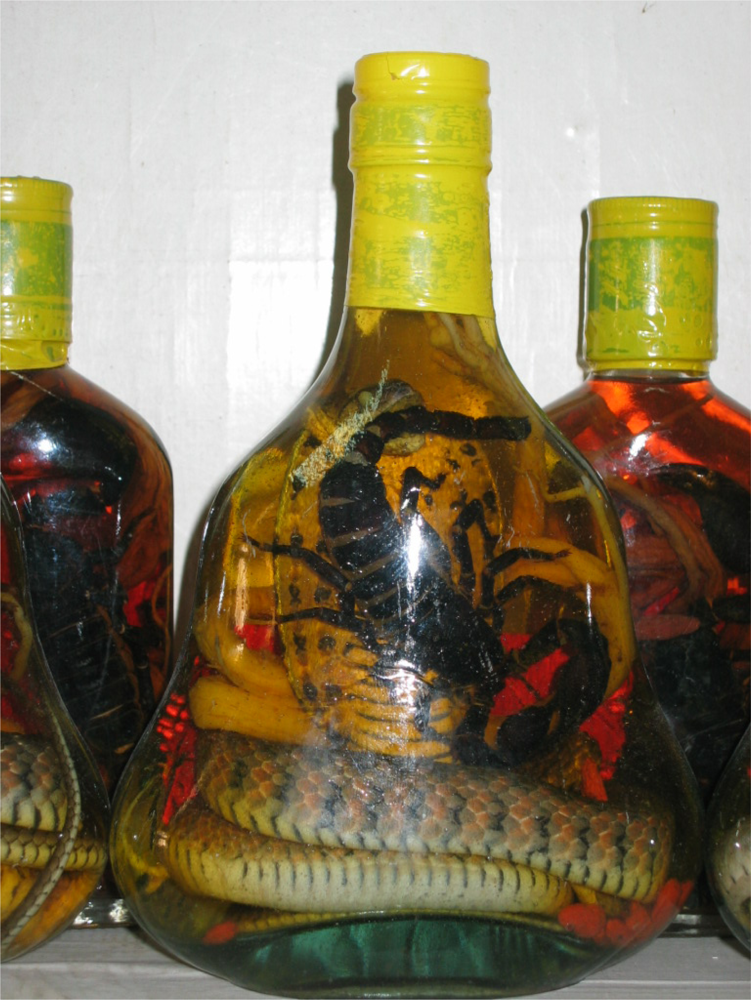
<p>Eleven samples of alcohol products were collected by one of the authors (PTHA) from local markets in Vietnam and subsequent chemical analyses were conducted; all samples were locally produced, see <xref ref-type="table" rid="t1-ijerph-06-02090">Table 1</xref> for details. Collection of alcohol products was based on a convenient sampling procedure aimed at obtaining products most popular with the population. Samples V03 and V05 are from the biggest, most popular manufacturers in the country, while V08 and V09 were homemade (traditionally produced) and are very popular in Vietnam. The designation “homemade” in this context does not mean that individuals prepared the alcohol for personal or family consumption. There are in fact some rural regions around Hanoi famous for producing specific homemade alcohols and providing them to the capital city via a system of commercial outlets, including local street markets, tea shops, or restaurants. Sample V11 was exceptional because it contained whole bodies of snake and scorpion soaked in alcohol (<xref ref-type="fig" rid="f1-ijerph-06-02090">Figure 1</xref>); it was also homemade. Small, local companies produced the other samples.</p></sec>
<sec>
<label>2.2.</label>
<title>Analytical Procedure</title>
<p>The parameters for chemical analysis were selected on a risk-oriented basis as described in previous studies [<xref ref-type="bibr" rid="b16-ijerph-06-02090">16</xref>,<xref ref-type="bibr" rid="b25-ijerph-06-02090">25</xref>,<xref ref-type="bibr" rid="b28-ijerph-06-02090">28</xref>]. Alcoholic strength was determined by Fourier Transform Infrared (FTIR) spectroscopy [<xref ref-type="bibr" rid="b29-ijerph-06-02090">29</xref>]. The analysis for volatile components was based on the European Community Reference Methods for the Analysis of Spirits using gas chromatography (GC) with a flame-ionization detector (FID) [<xref ref-type="bibr" rid="b30-ijerph-06-02090">30</xref>]. Additional details on the GC-FID procedure are published elsewhere [<xref ref-type="bibr" rid="b31-ijerph-06-02090">31</xref>]. Ethyl carbamate (urethane) was determined using GC with tandem mass spectrometry (GC-MS/MS) [<xref ref-type="bibr" rid="b32-ijerph-06-02090">32</xref>]. Anionic composition was analyzed using ion chromatography [<xref ref-type="bibr" rid="b33-ijerph-06-02090">33</xref>]. Conductivity was measured using the procedure outlined in Lachenmeier <italic>et al.</italic> [<xref ref-type="bibr" rid="b34-ijerph-06-02090">34</xref>]. Inorganic elements were analyzed using semi-quantitative inductively coupled plasma mass spectrometry (ICP-MS) after evaporation of the sample and re-constitution in ultrapure water. Furthermore, all samples were screened for unknown substances using GC with mass spectrometry (GC-MS).</p></sec>
<sec sec-type="results">
<label>2.3.</label>
<title>Indication of Results</title>
<p>Alcoholic strength is indicated by ‘percent by volume’ (% vol). In accordance with the procedure described in the European Community Reference Methods for the Analysis of Spirits, volatile compounds contained in the samples are expressed by the unit ‘g/hL of pure alcohol’ or ‘g/hL of 100% vol alcohol’ (i.e., the concentrations are standardized in relation to alcoholic strength) [<xref ref-type="bibr" rid="b30-ijerph-06-02090">30</xref>]. This approach is superior to reporting in mg/L because the samples can be directly compared irrespective of their individual alcoholic strength. For clarity, we use the abbreviation ‘g/hL pa’. The results for the non-volatile components are presented as ‘mg/L’.</p></sec></sec>
<sec sec-type="results">
<label>3.</label>
<title>Results</title>
<p>The actual alcoholic strengths of the samples ranged from 29.5% vol to 76.7% vol. The highest alcoholic strength was found in the sample of alcohol that contained snakes and a scorpion (V11). Selected results from our chemical analyses are given in <xref ref-type="table" rid="t2-ijerph-06-02090">Table 2</xref>.</p>
<p>Methanol was detected in concentrations ranging from undetectable to 75 g/hL pa. Commercial samples labeled as vodka (e.g., samples V03 and V04) had the lowest methanol content, while higher levels were found in the brandy (V01) and rice alcohol (V10), and particularly the snake/scorpion-alcohol (V11) samples. In regards to levels of higher alcohols, content varied considerably between not detectable and 339 g/hL pa, a high variability was also found for ethyl acetate, ethyl lactate, and acetaldehyde.</p>
<p>The ICP/MS screening analysis for elemental composition showed that the most abundant elements, with concentrations in the mg/L range, were the alkali and alkaline earth metals, sodium, potassium, calcium, and magnesium. Other metals were found in traces below 1 mg/L.</p>
<p>The conductivities of the samples ranged from 1 μS/cm to 760 μS/cm. All samples were positive for chloride and sulphate, whereas nitrate and phosphate were detected only in some of the samples (<xref ref-type="table" rid="t2-ijerph-06-02090">Table 2</xref>).</p>
<p>Ethyl carbamate was only detected in the snake/scorpion-alcohol (V11) using GC-MS/MS (1.27 mg/L). During the multi-target screening analyses for unknown substances, conducted with GCMS, additional substances were also discovered solely in sample V11, where fatty acid ethyl esters such as ethyl palmitate, ethyl heptadecanoate, ethyl linoleate, ethyl oleate, ethyl stearate, ethyl arachidonate, were found in abundance, along with a number of sterols, with cholesterol being the most prominent.</p></sec>
<sec sec-type="discussion">
<label>4.</label>
<title>Discussion</title>
<sec>
<label>4.1.</label>
<title>Alcoholic Strength</title>
<p>The majority of samples (72%) had an alcohol content between 30% vol and 40% vol, which is in accordance with the typical strength of international commercial spirits. The only abnormalities were the homemade samples V09 (45.0% vol) and V10 (49.7% vol), as well as the notable snake/scorpion-alcohol sample V11 with the highest strength of 76.7% vol. From a public health perspective V10 appears to be the most troubling of the samples as the labeling gave an alcoholic strength of 30% vol, whereas 49.7% vol were in fact contained in the sample - nearly 60% more alcohol than what was labeled, which could lead to severe intoxication and overdose [<xref ref-type="bibr" rid="b2-ijerph-06-02090">2</xref>].</p>
<p>The snake/scorpion sample V11 is discussed in greater detail below, however it should be noted in this case that the high alcoholic strength may be needed in order to preserve the pickled animals and subsequently increase the product’s shelf life. The alcoholic strength was not labeled on the sample; yet according to the local people we questioned, the common consumers are principally comprised of alcohol-dependent people of the lower socio-economic classes, who are well aware of the very high alcohol potency. Nevertheless, such a high strength alcoholic beverage may have more pronounced detrimental health effects explained entirely by the presence of ethanol [<xref ref-type="bibr" rid="b2-ijerph-06-02090">2</xref>].</p></sec>
<sec>
<label>4.2.</label>
<title>Volatile Composition</title>
<p>Besides ethanol, our samples contained a number of volatile compounds, which are expected in products derived from alcoholic fermentation. Of these, methanol is the substance most often associated with the toxicity of surrogate and other alcohols [<xref ref-type="bibr" rid="b15-ijerph-06-02090">15</xref>]. As its presence was relatively low (i.e., lower than the European Union (EU) limit of 10 g/hL pa for vodka [<xref ref-type="bibr" rid="b35-ijerph-06-02090">35</xref>] in V01–V10), it would appear that in our samples, methanol content did not pose a threat to public health.</p>
<p>Acetaldehyde is a substance considered by the International Agency for Research on Cancer as ‘possibly carcinogenic to humans’ (IARC Group 2B) [<xref ref-type="bibr" rid="b38-ijerph-06-02090">38</xref>]. It is also regarded as an undesirable substance in spirits because of its unpleasant flavor. The acetaldehyde level in some of the samples was higher than the EU limit of 0.5 g/hL pa for vodka, but typical for spirits distilled under retention of the organoleptical properties of the raw materials (e.g., brandy, whisky, rum) [<xref ref-type="bibr" rid="b39-ijerph-06-02090">39</xref>]. The highest concentration of 19 g/hL pa, found in the homemade sample V10, can be considered typical for an artisanally produced spirit, as average acetaldehyde residues between 12 g/hL pa and 18 g/hL pa have been found, for example, in artisanal German fruit spirits [<xref ref-type="bibr" rid="b40-ijerph-06-02090">40</xref>].</p>
<p>Alcohol containing more than two carbon atoms is commonly called ‘higher’ or ‘fusel’ alcohol. Most higher alcohols are created as a byproduct of yeast fermentation and are an important flavor compound. In the EU, some spirits must have minimum contents of higher alcohols, whereas neutral alcohols such as vodka should be almost entirely free of higher alcohols (max. 0.5 g/hL pa) as well as of esters (max. 1.3 g/hL pa) [<xref ref-type="bibr" rid="b35-ijerph-06-02090">35</xref>]. In this sample group, two of the commercial vodkas (V04, V05) and the two homemade rice alcohols (V09, V10) were above the EU requirement for higher alcohols; the two homemade alcohols also above the requirement for esters. Conversely, the brandy (V01) and rum (V07) samples, were below the minimum EU requirements of 140 or 225 g/hL pa of higher alcohols, for the two groups of spirits respectively. In terms of higher alcohols, sample V10 was the most peculiar, as it had an extremely high content of higher alcohols. The high concentration of esters and ethyl lactate in this sample indicates probable hygienic deficiencies during fermentation (e.g., spoilage with acetic acid or lactic acid bacteria). The other homemade samples showed a surprisingly clean alcohol quality. In conclusion, none of the samples pose a public health risk due to the contents of higher alcohols [<xref ref-type="bibr" rid="b41-ijerph-06-02090">41</xref>].</p></sec>
<sec>
<label>4.3.</label>
<title>Non-Volatile Compounds and Water Quality</title>
<p>Because elements and ions are generally non-volatile, most of the inorganic content found in the spirits is derived from the dilution water used to adjust the distillate to drinking strength. Inorganic contamination may also occur during the use of the distillation equipment. Other than the snake sample discussed below, all the alcoholic beverages conformed to the EU drinking water requirements [<xref ref-type="bibr" rid="b37-ijerph-06-02090">37</xref>]. The conductivities of the samples and the contents of ions were relatively low, which suggests an overall sufficient water quality or treatment process. No toxic anions such as nitrates, or toxic metals including lead, cadmium, copper, antimony, or arsenic, were found in health relevant concentrations.</p></sec>
<sec>
<label>4.4.</label>
<title>Alcohol with Snakes and Scorpions – A Traditional Chinese Medicine?</title>
<p>The sample that was significant in nearly all analyzed parameters was sample V11, the alcohol containing pickled snakes (cobras) and a scorpion. Typically, the production of such products is comprised of the purchase of a live snake, usually from a street vender/shop or by pre-order, the snake is killed and then placed in a desired glass pot, which depends in volume, shape and style on the size of the snake. This process is carried out by both individuals in their homes, as well as by vendors in local markets in the presence of their customers, so usually there is no bottle label provided.</p>
<p>The use of snakes (e.g., cobras or other snakes) as human food is traditional in Asia [<xref ref-type="bibr" rid="b42-ijerph-06-02090">42</xref>]. The pickling of snakes in vinegar or in alcohol has been described as a common practice in China, mostly in and around Guangzhou (Canton) and in Taiwan; here the snake meat is used for dishes, while the liquid is seemingly only used for preservation purposes [<xref ref-type="bibr" rid="b43-ijerph-06-02090">43</xref>]. In the case of our sample however, the snake is not used for eating, but is used, along with the scorpion (including venomous ones), in order to provide an essence for purported medicinal benefit. This practice has its roots in Traditional Chinese Medicine (TCM), popular in Vietnam, where such an alcoholic beverage is used as a treatment for rheumatism and arthritis. In this system, it is believed that the more toxic the snake, the more beneficial; an example of this is “Dragon and Phoenix Wine”, a popular beverage in China, which is made using a venomous snake and a pheasant soaked in a distilled high-proof spirit [<xref ref-type="bibr" rid="b43-ijerph-06-02090">43</xref>].</p>
<p>There is only sparse information in the literature and there are no systematic studies, regarding whether the snake or scorpion venoms consumed orally as TCM (or during food use) pose a threat to public health. It is unlikely that the venom glands have been separated before infusion in the alcohol, yet the venom might be denatured by the high-proof alcohol. Snake venom has also been described as being much less toxic when administered orally rather than intravenously because it may be broken down by the digestive enzymes of the gastrointestinal tract, as well as hydrolyzed by the acidic conditions [<xref ref-type="bibr" rid="b44-ijerph-06-02090">44</xref>,<xref ref-type="bibr" rid="b45-ijerph-06-02090">45</xref>]. Recent research has shown that the use of animal products as TCM may be justified, but little research has been done to prove the claimed clinical efficacy [<xref ref-type="bibr" rid="b46-ijerph-06-02090">46</xref>].</p>
<p>In our screening analysis of the sample, we only found constituents of the animal fat (e.g., fatty acid esters or cholesterol). However, as we did not know the exact species of the snake or scorpion, we could not search specifically for the venom. The complex proteins in snake venoms would most likely not have been identifiable with our analytical methodologies anyway. Therefore, the slight possibility for a health risk of the product remains, even if intoxications of humans from snakes and scorpions in the food chain, to our knowledge, have never been reported. Besides the animal constituents, the sample contained a comparably high concentration of methanol, which, however, is still much below toxic concentrations [<xref ref-type="bibr" rid="b47-ijerph-06-02090">47</xref>]. Another exceptional characteristic of the snake/scorpion sample was the high conductivity and chloride level, which may be explained by the diffusion of chloride and other ions from the animals into the liquid or insufficient water quality. However, no anions or metals posing health risk were found in the snake sample (e.g., nitrate, lead, antimony, arsenic were below the EU maximum levels [<xref ref-type="bibr" rid="b37-ijerph-06-02090">37</xref>]).</p>
<p>An important finding is that the snake/scorpion alcohol also contained ethyl carbamate (urethane), a ‘probably carcinogenic’ substance (IARC Group 2A) [<xref ref-type="bibr" rid="b48-ijerph-06-02090">48</xref>], in relatively high concentrations above the Canadian limit [<xref ref-type="bibr" rid="b36-ijerph-06-02090">36</xref>]. Ethyl carbamate may contribute to carcinogenicity of alcoholic beverages [<xref ref-type="bibr" rid="b49-ijerph-06-02090">49</xref>] due to the synergistic effects between ethanol, ethyl carbamate and other possible carcinogenic contaminants of foods that are co-ingested with alcoholic beverages [<xref ref-type="bibr" rid="b50-ijerph-06-02090">50</xref>]. This is a surprising finding as ethyl carbamate is generally found in such high concentrations only in stone-fruit spirits [<xref ref-type="bibr" rid="b51-ijerph-06-02090">51</xref>]. The possibility cannot be excluded that some constituent of the snake or scorpion (e.g., nitrogen compounds or amino acids) may react with ethanol to form ethyl carbamate. The formation mechanism in this special kind of alcoholic beverages is far from clear, and requires further investigation.</p></sec></sec>
<sec sec-type="conclusions">
<label>5.</label>
<title>Conclusions</title>
<p>Our research provides the first insight into the quality of alcohol in the markets and street shops in Vietnam. Overall, the quality of the homemade and industrially produced samples was relatively high. Specifically, except for ethanol, no compounds that may lead to acute toxic effects were detected. Although some problems with product quality, production hygiene and labeling were found, this pilot study cannot state that alcoholic beverages, both homemade and industrial, produced in Vietnam are associated with health risks beyond those of alcoholic beverages in the rest of the world.</p>
<p>There are several methodological limitations to our study. First of all, only a limited number of samples were analyzed. Secondly, because of the convenience sampling strategy, our samples only provide a cross-section of the situation in the capital city of Vietnam, Hanoi, while unrecorded home production may be particularly prevalent in rural areas. Given the small sample size, it might have excluded problematic alcohol products that were widely consumed.</p>
<p>We consider our study a pilot project that serves as a foundation for future research on the relationship between alcohol quality and health outcomes, in Vietnam and Asia, as there is a great disparity between the plethora of issues to be investigated and the literature that exists.</p>
<p>Future research should focus on the collection of large, representative alcohol samples, and include both rural and urban regions. Given the extent of alcohol-attributable disease burden in Vietnam and Asia, it is disappointing that so little research has been conducted on the health consequences related to alcohol and its quality; additionally, more research on sources and patterns of consumption is needed. Particular focus should be placed on unrecorded sources (e.g., homemade alcohol), which showed some quality problems in our study, especially the standardization of alcoholic strength. Finally, case control analyses for the most prevalent chronic and acute alcohol-related disease groups [<xref ref-type="bibr" rid="b2-ijerph-06-02090">2</xref>], including chemical analyses of alcohol products, should be conducted.</p></sec></body>
<back>
<ack>
<p>The laboratory analyses were supervised by K. Schöberl (ICP/MS), E.-M. Sohnius (GC-FID), T. Kuballa (GC-MS and GC-MS/MS), and R. Attig (IC). The authors thank H. Heger, M. Jaworski, H. Havel, K. Müller and G. Bippes for excellent technical assistance.</p></ack>
<ref-list>
<title>References and Notes</title>
<ref id="b1-ijerph-06-02090"><label>1.</label><citation citation-type="book"><source>WHO Country Cooperation Strategy 2003–2006</source><publisher-name>World Health Organization Viet Nam Country Office</publisher-name><publisher-loc>Ha Noi, Vietnam</publisher-loc><year>2007</year></citation></ref>
<ref id="b2-ijerph-06-02090"><label>2.</label><citation citation-type="journal"><person-group person-group-type="author"><name><surname>Rehm</surname><given-names>J</given-names></name><name><surname>Room</surname><given-names>R</given-names></name><name><surname>Graham</surname><given-names>K</given-names></name><name><surname>Monteiro</surname><given-names>M</given-names></name><name><surname>Gmel</surname><given-names>G</given-names></name><name><surname>Sempos</surname><given-names>CT</given-names></name></person-group><article-title>The relationship of average volume of alcohol consumption and patterns of drinking to burden of disease: an overview</article-title><source>Addiction</source><year>2003</year><volume>98</volume><fpage>1209</fpage><lpage>1228</lpage><pub-id pub-id-type="doi">10.1046/j.1360-0443.2003.00467.x</pub-id><pub-id pub-id-type="pmid">12930209</pub-id></citation></ref>
<ref id="b3-ijerph-06-02090"><label>3.</label><citation citation-type="book"><person-group person-group-type="author"><name><surname>Thiem</surname><given-names>NV</given-names></name></person-group><source>Alcohol abuse and mental health. National Workshop on Mental Health Care and Suicide Prevention (Lam dung ruou va sic khoe fam than. Hoi thau quoc gia ve cham soc suc khoe tam than vo phong chong tu tu) (in Vietnamese)</source><publisher-name>Ministry of Health of Vietnam</publisher-name><publisher-loc>Hue, Vietnam</publisher-loc><year>2004</year></citation></ref>
<ref id="b4-ijerph-06-02090"><label>4.</label><citation citation-type="journal"><person-group person-group-type="author"><name><surname>Ha</surname><given-names>MV</given-names></name></person-group><article-title>Some peculiarities of hepatobiliary diseases in Vietnam</article-title><source>J. Gastroenterol. Hepatol</source><year>1997</year><volume>12</volume><fpage>S15</fpage><lpage>S18</lpage><pub-id pub-id-type="doi">10.1111/j.1440-1746.1997.tb00438.x</pub-id><pub-id pub-id-type="pmid">9195396</pub-id></citation></ref>
<ref id="b5-ijerph-06-02090"><label>5.</label><citation citation-type="journal"><person-group person-group-type="author"><name><surname>Cordier</surname><given-names>S</given-names></name><name><surname>Le</surname><given-names>TB</given-names></name><name><surname>Verger</surname><given-names>P</given-names></name><name><surname>Bard</surname><given-names>D</given-names></name><name><surname>Le</surname><given-names>CD</given-names></name><name><surname>Larouze</surname><given-names>B</given-names></name><name><surname>Dazza</surname><given-names>MC</given-names></name><name><surname>Hoang</surname><given-names>TQ</given-names></name><name><surname>Abenhaim</surname><given-names>L</given-names></name></person-group><article-title>Viral infections and chemical exposures as risk factors for hepatocellular carcinoma in Vietnam</article-title><source>Int. J. Cancer</source><year>1993</year><volume>55</volume><fpage>196</fpage><lpage>201</lpage><pub-id pub-id-type="doi">10.1002/ijc.2910550205</pub-id><pub-id pub-id-type="pmid">7690345</pub-id></citation></ref>
<ref id="b6-ijerph-06-02090"><label>6.</label><citation citation-type="web"><source>Tai nạn giao thông: 62% số nạn nhân có độ cồn trong máu</source><comment>Available online: <ext-link xlink:href="http://www.laodong.com.vn/Home/Tai-nan-giao-thong-62-so-nan-nhan-co-do-con-trong-mau/20093/131547.laodong" ext-link-type="uri">http://www.laodong.com.vn/Home/Tai-nan-giao-thong-62-so-nan-nhan-co-do-con-trong-mau/20093/131547.laodong</ext-link> (accessed 19 July 2009).</comment></citation></ref>
<ref id="b7-ijerph-06-02090"><label>7.</label><citation citation-type="journal"><person-group person-group-type="author"><name><surname>Phung</surname><given-names>DT</given-names></name><name><surname>Nguyen</surname><given-names>HT</given-names></name><name><surname>Mock</surname><given-names>C</given-names></name><name><surname>Keifer</surname><given-names>M</given-names></name></person-group><article-title>Occupational injuries reported in a population-based injury survey in Vietnam</article-title><source>Int. J. Occup. Environ. Health</source><year>2008</year><volume>14</volume><fpage>35</fpage><lpage>44</lpage><pub-id pub-id-type="pmid">18320730</pub-id></citation></ref>
<ref id="b8-ijerph-06-02090"><label>8.</label><citation citation-type="journal"><person-group person-group-type="author"><name><surname>Thuy</surname><given-names>NT</given-names></name><name><surname>Lindan</surname><given-names>CP</given-names></name><name><surname>Phong</surname><given-names>TH</given-names></name><name><surname>Van</surname><given-names>D</given-names></name><name><surname>Nhung</surname><given-names>VT</given-names></name><name><surname>Barclay</surname><given-names>J</given-names></name><name><surname>Khiem</surname><given-names>HB</given-names></name></person-group><article-title>Predictors of visits to commercial sex workers by male attendees at sexually transmitted disease clinics in southern Vietnam</article-title><source>AIDS</source><year>1999</year><volume>13</volume><fpage>719</fpage><lpage>725</lpage><pub-id pub-id-type="doi">10.1097/00002030-199904160-00013</pub-id><pub-id pub-id-type="pmid">10397567</pub-id></citation></ref>
<ref id="b9-ijerph-06-02090"><label>9.</label><citation citation-type="journal"><person-group person-group-type="author"><name><surname>Kaljee</surname><given-names>LM</given-names></name><name><surname>Genberg</surname><given-names>BL</given-names></name><name><surname>Minh</surname><given-names>TT</given-names></name><name><surname>Tho</surname><given-names>LH</given-names></name><name><surname>Thoa</surname><given-names>LT</given-names></name><name><surname>Stanton</surname><given-names>B</given-names></name></person-group><article-title>Alcohol use and HIV risk behaviors among rural adolescents in Khanh Hoa Province Viet Nam</article-title><source>Health Educ. Res</source><year>2005</year><volume>20</volume><fpage>71</fpage><lpage>80</lpage><pub-id pub-id-type="pmid">15198997</pub-id></citation></ref>
<ref id="b10-ijerph-06-02090"><label>10.</label><citation citation-type="journal"><person-group person-group-type="author"><name><surname>Rehm</surname><given-names>J</given-names></name><name><surname>Mathers</surname><given-names>C</given-names></name><name><surname>Popova</surname><given-names>S</given-names></name><name><surname>Thavorncharoensap</surname><given-names>M</given-names></name><name><surname>Teerawattananon</surname><given-names>Y</given-names></name><name><surname>Patra</surname><given-names>J</given-names></name></person-group><article-title>Global burden of disease and injury and economic cost attributable to alcohol use and alcohol use disorders</article-title><source>Lancet</source><year>2009</year><volume>373</volume><fpage>2223</fpage><lpage>2233</lpage><pub-id pub-id-type="doi">10.1016/S0140-6736(09)60746-7</pub-id><pub-id pub-id-type="pmid">19560604</pub-id></citation></ref>
<ref id="b11-ijerph-06-02090"><label>11.</label><citation citation-type="web"><article-title>Alcohol epidemiology and monitoring</article-title><comment>Available online: <ext-link xlink:href="http://www.who.int/substance_abuse/activities/gad/en/" ext-link-type="uri">http://www.who.int/substance_abuse/activities/gad/en/</ext-link> (accessed 19 July 2009).</comment></citation></ref>
<ref id="b12-ijerph-06-02090"><label>12.</label><citation citation-type="book"><person-group person-group-type="author"><collab>WHO</collab></person-group><source>Global Status Report on Alcohol</source><publisher-name>World Health Organization</publisher-name><publisher-loc>Geneva, Switzerland</publisher-loc><year>2004</year></citation></ref>
<ref id="b13-ijerph-06-02090"><label>13.</label><citation citation-type="journal"><person-group person-group-type="author"><name><surname>Giang</surname><given-names>KB</given-names></name><name><surname>Allebeck</surname><given-names>P</given-names></name><name><surname>Spak</surname><given-names>F</given-names></name><name><surname>Minh</surname><given-names>HV</given-names></name><name><surname>Dzung</surname><given-names>TV</given-names></name></person-group><article-title>Alcohol use and alcohol consumption-related problems in rural Vietnam: an epidemiological survey using AUDIT</article-title><source>Subst. Use Misuse</source><year>2008</year><volume>43</volume><fpage>481</fpage><lpage>495</lpage><pub-id pub-id-type="doi">10.1080/10826080701208111</pub-id><pub-id pub-id-type="pmid">18365945</pub-id></citation></ref>
<ref id="b14-ijerph-06-02090"><label>14.</label><citation citation-type="book"><person-group person-group-type="author"><name><surname>Babor</surname><given-names>TF</given-names></name><name><surname>Biddle-Higgins</surname><given-names>JC</given-names></name><name><surname>Saunders</surname><given-names>JB</given-names></name><name><surname>Monteiro</surname><given-names>MG</given-names></name></person-group><article-title>AUDIT</article-title><source>The Alcohol Use Disorders Identification Test: Guidelines for Use in Primary Health Care</source><publisher-name>World Health Organization</publisher-name><publisher-loc>Geneva, Switzerland</publisher-loc><year>2001</year></citation></ref>
<ref id="b15-ijerph-06-02090"><label>15.</label><citation citation-type="journal"><person-group person-group-type="author"><name><surname>Lachenmeier</surname><given-names>DW</given-names></name><name><surname>Rehm</surname><given-names>J</given-names></name><name><surname>Gmel</surname><given-names>G</given-names></name></person-group><article-title>Surrogate alcohol: what do we know and where do we go?</article-title><source>Alcohol. Clin. Exp. Res</source><year>2007</year><volume>31</volume><fpage>1613</fpage><lpage>1624</lpage><pub-id pub-id-type="doi">10.1111/j.1530-0277.2007.00474.x</pub-id><pub-id pub-id-type="pmid">17681034</pub-id></citation></ref>
<ref id="b16-ijerph-06-02090"><label>16.</label><citation citation-type="journal"><person-group person-group-type="author"><name><surname>Lachenmeier</surname><given-names>DW</given-names></name><name><surname>Sarsh</surname><given-names>B</given-names></name><name><surname>Rehm</surname><given-names>J</given-names></name></person-group><article-title>The composition of alcohol products from markets in Lithuania and Hungary, and potential health consequences: A pilot study</article-title><source>Alcohol Alcoholism</source><year>2009</year><volume>44</volume><fpage>93</fpage><lpage>102</lpage></citation></ref>
<ref id="b17-ijerph-06-02090"><label>17.</label><citation citation-type="journal"><person-group person-group-type="author"><name><surname>Peters</surname><given-names>EJ</given-names></name></person-group><article-title>Taste, taxes and technologies: Industrializing rice alcohol in northern Vietnam, 1902–1913</article-title><source>Fr. Hist. Stud</source><year>2004</year><volume>27</volume><fpage>569</fpage><lpage>600</lpage><pub-id pub-id-type="doi">10.1215/00161071-27-3-569</pub-id></citation></ref>
<ref id="b18-ijerph-06-02090"><label>18.</label><citation citation-type="journal"><person-group person-group-type="author"><name><surname>Dung</surname><given-names>NTP</given-names></name><name><surname>Rombouts</surname><given-names>FM</given-names></name><name><surname>Nout</surname><given-names>MJR</given-names></name></person-group><article-title>Characteristics of some traditional Vietnamese starch-based rice wine fermentation starters (men)</article-title><source>LWT Food Sci. Technol</source><year>2007</year><volume>40</volume><fpage>130</fpage><lpage>135</lpage><pub-id pub-id-type="doi">10.1016/j.lwt.2005.08.004</pub-id></citation></ref>
<ref id="b19-ijerph-06-02090"><label>19.</label><citation citation-type="journal"><person-group person-group-type="author"><name><surname>Chen</surname><given-names>T</given-names></name><name><surname>Ho</surname><given-names>CT</given-names></name></person-group><article-title>Past, present, and future of Chinese fermented food products</article-title><source>Food Rev. Int</source><year>1989</year><volume>5</volume><fpage>177</fpage><lpage>208</lpage><pub-id pub-id-type="doi">10.1080/87559128909540849</pub-id></citation></ref>
<ref id="b20-ijerph-06-02090"><label>20.</label><citation citation-type="book"><person-group person-group-type="author"><name><surname>Chen</surname><given-names>TC</given-names></name><name><surname>Tao</surname><given-names>M</given-names></name><name><surname>Cheng</surname><given-names>G</given-names></name></person-group><article-title>Perspectives on alcoholic beverages in China</article-title><source>Asian foods: science &amp; technology</source><person-group person-group-type="editor"><name><surname>Ang</surname><given-names>CYW</given-names></name><name><surname>Liu</surname><given-names>K</given-names></name><name><surname>Huang</surname><given-names>Y-W</given-names></name></person-group><publisher-name>Technomic Publishing Company</publisher-name><publisher-loc>Lancaster, PA, USA</publisher-loc><year>1999</year><fpage>383</fpage><lpage>408</lpage></citation></ref>
<ref id="b21-ijerph-06-02090"><label>21.</label><citation citation-type="journal"><person-group person-group-type="author"><name><surname>Dahal</surname><given-names>NR</given-names></name><name><surname>Karki</surname><given-names>TB</given-names></name><name><surname>Swamylingappa</surname><given-names>B</given-names></name><name><surname>Li</surname><given-names>Q</given-names></name><name><surname>Gu</surname><given-names>G</given-names></name></person-group><article-title>Traditional foods and beverages of Nepal - a review</article-title><source>Food Rev. Int</source><year>2005</year><volume>21</volume><fpage>1</fpage><lpage>25</lpage><pub-id pub-id-type="doi">10.1081/FRI-200040579</pub-id></citation></ref>
<ref id="b22-ijerph-06-02090"><label>22.</label><citation citation-type="journal"><person-group person-group-type="author"><name><surname>Yoshizawa</surname><given-names>K</given-names></name></person-group><article-title>Sake: production and flavor</article-title><source>Food Rev. Int</source><year>1999</year><volume>15</volume><fpage>83</fpage><lpage>107</lpage><pub-id pub-id-type="doi">10.1080/87559129909541178</pub-id></citation></ref>
<ref id="b23-ijerph-06-02090"><label>23.</label><citation citation-type="book"><person-group person-group-type="author"><name><surname>Minabe</surname><given-names>M</given-names></name></person-group><article-title>The development of spirits produced in Japan and other East Asian countries</article-title><source>Distilled Spirits: Tradition and Innovation</source><person-group person-group-type="editor"><name><surname>Bryce</surname><given-names>JH</given-names></name><name><surname>Stewart</surname><given-names>GG</given-names></name></person-group><publisher-name>Nottingham University Press</publisher-name><publisher-loc>Nottingham, UK</publisher-loc><year>2004</year><fpage>127</fpage><lpage>133</lpage></citation></ref>
<ref id="b24-ijerph-06-02090"><label>24.</label><citation citation-type="book"><person-group person-group-type="author"><name><surname>Bamforth</surname><given-names>CW</given-names></name></person-group><article-title>Sake</article-title><source>Food, fermentation and micro-organisms</source><person-group person-group-type="translator"><name><surname>Bamforth</surname><given-names>CW</given-names></name></person-group><publisher-name>Blackwell Publishing</publisher-name><publisher-loc>Oxford, UK</publisher-loc><year>2005</year><fpage>143</fpage><lpage>153</lpage></citation></ref>
<ref id="b25-ijerph-06-02090"><label>25.</label><citation citation-type="journal"><person-group person-group-type="author"><name><surname>Ejim</surname><given-names>OS</given-names></name><name><surname>Brands</surname><given-names>B</given-names></name><name><surname>Rehm</surname><given-names>J</given-names></name><name><surname>Lachenmeier</surname><given-names>DW</given-names></name></person-group><article-title>Composition of surrogate alcohol from South-Eastern Nigeria</article-title><source>Afr. J. Drug Alcohol Stud</source><year>2007</year><volume>6</volume><fpage>65</fpage><lpage>74</lpage></citation></ref>
<ref id="b26-ijerph-06-02090"><label>26.</label><citation citation-type="journal"><person-group person-group-type="author"><name><surname>Lachenmeier</surname><given-names>DW</given-names></name><name><surname>Kanteres</surname><given-names>F</given-names></name><name><surname>Kuballa</surname><given-names>T</given-names></name><name><surname>López</surname><given-names>MG</given-names></name><name><surname>Rehm</surname><given-names>J</given-names></name></person-group><article-title>Ethyl Carbamate in Alcoholic Beverages from Mexico (Tequila, Mezcal, Bacanora, Sotol) and Guatemala (Cuxa): Market Survey and Risk Assessment</article-title><source>Int. J. Environ. Res. Public Health</source><year>2009</year><volume>6</volume><fpage>349</fpage><lpage>360</lpage><pub-id pub-id-type="doi">10.3390/ijerph6010349</pub-id><pub-id pub-id-type="pmid">19440288</pub-id></citation></ref>
<ref id="b27-ijerph-06-02090"><label>27.</label><citation citation-type="journal"><person-group person-group-type="author"><name><surname>Kanteres</surname><given-names>F</given-names></name><name><surname>Lachenmeier</surname><given-names>DW</given-names></name><name><surname>Rehm</surname><given-names>J</given-names></name></person-group><article-title>Alcohol in Mayan Guatemala: consumption, distribution, production and composition of cuxa</article-title><source>Addiction</source><year>2009</year><volume>104</volume><fpage>752</fpage><lpage>759</lpage><pub-id pub-id-type="doi">10.1111/j.1360-0443.2009.02507.x</pub-id><pub-id pub-id-type="pmid">19215596</pub-id></citation></ref>
<ref id="b28-ijerph-06-02090"><label>28.</label><citation citation-type="journal"><person-group person-group-type="author"><name><surname>Lachenmeier</surname><given-names>DW</given-names></name><name><surname>Ganss</surname><given-names>S</given-names></name><name><surname>Rychlak</surname><given-names>B</given-names></name><name><surname>Rehm</surname><given-names>J</given-names></name><name><surname>Sulkowska</surname><given-names>U</given-names></name><name><surname>Skiba</surname><given-names>M</given-names></name><name><surname>Zatonski</surname><given-names>W</given-names></name></person-group><article-title>Association between quality of cheap and unrecorded alcohol products and public health consequences in Poland</article-title><source>Alcohol Clin Exp Res</source></citation></ref>
<ref id="b29-ijerph-06-02090"><label>29.</label><citation citation-type="journal"><person-group person-group-type="author"><name><surname>Lachenmeier</surname><given-names>DW</given-names></name></person-group><article-title>Rapid quality control of spirit drinks and beer using multivariate data analysis of Fourier transform infrared spectra</article-title><source>Food Chem</source><year>2007</year><volume>101</volume><fpage>825</fpage><lpage>832</lpage><pub-id pub-id-type="doi">10.1016/j.foodchem.2005.12.032</pub-id></citation></ref>
<ref id="b30-ijerph-06-02090"><label>30.</label><citation citation-type="journal"><person-group person-group-type="author"><collab>European Commission</collab></person-group><article-title>Commission Regulation (EC) No 2870/2000 laying down Community reference methods for the analysis of spirits drinks</article-title><source>Off. J. Europ. Comm</source><year>2000</year><volume>L333</volume><fpage>20</fpage><lpage>46</lpage></citation></ref>
<ref id="b31-ijerph-06-02090"><label>31.</label><citation citation-type="journal"><person-group person-group-type="author"><name><surname>Lachenmeier</surname><given-names>DW</given-names></name><name><surname>Sohnius</surname><given-names>E-M</given-names></name><name><surname>Attig</surname><given-names>R</given-names></name><name><surname>López</surname><given-names>MG</given-names></name></person-group><article-title>Quantification of selected volatile constituents and anions in mexican Agave spirits (Tequila, Mezcal, Sotol. Bacanora)</article-title><source>J. Agric. Food Chem</source><year>2006</year><volume>54</volume><fpage>3911</fpage><lpage>3915</lpage><pub-id pub-id-type="doi">10.1021/jf060094h</pub-id><pub-id pub-id-type="pmid">16719514</pub-id></citation></ref>
<ref id="b32-ijerph-06-02090"><label>32.</label><citation citation-type="journal"><person-group person-group-type="author"><name><surname>Lachenmeier</surname><given-names>DW</given-names></name><name><surname>Frank</surname><given-names>W</given-names></name><name><surname>Kuballa</surname><given-names>T</given-names></name></person-group><article-title>Application of tandem mass spectrometry combined with gas chromatography to the routine analysis of ethyl carbamate in stone-fruit spirits</article-title><source>Rapid Commun. Mass Spectrom</source><year>2005</year><volume>19</volume><fpage>108</fpage><lpage>112</lpage><pub-id pub-id-type="doi">10.1002/rcm.1755</pub-id><pub-id pub-id-type="pmid">15593063</pub-id></citation></ref>
<ref id="b33-ijerph-06-02090"><label>33.</label><citation citation-type="journal"><person-group person-group-type="author"><name><surname>Lachenmeier</surname><given-names>DW</given-names></name><name><surname>Attig</surname><given-names>R</given-names></name><name><surname>Frank</surname><given-names>W</given-names></name><name><surname>Athanasakis</surname><given-names>C</given-names></name></person-group><article-title>The use of ion chromatography to detect adulteration of vodka and rum</article-title><source>Eur. Food Res. Technol</source><year>2003</year><volume>218</volume><fpage>105</fpage><lpage>110</lpage><pub-id pub-id-type="doi">10.1007/s00217-003-0799-8</pub-id></citation></ref>
<ref id="b34-ijerph-06-02090"><label>34.</label><citation citation-type="journal"><person-group person-group-type="author"><name><surname>Lachenmeier</surname><given-names>DW</given-names></name><name><surname>Schmidt</surname><given-names>B</given-names></name><name><surname>Bretschneider</surname><given-names>T</given-names></name></person-group><article-title>Rapid and mobile brand authentication of vodka using conductivity measurement</article-title><source>Microchim. Acta</source><year>2008</year><volume>160</volume><fpage>283</fpage><lpage>289</lpage><pub-id pub-id-type="doi">10.1007/s00604-007-0825-9</pub-id></citation></ref>
<ref id="b35-ijerph-06-02090"><label>35.</label><citation citation-type="journal"><article-title>Regulation (EC) No 110/2008 of the European Parliament and of the Council of 15 January 2008 on the definition, description, presentation, labelling and the protection of geographical indications of spirit drinks and repealing Council Regulation (EEC) No 1576/89</article-title><source>Off. J. Europ. Union</source><year>2008</year><volume>L39</volume><fpage>16</fpage><lpage>54</lpage></citation></ref>
<ref id="b36-ijerph-06-02090"><label>36.</label><citation citation-type="book"><person-group person-group-type="author"><name><surname>Conacher</surname><given-names>HBS</given-names></name><name><surname>Page</surname><given-names>BD</given-names></name></person-group><article-title>Ethyl carbamate in alcoholic beverages: a canadian case history</article-title><source>Proceedings of Euro Food Tox II</source><publisher-name>European Society of Toxicology</publisher-name><publisher-loc>Schwerzenbach, Switzerland</publisher-loc><year>1986</year><fpage>237</fpage><lpage>242</lpage></citation></ref>
<ref id="b37-ijerph-06-02090"><label>37.</label><citation citation-type="journal"><person-group person-group-type="author"><collab>European Council</collab></person-group><article-title>Council Directive 98/83/EC on the quality of water intended for human consumption</article-title><source>Off. J. Europ. Comm</source><year>1998</year><volume>L330</volume><fpage>32</fpage><lpage>54</lpage></citation></ref>
<ref id="b38-ijerph-06-02090"><label>38.</label><citation citation-type="book"><person-group person-group-type="author"><collab>IARC</collab></person-group><article-title>Acetaldehyde</article-title><source>IARC Monographs on the Evaluation of Carcinogenic Risks to Humans, Vol 71, Re-Evaluation of Some Organic Chemicals, Hydrazine and Hydrogen Peroxide</source><publisher-name>International Agency for Research on Cancer</publisher-name><publisher-loc>Lyon, France</publisher-loc><year>1999</year></citation></ref>
<ref id="b39-ijerph-06-02090"><label>39.</label><citation citation-type="journal"><person-group person-group-type="author"><name><surname>Lachenmeier</surname><given-names>DW</given-names></name><name><surname>Sohnius</surname><given-names>E-M</given-names></name></person-group><article-title>The role of acetaldehyde outside ethanol metabolism in the carcinogenicity of alcoholic beverages: Evidence from a large chemical survey</article-title><source>Food Chem. Toxicol</source><year>2008</year><volume>46</volume><fpage>2903</fpage><lpage>2911</lpage><pub-id pub-id-type="doi">10.1016/j.fct.2008.05.034</pub-id><pub-id pub-id-type="pmid">18577414</pub-id></citation></ref>
<ref id="b40-ijerph-06-02090"><label>40.</label><citation citation-type="journal"><person-group person-group-type="author"><name><surname>Pieper</surname><given-names>HJ</given-names></name><name><surname>Rau</surname><given-names>T</given-names></name><name><surname>Eller</surname><given-names>T</given-names></name><name><surname>Volz</surname><given-names>A</given-names></name></person-group><article-title>A speedy method to determine acetaldehyde, with particular consideration being given to quality inspection in the manufacture of fruit spirits</article-title><source>Deut. Lebensm. Rundsch</source><year>1987</year><volume>83</volume><fpage>35</fpage><lpage>41</lpage></citation></ref>
<ref id="b41-ijerph-06-02090"><label>41.</label><citation citation-type="journal"><person-group person-group-type="author"><name><surname>Lachenmeier</surname><given-names>DW</given-names></name><name><surname>Haupt</surname><given-names>S</given-names></name><name><surname>Schulz</surname><given-names>K</given-names></name></person-group><article-title>Defining maximum levels of higher alcohols in alcoholic beverages and surrogate alcohol products</article-title><source>Regul. Toxicol. Pharmacol</source><year>2008</year><volume>50</volume><fpage>313</fpage><lpage>321</lpage><pub-id pub-id-type="doi">10.1016/j.yrtph.2007.12.008</pub-id><pub-id pub-id-type="pmid">18295386</pub-id></citation></ref>
<ref id="b42-ijerph-06-02090"><label>42.</label><citation citation-type="journal"><person-group person-group-type="author"><name><surname>Klemens</surname><given-names>MW</given-names></name><name><surname>Thorbjarnarson</surname><given-names>JB</given-names></name></person-group><article-title>Reptiles as a food resource</article-title><source>Biodivers. Conserv</source><year>1995</year><volume>4</volume><fpage>281</fpage><lpage>298</lpage><pub-id pub-id-type="doi">10.1007/BF00055974</pub-id></citation></ref>
<ref id="b43-ijerph-06-02090"><label>43.</label><citation citation-type="journal"><person-group person-group-type="author"><name><surname>Newman</surname><given-names>JM</given-names></name></person-group><article-title>Snake as medicine and food</article-title><source>Nutr. Today</source><year>2001</year><volume>36</volume><fpage>43</fpage><lpage>44</lpage><pub-id pub-id-type="doi">10.1097/00017285-200101000-00010</pub-id></citation></ref>
<ref id="b44-ijerph-06-02090"><label>44.</label><citation citation-type="book"><person-group person-group-type="author"><name><surname>Klaassen</surname><given-names>CD</given-names></name></person-group><source>Casarett &amp; Doull's Toxicology: The basic science of poisons</source><edition>6th ed</edition><publisher-name>McGraw-Hill</publisher-name><publisher-loc>New York, NY, USA</publisher-loc><year>2001</year></citation></ref>
<ref id="b45-ijerph-06-02090"><label>45.</label><citation citation-type="book"><person-group person-group-type="author"><name><surname>Timbrell</surname><given-names>J</given-names></name></person-group><source>Principles of biochemical toxicology</source><edition>3rd ed</edition><publisher-name>Taylor &amp; Francis</publisher-name><publisher-loc>London, UK</publisher-loc><year>2000</year></citation></ref>
<ref id="b46-ijerph-06-02090"><label>46.</label><citation citation-type="journal"><person-group person-group-type="author"><name><surname>Still</surname><given-names>J</given-names></name></person-group><article-title>Use of animal products in traditional Chinese medicine: environmental impact and health hazards</article-title><source>Complement. Ther. Med</source><year>2003</year><volume>11</volume><fpage>118</fpage><lpage>122</lpage><pub-id pub-id-type="doi">10.1016/S0965-2299(03)00055-4</pub-id><pub-id pub-id-type="pmid">12801499</pub-id></citation></ref>
<ref id="b47-ijerph-06-02090"><label>47.</label><citation citation-type="journal"><person-group person-group-type="author"><name><surname>Paine</surname><given-names>AJ</given-names></name><name><surname>Dayan</surname><given-names>AD</given-names></name></person-group><article-title>Defining a tolerable concentration of methanol in alcoholic drinks</article-title><source>Hum. Exp. Toxicol</source><year>2001</year><volume>20</volume><fpage>563</fpage><lpage>568</lpage><pub-id pub-id-type="doi">10.1191/096032701718620864</pub-id><pub-id pub-id-type="pmid">11926610</pub-id></citation></ref>
<ref id="b48-ijerph-06-02090"><label>48.</label><citation citation-type="book"><person-group person-group-type="author"><collab>IARC</collab></person-group><source>IARC Monographs on the Evaluation of Carcinogenic Risks to Humans, Vol. 96, Alcoholic Beverage Consumption and Ethyl Carbamate (Urethane)</source><publisher-name>IARC</publisher-name><publisher-loc>Lyon, France</publisher-loc><comment>in press.</comment></citation></ref>
<ref id="b49-ijerph-06-02090"><label>49.</label><citation citation-type="journal"><person-group person-group-type="author"><name><surname>Baan</surname><given-names>R</given-names></name><name><surname>Straif</surname><given-names>K</given-names></name><name><surname>Grosse</surname><given-names>Y</given-names></name><name><surname>Secretan</surname><given-names>B</given-names></name><name><surname>El Ghissassi</surname><given-names>F</given-names></name><name><surname>Bouvard</surname><given-names>V</given-names></name><name><surname>Altieri</surname><given-names>A</given-names></name><name><surname>Cogliano</surname><given-names>V</given-names></name><collab>WHO International Agency for Research on Cancer Monograph Working Group</collab></person-group><article-title>Carcinogenicity of alcoholic beverages</article-title><source>Lancet Oncol</source><year>2007</year><volume>8</volume><fpage>292</fpage><lpage>293</lpage><pub-id pub-id-type="doi">10.1016/S1470-2045(07)70099-2</pub-id><pub-id pub-id-type="pmid">17431955</pub-id></citation></ref>
<ref id="b50-ijerph-06-02090"><label>50.</label><citation citation-type="journal"><person-group person-group-type="author"><name><surname>Lachenmeier</surname><given-names>DW</given-names></name></person-group><article-title>Consequences of IARC re-evaluation of alcoholic beverage consumption and ethyl carbamate on food control</article-title><source>Deut. Lebensm. Rundsch</source><year>2007</year><volume>103</volume><fpage>307</fpage><lpage>311</lpage></citation></ref>
<ref id="b51-ijerph-06-02090"><label>51.</label><citation citation-type="journal"><person-group person-group-type="author"><name><surname>Lachenmeier</surname><given-names>DW</given-names></name><name><surname>Schehl</surname><given-names>B</given-names></name><name><surname>Kuballa</surname><given-names>T</given-names></name><name><surname>Frank</surname><given-names>W</given-names></name><name><surname>Senn</surname><given-names>T</given-names></name></person-group><article-title>Retrospective trends and current status of ethyl carbamate in German stone-fruit spirits</article-title><source>Food Addit. Contam</source><year>2005</year><volume>22</volume><fpage>397</fpage><lpage>405</lpage><pub-id pub-id-type="doi">10.1080/02652030500073360</pub-id><pub-id pub-id-type="pmid">16019810</pub-id></citation></ref></ref-list>
<sec sec-type="display-objects">
<title>Figure and Tables</title>
<fig id="f1-ijerph-06-02090" position="float">
<label>Figure 1.</label>
<caption>
<p>Homemade alcohol sample from Vietnam containing pickled snakes and a scorpion.</p></caption>
<graphic xlink:href="ijerph-06-02090f1.gif"/></fig>
<table-wrap id="t1-ijerph-06-02090" position="float">
<label>Table 1.</label>
<caption>
<p>Alcohol samples collected in Vietnam (Hanoi).</p></caption>
<table frame="box" rules="all">
<thead>
<tr>
<th valign="middle" align="center"><bold>Sample</bold></th>
<th valign="middle" align="center">V01</th>
<th valign="middle" align="center">V02</th>
<th valign="middle" align="center">V03</th>
<th valign="middle" align="center">V04</th>
<th valign="middle" align="center">V05</th>
<th valign="middle" align="center">V06</th>
<th valign="middle" align="center">V07</th>
<th valign="middle" align="center">V08</th>
<th valign="middle" align="center">V09</th>
<th valign="middle" align="center">V10</th>
<th valign="middle" align="center">V11</th></tr></thead>
<tbody>
<tr>
<td valign="middle" align="center"><bold>Description</bold> (Name of Beverage)</td>
<td valign="middle" align="center">Brandy (Napoleon XO)</td>
<td valign="middle" align="center">Whisky (Wall Street)</td>
<td valign="middle" align="center">Vodka (Sai Gon)</td>
<td valign="middle" align="center">Vodka (Ha Thanh)</td>
<td valign="middle" align="center">Vodka (Hanoi)</td>
<td valign="middle" align="center">Shochu (Yama)</td>
<td valign="middle" align="center">Rum (Chauvet Blanc)</td>
<td valign="middle" align="center">Rice alcohol (Sticky)</td>
<td valign="middle" align="center">Rice alcohol</td>
<td valign="middle" align="center">Traditional Rice alcohol (Ruou bau da)</td>
<td valign="middle" align="center">Alcohol with snakes and scorpion</td></tr>
<tr>
<td valign="middle" align="center"><bold>Type of alcohol</bold></td>
<td valign="middle" align="center">Commercial (Int. Alcohol Join venture Company (ISC))</td>
<td valign="middle" align="center">Commercial (Allied Commerce Vietnam)</td>
<td valign="middle" align="center">Commercial (Saigon Beer and alcohol and beverage Company)</td>
<td valign="middle" align="center">Commercial (Ha Thanh Beer, Alcohol and Beverage Company)</td>
<td valign="middle" align="center">Commercial (Hanoi Beer Company)</td>
<td valign="middle" align="center">Commercial (Five Stars Exp-Import Company)</td>
<td valign="middle" align="center">Commercial (Int. Alcohol Join venture Company (ISC))</td>
<td valign="middle" align="center">Homemade</td>
<td valign="middle" align="center">Homemade</td></tr>
<tr>
<td valign="middle" align="center"><bold>Labelled alcoholic strength [% vol]</bold></td>
<td valign="middle" align="center">39</td>
<td valign="middle" align="center">29.5</td>
<td valign="middle" align="center">30</td>
<td valign="middle" align="center">29.5</td>
<td valign="middle" align="center">29</td>
<td valign="middle" align="center">39</td>
<td valign="middle" align="center">29.5</td>
<td valign="middle" align="center">45</td>
<td valign="middle" align="center">30</td>
<td valign="middle" align="center">no label</td></tr></tbody></table></table-wrap>
<table-wrap id="t2-ijerph-06-02090" position="float">
<label>Table 2.</label>
<caption>
<p>Composition of Vietnamese alcohol products in comparison to international standards.</p></caption>
<table frame="box" rules="cols">
<thead>
<tr>
<th valign="middle" align="left"><bold>Component</bold></th>
<th valign="middle" align="center"><bold>V01</bold></th>
<th valign="middle" align="center"><bold>V02</bold></th>
<th valign="middle" align="center"><bold>V03</bold></th>
<th valign="middle" align="center"><bold>V04</bold></th>
<th valign="middle" align="center"><bold>V05</bold></th>
<th valign="middle" align="center"><bold>V06</bold></th>
<th valign="middle" align="center"><bold>V07</bold></th>
<th valign="middle" align="center"><bold>V08</bold></th>
<th valign="middle" align="center"><bold>V09</bold></th>
<th valign="middle" align="center"><bold>V10</bold></th>
<th valign="middle" align="center"><bold>V11</bold></th>
<th valign="middle" align="center"><bold>International Standards</bold></th></tr>
<tr>
<th valign="middle" align="center" colspan="13">
<hr/></th></tr></thead>
<tbody>
<tr>
<td valign="middle" align="left"><bold>Ethanol [% vol]</bold></td>
<td valign="middle" align="center">38.2</td>
<td valign="middle" align="center">39.3</td>
<td valign="middle" align="center">30.4</td>
<td valign="middle" align="center">29.5</td>
<td valign="middle" align="center">30.7</td>
<td valign="middle" align="center">30.2</td>
<td valign="middle" align="center">39.2</td>
<td valign="middle" align="center">30.8</td>
<td valign="middle" align="center">45.0</td>
<td valign="middle" align="center">49.7</td>
<td valign="middle" align="center">76.7</td>
<td valign="middle" align="center">–<xref ref-type="table-fn" rid="tfn1-ijerph-06-02090">a</xref></td></tr>
<tr>
<td valign="middle" align="left"><bold>Methanol [g/hL pa]</bold></td>
<td valign="middle" align="center">4.9</td>
<td valign="middle" align="center">1.2</td>
<td valign="middle" align="center">nd</td>
<td valign="middle" align="center">1.1</td>
<td valign="middle" align="center">3.3</td>
<td valign="middle" align="center">1.4</td>
<td valign="middle" align="center">1.6</td>
<td valign="middle" align="center">nd</td>
<td valign="middle" align="center">4.6</td>
<td valign="middle" align="center">75</td>
<td valign="middle" align="center">30 / 1,000 <xref ref-type="table-fn" rid="tfn2-ijerph-06-02090">b</xref></td></tr>
<tr>
<td valign="middle" align="left"><bold>Acetaldehyde [g/hL pa]</bold></td>
<td valign="middle" align="center">9.4</td>
<td valign="middle" align="center">6.4</td>
<td valign="middle" align="center">nd</td>
<td valign="middle" align="center">0.6</td>
<td valign="middle" align="center">nd</td>
<td valign="middle" align="center">14</td>
<td valign="middle" align="center">0.9</td>
<td valign="middle" align="center">1.2</td>
<td valign="middle" align="center">nd</td>
<td valign="middle" align="center">19</td>
<td valign="middle" align="center">13</td>
<td valign="middle" align="center">0.5 / no limit <xref ref-type="table-fn" rid="tfn2-ijerph-06-02090">b</xref></td></tr>
<tr>
<td valign="middle" align="left"><bold>1-Propanol [g/hL pa]</bold></td>
<td valign="middle" align="center">6.1</td>
<td valign="middle" align="center">7.2</td>
<td valign="middle" align="center">nd</td>
<td valign="middle" align="center">7.8</td>
<td valign="middle" align="center">0.8</td>
<td valign="middle" align="center">20</td>
<td valign="middle" align="center">30</td>
<td valign="middle" align="center">1.1</td>
<td valign="middle" align="center">nd</td>
<td valign="middle" align="center">43</td>
<td valign="middle" align="center">2.1</td>
<td valign="middle" align="center">–</td></tr>
<tr>
<td valign="middle" align="left"><bold>1-Butanol [g/hL pa]</bold></td>
<td valign="middle" align="center">nd</td>
<td valign="middle" align="center">0.5</td>
<td valign="middle" align="center">nd</td>
<td valign="middle" align="center">0.7</td>
<td valign="middle" align="center">nd</td>
<td valign="middle" align="center">–</td></tr>
<tr>
<td valign="middle" align="left"><bold>2-Butanol [g/hL pa]</bold></td>
<td valign="middle" align="center">nd</td>
<td valign="middle" align="center">0.6</td>
<td valign="middle" align="center">nd</td>
<td valign="middle" align="center">–</td></tr>
<tr>
<td valign="middle" align="left"><bold>Isobutanol [g/hL pa]</bold></td>
<td valign="middle" align="center">8.9</td>
<td valign="middle" align="center">12</td>
<td valign="middle" align="center">nd</td>
<td valign="middle" align="center">3.2</td>
<td valign="middle" align="center">0.5</td>
<td valign="middle" align="center">39.4</td>
<td valign="middle" align="center">3.2</td>
<td valign="middle" align="center">nd</td>
<td valign="middle" align="center">120</td>
<td valign="middle" align="center">nd</td>
<td valign="middle" align="center">–</td></tr>
<tr>
<td valign="middle" align="left"><bold>Amyl alcohols [g/hL pa]</bold></td>
<td valign="middle" align="center">15</td>
<td valign="middle" align="center">38</td>
<td valign="middle" align="center">nd</td>
<td valign="middle" align="center">0.6</td>
<td valign="middle" align="center">nd</td>
<td valign="middle" align="center">75</td>
<td valign="middle" align="center">11</td>
<td valign="middle" align="center">nd</td>
<td valign="middle" align="center">164</td>
<td valign="middle" align="center">0.5</td>
<td valign="middle" align="center">–</td></tr>
<tr>
<td valign="middle" align="left"><bold>1-Hexanol [g/hL pa]</bold></td>
<td valign="middle" align="center">nd</td>
<td valign="middle" align="center">0.5</td>
<td valign="middle" align="center">nd</td>
<td valign="middle" align="center">–</td></tr>
<tr>
<td valign="middle" align="left"><bold>2-Phenyl ethanol [g/hL pa]</bold></td>
<td valign="middle" align="center">nd</td>
<td valign="middle" align="center">11</td>
<td valign="middle" align="center">nd</td>
<td valign="middle" align="center">–</td></tr>
<tr>
<td valign="middle" align="left"><bold>Ethyl acetate [g/hL pa]</bold></td>
<td valign="middle" align="center">3.8</td>
<td valign="middle" align="center">4.6</td>
<td valign="middle" align="center">nd</td>
<td valign="middle" align="center">8.8</td>
<td valign="middle" align="center">0.7</td>
<td valign="middle" align="center">nd</td>
<td valign="middle" align="center">46</td>
<td valign="middle" align="center">12</td>
<td valign="middle" align="center">1.3 / no limit <xref ref-type="table-fn" rid="tfn2-ijerph-06-02090">b</xref></td></tr>
<tr>
<td valign="middle" align="left"><bold>Ethyl lactate [g/hL pa]</bold></td>
<td valign="middle" align="center">1.3</td>
<td valign="middle" align="center">0.8</td>
<td valign="middle" align="center">nd</td>
<td valign="middle" align="center">74</td>
<td valign="middle" align="center">2.6</td>
<td valign="middle" align="center">–</td></tr>
<tr>
<td valign="middle" align="left"><bold>Ethyl caprylate [g/hL pa]</bold></td>
<td valign="middle" align="center">nd</td>
<td valign="middle" align="center">0.5</td>
<td valign="middle" align="center">nd</td>
<td valign="middle" align="center">0.5</td>
<td valign="middle" align="center">nd</td>
<td valign="middle" align="center">–</td></tr>
<tr>
<td valign="middle" align="left"><bold>Sum of higher alcohols [g/hL pa]</bold></td>
<td valign="middle" align="center">30</td>
<td valign="middle" align="center">57</td>
<td valign="middle" align="center">nd</td>
<td valign="middle" align="center">12</td>
<td valign="middle" align="center">1.3</td>
<td valign="middle" align="center">135</td>
<td valign="middle" align="center">45</td>
<td valign="middle" align="center">1.1</td>
<td valign="middle" align="center">nd</td>
<td valign="middle" align="center">339</td>
<td valign="middle" align="center">2.6</td>
<td valign="middle" align="center">0.5 / no limit (minimum 200) <xref ref-type="table-fn" rid="tfn2-ijerph-06-02090">b</xref></td></tr>
<tr>
<td valign="middle" align="left"><bold>Ethyl carbamate [mg/L]</bold></td>
<td valign="middle" align="center">nd</td>
<td valign="middle" align="center">1.27</td>
<td valign="middle" align="center">0.4 <xref ref-type="table-fn" rid="tfn3-ijerph-06-02090">c</xref></td></tr>
<tr>
<td valign="middle" align="left"><bold>Conductivity [μS/cm]</bold></td>
<td valign="middle" align="center">36</td>
<td valign="middle" align="center">32</td>
<td valign="middle" align="center">16</td>
<td valign="middle" align="center">64</td>
<td valign="middle" align="center">1</td>
<td valign="middle" align="center">–</td>
<td valign="middle" align="center">9</td>
<td valign="middle" align="center">79</td>
<td valign="middle" align="center">0</td>
<td valign="middle" align="center">24</td>
<td valign="middle" align="center">760</td>
<td valign="middle" align="center">2,500 <xref ref-type="table-fn" rid="tfn4-ijerph-06-02090">d</xref></td></tr>
<tr>
<td valign="middle" align="left"><bold>Chloride [mg/L]</bold></td>
<td valign="middle" align="center">2.1</td>
<td valign="middle" align="center">3.2</td>
<td valign="middle" align="center">2.2</td>
<td valign="middle" align="center">0.5</td>
<td valign="middle" align="center">–</td>
<td valign="middle" align="center">0.7</td>
<td valign="middle" align="center">0.5</td>
<td valign="middle" align="center">0.7</td>
<td valign="middle" align="center">1.0</td>
<td valign="middle" align="center">296</td>
<td valign="middle" align="center">250 <xref ref-type="table-fn" rid="tfn4-ijerph-06-02090">d</xref></td></tr>
<tr>
<td valign="middle" align="left"><bold>Nitrate [mg/L]</bold></td>
<td valign="middle" align="center">nd</td>
<td valign="middle" align="center">0.9</td>
<td valign="middle" align="center">0.7</td>
<td valign="middle" align="center">0.6</td>
<td valign="middle" align="center">1.1</td>
<td valign="middle" align="center">–</td>
<td valign="middle" align="center">1.0</td>
<td valign="middle" align="center">0.7</td>
<td valign="middle" align="center">1.0</td>
<td valign="middle" align="center">nd</td>
<td valign="middle" align="center">50 <xref ref-type="table-fn" rid="tfn4-ijerph-06-02090">d</xref></td></tr>
<tr>
<td valign="middle" align="left"><bold>Phosphate [mg/L]</bold></td>
<td valign="middle" align="center">nd</td>
<td valign="middle" align="center">–</td>
<td valign="middle" align="center">nd</td>
<td valign="middle" align="center">22.7</td>
<td valign="middle" align="center">–</td></tr>
<tr>
<td valign="middle" align="left"><bold>Sulfate [mg/L</bold></td>
<td valign="middle" align="center">4.6</td>
<td valign="middle" align="center">3.8</td>
<td valign="middle" align="center">3.0</td>
<td valign="middle" align="center">2.5</td>
<td valign="middle" align="center">1.2</td>
<td valign="middle" align="center">–</td>
<td valign="middle" align="center">1.4</td>
<td valign="middle" align="center">0.8</td>
<td valign="middle" align="center">3.0</td>
<td valign="middle" align="center">1.8</td>
<td valign="middle" align="center">37.5</td>
<td valign="middle" align="center">250 <xref ref-type="table-fn" rid="tfn4-ijerph-06-02090">d</xref></td></tr></tbody></table>
<table-wrap-foot><fn id="tfn1-ijerph-06-02090">
<label><sup>a</sup></label>
<p>No international standard available;</p></fn><fn id="tfn2-ijerph-06-02090">
<label><sup>b</sup></label>
<p>EU spirit standards (maximum level for neutral alcohol/for fruit spirits) [<xref ref-type="bibr" rid="b35-ijerph-06-02090">35</xref>];</p></fn><fn id="tfn3-ijerph-06-02090">
<label><sup>c</sup></label>
<p>Canadian standard for ethyl carbamate in fruit brandies and liqueurs [<xref ref-type="bibr" rid="b36-ijerph-06-02090">36</xref>];</p></fn><fn id="tfn4-ijerph-06-02090">
<label><sup>d</sup></label>
<p>EU drinking water quality standards [<xref ref-type="bibr" rid="b37-ijerph-06-02090">37</xref>]; nd: not detected (detection limits: volatiles 0.5 g/hL pa, chloride 2 mg/L, nitrate 5 mg/L, phosphate 10 mg/L, sulfate 5 mg/L, ethyl carbamate 0.01 mg/L). Negative in all samples: benzyl alcohol, methyl acetate, benzyl acetate, ethyl benzoate, benzaldehyde.</p></fn></table-wrap-foot></table-wrap></sec></back></article>