<?xml version="1.0" encoding="UTF-8"?>
<!DOCTYPE article PUBLIC "-//NLM//DTD Journal Publishing DTD v2.3 20070202//EN" "journalpublishing.dtd">
<article xmlns:xlink="http://www.w3.org/1999/xlink" xml:lang="en" article-type="review-article">
<front>
<journal-meta>
<journal-id journal-id-type="publisher-id">101238455</journal-id>
<journal-title>International Journal of Environmental Research and Public Health</journal-title>
<issn pub-type="ppub">1661-7827</issn>
<issn pub-type="epub">1660-4601</issn>
<publisher>
<publisher-name>Molecular Diversity Preservation International (MDPI)</publisher-name></publisher></journal-meta>
<article-meta>
<article-id pub-id-type="doi">10.3390/ijerph6102585</article-id>
<article-id pub-id-type="publisher-id">ijerph-06-02585</article-id>
<article-categories>
<subj-group>
<subject>Review</subject></subj-group></article-categories>
<title-group>
<article-title>Vitamin D and Calcium Insufficiency-Related Chronic Diseases: an Emerging World-Wide Public Health Problem</article-title></title-group>
<contrib-group>
<contrib contrib-type="author">
<name><surname>Peterlik</surname><given-names>Meinrad</given-names></name><xref ref-type="aff" rid="af1-ijerph-06-02585">1</xref><xref ref-type="corresp" rid="c1-ijerph-06-02585">*</xref></contrib>
<contrib contrib-type="author">
<name><surname>Boonen</surname><given-names>Steven</given-names></name><xref ref-type="aff" rid="af2-ijerph-06-02585">2</xref></contrib>
<contrib contrib-type="author">
<name><surname>Cross</surname><given-names>Heide S.</given-names></name><xref ref-type="aff" rid="af1-ijerph-06-02585">1</xref></contrib>
<contrib contrib-type="author">
<name><surname>Lamberg-Allardt</surname><given-names>Christel</given-names></name><xref ref-type="aff" rid="af3-ijerph-06-02585">3</xref></contrib></contrib-group>
<aff id="af1-ijerph-06-02585">
<label>1</label>Department of Pathophysiology, Medical University of Vienna, Waehringer Guertel 18–20, A-1090, Vienna, Austria; E-Mail: 
<email>heide.cross@meduniwien.ac.at</email></aff>
<aff id="af2-ijerph-06-02585">
<label>2</label>Center for Metabolic Bone Diseases and Division of Geriatric Medicine, Leuven University, Universitaire Ziekenhuizen, Herestraat 49, B-3000, Leuven, Belgium; E-Mail: 
<email>steven.boonen@uz.kuleuven.ac.be</email></aff>
<aff id="af3-ijerph-06-02585">
<label>3</label>Department of Applied Chemistry and Microbiology, Calcium Research Unit, University of Helsinki, Agnes Sjobergin katu 2, F-00014 Helsinki, Finland; E-Mail: 
<email>christel.lamberg-allardt@helsinki.fi</email></aff>
<author-notes>
<corresp id="c1-ijerph-06-02585">
<label>*</label> Author to whom correspondence should be addressed; E-Mail: 
<email>meinrad.peterlik@meduniwien.ac.at</email>; Tel.: +43-6991-255-7874.</corresp></author-notes>
<pub-date pub-type="ppub">
<month>10</month>
<year>2009</year></pub-date>
<pub-date pub-type="epub">
<day>2</day>
<month>10</month>
<year>2009</year></pub-date>
<volume>6</volume>
<issue>10</issue>
<fpage>2585</fpage>
<lpage>2607</lpage>
<history>
<date date-type="received">
<day>2</day>
<month>9</month>
<year>2009</year></date>
<date date-type="accepted">
<day>28</day>
<month>9</month>
<year>2009</year></date></history>
<permissions>
<copyright-statement>© 2009 by the authors; licensee Molecular Diversity Preservation International, Basel, Switzerland.</copyright-statement>
<copyright-year>2009</copyright-year>
<license license-type="open-access" xlink:href="http://creativecommons.org/licenses/by/3.0">
<p>This article is an open-access article distributed under the terms and conditions of the Creative Commons Attribution license (http://creativecommons.org/licenses/by/3.0/).</p></license></permissions>
<abstract>
<p>Vitamin D and calcium insufficiencies are risk factors for multiple chronic diseases. Data from 46 recent studies from Europe, North America, South-East Asia and the South Pacific area clearly indicate that a low vitamin D status and inadequate calcium nutrition are highly prevalent in the general population (30–80%), affecting both genders. The extent of insufficiencies is particularly high in older populations, and in some geographical areas, also in children and in young women of child-bearing age, in ethnic minorities and immigrants, as well as in people of low socio-economic status. Enrichment of cereal grain products with vitamin D and calcium would be a viable approach to increase consumption and improve health outcomes in the general population worldwide.</p></abstract>
<kwd-group>
<kwd>vitamin D status</kwd>
<kwd>calcium intake</kwd>
<kwd>25-hydroxyvitamin D</kwd>
<kwd>1,25-dihydroxyvitamin D</kwd>
<kwd>calcium-sensing receptor</kwd>
<kwd>osteoporosis</kwd>
<kwd>colorectal cancer</kwd>
<kwd>breast cancer</kwd>
<kwd>prevention</kwd>
<kwd>food fortification</kwd></kwd-group></article-meta></front>
<body>
<sec sec-type="intro">
<label>1.</label>
<title>Introduction</title>
<p>It is common knowledge that an inadequate supply of vitamin D and calcium has negative effects on bone health at all ages, inasmuch as it causes rickets in infants, retards acquisition of an adequate bone mass during skeletal development in adolescents, and is finally responsible for accelerated bone loss in adulthood in both women and men, leading to the development of osteoporosis. Importantly, there is also evidence from epidemiological studies, clinical intervention trials as well as from studies with animal models of human diseases that a compromised vitamin D status and inadequate calcium nutrition are predisposing conditions for a great number of other diseases, including various types of cancer, chronic infectious, inflammatory and autoimmune diseases, metabolic disorders, as well as hypertension and cardiovascular diseases (<xref ref-type="table" rid="t1-ijerph-06-02585">Table 1</xref>; for details, [<xref ref-type="bibr" rid="b1-ijerph-06-02585">1</xref>–<xref ref-type="bibr" rid="b3-ijerph-06-02585">3</xref>]).</p></sec>
<sec>
<label>2.</label>
<title>Why a Low Vitamin D Status and a Nutritional Calcium Deficit are Risk Factors for many Chronic Diseases</title>
<p>Vitamin D comes from two sources in humans, it could either be synthesized in form of vitamin D<sub>3</sub> (cholecalciferol) under the influence of solar UV-B radiation in the epidermis, or be absorbed from the diet or from supplements and food additives, which in some countries may contain vitamin D<sub>2</sub> (ergocalciferol). In any form, vitamin D is transferred to the liver, where it is metabolized to 25-hydroxyvitamin D (25-(OH)D). The term 25-(OH)D is used to denote the sum of 25-(OH)D<sub>3</sub> and 25-(OH)D<sub>2</sub>. Thus, the plasma level of this metabolite reflects the sum of vitamin D from endogenous synthesis and from dietary intake, and is therefore a reliable indicator of an individual’s vitamin D status.</p>
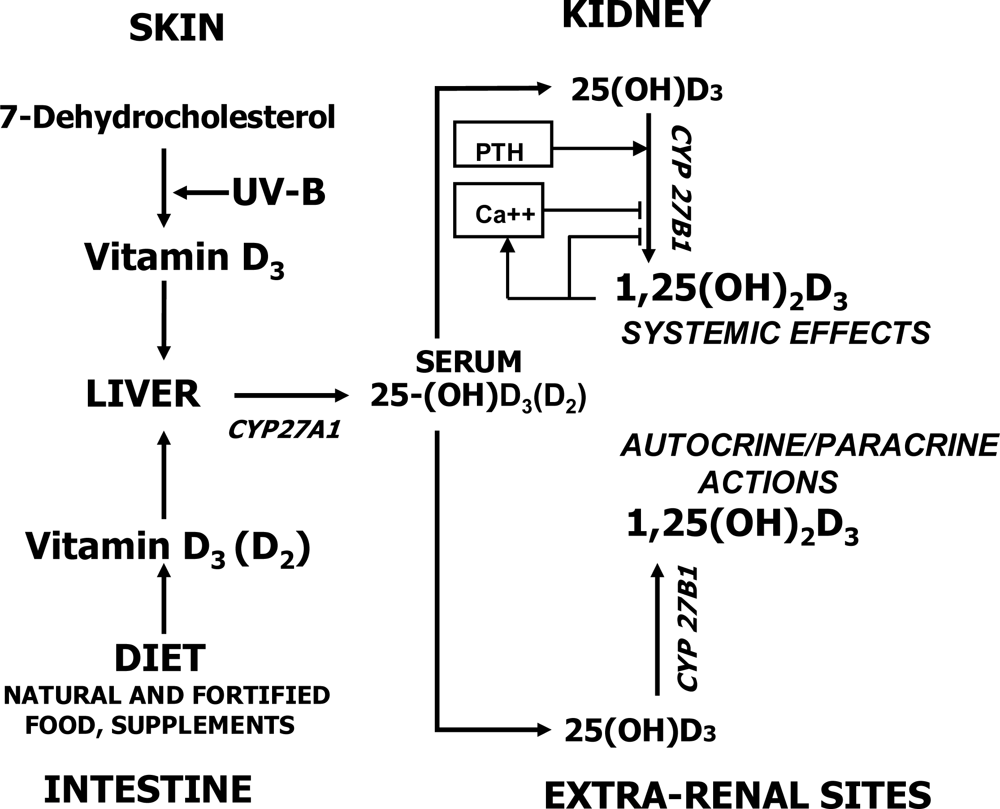
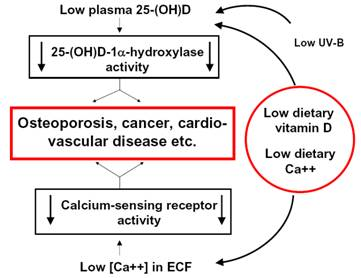
<p>Conversion of 25-(OH)D<sub>3</sub> to the biologically most active metabolite, 1,25-dihydroxyvitamin D<sub>3</sub> (1,25-(OH)<sub>2</sub>D<sub>3</sub>), is catalyzed by the <italic>CYP27B1</italic>-encoded enzyme, 25-(OH)D-1α-hydroxylase, and takes place predominantly in the kidney, but also at many extra-renal sites [<xref ref-type="bibr" rid="b4-ijerph-06-02585">4</xref>] (see <xref ref-type="fig" rid="f1-ijerph-06-02585">Figure 1</xref>): Examples are normal and neoplastic epithelial cells of the skin [<xref ref-type="bibr" rid="b5-ijerph-06-02585">5</xref>], of the gastrointestinal tract [<xref ref-type="bibr" rid="b6-ijerph-06-02585">6</xref>,<xref ref-type="bibr" rid="b7-ijerph-06-02585">7</xref>] and of female and male reproductive organs [<xref ref-type="bibr" rid="b8-ijerph-06-02585">8</xref>–<xref ref-type="bibr" rid="b10-ijerph-06-02585">10</xref>] as well as osteoblasts and osteoclasts [<xref ref-type="bibr" rid="b11-ijerph-06-02585">11</xref>,<xref ref-type="bibr" rid="b12-ijerph-06-02585">12</xref>] and cells of the vascular [<xref ref-type="bibr" rid="b13-ijerph-06-02585">13</xref>], the central nervous [<xref ref-type="bibr" rid="b14-ijerph-06-02585">14</xref>] and the immune system [<xref ref-type="bibr" rid="b15-ijerph-06-02585">15</xref>,<xref ref-type="bibr" rid="b16-ijerph-06-02585">16</xref>].</p>
<p>1,25-(OH)<sub>2</sub>D<sub>3</sub> bound to the nuclear high-affinity vitamin D receptor (VDR) functions as a transactivating regulator of gene expression. Circulating 1,25-(OH)<sub>2</sub>D<sub>3</sub>, which is produced by up to 90% in the kidney, plays a key role in <italic>systemic</italic> calcium and phosphate homeostasis by regulating ion fluxes in its classical target organs, i.e., small intestine, kidney and bone. 1,25-(OH)<sub>2</sub>D<sub>3</sub> is also an important <italic>local regulator</italic> of cellular proliferation, differentiation and function in many organs and cell systems that express the 25-(OH)D-1α-hydroxylase [<xref ref-type="bibr" rid="b4-ijerph-06-02585">4</xref>] (<xref ref-type="fig" rid="f1-ijerph-06-02585">Figure 1</xref>). The extent of intracellular synthesis of 1,25-(OH)<sub>2</sub>D<sub>3</sub> at extra-renal sites depends largely on ambient 25-(OH)D<sub>3</sub> levels and is not associated with circulating 1,25-(OH)<sub>2</sub>D<sub>3</sub> concentrations (e.g., [<xref ref-type="bibr" rid="b17-ijerph-06-02585">17</xref>]). Therefore, at low serum levels of 25-(OH)D, 25-(OH)D-1α-hydroxylase activity may not be sufficient to maintain tissue concentrations of 1,25-(OH)<sub>2</sub>D<sub>3</sub> necessary for efficient autocrine/paracrine regulation of cellular growth and function. This explains why many chronic diseases, as listed in <xref ref-type="table" rid="t1-ijerph-06-02585">Table 1</xref>, show significant negative associations with serum 25-(OH)D [<xref ref-type="bibr" rid="b1-ijerph-06-02585">1</xref>,<xref ref-type="bibr" rid="b3-ijerph-06-02585">3</xref>,<xref ref-type="bibr" rid="b18-ijerph-06-02585">18</xref>]. Importantly, low serum 25-(OH)D has been shown to be a reliable predictor of all-cause mortality [<xref ref-type="bibr" rid="b19-ijerph-06-02585">19</xref>].</p>
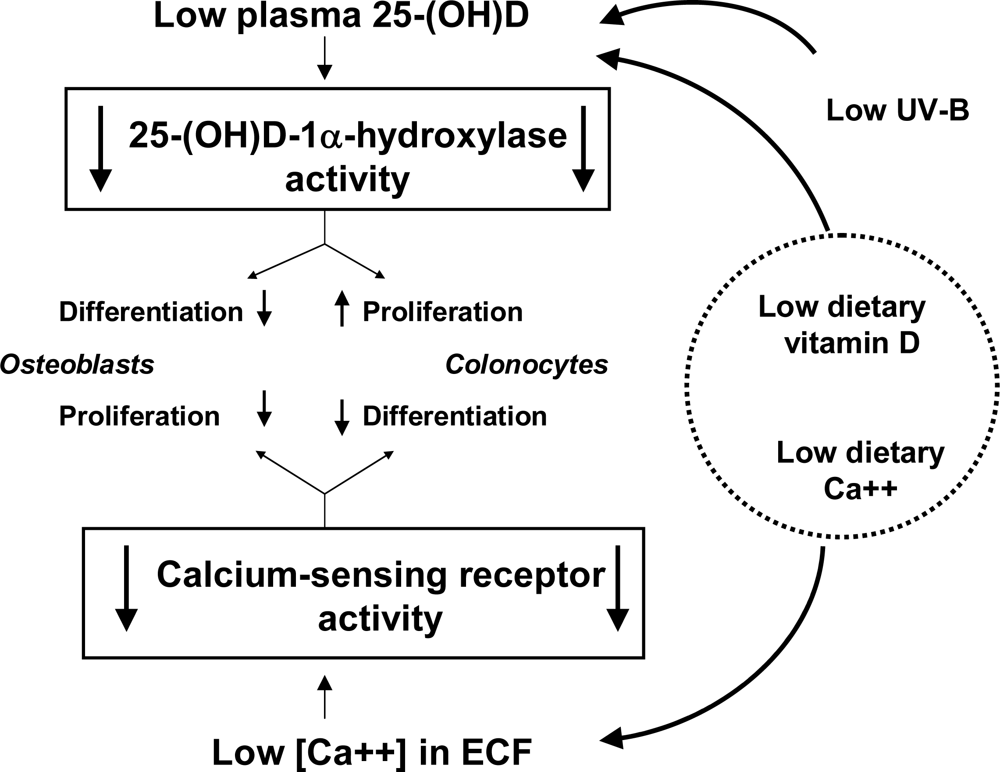
<p>There is evidence from many human and animal studies for a significant inverse relationship between dietary calcium and risk of multiple chronic diseases [<xref ref-type="bibr" rid="b1-ijerph-06-02585">1</xref>]. This is difficult to understand because the effect of even large variations in calcium intake levels on extracellular calcium concentrations [Ca<sup>2+</sup>]o is attenuated by the systemic actions of calcium-regulating hormones allowing physiological variations in [Ca<sup>2+</sup>]o to occur only within a narrow range. However, many types of cells express a calcium-sensing receptor (CaR), which senses even minute changes in [Ca<sup>2+</sup>]o and thus allows Ca<sup>2+</sup> to function as a “first messenger” for various cellular responses [<xref ref-type="bibr" rid="b20-ijerph-06-02585">20</xref>]. An important feature of the CaR is the high cooperativity between multiple Ca<sup>2+</sup>-binding sites in its extracellular domain. This results in amplification of signals from extracellular Ca<sup>2+</sup>, which, by cell-specific coupling to stimulatory and inhibitory G proteins, are transduced into various intracellular signalling pathways. Expression of a functioning CaR thus allows cell-specific reactions to physiological changes in [Ca<sup>2+</sup>]o. The CaR not only controls PTH secretion from parathyroid gland cells but plays key roles in normal cartilage and bone formation [<xref ref-type="bibr" rid="b21-ijerph-06-02585">21</xref>–<xref ref-type="bibr" rid="b23-ijerph-06-02585">23</xref>], as well as in limitation of cellular growth of normal and neoplastic cells [<xref ref-type="bibr" rid="b2-ijerph-06-02585">2</xref>,<xref ref-type="bibr" rid="b24-ijerph-06-02585">24</xref>]. Conversely, low dietary calcium causes hyperparathyroidism by impairment of CaR activity and, by the same token, can be linked to the development of not only osteoporosis and various malignancies, but possibly other calcium-insufficiency-related chronic diseases (<xref ref-type="table" rid="t1-ijerph-06-02585">Table 1</xref>) (for details, [<xref ref-type="bibr" rid="b1-ijerph-06-02585">1</xref>,<xref ref-type="bibr" rid="b3-ijerph-06-02585">3</xref>]; see also <xref ref-type="fig" rid="f2-ijerph-06-02585">Figure 2</xref>).</p>
<p>Relevant for our understanding how vitamin D and calcium status interact in the pathogenesis of chronic diseases, is the observation that most cell types jointly express the 25-(OH)D-1α-hydroxylase and the CaR. Therefore, cell-specific cooperative signalling from 1,25-(OH)<sub>2</sub>D<sub>3</sub>/VDR and CaR, which is necessary to maintain normal cell functions (as detailed in [<xref ref-type="bibr" rid="b1-ijerph-06-02585">1</xref>,<xref ref-type="bibr" rid="b3-ijerph-06-02585">3</xref>]), is impaired under conditions of vitamin D and calcium insufficiency (<xref ref-type="fig" rid="f2-ijerph-06-02585">Figure 2</xref>). This has been shown particularly for osteoporosis and many malignancies, particularly colorectal and breast cancer (as detailed in the following). Low serum 25-(OH)D and inadequate calcium intake reportedly are associated with cardiovascular risk factors such as hypertension [<xref ref-type="bibr" rid="b25-ijerph-06-02585">25</xref>–<xref ref-type="bibr" rid="b27-ijerph-06-02585">27</xref>], obesity [<xref ref-type="bibr" rid="b28-ijerph-06-02585">28</xref>–<xref ref-type="bibr" rid="b30-ijerph-06-02585">30</xref>], metabolic syndrome and diabetes mellitus type II [<xref ref-type="bibr" rid="b31-ijerph-06-02585">31</xref>,<xref ref-type="bibr" rid="b32-ijerph-06-02585">32</xref>]. Vitamin D and calcium insufficiencies have also been correlated with incident cardiovascular symptoms, including angina, coronary insufficiency, myocardial infarction, transient ischemic attack, and stroke [<xref ref-type="bibr" rid="b33-ijerph-06-02585">33</xref>], as well as with greater mortality from chronic cardiovascular disease [<xref ref-type="bibr" rid="b19-ijerph-06-02585">19</xref>,<xref ref-type="bibr" rid="b34-ijerph-06-02585">34</xref>,<xref ref-type="bibr" rid="b35-ijerph-06-02585">35</xref>].</p></sec>
<sec>
<label>3.</label>
<title>Vitamin D Insufficiency: A World-Wide Phenomenon</title>
<sec>
<label>3.1.</label>
<title>Definition of Vitamin D Insufficiency</title>
<p>The vitamin D status of an individual is a composite of UV-B mediated synthesis of vitamin D<sub>3</sub> in the epidermis and of intake and absorption from the gut. Outright vitamin D deficiency is indicated by plasma 25-(OH)D levels below 10–15 nM [<xref ref-type="bibr" rid="b36-ijerph-06-02585">36</xref>]. In this situation, 1,25-(OH)<sub>2</sub>D production in the kidney is severely limited because of substrate depletion, causing a decrease in intestinal calcium absorption with rickets or osteomalacia as a consequence. At 25-(OH)D serum concentrations above 15 nM, the kidney produces enough 1,25-(OH)<sub>2</sub>D<sub>3</sub> to maintain systemic mineral ion homeostasis [<xref ref-type="bibr" rid="b37-ijerph-06-02585">37</xref>], but availability of 25-(OH)D for intracellular production of 1,25-(OH)<sub>2</sub>D<sub>3</sub> at extra-renal sites may be insufficient for autocrine/paracrine control of cellular functions [<xref ref-type="bibr" rid="b1-ijerph-06-02585">1</xref>]. The definition of vitamin D insufficiency is still a matter of debate. At one time, a serum 25-(OH)D concentration of ~30 nM was thought to be the delimitation between vitamin D insufficiency and adequate vitamin D supply [<xref ref-type="bibr" rid="b38-ijerph-06-02585">38</xref>]. Now there is growing agreement that serum 25(OH)D should be at least 50 nM [<xref ref-type="bibr" rid="b39-ijerph-06-02585">39</xref>] (see also <xref ref-type="table" rid="t2-ijerph-06-02585">Tables 2</xref>–<xref ref-type="table" rid="t4-ijerph-06-02585">4</xref>). Even higher cut-offs, e.g. 60–100 nM, are supported by studies on optimal health outcomes [<xref ref-type="bibr" rid="b40-ijerph-06-02585">40</xref>].</p></sec>
<sec>
<label>3.2.</label>
<title>Epidemiology of Vitamin D Insufficiency</title>
<p>Considering reasons for vitamin D insufficiency, one has to take into account that cutaneous UV-B-mediated production of vitamin D<sub>3</sub> is affected by many factors, such as time of the day, season of the year, latitude, altitude, skin pigmentation or use of sunscreens. Also aging can markedly reduce the capacity of the skin to produce vitamin D<sub>3</sub> [<xref ref-type="bibr" rid="b41-ijerph-06-02585">41</xref>]. Geographical differences in vitamin D status result from varying contributions to the vitamin D supply from exposure to solar UV-B but also from intake of dietary and supplemental vitamin D [<xref ref-type="bibr" rid="b42-ijerph-06-02585">42</xref>,<xref ref-type="bibr" rid="b43-ijerph-06-02585">43</xref>]. <xref ref-type="table" rid="t2-ijerph-06-02585">Table 2</xref> lists the results of the available nationally representative studies on prevalence of vitamin D insufficiency in the normal adult population in Europe, North America, East Asia and in the South Pacific area.</p>
<p>In Europe, 7–27% of the adult population have a serum 25-(OH)D concentration below 25–30 nM [<xref ref-type="bibr" rid="b26-ijerph-06-02585">26</xref>,<xref ref-type="bibr" rid="b38-ijerph-06-02585">38</xref>,<xref ref-type="bibr" rid="b44-ijerph-06-02585">44</xref>–<xref ref-type="bibr" rid="b47-ijerph-06-02585">47</xref>]. In South-East Asia and in Australia, incidence of vitamin D insufficiency varies between 8–17% [<xref ref-type="bibr" rid="b48-ijerph-06-02585">48</xref>–<xref ref-type="bibr" rid="b50-ijerph-06-02585">50</xref>]. A relatively low value of 5% has been reported for the USA [<xref ref-type="bibr" rid="b51-ijerph-06-02585">51</xref>]. However, if 50 nM 25-(OH)D is considered the upper reference limit, on the average one-half of the adult population in Europe [<xref ref-type="bibr" rid="b26-ijerph-06-02585">26</xref>,<xref ref-type="bibr" rid="b38-ijerph-06-02585">38</xref>,<xref ref-type="bibr" rid="b44-ijerph-06-02585">44</xref>–<xref ref-type="bibr" rid="b47-ijerph-06-02585">47</xref>], Western Canada [<xref ref-type="bibr" rid="b52-ijerph-06-02585">52</xref>], Australia [<xref ref-type="bibr" rid="b53-ijerph-06-02585">53</xref>,<xref ref-type="bibr" rid="b54-ijerph-06-02585">54</xref>] and New Zealand [<xref ref-type="bibr" rid="b55-ijerph-06-02585">55</xref>] presents with vitamin D insufficiency, whereas only one-third is afflicted in the USA [<xref ref-type="bibr" rid="b51-ijerph-06-02585">51</xref>] (<xref ref-type="table" rid="t2-ijerph-06-02585">Table 2</xref>).</p>
<p>It must be noted that the proportion of the general population with serum 25-(OH)D below the desirable level of 70–80 nM [<xref ref-type="bibr" rid="b40-ijerph-06-02585">40</xref>,<xref ref-type="bibr" rid="b56-ijerph-06-02585">56</xref>] is 73% in the USA [<xref ref-type="bibr" rid="b51-ijerph-06-02585">51</xref>], 84–87% in Europe and in the South Pacific area [<xref ref-type="bibr" rid="b44-ijerph-06-02585">44</xref>,<xref ref-type="bibr" rid="b46-ijerph-06-02585">46</xref>,<xref ref-type="bibr" rid="b55-ijerph-06-02585">55</xref>] and up to 97% in Canada [<xref ref-type="bibr" rid="b52-ijerph-06-02585">52</xref>].</p></sec>
<sec>
<label>3.3.</label>
<title>Vitamin D Insufficiency in Different Population Segments</title>
<p><italic>Elderly people</italic>: It has been known for decades that vitamin D insufficiency is common in people, who are immobilized because of chronic diseases or are housebound due to old age. However, recent nationally representative data show that vitamin D insufficiency is present in a substantial portion of old age ambulant people worldwide (<xref ref-type="table" rid="t3-ijerph-06-02585">Table 3</xref>): For example, the European SENECA Study on diet and health of elderly people from 19 towns in 12 European countries revealed that overall 36% of men and 47% of women had serum 25-(OH)D concentrations below 30 nM [<xref ref-type="bibr" rid="b57-ijerph-06-02585">57</xref>]. In the Netherlands, 50% of people aged 65 years and older had serum levels of 25-(OH)D below 50 nM [<xref ref-type="bibr" rid="b58-ijerph-06-02585">58</xref>]. Similar values were reported for elderly women in Belgium [<xref ref-type="bibr" rid="b59-ijerph-06-02585">59</xref>]. According to the OPTIFORD Study [<xref ref-type="bibr" rid="b60-ijerph-06-02585">60</xref>], 50–92 % of elderly women in Denmark, Finland, Ireland and Poland had wintertime 25-(OH)D concentrations lower than 50 nM. On the average, prevalence of vitamin D insufficiency in elderly people in North America [<xref ref-type="bibr" rid="b51-ijerph-06-02585">51</xref>,<xref ref-type="bibr" rid="b61-ijerph-06-02585">61</xref>], Australia [<xref ref-type="bibr" rid="b62-ijerph-06-02585">62</xref>], New Zealand [<xref ref-type="bibr" rid="b55-ijerph-06-02585">55</xref>] and Japan [<xref ref-type="bibr" rid="b63-ijerph-06-02585">63</xref>] seems to be lower than in Europe (<xref ref-type="table" rid="t3-ijerph-06-02585">Table 3</xref>).</p>
<p><italic>Children, adolescents and young adults:</italic> In some European countries such as Denmark, Finland, Ireland and Poland [<xref ref-type="bibr" rid="b60-ijerph-06-02585">60</xref>], 37% of 12-year old girls had 25-(OH)D concentrations lower than 25 nM (<xref ref-type="table" rid="t4-ijerph-06-02585">Table 4</xref>). By using a broader definition, i.e., &lt;50 nM, 92% had to be considered vitamin Dinsufficient. Comparative values are much lower in Germany [<xref ref-type="bibr" rid="b64-ijerph-06-02585">64</xref>], but considerably higher in France [<xref ref-type="bibr" rid="b65-ijerph-06-02585">65</xref>].</p>
<p>In the USA, the proportion of male and female adolescents between 12–19 years, who had 25-(OH)D values below 50 nM, ranged from 24 to 31%, respectively [<xref ref-type="bibr" rid="b51-ijerph-06-02585">51</xref>]. Incidence of vitamin D insufficiency in younger women is low in Canada [<xref ref-type="bibr" rid="b66-ijerph-06-02585">66</xref>], compared to Indonesia, Malaysia [<xref ref-type="bibr" rid="b67-ijerph-06-02585">67</xref>] or Japan [<xref ref-type="bibr" rid="b50-ijerph-06-02585">50</xref>]. Alarmingly high rates were found in older girls and young women at child-bearing age in India [<xref ref-type="bibr" rid="b68-ijerph-06-02585">68</xref>] and China [<xref ref-type="bibr" rid="b69-ijerph-06-02585">69</xref>,<xref ref-type="bibr" rid="b70-ijerph-06-02585">70</xref>] (<xref ref-type="table" rid="t4-ijerph-06-02585">Table 4</xref>).</p>
<p><italic>Pregnant women and neonates</italic>: In Europe and in the USA, a poor vitamin D status is observed with increasing frequency in pregnant women [<xref ref-type="bibr" rid="b71-ijerph-06-02585">71</xref>] and consequently in their neonates causing a high risk of not only rickets, but also non-skeletal diseases in later life, e.g. type 1 diabetes [<xref ref-type="bibr" rid="b72-ijerph-06-02585">72</xref>].</p>
<p><italic>Obesity</italic> deserves a special note as a condition frequently associated with vitamin D and calcium insufficiency. A number of earlier studies have well documented a high prevalence of vitamin D insufficiency in morbidly obese women. Now evidence is emerging that in otherwise healthy women and men, body fat mass is frequently inversely associated with vitamin D insufficiency [<xref ref-type="bibr" rid="b29-ijerph-06-02585">29</xref>,<xref ref-type="bibr" rid="b73-ijerph-06-02585">73</xref>]. Sequestration of vitamin D in the subcutaneous fat, which alters its release into the circulation, could be one by which obesity could contribute to vitamin D insufficiency [<xref ref-type="bibr" rid="b74-ijerph-06-02585">74</xref>].</p>
<p><italic>Ethnic groups:</italic> The immigrant population is at high risk for vitamin D insufficiency in many European countries such as Denmark, Norway and Great Britain [<xref ref-type="bibr" rid="b75-ijerph-06-02585">75</xref>–<xref ref-type="bibr" rid="b77-ijerph-06-02585">77</xref>]. In Germany, the proportion of vitamin D inadequacy in children and adolescents, aged 2–17 years, is higher in immigrant than in non-immigrant girls and boys at any time. Notably, after termination of vitamin D supplementation for prophylaxis of rickets between the age of 1–2 years, serum 25-(OH)-D levels fell rapidly below 50 nM in both groups [<xref ref-type="bibr" rid="b64-ijerph-06-02585">64</xref>]. In the USA, prevalence of vitamin D insufficiency in Mexican American and Non-Hispanic black people is higher than in Non-Hispanic White individuals [<xref ref-type="bibr" rid="b51-ijerph-06-02585">51</xref>]. Analogous skin pigmentation and degree of vitamin D inadequacy has been reported for three ethnic groups in New Zealand, i.e., Pacific people, Maori and people of European origin [<xref ref-type="bibr" rid="b55-ijerph-06-02585">55</xref>]. In Australia, dark-skinned and “veiled” women, particularly when pregnant, belong to the group with the highest risk for vitamin D insufficiency [<xref ref-type="bibr" rid="b78-ijerph-06-02585">78</xref>].</p></sec></sec>
<sec>
<label>4.</label>
<title>Inadequate Calcium Intake: A World-Wide Problem</title>
<sec>
<label>4.1.</label>
<title>Recommended Calcium Intake Levels</title>
<p>Different intake levels for calcium are recommended by FAO/WHO experts for infants, children and adults [<xref ref-type="bibr" rid="b79-ijerph-06-02585">79</xref>] to assure optimal whole body calcium retention and consequently adequate development and maintenance of bone mass and mineral density. For children and adolescents between 10–18 years of age, consumption of 1,300 mg per day is recommended, while 1,000 mg per day apply for men between 25–50 years of age and also for women in the same age group, except when higher intake is necessary during pregnancy or after menopause. Recommended calcium allowance per day for males over 65 years and postmenopausal women is 1,300 mg [<xref ref-type="bibr" rid="b79-ijerph-06-02585">79</xref>].</p></sec>
<sec>
<label>4.2.</label>
<title>Epidemiology of Calcium Intake</title>
<p>Findings listed in <xref ref-type="table" rid="t5-ijerph-06-02585">Table 5</xref> indicate that in Europe daily calcium intake from nutrient sources is consistently low. For example, 84% of the adult population in Austria fail to meet recommended intake levels [<xref ref-type="bibr" rid="b44-ijerph-06-02585">44</xref>]. The situation is apparently better in Germany [<xref ref-type="bibr" rid="b80-ijerph-06-02585">80</xref>,<xref ref-type="bibr" rid="b81-ijerph-06-02585">81</xref>], with one study reporting daily calcium intake even at recommended levels [<xref ref-type="bibr" rid="b26-ijerph-06-02585">26</xref>]. This seems to be also the case in Great Britain [<xref ref-type="bibr" rid="b82-ijerph-06-02585">82</xref>].</p>
<p>In contrast, 40% of the population does not meet adequacy in the USA [<xref ref-type="bibr" rid="b83-ijerph-06-02585">83</xref>]. Similar values probably pertain for Australia [<xref ref-type="bibr" rid="b84-ijerph-06-02585">84</xref>] and New Zealand [<xref ref-type="bibr" rid="b85-ijerph-06-02585">85</xref>]. Special consideration must be given to the nutritional calcium deficit in South-East Asian countries such as Indonesia, Malaysia [<xref ref-type="bibr" rid="b67-ijerph-06-02585">67</xref>] and Bangladesh [<xref ref-type="bibr" rid="b86-ijerph-06-02585">86</xref>]: The situation is particularly alarming in Bangladesh, where 47% of premenopausal women in the higher socio-economic brackets failed to meet a daily allowance of 400–500 mg calcium, and 63% of women of low socio-economic standing had calcium intake even lower than 200 mg/day [<xref ref-type="bibr" rid="b86-ijerph-06-02585">86</xref>].</p></sec>
<sec>
<label>4.3.</label>
<title>Population Segments with Low Habitual Calcium Intake</title>
<p><italic>Chronically ill people:</italic> A chronically negative calcium balance due to malabsorption develops, for example, in the many individuals suffering worldwide from lactose intolerance or from inflammatory bowel disease (Crohn’s disease, ulcerative colitis). In addition, calcium malabsorption must be reckoned with in all cases of vitamin D insufficiency resulting from intestinal, hepatic, renal or endocrine disorders as well as in the group of bariatric surgery patients who increase in numbers as a result of the obesity epidemic in the affluent parts of the world.</p>
<p><italic>Individuals with reduced physical activity:</italic> It must be noted that immobilization even for a short period, e.g. 1–2 weeks of bed rest leads to mobilization of calcium from bone and consequently to net calcium loss [<xref ref-type="bibr" rid="b87-ijerph-06-02585">87</xref>]. Therefore not only patients in geriatric, psychiatric or neurological care, but also healthy individuals with low habitual physical activity have an increased risk of calcium insufficiency.</p>
<p><italic>Elderly people:</italic> The data collated in <xref ref-type="table" rid="t6-ijerph-06-02585">Table 6</xref> confirm the long-standing assumption that particularly the elderly ingest significantly less calcium in their diet than the recommended amount, which is currently considered 1,300 mg per day for this age group [<xref ref-type="bibr" rid="b79-ijerph-06-02585">79</xref>]. In the European SENECA Study [<xref ref-type="bibr" rid="b88-ijerph-06-02585">88</xref>], the overall mean calcium intake by elderly people was 894 mg per day, with variations from 600–1,100 mg between different study sites. In the OPTIFORD Study, the median calcium intake among elderly women was 632 mg per day, being lowest in Poland (325 mg) and highest in Finland (925 mg) [<xref ref-type="bibr" rid="b60-ijerph-06-02585">60</xref>]. In the USA, the mean intake of calcium in women after age 55 is only ~600 mg/day [<xref ref-type="bibr" rid="b61-ijerph-06-02585">61</xref>]. Daily consumption of ~500 mg by elderly Japanese women [<xref ref-type="bibr" rid="b89-ijerph-06-02585">89</xref>] is far below a recommended level of 1,200 mg, although daily calcium requirements of East Asian populations may be lower for ethnic reasons [<xref ref-type="bibr" rid="b79-ijerph-06-02585">79</xref>].</p>
<p><italic>Children, adolescents and young adults</italic>: In the European OPTIFORD study the median daily calcium intake of girls at a mean age of ~13 years was 823 mg, ranging from 524 mg in Poland to 1,092 mg in Finland [<xref ref-type="bibr" rid="b60-ijerph-06-02585">60</xref>] (<xref ref-type="table" rid="t7-ijerph-06-02585">Table 7</xref>). Data from the USA indicate that after the age of 10, calcium malnutrition is a common phenomenon. For example, average daily calcium intake in a group of young adolescents (12.7 ± 1.0 yr of age) was found to be 906 mg [<xref ref-type="bibr" rid="b90-ijerph-06-02585">90</xref>]. Grossly inadequate calcium intake was observed also in young adults in Canada [<xref ref-type="bibr" rid="b91-ijerph-06-02585">91</xref>]. Average daily calcium intake by schoolgirls in India between 400–500 mg [<xref ref-type="bibr" rid="b68-ijerph-06-02585">68</xref>], though corresponding to recommended daily allowances for Indians, nevertheless is far below current FAO/WHO recommendations of 1,000–1,300 mg/day [<xref ref-type="bibr" rid="b79-ijerph-06-02585">79</xref>].</p>
<p><italic>Ethnic groups:</italic> It has to be borne in mind that not only vitamin D deficiency but also a nutritional calcium deficit is an important cause of rickets [<xref ref-type="bibr" rid="b92-ijerph-06-02585">92</xref>]. So-called calcium deficiency rickets are prevalent in Middle Eastern and many sub-tropical and tropical countries, such as Nigeria, Ethiopia, South Africa, India and Bangladesh, despite the fact that such countries have ample sunlight [<xref ref-type="bibr" rid="b93-ijerph-06-02585">93</xref>–<xref ref-type="bibr" rid="b95-ijerph-06-02585">95</xref>]. Under this condition, the disease is attributable to low dietary calcium intake from mainly cereal-based diets.</p></sec></sec>
<sec>
<label>5.</label>
<title>Strategies for disease prevention</title>
<p>Studies on the vitamin D intake in different parts of the world cannot be directly compared because results may be confounded to some extent by differences in life style and clothing habits, consumption of traditional foods or supplement intake. Exact determination of the extent of calcium malnutrition is also difficult, because different methods are used for evaluation of daily calcium intake from nutrient sources and, in addition, for ethnic, dietary and geographical reasons different recommendations apply for different parts of the world [<xref ref-type="bibr" rid="b79-ijerph-06-02585">79</xref>]. However, combined evidence from all the studies that are included in the present survey clearly indicates that vitamin D insufficiency and calcium malnutrition are common in both genders worldwide, not only in elderly people as previously believed but also in younger adults. Importantly, the highest rates of insufficiencies are found in children and adolescents as well as in women of child bearing age.</p>
<sec>
<label>5.1.</label>
<title>Need to Increase Combined Intakes to Daily 800 IU Vitamin D and 1,200 mg Calcium</title>
<p><italic>Vitamin D:</italic> A recent survey on world-wide vitamin D intake [<xref ref-type="bibr" rid="b96-ijerph-06-02585">96</xref>] clearly indicates that in many countries vitamin D supply from nutrient sources is too low to sustain mean 25-(OH)D levels in the general population between 40–100 nM, which are considered sufficiently high to achieve a better health outcome [<xref ref-type="bibr" rid="b97-ijerph-06-02585">97</xref>]. Cashman <italic>et al.</italic> [<xref ref-type="bibr" rid="b98-ijerph-06-02585">98</xref>] calculated that in 20–40 yr old adults, depending on the extent of sun exposure in summer, daily intakes of vitamin D between 300 and 1,600 IU are required to maintain an adequate vitamin D status in wintertime. Notably, Nelson <italic>et al.</italic> [<xref ref-type="bibr" rid="b56-ijerph-06-02585">56</xref>] reported that daily doses of 800 IU vitamin D<sub>3</sub> were sufficient to sustain “optimal” 25-(OH)D serum concentrations (≥75nM) in 80% of a group of pre-menopausal women. With approximately the same daily dose of vitamin D<sub>3,</sub> serum 25-(OH)D levels could be maintained at 50 nM in 97.5% of a group of elderly people in the absence of sufficient sun exposure [<xref ref-type="bibr" rid="b99-ijerph-06-02585">99</xref>]. The beneficial effects of 800 IU supplemental vitamin D for various health outcomes are well documented. Daily intake of 700–800 IU vitamin D<sub>3</sub> maintains normal bone turnover in healthy men at wintertime [<xref ref-type="bibr" rid="b100-ijerph-06-02585">100</xref>], and reduces the risk for colorectal or breast cancer by 50% [<xref ref-type="bibr" rid="b101-ijerph-06-02585">101</xref>,<xref ref-type="bibr" rid="b102-ijerph-06-02585">102</xref>].</p>
<p><italic>Calcium:</italic> The suggestion to raise daily consumption of calcium to an average of 1,200 mg per day is based not only on physiological considerations [<xref ref-type="bibr" rid="b103-ijerph-06-02585">103</xref>] but can be deduced also from considerations of optimal health outcomes: For example, daily doses of 1,200 mg calcium effectively prevent osteoporotic bone loss and fractures in people aged 50 years or older [<xref ref-type="bibr" rid="b104-ijerph-06-02585">104</xref>], and cause a 40–50% risk reduction of colorectal cancer in men and of breast cancer in premenopausal women [<xref ref-type="bibr" rid="b105-ijerph-06-02585">105</xref>,<xref ref-type="bibr" rid="b106-ijerph-06-02585">106</xref>].</p></sec>
<sec>
<label>5.2.</label>
<title>Rationale for Advocating Combined Intake of Vitamin D and Calcium</title>
<p>Simultaneous correction of nutritional vitamin D and calcium deficits for prevention or amelioration of many chronic diseases is necessary for two reasons: First, dietary intakes of vitamin D and calcium are strongly associated [<xref ref-type="bibr" rid="b107-ijerph-06-02585">107</xref>] and therefore vitamin D insufficiency is frequently associated with low calcium intake [<xref ref-type="bibr" rid="b1-ijerph-06-02585">1</xref>,<xref ref-type="bibr" rid="b44-ijerph-06-02585">44</xref>]. Second, because vitamin D and calcium interact positively in modulation of cellular proliferation, differentiation and function, as detailed before [<xref ref-type="bibr" rid="b3-ijerph-06-02585">3</xref>,<xref ref-type="bibr" rid="b18-ijerph-06-02585">18</xref>], it can be expected that an adequate vitamin D status is required to achieve the nutritional benefits of calcium and <italic>vice versa.</italic></p>
<p><italic>Osteoporosis:</italic> Combined supplementation with daily 800 IU vitamin D and 1,200 mg calcium is the essential basis for pharmacological prevention and treatment of osteoporosis. From a meta-analysis of 10 randomized controlled trials of oral vitamin D with or without calcium supplementation <italic>vs</italic> placebo/no treatment on the risk of hip fracture in elderly people, Boonen <italic>et al.</italic> [<xref ref-type="bibr" rid="b108-ijerph-06-02585">108</xref>] concluded that oral vitamin D appears to reduce the risk of hip fractures only when calcium supplementation is added.</p>
<p><italic>Cancer</italic>: Lappe <italic>et al.</italic> [<xref ref-type="bibr" rid="b109-ijerph-06-02585">109</xref>] reported evidence from a randomized placebo-controlled trial that in post-menopausal women combined high-dose calcium and vitamin D<sub>3</sub> supplementation, i.e., 1,400–1,500 mg calcium <italic>plus</italic> 1,100 IU vitamin D<sub>3</sub>, reduced the cumulative risk of cancer of the breast, lung, colon, uterus, lymphoid and myeloid system to 0.232 after four years of trial. Cho <italic>et al.</italic> [<xref ref-type="bibr" rid="b110-ijerph-06-02585">110</xref>] concluded from an analysis of pooled primary data from 10 cohort studies with a follow-up of more than half a million individuals for 6–16 years, that optimal risk reduction for colorectal cancer necessitates high intake levels of both vitamin D and calcium. This notion was shown to be valid not only for Western but also for Asian populations [<xref ref-type="bibr" rid="b111-ijerph-06-02585">111</xref>]. In pre-menopausal women, Bérubé <italic>et al.</italic> [<xref ref-type="bibr" rid="b112-ijerph-06-02585">112</xref>] found highly significant inverse relations between total intakes of vitamin D and calcium and breast density, which is a surrogate marker for breast cancer risk. It is noteworthy, that higher intake of one nutrient was related to lower breast density only in the presence of higher intake of the other nutrient.</p></sec></sec>
<sec>
<label>6.</label>
<title>What can be Done?</title>
<p>Simultaneous supplementation of vitamin D and calcium represents a safe and inexpensive strategy for prevention of osteoporosis, colorectal and breast cancer and possibly of many other chronic diseases (<xref ref-type="table" rid="t1-ijerph-06-02585">Table 1</xref>). It must be emphasized that daily consumption of 800 IU vitamin D and 1,200 mg calcium is well below the currently accepted tolerable upper intake levels of 2,000 IU (=50 μg) vitamin D<sub>3</sub> and 3,000 mg calcium [<xref ref-type="bibr" rid="b79-ijerph-06-02585">79</xref>].</p>
<sec>
<label>6.1.</label>
<title>Supplementation by Fixed Vitamin D/Calcium Combination Tablets</title>
<p>Osteoporotic fractures can be effectively prevented at relatively low cost by combined supplementation with 1,200 mg/d calcium and 800 IU/d vitamin D<sub>3</sub>. However, a significant effect of vitamin D/calcium treatment is only seen in cohorts with at least 80% compliance [<xref ref-type="bibr" rid="b104-ijerph-06-02585">104</xref>]. Low compliance and lack of adherence seen with any long-term medication certainly will limit the usefulness of combined vitamin D and calcium supplementation for correction of respective insufficiencies in the general population. Therefore, combined vitamin D and calcium supplementation should be promoted specifically for disease prevention in high risk groups, i.e., individuals, who otherwise are unable to attain a normal vitamin D and calcium status due to specific living conditions (immobilization, physical incapacitation, advanced age, chronic diseases), traditional or personal nutritional habits, preferred lifestyle (lack of physical activity, indoor dwelling) etc.</p></sec>
<sec>
<label>6.2.</label>
<title>Vitamin D and Calcium Enrichment in Single Foodstuffs</title>
<p>Fortified foods are an important source of vitamin D for those who consume them [<xref ref-type="bibr" rid="b113-ijerph-06-02585">113</xref>]. In a recent survey on the efficacy of food fortification on serum 25-(OH)D concentrations [<xref ref-type="bibr" rid="b114-ijerph-06-02585">114</xref>], dose-effect relations for vitamin D from food sources were found equivalent to those reported for vitamin D supplements. Vitamin D-fortified milk has been found to be a safe, effective and acceptable method of administering vitamin D, particularly to the elderly, community-based population. Orange juice fortified with vitamin D<sub>2</sub> (1,000 IU/240 ml) was tested for its suitability to serve as an alternative for vitamin D-fortified milk. Fortification with vitamin D<sub>3</sub> of wheat and rye bread is technically easy, and stability and bioavailability of vitamin D is good [<xref ref-type="bibr" rid="b115-ijerph-06-02585">115</xref>]. Consumption of bread fortified with 5,000 IU vitamin D<sub>3</sub> and 320 mg calcium per daily serving for 12 months improved the vitamin D status of sun-deprived nursing home residents. Together with suppression of secondary hyperparathyroidism this apparently caused a significant increase in bone mineral density at the lumbar spine and the hip [<xref ref-type="bibr" rid="b116-ijerph-06-02585">116</xref>].</p>
<p>Calcium fortification is in use all over the world: Staples and food stuffs that are enriched with calcium include flour, cereals, milk, orange juice, mineral waters, soymilk etc. [<xref ref-type="bibr" rid="b117-ijerph-06-02585">117</xref>]. Calcium- and vitamin D-fortified milk, when providing 800 IU vitamin D and 1,000 mg calcium per day, has a significant positive effect on bone mass and strength in older men [<xref ref-type="bibr" rid="b118-ijerph-06-02585">118</xref>,<xref ref-type="bibr" rid="b119-ijerph-06-02585">119</xref>].</p>
<p>It is apparent that fortification of traditional and widely consumed foodstuffs (milk and milk products, bread, orange juice etc.) will guarantee a minimum additional supply of vitamin D and calcium.</p></sec>
<sec>
<label>6.3.</label>
<title>Vitamin D and Calcium Addition to Cereal Grain Products</title>
<p>At present, cereal grain products, such as flour, corn meal, noodles and the like, are enriched with vitamin D and calcium in some countries in Europe and in the USA. Newmark <italic>et al.</italic> [<xref ref-type="bibr" rid="b117-ijerph-06-02585">117</xref>] summarized the rationale, data, efficacy, safety, cost and practicality of the addition of both calcium and vitamin D to cereal grain products to reduce the risk of osteoporosis and colon cancer. The authors estimate that, if cereal grain products were uniformly enriched with 90 IU/100g vitamin D, average daily intake of vitamin D could increase by up to 200 IU vitamin D. Enrichment of cereal grain products with 1,200–1,800 mg/kg calcium could raise dietary intake by about 200–400 mg/day. A conservative estimate suggests that through these measures at least a 20% reduction of the rate of osteoporotic fractures and of colorectal incidence can be achieved [<xref ref-type="bibr" rid="b117-ijerph-06-02585">117</xref>].</p>
<p>Enrichment of cereal grain products with vitamin D and calcium at indicated levels would be possible within current legal regulations in the USA [<xref ref-type="bibr" rid="b117-ijerph-06-02585">117</xref>]. It also conforms to legislation introduced in the European Union as of 2007. However, some important member states such as Germany have not yet changed their national law accordingly.</p>
<p>In summary, enrichment with vitamin D and calcium of cereal grain products is an effective and safe measure at very low cost to broaden the range of commonly consumed foods as dietary sources of vitamin D and calcium. This will guarantee at least some modest improvement in both vitamin D and calcium nutrition at the same time without necessitating a change in traditional eating habits. To fulfill individual needs for vitamin D and calcium however, additional consumption of particularly vitamin D- and calcium-rich food and food products or even supplement use is certainly indicated.</p></sec></sec></body>
<back>
<ack>
<p>We thank Sandra E. Guggino, Johns Hopkins University Medical School (Baltimore, USA) for critical reading of the manuscript.</p></ack>
<ref-list>
<title>References</title>
<ref id="b1-ijerph-06-02585"><label>1.</label><citation citation-type="journal"><person-group person-group-type="author"><name><surname>Peterlik</surname><given-names>M</given-names></name><name><surname>Cross</surname><given-names>HS</given-names></name></person-group><article-title>Vitamin D and calcium deficits predispose for multiple chronic diseases</article-title><source>Eur. J. Clin. Invest</source><year>2005</year><volume>35</volume><fpage>290</fpage><lpage>304</lpage><pub-id pub-id-type="doi">10.1111/j.1365-2362.2005.01487.x</pub-id><pub-id pub-id-type="pmid">15860041</pub-id></citation></ref>
<ref id="b2-ijerph-06-02585"><label>2.</label><citation citation-type="journal"><person-group person-group-type="author"><name><surname>Peterlik</surname><given-names>M</given-names></name><name><surname>Grant</surname><given-names>WB</given-names></name><name><surname>Cross</surname><given-names>HS</given-names></name></person-group><article-title>Calcium, vitamin D and cancer</article-title><source>Anticancer Res</source><year>2009</year><volume>29</volume><fpage>3687</fpage><lpage>3698</lpage><pub-id pub-id-type="pmid">19667166</pub-id></citation></ref>
<ref id="b3-ijerph-06-02585"><label>3.</label><citation citation-type="other"><person-group person-group-type="author"><name><surname>Peterlik</surname><given-names>M</given-names></name><name><surname>Cross</surname><given-names>HS</given-names></name></person-group><article-title>Vitamin D and calcium insufficiency-related chronic diseases: molecular and cellular pathophysiology</article-title><source>Eur J Clin Nutr</source><year>2009</year>doi:10.1038/ejcn.2009.105</citation></ref>
<ref id="b4-ijerph-06-02585"><label>4.</label><citation citation-type="journal"><person-group person-group-type="author"><name><surname>Zehnder</surname><given-names>D</given-names></name><name><surname>Bland</surname><given-names>R</given-names></name><name><surname>Williams</surname><given-names>MC</given-names></name><name><surname>McNinch</surname><given-names>RW</given-names></name><name><surname>Howie</surname><given-names>AJ</given-names></name><name><surname>Stewart</surname><given-names>PM</given-names></name><name><surname>Hewison</surname><given-names>M</given-names></name></person-group><article-title>Extrarenal expression of 25-hydroxyvitamin D<sub>3</sub>-1 alpha-hydroxylase</article-title><source>J. Clin. Endocrinol. Metab</source><year>2001</year><volume>86</volume><fpage>888</fpage><lpage>894</lpage><pub-id pub-id-type="doi">10.1210/jc.86.2.888</pub-id><pub-id pub-id-type="pmid">11158062</pub-id></citation></ref>
<ref id="b5-ijerph-06-02585"><label>5.</label><citation citation-type="journal"><person-group person-group-type="author"><name><surname>Pillai</surname><given-names>S</given-names></name><name><surname>Bikle</surname><given-names>DD</given-names></name><name><surname>Elias</surname><given-names>PM</given-names></name></person-group><article-title>1,25-Dihydroxyvitamin D production and receptor binding in human keratinocytes varies with differentiation</article-title><source>J. Biol. Chem</source><year>1988</year><volume>263</volume><fpage>5390</fpage><lpage>5395</lpage><pub-id pub-id-type="pmid">2451669</pub-id></citation></ref>
<ref id="b6-ijerph-06-02585"><label>6.</label><citation citation-type="journal"><person-group person-group-type="author"><name><surname>Cross</surname><given-names>HS</given-names></name><name><surname>Peterlik</surname><given-names>M</given-names></name><name><surname>Reddy</surname><given-names>GS</given-names></name><name><surname>Schuster</surname><given-names>I</given-names></name></person-group><article-title>Vitamin D metabolism in human colon adenocarcinoma-derived Caco-2 cells: expression of 25-hydroxyvitamin D<sub>3</sub>-1alpha-hydroxylase activity and regulation of side-chain metabolism</article-title><source>J. Steroid Biochem. Mol. Biol</source><year>1997</year><volume>62</volume><fpage>21</fpage><lpage>28</lpage><pub-id pub-id-type="doi">10.1016/S0960-0760(97)00020-4</pub-id><pub-id pub-id-type="pmid">9366495</pub-id></citation></ref>
<ref id="b7-ijerph-06-02585"><label>7.</label><citation citation-type="journal"><person-group person-group-type="author"><name><surname>Schwartz</surname><given-names>GG</given-names></name><name><surname>Eads</surname><given-names>D</given-names></name><name><surname>Rao</surname><given-names>A</given-names></name><name><surname>Cramer</surname><given-names>SD</given-names></name><name><surname>Willingham</surname><given-names>MC</given-names></name><name><surname>Chen</surname><given-names>TC</given-names></name><name><surname>Jamieson</surname><given-names>DP</given-names></name><name><surname>Wang</surname><given-names>L</given-names></name><name><surname>Burnstein</surname><given-names>KL</given-names></name><name><surname>Holick</surname><given-names>MF</given-names></name><name><surname>Koumenis</surname><given-names>C</given-names></name></person-group><article-title>Pancreatic cancer cells express 25-hydroxyvitamin D-1 alpha-hydroxylase and their proliferation is inhibited by the prohormone 25-hydroxyvitamin D<sub>3</sub></article-title><source>Carcinogenesis</source><year>2004</year><volume>25</volume><fpage>1015</fpage><lpage>1026</lpage><pub-id pub-id-type="doi">10.1093/carcin/bgh086</pub-id><pub-id pub-id-type="pmid">14742320</pub-id></citation></ref>
<ref id="b8-ijerph-06-02585"><label>8.</label><citation citation-type="journal"><person-group person-group-type="author"><name><surname>Becker</surname><given-names>S</given-names></name><name><surname>Cordes</surname><given-names>T</given-names></name><name><surname>Diesing</surname><given-names>D</given-names></name><name><surname>Diedrich</surname><given-names>K</given-names></name><name><surname>Friedrich</surname><given-names>M</given-names></name></person-group><article-title>Expression of 25-hydroxyvitamin D<sub>3</sub>-1alpha-hydroxylase in human endometrial tissue</article-title><source>J. Steroid Biochem. Mol. Biol</source><year>2007</year><volume>103</volume><fpage>771</fpage><lpage>775</lpage><pub-id pub-id-type="doi">10.1016/j.jsbmb.2006.12.075</pub-id><pub-id pub-id-type="pmid">17236759</pub-id></citation></ref>
<ref id="b9-ijerph-06-02585"><label>9.</label><citation citation-type="journal"><person-group person-group-type="author"><name><surname>Schwartz</surname><given-names>GG</given-names></name><name><surname>Whitlatch</surname><given-names>LW</given-names></name><name><surname>Chen</surname><given-names>TC</given-names></name><name><surname>Lokeshwar</surname><given-names>BL</given-names></name><name><surname>Holick</surname><given-names>MF</given-names></name></person-group><article-title>Human prostate cells synthesize 1,25-dihydroxyvitamin D<sub>3</sub> from 25-hydroxyvitamin D<sub>3</sub></article-title><source>Cancer Epidemiol. Biomarkers Prev</source><year>1998</year><volume>7</volume><fpage>391</fpage><lpage>395</lpage><pub-id pub-id-type="pmid">9610788</pub-id></citation></ref>
<ref id="b10-ijerph-06-02585"><label>10.</label><citation citation-type="journal"><person-group person-group-type="author"><name><surname>Friedrich</surname><given-names>M</given-names></name><name><surname>Rafi</surname><given-names>L</given-names></name><name><surname>Mitschele</surname><given-names>T</given-names></name><name><surname>Tilgen</surname><given-names>W</given-names></name><name><surname>Schmidt</surname><given-names>W</given-names></name><name><surname>Reichrath</surname><given-names>J</given-names></name></person-group><article-title>Analysis of the vitamin D system in cervical carcinomas, breast cancer and ovarian cancer</article-title><source>Recent Results Cancer Res</source><year>2003</year><volume>164</volume><fpage>239</fpage><lpage>246</lpage><pub-id pub-id-type="pmid">12899526</pub-id></citation></ref>
<ref id="b11-ijerph-06-02585"><label>11.</label><citation citation-type="journal"><person-group person-group-type="author"><name><surname>van Driel</surname><given-names>M</given-names></name><name><surname>Koedam</surname><given-names>M</given-names></name><name><surname>Buurman</surname><given-names>CJ</given-names></name><name><surname>Hewison</surname><given-names>M</given-names></name><name><surname>Chiba</surname><given-names>H</given-names></name><name><surname>Uitterlinden</surname><given-names>AG</given-names></name><name><surname>Pols</surname><given-names>HA</given-names></name><name><surname>van Leeuwen</surname><given-names>JP</given-names></name></person-group><article-title>Evidence for auto/paracrine actions of vitamin D in bone: 1alphahydroxylase expression and activity in human bone cells</article-title><source>FASEB J</source><year>2006</year><volume>20</volume><fpage>2417</fpage><lpage>2419</lpage><pub-id pub-id-type="doi">10.1096/fj.06-6374fje</pub-id><pub-id pub-id-type="pmid">17023519</pub-id></citation></ref>
<ref id="b12-ijerph-06-02585"><label>12.</label><citation citation-type="journal"><person-group person-group-type="author"><name><surname>Atkins</surname><given-names>GJ</given-names></name><name><surname>Anderson</surname><given-names>PH</given-names></name><name><surname>Findlay</surname><given-names>DM</given-names></name><name><surname>Welldon</surname><given-names>KJ</given-names></name><name><surname>Vincent</surname><given-names>C</given-names></name><name><surname>Zannettino</surname><given-names>AC</given-names></name><name><surname>O’Loughlin</surname><given-names>PD</given-names></name><name><surname>Morris</surname><given-names>HA</given-names></name></person-group><article-title>Metabolism of vitamin D<sub>3</sub> in human osteoblasts: evidence for autocrine and paracrine activities of 1alpha,25-dihydroxyvitamin D<sub>3</sub></article-title><source>Bone</source><year>2007</year><volume>40</volume><fpage>1517</fpage><lpage>1528</lpage><pub-id pub-id-type="doi">10.1016/j.bone.2007.02.024</pub-id><pub-id pub-id-type="pmid">17395559</pub-id></citation></ref>
<ref id="b13-ijerph-06-02585"><label>13.</label><citation citation-type="journal"><person-group person-group-type="author"><name><surname>Zehnder</surname><given-names>D</given-names></name><name><surname>Bland</surname><given-names>R</given-names></name><name><surname>Chana</surname><given-names>RS</given-names></name><name><surname>Wheeler</surname><given-names>DC</given-names></name><name><surname>Howie</surname><given-names>AJ</given-names></name><name><surname>Williams</surname><given-names>MC</given-names></name><name><surname>Stewart</surname><given-names>PM</given-names></name><name><surname>Hewison</surname><given-names>M</given-names></name></person-group><article-title>Synthesis of 1,25-dihydroxyvitamin D<sub>3</sub> by human endothelial cells is regulated by inflammatory cytokines: a novel autocrine determinant of vascular cell adhesion</article-title><source>J. Am. Soc. Nephrol</source><year>2002</year><volume>13</volume><fpage>621</fpage><lpage>629</lpage><pub-id pub-id-type="pmid">11856765</pub-id></citation></ref>
<ref id="b14-ijerph-06-02585"><label>14.</label><citation citation-type="journal"><person-group person-group-type="author"><name><surname>Eyles</surname><given-names>DW</given-names></name><name><surname>Smith</surname><given-names>S</given-names></name><name><surname>Kinobe</surname><given-names>R</given-names></name><name><surname>Hewison</surname><given-names>M</given-names></name><name><surname>McGrath</surname><given-names>JJ</given-names></name></person-group><article-title>Distribution of the vitamin D receptor and 1 alpha-hydroxylase in human brain</article-title><source>J. Chem. Neuroanat</source><year>2005</year><volume>29</volume><fpage>21</fpage><lpage>30</lpage><pub-id pub-id-type="doi">10.1016/j.jchemneu.2004.08.006</pub-id><pub-id pub-id-type="pmid">15589699</pub-id></citation></ref>
<ref id="b15-ijerph-06-02585"><label>15.</label><citation citation-type="journal"><person-group person-group-type="author"><name><surname>Hewison</surname><given-names>M</given-names></name><name><surname>Freeman</surname><given-names>L</given-names></name><name><surname>Hughes</surname><given-names>SV</given-names></name><name><surname>Evans</surname><given-names>KN</given-names></name><name><surname>Bland</surname><given-names>R</given-names></name><name><surname>Eliopoulos</surname><given-names>AG</given-names></name><name><surname>Kilby</surname><given-names>MD</given-names></name><name><surname>Moss</surname><given-names>PA</given-names></name><name><surname>Chakraverty</surname><given-names>R</given-names></name></person-group><article-title>Differential regulation of vitamin D receptor and its ligand in human monocyte-derived dendritic cells</article-title><source>J. Immunol</source><year>2003</year><volume>170</volume><fpage>5382</fpage><lpage>5390</lpage><pub-id pub-id-type="pmid">12759412</pub-id></citation></ref>
<ref id="b16-ijerph-06-02585"><label>16.</label><citation citation-type="journal"><person-group person-group-type="author"><name><surname>Sigmundsdottir</surname><given-names>H</given-names></name><name><surname>Pan</surname><given-names>J</given-names></name><name><surname>Debes</surname><given-names>GF</given-names></name><name><surname>Alt</surname><given-names>C</given-names></name><name><surname>Habtezion</surname><given-names>A</given-names></name><name><surname>Soler</surname><given-names>D</given-names></name><name><surname>Butcher</surname><given-names>EC</given-names></name></person-group><article-title>DCs metabolize sunlight-induced vitamin D<sub>3</sub> to ‘program’ T cell attraction to the epidermal chemokine CCL27</article-title><source>Nat. Immunol</source><year>2007</year><volume>8</volume><fpage>285</fpage><lpage>293</lpage><pub-id pub-id-type="doi">10.1038/ni1433</pub-id><pub-id pub-id-type="pmid">17259988</pub-id></citation></ref>
<ref id="b17-ijerph-06-02585"><label>17.</label><citation citation-type="journal"><person-group person-group-type="author"><name><surname>Anderson</surname><given-names>PH</given-names></name><name><surname>O’Loughlin</surname><given-names>PD</given-names></name><name><surname>May</surname><given-names>BK</given-names></name><name><surname>Morris</surname><given-names>HA</given-names></name></person-group><article-title>Modulation of CYP27B1 and CYP24 mRNA expression in bone is independent of circulating 1,25(OH)<sub>2</sub>D<sub>3</sub> levels</article-title><source>Bone</source><year>2005</year><volume>36</volume><fpage>654</fpage><lpage>662</lpage><pub-id pub-id-type="doi">10.1016/j.bone.2005.01.012</pub-id><pub-id pub-id-type="pmid">15781002</pub-id></citation></ref>
<ref id="b18-ijerph-06-02585"><label>18.</label><citation citation-type="journal"><person-group person-group-type="author"><name><surname>Cross</surname><given-names>HS</given-names></name><name><surname>Kallay</surname><given-names>E</given-names></name></person-group><article-title>Regulation of the colonic vitamin D system for prevention of tumor progression: an update</article-title><source>Future Oncol</source><year>2009</year><volume>5</volume><fpage>493</fpage><lpage>507</lpage><pub-id pub-id-type="doi">10.2217/fon.09.22</pub-id><pub-id pub-id-type="pmid">19450178</pub-id></citation></ref>
<ref id="b19-ijerph-06-02585"><label>19.</label><citation citation-type="journal"><person-group person-group-type="author"><name><surname>Dobnig</surname><given-names>H</given-names></name><name><surname>Pilz</surname><given-names>S</given-names></name><name><surname>Scharnagl</surname><given-names>H</given-names></name><name><surname>Renner</surname><given-names>W</given-names></name><name><surname>Seelhorst</surname><given-names>U</given-names></name><name><surname>Wellnitz</surname><given-names>B</given-names></name><name><surname>Kinkeldei</surname><given-names>J</given-names></name><name><surname>Boehm</surname><given-names>BO</given-names></name><name><surname>Weihrauch</surname><given-names>G</given-names></name><name><surname>Maerz</surname><given-names>W</given-names></name></person-group><article-title>Independent association of low serum 25-hydroxyvitamin D and 1,25-dihydroxyvitamin D levels with all-cause and cardiovascular mortality</article-title><source>Arch. Intern. Med</source><year>2008</year><volume>168</volume><fpage>1340</fpage><lpage>1349</lpage><pub-id pub-id-type="doi">10.1001/archinte.168.12.1340</pub-id><pub-id pub-id-type="pmid">18574092</pub-id></citation></ref>
<ref id="b20-ijerph-06-02585"><label>20.</label><citation citation-type="journal"><person-group person-group-type="author"><name><surname>Tfelt-Hansen</surname><given-names>J</given-names></name><name><surname>Brown</surname><given-names>EM</given-names></name></person-group><article-title>The calcium-sensing receptor in normal physiology and pathophysiology: a review</article-title><source>Crit. Rev. Clin. Lab. Sci</source><year>2005</year><volume>42</volume><fpage>35</fpage><lpage>70</lpage><pub-id pub-id-type="doi">10.1080/10408360590886606</pub-id><pub-id pub-id-type="pmid">15697170</pub-id></citation></ref>
<ref id="b21-ijerph-06-02585"><label>21.</label><citation citation-type="journal"><person-group person-group-type="author"><name><surname>Dvorak</surname><given-names>MM</given-names></name><name><surname>Siddiqua</surname><given-names>A</given-names></name><name><surname>Ward</surname><given-names>DT</given-names></name><name><surname>Carter</surname><given-names>DH</given-names></name><name><surname>Dallas</surname><given-names>SL</given-names></name><name><surname>Nemeth</surname><given-names>EF</given-names></name><name><surname>Riccardi</surname><given-names>D</given-names></name></person-group><article-title>Physiological changes in extracellular calcium concentration directly control osteoblast function in the absence of calciotropic hormones</article-title><source>Proc. Natl. Acad. Sci. U S A</source><year>2004</year><volume>101</volume><fpage>5140</fpage><lpage>5145</lpage><pub-id pub-id-type="doi">10.1073/pnas.0306141101</pub-id><pub-id pub-id-type="pmid">15051872</pub-id></citation></ref>
<ref id="b22-ijerph-06-02585"><label>22.</label><citation citation-type="journal"><person-group person-group-type="author"><name><surname>Chang</surname><given-names>W</given-names></name><name><surname>Tu</surname><given-names>C</given-names></name><name><surname>Chen</surname><given-names>TH</given-names></name><name><surname>Bikle</surname><given-names>D</given-names></name><name><surname>Shoback</surname><given-names>D</given-names></name></person-group><article-title>The extracellular calcium-sensing receptor (CaSR) is a critical modulator of skeletal development</article-title><source>Sci Signal</source><year>2008</year><volume>1</volume><fpage>ra1</fpage><pub-id pub-id-type="doi">10.1126/scisignal.1159945</pub-id><pub-id pub-id-type="pmid">18765830</pub-id></citation></ref>
<ref id="b23-ijerph-06-02585"><label>23.</label><citation citation-type="journal"><person-group person-group-type="author"><name><surname>Brown</surname><given-names>EM</given-names></name><name><surname>Lian</surname><given-names>JB</given-names></name></person-group><article-title>New insights in bone biology: unmasking skeletal effects of the extracellular calcium-sensing receptor</article-title><source>Sci Signal</source><year>2008</year><volume>1</volume><fpage>pe40</fpage><pub-id pub-id-type="doi">10.1126/scisignal.135pe40</pub-id><pub-id pub-id-type="pmid">18765829</pub-id></citation></ref>
<ref id="b24-ijerph-06-02585"><label>24.</label><citation citation-type="journal"><person-group person-group-type="author"><name><surname>Rodland</surname><given-names>KD</given-names></name></person-group><article-title>The role of the calcium-sensing receptor in cancer</article-title><source>Cell Calcium</source><year>2004</year><volume>35</volume><fpage>291</fpage><lpage>295</lpage><pub-id pub-id-type="doi">10.1016/j.ceca.2003.10.011</pub-id><pub-id pub-id-type="pmid">15200153</pub-id></citation></ref>
<ref id="b25-ijerph-06-02585"><label>25.</label><citation citation-type="journal"><person-group person-group-type="author"><name><surname>McCarron</surname><given-names>DA</given-names></name><name><surname>Reusser</surname><given-names>ME</given-names></name></person-group><article-title>Finding consensus in the dietary calcium-blood pressure debate</article-title><source>J. Am. Coll. Nutr</source><year>1999</year><volume>18</volume><fpage>398S</fpage><lpage>405S</lpage><pub-id pub-id-type="pmid">10511320</pub-id></citation></ref>
<ref id="b26-ijerph-06-02585"><label>26.</label><citation citation-type="journal"><person-group person-group-type="author"><name><surname>Hintzpeter</surname><given-names>B</given-names></name><name><surname>Mensink</surname><given-names>GB</given-names></name><name><surname>Thierfelder</surname><given-names>W</given-names></name><name><surname>Muller</surname><given-names>MJ</given-names></name><name><surname>Scheidt-Nave</surname><given-names>C</given-names></name></person-group><article-title>Vitamin D status and health correlates among German adults</article-title><source>Eur. J. Clin. Nutr</source><year>2008</year><volume>62</volume><fpage>1079</fpage><lpage>1089</lpage><pub-id pub-id-type="doi">10.1038/sj.ejcn.1602825</pub-id><pub-id pub-id-type="pmid">17538533</pub-id></citation></ref>
<ref id="b27-ijerph-06-02585"><label>27.</label><citation citation-type="journal"><person-group person-group-type="author"><name><surname>Judd</surname><given-names>SE</given-names></name><name><surname>Nanes</surname><given-names>MS</given-names></name><name><surname>Ziegler</surname><given-names>TR</given-names></name><name><surname>Wilson</surname><given-names>PW</given-names></name><name><surname>Tangpricha</surname><given-names>V</given-names></name></person-group><article-title>Optimal vitamin D status attenuates the age-associated increase in systolic blood pressure in white Americans: results from the third National Health and Nutrition Examination Survey</article-title><source>Am. J. Clin. Nutr</source><year>2008</year><volume>87</volume><fpage>136</fpage><lpage>141</lpage><pub-id pub-id-type="pmid">18175747</pub-id></citation></ref>
<ref id="b28-ijerph-06-02585"><label>28.</label><citation citation-type="journal"><person-group person-group-type="author"><name><surname>Davies</surname><given-names>KM</given-names></name><name><surname>Heaney</surname><given-names>RP</given-names></name><name><surname>Recker</surname><given-names>RR</given-names></name><name><surname>Lappe</surname><given-names>JM</given-names></name><name><surname>Barger-Lux</surname><given-names>MJ</given-names></name><name><surname>Rafferty</surname><given-names>K</given-names></name><name><surname>Hinders</surname><given-names>S</given-names></name></person-group><article-title>Calcium intake and body weight</article-title><source>J. Clin. Endocrinol. Metab</source><year>2000</year><volume>85</volume><fpage>4635</fpage><lpage>4638</lpage><pub-id pub-id-type="doi">10.1210/jc.85.12.4635</pub-id><pub-id pub-id-type="pmid">11134120</pub-id></citation></ref>
<ref id="b29-ijerph-06-02585"><label>29.</label><citation citation-type="journal"><person-group person-group-type="author"><name><surname>Arunabh</surname><given-names>S</given-names></name><name><surname>Pollack</surname><given-names>S</given-names></name><name><surname>Yeh</surname><given-names>J</given-names></name><name><surname>Aloia</surname><given-names>JF</given-names></name></person-group><article-title>Body fat content and 25-hydroxyvitamin D levels in healthy women</article-title><source>J. Clin. Endocrinol. Metab</source><year>2003</year><volume>88</volume><fpage>157</fpage><lpage>161</lpage><pub-id pub-id-type="doi">10.1210/jc.2002-020978</pub-id><pub-id pub-id-type="pmid">12519845</pub-id></citation></ref>
<ref id="b30-ijerph-06-02585"><label>30.</label><citation citation-type="journal"><person-group person-group-type="author"><name><surname>Alemzadeh</surname><given-names>R</given-names></name><name><surname>Kichler</surname><given-names>J</given-names></name><name><surname>Babar</surname><given-names>G</given-names></name><name><surname>Calhoun</surname><given-names>M</given-names></name></person-group><article-title>Hypovitaminosis D in obese children and adolescents: relationship with adiposity, insulin sensitivity, ethnicity, and season</article-title><source>Metabolism</source><year>2008</year><volume>57</volume><fpage>183</fpage><lpage>191</lpage><pub-id pub-id-type="doi">10.1016/j.metabol.2007.08.023</pub-id><pub-id pub-id-type="pmid">18191047</pub-id></citation></ref>
<ref id="b31-ijerph-06-02585"><label>31.</label><citation citation-type="journal"><person-group person-group-type="author"><name><surname>Pittas</surname><given-names>AG</given-names></name><name><surname>Lau</surname><given-names>J</given-names></name><name><surname>Hu</surname><given-names>FB</given-names></name><name><surname>Dawson-Hughes</surname><given-names>B</given-names></name></person-group><article-title>The role of vitamin D and calcium in type 2 diabetes. A systematic review and meta-analysis</article-title><source>J. Clin. Endocrinol. Metab</source><year>2007</year><volume>92</volume><fpage>2017</fpage><lpage>2029</lpage><pub-id pub-id-type="doi">10.1210/jc.2007-0298</pub-id><pub-id pub-id-type="pmid">17389701</pub-id></citation></ref>
<ref id="b32-ijerph-06-02585"><label>32.</label><citation citation-type="journal"><person-group person-group-type="author"><name><surname>Reis</surname><given-names>JP</given-names></name><name><surname>von Muhlen</surname><given-names>D</given-names></name><name><surname>Kritz-Silverstein</surname><given-names>D</given-names></name><name><surname>Wingard</surname><given-names>DL</given-names></name><name><surname>Barrett-Connor</surname><given-names>E</given-names></name></person-group><article-title>Vitamin D, parathyroid hormone levels, and the prevalence of metabolic syndrome in community-dwelling older adults</article-title><source>Diabetes Care</source><year>2007</year><volume>30</volume><fpage>1549</fpage><lpage>1555</lpage><pub-id pub-id-type="doi">10.2337/dc06-2438</pub-id><pub-id pub-id-type="pmid">17351276</pub-id></citation></ref>
<ref id="b33-ijerph-06-02585"><label>33.</label><citation citation-type="journal"><person-group person-group-type="author"><name><surname>Wang</surname><given-names>TJ</given-names></name><name><surname>Pencina</surname><given-names>MJ</given-names></name><name><surname>Booth</surname><given-names>SL</given-names></name><name><surname>Jacques</surname><given-names>PF</given-names></name><name><surname>Ingelsson</surname><given-names>E</given-names></name><name><surname>Lanier</surname><given-names>K</given-names></name><name><surname>Benjamin</surname><given-names>EJ</given-names></name><name><surname>D’Agostino</surname><given-names>RB</given-names></name><name><surname>Wolf</surname><given-names>M</given-names></name><name><surname>Vasan</surname><given-names>RS</given-names></name></person-group><article-title>Vitamin D deficiency and risk of cardiovascular disease</article-title><source>Circulation</source><year>2008</year><volume>117</volume><fpage>503</fpage><lpage>511</lpage><pub-id pub-id-type="doi">10.1161/CIRCULATIONAHA.107.706127</pub-id><pub-id pub-id-type="pmid">18180395</pub-id></citation></ref>
<ref id="b34-ijerph-06-02585"><label>34.</label><citation citation-type="journal"><person-group person-group-type="author"><name><surname>Bostick</surname><given-names>RM</given-names></name><name><surname>Kushi</surname><given-names>LH</given-names></name><name><surname>Wu</surname><given-names>Y</given-names></name><name><surname>Meyer</surname><given-names>KA</given-names></name><name><surname>Sellers</surname><given-names>TA</given-names></name><name><surname>Folsom</surname><given-names>AR</given-names></name></person-group><article-title>Relation of calcium, vitamin D, and dairy food intake to ischemic heart disease mortality among postmenopausal women</article-title><source>Am. J. Epidemiol</source><year>1999</year><volume>149</volume><fpage>151</fpage><lpage>161</lpage><pub-id pub-id-type="doi">10.1093/oxfordjournals.aje.a009781</pub-id><pub-id pub-id-type="pmid">9921960</pub-id></citation></ref>
<ref id="b35-ijerph-06-02585"><label>35.</label><citation citation-type="journal"><person-group person-group-type="author"><name><surname>Hagstrom</surname><given-names>E</given-names></name><name><surname>Hellman</surname><given-names>P</given-names></name><name><surname>Larsson</surname><given-names>TE</given-names></name><name><surname>Ingelsson</surname><given-names>E</given-names></name><name><surname>Berglund</surname><given-names>L</given-names></name><name><surname>Sundstrom</surname><given-names>J</given-names></name><name><surname>Melhus</surname><given-names>H</given-names></name><name><surname>Held</surname><given-names>C</given-names></name><name><surname>Lind</surname><given-names>L</given-names></name><name><surname>Michaelsson</surname><given-names>K</given-names></name><name><surname>Arnlov</surname><given-names>J</given-names></name></person-group><article-title>Plasma parathyroid hormone and the risk of cardiovascular mortality in the community</article-title><source>Circulation</source><year>2009</year><volume>119</volume><fpage>2765</fpage><lpage>2771</lpage><pub-id pub-id-type="doi">10.1161/CIRCULATIONAHA.108.808733</pub-id><pub-id pub-id-type="pmid">19451355</pub-id></citation></ref>
<ref id="b36-ijerph-06-02585"><label>36.</label><citation citation-type="journal"><person-group person-group-type="author"><name><surname>Need</surname><given-names>AG</given-names></name><name><surname>O’Loughlin</surname><given-names>PD</given-names></name><name><surname>Morris</surname><given-names>HA</given-names></name><name><surname>Coates</surname><given-names>PS</given-names></name><name><surname>Horowitz</surname><given-names>M</given-names></name><name><surname>Nordin</surname><given-names>BE</given-names></name></person-group><article-title>Vitamin D metabolites and calcium absorption in severe vitamin D deficiency</article-title><source>J. Bone Miner. Res</source><year>2008</year><volume>23</volume><fpage>1859</fpage><lpage>1863</lpage><pub-id pub-id-type="doi">10.1359/jbmr.080607</pub-id><pub-id pub-id-type="pmid">18597633</pub-id></citation></ref>
<ref id="b37-ijerph-06-02585"><label>37.</label><citation citation-type="journal"><person-group person-group-type="author"><name><surname>Hansen</surname><given-names>KE</given-names></name><name><surname>Jones</surname><given-names>AN</given-names></name><name><surname>Lindstrom</surname><given-names>MJ</given-names></name><name><surname>Davis</surname><given-names>LA</given-names></name><name><surname>Engelke</surname><given-names>JA</given-names></name><name><surname>Shafer</surname><given-names>MM</given-names></name></person-group><article-title>Vitamin D insufficiency: disease or no disease?</article-title><source>J. Bone Miner. Res</source><year>2008</year><volume>23</volume><fpage>1052</fpage><lpage>1060</lpage><pub-id pub-id-type="doi">10.1359/jbmr.080230</pub-id><pub-id pub-id-type="pmid">18302509</pub-id></citation></ref>
<ref id="b38-ijerph-06-02585"><label>38.</label><citation citation-type="journal"><person-group person-group-type="author"><name><surname>Chapuy</surname><given-names>MC</given-names></name><name><surname>Preziosi</surname><given-names>P</given-names></name><name><surname>Maamer</surname><given-names>M</given-names></name><name><surname>Arnaud</surname><given-names>S</given-names></name><name><surname>Galan</surname><given-names>P</given-names></name><name><surname>Hercberg</surname><given-names>S</given-names></name><name><surname>Meunier</surname><given-names>PJ</given-names></name></person-group><article-title>Prevalence of vitamin D insufficiency in an adult normal population</article-title><source>Osteoporos. Int</source><year>1997</year><volume>7</volume><fpage>439</fpage><lpage>443</lpage><pub-id pub-id-type="doi">10.1007/s001980050030</pub-id><pub-id pub-id-type="pmid">9425501</pub-id></citation></ref>
<ref id="b39-ijerph-06-02585"><label>39.</label><citation citation-type="journal"><person-group person-group-type="author"><name><surname>Whiting</surname><given-names>SJ</given-names></name><name><surname>Calvo</surname><given-names>MS</given-names></name></person-group><article-title>Dietary recommendations for vitamin D: a critical need for functional end points to establish an estimated average requirement</article-title><source>J. Nutr</source><year>2005</year><volume>135</volume><fpage>304</fpage><lpage>309</lpage><pub-id pub-id-type="pmid">15671232</pub-id></citation></ref>
<ref id="b40-ijerph-06-02585"><label>40.</label><citation citation-type="journal"><person-group person-group-type="author"><name><surname>Bischoff-Ferrari</surname><given-names>HA</given-names></name><name><surname>Giovannucci</surname><given-names>E</given-names></name><name><surname>Willett</surname><given-names>WC</given-names></name><name><surname>Dietrich</surname><given-names>T</given-names></name><name><surname>Dawson-Hughes</surname><given-names>B</given-names></name></person-group><article-title>Estimation of optimal serum concentrations of 25-hydroxyvitamin D for multiple health outcomes</article-title><source>Am. J. Clin. Nutr</source><year>2006</year><volume>84</volume><fpage>18</fpage><lpage>28</lpage><pub-id pub-id-type="pmid">16825677</pub-id></citation></ref>
<ref id="b41-ijerph-06-02585"><label>41.</label><citation citation-type="journal"><person-group person-group-type="author"><name><surname>Holick</surname><given-names>MF</given-names></name></person-group><article-title>Vitamin D: A millenium perspective</article-title><source>J. Cell. Biochem</source><year>2003</year><volume>88</volume><fpage>296</fpage><lpage>307</lpage><pub-id pub-id-type="doi">10.1002/jcb.10338</pub-id><pub-id pub-id-type="pmid">12520530</pub-id></citation></ref>
<ref id="b42-ijerph-06-02585"><label>42.</label><citation citation-type="journal"><person-group person-group-type="author"><name><surname>Ovesen</surname><given-names>L</given-names></name><name><surname>Andersen</surname><given-names>R</given-names></name><name><surname>Jakobsen</surname><given-names>J</given-names></name></person-group><article-title>Geographical differences in vitamin D status, with particular reference to European countries</article-title><source>Proc. Nutr. Soc</source><year>2003</year><volume>62</volume><fpage>813</fpage><lpage>821</lpage><pub-id pub-id-type="doi">10.1079/PNS2003297</pub-id><pub-id pub-id-type="pmid">15018480</pub-id></citation></ref>
<ref id="b43-ijerph-06-02585"><label>43.</label><citation citation-type="journal"><person-group person-group-type="author"><name><surname>Kuchuk</surname><given-names>NO</given-names></name><name><surname>van Schoor</surname><given-names>NM</given-names></name><name><surname>Pluijm</surname><given-names>SM</given-names></name><name><surname>Chines</surname><given-names>A</given-names></name><name><surname>Lips</surname><given-names>P</given-names></name></person-group><article-title>Vitamin D status, parathyroid function, bone turnover, and BMD in postmenopausal women with osteoporosis: global perspective</article-title><source>J. Bone Miner. Res</source><year>2009</year><volume>24</volume><fpage>693</fpage><lpage>701</lpage><pub-id pub-id-type="doi">10.1359/jbmr.081209</pub-id><pub-id pub-id-type="pmid">19049341</pub-id></citation></ref>
<ref id="b44-ijerph-06-02585"><label>44.</label><citation citation-type="journal"><person-group person-group-type="author"><name><surname>Kudlacek</surname><given-names>S</given-names></name><name><surname>Schneider</surname><given-names>B</given-names></name><name><surname>Peterlik</surname><given-names>M</given-names></name><name><surname>Leb</surname><given-names>G</given-names></name><name><surname>Klaushofer</surname><given-names>K</given-names></name><name><surname>Weber</surname><given-names>K</given-names></name><name><surname>Woloszczuk</surname><given-names>W</given-names></name><name><surname>Willvonseder</surname><given-names>R</given-names></name></person-group><article-title>Assessment of vitamin D and calcium status in healthy adult Austrians</article-title><source>Eur. J. Clin. Invest</source><year>2003</year><volume>33</volume><fpage>323</fpage><lpage>331</lpage><pub-id pub-id-type="doi">10.1046/j.1365-2362.2003.01127.x</pub-id><pub-id pub-id-type="pmid">12662163</pub-id></citation></ref>
<ref id="b45-ijerph-06-02585"><label>45.</label><citation citation-type="journal"><person-group person-group-type="author"><name><surname>Brot</surname><given-names>C</given-names></name><name><surname>Vestergaard</surname><given-names>P</given-names></name><name><surname>Kolthoff</surname><given-names>N</given-names></name><name><surname>Gram</surname><given-names>J</given-names></name><name><surname>Hermann</surname><given-names>AP</given-names></name><name><surname>Sorensen</surname><given-names>OH</given-names></name></person-group><article-title>Vitamin D status and its adequacy in healthy Danish perimenopausal women: relationships to dietary intake, sun exposure and serum parathyroid hormone</article-title><source>Br. J. Nutr</source><year>2001</year><volume>86</volume><fpage>S97</fpage><lpage>103</lpage><pub-id pub-id-type="doi">10.1079/BJN2001345</pub-id><pub-id pub-id-type="pmid">11520426</pub-id></citation></ref>
<ref id="b46-ijerph-06-02585"><label>46.</label><citation citation-type="journal"><person-group person-group-type="author"><name><surname>Hypponen</surname><given-names>E</given-names></name><name><surname>Power</surname><given-names>C</given-names></name></person-group><article-title>Hypovitaminosis D in British adults at age 45 y: nationwide cohort study of dietary and lifestyle predictors</article-title><source>Am. J. Clin. Nutr</source><year>2007</year><volume>85</volume><fpage>860</fpage><lpage>868</lpage><pub-id pub-id-type="pmid">17344510</pub-id></citation></ref>
<ref id="b47-ijerph-06-02585"><label>47.</label><citation citation-type="journal"><person-group person-group-type="author"><name><surname>Lamberg-Allardt</surname><given-names>CJ</given-names></name><name><surname>Outila</surname><given-names>TA</given-names></name><name><surname>Karkkainen</surname><given-names>MU</given-names></name><name><surname>Rita</surname><given-names>HJ</given-names></name><name><surname>Valsta</surname><given-names>LM</given-names></name></person-group><article-title>Vitamin D deficiency and bone health in healthy adults in Finland: could this be a concern in other parts of Europe?</article-title><source>J. Bone Miner. Res</source><year>2001</year><volume>16</volume><fpage>2066</fpage><lpage>2073</lpage><pub-id pub-id-type="doi">10.1359/jbmr.2001.16.11.2066</pub-id><pub-id pub-id-type="pmid">11697803</pub-id></citation></ref>
<ref id="b48-ijerph-06-02585"><label>48.</label><citation citation-type="journal"><person-group person-group-type="author"><name><surname>Islam</surname><given-names>MZ</given-names></name><name><surname>Lamberg-Allardt</surname><given-names>C</given-names></name><name><surname>Karkkainen</surname><given-names>M</given-names></name><name><surname>Outila</surname><given-names>T</given-names></name><name><surname>Salamatullah</surname><given-names>Q</given-names></name><name><surname>Shamim</surname><given-names>AA</given-names></name></person-group><article-title>Vitamin D deficiency: a concern in premenopausal Bangladeshi women of two socio-economic groups in rural and urban region</article-title><source>Eur. J. Clin. Nutr</source><year>2002</year><volume>56</volume><fpage>51</fpage><lpage>56</lpage><pub-id pub-id-type="doi">10.1038/sj.ejcn.1601284</pub-id><pub-id pub-id-type="pmid">11840180</pub-id></citation></ref>
<ref id="b49-ijerph-06-02585"><label>49.</label><citation citation-type="journal"><person-group person-group-type="author"><name><surname>McGrath</surname><given-names>JJ</given-names></name><name><surname>Kimlin</surname><given-names>MG</given-names></name><name><surname>Saha</surname><given-names>S</given-names></name><name><surname>Eyles</surname><given-names>DW</given-names></name><name><surname>Parisi</surname><given-names>AV</given-names></name></person-group><article-title>Vitamin D insufficiency in south-east Queensland</article-title><source>Med. J. Aust</source><year>2001</year><volume>174</volume><fpage>150</fpage><lpage>151</lpage><pub-id pub-id-type="pmid">11247622</pub-id></citation></ref>
<ref id="b50-ijerph-06-02585"><label>50.</label><citation citation-type="journal"><person-group person-group-type="author"><name><surname>Nakamura</surname><given-names>K</given-names></name><name><surname>Nashimoto</surname><given-names>M</given-names></name><name><surname>Matsuyama</surname><given-names>S</given-names></name><name><surname>Yamamoto</surname><given-names>M</given-names></name></person-group><article-title>Low serum concentrations of 25-hydroxyvitamin D in young adult Japanese women: a cross sectional study</article-title><source>Nutrition</source><year>2001</year><volume>17</volume><fpage>921</fpage><lpage>925</lpage><pub-id pub-id-type="doi">10.1016/S0899-9007(01)00662-1</pub-id><pub-id pub-id-type="pmid">11744341</pub-id></citation></ref>
<ref id="b51-ijerph-06-02585"><label>51.</label><citation citation-type="journal"><person-group person-group-type="author"><name><surname>Looker</surname><given-names>AC</given-names></name><name><surname>Pfeiffer</surname><given-names>CM</given-names></name><name><surname>Lacher</surname><given-names>DA</given-names></name><name><surname>Schleicher</surname><given-names>RL</given-names></name><name><surname>Picciano</surname><given-names>MF</given-names></name><name><surname>Yetley</surname><given-names>EA</given-names></name></person-group><article-title>Serum 25-hydroxyvitamin D status of the US population: 1988–1994 compared with 2000–2004</article-title><source>Am. J. Clin. Nutr</source><year>2008</year><volume>88</volume><fpage>1519</fpage><lpage>1527</lpage><pub-id pub-id-type="doi">10.3945/ajcn.2008.26182</pub-id><pub-id pub-id-type="pmid">19064511</pub-id></citation></ref>
<ref id="b52-ijerph-06-02585"><label>52.</label><citation citation-type="journal"><person-group person-group-type="author"><name><surname>Rucker</surname><given-names>D</given-names></name><name><surname>Allan</surname><given-names>JA</given-names></name><name><surname>Fick</surname><given-names>GH</given-names></name><name><surname>Hanley</surname><given-names>DA</given-names></name></person-group><article-title>Vitamin D insufficiency in a population of healthy western Canadians</article-title><source>CMAJ</source><year>2002</year><volume>166</volume><fpage>1517</fpage><lpage>1524</lpage><pub-id pub-id-type="pmid">12074117</pub-id></citation></ref>
<ref id="b53-ijerph-06-02585"><label>53.</label><citation citation-type="journal"><person-group person-group-type="author"><name><surname>Pasco</surname><given-names>JA</given-names></name><name><surname>Henry</surname><given-names>MJ</given-names></name><name><surname>Nicholson</surname><given-names>GC</given-names></name><name><surname>Sanders</surname><given-names>KM</given-names></name><name><surname>Kotowicz</surname><given-names>MA</given-names></name></person-group><article-title>Vitamin D status of women in the Geelong Osteoporosis Study: association with diet and casual exposure to sunlight</article-title><source>Med. J. Aust</source><year>2001</year><volume>175</volume><fpage>401</fpage><lpage>405</lpage><pub-id pub-id-type="pmid">11700831</pub-id></citation></ref>
<ref id="b54-ijerph-06-02585"><label>54.</label><citation citation-type="journal"><person-group person-group-type="author"><name><surname>van der Mei</surname><given-names>IA</given-names></name><name><surname>Ponsonby</surname><given-names>AL</given-names></name><name><surname>Engelsen</surname><given-names>O</given-names></name><name><surname>Pasco</surname><given-names>JA</given-names></name><name><surname>McGrath</surname><given-names>JJ</given-names></name><name><surname>Eyles</surname><given-names>DW</given-names></name><name><surname>Blizzard</surname><given-names>L</given-names></name><name><surname>Dwyer</surname><given-names>T</given-names></name><name><surname>Lucas</surname><given-names>R</given-names></name><name><surname>Jones</surname><given-names>G</given-names></name></person-group><article-title>The high prevalence of vitamin D insufficiency across Australian populations is only partly explained by season and latitude</article-title><source>Environ. Health Perspect</source><year>2007</year><volume>115</volume><fpage>1132</fpage><lpage>1139</lpage><pub-id pub-id-type="doi">10.1289/ehp.9937</pub-id><pub-id pub-id-type="pmid">17687438</pub-id></citation></ref>
<ref id="b55-ijerph-06-02585"><label>55.</label><citation citation-type="journal"><person-group person-group-type="author"><name><surname>Rockell</surname><given-names>JE</given-names></name><name><surname>Skeaff</surname><given-names>CM</given-names></name><name><surname>Williams</surname><given-names>SM</given-names></name><name><surname>Green</surname><given-names>TJ</given-names></name></person-group><article-title>Serum 25-hydroxyvitamin D concentrations of New Zealanders aged 15 years and older</article-title><source>Osteoporos. Int</source><year>2006</year><volume>17</volume><fpage>1382</fpage><lpage>1389</lpage><pub-id pub-id-type="doi">10.1007/s00198-006-0118-x</pub-id><pub-id pub-id-type="pmid">16832715</pub-id></citation></ref>
<ref id="b56-ijerph-06-02585"><label>56.</label><citation citation-type="journal"><person-group person-group-type="author"><name><surname>Nelson</surname><given-names>ML</given-names></name><name><surname>Blum</surname><given-names>JM</given-names></name><name><surname>Hollis</surname><given-names>BW</given-names></name><name><surname>Rosen</surname><given-names>C</given-names></name><name><surname>Sullivan</surname><given-names>SS</given-names></name></person-group><article-title>Supplements of 20 microg/d cholecalciferol optimized serum 25-hydroxyvitamin D concentrations in 80% of premenopausal women in winter</article-title><source>J. Nutr</source><year>2009</year><volume>139</volume><fpage>540</fpage><lpage>546</lpage><pub-id pub-id-type="doi">10.3945/jn.108.096180</pub-id><pub-id pub-id-type="pmid">19158226</pub-id></citation></ref>
<ref id="b57-ijerph-06-02585"><label>57.</label><citation citation-type="journal"><person-group person-group-type="author"><name><surname>van der Wielen</surname><given-names>RP</given-names></name><name><surname>Lowik</surname><given-names>MR</given-names></name><name><surname>van den Berg</surname><given-names>H</given-names></name><name><surname>de Groot</surname><given-names>LC</given-names></name><name><surname>Haller</surname><given-names>J</given-names></name><name><surname>Moreiras</surname><given-names>O</given-names></name><name><surname>van Staveren</surname><given-names>WA</given-names></name></person-group><article-title>Serum vitamin D concentrations among elderly people in Europe</article-title><source>Lancet</source><year>1995</year><volume>346</volume><fpage>207</fpage><lpage>210</lpage><pub-id pub-id-type="doi">10.1016/S0140-6736(95)91266-5</pub-id><pub-id pub-id-type="pmid">7616799</pub-id></citation></ref>
<ref id="b58-ijerph-06-02585"><label>58.</label><citation citation-type="journal"><person-group person-group-type="author"><name><surname>Wicherts</surname><given-names>IS</given-names></name><name><surname>van Schoor</surname><given-names>NM</given-names></name><name><surname>Boeke</surname><given-names>AJ</given-names></name><name><surname>Visser</surname><given-names>M</given-names></name><name><surname>Deeg</surname><given-names>DJ</given-names></name><name><surname>Smit</surname><given-names>J</given-names></name><name><surname>Knol</surname><given-names>DL</given-names></name><name><surname>Lips</surname><given-names>P</given-names></name></person-group><article-title>Vitamin D status predicts physical performance and its decline in older persons</article-title><source>J. Clin. Endocrinol. Metab</source><year>2007</year><volume>92</volume><fpage>2058</fpage><lpage>2065</lpage><pub-id pub-id-type="doi">10.1210/jc.2006-1525</pub-id><pub-id pub-id-type="pmid">17341569</pub-id></citation></ref>
<ref id="b59-ijerph-06-02585"><label>59.</label><citation citation-type="journal"><person-group person-group-type="author"><name><surname>Neuprez</surname><given-names>A</given-names></name><name><surname>Bruyere</surname><given-names>O</given-names></name><name><surname>Collette</surname><given-names>J</given-names></name><name><surname>Reginster</surname><given-names>JY</given-names></name></person-group><article-title>Vitamin D inadequacy in Belgian postmenopausal osteoporotic women</article-title><source>BMC Public Health</source><year>2007</year><volume>7</volume><fpage>1</fpage><lpage>9</lpage><pub-id pub-id-type="doi">10.1186/1471-2458-7-1</pub-id><pub-id pub-id-type="pmid">17199891</pub-id></citation></ref>
<ref id="b60-ijerph-06-02585"><label>60.</label><citation citation-type="journal"><person-group person-group-type="author"><name><surname>Andersen</surname><given-names>R</given-names></name><name><surname>Molgaard</surname><given-names>C</given-names></name><name><surname>Skovgaard</surname><given-names>LT</given-names></name><name><surname>Brot</surname><given-names>C</given-names></name><name><surname>Cashman</surname><given-names>KD</given-names></name><name><surname>Chabros</surname><given-names>E</given-names></name><name><surname>Charzewska</surname><given-names>J</given-names></name><name><surname>Flynn</surname><given-names>A</given-names></name><name><surname>Jakobsen</surname><given-names>J</given-names></name><name><surname>Karkkainen</surname><given-names>M</given-names></name><name><surname>Kiely</surname><given-names>M</given-names></name><name><surname>Lamberg-Allardt</surname><given-names>C</given-names></name><name><surname>Moreiras</surname><given-names>O</given-names></name><name><surname>Natri</surname><given-names>AM</given-names></name><name><surname>O’Brien</surname><given-names>M</given-names></name><name><surname>Rogalska-Niedzwiedz</surname><given-names>M</given-names></name><name><surname>Ovesen</surname><given-names>L</given-names></name></person-group><article-title>Teenage girls and elderly women living in northern Europe have low winter vitamin D status</article-title><source>Eur. J. Clin. Nutr</source><year>2005</year><volume>59</volume><fpage>533</fpage><lpage>541</lpage><pub-id pub-id-type="doi">10.1038/sj.ejcn.1602108</pub-id><pub-id pub-id-type="pmid">15714215</pub-id></citation></ref>
<ref id="b61-ijerph-06-02585"><label>61.</label><citation citation-type="journal"><person-group person-group-type="author"><name><surname>Lappe</surname><given-names>JM</given-names></name><name><surname>Davies</surname><given-names>KM</given-names></name><name><surname>Travers-Gustafson</surname><given-names>D</given-names></name><name><surname>Heaney</surname><given-names>RP</given-names></name></person-group><article-title>Vitamin D status in a rural postmenopausal female population</article-title><source>J. Am. Coll. Nutr</source><year>2006</year><volume>25</volume><fpage>395</fpage><lpage>402</lpage><pub-id pub-id-type="pmid">17031008</pub-id></citation></ref>
<ref id="b62-ijerph-06-02585"><label>62.</label><citation citation-type="journal"><person-group person-group-type="author"><name><surname>Flicker</surname><given-names>L</given-names></name><name><surname>Mead</surname><given-names>K</given-names></name><name><surname>MacInnis</surname><given-names>RJ</given-names></name><name><surname>Nowson</surname><given-names>C</given-names></name><name><surname>Scherer</surname><given-names>S</given-names></name><name><surname>Stein</surname><given-names>MS</given-names></name><name><surname>Thomasx</surname><given-names>J</given-names></name><name><surname>Hopper</surname><given-names>JL</given-names></name><name><surname>Wark</surname><given-names>JD</given-names></name></person-group><article-title>Serum vitamin D and falls in older women in residential care in Australia</article-title><source>J. Am. Geriatr. Soc</source><year>2003</year><volume>51</volume><fpage>1533</fpage><lpage>1538</lpage><pub-id pub-id-type="doi">10.1046/j.1532-5415.2003.51510.x</pub-id><pub-id pub-id-type="pmid">14687381</pub-id></citation></ref>
<ref id="b63-ijerph-06-02585"><label>63.</label><citation citation-type="journal"><person-group person-group-type="author"><name><surname>Nakamura</surname><given-names>K</given-names></name><name><surname>Nashimoto</surname><given-names>M</given-names></name><name><surname>Hori</surname><given-names>Y</given-names></name><name><surname>Yamamoto</surname><given-names>M</given-names></name></person-group><article-title>Serum 25-hydroxyvitamin D concentrations and related dietary factors in peri- and postmenopausal Japanese women</article-title><source>Am. J. Clin. Nutr</source><year>2000</year><volume>71</volume><fpage>1161</fpage><lpage>1165</lpage><pub-id pub-id-type="pmid">10799378</pub-id></citation></ref>
<ref id="b64-ijerph-06-02585"><label>64.</label><citation citation-type="journal"><person-group person-group-type="author"><name><surname>Hintzpeter</surname><given-names>B</given-names></name><name><surname>Scheidt-Nave</surname><given-names>C</given-names></name><name><surname>Muller</surname><given-names>MJ</given-names></name><name><surname>Schenk</surname><given-names>L</given-names></name><name><surname>Mensink</surname><given-names>GB</given-names></name></person-group><article-title>Higher prevalence of vitamin D deficiency is associated with immigrant background among children and adolescents in Germany</article-title><source>J. Nutr</source><year>2008</year><volume>138</volume><fpage>1482</fpage><lpage>1490</lpage><pub-id pub-id-type="pmid">18641195</pub-id></citation></ref>
<ref id="b65-ijerph-06-02585"><label>65.</label><citation citation-type="journal"><person-group person-group-type="author"><name><surname>Guillemant</surname><given-names>J</given-names></name><name><surname>Le</surname><given-names>HT</given-names></name><name><surname>Maria</surname><given-names>A</given-names></name><name><surname>Allemandou</surname><given-names>A</given-names></name><name><surname>Peres</surname><given-names>G</given-names></name><name><surname>Guillemant</surname><given-names>S</given-names></name></person-group><article-title>Wintertime vitamin D deficiency in male adolescents: effect on parathyroid function and response to vitamin D<sub>3</sub> supplements</article-title><source>Osteoporos. Int</source><year>2001</year><volume>12</volume><fpage>875</fpage><lpage>879</lpage><pub-id pub-id-type="doi">10.1007/s001980170040</pub-id><pub-id pub-id-type="pmid">11716192</pub-id></citation></ref>
<ref id="b66-ijerph-06-02585"><label>66.</label><citation citation-type="journal"><person-group person-group-type="author"><name><surname>Vieth</surname><given-names>R</given-names></name><name><surname>Cole</surname><given-names>DE</given-names></name><name><surname>Hawker</surname><given-names>GA</given-names></name><name><surname>Trang</surname><given-names>HM</given-names></name><name><surname>Rubin</surname><given-names>LA</given-names></name></person-group><article-title>Wintertime vitamin D insufficiency is common in young Canadian women, and their vitamin D intake does not prevent it</article-title><source>Eur. J. Clin. Nutr</source><year>2001</year><volume>55</volume><fpage>1091</fpage><lpage>1097</lpage><pub-id pub-id-type="doi">10.1038/sj.ejcn.1601275</pub-id><pub-id pub-id-type="pmid">11781676</pub-id></citation></ref>
<ref id="b67-ijerph-06-02585"><label>67.</label><citation citation-type="journal"><person-group person-group-type="author"><name><surname>Green</surname><given-names>TJ</given-names></name><name><surname>Skeaff</surname><given-names>CM</given-names></name><name><surname>Rockell</surname><given-names>JE</given-names></name><name><surname>Venn</surname><given-names>BJ</given-names></name><name><surname>Lambert</surname><given-names>A</given-names></name><name><surname>Todd</surname><given-names>J</given-names></name><name><surname>Khor</surname><given-names>GL</given-names></name><name><surname>Loh</surname><given-names>SP</given-names></name><name><surname>Muslimatun</surname><given-names>S</given-names></name><name><surname>Agustina</surname><given-names>R</given-names></name><name><surname>Whiting</surname><given-names>SJ</given-names></name></person-group><article-title>Vitamin D status and its association with parathyroid hormone concentrations in women of child-bearing age living in Jakarta and Kuala Lumpur</article-title><source>Eur. J. Clin. Nutr</source><year>2008</year><volume>62</volume><fpage>373</fpage><lpage>378</lpage><pub-id pub-id-type="doi">10.1038/sj.ejcn.1602696</pub-id><pub-id pub-id-type="pmid">17342165</pub-id></citation></ref>
<ref id="b68-ijerph-06-02585"><label>68.</label><citation citation-type="journal"><person-group person-group-type="author"><name><surname>Puri</surname><given-names>S</given-names></name><name><surname>Marwaha</surname><given-names>RK</given-names></name><name><surname>Agarwal</surname><given-names>N</given-names></name><name><surname>Tandon</surname><given-names>N</given-names></name><name><surname>Agarwal</surname><given-names>R</given-names></name><name><surname>Grewal</surname><given-names>K</given-names></name><name><surname>Reddy</surname><given-names>DH</given-names></name><name><surname>Singh</surname><given-names>S</given-names></name></person-group><article-title>Vitamin D status of apparently healthy schoolgirls from two different socioeconomic strata in Delhi: relation to nutrition and lifestyle</article-title><source>Br. J. Nutr</source><year>2008</year><volume>99</volume><fpage>876</fpage><lpage>882</lpage><pub-id pub-id-type="pmid">17903343</pub-id></citation></ref>
<ref id="b69-ijerph-06-02585"><label>69.</label><citation citation-type="journal"><person-group person-group-type="author"><name><surname>Foo</surname><given-names>LH</given-names></name><name><surname>Zhang</surname><given-names>Q</given-names></name><name><surname>Zhu</surname><given-names>K</given-names></name><name><surname>Ma</surname><given-names>G</given-names></name><name><surname>Trube</surname><given-names>A</given-names></name><name><surname>Greenfield</surname><given-names>H</given-names></name><name><surname>Fraser</surname><given-names>DR</given-names></name></person-group><article-title>Relationship between vitamin D status, body composition and physical exercise of adolescent girls in Beijing</article-title><source>Osteoporos. Int</source><year>2009</year><volume>20</volume><fpage>417</fpage><lpage>425</lpage><pub-id pub-id-type="doi">10.1007/s00198-008-0667-2</pub-id><pub-id pub-id-type="pmid">18629568</pub-id></citation></ref>
<ref id="b70-ijerph-06-02585"><label>70.</label><citation citation-type="journal"><person-group person-group-type="author"><name><surname>Woo</surname><given-names>J</given-names></name><name><surname>Lam</surname><given-names>CW</given-names></name><name><surname>Leung</surname><given-names>J</given-names></name><name><surname>Lau</surname><given-names>WY</given-names></name><name><surname>Lau</surname><given-names>E</given-names></name><name><surname>Ling</surname><given-names>X</given-names></name><name><surname>Xing</surname><given-names>X</given-names></name><name><surname>Zhao</surname><given-names>XH</given-names></name><name><surname>Skeaff</surname><given-names>CM</given-names></name><name><surname>Bacon</surname><given-names>CJ</given-names></name><name><surname>Rockell</surname><given-names>JE</given-names></name><name><surname>Lambert</surname><given-names>A</given-names></name><name><surname>Whiting</surname><given-names>SJ</given-names></name><name><surname>Green</surname><given-names>TJ</given-names></name></person-group><article-title>Very high rates of vitamin D insufficiency in women of child-bearing age living in Beijing and Hong Kong</article-title><source>Br. J. Nutr</source><year>2008</year><volume>99</volume><fpage>1330</fpage><lpage>1334</lpage><pub-id pub-id-type="pmid">17961293</pub-id></citation></ref>
<ref id="b71-ijerph-06-02585"><label>71.</label><citation citation-type="journal"><person-group person-group-type="author"><name><surname>Hollis</surname><given-names>BW</given-names></name><name><surname>Wagner</surname><given-names>CL</given-names></name></person-group><article-title>Vitamin D deficiency during pregnancy: an ongoing epidemic</article-title><source>Am. J. Clin. Nutr</source><year>2006</year><volume>84</volume><fpage>273</fpage><pub-id pub-id-type="pmid">16895872</pub-id></citation></ref>
<ref id="b72-ijerph-06-02585"><label>72.</label><citation citation-type="journal"><person-group person-group-type="author"><name><surname>Hypponen</surname><given-names>E</given-names></name><name><surname>Laara</surname><given-names>E</given-names></name><name><surname>Reunanen</surname><given-names>A</given-names></name><name><surname>Jarvelin</surname><given-names>MR</given-names></name><name><surname>Virtanen</surname><given-names>SM</given-names></name></person-group><article-title>Intake of vitamin D and risk of type 1 diabetes: a birth-cohort study</article-title><source>Lancet</source><year>2001</year><volume>358</volume><fpage>1500</fpage><lpage>1503</lpage><pub-id pub-id-type="doi">10.1016/S0140-6736(01)06580-1</pub-id><pub-id pub-id-type="pmid">11705562</pub-id></citation></ref>
<ref id="b73-ijerph-06-02585"><label>73.</label><citation citation-type="journal"><person-group person-group-type="author"><name><surname>Hypponen</surname><given-names>E</given-names></name><name><surname>Power</surname><given-names>C</given-names></name></person-group><article-title>Vitamin D status and glucose homeostasis in the 1958 British birth cohort: the role of obesity</article-title><source>Diabetes Care</source><year>2006</year><volume>29</volume><fpage>2244</fpage><lpage>2246</lpage><pub-id pub-id-type="doi">10.2337/dc06-0946</pub-id><pub-id pub-id-type="pmid">17003300</pub-id></citation></ref>
<ref id="b74-ijerph-06-02585"><label>74.</label><citation citation-type="journal"><person-group person-group-type="author"><name><surname>Wortsman</surname><given-names>J</given-names></name><name><surname>Matsuoka</surname><given-names>LY</given-names></name><name><surname>Chen</surname><given-names>TC</given-names></name><name><surname>Lu</surname><given-names>Z</given-names></name><name><surname>Holick</surname><given-names>MF</given-names></name></person-group><article-title>Decreased bioavailability of vitamin D in obesity</article-title><source>Am. J. Clin. Nutr</source><year>2000</year><volume>72</volume><fpage>690</fpage><lpage>693</lpage><pub-id pub-id-type="pmid">10966885</pub-id></citation></ref>
<ref id="b75-ijerph-06-02585"><label>75.</label><citation citation-type="journal"><person-group person-group-type="author"><name><surname>Andersen</surname><given-names>R</given-names></name><name><surname>Molgaard</surname><given-names>C</given-names></name><name><surname>Skovgaard</surname><given-names>LT</given-names></name><name><surname>Brot</surname><given-names>C</given-names></name><name><surname>Cashman</surname><given-names>KD</given-names></name><name><surname>Jakobsen</surname><given-names>J</given-names></name><name><surname>Lamberg-Allardt</surname><given-names>C</given-names></name><name><surname>Ovesen</surname><given-names>L</given-names></name></person-group><article-title>Pakistani immigrant children and adults in Denmark have severely low vitamin D status</article-title><source>Eur. J. Clin. Nutr</source><year>2008</year><volume>62</volume><fpage>625</fpage><lpage>634</lpage><pub-id pub-id-type="doi">10.1038/sj.ejcn.1602753</pub-id><pub-id pub-id-type="pmid">17440527</pub-id></citation></ref>
<ref id="b76-ijerph-06-02585"><label>76.</label><citation citation-type="journal"><person-group person-group-type="author"><name><surname>Meyer</surname><given-names>HE</given-names></name><name><surname>Falch</surname><given-names>JA</given-names></name><name><surname>Sogaard</surname><given-names>AJ</given-names></name><name><surname>Haug</surname><given-names>E</given-names></name></person-group><article-title>Vitamin D deficiency and secondary hyperparathyroidism and the association with bone mineral density in persons with Pakistani and Norwegian background living in Oslo, Norway, The Oslo Health Study</article-title><source>Bone</source><year>2004</year><volume>35</volume><fpage>412</fpage><lpage>417</lpage><pub-id pub-id-type="doi">10.1016/j.bone.2004.04.003</pub-id><pub-id pub-id-type="pmid">15268891</pub-id></citation></ref>
<ref id="b77-ijerph-06-02585"><label>77.</label><citation citation-type="journal"><person-group person-group-type="author"><name><surname>Roy</surname><given-names>DK</given-names></name><name><surname>Berry</surname><given-names>JL</given-names></name><name><surname>Pye</surname><given-names>SR</given-names></name><name><surname>Adams</surname><given-names>JE</given-names></name><name><surname>Swarbrick</surname><given-names>CM</given-names></name><name><surname>King</surname><given-names>Y</given-names></name><name><surname>Silman</surname><given-names>AJ</given-names></name><name><surname>O’Neill</surname><given-names>TW</given-names></name></person-group><article-title>Vitamin D status and bone mass in UK South Asian women</article-title><source>Bone</source><year>2007</year><volume>40</volume><fpage>200</fpage><lpage>204</lpage><pub-id pub-id-type="doi">10.1016/j.bone.2006.07.004</pub-id><pub-id pub-id-type="pmid">16950669</pub-id></citation></ref>
<ref id="b78-ijerph-06-02585"><label>78.</label><citation citation-type="journal"><person-group person-group-type="author"><name><surname>Nowson</surname><given-names>CA</given-names></name><name><surname>Margerison</surname><given-names>C</given-names></name></person-group><article-title>Vitamin D intake and vitamin D status of Australians</article-title><source>Med. J. Aust</source><year>2002</year><volume>177</volume><fpage>149</fpage><lpage>152</lpage><pub-id pub-id-type="pmid">12149085</pub-id></citation></ref>
<ref id="b79-ijerph-06-02585"><label>79.</label><citation citation-type="other"><person-group person-group-type="author"><collab>Anonymous</collab></person-group>Human vitamin and mineral requirements Report of a Joint FAO/WHO Expert Consultation. Food and Agriculture Organization, Rome, Italy, <year>2002</year></citation></ref>
<ref id="b80-ijerph-06-02585"><label>80.</label><citation citation-type="journal"><person-group person-group-type="author"><name><surname>Anke</surname><given-names>M</given-names></name></person-group><article-title>Lebensnotwendigkeit, Toxizität, Versorgung, scheinbare Absorption und Bilanz der Alkali- und Erdalkalimetalle beim Menschen</article-title><source>Sitzungsberichte der Mathematisch-Naturwissenschaftlichen Klasse der Akademie gemeinnütziger Wissenschaften</source>, Verlag der Akademie gemeinnütziger Wissenschaften, Erfurt, Germany, <year>2006</year><volume>13</volume><fpage>9</fpage><lpage>58</lpage></citation></ref>
<ref id="b81-ijerph-06-02585"><label>81.</label><citation citation-type="journal"><person-group person-group-type="author"><name><surname>Schulze</surname><given-names>MB</given-names></name><name><surname>Linseisen</surname><given-names>J</given-names></name><name><surname>Kroke</surname><given-names>A</given-names></name><name><surname>Boeing</surname><given-names>H</given-names></name></person-group><article-title>Macronutrient, vitamin, and mineral intakes in the EPIC-Germany cohorts</article-title><source>Ann. Nutr. Metab</source><year>2001</year><volume>45</volume><fpage>181</fpage><lpage>189</lpage><pub-id pub-id-type="doi">10.1159/000046727</pub-id><pub-id pub-id-type="pmid">11585974</pub-id></citation></ref>
<ref id="b82-ijerph-06-02585"><label>82.</label><citation citation-type="journal"><person-group person-group-type="author"><name><surname>Vyas</surname><given-names>A</given-names></name><name><surname>Greenhalgh</surname><given-names>A</given-names></name><name><surname>Cade</surname><given-names>J</given-names></name><name><surname>Sanghera</surname><given-names>B</given-names></name><name><surname>Riste</surname><given-names>L</given-names></name><name><surname>Sharma</surname><given-names>S</given-names></name><name><surname>Cruickshank</surname><given-names>K</given-names></name></person-group><article-title>Nutrient intakes of an adult Pakistani, European and African-Caribbean community in inner city Britain</article-title><source>J. Hum. Nutr. Diet</source><year>2003</year><volume>16</volume><fpage>327</fpage><lpage>337</lpage><pub-id pub-id-type="doi">10.1046/j.1365-277X.2003.00461.x</pub-id><pub-id pub-id-type="pmid">14516380</pub-id></citation></ref>
<ref id="b83-ijerph-06-02585"><label>83.</label><citation citation-type="journal"><person-group person-group-type="author"><name><surname>Ma</surname><given-names>J</given-names></name><name><surname>Johns</surname><given-names>RA</given-names></name><name><surname>Stafford</surname><given-names>RS</given-names></name></person-group><article-title>Americans are not meeting current calcium recommendations</article-title><source>Am. J. Clin. Nutr</source><year>2007</year><volume>85</volume><fpage>1361</fpage><lpage>1366</lpage><pub-id pub-id-type="pmid">17490974</pub-id></citation></ref>
<ref id="b84-ijerph-06-02585"><label>84.</label><citation citation-type="journal"><person-group person-group-type="author"><name><surname>Pasco</surname><given-names>JA</given-names></name><name><surname>Henry</surname><given-names>MJ</given-names></name><name><surname>Nicholson</surname><given-names>GC</given-names></name><name><surname>Brennan</surname><given-names>SL</given-names></name><name><surname>Kotowicz</surname><given-names>MA</given-names></name></person-group><article-title>Behavioural and physical characteristics associated with vitamin D status in women</article-title><source>Bone</source><year>2009</year><volume>44</volume><fpage>1085</fpage><lpage>1091</lpage><pub-id pub-id-type="doi">10.1016/j.bone.2009.02.020</pub-id><pub-id pub-id-type="pmid">19264157</pub-id></citation></ref>
<ref id="b85-ijerph-06-02585"><label>85.</label><citation citation-type="journal"><person-group person-group-type="author"><name><surname>Metcalf</surname><given-names>PA</given-names></name><name><surname>Scragg</surname><given-names>RK</given-names></name><name><surname>Tukuitonga</surname><given-names>CF</given-names></name><name><surname>Dryson</surname><given-names>EW</given-names></name></person-group><article-title>Dietary intakes of middle-aged European, Maori and Pacific Islands people living in New Zealand</article-title><source>N. Z. Med. J</source><year>1998</year><volume>111</volume><fpage>310</fpage><lpage>313</lpage><pub-id pub-id-type="pmid">9765627</pub-id></citation></ref>
<ref id="b86-ijerph-06-02585"><label>86.</label><citation citation-type="journal"><person-group person-group-type="author"><name><surname>Islam</surname><given-names>MZ</given-names></name><name><surname>Lamberg-Allardt</surname><given-names>C</given-names></name><name><surname>Karkkainen</surname><given-names>M</given-names></name><name><surname>Ali</surname><given-names>SM</given-names></name></person-group><article-title>Dietary calcium intake in premenopausal Bangladeshi women: do socio-economic or physiological factors play a role?</article-title><source>Eur. J. Clin. Nutr</source><year>2003</year><volume>57</volume><fpage>674</fpage><lpage>680</lpage><pub-id pub-id-type="doi">10.1038/sj.ejcn.1601597</pub-id><pub-id pub-id-type="pmid">12771968</pub-id></citation></ref>
<ref id="b87-ijerph-06-02585"><label>87.</label><citation citation-type="book"><person-group person-group-type="author"><name><surname>Whedon</surname><given-names>GD</given-names></name></person-group><article-title>Recent advances in management of osteoporosis</article-title><source>Phosphate and Mineral in Health and Disease</source><person-group person-group-type="editor"><name><surname>Massry</surname><given-names>SG</given-names></name><name><surname>Ritz</surname><given-names>E</given-names></name><name><surname>Jahn</surname><given-names>H</given-names></name></person-group><publisher-name>Plenum Press</publisher-name><publisher-loc>New York, USA</publisher-loc><year>1980</year><fpage>600</fpage><lpage>613</lpage></citation></ref>
<ref id="b88-ijerph-06-02585"><label>88.</label><citation citation-type="journal"><person-group person-group-type="author"><name><surname>Amorim Cruz</surname><given-names>JA</given-names></name><name><surname>Moreiras</surname><given-names>O</given-names></name><name><surname>Brzozowska</surname><given-names>A</given-names></name></person-group><article-title>Longitudinal changes in the intake of vitamins and minerals of elderly Europeans. SENECA Investigators</article-title><source>Eur. J. Clin. Nutr</source><year>1996</year><volume>50</volume><fpage>S77</fpage><lpage>85</lpage><pub-id pub-id-type="pmid">8841787</pub-id></citation></ref>
<ref id="b89-ijerph-06-02585"><label>89.</label><citation citation-type="other"><person-group person-group-type="author"><name><surname>Nakamura</surname><given-names>K</given-names></name><name><surname>Saito</surname><given-names>T</given-names></name><name><surname>Yoshihara</surname><given-names>A</given-names></name><name><surname>Ishikawa</surname><given-names>M</given-names></name><name><surname>Tsuchiya</surname><given-names>Y</given-names></name><name><surname>Oshiki</surname><given-names>R</given-names></name><name><surname>Kobayashi</surname><given-names>R</given-names></name><name><surname>Maruyama</surname><given-names>K</given-names></name><name><surname>Hyodo</surname><given-names>K</given-names></name><name><surname>Nashimoto</surname><given-names>M</given-names></name><name><surname>Tsugawa</surname><given-names>N</given-names></name><name><surname>Okano</surname><given-names>T</given-names></name><name><surname>Oyama</surname><given-names>M</given-names></name><name><surname>Yamamoto</surname><given-names>M</given-names></name></person-group><article-title>Low calcium intake is associated with increased bone resorption in postmenopausal Japanese women: Yokogoshi Study</article-title><source>Public Health Nutr</source><year>2009</year>Epub ahead of print, doi:10.1017/S1368980009005084</citation></ref>
<ref id="b90-ijerph-06-02585"><label>90.</label><citation citation-type="journal"><person-group person-group-type="author"><name><surname>Abrams</surname><given-names>SA</given-names></name><name><surname>Griffin</surname><given-names>IJ</given-names></name><name><surname>Hawthorne</surname><given-names>KM</given-names></name><name><surname>Gunn</surname><given-names>SK</given-names></name><name><surname>Gundberg</surname><given-names>CM</given-names></name><name><surname>Carpenter</surname><given-names>TO</given-names></name></person-group><article-title>Relationships among vitamin D levels, parathyroid hormone, and calcium absorption in young adolescents</article-title><source>J. Clin. Endocrinol. Metab</source><year>2005</year><volume>90</volume><fpage>5576</fpage><lpage>5581</lpage><pub-id pub-id-type="doi">10.1210/jc.2005-1021</pub-id><pub-id pub-id-type="pmid">16076940</pub-id></citation></ref>
<ref id="b91-ijerph-06-02585"><label>91.</label><citation citation-type="journal"><person-group person-group-type="author"><name><surname>Rubin</surname><given-names>LA</given-names></name><name><surname>Hawker</surname><given-names>GA</given-names></name><name><surname>Peltekova</surname><given-names>VD</given-names></name><name><surname>Fielding</surname><given-names>LJ</given-names></name><name><surname>Ridout</surname><given-names>R</given-names></name><name><surname>Cole</surname><given-names>DE</given-names></name></person-group><article-title>Determinants of peak bone mass: clinical and genetic analyses in a young female Canadian cohort</article-title><source>J. Bone Miner. Res</source><year>1999</year><volume>14</volume><fpage>633</fpage><lpage>643</lpage><pub-id pub-id-type="doi">10.1359/jbmr.1999.14.4.633</pub-id><pub-id pub-id-type="pmid">10234586</pub-id></citation></ref>
<ref id="b92-ijerph-06-02585"><label>92.</label><citation citation-type="journal"><person-group person-group-type="author"><name><surname>Pettifor</surname><given-names>JM</given-names></name></person-group><article-title>Nutritional rickets: deficiency of vitamin D, calcium, or both?</article-title><source>Am. J. Clin. Nutr</source><year>2004</year><volume>80</volume><fpage>1725S</fpage><lpage>1729S</lpage><pub-id pub-id-type="pmid">15585795</pub-id></citation></ref>
<ref id="b93-ijerph-06-02585"><label>93.</label><citation citation-type="journal"><person-group person-group-type="author"><name><surname>Thacher</surname><given-names>TD</given-names></name><name><surname>Fischer</surname><given-names>PR</given-names></name><name><surname>Pettifor</surname><given-names>JM</given-names></name><name><surname>Lawson</surname><given-names>JO</given-names></name><name><surname>Isichei</surname><given-names>CO</given-names></name><name><surname>Reading</surname><given-names>JC</given-names></name><name><surname>Chan</surname><given-names>GM</given-names></name></person-group><article-title>A comparison of calcium, vitamin D, or both for nutritional rickets in Nigerian children</article-title><source>N. Engl. J. Med</source><year>1999</year><volume>341</volume><fpage>563</fpage><lpage>568</lpage><pub-id pub-id-type="doi">10.1056/NEJM199908193410803</pub-id><pub-id pub-id-type="pmid">10451461</pub-id></citation></ref>
<ref id="b94-ijerph-06-02585"><label>94.</label><citation citation-type="journal"><person-group person-group-type="author"><name><surname>Graff</surname><given-names>M</given-names></name><name><surname>Thacher</surname><given-names>TD</given-names></name><name><surname>Fischer</surname><given-names>PR</given-names></name><name><surname>Stadler</surname><given-names>D</given-names></name><name><surname>Pam</surname><given-names>SD</given-names></name><name><surname>Pettifor</surname><given-names>JM</given-names></name><name><surname>Isichei</surname><given-names>CO</given-names></name><name><surname>Abrams</surname><given-names>SA</given-names></name></person-group><article-title>Calcium absorption in Nigerian children with rickets</article-title><source>Am. J. Clin. Nutr</source><year>2004</year><volume>80</volume><fpage>1415</fpage><lpage>1421</lpage><pub-id pub-id-type="pmid">15531695</pub-id></citation></ref>
<ref id="b95-ijerph-06-02585"><label>95.</label><citation citation-type="journal"><person-group person-group-type="author"><name><surname>Balasubramanian</surname><given-names>K</given-names></name><name><surname>Rajeswari</surname><given-names>J</given-names></name><name><surname>Govil</surname><given-names>YC</given-names></name><name><surname>Agarwal</surname><given-names>AK</given-names></name><name><surname>Kumar</surname><given-names>A</given-names></name><name><surname>Bhatia</surname><given-names>V</given-names></name></person-group><article-title>Varying role of vitamin D deficiency in the etiology of rickets in young children vs. adolescents in northern India</article-title><source>J. Trop. Pediatr</source><year>2003</year><volume>49</volume><fpage>201</fpage><lpage>206</lpage><pub-id pub-id-type="doi">10.1093/tropej/49.4.201</pub-id><pub-id pub-id-type="pmid">12929879</pub-id></citation></ref>
<ref id="b96-ijerph-06-02585"><label>96.</label><citation citation-type="journal"><person-group person-group-type="author"><name><surname>Calvo</surname><given-names>MS</given-names></name><name><surname>Whiting</surname><given-names>SJ</given-names></name><name><surname>Barton</surname><given-names>CN</given-names></name></person-group><article-title>Vitamin D intake: a global perspective of current status</article-title><source>J. Nutr</source><year>2005</year><volume>135</volume><fpage>310</fpage><lpage>316</lpage><pub-id pub-id-type="pmid">15671233</pub-id></citation></ref>
<ref id="b97-ijerph-06-02585"><label>97.</label><citation citation-type="journal"><person-group person-group-type="author"><name><surname>Yetley</surname><given-names>EA</given-names></name><name><surname>Brule</surname><given-names>D</given-names></name><name><surname>Cheney</surname><given-names>MC</given-names></name><name><surname>Davis</surname><given-names>CD</given-names></name><name><surname>Esslinger</surname><given-names>KA</given-names></name><name><surname>Fischer</surname><given-names>PW</given-names></name><name><surname>Friedl</surname><given-names>KE</given-names></name><name><surname>Greene-Finestone</surname><given-names>LS</given-names></name><name><surname>Guenther</surname><given-names>PM</given-names></name><name><surname>Klurfeld</surname><given-names>DM</given-names></name><name><surname>L’Abbe</surname><given-names>MR</given-names></name><name><surname>McMurry</surname><given-names>KY</given-names></name><name><surname>Starke-Reed</surname><given-names>PE</given-names></name><name><surname>Trumbo</surname><given-names>PR</given-names></name></person-group><article-title>Dietary reference intakes for vitamin D: justification for a review of the 1997 values</article-title><source>Am. J. Clin. Nutr</source><year>2009</year><volume>89</volume><fpage>719</fpage><lpage>727</lpage><pub-id pub-id-type="doi">10.3945/ajcn.2008.26903</pub-id><pub-id pub-id-type="pmid">19176741</pub-id></citation></ref>
<ref id="b98-ijerph-06-02585"><label>98.</label><citation citation-type="journal"><person-group person-group-type="author"><name><surname>Cashman</surname><given-names>KD</given-names></name><name><surname>Hill</surname><given-names>TR</given-names></name><name><surname>Lucey</surname><given-names>AJ</given-names></name><name><surname>Taylor</surname><given-names>N</given-names></name><name><surname>Seamans</surname><given-names>KM</given-names></name><name><surname>Muldowney</surname><given-names>S</given-names></name><name><surname>Fitzgerald</surname><given-names>AP</given-names></name><name><surname>Flynn</surname><given-names>A</given-names></name><name><surname>Barnes</surname><given-names>MS</given-names></name><name><surname>Horigan</surname><given-names>G</given-names></name><name><surname>Bonham</surname><given-names>MP</given-names></name><name><surname>Duffy</surname><given-names>EM</given-names></name><name><surname>Strain</surname><given-names>JJ</given-names></name><name><surname>Wallace</surname><given-names>JM</given-names></name><name><surname>Kiely</surname><given-names>M</given-names></name></person-group><article-title>Estimation of the dietary requirement for vitamin D in healthy adults</article-title><source>Am. J. Clin. Nutr</source><year>2008</year><volume>88</volume><fpage>1535</fpage><lpage>1542</lpage><pub-id pub-id-type="doi">10.3945/ajcn.2008.26594</pub-id><pub-id pub-id-type="pmid">19064513</pub-id></citation></ref>
<ref id="b99-ijerph-06-02585"><label>99.</label><citation citation-type="journal"><person-group person-group-type="author"><name><surname>Cashman</surname><given-names>KD</given-names></name><name><surname>Wallace</surname><given-names>JM</given-names></name><name><surname>Horigan</surname><given-names>G</given-names></name><name><surname>Hill</surname><given-names>TR</given-names></name><name><surname>Barnes</surname><given-names>MS</given-names></name><name><surname>Lucey</surname><given-names>AJ</given-names></name><name><surname>Bonham</surname><given-names>MP</given-names></name><name><surname>Taylor</surname><given-names>N</given-names></name><name><surname>Duffy</surname><given-names>EM</given-names></name><name><surname>Seamans</surname><given-names>K</given-names></name><name><surname>Muldowney</surname><given-names>S</given-names></name><name><surname>Fitzgerald</surname><given-names>AP</given-names></name><name><surname>Flynn</surname><given-names>A</given-names></name><name><surname>Strain</surname><given-names>JJ</given-names></name><name><surname>Kiely</surname><given-names>M</given-names></name></person-group><article-title>Estimation of the dietary requirement for vitamin D in free-living adults ≥64 y of age</article-title><source>Am. J. Clin. Nutr</source><year>2009</year><volume>89</volume><fpage>1366</fpage><lpage>1374</lpage><pub-id pub-id-type="doi">10.3945/ajcn.2008.27334</pub-id><pub-id pub-id-type="pmid">19297462</pub-id></citation></ref>
<ref id="b100-ijerph-06-02585"><label>100.</label><citation citation-type="journal"><person-group person-group-type="author"><name><surname>Viljakainen</surname><given-names>HT</given-names></name><name><surname>Vaisanen</surname><given-names>M</given-names></name><name><surname>Kemi</surname><given-names>V</given-names></name><name><surname>Rikkonen</surname><given-names>T</given-names></name><name><surname>Kroger</surname><given-names>H</given-names></name><name><surname>Laitinen</surname><given-names>E</given-names></name><name><surname>Rita</surname><given-names>H</given-names></name><name><surname>Lamberg-Allardt</surname><given-names>C</given-names></name></person-group><article-title>Wintertime vitamin D supplementation inhibits seasonal variation of calcitropic hormones and maintains bone turnover in healthy men</article-title><source>J. Bone Miner. Res</source><year>2009</year><volume>24</volume><fpage>346</fpage><lpage>352</lpage><pub-id pub-id-type="doi">10.1359/jbmr.081009</pub-id><pub-id pub-id-type="pmid">18847321</pub-id></citation></ref>
<ref id="b101-ijerph-06-02585"><label>101.</label><citation citation-type="journal"><person-group person-group-type="author"><name><surname>Gorham</surname><given-names>ED</given-names></name><name><surname>Garland</surname><given-names>CF</given-names></name><name><surname>Garland</surname><given-names>FC</given-names></name><name><surname>Grant</surname><given-names>WB</given-names></name><name><surname>Mohr</surname><given-names>SB</given-names></name><name><surname>Lipkin</surname><given-names>M</given-names></name><name><surname>Newmark</surname><given-names>HL</given-names></name><name><surname>Giovannucci</surname><given-names>E</given-names></name><name><surname>Wei</surname><given-names>M</given-names></name><name><surname>Holick</surname><given-names>MF</given-names></name></person-group><article-title>Vitamin D and prevention of colorectal cancer</article-title><source>J. Steroid Biochem. Mol. Biol</source><year>2005</year><volume>97</volume><fpage>179</fpage><lpage>194</lpage><pub-id pub-id-type="doi">10.1016/j.jsbmb.2005.06.018</pub-id><pub-id pub-id-type="pmid">16236494</pub-id></citation></ref>
<ref id="b102-ijerph-06-02585"><label>102.</label><citation citation-type="journal"><person-group person-group-type="author"><name><surname>Garland</surname><given-names>CF</given-names></name><name><surname>Gorham</surname><given-names>ED</given-names></name><name><surname>Mohr</surname><given-names>SB</given-names></name><name><surname>Grant</surname><given-names>WB</given-names></name><name><surname>Giovannucci</surname><given-names>EL</given-names></name><name><surname>Lipkin</surname><given-names>M</given-names></name><name><surname>Newmark</surname><given-names>H</given-names></name><name><surname>Holick</surname><given-names>MF</given-names></name><name><surname>Garland</surname><given-names>FC</given-names></name></person-group><article-title>Vitamin D and prevention of breast cancer: Pooled analysis</article-title><source>J. Steroid Biochem. Mol. Biol</source><year>2007</year><volume>103</volume><fpage>708</fpage><lpage>711</lpage><pub-id pub-id-type="doi">10.1016/j.jsbmb.2006.12.007</pub-id><pub-id pub-id-type="pmid">17368188</pub-id></citation></ref>
<ref id="b103-ijerph-06-02585"><label>103.</label><citation citation-type="journal"><person-group person-group-type="author"><name><surname>Weaver</surname><given-names>CM</given-names></name></person-group><article-title>Age related calcium requirements due to changes in absorption and utilization</article-title><source>J. Nutr</source><year>1994</year><volume>124</volume><fpage>1418S</fpage><lpage>1425S</lpage><pub-id pub-id-type="pmid">8064395</pub-id></citation></ref>
<ref id="b104-ijerph-06-02585"><label>104.</label><citation citation-type="journal"><person-group person-group-type="author"><name><surname>Tang</surname><given-names>BM</given-names></name><name><surname>Eslick</surname><given-names>GD</given-names></name><name><surname>Nowson</surname><given-names>C</given-names></name><name><surname>Smith</surname><given-names>C</given-names></name><name><surname>Bensoussan</surname><given-names>A</given-names></name></person-group><article-title>Use of calcium or calcium in combination with vitamin D supplementation to prevent fractures and bone loss in people aged 50 years and older: a meta-analysis</article-title><source>Lancet</source><year>2007</year><volume>370</volume><fpage>657</fpage><lpage>666</lpage><pub-id pub-id-type="doi">10.1016/S0140-6736(07)61342-7</pub-id><pub-id pub-id-type="pmid">17720017</pub-id></citation></ref>
<ref id="b105-ijerph-06-02585"><label>105.</label><citation citation-type="journal"><person-group person-group-type="author"><name><surname>Shin</surname><given-names>MH</given-names></name><name><surname>Holmes</surname><given-names>MD</given-names></name><name><surname>Hankinson</surname><given-names>SE</given-names></name><name><surname>Wu</surname><given-names>K</given-names></name><name><surname>Colditz</surname><given-names>GA</given-names></name><name><surname>Willett</surname><given-names>WC</given-names></name></person-group><article-title>Intake of dairy products, calcium, and vitamin D and risk of breast cancer</article-title><source>J. Natl. Cancer Inst</source><year>2002</year><volume>94</volume><fpage>1301</fpage><lpage>1311</lpage><pub-id pub-id-type="doi">10.1093/jnci/94.17.1301</pub-id><pub-id pub-id-type="pmid">12208895</pub-id></citation></ref>
<ref id="b106-ijerph-06-02585"><label>106.</label><citation citation-type="journal"><person-group person-group-type="author"><name><surname>Slattery</surname><given-names>ML</given-names></name><name><surname>Sorenson</surname><given-names>AW</given-names></name><name><surname>Ford</surname><given-names>MH</given-names></name></person-group><article-title>Dietary calcium intake as a mitigating factor in colon cancer</article-title><source>Am. J. Epidemiol</source><year>1988</year><volume>128</volume><fpage>504</fpage><lpage>514</lpage><pub-id pub-id-type="pmid">3414657</pub-id></citation></ref>
<ref id="b107-ijerph-06-02585"><label>107.</label><citation citation-type="journal"><person-group person-group-type="author"><name><surname>Berube</surname><given-names>S</given-names></name><name><surname>Diorio</surname><given-names>C</given-names></name><name><surname>Verhoek-Oftedahl</surname><given-names>W</given-names></name><name><surname>Brisson</surname><given-names>J</given-names></name></person-group><article-title>Vitamin D, calcium, and mammographic breast densities</article-title><source>Cancer Epidemiol. Biomarkers Prev</source><year>2004</year><volume>13</volume><fpage>1466</fpage><lpage>1472</lpage><pub-id pub-id-type="pmid">15342447</pub-id></citation></ref>
<ref id="b108-ijerph-06-02585"><label>108.</label><citation citation-type="journal"><person-group person-group-type="author"><name><surname>Boonen</surname><given-names>S</given-names></name><name><surname>Lips</surname><given-names>P</given-names></name><name><surname>Bouillon</surname><given-names>R</given-names></name><name><surname>Bischoff-Ferrari</surname><given-names>HA</given-names></name><name><surname>Vanderschueren</surname><given-names>D</given-names></name><name><surname>Haentjens</surname><given-names>P</given-names></name></person-group><article-title>Need for additional calcium to reduce the risk of hip fracture with vitamin D supplementation: evidence from a comparative metaanalysis of randomized controlled trials</article-title><source>J. Clin. Endocrinol. Metab</source><year>2007</year><volume>92</volume><fpage>1415</fpage><lpage>1423</lpage><pub-id pub-id-type="doi">10.1210/jc.2006-1404</pub-id><pub-id pub-id-type="pmid">17264183</pub-id></citation></ref>
<ref id="b109-ijerph-06-02585"><label>109.</label><citation citation-type="journal"><person-group person-group-type="author"><name><surname>Lappe</surname><given-names>JM</given-names></name><name><surname>Travers-Gustafson</surname><given-names>D</given-names></name><name><surname>Davies</surname><given-names>KM</given-names></name><name><surname>Recker</surname><given-names>RR</given-names></name><name><surname>Heaney</surname><given-names>RP</given-names></name></person-group><article-title>Vitamin D and calcium supplementation reduces cancer risk: results of a randomized trial</article-title><source>Am. J. Clin. Nutr</source><year>2007</year><volume>85</volume><fpage>1586</fpage><lpage>1591</lpage><pub-id pub-id-type="pmid">17556697</pub-id></citation></ref>
<ref id="b110-ijerph-06-02585"><label>110.</label><citation citation-type="journal"><person-group person-group-type="author"><name><surname>Cho</surname><given-names>E</given-names></name><name><surname>Smith-Warner</surname><given-names>SA</given-names></name><name><surname>Spiegelman</surname><given-names>D</given-names></name><name><surname>Beeson</surname><given-names>WL</given-names></name><name><surname>van den Brandt</surname><given-names>PA</given-names></name><name><surname>Colditz</surname><given-names>GA</given-names></name><name><surname>Folsom</surname><given-names>AR</given-names></name><name><surname>Fraser</surname><given-names>GE</given-names></name><name><surname>Freudenheim</surname><given-names>JL</given-names></name><name><surname>Giovannucci</surname><given-names>E</given-names></name><name><surname>Goldbohm</surname><given-names>RA</given-names></name><name><surname>Graham</surname><given-names>S</given-names></name><name><surname>Miller</surname><given-names>AB</given-names></name><name><surname>Pietinen</surname><given-names>P</given-names></name><name><surname>Potter</surname><given-names>JD</given-names></name><name><surname>Rohan</surname><given-names>TE</given-names></name><name><surname>Terry</surname><given-names>P</given-names></name><name><surname>Toniolo</surname><given-names>P</given-names></name><name><surname>Virtanen</surname><given-names>MJ</given-names></name><name><surname>Willett</surname><given-names>WC</given-names></name><name><surname>Wolk</surname><given-names>A</given-names></name><name><surname>Wu</surname><given-names>K</given-names></name><name><surname>Yaun</surname><given-names>SS</given-names></name><name><surname>Zeleniuch-Jacquotte</surname><given-names>A</given-names></name><name><surname>Hunter</surname><given-names>DJ</given-names></name></person-group><article-title>Dairy foods, calcium, and colorectal cancer: a pooled analysis of 10 cohort studies</article-title><source>J. Natl. Cancer Inst</source><year>2004</year><volume>96</volume><fpage>1015</fpage><lpage>1022</lpage><pub-id pub-id-type="doi">10.1093/jnci/djh185</pub-id><pub-id pub-id-type="pmid">15240785</pub-id></citation></ref>
<ref id="b111-ijerph-06-02585"><label>111.</label><citation citation-type="journal"><person-group person-group-type="author"><name><surname>Ishihara</surname><given-names>J</given-names></name><name><surname>Inoue</surname><given-names>M</given-names></name><name><surname>Iwasaki</surname><given-names>M</given-names></name><name><surname>Sasazuki</surname><given-names>S</given-names></name><name><surname>Tsugane</surname><given-names>S</given-names></name></person-group><article-title>Dietary calcium, vitamin D, and the risk of colorectal cancer</article-title><source>Am. J. Clin. Nutr</source><year>2008</year><volume>88</volume><fpage>1576</fpage><lpage>1583</lpage><pub-id pub-id-type="doi">10.3945/ajcn.2008.26195</pub-id><pub-id pub-id-type="pmid">19064518</pub-id></citation></ref>
<ref id="b112-ijerph-06-02585"><label>112.</label><citation citation-type="journal"><person-group person-group-type="author"><name><surname>Berube</surname><given-names>S</given-names></name><name><surname>Diorio</surname><given-names>C</given-names></name><name><surname>Masse</surname><given-names>B</given-names></name><name><surname>Hebert-Croteau</surname><given-names>N</given-names></name><name><surname>Byrne</surname><given-names>C</given-names></name><name><surname>Cote</surname><given-names>G</given-names></name><name><surname>Pollak</surname><given-names>M</given-names></name><name><surname>Yaffe</surname><given-names>M</given-names></name><name><surname>Brisson</surname><given-names>J</given-names></name></person-group><article-title>Vitamin D and calcium intakes from food or supplements and mammographic breast density</article-title><source>Cancer Epidemiol. Biomarkers Prev</source><year>2005</year><volume>14</volume><fpage>1653</fpage><lpage>1659</lpage><pub-id pub-id-type="doi">10.1158/1055-9965.EPI-05-0068</pub-id><pub-id pub-id-type="pmid">16030097</pub-id></citation></ref>
<ref id="b113-ijerph-06-02585"><label>113.</label><citation citation-type="journal"><person-group person-group-type="author"><name><surname>Lamberg-Allardt</surname><given-names>C</given-names></name></person-group><article-title>Vitamin D in foods and as supplements</article-title><source>Prog. Biophys. Mol. Biol</source><year>2006</year><volume>92</volume><fpage>33</fpage><lpage>38</lpage><pub-id pub-id-type="doi">10.1016/j.pbiomolbio.2006.02.017</pub-id><pub-id pub-id-type="pmid">16618499</pub-id></citation></ref>
<ref id="b114-ijerph-06-02585"><label>114.</label><citation citation-type="journal"><person-group person-group-type="author"><name><surname>O’Donnell</surname><given-names>S</given-names></name><name><surname>Cranney</surname><given-names>A</given-names></name><name><surname>Horsley</surname><given-names>T</given-names></name><name><surname>Weiler</surname><given-names>HA</given-names></name><name><surname>Atkinson</surname><given-names>SA</given-names></name><name><surname>Hanley</surname><given-names>DA</given-names></name><name><surname>Ooi</surname><given-names>DS</given-names></name><name><surname>Ward</surname><given-names>L</given-names></name><name><surname>Barrowman</surname><given-names>N</given-names></name><name><surname>Fang</surname><given-names>M</given-names></name><name><surname>Sampson</surname><given-names>M</given-names></name><name><surname>Tsertsvadze</surname><given-names>A</given-names></name><name><surname>Yazdi</surname><given-names>F</given-names></name></person-group><article-title>Efficacy of food fortification on serum 25-hydroxyvitamin D concentrations: systematic review</article-title><source>Am. J. Clin. Nutr</source><year>2008</year><volume>88</volume><fpage>1528</fpage><lpage>1534</lpage><pub-id pub-id-type="doi">10.3945/ajcn.2008.26415</pub-id><pub-id pub-id-type="pmid">19064512</pub-id></citation></ref>
<ref id="b115-ijerph-06-02585"><label>115.</label><citation citation-type="journal"><person-group person-group-type="author"><name><surname>Natri</surname><given-names>AM</given-names></name><name><surname>Salo</surname><given-names>P</given-names></name><name><surname>Vikstedt</surname><given-names>T</given-names></name><name><surname>Palssa</surname><given-names>A</given-names></name><name><surname>Huttunen</surname><given-names>M</given-names></name><name><surname>Karkkainen</surname><given-names>MU</given-names></name><name><surname>Salovaara</surname><given-names>H</given-names></name><name><surname>Piironen</surname><given-names>V</given-names></name><name><surname>Jakobsen</surname><given-names>J</given-names></name><name><surname>Lamberg-Allardt</surname><given-names>CJ</given-names></name></person-group><article-title>Bread fortified with cholecalciferol increases the serum 25-hydroxyvitamin D concentration in women as effectively as a cholecalciferol supplement</article-title><source>J. Nutr</source><year>2006</year><volume>136</volume><fpage>123</fpage><lpage>127</lpage><pub-id pub-id-type="pmid">16365070</pub-id></citation></ref>
<ref id="b116-ijerph-06-02585"><label>116.</label><citation citation-type="journal"><person-group person-group-type="author"><name><surname>Mocanu</surname><given-names>V</given-names></name><name><surname>Stitt</surname><given-names>PA</given-names></name><name><surname>Costan</surname><given-names>AR</given-names></name><name><surname>Voroniuc</surname><given-names>O</given-names></name><name><surname>Zbranca</surname><given-names>E</given-names></name><name><surname>Luca</surname><given-names>V</given-names></name><name><surname>Vieth</surname><given-names>R</given-names></name></person-group><article-title>Long-term effects of giving nursing home residents bread fortified with 125 microg (5000 IU) vitamin D<sub>3</sub> per daily serving</article-title><source>Am. J. Clin. Nutr</source><year>2009</year><volume>89</volume><fpage>1132</fpage><lpage>1137</lpage><pub-id pub-id-type="doi">10.3945/ajcn.2008.26890</pub-id><pub-id pub-id-type="pmid">19244376</pub-id></citation></ref>
<ref id="b117-ijerph-06-02585"><label>117.</label><citation citation-type="journal"><person-group person-group-type="author"><name><surname>Newmark</surname><given-names>HL</given-names></name><name><surname>Heaney</surname><given-names>RP</given-names></name><name><surname>Lachance</surname><given-names>PA</given-names></name></person-group><article-title>Should calcium and vitamin D be added to the current enrichment program for cereal-grain products?</article-title><source>Am. J. Clin. Nutr</source><year>2004</year><volume>80</volume><fpage>264</fpage><lpage>270</lpage><pub-id pub-id-type="pmid">15277144</pub-id></citation></ref>
<ref id="b118-ijerph-06-02585"><label>118.</label><citation citation-type="journal"><person-group person-group-type="author"><name><surname>Daly</surname><given-names>RM</given-names></name><name><surname>Bass</surname><given-names>S</given-names></name><name><surname>Nowson</surname><given-names>C</given-names></name></person-group><article-title>Long-term effects of calcium-vitamin-D<sub>3</sub>-fortified milk on bone geometry and strength in older men</article-title><source>Bone</source><year>2006</year><volume>39</volume><fpage>946</fpage><lpage>953</lpage><pub-id pub-id-type="doi">10.1016/j.bone.2006.04.003</pub-id><pub-id pub-id-type="pmid">16725396</pub-id></citation></ref>
<ref id="b119-ijerph-06-02585"><label>119.</label><citation citation-type="journal"><person-group person-group-type="author"><name><surname>Daly</surname><given-names>RM</given-names></name><name><surname>Brown</surname><given-names>M</given-names></name><name><surname>Bass</surname><given-names>S</given-names></name><name><surname>Kukuljan</surname><given-names>S</given-names></name><name><surname>Nowson</surname><given-names>C</given-names></name></person-group><article-title>Calcium- and vitamin D<sub>3</sub>-fortified milk reduces bone loss at clinically relevant skeletal sites in older men: a 2-year randomized controlled trial</article-title><source>J. Bone Miner. Res</source><year>2006</year><volume>21</volume><fpage>397</fpage><lpage>405</lpage><pub-id pub-id-type="pmid">16491287</pub-id></citation></ref></ref-list>
<sec sec-type="display-objects">
<title>Figures and Tables</title>
<fig id="f1-ijerph-06-02585" position="float">
<label>Figure 1.</label>
<caption>
<p>Synthesis, absorption and metabolism of vitamin D.</p></caption><graphic xlink:href="ijerph-06-02585f1.gif"/></fig>
<fig id="f2-ijerph-06-02585" position="float">
<label>Figure 2.</label>
<caption>
<p>Tissue-specific consequences of low vitamin D and calcium status on cellular proliferation and differentiation. ECF, extracellular fluid.</p></caption><graphic xlink:href="ijerph-06-02585f2.gif"/></fig>
<table-wrap id="t1-ijerph-06-02585" position="float">
<label>Table 1.</label>
<caption>
<p>Rating of evidence for association of vitamin D and/or calcium insufficiency with frequent chronic diseases (for details, [<xref ref-type="bibr" rid="b1-ijerph-06-02585">1</xref>,<xref ref-type="bibr" rid="b3-ijerph-06-02585">3</xref>]).</p></caption>
<table frame="hsides" rules="groups">
<thead>
<tr>
<th valign="bottom" align="left"><bold>Vitamin D insufficiency</bold></th>
<th valign="bottom" align="left"><bold>Nutritional Calcium deficit</bold></th></tr></thead>
<tbody>
<tr>
<td valign="top" align="left" colspan="2"><italic>A. Convincing evidence from multiple epidemiological (prospective, cross-sectional, retrospective) large cohort studies, interventional trials and experimental studies</italic></td></tr>
<tr>
<td valign="top" align="left">  Osteoporosis</td>
<td valign="top" align="left">Osteoporosis</td></tr>
<tr>
<td valign="top" align="left">  Cancer (colorectal, breast)</td>
<td valign="top" align="left">Cancer (colorectal, breast)</td></tr>
<tr>
<td valign="top" align="left" colspan="2"><italic>B. Good evidence from &gt;3 observational studies and/or interventional trials</italic></td></tr>
<tr>
<td valign="top" align="left">  Cancer (renal, prostate, endometrial, ovarian, esophageal, gastric, pancreatic, bladder) Hodgkin’s and non-Hodgkin’s lymphoma</td>
<td valign="top" align="left">Cancer (renal)</td></tr>
<tr>
<td valign="top" align="left">  Cardiovascular disease</td>
<td valign="top" align="left">Cardiovascular disease</td></tr>
<tr><td valign="top" align="left"/>
<td valign="top" align="left">Hypertension</td></tr>
<tr>
<td valign="top" align="left">  Neuromuscular dysfunctions</td>
<td valign="top" align="left">Neuromuscular dysfunctions</td></tr>
<tr>
<td valign="top" align="left">  Diabetes mellitus Type I</td><td valign="top" align="left"/></tr>
<tr>
<td valign="top" align="left">  Tuberculosis</td><td valign="top" align="left"/></tr>
<tr>
<td valign="top" align="left">  Gingivitis</td><td valign="top" align="left"/></tr>
<tr>
<td valign="top" align="left">  Periodontal disease, tooth loss</td>
<td valign="top" align="left">Periodontal disease, tooth loss</td></tr>
<tr>
<td valign="top" align="left" colspan="2"><italic>C. Emerging evidence from observational studies</italic></td></tr>
<tr>
<td valign="top" align="left">  Hypertension</td><td valign="top" align="left"/></tr>
<tr>
<td valign="top" align="left">  Metabolic Syndrome</td>
<td valign="top" align="left">Metabolic Syndrome</td></tr>
<tr>
<td valign="top" align="left">  Diabetes mellitus Type II</td>
<td valign="top" align="left">Diabetes mellitus Type II</td></tr>
<tr>
<td valign="top" align="left" colspan="2"><italic>D. Evidence mainly from studies with animal models of the respective human disease</italic></td></tr>
<tr>
<td valign="top" align="left">  Inflammatory bowel disease</td>
<td valign="top" align="left">Inflammatory bowel disease</td></tr>
<tr>
<td valign="top" align="left">  Multiple Sclerosis</td>
<td valign="top" align="left">Multiple Sclerosis</td></tr></tbody></table></table-wrap>
<table-wrap id="t2-ijerph-06-02585" position="float">
<label>Table 2.</label>
<caption>
<p>Prevalence of vitamin D insufficiency in healthy adults in selected countries.</p></caption>
<table frame="box" rules="cols">
<thead>
<tr>
<th valign="bottom" align="left" rowspan="4"><bold>Country</bold></th>
<th valign="bottom" align="center" rowspan="2" colspan="2"><bold>Population segment</bold></th>
<th valign="bottom" align="center" colspan="2"><bold>% Vitamin D insufficiency</bold><hr/></th>
<th valign="bottom" align="center" rowspan="4"><bold>Study</bold></th></tr>
<tr>
<th valign="bottom" align="center" colspan="2"><bold>with upper reference limit at</bold></th></tr>
<tr>
<th colspan="4" valign="bottom"><hr/></th></tr>
<tr>
<th valign="bottom" align="center"><bold>Age (yr)</bold></th>
<th valign="bottom" align="center"><bold>Gender</bold></th>
<th valign="bottom" align="center"><bold>25–30 nM</bold></th>
<th valign="bottom" align="center"><bold>50 nM</bold></th></tr>
<tr>
<th valign="top" align="left" colspan="6"><hr/></th></tr></thead>
<tbody>
<tr>
<td valign="top" align="left" colspan="6"><bold><italic>Europe</italic></bold><hr/></td></tr>
<tr>
<td valign="top" align="left">Austria</td>
<td valign="top" align="center">19–79</td>
<td valign="top" align="center">M + F</td>
<td valign="top" align="center">26</td>
<td valign="top" align="center">60</td>
<td valign="top" align="left">Kudlacek <italic>et al.</italic> [<xref ref-type="bibr" rid="b44-ijerph-06-02585">44</xref>]</td></tr>
<tr>
<td valign="top" align="left">Denmark</td>
<td valign="top" align="center">45–58</td>
<td valign="top" align="center">F</td>
<td valign="top" align="center">7</td>
<td valign="top" align="center">40</td>
<td valign="top" align="left">Brot <italic>et al.</italic> [<xref ref-type="bibr" rid="b45-ijerph-06-02585">45</xref>]</td></tr>
<tr>
<td valign="top" align="left">Finland</td>
<td valign="top" align="center">31–43</td>
<td valign="top" align="center">M + F</td>
<td valign="top" align="center">27</td><td valign="top" align="center"/>
<td valign="top" align="left">Lamberg–A. <italic>et al.</italic>[<xref ref-type="bibr" rid="b47-ijerph-06-02585">47</xref>]</td></tr>
<tr>
<td valign="top" align="left">France</td>
<td valign="top" align="center">35–65</td>
<td valign="top" align="center">M + F</td>
<td valign="top" align="center">14</td><td valign="top" align="center"/>
<td valign="top" align="left">Chapuy <italic>et al.</italic> [<xref ref-type="bibr" rid="b38-ijerph-06-02585">38</xref>]</td></tr>
<tr>
<td valign="top" align="left">Germany</td>
<td valign="top" align="center">18–79</td>
<td valign="top" align="center">M + F</td><td valign="top" align="center"/>
<td valign="top" align="center">58</td>
<td valign="top" align="left">Hintzpeter <italic>et al.</italic> [<xref ref-type="bibr" rid="b26-ijerph-06-02585">26</xref>]</td></tr>
<tr>
<td valign="top" align="left">UK</td>
<td valign="top" align="center">45</td>
<td valign="top" align="center">M + F</td>
<td valign="top" align="center">16</td>
<td valign="top" align="center">47</td>
<td valign="top" align="left">Hypponen &amp; Power [<xref ref-type="bibr" rid="b46-ijerph-06-02585">46</xref>]</td></tr>
<tr>
<td valign="top" align="left" colspan="6"><hr/></td></tr>
<tr>
<td valign="top" align="left" colspan="6"><bold><italic>North America</italic></bold><hr/></td></tr>
<tr>
<td valign="top" align="left">Canada (Alberta)</td>
<td valign="top" align="center">27–89</td>
<td valign="top" align="center">M + F</td><td valign="top" align="center"/>
<td valign="top" align="center">61</td>
<td valign="top" align="left">Rucker <italic>et al.</italic> [<xref ref-type="bibr" rid="b52-ijerph-06-02585">52</xref>]</td></tr>
<tr>
<td valign="top" align="left">USA</td>
<td valign="top" align="center">20–49</td>
<td valign="top" align="center">M + F</td>
<td valign="top" align="center">5</td>
<td valign="top" align="center">32</td>
<td valign="top" align="left">Looker <italic>et al.</italic> [<xref ref-type="bibr" rid="b51-ijerph-06-02585">51</xref>]</td></tr>
<tr>
<td valign="top" align="left" colspan="6"><hr/></td></tr>
<tr>
<td valign="top" align="left" colspan="6"><bold><italic>South–East Asia</italic></bold><hr/></td></tr>
<tr>
<td valign="top" align="left">Bangladesh</td>
<td valign="top" align="center">16–40</td>
<td valign="top" align="center">F</td>
<td valign="top" align="center">12 – 17</td><td valign="top" align="center"/>
<td valign="top" align="left">Islam <italic>et al.</italic> [<xref ref-type="bibr" rid="b48-ijerph-06-02585">48</xref>]</td></tr>
<tr>
<td valign="top" align="left">Japan</td>
<td valign="top" align="center">30–66</td>
<td valign="top" align="center">F</td>
<td valign="top" align="center">10</td><td valign="top" align="center"/>
<td valign="top" align="left">Nakamura <italic>et al.</italic> [<xref ref-type="bibr" rid="b50-ijerph-06-02585">50</xref>]</td></tr>
<tr>
<td valign="top" align="left" colspan="6"><hr/></td></tr>
<tr>
<td valign="top" align="left" colspan="6"><bold><italic>South Pacific</italic></bold><hr/></td></tr>
<tr>
<td valign="top" align="left">Australia (Queensland)</td>
<td valign="top" align="center">17–65</td>
<td valign="top" align="center">M + F</td>
<td valign="top" align="center">8 <xref ref-type="table-fn" rid="tfn1-ijerph-06-02585">a)</xref></td>
<td valign="top" align="center">23</td>
<td valign="top" align="left">McGrath <italic>et al.</italic> [<xref ref-type="bibr" rid="b49-ijerph-06-02585">49</xref>]</td></tr>
<tr>
<td valign="top" align="left">Australia (Queensland)</td>
<td valign="top" align="center">&lt;60</td>
<td valign="top" align="center">M + F</td><td valign="top" align="center"/>
<td valign="top" align="center">40</td>
<td valign="top" align="left">Van der Mei <italic>et al.</italic> [<xref ref-type="bibr" rid="b54-ijerph-06-02585">54</xref>]</td></tr>
<tr>
<td valign="top" align="left">Australia (Victoria)</td>
<td valign="top" align="center">20–92</td>
<td valign="top" align="center">F</td>
<td valign="top" align="center">11</td>
<td valign="top" align="center">43</td>
<td valign="top" align="left">Pasco <italic>et al.</italic> [<xref ref-type="bibr" rid="b53-ijerph-06-02585">53</xref>]</td></tr>
<tr>
<td valign="top" align="left">Australia (Geelong)</td>
<td valign="top" align="center">&lt;60</td>
<td valign="top" align="center">F</td><td valign="top" align="center"/>
<td valign="top" align="center">37</td>
<td valign="top" align="left">Van der Mei <italic>et al.</italic> [<xref ref-type="bibr" rid="b54-ijerph-06-02585">54</xref>]</td></tr>
<tr>
<td valign="top" align="left">Australia (Tasmania)</td>
<td valign="top" align="center">&lt;60</td>
<td valign="top" align="center">M + F</td><td valign="top" align="center"/>
<td valign="top" align="center">67</td>
<td valign="top" align="left">Van der Mei <italic>et al.</italic> [<xref ref-type="bibr" rid="b54-ijerph-06-02585">54</xref>]</td></tr>
<tr>
<td valign="top" align="left">New Zealand</td>
<td valign="top" align="center">15–65+</td>
<td valign="top" align="center">M + F</td><td valign="top" align="center"/>
<td valign="top" align="center">48</td>
<td valign="top" align="left">Rockell <italic>et al.</italic> [<xref ref-type="bibr" rid="b55-ijerph-06-02585">55</xref>]</td></tr></tbody></table>
<table-wrap-foot><fn id="tfn1-ijerph-06-02585">
<label>a)</label>
<p>Serum 25-(OH)-D &lt;38 nM</p></fn></table-wrap-foot></table-wrap>
<table-wrap id="t3-ijerph-06-02585" position="float">
<label>Table 3.</label>
<caption>
<p>Prevalence of vitamin D insufficiency in elderly people.</p></caption>
<table frame="box" rules="cols">
<thead>
<tr>
<th valign="bottom" align="left" rowspan="4"><bold>Country</bold></th>
<th valign="bottom" align="center" rowspan="2" colspan="2"><bold>Population segment</bold></th>
<th valign="bottom" align="center" colspan="2"><bold>% Vitamin D insufficiency</bold><hr/></th>
<th valign="bottom" align="center" rowspan="4"><bold>Study</bold></th></tr>
<tr>
<th valign="bottom" align="center" colspan="2"><bold>with upper reference limit of serum 25-(OH)D at</bold></th></tr>
<tr>
<th colspan="4" valign="bottom"><hr/></th></tr>
<tr>
<th valign="bottom" align="center"><bold>Age (yr)</bold></th>
<th valign="bottom" align="center"><bold>Gender</bold></th>
<th valign="bottom" align="center"><bold>25–30 nM</bold></th>
<th valign="bottom" align="center"><bold>50 nM</bold></th></tr>
<tr>
<th valign="top" align="left" colspan="6"><hr/></th></tr></thead>
<tbody>
<tr>
<td valign="top" align="left" colspan="6"><bold><italic>Europe</italic></bold><hr/></td></tr>
<tr>
<td valign="top" align="left">Belgium</td>
<td valign="top" align="center">76.5 ± 7.5</td>
<td valign="top" align="center">F</td>
<td valign="top" align="center">16</td>
<td valign="top" align="center">43</td>
<td valign="top" align="left">Neuprez <italic>et al.</italic> [<xref ref-type="bibr" rid="b59-ijerph-06-02585">59</xref>]</td></tr>
<tr>
<td valign="top" align="left">Denmark</td>
<td valign="top" align="center">70–75</td>
<td valign="top" align="center">F</td>
<td valign="top" align="center">17</td>
<td valign="top" align="center">55</td>
<td valign="top" align="left">Andersen <italic>et al.</italic> [<xref ref-type="bibr" rid="b60-ijerph-06-02585">60</xref>]</td></tr>
<tr>
<td valign="top" align="left">Finland</td>
<td valign="top" align="center">70–75</td>
<td valign="top" align="center">F</td>
<td valign="top" align="center">10</td>
<td valign="top" align="center">57</td>
<td valign="top" align="left">Andersen <italic>et al.</italic> [<xref ref-type="bibr" rid="b60-ijerph-06-02585">60</xref>]</td></tr>
<tr>
<td valign="top" align="left">Ireland</td>
<td valign="top" align="center">70–75</td>
<td valign="top" align="center">F</td>
<td valign="top" align="center">14</td>
<td valign="top" align="center">60</td>
<td valign="top" align="left">Andersen <italic>et al.</italic> [<xref ref-type="bibr" rid="b60-ijerph-06-02585">60</xref>]</td></tr>
<tr>
<td valign="top" align="left">Italy</td>
<td valign="top" align="center">75–80</td>
<td valign="top" align="center">F</td>
<td valign="top" align="center">92</td><td valign="top" align="center"/>
<td valign="top" align="left">v. d. Wielen <italic>et al.</italic> [<xref ref-type="bibr" rid="b57-ijerph-06-02585">57</xref>]</td></tr>
<tr>
<td valign="top" align="left">Netherlands</td>
<td valign="top" align="center">65+</td>
<td valign="top" align="center">M + F</td>
<td valign="top" align="center">13</td>
<td valign="top" align="center">52</td>
<td valign="top" align="left">Wicherts <italic>et al.</italic> [<xref ref-type="bibr" rid="b58-ijerph-06-02585">58</xref>]</td></tr>
<tr>
<td valign="top" align="left">Poland</td>
<td valign="top" align="center">70–75</td>
<td valign="top" align="center">F</td>
<td valign="top" align="center">25</td>
<td valign="top" align="center">92</td>
<td valign="top" align="left">Andersen <italic>et al.</italic> [<xref ref-type="bibr" rid="b60-ijerph-06-02585">60</xref>]</td></tr>
<tr>
<td valign="top" align="left">Switzerland</td>
<td valign="top" align="center">75–80</td>
<td valign="top" align="center">M</td>
<td valign="top" align="center">12</td><td valign="top" align="center"/>
<td valign="top" align="left">v. d. Wielen <italic>et al.</italic> [<xref ref-type="bibr" rid="b57-ijerph-06-02585">57</xref>]</td></tr>
<tr>
<td valign="top" align="left" colspan="6"><hr/></td></tr>
<tr>
<td valign="top" align="left" colspan="6"><bold><italic>North America</italic></bold><hr/></td></tr>
<tr>
<td valign="top" align="left">USA</td>
<td valign="top" align="center">55+</td>
<td valign="top" align="center">F</td>
<td valign="top" align="center">4</td>
<td valign="top" align="center">14</td>
<td valign="top" align="left">Lappe <italic>et al.</italic> [<xref ref-type="bibr" rid="b61-ijerph-06-02585">61</xref>]</td></tr>
<tr>
<td valign="top" align="left">USA</td>
<td valign="top" align="center">50–70+</td>
<td valign="top" align="center">M</td>
<td valign="top" align="center">10</td>
<td valign="top" align="center">27</td>
<td valign="top" align="left">Looker <italic>et al.</italic> [<xref ref-type="bibr" rid="b51-ijerph-06-02585">51</xref>]</td></tr>
<tr>
<td valign="top" align="left" colspan="6"><hr/></td></tr>
<tr>
<td valign="top" align="left" colspan="6"><bold><italic>East Asia</italic></bold><hr/></td></tr>
<tr>
<td valign="top" align="left">Japan</td>
<td valign="top" align="center">46–82</td>
<td valign="top" align="center">F</td>
<td valign="top" align="center">5</td>
<td valign="top" align="center">28</td>
<td valign="top" align="left">Nakamura <italic>et al.</italic> [<xref ref-type="bibr" rid="b63-ijerph-06-02585">63</xref>]</td></tr>
<tr>
<td valign="top" align="left" colspan="6"><hr/></td></tr>
<tr>
<td valign="top" align="left" colspan="6"><bold><italic>South Pacific</italic></bold><hr/></td></tr>
<tr>
<td valign="top" align="left">Australia</td>
<td valign="top" align="center">75+</td>
<td valign="top" align="center">F</td>
<td valign="top" align="center">22</td><td valign="top" align="center"/>
<td valign="top" align="left">Flicker <italic>et al.</italic> [<xref ref-type="bibr" rid="b62-ijerph-06-02585">62</xref>]</td></tr>
<tr>
<td valign="top" align="left">New Zealand</td>
<td valign="top" align="center">65+</td>
<td valign="top" align="center">M</td><td valign="top" align="center"/>
<td valign="top" align="center">41</td>
<td valign="top" align="left">Rockell <italic>et al.</italic> [<xref ref-type="bibr" rid="b55-ijerph-06-02585">55</xref>]</td></tr></tbody></table></table-wrap>
<table-wrap id="t4-ijerph-06-02585" position="float">
<label>Table 4.</label>
<caption>
<p>Prevalence of vitamin D insufficiency in children, adolescents and young adults.</p></caption>
<table frame="box" rules="cols">
<thead>
<tr>
<th valign="bottom" align="left" rowspan="4"><bold>Country</bold></th>
<th valign="bottom" align="center" rowspan="2" colspan="2"><bold>Population segment</bold></th>
<th valign="bottom" align="center" colspan="2"><bold>% Vitamin D insufficiency</bold><hr/></th>
<th valign="bottom" align="center" rowspan="4"><bold>Study</bold></th></tr>
<tr>
<th valign="bottom" align="center" colspan="2"><bold>with upper reference limit of serum 25–(OH)D at</bold></th></tr>
<tr>
<th colspan="4" valign="bottom"><hr/></th></tr>
<tr>
<th valign="bottom" align="center"><bold>Age (yrs)</bold></th>
<th valign="bottom" align="center"><bold>Gender</bold></th>
<th valign="bottom" align="center"><bold>25–30 nM</bold></th>
<th valign="bottom" align="center"><bold>50 nM</bold></th></tr>
<tr>
<th valign="top" align="left" colspan="6"><hr/></th></tr></thead>
<tbody>
<tr>
<td valign="top" align="left" colspan="6"><bold><italic>Europe</italic></bold><hr/></td></tr>
<tr>
<td valign="top" align="left">Germany</td>
<td valign="top" align="center">3–17</td>
<td valign="top" align="center">M</td>
<td valign="top" align="center">18</td>
<td valign="top" align="center">62</td>
<td valign="top" align="left">Hintzpeter <italic>et al.</italic>[<xref ref-type="bibr" rid="b64-ijerph-06-02585">64</xref>]</td></tr>
<tr>
<td valign="top" align="left">Germany</td>
<td valign="top" align="center">3–17</td>
<td valign="top" align="center">F</td>
<td valign="top" align="center">18</td>
<td valign="top" align="center">65</td>
<td valign="top" align="left">Hintzpeter <italic>et al.</italic> [<xref ref-type="bibr" rid="b64-ijerph-06-02585">64</xref>]</td></tr>
<tr>
<td valign="top" align="left">France</td>
<td valign="top" align="center">13–16</td>
<td valign="top" align="center">M</td>
<td valign="top" align="center">78</td><td valign="top" align="center"/>
<td valign="top" align="left">Guillemant <italic>et al.</italic> [<xref ref-type="bibr" rid="b65-ijerph-06-02585">65</xref>]</td></tr>
<tr>
<td valign="top" align="left">Denmark</td>
<td valign="top" align="center">12–13</td>
<td valign="top" align="center">F</td>
<td valign="top" align="center">51</td>
<td valign="top" align="center">93</td>
<td valign="top" align="left">Andersen <italic>et al.</italic> [<xref ref-type="bibr" rid="b60-ijerph-06-02585">60</xref>]</td></tr>
<tr>
<td valign="top" align="left">Finland</td>
<td valign="top" align="center">12–13</td>
<td valign="top" align="center">F</td>
<td valign="top" align="center">37</td>
<td valign="top" align="center">97</td>
<td valign="top" align="left">Andersen <italic>et al.</italic> [<xref ref-type="bibr" rid="b60-ijerph-06-02585">60</xref>]</td></tr>
<tr>
<td valign="top" align="left">Ireland</td>
<td valign="top" align="center">12–13</td>
<td valign="top" align="center">F</td>
<td valign="top" align="center">26</td>
<td valign="top" align="center">89</td>
<td valign="top" align="left">Andersen <italic>et al.</italic> [<xref ref-type="bibr" rid="b60-ijerph-06-02585">60</xref>]</td></tr>
<tr>
<td valign="top" align="left">Poland</td>
<td valign="top" align="center">12–13</td>
<td valign="top" align="center">F</td>
<td valign="top" align="center">33</td>
<td valign="top" align="center">87</td>
<td valign="top" align="left">Andersen <italic>et al.</italic> [<xref ref-type="bibr" rid="b60-ijerph-06-02585">60</xref>]</td></tr>
<tr>
<td valign="top" align="left" colspan="6"><hr/></td></tr>
<tr>
<td valign="top" align="left" colspan="6"><bold><italic>North America</italic></bold><hr/></td></tr>
<tr>
<td valign="top" align="left">USA</td>
<td valign="top" align="center">12–19</td>
<td valign="top" align="center">M</td>
<td valign="top" align="center">10</td>
<td valign="top" align="center">24</td>
<td valign="top" align="left">Looker <italic>et al.</italic> [<xref ref-type="bibr" rid="b51-ijerph-06-02585">51</xref>]</td></tr>
<tr>
<td valign="top" align="left">USA</td>
<td valign="top" align="center">12–19</td>
<td valign="top" align="center">F</td>
<td valign="top" align="center">16</td>
<td valign="top" align="center">31</td>
<td valign="top" align="left">Looker <italic>et al.</italic> [<xref ref-type="bibr" rid="b51-ijerph-06-02585">51</xref>]</td></tr>
<tr>
<td valign="top" align="left">Canada</td>
<td valign="top" align="center">18–35</td>
<td valign="top" align="center">F</td><td valign="top" align="center"/>
<td valign="top" align="center">&gt;15</td>
<td valign="top" align="left">Vieth <italic>et al.</italic> [<xref ref-type="bibr" rid="b66-ijerph-06-02585">66</xref>]</td></tr>
<tr>
<td valign="top" align="left" colspan="6"><hr/></td></tr>
<tr>
<td valign="top" align="left" colspan="6"><bold><italic>South–East Asia</italic></bold><hr/></td></tr>
<tr>
<td valign="top" align="left">India (Delhi)</td>
<td valign="top" align="center">6 – 18</td>
<td valign="top" align="center">F</td><td valign="top" align="center"/>
<td valign="top" align="center">91</td>
<td valign="top" align="left">Puri <italic>et al.</italic> [<xref ref-type="bibr" rid="b68-ijerph-06-02585">68</xref>]</td></tr>
<tr>
<td valign="top" align="left">China</td>
<td valign="top" align="center">20–35</td>
<td valign="top" align="center">F</td>
<td valign="top" align="center">18–40</td>
<td valign="top" align="center">&gt;90</td>
<td valign="top" align="left">Woo <italic>et al.</italic> [<xref ref-type="bibr" rid="b70-ijerph-06-02585">70</xref>]</td></tr>
<tr>
<td valign="top" align="left">China</td>
<td valign="top" align="center">15</td>
<td valign="top" align="center">F</td>
<td valign="top" align="center">31</td>
<td valign="top" align="center">89</td>
<td valign="top" align="left">Foo <italic>et al.</italic> [<xref ref-type="bibr" rid="b69-ijerph-06-02585">69</xref>]</td></tr>
<tr>
<td valign="top" align="left">Indonesia</td>
<td valign="top" align="center">18–40</td>
<td valign="top" align="center">F</td><td valign="top" align="center"/>
<td valign="top" align="center">63</td>
<td valign="top" align="left">Green <italic>et al.</italic> [<xref ref-type="bibr" rid="b67-ijerph-06-02585">67</xref>]</td></tr>
<tr>
<td valign="top" align="left">Malaysia</td>
<td valign="top" align="center">18–40</td>
<td valign="top" align="center">F</td><td valign="top" align="center"/>
<td valign="top" align="center">60</td>
<td valign="top" align="left">Green <italic>et al.</italic> [<xref ref-type="bibr" rid="b67-ijerph-06-02585">67</xref>]</td></tr>
<tr>
<td valign="top" align="left">Japan</td>
<td valign="top" align="center">19–30</td>
<td valign="top" align="center">F</td>
<td valign="top" align="center">42</td><td valign="top" align="center"/>
<td valign="top" align="left">Nakamura <italic>et al.</italic> [<xref ref-type="bibr" rid="b50-ijerph-06-02585">50</xref>]</td></tr>
<tr>
<td valign="top" align="left" colspan="6"><hr/></td></tr>
<tr>
<td valign="top" align="left" colspan="6"><bold><italic>South Pacific</italic></bold><hr/></td></tr>
<tr>
<td valign="top" align="left">New Zealand</td>
<td valign="top" align="center">15–18</td>
<td valign="top" align="center">M</td><td valign="top" align="center"/>
<td valign="top" align="center">55</td>
<td valign="top" align="left">Rockell <italic>et al.</italic> [<xref ref-type="bibr" rid="b55-ijerph-06-02585">55</xref>]</td></tr>
<tr>
<td valign="top" align="left">New Zealand</td>
<td valign="top" align="center">19–24</td>
<td valign="top" align="center">F</td><td valign="top" align="center"/>
<td valign="top" align="center">52</td>
<td valign="top" align="left">Rockell <italic>et al.</italic> [<xref ref-type="bibr" rid="b55-ijerph-06-02585">55</xref>]</td></tr></tbody></table></table-wrap>
<table-wrap id="t5-ijerph-06-02585" position="float">
<label>Table 5.</label>
<caption>
<p>Nutritional calcium deficit in selected countries.</p></caption>
<table frame="box" rules="cols">
<thead>
<tr>
<th valign="bottom" align="left"><bold>Country</bold><hr/></th>
<th valign="bottom" align="center" rowspan="3"><bold>Age (yrs)</bold></th>
<th valign="bottom" align="center" rowspan="3"><bold>DRI <xref ref-type="table-fn" rid="tfn2-ijerph-06-02585">a)</xref> (mg/day)</bold></th>
<th valign="bottom" align="center" colspan="2"><bold>Calcium intake (mg/day)</bold><hr/></th>
<th valign="bottom" align="center" rowspan="3"><bold>Study</bold></th></tr>
<tr>
<th valign="bottom" align="left"><hr/></th>
<th valign="bottom" align="center" colspan="2"><bold>Gender</bold><hr/></th></tr>
<tr>
<th valign="bottom" align="left"><hr/></th>
<th valign="bottom" align="center"><bold>M</bold></th>
<th valign="bottom" align="center"><bold>F</bold></th></tr>
<tr>
<th valign="top" align="left" colspan="6"><hr/></th></tr></thead>
<tbody>
<tr>
<td valign="top" align="left" colspan="6"><bold><italic>Europe</italic></bold><hr/></td></tr>
<tr>
<td valign="top" align="left" rowspan="3">Austria</td>
<td valign="top" align="center">19–79</td>
<td valign="top" align="right">&gt;1,000</td>
<td valign="top" align="left">561 (±290) <xref ref-type="table-fn" rid="tfn3-ijerph-06-02585">b)</xref></td>
<td valign="top" align="left">576 (±309) <xref ref-type="table-fn" rid="tfn3-ijerph-06-02585">b)</xref></td>
<td valign="top" align="left">Kudlacek <italic>et al.</italic> [<xref ref-type="bibr" rid="b44-ijerph-06-02585">44</xref>]</td></tr>
<tr>
<td valign="top" align="center">&lt;40</td>
<td valign="top" align="right">1,000</td>
<td valign="top" align="left">604 (±345) <xref ref-type="table-fn" rid="tfn3-ijerph-06-02585">b)</xref></td>
<td valign="top" align="left">560 (±299) <xref ref-type="table-fn" rid="tfn3-ijerph-06-02585">b)</xref></td>
<td valign="top" align="left">Kudlacek <italic>et al.</italic> [<xref ref-type="bibr" rid="b44-ijerph-06-02585">44</xref>]</td></tr>
<tr>
<td valign="top" align="center">40–60</td>
<td valign="top" align="right">&gt;1,000</td>
<td valign="top" align="left">590 (±318) <xref ref-type="table-fn" rid="tfn3-ijerph-06-02585">b)</xref></td>
<td valign="top" align="left">561 (±287) <xref ref-type="table-fn" rid="tfn3-ijerph-06-02585">b)</xref></td>
<td valign="top" align="left">Kudlacek <italic>et al.</italic> [<xref ref-type="bibr" rid="b44-ijerph-06-02585">44</xref>]</td></tr>
<tr>
<td valign="top" align="left" rowspan="3">Germany</td>
<td valign="top" align="center">18–79</td>
<td valign="top" align="right">&gt;1,000</td>
<td valign="top" align="left">1,181 (902–1,535)</td>
<td valign="top" align="left">1,082 (849–1,379)</td>
<td valign="top" align="left">Hintzpeter <italic>et al.</italic> [<xref ref-type="bibr" rid="b26-ijerph-06-02585">26</xref>]</td></tr>
<tr>
<td valign="top" align="center">Adults</td>
<td valign="top" align="right">1,000</td>
<td valign="top" align="left">619 (213–1,025)</td>
<td valign="top" align="left">705 (313–1,094)</td>
<td valign="top" align="left">Anke [<xref ref-type="bibr" rid="b80-ijerph-06-02585">80</xref>]</td></tr>
<tr>
<td valign="top" align="center">40–64</td>
<td valign="top" align="right">&gt;1,000</td>
<td valign="top" align="left">774 (334–1,330) <xref ref-type="table-fn" rid="tfn4-ijerph-06-02585">c)</xref></td>
<td valign="top" align="left">707 (287–1,225) <xref ref-type="table-fn" rid="tfn4-ijerph-06-02585">c)</xref></td>
<td valign="top" align="left">Schulze <italic>et al.</italic> [<xref ref-type="bibr" rid="b81-ijerph-06-02585">81</xref>]</td></tr>
<tr>
<td valign="top" align="left">UK <xref ref-type="table-fn" rid="tfn7-ijerph-06-02585">f)</xref></td>
<td valign="top" align="center">45–55</td>
<td valign="top" align="right">1,000</td>
<td valign="top" align="left">1,133 (950–1,316)</td>
<td valign="top" align="left">1,063 (931–1,195)</td>
<td valign="top" align="left">Vyas <italic>et al.</italic> [<xref ref-type="bibr" rid="b82-ijerph-06-02585">82</xref>]</td></tr>
<tr>
<td valign="top" align="left" colspan="6"><hr/></td></tr>
<tr>
<td valign="top" align="left" colspan="6"><bold><italic>North America</italic></bold><hr/></td></tr>
<tr>
<td valign="top" align="left">USA</td>
<td valign="top" align="center">19–50</td>
<td valign="top" align="right">1,000</td>
<td valign="top" align="left">812 (788–837)</td>
<td valign="top" align="left">626 (596–659)</td>
<td valign="top" align="left">Ma <italic>et al.</italic> [<xref ref-type="bibr" rid="b83-ijerph-06-02585">83</xref>]</td></tr>
<tr>
<td valign="top" align="left" colspan="6"><hr/></td></tr>
<tr>
<td valign="top" align="left" colspan="6"><bold><italic>South–East Asia</italic></bold><hr/></td></tr>
<tr>
<td valign="top" align="left">Bangladesh</td>
<td valign="top" align="center">16 – 40</td>
<td valign="top" align="right">1,000</td><td valign="top" align="center"/>
<td valign="top" align="left">180 <xref ref-type="table-fn" rid="tfn6-ijerph-06-02585">e)</xref></td>
<td valign="top" align="left">Islam <italic>et al.</italic> [<xref ref-type="bibr" rid="b86-ijerph-06-02585">86</xref>]</td></tr>
<tr>
<td valign="top" align="left">Indonesia</td>
<td valign="top" align="center">18–40</td>
<td valign="top" align="right">1,000</td><td valign="top" align="center"/>
<td valign="top" align="left">270 (239–302) <xref ref-type="table-fn" rid="tfn5-ijerph-06-02585">d)</xref></td>
<td valign="top" align="left">Green <italic>et al.</italic> [<xref ref-type="bibr" rid="b67-ijerph-06-02585">67</xref>]</td></tr>
<tr>
<td valign="top" align="left">Malaysia</td>
<td valign="top" align="center">18–40</td>
<td valign="top" align="right">1,000</td><td valign="top" align="center"/>
<td valign="top" align="left">386 (353–420) <xref ref-type="table-fn" rid="tfn7-ijerph-06-02585">d)</xref></td>
<td valign="top" align="left">Green <italic>et al.</italic> [<xref ref-type="bibr" rid="b67-ijerph-06-02585">67</xref>]</td></tr>
<tr>
<td valign="top" align="left" colspan="6"><hr/></td></tr>
<tr>
<td valign="top" align="left" colspan="6"><bold><italic>South Pacific</italic></bold><hr/></td></tr>
<tr>
<td valign="top" align="left">Australia</td>
<td valign="top" align="center">20–94</td>
<td valign="top" align="right">&gt;1,000</td><td valign="top" align="center"/>
<td valign="top" align="left">643 (±340) <xref ref-type="table-fn" rid="tfn3-ijerph-06-02585">b)</xref></td>
<td valign="top" align="left">Pasco <italic>et al.</italic> [<xref ref-type="bibr" rid="b84-ijerph-06-02585">84</xref>]</td></tr>
<tr>
<td valign="top" align="left" colspan="6"><hr/></td></tr>
<tr><td valign="top" align="left"/><td valign="top" align="center"/><td valign="top" align="right"/>
<td valign="top" align="center" colspan="2">M + F</td><td valign="top" align="left"/></tr>
<tr>
<td valign="top" align="left" colspan="6"><hr/></td></tr>
<tr>
<td valign="top" align="left">New Zealand</td>
<td valign="top" align="center">40–64</td>
<td valign="top" align="right">&gt;1,000</td>
<td valign="top" align="center">794 (8–1,580) <xref ref-type="table-fn" rid="tfn6-ijerph-06-02585">e)</xref></td>
<td valign="top" align="center">Metcalf <italic>et al.</italic> [<xref ref-type="bibr" rid="b85-ijerph-06-02585">85</xref>]</td><td valign="top" align="left"/></tr></tbody></table>
<table-wrap-foot><fn id="tfn2-ijerph-06-02585">
<label>a)</label>
<p>Daily Recommended Intake by FAO/WHO [<xref ref-type="bibr" rid="b79-ijerph-06-02585">79</xref>];</p></fn><fn id="tfn3-ijerph-06-02585">
<label>b)</label>
<p>mean (±SD);</p></fn><fn id="tfn4-ijerph-06-02585">
<label>c)</label>
<p>median (90% CI);</p></fn><fn id="tfn5-ijerph-06-02585">
<label>d)</label>
<p>median (95% CI);</p></fn><fn id="tfn6-ijerph-06-02585">
<label>e)</label>
<p>mean (range);</p></fn><fn id="tfn7-ijerph-06-02585">
<label>f)</label>
<p>white, urban population</p></fn></table-wrap-foot></table-wrap>
<table-wrap id="t6-ijerph-06-02585" position="float">
<label>Table 6.</label>
<caption>
<p>Nutritional calcium deficit in elderly people.</p></caption>
<table frame="box" rules="cols">
<thead>
<tr>
<th valign="bottom" align="left" rowspan="3"><bold>Country</bold></th><th valign="bottom" align="center" colspan="2"/>
<th valign="bottom" align="center" colspan="2"><bold>Calcium intake (mg/day)</bold></th>
<th valign="bottom" align="center" rowspan="3"><bold>Study</bold></th></tr>
<tr>
<th colspan="4" valign="bottom"><hr/></th></tr>
<tr>
<th valign="bottom" align="center"><bold>Age (yrs)</bold></th>
<th valign="bottom" align="center"><bold>DRI (mg/d)<xref ref-type="table-fn" rid="tfn8-ijerph-06-02585">a)</xref></bold></th>
<th valign="bottom" align="center"><bold>M</bold></th>
<th valign="bottom" align="center"><bold>F</bold></th></tr>
<tr>
<th valign="top" align="left" colspan="6"><hr/></th></tr></thead>
<tbody>
<tr>
<td valign="top" align="left" colspan="6"><bold><italic>Europe</italic></bold><hr/></td></tr>
<tr>
<td valign="top" align="left">Austria</td>
<td valign="top" align="center">&gt;60</td>
<td valign="top" align="center">1,300</td>
<td valign="top" align="left">503 (±221) <xref ref-type="table-fn" rid="tfn9-ijerph-06-02585">b)</xref></td>
<td valign="top" align="left">569 (±287) <xref ref-type="table-fn" rid="tfn9-ijerph-06-02585">b)</xref></td>
<td valign="top" align="left">Kudlacek <italic>et al.</italic> [<xref ref-type="bibr" rid="b44-ijerph-06-02585">44</xref>]</td></tr>
<tr>
<td valign="top" align="left" colspan="6"><hr/></td></tr>
<tr>
<td valign="top" align="left">Belgium</td>
<td valign="top" align="center">75–80</td>
<td valign="top" align="center">1,300</td>
<td valign="top" align="left">748 (324–1,166) <xref ref-type="table-fn" rid="tfn10-ijerph-06-02585">c)</xref></td>
<td valign="top" align="left">676 (287–1,101) <xref ref-type="table-fn" rid="tfn10-ijerph-06-02585">c)</xref></td>
<td valign="top" align="left">Amorim Cruz <italic>et al.</italic> [<xref ref-type="bibr" rid="b88-ijerph-06-02585">88</xref>]</td></tr>
<tr>
<td valign="top" align="left">Denmark</td>
<td valign="top" align="center">70–75</td>
<td valign="top" align="center">1,300</td><td valign="top" align="left"/>
<td valign="top" align="left">544 (127–1,812)<xref ref-type="table-fn" rid="tfn11-ijerph-06-02585">d)</xref></td>
<td valign="top" align="left">Andersen <italic>et al.</italic> [<xref ref-type="bibr" rid="b60-ijerph-06-02585">60</xref>]</td></tr>
<tr>
<td valign="top" align="left">Finland</td>
<td valign="top" align="center">70–75</td>
<td valign="top" align="center">1,300</td><td valign="top" align="left"/>
<td valign="top" align="left">975 (404–2,313) <xref ref-type="table-fn" rid="tfn11-ijerph-06-02585">d)</xref></td>
<td valign="top" align="left">Andersen <italic>et al.</italic> [<xref ref-type="bibr" rid="b60-ijerph-06-02585">60</xref>]</td></tr>
<tr>
<td valign="top" align="left">France</td>
<td valign="top" align="center">75–80</td>
<td valign="top" align="center">1,300</td>
<td valign="top" align="left">620 (402–1,010) <xref ref-type="table-fn" rid="tfn10-ijerph-06-02585">c)</xref></td>
<td valign="top" align="left">635 (428–944) <xref ref-type="table-fn" rid="tfn10-ijerph-06-02585">c)</xref></td>
<td valign="top" align="left">Amorim Cruz <italic>et al.</italic> [<xref ref-type="bibr" rid="b88-ijerph-06-02585">88</xref>]</td></tr>
<tr>
<td valign="top" align="left">Ireland</td>
<td valign="top" align="center">70–75</td>
<td valign="top" align="center">1,300</td><td valign="top" align="left"/>
<td valign="top" align="left">824 (339–1,669) <xref ref-type="table-fn" rid="tfn11-ijerph-06-02585">d)</xref></td>
<td valign="top" align="left">Andersen <italic>et al.</italic> [<xref ref-type="bibr" rid="b60-ijerph-06-02585">60</xref>]</td></tr>
<tr>
<td valign="top" align="left">Netherlands</td>
<td valign="top" align="center">75–80</td>
<td valign="top" align="center">1,300</td>
<td valign="top" align="left">1,036 (725–1,447) <xref ref-type="table-fn" rid="tfn9-ijerph-06-02585">c)</xref></td>
<td valign="top" align="left">1,010(612–1,616) <xref ref-type="table-fn" rid="tfn9-ijerph-06-02585">c)</xref></td>
<td valign="top" align="left">Amorim Cruz <italic>et al.</italic> [<xref ref-type="bibr" rid="b88-ijerph-06-02585">88</xref>]</td></tr>
<tr>
<td valign="top" align="left">Poland</td>
<td valign="top" align="center">70–75</td>
<td valign="top" align="center">1,300</td><td valign="top" align="left"/>
<td valign="top" align="left">325 (86–851) <xref ref-type="table-fn" rid="tfn11-ijerph-06-02585">d)</xref></td>
<td valign="top" align="left">Andersen <italic>et al.</italic> [<xref ref-type="bibr" rid="b60-ijerph-06-02585">60</xref>]</td></tr>
<tr>
<td valign="top" align="left" colspan="6"><hr/></td></tr>
<tr>
<td valign="top" align="left" colspan="6"><bold><italic>North America</italic></bold><hr/></td></tr>
<tr>
<td valign="top" align="left">USA</td>
<td valign="top" align="center">&gt;55</td>
<td valign="top" align="center">1,300</td><td valign="top" align="left"/>
<td valign="top" align="left">611 (381–892) <xref ref-type="table-fn" rid="tfn10-ijerph-06-02585">c)</xref></td>
<td valign="top" align="left">Lappe <italic>et al.</italic> [<xref ref-type="bibr" rid="b61-ijerph-06-02585">61</xref>]</td></tr>
<tr>
<td valign="top" align="left" colspan="6"><hr/></td></tr>
<tr>
<td valign="top" align="left" colspan="6"><bold><italic>South–East Asia</italic></bold><hr/></td></tr>
<tr>
<td valign="top" align="left">Japan</td>
<td valign="top" align="center">65–75</td>
<td valign="top" align="center">1,300</td><td valign="top" align="left"/>
<td valign="top" align="left">527 (±195) <xref ref-type="table-fn" rid="tfn9-ijerph-06-02585">b)</xref></td>
<td valign="top" align="left">Nakamura <italic>et al.</italic> [<xref ref-type="bibr" rid="b89-ijerph-06-02585">89</xref>]</td></tr></tbody></table>
<table-wrap-foot><fn id="tfn8-ijerph-06-02585">
<label>a)</label>
<p>Daily Recommended Intake by FAO/WHO [<xref ref-type="bibr" rid="b79-ijerph-06-02585">79</xref>];</p></fn><fn id="tfn9-ijerph-06-02585">
<label>b)</label>
<p>mean (± SD;</p></fn><fn id="tfn10-ijerph-06-02585">
<label>c)</label>
<p>mean (range);</p></fn><fn id="tfn11-ijerph-06-02585">
<label>d)</label>
<p>median (97.5% CI)</p></fn></table-wrap-foot></table-wrap>
<table-wrap id="t7-ijerph-06-02585" position="float">
<label>Table 7.</label>
<caption>
<p>Nutritional calcium deficit in children, adolescents and young adults.</p></caption>
<table frame="hsides" rules="cols">
<thead>
<tr>
<th valign="bottom" align="center" rowspan="5"><bold>Country</bold></th><th valign="bottom" align="center"/><th valign="bottom" align="center"/>
<th valign="bottom" align="center" colspan="2"><bold>Calcium intake (mg/day)</bold></th>
<th valign="bottom" align="center" rowspan="5"><bold>Study</bold></th></tr>
<tr>
<th colspan="4" valign="bottom"><hr/></th></tr>
<tr><th valign="bottom" align="center"/><th valign="bottom" align="center"/>
<th valign="bottom" align="center" colspan="2"><bold>Gender</bold></th></tr>
<tr>
<th colspan="4" valign="bottom"><hr/></th></tr>
<tr>
<th valign="bottom" align="center"><bold>Age (yr)</bold></th>
<th valign="bottom" align="center"><bold>DRI <xref ref-type="table-fn" rid="tfn12-ijerph-06-02585">a)</xref> (mg/day)</bold></th>
<th valign="bottom" align="center"><bold>M + F</bold></th>
<th valign="bottom" align="center"><bold>F</bold></th></tr>
<tr>
<th valign="top" align="left" colspan="6"><hr/></th></tr></thead>
<tbody>
<tr>
<td valign="top" align="left" colspan="6"><bold><italic>Europe</italic></bold><hr/></td></tr>
<tr>
<td valign="top" align="left">Denmark</td>
<td valign="top" align="center">12.6</td>
<td valign="top" align="center">1,300</td><td valign="top" align="center"/>
<td valign="top" align="left">831 (260–2,475) <xref ref-type="table-fn" rid="tfn13-ijerph-06-02585">b)</xref></td>
<td valign="top" align="left">Andersen <italic>et al.</italic> [<xref ref-type="bibr" rid="b60-ijerph-06-02585">60</xref>]</td></tr>
<tr>
<td valign="top" align="left">Finland</td>
<td valign="top" align="center">12.6</td>
<td valign="top" align="center">1,300</td><td valign="top" align="center"/>
<td valign="top" align="left">1,092 (546–2,452) <xref ref-type="table-fn" rid="tfn13-ijerph-06-02585">b)</xref></td>
<td valign="top" align="left">Andersen <italic>et al.</italic> [<xref ref-type="bibr" rid="b60-ijerph-06-02585">60</xref>]</td></tr>
<tr>
<td valign="top" align="left">Ireland</td>
<td valign="top" align="center">12.6</td>
<td valign="top" align="center">1,300</td><td valign="top" align="center"/>
<td valign="top" align="left">728 (54–2,259) <xref ref-type="table-fn" rid="tfn13-ijerph-06-02585">b)</xref></td>
<td valign="top" align="left">Andersen <italic>et al.</italic> [<xref ref-type="bibr" rid="b60-ijerph-06-02585">60</xref>]</td></tr>
<tr>
<td valign="top" align="left">Poland</td>
<td valign="top" align="center">12.6</td>
<td valign="top" align="center">1,300</td><td valign="top" align="center"/>
<td valign="top" align="left">524 (117–1,580) <xref ref-type="table-fn" rid="tfn13-ijerph-06-02585">b)</xref></td>
<td valign="top" align="left">Andersen <italic>et al.</italic> [<xref ref-type="bibr" rid="b60-ijerph-06-02585">60</xref>]</td></tr>
<tr>
<td valign="top" align="left" colspan="6"><hr/></td></tr>
<tr>
<td valign="top" align="left" colspan="6"><bold><italic>North America</italic></bold><hr/></td></tr>
<tr>
<td valign="top" align="left">USA</td>
<td valign="top" align="center">12.7</td>
<td valign="top" align="center">1,300</td>
<td valign="top" align="center">906 (417–1,616) <xref ref-type="table-fn" rid="tfn14-ijerph-06-02585">c)</xref></td><td valign="top" align="left"/>
<td valign="top" align="left">Abrams <italic>et al.</italic> [<xref ref-type="bibr" rid="b90-ijerph-06-02585">90</xref>]</td></tr>
<tr>
<td valign="top" align="left">Canada</td>
<td valign="top" align="center">18–35</td>
<td valign="top" align="center">1,000</td><td valign="top" align="center"/>
<td valign="top" align="left">562 (0–2,630) <xref ref-type="table-fn" rid="tfn14-ijerph-06-02585">c)</xref></td>
<td valign="top" align="left">Rubin <italic>et al.</italic> [<xref ref-type="bibr" rid="b91-ijerph-06-02585">91</xref>]</td></tr>
<tr>
<td valign="top" align="left" colspan="6"><hr/></td></tr>
<tr>
<td valign="top" align="left" colspan="6"><bold><italic>South-East Asia</italic></bold><hr/></td></tr>
<tr>
<td valign="top" align="left">India (Delhi)</td>
<td valign="top" align="center">6–18</td>
<td valign="top" align="center">700–1,300</td><td valign="top" align="center"/>
<td valign="top" align="left">575 (±219) <xref ref-type="table-fn" rid="tfn15-ijerph-06-02585">d)</xref></td>
<td valign="top" align="left">Puri <italic>et al.</italic> [<xref ref-type="bibr" rid="b68-ijerph-06-02585">68</xref>]</td></tr></tbody></table>
<table-wrap-foot><fn id="tfn12-ijerph-06-02585">
<label>a)</label>
<p>Daily Recommended Intake by FAO/WHO [<xref ref-type="bibr" rid="b79-ijerph-06-02585">79</xref>];</p></fn><fn id="tfn13-ijerph-06-02585">
<label>b)</label>
<p>median (97.5% CI);</p></fn><fn id="tfn14-ijerph-06-02585">
<label>c)</label>
<p>mean (range),</p></fn><fn id="tfn15-ijerph-06-02585">
<label>d)</label>
<p>mean (±SD)</p></fn></table-wrap-foot></table-wrap></sec></back></article>