<?xml version="1.0" encoding="UTF-8"?>
<!DOCTYPE article PUBLIC "-//NLM//DTD Journal Publishing DTD v2.3 20070202//EN" "journalpublishing.dtd">
<article xmlns:xlink="http://www.w3.org/1999/xlink" xml:lang="en" article-type="review-article">
<front>
<journal-meta>
<journal-id journal-id-type="publisher-id">MD</journal-id>
<journal-title>Marine Drugs</journal-title>
<abbrev-journal-title>MD</abbrev-journal-title>
<issn pub-type="epub">1660-3397</issn>
<publisher>
<publisher-name>Molecular Diversity Preservation International</publisher-name></publisher></journal-meta>
<article-meta>
<article-id pub-id-type="doi">10.3390/md9091440</article-id>
<article-id pub-id-type="publisher-id">marinedrugs-09-01440</article-id>
<article-categories>
<subj-group>
<subject>Review</subject></subj-group></article-categories>
<title-group>
<article-title>Production of Bioactive Secondary Metabolites by Marine <italic>Vibrionaceae</italic></article-title></title-group>
<contrib-group>
<contrib contrib-type="author">
<name><surname>Mansson</surname><given-names>Maria</given-names></name><xref ref-type="aff" rid="af1-marinedrugs-09-01440">1</xref><xref ref-type="corresp" rid="c1-marinedrugs-09-01440">*</xref></contrib>
<contrib contrib-type="author">
<name><surname>Gram</surname><given-names>Lone</given-names></name><xref ref-type="aff" rid="af2-marinedrugs-09-01440">2</xref></contrib>
<contrib contrib-type="author">
<name><surname>Larsen</surname><given-names>Thomas O.</given-names></name><xref ref-type="aff" rid="af1-marinedrugs-09-01440">1</xref></contrib></contrib-group>
<aff id="af1-marinedrugs-09-01440">
<label>1</label>Center from Microbial Biotechnology, Department of Systems Biology, Technical University of Denmark, Søltofts Plads 221, DK-2800 Kgs. Lyngby, Denmark; E-Mail: <email>tol@bio.dtu.dk</email></aff>
<aff id="af2-marinedrugs-09-01440">
<label>2</label>National Food Institute, Technical University of Denmark, Søltofts Plads 221, DK-2800 Kgs. Lyngby, Denmark; E-Mail: <email>gram@food.dtu.dk</email></aff>
<author-notes>
<corresp id="c1-marinedrugs-09-01440">
<label>*</label> Author to whom correspondence should be addressed; E-Mail: <email>maj@bio.dtu.dk</email>; Tel.: +45-45252724; Fax: +45-45884148.</corresp></author-notes>
<pub-date pub-type="collection">
<year>2011</year></pub-date>
<pub-date pub-type="epub">
<day>25</day>
<month>8</month>
<year>2011</year></pub-date>
<volume>9</volume>
<issue>9</issue>
<fpage>1440</fpage>
<lpage>1468</lpage>
<history>
<date date-type="received">
<day>28</day>
<month>7</month>
<year>2011</year></date>
<date date-type="rev-recd">
<day>11</day>
<month>8</month>
<year>2011</year></date>
<date date-type="accepted">
<day>15</day>
<month>8</month>
<year>2011</year></date></history>
<permissions>
<copyright-statement>© 2011 by the authors; licensee MDPI, Basel, Switzerland</copyright-statement>
<copyright-year>2011</copyright-year>
<license license-type="open-access" xlink:href="http://creativecommons.org/licenses/by/3.0">
<p>This article is an open-access article distributed under the terms and conditions of the Creative Commons Attribution license (http://creativecommons.org/licenses/by/3.0/).</p></license></permissions>
<abstract>
<p>Bacteria belonging to the <italic>Vibrionaceae</italic> family are widespread in the marine environment. Today, 128 species of vibrios are known. Several of them are infamous for their pathogenicity or symbiotic relationships. Despite their ability to interact with eukaryotes, the vibrios are greatly underexplored for their ability to produce bioactive secondary metabolites and studies have been limited to only a few species. Most of the compounds isolated from vibrios so far are non-ribosomal peptides or hybrids thereof, with examples of N-containing compounds produced independent of nonribosomal peptide synthetases (NRPS). Though covering a limited chemical space, vibrios produce compounds with attractive biological activities, including antibacterial, anticancer, and antivirulence activities. This review highlights some of the most interesting structures from this group of bacteria. Many compounds found in vibrios have also been isolated from other distantly related bacteria. This cosmopolitan occurrence of metabolites indicates a high incidence of horizontal gene transfer, which raises interesting questions concerning the ecological function of some of these molecules. This account underlines the pending potential for exploring new bacterial sources of bioactive compounds and the challenges related to their investigation.</p></abstract>
<kwd-group>
<kwd><italic>Vibrio</italic></kwd>
<kwd>marine bacteria</kwd>
<kwd>bioactive</kwd>
<kwd>antibiotics</kwd>
<kwd>siderophores</kwd></kwd-group></article-meta></front>
<body>
<sec sec-type="intro">
<title>1. Introduction</title>
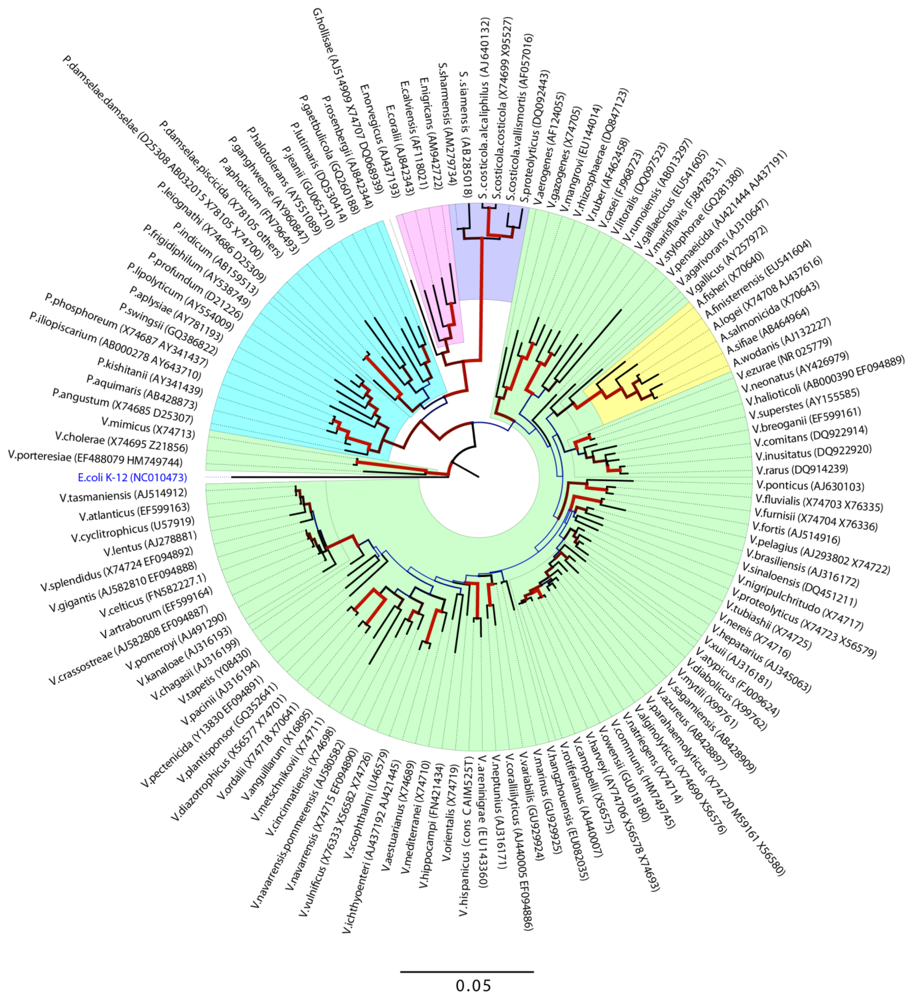
<p>Marine <italic>Vibrionaceae</italic> are Gram-negative, rod-shaped γ-proteobacteria that are usually motile and possess a chemoheterotrophic metabolism [<xref ref-type="bibr" rid="b1-marinedrugs-09-01440">1</xref>]. Members of this family are widespread in the marine environment, including estuaries, coastal waters, and sediments [<xref ref-type="bibr" rid="b1-marinedrugs-09-01440">1</xref>]. At this writing, the family includes seven genera (<xref ref-type="fig" rid="f1-marinedrugs-09-01440">Figure 1</xref>): <italic>Allivibrio</italic> (6 species), <italic>Enterovibrio</italic> (4 species), <italic>Salinivibrio</italic> (6 species), <italic>Catenococcus</italic> (1 species), <italic>Grimontia</italic> (1 species), <italic>Vibrio</italic> (89 species), and <italic>Photobacterium</italic> (21 species) [<xref ref-type="bibr" rid="b1-marinedrugs-09-01440">1</xref>,<xref ref-type="bibr" rid="b2-marinedrugs-09-01440">2</xref>].</p>
<sec>
<title>1.1. Occurrence and Ecological Significance</title>
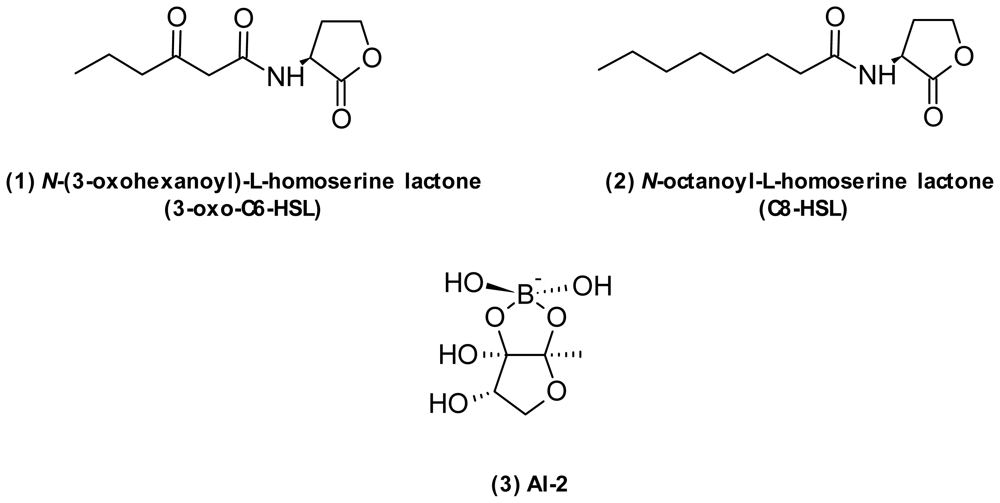
<p>Vibrios are particularly abundant on the surface of marine macroorganisms such as corals, fish, seagrass, sponges, and zooplankton, where they form commensal, symbiotic, or pathogenic associations [<xref ref-type="bibr" rid="b1-marinedrugs-09-01440">1</xref>]. Excellent books and reviews have been published on the taxonomy [<xref ref-type="bibr" rid="b8-marinedrugs-09-01440">8</xref>], ecology [<xref ref-type="bibr" rid="b1-marinedrugs-09-01440">1</xref>,<xref ref-type="bibr" rid="b9-marinedrugs-09-01440">9</xref>,<xref ref-type="bibr" rid="b10-marinedrugs-09-01440">10</xref>], and pathogenesis of vibrios [<xref ref-type="bibr" rid="b11-marinedrugs-09-01440">11</xref>–<xref ref-type="bibr" rid="b14-marinedrugs-09-01440">14</xref>]. Several species are well studied and serve as model systems for understanding symbioses [<xref ref-type="bibr" rid="b15-marinedrugs-09-01440">15</xref>,<xref ref-type="bibr" rid="b16-marinedrugs-09-01440">16</xref>], interspecies signaling [<xref ref-type="bibr" rid="b17-marinedrugs-09-01440">17</xref>], and pathogen persistence [<xref ref-type="bibr" rid="b11-marinedrugs-09-01440">11</xref>,<xref ref-type="bibr" rid="b18-marinedrugs-09-01440">18</xref>]. A particularly famed vibrio is <italic>Vibrio fischeri</italic>, known for its light organ symbiosis with the Hawaiian squid <italic>Euprymna scolopes</italic> [<xref ref-type="bibr" rid="b15-marinedrugs-09-01440">15</xref>]. <italic>V. fischeri</italic> colonizes the squid light organ and provides bioluminescence for the squid to use as countershading in order to evade predators. In return, the bacteria gain a protected nutrient environment. The discovery of <italic>N</italic>-acylhomoserine lactones (<xref ref-type="fig" rid="f2-marinedrugs-09-01440">Figure 2</xref>) as quorum sensing signals was first made in <italic>V. fischeri</italic> and the LuxI/R system of <italic>V. fischeri</italic> is the paradigm of Gram-negative QS systems even though it is not found in all vibrios [<xref ref-type="bibr" rid="b18-marinedrugs-09-01440">18</xref>]. In <italic>V. fischeri</italic>, there are three distinct QS signals; 3-oxo-C6-HSL (<bold>1</bold>), C8-HSL (<bold>2</bold>), and AI-2 (<bold>3</bold>). These are used to control a regulatory cascade leading to induction of luminescence. Vibrios also use QS to control traits such as virulence and biofilm formation [<xref ref-type="bibr" rid="b17-marinedrugs-09-01440">17</xref>].</p>
<p>The <italic>Vibrionaceae</italic> include species that are opportunistic pathogens of humans and marine animals. <italic>V. vulnificus</italic>, <italic>V. parahaemolyticus</italic>, and <italic>V. cholerae</italic> are serious human pathogens. <italic>V. cholerae</italic> probably has the greatest impact on human health, causing the acute diarrheal disease cholera that can result in epidemics [<xref ref-type="bibr" rid="b11-marinedrugs-09-01440">11</xref>]. It is a very persistent bacterium that can survive on a variety of vectors, including zooplankton [<xref ref-type="bibr" rid="b19-marinedrugs-09-01440">19</xref>] and cyanobacteria [<xref ref-type="bibr" rid="b18-marinedrugs-09-01440">18</xref>]. <italic>V. parahaemolyticus</italic> [<xref ref-type="bibr" rid="b20-marinedrugs-09-01440">20</xref>] and <italic>V. vulnificus</italic> [<xref ref-type="bibr" rid="b12-marinedrugs-09-01440">12</xref>] are food-borne pathogens associated with the ingestion of raw seafood. <italic>V. anguillarum</italic>, <italic>V. salmonicida</italic>, and <italic>V. vulnificus</italic> are important fish pathogens and are widespread in aquaculture settings, where conditions seem to enhance their virulence [<xref ref-type="bibr" rid="b1-marinedrugs-09-01440">1</xref>].</p>
<p>The ability to form biofilms is widespread among vibrios and plays a significant role in the pathogenicity of <italic>V. cholera</italic> [<xref ref-type="bibr" rid="b21-marinedrugs-09-01440">21</xref>], <italic>V. parahaemolyticus,</italic> and <italic>V. vulnificus</italic> [<xref ref-type="bibr" rid="b22-marinedrugs-09-01440">22</xref>], as well as in the symbiotic colonization by <italic>V. fischeri</italic> [<xref ref-type="bibr" rid="b23-marinedrugs-09-01440">23</xref>,<xref ref-type="bibr" rid="b24-marinedrugs-09-01440">24</xref>]. Key proteins include pili, lectins, exopolysaccharides, and components involved in the formation of flagella [<xref ref-type="bibr" rid="b22-marinedrugs-09-01440">22</xref>]. Though vibrios share a high number of regulatory systems of biofilm formation, there are differences that could reflect different niche specificity or ecological roles [<xref ref-type="bibr" rid="b25-marinedrugs-09-01440">25</xref>]. For example, it appears that vibrios produce species-specific exopolysaccharides, the major component of bacterial biofilms, and often have the potential to produce more than one type [<xref ref-type="bibr" rid="b22-marinedrugs-09-01440">22</xref>].</p>
<p>High densities of <italic>Vibrio</italic> and <italic>Photobacterium</italic> on the surface of zooplankton [<xref ref-type="bibr" rid="b26-marinedrugs-09-01440">26</xref>] have in part been ascribed to the ability of vibrios to utilize chitin, an <italic>N</italic>-acetyl <sc>d</sc>-glucosamine polymer in zooplankton exoskeletons, as carbon and nitrogen source [<xref ref-type="bibr" rid="b27-marinedrugs-09-01440">27</xref>]. The presence of chitinases and chitinase encoding genes has been confirmed for several members of the family [<xref ref-type="bibr" rid="b27-marinedrugs-09-01440">27</xref>,<xref ref-type="bibr" rid="b28-marinedrugs-09-01440">28</xref>]. Chitin controls several genetic and physiological characteristics of vibrios [<xref ref-type="bibr" rid="b19-marinedrugs-09-01440">19</xref>] including antagonistic activity [<xref ref-type="bibr" rid="b29-marinedrugs-09-01440">29</xref>]. Also, vibrios are able to degrade other complex carbohydrates such as fucoidan and laminarin found in algal species [<xref ref-type="bibr" rid="b29-marinedrugs-09-01440">29</xref>,<xref ref-type="bibr" rid="b30-marinedrugs-09-01440">30</xref>]. Thus, this superior nutrient utilization may be one of the reasons for the ubiquitous presence of vibrios in the marine environment [<xref ref-type="bibr" rid="b31-marinedrugs-09-01440">31</xref>].</p></sec>
<sec>
<title>1.2. Genomic Diversity and Phylogeny</title>
<p>In contrast to most γ-proteobacteria, vibrios possess two circular chromosomes [<xref ref-type="bibr" rid="b32-marinedrugs-09-01440">32</xref>,<xref ref-type="bibr" rid="b33-marinedrugs-09-01440">33</xref>]. Essential functions and housekeeping genes are usually located on the large chromosome ChrI, which is rather constant in size (~3 Mb), while the smaller ChrII is flexible in size, ranging between 0.8–2.4 Mb [<xref ref-type="bibr" rid="b9-marinedrugs-09-01440">9</xref>]. ChrII contains accessory genes related to transcriptional regulation, for example, pathogenicity and antimicrobial resistance [<xref ref-type="bibr" rid="b9-marinedrugs-09-01440">9</xref>,<xref ref-type="bibr" rid="b34-marinedrugs-09-01440">34</xref>]. Genes encoding chitin metabolism and quorum sensing are split between the two chromosomes [<xref ref-type="bibr" rid="b9-marinedrugs-09-01440">9</xref>]. The ability of vibrios to vary the copy numbers of the two chromosomes is suspected to be involved in the adaptation to varying environmental conditions [<xref ref-type="bibr" rid="b34-marinedrugs-09-01440">34</xref>]. Horizontal gene transfer is involved in the genetic flexibility of vibrios, including transduction by phages, plasmid conjugation [<xref ref-type="bibr" rid="b35-marinedrugs-09-01440">35</xref>], and so-called “super-integrons” [<xref ref-type="bibr" rid="b36-marinedrugs-09-01440">36</xref>,<xref ref-type="bibr" rid="b37-marinedrugs-09-01440">37</xref>]. In addition, Meibom <italic>et al.</italic> (2005) [<xref ref-type="bibr" rid="b38-marinedrugs-09-01440">38</xref>] showed that vibrios become naturally competent when grown in the presence of chitin, allowing uptake of free DNA from the environment. Chitin-induced competence has been demonstrated in <italic>V. cholera</italic> [<xref ref-type="bibr" rid="b38-marinedrugs-09-01440">38</xref>], <italic>V. vulnificus</italic> [<xref ref-type="bibr" rid="b39-marinedrugs-09-01440">39</xref>], and <italic>V. fischeri</italic> [<xref ref-type="bibr" rid="b40-marinedrugs-09-01440">40</xref>].</p>
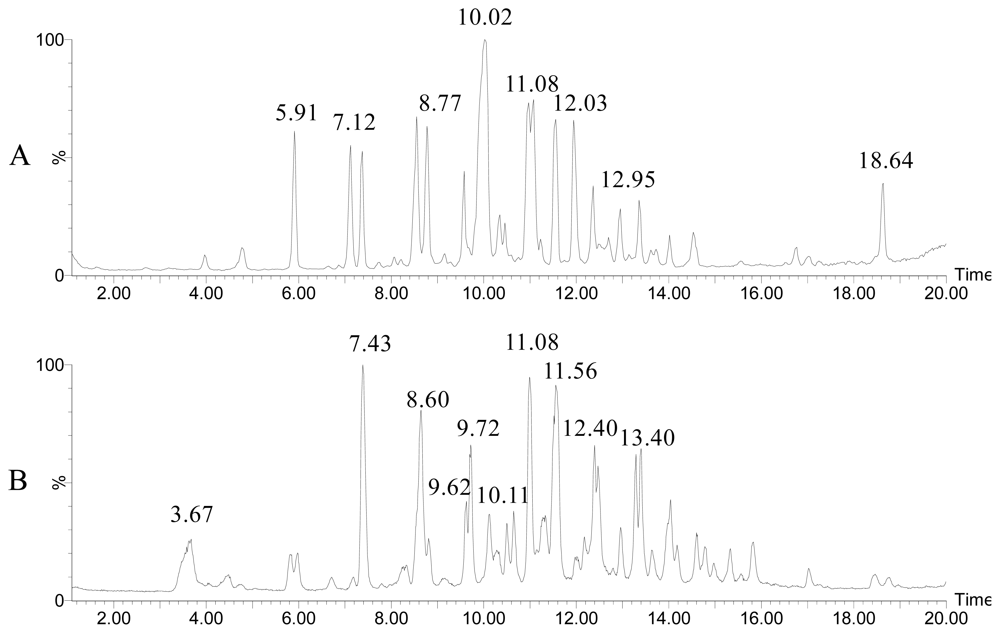
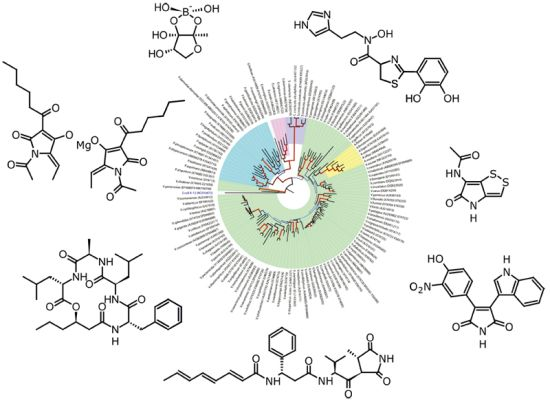
<p>The high genomic diversity of vibrios can be directly translated into high phenotypic variability [<xref ref-type="bibr" rid="b41-marinedrugs-09-01440">41</xref>]. This makes it difficult to obtain meaningful groupings of vibrios at genus and species level based on isolated phenotypical markers [<xref ref-type="bibr" rid="b1-marinedrugs-09-01440">1</xref>]. Also, the 16S rRNA gene is highly conserved, and present in serveral alleles, among the <italic>Vibrionaceae</italic> and not well suited for identification to the species level [<xref ref-type="bibr" rid="b41-marinedrugs-09-01440">41</xref>]. Attempts to improve the taxonomy include sequencing and comparison of various housekeeping genes, including <italic>recA</italic>, <italic>rpoA</italic>, <italic>toxR</italic>, which hold greater sequence variability than 16S [<xref ref-type="bibr" rid="b41-marinedrugs-09-01440">41</xref>,<xref ref-type="bibr" rid="b42-marinedrugs-09-01440">42</xref>]. Taxonomy of vibrios by genetic markers has been supplemented by chemical analyses, including fatty acid methyl ester (FAME) profiling, and more recently by whole-cell MALDI-TOF MS [<xref ref-type="bibr" rid="b43-marinedrugs-09-01440">43</xref>,<xref ref-type="bibr" rid="b44-marinedrugs-09-01440">44</xref>], and LC-UV/MS chemical profiling [<xref ref-type="bibr" rid="b29-marinedrugs-09-01440">29</xref>,<xref ref-type="bibr" rid="b45-marinedrugs-09-01440">45</xref>]. Chemotyping was found to be especially useful at sub-species level, identifying differences in antibiotic production [<xref ref-type="bibr" rid="b29-marinedrugs-09-01440">29</xref>]. Whole-cell MALDI-TOF MS was able to distinguish closely related species like <italic>V. parahaemolyticus</italic> and <italic>V. alginolyticus</italic> or <italic>V. cholerae</italic> and <italic>V. mimicus</italic> scouting potential biomarkers within a 4000–14,000 Da mass range [<xref ref-type="bibr" rid="b43-marinedrugs-09-01440">43</xref>]. Closely related species (<italic>V. coralliilyticus</italic> and <italic>V. neptunius</italic>) could be distinguished based on their secondary metabolite production (<xref ref-type="fig" rid="f3-marinedrugs-09-01440">Figure 3</xref>) [<xref ref-type="bibr" rid="b45-marinedrugs-09-01440">45</xref>]. Despite intra-species differences [<xref ref-type="bibr" rid="b29-marinedrugs-09-01440">29</xref>], the chemical profiles corroborated the phylogenetic relationship and clearly showed that production of secondary metabolites in vibrios is more than a strain specific trait.</p></sec></sec>
<sec>
<title>2. Natural Product Production by Members of the <italic>Vibrionaceae</italic> Family</title>
<p>Considering their widespread presence in the marine environment and their genomic flexibility, vibrios are largely underexplored for their proclivity to produce secondary metabolites. So far, a total of 93 compounds have been isolated from <italic>Vibrionaceae</italic>. The majority of these compounds have been isolated from only three species; <italic>V. parahaemolyticus</italic>, <italic>V. anguillarum</italic>, and <italic>V. vulnificus</italic>, which is likely a reflection of their importance as pathogens. In the following, all metabolites reported from <italic>Vibrionaceae</italic> (<xref ref-type="table" rid="t1-marinedrugs-09-01440">Table 1</xref>) will be presented and interesting compounds highlighted in an attempt to give an overview of the chemical diversity and assess the biosynthetic potential of this group of bacteria.</p>
<sec>
<title>2.1. Compounds with Antibacterial Activity</title>
<p>Some marine vibrios produce antibacterial compounds [<xref ref-type="bibr" rid="b91-marinedrugs-09-01440">91</xref>–<xref ref-type="bibr" rid="b93-marinedrugs-09-01440">93</xref>] that are believed to contribute to their abundance in surface-associated communities [<xref ref-type="bibr" rid="b94-marinedrugs-09-01440">94</xref>]. Long and Azam (2001) [<xref ref-type="bibr" rid="b92-marinedrugs-09-01440">92</xref>] studied anta-gonistic interactions among pelagic bacteria and found that vibrios produced broad-range antibacterial compounds. Similar capabilities have been observed for coral-associated vibrios [<xref ref-type="bibr" rid="b95-marinedrugs-09-01440">95</xref>]. Yet, none of these compounds were isolated and structurally characterized. The relatively widespread production of antibiotics in marine vibrios [<xref ref-type="bibr" rid="b45-marinedrugs-09-01440">45</xref>] indicates that antagonistic activity is of ecological importance [<xref ref-type="bibr" rid="b29-marinedrugs-09-01440">29</xref>].</p>
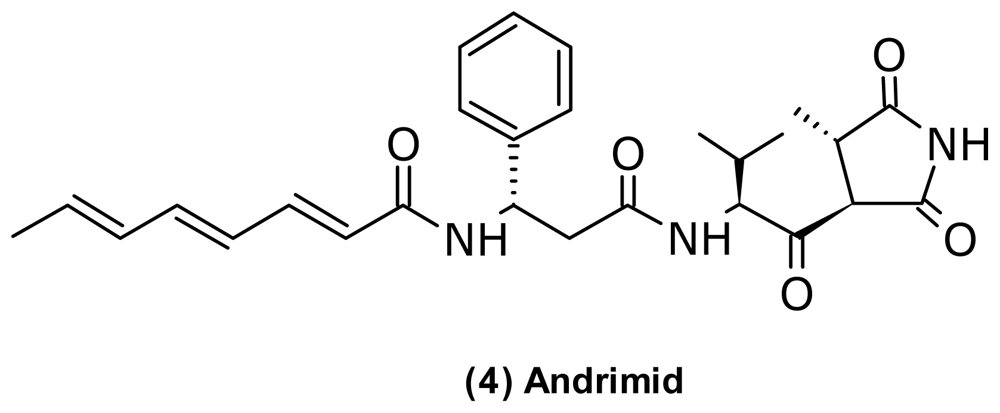
<p>Probably the best studied antibiotic produced by vibrios is the hybrid NRPS-PKS peptide antibiotic andrimid (<bold>4</bold>) (<xref ref-type="fig" rid="f4-marinedrugs-09-01440">Figure 4</xref>) [<xref ref-type="bibr" rid="b46-marinedrugs-09-01440">46</xref>]. The compound interferes with fatty acid biosynthesis [<xref ref-type="bibr" rid="b96-marinedrugs-09-01440">96</xref>] and is effective against a wide range of bacteria [<xref ref-type="bibr" rid="b97-marinedrugs-09-01440">97</xref>]. Structure-activity studies by Pohlmann <italic>et al.</italic> (2005) [<xref ref-type="bibr" rid="b96-marinedrugs-09-01440">96</xref>] revealed that the pyrrolidinedione head was essential for activity, while variations in the fatty acid tail were more tolerable. This suggested that these two structural moieties play different roles in target binding.</p>
<p>Andrimid is a cosmopolitan antibiotic found in distantly related bacteria, including a symbiotic <italic>Enterobacter</italic> sp. from the planthopper <italic>Nilaparvata lugens</italic> [<xref ref-type="bibr" rid="b98-marinedrugs-09-01440">98</xref>], <italic>Pseudomonas flourescens</italic> [<xref ref-type="bibr" rid="b99-marinedrugs-09-01440">99</xref>], <italic>Pantoea agglomerans</italic> [<xref ref-type="bibr" rid="b100-marinedrugs-09-01440">100</xref>], and <italic>Vibrio</italic> sp. [<xref ref-type="bibr" rid="b45-marinedrugs-09-01440">45</xref>,<xref ref-type="bibr" rid="b46-marinedrugs-09-01440">46</xref>]. The andrimid biosynthetic gene cluster was conserved in two different producers [<xref ref-type="bibr" rid="b101-marinedrugs-09-01440">101</xref>]. Interestingly, the cluster encodes resistance genes [<xref ref-type="bibr" rid="b102-marinedrugs-09-01440">102</xref>] as well as specific transposases that could be responsible for the diverse occurrence of this antibiotic [<xref ref-type="bibr" rid="b100-marinedrugs-09-01440">100</xref>,<xref ref-type="bibr" rid="b101-marinedrugs-09-01440">101</xref>]. From <italic>Vibrio</italic> species, the compound was first isolated by Oclarit <italic>et al.</italic> in 1994 [<xref ref-type="bibr" rid="b46-marinedrugs-09-01440">46</xref>], and Long <italic>et al.</italic> (2005) [<xref ref-type="bibr" rid="b93-marinedrugs-09-01440">93</xref>] identified andrimid as the compound responsible for the growth inhibition of <italic>V. cholerae</italic> by an unidentified <italic>Vibrio</italic> strain. Production of andrimid was for the first time linked to a specific vibrio species by Wietz <italic>et al.</italic> (2010) [<xref ref-type="bibr" rid="b45-marinedrugs-09-01440">45</xref>] that isolated the compound from the culture broth of a <italic>V. coralliillyticus</italic> strain S2052. Within <italic>V. coralliilyticus</italic>, the production of andrimid is a marker of different chemotypes [<xref ref-type="bibr" rid="b29-marinedrugs-09-01440">29</xref>]. Two <italic>V. coralliilyticus</italic> strains S2052 and S4053 from two distant geographical locations produced andrimid [<xref ref-type="bibr" rid="b45-marinedrugs-09-01440">45</xref>], while the type strain and a close relative did not [<xref ref-type="bibr" rid="b29-marinedrugs-09-01440">29</xref>]. Interestingly, <italic>V. coralliilyticus</italic> S2052 focused its production of secondary metabolites to the production of andrimid when grown on chitin and also increased the yield of the antibiotic [<xref ref-type="bibr" rid="b29-marinedrugs-09-01440">29</xref>]. The bacterium was capable of producing andrimid in a live chitin model system with <italic>Artemia</italic> [<xref ref-type="bibr" rid="b29-marinedrugs-09-01440">29</xref>]. This indicated that andrimid potentially contributes to different niche-specificities of <italic>V. coralliilyticus</italic>.</p>
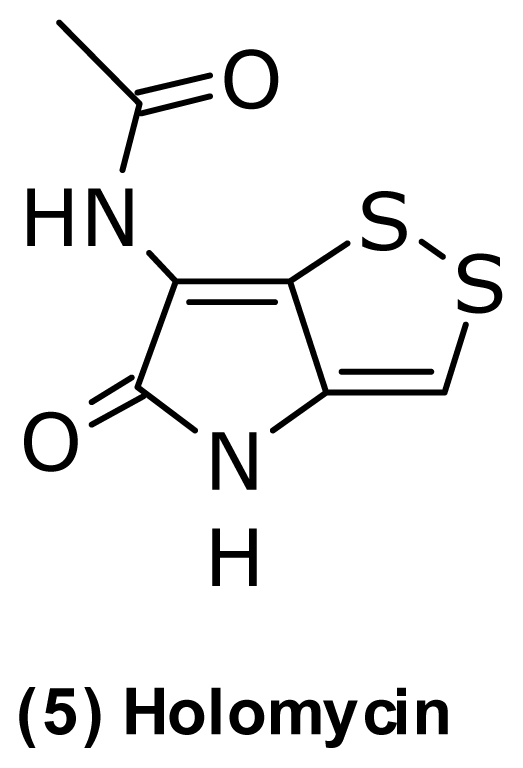
<p>Another example of cosmopolitan antibiotics from <italic>Vibrionaceae</italic> is the highly potent pyrrothine antibiotic, holomycin (<bold>5</bold>) (<xref ref-type="fig" rid="f5-marinedrugs-09-01440">Figure 5</xref>) isolated from a strain closely related to <italic>Photobacterium halotolerans</italic> [<xref ref-type="bibr" rid="b45-marinedrugs-09-01440">45</xref>]. Prior to this isolation, holomycin had only been isolated from actinomycetes, including <italic>Streptomyces clavuligerus</italic> [<xref ref-type="bibr" rid="b103-marinedrugs-09-01440">103</xref>], <italic>S. griseus</italic> [<xref ref-type="bibr" rid="b104-marinedrugs-09-01440">104</xref>], and a marine <italic>Streptomyces</italic> sp. [<xref ref-type="bibr" rid="b105-marinedrugs-09-01440">105</xref>].</p>
<p>The NRPS biosynthetic cluster encoding holomycin in <italic>S. clavuligerus</italic> was recently identified by Li and Walsh (2010) [<xref ref-type="bibr" rid="b106-marinedrugs-09-01440">106</xref>], and this allows for the comparison of the holomycin clusters in other producers, including <italic>Photobacterium</italic>. Holomycin has a broad spectrum of antibacterial activity against pathogenic bacteria such as <italic>Staphylococcus aureus</italic>, <italic>S. pneumoniae</italic>, <italic>S. epidermis</italic>, <italic>Enterococcus faecalis</italic>, and <italic>Escherichia coli</italic> [<xref ref-type="bibr" rid="b107-marinedrugs-09-01440">107</xref>]. The mode-of-action in <italic>E. coli</italic> includes inhibition of RNA chain elongation, but holomycin is suspected to act as prodrug rather than a direct inhibitor of the RNA polymerase [<xref ref-type="bibr" rid="b107-marinedrugs-09-01440">107</xref>]. Holomycin is also strongly inhibitory against several marine strains from the <italic>Roseobacter-</italic>clade, <italic>Pseudoalteromonas</italic>, and <italic>Vibrio</italic>, including pathogens such as <italic>V. harveyi</italic>, <italic>V. vulnificus</italic>, and <italic>V. parahaemolyticus</italic> [<xref ref-type="bibr" rid="b45-marinedrugs-09-01440">45</xref>], altogether suggesting that holomycin plays a role in antagonism in the marine environment.</p>
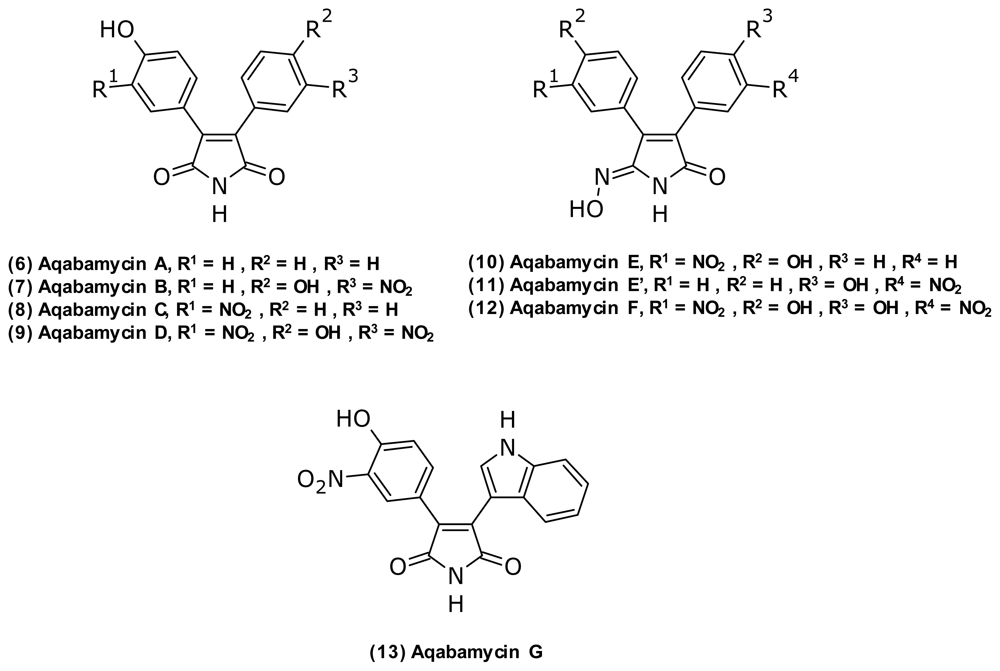
<p>Yao and Al-Zereini recently (2010) [<xref ref-type="bibr" rid="b47-marinedrugs-09-01440">47</xref>,<xref ref-type="bibr" rid="b48-marinedrugs-09-01440">48</xref>] isolated a series of nitrosubstrituted maleimides called aqabamycins (<bold>6</bold>–<bold>13</bold>) (<xref ref-type="fig" rid="f6-marinedrugs-09-01440">Figure 6</xref>) from a coral-associated <italic>Vibrio</italic> sp. The analogues had varying antibacterial activity against Gram-positive bacteria, including <italic>Micrococcus luteus</italic>, <italic>Bacillus subtilis</italic>, and <italic>B. brevis</italic> as well as cytotoxic activity [<xref ref-type="bibr" rid="b48-marinedrugs-09-01440">48</xref>]. The aqabamycins represent a unique structural group both due to their high degree of nitrosubstitution which is rare in nature [<xref ref-type="bibr" rid="b108-marinedrugs-09-01440">108</xref>] and the maleimide monoxime present in aqabamycin E/E′ (<bold>10</bold>–<bold>11</bold>) and F (<bold>12</bold>).</p>
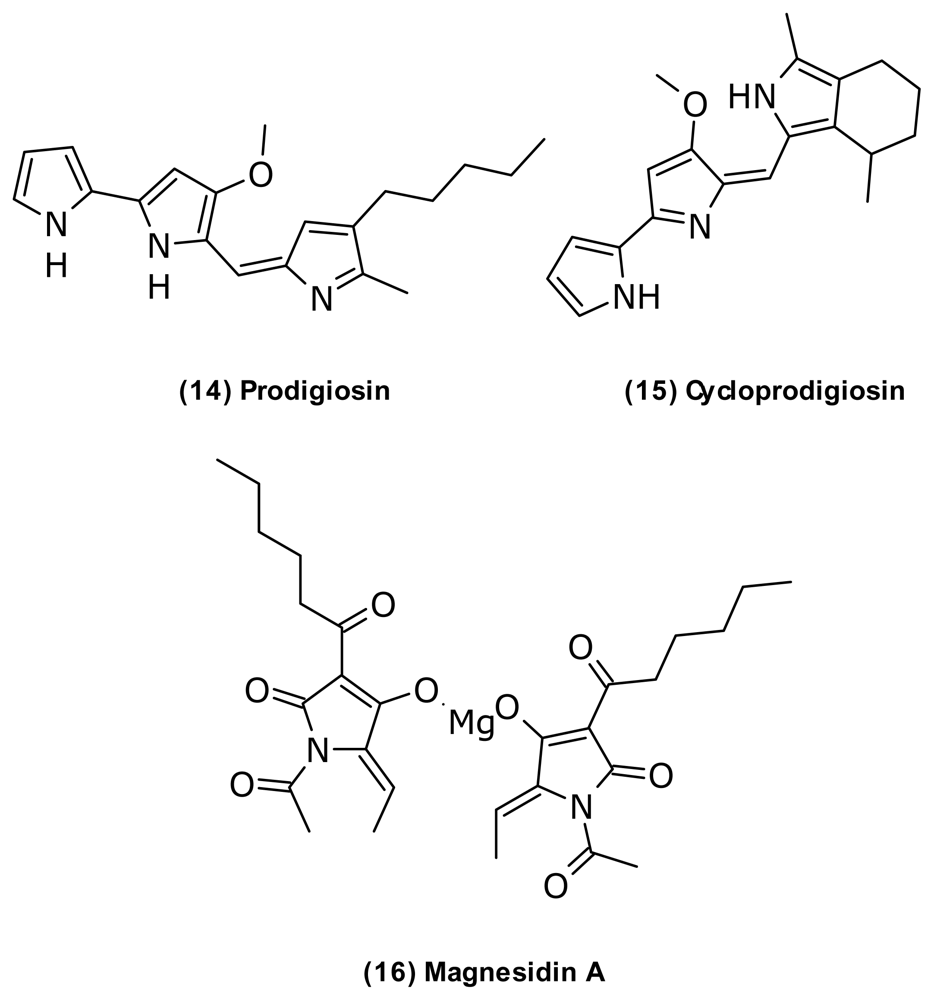
<p>The red pigment and antibiotic prodigiosin (<bold>14</bold>) (<xref ref-type="fig" rid="f7-marinedrugs-09-01440">Figure 7</xref>) has been isolated from <italic>V. psychroerythreus</italic> [<xref ref-type="bibr" rid="b60-marinedrugs-09-01440">60</xref>], <italic>V. gazogenes</italic> (originally termed <italic>Beneckea gazogenes</italic> but later revised) [<xref ref-type="bibr" rid="b61-marinedrugs-09-01440">61</xref>], and <italic>V. ruber</italic> [<xref ref-type="bibr" rid="b62-marinedrugs-09-01440">62</xref>]. Additional producers of this compound include <italic>Alteromonas rubra</italic>/<italic>Pseudoalteromonas rubra</italic> [<xref ref-type="bibr" rid="b109-marinedrugs-09-01440">109</xref>,<xref ref-type="bibr" rid="b110-marinedrugs-09-01440">110</xref>], <italic>Hahella chejuensis</italic> [<xref ref-type="bibr" rid="b111-marinedrugs-09-01440">111</xref>], and different <italic>Serratia</italic> [<xref ref-type="bibr" rid="b112-marinedrugs-09-01440">112</xref>], and <italic>Streptomyces</italic> species [<xref ref-type="bibr" rid="b113-marinedrugs-09-01440">113</xref>,<xref ref-type="bibr" rid="b114-marinedrugs-09-01440">114</xref>]. Prodigiosin and its cyclized analogue (<bold>15</bold>) [<xref ref-type="bibr" rid="b50-marinedrugs-09-01440">50</xref>,<xref ref-type="bibr" rid="b115-marinedrugs-09-01440">115</xref>] have a broad range of biological activities, including antimicrobial, antimalarial, immunosuppressive, and anticancer [<xref ref-type="bibr" rid="b116-marinedrugs-09-01440">116</xref>–<xref ref-type="bibr" rid="b118-marinedrugs-09-01440">118</xref>]. Prodiginines have clinical potential in anticancer therapy [<xref ref-type="bibr" rid="b118-marinedrugs-09-01440">118</xref>], and prodigiosin is currently in preclinical trials (Aida Pharmaceuticals) for pancreatic cancer [<xref ref-type="bibr" rid="b116-marinedrugs-09-01440">116</xref>]. The clinical potential as antibiotics is, however, limited due to a low therapeutic window and considerable toxic effects [<xref ref-type="bibr" rid="b119-marinedrugs-09-01440">119</xref>]. Starič <italic>et al.</italic> (2010) [<xref ref-type="bibr" rid="b120-marinedrugs-09-01440">120</xref>] recently demonstrated that the production of prodiginines in a <italic>Vibrio</italic> sp. isolated from estuaries conferred competitiveness against a <italic>Bacillus</italic> sp. from the same sample, suggesting that prodigiosin might act as a antibiotic in the natural environment. Interestingly, the prodigiosin producing <italic>V. gazogenes</italic> also produced the unique magnesium containing antibiotic, magnesidin (<bold>16</bold>) (<xref ref-type="fig" rid="f7-marinedrugs-09-01440">Figure 7</xref>) [<xref ref-type="bibr" rid="b55-marinedrugs-09-01440">55</xref>,<xref ref-type="bibr" rid="b121-marinedrugs-09-01440">121</xref>–<xref ref-type="bibr" rid="b123-marinedrugs-09-01440">123</xref>].</p>
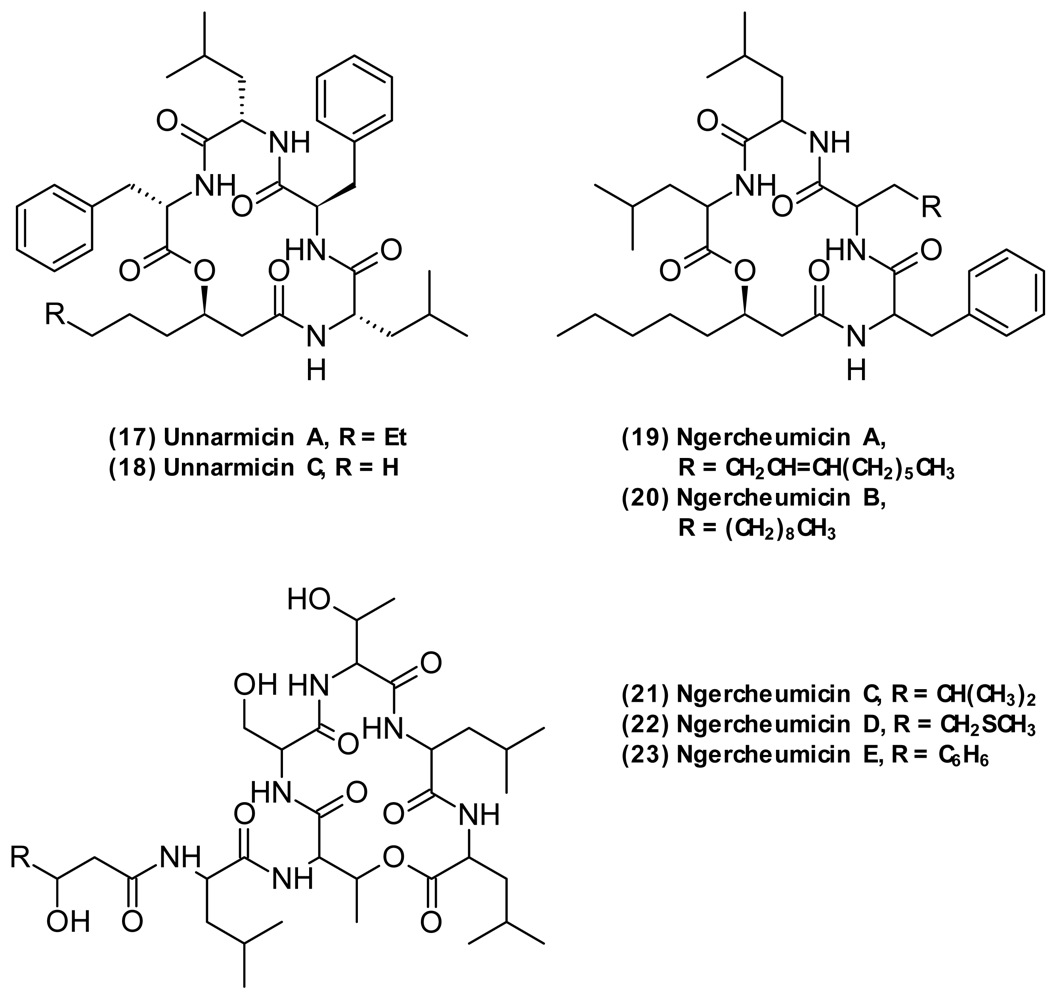
<p>Shizuri and co-workers isolated two distinct groups of depsipeptides (<xref ref-type="fig" rid="f8-marinedrugs-09-01440">Figure 8</xref>), the unnarmicins [<xref ref-type="bibr" rid="b63-marinedrugs-09-01440">63</xref>] and ngercheumicins [<xref ref-type="bibr" rid="b57-marinedrugs-09-01440">57</xref>] from a <italic>Photobacterium</italic> sp. with potent, but narrow-spectrum antibacterial effect against strains of <italic>Pseudovibrio</italic>. The unnarmicin A (<bold>17</bold>) and C (<bold>18</bold>) consist of four amino acids (<sc>l</sc>-Phe, <sc>l</sc>-Leu, <sc>d</sc>-Phe, <sc>l</sc>-Leu) and a 3-hydroxyoctanoic and 3-hydroxyhexanoic fatty acid, respectively. The ngercheumicins A–E have a depsipeptide macrocycle and either a fatty acid (<bold>19</bold>–<bold>20</bold>) or peptide tail (<bold>21</bold>–<bold>23</bold>). They have been patented for treating infections caused by <italic>Pseudovibrio denitrificans</italic>, though no literature describes pathogenic traits of this bacterium [<xref ref-type="bibr" rid="b124-marinedrugs-09-01440">124</xref>].</p></sec>
<sec>
<title>2.2. Siderophores</title>
<p>Many vibrios produce siderophores as a strategy to sequester iron in the marine environment, where the iron level is extremely low [<xref ref-type="bibr" rid="b125-marinedrugs-09-01440">125</xref>,<xref ref-type="bibr" rid="b126-marinedrugs-09-01440">126</xref>]. This is necessary to maintain important enzymatic processes (with iron as cofactor) and a prerequisite for pathogenicity for many vibrios. It should be mentioned that siderophores also may have antibacterial activity but are dealt with in a separate section due to their specific metabolic function.</p>
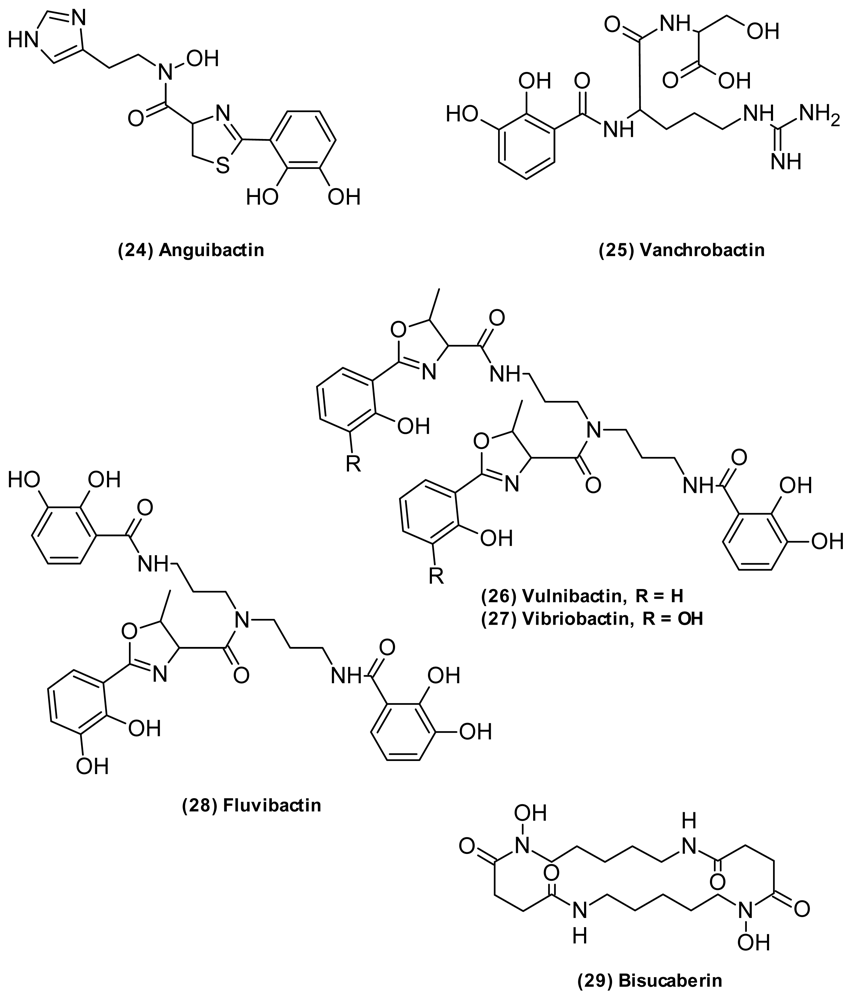
<p>A great structural diversity has been observed among the siderophores produced by <italic>Vibrio</italic> species (<xref ref-type="fig" rid="f9-marinedrugs-09-01440">Figure 9</xref>). <italic>V. anguillarum</italic> has at least two different siderophore-mediated systems, namely anguibactin (<bold>24</bold>) [<xref ref-type="bibr" rid="b64-marinedrugs-09-01440">64</xref>,<xref ref-type="bibr" rid="b127-marinedrugs-09-01440">127</xref>] and vanchrobactin (<bold>25</bold>) [<xref ref-type="bibr" rid="b128-marinedrugs-09-01440">128</xref>]. The non-ribosomal peptide anguibactin represents a unique structural class of siderophores with both a catechol and hydroxamate ligand and a thiazole core [<xref ref-type="bibr" rid="b64-marinedrugs-09-01440">64</xref>]. The biosynthetic genes encoding this compound are found on a 65-kb virulence plasmid in some <italic>V. anguillarum</italic> strains. Knock-out of genes involved in anguibactin production attenuated virulence, confirming that anguibactin is a prerequisite for successful host-invasion of this bacterium [<xref ref-type="bibr" rid="b129-marinedrugs-09-01440">129</xref>]. In contrast, the catechol vanchrobactin is chromosome-encoded, and interestingly, the coding genes are silenced in anguibactin producing strains [<xref ref-type="bibr" rid="b71-marinedrugs-09-01440">71</xref>,<xref ref-type="bibr" rid="b130-marinedrugs-09-01440">130</xref>]. Recently, dimeric and trimeric versions of vanchrobactin were isolated from an unidentified <italic>Vibrio</italic> by Sandy <italic>et al.</italic> (2010) [<xref ref-type="bibr" rid="b65-marinedrugs-09-01440">65</xref>]. Also, they found anguibactin to possess cytotoxic activities against P388 murine leukemia cells [<xref ref-type="bibr" rid="b65-marinedrugs-09-01440">65</xref>].</p>
<p>Vibriobactin (<bold>27</bold>) [<xref ref-type="bibr" rid="b72-marinedrugs-09-01440">72</xref>], vulnibactin (<bold>26</bold>) [<xref ref-type="bibr" rid="b74-marinedrugs-09-01440">74</xref>], and fluvibactin (<bold>28</bold>) (<xref ref-type="fig" rid="f9-marinedrugs-09-01440">Figure 9</xref>) [<xref ref-type="bibr" rid="b68-marinedrugs-09-01440">68</xref>] are unique siderophores produced by <italic>V. cholerae</italic>, <italic>V. vulnificus</italic>, and <italic>V. fluvialis</italic>, respectively. They are all catechol hydroxyphenyloxalone siderophores that share a rare norspermidine backbone, giving them a propeller-like structure. In vibriobactin and vulnibactin, two of the hydroxybenzoyl moieties are linked to the backbone through an <sc>l</sc>-threonine, forming an oxazoline ring. Fluvibactin only has one oxazoline ring, with one hydroxybenzoyl directly linked to the norspermidine terminal. Vibriobactin and vulnibactin differ only in the number of hydroxylations, and this high structural similarity enables cross-utilization of these two siderophores [<xref ref-type="bibr" rid="b74-marinedrugs-09-01440">74</xref>].</p>
<p>Bisucaberin (<bold>29</bold>) (<xref ref-type="fig" rid="f9-marinedrugs-09-01440">Figure 9</xref>) [<xref ref-type="bibr" rid="b69-marinedrugs-09-01440">69</xref>] is a symmetric cyclic dihydroxamate produced by the fish pathogen <italic>V. salmonicida</italic> [<xref ref-type="bibr" rid="b70-marinedrugs-09-01440">70</xref>]. Unlike most other vibrio siderophores [<xref ref-type="bibr" rid="b129-marinedrugs-09-01440">129</xref>], bisucaberin is produced through an NRPS-independent route [<xref ref-type="bibr" rid="b131-marinedrugs-09-01440">131</xref>] where alternating dicarboxylic acids and diamine or amino alcohols are assembled through amide or ester bonds [<xref ref-type="bibr" rid="b132-marinedrugs-09-01440">132</xref>]. Bisucaberin was found to be useful in combinatorial anticancer therapy by sensitizing tumor cells to macrophage-mediated cytolysis [<xref ref-type="bibr" rid="b69-marinedrugs-09-01440">69</xref>,<xref ref-type="bibr" rid="b133-marinedrugs-09-01440">133</xref>].</p>
<p>Siderophores are used as therapeutic deferration agents to treat iron overload in chronically transfused thalassemia patients. A stereochemically modified version of fluvibactin efficiently removed iron without increasing microbial growth [<xref ref-type="bibr" rid="b134-marinedrugs-09-01440">134</xref>]. It has been suggested that siderophores can be used for the development of a new class of “trojan horse” antibiotics [<xref ref-type="bibr" rid="b135-marinedrugs-09-01440">135</xref>]. Siderophore-antibiotic conjugates exploit the iron transport system of the pathogen to penetrate the bacterial outer membrane, increasing the antibacterial activity of the antibiotic [<xref ref-type="bibr" rid="b136-marinedrugs-09-01440">136</xref>]. Recently, Bergeron <italic>et al.</italic> (2009) [<xref ref-type="bibr" rid="b137-marinedrugs-09-01440">137</xref>] made a conjugate linking antibodies to vulnibactin as a strategy towards a vaccine against <italic>V. vulnificus</italic>.</p></sec>
<sec>
<title>2.3. Compounds with Other Activities</title>
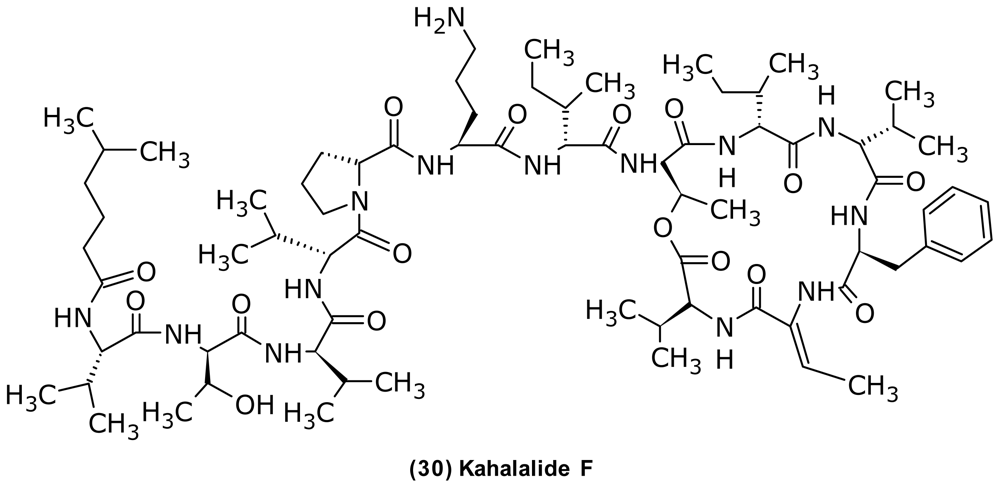
<p>Another interesting group of compounds produced by a member of the <italic>Vibrionaceae</italic> is the kahalalides. These cyclic depsipeptides were originally isolated from the herbivorous mollusc <italic>Elysia refescens</italic> and its diet, the green algae <italic>Bryopsis</italic> sp. In particular, kahalalide F (<bold>30</bold>) (<xref ref-type="fig" rid="f10-marinedrugs-09-01440">Figure 10</xref>) has an attractive spectrum of activities against AIDS-related opportunistic infections and against cancer cell lines [<xref ref-type="bibr" rid="b138-marinedrugs-09-01440">138</xref>]. Kahalalide F is currently undergoing Phase II clinical trials (PharmaMar) for the treatment of prostate, lung, and liver cancer [<xref ref-type="bibr" rid="b138-marinedrugs-09-01440">138</xref>] and in patients with severe psoriasis (PharmaMar/Marinomed) [<xref ref-type="bibr" rid="b139-marinedrugs-09-01440">139</xref>]. Interestingly, Hill and Hamann (2005) [<xref ref-type="bibr" rid="b75-marinedrugs-09-01440">75</xref>] found kahalalide F as well as two analogues to be produced by a <italic>V. mediterranei/shilonii</italic>. The finding of a microbial origin for this compound allows for the large-scale industrial fermentation of this compound rather than arduous organic synthesis.</p>
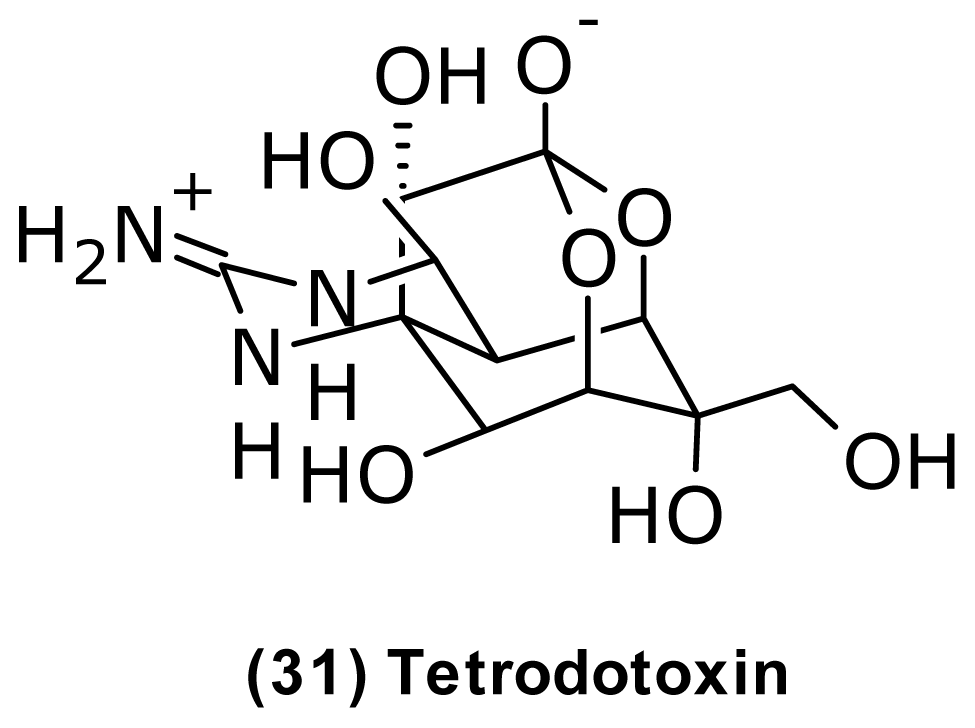
<p>Several vibrios produce the potent neurotoxin tetrodotoxin (TTX) (<bold>31</bold>) (<xref ref-type="fig" rid="f11-marinedrugs-09-01440">Figure 11</xref>), also known as the pufferfish poison [<xref ref-type="bibr" rid="b85-marinedrugs-09-01440">85</xref>]. The true origin of TTX has been the subject of much debate [<xref ref-type="bibr" rid="b140-marinedrugs-09-01440">140</xref>], nonetheless <italic>V. harveyi</italic> and <italic>V. alginolyticus</italic> isolated from different species of pufferfish produced the toxin as well as several analogues [<xref ref-type="bibr" rid="b84-marinedrugs-09-01440">84</xref>]. Also, <italic>V. fischeri</italic> isolated from the intestines of the xanthid crab, <italic>Atergatis floridus</italic> produced TTX [<xref ref-type="bibr" rid="b87-marinedrugs-09-01440">87</xref>]. Vibrios dominated the intestinal microbiota of the pufferfish, <italic>Fugu vermicularis vermicularis</italic> [<xref ref-type="bibr" rid="b84-marinedrugs-09-01440">84</xref>], suggesting that the toxification is caused by TTX-producing bacteria accumulated through the food web [<xref ref-type="bibr" rid="b85-marinedrugs-09-01440">85</xref>]. The role of these compounds to vibrio itself is still unclear, though it has been suggested to play a role in regulating sodium transport [<xref ref-type="bibr" rid="b85-marinedrugs-09-01440">85</xref>].</p>
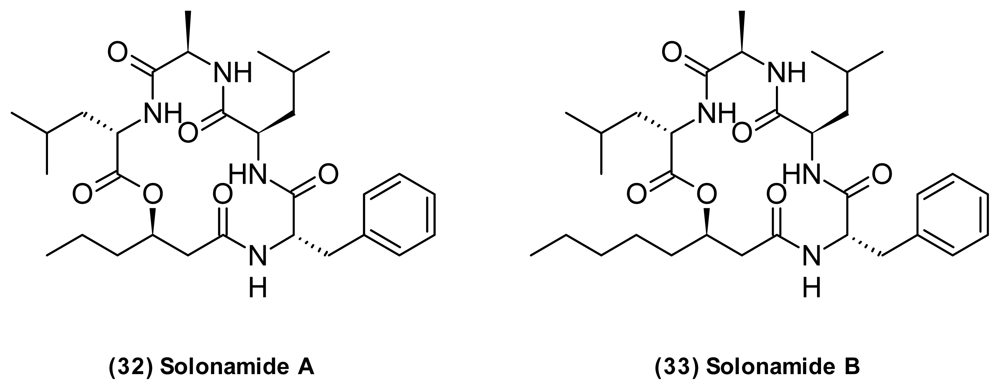
<p>Vibrios produce compounds that interfere with the quorum sensing system of Gram-positive bacteria. From a strain related to <italic>P. halotolerans</italic> two novel depsipeptides (<xref ref-type="fig" rid="f12-marinedrugs-09-01440">Figure 12</xref>), solonamides A and B (<bold>32</bold>–<bold>33</bold>) that interfere with QS regulated virulence genes in <italic>S. aureus</italic> were isolated [<xref ref-type="bibr" rid="b83-marinedrugs-09-01440">83</xref>]. In particular, solonamide B dramatically reduced expression of both <italic>hla</italic> encoding α-hemolysin and <italic>RNAIII</italic>, while increasing expression of <italic>spa</italic> encoding Protein A. This suggested that the depsipeptides interfere with <italic>agr</italic>, the global virulence regulator in <italic>S. aureus</italic>. High structural similarity of the solonamides to the natural autoinducers of the <italic>agr</italic> system suggested that they might be competitive inhibitors. Interestingly, the solonamides had a pronounced effect on virulence gene expression in <italic>S. aureus</italic> strain USA300, which is the predominant community-acquired MRSA (CA-MRSA) strain in the USA [<xref ref-type="bibr" rid="b141-marinedrugs-09-01440">141</xref>]. The solonamides strongly resemble the unnarmicins (<bold>17</bold>–<bold>18</bold>) found in an unidentified <italic>Photobacterium</italic> sp. (Section 2.3.1) [<xref ref-type="bibr" rid="b63-marinedrugs-09-01440">63</xref>]. Thus, it is possible that the unnarmicins also possess QSI activity.</p>
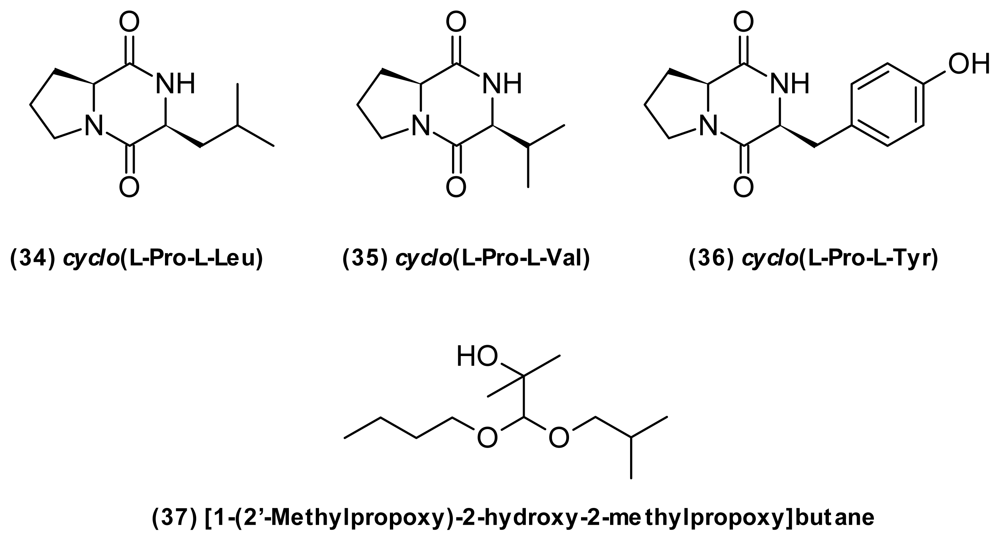
<p>Several small molecules isolated from vibrios induce Gram-negative quorum sensing systems. That includes various diketopiperazines (DKP) (<xref ref-type="fig" rid="f13-marinedrugs-09-01440">Figure 13</xref>). For example, <italic>cyclo</italic>(<sc>l</sc>-Pro, <sc>l</sc>-Leu) (<bold>34</bold>), <italic>cyclo</italic>(<sc>l</sc>-Pro, <sc>l</sc>-Val) (<bold>35</bold>), and <italic>cyclo</italic>(<sc>l</sc>-Pro, <sc>l</sc>-Tyr) (<bold>36</bold>), DKPs commonly isolated from vibrios [<xref ref-type="bibr" rid="b53-marinedrugs-09-01440">53</xref>], modulated LuxR-type protein activity though at higher concentrations than AHLs [<xref ref-type="bibr" rid="b142-marinedrugs-09-01440">142</xref>]. It is speculated that these dipeptides represent a new class of naturally occurring QS signals potentially involved in interspecies signaling, as DKPs are found in most culturable marine bacteria [<xref ref-type="bibr" rid="b143-marinedrugs-09-01440">143</xref>]. However, some DKPs are likely to be artifacts generated from media components during work-up procedures [<xref ref-type="bibr" rid="b144-marinedrugs-09-01440">144</xref>]. De Nys <italic>et al.</italic> (2001) [<xref ref-type="bibr" rid="b80-marinedrugs-09-01440">80</xref>] isolated [1-(2′-methylpropoxy)-2-hydroxy-2-methylpropoxy]-butane (<bold>37</bold>) (<xref ref-type="fig" rid="f13-marinedrugs-09-01440">Figure 13</xref>) from <italic>P. angustum</italic> (<italic>V. angustum</italic>) S14 with the ability to mediate expression in two AHL-regulated systems, inducing bioluminescence in <italic>V. harveyi</italic> and the AHL reporter system in <italic>Agrobacterium tumefaciens</italic>.</p></sec>
<sec>
<title>2.4. Compounds with Unknown Activities</title>
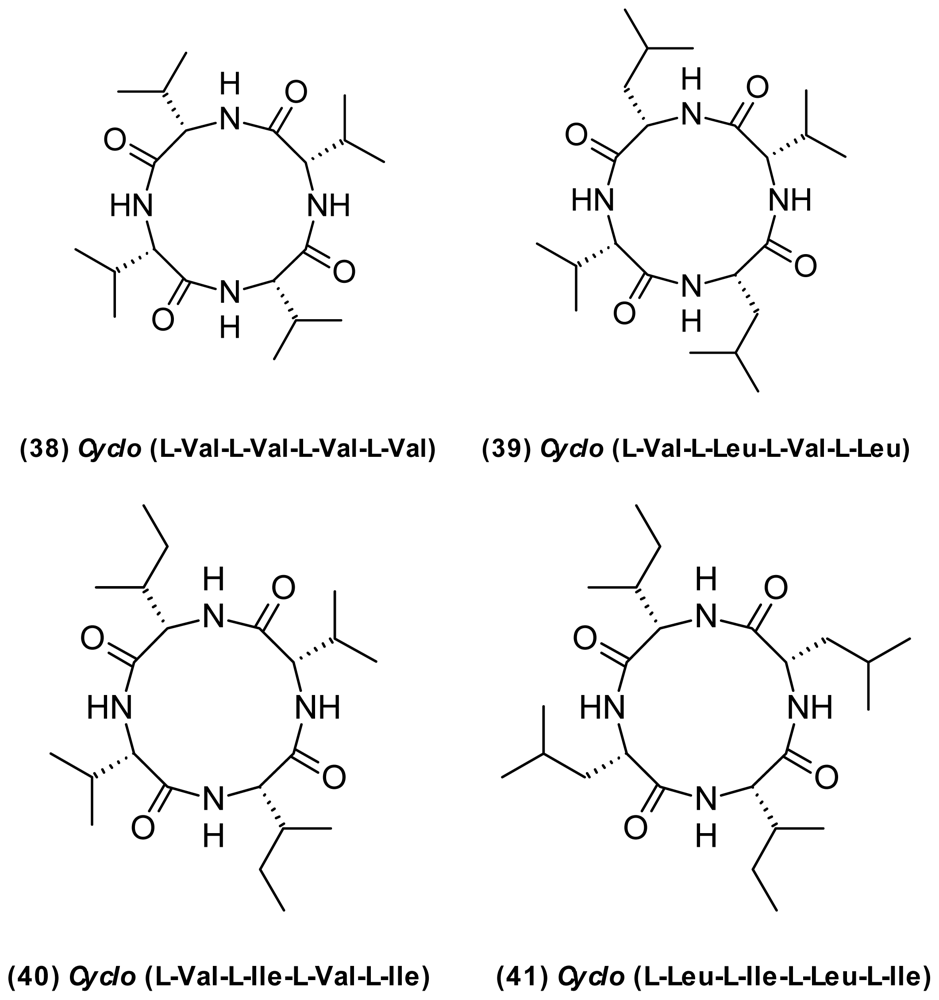
<p>Vibrios also produce numerous compounds for which no biological activity has been reported so far. That includes small-molecule by-products, for example some nitro-substituted compounds such as 3-nitroindazole and 3-nitro-4-hydroxycinnamic acid [<xref ref-type="bibr" rid="b47-marinedrugs-09-01440">47</xref>]. From <italic>P. halotolerans</italic> S2753, we isolated a series of cyclic tetrapeptides (<xref ref-type="fig" rid="f14-marinedrugs-09-01440">Figure 14</xref>); <italic>cyclo</italic>(<sc>l</sc>-Val-<sc>l</sc>-Val-<sc>l</sc>-Val-<sc>l</sc>-Val) (<bold>38</bold>), <italic>cyclo</italic>(<sc>l</sc>-Val-<sc>l</sc>-Leu-<sc>l</sc>Val- <sc>l</sc>-Leu) (<bold>39</bold>), <italic>cyclo</italic>(<sc>l</sc>-Val-<sc>l</sc>-Ile-<sc>l</sc>-Val-<sc>l</sc>-Ile) (<bold>40</bold>), and <italic>cyclo</italic>(<sc>l</sc>-Leu-<sc>l</sc>-Ile-<sc>l</sc>-Leu-<sc>l</sc>-Ile) (<bold>41</bold>) (Kjaerullf and Mansson, unpublished data). These types of peptides are often found in marine culturable bacteria [<xref ref-type="bibr" rid="b145-marinedrugs-09-01440">145</xref>–<xref ref-type="bibr" rid="b147-marinedrugs-09-01440">147</xref>], suggesting that they are storage compounds accumulated during growth under excess nutrients.</p>
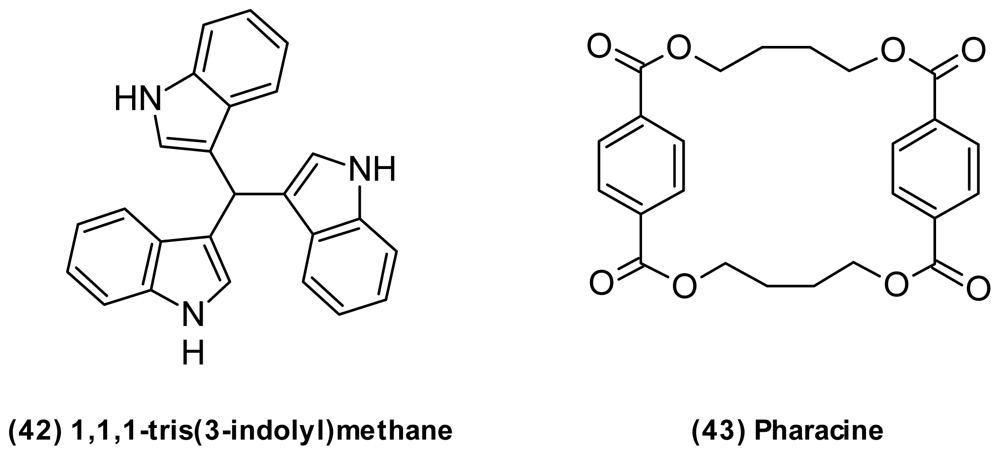
<p>Many of compounds isolated from vibrios are suspected to be artifacts generated from media components during work-up procedures [<xref ref-type="bibr" rid="b54-marinedrugs-09-01440">54</xref>,<xref ref-type="bibr" rid="b144-marinedrugs-09-01440">144</xref>,<xref ref-type="bibr" rid="b148-marinedrugs-09-01440">148</xref>]. These include several bis- and trisindole derivatives from a <italic>V. parahaemolyticus</italic> strain, Bio249 [<xref ref-type="bibr" rid="b54-marinedrugs-09-01440">54</xref>]. An example is 1,1,1-tris (3-indolyl) methane (<bold>42</bold>) (<xref ref-type="fig" rid="f15-marinedrugs-09-01440">Figure 15</xref>) that could easily be formed by simple condensation of indole-3-carbaldehyde and indole, both having been isolated from <italic>V. parahaemolyticus</italic> [<xref ref-type="bibr" rid="b54-marinedrugs-09-01440">54</xref>]. From the same <italic>V. parahaemolyticus</italic> strain, the cyclic terephthalic acid ester, pharacine (<bold>43</bold>) [<xref ref-type="bibr" rid="b148-marinedrugs-09-01440">148</xref>] was isolated [<xref ref-type="bibr" rid="b54-marinedrugs-09-01440">54</xref>]. This was suspected to be an artifact from plastic material contaminants; however, fermentation results were reproducible with no contact with plastic. Until biosynthetic studies have been performed, the true origin of these molecules remains uncertain.</p></sec></sec>
<sec>
<title>3. Conclusion</title>
<p>The versatility and widespread occurrence of vibrios can be ascribed to different characteristics such as their superior nutrient utilization, their excellent biofilm formation, and their genetic construction. High genomic flexibility in <italic>Vibrionaceae</italic> makes this group of bacteria very apt to resist various environmental changes, for example through the acquisition of biosynthetic genes linked to the production of antibiotics or siderophores. So, rampant horizontal gene transfer occurs in these bacteria. As a reflection, most compounds isolated from vibrios have also been found in other types of bacteria, in many cases from distantly related taxa [<xref ref-type="bibr" rid="b45-marinedrugs-09-01440">45</xref>]. Sometimes the mobile genetic elements are even incorporated in the biosynthetic cluster itself, making it even more prone to gene-exchange. The antibiotic andrimid is an example of a compound encoded by such a “nomadic gene cluster” [<xref ref-type="bibr" rid="b149-marinedrugs-09-01440">149</xref>].</p>
<p>Production of secondary metabolites in vibrios has been linked to antagonism, intraspecies communication, and pathogenicity. The compounds produced by vibrios are mainly non-ribosomal peptides or hybrids hereof, with examples of <italic>N</italic>-containing compounds produced by NRPS-independent pathways. Despite this narrow structural span compared to metabolites produced by other marine bacteria, vibrios produce compounds with a broad range of interesting biological activities. For example the solonamides, cyclic depsipeptides from <italic>P. halotolerans</italic> were found to attenuate virulence in a CA-MRSA strain [<xref ref-type="bibr" rid="b83-marinedrugs-09-01440">83</xref>] and the cyclic depsipeptide kahalalide F from <italic>V. medierranei</italic> [<xref ref-type="bibr" rid="b75-marinedrugs-09-01440">75</xref>] that is undergoing Phase II clinical trials for the treatment of prostate, lung, and liver cancer [<xref ref-type="bibr" rid="b138-marinedrugs-09-01440">138</xref>].</p>
<p>Many vibrios have multiple lifestyles, including a planktonic (free swimming), sessile (attached to zooplankton or other surfaces), and a pathogenic form [<xref ref-type="bibr" rid="b1-marinedrugs-09-01440">1</xref>]. As production of secondary metabolites often confers a selective advantage to the producing organism [<xref ref-type="bibr" rid="b150-marinedrugs-09-01440">150</xref>], the diverse lifestyles of these bacteria are reflected in their metabolic capabilities. There are intraspecies variations in the compounds produced, with different chemotypes potentially reflecting niche adaptation. For example, antagonistic strains of <italic>V. coralliilyticus</italic> were found to produce andrimid in high yields, while pathogenic related strains did not have the ability to produce the antibiotic [<xref ref-type="bibr" rid="b29-marinedrugs-09-01440">29</xref>].</p>
<p>The cosmopolitan occurrence of several vibrio metabolites raises the question whether there are unique <italic>Vibrionaceae</italic> metabolites. Of the 227 vibrio genomes sequenced so far [<xref ref-type="bibr" rid="b2-marinedrugs-09-01440">2</xref>,<xref ref-type="bibr" rid="b151-marinedrugs-09-01440">151</xref>], only a fraction has been fully assembled [<xref ref-type="bibr" rid="b33-marinedrugs-09-01440">33</xref>], mainly pathogenic <italic>V. cholerae</italic> strains [<xref ref-type="bibr" rid="b9-marinedrugs-09-01440">9</xref>], and none have been functionally annotated with regard to the presence of biosynthetic clusters. Thus, it is still uncertain whether these bacteria represent a novel “hotspot” of secondary metabolites. For the future, it will be of utmost interest to extend full-genome sequencing to other vibrios and investigate the prevalence of biosynthetic genes linked to secondary metabolism. Also, this will make it possible to compare homology of biosynthetic genes between diverse producers of cosmopolitan antibiotics. Overall, this will allow insight into the ecological roles of these bacteria and the environmental and physiological parameters governing production of their secondary metabolites.</p></sec></body>
<back>
<ack>
<title>Acknowledgments</title>
<p>We thank Matthias Wietz for critical reading of the manuscript and Bruno Gòmez-Gil from the Association of Vibrio Biologist for making <xref ref-type="fig" rid="f1-marinedrugs-09-01440">Figure 1</xref>. Funding from the Programme Committee for Food, Health and Welfare under the Danish Strategic Research Council is acknowledged. The present work was carried out as part of the Galathea 3 expedition under the auspices of the Danish Expedition foundation. This is Galathea 3 contribution P83.</p></ack>
<ref-list>
<title>References and Notes</title>
<ref id="b1-marinedrugs-09-01440"><label>1</label><citation citation-type="journal"><person-group person-group-type="author"><name><surname>Thompson</surname><given-names>FL</given-names></name><name><surname>Iida</surname><given-names>T</given-names></name><name><surname>Swings</surname><given-names>J</given-names></name></person-group><article-title>Biodiversity of vibrios</article-title><source>Microbiol. Mol. Biol. Rev</source><year>2004</year><volume>68</volume><fpage>403</fpage><lpage>431</lpage><pub-id pub-id-type="doi">10.1128/MMBR.68.3.403-431.2004</pub-id><pub-id pub-id-type="pmid">15353563</pub-id></citation></ref>
<ref id="b2-marinedrugs-09-01440"><label>2</label><citation citation-type="web"><person-group person-group-type="author"><name><surname>Colwell</surname><given-names>R</given-names></name><name><surname>Swings</surname><given-names>J</given-names></name><name><surname>Thompson</surname><given-names>FL</given-names></name></person-group><source>Association of <italic>Vibrio</italic> Biologists (AViB)</source><comment>Available online: <ext-link xlink:href="http://www.vibriobiology.net/" ext-link-type="uri">http://www.vibriobiology.net/</ext-link></comment><access-date>accessed on 16 August 2011</access-date></citation></ref>
<ref id="b3-marinedrugs-09-01440"><label>3</label><note><p>Evolutionary relationship of <italic>Vibrionaceae</italic> species. The evolutionary history was inferred using the Neighbor-Joining method [4]. The optimal tree with the sum of branch length = 1.64144427 is shown. The percentage of replicate trees in which the associated taxa clustered together in the bootstrap test (500 replicates) are shown next to the brances [5]. The tree is drawn to scale, with branch lengths in the same units as those if the evolutionary distances used to infer the phylogenetic tree. The evolutionary distances were computed using the Jukes-Cantor method [6] and are in the units of the number of base substitutions per site. The rate variation among sites was modeled with a gamma distribution (shape parameter = 0.46). The analysis involved 127 nucleotide sequences. All ambiguous positions were removed for each sequence pair. There were a total of 1596 positions in the final dataset. Evolutionary analyses were conducted in MEGA5 [7]. Dendogram was made with the Figtree v. 1.3.1 program (<ext-link xlink:href="http://tree.bio.ed.ac.uk/" ext-link-type="uri">http://tree.bio.ed.ac.uk/</ext-link>) where line color and width are related to the bootstrap support.</p></note></ref>
<ref id="b4-marinedrugs-09-01440"><label>4</label><citation citation-type="journal"><person-group person-group-type="author"><name><surname>Saitou</surname><given-names>N</given-names></name><name><surname>Nei</surname><given-names>M</given-names></name></person-group><article-title>The neighbor-joining method: A new method for reconstructing phylogenetic trees</article-title><source>Mol. Biol. Evol</source><year>1987</year><volume>4</volume><fpage>406</fpage><lpage>425</lpage><pub-id pub-id-type="pmid">3447015</pub-id></citation></ref>
<ref id="b5-marinedrugs-09-01440"><label>5</label><citation citation-type="journal"><person-group person-group-type="author"><name><surname>Felsenstein</surname><given-names>J</given-names></name></person-group><article-title>Confidence limits on phylogenies: An approach using the bootstrap</article-title><source>Evolution</source><year>1985</year><volume>39</volume><fpage>783</fpage><lpage>791</lpage><pub-id pub-id-type="doi">10.2307/2408678</pub-id></citation></ref>
<ref id="b6-marinedrugs-09-01440"><label>6</label><citation citation-type="book"><person-group person-group-type="author"><name><surname>Jukes</surname><given-names>TH</given-names></name><name><surname>Cantor</surname><given-names>CR</given-names></name></person-group><source>Mammalian Protein Metabolism</source><person-group person-group-type="editor"><name><surname>Munro</surname><given-names>HN</given-names></name></person-group><publisher-name>Academic Press</publisher-name><publisher-loc>New York, NY, USA</publisher-loc><year>1969</year><fpage>21</fpage><lpage>132</lpage></citation></ref>
<ref id="b7-marinedrugs-09-01440"><label>7</label><citation citation-type="journal"><person-group person-group-type="author"><name><surname>Tamura</surname><given-names>K</given-names></name><name><surname>Peterson</surname><given-names>D</given-names></name><name><surname>Stecher</surname><given-names>G</given-names></name><name><surname>Nei</surname><given-names>M</given-names></name><name><surname>Kumar</surname><given-names>S</given-names></name></person-group><article-title>MEGA5: Molecular evolutionary genetics analysis using maximum likelihood, evolutionary distance, and maximum parsimony methods</article-title><source>Mol Biol Evol</source><year>2011</year><pub-id pub-id-type="doi">10.1093/molbev/msr121.</pub-id></citation></ref>
<ref id="b8-marinedrugs-09-01440"><label>8</label><citation citation-type="journal"><person-group person-group-type="author"><name><surname>Thompson</surname><given-names>CC</given-names></name><name><surname>Vicente</surname><given-names>ACP</given-names></name><name><surname>Souza</surname><given-names>RC</given-names></name><name><surname>Vasconcelos</surname><given-names>ATR</given-names></name><name><surname>Vesth</surname><given-names>T</given-names></name><name><surname>Alves</surname><given-names>N</given-names></name><name><surname>Ussery</surname><given-names>DW</given-names></name><name><surname>Iida</surname><given-names>T</given-names></name><name><surname>Thompson</surname><given-names>FL</given-names></name></person-group><article-title>Genomic taxonomy of vibrios</article-title><source>BMC Evol. Biol</source><year>2009</year><volume>9</volume><fpage>258</fpage><pub-id pub-id-type="doi">10.1186/1471-2148-9-258</pub-id><pub-id pub-id-type="pmid">19860885</pub-id></citation></ref>
<ref id="b9-marinedrugs-09-01440"><label>9</label><citation citation-type="journal"><person-group person-group-type="author"><name><surname>Grimes</surname><given-names>DJ</given-names></name><name><surname>Johnson</surname><given-names>CN</given-names></name><name><surname>Dillon</surname><given-names>KS</given-names></name><name><surname>Flowers</surname><given-names>AR</given-names></name><name><surname>Noriea</surname><given-names>NF</given-names></name><name><surname>Berutti</surname><given-names>T</given-names></name></person-group><article-title>What genomic sequence information has revealed about vibrio ecology in the ocean—A review</article-title><source>Microb. Ecol</source><year>2009</year><volume>58</volume><fpage>447</fpage><lpage>460</lpage><pub-id pub-id-type="doi">10.1007/s00248-009-9578-9</pub-id><pub-id pub-id-type="pmid">19727929</pub-id></citation></ref>
<ref id="b10-marinedrugs-09-01440"><label>10</label><citation citation-type="book"><person-group person-group-type="author"><name><surname>Colwell</surname><given-names>R</given-names></name></person-group><source>Vibrios in the Environment</source><publisher-name>John Wiley &amp; Sons, Inc</publisher-name><publisher-loc>Hoboken, NJ, USA</publisher-loc><year>1984</year></citation></ref>
<ref id="b11-marinedrugs-09-01440"><label>11</label><citation citation-type="journal"><person-group person-group-type="author"><name><surname>Faruque</surname><given-names>SM</given-names></name><name><surname>Albert</surname><given-names>MJ</given-names></name><name><surname>Mekalanos</surname><given-names>JJ</given-names></name></person-group><article-title>Epidemiology, genetics, and ecology of toxigenic <italic>Vibrio cholerae</italic></article-title><source>Microbiol. Mol. Biol. Rev</source><year>1998</year><volume>62</volume><fpage>1301</fpage><lpage>1314</lpage><pub-id pub-id-type="pmid">9841673</pub-id></citation></ref>
<ref id="b12-marinedrugs-09-01440"><label>12</label><citation citation-type="journal"><person-group person-group-type="author"><name><surname>Linkous</surname><given-names>DA</given-names></name><name><surname>Oliver</surname><given-names>JD</given-names></name></person-group><article-title>Pathogenesis of <italic>Vibrio vulnificus</italic></article-title><source>FEMS Microbiol. Lett</source><year>1999</year><volume>174</volume><fpage>207</fpage><lpage>214</lpage><pub-id pub-id-type="doi">10.1111/j.1574-6968.1999.tb13570.x</pub-id><pub-id pub-id-type="pmid">10339810</pub-id></citation></ref>
<ref id="b13-marinedrugs-09-01440"><label>13</label><citation citation-type="journal"><person-group person-group-type="author"><name><surname>Blake</surname><given-names>PA</given-names></name><name><surname>Weaver</surname><given-names>RE</given-names></name><name><surname>Hollis</surname><given-names>DG</given-names></name></person-group><article-title>Diseases of humans (other than cholera) caused by <italic>Vibrios</italic></article-title><source>Annu. Rev.Microbiol</source><year>1980</year><volume>34</volume><fpage>341</fpage><lpage>367</lpage><pub-id pub-id-type="doi">10.1146/annurev.mi.34.100180.002013</pub-id><pub-id pub-id-type="pmid">7002028</pub-id></citation></ref>
<ref id="b14-marinedrugs-09-01440"><label>14</label><citation citation-type="book"><person-group person-group-type="author"><name><surname>Thompson</surname><given-names>FL</given-names></name></person-group><source>The Biology of Vibrios</source><publisher-name>ASM Press</publisher-name><publisher-loc>Washington, DC, USA</publisher-loc><year>2006</year></citation></ref>
<ref id="b15-marinedrugs-09-01440"><label>15</label><citation citation-type="journal"><person-group person-group-type="author"><name><surname>Ruby</surname><given-names>EG</given-names></name></person-group><article-title>Lessons from a cooperative, bacterial-animal association: The <italic>Vibrio fischeri Euprymna scolopes</italic> light organ symbiosis</article-title><source>Annu. Rev. Microbiol</source><year>1996</year><volume>50</volume><fpage>591</fpage><lpage>624</lpage><pub-id pub-id-type="doi">10.1146/annurev.micro.50.1.591</pub-id><pub-id pub-id-type="pmid">8905092</pub-id></citation></ref>
<ref id="b16-marinedrugs-09-01440"><label>16</label><citation citation-type="journal"><person-group person-group-type="author"><name><surname>Nyholm</surname><given-names>SV</given-names></name><name><surname>McFall-Ngai</surname><given-names>MJ</given-names></name></person-group><article-title>The Winnowing: Establishing the squid-vibrio symbiosis</article-title><source>Nat. Rev. Microbiol</source><year>2004</year><volume>2</volume><fpage>632</fpage><lpage>642</lpage><pub-id pub-id-type="doi">10.1038/nrmicro957</pub-id><pub-id pub-id-type="pmid">15263898</pub-id></citation></ref>
<ref id="b17-marinedrugs-09-01440"><label>17</label><citation citation-type="journal"><person-group person-group-type="author"><name><surname>Milton</surname><given-names>DL</given-names></name></person-group><article-title>Quorum sensing in vibrios: Complexity for diversification</article-title><source>Int. J. Med. Microbiol</source><year>2006</year><volume>296</volume><fpage>61</fpage><lpage>71</lpage><pub-id pub-id-type="doi">10.1016/j.ijmm.2006.01.044</pub-id><pub-id pub-id-type="pmid">16487746</pub-id></citation></ref>
<ref id="b18-marinedrugs-09-01440"><label>18</label><citation citation-type="journal"><person-group person-group-type="author"><name><surname>Islam</surname><given-names>MS</given-names></name><name><surname>Mahmuda</surname><given-names>S</given-names></name><name><surname>Morshed</surname><given-names>MG</given-names></name><name><surname>Bakht</surname><given-names>HBM</given-names></name><name><surname>Khan</surname><given-names>MNH</given-names></name><name><surname>Sack</surname><given-names>RB</given-names></name><name><surname>Sack</surname><given-names>DA</given-names></name></person-group><article-title>Role of Cyanobacteria in the Persistence of <italic>Vibrio cholerae</italic> O139 in saline microcosms</article-title><source>Can. J. Microbiol</source><year>2004</year><volume>50</volume><fpage>127</fpage><lpage>131</lpage><pub-id pub-id-type="doi">10.1139/w03-114</pub-id><pub-id pub-id-type="pmid">15052315</pub-id></citation></ref>
<ref id="b19-marinedrugs-09-01440"><label>19</label><citation citation-type="journal"><person-group person-group-type="author"><name><surname>Pruzzo</surname><given-names>C</given-names></name><name><surname>Vezzulli</surname><given-names>L</given-names></name><name><surname>Colwell</surname><given-names>RR</given-names></name></person-group><article-title>Global impact of <italic>Vibrio cholerae</italic> interactions with chitin</article-title><source>Environ. Microbiol</source><year>2008</year><volume>10</volume><fpage>1400</fpage><lpage>1410</lpage><pub-id pub-id-type="doi">10.1111/j.1462-2920.2007.01559.x</pub-id><pub-id pub-id-type="pmid">18312392</pub-id></citation></ref>
<ref id="b20-marinedrugs-09-01440"><label>20</label><citation citation-type="journal"><person-group person-group-type="author"><name><surname>Su</surname><given-names>YC</given-names></name><name><surname>Liu</surname><given-names>CC</given-names></name></person-group><article-title><italic>Vibrio parahaemolyticus</italic>: A concern of seafood safety</article-title><source>Food Microbiol</source><year>2007</year><volume>24</volume><fpage>549</fpage><lpage>558</lpage><pub-id pub-id-type="doi">10.1016/j.fm.2007.01.005</pub-id><pub-id pub-id-type="pmid">17418305</pub-id></citation></ref>
<ref id="b21-marinedrugs-09-01440"><label>21</label><citation citation-type="journal"><person-group person-group-type="author"><name><surname>Faruque</surname><given-names>SM</given-names></name><name><surname>Biswas</surname><given-names>K</given-names></name><name><surname>Udden</surname><given-names>SMN</given-names></name><name><surname>Ahmad</surname><given-names>QS</given-names></name><name><surname>Sack</surname><given-names>DA</given-names></name><name><surname>Nair</surname><given-names>GB</given-names></name><name><surname>Mekalanos</surname><given-names>JJ</given-names></name></person-group><article-title>Transmissibility of cholera: <italic>In vivo</italic>-formed biofilms and their relationship to infectivity and persistence in the environment</article-title><source>Proc. Natl. Acad. Sci. USA</source><year>2006</year><volume>103</volume><fpage>6350</fpage><lpage>6355</lpage><pub-id pub-id-type="doi">10.1073/pnas.0601277103</pub-id><pub-id pub-id-type="pmid">16601099</pub-id></citation></ref>
<ref id="b22-marinedrugs-09-01440"><label>22</label><citation citation-type="journal"><person-group person-group-type="author"><name><surname>Yildiz</surname><given-names>FH</given-names></name><name><surname>Visick</surname><given-names>KL</given-names></name></person-group><article-title>Vibrio biofilms: So much the same yet so different</article-title><source>Trends Microbiol</source><year>2009</year><volume>17</volume><fpage>109</fpage><lpage>118</lpage><pub-id pub-id-type="doi">10.1016/j.tim.2008.12.004</pub-id><pub-id pub-id-type="pmid">19231189</pub-id></citation></ref>
<ref id="b23-marinedrugs-09-01440"><label>23</label><citation citation-type="journal"><person-group person-group-type="author"><name><surname>Yip</surname><given-names>ES</given-names></name><name><surname>Geszvain</surname><given-names>K</given-names></name><name><surname>DeLoney-Marino</surname><given-names>CR</given-names></name><name><surname>Visick</surname><given-names>KL</given-names></name></person-group><article-title>The symbiosis regulator rscs controls the <italic>syp</italic> gene locus, biofilm formation and symbiotic aggregation by <italic>Vibrio fischeri</italic></article-title><source>Mol. Microbiol</source><year>2006</year><volume>62</volume><fpage>1586</fpage><lpage>1600</lpage><pub-id pub-id-type="doi">10.1111/j.1365-2958.2006.05475.x</pub-id><pub-id pub-id-type="pmid">17087775</pub-id></citation></ref>
<ref id="b24-marinedrugs-09-01440"><label>24</label><citation citation-type="journal"><person-group person-group-type="author"><name><surname>Nyholm</surname><given-names>SV</given-names></name><name><surname>Stabb</surname><given-names>EV</given-names></name><name><surname>Ruby</surname><given-names>EG</given-names></name><name><surname>McFall-Ngai</surname><given-names>MJ</given-names></name></person-group><article-title>Establishment of an animal-bacterial association: Recruiting symbiotic vibrios from the environment</article-title><source>Proc. Natl. Acad. Sci. USA</source><year>2000</year><volume>97</volume><fpage>10231</fpage><lpage>10235</lpage><pub-id pub-id-type="doi">10.1073/pnas.97.18.10231</pub-id><pub-id pub-id-type="pmid">10963683</pub-id></citation></ref>
<ref id="b25-marinedrugs-09-01440"><label>25</label><citation citation-type="journal"><person-group person-group-type="author"><name><surname>Bayles</surname><given-names>KW</given-names></name></person-group><article-title>The biological role of death and lysis in biofilm development</article-title><source>Nat. Rev. Microbiol</source><year>2007</year><volume>5</volume><fpage>721</fpage><lpage>726</lpage><pub-id pub-id-type="doi">10.1038/nrmicro1743</pub-id><pub-id pub-id-type="pmid">17694072</pub-id></citation></ref>
<ref id="b26-marinedrugs-09-01440"><label>26</label><citation citation-type="journal"><person-group person-group-type="author"><name><surname>Heidelberg</surname><given-names>JF</given-names></name><name><surname>Heidelberg</surname><given-names>KB</given-names></name><name><surname>Colwell</surname><given-names>RR</given-names></name></person-group><article-title>Bacteria of the gamma-subclass proteobacteria associated with zooplankton in chesapeake bay</article-title><source>Appl. Environ. Microbiol</source><year>2002</year><volume>68</volume><fpage>5498</fpage><lpage>5507</lpage><pub-id pub-id-type="doi">10.1128/AEM.68.11.5498-5507.2002</pub-id><pub-id pub-id-type="pmid">12406743</pub-id></citation></ref>
<ref id="b27-marinedrugs-09-01440"><label>27</label><citation citation-type="journal"><person-group person-group-type="author"><name><surname>Hunt</surname><given-names>DE</given-names></name><name><surname>Gevers</surname><given-names>D</given-names></name><name><surname>Vahora</surname><given-names>NM</given-names></name><name><surname>Polz</surname><given-names>MF</given-names></name></person-group><article-title>Conservation of the chitin utilization pathway in the <italic>Vibrionaceae</italic></article-title><source>Appl. Environ. Microbiol</source><year>2008</year><volume>74</volume><fpage>44</fpage><lpage>51</lpage><pub-id pub-id-type="doi">10.1128/AEM.01412-07</pub-id><pub-id pub-id-type="pmid">17933912</pub-id></citation></ref>
<ref id="b28-marinedrugs-09-01440"><label>28</label><citation citation-type="journal"><person-group person-group-type="author"><name><surname>Svitil</surname><given-names>AL</given-names></name><name><surname>Chadhain</surname><given-names>SMN</given-names></name><name><surname>Moore</surname><given-names>JA</given-names></name><name><surname>Kirchman</surname><given-names>DL</given-names></name></person-group><article-title>Chitin degradation proteins produced by the marine bacterium <italic>Vibrio harveyi</italic> growing on different forms of chitin</article-title><source>Appl. Environ. Microbiol</source><year>1997</year><volume>63</volume><fpage>408</fpage><lpage>413</lpage><pub-id pub-id-type="pmid">16535505</pub-id></citation></ref>
<ref id="b29-marinedrugs-09-01440"><label>29</label><citation citation-type="journal"><person-group person-group-type="author"><name><surname>Wietz</surname><given-names>M</given-names></name><name><surname>Mansson</surname><given-names>M</given-names></name><name><surname>Gram</surname><given-names>L</given-names></name></person-group><article-title>Chitin stimulates production of the antibiotic andrimid in a <italic>Vibrio coralliilyticus</italic> strain</article-title><source>Environ Microbiol Rep</source><year>2011</year><comment>10.11117j.1758-2229.2011.00259.x.</comment></citation></ref>
<ref id="b30-marinedrugs-09-01440"><label>30</label><citation citation-type="journal"><person-group person-group-type="author"><name><surname>Goecke</surname><given-names>F</given-names></name><name><surname>Labes</surname><given-names>A</given-names></name><name><surname>Wiese</surname><given-names>J</given-names></name><name><surname>Imhoff</surname><given-names>JF</given-names></name></person-group><article-title>chemical interactions between marine macroalgae and bacteria</article-title><source>Mar. Ecol. Prog. Ser</source><year>2010</year><volume>409</volume><fpage>267</fpage><lpage>299</lpage><pub-id pub-id-type="doi">10.3354/meps08607</pub-id></citation></ref>
<ref id="b31-marinedrugs-09-01440"><label>31</label><citation citation-type="journal"><person-group person-group-type="author"><name><surname>Riemann</surname><given-names>L</given-names></name><name><surname>Azam</surname><given-names>F</given-names></name></person-group><article-title>Widespread <italic>N</italic>-acetyl-d-glucosamine uptake among pelagic marine bacteria and its ecological implications</article-title><source>Appl. Environ. Microbiol</source><year>2002</year><volume>68</volume><fpage>5554</fpage><lpage>5562</lpage><pub-id pub-id-type="doi">10.1128/AEM.68.11.5554-5562.2002</pub-id><pub-id pub-id-type="pmid">12406749</pub-id></citation></ref>
<ref id="b32-marinedrugs-09-01440"><label>32</label><citation citation-type="journal"><person-group person-group-type="author"><name><surname>Okada</surname><given-names>K</given-names></name><name><surname>Iida</surname><given-names>T</given-names></name><name><surname>Kita-Tsukamoto</surname><given-names>K</given-names></name><name><surname>Honda</surname><given-names>T</given-names></name></person-group><article-title>Vibrios commonly possess two chromosomes</article-title><source>J. Bacteriol</source><year>2005</year><volume>187</volume><fpage>752</fpage><lpage>757</lpage><pub-id pub-id-type="doi">10.1128/JB.187.2.752-757.2005</pub-id><pub-id pub-id-type="pmid">15629946</pub-id></citation></ref>
<ref id="b33-marinedrugs-09-01440"><label>33</label><citation citation-type="journal"><person-group person-group-type="author"><name><surname>Kirkup</surname><given-names>BC</given-names></name><name><surname>Chang</surname><given-names>LA</given-names></name><name><surname>Chang</surname><given-names>S</given-names></name><name><surname>Gevers</surname><given-names>D</given-names></name><name><surname>Polz</surname><given-names>MF</given-names></name></person-group><article-title>Vibrio chromosomes share common history</article-title><source>BMC Microbiol</source><year>2010</year><volume>10</volume><fpage>137</fpage><pub-id pub-id-type="doi">10.1186/1471-2180-10-137</pub-id><pub-id pub-id-type="pmid">20459749</pub-id></citation></ref>
<ref id="b34-marinedrugs-09-01440"><label>34</label><citation citation-type="journal"><person-group person-group-type="author"><name><surname>Tagomori</surname><given-names>K</given-names></name><name><surname>Iida</surname><given-names>T</given-names></name><name><surname>Honda</surname><given-names>T</given-names></name></person-group><article-title>comparison of genome structures of vibrios, bacteria possessing two chromosomes</article-title><source>J. Bacteriol</source><year>2002</year><volume>184</volume><fpage>4351</fpage><lpage>4358</lpage><pub-id pub-id-type="doi">10.1128/JB.184.16.4351-4358.2002</pub-id><pub-id pub-id-type="pmid">12142404</pub-id></citation></ref>
<ref id="b35-marinedrugs-09-01440"><label>35</label><citation citation-type="journal"><person-group person-group-type="author"><name><surname>Hazen</surname><given-names>TH</given-names></name><name><surname>Pan</surname><given-names>L</given-names></name><name><surname>Gu</surname><given-names>JD</given-names></name><name><surname>Sobecky</surname><given-names>PA</given-names></name></person-group><article-title>The contribution of mobile genetic elements to the evolution and ecology of vibrios</article-title><source>FEMS Microbiol. Ecol</source><year>2010</year><volume>74</volume><fpage>485</fpage><lpage>499</lpage><pub-id pub-id-type="doi">10.1111/j.1574-6941.2010.00937.x</pub-id><pub-id pub-id-type="pmid">20662928</pub-id></citation></ref>
<ref id="b36-marinedrugs-09-01440"><label>36</label><citation citation-type="journal"><person-group person-group-type="author"><name><surname>Rowe-Magnus</surname><given-names>DA</given-names></name><name><surname>Guerout</surname><given-names>AM</given-names></name><name><surname>Mazel</surname><given-names>D</given-names></name></person-group><article-title>Super-integrons</article-title><source>Res. Microbiol</source><year>1999</year><volume>150</volume><fpage>641</fpage><lpage>651</lpage><pub-id pub-id-type="doi">10.1016/S0923-2508(99)00127-8</pub-id><pub-id pub-id-type="pmid">10673003</pub-id></citation></ref>
<ref id="b37-marinedrugs-09-01440"><label>37</label><citation citation-type="journal"><person-group person-group-type="author"><name><surname>Mazel</surname><given-names>D</given-names></name></person-group><article-title>Integrons: Agents of bacterial evolution</article-title><source>Nat. Rev. Microbiol</source><year>2006</year><volume>4</volume><fpage>608</fpage><lpage>620</lpage><pub-id pub-id-type="doi">10.1038/nrmicro1462</pub-id><pub-id pub-id-type="pmid">16845431</pub-id></citation></ref>
<ref id="b38-marinedrugs-09-01440"><label>38</label><citation citation-type="journal"><person-group person-group-type="author"><name><surname>Meibom</surname><given-names>KL</given-names></name><name><surname>Blokesch</surname><given-names>M</given-names></name><name><surname>Dolganov</surname><given-names>NA</given-names></name><name><surname>Wu</surname><given-names>CY</given-names></name><name><surname>Schoolnik</surname><given-names>GK</given-names></name></person-group><article-title>Chitin induces natural competence in <italic>Vibrio cholerae</italic></article-title><source>Science</source><year>2005</year><volume>310</volume><fpage>1824</fpage><lpage>1827</lpage><pub-id pub-id-type="doi">10.1126/science.1120096</pub-id><pub-id pub-id-type="pmid">16357262</pub-id></citation></ref>
<ref id="b39-marinedrugs-09-01440"><label>39</label><citation citation-type="journal"><person-group person-group-type="author"><name><surname>Gulig</surname><given-names>PA</given-names></name><name><surname>Tucker</surname><given-names>MS</given-names></name><name><surname>Thiaville</surname><given-names>PC</given-names></name><name><surname>Joseph</surname><given-names>JL</given-names></name><name><surname>Brown</surname><given-names>RN</given-names></name></person-group><article-title>User friendly cloning coupled with chitin-based natural transformation enables rapid mutagenesis of <italic>Vibrio vulnificus</italic></article-title><source>Appl. Environ. Microbiol</source><year>2009</year><volume>75</volume><fpage>4936</fpage><lpage>4949</lpage><pub-id pub-id-type="doi">10.1128/AEM.02564-08</pub-id><pub-id pub-id-type="pmid">19502446</pub-id></citation></ref>
<ref id="b40-marinedrugs-09-01440"><label>40</label><citation citation-type="journal"><person-group person-group-type="author"><name><surname>Pollack-Berti</surname><given-names>A</given-names></name><name><surname>Wollenberg</surname><given-names>MS</given-names></name><name><surname>Ruby</surname><given-names>EG</given-names></name></person-group><article-title>Natural transformation of <italic>Vibrio fischeri</italic> requires <italic>tfoX</italic> and <italic>tfoY</italic></article-title><source>Environ. Microbiol</source><year>2010</year><volume>12</volume><fpage>2302</fpage><lpage>2311</lpage><pub-id pub-id-type="pmid">21966921</pub-id></citation></ref>
<ref id="b41-marinedrugs-09-01440"><label>41</label><citation citation-type="journal"><person-group person-group-type="author"><name><surname>Thompson</surname><given-names>FL</given-names></name><name><surname>Gevers</surname><given-names>D</given-names></name><name><surname>Thompson</surname><given-names>CC</given-names></name><name><surname>Dawyndt</surname><given-names>P</given-names></name><name><surname>Naser</surname><given-names>S</given-names></name><name><surname>Hoste</surname><given-names>B</given-names></name><name><surname>Munn</surname><given-names>CB</given-names></name><name><surname>Swings</surname><given-names>J</given-names></name></person-group><article-title>Phylogeny and molecular identification of vibrios on the basis of multilocus sequence analysis</article-title><source>Appl. Environ. Microbiol</source><year>2005</year><volume>71</volume><fpage>5107</fpage><lpage>5115</lpage><pub-id pub-id-type="doi">10.1128/AEM.71.9.5107-5115.2005</pub-id><pub-id pub-id-type="pmid">16151093</pub-id></citation></ref>
<ref id="b42-marinedrugs-09-01440"><label>42</label><citation citation-type="journal"><person-group person-group-type="author"><name><surname>Pascual</surname><given-names>J</given-names></name><name><surname>Macian</surname><given-names>MC</given-names></name><name><surname>Arahal</surname><given-names>DR</given-names></name><name><surname>Garay</surname><given-names>E</given-names></name><name><surname>Pujalte</surname><given-names>MJ</given-names></name></person-group><article-title>Multilocus sequence analysis of the central clade of the genus vibrio by using the 16S rRNA, <italic>recA</italic>, <italic>pyrH</italic>, <italic>rpoD</italic>, <italic>gyrB</italic>, <italic>rctB</italic> and <italic>toxR</italic> genes</article-title><source>Int. J. Syst. Evol. Microbiol</source><year>2010</year><volume>60</volume><fpage>154</fpage><lpage>165</lpage><pub-id pub-id-type="doi">10.1099/ijs.0.010702-0</pub-id><pub-id pub-id-type="pmid">19648344</pub-id></citation></ref>
<ref id="b43-marinedrugs-09-01440"><label>43</label><citation citation-type="journal"><person-group person-group-type="author"><name><surname>Dieckmann</surname><given-names>R</given-names></name><name><surname>Strauch</surname><given-names>E</given-names></name><name><surname>Alter</surname><given-names>T</given-names></name></person-group><article-title>Rapid identification and characterization of vibrio species using whole-cell MALDI-TOF mass spectrometry</article-title><source>J. Appl. Microbiol</source><year>2010</year><volume>109</volume><fpage>199</fpage><lpage>211</lpage><pub-id pub-id-type="pmid">20059616</pub-id></citation></ref>
<ref id="b44-marinedrugs-09-01440"><label>44</label><citation citation-type="journal"><person-group person-group-type="author"><name><surname>Hazen</surname><given-names>TH</given-names></name><name><surname>Martinez</surname><given-names>RJ</given-names></name><name><surname>Chen</surname><given-names>YF</given-names></name><name><surname>Lafon</surname><given-names>PC</given-names></name><name><surname>Garrett</surname><given-names>NM</given-names></name><name><surname>Parsons</surname><given-names>MB</given-names></name><name><surname>Bopp</surname><given-names>CA</given-names></name><name><surname>Sullards</surname><given-names>MC</given-names></name><name><surname>Sobecky</surname><given-names>PA</given-names></name></person-group><article-title>Rapid identification of <italic>Vibrio parahaemolyticus</italic> by whole-cell matrix-assisted laser desorption ionization-time of flight mass spectrometry</article-title><source>Appl. Environ. Microbiol</source><year>2009</year><volume>75</volume><fpage>6745</fpage><lpage>6756</lpage><pub-id pub-id-type="doi">10.1128/AEM.01171-09</pub-id><pub-id pub-id-type="pmid">19749061</pub-id></citation></ref>
<ref id="b45-marinedrugs-09-01440"><label>45</label><citation citation-type="journal"><person-group person-group-type="author"><name><surname>Wietz</surname><given-names>M</given-names></name><name><surname>Mansson</surname><given-names>M</given-names></name><name><surname>Gotfredsen</surname><given-names>CH</given-names></name><name><surname>Larsen</surname><given-names>TO</given-names></name><name><surname>Gram</surname><given-names>L</given-names></name></person-group><article-title>Antibacterial compounds from marine <italic>Vibrionaceae</italic> isolated on a global expedition</article-title><source>Mar. Drugs</source><year>2010</year><volume>8</volume><fpage>2946</fpage><lpage>2960</lpage><pub-id pub-id-type="doi">10.3390/md8122946</pub-id><pub-id pub-id-type="pmid">21339958</pub-id></citation></ref>
<ref id="b46-marinedrugs-09-01440"><label>46</label><citation citation-type="journal"><person-group person-group-type="author"><name><surname>Oclarit</surname><given-names>JM</given-names></name><name><surname>Okada</surname><given-names>H</given-names></name><name><surname>Ohta</surname><given-names>S</given-names></name><name><surname>Kaminura</surname><given-names>K</given-names></name><name><surname>Yamaoka</surname><given-names>Y</given-names></name><name><surname>Iizuka</surname><given-names>T</given-names></name><name><surname>Miyashiro</surname><given-names>S</given-names></name><name><surname>Ikegami</surname><given-names>S</given-names></name></person-group><article-title>Anti-bacillus substance in the marine sponge, <italic>Hyatella</italic> species, produced by an associated <italic>Vibrio</italic> species bacterium</article-title><source>Microbios</source><year>1994</year><volume>78</volume><fpage>7</fpage><lpage>16</lpage><pub-id pub-id-type="pmid">8022309</pub-id></citation></ref>
<ref id="b47-marinedrugs-09-01440"><label>47</label><citation citation-type="journal"><person-group person-group-type="author"><name><surname>Yao</surname><given-names>CBFF</given-names></name><name><surname>Al Zereini</surname><given-names>W</given-names></name><name><surname>Fotso</surname><given-names>S</given-names></name><name><surname>Anke</surname><given-names>H</given-names></name><name><surname>Laatsch</surname><given-names>H</given-names></name></person-group><article-title>Aqabamycins A–G: Novel nitro maleimides from a marine <italic>Vibrio</italic> species: II. Structure elucidation</article-title><source>J. Antibiot</source><year>2010</year><volume>63</volume><fpage>303</fpage><lpage>308</lpage><pub-id pub-id-type="doi">10.1038/ja.2010.35</pub-id><pub-id pub-id-type="pmid">20431615</pub-id></citation></ref>
<ref id="b48-marinedrugs-09-01440"><label>48</label><citation citation-type="journal"><person-group person-group-type="author"><name><surname>Al-Zereini</surname><given-names>W</given-names></name><name><surname>Yao</surname><given-names>CBFF</given-names></name><name><surname>Laatsch</surname><given-names>H</given-names></name><name><surname>Anke</surname><given-names>H</given-names></name></person-group><article-title>Aqabamycins A–G: Novel nitro maleimides from a marine <italic>Vibrio</italic> species: I. Taxonomy, fermentation, isolation and biological activities</article-title><source>J. Antibiot</source><year>2010</year><volume>63</volume><fpage>297</fpage><lpage>301</lpage><pub-id pub-id-type="doi">10.1038/ja.2010.34</pub-id><pub-id pub-id-type="pmid">20431617</pub-id></citation></ref>
<ref id="b49-marinedrugs-09-01440"><label>49</label><citation citation-type="book"><person-group person-group-type="author"><name><surname>Sato</surname><given-names>A</given-names></name></person-group><source>Annual Report Sankyo Research Laboratories</source><publisher-name>Daiichi Sankyo</publisher-name><publisher-loc>Tokyo, Japan</publisher-loc><year>1995</year></citation></ref>
<ref id="b50-marinedrugs-09-01440"><label>50</label><citation citation-type="journal"><person-group person-group-type="author"><name><surname>Gerber</surname><given-names>NN</given-names></name></person-group><article-title>Cycloprodigiosin from <italic>Beneckea Gazogenes</italic></article-title><source>Tetrahedron Lett</source><year>1983</year><volume>24</volume><fpage>2797</fpage><lpage>2798</lpage><pub-id pub-id-type="doi">10.1016/S0040-4039(00)88026-0</pub-id></citation></ref>
<ref id="b51-marinedrugs-09-01440"><label>51</label><citation citation-type="journal"><person-group person-group-type="author"><name><surname>Elyakov</surname><given-names>GB</given-names></name><name><surname>Kuznetsova</surname><given-names>T</given-names></name><name><surname>Mikhailov</surname><given-names>VV</given-names></name><name><surname>Maltsev</surname><given-names>II</given-names></name><name><surname>Voinov</surname><given-names>VG</given-names></name><name><surname>Fedoreyev</surname><given-names>SA</given-names></name></person-group><article-title>Brominated diphenyl ethers from a marine bacterium associated with the sponge <italic>Dysidea</italic> sp</article-title><source>Experientia</source><year>1991</year><volume>47</volume><fpage>632</fpage><lpage>633</lpage><pub-id pub-id-type="doi">10.1007/BF01949894</pub-id></citation></ref>
<ref id="b52-marinedrugs-09-01440"><label>52</label><citation citation-type="journal"><person-group person-group-type="author"><name><surname>Sionov</surname><given-names>E</given-names></name><name><surname>Roth</surname><given-names>D</given-names></name><name><surname>Sandovsky-Losica</surname><given-names>H</given-names></name><name><surname>Kashman</surname><given-names>Y</given-names></name><name><surname>Rudi</surname><given-names>A</given-names></name><name><surname>Chill</surname><given-names>L</given-names></name><name><surname>Berdicevsky</surname><given-names>I</given-names></name><name><surname>Segal</surname><given-names>E</given-names></name></person-group><article-title>Antifungal effect and possible mode of activity of a compound from the marine sponge <italic>Dysidea herbacea</italic></article-title><source>J. Infect</source><year>2005</year><volume>50</volume><fpage>453</fpage><lpage>460</lpage><pub-id pub-id-type="doi">10.1016/j.jinf.2004.07.014</pub-id><pub-id pub-id-type="pmid">15907556</pub-id></citation></ref>
<ref id="b53-marinedrugs-09-01440"><label>53</label><citation citation-type="journal"><person-group person-group-type="author"><name><surname>Bell</surname><given-names>R</given-names></name><name><surname>Carmeli</surname><given-names>S</given-names></name><name><surname>Sar</surname><given-names>N</given-names></name></person-group><article-title>Vibrindole A, a metabolite of the marine bacterium, <italic>Vibrio parahaemolyticus</italic>, isolated from the toxic mucus of the boxfish <italic>Ostracion cubicus</italic></article-title><source>J. Nat. Prod</source><year>1994</year><volume>57</volume><fpage>1587</fpage><lpage>1590</lpage><pub-id pub-id-type="doi">10.1021/np50113a022</pub-id><pub-id pub-id-type="pmid">7853008</pub-id></citation></ref>
<ref id="b54-marinedrugs-09-01440"><label>54</label><citation citation-type="journal"><person-group person-group-type="author"><name><surname>Veluri</surname><given-names>R</given-names></name><name><surname>Oka</surname><given-names>I</given-names></name><name><surname>Wagner-Döbler</surname><given-names>I</given-names></name><name><surname>Laatsch</surname><given-names>H</given-names></name></person-group><article-title>New indole alkaloids from the north sea bacterium <italic>Vibrio parahaemolyticus</italic> Bio249</article-title><source>J. Nat. Prod</source><year>2003</year><volume>66</volume><fpage>1520</fpage><lpage>1523</lpage><pub-id pub-id-type="doi">10.1021/np030288g</pub-id><pub-id pub-id-type="pmid">14640534</pub-id></citation></ref>
<ref id="b55-marinedrugs-09-01440"><label>55</label><citation citation-type="journal"><person-group person-group-type="author"><name><surname>Imamura</surname><given-names>N</given-names></name><name><surname>Adachi</surname><given-names>K</given-names></name><name><surname>Sano</surname><given-names>H</given-names></name></person-group><article-title>Magnesidin A, a component of marine antibiotic magnesidin, produced by <italic>Vibrio gazogenes</italic> Atcc29988</article-title><source>J. Antibiot</source><year>1994</year><volume>47</volume><fpage>257</fpage><lpage>261</lpage><pub-id pub-id-type="doi">10.7164/antibiotics.47.257</pub-id><pub-id pub-id-type="pmid">8150725</pub-id></citation></ref>
<ref id="b56-marinedrugs-09-01440"><label>56</label><citation citation-type="book"><person-group person-group-type="author"><name><surname>Laatsch</surname><given-names>H</given-names></name></person-group><source>AntiBase 2010</source><publisher-name>Wiley-VCH</publisher-name><publisher-loc>Weinheim, Germany</publisher-loc><year>2010</year></citation></ref>
<ref id="b57-marinedrugs-09-01440"><label>57</label><citation citation-type="patent"><person-group person-group-type="author"><name><surname>Adachi</surname><given-names>K</given-names></name><name><surname>Kawabata</surname><given-names>Y</given-names></name><name><surname>Kasai</surname><given-names>H</given-names></name><name><surname>Katsuta</surname><given-names>M</given-names></name><name><surname>Shizuri</surname><given-names>Y</given-names></name></person-group><article-title>Novel ngercheumicin or its salt useful for treating infection caused by <italic>Pseudovibrio denitrificans</italic></article-title><source>Patent</source><patent>JP2007230911-A</patent><month>September</month><year>2007</year></citation></ref>
<ref id="b58-marinedrugs-09-01440"><label>58</label><citation citation-type="journal"><person-group person-group-type="author"><name><surname>Imamura</surname><given-names>N</given-names></name><name><surname>Nishijima</surname><given-names>M</given-names></name><name><surname>Takadera</surname><given-names>T</given-names></name><name><surname>Adachi</surname><given-names>K</given-names></name><name><surname>Sakai</surname><given-names>M</given-names></name><name><surname>Sano</surname><given-names>H</given-names></name></person-group><article-title>New anticancer antibiotics pelagiomicins, produced by a new marine bacterium <italic>Pelagiobacter variabilis</italic></article-title><source>J. Antibiot</source><year>1997</year><volume>50</volume><fpage>8</fpage><lpage>12</lpage><pub-id pub-id-type="doi">10.7164/antibiotics.50.8</pub-id><pub-id pub-id-type="pmid">9066759</pub-id></citation></ref>
<ref id="b59-marinedrugs-09-01440"><label>59</label><citation citation-type="journal"><person-group person-group-type="author"><name><surname>Singh</surname><given-names>MP</given-names></name><name><surname>Menendez</surname><given-names>AT</given-names></name><name><surname>Petersen</surname><given-names>PJ</given-names></name><name><surname>Ding</surname><given-names>WD</given-names></name><name><surname>Maiese</surname><given-names>WM</given-names></name><name><surname>Greenstein</surname><given-names>M</given-names></name></person-group><article-title>Biological and mechanistic activities of phenazine antibiotics produced by culture LL-14I352</article-title><source>J. Antibiot</source><year>1997</year><volume>50</volume><fpage>785</fpage><lpage>787</lpage><pub-id pub-id-type="doi">10.7164/antibiotics.50.785</pub-id><pub-id pub-id-type="pmid">9360627</pub-id></citation></ref>
<ref id="b60-marinedrugs-09-01440"><label>60</label><citation citation-type="journal"><person-group person-group-type="author"><name><surname>Daoust</surname><given-names>JY</given-names></name><name><surname>Gerber</surname><given-names>NN</given-names></name></person-group><article-title>Isolation and purification of prodigiosin from <italic>Vibrio psychroerythrus</italic></article-title><source>J. Bacteriol</source><year>1974</year><volume>118</volume><fpage>756</fpage><lpage>757</lpage><pub-id pub-id-type="pmid">4597458</pub-id></citation></ref>
<ref id="b61-marinedrugs-09-01440"><label>61</label><citation citation-type="journal"><person-group person-group-type="author"><name><surname>Harwood</surname><given-names>CS</given-names></name></person-group><article-title><italic>Beneckea gazogenes</italic> sp. nov., a red, facultatively anaerobic, marine bacterium</article-title><source>Curr. Microbiol</source><year>1978</year><volume>1</volume><fpage>233</fpage><lpage>238</lpage><pub-id pub-id-type="doi">10.1007/BF02602849</pub-id></citation></ref>
<ref id="b62-marinedrugs-09-01440"><label>62</label><citation citation-type="journal"><person-group person-group-type="author"><name><surname>Shieh</surname><given-names>WY</given-names></name><name><surname>Chen</surname><given-names>YW</given-names></name><name><surname>Chaw</surname><given-names>SM</given-names></name><name><surname>Chiu</surname><given-names>HH</given-names></name></person-group><article-title><italic>Vibrio ruber</italic> sp. nov., a red, facultatively anaerobic, marine bacterium isolated from sea water</article-title><source>Int. J. Syst. Evol. Microbiol</source><year>2003</year><volume>53</volume><fpage>479</fpage><lpage>484</lpage><pub-id pub-id-type="doi">10.1099/ijs.0.02307-0</pub-id><pub-id pub-id-type="pmid">12710616</pub-id></citation></ref>
<ref id="b63-marinedrugs-09-01440"><label>63</label><citation citation-type="journal"><person-group person-group-type="author"><name><surname>Oku</surname><given-names>N</given-names></name><name><surname>Kawabata</surname><given-names>K</given-names></name><name><surname>Adachi</surname><given-names>K</given-names></name><name><surname>Katsuta</surname><given-names>A</given-names></name><name><surname>Shizuri</surname><given-names>Y</given-names></name></person-group><article-title>Unnarmicins A and C, new antibacterial depsipeptides produced by marine bacterium <italic>Photobacterium</italic> sp. MBIC06485</article-title><source>J. Antibiot</source><year>2008</year><volume>61</volume><fpage>11</fpage><lpage>17</lpage><pub-id pub-id-type="doi">10.1038/ja.2008.103</pub-id><pub-id pub-id-type="pmid">18305354</pub-id></citation></ref>
<ref id="b64-marinedrugs-09-01440"><label>64</label><citation citation-type="journal"><person-group person-group-type="author"><name><surname>Jalal</surname><given-names>MAF</given-names></name><name><surname>Hossain</surname><given-names>MB</given-names></name><name><surname>Vanderhelm</surname><given-names>D</given-names></name><name><surname>Sandersloehr</surname><given-names>J</given-names></name><name><surname>Actis</surname><given-names>LA</given-names></name><name><surname>Crosa</surname><given-names>JH</given-names></name></person-group><article-title>Structure of anguibactin, a unique plasmid-related bacterial siderophore from the fish pathogen <italic>Vibrio anguillarum</italic></article-title><source>J. Am. Chem. Soc</source><year>1989</year><volume>111</volume><fpage>292</fpage><lpage>296</lpage><pub-id pub-id-type="doi">10.1021/ja00183a044</pub-id></citation></ref>
<ref id="b65-marinedrugs-09-01440"><label>65</label><citation citation-type="journal"><person-group person-group-type="author"><name><surname>Sandy</surname><given-names>M</given-names></name><name><surname>Han</surname><given-names>A</given-names></name><name><surname>Blunt</surname><given-names>J</given-names></name><name><surname>Munro</surname><given-names>M</given-names></name><name><surname>Haygood</surname><given-names>M</given-names></name><name><surname>Butler</surname><given-names>A</given-names></name></person-group><article-title>Vanchrobactin and anguibactin siderophores produced by <italic>Vibrio</italic> sp. DS40M4</article-title><source>J. Nat. Prod</source><year>2010</year><volume>73</volume><fpage>1038</fpage><lpage>1043</lpage><pub-id pub-id-type="doi">10.1021/np900750g</pub-id><pub-id pub-id-type="pmid">20521785</pub-id></citation></ref>
<ref id="b66-marinedrugs-09-01440"><label>66</label><citation citation-type="journal"><person-group person-group-type="author"><name><surname>Haygood</surname><given-names>MG</given-names></name><name><surname>Holt</surname><given-names>PD</given-names></name><name><surname>Butler</surname><given-names>A</given-names></name></person-group><article-title>Aerobactin production by a planktonic marine <italic>Vibrio</italic> sp</article-title><source>Limnol. Oceanogr</source><year>1993</year><volume>38</volume><fpage>1091</fpage><lpage>1097</lpage><pub-id pub-id-type="doi">10.4319/lo.1993.38.5.1091</pub-id></citation></ref>
<ref id="b67-marinedrugs-09-01440"><label>67</label><citation citation-type="journal"><person-group person-group-type="author"><name><surname>Martinez</surname><given-names>JS</given-names></name><name><surname>Carter-Franklin</surname><given-names>JN</given-names></name><name><surname>Mann</surname><given-names>EL</given-names></name><name><surname>Martin</surname><given-names>JD</given-names></name><name><surname>Haygood</surname><given-names>MG</given-names></name><name><surname>Butler</surname><given-names>A</given-names></name></person-group><article-title>Structure and membrane affinity of a suite of amphiphilic siderophores produced by a marine bacterium</article-title><source>Proc. Natl. Acad. Sci. USA</source><year>2003</year><volume>100</volume><fpage>3754</fpage><lpage>3759</lpage><pub-id pub-id-type="doi">10.1073/pnas.0637444100</pub-id><pub-id pub-id-type="pmid">12651947</pub-id></citation></ref>
<ref id="b68-marinedrugs-09-01440"><label>68</label><citation citation-type="journal"><person-group person-group-type="author"><name><surname>Yamamoto</surname><given-names>S</given-names></name><name><surname>Okujo</surname><given-names>N</given-names></name><name><surname>Fujita</surname><given-names>Y</given-names></name><name><surname>Saito</surname><given-names>M</given-names></name><name><surname>Yoshida</surname><given-names>T</given-names></name><name><surname>Shinoda</surname><given-names>S</given-names></name></person-group><article-title>Structures of two polyamine containing catecholate siderophores from <italic>Vibrio fluvialis</italic></article-title><source>J. Biochem</source><year>1993</year><volume>113</volume><fpage>538</fpage><lpage>544</lpage><pub-id pub-id-type="pmid">8340347</pub-id></citation></ref>
<ref id="b69-marinedrugs-09-01440"><label>69</label><citation citation-type="journal"><person-group person-group-type="author"><name><surname>Takahashi</surname><given-names>A</given-names></name><name><surname>Nakamura</surname><given-names>H</given-names></name><name><surname>Kameyama</surname><given-names>T</given-names></name><name><surname>Kurasawa</surname><given-names>S</given-names></name><name><surname>Naganawa</surname><given-names>H</given-names></name><name><surname>Okami</surname><given-names>Y</given-names></name><name><surname>Takeuchi</surname><given-names>T</given-names></name><name><surname>Umezawa</surname><given-names>H</given-names></name></person-group><article-title>Bisucaberin, a new siderophore, sensitizing tumor-cells to macrophage-mediated cytolysis. 2. Physicochemical properties and structure determination</article-title><source>J. Antibiot</source><year>1987</year><volume>40</volume><fpage>1671</fpage><lpage>1676</lpage><pub-id pub-id-type="doi">10.7164/antibiotics.40.1671</pub-id><pub-id pub-id-type="pmid">2962973</pub-id></citation></ref>
<ref id="b70-marinedrugs-09-01440"><label>70</label><citation citation-type="journal"><person-group person-group-type="author"><name><surname>Winkelmann</surname><given-names>G</given-names></name><name><surname>Schmid</surname><given-names>DG</given-names></name><name><surname>Nicholson</surname><given-names>G</given-names></name><name><surname>Jung</surname><given-names>G</given-names></name><name><surname>Colquhoun</surname><given-names>DJ</given-names></name></person-group><article-title>Bisucaberin—A dihydroxamate siderophore isolated from <italic>Vibrio salmonicida</italic>, an important pathogen of farmed Atlantic salmon (<italic>Salmo salar</italic>)</article-title><source>Biometals</source><year>2002</year><volume>15</volume><fpage>153</fpage><lpage>160</lpage><pub-id pub-id-type="doi">10.1023/A:1015206419613</pub-id><pub-id pub-id-type="pmid">12046923</pub-id></citation></ref>
<ref id="b71-marinedrugs-09-01440"><label>71</label><citation citation-type="journal"><person-group person-group-type="author"><name><surname>Soengas</surname><given-names>RG</given-names></name><name><surname>Anta</surname><given-names>C</given-names></name><name><surname>Espada</surname><given-names>A</given-names></name><name><surname>Paz</surname><given-names>V</given-names></name><name><surname>Ares</surname><given-names>IR</given-names></name><name><surname>Balado</surname><given-names>M</given-names></name><name><surname>Rodriguez</surname><given-names>J</given-names></name><name><surname>Lemos</surname><given-names>ML</given-names></name><name><surname>Jimenez</surname><given-names>C</given-names></name></person-group><article-title>Structural characterization of vanchrobactin, a new catechol siderophore produced by the fish pathogen <italic>Vibrio anguillarum</italic> serotype O2</article-title><source>Tetrahedron Lett</source><year>2006</year><volume>47</volume><fpage>7113</fpage><lpage>7116</lpage><pub-id pub-id-type="doi">10.1016/j.tetlet.2006.07.104</pub-id></citation></ref>
<ref id="b72-marinedrugs-09-01440"><label>72</label><citation citation-type="journal"><person-group person-group-type="author"><name><surname>Griffiths</surname><given-names>GL</given-names></name><name><surname>Sigel</surname><given-names>SP</given-names></name><name><surname>Payne</surname><given-names>SM</given-names></name><name><surname>Neilands</surname><given-names>JB</given-names></name></person-group><article-title>Vibriobactin, a siderophore from <italic>Vibrio cholerae</italic></article-title><source>J. Biol. Chem</source><year>1984</year><volume>259</volume><fpage>383</fpage><lpage>385</lpage><pub-id pub-id-type="pmid">6706943</pub-id></citation></ref>
<ref id="b73-marinedrugs-09-01440"><label>73</label><citation citation-type="journal"><person-group person-group-type="author"><name><surname>Yamamoto</surname><given-names>S</given-names></name><name><surname>Okujo</surname><given-names>N</given-names></name><name><surname>Yoshida</surname><given-names>T</given-names></name><name><surname>Matsuura</surname><given-names>S</given-names></name><name><surname>Shinoda</surname><given-names>S</given-names></name></person-group><article-title>structure and iron transport activity of vibrioferrin, a new siderophore of <italic>Vibrio parahaemolyticus</italic></article-title><source>J. Biochem</source><year>1994</year><volume>115</volume><fpage>868</fpage><lpage>874</lpage><pub-id pub-id-type="pmid">7961600</pub-id></citation></ref>
<ref id="b74-marinedrugs-09-01440"><label>74</label><citation citation-type="journal"><person-group person-group-type="author"><name><surname>Okujo</surname><given-names>N</given-names></name><name><surname>Saito</surname><given-names>M</given-names></name><name><surname>Yamamoto</surname><given-names>S</given-names></name><name><surname>Yoshida</surname><given-names>T</given-names></name><name><surname>Miyoshi</surname><given-names>S</given-names></name><name><surname>Shinoda</surname><given-names>S</given-names></name></person-group><article-title>Structure of vulnibactin, a new polyamine-containing siderophore from <italic>Vibrio vulnificus.</italic></article-title><source>Biometals</source><year>1994</year><volume>7</volume><fpage>109</fpage><lpage>116</lpage><pub-id pub-id-type="pmid">8148612</pub-id></citation></ref>
<ref id="b75-marinedrugs-09-01440"><label>75</label><citation citation-type="web"><person-group person-group-type="author"><name><surname>Hill</surname><given-names>RT</given-names></name><name><surname>Hamann</surname><given-names>MT</given-names></name><name><surname>Enticknap</surname><given-names>JJ</given-names></name><name><surname>Rao</surname><given-names>KV</given-names></name></person-group><source>Kahalalide-Producing Bacteria</source><patent>PCT/US2004/036201</patent><month>May</month><year>2005</year><comment>Available online: <ext-link xlink:href="http://www.wipo.int/patentscope/search/en/WO2005042720" ext-link-type="uri">http://www.wipo.int/patentscope/search/en/WO2005042720</ext-link></comment><access-date>accessed on 16 August 2011</access-date></citation></ref>
<ref id="b76-marinedrugs-09-01440"><label>76</label><citation citation-type="journal"><person-group person-group-type="author"><name><surname>Chen</surname><given-names>X</given-names></name><name><surname>Schauder</surname><given-names>S</given-names></name><name><surname>Potier</surname><given-names>N</given-names></name><name><surname>van Dorsselaer</surname><given-names>A</given-names></name><name><surname>Pelczer</surname><given-names>I</given-names></name><name><surname>Bassler</surname><given-names>BL</given-names></name><name><surname>Hughson</surname><given-names>FM</given-names></name></person-group><article-title>Structural identification of a bacterial quorum-sensing signal containing boron</article-title><source>Nature</source><year>2002</year><volume>415</volume><fpage>545</fpage><lpage>549</lpage><pub-id pub-id-type="doi">10.1038/415545a</pub-id><pub-id pub-id-type="pmid">11823863</pub-id></citation></ref>
<ref id="b77-marinedrugs-09-01440"><label>77</label><citation citation-type="journal"><person-group person-group-type="author"><name><surname>Kuo</surname><given-names>A</given-names></name><name><surname>Blough</surname><given-names>NV</given-names></name><name><surname>Dunlap</surname><given-names>PV</given-names></name></person-group><article-title>Multiple <italic>N</italic>-acyl-l-homoserine lactone autoinducers of luminescence in the marine symbiotic bacterium <italic>Vibrio fischeri</italic></article-title><source>J. Bacteriol</source><year>1994</year><volume>176</volume><fpage>7558</fpage><lpage>7565</lpage><pub-id pub-id-type="pmid">8002580</pub-id></citation></ref>
<ref id="b78-marinedrugs-09-01440"><label>78</label><citation citation-type="journal"><person-group person-group-type="author"><name><surname>Cao</surname><given-names>JG</given-names></name><name><surname>Meighen</surname><given-names>EA</given-names></name></person-group><article-title>Purification and structural identification of an autoinducer for the luminescence system of <italic>Vibrio harveyi</italic></article-title><source>J. Biol. Chem</source><year>1989</year><volume>264</volume><fpage>21670</fpage><lpage>21676</lpage><pub-id pub-id-type="pmid">2600086</pub-id></citation></ref>
<ref id="b79-marinedrugs-09-01440"><label>79</label><citation citation-type="journal"><person-group person-group-type="author"><name><surname>Milton</surname><given-names>DL</given-names></name><name><surname>Chalker</surname><given-names>VJ</given-names></name><name><surname>Kirke</surname><given-names>D</given-names></name><name><surname>Hardman</surname><given-names>A</given-names></name><name><surname>Camara</surname><given-names>M</given-names></name><name><surname>Williams</surname><given-names>P</given-names></name></person-group><article-title>The <italic>luxM</italic> homologue <italic>vanM</italic> from <italic>Vibrio anguillanrum</italic> directs the synthesis of <italic>N</italic>-(3-hydroxyhexanoyl) homoserine Lactone and <italic>N</italic>-hexanoylhomoserine lactone</article-title><source>J. Bacteriol</source><year>2001</year><volume>183</volume><fpage>3537</fpage><lpage>3547</lpage><pub-id pub-id-type="doi">10.1128/JB.183.12.3537-3547.2001</pub-id><pub-id pub-id-type="pmid">11371516</pub-id></citation></ref>
<ref id="b80-marinedrugs-09-01440"><label>80</label><citation citation-type="journal"><person-group person-group-type="author"><name><surname>De Nys</surname><given-names>R</given-names></name><name><surname>Kumar</surname><given-names>N</given-names></name><name><surname>Sharara</surname><given-names>KA</given-names></name><name><surname>Srinivasan</surname><given-names>S</given-names></name><name><surname>Ball</surname><given-names>G</given-names></name><name><surname>Kjelleberg</surname><given-names>S</given-names></name></person-group><article-title>A new metabolite from the marine bacterium <italic>Vibrio angustum</italic> S14</article-title><source>J. Nat. Prod</source><year>2001</year><volume>64</volume><fpage>531</fpage><lpage>532</lpage><pub-id pub-id-type="doi">10.1021/np000512r</pub-id><pub-id pub-id-type="pmid">11325243</pub-id></citation></ref>
<ref id="b81-marinedrugs-09-01440"><label>81</label><citation citation-type="journal"><person-group person-group-type="author"><name><surname>Milton</surname><given-names>DL</given-names></name><name><surname>Hardman</surname><given-names>A</given-names></name><name><surname>Camara</surname><given-names>M</given-names></name><name><surname>Chhabra</surname><given-names>SR</given-names></name><name><surname>Bycroft</surname><given-names>BW</given-names></name><name><surname>Stewart</surname><given-names>GSAB</given-names></name><name><surname>Williams</surname><given-names>P</given-names></name></person-group><article-title>Quorum sensing in <italic>Vibrio anguillarum</italic>: Characterization of the <italic>vanI/vanR</italic> locus and identification of the autoinducer <italic>N</italic>-(3-oxodecanoyl)-l-homoserine lactone</article-title><source>J. Bacteriol</source><year>1997</year><volume>179</volume><fpage>3004</fpage><lpage>3012</lpage><pub-id pub-id-type="pmid">9139920</pub-id></citation></ref>
<ref id="b82-marinedrugs-09-01440"><label>82</label><citation citation-type="journal"><person-group person-group-type="author"><name><surname>Eberhard</surname><given-names>A</given-names></name><name><surname>Burlingame</surname><given-names>AL</given-names></name><name><surname>Eberhard</surname><given-names>C</given-names></name><name><surname>Kenyon</surname><given-names>GL</given-names></name><name><surname>Nealson</surname><given-names>KH</given-names></name><name><surname>Oppenheimer</surname><given-names>NJ</given-names></name></person-group><article-title>Structural identification of autoinducer of <italic>Photobacterium fischeri</italic> luciferase</article-title><source>Biochemistry</source><year>1981</year><volume>20</volume><fpage>2444</fpage><lpage>2449</lpage><pub-id pub-id-type="doi">10.1021/bi00512a013</pub-id><pub-id pub-id-type="pmid">7236614</pub-id></citation></ref>
<ref id="b83-marinedrugs-09-01440"><label>83</label><citation citation-type="journal"><person-group person-group-type="author"><name><surname>Mansson</surname><given-names>M</given-names></name><name><surname>Nielsen</surname><given-names>A</given-names></name><name><surname>Kjærulff</surname><given-names>L</given-names></name><name><surname>Gotfredsen</surname><given-names>CH</given-names></name><name><surname>Wietz</surname><given-names>M</given-names></name><name><surname>Ingmer</surname><given-names>H</given-names></name><name><surname>Gram</surname><given-names>L</given-names></name><name><surname>Larsen</surname><given-names>TO</given-names></name></person-group><article-title>Inhibition of virulence gene expression in <italic>Staphylococcus aureus</italic> by novel depsipeptides from a marine <italic>Photobacterium</italic></article-title><source>Mar Drugs</source><year>2011</year><comment>submitted for publication</comment></citation></ref>
<ref id="b84-marinedrugs-09-01440"><label>84</label><citation citation-type="journal"><person-group person-group-type="author"><name><surname>Noguchi</surname><given-names>T</given-names></name><name><surname>Hwang</surname><given-names>DF</given-names></name><name><surname>Arakawa</surname><given-names>O</given-names></name><name><surname>Sugita</surname><given-names>H</given-names></name><name><surname>Deguchi</surname><given-names>Y</given-names></name><name><surname>Shida</surname><given-names>Y</given-names></name><name><surname>Hashimoto</surname><given-names>K</given-names></name></person-group><article-title><italic>Vibrio alginolyticus</italic>, a tetrodotoxin-producing bacterium, in the intestines of the fish <italic>Fugu</italic>-<italic>Vermicularis vermicularis</italic></article-title><source>Mar. Biol</source><year>1987</year><volume>94</volume><fpage>625</fpage><lpage>630</lpage><pub-id pub-id-type="doi">10.1007/BF00431409</pub-id></citation></ref>
<ref id="b85-marinedrugs-09-01440"><label>85</label><citation citation-type="journal"><person-group person-group-type="author"><name><surname>Lee</surname><given-names>MJ</given-names></name><name><surname>Jeong</surname><given-names>DY</given-names></name><name><surname>Kim</surname><given-names>WS</given-names></name><name><surname>Kim</surname><given-names>HD</given-names></name><name><surname>Kim</surname><given-names>CH</given-names></name><name><surname>Park</surname><given-names>WW</given-names></name><name><surname>Park</surname><given-names>YH</given-names></name><name><surname>Kim</surname><given-names>KS</given-names></name><name><surname>Kim</surname><given-names>HM</given-names></name><name><surname>Kim</surname><given-names>DS</given-names></name></person-group><article-title>A tetrodotoxin-producing <italic>Vibrio</italic> strain, LM-1, from the puffer fish <italic>Fugu vermicularis radiatus</italic></article-title><source>Appl. Environ. Microbiol</source><year>2000</year><volume>66</volume><fpage>1698</fpage><lpage>1701</lpage><pub-id pub-id-type="doi">10.1128/AEM.66.4.1698-1701.2000</pub-id><pub-id pub-id-type="pmid">10742263</pub-id></citation></ref>
<ref id="b86-marinedrugs-09-01440"><label>86</label><citation citation-type="journal"><person-group person-group-type="author"><name><surname>Noguchi</surname><given-names>T</given-names></name><name><surname>Ali</surname><given-names>AE</given-names></name><name><surname>Arakawa</surname><given-names>O</given-names></name><name><surname>Miyazawa</surname><given-names>K</given-names></name><name><surname>Kanoh</surname><given-names>S</given-names></name><name><surname>Shida</surname><given-names>Y</given-names></name><name><surname>Nishio</surname><given-names>S</given-names></name><name><surname>Hashimoto</surname><given-names>K</given-names></name></person-group><article-title>Tetrodonic acid-like substance-a possible precursor of tetrodotoxin</article-title><source>Toxicon</source><year>1991</year><volume>29</volume><fpage>845</fpage><lpage>855</lpage><pub-id pub-id-type="doi">10.1016/0041-0101(91)90221-C</pub-id><pub-id pub-id-type="pmid">1926184</pub-id></citation></ref>
<ref id="b87-marinedrugs-09-01440"><label>87</label><citation citation-type="journal"><person-group person-group-type="author"><name><surname>Noguchi</surname><given-names>T</given-names></name><name><surname>Jeon</surname><given-names>JK</given-names></name><name><surname>Arakawa</surname><given-names>O</given-names></name><name><surname>Sugita</surname><given-names>H</given-names></name><name><surname>Deguchi</surname><given-names>Y</given-names></name><name><surname>Shida</surname><given-names>Y</given-names></name><name><surname>Hashimoto</surname><given-names>K</given-names></name></person-group><article-title>Occurrence of tetrodotoxin and anhydrotetrodotoxin in <italic>Vibrio</italic> sp isolated from the intestines of a xanthid crab, <italic>Atergatis floridus</italic></article-title><source>J. Biochem</source><year>1986</year><volume>99</volume><fpage>311</fpage><lpage>314</lpage><pub-id pub-id-type="pmid">3754255</pub-id></citation></ref>
<ref id="b88-marinedrugs-09-01440"><label>88</label><citation citation-type="journal"><person-group person-group-type="author"><name><surname>Suzuki</surname><given-names>A</given-names></name><name><surname>Goto</surname><given-names>M</given-names></name></person-group><article-title>Photolumazines, new naturally occurring inhibitors of riboflavin synthetase</article-title><source>Biochim. Biophys. Acta</source><year>1973</year><volume>313</volume><fpage>229</fpage><lpage>234</lpage><pub-id pub-id-type="doi">10.1016/0304-4165(73)90205-5</pub-id><pub-id pub-id-type="pmid">4355564</pub-id></citation></ref>
<ref id="b89-marinedrugs-09-01440"><label>89</label><citation citation-type="journal"><person-group person-group-type="author"><name><surname>Gutierrez</surname><given-names>CK</given-names></name><name><surname>Matsui</surname><given-names>GY</given-names></name><name><surname>Lincoln</surname><given-names>DE</given-names></name><name><surname>Lovell</surname><given-names>CR</given-names></name></person-group><article-title>Production of the phytohormone indole-3-acetic acid by estuarine species of the genus <italic>Vibrio</italic></article-title><source>Appl. Environ. Microbiol</source><year>2009</year><volume>75</volume><fpage>2253</fpage><lpage>2258</lpage><pub-id pub-id-type="doi">10.1128/AEM.02072-08</pub-id><pub-id pub-id-type="pmid">19218411</pub-id></citation></ref>
<ref id="b90-marinedrugs-09-01440"><label>90</label><citation citation-type="journal"><person-group person-group-type="author"><name><surname>Matsuura</surname><given-names>S</given-names></name><name><surname>Odaka</surname><given-names>M</given-names></name><name><surname>Sugimoto</surname><given-names>T</given-names></name><name><surname>Goto</surname><given-names>T</given-names></name></person-group><article-title>The structure of pteridines from <italic>Photobacterium phosphorium</italic></article-title><source>Chem. Lett</source><year>1973</year><volume>2</volume><fpage>343</fpage><lpage>346</lpage></citation></ref>
<ref id="b91-marinedrugs-09-01440"><label>91</label><citation citation-type="journal"><person-group person-group-type="author"><name><surname>Gram</surname><given-names>L</given-names></name><name><surname>Melchiorsen</surname><given-names>J</given-names></name><name><surname>Bruhn</surname><given-names>JB</given-names></name></person-group><article-title>Antibacterial activity of marine culturable bacteria collected from a global sampling of ocean surface waters and surface swabs of marine organisms</article-title><source>Mar. Biotechnol</source><year>2010</year><volume>12</volume><fpage>439</fpage><lpage>451</lpage><pub-id pub-id-type="doi">10.1007/s10126-009-9233-y</pub-id><pub-id pub-id-type="pmid">19823914</pub-id></citation></ref>
<ref id="b92-marinedrugs-09-01440"><label>92</label><citation citation-type="journal"><person-group person-group-type="author"><name><surname>Long</surname><given-names>RA</given-names></name><name><surname>Azam</surname><given-names>F</given-names></name></person-group><article-title>Antagonistic interactions among marine pelagic bacteria</article-title><source>Appl. Environ. Microbiol</source><year>2001</year><volume>67</volume><fpage>4975</fpage><lpage>4983</lpage><pub-id pub-id-type="doi">10.1128/AEM.67.11.4975-4983.2001</pub-id><pub-id pub-id-type="pmid">11679315</pub-id></citation></ref>
<ref id="b93-marinedrugs-09-01440"><label>93</label><citation citation-type="journal"><person-group person-group-type="author"><name><surname>Long</surname><given-names>RA</given-names></name><name><surname>Rowley</surname><given-names>DC</given-names></name><name><surname>Zamora</surname><given-names>E</given-names></name><name><surname>Liu</surname><given-names>JY</given-names></name><name><surname>Bartlett</surname><given-names>DH</given-names></name><name><surname>Azam</surname><given-names>F</given-names></name></person-group><article-title>Antagonistic interactions among marine bacteria impede the proliferation of <italic>Vibrio cholerae</italic></article-title><source>Appl. Environ. Microbiol</source><year>2005</year><volume>71</volume><fpage>8531</fpage><lpage>8536</lpage><pub-id pub-id-type="doi">10.1128/AEM.71.12.8531-8536.2005</pub-id><pub-id pub-id-type="pmid">16332844</pub-id></citation></ref>
<ref id="b94-marinedrugs-09-01440"><label>94</label><citation citation-type="journal"><person-group person-group-type="author"><name><surname>Hibbing</surname><given-names>ME</given-names></name><name><surname>Fuqua</surname><given-names>C</given-names></name><name><surname>Parsek</surname><given-names>MR</given-names></name><name><surname>Peterson</surname><given-names>SB</given-names></name></person-group><article-title>Bacterial competition: Surviving and thriving in the microbial jungle</article-title><source>Nat. Rev. Microbiol</source><year>2010</year><volume>8</volume><fpage>15</fpage><lpage>25</lpage><pub-id pub-id-type="doi">10.1038/nrmicro2259</pub-id><pub-id pub-id-type="pmid">19946288</pub-id></citation></ref>
<ref id="b95-marinedrugs-09-01440"><label>95</label><citation citation-type="journal"><person-group person-group-type="author"><name><surname>Rypien</surname><given-names>KL</given-names></name><name><surname>Ward</surname><given-names>JR</given-names></name><name><surname>Azam</surname><given-names>F</given-names></name></person-group><article-title>Antagonistic interactions among coral-associated bacteria</article-title><source>Environ. Microbiol</source><year>2010</year><volume>12</volume><fpage>28</fpage><lpage>39</lpage><pub-id pub-id-type="doi">10.1111/j.1462-2920.2009.02027.x</pub-id><pub-id pub-id-type="pmid">19691500</pub-id></citation></ref>
<ref id="b96-marinedrugs-09-01440"><label>96</label><citation citation-type="journal"><person-group person-group-type="author"><name><surname>Pohlmann</surname><given-names>J</given-names></name><name><surname>Lampe</surname><given-names>T</given-names></name><name><surname>Shimada</surname><given-names>M</given-names></name><name><surname>Nell</surname><given-names>PG</given-names></name><name><surname>Pernerstorfer</surname><given-names>J</given-names></name><name><surname>Svenstrup</surname><given-names>N</given-names></name><name><surname>Brunner</surname><given-names>NA</given-names></name><name><surname>Schiffer</surname><given-names>G</given-names></name><name><surname>Freiberg</surname><given-names>C</given-names></name></person-group><article-title>Pyrrolidinedione derivatives as antibacterial agents with a novel mode of action</article-title><source>Bioorg. Med. Chem. Lett</source><year>2005</year><volume>15</volume><fpage>1189</fpage><lpage>1192</lpage><pub-id pub-id-type="doi">10.1016/j.bmcl.2004.12.002</pub-id><pub-id pub-id-type="pmid">15686939</pub-id></citation></ref>
<ref id="b97-marinedrugs-09-01440"><label>97</label><citation citation-type="journal"><person-group person-group-type="author"><name><surname>Singh</surname><given-names>MP</given-names></name><name><surname>Mroczenski-Wildey</surname><given-names>MJ</given-names></name><name><surname>Steinberg</surname><given-names>DA</given-names></name><name><surname>Andersen</surname><given-names>RJ</given-names></name><name><surname>Maiese</surname><given-names>WM</given-names></name><name><surname>Greenstein</surname><given-names>M</given-names></name></person-group><article-title>Biological activity and mechanistic studies of andrimid</article-title><source>J. Antibiot</source><year>1997</year><volume>50</volume><fpage>270</fpage><lpage>273</lpage><pub-id pub-id-type="doi">10.7164/antibiotics.50.270</pub-id><pub-id pub-id-type="pmid">9439702</pub-id></citation></ref>
<ref id="b98-marinedrugs-09-01440"><label>98</label><citation citation-type="journal"><person-group person-group-type="author"><name><surname>Fredenhagen</surname><given-names>A</given-names></name><name><surname>Tamura</surname><given-names>SY</given-names></name><name><surname>Kenny</surname><given-names>PTM</given-names></name><name><surname>Komura</surname><given-names>H</given-names></name><name><surname>Naya</surname><given-names>Y</given-names></name><name><surname>Nakanishi</surname><given-names>K</given-names></name><name><surname>Nishiyama</surname><given-names>K</given-names></name><name><surname>Sugiura</surname><given-names>M</given-names></name><name><surname>Kita</surname><given-names>H</given-names></name></person-group><article-title>Andrimid, a new peptide antibiotic produced by an intracellular bacterial symbiont isolated from a brown planthopper</article-title><source>J. Am. Chem. Soc</source><year>1987</year><volume>109</volume><fpage>4409</fpage><lpage>4411</lpage><pub-id pub-id-type="doi">10.1021/ja00248a055</pub-id></citation></ref>
<ref id="b99-marinedrugs-09-01440"><label>99</label><citation citation-type="journal"><person-group person-group-type="author"><name><surname>Needham</surname><given-names>J</given-names></name><name><surname>Kelly</surname><given-names>MT</given-names></name><name><surname>Ishige</surname><given-names>M</given-names></name><name><surname>Andersen</surname><given-names>RJ</given-names></name></person-group><article-title>Andrimid and moiramides A–C, metabolites produced in culture by a marine isolate of the bacterium <italic>Pseudomonas fluorescens</italic>: Structure elucidation and biosynthesis</article-title><source>J. Org. Chem</source><year>1994</year><volume>59</volume><fpage>2058</fpage><lpage>2063</lpage><pub-id pub-id-type="doi">10.1021/jo00087a020</pub-id></citation></ref>
<ref id="b100-marinedrugs-09-01440"><label>100</label><citation citation-type="journal"><person-group person-group-type="author"><name><surname>Jin</surname><given-names>M</given-names></name><name><surname>Fischbach</surname><given-names>MA</given-names></name><name><surname>Clardy</surname><given-names>J</given-names></name></person-group><article-title>A biosynthetic gene cluster for the acetyl-CoA carboxylase inhibitor andrimid</article-title><source>J. Am. Chem. Soc</source><year>2006</year><volume>128</volume><fpage>10660</fpage><lpage>10661</lpage><pub-id pub-id-type="doi">10.1021/ja063194c</pub-id><pub-id pub-id-type="pmid">16910643</pub-id></citation></ref>
<ref id="b101-marinedrugs-09-01440"><label>101</label><citation citation-type="journal"><person-group person-group-type="author"><name><surname>Fischbach</surname><given-names>MA</given-names></name><name><surname>Walsh</surname><given-names>CT</given-names></name><name><surname>Clardy</surname><given-names>J</given-names></name></person-group><article-title>The evolution of gene collectives: How natural selection drives chemical innovation</article-title><source>Proc. Natl. Acad. Sci. USA</source><year>2008</year><volume>105</volume><fpage>4601</fpage><lpage>4608</lpage><pub-id pub-id-type="doi">10.1073/pnas.0709132105</pub-id><pub-id pub-id-type="pmid">18216259</pub-id></citation></ref>
<ref id="b102-marinedrugs-09-01440"><label>102</label><citation citation-type="journal"><person-group person-group-type="author"><name><surname>Liu</surname><given-names>XY</given-names></name><name><surname>Fortin</surname><given-names>PD</given-names></name><name><surname>Walsh</surname><given-names>CT</given-names></name></person-group><article-title>Andrimid producers encode an acetyl-CoA carboxyltransferase subunit resistant to the action of the antibiotic</article-title><source>Proc. Natl. Acad. Sci. USA</source><year>2008</year><volume>105</volume><fpage>13321</fpage><lpage>13326</lpage><pub-id pub-id-type="doi">10.1073/pnas.0806873105</pub-id><pub-id pub-id-type="pmid">18768797</pub-id></citation></ref>
<ref id="b103-marinedrugs-09-01440"><label>103</label><citation citation-type="journal"><person-group person-group-type="author"><name><surname>Kenig</surname><given-names>M</given-names></name><name><surname>Reading</surname><given-names>C</given-names></name></person-group><article-title>Holomycin and an antibiotic (Mm-19290) related to tunicamycin, metabolites of <italic>Streptomyces clavuligerus</italic></article-title><source>J. Antibiot</source><year>1979</year><volume>32</volume><fpage>549</fpage><lpage>554</lpage><pub-id pub-id-type="doi">10.7164/antibiotics.32.549</pub-id><pub-id pub-id-type="pmid">468729</pub-id></citation></ref>
<ref id="b104-marinedrugs-09-01440"><label>104</label><citation citation-type="journal"><person-group person-group-type="author"><name><surname>Ettlinger</surname><given-names>L</given-names></name><name><surname>Gaumann</surname><given-names>E</given-names></name><name><surname>Hutter</surname><given-names>R</given-names></name><name><surname>Kellerschierlein</surname><given-names>W</given-names></name><name><surname>Kradolfer</surname><given-names>F</given-names></name><name><surname>Neipp</surname><given-names>L</given-names></name><name><surname>Prelog</surname><given-names>V</given-names></name><name><surname>Zahner</surname><given-names>H</given-names></name></person-group><article-title>Stoffwechselprodukte von actinomyceten. 17. Holomycin</article-title><source>Helv. Chim. Acta</source><year>1959</year><volume>42</volume><fpage>563</fpage><lpage>569</lpage><pub-id pub-id-type="doi">10.1002/hlca.19590420225</pub-id></citation></ref>
<ref id="b105-marinedrugs-09-01440"><label>105</label><citation citation-type="journal"><person-group person-group-type="author"><name><surname>Hou</surname><given-names>YH</given-names></name><name><surname>Li</surname><given-names>FC</given-names></name><name><surname>Wang</surname><given-names>SJ</given-names></name><name><surname>Qin</surname><given-names>S</given-names></name><name><surname>Wang</surname><given-names>QF</given-names></name></person-group><article-title>Intergeneric conjugation in holomycin-producing marine <italic>Streptomyces</italic> sp. strain M095</article-title><source>Microbiol. Res</source><year>2008</year><volume>163</volume><fpage>96</fpage><lpage>104</lpage><pub-id pub-id-type="doi">10.1016/j.micres.2006.07.003</pub-id><pub-id pub-id-type="pmid">16890414</pub-id></citation></ref>
<ref id="b106-marinedrugs-09-01440"><label>106</label><citation citation-type="journal"><person-group person-group-type="author"><name><surname>Li</surname><given-names>B</given-names></name><name><surname>Walsh</surname><given-names>CT</given-names></name></person-group><article-title>Identification of the gene cluster for the dithiolopyrrolone antibiotic holomycin in <italic>Streptomyces clavuligerus</italic></article-title><source>Proc. Natl. Acad. Sci. USA</source><year>2010</year><volume>107</volume><fpage>19731</fpage><lpage>19735</lpage><pub-id pub-id-type="doi">10.1073/pnas.1014140107</pub-id><pub-id pub-id-type="pmid">21041678</pub-id></citation></ref>
<ref id="b107-marinedrugs-09-01440"><label>107</label><citation citation-type="journal"><person-group person-group-type="author"><name><surname>Oliva</surname><given-names>B</given-names></name><name><surname>O’Neill</surname><given-names>A</given-names></name><name><surname>Wilson</surname><given-names>JM</given-names></name><name><surname>O’Hanlon</surname><given-names>PJ</given-names></name><name><surname>Chopra</surname><given-names>I</given-names></name></person-group><article-title>Antimicrobial properties and mode of action of the pyrrothine holomycin</article-title><source>Antimicrob. Agents Chemother</source><year>2001</year><volume>45</volume><fpage>532</fpage><lpage>539</lpage><pub-id pub-id-type="doi">10.1128/AAC.45.2.532-539.2001</pub-id><pub-id pub-id-type="pmid">11158751</pub-id></citation></ref>
<ref id="b108-marinedrugs-09-01440"><label>108</label><citation citation-type="journal"><person-group person-group-type="author"><name><surname>Winkler</surname><given-names>R</given-names></name><name><surname>Hertweck</surname><given-names>C</given-names></name></person-group><article-title>Biosynthesis of nitro compounds</article-title><source>ChemBioChem</source><year>2007</year><volume>8</volume><fpage>973</fpage><lpage>977</lpage><pub-id pub-id-type="doi">10.1002/cbic.200700042</pub-id><pub-id pub-id-type="pmid">17477464</pub-id></citation></ref>
<ref id="b109-marinedrugs-09-01440"><label>109</label><citation citation-type="journal"><person-group person-group-type="author"><name><surname>Vynne</surname><given-names>NG</given-names></name><name><surname>Mansson</surname><given-names>M</given-names></name><name><surname>Nielsen</surname><given-names>KF</given-names></name><name><surname>Gram</surname><given-names>L</given-names></name></person-group><article-title>Bioactivity, chemical profiling, and 16S rRNA based phylogeny of <italic>Pseudoalteromonas</italic> strains collected on a global research cruise</article-title><source>Mar Biotechnol</source><year>2011</year><pub-id pub-id-type="doi">10.1007/s10126-011-9369-4.</pub-id></citation></ref>
<ref id="b110-marinedrugs-09-01440"><label>110</label><citation citation-type="journal"><person-group person-group-type="author"><name><surname>Gerber</surname><given-names>NN</given-names></name><name><surname>Gauthier</surname><given-names>MJ</given-names></name></person-group><article-title>New prodigiosin-like pigment from <italic>Alteromonas rubra</italic></article-title><source>Appl. Environ. Microbiol</source><year>1979</year><volume>37</volume><fpage>1176</fpage><lpage>1179</lpage><pub-id pub-id-type="pmid">384909</pub-id></citation></ref>
<ref id="b111-marinedrugs-09-01440"><label>111</label><citation citation-type="journal"><person-group person-group-type="author"><name><surname>Kim</surname><given-names>D</given-names></name><name><surname>Lee</surname><given-names>JS</given-names></name><name><surname>Park</surname><given-names>YK</given-names></name><name><surname>Kim</surname><given-names>JF</given-names></name><name><surname>Jeong</surname><given-names>H</given-names></name><name><surname>Oh</surname><given-names>TK</given-names></name><name><surname>Kim</surname><given-names>BS</given-names></name><name><surname>Lee</surname><given-names>CH</given-names></name></person-group><article-title>Biosynthesis of antibiotic prodiginines in the marine bacterium <italic>Hahella chejuensis</italic> KCTC 2396</article-title><source>J. Appl. Microbiol</source><year>2007</year><volume>102</volume><fpage>937</fpage><lpage>944</lpage><pub-id pub-id-type="pmid">17381736</pub-id></citation></ref>
<ref id="b112-marinedrugs-09-01440"><label>112</label><citation citation-type="journal"><person-group person-group-type="author"><name><surname>Bennett</surname><given-names>JW</given-names></name><name><surname>Bentley</surname><given-names>R</given-names></name></person-group><article-title>Seeing red: The story of prodigiosin</article-title><source>Adv. Appl. Microbiol</source><year>2000</year><volume>47</volume><fpage>1</fpage><lpage>32</lpage><pub-id pub-id-type="pmid">12876793</pub-id></citation></ref>
<ref id="b113-marinedrugs-09-01440"><label>113</label><citation citation-type="journal"><person-group person-group-type="author"><name><surname>Tsao</surname><given-names>SW</given-names></name><name><surname>Rudd</surname><given-names>BAM</given-names></name><name><surname>He</surname><given-names>XG</given-names></name><name><surname>Chang</surname><given-names>CJ</given-names></name><name><surname>Floss</surname><given-names>HG</given-names></name></person-group><article-title>Identification of a red pigment from <italic>Streptomyces coelicolor</italic> A3(2) as a mixture of prodigiosin derivatives</article-title><source>J. Antibiot</source><year>1985</year><volume>38</volume><fpage>128</fpage><lpage>131</lpage><pub-id pub-id-type="doi">10.7164/antibiotics.38.128</pub-id><pub-id pub-id-type="pmid">3972724</pub-id></citation></ref>
<ref id="b114-marinedrugs-09-01440"><label>114</label><citation citation-type="journal"><person-group person-group-type="author"><name><surname>Gerber</surname><given-names>NN</given-names></name><name><surname>Lechevalier</surname><given-names>MP</given-names></name></person-group><article-title>Prodiginine (prodigiosin-like) pigments from Streptomyces and other aerobic Actinomycetes</article-title><source>Can. J. Microbiol</source><year>1976</year><volume>22</volume><fpage>658</fpage><lpage>667</lpage><pub-id pub-id-type="doi">10.1139/m76-097</pub-id><pub-id pub-id-type="pmid">776374</pub-id></citation></ref>
<ref id="b115-marinedrugs-09-01440"><label>115</label><citation citation-type="journal"><person-group person-group-type="author"><name><surname>Laatsch</surname><given-names>H</given-names></name><name><surname>Thomson</surname><given-names>RH</given-names></name></person-group><article-title>A revised structure for cycloprodigiosin</article-title><source>Tetrahedron Lett</source><year>1983</year><volume>24</volume><fpage>2701</fpage><lpage>2704</lpage><pub-id pub-id-type="doi">10.1016/S0040-4039(00)87981-2</pub-id></citation></ref>
<ref id="b116-marinedrugs-09-01440"><label>116</label><citation citation-type="journal"><person-group person-group-type="author"><name><surname>Pandey</surname><given-names>R</given-names></name><name><surname>Chander</surname><given-names>R</given-names></name><name><surname>Sainis</surname><given-names>KB</given-names></name></person-group><article-title>Prodigiosins as anti cancer agents: Living upto their name</article-title><source>Curr. Pharm. Des</source><year>2009</year><volume>15</volume><fpage>732</fpage><lpage>741</lpage><pub-id pub-id-type="doi">10.2174/138161209787582192</pub-id><pub-id pub-id-type="pmid">19275639</pub-id></citation></ref>
<ref id="b117-marinedrugs-09-01440"><label>117</label><citation citation-type="journal"><person-group person-group-type="author"><name><surname>Perez-Tomas</surname><given-names>R</given-names></name><name><surname>Vinas</surname><given-names>M</given-names></name></person-group><article-title>New insights on the antitumoral properties of prodiginines</article-title><source>Curr. Med. Chem</source><year>2010</year><volume>17</volume><fpage>2222</fpage><lpage>2231</lpage><pub-id pub-id-type="doi">10.2174/092986710791331103</pub-id><pub-id pub-id-type="pmid">20459382</pub-id></citation></ref>
<ref id="b118-marinedrugs-09-01440"><label>118</label><citation citation-type="journal"><person-group person-group-type="author"><name><surname>Williamson</surname><given-names>NR</given-names></name><name><surname>Fineran</surname><given-names>PC</given-names></name><name><surname>Gristwood</surname><given-names>T</given-names></name><name><surname>Chawrai</surname><given-names>SR</given-names></name><name><surname>Leeper</surname><given-names>FJ</given-names></name><name><surname>Salmond</surname><given-names>GPC</given-names></name></person-group><article-title>Anticancer and immunosuppressive properties of bacterial prodiginines</article-title><source>Future Microbiol</source><year>2007</year><volume>2</volume><fpage>605</fpage><lpage>618</lpage><pub-id pub-id-type="doi">10.2217/17460913.2.6.605</pub-id><pub-id pub-id-type="pmid">18041902</pub-id></citation></ref>
<ref id="b119-marinedrugs-09-01440"><label>119</label><citation citation-type="journal"><person-group person-group-type="author"><name><surname>Furstner</surname><given-names>A</given-names></name></person-group><article-title>Chemistry and biology of roseophilin and the prodigiosin alkaloids: A survey of the last 2500 years</article-title><source>Angew. Chem. Int. Ed</source><year>2003</year><volume>42</volume><fpage>3582</fpage><lpage>3603</lpage><pub-id pub-id-type="doi">10.1002/anie.200300582</pub-id></citation></ref>
<ref id="b120-marinedrugs-09-01440"><label>120</label><citation citation-type="journal"><person-group person-group-type="author"><name><surname>Staric</surname><given-names>N</given-names></name><name><surname>Danevcic</surname><given-names>T</given-names></name><name><surname>Stopar</surname><given-names>D</given-names></name></person-group><article-title><italic>Vibrio</italic> sp. DSM 14379 pigment production—a competitive advantage in the environment?</article-title><source>Microb. Ecol</source><year>2010</year><volume>60</volume><fpage>592</fpage><lpage>598</lpage><pub-id pub-id-type="doi">10.1007/s00248-010-9671-0</pub-id><pub-id pub-id-type="pmid">20405118</pub-id></citation></ref>
<ref id="b121-marinedrugs-09-01440"><label>121</label><citation citation-type="journal"><person-group person-group-type="author"><name><surname>Gandhi</surname><given-names>NM</given-names></name><name><surname>Nazareth</surname><given-names>J</given-names></name><name><surname>Divekar</surname><given-names>PV</given-names></name><name><surname>Kohl</surname><given-names>H</given-names></name><name><surname>Desouza</surname><given-names>NJ</given-names></name></person-group><article-title>Magnesidin, a novel magnesium-containing antibiotic</article-title><source>J. Antibiot</source><year>1973</year><volume>26</volume><fpage>797</fpage><lpage>798</lpage><pub-id pub-id-type="doi">10.7164/antibiotics.26.797</pub-id><pub-id pub-id-type="pmid">4792397</pub-id></citation></ref>
<ref id="b122-marinedrugs-09-01440"><label>122</label><citation citation-type="journal"><person-group person-group-type="author"><name><surname>Bhat</surname><given-names>SV</given-names></name><name><surname>Kohl</surname><given-names>H</given-names></name><name><surname>Ganguli</surname><given-names>BN</given-names></name><name><surname>Desouza</surname><given-names>NJ</given-names></name></person-group><article-title>Magnesidin-related tetramic acids-synthesis and structural requirements for antibacterial activity</article-title><source>Eur. J. Med. Chem</source><year>1977</year><volume>12</volume><fpage>53</fpage><lpage>57</lpage></citation></ref>
<ref id="b123-marinedrugs-09-01440"><label>123</label><citation citation-type="journal"><person-group person-group-type="author"><name><surname>Kohl</surname><given-names>H</given-names></name><name><surname>Bhat</surname><given-names>SV</given-names></name><name><surname>Patell</surname><given-names>JR</given-names></name><name><surname>Gandhi</surname><given-names>NM</given-names></name><name><surname>Nazareth</surname><given-names>J</given-names></name><name><surname>Divekar</surname><given-names>PV</given-names></name><name><surname>Souza</surname><given-names>NJD</given-names></name><name><surname>Berschei</surname><given-names>HG</given-names></name><name><surname>Fehlhabe</surname><given-names>HW</given-names></name></person-group><article-title>Structure of magnesidin, a new magnesium-containing antibiotic from <italic>Pseudomonas magnesiorubra</italic></article-title><source>Tetrahedron Lett</source><year>1974</year><volume>12</volume><fpage>983</fpage><lpage>986</lpage></citation></ref>
<ref id="b124-marinedrugs-09-01440"><label>124</label><citation citation-type="journal"><person-group person-group-type="author"><name><surname>Shieh</surname><given-names>WY</given-names></name><name><surname>Lin</surname><given-names>YT</given-names></name><name><surname>Jean</surname><given-names>WD</given-names></name></person-group><article-title><italic>Pseudovibrio denitrificans</italic> gen. nov., sp. nov., a marine, facultatively anaerobic, fermentative bacterium capable of denitrification</article-title><source>Int. J. Syst. Evol. Microbiol</source><year>2004</year><volume>54</volume><fpage>2307</fpage><lpage>2312</lpage><pub-id pub-id-type="doi">10.1099/ijs.0.63107-0</pub-id><pub-id pub-id-type="pmid">15545476</pub-id></citation></ref>
<ref id="b125-marinedrugs-09-01440"><label>125</label><citation citation-type="journal"><person-group person-group-type="author"><name><surname>De Carvalho</surname><given-names>CCCR</given-names></name><name><surname>Fernandes</surname><given-names>P</given-names></name></person-group><article-title>Production of metabolites as bacterial responses to the marine environment</article-title><source>Mar. Drugs</source><year>2010</year><volume>8</volume><fpage>705</fpage><lpage>727</lpage><pub-id pub-id-type="doi">10.3390/md8030705</pub-id><pub-id pub-id-type="pmid">20411122</pub-id></citation></ref>
<ref id="b126-marinedrugs-09-01440"><label>126</label><citation citation-type="journal"><person-group person-group-type="author"><name><surname>Hider</surname><given-names>RC</given-names></name><name><surname>Kong</surname><given-names>XL</given-names></name></person-group><article-title>Chemistry and biology of siderophores</article-title><source>Nat. Prod. Rep</source><year>2010</year><volume>27</volume><fpage>637</fpage><lpage>657</lpage><pub-id pub-id-type="doi">10.1039/b906679a</pub-id><pub-id pub-id-type="pmid">20376388</pub-id></citation></ref>
<ref id="b127-marinedrugs-09-01440"><label>127</label><citation citation-type="journal"><person-group person-group-type="author"><name><surname>Actis</surname><given-names>LA</given-names></name><name><surname>Fish</surname><given-names>W</given-names></name><name><surname>Crosa</surname><given-names>JH</given-names></name><name><surname>Kellerman</surname><given-names>K</given-names></name><name><surname>Ellenberger</surname><given-names>SR</given-names></name><name><surname>Hauser</surname><given-names>FM</given-names></name><name><surname>Sandersloehr</surname><given-names>J</given-names></name></person-group><article-title>Characterization of anguibactin, a novel siderophore from <italic>Vibrio anguillarum</italic> 775(Pjm1)</article-title><source>J. Bacteriol</source><year>1986</year><volume>167</volume><fpage>57</fpage><lpage>65</lpage><pub-id pub-id-type="pmid">3013839</pub-id></citation></ref>
<ref id="b128-marinedrugs-09-01440"><label>128</label><citation citation-type="journal"><person-group person-group-type="author"><name><surname>Lemos</surname><given-names>ML</given-names></name><name><surname>Balado</surname><given-names>M</given-names></name><name><surname>Osorio</surname><given-names>CR</given-names></name></person-group><article-title>Anguibactin- <italic>versus</italic> vanchrobactin-mediated iron uptake in <italic>Vibrio anguillarum</italic>: Evolution and ecology of a fish pathogen</article-title><source>Environ. Microbiol. Rep</source><year>2010</year><volume>2</volume><fpage>19</fpage><lpage>26</lpage></citation></ref>
<ref id="b129-marinedrugs-09-01440"><label>129</label><citation citation-type="journal"><person-group person-group-type="author"><name><surname>Di Lorenzo</surname><given-names>M</given-names></name><name><surname>Poppelaars</surname><given-names>S</given-names></name><name><surname>Stork</surname><given-names>M</given-names></name><name><surname>Nagasawa</surname><given-names>M</given-names></name><name><surname>Tolmasky</surname><given-names>ME</given-names></name><name><surname>Crosa</surname><given-names>JH</given-names></name></person-group><article-title>A nonribosomal peptide synthetase with a novel domain organization is essential for siderophore biosynthesis in <italic>Vibio anguillarum</italic></article-title><source>J. Bacteriol</source><year>2004</year><volume>186</volume><fpage>7327</fpage><lpage>7336</lpage><pub-id pub-id-type="doi">10.1128/JB.186.21.7327-7336.2004</pub-id><pub-id pub-id-type="pmid">15489444</pub-id></citation></ref>
<ref id="b130-marinedrugs-09-01440"><label>130</label><citation citation-type="journal"><person-group person-group-type="author"><name><surname>Naka</surname><given-names>H</given-names></name><name><surname>Lopez</surname><given-names>CS</given-names></name><name><surname>Crosa</surname><given-names>JH</given-names></name></person-group><article-title>Reactivation of the vanchrobactin siderophore system of <italic>Vibrio anguillarum</italic> by removal of a chromosomal insertion sequence originated in plasmid pJM1 encoding the anguibactin siderophore system</article-title><source>Environ. Microbiol</source><year>2008</year><volume>10</volume><fpage>265</fpage><lpage>277</lpage><pub-id pub-id-type="pmid">18005167</pub-id></citation></ref>
<ref id="b131-marinedrugs-09-01440"><label>131</label><citation citation-type="journal"><person-group person-group-type="author"><name><surname>Kadi</surname><given-names>N</given-names></name><name><surname>Song</surname><given-names>LJ</given-names></name><name><surname>Challis</surname><given-names>GL</given-names></name></person-group><article-title>Bisucaberin biosynthesis: An adenylating domain of the BibC multi-enzyme catalyzes cyclodimerization of <italic>N</italic>-hydroxy-<italic>N</italic>-succinylcadaverine</article-title><source>Chem Commun</source><year>2008</year><fpage>5119</fpage><lpage>5121</lpage></citation></ref>
<ref id="b132-marinedrugs-09-01440"><label>132</label><citation citation-type="journal"><person-group person-group-type="author"><name><surname>Challis</surname><given-names>GL</given-names></name></person-group><article-title>A widely distributed bacterial pathway for siderophore biosynthesis independent of nonribosomal peptide synthetases</article-title><source>ChemBioChem</source><year>2005</year><volume>6</volume><fpage>601</fpage><lpage>611</lpage><pub-id pub-id-type="doi">10.1002/cbic.200400283</pub-id><pub-id pub-id-type="pmid">15719346</pub-id></citation></ref>
<ref id="b133-marinedrugs-09-01440"><label>133</label><citation citation-type="journal"><person-group person-group-type="author"><name><surname>Kameyama</surname><given-names>T</given-names></name><name><surname>Takahashi</surname><given-names>A</given-names></name><name><surname>Kurasawa</surname><given-names>S</given-names></name><name><surname>Ishizuka</surname><given-names>M</given-names></name><name><surname>Okami</surname><given-names>Y</given-names></name><name><surname>Takeuchi</surname><given-names>T</given-names></name><name><surname>Umezawa</surname><given-names>H</given-names></name></person-group><article-title>Bisucaberin, a new siderophore, sensitizing tumor-cells to macrophage-mediated cytolysis. 1. Taxonomy of the producing organism, isolation and biological properties</article-title><source>J. Antibiot</source><year>1987</year><volume>40</volume><fpage>1664</fpage><lpage>1670</lpage><pub-id pub-id-type="doi">10.7164/antibiotics.40.1664</pub-id><pub-id pub-id-type="pmid">2962972</pub-id></citation></ref>
<ref id="b134-marinedrugs-09-01440"><label>134</label><citation citation-type="journal"><person-group person-group-type="author"><name><surname>Bergeron</surname><given-names>RJ</given-names></name><name><surname>Xin</surname><given-names>MG</given-names></name><name><surname>Weimar</surname><given-names>WR</given-names></name><name><surname>Smith</surname><given-names>RE</given-names></name><name><surname>Wiegand</surname><given-names>J</given-names></name></person-group><article-title>Significance of asymmetric sites in choosing siderophores as deferration agents</article-title><source>J. Med. Chem</source><year>2001</year><volume>44</volume><fpage>2469</fpage><lpage>2478</lpage><pub-id pub-id-type="doi">10.1021/jm010019s</pub-id><pub-id pub-id-type="pmid">11448229</pub-id></citation></ref>
<ref id="b135-marinedrugs-09-01440"><label>135</label><citation citation-type="book"><person-group person-group-type="author"><name><surname>Miller</surname><given-names>MJ</given-names></name><name><surname>Malouin</surname><given-names>F</given-names></name></person-group><article-title>Siderophore-Mediated Drug Delivery: The Design, Synthesis, and Study of Siderophore-Antibiotic and Antifungal Conjugates</article-title><source>The Development of Iron Chelators for Clinical Use</source><person-group person-group-type="editor"><name><surname>Bergeron</surname><given-names>RJ</given-names></name><name><surname>Brittenham</surname><given-names>GM</given-names></name></person-group><publisher-name>CRC Press</publisher-name><publisher-loc>Boca Raton, FL, USA</publisher-loc><year>1994</year><fpage>275</fpage><lpage>306</lpage></citation></ref>
<ref id="b136-marinedrugs-09-01440"><label>136</label><citation citation-type="journal"><person-group person-group-type="author"><name><surname>Wittmann</surname><given-names>S</given-names></name><name><surname>Schnabelrauch</surname><given-names>M</given-names></name><name><surname>Scherlitz-Hofmann</surname><given-names>I</given-names></name><name><surname>Mollmann</surname><given-names>U</given-names></name><name><surname>Ankel-Fuchs</surname><given-names>D</given-names></name><name><surname>Heinisch</surname><given-names>L</given-names></name></person-group><article-title>New synthetic siderophores and their beta-lactam conjugates based on diamino acids and dipeptides</article-title><source>Bioorg. Med. Chem</source><year>2002</year><volume>10</volume><fpage>1659</fpage><lpage>1670</lpage><pub-id pub-id-type="doi">10.1016/S0968-0896(02)00044-5</pub-id><pub-id pub-id-type="pmid">11937324</pub-id></citation></ref>
<ref id="b137-marinedrugs-09-01440"><label>137</label><citation citation-type="journal"><person-group person-group-type="author"><name><surname>Bergeron</surname><given-names>RJ</given-names></name><name><surname>Bharti</surname><given-names>N</given-names></name><name><surname>Singh</surname><given-names>S</given-names></name><name><surname>McManis</surname><given-names>JS</given-names></name><name><surname>Wiegand</surname><given-names>J</given-names></name><name><surname>Green</surname><given-names>LG</given-names></name></person-group><article-title>Vibriobactin antibodies: A vaccine strategy</article-title><source>J. Med. Chem</source><year>2009</year><volume>52</volume><fpage>3801</fpage><lpage>3813</lpage><pub-id pub-id-type="doi">10.1021/jm900119q</pub-id><pub-id pub-id-type="pmid">19492834</pub-id></citation></ref>
<ref id="b138-marinedrugs-09-01440"><label>138</label><citation citation-type="journal"><person-group person-group-type="author"><name><surname>Hamann</surname><given-names>MT</given-names></name></person-group><article-title>Technology Evaluation: Kahalalide F, PharmaMar</article-title><source>Curr. Opin. Mol. Ther</source><year>2004</year><volume>6</volume><fpage>657</fpage><lpage>665</lpage><pub-id pub-id-type="pmid">15663330</pub-id></citation></ref>
<ref id="b139-marinedrugs-09-01440"><label>139</label><citation citation-type="web"><collab>PharmaMar</collab><source>PharmaMar Licenses Analogs of Kahalalide F to Marinomed for Uses Outside of Oncology/Neurology</source><comment>Available online: <ext-link xlink:href="http://www.pharmamar.com/pdf/MarinomedMAR_ENG.pdf" ext-link-type="uri">http://www.pharmamar.com/pdf/MarinomedMAR_ENG.pdf</ext-link></comment><access-date>accessed on 19 August 2011</access-date></citation></ref>
<ref id="b140-marinedrugs-09-01440"><label>140</label><citation citation-type="journal"><person-group person-group-type="author"><name><surname>Matsumura</surname><given-names>K</given-names></name></person-group><article-title>Reexamination of tetrodotoxin production by bacteria</article-title><source>Appl. Environ. Microbiol</source><year>1995</year><volume>61</volume><fpage>3468</fpage><lpage>3470</lpage><pub-id pub-id-type="pmid">7574655</pub-id></citation></ref>
<ref id="b141-marinedrugs-09-01440"><label>141</label><citation citation-type="journal"><person-group person-group-type="author"><name><surname>Tenover</surname><given-names>FC</given-names></name><name><surname>Goering</surname><given-names>RV</given-names></name></person-group><article-title>Methicillin-resistant <italic>Staphylococcus aureus</italic> strain USA300: Origin and epidemiology</article-title><source>J. Antimicrob. Chemother</source><year>2009</year><volume>64</volume><fpage>441</fpage><lpage>446</lpage><pub-id pub-id-type="doi">10.1093/jac/dkp241</pub-id><pub-id pub-id-type="pmid">19608582</pub-id></citation></ref>
<ref id="b142-marinedrugs-09-01440"><label>142</label><citation citation-type="journal"><person-group person-group-type="author"><name><surname>Campbell</surname><given-names>J</given-names></name><name><surname>Lin</surname><given-names>Q</given-names></name><name><surname>Geske</surname><given-names>GD</given-names></name><name><surname>Blackwell</surname><given-names>HE</given-names></name></person-group><article-title>New and unexpected insights into the modulation of LuxR-type quorum sensing by cyclic dipeptides</article-title><source>ACS Chem. Biol</source><year>2009</year><volume>4</volume><fpage>1051</fpage><lpage>1059</lpage><pub-id pub-id-type="doi">10.1021/cb900165y</pub-id><pub-id pub-id-type="pmid">19928886</pub-id></citation></ref>
<ref id="b143-marinedrugs-09-01440"><label>143</label><citation citation-type="journal"><person-group person-group-type="author"><name><surname>Unson</surname><given-names>MD</given-names></name><name><surname>Faulkner</surname><given-names>DJ</given-names></name></person-group><article-title>Cyanobacterial symbiont biosynthesis of chlorinated metabolites from <italic>Dysidea herbacea</italic> (<italic>Porifera</italic>)</article-title><source>Experientia</source><year>1993</year><volume>49</volume><fpage>349</fpage><lpage>353</lpage><pub-id pub-id-type="doi">10.1007/BF01923420</pub-id></citation></ref>
<ref id="b144-marinedrugs-09-01440"><label>144</label><citation citation-type="book"><person-group person-group-type="author"><name><surname>Laatsch</surname><given-names>H</given-names></name></person-group><source>Frontier in Marine Biotechnology</source><person-group person-group-type="editor"><name><surname>Proksch</surname><given-names>P</given-names></name></person-group><publisher-name>Horizon Bioscience</publisher-name><publisher-loc>Norfolk, UK</publisher-loc><year>2006</year><fpage>225</fpage><lpage>288</lpage></citation></ref>
<ref id="b145-marinedrugs-09-01440"><label>145</label><citation citation-type="journal"><person-group person-group-type="author"><name><surname>Mitova</surname><given-names>M</given-names></name><name><surname>Popov</surname><given-names>S</given-names></name><name><surname>De Rosa</surname><given-names>S</given-names></name></person-group><article-title>Cyclic peptides from a <italic>Ruegeria</italic> strain of bacteria associated with the sponge <italic>Suberites domuncula</italic></article-title><source>J. Nat. Prod</source><year>2004</year><volume>67</volume><fpage>1178</fpage><lpage>1181</lpage><pub-id pub-id-type="doi">10.1021/np049900+</pub-id><pub-id pub-id-type="pmid">15270577</pub-id></citation></ref>
<ref id="b146-marinedrugs-09-01440"><label>146</label><citation citation-type="journal"><person-group person-group-type="author"><name><surname>Rungprorn</surname><given-names>W</given-names></name><name><surname>Siwu</surname><given-names>ERO</given-names></name><name><surname>Lambert</surname><given-names>LK</given-names></name><name><surname>Dechsakulwatana</surname><given-names>C</given-names></name><name><surname>Barden</surname><given-names>MC</given-names></name><name><surname>Kokpol</surname><given-names>U</given-names></name><name><surname>Blanchfield</surname><given-names>JT</given-names></name><name><surname>Kita</surname><given-names>M</given-names></name><name><surname>Garson</surname><given-names>MJ</given-names></name></person-group><article-title>Cyclic tetrapeptides from marine bacteria associated with the seaweed <italic>Diginea</italic> sp. and the sponge <italic>Halisarca ectofibrosa</italic></article-title><source>Tetrahedron</source><year>2008</year><volume>64</volume><fpage>3147</fpage><lpage>3152</lpage><pub-id pub-id-type="doi">10.1016/j.tet.2008.01.089</pub-id></citation></ref>
<ref id="b147-marinedrugs-09-01440"><label>147</label><citation citation-type="journal"><person-group person-group-type="author"><name><surname>Shin</surname><given-names>J</given-names></name><name><surname>Seo</surname><given-names>Y</given-names></name><name><surname>Lee</surname><given-names>HS</given-names></name><name><surname>Rho</surname><given-names>JR</given-names></name><name><surname>Mo</surname><given-names>SJ</given-names></name></person-group><article-title>A new cyclic peptide from a marine-derived bacterium of the genus <italic>Nocardiopsis</italic></article-title><source>J. Nat. Prod</source><year>2003</year><volume>66</volume><fpage>883</fpage><lpage>884</lpage><pub-id pub-id-type="doi">10.1021/np030075r</pub-id><pub-id pub-id-type="pmid">12828484</pub-id></citation></ref>
<ref id="b148-marinedrugs-09-01440"><label>148</label><citation citation-type="journal"><person-group person-group-type="author"><name><surname>Shaaban</surname><given-names>M</given-names></name><name><surname>Maskey</surname><given-names>RP</given-names></name><name><surname>Wagner-Döbler</surname><given-names>I</given-names></name><name><surname>Laatsch</surname><given-names>H</given-names></name></person-group><article-title>Pharacine, a natural p-cyclophane and other indole derivatives from <italic>Cytophaga</italic> sp. strain AM13.1</article-title><source>J. Nat. Prod</source><year>2002</year><volume>65</volume><fpage>1660</fpage><lpage>1663</lpage><pub-id pub-id-type="doi">10.1021/np020019a</pub-id><pub-id pub-id-type="pmid">12444694</pub-id></citation></ref>
<ref id="b149-marinedrugs-09-01440"><label>149</label><citation citation-type="journal"><person-group person-group-type="author"><name><surname>Fischbach</surname><given-names>MA</given-names></name></person-group><article-title>Antibiotics from microbes: Converging to kill</article-title><source>Curr. Opin. Microbiol</source><year>2009</year><volume>12</volume><fpage>520</fpage><lpage>527</lpage><pub-id pub-id-type="doi">10.1016/j.mib.2009.07.002</pub-id><pub-id pub-id-type="pmid">19695947</pub-id></citation></ref>
<ref id="b150-marinedrugs-09-01440"><label>150</label><citation citation-type="journal"><person-group person-group-type="author"><name><surname>Firn</surname><given-names>RD</given-names></name><name><surname>Jones</surname><given-names>CG</given-names></name></person-group><article-title>A darwinian view of metabolism: Molecular properties determine fitness</article-title><source>J. Exp. Bot</source><year>2009</year><volume>60</volume><fpage>719</fpage><lpage>726</lpage><pub-id pub-id-type="doi">10.1093/jxb/erp002</pub-id><pub-id pub-id-type="pmid">19213811</pub-id></citation></ref>
<ref id="b151-marinedrugs-09-01440"><label>151</label><citation citation-type="web"><source>Entrez Genome Project Database</source><publisher-name>National Center of Biotechnology</publisher-name><comment>Available online: <ext-link xlink:href="http://www.ncbi.nlm.nih.gov/sites/genome" ext-link-type="uri">http://www.ncbi.nlm.nih.gov/sites/genome</ext-link></comment><access-date>accessed on 16 August 2011</access-date></citation></ref></ref-list>
<sec sec-type="display-objects">
<title>Figures and Table</title>
<fig id="f1-marinedrugs-09-01440" position="float">
<label>Figure 1</label>
<caption>
<p>Evolutionary relationship of the <italic>Vibrionaceae</italic> family [<xref ref-type="bibr" rid="b3-marinedrugs-09-01440">3</xref>–<xref ref-type="bibr" rid="b7-marinedrugs-09-01440">7</xref>].</p></caption>
<graphic xlink:href="marinedrugs-09-01440f1.gif"/></fig>
<fig id="f2-marinedrugs-09-01440" position="float">
<label>Figure 2</label>
<caption>
<p>Structures common quorum sensing molecules from <italic>Vibrio</italic> sp.</p></caption>
<graphic xlink:href="marinedrugs-09-01440f2.gif"/></fig>
<fig id="f3-marinedrugs-09-01440" position="float">
<label>Figure 3</label>
<caption>
<p>LC-MS profiles of a <italic>V. coralliilyticus</italic> (<bold>A</bold>) and <italic>V. neptunius</italic> (<bold>B</bold>), showing significant differences in secondary metabolite production. Andrimid (RT 10.02) was only found in <italic>V. coralliilyticus</italic> strains. Figure modified from Wietz <italic>et al.</italic> (2010) [<xref ref-type="bibr" rid="b45-marinedrugs-09-01440">45</xref>].</p></caption>
<graphic xlink:href="marinedrugs-09-01440f3.gif"/></fig>
<fig id="f4-marinedrugs-09-01440" position="float">
<label>Figure 4</label>
<caption>
<p>Structure of andrimid isolated from <italic>Vibrio coralliilyticus</italic>.</p></caption>
<graphic xlink:href="marinedrugs-09-01440f4.gif"/></fig>
<fig id="f5-marinedrugs-09-01440" position="float">
<label>Figure 5</label>
<caption>
<p>Structure of holomycin isolated from <italic>Photobacterium halotolerans</italic>.</p></caption>
<graphic xlink:href="marinedrugs-09-01440f5.gif"/></fig>
<fig id="f6-marinedrugs-09-01440" position="float">
<label>Figure 6</label>
<caption>
<p>Structures of aqabamycin A–G isolated from coral-associated <italic>Vibrio</italic> sp.</p></caption>
<graphic xlink:href="marinedrugs-09-01440f6.gif"/></fig>
<fig id="f7-marinedrugs-09-01440" position="float">
<label>Figure 7</label>
<caption>
<p>Structures of prodigiosins and magnesidin.</p></caption>
<graphic xlink:href="marinedrugs-09-01440f7.gif"/></fig>
<fig id="f8-marinedrugs-09-01440" position="float">
<label>Figure 8</label>
<caption>
<p>Cyclodepsipeptides isolated from <italic>Photobacterium</italic> sp.</p></caption>
<graphic xlink:href="marinedrugs-09-01440f8.gif"/></fig>
<fig id="f9-marinedrugs-09-01440" position="float">
<label>Figure 9</label>
<caption>
<p>Siderophores isolated from <italic>Vibrio</italic> sp.</p></caption>
<graphic xlink:href="marinedrugs-09-01440f9.gif"/></fig>
<fig id="f10-marinedrugs-09-01440" position="float">
<label>Figure 10</label>
<caption>
<p>Structure of kahalalide F isolated from <italic>Vibrio mediterranei/shilonii</italic>.</p></caption>
<graphic xlink:href="marinedrugs-09-01440f10.gif"/></fig>
<fig id="f11-marinedrugs-09-01440" position="float">
<label>Figure 11</label>
<caption>
<p>Structure of tetrodotoxin isolated from <italic>Vibrio harveyi</italic> and <italic>Vibrio alginolyticus</italic>.</p></caption>
<graphic xlink:href="marinedrugs-09-01440f11.gif"/></fig>
<fig id="f12-marinedrugs-09-01440" position="float">
<label>Figure 12</label>
<caption>
<p>Structures of solonamides isolated from <italic>Photobacterium halotolerans</italic> related strain.</p></caption>
<graphic xlink:href="marinedrugs-09-01440f12.gif"/></fig>
<fig id="f13-marinedrugs-09-01440" position="float">
<label>Figure 13</label>
<caption>
<p>Structures of common diketopiperazines from <italic>Vibrio</italic> sp. and [1-(2′-methylpropoxy)-2-hydroxy-2-methylpropoxy]-butane.</p></caption>
<graphic xlink:href="marinedrugs-09-01440f13.gif"/></fig>
<fig id="f14-marinedrugs-09-01440" position="float">
<label>Figure 14</label>
<caption>
<p>Structures of cyclotetrapeptides isolated from <italic>Photobacterium</italic>.</p></caption>
<graphic xlink:href="marinedrugs-09-01440f14.gif"/></fig>
<fig id="f15-marinedrugs-09-01440" position="float">
<label>Figure 15</label>
<caption>
<p>Structures of 1,1,1-tris (3-indolyl) methane and pharacine, examples of potential artefacts from work-up of <italic>Vibrio</italic> extracts.</p></caption>
<graphic xlink:href="marinedrugs-09-01440f15.gif"/></fig>
<table-wrap id="t1-marinedrugs-09-01440" position="float">
<label>Table 1</label>
<caption>
<p>Bioactive compounds produced by marine <italic>Vibrionaceae</italic>. Excluded from the list are sugars, fatty acids, and small peptides commonly found in marine culturable bacteria. Excluded are also compounds from AntiBase 2010 whose presence could not be confirmed in any reference referring to <italic>Vibrionaceae</italic>.</p></caption>
<table frame="box" rules="all">
<thead>
<tr>
<th align="center" valign="middle">Bioactivities</th>
<th align="center" valign="middle">Name</th>
<th align="center" valign="middle">Compound class</th>
<th align="center" valign="middle">Source</th>
<th align="center" valign="middle">Other activities</th>
<th align="center" valign="middle">Ref.</th></tr></thead>
<tbody>
<tr>
<td align="left" valign="middle" rowspan="29">Antibacterial</td>
<td align="left" valign="top">Andrimid (<bold>4</bold>)</td>
<td align="left" valign="top">Pyrrolidinedione</td>
<td align="left" valign="top"><italic>V. coralliilyticus</italic></td>
<td align="left" valign="top"/>
<td align="left" valign="top">[<xref ref-type="bibr" rid="b45-marinedrugs-09-01440">45</xref>,<xref ref-type="bibr" rid="b46-marinedrugs-09-01440">46</xref>]</td></tr>
<tr>
<td align="left" valign="top">Aqabamycin A (<bold>6</bold>)</td>
<td align="left" valign="top" rowspan="4">Nitro maleimide</td>
<td align="left" valign="top" rowspan="8"><italic>Vibrio</italic> sp.</td>
<td align="left" valign="top" rowspan="8">Anticancer</td>
<td align="left" valign="top" rowspan="8">[<xref ref-type="bibr" rid="b47-marinedrugs-09-01440">47</xref>,<xref ref-type="bibr" rid="b48-marinedrugs-09-01440">48</xref>]</td></tr>
<tr>
<td align="left" valign="top">Aqabamycin B (<bold>7</bold>)</td></tr>
<tr>
<td align="left" valign="top">Aqabamycin C (<bold>8</bold>)</td></tr>
<tr>
<td align="left" valign="top">Aqabamycin D (<bold>9</bold>)</td></tr>
<tr>
<td align="left" valign="top">Aqabamycin E (<bold>10</bold>)</td>
<td align="left" valign="top" rowspan="3">Maleimide oxime</td></tr>
<tr>
<td align="left" valign="top">Aqabamycin E’ (<bold>11</bold>)</td></tr>
<tr>
<td align="left" valign="top">Aqabamycin F (<bold>12</bold>)</td></tr>
<tr>
<td align="left" valign="top">Aqabamycin G (<bold>13</bold>)</td>
<td align="left" valign="top">Nitro maleimide</td></tr>
<tr>
<td align="left" valign="top">B-4607-C</td>
<td align="left" valign="top">Phenazine</td>
<td align="left" valign="top"><italic>Vibrio</italic> sp.</td>
<td align="left" valign="top"/>
<td align="left" valign="top">[<xref ref-type="bibr" rid="b49-marinedrugs-09-01440">49</xref>]</td></tr>
<tr>
<td align="left" valign="top">Cycloprodigiosin (<bold>15</bold>)</td>
<td align="left" valign="top">Prodiginine</td>
<td align="left" valign="top"><italic>V. gazogenes</italic></td>
<td align="left" valign="top"/>
<td align="left" valign="top">[<xref ref-type="bibr" rid="b50-marinedrugs-09-01440">50</xref>]</td></tr>
<tr>
<td align="left" valign="top">3,5-Dibromo-2-(3′,5′-dibromo-2′-methoxyphenoxy)-phenol</td>
<td align="left" valign="top">Diphenyl ether</td>
<td align="left" valign="top"><italic>Vibrio</italic> sp.</td>
<td align="left" valign="top">Antifungal</td>
<td align="left" valign="top">[<xref ref-type="bibr" rid="b51-marinedrugs-09-01440">51</xref>,<xref ref-type="bibr" rid="b52-marinedrugs-09-01440">52</xref>]</td></tr>
<tr>
<td align="left" valign="top">2,2-Di-(3-indolyl)-3-indolone</td>
<td align="left" valign="top">Indole</td>
<td align="left" valign="top"><italic>V. parahaemolyticus</italic></td>
<td align="left" valign="top"/>
<td align="left" valign="top">[<xref ref-type="bibr" rid="b53-marinedrugs-09-01440">53</xref>,<xref ref-type="bibr" rid="b54-marinedrugs-09-01440">54</xref>]</td></tr>
<tr>
<td align="left" valign="top">Griseoluteic acid</td>
<td align="left" valign="top">Phenazine</td>
<td align="left" valign="top"><italic>Vibrio</italic> sp.</td>
<td align="left" valign="top"/>
<td align="left" valign="top">[<xref ref-type="bibr" rid="b49-marinedrugs-09-01440">49</xref>]</td></tr>
<tr>
<td align="left" valign="top">Holomycin (<bold>5</bold>)</td>
<td align="left" valign="top">Pyrrothine</td>
<td align="left" valign="top"><italic>P. halotolerans</italic></td>
<td align="left" valign="top"/>
<td align="left" valign="top">[<xref ref-type="bibr" rid="b45-marinedrugs-09-01440">45</xref>]</td></tr>
<tr>
<td align="left" valign="top">Indazole-3-carbaldehyde</td>
<td align="left" valign="top">Indazole</td>
<td align="left" valign="top"><italic>Vibrio</italic> sp.</td>
<td align="left" valign="top">Anticancer</td>
<td align="left" valign="top">[<xref ref-type="bibr" rid="b47-marinedrugs-09-01440">47</xref>]</td></tr>
<tr>
<td align="left" valign="top">Magnesidin A (<bold>16</bold>)</td>
<td align="left" valign="top">Tetramic acid Mg<sup>2+</sup> salt</td>
<td align="left" valign="top"><italic>V. gazogenes</italic></td>
<td align="left" valign="top">Antialgal</td>
<td align="left" valign="top">[<xref ref-type="bibr" rid="b55-marinedrugs-09-01440">55</xref>]</td></tr>
<tr>
<td align="left" valign="top">Moiramide B</td>
<td align="left" valign="top">Pyrrolidinedione</td>
<td align="left" valign="top"><italic>Vibrio</italic> sp.</td>
<td align="left" valign="top"/>
<td align="left" valign="top">[<xref ref-type="bibr" rid="b56-marinedrugs-09-01440">56</xref>]</td></tr>
<tr>
<td align="left" valign="top">Ngercheumicin A (<bold>19</bold>)</td>
<td align="left" valign="top" rowspan="5">Depsipeptide</td>
<td align="left" valign="top" rowspan="5"><italic>Photobacterium</italic> sp.</td>
<td align="left" valign="top" rowspan="5"/>
<td align="left" valign="top" rowspan="5">[<xref ref-type="bibr" rid="b57-marinedrugs-09-01440">57</xref>]</td></tr>
<tr>
<td align="left" valign="top">Ngercheumicin B (<bold>20</bold>)</td></tr>
<tr>
<td align="left" valign="top">Ngercheumicin C (<bold>21</bold>)</td></tr>
<tr>
<td align="left" valign="top">Ngercheumicin D (<bold>22</bold>)</td></tr>
<tr>
<td align="left" valign="top">Ngercheumicin E (<bold>23</bold>)</td></tr>
<tr>
<td align="left" valign="top">Pelagiomicin C</td>
<td align="left" valign="top">Phenazine</td>
<td align="left" valign="top"><italic>Vibrio</italic> sp.</td>
<td align="left" valign="top">Anticancer</td>
<td align="left" valign="top">[<xref ref-type="bibr" rid="b49-marinedrugs-09-01440">49</xref>,<xref ref-type="bibr" rid="b58-marinedrugs-09-01440">58</xref>,<xref ref-type="bibr" rid="b59-marinedrugs-09-01440">59</xref>]</td></tr>
<tr>
<td align="left" valign="top">Prodigiosin (<bold>14</bold>)</td>
<td align="left" valign="top">Prodiginine</td>
<td align="left" valign="top"><italic>V. psychroerythrus</italic><break/><italic>V. gazogenes</italic><break/><italic>V. ruber</italic></td>
<td align="left" valign="top">Antiprotozoan antifungal anticancer</td>
<td align="left" valign="top">[<xref ref-type="bibr" rid="b60-marinedrugs-09-01440">60</xref>–<xref ref-type="bibr" rid="b62-marinedrugs-09-01440">62</xref>]</td></tr>
<tr>
<td align="left" valign="top">Turbomycin</td>
<td align="left" valign="top">Indole</td>
<td align="left" valign="top"><italic>Vibrio</italic> sp. (<italic>V. parahaemolyticus</italic>)</td>
<td align="left" valign="top">Antifungal</td>
<td align="left" valign="top">[<xref ref-type="bibr" rid="b54-marinedrugs-09-01440">54</xref>]</td></tr>
<tr>
<td align="left" valign="top">Unnarmicin A (<bold>17</bold>)</td>
<td align="left" valign="top" rowspan="2">Depsipeptide</td>
<td align="left" valign="top" rowspan="2"><italic>Photobacterium</italic> sp.</td>
<td align="left" valign="top" rowspan="2">Antifungal</td>
<td align="left" valign="top" rowspan="2">[<xref ref-type="bibr" rid="b63-marinedrugs-09-01440">63</xref>]</td></tr>
<tr>
<td align="left" valign="top">Unnarmicin C (<bold>18</bold>)</td></tr>
<tr>
<td align="left" valign="top">Vibrindole A</td>
<td align="left" valign="top">Indole</td>
<td align="left" valign="top"><italic>V. parahaemolyticus</italic></td>
<td align="left" valign="top">Antifungal</td>
<td align="left" valign="top">[<xref ref-type="bibr" rid="b53-marinedrugs-09-01440">53</xref>]</td></tr>
<tr>
<td align="left" valign="middle" rowspan="21">Siderophore</td>
<td align="left" valign="top">Anguibactin (<bold>24</bold>)</td>
<td align="left" valign="top">Catechol hydroxamate</td>
<td align="left" valign="top"><italic>V. anguillarum</italic></td>
<td align="left" valign="top">Anticancer</td>
<td align="left" valign="top">[<xref ref-type="bibr" rid="b64-marinedrugs-09-01440">64</xref>,<xref ref-type="bibr" rid="b65-marinedrugs-09-01440">65</xref>]</td></tr>
<tr>
<td align="left" valign="top">Aerobactin</td>
<td align="left" valign="top">Hydroxamate</td>
<td align="left" valign="top"><italic>Vibrio</italic> sp.</td>
<td align="left" valign="top"/>
<td align="left" valign="top">[<xref ref-type="bibr" rid="b66-marinedrugs-09-01440">66</xref>]</td></tr>
<tr>
<td align="left" valign="top">Amphibactin B</td>
<td align="left" valign="top" rowspan="8">Hydroxamate (amphiphilic)</td>
<td align="left" valign="top" rowspan="8"><italic>Vibrio</italic> sp.</td>
<td align="left" valign="top" rowspan="8"/>
<td align="left" valign="top" rowspan="8">[<xref ref-type="bibr" rid="b67-marinedrugs-09-01440">67</xref>]</td></tr>
<tr>
<td align="left" valign="top">Amphibactin C</td></tr>
<tr>
<td align="left" valign="top">Amphibactin D</td></tr>
<tr>
<td align="left" valign="top">Amphibactin E</td></tr>
<tr>
<td align="left" valign="top">Amphibactin F</td></tr>
<tr>
<td align="left" valign="top">Amphibactin G</td></tr>
<tr>
<td align="left" valign="top">Amphibactin H</td></tr>
<tr>
<td align="left" valign="top">Amphibactin I</td></tr>
<tr>
<td align="left" valign="top">Bis-[3-(2,3-dihydroxybenzoylamino)-propyl]-amin</td>
<td align="left" valign="top">Catechol</td>
<td align="left" valign="top"><italic>V. fluvialis</italic></td>
<td align="left" valign="top"/>
<td align="left" valign="top">[<xref ref-type="bibr" rid="b68-marinedrugs-09-01440">68</xref>]</td></tr>
<tr>
<td align="left" valign="top">Bisucaberin (<bold>29</bold>)</td>
<td align="left" valign="top">Hydroxamate</td>
<td align="left" valign="top"><italic>V. salmonicida</italic></td>
<td align="left" valign="top">Anticancer</td>
<td align="left" valign="top">[<xref ref-type="bibr" rid="b69-marinedrugs-09-01440">69</xref>,<xref ref-type="bibr" rid="b70-marinedrugs-09-01440">70</xref>]</td></tr>
<tr>
<td align="left" valign="top">Divanchrobactin</td>
<td align="left" valign="top">Catechol</td>
<td align="left" valign="top"><italic>Vibrio</italic> sp.</td>
<td align="left" valign="top"/>
<td align="left" valign="top">[<xref ref-type="bibr" rid="b65-marinedrugs-09-01440">65</xref>]</td></tr>
<tr>
<td align="left" valign="top">Fluvibactin (<bold>28</bold>)</td>
<td align="left" valign="top">Catechol Hydroxyphenyloxazolone</td>
<td align="left" valign="top"><italic>V. fluvialis</italic></td>
<td align="left" valign="top"/>
<td align="left" valign="top">[<xref ref-type="bibr" rid="b66-marinedrugs-09-01440">66</xref>]</td></tr>
<tr>
<td align="left" valign="top">Trivanchrobactin</td>
<td align="left" valign="top">Catechol</td>
<td align="left" valign="top"><italic>Vibrio</italic> sp.</td>
<td align="left" valign="top"/>
<td align="left" valign="top">[<xref ref-type="bibr" rid="b65-marinedrugs-09-01440">65</xref>]</td></tr>
<tr>
<td align="left" valign="top">Vanchrobactin (<bold>25</bold>)</td>
<td align="left" valign="top">Catechol</td>
<td align="left" valign="top"><italic>V. anguillarum</italic></td>
<td align="left" valign="top"/>
<td align="left" valign="top">[<xref ref-type="bibr" rid="b71-marinedrugs-09-01440">71</xref>]</td></tr>
<tr>
<td align="left" valign="top">Vibriobactin (<bold>27</bold>)</td>
<td align="left" valign="top">Catechol Hydroxyphenyloxazolone</td>
<td align="left" valign="top"><italic>V. cholerae</italic></td>
<td align="left" valign="top"/>
<td align="left" valign="top">[<xref ref-type="bibr" rid="b72-marinedrugs-09-01440">72</xref>]</td></tr>
<tr>
<td align="left" valign="top">Vibrioferrin</td>
<td align="left" valign="top">Carboxylate</td>
<td align="left" valign="top"><italic>V. parahaemolyticus</italic></td>
<td align="left" valign="top"/>
<td align="left" valign="top">[<xref ref-type="bibr" rid="b73-marinedrugs-09-01440">73</xref>]</td></tr>
<tr>
<td align="left" valign="top">Vulnibactin (<bold>26</bold>)</td>
<td align="left" valign="top">Catechol Hydroxyphenyloxazolone</td>
<td align="left" valign="top" rowspan="3"><italic>V. vulnificus</italic></td>
<td align="left" valign="top" rowspan="3"/>
<td align="left" valign="top" rowspan="3">[<xref ref-type="bibr" rid="b74-marinedrugs-09-01440">74</xref>]</td></tr>
<tr>
<td align="left" valign="top">Vulnibactin 2</td>
<td align="left" valign="top" rowspan="2">Vulnibactin precursor</td></tr>
<tr>
<td align="left" valign="top">Vulnibactin 3</td></tr>
<tr>
<td align="left" valign="middle" rowspan="3">Anticancer</td>
<td align="left" valign="top">Kahalalide F (<bold>30</bold>)</td>
<td align="left" valign="top" rowspan="3">Depsipeptide</td>
<td align="left" valign="top" rowspan="3"><italic>V. mediterranei</italic> (<italic>V. shilonii</italic>)</td>
<td align="left" valign="top">Antibacterial antimalarial antifungal</td>
<td align="left" valign="top">[<xref ref-type="bibr" rid="b75-marinedrugs-09-01440">75</xref>]</td></tr>
<tr>
<td align="left" valign="top">Kahalalide H</td>
<td align="left" valign="top" rowspan="2"/>
<td align="left" valign="top" rowspan="2">[<xref ref-type="bibr" rid="b76-marinedrugs-09-01440">76</xref>]</td></tr>
<tr>
<td align="left" valign="top">Kahalalide J</td></tr>
<tr>
<td align="left" valign="middle" rowspan="10">Quorum sensing interference</td>
<td align="left" valign="top">AI-2 (<bold>3</bold>)</td>
<td align="left" valign="top">Furanosyl borate diester</td>
<td align="left" valign="top"><italic>Vibrio</italic></td>
<td align="left" valign="top">QS</td>
<td align="left" valign="top">[<xref ref-type="bibr" rid="b76-marinedrugs-09-01440">76</xref>]</td></tr>
<tr>
<td align="left" valign="top"><italic>N</italic>-hexanoyl-<sc>l</sc>-homoserine lactone</td>
<td align="left" valign="top">Homoserine lactone</td>
<td align="left" valign="top"><italic>V. anguillarum</italic></td>
<td align="left" valign="top">QS</td>
<td align="left" valign="top">[<xref ref-type="bibr" rid="b77-marinedrugs-09-01440">77</xref>]</td></tr>
<tr>
<td align="left" valign="top"><italic>N</italic>-(3-hydroxybutanoyl)-<sc>l</sc>-homoserine lactone</td>
<td align="left" valign="top">Homoserine lactone</td>
<td align="left" valign="top"><italic>V. harveyi</italic></td>
<td align="left" valign="top">QS</td>
<td align="left" valign="top">[<xref ref-type="bibr" rid="b78-marinedrugs-09-01440">78</xref>]</td></tr>
<tr>
<td align="left" valign="top"><italic>N</italic>-(3-hydroxyhexanoyl)-<sc>l</sc>-homoserine lactone</td>
<td align="left" valign="top">Homoserine lactone</td>
<td align="left" valign="top"><italic>V. anguillarum</italic></td>
<td align="left" valign="top">QS</td>
<td align="left" valign="top">[<xref ref-type="bibr" rid="b79-marinedrugs-09-01440">79</xref>]</td></tr>
<tr>
<td align="left" valign="top">[1-(2′-methylpropoxy)-2-hydroxy-2-methylpropoxy] butane (<bold>41</bold>)</td>
<td align="left" valign="top"/>
<td align="left" valign="top"><italic>P. angustum</italic> (<italic>V. angustum</italic>)</td>
<td align="left" valign="top">QS</td>
<td align="left" valign="top">[<xref ref-type="bibr" rid="b80-marinedrugs-09-01440">80</xref>]</td></tr>
<tr>
<td align="left" valign="top"><italic>N</italic>-(3-oxodecanoyl)-<sc>l</sc>-homoserine lactone</td>
<td align="left" valign="top">Homoserine lactone</td>
<td align="left" valign="top"><italic>V. anguillarum</italic></td>
<td align="left" valign="top">QS</td>
<td align="left" valign="top">[<xref ref-type="bibr" rid="b81-marinedrugs-09-01440">81</xref>]</td></tr>
<tr>
<td align="left" valign="top"><italic>N</italic>-(3-oxohexanoyl)-<sc>l</sc>-homoserine lactone (<bold>1</bold>)</td>
<td align="left" valign="top">Homoserine lactone</td>
<td align="left" valign="top"><italic>V. fischeri</italic><break/><italic>V. cholerae</italic><break/><italic>V. harveyi</italic><break/><italic>V. anguillarum</italic></td>
<td align="left" valign="top">QS</td>
<td align="left" valign="top">[<xref ref-type="bibr" rid="b17-marinedrugs-09-01440">17</xref>,<xref ref-type="bibr" rid="b82-marinedrugs-09-01440">82</xref>]</td></tr>
<tr>
<td align="left" valign="top"><italic>N</italic>-octanoyl-<sc>l</sc>-homoserine lactone (<bold>2</bold>)</td>
<td align="left" valign="top">Homoserine lactone</td>
<td align="left" valign="top"><italic>V. fischeri</italic></td>
<td align="left" valign="top">QS</td>
<td align="left" valign="top">[<xref ref-type="bibr" rid="b77-marinedrugs-09-01440">77</xref>]</td></tr>
<tr>
<td align="left" valign="top">Solonamide A (<bold>32</bold>)</td>
<td align="left" valign="top" rowspan="2">Depsipeptide</td>
<td align="left" valign="top" rowspan="2"><italic>P. halotolerans</italic></td>
<td align="left" valign="top" rowspan="2">QSI Gram pos</td>
<td align="left" valign="top" rowspan="2">[<xref ref-type="bibr" rid="b83-marinedrugs-09-01440">83</xref>]</td></tr>
<tr>
<td align="left" valign="top">Solonamide B (<bold>33</bold>)</td></tr>
<tr>
<td align="left" valign="middle" rowspan="4">Na channel blocker</td>
<td align="left" valign="top">Anhydro-tetrodotoxin</td>
<td align="left" valign="top"/>
<td align="left" valign="top"><italic>Vibrio</italic> sp.</td>
<td align="left" valign="top"/>
<td align="left" valign="top">[<xref ref-type="bibr" rid="b84-marinedrugs-09-01440">84</xref>,<xref ref-type="bibr" rid="b85-marinedrugs-09-01440">85</xref>]</td></tr>
<tr>
<td align="left" valign="top">4-epi-tetrodotoxin</td>
<td align="left" valign="top"/>
<td align="left" valign="top"><italic>Vibrio</italic> sp.</td>
<td align="left" valign="top"/>
<td align="left" valign="top">[<xref ref-type="bibr" rid="b84-marinedrugs-09-01440">84</xref>,<xref ref-type="bibr" rid="b85-marinedrugs-09-01440">85</xref>]</td></tr>
<tr>
<td align="left" valign="top">Tetrodonic acid</td>
<td align="left" valign="top"/>
<td align="left" valign="top"><italic>Vibrio</italic> sp.</td>
<td align="left" valign="top"/>
<td align="left" valign="top">[<xref ref-type="bibr" rid="b85-marinedrugs-09-01440">85</xref>,<xref ref-type="bibr" rid="b86-marinedrugs-09-01440">86</xref>]</td></tr>
<tr>
<td align="left" valign="top">Tetrodotoxin (<bold>31</bold>)</td>
<td align="left" valign="top"/>
<td align="left" valign="top"><italic>V. harveyi</italic><break/><italic>V. alginolyticus</italic><break/><italic>V. fischeri</italic></td>
<td align="left" valign="top"/>
<td align="left" valign="top">[<xref ref-type="bibr" rid="b84-marinedrugs-09-01440">84</xref>,<xref ref-type="bibr" rid="b85-marinedrugs-09-01440">85</xref>,<xref ref-type="bibr" rid="b87-marinedrugs-09-01440">87</xref>]</td></tr>
<tr>
<td align="left" valign="middle" rowspan="4">Riboflavin synthase inhibitor</td>
<td align="left" valign="top">7-hydroxy-6-methyl-8-(1-<sc>d</sc>-ribityl)lumazine</td>
<td align="left" valign="top" rowspan="4">Pteridine</td>
<td align="left" valign="top" rowspan="4"><italic>P. phosphoreum</italic></td>
<td align="left" valign="top" rowspan="4"/>
<td align="left" valign="top" rowspan="4">[<xref ref-type="bibr" rid="b88-marinedrugs-09-01440">88</xref>]</td></tr>
<tr>
<td align="left" valign="top">Photolumazine A</td></tr>
<tr>
<td align="left" valign="top">Photolumazine B</td></tr>
<tr>
<td align="left" valign="top">Photolumazine C</td></tr>
<tr>
<td align="left" valign="middle" rowspan="22">Misc.</td>
<td align="left" valign="top">Arundine</td>
<td align="left" valign="top">Indole</td>
<td align="left" valign="top"><italic>V. parahaemolyticus</italic></td>
<td align="left" valign="top"/>
<td align="left" valign="top">[<xref ref-type="bibr" rid="b54-marinedrugs-09-01440">54</xref>]</td></tr>
<tr>
<td align="left" valign="top">Benzoic acid</td>
<td align="left" valign="top">Aromatic</td>
<td align="left" valign="top"><italic>Vibrio</italic> sp.</td>
<td align="left" valign="top"/>
<td align="left" valign="top">[<xref ref-type="bibr" rid="b47-marinedrugs-09-01440">47</xref>]</td></tr>
<tr>
<td align="left" valign="top">3,3-Bis-(3-indolyl)butan-2-one</td>
<td align="left" valign="top" rowspan="2">Indole</td>
<td align="left" valign="top" rowspan="2"><italic>V. parahaemolyticus</italic></td>
<td align="left" valign="top" rowspan="2"/>
<td align="left" valign="top" rowspan="2">[<xref ref-type="bibr" rid="b54-marinedrugs-09-01440">54</xref>]</td></tr>
<tr>
<td align="left" valign="top">3,3′-Bisindolylmethane</td></tr>
<tr>
<td align="left" valign="top">1,4-dithiane</td>
<td align="left" valign="top"/>
<td align="left" valign="top"><italic>Vibrio</italic> sp.</td>
<td align="left" valign="top"/>
<td align="left" valign="top">[<xref ref-type="bibr" rid="b47-marinedrugs-09-01440">47</xref>]</td></tr>
<tr>
<td align="left" valign="top">3-hydroxybenzoic acid</td>
<td align="left" valign="top" rowspan="2">Aromatic</td>
<td align="left" valign="top" rowspan="2"><italic>Vibrio</italic> sp.</td>
<td align="left" valign="top" rowspan="2"/>
<td align="left" valign="top" rowspan="2">[<xref ref-type="bibr" rid="b47-marinedrugs-09-01440">47</xref>]</td></tr>
<tr>
<td align="left" valign="top">4-hydroxycinnamic acid</td></tr>
<tr>
<td align="left" valign="top">p-Hydroxyphenyl-acetamide</td>
<td align="left" valign="top">Aromatic</td>
<td align="left" valign="top"><italic>V. parahaemolyticus</italic></td>
<td align="left" valign="top"/>
<td align="left" valign="top">[<xref ref-type="bibr" rid="b54-marinedrugs-09-01440">54</xref>]</td></tr>
<tr>
<td align="left" valign="top">Indole-3-carboxaldehyde</td>
<td align="left" valign="top">Indole</td>
<td align="left" valign="top"><italic>V. parahaemolyticus</italic></td>
<td align="left" valign="top"/>
<td align="left" valign="top">[<xref ref-type="bibr" rid="b53-marinedrugs-09-01440">53</xref>]</td></tr>
<tr>
<td align="left" valign="top">Indole-3-acetic acid</td>
<td align="left" valign="top">Indole</td>
<td align="left" valign="top"><italic>Vibrio</italic> sp.</td>
<td align="left" valign="top"/>
<td align="left" valign="top">[<xref ref-type="bibr" rid="b89-marinedrugs-09-01440">89</xref>]</td></tr>
<tr>
<td align="left" valign="top">6-methyl-8-<sc>d</sc>-ribityl-2,4,7-trioxopteridine</td>
<td align="left" valign="top">Pteridine</td>
<td align="left" valign="top"><italic>P. phosphoreum</italic></td>
<td align="left" valign="top"/>
<td align="left" valign="top">[<xref ref-type="bibr" rid="b90-marinedrugs-09-01440">90</xref>]</td></tr>
<tr>
<td align="left" valign="top">3-nitro-4-hydroxy-benzaldehyde</td>
<td align="left" valign="top" rowspan="3">Nitro aromatic</td>
<td align="left" valign="top" rowspan="3"><italic>Vibrio</italic> sp.</td>
<td align="left" valign="top" rowspan="3"/>
<td align="left" valign="top" rowspan="3">[<xref ref-type="bibr" rid="b47-marinedrugs-09-01440">47</xref>]</td></tr>
<tr>
<td align="left" valign="top">3-nitro-4-hydroxycinnamic acid</td></tr>
<tr>
<td align="left" valign="top">3-nitro-1<italic>H</italic>-indazole</td></tr>
<tr>
<td align="left" valign="top">Pharacine (<bold>43</bold>)</td>
<td align="left" valign="top">Terephthalic ester</td>
<td align="left" valign="top"><italic>V. parahaemolyticus</italic></td>
<td align="left" valign="top"/>
<td align="left" valign="top">[<xref ref-type="bibr" rid="b54-marinedrugs-09-01440">54</xref>]</td></tr>
<tr>
<td align="left" valign="top">Phenylacetic acid</td>
<td align="left" valign="top">Aromatic</td>
<td align="left" valign="top" rowspan="2"><italic>Vibrio</italic> sp.</td>
<td align="left" valign="top" rowspan="2"/>
<td align="left" valign="top" rowspan="2">[<xref ref-type="bibr" rid="b47-marinedrugs-09-01440">47</xref>]</td></tr>
<tr>
<td align="left" valign="top">Phenyl-2-bis-indolylmethane</td>
<td align="left" valign="top">Indol</td></tr>
<tr>
<td align="left" valign="top">Photopterin A</td>
<td align="left" valign="top" rowspan="2">Pteridine</td>
<td align="left" valign="top" rowspan="2"><italic>P. phosphoreum</italic></td>
<td align="left" valign="top" rowspan="2"/>
<td align="left" valign="top" rowspan="2">[<xref ref-type="bibr" rid="b90-marinedrugs-09-01440">90</xref>]</td></tr>
<tr>
<td align="left" valign="top">8-<sc>d</sc>-ribityl-2,4,7-trioxopteridine</td></tr>
<tr>
<td align="left" valign="top">Trisindoline</td>
<td align="left" valign="top" rowspan="3">Indole</td>
<td align="left" valign="top" rowspan="3"><italic>V. parahaemolyticus</italic></td>
<td align="left" valign="top" rowspan="3"/>
<td align="left" valign="top" rowspan="3">[<xref ref-type="bibr" rid="b54-marinedrugs-09-01440">54</xref>]</td></tr>
<tr>
<td align="left" valign="top">1,1,3-Tris-(3-indolyl)butane</td></tr>
<tr>
<td align="left" valign="top">1,1′,1″-Trisindolyl-methane (<bold>42</bold>)</td></tr></tbody></table></table-wrap></sec></back></article>