
<?xml version="1.0" encoding="UTF-8"?>
<!DOCTYPE article PUBLIC "-//NLM//DTD Journal Publishing DTD v2.3 20070202//EN" "journalpublishing.dtd">
<article xmlns:xlink="http://www.w3.org/1999/xlink" xml:lang="en" article-type="research-article">
<front>
<journal-meta>
<journal-id journal-id-type="publisher-id">MD</journal-id>
<journal-title>Marine Drugs</journal-title>
<abbrev-journal-title>MD</abbrev-journal-title>
<issn pub-type="epub">1660-3397</issn>
<publisher>
<publisher-name>Molecular Diversity Preservation International</publisher-name></publisher></journal-meta>
<article-meta>
<article-id pub-id-type="doi">10.3390/md9030307</article-id>
<article-id pub-id-type="publisher-id">marinedrugs-09-00307</article-id>
<article-categories>
<subj-group>
<subject>Article</subject></subj-group></article-categories>
<title-group>
<article-title>Antinociceptive and Anti-Inflammatory Activity from Algae of the Genus <italic>Caulerpa</italic></article-title></title-group>
<contrib-group>
<contrib contrib-type="author">
<name><surname>da Matta</surname><given-names>Carolina Babosa Brito</given-names></name><xref ref-type="aff" rid="af1-marinedrugs-09-00307"><sup>1</sup></xref></contrib>
<contrib contrib-type="author">
<name><surname>de Souza</surname><given-names>Éverton Tenório</given-names></name><xref ref-type="aff" rid="af1-marinedrugs-09-00307"><sup>1</sup></xref></contrib>
<contrib contrib-type="author">
<name><surname>de Queiroz</surname><given-names>Aline Cavalcanti</given-names></name><xref ref-type="aff" rid="af1-marinedrugs-09-00307"><sup>1</sup></xref></contrib>
<contrib contrib-type="author">
<name><surname>de Lira</surname><given-names>Daysianne Pereira</given-names></name><xref ref-type="aff" rid="af2-marinedrugs-09-00307"><sup>2</sup></xref></contrib>
<contrib contrib-type="author">
<name><surname>de Araújo</surname><given-names>Morgana Vital</given-names></name><xref ref-type="aff" rid="af1-marinedrugs-09-00307"><sup>1</sup></xref></contrib>
<contrib contrib-type="author">
<name><surname>Cavalcante-Silva</surname><given-names>Luiz Henrique Agra</given-names></name><xref ref-type="aff" rid="af1-marinedrugs-09-00307"><sup>1</sup></xref></contrib>
<contrib contrib-type="author">
<name><surname>de Miranda</surname><given-names>George Emmanuel C.</given-names></name><xref ref-type="aff" rid="af3-marinedrugs-09-00307"><sup>3</sup></xref></contrib>
<contrib contrib-type="author">
<name><surname>de Araújo-Júnior</surname><given-names>João Xavier</given-names></name><xref ref-type="aff" rid="af4-marinedrugs-09-00307"><sup>4</sup></xref></contrib>
<contrib contrib-type="author">
<name><surname>Barbosa-Filho</surname><given-names>José Maria</given-names></name><xref ref-type="aff" rid="af2-marinedrugs-09-00307"><sup>2</sup></xref></contrib>
<contrib contrib-type="author">
<name><surname>de Oliveira Santos</surname><given-names>Bárbara Viviana</given-names></name><xref ref-type="aff" rid="af2-marinedrugs-09-00307"><sup>2</sup></xref><xref ref-type="corresp" rid="c1-marinedrugs-09-00307"><sup>*</sup></xref></contrib>
<contrib contrib-type="author">
<name><surname>Alexandre-Moreira</surname><given-names>Magna Suzana</given-names></name><xref ref-type="aff" rid="af1-marinedrugs-09-00307"><sup>1</sup></xref><xref ref-type="corresp" rid="c1-marinedrugs-09-00307"><sup>*</sup></xref></contrib></contrib-group>
<aff id="af1-marinedrugs-09-00307">
<label>1</label> LaFI—Laboratory of Pharmacology and Immunity, Institute of Biological Sciences and Health, Federal University of Alagoas, 57020-720, Maceió, AL, Brazil; E-Mails: <email>caroll_brito@hotmail.com</email> (C.B.B.M.); <email>evertontenorio_al@yahoo.com.br</email> (E.T.S.); <email>allycq_farmacia@hotmail.com</email> (A.C.Q.); <email>morgana_vital@hotmail.com</email> (M.V.A.); <email>luiz0710@gmail.com</email> (L.H.A.C.-S.)</aff>
<aff id="af2-marinedrugs-09-00307">
<label>2</label> Laboratory of Technology Pharmaceutical, Federal University of Paraíba, 58051-900, João Pessoa, PB, Brazil; E-Mails: <email>daysianneplira@yahoo.com.br</email> (D.P.L.); <email>jbarbosa@ltf.ufpb.br</email> (J.M.B.-F.)</aff>
<aff id="af3-marinedrugs-09-00307">
<label>3</label> Laboratory of Marine Algae, Department of Systematics and Ecology, Federal University of Paraíba, 58051-900, João Pessoa, PB, Brazil; E-Mail: <email>mirandag@dse.ufpb.br</email></aff>
<aff id="af4-marinedrugs-09-00307">
<label>4</label> Laboratory of Research in Natural Resources, Institute of Chemistry and Biotechnology, Federal University of Alagoas, 57072-970, Maceió, AL, Brazil; E-Mail: <email>joaoxjr@yahoo.com.br</email></aff>
<author-notes>
<corresp id="c1-marinedrugs-09-00307">
<label>*</label>Authors to whom correspondence should be addressed; E-Mails: <email>suzanamagna@yahoo.com.br</email> (M.S.A.-M.); <email>barbara@ltf.ufpb.br</email> (B.V.O.S.); Tel.: +55-82-33363444 (M.S.A.-M.); +55-83-32167361 (B.V.O.S.); Fax: +55-82-32212501 (M.S.A.-M.); +55-83-32167511 (B.V.O.S.).</corresp></author-notes>
<pub-date pub-type="collection">
<year>2011</year></pub-date>
<pub-date pub-type="epub">
<day>2</day>
<month>3</month>
<year>2011</year></pub-date>
<volume>9</volume>
<issue>3</issue>
<fpage>307</fpage>
<lpage>318</lpage>
<history>
<date date-type="received">
<day>14</day>
<month>1</month>
<year>2011</year></date>
<date date-type="rev-recd">
<day>19</day>
<month>2</month>
<year>2011</year></date>
<date date-type="accepted">
<day>24</day>
<month>2</month>
<year>2011</year></date></history>
<permissions>
<copyright-statement>© 2011 by the authors; licensee MDPI, Basel, Switzerland.</copyright-statement>
<copyright-year>2011</copyright-year>
<license license-type="open-access" xlink:href="http://creativecommons.org/licenses/by/3.0">
<p>This article is an open-access article distributed under the terms and conditions of the Creative Commons Attribution license (http://creativecommons.org/licenses/by/3.0/).</p></license></permissions>
<abstract>
<p>Marine natural products have been the focus of discovery for new products of chemical and pharmacological interest. The aim of this study was to evaluate the antinociceptive activity of the methanolic (ME), acetate (AE), hexanic (HE) and chloroform (CE) extracts obtained from <italic>Caulerpa mexicana</italic>, and ME, CE and HE obtained from <italic>Caulerpa sertularioides</italic>. These marine algae are found all over the world, mainly in tropical regions. Models such as the writhing test, the hot plate test and formalin-induced nociception test were used to evaluate antinociceptive activity in laboratory mice. In the writhing test, all the extracts were administered orally at a concentration of 100 mg/kg, and induced high peripheral antinociceptive activity, with a reduction in the nociception induced by acetic acid above 65%. In the hot plate test, treatment with extracts from <italic>C. sertularioides</italic> (100 mg/kg, p.o.) did not significantly increase the latency of response, although the ME, AE and HE from <italic>C. mexicana</italic> showed activity in this model. This result suggests that these extracts exhibit antinociceptive activity. In the formalin test, it was observed that ME, AE and HE obtained from <italic>C. mexicana</italic> reduced the effects of formalin in both phases. On the other hand only CE from <italic>C. sertularioides</italic> induced significant inhibition of the nociceptive response in the first phase. To better assess the potential anti-inflammatory activity of the extracts, the carrageenan-induced peritonitis test was used to test <italic>Caulerpa</italic> spp. extracts on cell migration into the peritoneal cavity. In this assay, all extracts evaluated were able to significantly inhibit leukocyte migration into the peritoneal cavity in comparison with carrageenan. These data demonstrate that extracts from <italic>Caulerpa</italic> species elicit pronounced antinociceptive and anti-inflamatory activity against several nociception models. However, pharmacological and chemical studies are continuing in order to characterize the mechanism(s) responsible for the antinociceptive action and also to identify the active principles present in the <italic>Caulerpa</italic> species.</p></abstract>
<kwd-group>
<kwd>antinociceptive</kwd>
<kwd>anti-inflammatory</kwd>
<kwd><italic>Caulerpa mexicana</italic></kwd>
<kwd><italic>Caulerpa sertularioide</italic></kwd>
<kwd>marine algae</kwd></kwd-group></article-meta></front>
<body>
<sec sec-type="intro">
<label>1.</label>
<title>Introduction</title>
<p>The search for pharmacological properties from natural products has led to the discovery of pharmacologically active substances, with important applications both in the experimental field and identification of active principles with therapeutic interest [<xref ref-type="bibr" rid="b1-marinedrugs-09-00307">1</xref>–<xref ref-type="bibr" rid="b5-marinedrugs-09-00307">5</xref>]. Currently, about 25–30% of all active principles used in treatments are extracted from natural products [<xref ref-type="bibr" rid="b6-marinedrugs-09-00307">6</xref>]. The plant kingdom is responsible for the largest share of chemical diversity recorded in the literature to date and has contributed quite significantly to the research and discovery of new drugs of natural origin, as well as the supply of substances useful for treating diseases that affect living beings [<xref ref-type="bibr" rid="b7-marinedrugs-09-00307">7</xref>–<xref ref-type="bibr" rid="b11-marinedrugs-09-00307">11</xref>]. However, it should be noted that marine natural products have also been the focus of discovery of new products of chemical and pharmacological interest [<xref ref-type="bibr" rid="b12-marinedrugs-09-00307">12</xref>–<xref ref-type="bibr" rid="b18-marinedrugs-09-00307">18</xref>].</p>
<p>Nonetheless, only about 20% of natural products from around the world have had their extracts submitted to pharmacological or biological tests [<xref ref-type="bibr" rid="b19-marinedrugs-09-00307">19</xref>]. To make matters worse, extinction of many species has become more frequent, with an estimated thousand species becoming extinct each year on the planet. Many of these species have not yet even been described, cataloged or studied [<xref ref-type="bibr" rid="b20-marinedrugs-09-00307">20</xref>].</p>
<p>Marine organisms are sources of numerous new compounds with multiple pharmacological properties [<xref ref-type="bibr" rid="b21-marinedrugs-09-00307">21</xref>]. The variety and complexity of small molecules which are the secondary metabolites of plants and marine organisms is difficult to be obtained by chemical synthesis by laboratory methods, these being the direct result of millions of years of evolution, reaching highly refined forms for protection against the weather and resistance to climate, pollution and predators [<xref ref-type="bibr" rid="b22-marinedrugs-09-00307">22</xref>].</p>
<p>In general, algae synthesize secondary metabolites such as terpenoids [<xref ref-type="bibr" rid="b23-marinedrugs-09-00307">23</xref>], alkaloids [<xref ref-type="bibr" rid="b24-marinedrugs-09-00307">24</xref>], flavonoids [<xref ref-type="bibr" rid="b25-marinedrugs-09-00307">25</xref>], tannins [<xref ref-type="bibr" rid="b26-marinedrugs-09-00307">26</xref>] and acetogenins [<xref ref-type="bibr" rid="b27-marinedrugs-09-00307">27</xref>]. Polar polyphenols may also occur in high concentrations [<xref ref-type="bibr" rid="b28-marinedrugs-09-00307">28</xref>,<xref ref-type="bibr" rid="b29-marinedrugs-09-00307">29</xref>]. In the literature, different pharmacological activities of macroalgae have been reported, including: antibacterial [<xref ref-type="bibr" rid="b30-marinedrugs-09-00307">30</xref>,<xref ref-type="bibr" rid="b31-marinedrugs-09-00307">31</xref>], antitumoral [<xref ref-type="bibr" rid="b32-marinedrugs-09-00307">32</xref>,<xref ref-type="bibr" rid="b33-marinedrugs-09-00307">33</xref>], anti-angiogenic [<xref ref-type="bibr" rid="b34-marinedrugs-09-00307">34</xref>,<xref ref-type="bibr" rid="b35-marinedrugs-09-00307">35</xref>], antiviral [<xref ref-type="bibr" rid="b36-marinedrugs-09-00307">36</xref>,<xref ref-type="bibr" rid="b37-marinedrugs-09-00307">37</xref>], antileishmania [<xref ref-type="bibr" rid="b38-marinedrugs-09-00307">38</xref>] and antioxidant [<xref ref-type="bibr" rid="b39-marinedrugs-09-00307">39</xref>] activity. However, in Brazil, this research field has not been well explored, despite the wealth of our marine flora.</p>
<p>Recently, the hypothesis that <italic>Caulerpa</italic> species (Chlorophyta, order Caulerpales, family Caulerpaceae) produce secondary metabolites with possible antinociceptive actions was investigated. In our preliminary investigation of the crude methanolic extract and phases from another specie from algae, <italic>Caulerpa racemosa</italic>, our group showed that this specie also had antinociceptive activity in the same models described in this work [<xref ref-type="bibr" rid="b40-marinedrugs-09-00307">40</xref>]. Although marine algae are an important source for biologically active natural products, few studies, specifically in Brazil, have been conducted with the the purpose of evaluating antinociceptive and antiinflamatory activity in animal models. As such, this study intended to evaluate the antinociceptive activity of extracts of macroscopic green algae <italic>Caulerpa mexican</italic> and <italic>Caulerpa sertularioides</italic> in murine models.</p></sec>
<sec sec-type="results|discussion">
<label>2.</label>
<title>Results and Discussion</title>
<p>The antinociceptive potential of extracts from algae of the genus <italic>Caulerpa</italic> was evaluated using three well-accepted murine pain models, namely acetic acid-induced writhing, hot plate and formalin-induced nociception tests. The acetic acid-induced abdominal writhing and hot plate test have been reported to be useful to investigate peripheral and central activity, respectively, while the formalin-induced nociception test is valuable in detecting both effects.</p>
<p>Pre-treatment for all <italic>Caulerpa</italic> species resulted in significant inhibition of the acetic acid-induced writhing response. All extracts were evaluated at a dose of 100 mg/kg. The methanolic (ME), acetate (AE), hexanic (HE) and chloroform (CE) extracts from <italic>C. mexicana</italic> induced high peripheral antinociceptive activity with an inhibition of 78.4%, 73.2%, 83.1% and 77.0%, respectively. The pharmacological evaluation of extracts of <italic>C. sertularioides</italic> in the writhing test showed that the HE, CE, AE and ME induced inhibition of 66.5%, 67.0%, 60.7% and 67.0%, respectively. Moreover, these protective effects in the writhing test were also observed for dypirone (86.5%), as expected, used as the reference peripheral analgesic drug (<xref ref-type="table" rid="t1-marinedrugs-09-00307">Table 1</xref>). These data suggest that there is a possible antinociceptive action for extracts of <italic>C. Mexican</italic> and <italic>C. sertularioides.</italic> These data also corroborate a previous study on antinociceptive activity of <italic>Caulerpa racemosa</italic> [<xref ref-type="bibr" rid="b40-marinedrugs-09-00307">40</xref>].</p>
<p>The writhing test is commonly used for screening peripherally active analgesic. Algogenic agents, such as acetic acid, provoke a stereotypical behavior in mice characterized by abdominal contractions, movements of the body as a whole, twisting of dorso abdominal muscles and a reduction in motor activity and in motor coordination [<xref ref-type="bibr" rid="b41-marinedrugs-09-00307">41</xref>]. This model involves different nociceptive mechanisms, such as release of biogenic amines (e.g., histamine and serotonin), cyclooxygenases and their metabolites (e.g., PGE<sub>2</sub> and PGF2α) [<xref ref-type="bibr" rid="b42-marinedrugs-09-00307">42</xref>] and opioid mechanisms [<xref ref-type="bibr" rid="b43-marinedrugs-09-00307">43</xref>]. Furthermore, it is well established that the nociceptive response caused by acetic acid is also dependent on the release of some cytokines, such as TNF-α, interleukin 1β and interleukin 8 via modulation of macrophages and mast cells localized in the peritoneal cavity [<xref ref-type="bibr" rid="b44-marinedrugs-09-00307">44</xref>]. In spite of compounds that act peripherally presenting action in this model, such as local anesthetics, muscle relaxants, ansiolitic, tranquilizers, among others, this remains being a good model to investigate the central analgesic action of substances. Because of this, the hot plate test was carried out with the aim of evaluating whether the <italic>Caulerpa</italic> species could demonstrate an antinociceptive effect.</p>
<p>In the hot plate test, the extracts of <italic>C. sertularioides</italic> did not significantly increase the latency of response, indicating that they do not show central activity (data not shown). On the order hand, treatment with ME, AE, CE and HE from <italic>C. mexicana</italic> (<xref ref-type="table" rid="t2-marinedrugs-09-00307">Table 2</xref>) caused a marked increase in the latency time of the animals at the times of 90 and 150 (5.4 ± 0.6 s and 5.4 ± 0.4 s), 90 and 150 (5.3 ± 0.9 s and 5.9 ± 1.3 s), 90 (5.7 ± 0.7 s) and 90–120 (5.8 ± 0.9 s; 5.9 ± 1.00 s) minutes respectively. These results suggest the action of analgesic activity for <italic>C. mexicana</italic> may be mediated through inhibition of pain receptors or inhibition of mediators like ciclooxigenase (<italic>i.e.</italic>, COX-3). The treatment with morphine (4.3 mg/kg, s.c.), the opioid receptor agonist, induced a significant increase in latency time in the hot plate test, as expected, which persisted for at least 150 min. The hot plate test is considered to be selective for centrally acting analgesic compounds, like morphine, while peripheral analgesics are known to be inactive on this kind of painful stimulus [<xref ref-type="bibr" rid="b45-marinedrugs-09-00307">45</xref>]. Although an effect in the hot plate test was observed, we cannot say that the effect of this extract is mediated centrally.</p>
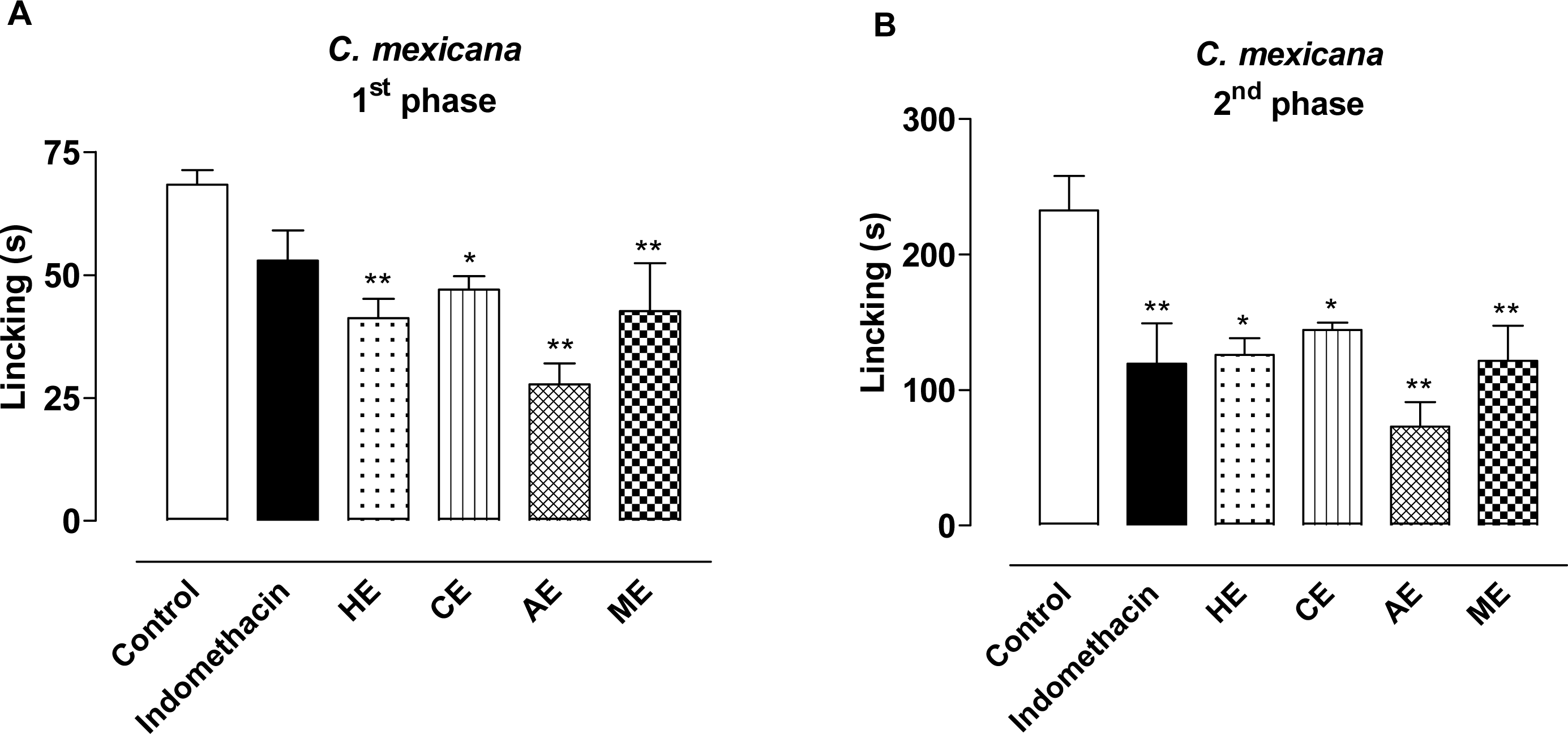
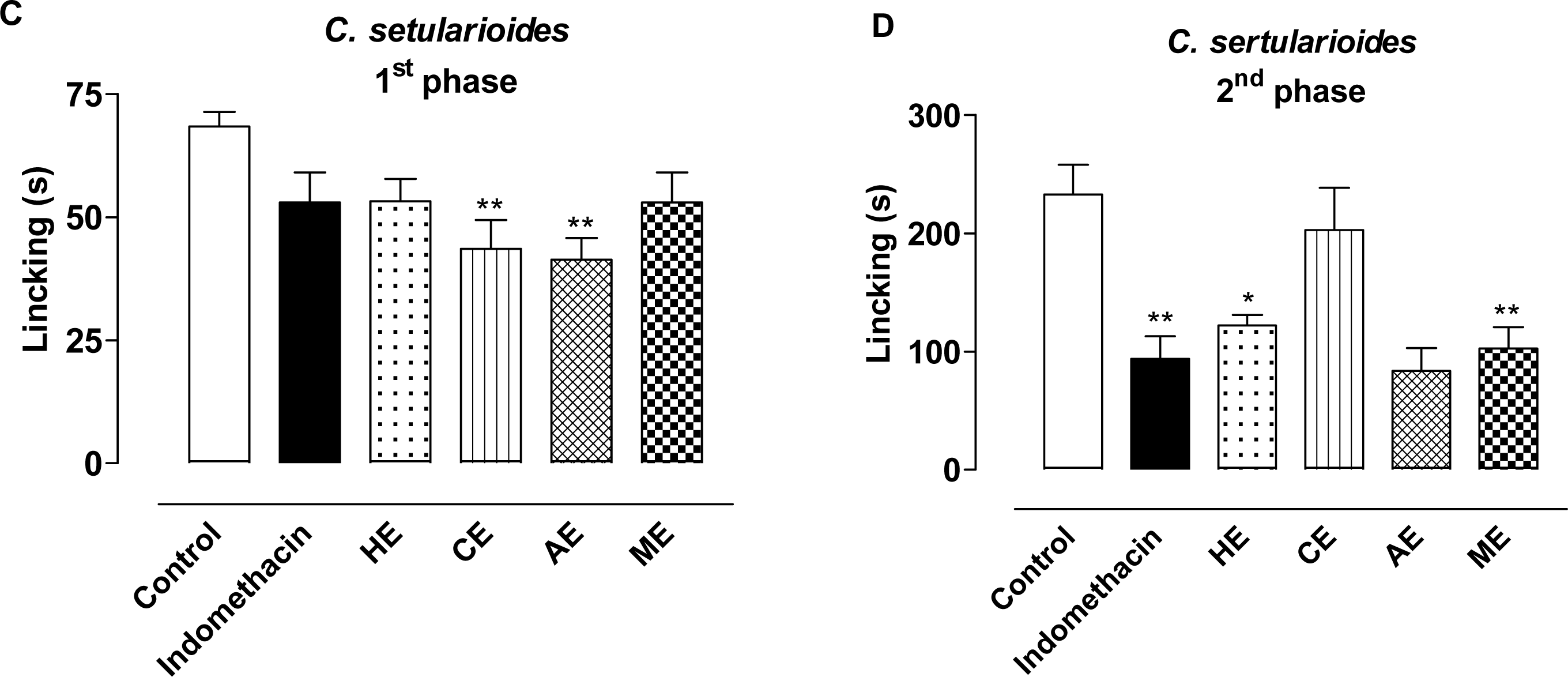
<p>Neurogenic and inflammatory pain were evaluated using the formalin test. The first phase corresponds to acute neurogenic pain, while the second phase corresponds to inflammatory pain. The first and second phases are generally believed to reflect excitation of peripheral afferent nociceptors and central sensitization, respectively [<xref ref-type="bibr" rid="b46-marinedrugs-09-00307">46</xref>,<xref ref-type="bibr" rid="b47-marinedrugs-09-00307">47</xref>]. Substance P and bradykinin participate in the first phase, while serotonin, histamine, bradykinin, nitric oxide and prostaglandins are involved in the second phase [<xref ref-type="bibr" rid="b48-marinedrugs-09-00307">48</xref>]. Different mechanisms have been shown to be involved in first and second phase nociceptive behaviors, based on the differential pharmacology associated with these behaviors. For example, while second phase behaviors are selectively attenuated by cyclooxygenase inhibitors, first and second phase behaviors are attenuated by opioids [<xref ref-type="bibr" rid="b47-marinedrugs-09-00307">47</xref>]. Treatment with HE, CE, AE and ME from <italic>C. mexicana</italic> induced an inhibition of 39.7%, 31.1%, 60.2% and 50.2%, respectively, in the first phase (<xref ref-type="fig" rid="f1-marinedrugs-09-00307">Figure 1A</xref>). Furthemore, all extracts of <italic>C. mexicana</italic> induced significant inhibition in the second phase, with an inhibition of 47.7% (ME), 68.7% (AE) 45.8% (HE) and 37.9% (CE) (<xref ref-type="fig" rid="f1-marinedrugs-09-00307">Figure 1B</xref>). The pharmacological evaluation of extracts of <italic>C. sertularioides</italic> in the formalin test showed that the CE and AE could reduce the duration (36.2% and 40.0% inhibition) of paw licking in the first phase (<xref ref-type="fig" rid="f1-marinedrugs-09-00307">Figure 1C</xref>). On the other hand, in the second phase CE was not active, while ME, AE and HE, were able to decrease the time that animals spent licking the injected paw (55.8%, 64% and 47.5% inhibition, respectively) (<xref ref-type="fig" rid="f1-marinedrugs-09-00307">Figure 1D</xref>). Treatment with indomethacin, the NSAID significantly inhibited formalin induced nociception in the second phase (48.7% inhibition), but not the first phase. Thus, the results shown in the first phase of the model corroborate with those obtained in the writhing test, confirming the antinociceptive activity of the extracts.</p>
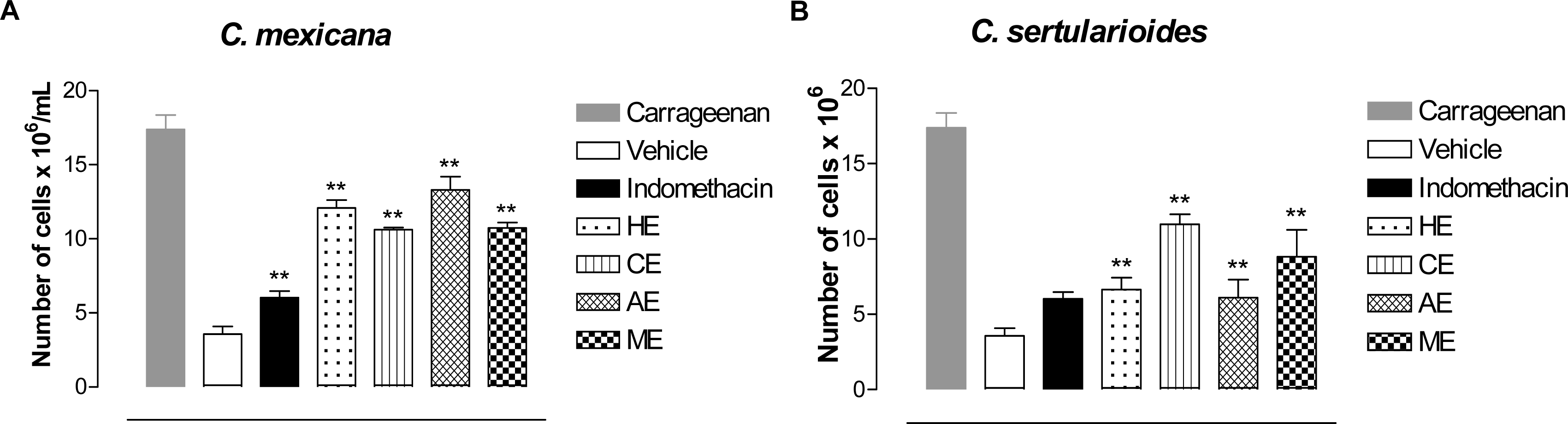
<p>Since reduction of the second phase in the formalin test implied a possible anti-inflammatory mechanism, and considering previous studies from our group [<xref ref-type="bibr" rid="b40-marinedrugs-09-00307">40</xref>] that have demonstrated that another specie of <italic>Caulerpa</italic> has anti-inflammatory activity, we decided to evaluate the activity of these species in models of cell migration. To determine the effects of extracts from <italic>Caulerpa</italic> spp. on peritoneal inflammation induced by carrageenan, the mice were treated with test samples. Using carrageenan as a stimulus, it was possible to produce an acute inflammatory response after 4 h in the peritoneal cavity of mice, with a large number of leukocytes in the exudates. With the aim of evaluating a possible inhibitory effect of <italic>Caulerpa</italic> spp. extracts on cell migration into the peritoneal cavity, the carrageenan-induced peritonitis test was used. In this assay, all extracts evaluated were able to significantly inhibit leukocyte migration into the peritoneal cavity in comparison with carrageenan. The HE, CE, AE and ME from <italic>C. mexicana</italic> inhibited 30.5%, 38.9%, 23.5%, 38.26%, respectively (<xref ref-type="fig" rid="f2-marinedrugs-09-00307">Figure 2A</xref>). While the extracts from <italic>C. sertularioides</italic> induced inhibition of 61.8% (HE), 36.9%, (CE), 71.7% (AE) and 49.25% (ME) (<xref ref-type="fig" rid="f2-marinedrugs-09-00307">Figure 2B</xref>). The treatment with indomethacin inhibited 65.4% leukocyte migration.</p></sec>
<sec>
<label>3.</label>
<title>Experimental Section</title>
<sec>
<label>3.1.</label>
<title>Extraction and Isolation</title>
<p>The algae <italic>C. mexicana</italic> and <italic>C. sertularioide</italic> were collected from the coastal region of Bessa (7°03′52″S/34°49′51″W), João Pessoa, Paraíba State, Brazil in April 2008. The specimens were identified by Dr. George Emmanuel Cavalcanti de Miranda. Voucher specimens of <italic>C. mexicana</italic> (JPB 13985), <italic>C. sertularioides</italic> (JPB 13983) have been deposited in the Lauro Pires Xavier Herbarium at the Federal University of Paraíba (Universidade Federal da Paraíba), Brazil. The fresh algae were lyophilized and exhaustively extracted with hexane, chloroform, ethyl acetate, methanol and water in a Soxhlet apparatus, to obtain the respective extracts.</p></sec>
<sec>
<label>3.2.</label>
<title>Biological Activity Tests</title>
<sec>
<label>3.2.1.</label>
<title>Drugs and Reagents</title>
<p>The following drugs and reagents were used: acetic acid (Merck), dipyrone (Sigma Chemical), morphine sulfate (Dimorf-Cristalia-BR), indomethacin (Merck), arabic gum (Sigma Chemical) and Tween 20 (Sigma). A solution of formalin 2.5% was prepared with formaldehyde (Merck) in saline (NaCl 0.9%). The botanical material was used as suspensions in Tween 80 (s.q.f.) and arabic gum (vehicle) in all the experiments and were administered by oral route at a dose of 100 mg/kg. Dipyrone, morphine and indomethacin were used as reference drugs. Dipyrone and indomethacin were administered by oral route and morphine by subcutaneous route. The control group was composed of the vehicle (arabic gum).</p></sec>
<sec>
<label>3.2.2.</label>
<title>Animals</title>
<p>All experiments were performed with male and female Swiss mice (20–25 g). Animals were maintained in a room at a controlled temperature of 22 ± 2 °C for 12-h light/dark cycle with free access to food and water. Eight hours before each experiment animals received only water, in order to avoid food interference with substance absorption. Animal care and research protocols were in accordance with the principles and guidelines for the care of laboratory animals and the ethical guidelines for investigations of experimental pain in conscious animals [<xref ref-type="bibr" rid="b49-marinedrugs-09-00307">49</xref>]. The experiments were performed with the approval of the protocol by the local Institutional Ethics Committee-UFAL (No. 006443/2005-78).</p></sec>
<sec>
<label>3.2.3.</label>
<title>Acetic Acid-Induced Writhing Test</title>
<p>The writhing test was carried out as described by Koster <italic>et al.</italic> [<xref ref-type="bibr" rid="b50-marinedrugs-09-00307">50</xref>]. Groups of mice (<italic>n</italic> = 6) were treated with the methanolic (ME), ethyl acetate (AE), hexanic (HE) and chloroform (CE) extracts from <italic>Caulerpa</italic> species (100 mg/kg, p.o.), dipyrone (40 mg/kg, p.o.) and the vehicle (p.o.). The writhings were induced by intraperitoneal injection with a 0.6% acetic acid solution (0.1 mL/10 g) 40 min after treatment. The number of writhings were counted starting at 5 min after injection of the stimulus for 20 min. Antinociceptive activity was expressed as percent inhibition of the usual number of writhings observed in control animals.</p></sec>
<sec>
<label>3.2.4.</label>
<title>Hot Plate Test</title>
<p>The hot plate test was performed following the method of Eddy and Leimbach [<xref ref-type="bibr" rid="b51-marinedrugs-09-00307">51</xref>]. Different groups of animals (<italic>n</italic> = 6) received ME, AE, HE and CE from <italic>Caulerpa</italic> species (100 mg/kg, p.o.), morphine (4.3 mg/kg, s.c.) and the vehicle (0.5 mL, p.o.) Then, mice were placed on the equipment, which was maintained at 55 ± 1 °C, and the reaction time was noted by observing either the licking of the fore and hind paws or jumping at 30, 60, 90, 120 and 150 min after administration of the extracts. The baseline was considered as the mean reaction time obtained at 30 min and 60 min before administration of the phases, compounds or morphine and was defined as the normal reaction of the animal to temperature. The cut-off time used to prevent skin damage was 15 s.</p></sec>
<sec>
<label>3.2.5.</label>
<title>Formalin-Induced Nociception</title>
<p>The formalin test was carried out as described by Hunskaar, Hole and Tjølsen <italic>et al.</italic> [<xref ref-type="bibr" rid="b52-marinedrugs-09-00307">52</xref>,<xref ref-type="bibr" rid="b53-marinedrugs-09-00307">53</xref>]. Animals received a dose of 20 μL of a 2.5% formalin solution (0.92% formaldehyde, in saline) on the ventral surface of the right hind paw. Animals were observed from 0 to 5 min (neurogenic phase) and from 15 to 30 min (inflammatory phase) and the time that they spent licking the injected paw was recorded and considered as indicative of nociception. Animals received ME, AE, HE and CE from <italic>Caulerpa</italic> species (100 mg/kg, p.o.) or the standard drug (indomethacin, 35.7 mg/kg, p.o.) 40 min before formalin injection. Control animals received only the vehicle (arabic gum).</p></sec>
<sec>
<label>3.2.6.</label>
<title>Carrageenan-Induced Peritonitis in Mice</title>
<p>For this series of experiments, the method described by Ferrándiz and Alcaraz [<xref ref-type="bibr" rid="b54-marinedrugs-09-00307">54</xref>] was used. Carrageenan (Sigma Aldrich) was freshly prepared (10 mg/mL) in sterile 0.9% w/v saline, and 250 μL was injected i.p. After 4 h, the animals were killed by cervical dislocation. The peritoneal cavity was washed with 1.5 mL cold PBS, and after gentle manual massage, the exudate was retrieved and its volume measured. The number of recruit leukocytes to the peritoneum was counted in a Neubauer chamber and results were expressed as cells × 10<sup>6</sup>/mL. The exudate was collected and used freshly for cell counts and cytospin preparations. The <italic>Caulerpa</italic> extracts (100 mg/kg, p.o.), the carrageenan group (arabic gum, p.o.) and the reference drug (indomethacin, 35.7 mg/kg, p.o.) were administered 30 min before the carrageenan injection. In the negative control group, animals just received the same dose of a vehicle (arabic gum, p.o.) 30 min before the saline injection by intraperitoneal route.</p></sec></sec>
<sec sec-type="methods">
<label>3.3.</label>
<title>Statistical Analysis</title>
<p>Data are reported as mean ± S.E.M. and were analyzed statistically using analysis of variance (ANOVA) followed by Dunnett’s test. Results with <italic>P</italic> &lt; 0.05 were considered significant (* <italic>P</italic> &lt; 0.05, ** <italic>P</italic> &lt; 0.01).</p></sec></sec>
<sec sec-type="conclusions">
<label>4.</label>
<title>Conclusions</title>
<p>In conclusion, this study has shown that extracts from <italic>Caulerpa</italic> species have significant antinociceptive and anti-inflammatory effects in laboratory animals at the dose and route investigated. It can be argued that the extracts have antinociceptive activity and may possibly act via inhibition of inflammatory mediators. However, pharmacological and chemical studies are needed in order to characterize the mechanism(s) responsible for the antinociceptive and anti-inflammatory action and also to identify other active agents present in this plant. Moreover, the results obtained in this work contribute significantly to the pharmacological studies from marine products.</p></sec></body>
<back>
<ack>
<p>The authors are grateful to the CAPES, CNPq (Edital 10/2006), MCT, FAPEAL, INCT-INOFAR/CNPq and the Ministry of Environment (License MMA/CGEN 18/2007) for the joint funding of this research project. The authors wish to thank several of their colleagues working at the Federal University of Alagoas and Federal University of Paraíba for their constructive criticism and assistance in carrying out this project.</p></ack>
<ref-list>
<title>References</title>
<ref id="b1-marinedrugs-09-00307"><label>1.</label><citation citation-type="journal"><person-group person-group-type="author"><name><surname>Konig</surname><given-names>GM</given-names></name><name><surname>Wright</surname><given-names>AD</given-names></name></person-group><article-title>Marine natural products research: current directions and future potential</article-title><source>Planta Med</source><year>1995</year><volume>62</volume><fpage>193</fpage><lpage>211</lpage></citation></ref>
<ref id="b2-marinedrugs-09-00307"><label>2.</label><citation citation-type="journal"><person-group person-group-type="author"><name><surname>Sousa</surname><given-names>FCF</given-names></name><name><surname>Melo</surname><given-names>CTV</given-names></name><name><surname>Citó</surname><given-names>MCO</given-names></name><name><surname>Félix</surname><given-names>FHC</given-names></name><name><surname>Vasconcelos</surname><given-names>SMM</given-names></name><name><surname>Fonteles</surname><given-names>MMF</given-names></name><name><surname>Barbosa Filho</surname><given-names>JM</given-names></name><name><surname>Viana</surname><given-names>GSB</given-names></name></person-group><article-title>Medicinal plants and their bioactive constituents: A scientific review of bioactivity and potential benefits in the anxiety disorders in animal models</article-title><source>Braz J Pharmacogn</source><year>2008</year><volume>18</volume><fpage>642</fpage><lpage>654</lpage></citation></ref>
<ref id="b3-marinedrugs-09-00307"><label>3.</label><citation citation-type="journal"><person-group person-group-type="author"><name><surname>Corrêa</surname><given-names>MFP</given-names></name><name><surname>Melo</surname><given-names>GO</given-names></name><name><surname>Costa</surname><given-names>SS</given-names></name></person-group><article-title>Natural products from plant origin potentially useful in the asthma therapy</article-title><source>Braz J Pharmacogn</source><year>2008</year><volume>18</volume><fpage>785</fpage><lpage>797</lpage></citation></ref>
<ref id="b4-marinedrugs-09-00307"><label>4.</label><citation citation-type="journal"><person-group person-group-type="author"><name><surname>Barbosa-Filho</surname><given-names>JM</given-names></name><name><surname>Alencar</surname><given-names>AA</given-names></name><name><surname>Nunes</surname><given-names>XP</given-names></name><name><surname>Tomaz</surname><given-names>ACA</given-names></name><name><surname>Sena-Filho</surname><given-names>JG</given-names></name><name><surname>Athayde-Filho</surname><given-names>PF</given-names></name><name><surname>Silva</surname><given-names>MS</given-names></name><name><surname>Souza</surname><given-names>MFV</given-names></name><name><surname>Cunha</surname><given-names>EVL</given-names></name></person-group><article-title>Sources of alpha-, beta-, gamma-, delta- and epsilon-carotenes: a twentieth century review</article-title><source>Braz J Pharmacogn</source><year>2008</year><volume>18</volume><fpage>135</fpage><lpage>154</lpage></citation></ref>
<ref id="b5-marinedrugs-09-00307"><label>5.</label><citation citation-type="journal"><person-group person-group-type="author"><name><surname>Rocha</surname><given-names>L</given-names></name><name><surname>Almeida</surname><given-names>JRGS</given-names></name><name><surname>Macêdo</surname><given-names>RO</given-names></name></person-group><article-title>A review of natural products with antileishmanial activity</article-title><source>Phytomedicine</source><year>2005</year><volume>12</volume><fpage>514</fpage><lpage>535</lpage><pub-id pub-id-type="doi">10.1016/j.phymed.2003.10.006</pub-id><pub-id pub-id-type="pmid">16008131</pub-id></citation></ref>
<ref id="b6-marinedrugs-09-00307"><label>6.</label><citation citation-type="journal"><person-group person-group-type="author"><name><surname>Silva</surname><given-names>JSE</given-names></name><name><surname>Moura</surname><given-names>MD</given-names></name><name><surname>Oliveira</surname><given-names>RAG</given-names></name><name><surname>Diniz</surname><given-names>MFFM</given-names></name><name><surname>Barbosa-Filho</surname><given-names>JM</given-names></name></person-group><article-title>Natural products inhibitors of ovarian neoplasia</article-title><source>Phytomedicine</source><year>2003</year><volume>10</volume><fpage>221</fpage><lpage>232</lpage><pub-id pub-id-type="doi">10.1078/094471103321659988</pub-id><pub-id pub-id-type="pmid">12725581</pub-id></citation></ref>
<ref id="b7-marinedrugs-09-00307"><label>7.</label><citation citation-type="journal"><person-group person-group-type="author"><name><surname>Vuorella</surname><given-names>P</given-names></name><name><surname>Leinonenb</surname><given-names>M</given-names></name><name><surname>Saikkuc</surname><given-names>P</given-names></name><name><surname>Tammelaa</surname><given-names>P</given-names></name><name><surname>Rauhad</surname><given-names>JP</given-names></name><name><surname>Wenneberge</surname><given-names>T</given-names></name><name><surname>Vuorella</surname><given-names>H</given-names></name></person-group><article-title>Natural products in the process of finding new drug candidates</article-title><source>Curr Med Chem</source><year>2004</year><volume>11</volume><fpage>1375</fpage><lpage>1389</lpage><pub-id pub-id-type="doi">10.2174/0929867043365116</pub-id><pub-id pub-id-type="pmid">15180572</pub-id></citation></ref>
<ref id="b8-marinedrugs-09-00307"><label>8.</label><citation citation-type="journal"><person-group person-group-type="author"><name><surname>Agra</surname><given-names>MF</given-names></name><name><surname>Silva</surname><given-names>KN</given-names></name><name><surname>Basílio</surname><given-names>IJLD</given-names></name><name><surname>França</surname><given-names>PF</given-names></name><name><surname>Barbosa-Filho</surname><given-names>JM</given-names></name></person-group><article-title>Survey of medicinal plants used in the region Northeast of Brazil</article-title><source>Braz J Pharmacogn</source><year>2008</year><volume>18</volume><fpage>472</fpage><lpage>508</lpage></citation></ref>
<ref id="b9-marinedrugs-09-00307"><label>9.</label><citation citation-type="journal"><person-group person-group-type="author"><name><surname>Almeida</surname><given-names>RN</given-names></name><name><surname>Navarro</surname><given-names>DS</given-names></name><name><surname>Barbosa-Filho</surname><given-names>JM</given-names></name></person-group><article-title>Plants with central analgesic activity</article-title><source>Phytomedicine</source><year>2001</year><volume>8</volume><fpage>310</fpage><lpage>322</lpage><pub-id pub-id-type="doi">10.1078/0944-7113-00050</pub-id><pub-id pub-id-type="pmid">11515723</pub-id></citation></ref>
<ref id="b10-marinedrugs-09-00307"><label>10.</label><citation citation-type="journal"><person-group person-group-type="author"><name><surname>Truti</surname><given-names>MCT</given-names></name><name><surname>Ferreira</surname><given-names>ICP</given-names></name><name><surname>Zamuner</surname><given-names>MLM</given-names></name><name><surname>Nakamura</surname><given-names>CV</given-names></name><name><surname>Sarragiotto</surname><given-names>MH</given-names></name><name><surname>Souza</surname><given-names>MC</given-names></name></person-group><article-title>Antiprotozoal and moluscicidal actives of five Brasilians plants</article-title><source>Braz J Med Biol Res</source><year>2005</year><volume>38</volume><fpage>1873</fpage><lpage>1878</lpage><pub-id pub-id-type="doi">10.1590/S0100-879X2005001200016</pub-id><pub-id pub-id-type="pmid">16302102</pub-id></citation></ref>
<ref id="b11-marinedrugs-09-00307"><label>11.</label><citation citation-type="journal"><person-group person-group-type="author"><name><surname>Quintans-Júnior</surname><given-names>LJ</given-names></name><name><surname>Almeida</surname><given-names>JRGS</given-names></name><name><surname>Lima</surname><given-names>JT</given-names></name><name><surname>Nunes</surname><given-names>XP</given-names></name><name><surname>Siqueira</surname><given-names>JS</given-names></name><name><surname>Oliveira</surname><given-names>LEG</given-names></name><name><surname>Almeida</surname><given-names>RN</given-names></name><name><surname>Athayde-Filho</surname><given-names>PF</given-names></name><name><surname>Barbosa-Filho</surname><given-names>JM</given-names></name></person-group><article-title>Plants with anticonvulsant properties—a review</article-title><source>Braz J Pharmacogn</source><year>2008</year><volume>18</volume><fpage>798</fpage><lpage>819</lpage></citation></ref>
<ref id="b12-marinedrugs-09-00307"><label>12.</label><citation citation-type="journal"><person-group person-group-type="author"><name><surname>Mariath</surname><given-names>IR</given-names></name><name><surname>Falcão</surname><given-names>HS</given-names></name><name><surname>Barbosa-Filho</surname><given-names>JM</given-names></name><name><surname>Sousa</surname><given-names>LCF</given-names></name><name><surname>Tomaz</surname><given-names>ACA</given-names></name><name><surname>Batista</surname><given-names>LM</given-names></name><name><surname>Diniz</surname><given-names>MFFM</given-names></name><name><surname>Athayde-Filho</surname><given-names>PF</given-names></name><name><surname>Tavares</surname><given-names>JF</given-names></name><name><surname>Silva</surname><given-names>MS</given-names></name><name><surname>Cunha</surname><given-names>EVL</given-names></name></person-group><article-title>Plants of the American continent with antimalarial activity</article-title><source>Braz J Pharmacogn</source><year>2009</year><volume>19</volume><fpage>158</fpage><lpage>192</lpage></citation></ref>
<ref id="b13-marinedrugs-09-00307"><label>13.</label><citation citation-type="journal"><person-group person-group-type="author"><name><surname>Iannitti</surname><given-names>T</given-names></name><name><surname>Palmieri</surname><given-names>B</given-names></name></person-group><article-title>An update on the therapeutic role of alkylglycerols</article-title><source>Mar Drugs</source><year>2010</year><volume>8</volume><fpage>2267</fpage><lpage>2300</lpage><pub-id pub-id-type="doi">10.3390/md8082267</pub-id><pub-id pub-id-type="pmid">20948908</pub-id></citation></ref>
<ref id="b14-marinedrugs-09-00307"><label>14.</label><citation citation-type="journal"><person-group person-group-type="author"><name><surname>Cabrita</surname><given-names>MT</given-names></name><name><surname>Vale</surname><given-names>C</given-names></name><name><surname>Rauter</surname><given-names>AP</given-names></name></person-group><article-title>Halogenated compounds from marine algae</article-title><source>Mar Drugs</source><year>2010</year><volume>8</volume><fpage>2301</fpage><lpage>2317</lpage><pub-id pub-id-type="doi">10.3390/md8082301</pub-id><pub-id pub-id-type="pmid">20948909</pub-id></citation></ref>
<ref id="b15-marinedrugs-09-00307"><label>15.</label><citation citation-type="journal"><person-group person-group-type="author"><name><surname>Zhang</surname><given-names>JL</given-names></name><name><surname>Xia</surname><given-names>WS</given-names></name><name><surname>Liu</surname><given-names>P</given-names></name><name><surname>Cheng</surname><given-names>QY</given-names></name><name><surname>Tahirou</surname><given-names>T</given-names></name><name><surname>Gu</surname><given-names>WX</given-names></name><name><surname>Li</surname><given-names>B</given-names></name></person-group><article-title>Chitosan modification and pharmaceutical/biomedical applications</article-title><source>Mar Drugs</source><year>2010</year><volume>8</volume><fpage>1962</fpage><lpage>1987</lpage><pub-id pub-id-type="doi">10.3390/md8071962</pub-id><pub-id pub-id-type="pmid">20714418</pub-id></citation></ref>
<ref id="b16-marinedrugs-09-00307"><label>16.</label><citation citation-type="journal"><person-group person-group-type="author"><name><surname>O’Sullivan</surname><given-names>L</given-names></name><name><surname>Murphy</surname><given-names>B</given-names></name><name><surname>McLoughlin</surname><given-names>P</given-names></name><name><surname>Duggan</surname><given-names>P</given-names></name><name><surname>Lawlor</surname><given-names>PG</given-names></name><name><surname>Hughes</surname><given-names>H</given-names></name><name><surname>Gardiner</surname><given-names>GE</given-names></name></person-group><article-title>Prebiotics from marine macroalgae for human and animal health applications</article-title><source>Mar Drugs</source><year>2010</year><volume>8</volume><fpage>2038</fpage><lpage>2064</lpage><pub-id pub-id-type="doi">10.3390/md8072038</pub-id><pub-id pub-id-type="pmid">20714423</pub-id></citation></ref>
<ref id="b17-marinedrugs-09-00307"><label>17.</label><citation citation-type="journal"><person-group person-group-type="author"><name><surname>Aratake</surname><given-names>S</given-names></name><name><surname>Trianto</surname><given-names>A</given-names></name><name><surname>Hanif</surname><given-names>N</given-names></name><name><surname>de Voogd</surname><given-names>NJ</given-names></name><name><surname>Tanaka</surname><given-names>J</given-names></name></person-group><article-title>A new polyunsaturated brominated fatty acid from a <italic>Haliclona</italic> sponge</article-title><source>Mar Drugs</source><year>2009</year><volume>7</volume><fpage>523</fpage><lpage>527</lpage><pub-id pub-id-type="doi">10.3390/md7040523</pub-id><pub-id pub-id-type="pmid">20098595</pub-id></citation></ref>
<ref id="b18-marinedrugs-09-00307"><label>18.</label><citation citation-type="journal"><person-group person-group-type="author"><name><surname>Lebouvier</surname><given-names>N</given-names></name><name><surname>Jullian</surname><given-names>V</given-names></name><name><surname>Desvignes</surname><given-names>I</given-names></name><name><surname>Maurel</surname><given-names>S</given-names></name><name><surname>Parenty</surname><given-names>A</given-names></name><name><surname>Dorin-Semblat</surname><given-names>D</given-names></name><name><surname>Doerig</surname><given-names>C</given-names></name><name><surname>Sauvain</surname><given-names>M</given-names></name><name><surname>Laurent</surname><given-names>D</given-names></name></person-group><article-title>Antiplasmodial activities of homogentisic acid derivative protein kinase inhibitors isolated from a Vanuatu marine sponge <italic>Pseudoceratina</italic> sp</article-title><source>Mar Drugs</source><year>2009</year><volume>7</volume><fpage>640</fpage><lpage>653</lpage><pub-id pub-id-type="doi">10.3390/md7040640</pub-id><pub-id pub-id-type="pmid">20098604</pub-id></citation></ref>
<ref id="b19-marinedrugs-09-00307"><label>19.</label><citation citation-type="journal"><person-group person-group-type="author"><name><surname>Truti</surname><given-names>MCT</given-names></name><name><surname>Ferreira</surname><given-names>ICP</given-names></name><name><surname>Zamuner</surname><given-names>MLM</given-names></name><name><surname>Nakamura</surname><given-names>CV</given-names></name><name><surname>Sarragiotto</surname><given-names>MH</given-names></name><name><surname>Souza</surname><given-names>MC</given-names></name></person-group><article-title>Antiprotozoal and moluscicidal actives of five Brasilians plants</article-title><source>Braz J Med Biol Res</source><year>2005</year><volume>38</volume><fpage>1873</fpage><lpage>1878</lpage><pub-id pub-id-type="doi">10.1590/S0100-879X2005001200016</pub-id><pub-id pub-id-type="pmid">16302102</pub-id></citation></ref>
<ref id="b20-marinedrugs-09-00307"><label>20.</label><citation citation-type="journal"><person-group person-group-type="author"><name><surname>Medeiros</surname><given-names>JD</given-names></name></person-group><article-title>A biotecnologia e a extinção de espécies, crises da modernidade</article-title><source>Rev Biotecnol Cienc Desenvolv</source><year>2003</year><volume>30</volume><fpage>109</fpage><lpage>113</lpage></citation></ref>
<ref id="b21-marinedrugs-09-00307"><label>21.</label><citation citation-type="journal"><person-group person-group-type="author"><name><surname>Arif</surname><given-names>JM</given-names></name><name><surname>Al-Hazzani</surname><given-names>AA</given-names></name><name><surname>Kunhi</surname><given-names>M</given-names></name><name><surname>Al-Khodairy</surname><given-names>F</given-names></name></person-group><article-title>Marine compounds: Anticancer or genotoxic</article-title><source>J Biomed Biotechnol</source><year>2004</year><volume>2</volume><fpage>93</fpage><lpage>98</lpage></citation></ref>
<ref id="b22-marinedrugs-09-00307"><label>22.</label><citation citation-type="journal"><person-group person-group-type="author"><name><surname>Viegas</surname><given-names>C</given-names><suffix>Jr</suffix></name><name><surname>Bolzani</surname><given-names>VS</given-names></name><name><surname>Barreiro</surname><given-names>EJ</given-names></name></person-group><article-title>Os produtos naturais e a química medicinal moderna</article-title><source>Quim Nova</source><year>2006</year><volume>29</volume><fpage>326</fpage><lpage>337</lpage><pub-id pub-id-type="doi">10.1590/S0100-40422006000200025</pub-id></citation></ref>
<ref id="b23-marinedrugs-09-00307"><label>23.</label><citation citation-type="journal"><person-group person-group-type="author"><name><surname>Cen-Pacheco</surname><given-names>F</given-names></name><name><surname>Nordstrom</surname><given-names>L</given-names></name><name><surname>Souto</surname><given-names>ML</given-names></name><name><surname>Martin</surname><given-names>MN</given-names></name><name><surname>Fernandez</surname><given-names>JJ</given-names></name><name><surname>Daranas</surname><given-names>AH</given-names></name></person-group><article-title>Studies on polyethers produced by red algae</article-title><source>Mar Drugs</source><year>2010</year><volume>8</volume><fpage>1178</fpage><lpage>1188</lpage><pub-id pub-id-type="doi">10.3390/md8041178</pub-id><pub-id pub-id-type="pmid">20479973</pub-id></citation></ref>
<ref id="b24-marinedrugs-09-00307"><label>24.</label><citation citation-type="journal"><person-group person-group-type="author"><name><surname>Guven</surname><given-names>KC</given-names></name><name><surname>Percot</surname><given-names>A</given-names></name><name><surname>Sezik</surname><given-names>E</given-names></name></person-group><article-title>Alkaloids in marine algae</article-title><source>Mar Drugs</source><year>2010</year><volume>8</volume><fpage>269</fpage><lpage>284</lpage><pub-id pub-id-type="doi">10.3390/md8020269</pub-id><pub-id pub-id-type="pmid">20390105</pub-id></citation></ref>
<ref id="b25-marinedrugs-09-00307"><label>25.</label><citation citation-type="journal"><person-group person-group-type="author"><name><surname>Stafford</surname><given-names>HA</given-names></name></person-group><article-title>Flavonoid evolution—an enzymatic approach</article-title><source>Plant Physiol</source><year>1991</year><volume>96</volume><fpage>680</fpage><lpage>685</lpage><pub-id pub-id-type="doi">10.1104/pp.96.3.680</pub-id><pub-id pub-id-type="pmid">16668242</pub-id></citation></ref>
<ref id="b26-marinedrugs-09-00307"><label>26.</label><citation citation-type="journal"><person-group person-group-type="author"><name><surname>Serrano</surname><given-names>J</given-names></name><name><surname>Puupponen-Pimia</surname><given-names>R</given-names></name><name><surname>Dauer</surname><given-names>A</given-names></name><name><surname>Aura</surname><given-names>AM</given-names></name><name><surname>Saura-Calixto</surname><given-names>F</given-names></name></person-group><article-title>Tannins: Current knowledge of food sources, intake, bioavailability and biological effects</article-title><source>Mol Nutr Food Res</source><year>2009</year><volume>53</volume><fpage>S310</fpage><lpage>S329</lpage><pub-id pub-id-type="doi">10.1002/mnfr.200900039</pub-id><pub-id pub-id-type="pmid">19437486</pub-id></citation></ref>
<ref id="b27-marinedrugs-09-00307"><label>27.</label><citation citation-type="journal"><person-group person-group-type="author"><name><surname>Narkowicz</surname><given-names>CK</given-names></name><name><surname>Blackman</surname><given-names>AJ</given-names></name></person-group><article-title>Further acetogenins from Tasmanian collections of <italic>Caulocystis cephalornithos</italic> demonstrating chemical variability</article-title><source>Biochem Syst Ecol</source><year>2006</year><volume>34</volume><fpage>635</fpage><lpage>641</lpage><pub-id pub-id-type="doi">10.1016/j.bse.2006.03.004</pub-id></citation></ref>
<ref id="b28-marinedrugs-09-00307"><label>28.</label><citation citation-type="journal"><person-group person-group-type="author"><name><surname>Teixeira</surname><given-names>VL</given-names></name><name><surname>Kelecom</surname><given-names>A</given-names></name><name><surname>Gottlieb</surname><given-names>OR</given-names></name></person-group><article-title>Produtos naturais de algas marinhas</article-title><source>Quim Nova</source><year>1991</year><volume>14</volume><fpage>83</fpage><lpage>90</lpage></citation></ref>
<ref id="b29-marinedrugs-09-00307"><label>29.</label><citation citation-type="book"><person-group person-group-type="author"><name><surname>Pereira</surname><given-names>SMB</given-names></name><name><surname>Oliveira-Carvalho</surname><given-names>MF</given-names></name><name><surname>Angeiras</surname><given-names>JAP</given-names></name><name><surname>Oliveira</surname><given-names>NMB</given-names></name><name><surname>Torres</surname><given-names>J</given-names></name><name><surname>Gestinari</surname><given-names>LM</given-names></name><name><surname>Badeira-Pedrosa</surname><given-names>ME</given-names></name><name><surname>Cocentino</surname><given-names>ALM</given-names></name><name><surname>Santos</surname><given-names>MD</given-names></name><name><surname>Nascimento</surname><given-names>PRF</given-names></name><name><surname>Cavalcanti</surname><given-names>DR</given-names></name></person-group><article-title>Algas bentônicas do Estado de Pernambuco</article-title><source>Diagnóstico da Biodiversidade de Pernambuco</source><person-group person-group-type="editor"><name><surname>Tabarelli</surname><given-names>M</given-names></name><name><surname>Silva</surname><given-names>JMC</given-names></name></person-group><publisher-name>Massagana e SECTMA</publisher-name><publisher-loc>Recife, Brazil</publisher-loc><year>2002</year><fpage>97</fpage><lpage>124</lpage></citation></ref>
<ref id="b30-marinedrugs-09-00307"><label>30.</label><citation citation-type="journal"><person-group person-group-type="author"><name><surname>Lima-Filho</surname><given-names>JVM</given-names></name><name><surname>Carvalho</surname><given-names>AFFU</given-names></name><name><surname>Freitas</surname><given-names>SM</given-names></name><name><surname>Melo</surname><given-names>VMM</given-names></name></person-group><article-title>Antibacterial activity of extracts of six macroalgae from the Northeastern Brazilian coast</article-title><source>Braz J Microbiol</source><year>2002</year><volume>33</volume><fpage>311</fpage><lpage>313</lpage></citation></ref>
<ref id="b31-marinedrugs-09-00307"><label>31.</label><citation citation-type="journal"><person-group person-group-type="author"><name><surname>Li</surname><given-names>ZY</given-names></name></person-group><article-title>Advances in marine microbial symbionts in the China sea and related pharmaceutical metabolites</article-title><source>Mar Drugs</source><year>2009</year><volume>7</volume><fpage>113</fpage><lpage>129</lpage><pub-id pub-id-type="doi">10.3390/md7020113</pub-id><pub-id pub-id-type="pmid">19597576</pub-id></citation></ref>
<ref id="b32-marinedrugs-09-00307"><label>32.</label><citation citation-type="journal"><person-group person-group-type="author"><name><surname>Machado</surname><given-names>FLD</given-names></name><name><surname>Kaiser</surname><given-names>CR</given-names></name><name><surname>Costa</surname><given-names>SS</given-names></name><name><surname>Gestinari</surname><given-names>LM</given-names></name><name><surname>Soares</surname><given-names>AR</given-names></name></person-group><source>Braz J Pharmacogn</source><year>2010</year><volume>20</volume><fpage>441</fpage><lpage>452</lpage></citation></ref>
<ref id="b33-marinedrugs-09-00307"><label>33.</label><citation citation-type="journal"><person-group person-group-type="author"><name><surname>Taskin</surname><given-names>E</given-names></name><name><surname>Caki</surname><given-names>Z</given-names></name><name><surname>Ozturk</surname><given-names>M</given-names></name><name><surname>Taskin</surname><given-names>E</given-names></name></person-group><article-title>Assessment of <italic>in vitro</italic> antitumoral and antimicrobial activities of marine algae harvested from the Eastern Mediterranean sea</article-title><source>Afr J Biotechnol</source><year>2010</year><volume>9</volume><fpage>4272</fpage><lpage>4277</lpage></citation></ref>
<ref id="b34-marinedrugs-09-00307"><label>34.</label><citation citation-type="journal"><person-group person-group-type="author"><name><surname>Dias</surname><given-names>PF</given-names></name><name><surname>Siqueira</surname><given-names>JM</given-names></name><name><surname>Vendruscolo</surname><given-names>LF</given-names></name><name><surname>Neiva</surname><given-names>TD</given-names></name><name><surname>Gagliardi</surname><given-names>AR</given-names></name><name><surname>Maraschin</surname><given-names>M</given-names></name><name><surname>Ribeiro-Do-Valle</surname><given-names>RM</given-names></name></person-group><article-title>Antiangiogenic and antitumoral properties of a polysaccharide isolated from the seaweed <italic>Sargassum stenophyllum</italic></article-title><source>Cancer Chemother Pharmacol</source><year>2005</year><volume>56</volume><fpage>436</fpage><lpage>446</lpage><pub-id pub-id-type="doi">10.1007/s00280-004-0995-7</pub-id><pub-id pub-id-type="pmid">15902462</pub-id></citation></ref>
<ref id="b35-marinedrugs-09-00307"><label>35.</label><citation citation-type="journal"><person-group person-group-type="author"><name><surname>Matsubara</surname><given-names>K</given-names></name><name><surname>Xue</surname><given-names>C</given-names></name><name><surname>Zhao</surname><given-names>X</given-names></name><name><surname>Mori</surname><given-names>M</given-names></name><name><surname>Sugawara</surname><given-names>T</given-names></name><name><surname>Hirata</surname><given-names>T</given-names></name></person-group><article-title>Effects of middle molecular weight fucoidans on <italic>in vitro</italic> and <italic>ex vivo</italic> angiogenesis of endothelial cells</article-title><source>Int J Mol Med</source><year>2005</year><volume>15</volume><fpage>695</fpage><lpage>699</lpage><pub-id pub-id-type="pmid">15754034</pub-id></citation></ref>
<ref id="b36-marinedrugs-09-00307"><label>36.</label><citation citation-type="journal"><person-group person-group-type="author"><name><surname>Romanos</surname><given-names>MTV</given-names></name><name><surname>Andrada-Serpa</surname><given-names>MJ</given-names></name><name><surname>Santos</surname><given-names>MGM</given-names></name><name><surname>Ribeiro</surname><given-names>ACF</given-names></name><name><surname>Yoneshiguevalentin</surname><given-names>Y</given-names></name><name><surname>Costa</surname><given-names>SS</given-names></name><name><surname>Wigg</surname><given-names>MD</given-names></name></person-group><article-title>Inhibitory effect of extracts of Brazilian marine algae on human T-cell lymphotropic virus type 1 (HTLV-1) induced syncytium formation <italic>in vitro</italic></article-title><source>Cancer Investig</source><year>2002</year><volume>20</volume><fpage>46</fpage><lpage>54</lpage><pub-id pub-id-type="doi">10.1081/CNV-120000365</pub-id></citation></ref>
<ref id="b37-marinedrugs-09-00307"><label>37.</label><citation citation-type="journal"><person-group person-group-type="author"><name><surname>Mayer</surname><given-names>AMS</given-names></name><name><surname>Rodriguez</surname><given-names>AD</given-names></name><name><surname>Berlinck</surname><given-names>RGS</given-names></name><name><surname>Hamann</surname><given-names>MT</given-names></name></person-group><article-title>Marine pharmacology in 2005–6: Marine compounds with anthelmintic, antibacterial, anticoagulant, antifungal, anti-inflammatory, antimalarial, antiprotozoal, antituberculosis, and antiviral activities; affecting the cardiovascular, immune and nervous systems, and other miscellaneous mechanisms of action</article-title><source>Biochim Biophys Acta Gen Subj</source><year>2009</year><volume>1790</volume><fpage>283</fpage><lpage>308</lpage><pub-id pub-id-type="doi">10.1016/j.bbagen.2009.03.011</pub-id></citation></ref>
<ref id="b38-marinedrugs-09-00307"><label>38.</label><citation citation-type="journal"><person-group person-group-type="author"><name><surname>Genovese</surname><given-names>G</given-names></name><name><surname>Tedone</surname><given-names>L</given-names></name><name><surname>Hamann</surname><given-names>MT</given-names></name><name><surname>Morabito</surname><given-names>M</given-names></name></person-group><article-title>The mediterranean red alga <italic>Asparagopsis</italic>: A source of compounds against</article-title><source>Leishmania Mar Drugs</source><year>2009</year><volume>7</volume><fpage>361</fpage><lpage>366</lpage><pub-id pub-id-type="doi">10.3390/md7030361</pub-id></citation></ref>
<ref id="b39-marinedrugs-09-00307"><label>39.</label><citation citation-type="journal"><person-group person-group-type="author"><name><surname>Rocha</surname><given-names>FD</given-names></name><name><surname>Pereira</surname><given-names>RC</given-names></name><name><surname>Kaplan</surname><given-names>MAC</given-names></name><name><surname>Teixeira</surname><given-names>VL</given-names></name></person-group><article-title>Natural products from marine seaweeds and their antioxidant potential</article-title><source>Braz J Pharmacogn</source><year>2007</year><volume>17</volume><fpage>631</fpage><lpage>639</lpage></citation></ref>
<ref id="b40-marinedrugs-09-00307"><label>40.</label><citation citation-type="journal"><person-group person-group-type="author"><name><surname>Souza</surname><given-names>ET</given-names></name><name><surname>Queiroz</surname><given-names>AC</given-names></name><name><surname>Miranda</surname><given-names>GEC</given-names></name><name><surname>Lorenzo</surname><given-names>VP</given-names></name><name><surname>Silva</surname><given-names>EF</given-names></name><name><surname>Freire-Dias</surname><given-names>TLM</given-names></name><name><surname>Cupertino-Silva</surname><given-names>YK</given-names></name><name><surname>Melo</surname><given-names>GMA</given-names></name><name><surname>Chaves</surname><given-names>MCO</given-names></name><name><surname>Barbosa-Filho</surname><given-names>JM</given-names></name><name><surname>Athayde-Filho</surname><given-names>PF</given-names></name><name><surname>Santos</surname><given-names>BVO</given-names></name><name><surname>Alexandre-Moreira</surname><given-names>MS</given-names></name></person-group><article-title>Antinociceptive activities of crude methanolic extract and phases, n-butanolic, chloroformic and ethyl acetate from <italic>Caulerpa racemosa</italic> (Caulerpaceae)</article-title><source>Braz J Pharmacogn</source><year>2009</year><volume>19</volume><fpage>115</fpage><lpage>120</lpage></citation></ref>
<ref id="b41-marinedrugs-09-00307"><label>41.</label><citation citation-type="journal"><person-group person-group-type="author"><name><surname>Bars</surname><given-names>D</given-names></name><name><surname>Gozariu</surname><given-names>M</given-names></name><name><surname>Cadden</surname><given-names>SW</given-names></name></person-group><article-title>Animal models of nociception</article-title><source>Pharmacol Rev</source><year>2001</year><volume>53</volume><fpage>597</fpage><lpage>652</lpage><pub-id pub-id-type="pmid">11734620</pub-id></citation></ref>
<ref id="b42-marinedrugs-09-00307"><label>42.</label><citation citation-type="journal"><person-group person-group-type="author"><name><surname>Duarte</surname><given-names>IDG</given-names></name><name><surname>Nakamura</surname><given-names>M</given-names></name><name><surname>Ferreira</surname><given-names>SH</given-names></name></person-group><article-title>Participation of the sympathetic system in acetic acid-induced writhing in mice</article-title><source>Braz J Med Biol Res</source><year>1988</year><volume>21</volume><fpage>341</fpage><lpage>343</lpage><pub-id pub-id-type="pmid">3203167</pub-id></citation></ref>
<ref id="b43-marinedrugs-09-00307"><label>43.</label><citation citation-type="journal"><person-group person-group-type="author"><name><surname>Collier</surname><given-names>HOJ</given-names></name><name><surname>Dinneen</surname><given-names>JC</given-names></name><name><surname>Johnson</surname><given-names>CA</given-names></name><name><surname>Schneider</surname><given-names>C</given-names></name></person-group><article-title>The abdominal constriction response and its suppression by analgesic drugs in the mouse</article-title><source>Br J Pharmacol Chemother</source><year>1968</year><volume>32</volume><fpage>295</fpage><lpage>310</lpage><pub-id pub-id-type="doi">10.1111/j.1476-5381.1968.tb00973.x</pub-id><pub-id pub-id-type="pmid">4230818</pub-id></citation></ref>
<ref id="b44-marinedrugs-09-00307"><label>44.</label><citation citation-type="journal"><person-group person-group-type="author"><name><surname>Ribeiro</surname><given-names>RA</given-names></name><name><surname>Vale</surname><given-names>ML</given-names></name><name><surname>Thomazzi</surname><given-names>SM</given-names></name><name><surname>Paschoalato</surname><given-names>AB</given-names></name><name><surname>Poole</surname><given-names>S</given-names></name><name><surname>Ferreira</surname><given-names>SH</given-names></name><name><surname>Cunha</surname><given-names>FQ</given-names></name></person-group><article-title>Involvement of resident macrophages and mast cells in the writhing nociceptive response induced by zymosan and acetic acid in mice</article-title><source>Eur J Pharmacol</source><year>2000</year><volume>387</volume><fpage>111</fpage><lpage>118</lpage><pub-id pub-id-type="doi">10.1016/S0014-2999(99)00790-6</pub-id><pub-id pub-id-type="pmid">10633169</pub-id></citation></ref>
<ref id="b45-marinedrugs-09-00307"><label>45.</label><citation citation-type="journal"><person-group person-group-type="author"><name><surname>Chu</surname><given-names>C</given-names></name><name><surname>Huang</surname><given-names>Y</given-names></name><name><surname>Chen</surname><given-names>YF</given-names></name><name><surname>Wu</surname><given-names>JH</given-names></name><name><surname>Rahman</surname><given-names>K</given-names></name><name><surname>Zheng</surname><given-names>HC</given-names></name><name><surname>Qin</surname><given-names>LP</given-names></name></person-group><article-title>Anti-nociceptive activity of aqueous fraction from the MeOH extracts of <italic>Paederia scandens</italic> in mice</article-title><source>J Ethnopharmacol</source><year>2008</year><volume>118</volume><fpage>177</fpage><lpage>180</lpage><pub-id pub-id-type="doi">10.1016/j.jep.2008.03.011</pub-id><pub-id pub-id-type="pmid">18456440</pub-id></citation></ref>
<ref id="b46-marinedrugs-09-00307"><label>46.</label><citation citation-type="journal"><person-group person-group-type="author"><name><surname>Dickenson</surname><given-names>AH</given-names></name><name><surname>Sullivan</surname><given-names>AF</given-names></name></person-group><article-title>Peripheral origins and central modulation of subcutaneous formalin-induced activity of rat dorsal horn neurons</article-title><source>Neurosci Lett</source><year>1987</year><volume>83</volume><fpage>207</fpage><lpage>211</lpage><pub-id pub-id-type="doi">10.1016/0304-3940(87)90242-4</pub-id><pub-id pub-id-type="pmid">3441298</pub-id></citation></ref>
<ref id="b47-marinedrugs-09-00307"><label>47.</label><citation citation-type="journal"><person-group person-group-type="author"><name><surname>Yaksh</surname><given-names>TL</given-names></name><name><surname>Ozaki</surname><given-names>G</given-names></name><name><surname>McCumber</surname><given-names>D</given-names></name><name><surname>Rathbun</surname><given-names>M</given-names></name><name><surname>Svensson</surname><given-names>C</given-names></name><name><surname>Malkmus</surname><given-names>S</given-names></name><name><surname>Yaksh</surname><given-names>MC</given-names></name></person-group><article-title>An automated flinch detecting system for use in the formalin nociceptive bioassay</article-title><source>J Appl Physiol</source><year>2001</year><volume>90</volume><fpage>2386</fpage><lpage>2402</lpage><pub-id pub-id-type="pmid">11356806</pub-id></citation></ref>
<ref id="b48-marinedrugs-09-00307"><label>48.</label><citation citation-type="journal"><person-group person-group-type="author"><name><surname>García</surname><given-names>MD</given-names></name><name><surname>Fernandez</surname><given-names>MA</given-names></name><name><surname>Alvarez</surname><given-names>A</given-names></name><name><surname>Saenz</surname><given-names>MT</given-names></name></person-group><article-title>Anti-nociceptive and anti-inflammatory effect of the aqueous extract from leaves of <italic>Pimenta racemosa</italic> var. ozua (Mirtaceae)</article-title><source>J Ethnopharmacol</source><year>2004</year><volume>91</volume><fpage>69</fpage><lpage>73</lpage><pub-id pub-id-type="doi">10.1016/j.jep.2003.11.018</pub-id><pub-id pub-id-type="pmid">15036471</pub-id></citation></ref>
<ref id="b49-marinedrugs-09-00307"><label>49.</label><citation citation-type="journal"><person-group person-group-type="author"><name><surname>Zimmermann</surname><given-names>M</given-names></name></person-group><article-title>Ethical guidelines for investigation of experimental pain in conscious animals</article-title><source>Pain</source><year>1983</year><volume>16</volume><fpage>109</fpage><lpage>110</lpage><pub-id pub-id-type="doi">10.1016/0304-3959(83)90201-4</pub-id><pub-id pub-id-type="pmid">6877845</pub-id></citation></ref>
<ref id="b50-marinedrugs-09-00307"><label>50.</label><citation citation-type="journal"><person-group person-group-type="author"><name><surname>Koster</surname><given-names>R</given-names></name><name><surname>Anderson</surname><given-names>M</given-names></name><name><surname>De-Beer</surname><given-names>EJ</given-names></name></person-group><article-title>Acetic acid analgesic screen</article-title><source>Fed Proc</source><year>1959</year><volume>18</volume><fpage>418</fpage><lpage>420</lpage></citation></ref>
<ref id="b51-marinedrugs-09-00307"><label>51.</label><citation citation-type="journal"><person-group person-group-type="author"><name><surname>Eddy</surname><given-names>NB</given-names></name><name><surname>Leimbach</surname><given-names>D</given-names></name></person-group><article-title>Synthetic analgesics. II. Dithienylbutenyland dithienylbutylamines</article-title><source>J Pharmacol Exp Ther</source><year>1953</year><volume>107</volume><fpage>385</fpage><lpage>393</lpage><pub-id pub-id-type="pmid">13035677</pub-id></citation></ref>
<ref id="b52-marinedrugs-09-00307"><label>52.</label><citation citation-type="journal"><person-group person-group-type="author"><name><surname>Hunskaar</surname><given-names>S</given-names></name><name><surname>Hole</surname><given-names>K</given-names></name></person-group><article-title>The formalin test in mice: dissociation between inflammatory and non-inflammatory pain</article-title><source>Pain</source><year>1987</year><volume>30</volume><fpage>103</fpage><lpage>114</lpage><pub-id pub-id-type="doi">10.1016/0304-3959(87)90088-1</pub-id><pub-id pub-id-type="pmid">3614974</pub-id></citation></ref>
<ref id="b53-marinedrugs-09-00307"><label>53.</label><citation citation-type="book"><person-group person-group-type="author"><name><surname>Tjolsen</surname><given-names>A</given-names></name><name><surname>Hole</surname><given-names>K</given-names></name></person-group><article-title>Animal models of analgesia</article-title><source>The Pharmacology of Pain</source><person-group person-group-type="editor"><name><surname>Dickenson</surname><given-names>A</given-names></name><name><surname>Besson</surname><given-names>J</given-names></name></person-group><publisher-name>Springer Verlag</publisher-name><publisher-loc>Berlin, Germany</publisher-loc><year>1997</year> <volume>130</volume><fpage>1</fpage><lpage>20</lpage></citation></ref>
<ref id="b54-marinedrugs-09-00307"><label>54.</label><citation citation-type="journal"><person-group person-group-type="author"><name><surname>Ferrándiz</surname><given-names>ML</given-names></name><name><surname>Alcaraz</surname><given-names>MJ</given-names></name></person-group><article-title>Antiinflammatory activity and inhibition of arachidonic acidmetabolism by flavonoids</article-title><source>Inflamm Res</source><year>1991</year><volume>32</volume><fpage>283</fpage><lpage>288</lpage></citation></ref></ref-list>
<sec sec-type="display-objects">
<title>Figures and Tables</title>
<fig id="f1-marinedrugs-09-00307" position="float">
<label>Figure 1.</label>
<caption>
<p>Effect of extracts of algae <italic>C. mexicana</italic>, <italic>C. sertularioides</italic> and indomethacin administered orally at a dose of 100 mg/kg in the formalin test (6 animals). (<bold>A</bold>) and (<bold>C</bold>) represents 1st phase, (<bold>B</bold>) and (<bold>D</bold>) represents 2nd phase. Statistical differences between the treated and the control groups were evaluated using ANOVA and Dunnett tests and the asterisks denote the significance levels in comparison with control groups, * <italic>P</italic> &lt; 0.05, ** <italic>P</italic> &lt; 0.01.</p></caption>
<graphic xlink:href="marinedrugs-09-00307f1a.gif"/>
<graphic xlink:href="marinedrugs-09-00307f1b.gif"/></fig>
<fig id="f2-marinedrugs-09-00307" position="float">
<label>Figure 2.</label>
<caption>
<p>The effect of <italic>Caulerpa</italic> spp. extracts on cell migration. <italic>Caulerpa</italic> spp. extracts (100 mg/kg, p.o.) and indomethacin (35.7 mg/kg, p.o.) were evaluated using the carrageenan-induced peritoneal inflammation test. Each point represents the mean ± S.E.M. of six animals. Statistical differences between the treated and the control groups were evaluated by ANOVA and Dunnett tests, and the asterisks denote the significance levels in comparison with control groups, * <italic>P</italic> &lt; 0.05, ** <italic>P</italic> &lt; 0.01.</p></caption>
<graphic xlink:href="marinedrugs-09-00307f2.gif"/></fig>
<table-wrap id="t1-marinedrugs-09-00307" position="float">
<label>Table 1.</label>
<caption>
<p>The antinociceptive effects of extracts from algae <italic>C. mexicana</italic> (100 mg/kg, p.o.), <italic>C. sertularioides</italic> (100 mg/kg, p.o.) and dipyrone (40 mg/kg, i.p.) in the acetic acid-induced writhing model in mice.</p></caption>
<table frame="hsides" rules="groups">
<thead>
<tr>
<th align="center" valign="top" rowspan="3"/>
<th colspan="2" align="center" valign="top"><bold><italic>C. mexicana</italic></bold></th>
<th colspan="2" align="center" valign="top"><bold><italic>C. sertularioides</italic></bold></th></tr>
<tr>
<th colspan="4" align="center" valign="top">
<hr/></th></tr>
<tr>
<th colspan="4" align="center" valign="top"><bold>Number of writhing</bold></th></tr>
<tr>
<th colspan="5" align="left" valign="top">
<hr/></th></tr>
<tr>
<th align="center" valign="top"><bold>Treatment</bold></th>
<th align="center" valign="top"><bold>Mean ± S.E.M. <xref ref-type="table-fn" rid="tfn1-marinedrugs-09-00307"><sup>a</sup></xref></bold></th>
<th align="center" valign="top"><bold>I (%) <xref ref-type="table-fn" rid="tfn3-marinedrugs-09-00307"><sup>b</sup></xref></bold></th>
<th align="center" valign="top"><bold>Mean ± S.E.M. <xref ref-type="table-fn" rid="tfn1-marinedrugs-09-00307"><sup>a</sup></xref></bold></th>
<th align="center" valign="top"><bold>I (%) <xref ref-type="table-fn" rid="tfn3-marinedrugs-09-00307"><sup>b</sup></xref></bold></th></tr></thead>
<tbody>
<tr>
<td align="center" valign="top"><bold>Vehicle</bold></td>
<td align="center" valign="top">35.5 ± 1.6</td>
<td align="center" valign="top">–</td>
<td align="center" valign="top">34.9 ± 1.9</td>
<td align="center" valign="top">–</td></tr>
<tr>
<td align="center" valign="top"><bold>Dypirone</bold></td>
<td align="center" valign="top">8.0 ± 2.3</td>
<td align="center" valign="top">86.5 <xref ref-type="table-fn" rid="tfn2-marinedrugs-09-00307">**</xref></td>
<td align="center" valign="top">5.9 ± 1.7</td>
<td align="center" valign="top">83.2 <xref ref-type="table-fn" rid="tfn2-marinedrugs-09-00307">**</xref></td></tr>
<tr>
<td align="center" valign="top"><bold>HE</bold></td>
<td align="center" valign="top">6.0 ± 1.4</td>
<td align="center" valign="top">83.1 <xref ref-type="table-fn" rid="tfn2-marinedrugs-09-00307">**</xref></td>
<td align="center" valign="top">11.7 ± 2.0</td>
<td align="center" valign="top">66.5 <xref ref-type="table-fn" rid="tfn2-marinedrugs-09-00307">**</xref></td></tr>
<tr>
<td align="center" valign="top"><bold>CE</bold></td>
<td align="center" valign="top">8.2 ± 2.3</td>
<td align="center" valign="top">77.0 <xref ref-type="table-fn" rid="tfn2-marinedrugs-09-00307">**</xref></td>
<td align="center" valign="top">11.5 ± 0.9</td>
<td align="center" valign="top">67.0 <xref ref-type="table-fn" rid="tfn2-marinedrugs-09-00307">**</xref></td></tr>
<tr>
<td align="center" valign="top"><bold>AE</bold></td>
<td align="center" valign="top">9.5 ± 1.4</td>
<td align="center" valign="top">73.2 <xref ref-type="table-fn" rid="tfn2-marinedrugs-09-00307">**</xref></td>
<td align="center" valign="top">13.7 ± 2.8</td>
<td align="center" valign="top">60.7 <xref ref-type="table-fn" rid="tfn2-marinedrugs-09-00307">**</xref></td></tr>
<tr>
<td align="center" valign="top"><bold>ME</bold></td>
<td align="center" valign="top">7.7 ± 0.7</td>
<td align="center" valign="top">78.4 <xref ref-type="table-fn" rid="tfn2-marinedrugs-09-00307">**</xref></td>
<td align="center" valign="top">11.5 ± 1.8</td>
<td align="center" valign="top">67.0 <xref ref-type="table-fn" rid="tfn2-marinedrugs-09-00307">**</xref></td></tr></tbody></table>
<table-wrap-foot><fn id="tfn1-marinedrugs-09-00307">
<label>a</label>
<p>Represents the Mean ± S.E.M. of 6 animals. Statistical differences between the treated and the control groups were evaluated by ANOVA and Dunnett tests and the asterisks denote the significance levels in comparison with control groups;</p></fn><fn id="tfn2-marinedrugs-09-00307">
<label>**</label>
<p><italic>P</italic> &lt; 0.01;</p></fn><fn id="tfn3-marinedrugs-09-00307">
<label>b</label>
<p>Represents percentage inhibition. HE, hexanic; CE, chloroform; AE, acetate; ME, methanolic.</p></fn></table-wrap-foot></table-wrap>
<table-wrap id="t2-marinedrugs-09-00307" position="float">
<label>Table 2.</label>
<caption>
<p>Time-course for response with treatment of <italic>C. mexicana</italic> extracts (100 mg/kg, p.o.) and morphine (4.3 mg/kg, s.c.) on thermal nociception (hot plate test).</p></caption>
<table frame="hsides" rules="groups">
<thead>
<tr>
<th align="center" valign="top"/>
<th colspan="6" align="center" valign="top"><bold>Post-treatment (min) <xref ref-type="table-fn" rid="tfn4-marinedrugs-09-00307"><sup>a</sup></xref></bold></th></tr>
<tr>
<th align="center" valign="top"><bold>Animal Group</bold></th>
<th align="center" valign="top"><bold>0 min</bold></th>
<th align="center" valign="top"><bold>30 min</bold></th>
<th align="center" valign="top"><bold>60 min</bold></th>
<th align="center" valign="top"><bold>90 min</bold></th>
<th align="center" valign="top"><bold>120 min</bold></th>
<th align="center" valign="top"><bold>150 min</bold></th></tr>
<tr>
<th align="center" valign="top"/>
<th colspan="6" align="center" valign="top"><bold>Time latency (s)</bold></th></tr></thead>
<tbody>
<tr>
<td align="center" valign="top"><bold>Control</bold></td>
<td align="center" valign="top">1.4 ± 0.3</td>
<td align="center" valign="top">2.2 ± 0.6</td>
<td align="center" valign="top">1.8 ± 0.2</td>
<td align="center" valign="top">3.2 ± 0.3</td>
<td align="center" valign="top">2.8 ± 0.3</td>
<td align="center" valign="top">2.6 ± 0.5</td></tr>
<tr>
<td align="center" valign="top"><bold>Morphine</bold></td>
<td align="center" valign="top">6.9 ± 0.4</td>
<td align="center" valign="top">5.8 ± 0.3</td>
<td align="center" valign="top">12.8 ± 0.4 <xref ref-type="table-fn" rid="tfn6-marinedrugs-09-00307">**</xref></td>
<td align="center" valign="top">10.3 ± 0.8 <xref ref-type="table-fn" rid="tfn6-marinedrugs-09-00307">**</xref></td>
<td align="center" valign="top">9.7 ± 0.7 <xref ref-type="table-fn" rid="tfn6-marinedrugs-09-00307">**</xref></td>
<td align="center" valign="top">9.7 ± 0.9 <xref ref-type="table-fn" rid="tfn6-marinedrugs-09-00307">**</xref></td></tr>
<tr>
<td align="center" valign="top"><bold>ME</bold></td>
<td align="center" valign="top">3.5 ± 0.5</td>
<td align="center" valign="top">3.0 ± 0.4</td>
<td align="center" valign="top">4.5 ± 0.3</td>
<td align="center" valign="top">5.4 ± 0.6 <xref ref-type="table-fn" rid="tfn5-marinedrugs-09-00307">*</xref></td>
<td align="center" valign="top">5.1 ± 0.8</td>
<td align="center" valign="top">5.4 ± 0.4 <xref ref-type="table-fn" rid="tfn5-marinedrugs-09-00307">*</xref></td></tr>
<tr>
<td align="center" valign="top"><bold>AE</bold></td>
<td align="center" valign="top">1.7 ± 0.4</td>
<td align="center" valign="top">3.4 ± 0.3</td>
<td align="center" valign="top">3.1 ± 0.5</td>
<td align="center" valign="top">5.3 ± 0.9 <xref ref-type="table-fn" rid="tfn6-marinedrugs-09-00307">**</xref></td>
<td align="center" valign="top">4.1 ± 0.5</td>
<td align="center" valign="top">5.9 ± 1.3 <xref ref-type="table-fn" rid="tfn6-marinedrugs-09-00307">**</xref></td></tr>
<tr>
<td align="center" valign="top"><bold>CE</bold></td>
<td align="center" valign="top">2.7 ± 0.2</td>
<td align="center" valign="top">3.7 ± 0.5</td>
<td align="center" valign="top">4.4 ± 1.0</td>
<td align="center" valign="top">5.7 ± 0.7 <xref ref-type="table-fn" rid="tfn5-marinedrugs-09-00307">*</xref></td>
<td align="center" valign="top">3.6 ± 0.6</td>
<td align="center" valign="top">3.9 ± 1.0</td></tr>
<tr>
<td align="center" valign="top"><bold>HE</bold></td>
<td align="center" valign="top">2. 7 ± 0.3</td>
<td align="center" valign="top">2.8 ± 0.6</td>
<td align="center" valign="top">4.6 ± 0.7</td>
<td align="center" valign="top">5.8 ± 0.9 <xref ref-type="table-fn" rid="tfn5-marinedrugs-09-00307">*</xref></td>
<td align="center" valign="top">5.9 ± 1.0 <xref ref-type="table-fn" rid="tfn5-marinedrugs-09-00307">*</xref></td>
<td align="center" valign="top">5.1 ± 0.8</td></tr></tbody></table>
<table-wrap-foot><fn id="tfn4-marinedrugs-09-00307">
<label>a</label>
<p>Results represents time latency in second (s). Represents the mean ± S.E.M. of 6 animals;</p></fn><fn id="tfn5-marinedrugs-09-00307">
<label>*</label>
<p><italic>P</italic> &lt; 0.05;</p></fn><fn id="tfn6-marinedrugs-09-00307">
<label>**</label>
<p><italic>P</italic> &lt; 0.01 (ANOVA and Dunnett tests were used to evaluate the significance levels in comparison to time-zero).</p></fn></table-wrap-foot></table-wrap></sec></back></article>