<?xml version="1.0" encoding="UTF-8"?>
<!DOCTYPE article PUBLIC "-//NLM//DTD Journal Publishing DTD v2.3 20070202//EN" "journalpublishing.dtd">
<article xmlns:xlink="http://www.w3.org/1999/xlink" xml:lang="en" article-type="review-article">
<front>
<journal-meta>
<journal-id journal-id-type="publisher-id">MD</journal-id>
<journal-title>Marine Drugs</journal-title>
<abbrev-journal-title>MD</abbrev-journal-title>
<issn pub-type="epub">1660-3397</issn>
<publisher>
<publisher-name>Molecular Diversity Preservation International</publisher-name></publisher></journal-meta>
<article-meta>
<article-id pub-id-type="doi">10.3390/md8010200</article-id>
<article-id pub-id-type="publisher-id">marinedrugs-08-00200</article-id>
<article-categories>
<subj-group>
<subject>Review</subject></subj-group></article-categories>
<title-group>
<article-title>Agarase: Review of Major Sources, Categories, Purification Method, Enzyme Characteristics and Applications</article-title></title-group>
<contrib-group>
<contrib contrib-type="author">
<name><surname>Fu</surname><given-names>Xiao Ting</given-names></name><xref ref-type="aff" rid="af1-marinedrugs-08-00200">1</xref></contrib>
<contrib contrib-type="author">
<name><surname>Kim</surname><given-names>Sang Moo</given-names></name><xref ref-type="aff" rid="af2-marinedrugs-08-00200">2</xref><xref ref-type="corresp" rid="c1-marinedrugs-08-00200">*</xref></contrib></contrib-group>
<aff id="af1-marinedrugs-08-00200">
<label>1</label> College of Food Science and Engineering, Ocean University of China, Qingdao 266003, China; E-Mail: 
<email>xiaotingfu@ouc.edu.cn</email></aff>
<aff id="af2-marinedrugs-08-00200">
<label>2</label> Faculty of Marine Bioscience and Technology, Gangneung-Wonju National University, Gangneung 210-702, Korea</aff>
<author-notes>
<corresp id="c1-marinedrugs-08-00200">*Author to whom correspondence should be addressed; E-Mail: 
<email>smkim@gwnu.ac.kr</email>; Tel.: +33-640-2343; Fax: +33-640-2882.</corresp></author-notes>
<pub-date pub-type="collection">
<month>1</month>
<year>2010</year></pub-date>
<pub-date pub-type="epub">
<day>26</day>
<month>1</month>
<year>2010</year></pub-date>
<volume>8</volume>
<issue>1</issue>
<fpage>200</fpage>
<lpage>218</lpage>
<history>
<date date-type="received">
<day>6</day>
<month>1</month>
<year>2010</year></date>
<date date-type="rev-recd">
<day>21</day>
<month>1</month>
<year>2010</year></date>
<date date-type="accepted">
<day>25</day>
<month>1</month>
<year>2010</year></date></history>
<permissions>
<copyright-statement>© 2010 by the authors; licensee Molecular Diversity Preservation International, Basel, Switzerland</copyright-statement>
<copyright-year>2010</copyright-year>
<license license-type="open-access" xlink:href="http://creativecommons.org/licenses/by/3.0">
<p>This article is an open-access article distributed under the terms and conditions of the Creative Commons Attribution license (http://creativecommons.org/licenses/by/3.0/).</p></license></permissions>
<abstract>
<p>Agarases are the enzymes which catalyze the hydrolysis of agar. They are classified into α-agarase (E.C. 3.2.1.158) and β-agarase (E.C. 3.2.1.81) according to the cleavage pattern. Several agarases have been isolated from different genera of bacteria found in seawater and marine sediments, as well as engineered microorganisms. Agarases have wide applications in food industry, cosmetics, and medical fields because they produce oligosaccharides with remarkable activities. They are also used as a tool enzyme for biological, physiological, and cytological studies. The paper reviews the category, source, purification method, major characteristics, and application fields of these native and gene cloned agarases in the past, present, and future.</p></abstract>
<kwd-group>
<kwd>agar</kwd>
<kwd>agarase</kwd>
<kwd>GH-16 family</kwd>
<kwd>GH-50 family</kwd>
<kwd>oligosaccharides</kwd></kwd-group></article-meta></front>
<body>
<sec sec-type="intro">
<title>1. Introduction</title>
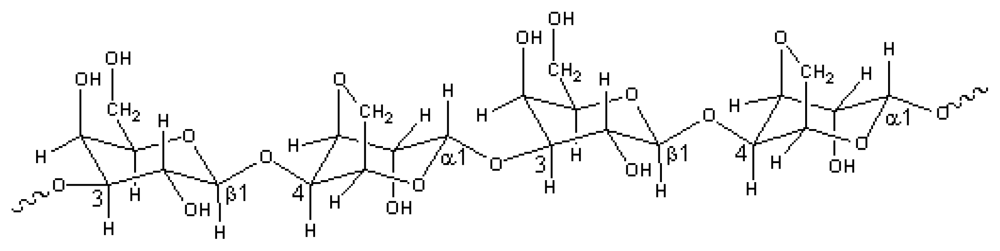
<p>Agarases catalyze the hydrolysis of agar. They are classified into α-agarase (E.C. 3.2.1.158) and β-agarase (E.C. 3.2.1.81) according to the cleavage pattern. The basic structure of agar is composed of repetitive units of β-<sc>d</sc>-galactose and 3,6-anhydro-α-<sc>l</sc>-galactose [<xref ref-type="bibr" rid="b1-marinedrugs-08-00200">1</xref>]. α-Agarases cleave α-1,3 linkages to produce agarooligosaccharides of series related to agarobiose [<xref ref-type="bibr" rid="b2-marinedrugs-08-00200">2</xref>], while β-agarases cleave β-1,4 linkages to produce neoagarooligosaccharides of series related to neoagarobiose [<xref ref-type="bibr" rid="b3-marinedrugs-08-00200">3</xref>]. So far, several agarases have been isolated from different genera of bacteria found in seawater, marine sediments and other environments. Agarases have a wide variety of applications. They have been used to hydrolyze agar to produce oligosaccharides, which exhibit important physiological and biological activities beneficial to the health of human being [<xref ref-type="bibr" rid="b4-marinedrugs-08-00200">4</xref>]. Besides that, agarases also have other uses as tools to isolate protoplasts from seaweeds [<xref ref-type="bibr" rid="b5-marinedrugs-08-00200">5</xref>] and to recover DNA from agarose gel [<xref ref-type="bibr" rid="b6-marinedrugs-08-00200">6</xref>], and to investigate the composition and structure of cell wall polysaccharide of seaweeds. Recent progress in cloning and sequencing of these enzymes has led to structure-function analyses of agarase [<xref ref-type="bibr" rid="b7-marinedrugs-08-00200">7</xref>–<xref ref-type="bibr" rid="b10-marinedrugs-08-00200">10</xref>]. This information will provide valuable insights into the use of this enzyme.</p></sec>
<sec>
<title>2. Agar</title>
<p>In Japan, agar has been used as a food since several hundred years. From Japan its use extended to other oriental countries during the seventeenth and eighteenth centuries. Nowadays, agar has a wide variety of uses due to its stabilizing and gelling characteristics [<xref ref-type="bibr" rid="b11-marinedrugs-08-00200">11</xref>]. Agar has been mainly used in microbiological media because it is not easy for microorganisms to metabolize as well as forms clear, stable and firm gels. It is a Generally Recognized as Safe (GRAS) food additive, which is used in icings, glazes, processed cheese, jelly sweets, and marshmallows.</p>
<sec>
<title>2.1. Sources of Agar</title>
<p>Agar is a phycocolloid extracted from the cell wall of a group of red algae (Rhodophyceae) including <italic>Gelidium</italic> and <italic>Gracilaria. Gelidium</italic> is the preferred source for agar production, but its cultivation is difficult and its natural resource is not abundant like <italic>Gracilaria</italic>, which is being cultivated in several countries and regions in commercial scale. Thus <italic>Gracilaria</italic> became an important source for agar production because it is easily harvested and cultivated [<xref ref-type="bibr" rid="b12-marinedrugs-08-00200">12</xref>].</p></sec>
<sec>
<title>2.2. Structures of Agar</title>
<p>Araki showed that agar was formed by a mixture of two polysaccharides named agarose and agaropectin [<xref ref-type="bibr" rid="b1-marinedrugs-08-00200">1</xref>]. The main structure of agarose is composed of repetitive units of β-<sc>d</sc>-galactose and 3,6-anhydro-α-<sc>l</sc>-galactose (3,6-AG), with few variations, and a low content of sulfate esters (<xref ref-type="fig" rid="f1-marinedrugs-08-00200">Figure 1</xref>). Agaropectin has the same basic disaccharide-repeating units as agarose with some hydroxyl groups of 3,6-anhydro-α-<sc>l</sc>-galactose residues replacing by sulfoxy or methoxy and pyryvate residues [<xref ref-type="bibr" rid="b13-marinedrugs-08-00200">13</xref>].</p>
<p>Agarose has a high molecular mass above 100,000 Daltons, with a low sulfate content of below 0.15%. Agaropectin has a lower molecular mass below 20,000 Daltons, with a much higher sulfate content of 5% to 8% [<xref ref-type="bibr" rid="b14-marinedrugs-08-00200">14</xref>]. Agar is a mixture of agarose and agaropectin fractions in variable proportions depending on the original raw material. The concentration of agaropectin is higher in <italic>Gracilaria</italic>, followed by <italic>Porphyra</italic>, and <italic>Gelidium</italic> [<xref ref-type="bibr" rid="b15-marinedrugs-08-00200">15</xref>] (see [<xref ref-type="bibr" rid="b11-marinedrugs-08-00200">11</xref>] for a more detailed review of agar).</p></sec></sec>
<sec>
<title>3. Agarases</title>
<sec>
<title>3.1. Sources of Agarases</title>
<p>Agarases have been isolated from many sources, including seawater, marine sediments, marine algae, marine mollusks, fresh water, and soil (see <xref ref-type="table" rid="t1-marinedrugs-08-00200">Table 1</xref> for a complete listing and references). Agarase activity has been found in seawater from Sagami Bay in Kanagawa Prefecture in Japan [<xref ref-type="bibr" rid="b6-marinedrugs-08-00200">6</xref>], the Bay of San Vicente in Chile [<xref ref-type="bibr" rid="b16-marinedrugs-08-00200">16</xref>], North Wales in UK [<xref ref-type="bibr" rid="b17-marinedrugs-08-00200">17</xref>], and Mediterranean Sea in France [<xref ref-type="bibr" rid="b2-marinedrugs-08-00200">2</xref>]. Agarase activity has been reported in extract of marine sediment collected at Ise Bay in Japan [<xref ref-type="bibr" rid="b18-marinedrugs-08-00200">18</xref>], at Noma Point in Japan at a depth of 230 m [<xref ref-type="bibr" rid="b19-marinedrugs-08-00200">19</xref>], and from the Xiamen coast in the East China Sea [<xref ref-type="bibr" rid="b20-marinedrugs-08-00200">20</xref>]. Because agarases are the enzymes that hydrolyzes agar, they have been isolated from the surface of rotted red algae in the South China Sea coast in Hainan Island [<xref ref-type="bibr" rid="b21-marinedrugs-08-00200">21</xref>], decomposing algae in Niebla in Chile [<xref ref-type="bibr" rid="b22-marinedrugs-08-00200">22</xref>] and in Halifax in Canada [<xref ref-type="bibr" rid="b23-marinedrugs-08-00200">23</xref>], and decomposing <italic>Porphyra</italic> in Japan [<xref ref-type="bibr" rid="b24-marinedrugs-08-00200">24</xref>]. Some marine mollusks live on seaweed, thus the microorganisms in their digestive tract produce carbohydrate hydrolases, such as agarases. Agarase activity has been detected in the gut of a turban shell <italic>Turbinidae batillus cornutus</italic> in Kangnung coast in the East Sea of Korea [<xref ref-type="bibr" rid="b25-marinedrugs-08-00200">25</xref>]. Most of agarases exist in the marine environment; however, some of them come from fresh water and soil. Agarases have been isolated from the IJsselmeer Lake in Netherlands [<xref ref-type="bibr" rid="b26-marinedrugs-08-00200">26</xref>], and soil samples from Gifu in Japan [<xref ref-type="bibr" rid="b27-marinedrugs-08-00200">27</xref>], Kanto area in Japan [<xref ref-type="bibr" rid="b3-marinedrugs-08-00200">3</xref>], and Karnataka in India [<xref ref-type="bibr" rid="b28-marinedrugs-08-00200">28</xref>].</p>
<p>Agarase activity has been reported in a wide range of microorganisms isolated from the above environments, including <italic>Alteromonas</italic> sp. [<xref ref-type="bibr" rid="b2-marinedrugs-08-00200">2</xref>,<xref ref-type="bibr" rid="b3-marinedrugs-08-00200">3</xref>,<xref ref-type="bibr" rid="b16-marinedrugs-08-00200">16</xref>,<xref ref-type="bibr" rid="b21-marinedrugs-08-00200">21</xref>], <italic>Pseudomonas</italic> sp. [<xref ref-type="bibr" rid="b23-marinedrugs-08-00200">23</xref>,<xref ref-type="bibr" rid="b29-marinedrugs-08-00200">29</xref>,<xref ref-type="bibr" rid="b30-marinedrugs-08-00200">30</xref>], <italic>Vibrio</italic> sp. [<xref ref-type="bibr" rid="b6-marinedrugs-08-00200">6</xref>,<xref ref-type="bibr" rid="b18-marinedrugs-08-00200">18</xref>,<xref ref-type="bibr" rid="b24-marinedrugs-08-00200">24</xref>], <italic>Cytophaga</italic> sp. [<xref ref-type="bibr" rid="b17-marinedrugs-08-00200">17</xref>,<xref ref-type="bibr" rid="b26-marinedrugs-08-00200">26</xref>], <italic>Agarivorans</italic> sp. [<xref ref-type="bibr" rid="b20-marinedrugs-08-00200">20</xref>,<xref ref-type="bibr" rid="b25-marinedrugs-08-00200">25</xref>], <italic>Thalassomonas</italic> sp. [<xref ref-type="bibr" rid="b19-marinedrugs-08-00200">19</xref>], <italic>Pseudoalteromonas</italic> sp. [<xref ref-type="bibr" rid="b22-marinedrugs-08-00200">22</xref>], <italic>Bacillus</italic> sp. [<xref ref-type="bibr" rid="b27-marinedrugs-08-00200">27</xref>], and <italic>Acinetobacter</italic> sp. [<xref ref-type="bibr" rid="b31-marinedrugs-08-00200">31</xref>], <italic>etc.</italic> All of the microorganisms are gram negative bacteria. Most agarases are produced extracellularly (see <xref ref-type="table" rid="t1-marinedrugs-08-00200">Table 1</xref>), except a few agarases are produced intracellularly [<xref ref-type="bibr" rid="b3-marinedrugs-08-00200">3</xref>,<xref ref-type="bibr" rid="b19-marinedrugs-08-00200">19</xref>,<xref ref-type="bibr" rid="b23-marinedrugs-08-00200">23</xref>,<xref ref-type="bibr" rid="b30-marinedrugs-08-00200">30</xref>].</p></sec>
<sec>
<title>3.2. Cleavage Pattern</title>
<p>Agarases are characterized as α-agarases and β-agarases according to the cleavage pattern. The basic units of the products of α-agarases and β-agarases are agarobiose (<xref ref-type="fig" rid="f2-marinedrugs-08-00200">Figure 2A</xref>) [<xref ref-type="bibr" rid="b2-marinedrugs-08-00200">2</xref>] and neoagarobiose (<xref ref-type="fig" rid="f2-marinedrugs-08-00200">Figure 2B</xref>), respectively [<xref ref-type="bibr" rid="b3-marinedrugs-08-00200">3</xref>]. Identified β-agarases are more abundant than α-agarases in both the database (<ext-link xlink:href="http://www.cazy.org/fam/acc_GH.html" ext-link-type="uri">http://www.cazy.org/fam/acc_GH.html</ext-link>) and published reports. There are only two α-agarases described in the above database and literatures, <italic>i.e.</italic>, agarases produced by <italic>Alteromonas agarlyticus</italic> GJ1B from seawater [<xref ref-type="bibr" rid="b2-marinedrugs-08-00200">2</xref>] and <italic>Thalassomonas</italic> sp. JAMB-A33 from marine sediment [<xref ref-type="bibr" rid="b19-marinedrugs-08-00200">19</xref>].</p></sec>
<sec>
<title>3.3. Families of Agarase</title>
<p>Two α-agarases produced by <italic>Thalassomonas</italic> sp. JAMB-A33 and <italic>Alteromonas agarlyticus</italic> GJ1B belong to the glycoside hydrolase (GH) family 96 (<ext-link xlink:href="http://www.cazy.org/fam/acc_GH.html" ext-link-type="uri">http://www.cazy.org/fam/acc_GH.html</ext-link>). The amino acid sequences of the two α-agarases have been identified, with GeneBank accession number of BAF44076.1 (JAMB-A33) and AAF26838.1 (GJ1B), respectively. However, there is no publication available on the catalytic domain in α-agarase. The two α-agarases feature a type-VI cellulose-binding domain by the alignment of amino acid sequence in the NCBI protein database (<ext-link xlink:href="http://www.ncbi.nlm.nih.gov/protein/6724084?report=genpept" ext-link-type="uri">http://www.ncbi.nlm.nih.gov/protein/6724084?report=genpept</ext-link>).</p>
<p>Amino acid sequence similarity indicates that catalytic domains of β-agarases reported up to date have been mainly classified into three GH families, <italic>i.e.</italic>, GH-16, GH-50, and GH-86 (<ext-link xlink:href="http://www.cazy.org/fam/acc_GH.html" ext-link-type="uri">http://www.cazy.org/fam/acc_GH.html</ext-link>). GH-16 family has most abundant members, including agarase, carrageenase, glucanase, galactosidase, laminarinase, <italic>etc.</italic>, while agarase is the only member of GH-50 and GH-86 families. On the other hand, most β-agarases belong to GH-16 family, while only a few β-agarases belong to GH-50 and GH-86 families (see <xref ref-type="table" rid="t2-marinedrugs-08-00200">Table 2</xref> for a complete listing and references). Agarases from these three families carry conserved glycoside hydrolase modules that function in catalysis, and some also carry carbohydrate binding modules (CBM) [<xref ref-type="bibr" rid="b32-marinedrugs-08-00200">32</xref>,<xref ref-type="bibr" rid="b34-marinedrugs-08-00200">34</xref>].</p>
<p>The conserved domain of agarases in the GH-16 family has been well studied. In the characterized GH-16 enzymes, the location of GH-16 module is directly adjacent to the signal peptide, and the CBM-6 module is in the C-terminal. Such as the agarase AgaA produced by <italic>Vibrio</italic> sp. PO303 comprises of a typical N-terminal signal peptide of 29 amino acid residues, followed by a 266 amino acid sequence which is homologous to the catalytic module of GH-16 family, a bacterial immunoglobulin group 2 domain of 52 amino acid residues, and a 131 and a 129 amino acid sequences which are homologous to the CBM-6 family [<xref ref-type="bibr" rid="b7-marinedrugs-08-00200">7</xref>]. The agarase AgaV produced by <italic>Vibrio</italic> sp. V134 comprises of a signal peptide of 23 amino acid residues, followed by a 277 amino acid sequence of GH-16 family module, and a 152 amino acid sequence of CBM-6 family module [<xref ref-type="bibr" rid="b8-marinedrugs-08-00200">8</xref>]. The agarase AgaB34 produced by <italic>Agarivorans albus</italic> YKW-34 comprises of a signal peptide of 23 amino acid residues, followed by a 273 amino acid sequence of GH-16 family module, and a 137 amino acid sequence of CBM-6 family module [<xref ref-type="bibr" rid="b10-marinedrugs-08-00200">10</xref>]. As the three dimensional structure of a GH-16 family agarase has been revealed, the mechanism of catalysis and substrate binding of this family has been well understood [<xref ref-type="bibr" rid="b9-marinedrugs-08-00200">9</xref>,<xref ref-type="bibr" rid="b33-marinedrugs-08-00200">33</xref>]. The amino acid residues involving in the active site and the calcium binding site which act catalytic behavior, and those involving in the Q-X-W(F) motif and the sugar binding site which bind with the substrate are highly conserved in enzymes of this family [<xref ref-type="bibr" rid="b10-marinedrugs-08-00200">10</xref>].</p>
<p>Six β-agarases belonging to GH-50 family have been reported up to date (see <xref ref-type="table" rid="t2-marinedrugs-08-00200">Table 2</xref> for a complete listing and references). These agarases carry partially conserved amino acid sequences of GH-50 family module extending for at least 375 amino acid residues [<xref ref-type="bibr" rid="b34-marinedrugs-08-00200">34</xref>]. Contrary to the GH-16 family module, the GH-50 module is located in the C-terminal end of the polypeptides.</p>
<p>AgrA (AAA25696) is reported to be the first agarase classified in the GH-86 family [<xref ref-type="bibr" rid="b35-marinedrugs-08-00200">35</xref>], however, there is no related published data. Only three agarases belonging to GH-86 family have been described in publications, <italic>i.e.</italic>, Aga86C and Aga86E, from <italic>Saccharophagus degradans</italic> 2-40 and AgaO from <italic>Microbulbifer</italic>-like JAMB-A94. These proteins are modular proteins consisting of CBM-6 family module and GH-86 family catalytic module [<xref ref-type="bibr" rid="b34-marinedrugs-08-00200">34</xref>,<xref ref-type="bibr" rid="b35-marinedrugs-08-00200">35</xref>]. Though the sequences are highly divergent, the critical amino acid residues (Glu, Asp) which are essential for their activity are conserved in them [<xref ref-type="bibr" rid="b35-marinedrugs-08-00200">35</xref>]. An interesting phenomenon is that <italic>Saccharophagus degradans</italic> 2-40 derived from marine algae has been reported to produce five β-agarases belonging to three different families which form a complex agarolytic system [<xref ref-type="bibr" rid="b34-marinedrugs-08-00200">34</xref>].</p></sec></sec>
<sec sec-type="methods">
<title>4. Methods for Detecting Agarase Activity</title>
<sec>
<title>4.1. Qualitative Assays</title>
<p>Lugol’s iodine solution has been used to visualize agarase activity both for screening the agarase production by microorganism on a culture plate and for identification of protein band of agarase activity after electrophoresis [<xref ref-type="bibr" rid="b27-marinedrugs-08-00200">27</xref>]. It stains polysaccharide of agar into a dark brown color, while it can’t stain the degraded oligosaccharides of agar. Thus, a bright clear zone shows around the colony produce agarase and around the protein band possesses agarase activity, while other places are dark brown area.</p>
<p>After electrophoresis, <italic>in situ</italic> detection of agarase is performed on one gel, and Coomassie Brilliant Blue staining is performed on the other gel [<xref ref-type="bibr" rid="b25-marinedrugs-08-00200">25</xref>]. SDS in one gel is removed by rinsing the gel three times with 20 mM Tris-HCl buffer (pH 8.0) for each 10 min. Thereafter, the gel is overlaid onto a plate sheet containing 2% agar and incubated at 37 °C for 4 h. Finally, the gel is stained by Lugol’s iodine solution (5% I<sub>2</sub> and 10% KI in distilled water). A clear zone is formed around the agarase band. To determine the molecular mass by electrophoresis, the other gel is stained by Coomassie Brilliant Blue after electrophoresis. The molecular mass of the agarase can be determined by comparing the two gels.</p></sec>
<sec>
<title>4.2. Quantitative Assays for Agarase Activity</title>
<p>Agarases degrade agar in α-1,3 or β-1,4 glycosidic bonds and from reducing ends. The agarase activity is commonly quantified by spectrophotometric determination of the increase in the concentration of reducing sugars by Nelson method [<xref ref-type="bibr" rid="b38-marinedrugs-08-00200">38</xref>] or DNS method [<xref ref-type="bibr" rid="b39-marinedrugs-08-00200">39</xref>] using <sc>d</sc>-galactose as a standard. Enzyme activity (U/mL) was defined as the amount of enzyme required to liberate 1 μmol <sc>d</sc>-galactose per min.</p></sec>
<sec>
<title>4.3. Agarase Isolation and Purification</title>
<p>The purification procedure of ammonium sulfate fractionation followed by anion exchange chromatography and gel filtration chromatography has often been used in purification of several agarases [<xref ref-type="bibr" rid="b3-marinedrugs-08-00200">3</xref>,<xref ref-type="bibr" rid="b6-marinedrugs-08-00200">6</xref>,<xref ref-type="bibr" rid="b18-marinedrugs-08-00200">18</xref>,<xref ref-type="bibr" rid="b21-marinedrugs-08-00200">21</xref>,<xref ref-type="bibr" rid="b22-marinedrugs-08-00200">22</xref>,<xref ref-type="bibr" rid="b27-marinedrugs-08-00200">27</xref>,<xref ref-type="bibr" rid="b31-marinedrugs-08-00200">31</xref>]. Ammonium sulfate fractionation may be omitted [<xref ref-type="bibr" rid="b25-marinedrugs-08-00200">25</xref>] or replaced by acetone precipitation [<xref ref-type="bibr" rid="b39-marinedrugs-08-00200">39</xref>] in this procedure. Exchangers have been used in all the above reports for capturing agarase are anion exchanger, which indicates that agarases reported are proteins with p<italic>I</italic> values lower than 7.</p>
<p>Hydroxyapatite has been successfully used for purification of a few agarases [<xref ref-type="bibr" rid="b19-marinedrugs-08-00200">19</xref>,<xref ref-type="bibr" rid="b35-marinedrugs-08-00200">35</xref>,<xref ref-type="bibr" rid="b36-marinedrugs-08-00200">36</xref>]. The agarase from <italic>Thalassomonas</italic> sp. JAMB-A33 has been purified by hydroxyapatite, followed by anion exchange chromatography, column purification by hydroxyapatite, anion exchange chromatography, and gel filtration chromatography [<xref ref-type="bibr" rid="b19-marinedrugs-08-00200">19</xref>]. Column purification by hydroxyapatite has been used in other cases [<xref ref-type="bibr" rid="b35-marinedrugs-08-00200">35</xref>,<xref ref-type="bibr" rid="b36-marinedrugs-08-00200">36</xref>]. Besides that, hydrophobic chromatography has been used in purification of rAgaA cloned from <italic>Vibrio</italic> sp. PO303 [<xref ref-type="bibr" rid="b7-marinedrugs-08-00200">7</xref>].</p>
<p>Three kinds of affinity chromatography media have been used in agarase purification up to date. The first kind of medium is the cross-linked agarose such as agarose CL-6B, which results in a marked increase of agarase specific activity based on the specific affinity of enzyme and substrate. This kind of affinity chromatography has been used cooperating with anion exchange chromatography [<xref ref-type="bibr" rid="b2-marinedrugs-08-00200">2</xref>,<xref ref-type="bibr" rid="b39-marinedrugs-08-00200">39</xref>] or gel filtration chromatography [<xref ref-type="bibr" rid="b29-marinedrugs-08-00200">29</xref>]. The second kind of medium is Ni<sup>2+</sup> Sepharose which is commonly used to trap the 6-His tagged recombinant protein. It is used for one-step purifications of rAgaD cloned from <italic>Vibrio</italic> sp. PO-303 [<xref ref-type="bibr" rid="b40-marinedrugs-08-00200">40</xref>], five recombinant agarases cloned from <italic>S. degradans</italic> 2-40 [<xref ref-type="bibr" rid="b34-marinedrugs-08-00200">34</xref>], rAgaA from <italic>Agarivorans</italic> sp. LQ48 [<xref ref-type="bibr" rid="b41-marinedrugs-08-00200">41</xref>], and rAgaB34 cloned from <italic>Agarivorans</italic> sp. YKW-34 [<xref ref-type="bibr" rid="b10-marinedrugs-08-00200">10</xref>]. The third kind of medium is chitin bead which is used to trap intein-chitin binding domain. It is successfully applied in a one-step purification of recombinant agarase cloned from <italic>Agarivorans</italic> sp. JA-1 [<xref ref-type="bibr" rid="b42-marinedrugs-08-00200">42</xref>].</p>
<p>Most native and cloned agarases have been purified to high purity with a satisfactory yield. Two agarases AgaA and AgaB from the marine bacterium <italic>Zobellia galactanivorans</italic> have been highly purified [<xref ref-type="bibr" rid="b43-marinedrugs-08-00200">43</xref>], and the enzymes have been used in the growth of crystals for X-ray diffraction studies [<xref ref-type="bibr" rid="b33-marinedrugs-08-00200">33</xref>].</p></sec></sec>
<sec>
<title>5. Characterization of Agarase</title>
<sec>
<title>5.1. Native Agarase from Marine Environment</title>
<p>Various agarases from marine microorganisms derived from seawater, marine sediments, marine algae, and marine mollusks have been purified and characterized. Their important properties are listed in <xref ref-type="table" rid="t1-marinedrugs-08-00200">Table 1</xref>. Their molecular masses are highly divergent ranging from 20 to 360 kDa. The smallest agarase is produced by <italic>Vibrio</italic> sp. AP-2 from marine algae with a Mr of 20 kDa [<xref ref-type="bibr" rid="b24-marinedrugs-08-00200">24</xref>], while the largest agarase is produced by <italic>Alteromonas agarlyticus</italic> GJ1B from seawater with a Mr of 360 kDa [<xref ref-type="bibr" rid="b2-marinedrugs-08-00200">2</xref>]. As shown in <xref ref-type="table" rid="t1-marinedrugs-08-00200">Table 1</xref>, most of the agarases are composed of a single polypeptide, except the agarase produced by <italic>Alteromonas agarlyticus</italic> GJ1B. Using SDS-PAGE, this purified agarase has been detected as a single band with a molecular mass of 180 kDa. After the affinity-chromatography step, however, the native molecular mass was approximately 360 kDa, suggesting that the native enzyme is a dimer [<xref ref-type="bibr" rid="b2-marinedrugs-08-00200">2</xref>].</p>
<p>As shown in <xref ref-type="table" rid="t1-marinedrugs-08-00200">Table 1</xref>, the specific activities ranging from 6.3 to 292 U/mg. The reported data indicate that agarases purified from genus of <italic>Vibrio</italic> have lower specific activities, which are 7.54 and 20.8 U/mg from strain PO303 [<xref ref-type="bibr" rid="b18-marinedrugs-08-00200">18</xref>] and 6.3 U/mg from strain JT0107 [<xref ref-type="bibr" rid="b6-marinedrugs-08-00200">6</xref>]. Agarases from genus Agarivorans show medium specific activities, which are 57.45 and 76.8 U/mg from strain HZ105 [<xref ref-type="bibr" rid="b20-marinedrugs-08-00200">20</xref>] and 25.54 U/mg from strain YKW-34 [<xref ref-type="bibr" rid="b25-marinedrugs-08-00200">25</xref>]. Agarases from genus <italic>Alteromonas</italic> and <italic>Pseudoalteromonas</italic> exhibit high specific activities, which are 83.5 U/mg from <italic>Alteromonas</italic> sp. SY37-12 [<xref ref-type="bibr" rid="b21-marinedrugs-08-00200">21</xref>], 234 U/mg from <italic>Alteromonas</italic> sp. C-1 [<xref ref-type="bibr" rid="b16-marinedrugs-08-00200">16</xref>], and 292 U/mg from <italic>Pseudoalteromonas antarctica</italic> N-1 [<xref ref-type="bibr" rid="b22-marinedrugs-08-00200">22</xref>].</p>
<p>The optimal temperatures for the activity of agarases are similar. The gelling temperature of agar is around 38 °C, and most of reported agarases show optimal activity at temperature above this level (<xref ref-type="table" rid="t1-marinedrugs-08-00200">Table 1</xref>). Except agarases produced by two kinds of seawater derived bacteria, <italic>i.e.</italic>, <italic>Vibrio</italic> sp. JT0107 and <italic>Alteromonas</italic> sp. C-1, possess optimal activity at temperature of 30 °C [<xref ref-type="bibr" rid="b6-marinedrugs-08-00200">6</xref>,<xref ref-type="bibr" rid="b16-marinedrugs-08-00200">16</xref>], which indicates their potential application in industrial production of neoagarooligosaccharide directly from marine algae under economic conditions. Because the derivation of marine environment, most agarases are not stable in high temperature. Only agarases from <italic>Alteromonas</italic> sp. SY37-12 and <italic>Agarivorans</italic> YKW-34 have been reported to be stable up to temperature of 50 °C, others are stable up to 45 °C [<xref ref-type="bibr" rid="b2-marinedrugs-08-00200">2</xref>,<xref ref-type="bibr" rid="b24-marinedrugs-08-00200">24</xref>], 40 °C [<xref ref-type="bibr" rid="b6-marinedrugs-08-00200">6</xref>,<xref ref-type="bibr" rid="b19-marinedrugs-08-00200">19</xref>], 30 °C [<xref ref-type="bibr" rid="b16-marinedrugs-08-00200">16</xref>,<xref ref-type="bibr" rid="b22-marinedrugs-08-00200">22</xref>,<xref ref-type="bibr" rid="b23-marinedrugs-08-00200">23</xref>], and 25 °C [<xref ref-type="bibr" rid="b20-marinedrugs-08-00200">20</xref>].</p>
<p>Most agarases have been reported to show maximum activity at a neutral [<xref ref-type="bibr" rid="b21-marinedrugs-08-00200">21</xref>–<xref ref-type="bibr" rid="b23-marinedrugs-08-00200">23</xref>] or a week alkaline pH [<xref ref-type="bibr" rid="b2-marinedrugs-08-00200">2</xref>,<xref ref-type="bibr" rid="b6-marinedrugs-08-00200">6</xref>,<xref ref-type="bibr" rid="b17-marinedrugs-08-00200">17</xref>,<xref ref-type="bibr" rid="b19-marinedrugs-08-00200">19</xref>,<xref ref-type="bibr" rid="b25-marinedrugs-08-00200">25</xref>]. As we know, the natural seawater is of a week alkaline pH, thus it is reasonable that the marine derived agarase show maximum activity in this condition. Only the agarase from <italic>Alteromonas</italic> sp. C-1 and <italic>Vibrio</italic> sp. AP-2 has been reported to possess maximum activity at pH 6.5 [<xref ref-type="bibr" rid="b16-marinedrugs-08-00200">16</xref>] and pH 5.5 [<xref ref-type="bibr" rid="b24-marinedrugs-08-00200">24</xref>], respectively.</p>
<p>The products are totally different between different categories of the agarase. Two α-agarases derived from marine environment have been reported, <italic>i.e.</italic>, <italic>Alteromonas agarlyticus</italic> GJ1B and <italic>Thalassomonas</italic> sp. JAMB-A33, which produce agarotetraose as the main product. Other β-agarases have been reported to produce NA2 [<xref ref-type="bibr" rid="b23-marinedrugs-08-00200">23</xref>–<xref ref-type="bibr" rid="b25-marinedrugs-08-00200">25</xref>], NA4 [<xref ref-type="bibr" rid="b16-marinedrugs-08-00200">16</xref>,<xref ref-type="bibr" rid="b22-marinedrugs-08-00200">22</xref>] and NA6 [<xref ref-type="bibr" rid="b21-marinedrugs-08-00200">21</xref>] as the predominant product. Agarase from <italic>Vibrio</italic> sp. JT0107 has been reported to produce the mixture products of NA2 and NA4, however, NA2 is not detected when NA4 is used as a substrate [<xref ref-type="bibr" rid="b6-marinedrugs-08-00200">6</xref>]. Three kinds of agarases, <italic>i.e.</italic>, agarase-a, agarase-b, and agarase-c, secrete by a marine bacterium, <italic>Vibrio</italic> sp. strain PO-303, have been reported to exhibit different action patterns against agarose. Agarase-a hydrolyzed agarose into NA4 and NA6, agarase-b hydrolyzed agarose into NA2, and agarase-c produced NA6 and NA8 from agarose [<xref ref-type="bibr" rid="b18-marinedrugs-08-00200">18</xref>].</p></sec>
<sec>
<title>5.2. Native Agarase from Fresh Water and Terrestrial Environments</title>
<p>Most agarases are from marine environment, except four agarases have been reported deriving from other environments (<xref ref-type="table" rid="t1-marinedrugs-08-00200">Table 1</xref>). The molecular mass of the agarase produced by a fresh water bacteria <italic>Cytophaga flevensis</italic> is 26 kDa [<xref ref-type="bibr" rid="b26-marinedrugs-08-00200">26</xref>], while that of soil derived agarase is much higher, which is 100 kDa from <italic>Acinetobacter</italic> sp. AGLSL-1 [<xref ref-type="bibr" rid="b31-marinedrugs-08-00200">31</xref>], 113 kDa from <italic>Bacillus</italic> sp. MK03 [<xref ref-type="bibr" rid="b27-marinedrugs-08-00200">27</xref>] and 180 kDa from <italic>Alteromonas</italic> sp. E-l [<xref ref-type="bibr" rid="b3-marinedrugs-08-00200">3</xref>], respectively. The latter two kinds of agarases are reported to be dimers based on data comparison of SDS-PAGE and gel filtration. It is remarkable that the agarase from <italic>Acinetobacter</italic> sp. AGLSL-1 show a specific activity of 397 U/mg [<xref ref-type="bibr" rid="b31-marinedrugs-08-00200">31</xref>], which is the highest among the native agarases have been reported up to date. There are no special properties as comparing the above four agarases with marine derived agarases in pH and temperature properties. These four agarases are all β-agarases. It is noteworthy that agarases from <italic>Alteromonas</italic> sp. E-l [<xref ref-type="bibr" rid="b3-marinedrugs-08-00200">3</xref>] and <italic>Acinetobacter</italic> sp. AGLSL-1 [<xref ref-type="bibr" rid="b31-marinedrugs-08-00200">31</xref>] have been reported to hydrolyze agarose, NA4, and NA6 to NA2 as the only final product.</p></sec>
<sec>
<title>5.3. Cloned α-Agarase</title>
<p>rAgaA33 has been cloned from a deep sea sediment bacterium <italic>Thalassomonas</italic> sp. JAMB-A33 [<xref ref-type="bibr" rid="b44-marinedrugs-08-00200">44</xref>]. Two native α-agarases have been reported up to date [<xref ref-type="bibr" rid="b2-marinedrugs-08-00200">2</xref>,<xref ref-type="bibr" rid="b19-marinedrugs-08-00200">19</xref>], while rAgaA33 is the first and the only α-agarase has been reported to be recombinant produced (<xref ref-type="table" rid="t2-marinedrugs-08-00200">Table 2</xref>). It has been extracellularly produced using <italic>Bacillus subtilis</italic> as a host with an extraordinary production of 6950 U/L [<xref ref-type="bibr" rid="b44-marinedrugs-08-00200">44</xref>], whereas the native agarase has been intracellularly produced with a low production [<xref ref-type="bibr" rid="b19-marinedrugs-08-00200">19</xref>]. As comparing with its native agarase, its enzymatic properties including the molecular mass, the specific activity, temperature and pH activity and stability, and the final products have no significant difference with those of the native one [<xref ref-type="bibr" rid="b19-marinedrugs-08-00200">19</xref>,<xref ref-type="bibr" rid="b44-marinedrugs-08-00200">44</xref>]. Thus the recombinant α-agarase is successfully produced with a high production and maintains its native properties.</p></sec>
<sec>
<title>5.4. Cloned β-Agarases</title>
<p>Beside the above one α-agarase, other recombinant agarases are belonging to β-agarases. <italic>Escherichia coli</italic> is commonly used as a host for recombinant production of agarases (<xref ref-type="table" rid="t2-marinedrugs-08-00200">Table 2</xref>), while <italic>Bacillus subtilis</italic> is used for extracellular expression of recombinant β-agarases from <italic>Microbulbifer</italic>-like JAMB-A94, <italic>Agarivorans</italic> sp. JAMB-A11, <italic>Microbulbifer thermotolerans</italic> JAMB-A94, and <italic>Microbulbifer</italic> sp. JAMB-A7 [<xref ref-type="bibr" rid="b35-marinedrugs-08-00200">35</xref>,<xref ref-type="bibr" rid="b36-marinedrugs-08-00200">36</xref>,<xref ref-type="bibr" rid="b45-marinedrugs-08-00200">45</xref>,<xref ref-type="bibr" rid="b46-marinedrugs-08-00200">46</xref>]. Agarases have been intracellularly produced by <italic>Escherichia coli</italic> in most cases [<xref ref-type="bibr" rid="b7-marinedrugs-08-00200">7</xref>,<xref ref-type="bibr" rid="b34-marinedrugs-08-00200">34</xref>,<xref ref-type="bibr" rid="b40-marinedrugs-08-00200">40</xref>,<xref ref-type="bibr" rid="b42-marinedrugs-08-00200">42</xref>,<xref ref-type="bibr" rid="b43-marinedrugs-08-00200">43</xref>,<xref ref-type="bibr" rid="b47-marinedrugs-08-00200">47</xref>–<xref ref-type="bibr" rid="b50-marinedrugs-08-00200">50</xref>]. However, some agarases have been reported to be extracellularly secreted into culture media under the control of their own signal peptide in a few cases [<xref ref-type="bibr" rid="b10-marinedrugs-08-00200">10</xref>,<xref ref-type="bibr" rid="b39-marinedrugs-08-00200">39</xref>,<xref ref-type="bibr" rid="b51-marinedrugs-08-00200">51</xref>]. Agarases cloned from <italic>Vibrio</italic> sp. V134 and <italic>Agarivorans</italic> sp. LQ48 have been reported to exist in both culture media and cell pellets. To maintain the bioactivities, the recombinant agarases have been purified from the culture supernatant under native conditions [<xref ref-type="bibr" rid="b8-marinedrugs-08-00200">8</xref>,<xref ref-type="bibr" rid="b41-marinedrugs-08-00200">41</xref>].</p>
<p>A high level of extracellular production of agarase has been achieved when using <italic>B. subtilis</italic> as a host [<xref ref-type="bibr" rid="b35-marinedrugs-08-00200">35</xref>,<xref ref-type="bibr" rid="b36-marinedrugs-08-00200">36</xref>,<xref ref-type="bibr" rid="b45-marinedrugs-08-00200">45</xref>,<xref ref-type="bibr" rid="b46-marinedrugs-08-00200">46</xref>]. The production of recombinant agarase cloned from <italic>Microbulbifer</italic>-like JAMB-A94, <italic>Agarivorans</italic> sp. JAMB-A11, <italic>Microbulbifer thermotolerans</italic> JAMB-A94, and <italic>Microbulbifer</italic> sp. JAMB-A7 in the supernatant of the culture medium has been reported to be 7816 U/L [<xref ref-type="bibr" rid="b35-marinedrugs-08-00200">35</xref>], 19000 U/L [<xref ref-type="bibr" rid="b45-marinedrugs-08-00200">45</xref>], 19000 U/L [<xref ref-type="bibr" rid="b46-marinedrugs-08-00200">46</xref>], and 25831 U/L [<xref ref-type="bibr" rid="b36-marinedrugs-08-00200">36</xref>], which is calculated to be 80, 51, 87, and 65 mg/L, respectively. When <italic>E. coli</italic> has been used as a host, the production of agarase is lower than that by <italic>B. subtilis</italic> when calculate by mg of agarase per L of culture medium (<xref ref-type="table" rid="t2-marinedrugs-08-00200">Table 2</xref>). These reports indicate that <italic>B. subtilis</italic> is an efficient engineering strain which can be used for the extracellular over-expression of recombinant agarase.</p>
<p>The molecular mass of cloned β-agarases is ranging from 30 to 147 kDa (<xref ref-type="table" rid="t2-marinedrugs-08-00200">Table 2</xref>). Each of them has been reported to be single polypeptide with coincident molecular mass determining by SDS-PAGE and deducing from the amino acid sequence. The specific activity of them is divergent (<xref ref-type="table" rid="t2-marinedrugs-08-00200">Table 2</xref>). It is noticeable that the rAgaB cloned from a seawater derived bacterium <italic>Pseudoalteromonas</italic> sp. CY24 has been reported to possess a remarkable specific activity of 5,000 U/mg toward agarose [<xref ref-type="bibr" rid="b51-marinedrugs-08-00200">51</xref>].</p>
<p>As shown in <xref ref-type="table" rid="t2-marinedrugs-08-00200">Table 2</xref>, the optimal temperature for the activity of recombinant agarases is mostly around 40 °C, except those cloned from <italic>Pseudomonas</italic> sp. SK38 and <italic>Agarivorans albus</italic> YKW-34 which possess optimal activity at temperature of 30 °C [<xref ref-type="bibr" rid="b10-marinedrugs-08-00200">10</xref>,<xref ref-type="bibr" rid="b48-marinedrugs-08-00200">48</xref>] and that cloned from <italic>Microbulbifer</italic> sp. JAMB-A7 and <italic>Microbulbifer thermotolerans</italic> JAMB-A94 which exhibits optimal activity at temperature of 50 °C [<xref ref-type="bibr" rid="b36-marinedrugs-08-00200">36</xref>] and 55 °C [<xref ref-type="bibr" rid="b46-marinedrugs-08-00200">46</xref>], respectively. Most recombinant agarases are stable up to temperature of 35 °C [<xref ref-type="bibr" rid="b47-marinedrugs-08-00200">47</xref>,<xref ref-type="bibr" rid="b48-marinedrugs-08-00200">48</xref>,<xref ref-type="bibr" rid="b51-marinedrugs-08-00200">51</xref>], 40 °C [<xref ref-type="bibr" rid="b40-marinedrugs-08-00200">40</xref>,<xref ref-type="bibr" rid="b35-marinedrugs-08-00200">35</xref>,<xref ref-type="bibr" rid="b45-marinedrugs-08-00200">45</xref>] and 50 °C [<xref ref-type="bibr" rid="b10-marinedrugs-08-00200">10</xref>,<xref ref-type="bibr" rid="b36-marinedrugs-08-00200">36</xref>,<xref ref-type="bibr" rid="b41-marinedrugs-08-00200">41</xref>], while those cloned from <italic>Agarivorans</italic> sp. JA-1 and <italic>Microbulbifer thermotolerans</italic> JAMB-A94 are thermo-tolerant agarases which stable up to 60 °C [<xref ref-type="bibr" rid="b42-marinedrugs-08-00200">42</xref>,<xref ref-type="bibr" rid="b46-marinedrugs-08-00200">46</xref>].</p>
<p>As shown in <xref ref-type="table" rid="t2-marinedrugs-08-00200">Table 2</xref>, most recombinant agarases show maximum activity at a neutral or a week alkaline pH, except rAgaC cloned from <italic>Vibrio</italic> sp. PO-303, and rpagA cloned from <italic>Pseudomonas</italic> sp. SK38 possesses maximum activity at pH 6.0 [<xref ref-type="bibr" rid="b47-marinedrugs-08-00200">47</xref>] and pH 9.0 [<xref ref-type="bibr" rid="b48-marinedrugs-08-00200">48</xref>], respectively. Each recombinant agarase has a reasonable pH stability range (<xref ref-type="table" rid="t2-marinedrugs-08-00200">Table 2</xref>), except a novel agarase cloned from <italic>Agarivorans</italic> sp. LQ48 which is stable over a wide pH range of 3–11. Further studies by its researchers on the three-dimensional structure of this agarase will provide more information for the mechanism [<xref ref-type="bibr" rid="b41-marinedrugs-08-00200">41</xref>].</p>
<p>Agarases belonging to a same GH family display similar digestion profile toward agarose. Generally, the smallest end product or the main product is NA4 by agarases of GH-16 family, NA2 by those of GH-50 family, and NA6 or NA8 by agarases of GH-86 family (<xref ref-type="table" rid="t2-marinedrugs-08-00200">Table 2</xref>). Recombinant agarases belonging to GH-16 family are abundant, most of which have been reported to produce NA4 as the smallest end product [<xref ref-type="bibr" rid="b7-marinedrugs-08-00200">7</xref>,<xref ref-type="bibr" rid="b8-marinedrugs-08-00200">8</xref>,<xref ref-type="bibr" rid="b10-marinedrugs-08-00200">10</xref>,<xref ref-type="bibr" rid="b36-marinedrugs-08-00200">36</xref>,<xref ref-type="bibr" rid="b39-marinedrugs-08-00200">39</xref>,<xref ref-type="bibr" rid="b41-marinedrugs-08-00200">41</xref>,<xref ref-type="bibr" rid="b46-marinedrugs-08-00200">46</xref>], except rAgaA cloned from <italic>Vibrio</italic> sp. PO303 [<xref ref-type="bibr" rid="b40-marinedrugs-08-00200">40</xref>] and rAgaB cloned from <italic>Zobellia galactanivorans</italic> [<xref ref-type="bibr" rid="b43-marinedrugs-08-00200">43</xref>] have been reported to produce NA2 in little amount.</p>
<p>However, the latter two recombinant agarases cannot degrade NA4 into NA2 [<xref ref-type="bibr" rid="b40-marinedrugs-08-00200">40</xref>,<xref ref-type="bibr" rid="b43-marinedrugs-08-00200">43</xref>]. Six GH-50 family agarases have been recombinant produced, while the products of only two of them have been demonstrated, <italic>i.e.</italic>, agarase clone from <italic>Agarivorans</italic> sp. JA-1 [<xref ref-type="bibr" rid="b42-marinedrugs-08-00200">42</xref>] and rAgaA11 cloned from <italic>Agarivorans</italic> sp. JAMB-A11 [<xref ref-type="bibr" rid="b45-marinedrugs-08-00200">45</xref>]. These two agarases have been reported to hydrolyze not only agarose, but also NA4, to yield NA2 as the main end product [<xref ref-type="bibr" rid="b42-marinedrugs-08-00200">42</xref>,<xref ref-type="bibr" rid="b45-marinedrugs-08-00200">45</xref>].</p>
<p>Agarases belonging to GH-86 family are seldom found, and only two of them have been detailed described. The main product of rAgaC cloned from <italic>Vibrio</italic> sp. PO303 [<xref ref-type="bibr" rid="b47-marinedrugs-08-00200">47</xref>] and rAga86O cloned from <italic>Microbulbifer</italic>-like JAMB-A94 [<xref ref-type="bibr" rid="b35-marinedrugs-08-00200">35</xref>] is NA8 and NA6, respectively. It is noteworthy that the <italic>agaB</italic> gene of <italic>Pseudoalteromonas</italic> sp. CY24 has no significant sequence similarity with that of any known protein and the produced rAgaB hydrolyzes agarose forming NA8 and NA10 as the main end products. It has been concluded that this recombinant agarase belongs to be an unknown GH family [<xref ref-type="bibr" rid="b51-marinedrugs-08-00200">51</xref>].</p></sec></sec>
<sec>
<title>6. Applications of Agarases</title>
<sec>
<title>6.1. Recovery of DNA from Agarose Gel</title>
<p>Agarases have been widely used to recover DNA bands from the agarose gel. They are indispensable tools used in biological research field. Takara Company produces agarose gel DNA purification kit by using a β-agarase with thermo-stability up to 60 °C [<xref ref-type="bibr" rid="b52-marinedrugs-08-00200">52</xref>]. The agarase produced by <italic>Vibrio</italic> sp. JT0107 recovered 60% of the applied DNA from the gel by heating at 65 °C for 5 min [<xref ref-type="bibr" rid="b50-marinedrugs-08-00200">50</xref>]. Gold has reported the use of a novel gel-digesting enzyme preparation which provides an easy, rapid, and convenient method to recover PCR-amplified DNA from low melting point agarose gels [<xref ref-type="bibr" rid="b53-marinedrugs-08-00200">53</xref>].</p></sec>
<sec>
<title>6.2. Production of Agar-Derived Oligosaccharides</title>
<p>Agarases have been used for agar-derived oligosaccharides production. Comparing to the traditional acid degradation method, the enzyme degradation method has a lot of remarkable advantages, such as tender reaction condition, excellent efficiency, controllable products, simple facilities, low energy cost, little environment pollution. A simple method of preparing diverse neoagaro-oligosaccharides has been established using recombinant AgaA and AgaB cloned from <italic>Pseudoaltermonas</italic> sp. CY24 [<xref ref-type="bibr" rid="b51-marinedrugs-08-00200">51</xref>], in which agarose has been hydrolyzed into NA4, NA6, NA8, NA10, and NA12 [<xref ref-type="bibr" rid="b54-marinedrugs-08-00200">54</xref>].</p>
<p>The agar-derived oligosaccharides include agarooligosaccharides and neoagarooligosaccharides. Various reports indicated their high economic values due to their physiological and biological activities. Oligosaccharides have been prepared from agar by crude agarase from <italic>Vibrio</italic> QJH-12 isolated from the South China Sea coast [<xref ref-type="bibr" rid="b4-marinedrugs-08-00200">4</xref>]. The oligosaccharides mixture exhibit antioxidative activities in scavenging hydroxyl free radical, scavenging superoxide anion radical, and inhibiting lipid peroxidation. The oligosaccharides with the sulfate group or with higher molecular masses show stronger antioxidative activities than that without the sulfate group or with smaller molecular masses [<xref ref-type="bibr" rid="b4-marinedrugs-08-00200">4</xref>]. In a later report, the products mixture containing NA4 and NA6, which digested from algal polysaccharide by crude agarase products from MA103 strain, have shown high anti-oxidative properties by five <italic>in vitro</italic> methods [<xref ref-type="bibr" rid="b55-marinedrugs-08-00200">55</xref>,<xref ref-type="bibr" rid="b56-marinedrugs-08-00200">56</xref>]. The result indicates that neoagarooligosaccharide may have potential application in health food. Neoagarooligosaccharides have been reported to inhibit the growth of bacteria, slow down the degradation of starch, and used as low-calorie additives to improve food qualities [<xref ref-type="bibr" rid="b57-marinedrugs-08-00200">57</xref>]. The low polymerization degree (DP) product, such as NA2, has been reported to have a moisturizing effect on skin and a whitening effect on melanoma cells [<xref ref-type="bibr" rid="b58-marinedrugs-08-00200">58</xref>]. Furthermore, the higher molecular mass product, such as NA6, has been reported to exhibit as a more efficient moisturizer on skin than smaller oligosaccharides, because the viscosity of NA6 is higher than that of NA4 and NA2 [<xref ref-type="bibr" rid="b35-marinedrugs-08-00200">35</xref>]. Owning to these characteristics, neoagarooligosaccharides have potential applications in food, pharmaceutical, and cosmetic industries.</p></sec>
<sec>
<title>6.3. Research on Seaweed Bio-Substances and Preparation of Seaweed Protoplasts</title>
<p>Agarases have potential application in degrade the cell wall of red algae for extraction of labile substances with biological activities such as unsaturated fatty acids, vitamins, carotenoids from algae. Yaphe has used the agarase from <italic>Pseudomonas atlantic</italic> [<xref ref-type="bibr" rid="b23-marinedrugs-08-00200">23</xref>] in the identification of agar in marine algae (Rhodophyceae) [<xref ref-type="bibr" rid="b59-marinedrugs-08-00200">59</xref>]. Agarases have also been used to prepare of protoplasts. Protoplasts isolated from marine algae are useful experimental materials for physiological and cytological studies, and excellent tools for plant breeding by cell fusion and gene manipulation [<xref ref-type="bibr" rid="b60-marinedrugs-08-00200">60</xref>]. Araki has succeeded in the isolation of protoplasts from <italic>Bangia atropurpurea</italic> (Rhodophyta) by using three kinds of enzymes, <italic>i.e.</italic>, β-1,4-mannanase, β-1,3-xylanase, and agarase prepared from three marine bacteria, <italic>i.e.</italic>, <italic>Vibrio</italic> sp. MA-138, <italic>Alcaligenes</italic> sp. XY-234, and <italic>Vibrio</italic> sp. PO-303 [<xref ref-type="bibr" rid="b18-marinedrugs-08-00200">18</xref>], respectively [<xref ref-type="bibr" rid="b61-marinedrugs-08-00200">61</xref>]. The rAgaA, rAgaC, and rAgaD cloned from <italic>Vibrio</italic> sp. PO303 [<xref ref-type="bibr" rid="b7-marinedrugs-08-00200">7</xref>,<xref ref-type="bibr" rid="b40-marinedrugs-08-00200">40</xref>,<xref ref-type="bibr" rid="b47-marinedrugs-08-00200">47</xref>] have been reported to hydrolyze not only agarose and agar but also porphyran. Porphyran is a unique polysaccharide composing of a linear chain of alternating residues of 3-<italic>O</italic>-linked β-<sc>d</sc>-galactopyranose and 4-<italic>O</italic>-linked 3,6-anhydro-α-<sc>l</sc>-galactose. It is contained in the cell wall of <italic>Porphyra</italic> which is an important edible red seaweed. Hence, by combination with β-1,4-mannanase and β-1,3-xylanase, these agarases might be a useful tool for isolation of protoplasts from <italic>Porphyra</italic>.</p></sec></sec>
<sec>
<title>7. Concluding Remarks</title>
<p>From the collective information on agarases, we conclude that agarases are important enzymes naturally purified and cloned from variety of microorganisms. They are characterized into two categories with more than four families which can produce various oligosaccharides with different DP values. A few agarases have a remarkable production and possess excellent properties such as high specific activity, excellent temperature and pH stability, which enlighten their widely potential applications.</p></sec></body>
<back>
<ack>
<title>Acknowledgments</title>
<p>This study was supported by the grant (No. RTI05-01-02) of the Regional Technology Innovation Program of the Ministry of Knowledge Economy (MKE), Korea. X.T. Fu was the recipient of a graduate fellowship provided by the Brain Korea (BK21) program sponsored by the Ministry of Education, Science and Technology, Korea.</p></ack>
<ref-list>
<title>References</title>
<ref id="b1-marinedrugs-08-00200"><label>1</label><citation citation-type="journal"><person-group person-group-type="author"><name><surname>Araki</surname><given-names>CH</given-names></name></person-group><article-title>Acetylation of agar like substance of <italic>Gelidium amansii</italic></article-title><source>J Chem Soc</source><year>1937</year><volume>58</volume><fpage>1338</fpage><lpage>1350</lpage></citation></ref>
<ref id="b2-marinedrugs-08-00200"><label>2</label><citation citation-type="journal"><person-group person-group-type="author"><name><surname>Potin</surname><given-names>P</given-names></name><name><surname>Richard</surname><given-names>C</given-names></name><name><surname>Rochas</surname><given-names>C</given-names></name><name><surname>Kloareg</surname><given-names>B</given-names></name></person-group><article-title>Purification and characterization of the α-agarase from <italic>Alteromonas agarlyticus</italic> (Cataldi) comb. nov., strain GJ1B</article-title><source>Eur J Biochem</source><year>1993</year><volume>214</volume><fpage>599</fpage><lpage>607</lpage><pub-id pub-id-type="doi">10.1111/j.1432-1033.1993.tb17959.x</pub-id><pub-id pub-id-type="pmid">8513809</pub-id></citation></ref>
<ref id="b3-marinedrugs-08-00200"><label>3</label><citation citation-type="journal"><person-group person-group-type="author"><name><surname>Kirimura</surname><given-names>K</given-names></name><name><surname>Masuda</surname><given-names>N</given-names></name><name><surname>Iwasaki</surname><given-names>Y</given-names></name><name><surname>Nakagawa</surname><given-names>H</given-names></name><name><surname>Kobayashi</surname><given-names>R</given-names></name><name><surname>Usami</surname><given-names>S</given-names></name></person-group><article-title>Purification and characterization of a novel β-agarase from an alkalophilic bacterium, <italic>Alteromonas</italic> sp. E-1</article-title><source>J Biosci Bioeng</source><year>1999</year><volume>87</volume><fpage>436</fpage><lpage>441</lpage><pub-id pub-id-type="doi">10.1016/S1389-1723(99)80091-7</pub-id><pub-id pub-id-type="pmid">16232496</pub-id></citation></ref>
<ref id="b4-marinedrugs-08-00200"><label>4</label><citation citation-type="journal"><person-group person-group-type="author"><name><surname>Wang</surname><given-names>J</given-names></name><name><surname>Jiang</surname><given-names>X</given-names></name><name><surname>Mou</surname><given-names>H</given-names></name><name><surname>Guan</surname><given-names>H</given-names></name></person-group><article-title>Anti-oxidation of agar oligosaccharides produced by agarase from a marine bacterium</article-title><source>J Appl Phycol</source><year>2004</year><volume>16</volume><fpage>333</fpage><lpage>340</lpage><pub-id pub-id-type="doi">10.1023/B:JAPH.0000047944.40463.e6</pub-id></citation></ref>
<ref id="b5-marinedrugs-08-00200"><label>5</label><citation citation-type="journal"><person-group person-group-type="author"><name><surname>Araki</surname><given-names>T</given-names></name><name><surname>Lu</surname><given-names>Z</given-names></name><name><surname>Morishita</surname><given-names>T</given-names></name></person-group><article-title>Optimization of parameters for isolation of protoplasts from <italic>Gracilaria verrucosa</italic> (Rhodophyta)</article-title><source>J Mar Biotechnol</source><year>1998</year><volume>6</volume><fpage>193</fpage><lpage>197</lpage><pub-id pub-id-type="pmid">9701645</pub-id></citation></ref>
<ref id="b6-marinedrugs-08-00200"><label>6</label><citation citation-type="journal"><person-group person-group-type="author"><name><surname>Sugano</surname><given-names>Y</given-names></name><name><surname>Terada</surname><given-names>I</given-names></name><name><surname>Arita</surname><given-names>M</given-names></name><name><surname>Noma</surname><given-names>M</given-names></name></person-group><article-title>Purification and characterization of a new agarase from a marine bacterium, <italic>Vibrio</italic> sp. strain JT0107</article-title><source>Appl Environ Microbiol</source><year>1993</year><volume>59</volume><fpage>1549</fpage><lpage>1554</lpage><pub-id pub-id-type="pmid">8517750</pub-id></citation></ref>
<ref id="b7-marinedrugs-08-00200"><label>7</label><citation citation-type="journal"><person-group person-group-type="author"><name><surname>Dong</surname><given-names>J</given-names></name><name><surname>Tamaru</surname><given-names>Y</given-names></name><name><surname>Araki</surname><given-names>T</given-names></name></person-group><article-title>A unique β-agarase, AgaA, from a marine bacterium, <italic>Vibrio</italic> sp. strain PO-303</article-title><source>Appl Microbiol Biotechnol</source><year>2007</year><volume>74</volume><fpage>1248</fpage><lpage>1255</lpage><pub-id pub-id-type="doi">10.1007/s00253-006-0781-z</pub-id><pub-id pub-id-type="pmid">17340109</pub-id></citation></ref>
<ref id="b8-marinedrugs-08-00200"><label>8</label><citation citation-type="journal"><person-group person-group-type="author"><name><surname>Zhang</surname><given-names>WW</given-names></name><name><surname>Sun</surname><given-names>L</given-names></name></person-group><article-title>Cloning, characterization and molecular application of a beta-agarase gene from <italic>Vibrio</italic> sp. V134</article-title><source>Appl Environ Microbiol</source><year>2007</year><volume>73</volume><fpage>2825</fpage><lpage>2831</lpage><pub-id pub-id-type="doi">10.1128/AEM.02872-06</pub-id><pub-id pub-id-type="pmid">17337564</pub-id></citation></ref>
<ref id="b9-marinedrugs-08-00200"><label>9</label><citation citation-type="journal"><person-group person-group-type="author"><name><surname>Allouch</surname><given-names>J</given-names></name><name><surname>Helbert</surname><given-names>W</given-names></name><name><surname>Henrissat</surname><given-names>B</given-names></name><name><surname>Czjzek</surname><given-names>M</given-names></name></person-group><article-title>Parallel substrate binding sites in a beta-agarase suggest a novel mode of action on double-helical agarose</article-title><source>Structure</source><year>2004</year><volume>12</volume><fpage>623</fpage><lpage>632</lpage><pub-id pub-id-type="doi">10.1016/j.str.2004.02.020</pub-id><pub-id pub-id-type="pmid">15062085</pub-id></citation></ref>
<ref id="b10-marinedrugs-08-00200"><label>10</label><citation citation-type="journal"><person-group person-group-type="author"><name><surname>Fu</surname><given-names>XT</given-names></name><name><surname>Pan</surname><given-names>CH</given-names></name><name><surname>Lin</surname><given-names>H</given-names></name><name><surname>Kim</surname><given-names>SM</given-names></name></person-group><article-title>Gene cloning, expression, and characterization of a β-Agarase, AgaB34, from <italic>Agarivorans albus</italic> YKW-34</article-title><source>J Microbiol Biotechnol</source><year>2009</year><volume>19</volume><fpage>257</fpage><lpage>264</lpage><pub-id pub-id-type="pmid">19349750</pub-id></citation></ref>
<ref id="b11-marinedrugs-08-00200"><label>11</label><citation citation-type="book"><person-group person-group-type="author"><name><surname>Armisén</surname><given-names>R</given-names></name><name><surname>Galatas</surname><given-names>F</given-names></name><name><surname>Hispanagar</surname><given-names>SA</given-names></name></person-group><person-group person-group-type="editor"><name><surname>Phillips</surname><given-names>GO</given-names></name><name><surname>Williams</surname><given-names>PA</given-names></name></person-group><article-title>Agar</article-title><source>Handbook of Hydrocolloids</source><publisher-name>Woodhead Publishing Ltd</publisher-name><publisher-loc>Cambridge, UK</publisher-loc><year>2000</year><fpage>21</fpage><lpage>40</lpage></citation></ref>
<ref id="b12-marinedrugs-08-00200"><label>12</label><citation citation-type="book"><person-group person-group-type="author"><name><surname>Ji</surname><given-names>MH</given-names></name></person-group><person-group person-group-type="editor"><name><surname>Ji</surname><given-names>MH</given-names></name></person-group><article-title>Agar</article-title><source>Seaweed Chemistry</source><publisher-name>Science Press</publisher-name><publisher-loc>Beijing, China</publisher-loc><year>1997</year><fpage>5</fpage><lpage>26</lpage></citation></ref>
<ref id="b13-marinedrugs-08-00200"><label>13</label><citation citation-type="journal"><person-group person-group-type="author"><name><surname>Hamer</surname><given-names>GK</given-names></name><name><surname>Bhattacharjee</surname><given-names>SS</given-names></name><name><surname>Yaphe</surname><given-names>W</given-names></name></person-group><article-title>Analysis of the enzymic hydrolysis products of agarose by 13C-n.m.r. spectroscopy</article-title><source>Carbohydr Res</source><year>1977</year><volume>54</volume><fpage>7</fpage><lpage>l0</lpage><pub-id pub-id-type="doi">10.1016/S0008-6215(00)80567-4</pub-id></citation></ref>
<ref id="b14-marinedrugs-08-00200"><label>14</label><citation citation-type="book"><person-group person-group-type="author"><name><surname>Armisen</surname><given-names>R</given-names></name><name><surname>Galatas</surname><given-names>F</given-names></name></person-group><person-group person-group-type="editor"><name><surname>McHugh</surname><given-names>DJ</given-names></name></person-group><article-title>Production, properties and uses of agar</article-title><source>Production and Utilization of Products from Commercial Seaweeds, FAO Fisheries Technical Paper</source><publisher-name>Food and Agriculture Organization of the United Nations</publisher-name><publisher-loc>Rome, Italy</publisher-loc><year>1987</year><fpage>1</fpage><lpage>57</lpage></citation></ref>
<ref id="b15-marinedrugs-08-00200"><label>15</label><citation citation-type="journal"><person-group person-group-type="author"><name><surname>Wang</surname><given-names>L</given-names></name><name><surname>Liu</surname><given-names>L</given-names></name><name><surname>Wang</surname><given-names>YM</given-names></name><name><surname>Yuan</surname><given-names>QY</given-names></name><name><surname>Li</surname><given-names>ZE</given-names></name><name><surname>Xu</surname><given-names>ZH</given-names></name></person-group><article-title>Comparative research on the structures and physical-chemical properties of agars from several agarophyta</article-title><source>Oceanologia Etlimnologia Sinica</source><year>2001</year><volume>36</volume><fpage>658</fpage><lpage>664</lpage></citation></ref>
<ref id="b16-marinedrugs-08-00200"><label>16</label><citation citation-type="journal"><person-group person-group-type="author"><name><surname>Leon</surname><given-names>O</given-names></name><name><surname>Quintana</surname><given-names>L</given-names></name><name><surname>Peruzzo</surname><given-names>G</given-names></name><name><surname>Slebe</surname><given-names>JC</given-names></name></person-group><article-title>Purification and properties of an extracellular agarase from <italic>Alteromonas</italic> sp. strain C-1</article-title><source>Appl Environ Microbiol</source><year>1992</year><volume>58</volume><fpage>4060</fpage><lpage>4063</lpage><pub-id pub-id-type="pmid">16348832</pub-id></citation></ref>
<ref id="b17-marinedrugs-08-00200"><label>17</label><citation citation-type="journal"><person-group person-group-type="author"><name><surname>Duckworth</surname><given-names>M</given-names></name><name><surname>Turvey</surname><given-names>JR</given-names></name></person-group><article-title>An extracellular agarase from a <italic>Cytophaga</italic> species</article-title><source>Biochem J</source><year>1969</year><volume>113</volume><fpage>139</fpage><lpage>142</lpage><pub-id pub-id-type="pmid">5806386</pub-id></citation></ref>
<ref id="b18-marinedrugs-08-00200"><label>18</label><citation citation-type="journal"><person-group person-group-type="author"><name><surname>Araki</surname><given-names>T</given-names></name><name><surname>Hayakawa</surname><given-names>M</given-names></name><name><surname>Zhang</surname><given-names>L</given-names></name><name><surname>Karita</surname><given-names>S</given-names></name><name><surname>Morishita</surname><given-names>T</given-names></name></person-group><article-title>Purification and characterization of agarases from a marine bacterium, <italic>Vibrio</italic> sp. PO-303</article-title><source>J Mar Biotechnol</source><year>1998</year><volume>6</volume><fpage>260</fpage><lpage>265</lpage><pub-id pub-id-type="pmid">9852623</pub-id></citation></ref>
<ref id="b19-marinedrugs-08-00200"><label>19</label><citation citation-type="journal"><person-group person-group-type="author"><name><surname>Ohta</surname><given-names>Y</given-names></name><name><surname>Hatada</surname><given-names>Y</given-names></name><name><surname>Miyazaki</surname><given-names>M</given-names></name><name><surname>Nogi</surname><given-names>Y</given-names></name><name><surname>Ito</surname><given-names>S</given-names></name><name><surname>Horikoshi</surname><given-names>K</given-names></name></person-group><article-title>Purification and characterization of a novel α-agarase from a <italic>Thalassomonas</italic> sp</article-title><source>Curr Microbiol</source><year>2005</year><volume>50</volume><fpage>212</fpage><lpage>216</lpage><pub-id pub-id-type="doi">10.1007/s00284-004-4435-z</pub-id><pub-id pub-id-type="pmid">15902469</pub-id></citation></ref>
<ref id="b20-marinedrugs-08-00200"><label>20</label><citation citation-type="journal"><person-group person-group-type="author"><name><surname>Hu</surname><given-names>Z</given-names></name><name><surname>Lin</surname><given-names>BK</given-names></name><name><surname>Xu</surname><given-names>Y</given-names></name><name><surname>Zhong</surname><given-names>MQ</given-names></name><name><surname>Liu</surname><given-names>GM</given-names></name></person-group><article-title>Production and purification of agarase from a marine agarolytic bacterium <italic>Agarivorans</italic> sp. HZ105</article-title><source>J Appl Microbiol</source><year>2008</year><volume>106</volume><fpage>181</fpage><lpage>190</lpage><pub-id pub-id-type="pmid">19054239</pub-id></citation></ref>
<ref id="b21-marinedrugs-08-00200"><label>21</label><citation citation-type="journal"><person-group person-group-type="author"><name><surname>Wang</surname><given-names>JX</given-names></name><name><surname>Mou</surname><given-names>HJ</given-names></name><name><surname>Jiang</surname><given-names>XL</given-names></name><name><surname>Guan</surname><given-names>HS</given-names></name></person-group><article-title>Characterization of a novel β-agarase from marine <italic>Alteromonas</italic> sp. SY37–12 and its degrading products</article-title><source>Appl Microbiol Biotechnol</source><year>2006</year><volume>71</volume><fpage>833</fpage><lpage>839</lpage><pub-id pub-id-type="doi">10.1007/s00253-005-0207-3</pub-id><pub-id pub-id-type="pmid">16317543</pub-id></citation></ref>
<ref id="b22-marinedrugs-08-00200"><label>22</label><citation citation-type="journal"><person-group person-group-type="author"><name><surname>Vera</surname><given-names>J</given-names></name><name><surname>Alvarez</surname><given-names>R</given-names></name><name><surname>Murano</surname><given-names>E</given-names></name><name><surname>Slebe</surname><given-names>JC</given-names></name><name><surname>Leon</surname><given-names>O</given-names></name></person-group><article-title>Identification of a marine agarolytic <italic>Pseudoalteromonas</italic> isolate and characterization of its extracellular agarase</article-title><source>Appl Environ Microbiol</source><year>1998</year><volume>64</volume><fpage>4378</fpage><lpage>4383</lpage><pub-id pub-id-type="pmid">9797294</pub-id></citation></ref>
<ref id="b23-marinedrugs-08-00200"><label>23</label><citation citation-type="journal"><person-group person-group-type="author"><name><surname>Morrice</surname><given-names>LM</given-names></name><name><surname>McLean</surname><given-names>MW</given-names></name><name><surname>Williamson</surname><given-names>FB</given-names></name><name><surname>Long</surname><given-names>WF</given-names></name></person-group><article-title>beta-agarases I and II from <italic>Pseudomonas atlantica</italic>. Purifications and some properties</article-title><source>Eur J Biochem</source><year>1983</year><volume>135</volume><fpage>553</fpage><lpage>558</lpage><pub-id pub-id-type="doi">10.1111/j.1432-1033.1983.tb07688.x</pub-id><pub-id pub-id-type="pmid">6617649</pub-id></citation></ref>
<ref id="b24-marinedrugs-08-00200"><label>24</label><citation citation-type="journal"><person-group person-group-type="author"><name><surname>Aoki</surname><given-names>T</given-names></name><name><surname>Araki</surname><given-names>T</given-names></name><name><surname>Kitamikado</surname><given-names>M</given-names></name></person-group><article-title>Purification and characterization of a novel β-agarase from <italic>Vibrio</italic> sp. AP-2</article-title><source>Eur J Biochem</source><year>1990</year><volume>187</volume><fpage>461</fpage><lpage>465</lpage><pub-id pub-id-type="doi">10.1111/j.1432-1033.1990.tb15326.x</pub-id><pub-id pub-id-type="pmid">2298219</pub-id></citation></ref>
<ref id="b25-marinedrugs-08-00200"><label>25</label><citation citation-type="journal"><person-group person-group-type="author"><name><surname>Fu</surname><given-names>XT</given-names></name><name><surname>Lin</surname><given-names>H</given-names></name><name><surname>Kim</surname><given-names>SM</given-names></name></person-group><article-title>Purification and characterization of a novel β-agarase, AgaA34, from <italic>Agarivorans albus</italic> YKW-34</article-title><source>Appl Microbiol Biotechnol</source><year>2008</year><volume>78</volume><fpage>265</fpage><lpage>273</lpage><pub-id pub-id-type="doi">10.1007/s00253-007-1303-3</pub-id><pub-id pub-id-type="pmid">18071641</pub-id></citation></ref>
<ref id="b26-marinedrugs-08-00200"><label>26</label><citation citation-type="journal"><person-group person-group-type="author"><name><surname>Van der Meulen</surname><given-names>HJ</given-names></name><name><surname>Harder</surname><given-names>W</given-names></name></person-group><article-title>Production and characterization of the agarase of <italic>Cytoplaga flevensis</italic></article-title><source>Antonie Van Leeuwenhoek</source><year>1975</year><volume>41</volume><fpage>431</fpage><lpage>447</lpage><pub-id pub-id-type="doi">10.1007/BF02565087</pub-id><pub-id pub-id-type="pmid">1083206</pub-id></citation></ref>
<ref id="b27-marinedrugs-08-00200"><label>27</label><citation citation-type="journal"><person-group person-group-type="author"><name><surname>Suzuki</surname><given-names>H</given-names></name><name><surname>Sawai</surname><given-names>Y</given-names></name><name><surname>Suzuki</surname><given-names>T</given-names></name><name><surname>Kawai</surname><given-names>K</given-names></name></person-group><article-title>Purification and characterization of an extracellular β-agarase from <italic>Bacillus</italic> sp. MK03</article-title><source>J Biosci Bioeng</source><year>2003</year><volume>93</volume><fpage>456</fpage><lpage>463</lpage></citation></ref>
<ref id="b28-marinedrugs-08-00200"><label>28</label><citation citation-type="journal"><person-group person-group-type="author"><name><surname>Lakshmikanth</surname><given-names>M</given-names></name><name><surname>Manohar</surname><given-names>S</given-names></name><name><surname>Souche</surname><given-names>Y</given-names></name><name><surname>Lalitha</surname><given-names>J</given-names></name></person-group><article-title>Extracellular β-agarase LSL-1 producing neoagarobiose from a newly isolated agar-liquefying soil bacterium, <italic>Acinetobacter</italic> sp., AG LSL-1</article-title><source>World J Microbiol Biotechnol</source><year>2006</year><volume>22</volume><fpage>1087</fpage><lpage>1094</lpage><pub-id pub-id-type="doi">10.1007/s11274-006-9147-z</pub-id></citation></ref>
<ref id="b29-marinedrugs-08-00200"><label>29</label><citation citation-type="journal"><person-group person-group-type="author"><name><surname>Malmqvist</surname><given-names>M</given-names></name></person-group><article-title>Purification and characterization of two different agarose degrading enzymes</article-title><source>Biochim Biophys Acta</source><year>1978</year><volume>537</volume><fpage>31</fpage><lpage>43</lpage><pub-id pub-id-type="doi">10.1016/0005-2795(78)90600-1</pub-id><pub-id pub-id-type="pmid">718980</pub-id></citation></ref>
<ref id="b30-marinedrugs-08-00200"><label>30</label><citation citation-type="journal"><person-group person-group-type="author"><name><surname>Groleau</surname><given-names>D</given-names></name><name><surname>Yaphe</surname><given-names>W</given-names></name></person-group><article-title>Enzymatic hydrolysis of agar: purification and characterization of beta-neoagarotetraose hydrolase from <italic>Pseudomonas atlantica</italic></article-title><source>Can J Microbiol</source><year>1977</year><volume>23</volume><fpage>672</fpage><lpage>679</lpage><pub-id pub-id-type="doi">10.1139/m77-100</pub-id><pub-id pub-id-type="pmid">17463</pub-id></citation></ref>
<ref id="b31-marinedrugs-08-00200"><label>31</label><citation citation-type="journal"><person-group person-group-type="author"><name><surname>Lakshmikanth</surname><given-names>M</given-names></name><name><surname>Manohar</surname><given-names>S</given-names></name><name><surname>Lalitha</surname><given-names>J</given-names></name></person-group><article-title>Purification and characterization of β-agarase from agar-liquefying soi bacterium <italic>Acinetobacter</italic> sp., AG LSL-1</article-title><source>Process Biochem</source><year>2009</year><volume>44</volume><fpage>999</fpage><lpage>1003</lpage><pub-id pub-id-type="doi">10.1016/j.procbio.2009.04.025</pub-id></citation></ref>
<ref id="b32-marinedrugs-08-00200"><label>32</label><citation citation-type="journal"><person-group person-group-type="author"><name><surname>Henshaw</surname><given-names>J</given-names></name><name><surname>Horne-Bitschy</surname><given-names>A</given-names></name><name><surname>van Bueren</surname><given-names>AL</given-names></name><name><surname>Money</surname><given-names>VA</given-names></name><name><surname>Bolam</surname><given-names>DN</given-names></name><name><surname>Czjzek</surname><given-names>M</given-names></name><name><surname>Ekborg</surname><given-names>NA</given-names></name><name><surname>Weiner</surname><given-names>RM</given-names></name><name><surname>Hutcheson</surname><given-names>SW</given-names></name><name><surname>Davies</surname><given-names>GJ</given-names></name><name><surname>Boraston</surname><given-names>AB</given-names></name><name><surname>Gilbert</surname><given-names>HJ</given-names></name></person-group><article-title>Family 6 carbohydrate binding modules in beta-agarases display exquisite selectivity for the non-reducing termini of agarose chains</article-title><source>J Biol Chem</source><year>2006</year><volume>281</volume><fpage>17099</fpage><lpage>17107</lpage><pub-id pub-id-type="doi">10.1074/jbc.M600702200</pub-id><pub-id pub-id-type="pmid">16601125</pub-id></citation></ref>
<ref id="b33-marinedrugs-08-00200"><label>33</label><citation citation-type="journal"><person-group person-group-type="author"><name><surname>Allouch</surname><given-names>J</given-names></name><name><surname>Jam</surname><given-names>M</given-names></name><name><surname>Helbert</surname><given-names>W</given-names></name><name><surname>Barbeyron</surname><given-names>T</given-names></name><name><surname>Kloareg</surname><given-names>B</given-names></name><name><surname>Henrissat</surname><given-names>B</given-names></name><name><surname>Czjzek</surname><given-names>M</given-names></name></person-group><article-title>The three-dimensional structures of two beta-agarases</article-title><source>J Biol Chem</source><year>2003</year><volume>278</volume><fpage>47171</fpage><lpage>47180</lpage><pub-id pub-id-type="doi">10.1074/jbc.M308313200</pub-id><pub-id pub-id-type="pmid">12970344</pub-id></citation></ref>
<ref id="b34-marinedrugs-08-00200"><label>34</label><citation citation-type="journal"><person-group person-group-type="author"><name><surname>Ekborg</surname><given-names>NA</given-names></name><name><surname>Taylor</surname><given-names>LE</given-names></name><name><surname>Longmire</surname><given-names>AG</given-names></name><name><surname>Henrissat</surname><given-names>B</given-names></name><name><surname>Weiner</surname><given-names>RM</given-names></name><name><surname>Hutcheson</surname><given-names>SW</given-names></name></person-group><article-title>Genomic and proteomic analyses of the agarolytic system expressed by <italic>Saccharophagus degradans</italic> 2–40</article-title><source>Appl Environ Microbiol</source><year>2006</year><volume>72</volume><fpage>3396</fpage><lpage>3405</lpage><pub-id pub-id-type="doi">10.1128/AEM.72.5.3396-3405.2006</pub-id><pub-id pub-id-type="pmid">16672483</pub-id></citation></ref>
<ref id="b35-marinedrugs-08-00200"><label>35</label><citation citation-type="journal"><person-group person-group-type="author"><name><surname>Ohta</surname><given-names>Y</given-names></name><name><surname>Hatada</surname><given-names>Y</given-names></name><name><surname>Nogi</surname><given-names>Y</given-names></name><name><surname>Li</surname><given-names>Z</given-names></name><name><surname>Ito</surname><given-names>S</given-names></name><name><surname>Horikoshi</surname><given-names>K</given-names></name></person-group><article-title>Cloning, expression, and characterization of a glycoside hydrolase family 86 β-agarase from a deep-sea <italic>Microbulbifer</italic>-like isolate</article-title><source>Appl Microbiol Biotechnol</source><year>2004</year><volume>66</volume><fpage>266</fpage><lpage>275</lpage><pub-id pub-id-type="doi">10.1007/s00253-004-1757-5</pub-id><pub-id pub-id-type="pmid">15490156</pub-id></citation></ref>
<ref id="b36-marinedrugs-08-00200"><label>36</label><citation citation-type="journal"><person-group person-group-type="author"><name><surname>Ohta</surname><given-names>Y</given-names></name><name><surname>Hatada</surname><given-names>Y</given-names></name><name><surname>Nogi</surname><given-names>Y</given-names></name><name><surname>Miyazaki</surname><given-names>M</given-names></name><name><surname>Li</surname><given-names>Z</given-names></name><name><surname>Akita</surname><given-names>M</given-names></name><name><surname>Hidaka</surname><given-names>Y</given-names></name><name><surname>Goda</surname><given-names>S</given-names></name><name><surname>Ito</surname><given-names>S</given-names></name><name><surname>Horikoshi</surname><given-names>K</given-names></name></person-group><article-title>Enzymatic properties and nucleotide and amino acid sequences of a thermostable β-agarase from a novel species of deep-sea <italic>Microbulbifer</italic></article-title><source>Appl Microbiol Biotechnol</source><year>2004</year><volume>64</volume><fpage>505</fpage><lpage>514</lpage><pub-id pub-id-type="doi">10.1007/s00253-004-1573-y</pub-id><pub-id pub-id-type="pmid">15088129</pub-id></citation></ref>
<ref id="b37-marinedrugs-08-00200"><label>37</label><citation citation-type="journal"><person-group person-group-type="author"><name><surname>Nelson</surname><given-names>N</given-names></name></person-group><article-title>A photometric adaptation of the somogyi method for the determination of glucose</article-title><source>J Biol Chem</source><year>1944</year><volume>153</volume><fpage>375</fpage><lpage>380</lpage></citation></ref>
<ref id="b38-marinedrugs-08-00200"><label>38</label><citation citation-type="book"><person-group person-group-type="author"><name><surname>Bernfeld</surname><given-names>P</given-names></name></person-group><person-group person-group-type="editor"><name><surname>Colowick</surname><given-names>SP</given-names></name><name><surname>Kaplan</surname><given-names>ND</given-names></name></person-group><article-title>Amylases, α and β</article-title><source>Methods Enzymol</source><publisher-name>Academic Press</publisher-name><publisher-loc>New York, NY, USA</publisher-loc><year>1955</year><fpage>149</fpage><lpage>158</lpage></citation></ref>
<ref id="b39-marinedrugs-08-00200"><label>39</label><citation citation-type="journal"><person-group person-group-type="author"><name><surname>Ha</surname><given-names>JC</given-names></name><name><surname>Kim</surname><given-names>GT</given-names></name><name><surname>Kim</surname><given-names>SK</given-names></name><name><surname>Oh</surname><given-names>TK</given-names></name><name><surname>Yu</surname><given-names>JH</given-names></name><name><surname>Kong</surname><given-names>IS</given-names></name></person-group><article-title>beta-agarase from <italic>Pseudomonas</italic> sp. W7: purification of the recombinant enzyme from <italic>Escherichia coli</italic> and the effects of salt on its activity</article-title><source>Biotechnol Appl Biochem</source><year>1997</year><volume>26</volume><fpage>1</fpage><lpage>6</lpage><pub-id pub-id-type="pmid">9261996</pub-id></citation></ref>
<ref id="b40-marinedrugs-08-00200"><label>40</label><citation citation-type="journal"><person-group person-group-type="author"><name><surname>Dong</surname><given-names>J</given-names></name><name><surname>Tamaru</surname><given-names>Y</given-names></name><name><surname>Araki</surname><given-names>T</given-names></name></person-group><article-title>Molecular cloning, expression, and characterization of a β-agarase gene, agaD, from a marine bacterium, <italic>Vibrio</italic> sp. strain PO-303</article-title><source>Biosci Biotechnol Biochem</source><year>2007</year><volume>71</volume><fpage>38</fpage><lpage>46</lpage><pub-id pub-id-type="doi">10.1271/bbb.60304</pub-id><pub-id pub-id-type="pmid">17213669</pub-id></citation></ref>
<ref id="b41-marinedrugs-08-00200"><label>41</label><citation citation-type="journal"><person-group person-group-type="author"><name><surname>Long</surname><given-names>MX</given-names></name><name><surname>Yu</surname><given-names>ZN</given-names></name><name><surname>Xu</surname><given-names>X</given-names></name></person-group><article-title>A Novel β-Agarase with high pH stability from marine <italic>Agarivorans</italic> sp. LQ48</article-title><source>Mar Biotechnol</source><year>2009</year><pub-id pub-id-type="doi">10.1007/s10126-009-9200-7</pub-id></citation></ref>
<ref id="b42-marinedrugs-08-00200"><label>42</label><citation citation-type="journal"><person-group person-group-type="author"><name><surname>Lee</surname><given-names>DG</given-names></name><name><surname>Park</surname><given-names>GT</given-names></name><name><surname>Kim</surname><given-names>NY</given-names></name><name><surname>Lee</surname><given-names>EJ</given-names></name><name><surname>Jang</surname><given-names>MK</given-names></name><name><surname>Shin</surname><given-names>YG</given-names></name><name><surname>Park</surname><given-names>GS</given-names></name><name><surname>Kim</surname><given-names>TM</given-names></name><name><surname>Lee</surname><given-names>JH</given-names></name><name><surname>Lee</surname><given-names>JH</given-names></name><name><surname>Kim</surname><given-names>SJ</given-names></name><name><surname>Lee</surname><given-names>SH</given-names></name></person-group><article-title>Cloning, expression, and characterization of a glycoside hydrolase family 50 β-agarase from a marine <italic>Agarivorans</italic> isolate</article-title><source>Biotechnol Lett</source><year>2006</year><volume>28</volume><fpage>1925</fpage><lpage>1932</lpage><pub-id pub-id-type="doi">10.1007/s10529-006-9171-y</pub-id><pub-id pub-id-type="pmid">17028783</pub-id></citation></ref>
<ref id="b43-marinedrugs-08-00200"><label>43</label><citation citation-type="journal"><person-group person-group-type="author"><name><surname>Jam</surname><given-names>M</given-names></name><name><surname>Flament</surname><given-names>D</given-names></name><name><surname>Allouch</surname><given-names>J</given-names></name><name><surname>Potin</surname><given-names>P</given-names></name><name><surname>Thion</surname><given-names>L</given-names></name><name><surname>Kloareg</surname><given-names>B</given-names></name><name><surname>Czjzek</surname><given-names>M</given-names></name><name><surname>Helbert</surname><given-names>W</given-names></name><name><surname>Michel</surname><given-names>G</given-names></name><name><surname>Barbeyron</surname><given-names>T</given-names></name></person-group><article-title>The endo-β-agarases AgaA and AgaB from the marine bacterium <italic>Zobellia galactanivorans</italic>: two paralogue enzymes with different molecular organizations and catalytic behaviours</article-title><source>Biochem J</source><year>2005</year><volume>385</volume><fpage>703</fpage><lpage>713</lpage><pub-id pub-id-type="doi">10.1042/BJ20041044</pub-id><pub-id pub-id-type="pmid">15456406</pub-id></citation></ref>
<ref id="b44-marinedrugs-08-00200"><label>44</label><citation citation-type="journal"><person-group person-group-type="author"><name><surname>Hatada</surname><given-names>Y</given-names></name><name><surname>Ohta</surname><given-names>Y</given-names></name><name><surname>Horikoshi</surname><given-names>K</given-names></name></person-group><article-title>Hyperproduction and application of alpha-agarase to enzymatic enhancement of antioxidant activity of porphyran</article-title><source>J Agric Food Chem</source><year>2006</year><volume>54</volume><fpage>9895</fpage><lpage>9900</lpage><pub-id pub-id-type="doi">10.1021/jf0613684</pub-id><pub-id pub-id-type="pmid">17177517</pub-id></citation></ref>
<ref id="b45-marinedrugs-08-00200"><label>45</label><citation citation-type="journal"><person-group person-group-type="author"><name><surname>Ohta</surname><given-names>Y</given-names></name><name><surname>Hatada</surname><given-names>Y</given-names></name><name><surname>Ito</surname><given-names>S</given-names></name><name><surname>Horikoshi</surname><given-names>K</given-names></name></person-group><article-title>High-level expression of a neoagarobiose-producing β-agarase gene from <italic>Agarivorans</italic> sp. JAMB-A11 in <italic>Bacillus subtilis</italic> and enzymic properties of the recombinant enzyme</article-title><source>Biotechnol Appl Biochem</source><year>2005</year><volume>41</volume><fpage>183</fpage><lpage>191</lpage><pub-id pub-id-type="doi">10.1042/BA20040083</pub-id><pub-id pub-id-type="pmid">15307821</pub-id></citation></ref>
<ref id="b46-marinedrugs-08-00200"><label>46</label><citation citation-type="journal"><person-group person-group-type="author"><name><surname>Ohta</surname><given-names>Y</given-names></name><name><surname>Nogi</surname><given-names>Y</given-names></name><name><surname>Miyazaki</surname><given-names>M</given-names></name><name><surname>Li</surname><given-names>Z</given-names></name><name><surname>Hatada</surname><given-names>Y</given-names></name><name><surname>Ito</surname><given-names>S</given-names></name><name><surname>Horikoshi</surname><given-names>K</given-names></name></person-group><article-title>Enzymatic properties and nucleotide and amino acid sequences of a thermostable β-agarase from the novel marine isolate JAMB-A94</article-title><source>Biosci Biotechnol Biochem</source><year>2004</year><volume>68</volume><fpage>1073</fpage><lpage>1081</lpage><pub-id pub-id-type="doi">10.1271/bbb.68.1073</pub-id><pub-id pub-id-type="pmid">15170112</pub-id></citation></ref>
<ref id="b47-marinedrugs-08-00200"><label>47</label><citation citation-type="journal"><person-group person-group-type="author"><name><surname>Dong</surname><given-names>J</given-names></name><name><surname>Hashikawa</surname><given-names>S</given-names></name><name><surname>Konishi</surname><given-names>T</given-names></name><name><surname>Tamaru</surname><given-names>Y</given-names></name><name><surname>Araki</surname><given-names>T</given-names></name></person-group><article-title>Cloning of the novel gene encoding beta-agarase C from a marine bacterium, <italic>Vibrio</italic> sp. strain PO-303, and characterization of the gene product</article-title><source>Appl Environ Microbiol</source><year>2006</year><volume>72</volume><fpage>6399</fpage><lpage>6401</lpage><pub-id pub-id-type="doi">10.1128/AEM.00935-06</pub-id><pub-id pub-id-type="pmid">16957270</pub-id></citation></ref>
<ref id="b48-marinedrugs-08-00200"><label>48</label><citation citation-type="journal"><person-group person-group-type="author"><name><surname>Kang</surname><given-names>NY</given-names></name><name><surname>Choi</surname><given-names>YL</given-names></name><name><surname>Cho</surname><given-names>YS</given-names></name><name><surname>Kim</surname><given-names>BK</given-names></name><name><surname>Jeon</surname><given-names>BS</given-names></name><name><surname>Cha</surname><given-names>JY</given-names></name><name><surname>Kim</surname><given-names>CH</given-names></name><name><surname>Lee</surname><given-names>YC</given-names></name></person-group><article-title>Cloning, expression and characterization of a beta-agarase gene from a marine bacterium, <italic>Pseudomonas</italic> sp. SK38</article-title><source>Biotechnol Lett</source><year>2003</year><volume>25</volume><fpage>1165</fpage><lpage>1170</lpage><pub-id pub-id-type="doi">10.1023/A:1024586207392</pub-id><pub-id pub-id-type="pmid">12967006</pub-id></citation></ref>
<ref id="b49-marinedrugs-08-00200"><label>49</label><citation citation-type="journal"><person-group person-group-type="author"><name><surname>Sugano</surname><given-names>Y</given-names></name><name><surname>Matsumoto</surname><given-names>T</given-names></name><name><surname>Noma</surname><given-names>M</given-names></name></person-group><article-title>Sequence analysis of the agaB gene encoding a new beta-agarase from <italic>Vibrio</italic> sp. strain JT0107</article-title><source>Biochim Biophys Acta</source><year>1994</year><volume>1218</volume><fpage>105</fpage><lpage>108</lpage><pub-id pub-id-type="doi">10.1016/0167-4781(94)90109-0</pub-id><pub-id pub-id-type="pmid">8193156</pub-id></citation></ref>
<ref id="b50-marinedrugs-08-00200"><label>50</label><citation citation-type="journal"><person-group person-group-type="author"><name><surname>Sugano</surname><given-names>Y</given-names></name><name><surname>Matsumoto</surname><given-names>T</given-names></name><name><surname>Kodama</surname><given-names>H</given-names></name><name><surname>Noma</surname><given-names>M</given-names></name></person-group><article-title>Cloning and sequencing of agaA, a unique agarase 0107 gene from a marine bacterium, <italic>Vibrio</italic> sp. strain JT0107</article-title><source>Appl Environ Microbiol</source><year>1993</year><volume>59</volume><fpage>3750</fpage><lpage>3746</lpage><pub-id pub-id-type="pmid">8285681</pub-id></citation></ref>
<ref id="b51-marinedrugs-08-00200"><label>51</label><citation citation-type="journal"><person-group person-group-type="author"><name><surname>Ma</surname><given-names>C</given-names></name><name><surname>Lu</surname><given-names>X</given-names></name><name><surname>Shi</surname><given-names>C</given-names></name><name><surname>Li</surname><given-names>J</given-names></name><name><surname>Gu</surname><given-names>Y</given-names></name><name><surname>Ma</surname><given-names>Y</given-names></name><name><surname>Chu</surname><given-names>Y</given-names></name><name><surname>Han</surname><given-names>F</given-names></name><name><surname>Gong</surname><given-names>Q</given-names></name><name><surname>Yu</surname><given-names>W</given-names></name></person-group><article-title>Molecular cloning and characterization of a novel beta-agarase, AgaB, from marine <italic>Pseudoalteromonas</italic> sp. CY24</article-title><source>J Biol Chem</source><year>2007</year><volume>282</volume><fpage>3747</fpage><lpage>3754</lpage><pub-id pub-id-type="pmid">17166842</pub-id></citation></ref>
<ref id="b52-marinedrugs-08-00200"><label>52</label><note><p>TaKaRa Agarose Gel DNA Purification Kit product protocol.</p></note></ref>
<ref id="b53-marinedrugs-08-00200"><label>53</label><citation citation-type="journal"><person-group person-group-type="author"><name><surname>Gold</surname><given-names>P</given-names></name></person-group><article-title>Use of a novel agarose gel-digesting enzyme for easy and rapid purification of PCR-amplified DNA for sequencing</article-title><source>Biotechniques</source><year>1992</year><volume>13</volume><fpage>132</fpage><lpage>134</lpage><pub-id pub-id-type="pmid">1503764</pub-id></citation></ref>
<ref id="b54-marinedrugs-08-00200"><label>54</label><citation citation-type="journal"><person-group person-group-type="author"><name><surname>Li</surname><given-names>J</given-names></name><name><surname>Han</surname><given-names>F</given-names></name><name><surname>Lu</surname><given-names>X</given-names></name><name><surname>Fu</surname><given-names>X</given-names></name><name><surname>Ma</surname><given-names>C</given-names></name><name><surname>Chu</surname><given-names>Y</given-names></name><name><surname>Yu</surname><given-names>W</given-names></name></person-group><article-title>A simple method of preparing diverse neoagaro-oligosaccharides with beta-agarase</article-title><source>Carbohydr Res</source><year>2007</year><volume>342</volume><fpage>1030</fpage><lpage>1033</lpage><pub-id pub-id-type="doi">10.1016/j.carres.2007.02.008</pub-id><pub-id pub-id-type="pmid">17359946</pub-id></citation></ref>
<ref id="b55-marinedrugs-08-00200"><label>55</label><citation citation-type="journal"><person-group person-group-type="author"><name><surname>Wu</surname><given-names>SC</given-names></name><name><surname>Pan</surname><given-names>CL</given-names></name></person-group><article-title>Preparation of algal-oligosaccharide mixtures by bacterial agarases and their antioxidative properties</article-title><source>Fish Sci</source><year>2004</year><volume>70</volume><fpage>1164</fpage><lpage>1173</lpage><pub-id pub-id-type="doi">10.1111/j.1444-2906.2004.00919.x</pub-id></citation></ref>
<ref id="b56-marinedrugs-08-00200"><label>56</label><citation citation-type="journal"><person-group person-group-type="author"><name><surname>Wu</surname><given-names>SC</given-names></name><name><surname>Wen</surname><given-names>TN</given-names></name><name><surname>Pan</surname><given-names>CL</given-names></name></person-group><article-title>Algal-oligosaccharide-lysates prepared by two bacterial agarases stepwise hydrolyzed and their anti-oxidative properties</article-title><source>Fish Sci</source><year>2005</year><volume>71</volume><fpage>1149</fpage><lpage>1159</lpage><pub-id pub-id-type="doi">10.1111/j.1444-2906.2005.01075.x</pub-id></citation></ref>
<ref id="b57-marinedrugs-08-00200"><label>57</label><citation citation-type="journal"><person-group person-group-type="author"><name><surname>Giordano</surname><given-names>A</given-names></name><name><surname>Andreotti</surname><given-names>G</given-names></name><name><surname>Tramice</surname><given-names>A</given-names></name><name><surname>Trincone</surname><given-names>A</given-names></name></person-group><article-title>Marine glycosyl hydrolases in the hydrolysis and synthesis of oligosaccharides</article-title><source>Biotechnol J</source><year>2006</year><volume>1</volume><fpage>511</fpage><lpage>530</lpage><pub-id pub-id-type="doi">10.1002/biot.200500036</pub-id><pub-id pub-id-type="pmid">16892287</pub-id></citation></ref>
<ref id="b58-marinedrugs-08-00200"><label>58</label><citation citation-type="journal"><person-group person-group-type="author"><name><surname>Kobayashi</surname><given-names>R</given-names></name><name><surname>Takimasa</surname><given-names>M</given-names></name><name><surname>Suzuki</surname><given-names>T</given-names></name><name><surname>Kirimura</surname><given-names>K</given-names></name><name><surname>Usami</surname><given-names>S</given-names></name></person-group><article-title>Neoagarobiose as a novel moisturizer with whitening effect</article-title><source>Biosci Biotechnol Biochem</source><year>1997</year><volume>61</volume><fpage>162</fpage><lpage>163</lpage><pub-id pub-id-type="doi">10.1271/bbb.61.162</pub-id><pub-id pub-id-type="pmid">9028045</pub-id></citation></ref>
<ref id="b59-marinedrugs-08-00200"><label>59</label><citation citation-type="journal"><person-group person-group-type="author"><name><surname>Yaphe</surname><given-names>W</given-names></name></person-group><article-title>The use of agarase from <italic>Pseudomonas atlantica</italic> in the identification of agar in marine algae (Rhodophyceae)</article-title><source>Can J Microbiol</source><year>1957</year><volume>3</volume><fpage>987</fpage><lpage>993</lpage><pub-id pub-id-type="doi">10.1139/m57-109</pub-id><pub-id pub-id-type="pmid">13489548</pub-id></citation></ref>
<ref id="b60-marinedrugs-08-00200"><label>60</label><citation citation-type="journal"><person-group person-group-type="author"><name><surname>Carlson</surname><given-names>PS</given-names></name></person-group><article-title>The use of protoplasts for genetic research</article-title><source>Proc Natl Acad Sci</source><year>1973</year><volume>70</volume><fpage>598</fpage><lpage>602</lpage><pub-id pub-id-type="doi">10.1073/pnas.70.2.598</pub-id><pub-id pub-id-type="pmid">16592066</pub-id></citation></ref>
<ref id="b61-marinedrugs-08-00200"><label>61</label><citation citation-type="journal"><person-group person-group-type="author"><name><surname>Araki</surname><given-names>T</given-names></name><name><surname>Lu</surname><given-names>Z</given-names></name><name><surname>Morishita</surname><given-names>T</given-names></name></person-group><article-title>Optimization of parameters for isolation of protoplasts from <italic>Gracilaria verrucosa</italic> (Rhodophyta)</article-title><source>J Mar Biotechnol</source><year>1998</year><volume>6</volume><fpage>193</fpage><lpage>197</lpage><pub-id pub-id-type="pmid">9701645</pub-id></citation></ref></ref-list>
<sec sec-type="display-objects">
<title>Figures and Tables</title>
<fig id="f1-marinedrugs-08-00200" position="float">
<label>Figure 1</label>
<caption>
<p>Structure of agarose.</p></caption><graphic xlink:href="marinedrugs-08-00200f1.gif"/></fig>
<fig id="f2-marinedrugs-08-00200" position="float">
<label>Figure 2</label>
<caption>
<p>Structure of agarobiose (A) and neoagarobiose (B).</p></caption><graphic xlink:href="marinedrugs-08-00200f2.gif"/></fig>
<table-wrap id="t1-marinedrugs-08-00200" position="float">
<label>Table 1</label>
<caption>
<p>Agarase from marine bacteria: localization, characteristics, and products.</p></caption>
<table frame="box" rules="cols">
<thead>
<tr>
<th align="left">Source</th>
<th align="center">Localization</th>
<th align="center">Category (α/β agarase)</th>
<th align="center">Mr(kDa)</th>
<th align="center">Specific activity (U/mg)</th>
<th align="center">Optimal T (°C)</th>
<th align="center">Stable up to T (°C)</th>
<th align="center">Optimal pH</th>
<th align="center">Stable pH</th>
<th align="center">Product</th>
<th align="center">Ref.</th></tr>
<tr>
<th colspan="11" align="left" valign="top"><hr/></th></tr></thead>
<tbody>
<tr>
<td align="left" valign="top"><bold>Sea water</bold></td><td align="left"/><td align="left"/><td align="left"/><td align="left"/><td align="left"/><td align="left"/><td align="left"/><td align="left"/><td align="left"/><td align="left"/></tr>
<tr>
<td align="left" valign="top"><italic>Vibrio</italic> sp. JT0107</td>
<td align="center" valign="top">extracellular</td>
<td align="center" valign="top">β</td>
<td align="center" valign="top">107</td>
<td align="center" valign="top">6.3</td>
<td align="center" valign="top">30</td>
<td align="center" valign="top">40</td>
<td align="center" valign="top">8.0</td>
<td align="center" valign="top">-</td>
<td align="center" valign="top">NA2, NA4</td>
<td align="center" valign="top">[<xref ref-type="bibr" rid="b6-marinedrugs-08-00200">6</xref>]</td></tr>
<tr>
<td align="left" valign="top"><italic>Alteromonas</italic> sp. C-1</td>
<td align="center" valign="top">extracellular</td>
<td align="center" valign="top">β</td>
<td align="center" valign="top">52</td>
<td align="center" valign="top">234</td>
<td align="center" valign="top">30</td>
<td align="center" valign="top">6.5</td>
<td align="center" valign="top">-</td>
<td align="center" valign="top">NA4</td>
<td align="center" valign="top">[<xref ref-type="bibr" rid="b16-marinedrugs-08-00200">16</xref>]</td></tr>
<tr>
<td align="left" valign="top"><italic>Cytophaga</italic> sp.</td>
<td align="center" valign="top">extracellular</td>
<td align="center" valign="top">β</td>
<td align="center" valign="top">-</td>
<td align="center" valign="top">40</td>
<td align="center" valign="top">-</td>
<td align="center" valign="top">7.2</td>
<td align="center" valign="top">-</td>
<td align="center" valign="top">[<xref ref-type="bibr" rid="b17-marinedrugs-08-00200">17</xref>]</td></tr>
<tr>
<td align="left" valign="top"><italic>Alteromonas agarlyticus</italic> GJ1B</td>
<td align="center" valign="top">extracellular</td>
<td align="center" valign="top">α</td>
<td align="center" valign="top">180 (SDS-PAGE) <break/>360 (gel filtration)</td>
<td align="center" valign="top">-</td>
<td align="center" valign="top">45</td>
<td align="center" valign="top">7.2</td>
<td align="center" valign="top">&gt;6.5</td>
<td align="center" valign="top">A4</td>
<td align="center" valign="top">[<xref ref-type="bibr" rid="b2-marinedrugs-08-00200">2</xref>]</td></tr>
<tr>
<td align="left" valign="top"><bold>Marine sediment</bold></td><td align="center"/><td align="center"/><td align="center"/><td align="center"/><td align="center"/><td align="center"/><td align="center"/><td align="center"/><td align="center"/><td align="center"/></tr>
<tr>
<td align="left" valign="top"><italic>Vibrio</italic> sp. PO-303</td>
<td align="center" valign="top">extracellular</td>
<td align="center" valign="top">β</td>
<td align="center" valign="top">87.5<break/>115<break/>57</td>
<td align="center" valign="top">7.54<break/>28.4<break/>20.8</td>
<td align="center" valign="top">38–55</td>
<td align="center" valign="top">-</td>
<td align="center" valign="top">6.5–7.5</td>
<td align="center" valign="top">-</td>
<td align="center" valign="top">NA4, NA6<break/>NA2<break/>-</td>
<td align="center" valign="top">[<xref ref-type="bibr" rid="b18-marinedrugs-08-00200">18</xref>]</td></tr>
<tr>
<td align="left" valign="top"><italic>Thalassomonas</italic> sp. JAMB-A33</td>
<td align="center" valign="top">intracellular</td>
<td align="center" valign="top">α</td>
<td align="center" valign="top">85</td>
<td align="center" valign="top">40.7</td>
<td align="center" valign="top">45</td>
<td align="center" valign="top">40</td>
<td align="center" valign="top">8.5</td>
<td align="center" valign="top">6–11</td>
<td align="center" valign="top">A2, A4 (main), A6</td>
<td align="center" valign="top">[<xref ref-type="bibr" rid="b19-marinedrugs-08-00200">19</xref>]</td></tr>
<tr>
<td align="left" valign="top"><italic>Agarivorans</italic> sp. HZ105</td>
<td align="center" valign="top">extracellular</td>
<td align="center" valign="top">β</td>
<td align="center" valign="top">58<break/>54</td>
<td align="center" valign="top">76.8<break/>57.45</td>
<td align="center" valign="top">-</td>
<td align="center" valign="top">25</td>
<td align="center" valign="top">6.0–9.0</td>
<td align="center" valign="top">-</td>
<td align="center" valign="top">[<xref ref-type="bibr" rid="b20-marinedrugs-08-00200">20</xref>]</td></tr>
<tr>
<td align="left" valign="top"><bold>Marine algae</bold></td><td align="center"/><td align="center"/><td align="center"/><td align="center"/><td align="center"/><td align="center"/><td align="center"/><td align="center"/><td align="center"/><td align="center"/></tr>
<tr>
<td align="left" valign="top"><italic>Alteromonas</italic> sp. SY37-12</td>
<td align="center" valign="top">extracellular</td>
<td align="center" valign="top">β</td>
<td align="center" valign="top">39.5</td>
<td align="center" valign="top">83.5</td>
<td align="center" valign="top">35</td>
<td align="center" valign="top">50</td>
<td align="center" valign="top">7.0</td>
<td align="center" valign="top">-</td>
<td align="center" valign="top">NA4, NA6 (main), NA8</td>
<td align="center" valign="top">[<xref ref-type="bibr" rid="b21-marinedrugs-08-00200">21</xref>]</td></tr>
<tr>
<td align="left" valign="top"><italic>Pseudoalteromonas antarctica</italic> N-1</td>
<td align="center" valign="top">extracellular</td>
<td align="center" valign="top">β</td>
<td align="center" valign="top">33</td>
<td align="center" valign="top">292</td>
<td align="center" valign="top">-</td>
<td align="center" valign="top">30</td>
<td align="center" valign="top">7</td>
<td align="center" valign="top">-</td>
<td align="center" valign="top">NA4, NA6</td>
<td align="center" valign="top">[<xref ref-type="bibr" rid="b22-marinedrugs-08-00200">22</xref>]</td></tr>
<tr>
<td align="left" valign="top"><italic>Pseudomonas atlantica</italic></td>
<td align="center" valign="top">intracellular</td>
<td align="center" valign="top">β</td>
<td align="center" valign="top">32</td>
<td align="center" valign="top">-</td>
<td align="center" valign="top">30</td>
<td align="center" valign="top">7.0</td>
<td align="center" valign="top">6.5–7.5</td>
<td align="center" valign="top">NA2</td>
<td align="center" valign="top">[<xref ref-type="bibr" rid="b23-marinedrugs-08-00200">23</xref>]</td></tr>
<tr>
<td align="left" valign="top"><italic>Vibrio</italic> sp. AP-2</td>
<td align="center" valign="top">extracellular</td>
<td align="center" valign="top">β</td>
<td align="center" valign="top">20</td>
<td align="center" valign="top">-</td>
<td align="center" valign="top">45</td>
<td align="center" valign="top">5.5</td>
<td align="center" valign="top">4.0–9.0</td>
<td align="center" valign="top">NA2</td>
<td align="center" valign="top">[<xref ref-type="bibr" rid="b24-marinedrugs-08-00200">24</xref>]</td></tr>
<tr>
<td align="left" valign="top"><bold>Marine mollusks</bold></td><td align="center"/><td align="center"/><td align="center"/><td align="center"/><td align="center"/><td align="center"/><td align="center"/><td align="center"/><td align="center"/><td align="center"/></tr>
<tr>
<td align="left" valign="top"><italic>Agarivorans albus</italic> YKW-34</td>
<td align="center" valign="top">extracellular</td>
<td align="center" valign="top">β</td>
<td align="center" valign="top">50</td>
<td align="center" valign="top">25.54</td>
<td align="center" valign="top">40</td>
<td align="center" valign="top">50</td>
<td align="center" valign="top">8.0</td>
<td align="center" valign="top">6.0–9.0</td>
<td align="center" valign="top">NA2 (main), NA4</td>
<td align="center" valign="top">[<xref ref-type="bibr" rid="b25-marinedrugs-08-00200">25</xref>]</td></tr>
<tr>
<td align="left" valign="top"><bold>Fresh water</bold></td><td align="center"/><td align="center"/><td align="center"/><td align="center"/><td align="center"/><td align="center"/><td align="center"/><td align="center"/><td align="center"/><td align="center"/></tr>
<tr>
<td align="left" valign="top"><italic>Cytophaga flevensis</italic></td>
<td align="center" valign="top">extracellular</td>
<td align="center" valign="top">β</td>
<td align="center" valign="top">26</td>
<td align="center" valign="top">-</td>
<td align="center" valign="top">35</td>
<td align="center" valign="top">40</td>
<td align="center" valign="top">6.3</td>
<td align="center" valign="top">6.0–9.0</td>
<td align="center" valign="top">NA2, NA4, NA6…NA16</td>
<td align="center" valign="top">[<xref ref-type="bibr" rid="b26-marinedrugs-08-00200">26</xref>]</td></tr>
<tr>
<td align="left" valign="top"><bold>Soil</bold></td><td align="center"/><td align="center"/><td align="center"/><td align="center"/><td align="center"/><td align="center"/><td align="center"/><td align="center"/><td align="center"/><td align="center"/></tr>
<tr>
<td align="left" valign="top"><italic>Bacillus</italic> sp. MK03</td>
<td align="center" valign="top">extracellular</td>
<td align="center" valign="top">β</td>
<td align="center" valign="top">92 (SDS-PAGE) <break/>113 (gel filtration)</td>
<td align="center" valign="top">14.2</td>
<td align="center" valign="top">40</td>
<td align="center" valign="top">35</td>
<td align="center" valign="top">7.6</td>
<td align="center" valign="top">7.1–8.2</td>
<td align="center" valign="top">NA2, NA4(main)</td>
<td align="center" valign="top">[<xref ref-type="bibr" rid="b27-marinedrugs-08-00200">27</xref>]</td></tr>
<tr>
<td align="left" valign="top"><italic>Alteromonas</italic> sp. E-l</td>
<td align="center" valign="top">intracellular</td>
<td align="center" valign="top">β</td>
<td align="center" valign="top">82 (SDS-PAGE) <break/>180(gel filtration)</td>
<td align="center" valign="top">34</td>
<td align="center" valign="top">40</td>
<td align="center" valign="top">7.5</td>
<td align="center" valign="top">7–9</td>
<td align="center" valign="top">NA2</td>
<td align="center" valign="top">[<xref ref-type="bibr" rid="b3-marinedrugs-08-00200">3</xref>]</td></tr>
<tr>
<td align="left" valign="top"><italic>Acinetobacter</italic> sp. AGLSL-1</td>
<td align="center" valign="top">extracellular</td>
<td align="center" valign="top">β</td>
<td align="center" valign="top">100</td>
<td align="center" valign="top">397</td>
<td align="center" valign="top">40</td>
<td align="center" valign="top">45</td>
<td align="center" valign="top">6.0</td>
<td align="center" valign="top">5.0–9.0</td>
<td align="center" valign="top">NA2</td>
<td align="center" valign="top">[<xref ref-type="bibr" rid="b31-marinedrugs-08-00200">31</xref>]</td></tr>
<tr>
<td align="left" valign="top"><bold>Unknown</bold></td><td align="center"/><td align="center"/><td align="center"/><td align="center"/><td align="center"/><td align="center"/><td align="center"/><td align="center"/><td align="center"/><td align="center"/></tr>
<tr>
<td align="left" valign="top"><italic>Pseudomonas</italic>-like bacteria</td>
<td align="center" valign="top">extracellular</td>
<td align="center" valign="top">β</td>
<td align="center" valign="top">210<break/>63</td>
<td align="center" valign="top">-</td>
<td align="center" valign="top">38<break/>43</td>
<td align="center" valign="top">-<break/>-</td>
<td align="center" valign="top">6.7<break/>6.7</td>
<td align="center" valign="top">-<break/>-</td>
<td align="center" valign="top">NA2, NA4, NA6<break/>NA4</td>
<td align="center" valign="top">[<xref ref-type="bibr" rid="b29-marinedrugs-08-00200">29</xref>]</td></tr>
<tr>
<td align="left" valign="top"><italic>Pseudomonas atlantica</italic></td>
<td align="center" valign="top">intracellular</td>
<td align="center" valign="top">β</td>
<td align="center" valign="top">-</td>
<td align="center" valign="top">NA4, NA6, NA8, NA10</td>
<td align="center" valign="top">[<xref ref-type="bibr" rid="b30-marinedrugs-08-00200">30</xref>]</td></tr></tbody></table></table-wrap>
<table-wrap id="t2-marinedrugs-08-00200" position="float">
<label>Table 2</label>
<caption>
<p>Recombinant agarases from engineered microorganisms: localization, characteristics, products, and accession number.</p></caption>
<table frame="hsides" rules="groups">
<thead>
<tr>
<th align="left" rowspan="2" valign="middle">Source</th>
<th align="left" rowspan="2" valign="middle">Expression strain</th>
<th align="left" rowspan="2" valign="middle">Name of the gene</th>
<th align="left" rowspan="2" valign="middle">Localization</th>
<th colspan="2" align="left" valign="middle">Production<hr/></th>
<th align="left" rowspan="2" valign="middle">GH Family</th>
<th align="left" rowspan="2" valign="middle">Mr (kDa)</th>
<th align="left" rowspan="2" valign="middle">Specific activity (U/mg)</th>
<th align="left" rowspan="2" valign="middle">Optimal T (°C)</th>
<th align="left" rowspan="2" valign="middle">Stable up to T (°C)</th>
<th align="left" rowspan="2" valign="middle">Optimal pH</th>
<th align="left" rowspan="2" valign="middle">Stable pH</th>
<th align="left" rowspan="2" valign="middle">Product</th>
<th align="left" rowspan="2" valign="middle">GeneBank accession number</th>
<th align="left" rowspan="2" valign="top">Ref.</th></tr>
<tr>
<th align="center" valign="middle">(U/L)</th>
<th align="center" valign="middle">(mg/L)</th></tr></thead>
<tbody>
<tr>
<td colspan="16" align="left" valign="top"><bold>β-agarase</bold></td></tr>
<tr>
<td align="left" valign="top"><italic>Pseudomonas</italic> sp. W7</td>
<td align="left" valign="top"><italic>Escherichia coli</italic> <break/>JM83</td>
<td align="center" valign="top">-</td>
<td align="left" valign="top">extracellular</td>
<td align="center" valign="top">-</td><td align="center"/>
<td align="center" valign="top">16</td>
<td align="center" valign="top">59</td>
<td align="center" valign="top">-</td>
<td align="center" valign="top">20–40</td>
<td align="center" valign="top">-</td>
<td align="center" valign="top">7.8</td>
<td align="center" valign="top">-</td>
<td align="center" valign="top">NA4</td>
<td align="center" valign="top">AAF82611</td>
<td align="center" valign="top">[<xref ref-type="bibr" rid="b39-marinedrugs-08-00200">39</xref>]</td></tr>
<tr>
<td align="left" valign="top"><italic>Vibrio</italic> sp. PO-303</td>
<td align="left" valign="top"><italic>Escherichia coli</italic> <break/>BL21</td>
<td align="center" valign="top"><italic>agaA</italic></td>
<td align="left" valign="top">intracellular</td>
<td align="center" valign="top">-</td><td align="center"/>
<td align="center" valign="top">16</td>
<td align="center" valign="top">106</td>
<td align="center" valign="top">16.4</td>
<td align="center" valign="top">40</td>
<td align="center" valign="top">-</td>
<td align="center" valign="top">7.5</td>
<td align="center" valign="top">-</td>
<td align="center" valign="top">NA4, NA6</td>
<td align="center" valign="top">BAF62129</td>
<td align="center" valign="top">[<xref ref-type="bibr" rid="b7-marinedrugs-08-00200">7</xref>]</td></tr>
<tr>
<td align="left" valign="top"><italic>Vibrio</italic> sp. PO-303</td>
<td align="left" valign="top"><italic>Escherichia coli</italic> <break/>DH5α</td>
<td align="center" valign="top"><italic>agaD</italic></td>
<td align="left" valign="top">intracellular</td>
<td align="center" valign="top">620</td>
<td align="center" valign="top">10</td>
<td align="center" valign="top">16</td>
<td align="center" valign="top">51</td>
<td align="center" valign="top">63.6</td>
<td align="center" valign="top">40</td>
<td align="center" valign="top">45</td>
<td align="center" valign="top">7.5</td>
<td align="center" valign="top">4–9</td>
<td align="center" valign="top">NA4(main), NA2, NA6</td>
<td align="center" valign="top">BAF34350</td>
<td align="center" valign="top">[<xref ref-type="bibr" rid="b40-marinedrugs-08-00200">40</xref>]</td></tr>
<tr>
<td align="left" valign="top"><italic>Vibrio</italic> sp. PO-303</td>
<td align="left" valign="top"><italic>Escherichia coli</italic> <break/>BL21</td>
<td align="center" valign="top"><italic>agaC</italic></td>
<td align="left" valign="top">intracellular</td>
<td align="center" valign="top">7130</td>
<td align="center" valign="top">22</td>
<td align="center" valign="top">86</td>
<td align="center" valign="top">51</td>
<td align="center" valign="top">329</td>
<td align="center" valign="top">35</td>
<td align="center" valign="top">37</td>
<td align="center" valign="top">6.0</td>
<td align="center" valign="top">4–8</td>
<td align="center" valign="top">NA4, NA6, NA8(main)</td>
<td align="center" valign="top">BAF03590</td>
<td align="center" valign="top">[<xref ref-type="bibr" rid="b47-marinedrugs-08-00200">47</xref>]</td></tr>
<tr>
<td align="left" valign="top"><italic>Agarivorans</italic> sp. JA-1</td>
<td align="left" valign="top"><italic>Escherichia coli</italic> <break/>DH5α</td>
<td align="center" valign="top">-</td>
<td align="left" valign="top">intracellular</td>
<td align="center" valign="top">554</td>
<td align="center" valign="top">3</td>
<td align="center" valign="top">50</td>
<td align="center" valign="top">109</td>
<td align="center" valign="top">167</td>
<td align="center" valign="top">40</td>
<td align="center" valign="top">60 (70%)</td>
<td align="center" valign="top">8.0</td>
<td align="center" valign="top">-</td>
<td align="center" valign="top">NA2, NA4</td>
<td align="center" valign="top">ABK97391</td>
<td align="center" valign="top">[<xref ref-type="bibr" rid="b42-marinedrugs-08-00200">42</xref>]</td></tr>
<tr>
<td align="left" valign="top"><italic>Saccharophagus degradans</italic> 2–40</td>
<td align="left" valign="top"><italic>Escherichia coli</italic> <break/>EPI300</td>
<td align="center" valign="top"><italic>aga50A</italic></td>
<td align="left" valign="top">intracellular</td>
<td align="center" valign="top">-</td><td align="center"/>
<td align="center" valign="top">50</td>
<td align="center" valign="top">87</td>
<td align="center" valign="top">-</td>
<td align="center" valign="top">ABD80438</td>
<td align="center" valign="top">[<xref ref-type="bibr" rid="b34-marinedrugs-08-00200">34</xref>]</td></tr>
<tr><td align="left"/><td align="left"/>
<td align="center" valign="top"><italic>aga16B</italic></td><td align="left"/><td align="center"/><td align="center"/>
<td align="center" valign="top">16</td>
<td align="center" valign="top">64</td><td align="center"/><td align="center"/><td align="center"/><td align="center"/><td align="center"/><td align="center"/>
<td align="center" valign="top">ABD80437</td><td align="center"/></tr>
<tr><td align="left"/><td align="left"/>
<td align="center" valign="top"><italic>aga86C</italic></td><td align="left"/><td align="center"/><td align="center"/>
<td align="center" valign="top">86</td>
<td align="center" valign="top">86</td><td align="center"/><td align="center"/><td align="center"/><td align="center"/><td align="center"/><td align="center"/>
<td align="center" valign="top">ABD81910</td><td align="center"/></tr>
<tr><td align="left"/><td align="left"/>
<td align="center" valign="top"><italic>Aga50D</italic></td><td align="left"/><td align="center"/><td align="center"/>
<td align="center" valign="top">50</td>
<td align="center" valign="top">89</td><td align="center"/><td align="center"/><td align="center"/><td align="center"/><td align="center"/><td align="center"/>
<td align="center" valign="top">ABD81904</td><td align="center"/></tr>
<tr><td align="left"/><td align="left"/>
<td align="center" valign="top"><italic>aga86E</italic></td><td align="left"/><td align="center"/><td align="center"/>
<td align="center" valign="top">86</td>
<td align="center" valign="top">146</td><td align="center"/><td align="center"/><td align="center"/><td align="center"/><td align="center"/><td align="center"/>
<td align="center" valign="top">ABD81915</td><td align="center"/></tr>
<tr>
<td align="left" valign="top"><italic>Microbulbifer</italic>-like JAMB-A94</td>
<td align="left" valign="top"><italic>Bacillus subtilis</italic></td>
<td align="center" valign="top"><italic>agaO</italic></td>
<td align="left" valign="top">extracellular</td>
<td align="center" valign="top">7816</td>
<td align="center" valign="top">80</td>
<td align="center" valign="top">86</td>
<td align="center" valign="top">127</td>
<td align="center" valign="top">98</td>
<td align="center" valign="top">45</td>
<td align="center" valign="top">40</td>
<td align="center" valign="top">7.5</td>
<td align="center" valign="top">6–9</td>
<td align="center" valign="top">NA6 (main)</td>
<td align="center" valign="top">BAD86832</td>
<td align="center" valign="top">[<xref ref-type="bibr" rid="b35-marinedrugs-08-00200">35</xref>]</td></tr>
<tr>
<td align="left" valign="top"><italic>Zobellia galactanivorans</italic></td>
<td align="left" valign="top"><italic>Escherichia coli</italic> <break/>DH5α</td>
<td align="center" valign="top"><italic>agaA</italic></td>
<td align="left" valign="top">intracellular</td>
<td align="center" valign="top">160</td>
<td align="center" valign="top">1</td>
<td align="center" valign="top">16</td>
<td align="center" valign="top">60</td>
<td align="center" valign="top">160</td>
<td align="center" valign="top">-</td>
<td align="center" valign="top">NA4, NA6</td>
<td align="center" valign="top">AAF21820</td>
<td align="center" valign="top">[<xref ref-type="bibr" rid="b43-marinedrugs-08-00200">43</xref>]</td></tr>
<tr><td align="left"/><td align="left"/>
<td align="center" valign="top"><italic>agaB</italic></td><td align="left"/>
<td align="center" valign="top">800</td>
<td align="center" valign="top">8</td><td align="center"/>
<td align="center" valign="top">31</td>
<td align="center" valign="top">100</td><td align="center"/><td align="center"/><td align="center"/><td align="center"/>
<td align="center" valign="top">NA2, NA4</td>
<td align="center" valign="top">AAF21821</td><td align="center"/></tr>
<tr>
<td align="left" valign="top"><italic>Agarivorans</italic> sp. JAMB-A11</td>
<td align="left" valign="top"><italic>Bacillus subtilis</italic></td>
<td align="center" valign="top"><italic>agaA11</italic></td>
<td align="left" valign="top">extracellular</td>
<td align="center" valign="top">19000</td>
<td align="center" valign="top">51</td>
<td align="center" valign="top">50</td>
<td align="center" valign="top">105</td>
<td align="center" valign="top">371</td>
<td align="center" valign="top">40</td>
<td align="center" valign="top">7.5–8.0</td>
<td align="center" valign="top">6–11</td>
<td align="center" valign="top">NA2 (main)</td>
<td align="center" valign="top">BAD99519</td>
<td align="center" valign="top">[<xref ref-type="bibr" rid="b45-marinedrugs-08-00200">45</xref>]</td></tr>
<tr>
<td align="left" valign="top"><italic>Microbulbifer thermotolerans</italic> JAMB-A94</td>
<td align="left" valign="top"><italic>Bacillus subtilis</italic></td>
<td align="center" valign="top"><italic>agaA</italic></td>
<td align="left" valign="top">extracellular</td>
<td align="center" valign="top">45000</td>
<td align="center" valign="top">87</td>
<td align="center" valign="top">16</td>
<td align="center" valign="top">48</td>
<td align="center" valign="top">517</td>
<td align="center" valign="top">55</td>
<td align="center" valign="top">60</td>
<td align="center" valign="top">7.0</td>
<td align="center" valign="top">6–9</td>
<td align="center" valign="top">NA4 (main)</td>
<td align="center" valign="top">BAD29947</td>
<td align="center" valign="top">[<xref ref-type="bibr" rid="b46-marinedrugs-08-00200">46</xref>]</td></tr>
<tr>
<td align="left" valign="top"><italic>Microbulbifer</italic> sp. JAMB-A7</td>
<td align="left" valign="top"><italic>Bacillus subtilis</italic></td>
<td align="center" valign="top"><italic>agaA7</italic></td>
<td align="left" valign="top">extracellular</td>
<td align="center" valign="top">25831</td>
<td align="center" valign="top">65</td>
<td align="center" valign="top">16</td>
<td align="center" valign="top">49</td>
<td align="center" valign="top">398</td>
<td align="center" valign="top">50</td>
<td align="center" valign="top">7.0</td>
<td align="center" valign="top">5–8</td>
<td align="center" valign="top">NA4</td>
<td align="center" valign="top">BAC99022</td>
<td align="center" valign="top">[<xref ref-type="bibr" rid="b36-marinedrugs-08-00200">36</xref>]</td></tr>
<tr>
<td align="left" valign="top"><italic>Pseudomonas</italic> sp. SK38</td>
<td align="left" valign="top"><italic>Escherichia coli</italic> <break/>BL21</td>
<td align="center" valign="top"><italic>pagA</italic></td>
<td align="left" valign="top">intracellular</td>
<td align="center" valign="top">-</td><td align="center"/>
<td align="center" valign="top">16</td>
<td align="center" valign="top">37</td>
<td align="center" valign="top">32.3</td>
<td align="center" valign="top">30</td>
<td align="center" valign="top">37</td>
<td align="center" valign="top">9.0</td>
<td align="center" valign="top">8–9</td>
<td align="center" valign="top">-</td>
<td align="center" valign="top">AF534639</td>
<td align="center" valign="top">[<xref ref-type="bibr" rid="b48-marinedrugs-08-00200">48</xref>]</td></tr>
<tr>
<td align="left" valign="top"><italic>Vibrio</italic> sp. JT0107</td>
<td align="left" valign="top"><italic>Escherichia coli</italic> <break/>DH5α</td>
<td align="center" valign="top"><italic>agaA</italic></td>
<td align="left" valign="top">intracellular</td>
<td align="center" valign="top">-</td><td align="center"/>
<td align="center" valign="top">50</td>
<td align="center" valign="top">105</td>
<td align="center" valign="top">-</td>
<td align="center" valign="top">BAA03541</td>
<td align="center" valign="top">[<xref ref-type="bibr" rid="b50-marinedrugs-08-00200">50</xref>]</td></tr>
<tr><td align="left"/><td align="left"/>
<td align="center" valign="top"><italic>agaB</italic></td><td align="left"/>
<td align="center" valign="top">-</td><td align="center"/>
<td align="center" valign="top">50</td>
<td align="center" valign="top">103</td><td align="center"/><td align="center"/><td align="center"/><td align="center"/><td align="center"/><td align="center"/>
<td align="center" valign="top">BAA04744</td>
<td align="center" valign="top">[<xref ref-type="bibr" rid="b49-marinedrugs-08-00200">49</xref>]</td></tr>
<tr>
<td align="left" valign="top"><italic>Vibrio</italic> sp. V134</td>
<td align="left" valign="top"><italic>Escherichia coli</italic> <break/>BL21</td>
<td align="center" valign="top"><italic>agaV</italic></td>
<td align="left" valign="top">extracellular/intracellular</td>
<td align="center" valign="top">-</td><td align="center"/>
<td align="center" valign="top">16</td>
<td align="center" valign="top">52</td>
<td align="center" valign="top">-</td>
<td align="center" valign="top">40</td>
<td align="center" valign="top">-</td>
<td align="center" valign="top">7.0</td>
<td align="center" valign="top">-</td>
<td align="center" valign="top">NA4, NA6</td>
<td align="center" valign="top">ABL06969</td>
<td align="center" valign="top">[<xref ref-type="bibr" rid="b8-marinedrugs-08-00200">8</xref>]</td></tr>
<tr>
<td align="left" valign="top"><italic>Agarivorans albus</italic> YKW-34</td>
<td align="left" valign="top"><italic>Escherichia coli</italic> <break/>DH5α</td>
<td align="center" valign="top"><italic>agaB34</italic></td>
<td align="left" valign="top">extracellular</td>
<td align="center" valign="top">1670</td>
<td align="center" valign="top">7</td>
<td align="center" valign="top">16</td>
<td align="center" valign="top">30</td>
<td align="center" valign="top">242</td>
<td align="center" valign="top">30</td>
<td align="center" valign="top">50</td>
<td align="center" valign="top">7.0</td>
<td align="center" valign="top">5–9</td>
<td align="center" valign="top">NA4 (main)</td>
<td align="center" valign="top">ABW77762</td>
<td align="center" valign="top">[<xref ref-type="bibr" rid="b10-marinedrugs-08-00200">10</xref>]</td></tr>
<tr>
<td align="left" valign="top"><italic>Agarivorans</italic> sp. LQ48</td>
<td align="left" valign="top"><italic>Escherichia coli</italic> <break/>BL21</td>
<td align="center" valign="top"><italic>agaA</italic></td>
<td align="left" valign="top">extracellular/intracellular</td>
<td align="center" valign="top">-</td><td align="center"/>
<td align="center" valign="top">16</td>
<td align="center" valign="top">51</td>
<td align="center" valign="top">349.3</td>
<td align="center" valign="top">40</td>
<td align="center" valign="top">50</td>
<td align="center" valign="top">7.0</td>
<td align="center" valign="top">3–11</td>
<td align="center" valign="top">NA4, NA6</td>
<td align="center" valign="top">ACM50513</td>
<td align="center" valign="top">[<xref ref-type="bibr" rid="b41-marinedrugs-08-00200">41</xref>]</td></tr>
<tr>
<td align="left" valign="top"><italic>Pseudoalteromonas</italic> sp. CY24</td>
<td align="left" valign="top"><italic>Escherichia coli</italic> <break/>BL21</td>
<td align="center" valign="top"><italic>agaB</italic></td>
<td align="left" valign="top">extracellular</td>
<td align="center" valign="top">17000</td>
<td align="center" valign="top">3</td>
<td align="center" valign="top">Novel</td>
<td align="center" valign="top">51</td>
<td align="center" valign="top">5000</td>
<td align="center" valign="top">40</td>
<td align="center" valign="top">35</td>
<td align="center" valign="top">6.0</td>
<td align="center" valign="top">5.7–10.6</td>
<td align="center" valign="top">NA8, NA10</td>
<td align="center" valign="top">-</td>
<td align="center" valign="top">[<xref ref-type="bibr" rid="b51-marinedrugs-08-00200">51</xref>]</td></tr>
<tr>
<td colspan="16" align="left" valign="top"><bold>α-agarase</bold></td></tr>
<tr>
<td align="left" valign="top"><italic>Thalassomonas</italic> sp. JAMB-A33</td>
<td align="left" valign="top"><italic>Bacillus subtilis</italic></td>
<td align="center" valign="top"><italic>agaA33</italic></td>
<td align="left" valign="top">extracellular</td>
<td align="center" valign="top">6950</td>
<td align="center" valign="top">155</td>
<td align="center" valign="top">96</td>
<td align="center" valign="top">87</td>
<td align="center" valign="top">44.7</td>
<td align="center" valign="top">45</td>
<td align="center" valign="top">-</td>
<td align="center" valign="top">8.5</td>
<td align="center" valign="top">6.5–10.5</td>
<td align="center" valign="top">NA4 (main)</td>
<td align="center" valign="top">BAF44076.1</td>
<td align="center" valign="top">[<xref ref-type="bibr" rid="b44-marinedrugs-08-00200">44</xref>]</td></tr></tbody></table></table-wrap></sec></back></article>