<?xml version="1.0" encoding="UTF-8"?>
<!DOCTYPE article PUBLIC "-//NLM//DTD Journal Publishing DTD v2.3 20070202//EN" "journalpublishing.dtd">
<article xmlns:mml="http://www.w3.org/1998/Math/MathML" xmlns:xlink="http://www.w3.org/1999/xlink" xml:lang="en" article-type="review-article">
  <front>
    <journal-meta>
      <journal-id journal-id-type="publisher-id">marinedrugs</journal-id>
      <journal-title>Marine Drugs</journal-title>
      <abbrev-journal-title abbrev-type="publisher">Mar. Drugs</abbrev-journal-title>
      <abbrev-journal-title abbrev-type="pubmed">Marine Drugs</abbrev-journal-title>
      <issn pub-type="epub">1660-3397</issn>
      <publisher>
        <publisher-name>MDPI</publisher-name>
      </publisher>
    </journal-meta>
    <article-meta>
      <article-id pub-id-type="doi">10.3390/md11030747</article-id>
      <article-id pub-id-type="publisher-id">marinedrugs-11-00747</article-id>
      <article-categories>
        <subj-group>
          <subject>Review</subject>
        </subj-group>
      </article-categories>
      <title-group>
        <article-title>Chondroitin Sulfate, Hyaluronic Acid and Chitin/Chitosan Production Using Marine Waste Sources: Characteristics, Applications and Eco-Friendly Processes: A Review</article-title>
      </title-group>
      <contrib-group>
        <contrib contrib-type="author">
          <name>
            <surname>Vázquez</surname>
            <given-names>José Antonio</given-names>
          </name>
          <xref rid="af1-marinedrugs-11-00747" ref-type="aff">1</xref>
          <xref rid="c1-marinedrugs-11-00747" ref-type="corresp">*</xref>
        </contrib>
        <contrib contrib-type="author">
          <name>
            <surname>Rodríguez-Amado</surname>
            <given-names>Isabel</given-names>
          </name>
          <xref rid="af1-marinedrugs-11-00747" ref-type="aff">1</xref>
        </contrib>
        <contrib contrib-type="author">
          <name>
            <surname>Montemayor</surname>
            <given-names>María Ignacia</given-names>
          </name>
          <xref rid="af2-marinedrugs-11-00747" ref-type="aff">2</xref>
        </contrib>
        <contrib contrib-type="author">
          <name>
            <surname>Fraguas</surname>
            <given-names>Javier</given-names>
          </name>
          <xref rid="af1-marinedrugs-11-00747" ref-type="aff">1</xref>
        </contrib>
        <contrib contrib-type="author">
          <name>
            <surname>del Pilar González</surname>
            <given-names>María</given-names>
          </name>
          <xref rid="af1-marinedrugs-11-00747" ref-type="aff">1</xref>
        </contrib>
        <contrib contrib-type="author">
          <name>
            <surname>Murado</surname>
            <given-names>Miguel Anxo</given-names>
          </name>
          <xref rid="af1-marinedrugs-11-00747" ref-type="aff">1</xref>
        </contrib>
      </contrib-group>
      <aff id="af1-marinedrugs-11-00747"><label>1</label> Group of Recycling and Valorisation of Waste Materials (REVAL), Marine Research Institute (IIM-CSIC), r/Eduardo Cabello, 6. Vigo, Galicia 36208, Spain; E-Mails: <email>sabelara@iim.csic.es</email> (I.R.-A.); <email>rvrlab@iim.csic.es</email> (J.F.); <email>pgonzalez@iim.csic.es</email> (M.P.G.); <email>reciclaa@iim.csic.es</email> (M.A.M.)</aff>
      <aff id="af2-marinedrugs-11-00747"><label>2</label> Research Centre of Vine and Wine Related Science (ICVV-CSIC), Scientific and Technical Complex of the University of La Rioja, Logroño 26006, Spain; E-Mail: <email>nachi@iim.csic.es</email></aff>
      <author-notes>
        <corresp id="c1-marinedrugs-11-00747"><label>*</label> Author to whom correspondence should be addressed; E-Mail: <email>jvazquez@iim.csic.es</email>; Tel.: +34-986-214-468 or +34-986-231-930; Fax: +34-986-292-762.</corresp>
      </author-notes>
      <pub-date pub-type="epub">
        <day>11</day>
        <month>03</month>
        <year>2013</year>
      </pub-date>
      <pub-date pub-type="collection"><month>03</month>
        <year>2013</year>
      </pub-date>
      <volume>11</volume>
      <issue>3</issue>
      <fpage>747</fpage>
      <lpage>774</lpage>
      <history>
        <date date-type="received">
          <day>17</day>
          <month>12</month>
          <year>2012</year>
        </date>
        <date date-type="rev-recd">
          <day>28</day>
          <month>01</month>
          <year>2013</year>
        </date>
        <date date-type="accepted">
          <day>06</day>
          <month>02</month>
          <year>2013</year>
        </date>
      </history>
      <permissions>
        <copyright-statement>©  2013 by the authors; licensee MDPI, Basel, Switzerland.</copyright-statement>
        <copyright-year>2013</copyright-year>
        <license xmlns:xlink="http://www.w3.org/1999/xlink" license-type="open-access" xlink:href="http://creativecommons.org/licenses/by/3.0/">
          <p>This article is an open access article distributed under the terms and conditions of the Creative Commons Attribution license (http://creativecommons.org/licenses/by/3.0/).</p>
        </license>
      </permissions>
      <abstract>
        <p>In the last decade, an increasing number of glycosaminoglycans (GAGs), chitin and chitosan applications have been reported. Their commercial demands have been extended to different markets, such as cosmetics, medicine, biotechnology, food and textiles. Marine wastes from fisheries and aquaculture are susceptible sources for polymers but optimized processes for their recovery and production must be developed to satisfy such necessities. In the present work, we have reviewed different alternatives reported in the literature to produce and purify chondroitin sulfate (CS), hyaluronic acid (HA) and chitin/chitosan (CH/CHs) with the aim of proposing environmentally friendly processes by combination of various microbial, chemical, enzymatic and membranes strategies and technologies.</p>
      </abstract>
      <kwd-group>
        <kwd>glycosaminoglycans</kwd>
        <kwd>by-products upgrading</kwd>
        <kwd>chondroitin sulphate</kwd>
        <kwd>hyaluronic acid</kwd>
        <kwd>chitin and chitosan</kwd>
        <kwd>eco-friendly processes</kwd>
        <kwd>clean production</kwd>
      </kwd-group>
    </article-meta>
  </front>
  <body>
    <sec sec-type="intro">
      <title>1. Introduction</title>
      <p>The world capture of marine organisms including aquaculture (mainly fish, mollusks and crustaceans) amounts to 132 million tons [<xref ref-type="bibr" rid="B1-marinedrugs-11-00747">1</xref>]. Among them, more than 35% of the total weight is handled as by-product and waste that include animal fractions (skeletons, heads, viscera) generated in seafood production or species, sizes or qualities without commercial value (discards and by-catch). Commonly, the production of such wastes is located in coastline areas with the corresponding problem associated with environmental pollution generated by an inefficient residue management [<xref ref-type="bibr" rid="B2-marinedrugs-11-00747">2</xref>,<xref ref-type="bibr" rid="B3-marinedrugs-11-00747">3</xref>]. In addition, the overexploitation of several species (e.g., sharks) has led to ecological risks derived from the reduction of biological resources [<xref ref-type="bibr" rid="B4-marinedrugs-11-00747">4</xref>]. To establish a more efficient control of fisheries, to increase the profitability of seafood operations and to satisfy environmental regulations, low cost and environmentally friendly technologies are being evolved by the necessity of recovering all the materials (polysaccharides, proteins, oils, minerals) [<xref ref-type="bibr" rid="B3-marinedrugs-11-00747">3</xref>,<xref ref-type="bibr" rid="B5-marinedrugs-11-00747">5</xref>,<xref ref-type="bibr" rid="B6-marinedrugs-11-00747">6</xref>,<xref ref-type="bibr" rid="B7-marinedrugs-11-00747">7</xref>]. Recently, alternative methods have been developed to obtain different products and molecules: enzymes, glycosaminoglycans, chitin, gelatin, biosilage, marine peptones, <italic>etc.</italic>, from skeletons, skins, viscera, heads, <italic>etc.</italic> [<xref ref-type="bibr" rid="B8-marinedrugs-11-00747">8</xref>,<xref ref-type="bibr" rid="B9-marinedrugs-11-00747">9</xref>,<xref ref-type="bibr" rid="B10-marinedrugs-11-00747">10</xref>,<xref ref-type="bibr" rid="B11-marinedrugs-11-00747">11</xref>,<xref ref-type="bibr" rid="B12-marinedrugs-11-00747">12</xref>,<xref ref-type="bibr" rid="B13-marinedrugs-11-00747">13</xref>,<xref ref-type="bibr" rid="B14-marinedrugs-11-00747">14</xref>,<xref ref-type="bibr" rid="B15-marinedrugs-11-00747">15</xref>,<xref ref-type="bibr" rid="B16-marinedrugs-11-00747">16</xref>,<xref ref-type="bibr" rid="B17-marinedrugs-11-00747">17</xref>,<xref ref-type="bibr" rid="B18-marinedrugs-11-00747">18</xref>,<xref ref-type="bibr" rid="B19-marinedrugs-11-00747">19</xref>,<xref ref-type="bibr" rid="B20-marinedrugs-11-00747">20</xref>,<xref ref-type="bibr" rid="B21-marinedrugs-11-00747">21</xref>,<xref ref-type="bibr" rid="B22-marinedrugs-11-00747">22</xref>]. Bearing in mind the number of applications and the economical value of final products, glycosaminoglycans and chitin are two of the most important and relevant compounds to upgrade from marine wastes [<xref ref-type="bibr" rid="B23-marinedrugs-11-00747">23</xref>].</p>
      <p>Glycosaminoglycans (GAGs) are heteropolysaccharides defined by a repeating disaccharide unit without branched chains in which one of the two monosaccharides is always an amino sugar (<italic>N</italic>-acetylgalactosamine or <italic>N</italic>-acetylglucosamine) and the other one is a uronic acid. They are present on all animal cell surfaces and in the extracellular matrix where are known to bind and regulate different proteins (e.g., growth factors, enzymes, cytokines). After purification, they are used in numerous contexts from food, cosmetic and clinical areas [<xref ref-type="bibr" rid="B24-marinedrugs-11-00747">24</xref>,<xref ref-type="bibr" rid="B25-marinedrugs-11-00747">25</xref>,<xref ref-type="bibr" rid="B26-marinedrugs-11-00747">26</xref>].</p>
      <p>Chemical structure of chitin is also a long linear chain formed by successive units of an amino monosaccharide (<italic>N</italic>-acetylglucosamine); however, it is not commonly classified as GAGs. It is the second most extended polysaccharide in nature after cellulose, forming part of microorganism cell walls, exoskeleton of insects and shells of crustaceans. Both chitin and its partially deacetylated form chitosan have been intensely studied in recent years with a promising potential for applications in pharmacy, alimentary and biomedicine devices [<xref ref-type="bibr" rid="B27-marinedrugs-11-00747">27</xref>,<xref ref-type="bibr" rid="B28-marinedrugs-11-00747">28</xref>,<xref ref-type="bibr" rid="B29-marinedrugs-11-00747">29</xref>].</p>
      <p>Several methodologies have been developed to produce the mentioned biopolymers prepared with steps of hydrolysis and purification that are usually expensive and/or environmentally not friendly, for instance, to manage large volumes of alkalis and strong acids needed in hydrolysis and to use specific chromatographic techniques hardly scale-up in purification. The present review addresses an overview of different sustainable and clean processes to recover chondroitin sulfate (CS), hyaluronic acid (HA) and chitin/chitosan (CH/CHs) from marine waste materials.</p>
    </sec>
    <sec>
      <title>2. Glycosaminoglycans</title>
      <p>Traditionally, the production of GAGs is obtained from mammalian tissues mainly generated in slaughterhouse: Rooster combs, cartilage (tracheas and nasal from bovine and swine) and umbilical cords. However, as a consequence of the concern due to the bovine spongiform encephalopathy (BSE) and other food chain crisis, the exploration of microorganism and marine organisms as source of those glycoconjugates has received increasing attention. Marine organisms like sponges, sea cucumbers, squids, mollusks, invertebrates and mainly cartilaginous material from fishes (shark, salmon, ray, <italic>etc.</italic>) are well-documented as potential producers of them [<xref ref-type="bibr" rid="B30-marinedrugs-11-00747">30</xref>,<xref ref-type="bibr" rid="B31-marinedrugs-11-00747">31</xref>,<xref ref-type="bibr" rid="B32-marinedrugs-11-00747">32</xref>].</p>
      <p>Cartilage is a tissue formed by a matrix of collagen associated with proteoglycans, macromolecules with a core protein to which the GAGs chondroitin sulfate, keratan sulfate, dermatan sulfate and heparan sulfate are covalently attached by means of a trisaccharide linked to a serine residue. HA is the only non-sulfated GAGs and is not covalently bound to the protein in any tissue, although specific HA-protein interaction is shown [<xref ref-type="bibr" rid="B33-marinedrugs-11-00747">33</xref>]. CS and HA are the most valued GAGs in market because of its abundance in mammalian tissues, physiological functions and high activity.</p>
      <sec>
        <title>2.1. Characteristics and Applications of CS</title>
        <p>CS is formed by only one type of repeating disaccharide units of glucuronic acid (GlcA) and <italic>N</italic>-acetylgalactosamine (GalNAc) linked by β-(1→3) glycosidic bonds and sulfated in different carbon positions (CS no-sulfated is CS-O). The classification and type of CS is dependent on sulfate group placing: carbon 4 (CS-A), 6 (CS-C, more common), both 4 and 6 (CS-E), positions 6 of GalNAc and 2 of GlcA (CS-D) and 4 of GalNAc/2 of GlcA (CS-B) [<xref ref-type="bibr" rid="B34-marinedrugs-11-00747">34</xref>]. Moreover, the composition and concentration of CS depends on the function of the organism and tissue, thus, CS from terrestrial and marine sources contains diverse chain lengths and oversulfated disaccharides (shark, CS-D; dogfish, CS-A and CS-D; squid and salmon, CS-E; crocodile, CS-E; chicken CS-A and CS-E; ray, CS-A and CS-C) [<xref ref-type="bibr" rid="B35-marinedrugs-11-00747">35</xref>,<xref ref-type="bibr" rid="B36-marinedrugs-11-00747">36</xref>] at different relative concentrations (e.g., 9% in shark fin and 14% in chicken keel). </p>
        <p>In all cases, CS is an essential component of extracellular matrix of connective tissues in which plays a central role in various biological processes, such as the function and elasticity of the articular cartilage, hemostasis and inflammation, regulation of cell development, cell adhesion, proliferation and differentiation [<xref ref-type="bibr" rid="B37-marinedrugs-11-00747">37</xref>]. The number of commercial applications has been continuously increased, due to its high biocompatibility, mainly in the engineering of biological tissues associated with the processes of bone repair, cartilage and cutaneous wound. Moreover, its combination with other biopolymers (such as collagen, proteoglycans and HA) to formulate scaffolds with slow and controlled biodegradability that promote and accelerate the regeneration of damaged structures has been studied [<xref ref-type="bibr" rid="B38-marinedrugs-11-00747">38</xref>,<xref ref-type="bibr" rid="B39-marinedrugs-11-00747">39</xref>]. In these injuries, CS is involved in reepithelialization, in the stimulation of neovascularization and supplying growth factors and cytokines when it is included in hydrogels [<xref ref-type="bibr" rid="B40-marinedrugs-11-00747">40</xref>,<xref ref-type="bibr" rid="B41-marinedrugs-11-00747">41</xref>].</p>
        <p>Recent studies have demonstrated that CS-E is a potent antiviral [<xref ref-type="bibr" rid="B42-marinedrugs-11-00747">42</xref>] whereas CS-proteoglycan is a potential target for the development of vaccines against malaria [<xref ref-type="bibr" rid="B43-marinedrugs-11-00747">43</xref>]. New findings about the sulfation pattern of CS related with cancer cell mechanisms have been also reported [<xref ref-type="bibr" rid="B44-marinedrugs-11-00747">44</xref>]. This feature revealed its ability and potential role as biomarker to early detection of diverse types of cancer [<xref ref-type="bibr" rid="B45-marinedrugs-11-00747">45</xref>]. Furthermore, fucosylated CS (CS-F) was obtained from sea cucumber has led to excellent results to inhibit adenocarcinoma growth in lungs using mouse model [<xref ref-type="bibr" rid="B46-marinedrugs-11-00747">46</xref>]. On the other hand, partially purified CS is also used as food preservative with emulsifying properties [<xref ref-type="bibr" rid="B47-marinedrugs-11-00747">47</xref>]. Nevertheless, the most successful commercial products of CS, by market volume and benefits, are those associated with cartilage regeneration, anti-inflammatory activity and osteoarthritis [<xref ref-type="bibr" rid="B48-marinedrugs-11-00747">48</xref>,<xref ref-type="bibr" rid="B49-marinedrugs-11-00747">49</xref>]. In this way, low/medium-molecular weight CS (inferior to 20 kDa) is orally administered in nutraceutical formulations to treat and prevent the osteoarthritis due to its inhibitory capacity of cartilage degradative enzymes [<xref ref-type="bibr" rid="B50-marinedrugs-11-00747">50</xref>].</p>
        <p>From a marine perspective, shark fins have been the most commonly used source of CS but the increasing price of this substrate together with the irrational and non-controlled exploitation of shark stocks, as well other ecological aspects has led to the shark fishery on the brick of extinction [<xref ref-type="bibr" rid="B4-marinedrugs-11-00747">4</xref>,<xref ref-type="bibr" rid="B51-marinedrugs-11-00747">51</xref>]. The skeleton of ray is another attractive source of CS but similar bad habits on the stocks regulation have been also reported [<xref ref-type="bibr" rid="B51-marinedrugs-11-00747">51</xref>,<xref ref-type="bibr" rid="B52-marinedrugs-11-00747">52</xref>].</p>
      </sec>
      <sec>
        <title>2.2. Characteristics and Applications of HA</title>
        <p>HA is a linear, high molecular weight unbranched and non-sulfated GAG made by alternating disaccharide units of <italic>N</italic>-acetyl-<sc>d</sc>-glucosamine and <sc>d</sc>-glucuronic linked by β-(1→3) and β-(1→4) glycosidic bonds. It is ubiquitously distributed in connective tissues where is a major structural component of intercellular matrix. It has a fundamental role in controlling tissue permeation and hydration, macromolecular transport between cells and bacterial invasiveness [<xref ref-type="bibr" rid="B33-marinedrugs-11-00747">33</xref>]. The presence of HA is especially important in the umbilical cord, rooster comb, synovial fluid, vitreous humor (VH) and cell wall of <italic>Streptococci</italic> bacteria [<xref ref-type="bibr" rid="B53-marinedrugs-11-00747">53</xref>]. It holds a large number of water molecules in its molecular domain and occupies enormous hydrodynamic space in solution [<xref ref-type="bibr" rid="B54-marinedrugs-11-00747">54</xref>]. This characteristic (“swelling property”) together with its chemical structure gives it a wide-ranging of physicochemical and biological properties and functions such as lubricity, viscoelasticity, biocompatibility, angiogenic and immunostimulatory. This polymer has great economical value with numerous applications in biotechnology, regenerative medicine and cosmetic fields such as plastic surgery, anti-aging cosmetics, arthritis treatment, joint injections, major burns and intra-ocular surgery [<xref ref-type="bibr" rid="B25-marinedrugs-11-00747">25</xref>,<xref ref-type="bibr" rid="B55-marinedrugs-11-00747">55</xref>]. The activity of HA is dependent on its size, hence all ranges of molecular weights are handled in specific usage area.</p>
        <p>Originally, it has been obtained and commercialized from diverse mammalian substrates as rooster combs, synovial fluid, VH and umbilical cords [<xref ref-type="bibr" rid="B53-marinedrugs-11-00747">53</xref>]. Marine wastes have been also explored in the search of new sources of HA, being only found in VH of various fish species and in cartilage of chondrichthyes [<xref ref-type="bibr" rid="B56-marinedrugs-11-00747">56</xref>]. However, the most important alternative in recent years has been the development of microbial HA production by <italic>Streptococcus</italic> bacteria. This fermentation generates the best yields with higher concentrations of HA (&gt;3 g/L) at lower costs and with more efficient downstream processes [<xref ref-type="bibr" rid="B57-marinedrugs-11-00747">57</xref>,<xref ref-type="bibr" rid="B58-marinedrugs-11-00747">58</xref>].</p>
      </sec>
    </sec>
    <sec>
      <title>3. CS Production Processes</title>
      <p>The types of applications for the formulations of CS or CS-derived, and therefore their market price, are dependent on the concentration and purity of this GAG in the commercial products. Different compounds including chemical solvents and detergents from isolation step and peptides, proteins, nucleic acids or organic compounds from tissues are commonly contaminating the samples; hence, they are reducing its commercial value and limiting its usage areas [<xref ref-type="bibr" rid="B49-marinedrugs-11-00747">49</xref>]. Clinical applications demand highly concentrated and pure CS in comparison with cosmetic, dietary supplements or food ingredients. Moreover, CS derived from fish (ray and shark) is referred as a better source than mammalian because of its sulfation pattern and safety. Therefore, it is especially important the development of highly yielded and low-cost extraction processes, maintaining the quality and great purity of CS in order to execute an optimum exploitation of marine sources.</p>
      <p>In general, the methods of CS isolation from cartilage (the most interesting substrate from an industrial viewpoint) are defined for several years [<xref ref-type="bibr" rid="B59-marinedrugs-11-00747">59</xref>,<xref ref-type="bibr" rid="B60-marinedrugs-11-00747">60</xref>,<xref ref-type="bibr" rid="B61-marinedrugs-11-00747">61</xref>] and include various steps based on: (1) chemical hydrolysis of cartilage; (2) breakdown of proteoglycan core; (3) elimination of proteins and CS recovery; (4) purification of CS. The two first stages are mostly conducted by means of alkaline hydrolysis at high concentrations of NaOH, urea or guanidine HCl, subsequently combined with selective precipitation of GAG using cationic quaternary ammonium chemicals (as cetylpyridinium chloride), potassium thiocyanate, non-ionic detergents or alcoholic solutions [<xref ref-type="bibr" rid="B59-marinedrugs-11-00747">59</xref>,<xref ref-type="bibr" rid="B60-marinedrugs-11-00747">60</xref>], deproteinization by trichloroacetic acid and finally purification with gel filtration and/or ion-exchange and size-exclusion chromatography [<xref ref-type="bibr" rid="B62-marinedrugs-11-00747">62</xref>]. Unfortunately, those economically viable stages lead to unsatisfactory purity for clinical uses of CS. The techniques that improve final product quality need larger amounts of reagents and are time-consuming. In addition, costumers and manufactures try to develop more environmentally friendly and economical processes to obtain CS based on non contaminant solvent strategies.</p>
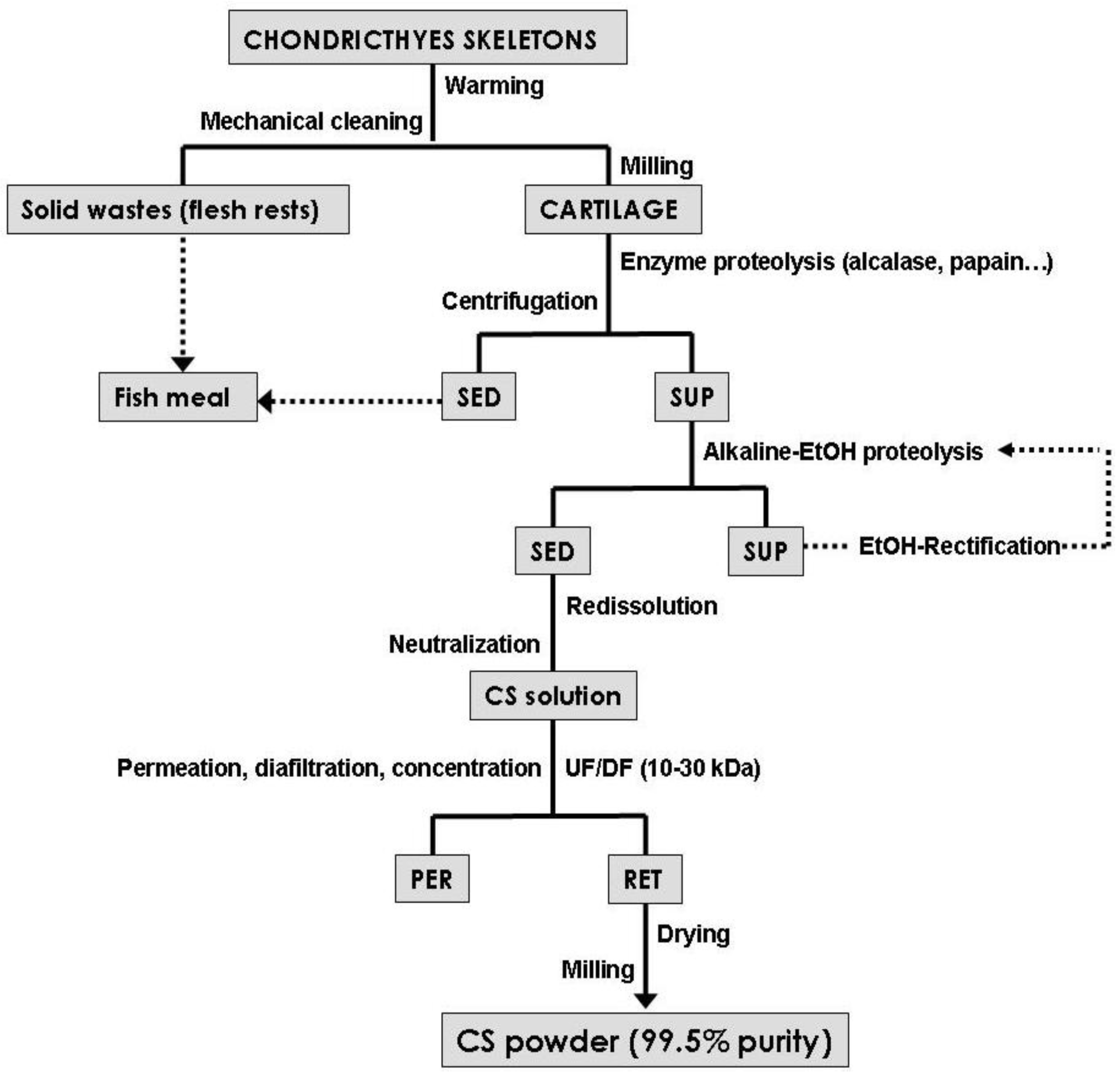
      <p>Various alternative isolation methods have been recently developed to replace the classical methods for pursuing sustainability [<xref ref-type="bibr" rid="B63-marinedrugs-11-00747">63</xref>,<xref ref-type="bibr" rid="B64-marinedrugs-11-00747">64</xref>,<xref ref-type="bibr" rid="B65-marinedrugs-11-00747">65</xref>,<xref ref-type="bibr" rid="B66-marinedrugs-11-00747">66</xref>]. Those processes can be summarized as follows: digestion of cartilage and proteins mediated by enzymes, selective precipitations with alcoholic solutions, resuspension and neutralization with salt solutions and separation by molecular-weight using ultrafiltration-diafiltration technologies (UF-DF). <xref ref-type="fig" rid="marinedrugs-11-00747-f001">Figure 1</xref> shows a flow chart representing all the potential steps described for the downstream purification of marine CS. Firstly, the fishing by-products (e.g., ray skeletons or shark heads) are warmed separating the rests of flesh, excellent material for fish meal, and cartilage for CS production. Subsequently, dried and milled cartilage is hydrolyzed by proteases under controlled experimental conditions. Multiple enzymes have been studied, generally with successful results, with the objective of cartilage degradation, protein fraction breakdown and to obtain undamaged CS molecules. The proteolysis of proteoglycans from hammerhead shark fin cartilage was partially degraded by commercial papain but trypsin or superase were not effective [<xref ref-type="bibr" rid="B67-marinedrugs-11-00747">67</xref>]. Similar activity of papain digestion was also observed in adult zebrafish [<xref ref-type="bibr" rid="B68-marinedrugs-11-00747">68</xref>], ray [<xref ref-type="bibr" rid="B35-marinedrugs-11-00747">35</xref>] and dogfish tissues [<xref ref-type="bibr" rid="B69-marinedrugs-11-00747">69</xref>]. In all cases, the time of hydrolysis was superior to 18 h under optimal conditions of temperature (50–65 °C) and pH 7. Recently, a two-step enzymatic processing with alcalase and flavourzyme showed better yields of degradation with a significant reduction of time-processing [<xref ref-type="bibr" rid="B21-marinedrugs-11-00747">21</xref>]. Proteolytic and collagenolytic activities isolated from skate pancreas led to percentage of skate cartilage hydrolysis higher than 50% in 6 h [<xref ref-type="bibr" rid="B66-marinedrugs-11-00747">66</xref>]. The separation of hydrolysates is generally carried out by simple decantation or centrifugation removing the supernatant rich in CS and the rests of cartilage precipitated (useful as substrate for fish meal production). Tadashi [<xref ref-type="bibr" rid="B65-marinedrugs-11-00747">65</xref>] suggested a previous elimination stage of cartilage wastes based on the addition of activated charcoal at 55 °C.</p>
      <p>The subsequent phase of alcoholic treatment is usually indicated by several authors as crucial for the selective precipitation of CS from the major protein presents in the hydrolysate [<xref ref-type="bibr" rid="B61-marinedrugs-11-00747">61</xref>,<xref ref-type="bibr" rid="B65-marinedrugs-11-00747">65</xref>,<xref ref-type="bibr" rid="B66-marinedrugs-11-00747">66</xref>,<xref ref-type="bibr" rid="B70-marinedrugs-11-00747">70</xref>]. The effectiveness of that process is dependent on the type and alcohol concentration and, in some cases, the influence of processing-temperature is also important [<xref ref-type="bibr" rid="B65-marinedrugs-11-00747">65</xref>]. Ethanol is the most commonly selected reagent for such precipitation, at concentrations of 40%–60%, due to its widespread use as a solvent of substances intended for human contact or consumption [<xref ref-type="bibr" rid="B65-marinedrugs-11-00747">65</xref>,<xref ref-type="bibr" rid="B66-marinedrugs-11-00747">66</xref>,<xref ref-type="bibr" rid="B70-marinedrugs-11-00747">70</xref>]. A recent report also proposed isopropanol at 40% for the purification of CS from scapular cartilage of shortfin mako shark [<xref ref-type="bibr" rid="B21-marinedrugs-11-00747">21</xref>]. In our lab, we have optimized the combination of alkaline proteolysis and selective precipitation of CS from ray cartilage by using alkaline hydroalcoholic solutions [<xref ref-type="bibr" rid="B66-marinedrugs-11-00747">66</xref>]. Under optimal conditions of NaOH 0.2 M and one volume of ethanol per volume of hydrolysate at room temperature with soft agitation for 1 h, more than 96% of CS recovery and CS purity were obtained. The repetition of this procedure, under the same experimental conditions, increased the CS purity up to 99%. The resuspension of CS sediment and pH neutralization is efficiently obtained by means of saline solutions as NaCl or sodium acetate, the salt excess can be subsequently removed by membrane dialysis method.</p>
      <fig id="marinedrugs-11-00747-f001" position="float">
        <label>Figure 1</label>
        <caption>
          <p>Overview of chondroitin sulfate (CS) recovery and purification processes from marine cartilage by-products. SED: sediment, SUP: supernatant, PER: permeate and RET: retentate.</p>
        </caption>
        <graphic xmlns:xlink="http://www.w3.org/1999/xlink" xlink:href="marinedrugs-11-00747-g001.tif"/>
      </fig>
      <p>The last step of purification by membrane technologies is widely performed in the majority of the biomacromolecules downstream processing (with higher sizes of 1 kDa) because of its separation effectiveness, easy scale-up, cost effective device, numerous types and cut-off membranes and simple operatory and control. However, the use of described methodology, to remove low-molecular-weight materials and salts from neutralized or resupended CS solution, has been poorly studied. Large quantities of CS from salmon tissues were extracted by alkali treatment and subsequent purified by repeating UF procedure, demonstrating superior efficient than using ion exchange resin [<xref ref-type="bibr" rid="B71-marinedrugs-11-00747">71</xref>]. A two-step process based on enzyme extraction of CS and concentration-desalting by UF-DF was studied using skate cartilage as substrate and ceramic membranes [<xref ref-type="bibr" rid="B63-marinedrugs-11-00747">63</xref>]. The authors advised that the desalting step by DF should be improved with a higher filtering area due to the 40% remaining of salts in the final solution of CS. This inconvenience was improved via polyethersulfone membranes with molecular-weight cut-off at 10 kDa and 6 diavolume [<xref ref-type="bibr" rid="B66-marinedrugs-11-00747">66</xref>]. The UF-DF system was assembled with total recirculation to obtain CS of 99.6% purity at final concentration of 35–45 g/L. Higher CS concentrated liquid generated excessive viscosities that reduced the filtrate flow and filled the membranes.</p>
      <p>Finally, the powder of CS can be obtained by drying the concentrated solutions without adding chemical solvents using spray dryer equipment or evaporation in an oven, depositing CS in thin layers on trays followed by milling performance.</p>
      <sec>
        <title>Microbial Production of CS</title>
        <p>In order to avoid the health and ecological problems derived from the uses of mammalian and fishery wastes as substrate, different approximations to microbial production of CS-like polymers have been reported in recent years [<xref ref-type="bibr" rid="B37-marinedrugs-11-00747">37</xref>,<xref ref-type="bibr" rid="B72-marinedrugs-11-00747">72</xref>,<xref ref-type="bibr" rid="B73-marinedrugs-11-00747">73</xref>]. Initially, <italic>Pasteurella multocida</italic> was one of the bacteria selected as CS producer, but its well-known cholera pathogenicity has hindered and reduced its interest [<xref ref-type="bibr" rid="B74-marinedrugs-11-00747">74</xref>,<xref ref-type="bibr" rid="B75-marinedrugs-11-00747">75</xref>]. Excellent results were obtained in the production of capsular polysaccharide CS precursor (CSC) by <italic>Escherichia coli</italic> O5:K4:H4 under diverse experimental conditions and fermentation devices [<xref ref-type="bibr" rid="B37-marinedrugs-11-00747">37</xref>,<xref ref-type="bibr" rid="B73-marinedrugs-11-00747">73</xref>]. These authors have improved the CSC concentration of 0.2 g/L obtained in batch cultures [<xref ref-type="bibr" rid="B76-marinedrugs-11-00747">76</xref>] to 1.4 g/L with fed-batch operation [<xref ref-type="bibr" rid="B77-marinedrugs-11-00747">77</xref>] and more than 3 g/L using a membrane bioreactor [<xref ref-type="bibr" rid="B78-marinedrugs-11-00747">78</xref>]. Downstream processing finally yielded about 80% chondroitin with 90% purity [<xref ref-type="bibr" rid="B79-marinedrugs-11-00747">79</xref>]. Nevertheless, <italic>E. coli</italic> is a low virulent pathogen limiting its large scale production and CSC is an unsulphated structure of chondroitin (CS-O), with a furanose residue of fructose, which needs a subsequent step of chemical sulfation and hydrolysis of fructose monomer [<xref ref-type="bibr" rid="B80-marinedrugs-11-00747">80</xref>]. The production of CS by combined fermentation and chemical developments is a complementary alternative to achieve a global and sustainable control of chondrichthyes stocks. </p>
      </sec>
    </sec>
    <sec>
      <title>4. HA Production Processes</title>
      <p>The most conventional materials employed for HA extraction are selected for its feasibility and concentration, thus, umbilical cord presents an average level of 4 g/L, synovial fluid from pig (3 g/L) or bovine (18 g/L) and rooster combs (25 g/L) [<xref ref-type="bibr" rid="B56-marinedrugs-11-00747">56</xref>,<xref ref-type="bibr" rid="B81-marinedrugs-11-00747">81</xref>,<xref ref-type="bibr" rid="B82-marinedrugs-11-00747">82</xref>,<xref ref-type="bibr" rid="B83-marinedrugs-11-00747">83</xref>]. Nevertheless, the risk of animal-derived pathogens, inter-species viral or prionic contaminations (e.g., BSE, epizootic aphtha) has obligated to explore and optimize other alternatives of production.</p>
      <p>In marine organisms, the only clear source of HA is the VH present in the eyeball of fish species. VH volume and HA concentration is different depending on the selected fish, for instance, HA is obtained from eyeballs of shark and swordfish at 0.3 g/L from 18 mL of VH and 0.055 g/L from 70 mL, respectively [<xref ref-type="bibr" rid="B56-marinedrugs-11-00747">56</xref>]. HA is also present in the cartilage matrix in which is very important as structural element of the aggrecan in cartilaginous fishes; however, its relatively low content makes it economically unavailable for any industrial extraction process [<xref ref-type="bibr" rid="B84-marinedrugs-11-00747">84</xref>].</p>
      <p>The traditional protocols for extraction of HA from animal substrates (e.g., rooster comb) are developed according to the works reported by Swann [<xref ref-type="bibr" rid="B85-marinedrugs-11-00747">85</xref>] and Balazs [<xref ref-type="bibr" rid="B86-marinedrugs-11-00747">86</xref>] that include the preparation of the material, washing with water or alcohol, aqueous or organic solvent (mainly chloroform) extraction, precipitation by cetylpiridinium chloride, filtering and successive extractions with chloroform, centrifugation and occasional chromatographic purification. Other authors indicated that both procedures are costly, laborious, time-consuming and lead to contaminated HA solutions that limit their applications in biopharma formulations [<xref ref-type="bibr" rid="B87-marinedrugs-11-00747">87</xref>]. </p>
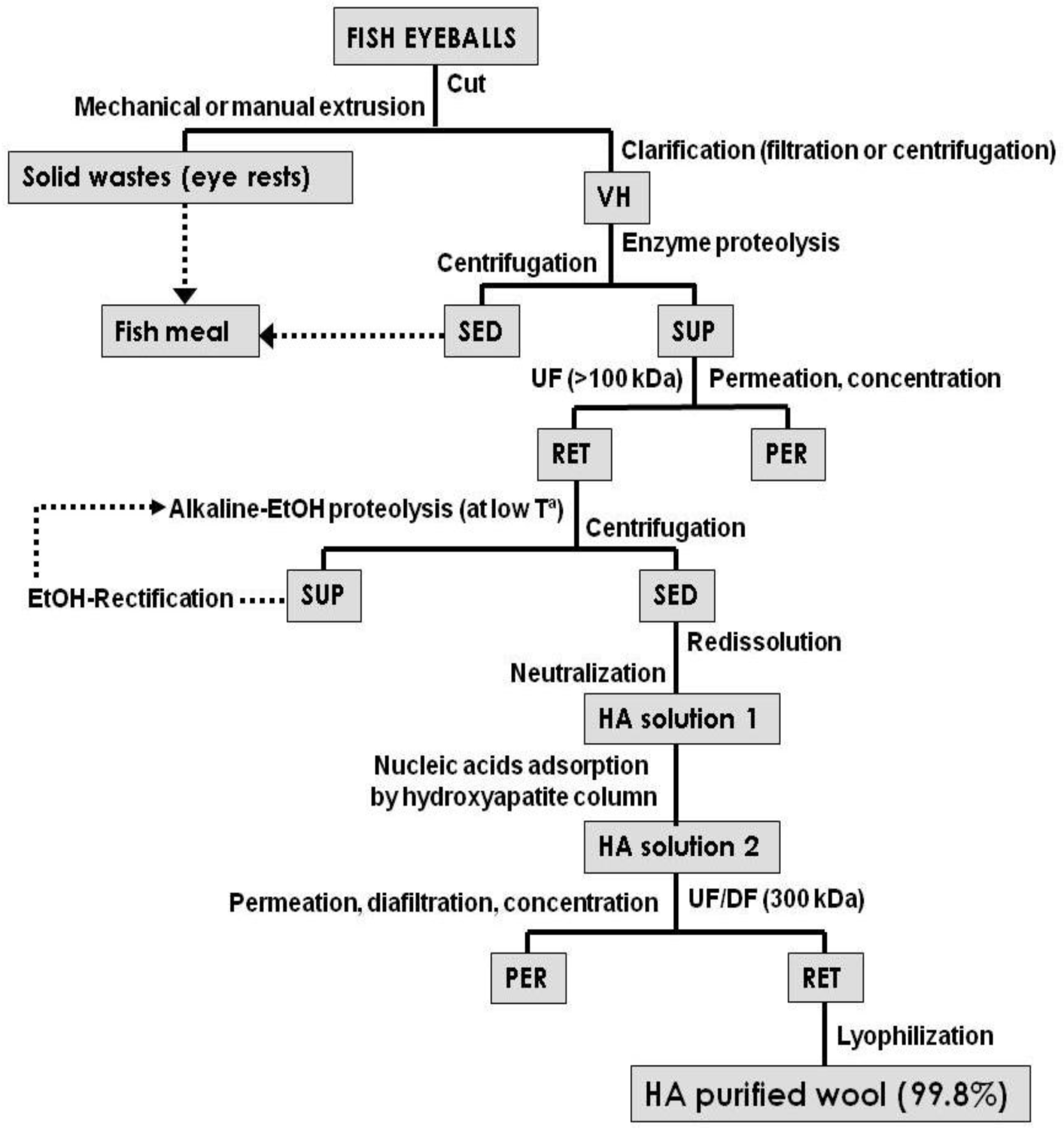
      <p>Different strategies have been proposed for the extraction of HA from mammalian VH including deproteinization of bovine substrate with xylenesulphonate-Na [<xref ref-type="bibr" rid="B88-marinedrugs-11-00747">88</xref>], extraction with water, precipitation with ethanol and purification by DEAE-cellulose [<xref ref-type="bibr" rid="B89-marinedrugs-11-00747">89</xref>] and fractional precipitation using ethanol combined with enzymatic protein hydrolysis [<xref ref-type="bibr" rid="B59-marinedrugs-11-00747">59</xref>]. The most exhaustive method was applied to tuna eyeball substrate [<xref ref-type="bibr" rid="B90-marinedrugs-11-00747">90</xref>], performing precipitation with overcooled acetone, actinase digestion, thermal coagulation, dialization by membrane and cetylpyridinium chloride precipitation. Similarly, we have addressed a method to recover and purify HA of VH from various fish eyeballs (tuna, shark, and swordfish) using easier, faster and cheaper stages [<xref ref-type="bibr" rid="B56-marinedrugs-11-00747">56</xref>]: (1) initial clarification of VH extracted from frozen eyeball (using centrifugation or glass wool filtration); (2) enzyme proteolysis; (3) concentration by UF; (4) precipitation and alkaline proteolysis in hydroalcoholic medium at low temperature; (5) selective redissolution and neutralization; (6) separation, purification and concentration by UF-DF; (7) removing of nucleic acids using absorption with hydroxyapatite obtained from fish bone. Medical-grade purity of 99.9% (molecular weight 2000 kDa) was thus reached (<xref ref-type="fig" rid="marinedrugs-11-00747-f002">Figure 2</xref>). The lyophilization of final solutions is an excellent lab resource to avoid physical degradation and size reduction but they are too expensive for industrial scale.</p>
      <fig id="marinedrugs-11-00747-f002" position="float">
        <label>Figure 2</label>
        <caption>
          <p>Flowchart of purification methods to extract hyaluronic acid (HA) from vitreous humor (VH) of fish eyeball. SED: sediment, SUP: supernatant, PER: permeate and RET: retentate.</p>
        </caption>
        <graphic xmlns:xlink="http://www.w3.org/1999/xlink" xlink:href="marinedrugs-11-00747-g002.tif"/>
      </fig>
      <p>Although prices of vitreous HA are commercially high, economic viability is unclear given the cost of vitreous humor (VH) removal (expensive labor) and the overdependence on raw materials (opportunistic prices of fish eyes) that usually tends to the overexploitation of this marine resource. Microbial production easily contains the concentration equivalent (3 g/L) to 660 eyes of shark or 900 of swordfish. Additionally, the presence of blood in the eyes supply should be avoided as much as possible because the iron from haemoglobin degrades HA molecule.</p>
      <sec>
        <title>Microbial Production of HA on Marine Food Wastes</title>
        <p>Bacterial production of HA using Lancerfield group A and C streptococci has been industrially developed to replace gradually the HA obtained from animal origin. Several culture variables have been studied and optimized such as lysozyme or hyaluronidase addition [<xref ref-type="bibr" rid="B91-marinedrugs-11-00747">91</xref>,<xref ref-type="bibr" rid="B92-marinedrugs-11-00747">92</xref>], agitation and aeration conditions [<xref ref-type="bibr" rid="B93-marinedrugs-11-00747">93</xref>,<xref ref-type="bibr" rid="B94-marinedrugs-11-00747">94</xref>,<xref ref-type="bibr" rid="B95-marinedrugs-11-00747">95</xref>], the type of bioreactor [<xref ref-type="bibr" rid="B96-marinedrugs-11-00747">96</xref>], effect of pH-gradient stress [<xref ref-type="bibr" rid="B97-marinedrugs-11-00747">97</xref>], continuous culture [<xref ref-type="bibr" rid="B98-marinedrugs-11-00747">98</xref>], medium optimization [<xref ref-type="bibr" rid="B99-marinedrugs-11-00747">99</xref>] and fed-batch operation [<xref ref-type="bibr" rid="B100-marinedrugs-11-00747">100</xref>]. Since no marine microorganisms have been discovered for HA production, the only marine approach for this bioproduction is derived from the substitution of commercial broths by alternative nutrients generated in the marine foodstuff manufacturing. Recently, the formulation of cultivation medium with mussel processing wastewaters (MPW), rich in glycogen as glucose substitutive, and peptones obtained from fish viscera by-products generated acceptable HA productions that were improved under fed-batch conditions [<xref ref-type="bibr" rid="B101-marinedrugs-11-00747">101</xref>,<xref ref-type="bibr" rid="B102-marinedrugs-11-00747">102</xref>]. Generally, HA downstream processes from post-incubated medium are easier than those reported for animal sources, especially if consumption of culture medium ingredients is complete at the end of fermentation. Cellular biomass precipitation (by means of detergent adding and centrifugation), deproteinization using proteases or specific adsorption to resin and membranes purification are the most conventional procedures. Other proposal includes silica gel filtration combined with active carbon treatment followed by diafiltration [<xref ref-type="bibr" rid="B58-marinedrugs-11-00747">58</xref>]. In <xref ref-type="table" rid="marinedrugs-11-00747-t001">Table 1</xref>, different alternatives and process conditions for CS and HA production from marine sources and some microbial cultivations are summarized.</p>
        <table-wrap id="marinedrugs-11-00747-t001" position="float">
          <object-id pub-id-type="pii">marinedrugs-11-00747-t001_Table 1</object-id>
          <label>Table 1</label>
          <caption>
            <p>Summary of GAGs productionfrom marine sources (CS and HA), using marine culture broths for fermentation (HA) or by microbial fermentation (CS).</p>
          </caption>
          <table rules="all" style="border:solid thin">
          <thead>
              <tr>
                <th align="center" valign="top">GAG</th>
                <th align="center" valign="top">Type</th>
                <th align="center" valign="top">Source</th>
                <th align="center" valign="top">Process conditions</th>
                <th align="center" valign="top">Yield (
                <italic>Y</italic>)/Production (<italic>P</italic>) Purity (<italic>Pu</italic>)</th>
                <th align="center" valign="top">Ref.</th>
              </tr>
            </thead>
            <tbody>
              <tr>
                <td align="center" valign="middle">CS</td>
                <td align="center" valign="middle">CS-C</td>
                <td align="center" valign="middle">shark cartilage</td>
                <td align="center" valign="top">proteolysis, alcoholic precipitation, membrane purification</td>
                <td align="center" valign="middle"><italic>Y</italic> = 57% (w/v)</td>
                <td align="center" valign="middle">[<xref ref-type="bibr" rid="B21-marinedrugs-11-00747">21</xref>]</td>
              </tr>
              <tr>
                <td align="center" valign="middle">CS</td>
                <td align="center" valign="middle">CS-A, CS-C</td>
                <td align="center" valign="middle">ray and shark cartilage</td>
                <td align="center" valign="top">proteolysis, cetylpyridinium HCl and NaCl precipitations, filtration and dialization</td>
                <td align="center" valign="middle"><italic>Y</italic> = 10%–11% (w/v)</td>
                <td align="center" valign="middle">[<xref ref-type="bibr" rid="B35-marinedrugs-11-00747">35</xref>]</td>
              </tr>
              <tr>
                <td align="center" valign="middle">CS</td>
                <td align="center" valign="middle">CS-A, CS-C</td>
                <td align="center" valign="middle">skate fin</td>
                <td align="center" valign="top">proteolysis, cetylpyridinium HCl precipitation, electrophoresis and cromatographic purification</td>
                <td align="center" valign="middle">-</td>
                <td align="center" valign="middle">[<xref ref-type="bibr" rid="B62-marinedrugs-11-00747">62</xref>]</td>
              </tr>
              <tr>
                <td align="center" valign="middle">CS</td>
                <td align="center" valign="middle">CS-A, CS-C</td>
                <td align="center" valign="middle">skate cartilage</td>
                <td align="center" valign="top">proteolysis, purification (UF-DF)</td>
                <td align="center" valign="middle">-</td>
                <td align="center" valign="middle">[<xref ref-type="bibr" rid="B63-marinedrugs-11-00747">63</xref>]</td>
              </tr>
              <tr>
                <td align="center" valign="middle">CS</td>
                <td align="center" valign="middle">CS-A, CS-C</td>
                <td align="center" valign="middle">ray cartilage</td>
                <td align="center" valign="top">proteolysis, alkaline-hydroalcoholic precipitation, purification (UF-DF)</td>
                <td align="center" valign="middle"><italic>Y</italic> = 15% (w/w)/<italic>Pu</italic> &gt; 99%</td>
                <td align="center" valign="middle">[<xref ref-type="bibr" rid="B66-marinedrugs-11-00747">66</xref>]</td>
              </tr>
              <tr>
                <td align="center" valign="middle">CS</td>
                <td align="center" valign="middle">CS-A, CS-C</td>
                <td align="center" valign="middle">shark fin</td>
                <td align="center" valign="top">proteolysis, guanidine HCl extraction, electrophoresis and cromatographic purification</td>
                <td align="center" valign="middle"><italic>Y</italic> = 84% </td>
                <td align="center" valign="middle">[<xref ref-type="bibr" rid="B67-marinedrugs-11-00747">67</xref>]</td>
              </tr>
              <tr>
                <td align="center" valign="middle">CS</td>
                <td align="center" valign="middle">CS-A, CS-C, CS-O</td>
                <td align="center" valign="middle">zebrafish cartilage</td>
                <td align="center" valign="top">proteolysis, electrophoresis and cromatographic purification</td>
                <td align="center" valign="middle">-</td>
                <td align="center" valign="middle">[<xref ref-type="bibr" rid="B68-marinedrugs-11-00747">68</xref>]</td>
              </tr>
              <tr>
                <td align="center" valign="middle">CS</td>
                <td align="center" valign="middle">CS-A, CS-C, CS-D, CS-O</td>
                <td align="center" valign="middle">dogfish cartilage</td>
                <td align="center" valign="top">proteolysis, alcoholic precipitation, cromatographic purification</td>
                <td align="center" valign="middle"><italic>Y</italic> = 5% (w/w)</td>
                <td align="center" valign="middle">[<xref ref-type="bibr" rid="B69-marinedrugs-11-00747">69</xref>]</td>
              </tr>
              <tr>
                <td align="center" valign="middle">CS</td>
                <td align="center" valign="middle">CS-A, CS-C, CS-O, CS-E</td>
                <td align="center" valign="middle">salmon nasal cartilage</td>
                <td align="center" valign="top">proteolysis, alkaline hydrolysis, alcoholic precipitation, cation exchange separation</td>
                <td align="center" valign="middle"><italic>Y</italic> = 24% (w/w)/<italic>Pu</italic> = 99%</td>
                <td align="center" valign="middle">[<xref ref-type="bibr" rid="B70-marinedrugs-11-00747">70</xref>]</td>
              </tr>
              <tr>
                <td align="center" valign="middle">CS</td>
                <td align="center" valign="middle">CS-A, CS-C, CS-O, CS-E</td>
                <td align="center" valign="middle">salmon nasal cartilage</td>
                <td align="center" valign="top">proteolysis, alkaline hydrolysis, alcoholic precipitation, purification (UF)</td>
                <td align="center" valign="middle">-</td>
                <td align="center" valign="middle">[<xref ref-type="bibr" rid="B71-marinedrugs-11-00747">71</xref>]</td>
              </tr>
              <tr>
                <td align="center" valign="middle">CS</td>
                <td align="center" valign="middle">CS-O</td>
                <td align="center" valign="middle"><italic>E. coli </italic>O5:K4:H4</td>
                <td align="center" valign="top">batch operation</td>
                <td align="center" valign="middle"><italic>P</italic> = 0.2 g/L</td>
                <td align="center" valign="middle">[<xref ref-type="bibr" rid="B76-marinedrugs-11-00747">76</xref>]</td>
              </tr>
              <tr>
                <td align="center" valign="middle">CS</td>
                <td align="center" valign="middle">CS-O</td>
                <td align="center" valign="middle"><italic>E. coli </italic>O5:K4:H4</td>
                <td align="center" valign="top">fed-batch operation</td>
                <td align="center" valign="middle"><italic>P</italic> = 1.4 g/L</td>
                <td align="center" valign="middle">[<xref ref-type="bibr" rid="B77-marinedrugs-11-00747">77</xref>]</td>
              </tr>
              <tr>
                <td align="center" valign="middle">CS</td>
                <td align="center" valign="middle">CS-O</td>
                <td align="center" valign="middle"><italic>E. coli </italic>O5:K4:H4</td>
                <td align="center" valign="top">membrane bioreactor, fed-batch, purification (UF-DF)</td>
                <td align="center" valign="middle"><italic>Y</italic> = 80%/<italic>P</italic> = 3 g/L <italic>Pu</italic> = 90%</td>
                <td align="center" valign="middle">[<xref ref-type="bibr" rid="B78-marinedrugs-11-00747">78</xref>]</td>
              </tr>
              <tr>
                <td align="center" valign="middle">HA</td>
                <td align="center" valign="middle">-</td>
                <td align="center" valign="middle">shark HV</td>
                <td align="center" valign="top">proteolysis, concentration (UF), selective precipitation, purification (UF-DF)</td>
                <td align="center" valign="middle"><italic>P</italic> = 0.3 g/L/<italic>Pu</italic> &gt; 99.5%</td>
                <td align="center" valign="middle">[<xref ref-type="bibr" rid="B56-marinedrugs-11-00747">56</xref>]</td>
              </tr>
              <tr>
                <td align="center" valign="middle">HA</td>
                <td align="center" valign="middle">-</td>
                <td align="center" valign="middle">swordfish HV</td>
                <td align="center" valign="top">proteolysis, concentration (UF), selective precipitation, purification (UF-DF)</td>
                <td align="center" valign="middle"><italic>P</italic> = 0.06 g/L/<italic>Pu</italic> &gt; 99.5%</td>
                <td align="center" valign="middle">[<xref ref-type="bibr" rid="B56-marinedrugs-11-00747">56</xref>]</td>
              </tr>
              <tr>
                <td align="center" valign="middle">HA</td>
                <td align="center" valign="middle">-</td>
                <td align="center" valign="middle">
                  <italic>S. zooepidemicus</italic>
                </td>
                <td align="center" valign="top">medium: shark or ray peptones, fed-batch</td>
                <td align="center" valign="middle"><italic>P</italic> = 2.5 g/L</td>
                <td align="center" valign="middle">[<xref ref-type="bibr" rid="B101-marinedrugs-11-00747">101</xref>]</td>
              </tr>
              <tr>
                <td align="center" valign="middle">HA</td>
                <td align="center" valign="middle">-</td>
                <td align="center" valign="middle">
                  <italic>S. zooepidemicus</italic>
                </td>
                <td align="center" valign="top">medium: tuna peptones and MPW, batch</td>
                <td align="center" valign="middle"><italic>P</italic> = 2.5 g/L</td>
                <td align="center" valign="middle">[<xref ref-type="bibr" rid="B102-marinedrugs-11-00747">102</xref>]</td>
              </tr>
            </tbody>
          </table>
        </table-wrap>
      </sec>
    </sec>
    <sec>
      <title>5. Chitin and Chitosan</title>
      <p>During recent years, CH and CHs have attracted a great interest due to their distinctive biological and physicochemical properties [<xref ref-type="bibr" rid="B28-marinedrugs-11-00747">28</xref>], which make them interesting polymers, among others, for biotechnology, medicine, cosmetics, food technology and textile applications.</p>
      <p>Marine organisms are principal source of CH since it is a constituent of the organic matrix of the exoskeletons of arthropods such as crustaceans (crabs, lobsters and shrimps) and of the endoskeleton of mollusks [<xref ref-type="bibr" rid="B103-marinedrugs-11-00747">103</xref>]. Although CH can also be found in many other organisms including fungi [<xref ref-type="bibr" rid="B104-marinedrugs-11-00747">104</xref>], yeasts [<xref ref-type="bibr" rid="B105-marinedrugs-11-00747">105</xref>], algae and squid pen [<xref ref-type="bibr" rid="B106-marinedrugs-11-00747">106</xref>], the shell of marine crustaceans is the preferred source of CH due to their high availability as waste from the seafood processing industry [<xref ref-type="bibr" rid="B28-marinedrugs-11-00747">28</xref>].</p>
      <p>However, traditional methods involved in the recovery of CH from shellfish are extremely hazardous, energy consuming and environmentally polluting, due to the need of using high amounts of mineral acid and alkali [<xref ref-type="bibr" rid="B107-marinedrugs-11-00747">107</xref>]. In addition, the deacetylation of CH to produce CHs requires the use of very intense alkaline treatments. Hence, alternative environmentally friendly processes are being assessed including the use of proteases or proteolytic bacteria for deproteinization and demineralization of crustacean shells [<xref ref-type="bibr" rid="B108-marinedrugs-11-00747">108</xref>,<xref ref-type="bibr" rid="B109-marinedrugs-11-00747">109</xref>]. Alternatively, fermentation using lactic acid bacteria (LAB) has been widely applied for the extraction of CH from crab [<xref ref-type="bibr" rid="B110-marinedrugs-11-00747">110</xref>,<xref ref-type="bibr" rid="B111-marinedrugs-11-00747">111</xref>] and shrimp [<xref ref-type="bibr" rid="B112-marinedrugs-11-00747">112</xref>,<xref ref-type="bibr" rid="B113-marinedrugs-11-00747">113</xref>] biowastes. In case of CHs production, fungus <italic>Mucor rouxii</italic> has been widely studied as an alternative source of chitosan.</p>
      <sec>
        <title>Characteristics and Applications of CH and CHs</title>
        <p>CH is the most abundant biopolymer in nature after cellulose [<xref ref-type="bibr" rid="B27-marinedrugs-11-00747">27</xref>,<xref ref-type="bibr" rid="B28-marinedrugs-11-00747">28</xref>]. It is a linear polysaccharide composed of β-(1→4)-linked <italic>N</italic>-acetyl-<sc>d</sc>-glucosamine monomers. Its abundance in the environment is due to its role as major component in the supporting tissues of organisms such as crustacean, fungi and insects [<xref ref-type="bibr" rid="B114-marinedrugs-11-00747">114</xref>].</p>
        <p>Depending on its source, CH can occur as either α, β or γ forms [<xref ref-type="bibr" rid="B115-marinedrugs-11-00747">115</xref>]. The α form has antiparallel microfibril orientation with strong intra and intermolecular hydrogen bonds and is the most abundant chitin in nature and the preferred form for industrial applications. The β-chitin form has parallel chains held by weak intra chain hydrogen bonds and occurs in squid pens [<xref ref-type="bibr" rid="B116-marinedrugs-11-00747">116</xref>]. A third and less characterized form, γ-chitin, has been described as a mixture of antiparallel and parallel chains, although there is controversy about the existence of this conformation [<xref ref-type="bibr" rid="B117-marinedrugs-11-00747">117</xref>,<xref ref-type="bibr" rid="B118-marinedrugs-11-00747">118</xref>].</p>
        <p>Owing to the extensive hydrogen bonding in the solid state of α-chitin, it is insoluble in water, most organic acids and diluted acid and alkaline solutions [<xref ref-type="bibr" rid="B117-marinedrugs-11-00747">117</xref>]. However, it can be dissolved in concentrated hydrocloric, sulfuric and phosphoric acids as well as in dichloroacetic, trichloroacetic and formic acids [<xref ref-type="bibr" rid="B119-marinedrugs-11-00747">119</xref>]. In addition, special solvents such as hexafluoroacetone and <italic>N</italic>,<italic>N</italic>-dimethylacetamide containing 5%–8% lithium chloride have proved suitable for solubilizing CH [<xref ref-type="bibr" rid="B120-marinedrugs-11-00747">120</xref>]. Unlike α-chitin, β-chitin generally shows better solubility in most acids and swells in water considerably [<xref ref-type="bibr" rid="B28-marinedrugs-11-00747">28</xref>]. On the other hand, CHs is insoluble in either organic solvents or water [<xref ref-type="bibr" rid="B28-marinedrugs-11-00747">28</xref>], but it is soluble in diluted acid solutions below pH 6.0, due to the presence of free amino groups with a p<italic>K</italic>a value of 6.3 [<xref ref-type="bibr" rid="B121-marinedrugs-11-00747">121</xref>].</p>
        <p>The lack of solubility of CH makes it necessary to modify the molecule for most of its applications. Among various reactions that can disrupt intra- and inter-molecular hydrogen bonds without cleaving glucosidic linkages, <italic>N</italic>-deacetylation is the simplest modification, which transforms CH to CHs [<xref ref-type="bibr" rid="B117-marinedrugs-11-00747">117</xref>]. The degree of <italic>N</italic>-acetylation (DA), <italic>i.e</italic>., the ratio of 2-acetamido-2-deoxy-<sc>d</sc>-glucopyranose to 2-amino-2-deoxy-<sc>d</sc>-glucopyranose structural units has a remarkable effect on CH solubility and solution properties [<xref ref-type="bibr" rid="B115-marinedrugs-11-00747">115</xref>]. Chitosan is the <italic>N</italic>-deacetylated derivative of chitin with a typical DA of less than 0.35, therefore being a copolymer composed of glucosamine and <italic>N</italic>-acetylglucosamine [<xref ref-type="bibr" rid="B121-marinedrugs-11-00747">121</xref>].</p>
        <p>CH, CHs and its derivatives are widely applied in different economical sectors, such as agriculture [<xref ref-type="bibr" rid="B122-marinedrugs-11-00747">122</xref>], water treatment [<xref ref-type="bibr" rid="B123-marinedrugs-11-00747">123</xref>], food and cosmetic industry [<xref ref-type="bibr" rid="B124-marinedrugs-11-00747">124</xref>], pharmaceutical and medicine [<xref ref-type="bibr" rid="B125-marinedrugs-11-00747">125</xref>]. Properties that make natural CH and CHs attractive polymers for various applications, mainly in pharmaceutics and medicine, are their antimicrobial activity, film-forming ability, high adsorption, biodegrability, biocompatibility and non-toxicity [<xref ref-type="bibr" rid="B126-marinedrugs-11-00747">126</xref>]. Among biomedical applications reported for CH and CHs are tissue engineering, wound healing, drug delivery and cancer diagnosis [<xref ref-type="bibr" rid="B127-marinedrugs-11-00747">127</xref>].</p>
        <p>The use of CHs in the food industry is related to its functional properties, principally water- and fat-binding capacity [<xref ref-type="bibr" rid="B126-marinedrugs-11-00747">126</xref>] as well as emulsifying properties [<xref ref-type="bibr" rid="B128-marinedrugs-11-00747">128</xref>]. Also the antimicrobial activity of CHs has been exploited for the preparation of films as a packaging material for a preservation of a variety of foods [<xref ref-type="bibr" rid="B129-marinedrugs-11-00747">129</xref>]. Besides, CHs microparticles are being evaluated as carriers for essential oils in cosmetic formulations [<xref ref-type="bibr" rid="B130-marinedrugs-11-00747">130</xref>].</p>
      </sec>
    </sec>
    <sec>
      <title>6. Traditional CH and CHs Production Processes</title>
      <p>The most common sources of CH are crab and shrimp shell wastes. In the skeletal tissue of these species, CH is bound to proteins forming a chitin-protein matrix associated to mineral salts [<xref ref-type="bibr" rid="B11-marinedrugs-11-00747">11</xref>], principally calcium carbonate. In this regard, the main components of crustacean shells are on a dry weight basis and depending on the species and season, 30%–40% protein, 30%–50% mineral salts and 13%–42% CH [<xref ref-type="bibr" rid="B28-marinedrugs-11-00747">28</xref>]. Furthermore, small amounts of lipids from muscle or viscera residues [<xref ref-type="bibr" rid="B117-marinedrugs-11-00747">117</xref>] and carotenoids, mainly astaxanthin and is esters [<xref ref-type="bibr" rid="B131-marinedrugs-11-00747">131</xref>], associated with proteins of the exoskeleton can be found in crustacean shell waste.</p>
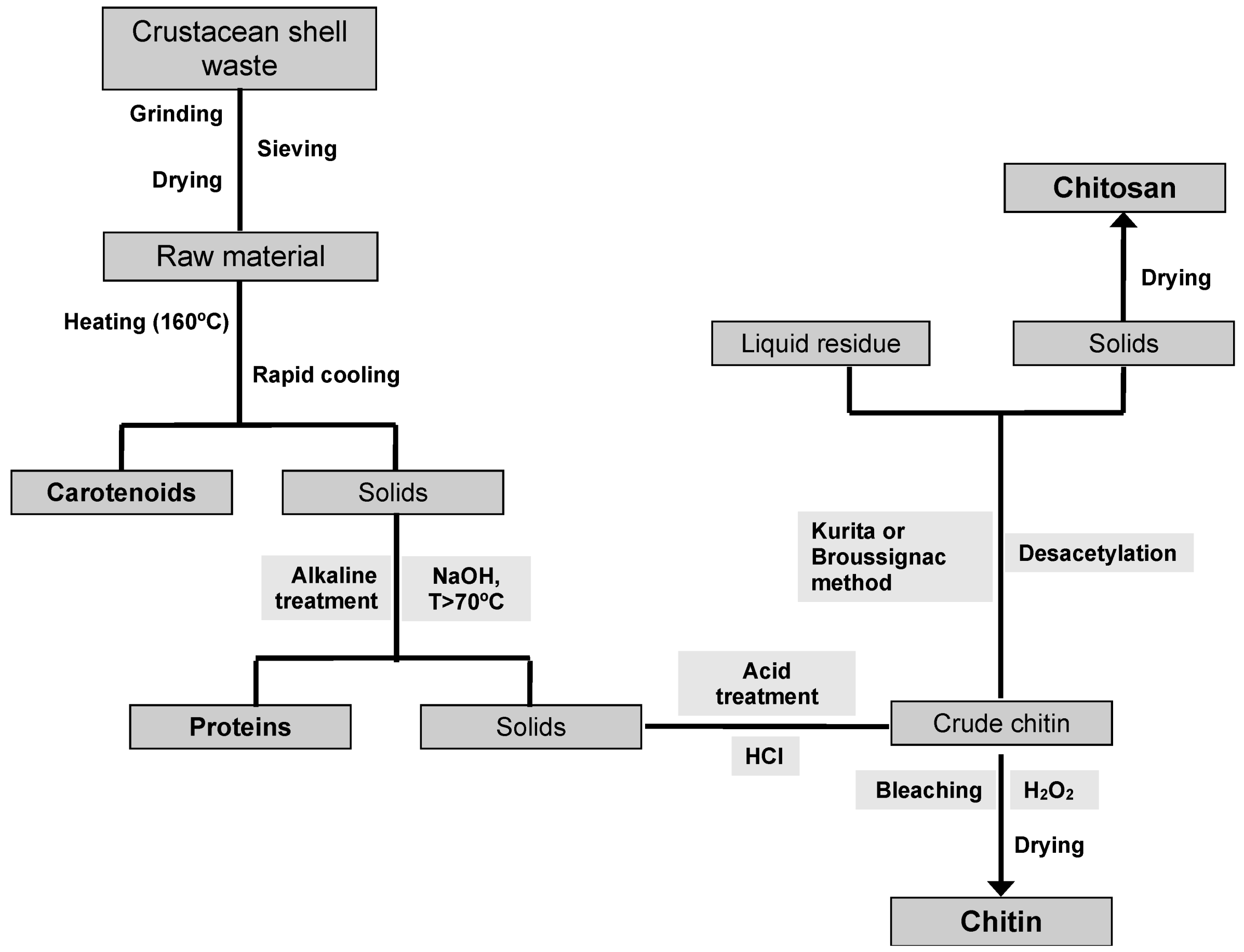
      <p>The traditional method for the industrial recovery of CH from different crustacean shells consists of two steps (<xref ref-type="fig" rid="marinedrugs-11-00747-f003">Figure 3</xref>), including a deproteinization with alkali treatment at high temperatures and a demineralization using diluted hydrochloric acid as the preferred reagent. Although it is considered that the order of these two phases is interchangeable depending on the source and proposed use of chitin [<xref ref-type="bibr" rid="B117-marinedrugs-11-00747">117</xref>], other authors suggest that demineralization should be performed first in order to decrease the residual mineral content [<xref ref-type="bibr" rid="B132-marinedrugs-11-00747">132</xref>].</p>
      <fig id="marinedrugs-11-00747-f003" position="float">
        <label>Figure 3</label>
        <caption>
          <p>Scheme of CH and CHs preparation from crustacean shell waste using chemical methods.</p>
        </caption>
        <graphic xmlns:xlink="http://www.w3.org/1999/xlink" xlink:href="marinedrugs-11-00747-g003.tif"/>
      </fig>
      <p>After demineralization and deproteinization, CH isolated from crustacean sources has a lightly pink color and so a bleaching process using potassium permanganate, oxalic acid [<xref ref-type="bibr" rid="B133-marinedrugs-11-00747">133</xref>] or hydrogen peroxide [<xref ref-type="bibr" rid="B132-marinedrugs-11-00747">132</xref>] is usually carried out to yield a colorless product. On the contrary, CH isolated from squid pens is completely white and therefore, this final stage is unnecessary.</p>
      <p>It is generally accepted that the processing conditions significantly affect the molecular weight and acetylation degree of CH. In this sense, the stronger the acidic conditions utilized for demineralization (pH, time and temperature), the lower molecular weight products are obtained [<xref ref-type="bibr" rid="B11-marinedrugs-11-00747">11</xref>]. Percot <italic>et al.</italic> studied the kinetics of demineralization of shrimp shells by following the pH variations in the reaction medium [<xref ref-type="bibr" rid="B11-marinedrugs-11-00747">11</xref>]. According to their results, they were able to define the optimal conditions necessary to perform a complete reaction, minimizing the hydrolysis of the glycosidic bonds. For this purpose, an excess of 0.25 M HCl, a solid-to-liquid ratio above 10 mL/g and 15 min of reaction at ambient temperature provided a final product with a DA above 95%.</p>
      <p>In contrast, deproteinization by alkaline treatment has shown to be less damaging to the chitin structure compared to the acidic treatment involved in the demineralization [<xref ref-type="bibr" rid="B119-marinedrugs-11-00747">119</xref>]. In fact, Percot <italic>et al.</italic> reported that deproteinization using 1 M NaOH with a temperature and a reaction time below 70 °C and 24 h had no influence on both the molecular weight and DA, respectively [<xref ref-type="bibr" rid="B11-marinedrugs-11-00747">11</xref>]. Nevertheless, a large variation exists for the reported conditions of deproteinization for CH preparation. Chang and Tsai [<xref ref-type="bibr" rid="B134-marinedrugs-11-00747">134</xref>] analyzed protein removal from shrimp shell waste using NaOH by response surface methodology, reporting optimal conditions with 2.5 N NaOH, 75 °C and a minimal solution to solid ratio of 5 mL/g. According to their results, these authors also reported that kinetics of demineralization and deproteinization were pseudo-first order and two-stage first-order reactions, respectively. Tolaimate <italic>et al.</italic>, using a tailored isolation process according to the source of CH (shrimp, crab, lobster or squid), were able to obtain highly acetylated products (near 100%) preserving the crystalline structure of both α and β chitin [<xref ref-type="bibr" rid="B132-marinedrugs-11-00747">132</xref>]. These authors using low concentrated acid (0.55 M HCl) and base (0.3 M NaOH) solutions in a multi-stage process, highlighted the need to adapt the process conditions to the origin and specific characteristics of the CH source utilized.</p>
      <p>On the other hand, the most commonly used methods for CHs production are the Broussignac [<xref ref-type="bibr" rid="B135-marinedrugs-11-00747">135</xref>] and Kurita [<xref ref-type="bibr" rid="B106-marinedrugs-11-00747">106</xref>] processes. The first procedure consists of a deacetylation of chitin in a nearly anhydrous reaction medium using a mixture of potassium hydroxide, ethanol and monoethylene glycol. On the other hand, the Kurita method proceeds in a stirred aqueous solution of sodium hydroxide, under a nitrogen stream at high temperatures (&gt;80 °C).</p>
      <p>Tolaimate <italic>et al.</italic> extensively compared both deacetylation methods and these studies indicated that the adjustment of different parameters related to the deacetylation process, the nature of the source, physical structure of the original CH and its isolation process allow to prepare CHs with controlled physico-chemical (molecular weight and DA) characteristics either from α or β-chitins [<xref ref-type="bibr" rid="B132-marinedrugs-11-00747">132</xref>,<xref ref-type="bibr" rid="B136-marinedrugs-11-00747">136</xref>]. Comparing the two processes for the production of CHs from a completely <italic>N</italic>-acetylated β-chitin prepared from squid pen (<italic>Loligo vulgaris</italic>), these authors concluded that the Kurita process enabled to obtain CHs with high molecular weights and a wide range of deacetylation degrees [<xref ref-type="bibr" rid="B136-marinedrugs-11-00747">136</xref>]. On the contrary, the Broussignac process could be carried out to obtain CHs with low degrees of acetylation and molecular weights, but in a faster way. Nevertheless, due to the high amounts of alkali and acid wastewaters generated in these production processes, there is a need to find alternatives to overcome the problem of wastewater neutralization. A possible way that has not been sufficiently explored to date is the reutilization of these effluents in the alkaline proteolysis step of CS isolation from cartilage (<xref ref-type="fig" rid="marinedrugs-11-00747-f001">Figure 1</xref>). This strategy would allow the recycling of highly polluting wastewaters and goes towards the overall utilization of marine by-products.</p>
    </sec>
    <sec>
      <title>7. Alternative CH and CHs Production Processes</title>
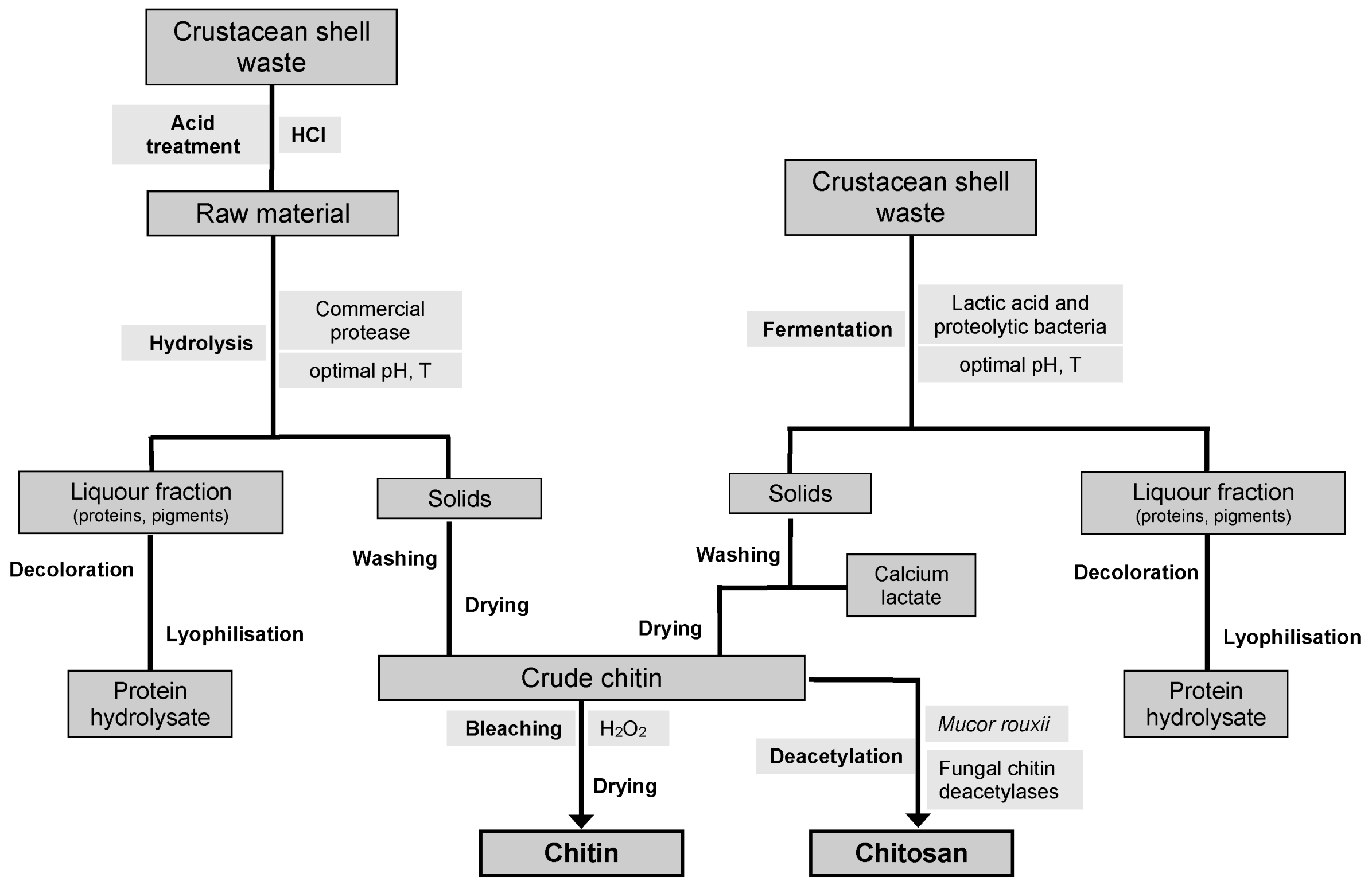
      <p>Chemical CH purification is an energy consuming process and results in environmental problems with high waste processing costs, due to the need of neutralization of processing wastewaters [<xref ref-type="bibr" rid="B111-marinedrugs-11-00747">111</xref>]. Besides and as stated above, prolonged alkaline and acid treatments cause depolymerization and deacetylation of the polysaccharide. Furthermore, the low biological value of alkali-recovered proteins may limit its application in the animal feed industry, thus affecting the production costs of CH and CHs from crustacean by-products [<xref ref-type="bibr" rid="B117-marinedrugs-11-00747">117</xref>]. In recent years, several methods have been reported in the literature to solve chemical extraction problems (<xref ref-type="fig" rid="marinedrugs-11-00747-f004">Figure 4</xref>). One of the biological alternatives proposed is the use of proteases for deproteinization of crustacean shells, avoiding alkaline treatments. Various commercial proteases have been assayed for protein removal from crustacean shells [<xref ref-type="bibr" rid="B137-marinedrugs-11-00747">137</xref>], being alcalase the most employed and effective enzyme [<xref ref-type="bibr" rid="B137-marinedrugs-11-00747">137</xref>,<xref ref-type="bibr" rid="B138-marinedrugs-11-00747">138</xref>,<xref ref-type="bibr" rid="B139-marinedrugs-11-00747">139</xref>]. In addition, the utilization of crude proteolytic extracts obtained from different microorganisms [<xref ref-type="bibr" rid="B140-marinedrugs-11-00747">140</xref>,<xref ref-type="bibr" rid="B141-marinedrugs-11-00747">141</xref>] or even from fish viscera [<xref ref-type="bibr" rid="B142-marinedrugs-11-00747">142</xref>] have been studied, leading to varying deproteinization yields depending on the conditions assayed. Although deproteinization levels achieved in such cases are generally lower than those obtained using alkaline treatments, this alternative has the advantage to produce nutritionally valuable protein hydrolysates in addition to chitin [<xref ref-type="bibr" rid="B138-marinedrugs-11-00747">138</xref>].</p>
      <fig id="marinedrugs-11-00747-f004" position="float">
        <label>Figure 4</label>
        <caption>
          <p>Scheme of chitin and chitosan preparation from crustacean shell waste using eco-friendly methods.</p>
        </caption>
        <graphic xmlns:xlink="http://www.w3.org/1999/xlink" xlink:href="marinedrugs-11-00747-g004.tif"/>
      </fig>
      <p>When using enzymatic deproteinization, previous demineralization is more convenient since it increases the permeability of the tissues and reduces the presence of potential enzyme inhibitors, favoring the subsequent action of the enzyme [<xref ref-type="bibr" rid="B138-marinedrugs-11-00747">138</xref>].</p>
      <p>Another biotechnological approach for the production of CH from seafood wastes consists on their fermentation using lactic acid bacteria (LAB). The production of bio-silages from fish by-products consists on the ability of LAB strains to ferment the waste materials and to produce <italic>in situ</italic> organic acids, mainly lactic and acetic acids, in order to preserve and produce ingredients for animal feed production [<xref ref-type="bibr" rid="B18-marinedrugs-11-00747">18</xref>,<xref ref-type="bibr" rid="B102-marinedrugs-11-00747">102</xref>]. This methodology has also been applied for the recovery of other value-added by-products from ensilaged shrimp waste, such as carotenoids [<xref ref-type="bibr" rid="B143-marinedrugs-11-00747">143</xref>].</p>
      <p>In the fermentation of crustacean by-products, two fractions are obtained: a solid phase containing crude chitin and a liquor fraction rich in proteins, minerals and pigments. This occurs because lactic acid produced during fermentation operates at two levels. On the one hand, it reacts with the calcium carbonate to produce calcium lactate, which precipitates and can be easily removed by washing [<xref ref-type="bibr" rid="B144-marinedrugs-11-00747">144</xref>]. In addition, lactic acid decreases pH values, leading to the activation of proteases. Deproteinization of the biowaste and simultaneous liquefaction of the proteins occurs mainly by proteolytic enzymes produced by the added LAB, by gut bacteria of the intestinal system of crustaceans, or by proteases present in the source byproduct [<xref ref-type="bibr" rid="B145-marinedrugs-11-00747">145</xref>].</p>
      <p>Several LAB have been assayed in a wide range of raw materials of marine origin. Shrimp waste has been mainly fermented using <italic>Lactobacillus plantarum</italic> [<xref ref-type="bibr" rid="B113-marinedrugs-11-00747">113</xref>,<xref ref-type="bibr" rid="B146-marinedrugs-11-00747">146</xref>], but also with other lactic acid bacteria such as <italic>Lactobacillus paracasei</italic> [<xref ref-type="bibr" rid="B147-marinedrugs-11-00747">147</xref>], <italic>Pediococcus acidolactici</italic> [<xref ref-type="bibr" rid="B148-marinedrugs-11-00747">148</xref>] and <italic>Lactobacillus helveticus</italic> [<xref ref-type="bibr" rid="B149-marinedrugs-11-00747">149</xref>]. Non-LAB, including <italic>Pseudomonas aeruginosa</italic> K-187 [<xref ref-type="bibr" rid="B150-marinedrugs-11-00747">150</xref>] and <italic>Bacillus subtilis</italic> [<xref ref-type="bibr" rid="B151-marinedrugs-11-00747">151</xref>] have been assayed as inoculum source for the recovery of CH. Commercial bacterial inoculums containing a mixture of LAB have been utilized for the production of CH from waste shell of prawn (<italic>Nephrops norvegicus</italic>). Stabisil containing <italic>Streptococcus faecium</italic> M74, <italic>L. plantarum</italic>, and <italic>P. acidilactici</italic> [<xref ref-type="bibr" rid="B152-marinedrugs-11-00747">152</xref>] and a powdered grass silage inoculant consisting of a mixture of selected proteolytic enzyme producing bacteria [<xref ref-type="bibr" rid="B107-marinedrugs-11-00747">107</xref>] proved to be effective alternatives for the demineralization and deproteinization of prawn biowastes.</p>
      <p>Duan <italic>et al.</italic> reported the production of CH from shrimp waste by fermentation with the epiphytic strain <italic>Lactobacillus acidophilus</italic> SW01 isolated from shrimp by-products [<xref ref-type="bibr" rid="B133-marinedrugs-11-00747">133</xref>]. Due to its high protease activity, the solid residue from fermented shrimp waste contained less than 1% minerals and proteins. Therefore, after 168 h of cultivation at 37 °C, pure CH could be easily recovered only following a bleaching treatment.</p>
      <p>Co-fermentation using a LAB and a bacterium with proteolytic activity has also been investigated as an alternative for CH purification from marine by-products. The LAB <italic>Lactococcus lactis</italic> and <italic>Teredinobacter turnirae</italic>, a protease producer marine bacterium, were jointly utilized for the for biological CH extraction from prawn waste [<xref ref-type="bibr" rid="B153-marinedrugs-11-00747">153</xref>]. Both bacteria were cultivated individually and co-fermented in a culture medium prepared with 10% (w/v) shell solids in the presence of increasing concentrations of glucose (0%–15% w/v). Although the extraction of CH following this procedure was incomplete compared to the chemical method, the highest process yield (95.5%) was obtained when <italic>T. turnirae</italic> was first inoculated in co-fermentation. Similar results were obtained by Jung <italic>et al.</italic>, who co-cultivated the lactic acid bacterium <italic>L. paracasei</italic> subsp. tolerans KCTC-3074 and the protease producing bacterium <italic>Serratia marcescens</italic> FS-3 in crab shells [<xref ref-type="bibr" rid="B154-marinedrugs-11-00747">154</xref>]. These authors founded that the co-fermentation process was efficient, although highlighted the need to improve deproteinization.</p>
      <p>In a later paper, Jung <italic>et al.</italic> reported for the first time successive two-step fermentation from red crab shell wastes using the same species than in the previous work [<xref ref-type="bibr" rid="B111-marinedrugs-11-00747">111</xref>,<xref ref-type="bibr" rid="B154-marinedrugs-11-00747">154</xref>]. This research concluded that the sequential order of inoculation is an important issue, since the best results in co-removal of CaCO<sub>3</sub> and proteins, 94.3% and 68.9%, respectively, from crab shells were obtained when successive fermentation was carried out in a first step with <italic>S. marcescens</italic> followed by a second cultivation with <italic>L. paracasei</italic>, and not <italic>vice versa</italic>.</p>
      <p>Several process variables have been reported to influence the fermentation of marine wastes and therefore the efficiency of CH recovery from these sources, such as inoculum ratio [<xref ref-type="bibr" rid="B147-marinedrugs-11-00747">147</xref>], temperature [<xref ref-type="bibr" rid="B155-marinedrugs-11-00747">155</xref>] and initial pH [<xref ref-type="bibr" rid="B146-marinedrugs-11-00747">146</xref>]. Also carbon source and level, and the carbon on nitrogen ratio [<xref ref-type="bibr" rid="B147-marinedrugs-11-00747">147</xref>,<xref ref-type="bibr" rid="B156-marinedrugs-11-00747">156</xref>] were found to be important parameters for CH recovery from crustacean shells. Although the majority of the reports use the one-factor-at-a-time approach to study the effect of these variables on fermentation performances, other studies have attempted to optimize fermentation conditions for chitin recovery using response surface methodology [<xref ref-type="bibr" rid="B148-marinedrugs-11-00747">148</xref>,<xref ref-type="bibr" rid="B149-marinedrugs-11-00747">149</xref>,<xref ref-type="bibr" rid="B155-marinedrugs-11-00747">155</xref>].</p>
      <p>Nevertheless, from the stated above it follows that demineralization and deproteinization occur simultaneously but incompletely in these biological processes [<xref ref-type="bibr" rid="B111-marinedrugs-11-00747">111</xref>]. This lower performance of LAB fermentation in deproteinization and demineralization of shell waste has been attributed to the compact structure of the shells [<xref ref-type="bibr" rid="B113-marinedrugs-11-00747">113</xref>]. For this reason, the fermentation of crustacean shells has been reported as a complementary strategy to chemical treatments, leading to a decrease in the amount of corrosive chemicals in the CH extraction process [<xref ref-type="bibr" rid="B112-marinedrugs-11-00747">112</xref>]. In addition to the reduction in the use of reagents, a major advantage of the fermentation process is obtaining a high-value by-product in the form of liquor rich in protein, minerals and asthaxanthin [<xref ref-type="bibr" rid="B113-marinedrugs-11-00747">113</xref>].</p>
      <p>The same manner as chemical CH purification, the production of CHs by deacetylation of crustacean chitin with strong alkali appears to have limited potential for industrial acceptance, because of the large amounts of concentrated alkaline solution waste causing environmental pollution. Moreover, the conversion of CH to CHs, using a strong base solution at high temperature, causes variability of the product properties, decreases the CHs quality and increases the processing costs [<xref ref-type="bibr" rid="B157-marinedrugs-11-00747">157</xref>]. An alternative source of CHs is the cell wall of fungi, mainly zygomycetes. Among them, the fungus <italic>M. rouxii</italic> has been reported to contain significant amounts of CHs, CH and acidic polysaccharides as cell wall components [<xref ref-type="bibr" rid="B158-marinedrugs-11-00747">158</xref>]. For this reason, bioproduction of CHs from <italic>M. rouxii</italic> has been widely studied during recent years [<xref ref-type="bibr" rid="B117-marinedrugs-11-00747">117</xref>,<xref ref-type="bibr" rid="B159-marinedrugs-11-00747">159</xref>,<xref ref-type="bibr" rid="B160-marinedrugs-11-00747">160</xref>,<xref ref-type="bibr" rid="B161-marinedrugs-11-00747">161</xref>,<xref ref-type="bibr" rid="B162-marinedrugs-11-00747">162</xref>]. According to Chatterjee <italic>et al.</italic> culture media and fermentation conditions can be varied to provide CHs of more consistent physico-chemical properties compared to that obtained by chemical modification of chitin [<xref ref-type="bibr" rid="B159-marinedrugs-11-00747">159</xref>]. Among three fungal culture media, molasses salt medium (MSM), potato dextrose broth (PDB) and yeast extract peptone glucose (YPG), chitosan from MSM was less polydispersed and more crystalline compared to those from YPG and PDB, thus indicating a higher quality of the polymer.</p>
      <p>Since CHs is a constituent of <italic>M. rouxii</italic> cell walls, its production is coupled to fungal growth, and therefore maximal productions are obtained when mycelial growth is maximal. CHs molecular weight was found to be dependent on the growth phase of <italic>M. rouxii</italic>, showing an increase of molecular weight with time of culture [<xref ref-type="bibr" rid="B160-marinedrugs-11-00747">160</xref>]. These authors also found a great influence of the pH on fungal growth and therefore on CHs production. Trutnau <italic>et al.</italic> found a higher CHs content with increasing time of cultivation in semi-continuous cultures, suggesting an adaption of the fungi to shear stress [<xref ref-type="bibr" rid="B162-marinedrugs-11-00747">162</xref>]. According to these authors, their results and model predictions of hyphal growth, suggest that repeated batch cultures might be optimal for CHs production.</p>
      <p>Naturally occurring CHs is produced <italic>in situ</italic> by enzymatic deacetylation of chitin [<xref ref-type="bibr" rid="B163-marinedrugs-11-00747">163</xref>]. CH deacetylases were characterized in various fungi, such as <italic>M. rouxii</italic> [<xref ref-type="bibr" rid="B164-marinedrugs-11-00747">164</xref>], <italic>Rhizopus nigricans</italic> [<xref ref-type="bibr" rid="B165-marinedrugs-11-00747">165</xref>] and <italic>Aspergillus nidulans</italic> [<xref ref-type="bibr" rid="B166-marinedrugs-11-00747">166</xref>]. These enzymes have been also explored as an alternative to alkali treatment on chitin production from crustacean shells. Nevertheless, fungal CH deacetylases studied so far are only able to perform enzymatic deacetylation on their solid substrate to a 5%–10% of the total <italic>N</italic>-acetylglucosamine residues [<xref ref-type="bibr" rid="B167-marinedrugs-11-00747">167</xref>], preferring <italic>N</italic>-acetylglucosamine homopolymers as substrates [<xref ref-type="bibr" rid="B164-marinedrugs-11-00747">164</xref>]. Therefore pretreatment of crystalline CH would be necessary prior to enzyme hydrolysis, in order to improve the accessibility of acetyl groups to the enzyme. Several physical and chemical methods such as heating, sonicating, grinding, derivatization and interaction with saccharides have been assayed in order to improve the accessibility to the acetyl groups for the deacetylation [<xref ref-type="bibr" rid="B168-marinedrugs-11-00747">168</xref>]. Win and Stevens were successful at deacetylating CH to CHs (10% DA), using a chitin deacetylase from the fungus <italic>Absidia coerulea</italic> [<xref ref-type="bibr" rid="B167-marinedrugs-11-00747">167</xref>]<italic>.</italic> In this work a pretreatment of superfine CH, a decrystallized form with a very small particle size, with 18% formic acid resulted in the nearly complete enzymatic deacetylation.</p>
      <p>Finally it is important to note that besides allowing the reduction in the use of chemicals, fungal CHs possesses two advantages that are interesting for medical applications: a lower molecular weight and lower contents of heavy metals [<xref ref-type="bibr" rid="B162-marinedrugs-11-00747">162</xref>]. In <xref ref-type="table" rid="marinedrugs-11-00747-t002">Table 2</xref>, different microbial processes studied for CH and CHs from marine sources are reported.</p>
      <table-wrap id="marinedrugs-11-00747-t002" position="float">
        <object-id pub-id-type="pii">marinedrugs-11-00747-t002_Table 2</object-id>
        <label>Table 2</label>
        <caption>
          <p>Summary of procedures and conditions for CH and CHs productionfrom marine sources.</p>
        </caption>
        <table rules="all" style="border:solid thin">
          <thead>
            <tr>
              <th align="center" valign="middle">Final Product</th>
              <th align="center" valign="middle">Source</th>
              <th align="center" valign="middle">Procedure</th>
              <th align="center" valign="middle">Process conditions</th>
              <th align="center" valign="middle">Yield (<italic>Y</italic>)/Efficiency (<italic>DM</italic>, <italic>DP</italic>, <italic>DD</italic>)</th>
              <th align="center" valign="middle">Ref.</th>
            </tr>
          </thead>
          <tbody>
            <tr>
              <td align="center" valign="middle">CH</td>
              <td align="center" valign="middle">prawn shell</td>
              <td align="center" valign="middle">anaerobic fermentation</td>
              <td align="center" valign="middle">Sil-Al 4 × 4 TM inoculant, glucose, 30 °C, 7 days</td>
              <td align="center" valign="middle"><italic>DP</italic> = 91%/<italic>Y</italic> = 20% </td>
              <td align="center" valign="middle">[<xref ref-type="bibr" rid="B107-marinedrugs-11-00747">107</xref>]</td>
            </tr>
            <tr>
              <td align="center" valign="middle">CH</td>
              <td align="center" valign="middle">red crab shell</td>
              <td align="center" valign="middle">successive two-step fermentation</td>
              <td align="center" valign="middle"><italic>S. marcescens</italic>, <italic>L. paracasei</italic>, glucose, 30 °C, 7 days</td>
              <td align="center" valign="middle"><italic>DM</italic> = 94.3%/<italic>DP</italic> = 68.9%/<italic>Y</italic> = 38.7%</td>
              <td align="center" valign="middle">[<xref ref-type="bibr" rid="B111-marinedrugs-11-00747">111</xref>]</td>
            </tr>
            <tr>
              <td align="center" valign="middle">CH</td>
              <td align="center" valign="middle">shrimp waste</td>
              <td align="center" valign="middle">anaerobic fermentation</td>
              <td align="center" valign="middle"><italic>L. acidophilus</italic> SW01, glucose, 37 °C, 168 h</td>
              <td align="center" valign="middle"><italic>DM</italic> = 99.3%/<italic>DP</italic> = 96.5% </td>
              <td align="center" valign="middle">[<xref ref-type="bibr" rid="B133-marinedrugs-11-00747">133</xref>]</td>
            </tr>
            <tr>
              <td align="center" valign="middle">CH</td>
              <td align="center" valign="middle">demineralised prawn shell</td>
              <td align="center" valign="middle">solid-state fermentation</td>
              <td align="center" valign="middle">Stabisil inoculant, lactose, 25 °C</td>
              <td align="center" valign="middle"><italic>DP</italic> = 40%</td>
              <td align="center" valign="middle">[<xref ref-type="bibr" rid="B152-marinedrugs-11-00747">152</xref>]</td>
            </tr>
            <tr>
              <td align="center" valign="middle">CH</td>
              <td align="center" valign="middle">prawn shell</td>
              <td align="center" valign="middle">co-fermentation</td>
              <td align="center" valign="middle"><italic>L. lactis</italic>, <italic>T. turnirae</italic>, glucose, 7 days </td>
              <td align="center" valign="middle"><italic>DM</italic> = 70%/<italic>DP</italic> = 70%/<italic>Y</italic> = 95.5%</td>
              <td align="center" valign="middle">[<xref ref-type="bibr" rid="B153-marinedrugs-11-00747">153</xref>]</td>
            </tr>
            <tr>
              <td align="center" valign="middle">CH</td>
              <td align="center" valign="middle">red crab shell</td>
              <td align="center" valign="middle">co-fermentation</td>
              <td align="center" valign="middle"><italic>L. paracasei</italic>, <italic>S. marcescens</italic>, glucose, 30 °C, 7 days</td>
              <td align="center" valign="middle"><italic>DM</italic> = 97.2%/<italic>DP</italic> = 52.6% </td>
              <td align="center" valign="middle">[<xref ref-type="bibr" rid="B154-marinedrugs-11-00747">154</xref>]</td>
            </tr>
            <tr>
              <td align="center" valign="middle">CHs</td>
              <td align="center" valign="middle">
                <italic>M. rouxii</italic>
              </td>
              <td align="center" valign="middle">semi-continuous fermentation</td>
              <td align="center" valign="middle">nutrient broth, 28 °C, 24 h </td>
              <td align="center" valign="middle"><italic>DD</italic><italic> = </italic>86%–88%/<italic>Y</italic><italic> = </italic>4.4% </td>
              <td align="center" valign="middle">[<xref ref-type="bibr" rid="B69-marinedrugs-11-00747">69</xref>]</td>
            </tr>
            <tr>
              <td align="center" valign="middle">CHs</td>
              <td align="center" valign="middle">
                <italic>M. rouxii</italic>
              </td>
              <td align="center" valign="middle">fermentation</td>
              <td align="center" valign="middle"><italic>MSM</italic>, <italic>PDB</italic>, <italic>YPG</italic></td>
              <td align="center" valign="middle"><italic>DD</italic>(<italic>MSM</italic>) = 87.2%/<italic>DD</italic>(<italic>PDB</italic>) = 89.8%/<italic>DD</italic>(<italic>YPG</italic>) = 82.8%/<italic>Y</italic>(<italic>MSM</italic>) = 7.7%/<italic>Y</italic>(<italic>PDB</italic>) = 6%/<italic>Y</italic>(<italic>YPG</italic>) = 6.3% </td>
              <td align="center" valign="middle">[<xref ref-type="bibr" rid="B159-marinedrugs-11-00747">159</xref>]</td>
            </tr>
          </tbody>
        </table>
    <table-wrap-foot>
      <fn>
        <p><italic>DM</italic>, demineralization; <italic>DP</italic>, deproteinization; <italic>DD</italic>, deacetylation degree; <italic>MSM</italic>, molasses salt medium; <italic>PDB</italic>, potato dextrose broth; <italic>YPG</italic>, yeast extract peptone glucose.</p>
      </fn>
    </table-wrap-foot>	  
	  </table-wrap>
    </sec>
    <sec sec-type="conclusions">
      <title>8. Conclusions</title>
      <p>CS, HA and CH/CHs have attracted increasing attention because of their beneficial effects on several ambits of the human health, in the formulation of cosmeceuticals and anti-aging products, nutraceuticals and food ingredients as well as their application in bio and nanotechnological processes. From long time ago, extensive studies have been conducted on the clarification of the general aspects of the chemical structures, features, novel applications and more sustainable processes for their production. In this review, we have discussed a set of recent progresses in the definition of eco-friendly processes to extract and purify those biomacromolecules from marine by-products.</p>
    </sec>
  </body>
  <back>
 
    <ref-list>
      <title>References</title>
      <ref id="B1-marinedrugs-11-00747">
        <label>1.</label>
        <citation citation-type="gov">
		  <collab>Food and Agriculture Organization</collab>
          <source>Estadísticas de Pesca: Captura y Desembarques</source>
          <publisher-name>FAO</publisher-name>
          <publisher-loc>Roma, Italy</publisher-loc>
          <year>2004</year>
        </citation>
      </ref>
      <ref id="B2-marinedrugs-11-00747">
        <label>2.</label>
        <citation citation-type="journal">
          <person-group person-group-type="author">
            <name>
              <surname>Gildberg</surname>
              <given-names>A.</given-names>
            </name>
          </person-group>
          <article-title>Recovery of proteinases and protein hydrolysates from fish viscera</article-title>
          <source>Bioresour. Technol.</source>
          <year>1992</year>
          <volume>39</volume>
          <fpage>271</fpage>
          <lpage>276</lpage>
          <pub-id pub-id-type="doi">10.1016/0960-8524(92)90216-K</pub-id>
        </citation>
      </ref>
      <ref id="B3-marinedrugs-11-00747">
        <label>3.</label>
        <citation citation-type="journal">
          <person-group person-group-type="author">
            <name>
              <surname>Blanco</surname>
              <given-names>M.</given-names>
            </name>
            <name>
              <surname>Sotelo</surname>
              <given-names>C.G.</given-names>
            </name>
            <name>
              <surname>Chapela</surname>
              <given-names>M.J.</given-names>
            </name>
            <name>
              <surname>Pérez-Martín</surname>
              <given-names>R.I.</given-names>
            </name>
          </person-group>
          <article-title>Towards sustainable and efficient use of fishery resources: Present and future trends</article-title>
          <source>Trends Food Sci. Technol.</source>
          <year>2007</year>
          <volume>18</volume>
          <fpage>29</fpage>
          <lpage>36</lpage>
          <pub-id pub-id-type="doi">10.1016/j.tifs.2006.07.015</pub-id>
        </citation>
      </ref>
      <ref id="B4-marinedrugs-11-00747">
        <label>4.</label>
        <citation citation-type="web">
		  <collab>European Community</collab>
          <article-title>On a European Community plan of action for the conservation and management of sharks</article-title>
          
          <comment>Available online:<ext-link xmlns:xlink="http://www.w3.org/1999/xlink" xlink:href="http://ec.europa.eu/fisheries/marine_species/wild_species/sharks/index_en.htm" ext-link-type="uri">http://ec.europa.eu/fisheries/marine_species/wild_species/sharks/index_en.htm</ext-link></comment><access-date>(accessed on 10 November 2012)</access-date>
        </citation>
      </ref>
      <ref id="B5-marinedrugs-11-00747">
        <label>5.</label>
        <citation citation-type="journal">
          <person-group person-group-type="author">
            <name>
              <surname>Arvanitoyannis</surname>
              <given-names>I.S.</given-names>
            </name>
            <name>
              <surname>Kassaveti</surname>
              <given-names>A.</given-names>
            </name>
          </person-group>
          <article-title>Fish industry waste: Treatments, environmental impacts, current and potential uses</article-title>
          <source>Int. J. Food Sci. Technol.</source>
          <year>2008</year>
          <volume>43</volume>
          <fpage>726</fpage>
          <lpage>745</lpage>
          <pub-id pub-id-type="doi">10.1111/j.1365-2621.2006.01513.x</pub-id>
        </citation>
      </ref>
      <ref id="B6-marinedrugs-11-00747">
        <label>6.</label>
        <citation citation-type="journal">
          <person-group person-group-type="author">
            <name>
              <surname>Senevirathne</surname>
              <given-names>M.</given-names>
            </name>
            <name>
              <surname>Kim</surname>
              <given-names>S.-K.</given-names>
            </name>
          </person-group>
          <article-title>Utilization of seafood processing by-products. Medicinal applications</article-title>
          <source>Adv. Food Nutr. Res.</source>
          <year>2012</year>
          <volume>65</volume>
          <fpage>495</fpage>
          <lpage>512</lpage>
          <pub-id pub-id-type="doi">10.1016/B978-0-12-416003-3.00032-9</pub-id>
        </citation>
      </ref>
      <ref id="B7-marinedrugs-11-00747">
        <label>7.</label>
        <citation citation-type="journal">
          <person-group person-group-type="author">
            <name>
              <surname>Jayathilakan</surname>
              <given-names>K.</given-names>
            </name>
            <name>
              <surname>Sultana</surname>
              <given-names>K.</given-names>
            </name>
            <name>
              <surname>Radhakrishna</surname>
              <given-names>K.</given-names>
            </name>
            <name>
              <surname>Bawa</surname>
              <given-names>A.S.</given-names>
            </name>
          </person-group>
          <article-title>Utilization of byproducts and waste materials from meat, poultry and fish processing industries: A review</article-title>
          <source>J. Food Sci. Technol.</source>
          <year>2012</year>
          <volume>49</volume>
          <fpage>278</fpage>
          <lpage>293</lpage>
          <pub-id pub-id-type="doi">10.1007/s13197-011-0290-7</pub-id>
        </citation>
      </ref>
      <ref id="B8-marinedrugs-11-00747">
        <label>8.</label>
        <citation citation-type="journal">
          <person-group person-group-type="author">
            <name>
              <surname>Kristinsson</surname>
              <given-names>H.G.</given-names>
            </name>
            <name>
              <surname>Rasco</surname>
              <given-names>B.</given-names>
            </name>
          </person-group>
          <article-title>Fish protein hydrolysates: Production, biochemical and functional properties</article-title>
          <source>Crit. Rev. Food Sci. Nutr.</source>
          <year>2000</year>
          <volume>40</volume>
          <fpage>43</fpage>
          <lpage>81</lpage>
          <pub-id pub-id-type="doi">10.1080/10408690091189266</pub-id>
        </citation>
      </ref>
      <ref id="B9-marinedrugs-11-00747">
        <label>9.</label>
        <citation citation-type="journal">
          <person-group person-group-type="author">
            <name>
              <surname>Gómez-Guillén</surname>
              <given-names>M.C.</given-names>
            </name>
            <name>
              <surname>Turnay</surname>
              <given-names>J.</given-names>
            </name>
            <name>
              <surname>Fernández-Díaz</surname>
              <given-names>M.D.</given-names>
            </name>
            <name>
              <surname>Ulmo</surname>
              <given-names>N.</given-names>
            </name>
            <name>
              <surname>Lizarbe</surname>
              <given-names>M.A.</given-names>
            </name>
            <name>
              <surname>Montero</surname>
              <given-names>P.</given-names>
            </name>
          </person-group>
          <article-title>Structural and physical properties of gelatine extracted from different marine species: A comparative study</article-title>
          <source>Food Hydrocoll.</source>
          <year>2002</year>
          <volume>16</volume>
          <fpage>25</fpage>
          <lpage>34</lpage>
          <pub-id pub-id-type="doi">10.1016/S0268-005X(01)00035-2</pub-id>
        </citation>
      </ref>
      <ref id="B10-marinedrugs-11-00747">
        <label>10.</label>
        <citation citation-type="journal">
          <person-group person-group-type="author">
            <name>
              <surname>Gildberg</surname>
              <given-names>A.</given-names>
            </name>
          </person-group>
          <article-title>Enzymes and bioactive peptides from fish waste related to fish silage, fish feed and fish sauce preparation</article-title>
          <source>J. Aquat. Food Prod. Technol.</source>
          <year>2004</year>
          <volume>13</volume>
          <fpage>3</fpage>
          <lpage>11</lpage>
          <pub-id pub-id-type="doi">10.1300/J030v13n02_02</pub-id>
        </citation>
      </ref>
      <ref id="B11-marinedrugs-11-00747">
        <label>11.</label>
        <citation citation-type="journal">
          <person-group person-group-type="author">
            <name>
              <surname>Percot</surname>
              <given-names>A.</given-names>
            </name>
            <name>
              <surname>Viton</surname>
              <given-names>C.</given-names>
            </name>
            <name>
              <surname>Domard</surname>
              <given-names>A.</given-names>
            </name>
          </person-group>
          <article-title>Optimization of chitin extraction from shrimp shells</article-title>
          <source>Biomacromolecules</source>
          <year>2003</year>
          <volume>4</volume>
          <fpage>12</fpage>
          <lpage>18</lpage>
          <pub-id pub-id-type="doi">10.1021/bm025602k</pub-id>
        </citation>
      </ref>
      <ref id="B12-marinedrugs-11-00747">
        <label>12.</label>
        <citation citation-type="journal">
          <person-group person-group-type="author">
            <name>
              <surname>Vázquez</surname>
              <given-names>J.A.</given-names>
            </name>
            <name>
              <surname>González</surname>
              <given-names>M.P.</given-names>
            </name>
            <name>
              <surname>Murado</surname>
              <given-names>M.A.</given-names>
            </name>
          </person-group>
          <article-title>A new marine medium. Use of different fish peatones and comparative study of selected species of marine bacteria</article-title>
          <source>Enzym. Microb. Technol.</source>
          <year>2004</year>
          <volume>35</volume>
          <fpage>385</fpage>
          <lpage>392</lpage>
        </citation>
      </ref>
      <ref id="B13-marinedrugs-11-00747">
        <label>13.</label>
        <citation citation-type="journal">
          <person-group person-group-type="author">
            <name>
              <surname>Aspmo</surname>
              <given-names>S.I.</given-names>
            </name>
            <name>
              <surname>Horn</surname>
              <given-names>S.J.</given-names>
            </name>
            <name>
              <surname>Eijsink</surname>
              <given-names>V.G.H.</given-names>
            </name>
          </person-group>
          <article-title>Hydrolysates from Atlantic cod (<italic>Gadus morhua</italic> L.) viscera as components of microbial growth media</article-title>
          <source>Process Biochem.</source>
          <year>2005</year>
          <volume>40</volume>
          <fpage>3714</fpage>
          <lpage>3722</lpage>
          <pub-id pub-id-type="doi">10.1016/j.procbio.2005.05.004</pub-id>
        </citation>
      </ref>
      <ref id="B14-marinedrugs-11-00747">
        <label>14.</label>
        <citation citation-type="journal">
          <person-group person-group-type="author">
            <name>
              <surname>Vázquez</surname>
              <given-names>J.A.</given-names>
            </name>
            <name>
              <surname>Docasal</surname>
              <given-names>S.F.</given-names>
            </name>
            <name>
              <surname>Mirón</surname>
              <given-names>J.</given-names>
            </name>
            <name>
              <surname>González</surname>
              <given-names>M.P.</given-names>
            </name>
            <name>
              <surname>Murado</surname>
              <given-names>M.A.</given-names>
            </name>
          </person-group>
          <article-title>Proteases production by two <italic>Vibrio</italic> species on residuals marine media</article-title>
          <source>J. Ind. Microbiol. Biotechnol.</source>
          <year>2006</year>
          <volume>33</volume>
          <fpage>661</fpage>
          <lpage>668</lpage>
          <pub-id pub-id-type="doi">10.1007/s10295-006-0096-1</pub-id>
        </citation>
      </ref>
      <ref id="B15-marinedrugs-11-00747">
        <label>15.</label>
        <citation citation-type="journal">
          <person-group person-group-type="author">
            <name>
              <surname>Vázquez</surname>
              <given-names>J.A.</given-names>
            </name>
            <name>
              <surname>Docasal</surname>
              <given-names>S.F.</given-names>
            </name>
            <name>
              <surname>Prieto</surname>
              <given-names>M.A.</given-names>
            </name>
            <name>
              <surname>González</surname>
              <given-names>M.P.</given-names>
            </name>
            <name>
              <surname>Murado</surname>
              <given-names>M.A.</given-names>
            </name>
          </person-group>
          <article-title>Growth and metabolic features of lactic acid bacteria in media with hydrolysed fish viscera. An approach to bio-silage of fishing by-products</article-title>
          <source>Bioresour. Technol.</source>
          <year>2008</year>
          <volume>99</volume>
          <fpage>6246</fpage>
          <lpage>6257</lpage>
        <pub-id pub-id-type="doi">10.1016/j.biortech.2007.12.006</pub-id><pub-id pub-id-type="pmid">18226525</pub-id></citation>
      </ref>
      <ref id="B16-marinedrugs-11-00747">
        <label>16.</label>
        <citation citation-type="journal">
          <person-group person-group-type="author">
            <name>
              <surname>Murado</surname>
              <given-names>M.A.</given-names>
            </name>
            <name>
              <surname>González</surname>
              <given-names>M.P.</given-names>
            </name>
            <name>
              <surname>Vázquez</surname>
              <given-names>J.A.</given-names>
            </name>
          </person-group>
          <article-title>Recovery of proteolytic and collagenolytic activities from viscera by-products of rayfish (<italic>Raja clavata</italic>)</article-title>
          <source>Mar. Drugs</source>
          <year>2009</year>
          <volume>7</volume>
          <fpage>803</fpage>
          <lpage>815</lpage>
          <pub-id pub-id-type="doi">10.3390/md7040803</pub-id>
        </citation>
      </ref>
      <ref id="B17-marinedrugs-11-00747">
        <label>17.</label>
        <citation citation-type="journal">
          <person-group person-group-type="author">
            <name>
              <surname>Giménez</surname>
              <given-names>B.</given-names>
            </name>
            <name>
              <surname>Alemám</surname>
              <given-names>A.</given-names>
            </name>
            <name>
              <surname>Montero</surname>
              <given-names>P.</given-names>
            </name>
            <name>
              <surname>Gómez-Guillén</surname>
              <given-names>M.C.</given-names>
            </name>
          </person-group>
          <article-title>Antioxidant and functional properties of gelatine hydrolysates obtained from skin of sole and squid</article-title>
          <source>Food Chem.</source>
          <year>2009</year>
          <volume>114</volume>
          <fpage>976</fpage>
          <lpage>983</lpage>
          <pub-id pub-id-type="doi">10.1016/j.foodchem.2008.10.050</pub-id>
        </citation>
      </ref>
      <ref id="B18-marinedrugs-11-00747">
        <label>18.</label>
        <citation citation-type="journal">
          <person-group person-group-type="author">
            <name>
              <surname>Vázquez</surname>
              <given-names>J.A.</given-names>
            </name>
            <name>
              <surname>Nogueira</surname>
              <given-names>M.</given-names>
            </name>
            <name>
              <surname>Durán</surname>
              <given-names>A.</given-names>
            </name>
            <name>
              <surname>Prieto</surname>
              <given-names>M.A.</given-names>
            </name>
            <name>
              <surname>Rodríguez-Amado</surname>
              <given-names>I.</given-names>
            </name>
            <name>
              <surname>Rial</surname>
              <given-names>D.</given-names>
            </name>
            <name>
              <surname>González</surname>
              <given-names>M.P.</given-names>
            </name>
            <name>
              <surname>Murado</surname>
              <given-names>M.A.</given-names>
            </name>
          </person-group>
          <article-title>Preparation of marine silage of swordfish, ray and shark visceral waste by lactic acid bacteria</article-title>
          <source>J. Food Eng.</source>
          <year>2011</year>
          <volume>103</volume>
          <fpage>442</fpage>
          <lpage>448</lpage>
          <pub-id pub-id-type="doi">10.1016/j.jfoodeng.2010.11.014</pub-id>
        </citation>
      </ref>
      <ref id="B19-marinedrugs-11-00747">
        <label>19.</label>
        <citation citation-type="journal">
          <person-group person-group-type="author">
            <name>
              <surname>Herpandi</surname>
              <given-names>N.H.</given-names>
            </name>
            <name>
              <surname>Adzitey</surname>
              <given-names>F.</given-names>
            </name>
          </person-group>
          <article-title>Fish bone and scale as a potential source of halal gelatine</article-title>
          <source>J. Fish. Aquat. Sci.</source>
          <year>2011</year>
          <volume>6</volume>
          <fpage>379</fpage>
          <lpage>389</lpage>
          <pub-id pub-id-type="doi">10.3923/jfas.2011.379.389</pub-id>
        </citation>
      </ref>
      <ref id="B20-marinedrugs-11-00747">
        <label>20.</label>
        <citation citation-type="journal">
          <person-group person-group-type="author">
            <name>
              <surname>Khaled</surname>
              <given-names>H.B.</given-names>
            </name>
            <name>
              <surname>Bougatef</surname>
              <given-names>A.</given-names>
            </name>
            <name>
              <surname>Balti</surname>
              <given-names>R.</given-names>
            </name>
            <name>
              <surname>Triki-Ellouz</surname>
              <given-names>Y.</given-names>
            </name>
            <name>
              <surname>Souissi</surname>
              <given-names>N.</given-names>
            </name>
            <name>
              <surname>Nasri</surname>
              <given-names>M.</given-names>
            </name>
          </person-group>
          <article-title>Isolation and characterisation of trypsin from sardinelle (<italic>Sardinella aurita</italic>) viscera</article-title>
          <source>J. Sci. Food Agric.</source>
          <year>2008</year>
          <volume>88</volume>
          <fpage>2654</fpage>
          <lpage>2662</lpage>
          <pub-id pub-id-type="doi">10.1002/jsfa.3386</pub-id>
        </citation>
      </ref>
      <ref id="B21-marinedrugs-11-00747">
        <label>21.</label>
        <citation citation-type="journal">
          <person-group person-group-type="author">
            <name>
              <surname>Kim</surname>
              <given-names>S.-B.</given-names>
            </name>
            <name>
              <surname>Ji</surname>
              <given-names>C.-I.</given-names>
            </name>
            <name>
              <surname>Woo</surname>
              <given-names>J.-W.</given-names>
            </name>
            <name>
              <surname>Do</surname>
              <given-names>J.-R.</given-names>
            </name>
            <name>
              <surname>Cho</surname>
              <given-names>S.-M.</given-names>
            </name>
            <name>
              <surname>Lee</surname>
              <given-names>Y.-B.</given-names>
            </name>
            <name>
              <surname>Kang</surname>
              <given-names>S.-N.</given-names>
            </name>
            <name>
              <surname>Park</surname>
              <given-names>J.-H.</given-names>
            </name>
          </person-group>
          <article-title>Simplified purification of chondroitin sulphate from scapular cartilage of shortfin mako shark (<italic>Isurus oxyrinchus</italic>)</article-title>
          <source>Int. J. Food Sci. Technol.</source>
          <year>2012</year>
          <volume>47</volume>
          <fpage>91</fpage>
          <lpage>99</lpage>
          <pub-id pub-id-type="doi">10.1111/j.1365-2621.2011.02811.x</pub-id>
        </citation>
      </ref>
      <ref id="B22-marinedrugs-11-00747">
        <label>22.</label>
        <citation citation-type="journal">
          <person-group person-group-type="author">
            <name>
              <surname>Jayasinghe</surname>
              <given-names>P.</given-names>
            </name>
            <name>
              <surname>Hawboldt</surname>
              <given-names>K.</given-names>
            </name>
          </person-group>
          <article-title>A review of bio-oils from waste biomass: Focus on fish processing waste</article-title>
          <source>Renew. Sustain. Ener. Rev.</source>
          <year>2012</year>
          <volume>16</volume>
          <fpage>798</fpage>
          <lpage>821</lpage>
        <pub-id pub-id-type="doi">10.1016/j.rser.2011.09.005</pub-id></citation>
      </ref>
      <ref id="B23-marinedrugs-11-00747">
        <label>23.</label>
        <citation citation-type="journal">
          <person-group person-group-type="author">
            <name>
              <surname>Silva</surname>
              <given-names>T.H.</given-names>
            </name>
            <name>
              <surname>Alves</surname>
              <given-names>A.</given-names>
            </name>
            <name>
              <surname>Ferreira</surname>
              <given-names>B.M.</given-names>
            </name>
            <name>
              <surname>Oliveira</surname>
              <given-names>J.M.</given-names>
            </name>
            <name>
              <surname>Reys</surname>
              <given-names>L.L.</given-names>
            </name>
            <name>
              <surname>Ferreira</surname>
              <given-names>R.J.F.</given-names>
            </name>
            <name>
              <surname>Sousa</surname>
              <given-names>R.A.</given-names>
            </name>
            <name>
              <surname>Silva</surname>
              <given-names>S.S.</given-names>
            </name>
            <name>
              <surname>Mano</surname>
              <given-names>J.F.</given-names>
            </name>
            <name>
              <surname>Reis</surname>
              <given-names>R.L.</given-names>
            </name>
          </person-group>
          <article-title>Materials of marine origin: A review on polymers and ceramics of biomedical interest</article-title>
          <source>Int. Mat. Rev.</source>
          <year>2012</year>
          <volume>57</volume>
          <fpage>276</fpage>
          <lpage>307</lpage>
          <pub-id pub-id-type="doi">10.1179/1743280412Y.0000000002</pub-id>
        </citation>
      </ref>
      <ref id="B24-marinedrugs-11-00747">
        <label>24.</label>
        <citation citation-type="journal">
          <person-group person-group-type="author">
            <name>
              <surname>Ronca</surname>
              <given-names>F.</given-names>
            </name>
            <name>
              <surname>Palmieri</surname>
              <given-names>L.</given-names>
            </name>
            <name>
              <surname>Panicucci</surname>
              <given-names>P.</given-names>
            </name>
            <name>
              <surname>Ronca</surname>
              <given-names>G.</given-names>
            </name>
          </person-group>
          <article-title>Anti-inflammatory activity of chondroitin sulfate</article-title>
          <source>Osteoarthr. Cartil.</source>
          <year>1998</year>
          <volume>6</volume>
          <supplement>(Suppl. A)</supplement>
          <fpage>14</fpage>
          <lpage>21</lpage>
          
          <pub-id pub-id-type="doi">10.1016/S1063-4584(98)80006-X</pub-id>
        </citation>
      </ref>
      <ref id="B25-marinedrugs-11-00747">
        <label>25.</label>
        <citation citation-type="journal">
          <person-group person-group-type="author">
            <name>
              <surname>Kogan</surname>
              <given-names>G.</given-names>
            </name>
            <name>
              <surname>Soltés</surname>
              <given-names>L.</given-names>
            </name>
            <name>
              <surname>Stern</surname>
              <given-names>R.</given-names>
            </name>
            <name>
              <surname>Gemeiner</surname>
              <given-names>P.</given-names>
            </name>
          </person-group>
          <article-title>Hyaluronic acid: A natural biopolymer with a broad range of biomedical and industrial applications</article-title>
          <source>Biotechnol. Lett.</source>
          <year>2007</year>
          <volume>29</volume>
          <fpage>17</fpage>
          <lpage>25</lpage>
        <pub-id pub-id-type="pmid">17091377</pub-id></citation>
      </ref>
      <ref id="B26-marinedrugs-11-00747">
        <label>26.</label>
        <citation citation-type="journal">
          <person-group person-group-type="author">
            <name>
              <surname>Zou</surname>
              <given-names>X.H.</given-names>
            </name>
            <name>
              <surname>Jiang</surname>
              <given-names>Y.Z.</given-names>
            </name>
            <name>
              <surname>Zhang</surname>
              <given-names>G.R.</given-names>
            </name>
            <name>
              <surname>Jin</surname>
              <given-names>H.M.</given-names>
            </name>
            <name>
              <surname>Nguyen</surname>
              <given-names>T.M.</given-names>
            </name>
            <name>
              <surname>Ouyang</surname>
              <given-names>H.W.</given-names>
            </name>
          </person-group>
          <article-title>Specific interactions between human fibroblasts and particular chondroitin sulphate molecules for wound healing</article-title>
          <source>Acta Biomater.</source>
          <year>2009</year>
          <volume>5</volume>
          <fpage>1588</fpage>
          <lpage>1595</lpage>
          <pub-id pub-id-type="doi">10.1016/j.actbio.2008.12.001</pub-id>
        </citation>
      </ref>
      <ref id="B27-marinedrugs-11-00747">
        <label>27.</label>
        <citation citation-type="journal">
          <person-group person-group-type="author">
            <name>
              <surname>Kumar</surname>
              <given-names>M.N.V.R.</given-names>
            </name>
          </person-group>
          <article-title>A review of chitin and chitosan applications</article-title>
          <source>React. Funct. Polym.</source>
          <year>2000</year>
          <volume>46</volume>
          <fpage>1</fpage>
          <lpage>27</lpage>
          <pub-id pub-id-type="doi">10.1016/S1381-5148(00)00038-9</pub-id>
        </citation>
      </ref>
      <ref id="B28-marinedrugs-11-00747">
        <label>28.</label>
        <citation citation-type="journal">
          <person-group person-group-type="author">
            <name>
              <surname>Kurita</surname>
              <given-names>K.</given-names>
            </name>
          </person-group>
          <article-title>Chitin and chitosan: Functional biopolymers from marine crustaceans</article-title>
          <source>Mar. Biotechnol.</source>
          <year>2006</year>
          <volume>8</volume>
          <fpage>203</fpage>
          <lpage>226</lpage>
          <pub-id pub-id-type="doi">10.1007/s10126-005-0097-5</pub-id>
        </citation>
      </ref>
      <ref id="B29-marinedrugs-11-00747">
        <label>29.</label>
        <citation citation-type="journal">
          <person-group person-group-type="author">
            <name>
              <surname>Mourya</surname>
              <given-names>V.K.</given-names>
            </name>
            <name>
              <surname>Inamdar</surname>
              <given-names>N.N.</given-names>
            </name>
          </person-group>
          <article-title>Chitosan-modifications and applications: Opportunities galore</article-title>
          <source>React. Funct. Polym.</source>
          <year>2008</year>
          <volume>68</volume>
          <fpage>1013</fpage>
          <lpage>1051</lpage>
          <pub-id pub-id-type="doi">10.1016/j.reactfunctpolym.2008.03.002</pub-id>
        </citation>
      </ref>
      <ref id="B30-marinedrugs-11-00747">
        <label>30.</label>
        <citation citation-type="journal">
          <person-group person-group-type="author">
            <name>
              <surname>Seno</surname>
              <given-names>N.</given-names>
            </name>
            <name>
              <surname>Meyer</surname>
              <given-names>K.</given-names>
            </name>
          </person-group>
          <article-title>Comparative biochemistry of skin the mucopolysaccharides of shark skin</article-title>
          <source>Biochim. Biophys. Acta</source>
          <year>1963</year>
          <volume>78</volume>
          <fpage>258</fpage>
          <lpage>264</lpage>
          <pub-id pub-id-type="doi">10.1016/0006-3002(63)91636-6</pub-id>
        </citation>
      </ref>
      <ref id="B31-marinedrugs-11-00747">
        <label>31.</label>
        <citation citation-type="journal">
          <person-group person-group-type="author">
            <name>
              <surname>Vieira</surname>
              <given-names>R.P.</given-names>
            </name>
            <name>
              <surname>Mourao</surname>
              <given-names>P.A.</given-names>
            </name>
          </person-group>
          <article-title>Occurrence of a unique fucosebranched chondroitin sulfate in the body wall of a sea cucumber</article-title>
          <source>J. Biol. Chem.</source>
          <year>1988</year>
          <volume>263</volume>
          <fpage>18176</fpage>
          <lpage>18183</lpage>
        <pub-id pub-id-type="pmid">3142869</pub-id></citation>
      </ref>
      <ref id="B32-marinedrugs-11-00747">
        <label>32.</label>
        <citation citation-type="journal">
          <person-group person-group-type="author">
            <name>
              <surname>Kinoshita-Toyoda</surname>
              <given-names>A.</given-names>
            </name>
            <name>
              <surname>Yamada</surname>
              <given-names>S.</given-names>
            </name>
            <name>
              <surname>Haslam</surname>
              <given-names>S.M.</given-names>
            </name>
            <name>
              <surname>Khoo</surname>
              <given-names>K.-H.</given-names>
            </name>
            <name>
              <surname>Sugiura</surname>
              <given-names>M.</given-names>
            </name>
            <name>
              <surname>Morris</surname>
              <given-names>H.R.</given-names>
            </name>
            <name>
              <surname>Dell</surname>
              <given-names>A.</given-names>
            </name>
            <name>
              <surname>Sugahara</surname>
              <given-names>K.</given-names>
            </name>
          </person-group>
          <article-title>Structural determination of five novel tetrasaccharides containing 3-<italic>O</italic>-sulfated <sc>d</sc>-glucuronic acid and two rare oligosaccharides containing a β-<sc>d</sc>-glucose branch isolated from squid cartilage chondroitin sulfate E</article-title>
          <source>Biochemistry</source>
          <year>2004</year>
          <volume>43</volume>
          <fpage>11063</fpage>
          <lpage>11074</lpage>
          <pub-id pub-id-type="doi">10.1021/bi049622d</pub-id>
        </citation>
      </ref>
      <ref id="B33-marinedrugs-11-00747">
        <label>33.</label>
        <citation citation-type="book">
          <person-group person-group-type="author">
            <name>
              <surname>Hardingham</surname>
              <given-names>T.</given-names>
            </name>
          </person-group>
          <article-title>Solution Properties of Hyaluronan</article-title>
          <source>Chemistry and Biology of Hyaluronan</source>
          <person-group person-group-type="editor">
            <name>
              <surname>Garg</surname>
              <given-names>H.G.</given-names>
            </name>
            <name>
              <surname>Hales</surname>
              <given-names>C.A.</given-names>
            </name>
          </person-group>
          <publisher-name>Elsevier Ltd.</publisher-name>
          <publisher-loc>Oxford, UK</publisher-loc>
          <year>2004</year>
          <fpage>1</fpage>
          <lpage>16</lpage>
        </citation>
      </ref>
      <ref id="B34-marinedrugs-11-00747">
        <label>34.</label>
        <citation citation-type="journal">
          <person-group person-group-type="author">
            <name>
              <surname>Malavaki</surname>
              <given-names>C.</given-names>
            </name>
            <name>
              <surname>Mizumoto</surname>
              <given-names>S.</given-names>
            </name>
            <name>
              <surname>Karamanos</surname>
              <given-names>N.</given-names>
            </name>
            <name>
              <surname>Sugahara</surname>
              <given-names>K.</given-names>
            </name>
          </person-group>
          <article-title>Recent advance in the structural study of functional chondroitin sulfate and dermatan sulphate in health and disease</article-title>
          <source>Connect. Tissue Res.</source>
          <year>2008</year>
          <volume>49</volume>
          <fpage>133</fpage>
          <lpage>139</lpage>
          <pub-id pub-id-type="doi">10.1080/03008200802148546</pub-id>
        </citation>
      </ref>
      <ref id="B35-marinedrugs-11-00747">
        <label>35.</label>
        <citation citation-type="journal">
          <person-group person-group-type="author">
            <name>
              <surname>Garnjanagoonchorn</surname>
              <given-names>W.</given-names>
            </name>
            <name>
              <surname>Wongekalak</surname>
              <given-names>L.</given-names>
            </name>
            <name>
              <surname>Engkagul</surname>
              <given-names>A.</given-names>
            </name>
          </person-group>
          <article-title>Determination of chondroitin sulfate from different sources of cartilage</article-title>
          <source>Chem. Eng. Proc.</source>
          <year>2007</year>
          <volume>46</volume>
          <fpage>465</fpage>
          <lpage>471</lpage>
          <pub-id pub-id-type="doi">10.1016/j.cep.2006.05.019</pub-id>
        </citation>
      </ref>
      <ref id="B36-marinedrugs-11-00747">
        <label>36.</label>
        <citation citation-type="journal">
          <person-group person-group-type="author">
            <name>
              <surname>Lauder</surname>
              <given-names>R.M.</given-names>
            </name>
          </person-group>
          <article-title>Chondroitin sulphate: A complex molecule with potential impacts on a wide range of biological systems</article-title>
          <source>Complement. Ther. Med.</source>
          <year>2009</year>
          <volume>17</volume>
          <fpage>56</fpage>
          <lpage>62</lpage>
          <pub-id pub-id-type="doi">10.1016/j.ctim.2008.08.004</pub-id>
        </citation>
      </ref>
      <ref id="B37-marinedrugs-11-00747">
        <label>37.</label>
        <citation citation-type="journal">
          <person-group person-group-type="author">
            <name>
              <surname>Schiraldi</surname>
              <given-names>C.</given-names>
            </name>
            <name>
              <surname>Cimini</surname>
              <given-names>D.</given-names>
            </name>
            <name>
              <surname>de Rosa</surname>
              <given-names>M.</given-names>
            </name>
          </person-group>
          <article-title>Production of chondroitin sulphate and chondroitin</article-title>
          <source>Appl. Microbiol. Biotechnol.</source>
          <year>2010</year>
          <volume>87</volume>
          <fpage>1209</fpage>
          <lpage>1220</lpage>
          <pub-id pub-id-type="doi">10.1007/s00253-010-2677-1</pub-id>
        </citation>
      </ref>
      <ref id="B38-marinedrugs-11-00747">
        <label>38.</label>
        <citation citation-type="journal">
          <person-group person-group-type="author">
            <name>
              <surname>Pipitone</surname>
              <given-names>V.R.</given-names>
            </name>
          </person-group>
          <article-title>Chondroprotection with chondroitin sulphate</article-title>
          <source>Drugs Exp. Clin. Res.</source>
          <year>1991</year>
          <volume>17</volume>
          <fpage>3</fpage>
          <lpage>7</lpage>
        <pub-id pub-id-type="pmid">1914834</pub-id></citation>
      </ref>
      <ref id="B39-marinedrugs-11-00747">
        <label>39.</label>
        <citation citation-type="journal">
          <person-group person-group-type="author">
            <name>
              <surname>Chang</surname>
              <given-names>C.H.</given-names>
            </name>
            <name>
              <surname>Liu</surname>
              <given-names>H.C.</given-names>
            </name>
            <name>
              <surname>Lin</surname>
              <given-names>C.C.</given-names>
            </name>
            <name>
              <surname>Chou</surname>
              <given-names>C.H.</given-names>
            </name>
            <name>
              <surname>Lin</surname>
              <given-names>F.H.</given-names>
            </name>
          </person-group>
          <article-title>Gelatin–chondroitin–hyaluronan tri-copolymer scaffold for cartilage tissue engineering</article-title>
          <source>Biomaterials</source>
          <year>2003</year>
          <volume>24</volume>
          <fpage>4853</fpage>
          <lpage>4858</lpage>
          <pub-id pub-id-type="doi">10.1016/S0142-9612(03)00383-1</pub-id>
        </citation>
      </ref>
      <ref id="B40-marinedrugs-11-00747">
        <label>40.</label>
        <citation citation-type="journal">
          <person-group person-group-type="author">
            <name>
              <surname>Cai</surname>
              <given-names>S.</given-names>
            </name>
            <name>
              <surname>Liu</surname>
              <given-names>Y.</given-names>
            </name>
            <name>
              <surname>Shu</surname>
              <given-names>X.Z.</given-names>
            </name>
            <name>
              <surname>Prestwich</surname>
              <given-names>G.D.</given-names>
            </name>
          </person-group>
          <article-title>Injectable glycosaminoglycan hydrogels for controlled release of human basic fibroblast growth factor</article-title>
          <source>Biomaterials</source>
          <year>2005</year>
          <volume>26</volume>
          <fpage>6054</fpage>
          <lpage>6067</lpage>
          <pub-id pub-id-type="doi">10.1016/j.biomaterials.2005.03.012</pub-id>
        </citation>
      </ref>
      <ref id="B41-marinedrugs-11-00747">
        <label>41.</label>
        <citation citation-type="journal">
          <person-group person-group-type="author">
            <name>
              <surname>Keskin</surname>
              <given-names>D.S.</given-names>
            </name>
            <name>
              <surname>Tezcaner</surname>
              <given-names>A.</given-names>
            </name>
            <name>
              <surname>Korkusuz</surname>
              <given-names>P.</given-names>
            </name>
            <name>
              <surname>Korkusuz</surname>
              <given-names>F.</given-names>
            </name>
            <name>
              <surname>Hasirei</surname>
              <given-names>V.</given-names>
            </name>
          </person-group>
          <article-title>Collagen-chondroitin sulfate-based PLLA-SAIB-coated rhBMP-2 delivery system for bone repair</article-title>
          <source>Biomaterials</source>
          <year>2005</year>
          <volume>6</volume>
          <fpage>4023</fpage>
          <lpage>4034</lpage>
        </citation>
      </ref>
      <ref id="B42-marinedrugs-11-00747">
        <label>42.</label>
        <citation citation-type="journal">
          <person-group person-group-type="author">
            <name>
              <surname>Yamada</surname>
              <given-names>S.</given-names>
            </name>
            <name>
              <surname>Sugahara</surname>
              <given-names>K.</given-names>
            </name>
          </person-group>
          <article-title>Potential therapeutic application of chondroitin sulfate/dermatan sulphate</article-title>
          <source>Curr. Drug Discov. Technol.</source>
          <year>2008</year>
          <volume>5</volume>
          <fpage>289</fpage>
          <lpage>301</lpage>
          <pub-id pub-id-type="doi">10.2174/157016308786733564</pub-id>
        </citation>
      </ref>
      <ref id="B43-marinedrugs-11-00747">
        <label>43.</label>
        <citation citation-type="journal">
          <person-group person-group-type="author">
            <name>
              <surname>Alkhalil</surname>
              <given-names>A.</given-names>
            </name>
            <name>
              <surname>Achur</surname>
              <given-names>R.N.</given-names>
            </name>
            <name>
              <surname>Valiyaveettil</surname>
              <given-names>M.</given-names>
            </name>
            <name>
              <surname>Ockenhouse</surname>
              <given-names>C.F.</given-names>
            </name>
            <name>
              <surname>Gowda</surname>
              <given-names>D.C.</given-names>
            </name>
          </person-group>
          <article-title>Structural requirements for the adherence of <italic>Plasmodium falciparum</italic>-infected erythrocytes to chondroitin sulphate proteoglycans of human placenta</article-title>
          <source>J. Biol. Chem.</source>
          <year>2000</year>
          <volume>277</volume>
          <fpage>8882</fpage>
          <lpage>8889</lpage>
        </citation>
      </ref>
      <ref id="B44-marinedrugs-11-00747">
        <label>44.</label>
        <citation citation-type="journal">
          <person-group person-group-type="author">
            <name>
              <surname>Smetsers</surname>
              <given-names>T.F.</given-names>
            </name>
            <name>
              <surname>van de Westerlo</surname>
              <given-names>E.M.</given-names>
            </name>
            <name>
              <surname>ten Dam</surname>
              <given-names>G.B.</given-names>
            </name>
            <name>
              <surname>Overes</surname>
              <given-names>I.M.</given-names>
            </name>
            <name>
              <surname>Schalkwijik</surname>
              <given-names>J.</given-names>
            </name>
            <name>
              <surname>van Muijen</surname>
              <given-names>G.N.</given-names>
            </name>
            <name>
              <surname>van Kuppvelt</surname>
              <given-names>T.H.</given-names>
            </name>
          </person-group>
          <article-title>Human single-chain antibodies reactive with native chondroitin sulphate detect chondroitin sulphate alterations in melanoma and psoriasis</article-title>
          <source>J. Invest. Dermatol.</source>
          <year>2004</year>
          <volume>122</volume>
          <fpage>701</fpage>
          <lpage>716</lpage>
        </citation>
      </ref>
      <ref id="B45-marinedrugs-11-00747">
        <label>45.</label>
        <citation citation-type="journal">
          <person-group person-group-type="author">
            <name>
              <surname>Pothacharoen</surname>
              <given-names>P.</given-names>
            </name>
            <name>
              <surname>Siriaunkgul</surname>
              <given-names>S.</given-names>
            </name>
            <name>
              <surname>Ong-Chai</surname>
              <given-names>S.</given-names>
            </name>
            <name>
              <surname>Supabandhu</surname>
              <given-names>J.</given-names>
            </name>
            <name>
              <surname>Kumja</surname>
              <given-names>P.</given-names>
            </name>
            <name>
              <surname>Wanaphirak</surname>
              <given-names>C.</given-names>
            </name>
            <name>
              <surname>Sugahara</surname>
              <given-names>K.</given-names>
            </name>
            <name>
              <surname>Hardingham</surname>
              <given-names>T.</given-names>
            </name>
            <name>
              <surname>Kongtawelert</surname>
              <given-names>P.</given-names>
            </name>
          </person-group>
          <article-title>Raised serum chondroitin sulphate epitope level in ovarian epithelial cancer</article-title>
          <source>J. Biochem.</source>
          <year>2006</year>
          <volume>140</volume>
          <fpage>517</fpage>
          <lpage>524</lpage>
          <pub-id pub-id-type="doi">10.1093/jb/mvj181</pub-id>
        </citation>
      </ref>
      <ref id="B46-marinedrugs-11-00747">
        <label>46.</label>
        <citation citation-type="journal">
          <person-group person-group-type="author">
            <name>
              <surname>Borsig</surname>
              <given-names>L.</given-names>
            </name>
            <name>
              <surname>Wang</surname>
              <given-names>L.</given-names>
            </name>
            <name>
              <surname>Cavalcante</surname>
              <given-names>M.C.</given-names>
            </name>
            <name>
              <surname>Cardilo-Reis</surname>
              <given-names>L.</given-names>
            </name>
            <name>
              <surname>Ferreira</surname>
              <given-names>P.L.</given-names>
            </name>
            <name>
              <surname>Mourao</surname>
              <given-names>P.A.</given-names>
            </name>
            <name>
              <surname>Esko</surname>
              <given-names>J.D.</given-names>
            </name>
            <name>
              <surname>Pvao</surname>
              <given-names>M.S.</given-names>
            </name>
          </person-group>
          <article-title>Selectin blocking activity of a fucosylated chondroitin sulphate glycosaminoglycan from sea cucumber. Effect on tumor metastasis and neutrophil recruitment</article-title>
          <source>J. Biol. Chem.</source>
          <year>2007</year>
          <volume>282</volume>
          <fpage>14984</fpage>
          <lpage>14991</lpage>
          <pub-id pub-id-type="doi">10.1074/jbc.M610560200</pub-id>
        </citation>
      </ref>
      <ref id="B47-marinedrugs-11-00747">
        <label>47.</label>
        <citation citation-type="journal">
          <person-group person-group-type="author">
            <name>
              <surname>Hamano</surname>
              <given-names>T.</given-names>
            </name>
            <name>
              <surname>Mitsuhashi</surname>
              <given-names>Y.</given-names>
            </name>
            <name>
              <surname>Acki</surname>
              <given-names>N.</given-names>
            </name>
            <name>
              <surname>Yamamoto</surname>
              <given-names>S.</given-names>
            </name>
            <name>
              <surname>Tsuji</surname>
              <given-names>S.</given-names>
            </name>
            <name>
              <surname>Ito</surname>
              <given-names>Y.</given-names>
            </name>
            <name>
              <surname>Oji</surname>
              <given-names>Y.</given-names>
            </name>
          </person-group>
          <article-title>High-performance liquid chromatography assay of chondroitin sulfate in food products</article-title>
          <source>Analyst</source>
          <year>1989</year>
          <volume>114</volume>
          <fpage>891</fpage>
          <lpage>893</lpage>
          <pub-id pub-id-type="doi">10.1039/an9891400891</pub-id>
        </citation>
      </ref>
      <ref id="B48-marinedrugs-11-00747">
        <label>48.</label>
        <citation citation-type="journal">
          <person-group person-group-type="author">
            <name>
              <surname>Conte</surname>
              <given-names>A.</given-names>
            </name>
            <name>
              <surname>Volpi</surname>
              <given-names>N.</given-names>
            </name>
            <name>
              <surname>Palmieri</surname>
              <given-names>L.</given-names>
            </name>
            <name>
              <surname>Bahous</surname>
              <given-names>I.</given-names>
            </name>
            <name>
              <surname>Ronca</surname>
              <given-names>G.</given-names>
            </name>
          </person-group>
          <article-title>Biochemical and pharmacokinetic aspects of oral treatment with chondroitin sulphate</article-title>
          <source>Arzneim. Forsch.</source>
          <year>1995</year>
          <volume>45</volume>
          <fpage>918</fpage>
          <lpage>925</lpage>
        </citation>
      </ref>
      <ref id="B49-marinedrugs-11-00747">
        <label>49.</label>
        <citation citation-type="journal">
          <person-group person-group-type="author">
            <name>
              <surname>Volpi</surname>
              <given-names>N.</given-names>
            </name>
          </person-group>
          <article-title>Quality of different chondroitin sulphate preparations in relation to their therapeutic activity</article-title>
          <source>J. Pharm. Pharmacol.</source>
          <year>2009</year>
          <volume>61</volume>
          <fpage>1271</fpage>
          <lpage>1277</lpage>
          <pub-id pub-id-type="doi">10.1211/jpp.61.10.0002</pub-id>
        </citation>
      </ref>
      <ref id="B50-marinedrugs-11-00747">
        <label>50.</label>
        <citation citation-type="journal">
          <person-group person-group-type="author">
            <name>
              <surname>Michel</surname>
              <given-names>B.A.</given-names>
            </name>
            <name>
              <surname>Stucki</surname>
              <given-names>G.</given-names>
            </name>
            <name>
              <surname>Frey</surname>
              <given-names>D.</given-names>
            </name>
            <name>
              <surname>de Vathaire</surname>
              <given-names>F.</given-names>
            </name>
            <name>
              <surname>Vignon</surname>
              <given-names>E.</given-names>
            </name>
            <name>
              <surname>Bruehlmann</surname>
              <given-names>P.</given-names>
            </name>
            <name>
              <surname>Uebelhart</surname>
              <given-names>D.</given-names>
            </name>
          </person-group>
          <article-title>Chondroitins 4 and 6 sulfate in osteoarthritis of the knee: A randomized, controlled trial</article-title>
          <source>Arthritis Rheum.</source>
          <year>2005</year>
          <volume>52</volume>
          <fpage>779</fpage>
          <lpage>786</lpage>
          <pub-id pub-id-type="doi">10.1002/art.20867</pub-id>
        </citation>
      </ref>
      <ref id="B51-marinedrugs-11-00747">
        <label>51.</label>
        <citation citation-type="journal">
          <person-group person-group-type="author">
            <name>
              <surname>Field</surname>
              <given-names>I.C.</given-names>
            </name>
            <name>
              <surname>Meekan</surname>
              <given-names>M.G.</given-names>
            </name>
            <name>
              <surname>Buckworth</surname>
              <given-names>R.C.</given-names>
            </name>
            <name>
              <surname>Bradshaw</surname>
              <given-names>C.J.A.</given-names>
            </name>
          </person-group>
          <article-title>Susceptibility of sharks, rays and chimaeras to global extinction</article-title>
          <source>Adv. Mar. Biol.</source>
          <year>2010</year>
          <volume>56</volume>
          <fpage>275</fpage>
          <lpage>363</lpage>
        </citation>
      </ref>
      <ref id="B52-marinedrugs-11-00747">
        <label>52.</label>
        <citation citation-type="journal">
          <person-group person-group-type="author">
            <name>
              <surname>García</surname>
              <given-names>V.B.</given-names>
            </name>
            <name>
              <surname>Lucifora</surname>
              <given-names>L.O.</given-names>
            </name>
            <name>
              <surname>Myers</surname>
              <given-names>R.A.</given-names>
            </name>
          </person-group>
          <article-title>The importance of habitat and life history to extinction risk in sharks, skates, rays and chimaeras</article-title>
          <source>Proc. R. Soc. B</source>
          <year>2008</year>
          <volume>275</volume>
          <fpage>83</fpage>
          <lpage>89</lpage>
          <pub-id pub-id-type="doi">10.1098/rspb.2007.1295</pub-id>
        </citation>
      </ref>
      <ref id="B53-marinedrugs-11-00747">
        <label>53.</label>
        <citation citation-type="journal">
          <person-group person-group-type="author">
            <name>
              <surname>Shiedlin</surname>
              <given-names>A.</given-names>
            </name>
            <name>
              <surname>Bigelow</surname>
              <given-names>R.</given-names>
            </name>
            <name>
              <surname>Christopher</surname>
              <given-names>W.</given-names>
            </name>
            <name>
              <surname>Arbabi</surname>
              <given-names>S.</given-names>
            </name>
            <name>
              <surname>Yang</surname>
              <given-names>L.</given-names>
            </name>
            <name>
              <surname>Maier</surname>
              <given-names>R.V.</given-names>
            </name>
            <name>
              <surname>Wainwright</surname>
              <given-names>N.</given-names>
            </name>
            <name>
              <surname>Childs</surname>
              <given-names>A.</given-names>
            </name>
            <name>
              <surname>Miller</surname>
              <given-names>R.J.</given-names>
            </name>
          </person-group>
          <article-title>Evaluation of hyaluronan from different sources <italic>Streptococcus zooepidemicus</italic>, rooster comb, bovine vitreous, and human umbilical cord</article-title>
          <source>Biomacromolecules</source>
          <year>2004</year>
          <volume>5</volume>
          <fpage>2122</fpage>
          <lpage>2127</lpage>
          <pub-id pub-id-type="doi">10.1021/bm0498427</pub-id>
        </citation>
      </ref>
      <ref id="B54-marinedrugs-11-00747">
        <label>54.</label>
        <citation citation-type="journal">
          <person-group person-group-type="author">
            <name>
              <surname>Beasley</surname>
              <given-names>K.L.</given-names>
            </name>
            <name>
              <surname>Weiss</surname>
              <given-names>M.A.</given-names>
            </name>
            <name>
              <surname>Weiss</surname>
              <given-names>M.D.</given-names>
            </name>
          </person-group>
          <article-title>Hyaluronic acid fillers: A comprehensive review</article-title>
          <source>Facial Plast. Surg.</source>
          <year>2009</year>
          <volume>25</volume>
          <fpage>86</fpage>
          <lpage>94</lpage>
          <pub-id pub-id-type="doi">10.1055/s-0029-1220647</pub-id>
        </citation>
      </ref>
      <ref id="B55-marinedrugs-11-00747">
        <label>55.</label>
        <citation citation-type="journal">
          <person-group person-group-type="author">
            <name>
              <surname>Chong</surname>
              <given-names>B.F.</given-names>
            </name>
            <name>
              <surname>Blank</surname>
              <given-names>L.M.</given-names>
            </name>
            <name>
              <surname>Mclaughlin</surname>
              <given-names>R.</given-names>
            </name>
            <name>
              <surname>Nielsen</surname>
              <given-names>L.K.</given-names>
            </name>
          </person-group>
          <article-title>Microbial hyaluronic acid production</article-title>
          <source>Appl. Microbiol. Biotechnol.</source>
          <year>2005</year>
          <volume>66</volume>
          <fpage>341</fpage>
          <lpage>351</lpage>
          <pub-id pub-id-type="doi">10.1007/s00253-004-1774-4</pub-id>
        </citation>
      </ref>
      <ref id="B56-marinedrugs-11-00747">
        <label>56.</label>
        <citation citation-type="journal">
          <person-group person-group-type="author">
            <name>
              <surname>Murado</surname>
              <given-names>M.A.</given-names>
            </name>
            <name>
              <surname>Montemayor</surname>
              <given-names>M.I.</given-names>
            </name>
            <name>
              <surname>Cabo</surname>
              <given-names>M.L.</given-names>
            </name>
            <name>
              <surname>Vázquez</surname>
              <given-names>J.A.</given-names>
            </name>
            <name>
              <surname>González</surname>
              <given-names>M.P.</given-names>
            </name>
          </person-group>
          <article-title>Optimization of extraction and purification process of hyaluronic acid from fish eyeball</article-title>
          <source>Food Bioprod. Proc.</source>
          <year>2012</year>
          <volume>90</volume>
          <fpage>491</fpage>
          <lpage>498</lpage>
          <pub-id pub-id-type="doi">10.1016/j.fbp.2011.11.002</pub-id>
        </citation>
      </ref>
      <ref id="B57-marinedrugs-11-00747">
        <label>57.</label>
        <citation citation-type="journal">
          <person-group person-group-type="author">
            <name>
              <surname>Kim</surname>
              <given-names>S.J.</given-names>
            </name>
            <name>
              <surname>Park</surname>
              <given-names>S.Y.</given-names>
            </name>
            <name>
              <surname>Kin</surname>
              <given-names>C.W.</given-names>
            </name>
          </person-group>
          <article-title>A novel approach to the production of hyaluronic acid by <italic>Streptococcus zooepidemicus</italic></article-title>
          <source>J. Microbiol. Biotechnol.</source>
          <year>2006</year>
          <volume>16</volume>
          <fpage>1849</fpage>
          <lpage>1855</lpage>
        </citation>
      </ref>
      <ref id="B58-marinedrugs-11-00747">
        <label>58.</label>
        <citation citation-type="journal">
          <person-group person-group-type="author">
            <name>
              <surname>Rangaswamy</surname>
              <given-names>V.</given-names>
            </name>
            <name>
              <surname>Jain</surname>
              <given-names>D.</given-names>
            </name>
          </person-group>
          <article-title>An efficient process for production and purification of hyaluronic acid from <italic>Streptococcus equi </italic>subsp.<italic> zooepidemicus</italic></article-title>
          <source>Biotechnol. Lett.</source>
          <year>2008</year>
          <volume>30</volume>
          <fpage>493</fpage>
          <lpage>496</lpage>
          <pub-id pub-id-type="doi">10.1007/s10529-007-9562-8</pub-id>
        </citation>
      </ref>
      <ref id="B59-marinedrugs-11-00747">
        <label>59.</label>
        <citation citation-type="journal">
          <person-group person-group-type="author">
            <name>
              <surname>Rodén</surname>
              <given-names>L.</given-names>
            </name>
            <name>
              <surname>Baker</surname>
              <given-names>J.R.</given-names>
            </name>
            <name>
              <surname>Cifonelli</surname>
              <given-names>J.A.</given-names>
            </name>
            <name>
              <surname>Mathews</surname>
              <given-names>M.B.</given-names>
            </name>
          </person-group>
          <article-title>Isolation and characterization of connective tissue polysaccharides</article-title>
          <source>Methods Enzymol.</source>
          <year>1972</year>
          <volume>28</volume>
          <fpage>73</fpage>
          <lpage>140</lpage>
        </citation>
      </ref>
      <ref id="B60-marinedrugs-11-00747">
        <label>60.</label>
        <citation citation-type="book">
          <person-group person-group-type="author">
            <name>
              <surname>Chascall</surname>
              <given-names>V.</given-names>
            </name>
            <name>
              <surname>Calabro</surname>
              <given-names>A.</given-names>
            </name>
            <name>
              <surname>Midura</surname>
              <given-names>R.J.</given-names>
            </name>
            <name>
              <surname>Yanagishita</surname>
              <given-names>M.</given-names>
            </name>
          </person-group>
          <article-title>Isolation and Characterization of Proteoglycans</article-title>
          <source>Methods in Enzymology</source>
          <person-group person-group-type="editor">
            <name>
              <surname>Lennarz</surname>
              <given-names>W.J.</given-names>
            </name>
            <name>
              <surname>Hart</surname>
              <given-names>G.W.</given-names>
            </name>
          </person-group>
          <publisher-name>Academic Press</publisher-name>
          <publisher-loc>San Diego, CA, USA</publisher-loc>
          <year>1994</year>
          <volume>Volume 230</volume>
          <fpage>390</fpage>
          <lpage>417</lpage>
        </citation>
      </ref>
      <ref id="B61-marinedrugs-11-00747">
        <label>61.</label>
        <citation citation-type="patent">
          <person-group person-group-type="author">
            <name>
              <surname>Sumi</surname>
              <given-names>T.</given-names>
            </name>
            <name>
              <surname>Ohba</surname>
              <given-names>H.</given-names>
            </name>
            <name>
              <surname>Ikegami</surname>
              <given-names>T.</given-names>
            </name>
            <name>
              <surname>Shibata</surname>
              <given-names>M.</given-names>
            </name>
            <name>
              <surname>Sakaki</surname>
              <given-names>T.</given-names>
            </name>
            <name>
              <surname>Salay</surname>
              <given-names>I.</given-names>
            </name>
            <name>
              <surname>Park</surname>
              <given-names>S.S.</given-names>
            </name>
          </person-group>
          <article-title>Method for the Preparation of Chondroitin Sulfate Compounds</article-title>
          <source>U.S. Patent</source>
          <patent>6,342,367</patent>
          <day>29</day>
          <month>January</month>
          <year>2002</year>
        </citation>
      </ref>
      <ref id="B62-marinedrugs-11-00747">
        <label>62.</label>
        <citation citation-type="journal">
          <person-group person-group-type="author">
            <name>
              <surname>Patel</surname>
              <given-names>B.</given-names>
            </name>
            <name>
              <surname>Ehrlich</surname>
              <given-names>J.</given-names>
            </name>
            <name>
              <surname>Stivala</surname>
              <given-names>S.S.</given-names>
            </name>
            <name>
              <surname>Singh</surname>
              <given-names>N.K.</given-names>
            </name>
          </person-group>
          <article-title>Comparative studies of mucopolysaccharides from marine animals. I. <italic>Raja eglanteria</italic> Bosc</article-title>
          <source>J. Exp. Mar. Biol. Ecol.</source>
          <year>1980</year>
          <volume>46</volume>
          <fpage>127</fpage>
          <lpage>135</lpage>
          <pub-id pub-id-type="doi">10.1016/0022-0981(80)90026-X</pub-id>
        </citation>
      </ref>
      <ref id="B63-marinedrugs-11-00747">
        <label>63.</label>
        <citation citation-type="journal">
          <person-group person-group-type="author">
            <name>
              <surname>Lignot</surname>
              <given-names>B.</given-names>
            </name>
            <name>
              <surname>Lahogue</surname>
              <given-names>V.</given-names>
            </name>
            <name>
              <surname>Bourseau</surname>
              <given-names>P.</given-names>
            </name>
          </person-group>
          <article-title>Enzymatic extraction of chondroitin sulfate from skate cartilage and concentration-desalting by ultrafiltration</article-title>
          <source>J. Biotechnol.</source>
          <year>2003</year>
          <volume>103</volume>
          <fpage>281</fpage>
          <lpage>284</lpage>
          <pub-id pub-id-type="doi">10.1016/S0168-1656(03)00139-1</pub-id>
        </citation>
      </ref>
      <ref id="B64-marinedrugs-11-00747">
        <label>64.</label>
        <citation citation-type="patent">
          <person-group person-group-type="author">
            <name>
              <surname>Mollard</surname>
              <given-names>L.</given-names>
            </name>
            <name>
              <surname>Montillet</surname>
              <given-names>A.</given-names>
            </name>
            <name>
              <surname>Horriere</surname>
              <given-names>C.</given-names>
            </name>
            <name>
              <surname>Legrand</surname>
              <given-names>J.</given-names>
            </name>
            <name>
              <surname>Nguyen</surname>
              <given-names>T.H.</given-names>
            </name>
          </person-group>
          <article-title>Method for Obtaining Avian Biological Products</article-title>
          <source>U.S. Patent</source>
          <patent>6,844,424</patent>
          <day>18</day>
          <month>January</month>
          <year>2005</year>
        </citation>
      </ref>
      <ref id="B65-marinedrugs-11-00747">
        <label>65.</label>
        <citation citation-type="patent">
          <person-group person-group-type="author">
            <name>
              <surname>Tadashi</surname>
              <given-names>E.</given-names>
            </name>
          </person-group>
          <article-title>Sodium Chondroitin Sulfate,Chondroitin-Sulfate-Containing Material and Processes for Producing the Same</article-title>
          <source>U.S. Patent Appl.</source>
          <patent>20,060,014,256</patent>
          <day>19</day>
          <month>January</month>
          <year>2006</year>
        </citation>
      </ref>
      <ref id="B66-marinedrugs-11-00747">
        <label>66.</label>
        <citation citation-type="journal">
          <person-group person-group-type="author">
            <name>
              <surname>Murado</surname>
              <given-names>M.A.</given-names>
            </name>
            <name>
              <surname>Fraguas</surname>
              <given-names>J.</given-names>
            </name>
            <name>
              <surname>Montemayor</surname>
              <given-names>M.I.</given-names>
            </name>
            <name>
              <surname>Vázquez</surname>
              <given-names>J.A.</given-names>
            </name>
            <name>
              <surname>González</surname>
              <given-names>M.P.</given-names>
            </name>
          </person-group>
          <article-title>Preparation of highly purified chondroitin sulphate from skate (<italic>Raja clavata</italic>) cartilage by-products. Process optimization including a new procedure of alkaline hydroalcoholic hydrolysis</article-title>
          <source>Biochem. Eng. J.</source>
          <year>2010</year>
          <volume>49</volume>
          <fpage>126</fpage>
          <lpage>132</lpage>
        <pub-id pub-id-type="doi">10.1016/j.bej.2009.12.006</pub-id></citation>
      </ref>
      <ref id="B67-marinedrugs-11-00747">
        <label>67.</label>
        <citation citation-type="journal">
          <person-group person-group-type="author">
            <name>
              <surname>Michelacci</surname>
              <given-names>Y.M.</given-names>
            </name>
            <name>
              <surname>Horton</surname>
              <given-names>D.S.P.Q.</given-names>
            </name>
          </person-group>
          <article-title>Proteoglycans from the cartilage of young hammerhead shark <italic>Sphyrna lewini</italic></article-title>
          <source>Comp. Biochem. Physiol.</source>
          <year>1989</year>
          <volume>92B</volume>
          <fpage>651</fpage>
          <lpage>658</lpage>
        </citation>
      </ref>
      <ref id="B68-marinedrugs-11-00747">
        <label>68.</label>
        <citation citation-type="journal">
          <person-group person-group-type="author">
            <name>
              <surname>Souza</surname>
              <given-names>A.R.C.</given-names>
            </name>
            <name>
              <surname>Kozlowski</surname>
              <given-names>E.O.</given-names>
            </name>
            <name>
              <surname>Cerqueira</surname>
              <given-names>V.R.</given-names>
            </name>
            <name>
              <surname>Castelo-Branco</surname>
              <given-names>M.T.L.</given-names>
            </name>
            <name>
              <surname>Costa</surname>
              <given-names>M.L.</given-names>
            </name>
            <name>
              <surname>Pavão</surname>
              <given-names>M.S.G.</given-names>
            </name>
          </person-group>
          <article-title>Chondroitin sulfate and keratan sulfate are the major glycosaminoglycans present in the adult zebrafish <italic>Danio rerio</italic> (Chordata-Cyprinidae)</article-title>
          <source>Glycoconj. J.</source>
          <year>2007</year>
          <volume>24</volume>
          <fpage>521</fpage>
          <lpage>530</lpage>
          <pub-id pub-id-type="doi">10.1007/s10719-007-9046-z</pub-id>
        </citation>
      </ref>
      <ref id="B69-marinedrugs-11-00747">
        <label>69.</label>
        <citation citation-type="journal">
          <person-group person-group-type="author">
            <name>
              <surname>Gargiulo</surname>
              <given-names>V.</given-names>
            </name>
            <name>
              <surname>Lanzetta</surname>
              <given-names>R.</given-names>
            </name>
            <name>
              <surname>Parrilli</surname>
              <given-names>M.</given-names>
            </name>
            <name>
              <surname>de Castro</surname>
              <given-names>C.</given-names>
            </name>
          </person-group>
          <article-title>Structural analysis of chondroitin sulfate from <italic>Scyliorhinus canicula</italic>: A useful source of this polysaccharide</article-title>
          <source>Glycobiology</source>
          <year>2009</year>
          <volume>19</volume>
          <fpage>1485</fpage>
          <lpage>1491</lpage>
          <pub-id pub-id-type="doi">10.1093/glycob/cwp123</pub-id>
        </citation>
      </ref>
      <ref id="B70-marinedrugs-11-00747">
        <label>70.</label>
        <citation citation-type="patent">
          <person-group person-group-type="author">
            <name>
              <surname>Takai</surname>
              <given-names>M.</given-names>
            </name>
            <name>
              <surname>Kono</surname>
              <given-names>H.</given-names>
            </name>
          </person-group>
          <article-title>Salmon-Origin Chondroitin Sulphate</article-title>
          <source>U.S. Patent Appl.</source>
          <patent>20,030,162,744</patent>
          <day>28</day>
          <month>August</month>
          <year>2003</year>
        </citation>
      </ref>
      <ref id="B71-marinedrugs-11-00747">
        <label>71.</label>
        <citation citation-type="patent">
          <person-group person-group-type="author">
            <name>
              <surname>Nishigori</surname>
              <given-names>T.</given-names>
            </name>
            <name>
              <surname>Takeda</surname>
              <given-names>T.</given-names>
            </name>
            <name>
              <surname>Ohori</surname>
              <given-names>T.</given-names>
            </name>
          </person-group>
          <article-title>Method for Isolation and Purification of Chondroitin Sulfate</article-title>
          <source>Jpn Patent</source>
          <patent>2000273102-A</patent>
          <day>10</day>
          <month>October</month>
          <year>2000</year>
        </citation>
      </ref>
      <ref id="B72-marinedrugs-11-00747">
        <label>72.</label>
        <citation citation-type="journal">
          <person-group person-group-type="author">
            <name>
              <surname>Jang</surname>
              <given-names>H.</given-names>
            </name>
            <name>
              <surname>Yoon</surname>
              <given-names>Y.K.</given-names>
            </name>
            <name>
              <surname>Kim</surname>
              <given-names>J.A.</given-names>
            </name>
            <name>
              <surname>Kim</surname>
              <given-names>H.S.</given-names>
            </name>
            <name>
              <surname>An</surname>
              <given-names>S.J.</given-names>
            </name>
            <name>
              <surname>Seo</surname>
              <given-names>J.H.</given-names>
            </name>
            <name>
              <surname>Cui</surname>
              <given-names>C.</given-names>
            </name>
            <name>
              <surname>Carbis</surname>
              <given-names>R.</given-names>
            </name>
          </person-group>
          <article-title>Optimization of Vi capsular polysaccharide production during growth of <italic>Salmonella enterica</italic> serotype Typhi Ty2 in a bioreactor</article-title>
          <source>J. Biotechnol.</source>
          <year>2008</year>
          <volume>135</volume>
          <fpage>71</fpage>
          <lpage>77</lpage>
          <pub-id pub-id-type="doi">10.1016/j.jbiotec.2008.02.017</pub-id>
        </citation>
      </ref>
      <ref id="B73-marinedrugs-11-00747">
        <label>73.</label>
        <citation citation-type="journal">
          <person-group person-group-type="author">
            <name>
              <surname>Cimini</surname>
              <given-names>D.</given-names>
            </name>
            <name>
              <surname>de Rosa</surname>
              <given-names>M.</given-names>
            </name>
            <name>
              <surname>Schiraldi</surname>
              <given-names>C.</given-names>
            </name>
          </person-group>
          <article-title>Production of glucuronic acid-based polysaccharides by microbial fermentation for biomedical applications</article-title>
          <source>Biotechnol. J.</source>
          <year>2012</year>
          <volume>7</volume>
          <fpage>237</fpage>
          <lpage>250</lpage>
          <pub-id pub-id-type="doi">10.1002/biot.201100242</pub-id>
        </citation>
      </ref>
      <ref id="B74-marinedrugs-11-00747">
        <label>74.</label>
        <citation citation-type="journal">
          <person-group person-group-type="author">
            <name>
              <surname>Rimler</surname>
              <given-names>R.B.</given-names>
            </name>
          </person-group>
          <article-title>Presumptive identification of <italic>Pasteurella multocida</italic> serogroups A, D and F by capsule depolymerisation with mucopolysaccharides</article-title>
          <source>Vet. Rec.</source>
          <year>1994</year>
          <volume>134</volume>
          <fpage>191</fpage>
          <lpage>192</lpage>
        <pub-id pub-id-type="doi">10.1136/vr.134.8.191</pub-id><pub-id pub-id-type="pmid">8171794</pub-id></citation>
      </ref>
      <ref id="B75-marinedrugs-11-00747">
        <label>75.</label>
        <citation citation-type="journal">
          <person-group person-group-type="author">
            <name>
              <surname>Rimler</surname>
              <given-names>R.B.</given-names>
            </name>
            <name>
              <surname>Register</surname>
              <given-names>K.B.</given-names>
            </name>
            <name>
              <surname>Magyar</surname>
              <given-names>T.</given-names>
            </name>
            <name>
              <surname>Ackermann</surname>
              <given-names>M.R.</given-names>
            </name>
          </person-group>
          <article-title>Influence of chondroitinase on indirect hemagglutination titers and phagocytosis of <italic>Pasteurella multocida</italic> serogroups A, D and F</article-title>
          <source>Vet. Microbiol.</source>
          <year>1995</year>
          <volume>47</volume>
          <fpage>287</fpage>
          <lpage>294</lpage>
          <pub-id pub-id-type="doi">10.1016/0378-1135(95)00127-1</pub-id>
        </citation>
      </ref>
      <ref id="B76-marinedrugs-11-00747">
        <label>76.</label>
        <citation citation-type="journal">
          <person-group person-group-type="author">
            <name>
              <surname>Cimini</surname>
              <given-names>D.</given-names>
            </name>
            <name>
              <surname>Restaino</surname>
              <given-names>O.F.</given-names>
            </name>
            <name>
              <surname>Catapano</surname>
              <given-names>A.</given-names>
            </name>
            <name>
              <surname>de Rosa</surname>
              <given-names>M.</given-names>
            </name>
            <name>
              <surname>Schiraldi</surname>
              <given-names>C.</given-names>
            </name>
          </person-group>
          <article-title>Production of capsular polysaccharide from <italic>Escherichia coli</italic> K4 for biotechnological applications</article-title>
          <source>Appl. Microbiol. Biotechnol.</source>
          <year>2010</year>
          <volume>85</volume>
          <fpage>1779</fpage>
          <lpage>1787</lpage>
          <pub-id pub-id-type="doi">10.1007/s00253-009-2261-8</pub-id>
        </citation>
      </ref>
      <ref id="B77-marinedrugs-11-00747">
        <label>77.</label>
        <citation citation-type="journal">
          <person-group person-group-type="author">
            <name>
              <surname>Restaino</surname>
              <given-names>O.F.</given-names>
            </name>
            <name>
              <surname>Cimini</surname>
              <given-names>D.</given-names>
            </name>
            <name>
              <surname>de Rosa</surname>
              <given-names>M.</given-names>
            </name>
            <name>
              <surname>Catapano</surname>
              <given-names>A.</given-names>
            </name>
            <name>
              <surname>de Rosa</surname>
              <given-names>M.</given-names>
            </name>
            <name>
              <surname>Schiraldi</surname>
              <given-names>C.</given-names>
            </name>
          </person-group>
          <article-title>High cell density cultivation of <italic>Escherichia coli</italic> K4 in a microfiltration bioreactor: A step towards improvement of chondroitin precursor production</article-title>
          <source>Microb. Cell Fact.</source>
          <year>2011</year>
          <volume>10</volume>
          <fpage>1</fpage>
          <lpage>10</lpage>
          <pub-id pub-id-type="doi">10.1186/1475-2859-10-1</pub-id>
        </citation>
      </ref>
      <ref id="B78-marinedrugs-11-00747">
        <label>78.</label>
        <citation citation-type="journal">
          <person-group person-group-type="author">
            <name>
              <surname>Schiraldi</surname>
              <given-names>C.</given-names>
            </name>
            <name>
              <surname>Alfano</surname>
              <given-names>A.</given-names>
            </name>
            <name>
              <surname>Cimini</surname>
              <given-names>D.</given-names>
            </name>
            <name>
              <surname>de Rosa</surname>
              <given-names>M.</given-names>
            </name>
            <name>
              <surname>Panariello</surname>
              <given-names>A.</given-names>
            </name>
            <name>
              <surname>Restaino</surname>
              <given-names>O.F.</given-names>
            </name>
            <name>
              <surname>de Rosa</surname>
              <given-names>M.</given-names>
            </name>
          </person-group>
          <article-title>Application of a 22L scale membrane bioreactor and cross-flow ultrafiltration to obtain purified chondroitin</article-title>
          <source>Biotechnol. Prog.</source>
          <year>2012</year>
          <volume>28</volume>
          <fpage>1012</fpage>
          <lpage>1018</lpage>
          <pub-id pub-id-type="doi">10.1002/btpr.1566</pub-id>
        </citation>
      </ref>
      <ref id="B79-marinedrugs-11-00747">
        <label>79.</label>
        <citation citation-type="journal">
          <person-group person-group-type="author">
            <name>
              <surname>Schiraldi</surname>
              <given-names>C.</given-names>
            </name>
            <name>
              <surname>Carcarino</surname>
              <given-names>L.I.</given-names>
            </name>
            <name>
              <surname>Alfano</surname>
              <given-names>A.</given-names>
            </name>
            <name>
              <surname>Restaino</surname>
              <given-names>O.F.</given-names>
            </name>
            <name>
              <surname>Panariello</surname>
              <given-names>A.</given-names>
            </name>
            <name>
              <surname>de Rosa</surname>
              <given-names>M.</given-names>
            </name>
          </person-group>
          <article-title>Purification of chondroitin precursor from <italic>Escherichia coli</italic> K4 fermentation broth using membrane processing</article-title>
          <source>Biotechnol. J.</source>
          <year>2011</year>
          <volume>6</volume>
          <fpage>410</fpage>
          <lpage>419</lpage>
          <pub-id pub-id-type="doi">10.1002/biot.201000266</pub-id>
        </citation>
      </ref>
      <ref id="B80-marinedrugs-11-00747">
        <label>80.</label>
        <citation citation-type="journal">
          <person-group person-group-type="author">
            <name>
              <surname>Bedini</surname>
              <given-names>E.</given-names>
            </name>
            <name>
              <surname>de Castro</surname>
              <given-names>C.</given-names>
            </name>
            <name>
              <surname>de Rosa</surname>
              <given-names>M.</given-names>
            </name>
            <name>
              <surname>di Nola</surname>
              <given-names>A.</given-names>
            </name>
            <name>
              <surname>Iadonisi</surname>
              <given-names>A.</given-names>
            </name>
            <name>
              <surname>Restaino</surname>
              <given-names>O.F.</given-names>
            </name>
            <name>
              <surname>Schiraldi</surname>
              <given-names>C.</given-names>
            </name>
            <name>
              <surname>Parrilli</surname>
              <given-names>M.</given-names>
            </name>
          </person-group>
          <article-title>A microbiological-chemical strategy to produce chondroitin sulphate A,C</article-title>
          <source>Angew. Chem. Int. Ed.</source>
          <year>2011</year>
          <volume>50</volume>
          <fpage>6160</fpage>
          <lpage>6163</lpage>
          <pub-id pub-id-type="doi">10.1002/anie.201101142</pub-id>
        </citation>
      </ref>
      <ref id="B81-marinedrugs-11-00747">
        <label>81.</label>
        <citation citation-type="journal">
          <person-group person-group-type="author">
            <name>
              <surname>Nakano</surname>
              <given-names>T.</given-names>
            </name>
            <name>
              <surname>Nakano</surname>
              <given-names>K.</given-names>
            </name>
            <name>
              <surname>Sim</surname>
              <given-names>J.S.</given-names>
            </name>
          </person-group>
          <article-title>A simple rapid method to estimate hyaluronic acid concentrations in rooster comb and wattle using cellulose acetate electrophoresis</article-title>
          <source>J. Agric. Food Chem.</source>
          <year>1994</year>
          <volume>42</volume>
          <fpage>2766</fpage>
          <lpage>2768</lpage>
          <pub-id pub-id-type="doi">10.1021/jf00048a022</pub-id>
        </citation>
      </ref>
      <ref id="B82-marinedrugs-11-00747">
        <label>82.</label>
        <citation citation-type="patent">
          <person-group person-group-type="author">
            <name>
              <surname>Cullis-Hill</surname>
              <given-names>D.</given-names>
            </name>
          </person-group>
          <article-title>Preparation of Hyaluronic Acid from Synovial Fluid</article-title>
          <source>U.S. Patent</source>
          <patent>4,879,375</patent>
          <day>7</day>
          <month>November</month>
          <year>1989</year>
        </citation>
      </ref>
      <ref id="B83-marinedrugs-11-00747">
        <label>83.</label>
        <citation citation-type="book">
          <person-group person-group-type="author">
            <name>
              <surname>Marcellin</surname>
              <given-names>E.</given-names>
            </name>
            <name>
              <surname>Chen</surname>
              <given-names>W.</given-names>
            </name>
            <name>
              <surname>Nielsen</surname>
              <given-names>L.K.</given-names>
            </name>
          </person-group>
          <article-title>Microbial Hyaluronic Acid Biosynthesis</article-title>
          <source>Microbial Production of Biopolymers and Polymer Precursors: Applications and Perspectives</source>
          <person-group person-group-type="editor">
            <name>
              <surname>Rehm</surname>
              <given-names>B.H.A.</given-names>
            </name>
          </person-group>
          <publisher-name>Caister Academic Press</publisher-name>
          <publisher-loc>Norwich, UK</publisher-loc>
          <year>2009</year>
          <fpage>163</fpage>
          <lpage>180</lpage>
        </citation>
      </ref>
      <ref id="B84-marinedrugs-11-00747">
        <label>84.</label>
        <citation citation-type="journal">
          <person-group person-group-type="author">
            <name>
              <surname>Imberty</surname>
              <given-names>A.</given-names>
            </name>
            <name>
              <surname>Lortat-Jacobb</surname>
              <given-names>H.</given-names>
            </name>
            <name>
              <surname>Pérez</surname>
              <given-names>S.</given-names>
            </name>
          </person-group>
          <article-title>Structural view of glycosaminoglycan–protein interactions</article-title>
          <source>Carbohydr. Res.</source>
          <year>2007</year>
          <volume>342</volume>
          <fpage>430</fpage>
          <lpage>439</lpage>
          <pub-id pub-id-type="doi">10.1016/j.carres.2006.12.019</pub-id>
        </citation>
      </ref>
      <ref id="B85-marinedrugs-11-00747">
        <label>85.</label>
        <citation citation-type="journal">
          <person-group person-group-type="author">
            <name>
              <surname>Swann</surname>
              <given-names>D.A.</given-names>
            </name>
          </person-group>
          <article-title>Studies on hyaluronic acid: I. The preparation and properties of rooster comb hyaluronic acid</article-title>
          <source>Biochim. Biophys. Acta</source>
          <year>1968</year>
          <volume>156</volume>
          <fpage>17</fpage>
          <lpage>30</lpage>
          <pub-id pub-id-type="doi">10.1016/0304-4165(68)90099-8</pub-id>
        </citation>
      </ref>
      <ref id="B86-marinedrugs-11-00747">
        <label>86.</label>
        <citation citation-type="patent">
          <person-group person-group-type="author">
            <name>
              <surname>Balazs</surname>
              <given-names>E.A.</given-names>
            </name>
          </person-group>
          <article-title>Ultrapure Hyaluronic Acid and the Use Thereof</article-title>
          <source>U.S. Patent</source>
          <patent>4,141,973</patent>
          <day>27</day>
          <month>February</month>
          <year>1979</year>
        </citation>
      </ref>
      <ref id="B87-marinedrugs-11-00747">
        <label>87.</label>
        <citation citation-type="journal">
          <person-group person-group-type="author">
            <name>
              <surname>O’Regan</surname>
              <given-names>M.</given-names>
            </name>
            <name>
              <surname>Martini</surname>
              <given-names>I.</given-names>
            </name>
            <name>
              <surname>Crescenzi</surname>
              <given-names>F.</given-names>
            </name>
            <name>
              <surname>de Luca</surname>
              <given-names>C.</given-names>
            </name>
            <name>
              <surname>Lansing</surname>
              <given-names>M.</given-names>
            </name>
          </person-group>
          <article-title>Molecular mechanisms and genetics of hyaluronan biosynthesis</article-title>
          <source>Int. J. Biol. Macromol.</source>
          <year>1994</year>
          <volume>16</volume>
          <fpage>283</fpage>
          <lpage>286</lpage>
          <pub-id pub-id-type="doi">10.1016/0141-8130(94)90056-6</pub-id>
        </citation>
      </ref>
      <ref id="B88-marinedrugs-11-00747">
        <label>88.</label>
        <citation citation-type="journal">
          <person-group person-group-type="author">
            <name>
              <surname>Radulescu</surname>
              <given-names>G.</given-names>
            </name>
            <name>
              <surname>Lupescu</surname>
              <given-names>I.</given-names>
            </name>
            <name>
              <surname>Petrea</surname>
              <given-names>D.-M.</given-names>
            </name>
            <name>
              <surname>Scurei</surname>
              <given-names>H.</given-names>
            </name>
          </person-group>
          <article-title>Hyaluronic acid extraction from vitreous fluid</article-title>
          <source>Biotechnol. Lett.</source>
          <year>1997</year>
          <volume>2</volume>
          <fpage>147</fpage>
          <lpage>152</lpage>
        </citation>
      </ref>
      <ref id="B89-marinedrugs-11-00747">
        <label>89.</label>
        <citation citation-type="journal">
          <person-group person-group-type="author">
            <name>
              <surname>Gao</surname>
              <given-names>Y.-Q.</given-names>
            </name>
            <name>
              <surname>Liu</surname>
              <given-names>J.-H.</given-names>
            </name>
            <name>
              <surname>Huo</surname>
              <given-names>X.</given-names>
            </name>
            <name>
              <surname>Shan</surname>
              <given-names>Y.-L.</given-names>
            </name>
            <name>
              <surname>Xu</surname>
              <given-names>Z.-X.</given-names>
            </name>
          </person-group>
          <article-title>The purification and identification of hyaluronic acid isolated from various tissues</article-title>
          <source>Chin. Boichem. J.</source>
          <year>1996</year>
          <volume>12</volume>
          <fpage>215</fpage>
          <lpage>218</lpage>
        </citation>
      </ref>
      <ref id="B90-marinedrugs-11-00747">
        <label>90.</label>
        <citation citation-type="journal">
          <person-group person-group-type="author">
            <name>
              <surname>Mizuno</surname>
              <given-names>H.</given-names>
            </name>
            <name>
              <surname>Iso</surname>
              <given-names>N.</given-names>
            </name>
            <name>
              <surname>Saito</surname>
              <given-names>T.</given-names>
            </name>
            <name>
              <surname>Ogawa</surname>
              <given-names>H.</given-names>
            </name>
            <name>
              <surname>Sawairi</surname>
              <given-names>H.</given-names>
            </name>
            <name>
              <surname>Saito</surname>
              <given-names>M.</given-names>
            </name>
          </person-group>
          <article-title>Characterization of hyaluronic acid of yellowfin tuna eyeball</article-title>
          <source>Nippon Suisan Gakkaishi</source>
          <year>1991</year>
          <volume>57</volume>
          <fpage>517</fpage>
          <lpage>519</lpage>
          <pub-id pub-id-type="doi">10.2331/suisan.57.517</pub-id>
        </citation>
      </ref>
      <ref id="B91-marinedrugs-11-00747">
        <label>91.</label>
        <citation citation-type="journal">
          <person-group person-group-type="author">
            <name>
              <surname>Ogrodowski</surname>
              <given-names>C.S.</given-names>
            </name>
            <name>
              <surname>Hokka</surname>
              <given-names>C.O.</given-names>
            </name>
            <name>
              <surname>Santana</surname>
              <given-names>M.H.A.</given-names>
            </name>
          </person-group>
          <article-title>Production of hyaluronic acid by <italic>Streptococcus</italic>: The effects of the addition of lysozyme and aeration on the formation and the rheological properties of the product</article-title>
          <source>Appl. Biochem. Biotechnol.</source>
          <year>2005</year>
          <volume>5</volume>
          <fpage>121</fpage>
          <lpage>124</lpage>
        </citation>
      </ref>
      <ref id="B92-marinedrugs-11-00747">
        <label>92.</label>
        <citation citation-type="journal">
          <person-group person-group-type="author">
            <name>
              <surname>Liu</surname>
              <given-names>L.</given-names>
            </name>
            <name>
              <surname>Du</surname>
              <given-names>G.</given-names>
            </name>
            <name>
              <surname>Chen</surname>
              <given-names>J.</given-names>
            </name>
            <name>
              <surname>Wang</surname>
              <given-names>M.</given-names>
            </name>
            <name>
              <surname>Sun</surname>
              <given-names>J.</given-names>
            </name>
          </person-group>
          <article-title>Influence of hyaluronidase addition on the production of hyaluronic acid by batch culture of <italic>Streptococcus zooepidemicus</italic></article-title>
          <source>Food Chem.</source>
          <year>2008</year>
          <volume>110</volume>
          <fpage>923</fpage>
          <lpage>926</lpage>
          <pub-id pub-id-type="doi">10.1016/j.foodchem.2008.02.082</pub-id>
        </citation>
      </ref>
      <ref id="B93-marinedrugs-11-00747">
        <label>93.</label>
        <citation citation-type="journal">
          <person-group person-group-type="author">
            <name>
              <surname>Johns</surname>
              <given-names>M.R.</given-names>
            </name>
            <name>
              <surname>Goh</surname>
              <given-names>L.T.</given-names>
            </name>
            <name>
              <surname>Oeggerli</surname>
              <given-names>A.</given-names>
            </name>
          </person-group>
          <article-title>Effect of pH, agitation and aeration on hyaluronic acid production by <italic>Streptococcus zooepidemicus</italic></article-title>
          <source>Biotechnol. Lett.</source>
          <year>1994</year>
          <volume>16</volume>
          <fpage>507</fpage>
          <lpage>512</lpage>
          <pub-id pub-id-type="doi">10.1007/BF01023334</pub-id>
        </citation>
      </ref>
      <ref id="B94-marinedrugs-11-00747">
        <label>94.</label>
        <citation citation-type="journal">
          <person-group person-group-type="author">
            <name>
              <surname>Huang</surname>
              <given-names>W.C.</given-names>
            </name>
            <name>
              <surname>Chen</surname>
              <given-names>S.J.</given-names>
            </name>
            <name>
              <surname>Chen</surname>
              <given-names>T.L.</given-names>
            </name>
          </person-group>
          <article-title>The role of dissolved oxygen and function of agitation in hyaluronic acid fermentation</article-title>
          <source>Biochem. Eng. J.</source>
          <year>2006</year>
          <volume>32</volume>
          <fpage>239</fpage>
          <lpage>243</lpage>
          <pub-id pub-id-type="doi">10.1016/j.bej.2006.10.011</pub-id>
        </citation>
      </ref>
      <ref id="B95-marinedrugs-11-00747">
        <label>95.</label>
        <citation citation-type="journal">
          <person-group person-group-type="author">
            <name>
              <surname>Liu</surname>
              <given-names>L.</given-names>
            </name>
            <name>
              <surname>Du</surname>
              <given-names>G.</given-names>
            </name>
            <name>
              <surname>Chen</surname>
              <given-names>J.</given-names>
            </name>
            <name>
              <surname>Wang</surname>
              <given-names>M.</given-names>
            </name>
            <name>
              <surname>Sun</surname>
              <given-names>J.</given-names>
            </name>
          </person-group>
          <article-title>Comparative study on the influence of dissolved oxygen control approaches on the microbial hyaluronic acid production of <italic>Streptococcus zooepidemicus</italic></article-title>
          <source>Bioprocess Biosyst. Eng.</source>
          <year>2009</year>
          <volume>32</volume>
          <fpage>755</fpage>
          <lpage>763</lpage>
          <pub-id pub-id-type="doi">10.1007/s00449-009-0300-6</pub-id>
        </citation>
      </ref>
      <ref id="B96-marinedrugs-11-00747">
        <label>96.</label>
        <citation citation-type="journal">
          <person-group person-group-type="author">
            <name>
              <surname>Hiruta</surname>
              <given-names>O.</given-names>
            </name>
            <name>
              <surname>Yamamura</surname>
              <given-names>K.</given-names>
            </name>
            <name>
              <surname>Takebe</surname>
              <given-names>H.</given-names>
            </name>
            <name>
              <surname>Futamura</surname>
              <given-names>T.</given-names>
            </name>
            <name>
              <surname>Ilnuma</surname>
              <given-names>K.</given-names>
            </name>
            <name>
              <surname>Tanaka</surname>
              <given-names>H.</given-names>
            </name>
          </person-group>
          <article-title>Application of maxblend fermentor for microbial processes</article-title>
          <source>J. Ferm. Bioeng.</source>
          <year>1997</year>
          <volume>83</volume>
          <fpage>79</fpage>
          <lpage>86</lpage>
          <pub-id pub-id-type="doi">10.1016/S0922-338X(97)87331-X</pub-id>
        </citation>
      </ref>
      <ref id="B97-marinedrugs-11-00747">
        <label>97.</label>
        <citation citation-type="journal">
          <person-group person-group-type="author">
            <name>
              <surname>Liu</surname>
              <given-names>L.</given-names>
            </name>
            <name>
              <surname>Wang</surname>
              <given-names>M.</given-names>
            </name>
            <name>
              <surname>Du</surname>
              <given-names>G.</given-names>
            </name>
            <name>
              <surname>Chen</surname>
              <given-names>J.</given-names>
            </name>
          </person-group>
          <article-title>Enhanced hyaluronic acid production of <italic>Streptococcus zooepidemicus</italic> by an intermittent alkaline-stress strategy</article-title>
          <source>Lett. Appl. Microbiol.</source>
          <year>2008</year>
          <volume>46</volume>
          <fpage>383</fpage>
          <lpage>388</lpage>
          <pub-id pub-id-type="doi">10.1111/j.1472-765X.2008.02325.x</pub-id>
        </citation>
      </ref>
      <ref id="B98-marinedrugs-11-00747">
        <label>98.</label>
        <citation citation-type="journal">
          <person-group person-group-type="author">
            <name>
              <surname>Blank</surname>
              <given-names>L.M.</given-names>
            </name>
            <name>
              <surname>McLaughlin</surname>
              <given-names>R.L.</given-names>
            </name>
            <name>
              <surname>Nielsen</surname>
              <given-names>L.K.</given-names>
            </name>
          </person-group>
          <article-title>Stable production of hyaluronic acid in <italic>Streptococcus zooepidemicus</italic> chemostats operated at high dilution rate</article-title>
          <source>Biotechnol. Bioeng.</source>
          <year>2005</year>
          <volume>90</volume>
          <fpage>685</fpage>
          <lpage>693</lpage>
          <pub-id pub-id-type="doi">10.1002/bit.20466</pub-id>
        </citation>
      </ref>
      <ref id="B99-marinedrugs-11-00747">
        <label>99.</label>
        <citation citation-type="journal">
          <person-group person-group-type="author">
            <name>
              <surname>Zhang</surname>
              <given-names>J.</given-names>
            </name>
            <name>
              <surname>Ding</surname>
              <given-names>X.</given-names>
            </name>
            <name>
              <surname>Yang</surname>
              <given-names>L.</given-names>
            </name>
            <name>
              <surname>Kong</surname>
              <given-names>Z.</given-names>
            </name>
          </person-group>
          <article-title>A serum-free medium for colony growth and hyaluronic acid production by <italic>Streptococcus zooepidemicus</italic> NJUST01</article-title>
          <source>Appl. Microbiol. Biotechnol.</source>
          <year>2006</year>
          <volume>72</volume>
          <fpage>168</fpage>
          <lpage>172</lpage>
          <pub-id pub-id-type="doi">10.1007/s00253-005-0253-x</pub-id>
        </citation>
      </ref>
      <ref id="B100-marinedrugs-11-00747">
        <label>100.</label>
        <citation citation-type="journal">
          <person-group person-group-type="author">
            <name>
              <surname>Liu</surname>
              <given-names>L.</given-names>
            </name>
            <name>
              <surname>Du</surname>
              <given-names>G.</given-names>
            </name>
            <name>
              <surname>Chen</surname>
              <given-names>J.</given-names>
            </name>
            <name>
              <surname>Wang</surname>
              <given-names>M.</given-names>
            </name>
            <name>
              <surname>Sun</surname>
              <given-names>J.</given-names>
            </name>
          </person-group>
          <article-title>Enhanced hyaluronic acid production by a two-stage culture strategy based on the modeling of batch and fed-batch cultivation of <italic>Streptococcus zooepidemicus</italic></article-title>
          <source>Bioresour. Technol.</source>
          <year>2008</year>
          <volume>99</volume>
          <fpage>8532</fpage>
          <lpage>8536</lpage>
          <pub-id pub-id-type="doi">10.1016/j.biortech.2008.02.035</pub-id>
        </citation>
      </ref>
      <ref id="B101-marinedrugs-11-00747">
        <label>101.</label>
        <citation citation-type="journal">
          <person-group person-group-type="author">
            <name>
              <surname>Vázquez</surname>
              <given-names>J.A.</given-names>
            </name>
            <name>
              <surname>Montemayor</surname>
              <given-names>M.I.</given-names>
            </name>
            <name>
              <surname>Fraguas</surname>
              <given-names>J.</given-names>
            </name>
            <name>
              <surname>Murado</surname>
              <given-names>M.A.</given-names>
            </name>
          </person-group>
          <article-title>High production of hyaluronic and lactic acids by <italic>Streptococcus zooepidemicus</italic> in fed-batch culture using commercial and marine peptones from fishing by-products</article-title>
          <source>Biochem. Eng. J.</source>
          <year>2009</year>
          <volume>44</volume>
          <fpage>125</fpage>
          <lpage>130</lpage>
          <pub-id pub-id-type="doi">10.1016/j.bej.2008.11.007</pub-id>
        </citation>
      </ref>
      <ref id="B102-marinedrugs-11-00747">
        <label>102.</label>
        <citation citation-type="journal">
          <person-group person-group-type="author">
            <name>
              <surname>Vázquez</surname>
              <given-names>J.A.</given-names>
            </name>
            <name>
              <surname>Montemayor</surname>
              <given-names>M.I.</given-names>
            </name>
            <name>
              <surname>Fraguas</surname>
              <given-names>J.</given-names>
            </name>
            <name>
              <surname>Murado</surname>
              <given-names>M.A.</given-names>
            </name>
          </person-group>
          <article-title>Hyaluronic acid production by <italic>Streptococcus zooepidemicus</italic> in marine by-products media from mussel processing wastewaters and tuna peptone viscera</article-title>
          <source>Microb. Cell Fact.</source>
          <year>2010</year>
          <volume>9</volume>
          <fpage>46</fpage>
          <pub-id pub-id-type="doi">10.1186/1475-2859-9-46</pub-id>
        </citation>
      </ref>
      <ref id="B103-marinedrugs-11-00747">
        <label>103.</label>
        <citation citation-type="journal">
          <person-group person-group-type="author">
            <name>
              <surname>Yamada</surname>
              <given-names>T.</given-names>
            </name>
            <name>
              <surname>Kawasaki</surname>
              <given-names>T.</given-names>
            </name>
          </person-group>
          <article-title>Microbial synthesis of hyaluronan and chitin: New approaches</article-title>
          <source>J. Biosci. Bioeng.</source>
          <year>2005</year>
          <volume>99</volume>
          <fpage>521</fpage>
          <lpage>528</lpage>
          <pub-id pub-id-type="doi">10.1263/jbb.99.521</pub-id>
        </citation>
      </ref>
      <ref id="B104-marinedrugs-11-00747">
        <label>104.</label>
        <citation citation-type="journal">
          <person-group person-group-type="author">
            <name>
              <surname>Teng</surname>
              <given-names>W.L.</given-names>
            </name>
            <name>
              <surname>Khor</surname>
              <given-names>E.</given-names>
            </name>
            <name>
              <surname>Tan</surname>
              <given-names>T.K.</given-names>
            </name>
            <name>
              <surname>Lim</surname>
              <given-names>L.Y.</given-names>
            </name>
            <name>
              <surname>Tan</surname>
              <given-names>S.C.</given-names>
            </name>
          </person-group>
          <article-title>Concurrent production of chitin from shrimp shells and fungi</article-title>
          <source>Carbohydr. Res.</source>
          <year>2001</year>
          <volume>332</volume>
          <fpage>305</fpage>
          <lpage>316</lpage>
          <pub-id pub-id-type="doi">10.1016/S0008-6215(01)00084-2</pub-id>
        </citation>
      </ref>
      <ref id="B105-marinedrugs-11-00747">
        <label>105.</label>
        <citation citation-type="journal">
          <person-group person-group-type="author">
            <name>
              <surname>Roca</surname>
              <given-names>C.</given-names>
            </name>
            <name>
              <surname>Chagas</surname>
              <given-names>B.</given-names>
            </name>
            <name>
              <surname>Farinha</surname>
              <given-names>I.</given-names>
            </name>
            <name>
              <surname>Freitas</surname>
              <given-names>F.</given-names>
            </name>
            <name>
              <surname>Mafra</surname>
              <given-names>L.</given-names>
            </name>
            <name>
              <surname>Aguiar</surname>
              <given-names>F.</given-names>
            </name>
            <name>
              <surname>Oliveira</surname>
              <given-names>R.</given-names>
            </name>
            <name>
              <surname>Reis</surname>
              <given-names>M.A.M.</given-names>
            </name>
          </person-group>
          <article-title>Production of yeast chitin-glucan complex from biodiesel industry byproduct</article-title>
          <source>Process Biochem.</source>
          <year>2012</year>
          <volume>47</volume>
          <fpage>1670</fpage>
          <lpage>1675</lpage>
          <pub-id pub-id-type="doi">10.1016/j.procbio.2012.04.004</pub-id>
        </citation>
      </ref>
      <ref id="B106-marinedrugs-11-00747">
        <label>106.</label>
        <citation citation-type="journal">
          <person-group person-group-type="author">
            <name>
              <surname>Kurita</surname>
              <given-names>K.</given-names>
            </name>
            <name>
              <surname>Tomita</surname>
              <given-names>K.</given-names>
            </name>
            <name>
              <surname>Tada</surname>
              <given-names>T.</given-names>
            </name>
            <name>
              <surname>Ishii</surname>
              <given-names>S.</given-names>
            </name>
            <name>
              <surname>Nishimura</surname>
              <given-names>S.-I.</given-names>
            </name>
            <name>
              <surname>Shimoda</surname>
              <given-names>K.</given-names>
            </name>
          </person-group>
          <article-title>Squid chitin as a potential alternative chitin source: Deacetylation behavior and characteristic properties</article-title>
          <source>J. Polym. Sci. A</source>
          <year>1993</year>
          <volume>31</volume>
          <fpage>485</fpage>
          <lpage>491</lpage>
          <pub-id pub-id-type="doi">10.1002/pola.1993.080310220</pub-id>
        </citation>
      </ref>
      <ref id="B107-marinedrugs-11-00747">
        <label>107.</label>
        <citation citation-type="journal">
          <person-group person-group-type="author">
            <name>
              <surname>Healy</surname>
              <given-names>M.</given-names>
            </name>
            <name>
              <surname>Green</surname>
              <given-names>A.</given-names>
            </name>
            <name>
              <surname>Healy</surname>
              <given-names>A.</given-names>
            </name>
          </person-group>
          <article-title>Bioprocessing of marine crustacean shell waste</article-title>
          <source>Acta Biotechnol.</source>
          <year>2003</year>
          <volume>23</volume>
          <fpage>151</fpage>
          <lpage>160</lpage>
          <pub-id pub-id-type="doi">10.1002/abio.200390023</pub-id>
        </citation>
      </ref>
      <ref id="B108-marinedrugs-11-00747">
        <label>108.</label>
        <citation citation-type="journal">
          <person-group person-group-type="author">
            <name>
              <surname>Jo</surname>
              <given-names>G.H.</given-names>
            </name>
            <name>
              <surname>Jung</surname>
              <given-names>W.J.</given-names>
            </name>
            <name>
              <surname>Kuk</surname>
              <given-names>J.H.</given-names>
            </name>
            <name>
              <surname>Oh</surname>
              <given-names>K.T.</given-names>
            </name>
            <name>
              <surname>Kim</surname>
              <given-names>Y.J.</given-names>
            </name>
            <name>
              <surname>Park</surname>
              <given-names>R.D.</given-names>
            </name>
          </person-group>
          <article-title>Screening of protease-producing <italic>Serratia</italic> <italic>marcescens</italic> FS-3 and its application to deproteinization of crab shell waste for chitin extraction</article-title>
          <source>Carbohydr. Polym.</source>
          <year>2008</year>
          <volume>74</volume>
          <fpage>504</fpage>
          <lpage>508</lpage>
          <pub-id pub-id-type="doi">10.1016/j.carbpol.2008.04.019</pub-id>
        </citation>
      </ref>
      <ref id="B109-marinedrugs-11-00747">
        <label>109.</label>
        <citation citation-type="journal">
          <person-group person-group-type="author">
            <name>
              <surname>Manni</surname>
              <given-names>L.</given-names>
            </name>
            <name>
              <surname>Ghorbel-Bellaaj</surname>
              <given-names>O.</given-names>
            </name>
            <name>
              <surname>Jellouli</surname>
              <given-names>K.</given-names>
            </name>
            <name>
              <surname>Younes</surname>
              <given-names>I.</given-names>
            </name>
            <name>
              <surname>Nasri</surname>
              <given-names>M.</given-names>
            </name>
          </person-group>
          <article-title>Extraction and characterization of chitin, chitosan, and protein hydrolysates prepared from shrimp waste by treatment with crude protease from <italic>Bacillus cereus</italic> SV1</article-title>
          <source>Appl. Biochem. Biotechnol.</source>
          <year>2010</year>
          <volume>162</volume>
          <fpage>345</fpage>
          <lpage>357</lpage>
          <pub-id pub-id-type="doi">10.1007/s12010-009-8846-y</pub-id>
        </citation>
      </ref>
      <ref id="B110-marinedrugs-11-00747">
        <label>110.</label>
        <citation citation-type="journal">
          <person-group person-group-type="author">
            <name>
              <surname>Bautista</surname>
              <given-names>J.</given-names>
            </name>
            <name>
              <surname>Jover</surname>
              <given-names>M.</given-names>
            </name>
            <name>
              <surname>Gutiérrez</surname>
              <given-names>J.F.</given-names>
            </name>
            <name>
              <surname>Corpas</surname>
              <given-names>R.</given-names>
            </name>
            <name>
              <surname>Cremades</surname>
              <given-names>O.</given-names>
            </name>
            <name>
              <surname>Fontiveros</surname>
              <given-names>E.</given-names>
            </name>
            <name>
              <surname>Iglesias</surname>
              <given-names>F.</given-names>
            </name>
            <name>
              <surname>Vega</surname>
              <given-names>J.</given-names>
            </name>
          </person-group>
          <article-title>Preparation of crayfish chitin by <italic>in situ</italic> lactic acid production</article-title>
          <source>Process Biochem.</source>
          <year>2001</year>
          <volume>37</volume>
          <fpage>229</fpage>
          <lpage>234</lpage>
          <pub-id pub-id-type="doi">10.1016/S0032-9592(01)00202-3</pub-id>
        </citation>
      </ref>
      <ref id="B111-marinedrugs-11-00747">
        <label>111.</label>
        <citation citation-type="journal">
          <person-group person-group-type="author">
            <name>
              <surname>Jung</surname>
              <given-names>W.J.</given-names>
            </name>
            <name>
              <surname>Jo</surname>
              <given-names>G.H.</given-names>
            </name>
            <name>
              <surname>Kuk</surname>
              <given-names>J.H.</given-names>
            </name>
            <name>
              <surname>Kim</surname>
              <given-names>Y.J.</given-names>
            </name>
            <name>
              <surname>Oh</surname>
              <given-names>K.T.</given-names>
            </name>
            <name>
              <surname>Park</surname>
              <given-names>R.D.</given-names>
            </name>
          </person-group>
          <article-title>Production of chitin from red crab shell waste by successive fermentation with <italic>Lactobacillus</italic> <italic>paracasei</italic> KCTC-3074 and <italic>Serratia</italic> <italic>marcescens</italic> FS-3</article-title>
          <source>Carbohydr. Polym.</source>
          <year>2007</year>
          <volume>68</volume>
          <fpage>746</fpage>
          <lpage>750</lpage>
          <pub-id pub-id-type="doi">10.1016/j.carbpol.2006.08.011</pub-id>
        </citation>
      </ref>
      <ref id="B112-marinedrugs-11-00747">
        <label>112.</label>
        <citation citation-type="journal">
          <person-group person-group-type="author">
            <name>
              <surname>Cira</surname>
              <given-names>L.A.</given-names>
            </name>
            <name>
              <surname>Huerta</surname>
              <given-names>S.</given-names>
            </name>
            <name>
              <surname>Hall</surname>
              <given-names>G.M.</given-names>
            </name>
            <name>
              <surname>Shirai</surname>
              <given-names>K.</given-names>
            </name>
          </person-group>
          <article-title>Pilot scale lactic acid fermentation of shrimp wastes for chitin recovery</article-title>
          <source>Process Biochem.</source>
          <year>2002</year>
          <volume>37</volume>
          <fpage>1359</fpage>
          <lpage>1366</lpage>
          <pub-id pub-id-type="doi">10.1016/S0032-9592(02)00008-0</pub-id>
        </citation>
      </ref>
      <ref id="B113-marinedrugs-11-00747">
        <label>113.</label>
        <citation citation-type="journal">
          <person-group person-group-type="author">
            <name>
              <surname>Rao</surname>
              <given-names>M.S.</given-names>
            </name>
            <name>
              <surname>Stevens</surname>
              <given-names>W.F.</given-names>
            </name>
          </person-group>
          <article-title>Chitin production by <italic>Lactobacillus</italic> fermentation of shrimp biowaste in a drum reactor and its chemical conversion to chitosan</article-title>
          <source>J. Chem. Technol. Biotechnol.</source>
          <year>2005</year>
          <volume>80</volume>
          <fpage>1080</fpage>
          <lpage>1087</lpage>
          <pub-id pub-id-type="doi">10.1002/jctb.1286</pub-id>
        </citation>
      </ref>
      <ref id="B114-marinedrugs-11-00747">
        <label>114.</label>
        <citation citation-type="book">
          <person-group person-group-type="author">
            <name>
              <surname>Muzzarelli</surname>
              <given-names>R.A.A.</given-names>
            </name>
          </person-group>
          <source>Chitin</source>
          <publisher-name>Pergamon Press</publisher-name>
          <publisher-loc>Oxford, UK</publisher-loc>
          <year>1977</year>
        </citation>
      </ref>
      <ref id="B115-marinedrugs-11-00747">
        <label>115.</label>
        <citation citation-type="journal">
          <person-group person-group-type="author">
            <name>
              <surname>Rinaudo</surname>
              <given-names>M.</given-names>
            </name>
          </person-group>
          <article-title>Chitin and chitosan: Properties and applications</article-title>
          <source>Prog. Polym. Sci.</source>
          <year>2006</year>
          <volume>31</volume>
          <fpage>603</fpage>
          <lpage>632</lpage>
          <pub-id pub-id-type="doi">10.1016/j.progpolymsci.2006.06.001</pub-id>
        </citation>
      </ref>
      <ref id="B116-marinedrugs-11-00747">
        <label>116.</label>
        <citation citation-type="journal">
          <person-group person-group-type="author">
            <name>
              <surname>Minke</surname>
              <given-names>R.</given-names>
            </name>
            <name>
              <surname>Blackwell</surname>
              <given-names>J.</given-names>
            </name>
          </person-group>
          <article-title>The structure of β-chitin</article-title>
          <source>J. Mol. Biol.</source>
          <year>1978</year>
          <volume>120</volume>
          <fpage>167</fpage>
          <lpage>181</lpage>
          <pub-id pub-id-type="doi">10.1016/0022-2836(78)90063-3</pub-id>
        </citation>
      </ref>
      <ref id="B117-marinedrugs-11-00747">
        <label>117.</label>
        <citation citation-type="journal">
          <person-group person-group-type="author">
            <name>
              <surname>Synowiecki</surname>
              <given-names>J.</given-names>
            </name>
            <name>
              <surname>Al-Khateeb</surname>
              <given-names>N.A.</given-names>
            </name>
          </person-group>
          <article-title>Production, properties, and some new applications of chitin and its derivatives</article-title>
          <source>Crit. Rev. Food Sci. Nutr.</source>
          <year>2003</year>
          <volume>43</volume>
          <fpage>145</fpage>
          <lpage>171</lpage>
          <pub-id pub-id-type="doi">10.1080/10408690390826473</pub-id>
        </citation>
      </ref>
      <ref id="B118-marinedrugs-11-00747">
        <label>118.</label>
        <citation citation-type="journal">
          <person-group person-group-type="author">
            <name>
              <surname>Tharanathan</surname>
              <given-names>R.N.</given-names>
            </name>
            <name>
              <surname>Kittur</surname>
              <given-names>F.S.</given-names>
            </name>
          </person-group>
          <article-title>Chitin—The undisputed biomolecule of great potential</article-title>
          <source>Crit. Rev. Food Sci. Nutr.</source>
          <year>2003</year>
          <volume>43</volume>
          <fpage>61</fpage>
          <lpage>87</lpage>
          <pub-id pub-id-type="doi">10.1080/10408690390826455</pub-id>
        </citation>
      </ref>
      <ref id="B119-marinedrugs-11-00747">
        <label>119.</label>
        <citation citation-type="book">
          <person-group person-group-type="author">
            <name>
              <surname>Roberts</surname>
              <given-names>G.A.F.</given-names>
            </name>
          </person-group>
          <source>Chitin Chemistry</source>
          <publisher-name>Macmillan Press Ltd.</publisher-name>
          <publisher-loc>London, UK</publisher-loc>
          <year>1992</year>
          <fpage>85</fpage>
          <lpage>91</lpage>
        </citation>
      </ref>
      <ref id="B120-marinedrugs-11-00747">
        <label>120.</label>
        <citation citation-type="confproc">
          <person-group person-group-type="author">
            <name>
              <surname>Rutherford</surname>
              <given-names>F.A.</given-names>
            </name>
            <name>
              <surname>Austin</surname>
              <given-names>P.R.</given-names>
            </name>
          </person-group>
          <article-title>Marine Chitin Properties and Solvents</article-title>
          <source>Proceedings of the First International Conference on Chitin/Chitosan</source>
          <person-group person-group-type="editor">
            <name>
              <surname>Muzzarelli</surname>
              <given-names>R.A.A.</given-names>
            </name>
            <name>
              <surname>Pariser</surname>
              <given-names>E.R.</given-names>
            </name>
          </person-group>
          <publisher-name>MIT Sea Grant Program</publisher-name>
          <publisher-loc>Cambridge, MA, USA</publisher-loc>
          <year>1978</year>
          <fpage>182</fpage>
          <lpage>191</lpage>
        </citation>
      </ref>
      <ref id="B121-marinedrugs-11-00747">
        <label>121.</label>
        <citation citation-type="journal">
          <person-group person-group-type="author">
            <name>
              <surname>Pillai</surname>
              <given-names>C.K.S.</given-names>
            </name>
            <name>
              <surname>Paul</surname>
              <given-names>W.</given-names>
            </name>
            <name>
              <surname>Sharma</surname>
              <given-names>C.P.</given-names>
            </name>
          </person-group>
          <article-title>Chitin and chitosan polymers: Chemistry, solubility and fiber formation</article-title>
          <source>Prog. Polym. Sci.</source>
          <year>2009</year>
          <volume>34</volume>
          <fpage>641</fpage>
          <lpage>678</lpage>
          <pub-id pub-id-type="doi">10.1016/j.progpolymsci.2009.04.001</pub-id>
        </citation>
      </ref>
      <ref id="B122-marinedrugs-11-00747">
        <label>122.</label>
        <citation citation-type="journal">
          <person-group person-group-type="author">
            <name>
              <surname>Campaniello</surname>
              <given-names>D.</given-names>
            </name>
            <name>
              <surname>Bevilacqua</surname>
              <given-names>A.</given-names>
            </name>
            <name>
              <surname>Sinigaglia</surname>
              <given-names>M.</given-names>
            </name>
            <name>
              <surname>Corbo</surname>
              <given-names>M.R.</given-names>
            </name>
          </person-group>
          <article-title>Chitosan: Antimicrobial activity and potential applications for preserving minimally processed strawberries</article-title>
          <source>Food Microbiol.</source>
          <year>2008</year>
          <volume>25</volume>
          <fpage>992</fpage>
          <lpage>1000</lpage>
          <pub-id pub-id-type="doi">10.1016/j.fm.2008.06.009</pub-id>
        </citation>
      </ref>
      <ref id="B123-marinedrugs-11-00747">
        <label>123.</label>
        <citation citation-type="journal">
          <person-group person-group-type="author">
            <name>
              <surname>Huang</surname>
              <given-names>D.</given-names>
            </name>
            <name>
              <surname>Wang</surname>
              <given-names>W.</given-names>
            </name>
            <name>
              <surname>Kang</surname>
              <given-names>Y.</given-names>
            </name>
            <name>
              <surname>Wang</surname>
              <given-names>A.</given-names>
            </name>
          </person-group>
          <article-title>Chitin and chitosan as multipurpose natural polymers for groundwater arsenic removal and As<sub>2</sub>O<sub>3</sub> delivery in tumor therapy</article-title>
          <source>J. Macromol. Sci. Pure Appl. Chem.</source>
          <year>2012</year>
          <volume>49</volume>
          <fpage>971</fpage>
          <lpage>979</lpage>
        </citation>
      </ref>
      <ref id="B124-marinedrugs-11-00747">
        <label>124.</label>
        <citation citation-type="journal">
          <person-group person-group-type="author">
            <name>
              <surname>Sánchez</surname>
              <given-names>R.</given-names>
            </name>
            <name>
              <surname>Stringari</surname>
              <given-names>G.B.</given-names>
            </name>
            <name>
              <surname>Franco</surname>
              <given-names>J.M.</given-names>
            </name>
            <name>
              <surname>Valencia</surname>
              <given-names>C.</given-names>
            </name>
            <name>
              <surname>Gallegos</surname>
              <given-names>C.</given-names>
            </name>
          </person-group>
          <article-title>Use of chitin, chitosan and acylated derivatives as thickener agents of vegetable oils for bio-lubricant applications</article-title>
          <source>Carbohydr. Polym.</source>
          <year>2011</year>
          <volume>85</volume>
          <fpage>705</fpage>
          <lpage>714</lpage>
          <pub-id pub-id-type="doi">10.1016/j.carbpol.2011.03.049</pub-id>
        </citation>
      </ref>
      <ref id="B125-marinedrugs-11-00747">
        <label>125.</label>
        <citation citation-type="journal">
          <person-group person-group-type="author">
            <name>
              <surname>Aam</surname>
              <given-names>B.B.</given-names>
            </name>
            <name>
              <surname>Heggset</surname>
              <given-names>E.B.</given-names>
            </name>
            <name>
              <surname>Norberg</surname>
              <given-names>A.L.</given-names>
            </name>
            <name>
              <surname>Sørlie</surname>
              <given-names>M.</given-names>
            </name>
            <name>
              <surname>Vârum</surname>
              <given-names>K.M.</given-names>
            </name>
            <name>
              <surname>Eijsink</surname>
              <given-names>V.G.H.</given-names>
            </name>
          </person-group>
          <article-title>Production of chitooligosaccharides and their potential applications in medicine</article-title>
          <source>Mar. Drugs</source>
          <year>2010</year>
          <volume>8</volume>
          <fpage>1482</fpage>
          <lpage>1517</lpage>
          <pub-id pub-id-type="doi">10.3390/md8051482</pub-id>
        </citation>
      </ref>
      <ref id="B126-marinedrugs-11-00747">
        <label>126.</label>
        <citation citation-type="journal">
          <person-group person-group-type="author">
            <name>
              <surname>Zhang</surname>
              <given-names>J.</given-names>
            </name>
            <name>
              <surname>Xia</surname>
              <given-names>W.</given-names>
            </name>
            <name>
              <surname>Liu</surname>
              <given-names>P.</given-names>
            </name>
            <name>
              <surname>Cheng</surname>
              <given-names>Q.</given-names>
            </name>
            <name>
              <surname>Tahirou</surname>
              <given-names>T.</given-names>
            </name>
            <name>
              <surname>Gu</surname>
              <given-names>W.</given-names>
            </name>
            <name>
              <surname>Li</surname>
              <given-names>B.</given-names>
            </name>
          </person-group>
          <article-title>Chitosan modification and pharmaceutical/biomedical applications</article-title>
          <source>Mar. Drugs</source>
          <year>2010</year>
          <volume>8</volume>
          <fpage>1962</fpage>
          <lpage>1987</lpage>
          <pub-id pub-id-type="doi">10.3390/md8071962</pub-id>
        </citation>
      </ref>
      <ref id="B127-marinedrugs-11-00747">
        <label>127.</label>
        <citation citation-type="journal">
          <person-group person-group-type="author">
            <name>
              <surname>Jayakumar</surname>
              <given-names>R.</given-names>
            </name>
            <name>
              <surname>Menon</surname>
              <given-names>D.</given-names>
            </name>
            <name>
              <surname>Manzoor</surname>
              <given-names>K.</given-names>
            </name>
            <name>
              <surname>Nair</surname>
              <given-names>S.V.</given-names>
            </name>
            <name>
              <surname>Tamura</surname>
              <given-names>H.</given-names>
            </name>
          </person-group>
          <article-title>Biomedical applications of chitin and chitosan based nanomaterials—A short review</article-title>
          <source>Carbohydr. Polym.</source>
          <year>2010</year>
          <volume>82</volume>
          <fpage>227</fpage>
          <lpage>232</lpage>
          <pub-id pub-id-type="doi">10.1016/j.carbpol.2010.04.074</pub-id>
        </citation>
      </ref>
      <ref id="B128-marinedrugs-11-00747">
        <label>128.</label>
        <citation citation-type="journal">
          <person-group person-group-type="author">
            <name>
              <surname>Rodríguez</surname>
              <given-names>M.S.</given-names>
            </name>
            <name>
              <surname>Albertengo</surname>
              <given-names>L.A.</given-names>
            </name>
            <name>
              <surname>Agulló</surname>
              <given-names>E.</given-names>
            </name>
          </person-group>
          <article-title>Emulsification capacity of chitosan</article-title>
          <source>Carbohydr. Polym.</source>
          <year>2002</year>
          <volume>48</volume>
          <fpage>271</fpage>
          <lpage>276</lpage>
        <pub-id pub-id-type="doi">10.1016/S0144-8617(01)00258-2</pub-id></citation>
      </ref>
      <ref id="B129-marinedrugs-11-00747">
        <label>129.</label>
        <citation citation-type="journal">
          <person-group person-group-type="author">
            <name>
              <surname>Fajardo</surname>
              <given-names>P.</given-names>
            </name>
            <name>
              <surname>Martins</surname>
              <given-names>J.T.</given-names>
            </name>
            <name>
              <surname>Fuciños</surname>
              <given-names>C.</given-names>
            </name>
            <name>
              <surname>Pastrana</surname>
              <given-names>L.</given-names>
            </name>
            <name>
              <surname>Teixeira</surname>
              <given-names>J.A.</given-names>
            </name>
            <name>
              <surname>Vicente</surname>
              <given-names>A.A.</given-names>
            </name>
          </person-group>
          <article-title>Evaluation of a chitosan-based edible film as carrier of natamycin to improve the storability of Saloio cheese</article-title>
          <source>J. Food Eng.</source>
          <year>2010</year>
          <volume>101</volume>
          <fpage>349</fpage>
          <lpage>356</lpage>
          <pub-id pub-id-type="doi">10.1016/j.jfoodeng.2010.06.029</pub-id>
        </citation>
      </ref>
      <ref id="B130-marinedrugs-11-00747">
        <label>130.</label>
        <citation citation-type="journal">
          <person-group person-group-type="author">
            <name>
              <surname>Anchisi</surname>
              <given-names>C.</given-names>
            </name>
            <name>
              <surname>Meloni</surname>
              <given-names>M.C.</given-names>
            </name>
            <name>
              <surname>Maccioni</surname>
              <given-names>A.M.</given-names>
            </name>
          </person-group>
          <article-title>Chitosan beads loaded with essential oils in cosmetic formulations</article-title>
          <source>J. Cosmet. Sci.</source>
          <year>2006</year>
          <volume>57</volume>
          <fpage>205</fpage>
          <lpage>214</lpage>
        <pub-id pub-id-type="pmid">16832571</pub-id></citation>
      </ref>
      <ref id="B131-marinedrugs-11-00747">
        <label>131.</label>
        <citation citation-type="journal">
          <person-group person-group-type="author">
            <name>
              <surname>Shahidi</surname>
              <given-names>F.</given-names>
            </name>
            <name>
              <surname>Synowiecki</surname>
              <given-names>J.</given-names>
            </name>
          </person-group>
          <article-title>Isolation and characterization of nutrients and value-added products from snow crab (<italic>Chionoecetes opilio</italic>) and shrimp (<italic>Pandalus borealis</italic>) processing discards</article-title>
          <source>J. Agric. Food Chem.</source>
          <year>1991</year>
          <volume>39</volume>
          <fpage>1527</fpage>
          <lpage>1532</lpage>
          <pub-id pub-id-type="doi">10.1021/jf00008a032</pub-id>
        </citation>
      </ref>
      <ref id="B132-marinedrugs-11-00747">
        <label>132.</label>
        <citation citation-type="journal">
          <person-group person-group-type="author">
            <name>
              <surname>Tolaimate</surname>
              <given-names>A.</given-names>
            </name>
            <name>
              <surname>Desbrières</surname>
              <given-names>J.</given-names>
            </name>
            <name>
              <surname>Rhazi</surname>
              <given-names>M.</given-names>
            </name>
            <name>
              <surname>Alagui</surname>
              <given-names>A.</given-names>
            </name>
          </person-group>
          <article-title>Contribution to the preparation of chitins and chitosans with controlled physico-chemical properties</article-title>
          <source>Polymers</source>
          <year>2003</year>
          <volume>44</volume>
          <fpage>7939</fpage>
          <lpage>7952</lpage>
          <pub-id pub-id-type="doi">10.1016/j.polymer.2003.10.025</pub-id>
        </citation>
      </ref>
      <ref id="B133-marinedrugs-11-00747">
        <label>133.</label>
        <citation citation-type="journal">
          <person-group person-group-type="author">
            <name>
              <surname>Duan</surname>
              <given-names>S.</given-names>
            </name>
            <name>
              <surname>Li</surname>
              <given-names>L.</given-names>
            </name>
            <name>
              <surname>Zhuang</surname>
              <given-names>Z.</given-names>
            </name>
            <name>
              <surname>Wu</surname>
              <given-names>W.</given-names>
            </name>
            <name>
              <surname>Hong</surname>
              <given-names>S.</given-names>
            </name>
            <name>
              <surname>Zhou</surname>
              <given-names>J.</given-names>
            </name>
          </person-group>
          <article-title>Improved production of chitin from shrimp waste by fermentation with epiphytic lactic acid bacteria</article-title>
          <source>Carbohydr. Polym.</source>
          <year>2012</year>
          <volume>89</volume>
          <fpage>1283</fpage>
          <lpage>1288</lpage>
          <pub-id pub-id-type="doi">10.1016/j.carbpol.2012.04.051</pub-id>
        </citation>
      </ref>
      <ref id="B134-marinedrugs-11-00747">
        <label>134.</label>
        <citation citation-type="journal">
          <person-group person-group-type="author">
            <name>
              <surname>Chang</surname>
              <given-names>K.L.B.</given-names>
            </name>
            <name>
              <surname>Tsai</surname>
              <given-names>G.</given-names>
            </name>
          </person-group>
          <article-title>Response surface optimization and kinetics of isolating chitin from pink shrimp (<italic>Solenocera melantho</italic>) shell waste</article-title>
          <source>J. Agric. Food Chem.</source>
          <year>1997</year>
          <volume>45</volume>
          <fpage>1900</fpage>
          <lpage>1904</lpage>
          <pub-id pub-id-type="doi">10.1021/jf9606870</pub-id>
        </citation>
      </ref>
      <ref id="B135-marinedrugs-11-00747">
        <label>135.</label>
        <citation citation-type="journal">
          <person-group person-group-type="author">
            <name>
              <surname>Broussignac</surname>
              <given-names>P.</given-names>
            </name>
          </person-group>
          <article-title>Unhaut polymere naturel peu connu dans l’industrie, Le chitosane</article-title>
          <source>Chim. Ind. Genie Chim.</source>
          <year>1968</year>
          <volume>99</volume>
          <fpage>1241</fpage>
          <lpage>1247</lpage>
        </citation>
      </ref>
      <ref id="B136-marinedrugs-11-00747">
        <label>136.</label>
        <citation citation-type="journal">
          <person-group person-group-type="author">
            <name>
              <surname>Tolaimate</surname>
              <given-names>A.</given-names>
            </name>
            <name>
              <surname>Desbrières</surname>
              <given-names>J.</given-names>
            </name>
            <name>
              <surname>Rhazi</surname>
              <given-names>M.</given-names>
            </name>
            <name>
              <surname>Alagui</surname>
              <given-names>A.</given-names>
            </name>
            <name>
              <surname>Vincendon</surname>
              <given-names>M.</given-names>
            </name>
            <name>
              <surname>Vottero</surname>
              <given-names>P.</given-names>
            </name>
          </person-group>
          <article-title>On the influence of deacetylation process on the physicochemical characteristics of chitosan from squid chitin</article-title>
          <source>Polymer</source>
          <year>2000</year>
          <volume>41</volume>
          <fpage>2463</fpage>
          <lpage>2469</lpage>
          <pub-id pub-id-type="doi">10.1016/S0032-3861(99)00400-0</pub-id>
        </citation>
      </ref>
      <ref id="B137-marinedrugs-11-00747">
        <label>137.</label>
        <citation citation-type="journal">
          <person-group person-group-type="author">
            <name>
              <surname>Valdez-Peña</surname>
              <given-names>A.U.</given-names>
            </name>
            <name>
              <surname>Espinoza-Pérez</surname>
              <given-names>J.D.</given-names>
            </name>
            <name>
              <surname>Sandoval-Fabian</surname>
              <given-names>G.C.</given-names>
            </name>
            <name>
              <surname>Balagurusamy</surname>
              <given-names>N.</given-names>
            </name>
            <name>
              <surname>Hernández-Rivera</surname>
              <given-names>A.</given-names>
            </name>
            <name>
              <surname>De-la-Garza-Rodríguez</surname>
              <given-names>I.M.</given-names>
            </name>
            <name>
              <surname>Contreras-Esquivel</surname>
              <given-names>J.C.</given-names>
            </name>
          </person-group>
          <article-title>Screening of industrial enzymes for deproteinization of shrimp head for chitin recovery</article-title>
          <source>Food Sci. Biotechnol.</source>
          <year>2010</year>
          <volume>19</volume>
          <fpage>553</fpage>
          <lpage>557</lpage>
          <pub-id pub-id-type="doi">10.1007/s10068-010-0077-z</pub-id>
        </citation>
      </ref>
      <ref id="B138-marinedrugs-11-00747">
        <label>138.</label>
        <citation citation-type="journal">
          <person-group person-group-type="author">
            <name>
              <surname>Synowiecki</surname>
              <given-names>J.</given-names>
            </name>
            <name>
              <surname>Al-Khateeb</surname>
              <given-names>N.A.A.Q.</given-names>
            </name>
          </person-group>
          <article-title>The recovery of protein hydrolysate during enzymatic isolation of chitin from shrimp <italic>Crangon crangon</italic> processing discards</article-title>
          <source>Food Chem.</source>
          <year>2000</year>
          <volume>68</volume>
          <fpage>147</fpage>
          <lpage>152</lpage>
          <pub-id pub-id-type="doi">10.1016/S0308-8146(99)00165-X</pub-id>
        </citation>
      </ref>
      <ref id="B139-marinedrugs-11-00747">
        <label>139.</label>
        <citation citation-type="journal">
          <person-group person-group-type="author">
            <name>
              <surname>De Holanda</surname>
              <given-names>H.D.</given-names>
            </name>
            <name>
              <surname>Netto</surname>
              <given-names>F.M.</given-names>
            </name>
          </person-group>
          <article-title>Recovery of components from shrimp (<italic>Xiphopenaeus kroyeri</italic>) processing waste by enzymatic hydrolysis</article-title>
          <source>J. Food Sci.</source>
          <year>2006</year>
          <volume>71</volume>
          <fpage>C298</fpage>
          <lpage>C303</lpage>
          <pub-id pub-id-type="doi">10.1111/j.1750-3841.2006.00040.x</pub-id>
        </citation>
      </ref>
      <ref id="B140-marinedrugs-11-00747">
        <label>140.</label>
        <citation citation-type="journal">
          <person-group person-group-type="author">
            <name>
              <surname>Giyose</surname>
              <given-names>N.Y.</given-names>
            </name>
            <name>
              <surname>Mazomba</surname>
              <given-names>N.T.</given-names>
            </name>
            <name>
              <surname>Mabinya</surname>
              <given-names>L.V.</given-names>
            </name>
          </person-group>
          <article-title>Evaluation of proteases produced by <italic>Erwinia chrysanthemi</italic> for the deproteinization of crustacean waste in a chitin production process</article-title>
          <source>Afr. J. Biotechnol.</source>
          <year>2010</year>
          <volume>9</volume>
          <fpage>707</fpage>
          <lpage>711</lpage>
        </citation>
      </ref>
      <ref id="B141-marinedrugs-11-00747">
        <label>141.</label>
        <citation citation-type="journal">
          <person-group person-group-type="author">
            <name>
              <surname>Haddar</surname>
              <given-names>A.</given-names>
            </name>
            <name>
              <surname>Hmidet</surname>
              <given-names>N.</given-names>
            </name>
            <name>
              <surname>Ghorbel-Bellaaj</surname>
              <given-names>O.</given-names>
            </name>
            <name>
              <surname>Fakhfakh-Zouari</surname>
              <given-names>N.</given-names>
            </name>
            <name>
              <surname>Sellami-Kamoun</surname>
              <given-names>A.</given-names>
            </name>
            <name>
              <surname>Nasri</surname>
              <given-names>M.</given-names>
            </name>
          </person-group>
          <article-title>Alkaline proteases produced by <italic>Bacillus licheniformis</italic> RP1 grown on shrimp wastes: Application in chitin extraction, chicken feather-degradation and as a dehairing agent</article-title>
          <source>Biotechnol. Bioprocess Eng.</source>
          <year>2011</year>
          <volume>16</volume>
          <fpage>669</fpage>
          <lpage>678</lpage>
          <pub-id pub-id-type="doi">10.1007/s12257-010-0410-7</pub-id>
        </citation>
      </ref>
      <ref id="B142-marinedrugs-11-00747">
        <label>142.</label>
        <citation citation-type="journal">
          <person-group person-group-type="author">
            <name>
              <surname>Sila</surname>
              <given-names>A.</given-names>
            </name>
            <name>
              <surname>Nasri</surname>
              <given-names>R.</given-names>
            </name>
            <name>
              <surname>Bougatef</surname>
              <given-names>A.</given-names>
            </name>
            <name>
              <surname>Nasri</surname>
              <given-names>M.</given-names>
            </name>
          </person-group>
          <article-title>Digestive alkaline proteases from the goby (<italic>Zosterisessor ophiocephalus</italic>): Characterization and potential application as detergent additive and in the deproteinization of shrimp wastes</article-title>
          <source>J. Aquat. Food Prod. Technol.</source>
          <year>2012</year>
          <volume>21</volume>
          <fpage>118</fpage>
          <lpage>133</lpage>
          <pub-id pub-id-type="doi">10.1080/10498850.2011.587149</pub-id>
        </citation>
      </ref>
      <ref id="B143-marinedrugs-11-00747">
        <label>143.</label>
        <citation citation-type="journal">
          <person-group person-group-type="author">
            <name>
              <surname>Sachindra</surname>
              <given-names>N.M.</given-names>
            </name>
            <name>
              <surname>Bhaskar</surname>
              <given-names>N.</given-names>
            </name>
            <name>
              <surname>Siddegowda</surname>
              <given-names>G.S.</given-names>
            </name>
            <name>
              <surname>Sathisha</surname>
              <given-names>A.D.</given-names>
            </name>
            <name>
              <surname>Suresh</surname>
              <given-names>P.V.</given-names>
            </name>
          </person-group>
          <article-title>Recovery of carotenoids from ensilaged shrimp waste</article-title>
          <source>Bioresour. Technol.</source>
          <year>2007</year>
          <volume>98</volume>
          <fpage>1642</fpage>
          <lpage>1646</lpage>
        <pub-id pub-id-type="doi">10.1016/j.biortech.2006.05.041</pub-id><pub-id pub-id-type="pmid">16828548</pub-id></citation>
      </ref>
      <ref id="B144-marinedrugs-11-00747">
        <label>144.</label>
        <citation citation-type="journal">
          <person-group person-group-type="author">
            <name>
              <surname>Hoffmann</surname>
              <given-names>K.</given-names>
            </name>
            <name>
              <surname>Daum</surname>
              <given-names>G.</given-names>
            </name>
            <name>
              <surname>Köster</surname>
              <given-names>M.</given-names>
            </name>
            <name>
              <surname>Kulicke</surname>
              <given-names>W.-M.</given-names>
            </name>
            <name>
              <surname>Meyer-Rammes</surname>
              <given-names>H.</given-names>
            </name>
            <name>
              <surname>Bisping</surname>
              <given-names>B.</given-names>
            </name>
            <name>
              <surname>Meinhardt</surname>
              <given-names>F.</given-names>
            </name>
          </person-group>
          <article-title>Genetic improvement of <italic>Bacillus licheniformis</italic> strains for efficient deproteinization of shrimp shells and production of high-molecular-mass chitin and chitosan</article-title>
          <source>Appl. Environ. Microbiol.</source>
          <year>2010</year>
          <volume>76</volume>
          <fpage>8211</fpage>
          <lpage>8221</lpage>
          <pub-id pub-id-type="doi">10.1128/AEM.01404-10</pub-id>
        </citation>
      </ref>
      <ref id="B145-marinedrugs-11-00747">
        <label>145.</label>
        <citation citation-type="book">
          <person-group person-group-type="author">
            <name>
              <surname>Woods</surname>
              <given-names>B.</given-names>
            </name>
          </person-group>
          <source>Microbiology of Fermented Foods</source>
          <edition>2nd</edition>
          <publisher-name>Springer</publisher-name>
          <publisher-loc>New York, NY, USA</publisher-loc>
          <year>1998</year>
        </citation>
      </ref>
      <ref id="B146-marinedrugs-11-00747">
        <label>146.</label>
        <citation citation-type="journal">
          <person-group person-group-type="author">
            <name>
              <surname>Rao</surname>
              <given-names>M.S.</given-names>
            </name>
            <name>
              <surname>Muñoz</surname>
              <given-names>J.</given-names>
            </name>
            <name>
              <surname>Stevens</surname>
              <given-names>W.F.</given-names>
            </name>
          </person-group>
          <article-title>Critical factors in chitin production by fermentation of shrimp biowaste</article-title>
          <source>Appl. Microbiol. Biotechnol.</source>
          <year>2000</year>
          <volume>54</volume>
          <fpage>808</fpage>
          <lpage>813</lpage>
          <pub-id pub-id-type="doi">10.1007/s002530000449</pub-id>
        </citation>
      </ref>
      <ref id="B147-marinedrugs-11-00747">
        <label>147.</label>
        <citation citation-type="journal">
          <person-group person-group-type="author">
            <name>
              <surname>Shirai</surname>
              <given-names>K.</given-names>
            </name>
            <name>
              <surname>Guerrero</surname>
              <given-names>I.</given-names>
            </name>
            <name>
              <surname>Huerta</surname>
              <given-names>S.</given-names>
            </name>
            <name>
              <surname>Saucedo</surname>
              <given-names>G.</given-names>
            </name>
            <name>
              <surname>Castillo</surname>
              <given-names>A.</given-names>
            </name>
            <name>
              <surname>Gonzalez</surname>
              <given-names>R.O.</given-names>
            </name>
            <name>
              <surname>Hall</surname>
              <given-names>G.M.</given-names>
            </name>
          </person-group>
          <article-title>Effect of initial glucose concentration and inoculation level of lactic acid bacteria in shrimp waste ensilation</article-title>
          <source>Enzym. Microb. Technol.</source>
          <year>2001</year>
          <volume>28</volume>
          <fpage>446</fpage>
          <lpage>452</lpage>
          <pub-id pub-id-type="doi">10.1016/S0141-0229(00)00338-0</pub-id>
        </citation>
      </ref>
      <ref id="B148-marinedrugs-11-00747">
        <label>148.</label>
        <citation citation-type="journal">
          <person-group person-group-type="author">
            <name>
              <surname>Bhaskar</surname>
              <given-names>N.</given-names>
            </name>
            <name>
              <surname>Suresh</surname>
              <given-names>P.V.</given-names>
            </name>
            <name>
              <surname>Sakhare</surname>
              <given-names>P.Z.</given-names>
            </name>
            <name>
              <surname>Sachindra</surname>
              <given-names>N.M.</given-names>
            </name>
          </person-group>
          <article-title>Shrimp biowaste fermentation with <italic>Pediococcus acidolactici</italic> CFR2182: Optimization of fermentation conditions by response surface methodology and effect of optimized conditions on deproteination/demineralization and carotenoid recovery</article-title>
          <source>Enzym. Microb. Technol.</source>
          <year>2007</year>
          <volume>40</volume>
          <fpage>1427</fpage>
          <lpage>1434</lpage>
          <pub-id pub-id-type="doi">10.1016/j.enzmictec.2006.10.019</pub-id>
        </citation>
      </ref>
      <ref id="B149-marinedrugs-11-00747">
        <label>149.</label>
        <citation citation-type="journal">
          <person-group person-group-type="author">
            <name>
              <surname>Arbia</surname>
              <given-names>W.</given-names>
            </name>
            <name>
              <surname>Adour</surname>
              <given-names>L.</given-names>
            </name>
            <name>
              <surname>Amrane</surname>
              <given-names>A.</given-names>
            </name>
            <name>
              <surname>Lounici</surname>
              <given-names>H.</given-names>
            </name>
          </person-group>
          <article-title>Optimization of medium composition for enhanced chitin extraction from <italic>Parapenaeus longirostris</italic> by <italic>Lactobacillus helveticus</italic> using response surface methodology</article-title>
          <source>Food Hydrocoll.</source>
          <year>2013</year>
          <volume>31</volume>
          <fpage>392</fpage>
          <lpage>403</lpage>
          <pub-id pub-id-type="doi">10.1016/j.foodhyd.2012.10.025</pub-id>
        </citation>
      </ref>
      <ref id="B150-marinedrugs-11-00747">
        <label>150.</label>
        <citation citation-type="journal">
          <person-group person-group-type="author">
            <name>
              <surname>Ghorbel-Bellaaj</surname>
              <given-names>O.</given-names>
            </name>
            <name>
              <surname>Jellouli</surname>
              <given-names>K.</given-names>
            </name>
            <name>
              <surname>Younes</surname>
              <given-names>I.</given-names>
            </name>
            <name>
              <surname>Manni</surname>
              <given-names>L.</given-names>
            </name>
            <name>
              <surname>Ouled</surname>
              <given-names>S.M.</given-names>
            </name>
            <name>
              <surname>Nasri</surname>
              <given-names>M.</given-names>
            </name>
          </person-group>
          <article-title>A solvent-stable metalloprotease produced by <italic>Pseudomonas aeruginosa</italic> A2 grown on shrimp shell waste and its application in chitin extraction</article-title>
          <source>Appl. Biochem. Biotechnol.</source>
          <year>2011</year>
          <volume>164</volume>
          <fpage>410</fpage>
          <lpage>425</lpage>
          <pub-id pub-id-type="doi">10.1007/s12010-010-9144-4</pub-id>
        </citation>
      </ref>
      <ref id="B151-marinedrugs-11-00747">
        <label>151.</label>
        <citation citation-type="journal">
          <person-group person-group-type="author">
            <name>
              <surname>Sini</surname>
              <given-names>T.K.</given-names>
            </name>
            <name>
              <surname>Santhosh</surname>
              <given-names>S.</given-names>
            </name>
            <name>
              <surname>Mathew</surname>
              <given-names>P.T.</given-names>
            </name>
          </person-group>
          <article-title>Study on the production of chitin and chitosan from shrimp shell by using <italic>Bacillus subtilis</italic> fermentation</article-title>
          <source>Carbohydr. Res.</source>
          <year>2007</year>
          <volume>342</volume>
          <fpage>2423</fpage>
          <lpage>2429</lpage>
          <pub-id pub-id-type="doi">10.1016/j.carres.2007.06.028</pub-id>
        </citation>
      </ref>
      <ref id="B152-marinedrugs-11-00747">
        <label>152.</label>
        <citation citation-type="journal">
          <person-group person-group-type="author">
            <name>
              <surname>Healy</surname>
              <given-names>M.G.</given-names>
            </name>
            <name>
              <surname>Romo</surname>
              <given-names>C.R.</given-names>
            </name>
            <name>
              <surname>Bustos</surname>
              <given-names>R.</given-names>
            </name>
          </person-group>
          <article-title>Bioconversion of marine crustacean shell waste</article-title>
          <source>Resour. Conserv. Recycl.</source>
          <year>1994</year>
          <volume>11</volume>
          <fpage>139</fpage>
          <lpage>147</lpage>
          <pub-id pub-id-type="doi">10.1016/0921-3449(94)90085-X</pub-id>
        </citation>
      </ref>
      <ref id="B153-marinedrugs-11-00747">
        <label>153.</label>
        <citation citation-type="journal">
          <person-group person-group-type="author">
            <name>
              <surname>Aytekin</surname>
              <given-names>O.</given-names>
            </name>
            <name>
              <surname>Elibol</surname>
              <given-names>M.</given-names>
            </name>
          </person-group>
          <article-title>Cocultivation of <italic>Lactococcus lactis</italic> and <italic>Teredinobacter turnirae</italic> for biological chitin extraction from prawn waste</article-title>
          <source>Bioprocess Biosyst. Eng.</source>
          <year>2010</year>
          <volume>33</volume>
          <fpage>393</fpage>
          <lpage>399</lpage>
          <pub-id pub-id-type="doi">10.1007/s00449-009-0337-6</pub-id>
        </citation>
      </ref>
      <ref id="B154-marinedrugs-11-00747">
        <label>154.</label>
        <citation citation-type="journal">
          <person-group person-group-type="author">
            <name>
              <surname>Jung</surname>
              <given-names>W.J.</given-names>
            </name>
            <name>
              <surname>Jo</surname>
              <given-names>G.H.</given-names>
            </name>
            <name>
              <surname>Kuk</surname>
              <given-names>J.H.</given-names>
            </name>
            <name>
              <surname>Kim</surname>
              <given-names>K.Y.</given-names>
            </name>
            <name>
              <surname>Park</surname>
              <given-names>R.D.</given-names>
            </name>
          </person-group>
          <article-title>Extraction of chitin from red crab shell waste by cofermentation with <italic>Lactobacillus paracasei</italic> subsp. tolerans KCTC-3074 and  <italic>Serratia marcescens</italic> FS-3</article-title>
          <source>Appl. Microbiol. Biotechnol.</source>
          <year>2006</year>
          <volume>71</volume>
          <fpage>234</fpage>
          <lpage>237</lpage>
          <pub-id pub-id-type="doi">10.1007/s00253-005-0126-3</pub-id>
        </citation>
      </ref>
      <ref id="B155-marinedrugs-11-00747">
        <label>155.</label>
        <citation citation-type="journal">
          <person-group person-group-type="author">
            <name>
              <surname>Pacheco</surname>
              <given-names>N.</given-names>
            </name>
            <name>
              <surname>Garnica-González</surname>
              <given-names>M.</given-names>
            </name>
            <name>
              <surname>Ramírez-Hernández</surname>
              <given-names>J.Y.</given-names>
            </name>
            <name>
              <surname>Flores-Albino</surname>
              <given-names>B.</given-names>
            </name>
            <name>
              <surname>Gimeno</surname>
              <given-names>M.</given-names>
            </name>
            <name>
              <surname>Bárzana</surname>
              <given-names>E.</given-names>
            </name>
            <name>
              <surname>Shirai</surname>
              <given-names>K.</given-names>
            </name>
          </person-group>
          <article-title>Effect of temperature on chitin and astaxanthin recoveries from shrimp waste using lactic acid bacteria</article-title>
          <source>Bioresour. Technol.</source>
          <year>2009</year>
          <volume>100</volume>
          <fpage>2849</fpage>
          <lpage>2854</lpage>
          <pub-id pub-id-type="doi">10.1016/j.biortech.2009.01.019</pub-id>
        </citation>
      </ref>
      <ref id="B156-marinedrugs-11-00747">
        <label>156.</label>
        <citation citation-type="journal">
          <person-group person-group-type="author">
            <name>
              <surname>Choorit</surname>
              <given-names>W.</given-names>
            </name>
            <name>
              <surname>Patthanamanee</surname>
              <given-names>W.</given-names>
            </name>
            <name>
              <surname>Manurakchinakorn</surname>
              <given-names>S.</given-names>
            </name>
          </person-group>
          <article-title>Use of response surface method for the determination of demineralization efficiency in fermented shrimp shells</article-title>
          <source>Bioresour. Technol.</source>
          <year>2008</year>
          <volume>99</volume>
          <fpage>6168</fpage>
          <lpage>6173</lpage>
          <pub-id pub-id-type="doi">10.1016/j.biortech.2007.12.032</pub-id>
        </citation>
      </ref>
      <ref id="B157-marinedrugs-11-00747">
        <label>157.</label>
        <citation citation-type="journal">
          <person-group person-group-type="author">
            <name>
              <surname>Synowiecki</surname>
              <given-names>J.</given-names>
            </name>
            <name>
              <surname>Al-Khateeb</surname>
              <given-names>N.A.A.Q.</given-names>
            </name>
          </person-group>
          <article-title>Mycelia of <italic>Mucor rouxii</italic> as a source of chitin and chitosan</article-title>
          <source>Food Chem.</source>
          <year>1997</year>
          <volume>60</volume>
          <fpage>605</fpage>
          <lpage>610</lpage>
          <pub-id pub-id-type="doi">10.1016/S0308-8146(97)00039-3</pub-id>
        </citation>
      </ref>
      <ref id="B158-marinedrugs-11-00747">
        <label>158.</label>
        <citation citation-type="journal">
          <person-group person-group-type="author">
            <name>
              <surname>Arcidiacono</surname>
              <given-names>S.</given-names>
            </name>
            <name>
              <surname>Kaplan</surname>
              <given-names>D.L.</given-names>
            </name>
          </person-group>
          <article-title>Molecular weight distribution of chitosan isolated from  <italic>Mucor rouxii</italic> under different culture and processing conditions</article-title>
          <source>Biotechnol. Bioeng.</source>
          <year>1992</year>
          <volume>39</volume>
          <fpage>281</fpage>
          <lpage>286</lpage>
          <pub-id pub-id-type="doi">10.1002/bit.260390305</pub-id>
        </citation>
      </ref>
      <ref id="B159-marinedrugs-11-00747">
        <label>159.</label>
        <citation citation-type="journal">
          <person-group person-group-type="author">
            <name>
              <surname>Chatterjee</surname>
              <given-names>S.</given-names>
            </name>
            <name>
              <surname>Adhya</surname>
              <given-names>M.</given-names>
            </name>
            <name>
              <surname>Guha</surname>
              <given-names>A.K.</given-names>
            </name>
            <name>
              <surname>Chatterjee</surname>
              <given-names>B.P.</given-names>
            </name>
          </person-group>
          <article-title>Chitosan from <italic>Mucor rouxii</italic>: Production and physico-chemical characterization</article-title>
          <source>Process Biochem.</source>
          <year>2005</year>
          <volume>40</volume>
          <fpage>395</fpage>
          <lpage>400</lpage>
          <pub-id pub-id-type="doi">10.1016/j.procbio.2004.01.025</pub-id>
        </citation>
      </ref>
      <ref id="B160-marinedrugs-11-00747">
        <label>160.</label>
        <citation citation-type="journal">
          <person-group person-group-type="author">
            <name>
              <surname>Chatterjee</surname>
              <given-names>S.</given-names>
            </name>
            <name>
              <surname>Chatterjee</surname>
              <given-names>B.P.</given-names>
            </name>
            <name>
              <surname>Guha</surname>
              <given-names>A.K.</given-names>
            </name>
          </person-group>
          <article-title>Kinetics of <italic>Mucor rouxii</italic> fermentation in relation to chitosan production</article-title>
          <source>Res. J. Microbiol.</source>
          <year>2010</year>
          <volume>5</volume>
          <fpage>361</fpage>
          <lpage>365</lpage>
        </citation>
      </ref>
      <ref id="B161-marinedrugs-11-00747">
        <label>161.</label>
        <citation citation-type="journal">
          <person-group person-group-type="author">
            <name>
              <surname>Martinou</surname>
              <given-names>A.</given-names>
            </name>
            <name>
              <surname>Bouriotis</surname>
              <given-names>V.</given-names>
            </name>
            <name>
              <surname>Stokke</surname>
              <given-names>B.T.</given-names>
            </name>
            <name>
              <surname>Vårum</surname>
              <given-names>K.M.</given-names>
            </name>
          </person-group>
          <article-title>Mode of action of chitin deacetylase from <italic>Mucor rouxii</italic> on partially <italic>N</italic>-acetylated chitosans</article-title>
          <source>Carbohydr. Res.</source>
          <year>1998</year>
          <volume>311</volume>
          <fpage>71</fpage>
          <lpage>78</lpage>
          <pub-id pub-id-type="doi">10.1016/S0008-6215(98)00183-9</pub-id>
        </citation>
      </ref>
      <ref id="B162-marinedrugs-11-00747">
        <label>162.</label>
        <citation citation-type="journal">
          <person-group person-group-type="author">
            <name>
              <surname>Trutnau</surname>
              <given-names>M.</given-names>
            </name>
            <name>
              <surname>Suckale</surname>
              <given-names>N.</given-names>
            </name>
            <name>
              <surname>Groeger</surname>
              <given-names>G.</given-names>
            </name>
            <name>
              <surname>Bley</surname>
              <given-names>T.</given-names>
            </name>
            <name>
              <surname>Ondruschka</surname>
              <given-names>J.</given-names>
            </name>
          </person-group>
          <article-title>Enhanced chitosan production and modeling hyphal growth of <italic>Mucor rouxii</italic> interpreting the dependence of chitosan yields on processing and cultivation time</article-title>
          <source>Eng. Life Sci.</source>
          <year>2009</year>
          <volume>9</volume>
          <fpage>437</fpage>
          <lpage>443</lpage>
          <pub-id pub-id-type="doi">10.1002/elsc.200900012</pub-id>
        </citation>
      </ref>
      <ref id="B163-marinedrugs-11-00747">
        <label>163.</label>
        <citation citation-type="journal">
          <person-group person-group-type="author">
            <name>
              <surname>Kolodziejska</surname>
              <given-names>I.</given-names>
            </name>
            <name>
              <surname>Malesa-Ciecwierz</surname>
              <given-names>M.</given-names>
            </name>
            <name>
              <surname>Lerska</surname>
              <given-names>A.</given-names>
            </name>
            <name>
              <surname>Sikorski</surname>
              <given-names>Z.</given-names>
            </name>
          </person-group>
          <article-title>Properties of chitin deacetylase from crude extracts of <italic>Mucor rouxii</italic> mycelium</article-title>
          <source>J. Food Biochem.</source>
          <year>1999</year>
          <volume>23</volume>
          <fpage>45</fpage>
          <lpage>57</lpage>
        <pub-id pub-id-type="doi">10.1111/j.1745-4514.1999.tb00004.x</pub-id></citation>
      </ref>
      <ref id="B164-marinedrugs-11-00747">
        <label>164.</label>
        <citation citation-type="journal">
          <person-group person-group-type="author">
            <name>
              <surname>Araki</surname>
              <given-names>Y.</given-names>
            </name>
            <name>
              <surname>Ito</surname>
              <given-names>E.</given-names>
            </name>
          </person-group>
          <article-title>A pathway of chitosan formation in <italic>Mucor rouxii</italic>: Enzymatic deacetylation of chitin</article-title>
          <source>Biochem. Biophys. Res. Commun.</source>
          <year>1974</year>
          <volume>56</volume>
          <fpage>669</fpage>
          <lpage>675</lpage>
          <pub-id pub-id-type="doi">10.1016/0006-291X(74)90657-3</pub-id>
        </citation>
      </ref>
      <ref id="B165-marinedrugs-11-00747">
        <label>165.</label>
        <citation citation-type="journal">
          <person-group person-group-type="author">
            <name>
              <surname>Jeraj</surname>
              <given-names>N.</given-names>
            </name>
            <name>
              <surname>Kunic</surname>
              <given-names>B.</given-names>
            </name>
            <name>
              <surname>Lenasi</surname>
              <given-names>H.</given-names>
            </name>
            <name>
              <surname>Breskvar</surname>
              <given-names>K.</given-names>
            </name>
          </person-group>
          <article-title>Purification and molecular characterization of chitin deacetylase from <italic>Rhizopus nigricans</italic></article-title>
          <source>Enzyme Microb. Technol.</source>
          <year>2006</year>
          <volume>39</volume>
          <fpage>1294</fpage>
          <lpage>1299</lpage>
          <pub-id pub-id-type="doi">10.1016/j.enzmictec.2006.03.017</pub-id>
        </citation>
      </ref>
      <ref id="B166-marinedrugs-11-00747">
        <label>166.</label>
        <citation citation-type="journal">
          <person-group person-group-type="author">
            <name>
              <surname>Alfonso</surname>
              <given-names>C.</given-names>
            </name>
            <name>
              <surname>Nuero</surname>
              <given-names>O.M.</given-names>
            </name>
            <name>
              <surname>Santamaria</surname>
              <given-names>F.</given-names>
            </name>
            <name>
              <surname>Reyes</surname>
              <given-names>F.</given-names>
            </name>
          </person-group>
          <article-title>Purification of a heat-stable chitin deacetylase from <italic>Aspergillus nidulans</italic> and its role in cell wall degradation</article-title>
          <source>Curr. Microbiol.</source>
          <year>1995</year>
          <volume>30</volume>
          <fpage>49</fpage>
          <lpage>54</lpage>
        <pub-id pub-id-type="doi">10.1007/BF00294524</pub-id><pub-id pub-id-type="pmid">7765883</pub-id></citation>
      </ref>
      <ref id="B167-marinedrugs-11-00747">
        <label>167.</label>
        <citation citation-type="journal">
          <person-group person-group-type="author">
            <name>
              <surname>Win</surname>
              <given-names>N.N.</given-names>
            </name>
            <name>
              <surname>Stevens</surname>
              <given-names>W.F.</given-names>
            </name>
          </person-group>
          <article-title>Shrimp chitin as substrate for fungal chitin deacetylase</article-title>
          <source>Appl. Microbiol. Biotechnol.</source>
          <year>2001</year>
          <volume>57</volume>
          <fpage>334</fpage>
          <lpage>341</lpage>
          <pub-id pub-id-type="doi">10.1007/s002530100741</pub-id>
        </citation>
      </ref>
      <ref id="B168-marinedrugs-11-00747">
        <label>168.</label>
        <citation citation-type="journal">
          <person-group person-group-type="author">
            <name>
              <surname>Zhao</surname>
              <given-names>Y.</given-names>
            </name>
            <name>
              <surname>Park</surname>
              <given-names>R.-D.</given-names>
            </name>
            <name>
              <surname>Muzzarelli</surname>
              <given-names>R.A.A.</given-names>
            </name>
          </person-group>
          <article-title>Chitin deacetylases: Properties and applications</article-title>
          <source>Mar. Drugs</source>
          <year>2010</year>
          <volume>8</volume>
          <fpage>24</fpage>
          <lpage>46</lpage>
          <pub-id pub-id-type="doi">10.3390/md8010024</pub-id>
        </citation>
      </ref>
    </ref-list>
  <fn-group>
  <fn>
    <p><italic>Samples Availability:</italic> Available from the authors.</p>
  </fn>
 </fn-group> 
  </back>
</article>