
<?xml version="1.0" encoding="UTF-8"?>
<!DOCTYPE article PUBLIC "-//NLM//DTD Journal Publishing DTD v2.3 20070202//EN" "journalpublishing.dtd">
<article xmlns:mml="http://www.w3.org/1998/Math/MathML" xmlns:xlink="http://www.w3.org/1999/xlink" xml:lang="en" article-type="research-article">
  <front>
    <journal-meta>
      <journal-id journal-id-type="publisher-id">marinedrugs</journal-id>
      <journal-title>Marine Drugs</journal-title>
      <abbrev-journal-title abbrev-type="publisher">Mar. Drugs</abbrev-journal-title>
      <abbrev-journal-title abbrev-type="pubmed">Marine Drugs</abbrev-journal-title>
      <issn pub-type="epub">1660-3397</issn>
      <publisher>
        <publisher-name>MDPI</publisher-name>
      </publisher>
    </journal-meta>
    <article-meta>
      <article-id pub-id-type="doi">10.3390/md10081741</article-id>
      <article-id pub-id-type="publisher-id">marinedrugs-10-01741</article-id>
      <article-categories>
        <subj-group>
          <subject>Article</subject>
        </subj-group>
      </article-categories>
      <title-group>
        <article-title>Natural Products from Antarctic Colonial Ascidians of the Genera <italic>Aplidium</italic> and <italic>Synoicum</italic>: Variability and Defensive Role</article-title>
      </title-group>
      <contrib-group>
        <contrib contrib-type="author">
          <name>
            <surname>Núñez-Pons</surname>
            <given-names>Laura</given-names>
          </name>
          <xref rid="af1-marinedrugs-10-01741" ref-type="aff">1</xref>
          <xref rid="c1-marinedrugs-10-01741" ref-type="corresp">*</xref>
        </contrib>
        <contrib contrib-type="author">
          <name>
            <surname>Carbone</surname>
            <given-names>Marianna</given-names>
          </name>
          <xref rid="af2-marinedrugs-10-01741" ref-type="aff">2</xref>
        </contrib>
        <contrib contrib-type="author">
          <name>
            <surname>Vázquez</surname>
            <given-names>Jennifer</given-names>
          </name>
          <xref rid="af1-marinedrugs-10-01741" ref-type="aff">1</xref>
        </contrib>
        <contrib contrib-type="author">
          <name>
            <surname>Rodríguez</surname>
            <given-names>Jaime</given-names>
          </name>
          <xref rid="af3-marinedrugs-10-01741" ref-type="aff">3</xref>
        </contrib>
        <contrib contrib-type="author">
          <name>
            <surname>Nieto</surname>
            <given-names>Rosa María</given-names>
          </name>
          <xref rid="af3-marinedrugs-10-01741" ref-type="aff">3</xref>
        </contrib>
        <contrib contrib-type="author">
          <name>
            <surname>Varela</surname>
            <given-names>María Mercedes</given-names>
          </name>
          <xref rid="af4-marinedrugs-10-01741" ref-type="aff">4</xref>
        </contrib>
        <contrib contrib-type="author">
          <name>
            <surname>Gavagnin</surname>
            <given-names>Margherita</given-names>
          </name>
          <xref rid="af2-marinedrugs-10-01741" ref-type="aff">2</xref>
        </contrib>
        <contrib contrib-type="author">
          <name>
            <surname>Avila</surname>
            <given-names>Conxita</given-names>
          </name>
          <xref rid="af1-marinedrugs-10-01741" ref-type="aff">1</xref>
        </contrib>
      </contrib-group>
      <aff id="af1-marinedrugs-10-01741"><label>1</label> Department of Animal Biology (Invertebrates), Faculty of Biology, University of Barcelona, Av. Diagonal 643, Barcelona 08028, Catalunya, Spain; Email: <email>jenvazk@gmail.com</email> (J.V.); <email>conxita.avila@ub.edu</email> (C.A.)</aff>
      <aff id="af2-marinedrugs-10-01741"><label>2</label> Institute of Biomolecular Chemistry, CNR, Via Campi Flegrei 34, Pozzuoli I-80078, Napoli, Italy; Email: <email>mcarbone@icb.cnr.it</email> (M.C.); <email>mgavagnin@icb.cnr.it</email> (M.G.)</aff>
      <aff id="af3-marinedrugs-10-01741"><label>3</label> Department of Fundamental Chemistry, Faculty of Science, Campus Zapateira, University of La Coruña, A Coruña 15071, Spain; Email: <email>jaime.rodriguez@udc.es</email> (J.R.); <email>rnieto@udc.es</email> (R.M.N.)</aff>
      <aff id="af4-marinedrugs-10-01741"><label>4</label> Department of Marine Science and Applied Biology, University of Alicante, Carretera San Vicente del Raspeig s/n, Alicante 03690, Spain; Email: <email>varelamercedes@gmail.com</email></aff>
      <author-notes>
        <corresp id="c1-marinedrugs-10-01741"><label>*</label> Author  to whom correspondence should be addressed; Email: <email>lauguau@gmail.com</email>; Tel.: +34-665-990-811; Fax: +34-934-035-740.</corresp>
      </author-notes>
      <pub-date pub-type="epub">
        <day>20</day>
        <month>08</month>
        <year>2012</year>
      </pub-date>
      <pub-date pub-type="collection"><month>08</month>
        <year>2012</year>
      </pub-date>
      <volume>10</volume>
      <issue>8</issue>
      <fpage>1741</fpage>
      <lpage>1764</lpage>
      <history>
        <date date-type="received">
          <day>29</day>
          <month>06</month>
          <year>2012</year>
        </date>
        <date date-type="rev-recd">
          <day>01</day>
          <month>08</month>
          <year>2012</year>
        </date>
        <date date-type="accepted">
          <day>08</day>
          <month>08</month>
          <year>2012</year>
        </date>
      </history>
      <permissions>
        <copyright-statement>©  2012 by the authors; licensee MDPI, Basel, Switzerland.</copyright-statement>
        <copyright-year>2012</copyright-year>
        <license xmlns:xlink="http://www.w3.org/1999/xlink" license-type="open-access" xlink:href="http://creativecommons.org/licenses/by/3.0/">
          <p>This article is an open-access article distributed under the terms and conditions of the Creative Commons Attribution license (http://creativecommons.org/licenses/by/3.0/).</p>
        </license>
      </permissions>
      <abstract>
        <p>Ascidians have developed multiple defensive strategies mostly related to physical, nutritional or chemical properties of the tunic. One of such is chemical defense based on secondary metabolites. We analyzed a series of colonial Antarctic ascidians from deep-water collections belonging to the genera <italic>Aplidium</italic> and <italic>Synoicum</italic> to evaluate the incidence of organic deterrents and their variability. The ether fractions from 15 samples including specimens of the species <italic>A. falklandicum</italic>, <italic>A. fuegiense</italic>, <italic>A. meridianum</italic>, <italic>A. millari</italic> and <italic>S. adareanum</italic> were subjected to feeding assays towards two relevant sympatric predators: the starfish <italic>Odontaster validus</italic>, and the amphipod <italic>Cheirimedon femoratus</italic>. All samples revealed repellency. Nonetheless, some colonies concentrated defensive chemicals in internal body-regions rather than in the tunic. Four ascidian-derived meroterpenoids, rossinones B and the three derivatives 2,3-epoxy-rossinone B, 3-epi-rossinone B, 5,6-epoxy-rossinone B, and the indole alkaloids meridianins A–G, along with other minoritary meridianin compounds were isolated from several samples. Some purified metabolites were tested in feeding assays exhibiting potent unpalatabilities, thus revealing their role in predation avoidance. Ascidian extracts and purified compound-fractions were further assessed in antibacterial tests against a marine Antarctic bacterium. Only the meridianins showed inhibition activity, demonstrating a multifunctional defensive role. According to their occurrence in nature and within our colonial specimens, the possible origin of both types of metabolites is discussed.</p>
      </abstract>
      <kwd-group>
        <kwd>Antarctic colonial tunicates</kwd>
        <kwd>deterrent activity</kwd>
        <kwd>sea star <italic>Odontaster validus</italic></kwd>
        <kwd>amphipod <italic>Cheirimedon femoratus</italic></kwd>
        <kwd>antibacterial activity</kwd>
      </kwd-group>
    </article-meta>
  </front>
  <body>
    <sec sec-type="intro">
      <title>1. Introduction</title>
      <p>Ascidians are exclusively marine animals, occurring in all oceans, with &gt;2800 described species [<xref ref-type="bibr" rid="B1-marinedrugs-10-01741">1</xref>]. They may be solitarian, or constitute social groups of individuals connected by the base, or be compound (colonial), with many clonal zooids embedded in a gelatinous matrix sharing the external tunic [<xref ref-type="bibr" rid="B2-marinedrugs-10-01741">2</xref>]. This outer integumentary tissue, harbors diverse cell types, including symbionts in some cases, and it is multifunctional, exhibiting variable consistency, from gelatinous to leathery [<xref ref-type="bibr" rid="B3-marinedrugs-10-01741">3</xref>]. Ascidians are sessile ciliary-mucus filter feeders, of which natural dispersal is almost exclusive of gamete and larval stages. This is not usually more than a few meters, especially in colonial species which produce fewer but larger eggs rich in vitelum, then forming lecitotrophic larvae that are brooded until released as tadpoles [<xref ref-type="bibr" rid="B1-marinedrugs-10-01741">1</xref>,<xref ref-type="bibr" rid="B2-marinedrugs-10-01741">2</xref>].</p>
      <p>A great variety of predators feed on ascidians and these have evolved many mechanisms to prevent predation, mostly related to physical or chemical properties of the tunic [<xref ref-type="bibr" rid="B1-marinedrugs-10-01741">1</xref>,<xref ref-type="bibr" rid="B4-marinedrugs-10-01741">4</xref>]. Tough tunics occur in some colonial ascidians, but they are mainly found in solitarian ascidians [<xref ref-type="bibr" rid="B5-marinedrugs-10-01741">5</xref>]. Besides, calcium carbonate spicules embedded within the tunics of certain species may serve to avoid consumption [<xref ref-type="bibr" rid="B6-marinedrugs-10-01741">6</xref>,<xref ref-type="bibr" rid="B7-marinedrugs-10-01741">7</xref>,<xref ref-type="bibr" rid="B8-marinedrugs-10-01741">8</xref>]. Occasionally, palatability is more related to the nutritional value [<xref ref-type="bibr" rid="B4-marinedrugs-10-01741">4</xref>]. However, defensive chemistry is likely the first line of protection adopted by most ascidians. This may include the accumulation of heavy metals like vanadium, or sulfuric and (or) hydrochloric acid in tunic bladder cells [<xref ref-type="bibr" rid="B9-marinedrugs-10-01741">9</xref>,<xref ref-type="bibr" rid="B10-marinedrugs-10-01741">10</xref>,<xref ref-type="bibr" rid="B11-marinedrugs-10-01741">11</xref>,<xref ref-type="bibr" rid="B12-marinedrugs-10-01741">12</xref>]. However, the production of deterrent natural products is a common strategy too [<xref ref-type="bibr" rid="B8-marinedrugs-10-01741">8</xref>,<xref ref-type="bibr" rid="B12-marinedrugs-10-01741">12</xref>,<xref ref-type="bibr" rid="B13-marinedrugs-10-01741">13</xref>]. In certain species, these compounds are transferred from adults to larvae and eggs to confer protection, especially in compound ascidians where the investment in reproduction is particularly valuable [<xref ref-type="bibr" rid="B11-marinedrugs-10-01741">11</xref>,<xref ref-type="bibr" rid="B14-marinedrugs-10-01741">14</xref>,<xref ref-type="bibr" rid="B15-marinedrugs-10-01741">15</xref>]. Redundancy of protection through several defensive mechanisms can operate either against diverse enemies, or also at different life stages [<xref ref-type="bibr" rid="B4-marinedrugs-10-01741">4</xref>,<xref ref-type="bibr" rid="B8-marinedrugs-10-01741">8</xref>,<xref ref-type="bibr" rid="B11-marinedrugs-10-01741">11</xref>,<xref ref-type="bibr" rid="B12-marinedrugs-10-01741">12</xref>,<xref ref-type="bibr" rid="B16-marinedrugs-10-01741">16</xref>]. Indeed, clonal organisms, consisting of clumps of genetically identical, but independent individuals, more typically develop inducible distasteful chemicals, rather than solitary (aclonal) ones that are less likely to recover from a significant loss of tissue [<xref ref-type="bibr" rid="B17-marinedrugs-10-01741">17</xref>]. Furthermore, colonial ascidians tend to maintain a clean, unfouled surface, an indication of antifouling properties. Most of these mechanisms block initial bacteriofilms, avoiding further biofouling, epibiosis and infections [<xref ref-type="bibr" rid="B18-marinedrugs-10-01741">18</xref>]. Instead, a number of solitary species become heavily fouled and cryptic, which is a proposed tactic of hiding from possible enemies [<xref ref-type="bibr" rid="B1-marinedrugs-10-01741">1</xref>,<xref ref-type="bibr" rid="B9-marinedrugs-10-01741">9</xref>,<xref ref-type="bibr" rid="B19-marinedrugs-10-01741">19</xref>].</p>
      <p>In 1974, Fenical isolated the first ascidian bioactive metabolite, geranyl hydroquinone from <italic>Aplidium</italic> sp. Since then, ascidians have yielded numerous compounds with remarkable bioactivities, including the first marine natural product to enter human clinical trials, didemnin B (reviewed in [<xref ref-type="bibr" rid="B20-marinedrugs-10-01741">20</xref>]). Ascidians mostly possess nitrogen-bearing metabolites, particularly aromatic heterocycles, like peptides, alkaloids, and amino acid derived products, but also non-nitrogenous compounds in lesser amounts, such as lactones, terpenoids or quinones [<xref ref-type="bibr" rid="B20-marinedrugs-10-01741">20</xref>,<xref ref-type="bibr" rid="B21-marinedrugs-10-01741">21</xref>]. Although the ecological function of most of these metabolites remains undetermined, it is known that at least some of them are used as predator deterrents [<xref ref-type="bibr" rid="B8-marinedrugs-10-01741">8</xref>,<xref ref-type="bibr" rid="B13-marinedrugs-10-01741">13</xref>,<xref ref-type="bibr" rid="B15-marinedrugs-10-01741">15</xref>,<xref ref-type="bibr" rid="B22-marinedrugs-10-01741">22</xref>,<xref ref-type="bibr" rid="B23-marinedrugs-10-01741">23</xref>] as well as antifoulants [<xref ref-type="bibr" rid="B24-marinedrugs-10-01741">24</xref>]. A number of bioactive natural products have been obtained from Antarctic ascidians coming from shallow as well as deep seafloors, such as palmerolide A, a group of ecdysteroids, meridianins, aplicyanins and rossinones [<xref ref-type="bibr" rid="B25-marinedrugs-10-01741">25</xref>,<xref ref-type="bibr" rid="B26-marinedrugs-10-01741">26</xref>,<xref ref-type="bibr" rid="B27-marinedrugs-10-01741">27</xref>,<xref ref-type="bibr" rid="B28-marinedrugs-10-01741">28</xref>,<xref ref-type="bibr" rid="B29-marinedrugs-10-01741">29</xref>]. It is often unclear if the animals are the true producers of the molecules [<xref ref-type="bibr" rid="B30-marinedrugs-10-01741">30</xref>,<xref ref-type="bibr" rid="B31-marinedrugs-10-01741">31</xref>,<xref ref-type="bibr" rid="B32-marinedrugs-10-01741">32</xref>] or if associated microbes may play a role in the secondary metabolism [<xref ref-type="bibr" rid="B33-marinedrugs-10-01741">33</xref>] (and reviewed in [<xref ref-type="bibr" rid="B34-marinedrugs-10-01741">34</xref>,<xref ref-type="bibr" rid="B35-marinedrugs-10-01741">35</xref>]). Indeed, microsymbiotic origin of ascidian metabolites has received much less attention [<xref ref-type="bibr" rid="B36-marinedrugs-10-01741">36</xref>] with respect to compounds from sponges (reviewed in [<xref ref-type="bibr" rid="B37-marinedrugs-10-01741">37</xref>]).</p>
      <p>While the vast majority of ascidian metabolites have been isolated from whole-body extractions, several compounds were obtained from specific tissues, physiological fluids or cells [<xref ref-type="bibr" rid="B20-marinedrugs-10-01741">20</xref>,<xref ref-type="bibr" rid="B31-marinedrugs-10-01741">31</xref>,<xref ref-type="bibr" rid="B38-marinedrugs-10-01741">38</xref>,<xref ref-type="bibr" rid="B39-marinedrugs-10-01741">39</xref>,<xref ref-type="bibr" rid="B40-marinedrugs-10-01741">40</xref>]. If these products resulted in them possessing ecological defensive functions, then this particular location should be contrasted with the Optimal Defense Theory (ODT). The ODT predicts effective allocation of defensive compounds in most valuable/exposed body-regions of liable prey organisms, attending to the metabolic costs that entail secondary metabolite production [<xref ref-type="bibr" rid="B41-marinedrugs-10-01741">41</xref>]. Localization of defenses to specific regions has been observed in some sponges [<xref ref-type="bibr" rid="B42-marinedrugs-10-01741">42</xref>], and gorgonians [<xref ref-type="bibr" rid="B43-marinedrugs-10-01741">43</xref>], among other invertebrates. Ascidians possess a complex, organized body-plan and circulatory system, which may allow them to encapsulate bioactive compounds to fulfil ecological roles avoiding autotoxicity [<xref ref-type="bibr" rid="B44-marinedrugs-10-01741">44</xref>].</p>
      <p>In Antarctic benthic ecosystems, invertebrate predators, mainly asteroids but also dense populations of amphipods, have replaced fish as principal predators [<xref ref-type="bibr" rid="B45-marinedrugs-10-01741">45</xref>,<xref ref-type="bibr" rid="B46-marinedrugs-10-01741">46</xref>,<xref ref-type="bibr" rid="B47-marinedrugs-10-01741">47</xref>]. Sea stars feed by extruding their cardiac stomachs over their prey, and initiating digestion from the outer layers [<xref ref-type="bibr" rid="B48-marinedrugs-10-01741">48</xref>], while amphipods bestow superficial bites. Hence, in most Antarctic organisms chemical defenses should likely be stored externally to benefit survival.</p>
      <p>Ascidiacea is one of the principal taxa structuring Antarctic-shelf filter-feeding communities [<xref ref-type="bibr" rid="B49-marinedrugs-10-01741">49</xref>]. The ascidiofauna here is very homogeneous and endemic, with many species showing circumpolar as well as eurybathic distributions [<xref ref-type="bibr" rid="B50-marinedrugs-10-01741">50</xref>]. Within the Family Polyclinidae, one of the most prolific genera is <italic>Aplidium</italic>, with 40 species described from the Southern Ocean. <italic>Synoicum</italic> instead is represented by eight Antarctic and subantarctic species. <italic>Synoicum adareanum</italic> produces pedunculated colonies of variable colorations, whereas those of <italic>Aplidium</italic> are usually globular, with <italic>A. falklandicum</italic> being characteristically bright yellow, <italic>A. fuegiense</italic> pink-orange, <italic>A. meridianum</italic> gray, green, or brownish but with bright yellowish reflexes, and <italic>A. millari</italic> being mostly pink [<xref ref-type="bibr" rid="B51-marinedrugs-10-01741">51</xref>].</p>
      <p>In this study, we aimed to evaluate the defensive potential based on the lipophilic secondary metabolism of several deep-water Antarctic ascidian species of the genera <italic>Aplidium</italic> and <italic>Synoicum</italic> to fight against sympatric predation and bacterial fouling. For this purpose we conducted feeding assays with the ether fractions of selected ascidian samples, using the asteroid <italic>Odontaster validus</italic> and the amphipod <italic>Cheirimedon femoratus</italic> as putative consumers, while considering the presumptions of the ODT in terms of intra-colonial defense allocation. Moreover, the antibiotic activity towards an Antarctic marine bacterium was also assessed. Finally, chemical analysis carried out on some of the samples led to the purification of several characteristic compounds, which were similarly tested for their defensive ecological activities.</p>
    </sec>
    <sec sec-type="methods">
      <title>2. Methods and Materials</title>
      <sec>
        <title>2.1. Collection of Samples</title>
        <p>Antarctic tunicates of the genera <italic>Aplidium</italic> and <italic>Synoicum</italic> were collected in the Eastern Weddell Sea between 280 m and 340 m depth during the ANT XXI/2 cruise of R/V Polarstern (AWI, Bremerhaven, Germany), from November 2003 to January 2004, by using Bottom and Agassiz Trawls. Individual colonies of each species from a single collection site and trawl were grouped together as a single sample for further experimentation and analysis (<xref ref-type="table" rid="marinedrugs-10-01741-t001">Table 1</xref>). A portion of each sample was conserved and pictures of living animals were taken on board for further taxonomical identification at the University of Alicante (Spain). The remaining material was frozen at −20 °C, and transported to the laboratory at the University of Barcelona until processed.</p>
        <table-wrap id="marinedrugs-10-01741-t001" position="anchor">
          <object-id pub-id-type="pii">marinedrugs-10-01741-t001_Table 1</object-id>
          <label>Table 1</label>
          <caption>
            <p>Ascidian samples collected during the Antarctic cruise on board the R/V Polarstern (ANT XXI/2) in 2003 in the Eastern Weddell Sea (Antarctica). B&amp;W: Black &amp; White; O: Orange; Br: Brown morphs; AGT: Agassiz Trawl; BT: Bottom Trawl.</p>
          </caption>
          <table>
<thead>
              <tr>
                <th align="left" valign="middle">Ascidian species name and code number</th>
                <th align="center" valign="middle">Latitude</th>
                <th align="center" valign="middle">Longitude</th>
                <th align="center" valign="middle">Gear</th>
                <th align="center" valign="middle">Depth (m)</th>
              </tr>
            </thead>
            <tbody>
              <tr>
                <td align="left" valign="middle"><italic>Aplidium falklandicum</italic> Millar, 1960 (1)</td>
                <td align="center" valign="middle">70°57.00′ S</td>
                <td align="center" valign="middle">10°33.02′ W</td>
                <td align="center" valign="middle">BT</td>
                <td align="center" valign="middle">332.8</td>
              </tr>
              <tr>
                <td align="left" valign="middle"><italic>Aplidium falklandicum</italic> Millar, 1960 (2)</td>
                <td align="center" valign="middle">70°55.92′ S</td>
                <td align="center" valign="middle">10°32.37′ W</td>
                <td align="center" valign="middle">AGT</td>
                <td align="center" valign="middle">288</td>
              </tr>
              <tr>
                <td align="left" valign="middle"><italic>Aplidium falklandicum</italic> Millar, 1960 (3)</td>
                <td align="center" valign="middle">70°56.67′ S</td>
                <td align="center" valign="middle">10°32.05′ W</td>
                <td align="center" valign="middle">BT</td>
                <td align="center" valign="middle">302.4</td>
              </tr>
              <tr>
                <td align="left" valign="middle"><italic>Aplidium falklandicum</italic> Millar, 1960 (4)</td>
                <td align="center" valign="middle">70°57.11′ S</td>
                <td align="center" valign="middle">10°33.52′ W</td>
                <td align="center" valign="middle">BT</td>
                <td align="center" valign="middle">337.2</td>
              </tr>
              <tr>
                <td align="left" valign="middle"><italic>Aplidium fuegiense</italic> Cunningham, 1871</td>
                <td align="center" valign="middle">71°7′ S</td>
                <td align="center" valign="middle">11°26′ W</td>
                <td align="center" valign="middle">AGT</td>
                <td align="center" valign="middle">228.4</td>
              </tr>
              <tr>
                <td align="left" valign="middle"><italic>Aplidium meridianum</italic> (Sluiter, 1906) (1)</td>
                <td align="center" valign="middle">70°56.42′ S</td>
                <td align="center" valign="middle">10°31.61′ W</td>
                <td align="center" valign="middle">BT</td>
                <td align="center" valign="middle">284.4</td>
              </tr>
              <tr>
                <td align="left" valign="middle"><italic>Aplidium meridianum</italic> (Sluiter, 1906) (2)</td>
                <td align="center" valign="middle">71°04.30′ S</td>
                <td align="center" valign="middle">01°33.92′ W</td>
                <td align="center" valign="middle">BT</td>
                <td align="center" valign="middle">308.8</td>
              </tr>
              <tr>
                <td align="left" valign="middle"><italic>Aplidium millari</italic> Monniot &amp; Monniot, 1994</td>
                <td align="center" valign="middle">71°04.30′ S</td>
                <td align="center" valign="middle">01°33.92′ W</td>
                <td align="center" valign="middle">BT</td>
                <td align="center" valign="middle">308.8</td>
              </tr>
              <tr>
                <td align="left" valign="middle"><italic>Synoicum adareanum</italic> (B&amp;W) (Herdman, 1902) (1)</td>
                <td align="center" valign="middle">70°56′ S</td>
                <td align="center" valign="middle">10°32′ W</td>
                <td align="center" valign="middle">BT</td>
                <td align="center" valign="middle">337.2</td>
              </tr>
              <tr>
                <td align="left" valign="middle"><italic>Synoicum adareanum</italic> (B&amp;W) (Herdman, 1902) (2)</td>
                <td align="center" valign="middle">70°55.92′ S</td>
                <td align="center" valign="middle">10°32.37′ W</td>
                <td align="center" valign="middle">AGT</td>
                <td align="center" valign="middle">288.0</td>
              </tr>
              <tr>
                <td align="left" valign="middle"><italic>Synoicum adareanum</italic> (B&amp;W) (Herdman, 1902) (3)</td>
                <td align="center" valign="middle">70°56.42′ S</td>
                <td align="center" valign="middle">10°31.61′ W</td>
                <td align="center" valign="middle">BT</td>
                <td align="center" valign="middle">284.4</td>
              </tr>
              <tr>
                <td align="left" valign="middle"><italic>Synoicum adareanum</italic> (Br) (Herdman, 1902)</td>
                <td align="center" valign="middle">71°06.44′ S</td>
                <td align="center" valign="middle">11°27.76′ W</td>
                <td align="center" valign="middle">AGT</td>
                <td align="center" valign="middle">277.2</td>
              </tr>
              <tr>
                <td align="left" valign="middle"><italic>Synoicum adareanum</italic> (O) (Herdman, 1902) (1 and 3)</td>
                <td align="center" valign="middle">70°55.92′ S</td>
                <td align="center" valign="middle">10°32.37′ W</td>
                <td align="center" valign="middle">AGT</td>
                <td align="center" valign="middle">288.0</td>
              </tr>
              <tr>
                <td align="left" valign="middle"><italic>Synoicum adareanum</italic> (O) (Herdman, 1902) (2)</td>
                <td align="center" valign="middle">70°56′ S</td>
                <td align="center" valign="middle">10°32′ W</td>
                <td align="center" valign="middle">BT</td>
                <td align="center" valign="middle">337.2</td>
              </tr>
            </tbody>
          </table>
        </table-wrap>
      </sec>
      <sec>
        <title>2.2. Organic Extractions</title>
        <p>When possible, colonial tunicates were dissected into external/internal (tunic/visceral), and in one case apical, regions, in order to allocate chemical defenses or particular compounds. Each ascidian sample was exhaustively extracted with acetone at room temperature. After removal of the solvent <italic>in vacuo</italic>, the obtained extract was partitioned into diethyl ether (three times) and butanol (once) fractions. The organic phases of each extraction were dried and weighed, providing the yield of extract per dry mass. The natural tissue concentrations were calculated with respect to the total dry weight (DWT = DW dry weight of the extracted sample + EE ethereal fraction weight + BE butanolic fraction weight). Ether extracts were further used for bioassays and chemical analysis, and butanolic fractions and water residues were kept for future studies (<xref ref-type="table" rid="marinedrugs-10-01741-t002">Table 2</xref>).</p>
        <table-wrap id="marinedrugs-10-01741-t002" position="anchor">
          <object-id pub-id-type="pii">marinedrugs-10-01741-t002_Table 2</object-id>
          <label>Table 2</label>
          <caption>
            <p>Data of lipophilic Et<sub>2</sub>O extracts and isolated metabolites from the studied Antarctic ascidian samples. [N<sub>EE</sub>]: Natural tissue concentration in mg of dry diethyl ether extract (EE) weight per g of the total dry weight (DW) of the sample; API: Apical part; EXT: External part; INT: Internal part. B&amp;W: Black &amp; White, O: Orange, Br: Brown morphs.</p>
          </caption>
          <table>
<thead>
              <tr>
                <th align="left" valign="middle">Species name, sample code and body part</th>
                <th align="center" valign="middle"> [N<sub>EE</sub>] (mg g<sup>−1</sup> DW)</th>
                <th align="center" valign="middle">Isolated metabolites</th>
              </tr>
            </thead>
            <tbody>
              <tr>
                <td align="left" valign="middle"><italic>Aplidium falklandicum</italic> 1</td>
                <td align="center" valign="middle">42.00</td>
                <td align="center" valign="middle">Meridianins (A–G) <sup>a</sup> + (I–U) <sup>b</sup></td>
              </tr>
              <tr>
                <td align="left" valign="middle"><italic>Aplidium falklandicum</italic> 2 EXT</td>
                <td align="center" valign="middle">57.23</td>
                <td align="center" valign="middle">Meridianins (A–G) <sup>a</sup></td>
              </tr>
              <tr>
                <td align="left" valign="middle"><italic>Aplidium falklandicum</italic> 2 INT</td>
                <td align="center" valign="middle">79.3</td>
                <td align="center" valign="middle">Meridianins (A–G) <sup>a</sup></td>
              </tr>
              <tr>
                <td align="left" valign="middle"><italic>Aplidium falklandicum</italic> 3 EXT</td>
                <td align="center" valign="middle">47.60</td>
                <td align="center" valign="middle">Meridianins (A–G) <sup>a</sup></td>
              </tr>
              <tr>
                <td align="left" valign="middle"><italic>Aplidium falklandicum</italic> 3 INT</td>
                <td align="center" valign="middle">128.40</td>
                <td align="center" valign="middle">Meridianins (A–G) <sup>a</sup></td>
              </tr>
              <tr>
                <td align="left" valign="middle"><italic>Aplidium falklandicum</italic> 4 EXT</td>
                <td align="center" valign="middle">23.80</td>
                <td align="center" valign="middle">Meridianins (A–G) <sup>a</sup></td>
              </tr>
              <tr>
                <td align="left" valign="middle"><italic>Aplidium falklandicum</italic> 4 INT</td>
                <td align="center" valign="middle">19.40</td>
                <td align="center" valign="middle">Meridianins (A–G) <sup>a</sup></td>
              </tr>
              <tr>
                <td align="left" valign="middle"><italic>Aplidium fuegiense</italic> EXT</td>
                <td align="center" valign="middle">15.12</td>
                <td align="center" valign="middle">Rossinone B</td>
              </tr>
              <tr>
                <td align="left" valign="middle"><italic>Aplidium fuegiense</italic> INT</td>
                <td align="center" valign="middle">85.10</td>
                <td align="center" valign="middle">Rossinone B + (derivatives) <sup>c</sup></td>
              </tr>
              <tr>
                <td align="left" valign="middle"><italic>Aplidium meridianum</italic> 1</td>
                <td align="center" valign="middle">128.51</td>
                <td align="center" valign="middle">Meridianins (A–G) <sup>a</sup></td>
              </tr>
              <tr>
                <td align="left" valign="middle"><italic>Aplidium meridianum</italic> 2</td>
                <td align="center" valign="middle">79.36</td>
                <td align="center" valign="middle">Meridianins (A–G) <sup>a</sup></td>
              </tr>
              <tr>
                <td align="left" valign="middle"><italic>Aplidium millari</italic> EXT</td>
                <td align="center" valign="middle">39.31</td>
                <td align="center" valign="middle">-</td>
              </tr>
              <tr>
                <td align="left" valign="middle"><italic>Aplidium millari</italic> INT</td>
                <td align="center" valign="middle">81.60</td>
                <td align="center" valign="middle">-</td>
              </tr>
              <tr>
                <td align="left" valign="middle"><italic>Synoicum adareanum</italic> (B&amp;W) 1 EXT</td>
                <td align="center" valign="middle">20.04</td>
                <td align="center" valign="middle">-</td>
              </tr>
              <tr>
                <td align="left" valign="middle"><italic>Synoicum adareanum</italic> (B&amp;W) 1 INT</td>
                <td align="center" valign="middle">33.09</td>
                <td align="center" valign="middle">-</td>
              </tr>
              <tr>
                <td align="left" valign="middle"><italic>Synoicum adareanum</italic> (B&amp;W) 2 API</td>
                <td align="center" valign="middle">55.69</td>
                <td align="center" valign="middle">-</td>
              </tr>
              <tr>
                <td align="left" valign="middle"><italic>Synoicum adareanum</italic> (B&amp;W) 2 EXT</td>
                <td align="center" valign="middle">18.12</td>
                <td align="center" valign="middle">-</td>
              </tr>
              <tr>
                <td align="left" valign="middle"><italic>Synoicum adareanum</italic> (B&amp;W) 2 INT</td>
                <td align="center" valign="middle">27.31</td>
                <td align="center" valign="middle">-</td>
              </tr>
              <tr>
                <td align="left" valign="middle"><italic>Synoicum adareanum</italic> (B&amp;W) 3</td>
                <td align="center" valign="middle">20.88</td>
                <td align="center" valign="middle">-</td>
              </tr>
              <tr>
                <td align="left" valign="middle"><italic>Synoicum adareanum</italic> (Br)</td>
                <td align="center" valign="middle">36.83</td>
                <td align="center" valign="middle">-</td>
              </tr>
              <tr>
                <td align="left" valign="middle"><italic>Synoicum adareanum</italic> (O) 1</td>
                <td align="center" valign="middle">20.41</td>
                <td align="center" valign="middle">-</td>
              </tr>
              <tr>
                <td align="left" valign="middle"><italic>Synoicum adareanum</italic> (O) 2 EXT</td>
                <td align="center" valign="middle">28.02</td>
                <td align="center" valign="middle">-</td>
              </tr>
              <tr>
                <td align="left" valign="middle"><italic>Synoicum adareanum</italic> (O) 2 INT</td>
                <td align="center" valign="middle">26.43</td>
                <td align="center" valign="middle">-</td>
              </tr>
              <tr>
                <td align="left" valign="middle"><italic>Synoicum adareanum</italic> (O) 3 EXT</td>
                <td align="center" valign="middle">30.71</td>
                <td align="center" valign="middle">-</td>
              </tr>
              <tr>
                <td align="left" valign="middle"><italic>Synoicum adareanum</italic> (O) 3 INT</td>
                <td align="center" valign="middle">66.04</td>
                <td align="center" valign="middle">-</td>
              </tr>
            </tbody>
          </table>
    <table-wrap-foot>
      <fn>
        <p><sup>a</sup> Meridianin mixtures A–G from our samples were not analyzed separately in the current study and are only indicative of the presence of the mixture; <sup>b</sup> Meridianins I–U could be present in trace amounts in other meridianin-containing samples, which were not analyzed in more detail due to the lack of enough biological material; <sup>c</sup> Rossinone B derivatives 2,3-epoxy-rossinone B, 3-epi-rossinone B, 5,6-epoxy-rossinone B.</p>
      </fn>
    </table-wrap-foot>		
		</table-wrap>
      </sec>
      <sec>
        <title>2.3. Purifications and Chemical Analysis</title>
        <p>Diethyl ether (Et<sub>2</sub>O) extracts were screened by Thin Layer Chromatography (TLC), using Merck Kieselgel plates (20 × 10 cm and 0.25 mm thick), and light petroleum ether/diethyl ether (1:0, 8:2, 1:1, 2:8, 0:1) and chloroform/methanol (8:2) as eluents. The plates were developed with CeSO<sub>4</sub>. Four conspicuous UV-visible bands at <italic>R</italic><sub>f</sub>’s; 0.65, 0.57, 0.45 and 0.21 (light petroleum ether/diethyl ether 2/8) with CeSO<sub>4</sub> reaction were observed in the <italic>Aplidium fuegiense</italic> INT sample, coinciding with the four meroterpenoid containing fractions. Moreover all fractions pertaining to samples from the species <italic>A. falklandicum</italic> and <italic>A. meridianum</italic> from internal and external regions revealed a yellowish blatant UV-visible band at <italic>R</italic><sub>f</sub>’s; 0.63 (chloroform/methanol 8/2) with CeSO<sub>4</sub> reaction, which corresponded with the fraction composed of the alkaloid mixture of meridianins A–G. Extracts were further fractionated on both Sephadex LH-20 and silica gel (Merck Kieselgel 60, 0.063–0.200) columns by using chloroform/methanol 1:1 and a gradient of petroleum ether/diethyl ether as eluent respectively. <sup>1</sup>H-NMR spectroscopic analyses were carried out to determine pure products or mixtures. Fractions composed of a mixture of molecules were further purified with TLC using preparative (SiO<sub>2</sub>) plates Merck Kiesegel 60 F<sub>254</sub> (0.50 and 1.00 mm) and HPLC (Shimadzu with LC-10ADVP pump and SPD-10AVP UV detector) using reverse-phase semipreparative columns (Supelco Discovery<sup>®</sup> C<sub>18</sub>, 25 cm × 46 mm, 5 µm, and 25 cm × 10 mm, Phenomenex, Kromasil C<sub>18</sub>) and water/acetonitrile and methanol/water 70:30 as solvent (flux 2 mL/min). Subfractions from <italic>A. falklandicum</italic> 1 were additionally passed through an Orbitrap LC-MS/MS showing the presence of minor derivative meridianin metabolites.</p>
      </sec>
      <sec>
        <title>2.4. Spectral Analysis of the Natural Products</title>
        <p>The isolated pure compounds were subjected to spectral analysis with NMR, UV, as well as MS spectrometry. Optical rotation measurements were performed on a Jasco DIP-370 polarimeter, using a 10 cm long cell. The <sup>1</sup>H- and <sup>13</sup>C-NMR spectra were recorded on Bruker Avance DRX-400, Bruker DRX-600 equipped with in inverse TCI CryoProbe, and Bruker DRX-300 spectrometers. Chemical shifts were reported in ppm and referred to CDCl<sub>3</sub> and CD<sub>3</sub>OD as internal standard (δ 7.26 and 77.0 ppm for CDCl<sub>3</sub> and δ 3.34 and 49.0 ppm for CD<sub>3</sub>OD). The ESIMS and EIMS spectra were obtained on a Micromass Q-TOF Micro™ spectrometer connected to a Waters Alliance 2695 HPLC chromatograph, on a Thermo LTQ-Orbitrap Discovery connected on a Accela Thermo Fischer HPLC system, and on a HP-GC 5890 series II spectrometer, respectively. The IR and UV spectra were recorded on a Bio-Rad FTS 155 FTIR and an Agilent 8453 spectrophotometer respectively. The spectral data of compounds isolated were compared with the data reported in the literature [<xref ref-type="bibr" rid="B25-marinedrugs-10-01741">25</xref>,<xref ref-type="bibr" rid="B28-marinedrugs-10-01741">28</xref>,<xref ref-type="bibr" rid="B29-marinedrugs-10-01741">29</xref>]. More detailed data on the chemical procedures may be found elsewhere [<xref ref-type="bibr" rid="B13-marinedrugs-10-01741">13</xref>,<xref ref-type="bibr" rid="B40-marinedrugs-10-01741">40</xref>].</p>
      </sec>
      <sec>
        <title>2.5. Feeding Deterrence Assays with Sea Stars</title>
        <p>Alive individuals of the voracious, eurybathic, Antarctic sea star <italic>Odontaster validus</italic>, with omnivorous habits and a circumpolar distribution [<xref ref-type="bibr" rid="B46-marinedrugs-10-01741">46</xref>] were captured for bioassays at Port Foster Bay in Deception Island, South Shetland Islands (62°59.369′ S, 60°33.424′ W). Captures took place during three campaigns: ECOQUIM-2 (January 2006), ACTIQUIM-1 (December 2008–January 2009) and ACTIQUIM-2 (January 2010). Collection was done by scuba diving from 3 to 17 m depth (<italic>n</italic> &gt; 1300), with the sea stars sizing between 4.5 and 10.5 cm diameter. This asteroid is a model macropredator in many Antarctic feeding deterrence studies (for review see [<xref ref-type="bibr" rid="B52-marinedrugs-10-01741">52</xref>]). The sea stars were maintained alive in large tanks with fresh seawater at the Spanish Base BAE “Gabriel de Castilla” (Deception Island), and starved for five days. The bioassays included 10 replicates each, hence, 10 containers filled with 2.5 L of seawater, accommodating one sea star individual. Each asteroid was offered one shrimp food item (5 × 5 × 5 mm and 13.09 ± 3.43 mg of dry mass) that could be fully gobbled, and treatment and control experiments were run simultaneously. This methodology is described in previous papers [<xref ref-type="bibr" rid="B53-marinedrugs-10-01741">53</xref>,<xref ref-type="bibr" rid="B54-marinedrugs-10-01741">54</xref>]. Control shrimp feeding cubes (12.4% protein, 9.1% carbohydrates and 1.5% lipids, and 17.8 KJ g<sup>−1</sup> dry wt and 4.1 KJ g<sup>−1</sup> wet wt, by Atwater factor system [<xref ref-type="bibr" rid="B55-marinedrugs-10-01741">55</xref>]) were treated with solvent alone, whereas treatment ones contained natural concentrations of lipophilic Et<sub>2</sub>O extracts or isolated compounds from Antarctic ascidians (<xref ref-type="table" rid="marinedrugs-10-01741-t002">Table 2</xref>). The extracts or isolated compounds were previously diluted in diethyl ether, and the solvent was evaporated under a flow hood. Previous feeding acceptability studies with asdicians have used several parameters to normalize natural concentrations: volume [<xref ref-type="bibr" rid="B56-marinedrugs-10-01741">56</xref>], wet or dry biomass, for biting and no-biting predators [<xref ref-type="bibr" rid="B12-marinedrugs-10-01741">12</xref>,<xref ref-type="bibr" rid="B13-marinedrugs-10-01741">13</xref>]. In our study, considering sea star extraoral feeding, extruding the cardiac stomach and bolting down whole shrimp pieces [<xref ref-type="bibr" rid="B48-marinedrugs-10-01741">48</xref>], dry weight seemed a good approximation for assessing “defense per shrimp feeding cube”. Moreover we chose dry weight because the water content may have produced remarkable deviations in volume and wet weight.</p>
        <p>Furthermore, the isolated compound rossinone B and a fraction containing the mixture of meridianins A–G were also assayed at their corresponding sample natural concentrations, which were 4.8 and 19.11 mg g<sup>−1</sup> dry weight respectively. After 24 h, the number of shrimp items eaten for each test was recorded, and the remaining (not eaten) were frozen for extraction and checked by TLC to ensure the presence of the extracts or compounds, which was always the case. Products contained in diethyl ether extracts are not hydrophilic, hence diffusion to the water column is theoretically implausible, especially in the cold (&lt;1 °C) Antarctic water. Feeding repellence was statistically evaluated with Fisher’s Exact tests for each treatment assay referred to the simultaneous control [<xref ref-type="bibr" rid="B57-marinedrugs-10-01741">57</xref>]. After experimentation the stars were returned to the sea.</p>
      </sec>
      <sec>
        <title>2.6. Feeding Preference Assays with Amphipods</title>
        <p>The abundant, eurybathic Antarctic lysianassoid amphipod <italic>Cheirimedon femoratus</italic>, with devouring omnivore-scavenger feeding habits and circumpolar distribution [<xref ref-type="bibr" rid="B47-marinedrugs-10-01741">47</xref>], was used for our experiments according to our recently described protocol [<xref ref-type="bibr" rid="B58-marinedrugs-10-01741">58</xref>]. Hundreds of individuals were captured between 2 and 7 m depth by scuba diving with fishing nets, and also by displaying baited traps with canned sardines along the coastline of the Antarctic Spanish Base (BAE) during the campaign ACTIQUIM-2 in January 2010. Artificial caviar-textured foods (pearls) were prepared with 10 mg/mL alginate aqueous solution along with 66.7 mg/mL of concentrated feeding stimulant (Phytoplan; 19 KJ g<sup>−1</sup> dry wt). The powdered food was mixed into the cold alginate solution with a drop of green or red food coloring (see below), and introduced into a syringe without a needle. The mixture was then added drop-wise into a solution of 0.09 M (1%) CaCl<sub>2</sub> solution where it polymerized forming pellets 2.5 mm Ø (3.3% protein, 1.36% carbohydrates and 1.3% lipids, and 18 KJ g<sup>−1</sup> dry wt and 1.5 KJ g<sup>−1</sup> wet wt by Atwater factor system [<xref ref-type="bibr" rid="B55-marinedrugs-10-01741">55</xref>]). For extract-treated pearls, ascidian Et<sub>2</sub>O extracts were added at a quantity corresponding to their natural concentration with respect to the dry weight of the food pearls. They were dissolved in a minimum volume of diethyl ether to totally wet the dehydrated food, and the solvent was left to evaporate (<xref ref-type="table" rid="marinedrugs-10-01741-t002">Table 2</xref>). Control pearls were prepared similarly with solvent alone. Rossinone B and the meridianin mixture were tested too at their sample natural concentrations (see above).</p>
        <p>Alive organisms were maintained in 8 L aquaria and were starved for 1–2 days. Every assay consisted of 15 replicate containers filled with 500-mL of sea water and 15 amphipods each, which were offered a simultaneous choice of 10 treatment and 10 control pellets of different colorations (20 food pearls in total), green or red easily distinguishable. The colors for treatment or control pearls were randomly swapped throughout the experimentation period, and previous trials confirmed the null effect of the different colorations in feeding preferences (<italic>P</italic> = 0.4688, n.s.). The assays finished when approximately one-half or more of either food types had been consumed (five pearls of either control or treatment food types), or 4 h after food presentation. The number of consumed and not consumed pearls of each color (control or treatment) was recorded for each replicate container. Since our feeding trials were short in time and performed in very cold water (≈1 °C), autogenic alterations were unlikely. In fact, prior trials had shown that no autogenic changes occurred. Moreover, since food consumption was calculated according to the number of items and not to subtle differences in weight or volume before and after testing, there was no need to run “controls” in the absence of feeders for changes unrelated to consumption [<xref ref-type="bibr" rid="B58-marinedrugs-10-01741">58</xref>,<xref ref-type="bibr" rid="B59-marinedrugs-10-01741">59</xref>]. Statistics were calculated to determine feeding preference of treated pearls with respect to the paired controls to consequently establish unpalatable activities. Exact Wilcoxon tests were applied using R-command software. Uneaten treatment pearls were preserved for extraction and TLC analysis, to check for possible alterations in the extracts. No major changes were observed. Once testing was over the amphipods were returned to the sea.</p>
      </sec>
      <sec>
        <title>2.7. Antibacterial Tests against a Sympatric Marine Antarctic Bacterium</title>
        <p>These assays were intended to assess antibiotic properties within the ascidian extract, as well as that of the purified compounds rossinone B and the meridianin mixture (A–G) towards an unidentified sympatric marine bacterium. The bacterium was isolated from a seawater sample collected at 3 m depth at Crater 70 area, in Port Foster Bay, Deception Island (Antarctica). A 1 mL alliquot of the seawater sample was transferred into Difco™ marine broth 2216 (Difco Laboratories), grown for 24 h at 18–20 °C, and subsequently cultured in Difco™ marine agar 2216 (Difco Laboratories). The obtained individual bacterial colonies were then isolated, and the strain exhibiting the best growth was chosen for our experiments. A seawater subsample in 7% glycerol filtered-sterilized seawater, as well as a culture of the selected bacterium strain were frozen at −20 °C and shipped to the University of Barcelona for further identification, which unfortunately was unsuccessful. Rinse broth was then inoculated with pure cultures of the selected strain and incubated at 18–20 °C until optimal growth (slight turbidity corresponding to No. 0.5 McFarland scale; equivalent to 10<sup>−8</sup> cfu/mL). A 0.1 mL suspension of bacterial culture was spread evenly onto marine agar plates. Each Petri dish was divided into six regions: three regions for testing the extracts or isolated compounds in triplicate; another one for the positive control with antibiotic activity; plus two regions for the negative controls, one with and one without solvent. The positive control was chloramphenicol, while negative controls consisted of 20 µL solvent alone, in this case, diethyl ether for the extracts and the rossinone B and methanol for the meridianin fraction. Paper antimicrobial assay disks (BBL Microbiology Systems) Ø 6 mm soaked with the corresponding testing extracts or pure products (rossinone B, meridianin mixture) previously dissolved in 20 µL solvent carrier, or control disks, were placed in the middle of each testing region in the inoculated Petri dishes. Extract and compound amounts added to the disks correspond to natural concentrations calculated as reported below (<xref ref-type="table" rid="marinedrugs-10-01741-t002">Table 2</xref>). After incubation for one day at 18–20 °C, inhibition halos were measured to determine antibiotic activities. When the diameter of the inhibition zones was larger than 7 mm Ø, it was considered active [<xref ref-type="bibr" rid="B60-marinedrugs-10-01741">60</xref>].</p>
      </sec>
    </sec>
    <sec sec-type="results">
      <title>3. Results</title>
      <sec>
        <title>3.1. Ascidian Samples and Organic Extractions</title>
        <p>Colonies, zooid individuals and larval morphology allowed the identification of our samples as <italic>A. falklandicum</italic>, <italic>A. fuegiense</italic>, <italic>A. meridianum</italic>, <italic>A. millari</italic> and <italic>Synoicum adareanum</italic>. This last species presented three different morphs referred to as: black and white (B&amp;W), brown (Br) and orange (O), clearly distinguishable (<xref ref-type="table" rid="marinedrugs-10-01741-t001">Table 1</xref>). In total 15 tunicate samples, each consisting of several colonies, yielded 25 diethyl ether extracts that were used for ecological and chemical analysis (<xref ref-type="table" rid="marinedrugs-10-01741-t002">Table 2</xref>).</p>
      </sec>
      <sec>
        <title>3.2. Chemical Analysis of the Natural Products</title>
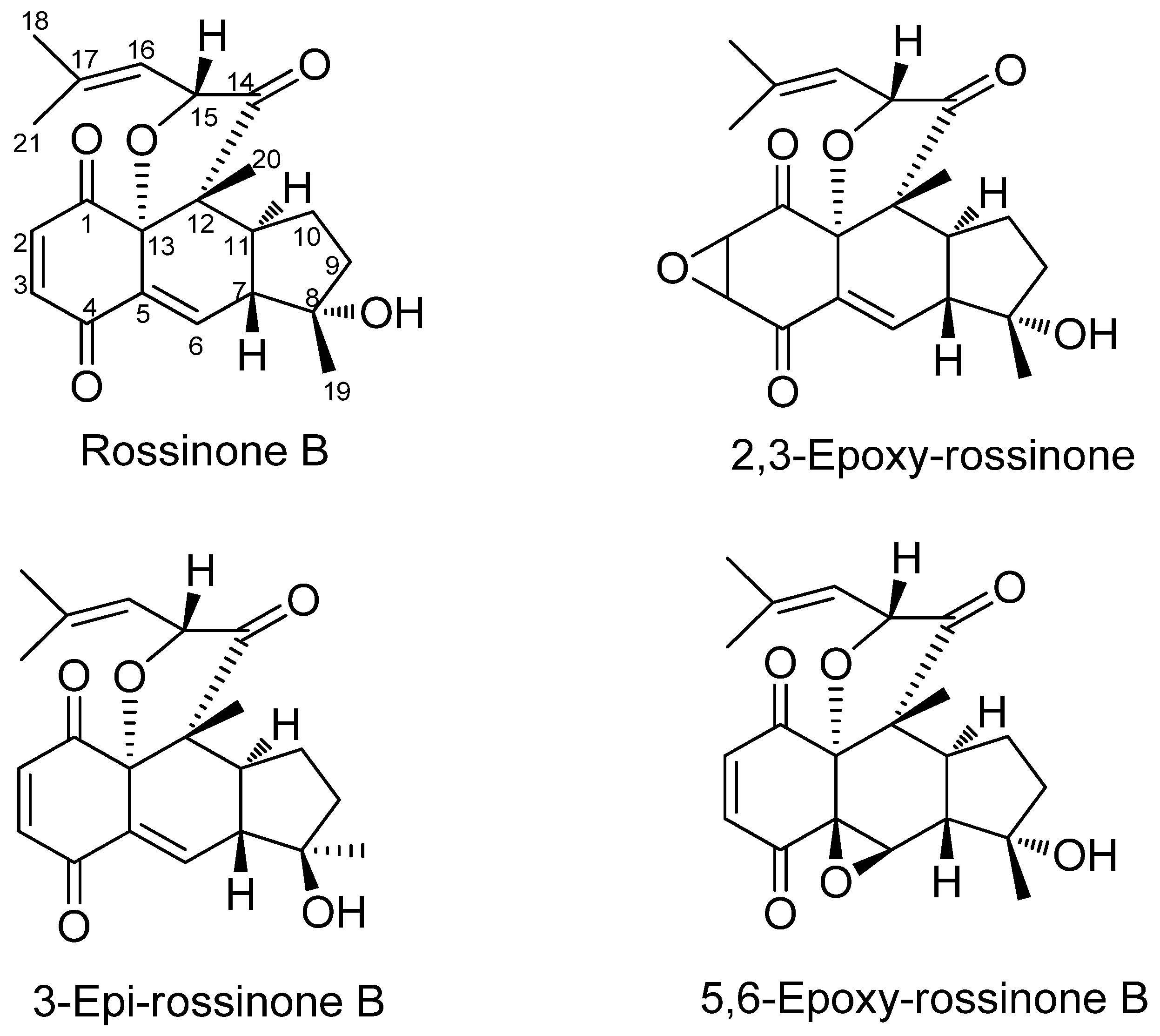
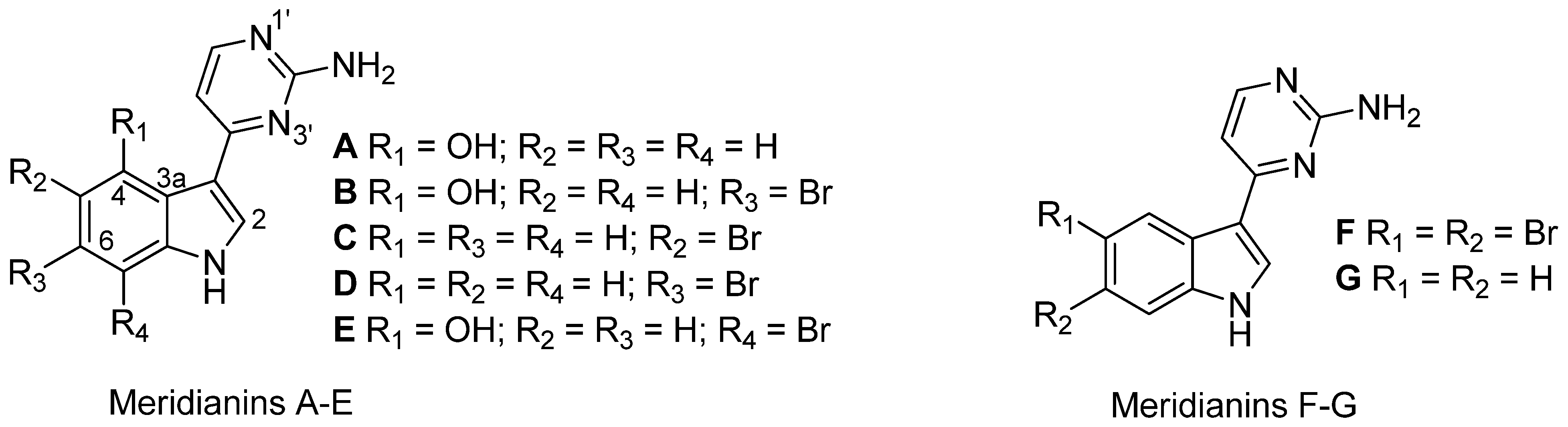
        <p>Four meroterpene derivatives, of the class of the cyclic prenyl quinones, rossinones B and the three derivatives 2,3-epoxy-rossinone B, 3-epi-rossinone B, 5,6-epoxy-rossinone B (<xref ref-type="fig" rid="marinedrugs-10-01741-f001">Figure 1</xref>), were isolated from the Et<sub>2</sub>O lipophilic internal fraction of the colonial Antarctic tunicate <italic>Aplidium fuegiense</italic> (<italic>A. fuegiense</italic> INT). In contrast, the tunic of the sample (<italic>Aplidium fuegiense</italic> EXT) possessed very small quantities of rossinone B, but lacked the other minor rossinone meroterpene-related products. Rossinone B, which was first reported in an <italic>Aplidium</italic> sp. ascidian from the Ross Sea, Antarctica [<xref ref-type="bibr" rid="B29-marinedrugs-10-01741">29</xref>], was the major metabolite of this family of compounds. Rossinones B and related derivatives (<xref ref-type="fig" rid="marinedrugs-10-01741-f001">Figure 1</xref>) were also recently described as part of our chemical investigations [<xref ref-type="bibr" rid="B40-marinedrugs-10-01741">40</xref>]. Furthermore, all the extracts from internal viscera and external regions from samples of the species <italic>A. falklandicum</italic> and <italic>A. meridianum</italic> revealed the presence of the known meridianins A–G (<xref ref-type="fig" rid="marinedrugs-10-01741-f002">Figure 2</xref>). The purified meridianin fraction from the sample <italic>A. falklandicum</italic> 1 was used in the sea star assay. Finally, a group of twelve unknown minor meridianin derivatives (I, J, J′, L, O, P, Q, R, R′, S, T and U) with combinations of bromide, chloride, and hydroxy groups, as well as two unknown dimeric derivates from the majoritary meridianins A and B (or E) were detected by means of an Orbitrap LC-HRMS-MS [<xref ref-type="bibr" rid="B61-marinedrugs-10-01741">61</xref>] from the sample <italic>A. falklandicum</italic> 1 (see <xref ref-type="supplementary-material" rid="marinedrugs-10-01741-s001">Supplementary Material</xref>).</p>
        <fig id="marinedrugs-10-01741-f001" position="anchor">
          <label>Figure 1</label>
          <caption>
            <p>Chemical structures of the rossinone compounds purified from <italic>Aplidium fuegiense</italic>: rossinone B and the three derivatives 2,3-epoxy-rossinone B, 3-epi-rossinone B, 5,6-epoxy-rossinone B.</p>
          </caption>
          <graphic xmlns:xlink="http://www.w3.org/1999/xlink" xlink:href="marinedrugs-10-01741-g001.tif"/>
        </fig>
        <fig id="marinedrugs-10-01741-f002" position="anchor">
          <label>Figure 2</label>
          <caption>
            <p>Chemical structures of the meridianin compounds (A–G) purified from <italic>Aplidium falklandicum</italic> and <italic>A. meridianum</italic>.</p>
          </caption>
          <graphic xmlns:xlink="http://www.w3.org/1999/xlink" xlink:href="marinedrugs-10-01741-g002.tif"/>
        </fig>
      </sec>
      <sec>
        <title>3.3. Feeding Deterrence Assays with Sea Stars</title>
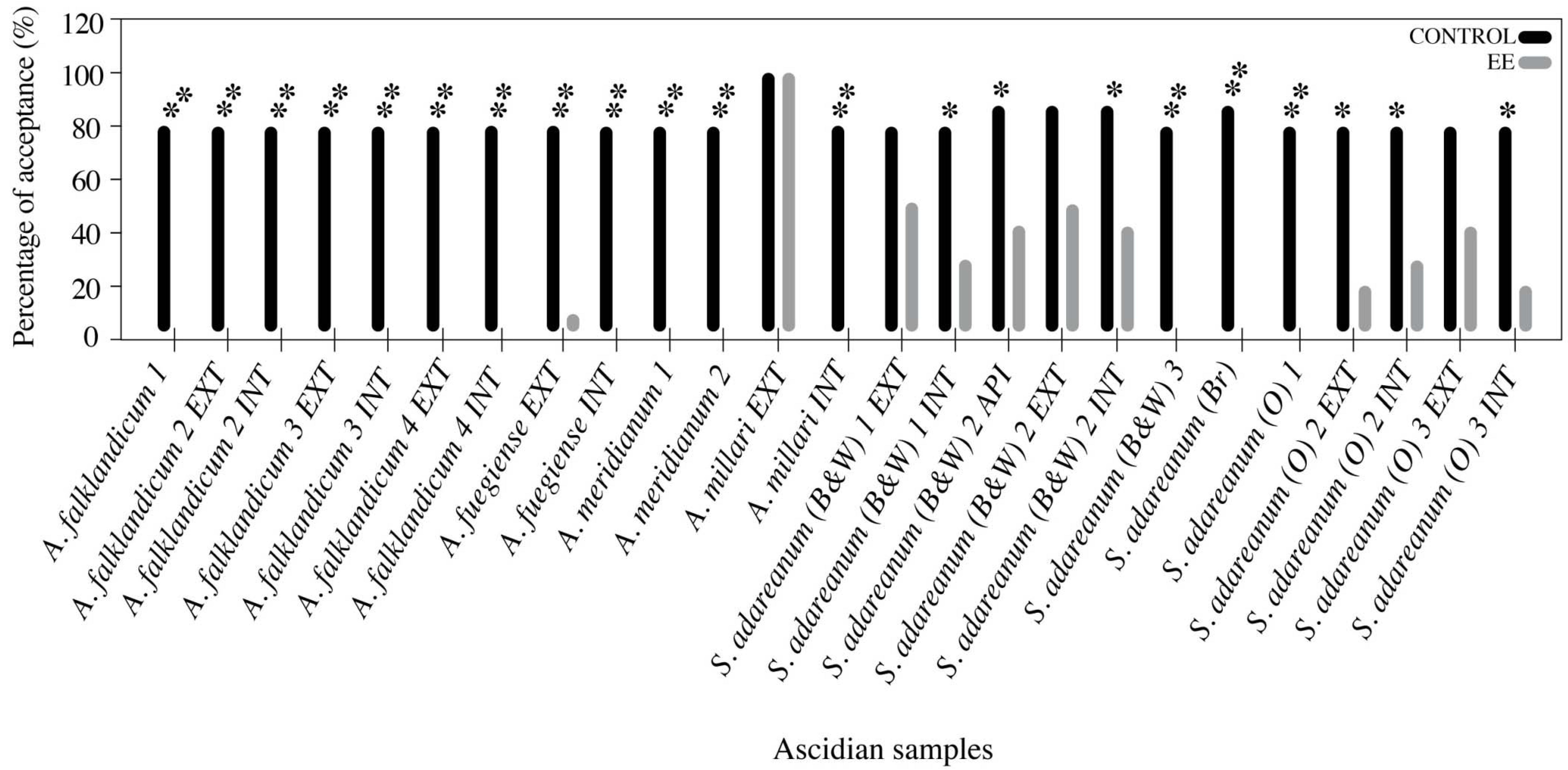
        <p>All five ascidian species and 15 samples demonstrated the presence of chemical defenses. Twenty-one of the lipophilic Et<sub>2</sub>O fractions tested caused significant (<italic>P</italic> = 0.01 or <italic>P</italic> = 0.05) feeding repellence against the sea star <italic>O. validus</italic> at natural concentrations according to the Fisher’s Exact test. Control assays using shrimp feeding cubes with solvent alone displayed a minimum acceptance of eight cubes out of ten. In 14 experiments the lipophilic fractions caused an absolute rejection by the sea stars (<italic>P</italic> = 0.01). On the other hand, only four samples from the external tunics of <italic>Aplidium millari</italic>, <italic>Synoicum adareanum</italic> (B&amp;W) 1 and 2 and <italic>S. adareanum</italic> (O) 3 were accepted (<xref ref-type="fig" rid="marinedrugs-10-01741-f003">Figure 3</xref>). Regarding the tests conducted with isolated metabolites, both the rossinone B (<italic>P</italic> &lt; 0.001), as well as the mixture of meridianins A–G (<italic>P</italic> &lt; 0.001) showed potent deterrence against the asteroid at their natural concentrations. In both cases the consumption was 0 out of 10 compound-treated cubes, whereas the simultaneous control tests had a ratio of eight items eaten out of ten.</p>
        <fig id="marinedrugs-10-01741-f003" position="anchor">
          <label>Figure 3</label>
          <caption>
            <p>Bar diagram displaying the results in the feeding repellence bioassays with the sea star <italic>Odontaster validus</italic> performed with lipophilic Et<sub>2</sub>O extracts from Antarctic colonial ascidians, showing the paired results of control and extract treated shrimp cubes for each test and representing the percentage of acceptance. * significant differences (<italic>P</italic> &lt; 0.05), ** significant differences (<italic>P</italic> &lt; 0.01), with control as preferred food (Fisher’s exact test).</p>
          </caption>
          <graphic xmlns:xlink="http://www.w3.org/1999/xlink" xlink:href="marinedrugs-10-01741-g003.tif"/>
        </fig>
      </sec>
      <sec>
        <title>3.4. Feeding Preference Assays with Amphipods</title>
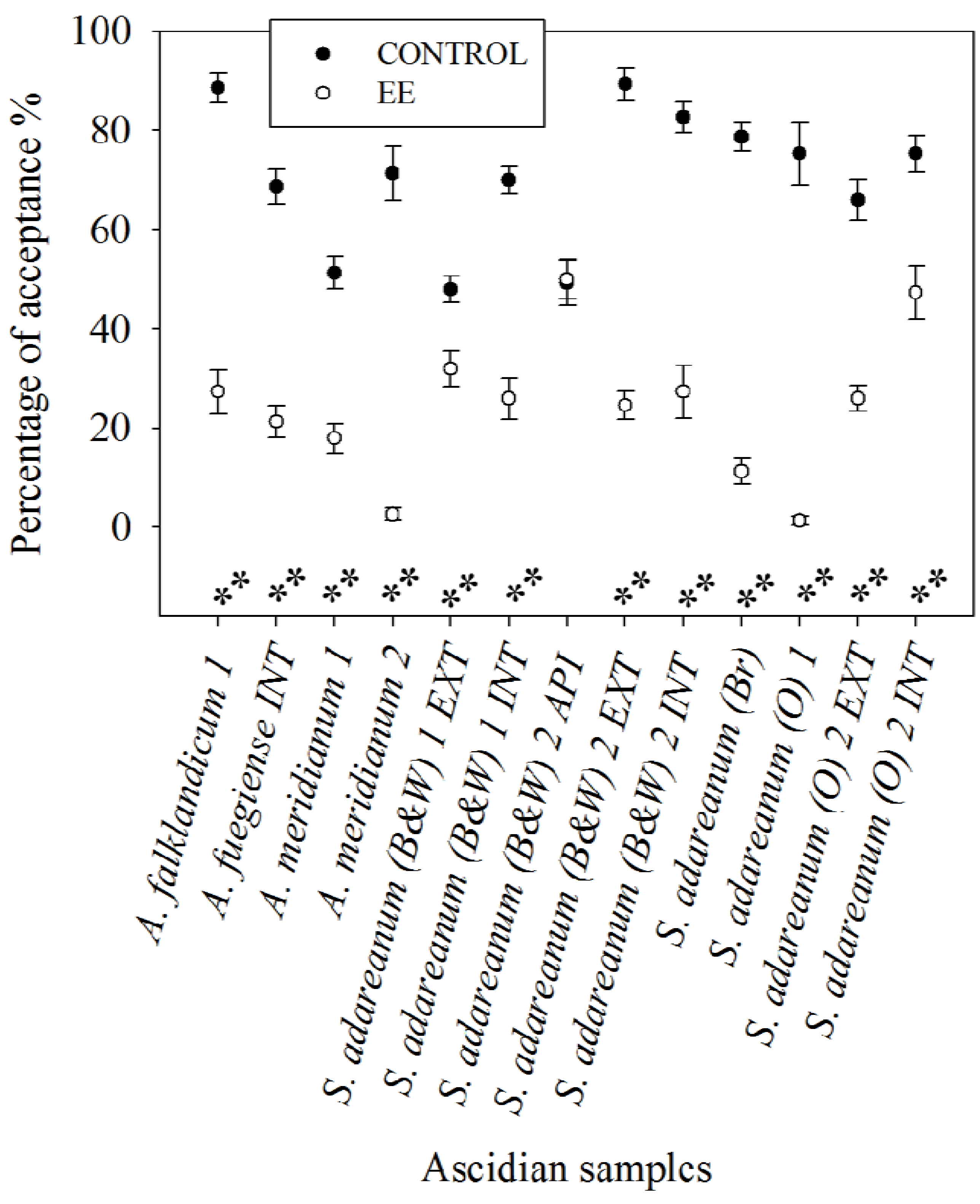
        <p>In the preference experiments towards the amphipod <italic>Cheirimedon femoratus</italic> the four species tested, represented by nine samples were shown to contain repellent compounds. In fact, all the fractions assayed except one (12 out of 13) revealed remarkable feeding unpalatable activity (<italic>P</italic> &lt; 0.01) at natural concentrations according to the Wilcoxon Exact test. The amphipod devoured control food pearls at impressive high rates, and regardless of its gregarious behavior unpalatabilities were evident. Actually most of the extracts that yielded deterrence in this assay were strongly rejected and not ingested at all when they were presented included in alginate pearls. Only the apical ethereal fraction (API) from the ascidian <italic>Synoicum adareanum</italic> (B&amp;W) 2, was palatable contrasting with basal-external and visceral extracts (EXT and INT), which were remarkably repellent (<xref ref-type="fig" rid="marinedrugs-10-01741-f004">Figure 4</xref>). In addition, the amphipod significantly rejected food pearls treated with rossinone B (<italic>P</italic> &lt; 0.01) or meridianin (A–G) mixture (<italic>P</italic> &lt; 0.001), with respect to the controls. </p>
        <fig id="marinedrugs-10-01741-f004" position="anchor">
          <label>Figure 4</label>
          <caption>
            <p>Scatter plot diagram showing the results in the feeding preference bioassays with the amphipod <italic>Cheirimedon femoratus</italic> conducted with lipophilic Et<sub>2</sub>O fractions from Antarctic colonial ascidians. The paired results of control and extract treated food pearls are displayed for each test as the mean percentage of acceptance and standard error bars. ** significant differences (<italic>P</italic> &lt; 0.01) with control as preferred food (Exact Wilcoxon test).</p>
          </caption>
          <graphic xmlns:xlink="http://www.w3.org/1999/xlink" xlink:href="marinedrugs-10-01741-g004.tif"/>
        </fig>
      </sec>
      <sec>
        <title>3.5. Antibacterial Tests against a Sympatric Marine Antarctic Bacterium</title>
        <p>The isolated mixture of meridianins from <italic>Aplidium flaklandicum</italic> 1 caused strong growth inhibition (active (+++) in the three replicates &gt;10 mm Ø inhibition halo) on cultures of an unidentified sympatric Antarctic marine bacterium, as did the positive controls with chloramphenicol. On the contrary none of the extracts assessed from our ascidian samples, nor the rossinone B inhibited the bacterium in our laboratory assays, similarly to what was observed in the solvent negative controls.</p>
      </sec>
    </sec>
    <sec sec-type="discussion">
      <title>4. Discussion</title>
      <sec>
        <title>4.1. Incidence and Allocation of Chemical Defenses against Predation</title>
        <p>Antarctic ascidians thrive in environments where predation pressure, mostly driven by invertebrate consumers, is intense [<xref ref-type="bibr" rid="B1-marinedrugs-10-01741">1</xref>,<xref ref-type="bibr" rid="B45-marinedrugs-10-01741">45</xref>]. Still, only seldom has it been demonstrated that natural products are responsible for chemical defense in ascidians [<xref ref-type="bibr" rid="B4-marinedrugs-10-01741">4</xref>,<xref ref-type="bibr" rid="B56-marinedrugs-10-01741">56</xref>,<xref ref-type="bibr" rid="B62-marinedrugs-10-01741">62</xref>]. Moreover, these animals exploit inorganic acids against sea star predators (especially colonial ascidians) and the protection afforded by a tough tunic (especially solitary ascidians) [<xref ref-type="bibr" rid="B12-marinedrugs-10-01741">12</xref>,<xref ref-type="bibr" rid="B56-marinedrugs-10-01741">56</xref>,<xref ref-type="bibr" rid="B63-marinedrugs-10-01741">63</xref>]. Our findings complete this map by showing that organic chemical defense is largely used in these ascidians, since all our samples possess repellent metabolites (<xref ref-type="fig" rid="marinedrugs-10-01741-f003">Figure 3</xref> and <xref ref-type="fig" rid="marinedrugs-10-01741-f004">Figure 4</xref>). The specimens and, in general, the species analyzed in this study were free of evident epibionts and lacked mechanical protection [<xref ref-type="bibr" rid="B51-marinedrugs-10-01741">51</xref>]. Likewise, bioaccumulation of acids or heavy metals has not been reported within their tunic, nor in closely related species of the family Polyclinidae [<xref ref-type="bibr" rid="B9-marinedrugs-10-01741">9</xref>,<xref ref-type="bibr" rid="B10-marinedrugs-10-01741">10</xref>,<xref ref-type="bibr" rid="B64-marinedrugs-10-01741">64</xref>], which in fact report absence of bladder cells [<xref ref-type="bibr" rid="B65-marinedrugs-10-01741">65</xref>]. These facts put forward the need for protection based on organic chemistry. On the other hand, lipophilic partitions have proved to be more actively deterrent than hydrophilic ones in marine organisms [<xref ref-type="bibr" rid="B23-marinedrugs-10-01741">23</xref>,<xref ref-type="bibr" rid="B52-marinedrugs-10-01741">52</xref>,<xref ref-type="bibr" rid="B66-marinedrugs-10-01741">66</xref>], and thus we focused our study on the ether fractions of our specimens. In the past however, only rarely have the chemicals responsible for the unpalatablity been identified. Yet some examples of deterrent metabolites in ascidians include the tambjamines C and F, didemnin B and nordidemnin B, patellamide C, ascididemin, and meridianins A–G [<xref ref-type="bibr" rid="B8-marinedrugs-10-01741">8</xref>,<xref ref-type="bibr" rid="B13-marinedrugs-10-01741">13</xref>,<xref ref-type="bibr" rid="B15-marinedrugs-10-01741">15</xref>,<xref ref-type="bibr" rid="B22-marinedrugs-10-01741">22</xref>,<xref ref-type="bibr" rid="B23-marinedrugs-10-01741">23</xref>].</p>
        <p><italic>Aplidium falklandicum</italic> and <italic>A. meridianum</italic> possess protective chemicals, the meridianins, which besides deterring the asteroid <italic>Odontaster validus</italic>, have now shown feeding repellence towards the amphipod <italic>Cheirimedon femoratus</italic>. Meridianins are present both in inner and outer tissues, even if they seem to be more concentrated in outer zones [<xref ref-type="bibr" rid="B13-marinedrugs-10-01741">13</xref>]. Apart from these two species, a seeming lack of within-specimen defense allocation was detected in <italic>S. adareanum</italic> (O) 2, as has also been observed in other ascidians [<xref ref-type="bibr" rid="B38-marinedrugs-10-01741">38</xref>]. Rossinone B was proven to take part in the whole-colony chemical defense of <italic>A. fuegiense</italic>, repelling both sea stars and amphipods, but it was predominant in internal regions.</p>
        <p>According to the ODT [<xref ref-type="bibr" rid="B41-marinedrugs-10-01741">41</xref>], tunics with low palatability (determined by a combination of energy content, digestibility, chemicals and, pH) are expected when protecting adult stages surpasses the benefits of defending larval ones [<xref ref-type="bibr" rid="B4-marinedrugs-10-01741">4</xref>]. In fact, in some colonial species bioactive alkaloid pigments are stored in tunic bladder and pigmentary cells, presumably acting as sunscreens or deterrents [<xref ref-type="bibr" rid="B31-marinedrugs-10-01741">31</xref>,<xref ref-type="bibr" rid="B38-marinedrugs-10-01741">38</xref>,<xref ref-type="bibr" rid="B39-marinedrugs-10-01741">39</xref>]. However, the presence of chemical defenses within the tissues of some Antarctic sponges and ascidians suggests that predators other than sea stars are also relevant, or that the assumptions of the ODT are inappropriate in such a case [<xref ref-type="bibr" rid="B13-marinedrugs-10-01741">13</xref>,<xref ref-type="bibr" rid="B67-marinedrugs-10-01741">67</xref>,<xref ref-type="bibr" rid="B68-marinedrugs-10-01741">68</xref>]. Also, big complex eggs and larvae produced by most compound ascidians are often protected with noxious cyclic peptides and alkaloids, compensating the great investment assigned to reproduction [<xref ref-type="bibr" rid="B4-marinedrugs-10-01741">4</xref>,<xref ref-type="bibr" rid="B14-marinedrugs-10-01741">14</xref>,<xref ref-type="bibr" rid="B15-marinedrugs-10-01741">15</xref>,<xref ref-type="bibr" rid="B30-marinedrugs-10-01741">30</xref>]. This outcome explains the presence of deterrents in inner tissues (gonads) in order to produce chemically defended larval stages [<xref ref-type="bibr" rid="B11-marinedrugs-10-01741">11</xref>,<xref ref-type="bibr" rid="B15-marinedrugs-10-01741">15</xref>]. The predominant internal allocation of defenses in some of our samples is thus not fortuitous. Some tunics have low caloric value with respect to inner tissues, making them already less attractive to predators McClintock [<xref ref-type="bibr" rid="B4-marinedrugs-10-01741">4</xref>,<xref ref-type="bibr" rid="B11-marinedrugs-10-01741">11</xref>,<xref ref-type="bibr" rid="B69-marinedrugs-10-01741">69</xref>]. Besides, colonial ascidians are often able to recover from wounds and rapidly regenerate the damaged tunic [<xref ref-type="bibr" rid="B70-marinedrugs-10-01741">70</xref>]. This capacity allows them to address less energy in defending non reproductive regions. On the contrary, solitary species may require better-protected tunics [<xref ref-type="bibr" rid="B69-marinedrugs-10-01741">69</xref>]. Pisut and Pawlik [<xref ref-type="bibr" rid="B11-marinedrugs-10-01741">11</xref>] found deterrents allocated in the gonads of solitarian species, yet whole-specimen extracts were palatable. This indicated the possession of thick tunics that diluted any deterrence found in viscera and gonads. Our compound asdidians, instead, had thin tunics accounting for a small fraction in the colony, and even if some samples had poorly (or not) defended tunics, whole-colony extracts were always deterrent. Tunics from <italic>A. millari</italic>, <italic>S. adareanum</italic> (B&amp;W) and <italic>S. adareanum</italic> (O) seemed to be less (or not) chemically protected against sea star predation. However amphipod assays, probably due to a greater susceptibility of <italic>C. femoratus</italic> [<xref ref-type="bibr" rid="B71-marinedrugs-10-01741">71</xref>], do reflect the existence of deterrents in the tunics, presumably in lesser amounts. The supposed low energetic value of the tunics, along with a weak chemical defense with respect to inner regions may contribute to the overall protection of these colonies against heavy predation, complementing the remaining defensive mechanisms. The lower extract yields produced by most tunics with respect to inner tissue likely reflect these facts (<xref ref-type="table" rid="marinedrugs-10-01741-t002">Table 2</xref>). Furthermore, this pattern of allocating deterrents into the internal regions was also observed in the distribution of the defensive secondary metabolite rossinone B within the colonies of <italic>A. fuegiense</italic>.</p>
      </sec>
      <sec>
        <title>4.2. Antibiotic Activity towards Marine Bacteria</title>
        <p>Benthic organisms must combat pathogens as well as epibiosis by macro- and microorganisms. More commonly colonial rather than solitary ascidians, have been found to possess agents to prevent this [<xref ref-type="bibr" rid="B19-marinedrugs-10-01741">19</xref>,<xref ref-type="bibr" rid="B24-marinedrugs-10-01741">24</xref>,<xref ref-type="bibr" rid="B72-marinedrugs-10-01741">72</xref>,<xref ref-type="bibr" rid="B73-marinedrugs-10-01741">73</xref>,<xref ref-type="bibr" rid="B74-marinedrugs-10-01741">74</xref>,<xref ref-type="bibr" rid="B75-marinedrugs-10-01741">75</xref>]. Our Antarctic samples however, did not display significant inhibition against a sympatric bacterium strain. This agrees with other surveys of both Antarctic sponges and ascidians, which indicate a general lack of antibacterial chemistry. In Antarctic systems, diatom invasions apparently surpass that of bacteria, suggesting that there might be more selective pressure for chemical defenses against diatom fouling [<xref ref-type="bibr" rid="B63-marinedrugs-10-01741">63</xref>,<xref ref-type="bibr" rid="B76-marinedrugs-10-01741">76</xref>,<xref ref-type="bibr" rid="B77-marinedrugs-10-01741">77</xref>,<xref ref-type="bibr" rid="B78-marinedrugs-10-01741">78</xref>]. It was also proposed that bacterial pathogens could be controlled through immune processes in asdicians [<xref ref-type="bibr" rid="B63-marinedrugs-10-01741">63</xref>,<xref ref-type="bibr" rid="B66-marinedrugs-10-01741">66</xref>]. Rossinone B, which was antimicrobial and antimycotic towards cosmopolitan strains [<xref ref-type="bibr" rid="B29-marinedrugs-10-01741">29</xref>], revealed no activity in our assays. Meridianins A, B, C, E, F and G, instead, caused no growth inhibition on allopatric microbes in the past [<xref ref-type="bibr" rid="B13-marinedrugs-10-01741">13</xref>]. However, in the present study the meridianin mixture revealed potent activity against an Antarctic marine bacterium suggesting a defensive role against pathogenic or fouling bacteria. Even if whole ascidian extracts seem inoquous, they are composed of a complex mixture of substances (primary and secondary metabolites, and nutrients) that may interfere with some bioactivities. However, if meridianins were to be allocated in compartments, which has not been proved so far, they could then appear in higher concentrations and fulfil this function too. Despite the fact that some biologically active marine natural products serve specific ecological roles [<xref ref-type="bibr" rid="B75-marinedrugs-10-01741">75</xref>], others, such as the meridianins, seem to be multipurpose defenses. In the current study, the antibacterial testing, being on a single, unidentified, bacterium isolated from shallow seawater samples, possesses limitations regarding information of ecologically significant antifouling properties. Indeed further investigations should be addressed with deep-water representative bacterial populations.</p>
      </sec>
      <sec>
        <title>4.3. Variability and Origin of Bioactive Natural Products</title>
        <p>Secondary metabolites are more typical of colonial than of solitary tunicates, and have been found in deep as well as in shallow specimens, even if these last ones have been more frequently analyzed. Chemical analyses have been reported for six species of Antarctic ascidians coming from both shallow and deep collections, all of them colonial: <italic>Synoicum</italic> sp., <italic>S. adareanum</italic>, <italic>Aplidium</italic> sp., <italic>A. falklandicum</italic>, <italic>A. meridianum</italic> and <italic>A. fuegiense</italic> [<xref ref-type="bibr" rid="B13-marinedrugs-10-01741">13</xref>,<xref ref-type="bibr" rid="B40-marinedrugs-10-01741">40</xref>,<xref ref-type="bibr" rid="B52-marinedrugs-10-01741">52</xref>,<xref ref-type="bibr" rid="B79-marinedrugs-10-01741">79</xref>]. Diyabalanage and co-workers purified a cytotoxic macrolide, palmerolide A, from <italic>S. adareanum</italic> [<xref ref-type="bibr" rid="B26-marinedrugs-10-01741">26</xref>]. A dense microbial community was detected on the tunicate and a possible bacterial origin of this polyketide was proposed [<xref ref-type="bibr" rid="B80-marinedrugs-10-01741">80</xref>]. Several ecdysteroids (arthropod molting hormones) were also reported from <italic>S. adareanum</italic> [<xref ref-type="bibr" rid="B27-marinedrugs-10-01741">27</xref>]. Their presence suggested a potential to defend from arthropod predators through a strategy similar to that found in terrestrial plants, which elaborate ecdysteroids that short-wire molting in phytophagous insects. In our investigation we did not find these metabolites, however this species did exhibit amphipod feeding-avoidance. We must point out that intraspecific polymorphism in colonial ascidians is recurrent [<xref ref-type="bibr" rid="B51-marinedrugs-10-01741">51</xref>], and we found three morphotypes for <italic>S. adareanum</italic> among our samples. <italic>S. adareanum</italic> also occurs in two different morphs near Palmer Station, each revealing diverse bioactivities. Moreover, crude extracts of a <italic>S. adareanum</italic> from shallow areas of Anvers Island (western Antarctic Peninsula) were found to lack deterrence towards several sympatric consumers [<xref ref-type="bibr" rid="B56-marinedrugs-10-01741">56</xref>], as opposed to our results from deep-water samples. The variable morphologies, bioactivities, and presence of some characteristic metabolites suggest a need for further taxonomical resolution in this species [<xref ref-type="bibr" rid="B63-marinedrugs-10-01741">63</xref>].</p>
        <p>Ascidians of the genus <italic>Aplidium</italic> are renowned for the variability of the metabolites that they possess: non-nitrogenous compounds are dominated by prenyl quinones, linear or cyclic, and among the nitrogen containing group, nucleosides, cyclic peptides and a high variety of alkaloids can be mentioned [<xref ref-type="bibr" rid="B81-marinedrugs-10-01741">81</xref>]. While the majority of ascidian metabolites are amino acid derived [<xref ref-type="bibr" rid="B82-marinedrugs-10-01741">82</xref>], the genus <italic>Aplidium</italic> is noted for its propensity to biosynthesize terpene derivatives [<xref ref-type="bibr" rid="B81-marinedrugs-10-01741">81</xref>]. The finding of rossinones B and related 2,3-epoxy-rossinone B, 3-epi-rossinone B, 5,6-epoxy-rossinone B in <italic>A. fuegiense</italic>, reflects this outcome, since meroterpenes are typically found in sponges and seaweeds [<xref ref-type="bibr" rid="B83-marinedrugs-10-01741">83</xref>]. Rossinones A and B were first isolated from an Antarctic unidentified <italic>Aplidium</italic> from the Ross Sea. While modest bioactivities characterized rossinone A, rossinone B exhibited antileukemic, antiviral, and anti-inflammatory properties [<xref ref-type="bibr" rid="B29-marinedrugs-10-01741">29</xref>]. Biosynthetically, cyclic prenylated quinones, such as rossinone B and the three derivatives from this study seem to derive from linear hydroquinones, like rossinone A [<xref ref-type="bibr" rid="B84-marinedrugs-10-01741">84</xref>]. Interestingly, neither acyclic hydroquinones nor putative quinone-containing precursors of rossinones were detected in <italic>A. fuegiense</italic> [<xref ref-type="bibr" rid="B40-marinedrugs-10-01741">40</xref>].</p>
        <p>It would be interesting to find out where all these compounds are synthesized. In other colonial species, special tunic cells (bladder cells; lacking in <italic>Aplidium</italic> and <italic>Synoicum</italic> [<xref ref-type="bibr" rid="B65-marinedrugs-10-01741">65</xref>], or pigment cells) concentrate defensive chemicals [<xref ref-type="bibr" rid="B36-marinedrugs-10-01741">36</xref>,<xref ref-type="bibr" rid="B38-marinedrugs-10-01741">38</xref>,<xref ref-type="bibr" rid="B39-marinedrugs-10-01741">39</xref>]. Final metabolites seem to end in storage compartments in the outer tunic, while other intermediate products remain in inner producing tissues (zooids) [<xref ref-type="bibr" rid="B38-marinedrugs-10-01741">38</xref>]. This could explain the distribution observed for the rossinone compounds in <italic>A. fuegiense</italic>. Here, rossinone B is the major and most active defensive metabolite. It was found predominantly in inner tissues, but also in the tunic in small amounts. The other minor rossinones (2,3-epoxy-rossinone B, 3-epi-rossinone B, 5,6-epoxy-rossinone B) in contrast, are only present in internal areas of the colony, presumably as precursors. Alternatively, these products could derive from symbiotic microbes. Among the known microorganism-derived products, terpenes are uncommon and indole alkaloids predominate [<xref ref-type="bibr" rid="B22-marinedrugs-10-01741">22</xref>,<xref ref-type="bibr" rid="B85-marinedrugs-10-01741">85</xref>,<xref ref-type="bibr" rid="B86-marinedrugs-10-01741">86</xref>,<xref ref-type="bibr" rid="B87-marinedrugs-10-01741">87</xref>,<xref ref-type="bibr" rid="B88-marinedrugs-10-01741">88</xref>]. In many species, especially colonial, microsymbionts are usually sited in the tunic [<xref ref-type="bibr" rid="B33-marinedrugs-10-01741">33</xref>] (and reviewed in [<xref ref-type="bibr" rid="B3-marinedrugs-10-01741">3</xref>,<xref ref-type="bibr" rid="B34-marinedrugs-10-01741">34</xref>,<xref ref-type="bibr" rid="B35-marinedrugs-10-01741">35</xref>]). The presence of the intermediate products exclusively in the inner tissues [<xref ref-type="bibr" rid="B40-marinedrugs-10-01741">40</xref>], suggests that rossinone terpenoids probably do not derive from a microbial source, or at least not from a tunical symbiont.</p>
        <fig id="marinedrugs-10-01741-f005" position="anchor">
          <label>Figure 5</label>
          <caption>
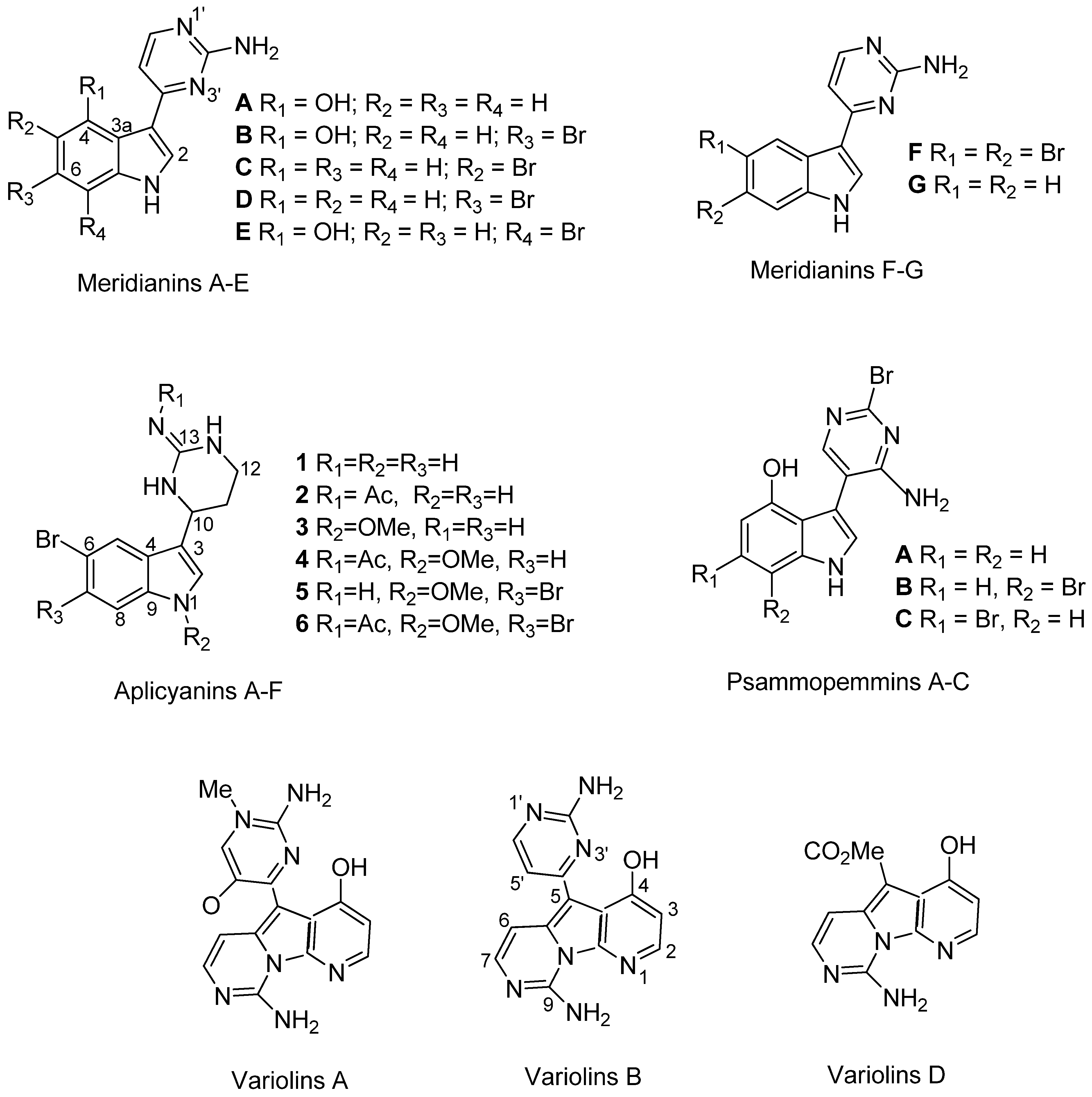
            <p>Chemical structures of meridianin-related indole alkaloids obtained from Antarctic marine organisms: Aplicyanins A-F from the ascidian <italic>A. cyaneum</italic>, Psammopemmins A–C from the sponge <italic>Psammopemma</italic> sp. and variolins A, B and D from the sponge <italic>Kirkpatrickia variolosa</italic>.</p>
          </caption>
          <graphic xmlns:xlink="http://www.w3.org/1999/xlink" xlink:href="marinedrugs-10-01741-g005.tif"/>
        </fig>
        <p>The meridianins are a family of indole alkaloids with potent cytotoxicity and kinase inhibitory activity, especially meridianins B and E, which are considered an important scaffold for cancer therapeutics [<xref ref-type="bibr" rid="B89-marinedrugs-10-01741">89</xref>,<xref ref-type="bibr" rid="B90-marinedrugs-10-01741">90</xref>]. Rossinones and meridianins are indeed interesting products for pharmacological research. The new minor meridianins (I–U) (<xref ref-type="supplementary-material" rid="marinedrugs-10-01741-s001">Supplementary Material</xref>) and some unreported dimeric derivates indicate that the meridianins constitute a bulky group of alkaloids very high in concentration and in diversity. Many deterrents appear as a family of related metabolites, which are effective as a mixture, but often also as isolated forms, such is the case of both tambjamines and meridianins [<xref ref-type="bibr" rid="B13-marinedrugs-10-01741">13</xref>,<xref ref-type="bibr" rid="B22-marinedrugs-10-01741">22</xref>]. Colonies of <italic>A. falklandicum</italic> and <italic>A. meridianum</italic> have external yellowish pigmentation, like the fraction containing the mixture of meridianin compounds (A–G). Meridianins could be photoprotective, as proposed for other species containing bright-colored alkaloids [<xref ref-type="bibr" rid="B30-marinedrugs-10-01741">30</xref>,<xref ref-type="bibr" rid="B39-marinedrugs-10-01741">39</xref>,<xref ref-type="bibr" rid="B87-marinedrugs-10-01741">87</xref>]. Nonetheless, in our particular case since the specimens were collected at &lt;200 m depth where light no longer penetrates, concepts such as photoprotection and UV-screening are irrelevant. Thus the meridianins at this point could be considered as relict pigments. Antarctic benthic invertebrates have no apparent reason to have warning bright colorations in a system where grazing pressure by visually oriented predators, such as fish, is generally lacking. Yet many organisms are highly pigmented and the related bioactive pigments are themselves feeding deterrents and/or antifoulants. The role of coloration here may respond to an evolutionary selection for, or retention of, pigmentation driven by predation pressure. As a result, relict pigments originally selected by aposematism or UV-screening are conserved because of their defensive properties, even in species living in deep-waters where coloration has no apparent sense. Among these bioactive pigments are the variolins from <italic>Kirkpatrickia variolosa</italic>, discorhabdins from <italic>Latrunculia apicalis</italic>, suberitenones from <italic>Suberites</italic> sp. and those from <italic>Dendrilla membranosa</italic> (reviewed in [<xref ref-type="bibr" rid="B66-marinedrugs-10-01741">66</xref>,<xref ref-type="bibr" rid="B87-marinedrugs-10-01741">87</xref>]).</p>
        <p>The meridianins have been obtained from geographically distinct Southern Ocean ascidian populations generally collected at more than 100 m depth, and from several species: <italic>A. meridianum</italic>, <italic>A. falklandicum</italic> [<xref ref-type="bibr" rid="B13-marinedrugs-10-01741">13</xref>,<xref ref-type="bibr" rid="B25-marinedrugs-10-01741">25</xref>,<xref ref-type="bibr" rid="B28-marinedrugs-10-01741">28</xref>] and <italic>Synoicum</italic> sp. [<xref ref-type="bibr" rid="B91-marinedrugs-10-01741">91</xref>]. The two <italic>Aplidium</italic> species though, are being revised and might actually be synonymised in the future [<xref ref-type="bibr" rid="B92-marinedrugs-10-01741">92</xref>]. It is intriguing, however, that meridianin D, although a major metabolite, has been repeatedly isolated from <italic>A. meridianum</italic> samples but not from other species, maybe representing a specific feature [<xref ref-type="bibr" rid="B13-marinedrugs-10-01741">13</xref>,<xref ref-type="bibr" rid="B25-marinedrugs-10-01741">25</xref>,<xref ref-type="bibr" rid="B28-marinedrugs-10-01741">28</xref>,<xref ref-type="bibr" rid="B91-marinedrugs-10-01741">91</xref>]. Furthermore meridianin A, B and E, have been recently reported to correspond to the so-called psammopemmins A, C and B respectively, described from the Antarctic sponge <italic>Psammopemma</italic> sp. [<xref ref-type="bibr" rid="B91-marinedrugs-10-01741">91</xref>,<xref ref-type="bibr" rid="B93-marinedrugs-10-01741">93</xref>]. Thus, the broad existence of these alkaloids in Antarctic animals, along with those of the closely related aplicyanins and variolins [<xref ref-type="bibr" rid="B94-marinedrugs-10-01741">94</xref>] could respond, either to symbiotic associations and microbe elaboration, or to co-evolution and retention of biosynthetic pathways of metabolites with adaptive functions (<xref ref-type="fig" rid="marinedrugs-10-01741-f002">Figure 2</xref> and <xref ref-type="fig" rid="marinedrugs-10-01741-f005">Figure 5</xref>). The versatility of these alkaloids in terms of ecological functionality justifies the broad acquisition of these metabolites by a number of Antarctic species [<xref ref-type="bibr" rid="B13-marinedrugs-10-01741">13</xref>,<xref ref-type="bibr" rid="B25-marinedrugs-10-01741">25</xref>,<xref ref-type="bibr" rid="B28-marinedrugs-10-01741">28</xref>,<xref ref-type="bibr" rid="B91-marinedrugs-10-01741">91</xref>,<xref ref-type="bibr" rid="B93-marinedrugs-10-01741">93</xref>]. A similar situation occurs with the tambjamine alkaloids, found in bryozoans and ascidians (and molluscs feeding on them) from a variety of habitats, which are moreover related to bacterial pigments [<xref ref-type="bibr" rid="B22-marinedrugs-10-01741">22</xref>,<xref ref-type="bibr" rid="B86-marinedrugs-10-01741">86</xref>]. Meridianins, as aminopyrimidine indoles might derive from a pyrimidic base by connection of a pyrimidine ring onto an indole system [<xref ref-type="bibr" rid="B90-marinedrugs-10-01741">90</xref>]. In fact, 2-deoxythymidine was detected in our <italic>Synoicum</italic> and <italic>Aplidium</italic> ascidian samples. Actually, nucleoside derivatives are frequent in <italic>Aplidium</italic> species [<xref ref-type="bibr" rid="B81-marinedrugs-10-01741">81</xref>], and maybe precursors of complex secondary metabolites [<xref ref-type="bibr" rid="B21-marinedrugs-10-01741">21</xref>].</p>
      </sec>
    </sec>
    <sec sec-type="conclusions">
      <title>5. Conclusions</title>
      <p>Defensive strategies of some shallow temperate and Antarctic colonial ascidians were previously proposed to be highly variable, and seldom to be based on organic chemistry. In contrast, our results with deep-water specimens indicate that selective pressures for chemical defenses against predation are important in the evolution of Antarctic colonial ascidians, since all the species here analyzed had effective lipophilic deterrents. Moreover many of the samples tended to store repellent agents in the internal regions of the colony, and in particular this was observed in the species <italic>A. fuegiense</italic>, <italic>A. millari</italic>, and <italic>Synoicum adareanum</italic> orange and B&amp;W colorations. In fact, the isolated deterrent metabolites analyzed from <italic>Aplidium</italic> specimens seem to have different patterns of within-colony allocation, which along with the diverse molecule-type may suggest also a distinct origin. Whereas the rossinones were characteristic of internal tissues, where their synthesis is likely to occur, the meridianins displayed greater concentrations in the outer regions presented in one of our previous investigations. The meridianins, moreover, have been found in several ascidian species of the genera <italic>Aplidium</italic> and <italic>Synoicum</italic> and in sponges from Antarctic waters, leading to suspicions that they might represent relict pigments retained for their multifunctional defensive roles. As with many other bioactive alkaloid pigments the meridianins could be hypothesized to derive from symbiotic microbes. In agreement with other Antarctic studies with ascidians and sponges, our crude ether extracts exhibited low prevalence of antibacterial properties, even though the meridianin fraction did show inhibitory activity against a sympatric bacterium. This represents one of the very few studies in which deterrents were identified and localized in Antarctic deep-water ascidians. Further investigations should be undertaken to increase our knowledge of the nature and function of chemical defenses in the Southern Ocean, and to compare shallow and deep-water habitats in relation to defensive adaptations.</p>
    </sec>
  </body>
  <back>
    <ack>
      <title>Acknowledgments</title>
      <p>We thank M. Paone, F. Castelluccio, C. Jiménez, S. Taboada, J. Cristobo, B. Figuerola, C. Angulo and J. Moles for their precious support and help in the lab. Thanks are due to S. Catazine for the artwork. Also we are grateful to W. Arntz and the crew of R/V Polarstern. UTM (CSIC), “Las Palmas”, and BAE “Gabriel de Castilla” crews provided logistical support. Funding was provided by the Ministry of Science and Innovation of Spain (CGL/2004-03356/ANT, CGL2007-65453/ANT, CGL2010-17415/ANT and CTQ2008-04024/BQU).</p>
    </ack>
    <ref-list>
      <title>References</title>
      <ref id="B1-marinedrugs-10-01741">
        <label>1.</label>
        <citation citation-type="journal">
          <person-group person-group-type="author">
            <name>
              <surname>Lambert</surname>
              <given-names>G.</given-names>
            </name>
          </person-group>
          <article-title>Ecology and natural history of the protochordates</article-title>
          <source>Can. J. Zool.</source>
          <year>2005</year>
          <volume>83</volume>
          <fpage>34</fpage>
          <lpage>50</lpage>
          <pub-id pub-id-type="doi">10.1139/z04-156</pub-id>
        </citation>
      </ref>
      <ref id="B2-marinedrugs-10-01741">
        <label>2.</label>
        <citation citation-type="book">
          <person-group person-group-type="author">
            <name>
              <surname>Brusca</surname>
              <given-names>R.C.</given-names>
            </name>
            <name>
              <surname>Brusca</surname>
              <given-names>G.J.</given-names>
            </name>
          </person-group>
          <source>Invertebrates</source>
          <edition>2nd</edition>
          <publisher-name>Sinauer Associates</publisher-name>
          <publisher-loc>Sunderland, MA, USA</publisher-loc>
          <year>2003</year>
          <fpage>895</fpage>
        </citation>
      </ref>
      <ref id="B3-marinedrugs-10-01741">
        <label>3.</label>
        <citation citation-type="journal">
          <person-group person-group-type="author">
            <name>
              <surname>Hirose</surname>
              <given-names>E.</given-names>
            </name>
          </person-group>
          <article-title>Ascidian tunic cells: Morphology and functional diversity of free cells outside the epidermis</article-title>
          <source>Invertebr. Biol.</source>
          <year>2009</year>
          <volume>128</volume>
          <fpage>83</fpage>
          <lpage>96</lpage>
          <pub-id pub-id-type="doi">10.1111/j.1744-7410.2008.00153.x</pub-id>
        </citation>
      </ref>
      <ref id="B4-marinedrugs-10-01741">
        <label>4.</label>
        <citation citation-type="journal">
          <person-group person-group-type="author">
            <name>
              <surname>Tarjuelo</surname>
              <given-names>I.</given-names>
            </name>
            <name>
              <surname>Lopez-Legentil</surname>
              <given-names>S.</given-names>
            </name>
            <name>
              <surname>Codina</surname>
              <given-names>M.</given-names>
            </name>
            <name>
              <surname>Turon</surname>
              <given-names>X.</given-names>
            </name>
          </person-group>
          <article-title>Defence mechanisms of adults and larvae of colonial ascidians: patterns of palatability and toxicity</article-title>
          <source>Mar. Ecol. Prog. Ser.</source>
          <year>2002</year>
          <volume>235</volume>
          <fpage>103</fpage>
          <lpage>115</lpage>
          <pub-id pub-id-type="doi">10.3354/meps235103</pub-id>
        </citation>
      </ref>
      <ref id="B5-marinedrugs-10-01741">
        <label>5.</label>
        <citation citation-type="journal">
          <person-group person-group-type="author">
            <name>
              <surname>Koplovitz</surname>
              <given-names>G.</given-names>
            </name>
            <name>
              <surname>McClintock</surname>
              <given-names>J.B.</given-names>
            </name>
          </person-group>
          <article-title>An evaluation of chemical and physical defenses against fish predation in a suite of seagrass-associated ascidians</article-title>
          <source>J. Exp. Mar. Biol. Ecol.</source>
          <year>2011</year>
          <volume>407</volume>
          <fpage>48</fpage>
          <lpage>53</lpage>
          <pub-id pub-id-type="doi">10.1016/j.jembe.2011.06.038</pub-id>
        </citation>
      </ref>
      <ref id="B6-marinedrugs-10-01741">
        <label>6.</label>
        <citation citation-type="journal">
          <person-group person-group-type="author">
            <name>
              <surname>Lambert</surname>
              <given-names>G.</given-names>
            </name>
          </person-group>
          <article-title>Early post-metamorphic growth, budding and spicule formation in the compound ascidian <italic>Cystodytes lobatus</italic></article-title>
          <source>Biol. Bull.</source>
          <year>1979</year>
          <volume>157</volume>
          <fpage>464</fpage>
          <lpage>477</lpage>
          <pub-id pub-id-type="doi">10.2307/1541031</pub-id>
        </citation>
      </ref>
      <ref id="B7-marinedrugs-10-01741">
        <label>7.</label>
        <citation citation-type="journal">
          <person-group person-group-type="author">
            <name>
              <surname>Lambert</surname>
              <given-names>G.</given-names>
            </name>
            <name>
              <surname>Lambert</surname>
              <given-names>C.C.</given-names>
            </name>
          </person-group>
          <article-title>Extracellular formation of body and tunic spicules in the New Zealand solitary ascidian <italic>Pyura pachydermatina</italic> (Urochordata, Ascidiacea)</article-title>
          <source>Acta Zool.</source>
          <year>1997</year>
          <volume>78</volume>
          <fpage>51</fpage>
          <lpage>60</lpage>
          <pub-id pub-id-type="doi">10.1111/j.1463-6395.1997.tb01126.x</pub-id>
        </citation>
      </ref>
      <ref id="B8-marinedrugs-10-01741">
        <label>8.</label>
        <citation citation-type="journal">
          <person-group person-group-type="author">
            <name>
              <surname>López-Legentil</surname>
              <given-names>S.</given-names>
            </name>
            <name>
              <surname>Turón</surname>
              <given-names>X.</given-names>
            </name>
            <name>
              <surname>Schupp</surname>
              <given-names>P.</given-names>
            </name>
          </person-group>
          <article-title>Chemical and physical defenses against predators in <italic>Cystodytes</italic> (Ascidiacea)</article-title>
          <source>J. Exp. Mar. Biol. Ecol.</source>
          <year>2006</year>
          <volume>332</volume>
          <fpage>27</fpage>
          <lpage>36</lpage>
          <pub-id pub-id-type="doi">10.1016/j.jembe.2005.11.002</pub-id>
        </citation>
      </ref>
      <ref id="B9-marinedrugs-10-01741">
        <label>9.</label>
        <citation citation-type="journal">
          <person-group person-group-type="author">
            <name>
              <surname>Stoecker</surname>
              <given-names>D.</given-names>
            </name>
          </person-group>
          <article-title>Relationships between chemical defense and ecology in benthic ascidians</article-title>
          <source>Mar. Ecol. Prog. Ser.</source>
          <year>1980</year>
          <volume>3</volume>
          <fpage>257</fpage>
          <lpage>265</lpage>
          <pub-id pub-id-type="doi">10.3354/meps003257</pub-id>
        </citation>
      </ref>
      <ref id="B10-marinedrugs-10-01741">
        <label>10.</label>
        <citation citation-type="journal">
          <person-group person-group-type="author">
            <name>
              <surname>Stoecker</surname>
              <given-names>D.</given-names>
            </name>
          </person-group>
          <article-title>Chemical defenses of ascidians against predators</article-title>
          <source>Ecology</source>
          <year>1980</year>
          <volume>61</volume>
          <fpage>1327</fpage>
          <lpage>1334</lpage>
          <pub-id pub-id-type="doi">10.2307/1939041</pub-id>
        </citation>
      </ref>
      <ref id="B11-marinedrugs-10-01741">
        <label>11.</label>
        <citation citation-type="journal">
          <person-group person-group-type="author">
            <name>
              <surname>Pisut</surname>
              <given-names>D.P.</given-names>
            </name>
            <name>
              <surname>Pawlik</surname>
              <given-names>J.R.</given-names>
            </name>
          </person-group>
          <article-title>Anti-predatory chemical defenses of ascidians: Secondary metabolites or inorganic acids?</article-title>
          <source>J. Exp. Mar. Biol. Ecol.</source>
          <year>2002</year>
          <volume>270</volume>
          <fpage>203</fpage>
          <lpage>214</lpage>
          <pub-id pub-id-type="doi">10.1016/S0022-0981(02)00023-0</pub-id>
        </citation>
      </ref>
      <ref id="B12-marinedrugs-10-01741">
        <label>12.</label>
        <citation citation-type="journal">
          <person-group person-group-type="author">
            <name>
              <surname>McClintock</surname>
              <given-names>J.B.</given-names>
            </name>
            <name>
              <surname>Amsler</surname>
              <given-names>M.O.</given-names>
            </name>
            <name>
              <surname>Amsler</surname>
              <given-names>C.D.</given-names>
            </name>
            <name>
              <surname>Southworth</surname>
              <given-names>K.J.</given-names>
            </name>
            <name>
              <surname>Petrie</surname>
              <given-names>C.</given-names>
            </name>
            <name>
              <surname>Baker</surname>
              <given-names>B.J.</given-names>
            </name>
          </person-group>
          <article-title>Biochemical composition, energy content and chemical antifeedant and antifoulant defenses of the colonial Antarctic ascidian <italic>Distaplia cylindrica</italic></article-title>
          <source>Mar. Biol. (Berl.)</source>
          <year>2004</year>
          <volume>145</volume>
          <fpage>885</fpage>
          <lpage>894</lpage>
          <pub-id pub-id-type="doi">10.1007/s00227-004-1388-5</pub-id>
        </citation>
      </ref>
      <ref id="B13-marinedrugs-10-01741">
        <label>13.</label>
        <citation citation-type="journal">
          <person-group person-group-type="author">
            <name>
              <surname>Núñez-Pons</surname>
              <given-names>L.</given-names>
            </name>
            <name>
              <surname>Forestieri</surname>
              <given-names>R.</given-names>
            </name>
            <name>
              <surname>Nieto</surname>
              <given-names>R.M.</given-names>
            </name>
            <name>
              <surname>Varela</surname>
              <given-names>M.</given-names>
            </name>
            <name>
              <surname>Nappo</surname>
              <given-names>M.</given-names>
            </name>
            <name>
              <surname>Rodríguez</surname>
              <given-names>J.</given-names>
            </name>
            <name>
              <surname>Jiménez</surname>
              <given-names>C.</given-names>
            </name>
            <name>
              <surname>Castelluccio</surname>
              <given-names>F.</given-names>
            </name>
            <name>
              <surname>Carbone</surname>
              <given-names>M.</given-names>
            </name>
            <name>
              <surname>Ramos-Esplá</surname>
              <given-names>A.</given-names>
            </name>
            <etal/>
          </person-group>
          <article-title>Chemical defenses of tunicates of the genus <italic>Aplidium</italic> from the Weddell Sea (Antarctica)</article-title>
          <source>Polar Biol.</source>
          <year>2010</year>
          <volume>33</volume>
          <fpage>1319</fpage>
          <lpage>1329</lpage>
          <pub-id pub-id-type="doi">10.1007/s00300-010-0819-7</pub-id>
        </citation>
      </ref>
      <ref id="B14-marinedrugs-10-01741">
        <label>14.</label>
        <citation citation-type="journal">
          <person-group person-group-type="author">
            <name>
              <surname>Young</surname>
              <given-names>C.M.</given-names>
            </name>
            <name>
              <surname>Bingham</surname>
              <given-names>B.L.</given-names>
            </name>
          </person-group>
          <article-title>Chemical defense and aposematic coloration in larvae of the ascidian <italic>Ecteinascidia turbinata</italic></article-title>
          <source>Mar. Biol.</source>
          <year>1987</year>
          <volume>96</volume>
          <fpage>539</fpage>
          <lpage>544</lpage>
          <pub-id pub-id-type="doi">10.1007/BF00397972</pub-id>
        </citation>
      </ref>
      <ref id="B15-marinedrugs-10-01741">
        <label>15.</label>
        <citation citation-type="journal">
          <person-group person-group-type="author">
            <name>
              <surname>Lindquist</surname>
              <given-names>N.</given-names>
            </name>
            <name>
              <surname>Hay</surname>
              <given-names>M.E.</given-names>
            </name>
            <name>
              <surname>Fenical</surname>
              <given-names>W.</given-names>
            </name>
          </person-group>
          <article-title>Defense of ascidians and their conspicuous larvae: Adult <italic>vs</italic>. Larval chemical defenses</article-title>
          <source>Ecol. Monogr.</source>
          <year>1992</year>
          <volume>62</volume>
          <fpage>547</fpage>
          <lpage>568</lpage>
          <pub-id pub-id-type="doi">10.2307/2937316</pub-id>
        </citation>
      </ref>
      <ref id="B16-marinedrugs-10-01741">
        <label>16.</label>
        <citation citation-type="journal">
          <person-group person-group-type="author">
            <name>
              <surname>Wahl</surname>
              <given-names>M.</given-names>
            </name>
            <name>
              <surname>Banaigs</surname>
              <given-names>B.</given-names>
            </name>
          </person-group>
          <article-title>Marine epibiosis. III. Possible antifouling defense adaptations in <italic>Polysyncraton</italic> <italic>lacazei</italic> (Giard) (Didemnidae, Aseidiacea)</article-title>
          <source>J. Exp. Mar. Biol. Ecol.</source>
          <year>1991</year>
          <volume>145</volume>
          <fpage>49</fpage>
          <lpage>63</lpage>
          <pub-id pub-id-type="doi">10.1016/0022-0981(91)90005-H</pub-id>
        </citation>
      </ref>
      <ref id="B17-marinedrugs-10-01741">
        <label>17.</label>
        <citation citation-type="journal">
          <person-group person-group-type="author">
            <name>
              <surname>Jackson</surname>
              <given-names>J.B.C.</given-names>
            </name>
            <name>
              <surname>Coates</surname>
              <given-names>A.G.</given-names>
            </name>
          </person-group>
          <article-title>Life-cycles and evolution of clonal (modular) animals</article-title>
          <source>Philos. Trans. R. Soc. London Ser. B Biol. Sci.</source>
          <year>1986</year>
          <volume>313</volume>
          <fpage>7</fpage>
          <lpage>22</lpage>
          <pub-id pub-id-type="doi">10.1098/rstb.1986.0022</pub-id>
        </citation>
      </ref>
      <ref id="B18-marinedrugs-10-01741">
        <label>18.</label>
        <citation citation-type="journal">
          <person-group person-group-type="author">
            <name>
              <surname>Wahl</surname>
              <given-names>M.</given-names>
            </name>
          </person-group>
          <article-title>Marine epibiosis. I. Fouling and antifouling-some basic aspects</article-title>
          <source>Mar. Ecol. Prog. Ser.</source>
          <year>1989</year>
          <volume>58</volume>
          <fpage>175</fpage>
          <lpage>189</lpage>
          <pub-id pub-id-type="doi">10.3354/meps058175</pub-id>
        </citation>
      </ref>
      <ref id="B19-marinedrugs-10-01741">
        <label>19.</label>
        <citation citation-type="journal">
          <person-group person-group-type="author">
            <name>
              <surname>Bryan</surname>
              <given-names>P.J.</given-names>
            </name>
            <name>
              <surname>McClintock</surname>
              <given-names>J.B.</given-names>
            </name>
            <name>
              <surname>Slattery</surname>
              <given-names>M.</given-names>
            </name>
            <name>
              <surname>Rittschof</surname>
              <given-names>D.P.</given-names>
            </name>
          </person-group>
          <article-title>A comparative study of the non-acidic chemically mediated antifoulant properties of three sympatric species of ascidians associated with seagrass habitats</article-title>
          <source>Biofouling</source>
          <year>2003</year>
          <volume>19</volume>
          <fpage>235</fpage>
          <lpage>245</lpage>
          <pub-id pub-id-type="doi">10.1080/0892701031000085222</pub-id>
        </citation>
      </ref>
      <ref id="B20-marinedrugs-10-01741">
        <label>20.</label>
        <citation citation-type="journal">
          <person-group person-group-type="author">
            <name>
              <surname>Davidson</surname>
              <given-names>B.S.</given-names>
            </name>
          </person-group>
          <article-title>Ascidians: Producers of amino acid derived metabolites</article-title>
          <source>Chem. Rev.</source>
          <year>1993</year>
          <volume>93</volume>
          <fpage>1771</fpage>
          <lpage>1791</lpage>
          <pub-id pub-id-type="doi">10.1021/cr00021a006</pub-id>
        </citation>
      </ref>
      <ref id="B21-marinedrugs-10-01741">
        <label>21.</label>
        <citation citation-type="journal">
          <person-group person-group-type="author">
            <name>
              <surname>Blunt</surname>
              <given-names>J.W.</given-names>
            </name>
            <name>
              <surname>Copp</surname>
              <given-names>B.R.</given-names>
            </name>
            <name>
              <surname>Keyzers</surname>
              <given-names>R.A.</given-names>
            </name>
            <name>
              <surname>Munro</surname>
              <given-names>M.H.G.</given-names>
            </name>
            <name>
              <surname>Prinsep</surname>
              <given-names>M.R.</given-names>
            </name>
          </person-group>
          <article-title>Marine natural products</article-title>
          <source>Nat. Prod. Rep.</source>
          <year>2012</year>
          <volume>29</volume>
          <fpage>144</fpage>
          <lpage>222</lpage>
          <pub-id pub-id-type="doi">10.1039/c2np00090c</pub-id>
        </citation>
      </ref>
      <ref id="B22-marinedrugs-10-01741">
        <label>22.</label>
        <citation citation-type="journal">
          <person-group person-group-type="author">
            <name>
              <surname>Paul</surname>
              <given-names>V.J.</given-names>
            </name>
            <name>
              <surname>Lindquist</surname>
              <given-names>N.</given-names>
            </name>
            <name>
              <surname>Fenical</surname>
              <given-names>W.</given-names>
            </name>
          </person-group>
          <article-title>Chemical defenses of the tropical ascidian <italic>Atapozoa</italic> sp. and its nudibranch predators <italic>Nembrotha</italic> spp</article-title>
          <source>Mar. Ecol. Prog. Ser.</source>
          <year>1990</year>
          <volume>59</volume>
          <fpage>109</fpage>
          <lpage>118</lpage>
          <pub-id pub-id-type="doi">10.3354/meps059109</pub-id>
        </citation>
      </ref>
      <ref id="B23-marinedrugs-10-01741">
        <label>23.</label>
        <citation citation-type="book">
          <person-group person-group-type="author">
            <name>
              <surname>Paul</surname>
              <given-names>V.J.</given-names>
            </name>
          </person-group>
          <source>Ecological Roles of Marine Natural Products</source>
          <publisher-name>Cornell Universiry Press</publisher-name>
          <publisher-loc>New York, NY, USA</publisher-loc>
          <year>1992</year>
        </citation>
      </ref>
      <ref id="B24-marinedrugs-10-01741">
        <label>24.</label>
        <citation citation-type="book">
          <person-group person-group-type="author">
            <name>
              <surname>Davis</surname>
              <given-names>A.R.</given-names>
            </name>
            <name>
              <surname>Bremner</surname>
              <given-names>J.B.</given-names>
            </name>
          </person-group>
          <article-title>Potencial Antifouling Natural Products from Ascidians: A Review</article-title>
          <source>Marine Biotechnology</source>
          <person-group person-group-type="editor">
            <name>
              <surname>FIngerman</surname>
              <given-names>M.</given-names>
            </name>
            <name>
              <surname>Nagabhushanam</surname>
              <given-names>R.</given-names>
            </name>
            <name>
              <surname>Thompson</surname>
              <given-names>M.-F.</given-names>
            </name>
          </person-group>
          <publisher-name>Science Publishers</publisher-name>
          <publisher-loc>Washington, DC, USA</publisher-loc>
          <year>1999</year>
          <volume>3</volume>
        </citation>
      </ref>
      <ref id="B25-marinedrugs-10-01741">
        <label>25.</label>
        <citation citation-type="journal">
          <person-group person-group-type="author">
            <name>
              <surname>Hernández Franco</surname>
              <given-names>L.</given-names>
            </name>
            <name>
              <surname>Bal de Kier Joffé</surname>
              <given-names>E.</given-names>
            </name>
            <name>
              <surname>Puricelli</surname>
              <given-names>L.</given-names>
            </name>
            <name>
              <surname>Tatián</surname>
              <given-names>M.</given-names>
            </name>
            <name>
              <surname>Seldes</surname>
              <given-names>A.M.</given-names>
            </name>
            <name>
              <surname>Palermo</surname>
              <given-names>J.A.</given-names>
            </name>
          </person-group>
          <article-title>Indole alkaloids from the Tunicate <italic>Aplidium meridianum</italic></article-title>
          <source>J. Nat. Prod.</source>
          <year>1998</year>
          <volume>61</volume>
          <fpage>1130</fpage>
          <lpage>1132</lpage>
          <pub-id pub-id-type="doi">10.1021/np970493u</pub-id>
        </citation>
      </ref>
      <ref id="B26-marinedrugs-10-01741">
        <label>26.</label>
        <citation citation-type="journal">
          <person-group person-group-type="author">
            <name>
              <surname>Diyabalanage</surname>
              <given-names>T.</given-names>
            </name>
            <name>
              <surname>Amsler</surname>
              <given-names>C.D.</given-names>
            </name>
            <name>
              <surname>McClintock</surname>
              <given-names>J.B.</given-names>
            </name>
            <name>
              <surname>Baker</surname>
              <given-names>B.J.</given-names>
            </name>
          </person-group>
          <article-title>Palmerolide A, a cytotoxic macrolide from the Antarctic tunicate <italic>Synoicum adareanum</italic></article-title>
          <source>J. Am. Chem. Soc.</source>
          <year>2006</year>
          <volume>128</volume>
          <fpage>5630</fpage>
          <lpage>5631</lpage>
        <pub-id pub-id-type="doi">10.1021/ja0588508</pub-id><pub-id pub-id-type="pmid">16637618</pub-id></citation>
      </ref>
      <ref id="B27-marinedrugs-10-01741">
        <label>27.</label>
        <citation citation-type="journal">
          <person-group person-group-type="author">
            <name>
              <surname>Miyata</surname>
              <given-names>Y.</given-names>
            </name>
            <name>
              <surname>Diyabalanage</surname>
              <given-names>T.</given-names>
            </name>
            <name>
              <surname>Amsler</surname>
              <given-names>C.D.</given-names>
            </name>
            <name>
              <surname>McClintock</surname>
              <given-names>J.B.</given-names>
            </name>
            <name>
              <surname>Valeriote</surname>
              <given-names>F.A.</given-names>
            </name>
            <name>
              <surname>Baker</surname>
              <given-names>B.J.</given-names>
            </name>
          </person-group>
          <article-title>Ecdysteroids from the antarctic tunicate <italic>Synoicum adareanum</italic></article-title>
          <source>J. Nat. Prod.</source>
          <year>2007</year>
          <volume>70</volume>
          <fpage>1859</fpage>
          <lpage>1864</lpage>
          <pub-id pub-id-type="doi">10.1021/np0702739</pub-id>
        </citation>
      </ref>
      <ref id="B28-marinedrugs-10-01741">
        <label>28.</label>
        <citation citation-type="journal">
          <person-group person-group-type="author">
            <name>
              <surname>Seldes</surname>
              <given-names>A.M.</given-names>
            </name>
            <name>
              <surname>Rodríguez Brasco</surname>
              <given-names>M.F.</given-names>
            </name>
            <name>
              <surname>Hernández Franco</surname>
              <given-names>L.</given-names>
            </name>
            <name>
              <surname>Palermo</surname>
              <given-names>J.A.</given-names>
            </name>
          </person-group>
          <article-title>Identification of two meridianins from the crude extract of the tunicate <italic>Aplidium meridianun</italic> by tandem mass spectometry</article-title>
          <source>Nat. Prod. Res.</source>
          <year>2007</year>
          <volume>21</volume>
          <fpage>555</fpage>
          <lpage>563</lpage>
          <pub-id pub-id-type="doi">10.1080/14786410601133517</pub-id>
        </citation>
      </ref>
      <ref id="B29-marinedrugs-10-01741">
        <label>29.</label>
        <citation citation-type="journal">
          <person-group person-group-type="author">
            <name>
              <surname>Appleton</surname>
              <given-names>D.R.</given-names>
            </name>
            <name>
              <surname>Chuen</surname>
              <given-names>C.S.</given-names>
            </name>
            <name>
              <surname>Berridge</surname>
              <given-names>M.V.</given-names>
            </name>
            <name>
              <surname>Webb</surname>
              <given-names>V.L.</given-names>
            </name>
            <name>
              <surname>Copp</surname>
              <given-names>B.R.</given-names>
            </name>
          </person-group>
          <article-title>Rossinones A and B, biologically active meroterpenoids from the Antarctic ascidian, <italic>Aplidium</italic> species</article-title>
          <source>J. Org. Chem.</source>
          <year>2009</year>
          <volume>74</volume>
          <fpage>9195</fpage>
          <lpage>9198</lpage>
        <pub-id pub-id-type="doi">10.1021/jo901846j</pub-id><pub-id pub-id-type="pmid">19863121</pub-id></citation>
      </ref>
      <ref id="B30-marinedrugs-10-01741">
        <label>30.</label>
        <citation citation-type="journal">
          <person-group person-group-type="author">
            <name>
              <surname>Lindquist</surname>
              <given-names>N.</given-names>
            </name>
            <name>
              <surname>Fenical</surname>
              <given-names>W.</given-names>
            </name>
          </person-group>
          <article-title>New tambjamine class alkaloids from the marine ascidian <italic>Atapozoa</italic> sp. and its nudibranch predators. Origin of the tambjamines in <italic>Atapozoa</italic></article-title>
          <source>Experientia</source>
          <year>1991</year>
          <volume>47</volume>
          <fpage>504</fpage>
          <lpage>506</lpage>
          <pub-id pub-id-type="doi">10.1007/BF01959957</pub-id>
        </citation>
      </ref>
      <ref id="B31-marinedrugs-10-01741">
        <label>31.</label>
        <citation citation-type="journal">
          <person-group person-group-type="author">
            <name>
              <surname>Rottmayr</surname>
              <given-names>E.M.</given-names>
            </name>
            <name>
              <surname>Steffan</surname>
              <given-names>B.</given-names>
            </name>
            <name>
              <surname>Wanner</surname>
              <given-names>G.</given-names>
            </name>
          </person-group>
          <article-title>Pigmentation and tunic cells in <italic>Cystodytes dellechiajei</italic> (Urochordata, Ascidiacea)</article-title>
          <source>Zoomorphology</source>
          <year>2001</year>
          <volume>120</volume>
          <fpage>159</fpage>
          <lpage>170</lpage>
          <pub-id pub-id-type="doi">10.1007/s004350000032</pub-id>
        </citation>
      </ref>
      <ref id="B32-marinedrugs-10-01741">
        <label>32.</label>
        <citation citation-type="journal">
          <person-group person-group-type="author">
            <name>
              <surname>Salomon</surname>
              <given-names>C.E.</given-names>
            </name>
            <name>
              <surname>Faulkner</surname>
              <given-names>D.J.</given-names>
            </name>
          </person-group>
          <article-title>Localization studies of bioactive cyclic peptides in the ascidian <italic>Lissoclinum patella</italic></article-title>
          <source>J. Nat. Prod.</source>
          <year>2002</year>
          <volume>65</volume>
          <fpage>689</fpage>
          <lpage>692</lpage>
          <pub-id pub-id-type="doi">10.1021/np010556f</pub-id>
        </citation>
      </ref>
      <ref id="B33-marinedrugs-10-01741">
        <label>33.</label>
        <citation citation-type="journal">
          <person-group person-group-type="author">
            <name>
              <surname>Schmidt</surname>
              <given-names>E.W.</given-names>
            </name>
            <name>
              <surname>Nelson</surname>
              <given-names>J.T.</given-names>
            </name>
            <name>
              <surname>Rasko</surname>
              <given-names>D.A.</given-names>
            </name>
            <name>
              <surname>Sudek</surname>
              <given-names>S.</given-names>
            </name>
            <name>
              <surname>Eisen</surname>
              <given-names>J.A.</given-names>
            </name>
            <name>
              <surname>Haygood</surname>
              <given-names>M.G.</given-names>
            </name>
            <name>
              <surname>Ravel</surname>
              <given-names>J.</given-names>
            </name>
          </person-group>
          <article-title>Patellamide A and C biosynthesis by a microcin-like pathway in <italic>Prochloron</italic> <italic>didemni</italic>, the cyanobacterial symbiont of <italic>Lissoclinum</italic> <italic>patella</italic></article-title>
          <source>Proc. Natl. Acad. Sci. USA</source>
          <year>2005</year>
          <volume>102</volume>
          <fpage>7315</fpage>
          <lpage>7320</lpage>
        <pub-id pub-id-type="doi">10.1073/pnas.0501424102</pub-id><pub-id pub-id-type="pmid">15883371</pub-id></citation>
      </ref>
      <ref id="B34-marinedrugs-10-01741">
        <label>34.</label>
        <citation citation-type="journal">
          <person-group person-group-type="author">
            <name>
              <surname>Sings</surname>
              <given-names>H.L.</given-names>
            </name>
            <name>
              <surname>Rinehart</surname>
              <given-names>K.L.</given-names>
            </name>
          </person-group>
          <article-title>Compounds produced from potential tunicate-blue-green algal symbiosis: A review</article-title>
          <source>J. Ind. Microbiol. Biotechnol.</source>
          <year>1996</year>
          <volume>17</volume>
          <fpage>385</fpage>
          <lpage>396</lpage>
          <pub-id pub-id-type="doi">10.1007/BF01574769</pub-id>
        </citation>
      </ref>
      <ref id="B35-marinedrugs-10-01741">
        <label>35.</label>
        <citation citation-type="journal">
          <person-group person-group-type="author">
            <name>
              <surname>Hildebrand</surname>
              <given-names>M.</given-names>
            </name>
            <name>
              <surname>Waggoner</surname>
              <given-names>L.E.</given-names>
            </name>
            <name>
              <surname>Lim</surname>
              <given-names>G.E.</given-names>
            </name>
            <name>
              <surname>Sharp</surname>
              <given-names>K.H.</given-names>
            </name>
            <name>
              <surname>Ridley</surname>
              <given-names>C.P.</given-names>
            </name>
            <name>
              <surname>Haygood</surname>
              <given-names>M.G.</given-names>
            </name>
          </person-group>
          <article-title>Approaches to identify, clone, and express symbiont bioactive metabolite genes</article-title>
          <source>Nat. Prod. Rep.</source>
          <year>2004</year>
          <volume>21</volume>
          <fpage>122</fpage>
          <lpage>142</lpage>
          <pub-id pub-id-type="doi">10.1039/b302336m</pub-id>
        </citation>
      </ref>
      <ref id="B36-marinedrugs-10-01741">
        <label>36.</label>
        <citation citation-type="journal">
          <person-group person-group-type="author">
            <name>
              <surname>Turon</surname>
              <given-names>X.</given-names>
            </name>
            <name>
              <surname>Lopez-Legentil</surname>
              <given-names>S.</given-names>
            </name>
            <name>
              <surname>Banaigs</surname>
              <given-names>B.</given-names>
            </name>
          </person-group>
          <article-title>Cell types, microsymbionts, and pyridoacridine distribution in the tunic of three color morphs of the genus <italic>Cystodytes</italic> (Ascidiacea, Polycitorida)</article-title>
          <source>Invertebr. Biol.</source>
          <year>2005</year>
          <volume>124</volume>
          <fpage>355</fpage>
          <lpage>369</lpage>
          <pub-id pub-id-type="doi">10.1111/j.1744-7410.2005.00033.x</pub-id>
        </citation>
      </ref>
      <ref id="B37-marinedrugs-10-01741">
        <label>37.</label>
        <citation citation-type="journal">
          <person-group person-group-type="author">
            <name>
              <surname>Taylor</surname>
              <given-names>M. W.</given-names>
            </name>
            <name>
              <surname>Radax</surname>
              <given-names>R.</given-names>
            </name>
            <name>
              <surname>Steger</surname>
              <given-names>D.</given-names>
            </name>
            <name>
              <surname>Wagner</surname>
              <given-names>M.</given-names>
            </name>
          </person-group>
          <article-title>Sponge-associated microorganisms: Evolution, ecology, and biotechnological potential</article-title>
          <source>Microbiol. Mol. Biol. Rev.</source>
          <year>2007</year>
          <volume>71</volume>
          <fpage>295</fpage>
          <lpage>347</lpage>
          <pub-id pub-id-type="doi">10.1128/MMBR.00040-06</pub-id>
        </citation>
      </ref>
      <ref id="B38-marinedrugs-10-01741">
        <label>38.</label>
        <citation citation-type="journal">
          <person-group person-group-type="author">
            <name>
              <surname>López-Legentil</surname>
              <given-names>S.</given-names>
            </name>
            <name>
              <surname>Dieckmann</surname>
              <given-names>R.</given-names>
            </name>
            <name>
              <surname>Bontemps-Subielos</surname>
              <given-names>N.</given-names>
            </name>
            <name>
              <surname>Turon</surname>
              <given-names>X.</given-names>
            </name>
            <name>
              <surname>Banaigs</surname>
              <given-names>B.</given-names>
            </name>
          </person-group>
          <article-title>Qualitative variation of alkaloids in color morphs of <italic>Cystodytes</italic> (Ascidiacea)</article-title>
          <source>Biochem. Syst. Ecol.</source>
          <year>2005</year>
          <volume>33</volume>
          <fpage>1107</fpage>
          <lpage>1119</lpage>
          <pub-id pub-id-type="doi">10.1016/j.bse.2005.03.011</pub-id>
        </citation>
      </ref>
      <ref id="B39-marinedrugs-10-01741">
        <label>39.</label>
        <citation citation-type="journal">
          <person-group person-group-type="author">
            <name>
              <surname>Seleghim</surname>
              <given-names>M.H.R.</given-names>
            </name>
            <name>
              <surname>de Lira</surname>
              <given-names>S.P.</given-names>
            </name>
            <name>
              <surname>Campana</surname>
              <given-names>P.T.</given-names>
            </name>
            <name>
              <surname>Berlinck</surname>
              <given-names>R.G.S.</given-names>
            </name>
            <name>
              <surname>Custodio</surname>
              <given-names>M.R.</given-names>
            </name>
          </person-group>
          <article-title>Localization of granulatimide alkaloids in the tissues of the ascidian <italic>Didemnum granulatum</italic></article-title>
          <source>Mar. Biol.</source>
          <year>2007</year>
          <volume>150</volume>
          <fpage>967</fpage>
          <lpage>975</lpage>
          <pub-id pub-id-type="doi">10.1007/s00227-006-0410-5</pub-id>
        </citation>
      </ref>
      <ref id="B40-marinedrugs-10-01741">
        <label>40.</label>
        <citation citation-type="journal">
          <person-group person-group-type="author">
            <name>
              <surname>Carbone</surname>
              <given-names>M.</given-names>
            </name>
            <name>
              <surname>Núñez-Pons</surname>
              <given-names>L.</given-names>
            </name>
            <name>
              <surname>Castelluccio</surname>
              <given-names>F.</given-names>
            </name>
            <name>
              <surname>Avila</surname>
              <given-names>C.</given-names>
            </name>
            <name>
              <surname>Gavagnin</surname>
              <given-names>M.</given-names>
            </name>
          </person-group>
          <article-title>New meroterpenoids from the Antarctic ascidian <italic>Aplidium fuegiense</italic></article-title>
          <source>Tetrahedron</source>
          <year>2012</year>
          <volume>68</volume>
          <fpage>3541</fpage>
          <lpage>3544</lpage>
          <pub-id pub-id-type="doi">10.1016/j.tet.2012.03.013</pub-id>
        </citation>
      </ref>
      <ref id="B41-marinedrugs-10-01741">
        <label>41.</label>
        <citation citation-type="journal">
          <person-group person-group-type="author">
            <name>
              <surname>Rhoades</surname>
              <given-names>D.F.</given-names>
            </name>
            <name>
              <surname>Gates</surname>
              <given-names>R.G.</given-names>
            </name>
          </person-group>
          <article-title>Toward a general theory of plant antiherbivore chemistry</article-title>
          <source>Recent Adv. Phytochem.</source>
          <year>1976</year>
          <volume>10</volume>
          <fpage>168</fpage>
          <lpage>213</lpage>
        </citation>
      </ref>
      <ref id="B42-marinedrugs-10-01741">
        <label>42.</label>
        <citation citation-type="journal">
          <person-group person-group-type="author">
            <name>
              <surname>Furrow</surname>
              <given-names>F.B.</given-names>
            </name>
            <name>
              <surname>Amsler</surname>
              <given-names>C.D.</given-names>
            </name>
            <name>
              <surname>McClintock</surname>
              <given-names>J.B.</given-names>
            </name>
            <name>
              <surname>Baker</surname>
              <given-names>B.J.</given-names>
            </name>
          </person-group>
          <article-title>Surface sequestration of chemical feeding deterrents in the Antarctic sponge <italic>Latrunculia apicalis</italic> as an optimal defense against sea star spongivory</article-title>
          <source>Mar. Biol.</source>
          <year>2003</year>
          <volume>143</volume>
          <fpage>443</fpage>
          <lpage>449</lpage>
          <pub-id pub-id-type="doi">10.1007/s00227-003-1109-5</pub-id>
        </citation>
      </ref>
      <ref id="B43-marinedrugs-10-01741">
        <label>43.</label>
        <citation citation-type="journal">
          <person-group person-group-type="author">
            <name>
              <surname>Harvell</surname>
              <given-names>C.D.</given-names>
            </name>
            <name>
              <surname>Fenical</surname>
              <given-names>W.</given-names>
            </name>
          </person-group>
          <article-title>Chemical and structural defenses of Caribbean gorgonians (<italic>Pseudopterogorgia</italic> spp.)-intracolony localization of defense</article-title>
          <source>Limnol. Oceanogr.</source>
          <year>1989</year>
          <volume>34</volume>
          <fpage>382</fpage>
          <lpage>389</lpage>
          <pub-id pub-id-type="doi">10.4319/lo.1989.34.2.0382</pub-id>
        </citation>
      </ref>
      <ref id="B44-marinedrugs-10-01741">
        <label>44.</label>
        <citation citation-type="journal">
          <person-group person-group-type="author">
            <name>
              <surname>Goodbody</surname>
              <given-names>I.</given-names>
            </name>
          </person-group>
          <article-title>The physiology of ascidians</article-title>
          <source>Adv. Mar. Biol.</source>
          <year>1975</year>
          <volume>12</volume>
          <fpage>1</fpage>
          <lpage>149</lpage>
          <pub-id pub-id-type="doi">10.1016/S0065-2881(08)60457-5</pub-id>
        </citation>
      </ref>
      <ref id="B45-marinedrugs-10-01741">
        <label>45.</label>
        <citation citation-type="journal">
          <person-group person-group-type="author">
            <name>
              <surname>Dayton</surname>
              <given-names>P.K.</given-names>
            </name>
            <name>
              <surname>Robillia</surname>
              <given-names>G.A.</given-names>
            </name>
            <name>
              <surname>Paine</surname>
              <given-names>R.T.</given-names>
            </name>
            <name>
              <surname>Dayton</surname>
              <given-names>L.B.</given-names>
            </name>
          </person-group>
          <article-title>Biological accommodation in benthic community at McMurdo Sound Antarctica</article-title>
          <source>Ecol. Monogr.</source>
          <year>1974</year>
          <volume>44</volume>
          <fpage>105</fpage>
          <lpage>128</lpage>
          <pub-id pub-id-type="doi">10.2307/1942321</pub-id>
        </citation>
      </ref>
      <ref id="B46-marinedrugs-10-01741">
        <label>46.</label>
        <citation citation-type="journal">
          <person-group person-group-type="author">
            <name>
              <surname>McClintock</surname>
              <given-names>J.B.</given-names>
            </name>
          </person-group>
          <article-title>Trophic biology of Antarctic echinoderms</article-title>
          <source>Mar. Ecol. Prog. Ser.</source>
          <year>1994</year>
          <volume>111</volume>
          <fpage>191</fpage>
          <lpage>202</lpage>
          <pub-id pub-id-type="doi">10.3354/meps111191</pub-id>
        </citation>
      </ref>
      <ref id="B47-marinedrugs-10-01741">
        <label>47.</label>
        <citation citation-type="book">
          <person-group person-group-type="author">
            <name>
              <surname>De Broyer</surname>
              <given-names>C.</given-names>
            </name>
            <name>
              <surname>Lowry</surname>
              <given-names>J.K.</given-names>
            </name>
            <name>
              <surname>Jazdzewski</surname>
              <given-names>K.</given-names>
            </name>
            <name>
              <surname>Robert</surname>
              <given-names>H.</given-names>
            </name>
          </person-group>
          <article-title>Catalogue of the Gammaridean and Corophiidean Amphipoda of the Southern Ocean, with Distribution and Ecological Data</article-title>
          <source>Census of Antarctic Marine Life: Synopsis of the Amphipoda of the Southern Ocean</source>
          <person-group person-group-type="editor">
            <name>
              <surname>de Broyer</surname>
              <given-names>C.</given-names>
            </name>
          </person-group>
          <publisher-name>Bulletin de l’Institut Royal des Sciences Naturelles de Belgique</publisher-name>
          <publisher-loc>Bruxelles, Belgium</publisher-loc>
          <year>2007</year>
          <volume>1</volume>
          <fpage>1</fpage>
          <lpage>325</lpage>
          <comment>Part 1</comment>
        </citation>
      </ref>
      <ref id="B48-marinedrugs-10-01741">
        <label>48.</label>
        <citation citation-type="journal">
          <person-group person-group-type="author">
            <name>
              <surname>Sloan</surname>
              <given-names>N.A.</given-names>
            </name>
          </person-group>
          <article-title>Aspects of the feeding biology of asteroids</article-title>
          <source>Oceanogr. Mar. Biol. Ann. Rev.</source>
          <year>1980</year>
          <volume>18</volume>
          <fpage>57</fpage>
          <lpage>124</lpage>
        </citation>
      </ref>
      <ref id="B49-marinedrugs-10-01741">
        <label>49.</label>
        <citation citation-type="journal">
          <person-group person-group-type="author">
            <name>
              <surname>Ramos-Esplá</surname>
              <given-names>A.A.</given-names>
            </name>
            <name>
              <surname>Cárcel</surname>
              <given-names>J.A.</given-names>
            </name>
            <name>
              <surname>Varela</surname>
              <given-names>M.</given-names>
            </name>
          </person-group>
          <article-title>Zoogeographical relationships of the littoral ascidiofauna around the Antarctic Peninsula, in the Scotia Arc and in the Magellan region</article-title>
          <source>Sci. Mar.</source>
          <year>2005</year>
          <volume>69</volume>
          <fpage>215</fpage>
          <lpage>223</lpage>
        </citation>
      </ref>
      <ref id="B50-marinedrugs-10-01741">
        <label>50.</label>
        <citation citation-type="journal">
          <person-group person-group-type="author">
            <name>
              <surname>Primo</surname>
              <given-names>C.</given-names>
            </name>
            <name>
              <surname>Vazquez</surname>
              <given-names>E.</given-names>
            </name>
          </person-group>
          <article-title>Antarctic ascidians: An isolated and homogeneous fauna</article-title>
          <source>Polar Res.</source>
          <year>2009</year>
          <volume>28</volume>
          <fpage>403</fpage>
          <lpage>414</lpage>
          <pub-id pub-id-type="doi">10.1111/j.1751-8369.2009.00110.x</pub-id>
        </citation>
      </ref>
      <ref id="B51-marinedrugs-10-01741">
        <label>51.</label>
        <citation citation-type="thesis">
          <person-group person-group-type="author">
            <name>
              <surname>Varela</surname>
              <given-names>M.</given-names>
            </name>
          </person-group>
          <article-title>Contribución al conocimiento de las ascidias coloniales (Chordata: Tunicata) de la Antártida Occidental y Región Magallánica</article-title>
          <source>Ph.D. Thesis</source>
          <publisher-name>University of Alicante</publisher-name>
          <publisher-loc>Alicante, Spain</publisher-loc>
          <month>April</month>
          <year>2007</year>
        </citation>
      </ref>
      <ref id="B52-marinedrugs-10-01741">
        <label>52.</label>
        <citation citation-type="journal">
          <person-group person-group-type="author">
            <name>
              <surname>Avila</surname>
              <given-names>C.</given-names>
            </name>
            <name>
              <surname>Taboada</surname>
              <given-names>S.</given-names>
            </name>
            <name>
              <surname>Núñez-Pons</surname>
              <given-names>L.</given-names>
            </name>
          </person-group>
          <article-title>Marine Antarctic chemical ecology: What is next?</article-title>
          <source>Mar. Ecol.</source>
          <year>2008</year>
          <volume>29</volume>
          <fpage>1</fpage>
          <lpage>70</lpage>
        </citation>
      </ref>
      <ref id="B53-marinedrugs-10-01741">
        <label>53.</label>
        <citation citation-type="journal">
          <person-group person-group-type="author">
            <name>
              <surname>Avila</surname>
              <given-names>C.</given-names>
            </name>
            <name>
              <surname>Iken</surname>
              <given-names>K.</given-names>
            </name>
            <name>
              <surname>Fontana</surname>
              <given-names>A.</given-names>
            </name>
            <name>
              <surname>Gimino</surname>
              <given-names>G.</given-names>
            </name>
          </person-group>
          <article-title>Chemical ecology of the Antarctic nudibranch <italic>Bathydoris hodgsoni</italic> Eliot, 1907: Defensive role and origin of its natural products</article-title>
          <source>J. Exp. Mar. Biol. Ecol.</source>
          <year>2000</year>
          <volume>252</volume>
          <fpage>27</fpage>
          <lpage>44</lpage>
          <pub-id pub-id-type="doi">10.1016/S0022-0981(00)00227-6</pub-id>
        </citation>
      </ref>
      <ref id="B54-marinedrugs-10-01741">
        <label>54.</label>
        <citation citation-type="journal">
          <person-group person-group-type="author">
            <name>
              <surname>Iken</surname>
              <given-names>K.</given-names>
            </name>
            <name>
              <surname>Avila</surname>
              <given-names>C.</given-names>
            </name>
            <name>
              <surname>Fontana</surname>
              <given-names>A.</given-names>
            </name>
            <name>
              <surname>Gavagnin</surname>
              <given-names>M.</given-names>
            </name>
          </person-group>
          <article-title>Chemical ecology and origin of defensive compounds in the Antarctic nudibranch <italic>Austrodoris kerguelenensis</italic> (Opisthobranchia: Gastropoda)</article-title>
          <source>Mar. Biol.</source>
          <year>2002</year>
          <volume>141</volume>
          <fpage>101</fpage>
          <lpage>109</lpage>
          <pub-id pub-id-type="doi">10.1007/s00227-002-0816-7</pub-id>
        </citation>
      </ref>
      <ref id="B55-marinedrugs-10-01741">
        <label>55.</label>
        <citation citation-type="book">
          <person-group person-group-type="author">
            <name>
              <surname>Atwater</surname>
              <given-names>W.O.</given-names>
            </name>
            <name>
              <surname>Benedict</surname>
              <given-names>F.G.</given-names>
            </name>
          </person-group>
          <source>Experiments on the Metabolism of Matter and Energy in the Human Body, 1898-1900</source>
          <publisher-name>Government Printing Office</publisher-name>
          <publisher-loc>Washington, DC, USA</publisher-loc>
          <year>1902</year>
        </citation>
      </ref>
      <ref id="B56-marinedrugs-10-01741">
        <label>56.</label>
        <citation citation-type="journal">
          <person-group person-group-type="author">
            <name>
              <surname>Koplovitz</surname>
              <given-names>G.</given-names>
            </name>
            <name>
              <surname>McClintock</surname>
              <given-names>J.B.</given-names>
            </name>
            <name>
              <surname>Amsler</surname>
              <given-names>C.D.</given-names>
            </name>
            <name>
              <surname>Baker</surname>
              <given-names>B.J.</given-names>
            </name>
          </person-group>
          <article-title>Palatability and chemical anti-predatory defenses in common ascidians from the Antarctic Peninsula</article-title>
          <source>Aquat. Biol.</source>
          <year>2009</year>
          <volume>7</volume>
          <fpage>81</fpage>
          <lpage>92</lpage>
          <pub-id pub-id-type="doi">10.3354/ab00188</pub-id>
        </citation>
      </ref>
      <ref id="B57-marinedrugs-10-01741">
        <label>57.</label>
        <citation citation-type="book">
          <person-group person-group-type="author">
            <name>
              <surname>Sokal</surname>
              <given-names>R.R.</given-names>
            </name>
            <name>
              <surname>Rohlf</surname>
              <given-names>F.J.</given-names>
            </name>
          </person-group>
          <source>Biometry: The Principles and Practice of Stadistics in Biological Research</source>
          <edition>3rd</edition>
          <publisher-name>W. H. Freeman &amp; Co.</publisher-name>
          <publisher-loc>New York, NY, USA</publisher-loc>
          <year>1995</year>
          <fpage>887</fpage>
        </citation>
      </ref>
      <ref id="B58-marinedrugs-10-01741">
        <label>58.</label>
        <citation citation-type="journal">
          <person-group person-group-type="author">
            <name>
              <surname>Núñez-Pons</surname>
              <given-names>L.</given-names>
            </name>
            <name>
              <surname>Rodríguez-Arias</surname>
              <given-names>M.</given-names>
            </name>
            <name>
              <surname>Gómez-Garreta</surname>
              <given-names>A.</given-names>
            </name>
            <name>
              <surname>Ribera-Siguán</surname>
              <given-names>A.</given-names>
            </name>
            <name>
              <surname>Avila</surname>
              <given-names>C.</given-names>
            </name>
          </person-group>
          <article-title>Feeding deterrency in Antarctic marine organisms: Bioassays with an omnivorous lyssianasid amphipod</article-title>
          <source>Mar. Ecol. Prog. Ser.</source>
          <year>2012</year>
          <comment>in press</comment>
        </citation>
      </ref>
      <ref id="B59-marinedrugs-10-01741">
        <label>59.</label>
        <citation citation-type="journal">
          <person-group person-group-type="author">
            <name>
              <surname>Peterson</surname>
              <given-names>C.H.</given-names>
            </name>
            <name>
              <surname>Renaud</surname>
              <given-names>P.E.</given-names>
            </name>
          </person-group>
          <article-title>Analysis of feeding preference experiments</article-title>
          <source>Oecologia</source>
          <year>1989</year>
          <volume>80</volume>
          <fpage>82</fpage>
          <lpage>86</lpage>
          <pub-id pub-id-type="doi">10.1007/BF00789935</pub-id>
        </citation>
      </ref>
      <ref id="B60-marinedrugs-10-01741">
        <label>60.</label>
        <citation citation-type="journal">
          <person-group person-group-type="author">
            <name>
              <surname>Mahon</surname>
              <given-names>A.R.</given-names>
            </name>
            <name>
              <surname>Amsler</surname>
              <given-names>C.D.</given-names>
            </name>
            <name>
              <surname>McClintock</surname>
              <given-names>J.B.</given-names>
            </name>
            <name>
              <surname>Amsler</surname>
              <given-names>M.O.</given-names>
            </name>
            <name>
              <surname>Baker</surname>
              <given-names>B.J.</given-names>
            </name>
          </person-group>
          <article-title>Tissue-specific palatability and chemical defenses against macropredators and pathogens in the common articulate brachiopod <italic>Liothyrella uva</italic> from the Antarctic Peninsula</article-title>
          <source>J. Exp. Mar. Biol. Ecol.</source>
          <year>2003</year>
          <volume>290</volume>
          <fpage>197</fpage>
          <lpage>210</lpage>
          <pub-id pub-id-type="doi">10.1016/S0022-0981(03)00075-3</pub-id>
        </citation>
      </ref>
      <ref id="B61-marinedrugs-10-01741">
        <label>61.</label>
        <citation citation-type="other">
          <person-group person-group-type="author">
            <name>
              <surname>Rodríguez</surname>
              <given-names>J.</given-names>
            </name>
          </person-group>
          <source>Unpublished work</source>
          <publisher-name>University of La Coruña</publisher-name>
          <publisher-loc>La Coruña, Spain</publisher-loc>
          <year>2012</year>
        </citation>
      </ref>
      <ref id="B62-marinedrugs-10-01741">
        <label>62.</label>
        <citation citation-type="journal">
          <person-group person-group-type="author">
            <name>
              <surname>Teo</surname>
              <given-names>S.L.M.</given-names>
            </name>
            <name>
              <surname>Ryland</surname>
              <given-names>J.S.</given-names>
            </name>
          </person-group>
          <article-title>Toxicity and palatability of some British ascidians</article-title>
          <source>Mar. Biol.</source>
          <year>1994</year>
          <volume>120</volume>
          <fpage>297</fpage>
          <lpage>303</lpage>
          <pub-id pub-id-type="doi">10.1007/BF00349691</pub-id>
        </citation>
      </ref>
      <ref id="B63-marinedrugs-10-01741">
        <label>63.</label>
        <citation citation-type="journal">
          <person-group person-group-type="author">
            <name>
              <surname>Koplovitz</surname>
              <given-names>G.</given-names>
            </name>
            <name>
              <surname>McClintock</surname>
              <given-names>J.B.</given-names>
            </name>
            <name>
              <surname>Amsler</surname>
              <given-names>C.D.</given-names>
            </name>
            <name>
              <surname>Baker</surname>
              <given-names>B.J.</given-names>
            </name>
          </person-group>
          <article-title>A comprehensive evaluation of the potential chemical defenses of Antarctic ascidians against sympatric fouling microorganisms</article-title>
          <source>Mar. Biol.</source>
          <year>2011</year>
          <volume>158</volume>
          <fpage>2661</fpage>
          <lpage>2671</lpage>
          <pub-id pub-id-type="doi">10.1007/s00227-011-1764-x</pub-id>
        </citation>
      </ref>
      <ref id="B64-marinedrugs-10-01741">
        <label>64.</label>
        <citation citation-type="journal">
          <person-group person-group-type="author">
            <name>
              <surname>Lebar</surname>
              <given-names>M.D.</given-names>
            </name>
            <name>
              <surname>Luttenton</surname>
              <given-names>L.</given-names>
            </name>
            <name>
              <surname>McClintock</surname>
              <given-names>B.</given-names>
            </name>
            <name>
              <surname>Amsler</surname>
              <given-names>C.D.</given-names>
            </name>
            <name>
              <surname>Baker</surname>
              <given-names>B.</given-names>
            </name>
          </person-group>
          <article-title>Accumulation of vanadium, manganese, and nickel in Antarctic tunicates</article-title>
          <source>Polar Biol.</source>
          <year>2011</year>
          <volume>34</volume>
          <fpage>587</fpage>
          <lpage>590</lpage>
          <pub-id pub-id-type="doi">10.1007/s00300-010-0902-0</pub-id>
        </citation>
      </ref>
      <ref id="B65-marinedrugs-10-01741">
        <label>65.</label>
        <citation citation-type="journal">
          <person-group person-group-type="author">
            <name>
              <surname>Hirose</surname>
              <given-names>E.</given-names>
            </name>
          </person-group>
          <article-title>Acid containers and cellular networks in the ascidian tunic with special remarks on ascidian phylogeny</article-title>
          <source>Zool. Sci.</source>
          <year>2001</year>
          <volume>18</volume>
          <fpage>723</fpage>
          <lpage>731</lpage>
          <pub-id pub-id-type="doi">10.2108/zsj.18.723</pub-id>
        </citation>
      </ref>
      <ref id="B66-marinedrugs-10-01741">
        <label>66.</label>
        <citation citation-type="journal">
          <person-group person-group-type="author">
            <name>
              <surname>McClintock</surname>
              <given-names>J.B.</given-names>
            </name>
            <name>
              <surname>Amsler</surname>
              <given-names>C.D.</given-names>
            </name>
            <name>
              <surname>Baker</surname>
              <given-names>B.</given-names>
            </name>
          </person-group>
          <article-title>Overview of the chemical ecology of benthic marine invertebrates along the western Antarctic Peninsula</article-title>
          <source>Integr. Comp. Biol.</source>
          <year>2010</year>
          <volume>50</volume>
          <fpage>967</fpage>
          <lpage>980</lpage>
          <pub-id pub-id-type="doi">10.1093/icb/icq035</pub-id>
        </citation>
      </ref>
      <ref id="B67-marinedrugs-10-01741">
        <label>67.</label>
        <citation citation-type="journal">
          <person-group person-group-type="author">
            <name>
              <surname>Peters</surname>
              <given-names>K.J.</given-names>
            </name>
            <name>
              <surname>Amsler</surname>
              <given-names>C.D.</given-names>
            </name>
            <name>
              <surname>McClintock</surname>
              <given-names>J.B.</given-names>
            </name>
            <name>
              <surname>van Soest</surname>
              <given-names>R.W.M.</given-names>
            </name>
            <name>
              <surname>Baker</surname>
              <given-names>B.J.</given-names>
            </name>
          </person-group>
          <article-title>Palatability and chemical defenses of sponges from the western Antarctic Peninsula</article-title>
          <source>Mar. Ecol. Prog. Ser.</source>
          <year>2009</year>
          <volume>385</volume>
          <fpage>77</fpage>
          <lpage>85</lpage>
          <pub-id pub-id-type="doi">10.3354/meps08026</pub-id>
        </citation>
      </ref>
      <ref id="B68-marinedrugs-10-01741">
        <label>68.</label>
        <citation citation-type="journal">
          <person-group person-group-type="author">
            <name>
              <surname>Núñez-Pons</surname>
              <given-names>L.</given-names>
            </name>
            <name>
              <surname>Carbone</surname>
              <given-names>M.</given-names>
            </name>
            <name>
              <surname>Paris</surname>
              <given-names>D.</given-names>
            </name>
            <name>
              <surname>Melck</surname>
              <given-names>D.</given-names>
            </name>
            <name>
              <surname>Ríos</surname>
              <given-names>P.</given-names>
            </name>
            <name>
              <surname>Cristobo</surname>
              <given-names>J.</given-names>
            </name>
            <name>
              <surname>Castelluccio</surname>
              <given-names>F.</given-names>
            </name>
            <name>
              <surname>Gavagnin</surname>
              <given-names>M.</given-names>
            </name>
            <name>
              <surname>Avila</surname>
              <given-names>C.</given-names>
            </name>
          </person-group>
          <article-title>Chemo-ecological studies on hexactinellid sponges from the Southern Ocean</article-title>
          <source>Naturwissenschaften</source>
          <year>2012</year>
          <volume>99</volume>
          <fpage>353</fpage>
          <lpage>368</lpage>
          <pub-id pub-id-type="doi">10.1007/s00114-012-0907-3</pub-id>
        </citation>
      </ref>
      <ref id="B69-marinedrugs-10-01741">
        <label>69.</label>
        <citation citation-type="journal">
          <person-group person-group-type="author">
            <name>
              <surname>McClintock</surname>
              <given-names>J.B.</given-names>
            </name>
            <name>
              <surname>Heine</surname>
              <given-names>J.</given-names>
            </name>
            <name>
              <surname>Slattery</surname>
              <given-names>M.</given-names>
            </name>
            <name>
              <surname>Weston</surname>
              <given-names>J.</given-names>
            </name>
          </person-group>
          <article-title>Biochemical and energetic composition, population biology, and chemical defense of the Antarctic ascidian <italic>Cnemidocarpa verrucosa</italic> Lesson</article-title>
          <source>J. Exp. Mar. Biol. Ecol.</source>
          <year>1991</year>
          <volume>147</volume>
          <fpage>163</fpage>
          <lpage>175</lpage>
          <pub-id pub-id-type="doi">10.1016/0022-0981(91)90180-5</pub-id>
        </citation>
      </ref>
      <ref id="B70-marinedrugs-10-01741">
        <label>70.</label>
        <citation citation-type="journal">
          <person-group person-group-type="author">
            <name>
              <surname>Hirose</surname>
              <given-names>E.</given-names>
            </name>
            <name>
              <surname>Taneda</surname>
              <given-names>Y.</given-names>
            </name>
            <name>
              <surname>Ishii</surname>
              <given-names>T.</given-names>
            </name>
          </person-group>
          <article-title>Two modes of tunic cuticle formation in a colonial ascidian <italic>Aplidium yamazii</italic>, responding to wounding</article-title>
          <source>Dev. Comp. Immunol.</source>
          <year>1997</year>
          <volume>21</volume>
          <fpage>25</fpage>
          <lpage>34</lpage>
          <pub-id pub-id-type="doi">10.1016/S0145-305X(97)00002-5</pub-id>
        </citation>
      </ref>
      <ref id="B71-marinedrugs-10-01741">
        <label>71.</label>
        <citation citation-type="other">
          <person-group person-group-type="author">
            <name>
              <surname>Núñez-Pons</surname>
              <given-names>L.</given-names>
            </name>
          </person-group>
          <source>Unpublished work</source>
          <publisher-name>University of Barcelona</publisher-name>
          <publisher-loc>Barcelona, Spain</publisher-loc>
          <year>2012</year>
        </citation>
      </ref>
      <ref id="B72-marinedrugs-10-01741">
        <label>72.</label>
        <citation citation-type="journal">
          <person-group person-group-type="author">
            <name>
              <surname>Teo</surname>
              <given-names>S.L.M.</given-names>
            </name>
            <name>
              <surname>Ryland</surname>
              <given-names>J.S.</given-names>
            </name>
          </person-group>
          <article-title>Potential antifouling mechanisms using toxic-chemicals in some British ascidians</article-title>
          <source>J. Exp. Mar. Biol. Ecol.</source>
          <year>1995</year>
          <volume>188</volume>
          <fpage>49</fpage>
          <lpage>62</lpage>
          <pub-id pub-id-type="doi">10.1016/0022-0981(95)99069-K</pub-id>
        </citation>
      </ref>
      <ref id="B73-marinedrugs-10-01741">
        <label>73.</label>
        <citation citation-type="journal">
          <person-group person-group-type="author">
            <name>
              <surname>Lindsay</surname>
              <given-names>B.S.</given-names>
            </name>
            <name>
              <surname>Barrows</surname>
              <given-names>L.R.</given-names>
            </name>
            <name>
              <surname>Copp</surname>
              <given-names>B.R.</given-names>
            </name>
          </person-group>
          <article-title>Structural requirements for biological activity of the marine alkaloid ascididemin</article-title>
          <source>Bioorg. Med. Chem. Lett.</source>
          <year>1995</year>
          <volume>5</volume>
          <fpage>739</fpage>
          <lpage>742</lpage>
          <pub-id pub-id-type="doi">10.1016/0960-894X(95)00106-4</pub-id>
        </citation>
      </ref>
      <ref id="B74-marinedrugs-10-01741">
        <label>74.</label>
        <citation citation-type="journal">
          <person-group person-group-type="author">
            <name>
              <surname>Davis</surname>
              <given-names>A.R.</given-names>
            </name>
            <name>
              <surname>Wright</surname>
              <given-names>A.E.</given-names>
            </name>
          </person-group>
          <article-title>Inhibition of larval settlement by natural products from the ascidian, <italic>Eudistoma olivaceum</italic> (Van Name)</article-title>
          <source>J. Chem. Ecol.</source>
          <year>1990</year>
          <volume>16</volume>
          <fpage>1349</fpage>
          <lpage>1357</lpage>
          <pub-id pub-id-type="doi">10.1007/BF01021031</pub-id>
        </citation>
      </ref>
      <ref id="B75-marinedrugs-10-01741">
        <label>75.</label>
        <citation citation-type="journal">
          <person-group person-group-type="author">
            <name>
              <surname>Davis</surname>
              <given-names>A.R.</given-names>
            </name>
          </person-group>
          <article-title>Alkaloids and ascidian chemical defense: Evidence for the ecological role of natural products from <italic>Eudistoma olivaceum</italic></article-title>
          <source>Mar. Biol.</source>
          <year>1991</year>
          <volume>111</volume>
          <fpage>375</fpage>
          <lpage>379</lpage>
          <pub-id pub-id-type="doi">10.1007/BF01319409</pub-id>
        </citation>
      </ref>
      <ref id="B76-marinedrugs-10-01741">
        <label>76.</label>
        <citation citation-type="journal">
          <person-group person-group-type="author">
            <name>
              <surname>Slattery</surname>
              <given-names>M.</given-names>
            </name>
            <name>
              <surname>McClintock</surname>
              <given-names>J.B.</given-names>
            </name>
            <name>
              <surname>Heine</surname>
              <given-names>J.N.</given-names>
            </name>
          </person-group>
          <article-title>Chemical defenses in Antarctic soft corals: Evidence for antifouling compounds</article-title>
          <source>J. Exp. Mar. Biol. Ecol.</source>
          <year>1995</year>
          <volume>190</volume>
          <fpage>61</fpage>
          <lpage>77</lpage>
          <pub-id pub-id-type="doi">10.1016/0022-0981(95)00032-M</pub-id>
        </citation>
      </ref>
      <ref id="B77-marinedrugs-10-01741">
        <label>77.</label>
        <citation citation-type="journal">
          <person-group person-group-type="author">
            <name>
              <surname>Amsler</surname>
              <given-names>C.D.</given-names>
            </name>
            <name>
              <surname>Moeller</surname>
              <given-names>C.B.</given-names>
            </name>
            <name>
              <surname>McClintock</surname>
              <given-names>J.B.</given-names>
            </name>
            <name>
              <surname>Iken</surname>
              <given-names>K.B.</given-names>
            </name>
            <name>
              <surname>Baker</surname>
              <given-names>B.J.</given-names>
            </name>
          </person-group>
          <article-title>Chemical defenses against diatom fouling in Antarctic marine sponges</article-title>
          <source>Biofouling</source>
          <year>2000</year>
          <volume>16</volume>
          <fpage>29</fpage>
          <lpage>45</lpage>
          <pub-id pub-id-type="doi">10.1080/08927010009378428</pub-id>
        </citation>
      </ref>
      <ref id="B78-marinedrugs-10-01741">
        <label>78.</label>
        <citation citation-type="journal">
          <person-group person-group-type="author">
            <name>
              <surname>Peters</surname>
              <given-names>K.J.</given-names>
            </name>
            <name>
              <surname>Amsler</surname>
              <given-names>C.D.</given-names>
            </name>
            <name>
              <surname>McClintock</surname>
              <given-names>J.B.</given-names>
            </name>
            <name>
              <surname>Baker</surname>
              <given-names>B.J.</given-names>
            </name>
          </person-group>
          <article-title>Potential chemical defenses of Antarctic sponges against sympatric microorganisms</article-title>
          <source>Polar Biol.</source>
          <year>2010</year>
          <volume>33</volume>
          <fpage>649</fpage>
          <lpage>658</lpage>
          <pub-id pub-id-type="doi">10.1007/s00300-009-0741-z</pub-id>
        </citation>
      </ref>
      <ref id="B79-marinedrugs-10-01741">
        <label>79.</label>
        <citation citation-type="journal">
          <person-group person-group-type="author">
            <name>
              <surname>Skropeta</surname>
              <given-names>D.</given-names>
            </name>
          </person-group>
          <article-title>Deep-sea natural products</article-title>
          <source>Nat. Prod. Rep.</source>
          <year>2008</year>
          <volume>25</volume>
          <fpage>1131</fpage>
          <lpage>1166</lpage>
          <pub-id pub-id-type="doi">10.1039/b808743a</pub-id>
        </citation>
      </ref>
      <ref id="B80-marinedrugs-10-01741">
        <label>80.</label>
        <citation citation-type="journal">
          <person-group person-group-type="author">
            <name>
              <surname>Riesenfeld</surname>
              <given-names>C.S.</given-names>
            </name>
            <name>
              <surname>Murray</surname>
              <given-names>A.E.</given-names>
            </name>
            <name>
              <surname>Baker</surname>
              <given-names>B.J.</given-names>
            </name>
          </person-group>
          <article-title>Characterization of the microbial community and polyketide biosynthetic potential in the palmerolide-producing tunicate <italic>Synoicum adareanum</italic></article-title>
          <source>J. Nat. Prod.</source>
          <year>2008</year>
          <volume>71</volume>
          <fpage>1812</fpage>
          <lpage>1818</lpage>
          <pub-id pub-id-type="doi">10.1021/np800287n</pub-id>
        </citation>
      </ref>
      <ref id="B81-marinedrugs-10-01741">
        <label>81.</label>
        <citation citation-type="journal">
          <person-group person-group-type="author">
            <name>
              <surname>Zubía</surname>
              <given-names>E.</given-names>
            </name>
            <name>
              <surname>Ortega</surname>
              <given-names>M.J.</given-names>
            </name>
            <name>
              <surname>Salvá</surname>
              <given-names>J.</given-names>
            </name>
          </person-group>
          <article-title>Natural products chemistry in marine ascidians of the genus <italic>Aplidium</italic></article-title>
          <source>Mini Rev. Org. Chem.</source>
          <year>2005</year>
          <volume>2</volume>
          <fpage>389</fpage>
          <lpage>399</lpage>
          <pub-id pub-id-type="doi">10.2174/157019305774322707</pub-id>
        </citation>
      </ref>
      <ref id="B82-marinedrugs-10-01741">
        <label>82.</label>
        <citation citation-type="journal">
          <person-group person-group-type="author">
            <name>
              <surname>Wang</surname>
              <given-names>W.</given-names>
            </name>
            <name>
              <surname>Namikoshi</surname>
              <given-names>M.</given-names>
            </name>
          </person-group>
          <article-title>Bioactive nitrogenous metabolites from ascidians</article-title>
          <source>Heterocycles</source>
          <year>2007</year>
          <volume>74</volume>
          <fpage>53</fpage>
          <lpage>88</lpage>
          <pub-id pub-id-type="doi">10.3987/REV-07-SR(W)2</pub-id>
        </citation>
      </ref>
      <ref id="B83-marinedrugs-10-01741">
        <label>83.</label>
        <citation citation-type="journal">
          <person-group person-group-type="author">
            <name>
              <surname>Riguera</surname>
              <given-names>R.</given-names>
            </name>
          </person-group>
          <article-title>Isolating bioactive compounds from marine organisms</article-title>
          <source>J. Mar. Biotechnol.</source>
          <year>1997</year>
          <volume>5</volume>
          <fpage>187</fpage>
          <lpage>193</lpage>
        </citation>
      </ref>
      <ref id="B84-marinedrugs-10-01741">
        <label>84.</label>
        <citation citation-type="journal">
          <person-group person-group-type="author">
            <name>
              <surname>Zhang</surname>
              <given-names>Z.</given-names>
            </name>
            <name>
              <surname>Chen</surname>
              <given-names>J.</given-names>
            </name>
            <name>
              <surname>Yang</surname>
              <given-names>Z.</given-names>
            </name>
            <name>
              <surname>Tang</surname>
              <given-names>Y.</given-names>
            </name>
          </person-group>
          <article-title>Rapid Biomimetic Total Synthesis of (+/−)-Rossinone B</article-title>
          <source>Org. Lett.</source>
          <year>2010</year>
          <volume>12</volume>
          <fpage>5554</fpage>
          <lpage>5557</lpage>
          <pub-id pub-id-type="doi">10.1021/ol102438r</pub-id>
        </citation>
      </ref>
      <ref id="B85-marinedrugs-10-01741">
        <label>85.</label>
        <citation citation-type="journal">
          <person-group person-group-type="author">
            <name>
              <surname>Kelecom</surname>
              <given-names>A.</given-names>
            </name>
          </person-group>
          <article-title>Secondary metabolites from marine microorganisms</article-title>
          <source>An. Acad. Bras. Cienc.</source>
          <year>2002</year>
          <volume>74</volume>
          <fpage>151</fpage>
          <lpage>170</lpage>
          <pub-id pub-id-type="doi">10.1590/S0001-37652002000100012</pub-id>
        </citation>
      </ref>
      <ref id="B86-marinedrugs-10-01741">
        <label>86.</label>
        <citation citation-type="journal">
          <person-group person-group-type="author">
            <name>
              <surname>Franks</surname>
              <given-names>A.</given-names>
            </name>
            <name>
              <surname>Haywood</surname>
              <given-names>P.</given-names>
            </name>
            <name>
              <surname>Holmstrom</surname>
              <given-names>C.</given-names>
            </name>
            <name>
              <surname>Egan</surname>
              <given-names>S.</given-names>
            </name>
            <name>
              <surname>Kjelleberg</surname>
              <given-names>S.</given-names>
            </name>
            <name>
              <surname>Kumar</surname>
              <given-names>N.</given-names>
            </name>
          </person-group>
          <article-title>Isolation and structure elucidation of a novel yellow pigment from the marine bacterium <italic>Pseudoalteromonas tunicata</italic></article-title>
          <source>Molecules</source>
          <year>2005</year>
          <volume>10</volume>
          <fpage>1286</fpage>
          <lpage>1291</lpage>
          <pub-id pub-id-type="doi">10.3390/10101286</pub-id>
        </citation>
      </ref>
      <ref id="B87-marinedrugs-10-01741">
        <label>87.</label>
        <citation citation-type="journal">
          <person-group person-group-type="author">
            <name>
              <surname>Bandaranayake</surname>
              <given-names>W.M.</given-names>
            </name>
          </person-group>
          <article-title>The nature and role of pigments of marine invertebrates</article-title>
          <source>Nat. Prod. Rep.</source>
          <year>2006</year>
          <volume>23</volume>
          <fpage>223</fpage>
          <lpage>255</lpage>
          <pub-id pub-id-type="doi">10.1039/b307612c</pub-id>
        </citation>
      </ref>
      <ref id="B88-marinedrugs-10-01741">
        <label>88.</label>
        <citation citation-type="journal">
          <person-group person-group-type="author">
            <name>
              <surname>Ivanova</surname>
              <given-names>V.</given-names>
            </name>
            <name>
              <surname>Kolarova</surname>
              <given-names>M.</given-names>
            </name>
            <name>
              <surname>Aleksieva</surname>
              <given-names>K.</given-names>
            </name>
            <name>
              <surname>Graffe</surname>
              <given-names>U.</given-names>
            </name>
            <name>
              <surname>Dahse</surname>
              <given-names>H.M.</given-names>
            </name>
            <name>
              <surname>Laatsch</surname>
              <given-names>H.</given-names>
            </name>
          </person-group>
          <article-title>Microbiaeratin, a new natural indole alkaloid from a <italic>Microbispora aerata</italic> strain, isolated from Livingston Island, Antarctia</article-title>
          <source>Prep. Biochem. Biotechnol.</source>
          <year>2007</year>
          <volume>37</volume>
          <fpage>161</fpage>
          <lpage>168</lpage>
          <pub-id pub-id-type="doi">10.1080/10826060701199122</pub-id>
        </citation>
      </ref>
      <ref id="B89-marinedrugs-10-01741">
        <label>89.</label>
        <citation citation-type="journal">
          <person-group person-group-type="author">
            <name>
              <surname>Gompel</surname>
              <given-names>M.</given-names>
            </name>
            <name>
              <surname>Leost</surname>
              <given-names>M.</given-names>
            </name>
            <name>
              <surname>Bal de Kier Joffé</surname>
              <given-names>E.</given-names>
            </name>
            <name>
              <surname>Puricelli</surname>
              <given-names>L.</given-names>
            </name>
            <name>
              <surname>Hernández Franco</surname>
              <given-names>L.</given-names>
            </name>
            <name>
              <surname>Palermo</surname>
              <given-names>J.A.</given-names>
            </name>
            <name>
              <surname>Meijer</surname>
              <given-names>L.</given-names>
            </name>
          </person-group>
          <article-title>Meridianins, a new family of protein kinase inhibitors isolated from the Ascidian <italic>Aplidium meridianum</italic></article-title>
          <source>Bioorg. Med. Chem. Lett.</source>
          <year>2004</year>
          <volume>14</volume>
          <fpage>1703</fpage>
          <lpage>1707</lpage>
        <pub-id pub-id-type="doi">10.1016/j.bmcl.2004.01.050</pub-id><pub-id pub-id-type="pmid">15026054</pub-id></citation>
      </ref>
      <ref id="B90-marinedrugs-10-01741">
        <label>90.</label>
        <citation citation-type="journal">
          <person-group person-group-type="author">
            <name>
              <surname>Walker</surname>
              <given-names>S.R.</given-names>
            </name>
            <name>
              <surname>Carter</surname>
              <given-names>E.J.</given-names>
            </name>
            <name>
              <surname>Huff</surname>
              <given-names>B.C.</given-names>
            </name>
            <name>
              <surname>Morris</surname>
              <given-names>J.C.</given-names>
            </name>
          </person-group>
          <article-title>Variolins and related alkaloids</article-title>
          <source>Chem. Rev.</source>
          <year>2009</year>
          <volume>109</volume>
          <fpage>3080</fpage>
          <lpage>3098</lpage>
          <pub-id pub-id-type="doi">10.1021/cr900032s</pub-id>
        </citation>
      </ref>
      <ref id="B91-marinedrugs-10-01741">
        <label>91.</label>
        <citation citation-type="journal">
          <person-group person-group-type="author">
            <name>
              <surname>Lebar</surname>
              <given-names>M.D.</given-names>
            </name>
            <name>
              <surname>Baker</surname>
              <given-names>B.J.</given-names>
            </name>
          </person-group>
          <article-title>Synthesis and structure reassessment of Psammopemmin A</article-title>
          <source>Aust. J. Chem.</source>
          <year>2010</year>
          <volume>63</volume>
          <fpage>862</fpage>
          <lpage>866</lpage>
          <pub-id pub-id-type="doi">10.1071/CH10042</pub-id>
        </citation>
      </ref>
      <ref id="B92-marinedrugs-10-01741">
        <label>92.</label>
        <citation citation-type="commun">
          <person-group person-group-type="author">
            <name>
              <surname>Tatián</surname>
              <given-names>M.</given-names>
            </name>
          </person-group>
          <source>Personal communication with the authors</source>
          <publisher-name>Department of Biodiversity and Experimental Biology, University of Córdoba</publisher-name>
          <publisher-loc>Córdoba, Argentina</publisher-loc>
          <year>2010</year>
        </citation>
      </ref>
      <ref id="B93-marinedrugs-10-01741">
        <label>93.</label>
        <citation citation-type="journal">
          <person-group person-group-type="author">
            <name>
              <surname>Butler</surname>
              <given-names>M.S.</given-names>
            </name>
            <name>
              <surname>Capon</surname>
              <given-names>R.J.</given-names>
            </name>
            <name>
              <surname>Lu</surname>
              <given-names>C.C.</given-names>
            </name>
          </person-group>
          <article-title>Psammopemmins (A-C), Novel Brominated 4-Hydroxyindole Alkaloids from an Antarctic Sponge, <italic>Psammopemma</italic> sp</article-title>
          <source>Aust. J. Chem.</source>
          <year>1992</year>
          <volume>45</volume>
          <fpage>1871</fpage>
          <lpage>1877</lpage>
        </citation>
      </ref>
      <ref id="B94-marinedrugs-10-01741">
        <label>94.</label>
        <citation citation-type="journal">
          <person-group person-group-type="author">
            <name>
              <surname>Pauletti</surname>
              <given-names>P.M.</given-names>
            </name>
            <name>
              <surname>Cintra</surname>
              <given-names>L.S.</given-names>
            </name>
            <name>
              <surname>Braguine</surname>
              <given-names>C.G.</given-names>
            </name>
            <name>
              <surname>da Silva</surname>
              <given-names>A.A.</given-names>
            </name>
            <name>
              <surname>Silva</surname>
              <given-names>M.</given-names>
            </name>
            <name>
              <surname>Cunha</surname>
              <given-names>W.R.</given-names>
            </name>
            <name>
              <surname>Januario</surname>
              <given-names>A.H.</given-names>
            </name>
          </person-group>
          <article-title>Halogenated Indole Alkaloids from Marine Invertebrates</article-title>
          <source>Mar. Drugs</source>
          <year>2010</year>
          <volume>8</volume>
          <fpage>1526</fpage>
          <lpage>1549</lpage>
          <pub-id pub-id-type="doi">10.3390/md8051526</pub-id>
        </citation>
      </ref>
    </ref-list>
   <fn-group>
    <fn>
      <p><italic>Samples Availability:</italic> Available from the authors.</p>
    </fn>
   </fn-group>
<app-group>
    <app>
        <title>Supplementary Files</title>
        <supplementary-material xmlns:xlink="http://www.w3.org/1999/xlink" id="marinedrugs-10-01741-s001" xlink:href="marinedrugs-10-01741-s001.pdf">
        <label>Supplementary File 1:</label>
            <caption>
                <p>PDF-Document (PDF, 183 KB)</p>
            </caption>
        </supplementary-material>
    </app>
</app-group>
   </back>
</article>