<?xml version="1.0" encoding="UTF-8"?>
<!DOCTYPE article PUBLIC "-//NLM//DTD Journal Publishing DTD v2.3 20070202//EN" "journalpublishing.dtd">
<article xmlns:mml="http://www.w3.org/1998/Math/MathML" xmlns:xlink="http://www.w3.org/1999/xlink" xml:lang="en" article-type="research-article">
  <front>
    <journal-meta>
      <journal-id journal-id-type="publisher-id">marinedrugs</journal-id>
      <journal-title>Marine Drugs</journal-title>
      <abbrev-journal-title abbrev-type="publisher">Mar. Drugs</abbrev-journal-title>
      <abbrev-journal-title abbrev-type="pubmed">Marine Drugs</abbrev-journal-title>
      <issn pub-type="epub">1660-3397</issn>
      <publisher>
        <publisher-name>MDPI</publisher-name>
      </publisher>
    </journal-meta>
    <article-meta>
      <article-id pub-id-type="doi">10.3390/md10081711</article-id>
      <article-id pub-id-type="publisher-id">marinedrugs-10-01711</article-id>
      <article-categories>
        <subj-group>
          <subject>Article</subject>
        </subj-group>
      </article-categories>
      <title-group>
        <article-title>Evaluation of Pseudopteroxazole and Pseudopterosin Derivatives against <italic>Mycobacterium</italic> <italic>tuberculosis</italic> and Other Pathogens</article-title>
      </title-group>
      
      <contrib-group>
        <contrib contrib-type="author">
          <name>
            <surname>McCulloch</surname>
            <given-names>Malcolm W. B.</given-names>
          </name>
          <xref rid="af1-marinedrugs-10-01711" ref-type="aff">1</xref>
        </contrib>
        <contrib contrib-type="author">
          <name>
            <surname>Haltli</surname>
            <given-names>Brad</given-names>
          </name>
          <xref rid="af1-marinedrugs-10-01711" ref-type="aff">1</xref>
          <xref rid="af2-marinedrugs-10-01711" ref-type="aff">2</xref>
        </contrib>
        <contrib contrib-type="author">
          <name>
            <surname>Marchbank</surname>
            <given-names>Douglas H.</given-names>
          </name>
          <xref rid="af1-marinedrugs-10-01711" ref-type="aff">1</xref>
        </contrib>
        <contrib contrib-type="author">
          <name>
            <surname>Kerr</surname>
            <given-names>Russell G.</given-names>
          </name>
          <xref rid="af1-marinedrugs-10-01711" ref-type="aff">1</xref>
          <xref rid="af2-marinedrugs-10-01711" ref-type="aff">2</xref>
          <xref rid="c1-marinedrugs-10-01711" ref-type="corresp">*</xref>
        </contrib>
      </contrib-group>
      <aff id="af1-marinedrugs-10-01711"><label>1 </label>Department of Chemistry and Department of Biomedical Sciences, Atlantic Veterinary College, University of Prince Edward Island, Charlottetown, PEI C1A 4P3, Canada; Email: <email>mmcculloch@upei.ca</email> (M.W.B.M.); <email>bhaltli@upei.ca</email> (B.H.); <email>dmarchbank@upei.ca </email> (D.H.M.)</aff>
      <aff id="af2-marinedrugs-10-01711"><label>2 </label>Nautilus Biosciences Canada, Inc., Charlottetown, PEI C1A 4P3, Canada</aff>
      <author-notes>
        <corresp id="c1-marinedrugs-10-01711"><label>*</label> Author  to whom correspondence should be addressed; Email: <email>rkerr@upei.ca</email>; Tel.: +1-902-566-0565; Fax: +1-902-566-7445.</corresp>
      </author-notes>
      <pub-date pub-type="epub">
        <day>15</day>
        <month>08</month>
        <year>2012</year>
      </pub-date>
      <pub-date pub-type="collection"><month>08</month>
        <year>2012</year>
      </pub-date>
      <volume>10</volume>
      <issue>8</issue>
      <fpage>1711</fpage>
      <lpage>1728</lpage>
      <history>
        <date date-type="received">
          <day>12</day>
          <month>06</month>
          <year>2012</year>
        </date>
        <date date-type="rev-recd">
          <day>25</day>
          <month>07</month>
          <year>2012</year>
        </date>
        <date date-type="accepted">
          <day>01</day>
          <month>08</month>
          <year>2012</year>
        </date>
      </history>
      <permissions>
        <copyright-statement>© 2012 by the authors; licensee MDPI, Basel, Switzerland.</copyright-statement>
        <copyright-year>2012</copyright-year>
        <license xmlns:xlink="http://www.w3.org/1999/xlink" license-type="open-access" xlink:href="http://creativecommons.org/licenses/by/3.0/">
          <p>This article is an open-access article distributed under the terms and conditions of the Creative Commons Attribution license (http://creativecommons.org/licenses/by/3.0/).</p>
        </license>
      </permissions>
      <abstract>
        <p>Pseudopterosins and pseudopteroxazole are intriguing marine natural products that possess notable antimicrobial activity with a commensurate lack of cytotoxicity. New semi-synthetic pseudopteroxazoles, pseudopteroquinoxalines and pseudopterosin congeners along with simple synthetic mimics of the terpene skeleton were synthesized. In order to build structure-activity relationships, a set of 29 new and previously reported compounds was assessed for <italic>in</italic> <italic>vitro</italic> antimicrobial and cytotoxic activities. A number of congeners exhibited antimicrobial activity against a range of Gram-positive bacteria including <italic>Mycobacterium</italic> <italic>tuberculosis</italic> H<sub>37</sub>Rv, with four displaying notable antitubercular activity against both replicating and non-replicating persistent forms of <italic>M.</italic> <italic>tuberculosis</italic>. One new semi-synthetic compound, 21-((1<italic>H</italic>-imidazol-5-yl)methyl)-pseudopteroxazole (<bold>7a</bold>), was more potent than the natural products pseudopterosin and pseudopteroxazole and exhibited equipotent activity against both replicating and non-replicating persistent forms of <italic>M.</italic> <italic>tuberculosis</italic> with a near absence of <italic>in</italic> <italic>vitro</italic> cytotoxicity. Pseudopteroxazole also exhibited activity against strains of <italic>M.</italic> <italic>tuberculosis</italic> H<sub>37</sub>Rv resistant to six clinically used antibiotics.</p>
      </abstract>
      <kwd-group>
        <kwd>pseudopteroxazoles</kwd>
        <kwd>semi-synthesis</kwd>
        <kwd>
          <italic>Mycobacterium</italic>
          <italic>tuberculosis</italic>
        </kwd>
        <kwd>antibiotic-resistance</kwd>
      </kwd-group>
    </article-meta>
  </front>
  <body>
    <sec sec-type="intro">
      <title>1. Introduction</title>
      <p><italic>Mycobacterium</italic> <italic>tuberculosis</italic> is the causative agent of tuberculosis (TB), a disease which remains a serious threat to the global human population, causing nearly 2 million deaths and over 9 million new infections annually [<xref ref-type="bibr" rid="B1-marinedrugs-10-01711">1</xref>]. While the majority of TB patients can be cured using existing antibiotic treatment regimens, several challenges still exist for the treatment of TB. A key drawback to current therapies is the lengthy duration (6–9 months) required to ensure complete eradication of the disease. The long duration and associated toxicity result in poor patient compliance which contributes to the spread of TB and selects for drug-resistant forms of the disease. The need for extended TB treatment regimens is in large part due to the resistance of non-replicating persistent (NRP) subpopulations of <italic>M.</italic> <italic>tuberculosis</italic> to antibiotic treatment. The treatment of TB is further complicated by the increasing occurrence of strains resistant to multiple drugs, which account for approximately 5% of TB cases [<xref ref-type="bibr" rid="B2-marinedrugs-10-01711">2</xref>]. To improve the outcome of existing TB treatments, new classes of molecules active against NRP-TB and emerging drug-resistant strains are greatly needed [<xref ref-type="bibr" rid="B3-marinedrugs-10-01711">3</xref>,<xref ref-type="bibr" rid="B4-marinedrugs-10-01711">4</xref>]. Natural products represent an obvious starting point to meet this desideratum given that they have historically provided a wealth of antibiotic lead compounds which have been successfully developed into efficacious drugs [<xref ref-type="bibr" rid="B5-marinedrugs-10-01711">5</xref>].</p>
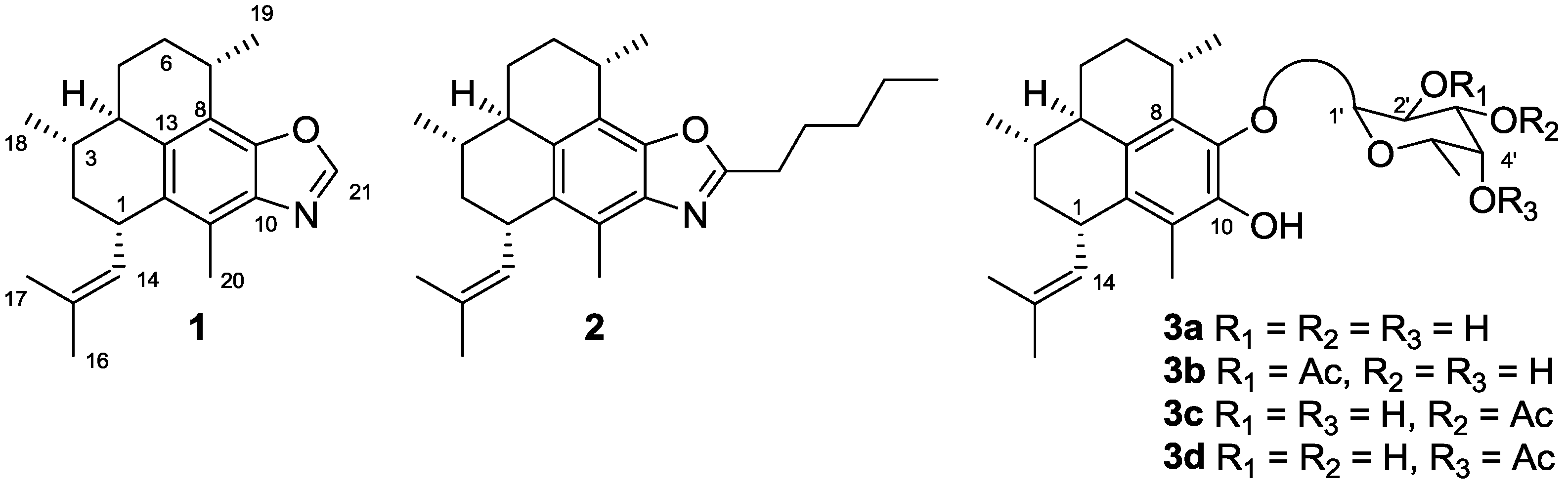
      <p>The diterpenes pseudopteroxazole (<bold>1</bold>) and homopseudopteroxazole (<bold>2</bold>) (<xref ref-type="fig" rid="marinedrugs-10-01711-f001">Figure 1</xref>) are trace marine natural products from <italic>Pseudopterogorgia</italic> <italic>elisabethae</italic> with reported activity against <italic>Mycobacterium</italic> <italic>tuberculosis</italic> H<sub>37</sub>Rv [<xref ref-type="bibr" rid="B6-marinedrugs-10-01711">6</xref>,<xref ref-type="bibr" rid="B7-marinedrugs-10-01711">7</xref>]. Despite interest in <bold>1</bold> by the synthetic chemistry community [<xref ref-type="bibr" rid="B8-marinedrugs-10-01711">8</xref>,<xref ref-type="bibr" rid="B9-marinedrugs-10-01711">9</xref>,<xref ref-type="bibr" rid="B10-marinedrugs-10-01711">10</xref>], no medicinal chemistry efforts around this scaffold were reported until our recent semi-synthesis of <bold>1</bold>, <bold>2 </bold>and 14 congeners from relatively abundant natural pseudopterosins G–J (<bold>3a</bold>–<bold>3d</bold>) [<xref ref-type="bibr" rid="B11-marinedrugs-10-01711">11</xref>]. In this earlier report we described activity against model mycobacteria (<italic>M.</italic> <italic>smegmatis</italic> and <italic>M</italic>. <italic>diernhoferi</italic>) and clinically relevant Gram-positive bacteria: methicillin-resistant <italic>Staphylococcus</italic> <italic>aureus</italic> (MRSA) and vancomycin-resistant <italic>Enterococcus</italic> <italic>faecium</italic> (VRE). The pseudopteroxazole pharmacophore is not known, thus an aim of the current study was to conduct a preliminary examination of structure-activity relationships (SAR), especially against <italic>M.</italic> <italic>tuberculosis</italic> H<sub>37</sub>Rv.</p>
      <fig id="marinedrugs-10-01711-f001" position="anchor">
        <label>Figure 1</label>
        <caption>
          <p>Structures of pseudopteroxazole (<bold>1</bold>), homopseudopteroxazole (<bold>2</bold>) and pseudopterosins G–J (<bold>3a</bold>–<bold>d</bold>).</p>
        </caption>
        <graphic xmlns:xlink="http://www.w3.org/1999/xlink" xlink:href="marinedrugs-10-01711-g001.tif"/>
      </fig>
      <p>In the previous report we examined the effect of modifying the oxazole moiety in <bold>1</bold> by synthesizing C-21 substituted derivatives of <bold>1</bold> and also by preparing isopseudopteroxazoles, which are pseudopteroxazole congeners where the location of the oxazole nitrogen and oxygen atoms are inverted. We found that appending lipophilic moieties to the C-21 oxazole decreased the antimicrobial activity against model mycobacteria, MRSA and VRE, whereas isopseudopteroxazoles and their corresponding pseudopteroxazoles exhibited similar antimicrobial activity [<xref ref-type="bibr" rid="B11-marinedrugs-10-01711">11</xref>]. We report herein the <italic>in</italic> <italic>vitro</italic> activity of the aforementioned pseudopteroxazole compound set and new structurally related compounds against <italic>M.</italic> <italic>tuberculosis</italic> H<sub>37</sub>Rv and a model of NRP-TB. Given that the pseudopterosins [<xref ref-type="bibr" rid="B12-marinedrugs-10-01711">12</xref>,<xref ref-type="bibr" rid="B13-marinedrugs-10-01711">13</xref>] are also known to possess antibiotic activity against various Gram-positive bacteria [<xref ref-type="bibr" rid="B14-marinedrugs-10-01711">14</xref>,<xref ref-type="bibr" rid="B15-marinedrugs-10-01711">15</xref>,<xref ref-type="bibr" rid="B16-marinedrugs-10-01711">16</xref>,<xref ref-type="bibr" rid="B17-marinedrugs-10-01711">17</xref>] including <italic>M.</italic> <italic>tuberculosis</italic> [<xref ref-type="bibr" rid="B15-marinedrugs-10-01711">15</xref>], we aimed to synthesize and evaluate derivatives based on the parent aglycone scaffold of both pseudopterosins G–J and pseudopteroxazole. In this regard we have: (1) substituted the oxazole moiety in <bold>1</bold> with a pyrazine to generate pseudopteroquinoxaline (<bold>5</bold>); (2) synthesized a range of pseudopteroxazole derivatives such as 21-((1<italic>H</italic>-imidazol-5-yl)methyl)-pseudopteroxazole (<bold>7a</bold>) and the regioisomer (<bold>7b</bold>), which are pseudopteroxazoles with polar, amphoteric imidazole side chains that possess activity in a NRP-TB model; (3) examined the biological effect of altering the phenolic substituents on the pseudopterosins G–J aglycone (<bold>4</bold>); and (4) synthesized small prenylated phenol derivatives and related glycosides as mimics of the pseudopterosin/pseudopteroxazole structural core.</p>
    </sec>
    <sec sec-type="results">
      <title>2. Results and Discussion</title>
      <sec>
        <title>2.1. Chemistry</title>
        <p>Pseudopteroxazoles (<bold>1</bold>, <bold>2</bold>, <bold>22</bold>–<bold>33</bold>) were synthesized as previously described [<xref ref-type="bibr" rid="B11-marinedrugs-10-01711">11</xref>]. The synthesis of the novel compounds is discussed below.</p>
        <sec>
          <title>2.1.1. Synthesis of Pseudopteroquinoxalines <bold>5</bold> and <bold>6</bold></title>
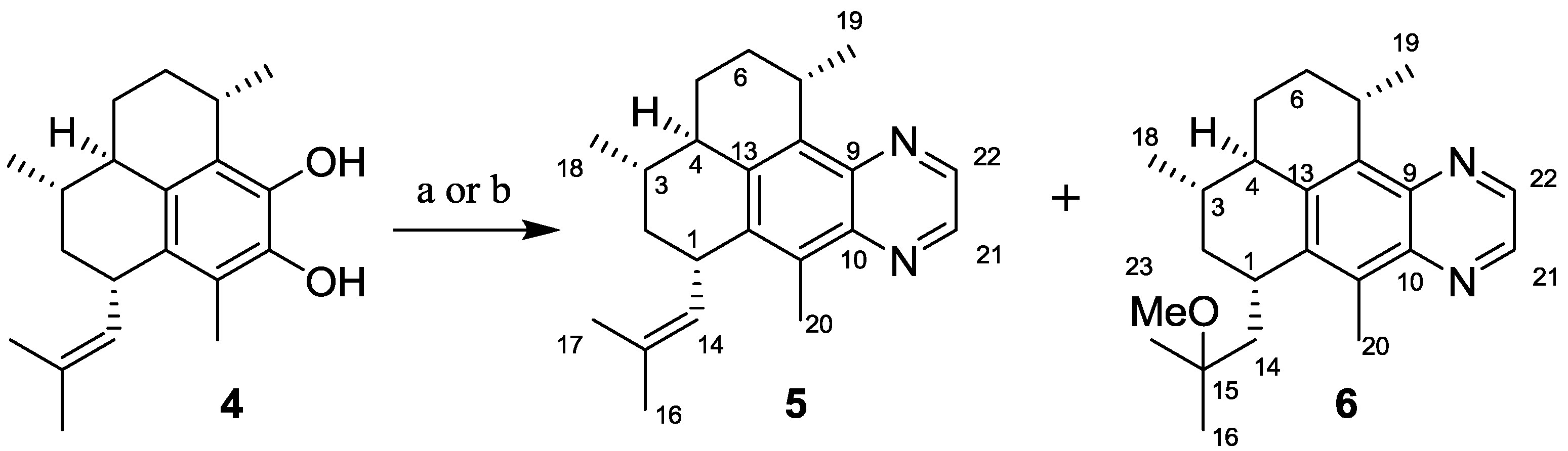
          <p>Pseudopteroquinoxaline (<bold>5</bold>) was synthesized in one-pot by oxidation of the pseudopterosin G–J aglycone (<bold>4</bold>) [<xref ref-type="bibr" rid="B18-marinedrugs-10-01711">18</xref>] with Ag<sub>2</sub>O and condensation with ethylenediamine (<xref ref-type="scheme" rid="marinedrugs-10-01711-f002">Scheme 1</xref>). In an alternative synthesis, treatment of <bold>4</bold> with Dess-Martin periodinane in DCM/MeOH, followed by reaction with ethylenediamine yielded <bold>5</bold> and the tertiary ether <bold>6</bold> as a minor side product.</p>
          <fig id="marinedrugs-10-01711-f002" position="anchor">
            <object-id pub-id-type="pii">marinedrugs-10-01711-scheme1_Scheme 1</object-id>
            <label>Scheme 1</label>
            <caption>
              <p>Reagents and conditions: (<bold>a</bold>) Ag<sub>2</sub>O (1.5 equiv.), NH<sub>2</sub>(CH<sub>2</sub>)<sub>2</sub>NH<sub>2</sub>, Δ, EtOH, for <bold>5</bold>. (<bold>b</bold>) (i) Dess-Martin periodinane (2 equiv.), NH<sub>2</sub>(CH<sub>2</sub>)<sub>2</sub>NH<sub>2</sub>, DCM/H<sub>2</sub>O/MeOH r.t.; (ii) Δ, isopropyl alcohol, for <bold>5</bold> and <bold>6</bold>.</p>
            </caption>
            <graphic xmlns:xlink="http://www.w3.org/1999/xlink" xlink:href="marinedrugs-10-01711-g002.tif"/>
          </fig>
        </sec>
        <sec>
          <title>2.1.2. Synthesis of Pseudopteroxazoles <bold>7a</bold> and <bold>7b</bold></title>
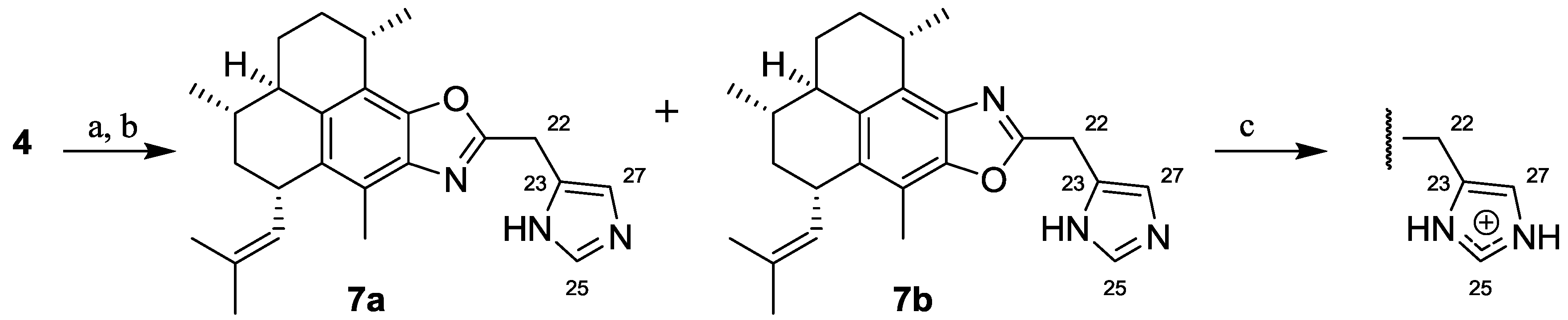
          <p>Synthesis of the novel derivatives 21-((1<italic>H</italic>-imidazol-5-yl)methyl)-pseudopteroxazole (<bold>7a</bold>) and the regioisomer (<bold>7b</bold>) followed the previously reported general method utilizing the aglycone (<bold>4</bold>), Ag<sub>2</sub>O and histidine (<xref ref-type="scheme" rid="marinedrugs-10-01711-f003">Scheme 2</xref>). After purification by flash chromatography, a mixture of <bold>7a</bold> and <bold>7b</bold> was obtained in a 2.4:1 ratio as determined by <sup>1</sup>H NMR analysis. This product regioisomer ratio differs from the ~10:1 ratio previously observed with other amino acids [<xref ref-type="bibr" rid="B11-marinedrugs-10-01711">11</xref>]. While the reasons behind this are under further investigation, it is conceivable that the nucleophilic imidazole attacks the <italic>ortho</italic>-quinone at C-10, which increases the relative rate of condensation at C-9. Separation of the regioisomers (<bold>7a</bold>/<bold>7b</bold>) proved challenging; while HPLC did not lead to peak resolution, a portion of the material was slightly enriched in <bold>7a</bold> (3:1 ratio) by peak shaving. This material (<bold>7a</bold>/<bold>7b</bold>) has been thoroughly and unambiguously characterized; spectra and analytical chromatograms are provided in the supporting information.</p>
          <fig id="marinedrugs-10-01711-f003" position="anchor">
            <object-id pub-id-type="pii">marinedrugs-10-01711-scheme2_Scheme 2</object-id>
            <label>Scheme 2</label>
            <caption>
              <p>Reagents and conditions: (<bold>a</bold>) Ag<sub>2</sub>CO<sub>3</sub> (1.4 equiv.), Δ, MeOH/H<sub>2</sub>O (10:1); (<bold>b</bold>) histidine (6.7 equiv. in batches), Δ; (<bold>c</bold>) HCO<sub>2</sub>H (HPLC purification).</p>
            </caption>
            <graphic xmlns:xlink="http://www.w3.org/1999/xlink" xlink:href="marinedrugs-10-01711-g003.tif"/>
          </fig>
        </sec>
        <sec>
          <title>2.1.3. Synthesis of Pseudopterosin Derivatives <bold>8</bold>–<bold>12</bold></title>
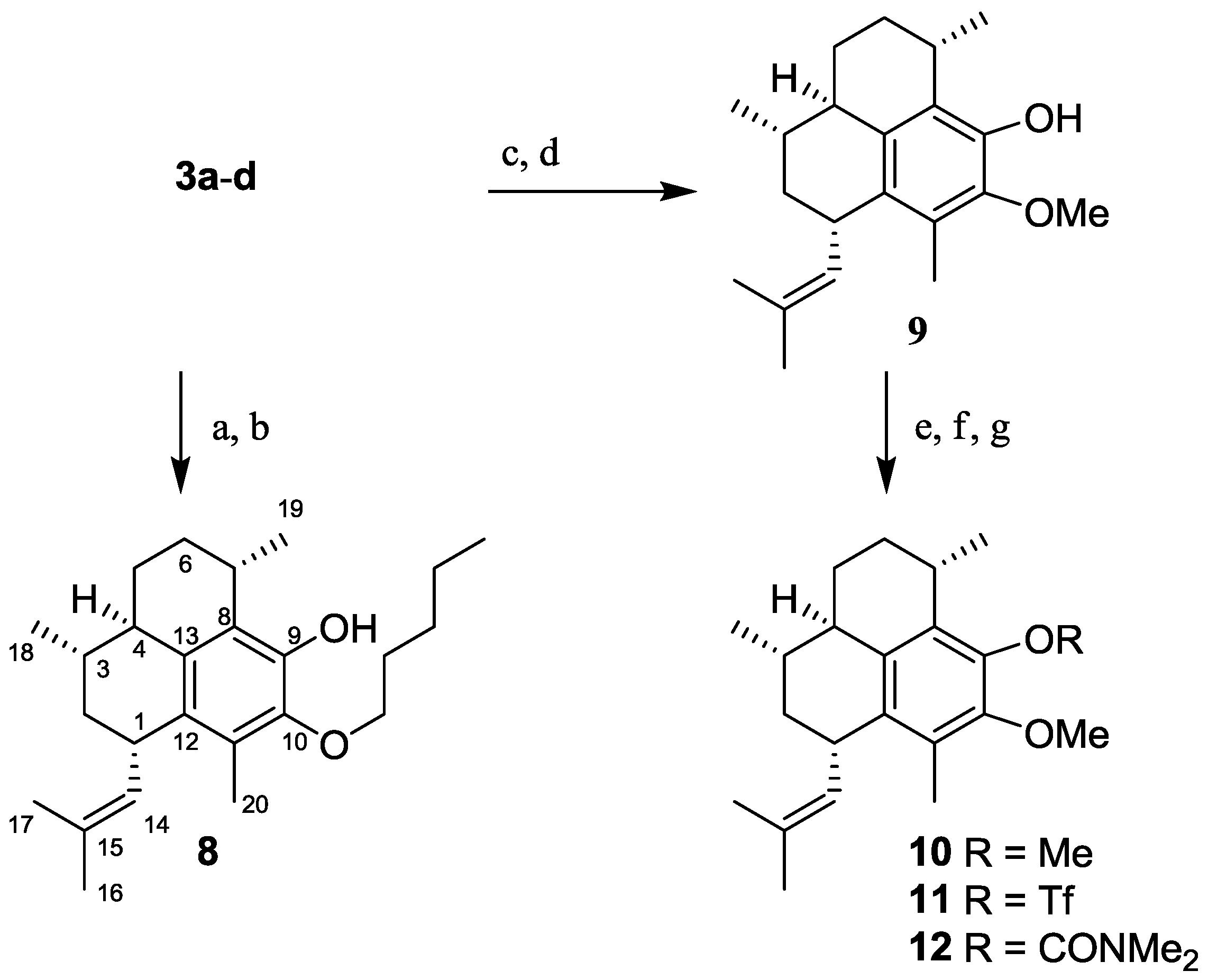
          <p>The mono-pentyl ether (<bold>8</bold>) derivative of the pseudopterosin G–J aglycone (<bold>4</bold>) was synthesized to provide a phenolic mimic of homopseudopteroxazole (<bold>2</bold>), given that <bold>2</bold> possesses a pentyl chain and was reportedly active against <italic>M.</italic> <italic>tuberculosis</italic> H<sub>37</sub>Rv [<xref ref-type="bibr" rid="B7-marinedrugs-10-01711">7</xref>]. The mono-pentyl ether (<bold>8</bold>) and mono-methyl ether (<bold>9</bold>) [<xref ref-type="bibr" rid="B19-marinedrugs-10-01711">19</xref>] were synthesized by alkylation of <bold>3a</bold>–<bold>d</bold> with iodopentane or iodomethane, respectively, followed by acid catalyzed hydrolysis of the fucose moiety (<xref ref-type="scheme" rid="marinedrugs-10-01711-f004">Scheme 3</xref>). Further substitution of the free phenol in <bold>9</bold> by treatment with the appropriate electrophile yielded the di-methyl ether (<bold>10</bold>), the triflate (<bold>11</bold>) and the carbamate (<bold>12</bold>).</p>
          <fig id="marinedrugs-10-01711-f004" position="anchor">
            <object-id pub-id-type="pii">marinedrugs-10-01711-scheme3_Scheme 3</object-id>
            <label>Scheme 3</label>
            <caption>
              <p>Reagents and conditions: (<bold>a</bold>) K<sub>2</sub>CO<sub>3</sub>, iodopentane, Δ, acetone; (<bold>b</bold>) HCl, Δ, MeOH; (<bold>c</bold>) K<sub>2</sub>CO<sub>3</sub>, MeI, Δ acetone; (<bold>d</bold>) HCl, Δ, MeOH; (<bold>e</bold>) For <bold>10</bold>, NaH, MeI, THF; (<bold>f</bold>) For <bold>11</bold>, Hunig’s base, Tf<sub>2</sub>O, DCM, 0 °C→r.t.; (<bold>g</bold>) For <bold>12</bold>, NaH, (CH<sub>3</sub>)<sub>2</sub>NCOCl, THF.</p>
            </caption>
            <graphic xmlns:xlink="http://www.w3.org/1999/xlink" xlink:href="marinedrugs-10-01711-g004.tif"/>
          </fig>
        </sec>
        <sec>
          <title>2.1.4. Synthesis of Pseudopterosin Mimics <bold>14</bold>–<bold>20</bold></title>
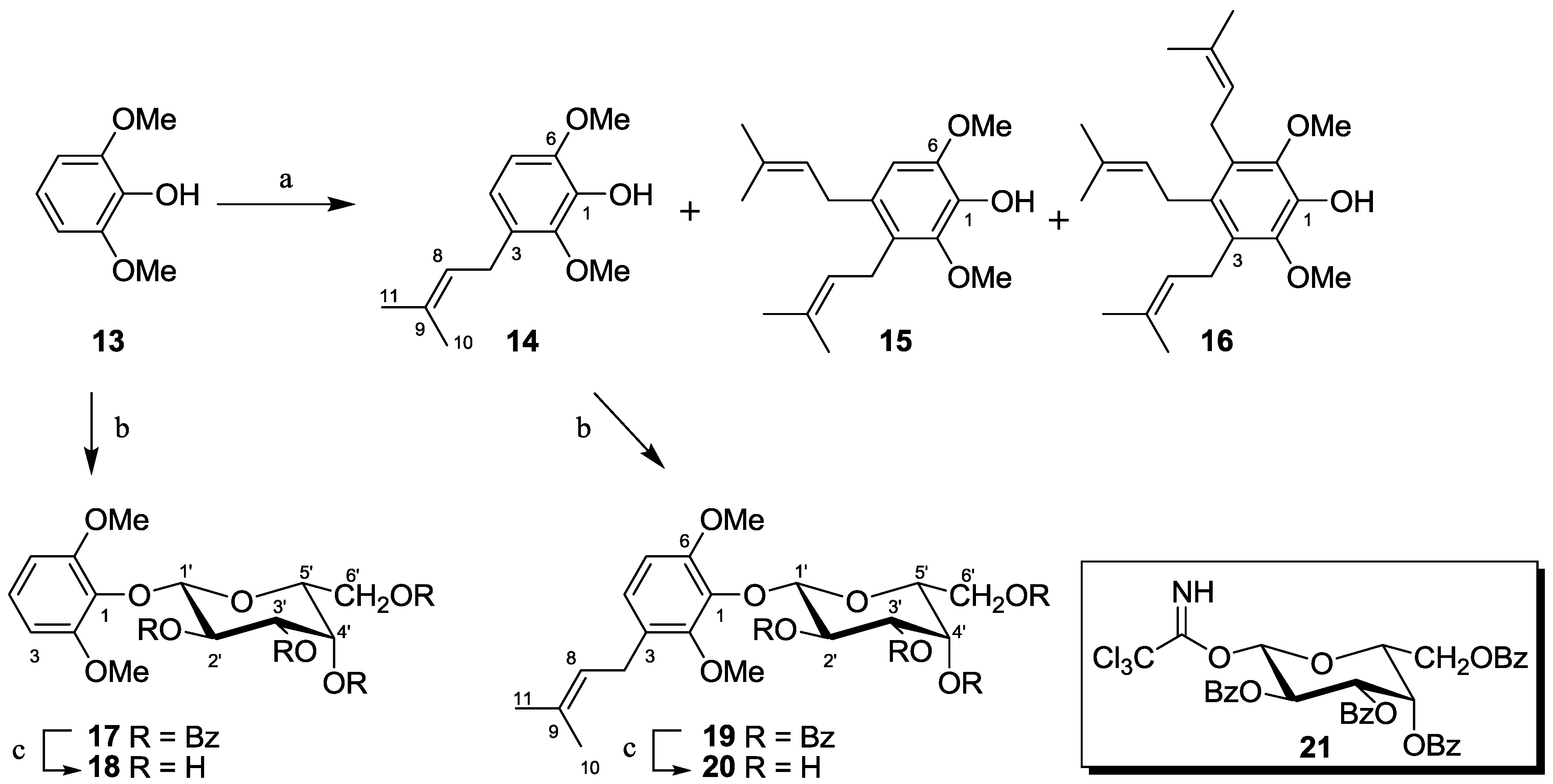
          <p>The syntheses of the prenylated aromatic mimics of pseudopterosin are shown in <xref ref-type="scheme" rid="marinedrugs-10-01711-f005">Scheme 4</xref>. Acid catalyzed reaction of 2,6-dimethoxyphenol (<bold>13</bold>) with 2-methyl-3-buten-2-ol yielded the mono-, di- and tri-prenylated derivatives (<bold>14</bold>, <bold>15</bold><italic> &amp;</italic> <bold>16</bold>). Compound <bold>13</bold> was further utilized as a model compound to develop conditions suitable for the glycosylation of these phenols. Treatment of <bold>13</bold> with the benzoylated glycosyl donor <bold>21</bold> and BF<sub>3</sub>·Et<sub>2</sub>O yielded <bold>17</bold>, which was deprotected with K<sub>2</sub>CO<sub>3</sub> to give the galactoside <bold>18</bold> in high yield. Identical reaction sequences utilizing <bold>14</bold> gave the benzoylated glycoside <bold>19</bold> followed by the desired prenylated galactoside <bold>20</bold>. Attempts to glycosylate <bold>15</bold> were unsuccessful.</p>
          <fig id="marinedrugs-10-01711-f005" position="anchor">
            <object-id pub-id-type="pii">marinedrugs-10-01711-scheme4_Scheme 4</object-id>
            <label>Scheme 4</label>
            <caption>
              <p>Reagents and conditions: (<bold>a</bold>) 2-methyl-3-buten-2-ol (1.9 equiv.), TsOH (cat.), DCM/MeOH, Δ; (<bold>b</bold>) <bold>21</bold>, BF<sub>3</sub>·Et<sub>2</sub>O,−78 °C, DCM;(<bold>c</bold>) K<sub>2</sub>CO<sub>3</sub>, MeOH:MTBE (5:1).</p>
            </caption>
            <graphic xmlns:xlink="http://www.w3.org/1999/xlink" xlink:href="marinedrugs-10-01711-g005.tif"/>
          </fig>
        </sec>
      </sec>
      <sec>
        <title>2.2. Antibacterial Activity</title>
        <sec>
          <title>2.2.1. Activity of Semi-Synthetic Pseudopteroxazoles in <italic>M. tuberculosis</italic> Assays</title>
          <p>The biological activities of fifteen semi-synthetic pseudopteroxazoles and isopseudopteroxazoles are shown in <xref ref-type="table" rid="marinedrugs-10-01711-t001">Table 1</xref>. The minimum inhibitory concentrations (MICs) against <italic>M.</italic> <italic>tuberculosis</italic> H<sub>37</sub>Rv (ATCC 27294) were determined <italic>in</italic> <italic>vitro</italic>using the microplate Alamar blue assay (MABA) [<xref ref-type="bibr" rid="B20-marinedrugs-10-01711">20</xref>]. Generally substitutions at the C-21 oxazole moiety in <bold>1</bold> lead to congeners with reduced activity against <italic>M.</italic> <italic>tuberculosis</italic> H<sub>37</sub>Rv, however, three compounds (<bold>7a</bold>/<bold>7b</bold>, <bold>22</bold> &amp; <bold>25</bold>) showed activity against <italic>M.</italic> <italic>tuberculosis</italic> H<sub>37</sub>Rv comparable to <bold>1</bold>. Semi-synthetic homopseudopteroxazole (<bold>2</bold>) was not active against <italic>M.</italic> <italic>tuberculosis</italic> H<sub>37</sub>Rv in contrast to the literature report for natural <bold>2</bold> isolated from <italic>P.</italic> <italic>elisabethae</italic>, which was reported to show 80% inhibition against <italic>M.</italic> <italic>tuberculosis</italic> H<sub>37</sub>Rv at 12.5 μg/mL (40 μM) [<xref ref-type="bibr" rid="B7-marinedrugs-10-01711">7</xref>]. Our result with <bold>2</bold> was consistent with the inactivity of other members of the series with lipophilic C-21 substituents.</p>
          <table-wrap id="marinedrugs-10-01711-t001" position="anchor">
            <object-id pub-id-type="pii">marinedrugs-10-01711-t001_Table 1</object-id>
            <label>Table 1</label>
            <caption>
              <p>Antitubercular, low-oxygen-recovery assay (LORA) and cytotoxic activity of semi-synthetic pseudopteroxazoles <italic>in</italic> <italic>vitro</italic>.</p>
            </caption>
            <table>
              <thead>
                <tr>
                  <th align="center" valign="middle">Compound</th>
                  <th align="center" valign="middle">MABA <sup>a</sup>MIC [μg/mL] (% inh)</th>
                  <th align="center" valign="middle">LORA <sup>b</sup> % inh <sup>c</sup></th>
                  <th align="center" valign="middle">LORA <sup>b</sup> MIC [μg/mL]</th>
                  <th align="center" valign="middle">Vero cell IC<sub>50</sub> [μg/mL] (% inh)</th>
                  <th align="center" valign="middle">SI <sup>d</sup></th>
                </tr>
              </thead>
              <tbody>
                <tr>
                  <td align="left" valign="middle"><bold>1</bold> (Ptx-H)</td>
                  <td align="center" valign="middle">15</td>
                  <td align="center" valign="middle">99.7</td>
                  <td align="center" valign="middle">50</td>
                  <td align="center" valign="middle">&gt;128 (0%)</td>
                  <td align="center" valign="middle">&gt;8.6</td>
                </tr>
                <tr>
                  <td align="left" valign="middle"><bold>2</bold> (Ptx-(CH<sub>2</sub>)<sub>4</sub>CH<sub>3</sub>)</td>
                  <td align="center" valign="middle">&gt;128 (6.3%)</td>
                  <td align="center" valign="middle">22.6</td>
                  <td align="center" valign="middle">NT</td>
                  <td align="center" valign="middle">&gt;128 (0%)</td>
                  <td align="center" valign="middle">NA</td>
                </tr>
                <tr>
                  <td align="left" valign="middle"><bold>7a/7b</bold> (Ptx-CH<sub>2</sub>-(1<italic>H</italic>-imidazol-5-yl)) <sup>e,f</sup></td>
                  <td align="center" valign="middle">13</td>
                  <td align="center" valign="middle">92.5</td>
                  <td align="center" valign="middle">12</td>
                  <td align="center" valign="middle">&gt;128 (4%)</td>
                  <td align="center" valign="middle">&gt;9.7</td>
                </tr>
                <tr>
                  <td align="left" valign="middle"><bold>22</bold> (<italic>iso</italic>-Ptx-H)</td>
                  <td align="center" valign="middle">14</td>
                  <td align="center" valign="middle">100.0</td>
                  <td align="center" valign="middle">44</td>
                  <td align="center" valign="middle">52</td>
                  <td align="center" valign="middle">3.6</td>
                </tr>
                <tr>
                  <td align="left" valign="middle"><bold>23</bold> (Ptx-(2-CH<sub>3</sub>O-Ph))</td>
                  <td align="center" valign="middle">&gt;82 (48%)</td>
                  <td align="center" valign="middle">83.3</td>
                  <td align="center" valign="middle">NT <sup>g</sup></td>
                  <td align="center" valign="middle">34</td>
                  <td align="center" valign="middle">NA <sup>h</sup></td>
                </tr>
                <tr>
                  <td align="left" valign="middle"><bold>24</bold> (Ptx-(4-F-Ph))</td>
                  <td align="center" valign="middle">&gt;31 (20%)</td>
                  <td align="center" valign="middle">−19.0</td>
                  <td align="center" valign="middle">NT</td>
                  <td align="center" valign="middle">&gt;31 (0%)</td>
                  <td align="center" valign="middle">NA</td>
                </tr>
                <tr>
                  <td align="left" valign="middle"><bold>25</bold> (Ptx-CH<sub>3</sub>)</td>
                  <td align="center" valign="middle">15</td>
                  <td align="center" valign="middle">99.0</td>
                  <td align="center" valign="middle">NT</td>
                  <td align="center" valign="middle">12</td>
                  <td align="center" valign="middle">0.8</td>
                </tr>
                <tr>
                  <td align="left" valign="middle"><bold>26</bold> (Ptx-CH(CH<sub>3</sub>)CH<sub>2</sub>CH<sub>3</sub>)</td>
                  <td align="center" valign="middle">&gt;103 (0%)</td>
                  <td align="center" valign="middle">59.1</td>
                  <td align="center" valign="middle">NT</td>
                  <td align="center" valign="middle">73</td>
                  <td align="center" valign="middle">NA</td>
                </tr>
                <tr>
                  <td align="left" valign="middle"><bold>27</bold> (Ptx-(CH<sub>2</sub>)<sub>2</sub>SCH<sub>3</sub>)</td>
                  <td align="center" valign="middle">106.8</td>
                  <td align="center" valign="middle">90.0</td>
                  <td align="center" valign="middle">NT</td>
                  <td align="center" valign="middle">&gt;128 (0%)</td>
                  <td align="center" valign="middle">&gt;1.2</td>
                </tr>
                <tr>
                  <td align="left" valign="middle"><bold>28</bold> (Ptx-CH<sub>2</sub>Ph)</td>
                  <td align="center" valign="middle">&gt;128 (28%)</td>
                  <td align="center" valign="middle">13.7</td>
                  <td align="center" valign="middle">NT</td>
                  <td align="center" valign="middle">82</td>
                  <td align="center" valign="middle">NA</td>
                </tr>
                <tr>
                  <td align="left" valign="middle"><bold>29</bold> (Ptx-CHOHCH<sub>3</sub>)</td>
                  <td align="center" valign="middle">53</td>
                  <td align="center" valign="middle">99.8</td>
                  <td align="center" valign="middle">NT</td>
                  <td align="center" valign="middle">24</td>
                  <td align="center" valign="middle">0.5</td>
                </tr>
                <tr>
                  <td align="left" valign="middle"><bold>30</bold> (Ptx-(CH<sub>2</sub>)<sub>2</sub>CO<sub>2</sub>CH<sub>3</sub>)</td>
                  <td align="center" valign="middle">&gt;128 (81%)</td>
                  <td align="center" valign="middle">99.1</td>
                  <td align="center" valign="middle">62</td>
                  <td align="center" valign="middle">31</td>
                  <td align="center" valign="middle">NA</td>
                </tr>
                <tr>
                  <td align="left" valign="middle"><bold>31</bold> (Ptx-(CH<sub>2</sub>)<sub>2</sub>CO<sub>2</sub>H)</td>
                  <td align="center" valign="middle">95</td>
                  <td align="center" valign="middle">99.1</td>
                  <td align="center" valign="middle">NT</td>
                  <td align="center" valign="middle">102</td>
                  <td align="center" valign="middle">1.1</td>
                </tr>
                <tr>
                  <td align="left" valign="middle"><bold>32</bold> (Ptx-(CH<sub>2</sub>)<sub>2</sub>CONH<sub>2</sub>)</td>
                  <td align="center" valign="middle">29</td>
                  <td align="center" valign="middle">99.0</td>
                  <td align="center" valign="middle">NT</td>
                  <td align="center" valign="middle">54</td>
                  <td align="center" valign="middle">1.9</td>
                </tr>
                <tr>
                  <td align="left" valign="middle"><bold>33</bold> (Ptx-CH<sub>2</sub>CONH<sub>2</sub>)</td>
                  <td align="center" valign="middle">59</td>
                  <td align="center" valign="middle">97.1</td>
                  <td align="center" valign="middle">NT</td>
                  <td align="center" valign="middle">45</td>
                  <td align="center" valign="middle">0.8</td>
                </tr>
                <tr>
                  <td align="left" valign="middle">Rifampin</td>
                  <td align="center" valign="middle">0.04</td>
                  <td align="center" valign="middle">NT</td>
                  <td align="center" valign="middle">0.93</td>
                  <td align="center" valign="middle">NT</td>
                  <td align="center" valign="middle">NA</td>
                </tr>
                <tr>
                  <td align="left" valign="middle">Isoniazid</td>
                  <td align="center" valign="middle">0.03</td>
                  <td align="center" valign="middle">NT</td>
                  <td align="center" valign="middle">&gt;128 (65%)</td>
                  <td align="center" valign="middle">NT</td>
                  <td align="center" valign="middle">NA</td>
                </tr>
                <tr style="border-bottom: solid thin">
                  <td align="left" valign="middle">PA824</td>
                  <td align="center" valign="middle">0.15</td>
                  <td align="center" valign="middle">NT</td>
                  <td align="center" valign="middle">NT</td>
                  <td align="center" valign="middle">NT</td>
                  <td align="center" valign="middle">NA</td>
                </tr>
                <tr>
                  <td colspan="6" align="center" valign="middle"><inline-graphic xmlns:xlink="http://www.w3.org/1999/xlink" xlink:href="marinedrugs-10-01711-i001.tif"/></td>
                </tr>
              </tbody>
            </table>
            <table-wrap-foot><fn><p><sup>a</sup> Microplate Alamar blue assay against <italic>M.</italic> <italic>tuberculosis</italic> H<sub>37</sub>Rv (ATCC 27294); <sup>b</sup> Low-oxygen-recovery assay against <italic>M.</italic> <italic>tuberculosis</italic> H<sub>37</sub>Rv; <sup>c</sup> % inhibition at 64 μg/mL; <sup>d</sup> Selectivity Index = (Vero Cell IC<sub>50</sub>)/(<italic>M.</italic> <italic>tuberculosis</italic> MIC); <sup>e</sup> 3:1 ratio of regioisomers (<bold>7a</bold>/<bold>7b</bold>); <sup>f</sup><bold>7a</bold>/<bold>7b</bold> also displayed activity against MRSA (IC<sub>50</sub> 3 μg/mL), VRE (IC<sub>50</sub> 7.5 μg/mL), <italic>M.</italic> <italic>smegmatis</italic> (MIC 4 μg/mL) and <italic>M.</italic> <italic>diernhoferi</italic> (MIC 2 μg/mL) and was inactive against <italic>C.</italic> <italic>albicans</italic> and <italic>P.</italic> <italic>aeruginosa</italic> at 128 μg/mL; <sup>g</sup> NT = not tested; <sup>h</sup> NA = not applicable.</p></fn></table-wrap-foot>
          </table-wrap>
          
          <p>As a measure of potential toxicity the IC<sub>50</sub> values of the pseudopteroxazoles against Vero cells [<xref ref-type="bibr" rid="B21-marinedrugs-10-01711">21</xref>] were determined, and the selectivity index was calculated (Vero cell IC<sub>50</sub>/<italic>M.</italic> <italic>tuberculosis</italic> H<sub>37</sub>Rv MIC). Only four semi-synthetic pseudopteroxazoles were non-toxic to Vero cells at 128 μg/mL: pseudopteroxazole (<bold>1</bold>), homopseudopteroxazole (<bold>2</bold>), the methionine derivative (<bold>27</bold>) and the histidine derivative (<bold>7a</bold>/<bold>7b</bold>, 4% toxicity at 128 μg/mL). Of these, two (<bold>1</bold> and <bold>7a</bold>/<bold>7b</bold>) exhibited antitubercular activity resulting in selectivity indices &gt;8.6. The cytotoxicity result for <bold>1</bold> is comparable to that observed with “natural” pseudopteroxazole (<bold>1</bold>), which was reported to show no significant cytotoxicity against the NCI-60 cell line assay [<xref ref-type="bibr" rid="B6-marinedrugs-10-01711">6</xref>]. Interestingly, isopseudopteroxazole (<bold>22</bold>) displayed toxicity towards the Vero cells (IC<sub>50</sub> 52 μg/mL), otherwise this regioisomer exhibited very similar antimicrobial activity to <bold>1</bold>.</p>
          <p>The pseudopteroxazoles were also tested at a single point concentration (64 μg/mL) in the low-oxygen-recovery assay (LORA), a model of NRP-TB [<xref ref-type="bibr" rid="B22-marinedrugs-10-01711">22</xref>]. Selected active compounds were further tested to determine LORA MICs; <bold>7a</bold>/<bold>7b</bold> showed the strongest activity, with an MIC of 12 μg/mL (<xref ref-type="table" rid="marinedrugs-10-01711-t001">Table 1</xref>). As antibiotics acting on the cell wall are typically not active against NRP-TB, the LORA activity exhibited by pseudopteroxazole and several semi-synthetic congeners suggests that the target of these compounds is not the cell wall [<xref ref-type="bibr" rid="B22-marinedrugs-10-01711">22</xref>].</p>
          <p>The semi-synthetic histidine derivative (<bold>7a</bold>/<bold>7b</bold>) is the most promising of the pseudopteroxazoles as it was non-toxic, exhibited potent broad-spectrum Gram-positive antibiotic activity and was the most active compound in assays against replicating and NRP-TB (MABA and LORA, respectively). While the MIC of <bold>7a</bold>/<bold>7b</bold> against <italic>M.</italic> <italic>tuberculosis</italic> H<sub>37</sub>Rv was moderate (13 μg/mL or 34 μM) in comparison to the first line drugs isoniazid and rifampin, its activity compares favorably to other first and second line TB treatments such as ethambutol (4.6–9.2 μM), kanamycin (2.5–10.3 μM), capreomycin (0.94–3.7 μM) and cycloserine (122–490 μM) [<xref ref-type="bibr" rid="B23-marinedrugs-10-01711">23</xref>]. One of the most promising attributes of <bold>7a</bold>/<bold>7b</bold> was that it showed greater potency in LORA (LORA MIC 12 μg/mL or 31 μM) compared to <bold>1</bold> (LORA MIC 50 μg/mL or 162 μM). Activity against NRP-TB is highly desirable given this phenotype contributes to lengthy treatment regimens leading to poor patient compliance ultimately translating into increased TB transmission rates and selection for drug-resistant strains [<xref ref-type="bibr" rid="B4-marinedrugs-10-01711">4</xref>]. As shortening of treatment times is a key goal of current TB chemotherapeutic research, this compound may represent a starting point for developing drugs that are more efficacious towards latent TB infections [<xref ref-type="bibr" rid="B1-marinedrugs-10-01711">1</xref>].</p>
          <p>Recently a diterpene that is structurally related to pseudopterosins has been shown to possess activity against <italic>M.</italic> <italic>tuberculosis</italic> H<sub>37</sub>Rv and a multidrug-resistant strain [<xref ref-type="bibr" rid="B24-marinedrugs-10-01711">24</xref>]. These examples suggest that the semi-synthetic pseudopteroxazole congeners may also display activity against drug-resistant strains. Thus, we determined MICs of <bold>1</bold> against six isogenic mono-resistant <italic>M.</italic> <italic>tuberculosis</italic> H<sub>37</sub>Rv strains (<xref ref-type="table" rid="marinedrugs-10-01711-t002">Table 2</xref>). In our study the six strains tested were singly-resistant to a structurally diverse group of antibiotics targeting a variety of cellular targets. The aminoglycosides streptomycin and kanamycin target the 30S ribosome, the fluoroquinolone moxifloxacin targets DNA gyrase, the ansamycin antibiotic rifampin targets RNA polymerase and the small heterocyclic antibiotics isoniazid and cycloserine inhibit cell wall biosynthesis, albeit via distinct mechanisms [<xref ref-type="bibr" rid="B25-marinedrugs-10-01711">25</xref>,<xref ref-type="bibr" rid="B26-marinedrugs-10-01711">26</xref>,<xref ref-type="bibr" rid="B27-marinedrugs-10-01711">27</xref>]. Pseudopteroxazole exhibited virtually identical activity against wild-type and antibiotic resistant strains. While <bold>1</bold> was significantly less potent than rifampin and isoniazid none of the antibiotic resistant strains exhibited cross-resistance to <bold>1</bold>, suggesting that it may exert its antimicrobial activity via a unique mode of action.</p>
          <table-wrap id="marinedrugs-10-01711-t002" position="anchor">
            <object-id pub-id-type="pii">marinedrugs-10-01711-t002_Table 2</object-id>
            <label>Table 2</label>
            <caption>
              <p>Susceptibility of mono-antibiotic resistant <italic>M.</italic> <italic>tuberculosis</italic> H<sub>37</sub>Rv isogenic strains to pseudopteroxazole, rifampin and isoniazid.</p>
            </caption>
            <table>
              <thead>
                <tr>
                  <th align="center" valign="middle"> </th>
                  <th colspan="7" align="center" valign="middle">MABA <sup>a</sup> MIC [μg/mL]</th>
                </tr>
                <tr>
                  <th align="center" valign="middle">Compound</th>
                  <th align="center" valign="middle" style="border-top: solid thin">H<sub>37</sub>Rv</th>
                  <th align="center" valign="middle" style="border-top: solid thin">RMP<sup>r</sup></th>
                  <th align="center" valign="middle" style="border-top: solid thin">INH<sup>r</sup></th>
                  <th align="center" valign="middle" style="border-top: solid thin">SM<sup>r</sup></th>
                  <th align="center" valign="middle" style="border-top: solid thin">KM<sup>r</sup></th>
                  <th align="center" valign="middle" style="border-top: solid thin">CS<sup>r</sup></th>
                  <th align="center" valign="middle" style="border-top: solid thin">MOX<sup>r</sup></th>
                </tr>
              </thead>
              <tbody>
                <tr>
                  <td align="left" valign="middle">
                    <bold>1</bold>
                  </td>
                  <td align="center" valign="middle">7</td>
                  <td align="center" valign="middle">8</td>
                  <td align="center" valign="middle">8</td>
                  <td align="center" valign="middle">14</td>
                  <td align="center" valign="middle">16</td>
                  <td align="center" valign="middle">14</td>
                  <td align="center" valign="middle">8</td>
                </tr>
                <tr>
                  <td align="left" valign="middle">Rifampin</td>
                  <td align="center" valign="middle">0.03</td>
                  <td align="center" valign="middle">&gt;3.3</td>
                  <td align="center" valign="middle">0.02</td>
                  <td align="center" valign="middle">0.08</td>
                  <td align="center" valign="middle">0.02</td>
                  <td align="center" valign="middle">0.01</td>
                  <td align="center" valign="middle">0.02</td>
                </tr>
                <tr>
                  <td align="left" valign="middle">Isoniazid</td>
                  <td align="center" valign="middle">0.03</td>
                  <td align="center" valign="middle">0.12</td>
                  <td align="center" valign="middle">&gt;1.10</td>
                  <td align="center" valign="middle">0.13</td>
                  <td align="center" valign="middle">0.13</td>
                  <td align="center" valign="middle">0.12</td>
                  <td align="center" valign="middle">0.03</td>
                </tr>
              </tbody>
            </table>
            <table-wrap-foot><fn><p><sup>a</sup> Microplate Alamar blue assay against wild-type <italic>M.</italic> <italic>tuberculosis</italic> H<sub>37</sub>Rv (H<sub>37</sub>Rv) and <italic>M.</italic> <italic>tuberculosis</italic> H<sub>37</sub>Rv isogenic strains resistant to rifampin (RMP<sup>r</sup>), isoniazid (INH<sup>r</sup>), streptomycin (SM<sup>r</sup>), kanamycin (KM<sup>r</sup>), cycloserine (CS<sup>r</sup>) and moxifloxacin (MOX<sup>r</sup>).</p></fn></table-wrap-foot>
          </table-wrap>
          
        </sec>
        <sec>
          <title>2.2.2. Anti-Microbial Activity of Semi-Synthetic Pseudopteroquinoxalines, Pseudopterosins, and the Prenylated Mimics</title>
          <p>The biological data of the pseudopterosin derivatives (including the pseudopteroquinoxalines) and of the prenylated aromatic mimics of pseudopterosins are summarized in <xref ref-type="table" rid="marinedrugs-10-01711-t003">Table 3</xref>. These compounds were tested <italic>in</italic> <italic>vitro</italic> against MRSA, VRE, <italic>M.</italic> <italic>smegmatis</italic> (ATCC 12051), and <italic>M.</italic> <italic>diernhoferi</italic> (ATCC 19340) using microbroth dilution antibiotic susceptibility assays. The compounds were also assessed for activity against <italic>M.</italic> <italic>tuberculosis</italic>, Vero cells and in the LORA. Natural pseudopterosins G–J (<bold>3a</bold>–<bold>d</bold>) showed the strongest activity against all pathogens, and exhibited low toxicity towards Vero cells. The mono-methyl ether (<bold>9</bold>) retained some activity against all pathogens; however, all other semi-synthetic derivatives showed significantly reduced activity against one or more organisms. Pseudopteroquinoxaline (<bold>5</bold>) was moderately active against the three mycobacteria; however, it was toxic towards the Vero cells.</p>
          <table-wrap id="marinedrugs-10-01711-t003" position="anchor">
            <object-id pub-id-type="pii">marinedrugs-10-01711-t003_Table 3</object-id>
            <label>Table 3</label>
            <caption>
              <p>Antibacterial, LORA and cytotoxicity activities of pseudopterosins, pseudopteroquinoxalines and structural mimics <italic>in</italic> <italic>vitro</italic>.</p>
            </caption>
            <table>
              <thead>
                <tr>
                  <th align="left" valign="middle"> </th>
                  <th colspan="2" align="center" valign="middle" style="border-bottom: solid thin">IC<sub>50</sub> [μg/mL]</th>
                  <th colspan="3" align="center" valign="middle" style="border-bottom: solid thin">MIC [μg/mL] (% inh)</th>
                  <th align="center" valign="middle"> </th>
                  <th align="center" valign="middle"> </th>
                  <th align="center" valign="middle"> </th>
                  <th align="center" valign="middle"> </th>
                </tr>
                <tr>
                  <th align="center" valign="middle">Compound</th>
                  <th align="center" valign="middle">MRSA <sup>a</sup></th>
                  <th align="center" valign="middle">VRE <sup>a</sup></th>
                  <th align="center" valign="middle"><italic>M.</italic> <italic>smegmatis</italic><sup>a</sup></th>
                  <th align="center" valign="middle"><italic>M.</italic> <italic>diernhoferi</italic><sup>a</sup></th>
                  <th align="center" valign="middle"><italic>M.</italic> <italic>tuberculosis</italic> <sup>b</sup> (% inh)</th>
                  <th align="center" valign="middle">LORA <sup>c</sup> % inh <sup>d</sup></th>
                  <th align="center" valign="middle">LORA <sup>c</sup> MIC [μg/mL]</th>
                  <th align="center" valign="middle">Vero cell IC<sub>50</sub> [μg/mL] (% inh)</th>
                  <th align="center" valign="middle">SI <sup>e</sup></th>
                </tr>
              </thead>
              <tbody>
                <tr>
                  <td align="left" valign="middle"><bold>3a–d</bold> <sup>f</sup> (Ps G–J mixture)</td>
                  <td align="center" valign="middle">&lt;1</td>
                  <td align="center" valign="middle">&lt;1</td>
                  <td align="center" valign="middle">2</td>
                  <td align="center" valign="middle">2</td>
                  <td align="center" valign="middle">30</td>
                  <td align="center" valign="middle">97.9</td>
                  <td align="center" valign="middle">NT <sup>g</sup></td>
                  <td align="center" valign="middle">&gt;128 (32%)</td>
                  <td align="center" valign="middle">&gt;4.3</td>
                </tr>
                <tr>
                  <td align="left" valign="middle"><bold>4</bold> <sup>f</sup> (Ps G–J aglycone)</td>
                  <td align="center" valign="middle">88</td>
                  <td align="center" valign="middle">&gt;128</td>
                  <td align="center" valign="middle">8</td>
                  <td align="center" valign="middle">8</td>
                  <td align="center" valign="middle">&gt;128 (86%)</td>
                  <td align="center" valign="middle">53.1</td>
                  <td align="center" valign="middle">NT <sup>g</sup></td>
                  <td align="center" valign="middle">50</td>
                  <td align="center" valign="middle">NA <sup>h</sup></td>
                </tr>
                <tr>
                  <td align="left" valign="middle"><bold>5</bold> (pseudopteroquinoxaline) <sup>f</sup></td>
                  <td align="center" valign="middle">&gt;128</td>
                  <td align="center" valign="middle">&gt;128</td>
                  <td align="center" valign="middle">16</td>
                  <td align="center" valign="middle">64</td>
                  <td align="center" valign="middle">29</td>
                  <td align="center" valign="middle">99.9</td>
                  <td align="center" valign="middle">NT</td>
                  <td align="center" valign="middle">22</td>
                  <td align="center" valign="middle">0.8</td>
                </tr>
                <tr>
                  <td align="left" valign="middle"><bold>6</bold> (Me ether of pseudopteroquinoxaline)</td>
                  <td align="center" valign="middle">NT</td>
                  <td align="center" valign="middle">NT</td>
                  <td align="center" valign="middle">NT</td>
                  <td align="center" valign="middle">NT</td>
                  <td align="center" valign="middle">84</td>
                  <td align="center" valign="middle">99.9</td>
                  <td align="center" valign="middle">NT</td>
                  <td align="center" valign="middle">15</td>
                  <td align="center" valign="middle">0.2</td>
                </tr>
                <tr>
                  <td align="left" valign="middle"><bold>8</bold> <sup>f</sup> (Ps G–J mono-pentyl ether)</td>
                  <td align="center" valign="middle">47</td>
                  <td align="center" valign="middle">22</td>
                  <td align="center" valign="middle">&gt;128</td>
                  <td align="center" valign="middle">&gt;128</td>
                  <td align="center" valign="middle">&gt;128 (85%)</td>
                  <td align="center" valign="middle">35.1</td>
                  <td align="center" valign="middle">NT</td>
                  <td align="center" valign="middle">49</td>
                  <td align="center" valign="middle">NA</td>
                </tr>
                <tr>
                  <td align="left" valign="middle"><bold>9</bold> <sup>f</sup> (Ps G–J mono-methyl ether)</td>
                  <td align="center" valign="middle">9</td>
                  <td align="center" valign="middle">12</td>
                  <td align="center" valign="middle">4</td>
                  <td align="center" valign="middle">4</td>
                  <td align="center" valign="middle">30</td>
                  <td align="center" valign="middle">99.7</td>
                  <td align="center" valign="middle">52</td>
                  <td align="center" valign="middle">&gt;128 (26%)</td>
                  <td align="center" valign="middle">&gt;4.3</td>
                </tr>
                <tr>
                  <td align="left" valign="middle"><bold>10</bold> <sup>f</sup> (Ps G–J di-methyl ether)</td>
                  <td align="center" valign="middle">&gt;128</td>
                  <td align="center" valign="middle">25</td>
                  <td align="center" valign="middle">&gt;64</td>
                  <td align="center" valign="middle">&gt;64</td>
                  <td align="center" valign="middle">&gt;128 (63%)</td>
                  <td align="center" valign="middle">77.5</td>
                  <td align="center" valign="middle">NT</td>
                  <td align="center" valign="middle">51</td>
                  <td align="center" valign="middle">NA</td>
                </tr>
                <tr>
                  <td align="left" valign="middle"><bold>11</bold> <sup>f</sup> (triflate)</td>
                  <td align="center" valign="middle">&gt;128</td>
                  <td align="center" valign="middle">&gt;128</td>
                  <td align="center" valign="middle">&gt;64</td>
                  <td align="center" valign="middle">&gt;64</td>
                  <td align="center" valign="middle">&gt;128 (44%)</td>
                  <td align="center" valign="middle">37.5</td>
                  <td align="center" valign="middle">NT</td>
                  <td align="center" valign="middle">51</td>
                  <td align="center" valign="middle">NA</td>
                </tr>
                <tr>
                  <td align="left" valign="middle"><bold>12</bold> <sup>f</sup> (carbamate)</td>
                  <td align="center" valign="middle">&gt;128</td>
                  <td align="center" valign="middle">70</td>
                  <td align="center" valign="middle">64</td>
                  <td align="center" valign="middle">&gt;64</td>
                  <td align="center" valign="middle">&gt;128 (77%)</td>
                  <td align="center" valign="middle">80.0</td>
                  <td align="center" valign="middle">NT</td>
                  <td align="center" valign="middle">&gt;128 (0%)</td>
                  <td align="center" valign="middle">NA</td>
                </tr>
                <tr>
                  <td align="left" valign="middle"><bold>14</bold> <sup>f</sup> (mono-prenylated mimic)</td>
                  <td align="center" valign="middle">&gt;128</td>
                  <td align="center" valign="middle">&gt;128</td>
                  <td align="center" valign="middle">128</td>
                  <td align="center" valign="middle">64</td>
                  <td align="center" valign="middle">&gt;128 (24%)</td>
                  <td align="center" valign="middle">−4.7</td>
                  <td align="center" valign="middle">NT</td>
                  <td align="center" valign="middle">44</td>
                  <td align="center" valign="middle">NA</td>
                </tr>
                <tr>
                  <td align="left" valign="middle"><bold>15</bold> <sup>f</sup> (di-prenylated mimic)</td>
                  <td align="center" valign="middle">20</td>
                  <td align="center" valign="middle">3</td>
                  <td align="center" valign="middle">8</td>
                  <td align="center" valign="middle">8</td>
                  <td align="center" valign="middle">59</td>
                  <td align="center" valign="middle">99.7</td>
                  <td align="center" valign="middle">58</td>
                  <td align="center" valign="middle">64</td>
                  <td align="center" valign="middle">1.1</td>
                </tr>
                <tr>
                  <td align="left" valign="middle"><bold>16</bold> <sup>f</sup> (tri-prenylated mimic)</td>
                  <td align="center" valign="middle">&gt;128</td>
                  <td align="center" valign="middle">3</td>
                  <td align="center" valign="middle">&gt;128</td>
                  <td align="center" valign="middle">8</td>
                  <td align="center" valign="middle">56</td>
                  <td align="center" valign="middle">79.7</td>
                  <td align="center" valign="middle">NT</td>
                  <td align="center" valign="middle">&gt;128 (29%)</td>
                  <td align="center" valign="middle">&gt;2.3</td>
                </tr>
                <tr>
                  <td align="left" valign="middle"><bold>20</bold> (galactoside of 14)</td>
                  <td align="center" valign="middle">&gt;128</td>
                  <td align="center" valign="middle">&gt;128</td>
                  <td align="center" valign="middle">&gt;128</td>
                  <td align="center" valign="middle">&gt;128</td>
                  <td align="center" valign="middle">&gt;128 (1.4%)</td>
                  <td align="center" valign="middle">−24.8</td>
                  <td align="center" valign="middle">NT</td>
                  <td align="center" valign="middle">82</td>
                  <td align="center" valign="middle">NA</td>
                </tr>
                <tr>
                  <td align="left" valign="middle">Vancomycin</td>
                  <td align="center" valign="middle">1.23</td>
                  <td align="center" valign="middle">NT</td>
                  <td align="center" valign="middle">NT</td>
                  <td align="center" valign="middle">NT</td>
                  <td align="center" valign="middle">NT</td>
                  <td align="center" valign="middle">NT</td>
                  <td align="center" valign="middle">NT</td>
                  <td align="center" valign="middle">NT</td>
                  <td align="center" valign="middle">NA</td>
                </tr>
                <tr>
                  <td align="left" valign="middle">Rifampin</td>
                  <td align="center" valign="middle">NT</td>
                  <td align="center" valign="middle">0.88</td>
                  <td align="center" valign="middle">4</td>
                  <td align="center" valign="middle">4</td>
                  <td align="center" valign="middle">0.04</td>
                  <td align="center" valign="middle">NT</td>
                  <td align="center" valign="middle">0.93</td>
                  <td align="center" valign="middle">NT</td>
                  <td align="center" valign="middle">NA</td>
                </tr>
                <tr>
                  <td align="left" valign="middle">Isoniazid</td>
                  <td align="center" valign="middle">NT</td>
                  <td align="center" valign="middle">NT</td>
                  <td align="center" valign="middle">NT</td>
                  <td align="center" valign="middle">NT</td>
                  <td align="center" valign="middle">0.03</td>
                  <td align="center" valign="middle">NT</td>
                  <td align="center" valign="middle">&gt;128 (65%)</td>
                  <td align="center" valign="middle">NT</td>
                  <td align="center" valign="middle">NA</td>
                </tr>
                <tr>
                  <td align="left" valign="middle">PA824</td>
                  <td align="center" valign="middle">NT</td>
                  <td align="center" valign="middle">NT</td>
                  <td align="center" valign="middle">NT</td>
                  <td align="center" valign="middle">NT</td>
                  <td align="center" valign="middle">0.15</td>
                  <td align="center" valign="middle">NT</td>
                  <td align="center" valign="middle">NT</td>
                  <td align="center" valign="middle">NT</td>
                  <td align="center" valign="middle">NA</td>
                </tr>
              </tbody>
  </table>
  <table-wrap-foot><fn><p><sup>a</sup> Microbroth dilution antibiotic susceptibility assay; <sup>b</sup> Microplate Alamar blue assay against <italic>M.</italic> <italic>tuberculosis</italic> H<sub>37</sub>Rv (ATCC 27294); <sup>c</sup> Low-oxygen-recovery assay against <italic>M.</italic> <italic>tuberculosis</italic> H<sub>37</sub>Rv (ATCC 27294); <sup>d</sup> % inhibition at 64 μg/mL; <sup>e</sup> Selectivity Index = (Vero Cell IC<sub>50</sub>)/(<italic>M.</italic> <italic>tuberculosis</italic> MIC); <sup>f</sup> No inhibitory activity was observed against <italic>C.</italic> <italic>albicans</italic> nor against <italic>P.</italic> <italic>aeruginosa</italic> at 128 μg/mL; <sup>g</sup> NT = not tested; <sup>h</sup> NA = not applicable.</p></fn></table-wrap-foot>
          </table-wrap>
          
          <p>The activity of the prenylated aromatic mimics is interesting: the mono-prenylated compound (<bold>14</bold>) was only weakly active against <italic>M.</italic> <italic>smegmatis</italic> and <italic>M.</italic> <italic>diernhoferi</italic>; the tri-prenylated compound (<bold>16</bold>) showed moderate activity against <italic>M.</italic> <italic>diernhoferi</italic>, and was also active against VRE and <italic>M.</italic> <italic>tuberculosis</italic>; the di-prenylated compound (<bold>15</bold>) was the most active as it showed good to moderate activity against all bacteria with an IC<sub>50</sub> of 3 μg/mL against VRE. To provide a glycoside mimic of pseudopterosins, the galactoside derivative <bold>20</bold> was synthesized from <bold>14</bold>. This synthetic galactoside was less active than the parent prenylated mimic and no additional glycosides were synthesized following unsuccessful glycosylation attempts utilizing the di-prenylated compound (<bold>15</bold>). The activity of the prenylated aromatics hints at the possibility of a simpler pharmacophore than the natural diterpene skeleton. However, more work is required here as it does not necessarily follow that these mimics operate through the same mechanism of action as the pseudopterosins/pseudopteroxazoles.</p>
        </sec>
        <sec>
          <title>2.2.3. Relevance of the Use of Model <italic>Mycobacteria</italic></title>
          <p>Due to the challenges associated with cultivating <italic>M.</italic> <italic>tuberculosis</italic> (slow growth rate, biosafety risk, biosafety level 3 containment requirements) we initially used two fast growing mycobacteria, <italic>M.</italic> <italic>smegmatis</italic> and <italic>M.</italic> <italic>diernhoferi</italic>, as model organisms to evaluate the antimycobacterial activity of the compounds described herein. The usefulness of fast growing mycobacteria to detect compounds inhibitory to the growth of TB, particularly the widely used <italic>M.</italic> <italic>smegmatis</italic>, has recently been questioned. In a comprehensive study of the relative activity of 5000 compounds against <italic>M.</italic> <italic>smegmatis</italic> and <italic>M.</italic> <italic>tuberculosis</italic>, 50% of compounds active against <italic>M.</italic> <italic>tuberculosis</italic> were not detected as active against <italic>M.</italic> <italic>smegmatis</italic> [<xref ref-type="bibr" rid="B27-marinedrugs-10-01711">27</xref>]. Despite this disparity, the use of fast growing mycobacterial models continue to have utility as a whole cell screen against <italic>M.</italic> <italic>smegmatis</italic> identified the promising new diarylquinoline, TMC207, which is currently in Phase II–III clinical trials for the treatment of multidrug-resistant TB [<xref ref-type="bibr" rid="B1-marinedrugs-10-01711">1</xref>]. In the evaluation of the series of pseudopteroxazole congeners the model mycobacteria were good predictors of antimycobacterial activity (<xref ref-type="table" rid="marinedrugs-10-01711-t001">Table 1</xref> and <xref ref-type="table" rid="marinedrugs-10-01711-t003">Table 3</xref>, and previously published data [<xref ref-type="bibr" rid="B11-marinedrugs-10-01711">11</xref>]). There were no instances of false-negative predictions (<italic>i.e.</italic>, the model organisms were insensitive to a compound which inhibited the growth of <italic>M.</italic> <italic>tuberculosis</italic>). However, there were a few instances where the model organisms predicted activity which was not mirrored by <italic>M.</italic> <italic>tuberculosis</italic> in the MABA (<bold>4</bold>, <bold>27</bold>, <bold>28</bold>, <bold>31</bold>). Interestingly, in three of these cases significant activity was observed in the LORA. These observations suggest that model mycobacteria can be a reliable predictor of <italic>M.</italic> <italic>tuberculosis</italic> activity for a particular series of molecules.</p>
        </sec>
      </sec>
    </sec>
    <sec>
      <title>3. Experimental Section</title>
      <sec sec-type="methods">
        <title>3.1. General Experimental Procedures</title>
        <p>The MABA, LORA and Vero cell assays were all conducted by the Institute for Tuberculosis Research following published protocols [<xref ref-type="bibr" rid="B20-marinedrugs-10-01711">20</xref>,<xref ref-type="bibr" rid="B21-marinedrugs-10-01711">21</xref>,<xref ref-type="bibr" rid="B22-marinedrugs-10-01711">22</xref>]. NMR spectra were obtained on a Bruker Avance III 600 MHz NMR spectrometer operating at 600 and 150 MHz for <sup>1</sup>H and <sup>13</sup>C, respectively. Chemical shifts (δ) are reported in ppm and were referenced to residual solvent signals: CDCl<sub>3</sub> (δ<sub>H</sub> 7.26; δ<sub>C</sub> 77.0), (CD<sub>3</sub>)<sub>2</sub>SO (δ<sub>H</sub> 2.50; δ<sub>C</sub> 39.52), CD<sub>3</sub>OD (δ<sub>H</sub> 3.31; δ<sub>C</sub> 49.0), C<sub>6</sub>D<sub>6</sub> (δ<sub>H</sub> 7.15; δ<sub>C</sub> 128.02). The phrase “standard work up procedure” refers to the following protocol: the organic phase is dried (MgSO<sub>4</sub>), filtered through glass wool, and then concentrated <italic>in</italic> <italic>vacuo</italic>. All other general experimental procedures and the syntheses of compounds <bold>1</bold>, <bold>2</bold>, <bold>4</bold>, &amp; <bold>22</bold>–<bold>33</bold> are identical to those previously described [<xref ref-type="bibr" rid="B11-marinedrugs-10-01711">11</xref>].</p>
      </sec>
      <sec>
        <title>3.2. Synthesis</title>
        <sec>
          <title>3.2.1. Synthesis of Pseudopteroquinoxaline (<bold>5</bold>)</title>
          <p>A sample of pseudopterosin G–J (<bold>3a</bold>–<bold>d</bold>, 20 mg, 0.041 mmol) was refluxed in methanolic HCl (1.5 N, 10 mL) under N<sub>2</sub> for 2.5 h. The crude mixture was then partitioned between EtOAc and H<sub>2</sub>O and the EtOAc phase was concentrated <italic>in</italic> <italic>vacuo</italic> to give the crude aglycone (<bold>4</bold>). This material was dissolved in EtOH (15 mL) and air was bubble through the sample for 10 min. Ethylenediamine (50 μL, excess) and Ag<sub>2</sub>O (14 mg, 0.065 mmol) were then added and the reaction was refluxed for 1.5 h. The reaction mixture was then filtered through Celite and partitioned between EtOAc and H<sub>2</sub>O. The EtOAc phase was subjected to the standard work up procedure and then purified by flash chromatography (Silica, hexane→MTBE gradient) to give <bold>5</bold> (2 mg, 0.0063 mmol, 15% over two steps). </p>
          <p><bold>5</bold>: yellow oil; [α]<sup>25</sup><sub>D</sub> +103 (<italic>c</italic> 0.03, CHCl<sub>3</sub>); IR ν<sub>max</sub> 2921, 2858, 1470 cm<sup>−1</sup>; <sup>1</sup>H NMR (CDCl<sub>3</sub>, 600 MHz) δ 8.74 (m, 2H, H-20, H-21), 5.04 (d, 1H, <italic>J</italic> = 9.1 Hz, H-14), 4.11 (app. q, 1H, <italic>J</italic> = 8.5 Hz, H-1), 4.06 (app. q, 1H, <italic>J</italic> = 7.3 Hz, H-7), 2.64 (s, 3H, H-20), 2.39-2.33 (m, 1H), 2.28–2.23 (m, 1H), 2.23–2.18 (m, 1H), 2.17–2.11 (m, 1H), 1.82 (s, 3H, H-17), 1.70 (s, 3H, H-16), 1.54 (m, 1H), 1.42–1.40 (m, 2H), 1.39 (d, 3H, <italic>J</italic> = 6.9 Hz, H-19), 1.37–1.32 (m, 1H), 1.26–1.24 (m, 1H), 1.11 (d, 3H, <italic>J</italic> = 6.2 Hz, H-18) 1.14–1.09 (m, 1H); <sup>13</sup>C NMR (CDCl<sub>3</sub>, 150 MHz) δ 142.1, 142.0, 141.9, 141.3, 141.0, 140.1, 137.0, 132.2, 129.7, 129.7, 44.3, 39.5, 37.4, 33.8, 30.7, 28.5, 26.8, 25.5, 24.7, 20.4, 17.7, 12.8; APCIMS <italic>m/z</italic> 321 [M + H]<sup>+</sup>; HRMS-ES <italic>m</italic>/<italic>z</italic> [M + H]<sup>+</sup>321.2313 (calcd for C<sub>22</sub>H<sub>29</sub>N<sub>2</sub>, 321.2325).</p>
        </sec>
        <sec>
          <title>3.2.2. Synthesis of 14,15-Dihydro-15-methoxy-pseudopteroquinoxaline (<bold>6</bold>)</title>
          <p>To a solution of the pseudopterosin aglycone (<bold>4</bold>, 26.3 mg, 0.088 mmol) in DCM (10 mL + 100 μL H<sub>2</sub>O) was added Dess-Martin periodinane (68 mg, 0.16 mmol). After stirring for 15 min, MeOH (2 mL) and ethylenediamine (1 mL) were added. After another 45 min the solvent was removed <italic>in</italic> <italic>vacuo</italic>, and then isopropyl alcohol was added (20 mL). After refluxing overnight additional ethylenediamine (200 μL) was added and the solution was refluxed for a further 24 h. The reaction products were partitioned between EtOAc and H<sub>2</sub>O and the organic phase was subjected to the standard work up procedure to give an orange brown gum (31.8 mg). Purification by flash chromatography (diol modified silica, hexane→MTBE gradient) yielded the quinoxaline (<bold>5</bold>, 4.6 mg, 16%) and the methyl ether (<bold>6</bold>, 1.6 mg, 5%). </p>
          <p><bold>6</bold>: amorphous semi solid; [α]<sup>25</sup><sub>D</sub> −5.0 (<italic>c</italic> 0.08, CHCl<sub>3</sub>); IR ν<sub>max</sub> 2925, 2866, 1470, 1079 cm<sup>−1</sup>; <sup>1</sup>H NMR (CDCl<sub>3</sub>, 600 MHz) δ 8.76 (s, 2H, H-20, H-21), 3.89 (app. q, 1H, <italic>J</italic> = 6.9 Hz), 3.71 (m, 1H), 3.20 (s, 3H, OMe), 2.79 (s, 3H, H-20), 2.49 (m, 1H), 2.21–2.15 (m, 3H), 1.89 (dd, 1H, <italic>J</italic> = 9.5, 14.5 Hz, H-14-a), 1.68–1.62 (m, 2H), 1.54–1.50 (m, 1H), 1.41 (d, 3H, <italic>J</italic> = 6.9 Hz, H-19), 1.27 (s, 6H), 1.26 (m, 2H), 1.13 (d, 3H, <italic>J</italic> = 6.5 Hz); <sup>13</sup>C NMR (CDCl<sub>3</sub>, 150 MHz) δ 144.7, 142.3, 141.8, 141.6, 141.3, 140.4, 136.5, 129.8, 75.3 (C-15), 49.2 (C-23), 48.6 (C-14), 42.3, 38.2, 34.7, 32.2, 30.3, 29.4, 25.8, 25.7, 25.4, 24.0, 21.0. 12.6; APCIMS <italic>m/z</italic> 353 [M + H]<sup>+</sup>; HRMS-ES <italic>m</italic>/<italic>z</italic> [M + H]<sup>+</sup>353.2582 (calcd for C<sub>23</sub>H<sub>33</sub>N<sub>2</sub>O, 353.2587).</p>
        </sec>
        <sec>
          <title>3.2.3. Synthesis of 21-((1<italic>H</italic>-Imidazol-5-yl)methyl)-pseudopteroxazole (<bold>7a</bold>) and 21-((1<italic>H</italic>-Imidazol-5-yl)methyl)-isopseudopteroxazole (<bold>7b</bold>)</title>
          <p>The pseudopteroxazole C-21 (1<italic>H</italic>-imidazol-4-yl)methyl derivatives (<bold>7a</bold> and <bold>7b</bold>) were synthesized from the pseudopterosin aglycone (<bold>4</bold>, 193 mg, 0.64 mmol), Ag<sub>2</sub>CO<sub>3</sub> (1.4 equiv.) and histidine (6.7 equiv.) following the previously reported general procedure [<xref ref-type="bibr" rid="B11-marinedrugs-10-01711">11</xref>]. After purification by flash chromatography (diol modified silica, hexane→MTBE gradient) the product was obtained in 23% isolated yield (57.5 mg, 2.4:1 ratio of <bold>7a</bold>/<bold>7b</bold>). A portion of this material was subjected to RP-HPLC (Phenomenex, phenylhexyl, 5 μm, 250 × 10 mm, 2.9 mL/min) eluted with MeOH:H<sub>2</sub>O:HCO<sub>2</sub>H (70:30:0.1). While the regioisomers eluted as one asymmetric peak (19.8 to 20.7 min), peak shaving lead to the isolation of an enriched fraction (3:1 ratio of normal to inverse regioisomer), which was the material used for biological evaluation. </p>
          <p><bold>7a</bold>/<bold>7b</bold> (3:1 ratio): orange immobile oil; [α]<sup>25</sup><sub>D</sub> +129.4 (<italic>c</italic> 0.09, CHCl<sub>3</sub>); IR ν<sub>max</sub> 2948, 2921, 2856, 1446, 1085 cm<sup>−1</sup>; <sup>1</sup>H and <sup>13</sup>C NMR see <xref ref-type="supplementary-material" rid="marinedrugs-10-01711-s001">Supplementary Table S1</xref>. APCIMS <italic>m/z</italic> 390 [M + H]<sup>+</sup>; MSMS spectrum see <xref ref-type="supplementary-material" rid="marinedrugs-10-01711-s001">Supplementary Figure S9</xref>; HRMS-ES <italic>m</italic>/<italic>z</italic> [M + H]<sup>+</sup> 390.2549 (calcd for C<sub>25</sub>H<sub>32</sub>N<sub>3</sub>O, 390.2540).</p>
        </sec>
        <sec>
          <title>3.2.4. Synthesis of 10-Pentoxy-pseudopterosin G–J Aglycone (<bold>8</bold>)</title>
          <p>A solution of pseudopterosins G–J (<bold>3a</bold>–<bold>d</bold>, 102 mg, 0.2 mmol), K<sub>2</sub>CO<sub>3</sub> (1 g, excess) and iodopentane (2 mL, excess) in anhydrous acetone was refluxed under N<sub>2</sub> for 18 h. The products were then partitioned between EtOAc and H<sub>2</sub>O and subjected to the standard work up procedure to give an orange/brown oil (127 mg). This crude product was then dissolved in 1.5 M HCl in MeOH (10 mL) and refluxed under N<sub>2</sub> for 2 h. The products were partitioned between EtOAc and H<sub>2</sub>O and the organic subjected to the standard work up procedure to yield the crude product, which was then purified by flash chromatography (C18, H<sub>2</sub>O→MeOH gradient) to yield the pentyl ether (<bold>8</bold>) (40.3 mg, 0.11 mmol, 52% over 2 steps). </p>
          <p><bold>8</bold>: immobile oil; [α]<sup>25</sup><sub>D</sub> +71.6 (<italic>c</italic> 0.787, CHCl<sub>3</sub>); IR ν<sub>max</sub> 3523, 2924, 2857, 1456, 1056 cm<sup>−1</sup>; <sup>1</sup>H NMR (CDCl<sub>3</sub>, 600 MHz) δ 5.70 (s, 1H), 4.97 (d, 1H, <italic>J</italic> = 9.2 Hz), 3.84 (m, 1H), 3.75 (m, 1H), 3.67 (m, 1H), 3.17 (m, 1H), 2.17 (m, 1H), 2.07 (s, 3H), 2.06–2.02 (m, 2H), 1.97 (m, 1H), 1.80 (m, 2H), 1.73 (s, 3H), 1.68 (s, 3H), 1.46 (m, 2H), 1.40 (m, 2H), 1.34–1.31 (m, 1H), 1.30 (d, 3H, <italic>J</italic> = 6.8 Hz), 1.23–1.21 (m, 2H), 1.03 (d, 3H, <italic>J</italic> = 6.0 Hz), 0.95 (m, 1H), 0.95 (t, 3H, 7.2 Hz); <sup>13</sup>C NMR (CDCl<sub>3</sub>, 150 MHz) δ 144.8, 142.8, 135.6, 131.3, 129.8, 128.3, 126.7, 125.5, 73.6, 44.7, 40.2, 37.0, 34.0, 32.1, 30.1, 28.8, 28.2, 27.8, 25.4, 23.0, 22.6, 20.0, 17.5, 14.0, 12.7; APCIMS <italic>m/z</italic> 371 [M + H]<sup>+</sup>; HRMS-ES <italic>m</italic>/<italic>z</italic> [M + H]<sup>+</sup> 371.2942 (calcd for C<sub>25</sub>H<sub>39</sub>O<sub>2</sub>, 371.2945).</p>
        </sec>
        <sec>
          <title>3.2.5. Synthesis of 9,10-Dimethoxy-pseudopterosin G–J Aglycone (<bold>10</bold>)</title>
          <p>A stirred solution of <bold>9</bold> [<xref ref-type="bibr" rid="B19-marinedrugs-10-01711">19</xref>] (25.5 mg, 0.083 mmol) in dry THF (5 mL), under N<sub>2</sub>, was allowed to react with an excess of NaH for 2 h. Iodomethane (200 μL, excess) was then added and the solution was left stirring at room temperature overnight. The reaction was then carefully quenched with MeOH (1 mL), and excess iodomethane was removed under a stream of N<sub>2</sub>. The products were then partitioned between EtOAc and H<sub>2</sub>O. The EtOAc fraction was subjected to the standard work up procedure to give the crude product which was purified by flash chromatography (silica, hexane→MTBE gradient) to yield the desired dimethyl ether (<bold>10</bold>) (18.2 mg, 0.055 mmol, 67%). </p>
          <p><bold>10</bold>: amorphous solid; [α]<sup>25</sup><sub>D</sub> +69.5 (<italic>c</italic> 0.573, CHCl<sub>3</sub>); IR ν<sub>max</sub> 2924, 2861, 1460, 1069 cm<sup>−1</sup>; <sup>1</sup>H NMR (CDCl<sub>3</sub>, 600 MHz) δ 4.99 (d, 1H, <italic>J</italic> = 9.2 Hz), 3.88 (s, 3H), 3.81 (s, 3H), 3.73 (q, 1H, <italic>J</italic> = 8.8 Hz), 3.26 (m, 1H), 2.15–2.05 (m, 3H), 2.11 (s, 3H), 2.00 (m, 1H), 1.76 (br s, 3H), 1.71 (br s, 3H), 1.39 (m, 1H), 1.31–1.23 (m, 2H), 1.28 (d, 3H, <italic>J</italic> = 6.9 Hz), 1.07 (d, 3H, <italic>J</italic> = 6.0 Hz), 0.98 (m, 1H); <sup>13</sup>C NMR (CDCl<sub>3</sub>, 150 MHz) δ 149.4, 149.0, 135.3, 134.0, 133.0, 130.9, 128.5, 128.4, 60.1, 59.8, 44.0, 40.1, 37.3, 34.0, 31.3, 28.3, 27.5, 25.4, 24.3, 20.0, 17.5, 12.1; APCIMS <italic>m/z</italic> 329 [M + H]<sup>+</sup>; HRMS-ES <italic>m</italic>/<italic>z</italic> [M + H]<sup>+</sup> 329.2459 (calcd for C<sub>22</sub>H<sub>33</sub>O<sub>2</sub>, 329.2475).</p>
        </sec>
        <sec>
          <title>3.2.6. Synthesis of 9-Trifluoromethylsulfonyloxy-10-methoxy-pseudopterosin G–J Aglycone (<bold>11</bold>)</title>
          <p>Triflic anhydride (6 mmol) in DCM was added to a stirred, ice-cooled solution of <bold>9</bold> (178 mg, 0.56 mmol) and Hunig’s base (2 mL) in dry toluene (8 mL). The reaction was stirred under N<sub>2</sub>, and allowed to warm to room overnight before being partitioned between DCM and aqueous HCl (1 N). The organic phase was subjected to the standard work up procedure to yield the crude triflate; purification was achieved by flash chromatography (silica, hexane→EtOAc gradient) to yield the triflate (<bold>11</bold>, 177 mg, 0.4 mmol, 70%, ~90% pure by ELSD LCMS). A portion of the product was further purified by RP-HPLC (Phenomenex, phenylhexyl, 5 μm, 250 × 10 mm, 4.0 mL/min) using a gradient of MeOH/H<sub>2</sub>O (9:1 for 1 min, then to 10:0 over 1–4 min; eluted across 9.9 to 10.25 min). </p>
          <p><bold>11</bold>: amorphous solid; [α]<sup>25</sup><sub>D</sub> +62.8 (<italic>c</italic> 0.205, CHCl<sub>3</sub>); IR ν<sub>max</sub> 2928, 2869, 1416, 1206, 1139 cm<sup>−1</sup>; <sup>1</sup>H NMR (CDCl<sub>3</sub>, 600 MHz) δ 4.93 (d, 1H, <italic>J</italic> = 9.3 Hz), 3.74 (s, 3H), 3.72 (m, 1H,), 3.23 (dd, 1H, <italic>J</italic> = 7.2, 14.6 Hz), 2.18–2.06 (m, 3H), 2.12 (s, 3H), 2.01 (m, 1H), 1.74 (br s, 3H), 1.70 (br s, 3H), 1.37 (m, 1H), 1.26–1.21 (m, 2H), 1.25 (d, 3H, <italic>J</italic> = 6.9 Hz), 1.04 (d, 3H, <italic>J</italic> = 5.9 Hz), 0.97 (m, 1H); <sup>13</sup>C NMR (CDCl<sub>3</sub>, 150 MHz) δ 147.9, 140.1, 139.7, 136.7, 132.6, 129.7 (2 × C), 129.5, 118.7 (q, <italic>J</italic> = 320 Hz), 117.6, 60.8, 44.0, 39.8, 37.4, 33.9, 30.9, 28.6, 27.0, 25.4, 23.3, 19.8, 17.6, 12.5; APCIMS <italic>m/z</italic> 447 [M + H]<sup>+</sup>; HRMS-ES <italic>m</italic>/<italic>z</italic> [M + H]<sup>+</sup> 447.1804 (calcd for C<sub>22</sub>H<sub>30</sub>F<sub>3</sub>O<sub>4</sub>S, 447.1811).</p>
        </sec>
        <sec>
          <title>3.2.7. Synthesis of 9-Dimethylcarbamoyloxy-10-methoxy-pseudopterosin G–J Aglycone (<bold>12</bold>)</title>
          <p>A stirred solution of <bold>9</bold> (25.5 mg, 0.083 mmol) in dry THF (5 mL), under N<sub>2</sub>, was allowed to react with an excess of NaH for 2 h. Dimethylcarbamoyl chloride (200 μL, excess) was then added and the solution was stirred overnight. The reaction was then carefully quenched with MeOH (1 mL) and the products were portioned between EtOAc and H<sub>2</sub>O. The EtOAc fraction was subjected to the standard work up procedure to give the crude product which was purified by flash chromatography (silica, hexane→MTBE gradient) to yield the carbamate (<bold>12</bold>, 13.7 mg, 0.035 mmol, 43%). </p>
          <p>Carbamate (<bold>12</bold>): amorphous solid; [α]<sup>25</sup><sub>D</sub> +110.2 (<italic>c</italic> 0.07, CHCl<sub>3</sub>); IR ν<sub>max</sub> 2924, 2861, 1723 (CO), 1451, 1386, 1164 cm<sup>−1</sup>; <sup>1</sup>H NMR (CDCl<sub>3</sub>, 600 MHz) δ 4.97 (d, 1H, <italic>J</italic> = 9.2 Hz), 3.70 (s, 3H), 3.71–3.67 (m, 1H), 3.16 (s, 3H), 3.04 (s, 3H), 3.03 (m, 1H), 2.14–2.10 (m, 2H), 2.07 (s, 3H), 2.07–2.02 (m, 2H), 1.98–1.94 (m, 1H) 1.73 (br s, 3H), 1.68 (br s, 3H), 1.34–1.16 (m, 6H), 1.01 (d, 3H, <italic>J</italic> = 6.1 Hz), 0.99 (m, 1H); <sup>13</sup>C NMR (CDCl<sub>3</sub>, 150 MHz) δ 154.6, 148.6, 140.9, 136.4, 135.3, 130.6, 129.6, 128.7, 128.3, 60.5, 44.2, 40.0, 37.3, 36.8, 36.4, 33.7, 31.5, 28.6, 27.3, 25.4, 23.8, 19.9, 17.5, 12.3; APCIMS <italic>m/z</italic> 386 [M + H]<sup>+</sup>; HRMS-ES <italic>m</italic>/<italic>z</italic> [M + Na]<sup>+</sup> 408.2505 (calcd for C<sub>24</sub>H<sub>35</sub>NO<sub>3</sub>Na, 408.2509).</p>
        </sec>
        <sec>
          <title>3.2.8. Prenylation of 2,6-Dimethoxyphenol: Synthesis of <bold>14</bold>, <bold>15</bold> <italic>&amp;</italic> <bold>16</bold></title>
          <p>A solution of 2-methyl-3-buten-2-ol (640 mg, 7.4 mmol) in DCM (3 mL) was added dropwise to a stirred mixture of 2,6-dimethoxyphenol (<bold>13</bold>, 612 mg, 3.97 mmol) and TsOH (19 mg, cat) in DCM/MeOH (3:1, 30 mL). After stirring for 96 h at room temperature the solution was refluxed for 20 h and then partitioned between H<sub>2</sub>O and EtOAc. The organic phase was subjected to the standard work up procedure to yield a crude oil (793 mg) which was subjected to flash chromatography (C18, H<sub>2</sub>O→MeOH gradient) to yield the mono-prenylated product (<bold>14</bold>, 239 mg, 1.08 mmol, 27%), the di-prenylated product (<bold>15</bold>, 96 mg, 0.33 mmol, 8%), and the triprenylated product (<bold>16</bold>, 20 mg, 0.055 mmol, 1.4%) along with recovered starting material (321 mg, 52%).</p>
          <p>2,6-Dimethoxy-3-(3-methylbut-2-enyl)phenol (<bold>14</bold>): oil; IR ν<sub>max</sub> 3456, 2931, 2835, 1493, 1288, 1090 cm<sup>−1</sup>; <sup>1</sup>H NMR (CDCl<sub>3</sub>, 600 MHz) δ 6.63 (d, 1H, <italic>J</italic> = 8.5 Hz), 6.60 (d, 1H, <italic>J</italic> = 8.4 Hz), 5.53 (s, 1H, OH), 5.27 (m, 1H, H-8), 3.863 (s, 3H, OMe), 3.861 (s, 3H, OMe), 3.30 (d, 2H, <italic>J</italic> = 7.3 Hz); 1.73 (s, 6H, H-10 &amp; H-11); <sup>13</sup>C NMR (CDCl<sub>3</sub>, 150 MHz) δ 145.9, 145.2, 138.5, 132.0, 127.8, 123.1, 119.1, 106.4, 60.4, 56.2, 28.0, 25.7, 17.7; APCIMS <italic>m/z</italic> 223 [M + H]<sup>+</sup>; HRMS-ES <italic>m</italic>/<italic>z</italic> [M + Na]<sup>+</sup> 245.1142 (calcd for C<sub>13</sub>H<sub>18</sub>O<sub>3</sub>Na, 245.1148).</p>
          <p>2,6-Dimethoxy-3,4-bis(3-methylbut-2-enyl)phenol (<bold>15</bold>): pale yellow oil; IR ν<sub>max</sub> 3440, 2964, 2912, 1854, 1497, 1309, 1116 cm<sup>−1</sup>; <sup>1</sup>H NMR (CDCl<sub>3</sub>, 600 MHz) δ 6.50 (s, 1H, H-5), 5.23 (m, 1H, olefinic), 5.07 (m, 1H, olefinic), 3.85 (s, 3H, OMe), 3.83 (s, 3H, OMe), 3.32 (d, 2H, <italic>J</italic> = 6.5 Hz), 3.25 (d, 2H, <italic>J</italic> = 6.5 Hz), 1.77 (s, 3H), 1.75 (s, 3H), 1.71 (s, 3H), 1.68 (s, 3H). <sup>13</sup>C NMR (CDCl<sub>3</sub>, 150 MHz) δ 145.5, 145.4, 136.7, 132.1, 131.0 (2 × C), 126.0, 123.7, 123.4, 107.6, 60.6, 56.1, 31.4, 25.7, 25.6, 25.1, 17.9, 17.8; APCIMS <italic>m/z</italic> 291 [M + H]<sup>+</sup>; HRMS-ES <italic>m</italic>/<italic>z</italic> [M + Na]<sup>+</sup> 313.1763 (calcd for C<sub>18</sub>H<sub>26</sub>O<sub>3</sub>Na, 313.1774).</p>
          <p>2,6-Dimethoxy-3,4,5-tris(3-methylbut-2-enyl)phenol (<bold>16</bold>): colorless oil; IR ν<sub>max</sub> 3400, 2964, 2912, 2855, 1456, 1087 cm<sup>−1</sup>; <sup>1</sup>H NMR (CDCl<sub>3</sub>, 600 MHz) δ 5.49 (s, 1H, OH), 5.09 (m, 2H, olefinic), 4.97 (m, 1H, olefinic), 3.80 (s, 6H, OMe), 3.32 (d, 4H, <italic>J</italic> = 6.5 Hz), 3.23 (d, 2H, <italic>J</italic> = 6.0 Hz), 1.74 (s, 6H), 1.68 (broad overlapping singlets, 12H). <sup>13</sup>C NMR (CDCl<sub>3</sub>, 150 MHz) δ 144.2, 140.1, 131.2, 131.0, 130.7, 129.5, 123.9, 123.8, 60.9, 27.8 (2 × C), 25.6, 25.55, 25.53, 17.90, 17.91; APCIMS <italic>m/z</italic> 359 [M + H]<sup>+</sup>; HRMS-ES <italic>m</italic>/<italic>z</italic> [M + Na]<sup>+</sup> 381.2409 (calcd for C<sub>23</sub>H<sub>34</sub>O<sub>3</sub>Na, 381.2400).</p>
        </sec>
        <sec>
          <title>3.2.9. Synthesis of the Glycosyl Donor 2,3,4,6-Tetra-<italic>O</italic>-benzoyl-β-<sc>D</sc>-galactopyranosyl Trichloroacetimidate (<bold>21</bold>)</title>
          <p>The glycosyl donor was synthesized from 2,3,4,6-tetra-<italic>O</italic>-benzoyl-α-<sc>D</sc>-galactopyranosyl bromide, which was freshly prepared using a previously described method [<xref ref-type="bibr" rid="B28-marinedrugs-10-01711">28</xref>]. The glycosyl bromide (2.05 g, 3.11 mmol) was hydrolyzed and subsequently reacted with trichloroacetonitrile according to existing methodology to provide the glycosyl donor <bold>21</bold> (704 mg, 0.951 mmol, 31% over two steps) [<xref ref-type="bibr" rid="B29-marinedrugs-10-01711">29</xref>].</p>
        </sec>
        <sec>
          <title>3.2.10. Synthesis of 2,6-Dimethoxyphenol-2,3,4,6-tetra-<bold>O</bold>-benzoyl-β-<sc>D</sc>-galactopyranoside (<bold>17</bold>)</title>
          <p>2,6-Dimethoxyphenol (<bold>13</bold>, 30.0 mg, 0.195 mmol) and freshly prepared benzoylated glycosyl donor (<bold>21</bold>, 151.0 mg, 0.229 mmol) were dissolved in 8 mL anhydrous DCM and stirred with 3Å molecular sieves (500 mg) under a N<sub>2</sub> atmosphere for 20 min. Afterwards, the mixture was cooled to −78 °C and BF<sub>3</sub>·Et<sub>2</sub>O (0.206 mmol) was added. After stirring for 2.5 h at −78 °C, the glycosyl donor was completely consumed as indicated by TLC. The reaction was quenched with Et<sub>3</sub>N (100 μL, excess), filtered, diluted with EtOAc, and partitioned with H<sub>2</sub>O. The EtOAc phase was recovered and concentrated <italic>in</italic> <italic>vacuo</italic> to provide the crude galactoside. Purification by flash chromatography (silica, hexane→MTBE gradient), yielded <bold>17</bold> (101.9 mg, 0.139 mmoles, 71%). </p>
          <p><bold>17</bold>: white solid; [α]<sup>25</sup><sub>D</sub> +67.4 (<italic>c</italic> 0.1917, CH<sub>2</sub>Cl<sub>2</sub>); IR ν<sub>max</sub> 3065, 2962, 2939, 2838, 1726, 1601, 1479, 1258, 1109, 1069, 709 cm<sup>−1</sup>; <sup>1</sup>H NMR (C<sub>6</sub>D<sub>6</sub>, 600 MHz) δ 8.11 (d, 2H, <italic>J</italic> = 7.8 Hz), 8.10 (d, 2H, <italic>J</italic> = 7.8 Hz), 8.07 (d, 2H, <italic>J</italic> = 7.8 Hz), 8.00 (d, 2H, <italic>J</italic> = 7.8 Hz), 7.10 (t, 1H, <italic>J</italic> = 7.5 Hz), 7.06 (t, 1H, <italic>J</italic> = 7.5 Hz), 7.03 (t, 2H, <italic>J</italic> = 7.7 Hz), 7.01 (t, 1H, <italic>J</italic> = 7.5 Hz), 6.92 (t, 2H, <italic>J</italic> = 7.6 Hz), 6.91 (t, 2H, <italic>J</italic> = 7.6 Hz), 6.85 (t, 1H, <italic>J</italic> = 7.5 Hz), 6.78 (t, 1H, <italic>J</italic> = 8.4 Hz, H-4), 6.73 (t, 2H, <italic>J</italic> = 7.7 Hz), 6.60 (dd, 1H, <italic>J</italic> = 10.4, 7.9 Hz, H-2′), 6.23 (d, 2H, <italic>J</italic> = 8.4 Hz, H-3), 6.14 (dd, 1H, <italic>J</italic> = 3.6, 1.2 Hz, H-4′), 5.80 (dd, 1H, <italic>J</italic> = 10.4, 3.6 Hz, H-3′), 5.44 (d, 1H, <italic>J</italic> = 7.9 Hz, H-1′), 4.67 (dd, 1H, <italic>J</italic> = 11.3, 6.6 Hz, H-6′), 4.36 (dd, 1H, <italic>J</italic> = 11.3, 6.6 Hz, H-6′), 3.66 (app. ddd, 1H, <italic>J</italic> = 6.6, 1.2 Hz, H-5′), 3.25 (s, 6H, OMe); <sup>13</sup>C NMR (C<sub>6</sub>D<sub>6</sub>, 150 MHz) δ 165.9, 165.8, 165.7, 165.4, 153.9 (C-2), 136.1 (C-1), 133.2, 133.1, 133.0, 132.7, 130.8, 130.5, 130.3, 130.1, 130.1, 130.0, 129.7, 129.6, 128.8, 128.6, 128.4, 128.3, 124.6 (C-4), 106.1 (C-3), 103.1 (C-1′), 72.7 (C-3′), 71.9 (C-5′), 71.4 (C-2′), 68.8 (C-4′), 62.3 (C-6′), 55.9 (OMe); HRMS-ES <italic>m/z</italic> [M + Na]<sup>+</sup> 755.2088 (calcd for C<sub>42</sub>H<sub>36</sub>O<sub>12</sub>Na, 755.2099).</p>
        </sec>
        <sec>
          <title>3.2.11. Synthesis of 2,6-Dimethoxyphenol-β-<sc>D</sc>-galactopyranoside (<bold>18</bold>)</title>
          <p>Compound <bold>17</bold> (40.3 mg, 55.0 μmol) was stirred with K<sub>2</sub>CO<sub>3</sub> (38.8 mg) in 3 mL MeOH:MTBE (5:1) for 20 h. After deprotection was completed, as indicated by TLC (silica, hexane/MTBE), the reaction mixture was diluted with H<sub>2</sub>O and desalted by solid phase extraction (C18, 1:19 MeOH:H<sub>2</sub>O). The product was eluted with MeOH and purified by flash chromatography (C18, H<sub>2</sub>O→MeOH gradient) to provide <bold>18</bold> (12.5 mg, 39.5 μmol, 72%). </p>
          <p><bold>18</bold>: colorless solid; [α]<sup>25</sup><sub>D</sub> −15.9 (<italic>c</italic> 0.8333, CH<sub>2</sub>Cl<sub>2</sub>); IR ν<sub>max</sub> 3388, 3008, 2940, 2841, 1599, 1480, 1256, 1108, 1072 cm<sup>−1</sup>; <sup>1</sup>H NMR ((CD<sub>3</sub>)<sub>2</sub>SO, 600 MHz) δ 6.97 (t, 1H, <italic>J</italic> = 8.4 Hz, H-4), 6.66 (d, 2H, <italic>J</italic> = 8.4 Hz, H-3), 4.83 (d, 1H, <italic>J</italic> = 7.6 Hz, H-1′), 4.79–4.74 (m, 2H, C-2′/3′-OH), 4.50-4.44 (m, 2H, C-4′/6′-OH), 3.74 (s, 6H, OMe), 3.67 (app. t, 1H, <italic>J</italic> = 3.3 Hz, H-4′), 3.56–3.52 (m, 1H, H-2′), 3.56–3.52 (m, 1H, H-6′), 3.37–3.33 (m, 1H, H-3′), 3.36–3.32 (m, 1H, H-6′), 3.27 (app. t, 1H, <italic>J</italic> = 6.3 Hz, H-5′); <sup>13</sup>C NMR ((CD<sub>3</sub>)<sub>2</sub>SO, 150 MHz) δ 153.0 (C-2), 134.9 (C-1), 123.7 (C-4), 106.6 (C-3), 103.5 (C-1′), 75.5 (C-5′), 73.2 (C-3′), 71.4 (C-2′), 67.9 (C-4′), 60.1 (C-6′), 56.4 (OMe); HRMS-ES <italic>m/z</italic> [M + Na]<sup>+</sup> 339.1043 (calcd for C<sub>14</sub>H<sub>20</sub>O<sub>8</sub>Na, 339.1050).</p>
        </sec>
        <sec>
          <title>3.2.12. Synthesis of 2,6-Dimethoxy-3-(3-methylbut-2-enyl)phenol-2,3,4,6-tetra-<italic>O</italic>-benzoyl-β-<sc>D</sc>-galactopyranoside (<bold>19</bold>)</title>
          <p>The glycosylation procedure, described for the synthesis of <bold>17</bold>, was repeated using the benzoylated glycosyl donor (<bold>21</bold>, 175.6 mg, 0.266 mmol) and <bold>14</bold> (44.6 mg, 0.201 mmol) as the glycosyl accepting substrate. The reaction crude was separated by flash chromatography (silica, hexane→MTBE gradient) to provide <bold>19</bold> (149.1 mg, 0.186 mmol, 93%). </p>
          <p><bold>19</bold>: pale yellow solid; [α]<sup>25</sup><sub>D</sub> +75.9 (<italic>c</italic> 0.225, CH<sub>2</sub>Cl<sub>2</sub>); IR ν<sub>max</sub> 3063, 2966, 2936, 1726, 1602, 1493, 1451, 1094, 1069, 709 cm<sup>−1</sup>; <sup>1</sup>H NMR (CD<sub>3</sub>OD, 600 MHz) δ 8.13 (d, 2H, <italic>J</italic> <italic>=</italic> 7.7 Hz), 7.90 (d, 4H, <italic>J</italic> <italic>=</italic> 7.8 Hz), 7.75 (d, 2H, <italic>J</italic> <italic>=</italic> 7.8 Hz), 7.67 (t, 1H, <italic>J</italic> <italic>=</italic> 7.7 Hz), 7.57 (t, 1H, <italic>J</italic> <italic>=</italic> 7.7 Hz), 7.54 (t, 2H, <italic>J</italic> <italic>=</italic> 7.7 Hz), 7.51 (t, 1H, <italic>J</italic> <italic>=</italic> 7.7 Hz), 7.45 (t, 1H, <italic>J</italic> <italic>=</italic> 7.6 Hz), 7.40 (t, 2H, <italic>J</italic> <italic>=</italic> 7.7 Hz), 7.36 (t, 2H, <italic>J</italic> <italic>=</italic> 7.7 Hz), 7.25 (t, 2H, <italic>J</italic> <italic>=</italic> 7.7 Hz), 6.80 (d, 1H, <italic>J</italic> = 8.6 Hz, H-4), 6.54 (d, 1H, <italic>J</italic> = 8.6 Hz, H-5), 6.03 (dd, 1H, <italic>J</italic> = 10.3, 8.0 Hz, H-2′), 6.00 (app. d, 1H, <italic>J</italic> = 3.4 Hz, H-4′), 5.78 (dd, 1H, <italic>J</italic> = 10.3, 3.4 Hz, H-3′), 5.64 (d, 1H, <italic>J</italic> = 8.0 Hz, H-1′), 5.14 (app. t, 1H, <italic>J</italic> = 7.4 Hz, H-8), 4.58 (dd, 1H, <italic>J</italic> = 10.8, 7.0 Hz, H-6′), 4.54 (app. dd, 1H, <italic>J</italic> = 7.0, 4.9 Hz, H-5′), 4.47 (dd, 1H, <italic>J</italic> = 10.8, 4.9 Hz, H-6′), 3.75 (s, 3H, C2-OMe), 3.53 (s, 3H, C6-OMe), 3.17-3.09 (m, 2H, H-7), 1.67 (s, 3H, H-10), 1.64 (s, 3H, H-11); <sup>13</sup>C NMR (CD<sub>3</sub>OD, 150 MHz) δ 167.5, 167.3, 167.1, 166.8, 152.7 (C-2), 152.6 (C-6), 139.9 (C-1), 134.9, 134.6, 134.5, 134.4, 134.3, 132.9, 131.0, 131.0, 130.9, 130.7, 130.7, 130.6, 130.6, 130.5, 130.2 (C-9), 129.9, 129.6, 129.6, 129.5, 129.5, 129.1 (C-3), 129.0, 128.8, 128.7, 125.9 (C-4), 124.4 (C-8), 109.0 (C-5), 103.2 (C-1′), 73.6 (C-3′), 73.0 (C-5′), 72.3 (C-2′), 70.2 (C-4′), 63.7 (C-6′), 61.7 (2-OMe), 56.6 (6-OMe), 29.0 (C-7), 25.9 (C-10), 17.9 (C-11); HRMS-ES <italic>m/z</italic> [M + Na]<sup>+</sup> 823.2754 (calcd for C<sub>47</sub>H<sub>44</sub>O<sub>12</sub>Na, 823.2725).</p>
        </sec>
        <sec>
          <title>3.2.13. Synthesis of 2,6-Dimethoxy-3-(3-methylbut-2-enyl)phenol-β-<sc>D</sc>-galactopyranoside (<bold>20</bold>)</title>
          <p>The deprotection procedure, described for the synthesis of <bold>18</bold>, was repeated with <bold>19</bold> (38.5 mg, 48.1 μmol) and K<sub>2</sub>CO<sub>3</sub> (33.4 mg). The deprotected glycoside was purified with the method described for <bold>17</bold> to yield 20 (13.9 mg, 36.2 μmol, 75%). </p>
          <p><bold>20</bold>: colorless solid; [α]<sup>25</sup><sub>D</sub> −6.44 (<italic>c</italic> 0.6917, CH<sub>3</sub>OH); IR ν<sub>max</sub> 3392, 2967, 2914, 1602, 1494, 1463, 1442, 1090 cm<sup>−1</sup>; <sup>1</sup>H NMR ((CD<sub>3</sub>)<sub>2</sub>SO, 600 MHz) δ 6.79 (d, 1H, <italic>J</italic> = 8.5 Hz, H-4), 6.70 (d, 1H, <italic>J</italic> = 8.5 Hz, H-5), 5.20 (app. t, 1H, <italic>J</italic> = 7.3 Hz, H-8), 4.96 (d, 1H, <italic>J</italic> = 4.5 Hz, C-2′-OH), 4.92 (d, 1H, <italic>J</italic> = 7.6 Hz, H-1′), 4.80 (d, 1H, <italic>J</italic> = 5.3 Hz, C-3′-OH), 4.49 (m, 1H, C-4′-OH), 4.47 (m, 1H, C-6′-OH), 3.76 (s, 3H, C6-OMe), 3.72 (s, 3H, C2-OMe), 3.68 (app. dd, 1H, <italic>J</italic> = 3.5 Hz, H-4′), 3.59–3.55 (m, 1H, H-2′), 3.55–3.52 (m, 1H, H-6′), 3.39–3.36 (m, 1H, H-3′), 3.35–3.32 (m, 2H, H-6′), 3.29 (app. t, 1H, <italic>J</italic> = 6.2 Hz, H-5′), 3.24–3.15 (m, 2H, H-7), 1.68 (s, 3H, H-10), 1.67 (s, 3H, H-11); <sup>13</sup>C NMR ((CD<sub>3</sub>)<sub>2</sub>SO, 150 MHz) δ 151.6 (C-2), 151.1 (C-6), 138.8 (C-1), 131.3 (C-9), 127.4 (C-3), 123.6 (C-4), 123.4 (C-8), 108.9 (C-5), 103.2 (C-1′), 75.5 (C-5′), 73.2 (C-3′), 71.4 (C-2′), 67.9 (C-4′), 60.7 (6-OMe), 60.1 (C-6′), 56.5 (2-OMe), 27.7 (C-7), 25.5 (C-10), 17.6 (C-11); HRMS-ES <italic>m/z</italic> [M + Na]<sup>+</sup> 407.1687 (calcd for C<sub>19</sub>H<sub>28</sub>O<sub>8</sub>Na, 407.1676).</p>
        </sec>
      </sec>
    </sec>
    <sec sec-type="conclusions">
      <title>4. Conclusions</title>
      <p>In conclusion, we have synthesized a series of pseudopterosin and pseudopteroxazole derivatives, including simple prenylated aromatic diterpene mimics, and evaluated their antimicrobial activity against <italic>M.</italic> <italic>tuberculosis</italic> H<sub>37</sub>Rv, <italic>M.</italic> <italic>smegmatis</italic>, <italic>M</italic>. <italic>diernhoferi</italic>, MRSA and VRE. The major SAR emanating from this study pertains to the C-9 and C-10 substituents off the natural pseudopterosin-like scaffold. Variability in this region is tolerated for activity against <italic>M.</italic> <italic>tuberculosis</italic> H<sub>37</sub>Rv and other Gram-positive pathogens, such as MRSA and VRE. For instance, the phenolic (e.g., <bold>9</bold>), benzoxazole (e.g., <bold>7a</bold>), and quinoxaline (e.g., <bold>5</bold>) derivatives all retained activity, though the latter was inactive against MRSA and VRE. Appropriate substitution at the C-9/C-10 position can lead to improved activity. In terms of Vero cell activity, while pseudopterosins (<bold>3a</bold>–<bold>d</bold>) did not display toxicity, <italic>a</italic> <italic>priori</italic> pseudopteroxazoles or other non-phenolic derivatives may represent better candidates for development since pseudopterosins may potentially be metabolized to the reactive <italic>ortho</italic>-quinone (<bold>4</bold>) or related derivatives.</p>
      <p>It is likely that pseudopterosins and pseudopteroxazoles operate through a similar, and potentially novel, mechanism of action. We have commenced studies aiming to identify the antimicrobial mechanism of action of the pseudopteroxazoles and have begun investigating the effect of modifying other regions of the scaffold on biological activity.</p>
    </sec>
  </body>
  <back>
    <ack>
    <title>Acknowledgments</title>
      <p>The authors are grateful for services provided by S. Franzblau and colleagues at the Institute for Tuberculosis Research (U Illinois), who conducted the LORA, MABA and Vero cell assays on a fee for service basis. We also acknowledge experimental assistance from M. Lanteigne (microbiology) and K. Ballem (synthesis), and for NMR services provided by L. Kerry and C. Kirby (Agriculture &amp; Agrifood Canada). The authors gratefully acknowledge financial support from the Natural Sciences and Engineering Council of Canada (NSERC), the Canada Research Chair Program, the Atlantic Innovation Fund, and the Jeanne and Jean-Louis Levesque Foundation to UPEI; and Nautilus acknowledges funding from the National Research Council’s Industrial Research Assistance Program (IRAP). We are indebted to the Government of The Bahamas for providing a Marine Resource Collections Permit.</p>
      
    </ack>
    <ref-list>
      <title>References and Notes</title>
      <ref id="B1-marinedrugs-10-01711">
        <label>1.</label>
        <citation citation-type="book">
          <collab>Stop TB Partnership</collab>
          <source>The Global Plan to Stop TB 2011–2015: Transforming the Fight towards Elimination of Tuberculosis</source>
          <publisher-name>World Health Organization</publisher-name>
          <publisher-loc>Geneva, Switzerland</publisher-loc>
          <year>2011</year>
        </citation>
      </ref>
      <ref id="B2-marinedrugs-10-01711">
        <label>2.</label>
        <citation citation-type="journal">
          <person-group person-group-type="author">
            <name>
              <surname>Kaneko</surname>
              <given-names>T.</given-names>
            </name>
            <name>
              <surname>Cooper</surname>
              <given-names>C.</given-names>
            </name>
            <name>
              <surname>Mdluli</surname>
              <given-names>K.</given-names>
            </name>
          </person-group>
          <article-title>Challenges and opportunities in developing novel drugs for TB</article-title>
          <source>Future Med. Chem.</source>
          <year>2011</year>
          <volume>3</volume>
          <fpage>1373</fpage>
          <lpage>1400</lpage>
          <pub-id pub-id-type="doi">10.4155/fmc.11.115</pub-id>
        </citation>
      </ref>
      <ref id="B3-marinedrugs-10-01711">
        <label>3.</label>
        <citation citation-type="journal">
          <person-group person-group-type="author">
            <name>
              <surname>Koul</surname>
              <given-names>A.</given-names>
            </name>
            <name>
              <surname>Arnoult</surname>
              <given-names>E.</given-names>
            </name>
            <name>
              <surname>Lounis</surname>
              <given-names>N.</given-names>
            </name>
            <name>
              <surname>Guillemont</surname>
              <given-names>J.</given-names>
            </name>
            <name>
              <surname>Andries</surname>
              <given-names>K.</given-names>
            </name>
          </person-group>
          <article-title>The Challenge of new drug discovery for tuberculosis</article-title>
          <source>Nature</source>
          <year>2011</year>
          <volume>469</volume>
          <fpage>483</fpage>
          <lpage>490</lpage>
        <pub-id pub-id-type="doi">10.1038/nature09657</pub-id><pub-id pub-id-type="pmid">21270886</pub-id></citation>
      </ref>
      <ref id="B4-marinedrugs-10-01711">
        <label>4.</label>
        <citation citation-type="journal">
          <person-group person-group-type="author">
            <name>
              <surname>Dover</surname>
              <given-names>L.G.</given-names>
            </name>
            <name>
              <surname>Coxon</surname>
              <given-names>G.D.</given-names>
            </name>
          </person-group>
          <article-title>Current status and research strategies in tuberculosis drug development</article-title>
          <source>J. Med. Chem.</source>
          <year>2011</year>
          <volume>54</volume>
          <fpage>6157</fpage>
          <lpage>6165</lpage>
        <pub-id pub-id-type="doi">10.1021/jm200305q</pub-id><pub-id pub-id-type="pmid">21823589</pub-id></citation>
      </ref>
      <ref id="B5-marinedrugs-10-01711">
        <label>5.</label>
        <citation citation-type="journal">
          <person-group person-group-type="author">
            <name>
              <surname>Newman</surname>
              <given-names>D.J.</given-names>
            </name>
            <name>
              <surname>Cragg</surname>
              <given-names>G.M.</given-names>
            </name>
          </person-group>
          <article-title>Natural product scaffolds as leads to drugs</article-title>
          <source>Future Med. Chem.</source>
          <year>2009</year>
          <volume>1</volume>
          <fpage>1415</fpage>
          <lpage>1427</lpage>
          <pub-id pub-id-type="doi">10.4155/fmc.09.113</pub-id>
        </citation>
      </ref>
      <ref id="B6-marinedrugs-10-01711">
        <label>6.</label>
        <citation citation-type="journal">
          <person-group person-group-type="author">
            <name>
              <surname>Rodriguez</surname>
              <given-names>A.D.</given-names>
            </name>
            <name>
              <surname>Ramirez</surname>
              <given-names>C.</given-names>
            </name>
            <name>
              <surname>Rodriguez</surname>
              <given-names>I.I.</given-names>
            </name>
            <name>
              <surname>Gonzalez</surname>
              <given-names>E.</given-names>
            </name>
          </person-group>
          <article-title>Novel antimycobacterial benzoxazole alkaloids, from the west Indian Sea whip <italic>Pseudopterogorgia elisabethae</italic></article-title>
          <source>Org. Lett.</source>
          <year>1999</year>
          <volume>1</volume>
          <fpage>527</fpage>
          <lpage>530</lpage>
          <pub-id pub-id-type="doi">10.1021/ol9907116</pub-id>
        </citation>
      </ref>
      <ref id="B7-marinedrugs-10-01711">
        <label>7.</label>
        <citation citation-type="journal">
          <person-group person-group-type="author">
            <name>
              <surname>Rodriguez</surname>
              <given-names>I.I.</given-names>
            </name>
            <name>
              <surname>Rodriguez</surname>
              <given-names>A.D.</given-names>
            </name>
          </person-group>
          <article-title>Homopseudopteroxazole, a new antimycobacterial diterpene alkaloid from <italic>Pseudopterogorgia elisabethae</italic></article-title>
          <source>J. Nat. Prod.</source>
          <year>2003</year>
          <volume>66</volume>
          <fpage>855</fpage>
          <lpage>857</lpage>
          <pub-id pub-id-type="doi">10.1021/np030052c</pub-id>
        </citation>
      </ref>
      <ref id="B8-marinedrugs-10-01711">
        <label>8.</label>
        <citation citation-type="journal">
          <person-group person-group-type="author">
            <name>
              <surname>Harmata</surname>
              <given-names>M.</given-names>
            </name>
            <name>
              <surname>Hong</surname>
              <given-names>X.</given-names>
            </name>
          </person-group>
          <article-title>Benzothiazines in synthesis. A total synthesis of pseudopteroxazole</article-title>
          <source>Org. Lett.</source>
          <year>2005</year>
          <volume>7</volume>
          <fpage>3581</fpage>
          <lpage>3583</lpage>
          <pub-id pub-id-type="doi">10.1021/ol0515412</pub-id>
        </citation>
      </ref>
      <ref id="B9-marinedrugs-10-01711">
        <label>9.</label>
        <citation citation-type="journal">
          <person-group person-group-type="author">
            <name>
              <surname>Harmata</surname>
              <given-names>M.</given-names>
            </name>
            <name>
              <surname>Cai</surname>
              <given-names>Z.</given-names>
            </name>
            <name>
              <surname>Chen</surname>
              <given-names>Y.</given-names>
            </name>
          </person-group>
          <article-title>Benzothiazines in synthesis. A formal total synthesis of pseudopteroxazole</article-title>
          <source>J. Org. Chem.</source>
          <year>2009</year>
          <volume>74</volume>
          <fpage>5559</fpage>
          <lpage>5561</lpage>
          <pub-id pub-id-type="doi">10.1021/jo9009112</pub-id>
        </citation>
      </ref>
      <ref id="B10-marinedrugs-10-01711">
        <label>10.</label>
        <citation citation-type="journal">
          <person-group person-group-type="author">
            <name>
              <surname>Davidson</surname>
              <given-names>J.P.</given-names>
            </name>
            <name>
              <surname>Corey</surname>
              <given-names>E.J.</given-names>
            </name>
          </person-group>
          <article-title>First enantiospecific total synthesis of the antitubercular marine natural product pseudopteroxazole. Revision of assigned stereochemistry</article-title>
          <source>J. Am. Chem. Soc.</source>
          <year>2003</year>
          <volume>125</volume>
          <fpage>13486</fpage>
          <lpage>13489</lpage>
          <pub-id pub-id-type="doi">10.1021/ja0378916</pub-id>
        </citation>
      </ref>
      <ref id="B11-marinedrugs-10-01711">
        <label>11.</label>
        <citation citation-type="journal">
          <person-group person-group-type="author">
            <name>
              <surname>McCulloch</surname>
              <given-names>M.W.</given-names>
            </name>
            <name>
              <surname>Berrue</surname>
              <given-names>F.</given-names>
            </name>
            <name>
              <surname>Haltli</surname>
              <given-names>B.</given-names>
            </name>
            <name>
              <surname>Kerr</surname>
              <given-names>R.G.</given-names>
            </name>
          </person-group>
          <article-title>One-pot syntheses of pseudopteroxazoles from pseudopterosins: A rapid route to non-natural congeners with improved antimicrobial activity</article-title>
          <source>J. Nat. Prod.</source>
          <year>2011</year>
          <volume>74</volume>
          <fpage>2250</fpage>
          <lpage>2256</lpage>
          <pub-id pub-id-type="doi">10.1021/np2006555</pub-id>
        </citation>
      </ref>
      <ref id="B12-marinedrugs-10-01711">
        <label>12.</label>
        <note>
        <p>More than 26 different pseudopterosins have been identified in nature, these can possess different configurations about the aglycone and/or different sugars.</p>
        </note>
      </ref>
      <ref id="B13-marinedrugs-10-01711">
        <label>13.</label>
        <citation citation-type="journal">
          <person-group person-group-type="author">
            <name>
              <surname>Berrue</surname>
              <given-names>F.</given-names>
            </name>
            <name>
              <surname>McCulloch</surname>
              <given-names>M.W.B.</given-names>
            </name>
            <name>
              <surname>Kerr</surname>
              <given-names>R.G.</given-names>
            </name>
          </person-group>
          <article-title>Marine diterpene glycosides</article-title>
          <source>Bioorg. Med. Chem.</source>
          <year>2011</year>
          <volume>19</volume>
          <fpage>6702</fpage>
          <lpage>6719</lpage>
          <pub-id pub-id-type="doi">10.1016/j.bmc.2011.06.083</pub-id>
        </citation>
      </ref>
      <ref id="B14-marinedrugs-10-01711">
        <label>14.</label>
        <citation citation-type="journal">
          <person-group person-group-type="author">
            <name>
              <surname>Look</surname>
              <given-names>S.A.</given-names>
            </name>
            <name>
              <surname>Fenical</surname>
              <given-names>W.</given-names>
            </name>
            <name>
              <surname>Jacobs</surname>
              <given-names>R.S.</given-names>
            </name>
            <name>
              <surname>Clardy</surname>
              <given-names>J.</given-names>
            </name>
          </person-group>
          <article-title>The pseudopterosins: Anti-inflammatory and analgesic natural products from the sea whip <italic>Pseudopterogorgia elisabethae</italic></article-title>
          <source>Proc. Natl. Acad. Sci. USA</source>
          <year>1986</year>
          <volume>83</volume>
          <fpage>6238</fpage>
          <lpage>6240</lpage>
          <pub-id pub-id-type="doi">10.1073/pnas.83.17.6238</pub-id>
        </citation>
      </ref>
      <ref id="B15-marinedrugs-10-01711">
        <label>15.</label>
        <citation citation-type="journal">
          <person-group person-group-type="author">
            <name>
              <surname>Rodriguez</surname>
              <given-names>I.I.</given-names>
            </name>
            <name>
              <surname>Shi</surname>
              <given-names>Y.P.</given-names>
            </name>
            <name>
              <surname>Garcia</surname>
              <given-names>O.J.</given-names>
            </name>
            <name>
              <surname>Rodriguez</surname>
              <given-names>A.D.</given-names>
            </name>
            <name>
              <surname>Mayer</surname>
              <given-names>A.M.</given-names>
            </name>
            <name>
              <surname>Sanchez</surname>
              <given-names>J.A.</given-names>
            </name>
            <name>
              <surname>Ortega-Barria</surname>
              <given-names>E.</given-names>
            </name>
            <name>
              <surname>Gonzalez</surname>
              <given-names>J.</given-names>
            </name>
          </person-group>
          <article-title>New pseudopterosin and seco-pseudopterosin diterpene glycosides from two Colombian isolates of <italic>Pseudopterogorgia elisabethae</italic> and their diverse biological activities</article-title>
          <source>J. Nat. Prod.</source>
          <year>2004</year>
          <volume>67</volume>
          <fpage>1672</fpage>
          <lpage>1680</lpage>
          <pub-id pub-id-type="doi">10.1021/np049802o</pub-id>
        </citation>
      </ref>
      <ref id="B16-marinedrugs-10-01711">
        <label>16.</label>
        <citation citation-type="journal">
          <person-group person-group-type="author">
            <name>
              <surname>Correa</surname>
              <given-names>H.</given-names>
            </name>
            <name>
              <surname>Aristizabal</surname>
              <given-names>F.</given-names>
            </name>
            <name>
              <surname>Duque</surname>
              <given-names>C.</given-names>
            </name>
            <name>
              <surname>Kerr</surname>
              <given-names>R.</given-names>
            </name>
          </person-group>
          <article-title>Cytotoxic and antimicrobial activity of pseudopterosins and seco-pseudopterosins isolated from the octocoral <italic>Pseudopterogorgia elisabethae</italic> of San Andres and Providencia Islands (Southwest Caribbean Sea)</article-title>
          <source>Mar. Drugs</source>
          <year>2011</year>
          <volume>9</volume>
          <fpage>334</fpage>
          <lpage>343</lpage>
          <pub-id pub-id-type="doi">10.3390/md9030334</pub-id>
        </citation>
      </ref>
      <ref id="B17-marinedrugs-10-01711">
        <label>17.</label>
        <citation citation-type="journal">
          <person-group person-group-type="author">
            <name>
              <surname>Ata</surname>
              <given-names>A.</given-names>
            </name>
            <name>
              <surname>Win</surname>
              <given-names>H.Y.</given-names>
            </name>
            <name>
              <surname>Holt</surname>
              <given-names>D.</given-names>
            </name>
            <name>
              <surname>Holloway</surname>
              <given-names>P.</given-names>
            </name>
            <name>
              <surname>Segstro</surname>
              <given-names>E.P.</given-names>
            </name>
            <name>
              <surname>Jayatilake</surname>
              <given-names>G.S.</given-names>
            </name>
          </person-group>
          <article-title>New antibacterial diterpenes from <italic>Pseudopterogorgia elisabethae</italic></article-title>
          <source>Helv. Chim. Acta</source>
          <year>2004</year>
          <volume>87</volume>
          <fpage>1090</fpage>
          <lpage>1098</lpage>
          <pub-id pub-id-type="doi">10.1002/hlca.200490099</pub-id>
        </citation>
      </ref>
      <ref id="B18-marinedrugs-10-01711">
        <label>18.</label>
        <citation citation-type="journal">
          <person-group person-group-type="author">
            <name>
              <surname>Lazerwith</surname>
              <given-names>S.E.</given-names>
            </name>
            <name>
              <surname>Johnson</surname>
              <given-names>T.W.</given-names>
            </name>
            <name>
              <surname>Corey</surname>
              <given-names>E.J.</given-names>
            </name>
          </person-group>
          <article-title>Syntheses and stereochemical revision of pseudopterosin G–J aglycon and helioporin E</article-title>
          <source>Org. Lett.</source>
          <year>2000</year>
          <volume>2</volume>
          <fpage>2389</fpage>
          <lpage>2392</lpage>
          <pub-id pub-id-type="doi">10.1021/ol006192k</pub-id>
        </citation>
      </ref>
      <ref id="B19-marinedrugs-10-01711">
        <label>19.</label>
        <citation citation-type="journal">
          <person-group person-group-type="author">
            <name>
              <surname>Roussis</surname>
              <given-names>V.</given-names>
            </name>
            <name>
              <surname>Wu</surname>
              <given-names>Z.</given-names>
            </name>
            <name>
              <surname>Fenical</surname>
              <given-names>W.</given-names>
            </name>
            <name>
              <surname>Strobel</surname>
              <given-names>S.A.</given-names>
            </name>
            <name>
              <surname>Van Duyne</surname>
              <given-names>G.D.</given-names>
            </name>
            <name>
              <surname>Clardy</surname>
              <given-names>J.</given-names>
            </name>
          </person-group>
          <article-title>New anti-inflammatory pseudopterosins from the marine octocoral <italic>Pseudopterogorgia elisabethae</italic></article-title>
          <source>J. Org. Chem.</source>
          <year>1990</year>
          <volume>55</volume>
          <fpage>4916</fpage>
          <lpage>4922</lpage>
        <pub-id pub-id-type="doi">10.1021/jo00303a030</pub-id></citation>
      </ref>
      <ref id="B20-marinedrugs-10-01711">
        <label>20.</label>
        <citation citation-type="journal">
          <person-group person-group-type="author">
            <name>
              <surname>Franzblau</surname>
              <given-names>S.G.</given-names>
            </name>
            <name>
              <surname>Witzig</surname>
              <given-names>R.S.</given-names>
            </name>
            <name>
              <surname>McLaughlin</surname>
              <given-names>J.C.</given-names>
            </name>
            <name>
              <surname>Torres</surname>
              <given-names>P.</given-names>
            </name>
            <name>
              <surname>Madico</surname>
              <given-names>G.</given-names>
            </name>
            <name>
              <surname>Hernandez</surname>
              <given-names>A.</given-names>
            </name>
            <name>
              <surname>Degnan</surname>
              <given-names>M.T.</given-names>
            </name>
            <name>
              <surname>Cook</surname>
              <given-names>M.B.</given-names>
            </name>
            <name>
              <surname>Quenzer</surname>
              <given-names>V.K.</given-names>
            </name>
            <name>
              <surname>Ferguson</surname>
              <given-names>R.M.</given-names>
            </name>
            <etal/>
          </person-group>
          <article-title>Rapid, low-technology MIC determination with clinical <italic>Mycobacterium tuberculosis</italic> isolates by using the microplate Alamar Blue assay</article-title>
          <source>J. Clin. Microbiol.</source>
          <year>1998</year>
          <volume>36</volume>
          <fpage>362</fpage>
          <lpage>366</lpage>
        <pub-id pub-id-type="pmid">9466742</pub-id></citation>
      </ref>
      <ref id="B21-marinedrugs-10-01711">
        <label>21.</label>
        <citation citation-type="journal">
          <person-group person-group-type="author">
            <name>
              <surname>Falzari</surname>
              <given-names>K.</given-names>
            </name>
            <name>
              <surname>Zhu</surname>
              <given-names>Z.</given-names>
            </name>
            <name>
              <surname>Pan</surname>
              <given-names>D.</given-names>
            </name>
            <name>
              <surname>Liu</surname>
              <given-names>H.</given-names>
            </name>
            <name>
              <surname>Hongmanee</surname>
              <given-names>P.</given-names>
            </name>
            <name>
              <surname>Franzblau</surname>
              <given-names>S.G.</given-names>
            </name>
          </person-group>
          <article-title><italic>In</italic> <italic>vitro</italic> and <italic>in</italic> <italic>vivo</italic> activities of macrolide derivatives against <italic>Mycobacterium tuberculosis</italic></article-title>
          <source>Antimicrob. Agents Chemother.</source>
          <year>2005</year>
          <volume>49</volume>
          <fpage>1447</fpage>
          <lpage>1454</lpage>
          <pub-id pub-id-type="doi">10.1128/AAC.49.4.1447-1454.2005</pub-id>
        </citation>
      </ref>
      <ref id="B22-marinedrugs-10-01711">
        <label>22.</label>
        <citation citation-type="journal">
          <person-group person-group-type="author">
            <name>
              <surname>Cho</surname>
              <given-names>S.H.</given-names>
            </name>
            <name>
              <surname>Warit</surname>
              <given-names>S.</given-names>
            </name>
            <name>
              <surname>Wan</surname>
              <given-names>B.</given-names>
            </name>
            <name>
              <surname>Hwang</surname>
              <given-names>C.H.</given-names>
            </name>
            <name>
              <surname>Pauli</surname>
              <given-names>G.F.</given-names>
            </name>
            <name>
              <surname>Franzblau</surname>
              <given-names>S.G.</given-names>
            </name>
          </person-group>
          <article-title>Low-oxygen-recovery assay for high-throughput screening of compounds against nonreplicating <italic>Mycobacterium tuberculosis</italic></article-title>
          <source>Antimicrob. Agents Chemother.</source>
          <year>2007</year>
          <volume>51</volume>
          <fpage>1380</fpage>
          <lpage>1385</lpage>
          <pub-id pub-id-type="doi">10.1128/AAC.00055-06</pub-id>
        </citation>
      </ref>
      <ref id="B23-marinedrugs-10-01711">
        <label>23.</label>
        <citation citation-type="journal">
          <person-group person-group-type="author">
            <name>
              <surname>Collins</surname>
              <given-names>L.</given-names>
            </name>
            <name>
              <surname>Franzblau</surname>
              <given-names>S.G.</given-names>
            </name>
          </person-group>
          <article-title>Microplate alamar blue assay <italic>versus</italic> BACTEC 460 system for high-throughput screening of compounds against <italic>Mycobacterium tuberculosis</italic> and <italic>Mycobacterium</italic> <italic> avium</italic></article-title>
          <source>Antimicrob. Agents Chemother.</source>
          <year>1997</year>
          <volume>41</volume>
          <fpage>1004</fpage>
          <lpage>1009</lpage>
        <pub-id pub-id-type="pmid">9145860</pub-id></citation>
      </ref>
      <ref id="B24-marinedrugs-10-01711">
        <label>24.</label>
        <citation citation-type="journal">
          <person-group person-group-type="author">
            <name>
              <surname>Molina-Salinas</surname>
              <given-names>G.M.</given-names>
            </name>
            <name>
              <surname>Rivas-Galindo</surname>
              <given-names>V.M.</given-names>
            </name>
            <name>
              <surname>Said-Fernandez</surname>
              <given-names>S.</given-names>
            </name>
            <name>
              <surname>Lankin</surname>
              <given-names>D.C.</given-names>
            </name>
            <name>
              <surname>Munoz</surname>
              <given-names>M.A.</given-names>
            </name>
            <name>
              <surname>Joseph-Nathan</surname>
              <given-names>P.</given-names>
            </name>
            <name>
              <surname>Pauli</surname>
              <given-names>G.F.</given-names>
            </name>
            <name>
              <surname>Waksman</surname>
              <given-names>N.</given-names>
            </name>
          </person-group>
          <article-title>Stereochemical analysis of leubethanol, an anti-TB-active serrulatane, from <italic>Leucophyllum frutescens</italic></article-title>
          <source>J. Nat. Prod.</source>
          <year>2011</year>
          <volume>74</volume>
          <fpage>1842</fpage>
          <lpage>1850</lpage>
        <pub-id pub-id-type="doi">10.1021/np2000667</pub-id><pub-id pub-id-type="pmid">21859082</pub-id></citation>
      </ref>
      <ref id="B25-marinedrugs-10-01711">
        <label>25.</label>
        <citation citation-type="journal">
          <person-group person-group-type="author">
            <name>
              <surname>Arbex</surname>
              <given-names>M.A.</given-names>
            </name>
            <name>
              <surname>Varella Mde</surname>
              <given-names>C.</given-names>
            </name>
            <name>
              <surname>Siqueira</surname>
              <given-names>H.R.</given-names>
            </name>
            <name>
              <surname>Mello</surname>
              <given-names>F.A.</given-names>
            </name>
          </person-group>
          <article-title>Antituberculosis drugs: Drug interactions, adverse effects, and use in special situations. Part 2: Second line drugs</article-title>
          <source>J. Bras. Pneumol.</source>
          <year>2010</year>
          <volume>36</volume>
          <fpage>641</fpage>
          <lpage>656</lpage>
          <pub-id pub-id-type="doi">10.1590/S1806-37132010000500017</pub-id>
        </citation>
      </ref>
      <ref id="B26-marinedrugs-10-01711">
        <label>26.</label>
        <citation citation-type="journal">
          <person-group person-group-type="author">
            <name>
              <surname>Shi</surname>
              <given-names>R.</given-names>
            </name>
            <name>
              <surname>Itagaki</surname>
              <given-names>N.</given-names>
            </name>
            <name>
              <surname>Sugawara</surname>
              <given-names>I.</given-names>
            </name>
          </person-group>
          <article-title>Overview of anti-tuberculosis (TB) drugs and their resistance mechanisms</article-title>
          <source>Mini Rev. Med. Chem.</source>
          <year>2007</year>
          <volume>7</volume>
          <fpage>1177</fpage>
          <lpage>1185</lpage>
          <pub-id pub-id-type="doi">10.2174/138955707782331740</pub-id>
        </citation>
      </ref>
      <ref id="B27-marinedrugs-10-01711">
        <label>27.</label>
        <citation citation-type="journal">
          <person-group person-group-type="author">
            <name>
              <surname>Altaf</surname>
              <given-names>M.</given-names>
            </name>
            <name>
              <surname>Miller</surname>
              <given-names>C.H.</given-names>
            </name>
            <name>
              <surname>Bellows</surname>
              <given-names>D.S.</given-names>
            </name>
            <name>
              <surname>O’Toole</surname>
              <given-names>R.</given-names>
            </name>
          </person-group>
          <article-title>Evaluation of the <italic>Mycobacterium smegmatis</italic> and BCG models for the discovery of <italic>Mycobacterium tuberculosis</italic> inhibitors</article-title>
          <source>Tuberculosis (Edinb.)</source>
          <year>2010</year>
          <volume>90</volume>
          <fpage>333</fpage>
          <lpage>337</lpage>
          <pub-id pub-id-type="doi">10.1016/j.tube.2010.09.002</pub-id>
        </citation>
      </ref>
      <ref id="B28-marinedrugs-10-01711">
        <label>28.</label>
        <citation citation-type="journal">
          <person-group person-group-type="author">
            <name>
              <surname>Marchbank</surname>
              <given-names>D.H.</given-names>
            </name>
            <name>
              <surname>Kerr</surname>
              <given-names>R.G.</given-names>
            </name>
          </person-group>
          <article-title>Semisynthesis of fuscoside B analogues and eunicosides, and analysis of anti-inflammatory activity</article-title>
          <source>Tetrahedron</source>
          <year>2011</year>
          <volume>67</volume>
          <fpage>3053</fpage>
          <lpage>3061</lpage>
          <pub-id pub-id-type="doi">10.1016/j.tet.2011.03.006</pub-id>
        </citation>
      </ref>
      <ref id="B29-marinedrugs-10-01711">
        <label>29.</label>
        <citation citation-type="journal">
          <person-group person-group-type="author">
            <name>
              <surname>Mbadugha</surname>
              <given-names>B.N.</given-names>
            </name>
            <name>
              <surname>Menger</surname>
              <given-names>F.M.</given-names>
            </name>
          </person-group>
          <article-title>Sugar/steroid/sugar conjugates: Sensitivity of lipid binding to sugar structure</article-title>
          <source>Org. Lett.</source>
          <year>2003</year>
          <volume>5</volume>
          <fpage>4041</fpage>
          <lpage>4044</lpage>
          <pub-id pub-id-type="doi">10.1021/ol030084r</pub-id>
        </citation>
      </ref>
    </ref-list>
    <fn-group><fn><p><italic>Samples Availability:</italic> Available from the authors.</p></fn></fn-group>
<app-group>
    <app>
        <title>Supplementary Files</title>
        <supplementary-material xmlns:xlink="http://www.w3.org/1999/xlink" id="marinedrugs-10-01711-s001" xlink:href="marinedrugs-10-01711-s001.pdf">
        <label>Supplementary File 1:</label>
            <caption>
                <p>PDF-Document (PDF, 2611 KB)</p>
            </caption>
        </supplementary-material>
    </app>
</app-group>	
  </back>
</article>