
<?xml version="1.0" encoding="UTF-8"?>
<!DOCTYPE article PUBLIC "-//NLM//DTD Journal Publishing DTD v2.3 20070202//EN" "journalpublishing.dtd">
<article xmlns:mml="http://www.w3.org/1998/Math/MathML" xmlns:xlink="http://www.w3.org/1999/xlink" xml:lang="en" article-type="review-article">
  <front>
    <journal-meta>
      <journal-id journal-id-type="publisher-id">pharmaceuticals</journal-id>
      <journal-title>Pharmaceuticals</journal-title>
      <abbrev-journal-title abbrev-type="publisher">Pharmaceuticals</abbrev-journal-title>
      <abbrev-journal-title abbrev-type="pubmed">Pharmaceuticals</abbrev-journal-title>
      <issn pub-type="epub">1424-8247</issn>
      <publisher>
        <publisher-name>MDPI</publisher-name>
      </publisher>
    </journal-meta>
    <article-meta>
      <article-id pub-id-type="doi">10.3390/ph5090963</article-id>
      <article-id pub-id-type="publisher-id">pharmaceuticals-05-00963</article-id>
      <article-categories>
        <subj-group>
          <subject>Review</subject>
        </subj-group>
      </article-categories>
      <title-group>
        <article-title>Epigenetic Control and Cancer: The Potential of Histone Demethylases as Therapeutic Targets</article-title>
      </title-group>
      
      <contrib-group>
        <contrib contrib-type="author">
          <name>
            <surname>Lizcano</surname>
            <given-names>Fernando</given-names>
          </name>
          <xref rid="c1-pharmaceuticals-05-00963" ref-type="corresp">*</xref>
        </contrib>
        <contrib contrib-type="author">
          <name>
            <surname>Garcia</surname>
            <given-names>Jeison</given-names>
          </name>
        </contrib>
      </contrib-group>
     <aff id="af1-pharmaceuticals-05-00963">Center of Biomedical Research La Sabana University-CIBUS, School of Medicine, Universidad de La Sabana, Campus Del Puente del Común, km 7 Autopista Norte de Bogota, Chía 250001, Colombia; Email: <email>jgarcia@unal.edu.co</email> (J.G.)</aff>
      <author-notes>
        <corresp id="c1-pharmaceuticals-05-00963"><label>*</label> Author  to whom correspondence should be addressed; Email: <email>fernandoll@unisabana.edu.co</email>; Tel.: +571-861-5555 (ext. 2605); Fax: +571-861-5555 (ext. 2626).</corresp>
      </author-notes>
      <pub-date pub-type="epub">
        <day>12</day>
        <month>09</month>
        <year>2012</year>
      </pub-date>
      <pub-date pub-type="collection"><month>09</month>
        <year>2012</year>
      </pub-date>
      <volume>5</volume>
      <issue>9</issue>
      <fpage>963</fpage>
      <lpage>990</lpage>
      <history>
        <date date-type="received">
          <day>26</day>
          <month>06</month>
          <year>2012</year>
        </date>
        <date date-type="rev-recd">
          <day>21</day>
          <month>07</month>
          <year>2012</year>
        </date>
        <date date-type="accepted">
          <day>17</day>
          <month>08</month>
          <year>2012</year>
        </date>
      </history>
      <permissions>
        <copyright-statement>©  2012 by the authors; licensee MDPI, Basel, Switzerland.</copyright-statement>
        <copyright-year>2012</copyright-year>
        <license xmlns:xlink="http://www.w3.org/1999/xlink" license-type="open-access" xlink:href="http://creativecommons.org/licenses/by/3.0/">
          <p>This article is an open-access article distributed under the terms and conditions of the Creative Commons Attribution license (http://creativecommons.org/licenses/by/3.0/).</p>
        </license>
      </permissions>
      <abstract>
        <p>The development of cancer involves an immense number of factors at the molecular level. These factors are associated principally with alterations in the epigenetic mechanisms that regulate gene expression profiles. Studying the effects of chromatin structure alterations, which are caused by the addition/removal of functional groups to specific histone residues, are of great interest as a promising way to identify markers for cancer diagnosis, classify the disease and determine its prognosis, and these markers could be potential targets for the treatment of this disease in its different forms. This manuscript presents the current point of view regarding members of the recently described family of proteins that exhibit histone demethylase activity; histone demethylases are genetic regulators that play a fundamental role in both the activation and repression of genes and whose expression has been observed to increase in many types of cancer. Some fundamental aspects of their association with the development of cancer and their relevance as potential targets for the development of new therapeutic strategies at the epigenetic level are discussed in the following manuscript.</p>
      </abstract>
      <kwd-group>
        <kwd>neoplasia</kwd>
        <kwd>epigenomics</kwd>
        <kwd>histone demethylases</kwd>
        <kwd>histone demethylases with a jumonji domain</kwd>
      </kwd-group>
    </article-meta>
  </front>
  <body>
    <sec sec-type="intro">
      <title>1. Introduction</title>
      <p>Cancer is currently recognized as a group of diseases characterized by an abnormal and uncontrolled division of cells, the formation of cellular masses or localized tumors, and the simultaneous formation of independent circulatory and nutrient systems (angiogenesis). Such cells can advance to an invasive-degenerative phenotype in both surrounding and distant tissues through the blood or lymphatic systems via a process known as metastasis, which is the principal cause of death in patients with advanced tumors. Currently, the different types of cancer that affect human beings are considered to be a worldwide public health problem, affecting nearly 13 million people and causing the deaths of eight million people annually [<xref ref-type="bibr" rid="B1-pharmaceuticals-05-00963">1</xref>]. Among the main molecular characteristics that precede the development of this disease are variations in gene expression and genomic instability; these variations are a consequence of disturbances in the processes that regulate protein expression at the genetic and epigenetic levels.</p>
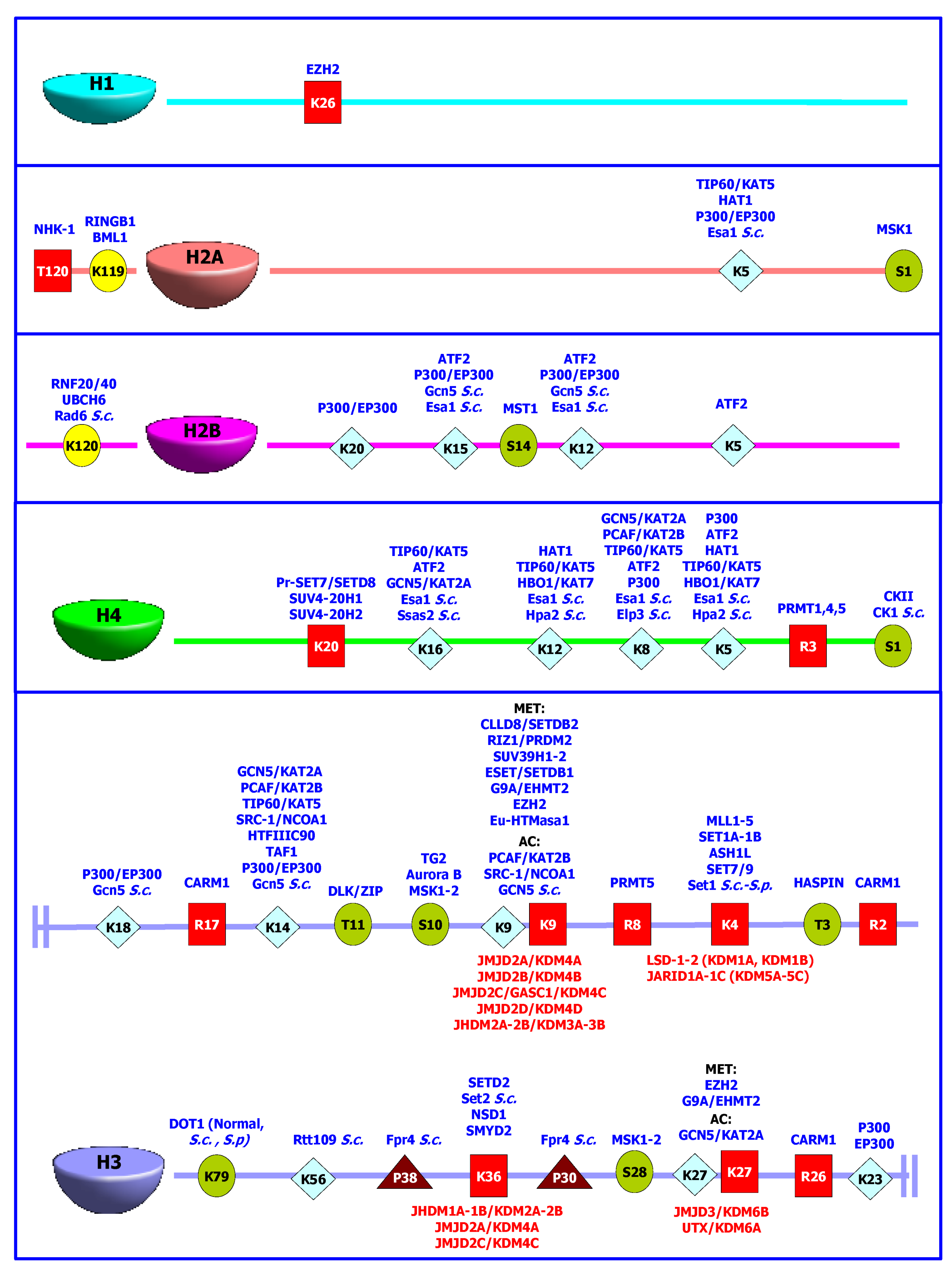
      <p>At the functional level, genetic information resides inside the chromatin, which is a structure in the cell nucleus consisting of repetitive units of smaller structures called nucleosomes [<xref ref-type="bibr" rid="B2-pharmaceuticals-05-00963">2</xref>,<xref ref-type="bibr" rid="B3-pharmaceuticals-05-00963">3</xref>]. Nucleosomes consist of 146 base pairs (bp) of DNA wrapped in 1.75 turns around a histone octamer, all of which is organized as a central tetramer of H3/H4 histones surrounded by two histone H2A/H2B dimers [<xref ref-type="bibr" rid="B4-pharmaceuticals-05-00963">4</xref>,<xref ref-type="bibr" rid="B5-pharmaceuticals-05-00963">5</xref>]. The DNA between nucleosomes can be associated with a fifth histone, H1, to achieve the high-order compression of the chromatin [<xref ref-type="bibr" rid="B3-pharmaceuticals-05-00963">3</xref>,<xref ref-type="bibr" rid="B6-pharmaceuticals-05-00963">6</xref>]. At the structural level, two main chromatin conformations are distinguishable: euchromatin, with a low degree of compression associated with a “relaxed” conformation of the histone-DNA macro-complex, and heterochromatin regions, with a high degree of compression that can be accessory (susceptible to changes in the degree of compression) or constitutive (which is observed during the cell cycle) [<xref ref-type="bibr" rid="B3-pharmaceuticals-05-00963">3</xref>,<xref ref-type="bibr" rid="B6-pharmaceuticals-05-00963">6</xref>]. In epigenetics, variations in the structure or the degree of chromatin compression lead to the regulation of the genes associated with a specific genomic region because these variations facilitate or prevent access of the nuclear proteins required for processes such as gene expression [<xref ref-type="bibr" rid="B7-pharmaceuticals-05-00963">7</xref>]. In this manner, epigenetics regulates the reversible change from heterochromatin (compressed structure associated with the repression of gene expression) to euchromatin (structure accessible to the transcriptional machinery). This regulation occurs via mechanisms that involve DNA methylation and post-translational histone changes such as methylation, citrullination, and ADP-ribosylation of arginine (the latter modification also occurs at glutamic acid residues); methylation, acetylation, biotinylation, ubiquitination, and sumoylation of lysine; phosphorylation of serine and threonine; and the <italic>cis</italic>-<italic>trans</italic> isomerization of proline (<xref ref-type="fig" rid="pharmaceuticals-05-00963-f001">Figure 1</xref>). Each of these modifications has a characteristic effect on the level of gene expression. For example, the addition of acetyl groups to the histones is frequently related to transcriptional activation, whereas deacetylation produces the opposite effect. Conversely, the methylation-demethylation of lysine can be associated with transcriptional activation or repression depending on the function of the residue and the degree of methylation [<xref ref-type="bibr" rid="B8-pharmaceuticals-05-00963">8</xref>,<xref ref-type="bibr" rid="B9-pharmaceuticals-05-00963">9</xref>].</p>
      
      <p>In summary, these processes contribute to a finely regulated mechanism of control of genetic expression and are responsible for maintaining the cellular “equilibrium”. In fact, alterations in one or more components of such mechanisms can result in alterations in gene expression and/or cellular phenotype, which are the main causes of the emergence of several pathologies, including neurological diseases, diabetes, and diseases associated with endocrine dysfunction, as well as the different varieties of cancer that can affect human beings [<xref ref-type="bibr" rid="B10-pharmaceuticals-05-00963">10</xref>,<xref ref-type="bibr" rid="B11-pharmaceuticals-05-00963">11</xref>,<xref ref-type="bibr" rid="B12-pharmaceuticals-05-00963">12</xref>,<xref ref-type="bibr" rid="B13-pharmaceuticals-05-00963">13</xref>,<xref ref-type="bibr" rid="B14-pharmaceuticals-05-00963">14</xref>,<xref ref-type="bibr" rid="B15-pharmaceuticals-05-00963">15</xref>]. Consequently, major efforts have been directed toward the identification and characterization of different epigenetic regulators whose phenotypes have been altered in tumor cell lines with the goal of identifying potential therapeutic targets, including DNA-methyltransferases [<xref ref-type="bibr" rid="B16-pharmaceuticals-05-00963">16</xref>,<xref ref-type="bibr" rid="B17-pharmaceuticals-05-00963">17</xref>,<xref ref-type="bibr" rid="B18-pharmaceuticals-05-00963">18</xref>], histone acetyltransferases/deacetylases [<xref ref-type="bibr" rid="B17-pharmaceuticals-05-00963">17</xref>,<xref ref-type="bibr" rid="B19-pharmaceuticals-05-00963">19</xref>,<xref ref-type="bibr" rid="B20-pharmaceuticals-05-00963">20</xref>,<xref ref-type="bibr" rid="B21-pharmaceuticals-05-00963">21</xref>,<xref ref-type="bibr" rid="B22-pharmaceuticals-05-00963">22</xref>,<xref ref-type="bibr" rid="B23-pharmaceuticals-05-00963">23</xref>,<xref ref-type="bibr" rid="B24-pharmaceuticals-05-00963">24</xref>], and histone methyltransferases/demethylases [<xref ref-type="bibr" rid="B25-pharmaceuticals-05-00963">25</xref>,<xref ref-type="bibr" rid="B26-pharmaceuticals-05-00963">26</xref>,<xref ref-type="bibr" rid="B27-pharmaceuticals-05-00963">27</xref>,<xref ref-type="bibr" rid="B28-pharmaceuticals-05-00963">28</xref>,<xref ref-type="bibr" rid="B29-pharmaceuticals-05-00963">29</xref>], for the development of more efficient cancer treatment strategies.</p>
      <fig id="pharmaceuticals-05-00963-f001" position="anchor">
        <label>Figure 1</label>
        <caption>
          <p>Post-translational modifications of histone proteins H1, H2A, H2B, H3 and H4 involved in epigenetic regulation. Target amino acids for isomerization (<inline-graphic xmlns:xlink="http://www.w3.org/1999/xlink" xlink:href="pharmaceuticals-05-00963-i001.tif"/>), phosphorylation (<inline-graphic xmlns:xlink="http://www.w3.org/1999/xlink" xlink:href="pharmaceuticals-05-00963-i002.tif"/>), ubiquitination (<inline-graphic xmlns:xlink="http://www.w3.org/1999/xlink" xlink:href="pharmaceuticals-05-00963-i003.tif"/>), acetylation (<inline-graphic xmlns:xlink="http://www.w3.org/1999/xlink" xlink:href="pharmaceuticals-05-00963-i004.tif"/>) or methylation (<inline-graphic xmlns:xlink="http://www.w3.org/1999/xlink" xlink:href="pharmaceuticals-05-00963-i005.tif"/>) are shown as one-letter code, together with the different enzymes able to add (in blue) each functional group. The histone demethylases are shown in red, besides the lysine residues susceptible to their specific enzymatic activity.</p>
        </caption>
        <graphic xmlns:xlink="http://www.w3.org/1999/xlink" xlink:href="pharmaceuticals-05-00963-g001.tif"/>
        
      </fig>
      <p>The current work provides an updated description of a large family of histone demethylases that are responsible for maintaining the cellular phenotype by regulating histone methylation levels and serve as promising targets in the development of new treatments against a large variety of forms of cancer. New knowledge will be discussed in relation to the search for new anti-cancer targets, which could be targeted by a new generation of specific drugs directed against these altered histone modifiers.</p>
    </sec>
    <sec>
      <title>2. Connection between Histone Methylation and Disease</title>
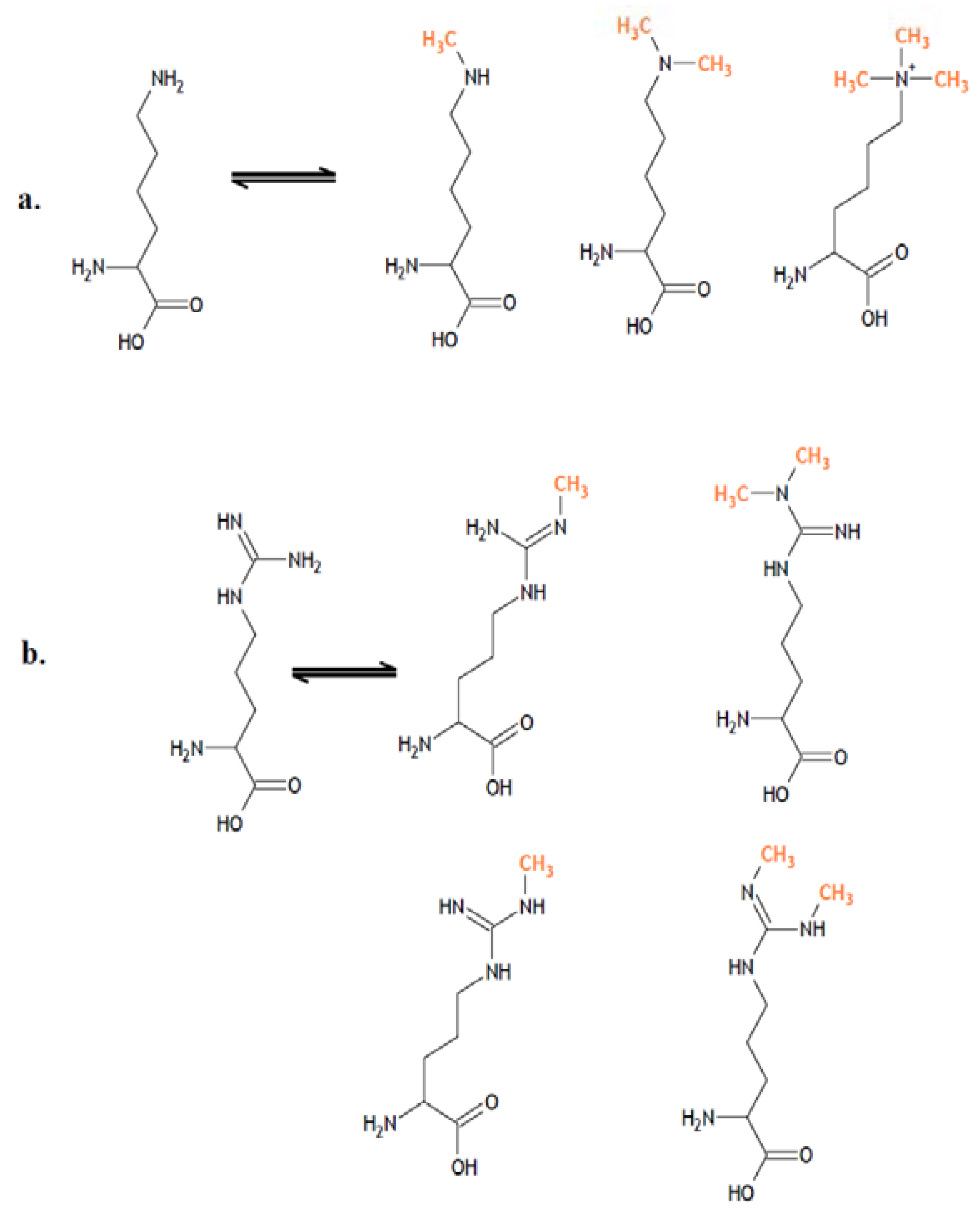
      <p>In a large number of cellular processes, covalent modifications induced by methylation can affect different nitrogen-bearing amino acids, such as arginine, histidine, and lysine [<xref ref-type="bibr" rid="B30-pharmaceuticals-05-00963">30</xref>,<xref ref-type="bibr" rid="B31-pharmaceuticals-05-00963">31</xref>,<xref ref-type="bibr" rid="B32-pharmaceuticals-05-00963">32</xref>,<xref ref-type="bibr" rid="B33-pharmaceuticals-05-00963">33</xref>,<xref ref-type="bibr" rid="B34-pharmaceuticals-05-00963">34</xref>]. Histones can be mono-, di-, or tri-methylated at their lysine residues, and they can be mono- or di-methylated at arginine residues in a symmetric or asymmetric fashion (<xref ref-type="fig" rid="pharmaceuticals-05-00963-f002">Figure 2</xref>).</p>
      <fig id="pharmaceuticals-05-00963-f002" position="anchor">
        <label>Figure 2</label>
        <caption>
          <p>Methylation patterns of proteins at the lysine and arginine residues. In the histones, it is possible to find (<bold>a</bold>) mono-, di- and trimethylated forms of lysine, as well as (<bold>b</bold>) monomethylated and dimethylated forms for arginine.</p>
        </caption>
        <graphic xmlns:xlink="http://www.w3.org/1999/xlink" xlink:href="pharmaceuticals-05-00963-g002.tif"/>
      </fig>
      <p>Previously, histone methylation was considered to be a stable and irreversible mark of chromatin [<xref ref-type="bibr" rid="B35-pharmaceuticals-05-00963">35</xref>]. However, in 2004, Shi <italic>et al</italic>. described the mechanism of action of the first protein with specific demethylase activity against a lysine residue, LSD-1/KDM1A (lysine-specific demethylase-1), breaking the paradigm of irreversible methylation and opening a new research outlook on these proteins and their association with epigenetic regulatory mechanisms [<xref ref-type="bibr" rid="B36-pharmaceuticals-05-00963">36</xref>].</p>
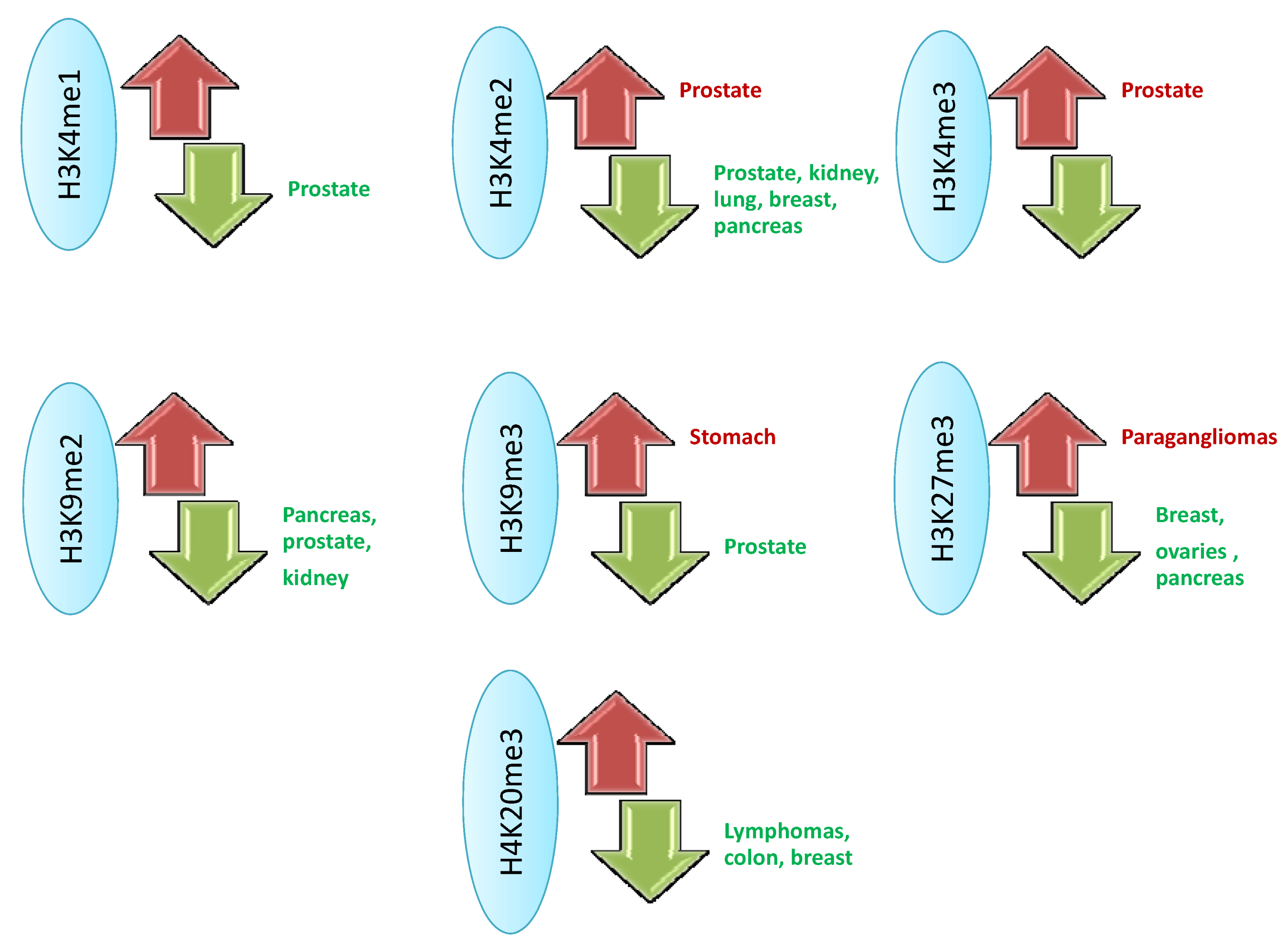
      <p>The discovery of new sequencing and analysis technologies has allowed for the identification of the histone methylation pattern in the human genome [<xref ref-type="bibr" rid="B37-pharmaceuticals-05-00963">37</xref>], which, in turn, identifies associations between cellular phenotypes and methylation-demethylation as part of regular cell development and in processes related to the emergence of different pathologies. Inside the nucleosome, the H3 and H4 histones are the main targets of these modifications, which have been associated with the development of different pathologies, including cancer, that are associated with epigenetic defects (<xref ref-type="fig" rid="pharmaceuticals-05-00963-f001">Figure 1</xref> and <xref ref-type="fig" rid="pharmaceuticals-05-00963-f003">Figure 3</xref>) [<xref ref-type="bibr" rid="B38-pharmaceuticals-05-00963">38</xref>,<xref ref-type="bibr" rid="B39-pharmaceuticals-05-00963">39</xref>]. Such observations have produced significant interest in the characterization of different proteins associated with the epigenetic regulation of histone methylation, among which the recently described histone demethylases are promising targets for future treatments against tumor cells.</p>
      <fig id="pharmaceuticals-05-00963-f003" position="anchor">
        <label>Figure 3</label>
        <caption>
          <p>Pattern of methylation-demethylation associated with different types of neoplasia. The main alterations at the histone proteins H3 and H4 level are illustrated, highlighting the cancers associated with increase (red) or reduction (green) of methylation levels, facing normal cells [<xref ref-type="bibr" rid="B39-pharmaceuticals-05-00963">39</xref>].</p>
        </caption>
        <graphic xmlns:xlink="http://www.w3.org/1999/xlink" xlink:href="pharmaceuticals-05-00963-g003.tif"/>
      </fig>
    </sec>
    <sec>
      <title>3. Histone Demethylases and Cancer</title>
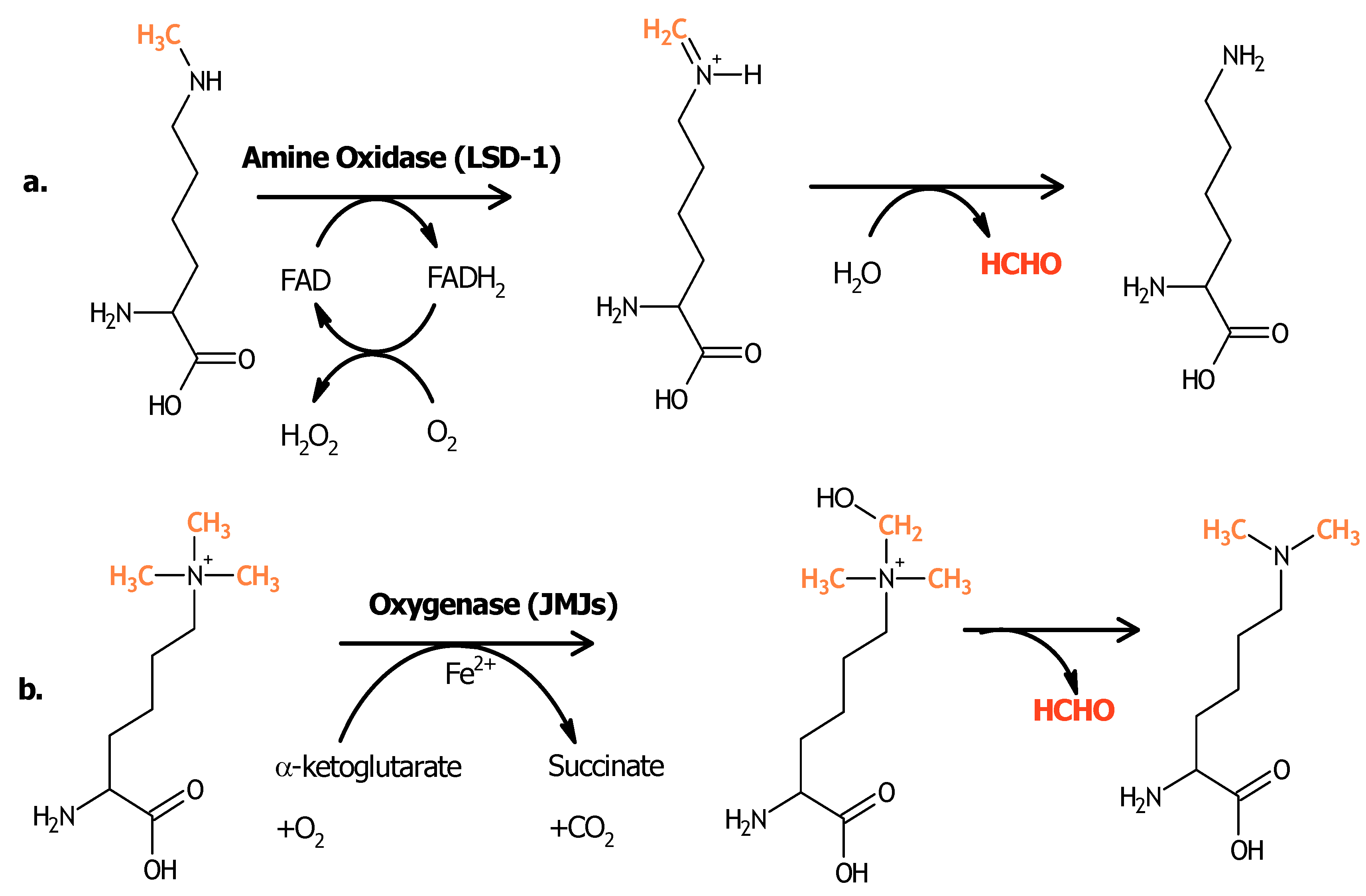
      <p>After the first characterization of a protein with demethylase activity, much effort has been made to identify and characterize other proteins with this activity in histone residues. The main proteins that have been discovered to date can be classified into two super-families: those belonging to the amine oxidase superfamily, which are dependent on FAD as a co-factor, and those corresponding to the oxygenase superfamily, in which the demethylase activity is dependent on Fe(II) and α-ketoglutarate. This latter superfamily is associated with the presence of a characteristic domain termed Jumonji (<xref ref-type="fig" rid="pharmaceuticals-05-00963-f004">Figure 4</xref>). Among the most important histone demethylases associated with the development of cancer are LSD-1/KDM1A, and members of the Jumonji family JARID1A-1C/KDM5A-5C, JHDM1B/KDM2B, JMJD2C/KDM4C, JMJD2A/KDM4A, JMJD3/KDM6B, and UTX/KDM6A (<xref ref-type="table" rid="pharmaceuticals-05-00963-t001">Table 1</xref>), which will be analyzed in detail in the following paragraphs. </p>
      <fig id="pharmaceuticals-05-00963-f004" position="anchor">
        <label>Figure 4</label>
        <caption>
          <p>Mechanisms of histone demethylation [<xref ref-type="bibr" rid="B40-pharmaceuticals-05-00963">40</xref>]. (<bold>a</bold>) The proteins having an amine-oxidase FAD-dependent activity require at least one atom of hydrogen on the lysine’s amine group, implying these proteins’ activity on the mono- and dimethylated forms of this amino acid. On the other hand, those proteins with oxygenase activity (<bold>b</bold>) are able to add a hydroxyl group to the methyl group, in a Fe<sup>2+</sup>- and α-ketoglutarate dependent way, letting them act on the quaternary form of the methylated amine.</p>
        </caption>
        <graphic xmlns:xlink="http://www.w3.org/1999/xlink" xlink:href="pharmaceuticals-05-00963-g004.tif"/>
      </fig>
      <table-wrap id="pharmaceuticals-05-00963-t001" position="anchor">
        <object-id pub-id-type="pii">pharmaceuticals-05-00963-t001_Table 1</object-id>
        <label>Table 1</label>
        <caption>
          <p>Histone demethylases and their association with cancer development.</p>
        </caption>
        <table rules="all" style="border: solid thin">
          <thead>
            <tr>
              <th align="center" valign="middle">Histone demethylase</th>
              <th align="center" valign="middle">Genebank Acc. Number</th>
              <th align="center" valign="middle">Alteration</th>
              <th align="center" valign="middle">Associated cancer</th>
              <th align="center" valign="middle">References</th>
            </tr>
          </thead>
          <tbody>
            <tr>
              <td rowspan="2" align="center" valign="middle">LSD-1/KDM1A</td>
              <td rowspan="2" align="center" valign="middle">NM_015013</td>
              <td align="center" valign="middle">Over-expression</td>
              <td align="center" valign="middle">ER-negative breast, Prostate, Leukemia, Sarcomas, Lung, neuroblastoma</td>
              <td align="center" valign="middle">[<xref ref-type="bibr" rid="B31-pharmaceuticals-05-00963">31</xref>,<xref ref-type="bibr" rid="B41-pharmaceuticals-05-00963">41</xref>,<xref ref-type="bibr" rid="B42-pharmaceuticals-05-00963">42</xref>,<xref ref-type="bibr" rid="B43-pharmaceuticals-05-00963">43</xref>,<xref ref-type="bibr" rid="B44-pharmaceuticals-05-00963">44</xref>,<xref ref-type="bibr" rid="B45-pharmaceuticals-05-00963">45</xref>,<xref ref-type="bibr" rid="B46-pharmaceuticals-05-00963">46</xref>,<xref ref-type="bibr" rid="B47-pharmaceuticals-05-00963">47</xref>,<xref ref-type="bibr" rid="B48-pharmaceuticals-05-00963">48</xref>,<xref ref-type="bibr" rid="B49-pharmaceuticals-05-00963">49</xref>]</td>
            </tr>
            <tr>
              <td align="center" valign="middle">Low expression</td>
              <td align="center" valign="middle">Hepatocellular, gastrointestinal, Hepatobiliary and metastatic breast carcinomas</td>
              <td align="center" valign="middle">[<xref ref-type="bibr" rid="B50-pharmaceuticals-05-00963">50</xref>,<xref ref-type="bibr" rid="B51-pharmaceuticals-05-00963">51</xref>]</td>
            </tr>
            <tr>
              <td align="center" valign="middle">JARID1A/KDM5A</td>
              <td align="center" valign="middle">NM_001042603</td>
              <td align="center" valign="middle">Over-expression</td>
              <td align="center" valign="middle">Gastric, Leukemia</td>
              <td align="center" valign="middle">[<xref ref-type="bibr" rid="B52-pharmaceuticals-05-00963">52</xref>,<xref ref-type="bibr" rid="B53-pharmaceuticals-05-00963">53</xref>]</td>
            </tr>
            <tr>
              <td align="center" valign="middle">JARID1B/KDM5B</td>
              <td align="center" valign="middle">NM_006618</td>
              <td align="center" valign="middle">Over-expression</td>
              <td align="center" valign="middle">Testicular, Ovaries, Breast, Prostate, leukemia</td>
              <td align="center" valign="middle">[<xref ref-type="bibr" rid="B54-pharmaceuticals-05-00963">54</xref>,<xref ref-type="bibr" rid="B55-pharmaceuticals-05-00963">55</xref>,<xref ref-type="bibr" rid="B56-pharmaceuticals-05-00963">56</xref>,<xref ref-type="bibr" rid="B57-pharmaceuticals-05-00963">57</xref>,<xref ref-type="bibr" rid="B58-pharmaceuticals-05-00963">58</xref>,<xref ref-type="bibr" rid="B59-pharmaceuticals-05-00963">59</xref>,<xref ref-type="bibr" rid="B60-pharmaceuticals-05-00963">60</xref>,<xref ref-type="bibr" rid="B61-pharmaceuticals-05-00963">61</xref>]</td>
            </tr>
            <tr>
              <td align="center" valign="middle">JARID1C/KDM5C</td>
              <td align="center" valign="middle">NM_004187.3 NM_001146702.1</td>
              <td align="center" valign="middle">Over-expression</td>
              <td align="center" valign="middle">Renal Carcinoma, Cervical</td>
              <td align="center" valign="middle">[<xref ref-type="bibr" rid="B62-pharmaceuticals-05-00963">62</xref>,<xref ref-type="bibr" rid="B63-pharmaceuticals-05-00963">63</xref>,<xref ref-type="bibr" rid="B64-pharmaceuticals-05-00963">64</xref>]</td>
            </tr>
            <tr>
              <td rowspan="2" align="center" valign="middle">JHDM1B/FBXL10/KDM2B</td>
              <td rowspan="2" align="center" valign="middle">NM_032590</td>
              <td align="center" valign="middle">Over-expression/Mutation</td>
              <td align="center" valign="middle">Lymphomas, Acute myeloid leukemia</td>
              <td align="center" valign="middle">[<xref ref-type="bibr" rid="B65-pharmaceuticals-05-00963">65</xref>,<xref ref-type="bibr" rid="B66-pharmaceuticals-05-00963">66</xref>,<xref ref-type="bibr" rid="B67-pharmaceuticals-05-00963">67</xref>]</td>
            </tr>
            <tr>
              <td align="center" valign="middle">Low expression</td>
              <td align="center" valign="middle">Gliobastoma multiforme, brain</td>
              <td align="center" valign="middle">[<xref ref-type="bibr" rid="B68-pharmaceuticals-05-00963">68</xref>]</td>
            </tr>
            <tr>
              <td align="center" valign="middle">JMJD2C/KDM4C</td>
              <td align="center" valign="middle">NM_015061; NM_001146694; NM_001146695; NM_001146696</td>
              <td align="center" valign="middle">Over-expression</td>
              <td align="center" valign="middle">MALT and Hodgkin Lymphomas, myeloid leukemia, Breast, gliobastoma multiforme, prostate, desmoplasic meduloblastoma, sarcomatoid and esophageal carcinoma.</td>
              <td align="center" valign="middle">[<xref ref-type="bibr" rid="B69-pharmaceuticals-05-00963">69</xref>,<xref ref-type="bibr" rid="B70-pharmaceuticals-05-00963">70</xref>,<xref ref-type="bibr" rid="B71-pharmaceuticals-05-00963">71</xref>,<xref ref-type="bibr" rid="B72-pharmaceuticals-05-00963">72</xref>,<xref ref-type="bibr" rid="B73-pharmaceuticals-05-00963">73</xref>,<xref ref-type="bibr" rid="B74-pharmaceuticals-05-00963">74</xref>,<xref ref-type="bibr" rid="B75-pharmaceuticals-05-00963">75</xref>,<xref ref-type="bibr" rid="B76-pharmaceuticals-05-00963">76</xref>,<xref ref-type="bibr" rid="B77-pharmaceuticals-05-00963">77</xref>,<xref ref-type="bibr" rid="B78-pharmaceuticals-05-00963">78</xref>,<xref ref-type="bibr" rid="B79-pharmaceuticals-05-00963">79</xref>,<xref ref-type="bibr" rid="B80-pharmaceuticals-05-00963">80</xref>,<xref ref-type="bibr" rid="B81-pharmaceuticals-05-00963">81</xref>,<xref ref-type="bibr" rid="B82-pharmaceuticals-05-00963">82</xref>]</td>
            </tr>
            <tr>
              <td align="center" valign="middle">JMJD2A/KDM4A</td>
              <td align="center" valign="middle">NM_014663</td>
              <td align="center" valign="middle">Over-expression</td>
              <td align="center" valign="middle">Kaposi Sarcoma, Prostate, Breast, Colon, Bladder.</td>
              <td align="center" valign="middle">[<xref ref-type="bibr" rid="B18-pharmaceuticals-05-00963">18</xref>,<xref ref-type="bibr" rid="B47-pharmaceuticals-05-00963">47</xref>,<xref ref-type="bibr" rid="B83-pharmaceuticals-05-00963">83</xref>,<xref ref-type="bibr" rid="B84-pharmaceuticals-05-00963">84</xref>,<xref ref-type="bibr" rid="B85-pharmaceuticals-05-00963">85</xref>,<xref ref-type="bibr" rid="B86-pharmaceuticals-05-00963">86</xref>,<xref ref-type="bibr" rid="B87-pharmaceuticals-05-00963">87</xref>]</td>
            </tr>
            <tr>
              <td align="center" valign="middle">JMJD3/KDM6B</td>
              <td align="center" valign="middle">NM_001080424</td>
              <td align="center" valign="middle">Over-expression</td>
              <td align="center" valign="middle">Colon, Lymphomas</td>
              <td align="center" valign="middle">[<xref ref-type="bibr" rid="B88-pharmaceuticals-05-00963">88</xref>,<xref ref-type="bibr" rid="B89-pharmaceuticals-05-00963">89</xref>,<xref ref-type="bibr" rid="B90-pharmaceuticals-05-00963">90</xref>]</td>
            </tr>
            <tr>
              <td align="center" valign="middle">UTX/KDM6A</td>
              <td align="center" valign="middle">NM_021140</td>
              <td align="center" valign="middle">Mutation/Low expression</td>
              <td align="center" valign="middle">Advanced forms of cancer, Multiple mieloma, Leukemia, renal and bladder carcinomas.</td>
              <td align="center" valign="middle">[<xref ref-type="bibr" rid="B91-pharmaceuticals-05-00963">91</xref>,<xref ref-type="bibr" rid="B92-pharmaceuticals-05-00963">92</xref>,<xref ref-type="bibr" rid="B93-pharmaceuticals-05-00963">93</xref>,<xref ref-type="bibr" rid="B94-pharmaceuticals-05-00963">94</xref>,<xref ref-type="bibr" rid="B95-pharmaceuticals-05-00963">95</xref>,<xref ref-type="bibr" rid="B96-pharmaceuticals-05-00963">96</xref>]</td>
            </tr>
          </tbody>
        </table>
      </table-wrap>
      
      <sec>
        <title>3.1. LSD-1 and LSD-2</title>
        <p>The LSD-1/KDM1A  protein was the first demethylase  protein to be identified [<xref ref-type="bibr" rid="B36-pharmaceuticals-05-00963">36</xref>]. In the mono- and bi-methylated forms, this amine oxidase presents specific activity on lysine 4 of histone H3 and forms part of an important macromolecular complex: CoREST [<xref ref-type="bibr" rid="B97-pharmaceuticals-05-00963">97</xref>,<xref ref-type="bibr" rid="B98-pharmaceuticals-05-00963">98</xref>,<xref ref-type="bibr" rid="B99-pharmaceuticals-05-00963">99</xref>]. LSD-1 is considered to be an important regulator of the formation and development of organs and tissues such as the heart, brain and skeletal muscle [<xref ref-type="bibr" rid="B100-pharmaceuticals-05-00963">100</xref>,<xref ref-type="bibr" rid="B101-pharmaceuticals-05-00963">101</xref>,<xref ref-type="bibr" rid="B102-pharmaceuticals-05-00963">102</xref>,<xref ref-type="bibr" rid="B103-pharmaceuticals-05-00963">103</xref>], together its essential role for cellular energy expenditure, inflammatory responses and hematopoiesis [<xref ref-type="bibr" rid="B104-pharmaceuticals-05-00963">104</xref>,<xref ref-type="bibr" rid="B105-pharmaceuticals-05-00963">105</xref>,<xref ref-type="bibr" rid="B106-pharmaceuticals-05-00963">106</xref>]. Interestingly, it has been reported that in the prostate, this enzyme can change its substrate to the mono-methylated form of lysine 9 as a result of its association with another important histone demethylase, JMJD2C. Together, both proteins have been associated with the development of prostate and bladder cancer through putative interactions with androgen receptors [<xref ref-type="bibr" rid="B41-pharmaceuticals-05-00963">41</xref>,<xref ref-type="bibr" rid="B43-pharmaceuticals-05-00963">43</xref>,<xref ref-type="bibr" rid="B47-pharmaceuticals-05-00963">47</xref>,<xref ref-type="bibr" rid="B48-pharmaceuticals-05-00963">48</xref>]. Additionally, the activity and overexpression of LSD-1 have been related to the emergence and development of different types of cancer, such as neuroblastoma [<xref ref-type="bibr" rid="B49-pharmaceuticals-05-00963">49</xref>], leukemia [<xref ref-type="bibr" rid="B31-pharmaceuticals-05-00963">31</xref>,<xref ref-type="bibr" rid="B42-pharmaceuticals-05-00963">42</xref>], sarcoma [<xref ref-type="bibr" rid="B44-pharmaceuticals-05-00963">44</xref>], lung [<xref ref-type="bibr" rid="B45-pharmaceuticals-05-00963">45</xref>], and ER-negative breast cancer [<xref ref-type="bibr" rid="B46-pharmaceuticals-05-00963">46</xref>]. In contrast, low levels of this protein have been observed in hepatocellular, gastrointestinal, hepatobiliary and metastatic breast carcinomas [<xref ref-type="bibr" rid="B50-pharmaceuticals-05-00963">50</xref>,<xref ref-type="bibr" rid="B51-pharmaceuticals-05-00963">51</xref>]. On the other hand, the understanding of molecular mechanisms ruling LSD-1 activity is in continuous evolution since its 3D structure determination [<xref ref-type="bibr" rid="B107-pharmaceuticals-05-00963">107</xref>], leading to the rational discovering of promising inhibitors with therapeutic potential [<xref ref-type="bibr" rid="B67-pharmaceuticals-05-00963">67</xref>,<xref ref-type="bibr" rid="B108-pharmaceuticals-05-00963">108</xref>,<xref ref-type="bibr" rid="B109-pharmaceuticals-05-00963">109</xref>,<xref ref-type="bibr" rid="B110-pharmaceuticals-05-00963">110</xref>,<xref ref-type="bibr" rid="B111-pharmaceuticals-05-00963">111</xref>]. Interactions based on these studies, LSD-1 is thought to be a potential marker for the early diagnosis and potential treatment of the malignant tumors mentioned above [<xref ref-type="bibr" rid="B112-pharmaceuticals-05-00963">112</xref>].</p>
        <p>In addition, it has been recently described a new member of amine oxidase protein family: LSD-2/AOF1/KDM1B. Although this protein is homologous to LSD-1, it doesn’t participate in the chromatin-remodeling complexes as LSD-1 does [<xref ref-type="bibr" rid="B113-pharmaceuticals-05-00963">113</xref>,<xref ref-type="bibr" rid="B114-pharmaceuticals-05-00963">114</xref>]. This demethylase (showing specific activity for mono- and di-methylated Lys4 of histone H3) has been associated with the regulation of the inflammatory process mediated by NF-κB [<xref ref-type="bibr" rid="B115-pharmaceuticals-05-00963">115</xref>] and for establishing the maternal genomic imprints [<xref ref-type="bibr" rid="B116-pharmaceuticals-05-00963">116</xref>], as well as LSD-2 represents an important factor for induced pluripotent stem cell generation [<xref ref-type="bibr" rid="B117-pharmaceuticals-05-00963">117</xref>]. Although it has not been reported of any association for LSD-2 with human pathologies, the importance of its demethylase activity and LSD-1’s important as an anti-cancer candidate highlight the importance of continuing the functional and structural characterization of this protein [<xref ref-type="bibr" rid="B99-pharmaceuticals-05-00963">99</xref>,<xref ref-type="bibr" rid="B114-pharmaceuticals-05-00963">114</xref>,<xref ref-type="bibr" rid="B118-pharmaceuticals-05-00963">118</xref>].</p>
      </sec>
      <sec>
        <title>3.2. JARID1 Family</title>
        <p>Members of the JARID1 family of oxygenases recognize and act specifically on the bi- and tri-methylated lysine 4 of histone H3. One of the most representative members of this family is JARID1A/RBP2/KDM5A, which is an important regulator of the circadian rhythm [<xref ref-type="bibr" rid="B119-pharmaceuticals-05-00963">119</xref>,<xref ref-type="bibr" rid="B120-pharmaceuticals-05-00963">120</xref>]. This enzyme is also involved in cell cycle regulation [<xref ref-type="bibr" rid="B121-pharmaceuticals-05-00963">121</xref>] because it interacts with important proteins such as the retinoblastoma protein, and it is thought to affect pathways that are dependent on cyclins in some cancer types such as gastric cancer [<xref ref-type="bibr" rid="B52-pharmaceuticals-05-00963">52</xref>] and leukemia [<xref ref-type="bibr" rid="B53-pharmaceuticals-05-00963">53</xref>], as well as has been considered as a relevant marker to evaluate gliobastoma multiform survival [<xref ref-type="bibr" rid="B122-pharmaceuticals-05-00963">122</xref>]. Interestingly, it has been reported JARID1A is a critical factor for the development of transient drug tolerance in lung cancer cells [<xref ref-type="bibr" rid="B123-pharmaceuticals-05-00963">123</xref>], representing a key target to analyze how non-heritable aspects of cellular variability may significantly affect the evolutionary rate of cancer, in such way that initial drug treatments may be driving tumors to establish a genetically-based resistance by first selecting these non-heritable phenotypes generated by cellular or tissue variability [<xref ref-type="bibr" rid="B124-pharmaceuticals-05-00963">124</xref>]. On the other hand, the relevance of this protein has also been described in the emergence of other diseases including ankylosing spondylitis [<xref ref-type="bibr" rid="B125-pharmaceuticals-05-00963">125</xref>] and alopecia areata [<xref ref-type="bibr" rid="B126-pharmaceuticals-05-00963">126</xref>]. However, the current knowledge of the function of this protein at the cellular level is limited, although a role for this protein as a regulator of cellular growth via the Notch signaling pathway has been proposed [<xref ref-type="bibr" rid="B127-pharmaceuticals-05-00963">127</xref>], as well as it has been reported JARID1A and JARID1B are associated to the silencing of retinoblastoma target genes in senescent cells [<xref ref-type="bibr" rid="B128-pharmaceuticals-05-00963">128</xref>].</p>
        <p>The second member of this family, JARID1B/PLU1/KDM5B has been recognized to be an important regulator of cell development and differentiation [<xref ref-type="bibr" rid="B129-pharmaceuticals-05-00963">129</xref>,<xref ref-type="bibr" rid="B130-pharmaceuticals-05-00963">130</xref>,<xref ref-type="bibr" rid="B131-pharmaceuticals-05-00963">131</xref>,<xref ref-type="bibr" rid="B132-pharmaceuticals-05-00963">132</xref>]. This enzyme has been strongly connected with the formation of different types of cancer because of the high expression levels found in leukemia, prostate, breast, testicular, and ovarian cancers, in which it can act as a repressor of tumor suppressor genes including BRCA1 or as a coactivator of growth and transcription factors such as TIEG1/KLF10 or the androgen receptor [<xref ref-type="bibr" rid="B54-pharmaceuticals-05-00963">54</xref>,<xref ref-type="bibr" rid="B55-pharmaceuticals-05-00963">55</xref>,<xref ref-type="bibr" rid="B56-pharmaceuticals-05-00963">56</xref>,<xref ref-type="bibr" rid="B57-pharmaceuticals-05-00963">57</xref>,<xref ref-type="bibr" rid="B58-pharmaceuticals-05-00963">58</xref>,<xref ref-type="bibr" rid="B59-pharmaceuticals-05-00963">59</xref>,<xref ref-type="bibr" rid="B60-pharmaceuticals-05-00963">60</xref>,<xref ref-type="bibr" rid="B61-pharmaceuticals-05-00963">61</xref>]. In summary, these results have fueled the search for inhibitors with anticarcinogenic potential directed against this protein [<xref ref-type="bibr" rid="B133-pharmaceuticals-05-00963">133</xref>].</p>
        <p>Additionally, the third member of this protein family (JARID1C/KDM5C) is an important mediator during intellectual and cognitive development [<xref ref-type="bibr" rid="B134-pharmaceuticals-05-00963">134</xref>,<xref ref-type="bibr" rid="B135-pharmaceuticals-05-00963">135</xref>], and multiple defects in this protein have been associated with different pathologies including intellectual disability (mental retardation), short height, delay in speech abilities, and autism [<xref ref-type="bibr" rid="B135-pharmaceuticals-05-00963">135</xref>,<xref ref-type="bibr" rid="B136-pharmaceuticals-05-00963">136</xref>,<xref ref-type="bibr" rid="B137-pharmaceuticals-05-00963">137</xref>,<xref ref-type="bibr" rid="B138-pharmaceuticals-05-00963">138</xref>,<xref ref-type="bibr" rid="B139-pharmaceuticals-05-00963">139</xref>]. Similar to the other members of this family of proteins, JARID1C represents an interesting therapeutic target in the search for new drugs [<xref ref-type="bibr" rid="B140-pharmaceuticals-05-00963">140</xref>] because of its relevance and recent association with the development of renal carcinomas via the regulation of the von Hippel-Lindau tumor suppressor protein [<xref ref-type="bibr" rid="B62-pharmaceuticals-05-00963">62</xref>,<xref ref-type="bibr" rid="B64-pharmaceuticals-05-00963">64</xref>] and because of its implication in cervical cancer by serving as an oncogenic target of the human papillomavirus [<xref ref-type="bibr" rid="B63-pharmaceuticals-05-00963">63</xref>].</p>
      </sec>
      <sec>
        <title>3.3. JHDM1B</title>
        <p>JHDM1B/KDM2B, a member of the Jumonji protein family, exhibits oxygenase activity at the mono- and bi-methylated lysine 36 of histone H3. Although a role for this protein has not been defined at the cellular level, recent studies suggest a relationship between this methylase and important processes such as the regulation of cell proliferation and senescence [<xref ref-type="bibr" rid="B141-pharmaceuticals-05-00963">141</xref>,<xref ref-type="bibr" rid="B142-pharmaceuticals-05-00963">142</xref>] and the possible application of this protein as an enhancer in the reprogramming of stem cells [<xref ref-type="bibr" rid="B143-pharmaceuticals-05-00963">143</xref>]. Currently, this protein is considered to be a candidate tumor suppressor gene because its expression levels are strongly reduced in different forms of cancer, including acute myeloid leukemia, lymphoma, and glioblastoma multiforme, the most aggressive form of brain cancer [<xref ref-type="bibr" rid="B65-pharmaceuticals-05-00963">65</xref>,<xref ref-type="bibr" rid="B66-pharmaceuticals-05-00963">66</xref>,<xref ref-type="bibr" rid="B67-pharmaceuticals-05-00963">67</xref>,<xref ref-type="bibr" rid="B68-pharmaceuticals-05-00963">68</xref>,<xref ref-type="bibr" rid="B144-pharmaceuticals-05-00963">144</xref>,<xref ref-type="bibr" rid="B145-pharmaceuticals-05-00963">145</xref>].</p>
      </sec>
      <sec>
        <title>3.4. JMJD2C</title>
        <p>JMJD2C/KDM4C is a histone demethylase that exhibits oxygenase activity at the bi- and tri-methylated lysine 9 in histone H3 [<xref ref-type="bibr" rid="B69-pharmaceuticals-05-00963">69</xref>], and this protein is involved in the development and self-renewal of undifferentiated and embryonic stem cells, the regulation of adipogenesis, and hypoxia responses [<xref ref-type="bibr" rid="B146-pharmaceuticals-05-00963">146</xref>,<xref ref-type="bibr" rid="B147-pharmaceuticals-05-00963">147</xref>,<xref ref-type="bibr" rid="B148-pharmaceuticals-05-00963">148</xref>,<xref ref-type="bibr" rid="B149-pharmaceuticals-05-00963">149</xref>]. In addition to these functions, JMJD2C has been associated with the emergence of different pathologies such as alopecia areata and autistic spectrum disorders [<xref ref-type="bibr" rid="B126-pharmaceuticals-05-00963">126</xref>,<xref ref-type="bibr" rid="B150-pharmaceuticals-05-00963">150</xref>]. It is also considered to be an important amplified oncogene in different types of cancer such as sarcomatoid and esophageal carcinomas [<xref ref-type="bibr" rid="B70-pharmaceuticals-05-00963">70</xref>,<xref ref-type="bibr" rid="B82-pharmaceuticals-05-00963">82</xref>], myeloid leukemia [<xref ref-type="bibr" rid="B71-pharmaceuticals-05-00963">71</xref>,<xref ref-type="bibr" rid="B72-pharmaceuticals-05-00963">72</xref>], lymphoma [<xref ref-type="bibr" rid="B73-pharmaceuticals-05-00963">73</xref>,<xref ref-type="bibr" rid="B74-pharmaceuticals-05-00963">74</xref>,<xref ref-type="bibr" rid="B80-pharmaceuticals-05-00963">80</xref>], breast carcinoma [<xref ref-type="bibr" rid="B75-pharmaceuticals-05-00963">75</xref>,<xref ref-type="bibr" rid="B76-pharmaceuticals-05-00963">76</xref>], desmoplastic medulloblastoma [<xref ref-type="bibr" rid="B81-pharmaceuticals-05-00963">81</xref>], and glioblastoma multiforme [<xref ref-type="bibr" rid="B77-pharmaceuticals-05-00963">77</xref>,<xref ref-type="bibr" rid="B78-pharmaceuticals-05-00963">78</xref>]. Although the mechanisms by which this protein is involved in the development of these types of cancer have not been fully understood, the characteristics of this protein have suggested JMJD2C as a potential candidate for the development of specific treatments against these forms of cancer [<xref ref-type="bibr" rid="B25-pharmaceuticals-05-00963">25</xref>,<xref ref-type="bibr" rid="B110-pharmaceuticals-05-00963">110</xref>,<xref ref-type="bibr" rid="B151-pharmaceuticals-05-00963">151</xref>].</p>
      </sec>
      <sec>
        <title>3.5. JMJD2A</title>
        <p>JMJD2A/KDM4A, another member of the Jumonji protein family, is associated with the transcription of cell proliferation genes due to its capacity to bind to chromatin-modifying and cell cycle regulator proteins [<xref ref-type="bibr" rid="B152-pharmaceuticals-05-00963">152</xref>]. After the establishment of its methylase activity on bi- and tri-methylated lysines 9 and 36 of histone H3 [<xref ref-type="bibr" rid="B153-pharmaceuticals-05-00963">153</xref>], JMJD2A has been shown to play important roles in skeletal muscle cell and neural crest differentiation, the maintenance of maternal stem cells, and DNA repair [<xref ref-type="bibr" rid="B148-pharmaceuticals-05-00963">148</xref>,<xref ref-type="bibr" rid="B154-pharmaceuticals-05-00963">154</xref>,<xref ref-type="bibr" rid="B155-pharmaceuticals-05-00963">155</xref>]. This protein is related to the development of diseases such as cardiac hypertrophy [<xref ref-type="bibr" rid="B156-pharmaceuticals-05-00963">156</xref>], alopecia areata [<xref ref-type="bibr" rid="B126-pharmaceuticals-05-00963">126</xref>], and different forms of cancer including Kaposi’s sarcoma associated with herpesvirus [<xref ref-type="bibr" rid="B85-pharmaceuticals-05-00963">85</xref>], prostate cancer (via regulation of the activity of the androgen receptor) [<xref ref-type="bibr" rid="B83-pharmaceuticals-05-00963">83</xref>,<xref ref-type="bibr" rid="B84-pharmaceuticals-05-00963">84</xref>], breast cancer [<xref ref-type="bibr" rid="B86-pharmaceuticals-05-00963">86</xref>], colon cancer [<xref ref-type="bibr" rid="B87-pharmaceuticals-05-00963">87</xref>], and bladder cancer [<xref ref-type="bibr" rid="B47-pharmaceuticals-05-00963">47</xref>]. Such results highlight the relevance of this protein at the therapeutic level, and have arised the interest to determine JMJD2A’s mechanism of action and specificity based on its three-dimensional structure [<xref ref-type="bibr" rid="B157-pharmaceuticals-05-00963">157</xref>,<xref ref-type="bibr" rid="B158-pharmaceuticals-05-00963">158</xref>,<xref ref-type="bibr" rid="B159-pharmaceuticals-05-00963">159</xref>,<xref ref-type="bibr" rid="B160-pharmaceuticals-05-00963">160</xref>,<xref ref-type="bibr" rid="B161-pharmaceuticals-05-00963">161</xref>]. This strategy may lead to the identification and characterization of specific inhibitors with therapeutic potentials [<xref ref-type="bibr" rid="B25-pharmaceuticals-05-00963">25</xref>,<xref ref-type="bibr" rid="B151-pharmaceuticals-05-00963">151</xref>,<xref ref-type="bibr" rid="B162-pharmaceuticals-05-00963">162</xref>,<xref ref-type="bibr" rid="B163-pharmaceuticals-05-00963">163</xref>]. However, knowledge of the function of JMJD2A in other carcinogenic lines and the determination of its role as a therapeutic anti-cancer target still remain to be established.</p>
      </sec>
      <sec>
        <title>3.6. JMJD3</title>
        <p>JMJD3/KDM6B, another member of the Jumonji family, exhibits high specificity for the bi- and tri-methylated lysine 27 residue of histone H3 [<xref ref-type="bibr" rid="B164-pharmaceuticals-05-00963">164</xref>], and it serves as a part of important multiprotein complexes known as MLL3 and MLL4, which are associated with the regulation of the activity of Polycomb family proteins [<xref ref-type="bibr" rid="B165-pharmaceuticals-05-00963">165</xref>,<xref ref-type="bibr" rid="B166-pharmaceuticals-05-00963">166</xref>,<xref ref-type="bibr" rid="B167-pharmaceuticals-05-00963">167</xref>,<xref ref-type="bibr" rid="B168-pharmaceuticals-05-00963">168</xref>,<xref ref-type="bibr" rid="B169-pharmaceuticals-05-00963">169</xref>]. Such characteristics have promoted the investigation of the relevance of this protein at the cellular level, allowing for its identification as a regulator in endothelial, endodermal, osteoclast, macrophage, and neural lineage differentiation [<xref ref-type="bibr" rid="B170-pharmaceuticals-05-00963">170</xref>,<xref ref-type="bibr" rid="B171-pharmaceuticals-05-00963">171</xref>,<xref ref-type="bibr" rid="B172-pharmaceuticals-05-00963">172</xref>,<xref ref-type="bibr" rid="B173-pharmaceuticals-05-00963">173</xref>,<xref ref-type="bibr" rid="B174-pharmaceuticals-05-00963">174</xref>]. Additionally, the influence of this enzyme on the occurrence of a large number of diseases has been described, with implications in systemic lupus erythematosus [<xref ref-type="bibr" rid="B175-pharmaceuticals-05-00963">175</xref>], vasculitis associated with antineutrophil cytoplasmic antibodies (ANCA) [<xref ref-type="bibr" rid="B176-pharmaceuticals-05-00963">176</xref>], colon cancer [<xref ref-type="bibr" rid="B90-pharmaceuticals-05-00963">90</xref>], and lymphoma [<xref ref-type="bibr" rid="B88-pharmaceuticals-05-00963">88</xref>,<xref ref-type="bibr" rid="B89-pharmaceuticals-05-00963">89</xref>]. Although the role of this protein in these pathologies has not been fully described, JMJD3 is associated with the activity of different oncogenes such as NPM-ALK and BCL2, or tumor-suppressing genes such as BTG3 [<xref ref-type="bibr" rid="B89-pharmaceuticals-05-00963">89</xref>,<xref ref-type="bibr" rid="B177-pharmaceuticals-05-00963">177</xref>,<xref ref-type="bibr" rid="B178-pharmaceuticals-05-00963">178</xref>]; justifying the inclusion of this protein in the search for new anti-cancer epidrugs [<xref ref-type="bibr" rid="B179-pharmaceuticals-05-00963">179</xref>].</p>
      </sec>
      <sec>
        <title>3.7. UTX</title>
        <p>Similarly to JMJD3, UTX/KDM6A acts on the mono- and di-methylated forms of lysine 27 in histone H3 [<xref ref-type="bibr" rid="B180-pharmaceuticals-05-00963">180</xref>] and is also a part of the MLL3/MLL4 complexes [<xref ref-type="bibr" rid="B166-pharmaceuticals-05-00963">166</xref>,<xref ref-type="bibr" rid="B167-pharmaceuticals-05-00963">167</xref>]. UTX was the first histone demethylase known to be associated with cancer as a result of specific mutations [<xref ref-type="bibr" rid="B96-pharmaceuticals-05-00963">96</xref>]. In combination with the relevance of UTX in cellular differentiation at the cardiac, hematopoietic, sperm, brain, and muscular levels [<xref ref-type="bibr" rid="B135-pharmaceuticals-05-00963">135</xref>,<xref ref-type="bibr" rid="B181-pharmaceuticals-05-00963">181</xref>,<xref ref-type="bibr" rid="B182-pharmaceuticals-05-00963">182</xref>,<xref ref-type="bibr" rid="B183-pharmaceuticals-05-00963">183</xref>,<xref ref-type="bibr" rid="B184-pharmaceuticals-05-00963">184</xref>], this enzyme is also a tumor suppressor gene candidate (like JHDM1B). This designation was the result of multiple investigations that identified mutations or inactivating events associated with the differentiation of tumor cells in multiple myeloma [<xref ref-type="bibr" rid="B94-pharmaceuticals-05-00963">94</xref>,<xref ref-type="bibr" rid="B96-pharmaceuticals-05-00963">96</xref>], acute lymphoblastic and chronic myelomonocytic leukemias [<xref ref-type="bibr" rid="B93-pharmaceuticals-05-00963">93</xref>,<xref ref-type="bibr" rid="B95-pharmaceuticals-05-00963">95</xref>], bladder carcinoma [<xref ref-type="bibr" rid="B92-pharmaceuticals-05-00963">92</xref>], and renal cell carcinoma [<xref ref-type="bibr" rid="B91-pharmaceuticals-05-00963">91</xref>]. Similarly to JARID1A, UTX has been recently linked to regulation processes that are dependent on the retinoblastoma protein, as it is primarily associated with control of the expression of different factors that are part of the pathways that are dependent on this important enzyme [<xref ref-type="bibr" rid="B185-pharmaceuticals-05-00963">185</xref>,<xref ref-type="bibr" rid="B186-pharmaceuticals-05-00963">186</xref>]; this activity is related to the potential role of this protein as a tumor suppressor [<xref ref-type="bibr" rid="B187-pharmaceuticals-05-00963">187</xref>].</p>
      </sec>
    </sec>
    <sec>
      <title>4. Therapeutic Approaches</title>
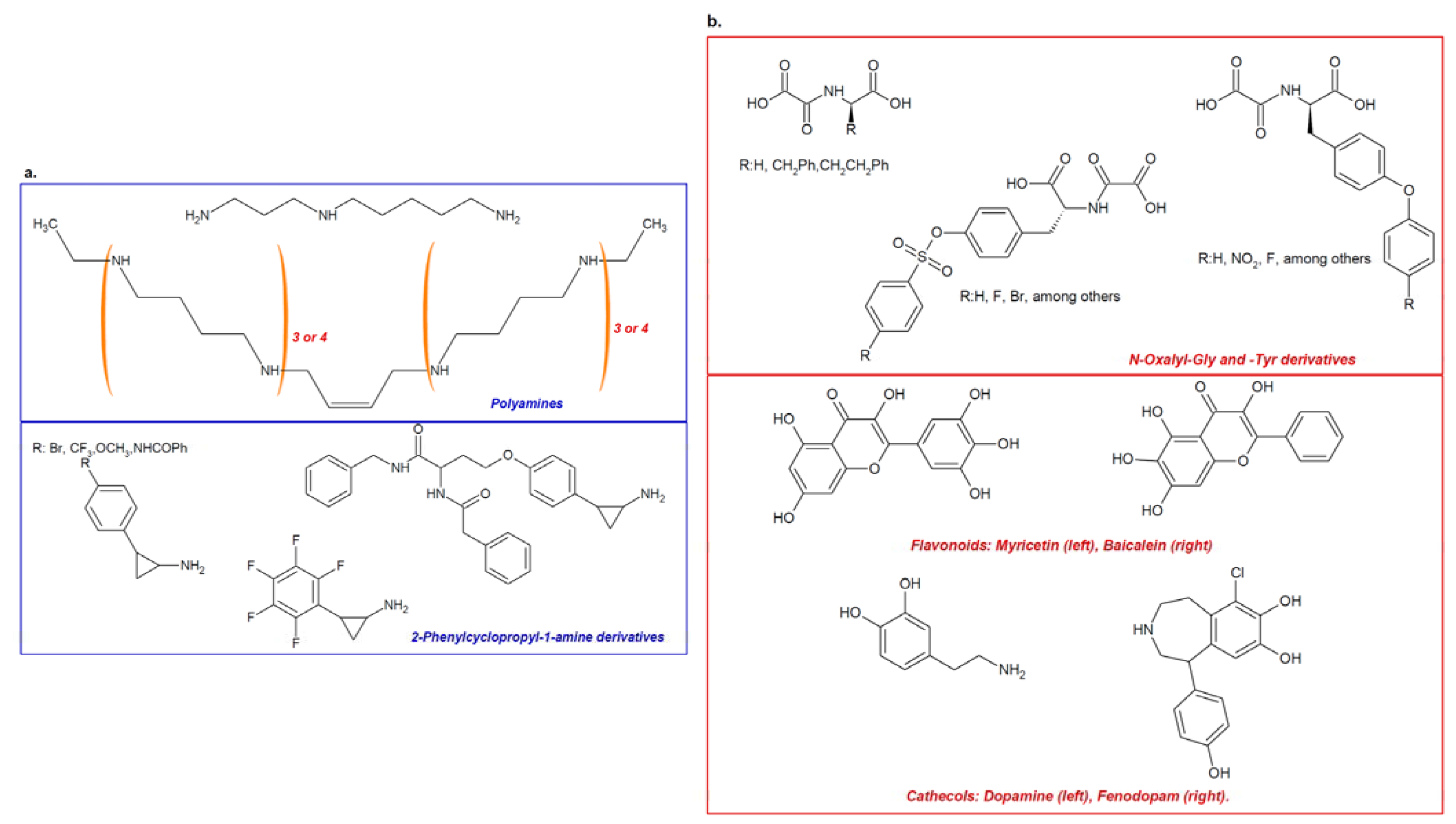
      <p>Recently, an indirect or direct association has been established between histone demethylases and the emergence and progression of cancer. Among the potential strategy for targeting KDMs, the identification of molecules with the capacity to specifically inhibit the enzymatic activity of these proteins represents a promising path for treatment [<xref ref-type="bibr" rid="B10-pharmaceuticals-05-00963">10</xref>,<xref ref-type="bibr" rid="B188-pharmaceuticals-05-00963">188</xref>]. As the first member of this important family of proteins, LSD-1 represents an important target for the so-called “epi-drugs”. Among the molecules with pharmaceutical potential are oligoamine analogs, originally designed based on the significant similarity between LSD-1 and other FAD-dependent polyamine oxidases (<xref ref-type="fig" rid="pharmaceuticals-05-00963-f005">Figure 5</xref>a, top panel) [<xref ref-type="bibr" rid="B109-pharmaceuticals-05-00963">109</xref>,<xref ref-type="bibr" rid="B189-pharmaceuticals-05-00963">189</xref>], and specific inhibitors possessing a common 2-phenyl cyclopropyl-1-amine nucleus [<xref ref-type="bibr" rid="B108-pharmaceuticals-05-00963">108</xref>,<xref ref-type="bibr" rid="B118-pharmaceuticals-05-00963">118</xref>,<xref ref-type="bibr" rid="B190-pharmaceuticals-05-00963">190</xref>,<xref ref-type="bibr" rid="B191-pharmaceuticals-05-00963">191</xref>]. These specific inhibitors for LSD-1 were designed based on the mechanism of action of the enzyme (which is similar to that of monoamine oxidases), and are able to reach inhibition constants in the micromolar range (<xref ref-type="fig" rid="pharmaceuticals-05-00963-f005">Figure 5</xref>a, lower panel) [<xref ref-type="bibr" rid="B108-pharmaceuticals-05-00963">108</xref>,<xref ref-type="bibr" rid="B118-pharmaceuticals-05-00963">118</xref>,<xref ref-type="bibr" rid="B190-pharmaceuticals-05-00963">190</xref>,<xref ref-type="bibr" rid="B191-pharmaceuticals-05-00963">191</xref>].</p>
      <fig id="pharmaceuticals-05-00963-f005" position="anchor">
        <label>Figure 5</label>
        <caption>
          <p>Inhibitors of histone demethylation. Specific inhibitors for LSD1 can be designed according to the similarity of this demethylase’s substrates with the FAD-dependent polyamine oxidases targets (<bold>a</bold>, <bold>top frame</bold>), as can be observed for spermidin-like inhibitors, octamines (n = 3) or decamines (n = 4). Another pathway for designing amine oxidases’ inhibitors involves their mechanism of activity, targeting FAD by radical oxidation reactions with “suicide” inhibitors containing a phenylcyclopropylamine core (<bold>a</bold>, <bold>bottom frame)</bold>. Histone demethylases with oxygenase activity can be inhibited by using α-ketoglutarate analogues, as these could be able to bind to Fe<sup>2+</sup>. Some of the most promising epidrugs includes some derivatives of <italic>N</italic>-oxalyl glucose and <italic>N</italic>-oxalyl tyrosine, (<bold>b</bold>, <bold>top frame</bold>), in conjuction with the recent description of flavonoids and chatecols showing competitive and non-competitive inhibition, possibly associated with these natural product’s ability to bind iron (<bold>b</bold>, <bold>bottom frame</bold>).</p>
        </caption>
        <graphic xmlns:xlink="http://www.w3.org/1999/xlink" xlink:href="pharmaceuticals-05-00963-g005.tif"/>
      </fig>
      <p>These findings have promoted the search for new inhibitors and have resulted in the recent description of namoline, a gamma-pyrone capable of inhibiting LSD-1 and altering the growth of prostate cancer tumor cells [<xref ref-type="bibr" rid="B192-pharmaceuticals-05-00963">192</xref>]. The first generation of LSD-1 inhibitors, which are of the tranylcypromine type, exhibited low potency and selectivity. After the search was shifted to focus on chemical structures that target the active site of the protein, selectivity was increased [<xref ref-type="bibr" rid="B193-pharmaceuticals-05-00963">193</xref>]. <italic>In vitro</italic> and <italic>in vivo</italic> studies using nanomolar concentrations of phenocopied, a tranylcypromine analog and inhibitor of LSD-1, demonstrated a pro-apoptotic effect in primary acute myeloid leukemia (AML) cells without affecting the repopulation potential of hematopoietic stem cells and progenitor cells [<xref ref-type="bibr" rid="B194-pharmaceuticals-05-00963">194</xref>]. These data suggest that LSD-1 is a key protein for the development of selective therapeutic targets for leukemia.</p>
      <p>In the same manner, the inhibition of LSD-1 can increase the sensitivity of promyelocytic leukemia (APL) to the treatment with all-trans-retinoic acid (ATRA). Usually ATRA loses its activity in APL, and the cause of this alteration appears to be a reduction in the methylation of lysine 4 of histone H3. Under such conditions, the inhibition of LSD-1 can facilitate the activity of ATRA in APL cells, as it has been validated using the LSD-1 inhibitor trans-2-phenylcyclopropylamine [<xref ref-type="bibr" rid="B195-pharmaceuticals-05-00963">195</xref>].</p>
      <p>In addition, iron- and α-ketoglutarate-dependent histone demethylases are also targets of important studies, allowing for the identification of inhibitors designed on the basis of the mechanism of the unique activity of these enzymes. Among the most important inhibitors, several molecules that are analogous to α-ketoglutarate have been described. These inhibitors range from molecules designed using <italic>N</italic>-oxalylglycine or <italic>N</italic>-oxalyltyrosine as a base molecule [<xref ref-type="bibr" rid="B25-pharmaceuticals-05-00963">25</xref>,<xref ref-type="bibr" rid="B162-pharmaceuticals-05-00963">162</xref>,<xref ref-type="bibr" rid="B196-pharmaceuticals-05-00963">196</xref>] (<xref ref-type="fig" rid="pharmaceuticals-05-00963-f005">Figure 5</xref>b, upper panel) to natural products such as flavonoids and catechols that were identified as a result of screening libraries of pharmacologically active compounds [<xref ref-type="bibr" rid="B197-pharmaceuticals-05-00963">197</xref>] (<xref ref-type="fig" rid="pharmaceuticals-05-00963-f005">Figure 5</xref>b, lower panel). Demethylase inhibitors for Jumonji-containing domain proteins usually compete with the 2-oxoglutarate factor and bind to the catalytic region containing iron. Compounds that possess high polarity, such as 2,4-pyridine-decarboxylases, inhibit the activity of Jumonji by interfering with its enzymatic activity, in the same way other 2-oxoglutarate-like molecules inhibit the HIF prolyl hydroxylase-1 oxygenases HPH1/EGLN2 and HPH2/EGLN1.Interestingly, two new series of jumonji demethylase inhibitors, 8-hydroxyquinolines (e.g., SID 85736331) and 2,2-bipyridines, are potent inhibitors with higher selectivity and better pharmacological properties than those exhibited by other inhibitors. The structures of these two new types of compounds make them promising therapeutic alternatives that could be pharmacologically enhanced for better penetration into the cell interior [<xref ref-type="bibr" rid="B198-pharmaceuticals-05-00963">198</xref>,<xref ref-type="bibr" rid="B199-pharmaceuticals-05-00963">199</xref>].</p>
      <p>These results clearly highlight the potential of the histone demethylase superfamily members as therapeutic targets against the diverse neoplastic diseases that affect human beings. There is support for structural analyses to increase the understanding of the spatial enzyme-inhibitor interaction [<xref ref-type="bibr" rid="B99-pharmaceuticals-05-00963">99</xref>,<xref ref-type="bibr" rid="B200-pharmaceuticals-05-00963">200</xref>,<xref ref-type="bibr" rid="B201-pharmaceuticals-05-00963">201</xref>] and, hence, promote the specific molecular design of a new generation of epi-drugs targeting members of the amine oxidase superfamily [<xref ref-type="bibr" rid="B108-pharmaceuticals-05-00963">108</xref>,<xref ref-type="bibr" rid="B202-pharmaceuticals-05-00963">202</xref>,<xref ref-type="bibr" rid="B203-pharmaceuticals-05-00963">203</xref>] or those belonging to the oxygenase family [<xref ref-type="bibr" rid="B25-pharmaceuticals-05-00963">25</xref>,<xref ref-type="bibr" rid="B159-pharmaceuticals-05-00963">159</xref>,<xref ref-type="bibr" rid="B162-pharmaceuticals-05-00963">162</xref>].</p>
    </sec>
    <sec sec-type="conclusions">
      <title>5. Conclusions</title>
      <p>Regulation of gene expression encompasses a complex network of molecular interactions that define the cellular phenotype of tissues and organisms. Alteration on the epigenetic balance can result in the emergence of terminal diseases, among which are the several forms of human cancer. Although, much work remains to be taken in the search for new strategies against the different types of cancer, in recent years, significant advances have been made in the identification and characterization of new potential targets for the development of specific therapies to treat multiple forms of cancer. Together with the continuous discovering of new macromolecules associated with human neoplasm, the recent discovery of histone demethylases has provided a new perspective in the search for anti-cancer therapeutic targets due to their unique enzymatic activity and their association with the cellular phenotype of a large number of human tumor lines.</p>
      <p>Either as early markers or as anti-tumor candidates, histone demethylases currently represent a promising group of macromolecules that increase our understanding of malignity and the mysteries of their formation, development and evolutionary progress. LSD1 was the first demethylases cloned and perhaps the most promises protein as therapeutic target. Recently evidences showed that LSD1 played an important role in a broad spectrum of biological processes, including cell proliferation, adipogenesis, spermatogenesis, chromosome segregation and embryonic development. Furthermore, LSD1 also could promote progress of tumor by inhibiting the tumor suppressor activity of p53. To date, as a potential drug for discovering anti-tumor drugs, the medical significance of LSD1 inhibitors have been greatly appreciated. However, it is necessary to be attentive when analyzing and applying this new knowledge, as relevant targets as LSD-1 could be observed as an oncogene [<xref ref-type="bibr" rid="B31-pharmaceuticals-05-00963">31</xref>,<xref ref-type="bibr" rid="B41-pharmaceuticals-05-00963">41</xref>,<xref ref-type="bibr" rid="B42-pharmaceuticals-05-00963">42</xref>,<xref ref-type="bibr" rid="B43-pharmaceuticals-05-00963">43</xref>,<xref ref-type="bibr" rid="B44-pharmaceuticals-05-00963">44</xref>,<xref ref-type="bibr" rid="B45-pharmaceuticals-05-00963">45</xref>,<xref ref-type="bibr" rid="B46-pharmaceuticals-05-00963">46</xref>,<xref ref-type="bibr" rid="B47-pharmaceuticals-05-00963">47</xref>,<xref ref-type="bibr" rid="B48-pharmaceuticals-05-00963">48</xref>,<xref ref-type="bibr" rid="B49-pharmaceuticals-05-00963">49</xref>] or a tumor-suppressor [<xref ref-type="bibr" rid="B50-pharmaceuticals-05-00963">50</xref>,<xref ref-type="bibr" rid="B51-pharmaceuticals-05-00963">51</xref>], in an apparent situation-dependent biological role for this protein. These observations, enhanced the importance of histone demethylases for cellular and tissue phenotype maintenance as part of macro-complexes [<xref ref-type="bibr" rid="B51-pharmaceuticals-05-00963">51</xref>,<xref ref-type="bibr" rid="B114-pharmaceuticals-05-00963">114</xref>,<xref ref-type="bibr" rid="B127-pharmaceuticals-05-00963">127</xref>,<xref ref-type="bibr" rid="B152-pharmaceuticals-05-00963">152</xref>,<xref ref-type="bibr" rid="B169-pharmaceuticals-05-00963">169</xref>], must be taken into account to overcome any side effects facing their use as therapeutic targets [<xref ref-type="bibr" rid="B106-pharmaceuticals-05-00963">106</xref>]; thus highlighting the importance of improving our comprehension about biological and molecular role of histone demethylases, to be established as potential targets for a new generation of epigenetic drugs directed against their enzymatic activity. Various demethylases from Jumonji family are in preclinical studies for cancer including prostate cancer, glioblastoma, breast cancer, and diverse kind of leukemia.</p>
      <p>In summary, this report is part of the future on the continuous fight against cancer; searching for new specific therapeutic strategies based on the understanding of the epigenetic regulators discussed herein and those different molecules rationally designed against these specific targets; the epi-drugs.</p>
    </sec>
  
  </body>
  <back>
    <ack>
      <title>Acknowledgments</title>
      <p>We would like to thank Colciencias and La Universidad de La Sabana that are supporting the research in histone demethylases field with the grant No. 528 from Colciencias, and the grant No. 909 from La Universidad de la Sabana.</p>
    </ack>
    <notes>
      <title>Conflict of Interest</title>
      <p>The authors declare no conflict of interest.</p>
    </notes>
    <ref-list>
      <title>References</title>
      <ref id="B1-pharmaceuticals-05-00963">
        <label>1.</label>
        <citation citation-type="gov">
		  <collab>World Health Organization</collab>
           
          <source>WHO World Cancer Report 2008</source>
          <publisher-name>WHO</publisher-name>
          <publisher-loc>Geneva, Switzerland</publisher-loc>
          <year>2008</year>
        </citation>
      </ref>
      <ref id="B2-pharmaceuticals-05-00963">
        <label>2.</label>
        <citation citation-type="journal">
          <person-group person-group-type="author">
            <name>
              <surname>Kornberg</surname>
              <given-names>R.D.</given-names>
            </name>
          </person-group>
          <article-title>Chromatin structure: A repeating unit of histones and DNA</article-title>
          <source>Science</source>
          <year>1974</year>
          <volume>184</volume>
          <fpage>868</fpage>
          <lpage>871</lpage>
        <pub-id pub-id-type="doi">10.1126/science.184.4139.868</pub-id><pub-id pub-id-type="pmid">4825889</pub-id></citation>
      </ref>
      <ref id="B3-pharmaceuticals-05-00963">
        <label>3.</label>
        <citation citation-type="journal">
          <person-group person-group-type="author">
            <name>
              <surname>Li</surname>
              <given-names>G.</given-names>
            </name>
            <name>
              <surname>Reinberg</surname>
              <given-names>D.</given-names>
            </name>
          </person-group>
          <article-title>Chromatin higher-order structures and gene regulation</article-title>
          <source>Curr. Opin. Genet. Dev.</source>
          <year>2011</year>
          <volume>21</volume>
          <fpage>175</fpage>
          <lpage>186</lpage>
          <pub-id pub-id-type="doi">10.1016/j.gde.2011.01.022</pub-id>
        </citation>
      </ref>
      <ref id="B4-pharmaceuticals-05-00963">
        <label>4.</label>
        <citation citation-type="journal">
          <person-group person-group-type="author">
            <name>
              <surname>Luger</surname>
              <given-names>K.</given-names>
            </name>
            <name>
              <surname>Mader</surname>
              <given-names>A.W.</given-names>
            </name>
            <name>
              <surname>Richmond</surname>
              <given-names>R.K.</given-names>
            </name>
            <name>
              <surname>Sargent</surname>
              <given-names>D.F.</given-names>
            </name>
            <name>
              <surname>Richmond</surname>
              <given-names>T.J.</given-names>
            </name>
          </person-group>
          <article-title>Crystal structure of the nucleosome core particle at 2.8 A resolution</article-title>
          <source>Nature</source>
          <year>1997</year>
          <volume>389</volume>
          <fpage>251</fpage>
          <lpage>260</lpage>
        <pub-id pub-id-type="doi">10.1038/38444</pub-id><pub-id pub-id-type="pmid">9305837</pub-id></citation>
      </ref>
      <ref id="B5-pharmaceuticals-05-00963">
        <label>5.</label>
        <citation citation-type="journal">
          <person-group person-group-type="author">
            <name>
              <surname>Xu</surname>
              <given-names>M.</given-names>
            </name>
            <name>
              <surname>Zhu</surname>
              <given-names>B.</given-names>
            </name>
          </person-group>
          <article-title>Nucleosome assembly and epigenetic inheritance</article-title>
          <source>Protein Cell</source>
          <year>2010</year>
          <volume>1</volume>
          <fpage>820</fpage>
          <lpage>829</lpage>
          <pub-id pub-id-type="doi">10.1007/s13238-010-0104-0</pub-id>
        </citation>
      </ref>
      <ref id="B6-pharmaceuticals-05-00963">
        <label>6.</label>
        <citation citation-type="journal">
          <person-group person-group-type="author">
            <name>
              <surname>Chen</surname>
              <given-names>P.</given-names>
            </name>
            <name>
              <surname>Li</surname>
              <given-names>G.</given-names>
            </name>
          </person-group>
          <article-title>Dynamics of the higher-order structure of chromatin</article-title>
          <source>Protein Cell</source>
          <year>2010</year>
          <volume>1</volume>
          <fpage>967</fpage>
          <lpage>971</lpage>
          <pub-id pub-id-type="doi">10.1007/s13238-010-0130-y</pub-id>
        </citation>
      </ref>
      <ref id="B7-pharmaceuticals-05-00963">
        <label>7.</label>
        <citation citation-type="journal">
          <person-group person-group-type="author">
            <name>
              <surname>Bassett</surname>
              <given-names>A.</given-names>
            </name>
            <name>
              <surname>Cooper</surname>
              <given-names>S.</given-names>
            </name>
            <name>
              <surname>Wu</surname>
              <given-names>C.</given-names>
            </name>
            <name>
              <surname>Travers</surname>
              <given-names>A.</given-names>
            </name>
          </person-group>
          <article-title>The folding and unfolding of eukaryotic chromatin</article-title>
          <source>Curr. Opin. Genet. Dev.</source>
          <year>2009</year>
          <volume>19</volume>
          <fpage>159</fpage>
          <lpage>165</lpage>
        <pub-id pub-id-type="doi">10.1016/j.gde.2009.02.010</pub-id><pub-id pub-id-type="pmid">19346124</pub-id></citation>
      </ref>
      <ref id="B8-pharmaceuticals-05-00963">
        <label>8.</label>
        <citation citation-type="journal">
          <person-group person-group-type="author">
            <name>
              <surname>Berger</surname>
              <given-names>S.L.</given-names>
            </name>
          </person-group>
          <article-title>The complex language of chromatin regulation during transcription</article-title>
          <source>Nature</source>
          <year>2007</year>
          <volume>447</volume>
          <fpage>407</fpage>
          <lpage>412</lpage>
          <pub-id pub-id-type="doi">10.1038/nature05915</pub-id>
        </citation>
      </ref>
      <ref id="B9-pharmaceuticals-05-00963">
        <label>9.</label>
        <citation citation-type="journal">
          <person-group person-group-type="author">
            <name>
              <surname>Latham</surname>
              <given-names>J.A.</given-names>
            </name>
            <name>
              <surname>Dent</surname>
              <given-names>S.Y.</given-names>
            </name>
          </person-group>
          <article-title>Cross-regulation of histone modifications</article-title>
          <source>Nat. Struct. Mol. Biol.</source>
          <year>2007</year>
          <volume>14</volume>
          <fpage>1017</fpage>
          <lpage>1024</lpage>
          <pub-id pub-id-type="doi">10.1038/nsmb1307</pub-id>
        </citation>
      </ref>
      <ref id="B10-pharmaceuticals-05-00963">
        <label>10.</label>
        <citation citation-type="journal">
          <person-group person-group-type="author">
            <name>
              <surname>Arrowsmith</surname>
              <given-names>C.H.</given-names>
            </name>
            <name>
              <surname>Bountra</surname>
              <given-names>C.</given-names>
            </name>
            <name>
              <surname>Fish</surname>
              <given-names>P.V.</given-names>
            </name>
            <name>
              <surname>Lee</surname>
              <given-names>K.</given-names>
            </name>
            <name>
              <surname>Schapira</surname>
              <given-names>M.</given-names>
            </name>
          </person-group>
          <article-title>Epigenetic protein families: A new frontier for drug discovery</article-title>
          <source>Nat. Rev. Drug Discov.</source>
          <year>2012</year>
          <volume>11</volume>
          <fpage>384</fpage>
          <lpage>400</lpage>
          <pub-id pub-id-type="doi">10.1038/nrd3674</pub-id>
        </citation>
      </ref>
      <ref id="B11-pharmaceuticals-05-00963">
        <label>11.</label>
        <citation citation-type="journal">
          <person-group person-group-type="author">
            <name>
              <surname>Bayarsaihan</surname>
              <given-names>D.</given-names>
            </name>
          </person-group>
          <article-title>Epigenetic mechanisms in inflammation</article-title>
          <source>J. Dent. Res.</source>
          <year>2011</year>
          <volume>90</volume>
          <fpage>9</fpage>
          <lpage>17</lpage>
          <pub-id pub-id-type="doi">10.1177/0022034510378683</pub-id>
        </citation>
      </ref>
      <ref id="B12-pharmaceuticals-05-00963">
        <label>12.</label>
        <citation citation-type="journal">
          <person-group person-group-type="author">
            <name>
              <surname>Hamm</surname>
              <given-names>C.A.</given-names>
            </name>
            <name>
              <surname>Costa</surname>
              <given-names>F.F.</given-names>
            </name>
          </person-group>
          <article-title>The impact of epigenomics on future drug design and new therapies</article-title>
          <source>Drug Discov. Today</source>
          <year>2011</year>
          <volume>16</volume>
          <fpage>626</fpage>
          <lpage>635</lpage>
          <pub-id pub-id-type="doi">10.1016/j.drudis.2011.04.007</pub-id>
        </citation>
      </ref>
      <ref id="B13-pharmaceuticals-05-00963">
        <label>13.</label>
        <citation citation-type="journal">
          <person-group person-group-type="author">
            <name>
              <surname>Tsai</surname>
              <given-names>H.C.</given-names>
            </name>
            <name>
              <surname>Baylin</surname>
              <given-names>S.B.</given-names>
            </name>
          </person-group>
          <article-title>Cancer epigenetics: Linking basic biology to clinical medicine</article-title>
          <source>Cell Res.</source>
          <year>2011</year>
          <volume>21</volume>
          <fpage>502</fpage>
          <lpage>517</lpage>
          <pub-id pub-id-type="doi">10.1038/cr.2011.24</pub-id>
        </citation>
      </ref>
      <ref id="B14-pharmaceuticals-05-00963">
        <label>14.</label>
        <citation citation-type="journal">
          <person-group person-group-type="author">
            <name>
              <surname>Zahir</surname>
              <given-names>F.R.</given-names>
            </name>
            <name>
              <surname>Brown</surname>
              <given-names>C.J.</given-names>
            </name>
          </person-group>
          <article-title>Epigenetic impacts on neurodevelopment: Pathophysiological mechanisms and genetic modes of action</article-title>
          <source>Pediatr. Res.</source>
          <year>2011</year>
          <volume>69</volume>
          <fpage>92R</fpage>
          <lpage>100R</lpage>
          <pub-id pub-id-type="doi">10.1203/PDR.0b013e318213565e</pub-id>
        </citation>
      </ref>
      <ref id="B15-pharmaceuticals-05-00963">
        <label>15.</label>
        <citation citation-type="journal">
          <person-group person-group-type="author">
            <name>
              <surname>Zhang</surname>
              <given-names>X.</given-names>
            </name>
            <name>
              <surname>Ho</surname>
              <given-names>S.M.</given-names>
            </name>
          </person-group>
          <article-title>Epigenetics meets endocrinology</article-title>
          <source>J. Mol. Endocrinol.</source>
          <year>2011</year>
          <volume>46</volume>
          <fpage>R11</fpage>
          <lpage>R32</lpage>
          <pub-id pub-id-type="doi">10.1677/JME-10-0053</pub-id>
        </citation>
      </ref>
      <ref id="B16-pharmaceuticals-05-00963">
        <label>16.</label>
        <citation citation-type="journal">
          <person-group person-group-type="author">
            <name>
              <surname>Castellano</surname>
              <given-names>S.</given-names>
            </name>
            <name>
              <surname>Kuck</surname>
              <given-names>D.</given-names>
            </name>
            <name>
              <surname>Viviano</surname>
              <given-names>M.</given-names>
            </name>
            <name>
              <surname>Yoo</surname>
              <given-names>J.</given-names>
            </name>
            <name>
              <surname>Lopez-Vallejo</surname>
              <given-names>F.</given-names>
            </name>
            <name>
              <surname>Conti</surname>
              <given-names>P.</given-names>
            </name>
            <name>
              <surname>Tamborini</surname>
              <given-names>L.</given-names>
            </name>
            <name>
              <surname>Pinto</surname>
              <given-names>A.</given-names>
            </name>
            <name>
              <surname>Medina-Franco</surname>
              <given-names>J.L.</given-names>
            </name>
            <name>
              <surname>Sbardella</surname>
              <given-names>G.</given-names>
            </name>
          </person-group>
          <article-title>Synthesis and biochemical evaluation of delta(2)-isoxazoline derivatives as DNA methyltransferase 1 inhibitors</article-title>
          <source>J. Med. Chem.</source>
          <year>2011</year>
          <volume>54</volume>
          <fpage>7663</fpage>
          <lpage>7677</lpage>
          <pub-id pub-id-type="doi">10.1021/jm2010404</pub-id>
        </citation>
      </ref>
      <ref id="B17-pharmaceuticals-05-00963">
        <label>17.</label>
        <citation citation-type="journal">
          <person-group person-group-type="author">
            <name>
              <surname>Yi</surname>
              <given-names>T.Z.</given-names>
            </name>
            <name>
              <surname>Li</surname>
              <given-names>J.</given-names>
            </name>
            <name>
              <surname>Han</surname>
              <given-names>X.</given-names>
            </name>
            <name>
              <surname>Guo</surname>
              <given-names>J.</given-names>
            </name>
            <name>
              <surname>Qu</surname>
              <given-names>Q.</given-names>
            </name>
            <name>
              <surname>Guo</surname>
              <given-names>L.</given-names>
            </name>
            <name>
              <surname>Sun</surname>
              <given-names>H.D.</given-names>
            </name>
            <name>
              <surname>Tan</surname>
              <given-names>W.H.</given-names>
            </name>
          </person-group>
          <article-title>DNMT Inhibitors and HDAC Inhibitors Regulate E-Cadherin and Bcl-2 Expression in Endometrial Carcinoma <italic>in vitro</italic> and <italic>in vivo</italic></article-title>
          <source>Chemotherapy</source>
          <year>2012</year>
          <volume>58</volume>
          <fpage>19</fpage>
          <lpage>29</lpage>
          <pub-id pub-id-type="doi">10.1159/000333077</pub-id>
        </citation>
      </ref>
      <ref id="B18-pharmaceuticals-05-00963">
        <label>18.</label>
        <citation citation-type="journal">
          <person-group person-group-type="author">
            <name>
              <surname>Chen</surname>
              <given-names>M.</given-names>
            </name>
            <name>
              <surname>Shabashvili</surname>
              <given-names>D.</given-names>
            </name>
            <name>
              <surname>Nawab</surname>
              <given-names>A.</given-names>
            </name>
            <name>
              <surname>Yang</surname>
              <given-names>S.X.</given-names>
            </name>
            <name>
              <surname>Dyer</surname>
              <given-names>L.M.</given-names>
            </name>
            <name>
              <surname>Brown</surname>
              <given-names>K.D.</given-names>
            </name>
            <name>
              <surname>Hollingshead</surname>
              <given-names>M.</given-names>
            </name>
            <name>
              <surname>Hunter</surname>
              <given-names>K.W.</given-names>
            </name>
            <name>
              <surname>Kaye</surname>
              <given-names>F.J.</given-names>
            </name>
            <name>
              <surname>Hochwald</surname>
              <given-names>S.N.</given-names>
            </name>
            <etal/>
          </person-group>
          <article-title>DNA methyltransferase inhibitor, zebularine, delays tumor growth and induces apoptosis in a genetically engineered mouse model of breast cancer</article-title>
          <source>Mol. Cancer Ther.</source>
          <year>2012</year>
          <volume>11</volume>
          <fpage>370</fpage>
          <lpage>382</lpage>
          <pub-id pub-id-type="doi">10.1158/1535-7163.MCT-11-0458</pub-id>
        </citation>
      </ref>
      <ref id="B19-pharmaceuticals-05-00963">
        <label>19.</label>
        <citation citation-type="journal">
          <person-group person-group-type="author">
            <name>
              <surname>Ahmad</surname>
              <given-names>M.</given-names>
            </name>
            <name>
              <surname>Hamid</surname>
              <given-names>A.</given-names>
            </name>
            <name>
              <surname>Hussain</surname>
              <given-names>A.</given-names>
            </name>
            <name>
              <surname>Majeed</surname>
              <given-names>R.</given-names>
            </name>
            <name>
              <surname>Qurishi</surname>
              <given-names>Y.</given-names>
            </name>
            <name>
              <surname>Bhat</surname>
              <given-names>J.A.</given-names>
            </name>
            <name>
              <surname>Najar</surname>
              <given-names>R.A.</given-names>
            </name>
            <name>
              <surname>Qazi</surname>
              <given-names>A.K.</given-names>
            </name>
            <name>
              <surname>Zargar</surname>
              <given-names>M.A.</given-names>
            </name>
            <name>
              <surname>Singh</surname>
              <given-names>S.K.</given-names>
            </name>
            <etal/>
          </person-group>
          <article-title>Understanding histone deacetylases in the cancer development and treatment: An epigenetic perspective of cancer chemotherapy</article-title>
          <source>DNA Cell Biol.</source>
          <year>2012</year>
        </citation>
      </ref>
      <ref id="B20-pharmaceuticals-05-00963">
        <label>20.</label>
        <citation citation-type="journal">
          <person-group person-group-type="author">
            <name>
              <surname>Mehdi</surname>
              <given-names>O.</given-names>
            </name>
            <name>
              <surname>Francoise</surname>
              <given-names>S.</given-names>
            </name>
            <name>
              <surname>Sofia</surname>
              <given-names>C.L.</given-names>
            </name>
            <name>
              <surname>Urs</surname>
              <given-names>G.</given-names>
            </name>
            <name>
              <surname>Kevin</surname>
              <given-names>Z.</given-names>
            </name>
            <name>
              <surname>Bernard</surname>
              <given-names>S.</given-names>
            </name>
            <name>
              <surname>Igor</surname>
              <given-names>S.</given-names>
            </name>
            <name>
              <surname>Anabela</surname>
              <given-names>C.D.</given-names>
            </name>
            <name>
              <surname>Dominique</surname>
              <given-names>L.</given-names>
            </name>
            <name>
              <surname>Eric</surname>
              <given-names>M.</given-names>
            </name>
            <name>
              <surname>Ali</surname>
              <given-names>O.</given-names>
            </name>
          </person-group>
          <article-title>HDAC gene expression in pancreatic tumor cell lines following treatment with the HDAC inhibitors panobinostat (LBH589) and trichostatine (TSA)</article-title>
          <source>Pancreatology</source>
          <year>2012</year>
          <volume>12</volume>
          <fpage>146</fpage>
          <lpage>155</lpage>
        <pub-id pub-id-type="pmid">22487525</pub-id></citation>
      </ref>
      <ref id="B21-pharmaceuticals-05-00963">
        <label>21.</label>
        <citation citation-type="journal">
          <person-group person-group-type="author">
            <name>
              <surname>Munster</surname>
              <given-names>P.N.</given-names>
            </name>
            <name>
              <surname>Thurn</surname>
              <given-names>K.T.</given-names>
            </name>
            <name>
              <surname>Thomas</surname>
              <given-names>S.</given-names>
            </name>
            <name>
              <surname>Raha</surname>
              <given-names>P.</given-names>
            </name>
            <name>
              <surname>Lacevic</surname>
              <given-names>M.</given-names>
            </name>
            <name>
              <surname>Miller</surname>
              <given-names>A.</given-names>
            </name>
            <name>
              <surname>Melisko</surname>
              <given-names>M.</given-names>
            </name>
            <name>
              <surname>Ismail-Khan</surname>
              <given-names>R.</given-names>
            </name>
            <name>
              <surname>Rugo</surname>
              <given-names>H.</given-names>
            </name>
            <name>
              <surname>Moasser</surname>
              <given-names>M.</given-names>
            </name>
            <etal/>
          </person-group>
          <article-title>A phase II study of the histone deacetylase inhibitor vorinostat combined with tamoxifen for the treatment of patients with hormone therapy-resistant breast cancer</article-title>
          <source>Br. J. Cancer</source>
          <year>2011</year>
          <volume>104</volume>
          <fpage>1828</fpage>
          <lpage>1835</lpage>
          <pub-id pub-id-type="doi">10.1038/bjc.2011.156</pub-id>
        </citation>
      </ref>
      <ref id="B22-pharmaceuticals-05-00963">
        <label>22.</label>
        <citation citation-type="journal">
          <person-group person-group-type="author">
            <name>
              <surname>Oike</surname>
              <given-names>T.</given-names>
            </name>
            <name>
              <surname>Ogiwara</surname>
              <given-names>H.</given-names>
            </name>
            <name>
              <surname>Torikai</surname>
              <given-names>K.</given-names>
            </name>
            <name>
              <surname>Nakano</surname>
              <given-names>T.</given-names>
            </name>
            <name>
              <surname>Yokota</surname>
              <given-names>J.</given-names>
            </name>
            <name>
              <surname>Kohno</surname>
              <given-names>T.</given-names>
            </name>
          </person-group>
          <article-title>Garcinol, a histone acetyltransferase inhibitor, radiosensitizes cancer cells by inhibiting non-homologous end joining</article-title>
          <source>Int. J. Radiat. Oncol. Biol. Phys.</source>
          <year>2012</year>
          <comment>in press.</comment>
        </citation>
      </ref>
      <ref id="B23-pharmaceuticals-05-00963">
        <label>23.</label>
        <citation citation-type="journal">
          <person-group person-group-type="author">
            <name>
              <surname>Thurn</surname>
              <given-names>K.T.</given-names>
            </name>
            <name>
              <surname>Thomas</surname>
              <given-names>S.</given-names>
            </name>
            <name>
              <surname>Moore</surname>
              <given-names>A.</given-names>
            </name>
            <name>
              <surname>Munster</surname>
              <given-names>P.N.</given-names>
            </name>
          </person-group>
          <article-title>Rational therapeutic combinations with histone deacetylase inhibitors for the treatment of cancer</article-title>
          <source>Future Oncol.</source>
          <year>2011</year>
          <volume>7</volume>
          <fpage>263</fpage>
          <lpage>283</lpage>
          <pub-id pub-id-type="doi">10.2217/fon.11.2</pub-id>
        </citation>
      </ref>
      <ref id="B24-pharmaceuticals-05-00963">
        <label>24.</label>
        <citation citation-type="journal">
          <person-group person-group-type="author">
            <name>
              <surname>Uehara</surname>
              <given-names>N.</given-names>
            </name>
            <name>
              <surname>Yoshizawa</surname>
              <given-names>K.</given-names>
            </name>
            <name>
              <surname>Tsubura</surname>
              <given-names>A.</given-names>
            </name>
          </person-group>
          <article-title>Vorinostat enhances protein stability of p27 and p21 through negative regulation of Skp2 and Cks1 in human breast cancer cells</article-title>
          <source>Oncol. Rep.</source>
          <year>2012</year>
          <volume>28</volume>
          <fpage>105</fpage>
          <lpage>110</lpage>
        <pub-id pub-id-type="pmid">22484732</pub-id></citation>
      </ref>
      <ref id="B25-pharmaceuticals-05-00963">
        <label>25.</label>
        <citation citation-type="journal">
          <person-group person-group-type="author">
            <name>
              <surname>Hamada</surname>
              <given-names>S.</given-names>
            </name>
            <name>
              <surname>Suzuki</surname>
              <given-names>T.</given-names>
            </name>
            <name>
              <surname>Mino</surname>
              <given-names>K.</given-names>
            </name>
            <name>
              <surname>Koseki</surname>
              <given-names>K.</given-names>
            </name>
            <name>
              <surname>Oehme</surname>
              <given-names>F.</given-names>
            </name>
            <name>
              <surname>Flamme</surname>
              <given-names>I.</given-names>
            </name>
            <name>
              <surname>Ozasa</surname>
              <given-names>H.</given-names>
            </name>
            <name>
              <surname>Itoh</surname>
              <given-names>Y.</given-names>
            </name>
            <name>
              <surname>Ogasawara</surname>
              <given-names>D.</given-names>
            </name>
            <name>
              <surname>Komaarashi</surname>
              <given-names>H.</given-names>
            </name>
            <etal/>
          </person-group>
          <article-title>Design, synthesis, enzyme-inhibitory activity, and effect on human cancer cells of a novel series of jumonji domain-containing protein 2 histone demethylase inhibitors</article-title>
          <source>J. Med. Chem.</source>
          <year>2010</year>
          <volume>53</volume>
          <fpage>5629</fpage>
          <lpage>5638</lpage>
          <pub-id pub-id-type="doi">10.1021/jm1003655</pub-id>
        </citation>
      </ref>
      <ref id="B26-pharmaceuticals-05-00963">
        <label>26.</label>
        <citation citation-type="journal">
          <person-group person-group-type="author">
            <name>
              <surname>Rao</surname>
              <given-names>M.</given-names>
            </name>
            <name>
              <surname>Chinnasamy</surname>
              <given-names>N.</given-names>
            </name>
            <name>
              <surname>Hong</surname>
              <given-names>J.A.</given-names>
            </name>
            <name>
              <surname>Zhang</surname>
              <given-names>Y.</given-names>
            </name>
            <name>
              <surname>Zhang</surname>
              <given-names>M.</given-names>
            </name>
            <name>
              <surname>Xi</surname>
              <given-names>S.</given-names>
            </name>
            <name>
              <surname>Liu</surname>
              <given-names>F.</given-names>
            </name>
            <name>
              <surname>Marquez</surname>
              <given-names>V.E.</given-names>
            </name>
            <name>
              <surname>Morgan</surname>
              <given-names>R.A.</given-names>
            </name>
            <name>
              <surname>Schrump</surname>
              <given-names>D.S.</given-names>
            </name>
          </person-group>
          <article-title>Inhibition of histone lysine methylation enhances cancer-testis antigen expression in lung cancer cells: Implications for adoptive immunotherapy of cancer</article-title>
          <source>Cancer Res.</source>
          <year>2011</year>
          <volume>71</volume>
          <fpage>4192</fpage>
          <lpage>4204</lpage>
          <pub-id pub-id-type="doi">10.1158/0008-5472.CAN-10-2442</pub-id>
        </citation>
      </ref>
      <ref id="B27-pharmaceuticals-05-00963">
        <label>27.</label>
        <citation citation-type="journal">
          <person-group person-group-type="author">
            <name>
              <surname>Toyokawa</surname>
              <given-names>G.</given-names>
            </name>
            <name>
              <surname>Cho</surname>
              <given-names>H.S.</given-names>
            </name>
            <name>
              <surname>Iwai</surname>
              <given-names>Y.</given-names>
            </name>
            <name>
              <surname>Yoshimatsu</surname>
              <given-names>M.</given-names>
            </name>
            <name>
              <surname>Takawa</surname>
              <given-names>M.</given-names>
            </name>
            <name>
              <surname>Hayami</surname>
              <given-names>S.</given-names>
            </name>
            <name>
              <surname>Maejima</surname>
              <given-names>K.</given-names>
            </name>
            <name>
              <surname>Shimizu</surname>
              <given-names>N.</given-names>
            </name>
            <name>
              <surname>Tanaka</surname>
              <given-names>H.</given-names>
            </name>
            <name>
              <surname>Tsunoda</surname>
              <given-names>T.</given-names>
            </name>
            <etal/>
          </person-group>
          <article-title>The histone demethylase JMJD2B plays an essential role in human carcinogenesis through positive regulation of cyclin-dependent kinase 6</article-title>
          <source>Cancer Prev. Res. (Phila.)</source>
          <year>2011</year>
          <volume>4</volume>
          <fpage>2051</fpage>
          <lpage>2061</lpage>
          <pub-id pub-id-type="doi">10.1158/1940-6207.CAPR-11-0290</pub-id>
        </citation>
      </ref>
      <ref id="B28-pharmaceuticals-05-00963">
        <label>28.</label>
        <citation citation-type="journal">
          <person-group person-group-type="author">
            <name>
              <surname>Toyokawa</surname>
              <given-names>G.</given-names>
            </name>
            <name>
              <surname>Cho</surname>
              <given-names>H.S.</given-names>
            </name>
            <name>
              <surname>Masuda</surname>
              <given-names>K.</given-names>
            </name>
            <name>
              <surname>Yamane</surname>
              <given-names>Y.</given-names>
            </name>
            <name>
              <surname>Yoshimatsu</surname>
              <given-names>M.</given-names>
            </name>
            <name>
              <surname>Hayami</surname>
              <given-names>S.</given-names>
            </name>
            <name>
              <surname>Takawa</surname>
              <given-names>M.</given-names>
            </name>
            <name>
              <surname>Iwai</surname>
              <given-names>Y.</given-names>
            </name>
            <name>
              <surname>Daigo</surname>
              <given-names>Y.</given-names>
            </name>
            <name>
              <surname>Tsuchiya</surname>
              <given-names>E.</given-names>
            </name>
            <etal/>
          </person-group>
          <article-title>Histone lysine methyltransferase Wolf-Hirschhorn syndrome candidate 1 is involved in human carcinogenesis through regulation of the Wnt pathway</article-title>
          <source>Neoplasia</source>
          <year>2011</year>
          <volume>13</volume>
          <fpage>887</fpage>
          <lpage>898</lpage>
        <pub-id pub-id-type="pmid">22028615</pub-id></citation>
      </ref>
      <ref id="B29-pharmaceuticals-05-00963">
        <label>29.</label>
        <citation citation-type="journal">
          <person-group person-group-type="author">
            <name>
              <surname>Wang</surname>
              <given-names>J.</given-names>
            </name>
            <name>
              <surname>Lu</surname>
              <given-names>F.</given-names>
            </name>
            <name>
              <surname>Ren</surname>
              <given-names>Q.</given-names>
            </name>
            <name>
              <surname>Sun</surname>
              <given-names>H.</given-names>
            </name>
            <name>
              <surname>Xu</surname>
              <given-names>Z.</given-names>
            </name>
            <name>
              <surname>Lan</surname>
              <given-names>R.</given-names>
            </name>
            <name>
              <surname>Liu</surname>
              <given-names>Y.</given-names>
            </name>
            <name>
              <surname>Ward</surname>
              <given-names>D.</given-names>
            </name>
            <name>
              <surname>Quan</surname>
              <given-names>J.</given-names>
            </name>
            <name>
              <surname>Ye</surname>
              <given-names>T.</given-names>
            </name>
            <etal/>
          </person-group>
          <article-title>Novel histone demethylase LSD1 inhibitors selectively target cancer cells with pluripotent stem cell properties</article-title>
          <source>Cancer Res.</source>
          <year>2011</year>
          <volume>71</volume>
          <fpage>7238</fpage>
          <lpage>7249</lpage>
          <pub-id pub-id-type="doi">10.1158/0008-5472.CAN-11-0896</pub-id>
        </citation>
      </ref>
      <ref id="B30-pharmaceuticals-05-00963">
        <label>30.</label>
        <citation citation-type="journal">
          <person-group person-group-type="author">
            <name>
              <surname>Chen</surname>
              <given-names>X.</given-names>
            </name>
            <name>
              <surname>Hu</surname>
              <given-names>Y.</given-names>
            </name>
            <name>
              <surname>Zhou</surname>
              <given-names>D.X.</given-names>
            </name>
          </person-group>
          <article-title>Epigenetic gene regulation by plant Jumonji group of histone demethylase</article-title>
          <source>Biochim. Biophys. Acta</source>
          <year>2011</year>
          <volume>1809</volume>
          <fpage>421</fpage>
          <lpage>426</lpage>
          <pub-id pub-id-type="doi">10.1016/j.bbagrm.2011.03.004</pub-id>
        </citation>
      </ref>
      <ref id="B31-pharmaceuticals-05-00963">
        <label>31.</label>
        <citation citation-type="journal">
          <person-group person-group-type="author">
            <name>
              <surname>Li</surname>
              <given-names>Y.</given-names>
            </name>
            <name>
              <surname>Deng</surname>
              <given-names>C.</given-names>
            </name>
            <name>
              <surname>Hu</surname>
              <given-names>X.</given-names>
            </name>
            <name>
              <surname>Patel</surname>
              <given-names>B.</given-names>
            </name>
            <name>
              <surname>Fu</surname>
              <given-names>X.</given-names>
            </name>
            <name>
              <surname>Qiu</surname>
              <given-names>Y.</given-names>
            </name>
            <name>
              <surname>Brand</surname>
              <given-names>M.</given-names>
            </name>
            <name>
              <surname>Zhao</surname>
              <given-names>K.</given-names>
            </name>
            <name>
              <surname>Huang</surname>
              <given-names>S.</given-names>
            </name>
          </person-group>
          <article-title>Dynamic interaction between TAL1 oncoprotein and LSD1 regulates TAL1 function in hematopoiesis and leukemogenesis</article-title>
          <source>Oncogene</source>
          <year>2012</year>
        </citation>
      </ref>
      <ref id="B32-pharmaceuticals-05-00963">
        <label>32.</label>
        <citation citation-type="journal">
          <person-group person-group-type="author">
            <name>
              <surname>Rodova</surname>
              <given-names>M.</given-names>
            </name>
            <name>
              <surname>Lu</surname>
              <given-names>Q.</given-names>
            </name>
            <name>
              <surname>Li</surname>
              <given-names>Y.</given-names>
            </name>
            <name>
              <surname>Woodbury</surname>
              <given-names>B.G.</given-names>
            </name>
            <name>
              <surname>Crist</surname>
              <given-names>J.D.</given-names>
            </name>
            <name>
              <surname>Gardner</surname>
              <given-names>B.M.</given-names>
            </name>
            <name>
              <surname>Yost</surname>
              <given-names>J.G.</given-names>
            </name>
            <name>
              <surname>Zhong</surname>
              <given-names>X.B.</given-names>
            </name>
            <name>
              <surname>Anderson</surname>
              <given-names>H.C.</given-names>
            </name>
            <name>
              <surname>Wang</surname>
              <given-names>J.</given-names>
            </name>
          </person-group>
          <article-title>Nfat1 regulates adult articular chondrocyte function through its age-dependent expression mediated by epigenetic histone methylation</article-title>
          <source>J. Bone Miner. Res.</source>
          <year>2011</year>
          <volume>26</volume>
          <fpage>1974</fpage>
          <lpage>1986</lpage>
          <pub-id pub-id-type="doi">10.1002/jbmr.397</pub-id>
        </citation>
      </ref>
      <ref id="B33-pharmaceuticals-05-00963">
        <label>33.</label>
        <citation citation-type="journal">
          <person-group person-group-type="author">
            <name>
              <surname>Ura</surname>
              <given-names>H.</given-names>
            </name>
            <name>
              <surname>Murakami</surname>
              <given-names>K.</given-names>
            </name>
            <name>
              <surname>Akagi</surname>
              <given-names>T.</given-names>
            </name>
            <name>
              <surname>Kinoshita</surname>
              <given-names>K.</given-names>
            </name>
            <name>
              <surname>Yamaguchi</surname>
              <given-names>S.</given-names>
            </name>
            <name>
              <surname>Masui</surname>
              <given-names>S.</given-names>
            </name>
            <name>
              <surname>Niwa</surname>
              <given-names>H.</given-names>
            </name>
            <name>
              <surname>Koide</surname>
              <given-names>H.</given-names>
            </name>
            <name>
              <surname>Yokota</surname>
              <given-names>T.</given-names>
            </name>
          </person-group>
          <article-title>Eed/Sox2 regulatory loop controls ES cell self-renewal through histone methylation and acetylation</article-title>
          <source>EMBO J.</source>
          <year>2011</year>
          <volume>30</volume>
          <fpage>2190</fpage>
          <lpage>2204</lpage>
        <pub-id pub-id-type="doi">10.1038/emboj.2011.126</pub-id><pub-id pub-id-type="pmid">21540835</pub-id></citation>
      </ref>
      <ref id="B34-pharmaceuticals-05-00963">
        <label>34.</label>
        <citation citation-type="journal">
          <person-group person-group-type="author">
            <name>
              <surname>Vicent</surname>
              <given-names>G.P.</given-names>
            </name>
            <name>
              <surname>Nacht</surname>
              <given-names>A.S.</given-names>
            </name>
            <name>
              <surname>Font-Mateu</surname>
              <given-names>J.</given-names>
            </name>
            <name>
              <surname>Castellano</surname>
              <given-names>G.</given-names>
            </name>
            <name>
              <surname>Gaveglia</surname>
              <given-names>L.</given-names>
            </name>
            <name>
              <surname>Ballare</surname>
              <given-names>C.</given-names>
            </name>
            <name>
              <surname>Beato</surname>
              <given-names>M.</given-names>
            </name>
          </person-group>
          <article-title>Four enzymes cooperate to displace histone H1 during the first minute of hormonal gene activation</article-title>
          <source>Genes Dev.</source>
          <year>2011</year>
          <volume>25</volume>
          <fpage>845</fpage>
          <lpage>862</lpage>
        <pub-id pub-id-type="doi">10.1101/gad.621811</pub-id><pub-id pub-id-type="pmid">21447625</pub-id></citation>
      </ref>
      <ref id="B35-pharmaceuticals-05-00963">
        <label>35.</label>
        <citation citation-type="journal">
          <person-group person-group-type="author">
            <name>
              <surname>Bannister</surname>
              <given-names>A.J.</given-names>
            </name>
            <name>
              <surname>Schneider</surname>
              <given-names>R.</given-names>
            </name>
            <name>
              <surname>Kouzarides</surname>
              <given-names>T.</given-names>
            </name>
          </person-group>
          <article-title>Histone methylation: Dynamic or static?</article-title>
          <source>Cell</source>
          <year>2002</year>
          <volume>109</volume>
          <fpage>801</fpage>
          <lpage>806</lpage>
          <pub-id pub-id-type="doi">10.1016/S0092-8674(02)00798-5</pub-id>
        </citation>
      </ref>
      <ref id="B36-pharmaceuticals-05-00963">
        <label>36.</label>
        <citation citation-type="journal">
          <person-group person-group-type="author">
            <name>
              <surname>Shi</surname>
              <given-names>Y.</given-names>
            </name>
            <name>
              <surname>Lan</surname>
              <given-names>F.</given-names>
            </name>
            <name>
              <surname>Matson</surname>
              <given-names>C.</given-names>
            </name>
            <name>
              <surname>Mulligan</surname>
              <given-names>P.</given-names>
            </name>
            <name>
              <surname>Whetstine</surname>
              <given-names>J.R.</given-names>
            </name>
            <name>
              <surname>Cole</surname>
              <given-names>P.A.</given-names>
            </name>
            <name>
              <surname>Casero</surname>
              <given-names>R.A.</given-names>
            </name>
          </person-group>
          <article-title>Histone demethylation mediated by the nuclear amine oxidase homolog LSD1</article-title>
          <source>Cell</source>
          <year>2004</year>
          <volume>119</volume>
          <fpage>941</fpage>
          <lpage>953</lpage>
          <pub-id pub-id-type="doi">10.1016/j.cell.2004.12.012</pub-id>
        </citation>
      </ref>
      <ref id="B37-pharmaceuticals-05-00963">
        <label>37.</label>
        <citation citation-type="journal">
          <person-group person-group-type="author">
            <name>
              <surname>Barski</surname>
              <given-names>A.</given-names>
            </name>
            <name>
              <surname>Cuddapah</surname>
              <given-names>S.</given-names>
            </name>
            <name>
              <surname>Cui</surname>
              <given-names>K.</given-names>
            </name>
            <name>
              <surname>Roh</surname>
              <given-names>T.Y.</given-names>
            </name>
            <name>
              <surname>Schones</surname>
              <given-names>D.E.</given-names>
            </name>
            <name>
              <surname>Wang</surname>
              <given-names>Z.</given-names>
            </name>
            <name>
              <surname>Wei</surname>
              <given-names>G.</given-names>
            </name>
            <name>
              <surname>Chepelev</surname>
              <given-names>I.</given-names>
            </name>
            <name>
              <surname>Zhao</surname>
              <given-names>K.</given-names>
            </name>
          </person-group>
          <article-title>High-resolution profiling of histone methylations in the human genome</article-title>
          <source>Cell</source>
          <year>2007</year>
          <volume>129</volume>
          <fpage>823</fpage>
          <lpage>837</lpage>
          <pub-id pub-id-type="doi">10.1016/j.cell.2007.05.009</pub-id>
        </citation>
      </ref>
      <ref id="B38-pharmaceuticals-05-00963">
        <label>38.</label>
        <citation citation-type="journal">
          <person-group person-group-type="author">
            <name>
              <surname>Rotili</surname>
              <given-names>D.</given-names>
            </name>
            <name>
              <surname>Mai</surname>
              <given-names>A.</given-names>
            </name>
          </person-group>
          <article-title>Targeting histone demethylases: A new avenue for the fight against cancer</article-title>
          <source>Genes Cancer</source>
          <year>2011</year>
          <volume>2</volume>
          <fpage>663</fpage>
          <lpage>679</lpage>
        <pub-id pub-id-type="doi">10.1177/1947601911417976</pub-id><pub-id pub-id-type="pmid">21941621</pub-id></citation>
      </ref>
      <ref id="B39-pharmaceuticals-05-00963">
        <label>39.</label>
        <citation citation-type="journal">
          <person-group person-group-type="author">
            <name>
              <surname>Varier</surname>
              <given-names>R.A.</given-names>
            </name>
            <name>
              <surname>Timmers</surname>
              <given-names>H.T.</given-names>
            </name>
          </person-group>
          <article-title>Histone lysine methylation and demethylation pathways in cancer</article-title>
          <source>Biochim. Biophys. Acta</source>
          <year>2011</year>
          <volume>1815</volume>
          <fpage>75</fpage>
          <lpage>89</lpage>
        <pub-id pub-id-type="pmid">20951770</pub-id></citation>
      </ref>
      <ref id="B40-pharmaceuticals-05-00963">
        <label>40.</label>
        <citation citation-type="journal">
          <person-group person-group-type="author">
            <name>
              <surname>Hou</surname>
              <given-names>H.</given-names>
            </name>
            <name>
              <surname>Yu</surname>
              <given-names>H.</given-names>
            </name>
          </person-group>
          <article-title>Structural insights into histone lysine demethylation</article-title>
          <source>Curr. Opin. Struct. Biol.</source>
          <year>2010</year>
          <volume>20</volume>
          <fpage>739</fpage>
          <lpage>748</lpage>
        <pub-id pub-id-type="doi">10.1016/j.sbi.2010.09.006</pub-id><pub-id pub-id-type="pmid">20970991</pub-id></citation>
      </ref>
      <ref id="B41-pharmaceuticals-05-00963">
        <label>41.</label>
        <citation citation-type="journal">
          <person-group person-group-type="author">
            <name>
              <surname>Kahl</surname>
              <given-names>P.</given-names>
            </name>
            <name>
              <surname>Gullotti</surname>
              <given-names>L.</given-names>
            </name>
            <name>
              <surname>Heukamp</surname>
              <given-names>L.C.</given-names>
            </name>
            <name>
              <surname>Wolf</surname>
              <given-names>S.</given-names>
            </name>
            <name>
              <surname>Friedrichs</surname>
              <given-names>N.</given-names>
            </name>
            <name>
              <surname>Vorreuther</surname>
              <given-names>R.</given-names>
            </name>
            <name>
              <surname>Solleder</surname>
              <given-names>G.</given-names>
            </name>
            <name>
              <surname>Bastian</surname>
              <given-names>P.J.</given-names>
            </name>
            <name>
              <surname>Ellinger</surname>
              <given-names>J.</given-names>
            </name>
            <name>
              <surname>Metzger</surname>
              <given-names>E.</given-names>
            </name>
            <etal/>
          </person-group>
          <article-title>Androgen receptor coactivators lysine-specific histone demethylase 1 and four and a half LIM domain protein 2 predict risk of prostate cancer recurrence</article-title>
          <source>Cancer Res.</source>
          <year>2006</year>
          <volume>66</volume>
          <fpage>11341</fpage>
          <lpage>11347</lpage>
        <pub-id pub-id-type="doi">10.1158/0008-5472.CAN-06-1570</pub-id><pub-id pub-id-type="pmid">17145880</pub-id></citation>
      </ref>
      <ref id="B42-pharmaceuticals-05-00963">
        <label>42.</label>
        <citation citation-type="journal">
          <person-group person-group-type="author">
            <name>
              <surname>Harris</surname>
              <given-names>W.J.</given-names>
            </name>
            <name>
              <surname>Huang</surname>
              <given-names>X.</given-names>
            </name>
            <name>
              <surname>Lynch</surname>
              <given-names>J.T.</given-names>
            </name>
            <name>
              <surname>Spencer</surname>
              <given-names>G.J.</given-names>
            </name>
            <name>
              <surname>Hitchin</surname>
              <given-names>J.R.</given-names>
            </name>
            <name>
              <surname>Li</surname>
              <given-names>Y.</given-names>
            </name>
            <name>
              <surname>Ciceri</surname>
              <given-names>F.</given-names>
            </name>
            <name>
              <surname>Blaser</surname>
              <given-names>J.G.</given-names>
            </name>
            <name>
              <surname>Greystoke</surname>
              <given-names>B.F.</given-names>
            </name>
            <name>
              <surname>Jordan</surname>
              <given-names>A.M.</given-names>
            </name>
            <etal/>
          </person-group>
          <article-title>The Histone demethylase KDM1A sustains the oncogenic potential of MLL-AF9 leukemia stem cells</article-title>
          <source>Cancer Cell</source>
          <year>2012</year>
          <volume>21</volume>
          <fpage>473</fpage>
          <lpage>487</lpage>
          <pub-id pub-id-type="doi">10.1016/j.ccr.2012.03.014</pub-id>
        </citation>
      </ref>
      <ref id="B43-pharmaceuticals-05-00963">
        <label>43.</label>
        <citation citation-type="journal">
          <person-group person-group-type="author">
            <name>
              <surname>Wissmann</surname>
              <given-names>M.</given-names>
            </name>
            <name>
              <surname>Yin</surname>
              <given-names>N.</given-names>
            </name>
            <name>
              <surname>Muller</surname>
              <given-names>J.M.</given-names>
            </name>
            <name>
              <surname>Greschik</surname>
              <given-names>H.</given-names>
            </name>
            <name>
              <surname>Fodor</surname>
              <given-names>B.D.</given-names>
            </name>
            <name>
              <surname>Jenuwein</surname>
              <given-names>T.</given-names>
            </name>
            <name>
              <surname>Vogler</surname>
              <given-names>C.</given-names>
            </name>
            <name>
              <surname>Schneider</surname>
              <given-names>R.</given-names>
            </name>
            <name>
              <surname>Gunther</surname>
              <given-names>T.</given-names>
            </name>
            <name>
              <surname>Buettner</surname>
              <given-names>R.</given-names>
            </name>
            <etal/>
          </person-group>
          <article-title>Cooperative demethylation by JMJD2C and LSD1 promotes androgen receptor-dependent gene expression</article-title>
          <source>Nat. Cell Biol.</source>
          <year>2007</year>
          <volume>9</volume>
          <fpage>347</fpage>
          <lpage>353</lpage>
          <pub-id pub-id-type="doi">10.1038/ncb1546</pub-id>
        </citation>
      </ref>
      <ref id="B44-pharmaceuticals-05-00963">
        <label>44.</label>
        <citation citation-type="journal">
          <person-group person-group-type="author">
            <name>
              <surname>Bennani-Baiti</surname>
              <given-names>I.M.</given-names>
            </name>
            <name>
              <surname>Machado</surname>
              <given-names>I.</given-names>
            </name>
            <name>
              <surname>Llombart-Bosch</surname>
              <given-names>A.</given-names>
            </name>
            <name>
              <surname>Kovar</surname>
              <given-names>H.</given-names>
            </name>
          </person-group>
          <article-title>Lysine-specific demethylase 1 (LSD1/KDM1A/AOF2/BHC110) is expressed and is an epigenetic drug target in chondrosarcoma, Ewing’s sarcoma, osteosarcoma, and rhabdomyosarcoma</article-title>
          <source>Hum. Pathol.</source>
          <year>2012</year>
          <volume>43</volume>
          <fpage>1300</fpage>
          <lpage>1307</lpage>
          <pub-id pub-id-type="doi">10.1016/j.humpath.2011.10.010</pub-id>
        </citation>
      </ref>
      <ref id="B45-pharmaceuticals-05-00963">
        <label>45.</label>
        <citation citation-type="journal">
          <person-group person-group-type="author">
            <name>
              <surname>Lv</surname>
              <given-names>T.</given-names>
            </name>
            <name>
              <surname>Yuan</surname>
              <given-names>D.</given-names>
            </name>
            <name>
              <surname>Miao</surname>
              <given-names>X.</given-names>
            </name>
            <name>
              <surname>Lv</surname>
              <given-names>Y.</given-names>
            </name>
            <name>
              <surname>Zhan</surname>
              <given-names>P.</given-names>
            </name>
            <name>
              <surname>Shen</surname>
              <given-names>X.</given-names>
            </name>
            <name>
              <surname>Song</surname>
              <given-names>Y.</given-names>
            </name>
          </person-group>
          <article-title>Over-expression of LSD1 promotes proliferation, migration and invasion in non-small cell lung cancer</article-title>
          <source>PLoS One</source>
          <year>2012</year>
          <volume>7</volume>
          <fpage>e35065</fpage>
        <pub-id pub-id-type="doi">10.1371/journal.pone.0035065</pub-id><pub-id pub-id-type="pmid">22493729</pub-id></citation>
      </ref>
      <ref id="B46-pharmaceuticals-05-00963">
        <label>46.</label>
        <citation citation-type="journal">
          <person-group person-group-type="author">
            <name>
              <surname>Lim</surname>
              <given-names>S.</given-names>
            </name>
            <name>
              <surname>Janzer</surname>
              <given-names>A.</given-names>
            </name>
            <name>
              <surname>Becker</surname>
              <given-names>A.</given-names>
            </name>
            <name>
              <surname>Zimmer</surname>
              <given-names>A.</given-names>
            </name>
            <name>
              <surname>Schule</surname>
              <given-names>R.</given-names>
            </name>
            <name>
              <surname>Buettner</surname>
              <given-names>R.</given-names>
            </name>
            <name>
              <surname>Kirfel</surname>
              <given-names>J.</given-names>
            </name>
          </person-group>
          <article-title>Lysine-specific demethylase 1 (LSD1) is highly expressed in ER-negative breast cancers and a biomarker predicting aggressive biology</article-title>
          <source>Carcinogenesis</source>
          <year>2010</year>
          <volume>31</volume>
          <fpage>512</fpage>
          <lpage>520</lpage>
          <pub-id pub-id-type="doi">10.1093/carcin/bgp324</pub-id>
        </citation>
      </ref>
      <ref id="B47-pharmaceuticals-05-00963">
        <label>47.</label>
        <citation citation-type="journal">
          <person-group person-group-type="author">
            <name>
              <surname>Kauffman</surname>
              <given-names>E.C.</given-names>
            </name>
            <name>
              <surname>Robinson</surname>
              <given-names>B.D.</given-names>
            </name>
            <name>
              <surname>Downes</surname>
              <given-names>M.J.</given-names>
            </name>
            <name>
              <surname>Powell</surname>
              <given-names>L.G.</given-names>
            </name>
            <name>
              <surname>Lee</surname>
              <given-names>M.M.</given-names>
            </name>
            <name>
              <surname>Scherr</surname>
              <given-names>D.S.</given-names>
            </name>
            <name>
              <surname>Gudas</surname>
              <given-names>L.J.</given-names>
            </name>
            <name>
              <surname>Mongan</surname>
              <given-names>N.P.</given-names>
            </name>
          </person-group>
          <article-title>Role of androgen receptor and associated lysine-demethylase coregulators, LSD1 and JMJD2A, in localized and advanced human bladder cancer</article-title>
          <source>Mol. Carcinog.</source>
          <year>2011</year>
          <volume>50</volume>
          <fpage>931</fpage>
          <lpage>944</lpage>
          <pub-id pub-id-type="doi">10.1002/mc.20758</pub-id>
        </citation>
      </ref>
      <ref id="B48-pharmaceuticals-05-00963">
        <label>48.</label>
        <citation citation-type="journal">
          <person-group person-group-type="author">
            <name>
              <surname>Metzger</surname>
              <given-names>E.</given-names>
            </name>
            <name>
              <surname>Wissmann</surname>
              <given-names>M.</given-names>
            </name>
            <name>
              <surname>Yin</surname>
              <given-names>N.</given-names>
            </name>
            <name>
              <surname>Muller</surname>
              <given-names>J.M.</given-names>
            </name>
            <name>
              <surname>Schneider</surname>
              <given-names>R.</given-names>
            </name>
            <name>
              <surname>Peters</surname>
              <given-names>A.H.</given-names>
            </name>
            <name>
              <surname>Gunther</surname>
              <given-names>T.</given-names>
            </name>
            <name>
              <surname>Buettner</surname>
              <given-names>R.</given-names>
            </name>
            <name>
              <surname>Schule</surname>
              <given-names>R.</given-names>
            </name>
          </person-group>
          <article-title>LSD1 demethylates repressive histone marks to promote androgen-receptor-dependent transcription</article-title>
          <source>Nature</source>
          <year>2005</year>
          <volume>437</volume>
          <fpage>436</fpage>
          <lpage>439</lpage>
        <pub-id pub-id-type="pmid">16079795</pub-id></citation>
      </ref>
      <ref id="B49-pharmaceuticals-05-00963">
        <label>49.</label>
        <citation citation-type="journal">
          <person-group person-group-type="author">
            <name>
              <surname>Schulte</surname>
              <given-names>J.H.</given-names>
            </name>
            <name>
              <surname>Lim</surname>
              <given-names>S.</given-names>
            </name>
            <name>
              <surname>Schramm</surname>
              <given-names>A.</given-names>
            </name>
            <name>
              <surname>Friedrichs</surname>
              <given-names>N.</given-names>
            </name>
            <name>
              <surname>Koster</surname>
              <given-names>J.</given-names>
            </name>
            <name>
              <surname>Versteeg</surname>
              <given-names>R.</given-names>
            </name>
            <name>
              <surname>Ora</surname>
              <given-names>I.</given-names>
            </name>
            <name>
              <surname>Pajtler</surname>
              <given-names>K.</given-names>
            </name>
            <name>
              <surname>Klein-Hitpass</surname>
              <given-names>L.</given-names>
            </name>
            <name>
              <surname>Kuhfittig-Kulle</surname>
              <given-names>S.</given-names>
            </name>
            <etal/>
          </person-group>
          <article-title>Lysine-specific demethylase 1 is strongly expressed in poorly differentiated neuroblastoma: Implications for therapy</article-title>
          <source>Cancer Res.</source>
          <year>2009</year>
          <volume>69</volume>
          <fpage>2065</fpage>
          <lpage>2071</lpage>
        <pub-id pub-id-type="pmid">19223552</pub-id></citation>
      </ref>
      <ref id="B50-pharmaceuticals-05-00963">
        <label>50.</label>
        <citation citation-type="journal">
          <person-group person-group-type="author">
            <name>
              <surname>Magerl</surname>
              <given-names>C.</given-names>
            </name>
            <name>
              <surname>Ellinger</surname>
              <given-names>J.</given-names>
            </name>
            <name>
              <surname>Braunschweig</surname>
              <given-names>T.</given-names>
            </name>
            <name>
              <surname>Kremmer</surname>
              <given-names>E.</given-names>
            </name>
            <name>
              <surname>Koch</surname>
              <given-names>L.K.</given-names>
            </name>
            <name>
              <surname>Holler</surname>
              <given-names>T.</given-names>
            </name>
            <name>
              <surname>Buttner</surname>
              <given-names>R.</given-names>
            </name>
            <name>
              <surname>Luscher</surname>
              <given-names>B.</given-names>
            </name>
            <name>
              <surname>Gutgemann</surname>
              <given-names>I.</given-names>
            </name>
          </person-group>
          <article-title>H3K4 dimethylation in hepatocellular carcinoma is rare compared with other hepatobiliary and gastrointestinal carcinomas and correlates with expression of the methylase Ash2 and the demethylase LSD1</article-title>
          <source>Hum. Pathol.</source>
          <year>2010</year>
          <volume>41</volume>
          <fpage>181</fpage>
          <lpage>189</lpage>
          <pub-id pub-id-type="doi">10.1016/j.humpath.2009.08.007</pub-id>
        </citation>
      </ref>
      <ref id="B51-pharmaceuticals-05-00963">
        <label>51.</label>
        <citation citation-type="journal">
          <person-group person-group-type="author">
            <name>
              <surname>Wang</surname>
              <given-names>Y.</given-names>
            </name>
            <name>
              <surname>Zhang</surname>
              <given-names>H.</given-names>
            </name>
            <name>
              <surname>Chen</surname>
              <given-names>Y.</given-names>
            </name>
            <name>
              <surname>Sun</surname>
              <given-names>Y.</given-names>
            </name>
            <name>
              <surname>Yang</surname>
              <given-names>F.</given-names>
            </name>
            <name>
              <surname>Yu</surname>
              <given-names>W.</given-names>
            </name>
            <name>
              <surname>Liang</surname>
              <given-names>J.</given-names>
            </name>
            <name>
              <surname>Sun</surname>
              <given-names>L.</given-names>
            </name>
            <name>
              <surname>Yang</surname>
              <given-names>X.</given-names>
            </name>
            <name>
              <surname>Shi</surname>
              <given-names>L.</given-names>
            </name>
            <etal/>
          </person-group>
          <article-title>LSD1 is a subunit of the NuRD complex and targets the metastasis programs in breast cancer</article-title>
          <source>Cell</source>
          <year>2009</year>
          <volume>138</volume>
          <fpage>660</fpage>
          <lpage>672</lpage>
          <pub-id pub-id-type="doi">10.1016/j.cell.2009.05.050</pub-id>
        </citation>
      </ref>
      <ref id="B52-pharmaceuticals-05-00963">
        <label>52.</label>
        <citation citation-type="journal">
          <person-group person-group-type="author">
            <name>
              <surname>Zeng</surname>
              <given-names>J.</given-names>
            </name>
            <name>
              <surname>Ge</surname>
              <given-names>Z.</given-names>
            </name>
            <name>
              <surname>Wang</surname>
              <given-names>L.</given-names>
            </name>
            <name>
              <surname>Li</surname>
              <given-names>Q.</given-names>
            </name>
            <name>
              <surname>Wang</surname>
              <given-names>N.</given-names>
            </name>
            <name>
              <surname>Bjorkholm</surname>
              <given-names>M.</given-names>
            </name>
            <name>
              <surname>Jia</surname>
              <given-names>J.</given-names>
            </name>
            <name>
              <surname>Xu</surname>
              <given-names>D.</given-names>
            </name>
          </person-group>
          <article-title>The histone demethylase RBP2 Is overexpressed in gastric cancer and its inhibition triggers senescence of cancer cells</article-title>
          <source>Gastroenterology</source>
          <year>2010</year>
          <volume>138</volume>
          <fpage>981</fpage>
          <lpage>992</lpage>
        <pub-id pub-id-type="doi">10.1053/j.gastro.2009.10.004</pub-id><pub-id pub-id-type="pmid">19850045</pub-id></citation>
      </ref>
      <ref id="B53-pharmaceuticals-05-00963">
        <label>53.</label>
        <citation citation-type="journal">
          <person-group person-group-type="author">
            <name>
              <surname>Van Zutven</surname>
              <given-names>L.J.</given-names>
            </name>
            <name>
              <surname>Onen</surname>
              <given-names>E.</given-names>
            </name>
            <name>
              <surname>Velthuizen</surname>
              <given-names>S.C.</given-names>
            </name>
            <name>
              <surname>van Drunen</surname>
              <given-names>E.</given-names>
            </name>
            <name>
              <surname>von Bergh</surname>
              <given-names>A.R.</given-names>
            </name>
            <name>
              <surname>van den Heuvel-Eibrink</surname>
              <given-names>M.M.</given-names>
            </name>
            <name>
              <surname>Veronese</surname>
              <given-names>A.</given-names>
            </name>
            <name>
              <surname>Mecucci</surname>
              <given-names>C.</given-names>
            </name>
            <name>
              <surname>Negrini</surname>
              <given-names>M.</given-names>
            </name>
            <etal/>
          </person-group>
          <article-title>Identification of NUP98 abnormalities in acute leukemia: JARID1A (12p13) as a new partner gene</article-title>
          <source>Genes Chromosomes Cancer</source>
          <year>2006</year>
          <volume>45</volume>
          <fpage>437</fpage>
          <lpage>446</lpage>
          <pub-id pub-id-type="doi">10.1002/gcc.20308</pub-id>
        </citation>
      </ref>
      <ref id="B54-pharmaceuticals-05-00963">
        <label>54.</label>
        <citation citation-type="journal">
          <person-group person-group-type="author">
            <name>
              <surname>Barrett</surname>
              <given-names>A.</given-names>
            </name>
            <name>
              <surname>Santangelo</surname>
              <given-names>S.</given-names>
            </name>
            <name>
              <surname>Tan</surname>
              <given-names>K.</given-names>
            </name>
            <name>
              <surname>Catchpole</surname>
              <given-names>S.</given-names>
            </name>
            <name>
              <surname>Roberts</surname>
              <given-names>K.</given-names>
            </name>
            <name>
              <surname>Spencer-Dene</surname>
              <given-names>B.</given-names>
            </name>
            <name>
              <surname>Hall</surname>
              <given-names>D.</given-names>
            </name>
            <name>
              <surname>Scibetta</surname>
              <given-names>A.</given-names>
            </name>
            <name>
              <surname>Burchell</surname>
              <given-names>J.</given-names>
            </name>
            <name>
              <surname>Verdin</surname>
              <given-names>E.</given-names>
            </name>
            <etal/>
          </person-group>
          <article-title>Breast cancer associated transcriptional repressor PLU-1/JARID1B interacts directly with histone deacetylases</article-title>
          <source>Int. J. Cancer</source>
          <year>2007</year>
          <volume>121</volume>
          <fpage>265</fpage>
          <lpage>275</lpage>
          <pub-id pub-id-type="doi">10.1002/ijc.22673</pub-id>
        </citation>
      </ref>
      <ref id="B55-pharmaceuticals-05-00963">
        <label>55.</label>
        <citation citation-type="journal">
          <person-group person-group-type="author">
            <name>
              <surname>Liggins</surname>
              <given-names>A.P.</given-names>
            </name>
            <name>
              <surname>Lim</surname>
              <given-names>S.H.</given-names>
            </name>
            <name>
              <surname>Soilleux</surname>
              <given-names>E.J.</given-names>
            </name>
            <name>
              <surname>Pulford</surname>
              <given-names>K.</given-names>
            </name>
            <name>
              <surname>Banham</surname>
              <given-names>A.H.</given-names>
            </name>
          </person-group>
          <article-title>A panel of cancer-testis genes exhibiting broad-spectrum expression in haematological malignancies</article-title>
          <source>Cancer Immun.</source>
          <year>2010</year>
          <volume>10</volume>
          <fpage>8</fpage>
        <pub-id pub-id-type="pmid">20726502</pub-id></citation>
      </ref>
      <ref id="B56-pharmaceuticals-05-00963">
        <label>56.</label>
        <citation citation-type="journal">
          <person-group person-group-type="author">
            <name>
              <surname>Lu</surname>
              <given-names>P.J.</given-names>
            </name>
            <name>
              <surname>Sundquist</surname>
              <given-names>K.</given-names>
            </name>
            <name>
              <surname>Baeckstrom</surname>
              <given-names>D.</given-names>
            </name>
            <name>
              <surname>Poulsom</surname>
              <given-names>R.</given-names>
            </name>
            <name>
              <surname>Hanby</surname>
              <given-names>A.</given-names>
            </name>
            <name>
              <surname>Meier-Ewert</surname>
              <given-names>S.</given-names>
            </name>
            <name>
              <surname>Jones</surname>
              <given-names>T.</given-names>
            </name>
            <name>
              <surname>Mitchell</surname>
              <given-names>M.</given-names>
            </name>
            <name>
              <surname>Pitha-Rowe</surname>
              <given-names>P.</given-names>
            </name>
            <name>
              <surname>Freemont</surname>
              <given-names>P.</given-names>
            </name>
            <name>
              <surname>Taylor-Papadimitriou</surname>
              <given-names>J.</given-names>
            </name>
          </person-group>
          <article-title>A novel gene (PLU-1) containing highly conserved putative DNA/chromatin binding motifs is specifically up-regulated in breast cancer</article-title>
          <source>Biol. Chem.</source>
          <year>1999</year>
          <volume>274</volume>
          <fpage>15633</fpage>
          <lpage>15645</lpage>
        <pub-id pub-id-type="doi">10.1074/jbc.274.22.15633</pub-id></citation>
      </ref>
      <ref id="B57-pharmaceuticals-05-00963">
        <label>57.</label>
        <citation citation-type="journal">
          <person-group person-group-type="author">
            <name>
              <surname>Yamane</surname>
              <given-names>K.</given-names>
            </name>
            <name>
              <surname>Tateishi</surname>
              <given-names>K.</given-names>
            </name>
            <name>
              <surname>Klose</surname>
              <given-names>R.J.</given-names>
            </name>
            <name>
              <surname>Fang</surname>
              <given-names>J.</given-names>
            </name>
            <name>
              <surname>Fabrizio</surname>
              <given-names>L.A.</given-names>
            </name>
            <name>
              <surname>Erdjument-Bromage</surname>
              <given-names>H.</given-names>
            </name>
            <name>
              <surname>Taylor-Papadimitriou</surname>
              <given-names>J.</given-names>
            </name>
            <name>
              <surname>Tempst</surname>
              <given-names>P.</given-names>
            </name>
            <name>
              <surname>Zhang</surname>
              <given-names>Y.</given-names>
            </name>
          </person-group>
          <article-title>PLU-1 is an H3K4 demethylase involved in transcriptional repression and breast cancer cell proliferation</article-title>
          <source>Mol. Cell</source>
          <year>2007</year>
          <volume>25</volume>
          <fpage>801</fpage>
          <lpage>812</lpage>
        <pub-id pub-id-type="doi">10.1016/j.molcel.2007.03.001</pub-id><pub-id pub-id-type="pmid">17363312</pub-id></citation>
      </ref>
      <ref id="B58-pharmaceuticals-05-00963">
        <label>58.</label>
        <citation citation-type="journal">
          <person-group person-group-type="author">
            <name>
              <surname>Xiang</surname>
              <given-names>Y.</given-names>
            </name>
            <name>
              <surname>Zhu</surname>
              <given-names>Z.</given-names>
            </name>
            <name>
              <surname>Han</surname>
              <given-names>G.</given-names>
            </name>
            <name>
              <surname>Ye</surname>
              <given-names>X.</given-names>
            </name>
            <name>
              <surname>Xu</surname>
              <given-names>B.</given-names>
            </name>
            <name>
              <surname>Peng</surname>
              <given-names>Z.</given-names>
            </name>
            <name>
              <surname>Ma</surname>
              <given-names>Y.</given-names>
            </name>
            <name>
              <surname>Yu</surname>
              <given-names>Y.</given-names>
            </name>
            <name>
              <surname>Lin</surname>
              <given-names>H.</given-names>
            </name>
            <name>
              <surname>Chen</surname>
              <given-names>A.P.</given-names>
            </name>
            <etal/>
          </person-group>
          <article-title>JARID1B is a histone H3 lysine 4 demethylase up-regulated in prostate cancer</article-title>
          <source>Proc. Natl. Acad. Sci. USA</source>
          <year>2007</year>
          <volume>104</volume>
          <fpage>19226</fpage>
          <lpage>19231</lpage>
        <pub-id pub-id-type="doi">10.1073/pnas.0700735104</pub-id><pub-id pub-id-type="pmid">18048344</pub-id></citation>
      </ref>
      <ref id="B59-pharmaceuticals-05-00963">
        <label>59.</label>
        <citation citation-type="journal">
          <person-group person-group-type="author">
            <name>
              <surname>Kim</surname>
              <given-names>J.</given-names>
            </name>
            <name>
              <surname>Shin</surname>
              <given-names>S.</given-names>
            </name>
            <name>
              <surname>Subramaniam</surname>
              <given-names>M.</given-names>
            </name>
            <name>
              <surname>Bruinsma</surname>
              <given-names>E.</given-names>
            </name>
            <name>
              <surname>Kim</surname>
              <given-names>T.D.</given-names>
            </name>
            <name>
              <surname>Hawse</surname>
              <given-names>J.R.</given-names>
            </name>
            <name>
              <surname>Spelsberg</surname>
              <given-names>T.C.</given-names>
            </name>
            <name>
              <surname>Janknecht</surname>
              <given-names>R.</given-names>
            </name>
          </person-group>
          <article-title>Histone demethylase JARID1B/KDM5B is a corepressor of TIEG1/KLF10</article-title>
          <source>Biochem. Biophys. Res. Commun.</source>
          <year>2010</year>
          <volume>401</volume>
          <fpage>412</fpage>
          <lpage>416</lpage>
        <pub-id pub-id-type="doi">10.1016/j.bbrc.2010.09.068</pub-id><pub-id pub-id-type="pmid">20863814</pub-id></citation>
      </ref>
      <ref id="B60-pharmaceuticals-05-00963">
        <label>60.</label>
        <citation citation-type="journal">
          <person-group person-group-type="author">
            <name>
              <surname>Catchpole</surname>
              <given-names>S.</given-names>
            </name>
            <name>
              <surname>Spencer-Dene</surname>
              <given-names>B.</given-names>
            </name>
            <name>
              <surname>Hall</surname>
              <given-names>D.</given-names>
            </name>
            <name>
              <surname>Santangelo</surname>
              <given-names>S.</given-names>
            </name>
            <name>
              <surname>Rosewell</surname>
              <given-names>I.</given-names>
            </name>
            <name>
              <surname>Guenatri</surname>
              <given-names>M.</given-names>
            </name>
            <name>
              <surname>Beatson</surname>
              <given-names>R.</given-names>
            </name>
            <name>
              <surname>Scibetta</surname>
              <given-names>A.G.</given-names>
            </name>
            <name>
              <surname>Burchell</surname>
              <given-names>J.M.</given-names>
            </name>
            <name>
              <surname>Taylor-Papadimitriou</surname>
              <given-names>J.</given-names>
            </name>
          </person-group>
          <article-title>PLU-1/JARID1B/KDM5B is required for embryonic survival and contributes to cell proliferation in the mammary gland and in ER+ breast cancer cells</article-title>
          <source>Int. J. Oncol.</source>
          <year>2011</year>
          <volume>38</volume>
          <fpage>1267</fpage>
          <lpage>1277</lpage>
        <pub-id pub-id-type="pmid">21369698</pub-id></citation>
      </ref>
      <ref id="B61-pharmaceuticals-05-00963">
        <label>61.</label>
        <citation citation-type="journal">
          <person-group person-group-type="author">
            <name>
              <surname>Ma</surname>
              <given-names>X.D.</given-names>
            </name>
            <name>
              <surname>Han</surname>
              <given-names>H.D.</given-names>
            </name>
            <name>
              <surname>Huang</surname>
              <given-names>Y.Q.</given-names>
            </name>
            <name>
              <surname>Zou</surname>
              <given-names>Y.</given-names>
            </name>
          </person-group>
          <article-title>The effects of JARID1B siRNA on proliferation and apoptosis in HL-60 cell</article-title>
          <source>Zhonghua Xue Ye Xue Za Zhi</source>
          <year>2012</year>
          <volume>33</volume>
          <fpage>392</fpage>
          <lpage>396</lpage>
        <pub-id pub-id-type="pmid">22781799</pub-id></citation>
      </ref>
      <ref id="B62-pharmaceuticals-05-00963">
        <label>62.</label>
        <citation citation-type="journal">
          <person-group person-group-type="author">
            <name>
              <surname>Niu</surname>
              <given-names>X.</given-names>
            </name>
            <name>
              <surname>Zhang</surname>
              <given-names>T.</given-names>
            </name>
            <name>
              <surname>Liao</surname>
              <given-names>L.</given-names>
            </name>
            <name>
              <surname>Zhou</surname>
              <given-names>L.</given-names>
            </name>
            <name>
              <surname>Lindner</surname>
              <given-names>D.J.</given-names>
            </name>
            <name>
              <surname>Zhou</surname>
              <given-names>M.</given-names>
            </name>
            <name>
              <surname>Rini</surname>
              <given-names>B.</given-names>
            </name>
            <name>
              <surname>Yan</surname>
              <given-names>Q.</given-names>
            </name>
            <name>
              <surname>Yang</surname>
              <given-names>H.</given-names>
            </name>
          </person-group>
          <article-title>The von Hippel-Lindau tumor suppressor protein regulates gene expression and tumor growth through histone demethylase JARID1C</article-title>
          <source>Oncogene</source>
          <year>2012</year>
          <volume>31</volume>
          <fpage>776</fpage>
          <lpage>786</lpage>
        <pub-id pub-id-type="doi">10.1038/onc.2011.266</pub-id><pub-id pub-id-type="pmid">21725364</pub-id></citation>
      </ref>
      <ref id="B63-pharmaceuticals-05-00963">
        <label>63.</label>
        <citation citation-type="journal">
          <person-group person-group-type="author">
            <name>
              <surname>Smith</surname>
              <given-names>J.A.</given-names>
            </name>
            <name>
              <surname>White</surname>
              <given-names>E.A.</given-names>
            </name>
            <name>
              <surname>Sowa</surname>
              <given-names>M.E.</given-names>
            </name>
            <name>
              <surname>Powell</surname>
              <given-names>M.L.</given-names>
            </name>
            <name>
              <surname>Ottinger</surname>
              <given-names>M.</given-names>
            </name>
            <name>
              <surname>Harper</surname>
              <given-names>J.W.</given-names>
            </name>
            <name>
              <surname>Howley</surname>
              <given-names>P.M.</given-names>
            </name>
          </person-group>
          <article-title>Genome-wide siRNA screen identifies SMCX, EP400, and Brd4 as E2-dependent regulators of human papillomavirus oncogene expression</article-title>
          <source>Proc. Natl. Acad. Sci. USA</source>
          <year>2010</year>
          <volume>107</volume>
          <fpage>3752</fpage>
          <lpage>3757</lpage>
        <pub-id pub-id-type="doi">10.1073/pnas.0914818107</pub-id><pub-id pub-id-type="pmid">20133580</pub-id></citation>
      </ref>
      <ref id="B64-pharmaceuticals-05-00963">
        <label>64.</label>
        <citation citation-type="journal">
          <person-group person-group-type="author">
            <name>
              <surname>Varela</surname>
              <given-names>I.</given-names>
            </name>
            <name>
              <surname>Tarpey</surname>
              <given-names>P.</given-names>
            </name>
            <name>
              <surname>Raine</surname>
              <given-names>K.</given-names>
            </name>
            <name>
              <surname>Huang</surname>
              <given-names>D.</given-names>
            </name>
            <name>
              <surname>Ong</surname>
              <given-names>C.K.</given-names>
            </name>
            <name>
              <surname>Stephens</surname>
              <given-names>P.</given-names>
            </name>
            <name>
              <surname>Davies</surname>
              <given-names>H.</given-names>
            </name>
            <name>
              <surname>Jones</surname>
              <given-names>D.</given-names>
            </name>
            <name>
              <surname>Lin</surname>
              <given-names>M.L.</given-names>
            </name>
            <name>
              <surname>Teague</surname>
              <given-names>J.</given-names>
            </name>
            <etal/>
          </person-group>
          <article-title>Exome sequencing identifies frequent mutation of the SWI/SNF complex gene PBRM1 in renal carcinoma</article-title>
          <source>Nature</source>
          <year>2011</year>
          <volume>469</volume>
          <fpage>539</fpage>
          <lpage>542</lpage>
        <pub-id pub-id-type="doi">10.1038/nature09639</pub-id><pub-id pub-id-type="pmid">21248752</pub-id></citation>
      </ref>
      <ref id="B65-pharmaceuticals-05-00963">
        <label>65.</label>
        <citation citation-type="journal">
          <person-group person-group-type="author">
            <name>
              <surname>He</surname>
              <given-names>J.</given-names>
            </name>
            <name>
              <surname>Nguyen</surname>
              <given-names>A.T.</given-names>
            </name>
            <name>
              <surname>Zhang</surname>
              <given-names>Y.</given-names>
            </name>
          </person-group>
          <article-title>KDM2b/JHDM1b, an H3K36me2-specific demethylase, is required for initiation and maintenance of acute myeloid leukemia</article-title>
          <source>Blood</source>
          <year>2011</year>
          <volume>117</volume>
          <fpage>3869</fpage>
          <lpage>3880</lpage>
          <pub-id pub-id-type="doi">10.1182/blood-2010-10-312736</pub-id>
        </citation>
      </ref>
      <ref id="B66-pharmaceuticals-05-00963">
        <label>66.</label>
        <citation citation-type="journal">
          <person-group person-group-type="author">
            <name>
              <surname>Nakamura</surname>
              <given-names>S.</given-names>
            </name>
            <name>
              <surname>Tan</surname>
              <given-names>L.</given-names>
            </name>
            <name>
              <surname>Nagata</surname>
              <given-names>Y.</given-names>
            </name>
            <name>
              <surname>Takemura</surname>
              <given-names>T.</given-names>
            </name>
            <name>
              <surname>Asahina</surname>
              <given-names>A.</given-names>
            </name>
            <name>
              <surname>Yokota</surname>
              <given-names>D.</given-names>
            </name>
            <name>
              <surname>Yagyu</surname>
              <given-names>T.</given-names>
            </name>
            <name>
              <surname>Shibata</surname>
              <given-names>K.</given-names>
            </name>
            <name>
              <surname>Fujisawa</surname>
              <given-names>S.</given-names>
            </name>
            <name>
              <surname>Ohnishi</surname>
              <given-names>K.</given-names>
            </name>
          </person-group>
          <article-title>JmjC-domain containing histone demethylase 1B-mediated p15(Ink4b) suppression promotes the proliferation of leukemic progenitor cells through modulation of cell cycle progression in acute myeloid leukemia</article-title>
          <source>Mol. Carcinog.</source>
          <year>2011</year>
        </citation>
      </ref>
      <ref id="B67-pharmaceuticals-05-00963">
        <label>67.</label>
        <citation citation-type="journal">
          <person-group person-group-type="author">
            <name>
              <surname>Suzuki</surname>
              <given-names>T.</given-names>
            </name>
            <name>
              <surname>Minehata</surname>
              <given-names>K.</given-names>
            </name>
            <name>
              <surname>Akagi</surname>
              <given-names>K.</given-names>
            </name>
            <name>
              <surname>Jenkins</surname>
              <given-names>N.A.</given-names>
            </name>
            <name>
              <surname>Copeland</surname>
              <given-names>N.G.</given-names>
            </name>
          </person-group>
          <article-title>Tumor suppressor gene identification using retroviral insertional mutagenesis in Blm-deficient mice</article-title>
          <source>EMBO J.</source>
          <year>2006</year>
          <volume>25</volume>
          <fpage>3422</fpage>
          <lpage>3431</lpage>
        <pub-id pub-id-type="doi">10.1038/sj.emboj.7601215</pub-id><pub-id pub-id-type="pmid">16858412</pub-id></citation>
      </ref>
      <ref id="B68-pharmaceuticals-05-00963">
        <label>68.</label>
        <citation citation-type="journal">
          <person-group person-group-type="author">
            <name>
              <surname>Frescas</surname>
              <given-names>D.</given-names>
            </name>
            <name>
              <surname>Guardavaccaro</surname>
              <given-names>D.</given-names>
            </name>
            <name>
              <surname>Bassermann</surname>
              <given-names>F.</given-names>
            </name>
            <name>
              <surname>Koyama-Nasu</surname>
              <given-names>R.</given-names>
            </name>
            <name>
              <surname>Pagano</surname>
              <given-names>M.</given-names>
            </name>
          </person-group>
          <article-title>JHDM1B/FBXL10 is a nucleolar protein that represses transcription of ribosomal RNA genes</article-title>
          <source>Nature</source>
          <year>2007</year>
          <volume>450</volume>
          <fpage>309</fpage>
          <lpage>313</lpage>
        <pub-id pub-id-type="doi">10.1038/nature06255</pub-id><pub-id pub-id-type="pmid">17994099</pub-id></citation>
      </ref>
      <ref id="B69-pharmaceuticals-05-00963">
        <label>69.</label>
        <citation citation-type="journal">
          <person-group person-group-type="author">
            <name>
              <surname>Cloos</surname>
              <given-names>P.A.</given-names>
            </name>
            <name>
              <surname>Christensen</surname>
              <given-names>J.</given-names>
            </name>
            <name>
              <surname>Agger</surname>
              <given-names>K.</given-names>
            </name>
            <name>
              <surname>Maiolica</surname>
              <given-names>A.</given-names>
            </name>
            <name>
              <surname>Rappsilber</surname>
              <given-names>J.</given-names>
            </name>
            <name>
              <surname>Antal</surname>
              <given-names>T.</given-names>
            </name>
            <name>
              <surname>Hansen</surname>
              <given-names>K.H.</given-names>
            </name>
            <name>
              <surname>Helin</surname>
              <given-names>K.</given-names>
            </name>
          </person-group>
          <article-title>The putative oncogene GASC1 demethylates tri- and dimethylated lysine 9 on histone H3</article-title>
          <source>Nature</source>
          <year>2006</year>
          <volume>442</volume>
          <fpage>307</fpage>
          <lpage>311</lpage>
        <pub-id pub-id-type="doi">10.1038/nature04837</pub-id><pub-id pub-id-type="pmid">16732293</pub-id></citation>
      </ref>
      <ref id="B70-pharmaceuticals-05-00963">
        <label>70.</label>
        <citation citation-type="journal">
          <person-group person-group-type="author">
            <name>
              <surname>Italiano</surname>
              <given-names>A.</given-names>
            </name>
            <name>
              <surname>Attias</surname>
              <given-names>R.</given-names>
            </name>
            <name>
              <surname>Aurias</surname>
              <given-names>A.</given-names>
            </name>
            <name>
              <surname>Perot</surname>
              <given-names>G.</given-names>
            </name>
            <name>
              <surname>Burel-Vandenbos</surname>
              <given-names>F.</given-names>
            </name>
            <name>
              <surname>Otto</surname>
              <given-names>J.</given-names>
            </name>
            <name>
              <surname>Venissac</surname>
              <given-names>N.</given-names>
            </name>
            <name>
              <surname>Pedeutour</surname>
              <given-names>F.</given-names>
            </name>
          </person-group>
          <article-title>Molecular cytogenetic characterization of a metastatic lung sarcomatoid carcinoma: 9p23 Neocentromere and 9p23-p24 amplification including JAK2 and JMJD2C</article-title>
          <source>Cancer Genet. Cytogenet.</source>
          <year>2006</year>
          <volume>167</volume>
          <fpage>122</fpage>
          <lpage>130</lpage>
        <pub-id pub-id-type="doi">10.1016/j.cancergencyto.2006.01.004</pub-id><pub-id pub-id-type="pmid">16737911</pub-id></citation>
      </ref>
      <ref id="B71-pharmaceuticals-05-00963">
        <label>71.</label>
        <citation citation-type="journal">
          <person-group person-group-type="author">
            <name>
              <surname>Helias</surname>
              <given-names>C.</given-names>
            </name>
            <name>
              <surname>Struski</surname>
              <given-names>S.</given-names>
            </name>
            <name>
              <surname>Gervais</surname>
              <given-names>C.</given-names>
            </name>
            <name>
              <surname>Leymarie</surname>
              <given-names>V.</given-names>
            </name>
            <name>
              <surname>Mauvieux</surname>
              <given-names>L.</given-names>
            </name>
            <name>
              <surname>Herbrecht</surname>
              <given-names>R.</given-names>
            </name>
            <name>
              <surname>Lessard</surname>
              <given-names>M.</given-names>
            </name>
          </person-group>
          <article-title>Polycythemia vera transforming to acute myeloid leukemia and complex abnormalities including 9p homogeneously staining region with amplification of MLLT3, JMJD2C, JAK2, and SMARCA2</article-title>
          <source>Cancer Genet. Cytogenet.</source>
          <year>2008</year>
          <volume>180</volume>
          <fpage>51</fpage>
          <lpage>55</lpage>
          <pub-id pub-id-type="doi">10.1016/j.cancergencyto.2007.09.010</pub-id>
        </citation>
      </ref>
      <ref id="B72-pharmaceuticals-05-00963">
        <label>72.</label>
        <citation citation-type="journal">
          <person-group person-group-type="author">
            <name>
              <surname>Nacheva</surname>
              <given-names>E.P.</given-names>
            </name>
            <name>
              <surname>Brazma</surname>
              <given-names>D.</given-names>
            </name>
            <name>
              <surname>Virgili</surname>
              <given-names>A.</given-names>
            </name>
            <name>
              <surname>Howard-Reeves</surname>
              <given-names>J.</given-names>
            </name>
            <name>
              <surname>Chanalaris</surname>
              <given-names>A.</given-names>
            </name>
            <name>
              <surname>Gancheva</surname>
              <given-names>K.</given-names>
            </name>
            <name>
              <surname>Apostolova</surname>
              <given-names>M.</given-names>
            </name>
            <name>
              <surname>Valganon</surname>
              <given-names>M.</given-names>
            </name>
            <name>
              <surname>Mazzullo</surname>
              <given-names>H.</given-names>
            </name>
            <name>
              <surname>Grace</surname>
              <given-names>C.</given-names>
            </name>
          </person-group>
          <article-title>Deletions of immunoglobulin heavy chain and T cell receptor gene regions are uniquely associated with lymphoid blast transformation of chronic myeloid leukemia</article-title>
          <source>BMC Genomics</source>
          <year>2010</year>
          <volume>11</volume>
          <fpage>41</fpage>
        <pub-id pub-id-type="doi">10.1186/1471-2164-11-41</pub-id><pub-id pub-id-type="pmid">20082691</pub-id></citation>
      </ref>
      <ref id="B73-pharmaceuticals-05-00963">
        <label>73.</label>
        <citation citation-type="journal">
          <person-group person-group-type="author">
            <name>
              <surname>Min</surname>
              <given-names>D.J.</given-names>
            </name>
            <name>
              <surname>Licht</surname>
              <given-names>J.D.</given-names>
            </name>
          </person-group>
          <article-title>Partners in crime: Genes within an amplicon collude to globally deregulate chromatin in lymphoma</article-title>
          <source>Cancer Cell</source>
          <year>2010</year>
          <volume>18</volume>
          <fpage>539</fpage>
          <lpage>541</lpage>
        <pub-id pub-id-type="doi">10.1016/j.ccr.2010.11.032</pub-id><pub-id pub-id-type="pmid">21156276</pub-id></citation>
      </ref>
      <ref id="B74-pharmaceuticals-05-00963">
        <label>74.</label>
        <citation citation-type="journal">
          <person-group person-group-type="author">
            <name>
              <surname>Rui</surname>
              <given-names>L.</given-names>
            </name>
            <name>
              <surname>Emre</surname>
              <given-names>N.C.</given-names>
            </name>
            <name>
              <surname>Kruhlak</surname>
              <given-names>M.J.</given-names>
            </name>
            <name>
              <surname>Chung</surname>
              <given-names>H.J.</given-names>
            </name>
            <name>
              <surname>Steidl</surname>
              <given-names>C.</given-names>
            </name>
            <name>
              <surname>Slack</surname>
              <given-names>G.</given-names>
            </name>
            <name>
              <surname>Wright</surname>
              <given-names>G.W.</given-names>
            </name>
            <name>
              <surname>Lenz</surname>
              <given-names>G.</given-names>
            </name>
            <name>
              <surname>Ngo</surname>
              <given-names>V.N.</given-names>
            </name>
            <name>
              <surname>Shaffer</surname>
              <given-names>A.L.</given-names>
            </name>
            <etal/>
          </person-group>
          <article-title>Cooperative epigenetic modulation by cancer amplicon genes</article-title>
          <source>Cancer Cell</source>
          <year>2010</year>
          <volume>18</volume>
          <fpage>590</fpage>
          <lpage>605</lpage>
          <pub-id pub-id-type="doi">10.1016/j.ccr.2010.11.013</pub-id>
        </citation>
      </ref>
      <ref id="B75-pharmaceuticals-05-00963">
        <label>75.</label>
        <citation citation-type="journal">
          <person-group person-group-type="author">
            <name>
              <surname>Liu</surname>
              <given-names>G.</given-names>
            </name>
            <name>
              <surname>Bollig-Fischer</surname>
              <given-names>A.</given-names>
            </name>
            <name>
              <surname>Kreike</surname>
              <given-names>B.</given-names>
            </name>
            <name>
              <surname>van de Vijver</surname>
              <given-names>M.J.</given-names>
            </name>
            <name>
              <surname>Abrams</surname>
              <given-names>J.</given-names>
            </name>
            <name>
              <surname>Ethier</surname>
              <given-names>S.P.</given-names>
            </name>
            <name>
              <surname>Yang</surname>
              <given-names>Z.Q.</given-names>
            </name>
          </person-group>
          <article-title>Genomic amplification and oncogenic properties of the GASC1 histone demethylase gene in breast cancer</article-title>
          <source>Oncogene</source>
          <year>2009</year>
          <volume>28</volume>
          <fpage>4491</fpage>
          <lpage>4500</lpage>
        <pub-id pub-id-type="doi">10.1038/onc.2009.297</pub-id><pub-id pub-id-type="pmid">19784073</pub-id></citation>
      </ref>
      <ref id="B76-pharmaceuticals-05-00963">
        <label>76.</label>
        <citation citation-type="journal">
          <person-group person-group-type="author">
            <name>
              <surname>Wu</surname>
              <given-names>J.</given-names>
            </name>
            <name>
              <surname>Liu</surname>
              <given-names>S.</given-names>
            </name>
            <name>
              <surname>Liu</surname>
              <given-names>G.</given-names>
            </name>
            <name>
              <surname>Dombkowski</surname>
              <given-names>A.</given-names>
            </name>
            <name>
              <surname>Abrams</surname>
              <given-names>J.</given-names>
            </name>
            <name>
              <surname>Martin-Trevino</surname>
              <given-names>R.</given-names>
            </name>
            <name>
              <surname>Wicha</surname>
              <given-names>M.S.</given-names>
            </name>
            <name>
              <surname>Ethier</surname>
              <given-names>S.P.</given-names>
            </name>
            <name>
              <surname>Yang</surname>
              <given-names>Z.Q.</given-names>
            </name>
          </person-group>
          <article-title>Identification and functional analysis of 9p24 amplified genes in human breast cancer</article-title>
          <source>Oncogene</source>
          <year>2012</year>
          <volume>31</volume>
          <fpage>333</fpage>
          <lpage>341</lpage>
        <pub-id pub-id-type="doi">10.1038/onc.2011.227</pub-id><pub-id pub-id-type="pmid">21666724</pub-id></citation>
      </ref>
      <ref id="B77-pharmaceuticals-05-00963">
        <label>77.</label>
        <citation citation-type="journal">
          <person-group person-group-type="author">
            <name>
              <surname>Fischer</surname>
              <given-names>U.</given-names>
            </name>
            <name>
              <surname>Wullich</surname>
              <given-names>B.</given-names>
            </name>
            <name>
              <surname>Sattler</surname>
              <given-names>H.P.</given-names>
            </name>
            <name>
              <surname>Gottert</surname>
              <given-names>E.</given-names>
            </name>
            <name>
              <surname>Zang</surname>
              <given-names>K.D.</given-names>
            </name>
            <name>
              <surname>Meese</surname>
              <given-names>E.</given-names>
            </name>
          </person-group>
          <article-title>DNA amplifications on chromosomes 7, 9 and 12 in glioblastoma detected by reverse chromosome painting</article-title>
          <source>Eur. J. Cancer</source>
          <year>1994</year>
          <volume>30A</volume>
          <fpage>1124</fpage>
          <lpage>1127</lpage>
        <pub-id pub-id-type="pmid">7654443</pub-id></citation>
      </ref>
      <ref id="B78-pharmaceuticals-05-00963">
        <label>78.</label>
        <citation citation-type="journal">
          <person-group person-group-type="author">
            <name>
              <surname>Haque</surname>
              <given-names>A.</given-names>
            </name>
            <name>
              <surname>Banik</surname>
              <given-names>N.L.</given-names>
            </name>
            <name>
              <surname>Ray</surname>
              <given-names>S.K.</given-names>
            </name>
          </person-group>
          <article-title>Molecular alterations in glioblastoma: Potential targets for immunotherapy</article-title>
          <source>Prog. Mol. Biol. Transl. Sci.</source>
          <year>2011</year>
          <volume>98</volume>
          <fpage>187</fpage>
          <lpage>234</lpage>
        <pub-id pub-id-type="pmid">21199773</pub-id></citation>
      </ref>
      <ref id="B79-pharmaceuticals-05-00963">
        <label>79.</label>
        <citation citation-type="journal">
          <person-group person-group-type="author">
            <name>
              <surname>Margareto</surname>
              <given-names>J.</given-names>
            </name>
            <name>
              <surname>Leis</surname>
              <given-names>O.</given-names>
            </name>
            <name>
              <surname>Larrarte</surname>
              <given-names>E.</given-names>
            </name>
            <name>
              <surname>Pomposo</surname>
              <given-names>I.C.</given-names>
            </name>
            <name>
              <surname>Garibi</surname>
              <given-names>J.M.</given-names>
            </name>
            <name>
              <surname>Lafuente</surname>
              <given-names>J.V.</given-names>
            </name>
          </person-group>
          <article-title>DNA copy number variation and gene expression analyses reveal the implication of specific oncogenes and genes in GBM</article-title>
          <source>Cancer Investig.</source>
          <year>2009</year>
          <volume>27</volume>
          <fpage>541</fpage>
          <lpage>548</lpage>
        <pub-id pub-id-type="doi">10.1080/07357900802563044</pub-id></citation>
      </ref>
      <ref id="B80-pharmaceuticals-05-00963">
        <label>80.</label>
        <citation citation-type="journal">
          <person-group person-group-type="author">
            <name>
              <surname>Vinatzer</surname>
              <given-names>U.</given-names>
            </name>
            <name>
              <surname>Gollinger</surname>
              <given-names>M.</given-names>
            </name>
            <name>
              <surname>Mullauer</surname>
              <given-names>L.</given-names>
            </name>
            <name>
              <surname>Raderer</surname>
              <given-names>M.</given-names>
            </name>
            <name>
              <surname>Chott</surname>
              <given-names>A.</given-names>
            </name>
            <name>
              <surname>Streubel</surname>
              <given-names>B.</given-names>
            </name>
          </person-group>
          <article-title>Mucosa-associated lymphoid tissue lymphoma: Novel translocations including rearrangements of ODZ2, JMJD2C, and CNN3</article-title>
          <source>Clin. Cancer Res.</source>
          <year>2008</year>
          <volume>14</volume>
          <fpage>6426</fpage>
          <lpage>6431</lpage>
          <pub-id pub-id-type="doi">10.1158/1078-0432.CCR-08-0702</pub-id>
        </citation>
      </ref>
      <ref id="B81-pharmaceuticals-05-00963">
        <label>81.</label>
        <citation citation-type="journal">
          <person-group person-group-type="author">
            <name>
              <surname>Ehrbrecht</surname>
              <given-names>A.</given-names>
            </name>
            <name>
              <surname>Muller</surname>
              <given-names>U.</given-names>
            </name>
            <name>
              <surname>Wolter</surname>
              <given-names>M.</given-names>
            </name>
            <name>
              <surname>Hoischen</surname>
              <given-names>A.</given-names>
            </name>
            <name>
              <surname>Koch</surname>
              <given-names>A.</given-names>
            </name>
            <name>
              <surname>Radlwimmer</surname>
              <given-names>B.</given-names>
            </name>
            <name>
              <surname>Actor</surname>
              <given-names>B.</given-names>
            </name>
            <name>
              <surname>Mincheva</surname>
              <given-names>A.</given-names>
            </name>
            <name>
              <surname>Pietsch</surname>
              <given-names>T.</given-names>
            </name>
            <name>
              <surname>Lichter</surname>
              <given-names>P.</given-names>
            </name>
            <etal/>
          </person-group>
          <article-title>Comprehensive genomic analysis of desmoplastic medulloblastomas: Identification of novel amplified genes and separate evaluation of the different histological components</article-title>
          <source>J. Pathol.</source>
          <year>2006</year>
          <volume>208</volume>
          <fpage>554</fpage>
          <lpage>563</lpage>
          <pub-id pub-id-type="doi">10.1002/path.1925</pub-id>
        </citation>
      </ref>
      <ref id="B82-pharmaceuticals-05-00963">
        <label>82.</label>
        <citation citation-type="journal">
          <person-group person-group-type="author">
            <name>
              <surname>Yang</surname>
              <given-names>Z.Q.</given-names>
            </name>
            <name>
              <surname>Imoto</surname>
              <given-names>I.</given-names>
            </name>
            <name>
              <surname>Fukuda</surname>
              <given-names>Y.</given-names>
            </name>
            <name>
              <surname>Pimkhaokham</surname>
              <given-names>A.</given-names>
            </name>
            <name>
              <surname>Shimada</surname>
              <given-names>Y.</given-names>
            </name>
            <name>
              <surname>Imamura</surname>
              <given-names>M.</given-names>
            </name>
            <name>
              <surname>Sugano</surname>
              <given-names>S.</given-names>
            </name>
            <name>
              <surname>Nakamura</surname>
              <given-names>Y.</given-names>
            </name>
            <name>
              <surname>Inazawa</surname>
              <given-names>J.</given-names>
            </name>
          </person-group>
          <article-title>Identification of a novel gene, GASC1, within an amplicon at 9p23-24 frequently detected in esophageal cancer cell lines</article-title>
          <source>Cancer Res.</source>
          <year>2000</year>
          <volume>60</volume>
          <fpage>4735</fpage>
          <lpage>4739</lpage>
        <pub-id pub-id-type="pmid">10987278</pub-id></citation>
      </ref>
      <ref id="B83-pharmaceuticals-05-00963">
        <label>83.</label>
        <citation citation-type="journal">
          <person-group person-group-type="author">
            <name>
              <surname>Chen</surname>
              <given-names>Z.</given-names>
            </name>
            <name>
              <surname>Wang</surname>
              <given-names>L.</given-names>
            </name>
            <name>
              <surname>Wang</surname>
              <given-names>Q.</given-names>
            </name>
            <name>
              <surname>Li</surname>
              <given-names>W.</given-names>
            </name>
          </person-group>
          <article-title>Histone modifications and chromatin organization in prostate cancer</article-title>
          <source>Epigenomics</source>
          <year>2010</year>
          <volume>2</volume>
          <fpage>551</fpage>
          <lpage>560</lpage>
          <pub-id pub-id-type="doi">10.2217/epi.10.31</pub-id>
        </citation>
      </ref>
      <ref id="B84-pharmaceuticals-05-00963">
        <label>84.</label>
        <citation citation-type="journal">
          <person-group person-group-type="author">
            <name>
              <surname>Shin</surname>
              <given-names>S.</given-names>
            </name>
            <name>
              <surname>Janknecht</surname>
              <given-names>R.</given-names>
            </name>
          </person-group>
          <article-title>Activation of androgen receptor by histone demethylases JMJD2A and JMJD2D</article-title>
          <source>Biochem. Biophys. Res. Commun.</source>
          <year>2007</year>
          <volume>359</volume>
          <fpage>742</fpage>
          <lpage>746</lpage>
          <pub-id pub-id-type="doi">10.1016/j.bbrc.2007.05.179</pub-id>
        </citation>
      </ref>
      <ref id="B85-pharmaceuticals-05-00963">
        <label>85.</label>
        <citation citation-type="journal">
          <person-group person-group-type="author">
            <name>
              <surname>Chang</surname>
              <given-names>P.C.</given-names>
            </name>
            <name>
              <surname>Fitzgerald</surname>
              <given-names>L.D.</given-names>
            </name>
            <name>
              <surname>Hsia</surname>
              <given-names>D.A.</given-names>
            </name>
            <name>
              <surname>Izumiya</surname>
              <given-names>Y.</given-names>
            </name>
            <name>
              <surname>Wu</surname>
              <given-names>C.Y.</given-names>
            </name>
            <name>
              <surname>Hsieh</surname>
              <given-names>W.P.</given-names>
            </name>
            <name>
              <surname>Lin</surname>
              <given-names>S.F.</given-names>
            </name>
            <name>
              <surname>Campbell</surname>
              <given-names>M.</given-names>
            </name>
            <name>
              <surname>Lam</surname>
              <given-names>K.S.</given-names>
            </name>
            <name>
              <surname>Luciw</surname>
              <given-names>P.A.</given-names>
            </name>
            <etal/>
          </person-group>
          <article-title>Histone demethylase JMJD2A regulates Kaposi's sarcoma-associated herpesvirus replication and is targeted by a viral transcriptional factor</article-title>
          <source>J. Virol.</source>
          <year>2011</year>
          <volume>85</volume>
          <fpage>3283</fpage>
          <lpage>3293</lpage>
        <pub-id pub-id-type="doi">10.1128/JVI.02485-10</pub-id><pub-id pub-id-type="pmid">21228229</pub-id></citation>
      </ref>
      <ref id="B86-pharmaceuticals-05-00963">
        <label>86.</label>
        <citation citation-type="journal">
          <person-group person-group-type="author">
            <name>
              <surname>Li</surname>
              <given-names>B.X.</given-names>
            </name>
            <name>
              <surname>Zhang</surname>
              <given-names>M.C.</given-names>
            </name>
            <name>
              <surname>Luo</surname>
              <given-names>C.L.</given-names>
            </name>
            <name>
              <surname>Yang</surname>
              <given-names>P.</given-names>
            </name>
            <name>
              <surname>Li</surname>
              <given-names>H.</given-names>
            </name>
            <name>
              <surname>Xu</surname>
              <given-names>H.M.</given-names>
            </name>
            <name>
              <surname>Xu</surname>
              <given-names>H.F.</given-names>
            </name>
            <name>
              <surname>Shen</surname>
              <given-names>Y.W.</given-names>
            </name>
            <name>
              <surname>Xue</surname>
              <given-names>A.M.</given-names>
            </name>
            <name>
              <surname>Zhao</surname>
              <given-names>Z.Q.</given-names>
            </name>
          </person-group>
          <article-title>Effects of RNA interference-mediated gene silencing of JMJD2A on human breast cancer cell line MDA-MB-231 <italic>in vitro</italic></article-title>
          <source>J. Exp. Clin. Cancer Res.</source>
          <year>2011</year>
          <volume>30</volume>
          <fpage>90</fpage>
          <pub-id pub-id-type="doi">10.1186/1756-9966-30-90</pub-id>
        </citation>
      </ref>
      <ref id="B87-pharmaceuticals-05-00963">
        <label>87.</label>
        <citation citation-type="journal">
          <person-group person-group-type="author">
            <name>
              <surname>Kim</surname>
              <given-names>T.D.</given-names>
            </name>
            <name>
              <surname>Shin</surname>
              <given-names>S.</given-names>
            </name>
            <name>
              <surname>Berry</surname>
              <given-names>W.L.</given-names>
            </name>
            <name>
              <surname>Oh</surname>
              <given-names>S.</given-names>
            </name>
            <name>
              <surname>Janknecht</surname>
              <given-names>R.</given-names>
            </name>
          </person-group>
          <article-title>The JMJD2A demethylase regulates apoptosis and proliferation in colon cancer cells</article-title>
          <source>J. Cell. Biochem.</source>
          <year>2011</year>
          <volume>113</volume>
          <fpage>368</fpage>
          <lpage>1376</lpage>
        </citation>
      </ref>
      <ref id="B88-pharmaceuticals-05-00963">
        <label>88.</label>
        <citation citation-type="journal">
          <person-group person-group-type="author">
            <name>
              <surname>Anderton</surname>
              <given-names>J.A.</given-names>
            </name>
            <name>
              <surname>Bose</surname>
              <given-names>S.</given-names>
            </name>
            <name>
              <surname>Vockerodt</surname>
              <given-names>M.</given-names>
            </name>
            <name>
              <surname>Vrzalikova</surname>
              <given-names>K.</given-names>
            </name>
            <name>
              <surname>Wei</surname>
              <given-names>W.</given-names>
            </name>
            <name>
              <surname>Kuo</surname>
              <given-names>M.</given-names>
            </name>
            <name>
              <surname>Helin</surname>
              <given-names>K.</given-names>
            </name>
            <name>
              <surname>Christensen</surname>
              <given-names>J.</given-names>
            </name>
            <name>
              <surname>Rowe</surname>
              <given-names>M.</given-names>
            </name>
            <name>
              <surname>Murray</surname>
              <given-names>P.G.</given-names>
            </name>
            <etal/>
          </person-group>
          <article-title>The H3K27me3 demethylase, KDM6B, is induced by Epstein-Barr virus and over-expressed in Hodgkin's Lymphoma</article-title>
          <source>Oncogene</source>
          <year>2011</year>
          <volume>30</volume>
          <fpage>2037</fpage>
          <lpage>2043</lpage>
        <pub-id pub-id-type="doi">10.1038/onc.2010.579</pub-id><pub-id pub-id-type="pmid">21242977</pub-id></citation>
      </ref>
      <ref id="B89-pharmaceuticals-05-00963">
        <label>89.</label>
        <citation citation-type="journal">
          <person-group person-group-type="author">
            <name>
              <surname>Martinelli</surname>
              <given-names>P.</given-names>
            </name>
            <name>
              <surname>Bonetti</surname>
              <given-names>P.</given-names>
            </name>
            <name>
              <surname>Sironi</surname>
              <given-names>C.</given-names>
            </name>
            <name>
              <surname>Pruneri</surname>
              <given-names>G.</given-names>
            </name>
            <name>
              <surname>Fumagalli</surname>
              <given-names>C.</given-names>
            </name>
            <name>
              <surname>Raviele</surname>
              <given-names>P.R.</given-names>
            </name>
            <name>
              <surname>Volorio</surname>
              <given-names>S.</given-names>
            </name>
            <name>
              <surname>Pileri</surname>
              <given-names>S.</given-names>
            </name>
            <name>
              <surname>Chiarle</surname>
              <given-names>R.</given-names>
            </name>
            <name>
              <surname>McDuff</surname>
              <given-names>F.K.</given-names>
            </name>
            <etal/>
          </person-group>
          <article-title>The lymphoma-associated NPM-ALK oncogene elicits a p16INK4a/pRb-dependent tumor-suppressive pathway</article-title>
          <source>Blood</source>
          <year>2011</year>
          <volume>117</volume>
          <fpage>6617</fpage>
          <lpage>6626</lpage>
        <pub-id pub-id-type="doi">10.1182/blood-2010-08-301135</pub-id><pub-id pub-id-type="pmid">21518927</pub-id></citation>
      </ref>
      <ref id="B90-pharmaceuticals-05-00963">
        <label>90.</label>
        <citation citation-type="journal">
          <person-group person-group-type="author">
            <name>
              <surname>Pereira</surname>
              <given-names>F.</given-names>
            </name>
            <name>
              <surname>Barbachano</surname>
              <given-names>A.</given-names>
            </name>
            <name>
              <surname>Silva</surname>
              <given-names>J.</given-names>
            </name>
            <name>
              <surname>Bonilla</surname>
              <given-names>F.</given-names>
            </name>
            <name>
              <surname>Campbell</surname>
              <given-names>M.J.</given-names>
            </name>
            <name>
              <surname>Munoz</surname>
              <given-names>A.</given-names>
            </name>
            <name>
              <surname>Larriba</surname>
              <given-names>M.J.</given-names>
            </name>
          </person-group>
          <article-title>KDM6B/JMJD3 histone demethylase is induced by vitamin D and modulates its effects in colon cancer cells</article-title>
          <source>Hum. Mol. Genet.</source>
          <year>2011</year>
          <volume>20</volume>
          <fpage>4655</fpage>
          <lpage>4665</lpage>
        <pub-id pub-id-type="doi">10.1093/hmg/ddr399</pub-id><pub-id pub-id-type="pmid">21890490</pub-id></citation>
      </ref>
      <ref id="B91-pharmaceuticals-05-00963">
        <label>91.</label>
        <citation citation-type="journal">
          <person-group person-group-type="author">
            <name>
              <surname>Dalgliesh</surname>
              <given-names>G.L.</given-names>
            </name>
            <name>
              <surname>Furge</surname>
              <given-names>K.</given-names>
            </name>
            <name>
              <surname>Greenman</surname>
              <given-names>C.</given-names>
            </name>
            <name>
              <surname>Chen</surname>
              <given-names>L.</given-names>
            </name>
            <name>
              <surname>Bignell</surname>
              <given-names>G.</given-names>
            </name>
            <name>
              <surname>Butler</surname>
              <given-names>A.</given-names>
            </name>
            <name>
              <surname>Davies</surname>
              <given-names>H.</given-names>
            </name>
            <name>
              <surname>Edkins</surname>
              <given-names>S.</given-names>
            </name>
            <name>
              <surname>Hardy</surname>
              <given-names>C.</given-names>
            </name>
            <name>
              <surname>Latimer</surname>
              <given-names>C.</given-names>
            </name>
            <etal/>
          </person-group>
          <article-title>Systematic sequencing of renal carcinoma reveals inactivation of histone modifying genes</article-title>
          <source>Nature</source>
          <year>2010</year>
          <volume>463</volume>
          <fpage>360</fpage>
          <lpage>363</lpage>
        <pub-id pub-id-type="doi">10.1038/nature08672</pub-id><pub-id pub-id-type="pmid">20054297</pub-id></citation>
      </ref>
      <ref id="B92-pharmaceuticals-05-00963">
        <label>92.</label>
        <citation citation-type="journal">
          <person-group person-group-type="author">
            <name>
              <surname>Gui</surname>
              <given-names>Y.</given-names>
            </name>
            <name>
              <surname>Guo</surname>
              <given-names>G.</given-names>
            </name>
            <name>
              <surname>Huang</surname>
              <given-names>Y.</given-names>
            </name>
            <name>
              <surname>Hu</surname>
              <given-names>X.</given-names>
            </name>
            <name>
              <surname>Tang</surname>
              <given-names>A.</given-names>
            </name>
            <name>
              <surname>Gao</surname>
              <given-names>S.</given-names>
            </name>
            <name>
              <surname>Wu</surname>
              <given-names>R.</given-names>
            </name>
            <name>
              <surname>Chen</surname>
              <given-names>C.</given-names>
            </name>
            <name>
              <surname>Li</surname>
              <given-names>X.</given-names>
            </name>
            <name>
              <surname>Zhou</surname>
              <given-names>L.</given-names>
            </name>
            <etal/>
          </person-group>
          <article-title>Frequent mutations of chromatin remodeling genes in transitional cell carcinoma of the bladder</article-title>
          <source>Nat. Genet.</source>
          <year>2011</year>
          <volume>43</volume>
          <fpage>875</fpage>
          <lpage>878</lpage>
        <pub-id pub-id-type="doi">10.1038/ng.907</pub-id><pub-id pub-id-type="pmid">21822268</pub-id></citation>
      </ref>
      <ref id="B93-pharmaceuticals-05-00963">
        <label>93.</label>
        <citation citation-type="journal">
          <person-group person-group-type="author">
            <name>
              <surname>Mar</surname>
              <given-names>B.G.</given-names>
            </name>
            <name>
              <surname>Bullinger</surname>
              <given-names>L.</given-names>
            </name>
            <name>
              <surname>Basu</surname>
              <given-names>E.</given-names>
            </name>
            <name>
              <surname>Schlis</surname>
              <given-names>K.</given-names>
            </name>
            <name>
              <surname>Silverman</surname>
              <given-names>L.B.</given-names>
            </name>
            <name>
              <surname>Dohner</surname>
              <given-names>K.</given-names>
            </name>
            <name>
              <surname>Armstrong</surname>
              <given-names>S.A.</given-names>
            </name>
          </person-group>
          <article-title>Sequencing histone-modifying enzymes identifies UTX mutations in acute lymphoblastic leukemia</article-title>
          <source>Leukemia</source>
          <year>2012</year>
          <volume>26</volume>
          <fpage>1881</fpage>
          <lpage>1883</lpage>
        <pub-id pub-id-type="doi">10.1038/leu.2012.56</pub-id><pub-id pub-id-type="pmid">22377896</pub-id></citation>
      </ref>
      <ref id="B94-pharmaceuticals-05-00963">
        <label>94.</label>
        <citation citation-type="journal">
          <person-group person-group-type="author">
            <name>
              <surname>McDevitt</surname>
              <given-names>M.A.</given-names>
            </name>
          </person-group>
          <article-title>Clinical applications of epigenetic markers and epigenetic profiling in myeloid malignancies</article-title>
          <source>Semin. Oncol.</source>
          <year>2012</year>
          <volume>39</volume>
          <fpage>109</fpage>
          <lpage>122</lpage>
        <pub-id pub-id-type="doi">10.1053/j.seminoncol.2011.11.003</pub-id><pub-id pub-id-type="pmid">22289497</pub-id></citation>
      </ref>
      <ref id="B95-pharmaceuticals-05-00963">
        <label>95.</label>
        <citation citation-type="journal">
          <person-group person-group-type="author">
            <name>
              <surname>Muramatsu</surname>
              <given-names>H.</given-names>
            </name>
            <name>
              <surname>Makishima</surname>
              <given-names>H.</given-names>
            </name>
            <name>
              <surname>Maciejewski</surname>
              <given-names>J.P.</given-names>
            </name>
          </person-group>
          <article-title>Chronic myelomonocytic leukemia and atypical chronic myeloid leukemia: Novel pathogenetic lesions</article-title>
          <source>Semin. Oncol.</source>
          <year>2012</year>
          <volume>39</volume>
          <fpage>67</fpage>
          <lpage>73</lpage>
        <pub-id pub-id-type="doi">10.1053/j.seminoncol.2011.11.004</pub-id><pub-id pub-id-type="pmid">22289493</pub-id></citation>
      </ref>
      <ref id="B96-pharmaceuticals-05-00963">
        <label>96.</label>
        <citation citation-type="journal">
          <person-group person-group-type="author">
            <name>
              <surname>Van Haaften</surname>
              <given-names>G.</given-names>
            </name>
            <name>
              <surname>Dalgliesh</surname>
              <given-names>G.L.</given-names>
            </name>
            <name>
              <surname>Davies</surname>
              <given-names>H.</given-names>
            </name>
            <name>
              <surname>Chen</surname>
              <given-names>L.</given-names>
            </name>
            <name>
              <surname>Bignell</surname>
              <given-names>G.</given-names>
            </name>
            <name>
              <surname>Greenman</surname>
              <given-names>C.</given-names>
            </name>
            <name>
              <surname>Edkins</surname>
              <given-names>S.</given-names>
            </name>
            <name>
              <surname>Hardy</surname>
              <given-names>C.</given-names>
            </name>
            <name>
              <surname>O’Meara</surname>
              <given-names>S.</given-names>
            </name>
            <name>
              <surname>Teague</surname>
              <given-names>J.</given-names>
            </name>
            <etal/>
          </person-group>
          <article-title>Somatic mutations of the histone H3K27 demethylase gene UTX in human cancer</article-title>
          <source>Nat. Genet.</source>
          <year>2009</year>
          <volume>41</volume>
          <fpage>521</fpage>
          <lpage>523</lpage>
        <pub-id pub-id-type="doi">10.1038/ng.349</pub-id><pub-id pub-id-type="pmid">19330029</pub-id></citation>
      </ref>
      <ref id="B97-pharmaceuticals-05-00963">
        <label>97.</label>
        <citation citation-type="journal">
          <person-group person-group-type="author">
            <name>
              <surname>Shi</surname>
              <given-names>Y.J.</given-names>
            </name>
            <name>
              <surname>Matson</surname>
              <given-names>C.</given-names>
            </name>
            <name>
              <surname>Lan</surname>
              <given-names>F.</given-names>
            </name>
            <name>
              <surname>Iwase</surname>
              <given-names>S.</given-names>
            </name>
            <name>
              <surname>Baba</surname>
              <given-names>T.</given-names>
            </name>
            <name>
              <surname>Shi</surname>
              <given-names>Y.</given-names>
            </name>
          </person-group>
          <article-title>Regulation of LSD1 histone demethylase activity by its associated factors</article-title>
          <source>Mol. Cell</source>
          <year>2005</year>
          <volume>19</volume>
          <fpage>857</fpage>
          <lpage>864</lpage>
        <pub-id pub-id-type="doi">10.1016/j.molcel.2005.08.027</pub-id><pub-id pub-id-type="pmid">16140033</pub-id></citation>
      </ref>
      <ref id="B98-pharmaceuticals-05-00963">
        <label>98.</label>
        <citation citation-type="journal">
          <person-group person-group-type="author">
            <name>
              <surname>Yang</surname>
              <given-names>M.</given-names>
            </name>
            <name>
              <surname>Gocke</surname>
              <given-names>C.B.</given-names>
            </name>
            <name>
              <surname>Luo</surname>
              <given-names>X.</given-names>
            </name>
            <name>
              <surname>Borek</surname>
              <given-names>D.</given-names>
            </name>
            <name>
              <surname>Tomchick</surname>
              <given-names>D.R.</given-names>
            </name>
            <name>
              <surname>Machius</surname>
              <given-names>M.</given-names>
            </name>
            <name>
              <surname>Otwinowski</surname>
              <given-names>Z.</given-names>
            </name>
            <name>
              <surname>Yu</surname>
              <given-names>H.</given-names>
            </name>
          </person-group>
          <article-title>Structural basis for CoREST-dependent demethylation of nucleosomes by the human LSD1 histone demethylase</article-title>
          <source>Mol. Cell</source>
          <year>2006</year>
          <volume>23</volume>
          <fpage>377</fpage>
          <lpage>387</lpage>
        <pub-id pub-id-type="doi">10.1016/j.molcel.2006.07.012</pub-id><pub-id pub-id-type="pmid">16885027</pub-id></citation>
      </ref>
      <ref id="B99-pharmaceuticals-05-00963">
        <label>99.</label>
        <citation citation-type="journal">
          <person-group person-group-type="author">
            <name>
              <surname>Baron</surname>
              <given-names>R.</given-names>
            </name>
            <name>
              <surname>Binda</surname>
              <given-names>C.</given-names>
            </name>
            <name>
              <surname>Tortorici</surname>
              <given-names>M.</given-names>
            </name>
            <name>
              <surname>McCammon</surname>
              <given-names>J.A.</given-names>
            </name>
            <name>
              <surname>Mattevi</surname>
              <given-names>A.</given-names>
            </name>
          </person-group>
          <article-title>Molecular mimicry and ligand recognition in binding and catalysis by the histone demethylase LSD1-CoREST complex</article-title>
          <source>Structure</source>
          <year>2011</year>
          <volume>19</volume>
          <fpage>212</fpage>
          <lpage>220</lpage>
        <pub-id pub-id-type="doi">10.1016/j.str.2011.01.001</pub-id><pub-id pub-id-type="pmid">21300290</pub-id></citation>
      </ref>
      <ref id="B100-pharmaceuticals-05-00963">
        <label>100.</label>
        <citation citation-type="journal">
          <person-group person-group-type="author">
            <name>
              <surname>Adamo</surname>
              <given-names>A.</given-names>
            </name>
            <name>
              <surname>Sese</surname>
              <given-names>B.</given-names>
            </name>
            <name>
              <surname>Boue</surname>
              <given-names>S.</given-names>
            </name>
            <name>
              <surname>Castano</surname>
              <given-names>J.</given-names>
            </name>
            <name>
              <surname>Paramonov</surname>
              <given-names>I.</given-names>
            </name>
            <name>
              <surname>Barrero</surname>
              <given-names>M.J.</given-names>
            </name>
            <name>
              <surname>Izpisua Belmonte</surname>
              <given-names>J.C.</given-names>
            </name>
          </person-group>
          <article-title>LSD1 regulates the balance between self-renewal and differentiation in human embryonic stem cells</article-title>
          <source>Nat. Cell Biol.</source>
          <year>2011</year>
          <volume>13</volume>
          <fpage>652</fpage>
          <lpage>659</lpage>
        <pub-id pub-id-type="doi">10.1038/ncb2246</pub-id><pub-id pub-id-type="pmid">21602794</pub-id></citation>
      </ref>
      <ref id="B101-pharmaceuticals-05-00963">
        <label>101.</label>
        <citation citation-type="journal">
          <person-group person-group-type="author">
            <name>
              <surname>Nicholson</surname>
              <given-names>T.B.</given-names>
            </name>
            <name>
              <surname>Su</surname>
              <given-names>H.</given-names>
            </name>
            <name>
              <surname>Hevi</surname>
              <given-names>S.</given-names>
            </name>
            <name>
              <surname>Wang</surname>
              <given-names>J.</given-names>
            </name>
            <name>
              <surname>Bajko</surname>
              <given-names>J.</given-names>
            </name>
            <name>
              <surname>Li</surname>
              <given-names>M.</given-names>
            </name>
            <name>
              <surname>Valdez</surname>
              <given-names>R.</given-names>
            </name>
            <name>
              <surname>Loureiro</surname>
              <given-names>J.</given-names>
            </name>
            <name>
              <surname>Cheng</surname>
              <given-names>X.</given-names>
            </name>
            <name>
              <surname>Li</surname>
              <given-names>E.</given-names>
            </name>
            <etal/>
          </person-group>
          <article-title>Defective heart development in hypomorphic LSD1 mice</article-title>
          <source>Cell Res.</source>
          <year>2011</year>
        </citation>
      </ref>
      <ref id="B102-pharmaceuticals-05-00963">
        <label>102.</label>
        <citation citation-type="journal">
          <person-group person-group-type="author">
            <name>
              <surname>Sun</surname>
              <given-names>G.</given-names>
            </name>
            <name>
              <surname>Ye</surname>
              <given-names>P.</given-names>
            </name>
            <name>
              <surname>Murai</surname>
              <given-names>K.</given-names>
            </name>
            <name>
              <surname>Lang</surname>
              <given-names>M.F.</given-names>
            </name>
            <name>
              <surname>Li</surname>
              <given-names>S.</given-names>
            </name>
            <name>
              <surname>Zhang</surname>
              <given-names>H.</given-names>
            </name>
            <name>
              <surname>Li</surname>
              <given-names>W.</given-names>
            </name>
            <name>
              <surname>Fu</surname>
              <given-names>C.</given-names>
            </name>
            <name>
              <surname>Yin</surname>
              <given-names>J.</given-names>
            </name>
            <name>
              <surname>Wang</surname>
              <given-names>A.</given-names>
            </name>
            <etal/>
          </person-group>
          <article-title>miR-137 Forms a regulatory loop with nuclear receptor TLX and LSD1 in neural stem cells</article-title>
          <source>Nat. Commun.</source>
          <year>2011</year>
          <volume>2</volume>
          <fpage>529</fpage>
          <pub-id pub-id-type="doi">10.1038/ncomms1532</pub-id>
        </citation>
      </ref>
      <ref id="B103-pharmaceuticals-05-00963">
        <label>103.</label>
        <citation citation-type="journal">
          <person-group person-group-type="author">
            <name>
              <surname>Choi</surname>
              <given-names>J.</given-names>
            </name>
            <name>
              <surname>Jang</surname>
              <given-names>H.</given-names>
            </name>
            <name>
              <surname>Kim</surname>
              <given-names>H.</given-names>
            </name>
            <name>
              <surname>Kim</surname>
              <given-names>S.T.</given-names>
            </name>
            <name>
              <surname>Cho</surname>
              <given-names>E.J.</given-names>
            </name>
            <name>
              <surname>Youn</surname>
              <given-names>H.D.</given-names>
            </name>
          </person-group>
          <article-title>Histone demethylase LSD1 is required to induce skeletal muscle differentiation by regulating myogenic factors</article-title>
          <source>Biochem. Biophys. Res. Commun.</source>
          <year>2010</year>
          <volume>401</volume>
          <fpage>327</fpage>
          <lpage>332</lpage>
        <pub-id pub-id-type="doi">10.1016/j.bbrc.2010.09.014</pub-id><pub-id pub-id-type="pmid">20833138</pub-id></citation>
      </ref>
      <ref id="B104-pharmaceuticals-05-00963">
        <label>104.</label>
        <citation citation-type="journal">
          <person-group person-group-type="author">
            <name>
              <surname>Hino</surname>
              <given-names>S.</given-names>
            </name>
            <name>
              <surname>Sakamoto</surname>
              <given-names>A.</given-names>
            </name>
            <name>
              <surname>Nagaoka</surname>
              <given-names>K.</given-names>
            </name>
            <name>
              <surname>Anan</surname>
              <given-names>K.</given-names>
            </name>
            <name>
              <surname>Wang</surname>
              <given-names>Y.</given-names>
            </name>
            <name>
              <surname>Mimasu</surname>
              <given-names>S.</given-names>
            </name>
            <name>
              <surname>Umehara</surname>
              <given-names>T.</given-names>
            </name>
            <name>
              <surname>Yokoyama</surname>
              <given-names>S.</given-names>
            </name>
            <name>
              <surname>Kosai</surname>
              <given-names>K.</given-names>
            </name>
            <name>
              <surname>Nakao</surname>
              <given-names>M.</given-names>
            </name>
          </person-group>
          <article-title>FAD-dependent lysine-specific demethylase-1 regulates cellular energy expenditure</article-title>
          <source>Nat. Commun.</source>
          <year>2012</year>
          <volume>3</volume>
          <fpage>758</fpage>
        <pub-id pub-id-type="doi">10.1038/ncomms1755</pub-id><pub-id pub-id-type="pmid">22453831</pub-id></citation>
      </ref>
      <ref id="B105-pharmaceuticals-05-00963">
        <label>105.</label>
        <citation citation-type="journal">
          <person-group person-group-type="author">
            <name>
              <surname>Janzer</surname>
              <given-names>A.</given-names>
            </name>
            <name>
              <surname>Lim</surname>
              <given-names>S.</given-names>
            </name>
            <name>
              <surname>Fronhoffs</surname>
              <given-names>F.</given-names>
            </name>
            <name>
              <surname>Niazy</surname>
              <given-names>N.</given-names>
            </name>
            <name>
              <surname>Buettner</surname>
              <given-names>R.</given-names>
            </name>
            <name>
              <surname>Kirfel</surname>
              <given-names>J.</given-names>
            </name>
          </person-group>
          <article-title>Lysine-specific demethylase 1 (LSD1) and histone deacetylase 1 (HDAC1) synergistically repress proinflammatory cytokines and classical complement pathway components</article-title>
          <source>Biochem. Biophys. Res. Commun.</source>
          <year>2012</year>
          <volume>421</volume>
          <fpage>665</fpage>
          <lpage>670</lpage>
        <pub-id pub-id-type="doi">10.1016/j.bbrc.2012.04.057</pub-id><pub-id pub-id-type="pmid">22542627</pub-id></citation>
      </ref>
      <ref id="B106-pharmaceuticals-05-00963">
        <label>106.</label>
        <citation citation-type="journal">
          <person-group person-group-type="author">
            <name>
              <surname>Sprussel</surname>
              <given-names>A.</given-names>
            </name>
            <name>
              <surname>Schulte</surname>
              <given-names>J.H.</given-names>
            </name>
            <name>
              <surname>Weber</surname>
              <given-names>S.</given-names>
            </name>
            <name>
              <surname>Necke</surname>
              <given-names>M.</given-names>
            </name>
            <name>
              <surname>Handschke</surname>
              <given-names>K.</given-names>
            </name>
            <name>
              <surname>Thor</surname>
              <given-names>T.</given-names>
            </name>
            <name>
              <surname>Pajtler</surname>
              <given-names>K.W.</given-names>
            </name>
            <name>
              <surname>Schramm</surname>
              <given-names>A.</given-names>
            </name>
            <name>
              <surname>Konig</surname>
              <given-names>K.</given-names>
            </name>
            <name>
              <surname>Diehl</surname>
              <given-names>L.</given-names>
            </name>
            <etal/>
          </person-group>
          <article-title>Lysine-specific demethylase 1 restricts hematopoietic progenitor proliferation and is essential for terminal differentiation</article-title>
          <source>Leukemia</source>
          <year>2012</year>
        </citation>
      </ref>
      <ref id="B107-pharmaceuticals-05-00963">
        <label>107.</label>
        <citation citation-type="journal">
          <person-group person-group-type="author">
            <name>
              <surname>Stavropoulos</surname>
              <given-names>P.</given-names>
            </name>
            <name>
              <surname>Blobel</surname>
              <given-names>G.</given-names>
            </name>
            <name>
              <surname>Hoelz</surname>
              <given-names>A.</given-names>
            </name>
          </person-group>
          <article-title>Crystal structure and mechanism of human lysine-specific demethylase-1</article-title>
          <source>Nat. Struct. Mol. Biol.</source>
          <year>2006</year>
          <volume>13</volume>
          <fpage>626</fpage>
          <lpage>632</lpage>
        <pub-id pub-id-type="doi">10.1038/nsmb1113</pub-id><pub-id pub-id-type="pmid">16799558</pub-id></citation>
      </ref>
      <ref id="B108-pharmaceuticals-05-00963">
        <label>108.</label>
        <citation citation-type="journal">
          <person-group person-group-type="author">
            <name>
              <surname>Mimasu</surname>
              <given-names>S.</given-names>
            </name>
            <name>
              <surname>Umezawa</surname>
              <given-names>N.</given-names>
            </name>
            <name>
              <surname>Sato</surname>
              <given-names>S.</given-names>
            </name>
            <name>
              <surname>Higuchi</surname>
              <given-names>T.</given-names>
            </name>
            <name>
              <surname>Umehara</surname>
              <given-names>T.</given-names>
            </name>
            <name>
              <surname>Yokoyama</surname>
              <given-names>S.</given-names>
            </name>
          </person-group>
          <article-title>Structurally designed trans-2-phenylcyclopropylamine derivatives potently inhibit histone demethylase LSD1/KDM1</article-title>
          <source>Biochemistry</source>
          <year>2010</year>
          <volume>49</volume>
          <fpage>6494</fpage>
          <lpage>6503</lpage>
        <pub-id pub-id-type="doi">10.1021/bi100299r</pub-id><pub-id pub-id-type="pmid">20568732</pub-id></citation>
      </ref>
      <ref id="B109-pharmaceuticals-05-00963">
        <label>109.</label>
        <citation citation-type="journal">
          <person-group person-group-type="author">
            <name>
              <surname>Huang</surname>
              <given-names>Y.</given-names>
            </name>
            <name>
              <surname>Marton</surname>
              <given-names>L.J.</given-names>
            </name>
            <name>
              <surname>Woster</surname>
              <given-names>P.M.</given-names>
            </name>
            <name>
              <surname>Casero</surname>
              <given-names>R.A.</given-names>
            </name>
          </person-group>
          <article-title>Polyamine analogues targeting epigenetic gene regulation</article-title>
          <source>Essays Biochem.</source>
          <year>2009</year>
          <volume>46</volume>
          <fpage>95</fpage>
          <lpage>110</lpage>
        <pub-id pub-id-type="doi">10.1042/bse0460007</pub-id><pub-id pub-id-type="pmid">20095972</pub-id></citation>
      </ref>
      <ref id="B110-pharmaceuticals-05-00963">
        <label>110.</label>
        <citation citation-type="journal">
          <person-group person-group-type="author">
            <name>
              <surname>Yu</surname>
              <given-names>V.</given-names>
            </name>
            <name>
              <surname>Fisch</surname>
              <given-names>T.</given-names>
            </name>
            <name>
              <surname>Long</surname>
              <given-names>A.M.</given-names>
            </name>
            <name>
              <surname>Tang</surname>
              <given-names>J.</given-names>
            </name>
            <name>
              <surname>Lee</surname>
              <given-names>J.H.</given-names>
            </name>
            <name>
              <surname>Hierl</surname>
              <given-names>M.</given-names>
            </name>
            <name>
              <surname>Chen</surname>
              <given-names>H.</given-names>
            </name>
            <name>
              <surname>Yakowec</surname>
              <given-names>P.</given-names>
            </name>
            <name>
              <surname>Schwandner</surname>
              <given-names>R.</given-names>
            </name>
            <name>
              <surname>Emkey</surname>
              <given-names>R.</given-names>
            </name>
          </person-group>
          <article-title>High-throughput TR-FRET assays for identifying inhibitors of LSD1 and JMJD2C histone lysine demethylases</article-title>
          <source>J. Biomol. Screen.</source>
          <year>2012</year>
          <volume>17</volume>
          <fpage>27</fpage>
          <lpage>38</lpage>
        <pub-id pub-id-type="doi">10.1177/1087057111418228</pub-id><pub-id pub-id-type="pmid">21859682</pub-id></citation>
      </ref>
      <ref id="B111-pharmaceuticals-05-00963">
        <label>111.</label>
        <citation citation-type="journal">
          <person-group person-group-type="author">
            <name>
              <surname>Yang</surname>
              <given-names>M.</given-names>
            </name>
            <name>
              <surname>Culhane</surname>
              <given-names>J.C.</given-names>
            </name>
            <name>
              <surname>Szewczuk</surname>
              <given-names>L.M.</given-names>
            </name>
            <name>
              <surname>Gocke</surname>
              <given-names>C.B.</given-names>
            </name>
            <name>
              <surname>Brautigam</surname>
              <given-names>C.A.</given-names>
            </name>
            <name>
              <surname>Tomchick</surname>
              <given-names>D.R.</given-names>
            </name>
            <name>
              <surname>Machius</surname>
              <given-names>M.</given-names>
            </name>
            <name>
              <surname>Cole</surname>
              <given-names>P.A.</given-names>
            </name>
            <name>
              <surname>Yu</surname>
              <given-names>H.</given-names>
            </name>
          </person-group>
          <article-title>Structural basis of histone demethylation by LSD1 revealed by suicide inactivation</article-title>
          <source>Nat. Struct. Mol. Biol.</source>
          <year>2007</year>
          <volume>14</volume>
          <fpage>535</fpage>
          <lpage>539</lpage>
        <pub-id pub-id-type="doi">10.1038/nsmb1255</pub-id><pub-id pub-id-type="pmid">17529991</pub-id></citation>
      </ref>
      <ref id="B112-pharmaceuticals-05-00963">
        <label>112.</label>
        <citation citation-type="journal">
          <person-group person-group-type="author">
            <name>
              <surname>Chen</surname>
              <given-names>Y.</given-names>
            </name>
            <name>
              <surname>Jie</surname>
              <given-names>W.</given-names>
            </name>
            <name>
              <surname>Yan</surname>
              <given-names>W.</given-names>
            </name>
            <name>
              <surname>Zhou</surname>
              <given-names>K.</given-names>
            </name>
            <name>
              <surname>Xiao</surname>
              <given-names>Y.</given-names>
            </name>
          </person-group>
          <article-title>Lysine-specific histone demethylase 1 (LSD1): A potential molecular target for tumor therapy</article-title>
          <source>Crit. Rev. Eukaryot. Gene Expr.</source>
          <year>2012</year>
          <volume>22</volume>
          <fpage>53</fpage>
          <lpage>59</lpage>
        <pub-id pub-id-type="doi">10.1615/CritRevEukarGeneExpr.v22.i1.40</pub-id><pub-id pub-id-type="pmid">22339659</pub-id></citation>
      </ref>
      <ref id="B113-pharmaceuticals-05-00963">
        <label>113.</label>
        <citation citation-type="journal">
          <person-group person-group-type="author">
            <name>
              <surname>Karytinos</surname>
              <given-names>A.</given-names>
            </name>
            <name>
              <surname>Forneris</surname>
              <given-names>F.</given-names>
            </name>
            <name>
              <surname>Profumo</surname>
              <given-names>A.</given-names>
            </name>
            <name>
              <surname>Ciossani</surname>
              <given-names>G.</given-names>
            </name>
            <name>
              <surname>Battaglioli</surname>
              <given-names>E.</given-names>
            </name>
            <name>
              <surname>Binda</surname>
              <given-names>C.</given-names>
            </name>
            <name>
              <surname>Mattevi</surname>
              <given-names>A.</given-names>
            </name>
          </person-group>
          <article-title>A novel mammalian flavin-dependent histone demethylase</article-title>
          <source>Biol. Chem.</source>
          <year>2009</year>
          <volume>284</volume>
          <fpage>17775</fpage>
          <lpage>17782</lpage>
        <pub-id pub-id-type="doi">10.1074/jbc.M109.003087</pub-id></citation>
      </ref>
      <ref id="B114-pharmaceuticals-05-00963">
        <label>114.</label>
        <citation citation-type="journal">
          <person-group person-group-type="author">
            <name>
              <surname>Fang</surname>
              <given-names>R.</given-names>
            </name>
            <name>
              <surname>Barbera</surname>
              <given-names>A.J.</given-names>
            </name>
            <name>
              <surname>Xu</surname>
              <given-names>Y.</given-names>
            </name>
            <name>
              <surname>Rutenberg</surname>
              <given-names>M.</given-names>
            </name>
            <name>
              <surname>Leonor</surname>
              <given-names>T.</given-names>
            </name>
            <name>
              <surname>Bi</surname>
              <given-names>Q.</given-names>
            </name>
            <name>
              <surname>Lan</surname>
              <given-names>F.</given-names>
            </name>
            <name>
              <surname>Mei</surname>
              <given-names>P.</given-names>
            </name>
            <name>
              <surname>Yuan</surname>
              <given-names>G.C.</given-names>
            </name>
            <name>
              <surname>Lian</surname>
              <given-names>C.</given-names>
            </name>
            <etal/>
          </person-group>
          <article-title>Human LSD2/KDM1b/AOF1 regulates gene transcription by modulating intragenic H3K4me2 methylation</article-title>
          <source>Mol. Cell</source>
          <year>2010</year>
          <volume>39</volume>
          <fpage>222</fpage>
          <lpage>233</lpage>
          <pub-id pub-id-type="doi">10.1016/j.molcel.2010.07.008</pub-id>
        </citation>
      </ref>
      <ref id="B115-pharmaceuticals-05-00963">
        <label>115.</label>
        <citation citation-type="journal">
          <person-group person-group-type="author">
            <name>
              <surname>Van Essen</surname>
              <given-names>D.</given-names>
            </name>
            <name>
              <surname>Zhu</surname>
              <given-names>Y.</given-names>
            </name>
            <name>
              <surname>Saccani</surname>
              <given-names>S.</given-names>
            </name>
          </person-group>
          <article-title>A feed-forward circuit controlling inducible NF-kappaB target gene activation by promoter histone demethylation</article-title>
          <source>Mol. Cell</source>
          <year>2010</year>
          <volume>39</volume>
          <fpage>750</fpage>
          <lpage>760</lpage>
        <pub-id pub-id-type="doi">10.1016/j.molcel.2010.08.010</pub-id><pub-id pub-id-type="pmid">20832726</pub-id></citation>
      </ref>
      <ref id="B116-pharmaceuticals-05-00963">
        <label>116.</label>
        <citation citation-type="journal">
          <person-group person-group-type="author">
            <name>
              <surname>Ciccone</surname>
              <given-names>D.N.</given-names>
            </name>
            <name>
              <surname>Su</surname>
              <given-names>H.</given-names>
            </name>
            <name>
              <surname>Hevi</surname>
              <given-names>S.</given-names>
            </name>
            <name>
              <surname>Gay</surname>
              <given-names>F.</given-names>
            </name>
            <name>
              <surname>Lei</surname>
              <given-names>H.</given-names>
            </name>
            <name>
              <surname>Bajko</surname>
              <given-names>J.</given-names>
            </name>
            <name>
              <surname>Xu</surname>
              <given-names>G.</given-names>
            </name>
            <name>
              <surname>Li</surname>
              <given-names>E.</given-names>
            </name>
            <name>
              <surname>Chen</surname>
              <given-names>T.</given-names>
            </name>
          </person-group>
          <article-title>KDM1B is a histone H3K4 demethylase required to establish maternal genomic imprints</article-title>
          <source>Nature</source>
          <year>2009</year>
          <volume>461</volume>
          <fpage>415</fpage>
          <lpage>418</lpage>
        <pub-id pub-id-type="doi">10.1038/nature08315</pub-id><pub-id pub-id-type="pmid">19727073</pub-id></citation>
      </ref>
      <ref id="B117-pharmaceuticals-05-00963">
        <label>117.</label>
        <citation citation-type="journal">
          <person-group person-group-type="author">
            <name>
              <surname>Lin</surname>
              <given-names>S.L.</given-names>
            </name>
          </person-group>
          <article-title>Concise review: Deciphering the mechanism behind induced pluripotent stem cell generation</article-title>
          <source>Stem Cells</source>
          <year>2011</year>
          <volume>29</volume>
          <fpage>1645</fpage>
          <lpage>1649</lpage>
        <pub-id pub-id-type="doi">10.1002/stem.744</pub-id><pub-id pub-id-type="pmid">21948625</pub-id></citation>
      </ref>
      <ref id="B118-pharmaceuticals-05-00963">
        <label>118.</label>
        <citation citation-type="journal">
          <person-group person-group-type="author">
            <name>
              <surname>Binda</surname>
              <given-names>C.</given-names>
            </name>
            <name>
              <surname>Valente</surname>
              <given-names>S.</given-names>
            </name>
            <name>
              <surname>Romanenghi</surname>
              <given-names>M.</given-names>
            </name>
            <name>
              <surname>Pilotto</surname>
              <given-names>S.</given-names>
            </name>
            <name>
              <surname>Cirilli</surname>
              <given-names>R.</given-names>
            </name>
            <name>
              <surname>Karytinos</surname>
              <given-names>A.</given-names>
            </name>
            <name>
              <surname>Ciossani</surname>
              <given-names>G.</given-names>
            </name>
            <name>
              <surname>Botrugno</surname>
              <given-names>O.A.</given-names>
            </name>
            <name>
              <surname>Forneris</surname>
              <given-names>F.</given-names>
            </name>
            <name>
              <surname>Tardugno</surname>
              <given-names>M.</given-names>
            </name>
            <etal/>
          </person-group>
          <article-title>Biochemical, structural, and biological evaluation of tranylcypromine derivatives as inhibitors of histone demethylases LSD1 and LSD2</article-title>
          <source>J. Am. Chem. Soc.</source>
          <year>2010</year>
          <volume>132</volume>
          <fpage>6827</fpage>
          <lpage>6833</lpage>
        <pub-id pub-id-type="doi">10.1021/ja101557k</pub-id><pub-id pub-id-type="pmid">20415477</pub-id></citation>
      </ref>
      <ref id="B119-pharmaceuticals-05-00963">
        <label>119.</label>
        <citation citation-type="journal">
          <person-group person-group-type="author">
            <name>
              <surname>Alvarez-Saavedra</surname>
              <given-names>M.</given-names>
            </name>
            <name>
              <surname>Antoun</surname>
              <given-names>G.</given-names>
            </name>
            <name>
              <surname>Yanagiya</surname>
              <given-names>A.</given-names>
            </name>
            <name>
              <surname>Oliva-Hernandez</surname>
              <given-names>R.</given-names>
            </name>
            <name>
              <surname>Cornejo-Palma</surname>
              <given-names>D.</given-names>
            </name>
            <name>
              <surname>Perez-Iratxeta</surname>
              <given-names>C.</given-names>
            </name>
            <name>
              <surname>Sonenberg</surname>
              <given-names>N.</given-names>
            </name>
            <name>
              <surname>Cheng</surname>
              <given-names>H.Y.</given-names>
            </name>
          </person-group>
          <article-title>miRNA-132 Orchestrates chromatin remodeling and translational control of the circadian clock</article-title>
          <source>Hum. Mol. Genet.</source>
          <year>2011</year>
          <volume>20</volume>
          <fpage>731</fpage>
          <lpage>751</lpage>
        <pub-id pub-id-type="doi">10.1093/hmg/ddq519</pub-id><pub-id pub-id-type="pmid">21118894</pub-id></citation>
      </ref>
      <ref id="B120-pharmaceuticals-05-00963">
        <label>120.</label>
        <citation citation-type="journal">
          <person-group person-group-type="author">
            <name>
              <surname>DiTacchio</surname>
              <given-names>L.</given-names>
            </name>
            <name>
              <surname>Le</surname>
              <given-names>H.D.</given-names>
            </name>
            <name>
              <surname>Vollmers</surname>
              <given-names>C.</given-names>
            </name>
            <name>
              <surname>Hatori</surname>
              <given-names>M.</given-names>
            </name>
            <name>
              <surname>Witcher</surname>
              <given-names>M.</given-names>
            </name>
            <name>
              <surname>Secombe</surname>
              <given-names>J.</given-names>
            </name>
            <name>
              <surname>Panda</surname>
              <given-names>S.</given-names>
            </name>
          </person-group>
          <article-title>Histone lysine demethylase JARID1a activates CLOCK-BMAL1 and influences the circadian clock</article-title>
          <source>Science</source>
          <year>2011</year>
          <volume>333</volume>
          <fpage>1881</fpage>
          <lpage>1885</lpage>
        <pub-id pub-id-type="doi">10.1126/science.1206022</pub-id><pub-id pub-id-type="pmid">21960634</pub-id></citation>
      </ref>
      <ref id="B121-pharmaceuticals-05-00963">
        <label>121.</label>
        <citation citation-type="journal">
          <person-group person-group-type="author">
            <name>
              <surname>Christensen</surname>
              <given-names>J.</given-names>
            </name>
            <name>
              <surname>Agger</surname>
              <given-names>K.</given-names>
            </name>
            <name>
              <surname>Cloos</surname>
              <given-names>P.A.</given-names>
            </name>
            <name>
              <surname>Pasini</surname>
              <given-names>D.</given-names>
            </name>
            <name>
              <surname>Rose</surname>
              <given-names>S.</given-names>
            </name>
            <name>
              <surname>Sennels</surname>
              <given-names>L.</given-names>
            </name>
            <name>
              <surname>Rappsilber</surname>
              <given-names>J.</given-names>
            </name>
            <name>
              <surname>Hansen</surname>
              <given-names>K.H.</given-names>
            </name>
            <name>
              <surname>Salcini</surname>
              <given-names>A.E.</given-names>
            </name>
            <name>
              <surname>Helin</surname>
              <given-names>K.</given-names>
            </name>
          </person-group>
          <article-title>RBP2 belongs to a family of demethylases, specific for tri-and dimethylated lysine 4 on histone 3</article-title>
          <source>Cell</source>
          <year>2007</year>
          <volume>128</volume>
          <fpage>1063</fpage>
          <lpage>1076</lpage>
        <pub-id pub-id-type="doi">10.1016/j.cell.2007.02.003</pub-id><pub-id pub-id-type="pmid">17320161</pub-id></citation>
      </ref>
      <ref id="B122-pharmaceuticals-05-00963">
        <label>122.</label>
        <citation citation-type="journal">
          <person-group person-group-type="author">
            <name>
              <surname>Lee</surname>
              <given-names>C.H.</given-names>
            </name>
            <name>
              <surname>Alpert</surname>
              <given-names>B.O.</given-names>
            </name>
            <name>
              <surname>Sankaranarayanan</surname>
              <given-names>P.</given-names>
            </name>
            <name>
              <surname>Alter</surname>
              <given-names>O.</given-names>
            </name>
          </person-group>
          <article-title>GSVD comparison of patient-matched normal and tumor aCGH profiles reveals global copy-number alterations predicting glioblastoma multiforme survival</article-title>
          <source>PLoS One</source>
          <year>2012</year>
          <volume>7</volume>
          <fpage>e30098</fpage>
        <pub-id pub-id-type="doi">10.1371/journal.pone.0030098</pub-id><pub-id pub-id-type="pmid">22291905</pub-id></citation>
      </ref>
      <ref id="B123-pharmaceuticals-05-00963">
        <label>123.</label>
        <citation citation-type="journal">
          <person-group person-group-type="author">
            <name>
              <surname>Sharma</surname>
              <given-names>S.V.</given-names>
            </name>
            <name>
              <surname>Lee</surname>
              <given-names>D.Y.</given-names>
            </name>
            <name>
              <surname>Li</surname>
              <given-names>B.</given-names>
            </name>
            <name>
              <surname>Quinlan</surname>
              <given-names>M.P.</given-names>
            </name>
            <name>
              <surname>Takahashi</surname>
              <given-names>F.</given-names>
            </name>
            <name>
              <surname>Maheswaran</surname>
              <given-names>S.</given-names>
            </name>
            <name>
              <surname>McDermott</surname>
              <given-names>U.</given-names>
            </name>
            <name>
              <surname>Azizian</surname>
              <given-names>N.</given-names>
            </name>
            <name>
              <surname>Zou</surname>
              <given-names>L.</given-names>
            </name>
            <name>
              <surname>Fischbach</surname>
              <given-names>M.A.</given-names>
            </name>
            <etal/>
          </person-group>
          <article-title>A chromatin-mediated reversible drug-tolerant state in cancer cell subpopulations</article-title>
          <source>Cell</source>
          <year>2010</year>
          <volume>141</volume>
          <fpage>69</fpage>
          <lpage>80</lpage>
          <pub-id pub-id-type="doi">10.1016/j.cell.2010.02.027</pub-id>
        </citation>
      </ref>
      <ref id="B124-pharmaceuticals-05-00963">
        <label>124.</label>
        <citation citation-type="journal">
          <person-group person-group-type="author">
            <name>
              <surname>Frank</surname>
              <given-names>S.A.</given-names>
            </name>
            <name>
              <surname>Rosner</surname>
              <given-names>M.R.</given-names>
            </name>
          </person-group>
          <article-title>Nonheritable cellular variability accelerates the evolutionary processes of cancer</article-title>
          <source>PLoS Biol.</source>
          <year>2012</year>
          <volume>10</volume>
          <fpage>e1001296</fpage>
        <pub-id pub-id-type="doi">10.1371/journal.pbio.1001296</pub-id><pub-id pub-id-type="pmid">22509130</pub-id></citation>
      </ref>
      <ref id="B125-pharmaceuticals-05-00963">
        <label>125.</label>
        <citation citation-type="journal">
          <person-group person-group-type="author">
            <name>
              <surname>Pointon</surname>
              <given-names>J.J.</given-names>
            </name>
            <name>
              <surname>Harvey</surname>
              <given-names>D.</given-names>
            </name>
            <name>
              <surname>Karaderi</surname>
              <given-names>T.</given-names>
            </name>
            <name>
              <surname>Appleton</surname>
              <given-names>L.H.</given-names>
            </name>
            <name>
              <surname>Farrar</surname>
              <given-names>C.</given-names>
            </name>
            <name>
              <surname>Wordsworth</surname>
              <given-names>B.P.</given-names>
            </name>
          </person-group>
          <article-title>The histone demethylase JARID1A is associated with susceptibility to ankylosing spondylitis</article-title>
          <source>Genes Immun.</source>
          <year>2011</year>
          <volume>12</volume>
          <fpage>395</fpage>
          <lpage>398</lpage>
        <pub-id pub-id-type="doi">10.1038/gene.2011.23</pub-id><pub-id pub-id-type="pmid">21562575</pub-id></citation>
      </ref>
      <ref id="B126-pharmaceuticals-05-00963">
        <label>126.</label>
        <citation citation-type="journal">
          <person-group person-group-type="author">
            <name>
              <surname>Zhao</surname>
              <given-names>M.</given-names>
            </name>
            <name>
              <surname>Liang</surname>
              <given-names>G.</given-names>
            </name>
            <name>
              <surname>Wu</surname>
              <given-names>X.</given-names>
            </name>
            <name>
              <surname>Wang</surname>
              <given-names>S.</given-names>
            </name>
            <name>
              <surname>Zhang</surname>
              <given-names>P.</given-names>
            </name>
            <name>
              <surname>Su</surname>
              <given-names>Y.</given-names>
            </name>
            <name>
              <surname>Yin</surname>
              <given-names>H.</given-names>
            </name>
            <name>
              <surname>Tan</surname>
              <given-names>Y.</given-names>
            </name>
            <name>
              <surname>Zhang</surname>
              <given-names>J.</given-names>
            </name>
            <name>
              <surname>Lu</surname>
              <given-names>Q.</given-names>
            </name>
          </person-group>
          <article-title>Abnormal epigenetic modifications in peripheral blood mononuclear cells from patients with alopecia areata</article-title>
          <source>Br. J. Dermatol.</source>
          <year>2012</year>
          <volume>166</volume>
          <fpage>226</fpage>
          <lpage>273</lpage>
        <pub-id pub-id-type="doi">10.1111/j.1365-2133.2011.10527.x</pub-id><pub-id pub-id-type="pmid">21936853</pub-id></citation>
      </ref>
      <ref id="B127-pharmaceuticals-05-00963">
        <label>127.</label>
        <citation citation-type="journal">
          <person-group person-group-type="author">
            <name>
              <surname>Liefke</surname>
              <given-names>R.</given-names>
            </name>
            <name>
              <surname>Oswald</surname>
              <given-names>F.</given-names>
            </name>
            <name>
              <surname>Alvarado</surname>
              <given-names>C.</given-names>
            </name>
            <name>
              <surname>Ferres-Marco</surname>
              <given-names>D.</given-names>
            </name>
            <name>
              <surname>Mittler</surname>
              <given-names>G.</given-names>
            </name>
            <name>
              <surname>Rodriguez</surname>
              <given-names>P.</given-names>
            </name>
            <name>
              <surname>Dominguez</surname>
              <given-names>M.</given-names>
            </name>
            <name>
              <surname>Borggrefe</surname>
              <given-names>T.</given-names>
            </name>
          </person-group>
          <article-title>Histone demethylase KDM5A is an integral part of the core Notch-RBP-J repressor complex</article-title>
          <source>Genes Dev.</source>
          <year>2010</year>
          <volume>24</volume>
          <fpage>590</fpage>
          <lpage>601</lpage>
        <pub-id pub-id-type="doi">10.1101/gad.563210</pub-id><pub-id pub-id-type="pmid">20231316</pub-id></citation>
      </ref>
      <ref id="B128-pharmaceuticals-05-00963">
        <label>128.</label>
        <citation citation-type="journal">
          <person-group person-group-type="author">
            <name>
              <surname>Chicas</surname>
              <given-names>A.</given-names>
            </name>
            <name>
              <surname>Kapoor</surname>
              <given-names>A.</given-names>
            </name>
            <name>
              <surname>Wang</surname>
              <given-names>X.</given-names>
            </name>
            <name>
              <surname>Aksoy</surname>
              <given-names>O.</given-names>
            </name>
            <name>
              <surname>Evertts</surname>
              <given-names>A.G.</given-names>
            </name>
            <name>
              <surname>Zhang</surname>
              <given-names>M.Q.</given-names>
            </name>
            <name>
              <surname>Garcia</surname>
              <given-names>B.A.</given-names>
            </name>
            <name>
              <surname>Bernstein</surname>
              <given-names>E.</given-names>
            </name>
            <name>
              <surname>Lowe</surname>
              <given-names>S.W.</given-names>
            </name>
          </person-group>
          <article-title>H3K4 demethylation by Jarid1a and Jarid1b contributes to retinoblastoma-mediated gene silencing during cellular senescence</article-title>
          <source>Proc. Natl. Acad. Sci. USA</source>
          <year>2012</year>
          <volume>109</volume>
          <fpage>8971</fpage>
          <lpage>8976</lpage>
        <pub-id pub-id-type="doi">10.1073/pnas.1119836109</pub-id><pub-id pub-id-type="pmid">22615382</pub-id></citation>
      </ref>
      <ref id="B129-pharmaceuticals-05-00963">
        <label>129.</label>
        <citation citation-type="journal">
          <person-group person-group-type="author">
            <name>
              <surname>Dey</surname>
              <given-names>B.K.</given-names>
            </name>
            <name>
              <surname>Stalker</surname>
              <given-names>L.</given-names>
            </name>
            <name>
              <surname>Schnerch</surname>
              <given-names>A.</given-names>
            </name>
            <name>
              <surname>Bhatia</surname>
              <given-names>M.</given-names>
            </name>
            <name>
              <surname>Taylor-Papidimitriou</surname>
              <given-names>J.</given-names>
            </name>
            <name>
              <surname>Wynder</surname>
              <given-names>C.</given-names>
            </name>
          </person-group>
          <article-title>The histone demethylase KDM5b/JARID1b plays a role in cell fate decisions by blocking terminal differentiation</article-title>
          <source>Mol. Cell. Biol.</source>
          <year>2008</year>
          <volume>28</volume>
          <fpage>5312</fpage>
          <lpage>5327</lpage>
        <pub-id pub-id-type="doi">10.1128/MCB.00128-08</pub-id><pub-id pub-id-type="pmid">18591252</pub-id></citation>
      </ref>
      <ref id="B130-pharmaceuticals-05-00963">
        <label>130.</label>
        <citation citation-type="journal">
          <person-group person-group-type="author">
            <name>
              <surname>Schmitz</surname>
              <given-names>S.U.</given-names>
            </name>
            <name>
              <surname>Albert</surname>
              <given-names>M.</given-names>
            </name>
            <name>
              <surname>Malatesta</surname>
              <given-names>M.</given-names>
            </name>
            <name>
              <surname>Morey</surname>
              <given-names>L.</given-names>
            </name>
            <name>
              <surname>Johansen</surname>
              <given-names>J.V.</given-names>
            </name>
            <name>
              <surname>Bak</surname>
              <given-names>M.</given-names>
            </name>
            <name>
              <surname>Tommerup</surname>
              <given-names>N.</given-names>
            </name>
            <name>
              <surname>Abarrategui</surname>
              <given-names>I.</given-names>
            </name>
            <name>
              <surname>Helin</surname>
              <given-names>K.</given-names>
            </name>
          </person-group>
          <article-title>Jarid1b targets genes regulating development and is involved in neural differentiation</article-title>
          <source>EMBO J.</source>
          <year>2011</year>
          <volume>30</volume>
          <fpage>4586</fpage>
          <lpage>4600</lpage>
        <pub-id pub-id-type="doi">10.1038/emboj.2011.383</pub-id><pub-id pub-id-type="pmid">22020125</pub-id></citation>
      </ref>
      <ref id="B131-pharmaceuticals-05-00963">
        <label>131.</label>
        <citation citation-type="journal">
          <person-group person-group-type="author">
            <name>
              <surname>Scibetta</surname>
              <given-names>A.G.</given-names>
            </name>
            <name>
              <surname>Santangelo</surname>
              <given-names>S.</given-names>
            </name>
            <name>
              <surname>Coleman</surname>
              <given-names>J.</given-names>
            </name>
            <name>
              <surname>Hall</surname>
              <given-names>D.</given-names>
            </name>
            <name>
              <surname>Chaplin</surname>
              <given-names>T.</given-names>
            </name>
            <name>
              <surname>Copier</surname>
              <given-names>J.</given-names>
            </name>
            <name>
              <surname>Catchpole</surname>
              <given-names>S.</given-names>
            </name>
            <name>
              <surname>Burchell</surname>
              <given-names>J.</given-names>
            </name>
            <name>
              <surname>Taylor-Papadimitriou</surname>
              <given-names>J.</given-names>
            </name>
          </person-group>
          <article-title>Functional analysis of the transcription repressor PLU-1/JARID1B</article-title>
          <source>Mol. Cell. Biol.</source>
          <year>2007</year>
          <volume>27</volume>
          <fpage>7220</fpage>
          <lpage>7235</lpage>
        <pub-id pub-id-type="doi">10.1128/MCB.00274-07</pub-id><pub-id pub-id-type="pmid">17709396</pub-id></citation>
      </ref>
      <ref id="B132-pharmaceuticals-05-00963">
        <label>132.</label>
        <citation citation-type="journal">
          <person-group person-group-type="author">
            <name>
              <surname>Tarantino</surname>
              <given-names>C.</given-names>
            </name>
            <name>
              <surname>Paolella</surname>
              <given-names>G.</given-names>
            </name>
            <name>
              <surname>Cozzuto</surname>
              <given-names>L.</given-names>
            </name>
            <name>
              <surname>Minopoli</surname>
              <given-names>G.</given-names>
            </name>
            <name>
              <surname>Pastore</surname>
              <given-names>L.</given-names>
            </name>
            <name>
              <surname>Parisi</surname>
              <given-names>S.</given-names>
            </name>
            <name>
              <surname>Russo</surname>
              <given-names>T.</given-names>
            </name>
          </person-group>
          <article-title>miRNA 34a, 100, and 137 Modulate differentiation of mouse embryonic stem cells</article-title>
          <source>FASEB J.</source>
          <year>2010</year>
          <volume>24</volume>
          <fpage>3255</fpage>
          <lpage>3263</lpage>
        <pub-id pub-id-type="doi">10.1096/fj.09-152207</pub-id><pub-id pub-id-type="pmid">20439489</pub-id></citation>
      </ref>
      <ref id="B133-pharmaceuticals-05-00963">
        <label>133.</label>
        <citation citation-type="journal">
          <person-group person-group-type="author">
            <name>
              <surname>Kristensen</surname>
              <given-names>L.H.</given-names>
            </name>
            <name>
              <surname>Nielsen</surname>
              <given-names>A.L.</given-names>
            </name>
            <name>
              <surname>Helgstrand</surname>
              <given-names>C.</given-names>
            </name>
            <name>
              <surname>Lees</surname>
              <given-names>M.</given-names>
            </name>
            <name>
              <surname>Cloos</surname>
              <given-names>P.</given-names>
            </name>
            <name>
              <surname>Kastrup</surname>
              <given-names>J.S.</given-names>
            </name>
            <name>
              <surname>Helin</surname>
              <given-names>K.</given-names>
            </name>
            <name>
              <surname>Olsen</surname>
              <given-names>L.</given-names>
            </name>
            <name>
              <surname>Gajhede</surname>
              <given-names>M.</given-names>
            </name>
          </person-group>
          <article-title>Studies of H3K4me3 demethylation by KDM5B/Jarid1B/PLU1 reveals strong substrate recognition <italic>in vitro</italic> and identifies 2,4-pyridine-dicarboxylic acid as an <italic>in vitro</italic> and in cell inhibitor</article-title>
          <source>FEBS J.</source>
          <year>2012</year>
          <volume>279</volume>
          <fpage>1905</fpage>
          <lpage>1914</lpage>
        <pub-id pub-id-type="doi">10.1111/j.1742-4658.2012.08567.x</pub-id><pub-id pub-id-type="pmid">22420752</pub-id></citation>
      </ref>
      <ref id="B134-pharmaceuticals-05-00963">
        <label>134.</label>
        <citation citation-type="journal">
          <person-group person-group-type="author">
            <name>
              <surname>Akbarian</surname>
              <given-names>S.</given-names>
            </name>
            <name>
              <surname>Huang</surname>
              <given-names>H.S.</given-names>
            </name>
          </person-group>
          <article-title>Epigenetic regulation in human brain-focus on histone lysine methylation</article-title>
          <source>Biol. Psychiatry</source>
          <year>2009</year>
          <volume>65</volume>
          <fpage>198</fpage>
          <lpage>203</lpage>
        <pub-id pub-id-type="doi">10.1016/j.biopsych.2008.08.015</pub-id><pub-id pub-id-type="pmid">18814864</pub-id></citation>
      </ref>
      <ref id="B135-pharmaceuticals-05-00963">
        <label>135.</label>
        <citation citation-type="journal">
          <person-group person-group-type="author">
            <name>
              <surname>Xu</surname>
              <given-names>J.</given-names>
            </name>
            <name>
              <surname>Andreassi</surname>
              <given-names>M.</given-names>
            </name>
          </person-group>
          <article-title>Reversible histone methylation regulates brain gene expression and behavior</article-title>
          <source>Horm. Behav.</source>
          <year>2011</year>
          <volume>59</volume>
          <fpage>383</fpage>
          <lpage>392</lpage>
        <pub-id pub-id-type="doi">10.1016/j.yhbeh.2010.08.019</pub-id><pub-id pub-id-type="pmid">20816965</pub-id></citation>
      </ref>
      <ref id="B136-pharmaceuticals-05-00963">
        <label>136.</label>
        <citation citation-type="journal">
          <person-group person-group-type="author">
            <name>
              <surname>Abidi</surname>
              <given-names>F.E.</given-names>
            </name>
            <name>
              <surname>Holloway</surname>
              <given-names>L.</given-names>
            </name>
            <name>
              <surname>Moore</surname>
              <given-names>C.A.</given-names>
            </name>
            <name>
              <surname>Weaver</surname>
              <given-names>D.D.</given-names>
            </name>
            <name>
              <surname>Simensen</surname>
              <given-names>R.J.</given-names>
            </name>
            <name>
              <surname>Stevenson</surname>
              <given-names>R.E.</given-names>
            </name>
            <name>
              <surname>Rogers</surname>
              <given-names>R.C.</given-names>
            </name>
            <name>
              <surname>Schwartz</surname>
              <given-names>C.E.</given-names>
            </name>
          </person-group>
          <article-title>Mutations in JARID1C are associated with X-linked mental retardation, short stature and hyperreflexia</article-title>
          <source>J. Med. Genet.</source>
          <year>2008</year>
          <volume>45</volume>
          <fpage>787</fpage>
          <lpage>793</lpage>
        <pub-id pub-id-type="doi">10.1136/jmg.2008.058990</pub-id><pub-id pub-id-type="pmid">18697827</pub-id></citation>
      </ref>
      <ref id="B137-pharmaceuticals-05-00963">
        <label>137.</label>
        <citation citation-type="journal">
          <person-group person-group-type="author">
            <name>
              <surname>Jensen</surname>
              <given-names>L.R.</given-names>
            </name>
            <name>
              <surname>Bartenschlager</surname>
              <given-names>H.</given-names>
            </name>
            <name>
              <surname>Rujirabanjerd</surname>
              <given-names>S.</given-names>
            </name>
            <name>
              <surname>Tzschach</surname>
              <given-names>A.</given-names>
            </name>
            <name>
              <surname>Numann</surname>
              <given-names>A.</given-names>
            </name>
            <name>
              <surname>Janecke</surname>
              <given-names>A.R.</given-names>
            </name>
            <name>
              <surname>Sporle</surname>
              <given-names>R.</given-names>
            </name>
            <name>
              <surname>Stricker</surname>
              <given-names>S.</given-names>
            </name>
            <name>
              <surname>Raynaud</surname>
              <given-names>M.</given-names>
            </name>
            <name>
              <surname>Nelson</surname>
              <given-names>J.</given-names>
            </name>
            <etal/>
          </person-group>
          <article-title>A distinctive gene expression fingerprint in mentally retarded male patients reflects disease-causing defects in the histone demethylase KDM5C</article-title>
          <source>Pathogenetics</source>
          <year>2010</year>
          <volume>3</volume>
          <fpage>2</fpage>
          <pub-id pub-id-type="doi">10.1186/1755-8417-3-2</pub-id>
        </citation>
      </ref>
      <ref id="B138-pharmaceuticals-05-00963">
        <label>138.</label>
        <citation citation-type="journal">
          <person-group person-group-type="author">
            <name>
              <surname>Santos-Reboucas</surname>
              <given-names>C.B.</given-names>
            </name>
            <name>
              <surname>Fintelman-Rodrigues</surname>
              <given-names>N.</given-names>
            </name>
            <name>
              <surname>Jensen</surname>
              <given-names>L.R.</given-names>
            </name>
            <name>
              <surname>Kuss</surname>
              <given-names>A.W.</given-names>
            </name>
            <name>
              <surname>Ribeiro</surname>
              <given-names>M.G.</given-names>
            </name>
            <name>
              <surname>Campos</surname>
              <given-names>M.</given-names>
              <suffix>Jr.</suffix>
            </name>
            <name>
              <surname>Santos</surname>
              <given-names>J.M.</given-names>
            </name>
            <name>
              <surname>Pimentel</surname>
              <given-names>M.M.</given-names>
            </name>
          </person-group>
          <article-title>A novel nonsense mutation in KDM5C/JARID1C gene causing intellectual disability, short stature and speech delay</article-title>
          <source>Neurosci. Lett.</source>
          <year>2011</year>
          <volume>498</volume>
          <fpage>67</fpage>
          <lpage>71</lpage>
          <pub-id pub-id-type="doi">10.1016/j.neulet.2011.04.065</pub-id>
        </citation>
      </ref>
      <ref id="B139-pharmaceuticals-05-00963">
        <label>139.</label>
        <citation citation-type="journal">
          <person-group person-group-type="author">
            <name>
              <surname>Adegbola</surname>
              <given-names>A.</given-names>
            </name>
            <name>
              <surname>Gao</surname>
              <given-names>H.</given-names>
            </name>
            <name>
              <surname>Sommer</surname>
              <given-names>S.</given-names>
            </name>
            <name>
              <surname>Browning</surname>
              <given-names>M.</given-names>
            </name>
          </person-group>
          <article-title>A novel mutation in JARID1C/SMCX in a patient with autism spectrum disorder (ASD)</article-title>
          <source>Am. J. Med. Genet. A</source>
          <year>2008</year>
          <volume>146A</volume>
          <fpage>505</fpage>
          <lpage>511</lpage>
        <pub-id pub-id-type="doi">10.1002/ajmg.a.32142</pub-id><pub-id pub-id-type="pmid">18203167</pub-id></citation>
      </ref>
      <ref id="B140-pharmaceuticals-05-00963">
        <label>140.</label>
        <citation citation-type="journal">
          <person-group person-group-type="author">
            <name>
              <surname>Upadhyay</surname>
              <given-names>A.K.</given-names>
            </name>
            <name>
              <surname>Rotili</surname>
              <given-names>D.</given-names>
            </name>
            <name>
              <surname>Han</surname>
              <given-names>J.W.</given-names>
            </name>
            <name>
              <surname>Hu</surname>
              <given-names>R.</given-names>
            </name>
            <name>
              <surname>Chang</surname>
              <given-names>Y.</given-names>
            </name>
            <name>
              <surname>Labella</surname>
              <given-names>D.</given-names>
            </name>
            <name>
              <surname>Zhang</surname>
              <given-names>X.</given-names>
            </name>
            <name>
              <surname>Yoon</surname>
              <given-names>Y.S.</given-names>
            </name>
            <name>
              <surname>Mai</surname>
              <given-names>A.</given-names>
            </name>
            <name>
              <surname>Cheng</surname>
              <given-names>X.</given-names>
            </name>
          </person-group>
          <article-title>An analog of BIX-01294 selectively inhibits a family of histone H3 lysine 9 Jumonji demethylases</article-title>
          <source>J. Mol. Biol.</source>
          <year>2012</year>
          <volume>416</volume>
          <fpage>319</fpage>
          <lpage>327</lpage>
        <pub-id pub-id-type="doi">10.1016/j.jmb.2011.12.036</pub-id><pub-id pub-id-type="pmid">22227394</pub-id></citation>
      </ref>
      <ref id="B141-pharmaceuticals-05-00963">
        <label>141.</label>
        <citation citation-type="journal">
          <person-group person-group-type="author">
            <name>
              <surname>He</surname>
              <given-names>J.</given-names>
            </name>
            <name>
              <surname>Kallin</surname>
              <given-names>E.M.</given-names>
            </name>
            <name>
              <surname>Tsukada</surname>
              <given-names>Y.</given-names>
            </name>
            <name>
              <surname>Zhang</surname>
              <given-names>Y.</given-names>
            </name>
          </person-group>
          <article-title>The H3K36 demethylase Jhdm1b/Kdm2b regulates cell proliferation and senescence through p15(Ink4b)</article-title>
          <source>Nat. Struct. Mol. Biol.</source>
          <year>2008</year>
          <volume>15</volume>
          <fpage>1169</fpage>
          <lpage>1175</lpage>
        <pub-id pub-id-type="doi">10.1038/nsmb.1499</pub-id><pub-id pub-id-type="pmid">18836456</pub-id></citation>
      </ref>
      <ref id="B142-pharmaceuticals-05-00963">
        <label>142.</label>
        <citation citation-type="journal">
          <person-group person-group-type="author">
            <name>
              <surname>Tzatsos</surname>
              <given-names>A.</given-names>
            </name>
            <name>
              <surname>Paskaleva</surname>
              <given-names>P.</given-names>
            </name>
            <name>
              <surname>Lymperi</surname>
              <given-names>S.</given-names>
            </name>
            <name>
              <surname>Contino</surname>
              <given-names>G.</given-names>
            </name>
            <name>
              <surname>Stoykova</surname>
              <given-names>S.</given-names>
            </name>
            <name>
              <surname>Chen</surname>
              <given-names>Z.</given-names>
            </name>
            <name>
              <surname>Wong</surname>
              <given-names>K.K.</given-names>
            </name>
            <name>
              <surname>Bardeesy</surname>
              <given-names>N.</given-names>
            </name>
          </person-group>
          <article-title>Lysine-specific demethylase 2B (KDM2B)-let-7-enhancer of zester homolog 2 (EZH2) pathway regulates cell cycle progression and senescence in primary cells</article-title>
          <source>Biol. Chem.</source>
          <year>2011</year>
          <volume>286</volume>
          <fpage>33061</fpage>
          <lpage>33069</lpage>
        <pub-id pub-id-type="doi">10.1074/jbc.M111.257667</pub-id></citation>
      </ref>
      <ref id="B143-pharmaceuticals-05-00963">
        <label>143.</label>
        <citation citation-type="journal">
          <person-group person-group-type="author">
            <name>
              <surname>Wang</surname>
              <given-names>T.</given-names>
            </name>
            <name>
              <surname>Chen</surname>
              <given-names>K.</given-names>
            </name>
            <name>
              <surname>Zeng</surname>
              <given-names>X.</given-names>
            </name>
            <name>
              <surname>Yang</surname>
              <given-names>J.</given-names>
            </name>
            <name>
              <surname>Wu</surname>
              <given-names>Y.</given-names>
            </name>
            <name>
              <surname>Shi</surname>
              <given-names>X.</given-names>
            </name>
            <name>
              <surname>Qin</surname>
              <given-names>B.</given-names>
            </name>
            <name>
              <surname>Zeng</surname>
              <given-names>L.</given-names>
            </name>
            <name>
              <surname>Esteban</surname>
              <given-names>M.A.</given-names>
            </name>
            <name>
              <surname>Pan</surname>
              <given-names>G.</given-names>
            </name>
            <etal/>
          </person-group>
          <article-title>The histone demethylases Jhdm1a/1b enhance somatic cell reprogramming in a vitamin-C-dependent manner</article-title>
          <source>Cell Stem Cell</source>
          <year>2011</year>
          <volume>9</volume>
          <fpage>575</fpage>
          <lpage>587</lpage>
          <pub-id pub-id-type="doi">10.1016/j.stem.2011.10.005</pub-id>
        </citation>
      </ref>
      <ref id="B144-pharmaceuticals-05-00963">
        <label>144.</label>
        <citation citation-type="journal">
          <person-group person-group-type="author">
            <name>
              <surname>Bredel</surname>
              <given-names>M.</given-names>
            </name>
            <name>
              <surname>Bredel</surname>
              <given-names>C.</given-names>
            </name>
            <name>
              <surname>Juric</surname>
              <given-names>D.</given-names>
            </name>
            <name>
              <surname>Harsh</surname>
              <given-names>G.R.</given-names>
            </name>
            <name>
              <surname>Vogel</surname>
              <given-names>H.</given-names>
            </name>
            <name>
              <surname>Recht</surname>
              <given-names>L.D.</given-names>
            </name>
            <name>
              <surname>Sikic</surname>
              <given-names>B.I.</given-names>
            </name>
          </person-group>
          <article-title>Functional network analysis reveals extended gliomagenesis pathway maps and three novel MYC-interacting genes in human gliomas</article-title>
          <source>Cancer Res.</source>
          <year>2005</year>
          <volume>65</volume>
          <fpage>8679</fpage>
          <lpage>8689</lpage>
        <pub-id pub-id-type="doi">10.1158/0008-5472.CAN-05-1204</pub-id><pub-id pub-id-type="pmid">16204036</pub-id></citation>
      </ref>
      <ref id="B145-pharmaceuticals-05-00963">
        <label>145.</label>
        <citation citation-type="journal">
          <person-group person-group-type="author">
            <name>
              <surname>Freije</surname>
              <given-names>W.A.</given-names>
            </name>
            <name>
              <surname>Castro-Vargas</surname>
              <given-names>F.E.</given-names>
            </name>
            <name>
              <surname>Fang</surname>
              <given-names>Z.</given-names>
            </name>
            <name>
              <surname>Horvath</surname>
              <given-names>S.</given-names>
            </name>
            <name>
              <surname>Cloughesy</surname>
              <given-names>T.</given-names>
            </name>
            <name>
              <surname>Liau</surname>
              <given-names>L.M.</given-names>
            </name>
            <name>
              <surname>Mischel</surname>
              <given-names>P.S.</given-names>
            </name>
            <name>
              <surname>Nelson</surname>
              <given-names>S.F.</given-names>
            </name>
          </person-group>
          <article-title>Gene expression profiling of gliomas strongly predicts survival</article-title>
          <source>Cancer Res.</source>
          <year>2004</year>
          <volume>64</volume>
          <fpage>6503</fpage>
          <lpage>6510</lpage>
        <pub-id pub-id-type="doi">10.1158/0008-5472.CAN-04-0452</pub-id><pub-id pub-id-type="pmid">15374961</pub-id></citation>
      </ref>
      <ref id="B146-pharmaceuticals-05-00963">
        <label>146.</label>
        <citation citation-type="journal">
          <person-group person-group-type="author">
            <name>
              <surname>Lizcano</surname>
              <given-names>F.</given-names>
            </name>
            <name>
              <surname>Romero</surname>
              <given-names>C.</given-names>
            </name>
            <name>
              <surname>Vargas</surname>
              <given-names>D.</given-names>
            </name>
          </person-group>
          <article-title>Regulation of adipogenesis by nuclear receptor PPARgamma is modulated by the histone demethylase JMJD2C</article-title>
          <source>Genet. Mol. Biol.</source>
          <year>2011</year>
          <volume>34</volume>
          <fpage>19</fpage>
          <lpage>24</lpage>
        <pub-id pub-id-type="doi">10.1590/S1415-47572010005000105</pub-id><pub-id pub-id-type="pmid">21637537</pub-id></citation>
      </ref>
      <ref id="B147-pharmaceuticals-05-00963">
        <label>147.</label>
        <citation citation-type="journal">
          <person-group person-group-type="author">
            <name>
              <surname>Pollard</surname>
              <given-names>P.J.</given-names>
            </name>
            <name>
              <surname>Loenarz</surname>
              <given-names>C.</given-names>
            </name>
            <name>
              <surname>Mole</surname>
              <given-names>D.R.</given-names>
            </name>
            <name>
              <surname>McDonough</surname>
              <given-names>M.A.</given-names>
            </name>
            <name>
              <surname>Gleadle</surname>
              <given-names>J.M.</given-names>
            </name>
            <name>
              <surname>Schofield</surname>
              <given-names>C.J.</given-names>
            </name>
            <name>
              <surname>Ratcliffe</surname>
              <given-names>P.J.</given-names>
            </name>
          </person-group>
          <article-title>Regulation of Jumonji-domain-containing histone demethylases by hypoxia-inducible factor (HIF)-1alpha</article-title>
          <source>Biochem. J.</source>
          <year>2008</year>
          <volume>416</volume>
          <fpage>387</fpage>
          <lpage>394</lpage>
        <pub-id pub-id-type="doi">10.1042/BJ20081238</pub-id><pub-id pub-id-type="pmid">18713068</pub-id></citation>
      </ref>
      <ref id="B148-pharmaceuticals-05-00963">
        <label>148.</label>
        <citation citation-type="journal">
          <person-group person-group-type="author">
            <name>
              <surname>Loh</surname>
              <given-names>Y.H.</given-names>
            </name>
            <name>
              <surname>Zhang</surname>
              <given-names>W.</given-names>
            </name>
            <name>
              <surname>Chen</surname>
              <given-names>X.</given-names>
            </name>
            <name>
              <surname>George</surname>
              <given-names>J.</given-names>
            </name>
            <name>
              <surname>Ng</surname>
              <given-names>H.H.</given-names>
            </name>
          </person-group>
          <article-title>Jmjd1a and Jmjd2c histone H3 Lys 9 demethylases regulate self-renewal in embryonic stem cells</article-title>
          <source>Genes Dev.</source>
          <year>2007</year>
          <volume>21</volume>
          <fpage>2545</fpage>
          <lpage>2557</lpage>
        <pub-id pub-id-type="doi">10.1101/gad.1588207</pub-id><pub-id pub-id-type="pmid">17938240</pub-id></citation>
      </ref>
      <ref id="B149-pharmaceuticals-05-00963">
        <label>149.</label>
        <citation citation-type="journal">
          <person-group person-group-type="author">
            <name>
              <surname>Katoh</surname>
              <given-names>Y.</given-names>
            </name>
            <name>
              <surname>Katoh</surname>
              <given-names>M.</given-names>
            </name>
          </person-group>
          <article-title>Comparative integromics on JMJD2A, JMJD2B and JMJD2C: Preferential expression of JMJD2C in undifferentiated ES cells</article-title>
          <source>Int. J. Mol. Med.</source>
          <year>2007</year>
          <volume>20</volume>
          <fpage>269</fpage>
          <lpage>273</lpage>
        <pub-id pub-id-type="pmid">17611647</pub-id></citation>
      </ref>
      <ref id="B150-pharmaceuticals-05-00963">
        <label>150.</label>
        <citation citation-type="journal">
          <person-group person-group-type="author">
            <name>
              <surname>Kantojarvi</surname>
              <given-names>K.</given-names>
            </name>
            <name>
              <surname>Onkamo</surname>
              <given-names>P.</given-names>
            </name>
            <name>
              <surname>Vanhala</surname>
              <given-names>R.</given-names>
            </name>
            <name>
              <surname>Alen</surname>
              <given-names>R.</given-names>
            </name>
            <name>
              <surname>Hedman</surname>
              <given-names>M.</given-names>
            </name>
            <name>
              <surname>Sajantila</surname>
              <given-names>A.</given-names>
            </name>
            <name>
              <surname>Nieminen-von Wendt</surname>
              <given-names>T.</given-names>
            </name>
            <name>
              <surname>Jarvela</surname>
              <given-names>I.</given-names>
            </name>
          </person-group>
          <article-title>Analysis of 9p24 and 11p12–13 regions in autism spectrum disorders: rs1340513 In the JMJD2C gene is associated with ASDs in Finnish sample</article-title>
          <source>Psychiatr. Genet.</source>
          <year>2010</year>
          <volume>20</volume>
          <fpage>102</fpage>
          <lpage>108</lpage>
        <pub-id pub-id-type="pmid">20410850</pub-id></citation>
      </ref>
      <ref id="B151-pharmaceuticals-05-00963">
        <label>151.</label>
        <citation citation-type="journal">
          <person-group person-group-type="author">
            <name>
              <surname>Ponnaluri</surname>
              <given-names>V.K.</given-names>
            </name>
            <name>
              <surname>Vavilala</surname>
              <given-names>D.T.</given-names>
            </name>
            <name>
              <surname>Mukherji</surname>
              <given-names>M.</given-names>
            </name>
          </person-group>
          <article-title>Studies on substrate specificity of Jmjd2a-c histone demethylases</article-title>
          <source>Biochem. Biophys. Res. Commun.</source>
          <year>2011</year>
          <volume>405</volume>
          <fpage>588</fpage>
          <lpage>592</lpage>
        <pub-id pub-id-type="doi">10.1016/j.bbrc.2011.01.073</pub-id><pub-id pub-id-type="pmid">21266164</pub-id></citation>
      </ref>
      <ref id="B152-pharmaceuticals-05-00963">
        <label>152.</label>
        <citation citation-type="journal">
          <person-group person-group-type="author">
            <name>
              <surname>Gray</surname>
              <given-names>S.G.</given-names>
            </name>
            <name>
              <surname>Iglesias</surname>
              <given-names>A.H.</given-names>
            </name>
            <name>
              <surname>Lizcano</surname>
              <given-names>F.</given-names>
            </name>
            <name>
              <surname>Villanueva</surname>
              <given-names>R.</given-names>
            </name>
            <name>
              <surname>Camelo</surname>
              <given-names>S.</given-names>
            </name>
            <name>
              <surname>Jingu</surname>
              <given-names>H.</given-names>
            </name>
            <name>
              <surname>Teh</surname>
              <given-names>B.T.</given-names>
            </name>
            <name>
              <surname>Koibuchi</surname>
              <given-names>N.</given-names>
            </name>
            <name>
              <surname>Chin</surname>
              <given-names>W.W.</given-names>
            </name>
            <name>
              <surname>Kokkotou</surname>
              <given-names>E.</given-names>
            </name>
            <etal/>
          </person-group>
          <article-title>Functional characterization of JMJD2A, a histone deacetylase- and retinoblastoma-binding protein</article-title>
          <source>Biol. Chem.</source>
          <year>2005</year>
          <volume>280</volume>
          <fpage>28507</fpage>
          <lpage>28518</lpage>
          <pub-id pub-id-type="doi">10.1074/jbc.M413687200</pub-id>
        </citation>
      </ref>
      <ref id="B153-pharmaceuticals-05-00963">
        <label>153.</label>
        <citation citation-type="journal">
          <person-group person-group-type="author">
            <name>
              <surname>Klose</surname>
              <given-names>R.J.</given-names>
            </name>
            <name>
              <surname>Yamane</surname>
              <given-names>K.</given-names>
            </name>
            <name>
              <surname>Bae</surname>
              <given-names>Y.</given-names>
            </name>
            <name>
              <surname>Zhang</surname>
              <given-names>D.</given-names>
            </name>
            <name>
              <surname>Erdjument-Bromage</surname>
              <given-names>H.</given-names>
            </name>
            <name>
              <surname>Tempst</surname>
              <given-names>P.</given-names>
            </name>
            <name>
              <surname>Wong</surname>
              <given-names>J.</given-names>
            </name>
            <name>
              <surname>Zhang</surname>
              <given-names>Y.</given-names>
            </name>
          </person-group>
          <article-title>The transcriptional repressor JHDM3A demethylates trimethyl histone H3 lysine 9 and lysine 36</article-title>
          <source>Nature</source>
          <year>2006</year>
          <volume>442</volume>
          <fpage>312</fpage>
          <lpage>316</lpage>
        <pub-id pub-id-type="doi">10.1038/nature04853</pub-id><pub-id pub-id-type="pmid">16732292</pub-id></citation>
      </ref>
      <ref id="B154-pharmaceuticals-05-00963">
        <label>154.</label>
        <citation citation-type="journal">
          <person-group person-group-type="author">
            <name>
              <surname>Verrier</surname>
              <given-names>L.</given-names>
            </name>
            <name>
              <surname>Escaffit</surname>
              <given-names>F.</given-names>
            </name>
            <name>
              <surname>Chailleux</surname>
              <given-names>C.</given-names>
            </name>
            <name>
              <surname>Trouche</surname>
              <given-names>D.</given-names>
            </name>
            <name>
              <surname>Vandromme</surname>
              <given-names>M.</given-names>
            </name>
          </person-group>
          <article-title>A new isoform of the histone demethylase JMJD2A/KDM4A is required for skeletal muscle differentiation</article-title>
          <source>PLoS Genet.</source>
          <year>2011</year>
          <volume>7</volume>
          <fpage>e1001390</fpage>
        <pub-id pub-id-type="doi">10.1371/journal.pgen.1001390</pub-id><pub-id pub-id-type="pmid">21694756</pub-id></citation>
      </ref>
      <ref id="B155-pharmaceuticals-05-00963">
        <label>155.</label>
        <citation citation-type="journal">
          <person-group person-group-type="author">
            <name>
              <surname>Mallette</surname>
              <given-names>F.A.</given-names>
            </name>
            <name>
              <surname>Mattiroli</surname>
              <given-names>F.</given-names>
            </name>
            <name>
              <surname>Cui</surname>
              <given-names>G.</given-names>
            </name>
            <name>
              <surname>Young</surname>
              <given-names>L.C.</given-names>
            </name>
            <name>
              <surname>Hendzel</surname>
              <given-names>M.J.</given-names>
            </name>
            <name>
              <surname>Mer</surname>
              <given-names>G.</given-names>
            </name>
            <name>
              <surname>Sixma</surname>
              <given-names>T.K.</given-names>
            </name>
            <name>
              <surname>Richard</surname>
              <given-names>S.</given-names>
            </name>
          </person-group>
          <article-title>RNF8- and RNF168-dependent degradation of KDM4A/JMJD2A triggers 53BP1 recruitment to DNA damage sites</article-title>
          <source>EMBO J.</source>
          <year>2012</year>
          <volume>31</volume>
          <fpage>1865</fpage>
          <lpage>1878</lpage>
        <pub-id pub-id-type="doi">10.1038/emboj.2012.47</pub-id><pub-id pub-id-type="pmid">22373579</pub-id></citation>
      </ref>
      <ref id="B156-pharmaceuticals-05-00963">
        <label>156.</label>
        <citation citation-type="journal">
          <person-group person-group-type="author">
            <name>
              <surname>Zhang</surname>
              <given-names>Q.J.</given-names>
            </name>
            <name>
              <surname>Chen</surname>
              <given-names>H.Z.</given-names>
            </name>
            <name>
              <surname>Wang</surname>
              <given-names>L.</given-names>
            </name>
            <name>
              <surname>Liu</surname>
              <given-names>D.P.</given-names>
            </name>
            <name>
              <surname>Hill</surname>
              <given-names>J.A.</given-names>
            </name>
            <name>
              <surname>Liu</surname>
              <given-names>Z.P.</given-names>
            </name>
          </person-group>
          <article-title>The histone trimethyllysine demethylase JMJD2A promotes cardiac hypertrophy in response to hypertrophic stimuli in mice</article-title>
          <source>J. Clin. Invest.</source>
          <year>2011</year>
          <volume>121</volume>
          <fpage>2447</fpage>
          <lpage>2456</lpage>
        <pub-id pub-id-type="doi">10.1172/JCI46277</pub-id><pub-id pub-id-type="pmid">21555854</pub-id></citation>
      </ref>
      <ref id="B157-pharmaceuticals-05-00963">
        <label>157.</label>
        <citation citation-type="journal">
          <person-group person-group-type="author">
            <name>
              <surname>Couture</surname>
              <given-names>J.F.</given-names>
            </name>
            <name>
              <surname>Collazo</surname>
              <given-names>E.</given-names>
            </name>
            <name>
              <surname>Ortiz-Tello</surname>
              <given-names>P.A.</given-names>
            </name>
            <name>
              <surname>Brunzelle</surname>
              <given-names>J.S.</given-names>
            </name>
            <name>
              <surname>Trievel</surname>
              <given-names>R.C.</given-names>
            </name>
          </person-group>
          <article-title>Specificity and mechanism of JMJD2A, a trimethyllysine-specific histone demethylase</article-title>
          <source>Nat. Struct. Mol. Biol.</source>
          <year>2007</year>
          <volume>14</volume>
          <fpage>689</fpage>
          <lpage>695</lpage>
        <pub-id pub-id-type="doi">10.1038/nsmb1273</pub-id><pub-id pub-id-type="pmid">17589523</pub-id></citation>
      </ref>
      <ref id="B158-pharmaceuticals-05-00963">
        <label>158.</label>
        <citation citation-type="journal">
          <person-group person-group-type="author">
            <name>
              <surname>Huang</surname>
              <given-names>Y.</given-names>
            </name>
            <name>
              <surname>Fang</surname>
              <given-names>J.</given-names>
            </name>
            <name>
              <surname>Bedford</surname>
              <given-names>M.T.</given-names>
            </name>
            <name>
              <surname>Zhang</surname>
              <given-names>Y.</given-names>
            </name>
            <name>
              <surname>Xu</surname>
              <given-names>R.M.</given-names>
            </name>
          </person-group>
          <article-title>Recognition of histone H3 lysine-4 methylation by the double tudor domain of JMJD2A</article-title>
          <source>Science</source>
          <year>2006</year>
          <volume>312</volume>
          <fpage>748</fpage>
          <lpage>751</lpage>
        <pub-id pub-id-type="doi">10.1126/science.1125162</pub-id><pub-id pub-id-type="pmid">16601153</pub-id></citation>
      </ref>
      <ref id="B159-pharmaceuticals-05-00963">
        <label>159.</label>
        <citation citation-type="journal">
          <person-group person-group-type="author">
            <name>
              <surname>Ng</surname>
              <given-names>S.S.</given-names>
            </name>
            <name>
              <surname>Kavanagh</surname>
              <given-names>K.L.</given-names>
            </name>
            <name>
              <surname>McDonough</surname>
              <given-names>M.A.</given-names>
            </name>
            <name>
              <surname>Butler</surname>
              <given-names>D.</given-names>
            </name>
            <name>
              <surname>Pilka</surname>
              <given-names>E.S.</given-names>
            </name>
            <name>
              <surname>Lienard</surname>
              <given-names>B.M.</given-names>
            </name>
            <name>
              <surname>Bray</surname>
              <given-names>J.E.</given-names>
            </name>
            <name>
              <surname>Savitsky</surname>
              <given-names>P.</given-names>
            </name>
            <name>
              <surname>Gileadi</surname>
              <given-names>O.</given-names>
            </name>
            <name>
              <surname>von Delft</surname>
              <given-names>F.</given-names>
            </name>
            <etal/>
          </person-group>
          <article-title>Crystal structures of histone demethylase JMJD2A reveal basis for substrate specificity</article-title>
          <source>Nature</source>
          <year>2007</year>
          <volume>448</volume>
          <fpage>87</fpage>
          <lpage>91</lpage>
        <pub-id pub-id-type="doi">10.1038/nature05971</pub-id><pub-id pub-id-type="pmid">17589501</pub-id></citation>
      </ref>
      <ref id="B160-pharmaceuticals-05-00963">
        <label>160.</label>
        <citation citation-type="journal">
          <person-group person-group-type="author">
            <name>
              <surname>zboyaci</surname>
              <given-names>M.</given-names>
            </name>
            <name>
              <surname>Gursoy</surname>
              <given-names>A.</given-names>
            </name>
            <name>
              <surname>Erman</surname>
              <given-names>B.</given-names>
            </name>
            <name>
              <surname>Keskin</surname>
              <given-names>O.</given-names>
            </name>
          </person-group>
          <article-title>Molecular recognition of H3/H4 histone tails by the tudor domains of JMJD2A: A comparative molecular dynamics simulations study</article-title>
          <source>PLoS One</source>
          <year>2011</year>
          <volume>6</volume>
          <fpage>e14765</fpage>
        <pub-id pub-id-type="doi">10.1371/journal.pone.0014765</pub-id><pub-id pub-id-type="pmid">21464980</pub-id></citation>
      </ref>
      <ref id="B161-pharmaceuticals-05-00963">
        <label>161.</label>
        <citation citation-type="journal">
          <person-group person-group-type="author">
            <name>
              <surname>Sanli</surname>
              <given-names>D.</given-names>
            </name>
            <name>
              <surname>Keskin</surname>
              <given-names>O.</given-names>
            </name>
            <name>
              <surname>Gursoy</surname>
              <given-names>A.</given-names>
            </name>
            <name>
              <surname>Erman</surname>
              <given-names>B.</given-names>
            </name>
          </person-group>
          <article-title>Structural cooperativity in histone H3 tail modifications</article-title>
          <source>Protein Sci.</source>
          <year>2011</year>
          <volume>20</volume>
          <fpage>1982</fpage>
          <lpage>1990</lpage>
        <pub-id pub-id-type="doi">10.1002/pro.745</pub-id><pub-id pub-id-type="pmid">21956975</pub-id></citation>
      </ref>
      <ref id="B162-pharmaceuticals-05-00963">
        <label>162.</label>
        <citation citation-type="journal">
          <person-group person-group-type="author">
            <name>
              <surname>Rose</surname>
              <given-names>N.R.</given-names>
            </name>
            <name>
              <surname>Woon</surname>
              <given-names>E.C.</given-names>
            </name>
            <name>
              <surname>Kingham</surname>
              <given-names>G.L.</given-names>
            </name>
            <name>
              <surname>King</surname>
              <given-names>O.N.</given-names>
            </name>
            <name>
              <surname>Mecinovic</surname>
              <given-names>J.</given-names>
            </name>
            <name>
              <surname>Clifton</surname>
              <given-names>I.J.</given-names>
            </name>
            <name>
              <surname>Ng</surname>
              <given-names>S.S.</given-names>
            </name>
            <name>
              <surname>Talib-Hardy</surname>
              <given-names>J.</given-names>
            </name>
            <name>
              <surname>Oppermann</surname>
              <given-names>U.</given-names>
            </name>
            <name>
              <surname>McDonough</surname>
              <given-names>M.A.</given-names>
            </name>
            <etal/>
          </person-group>
          <article-title>Selective inhibitors of the JMJD2 histone demethylases: Combined nondenaturing mass spectrometric screening and crystallographic approaches</article-title>
          <source>J. Med. Chem.</source>
          <year>2010</year>
          <volume>53</volume>
          <fpage>1810</fpage>
          <lpage>1818</lpage>
        <pub-id pub-id-type="doi">10.1021/jm901680b</pub-id><pub-id pub-id-type="pmid">20088513</pub-id></citation>
      </ref>
      <ref id="B163-pharmaceuticals-05-00963">
        <label>163.</label>
        <citation citation-type="journal">
          <person-group person-group-type="author">
            <name>
              <surname>Hutchinson</surname>
              <given-names>S.E.</given-names>
            </name>
            <name>
              <surname>Leveridge</surname>
              <given-names>M.V.</given-names>
            </name>
            <name>
              <surname>Heathcote</surname>
              <given-names>M.L.</given-names>
            </name>
            <name>
              <surname>Francis</surname>
              <given-names>P.</given-names>
            </name>
            <name>
              <surname>Williams</surname>
              <given-names>L.</given-names>
            </name>
            <name>
              <surname>Gee</surname>
              <given-names>M.</given-names>
            </name>
            <name>
              <surname>Munoz-Muriedas</surname>
              <given-names>J.</given-names>
            </name>
            <name>
              <surname>Leavens</surname>
              <given-names>B.</given-names>
            </name>
            <name>
              <surname>Shillings</surname>
              <given-names>A.</given-names>
            </name>
            <name>
              <surname>Jones</surname>
              <given-names>E.</given-names>
            </name>
            <etal/>
          </person-group>
          <article-title>Enabling lead discovery for histone lysine demethylases by high-throughput RapidFire mass spectrometry</article-title>
          <source>J. Biomol. Screen.</source>
          <year>2012</year>
          <volume>17</volume>
          <fpage>39</fpage>
          <lpage>48</lpage>
          <pub-id pub-id-type="doi">10.1177/1087057111416660</pub-id>
        </citation>
      </ref>
      <ref id="B164-pharmaceuticals-05-00963">
        <label>164.</label>
        <citation citation-type="journal">
          <person-group person-group-type="author">
            <name>
              <surname>Xiang</surname>
              <given-names>Y.</given-names>
            </name>
            <name>
              <surname>Zhu</surname>
              <given-names>Z.</given-names>
            </name>
            <name>
              <surname>Han</surname>
              <given-names>G.</given-names>
            </name>
            <name>
              <surname>Lin</surname>
              <given-names>H.</given-names>
            </name>
            <name>
              <surname>Xu</surname>
              <given-names>L.</given-names>
            </name>
            <name>
              <surname>Chen</surname>
              <given-names>C.D.</given-names>
            </name>
          </person-group>
          <article-title>JMJD3 is a histone H3K27 demethylase</article-title>
          <source>Cell Res.</source>
          <year>2007</year>
          <volume>17</volume>
          <fpage>850</fpage>
          <lpage>857</lpage>
        <pub-id pub-id-type="doi">10.1038/cr.2007.83</pub-id><pub-id pub-id-type="pmid">17923864</pub-id></citation>
      </ref>
      <ref id="B165-pharmaceuticals-05-00963">
        <label>165.</label>
        <citation citation-type="journal">
          <person-group person-group-type="author">
            <name>
              <surname>Hong</surname>
              <given-names>S.</given-names>
            </name>
            <name>
              <surname>Cho</surname>
              <given-names>Y.W.</given-names>
            </name>
            <name>
              <surname>Yu</surname>
              <given-names>L.R.</given-names>
            </name>
            <name>
              <surname>Yu</surname>
              <given-names>H.</given-names>
            </name>
            <name>
              <surname>Veenstra</surname>
              <given-names>T.D.</given-names>
            </name>
            <name>
              <surname>Ge</surname>
              <given-names>K.</given-names>
            </name>
          </person-group>
          <article-title>Identification of JmjC domain-containing UTX and JMJD3 as histone H3 lysine 27 demethylases</article-title>
          <source>Proc. Natl. Acad. Sci. USA</source>
          <year>2007</year>
          <volume>104</volume>
          <fpage>18439</fpage>
          <lpage>18444</lpage>
        <pub-id pub-id-type="doi">10.1073/pnas.0707292104</pub-id><pub-id pub-id-type="pmid">18003914</pub-id></citation>
      </ref>
      <ref id="B166-pharmaceuticals-05-00963">
        <label>166.</label>
        <citation citation-type="journal">
          <person-group person-group-type="author">
            <name>
              <surname>Issaeva</surname>
              <given-names>I.</given-names>
            </name>
            <name>
              <surname>Zonis</surname>
              <given-names>Y.</given-names>
            </name>
            <name>
              <surname>Rozovskaia</surname>
              <given-names>T.</given-names>
            </name>
            <name>
              <surname>Orlovsky</surname>
              <given-names>K.</given-names>
            </name>
            <name>
              <surname>Croce</surname>
              <given-names>C.M.</given-names>
            </name>
            <name>
              <surname>Nakamura</surname>
              <given-names>T.</given-names>
            </name>
            <name>
              <surname>Mazo</surname>
              <given-names>A.</given-names>
            </name>
            <name>
              <surname>Eisenbach</surname>
              <given-names>L.</given-names>
            </name>
            <name>
              <surname>Canaani</surname>
              <given-names>E.</given-names>
            </name>
          </person-group>
          <article-title>Knockdown of ALR (MLL2) reveals ALR target genes and leads to alterations in cell adhesion and growth</article-title>
          <source>Mol. Cell. Biol.</source>
          <year>2007</year>
          <volume>27</volume>
          <fpage>1889</fpage>
          <lpage>1903</lpage>
        <pub-id pub-id-type="doi">10.1128/MCB.01506-06</pub-id><pub-id pub-id-type="pmid">17178841</pub-id></citation>
      </ref>
      <ref id="B167-pharmaceuticals-05-00963">
        <label>167.</label>
        <citation citation-type="journal">
          <person-group person-group-type="author">
            <name>
              <surname>Lee</surname>
              <given-names>M.G.</given-names>
            </name>
            <name>
              <surname>Villa</surname>
              <given-names>R.</given-names>
            </name>
            <name>
              <surname>Trojer</surname>
              <given-names>P.</given-names>
            </name>
            <name>
              <surname>Norman</surname>
              <given-names>J.</given-names>
            </name>
            <name>
              <surname>Yan</surname>
              <given-names>K.P.</given-names>
            </name>
            <name>
              <surname>Reinberg</surname>
              <given-names>D.</given-names>
            </name>
            <name>
              <surname>di Croce</surname>
              <given-names>L.</given-names>
            </name>
            <name>
              <surname>Shiekhattar</surname>
              <given-names>R.</given-names>
            </name>
          </person-group>
          <article-title>Demethylation of H3K27 regulates polycomb recruitment and H2A ubiquitination</article-title>
          <source>Science</source>
          <year>2007</year>
          <volume>318</volume>
          <fpage>447</fpage>
          <lpage>450</lpage>
        <pub-id pub-id-type="doi">10.1126/science.1149042</pub-id><pub-id pub-id-type="pmid">17761849</pub-id></citation>
      </ref>
      <ref id="B168-pharmaceuticals-05-00963">
        <label>168.</label>
        <citation citation-type="journal">
          <person-group person-group-type="author">
            <name>
              <surname>Vernimmen</surname>
              <given-names>D.</given-names>
            </name>
            <name>
              <surname>Lynch</surname>
              <given-names>M.D.</given-names>
            </name>
            <name>
              <surname>de Gobbi</surname>
              <given-names>M.</given-names>
            </name>
            <name>
              <surname>Garrick</surname>
              <given-names>D.</given-names>
            </name>
            <name>
              <surname>Sharpe</surname>
              <given-names>J.A.</given-names>
            </name>
            <name>
              <surname>Sloane-Stanley</surname>
              <given-names>J.A.</given-names>
            </name>
            <name>
              <surname>Smith</surname>
              <given-names>A.J.</given-names>
            </name>
            <name>
              <surname>Higgs</surname>
              <given-names>D.R.</given-names>
            </name>
          </person-group>
          <article-title>Polycomb eviction as a new distant enhancer function</article-title>
          <source>Genes Dev.</source>
          <year>2011</year>
          <volume>25</volume>
          <fpage>1583</fpage>
          <lpage>1588</lpage>
        <pub-id pub-id-type="doi">10.1101/gad.16985411</pub-id><pub-id pub-id-type="pmid">21828268</pub-id></citation>
      </ref>
      <ref id="B169-pharmaceuticals-05-00963">
        <label>169.</label>
        <citation citation-type="journal">
          <person-group person-group-type="author">
            <name>
              <surname>Dahle</surname>
              <given-names>O.</given-names>
            </name>
            <name>
              <surname>Kumar</surname>
              <given-names>A.</given-names>
            </name>
            <name>
              <surname>Kuehn</surname>
              <given-names>M.R.</given-names>
            </name>
          </person-group>
          <article-title>Nodal signaling recruits the histone demethylase Jmjd3 to counteract polycomb-mediated repression at target genes</article-title>
          <source>Sci. Signal.</source>
          <year>2010</year>
          <volume>3</volume>
          <fpage>ra48</fpage>
        <pub-id pub-id-type="doi">10.1126/scisignal.2000841</pub-id><pub-id pub-id-type="pmid">20571128</pub-id></citation>
      </ref>
      <ref id="B170-pharmaceuticals-05-00963">
        <label>170.</label>
        <citation citation-type="journal">
          <person-group person-group-type="author">
            <name>
              <surname>Kim</surname>
              <given-names>S.W.</given-names>
            </name>
            <name>
              <surname>Yoon</surname>
              <given-names>S.J.</given-names>
            </name>
            <name>
              <surname>Chuong</surname>
              <given-names>E.</given-names>
            </name>
            <name>
              <surname>Oyolu</surname>
              <given-names>C.</given-names>
            </name>
            <name>
              <surname>Wills</surname>
              <given-names>A.E.</given-names>
            </name>
            <name>
              <surname>Gupta</surname>
              <given-names>R.</given-names>
            </name>
            <name>
              <surname>Baker</surname>
              <given-names>J.</given-names>
            </name>
          </person-group>
          <article-title>Chromatin and transcriptional signatures for Nodal signaling during endoderm formation in hESCs</article-title>
          <source>Dev. Biol.</source>
          <year>2011</year>
          <volume>357</volume>
          <fpage>492</fpage>
          <lpage>504</lpage>
        <pub-id pub-id-type="doi">10.1016/j.ydbio.2011.06.009</pub-id><pub-id pub-id-type="pmid">21741376</pub-id></citation>
      </ref>
      <ref id="B171-pharmaceuticals-05-00963">
        <label>171.</label>
        <citation citation-type="journal">
          <person-group person-group-type="author">
            <name>
              <surname>Ohtani</surname>
              <given-names>K.</given-names>
            </name>
            <name>
              <surname>Vlachojannis</surname>
              <given-names>G.J.</given-names>
            </name>
            <name>
              <surname>Koyanagi</surname>
              <given-names>M.</given-names>
            </name>
            <name>
              <surname>Boeckel</surname>
              <given-names>J.N.</given-names>
            </name>
            <name>
              <surname>Urbich</surname>
              <given-names>C.</given-names>
            </name>
            <name>
              <surname>Farcas</surname>
              <given-names>R.</given-names>
            </name>
            <name>
              <surname>Bonig</surname>
              <given-names>H.</given-names>
            </name>
            <name>
              <surname>Marquez</surname>
              <given-names>V.E.</given-names>
            </name>
            <name>
              <surname>Zeiher</surname>
              <given-names>A.M.</given-names>
            </name>
            <name>
              <surname>Dimmeler</surname>
              <given-names>S.</given-names>
            </name>
          </person-group>
          <article-title>Epigenetic regulation of endothelial lineage committed genes in pro-angiogenic hematopoietic and endothelial progenitor cells</article-title>
          <source>Circ. Res.</source>
          <year>2011</year>
          <volume>109</volume>
          <fpage>1219</fpage>
          <lpage>1229</lpage>
        <pub-id pub-id-type="doi">10.1161/CIRCRESAHA.111.247304</pub-id><pub-id pub-id-type="pmid">21980126</pub-id></citation>
      </ref>
      <ref id="B172-pharmaceuticals-05-00963">
        <label>172.</label>
        <citation citation-type="journal">
          <person-group person-group-type="author">
            <name>
              <surname>Sola</surname>
              <given-names>S.</given-names>
            </name>
            <name>
              <surname>Xavier</surname>
              <given-names>J.M.</given-names>
            </name>
            <name>
              <surname>Santos</surname>
              <given-names>D.M.</given-names>
            </name>
            <name>
              <surname>Aranha</surname>
              <given-names>M.M.</given-names>
            </name>
            <name>
              <surname>Morgado</surname>
              <given-names>A.L.</given-names>
            </name>
            <name>
              <surname>Jepsen</surname>
              <given-names>K.</given-names>
            </name>
            <name>
              <surname>Rodrigues</surname>
              <given-names>C.M.</given-names>
            </name>
          </person-group>
          <article-title>p53 interaction with JMJD3 results in its nuclear distribution during mouse neural stem cell differentiation</article-title>
          <source>PLoS One</source>
          <year>2011</year>
          <volume>6</volume>
          <fpage>e18421</fpage>
        <pub-id pub-id-type="doi">10.1371/journal.pone.0018421</pub-id><pub-id pub-id-type="pmid">21483786</pub-id></citation>
      </ref>
      <ref id="B173-pharmaceuticals-05-00963">
        <label>173.</label>
        <citation citation-type="journal">
          <person-group person-group-type="author">
            <name>
              <surname>Yasui</surname>
              <given-names>T.</given-names>
            </name>
            <name>
              <surname>Hirose</surname>
              <given-names>J.</given-names>
            </name>
            <name>
              <surname>Tsutsumi</surname>
              <given-names>S.</given-names>
            </name>
            <name>
              <surname>Nakamura</surname>
              <given-names>K.</given-names>
            </name>
            <name>
              <surname>Aburatani</surname>
              <given-names>H.</given-names>
            </name>
            <name>
              <surname>Tanaka</surname>
              <given-names>S.</given-names>
            </name>
          </person-group>
          <article-title>Epigenetic regulation of osteoclast differentiation: Possible involvement of Jmjd3 in the histone demethylation of Nfatc1</article-title>
          <source>J. Bone Miner. Res.</source>
          <year>2011</year>
          <volume>26</volume>
          <fpage>2665</fpage>
          <lpage>2671</lpage>
        <pub-id pub-id-type="doi">10.1002/jbmr.464</pub-id><pub-id pub-id-type="pmid">21735477</pub-id></citation>
      </ref>
      <ref id="B174-pharmaceuticals-05-00963">
        <label>174.</label>
        <citation citation-type="journal">
          <person-group person-group-type="author">
            <name>
              <surname>Satoh</surname>
              <given-names>T.</given-names>
            </name>
            <name>
              <surname>Takeuchi</surname>
              <given-names>O.</given-names>
            </name>
            <name>
              <surname>Vandenbon</surname>
              <given-names>A.</given-names>
            </name>
            <name>
              <surname>Yasuda</surname>
              <given-names>K.</given-names>
            </name>
            <name>
              <surname>Tanaka</surname>
              <given-names>Y.</given-names>
            </name>
            <name>
              <surname>Kumagai</surname>
              <given-names>Y.</given-names>
            </name>
            <name>
              <surname>Miyake</surname>
              <given-names>T.</given-names>
            </name>
            <name>
              <surname>Matsushita</surname>
              <given-names>K.</given-names>
            </name>
            <name>
              <surname>Okazaki</surname>
              <given-names>T.</given-names>
            </name>
            <name>
              <surname>Saitoh</surname>
              <given-names>T.</given-names>
            </name>
            <etal/>
          </person-group>
          <article-title>The Jmjd3-Irf4 axis regulates M2 macrophage polarization and host responses against helminth infection</article-title>
          <source>Nat. Immunol.</source>
          <year>2010</year>
          <volume>11</volume>
          <fpage>936</fpage>
          <lpage>944</lpage>
          <pub-id pub-id-type="doi">10.1038/ni.1920</pub-id>
        </citation>
      </ref>
      <ref id="B175-pharmaceuticals-05-00963">
        <label>175.</label>
        <citation citation-type="journal">
          <person-group person-group-type="author">
            <name>
              <surname>Zhang</surname>
              <given-names>Q.</given-names>
            </name>
            <name>
              <surname>Long</surname>
              <given-names>H.</given-names>
            </name>
            <name>
              <surname>Liao</surname>
              <given-names>J.</given-names>
            </name>
            <name>
              <surname>Zhao</surname>
              <given-names>M.</given-names>
            </name>
            <name>
              <surname>Liang</surname>
              <given-names>G.</given-names>
            </name>
            <name>
              <surname>Wu</surname>
              <given-names>X.</given-names>
            </name>
            <name>
              <surname>Zhang</surname>
              <given-names>P.</given-names>
            </name>
            <name>
              <surname>Ding</surname>
              <given-names>S.</given-names>
            </name>
            <name>
              <surname>Luo</surname>
              <given-names>S.</given-names>
            </name>
            <name>
              <surname>Lu</surname>
              <given-names>Q.</given-names>
            </name>
          </person-group>
          <article-title>Inhibited expression of hematopoietic progenitor kinase 1 associated with loss of jumonji domain containing 3 promoter binding contributes to autoimmunity in systemic lupus erythematosus</article-title>
          <source>J. Autoimmun.</source>
          <year>2011</year>
          <volume>37</volume>
          <fpage>180</fpage>
          <lpage>189</lpage>
        <pub-id pub-id-type="doi">10.1016/j.jaut.2011.09.006</pub-id><pub-id pub-id-type="pmid">22014533</pub-id></citation>
      </ref>
      <ref id="B176-pharmaceuticals-05-00963">
        <label>176.</label>
        <citation citation-type="journal">
          <person-group person-group-type="author">
            <name>
              <surname>Ciavatta</surname>
              <given-names>D.J.</given-names>
            </name>
            <name>
              <surname>Yang</surname>
              <given-names>J.</given-names>
            </name>
            <name>
              <surname>Preston</surname>
              <given-names>G.A.</given-names>
            </name>
            <name>
              <surname>Badhwar</surname>
              <given-names>A.K.</given-names>
            </name>
            <name>
              <surname>Xiao</surname>
              <given-names>H.</given-names>
            </name>
            <name>
              <surname>Hewins</surname>
              <given-names>P.</given-names>
            </name>
            <name>
              <surname>Nester</surname>
              <given-names>C.M.</given-names>
            </name>
            <name>
              <surname>Pendergraft</surname>
              <given-names>W.F.</given-names>
              <suffix>3rd</suffix>
            </name>
            <name>
              <surname>Magnuson</surname>
              <given-names>T.R.</given-names>
            </name>
            <name>
              <surname>Jennette</surname>
              <given-names>J.C.</given-names>
            </name>
            <etal/>
          </person-group>
          <article-title>Epigenetic basis for aberrant upregulation of autoantigen genes in humans with ANCA vasculitis</article-title>
          <source>J. Clin. Invest.</source>
          <year>2010</year>
          <volume>120</volume>
          <fpage>3209</fpage>
          <lpage>3219</lpage>
        <pub-id pub-id-type="doi">10.1172/JCI40034</pub-id><pub-id pub-id-type="pmid">20714105</pub-id></citation>
      </ref>
      <ref id="B177-pharmaceuticals-05-00963">
        <label>177.</label>
        <citation citation-type="journal">
          <person-group person-group-type="author">
            <name>
              <surname>Lin</surname>
              <given-names>T.Y.</given-names>
            </name>
            <name>
              <surname>Cheng</surname>
              <given-names>Y.C.</given-names>
            </name>
            <name>
              <surname>Yang</surname>
              <given-names>H.C.</given-names>
            </name>
            <name>
              <surname>Lin</surname>
              <given-names>W.C.</given-names>
            </name>
            <name>
              <surname>Wang</surname>
              <given-names>C.C.</given-names>
            </name>
            <name>
              <surname>Lai</surname>
              <given-names>P.L.</given-names>
            </name>
            <name>
              <surname>Shieh</surname>
              <given-names>S.Y.</given-names>
            </name>
          </person-group>
          <article-title>Loss of the candidate tumor suppressor BTG3 triggers acute cellular senescence via the ERK-JMJD3-p16<sup>INK4a</sup> signaling axis</article-title>
          <source>Oncogene</source>
          <year>2011</year>
          <volume>31</volume>
          <fpage>3287</fpage>
          <lpage>3297</lpage>
        <pub-id pub-id-type="pmid">22020331</pub-id></citation>
      </ref>
      <ref id="B178-pharmaceuticals-05-00963">
        <label>178.</label>
        <citation citation-type="journal">
          <person-group person-group-type="author">
            <name>
              <surname>Svotelis</surname>
              <given-names>A.</given-names>
            </name>
            <name>
              <surname>Bianco</surname>
              <given-names>S.</given-names>
            </name>
            <name>
              <surname>Madore</surname>
              <given-names>J.</given-names>
            </name>
            <name>
              <surname>Huppe</surname>
              <given-names>G.</given-names>
            </name>
            <name>
              <surname>Nordell-Markovits</surname>
              <given-names>A.</given-names>
            </name>
            <name>
              <surname>Mes-Masson</surname>
              <given-names>A.M.</given-names>
            </name>
            <name>
              <surname>Gevry</surname>
              <given-names>N.</given-names>
            </name>
          </person-group>
          <article-title>H3K27 demethylation by JMJD3 at a poised enhancer of anti-apoptotic gene BCL2 determines ERalpha ligand dependency</article-title>
          <source>EMBO J.</source>
          <year>2011</year>
          <volume>30</volume>
          <fpage>3947</fpage>
          <lpage>3961</lpage>
        <pub-id pub-id-type="doi">10.1038/emboj.2011.284</pub-id><pub-id pub-id-type="pmid">21841772</pub-id></citation>
      </ref>
      <ref id="B179-pharmaceuticals-05-00963">
        <label>179.</label>
        <citation citation-type="journal">
          <person-group person-group-type="author">
            <name>
              <surname>Mulji</surname>
              <given-names>A.</given-names>
            </name>
            <name>
              <surname>Haslam</surname>
              <given-names>C.</given-names>
            </name>
            <name>
              <surname>Brown</surname>
              <given-names>F.</given-names>
            </name>
            <name>
              <surname>Randle</surname>
              <given-names>R.</given-names>
            </name>
            <name>
              <surname>Karamshi</surname>
              <given-names>B.</given-names>
            </name>
            <name>
              <surname>Smith</surname>
              <given-names>J.</given-names>
            </name>
            <name>
              <surname>Eagle</surname>
              <given-names>R.</given-names>
            </name>
            <name>
              <surname>Munoz-Muriedas</surname>
              <given-names>J.</given-names>
            </name>
            <name>
              <surname>Taylor</surname>
              <given-names>J.</given-names>
            </name>
            <name>
              <surname>Sheikh</surname>
              <given-names>A.</given-names>
            </name>
            <name>
              <surname>Bridges</surname>
              <given-names>A.</given-names>
            </name>
            <etal/>
          </person-group>
          <article-title>Configuration of a high-content imaging platform for hit identification and pharmacological assessment of JMJD3 demethylase enzyme inhibitors</article-title>
          <source>J. Biomol. Screen.</source>
          <year>2012</year>
          <volume>17</volume>
          <fpage>108</fpage>
          <lpage>120</lpage>
          <pub-id pub-id-type="doi">10.1177/1087057111418229</pub-id>
        </citation>
      </ref>
      <ref id="B180-pharmaceuticals-05-00963">
        <label>180.</label>
        <citation citation-type="journal">
          <person-group person-group-type="author">
            <name>
              <surname>Sengoku</surname>
              <given-names>T.</given-names>
            </name>
            <name>
              <surname>Yokoyama</surname>
              <given-names>S.</given-names>
            </name>
          </person-group>
          <article-title>Structural basis for histone H3 Lys 27 demethylation by UTX/KDM6A</article-title>
          <source>Genes Dev.</source>
          <year>2011</year>
          <volume>25</volume>
          <fpage>2266</fpage>
          <lpage>2277</lpage>
        <pub-id pub-id-type="doi">10.1101/gad.172296.111</pub-id><pub-id pub-id-type="pmid">22002947</pub-id></citation>
      </ref>
      <ref id="B181-pharmaceuticals-05-00963">
        <label>181.</label>
        <citation citation-type="journal">
          <person-group person-group-type="author">
            <name>
              <surname>Lee</surname>
              <given-names>S.</given-names>
            </name>
            <name>
              <surname>Lee</surname>
              <given-names>J.W.</given-names>
            </name>
            <name>
              <surname>Lee</surname>
              <given-names>S.K.</given-names>
            </name>
          </person-group>
          <article-title>UTX, a histone H3-lysine 27 demethylase, acts as a critical switch to activate the cardiac developmental program</article-title>
          <source>Dev. Cell</source>
          <year>2012</year>
          <volume>22</volume>
          <fpage>25</fpage>
          <lpage>37</lpage>
          <pub-id pub-id-type="doi">10.1016/j.devcel.2011.11.009</pub-id>
        </citation>
      </ref>
      <ref id="B182-pharmaceuticals-05-00963">
        <label>182.</label>
        <citation citation-type="journal">
          <person-group person-group-type="author">
            <name>
              <surname>Yap</surname>
              <given-names>D.B.</given-names>
            </name>
            <name>
              <surname>Walker</surname>
              <given-names>D.C.</given-names>
            </name>
            <name>
              <surname>Prentice</surname>
              <given-names>L.M.</given-names>
            </name>
            <name>
              <surname>McKinney</surname>
              <given-names>S.</given-names>
            </name>
            <name>
              <surname>Turashvili</surname>
              <given-names>G.</given-names>
            </name>
            <name>
              <surname>Mooslehner-Allen</surname>
              <given-names>K.</given-names>
            </name>
            <name>
              <surname>de Algara</surname>
              <given-names>T.R.</given-names>
            </name>
            <name>
              <surname>Fee</surname>
              <given-names>J.</given-names>
            </name>
            <name>
              <surname>de Tassigny</surname>
              <given-names>X.</given-names>
            </name>
            <name>
              <surname>Colledge</surname>
              <given-names>W.H.</given-names>
            </name>
            <etal/>
          </person-group>
          <article-title>Mll5 is required for normal spermatogenesis</article-title>
          <source>PLoS One</source>
          <year>2011</year>
          <volume>6</volume>
          <fpage>e27127</fpage>
        <pub-id pub-id-type="doi">10.1371/journal.pone.0027127</pub-id><pub-id pub-id-type="pmid">22069496</pub-id></citation>
      </ref>
      <ref id="B183-pharmaceuticals-05-00963">
        <label>183.</label>
        <citation citation-type="journal">
          <person-group person-group-type="author">
            <name>
              <surname>Liu</surname>
              <given-names>J.</given-names>
            </name>
            <name>
              <surname>Mercher</surname>
              <given-names>T.</given-names>
            </name>
            <name>
              <surname>Scholl</surname>
              <given-names>C.</given-names>
            </name>
            <name>
              <surname>Brumme</surname>
              <given-names>K.</given-names>
            </name>
            <name>
              <surname>Gilliland</surname>
              <given-names>D.G.</given-names>
            </name>
            <name>
              <surname>Zhu</surname>
              <given-names>N.</given-names>
            </name>
          </person-group>
          <article-title>A functional role for the histone demethylase UTX in normal and malignant hematopoietic cells</article-title>
          <source>Exp. Hematol.</source>
          <year>2012</year>
          <volume>40</volume>
          <fpage>487</fpage>
          <lpage>498</lpage>
        <pub-id pub-id-type="doi">10.1016/j.exphem.2012.01.017</pub-id><pub-id pub-id-type="pmid">22306297</pub-id></citation>
      </ref>
      <ref id="B184-pharmaceuticals-05-00963">
        <label>184.</label>
        <citation citation-type="journal">
          <person-group person-group-type="author">
            <name>
              <surname>Seenundun</surname>
              <given-names>S.</given-names>
            </name>
            <name>
              <surname>Rampalli</surname>
              <given-names>S.</given-names>
            </name>
            <name>
              <surname>Liu</surname>
              <given-names>Q.C.</given-names>
            </name>
            <name>
              <surname>Aziz</surname>
              <given-names>A.</given-names>
            </name>
            <name>
              <surname>Palii</surname>
              <given-names>C.</given-names>
            </name>
            <name>
              <surname>Hong</surname>
              <given-names>S.</given-names>
            </name>
            <name>
              <surname>Blais</surname>
              <given-names>A.</given-names>
            </name>
            <name>
              <surname>Brand</surname>
              <given-names>M.</given-names>
            </name>
            <name>
              <surname>Ge</surname>
              <given-names>K.</given-names>
            </name>
            <name>
              <surname>Dilworth</surname>
              <given-names>F.J.</given-names>
            </name>
          </person-group>
          <article-title>UTX mediates demethylation of H3K27me3 at muscle-specific genes during myogenesis</article-title>
          <source>EMBO J.</source>
          <year>2010</year>
          <volume>29</volume>
          <fpage>1401</fpage>
          <lpage>1411</lpage>
        <pub-id pub-id-type="doi">10.1038/emboj.2010.37</pub-id><pub-id pub-id-type="pmid">20300060</pub-id></citation>
      </ref>
      <ref id="B185-pharmaceuticals-05-00963">
        <label>185.</label>
        <citation citation-type="journal">
          <person-group person-group-type="author">
            <name>
              <surname>Wang</surname>
              <given-names>J.K.</given-names>
            </name>
            <name>
              <surname>Tsai</surname>
              <given-names>M.C.</given-names>
            </name>
            <name>
              <surname>Poulin</surname>
              <given-names>G.</given-names>
            </name>
            <name>
              <surname>Adler</surname>
              <given-names>A.S.</given-names>
            </name>
            <name>
              <surname>Chen</surname>
              <given-names>S.</given-names>
            </name>
            <name>
              <surname>Liu</surname>
              <given-names>H.</given-names>
            </name>
            <name>
              <surname>Shi</surname>
              <given-names>Y.</given-names>
            </name>
            <name>
              <surname>Chang</surname>
              <given-names>H.Y.</given-names>
            </name>
          </person-group>
          <article-title>The histone demethylase UTX enables RB-dependent cell fate control</article-title>
          <source>Genes Dev.</source>
          <year>2010</year>
          <volume>24</volume>
          <fpage>327</fpage>
          <lpage>332</lpage>
        <pub-id pub-id-type="doi">10.1101/gad.1882610</pub-id><pub-id pub-id-type="pmid">20123895</pub-id></citation>
      </ref>
      <ref id="B186-pharmaceuticals-05-00963">
        <label>186.</label>
        <citation citation-type="journal">
          <person-group person-group-type="author">
            <name>
              <surname>Terashima</surname>
              <given-names>M.</given-names>
            </name>
            <name>
              <surname>Ishimura</surname>
              <given-names>A.</given-names>
            </name>
            <name>
              <surname>Yoshida</surname>
              <given-names>M.</given-names>
            </name>
            <name>
              <surname>Suzuki</surname>
              <given-names>Y.</given-names>
            </name>
            <name>
              <surname>Sugano</surname>
              <given-names>S.</given-names>
            </name>
            <name>
              <surname>Suzuki</surname>
              <given-names>T.</given-names>
            </name>
          </person-group>
          <article-title>The tumor suppressor Rb and its related Rbl2 genes are regulated by Utx histone demethylase</article-title>
          <source>Biochem. Biophys. Res. Commun.</source>
          <year>2010</year>
          <volume>399</volume>
          <fpage>238</fpage>
          <lpage>244</lpage>
        <pub-id pub-id-type="doi">10.1016/j.bbrc.2010.07.061</pub-id><pub-id pub-id-type="pmid">20650264</pub-id></citation>
      </ref>
      <ref id="B187-pharmaceuticals-05-00963">
        <label>187.</label>
        <citation citation-type="journal">
          <person-group person-group-type="author">
            <name>
              <surname>Tsai</surname>
              <given-names>M.C.</given-names>
            </name>
            <name>
              <surname>Wang</surname>
              <given-names>J.K.</given-names>
            </name>
            <name>
              <surname>Chang</surname>
              <given-names>H.Y.</given-names>
            </name>
          </person-group>
          <article-title>Tumor suppression by the histone demethylase UTX</article-title>
          <source>Cell Cycle</source>
          <year>2010</year>
          <volume>9</volume>
          <fpage>2043</fpage>
          <lpage>2044</lpage>
        <pub-id pub-id-type="doi">10.4161/cc.9.11.11845</pub-id><pub-id pub-id-type="pmid">20505331</pub-id></citation>
      </ref>
      <ref id="B188-pharmaceuticals-05-00963">
        <label>188.</label>
        <citation citation-type="journal">
          <person-group person-group-type="author">
            <name>
              <surname>Verbrugge</surname>
              <given-names>I.</given-names>
            </name>
            <name>
              <surname>Johnstone</surname>
              <given-names>R.W.</given-names>
            </name>
            <name>
              <surname>Bots</surname>
              <given-names>M.</given-names>
            </name>
          </person-group>
          <article-title>Promises and challenges of anticancer drugs that target the epigenome</article-title>
          <source>Epigenomics</source>
          <year>2011</year>
          <volume>3</volume>
          <fpage>547</fpage>
          <lpage>565</lpage>
        <pub-id pub-id-type="doi">10.2217/epi.11.82</pub-id><pub-id pub-id-type="pmid">22126246</pub-id></citation>
      </ref>
      <ref id="B189-pharmaceuticals-05-00963">
        <label>189.</label>
        <citation citation-type="journal">
          <person-group person-group-type="author">
            <name>
              <surname>Wu</surname>
              <given-names>Y.</given-names>
            </name>
            <name>
              <surname>Steinbergs</surname>
              <given-names>N.</given-names>
            </name>
            <name>
              <surname>Murray-Stewart</surname>
              <given-names>T.</given-names>
            </name>
            <name>
              <surname>Marton</surname>
              <given-names>L.J.</given-names>
            </name>
            <name>
              <surname>Casero</surname>
              <given-names>R.A.</given-names>
            </name>
          </person-group>
          <article-title>Oligoamine analogues in combination with 2-difluoromethylornithine synergistically induce re-expression of aberrantly silenced tumour-suppressor genes</article-title>
          <source>Biochem. J.</source>
          <year>2012</year>
          <volume>442</volume>
          <fpage>693</fpage>
          <lpage>701</lpage>
        <pub-id pub-id-type="doi">10.1042/BJ20111271</pub-id><pub-id pub-id-type="pmid">22132744</pub-id></citation>
      </ref>
      <ref id="B190-pharmaceuticals-05-00963">
        <label>190.</label>
        <citation citation-type="journal">
          <person-group person-group-type="author">
            <name>
              <surname>Gooden</surname>
              <given-names>D.M.</given-names>
            </name>
            <name>
              <surname>Schmidt</surname>
              <given-names>D.M.</given-names>
            </name>
            <name>
              <surname>Pollock</surname>
              <given-names>J.A.</given-names>
            </name>
            <name>
              <surname>Kabadi</surname>
              <given-names>A.M.</given-names>
            </name>
            <name>
              <surname>McCafferty</surname>
              <given-names>D.G.</given-names>
            </name>
          </person-group>
          <article-title>Facile synthesis of substituted trans-2-arylcyclopropylamine inhibitors of the human histone demethylase LSD1 and monoamine oxidases A and B</article-title>
          <source>Bioorg. Med. Chem. Lett.</source>
          <year>2008</year>
          <volume>18</volume>
          <fpage>3047</fpage>
          <lpage>3051</lpage>
        <pub-id pub-id-type="doi">10.1016/j.bmcl.2008.01.003</pub-id><pub-id pub-id-type="pmid">18242989</pub-id></citation>
      </ref>
      <ref id="B191-pharmaceuticals-05-00963">
        <label>191.</label>
        <citation citation-type="journal">
          <person-group person-group-type="author">
            <name>
              <surname>Ueda</surname>
              <given-names>R.</given-names>
            </name>
            <name>
              <surname>Suzuki</surname>
              <given-names>T.</given-names>
            </name>
            <name>
              <surname>Mino</surname>
              <given-names>K.</given-names>
            </name>
            <name>
              <surname>Tsumoto</surname>
              <given-names>H.</given-names>
            </name>
            <name>
              <surname>Nakagawa</surname>
              <given-names>H.</given-names>
            </name>
            <name>
              <surname>Hasegawa</surname>
              <given-names>M.</given-names>
            </name>
            <name>
              <surname>Sasaki</surname>
              <given-names>R.</given-names>
            </name>
            <name>
              <surname>Mizukami</surname>
              <given-names>T.</given-names>
            </name>
            <name>
              <surname>Miyata</surname>
              <given-names>N.</given-names>
            </name>
          </person-group>
          <article-title>Identification of cell-active lysine specific demethylase 1-selective inhibitors</article-title>
          <source>J. Am. Chem. Soc.</source>
          <year>2009</year>
          <volume>131</volume>
          <fpage>17536</fpage>
          <lpage>17537</lpage>
        <pub-id pub-id-type="doi">10.1021/ja907055q</pub-id><pub-id pub-id-type="pmid">19950987</pub-id></citation>
      </ref>
      <ref id="B192-pharmaceuticals-05-00963">
        <label>192.</label>
        <citation citation-type="journal">
          <person-group person-group-type="author">
            <name>
              <surname>Willmann</surname>
              <given-names>D.</given-names>
            </name>
            <name>
              <surname>Lim</surname>
              <given-names>S.</given-names>
            </name>
            <name>
              <surname>Wetzel</surname>
              <given-names>S.</given-names>
            </name>
            <name>
              <surname>Metzger</surname>
              <given-names>E.</given-names>
            </name>
            <name>
              <surname>Jandausch</surname>
              <given-names>A.</given-names>
            </name>
            <name>
              <surname>Wilk</surname>
              <given-names>W.</given-names>
            </name>
            <name>
              <surname>Jung</surname>
              <given-names>M.</given-names>
            </name>
            <name>
              <surname>Forne</surname>
              <given-names>I.</given-names>
            </name>
            <name>
              <surname>Imhof</surname>
              <given-names>A.</given-names>
            </name>
            <name>
              <surname>Janzer</surname>
              <given-names>A.</given-names>
            </name>
            <etal/>
          </person-group>
          <article-title>Impairment of prostate cancer cell growth by a selective and reversible LSD1 inhibitor</article-title>
          <source>Int. J. Cancer</source>
          <year>2012</year>
        </citation>
      </ref>
      <ref id="B193-pharmaceuticals-05-00963">
        <label>193.</label>
        <citation citation-type="patent">
          <person-group person-group-type="author">
            <name>
              <surname>Ortega-Muñoz</surname>
              <given-names>A.</given-names>
            </name>
            <name>
              <surname>Castro-Palomino Laria</surname>
              <given-names>J.</given-names>
            </name>
            <name>
              <surname>Fyfe</surname>
              <given-names>M.C.T.</given-names>
            </name>
          </person-group>
          <article-title>Lysine Specific Demethylase-1 Inhibitors and Their Use</article-title>
          <source>WO</source>
          <patent>2011035941A1</patent>
          <day>31</day>
          <month>March</month>
          <year>2011</year>
        </citation>
      </ref>
      <ref id="B194-pharmaceuticals-05-00963">
        <label>194.</label>
        <citation citation-type="journal">
          <person-group person-group-type="author">
            <name>
              <surname>Lokken</surname>
              <given-names>A.A.</given-names>
            </name>
            <name>
              <surname>Zeleznik-Le</surname>
              <given-names>N.J.</given-names>
            </name>
          </person-group>
          <article-title>Breaking the LSD1/KDM1A addiction: Therapeutic targeting of the epigenetic modifier in AML</article-title>
          <source>Cancer Cell</source>
          <year>2012</year>
          <volume>21</volume>
          <fpage>451</fpage>
          <lpage>453</lpage>
        <pub-id pub-id-type="doi">10.1016/j.ccr.2012.03.027</pub-id><pub-id pub-id-type="pmid">22516254</pub-id></citation>
      </ref>
      <ref id="B195-pharmaceuticals-05-00963">
        <label>195.</label>
        <citation citation-type="journal">
          <person-group person-group-type="author">
            <name>
              <surname>Schenk</surname>
              <given-names>T.</given-names>
            </name>
            <name>
              <surname>Chen</surname>
              <given-names>W.C.</given-names>
            </name>
            <name>
              <surname>Gollner</surname>
              <given-names>S.</given-names>
            </name>
            <name>
              <surname>Howell</surname>
              <given-names>L.</given-names>
            </name>
            <name>
              <surname>Jin</surname>
              <given-names>L.</given-names>
            </name>
            <name>
              <surname>Hebestreit</surname>
              <given-names>K.</given-names>
            </name>
            <name>
              <surname>Klein</surname>
              <given-names>H.U.</given-names>
            </name>
            <name>
              <surname>Popescu</surname>
              <given-names>A.C.</given-names>
            </name>
            <name>
              <surname>Burnett</surname>
              <given-names>A.</given-names>
            </name>
            <name>
              <surname>Mills</surname>
              <given-names>K.</given-names>
            </name>
            <etal/>
          </person-group>
          <article-title>Inhibition of the LSD1 (KDM1A) demethylase reactivates the all-trans-retinoic acid differentiation pathway in acute myeloid leukemia</article-title>
          <source>Nat. Med.</source>
          <year>2012</year>
          <volume>18</volume>
          <fpage>605</fpage>
          <lpage>611</lpage>
        <pub-id pub-id-type="doi">10.1038/nm.2661</pub-id><pub-id pub-id-type="pmid">22406747</pub-id></citation>
      </ref>
      <ref id="B196-pharmaceuticals-05-00963">
        <label>196.</label>
        <citation citation-type="journal">
          <person-group person-group-type="author">
            <name>
              <surname>McDonough</surname>
              <given-names>M.A.</given-names>
            </name>
            <name>
              <surname>McNeill</surname>
              <given-names>L.A.</given-names>
            </name>
            <name>
              <surname>Tilliet</surname>
              <given-names>M.</given-names>
            </name>
            <name>
              <surname>Papamicael</surname>
              <given-names>C.A.</given-names>
            </name>
            <name>
              <surname>Chen</surname>
              <given-names>Q.Y.</given-names>
            </name>
            <name>
              <surname>Banerji</surname>
              <given-names>B.</given-names>
            </name>
            <name>
              <surname>Hewitson</surname>
              <given-names>K.S.</given-names>
            </name>
            <name>
              <surname>Schofield</surname>
              <given-names>C.J.</given-names>
            </name>
          </person-group>
          <article-title>Selective inhibition of factor inhibiting hypoxia-inducible factor</article-title>
          <source>J. Am. Chem. Soc.</source>
          <year>2005</year>
          <volume>127</volume>
          <fpage>7680</fpage>
          <lpage>7681</lpage>
        <pub-id pub-id-type="doi">10.1021/ja050841b</pub-id><pub-id pub-id-type="pmid">15913349</pub-id></citation>
      </ref>
      <ref id="B197-pharmaceuticals-05-00963">
        <label>197.</label>
        <citation citation-type="journal">
          <person-group person-group-type="author">
            <name>
              <surname>Sakurai</surname>
              <given-names>M.</given-names>
            </name>
            <name>
              <surname>Rose</surname>
              <given-names>N.R.</given-names>
            </name>
            <name>
              <surname>Schultz</surname>
              <given-names>L.</given-names>
            </name>
            <name>
              <surname>Quinn</surname>
              <given-names>A.M.</given-names>
            </name>
            <name>
              <surname>Jadhav</surname>
              <given-names>A.</given-names>
            </name>
            <name>
              <surname>Ng</surname>
              <given-names>S.S.</given-names>
            </name>
            <name>
              <surname>Oppermann</surname>
              <given-names>U.</given-names>
            </name>
            <name>
              <surname>Schofield</surname>
              <given-names>C.J.</given-names>
            </name>
            <name>
              <surname>Simeonov</surname>
              <given-names>A.</given-names>
            </name>
          </person-group>
          <article-title>A miniaturized screen for inhibitors of Jumonji histone demethylases</article-title>
          <source>Mol. Biosyst.</source>
          <year>2010</year>
          <volume>6</volume>
          <fpage>357</fpage>
          <lpage>364</lpage>
        <pub-id pub-id-type="doi">10.1039/b912993f</pub-id><pub-id pub-id-type="pmid">20094655</pub-id></citation>
      </ref>
      <ref id="B198-pharmaceuticals-05-00963">
        <label>198.</label>
        <citation citation-type="journal">
          <person-group person-group-type="author">
            <name>
              <surname>Chang</surname>
              <given-names>K.H.</given-names>
            </name>
            <name>
              <surname>King</surname>
              <given-names>O.N.</given-names>
            </name>
            <name>
              <surname>Tumber</surname>
              <given-names>A.</given-names>
            </name>
            <name>
              <surname>Woon</surname>
              <given-names>E.C.</given-names>
            </name>
            <name>
              <surname>Heightman</surname>
              <given-names>T.D.</given-names>
            </name>
            <name>
              <surname>McDonough</surname>
              <given-names>M.A.</given-names>
            </name>
            <name>
              <surname>Schofield</surname>
              <given-names>C.J.</given-names>
            </name>
            <name>
              <surname>Rose</surname>
              <given-names>N.R.</given-names>
            </name>
          </person-group>
          <article-title>Inhibition of histone demethylases by 4-carboxy-2,2'-bipyridyl compounds</article-title>
          <source>ChemMedChem</source>
          <year>2011</year>
          <volume>6</volume>
          <fpage>759</fpage>
          <lpage>764</lpage>
        <pub-id pub-id-type="doi">10.1002/cmdc.201100026</pub-id><pub-id pub-id-type="pmid">21412984</pub-id></citation>
      </ref>
      <ref id="B199-pharmaceuticals-05-00963">
        <label>199.</label>
        <citation citation-type="journal">
          <person-group person-group-type="author">
            <name>
              <surname>King</surname>
              <given-names>O.N.</given-names>
            </name>
            <name>
              <surname>Li</surname>
              <given-names>X.S.</given-names>
            </name>
            <name>
              <surname>Sakurai</surname>
              <given-names>M.</given-names>
            </name>
            <name>
              <surname>Kawamura</surname>
              <given-names>A.</given-names>
            </name>
            <name>
              <surname>Rose</surname>
              <given-names>N.R.</given-names>
            </name>
            <name>
              <surname>Ng</surname>
              <given-names>S.S.</given-names>
            </name>
            <name>
              <surname>Quinn</surname>
              <given-names>A.M.</given-names>
            </name>
            <name>
              <surname>Rai</surname>
              <given-names>G.</given-names>
            </name>
            <name>
              <surname>Mott</surname>
              <given-names>B.T.</given-names>
            </name>
            <name>
              <surname>Beswick</surname>
              <given-names>P.</given-names>
            </name>
            <etal/>
          </person-group>
          <article-title>Quantitative high-throughput screening identifies 8-hydroxyquinolines as cell-active histone demethylase inhibitors</article-title>
          <source>PLoS One</source>
          <year>2010</year>
          <volume>5</volume>
          <fpage>e15535</fpage>
        <pub-id pub-id-type="doi">10.1371/journal.pone.0015535</pub-id><pub-id pub-id-type="pmid">21124847</pub-id></citation>
      </ref>
      <ref id="B200-pharmaceuticals-05-00963">
        <label>200.</label>
        <citation citation-type="journal">
          <person-group person-group-type="author">
            <name>
              <surname>Ulucan</surname>
              <given-names>O.</given-names>
            </name>
            <name>
              <surname>Keskin</surname>
              <given-names>O.</given-names>
            </name>
            <name>
              <surname>Erman</surname>
              <given-names>B.</given-names>
            </name>
            <name>
              <surname>Gursoy</surname>
              <given-names>A.</given-names>
            </name>
          </person-group>
          <article-title>A comparative molecular dynamics study of methylation state specificity of JMJD2A</article-title>
          <source>PLoS One</source>
          <year>2011</year>
          <volume>6</volume>
          <fpage>e24664</fpage>
        <pub-id pub-id-type="doi">10.1371/journal.pone.0024664</pub-id><pub-id pub-id-type="pmid">21931800</pub-id></citation>
      </ref>
      <ref id="B201-pharmaceuticals-05-00963">
        <label>201.</label>
        <citation citation-type="journal">
          <person-group person-group-type="author">
            <name>
              <surname>Kong</surname>
              <given-names>X.</given-names>
            </name>
            <name>
              <surname>Ouyang</surname>
              <given-names>S.</given-names>
            </name>
            <name>
              <surname>Liang</surname>
              <given-names>Z.</given-names>
            </name>
            <name>
              <surname>Lu</surname>
              <given-names>J.</given-names>
            </name>
            <name>
              <surname>Chen</surname>
              <given-names>L.</given-names>
            </name>
            <name>
              <surname>Shen</surname>
              <given-names>B.</given-names>
            </name>
            <name>
              <surname>Li</surname>
              <given-names>D.</given-names>
            </name>
            <name>
              <surname>Zheng</surname>
              <given-names>M.</given-names>
            </name>
            <name>
              <surname>Li</surname>
              <given-names>K.K.</given-names>
            </name>
            <name>
              <surname>Luo</surname>
              <given-names>C.</given-names>
            </name>
            <etal/>
          </person-group>
          <article-title>Catalytic mechanism investigation of lysine-specific demethylase 1 (LSD1): A computational study</article-title>
          <source>PLoS One</source>
          <year>2011</year>
          <volume>6</volume>
          <fpage>e25444</fpage>
        <pub-id pub-id-type="doi">10.1371/journal.pone.0025444</pub-id><pub-id pub-id-type="pmid">21984927</pub-id></citation>
      </ref>
      <ref id="B202-pharmaceuticals-05-00963">
        <label>202.</label>
        <citation citation-type="journal">
          <person-group person-group-type="author">
            <name>
              <surname>Szewczuk</surname>
              <given-names>L.M.</given-names>
            </name>
            <name>
              <surname>Culhane</surname>
              <given-names>J.C.</given-names>
            </name>
            <name>
              <surname>Yang</surname>
              <given-names>M.</given-names>
            </name>
            <name>
              <surname>Majumdar</surname>
              <given-names>A.</given-names>
            </name>
            <name>
              <surname>Yu</surname>
              <given-names>H.</given-names>
            </name>
            <name>
              <surname>Cole</surname>
              <given-names>P.A.</given-names>
            </name>
          </person-group>
          <article-title>Mechanistic analysis of a suicide inactivator of histone demethylase LSD1</article-title>
          <source>Biochemistry</source>
          <year>2007</year>
          <volume>46</volume>
          <fpage>6892</fpage>
          <lpage>6902</lpage>
        <pub-id pub-id-type="doi">10.1021/bi700414b</pub-id><pub-id pub-id-type="pmid">17511474</pub-id></citation>
      </ref>
      <ref id="B203-pharmaceuticals-05-00963">
        <label>203.</label>
        <citation citation-type="journal">
          <person-group person-group-type="author">
            <name>
              <surname>Culhane</surname>
              <given-names>J.C.</given-names>
            </name>
            <name>
              <surname>Wang</surname>
              <given-names>D.</given-names>
            </name>
            <name>
              <surname>Yen</surname>
              <given-names>P.M.</given-names>
            </name>
            <name>
              <surname>Cole</surname>
              <given-names>P.A.</given-names>
            </name>
          </person-group>
          <article-title>Comparative analysis of small molecules and histone substrate analogues as LSD1 lysine demethylase inhibitors</article-title>
          <source>J. Am. Chem. Soc.</source>
          <year>2010</year>
          <volume>132</volume>
          <fpage>3164</fpage>
          <lpage>3176</lpage>
        <pub-id pub-id-type="doi">10.1021/ja909996p</pub-id><pub-id pub-id-type="pmid">20148560</pub-id></citation>
      </ref>
    </ref-list>
  </back>
</article>