<?xml version="1.0" encoding="UTF-8"?>
<!DOCTYPE article PUBLIC "-//NLM//DTD Journal Publishing DTD v2.3 20070202//EN" "journalpublishing.dtd">
<article xmlns:xlink="http://www.w3.org/1999/xlink" xml:lang="en" article-type="research-article">
<front>
<journal-meta>
<journal-id journal-id-type="publisher-id">Pharmaceuticals</journal-id>
<journal-title>Pharmaceuticals</journal-title>
<issn pub-type="epub">1424-8247</issn>
<publisher>
<publisher-name>Molecular Diversity Preservation International (MDPI)</publisher-name></publisher></journal-meta>
<article-meta>
<article-id pub-id-type="doi">10.3390/ph4020233</article-id>
<article-id pub-id-type="publisher-id">pharmaceuticals-04-00233</article-id>
<article-categories>
<subj-group>
<subject>Article</subject></subj-group></article-categories>
<title-group>
<article-title>Pharmacological Evaluation of 3-Carbomethoxy Fentanyl in Mice</article-title></title-group>
<contrib-group>
<contrib contrib-type="author">
<name><surname>Vuckovic</surname><given-names>Sonja</given-names></name><xref ref-type="aff" rid="af1-pharmaceuticals-04-00233"><sup>1</sup></xref><xref ref-type="corresp" rid="c1-pharmaceuticals-04-00233"><sup>*</sup></xref></contrib>
<contrib contrib-type="author">
<name><surname>Prostran</surname><given-names>Milica</given-names></name><xref ref-type="aff" rid="af1-pharmaceuticals-04-00233"><sup>1</sup></xref></contrib>
<contrib contrib-type="author">
<name><surname>Ivanovic</surname><given-names>Milovan</given-names></name><xref ref-type="aff" rid="af2-pharmaceuticals-04-00233"><sup>2</sup></xref></contrib>
<contrib contrib-type="author">
<name><surname>Dosen-Micovic</surname><given-names>Ljiljana</given-names></name><xref ref-type="aff" rid="af2-pharmaceuticals-04-00233"><sup>2</sup></xref></contrib>
<contrib contrib-type="author">
<name><surname>Vujovic</surname><given-names>Katarina Savic</given-names></name><xref ref-type="aff" rid="af1-pharmaceuticals-04-00233"><sup>1</sup></xref></contrib>
<contrib contrib-type="author">
<name><surname>Vucetic</surname><given-names>Cedomir</given-names></name><xref ref-type="aff" rid="af3-pharmaceuticals-04-00233"><sup>3</sup></xref></contrib>
<contrib contrib-type="author">
<name><surname>Kadija</surname><given-names>Marko</given-names></name><xref ref-type="aff" rid="af3-pharmaceuticals-04-00233"><sup>3</sup></xref></contrib>
<contrib contrib-type="author">
<name><surname>Mikovic</surname><given-names>Zeljko</given-names></name><xref ref-type="aff" rid="af4-pharmaceuticals-04-00233"><sup>4</sup></xref></contrib></contrib-group>
<aff id="af1-pharmaceuticals-04-00233">
<label>1</label> Department of Pharmacology, Clinical Pharmacology and Toxicology, School of Medicine, University of Belgrade, P.O. Box 38, 11129, Belgrade, Serbia</aff>
<aff id="af2-pharmaceuticals-04-00233">
<label>2</label> Faculty of Chemistry, University of Belgrade, Belgrade, Serbia</aff>
<aff id="af3-pharmaceuticals-04-00233">
<label>3</label> Institute for Orthopaedic Surgery and Traumatology, Clinical Center of Serbia, School of Medicine, University of Belgrade, Belgrade, Serbia</aff>
<aff id="af4-pharmaceuticals-04-00233">
<label>4</label> Department of High-risk Pregnancies, University Clinic of Gynaecology and Obstetrics “Narodni front”, Belgrade, Serbia</aff>
<author-notes>
<corresp id="c1-pharmaceuticals-04-00233">
<label>*</label>Author to whom correspondence should be addressed; E-Mail: <email>svuckovic@med.bg.ac.rs</email>; Tel.: +381-11-3643-381; +381-64-1562-341; Fax: +381-11-3643-397.</corresp></author-notes>
<pub-date pub-type="collection">
<year>2011</year></pub-date>
<pub-date pub-type="epub">
<day>25</day>
<month>01</month>
<year>2011</year></pub-date>
<volume>4</volume>
<issue>2</issue>
<fpage>233</fpage>
<lpage>243</lpage>
<history>
<date date-type="received">
<day>15</day>
<month>12</month>
<year>2010</year></date>
<date date-type="rev-recd">
<day>13</day>
<month>01</month>
<year>2011</year></date>
<date date-type="accepted">
<day>18</day>
<month>01</month>
<year>2011</year></date></history>
<permissions>
<copyright-statement>© 2011 by the authors; licensee MDPI, Basel, Switzerland.</copyright-statement>
<copyright-year>2011</copyright-year>
<license>
<p>This article is an open access article distributed under the terms and conditions of the Creative Commons Attribution license (http://creativecommons.org/licenses/by/3.0/).</p></license></permissions>
<abstract>
<p>In many animal species, as well as in humans, high doses of fentanyl (F) produce marked neurotoxic effects, such as muscular rigidity and respiratory depression. The antinociception (hot-plate test), impairment of motor coordination (rotarod test) and acute toxicity of intraperitoneal newly synthesized analogs, (±)<italic>cis</italic>-3-carbomethoxy- fentanyl (C) and (±)<italic>trans</italic>-3-carbomethoxyfentanyl (T) were evaluated in mice. The compounds tested induced antinociception, impairment of performance on the rotarod, and lethality in a dose-dependent manner. The relative order of antinociceptive potency was similar to motor impairment potency, as well as lethality: F &gt; C &gt; T. Naloxone hydrochloride (1 mg/kg; sc) abolished all the effects observed, suggesting that they are mediated <italic>via</italic> opioid receptors, most probably of μ type. There were no significant differences between the therapeutic indices of F, C and T. It is concluded, the introduction of 3-carbomethoxy group in the piperidine ring of the fentanyl skeleton reduced the potency, but did not affect tolerability and safety of the compound.</p></abstract>
<kwd-group>
<kwd>fentanyl</kwd>
<kwd>3-carbomethoxy fentanyl</kwd>
<kwd>hot plate</kwd>
<kwd>rotarod</kwd>
<kwd>acute toxicity</kwd>
<kwd>mice</kwd></kwd-group></article-meta></front>
<body>
<sec sec-type="intro">
<label>1.</label>
<title>Introduction</title>
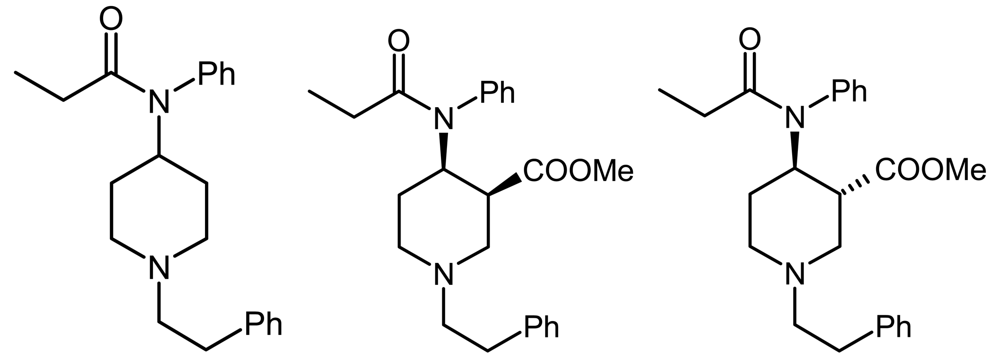
<p>Fentanyl (<xref ref-type="fig" rid="f1-pharmaceuticals-04-00233">Figure 1</xref>) is a strong and relatively short acting opioid drug widely used in surgery and in the treatment of postoperative and cancer pain [<xref ref-type="bibr" rid="b1-pharmaceuticals-04-00233">1</xref>]. However, in many animal species, as well as in humans, high doses of fentanyl and its analogs produce marked neurotoxic effects such as muscular rigidity and respiratory depression [<xref ref-type="bibr" rid="b1-pharmaceuticals-04-00233">1</xref>-<xref ref-type="bibr" rid="b4-pharmaceuticals-04-00233">4</xref>]. Since neurotoxic effects are clinically undesirable, the ability to synthesize the compound with less side effects could lead to the development of a new clinically valuable opioid drug [<xref ref-type="bibr" rid="b2-pharmaceuticals-04-00233">2</xref>,<xref ref-type="bibr" rid="b4-pharmaceuticals-04-00233">4</xref>-<xref ref-type="bibr" rid="b9-pharmaceuticals-04-00233">9</xref>].</p>
<p>In a previous study it has been found that introduction of 3-carbomethoxy group in the piperidine ring of fentanyl skeleton (<xref ref-type="fig" rid="f1-pharmaceuticals-04-00233">Figure 1</xref>) provides less potent (∼2–10 x) opioid analgesics which possess rapid onset and a shorter duration of analgesia in rats [<xref ref-type="bibr" rid="b4-pharmaceuticals-04-00233">4</xref>,<xref ref-type="bibr" rid="b6-pharmaceuticals-04-00233">6</xref>-<xref ref-type="bibr" rid="b7-pharmaceuticals-04-00233">7</xref>]. In the present experiments, the neurotoxic effect such as impairment of motor coordination and lethality of intraperitoneal fentanyl (F) and newly synthesized fentanyl analogs, (±)<italic>cis</italic>-3-carbomethoxyfentanyl (C) and (±)<italic>trans</italic>-3-carbomethoxyfentanyl (T) were compared in mice.</p></sec>
<sec>
<label>2.</label>
<title>Experimental</title>
<sec>
<label>2.1.</label>
<title>Animals</title>
<p>Male albino mice weighting 20–35 g obtained from Military Farm (Belgrade, Serbia) were used. All experiments were approved by the Institutional Animal Ethics Committee (Permission N 828/2/2-2, May 12<sup>th</sup>, 2009.) which operates in accordance with Revised Guide for the Care and Use of Laboratory Animals (NIH Guide, Volume 25, Number 28, 1996). The animals were housed in groups of 10 in plexiglas cages (36.5 × 21 × 14 cm) under standard conditions: temperature of 22 ± 1 °C, and a 12/12 h light/dark cycle with lights on at 08.00 h. Food pallets and tap water were available <italic>ad libitum</italic>, except during the experimental procedure. Prior to each experiment the animals were habituated to the handling and experimental procedures for at least three consecutive days. Experiments were done in a sound–proofed, diffusely illuminated room maintained at a temperature of 22 ± 1 °C. They were performed at the same time of the day between 9:00 and 13:00 h to avoid diurnal variation in behavioral tests. Experimental groups consisted of 6–10 mice. Each animal was used only once and was killed with i.p. injection of sodium thiopental.</p></sec>
<sec>
<label>2.2.</label>
<title>Antinociception Testing</title>
<p>The antinociceptive activity was determined by the “hot plate” test (Technilab Instrument Inc. 475, Ugo Basile, Italy). The latency to a “hind paw lick or jump” response was measured for mice placed on a plate heated to 55 ± 0.5 °C [<xref ref-type="bibr" rid="b10-pharmaceuticals-04-00233">10</xref>]. In order to minimize tissue damage by repeated testing, a cut-off time of 30 s was adopted. This means that the maximum duration of a single exposure of rat to hot plate was 30 s. Predrug response latency was obtained 5 min before i.p. drug (or the saline in the control group) administration. In control and predrug latency testing, mice that did not respond to hot plate within 13 s were excluded from the experiment.</p>
<p>Postdrug response latency was measured after i.p. administration of test compound (or the saline in the control group) at 10, 20, 30, 40, 60, 80 and 100 min. The data are expressed quantally as the number of animals in which the antinociception was observed versus total number of animals receiving the same treatment. For antinociception, the following criterion was used: an antinociceptive effect was said to have occurred if postdrug response latency was doubled in respect to the control latencies. The ED<sub>50</sub> value for analgesia (AD<sub>50</sub>) was defined as a dose at which 50% of testing animals doubled the control latencies.</p></sec>
<sec>
<label>2.3.</label>
<title>Impairment of Motor Coordination Testing</title>
<p>Motor impairment was determined by rotarod test in mice according to Kinnard and Carr [<xref ref-type="bibr" rid="b11-pharmaceuticals-04-00233">11</xref>]. The test was undertaken by use of a rod of 3 cm diameter, rotating at a constant speed of 15 rpm (Treadmill for mice 7600, Ugo Basile, Milano, Italy). Two days before testing, mice were pretrained and only the animals able to remain on the rod for 60 s for two consecutive trials (separated by 30 min pause between trials) were used in the experiments. On the day of the experiment, the mice were tested once again to obtain the predrug time spent on the rotarod, which had to be at least 60 s for all animals. After the i.p. drug administration (or the saline in the control group), the number of animals per group unable to remain on the rod for at least 60 s was recorded at 5, 10, 15, 20, 40 and 60 min time points. The TD<sub>50</sub> (the dose that induces motor impairment in 50% of animals tested) with 95% confidence limits was calculated from a corresponding quantal dose–response curve (Litchfield &amp; Wilcoxon I procedure) according to Tallarida and Murray [<xref ref-type="bibr" rid="b12-pharmaceuticals-04-00233">12</xref>] by using the following criteria: an animal was said to be motorically impaired if it did not remain on the rotarod for the entire 60 s [<xref ref-type="bibr" rid="b11-pharmaceuticals-04-00233">11</xref>]. The ED<sub>50</sub> value for impairment of motor coordination (TD<sub>50</sub>) was defined as a dose at which 50% of testing animals failed to remain on the rotarod for 60 s.</p></sec>
<sec>
<label>2.4.</label>
<title>Acute Toxicity</title>
<p>Acute toxicity was examined with the different intraperitoneal doses of fentanyl, (±)<italic>cis</italic>-3 carbomethoxyfentanyl and (±)<italic>trans</italic>-3-carbomethoxyfentanyl in groups of 10 mice per dose. Lethal end points were closely monitored for the first 12 h, and after that, twice per day for 2 weeks. The LD<sub>50</sub>s (median effective doses for lethality) were calculated and compared according to the method of Litchfield and Wilcoxon [<xref ref-type="bibr" rid="b12-pharmaceuticals-04-00233">12</xref>].</p></sec>
<sec>
<label>2.5.</label>
<title>Drugs Administration</title>
<p>Fentanyl citrate (ICN Yugoslavia, Belgrade, Serbia) and (±)<italic>cis</italic>- and (±)<italic>trans</italic>-3-carbomethoxy-fentanyl oxalate were dissolved in saline and injected i.p. at a final volume of 10 ml/kg. Both (±)<italic>cis</italic>-and (±)<italic>trans</italic>-3-carbomethoxyfentanyl (Faculty of Chemistry, University of Belgrade, Serbia) were examined as a racemic mixture. Doses of the drugs were calculated for the free base. Naloxone hydrochloride (Sigma Chemical Co. St. Louis, MO, USA) was also dissolved in saline, and injected sc (1 mg/kg) in the back before the i.p. injection of the test compound in the same volume. Saline alone (10 mL/kg) was administrated i.p. in a control group of rats.</p></sec>
<sec sec-type="methods">
<label>2.6.</label>
<title>Statistical Analysis</title>
<p>To permit direct comparison of different compounds and different effects, basic data for each animal were transformed to a quantal response (presence or absence of expected drug effect). For each effect and each dose maximum response obtained during the time of measurement was used for evaluation. Then, computations were done according to the methods of Tallarida and Murray [<xref ref-type="bibr" rid="b12-pharmaceuticals-04-00233">12</xref>]. First, the percentages of animals responding were converted to probits and plotted against the log dose. Then, the Litchfield &amp; Wilcoxon procedure was used to calculate ED<sub>50</sub> (median effective dose) values from corresponding quantal dose–response curves. Additionally, when data for a second quantal dose– response curve was entered, the same procedure calculated the potency ratio [with 95% confidence limits (95% CL)] for corresponding curves. In that way, relative potencies for fentanyl, (±)<italic>cis</italic>-3-carbomethoxyfentanyl and (±)<italic>trans</italic>-3-carbomethoxyfentanyl were calculated for antinociceptive, as well as toxic effects. Relative potency estimates were considered statistically significantly different when 95% CL did not overlap 1.0. Also, the potency ratios between two ED<sub>50</sub>s (TD<sub>50</sub>/AD<sub>50</sub> and LD<sub>50</sub>/AD<sub>50</sub>) denoted as the TIs (therapeutic index), for each drug were determined. If the 95% confidence interval for a TI fails to include 1.0, then ED<sub>50</sub>s are significantly different.</p>
<p>The duration of action was determined as a time that is necessary for antinociception and motor impairment to cease in 50% of tested animals after i.p. injection of equi-effective doses (4 × ED<sub>50</sub> for antinociception) of all three tested compounds. Percentages of responding rats for each effect and each compound was plotted as a function of time.</p>
<p>The drug response was compared to the control response at each time point of measurement by using Fisher's test. The difference in time-effect course between equi-antinociceptive doses of all three compounds tested was estimated by using both Fisher's and Mann-Whitney test. A P value of less than 0.05 was considered statistically significant.</p></sec></sec>
<sec sec-type="results|discussion">
<label>3.</label>
<title>Results and Discussion</title>
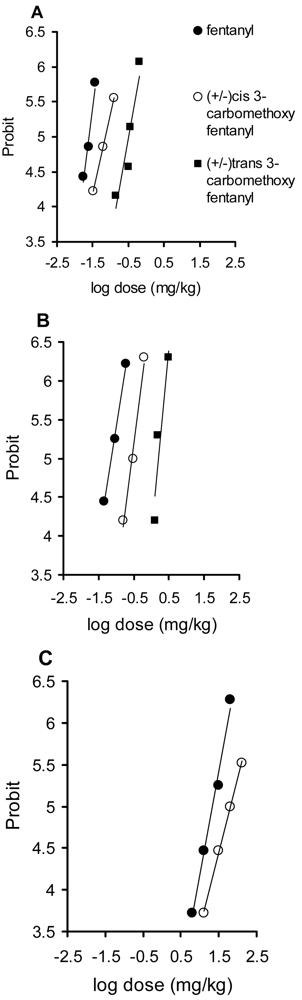
<p>The present study showed that fentanyl and its newly synthesized analogs, (±)<italic>cis</italic>-3-carbomethoxy-fentanyl (C) and (±)<italic>trans</italic>-3-carbomethoxyfentanyl (T), caused a significant and dose-dependent antinociception, impairment of motor coordination and lethality in mice. For each effect tested, probit slopes for F, C and T are not significantly different (<italic>p</italic> &gt; 0.05, test for parallelism) (<xref ref-type="table" rid="t1-pharmaceuticals-04-00233">Table 1</xref>; <xref ref-type="fig" rid="f2-pharmaceuticals-04-00233">Figure 2</xref>). The relative potencies for F, C and T are presented in <xref ref-type="table" rid="t1-pharmaceuticals-04-00233">Table 1</xref>.</p>
<p>This is the first report on the toxicity of C and T. C- and T-induced antinociception in the hot plate test in mice is consistent with the ability of these drugs to reduce tail immersion latency in rats [<xref ref-type="bibr" rid="b4-pharmaceuticals-04-00233">4</xref>]. In comparison with F (0.017–0.037 mg/kg), the antinociceptive potencies of C (0.032–0.125 mg/kg), and T (0.145–0.631 mg/kg), were reduced by factor 3 and 14, respectively (<italic>P</italic> &lt; 0.05) (<xref ref-type="fig" rid="f2-pharmaceuticals-04-00233">Figure 2</xref>; <xref ref-type="table" rid="t1-pharmaceuticals-04-00233">Table 1</xref>). Also, in comparison with F (0.046–0.186 mg/kg), the potencies of C (0.155–0.619 mg/kg), and T (1.291–3.097 mg/kg) to induce the motor impairment, were reduced about 4 and 25 times, respectively (<italic>P</italic> &lt; 0.05) (<xref ref-type="fig" rid="f2-pharmaceuticals-04-00233">Figure 2</xref>; <xref ref-type="table" rid="t1-pharmaceuticals-04-00233">Table 1</xref>). Also, C (16.26–128.83 mg/kg) is about 3 times less potent in producing lethal effect than fentanyl (6.31–63.10 mg/kg) (<italic>P</italic> &lt; 0.05) (<xref ref-type="fig" rid="f2-pharmaceuticals-04-00233">Figure 2</xref>; <xref ref-type="table" rid="t1-pharmaceuticals-04-00233">Table 1</xref>). T is a significantly less potent drug than C (4.6 and 5.8 times for analgesia and motor impairment, respectively) (not shown). Each of the tested compounds, exhibited similar (<italic>p</italic> &gt; 0.05) relative potencies in producing all effects tested (95% confidence intervals overlap) (<xref ref-type="table" rid="t1-pharmaceuticals-04-00233">Table 1</xref>). If a series of related agonists exhibits identical relative potencies in producing distinct effects, it is likely that these effects are mediated by similar or identical receptor molecules [<xref ref-type="bibr" rid="b13-pharmaceuticals-04-00233">13</xref>].</p>
<p>Both, antinociceptive and toxic effects, were abolished by pretreatment with naloxone hydrochloride (1 mg/kg), nonselective antagonist of opioid receptors (not shown), indicating that they are mediated by opioid receptors. In the case of F, C and T, they are of μ type, most probably. Most of the currently available strong opioids exert their analgesic and adverse effects primarily through the opioid μ receptors [<xref ref-type="bibr" rid="b14-pharmaceuticals-04-00233">14</xref>].</p>
<p>The therapeutic indices are shown in <xref ref-type="table" rid="t2-pharmaceuticals-04-00233">Table 2</xref>. As F, C, and T did not alter rotarod performance in the antinociceptive doses used, it is possible that the antinociceptive behavior was not due to motor impairment or sedation. All drugs tested demonstrated good separation between antinociceptive efficacy in a thermal pain model, and motor impairment induction. The TD<sub>50</sub> values for F, C, and T are significantly greater than their AD<sub>50</sub> values [2.9 (1.6–5.4), 4.0 (2.0–7.9) and 5.0 (3.0–8.5) times, respectively] (<xref ref-type="table" rid="t2-pharmaceuticals-04-00233">Table 2</xref>). The greater the TI value is, the greater is observed drug tolerability. There are no significant differences between therapeutic indices for F, C and T, which means that these compounds are equally tolerable in regard to motor impairment. These observations suggest that C and T are effective drugs in hot plate test in mice, in a dose range that is not related to motor impairment, and that in comparison with fentanyl C and T are less potent, but not less tolerable drugs.</p>
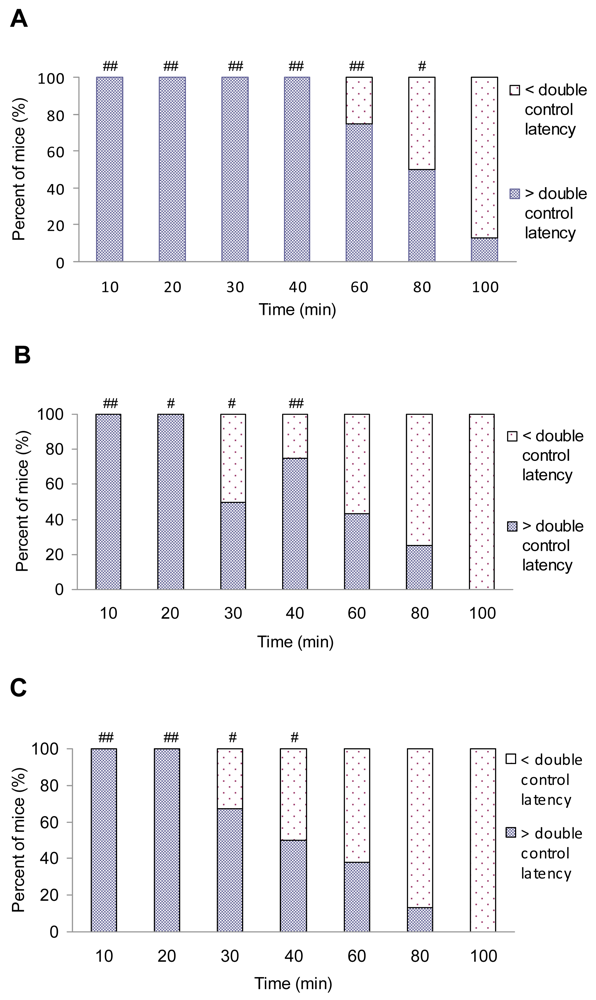
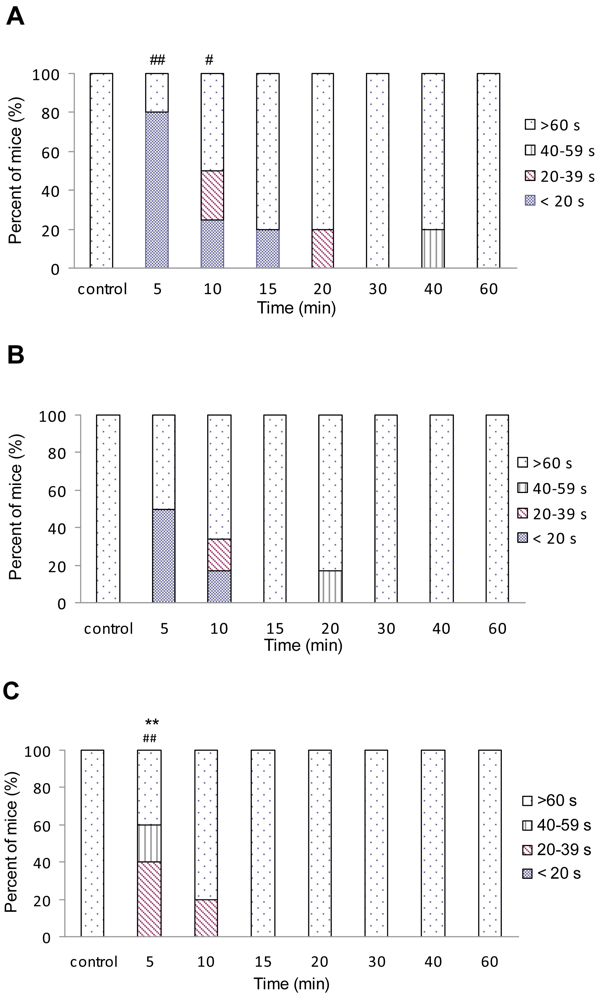
<p>By using equi-antinociceptive doses (4 × ED<sub>50</sub>), C and T produced shorter duration of action than F. The duration of actions (time that is necessary for drug response to cease in 50% of tested animals) were approximately 80, 40 and 40 min (antinociception) and 10, 5 and 5 min (impairment of motor coordination) for F, C and T, respectively. The duration of antinociception of C and T was not statistically different from F (<italic>p</italic> &gt; 0.05; Mann-Whitney test), but the duration of motor impairment of T was statistically reduced (<italic>P</italic> &lt; 0.01) in comparison with F (<xref ref-type="fig" rid="f3-pharmaceuticals-04-00233">Figure 3</xref> and <xref ref-type="fig" rid="f4-pharmaceuticals-04-00233">4</xref>). This is not the case with C. In our previous experiments it has been clearly shown that C and T given i.p. in rats exhibited significantly shorter antinociception in comparison with F [<xref ref-type="bibr" rid="b4-pharmaceuticals-04-00233">4</xref>]. On that occasion, the differences in duration of action were explained by a different pharmacokinetics between fentanyl and 3-carbomethoxy fentanyl. Moreover, the present finding suggests species differences in the pharmacokinetics of 3-carbomethoxyfentanyl.</p>
<p>Acute toxicities of F and C have been evaluated in mice. The animals have been followed up for 14 days. There is no difference between LD<sub>50</sub> values obtained after 24 h and 14 days. Signs and symptoms of acute toxicity of all three drugs were similar: dyspnea, hypoventilation, cyanosis, convulsion, Straub tail, trunk muscle rigidity, prostration <italic>etc.</italic> In agreement with opioid activity, respiratory depression was the most prominent symptom and probably the main cause of death, as well [<xref ref-type="bibr" rid="b15-pharmaceuticals-04-00233">15</xref>]. This is supported by fact that most death occurred in the first few hours after drug administration. Necropsy has not been performed. There is no significant difference between the therapeutic indices [median lethal dose (LD<sub>50</sub>) / median antinociceptive dose (AD<sub>50</sub>)] between F and C: 858.1 (444.9–1654.7) and 918.5 (392.8–2147.5), respectively (<xref ref-type="table" rid="t2-pharmaceuticals-04-00233">Table 2</xref>). This finding suggested that F and C are equally safe in mice.</p></sec>
<sec>
<label>4.</label>
<title>Conclusion</title>
<p>In conclusion, the antinociceptive and toxic effects of newly synthesized fentanyl analogs, (±)<italic>cis</italic>-3-carbomethoxyfentanyl and (±)<italic>trans</italic>-3-carbomethoxyfentanyl are mediated <italic>via</italic> opioid receptors, most probably of μ type. The introduction of 3-carbomethoxy group in the piperidine ring of the fentanyl skeleton reduced the potency, but did not affect tolerability and safety of the compound.</p></sec></body>
<back>
<sec sec-type="display-objects">
<title>Figures and Tables</title>
<fig id="f1-pharmaceuticals-04-00233" position="float">
<label>Figure 1.</label>
<caption>
<p>Fentanyl, (±)<italic>cis</italic>-3-carbomethoxyfentanyl and (±)<italic>trans</italic>-3-carbomethoxyfentanyl.</p></caption>
<graphic xlink:href="pharmaceuticals-04-00233f1.gif"/></fig>
<fig id="f2-pharmaceuticals-04-00233" position="float">
<label>Figure 2.</label>
<caption>
<p>Log dose-probit curves for antinociception (hot plate) (A), motor impairment (rotarod test) (B) and lethality (C) for fentanyl, (±)<italic>cis</italic>-3-carbomethoxyfentanyl and (±)<italic>trans</italic>-3-carbomethoxyfentanyl, in mice, after i.p. drug administration. For antinociception, the following criterion was used: an antinociceptive effect was said to have occurred if postdrug response latency was doubled in respect to the control predrug latencies. Motor impairment was detected in the animal unable to maintain equilibrium on the rotating rod for 60 s. Each point represents the probit value obtained from at least 6 mice.</p></caption>
<graphic xlink:href="pharmaceuticals-04-00233f2.gif"/></fig>
<fig id="f3-pharmaceuticals-04-00233" position="float">
<label>Figure 3.</label>
<caption>
<p>Time course of the antinociceptive effects of A) fentanyl, B) (±)<italic>cis</italic>-3-carbomethoxyfentanyl and C) (±)<italic>trans</italic>-3-carbomethoxyfentanyl in mice. The incidence of antinociception is plotted as a function of time after i.p. injection of equi-effective doses <italic>i.e.</italic> 4 × ED<sub>50</sub> for antinociception of each drug. Each drug was tested by using 6-10 rats. Each point represents the percentage of rats that respond to the treatment with doubled postdrug response latency. Control animals (n = 7) received saline in the same volume. <sup>#</sup> <italic>P</italic> &lt; 0.05 and <sup>##</sup> <italic>P</italic> &lt;0.01 indicate a significant difference of the responses of fentanyl analogs in comparison to control (Fisher's test).</p></caption>
<graphic xlink:href="pharmaceuticals-04-00233f3.gif"/></fig>
<fig id="f4-pharmaceuticals-04-00233" position="float">
<label>Figure 4.</label>
<caption>
<p>Time course of the effects of A) fentanyl, B) (±)<italic>cis</italic>-3-carbomethoxyfentanyl and C) (±)<italic>trans</italic>-3-carbomethoxyfentanyl on motor performance of mice. The incidence of motor impairment is plotted as a function of time after i.p. injection of equi-effective doses <italic>i.e.</italic> 4×ED<sub>50</sub> for antinociception of each drug. Each drug was tested by using 6–10 rats. Each point represents the percentage of rats that respond according to criterion: &gt;20, 20–39, 40–59 and &gt;60 s spent on rotarod. * <italic>P</italic> &lt; 0.05 and ** <italic>P</italic> &lt; 0.01 (Mann-Whitney test) indicate a significant difference of the responses of (±)<italic>cis</italic>- or <italic>trans</italic>-3-carbomethoxy-fentanyl in comparison to fentanyl. <sup>#</sup> <italic>P</italic> &lt; 0.05 and <sup>##</sup> <italic>P</italic> &lt; 0.01 indicate a significant difference of the responses of fentanyl analogs in comparison to control (Fisher's test).</p></caption>
<graphic xlink:href="pharmaceuticals-04-00233f4.gif"/></fig>
<table-wrap id="t1-pharmaceuticals-04-00233" position="float">
<label>Table 1.</label>
<caption>
<p>Median effective doses for antinociception (AD<sub>50</sub>), impairement of motor coordination (TD<sub>50</sub>) and lethality (LD<sub>50</sub>), correlation coefficient (r), probit slopes and relative potencies with 95% confidence limits (95% CL) for fentanyl, (±)<italic>cis</italic>-3-carbomethoxyfentanyl and (±)<italic>trans</italic>-3-carbomethoxyfentanyl in inducing antinociception, impairement of motor coordination and lethality in mice.</p></caption>
<table frame="hsides" rules="groups">
<thead>
<tr>
<th align="left" valign="middle"><bold>Effect</bold></th>
<th align="left" valign="middle"><bold>AD<sub>50</sub> or TD<sub>50</sub> or LD<sub>50</sub> (95% confidence interval)</bold></th>
<th align="left" valign="middle"><bold>r</bold></th>
<th align="left" valign="middle"><bold>Probit slope</bold></th>
<th align="left" valign="middle"><bold>Relative potency</bold></th></tr></thead>
<tbody>
<tr>
<td colspan="5" align="center" valign="middle"><bold>Fentanyl</bold> (0.017–63.096 mg/kg)</td></tr>
<tr>
<td valign="bottom" colspan="5">
<hr/></td></tr>
<tr>
<td align="left" valign="top"><bold>Antinociception <xref ref-type="table-fn" rid="tfn1-pharmaceuticals-04-00233"><sup>1</sup></xref></bold></td>
<td align="left" valign="top">0.025 (0.018–0.034)</td>
<td align="left" valign="top">0.979</td>
<td align="left" valign="top">3.9 (−6.4–14.3)</td>
<td align="left" valign="top">1</td></tr>
<tr>
<td align="left" valign="top"><bold>Impairement of motor coordination <xref ref-type="table-fn" rid="tfn2-pharmaceuticals-04-00233"><sup>2</sup></xref></bold></td>
<td align="left" valign="top">0.073 (0.043–0.123)</td>
<td align="left" valign="top">0.999</td>
<td align="left" valign="top">2.9 (1.3–4.5)</td>
<td align="left" valign="top">1</td></tr>
<tr>
<td align="left" valign="top"><bold>Lethality</bold></td>
<td align="left" valign="top"/>
<td align="left" valign="top"/></tr>
<tr>
<td align="left" valign="top"> <bold>24 h</bold></td>
<td align="left" valign="top">26.30 (14.78–46.77)</td>
<td align="left" valign="top">0.990</td>
<td align="left" valign="top">2.0 (1.1–2.9)</td>
<td align="left" valign="top">1</td></tr>
<tr>
<td align="left" valign="top"> <bold>14 days</bold></td>
<td align="left" valign="top">21.25 (11.99–37.67)</td>
<td align="left" valign="top">0.994</td>
<td align="left" valign="top">2.5 (1.6–3.3)</td>
<td align="left" valign="top">1</td></tr>
<tr>
<td valign="bottom" colspan="5">
<hr/></td></tr>
<tr>
<td colspan="5" align="center" valign="middle"><bold>(±)<italic>cis</italic>-3-Carbomethoxyfentanyl</bold> (0.032–128.825 mg/kg)</td></tr>
<tr>
<td valign="bottom" colspan="5">
<hr/></td></tr>
<tr>
<td align="left" valign="top"><bold>Antinociception <xref ref-type="table-fn" rid="tfn1-pharmaceuticals-04-00233"><sup>1</sup></xref></bold></td>
<td align="left" valign="top">0.071 (0.040-0.124)</td>
<td align="left" valign="top">1</td>
<td align="left" valign="top">2.3 (1.7–2.8)</td>
<td align="left" valign="top">0.35<xref ref-type="table-fn" rid="tfn3-pharmaceuticals-04-00233">*</xref> (0.18–0.67)</td></tr>
<tr>
<td align="left" valign="top"><bold>Impairement of motor coordination <xref ref-type="table-fn" rid="tfn2-pharmaceuticals-04-00233"><sup>2</sup></xref></bold></td>
<td align="left" valign="top">0.282 (0.188-0.421)</td>
<td align="left" valign="top">0.993</td>
<td align="left" valign="top">3.5 (−1.8–8.9)</td>
<td align="left" valign="top">0.26<xref ref-type="table-fn" rid="tfn3-pharmaceuticals-04-00233">*</xref> (0.13–0.50)</td></tr>
<tr>
<td align="left" valign="top"><bold>Lethality</bold></td>
<td align="left" valign="top"/>
<td align="left" valign="top"/></tr>
<tr>
<td align="left" valign="top">  <bold>24 h</bold></td>
<td align="left" valign="top">82.71 (43.73–156.46)</td>
<td align="left" valign="top">0.981</td>
<td align="left" valign="top">1.8 (0.7–2.9)</td>
<td align="left" valign="top">0.32 <xref ref-type="table-fn" rid="tfn3-pharmaceuticals-04-00233">*</xref> (0.13–0.75)</td></tr>
<tr>
<td align="left" valign="top"> <bold>14 days</bold></td>
<td align="left" valign="top">65.12 (34.51–122.85)</td>
<td align="left" valign="top">0.999</td>
<td align="left" valign="top">1.8 (1.6–2.0)</td>
<td align="left" valign="top">0.33 <xref ref-type="table-fn" rid="tfn3-pharmaceuticals-04-00233">*</xref> (0.14–0.77)</td></tr>
<tr>
<td valign="bottom" colspan="5">
<hr/></td></tr>
<tr>
<td colspan="5" align="center" valign="middle"><bold>(±)<italic>trans</italic>-3-Carbomethoxyfentanyl</bold> (0.145–3.097 mg/kg)</td></tr>
<tr>
<td valign="bottom" colspan="5">
<hr/></td></tr>
<tr>
<td align="left" valign="top"><bold>Antinociception <xref ref-type="table-fn" rid="tfn1-pharmaceuticals-04-00233"><sup>1</sup></xref></bold></td>
<td align="left" valign="top">0.32 (0.21–0.50)</td>
<td align="left" valign="top">0.994</td>
<td align="left" valign="top">2.9 (−1.2–7.1)</td>
<td align="left" valign="top">0.08<xref ref-type="table-fn" rid="tfn3-pharmaceuticals-04-00233">*</xref> (0.01–0.58)</td></tr>
<tr>
<td align="left" valign="top"><bold>Impairement of motor coordination <xref ref-type="table-fn" rid="tfn2-pharmaceuticals-04-00233"><sup>2</sup></xref></bold></td>
<td align="left" valign="top">1.63 (1.20–2.20)</td>
<td align="left" valign="top">0.949</td>
<td align="left" valign="top">4.9 (−15.6–25.3)</td>
<td align="left" valign="top">0.04<xref ref-type="table-fn" rid="tfn3-pharmaceuticals-04-00233">*</xref> (0.01–0.24)</td></tr></tbody></table>
<table-wrap-foot><fn id="tfn1-pharmaceuticals-04-00233">
<label>1</label>
<p>criterion &gt; double control latency;</p></fn><fn id="tfn2-pharmaceuticals-04-00233">
<label>2</label>
<p>criterion &lt; 60 s, AD<sub>50</sub>s, TD<sub>50</sub>s and LD<sub>50</sub> were calculated by using at least 3 doses of testing compound. One dose is tested in 6-10 mice (Litchfield &amp;Wilcoxon test) [<xref ref-type="bibr" rid="b12-pharmaceuticals-04-00233">12</xref>];</p></fn><fn id="tfn3-pharmaceuticals-04-00233">
<label>*</label>
<p>Relative potency estimates were considered statistically significant when 95% CL did not overlap 1.0 (<italic>P</italic> &lt; 0.05, Litchfield &amp; Wilcoxon II test) [<xref ref-type="bibr" rid="b12-pharmaceuticals-04-00233">12</xref>].</p></fn></table-wrap-foot></table-wrap>
<table-wrap id="t2-pharmaceuticals-04-00233" position="float">
<label>Table 2.</label>
<caption>
<p>Therapeutic indices for fentanyl, (±)<italic>cis</italic> 3-carbomethoxy fentanyl and (±)<italic>trans</italic> 3-carbomethoxy fentanyl in mice.</p></caption>
<table frame="hsides" rules="groups">
<thead>
<tr>
<th align="left" valign="top"><bold>Compound</bold></th>
<th align="left" valign="top"><bold>Fentanyl</bold></th>
<th align="left" valign="top"><bold>(±)<italic>cis</italic>-3-carbomethoxy-fentanyl</bold></th>
<th align="left" valign="top"><bold>(±)<italic>trans</italic>-3-carbomethoxy-fentanyl</bold></th></tr>
<tr>
<th align="left" valign="top"><bold>Toxicity</bold></th>
<th align="left" valign="top"><bold>Therapeutic index</bold> (TI = TD<sub>50</sub>/AD<sub>50</sub> or LD<sub>50</sub>/AD<sub>50</sub>)</th>
<th align="left" valign="top"><bold>Therapeutic index</bold> (TI = TD<sub>50</sub>/AD<sub>50</sub> or LD<sub>50</sub>/AD<sub>50</sub>)</th></tr></thead>
<tbody>
<tr>
<td align="left" valign="top"><bold>Impairment of motor</bold></td>
<td align="left" valign="top">2.9</td>
<td align="left" valign="top">4.0</td>
<td align="left" valign="top">5.0</td></tr>
<tr>
<td align="left" valign="top"><bold>coordination (rotarod)<xref ref-type="table-fn" rid="tfn5-pharmaceuticals-04-00233"><sup>2</sup></xref></bold></td>
<td align="left" valign="top">(1.6–5.4)</td>
<td align="left" valign="top">(2.0–7.9)</td>
<td align="left" valign="top">(3.0–8.5)</td></tr>
<tr>
<td align="left" valign="top"><bold>Lethality</bold></td>
<td align="left" valign="top">1061.8</td>
<td align="left" valign="top">1166.7</td>
<td align="left" valign="top">/</td></tr>
<tr>
<td align="left" valign="top"><bold>(24 h)</bold></td>
<td align="left" valign="top">(548.9–2053.8)</td>
<td align="left" valign="top">(497.9–2733.2)</td>
<td align="left" valign="top"/></tr>
<tr>
<td align="left" valign="top"><bold>(14 days)</bold></td>
<td align="left" valign="top">858.1</td>
<td align="left" valign="top">918.5</td>
<td align="left" valign="top"/></tr>
<tr>
<td align="left" valign="top"/>
<td align="left" valign="top">(444.9–1654.7)</td>
<td align="left" valign="top">(392.8–2147.5)</td>
<td align="left" valign="top"/></tr></tbody></table>
<table-wrap-foot><fn id="tfn4-pharmaceuticals-04-00233">
<label>1</label>
<p>criterion &gt; double control latency;</p></fn><fn id="tfn5-pharmaceuticals-04-00233">
<label>2</label>
<p>criterion &lt; 60 s; AD<sub>50</sub> = median effective dose for antinociception; TD<sub>50</sub> = median effective dose for impairment of motor coordination (median toxic dose); LD<sub>50</sub> = median lethal dose; Potency ratios TD<sub>50</sub>/AD<sub>50</sub> and LD<sub>50</sub>/AD<sub>50</sub> denoted as the TIs (therapeutic indices), for each drug were determined. If the 95% confidence interval for a TI fails to include 1.0, then ED<sub>50</sub>s are significantly different.</p></fn></table-wrap-foot></table-wrap></sec>
<ack>
<p>This work was supported by the Ministry of Science and Technological Development of Serbia (Grant No. 175023)</p></ack>
<ref-list>
<title>References</title>
<ref id="b1-pharmaceuticals-04-00233"><label>1.</label><citation citation-type="journal"><person-group person-group-type="author"><name><surname>Peng</surname><given-names>P.W.</given-names></name><name><surname>Sandler</surname><given-names>A.N.</given-names></name></person-group><article-title>A review of the use of fentanyl analgesia in the management of acute pain in adults</article-title><source>Anesthesiology</source><year>1999</year><volume>90</volume><fpage>576</fpage><lpage>599</lpage><pub-id pub-id-type="doi">10.1097/00000542-199902000-00034</pub-id><pub-id pub-id-type="pmid">9952166</pub-id></citation></ref>
<ref id="b2-pharmaceuticals-04-00233"><label>2.</label><citation citation-type="journal"><person-group person-group-type="author"><name><surname>Feldman</surname><given-names>P.L.</given-names></name><name><surname>James</surname><given-names>M.K.</given-names></name><name><surname>Brackeen</surname><given-names>M.F.</given-names></name><name><surname>Bilotta</surname><given-names>J.M.</given-names></name><name><surname>Schuster</surname><given-names>S.V.</given-names></name><name><surname>Lahey</surname><given-names>A.P.</given-names></name><name><surname>Lutz</surname><given-names>M.W.</given-names></name><name><surname>Johnson</surname><given-names>M.R.</given-names></name><name><surname>Leighton</surname><given-names>H.J.</given-names></name></person-group><article-title>Design, synthesis, and pharmacological evaluation of ultrashort- to long-acting opioid analgetics</article-title><source>J. Med. Chem.</source><year>1991</year><volume>34</volume><fpage>2202</fpage><lpage>2208</lpage><pub-id pub-id-type="doi">10.1021/jm00111a041</pub-id><pub-id pub-id-type="pmid">2066993</pub-id></citation></ref>
<ref id="b3-pharmaceuticals-04-00233"><label>3.</label><citation citation-type="journal"><person-group person-group-type="author"><name><surname>Vučković</surname><given-names>S.</given-names></name><name><surname>Ivanović</surname><given-names>M.</given-names></name><name><surname>Prostran</surname><given-names>M.</given-names></name><name><surname>Todorović</surname><given-names>Z.</given-names></name><name><surname>Ristović</surname><given-names>Z.</given-names></name><name><surname>Mićović</surname><given-names>I.</given-names></name><name><surname>Beleslin</surname><given-names>D.</given-names></name></person-group><article-title>Higher environmental temperature potentiates cataleptic effect of fentanyl in rats</article-title><source>Jpn. J. Pharmacol.</source><year>1998</year><volume>78</volume><fpage>523</fpage><lpage>527</lpage><pub-id pub-id-type="doi">10.1254/jjp.78.523</pub-id><pub-id pub-id-type="pmid">9920213</pub-id></citation></ref>
<ref id="b4-pharmaceuticals-04-00233"><label>4.</label><citation citation-type="journal"><person-group person-group-type="author"><name><surname>Vučković</surname><given-names>S.</given-names></name><name><surname>Prostran</surname><given-names>M.</given-names></name><name><surname>Ivanović</surname><given-names>M.</given-names></name><name><surname>Ristović</surname><given-names>Z.</given-names></name><name><surname>Stojanović</surname><given-names>R.</given-names></name></person-group><article-title>Antinociceptive activity of the novel fentanyl analog iso-carfentanil in rats</article-title><source>Jpn. J. Pharmacol.</source><year>2000</year><volume>84</volume><fpage>188</fpage><lpage>195</lpage><pub-id pub-id-type="doi">10.1254/jjp.84.188</pub-id><pub-id pub-id-type="pmid">11128042</pub-id></citation></ref>
<ref id="b5-pharmaceuticals-04-00233"><label>5.</label><citation citation-type="journal"><person-group person-group-type="author"><name><surname>Vučković</surname><given-names>S.</given-names></name><name><surname>Prostran</surname><given-names>M.</given-names></name><name><surname>Ivanović</surname><given-names>M.</given-names></name><name><surname>Došen-Mićović</surname><given-names>Lj.</given-names></name><name><surname>Todorović</surname><given-names>Z.</given-names></name><name><surname>Nešić</surname><given-names>Z.</given-names></name><name><surname>Stojanović</surname><given-names>R.</given-names></name><name><surname>Divac</surname><given-names>N.</given-names></name><name><surname>Miković</surname><given-names>Ž</given-names></name></person-group><article-title>Fentanyl analogs: structure-activity-relationship study</article-title><source>Curr. Med. Chem.</source><year>2009</year><volume>16</volume><fpage>2468</fpage><lpage>2474</lpage><pub-id pub-id-type="doi">10.2174/092986709788682074</pub-id><pub-id pub-id-type="pmid">19601792</pub-id></citation></ref>
<ref id="b6-pharmaceuticals-04-00233"><label>6.</label><citation citation-type="journal"><person-group person-group-type="author"><name><surname>Mićović</surname><given-names>I.</given-names></name><name><surname>Ivanović</surname><given-names>M.</given-names></name><name><surname>Vučković</surname><given-names>S.</given-names></name><name><surname>Jovanović-Mićić</surname><given-names>D.</given-names></name><name><surname>Beleslin</surname><given-names>D.</given-names></name><name><surname>Došen-Mićović</surname><given-names>Lj.</given-names></name><name><surname>Kiricojević</surname><given-names>V.</given-names></name></person-group><article-title>3-Carbomethoxy fentanyl: Synthesis, pharmacology and conformational analysis</article-title><source>Heterocycl. Commun.</source><year>1998</year><volume>4</volume><fpage>171</fpage><lpage>179</lpage></citation></ref>
<ref id="b7-pharmaceuticals-04-00233"><label>7.</label><citation citation-type="journal"><person-group person-group-type="author"><name><surname>Mićović</surname><given-names>I.V.</given-names></name><name><surname>Ivanović</surname><given-names>M.D.</given-names></name><name><surname>Vučković</surname><given-names>S.</given-names></name><name><surname>Jovanović-Mićić</surname><given-names>D.</given-names></name><name><surname>Beleslin</surname><given-names>D.</given-names></name><name><surname>Došen-Mićović</surname><given-names>Lj.</given-names></name><name><surname>Kiricojević</surname><given-names>V.D.</given-names></name></person-group><article-title>The synthesis, pharmacological evaluation and conformational analysis of (±)<italic>cis</italic> and (±)<italic>trans</italic> 3-carbomethoxy fentanyl -“iso-carfentanyl”</article-title><source>J. Serb. Chem. Soc.</source><year>1998</year><volume>63</volume><fpage>93</fpage><lpage>112</lpage></citation></ref>
<ref id="b8-pharmaceuticals-04-00233"><label>8.</label><citation citation-type="journal"><person-group person-group-type="author"><name><surname>Mićović</surname><given-names>I.</given-names></name><name><surname>Ivanović</surname><given-names>M.</given-names></name><name><surname>Vučković</surname><given-names>S.</given-names></name><name><surname>Prostran</surname><given-names>M.</given-names></name><name><surname>Došen-Mićović</surname><given-names>Lj.</given-names></name><name><surname>Kiricojević</surname><given-names>V.</given-names></name></person-group><article-title>The synthesis and preliminary pharmacological evaluation of 4-methyl fentanyl</article-title><source>Bioorg. Med. Chem. Lett.</source><year>2000</year><volume>10</volume><fpage>2011</fpage><lpage>2014</lpage><pub-id pub-id-type="doi">10.1016/S0960-894X(00)00394-2</pub-id><pub-id pub-id-type="pmid">10987438</pub-id></citation></ref>
<ref id="b9-pharmaceuticals-04-00233"><label>9.</label><citation citation-type="book"><person-group person-group-type="author"><name><surname>Došen-Mićović</surname><given-names>L.J.</given-names></name><name><surname>Ivanović</surname><given-names>M.</given-names></name><name><surname>Vučković</surname><given-names>S.</given-names></name><name><surname>Mićović</surname><given-names>I. V.</given-names></name></person-group><article-title>Theoretical study of acyclic fentanyl analogs with analgesic activity: diampromide and seco-fentanyl</article-title><source>Electronic Conference on Heterocyclic Chemistry</source><person-group person-group-type="editor"><name><surname>Rzepa</surname><given-names>H.S.</given-names></name><name><surname>Kappe</surname><given-names>C.O.</given-names></name><name><surname>Leach</surname><given-names>C.</given-names></name></person-group><publisher-name>Imperial College Press</publisher-name><publisher-loc>London, Great Britain</publisher-loc><year>1998</year></citation></ref>
<ref id="b10-pharmaceuticals-04-00233"><label>10.</label><citation citation-type="journal"><person-group person-group-type="author"><name><surname>O'Callaghan</surname><given-names>J.P.</given-names></name><name><surname>Holtzman</surname><given-names>S.G.</given-names></name></person-group><article-title>Quantification of the analgesic activity of narcotic antagonists by a modified hot-plate procedure</article-title><source>J. Pharmacol. Exp. Ther.</source><year>1975</year><volume>192</volume><fpage>497</fpage><lpage>505</lpage><pub-id pub-id-type="pmid">1168252</pub-id></citation></ref>
<ref id="b11-pharmaceuticals-04-00233"><label>11.</label><citation citation-type="journal"><person-group person-group-type="author"><name><surname>Kinnard</surname><given-names>W.R.</given-names></name><name><surname>Carr</surname><given-names>C.J.</given-names></name></person-group><article-title>A preliminary procedure for evaluation of central nervous system depressants</article-title><source>J. Pharmacol. Exp. Ther.</source><year>1957</year><volume>121</volume><fpage>354</fpage><lpage>356</lpage><pub-id pub-id-type="pmid">13481857</pub-id></citation></ref>
<ref id="b12-pharmaceuticals-04-00233"><label>12.</label><citation citation-type="book"><person-group person-group-type="author"><name><surname>Tallarida</surname><given-names>R.J.</given-names></name><name><surname>Murray</surname><given-names>R.B.</given-names></name></person-group><source>Manual of Pharmacologic Calculations with Computer Programs</source><edition>2nd ed.</edition><publisher-name>Springer Verlag</publisher-name><publisher-loc>New York, USA</publisher-loc><year>1986</year></citation></ref>
<ref id="b13-pharmaceuticals-04-00233"><label>13.</label><citation citation-type="book"><person-group person-group-type="author"><name><surname>Bourne</surname><given-names>H.</given-names></name><name><surname>von Zastrow</surname><given-names>M.</given-names></name></person-group><article-title>Drug receptors and pharmacodynamics</article-title><source>Basic and Clinical Pharmacology</source><edition>10th ed.</edition><person-group person-group-type="editor"><name><surname>Katzung</surname><given-names>B.G.</given-names></name></person-group><publisher-name>McGraw-Hill Companies Inc</publisher-name><publisher-loc>New York</publisher-loc><year>2007</year><fpage>11</fpage><lpage>33</lpage></citation></ref>
<ref id="b14-pharmaceuticals-04-00233"><label>14.</label><citation citation-type="journal"><person-group person-group-type="author"><name><surname>Pasternak</surname><given-names>G.W.</given-names></name></person-group><article-title>Multiple opiate receptors: déjà vu all over again</article-title><source>Neuropharmacology</source><year>2004</year><volume>47</volume><supplement>Suppl. 1</supplement><fpage>312</fpage><lpage>323</lpage><pub-id pub-id-type="doi">10.1016/j.neuropharm.2004.07.004</pub-id><pub-id pub-id-type="pmid">15464147</pub-id></citation></ref>
<ref id="b15-pharmaceuticals-04-00233"><label>15.</label><citation citation-type="journal"><person-group person-group-type="author"><name><surname>Dahan</surname><given-names>A.</given-names></name><name><surname>Aarts</surname><given-names>L.</given-names></name><name><surname>Smith</surname><given-names>T.W.</given-names></name></person-group><article-title>Incidence, reversal, and prevention of opioid-induced respiratory depression</article-title><source>Anesthesiology</source><year>2010</year><volume>112</volume><fpage>226</fpage><lpage>238</lpage><pub-id pub-id-type="doi">10.1097/ALN.0b013e3181c38c25</pub-id><pub-id pub-id-type="pmid">20010421</pub-id></citation></ref></ref-list></back></article>