
<?xml version="1.0" encoding="UTF-8"?>
<!DOCTYPE article PUBLIC "-//NLM//DTD Journal Publishing DTD v2.3 20070202//EN" "journalpublishing.dtd">
<article xmlns:mml="http://www.w3.org/1998/Math/MathML" xmlns:xlink="http://www.w3.org/1999/xlink" article-type="review-article">
  <front>
    <journal-meta>
      <journal-id journal-id-type="publisher-id">10</journal-id>
      <journal-title>Pharmaceuticals</journal-title>
      <abbrev-journal-title abbrev-type="publisher">Pharmaceuticals</abbrev-journal-title>
      <abbrev-journal-title abbrev-type="pubmed">Pharmaceuticals</abbrev-journal-title>
      <abbrev-journal-title>Pharmaceuticals</abbrev-journal-title>
      <issn pub-type="epub">1424-8247</issn>
      <publisher>
        <publisher-name>MDPI</publisher-name>
      </publisher>
    <abbrev-journal-title abbrev-type="system">pharmaceuticals</abbrev-journal-title></journal-meta>
    <article-meta><article-id pub-id-type="pii">pharmaceuticals-03-01530</article-id>
      <article-id pub-id-type="publisher-id">ph3051530</article-id>
      <article-id pub-id-type="doi">10.3390/ph3051530</article-id>
      <article-id pub-id-type="pii">pharmaceuticals-03-01530</article-id>
      <article-categories>
        <subj-group>
          <subject>Review</subject>
        </subj-group>
      </article-categories>
      <title-group>
        <article-title>          Nonsteroidal Anti-Inflammatory Drugs (NSAIDs): Progress in Small Molecule Drug Development </article-title>
      </title-group>
      <contrib-group>
        <contrib contrib-type="author">
          <name>
            <surname>Rao</surname>
            <given-names>Praveen P.N.</given-names>
          </name>
          <xref rid="c1" ref-type="corresp">*</xref>
        </contrib>
        <contrib contrib-type="author">
          <name>
            <surname>Kabir</surname>
            <given-names>Saad N.</given-names>
          </name>
        </contrib>
        <contrib contrib-type="author">
          <name>
            <surname>Mohamed</surname>
            <given-names>Tarek</given-names>
          </name>
        </contrib>
      </contrib-group>
      <aff id="aff1">          School of Pharmacy, Health Sciences Campus, University of Waterloo, 200 University Avenue W. Waterloo, ON, N2L 3G1 Canada </aff>
      <author-notes>
        <corresp id="c1">* Author to whom correspondence should be addressed; Email: praopera@uwaterloo.ca; Tel.: +1-519-888-4567, ext: 21317; Fax: +1-519-888-7910</corresp>
      </author-notes>
      <pub-date pub-type="epub">
        <day>14</day>
        <month>05</month>
        <year>2010</year>
      </pub-date>
      <volume>3</volume>
      <issue>5</issue>
      <fpage>1530</fpage>
      <lpage>1549</lpage>
      <history>
        <date date-type="received">
          <day>01</day>
          <month>04</month>
          <year>2010</year>
        </date>
        <date date-type="rev-recd">
          <day>22</day>
          <month>04</month>
          <year>2010</year>
        </date>
        <date date-type="accepted">
          <day>12</day>
          <month>05</month>
          <year>2010</year>
        </date>
      </history>
      <permissions>
        <copyright-statement>2010 by the authors; licensee MDPI, Basel, Switzerland</copyright-statement>
        <copyright-year>2010</copyright-year>
        <license xmlns:xlink="http://www.w3.org/1999/xlink" license-type="open-access" xlink:href="http://creativecommons.org/licenses/by/3.0/">
          <p>This is an open-access article distributed under the terms of the Creative Commons Attribution License, which permits unrestricted use, distribution, and reproduction in any medium, provided the original work is properly cited.</p>
        </license>
      </permissions>
      <abstract>
        <p>Ever since the discovery of aspirin, small molecule therapeutics have been widely prescribed to treat inflammation and pain. Aspirin and several small molecule NSAIDs are known to inhibit the enzymes cyclooxygenase-1 (COX-1) and -2 (COX-2). Despite the success of NSAIDs to treat inflammatory disorders, the development of a clinically useful small molecule NSAIDs with decreased side effect profiles is an ongoing effort. The recent discovery and development of selective COX-2 inhibitors was a step toward this direction. Emerging trends are represented by the progress in the development of hybrid agents such as nitric oxide donor-NSAIDs (NO-NSAIDs) and dual COX/lipoxygenase (LOX) inhibitors. This review focuses on the recent advances in the rational design of small molecule NSAIDs in therapy.</p>
      </abstract>
      <kwd-group>
        <kwd>Small molecules</kwd>
        <kwd>NSAIDs</kwd>
        <kwd>Lp-PLA<sub>2</sub></kwd>
        <kwd>mPGES-1</kwd>
        <kwd>TNF-α</kwd>
      </kwd-group>
    <supplement>2010</supplement></article-meta>
  </front>
  <body>
    <sec>
      <title>1. Introduction</title>
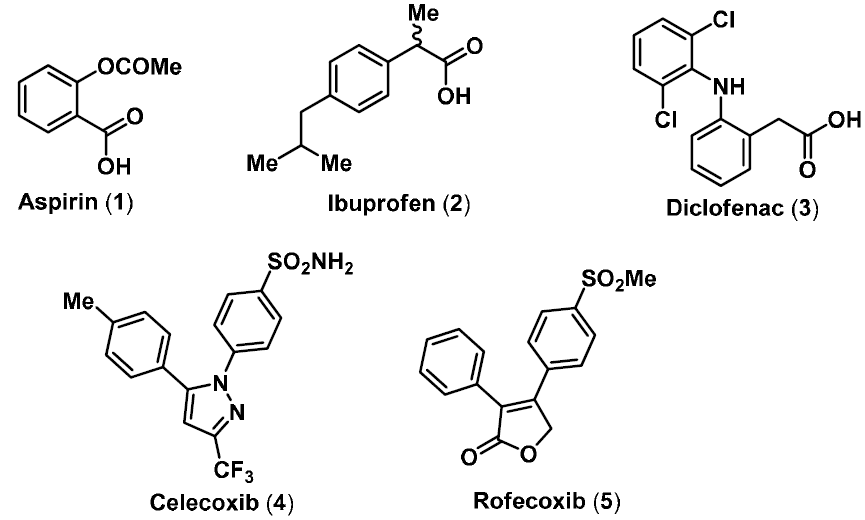
      <p>The history of treating fever, pain and inflammation is a fascinating tale of human adventure that goes back centuries [<xref ref-type="bibr" rid="B1">1</xref>]. Since the discovery and isolation of salicin from willow bark in the early 18th century to the development of selective COX-2 inhibitors in the 1990s, small molecule therapies to treat fever, pain and inflammation have evolved [<xref ref-type="bibr" rid="B1">1</xref>,<xref ref-type="bibr" rid="B2">2</xref>]. Traditional NSAIDs such as aspirin (<bold>1</bold>), ibuprofen (<bold>2</bold>) and diclofenac (<bold>3</bold>) that exhibit nonselective COX inhibition represent some of the most widely prescribed NSAIDs to relieve short term fever, pain and inflammation [<xref ref-type="bibr" rid="B3">3</xref>,<xref ref-type="bibr" rid="B4">4</xref>]. The characteristic feature of these traditional nonselective COX inhibitor NSAIDs was the presence of a carboxylic acid (COOH) functional group. In the early 1990s the second isoform of COX was discovered, providing a novel target to develop anti-inflammatory agents with superior safety profiles compared to traditional NSAIDs [<xref ref-type="bibr" rid="B5">5</xref>,<xref ref-type="bibr" rid="B6">6</xref>]. Consequently, selective COX-2 inhibitors (coxibs) based on a diarylheterocyclic ring template as in celecoxib (<bold>4</bold>) and rofecoxib (<bold>5</bold>) were developed [<xref ref-type="bibr" rid="B7">7</xref>,<xref ref-type="bibr" rid="B8">8</xref>].</p>
      <fig id="figure1" position="float">
        <label>Figure 1</label>
        <caption>
          <p>Chemical structures of some nonselective and selective COX inhibitors.</p>
        </caption>
        <graphic xmlns:xlink="http://www.w3.org/1999/xlink" xlink:href="pharmaceuticals-03-01530-g001.tif" scale="0"/>
      </fig>
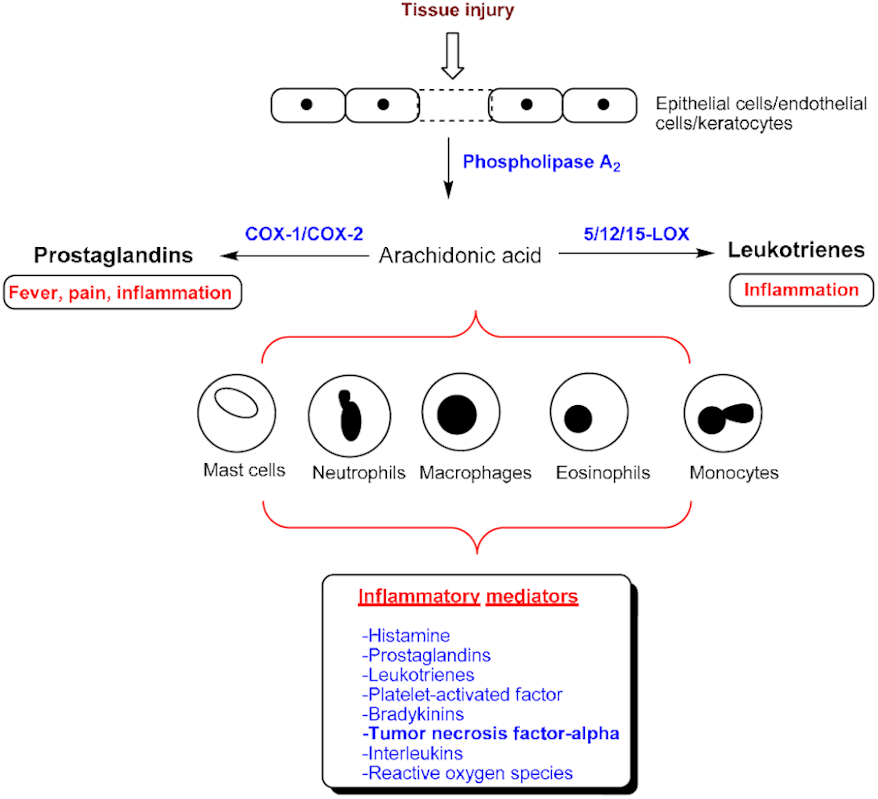
      <p>These agents were characterized by the presence of a <italic>para</italic>-sulfonamide (SO<sub>2</sub>NH<sub>2</sub>) or a <italic>para</italic>-methanesulfonyl (SO<sub>2</sub>Me) pharmacophore present on one of the aryl rings. Crystal structure studies supported the hypothesis that the <italic>p</italic>-SO<sub>2</sub>NH<sub>2</sub>or <italic>p</italic>-SO<sub>2</sub>Me pharmacophore was conferring COX-2 selectivity by orienting in a secondary pocket accessible only in the COX-2 active site [<xref ref-type="bibr" rid="B9">9</xref>,<xref ref-type="bibr" rid="B10">10</xref>]. The initial euphoria surrounding the selective COX-2 inhibitors, was short lived as studies indicated serious risks of cardiovascular complications in susceptible population during therapy [<xref ref-type="bibr" rid="B11">11</xref>,<xref ref-type="bibr" rid="B12">12</xref>]. Therefore, developing novel orally active small molecule anti-inflammatory agents with superior safety profile presents a significant challenge. The inflammatory pathway is a complex event involving multiple effectors (<xref ref-type="fig" rid="figure2">Figure 2</xref>). Inflammatory mediators such as prostaglandins (PGs), leukotrienes (LTs) and tumor necrosis factor-alpha (TNF-α) are implicated in a wide variety of diseases such as rheumatoid arthritis (RA), osteoarthritis (OA), asthma, atherosclerosis, different types of cancers and diseases of the central nervous system [<xref ref-type="bibr" rid="B13">13</xref>,<xref ref-type="bibr" rid="B14">14</xref>,<xref ref-type="bibr" rid="B15">15</xref>,<xref ref-type="bibr" rid="B16">16</xref>,<xref ref-type="bibr" rid="B17">17</xref>,<xref ref-type="bibr" rid="B18">18</xref>,<xref ref-type="bibr" rid="B19">19</xref>,<xref ref-type="bibr" rid="B20">20</xref>,<xref ref-type="bibr" rid="B21">21</xref>,<xref ref-type="bibr" rid="B22">22</xref>]. Traditional NSAIDs targeted COX isozymes, whereas later studies investigated nitric oxide (NO) donating NSAIDs (NO-NSAIDs), dual COX/LOX inhibitors, leukotriene receptor antagonists and selective COX-2 inhibitors in an effort to develop anti-inflammatory agents with superior safety profile [<xref ref-type="bibr" rid="B5">5</xref>,<xref ref-type="bibr" rid="B15">15</xref>,<xref ref-type="bibr" rid="B23">23</xref>,<xref ref-type="bibr" rid="B24">24</xref>,<xref ref-type="bibr" rid="B25">25</xref>]. Emerging small molecule targets includes phospholipases (PLA<sub>2</sub>), microsomal prostaglandin E<sub>2</sub> synthase (mPGES-1) and inhibition of TNF-α. This review will focus on the recent drug discovery efforts toward developing novel small molecule ring templates as NO-NSAIDs, selective COX-2, dual COX/LOX, lipoprotein-PLA<sub>2</sub> (Lp-PLA<sub>2</sub>), mPGES-1 and TNF- α inhibitors. </p>
      <fig id="figure2" position="float">
        <label>Figure 2</label>
        <caption>
          <p>A simplified diagram of the inflammatory pathway and its mediators.</p>
        </caption>
        <graphic xmlns:xlink="http://www.w3.org/1999/xlink" xlink:href="pharmaceuticals-03-01530-g002.tif" scale="0"/>
      </fig>
    </sec>
    <sec>
      <title>2. NO-NSAIDs</title>
      <p>The concept of developing hybrid NO-NSAIDs was primarily conceived to decrease the gastrointestinal (GI) toxicities observed with traditional NSAID use. In the GI tract NO is known to exert its protective role by increasing the mucous secretion, mucosal blood flow and inhibition of neutrophil aggregation [<xref ref-type="bibr" rid="B24">24</xref>]. In addition, the recent controversy surrounding the cardiovascular side effects of selective COX-2 inhibitors, further supports the need to develop clinically useful NO-NSAIDs since NO is also known to exhibit beneficial effects on the cardiovascular system by inhibiting platelet aggregation and adhesion [<xref ref-type="bibr" rid="B11">11</xref>,<xref ref-type="bibr" rid="B26">26</xref>]. Accordingly, several studies focused on developing NO-NSAIDs based on the aspirin, naproxen and diclofenac ring templates. These agents contain organic nitrates or nitrosothiols as the NO-donor moiety [<xref ref-type="bibr" rid="B24">24</xref>,<xref ref-type="bibr" rid="B27">27</xref>,<xref ref-type="bibr" rid="B28">28</xref>].</p>
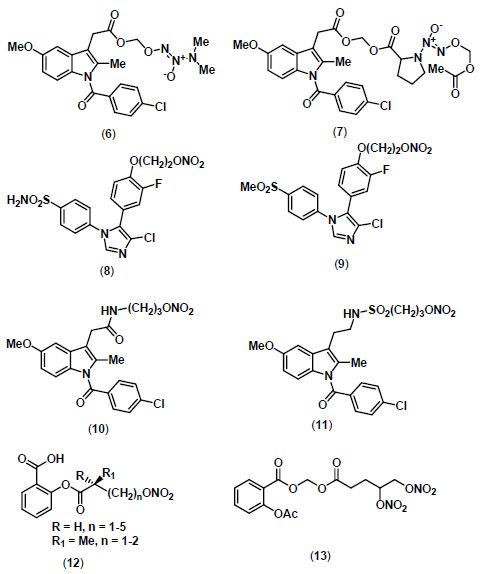
      <p>Diazeniumdiolates (NONOates) represent a unique structural moiety that can be incorporated to develop NO-donating agents [<xref ref-type="bibr" rid="B29">29</xref>]. Recently, Knaus and coworkers described the design and synthesis of hybrid aspirin, ibuprofen and indomethacin derivatives coupled to diazeniumdiolates as novel NO-donating prodrugs.</p>
      <fig id="figure3" position="float">
        <label>Figure 3</label>
        <caption>
          <p>Chemical structures of some representative NO-donor anti-inflammatory agents.</p>
        </caption>
        <graphic xmlns:xlink="http://www.w3.org/1999/xlink" xlink:href="pharmaceuticals-03-01530-g003.tif" scale="0"/>
      </fig>
      <p>The indomethacin derivative possessing a 1-(<italic>N</italic>,<italic>N</italic>-dimethylamino)diazen-1-ium-1,2-diolate (<bold>6, <xref ref-type="fig" rid="figure3">Figure 3</xref></bold>) exhibited potent <italic>in vivo</italic> anti-inflammatory activity (ED<sub>50</sub> = 5.9 mg/kg, oral dose) and minimal GI toxicity (ulcer index = 3.0 ± 0.3, oral dose) compared to the　 parent indomethacin (COX-2 IC<sub>50</sub> = 5.7 µM; COX-1 IC<sub>50</sub> = 0.10 µM). In another follow-up study, the indomethacin derivative linked to a 1-(2-carboxypyrrolidin-1-yl)diazen-1-ium-1,2-diolate by a methylene spacer (<bold>7</bold>) exhibited oral anti-inflammatory activity while exhibiting no GI toxicity (0.08 mmol/kg, oral dose). The <italic>in vitro</italic> assay data showed that these NO-donating prodrugs were devoid of COX inhibition [<xref ref-type="bibr" rid="B30">30</xref>,<xref ref-type="bibr" rid="B31">31</xref>].</p>
      <p>Gasco and coworkers developed a series of metabolically stable selective COX-2 inhibitor NO-donors (CINODs) based on a 1,5-diarylimidazole ring template [<xref ref-type="bibr" rid="B32">32</xref>]. The organic nitrate, nitroxy-substituted alkyloxy groups were incorporated on one of the aryl rings as a NO-donor moiety. The sulfonamide derivative possessing a phenoxyethyl nitrate NO-donor moiety (<bold>8</bold>) retained COX-2 selectivity (COX-2 IC<sub>50</sub> = 29 µM; COX-1 IC<sub>50</sub> &gt; 100 µM) and exhibited superior vasodilatory properties relative to the parent cimicoxib. The corresponding methanesulfonyl derivative (<bold>9</bold>) exhibited superior COX-2 selectivity (COX-2 IC<sub>50</sub> = 6.9 µM; COX-1 IC<sub>50</sub> &gt; 100 µM) and vasodilatory properties relative to <bold>8</bold>. It should be noted that these novel CINODs exhibit decreased COX inhibitory potency relative to the lead selective COX-2 inhibitor cimicoxib (COX-2 IC<sub>50</sub> = 0.10 µM; COX-1 IC<sub>50</sub> = 1.9 µM). Recently, NitroMed Inc. reported a group of indomethacin derivatives as selective COX-2 inhibitors with NO-donating properties [<xref ref-type="bibr" rid="B33">33</xref>]. The indomethacin amide derivative possessing an organic nitrate NO-donor moiety (<bold>10</bold>,<bold><xref ref-type="fig" rid="figure3">Figure 3</xref></bold>) exhibited effective <italic>in vitro</italic> COX-2 selectivity (COX-2 IC<sub>50</sub> = 1.2 µM; COX-1 IC<sub>50</sub> = 6.0 µM) and oral anti-inflammatory activity. The sulfonamide derivative possessing a nitrooxypropyl NO-donor moiety (<bold>11</bold>) exhibited superior <italic>in vitro</italic> COX-2 selectivity relative to <bold>10</bold> and was an equipotent inhibitor of COX-2 with oral anti-inflammatory activity. However, only rats treated with <bold>10</bold> exhibited increased nitrite and nitrate concentration in plasma indicating its NO-donating property <italic>in vivo</italic>. In addition, <bold>10</bold> exhibited an 85% reduction in gastric lesions when administered orally in a rat model of aspirin-induced rat gastric damage model (dose = 45 µmol/kg).</p>
      <p>The ever popular agent aspirin continues to be the focus of current research [<xref ref-type="bibr" rid="B34">34</xref>,<xref ref-type="bibr" rid="B35">35</xref>,<xref ref-type="bibr" rid="B36">36</xref>]. Recent studies have reported novel aspirin and aspirin derivatives possessing organic nitrate NO-donor moiety. In this regard, Gasco and coworkers prepared novel aspirin-like derivatives based on salicylic acid ring template possessing a nitrooxy-acyl NO-donor moiety (<bold>12</bold>) and aspirin derivatives possessing a (nitrooxyacyloxy)methyl ester NO-donor moiety (<bold>13</bold>). These agents exhibited effective oral anti-inflammatory and vasodilatory properties with reduced GI toxicities [<xref ref-type="bibr" rid="B36">36</xref>].</p>
    </sec>
    <sec>
      <title>3. Selective COX-2 Inhibitors</title>
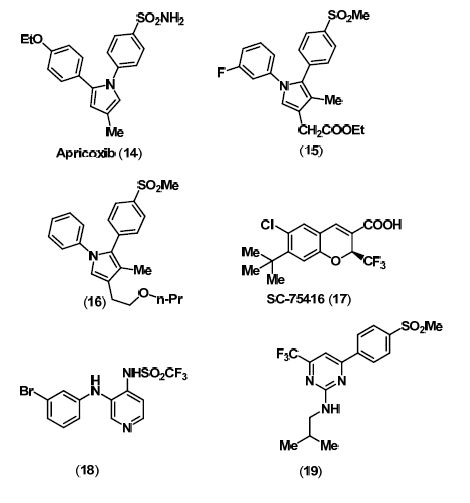
      <p>The adverse cardiovascular events associated with selective COX-2 inhibitors led to a dramatic decline in selective COX-2 inhibitor pipeline. In this regard, Tragara Pharmaceuticals is developing an orally active, selective COX-2 inhibitor (COX-2 IC<sub>50</sub> = 0.31 µM; COX-1 IC<sub>50</sub> = 2.2 µM) to treat different types of neoplasia such as tumors of lung, breast and pancreas [<xref ref-type="bibr" rid="B37">37</xref>]. Apricoxib has a 1,2-diphenyl template attached to a central 5-membered pyrrole ring along with a <italic>para</italic>-SO<sub>2</sub>NH<sub>2</sub> COX-2 pharmacophore (<bold>14</bold>, <xref ref-type="fig" rid="figure4">Figure 4</xref>). In addition, a group of regioisomeric 1,5-diphenylpyrroles possessing a <italic>para</italic>-SO<sub>2</sub>Me COX-2 pharmacophore were reported as selective COX-2 inhibitors (<bold>15</bold>,<bold/>COX-2 IC<sub>50</sub> = 2.1 µM; COX-1 IC<sub>50</sub> = 20.4 µM<bold>; 16 </bold>COX-2 IC<sub>50</sub> = 0.018 µM; COX-1 IC<sub>50</sub> &gt; 100 µM) that exhibited effective oral anti-inflammatory and analgesic activities. However, these studies did not report the cardiovascular safety of these agents [<xref ref-type="bibr" rid="B38">38</xref>,<xref ref-type="bibr" rid="B39">39</xref>,<xref ref-type="bibr" rid="B40">40</xref>]. Furthermore, Pfizer scientists reported a group of benzopyran derivatives as selective COX-2 inhibitors [<xref ref-type="bibr" rid="B41">41</xref>]. These are structurally different from the diarylheterocyclic class of selective COX-2 inhibitors. A representative compound from this series SC-75416 (<bold>17</bold>) contains a COOH and a CF<sub>3</sub> substituent. It is noteworthy that this agent did not contain either a SO<sub>2</sub>NH<sub>2</sub> or a SO<sub>2</sub>Me COX-2 pharmacophore. Compound <bold>17</bold> exhibited effective oral anti-inflammatory activity and similar COX inhibition/selectivity (COX-2 IC<sub>50</sub> = 0.25 µM; COX-1 IC<sub>50</sub> = 49.6 µM) relative to celecoxib.</p>
      <fig id="figure4" position="float">
        <label>Figure 4</label>
        <caption>
          <p>Chemical structures of some representative selective COX-2 inhibitors.</p>
        </caption>
        <graphic xmlns:xlink="http://www.w3.org/1999/xlink" xlink:href="pharmaceuticals-03-01530-g004.tif" scale="0"/>
      </fig>
      <p>In another study, Renard and coworkers designed novel nimesulide derivatives as selective COX-2 inhibitors [<xref ref-type="bibr" rid="B42">42</xref>]. The alkanesulfonamide (MeSO<sub>2</sub>NH) in nimesulide was replaced with a trifluoromethanesulfonamide (CF<sub>3</sub>SO<sub>2</sub>NH) moiety and the ether linkage was replaced with a secondary amine bridge. A representative agent <bold>18 </bold>(<xref ref-type="fig" rid="figure4">Figure 4</xref>) exhibited a good combination of oral anti-inflammatory activity and <italic>in vitro</italic> COX-2 selectivity (COX-2 IC<sub>50</sub> = 0.12 µM; COX-1 IC<sub>50</sub> = 0.91 µM). In 2009, GlaxoSmithKline (GSK) scientists reported the development of a novel series of trifluoromethylpyrimidine based ring scaffolds (<bold>19</bold>,<bold/>COX-2 IC<sub>50</sub> = 206 nM; COX-1 IC<sub>50</sub> = 62000 nM) as highly potent and selective COX-2 inhibitors [<xref ref-type="bibr" rid="B43">43</xref>,<xref ref-type="bibr" rid="B44">44</xref>]. Accordingly, several diverse classes of selective COX-2 inhibitors have been reported and a thorough discussion is beyond the scope of this review [<xref ref-type="bibr" rid="B45">45</xref>]. It should be noted that COX-1/COX-2 inhibition and selectivity data is highly variable based on the biochemical assay method used. In addition, <italic>in vivo</italic> anti-inflammatory/analgesic activities and side effects (GI, renal and cardiovascular) of NSAIDs are highly dose dependent. These factors contribute to the difficulty associated in determining specific COX-1 and COX-2 selectivity ratios for future development.</p>
    </sec>
    <sec>
      <title>4. Dual COX/LOX Inhibitors</title>
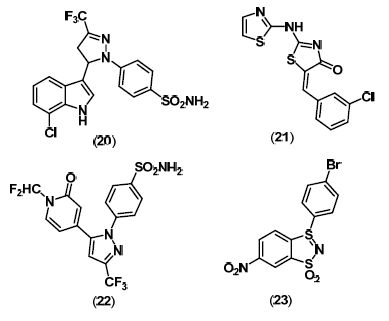
      <p>Currently, LOXs are potential targets in the treatment of diseases such as asthma, atherosclerosis, cancer, and a variety of inflammatory conditions [<xref ref-type="bibr" rid="B14">14</xref>,<xref ref-type="bibr" rid="B15">15</xref>,<xref ref-type="bibr" rid="B16">16</xref>]. It was hypothesized that blocking the arachidonic acid (AA) metabolism via COX inhibition by either traditional NSAIDs or selective COX-2 inhibitors could lead to the generation of proinflammatory leukotrienes and lipoxins via the LOX pathway (<xref ref-type="fig" rid="figure2">Figure 2</xref>) partly accounting for the side effects seen with traditional NSAIDs and selective COX-2 inhibitors. To counter this, several dual small molecule COX/LOX inhibitors have been reported. Reddy and coworkers reported the development of racemic indolylpyrazoline class of agents as dual COX/LOX inhibitors. One of the examples shown in <xref ref-type="fig" rid="figure5">Figure 5</xref> (<bold>20</bold>) had a <italic>para</italic>-SO<sub>2</sub>NH<sub>2</sub> COX-2 pharmacophore and exhibited dual COX and LOX inhibition (COX-2 IC<sub>50</sub> = 3.9 µM, COX-1 IC<sub>50</sub> &gt; 100 µM; 5-LOX IC<sub>50</sub> = 94 µM, 12-LOX IC<sub>50</sub> = 3 µM, 15-LOX IC<sub>50</sub> = 36 µM). The levo isomers exhibit superior COX-2 inhibitory potency and selectivity.</p>
      <fig id="figure5" position="float">
        <label>Figure 5</label>
        <caption>
          <p>Chemical structures of some representative dual COX/LOX inhibitors.</p>
        </caption>
        <graphic xmlns:xlink="http://www.w3.org/1999/xlink" xlink:href="pharmaceuticals-03-01530-g005.tif" scale="0"/>
      </fig>
      <p>However, for this series of compounds, <italic>in vivo</italic> anti-inflammatory activities were not reported [<xref ref-type="bibr" rid="B46">46</xref>]. Furthermore, Lagunin and coworkers recently used structure-based virtual screening to identify suitable ring scaffolds as dual COX/LOX inhibitors [<xref ref-type="bibr" rid="B47">47</xref>]. This study revealed that a thiazolidinone ring scaffold could be used to develop novel anti-inflammatory agents. Compound <bold>21 </bold>(<xref ref-type="fig" rid="figure5">Figure 5</xref>) exhibited weak <italic>in vitro</italic> COX and soyabean LOX inhibitory potency (COX-2 IC<sub>50</sub> = 262 µM, COX-1 IC<sub>50</sub> = 125 µM; LOX IC<sub>50</sub> = 125.9 µM). <italic>In vivo</italic><bold>21</bold> exhibited good anti-inflammatory activity (44.5% inhibition, dose = 0.01 mmol/kg) when administered through intraperitoneal route in animal models. However, oral activity was not reported.</p>
      <p>LOX isozymes are non-heme enzymes containing a catalytic ferric iron with a high reduction potential. Studies have indicated that iron chelators such as catechols and hydroxamic acid derivatives are capable of reducing the iron to its inactive state, thereby preventing the conversion of fatty acids to pro-inflammatory lipid mediators [<xref ref-type="bibr" rid="B48">48</xref>]. In this regard, Knaus and coworkers developed several hybrid COX/5-LOX inhibitors possessing a novel <italic>N</italic>-difluoromethyl-1,2-dihydropyridine-2-one LOX pharmacophore [<xref ref-type="bibr" rid="B49">49</xref>,<xref ref-type="bibr" rid="B50">50</xref>,<xref ref-type="bibr" rid="B51">51</xref>]. It was anticipated that the CONCHF<sub>2</sub> moiety present in <italic>N</italic>-difluoromethyl-1,2-dihydropyridine-2-one acts as a cyclic hydroxamic acid mimetic by chelating LOX iron. A celecoxib derivative incorporating the <italic>N</italic>-difluoromethyl-1,2-dihydropyridine-2-one LOX pharmacophore (<bold>22</bold>) exhibited dual COX and 5-LOX inhibition (COX-2 IC<sub>50</sub> = 0.69 µM, COX-1 IC<sub>50</sub> = 13.1 µM; 5-LOX IC<sub>50</sub> = 5.0 µM) along with oral anti-inflammatory activity (ED<sub>50</sub> = 27.7 mg/kg). In an elegant study, Chern and coworkers applied structure-based virtual screening and discovered a novel benzo[1.3.2]dithiazolium ylide-based ring scaffold　 as dual COX/5-LOX inhibitors [<xref ref-type="bibr" rid="B52">52</xref>]. The lead compound <bold>23 </bold>(<xref ref-type="fig" rid="figure5">Figure 5</xref>), possessing a dithiazolium ylide 1,1-dioxide exhibited dual COX/5-LOX inhibition (COX-2 IC<sub>50</sub> = 1.7 µM, COX-1 IC<sub>50</sub> = 6.7 µM; 5-LOX IC<sub>50</sub> = 1.22 µM). It was also interesting to note that <bold>23 </bold>exhibited TNF-α inhibition (IC<sub>50</sub> = 0.44 µM) in a lipopolysaccharide (LPS)-induced human acute monocytic leukemia cell line (THP-1) assay. The molecular modeling studies indicated that the (<italic>S</italic>)-enantiomer is potentially responsible for the observed COX-2 selectivity. <italic>In vivo</italic> anti-inflammatory activity data for these agents have not been reported.</p>
    </sec>
    <sec>
      <title>5. Lp-PLA<sub>2</sub> Inhibitors</title>
      <p>The phospholipase A<sub>2</sub> (PLA<sub>2</sub>) enzyme catalyzes the release of fatty acids such as AA, a critical rate-limiting step, by acting on membrane phospholipids (<xref ref-type="fig" rid="figure2">Figure 2</xref>). The released AA gets converted to various pro-inflammatory mediators such as prostaglandins, leukotrienes and platelet-activating factor (PAF) that are known to play a major role in regulating the vascular tone [<xref ref-type="bibr" rid="B53">53</xref>]. The PLA<sub>2</sub> is classified into three major subtypes: secretory (sPLA<sub>2</sub>); cytosolic or Ca<sup>2+</sup>-activated (cPLA<sub>2</sub>); and inducible or Ca<sup>2+</sup>-independent (iPLA<sub>2</sub>). In this regard, Lp-PLA<sub>2</sub> also known as platelet-activating factor acetylhydrolase (PAF-AH) is a Ca<sup>2+</sup>-independent PLA<sub>2</sub> that is classified as group VIIA PLA<sub>2</sub>. Furthermore, recent studies have indicated that Lp-PLA<sub>2</sub> is closely involved in the onset and progression of atherosclerosis [<xref ref-type="bibr" rid="B53">53</xref>,<xref ref-type="bibr" rid="B54">54</xref>,<xref ref-type="bibr" rid="B55">55</xref>,<xref ref-type="bibr" rid="B56">56</xref>,<xref ref-type="bibr" rid="B57">57</xref>]. The enzyme Lp-PLA<sub>2 </sub>or PAF-AH (<italic>EC 3.1.1.47</italic>) was first identified from plasma that was known to hydrolyze/inactivate PAF, a phospholipid mediator produced from macrophages, monocytes, platelets and neutrophils involved in inflammatory diseases including atherosclerosis [<xref ref-type="bibr" rid="B58">58</xref>,<xref ref-type="bibr" rid="B59">59</xref>]. In humans, Lp-PLA<sub>2</sub> is primarily produced from leukocytes and macrophages and is associated with circulating macrophages and low-density lipoproteins (LDL). It acts on polar phospholipids in oxidized LDL to form lysophosphatidylcholine and nonesterified phospholipids that are known to have proinflammatory properties by activating and recruiting macrophages/monocytes mediating plaque vulnerability, apoptosis, leading to onset and progression of atheroma [<xref ref-type="bibr" rid="B60">60</xref>,<xref ref-type="bibr" rid="B61">61</xref>]. These studies suggest that Lp-PLA<sub>2</sub> is a unique biomarker to predict long-term cardiovascular risk [<xref ref-type="bibr" rid="B62">62</xref>,<xref ref-type="bibr" rid="B63">63</xref>,<xref ref-type="bibr" rid="B64">64</xref>].</p>
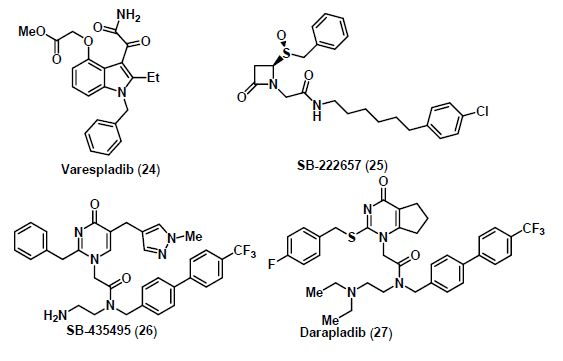
      <p>The drug discovery of novel small molecule PLA<sub>2</sub> inhibitors is an ongoing effort [<xref ref-type="bibr" rid="B65">65</xref>,<xref ref-type="bibr" rid="B66">66</xref>]. Several indole-based inhibitors of sPLA<sub>2</sub> have been developed to treat various inflammatory conditions such as pancreatitis, allergic rhinitis, rheumatoid arthritis, gout and atherosclerosis. For example, the indole derivative varespladib <bold>24</bold> (s-PLA<sub>2</sub> IC<sub>50</sub> = 15 nM, <xref ref-type="fig" rid="figure6">Figure 6</xref>) was developed as a treatment for rheumatoid arthritis and atherosclerosis [<xref ref-type="bibr" rid="B66">66</xref>,<xref ref-type="bibr" rid="B67">67</xref>,<xref ref-type="bibr" rid="B68">68</xref>]. A recent phase II trial showed that oral varespladib was able to reduce progression of atherosclerosis and associated cardiovascular events, without any evidence of adverse effects [<xref ref-type="bibr" rid="B67">67</xref>]. In this regard, a novel class of azetidinones represented by SB-222657 (<bold>25</bold>,<bold/>Lp-PLA<sub>2</sub> IC<sub>50</sub> = 11.7 nM, <xref ref-type="fig" rid="figure6">Figure 6</xref>) were developed as active site directed Lp-PLA<sub>2</sub> inhibitors [<xref ref-type="bibr" rid="B69">69</xref>]. Further studies led to the discovery of a potent Lp-PLA<sub>2</sub> inhibitor SB-435495 possessing a pyrimidinone ring template (<bold>26</bold>, Lp-PLA<sub>2 </sub>IC<sub>50</sub> = 0.06 nM, <xref ref-type="fig" rid="figure6">Figure 6</xref>) by GSK. Lead optimization resulted in the development of darapladib (<bold>27</bold>, Lp-PLA<sub>2</sub> IC<sub>50</sub> = 0.25 nM; <xref ref-type="fig" rid="figure6">Figure 6</xref>) as a clinical candidate and is the first agent developed as an Lp-PLA<sub>2</sub> inhibitor to treat atherosclerosis and associated cardiovascular diseases [<xref ref-type="bibr" rid="B70">70</xref>,<xref ref-type="bibr" rid="B71">71</xref>]. Phase II studies of oral darapladib therapy led to reduced Lp-PLA<sub>2</sub> activity in human atherosclerotic plaques in patients with stable coronary heart disease and reduced the levels of inflammatory mediator interleukin-6 [<xref ref-type="bibr" rid="B61">61</xref>,<xref ref-type="bibr" rid="B72">72</xref>,<xref ref-type="bibr" rid="B73">73</xref>,<xref ref-type="bibr" rid="B74">74</xref>]. Currently, darapladib is undergoing phase III trials.</p>
      <fig id="figure6" position="float">
        <label>Figure 6</label>
        <caption>
          <p>Chemical structures of some representative PLA<sub>2</sub> inhibitors.</p>
        </caption>
        <graphic xmlns:xlink="http://www.w3.org/1999/xlink" xlink:href="pharmaceuticals-03-01530-g006.tif" scale="0"/>
      </fig>
    </sec>
    <sec>
      <title>6. mPGES-1 Inhibitors</title>
      <p>In the prostaglandin biosynthesis pathway, formation of the prostaglandin E<sub>2</sub> (PGE<sub>2</sub>), a major mediator of pain and inflammation from prostaglandin H<sub>2</sub> (PGH<sub>2</sub>) is catalyzed by PGE synthases such as cytosolic PGES (cPGES) and microsomal PGE synthases -1 and -2 (mPGES-1 and mPGES-2) [<xref ref-type="bibr" rid="B75">75</xref>,<xref ref-type="bibr" rid="B76">76</xref>,<xref ref-type="bibr" rid="B77">77</xref>,<xref ref-type="bibr" rid="B78">78</xref>,<xref ref-type="bibr" rid="B79">79</xref>]. Furthermore, mPGES-1 is known to transform COX-2 derived endoperoxides. In this regard, the membrane associated protein mPGES-1 is an inducible enzyme under inflammatory conditions such as RA, OA and atherosclerosis [<xref ref-type="bibr" rid="B77">77</xref>,<xref ref-type="bibr" rid="B78">78</xref>].</p>
      <p>Although selective COX-2 inhibitors decrease the formation of proinflammatory PGE<sub>2</sub>, they exhibit cardiovascular side effects due their suppression of COX-2 derived vasodilatory prostacyclin (PGI<sub>2</sub>) biosynthesis [<xref ref-type="bibr" rid="B11">11</xref>,<xref ref-type="bibr" rid="B77">77</xref>,<xref ref-type="bibr" rid="B78">78</xref>]. Therefore, novel orally active small molecule mPGES-1 inhibitors are considered as an alternative strategy to develop anti-inflammatory agents with superior safety profile. Several ring templates including fatty acid derivatives have been developed as mPGES-1 and dual mPGES-1/5-LOX inhibitors [<xref ref-type="bibr" rid="B78">78</xref>].</p>
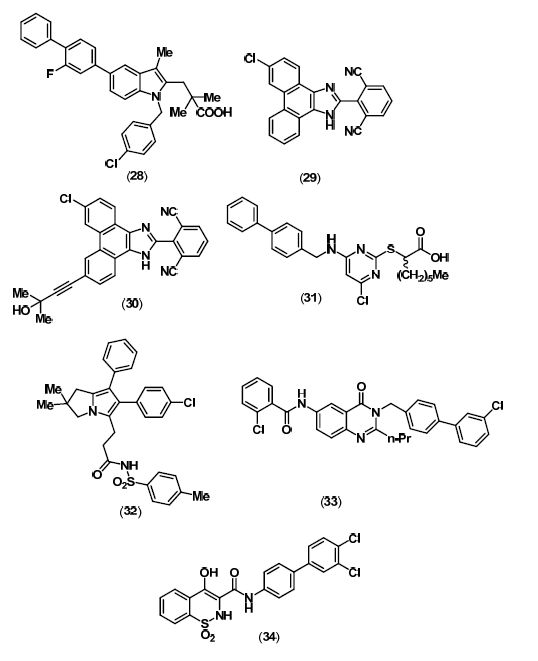
      <p>Merck Frosst reported the development of a number of novel ring templates as potent and selective mPGES-1 inhibitors [<xref ref-type="bibr" rid="B80">80</xref>,<xref ref-type="bibr" rid="B81">81</xref>,<xref ref-type="bibr" rid="B82">82</xref>]. An indole based agent (<bold>28, <xref ref-type="fig" rid="figure7">Figure 7</xref></bold>), possessing a COOH group exhibited potent mPGES-1 inhibition (mPGES-1 IC<sub>50</sub> = 0.007 µM) and effective PGE<sub>2</sub> inhibition (IC<sub>50</sub> = 8.0 µM) in cell based assays [<xref ref-type="bibr" rid="B80">80</xref>]. In another study, a series of phenanthrene imidazole template identified through a high-throughput (HTS) screening was developed as selective mPGES-1 inhibitors with oral activity [<xref ref-type="bibr" rid="B81">81</xref>].These agents lack an acidic (COOH) functional group. Compound <bold>29 </bold>(<xref ref-type="fig" rid="figure7">Figure 7</xref>) was identified as a potent and selective mPGES-1 inhibitor (mPGES-1 IC<sub>50</sub> = 0.001 µM; PGE<sub>2</sub> inhibition IC<sub>50</sub> = 0.42 µM) with <italic>in vivo</italic> analgesic activity, although <bold>29</bold> exhibited a short <italic>in vivo</italic> half life (t<sub>1/2</sub> = 1.5 h) in animal models. In an extension of this work, a disubstituted phenanthrene imidazole (<bold>30, <xref ref-type="fig" rid="figure7">Figure 7</xref></bold>) containing a propargylic tertiary alcohol moiety was developed that exhibited potent and selective mPGES-1 inhibition (mPGES-1 IC<sub>50</sub> = 0.001 µM; mPGES-2 IC<sub>50</sub> &gt; 30 µM) and oral activity in lipopolysaccharide (LPS)-induced hyperalgesia guinea pig model (ED<sub>50</sub> = 30 mg/kg). Interestingly, <bold>30</bold> exhibited a long <italic>in vivo</italic> pharmacokinetic properties in a rat model (t<sub>1/2</sub> = 20 h) relative to <bold>29 [<xref ref-type="bibr" rid="B82">82</xref>]</bold>.</p>
      <p>Recently, pirinixic acid derivatives were developed as a novel class of dual mPGES-1 and 5-LOX enzymes [<xref ref-type="bibr" rid="B83">83</xref>]. Among these group of agents <bold>31 </bold>(<xref ref-type="fig" rid="figure7">Figure 7</xref>), a biphenyl pirinixic acid derivative, possessing a lipophilic <italic>n</italic>-hexyl chain along with a COOH group exhibited mPGES-1 inhibition (mPGES-1 IC<sub>50</sub> = 1.3 µM; 5-LOX IC<sub>50</sub> = 1.0 µM) along with moderate COX inhibition. It was also reported that enantiomeric forms of these agents exhibit similar activity profile. It should be noted that pirinixic acid ring template was initially reported as a peroxisome proliferator-activated receptor (PPAR-α) agonist [<xref ref-type="bibr" rid="B84">84</xref>,<xref ref-type="bibr" rid="B85">85</xref>]. Another elegant study developed dual mPGES-1/5-LOX agents based on an arylpyrrolizine ring template present in the anti-inflammatory agent licofelone [<xref ref-type="bibr" rid="B86">86</xref>]. The tolylsulfonimide <bold>32 </bold>exhibited mPGES-1 inhibition (mPGES-1 IC<sub>50</sub> = 2.1 µM) and moderate to no inhibition of enzymes COX-1 and COX-2 respectively. In this regard, Proschak and coworkers developed a group of nonacidic mPGES-1 inhibitors based on virtual library screening [<xref ref-type="bibr" rid="B87">87</xref>]. These studies identified a biphenyl quinazolinone ring template possessing a benzamide substituent (<bold>33</bold>), as an mPGES-1 inhibitor (IC<sub>50</sub> = 0.5 µM) and did not exhibit COX-1/2 inhibition (IC<sub>50</sub> &gt; 30 µM). Furthermore, Pfizer Inc recently reported the development of selective mPGES-1 inhibitors derived from an oxicam ring template. In this regard the biphenyl oxicam derivative <bold>34 </bold>(<xref ref-type="fig" rid="figure7">Figure 7</xref>), exhibited potent mPGES-1 inhibition (mPGES-1 IC<sub>50</sub> = 0.016 µM) and relatively weak COX inhibition (COX-1 IC<sub>50</sub> = 118 µM, COX-2 IC<sub>50</sub> = 263 µM) [<xref ref-type="bibr" rid="B88">88</xref>].</p>
      <fig id="figure7" position="float">
        <label>Figure 7</label>
        <caption>
          <p>Chemical structures of some representative PLA<sub>2</sub> inhibitors.</p>
        </caption>
        <graphic xmlns:xlink="http://www.w3.org/1999/xlink" xlink:href="pharmaceuticals-03-01530-g007.tif" scale="0"/>
      </fig>
    </sec>
    <sec>
      <title>7. TNF-α Inhibitors</title>
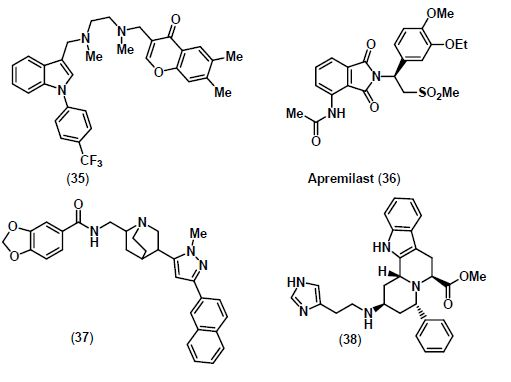
      <p>Treating RA with biological therapeutics that target the proinflammatory cytokine TNF-α has been highly successful. However, their drawback includes high costs, lack of oral activity and adverse events such as autoimmune reactions [<xref ref-type="bibr" rid="B19">19</xref>,<xref ref-type="bibr" rid="B89">89</xref>,<xref ref-type="bibr" rid="B90">90</xref>,<xref ref-type="bibr" rid="B91">91</xref>]. In this regard several small molecule agents that inhibit TNF-α indirectly have been reported [<xref ref-type="bibr" rid="B19">19</xref>,<xref ref-type="bibr" rid="B23">23</xref>]. However, developing an orally active small molecule, that could act as a direct TNF-α inhibitor presents a significant challenge [<xref ref-type="bibr" rid="B90">90</xref>]. Toward this direction, scientists from Sunesis Pharmaceuticals Inc. developed a small molecule agent that possessed a phenyl indole and a chromone moiety (<bold>35</bold>, <xref ref-type="fig" rid="figure8">Figure 8</xref>). Compound <bold>35</bold> was promoting subunit disassembly of trimeric TNF-α and inhibition in both biochemical (TNF-α IC<sub>50</sub> = 22 µM) and cell (TNF-α IC<sub>50</sub> = 4.6 µM) based assays. In addition, the structure of <bold>35</bold> in complex with TNF-α dimer was solved [<xref ref-type="bibr" rid="B92">92</xref>]. Celgene Corporation recently developed apremilast (<bold>36</bold>, <xref ref-type="fig" rid="figure8">Figure 8</xref>) as an orally active dual phosphodiesterase-4 (PDE4) and TNF-α inhibitor that could be used to treat the autoimmune disorder psoriasis [<xref ref-type="bibr" rid="B93">93</xref>]. Compound <bold>36</bold>, has a dihydroisoindole ring template and is an (<italic>S</italic>)-enantiomer, whereas the corresponding (<italic>R</italic>) enantiomer of <bold>36</bold> was 5-fold less potent. In an LPS-induced cell based assay, <bold>36</bold> exhibited potent TNF-α inhibition (TNF-α IC<sub>50</sub> = 0.077 µM) and oral activity in animal models (ED<sub>50</sub> = 0.03 mg/kg). In addition, <bold>36</bold> exhibited potent PDE4 inhibition (PDE4 IC<sub>50</sub> = 0.074 µM). Recently, Leung and coworkers reported two small molecules structurally similar to natural products. Structure-based design was used to identify small molecule TNF-α inhibitors [<xref ref-type="bibr" rid="B94">94</xref>]. Compound <bold>37</bold> was a quinuclidine derivative and <bold>38</bold> contained an indoloquinolizidine ring template (<xref ref-type="fig" rid="figure8">Figure 8</xref>). Both exhibited TNF-α inhibition (<bold>37</bold> TNF-α IC<sub>50</sub> = 50 µM; <bold>38</bold> TNF-α IC<sub>50</sub> = 22 µM), although in a cell based assay, <bold>38</bold> was less potent relative to <bold>37</bold>.</p>
      <fig id="figure8" position="float">
        <label>Figure 8</label>
        <caption>
          <p>Examples of some representative TNF-α inhibitors.</p>
        </caption>
        <graphic xmlns:xlink="http://www.w3.org/1999/xlink" xlink:href="pharmaceuticals-03-01530-g008.tif" scale="0"/>
      </fig>
    </sec>
    <sec>
      <title>8. Conclusions</title>
      <p>The story of treating fever, pain and inflammation continues to evolve. Small molecule NSAIDs have dominated the market for over a century. Advances in molecular biology, crystallography and rational drug design approaches have led to the successful identification of novel anti-inflammatory targets such as 5-LOX, COX-2, , Lp-PLA<sub>2</sub>, mPGES-1 and TNF-α, to mention a few. The risks involved in this endeavor, is clearly highlighted by the “coxib” controversy. In an era where new drug pipelines are drying-up and blockbuster agents are facing generic competition, the discovery of novel anti-inflammatory targets continues to propel the development of small molecule therapeutics to treat inflammatory conditions. It is evident that a rational drug discovery effort that combines HTS and fragment screening techniques can provide novel small molecule ring templates that can be optimized by medicinal chemistry methods, to exhibit suitable <italic>in vivo</italic> activity and optimal pharmacokinetic properties. In spite of the current increase in market share of biological therapeutics to treat inflammatory conditions, small molecule therapeutics continues to dominate the pharmaceutical landscape. The recent advances in deciphering the ability of small molecules to disrupt protein-protein interactions <italic>in vivo</italic>, provides an exciting opportunity to discover novel small molecule therapeutics to treat inflammation and a wide variety of disease states.</p>
    </sec>
  </body>
  <back>
    <ref-list>
      <ref id="B1">
        <citation citation-type="journal">
          <person-group person-group-type="author">
            <name>
              <surname>Vane</surname>
              <given-names>J.R.</given-names>
            </name>
          </person-group>
          <article-title>The fight against rheumatism: From willow bark to COX-1 sparing drugs</article-title>
          <source>J. Physiol. Pharmacol.</source>
          <year>2000</year>
          <volume>51</volume>
          <fpage>573</fpage>
          <pub-id pub-id-type="pmid">11192932</pub-id>
        </citation>
      </ref>
      <ref id="B2">
        <citation citation-type="journal">
          <person-group person-group-type="author">
            <name>
              <surname>Marnett</surname>
              <given-names>L.J.</given-names>
            </name>
          </person-group>
          <article-title>The COXIB experience: A look in the rearview mirror</article-title>
          <source>Annu. Rev. Pharmacol. Toxicol.</source>
          <year>2009</year>
          <volume>49</volume>
          <fpage>265</fpage>
          <lpage>290</lpage>
          <pub-id pub-id-type="doi">10.1146/annurev.pharmtox.011008.145638</pub-id>
          <pub-id pub-id-type="pmid">18851701</pub-id>
        </citation>
      </ref>
      <ref id="B3">
        <citation citation-type="journal">
          <person-group person-group-type="author">
            <name>
              <surname>Inotai</surname>
              <given-names>A.</given-names>
            </name>
            <name>
              <surname>Hanko</surname>
              <given-names>B.</given-names>
            </name>
            <name>
              <surname>Meszaro</surname>
              <given-names>A.</given-names>
            </name>
          </person-group>
          <article-title>Trends in the non-steroidal anti-inflammatory drug market in six central-eastern european countries based on retail information</article-title>
          <source>Pharmacoepidemiol. Drug Saf.</source>
          <year>2010</year>
          <volume>19</volume>
          <fpage>183</fpage>
          <lpage>190</lpage>
          <pub-id pub-id-type="doi">10.1002/pds.1893</pub-id>
          <pub-id pub-id-type="pmid">20014174</pub-id>
        </citation>
      </ref>
      <ref id="B4">
        <citation citation-type="journal">
          <person-group person-group-type="author">
            <name>
              <surname>Meade</surname>
              <given-names>E.A.</given-names>
            </name>
            <name>
              <surname>Smith</surname>
              <given-names>W.L.</given-names>
            </name>
            <name>
              <surname>DeWitt</surname>
              <given-names>D.L.</given-names>
            </name>
          </person-group>
          <article-title>Differential inhibition of prostaglandin endoperoxide synthase (cyclooxygenase) isozymes by aspirin and other non-steroidal anti-inflammatory drugs</article-title>
          <source>J. Biol. Chem.</source>
          <year>1993</year>
          <volume>268</volume>
          <fpage>6610</fpage>
          <lpage>6614</lpage>
          <pub-id pub-id-type="pmid">8454631</pub-id>
        </citation>
      </ref>
      <ref id="B5">
        <citation citation-type="journal">
          <person-group person-group-type="author">
            <name>
              <surname>Talley</surname>
              <given-names>J.J.</given-names>
            </name>
          </person-group>
          <article-title>Selective inhibitors of cyclooxygenase-2 (COX-2)</article-title>
          <source>Prog. Med. Chem. Res.</source>
          <year>1999</year>
          <volume>36</volume>
          <fpage>201</fpage>
          <lpage>234</lpage>
        </citation>
      </ref>
      <ref id="B6">
        <citation citation-type="journal">
          <person-group person-group-type="author">
            <name>
              <surname>Black</surname>
              <given-names>W.C.</given-names>
            </name>
          </person-group>
          <article-title>Selective cycloxygenase-2 inhibitors</article-title>
          <source>Annu. Rep. Med. Chem.</source>
          <year>2004</year>
          <volume>39</volume>
          <fpage>125</fpage>
          <lpage>138</lpage>
        </citation>
      </ref>
      <ref id="B7">
        <citation citation-type="journal">
          <person-group person-group-type="author">
            <name>
              <surname>Penning</surname>
              <given-names>T.D.</given-names>
            </name>
            <name>
              <surname>Talley</surname>
              <given-names>J.J.</given-names>
            </name>
            <name>
              <surname>Bertenshaw</surname>
              <given-names>S.R.</given-names>
            </name>
            <name>
              <surname>Carter</surname>
              <given-names>J.S.</given-names>
            </name>
            <name>
              <surname>Collins</surname>
              <given-names>P.W.</given-names>
            </name>
            <name>
              <surname>Docter</surname>
              <given-names>S.</given-names>
            </name>
            <name>
              <surname>Graneto</surname>
              <given-names>M.J.</given-names>
            </name>
            <name>
              <surname>Lee</surname>
              <given-names>L.F.</given-names>
            </name>
            <name>
              <surname>Malecha</surname>
              <given-names>J.W.</given-names>
            </name>
            <name>
              <surname>Miyashiro</surname>
              <given-names>J.M.</given-names>
            </name>
            <name>
              <surname>Rogers</surname>
              <given-names>R.S.</given-names>
            </name>
            <name>
              <surname>Rogier</surname>
              <given-names>D.J.</given-names>
            </name>
            <name>
              <surname>Yu</surname>
              <given-names>S.S.</given-names>
            </name>
            <name>
              <surname>Anderson</surname>
              <given-names>G.D.</given-names>
            </name>
            <name>
              <surname>Bunton</surname>
              <given-names>E.G.</given-names>
            </name>
            <name>
              <surname>Cogburn</surname>
              <given-names>J.N.</given-names>
            </name>
            <name>
              <surname>Gregory</surname>
              <given-names>S.A.</given-names>
            </name>
            <name>
              <surname>Koboldt</surname>
              <given-names>C.M.</given-names>
            </name>
            <name>
              <surname>Perkins</surname>
              <given-names>W.E.</given-names>
            </name>
            <name>
              <surname>Seibert</surname>
              <given-names>K.</given-names>
            </name>
            <name>
              <surname>Veenhuizen</surname>
              <given-names>A.W.</given-names>
            </name>
            <name>
              <surname>Zhang</surname>
              <given-names>Y.Y.</given-names>
            </name>
            <name>
              <surname>Isakson</surname>
              <given-names>P.C.</given-names>
            </name>
          </person-group>
          <article-title>Synthesis and biological evaluation of the 1,5-diarylpyrazole class of cyclooxygenase-2 inhibitors: identification of 4-[5-(4-methylphenyl)-3-(trifluoromethyl)-1H-pyrazol-1-yl]benzenesulfonamide (SC-58635, celecoxib)</article-title>
          <source>J. Med. Chem.</source>
          <year>1997</year>
          <volume>40</volume>
          <fpage>1347</fpage>
          <lpage>1365</lpage>
          <pub-id pub-id-type="doi">10.1021/jm960803q</pub-id>
          <pub-id pub-id-type="pmid">9135032</pub-id>
        </citation>
      </ref>
      <ref id="B8">
        <citation citation-type="journal">
          <person-group person-group-type="author">
            <name>
              <surname>Prasit</surname>
              <given-names>P.</given-names>
            </name>
            <name>
              <surname>Wang</surname>
              <given-names>Z.</given-names>
            </name>
            <name>
              <surname>Brideau</surname>
              <given-names>C.</given-names>
            </name>
            <name>
              <surname>Chan</surname>
              <given-names>C.C.</given-names>
            </name>
            <name>
              <surname>Charleson</surname>
              <given-names>S.</given-names>
            </name>
            <name>
              <surname>Cromlish</surname>
              <given-names>W.</given-names>
            </name>
            <name>
              <surname>Ethier</surname>
              <given-names>D.</given-names>
            </name>
            <name>
              <surname>Evans</surname>
              <given-names>J.F.</given-names>
            </name>
            <name>
              <surname>Ford-Hutchinson</surname>
              <given-names>A.W.</given-names>
            </name>
            <name>
              <surname>Gauthier</surname>
              <given-names>J.Y.</given-names>
            </name>
            <name>
              <surname>Gordon</surname>
              <given-names>R.</given-names>
            </name>
            <name>
              <surname>Guay</surname>
              <given-names>J.</given-names>
            </name>
            <name>
              <surname>Gresser</surname>
              <given-names>M.</given-names>
            </name>
            <name>
              <surname>Kargman</surname>
              <given-names>S.</given-names>
            </name>
            <name>
              <surname>Kennedy</surname>
              <given-names>B.</given-names>
            </name>
            <name>
              <surname>Leblanc</surname>
              <given-names>Y.</given-names>
            </name>
            <name>
              <surname>Léger</surname>
              <given-names>S.</given-names>
            </name>
            <name>
              <surname>Mancini</surname>
              <given-names>J.</given-names>
            </name>
            <name>
              <surname>O'Neill</surname>
              <given-names>G.P.</given-names>
            </name>
            <name>
              <surname>Ouellet</surname>
              <given-names>M.</given-names>
            </name>
            <name>
              <surname>Percival</surname>
              <given-names>M.D.</given-names>
            </name>
            <name>
              <surname>Perrier</surname>
              <given-names>H.</given-names>
            </name>
            <name>
              <surname>Riendeau</surname>
              <given-names>D.</given-names>
            </name>
            <name>
              <surname>Rodger</surname>
              <given-names>I.</given-names>
            </name>
            <name>
              <surname>Zamboni</surname>
              <given-names>R.</given-names>
            </name>
          </person-group>
          <article-title>The discovery of rofecoxib, [MK 966, Vioxx, 4-(4'-methylsulfonylphenyl)-3-phenyl-2(5H)-furanone], an orally active cyclooxygenase-2-inhibitor</article-title>
          <source>Bioorg. Med. Chem. Lett. </source>
          <year>1999</year>
          <volume>9</volume>
          <fpage>1773</fpage>
          <lpage>1778</lpage>
          <pub-id pub-id-type="doi">10.1016/S0960-894X(99)00288-7</pub-id>
          <pub-id pub-id-type="pmid">10406640</pub-id>
        </citation>
      </ref>
      <ref id="B9">
        <citation citation-type="journal">
          <person-group person-group-type="author">
            <name>
              <surname>Luong</surname>
              <given-names>C.</given-names>
            </name>
            <name>
              <surname>Miller</surname>
              <given-names>A.</given-names>
            </name>
            <name>
              <surname>Barnett</surname>
              <given-names>J.</given-names>
            </name>
            <name>
              <surname>Chow</surname>
              <given-names>J.</given-names>
            </name>
            <name>
              <surname>Ramesha</surname>
              <given-names>C.</given-names>
            </name>
            <name>
              <surname>Browner</surname>
              <given-names>M.F.</given-names>
            </name>
          </person-group>
          <article-title>Flexibility of the NSAID binding site in the structure of human cyclooxygenase-2</article-title>
          <source>Nat. Struct. Biol.</source>
          <year>1996</year>
          <volume>3</volume>
          <fpage>927</fpage>
          <lpage>933</lpage>
          <pub-id pub-id-type="doi">10.1038/nsb1196-927</pub-id>
          <pub-id pub-id-type="pmid">8901870</pub-id>
        </citation>
      </ref>
      <ref id="B10">
        <citation citation-type="journal">
          <person-group person-group-type="author">
            <name>
              <surname>Kurumbail</surname>
              <given-names>R.G.</given-names>
            </name>
            <name>
              <surname>Stevens</surname>
              <given-names>A.M.</given-names>
            </name>
            <name>
              <surname>Gierse</surname>
              <given-names>J.K.</given-names>
            </name>
            <name>
              <surname>McDonald</surname>
              <given-names>J.J.</given-names>
            </name>
            <name>
              <surname>Stegeman</surname>
              <given-names>R.A.</given-names>
            </name>
            <name>
              <surname>Pak</surname>
              <given-names>J.Y.</given-names>
            </name>
            <name>
              <surname>Gildehaus</surname>
              <given-names>D.</given-names>
            </name>
            <name>
              <surname>Miyashiro</surname>
              <given-names>J.M.</given-names>
            </name>
            <name>
              <surname>Penning</surname>
              <given-names>T.D.</given-names>
            </name>
            <name>
              <surname>Seibert</surname>
              <given-names>K.</given-names>
            </name>
            <name>
              <surname>Isakson</surname>
              <given-names>P.C.</given-names>
            </name>
            <name>
              <surname>Stallings</surname>
              <given-names>W.C.</given-names>
            </name>
          </person-group>
          <article-title>Structural basis for selective inhibition of cyclooxygenase-2 by anti-inflammatory agents</article-title>
          <source>Nature</source>
          <year>1996</year>
          <volume>384</volume>
          <fpage>644</fpage>
          <lpage>648</lpage>
          <pub-id pub-id-type="doi">10.1038/384644a0</pub-id>
          <pub-id pub-id-type="pmid">8967954</pub-id>
        </citation>
      </ref>
      <ref id="B11">
        <citation citation-type="journal">
          <person-group person-group-type="author">
            <name>
              <surname>Mitchell</surname>
              <given-names>J.A.</given-names>
            </name>
            <name>
              <surname>Warner</surname>
              <given-names>T.D.</given-names>
            </name>
          </person-group>
          <article-title>COX isoforms in the cardiovascular system: Understanding the activities of non-steroidal anti-inflammatory drugs</article-title>
          <source>Nat. Rev. Drug Discov.</source>
          <year>2006</year>
          <volume>5</volume>
          <fpage>75</fpage>
          <lpage>85</lpage>
          <pub-id pub-id-type="doi">10.1038/nrd1929</pub-id>
          <pub-id pub-id-type="pmid">16485347</pub-id>
        </citation>
      </ref>
      <ref id="B12">
        <citation citation-type="journal">
          <person-group person-group-type="author">
            <name>
              <surname>Zhang</surname>
              <given-names>J.J.</given-names>
            </name>
            <name>
              <surname>Ding</surname>
              <given-names>E.L.</given-names>
            </name>
            <name>
              <surname>Song</surname>
              <given-names>Y.Q.</given-names>
            </name>
          </person-group>
          <article-title>Adverse effects of cyclooxygenase 2 inhibitors on renal and arrhythmia events-meta-analysis of randomized trials</article-title>
          <source>JAMA</source>
          <year>2006</year>
          <volume>296</volume>
          <fpage>1619</fpage>
          <lpage>1632</lpage>
          <pub-id pub-id-type="doi">10.1001/jama.296.13.jrv60015</pub-id>
          <pub-id pub-id-type="pmid">16968832</pub-id>
        </citation>
      </ref>
      <ref id="B13">
        <citation citation-type="journal">
          <person-group person-group-type="author">
            <name>
              <surname>Smith</surname>
              <given-names>T.J.</given-names>
            </name>
          </person-group>
          <article-title>Cyclooxygenases as the principle target for the action of NSAIDs</article-title>
          <source>Rheum. Clinics N. Amer.</source>
          <year>1998</year>
          <volume>24</volume>
          <fpage>501</fpage>
          <lpage>523</lpage>
          <pub-id pub-id-type="doi">10.1016/S0889-857X(05)70023-5</pub-id>
        </citation>
      </ref>
      <ref id="B14">
        <citation citation-type="journal">
          <person-group person-group-type="author">
            <name>
              <surname>Fourie</surname>
              <given-names>A.M.</given-names>
            </name>
          </person-group>
          <article-title>Modulation of inflammatory disease by inhibitors of leukotriene A4 hydrolase</article-title>
          <source>Curr. Opin. Investig. Drugs </source>
          <year>2009</year>
          <volume>10</volume>
          <fpage>1173</fpage>
          <lpage>1182</lpage>
          <pub-id pub-id-type="pmid">19876785</pub-id>
        </citation>
      </ref>
      <ref id="B15">
        <citation citation-type="journal">
          <person-group person-group-type="author">
            <name>
              <surname>Charlier</surname>
              <given-names>C.</given-names>
            </name>
            <name>
              <surname>Michaux</surname>
              <given-names>C.</given-names>
            </name>
          </person-group>
          <article-title>Dual inhibition of cyclooxygenase-2 (COX-2) and 5-lipoxygenase (5-LOX) as a new strategy to provide safer nonsteroidal anti-inflammatory drugs</article-title>
          <source>Eur. J. Med. Chem.</source>
          <year>2003</year>
          <volume>38</volume>
          <fpage>645</fpage>
          <lpage>659</lpage>
          <pub-id pub-id-type="doi">10.1016/S0223-5234(03)00115-6</pub-id>
          <pub-id pub-id-type="pmid">12932896</pub-id>
        </citation>
      </ref>
      <ref id="B16">
        <citation citation-type="journal">
          <person-group person-group-type="author">
            <name>
              <surname>Poeckel</surname>
              <given-names>D.</given-names>
            </name>
            <name>
              <surname>Funk</surname>
              <given-names>C.D.</given-names>
            </name>
          </person-group>
          <article-title>The 5-lipoxygenase/leukotriene pathway in preclinical models of cardiovascular disease</article-title>
          <source>Cardiovasc. Res.</source>
          <year>2010</year>
          <volume>86</volume>
          <fpage>243</fpage>
          <lpage>253</lpage>
          <pub-id pub-id-type="doi">10.1093/cvr/cvq016</pub-id>
          <pub-id pub-id-type="pmid">20093252</pub-id>
        </citation>
      </ref>
      <ref id="B17">
        <citation citation-type="journal">
          <person-group person-group-type="author">
            <name>
              <surname>Wang</surname>
              <given-names>D.</given-names>
            </name>
            <name>
              <surname>Dubois</surname>
              <given-names>R.N.</given-names>
            </name>
          </person-group>
          <article-title>Prostaglandins and cancer</article-title>
          <source>Gut</source>
          <year>2006</year>
          <volume>55</volume>
          <fpage>115</fpage>
          <lpage>122</lpage>
          <pub-id pub-id-type="doi">10.1136/gut.2004.047100</pub-id>
          <pub-id pub-id-type="pmid">16118353</pub-id>
        </citation>
      </ref>
      <ref id="B18">
        <citation citation-type="journal">
          <person-group person-group-type="author">
            <name>
              <surname>Cha</surname>
              <given-names/>
            </name>
            <name>
              <surname>Dubois</surname>
              <given-names>R.N.</given-names>
            </name>
          </person-group>
          <article-title>NSAIDs and cancer prevention: targets downstream of COX-2</article-title>
          <source>Annu. Rev. Med.</source>
          <year>2007</year>
          <volume>58</volume>
          <fpage>239</fpage>
          <lpage>252</lpage>
          <pub-id pub-id-type="doi">10.1146/annurev.med.57.121304.131253</pub-id>
          <pub-id pub-id-type="pmid">17100552</pub-id>
        </citation>
      </ref>
      <ref id="B19">
        <citation citation-type="journal">
          <person-group person-group-type="author">
            <name>
              <surname>Palladino</surname>
              <given-names>M.A.</given-names>
            </name>
            <name>
              <surname>Bahjat</surname>
              <given-names>F.R.</given-names>
            </name>
            <name>
              <surname>Theodorakis</surname>
              <given-names>E.A.</given-names>
            </name>
            <name>
              <surname>Moldaver</surname>
              <given-names>L.L.</given-names>
            </name>
          </person-group>
          <article-title>Anti-TNF-α therapies: The next generation</article-title>
          <source>Nat. Rev. Drug Disc. </source>
          <year>2003</year>
          <volume>2</volume>
          <fpage>736</fpage>
          <lpage>746</lpage>
          <pub-id pub-id-type="doi">10.1038/nrd1175</pub-id>
        </citation>
      </ref>
      <ref id="B20">
        <citation citation-type="journal">
          <person-group person-group-type="author">
            <name>
              <surname>Seruga</surname>
              <given-names>B.</given-names>
            </name>
            <name>
              <surname>Zhang</surname>
              <given-names>H.</given-names>
            </name>
            <name>
              <surname>Bernstein</surname>
              <given-names>L.J.</given-names>
            </name>
            <name>
              <surname>Tannock</surname>
              <given-names>I.F.</given-names>
            </name>
          </person-group>
          <article-title>Cytokines and their relationship to the symptoms and outcome of cancer</article-title>
          <source>Nat. Rev. Cancer</source>
          <year>2008</year>
          <volume>8</volume>
          <fpage>887</fpage>
          <lpage>889</lpage>
          <pub-id pub-id-type="doi">10.1038/nrc2507</pub-id>
          <pub-id pub-id-type="pmid">18846100</pub-id>
        </citation>
      </ref>
      <ref id="B21">
        <citation citation-type="journal">
          <person-group person-group-type="author">
            <name>
              <surname>Craft</surname>
              <given-names>J.M.</given-names>
            </name>
            <name>
              <surname>Watterson</surname>
              <given-names>D.M.</given-names>
            </name>
            <name>
              <surname>Van Eldik</surname>
              <given-names>L.J.</given-names>
            </name>
          </person-group>
          <article-title>Neuroinflammation: A potential therapeutic target</article-title>
          <source>Expert Opin. Ther. Targets</source>
          <year>2005</year>
          <volume>9</volume>
          <fpage>887</fpage>
          <lpage>900</lpage>
          <pub-id pub-id-type="doi">10.1517/14728222.9.5.887</pub-id>
          <pub-id pub-id-type="pmid">16185146</pub-id>
        </citation>
      </ref>
      <ref id="B22">
        <citation citation-type="journal">
          <person-group person-group-type="author">
            <name>
              <surname>Muller</surname>
              <given-names>N.</given-names>
            </name>
          </person-group>
          <article-title>COX-2 inhibitors as antidepressants and antipsychotics: Clinical evidence</article-title>
          <source>Curr. Opin. Invest. Drugs</source>
          <year>2010</year>
          <volume>11</volume>
          <fpage>31</fpage>
          <lpage>42</lpage>
        </citation>
      </ref>
      <ref id="B23">
        <citation citation-type="journal">
          <person-group person-group-type="author">
            <name>
              <surname>Rainsford</surname>
              <given-names>K.D.</given-names>
            </name>
          </person-group>
          <article-title>Anti-inflammatory drugs in the 21st century</article-title>
          <source>Subcell. Biochem.</source>
          <year>2007</year>
          <volume>42</volume>
          <fpage>3</fpage>
          <lpage>27</lpage>
        <pub-id pub-id-type="pmid">17612044</pub-id></citation>
      </ref>
      <ref id="B24">
        <citation citation-type="journal">
          <person-group person-group-type="author">
            <name>
              <surname>Wallace</surname>
              <given-names>J.L.</given-names>
            </name>
            <name>
              <surname>Ignarro</surname>
              <given-names>L.J.</given-names>
            </name>
            <name>
              <surname>Fiorucci</surname>
              <given-names>S.</given-names>
            </name>
          </person-group>
          <article-title>Potential cardioprotective actions of NO-releasing aspirin</article-title>
          <source>Nat. Rev. Drug Discov.</source>
          <year>2002</year>
          <volume>1</volume>
          <fpage>375</fpage>
          <lpage>382</lpage>
          <pub-id pub-id-type="doi">10.1038/nrd794</pub-id>
          <pub-id pub-id-type="pmid">12120413</pub-id>
        </citation>
      </ref>
      <ref id="B25">
        <citation citation-type="journal">
          <person-group person-group-type="author">
            <name>
              <surname>Bernstein</surname>
              <given-names>P.</given-names>
            </name>
          </person-group>
          <article-title>Chemistry and structure-activity relationships of leukotriene receptor antagonists</article-title>
          <source>Am. J. Respir. Crit. Care Med.</source>
          <year>1998</year>
          <volume>157</volume>
          <fpage>S220</fpage>
          <lpage>S226</lpage>
          <pub-id pub-id-type="pmid">AMBIGUOUS 9647603,9620943</pub-id>
        </citation>
      </ref>
      <ref id="B26">
        <citation citation-type="journal">
          <person-group person-group-type="author">
            <name>
              <surname>Ruschitzka</surname>
              <given-names>F.T.</given-names>
            </name>
            <name>
              <surname>Wenger</surname>
              <given-names>R.H.</given-names>
            </name>
            <name>
              <surname>Stallmach</surname>
              <given-names>T.</given-names>
            </name>
            <name>
              <surname>Quaschning</surname>
              <given-names>T.</given-names>
            </name>
            <name>
              <surname>de Wit</surname>
              <given-names>C.</given-names>
            </name>
            <name>
              <surname>Wagner</surname>
              <given-names>K.</given-names>
            </name>
            <name>
              <surname>Labugger</surname>
              <given-names>R.</given-names>
            </name>
            <name>
              <surname>Kelm</surname>
              <given-names>M.</given-names>
            </name>
            <name>
              <surname>Noll</surname>
              <given-names>G.</given-names>
            </name>
            <name>
              <surname>Rülicke</surname>
              <given-names>T.</given-names>
            </name>
            <name>
              <surname>Shaw</surname>
              <given-names>S.</given-names>
            </name>
            <name>
              <surname>Lindberg</surname>
              <given-names>R.L.</given-names>
            </name>
            <name>
              <surname>Rodenwaldt</surname>
              <given-names>B.</given-names>
            </name>
            <name>
              <surname>Lutz</surname>
              <given-names>H.</given-names>
            </name>
            <name>
              <surname>Bauer</surname>
              <given-names>C.</given-names>
            </name>
            <name>
              <surname>Lüscher</surname>
              <given-names>T.F.</given-names>
            </name>
            <name>
              <surname>Gassmann</surname>
              <given-names>M.</given-names>
            </name>
          </person-group>
          <article-title>Nitric oxide prevents cardiovascular disease and determines survival in polyglobulic mice overexpressing erythropoietin</article-title>
          <source>Proc. Natl. Acad. Sci. USA</source>
          <year>2000</year>
          <volume>97</volume>
          <fpage>11609</fpage>
          <lpage>11613</lpage>
          <pub-id pub-id-type="doi">10.1073/pnas.97.21.11609</pub-id>
        </citation>
      </ref>
      <ref id="B27">
        <citation citation-type="journal">
          <person-group person-group-type="author">
            <name>
              <surname>Muscara</surname>
              <given-names>M.N.</given-names>
            </name>
            <name>
              <surname>McNight</surname>
              <given-names>W.</given-names>
            </name>
            <name>
              <surname>Del Soldato</surname>
              <given-names>P.</given-names>
            </name>
            <name>
              <surname>Wallace</surname>
              <given-names>J.L.</given-names>
            </name>
          </person-group>
          <article-title>Effects of a nitric oxide-releasing naproxen derivative on hypertension and gastric damage induced by chronic nitric oxide inhibition in the rat</article-title>
          <source>Pharmacol. Lett.</source>
          <year>1998</year>
          <volume>62</volume>
          <fpage>235</fpage>
          <lpage>240</lpage>
        </citation>
      </ref>
      <ref id="B28">
        <citation citation-type="journal">
          <person-group person-group-type="author">
            <name>
              <surname>Bandarage</surname>
              <given-names>U.K.</given-names>
            </name>
            <name>
              <surname>Chen</surname>
              <given-names>L.</given-names>
            </name>
            <name>
              <surname>Fang</surname>
              <given-names>X.</given-names>
            </name>
            <name>
              <surname>Garvey</surname>
              <given-names>D.S.</given-names>
            </name>
            <name>
              <surname>Glavin</surname>
              <given-names>A.</given-names>
            </name>
            <name>
              <surname>Janero</surname>
              <given-names>D.R.</given-names>
            </name>
            <name>
              <surname>Letts</surname>
              <given-names>L.G.</given-names>
            </name>
            <name>
              <surname>Mercer</surname>
              <given-names>G.J.</given-names>
            </name>
            <name>
              <surname>Saha</surname>
              <given-names>J.K.</given-names>
            </name>
            <name>
              <surname>Schroeder</surname>
              <given-names>J.D.</given-names>
            </name>
            <name>
              <surname>Shumway</surname>
              <given-names>M.J.</given-names>
            </name>
            <name>
              <surname>Tam</surname>
              <given-names>S.W.</given-names>
            </name>
          </person-group>
          <article-title>Nitrosothiol esters of diclofenac: Synthesis and pharmacological characterization as gastrointestinal-sparing prodrugs</article-title>
          <source>J. Med. Chem.</source>
          <year>2000</year>
          <volume>43</volume>
          <fpage>4005</fpage>
          <lpage>4016</lpage>
          <pub-id pub-id-type="doi">10.1021/jm000178w</pub-id>
          <pub-id pub-id-type="pmid">11052806</pub-id>
        </citation>
      </ref>
      <ref id="B29">
        <citation citation-type="journal">
          <person-group person-group-type="author">
            <name>
              <surname>Fitzhugh</surname>
              <given-names>A.L.</given-names>
            </name>
            <name>
              <surname>Keefer</surname>
              <given-names>L.K.</given-names>
            </name>
          </person-group>
          <article-title>Diazeniumdiolates: pro- and antioxidant applications of the NONOates</article-title>
          <source>Free Radic. Biol. Med.</source>
          <year>2000</year>
          <volume>28</volume>
          <fpage>1463</fpage>
          <lpage>1469</lpage>
          <pub-id pub-id-type="doi">10.1016/S0891-5849(00)00251-3</pub-id>
          <pub-id pub-id-type="pmid">10927170</pub-id>
        </citation>
      </ref>
      <ref id="B30">
        <citation citation-type="journal">
          <person-group person-group-type="author">
            <name>
              <surname>Velázquez</surname>
              <given-names>C.A.</given-names>
            </name>
            <name>
              <surname>Rao</surname>
              <given-names>P.N.P.</given-names>
            </name>
            <name>
              <surname>Knaus</surname>
              <given-names>E.E.</given-names>
            </name>
          </person-group>
          <article-title>Novel nonsteroidal antiinflammatory drugs possessing a nitric oxide donor diazen-1-ium-1,2-diolate moiety: design, synthesis, biological evaluation, and nitric oxide release studies</article-title>
          <source>J. Med. Chem.</source>
          <year>2005</year>
          <volume>48</volume>
          <fpage>4061</fpage>
          <lpage>4067</lpage>
          <pub-id pub-id-type="doi">10.1021/jm050211k</pub-id>
          <pub-id pub-id-type="pmid">15943479</pub-id>
        </citation>
      </ref>
      <ref id="B31">
        <citation citation-type="journal">
          <person-group person-group-type="author">
            <name>
              <surname>Velázquez</surname>
              <given-names>C.A.</given-names>
            </name>
            <name>
              <surname>Chen</surname>
              <given-names>Q.H.</given-names>
            </name>
            <name>
              <surname>Citro</surname>
              <given-names>M.L.</given-names>
            </name>
            <name>
              <surname>Keefer</surname>
              <given-names>L.K.</given-names>
            </name>
            <name>
              <surname>Knaus</surname>
              <given-names>E.E.</given-names>
            </name>
          </person-group>
          <article-title>Second-generation aspirin and indomethacin prodrugs possessing an O2-(acetoxymethyl)-1-(2-carboxypyrrolidin-1-yl)diazenium-1,2-diolate nitric oxide donor moiety: Design, synthesis, biological evaluation, and nitric oxide release studies</article-title>
          <source>J. Med. Chem.</source>
          <year>2008</year>
          <volume>51</volume>
          <fpage>1954</fpage>
          <lpage>1961</lpage>
          <pub-id pub-id-type="doi">10.1021/jm701450q</pub-id>
          <pub-id pub-id-type="pmid">18314945</pub-id>
        </citation>
      </ref>
      <ref id="B32">
        <citation citation-type="journal">
          <person-group person-group-type="author">
            <name>
              <surname>Chegaev</surname>
              <given-names>K.</given-names>
            </name>
            <name>
              <surname>Lazzarato</surname>
              <given-names>L.</given-names>
            </name>
            <name>
              <surname>Tosco</surname>
              <given-names>P.</given-names>
            </name>
            <name>
              <surname>Cena</surname>
              <given-names>C.</given-names>
            </name>
            <name>
              <surname>Marini</surname>
              <given-names>E.</given-names>
            </name>
            <name>
              <surname>Rolando</surname>
              <given-names>B.</given-names>
            </name>
            <name>
              <surname>Carrupt</surname>
              <given-names>P.A.</given-names>
            </name>
            <name>
              <surname>Fruttero</surname>
              <given-names>R.</given-names>
            </name>
            <name>
              <surname>Gasco</surname>
              <given-names>A.</given-names>
            </name>
          </person-group>
          <article-title>NO-donor COX-2 inhibitors: New nitrooxy-substituted 1,5-diarylimidazoles endowed with COX-2 inhibitory and vasodilator properties</article-title>
          <source>J. Med. Chem.</source>
          <year>2007</year>
          <volume>50</volume>
          <fpage>1449</fpage>
          <lpage>1457</lpage>
          <pub-id pub-id-type="doi">10.1021/jm0607247</pub-id>
          <pub-id pub-id-type="pmid">17335184</pub-id>
        </citation>
      </ref>
      <ref id="B33">
        <citation citation-type="journal">
          <person-group person-group-type="author">
            <name>
              <surname>Wey</surname>
              <given-names>S.J.</given-names>
            </name>
            <name>
              <surname>Augustyniak</surname>
              <given-names>M.E.</given-names>
            </name>
            <name>
              <surname>Cochran</surname>
              <given-names>E.D.</given-names>
            </name>
            <name>
              <surname>Ellis</surname>
              <given-names>J.L.</given-names>
            </name>
            <name>
              <surname>Fang</surname>
              <given-names/>
            </name>
            <name>
              <surname>Garvey</surname>
              <given-names>D.S.</given-names>
            </name>
            <name>
              <surname>Janero</surname>
              <given-names>D.R.</given-names>
            </name>
            <name>
              <surname>Letts</surname>
              <given-names>L.G.</given-names>
            </name>
            <name>
              <surname>Martino</surname>
              <given-names>A.M.</given-names>
            </name>
            <name>
              <surname>Melim</surname>
              <given-names>T.L.</given-names>
            </name>
            <name>
              <surname>Murty</surname>
              <given-names>M.G.</given-names>
            </name>
            <name>
              <surname>Richardson</surname>
              <given-names>S.K.</given-names>
            </name>
            <name>
              <surname>Schroeder</surname>
              <given-names>J.D.</given-names>
            </name>
            <name>
              <surname>Selig</surname>
              <given-names>W.M.</given-names>
            </name>
            <name>
              <surname>Trocha</surname>
              <given-names>A.M.</given-names>
            </name>
            <name>
              <surname>Wexler</surname>
              <given-names>R.S.</given-names>
            </name>
            <name>
              <surname>Young</surname>
              <given-names>D.V.</given-names>
            </name>
            <name>
              <surname>Zemtseva</surname>
              <given-names>I.S.</given-names>
            </name>
            <name>
              <surname>Zifcak</surname>
              <given-names>B.M.</given-names>
            </name>
          </person-group>
          <article-title>Structure-based design, synthesis, and biological evaluation of indomethacin derivatives as cyclooxygenase-2 inhibiting nitric oxide donors</article-title>
          <source>J. Med. Chem.</source>
          <year>2007</year>
          <volume>50</volume>
          <fpage>6367</fpage>
          <lpage>6382</lpage>
          <pub-id pub-id-type="doi">10.1021/jm0611861</pub-id>
          <pub-id pub-id-type="pmid">17994684</pub-id>
        </citation>
      </ref>
      <ref id="B34">
        <citation citation-type="journal">
          <person-group person-group-type="author">
            <name>
              <surname>Lazzarato</surname>
              <given-names>L.</given-names>
            </name>
            <name>
              <surname>Donnola</surname>
              <given-names>M.</given-names>
            </name>
            <name>
              <surname>Rolando</surname>
              <given-names>B.</given-names>
            </name>
            <name>
              <surname>Marini</surname>
              <given-names>E.</given-names>
            </name>
            <name>
              <surname>Cena</surname>
              <given-names>C.</given-names>
            </name>
            <name>
              <surname>Coruzzi</surname>
              <given-names>G.</given-names>
            </name>
            <name>
              <surname>Guaita</surname>
              <given-names>E.</given-names>
            </name>
            <name>
              <surname>Morini</surname>
              <given-names>G.</given-names>
            </name>
            <name>
              <surname>Fruttero</surname>
              <given-names>R.</given-names>
            </name>
            <name>
              <surname>Gasco</surname>
              <given-names>A.</given-names>
            </name>
            <name>
              <surname>Biondi</surname>
              <given-names>S.</given-names>
            </name>
          </person-group>
          <article-title>Searching for new NO-donor aspirin-like molecules: A new class of nitrooxy-acyl derivatives of salicylic acid</article-title>
          <source>J. Med. Chem.</source>
          <year>2008</year>
          <volume>51</volume>
          <fpage>1894</fpage>
          <lpage>1903</lpage>
          <pub-id pub-id-type="doi">10.1021/jm701104f</pub-id>
          <pub-id pub-id-type="pmid">18293898</pub-id>
        </citation>
      </ref>
      <ref id="B35">
        <citation citation-type="journal">
          <person-group person-group-type="author">
            <name>
              <surname>Moriarty</surname>
              <given-names>L. M.</given-names>
            </name>
            <name>
              <surname>Lally</surname>
              <given-names>M. N.</given-names>
            </name>
            <name>
              <surname>Carolan</surname>
              <given-names>C. G.</given-names>
            </name>
            <name>
              <surname>Jones</surname>
              <given-names>M.</given-names>
            </name>
            <name>
              <surname>Clancy</surname>
              <given-names>J. M.</given-names>
            </name>
            <name>
              <surname>Gilmer</surname>
              <given-names>J. F.</given-names>
            </name>
          </person-group>
          <article-title>Discovery of a true aspirin prodrug</article-title>
          <source>J. Med. Chem.</source>
          <year>2008</year>
          <volume>51</volume>
          <fpage>7991</fpage>
          <lpage>7999</lpage>
          <pub-id pub-id-type="doi">10.1021/jm801094c</pub-id>
          <pub-id pub-id-type="pmid">19049433</pub-id>
        </citation>
      </ref>
      <ref id="B36">
        <citation citation-type="journal">
          <person-group person-group-type="author">
            <name>
              <surname>Lazzarato</surname>
              <given-names>L.</given-names>
            </name>
            <name>
              <surname>Donnola</surname>
              <given-names>M.</given-names>
            </name>
            <name>
              <surname>Rolando</surname>
              <given-names>B.</given-names>
            </name>
            <name>
              <surname>Chegaev</surname>
              <given-names>K.</given-names>
            </name>
            <name>
              <surname>Marini</surname>
              <given-names>E.</given-names>
            </name>
            <name>
              <surname>Cena</surname>
              <given-names>C.</given-names>
            </name>
            <name>
              <surname>Di Stilo</surname>
              <given-names>A.</given-names>
            </name>
            <name>
              <surname>Fruttero</surname>
              <given-names>R.</given-names>
            </name>
            <name>
              <surname>Biondi</surname>
              <given-names>S.</given-names>
            </name>
            <name>
              <surname>Ongini</surname>
              <given-names>E.</given-names>
            </name>
            <name>
              <surname>Gasco</surname>
              <given-names>A.</given-names>
            </name>
          </person-group>
          <article-title>(Nitrooxyacyloxy)methyl esters of aspirin as novel nitric oxide releasing aspirins</article-title>
          <source>J. Med. Chem.</source>
          <year>2009</year>
          <volume>52</volume>
          <fpage>5058</fpage>
          <lpage>5068</lpage>
          <pub-id pub-id-type="doi">10.1021/jm900587h</pub-id>
          <pub-id pub-id-type="pmid">20560642</pub-id>
        </citation>
      </ref>
      <ref id="B37">
        <citation citation-type="journal">
          <person-group person-group-type="author">
            <name>
              <surname>Rao</surname>
              <given-names>P.N.P.</given-names>
            </name>
            <name>
              <surname>Rajesh</surname>
              <given-names>K. G.</given-names>
            </name>
          </person-group>
          <article-title>Apricoxib, a COX-2 inhibitor for the potential treatment of pain and cancer</article-title>
          <source>IDrugs</source>
          <year>2009</year>
          <volume>12</volume>
          <fpage>711</fpage>
          <lpage>722</lpage>
          <pub-id pub-id-type="pmid">19844858</pub-id>
        </citation>
      </ref>
      <ref id="B38">
        <citation citation-type="journal">
          <person-group person-group-type="author">
            <name>
              <surname>Biava</surname>
              <given-names>M.</given-names>
            </name>
            <name>
              <surname>Porretta</surname>
              <given-names>G. C.</given-names>
            </name>
            <name>
              <surname>Poce</surname>
              <given-names>G.</given-names>
            </name>
            <name>
              <surname>Supino</surname>
              <given-names>S.</given-names>
            </name>
            <name>
              <surname>Forli</surname>
              <given-names>S.</given-names>
            </name>
            <name>
              <surname>Rovini</surname>
              <given-names>M.</given-names>
            </name>
            <name>
              <surname>Cappelli</surname>
              <given-names>A.</given-names>
            </name>
            <name>
              <surname>Manetti</surname>
              <given-names>F.</given-names>
            </name>
            <name>
              <surname>Botta</surname>
              <given-names>M.</given-names>
            </name>
            <name>
              <surname>Sautebin</surname>
              <given-names>L.</given-names>
            </name>
            <name>
              <surname>Rossi</surname>
              <given-names>A.</given-names>
            </name>
            <name>
              <surname>Pergola</surname>
              <given-names>C.</given-names>
            </name>
            <name>
              <surname>Ghelardini</surname>
              <given-names>C.</given-names>
            </name>
            <name>
              <surname>Vivoli</surname>
              <given-names>E.</given-names>
            </name>
            <name>
              <surname>Makovec</surname>
              <given-names>F.</given-names>
            </name>
            <name>
              <surname>Anzellotti</surname>
              <given-names>P.</given-names>
            </name>
            <name>
              <surname>Patrignani</surname>
              <given-names>P.</given-names>
            </name>
            <name>
              <surname>Anzini</surname>
              <given-names>M.</given-names>
            </name>
          </person-group>
          <article-title>Cyclooxygenase-2 inhibitors. 1,5-diarylpyrrol-3-acetic esters with enhanced inhibitory activity toward cyclooxygenase-2 and improved cyclooxygenase-2/cyclooxygenase-1 selectivity</article-title>
          <source>J. Med. Chem.</source>
          <year>2007</year>
          <volume>50</volume>
          <fpage>5403</fpage>
          <lpage>5411</lpage>
          <pub-id pub-id-type="doi">10.1021/jm0707525</pub-id>
          <pub-id pub-id-type="pmid">17915854</pub-id>
        </citation>
      </ref>
      <ref id="B39">
        <citation citation-type="journal">
          <person-group person-group-type="author">
            <name>
              <surname>Anzini</surname>
              <given-names>M.</given-names>
            </name>
            <name>
              <surname>Rovini</surname>
              <given-names>M.</given-names>
            </name>
            <name>
              <surname>Cappelli</surname>
              <given-names>A.</given-names>
            </name>
            <name>
              <surname>Vomero</surname>
              <given-names>S.</given-names>
            </name>
            <name>
              <surname>Manetti</surname>
              <given-names>F.</given-names>
            </name>
            <name>
              <surname>Botta</surname>
              <given-names>M.</given-names>
            </name>
            <name>
              <surname>Sautebin</surname>
              <given-names>L.</given-names>
            </name>
            <name>
              <surname>Rossi</surname>
              <given-names>A.</given-names>
            </name>
            <name>
              <surname>Pergola</surname>
              <given-names>C.</given-names>
            </name>
            <name>
              <surname>Ghelardini</surname>
              <given-names>C.</given-names>
            </name>
            <name>
              <surname>Norcini</surname>
              <given-names>M.</given-names>
            </name>
            <name>
              <surname>Giordani</surname>
              <given-names>A.</given-names>
            </name>
            <name>
              <surname>Makovec</surname>
              <given-names>F.</given-names>
            </name>
            <name>
              <surname>Anzellotti</surname>
              <given-names> P.</given-names>
            </name>
            <name>
              <surname>Patrignani</surname>
              <given-names>P.</given-names>
            </name>
            <name>
              <surname>Biava</surname>
              <given-names>M.</given-names>
            </name>
          </person-group>
          <article-title>Synthesis, biological evaluation, and enzyme docking simulations of 1,5-diarylpyrrole-3-alkoxyethyl ethers as selective cyclooxygenase-2 inhibitors endowed with anti-inflammatory and antinociceptive activity</article-title>
          <source>J. Med. Chem.</source>
          <year>2008</year>
          <volume>51</volume>
          <fpage>4476</fpage>
          <lpage>4481</lpage>
          <pub-id pub-id-type="doi">10.1021/jm800084s</pub-id>
          <pub-id pub-id-type="pmid">18598017</pub-id>
        </citation>
      </ref>
      <ref id="B40">
        <citation citation-type="journal">
          <person-group person-group-type="author">
            <name>
              <surname>Biava</surname>
              <given-names>M.</given-names>
            </name>
            <name>
              <surname>Porretta</surname>
              <given-names>G. C.</given-names>
            </name>
            <name>
              <surname>Poce</surname>
              <given-names>G.</given-names>
            </name>
            <name>
              <surname>Battilocchio</surname>
              <given-names>C.</given-names>
            </name>
            <name>
              <surname>Manetti</surname>
              <given-names>F.</given-names>
            </name>
            <name>
              <surname>Botta</surname>
              <given-names>M.</given-names>
            </name>
            <name>
              <surname>Forli</surname>
              <given-names>S.</given-names>
            </name>
            <name>
              <surname>Sautebin</surname>
              <given-names>L.</given-names>
            </name>
            <name>
              <surname>Rossi</surname>
              <given-names>A.</given-names>
            </name>
            <name>
              <surname>Pergola</surname>
              <given-names>C.</given-names>
            </name>
            <name>
              <surname>Ghelardini</surname>
              <given-names>C.</given-names>
            </name>
            <name>
              <surname>Galeotti</surname>
              <given-names>N.</given-names>
            </name>
            <name>
              <surname>Makovec</surname>
              <given-names>F.</given-names>
            </name>
            <name>
              <surname>Giordani</surname>
              <given-names>A.</given-names>
            </name>
            <name>
              <surname>Anzellotti</surname>
              <given-names>P.</given-names>
            </name>
            <name>
              <surname>Patrignani</surname>
              <given-names>P.</given-names>
            </name>
            <name>
              <surname>Anzini</surname>
              <given-names>M.</given-names>
            </name>
          </person-group>
          <article-title>Novel ester and acid derivatives of the 1,5-diarylpyrrole scaffold as anti-inflammatory and analgesic agents: Synthesis and in vitro and in vivo biological evaluation</article-title>
          <source>J. Med. Chem.</source>
          <year>2010</year>
          <volume>53</volume>
          <fpage>723</fpage>
          <lpage>733</lpage>
          <pub-id pub-id-type="doi">10.1021/jm901269y</pub-id>
          <pub-id pub-id-type="pmid">19957931</pub-id>
        </citation>
      </ref>
      <ref id="B41">
        <citation citation-type="journal">
          <person-group person-group-type="author">
            <name>
              <surname>Gierse</surname>
              <given-names>J.</given-names>
            </name>
            <name>
              <surname>Nickols</surname>
              <given-names>M.</given-names>
            </name>
            <name>
              <surname>Leahy</surname>
              <given-names>K.</given-names>
            </name>
            <name>
              <surname>Warner</surname>
              <given-names>J.</given-names>
            </name>
            <name>
              <surname>Zhang</surname>
              <given-names>Y.</given-names>
            </name>
            <name>
              <surname>Cortes-Burgos</surname>
              <given-names>L.</given-names>
            </name>
            <name>
              <surname>Carter</surname>
              <given-names>J.</given-names>
            </name>
            <name>
              <surname>Seibert</surname>
              <given-names>K.</given-names>
            </name>
            <name>
              <surname>Masferrer</surname>
              <given-names>J.</given-names>
            </name>
          </person-group>
          <article-title>Evaluation of COX-1/COX-2 selectivity and potency of a new class of COX-2 inhibitors</article-title>
          <source>Eur. J. Pharmacol.</source>
          <year>2008</year>
          <volume>588</volume>
          <fpage>93</fpage>
          <lpage>98</lpage>
          <pub-id pub-id-type="doi">10.1016/j.ejphar.2008.03.057</pub-id>
          <pub-id pub-id-type="pmid">18457826</pub-id>
        </citation>
      </ref>
      <ref id="B42">
        <citation citation-type="journal">
          <person-group person-group-type="author">
            <name>
              <surname>Renard</surname>
              <given-names>J. F.</given-names>
            </name>
            <name>
              <surname>Arslan</surname>
              <given-names>D.</given-names>
            </name>
            <name>
              <surname>Garbacki</surname>
              <given-names>N.</given-names>
            </name>
            <name>
              <surname>Pirotte</surname>
              <given-names>B.</given-names>
            </name>
            <name>
              <surname>de Leval</surname>
              <given-names>X.</given-names>
            </name>
          </person-group>
          <article-title>Pyridine analogues of nimesulide: design, synthesis, and in vitro and in vivo pharmacological evaluation as promising cyclooxygenase 1 and 2 inhibitors</article-title>
          <source>J. Med. Chem.</source>
          <year>2009</year>
          <volume>52</volume>
          <fpage>5864</fpage>
          <lpage>5871</lpage>
          <pub-id pub-id-type="doi">10.1021/jm900702b</pub-id>
          <pub-id pub-id-type="pmid">19791801</pub-id>
        </citation>
      </ref>
      <ref id="B43">
        <citation citation-type="journal">
          <person-group person-group-type="author">
            <name>
              <surname>Swarbrick</surname>
              <given-names>M. E.</given-names>
            </name>
            <name>
              <surname>Beswick</surname>
              <given-names>P. J.</given-names>
            </name>
            <name>
              <surname>Gleave</surname>
              <given-names>R. J.</given-names>
            </name>
            <name>
              <surname>Green</surname>
              <given-names>R. H.</given-names>
            </name>
            <name>
              <surname>Bingham</surname>
              <given-names>S.</given-names>
            </name>
            <name>
              <surname>Bountra</surname>
              <given-names>C.</given-names>
            </name>
            <name>
              <surname>Carter</surname>
              <given-names>M. C.</given-names>
            </name>
            <name>
              <surname>Chambers</surname>
              <given-names>L. J.</given-names>
            </name>
            <name>
              <surname>Chessell</surname>
              <given-names>I. P.</given-names>
            </name>
            <name>
              <surname>Clayton</surname>
              <given-names>N. M.</given-names>
            </name>
            <name>
              <surname>Collins</surname>
              <given-names>S. D.</given-names>
            </name>
            <name>
              <surname>Corfield</surname>
              <given-names>J. A.</given-names>
            </name>
            <name>
              <surname>Hartley</surname>
              <given-names>C. D.</given-names>
            </name>
            <name>
              <surname>Kleanthous</surname>
              <given-names>S.</given-names>
            </name>
            <name>
              <surname>Lambeth</surname>
              <given-names>P. F.</given-names>
            </name>
            <name>
              <surname>Lucas</surname>
              <given-names>F. S.</given-names>
            </name>
            <name>
              <surname>Mathews</surname>
              <given-names>N.</given-names>
            </name>
            <name>
              <surname>Naylor</surname>
              <given-names>A.</given-names>
            </name>
            <name>
              <surname>Page</surname>
              <given-names>L. W.</given-names>
            </name>
            <name>
              <surname>Payne</surname>
              <given-names>J. J.</given-names>
            </name>
            <name>
              <surname>Pegg</surname>
              <given-names>N. A.</given-names>
            </name>
            <name>
              <surname>Price</surname>
              <given-names>H. S.</given-names>
            </name>
            <name>
              <surname>Skidmore</surname>
              <given-names>J.</given-names>
            </name>
            <name>
              <surname>Stevens</surname>
              <given-names>A. J.</given-names>
            </name>
            <name>
              <surname>Stocker</surname>
              <given-names>R.</given-names>
            </name>
            <name>
              <surname>Stratton</surname>
              <given-names>S. C.</given-names>
            </name>
            <name>
              <surname>Stuart</surname>
              <given-names>A. J.</given-names>
            </name>
            <name>
              <surname>Wiseman</surname>
              <given-names>J. O.</given-names>
            </name>
          </person-group>
          <article-title>Identification of [4-[4-(methylsulfonyl)phenyl]-6-(trifluoromethyl)-2-pyrimidinyl] amines and ethers as potent and selective cyclooxygenase-2 inhibitors</article-title>
          <source>Bioorg. Med. Chem. Lett.</source>
          <year>2009</year>
          <volume>19</volume>
          <fpage>4504</fpage>
          <lpage>4508</lpage>
          <pub-id pub-id-type="doi">10.1016/j.bmcl.2009.02.085</pub-id>
          <pub-id pub-id-type="pmid">19520573</pub-id>
        </citation>
      </ref>
      <ref id="B44">
        <citation citation-type="journal">
          <person-group person-group-type="author">
            <name>
              <surname>Beswick</surname>
              <given-names>P. J.</given-names>
            </name>
            <name>
              <surname>Blackaby</surname>
              <given-names>A. P.</given-names>
            </name>
            <name>
              <surname>Bountra</surname>
              <given-names>C.</given-names>
            </name>
            <name>
              <surname>Brown</surname>
              <given-names>T.</given-names>
            </name>
            <name>
              <surname>Browning</surname>
              <given-names>K.</given-names>
            </name>
            <name>
              <surname>Campbell</surname>
              <given-names>I. B.</given-names>
            </name>
            <name>
              <surname>Corfield</surname>
              <given-names>J.</given-names>
            </name>
            <name>
              <surname>Gleave</surname>
              <given-names>R. J.</given-names>
            </name>
            <name>
              <surname>Guntrip</surname>
              <given-names>S. B.</given-names>
            </name>
            <name>
              <surname>Hall</surname>
              <given-names>R. M.</given-names>
            </name>
            <name>
              <surname>Hindley</surname>
              <given-names>S.</given-names>
            </name>
            <name>
              <surname>Lambeth</surname>
              <given-names>P. F.</given-names>
            </name>
            <name>
              <surname>Lucas</surname>
              <given-names>F.</given-names>
            </name>
            <name>
              <surname>Mathews</surname>
              <given-names>N.</given-names>
            </name>
            <name>
              <surname>Naylor</surname>
              <given-names>A.</given-names>
            </name>
            <name>
              <surname>Player</surname>
              <given-names>H.</given-names>
            </name>
            <name>
              <surname>Price</surname>
              <given-names>H. S.</given-names>
            </name>
            <name>
              <surname>Sidebottom</surname>
              <given-names>P. J.</given-names>
            </name>
            <name>
              <surname>Taylor</surname>
              <given-names>N. L.</given-names>
            </name>
            <name>
              <surname>Webb</surname>
              <given-names>G.</given-names>
            </name>
            <name>
              <surname>Wiseman</surname>
              <given-names>J.</given-names>
            </name>
          </person-group>
          <article-title>Identification and optimisation of a novel series of pyrimidine based cyclooxygenase-2 (COX-2) inhibitors. Utilisation of a biotransformation approach</article-title>
          <source>Bioorg. Med. Chem. Lett.</source>
          <year>2009</year>
          <volume>19</volume>
          <fpage>4509</fpage>
          <lpage>4514</lpage>
          <pub-id pub-id-type="doi">10.1016/j.bmcl.2009.02.089</pub-id>
          <pub-id pub-id-type="pmid">19523822</pub-id>
        </citation>
      </ref>
      <ref id="B45">
        <citation citation-type="journal">
          <person-group person-group-type="author">
            <name>
              <surname>Ramalho</surname>
              <given-names>T. C.</given-names>
            </name>
            <name>
              <surname>Rocha</surname>
              <given-names>M. V. J.</given-names>
            </name>
            <name>
              <surname>Da Cunna</surname>
              <given-names>E. F. F.</given-names>
            </name>
            <name>
              <surname>Freitas</surname>
              <given-names>M. P.</given-names>
            </name>
          </person-group>
          <article-title>The search for new COX-2 inhibitors: A review of 2002–2008 patents</article-title>
          <source>Expert Opin. Ther. Patents</source>
          <year>2009</year>
          <volume>19</volume>
          <fpage>1193</fpage>
          <lpage>1228</lpage>
          <pub-id pub-id-type="doi">10.1517/13543770903059125</pub-id>
        </citation>
      </ref>
      <ref id="B46">
        <citation citation-type="journal">
          <person-group person-group-type="author">
            <name>
              <surname>Reddy</surname>
              <given-names>M. V. R.</given-names>
            </name>
            <name>
              <surname>Billa</surname>
              <given-names>V. K.</given-names>
            </name>
            <name>
              <surname>Pallela</surname>
              <given-names>V. R.</given-names>
            </name>
            <name>
              <surname>Mallireddigari</surname>
              <given-names>M. R.</given-names>
            </name>
            <name>
              <surname>Boominathan</surname>
              <given-names>R.</given-names>
            </name>
            <name>
              <surname>Gabriel</surname>
              <given-names>J. L.</given-names>
            </name>
            <name>
              <surname>Reddy</surname>
              <given-names>E. P.</given-names>
            </name>
          </person-group>
          <article-title>Design, synthesis, and biological evaluation of 1-(4-sulfamylphenyl)-3-trifluoromethyl-5-indolyl pyrazolines as cyclooxygenase-2 (COX-2) and lipoxygenase (LOX) inhibitors</article-title>
          <source>Bioorg. Med. Chem.</source>
          <year>2008</year>
          <volume>16</volume>
          <fpage>3907</fpage>
          <lpage>3916</lpage>
          <pub-id pub-id-type="doi">10.1016/j.bmc.2008.01.047</pub-id>
          <pub-id pub-id-type="pmid">18272371</pub-id>
        </citation>
      </ref>
      <ref id="B47">
        <citation citation-type="journal">
          <person-group person-group-type="author">
            <name>
              <surname>Geronikaki</surname>
              <given-names>A. A.</given-names>
            </name>
            <name>
              <surname>Lagunin</surname>
              <given-names>A. A.</given-names>
            </name>
            <name>
              <surname>Hadjipavlou-Litina</surname>
              <given-names>D. I.</given-names>
            </name>
            <name>
              <surname>Eleftheriou</surname>
              <given-names>P. T.</given-names>
            </name>
            <name>
              <surname>Filimonov</surname>
              <given-names>D. A.</given-names>
            </name>
            <name>
              <surname>Poroikov</surname>
              <given-names>V. V.</given-names>
            </name>
            <name>
              <surname>Alam</surname>
              <given-names>I.</given-names>
            </name>
            <name>
              <surname>Saxena</surname>
              <given-names>A. K.</given-names>
            </name>
          </person-group>
          <article-title>Computer-aided discovery of anti-inflammatory thiazolidinones with dual cyclooxygenase/lipoxygenase inhibition</article-title>
          <source>J. Med. Chem.</source>
          <year>2008</year>
          <volume>51</volume>
          <fpage>1601</fpage>
          <lpage>1609</lpage>
          <pub-id pub-id-type="doi">10.1021/jm701496h</pub-id>
          <pub-id pub-id-type="pmid">18311898</pub-id>
        </citation>
      </ref>
      <ref id="B48">
        <citation citation-type="journal">
          <person-group person-group-type="author">
            <name>
              <surname>Dailey</surname>
              <given-names>L A.</given-names>
            </name>
            <name>
              <surname>Imming</surname>
              <given-names>P.</given-names>
            </name>
          </person-group>
          <article-title>12-Lipoxygenase: Classification, possible therapeutic benefits from inhibition and inhibitors</article-title>
          <source>Curr. Med. Chem.</source>
          <year>1999</year>
          <volume>6</volume>
          <fpage>389</fpage>
          <lpage>398</lpage>
          <pub-id pub-id-type="pmid">10101219</pub-id>
        </citation>
      </ref>
      <ref id="B49">
        <citation citation-type="journal">
          <person-group person-group-type="author">
            <name>
              <surname>Chowdhury</surname>
              <given-names>M. A.</given-names>
            </name>
            <name>
              <surname>Abdellatif</surname>
              <given-names>K. R.</given-names>
            </name>
            <name>
              <surname>Dong</surname>
              <given-names>Y.</given-names>
            </name>
            <name>
              <surname>Das</surname>
              <given-names>D.</given-names>
            </name>
            <name>
              <surname>Yu</surname>
              <given-names>G.</given-names>
            </name>
            <name>
              <surname>Velázquez</surname>
              <given-names>C. A.</given-names>
            </name>
            <name>
              <surname>Suresh</surname>
              <given-names>M. R.</given-names>
            </name>
            <name>
              <surname>Knaus</surname>
              <given-names>E. E.</given-names>
            </name>
          </person-group>
          <article-title>Synthesis and biological evaluation of salicylic acid and N-acetyl-2-carboxybenzenesulfonamide regioisomers possessing a N-difluoromethyl-1,2-dihydropyrid-2-one pharmacophore: dual inhibitors of cyclooxygenases and 5-lipoxygenase with anti-inflammatory activity</article-title>
          <source>Bioorg. Med. Chem.</source>
          <year>2009</year>
          <volume>19</volume>
          <fpage>6855</fpage>
          <lpage>6861</lpage>
          <pub-id pub-id-type="doi">10.1016/j.bmcl.2009.10.083</pub-id>
        </citation>
      </ref>
      <ref id="B50">
        <citation citation-type="journal">
          <person-group person-group-type="author">
            <name>
              <surname>Chowdhury</surname>
              <given-names>M. A.</given-names>
            </name>
            <name>
              <surname>Abdellatif</surname>
              <given-names>K. R.</given-names>
            </name>
            <name>
              <surname>Dong</surname>
              <given-names>Y.</given-names>
            </name>
            <name>
              <surname>Das</surname>
              <given-names> D.</given-names>
            </name>
            <name>
              <surname>Suresh</surname>
              <given-names>M. R.</given-names>
            </name>
            <name>
              <surname>Knaus</surname>
              <given-names>E. E.</given-names>
            </name>
          </person-group>
          <article-title>Synthesis of celecoxib analogues possessing a N-difluoromethyl-1,2-dihydropyrid-2-one 5-lipoxygenase pharmacophore: Biological evaluation as dual inhibitors of cyclooxygenases and 5-lipoxygenase with anti-inflammatory activity</article-title>
          <source>J. Med. Chem.</source>
          <year>2009</year>
          <volume>52</volume>
          <fpage>1525</fpage>
          <lpage>1529</lpage>
          <pub-id pub-id-type="doi">10.1021/jm8015188</pub-id>
          <pub-id pub-id-type="pmid">19296694</pub-id>
        </citation>
      </ref>
      <ref id="B51">
        <citation citation-type="journal">
          <person-group person-group-type="author">
            <name>
              <surname>Yu</surname>
              <given-names>G.</given-names>
            </name>
            <name>
              <surname>Chowdhury</surname>
              <given-names>M. A.</given-names>
            </name>
            <name>
              <surname>Abdellatif</surname>
              <given-names>K. R.</given-names>
            </name>
            <name>
              <surname>Dong</surname>
              <given-names>Y.</given-names>
            </name>
            <name>
              <surname>Rao</surname>
              <given-names>P. N. P.</given-names>
            </name>
            <name>
              <surname>Das</surname>
              <given-names>D.</given-names>
            </name>
            <name>
              <surname>Velázquez</surname>
              <given-names>C. A.</given-names>
            </name>
            <name>
              <surname>Suresh</surname>
              <given-names>M. R.</given-names>
            </name>
            <name>
              <surname>Knaus</surname>
              <given-names>E. E.</given-names>
            </name>
          </person-group>
          <article-title>Phenylacetic acid regioisomers possessing a N-difluoromethyl-1,2-dihydropyrid-2-one pharmacophore: Evaluation as dual inhibitors of cyclooxygenases and 5-lipoxygenase with anti-inflammatory activity</article-title>
          <source>Bioorg. Med. Chem.</source>
          <year>2010</year>
          <volume>20</volume>
          <fpage>896</fpage>
          <lpage>902</lpage>
          <pub-id pub-id-type="doi">10.1016/j.bmcl.2009.12.073</pub-id>
        </citation>
      </ref>
      <ref id="B52">
        <citation citation-type="journal">
          <person-group person-group-type="author">
            <name>
              <surname>Chen</surname>
              <given-names>C. S.</given-names>
            </name>
            <name>
              <surname>Tan</surname>
              <given-names>C. M.</given-names>
            </name>
            <name>
              <surname>Huang</surname>
              <given-names>C. H.</given-names>
            </name>
            <name>
              <surname>Chang</surname>
              <given-names>L. C.</given-names>
            </name>
            <name>
              <surname>Wang</surname>
              <given-names>J. P.</given-names>
            </name>
            <name>
              <surname>Cheng</surname>
              <given-names>F. C.</given-names>
            </name>
            <name>
              <surname>Chern</surname>
              <given-names>J. W.</given-names>
            </name>
          </person-group>
          <article-title>Discovery of 3-(4-bromophenyl)-6-nitrobenzo[1.3.2]dithiazolium ylide 1,1-dioxide as a novel dual cyclooxygenase/5-lipoxygenase inhibitor that also inhibits tumor necrosis factor-alpha production</article-title>
          <source>Bioorg. Med. Chem.</source>
          <year>2010</year>
          <volume>18</volume>
          <fpage>597</fpage>
          <lpage>604</lpage>
          <pub-id pub-id-type="doi">10.1016/j.bmc.2009.12.008</pub-id>
          <pub-id pub-id-type="pmid">20056549</pub-id>
        </citation>
      </ref>
      <ref id="B53">
        <citation citation-type="journal">
          <person-group person-group-type="author">
            <name>
              <surname>Balsinde</surname>
              <given-names>J.</given-names>
            </name>
            <name>
              <surname>Balboa</surname>
              <given-names>M. A.</given-names>
            </name>
            <name>
              <surname>Insel</surname>
              <given-names>P. A.</given-names>
            </name>
            <name>
              <surname>Dennis</surname>
              <given-names>E. A.</given-names>
            </name>
          </person-group>
          <article-title>Regulation and inhibition of phospholipase A2</article-title>
          <source>Annu. Rev. Pharmacol. Toxicol.</source>
          <year>1999</year>
          <volume>39</volume>
          <fpage>175</fpage>
          <lpage>189</lpage>
          <pub-id pub-id-type="doi">10.1146/annurev.pharmtox.39.1.175</pub-id>
          <pub-id pub-id-type="pmid">10331081</pub-id>
        </citation>
      </ref>
      <ref id="B54">
        <citation citation-type="journal">
          <person-group person-group-type="author">
            <name>
              <surname>Blank</surname>
              <given-names>M. L.</given-names>
            </name>
            <name>
              <surname>Lee</surname>
              <given-names>T.</given-names>
            </name>
            <name>
              <surname>Fitzgerald</surname>
              <given-names>V.</given-names>
            </name>
            <name>
              <surname>Snyder</surname>
              <given-names>F.</given-names>
            </name>
          </person-group>
          <article-title>A specific acetylhydrolase for 1-alkyl-2-acetyl-sn-glycero-3-phosphocholine (a hypotensive and platelet-activating lipid)</article-title>
          <source>J. Biol. Chem.</source>
          <year>1981</year>
          <volume>256</volume>
          <fpage>175</fpage>
          <lpage>178</lpage>
          <pub-id pub-id-type="pmid">7451433</pub-id>
        </citation>
      </ref>
      <ref id="B55">
        <citation citation-type="journal">
          <person-group person-group-type="author">
            <name>
              <surname>Berliner</surname>
              <given-names>J. A.</given-names>
            </name>
            <name>
              <surname>Subbanagounder</surname>
              <given-names>G.</given-names>
            </name>
            <name>
              <surname>Leitinger</surname>
              <given-names>N.</given-names>
            </name>
            <name>
              <surname>Watson</surname>
              <given-names>A.D.</given-names>
            </name>
            <name>
              <surname>Vora</surname>
              <given-names>D.</given-names>
            </name>
          </person-group>
          <article-title>Evidence for a role of phospholipid oxidation products in atherogenesis</article-title>
          <source>Trends Cardiovasc. Med.</source>
          <year>2001</year>
          <volume>11</volume>
          <fpage>142</fpage>
          <lpage>147</lpage>
          <pub-id pub-id-type="doi">10.1016/S1050-1738(01)00098-6</pub-id>
          <pub-id pub-id-type="pmid">11686004</pub-id>
        </citation>
      </ref>
      <ref id="B56">
        <citation citation-type="journal">
          <person-group person-group-type="author">
            <name>
              <surname>Tjoelker</surname>
              <given-names>L. W.</given-names>
            </name>
            <name>
              <surname>Eberhardt</surname>
              <given-names>C.</given-names>
            </name>
            <name>
              <surname>Unger</surname>
              <given-names>J.</given-names>
            </name>
            <name>
              <surname>Trong</surname>
              <given-names>H. L.</given-names>
            </name>
            <name>
              <surname>Zimmerman</surname>
              <given-names>G. A.</given-names>
            </name>
            <name>
              <surname>McIntyre</surname>
              <given-names>T. M.</given-names>
            </name>
            <name>
              <surname>Stafforini</surname>
              <given-names>D. M.</given-names>
            </name>
            <name>
              <surname>Prescott</surname>
              <given-names>S. M.</given-names>
            </name>
            <name>
              <surname>Gray</surname>
              <given-names>P. W.</given-names>
            </name>
          </person-group>
          <article-title>Plasma platelet-activating factor acetylhydrolase is a secreted phospholipase A22 with a catalytic triad</article-title>
          <source>J. Biol. Chem.</source>
          <year>1995</year>
          <volume>270</volume>
          <fpage>25481</fpage>
          <lpage>25487</lpage>
          <pub-id pub-id-type="doi">10.1074/jbc.270.43.25481</pub-id>
          <pub-id pub-id-type="pmid">7592717</pub-id>
        </citation>
      </ref>
      <ref id="B57">
        <citation citation-type="journal">
          <person-group person-group-type="author">
            <name>
              <surname>Macphee</surname>
              <given-names>C. H.</given-names>
            </name>
            <name>
              <surname>Nelson</surname>
              <given-names>J.</given-names>
            </name>
            <name>
              <surname>Zalewski</surname>
              <given-names>A.</given-names>
            </name>
          </person-group>
          <article-title>Role of lipoprotein-associated phospholipase A2 in atherosclerosis and its potential as a therapeutic target</article-title>
          <source>Curr. Opin. Pharmacol.</source>
          <year>2006</year>
          <volume>6</volume>
          <fpage>154</fpage>
          <lpage>161</lpage>
          <pub-id pub-id-type="doi">10.1016/j.coph.2005.11.008</pub-id>
        </citation>
      </ref>
      <ref id="B58">
        <citation citation-type="journal">
          <person-group person-group-type="author">
            <name>
              <surname>Tjoelker</surname>
              <given-names>L.W.</given-names>
            </name>
            <name>
              <surname>Wilder</surname>
              <given-names>C.</given-names>
            </name>
            <name>
              <surname>Eberhardt</surname>
              <given-names>C.</given-names>
            </name>
            <name>
              <surname>Stafforini</surname>
              <given-names>D. M.</given-names>
            </name>
            <name>
              <surname>Dietsch</surname>
              <given-names>G.</given-names>
            </name>
            <name>
              <surname>Schimpf</surname>
              <given-names>B.</given-names>
            </name>
            <name>
              <surname>Hooper</surname>
              <given-names>S.</given-names>
            </name>
            <name>
              <surname>Le Trong</surname>
              <given-names>H.</given-names>
            </name>
            <name>
              <surname>Cousens</surname>
              <given-names>L. S.</given-names>
            </name>
            <name>
              <surname>Zimmerman</surname>
              <given-names>G. A.</given-names>
            </name>
            <name>
              <surname>Yamadat</surname>
              <given-names>Y.</given-names>
            </name>
            <name>
              <surname>McIntyre</surname>
              <given-names>T. M.</given-names>
            </name>
            <name>
              <surname>Prescot</surname>
              <given-names>S. M.</given-names>
            </name>
            <name>
              <surname>Gray</surname>
              <given-names>P. W.</given-names>
            </name>
          </person-group>
          <article-title>Anti-inflammatory properties of a platelet-activating factor acetylhydrolase</article-title>
          <source>Nature</source>
          <year>1995</year>
          <volume>374</volume>
          <fpage>549</fpage>
          <lpage>553</lpage>
          <pub-id pub-id-type="doi">10.1038/374549a0</pub-id>
          <pub-id pub-id-type="pmid">7700381</pub-id>
        </citation>
      </ref>
      <ref id="B59">
        <citation citation-type="journal">
          <person-group person-group-type="author">
            <name>
              <surname>Tellis</surname>
              <given-names>C. C.</given-names>
            </name>
            <name>
              <surname>Tselepsis</surname>
              <given-names>A. D.</given-names>
            </name>
          </person-group>
          <article-title>The role of lipoprotein-associated phospholipase A<sub>2</sub> in atherosclerosis may depend on its lipoprotein carrier in plasma</article-title>
          <source>Biochim. Biophys. Acta</source>
          <year>2009</year>
          <volume>1791</volume>
          <fpage>327</fpage>
          <lpage>338</lpage>
          <pub-id pub-id-type="pmid">19272461</pub-id>
        </citation>
      </ref>
      <ref id="B60">
        <citation citation-type="journal">
          <person-group person-group-type="author">
            <name>
              <surname>Caslake</surname>
              <given-names>M. J.</given-names>
            </name>
            <name>
              <surname>Packard</surname>
              <given-names>C. J</given-names>
            </name>
          </person-group>
          <article-title>Lipoprotein-associated phospholipase A<sub>2</sub> as a biomarker for coronary disease and stroke</article-title>
          <source>Nat. Rev. Cardiol. </source>
          <year>2005</year>
          <volume>2</volume>
          <fpage>529</fpage>
          <lpage>535</lpage>
        </citation>
      </ref>
      <ref id="B61">
        <citation citation-type="journal">
          <person-group person-group-type="author">
            <name>
              <surname>Wilensky</surname>
              <given-names>R. L.</given-names>
            </name>
            <name>
              <surname>Shi</surname>
              <given-names>Y.</given-names>
            </name>
            <name>
              <surname>Mohler</surname>
              <given-names>E. R.</given-names>
            </name>
            <name>
              <surname>Hamamdzic</surname>
              <given-names>D.</given-names>
            </name>
            <name>
              <surname>Burgert</surname>
              <given-names>M. E.</given-names>
            </name>
            <name>
              <surname>Li</surname>
              <given-names>J.</given-names>
            </name>
            <name>
              <surname>Postle</surname>
              <given-names>A.</given-names>
            </name>
            <name>
              <surname>Fenning</surname>
              <given-names>R. S.</given-names>
            </name>
            <name>
              <surname>Bollinger</surname>
              <given-names>J. G.</given-names>
            </name>
            <name>
              <surname>Hoffman</surname>
              <given-names>B. E.</given-names>
            </name>
            <name>
              <surname>Pelchovitz</surname>
              <given-names>D. J.</given-names>
            </name>
            <name>
              <surname>Yang</surname>
              <given-names>J.</given-names>
            </name>
            <name>
              <surname>Mirabile</surname>
              <given-names>R. C.</given-names>
            </name>
            <name>
              <surname>Webb</surname>
              <given-names>C. L.</given-names>
            </name>
            <name>
              <surname>Zhang</surname>
              <given-names>L.</given-names>
            </name>
            <name>
              <surname>Zhang</surname>
              <given-names>P.</given-names>
            </name>
            <name>
              <surname>Gelb</surname>
              <given-names>M. H.</given-names>
            </name>
            <name>
              <surname>Walker</surname>
              <given-names>M. C.</given-names>
            </name>
            <name>
              <surname>Zalewski</surname>
              <given-names>A.</given-names>
            </name>
            <name>
              <surname>Macphee</surname>
              <given-names>C. H.</given-names>
            </name>
          </person-group>
          <article-title>Inhibition of lipoprotein-associated phospholipase A<sub>2</sub> reduces complex coronary atherosclerotic plaque development</article-title>
          <source>Nat. Med.</source>
          <year>2008</year>
          <volume>14</volume>
          <fpage>1059</fpage>
          <lpage>1066</lpage>
          <pub-id pub-id-type="doi">10.1038/nm.1870</pub-id>
          <pub-id pub-id-type="pmid">18806801</pub-id>
        </citation>
      </ref>
      <ref id="B62">
        <citation citation-type="journal">
          <person-group person-group-type="author">
            <name>
              <surname>Zalewski</surname>
              <given-names>A.</given-names>
            </name>
            <name>
              <surname>Nelson</surname>
              <given-names>J. J.</given-names>
            </name>
            <name>
              <surname>Hegg</surname>
              <given-names>L.</given-names>
            </name>
            <name>
              <surname>Macphee</surname>
              <given-names>C.</given-names>
            </name>
          </person-group>
          <article-title>Role of lipoprotein-associated phospholipase A<sub>2</sub> in atherosclerosis: Biology, epidemiology, and possible therapeutic target</article-title>
          <source>Arterioscler. Thromb. Vasc. Biol.</source>
          <year>2005</year>
          <volume>25</volume>
          <fpage>923</fpage>
          <lpage>931</lpage>
          <pub-id pub-id-type="doi">10.1161/01.ATV.0000160551.21962.a7</pub-id>
          <pub-id pub-id-type="pmid">15731492</pub-id>
        </citation>
      </ref>
      <ref id="B63">
        <citation citation-type="journal">
          <person-group person-group-type="author">
            <name>
              <surname>Shi</surname>
              <given-names>Y.</given-names>
            </name>
            <name>
              <surname>Zhang</surname>
              <given-names>P.</given-names>
            </name>
            <name>
              <surname>Zhang</surname>
              <given-names>L.</given-names>
            </name>
            <name>
              <surname>Osman</surname>
              <given-names>H.</given-names>
            </name>
            <name>
              <surname>Mohler</surname>
              <given-names>E. R.</given-names>
            </name>
            <name>
              <surname>Macpheec</surname>
              <given-names>C.</given-names>
            </name>
            <name>
              <surname>Zalewski</surname>
              <given-names>A.</given-names>
            </name>
            <name>
              <surname>Postle</surname>
              <given-names>A.</given-names>
            </name>
            <name>
              <surname>Wilensky</surname>
              <given-names>R. L.</given-names>
            </name>
          </person-group>
          <article-title>Role of lipoprotein-associated phospholipase A<sub>2</sub> in leukocyte activation and inflammatory responses</article-title>
          <source>Atherosclerosis</source>
          <year>2007</year>
          <volume>191</volume>
          <fpage>54</fpage>
          <lpage>62</lpage>
          <pub-id pub-id-type="doi">10.1016/j.atherosclerosis.2006.05.001</pub-id>
          <pub-id pub-id-type="pmid">16765356</pub-id>
        </citation>
      </ref>
      <ref id="B64">
        <citation citation-type="journal">
          <person-group person-group-type="author">
            <name>
              <surname>Zalewski</surname>
              <given-names>A.</given-names>
            </name>
            <name>
              <surname>Nelson</surname>
              <given-names>J. J.</given-names>
            </name>
            <name>
              <surname>Heg</surname>
              <given-names>J. J.</given-names>
            </name>
            <name>
              <surname>Macphee</surname>
              <given-names>C.</given-names>
            </name>
          </person-group>
          <article-title>Lp-PLA<sub>2</sub>: A new kid on the block</article-title>
          <source>Clin. Chem.</source>
          <year>2006</year>
          <volume>52</volume>
          <fpage>1645</fpage>
          <lpage>1649</lpage>
          <pub-id pub-id-type="doi">10.1373/clinchem.2006.070672</pub-id>
          <pub-id pub-id-type="pmid">16873290</pub-id>
        </citation>
      </ref>
      <ref id="B65">
        <citation citation-type="journal">
          <person-group person-group-type="author">
            <name>
              <surname>Lee</surname>
              <given-names>K. L.</given-names>
            </name>
            <name>
              <surname>Foley</surname>
              <given-names>M. A.</given-names>
            </name>
            <name>
              <surname>Chen</surname>
              <given-names>L.</given-names>
            </name>
            <name>
              <surname>Behnke</surname>
              <given-names>M. L.</given-names>
            </name>
            <name>
              <surname>Lovering</surname>
              <given-names>F. E.</given-names>
            </name>
            <name>
              <surname>Kirincich</surname>
              <given-names>S. J.</given-names>
            </name>
            <name>
              <surname>Wang</surname>
              <given-names>W.</given-names>
            </name>
            <name>
              <surname>Shim</surname>
              <given-names>J.</given-names>
            </name>
            <name>
              <surname>Tam</surname>
              <given-names>S.</given-names>
            </name>
            <name>
              <surname>Shen</surname>
              <given-names>M. W.</given-names>
            </name>
            <name>
              <surname>Khor</surname>
              <given-names>S.</given-names>
            </name>
            <name>
              <surname>Xu</surname>
              <given-names>X.</given-names>
            </name>
            <name>
              <surname>Goodwin</surname>
              <given-names>D. G.</given-names>
            </name>
            <name>
              <surname>Ramarao</surname>
              <given-names>M. K.</given-names>
            </name>
            <name>
              <surname>Nickerson-Nutter</surname>
              <given-names>C.</given-names>
            </name>
            <name>
              <surname>Donahue</surname>
              <given-names>F.</given-names>
            </name>
            <name>
              <surname>Ku</surname>
              <given-names>M. S.</given-names>
            </name>
            <name>
              <surname>Clark</surname>
              <given-names>J. D.</given-names>
            </name>
            <name>
              <surname>McKew</surname>
              <given-names>J. C.</given-names>
            </name>
          </person-group>
          <article-title>Discovery of ecopladib, an indole inhibitor of cytosolic phospholipase A<sub>2</sub>α</article-title>
          <source>J. Med. Chem.</source>
          <year>2007</year>
          <volume>50</volume>
          <fpage>1380</fpage>
          <lpage>1400</lpage>
          <pub-id pub-id-type="doi">10.1021/jm061131z</pub-id>
          <pub-id pub-id-type="pmid">17305324</pub-id>
        </citation>
      </ref>
      <ref id="B66">
        <citation citation-type="journal">
          <person-group person-group-type="author">
            <name>
              <surname>Suckling</surname>
              <given-names>K. E.</given-names>
            </name>
          </person-group>
          <article-title>Phospholipase A<sub>2</sub> inhibitors in the treatment of atherosclerosis: A new approach moves forward in the clinic</article-title>
          <source>Expert Opin. Investig. Drugs.</source>
          <year>2009</year>
          <volume>18</volume>
          <fpage>1425</fpage>
          <lpage>1430</lpage>
          <pub-id pub-id-type="doi">10.1517/13543780903184583</pub-id>
          <pub-id pub-id-type="pmid">19691442</pub-id>
        </citation>
      </ref>
      <ref id="B67">
        <citation citation-type="journal">
          <person-group person-group-type="author">
            <name>
              <surname>Rosenson</surname>
              <given-names>R. S.</given-names>
            </name>
            <name>
              <surname>Hislop</surname>
              <given-names>C.</given-names>
            </name>
            <name>
              <surname>McConnell</surname>
              <given-names>D.</given-names>
            </name>
            <name>
              <surname>Elliott</surname>
              <given-names>M.</given-names>
            </name>
            <name>
              <surname>Stasiv</surname>
              <given-names>Y.</given-names>
            </name>
            <name>
              <surname>Wang</surname>
              <given-names>N.</given-names>
            </name>
            <name>
              <surname>Waters</surname>
              <given-names>D. D.</given-names>
            </name>
          </person-group>
          <article-title>Effects of 1-H-indole-3-glyoxamide (A-002) on concentration of secretory phospholipase A<sub>2</sub> (PLASMA study): A phase II double-blind, randomized, placebo-controlled trial</article-title>
          <source>Lancet</source>
          <year>2009</year>
          <volume>373</volume>
          <fpage>649</fpage>
          <lpage>658</lpage>
          <pub-id pub-id-type="doi">10.1016/S0140-6736(09)60403-7</pub-id>
          <pub-id pub-id-type="pmid">19231633</pub-id>
        </citation>
      </ref>
      <ref id="B68">
        <citation citation-type="journal">
          <person-group person-group-type="author">
            <name>
              <surname>Corson</surname>
              <given-names>M. A.</given-names>
            </name>
          </person-group>
          <article-title>Phospholipase A<sub>2</sub> inhibitors in atherosclerosis: The race is on</article-title>
          <source>Lancet</source>
          <year>2009</year>
          <volume>373</volume>
          <fpage>608</fpage>
          <lpage>610</lpage>
          <pub-id pub-id-type="doi">10.1016/S0140-6736(09)60378-0</pub-id>
          <pub-id pub-id-type="pmid">19231615</pub-id>
        </citation>
      </ref>
      <ref id="B69">
        <citation citation-type="journal">
          <person-group person-group-type="author">
            <name>
              <surname>Tew</surname>
              <given-names>D. G.</given-names>
            </name>
            <name>
              <surname>Boyd</surname>
              <given-names>H. F.</given-names>
            </name>
            <name>
              <surname>Ashman</surname>
              <given-names>S.</given-names>
            </name>
            <name>
              <surname>Theobald</surname>
              <given-names>C.</given-names>
            </name>
            <name>
              <surname>Leach</surname>
              <given-names>C. A.</given-names>
            </name>
          </person-group>
          <article-title>Mechanism of inhibition of LDL phospholipase A<sub>2</sub> by monocyclic beta-lactams: Burst kinetics and the effect of stereochemistry</article-title>
          <source>Biochemistry</source>
          <year>1998</year>
          <volume>37</volume>
          <fpage>10087</fpage>
          <lpage>10093</lpage>
          <pub-id pub-id-type="doi">10.1021/bi9801412</pub-id>
          <pub-id pub-id-type="pmid">9665713</pub-id>
        </citation>
      </ref>
      <ref id="B70">
        <citation citation-type="journal">
          <person-group person-group-type="author">
            <name>
              <surname>Blackie</surname>
              <given-names>J. A.</given-names>
            </name>
            <name>
              <surname>Bloomer</surname>
              <given-names>J. C.</given-names>
            </name>
            <name>
              <surname>Brown</surname>
              <given-names>M. J.</given-names>
            </name>
            <name>
              <surname>Cheng</surname>
              <given-names>H. Y.</given-names>
            </name>
            <name>
              <surname>Hammond</surname>
              <given-names>B.</given-names>
            </name>
            <name>
              <surname>Hickey</surname>
              <given-names>D. M.</given-names>
            </name>
            <name>
              <surname>Ife</surname>
              <given-names>R. J.</given-names>
            </name>
            <name>
              <surname>Leach</surname>
              <given-names>C. A.</given-names>
            </name>
            <name>
              <surname>Lewis</surname>
              <given-names>V. A.</given-names>
            </name>
            <name>
              <surname>Macphee</surname>
              <given-names>C. H.</given-names>
            </name>
            <name>
              <surname>Milliner</surname>
              <given-names>K. J.</given-names>
            </name>
            <name>
              <surname>Moores</surname>
              <given-names>K. E.</given-names>
            </name>
            <name>
              <surname>Pinto</surname>
              <given-names>I. L.</given-names>
            </name>
            <name>
              <surname>Smith</surname>
              <given-names>S. A.</given-names>
            </name>
            <name>
              <surname>Stansfield</surname>
              <given-names>I. G.</given-names>
            </name>
            <name>
              <surname>Stanway</surname>
              <given-names>S. J.</given-names>
            </name>
            <name>
              <surname>Taylor</surname>
              <given-names>M. A.</given-names>
            </name>
            <name>
              <surname>Theobald</surname>
              <given-names>C. J.</given-names>
            </name>
          </person-group>
          <article-title>The identification of clinical candidate SB-480848: A potent inhibitor of lipoprotein-associated phospholipase A<sub>2</sub></article-title>
          <source>Bioorg. Med. Chem. Lett.</source>
          <year>2003</year>
          <volume>13</volume>
          <fpage>1067</fpage>
          <lpage>1070</lpage>
          <pub-id pub-id-type="doi">10.1016/S0960-894X(03)00058-1</pub-id>
          <pub-id pub-id-type="pmid">12643913</pub-id>
        </citation>
      </ref>
      <ref id="B71">
        <citation citation-type="patent">
          <person-group person-group-type="author">
            <name>
              <surname>Leach</surname>
              <given-names>C. A.</given-names>
            </name>
            <name>
              <surname>Smith</surname>
              <given-names>S. A.</given-names>
            </name>
          </person-group>
          <article-title>N-Substituted pyridinone and pyrimidinone derivatives for use as Lp-PLA<sub>2</sub> inhibitors in the treatment atherosclerosis</article-title>
          <source>World Patent</source>
          <year>2003</year>
          <patent-no>WO 03/086400</patent-no>
          <fpage>1</fpage>
          <lpage>33</lpage>
        </citation>
      </ref>
      <ref id="B72">
        <citation citation-type="journal">
          <person-group person-group-type="author">
            <name>
              <surname>Mohler</surname>
              <given-names>E. R.</given-names>
            </name>
            <name>
              <surname>Ballantyne</surname>
              <given-names>C. M.</given-names>
            </name>
            <name>
              <surname>Davidson</surname>
              <given-names>M. H.</given-names>
            </name>
            <name>
              <surname>Hanefeld</surname>
              <given-names>M.</given-names>
            </name>
            <name>
              <surname>Ruilope</surname>
              <given-names>L. M.</given-names>
            </name>
            <name>
              <surname>Johnson</surname>
              <given-names>J. L.</given-names>
            </name>
            <name>
              <surname>Zalewski</surname>
              <given-names>A.</given-names>
            </name>
          </person-group>
          <article-title>The effect of darapladib on plasma lipoprotein-associated phospholipase A<sub>2</sub> activity and cardiovascular biomarkers in patients with stable coronary heart disease or coronary heart disease risk equivalent: The results of a multicenter, randomized, double-blind, placebo-controlled study</article-title>
          <source>J. Am. Coll. Cardiol.</source>
          <year>2008</year>
          <volume>51</volume>
          <fpage>1632</fpage>
          <lpage>1641</lpage>
          <pub-id pub-id-type="doi">10.1016/j.jacc.2007.11.079</pub-id>
          <pub-id pub-id-type="pmid">18436114</pub-id>
        </citation>
      </ref>
      <ref id="B73">
        <citation citation-type="journal">
          <person-group person-group-type="author">
            <name>
              <surname>Rosenson</surname>
              <given-names>R. S.</given-names>
            </name>
          </person-group>
          <article-title>Future role for selective phospholipase A<sub>2</sub> inhibitors in the prevention of atherosclerotic cardiovascular disease</article-title>
          <source>Cardiovasc. Drugs Ther.</source>
          <year>2009</year>
          <volume>23</volume>
          <fpage>93</fpage>
          <lpage>101</lpage>
          <pub-id pub-id-type="doi">10.1007/s10557-008-6148-1</pub-id>
          <pub-id pub-id-type="pmid">19153679</pub-id>
        </citation>
      </ref>
      <ref id="B74">
        <citation citation-type="journal">
          <person-group person-group-type="author">
            <name>
              <surname>McCullough</surname>
              <given-names>P. A.</given-names>
            </name>
          </person-group>
          <article-title>Darapladib and atherosclerotic plaque: Should lipoprotein-associated phospholipase A<sub>2</sub> be a therapeutic target?</article-title>
          <source>Curr. Atherosclerosis Rep.</source>
          <year>2009</year>
          <volume>11</volume>
          <fpage>334</fpage>
          <lpage>337</lpage>
          <pub-id pub-id-type="doi">10.1007/s11883-009-0050-6</pub-id>
        </citation>
      </ref>
      <ref id="B75">
        <citation citation-type="journal">
          <person-group person-group-type="author">
            <name>
              <surname>Jakobsson</surname>
              <given-names>P. J.</given-names>
            </name>
            <name>
              <surname>Morgenstern</surname>
              <given-names>R.</given-names>
            </name>
            <name>
              <surname>Mancini</surname>
              <given-names>J.</given-names>
            </name>
            <name>
              <surname>Ford-Hutchinson</surname>
              <given-names>A.</given-names>
            </name>
            <name>
              <surname>Persson</surname>
              <given-names>B.</given-names>
            </name>
          </person-group>
          <article-title>Common structural features of MAPEG—A widespread superfamily of membrane associated proteins with highly divergent functions in eicosanoid and glutathione metabolism</article-title>
          <source>Protein Sci.</source>
          <year>1999</year>
          <volume>8</volume>
          <fpage>689</fpage>
          <lpage>692</lpage>
        <pub-id pub-id-type="doi">10.1110/ps.8.3.689</pub-id></citation>
      </ref>
      <ref id="B76">
        <citation citation-type="journal">
          <person-group person-group-type="author">
            <name>
              <surname>Jakobsson</surname>
              <given-names>P. J.</given-names>
            </name>
            <name>
              <surname>Thore´n</surname>
              <given-names>S.</given-names>
            </name>
            <name>
              <surname>Morgenstern</surname>
              <given-names>R.</given-names>
            </name>
            <name>
              <surname>Samuelsson</surname>
              <given-names>B.</given-names>
            </name>
          </person-group>
          <article-title>Identification of human prostaglandin E synthase: A microsomal, glutathione-dependent, inducible enzyme, constituting a potential novel drug target</article-title>
          <source>Proc. Natl. Acad. Sci. USA</source>
          <year>1999</year>
          <volume>96</volume>
          <fpage>7220</fpage>
          <lpage>7225</lpage>
          <pub-id pub-id-type="doi">10.1073/pnas.96.13.7220</pub-id>
        </citation>
      </ref>
      <ref id="B77">
        <citation citation-type="journal">
          <person-group person-group-type="author">
            <name>
              <surname>Samuelsson</surname>
              <given-names>B.</given-names>
            </name>
            <name>
              <surname>Morgenstern</surname>
              <given-names>R.</given-names>
            </name>
            <name>
              <surname>Jakobsson</surname>
              <given-names>P. J.</given-names>
            </name>
          </person-group>
          <article-title>Membrane prostaglandin E synthase-1: A novel therapeutic target</article-title>
          <source>Pharmacol. Rev.</source>
          <year>2007</year>
          <volume>59</volume>
          <fpage>207</fpage>
          <lpage>224</lpage>
          <pub-id pub-id-type="doi">10.1124/pr.59.3.1</pub-id>
          <pub-id pub-id-type="pmid">17878511</pub-id>
        </citation>
      </ref>
      <ref id="B78">
        <citation citation-type="journal">
          <person-group person-group-type="author">
            <name>
              <surname>Friesen</surname>
              <given-names>R. W.</given-names>
            </name>
            <name>
              <surname>Mancini</surname>
              <given-names>J. A.</given-names>
            </name>
          </person-group>
          <article-title>Microsomal prostaglandin E2 synthase-1 (mPGES-1): A novel anti-inflammatory therapeutic target</article-title>
          <source>J. Med. Chem.</source>
          <year>2008</year>
          <volume>51</volume>
          <fpage>4059</fpage>
          <lpage>4067</lpage>
          <pub-id pub-id-type="doi">10.1021/jm800197b</pub-id>
          <pub-id pub-id-type="pmid">18459759</pub-id>
        </citation>
      </ref>
      <ref id="B79">
        <citation citation-type="journal">
          <person-group person-group-type="author">
            <name>
              <surname>Jegerschoeld</surname>
              <given-names>C.</given-names>
            </name>
            <name>
              <surname>Pawelzik</surname>
              <given-names>S.-C.</given-names>
            </name>
            <name>
              <surname>Purhonen</surname>
              <given-names>P.</given-names>
            </name>
            <name>
              <surname>Bhakat</surname>
              <given-names>P.</given-names>
            </name>
            <name>
              <surname>Gheorghe</surname>
              <given-names>K. R.</given-names>
            </name>
            <name>
              <surname>Gyobu</surname>
              <given-names>N.</given-names>
            </name>
            <name>
              <surname>Mitsuoka</surname>
              <given-names>K.</given-names>
            </name>
            <name>
              <surname>Morgenstern</surname>
              <given-names>R.</given-names>
            </name>
            <name>
              <surname>Jakobsson</surname>
              <given-names>P. J.</given-names>
            </name>
            <name>
              <surname>Hebert</surname>
              <given-names>H.</given-names>
            </name>
          </person-group>
          <article-title>Structural basis for induced formation of the inflammatory mediator prostaglandin E2</article-title>
          <source>Proc. Natl. Acad. Sci. USA</source>
          <year>2009</year>
          <volume>105</volume>
          <fpage>11110</fpage>
          <lpage>11115</lpage>
          <pub-id pub-id-type="doi">10.1073/pnas.0802894105</pub-id>
        </citation>
      </ref>
      <ref id="B80">
        <citation citation-type="journal">
          <person-group person-group-type="author">
            <name>
              <surname>Riendeau</surname>
              <given-names>D.</given-names>
            </name>
            <name>
              <surname>Aspiotis</surname>
              <given-names>R.</given-names>
            </name>
            <name>
              <surname>Ethier</surname>
              <given-names>D.</given-names>
            </name>
            <name>
              <surname>Gareau</surname>
              <given-names>Y.</given-names>
            </name>
            <name>
              <surname>Grimm</surname>
              <given-names>E. L.</given-names>
            </name>
            <name>
              <surname>Guay</surname>
              <given-names>J.</given-names>
            </name>
            <name>
              <surname>Guiral</surname>
              <given-names>S.</given-names>
            </name>
            <name>
              <surname>Juteau</surname>
              <given-names>H.</given-names>
            </name>
            <name>
              <surname>Mancini</surname>
              <given-names>J. A.</given-names>
            </name>
            <name>
              <surname>Méthot</surname>
              <given-names>N.</given-names>
            </name>
            <name>
              <surname>Rubin</surname>
              <given-names>J.</given-names>
            </name>
            <name>
              <surname>Friesen</surname>
              <given-names>R. W.</given-names>
            </name>
          </person-group>
          <article-title>Inhibitors of the inducible microsomal prostaglandin E2 synthase (mPGES-1) derived from MK-886</article-title>
          <source>Bioorg. Med. Chem. Lett.</source>
          <year>2005</year>
          <volume>15</volume>
          <fpage>3352</fpage>
          <lpage>3355</lpage>
          <pub-id pub-id-type="doi">10.1016/j.bmcl.2005.05.027</pub-id>
          <pub-id pub-id-type="pmid">15953724</pub-id>
        </citation>
      </ref>
      <ref id="B81">
        <citation citation-type="journal">
          <person-group person-group-type="author">
            <name>
              <surname>Côté</surname>
              <given-names>B.</given-names>
            </name>
            <name>
              <surname>Boulet</surname>
              <given-names>L.</given-names>
            </name>
            <name>
              <surname>Brideau</surname>
              <given-names>C.</given-names>
            </name>
            <name>
              <surname>Claveau</surname>
              <given-names>D.</given-names>
            </name>
            <name>
              <surname>Ethier</surname>
              <given-names>D.</given-names>
            </name>
            <name>
              <surname>Frenette</surname>
              <given-names>R.</given-names>
            </name>
            <name>
              <surname>Gagnon</surname>
              <given-names>M.</given-names>
            </name>
            <name>
              <surname>Giroux</surname>
              <given-names>A.</given-names>
            </name>
            <name>
              <surname>Guay</surname>
              <given-names>J.</given-names>
            </name>
            <name>
              <surname>Guiral</surname>
              <given-names>S.</given-names>
            </name>
            <name>
              <surname>Mancini</surname>
              <given-names>J.</given-names>
            </name>
            <name>
              <surname>Martins</surname>
              <given-names>E.</given-names>
            </name>
            <name>
              <surname>Massé</surname>
              <given-names>F.</given-names>
            </name>
            <name>
              <surname>Méthot</surname>
              <given-names>N.</given-names>
            </name>
            <name>
              <surname>Riendeau</surname>
              <given-names>D.</given-names>
            </name>
            <name>
              <surname>Rubin</surname>
              <given-names>J.</given-names>
            </name>
            <name>
              <surname>Xu</surname>
              <given-names>D.</given-names>
            </name>
            <name>
              <surname>Yu</surname>
              <given-names>H.</given-names>
            </name>
            <name>
              <surname>Ducharme</surname>
              <given-names>Y.</given-names>
            </name>
            <name>
              <surname>Friesen</surname>
              <given-names>R. W.</given-names>
            </name>
          </person-group>
          <article-title>Substituted phenanthrene imidazoles as potent, selective, and orally active mPGES-1 inhibitors</article-title>
          <source>Bioorg. Med. Chem. Lett.</source>
          <year>2007</year>
          <volume>17</volume>
          <fpage>6816</fpage>
          <lpage>6820</lpage>
          <pub-id pub-id-type="doi">10.1016/j.bmcl.2007.10.033</pub-id>
          <pub-id pub-id-type="pmid">18029174</pub-id>
        </citation>
      </ref>
      <ref id="B82">
        <citation citation-type="journal">
          <person-group person-group-type="author">
            <name>
              <surname>Giroux</surname>
              <given-names>A.</given-names>
            </name>
            <name>
              <surname>Boulet</surname>
              <given-names>L.</given-names>
            </name>
            <name>
              <surname>Brideau</surname>
              <given-names>C.</given-names>
            </name>
            <name>
              <surname>Chau</surname>
              <given-names>A.</given-names>
            </name>
            <name>
              <surname>Claveau</surname>
              <given-names>D.</given-names>
            </name>
            <name>
              <surname>Côté</surname>
              <given-names>B.</given-names>
            </name>
            <name>
              <surname>Ethier</surname>
              <given-names>D.</given-names>
            </name>
            <name>
              <surname>Frenette</surname>
              <given-names>R.</given-names>
            </name>
            <name>
              <surname>Gagnon</surname>
              <given-names>M.</given-names>
            </name>
            <name>
              <surname>Guay</surname>
              <given-names>J.</given-names>
            </name>
            <name>
              <surname>Guiral</surname>
              <given-names>S.</given-names>
            </name>
            <name>
              <surname>Mancini</surname>
              <given-names>J.</given-names>
            </name>
            <name>
              <surname>Martins</surname>
              <given-names>E.</given-names>
            </name>
            <name>
              <surname>Massé</surname>
              <given-names>F.</given-names>
            </name>
            <name>
              <surname>Méthot</surname>
              <given-names>N.</given-names>
            </name>
            <name>
              <surname>Riendeau</surname>
              <given-names>D.</given-names>
            </name>
            <name>
              <surname>Rubin</surname>
              <given-names>J.</given-names>
            </name>
            <name>
              <surname>Xu</surname>
              <given-names>D.</given-names>
            </name>
            <name>
              <surname>Yu</surname>
              <given-names>H.</given-names>
            </name>
            <name>
              <surname>Ducharme</surname>
              <given-names>Y.</given-names>
            </name>
            <name>
              <surname>Friesen</surname>
              <given-names>R. W.</given-names>
            </name>
          </person-group>
          <article-title>Discovery of disubstituted phenanthrene imidazoles as potent, selective and orally active mPGES-1 inhibitors</article-title>
          <source>Bioorg. Med. Chem. Lett.</source>
          <year>2009</year>
          <volume>19</volume>
          <fpage>5837</fpage>
          <lpage>5841</lpage>
          <pub-id pub-id-type="doi">10.1016/j.bmcl.2009.08.085</pub-id>
          <pub-id pub-id-type="pmid">19748780</pub-id>
        </citation>
      </ref>
      <ref id="B83">
        <citation citation-type="journal">
          <person-group person-group-type="author">
            <name>
              <surname>Koeberle</surname>
              <given-names>A.</given-names>
            </name>
            <name>
              <surname>Zettl</surname>
              <given-names>H.</given-names>
            </name>
            <name>
              <surname>Greiner</surname>
              <given-names>C.</given-names>
            </name>
            <name>
              <surname>Wurglics</surname>
              <given-names>M.</given-names>
            </name>
            <name>
              <surname>Schubert-Zsilavecz</surname>
              <given-names>M.</given-names>
            </name>
            <name>
              <surname>Werz</surname>
              <given-names>O.</given-names>
            </name>
          </person-group>
          <article-title>Pirinixic acid derivatives as novel dual inhibitors of microsomal prostaglandin E2 synthase-1 and 5-lipoxygenase</article-title>
          <source>J. Med. Chem.</source>
          <year>2008</year>
          <volume>51</volume>
          <fpage>8068</fpage>
          <lpage>8076</lpage>
          <pub-id pub-id-type="doi">10.1021/jm801085s</pub-id>
          <pub-id pub-id-type="pmid">19053751</pub-id>
        </citation>
      </ref>
      <ref id="B84">
        <citation citation-type="journal">
          <person-group person-group-type="author">
            <name>
              <surname>Issemann</surname>
              <given-names>I.</given-names>
            </name>
            <name>
              <surname>Green</surname>
              <given-names>S.</given-names>
            </name>
          </person-group>
          <article-title>Activation of a member of the steroid hormone receptor superfamily by peroxisome proliferators</article-title>
          <source>Nature</source>
          <year>1990</year>
          <volume>347</volume>
          <fpage>645</fpage>
          <lpage>650</lpage>
          <pub-id pub-id-type="doi">10.1038/347645a0</pub-id>
          <pub-id pub-id-type="pmid">2129546</pub-id>
        </citation>
      </ref>
      <ref id="B85">
        <citation citation-type="journal">
          <person-group person-group-type="author">
            <name>
              <surname>Keller</surname>
              <given-names>H.</given-names>
            </name>
            <name>
              <surname>Devchand</surname>
              <given-names>P. R.</given-names>
            </name>
            <name>
              <surname>Perroud</surname>
              <given-names>M.</given-names>
            </name>
            <name>
              <surname>Wahli</surname>
              <given-names>W.</given-names>
            </name>
          </person-group>
          <article-title>PPAR alpha structure-function relationships derived from species-specific differences in responsiveness to hypolipidemic agents</article-title>
          <source>Biol. Chem.</source>
          <year>1997</year>
          <volume>378</volume>
          <fpage>651</fpage>
          <lpage>655</lpage>
          <pub-id pub-id-type="doi">10.1515/bchm.1997.378.7.651</pub-id>
          <pub-id pub-id-type="pmid">9278144</pub-id>
        </citation>
      </ref>
      <ref id="B86">
        <citation citation-type="journal">
          <person-group person-group-type="author">
            <name>
              <surname>Liedtke</surname>
              <given-names>A. J.</given-names>
            </name>
            <name>
              <surname>Keck</surname>
              <given-names>P. R.</given-names>
            </name>
            <name>
              <surname>Lehmann</surname>
              <given-names>F.</given-names>
            </name>
            <name>
              <surname>Koeberle</surname>
              <given-names>A.</given-names>
            </name>
            <name>
              <surname>Werz</surname>
              <given-names>O.</given-names>
            </name>
            <name>
              <surname>Laufer</surname>
              <given-names>S. A.</given-names>
            </name>
          </person-group>
          <article-title>Arylpyrrolizines as inhibitors of microsomal prostaglandin E2 synthase-1 (mPGES-1) or as dual inhibitors of mPGES-1 and 5-lipoxygenase (5-LOX)</article-title>
          <source>J. Med. Chem.</source>
          <year>2009</year>
          <volume>52</volume>
          <fpage>4968</fpage>
          <lpage>4972</lpage>
          <pub-id pub-id-type="doi">10.1021/jm900481c</pub-id>
          <pub-id pub-id-type="pmid">19719242</pub-id>
        </citation>
      </ref>
      <ref id="B87">
        <citation citation-type="journal">
          <person-group person-group-type="author">
            <name>
              <surname>Rörsch</surname>
              <given-names>F.</given-names>
            </name>
            <name>
              <surname>Wobst</surname>
              <given-names>I.</given-names>
            </name>
            <name>
              <surname>Zettl</surname>
              <given-names>H.</given-names>
            </name>
            <name>
              <surname>Schubert-Zsilavecz</surname>
              <given-names>M.</given-names>
            </name>
            <name>
              <surname>Grösch</surname>
              <given-names>S.</given-names>
            </name>
            <name>
              <surname>Geisslinger</surname>
              <given-names>G.</given-names>
            </name>
            <name>
              <surname>Schneider</surname>
              <given-names>G.</given-names>
            </name>
            <name>
              <surname>Proschak</surname>
              <given-names>E.</given-names>
            </name>
          </person-group>
          <article-title>Nonacidic inhibitors of human microsomal prostaglandin synthase 1 (mPGES 1) identified by a multistep virtual screening protocol</article-title>
          <source>J. Med. Chem.</source>
          <year>2010</year>
          <volume>53</volume>
          <fpage>911</fpage>
          <lpage>915</lpage>
          <pub-id pub-id-type="doi">10.1021/jm9012505</pub-id>
          <pub-id pub-id-type="pmid">20025212</pub-id>
        </citation>
      </ref>
      <ref id="B88">
        <citation citation-type="journal">
          <person-group person-group-type="author">
            <name>
              <surname>Wang</surname>
              <given-names>J.</given-names>
            </name>
            <name>
              <surname>Limburg</surname>
              <given-names>D.</given-names>
            </name>
            <name>
              <surname>Carter</surname>
              <given-names>J.</given-names>
            </name>
            <name>
              <surname>Mbalaviele</surname>
              <given-names>G.</given-names>
            </name>
            <name>
              <surname>Gierse</surname>
              <given-names>J.</given-names>
            </name>
            <name>
              <surname>Vazquez</surname>
              <given-names>M.</given-names>
            </name>
          </person-group>
          <article-title>Selective inducible microsomal prostaglandin E(2) synthase-1 (mPGES-1) inhibitors derived from an oxicam template</article-title>
          <source>Bioorg. Med. Chem. Lett.</source>
          <year>2010</year>
          <volume>20</volume>
          <fpage>1604</fpage>
          <lpage>1609</lpage>
          <pub-id pub-id-type="doi">10.1016/j.bmcl.2010.01.060</pub-id>
          <pub-id pub-id-type="pmid">20144869</pub-id>
        </citation>
      </ref>
      <ref id="B89">
        <citation citation-type="journal">
          <person-group person-group-type="author">
            <name>
              <surname>Foxwell</surname>
              <given-names>B.</given-names>
            </name>
            <name>
              <surname>Andreakos</surname>
              <given-names>E.</given-names>
            </name>
            <name>
              <surname>Brennan</surname>
              <given-names>F.</given-names>
            </name>
            <name>
              <surname>Feldmann</surname>
              <given-names>M.</given-names>
            </name>
            <name>
              <surname>Smith</surname>
              <given-names>C.</given-names>
            </name>
            <name>
              <surname>Conron</surname>
              <given-names>M.</given-names>
            </name>
          </person-group>
          <article-title>Prospects for the development of small molecular weight compounds to replace anti-tumour necrosis factor biological agents</article-title>
          <source>Ann. Rheum. Dis.</source>
          <year>2003</year>
          <volume>62</volume>
          <fpage>ii90</fpage>
          <lpage>ii93</lpage>
          <pub-id pub-id-type="doi">10.1136/ard.62.suppl_2.ii90</pub-id>
          <pub-id pub-id-type="pmid">14532159</pub-id>
        </citation>
      </ref>
      <ref id="B90">
        <citation citation-type="journal">
          <person-group person-group-type="author">
            <name>
              <surname>Wells</surname>
              <given-names>J. A.</given-names>
            </name>
            <name>
              <surname>McClendon</surname>
              <given-names>C. L.</given-names>
            </name>
          </person-group>
          <article-title>Reaching for high-hanging fruit in drug discovery at protein-protein interfaces</article-title>
          <source>Nature</source>
          <year>2007</year>
          <volume>450</volume>
          <fpage>1001</fpage>
          <lpage>1009</lpage>
          <pub-id pub-id-type="doi">10.1038/nature06526</pub-id>
          <pub-id pub-id-type="pmid">18075579</pub-id>
        </citation>
      </ref>
      <ref id="B91">
        <citation citation-type="journal">
          <person-group person-group-type="author">
            <name>
              <surname>Taylor</surname>
              <given-names>P. C.</given-names>
            </name>
          </person-group>
          <article-title>The future of TNF-α antagonism</article-title>
          <source>Future Rheumatol.</source>
          <year>2007</year>
          <volume>2</volume>
          <fpage>233</fpage>
          <lpage>236</lpage>
          <pub-id pub-id-type="doi">10.2217/17460816.2.3.233</pub-id>
        </citation>
      </ref>
      <ref id="B92">
        <citation citation-type="journal">
          <person-group person-group-type="author">
            <name>
              <surname>He</surname>
              <given-names>M. M.</given-names>
            </name>
            <name>
              <surname>Smith</surname>
              <given-names>A. S.</given-names>
            </name>
            <name>
              <surname>Oslob</surname>
              <given-names>J. D.</given-names>
            </name>
            <name>
              <surname>Flanagan</surname>
              <given-names>W. M.</given-names>
            </name>
            <name>
              <surname>Braisted</surname>
              <given-names>A. C.</given-names>
            </name>
            <name>
              <surname>Whitty</surname>
              <given-names>A.</given-names>
            </name>
            <name>
              <surname>Cancilla</surname>
              <given-names>M. T.</given-names>
            </name>
            <name>
              <surname>Wang</surname>
              <given-names>J.</given-names>
            </name>
            <name>
              <surname>Lugovskoy</surname>
              <given-names>A. A.</given-names>
            </name>
            <name>
              <surname>Yoburn</surname>
              <given-names>J. C.</given-names>
            </name>
            <name>
              <surname>Fung</surname>
              <given-names>A. D.</given-names>
            </name>
            <name>
              <surname>Farrington</surname>
              <given-names>G.</given-names>
            </name>
            <name>
              <surname>Eldredge</surname>
              <given-names>J. K.</given-names>
            </name>
            <name>
              <surname>Day</surname>
              <given-names>E. S.</given-names>
            </name>
            <name>
              <surname>Cruz</surname>
              <given-names>L. A.</given-names>
            </name>
            <name>
              <surname>Cachero</surname>
              <given-names>T. G.</given-names>
            </name>
            <name>
              <surname>Miller</surname>
              <given-names>S. K.</given-names>
            </name>
            <name>
              <surname>Friedman</surname>
              <given-names>J. E.</given-names>
            </name>
            <name>
              <surname>Choong</surname>
              <given-names>I. C.</given-names>
            </name>
            <name>
              <surname>Cunningham</surname>
              <given-names>B. C.</given-names>
            </name>
          </person-group>
          <article-title>Small-molecule inhibition of TNF-alpha</article-title>
          <source>Science</source>
          <year>2005</year>
          <volume>310</volume>
          <fpage>1022</fpage>
          <lpage>1025</lpage>
          <pub-id pub-id-type="doi">10.1126/science.1116304</pub-id>
          <pub-id pub-id-type="pmid">16284179</pub-id>
        </citation>
      </ref>
      <ref id="B93">
        <citation citation-type="journal">
          <person-group person-group-type="author">
            <name>
              <surname>Man</surname>
              <given-names>H. W.</given-names>
            </name>
            <name>
              <surname>Schafer</surname>
              <given-names>P.</given-names>
            </name>
            <name>
              <surname>Wong</surname>
              <given-names>L. M.</given-names>
            </name>
            <name>
              <surname>Patterson</surname>
              <given-names>R. T.</given-names>
            </name>
            <name>
              <surname>Corral</surname>
              <given-names>L. G.</given-names>
            </name>
            <name>
              <surname>Raymon</surname>
              <given-names>H.</given-names>
            </name>
            <name>
              <surname>Blease</surname>
              <given-names>K.</given-names>
            </name>
            <name>
              <surname>Leisten</surname>
              <given-names>J.</given-names>
            </name>
            <name>
              <surname>Shirley</surname>
              <given-names>M. A.</given-names>
            </name>
            <name>
              <surname>Tang</surname>
              <given-names>Y.</given-names>
            </name>
            <name>
              <surname>Babusis</surname>
              <given-names>D. M.</given-names>
            </name>
            <name>
              <surname>Chen</surname>
              <given-names>R.</given-names>
            </name>
            <name>
              <surname>Stirling</surname>
              <given-names>D.</given-names>
            </name>
            <name>
              <surname>Muller</surname>
              <given-names>G. W.</given-names>
            </name>
          </person-group>
          <article-title>Discovery of (S)-N-[2-[1-(3-ethoxy-4-methoxyphenyl)-2-methanesulfonylethyl]-1,3-dioxo-2,3-dihydro-1H-isoindol-4-yl] acetamide (apremilast), a potent and orally active phosphodiesterase 4 and tumor necrosis factor-alpha inhibitor</article-title>
          <source>J. Med. Chem.</source>
          <year>2009</year>
          <volume>52</volume>
          <fpage>1522</fpage>
          <lpage>1524</lpage>
          <pub-id pub-id-type="doi">10.1021/jm900210d</pub-id>
          <pub-id pub-id-type="pmid">19256507</pub-id>
        </citation>
      </ref>
      <ref id="B94">
        <citation citation-type="journal">
          <person-group person-group-type="author">
            <name>
              <surname>Chan</surname>
              <given-names>D. S.</given-names>
            </name>
            <name>
              <surname>Lee</surname>
              <given-names>H. M.</given-names>
            </name>
            <name>
              <surname>Yang</surname>
              <given-names>F.</given-names>
            </name>
            <name>
              <surname>Che</surname>
              <given-names>C. M.</given-names>
            </name>
            <name>
              <surname>Wong</surname>
              <given-names>C. C. L.</given-names>
            </name>
            <name>
              <surname>Abagyan</surname>
              <given-names>R.</given-names>
            </name>
            <name>
              <surname>Leung</surname>
              <given-names>C. H.</given-names>
            </name>
            <name>
              <surname>Ma</surname>
              <given-names>D. L.</given-names>
            </name>
          </person-group>
          <article-title>Structure-based discovery of natural-product-like TNF-α inhibitors</article-title>
          <source>Angew. Chem. Int. Ed.</source>
          <year>2010</year>
          <volume>49</volume>
          <fpage>2860</fpage>
          <lpage>2864</lpage>
        <pub-id pub-id-type="doi">10.1002/anie.200907360</pub-id></citation>
      </ref>
    </ref-list>
  </back>
</article>