
<?xml version="1.0" encoding="UTF-8"?>
<!DOCTYPE article PUBLIC "-//NLM//DTD Journal Publishing DTD v2.3 20070202//EN" "journalpublishing.dtd">
<article xmlns:mml="http://www.w3.org/1998/Math/MathML" xmlns:xlink="http://www.w3.org/1999/xlink" article-type="review-article">
  <front>
    <journal-meta>
      <journal-id journal-id-type="publisher-id">10</journal-id>
      <journal-title>Pharmaceuticals</journal-title>
      <abbrev-journal-title abbrev-type="publisher">Pharmaceuticals</abbrev-journal-title>
      <abbrev-journal-title abbrev-type="pubmed">Pharmaceuticals</abbrev-journal-title>
      <abbrev-journal-title abbrev-type="system">Pharmaceuticals</abbrev-journal-title>
      <abbrev-journal-title>Pharmaceuticals</abbrev-journal-title>
      <issn pub-type="epub">1424-8247</issn>
      <publisher>
        <publisher-name>Molecular Diversity Preservation International</publisher-name>
      </publisher>
    </journal-meta>
    <article-meta>
      <article-id pub-id-type="pii">pharmaceuticals-03-00125</article-id>
      <article-id pub-id-type="doi">10.3390/ph3010125</article-id>
      <article-id pub-id-type="publisher-id">ph3010125</article-id>
      <article-categories>
        <subj-group>
          <subject>Review</subject>
        </subj-group>
      </article-categories>
      <title-group>
        <article-title>Approved and Off-Label Uses of Obesity Medications, and Potential New Pharmacologic Treatment Options</article-title>
      </title-group>
      <contrib-group>
        <contrib contrib-type="author">
          <name>
            <surname>Isidro</surname>
            <given-names>Maria Luisa</given-names>
          </name>
        </contrib>
        <contrib contrib-type="author">
          <name>
            <surname>Cordido</surname>
            <given-names>Fernando</given-names>
          </name>
          <xref ref-type="corresp" rid="c1">*</xref>
        </contrib>
      </contrib-group>
      <aff>Endocrine Department, Complejo Hospitalario Universitario A Coruña As Xubias 84, 15006 A Coruña, Spain; E-Mail: ma.luisa.isidro.san.juan@sergas.es (M.L.I.) </aff>
      <author-notes>
        <corresp id="c1">* Author to whom correspondence should be addressed; E-Mail: fernando.cordido.carballido@sergas.es; Tel.: +34-981-178127.</corresp>
      </author-notes>
      <pub-date pub-type="epub">
        <day>12</day>
        <month>01</month>
        <year>2010</year>
      </pub-date>
      <volume>3</volume>
      <issue>1</issue>
      <fpage>125</fpage>
      <lpage>145</lpage>
      <history>
        <date date-type="received">
          <day>08</day>
          <month>11</month>
          <year>2009</year>
        </date>
        <date date-type="rev-recd">
          <day>07</day>
          <month>01</month>
          <year>2010</year>
        </date>
        <date date-type="accepted">
          <day>11</day>
          <month>01</month>
          <year>2010</year>
        </date>
      </history>
      <permissions>
        <copyright-statement>©  2010 by the authors; licensee MDPI, Basel, Switzerland</copyright-statement>
        <copyright-year>2010</copyright-year>
        <license xmlns:xlink="http://www.w3.org/1999/xlink" license-type="open-access" xlink:href="http://creativecommons.org/licenses/by/3.0/">
          <p>This is an open-access article distributed under the terms of the Creative Commons Attribution License, which permits unrestricted use, distribution, and reproduction in any medium, provided the original work is properly cited.</p>
        </license>
      </permissions>
      <abstract>
        <p>Available anti-obesity pharmacotherapy options remain very limited and development of more effective drugs has become a priority. The potential strategies to achieve weight loss are to reduce energy intake by stimulating anorexigenic signals or by blocking orexigenic signals, and to increase energy expenditure. This review will focus on approved obesity medications, as well as potential new pharmacologic treatment options.</p>
      </abstract>
      <kwd-group>
        <kwd>obesity</kwd>
        <kwd>drug treatment</kwd>
        <kwd>orlistat</kwd>
        <kwd>sibutramine</kwd>
        <kwd>rimonabant</kwd>
        <kwd>leptin</kwd>
        <kwd>ghrelin</kwd>
      </kwd-group>
      <supplement>2010</supplement>
    </article-meta>
  </front>
  <body>
    <sec sec-type="intro">
      <title>Introduction</title>
      <p>Obesity and overweight are highly prevalent chronic conditions that are associated with premature mortality, chronic morbidity (hypertension, hyperlipidemia, type II diabetes, coronary heart disease, stroke, obstructive sleep apnea, asthma, orthopedic disorders, and certain cancers) and increased healthcare use. </p>
      <p>Energy balance in humans is the result of complex interactions among neuroanatomical, genetic, endocrinological, pathophysiological, nutritional, physical, psychological and social-environmental factors. Long-term maintenance of weight loss is difficult because the brain triggers compensatory physiologic adaptations that resist weight change. </p>
      <p>At present only two medications (orlistat and sibutramine) are approved for weight loss and weight maintenance in USA and Europe. Orlistat is a triacylglycerol lipase inhibitor that works in the intestinal lumen to reduce dietary fat absorption. Sibutramine is a serotonin-norepinephrine reuptake inhibitor that reduces appetite. Ritmonabant, a selective blocker of the cannabinoid receptor CB1 which has been shown to be involved in the central and peripheral regulation of food intake, was approved in some European countries until very recently. </p>
      <p>The new understanding of biology of weight regulation has provided a wide variety of potential drug targets. The potential strategies to achieve weight loss are to reduce energy intake (by stimulating anorexigenic signals or by blocking orexigenic signals) and to increase energy expenditure. It seems that the desired degree of effectiveness will more likely be achieved, with less toxicity, through the use of combinations of treatment.</p>
    </sec>
    <sec>
      <title>Established Therapies</title>
      <p>The U.S. Food and Drug Administration (FDA) recommends pharmacotherapy for weight loss when lifestyle interventions (diet, exercise and behavioural therapy) have failed and the body mass index (BMI) is °30kg/m<sup>2 </sup>with no concomitant obesity-related risk factors, or if the BMI is °27 kg/m<sup>2 </sup>and the patient has at least one obesity-related risk factor. Adherence to lifestyle interventions (diet, exercise and behavioural therapy) should continue during pharmacological treatment. Available pharmaco-therapy options remain very limited. Once it has been established that the patient is a candidate for drug therapy, the choice of a particular drug should take into account: associated comorbidities, side effects, potential beneficial effects independent of weight loss, response, cost and the patient´s preferences. </p>
      <sec>
        <title>Orlistat</title>
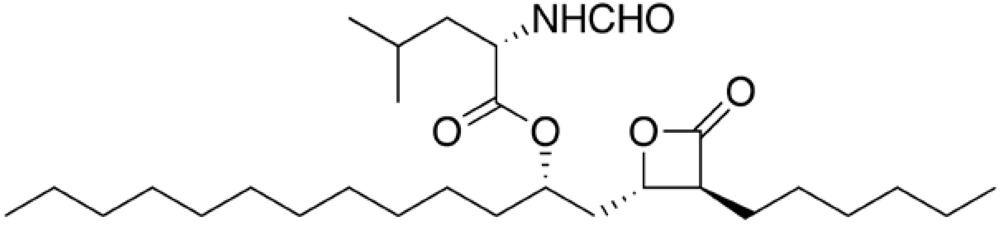
        <p>Orlistat (<xref ref-type="fig" rid="figure1">Figure 1</xref>) is a gastrointestinal lipase inhibitor. It decreases fat absorption binding to pancreatic lipase, blocking hydroliyses of triglycerides into fatty acids and monoglycerides, thereby increasing faecal fat excretion by 30%. Orlistat might also modify gastric emptying and secretion of gut peptides [<xref ref-type="bibr" rid="B1">1</xref>], whose contribution to weight loss warrants further investigation. </p>
        <fig id="figure1" position="float">
          <label>Figure 1</label>
          <caption>
            <p>Chemical structure of orlistat. </p>
          </caption>
          <graphic xmlns:xlink="http://www.w3.org/1999/xlink" xlink:href="pharmaceuticals-03-00125-g001.tif"/>
        </fig>
        <p>Orlistat is (<italic>S</italic>)-2-formylamino-4-methyl-pentanoic acid (<italic>S</italic>)-1-[[(2<italic>S</italic>,3<italic>S</italic>)-3-hexyl-4-oxo-2-oxetanyl] methyl]-dodecyl ester. Its empirical formula is C<sub>29</sub>H<sub>53</sub>NO<sub>5</sub>, and its molecular weight is 495.7.<bold/> It is a single diastereomer molecule that contains four chiral centers, with a negative optical rotation in ethanol at 529 nm. </p>
        <p>In several randomized clinical trials (RCTs), weight loss achieved was about 3% greater for subjects taking orlistat than for those taking placebo. After one year treatment mean body weight loss was about 2.89 kg greater in the active group than in the control group [<xref ref-type="bibr" rid="B2">2</xref>,<xref ref-type="bibr" rid="B3">3</xref>,<xref ref-type="bibr" rid="B4">4</xref>]. A reduced incidence of type 2 diabetes was demonstrated in patients who received orlistat for four years in the Xendos study [<xref ref-type="bibr" rid="B5">5</xref>]. </p>
        <p>Due to its mechanism of action, orlistat produces significant gastrointestinal side effects (oily faecal spotting, flatus with discharge, faecal urgency, oily stools, increased defecation, faecal incontinence, abdominal pain) in 15-30% of the patients under treatment, that tend to disappear with time if the patient adheres to a low fat diet. Losses of fat-soluble vitamins have been reported with orlistat. In this context multivitamin supplementation is recommended by some authors.<bold/></p>
      </sec>
      <sec>
        <title>Sibutramine </title>
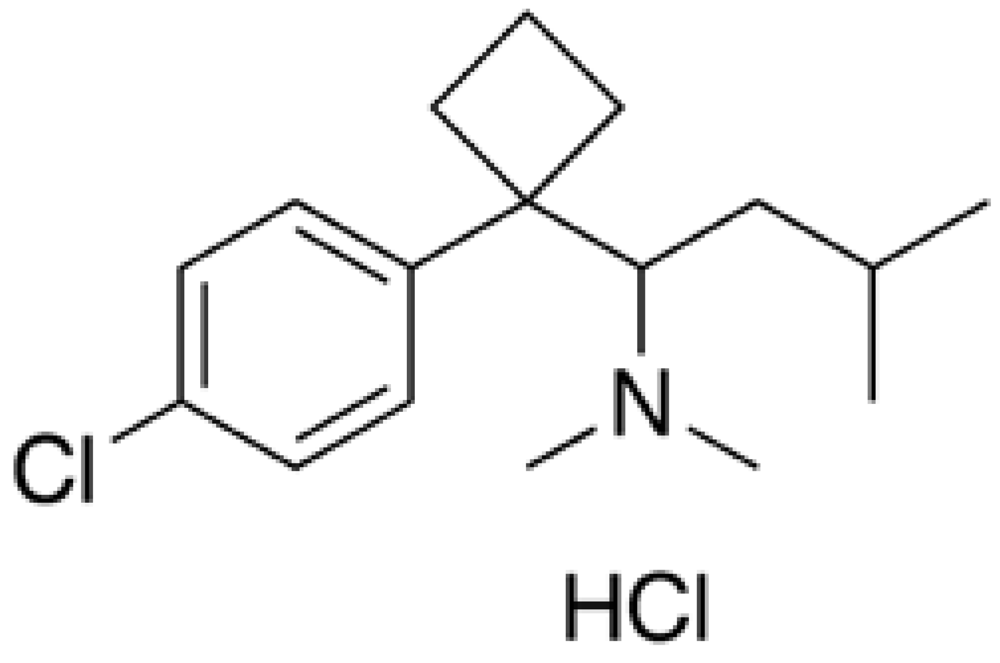
        <p>Sibutramine (<xref ref-type="fig" rid="figure2">Figure 2</xref>) is a centrally acting agent that inhibits serotonin and norepinephrine reuptake. It reduces food intake by reducing appetite. Chemically, the active ingredient is a racemic mixture of the (+) and (-) enantiomers of 1-(4-chlorophenyl)-<italic>N,N</italic>-dimethyl-α-(2-methylpropyl)-, cyclobutanemethanamine hydrochloride monohydrate, and has an empirical formula of C<sub>17</sub>H<sub>29</sub>Cl<sub>2</sub>NO Its molecular weight is 334.33. </p>
        <fig id="figure2" position="float">
          <label>Figure 2</label>
          <caption>
            <p>Chemical structure of sibutramine. </p>
          </caption>
          <graphic xmlns:xlink="http://www.w3.org/1999/xlink" xlink:href="pharmaceuticals-03-00125-g002.tif"/>
        </fig>
        <p>Long-term randomized clinical trials (RCTs) of sibutramine (10-20 mg/d) in combination with a reduced calorie diet have demonstrated modest, although significant, weight loss compared with placebo over. In several RCTs, weight loss was about 5% greater for subjects taking sibutramine than for those taking placebo [<xref ref-type="bibr" rid="B2">2</xref>,<xref ref-type="bibr" rid="B3">3</xref>,<xref ref-type="bibr" rid="B4">4</xref>]. </p>
        <p>Because of the potential to increase blood pressure and heart rate, it is recommended that these parameters are monitored in patients taking sibutramine, and its use is contraindicated in patients with uncontrolled or poorly controlled hypertension. It has been suggested that a progressive tri-therapy intervention with sibutramine-diet-exercise enhances weight loss without inducing increases in heart rate and blood pressure [<xref ref-type="bibr" rid="B6">6</xref>].</p>
      </sec>
      <sec>
        <title>Rimonabant </title>
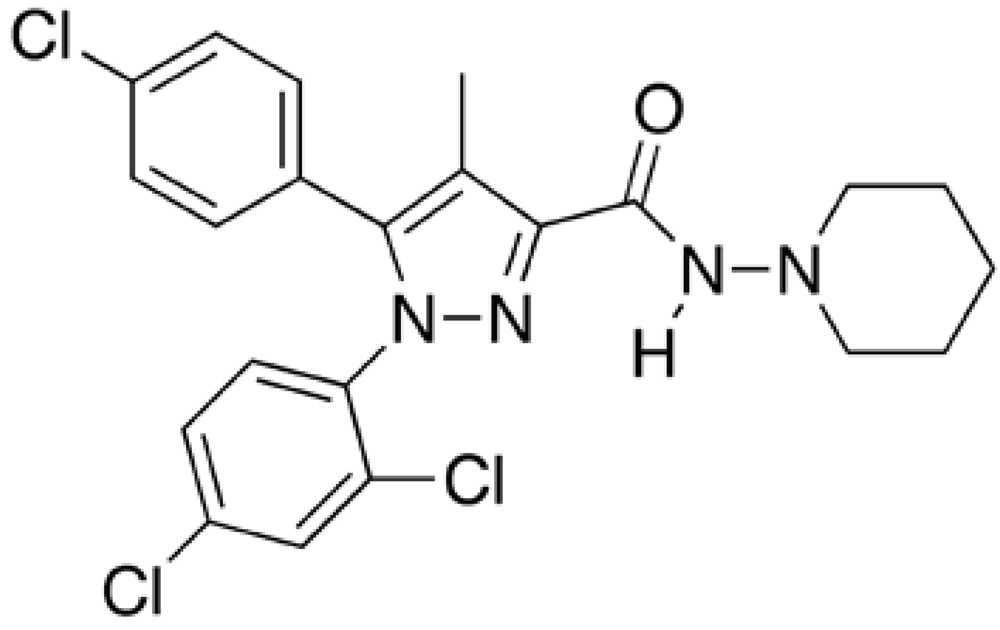
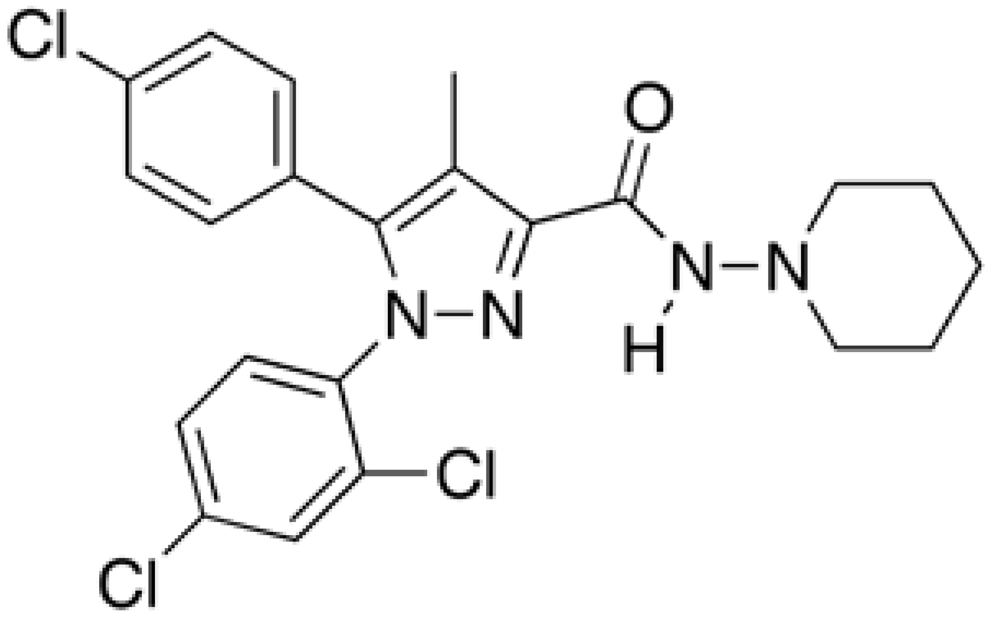
        <p>Cannabinoid receptors participate in the physiological modulation of many central and peripheral functions [<xref ref-type="bibr" rid="B7">7</xref>]. Rimonabant (<xref ref-type="fig" rid="figure3">Figure 3</xref>) is a selective blocker of type 1 endocannabinoid receptors that was investigated as an anti-obesity drug and for smoking cessation. It is an appetite suppressant. The FDA has not given the drug's approval because of concerns over suicide, depression and other related side effects associated with use of the drug. The European Commission approved the sale of rimonabant in the 25-member European Union, but later the drug was withdrawn from European markets because of the concerns over suicide. Chemically it is <italic>N</italic>-(piperidin-1-yl)-5-(4-clorophenyl)-1-(2,4-diclorophenyl)-4-methyl-1H-pyrazole-3-carboxamide. </p>
        <fig id="figure3" position="float">
          <label>Figure 3</label>
          <caption>
            <p>Chemical structure of rimonabant. </p>
          </caption>
          <graphic xmlns:xlink="http://www.w3.org/1999/xlink" xlink:href="pharmaceuticals-03-00125-g003.tif"/>
        </fig>
        <p>The degree of rimonabant intestinal absorption is unknown, but it undergoes hepatic metabolism (cytochrome 3A4 and aminohydrolase pathways) to inactive metabolites. It has biliary and faecal excretion. At present, only the results of three one-year and one two-year trials have been published. Rimonabant has shown to cause weight loss, significant improvements of cardiovascular risks factors (dyslipidemia, blood pressure and waist circumference) and reductions of HbA1c in obese type 2 diabetic patients. It is possible that rimonabant has beneficial effects on HDLc and triglyceride levels independent of weight loss, related to its direct effects on adipose tissue, liver and muscle. The most frequent side effects were nausea, dizziness, diarrhoea, insomnia and psychiatric problems (mainly depression and anxiety). Clinical trials with other CB1 receptor antagonists are ongoing [<xref ref-type="bibr" rid="B8">8</xref>]. Several groups are engaged in searching for novel CB1 receptor antagonists [<xref ref-type="bibr" rid="B9">9</xref>,<xref ref-type="bibr" rid="B10">10</xref>,<xref ref-type="bibr" rid="B11">11</xref>,<xref ref-type="bibr" rid="B12">12</xref>]. </p>
      </sec>
      <sec>
        <title>Phentermine</title>
        <p>Phentermine (<xref ref-type="fig" rid="figure4">Figure 4</xref>) is dimethylphenethylamine hydrochloride. It is an amphetamine-like analogue, indirectly acting sympathomimetic agents that increase norepinephrine levels in the synaptic cleft, resulting in stimulation of β<sub>2</sub>-adrenergic receptors and inhibition of feeding. Phentermine has also been reported to inhibit monoamine oxidase and increase the effects of serotonin, by inhibiting its pulmonary clearance. </p>
        <fig id="figure4" position="float">
          <label>Figure 4</label>
          <caption>
            <p>Chemical structure of phentermine. </p>
          </caption>
          <graphic xmlns:xlink="http://www.w3.org/1999/xlink" xlink:href="pharmaceuticals-03-00125-g004.tif"/>
        </fig>
        <p>Phentermine is available in many countries, including the U.S. However, because it is similar to amphetamines, individuals may develop an addiction to it. Phentermine should be used short-term (usually interpreted as 'up to 12 weeks'). In the United States, it is classified as a schedule IV controlled substance under the Controlled Substances Act. Phentermine is relatively well tolerated, although it can produce side effects consistent with its catecholamine-releasing properties (tachycardia, elevated blood pressure, insomnia and restlessness). The incidence and magnitude of these appear to be less than with amphetamines. Additionally, phentermine has the potential to cause physical and psychological dependence. </p>
      </sec>
    </sec>
    <sec>
      <title>Emerging Therapies</title>
      <p>Because of the paucity of available anti-obesity drugs, their limited efficacy and their secondary effects, development of new and more effective drugs has become a priority. Ideally the new therapies should be more efficient, provide additional metabolic effects (beyond those attributable to weight loss), be safer, and/or have less adverse effects. </p>
      <p>Obesity results from a chronic energetic misbalance in which energy intake exceeds energy expenditure. Therefore, the potential targets to achieve weight loss are: (1) to reduce energy intake,<bold/>by<bold/>stimulating anorexigenic signals or by blocking orexigenic signals, and (2) to increase energy expenditure (<xref ref-type="table" rid="table1">Table 1</xref>). All these strategies are being investigated. </p>
      <table-wrap id="table1" position="float">
        <object-id pub-id-type="pii">pharmaceuticals-03-00125_table1</object-id>
        <label>Table 1</label>
        <caption>
          <p>Potential antiobesity therapies.</p>
        </caption>
        <table>
          <thead>
            <tr>
              <th align="left" valign="middle">
                <italic>Drugs that stimulate anorexigenic signals:</italic>
              </th>
            </tr>
          </thead>
          <tbody>
            <tr>
              <td align="left" valign="middle">Leptin receptor superagonists</td>
            </tr>
            <tr>
              <td align="left" valign="middle">Peptides downstream of leptin: agonists of melanocortin receptor-4</td>
            </tr>
            <tr>
              <td align="left" valign="middle">Ciliary neurotrophic factor analogues</td>
            </tr>
            <tr>
              <td align="left" valign="middle">Agonists of 5-HT</td>
            </tr>
            <tr>
              <td align="left" valign="middle">
                <bold>
                  <italic>Drugs that inhibit orexigenic signals:</italic>
                </bold>
              </td>
            </tr>
            <tr>
              <td align="left" valign="middle">Neuropeptide Y receptor anatagonists</td>
            </tr>
            <tr>
              <td align="left" valign="middle">Melanin-concentrating hormone-1 receptor antagonists</td>
            </tr>
            <tr>
              <td align="left" valign="middle">Somatostatin analogues</td>
            </tr>
            <tr>
              <td align="left" valign="middle">
                <bold>
                  <italic>Gastrointestinal peptides as drug targets:</italic>
                </bold>
              </td>
            </tr>
            <tr>
              <td align="left" valign="middle">GLP-1 receptor agonists</td>
            </tr>
            <tr>
              <td align="left" valign="middle">Peptide YY 3-36 analogues</td>
            </tr>
            <tr>
              <td align="left" valign="middle">Ghrelin receptor antagonists or inverse agonists</td>
            </tr>
            <tr>
              <td align="left" valign="middle">Oxyntomodulin analogues</td>
            </tr>
            <tr>
              <td align="left" valign="middle">
                <bold>
                  <italic>Drugs that increase energy expenditure:</italic>
                </bold>
              </td>
            </tr>
            <tr>
              <td align="left" valign="middle">Beta-adrenergic agonists</td>
            </tr>
            <tr>
              <td align="left" valign="middle">Growth-hormone receptor agonists</td>
            </tr>
          </tbody>
        </table>
      </table-wrap>
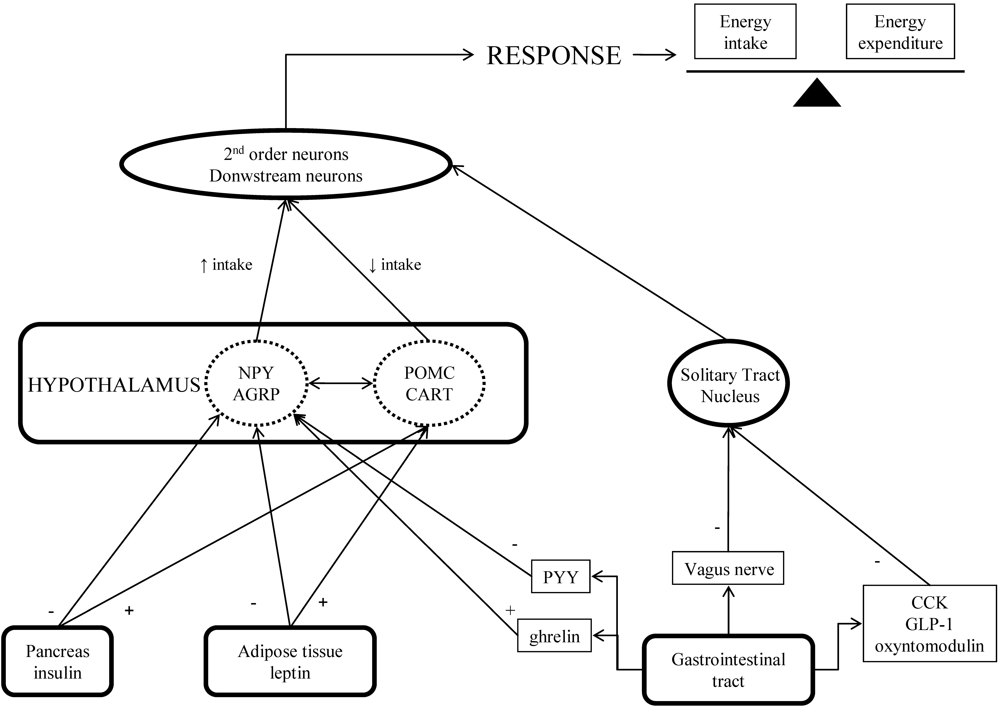
      <p>Very briefly, the hypothalamus is a primary site for the integration of several factors of central and peripheral origin for the regulation of energy homeostasis (<xref ref-type="fig" rid="figure5">Figure 5</xref>) [<xref ref-type="bibr" rid="B13">13</xref>]. The status of energy stores is conveyed to the central nervous system by adiposity-associated hormones (leptin and insulin) and possibly some gastrointestinal peptide hormones. Satiety signals from the GI tract and neuronal influences from the digestive tract, via the vagus nerve, are routed to specific nuclei of the hypothalamus and brain stem, such as the arcuate nucleus and the solitary tract nucleus, which activate the neuronal networks that control eating behavior. In the arcuate nucleus, leptin and insulin stimulate the activity of neurons that express the catabolic neuropeptide precursor proopiomelanocortin (POMC) and the anorexigenic factor cocaine and amphetamine-related transcript (CART), and inhibit neurons that produce the anabolic meditors neuropeptide Y (NPY) and the agouti-related protein (Agrp). Several of these groups of neurons are interconnected at different levels, so that activation of a group inhibits other neurons and vice-versa. Information about short-term modifications in nutrient status is conveyed to the brain through meal-related gastrointestinal hormone responses, variations in levels of nutrient content and gastric distension. This information influences the size and frequency of each individual eating episode. Except for ghrelin, that is thought to promote meal initiation, gastrointestinal signals contribute to satiation and meal termination. This feedback system, together with genetic, psychological and social-environmental factors, interacts to elicit endocrine, autonomic and behavioral answers that determine body weight. Targeting each one of these steps has pros and cons [<xref ref-type="bibr" rid="B14">14</xref>]. Effective treatment of obesity will probably require a combination of drugs acting at different points in this complex system. A review focused on the structural classification of the anti-obesity agents has recently been published [<xref ref-type="bibr" rid="B15">15</xref>]. </p>
      <fig id="figure5" position="float">
        <label>Figure 5</label>
        <caption>
          <p>Simplified representation of control of food intake. PYY: peptide YY; CCK: cholecystokinin; NPY: neuropeptide Y; AGRP: Agouti-related protein; POMC: proopiomelanocortin; CART: cocaine and amphetamine-related transcript.</p>
        </caption>
        <graphic xmlns:xlink="http://www.w3.org/1999/xlink" xlink:href="pharmaceuticals-03-00125-g005.tif"/>
      </fig>
    </sec>
    <sec>
      <title>Stimulation of Anorexigenic Signals</title>
      <sec>
        <title>Leptin</title>
        <p>Leptin is a versatile 16 kDa peptide hormone, with a tertiary structure resembling that of members of the long-chain helical cytokine family. It was originally thought to act only as a satiety factor, but there is considerable evidence for other systemic effects of leptin. At least five isoforms of leptin receptor exist, primarily because of alternate splicing. The longest form is capable of full signal transduction. The short forms may serve as leptin binding proteins and play a role in leptin transporting across the blood-brain barrier. The mechanism by which leptin modulates energy balance involves many hypothalamic neuropeptides including neuropeptide Y (NPY), the melanocortin system, melanocyte-concentrating hormone and cocaine- and amphetamine-regulated transcript [<xref ref-type="bibr" rid="B16">16</xref>]. </p>
        <p>Interest in leptin as anti-obesity drug decreased when elevated levels were noted in the majority of obese individuals [<xref ref-type="bibr" rid="B17">17</xref>]. Most cases of obesity are associated with leptin insensitivity or resistance, rather than leptin deficiency. Obese and non-obese subjects have similar central leptin levels, which suggest that transport to CNS, rather than intrinsic responsiveness to leptin, might be rate limiting for leptin activity in the obese state [<xref ref-type="bibr" rid="B18">18</xref>]. It would be necessary to develop a treatment that overcame leptin insensitivity or bypassed normal central leptin functioning, for example, by developing novel forms of leptin with stronger physiological properties [<xref ref-type="bibr" rid="B19">19</xref>]. The peptides downstream of leptin constitute another possible target for therapeutic interventions. Finally, another strategy would be to target genes that are involved in leptin functioning, for example, negative regulators of leptin signaling SOCS3 and PTP1B.</p>
        <p>Literature strongly suggests that the leptin resistance is due a decreased transport of leptin across the blood-brain barrier. The main cause of this resistance appears to be an impairment in the activity of the transporter rather than just simply saturation at higher doses [<xref ref-type="bibr" rid="B20">20</xref>]. In fact, the transport mechanism into the brain is saturated at relatively low plasma leptin concentrations. The nose provides an effective way for delivering neuropeptides to the central nervous system, bypassing the blood-brain barrier and avoiding systemic side effects. In obesity, leptin-receptor signaling is blunted in brain areas critical to energy homeostasis, even when leptin is injected directly into the brain [<xref ref-type="bibr" rid="B21">21</xref>]. This problem could be addressed by creating leptin-receptor superagonists, but development of synthetic leptin-receptor agonists is in preclinical stages. </p>
        <p>The peptides downstream of leptin constitute another possible target for therapeutic interventions. Pro-opiomelanocortin (POMC) is the first key intermediary of leptin-receptor signaling. POMC is a complex polypeptide precursor which is cleaved into smaller biologically active peptides. Data from human genetic and murine studies show that an intact central melanocortin signaling pathway is critical for normal energy homoeostasis [<xref ref-type="bibr" rid="B22">22</xref>,<xref ref-type="bibr" rid="B23">23</xref>], but POMC-derived peptides are also involved in adrenal physiology and other functions. Cleavage of POMC produces biologically active peptides such as the melanocortins, <italic>α</italic>-, <italic>β</italic>- and <italic>γ </italic>-melanocyte-stimulating hormone. α-MSH activates melanocortin-3 and melanocortin-4 receptors (Mc3r, Mc4r) to exert catabolic effects. MC4R agonists specifically designed are being investigated for potential treatment of obesity. Ro-27-3225 (Bu-His-Phe-Arg-Trp-Gly-NH<sub>2</sub>), a nonselective human MC4R pentapeptide agonist, was reported to be able to reduce food intake and weight gain in <italic>ob/ob</italic> mice [<xref ref-type="bibr" rid="B24">24</xref>]. Using it as a template, systematic replacement of the residues was used to identify selective MC4R agonists, but the level of efficacy of these compounds was not reported. Several companies have MC4R agonists that are being investigated in the treatment of obesity, including piperazinebenzylamines, piperazinethylamines, piperazinesulfonamides and other small-molecule agonists [<xref ref-type="bibr" rid="B25">25</xref>]. The effects of POMC on food intake and body weight and current developments in potential therapies to manipulate this pathway have recently been reviewed [<xref ref-type="bibr" rid="B26">26</xref>]. </p>
      </sec>
      <sec>
        <title>Ciliary Neurotrophic Factor</title>
        <p>Ciliary neurotrophic factor (CNTF) is a 22-kDa protein that is expressed in Schwann cells in the peripheral and astrocytes in the central nervous system. The CNTF receptor complex is most closely related to the receptor complexes for interleukin-6 and leukemia inhibitory factor. Signal transduction by CNTF requires that it binds first to CNTFR alpha, permitting the recruitment of gp130 and LIFR beta, forming a tripartite receptor complex. CNTF exerts a protective effect in demyelinating disease by preventing apoptosis of oligodendrocytes. CNTF also exerts an anti-inflammatory effect in the central nervous system.</p>
        <p>In a human study examining its usefulness for treatment of motor neuron disease, an unexpected weight loss was observed [<xref ref-type="bibr" rid="B27">27</xref>]. Further investigation revealed that CNTF mimics the biological actions of leptin while overcoming leptin resistance. <italic>Axokine,</italic> a second-generation neurotrophic factor that is related to CNTF with a 15 amino acid truncation of the C terminus and two amino acid substitutions, is three to five times more potent than CNTF in <italic>in vitro </italic>and <italic>in vivo</italic> assays, has improved stability properties and was shown to result in more weight loss than placebo [<xref ref-type="bibr" rid="B28">28</xref>]. Studies with Axokine were stopped due to the development of neutralizing antibodies against CNTF in a significant number of patients. This strategy as potential anti-obesity target warrants further investigation [<xref ref-type="bibr" rid="B29">29</xref>,<xref ref-type="bibr" rid="B30">30</xref>]. </p>
      </sec>
      <sec>
        <title>Subtype-Selective Serotonin-Receptor Agonists </title>
        <p>Endogenous hypothalamic serotonin (5-HT) plays an important part in within-meal satiation and post-meal satiety processes, apart from in several sensory, motor and behavioral processes. Numerous serotonin receptor subtypes have been identified; of these, serotonin 5-HT2C and 5-HT1B receptors have been specifically recognized as mediators of serotonin-induced satiety [<xref ref-type="bibr" rid="B31">31</xref>,<xref ref-type="bibr" rid="B32">32</xref>,<xref ref-type="bibr" rid="B33">33</xref>]. Activation of 5-HT2C receptors on arcuate POMC neurons engages the same melanocortin pathway that is critical to leptin-mediated anorexia. 5-HT1B activation on arcuate NPY/Agrp cells inhibits neuronal activity, resulting in indirect stimulation of POMC cells, complementing the direct activation of the same neurons by the 5-HT2C receptor. This effect lies downstream of some of the levels at which leptin resistance occurs in obesity. Thus, the serotonin system has provided a viable target for weight control [<xref ref-type="bibr" rid="B34">34</xref>].</p>
        <p>A small number of short-term studies using isoform-selective 5-HT agonists confirm that stimulation of 5-HT2C receptor, and possibly 5-HT1B receptor, reduces food intake and weight in humans. A combined 5-HT2C/1B agonist (<italic>m</italic>-chlorophenylpiperazine) and the selective 5-HT2C agonist lorcaserin [(1<italic>R</italic>)-8-chloro-2,3,4,5-tetrahydro-1-methyl-1<italic>H</italic>-3-benzazepine,<bold/>APD356] have been tested in obese individuals, with modest but significant results. Several 5-HT2C selective agonists are under development [<xref ref-type="bibr" rid="B35">35</xref>]. In addition, 5-HT6 receptor antagonists such as PRX-07034 and BVT74316 have been shown to reduce food intake and bodyweight gain in rodent models and have recently entered clinical trials [<xref ref-type="bibr" rid="B36">36</xref>,<xref ref-type="bibr" rid="B37">37</xref>,<xref ref-type="bibr" rid="B38">38</xref>]. </p>
      </sec>
    </sec>
    <sec>
      <title>Inhibition of Orexigenic Signals </title>
      <sec>
        <title>Neuropeptide Y Receptor Antagonists</title>
        <p>Neuropeptide Y (NPY) is a widely distributed peptide in the central nervous system of both rodents and humans [<xref ref-type="bibr" rid="B39">39</xref>]. It has been implicated in a variety of physiological actions, including control of body weight. In mammals, the signaling is mediated via at least five different cell surface receptors, denoted as Y(1), Y(2), Y(4), Y(5) and Y(6). There is no consensus regarding which subtype is the most important for NPY-induced feeding and attempts to demonstrate an important role for NPY in the control of food intake has produced equivocal results. Antagonists of the NPY Y(1) and NPY Y(5) receptor subtype initially looked promising. However, attempts to inhibit the signaling of NPY through the NPY Y(1) and NPY Y(5) receptors has produced equivocal effects on food intake, and clinical studies of Y-receptor antagonists are almost nonexistent at present. </p>
      </sec>
      <sec>
        <title>Melanin-Concentrating Hormone Antagonists</title>
        <p>Melanin-concentrating hormone (MCH) is a cyclic nonadecapeptide, that is abundantly present in mammalian neurons. MCH binds to and activates two G protein-coupled receptors, MCH1R and MCH2R. The MCH-1 receptor (MCH-R1) has been identified as a key target in MCH regulation. In addition to the crucial roles of MCH in feeding behaviour, anatomical and neurochemical studies suggest that the MCH/MCH(1) system is involved in the regulation of emotion and stress responses. Therefore, it is important to develop anti-MCH agents that selectively modulate energy homeostasis without exerting other side effects. </p>
        <p>Multiple chemotypes of small molecule MCHr1 antagonists have been identified and shown to induce weight loss in animal models [<xref ref-type="bibr" rid="B40">40-42</xref>], but many of these lead compounds have been found to cross-react with the hERG potassium channels (channels encoded by the human ether-a-go-go-related gene), which are involved in cardiac action potential repolarization, and/or demonstrate deleterious effects on cardiovascular hemodynamic parameters. </p>
      </sec>
      <sec>
        <title>Somatostatin Analogues</title>
        <p>Somatostatin and its analogues (octreotide and lanreotide) bind to somatostatin subtype 5 receptors on the beta-cell membrane, which limits insulin release and, consequently, may decrease adipogenesis. Long-acting release octreotide was used in hyperinsulinaemic obese adults and resulted in statistically significant weight loss [<xref ref-type="bibr" rid="B43">43</xref>,<xref ref-type="bibr" rid="B44">44</xref>]. The patients with the greater degree of insulin hypersecretion appeared to derive the most benefit from treatment. </p>
      </sec>
    </sec>
    <sec>
      <title>Gastrointestinal Peptides That Regulate Food Intake, As Drug Targets</title>
      <p>Information about short-term changes in plasma levels of certain nutrients are communicated to the brain through gastrointestinal peptides, acting in conjunction with information about gastric distension, via the vagal and spinal nerves [<xref ref-type="bibr" rid="B45">45-47</xref>]. Except for ghrelin, gastrointestinal signals contribute to satiation. Individual peptides are not secreted in isolation in response to nutrient ingestion. Rather, there is a coordinated release of several hormones that act in coordination with CNS reward pathways, input from higher centers and social and environmental influences. This short-acting GI signals are processed in the central nervous system, along with information about the status of the body energy stores, to elicit corresponding alterations in catabolic and anabolic neuropeptides and neurotransmitters to control energy homeostasis. To increase the efficacy of anti-obesity drugs, it will probably be necessary to develop combination agents that target multiple signals in the energy homeostasis system. </p>
      <p>The theoretical advantage of reproducing the body´s own satiety signals would be that ubiquitous neurotransmitter systems would be minimally disturbed and undesirable side effects would be expected to be reduced. One issue that limits the use of native peptides is their short half-life, which conditions inconvenient administration regimes. The development of stable analogues and novel methods of drug delivery are crucial parts of drug development. </p>
      <p>Gastrointestinal peptides that regulate food intake include glucagon-like peptide-1, peptide YY3-36, oxyntomodulin (OXM) and ghrelin, among others. Gut hormones as potential new targets for appetite regulation and treatment of obesity have recently been reviewed [<xref ref-type="bibr" rid="B48">48</xref>]. </p>
      <sec>
        <title>Glucagon Like Peptide (GLP-1) Receptor Agonists</title>
        <p>Pre-proglucagon derived peptides Glucagon-Like Peptide-1 (GLP-1), Glucagon-Like Peptide-2 (GLP-2) and oxyntomodulin (OXM) are involved in a wide variety of physiological functions. The major physiological role of GLP-1 in mammals is to connect the consumption of nutrients with glucose metabolism [<xref ref-type="bibr" rid="B49">49</xref>]. To date, clinical development has focused on its incretin effect (intestinal enhancer of insulin secretion) and its use as antidiabetic agents. Peripheral administration of GLP-1 derivatives and analogues to both rodents and man has shown to have effects on food intake and body weight, by inducing satiety and decreasing food intake. In young healthy subjects GLP-1 infusion decreases spontaneous energy intake and <italic>ad libitum</italic> hunger, suggesting that GLP-1 may play a physiological regulatory role in controlling appetite and energy intake in humans [<xref ref-type="bibr" rid="B50">50</xref>,<xref ref-type="bibr" rid="B51">51</xref>,<xref ref-type="bibr" rid="B52">52</xref>]. The therapeutic utility of the native GLP-1 molecule is limited by its rapid enzymatic degradation by a serine protease termed dipeptidyl peptidase-IV (DPP-IV). A number of DPP-IV-resistant GLP-1 agonists, including exenatide and liraglutide, have been developed. Exenatide, or exendin-4, (C<sub>184</sub>H<sub>282</sub>N<sub>50</sub>O<sub>60</sub>S<sup>.</sup>C<sub>2</sub>H<sub>4</sub>O<sub>2</sub>), was extracted from the venom of the gila monster; it is supplied for subcutaneous (SC) injection and marketed to treat diabetes, and causes a modest but progressive weight lost. Liraglutide Arg(34)Lys(26)-(<italic>N</italic>-ε-(γ-Glu(<italic>N</italic>-α-hexadecanoyl))-GLP-1(7-37) was synthesized using the GLP-1 sequence with the addition of an acyl side chain that allows for noncovalent binding to albumin, which prolongs its half-life in the circulation. In trials evaluating efficacy of incretin therapy in type 2 diabetes<bold/>that reported data on changes in weight, there was a statistically significant weight loss observed with GLP-1 analogues versus comparator groups. Although GLP-1 receptor agonists are not currently approved for obesity treatment, it is possible that they have a role as an anti-obesity treatment [<xref ref-type="bibr" rid="B53">53</xref>]. </p>
      </sec>
      <sec>
        <title>Peptide YY Analogues</title>
        <p>PYY3-36 is the major form of circulating PYY and binds to the hypothalamic Y2 receptor. PYY is hypothesised to inhibit food intake via activation of the auto-inhibitory presynaptic NPY Y2-R present on the NPY neurons located in the arcuate nucleus, and activating adjacent anorexigenic POMC neurons [<xref ref-type="bibr" rid="B54">54</xref>,<xref ref-type="bibr" rid="B55">55</xref>]. The role of oxyntomodulin and peptide tyrosine-tyrosine (PYY) in appetite control has recently been review [<xref ref-type="bibr" rid="B56">56</xref>,<xref ref-type="bibr" rid="B57">57</xref>]. It has been suggested that disregulation in the secretion of this anorexigenic peptide may contribute to the complex pathogenesis of anorexia of some diseases, such as chronic renal failure [<xref ref-type="bibr" rid="B58">58</xref>]. Effects on other processes affecting energy balance (energy expenditure, fuel partitioning, gut nutrient uptake) remain poorly understood. Besides energy balance, PYY has been shown to coordinate gastrointestinal functions and has some role in other systemic functions such as control of blood pressure, heart rate and sleep. </p>
        <p>PYY3-36 has a functional half-life of approximately 3 h. Attachment of poly(ethylene glycol) (PEG) and coupling it to a 40 kDa PEG through a spontaneously cleavable linker develops a reversible PEGylated PYY3-36 derivative, and results in an eightfold increase in its functional half-life, to approximately 24 h. Variability of its effect across different experimental conditions in animal models led to confusion on its potential as an anti-obesity treatment. Some studies suggest that PYY has, if at all, only a minor role in food intake in rats, but a number of groups has demonstrated that peripheral PYY3-36 inhibits food intake and reduces body weight gain in other species. Pattern of administration is critical for producing a sustained effect of PYY3-36 on food intake and adiposity in rodents. The pharmacological value of PYY is controversial. Further studies are indicated to determine the potential role in energy balance regulation, and the optimal delivery and dosing. </p>
      </sec>
      <sec>
        <title>Ghrelin Receptor Antagonists and Inverse Agonists</title>
        <p>Ghrelin is the only known gut orexigenic hormone. It is an endogenous ligand for GH secretagogue 1A recertor (GHS<sub>1A</sub>-R). Apart from other actions, it seems to have a role in meal initiation and long-term control of body weight [<xref ref-type="bibr" rid="B13">13</xref>]. We have studied the potential relationships between ghrelin and malnutrition in some chronic diseases [<xref ref-type="bibr" rid="B59">59</xref>,<xref ref-type="bibr" rid="B60">60</xref>]. Ghrelin levels are low in obese individuals and rise in response to weight loss, as a compensatory response to promote weight regain. This could suggest that disruption of ghrelin signaling would not be useful in treating obesity. Several factors indicate that this idea might be incorrect: It is possible that obese individuals are more sensitive to the orexigenic effects of ghrelin [<xref ref-type="bibr" rid="B61">61</xref>] and obesity is associated with an attenuation of the post-prandial ghrelin fall [<xref ref-type="bibr" rid="B62">62</xref>]. It is also possible that ghrelin blockage would be more useful in preventing weight regain, after weight loss is achieved by other means. </p>
        <p>Highly potent GHS<sub>1A</sub>-R antagonists have been identified [<xref ref-type="bibr" rid="B63">63</xref>,<xref ref-type="bibr" rid="B64">64</xref>,<xref ref-type="bibr" rid="B65">65</xref>,<xref ref-type="bibr" rid="B66">66</xref>]. In rat models, some but not all GHS<sub>1A</sub>-R antagonists decreased food intake and body weight when administered centrally or intraperitoneal [<xref ref-type="bibr" rid="B67">67</xref>,<xref ref-type="bibr" rid="B68">68</xref>]. The GHS<sub>1A</sub>-R has constitutive activity [<xref ref-type="bibr" rid="B67">67</xref>] and, therefore, inverse GHS<sub>1A</sub>-R agonists [<xref ref-type="bibr" rid="B69">69</xref>] may prove to be more effective in inducing weight loss than GHS<sub>1A</sub>-R antagonists. Other more innovating approaches to decrease ghrelin activity have also been investigated as potential treatments [<xref ref-type="bibr" rid="B70">70</xref>,<xref ref-type="bibr" rid="B71">71</xref>,<xref ref-type="bibr" rid="B72">72</xref>,<xref ref-type="bibr" rid="B73">73</xref>].</p>
      </sec>
      <sec>
        <title>Oxyntomodulin Analogues</title>
        <p>Oxyntomodulin is a 37-amino-acid peptide that contains the 29-amino-acid structure of glucagon, followed by an octapeptide <italic>C</italic>-terminal extension [<xref ref-type="bibr" rid="B74">74</xref>]. It has been suggested that oxyntomodulin exerts its anorectic effect by signaling through the GLP-1 receptor. The administration of oxyntomodulin, when given intraperitoneally or into the cerebral ventricles, has been observed to reduce short-term food intake in rodents [<xref ref-type="bibr" rid="B75">75</xref>,<xref ref-type="bibr" rid="B76">76</xref>]. Oxyntomodulin-treated animals lose more weight than control animals that consume the same amount of calories, which suggests that oxyntomodulin increases energy expenditure, possibly via an effect on the thyroid axis. Oxyntomodulin has been found to reduce energy intake in normal-weight volunteers when administered intravenously or subcutaneously before a single study meal [<xref ref-type="bibr" rid="B77">77</xref>,<xref ref-type="bibr" rid="B78">78</xref>,<xref ref-type="bibr" rid="B79">79</xref>]<italic>.</italic>This weight-loss effect in humans could be caused by an increase in energy expenditure, in addition to a decrease in energy intake, as previously suggested by rodent data. </p>
      </sec>
    </sec>
    <sec>
      <title>Drugs That Increase Energy Expenditure </title>
      <p>There are many potential targets to stimulate energy expenditure or alter substrate utilization [<xref ref-type="bibr" rid="B80">80</xref>]. Increased energy expenditure involves either increased ATP utilization or oxidation of reduced coenzymes by enzymes or pathways that are not coupled to ATP. Thermogenesis may be initiated centrally or may be a direct peripheral action. Peripherally acting thermogenic drugs seem less likely to have side effects than centrally acting drugs and may have additional metabolic benefits.</p>
      <sec>
        <title>drenergic Agonists</title>
        <p>Treatment of obese animals with <italic>β</italic>3-adrenergic agonists increase lipid mobilization, induce mitochondrial uncoupling protein-1 and, finally, reduce body fat content. All weight loss is lipid, and lean may actually increase. The main sites of action <italic>β</italic>3-adrenergic agonists are white and brown adipose tissue, and muscle. <italic>β</italic>3-Adrenoceptor agonists fall into two main chemical classes: arylethanolamines and aryloxypropanolamines. It is difficult to identify <italic>β</italic>3-adrenoceptor agonist drugs because of differences in pharmacology between the rodent and human <italic>β</italic>3<italic>-</italic>adrenoceptors [<xref ref-type="bibr" rid="B81">81</xref>,<xref ref-type="bibr" rid="B82">82</xref>]. Moreover, near absolute selectivity is needed to avoid <italic>β</italic>(1/2)-adrenoceptor-mediated side effects and selective agonists tend to have poor oral bioavailability. Several phase II trials with this type of drugs were discontinued because of poor drug efficacy [<xref ref-type="bibr" rid="B83">83</xref>,<xref ref-type="bibr" rid="B84">84</xref>] and safety profiles. </p>
      </sec>
      <sec>
        <title>Growth Hormone</title>
        <p>Human growth hormone (GH) has profound lipolytic/antilipogenic actions in vivo and its secretion is decreased in obesity [<xref ref-type="bibr" rid="B85">85</xref>,<xref ref-type="bibr" rid="B86">86</xref>]. A recent meta-analysis of human studies examining the efficacy and safety of recombinant GH as therapy for obesity [<xref ref-type="bibr" rid="B87">87</xref>] concluded that rhGH therapy leads to decrease in visceral adiposity and increase in lean body mass without inducing weight loss. The rhGH doses used in many studies were supraphysiologic, and the authors suggested that future studies of longer duration, using carefully titrated rhGH protocols, will be needed in order to fully establish the effects of rhGH therapy in obesity. </p>
        <p>Growth hormone receptor agonists<italic/>could be another potential target for obesity treatment. A small region of the growth hormone molecule, denoted hGH 177-191, appears to retain some of the actions of growth hormone, but with no effect on growth or on insulin resistance. An orally active peptide variant of hGH 177-191, called AOD9604, was shown to stimulate metabolism of fat in animal trials [<xref ref-type="bibr" rid="B88">88</xref>,<xref ref-type="bibr" rid="B89">89</xref>] but, after a phase IIB clinical trial, the results did not support the commercial viability of the drug as a treatment for obesity. </p>
      </sec>
      <sec>
        <title>Other Thermogenic And Metabolic Drugs</title>
        <p>There are many potential ways to stimulate energy expenditure or alter substrate utilization, but it is somewhat premature to discuss some of them, such as mitochondrial uncoupling [<xref ref-type="bibr" rid="B90">90</xref>], as targets in the treatment of obesity. </p>
      </sec>
    </sec>
    <sec>
      <title>Anti-Obesity Drugs And Safety Concerns</title>
      <p>Obesity and overweight are highly prevalent chronic conditions that are associated with premature mortality, chronic morbidity and increased healthcare use. At the same time, there is a real potential for widespread misuse of this kind of drugs. It is essential to develop effective but, at the same time, safe and well tolerated new agents. Previous medicines, particularly centrally acting agents, have poor safety records and safety concerns have led to the withdrawal of some of them [<xref ref-type="bibr" rid="B91">91</xref>,<xref ref-type="bibr" rid="B92">92</xref>]. Preliminary data have very recently aroused safety concerns with sibutramine [<xref ref-type="bibr" rid="B93">93</xref>]. Although the official results are not yet available, this may have implications for the future approval of drugs that act through the same mechanism of action, like tesofensine [<xref ref-type="bibr" rid="B94">94</xref>], and even the strictness of the approval criteria of any new agent. </p>
      <p>The identification of a potential target is a long way from the synthesis of a compound that might become a drug. Issues of bioavailablity, metabolism, clearance, interactions and toxicity have to be addressed. Translatability of the pharmacological effects from animals to humans is challenging with anti-obesity drugs. There is no good way to predict rare or apparently human-specific side effects, apart from conducting large clinical trials and extensive monitoring efforts after market release. In 1996, the FDA established draft guidelines with recommendations for the design and conduct of clinical studies evaluating weight control drugs. </p>
    </sec>
    <sec sec-type="conclusions">
      <title>Conclusions </title>
      <p>Studies evaluating the long-term efficacy of anti-obesity agents are limited to orlistat and sibutramine. Both drugs appear modestly effective in promoting weight loss; however, interpretation is limited by high attrition rates. Longer and more methodologically rigorous studies of anti-obesity drugs that are powered to examine endpoints such as mortality and cardiovascular morbidity are required to fully evaluate any potential benefit of such agents. Orlistat is potentially preferred in the presence of diabetes, dislipidemia, hypertension or cardiovascular disease, in the absence of gastrointestinal disease; sibutramine is the drug of choice when lack of satiety is a major barrier to weight reduction, in the absence of cardiovascular disease.</p>
      <p>Development of new and more effective drugs has become a research priority. The potential strategies to achieve weight loss are: (1) to reduce energy intake,<bold/>by<bold/>stimulating anorexigenic signals or by blocking orexigenic signals, (2) to increase energy expenditure. All these strategies are being actively investigated, although it is not probable that a solution will be available in the near future. The new drugs should take into account these pathophysiological pathways. We believe that a drug that acts through the gastrointestinal peptides that regulate food intake, like a ghrelin antagonist or a GLP-1 agonist, could be good options. The desired degree of effectiveness will more likely be achieved through the use of combinations of treatments.</p>
    </sec>
  </body>
  <back>
    <ack>
      <p>This work was supported in part by grants PI051024 and PI070413 from Instituto Carlos III, PS07/12 and Redes 2006/27 from Xunta de Galicia. We want to thank José Pérez Sestelo for his help in the elaboration of the chemical structures. </p>
    </ack>
    <ref-list>
      <ref id="B1">
        <citation citation-type="journal">
          <person-group person-group-type="author">
            <name>
              <surname>Enç</surname>
              <given-names>F.Y.</given-names>
            </name>
            <name>
              <surname>Ones</surname>
              <given-names>T.</given-names>
            </name>
            <name>
              <surname>Akin</surname>
              <given-names>H.L.</given-names>
            </name>
            <name>
              <surname>Dede</surname>
              <given-names>F.</given-names>
            </name>
            <name>
              <surname>Turoğlu</surname>
              <given-names>H.T.</given-names>
            </name>
            <name>
              <surname>Ulfer</surname>
              <given-names>G.</given-names>
            </name>
            <name>
              <surname>Bekiroğlu</surname>
              <given-names>N.</given-names>
            </name>
            <name>
              <surname>Haklar</surname>
              <given-names>G.</given-names>
            </name>
            <name>
              <surname>Rehfeld</surname>
              <given-names>J.F.</given-names>
            </name>
            <name>
              <surname>Holst</surname>
              <given-names>J.J.</given-names>
            </name>
            <name>
              <surname>Ulusoy</surname>
              <given-names>N.</given-names>
            </name>
            <name>
              <surname>Imeryüz</surname>
              <given-names>N.</given-names>
            </name>
          </person-group>
          <article-title>Orlistat accelerates gastric emptying and attenuates GIP release in healthy subjects</article-title>
          <source>Am. J. Physiol. Gastrointest. Liver Physiol.</source>
          <year>2009</year>
          <volume>296</volume>
          <fpage>482</fpage>
          <lpage>489</lpage>
          <pub-id pub-id-type="doi">10.1152/ajpgi.90209.2008</pub-id>
        </citation>
      </ref>
      <ref id="B2">
        <citation citation-type="journal">
          <person-group person-group-type="author">
            <name>
              <surname>Li</surname>
              <given-names>Z.</given-names>
            </name>
            <name>
              <surname>Maglione</surname>
              <given-names>M.</given-names>
            </name>
            <name>
              <surname>Tu</surname>
              <given-names>W.</given-names>
            </name>
            <name>
              <surname>Mojica</surname>
              <given-names>W.</given-names>
            </name>
            <name>
              <surname>Arterburn</surname>
              <given-names>D.</given-names>
            </name>
            <name>
              <surname>Shugarman</surname>
              <given-names>L.R.</given-names>
            </name>
            <name>
              <surname>Hilton</surname>
              <given-names>L.</given-names>
            </name>
            <name>
              <surname>Suttorp</surname>
              <given-names>M.</given-names>
            </name>
            <name>
              <surname>Solomon</surname>
              <given-names>V.</given-names>
            </name>
            <name>
              <surname>Shekelle</surname>
              <given-names>P.G.</given-names>
            </name>
            <name>
              <surname>Morton</surname>
              <given-names>S.C.</given-names>
            </name>
          </person-group>
          <article-title>Meta-analysis: pharmacologic treatment of obesity</article-title>
          <source>Ann. Intern. Med.</source>
          <year>2005</year>
          <volume>142</volume>
          <fpage>532</fpage>
          <lpage>546</lpage>
          <pub-id pub-id-type="pmid">15809465</pub-id>
        </citation>
      </ref>
      <ref id="B3">
        <citation citation-type="journal">
          <person-group person-group-type="author">
            <name>
              <surname>Rucker</surname>
              <given-names>D.</given-names>
            </name>
            <name>
              <surname>Padwal</surname>
              <given-names>R</given-names>
            </name>
            <name>
              <surname>Li</surname>
              <given-names>S.K.</given-names>
            </name>
            <name>
              <surname>Curioni</surname>
              <given-names>C.</given-names>
            </name>
            <name>
              <surname>Lau</surname>
              <given-names>D.C.</given-names>
            </name>
          </person-group>
          <article-title>Long term pharmacotherapy for obesity and overweight: updated meta-analysis </article-title>
          <source>BMJ</source>
          <year>2007</year>
          <volume>335</volume>
          <fpage>1194</fpage>
          <lpage>1199</lpage>
          <pub-id pub-id-type="doi">10.1136/bmj.39385.413113.25</pub-id>
          <pub-id pub-id-type="pmid">18006966</pub-id>
        </citation>
      </ref>
      <ref id="B4">
        <citation citation-type="journal">
          <person-group person-group-type="author">
            <name>
              <surname>Christensen</surname>
              <given-names>R.</given-names>
            </name>
            <name>
              <surname>Kristensen</surname>
              <given-names>P.K.</given-names>
            </name>
            <name>
              <surname>Bartels</surname>
              <given-names>E.M.</given-names>
            </name>
            <name>
              <surname>Bliddal</surname>
              <given-names>H.</given-names>
            </name>
            <name>
              <surname>Astrup</surname>
              <given-names>A.</given-names>
            </name>
          </person-group>
          <article-title>Efficacy and safety of the weight-loss drug rimonabant: a meta-analysis of randomised trials</article-title>
          <source>Lancet</source>
          <year>2007</year>
          <volume>370</volume>
          <fpage>1706</fpage>
          <lpage>1713</lpage>
          <pub-id pub-id-type="doi">10.1016/S0140-6736(07)61721-8</pub-id>
          <pub-id pub-id-type="pmid">18022033</pub-id>
        </citation>
      </ref>
      <ref id="B5">
        <citation citation-type="journal">
          <person-group person-group-type="author">
            <name>
              <surname>Torgerson</surname>
              <given-names>J.S.</given-names>
            </name>
            <name>
              <surname>Hauptman</surname>
              <given-names>J.</given-names>
            </name>
            <name>
              <surname>Boldrin</surname>
              <given-names>M.N.</given-names>
            </name>
            <name>
              <surname>Sjöström</surname>
              <given-names>L.</given-names>
            </name>
          </person-group>
          <article-title>XENical in the prevention of diabetes in obese subjects (XENDOS) study: a randomized study of orlistat as an adjunct to lifestyle changes for the prevention of type 2 diabetes in obese patients</article-title>
          <source>Diab. Care</source>
          <year>2004</year>
          <volume>27</volume>
          <fpage>155</fpage>
          <lpage>161</lpage>
          <pub-id pub-id-type="doi">10.2337/diacare.27.1.155</pub-id>
        </citation>
      </ref>
      <ref id="B6">
        <citation citation-type="journal">
          <person-group person-group-type="author">
            <name>
              <surname>Bérubé-Parent</surname>
              <given-names>S.</given-names>
            </name>
            <name>
              <surname>Prud´homme</surname>
              <given-names>D.</given-names>
            </name>
            <name>
              <surname>St-Pierre</surname>
              <given-names>S.</given-names>
            </name>
            <name>
              <surname>Doucet</surname>
              <given-names>E</given-names>
            </name>
            <name>
              <surname>Tremblay</surname>
              <given-names>A.</given-names>
            </name>
          </person-group>
          <article-title>Obesity treatment with a progressive clinical tri-therapy combining sibutramine and a supervised diet--exercise intervention </article-title>
          <source>Int. J. Obes,</source>
          <year>2001</year>
          <volume>25</volume>
          <fpage>1144</fpage>
          <lpage>1153</lpage>
          <pub-id pub-id-type="doi">10.1038/sj.ijo.0801677</pub-id>
        </citation>
      </ref>
      <ref id="B7">
        <citation citation-type="journal">
          <person-group person-group-type="author">
            <name>
              <surname>Bellocchio</surname>
              <given-names>L.</given-names>
            </name>
            <name>
              <surname>Cervino</surname>
              <given-names>C.</given-names>
            </name>
            <name>
              <surname>Pasquali</surname>
              <given-names>R.</given-names>
            </name>
            <name>
              <surname>Pagotto</surname>
              <given-names>R.</given-names>
            </name>
          </person-group>
          <article-title>The endocannabinoid system and energy metabolism</article-title>
          <source>J. Neuroendocrinol.</source>
          <year>2008</year>
          <volume>20</volume>
          <fpage>850</fpage>
          <lpage>857</lpage>
          <pub-id pub-id-type="doi">10.1111/j.1365-2826.2008.01728.x</pub-id>
          <pub-id pub-id-type="pmid">18601709</pub-id>
        </citation>
      </ref>
      <ref id="B8">
        <citation citation-type="journal">
          <person-group person-group-type="author">
            <name>
              <surname>Akbas</surname>
              <given-names>F.</given-names>
            </name>
            <name>
              <surname>Gasteyger</surname>
              <given-names>C.</given-names>
            </name>
            <name>
              <surname>Sjödin</surname>
              <given-names>A.</given-names>
            </name>
            <name>
              <surname>Astrup</surname>
              <given-names>A.</given-names>
            </name>
            <name>
              <surname>Larsen</surname>
              <given-names>T.M.</given-names>
            </name>
          </person-group>
          <article-title>A critical review of the cannabinoid receptor as a drug target for obesity management </article-title>
          <source>Obes. Rev.</source>
          <year>2008</year>
          <volume>10</volume>
          <fpage>58</fpage>
          <lpage>67</lpage>
          <pub-id pub-id-type="doi">10.1111/j.1467-789X.2008.00520.x</pub-id>
          <pub-id pub-id-type="pmid">18721231</pub-id>
        </citation>
      </ref>
      <ref id="B9">
        <citation citation-type="journal">
          <person-group person-group-type="author">
            <name>
              <surname>Addy</surname>
              <given-names>C.</given-names>
            </name>
            <name>
              <surname>Li</surname>
              <given-names>S.</given-names>
            </name>
            <name>
              <surname>Agrawal</surname>
              <given-names>N.</given-names>
            </name>
            <name>
              <surname>Stone</surname>
              <given-names>J.</given-names>
            </name>
            <name>
              <surname>Majumdar</surname>
              <given-names>A.</given-names>
            </name>
            <name>
              <surname>Zhong</surname>
              <given-names>L.</given-names>
            </name>
            <name>
              <surname>Li</surname>
              <given-names>H.</given-names>
            </name>
            <name>
              <surname>Yuan</surname>
              <given-names>J.</given-names>
            </name>
            <name>
              <surname>Maes</surname>
              <given-names>A.</given-names>
            </name>
            <name>
              <surname>Rothenberg</surname>
              <given-names>P.</given-names>
            </name>
            <name>
              <surname>Cote</surname>
              <given-names>J.</given-names>
            </name>
            <name>
              <surname>Rosko</surname>
              <given-names>K.</given-names>
            </name>
            <name>
              <surname>Cummings</surname>
              <given-names>C.</given-names>
            </name>
            <name>
              <surname>Warrington</surname>
              <given-names>S.</given-names>
            </name>
            <name>
              <surname>Boyce</surname>
              <given-names>M.</given-names>
            </name>
            <name>
              <surname>Gottesdiener</surname>
              <given-names>K.</given-names>
            </name>
            <name>
              <surname>Stoch</surname>
              <given-names>A.</given-names>
            </name>
            <name>
              <surname>Wagner</surname>
              <given-names>J.</given-names>
            </name>
          </person-group>
          <article-title>Safety, tolerability, pharmacokinetics, and pharmacodynamic properties of taranabant, a novel selective cannabinoid-1 receptor inverse agonist, for the treatment of obesity: results from a double-blind, placebo-controlled, single oral dose study in healthy volunteers</article-title>
          <source>J. Clin. Pharmacol.</source>
          <year>2008</year>
          <volume>48</volume>
          <fpage>418</fpage>
          <lpage>427</lpage>
          <pub-id pub-id-type="doi">10.1177/0091270008314467</pub-id>
          <pub-id pub-id-type="pmid">18258750</pub-id>
        </citation>
      </ref>
      <ref id="B10">
        <citation citation-type="journal">
          <person-group person-group-type="author">
            <name>
              <surname>Addy</surname>
              <given-names>C.</given-names>
            </name>
            <name>
              <surname>Wright</surname>
              <given-names>H.</given-names>
            </name>
            <name>
              <surname>Van Laere</surname>
              <given-names>K.</given-names>
            </name>
            <name>
              <surname>Gantz</surname>
              <given-names>I.</given-names>
            </name>
            <name>
              <surname>Erondu</surname>
              <given-names>N.</given-names>
            </name>
            <name>
              <surname>Musser</surname>
              <given-names>B.J.</given-names>
            </name>
            <name>
              <surname>Lu</surname>
              <given-names>K.</given-names>
            </name>
            <name>
              <surname>Yuan</surname>
              <given-names>J.</given-names>
            </name>
            <name>
              <surname>Sanabria-Bohórquez</surname>
              <given-names>S.M.</given-names>
            </name>
            <name>
              <surname>Stoch</surname>
              <given-names>A.</given-names>
            </name>
            <name>
              <surname>Stevens</surname>
              <given-names>C.</given-names>
            </name>
            <name>
              <surname>Fong</surname>
              <given-names>T.M.</given-names>
            </name>
            <name>
              <surname>De Lepeleire</surname>
              <given-names>I.</given-names>
            </name>
            <name>
              <surname>Cilissen</surname>
              <given-names>C.</given-names>
            </name>
            <name>
              <surname>Cote</surname>
              <given-names>J.</given-names>
            </name>
            <name>
              <surname>Rosko</surname>
              <given-names>K.</given-names>
            </name>
            <name>
              <surname>Gendrano 3rd</surname>
              <given-names>I.N.</given-names>
            </name>
            <name>
              <surname>Nguyen</surname>
              <given-names>A.M.</given-names>
            </name>
            <name>
              <surname>Gumbiner</surname>
              <given-names>B.</given-names>
            </name>
            <name>
              <surname>Rothenberg</surname>
              <given-names>P.</given-names>
            </name>
            <name>
              <surname>de Hoon</surname>
              <given-names>J.</given-names>
            </name>
            <name>
              <surname>Bormans</surname>
              <given-names>G.</given-names>
            </name>
            <name>
              <surname>Depré</surname>
              <given-names>M.</given-names>
            </name>
            <name>
              <surname>Eng</surname>
              <given-names>W.S.</given-names>
            </name>
            <name>
              <surname>Ravussin</surname>
              <given-names>E.</given-names>
            </name>
            <name>
              <surname>Klein</surname>
              <given-names>S.</given-names>
            </name>
            <name>
              <surname>Blundell</surname>
              <given-names>J.</given-names>
            </name>
            <name>
              <surname>Herman</surname>
              <given-names>G.A.</given-names>
            </name>
            <name>
              <surname>Burns</surname>
              <given-names>H.D.</given-names>
            </name>
            <name>
              <surname>Hargreaves</surname>
              <given-names>R.J.</given-names>
            </name>
            <name>
              <surname>Wagner</surname>
              <given-names>J.</given-names>
            </name>
            <name>
              <surname>Gottesdiener</surname>
              <given-names>K.</given-names>
            </name>
            <name>
              <surname>Amatruda</surname>
              <given-names>J.M.</given-names>
            </name>
            <name>
              <surname>Heymsfield</surname>
              <given-names>S.B.</given-names>
            </name>
          </person-group>
          <article-title>The acyclic CB1R inverse agonist taranabant mediates weight loss by increasing energy expenditure and decreasing caloric intake </article-title>
          <source>Cell Metab.</source>
          <year>2008</year>
          <volume>7</volume>
          <fpage>68</fpage>
          <lpage>78</lpage>
          <pub-id pub-id-type="doi">10.1016/j.cmet.2007.11.012</pub-id>
          <pub-id pub-id-type="pmid">18177726</pub-id>
        </citation>
      </ref>
      <ref id="B11">
        <citation citation-type="journal">
          <person-group person-group-type="author">
            <name>
              <surname>Lamota</surname>
              <given-names>L.</given-names>
            </name>
            <name>
              <surname>Bermudez-Silva</surname>
              <given-names>F.J.</given-names>
            </name>
            <name>
              <surname>Marco</surname>
              <given-names>E.M.</given-names>
            </name>
            <name>
              <surname>Llorente</surname>
              <given-names>R.</given-names>
            </name>
            <name>
              <surname>Gallego</surname>
              <given-names>A.</given-names>
            </name>
            <name>
              <surname>Rodríguez de Fonseca</surname>
              <given-names>F.</given-names>
            </name>
            <name>
              <surname>Viveros</surname>
              <given-names>M.P.</given-names>
            </name>
          </person-group>
          <article-title>Effects of adolescent nicotine and SR 147778 (Surinabant) administration on food intake, somatic growth and metabolic parameters in rats</article-title>
          <source>Neuropharmacology</source>
          <year>2008</year>
          <volume>54</volume>
          <fpage>194</fpage>
          <lpage>205</lpage>
          <pub-id pub-id-type="doi">10.1016/j.neuropharm.2007.07.004</pub-id>
          <pub-id pub-id-type="pmid">17720206</pub-id>
        </citation>
      </ref>
      <ref id="B12">
        <citation citation-type="journal">
          <person-group person-group-type="author">
            <name>
              <surname>Song</surname>
              <given-names>K.S.</given-names>
            </name>
            <name>
              <surname>Kim</surname>
              <given-names>M.J.</given-names>
            </name>
            <name>
              <surname>Seo</surname>
              <given-names>H.J.</given-names>
            </name>
            <name>
              <surname>Lee</surname>
              <given-names>S.H.</given-names>
            </name>
            <name>
              <surname>Jung</surname>
              <given-names>M.E.</given-names>
            </name>
            <name>
              <surname>Kim</surname>
              <given-names>S.U.</given-names>
            </name>
            <name>
              <surname>Kim</surname>
              <given-names>J.</given-names>
            </name>
            <name>
              <surname>Lee</surname>
              <given-names>J.</given-names>
            </name>
          </person-group>
          <article-title>Synthesis and structure-activity relationship of novel diarylpyrazole imide analogues as CB1 cannabinoid receptor ligands</article-title>
          <source>Bioorg. Med. Chem.</source>
          <year>2009</year>
          <volume>17</volume>
          <fpage>3080</fpage>
          <lpage>3092</lpage>
          <pub-id pub-id-type="doi">10.1016/j.bmc.2009.03.006</pub-id>
          <pub-id pub-id-type="pmid">19328001</pub-id>
        </citation>
      </ref>
      <ref id="B13">
        <citation citation-type="journal">
          <person-group person-group-type="author">
            <name>
              <surname>Foster-Schubert</surname>
              <given-names>K.E.</given-names>
            </name>
            <name>
              <surname>Cummings</surname>
              <given-names>D.E.</given-names>
            </name>
          </person-group>
          <article-title>Emerging therapeutic strategies for obesity</article-title>
          <source>Endocr. Rev.</source>
          <year>2006</year>
          <volume>27</volume>
          <fpage>779</fpage>
          <lpage>793</lpage>
          <pub-id pub-id-type="pmid">17122357</pub-id>
        </citation>
      </ref>
      <ref id="B14">
        <citation citation-type="journal">
          <person-group person-group-type="author">
            <name>
              <surname>Cawthorne</surname>
              <given-names>M.A.</given-names>
            </name>
          </person-group>
          <article-title>Opportunities and challenges for the development of pharmacological therapies for obesity treatment </article-title>
          <source>Obes. Rev.</source>
          <year>2007</year>
          <volume>8 (Suppl. 1)</volume>
          <fpage>131</fpage>
          <lpage>136</lpage>
          <pub-id pub-id-type="doi">10.1111/j.1467-789X.2007.00332.x</pub-id>
          <pub-id pub-id-type="pmid">17316316</pub-id>
        </citation>
      </ref>
      <ref id="B15">
        <citation citation-type="journal">
          <person-group person-group-type="author">
            <name>
              <surname>Oh</surname>
              <given-names>S.</given-names>
            </name>
            <name>
              <surname>Kim</surname>
              <given-names>K.S.</given-names>
            </name>
            <name>
              <surname>Chung</surname>
              <given-names>Y.S.</given-names>
            </name>
            <name>
              <surname>Shong</surname>
              <given-names>M.</given-names>
            </name>
            <name>
              <surname>Park</surname>
              <given-names>S.B.</given-names>
            </name>
          </person-group>
          <article-title>Anti-obesity agents: a focused review on the structural classification of therapeutic entities</article-title>
          <source>Curr. Top. Med. Chem.</source>
          <year>2009</year>
          <volume>9</volume>
          <fpage>466</fpage>
          <lpage>481</lpage>
          <pub-id pub-id-type="doi">10.2174/156802609788897862</pub-id>
        </citation>
      </ref>
      <ref id="B16">
        <citation citation-type="journal">
          <person-group person-group-type="author">
            <name>
              <surname>Klok</surname>
              <given-names>M.D.</given-names>
            </name>
            <name>
              <surname>Jakobsdottir</surname>
              <given-names>S.</given-names>
            </name>
            <name>
              <surname>Drent</surname>
              <given-names>M.L.</given-names>
            </name>
          </person-group>
          <article-title>The role of leptin and ghrelin in the regulation of food intake and body weight in humans: A review</article-title>
          <source>Obes. Rev.</source>
          <year>2007</year>
          <volume>8</volume>
          <fpage>21</fpage>
          <lpage>34</lpage>
          <pub-id pub-id-type="doi">10.1111/j.1467-789X.2006.00270.x</pub-id>
        </citation>
      </ref>
      <ref id="B17">
        <citation citation-type="journal">
          <person-group person-group-type="author">
            <name>
              <surname>Considine</surname>
              <given-names>R.V.</given-names>
            </name>
            <name>
              <surname>Sinha</surname>
              <given-names>M.K.</given-names>
            </name>
            <name>
              <surname>Heiman</surname>
              <given-names>M.L.</given-names>
            </name>
            <name>
              <surname>Kriauciunas</surname>
              <given-names>A.</given-names>
            </name>
            <name>
              <surname>Stephens</surname>
              <given-names>T.W.</given-names>
            </name>
            <name>
              <surname>Nyce</surname>
              <given-names>M.R.</given-names>
            </name>
            <name>
              <surname>Ohannesian</surname>
              <given-names>J.P.</given-names>
            </name>
            <name>
              <surname>Marco</surname>
              <given-names>C.C.</given-names>
            </name>
            <name>
              <surname>McKee</surname>
              <given-names>L.J.</given-names>
            </name>
            <name>
              <surname>Bauer</surname>
              <given-names>T.L.</given-names>
            </name>
            <name>
              <surname>Caro</surname>
              <given-names>J.F.</given-names>
            </name>
          </person-group>
          <article-title>Serum immunoreactive-leptin concentrations in normal-weight and obese humans</article-title>
          <source>N. Engl. J. Med.</source>
          <year>1996</year>
          <volume>334</volume>
          <fpage>292</fpage>
          <lpage>295</lpage>
          <pub-id pub-id-type="doi">10.1056/NEJM199602013340503</pub-id>
          <pub-id pub-id-type="pmid">8532024</pub-id>
        </citation>
      </ref>
      <ref id="B18">
        <citation citation-type="journal">
          <person-group person-group-type="author">
            <name>
              <surname>Schwartz</surname>
              <given-names>M.W.</given-names>
            </name>
            <name>
              <surname>Seeley</surname>
              <given-names>R.J.</given-names>
            </name>
            <name>
              <surname>Campfield</surname>
              <given-names>L.A.</given-names>
            </name>
            <name>
              <surname>Burn</surname>
              <given-names>P.</given-names>
            </name>
            <name>
              <surname>Baskin</surname>
              <given-names>D.G.</given-names>
            </name>
          </person-group>
          <article-title>Identification of targets of leptin action in rat hypothalamus</article-title>
          <source>J. Clin. Invest.</source>
          <year>1996</year>
          <volume>98</volume>
          <fpage>1101</fpage>
          <lpage>1106</lpage>
          <pub-id pub-id-type="doi">10.1172/JCI118891</pub-id>
          <pub-id pub-id-type="pmid">8787671</pub-id>
        </citation>
      </ref>
      <ref id="B19">
        <citation citation-type="journal">
          <person-group person-group-type="author">
            <name>
              <surname>Otvos Jr.</surname>
              <given-names>L.</given-names>
            </name>
            <name>
              <surname>Terrasi</surname>
              <given-names>M.</given-names>
            </name>
            <name>
              <surname>Cascio</surname>
              <given-names>S.</given-names>
            </name>
            <name>
              <surname>Cassone</surname>
              <given-names>M.</given-names>
            </name>
            <name>
              <surname>Abbadessa</surname>
              <given-names>G.</given-names>
            </name>
            <name>
              <surname>De Pascali</surname>
              <given-names>F.</given-names>
            </name>
            <name>
              <surname>Scolaro</surname>
              <given-names>L.</given-names>
            </name>
            <name>
              <surname>Knappe</surname>
              <given-names>D.</given-names>
            </name>
            <name>
              <surname>Stawikowski</surname>
              <given-names>M.</given-names>
            </name>
            <name>
              <surname>Cudic</surname>
              <given-names>P.</given-names>
            </name>
            <name>
              <surname>Wade</surname>
              <given-names>J.D.</given-names>
            </name>
            <name>
              <surname>Hoffmann</surname>
              <given-names>R.</given-names>
            </name>
            <name>
              <surname>Surmacz</surname>
              <given-names>E.</given-names>
            </name>
          </person-group>
          <article-title>Development of a pharmacologically improved peptide agonist of the leptin receptor </article-title>
          <source>Biochim. Biophys. Acta</source>
          <year>2008</year>
          <volume>1783</volume>
          <fpage>1745</fpage>
          <lpage>1754</lpage>
          <pub-id pub-id-type="doi">10.1016/j.bbamcr.2008.05.007</pub-id>
          <pub-id pub-id-type="pmid">18555805</pub-id>
        </citation>
      </ref>
      <ref id="B20">
        <citation citation-type="journal">
          <person-group person-group-type="author">
            <name>
              <surname>Banks</surname>
              <given-names>W.A.</given-names>
            </name>
          </person-group>
          <article-title>Leptin transport across the blood-brain barrier: implications for the cause and treatment of obesity</article-title>
          <source>Curr. Pharm. Des.</source>
          <year>2001</year>
          <volume>7</volume>
          <fpage>125</fpage>
          <lpage>133</lpage>
          <pub-id pub-id-type="doi">10.2174/1381612013398310</pub-id>
          <pub-id pub-id-type="pmid">11172704</pub-id>
        </citation>
      </ref>
      <ref id="B21">
        <citation citation-type="journal">
          <person-group person-group-type="author">
            <name>
              <surname>El-Haschimi</surname>
              <given-names>K.</given-names>
            </name>
            <name>
              <surname>Pierroz</surname>
              <given-names>D.D.</given-names>
            </name>
            <name>
              <surname>Hileman</surname>
              <given-names>S.M.</given-names>
            </name>
            <name>
              <surname>Bjorbaek</surname>
              <given-names>C.</given-names>
            </name>
            <name>
              <surname>Flier</surname>
              <given-names>J.S.</given-names>
            </name>
          </person-group>
          <article-title>Two defects contribute to hypothalamic leptin resistance in mice with diet-induced obesity</article-title>
          <source>J. Clin. Invest.</source>
          <year>2000</year>
          <volume>105</volume>
          <fpage>1827</fpage>
          <lpage>1832</lpage>
          <pub-id pub-id-type="doi">10.1172/JCI9842</pub-id>
          <pub-id pub-id-type="pmid">10862798</pub-id>
        </citation>
      </ref>
      <ref id="B22">
        <citation citation-type="journal">
          <person-group person-group-type="author">
            <name>
              <surname>Huszar</surname>
              <given-names>D.</given-names>
            </name>
            <name>
              <surname>Lynch</surname>
              <given-names>C.A.</given-names>
            </name>
            <name>
              <surname>Fairchild-Huntress</surname>
              <given-names>V.</given-names>
            </name>
            <name>
              <surname>Dunmore</surname>
              <given-names>J.H.</given-names>
            </name>
            <name>
              <surname>Fang</surname>
              <given-names>Q.</given-names>
            </name>
            <name>
              <surname>Berkemeier</surname>
              <given-names>L.R.</given-names>
            </name>
            <name>
              <surname>Gu</surname>
              <given-names>W.</given-names>
            </name>
            <name>
              <surname>Kesterson</surname>
              <given-names>R.A.</given-names>
            </name>
            <name>
              <surname>Boston</surname>
              <given-names>B.A.</given-names>
            </name>
            <name>
              <surname>Cone</surname>
              <given-names>R.D.</given-names>
            </name>
            <name>
              <surname>Smith</surname>
              <given-names>F.J.</given-names>
            </name>
            <name>
              <surname>Campfield</surname>
              <given-names>L.A.</given-names>
            </name>
            <name>
              <surname>Burn</surname>
              <given-names>P.</given-names>
            </name>
            <name>
              <surname>Lee</surname>
              <given-names>F.</given-names>
            </name>
          </person-group>
          <article-title>Targeted disruption of the melanocortin-4 receptor results in obesity in mice</article-title>
          <source>Cell</source>
          <year>1997</year>
          <volume>88</volume>
          <fpage>131</fpage>
          <lpage>141</lpage>
          <pub-id pub-id-type="doi">10.1016/S0092-8674(00)81865-6</pub-id>
          <pub-id pub-id-type="pmid">9019399</pub-id>
        </citation>
      </ref>
      <ref id="B23">
        <citation citation-type="journal">
          <person-group person-group-type="author">
            <name>
              <surname>Chen</surname>
              <given-names>A.S.</given-names>
            </name>
            <name>
              <surname>Marsh</surname>
              <given-names>D.J.</given-names>
            </name>
            <name>
              <surname>Trumbauer</surname>
              <given-names>M.E.</given-names>
            </name>
            <name>
              <surname>Frazier</surname>
              <given-names>E.G.</given-names>
            </name>
            <name>
              <surname>Guan</surname>
              <given-names>X.M.</given-names>
            </name>
            <name>
              <surname>Yu</surname>
              <given-names>H.</given-names>
            </name>
            <name>
              <surname>Rosenblum</surname>
              <given-names>C.I.</given-names>
            </name>
            <name>
              <surname>Vongs</surname>
              <given-names>A.</given-names>
            </name>
            <name>
              <surname>Feng</surname>
              <given-names>Y.</given-names>
            </name>
            <name>
              <surname>Cao</surname>
              <given-names>L.</given-names>
            </name>
            <name>
              <surname>Metzger</surname>
              <given-names>J.M.</given-names>
            </name>
            <name>
              <surname>Strack</surname>
              <given-names>A.M.</given-names>
            </name>
            <name>
              <surname>Camacho</surname>
              <given-names>R.E.</given-names>
            </name>
            <name>
              <surname>Mellin</surname>
              <given-names>T.N.</given-names>
            </name>
            <name>
              <surname>Nunes</surname>
              <given-names>C.N.</given-names>
            </name>
            <name>
              <surname>Min</surname>
              <given-names>W.</given-names>
            </name>
            <name>
              <surname>Fisher</surname>
              <given-names>J.</given-names>
            </name>
            <name>
              <surname>Gopal-Truter</surname>
              <given-names>S.</given-names>
            </name>
            <name>
              <surname>MacIntyre</surname>
              <given-names>D.E.</given-names>
            </name>
            <name>
              <surname>Chen</surname>
              <given-names>H.Y.</given-names>
            </name>
            <name>
              <surname>Van der Ploeg</surname>
              <given-names>L.H.</given-names>
            </name>
          </person-group>
          <article-title>Inactivation of the mouse melanocortin-3 receptor results in increased fat mass and reduced lean body mass</article-title>
          <source>Nat. Genet.</source>
          <year>2000</year>
          <volume>26</volume>
          <fpage>97</fpage>
          <lpage>102</lpage>
          <pub-id pub-id-type="doi">10.1038/79254</pub-id>
          <pub-id pub-id-type="pmid">10973258</pub-id>
        </citation>
      </ref>
      <ref id="B24">
        <citation citation-type="journal">
          <person-group person-group-type="author">
            <name>
              <surname>Benoit</surname>
              <given-names>S.C.</given-names>
            </name>
            <name>
              <surname>Schwartz</surname>
              <given-names>M.W.</given-names>
            </name>
            <name>
              <surname>Lachey</surname>
              <given-names>J.L.</given-names>
            </name>
            <name>
              <surname>Hagan</surname>
              <given-names>M.M.</given-names>
            </name>
            <name>
              <surname>Rushing</surname>
              <given-names>P.A.</given-names>
            </name>
            <name>
              <surname>Blake</surname>
              <given-names>K.A.</given-names>
            </name>
            <name>
              <surname>Yagaloff</surname>
              <given-names>K.A.</given-names>
            </name>
            <name>
              <surname>Kurylko</surname>
              <given-names>G.</given-names>
            </name>
            <name>
              <surname>Franco</surname>
              <given-names>L.</given-names>
            </name>
            <name>
              <surname>Danhoo</surname>
              <given-names>W.</given-names>
            </name>
            <name>
              <surname>Seeley</surname>
              <given-names>R.J.</given-names>
            </name>
          </person-group>
          <article-title>A novel selective melanocortin-4 receptor agonist reduces food intake in rats and mice without producing aversive consequences</article-title>
          <source>J. Neurosci.</source>
          <year>2000</year>
          <volume>20</volume>
          <fpage>3442</fpage>
          <lpage>3448</lpage>
          <pub-id pub-id-type="pmid">10777807</pub-id>
        </citation>
      </ref>
      <ref id="B25">
        <citation citation-type="journal">
          <person-group person-group-type="author">
            <name>
              <surname>Mancini</surname>
              <given-names>M.C.</given-names>
            </name>
            <name>
              <surname>Halpern</surname>
              <given-names>A.</given-names>
            </name>
          </person-group>
          <article-title>Investigational therapies in the treatment of obesity</article-title>
          <source>Expert Opin. Investig. Drugs</source>
          <year>2006</year>
          <volume>15</volume>
          <fpage>897</fpage>
          <lpage>915</lpage>
          <pub-id pub-id-type="doi">10.1517/13543784.15.8.897</pub-id>
          <pub-id pub-id-type="pmid">16859393</pub-id>
        </citation>
      </ref>
      <ref id="B26">
        <citation citation-type="journal">
          <person-group person-group-type="author">
            <name>
              <surname>Coll</surname>
              <given-names>A.P.</given-names>
            </name>
          </person-group>
          <article-title>Effects of pro-opiomelanocortin (POMC) on food intake and body weight: mechanisms and therapeutic potential? </article-title>
          <source>Clin. Sci.</source>
          <year>2007</year>
          <volume>113</volume>
          <fpage>171</fpage>
          <lpage>182</lpage>
          <pub-id pub-id-type="doi">10.1042/CS20070105</pub-id>
          <pub-id pub-id-type="pmid">17623013</pub-id>
        </citation>
      </ref>
      <ref id="B27">
        <citation citation-type="journal">
          <person-group person-group-type="author">
            <name>
              <surname>ALS CNTF Treatment Study Group</surname>
              <given-names/>
            </name>
          </person-group>
          <article-title>A double-blind placebo-controlled clinical trial of subcutaneous recombinant human ciliary neurotrophic factor (rHCNTF) in amyotrophic lateral sclerosis </article-title>
          <source>Neurology</source>
          <year>1996</year>
          <volume>46</volume>
          <fpage>1244</fpage>
          <lpage>1249</lpage>
          <pub-id pub-id-type="pmid">8628460</pub-id>
        </citation>
      </ref>
      <ref id="B28">
        <citation citation-type="journal">
          <person-group person-group-type="author">
            <name>
              <surname>Ettinger</surname>
              <given-names>M.P.</given-names>
            </name>
            <name>
              <surname>Littlejohn</surname>
              <given-names>T.W.</given-names>
            </name>
            <name>
              <surname>Schwartz</surname>
              <given-names>S.L.</given-names>
            </name>
            <name>
              <surname>Weiss</surname>
              <given-names>S.R.</given-names>
            </name>
            <name>
              <surname>McIlwain</surname>
              <given-names>H.H.</given-names>
            </name>
            <name>
              <surname>Heymsfield</surname>
              <given-names>S.B.</given-names>
            </name>
            <name>
              <surname>Bray</surname>
              <given-names>G.A.</given-names>
            </name>
            <name>
              <surname>Roberts</surname>
              <given-names>W.G.</given-names>
            </name>
            <name>
              <surname>Heyman</surname>
              <given-names>E.R.</given-names>
            </name>
            <name>
              <surname>Stambler</surname>
              <given-names>N.</given-names>
            </name>
            <name>
              <surname>Heshka</surname>
              <given-names>S.</given-names>
            </name>
            <name>
              <surname>Vicary</surname>
              <given-names>C.</given-names>
            </name>
            <name>
              <surname>Guler</surname>
              <given-names>H.P.</given-names>
            </name>
          </person-group>
          <article-title>Recombinant variant of ciliary neurotrophic factor for weight loss in obese adults: A randomized, dose-ranging study</article-title>
          <source>JAMA</source>
          <year>2003</year>
          <volume>289</volume>
          <fpage>1826</fpage>
          <lpage>1832</lpage>
          <pub-id pub-id-type="doi">10.1001/jama.289.14.1826</pub-id>
          <pub-id pub-id-type="pmid">12684362</pub-id>
        </citation>
      </ref>
      <ref id="B29">
        <citation citation-type="journal">
          <person-group person-group-type="author">
            <name>
              <surname>Febbraio</surname>
              <given-names>M.A.</given-names>
            </name>
          </person-group>
          <article-title>gp130 receptor ligands as potential therapeutic targets for obesity</article-title>
          <source>J. Clin. Invest.</source>
          <year>2007</year>
          <volume>117</volume>
          <fpage>841</fpage>
          <lpage>849</lpage>
          <pub-id pub-id-type="doi">10.1172/JCI30453</pub-id>
          <pub-id pub-id-type="pmid">17404609</pub-id>
        </citation>
      </ref>
      <ref id="B30">
        <citation citation-type="journal">
          <person-group person-group-type="author">
            <name>
              <surname>Matthews</surname>
              <given-names>V.B.</given-names>
            </name>
            <name>
              <surname>Febbraio</surname>
              <given-names>M.A.</given-names>
            </name>
          </person-group>
          <article-title>CNTF: A target therapeutic for obesity-related metabolic disease? </article-title>
          <source>J. Mol. Med.</source>
          <year>2008</year>
          <volume>86</volume>
          <fpage>353</fpage>
          <lpage>361</lpage>
          <pub-id pub-id-type="doi">10.1007/s00109-007-0286-y</pub-id>
          <pub-id pub-id-type="pmid">18210031</pub-id>
        </citation>
      </ref>
      <ref id="B31">
        <citation citation-type="journal">
          <person-group person-group-type="author">
            <name>
              <surname>Tecott</surname>
              <given-names>L.H.</given-names>
            </name>
            <name>
              <surname>Sun</surname>
              <given-names>L.M.</given-names>
            </name>
            <name>
              <surname>Akana</surname>
              <given-names>S.F.</given-names>
            </name>
            <name>
              <surname>Strack</surname>
              <given-names>A.M.</given-names>
            </name>
            <name>
              <surname>Lowenstein</surname>
              <given-names>D.H.</given-names>
            </name>
            <name>
              <surname>Dallman</surname>
              <given-names>M.F.</given-names>
            </name>
            <name>
              <surname>Julius</surname>
              <given-names>D.</given-names>
            </name>
          </person-group>
          <article-title>Eating disorder and epilepsy in mice lacking 5-HT2c serotonin receptors</article-title>
          <source>Nature</source>
          <year>1995</year>
          <volume>374</volume>
          <fpage>542</fpage>
          <lpage>546</lpage>
          <pub-id pub-id-type="doi">10.1038/374542a0</pub-id>
          <pub-id pub-id-type="pmid">7700379</pub-id>
        </citation>
      </ref>
      <ref id="B32">
        <citation citation-type="journal">
          <person-group person-group-type="author">
            <name>
              <surname>Nonogaki</surname>
              <given-names>K.</given-names>
            </name>
            <name>
              <surname>Strack</surname>
              <given-names>A.M.</given-names>
            </name>
            <name>
              <surname>Dallman</surname>
              <given-names>M.F.</given-names>
            </name>
            <name>
              <surname>Tecott</surname>
              <given-names>L.H.</given-names>
            </name>
          </person-group>
          <article-title>Leptin-independent hyperphagia and type 2 diabetes in mice with a mutated serotonin 5-HT2C receptor gene</article-title>
          <source>Nat. Med.</source>
          <year>1998</year>
          <volume>4</volume>
          <fpage>1152</fpage>
          <lpage>1156</lpage>
          <pub-id pub-id-type="doi">10.1038/2647</pub-id>
        </citation>
      </ref>
      <ref id="B33">
        <citation citation-type="journal">
          <person-group person-group-type="author">
            <name>
              <surname>Heisler</surname>
              <given-names>L.K.</given-names>
            </name>
            <name>
              <surname>Jobst</surname>
              <given-names>E.E.</given-names>
            </name>
            <name>
              <surname>Sutton</surname>
              <given-names>G.M.</given-names>
            </name>
            <name>
              <surname>Zhou</surname>
              <given-names>L.</given-names>
            </name>
            <name>
              <surname>Borok</surname>
              <given-names>E.</given-names>
            </name>
            <name>
              <surname>Thornton-Jones</surname>
              <given-names>Z.</given-names>
            </name>
            <name>
              <surname>Liu</surname>
              <given-names>H.Y.</given-names>
            </name>
            <name>
              <surname>Zigman</surname>
              <given-names>J.M.</given-names>
            </name>
            <name>
              <surname>Balthasar</surname>
              <given-names>N.</given-names>
            </name>
            <name>
              <surname>Kishi</surname>
              <given-names>T.</given-names>
            </name>
            <name>
              <surname>Lee</surname>
              <given-names>C.E.</given-names>
            </name>
            <name>
              <surname>Aschkenasi</surname>
              <given-names>C.J.</given-names>
            </name>
            <name>
              <surname>Zhang</surname>
              <given-names>C.Y.</given-names>
            </name>
            <name>
              <surname>Yu</surname>
              <given-names>J.</given-names>
            </name>
            <name>
              <surname>Boss</surname>
              <given-names>O.</given-names>
            </name>
            <name>
              <surname>Mountjoy</surname>
              <given-names>K.G.</given-names>
            </name>
            <name>
              <surname>Clifton</surname>
              <given-names>P.G.</given-names>
            </name>
            <name>
              <surname>Lowell</surname>
              <given-names>B.B.</given-names>
            </name>
            <name>
              <surname>Friedman</surname>
              <given-names>J.M.</given-names>
            </name>
            <name>
              <surname>Horvath</surname>
              <given-names>T.</given-names>
            </name>
            <name>
              <surname>Butler</surname>
              <given-names>A.A.</given-names>
            </name>
            <name>
              <surname>Elmquist</surname>
              <given-names>J.K.</given-names>
            </name>
            <name>
              <surname>Cowley</surname>
              <given-names>M.A.</given-names>
            </name>
          </person-group>
          <article-title>Serotonin reciprocally regulates melanocortin neurons to modulate food intake</article-title>
          <source>Neuron</source>
          <year>2006</year>
          <volume>51</volume>
          <fpage>239</fpage>
          <lpage>249</lpage>
          <pub-id pub-id-type="doi">10.1016/j.neuron.2006.06.004</pub-id>
          <pub-id pub-id-type="pmid">16846858</pub-id>
        </citation>
      </ref>
      <ref id="B34">
        <citation citation-type="journal">
          <person-group person-group-type="author">
            <name>
              <surname>Halford</surname>
              <given-names>J.C.</given-names>
            </name>
            <name>
              <surname>Harrold</surname>
              <given-names>J.A.</given-names>
            </name>
            <name>
              <surname>Boyland</surname>
              <given-names>E.J.</given-names>
            </name>
            <name>
              <surname>Lawton</surname>
              <given-names>C.L.</given-names>
            </name>
            <name>
              <surname>Blundell</surname>
              <given-names>J.E.</given-names>
            </name>
          </person-group>
          <article-title>Serotonergic drugs : effects on appetite expression and use for the treatment of obesity</article-title>
          <source>Drugs</source>
          <year>2007</year>
          <volume>67</volume>
          <fpage>27</fpage>
          <lpage>55</lpage>
          <pub-id pub-id-type="doi">10.2165/00003495-200767010-00004</pub-id>
          <pub-id pub-id-type="pmid">17209663</pub-id>
        </citation>
      </ref>
      <ref id="B35">
        <citation citation-type="journal">
          <person-group person-group-type="author">
            <name>
              <surname>Wacker</surname>
              <given-names>D.A.</given-names>
            </name>
            <name>
              <surname>Miller</surname>
              <given-names>K.J.</given-names>
            </name>
          </person-group>
          <article-title>Agonists of the serotonin 5-HT2C receptor: preclinical and clinical progression in multiple diseases</article-title>
          <source>Curr. Opin. Drug Discov. Devel.</source>
          <year>2008</year>
          <volume>11</volume>
          <fpage>438</fpage>
          <lpage>435</lpage>
          <pub-id pub-id-type="pmid">18600561</pub-id>
        </citation>
      </ref>
      <ref id="B36">
        <citation citation-type="journal">
          <person-group person-group-type="author">
            <name>
              <surname>Holenz</surname>
              <given-names>J.</given-names>
            </name>
            <name>
              <surname>Mercè</surname>
              <given-names>R.</given-names>
            </name>
            <name>
              <surname>Díaz</surname>
              <given-names>J.L.</given-names>
            </name>
            <name>
              <surname>Guitart</surname>
              <given-names>X.</given-names>
            </name>
            <name>
              <surname>Codony</surname>
              <given-names>X.</given-names>
            </name>
            <name>
              <surname>Dordal</surname>
              <given-names>A.</given-names>
            </name>
            <name>
              <surname>Romero</surname>
              <given-names>G.</given-names>
            </name>
            <name>
              <surname>Torrens</surname>
              <given-names>A.</given-names>
            </name>
            <name>
              <surname>Mas</surname>
              <given-names>J.</given-names>
            </name>
            <name>
              <surname>Andaluz</surname>
              <given-names>B.</given-names>
            </name>
            <name>
              <surname>Hernández</surname>
              <given-names>S.</given-names>
            </name>
            <name>
              <surname>Monroy</surname>
              <given-names>X.</given-names>
            </name>
            <name>
              <surname>Sánchez</surname>
              <given-names>E.</given-names>
            </name>
            <name>
              <surname>Hernández</surname>
              <given-names>E.</given-names>
            </name>
            <name>
              <surname>Pérez</surname>
              <given-names>R.</given-names>
            </name>
            <name>
              <surname>Cubí</surname>
              <given-names>R.</given-names>
            </name>
            <name>
              <surname>Sanfeliu</surname>
              <given-names>O.</given-names>
            </name>
            <name>
              <surname>Buschmann</surname>
              <given-names>H.</given-names>
            </name>
          </person-group>
          <article-title>Medicinal chemistry driven approaches toward novel and selective serotonin 5-HT6 receptor ligands</article-title>
          <source>J. Med. Chem.</source>
          <year>2005</year>
          <volume>48</volume>
          <fpage>1781</fpage>
          <lpage>1795</lpage>
          <pub-id pub-id-type="doi">10.1021/jm049615n</pub-id>
          <pub-id pub-id-type="pmid">15771424</pub-id>
        </citation>
      </ref>
      <ref id="B37">
        <citation citation-type="journal">
          <person-group person-group-type="author">
            <name>
              <surname>Holenz</surname>
              <given-names>J.</given-names>
            </name>
            <name>
              <surname>Pauwels</surname>
              <given-names>P.J.</given-names>
            </name>
            <name>
              <surname>Díaz</surname>
              <given-names>J.L.</given-names>
            </name>
            <name>
              <surname>Mercè</surname>
              <given-names>R.</given-names>
            </name>
            <name>
              <surname>Codony</surname>
              <given-names>X.</given-names>
            </name>
            <name>
              <surname>Buschmann</surname>
              <given-names>H.</given-names>
            </name>
          </person-group>
          <article-title>Medicinal chemistry strategies to 5-HT(6) receptor ligands as potential cognitive enhancers and anti-obesity agents</article-title>
          <source>Drug Discov. Today</source>
          <year>2006</year>
          <volume>11</volume>
          <fpage>283</fpage>
          <lpage>299</lpage>
          <pub-id pub-id-type="doi">10.1016/j.drudis.2006.02.004</pub-id>
          <pub-id pub-id-type="pmid">16580970</pub-id>
        </citation>
      </ref>
      <ref id="B38">
        <citation citation-type="journal">
          <person-group person-group-type="author">
            <name>
              <surname>Heal</surname>
              <given-names>D.J.</given-names>
            </name>
            <name>
              <surname>Smith</surname>
              <given-names>S.L.</given-names>
            </name>
            <name>
              <surname>Fisas</surname>
              <given-names>A.</given-names>
            </name>
            <name>
              <surname>Codony</surname>
              <given-names>X.</given-names>
            </name>
            <name>
              <surname>Buschmann</surname>
              <given-names>H.</given-names>
            </name>
          </person-group>
          <article-title>Selective 5-HT6 receptor ligands: progress in the development of a novel pharmacological approach to the treatment of obesity and related metabolic disorders</article-title>
          <source>Pharmacol. Ther.</source>
          <year>2008</year>
          <volume>117</volume>
          <fpage>207</fpage>
          <lpage>231</lpage>
          <pub-id pub-id-type="doi">10.1016/j.pharmthera.2007.08.006</pub-id>
          <pub-id pub-id-type="pmid">18068807</pub-id>
        </citation>
      </ref>
      <ref id="B39">
        <citation citation-type="journal">
          <person-group person-group-type="author">
            <name>
              <surname>Kamiji</surname>
              <given-names>M.M.</given-names>
            </name>
            <name>
              <surname>Inui</surname>
              <given-names>A.</given-names>
            </name>
          </person-group>
          <article-title>Neuropeptide y receptor selective ligands in the treatment of obesity</article-title>
          <source>Endocr. Rev.</source>
          <year>2007</year>
          <volume>28</volume>
          <fpage>664</fpage>
          <lpage>684</lpage>
          <pub-id pub-id-type="doi">10.1210/er.2007-0003</pub-id>
          <pub-id pub-id-type="pmid">17785427</pub-id>
        </citation>
      </ref>
      <ref id="B40">
        <citation citation-type="journal">
          <person-group person-group-type="author">
            <name>
              <surname>Luthin</surname>
              <given-names>D.R.</given-names>
            </name>
          </person-group>
          <article-title>Anti-obesity effects of small molecule melanin-concentrating hormone receptor 1 (MCHR1) antagonists</article-title>
          <source>Life Sci.</source>
          <year>2007</year>
          <volume>81</volume>
          <fpage>423</fpage>
          <lpage>440</lpage>
          <pub-id pub-id-type="doi">10.1016/j.lfs.2007.05.029</pub-id>
          <pub-id pub-id-type="pmid">17655875</pub-id>
        </citation>
      </ref>
      <ref id="B41">
        <citation citation-type="journal">
          <person-group person-group-type="author">
            <name>
              <surname>Kym</surname>
              <given-names>P.R.</given-names>
            </name>
          </person-group>
          <article-title>Lead optimization strategies and tactics applied to the discovery of melanin concentrating hormone receptor 1 antagonists</article-title>
          <source>Curr. Top. Med. Chem.</source>
          <year>2007</year>
          <volume>7</volume>
          <fpage>1471</fpage>
          <lpage>1488</lpage>
          <pub-id pub-id-type="doi">10.2174/156802607782194699</pub-id>
          <pub-id pub-id-type="pmid">17897033</pub-id>
        </citation>
      </ref>
      <ref id="B42">
        <citation citation-type="journal">
          <person-group person-group-type="author">
            <name>
              <surname>Rivera</surname>
              <given-names>G.</given-names>
            </name>
            <name>
              <surname>Bocanegra-García</surname>
              <given-names>V.</given-names>
            </name>
            <name>
              <surname>Galiano</surname>
              <given-names>S.</given-names>
            </name>
            <name>
              <surname>Cirauqui</surname>
              <given-names>N.</given-names>
            </name>
            <name>
              <surname>Ceras</surname>
              <given-names>J.</given-names>
            </name>
            <name>
              <surname>Pérez</surname>
              <given-names>S.</given-names>
            </name>
            <name>
              <surname>Aldana</surname>
              <given-names>I.</given-names>
            </name>
            <name>
              <surname>Monge</surname>
              <given-names>A.</given-names>
            </name>
          </person-group>
          <article-title>Melanin-concentrating hormone receptor 1 antagonists: A new perspective for the pharmacologic treatment of obesity</article-title>
          <source>Curr. Med. Chem.</source>
          <year>2008</year>
          <volume>15</volume>
          <fpage>1025</fpage>
          <lpage>1043</lpage>
          <pub-id pub-id-type="doi">10.2174/092986708784049621</pub-id>
          <pub-id pub-id-type="pmid">18393860</pub-id>
        </citation>
      </ref>
      <ref id="B43">
        <citation citation-type="journal">
          <person-group person-group-type="author">
            <name>
              <surname>Lustig</surname>
              <given-names>R.H.</given-names>
            </name>
            <name>
              <surname>Greenway</surname>
              <given-names>F.</given-names>
            </name>
            <name>
              <surname>Velasquez-Mieyer</surname>
              <given-names>P.</given-names>
            </name>
            <name>
              <surname>Heimburger</surname>
              <given-names>D.</given-names>
            </name>
            <name>
              <surname>Schumacher</surname>
              <given-names>D.</given-names>
            </name>
            <name>
              <surname>Smith</surname>
              <given-names>D.</given-names>
            </name>
            <name>
              <surname>Smith</surname>
              <given-names>W.</given-names>
            </name>
            <name>
              <surname>Soler</surname>
              <given-names>N.</given-names>
            </name>
            <name>
              <surname>Warsi</surname>
              <given-names>G.</given-names>
            </name>
            <name>
              <surname>Berg</surname>
              <given-names>W.</given-names>
            </name>
            <name>
              <surname>Maloney</surname>
              <given-names>J.</given-names>
            </name>
            <name>
              <surname>Benedetto</surname>
              <given-names>J.</given-names>
            </name>
            <name>
              <surname>Zhu</surname>
              <given-names>W.</given-names>
            </name>
            <name>
              <surname>Hohneker</surname>
              <given-names>J.</given-names>
            </name>
          </person-group>
          <article-title>A multicenter, randomized, double-blind, placebo-controlled, dose-finding trial of a long-acting formulation of octreotide in promoting weight loss in obese adults with insulin hypersecretion</article-title>
          <source>Int. J. Obes. (Lond.)</source>
          <year>2006</year>
          <volume>30</volume>
          <fpage>331</fpage>
          <lpage>341</lpage>
          <pub-id pub-id-type="doi">10.1038/sj.ijo.0803074</pub-id>
          <pub-id pub-id-type="pmid">16158082</pub-id>
        </citation>
      </ref>
      <ref id="B44">
        <citation citation-type="journal">
          <person-group person-group-type="author">
            <name>
              <surname>Velasquez-Mieyer</surname>
              <given-names>P.A.</given-names>
            </name>
            <name>
              <surname>Cowan</surname>
              <given-names>P.A.</given-names>
            </name>
            <name>
              <surname>Arheart</surname>
              <given-names>K.L.</given-names>
            </name>
            <name>
              <surname>Buffington</surname>
              <given-names>C.K.</given-names>
            </name>
            <name>
              <surname>Spencer</surname>
              <given-names>K.A.</given-names>
            </name>
            <name>
              <surname>Connelly</surname>
              <given-names>B.E.</given-names>
            </name>
            <name>
              <surname>Cowan</surname>
              <given-names>G.W.</given-names>
            </name>
            <name>
              <surname>Lustig</surname>
              <given-names>R.H.</given-names>
            </name>
          </person-group>
          <article-title>Suppression of insulin secretion is associated with weight loss and altered macronutrient intake and preference in a subset of obese adults</article-title>
          <source>Int. J. Obes. Relat. Metab. Disord.</source>
          <year>2003</year>
          <volume>27</volume>
          <fpage>219</fpage>
          <lpage>226</lpage>
          <pub-id pub-id-type="doi">10.1038/sj.ijo.802227</pub-id>
          <pub-id pub-id-type="pmid">12587002</pub-id>
        </citation>
      </ref>
      <ref id="B45">
        <citation citation-type="journal">
          <person-group person-group-type="author">
            <name>
              <surname>Huda</surname>
              <given-names>M.S.</given-names>
            </name>
            <name>
              <surname>Wilding</surname>
              <given-names>J.P.</given-names>
            </name>
            <name>
              <surname>Pinkney</surname>
              <given-names>J.H.</given-names>
            </name>
          </person-group>
          <article-title>Gut peptides and the regulation of appetite</article-title>
          <source>Obes. Rev.</source>
          <year>2006</year>
          <volume>7</volume>
          <fpage>163</fpage>
          <lpage>182</lpage>
          <pub-id pub-id-type="doi">10.1111/j.1467-789X.2006.00245.x</pub-id>
          <pub-id pub-id-type="pmid">16629873</pub-id>
        </citation>
      </ref>
      <ref id="B46">
        <citation citation-type="journal">
          <person-group person-group-type="author">
            <name>
              <surname>Murphy</surname>
              <given-names>K.G.</given-names>
            </name>
            <name>
              <surname>Dhillo</surname>
              <given-names>W.S.</given-names>
            </name>
            <name>
              <surname>Bloom</surname>
              <given-names>S.R.</given-names>
            </name>
          </person-group>
          <article-title>Gut peptides in the regulation of food intake and energy homeostasis</article-title>
          <source>Endocr. Rev.</source>
          <year>2006</year>
          <volume>27</volume>
          <fpage>719</fpage>
          <lpage>727</lpage>
          <pub-id pub-id-type="doi">10.1210/er.2005-0011</pub-id>
          <pub-id pub-id-type="pmid">17077190</pub-id>
        </citation>
      </ref>
      <ref id="B47">
        <citation citation-type="journal">
          <person-group person-group-type="author">
            <name>
              <surname>Cummings</surname>
              <given-names>D.E.</given-names>
            </name>
            <name>
              <surname>Overduin</surname>
              <given-names>J.</given-names>
            </name>
          </person-group>
          <article-title>Gastrointestinal regulation of food intake</article-title>
          <source>J. Clin. Invest.</source>
          <year>2007</year>
          <volume>117</volume>
          <fpage>13</fpage>
          <lpage>23</lpage>
          <pub-id pub-id-type="doi">10.1172/JCI30227</pub-id>
          <pub-id pub-id-type="pmid">17200702</pub-id>
        </citation>
      </ref>
      <ref id="B48">
        <citation citation-type="journal">
          <person-group person-group-type="author">
            <name>
              <surname>Field</surname>
              <given-names>B.C.</given-names>
            </name>
            <name>
              <surname>Wren</surname>
              <given-names>A.M.</given-names>
            </name>
            <name>
              <surname>Cooke</surname>
              <given-names>D.</given-names>
            </name>
            <name>
              <surname>Bloom</surname>
              <given-names>S.R.</given-names>
            </name>
          </person-group>
          <article-title>Gut hormones as potential new targets for appetite regulation and the treatment of obesity</article-title>
          <source>Drugs</source>
          <year>2008</year>
          <volume>68</volume>
          <fpage>147</fpage>
          <lpage>163</lpage>
          <pub-id pub-id-type="doi">10.2165/00003495-200868020-00002</pub-id>
          <pub-id pub-id-type="pmid">18197723</pub-id>
        </citation>
      </ref>
      <ref id="B49">
        <citation citation-type="journal">
          <person-group person-group-type="author">
            <name>
              <surname>Meier</surname>
              <given-names>J.J.</given-names>
            </name>
            <name>
              <surname>Nauck</surname>
              <given-names>M.A.</given-names>
            </name>
          </person-group>
          <article-title>Glucagon-like peptide 1(GLP-1) in biology and pathology</article-title>
          <source>Diabetes Metab. Res. Rev.</source>
          <year>2005</year>
          <volume>21</volume>
          <fpage>91</fpage>
          <lpage>117</lpage>
          <pub-id pub-id-type="doi">10.1002/dmrr.538</pub-id>
          <pub-id pub-id-type="pmid">15759282</pub-id>
        </citation>
      </ref>
      <ref id="B50">
        <citation citation-type="journal">
          <person-group person-group-type="author">
            <name>
              <surname>Rodríguez de Fonseca</surname>
              <given-names>F.</given-names>
            </name>
            <name>
              <surname>Navarro</surname>
              <given-names>M.</given-names>
            </name>
            <name>
              <surname>Álvarez</surname>
              <given-names>E.</given-names>
            </name>
            <name>
              <surname>Roncero</surname>
              <given-names>I.</given-names>
            </name>
            <name>
              <surname>Chowen</surname>
              <given-names>J.A.</given-names>
            </name>
            <name>
              <surname>Maestre</surname>
              <given-names>O.</given-names>
            </name>
            <name>
              <surname>Gómez</surname>
              <given-names>R.</given-names>
            </name>
            <name>
              <surname>Muñoz</surname>
              <given-names>R.M.</given-names>
            </name>
            <name>
              <surname>Eng</surname>
              <given-names>J.</given-names>
            </name>
            <name>
              <surname>Blázquez</surname>
              <given-names>E.</given-names>
            </name>
          </person-group>
          <article-title>Peripheral versus central effects of glucagon-like peptide-1 receptor agonists on satiety and body weight loss in Zucker obese rats </article-title>
          <source>Metabolism</source>
          <year>2000</year>
          <volume>49</volume>
          <fpage>709</fpage>
          <lpage>717</lpage>
          <pub-id pub-id-type="doi">10.1053/meta.2000.6251</pub-id>
          <pub-id pub-id-type="pmid">10877194</pub-id>
        </citation>
      </ref>
      <ref id="B51">
        <citation citation-type="journal">
          <person-group person-group-type="author">
            <name>
              <surname>Flint</surname>
              <given-names>A.</given-names>
            </name>
            <name>
              <surname>Raben</surname>
              <given-names>A.</given-names>
            </name>
            <name>
              <surname>Astrup</surname>
              <given-names>A.</given-names>
            </name>
            <name>
              <surname>Holst</surname>
              <given-names>J.J.</given-names>
            </name>
          </person-group>
          <article-title>Glucagon-like peptide 1 promotes satiety and suppresses energy intake in humans</article-title>
          <source>J. Clin. Invest.</source>
          <year>1998</year>
          <volume>101</volume>
          <fpage>515</fpage>
          <lpage>520</lpage>
          <pub-id pub-id-type="doi">10.1172/JCI990</pub-id>
          <pub-id pub-id-type="pmid">9449682</pub-id>
        </citation>
      </ref>
      <ref id="B52">
        <citation citation-type="journal">
          <person-group person-group-type="author">
            <name>
              <surname>Gutzwiller</surname>
              <given-names>J.P.</given-names>
            </name>
            <name>
              <surname>Göke</surname>
              <given-names>B.</given-names>
            </name>
            <name>
              <surname>Drewe</surname>
              <given-names>J.</given-names>
            </name>
            <name>
              <surname>Hildebrand</surname>
              <given-names>P.</given-names>
            </name>
            <name>
              <surname>Ketterer</surname>
              <given-names>S.</given-names>
            </name>
            <name>
              <surname>Handschin</surname>
              <given-names>D.</given-names>
            </name>
            <name>
              <surname>Winterhalder</surname>
              <given-names>R.</given-names>
            </name>
            <name>
              <surname>Conen</surname>
              <given-names>D.</given-names>
            </name>
            <name>
              <surname>Beglinger</surname>
              <given-names>C.</given-names>
            </name>
          </person-group>
          <article-title>Glucagon-like peptide-1: a potent regulator of food intake in humans</article-title>
          <source>Gut</source>
          <year>1999</year>
          <volume>44</volume>
          <fpage>81</fpage>
          <lpage>86</lpage>
          <pub-id pub-id-type="pmid">9862830</pub-id>
        </citation>
      </ref>
      <ref id="B53">
        <citation citation-type="journal">
          <person-group person-group-type="author">
            <name>
              <surname>Meier</surname>
              <given-names>J.J.</given-names>
            </name>
            <name>
              <surname>Gallwitz</surname>
              <given-names>B.</given-names>
            </name>
            <name>
              <surname>Schmidt</surname>
              <given-names>W.E.</given-names>
            </name>
            <name>
              <surname>Nauck</surname>
              <given-names>M.A.</given-names>
            </name>
          </person-group>
          <article-title>Glucagon-like peptide 1 as a regulator of food intake and body weight: therapeutic perspectives</article-title>
          <source>Eur. J. Pharmacol.</source>
          <year>2002</year>
          <volume>440</volume>
          <fpage>269</fpage>
          <lpage>279</lpage>
          <pub-id pub-id-type="doi">10.1016/S0014-2999(02)01434-6</pub-id>
          <pub-id pub-id-type="pmid">12007541</pub-id>
        </citation>
      </ref>
      <ref id="B54">
        <citation citation-type="journal">
          <person-group person-group-type="author">
            <name>
              <surname>Batterham</surname>
              <given-names>R.L.</given-names>
            </name>
            <name>
              <surname>Cowley</surname>
              <given-names>M.A.</given-names>
            </name>
            <name>
              <surname>Small</surname>
              <given-names>C.J.</given-names>
            </name>
            <name>
              <surname>Herzog</surname>
              <given-names>H.</given-names>
            </name>
            <name>
              <surname>Cohen</surname>
              <given-names>M.A.</given-names>
            </name>
            <name>
              <surname>Wren</surname>
              <given-names>A.M.</given-names>
            </name>
            <name>
              <surname>Brynes</surname>
              <given-names>A.E.</given-names>
            </name>
            <name>
              <surname>Low</surname>
              <given-names>M.</given-names>
            </name>
            <name>
              <surname>Ghatei</surname>
              <given-names>M.A.</given-names>
            </name>
            <name>
              <surname>Cone</surname>
              <given-names>R.D.</given-names>
            </name>
            <name>
              <surname>Bloom</surname>
              <given-names>S.R.</given-names>
            </name>
          </person-group>
          <article-title>Gut hormone PYY(3-36) physiologically inhibits food intake </article-title>
          <source>Nature</source>
          <year>2002</year>
          <volume>418</volume>
          <fpage>650</fpage>
          <lpage>654</lpage>
          <pub-id pub-id-type="doi">10.1038/nature00887</pub-id>
          <pub-id pub-id-type="pmid">12167864</pub-id>
        </citation>
      </ref>
      <ref id="B55">
        <citation citation-type="journal">
          <person-group person-group-type="author">
            <name>
              <surname>Acuña-Goycolea</surname>
              <given-names>C.</given-names>
            </name>
            <name>
              <surname>van den Pol</surname>
              <given-names>A.N.</given-names>
            </name>
          </person-group>
          <article-title>Peptide YY(3-36) inhibits both anorexigenic proopiomelanocortin and orexigenic neuropeptide Y neurons: implications for hypothalamic regulation of energy homeostasis</article-title>
          <source>J. Neurosci.</source>
          <year>2005</year>
          <volume>25</volume>
          <fpage>10510</fpage>
          <lpage>10519</lpage>
          <pub-id pub-id-type="doi">10.1523/JNEUROSCI.2552-05.2005</pub-id>
          <pub-id pub-id-type="pmid">16280589</pub-id>
        </citation>
      </ref>
      <ref id="B56">
        <citation citation-type="journal">
          <person-group person-group-type="author">
            <name>
              <surname>Wynne</surname>
              <given-names>K.</given-names>
            </name>
            <name>
              <surname>Bloom</surname>
              <given-names>S.R.</given-names>
            </name>
          </person-group>
          <article-title>The role of oxyntomodulin and peptide tyrosine-tyrosine (PYY) in appetite control</article-title>
          <source>Nat. Clin. Pract. Endocrinol. Metab.</source>
          <year>2006</year>
          <volume>2</volume>
          <fpage>612</fpage>
          <lpage>620</lpage>
          <pub-id pub-id-type="doi">10.1038/ncpendmet0318</pub-id>
          <pub-id pub-id-type="pmid">17082808</pub-id>
        </citation>
      </ref>
      <ref id="B57">
        <citation citation-type="journal">
          <person-group person-group-type="author">
            <name>
              <surname>Vincent</surname>
              <given-names>R.P.</given-names>
            </name>
            <name>
              <surname>le Roux</surname>
              <given-names>C.W.</given-names>
            </name>
          </person-group>
          <article-title>The satiety hormone peptide YY as a regulator of appetite</article-title>
          <source>J. Clin. Pathol.</source>
          <year>2008</year>
          <volume>61</volume>
          <fpage>548</fpage>
          <lpage>552</lpage>
          <pub-id pub-id-type="doi">10.1136/jcp.2007.048488</pub-id>
          <pub-id pub-id-type="pmid">18441153</pub-id>
        </citation>
      </ref>
      <ref id="B58">
        <citation citation-type="journal">
          <person-group person-group-type="author">
            <name>
              <surname>Pérez-Fontán</surname>
              <given-names>M.</given-names>
            </name>
            <name>
              <surname>Cordido</surname>
              <given-names>F.</given-names>
            </name>
            <name>
              <surname>Rodríguez-Carmona</surname>
              <given-names>A.</given-names>
            </name>
            <name>
              <surname>Penín</surname>
              <given-names>M.</given-names>
            </name>
            <name>
              <surname>Díaz-Cambre</surname>
              <given-names>H.</given-names>
            </name>
            <name>
              <surname>López-Muñiz</surname>
              <given-names>A.</given-names>
            </name>
            <name>
              <surname>Sangiao-Alvarellos</surname>
              <given-names>S.</given-names>
            </name>
            <name>
              <surname>García-Buela</surname>
              <given-names>J.</given-names>
            </name>
          </person-group>
          <article-title>Short-term regulation of peptide YY secretion by a mixed meal or peritoneal glucose-based dialysate in patients with chronic renal failure</article-title>
          <source>Nephrol. Dial. Transplant.</source>
          <year>2008</year>
          <volume>23</volume>
          <fpage>3696</fpage>
          <lpage>3703</lpage>
          <pub-id pub-id-type="doi">10.1093/ndt/gfn297</pub-id>
          <pub-id pub-id-type="pmid">18503008</pub-id>
        </citation>
      </ref>
      <ref id="B59">
        <citation citation-type="journal">
          <person-group person-group-type="author">
            <name>
              <surname>Pérez-Fontán</surname>
              <given-names>M.</given-names>
            </name>
            <name>
              <surname>Cordido</surname>
              <given-names>F.</given-names>
            </name>
            <name>
              <surname>Rodríguez-Carmona</surname>
              <given-names>A.</given-names>
            </name>
            <name>
              <surname>Peteiro</surname>
              <given-names>J.</given-names>
            </name>
            <name>
              <surname>García-Naveiro</surname>
              <given-names>R.</given-names>
            </name>
            <name>
              <surname>García-Buela</surname>
              <given-names>J.</given-names>
            </name>
          </person-group>
          <article-title>Plasma ghrelin levels in patients undergoing haemodialysis and peritoneal dialysis</article-title>
          <source>Nephrol. Dail. Transplant.</source>
          <year>2004</year>
          <volume>19</volume>
          <fpage>2095</fpage>
          <lpage>2100</lpage>
          <pub-id pub-id-type="doi">10.1093/ndt/gfh313</pub-id>
        </citation>
      </ref>
      <ref id="B60">
        <citation citation-type="journal">
          <person-group person-group-type="author">
            <name>
              <surname>Pérez-Fontán</surname>
              <given-names>M.</given-names>
            </name>
            <name>
              <surname>Cordido</surname>
              <given-names>F.</given-names>
            </name>
            <name>
              <surname>Rodríguez-Carmona</surname>
              <given-names>A.</given-names>
            </name>
            <name>
              <surname>García-Naveiro</surname>
              <given-names>R.</given-names>
            </name>
            <name>
              <surname>Isidro</surname>
              <given-names>M.L.</given-names>
            </name>
            <name>
              <surname>Villaverde</surname>
              <given-names>P.</given-names>
            </name>
            <name>
              <surname>García-Buela</surname>
              <given-names>J.</given-names>
            </name>
          </person-group>
          <article-title>Acute plasma ghrelin and leptin responses to oral feeding or intraperitoneal hypertonic glucose-based dialysate in patients with chronic renal failure</article-title>
          <source>Kidney Int.</source>
          <year>2005</year>
          <volume>68</volume>
          <fpage>2877</fpage>
          <lpage>2885</lpage>
          <pub-id pub-id-type="doi">10.1111/j.1523-1755.2005.00761.x</pub-id>
          <pub-id pub-id-type="pmid">16316365</pub-id>
        </citation>
      </ref>
      <ref id="B61">
        <citation citation-type="journal">
          <person-group person-group-type="author">
            <name>
              <surname>Druce</surname>
              <given-names>M.R.</given-names>
            </name>
            <name>
              <surname>Wren</surname>
              <given-names>A.M.</given-names>
            </name>
            <name>
              <surname>Park</surname>
              <given-names>A.J.</given-names>
            </name>
            <name>
              <surname>Milton</surname>
              <given-names>J.E.</given-names>
            </name>
            <name>
              <surname>Patterson</surname>
              <given-names>M.</given-names>
            </name>
            <name>
              <surname>Frost</surname>
              <given-names>G.</given-names>
            </name>
            <name>
              <surname>Ghatei</surname>
              <given-names>M.A.</given-names>
            </name>
            <name>
              <surname>Small</surname>
              <given-names>C.</given-names>
            </name>
            <name>
              <surname>Bloom</surname>
              <given-names>S.R.</given-names>
            </name>
          </person-group>
          <article-title>Ghrelin increases food intake in obese as well as lean subjects</article-title>
          <source>Int. J. Obes. (Lond.)</source>
          <year>2005</year>
          <volume>29</volume>
          <fpage>1130</fpage>
          <lpage>1136</lpage>
          <pub-id pub-id-type="doi">10.1038/sj.ijo.0803001</pub-id>
          <pub-id pub-id-type="pmid">15917842</pub-id>
        </citation>
      </ref>
      <ref id="B62">
        <citation citation-type="journal">
          <person-group person-group-type="author">
            <name>
              <surname>English</surname>
              <given-names>P.J.</given-names>
            </name>
            <name>
              <surname>Ghatei</surname>
              <given-names>M.A.</given-names>
            </name>
            <name>
              <surname>Malik</surname>
              <given-names>I.A.</given-names>
            </name>
            <name>
              <surname>Bloom</surname>
              <given-names>S.R.</given-names>
            </name>
            <name>
              <surname>Wilding</surname>
              <given-names>J.P.</given-names>
            </name>
          </person-group>
          <article-title>Food fails to suppress ghrelin levels in obese humans</article-title>
          <source>J. Clin. Endocrinol. Metab.</source>
          <year>2002</year>
          <volume>87</volume>
          <fpage>2984</fpage>
          <lpage>2987</lpage>
          <pub-id pub-id-type="doi">10.1210/jc.87.6.2984</pub-id>
          <pub-id pub-id-type="pmid">12050284</pub-id>
        </citation>
      </ref>
      <ref id="B63">
        <citation citation-type="journal">
          <person-group person-group-type="author">
            <name>
              <surname>Zhao</surname>
              <given-names>H.</given-names>
            </name>
            <name>
              <surname>Xin</surname>
              <given-names>Z.</given-names>
            </name>
            <name>
              <surname>Liu</surname>
              <given-names>G.</given-names>
            </name>
            <name>
              <surname>Schaefer</surname>
              <given-names>V.G.</given-names>
            </name>
            <name>
              <surname>Falls</surname>
              <given-names>H.D.</given-names>
            </name>
            <name>
              <surname>Kaszubska</surname>
              <given-names>W.</given-names>
            </name>
            <name>
              <surname>Collins</surname>
              <given-names>C.A.</given-names>
            </name>
            <name>
              <surname>Sham</surname>
              <given-names>H.L.</given-names>
            </name>
          </person-group>
          <article-title>Discovery of tetralin carboxamide growth hormone secretagogue receptor antagonists via scaffold manipulation</article-title>
          <source>J. Med. Chem.</source>
          <year>2004</year>
          <volume>47</volume>
          <fpage>6655</fpage>
          <lpage>6657</lpage>
          <pub-id pub-id-type="doi">10.1021/jm0491750</pub-id>
          <pub-id pub-id-type="pmid">15615511</pub-id>
        </citation>
      </ref>
      <ref id="B64">
        <citation citation-type="journal">
          <person-group person-group-type="author">
            <name>
              <surname>Rudolph</surname>
              <given-names>J.</given-names>
            </name>
            <name>
              <surname>Esler</surname>
              <given-names>W.P.</given-names>
            </name>
            <name>
              <surname>O'connor</surname>
              <given-names>S.</given-names>
            </name>
            <name>
              <surname>Coish</surname>
              <given-names>P.D.</given-names>
            </name>
            <name>
              <surname>Wickens</surname>
              <given-names>P.L.</given-names>
            </name>
            <name>
              <surname>Brands</surname>
              <given-names>M.</given-names>
            </name>
            <name>
              <surname>Bierer</surname>
              <given-names>D.E.</given-names>
            </name>
            <name>
              <surname>Bloomquist</surname>
              <given-names>B.T.</given-names>
            </name>
            <name>
              <surname>Bondar</surname>
              <given-names>G.</given-names>
            </name>
            <name>
              <surname>Chen</surname>
              <given-names>L.</given-names>
            </name>
            <name>
              <surname>Chuang</surname>
              <given-names>C.Y.</given-names>
            </name>
            <name>
              <surname>Claus</surname>
              <given-names>T.H.</given-names>
            </name>
            <name>
              <surname>Fathi</surname>
              <given-names>Z.</given-names>
            </name>
            <name>
              <surname>Fu</surname>
              <given-names>W.</given-names>
            </name>
            <name>
              <surname>Khire</surname>
              <given-names>U.R.</given-names>
            </name>
            <name>
              <surname>Kristie</surname>
              <given-names>J.A.</given-names>
            </name>
            <name>
              <surname>Liu</surname>
              <given-names>X.G.</given-names>
            </name>
            <name>
              <surname>Lowe</surname>
              <given-names>D.B.</given-names>
            </name>
            <name>
              <surname>McClure</surname>
              <given-names>A.C.</given-names>
            </name>
            <name>
              <surname>Michels</surname>
              <given-names>M.</given-names>
            </name>
            <name>
              <surname>Ortiz</surname>
              <given-names>A.A.</given-names>
            </name>
            <name>
              <surname>Ramsden</surname>
              <given-names>P.D.</given-names>
            </name>
            <name>
              <surname>Schoenleber</surname>
              <given-names>R.W.</given-names>
            </name>
            <name>
              <surname>Shelekhin</surname>
              <given-names>T.E.</given-names>
            </name>
            <name>
              <surname>Vakalopoulos</surname>
              <given-names>A.</given-names>
            </name>
            <name>
              <surname>Tang</surname>
              <given-names>W.</given-names>
            </name>
            <name>
              <surname>Wang</surname>
              <given-names>L.</given-names>
            </name>
            <name>
              <surname>Yi</surname>
              <given-names>L.</given-names>
            </name>
            <name>
              <surname>Gardell</surname>
              <given-names>S.J.</given-names>
            </name>
            <name>
              <surname>Livingston</surname>
              <given-names>J.N.</given-names>
            </name>
            <name>
              <surname>Sweet</surname>
              <given-names>L.J.</given-names>
            </name>
            <name>
              <surname>Bullock</surname>
              <given-names>W.H.</given-names>
            </name>
          </person-group>
          <article-title>Quinazolinone derivatives as orally available ghrelin receptor antagonists for the treatment of diabetes and obesity</article-title>
          <source>J. Med. Chem.</source>
          <year>2007</year>
          <volume>50</volume>
          <fpage>5202</fpage>
          <lpage>5216</lpage>
          <pub-id pub-id-type="doi">10.1021/jm070071+</pub-id>
          <pub-id pub-id-type="pmid">17887659</pub-id>
        </citation>
      </ref>
      <ref id="B65">
        <citation citation-type="journal">
          <person-group person-group-type="author">
            <name>
              <surname>Esler</surname>
              <given-names>W.P.</given-names>
            </name>
            <name>
              <surname>Rudolph</surname>
              <given-names>J.</given-names>
            </name>
            <name>
              <surname>Claus</surname>
              <given-names>T.H.</given-names>
            </name>
            <name>
              <surname>Tang</surname>
              <given-names>W.</given-names>
            </name>
            <name>
              <surname>Barucci</surname>
              <given-names>N.</given-names>
            </name>
            <name>
              <surname>Brown</surname>
              <given-names>S.E.</given-names>
            </name>
            <name>
              <surname>Bullock</surname>
              <given-names>W.</given-names>
            </name>
            <name>
              <surname>Daly</surname>
              <given-names>M.</given-names>
            </name>
            <name>
              <surname>Decarr</surname>
              <given-names>L.</given-names>
            </name>
            <name>
              <surname>Li</surname>
              <given-names>Y.</given-names>
            </name>
            <name>
              <surname>Milardo</surname>
              <given-names>L.</given-names>
            </name>
            <name>
              <surname>Molstad</surname>
              <given-names>D.</given-names>
            </name>
            <name>
              <surname>Zhu</surname>
              <given-names>J.</given-names>
            </name>
            <name>
              <surname>Gardell</surname>
              <given-names>S.J.</given-names>
            </name>
            <name>
              <surname>Livingston</surname>
              <given-names>J.N.</given-names>
            </name>
            <name>
              <surname>Sweet</surname>
              <given-names>L.J.</given-names>
            </name>
          </person-group>
          <article-title>Small-molecule ghrelin receptor antagonists improve glucose tolerance, suppress appetite, and promote weight loss</article-title>
          <source>Endocrinology</source>
          <year>2007</year>
          <volume>148</volume>
          <fpage>5175</fpage>
          <lpage>5185</lpage>
          <pub-id pub-id-type="doi">10.1210/en.2007-0239</pub-id>
          <pub-id pub-id-type="pmid">17656463</pub-id>
        </citation>
      </ref>
      <ref id="B66">
        <citation citation-type="journal">
          <person-group person-group-type="author">
            <name>
              <surname>Moulin</surname>
              <given-names>A.</given-names>
            </name>
            <name>
              <surname>Demange</surname>
              <given-names>L.</given-names>
            </name>
            <name>
              <surname>Ryan</surname>
              <given-names>J.</given-names>
            </name>
            <name>
              <surname>Mousseaux</surname>
              <given-names>D.</given-names>
            </name>
            <name>
              <surname>Sanchez</surname>
              <given-names>P.</given-names>
            </name>
            <name>
              <surname>Bergé</surname>
              <given-names>G.</given-names>
            </name>
            <name>
              <surname>Gagne</surname>
              <given-names>D.</given-names>
            </name>
            <name>
              <surname>Perrissoud</surname>
              <given-names>D.</given-names>
            </name>
            <name>
              <surname>Locatelli</surname>
              <given-names>V.</given-names>
            </name>
            <name>
              <surname>Torsello</surname>
              <given-names>A.</given-names>
            </name>
            <name>
              <surname>Galleyrand</surname>
              <given-names>J.C.</given-names>
            </name>
            <name>
              <surname>Fehrentz</surname>
              <given-names>J.A.</given-names>
            </name>
            <name>
              <surname>Martinez</surname>
              <given-names>J.</given-names>
            </name>
          </person-group>
          <article-title>New trisubstituted 1,2,4-triazole derivatives as potent ghrelin receptor antagonists. 3. Synthesis and pharmacological in vitro and in vivo evaluations. J. Med. Chem. </article-title>
          <year>2008</year>
          <volume>51</volume>
          <fpage>689</fpage>
          <lpage>693</lpage>
          <pub-id pub-id-type="pmid">18193826</pub-id>
        </citation>
      </ref>
      <ref id="B67">
        <citation citation-type="journal">
          <person-group person-group-type="author">
            <name>
              <surname>Beck</surname>
              <given-names>B.</given-names>
            </name>
            <name>
              <surname>Richy</surname>
              <given-names>S.</given-names>
            </name>
            <name>
              <surname>Stricker-Krongrad</surname>
              <given-names>A.</given-names>
            </name>
          </person-group>
          <article-title>Feeding response to ghrelin agonist and antagonist in lean and obese Zucker rats</article-title>
          <source>Life Sci.</source>
          <year>2004</year>
          <volume>76</volume>
          <fpage>473</fpage>
          <lpage>478</lpage>
          <pub-id pub-id-type="doi">10.1016/j.lfs.2004.09.001</pub-id>
          <pub-id pub-id-type="pmid">15530508</pub-id>
        </citation>
      </ref>
      <ref id="B68">
        <citation citation-type="journal">
          <person-group person-group-type="author">
            <name>
              <surname>Halem</surname>
              <given-names>H.A.</given-names>
            </name>
            <name>
              <surname>Taylor</surname>
              <given-names>J.E.</given-names>
            </name>
            <name>
              <surname>Dong</surname>
              <given-names>J.Z.</given-names>
            </name>
            <name>
              <surname>Shen</surname>
              <given-names>Y.</given-names>
            </name>
            <name>
              <surname>Datta</surname>
              <given-names>R.</given-names>
            </name>
            <name>
              <surname>Abizaid</surname>
              <given-names>A.</given-names>
            </name>
            <name>
              <surname>Diano</surname>
              <given-names>S.</given-names>
            </name>
            <name>
              <surname>Horvath</surname>
              <given-names>T.</given-names>
            </name>
            <name>
              <surname>Zizzari</surname>
              <given-names>P.</given-names>
            </name>
            <name>
              <surname>Bluet-Pajot</surname>
              <given-names>M.T.</given-names>
            </name>
            <name>
              <surname>Epelbaum</surname>
              <given-names>J.</given-names>
            </name>
            <name>
              <surname>Culler</surname>
              <given-names>M.D.</given-names>
            </name>
          </person-group>
          <article-title>Novel analogues of ghrelin: physiological and clinical implications </article-title>
          <source>Eur. J. Endocrinol</source>
          <year>2004</year>
          <volume>151(Suppl.1)</volume>
          <fpage>S71</fpage>
          <lpage>S75</lpage>
          <pub-id pub-id-type="doi">10.1530/eje.0.151S071</pub-id>
          <pub-id pub-id-type="pmid">15339248</pub-id>
        </citation>
      </ref>
      <ref id="B69">
        <citation citation-type="journal">
          <person-group person-group-type="author">
            <name>
              <surname>Holst</surname>
              <given-names>B.</given-names>
            </name>
            <name>
              <surname>Cygankiewicz</surname>
              <given-names>A.</given-names>
            </name>
            <name>
              <surname>Jensen</surname>
              <given-names>T.H.</given-names>
            </name>
            <name>
              <surname>Ankersen</surname>
              <given-names>M.</given-names>
            </name>
            <name>
              <surname>Schwartz</surname>
              <given-names>T.W.</given-names>
            </name>
          </person-group>
          <article-title>High constitutive signaling of the ghrelin receptor-identification of a potent inverse agonist</article-title>
          <source>Mol. Endocrinol.</source>
          <year>2003</year>
          <volume>17</volume>
          <fpage>2201</fpage>
          <lpage>2210</lpage>
          <pub-id pub-id-type="doi">10.1210/me.2003-0069</pub-id>
          <pub-id pub-id-type="pmid">12907757</pub-id>
        </citation>
      </ref>
      <ref id="B70">
        <citation citation-type="journal">
          <person-group person-group-type="author">
            <name>
              <surname>Helmling</surname>
              <given-names>A.</given-names>
            </name>
            <name>
              <surname>Maasch</surname>
              <given-names>C.</given-names>
            </name>
            <name>
              <surname>Eulberg</surname>
              <given-names>D.</given-names>
            </name>
            <name>
              <surname>Buchner</surname>
              <given-names>K.</given-names>
            </name>
            <name>
              <surname>Schöder</surname>
              <given-names>W.</given-names>
            </name>
            <name>
              <surname>Lange</surname>
              <given-names>C.</given-names>
            </name>
            <name>
              <surname>Vonhoff</surname>
              <given-names>S.</given-names>
            </name>
            <name>
              <surname>Wlotzka</surname>
              <given-names>B.</given-names>
            </name>
            <name>
              <surname>Tschöp</surname>
              <given-names>M.H.</given-names>
            </name>
            <name>
              <surname>Rosewicz</surname>
              <given-names>S.</given-names>
            </name>
            <name>
              <surname>Klussmann</surname>
              <given-names>S.</given-names>
            </name>
          </person-group>
          <article-title>Inhibition of ghrelin action in vitro and in vivo by an RNA-Spiegelmer</article-title>
          <source>Proc. Natl. Acad. Sci. USA</source>
          <year>2004</year>
          <volume>101</volume>
          <fpage>13174</fpage>
          <lpage>13179</lpage>
          <pub-id pub-id-type="doi">10.1073/pnas.0404175101</pub-id>
        </citation>
      </ref>
      <ref id="B71">
        <citation citation-type="journal">
          <person-group person-group-type="author">
            <name>
              <surname>Zorrilla</surname>
              <given-names>E.P.</given-names>
            </name>
            <name>
              <surname>Iwasaki</surname>
              <given-names>S.</given-names>
            </name>
            <name>
              <surname>Moss</surname>
              <given-names>J.A.</given-names>
            </name>
            <name>
              <surname>Chang</surname>
              <given-names>J.</given-names>
            </name>
            <name>
              <surname>Otsuji</surname>
              <given-names>J.</given-names>
            </name>
            <name>
              <surname>Inoue</surname>
              <given-names>K.</given-names>
            </name>
            <name>
              <surname>Meijler</surname>
              <given-names>M.M</given-names>
            </name>
            <name>
              <surname>Janda</surname>
              <given-names>K.D.</given-names>
            </name>
          </person-group>
          <article-title>Vaccination against weight gain </article-title>
          <source>Proc. Natl. Acad. Sci. USA</source>
          <year>2006</year>
          <volume>103</volume>
          <fpage>13226</fpage>
          <lpage>31321</lpage>
          <pub-id pub-id-type="doi">10.1073/pnas.0605376103</pub-id>
        </citation>
      </ref>
      <ref id="B72">
        <citation citation-type="journal">
          <person-group person-group-type="author">
            <name>
              <surname>Kobelt</surname>
              <given-names>P.</given-names>
            </name>
            <name>
              <surname>Helmling</surname>
              <given-names>S.</given-names>
            </name>
            <name>
              <surname>Stengel</surname>
              <given-names>A.</given-names>
            </name>
            <name>
              <surname>Wlotzka</surname>
              <given-names>B.</given-names>
            </name>
            <name>
              <surname>Andresen</surname>
              <given-names>V.</given-names>
            </name>
            <name>
              <surname>Klapp</surname>
              <given-names>B.F.</given-names>
            </name>
            <name>
              <surname>Wiedenmann</surname>
              <given-names>B.</given-names>
            </name>
            <name>
              <surname>Klussmann</surname>
              <given-names>S.</given-names>
            </name>
            <name>
              <surname>Mönnikes</surname>
              <given-names>H.</given-names>
            </name>
          </person-group>
          <article-title>Anti-ghrelin Spiegelmer NOX-B11 inhibits neurostimulatory and orexigenic effects of peripheral ghrelin in rats</article-title>
          <source>Gut</source>
          <year>2006</year>
          <volume>55</volume>
          <fpage>788</fpage>
          <lpage>792</lpage>
          <pub-id pub-id-type="doi">10.1136/gut.2004.061010</pub-id>
          <pub-id pub-id-type="pmid">15994217</pub-id>
        </citation>
      </ref>
      <ref id="B73">
        <citation citation-type="journal">
          <person-group person-group-type="author">
            <name>
              <surname>Shearman</surname>
              <given-names>L.P.</given-names>
            </name>
            <name>
              <surname>Wang</surname>
              <given-names>S.P.</given-names>
            </name>
            <name>
              <surname>Helmling</surname>
              <given-names>S.</given-names>
            </name>
            <name>
              <surname>Stribling</surname>
              <given-names>D.S.</given-names>
            </name>
            <name>
              <surname>Mazur</surname>
              <given-names>P.</given-names>
            </name>
            <name>
              <surname>Ge</surname>
              <given-names>L.</given-names>
            </name>
            <name>
              <surname>Wang</surname>
              <given-names>L.</given-names>
            </name>
            <name>
              <surname>Klussmann</surname>
              <given-names>S.</given-names>
            </name>
            <name>
              <surname>Macintyre</surname>
              <given-names>D.E.</given-names>
            </name>
            <name>
              <surname>Howard</surname>
              <given-names>A.D.</given-names>
            </name>
            <name>
              <surname>Strack</surname>
              <given-names>A.M.</given-names>
            </name>
          </person-group>
          <article-title>Ghrelin neutralization by a ribonucleic acid-SPM ameliorates obesity in diet-induced obese mice</article-title>
          <source>Endocrinology</source>
          <year>2006</year>
          <volume>147</volume>
          <fpage>1517</fpage>
          <lpage>1526</lpage>
          <pub-id pub-id-type="doi">10.1210/en.2005-0993</pub-id>
          <pub-id pub-id-type="pmid">16339202</pub-id>
        </citation>
      </ref>
      <ref id="B74">
        <citation citation-type="journal">
          <person-group person-group-type="author">
            <name>
              <surname>Bataille</surname>
              <given-names>D.</given-names>
            </name>
            <name>
              <surname>Gespach</surname>
              <given-names>C.</given-names>
            </name>
            <name>
              <surname>Tatemoto</surname>
              <given-names>K.</given-names>
            </name>
            <name>
              <surname>Marie</surname>
              <given-names>J.C.</given-names>
            </name>
            <name>
              <surname>Coudray</surname>
              <given-names>A.M.</given-names>
            </name>
            <name>
              <surname>Rosselin</surname>
              <given-names>G.</given-names>
            </name>
            <name>
              <surname>Mutt</surname>
              <given-names>V.</given-names>
            </name>
          </person-group>
          <article-title>Bioactive enteroglucagon (oxyntomodulin): present knowledge on its chemical structure and its biological activities </article-title>
          <source>Peptides</source>
          <year>1981</year>
          <volume>2 (Suppl. 2)</volume>
          <fpage>S41</fpage>
          <lpage>S44</lpage>
          <pub-id pub-id-type="doi">10.1016/0196-9781(81)90008-5</pub-id>
        </citation>
      </ref>
      <ref id="B75">
        <citation citation-type="journal">
          <person-group person-group-type="author">
            <name>
              <surname>Dakin</surname>
              <given-names>C.L.</given-names>
            </name>
            <name>
              <surname>Gunn</surname>
              <given-names>I.</given-names>
            </name>
            <name>
              <surname>Small</surname>
              <given-names>C.J.</given-names>
            </name>
            <name>
              <surname>Edwards</surname>
              <given-names>C.M.</given-names>
            </name>
            <name>
              <surname>Hay</surname>
              <given-names>D.L.</given-names>
            </name>
            <name>
              <surname>Smith</surname>
              <given-names>D.M.</given-names>
            </name>
            <name>
              <surname>Ghatei</surname>
              <given-names>M.A.</given-names>
            </name>
            <name>
              <surname>Bloom</surname>
              <given-names>S.R.</given-names>
            </name>
          </person-group>
          <article-title>Oxyntomodulin inhibits food intake in the rat</article-title>
          <source>Endocrinology</source>
          <year>2001</year>
          <volume>142</volume>
          <fpage>4244</fpage>
          <lpage>4250</lpage>
          <pub-id pub-id-type="doi">10.1210/en.142.10.4244</pub-id>
          <pub-id pub-id-type="pmid">11564680</pub-id>
        </citation>
      </ref>
      <ref id="B76">
        <citation citation-type="journal">
          <person-group person-group-type="author">
            <name>
              <surname>Dakin</surname>
              <given-names>C.L.</given-names>
            </name>
            <name>
              <surname>Small</surname>
              <given-names>C.J.</given-names>
            </name>
            <name>
              <surname>Batterham</surname>
              <given-names>R.L.</given-names>
            </name>
            <name>
              <surname>Neary</surname>
              <given-names>N.M.</given-names>
            </name>
            <name>
              <surname>Cohen</surname>
              <given-names>M.A.</given-names>
            </name>
            <name>
              <surname>Patterson</surname>
              <given-names>M.</given-names>
            </name>
            <name>
              <surname>Ghatei</surname>
              <given-names>M.A.</given-names>
            </name>
            <name>
              <surname>Bloom</surname>
              <given-names>S.R.</given-names>
            </name>
          </person-group>
          <article-title>Peripheral oxyntomodulin reduces food intake and body weight gain in rats</article-title>
          <source>Endocrinology</source>
          <year>2004</year>
          <volume>145</volume>
          <fpage>2687</fpage>
          <lpage>2695</lpage>
          <pub-id pub-id-type="doi">10.1210/en.2003-1338</pub-id>
          <pub-id pub-id-type="pmid">15001546</pub-id>
        </citation>
      </ref>
      <ref id="B77">
        <citation citation-type="journal">
          <person-group person-group-type="author">
            <name>
              <surname>Cohen</surname>
              <given-names>M.A.</given-names>
            </name>
            <name>
              <surname>Ellis</surname>
              <given-names>S.M.</given-names>
            </name>
            <name>
              <surname>Le Roux</surname>
              <given-names>C.W.</given-names>
            </name>
            <name>
              <surname>Batterham</surname>
              <given-names>R.L.</given-names>
            </name>
            <name>
              <surname>Park</surname>
              <given-names>A.</given-names>
            </name>
            <name>
              <surname>Patterson</surname>
              <given-names>M.</given-names>
            </name>
            <name>
              <surname>Frost</surname>
              <given-names>G.S.</given-names>
            </name>
            <name>
              <surname>Ghatei</surname>
              <given-names>M.A.</given-names>
            </name>
            <name>
              <surname>Bloom</surname>
              <given-names>S.R.</given-names>
            </name>
          </person-group>
          <article-title>Oxyntomodulin suppresses appetite and reduces food intake in humans</article-title>
          <source>J. Clin. Endocrinol. Metab.</source>
          <year>2003</year>
          <volume>88</volume>
          <fpage>4696</fpage>
          <lpage>4701</lpage>
          <pub-id pub-id-type="doi">10.1210/jc.2003-030421</pub-id>
          <pub-id pub-id-type="pmid">14557443</pub-id>
        </citation>
      </ref>
      <ref id="B78">
        <citation citation-type="journal">
          <person-group person-group-type="author">
            <name>
              <surname>Wynne</surname>
              <given-names>K.</given-names>
            </name>
            <name>
              <surname>Park</surname>
              <given-names>A.J.</given-names>
            </name>
            <name>
              <surname>Small</surname>
              <given-names>C.J.</given-names>
            </name>
            <name>
              <surname>Meeran</surname>
              <given-names>K.</given-names>
            </name>
            <name>
              <surname>Ghatei</surname>
              <given-names>M.A.</given-names>
            </name>
            <name>
              <surname>Frost</surname>
              <given-names>G.S.</given-names>
            </name>
            <name>
              <surname>Bloom</surname>
              <given-names>S.R.</given-names>
            </name>
          </person-group>
          <article-title>Oxyntomodulin increases energy expenditure in addition to decreasing energy intake in overweight and obese humans: A randomised controlled trial</article-title>
          <source>Int. J. Obes. (Lond.)</source>
          <year>2006</year>
          <volume>30</volume>
          <fpage>1729</fpage>
          <lpage>1736</lpage>
          <pub-id pub-id-type="doi">10.1038/sj.ijo.0803344</pub-id>
          <pub-id pub-id-type="pmid">16619056</pub-id>
        </citation>
      </ref>
      <ref id="B79">
        <citation citation-type="journal">
          <person-group person-group-type="author">
            <name>
              <surname>Wynne</surname>
              <given-names>K.</given-names>
            </name>
            <name>
              <surname>Bloom</surname>
              <given-names>S.R.</given-names>
            </name>
          </person-group>
          <article-title>The role of oxyntomodulin and peptide tyrosine-tyrosine (PYY) in appetite control</article-title>
          <source>Nat. Clin. Pract. Endocrirnol. Metab.</source>
          <year>2006</year>
          <volume>2</volume>
          <fpage>612</fpage>
          <lpage>620</lpage>
          <pub-id pub-id-type="doi">10.1038/ncpendmet0318</pub-id>
        </citation>
      </ref>
      <ref id="B80">
        <citation citation-type="journal">
          <person-group person-group-type="author">
            <name>
              <surname>Clapham</surname>
              <given-names>J.C.</given-names>
            </name>
            <name>
              <surname>Arch</surname>
              <given-names>J.R.</given-names>
            </name>
          </person-group>
          <article-title>Thermogenic and metabolic anti-obesity drugs: Rationale and opportunities</article-title>
          <source>Diabetes, Obes. Metab.</source>
          <year>2007</year>
          <volume>9</volume>
          <fpage>259</fpage>
          <lpage>275</lpage>
          <pub-id pub-id-type="doi">10.1111/j.1463-1326.2006.00608.x</pub-id>
        </citation>
      </ref>
      <ref id="B81">
        <citation citation-type="journal">
          <person-group person-group-type="author">
            <name>
              <surname>Buemann</surname>
              <given-names>B.</given-names>
            </name>
            <name>
              <surname>Toubro</surname>
              <given-names>S.</given-names>
            </name>
            <name>
              <surname>Astrup</surname>
              <given-names>A.</given-names>
            </name>
          </person-group>
          <article-title>Effects of the two beta3-agonists, ZD7114 and ZD2079 on 24 hour energy expenditure and respiratory quotient in obese subjects</article-title>
          <source>Int. J. Obes. Relat. Metab. Disord.</source>
          <year>2000</year>
          <volume>24</volume>
          <fpage>1553</fpage>
          <lpage>1560</lpage>
          <pub-id pub-id-type="doi">10.1038/sj.ijo.0801452</pub-id>
          <pub-id pub-id-type="pmid">11126205</pub-id>
        </citation>
      </ref>
      <ref id="B82">
        <citation citation-type="journal">
          <person-group person-group-type="author">
            <name>
              <surname>Arch</surname>
              <given-names>J.R.</given-names>
            </name>
          </person-group>
          <article-title>beta(3)-Adrenoceptor agonists: potential, pitfalls and progress</article-title>
          <source>Eur. J. Pharmacol.</source>
          <year>2002</year>
          <volume>440</volume>
          <fpage>99</fpage>
          <lpage>107</lpage>
          <pub-id pub-id-type="doi">10.1016/S0014-2999(02)01421-8</pub-id>
          <pub-id pub-id-type="pmid">12007528</pub-id>
        </citation>
      </ref>
      <ref id="B83">
        <citation citation-type="journal">
          <person-group person-group-type="author">
            <name>
              <surname>Larsen</surname>
              <given-names>T.M.</given-names>
            </name>
            <name>
              <surname>Toubro</surname>
              <given-names>S.</given-names>
            </name>
            <name>
              <surname>van Baak</surname>
              <given-names>M.A.</given-names>
            </name>
            <name>
              <surname>Gottesdiener</surname>
              <given-names>K.M.</given-names>
            </name>
            <name>
              <surname>Larson</surname>
              <given-names>P.</given-names>
            </name>
            <name>
              <surname>Saris</surname>
              <given-names>W.H.</given-names>
            </name>
            <name>
              <surname>Astrup</surname>
              <given-names>A.</given-names>
            </name>
          </person-group>
          <article-title>Effect of a 28-d treatment with L-796568, a novel beta(3)-adrenergic receptor agonist, on energy expenditure and body composition in obese men</article-title>
          <source>Am. J. Clin. Nutr.</source>
          <year>2002</year>
          <volume>76</volume>
          <fpage>780</fpage>
          <lpage>788</lpage>
          <pub-id pub-id-type="doi">10.1016/S0014-2999(02)01421-8</pub-id>
          <pub-id pub-id-type="pmid">12007528</pub-id>
        </citation>
      </ref>
      <ref id="B84">
        <citation citation-type="journal">
          <person-group person-group-type="author">
            <name>
              <surname>Redman</surname>
              <given-names>L.M.</given-names>
            </name>
            <name>
              <surname>de Jonge</surname>
              <given-names>L.</given-names>
            </name>
            <name>
              <surname>Fang</surname>
              <given-names>X.</given-names>
            </name>
            <name>
              <surname>Gamlin</surname>
              <given-names>B.</given-names>
            </name>
            <name>
              <surname>Recker</surname>
              <given-names>D.</given-names>
            </name>
            <name>
              <surname>Greenway</surname>
              <given-names>F.L.</given-names>
            </name>
            <name>
              <surname>Smith</surname>
              <given-names>S.</given-names>
            </name>
            <name>
              <surname>Ravussin</surname>
              <given-names>E.</given-names>
            </name>
          </person-group>
          <article-title>Lack of an effect of a novel beta3-adrenoceptor agonist, TAK-677, on energy metabolism in obese individuals: a double-blind, placebo-controlled randomized study </article-title>
          <source>J. Clin. Endocrinol. Metab.</source>
          <year>2007</year>
          <volume>92</volume>
          <fpage>527</fpage>
          <lpage>531</lpage>
          <pub-id pub-id-type="doi">10.1210/jc.2006-1740</pub-id>
          <pub-id pub-id-type="pmid">17118998</pub-id>
        </citation>
      </ref>
      <ref id="B85">
        <citation citation-type="journal">
          <person-group person-group-type="author">
            <name>
              <surname>Álvarez-Castro</surname>
              <given-names>P.</given-names>
            </name>
            <name>
              <surname>Isidro</surname>
              <given-names>M.L.</given-names>
            </name>
            <name>
              <surname>García-Buela</surname>
              <given-names>J.</given-names>
            </name>
            <name>
              <surname>Leal-Cerro</surname>
              <given-names>A.</given-names>
            </name>
            <name>
              <surname>Broglio</surname>
              <given-names>F.</given-names>
            </name>
            <name>
              <surname>Tassone</surname>
              <given-names>F.</given-names>
            </name>
            <name>
              <surname>Ghigo</surname>
              <given-names>E.</given-names>
            </name>
            <name>
              <surname>Diéguez</surname>
              <given-names>C.</given-names>
            </name>
            <name>
              <surname>Casanueva</surname>
              <given-names>F.F.</given-names>
            </name>
            <name>
              <surname>Cordido</surname>
              <given-names>F.</given-names>
            </name>
          </person-group>
          <article-title>Marked GH secretion after ghrelin alone or combined with GH-releasing hormone (GHRH) in obese patients </article-title>
          <source>Clin. Endocrinol. (Oxf.)</source>
          <year>2004</year>
          <volume>61</volume>
          <fpage>250</fpage>
          <lpage>255</lpage>
          <pub-id pub-id-type="doi">10.1111/j.1365-2265.2004.02092.x</pub-id>
          <pub-id pub-id-type="pmid">15272922</pub-id>
        </citation>
      </ref>
      <ref id="B86">
        <citation citation-type="journal">
          <person-group person-group-type="author">
            <name>
              <surname>Cordido</surname>
              <given-names>F.</given-names>
            </name>
            <name>
              <surname>Álvarez-Castro</surname>
              <given-names>P.</given-names>
            </name>
            <name>
              <surname>Isidro</surname>
              <given-names>M.L.</given-names>
            </name>
            <name>
              <surname>Casanueva</surname>
              <given-names>F.F.</given-names>
            </name>
            <name>
              <surname>Diéguez</surname>
              <given-names>C. </given-names>
            </name>
          </person-group>
          <article-title>Comparison between insulin tolerance test, growth hormone (GH)-releasing hormone (GHRH), GHRH plus acipimox and GHRH plus GH-releasing peptide-6 for the diagnosis of adult GH deficiency in normal subjects, obese and hypopituitary patients </article-title>
          <source>Eur. J. Endocrinol.</source>
          <year>2003</year>
          <volume>149</volume>
          <fpage>117</fpage>
          <lpage>122</lpage>
          <pub-id pub-id-type="doi">10.1530/eje.0.1490117</pub-id>
          <pub-id pub-id-type="pmid">12887288</pub-id>
        </citation>
      </ref>
      <ref id="B87">
        <citation citation-type="journal">
          <person-group person-group-type="author">
            <name>
              <surname>Mekala</surname>
              <given-names>K.C.</given-names>
            </name>
            <name>
              <surname>Tritos</surname>
              <given-names>N.A.</given-names>
            </name>
          </person-group>
          <article-title>Effects of recombinant human growth hormone therapy in obesity in adults: a meta analysis</article-title>
          <source>J. Clin. Endocrinol. Metab.</source>
          <year>2009</year>
          <volume>1</volume>
          <fpage>130</fpage>
          <lpage>137</lpage>
        </citation>
      </ref>
      <ref id="B88">
        <citation citation-type="journal">
          <person-group person-group-type="author">
            <name>
              <surname>Ng</surname>
              <given-names>F.M.</given-names>
            </name>
            <name>
              <surname>Sun</surname>
              <given-names>J.</given-names>
            </name>
            <name>
              <surname>Sharma</surname>
              <given-names>L.</given-names>
            </name>
            <name>
              <surname>Libinaka</surname>
              <given-names>R.</given-names>
            </name>
            <name>
              <surname>Jiang</surname>
              <given-names>W.J.</given-names>
            </name>
            <name>
              <surname>Gianello</surname>
              <given-names>R.</given-names>
            </name>
          </person-group>
          <article-title>Metabolic studies of a synthetic lipolytic domain (AOD9604) of human growth hormone</article-title>
          <source>Horm. Res.</source>
          <year>2000</year>
          <volume>53</volume>
          <fpage>274</fpage>
          <lpage>278</lpage>
          <pub-id pub-id-type="doi">10.1159/000053183</pub-id>
          <pub-id pub-id-type="pmid">11146367</pub-id>
        </citation>
      </ref>
      <ref id="B89">
        <citation citation-type="journal">
          <person-group person-group-type="author">
            <name>
              <surname>Heffernan</surname>
              <given-names>M.</given-names>
            </name>
            <name>
              <surname>Summers</surname>
              <given-names>R.J.</given-names>
            </name>
            <name>
              <surname>Thorburn</surname>
              <given-names>A.</given-names>
            </name>
            <name>
              <surname>Ogru</surname>
              <given-names>E.</given-names>
            </name>
            <name>
              <surname>Gianello</surname>
              <given-names>R.</given-names>
            </name>
            <name>
              <surname>Jiang</surname>
              <given-names>W.J.</given-names>
            </name>
            <name>
              <surname>Ng</surname>
              <given-names>F.M.</given-names>
            </name>
          </person-group>
          <article-title>The effects of human GH and its lipolytic fragment (AOD9604) on lipid metabolism following chronic treatment in obese mice and beta(3)-AR knock-out mice</article-title>
          <source>Endocrinology</source>
          <year>2001</year>
          <volume>142</volume>
          <fpage>5182</fpage>
          <lpage>5189</lpage>
          <pub-id pub-id-type="doi">10.1210/en.142.12.5182</pub-id>
          <pub-id pub-id-type="pmid">11713213</pub-id>
        </citation>
      </ref>
      <ref id="B90">
        <citation citation-type="journal">
          <person-group person-group-type="author">
            <name>
              <surname>Costford</surname>
              <given-names>S.</given-names>
            </name>
            <name>
              <surname>Gowing</surname>
              <given-names>A.</given-names>
            </name>
            <name>
              <surname>Harper</surname>
              <given-names>M.E.</given-names>
            </name>
          </person-group>
          <article-title>Mitochondrial uncoupling as a target in the treatment of obesity</article-title>
          <source>Curr. Opin. Clin. Nutr. Metab. Care.</source>
          <year>2007</year>
          <volume>10</volume>
          <fpage>671</fpage>
          <lpage>678</lpage>
          <pub-id pub-id-type="doi">10.1097/MCO.0b013e3282f0dbe4</pub-id>
          <pub-id pub-id-type="pmid">18089946</pub-id>
        </citation>
      </ref>
      <ref id="B91">
        <citation citation-type="journal">
          <person-group person-group-type="author">
            <name>
              <surname>Ioannides-Demos</surname>
              <given-names>L.L.</given-names>
            </name>
            <name>
              <surname>Proietto</surname>
              <given-names>J.</given-names>
            </name>
            <name>
              <surname>Tonkin</surname>
              <given-names>A.M.</given-names>
            </name>
            <name>
              <surname>McNeil</surname>
              <given-names>J.J.</given-names>
            </name>
          </person-group>
          <article-title>Safety of drug therapies used for weight loss and treatment of obesity</article-title>
          <source>Drug. Saf.</source>
          <year>2006</year>
          <volume>29</volume>
          <fpage>277</fpage>
          <lpage>302</lpage>
          <pub-id pub-id-type="doi">10.2165/00002018-200629040-00001</pub-id>
          <pub-id pub-id-type="pmid">16569079</pub-id>
        </citation>
      </ref>
      <ref id="B92">
        <citation citation-type="journal">
          <person-group person-group-type="author">
            <name>
              <surname>Elangbam</surname>
              <given-names>C.S.</given-names>
            </name>
          </person-group>
          <article-title>Review paper: Current strategies in the development of anti-obesity drugs and their safety concerns </article-title>
          <source>Vet. Pathol.</source>
          <year>2009</year>
          <volume>46</volume>
          <fpage>10</fpage>
          <lpage>24</lpage>
          <pub-id pub-id-type="doi">10.1354/vp.46-1-10</pub-id>
          <pub-id pub-id-type="pmid">19112110</pub-id>
        </citation>
      </ref>
      <ref id="B93">
        <citation citation-type="web">
          <article-title>Early Communication about an Ongoing Safety Review of Meridia (sibutramine hydrochloride)</article-title>
          <comment>Available online: <ext-link xlink:href="http://www.fda.gov/Drugs/DrugSafety/PostmarketDrugSafetyInformationforPatientsandProviders/DrugSafetyInformationforHeathcareProfessionals/ucm191650.htm" ext-link-type="uri">http://www.fda.gov/Drugs/DrugSafety/PostmarketDrugSafetyInformationforPatientsandProviders/DrugSafetyInformationforHeathcareProfessionals/ucm191650.htm</ext-link></comment>
          <access-date>accessed on January 11, 2010</access-date>
        </citation>
      </ref>
      <ref id="B94">
        <citation citation-type="journal">
          <person-group person-group-type="author">
            <name>
              <surname>Astrup</surname>
              <given-names>A.</given-names>
            </name>
            <name>
              <surname>Madsbad</surname>
              <given-names>S.</given-names>
            </name>
            <name>
              <surname>Breum</surname>
              <given-names>L.</given-names>
            </name>
            <name>
              <surname>Jensen</surname>
              <given-names>T.J.</given-names>
            </name>
            <name>
              <surname>Kroustrup</surname>
              <given-names>J.P.</given-names>
            </name>
            <name>
              <surname>Larsen</surname>
              <given-names>T.M.</given-names>
            </name>
          </person-group>
          <article-title>Effect of tesofensine on bodyweight loss, body composition, and quality of life in obese patients: a randomised, double-blind, placebo-controlled trial</article-title>
          <source>Lancet</source>
          <year>2008</year>
          <volume>372</volume>
          <fpage>1906</fpage>
          <lpage>1913</lpage>
          <pub-id pub-id-type="doi">10.1016/S0140-6736(08)61525-1</pub-id>
          <pub-id pub-id-type="pmid">18950853</pub-id>
        </citation>
      </ref>
    </ref-list>
  </back>
</article>