
<?xml version="1.0" encoding="UTF-8"?>
<!DOCTYPE article PUBLIC "-//NLM//DTD Journal Publishing DTD v2.3 20070202//EN" "journalpublishing.dtd">
<article xmlns:mml="http://www.w3.org/1998/Math/MathML" xmlns:xlink="http://www.w3.org/1999/xlink" xml:lang="en" article-type="review-article">
  <front>
    <journal-meta>
      <journal-id journal-id-type="publisher-id">pharmaceuticals</journal-id>
      <journal-title>Pharmaceuticals</journal-title>
      <abbrev-journal-title abbrev-type="publisher">Pharmaceuticals</abbrev-journal-title>
      <abbrev-journal-title abbrev-type="pubmed">Pharmaceuticals</abbrev-journal-title>
      <issn pub-type="epub">1424-8247</issn>
      <publisher>
        <publisher-name>Molecular Diversity Preservation International</publisher-name>
      </publisher>
    </journal-meta>
    <article-meta>
      <article-id pub-id-type="doi">10.3390/ph2030250</article-id>
      <article-id pub-id-type="publisher-id">pharmaceuticals-02-00250</article-id>
      <article-categories>
        <subj-group>
          <subject>Review</subject>
        </subj-group>
      </article-categories>
      <title-group>
        <article-title>Insulin and Insulin-Sensitizing Drugs in Neurodegeneration: Mitochondria as Therapeutic Targets</article-title>
      </title-group>
      <contrib-group>
        <contrib contrib-type="author">
          <name>
            <surname>Cardoso</surname>
            <given-names>Susana</given-names>
          </name>
          <xref rid="af1-pharmaceuticals-02-00250" ref-type="aff">1</xref>
          <xref rid="af2-pharmaceuticals-02-00250" ref-type="aff">2</xref>
        </contrib>
        <contrib contrib-type="author">
          <name>
            <surname>Santos</surname>
            <given-names>Renato</given-names>
          </name>
          <xref rid="af1-pharmaceuticals-02-00250" ref-type="aff">1</xref>
          <xref rid="af2-pharmaceuticals-02-00250" ref-type="aff">2</xref>
        </contrib>
        <contrib contrib-type="author">
          <name>
            <surname>Correia</surname>
            <given-names>Sonia</given-names>
          </name>
          <xref rid="af1-pharmaceuticals-02-00250" ref-type="aff">1</xref>
          <xref rid="af2-pharmaceuticals-02-00250" ref-type="aff">2</xref>
        </contrib>
        <contrib contrib-type="author">
          <name>
            <surname>Carvalho</surname>
            <given-names>Cristina</given-names>
          </name>
          <xref rid="af1-pharmaceuticals-02-00250" ref-type="aff">1</xref>
          <xref rid="af2-pharmaceuticals-02-00250" ref-type="aff">2</xref>
        </contrib>
        <contrib contrib-type="author">
          <name>
            <surname>Zhu</surname>
            <given-names>Xiongwei</given-names>
          </name>
          <xref rid="af4-pharmaceuticals-02-00250" ref-type="aff">4</xref>
        </contrib>
        <contrib contrib-type="author">
          <name>
            <surname>Lee</surname>
            <given-names>Hyoung-Gon</given-names>
          </name>
          <xref rid="af4-pharmaceuticals-02-00250" ref-type="aff">4</xref>
        </contrib>
        <contrib contrib-type="author">
          <name>
            <surname>Casadesus</surname>
            <given-names>Gemma</given-names>
          </name>
          <xref rid="af4-pharmaceuticals-02-00250" ref-type="aff">4</xref>
        </contrib>
        <contrib contrib-type="author">
          <name>
            <surname>Smith</surname>
            <given-names>Mark A.</given-names>
          </name>
          <xref rid="af4-pharmaceuticals-02-00250" ref-type="aff">4</xref>
        </contrib>
        <contrib contrib-type="author">
          <name>
            <surname>Perry</surname>
            <given-names>George</given-names>
          </name>
          <xref rid="af5-pharmaceuticals-02-00250" ref-type="aff">5</xref>
        </contrib>
        <contrib contrib-type="author">
          <name>
            <surname>Moreira</surname>
            <given-names>Paula I.</given-names>
          </name>
          <xref rid="af1-pharmaceuticals-02-00250" ref-type="aff">1</xref>
          <xref rid="af3-pharmaceuticals-02-00250" ref-type="aff">3</xref>
          <xref rid="c1-pharmaceuticals-02-00250" ref-type="corresp">*</xref>
        </contrib>
      </contrib-group>
            <aff id="af1-pharmaceuticals-02-00250"><label>1</label> Center for Neuroscience and Cell Biology, University of Coimbra, 3000-354 Coimbra, Portugal</aff>
      <aff id="af2-pharmaceuticals-02-00250"><label>2</label> Department of Life Sciences, Faculty of Sciences and Technology, University of Coimbra, 3000-354 Coimbra, Portugal</aff>
      <aff id="af3-pharmaceuticals-02-00250"><label>3</label> Institute of Physiology, Faculty of Medicine, University of Coimbra, 3000-354 Coimbra, Portugal</aff>
      <aff id="af4-pharmaceuticals-02-00250"><label>4</label> School of Medicine, Case Western Reserve University, Cleveland, OH 44106, USA</aff>
      <aff id="af5-pharmaceuticals-02-00250"><label>5</label> College of Sciences, The University of Texas at San Antonio, TX 78249, USA</aff>
      <author-notes>
        <corresp id="c1-pharmaceuticals-02-00250"><label>*</label> Author to whom correspondence should be addressed; Email: <email>pismoreira@gmail.com</email>.</corresp>
      </author-notes>
      <pub-date pub-type="epub">
        <day>23</day>
        <month>12</month>
        <year>2009</year>
      </pub-date>
      <pub-date pub-type="collection">
        <year>2009</year>
      </pub-date>
      <volume>2</volume>
      <issue>3</issue>
      <fpage>250</fpage>
      <lpage>286</lpage>
      <history>
        <date date-type="received">
          <day>05</day>
          <month>11</month>
          <year>2009</year>
        </date>
        <date date-type="rev-recd">
          <day>21</day>
          <month>12</month>
          <year>2009</year>
        </date>
        <date date-type="accepted">
          <day>22</day>
          <month>12</month>
          <year>2009</year>
        </date>
      </history>
      <permissions>
        <copyright-statement>©  2009 by the authors; licensee Molecular Diversity Preservation International, Basel, Switzerland.</copyright-statement>
        <copyright-year>2009</copyright-year>
        <license xmlns:xlink="http://www.w3.org/1999/xlink" license-type="open-access" xlink:href="http://creativecommons.org/licenses/by/3.0/">
          <p>This article is an open-access article distributed under the terms and conditions of the Creative Commons Attribution license (http://creativecommons.org/licenses/by/3.0/).</p>
        </license>
      </permissions>
      <abstract>
        <p>Insulin, besides its glucose lowering effects, is involved in the modulation of lifespan, aging and memory and learning processes. As the population ages, neurodegenerative disorders become epidemic and a connection between insulin signaling dysregulation, cognitive decline and dementia has been established. Mitochondria are intracellular organelles that despite playing a critical role in cellular metabolism are also one of the major sources of reactive oxygen species. Mitochondrial dysfunction, oxidative stress and neuroinflammation, hallmarks of neurodegeneration, can result from impaired insulin signaling. Insulin-sensitizing drugs such as the thiazolidinediones are a new class of synthetic compounds that potentiate insulin action in the target tissues and act as specific agonists of the peroxisome proliferator-activated receptor gamma (PPAR-γ). Recently, several PPAR agonists have been proposed as novel and possible therapeutic agents for neurodegenerative disorders. Indeed, the literature shows that these agents are able to protect against mitochondrial dysfunction, oxidative damage, inflammation and apoptosis. This review discusses the role of mitochondria and insulin signaling in normal brain function and in neurodegeneration. Furthermore, the potential protective role of insulin and insulin sensitizers in Alzheimer´s, Parkinson´s and Huntington´s diseases and amyotrophic lateral sclerosis will be also discussed.</p>
      </abstract>
      <kwd-group>
        <kwd>Alzheimer’s disease</kwd>
        <kwd> amyotrophic lateral sclerosis</kwd>
        <kwd> Huntington’s disease</kwd>
        <kwd> insulin</kwd>
        <kwd> mitochondria</kwd>
        <kwd> neurodegeneration</kwd>
        <kwd> Parkinson’s disease</kwd>
        <kwd> PPARs agonists</kwd>
      </kwd-group>
    </article-meta>
  </front>
  <body>
    <sec sec-type="intro">
      <title>1. Introduction</title>
      <p>Insulin is a peptide hormone composed of 51 aminoacids and has a molecular weight of about 6,000 Da. It is synthesized in the pancreatic β-cells that when stimulated release the hormone by exocytosis into islet capillary blood [<xref ref-type="bibr" rid="B1-pharmaceuticals-02-00250">1</xref>]. Insulin will then bind to its receptor (IR) leading to glucose uptake, muscle and adipocytes metabolism and inhibition of gluconeogenesis in the liver [<xref ref-type="bibr" rid="B2-pharmaceuticals-02-00250">2</xref>]. Situations that impair any of the above mentioned events will ultimately lead to an impaired glucose uptake defined as diabetes mellitus. Although diabetes was considered a peripheral disease, it is becoming widely accepted that diabetes also affects the central nervous system (CNS) [<xref ref-type="bibr" rid="B1-pharmaceuticals-02-00250">1</xref>]. Insulin signaling is crucial for growth and survival [<xref ref-type="bibr" rid="B3-pharmaceuticals-02-00250">3</xref>] and despite studies in lower metazoans showing that reduced insulin signaling extends life span [<xref ref-type="bibr" rid="B4-pharmaceuticals-02-00250">4</xref>,<xref ref-type="bibr" rid="B5-pharmaceuticals-02-00250">5</xref>], in mammals things are not so linear because insulin/IR exert opposite effects whether they are located in the CNS or the periphery [<xref ref-type="bibr" rid="B6-pharmaceuticals-02-00250">6</xref>]. Indeed, the loss of IR in adipose tissue promotes longevity, whereas its loss in the hepatic tissues causes diabetes [<xref ref-type="bibr" rid="B7-pharmaceuticals-02-00250">7</xref>]. Perhaps in conditions of systemic insulin/insulin growth factor 1 (IGF-1) signaling reduction the metabolic syndromes (such as diabetes) that stem from the liver hide the potential health benefits of reduced insulin/IGF-1 signaling in other tissues, such as the brain. Since the identification of insulin and IR in the brain, insulin function in the CNS has been under intense debate. Epidemiological and clinical studies suggest a connection between diabetes, high insulin levels and cognitive impairment [<xref ref-type="bibr" rid="B1-pharmaceuticals-02-00250">1</xref>]. Recent studies show that insulin/IR are involved in brain functions such as learning and memory [<xref ref-type="bibr" rid="B8-pharmaceuticals-02-00250">8</xref>,<xref ref-type="bibr" rid="B9-pharmaceuticals-02-00250">9</xref>], whereas their impairment has been linked to the development of age-related neurodegenerative disorders [<xref ref-type="bibr" rid="B10-pharmaceuticals-02-00250">10</xref>,<xref ref-type="bibr" rid="B11-pharmaceuticals-02-00250">11</xref>,<xref ref-type="bibr" rid="B12-pharmaceuticals-02-00250">12</xref>]. Aging is a universal process and the major risk factor for several neurodegenerative disorders including Parkinson´s (PD), Huntington´s (HD) and Alzheimer´s (AD) diseases and amyotrophic lateral sclerosis (ALS). In the brain, as well as in other organs, aging is associated with mitochondria impairment, increased oxidative damage [<xref ref-type="bibr" rid="B13-pharmaceuticals-02-00250">13</xref>], hyperinsulinemia and impaired insulin sensitivity [<xref ref-type="bibr" rid="B14-pharmaceuticals-02-00250">14</xref>,<xref ref-type="bibr" rid="B15-pharmaceuticals-02-00250">15</xref>]. </p>
      <p>In eukaryotic cells, mitochondria are the main site of energy production, where ATP is produced via oxidative metabolism [<xref ref-type="bibr" rid="B16-pharmaceuticals-02-00250">16</xref>]. ATP production by mitochondria involves two major steps: (1) the oxidation of reducing equivalents that are produced by enzymatic pathways involved in the metabolism of glucose, fatty acids and other substrates and (2) the phosphorylation of ADP to ATP (<italic>i.e.</italic>, oxidative phosphorylation) [<xref ref-type="bibr" rid="B16-pharmaceuticals-02-00250">16</xref>]. The alteration of mitochondrial energy metabolism leads to reduced ATP production, impaired calcium buffering, and generation of reactive oxygen species (ROS). The generation of ROS is increasingly recognized as playing an important role in both aging and neurodegenerative disorders where mitochondria are both sources and targets of these reactive species [<xref ref-type="bibr" rid="B15-pharmaceuticals-02-00250">15</xref>,<xref ref-type="bibr" rid="B17-pharmaceuticals-02-00250">17</xref>,<xref ref-type="bibr" rid="B18-pharmaceuticals-02-00250">18</xref>]. </p>
      <p>Peroxisome proliferator-activated receptors (PPARs) are ligand-activated transcription factors that belong to the nuclear hormone receptor superfamily [<xref ref-type="bibr" rid="B19-pharmaceuticals-02-00250">19</xref>]. Nuclear receptors bind directly to DNA regulating gene expression through transcriptional co-activation [<xref ref-type="bibr" rid="B20-pharmaceuticals-02-00250">20</xref>]. Initially, it was thought that PPARs activity was limited to lipid metabolism and glucose homeostasis. However, subsequent studies revealed that PPARs are also involved in several biological functions, such as cell proliferation, differentiation and apoptosis [<xref ref-type="bibr" rid="B21-pharmaceuticals-02-00250">21</xref>]. PPAR-γ is the best characterized isoform mainly because it regulates serum glucose levels and insulin sensitivity, therefore being widely used in the treatment of diabetes [<xref ref-type="bibr" rid="B22-pharmaceuticals-02-00250">22</xref>,<xref ref-type="bibr" rid="B23-pharmaceuticals-02-00250">23</xref>]. Since PPAR-γ is also expressed in neurons and astrocytes raised the hypothesis that PPAR-γ could be a potential therapeutic target in CNS disorders [<xref ref-type="bibr" rid="B20-pharmaceuticals-02-00250">20</xref>]. Several studies demonstrated that PPAR-γ agonists improve disease-related symptomology and pathology in several animal models [<xref ref-type="bibr" rid="B24-pharmaceuticals-02-00250">24</xref>] by directly improving mitochondrial function and, ultimately, ATP production [<xref ref-type="bibr" rid="B25-pharmaceuticals-02-00250">25</xref>,<xref ref-type="bibr" rid="B26-pharmaceuticals-02-00250">26</xref>]. </p>
      <p>In this review we will discuss the role of mitochondria and insulin signaling in brain physiologic and pathologic conditions. The potential protective role of insulin and insulin-sensitizing agents in AD, HD and PD and ALS will be also discussed.</p>
    </sec>
    <sec>
      <title>2. Mitochondria and the Brain</title>
      <p>Mitochondria are essential organelles for mammalian cell survival since they are the main producers of ATP, an energy molecule crucial for cells functioning. Mitochondria, unlike all the other organelles, have their own DNA that encodes components of the oxidative phosphorylation system (OXPHOS) [<xref ref-type="bibr" rid="B27-pharmaceuticals-02-00250">27</xref>,<xref ref-type="bibr" rid="B28-pharmaceuticals-02-00250">28</xref>]. However, mitochondria remain dependent on the nucleus for the production of several subunits of the respiratory chain complexes and proteins related to transcription, translation, replication and repair. The OXPHOS is located in the inner mitochondrial membrane and is composed by five respiratory chain complexes, NADH-ubiquinone oxidoreductase (Complex I), succinate-ubiquinone oxidoreductase (Complex II), ubiquinone-cytochrome c reductase (Complex III), cytochrome c oxidase (Complex IV) and ATP synthase (Complex V). There are two electron carriers, ubiquinone (coenzyme Q), located in the inner mitochondrial membrane and cytochrome c, located in the intermembrane space [<xref ref-type="bibr" rid="B29-pharmaceuticals-02-00250">29</xref>]. Reducing equivalents produced in the Krebs cycle and in the β-oxidation pass through complexes I to IV and the energy generated by the electron transfer is used to pump protons from the mitochondrial matrix into the intermembrane space creating an electrochemical proton gradient used to drive complex V to generate ATP [<xref ref-type="bibr" rid="B30-pharmaceuticals-02-00250">30</xref>]. However, this system is not perfect and a small proportion of the electrons flowing through complexes I and III react with oxygen forming superoxide anion that can be converted into other ROS [<xref ref-type="bibr" rid="B27-pharmaceuticals-02-00250">27</xref>]. </p>
      <p>ROS have a dual role in cells, acting as both beneficial or harmful species [<xref ref-type="bibr" rid="B31-pharmaceuticals-02-00250">31</xref>]. In response to certain stimuli cells produce low/moderate levels of ROS that have physiological functions intervening in several cellular signaling pathways, therefore acting as second messengers [<xref ref-type="bibr" rid="B31-pharmaceuticals-02-00250">31</xref>,<xref ref-type="bibr" rid="B32-pharmaceuticals-02-00250">32</xref>]. Taking into account that ROS actions are cell-context dependent, low/moderate levels of ROS have the ability to activate (1) IR, mimicking insulin effects in the modulation of metabolism and cell growth [<xref ref-type="bibr" rid="B33-pharmaceuticals-02-00250">33</xref>], (2) Akt, inducing the phosphorylation of Hsp27 [<xref ref-type="bibr" rid="B34-pharmaceuticals-02-00250">34</xref>] and (3) mitochondrial enzyme activities [<xref ref-type="bibr" rid="B35-pharmaceuticals-02-00250">35</xref>]. Also, treatment of cells with H<sub>2</sub>O<sub>2</sub> leads to the activation of transcription factors such as activator protein-1 (AP-1) and nuclear factor κB (NF-κB) [<xref ref-type="bibr" rid="B36-pharmaceuticals-02-00250">36</xref>]. In contrast, excessive ROS formation will lead to damage of proteins, lipids and nucleic acids. Moreover, situations of increased oxidative stress and mitochondrial calcium overload promote the opening of the permeability transition pore (PTP), a situation in which the mitochondrial proton motive force is disrupted. PTP opening will lead to the release of pro-apoptotic proteins like cytochrome c, which induce the caspase-mediated apoptosis [<xref ref-type="bibr" rid="B31-pharmaceuticals-02-00250">31</xref>]. In order to overcome the oxidative insult, cells possess a variety of enzymatic and non-enzymatic antioxidant defenses. However, if an imbalance between antioxidant defenses and ROS formation occurs, oxidative damage of cells will happen contributing to the development of neurodegenerative diseases [<xref ref-type="bibr" rid="B37-pharmaceuticals-02-00250">37</xref>]. </p>
      <p>In 1956 Harman proposed the free radical theory of aging that postulates that free radicals play a central role in the aging process [<xref ref-type="bibr" rid="B38-pharmaceuticals-02-00250">38</xref>]. The brain is extremely sensitive to oxidative damage due to its high oxygen demand, its high content of oxidisable polyunsaturated fatty acids, the presence of redox-active metals [<xref ref-type="bibr" rid="B18-pharmaceuticals-02-00250">18</xref>,<xref ref-type="bibr" rid="B39-pharmaceuticals-02-00250">39</xref>] and a low activity of antioxidant enzymes [<xref ref-type="bibr" rid="B18-pharmaceuticals-02-00250">18</xref>,<xref ref-type="bibr" rid="B30-pharmaceuticals-02-00250">30</xref>]. Since oxidative stress increases with age and mitochondria are both targets and sources of ROS, there is the assumption that mitochondria have a central role in aging and neurodegenerative disorders [<xref ref-type="bibr" rid="B40-pharmaceuticals-02-00250">40</xref>]. The ROS generated by the OXPHOS induce mutations in the mtDNA potentiating OXPHOS impairment. Consequently, the impaired OXPHOS potentiates ROS production increasing the number of mtDNA mutations [<xref ref-type="bibr" rid="B27-pharmaceuticals-02-00250">27</xref>]. Although the majority of the literature supports the free radical (mitochondrial) theory of aging, there are some studies that do not confirm this hypothesis. Studies performed with murine embryonic fibroblasts from the “mutator mice” that accumulate mtDNA mutations in an age-dependent way show that cells and tissues from adult mice did not exhibit increased ROS production neither oxidative damage [<xref ref-type="bibr" rid="B41-pharmaceuticals-02-00250">41</xref>] suggesting that oxidative stress is not involved in age-associated mtDNA mutations [<xref ref-type="bibr" rid="B27-pharmaceuticals-02-00250">27</xref>]. This is supported by a previous study showing that double-strand breaks in the mtDNA could contribute to mtDNA mutations during aging [<xref ref-type="bibr" rid="B42-pharmaceuticals-02-00250">42</xref>]. Others studies using C. elegans, a model often used to evaluate the effects of mitochondrial function on longevity [<xref ref-type="bibr" rid="B43-pharmaceuticals-02-00250">43</xref>], demonstrated that mutations in complex III of the mitochondrial electron transport chain (ETC) [<xref ref-type="bibr" rid="B44-pharmaceuticals-02-00250">44</xref>] leads to low oxygen consumption, decreased sensitivity to ROS and increased life span. Additionally, it was shown that lowering the activity of OXPHOS with RNA interference during development extended adult life-span [<xref ref-type="bibr" rid="B45-pharmaceuticals-02-00250">45</xref>]. However, and in contrast to insulin/IGF-1 signaling that affects longevity during adulthood, the decrease in ETC only extends lifespan when occurring during larval development [<xref ref-type="bibr" rid="B7-pharmaceuticals-02-00250">7</xref>]. Despite the fact that neurodegenerative disorders have disparate clinical features, they are characterized by mitochondrial dysfunction and oxidative stress [<xref ref-type="bibr" rid="B29-pharmaceuticals-02-00250">29</xref>]. </p>
    </sec>
    <sec>
      <title>3. Mitochondria and Neurodegeneration</title>
      <p>AD is a progressive age-dependent neurodegenerative disorder and the most common form of dementia, accounting for 50–70% of dementia cases. While less than 5% of AD cases are familial [<xref ref-type="bibr" rid="B46-pharmaceuticals-02-00250">46</xref>] and associated with mutations in amyloid β protein precursor (APP) and presenilins 1 and 2 (PS1 and PS2), the majority of AD cases are sporadic in origin and involve genetic and environmental factors that taken alone are not sufficient to develop the disease [<xref ref-type="bibr" rid="B47-pharmaceuticals-02-00250">47</xref>]. AD is characterized by progressive cognitive decline and the presence of Aβ plaques and tau neurofibrillary tangles [<xref ref-type="bibr" rid="B15-pharmaceuticals-02-00250">15</xref>,<xref ref-type="bibr" rid="B48-pharmaceuticals-02-00250">48</xref>]. APP can be processed by two pathways, amyloidogenic and non-amyloidogenic, Aβ being generated by the abnormal processing of APP through the amyloidogenic pathway [<xref ref-type="bibr" rid="B49-pharmaceuticals-02-00250">49</xref>]. AD is associated with mitochondrial abnormalities, oxidative damage, inflammation and the loss of synaptic function, synapses and neurons [<xref ref-type="bibr" rid="B49-pharmaceuticals-02-00250">49</xref>]. </p>
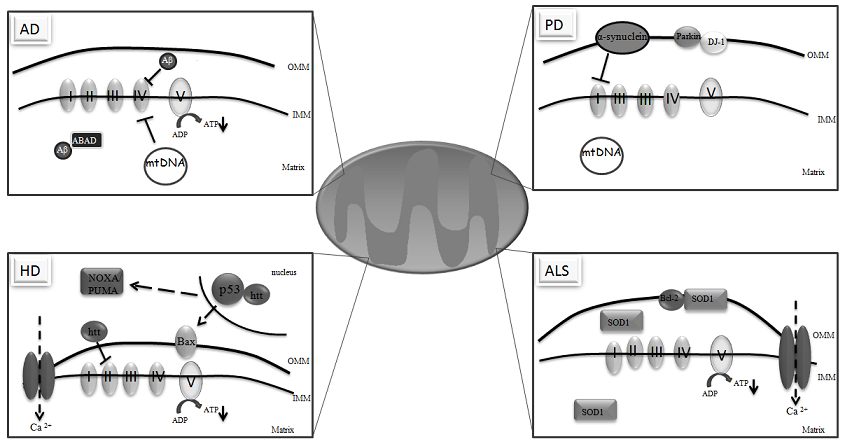
      <p>Accumulating evidence suggests mitochondria are important players in the mechanism by which Aβ triggers synaptic failure and neurodegeneration [<xref ref-type="bibr" rid="B15-pharmaceuticals-02-00250">15</xref>,<xref ref-type="bibr" rid="B18-pharmaceuticals-02-00250">18</xref>,<xref ref-type="bibr" rid="B50-pharmaceuticals-02-00250">50</xref>,<xref ref-type="bibr" rid="B51-pharmaceuticals-02-00250">51</xref>,<xref ref-type="bibr" rid="B52-pharmaceuticals-02-00250">52</xref>]. <italic>In vivo</italic> studies show accumulation of Aβ in brain mitochondria of AD patients [<xref ref-type="bibr" rid="B53-pharmaceuticals-02-00250">53</xref>]. Further, <italic>in vitro</italic> studies show that NT2 neuronal cells without mtDNA are not killed by Aβ [<xref ref-type="bibr" rid="B54-pharmaceuticals-02-00250">54</xref>]. Data from our laboratory show that Aβ induces mitochondrial dysfunction by potentiating respiratory chain impairment, uncoupling of the OXPHOS, decreasing ATP levels and increasing the susceptibility to PTP opening and H<sub>2</sub>O<sub>2</sub> production [<xref ref-type="bibr" rid="B55-pharmaceuticals-02-00250">55</xref>,<xref ref-type="bibr" rid="B56-pharmaceuticals-02-00250">56</xref>,<xref ref-type="bibr" rid="B57-pharmaceuticals-02-00250">57</xref>]. Also, Lustbader and colleagues [<xref ref-type="bibr" rid="B58-pharmaceuticals-02-00250">58</xref>] demonstrated that Aβ binds to the mitochondrial-matrix protein Aβ-binding alcohol dehydrogenase (ABAD) (<xref ref-type="fig" rid="pharmaceuticals-02-00250-f001">Figure 1</xref>) and the blockage of this interaction suppresses Aβ-induced apoptosis and free radical generation in neurons. These results suggest that mitochondria are key players in the toxicity induced by Aβ. It has been also shown that oxidative damage occurs before Aβ deposition [<xref ref-type="bibr" rid="B59-pharmaceuticals-02-00250">59</xref>,<xref ref-type="bibr" rid="B60-pharmaceuticals-02-00250">60</xref>] and that the upregulation of genes related to mitochondrial metabolism and apoptosis occurs even earlier and co-localizes with the neurons undergoing oxidative damage [<xref ref-type="bibr" rid="B61-pharmaceuticals-02-00250">61</xref>].</p>
      <p>Tau protein is involved in the stabilization of microtubules, which is important in the generation and maintenance of neurites. In AD, tau accumulation in neurons inhibits APP transport into axons and dendrites leading to neuronal degeneration [<xref ref-type="bibr" rid="B62-pharmaceuticals-02-00250">62</xref>]. Transgenic mice overexpressing the P301L mutant human tau revealed impaired mitochondrial respiration, modified lipid peroxidation levels and up-regulation of antioxidant enzymes [<xref ref-type="bibr" rid="B63-pharmaceuticals-02-00250">63</xref>]. However, the mechanisms underlying these effects remain unknown.</p>
      <p>Positron emission tomography (PET) studies revealed that AD is associated with brain metabolism impairment, which precedes neuropsychological impairment and atrophy [<xref ref-type="bibr" rid="B64-pharmaceuticals-02-00250">64</xref>,<xref ref-type="bibr" rid="B65-pharmaceuticals-02-00250">65</xref>]. It was observed that postmortem brain and fibroblasts from AD patients have an impairment of the three key TCA cycle enzymes, pyruvate dehydrogenase, isocitrate dehydrogenase and α-ketoglutarate dehydrogenase [<xref ref-type="bibr" rid="B66-pharmaceuticals-02-00250">66</xref>,<xref ref-type="bibr" rid="B67-pharmaceuticals-02-00250">67</xref>,<xref ref-type="bibr" rid="B68-pharmaceuticals-02-00250">68</xref>,<xref ref-type="bibr" rid="B69-pharmaceuticals-02-00250">69</xref>,<xref ref-type="bibr" rid="B70-pharmaceuticals-02-00250">70</xref>]. Furthermore, it has been demonstrated that Aβ inhibits cytochrome c oxidase (COX) [<xref ref-type="bibr" rid="B71-pharmaceuticals-02-00250">71</xref>] (<xref ref-type="fig" rid="pharmaceuticals-02-00250-f001">Figure 1</xref>) therefore increasing free-radical generation [<xref ref-type="bibr" rid="B72-pharmaceuticals-02-00250">72</xref>]. Deficient COX activity has been found in different brain regions [<xref ref-type="bibr" rid="B73-pharmaceuticals-02-00250">73</xref>,<xref ref-type="bibr" rid="B74-pharmaceuticals-02-00250">74</xref>], platelets [<xref ref-type="bibr" rid="B75-pharmaceuticals-02-00250">75</xref>] and fibroblasts [<xref ref-type="bibr" rid="B76-pharmaceuticals-02-00250">76</xref>] from sporadic AD patients, occurring at all stages of the disease, including mild cognitive impairment (MCI) [<xref ref-type="bibr" rid="B77-pharmaceuticals-02-00250">77</xref>].</p>
      <p>King and Attardi [<xref ref-type="bibr" rid="B78-pharmaceuticals-02-00250">78</xref>] developed a cybrid model, lacking their own mtDNA, in which exogenous mtDNA from AD and control patients were introduced. In this way they found that the phenotypic differences observed were due to donor mtDNA amplification and not from nuclear or environmental factors [<xref ref-type="bibr" rid="B78-pharmaceuticals-02-00250">78</xref>]. Later on, it was demonstrated that sporadic AD cybrids present reduced COX activity, a decrease in ATP levels and increased oxidative stress [<xref ref-type="bibr" rid="B79-pharmaceuticals-02-00250">79</xref>] and develop populations of abnormal and damaged mitochondria due to increased AD mtDNA replication [<xref ref-type="bibr" rid="B80-pharmaceuticals-02-00250">80</xref>] (<xref ref-type="fig" rid="pharmaceuticals-02-00250-f001">Figure 1</xref>). In addition, it was reported that AD cybrids manifest a decrease in mitochondrial membrane potential, increased cytochrome c release and caspase-3 activity when compared to control cybrids [<xref ref-type="bibr" rid="B81-pharmaceuticals-02-00250">81</xref>]. Furthermore, those effects were enhanced when exposing AD cybrids to Aβ1-40, suggesting a role for mtDNA in mitochondrial dysfunction in AD degeneration [<xref ref-type="bibr" rid="B81-pharmaceuticals-02-00250">81</xref>]. A previous study made in AD, aged and younger control subjects demonstrated that the brains of AD and elderly subjects had a lower COX activity and a higher aggregate burden of mutations in mtDNA when compared to younger individuals [<xref ref-type="bibr" rid="B82-pharmaceuticals-02-00250">82</xref>]. AD has also been linked to mitochondria due to data from epidemiologic, neuropsychological, biomarker, and cell studies suggesting that mitochondrial inheritance could also influence AD risk and pathology [<xref ref-type="bibr" rid="B83-pharmaceuticals-02-00250">83</xref>]. For instance, evidence suggest that the European mtDNA haplogroups J and UK protect against AD and PD, and are also associated with increased longevity [<xref ref-type="bibr" rid="B84-pharmaceuticals-02-00250">84</xref>]. However, studies show that whenever AD patients have a demented parent, it is often the mother [<xref ref-type="bibr" rid="B85-pharmaceuticals-02-00250">85</xref>]. More recently, the Framingham Offspring Study demonstrated that non-demented and middle aged individuals whose mother suffer from AD have worse neuropsychological test performance than those with an AD-affected father or no affected parent [<xref ref-type="bibr" rid="B86-pharmaceuticals-02-00250">86</xref>]. Moreover, it was also reported that cybrid cell lines containing mtDNA from individuals with mothers suffering from AD possess lower COX activity than those containing mtDNA from subjects with fathers suffering from this disease [<xref ref-type="bibr" rid="B87-pharmaceuticals-02-00250">87</xref>]. Despite controversial data showing that pathogenic inherited mtDNA do not constitute a major ethological factor in sporadic AD [<xref ref-type="bibr" rid="B88-pharmaceuticals-02-00250">88</xref>], the majority of studies support the notion that inheritance could influence mitochondrial function and thereby AD risk and pathology.</p>
      <p>De la Monte and Wands [<xref ref-type="bibr" rid="B89-pharmaceuticals-02-00250">89</xref>] examined postmortem brain tissue from AD patients with different degrees of severity and found that the severity of AD was related to impairments in mitochondrial gene expression, namely in complex IV of the mitochondrial respiratory chain, increased levels of p53 and molecular indexes of oxidative stress, such as up-regulation of nitric oxide synthase (NOS) and NADPH-oxidase (NOX). However, no differences in the levels of mitochondrial complexes I and II mRNA expression were found, suggesting that these components are preserved in AD, even in advanced stages of the disease [<xref ref-type="bibr" rid="B89-pharmaceuticals-02-00250">89</xref>]. Increased ROS production could therefore lead to mitochondrial dysfunction blocking electron transport, thus decreasing oxygen consumption and ATP generation.</p>
      <p>Previous studies from our laboratory also showed altered levels of mtDNA and COX in neurons prior to the formation of neurofibrillary tangles [<xref ref-type="bibr" rid="B90-pharmaceuticals-02-00250">90</xref>], which suggest that mitochondrial abnormalities are the earliest cytopathological changes in AD. We also observed an increase in mtDNA and COX in the cytoplasm and in vacuoles associated with lipofuscin, considered the site of mitochondrial degradation by autophagy [<xref ref-type="bibr" rid="B90-pharmaceuticals-02-00250">90</xref>]. Subsequent studies also demonstrated an increased localization of COX and lipoic acid, a sulfur-containing cofactor necessary for the activity of some mitochondrial enzyme complexes, in autophagic vacuoles and lipofuscin in the brain of AD cases suggesting altered autophagic degradation of mitochondria [<xref ref-type="bibr" rid="B91-pharmaceuticals-02-00250">91</xref>,<xref ref-type="bibr" rid="B92-pharmaceuticals-02-00250">92</xref>]. The increase in mitochondrial degradation products that occur in AD vulnerable neurons could be due to an increase in mitochondria turnover by autophagy or a reduction of proteolytic turnover leading to mtDNA and mitochondrial protein accumulation. Despite these evidences there is still some controversy about COX involvement in the induction of oxidative stress in AD. Fukui and colleagues [<xref ref-type="bibr" rid="B93-pharmaceuticals-02-00250">93</xref>] using a COXd/AD mice demonstrated that COX deficiency in neurons results in decreased Aβ accumulation and reduced oxidative stress in CNS suggesting that COX impairment and oxidative damage in AD could be two independent consequences of Aβ intra- and extracellular accumulation.</p>
      <p>PD is the second most common neurodegenerative disorder that begins by causing motor dysfunction but ultimately affects the mind and personality [<xref ref-type="bibr" rid="B20-pharmaceuticals-02-00250">20</xref>]. This disease is clinically characterized by progressive rigidity, bradykinesia and tremor and pathologically by the degeneration of pigmented neurons in the substantia nigra and by the presence of intraneuronal proteinaceous cytoplasmic inclusions that immunostain for α-synuclein and ubiquitin, designated Lewy Bodies [<xref ref-type="bibr" rid="B20-pharmaceuticals-02-00250">20</xref>,<xref ref-type="bibr" rid="B40-pharmaceuticals-02-00250">40</xref>]. The involvement of mitochondrial dysfunction in PD arose from the finding that 1-methyl-4-phenyl-1,2,3,6-tetrahydropyridine (MPTP), a synthetic opiate, caused Parkinsonism in drug addicted individuals [<xref ref-type="bibr" rid="B87-pharmaceuticals-02-00250">87</xref>]. MPTP is metabolized to MPP<sup>+</sup> in glial cells and this metabolite inhibits the complex I of the mitochondrial respiratory chain [<xref ref-type="bibr" rid="B94-pharmaceuticals-02-00250">94</xref>]. In addition to MPTP also rotenone, another complex I inhibitor, originate a parkinsonian phenotype characterized by oxidative damage and nigral degeneration [<xref ref-type="bibr" rid="B95-pharmaceuticals-02-00250">95</xref>,<xref ref-type="bibr" rid="B96-pharmaceuticals-02-00250">96</xref>]. These results support the involvement of mitochondrial dysfunction in PD. Similarly, cybrids containing mtDNA from PD patients show reduced complex I activity and an increased susceptibility to MPP<sup>+</sup> [<xref ref-type="bibr" rid="B97-pharmaceuticals-02-00250">97</xref>,<xref ref-type="bibr" rid="B98-pharmaceuticals-02-00250">98</xref>]. In addition to the defect in mitochondrial complex I, many of the genes involved in PD, such as α-synuclein, parkin, DJ-1, PINK-1 [<xref ref-type="bibr" rid="B99-pharmaceuticals-02-00250">99</xref>,<xref ref-type="bibr" rid="B100-pharmaceuticals-02-00250">100</xref>,<xref ref-type="bibr" rid="B101-pharmaceuticals-02-00250">101</xref>], LRRK-2 [<xref ref-type="bibr" rid="B102-pharmaceuticals-02-00250">102</xref>,<xref ref-type="bibr" rid="B103-pharmaceuticals-02-00250">103</xref>] and HTRA2 [<xref ref-type="bibr" rid="B104-pharmaceuticals-02-00250">104</xref>,<xref ref-type="bibr" rid="B105-pharmaceuticals-02-00250">105</xref>] have also a direct or indirect effect in mitochondria function. For instance, although there is no direct link of α-synuclein to mitochondria, the addition of MPTP to α-synuclein overexpressing mice leads to the formation of large and grossly deformed mitochondria, increase in oxidative stress and enhancement of nigral pathology [<xref ref-type="bibr" rid="B106-pharmaceuticals-02-00250">106</xref>]. Similarly, Hsu and colleagues [<xref ref-type="bibr" rid="B107-pharmaceuticals-02-00250">107</xref>] reported that the overexpression of α-synuclein impairs mitochondrial function and leads to increased oxidative damage. More recently, Devi and co-workers [<xref ref-type="bibr" rid="B108-pharmaceuticals-02-00250">108</xref>] demonstrated that α-synuclein accumulates in the mitochondria of striatum and substantia nigra of PD patients inducing oxidative stress and impairment of complex I activity (<xref ref-type="fig" rid="pharmaceuticals-02-00250-f001">Figure 1</xref>). In contrast, α-synuclein null mice are resistant to MPTP and malonate actions, thereby implicating mitochondria in α-synuclein mediated toxicity [<xref ref-type="bibr" rid="B109-pharmaceuticals-02-00250">109</xref>,<xref ref-type="bibr" rid="B110-pharmaceuticals-02-00250">110</xref>]. Parkin, a protein involved in the degradation of oxidatively damaged proteins, associates with the outer mitochondrial membrane protecting mitochondria against swelling and ROS release [<xref ref-type="bibr" rid="B17-pharmaceuticals-02-00250">17</xref>] and caspase activation [<xref ref-type="bibr" rid="B111-pharmaceuticals-02-00250">111</xref>] whereas parkin-deficient mice present mitochondrial dysfunction and oxidative damage [<xref ref-type="bibr" rid="B112-pharmaceuticals-02-00250">112</xref>]. Parkin was also found in mitochondria from proliferating cells associated with mitochondrial transcription factor A (Tfam) therefore enhancing mitochondrial biogenesis [<xref ref-type="bibr" rid="B113-pharmaceuticals-02-00250">113</xref>]. Nevertheless, mitochondrial dysfunction and oxidative stress can also affect parkin function by exacerbating the occurrence of parkin mutations [<xref ref-type="bibr" rid="B114-pharmaceuticals-02-00250">114</xref>,<xref ref-type="bibr" rid="B115-pharmaceuticals-02-00250">115</xref>].</p>
      <p>DJ-1 is an integral mitochondrial protein that may have an important role in regulating mitochondrial physiology [<xref ref-type="bibr" rid="B116-pharmaceuticals-02-00250">116</xref>], since it participates in the oxidative stress response [<xref ref-type="bibr" rid="B117-pharmaceuticals-02-00250">117</xref>,<xref ref-type="bibr" rid="B118-pharmaceuticals-02-00250">118</xref>] and protects against the loss of dopaminergic neurons [<xref ref-type="bibr" rid="B119-pharmaceuticals-02-00250">119</xref>,<xref ref-type="bibr" rid="B120-pharmaceuticals-02-00250">120</xref>]. In agreement, a previous study showed that DJ-1 knockout mice have mitochondria more vulnerable to oxidative damage [<xref ref-type="bibr" rid="B121-pharmaceuticals-02-00250">121</xref>]. It was reported that the total level of DJ-1 protein is significantly reduced in substantia nigra of sporadic cases of PD and DJ-1 complexes are reduced in cortical mitochondria of PD patients [<xref ref-type="bibr" rid="B122-pharmaceuticals-02-00250">122</xref>]. In <italic>Drosophila</italic>, the inhibition of DJ-1 function results in cellular accumulation of ROS, increased sensitivity to H<sub>2</sub>O<sub>2</sub>, inhibition of catalase and loss of dopaminergic neurons [<xref ref-type="bibr" rid="B123-pharmaceuticals-02-00250">123</xref>]. Furthermore, data suggests that mutations in mtDNA may also contribute to PD pathogenesis. Indeed, the level of mtDNA mutations appears to increase in pigmented neurons in the substantia nigra of human aged brain [<xref ref-type="bibr" rid="B124-pharmaceuticals-02-00250">124</xref>]. As well, the level of mtDNA deletions is significantly increased in COX-deficient neurons, thereby suggesting that mtDNA may be responsible for impaired cellular respiration [<xref ref-type="bibr" rid="B124-pharmaceuticals-02-00250">124</xref>]. Bender and co-workers [<xref ref-type="bibr" rid="B125-pharmaceuticals-02-00250">125</xref>] reported that in substantia nigra neurons from aged and PD individuals there is a high level of mtDNA deletions associated with respiratory chain deficiency contributing to neuronal loss (<xref ref-type="fig" rid="pharmaceuticals-02-00250-f001">Figure 1</xref>). In addition, there are reports of cases where inherited mtDNA mutations lead to Parkinsonism. It was found that the Leber´s optic atrophy G11778A mutation was related to L-DOPA-responsive Parkinsonism [<xref ref-type="bibr" rid="B126-pharmaceuticals-02-00250">126</xref>]. Also the mutations in the nuclear-encoded mtDNA polymerase-γ gene have been demonstrated in patients with Parkinsonism [<xref ref-type="bibr" rid="B127-pharmaceuticals-02-00250">127</xref>]. A recent study performed in knockout “MitoPark” mice that possess a disrupted Tfam gene in dopaminergic neurons, showed that these mice have a reduced mtDNA expression and impaired respiratory chain in dopaminergic neurons and a progressive PD phenotype [<xref ref-type="bibr" rid="B128-pharmaceuticals-02-00250">128</xref>]. It was also demonstrated that dopaminergic neurons from substantia nigra possess reduced mitochondrial mass and size when compared to dopaminergic neurons from non-substantia nigra [<xref ref-type="bibr" rid="B129-pharmaceuticals-02-00250">129</xref>] supporting the idea that the selective vulnerability of dopaminergic neurons may be due to mitochondrial dysfunction in PD.</p>
            <fig id="pharmaceuticals-02-00250-f001" position="anchor">
        <label>Figure 1</label>
        <caption>
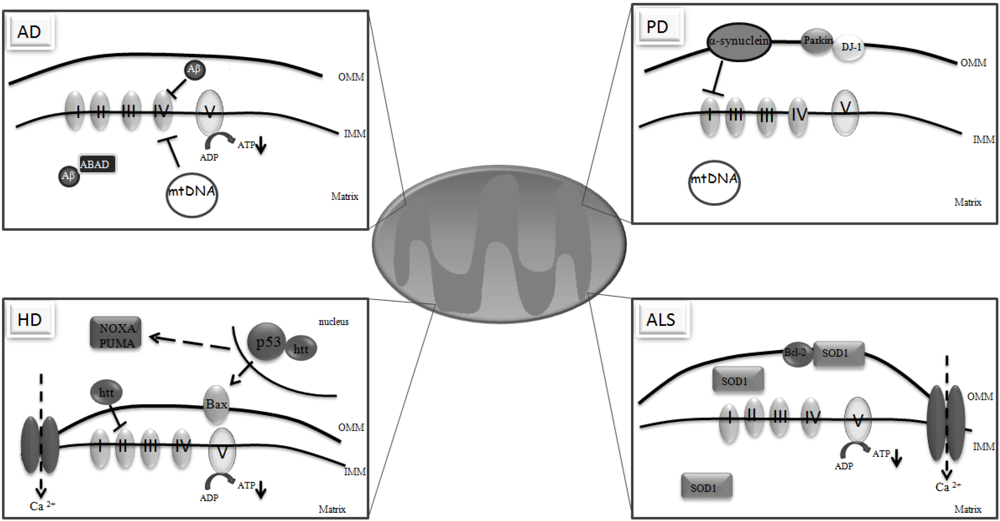
          <p>Mitochondrial dysfunction in neurodegeneration. In Alzheimer´s disease (AD), Aβ accumulates in mitochondria and binds to Aβ-binding alcohol dehydrogenase (ABAD) inhibiting complex IV, potentiating reactive oxygen species (ROS) formation and decreasing ATP production. AD pathology can also be influenced by mutations in the mtDNA, since mtDNA from AD subjects have a higher rate of mutations. In Parkinson´s Disease (PD), complex I activity is impaired contributing to the formation of high levels of ROS. Many of the genes involved in PD are also associated with mitochondrial dysfunction. α-synuclein overexpression potentiates mitochondrial impairment and oxidative stress. Parkin associates with the outer mitochondrial membrane (OMM) protecting mitochondria against ROS release and caspase activation. DJ-1 is an integral protein that participates in the oxidative stress response and protects against the loss of dopaminergic neurons. In PD, the level of mtDNA mutations is also associated with respiratory chain deficiencies. In Huntington’s disease (HD), mutant huntingtin (htt) compromises complex II activity, ATP production and the calcium (Ca<sup>2+</sup>) buffering capacity. htt also affects mitochondrial function through its interaction with p53 in the nucleus leading to upregulation of BAX and PUMA, two pro-apoptotic proteins. In amyotrophic lateral sclerosis (ALS), mutant Cu/Zn superoxide dismutase (SOD1) that is localized in the outer mitochondrial membrane (OMM), intermembrane space (IMM) and mitochondrial matrix, impairs mitochondrial respiration and ATP synthesis as well as the mitochondrial Ca<sup>2+</sup> loading capacity. Mutant SOD1 binds to Bcl-2 on the OMM blocking its anti-apoptotic activity.</p>
        </caption>
        <graphic xmlns:xlink="http://www.w3.org/1999/xlink" xlink:href="pharmaceuticals-02-00250-g001.tif"/>
      </fig>
      <p>HD is an autosomal dominant neurodegenerative disorder caused by the expansion of a CAG trinucleotide repeat in the huntingtin gene [<xref ref-type="bibr" rid="B130-pharmaceuticals-02-00250">130</xref>] and is clinically characterized by chorea, psychiatric disturbances and dementia [<xref ref-type="bibr" rid="B47-pharmaceuticals-02-00250">47</xref>]. The pathogenic process in HD seems to involve transcriptional deregulation [<xref ref-type="bibr" rid="B131-pharmaceuticals-02-00250">131</xref>] and proteasome dysfunction [<xref ref-type="bibr" rid="B132-pharmaceuticals-02-00250">132</xref>]. In contrast, it was shown that the neuronal damage that occurs in a mouse model of the polyglutamine disease SCA7 can occur in the absence of ubiquitin-proteasome (UPS) dysfunction [<xref ref-type="bibr" rid="B133-pharmaceuticals-02-00250">133</xref>] and that polyubiquitylated proteins accumulate in R6/2 mice brain even with a functional UPS system [<xref ref-type="bibr" rid="B134-pharmaceuticals-02-00250">134</xref>].</p>
      <p>Moreover, there is significant evidence of the involvement of mitochondrial dysfunction in HD [<xref ref-type="bibr" rid="B47-pharmaceuticals-02-00250">47</xref>]. Nuclear magnetic resonance spectroscopy (NMR) experiments in symptomatic HD patients revealed increased lactate levels in the cortex and basal ganglia [<xref ref-type="bibr" rid="B135-pharmaceuticals-02-00250">135</xref>]. Further, PET studies showed impaired glucose metabolism early in the disease [<xref ref-type="bibr" rid="B136-pharmaceuticals-02-00250">136</xref>,<xref ref-type="bibr" rid="B137-pharmaceuticals-02-00250">137</xref>] raising the hypothesis that glycolysis is up-regulated in order to compensate for impaired ATP production by OXPHOS. Other studies also reported decreased activities of the complexes I, II, III, and IV [<xref ref-type="bibr" rid="B138-pharmaceuticals-02-00250">138</xref>,<xref ref-type="bibr" rid="B139-pharmaceuticals-02-00250">139</xref>,<xref ref-type="bibr" rid="B140-pharmaceuticals-02-00250">140</xref>] of the respiratory chain in human HD brain in which neuronal loss was evident. In addition, in striatal neurons expressing the first 171 amino acids of huntingtin with an insertion of 82 glutamines, the overexpression of complex II subunits blocked mitochondrial dysfunction and cell death [<xref ref-type="bibr" rid="B141-pharmaceuticals-02-00250">141</xref>]. However, Guidetti and colleagues [<xref ref-type="bibr" rid="B142-pharmaceuticals-02-00250">142</xref>] reported that in presymptomatic or grade I HD brain there are no changes in the activities of complexes I-IV in the striatum. Similarly, Milakovic and Johnson [<xref ref-type="bibr" rid="B130-pharmaceuticals-02-00250">130</xref>] showed that mutant huntingtin indeed compromises mitochondrial respiration and ATP production, but these effects seem not to be related with the impairment of the respiratory chain complexes. Previous studies also demonstrated that the calcium buffering capacity is altered in lymphoblast mitochondria from HD patients as well as in brain mitochondria from transgenic mice expressing full-length mutant huntingtin [<xref ref-type="bibr" rid="B143-pharmaceuticals-02-00250">143</xref>]. Knowing that OXPHOS is dependent on mitochondrial calcium concentration [<xref ref-type="bibr" rid="B144-pharmaceuticals-02-00250">144</xref>], it could be speculated that compromised respiration in the striatal cells expressing mutant huntingtin could be due to altered mitochondrial calcium concentrations [<xref ref-type="bibr" rid="B130-pharmaceuticals-02-00250">130</xref>] (<xref ref-type="fig" rid="pharmaceuticals-02-00250-f001">Figure 1</xref>). Another hypothesis by which mutant huntingtin could affect mitochondrial function is by altering transcription [<xref ref-type="bibr" rid="B145-pharmaceuticals-02-00250">145</xref>]. It is known that mutant huntingtin interacts with transcription factors, such as p53 [<xref ref-type="bibr" rid="B146-pharmaceuticals-02-00250">146</xref>] that is involved in mitochondrial function and oxidative stress. Bae and co-workers [<xref ref-type="bibr" rid="B147-pharmaceuticals-02-00250">147</xref>] reported that mutant huntingtin bound p53 increasing its levels and transcriptional activity leading to upregulation of BAX and PUMA, two pro-apoptotic proteins, and mitochondrial membrane depolarization (<xref ref-type="fig" rid="pharmaceuticals-02-00250-f001">Figure 1</xref>). On the other hand, p53 supression or deletion prevented mutant huntingtin-induced mitochondrial depolarization, COX deficiency and cytotoxicity [<xref ref-type="bibr" rid="B147-pharmaceuticals-02-00250">147</xref>].</p>
      <p>ALS is a fatal late onset neurodegenerative disorder characterized by the loss of upper and lower motor neurons leading to paralysis [<xref ref-type="bibr" rid="B24-pharmaceuticals-02-00250">24</xref>,<xref ref-type="bibr" rid="B148-pharmaceuticals-02-00250">148</xref>]. Approximately 90% of the cases are sporadic and the remaining 10% are familial [<xref ref-type="bibr" rid="B40-pharmaceuticals-02-00250">40</xref>]. However, in both cases mitochondrial and bioenergetic defects are widely implicated, being reported situations of abnormal structure, number and localization of mitochondria in ALS motor neurons and skeletal muscle [<xref ref-type="bibr" rid="B149-pharmaceuticals-02-00250">149</xref>]. Therefore, there is a strong notion that mitochondrial dysfunction may play a critical role in ALS pathology. About 20% of familial cases are caused by mutations in Cu/Zn-superoxide dismutase (SOD1) [<xref ref-type="bibr" rid="B40-pharmaceuticals-02-00250">40</xref>]. Although it was previously thought that SOD1 was exclusively a cytoplasmic protein, more recent studies demonstrated that this protein is also present in mitochondria. Evidence from transgenic mice expressing both wild-type and mutant SOD1 have shown that a fraction of cellular SOD1 is present within the intermembrane space of mitochondria [<xref ref-type="bibr" rid="B150-pharmaceuticals-02-00250">150</xref>,<xref ref-type="bibr" rid="B151-pharmaceuticals-02-00250">151</xref>] and also within the matrix affecting directly mitochondrial function and integrity [<xref ref-type="bibr" rid="B152-pharmaceuticals-02-00250">152</xref>] (<xref ref-type="fig" rid="pharmaceuticals-02-00250-f001">Figure 1</xref>). Moreover, in SOD1-overexpressing G93A transgenic mice the morphological changes in mitochondria are the first pathological changes followed by decreased mitochondrial respiration [<xref ref-type="bibr" rid="B150-pharmaceuticals-02-00250">150</xref>,<xref ref-type="bibr" rid="B153-pharmaceuticals-02-00250">153</xref>]. Mattiazi and colleagues [<xref ref-type="bibr" rid="B154-pharmaceuticals-02-00250">154</xref>] reported that G93A transgenic mice at the onset of the disease presented compromised mitochondrial respiration and ATP synthesis that was accompanied by oxidative damage to mitochondrial lipids and proteins. In addition, decreased mitochondrial calcium loading capacity and respiratory chain complexes activity was also reported in mutant SOD1 transgenic mice [<xref ref-type="bibr" rid="B155-pharmaceuticals-02-00250">155</xref>] (<xref ref-type="fig" rid="pharmaceuticals-02-00250-f001">Figure 1</xref>). Similarly, it was recently reported that an early functional consequence of the association of mutant SOD1 with motor neuron mitochondria is reduced capacity of the electron transport chain to limit calcium-induced depolarization [<xref ref-type="bibr" rid="B156-pharmaceuticals-02-00250">156</xref>] supporting the idea that mutant SOD1 is associated with impaired mitochondrial function. It was recently reported that in motor neurons, mutant SOD1 damages fast axonal mitochondrial transport in the anterograde direction [<xref ref-type="bibr" rid="B157-pharmaceuticals-02-00250">157</xref>]. Nevertheless, the interaction of mutant SOD1 with mitochondria is unclear. Vande Velde and co-workers [<xref ref-type="bibr" rid="B158-pharmaceuticals-02-00250">158</xref>] suggested that mutant SOD1 accumulates and aggregates in the outer mitochondrial membrane blocking protein importation to mitochondria. Others also suggest that mutant SOD1 binds to Bcl2 on the outer mitochondrial membrane blocking its antiapoptotic activity [<xref ref-type="bibr" rid="B159-pharmaceuticals-02-00250">159</xref>] (<xref ref-type="fig" rid="pharmaceuticals-02-00250-f001">Figure 1</xref>), thereby promoting apoptosis triggered by cytochrome c release from mitochondria [<xref ref-type="bibr" rid="B160-pharmaceuticals-02-00250">160</xref>]. These evidences suggest that mitochondrial dysfunction and oxidative stress occur early and have a major role in the pathogenesis of neurodegenerative diseases.</p>
    </sec>
    <sec>
      <title>4. Insulin and the Brain</title>
      <p>For a long time it was believed that the brain was unresponsive to insulin but subsequent studies brought evidence of neuronal insulin synthesis [<xref ref-type="bibr" rid="B161-pharmaceuticals-02-00250">161</xref>,<xref ref-type="bibr" rid="B162-pharmaceuticals-02-00250">162</xref>,<xref ref-type="bibr" rid="B163-pharmaceuticals-02-00250">163</xref>], with the highest levels found in olfactory bulb, cortex, hippocampus, hypothalamus and amygdala [<xref ref-type="bibr" rid="B164-pharmaceuticals-02-00250">164</xref>]. It was also found that brain insulin and IR are independent of peripheral insulin levels [<xref ref-type="bibr" rid="B165-pharmaceuticals-02-00250">165</xref>]. However, the local synthesis of insulin remains controversial.</p>
      <p>IR is a heterotetramer composed of two extracellular α subunits that possess a binding-site for insulin, and two transmembrane β subunits linked by disulfide bonds. Insulin binding to IR α subunits leads to insulin/IR complex internalization and autophosphorylation of the tyrosine residues of the β subunits [<xref ref-type="bibr" rid="B166-pharmaceuticals-02-00250">166</xref>,<xref ref-type="bibr" rid="B167-pharmaceuticals-02-00250">167</xref>] creating docking sites for adaptor proteins, namely insulin receptor substrate (IRS) 1 and 2, which in turn recruit and activate other proteins initiating several signaling cascades [<xref ref-type="bibr" rid="B168-pharmaceuticals-02-00250">168</xref>].</p>
      <p>The PI3K-PKB/Akt pathway is also activated by the insulin-like growth factor (IGF-1). Insulin and IGF-1 are genetically related polypeptides that possess similar tertiary structures and considerable aminoacid identity. IGF-1 is synthesized predominantly in the liver but also in the brain and when in the circulation and tissues it is often associated to high affinity IGF binding proteins, which prolong IGF-1 half-life and modulate its interaction with the IGF-1 receptor (IGF-1R) [<xref ref-type="bibr" rid="B172-pharmaceuticals-02-00250">172</xref>]. IGF-1R is homologous to IR and trigger similar intracellular signaling events [<xref ref-type="bibr" rid="B173-pharmaceuticals-02-00250">173</xref>] such as the inhibition of GSK-3β regulating tau phosphorylation [<xref ref-type="bibr" rid="B174-pharmaceuticals-02-00250">174</xref>]. The worm insulin/IGF-1 signaling pathway is closely identical to that in mammals and is activated when an insulin-like ligand binds to daf-2, the sole worm insulin/IGF-1R, leading to a cascade of events that ends with the regulation of longevity and stress resistance [<xref ref-type="bibr" rid="B7-pharmaceuticals-02-00250">7</xref>]. Unlike worms that have only one insulin/IGF-1 signaling pathway, mammals also have the insulin/IGF-2 signaling pathway. When evaluating the effects of fat mass reduction and alterations in insulin/IGF-1 pathway in longevity using a fat-specific insulin receptor knockout (FIRKO) mice it was observed that a reduction in adipose tissue is associated with an increase in longevity probably through a reduction in insulin signaling [<xref ref-type="bibr" rid="B175-pharmaceuticals-02-00250">175</xref>]. It has been shown in mammals and worms that the decrease in IGF-1R levels leads to an increase in oxidative stress resistance and life span [<xref ref-type="bibr" rid="B176-pharmaceuticals-02-00250">176</xref>]. It has been also shown that mutations in an insulin-like signaling pathway in C. elegans influence the aggregation and toxicity of polyglutamine that is known to be intensified during aging [<xref ref-type="bibr" rid="B177-pharmaceuticals-02-00250">177</xref>]. Also, the decrease in insulin/IGF-1 signaling led to the slowing of aging together with reduced aggregation-mediated Aβ42 toxicity [<xref ref-type="bibr" rid="B178-pharmaceuticals-02-00250">178</xref>]. Freude and colleagues [<xref ref-type="bibr" rid="B179-pharmaceuticals-02-00250">179</xref>] recently demonstrated that impaired insulin/IGF-1 signaling delays Aβ accumulation and prevents premature death in Tg2576 mice, a model of AD [<xref ref-type="bibr" rid="B177-pharmaceuticals-02-00250">177</xref>]. Strategies to lengthen lifespan could be useful in the delay of the onset of aging-related diseases characterized by the appearance of misfolded and aggregation proteins.</p>
      <p>The PI3K-PKB/Akt pathway is also activated by the insulin-like growth factor (IGF-1). Insulin and IGF-1 are genetically related polypeptides that possess similar tertiary structures and considerable aminoacid identity. IGF-1 is synthesized predominantly in the liver but also in the brain and when in the circulation and tissues it is often associated to high affinity IGF binding proteins, which prolong IGF-1 half-life and modulate its interaction with the IGF-1 receptor (IGF-1R) [<xref ref-type="bibr" rid="B172-pharmaceuticals-02-00250">172</xref>]. IGF-1R is homologous to IR and trigger similar intracellular signaling events [<xref ref-type="bibr" rid="B173-pharmaceuticals-02-00250">173</xref>] such as the inhibition of GSK-3β regulating tau phosphorylation [<xref ref-type="bibr" rid="B174-pharmaceuticals-02-00250">174</xref>]. The worm insulin/IGF-1 signaling pathway is closely identical to that in mammals and is activated when an insulin-like ligand binds to daf-2, the sole worm insulin/IGF-1R, leading to a cascade of events that ends with the regulation of longevity and stress resistance [<xref ref-type="bibr" rid="B7-pharmaceuticals-02-00250">7</xref>]. Unlike worms that have only one insulin/IGF-1 signaling pathway, mammals also have the insulin/IGF-2 signaling pathway. When evaluating the effects of fat mass reduction and alterations in insulin/IGF-1 pathway in longevity using a fat-specific insulin receptor knockout (FIRKO) mice it was observed that a reduction in adipose tissue is associated with an increase in longevity probably through a reduction in insulin signaling [<xref ref-type="bibr" rid="B175-pharmaceuticals-02-00250">175</xref>]. It has been shown in mammals and worms that the decrease in IGF-1R levels leads to an increase in oxidative stress resistance and life span [<xref ref-type="bibr" rid="B176-pharmaceuticals-02-00250">176</xref>]. It has been also shown that mutations in an insulin-like signaling pathway in C. elegans influence the aggregation and toxicity of polyglutamine that is known to be intensified during aging [<xref ref-type="bibr" rid="B177-pharmaceuticals-02-00250">177</xref>]. Also, the decrease in insulin/IGF-1 signaling led to the slowing of aging together with reduced aggregation-mediated Aβ42 toxicity [<xref ref-type="bibr" rid="B178-pharmaceuticals-02-00250">178</xref>]. Freude and colleagues [<xref ref-type="bibr" rid="B179-pharmaceuticals-02-00250">179</xref>] recently demonstrated that impaired insulin/IGF-1 signaling delays Aβ accumulation and prevents premature death in Tg2576 mice, a model of AD [<xref ref-type="bibr" rid="B177-pharmaceuticals-02-00250">177</xref>]. Strategies to lengthen lifespan could be useful in the delay of the onset of aging-related diseases characterized by the appearance of misfolded and aggregation proteins.</p>
      <p>Another major pathway activated downstream of IR is the mitogen-activated protein kinase/extracellular signal-regulated kinase (MAPK/ERK1/2) pathway. Briefly, the cytoplasmic intermediate protein (shc) binds to IR promoting its phosphorylation. Then it binds to Grb2, which is associated with son of sevenless (SOS), a guanylnucleotide exchange factor for GTP-binding protein Ras. Binding of Grb2/SOS complex to IR activates Ras that, in turn, recruit Raf leading to MEK activation. Activated MEK phosphorylates ERK1/2 on its threonine/tyrosine residues that thereby become activated [<xref ref-type="bibr" rid="B167-pharmaceuticals-02-00250">167</xref>]. Accumulating evidence demonstrated that MAPK/ERK1/2 activity is involved in memory and learning [<xref ref-type="bibr" rid="B180-pharmaceuticals-02-00250">180</xref>,<xref ref-type="bibr" rid="B181-pharmaceuticals-02-00250">181</xref>] as well as in long term-potentiation (LTP) [<xref ref-type="bibr" rid="B182-pharmaceuticals-02-00250">182</xref>] and long term-depression (LTD) [<xref ref-type="bibr" rid="B183-pharmaceuticals-02-00250">183</xref>]. </p>
      <p>Both PI3K-PKB/Akt and ERK1/2 pathways are regulated by insulin and a crosstalk between them seems to exist. When PI3K-PKB/Akt is stimulated by insulin it acts antagonistically to Ras/Raf-ERK pathway and when PI3K-PKB/Akt is blocked an increase in ERK1/2 phosphorylation occurs [<xref ref-type="bibr" rid="B1-pharmaceuticals-02-00250">1</xref>]. Therefore, it is plausible to assume that insulin-mediated crosstalk between PKB/Akt and Raf is an alternative way to promote neuronal survival [<xref ref-type="bibr" rid="B1-pharmaceuticals-02-00250">1</xref>].</p>
      <p>The specific localization of IR in the cortex and hippocampus is in agreement with evidence showing that insulin influences memory and learning [<xref ref-type="bibr" rid="B184-pharmaceuticals-02-00250">184</xref>]. Evidence from studies with rodents showed that an acute intracerebroventricular injection or an intrahippocampal administration of insulin enhances memory in a passive-avoidance task [<xref ref-type="bibr" rid="B185-pharmaceuticals-02-00250">185</xref>,<xref ref-type="bibr" rid="B186-pharmaceuticals-02-00250">186</xref>]. In addition, acute intravenous insulin enhances story recall in AD patients [<xref ref-type="bibr" rid="B187-pharmaceuticals-02-00250">187</xref>] and when given intranasally to humans, insulin is transported into hypothalamus and hippocampus without affecting blood glucose or insulin concentrations, improving effects of short-term memory functions [<xref ref-type="bibr" rid="B188-pharmaceuticals-02-00250">188</xref>,<xref ref-type="bibr" rid="B189-pharmaceuticals-02-00250">189</xref>,<xref ref-type="bibr" rid="B190-pharmaceuticals-02-00250">190</xref>]. Since peripheral glucose levels are not affected, this effect could only be due to stimulation of brain IRs [<xref ref-type="bibr" rid="B191-pharmaceuticals-02-00250">191</xref>]. Interestingly, when rats are trained on a spatial memory task, an increase in IR mRNA in the dentate gyrus and hippocampal CA1 field is observed [<xref ref-type="bibr" rid="B184-pharmaceuticals-02-00250">184</xref>]. Thereby, IR expression or function is also influenced by learning, supporting the notion that insulin contribute to normal memory function [<xref ref-type="bibr" rid="B192-pharmaceuticals-02-00250">192</xref>]. Insulin/IR have been shown to influence synaptic activities in both pre- and postsynaptic sites. At the presynaptic site insulin/IR affect catecholamine neurotransmission [<xref ref-type="bibr" rid="B193-pharmaceuticals-02-00250">193</xref>,<xref ref-type="bibr" rid="B194-pharmaceuticals-02-00250">194</xref>] and seem to be involved in neurotransmitter clearance through the regulation of synthesis and activity of dopamine, serotonine and gamma-aminobutyric (GABA) transporters [<xref ref-type="bibr" rid="B195-pharmaceuticals-02-00250">195</xref>]. Accordingly, it was recently reported that insulin has direct electrophysiological effects on central neurons that are highly influenced by GABA-inputs [<xref ref-type="bibr" rid="B196-pharmaceuticals-02-00250">196</xref>]. At the postsynaptic site, insulin/IR signaling modulates and is modulated by glutamate through N-methyl D-aspartate (NMDA) receptors activity [<xref ref-type="bibr" rid="B197-pharmaceuticals-02-00250">197</xref>,<xref ref-type="bibr" rid="B198-pharmaceuticals-02-00250">198</xref>]. In summary, insulin-signaling pathways through an intrinsic regulation, coordinates themselves to ensure synaptic plasticity, memory and learning processes and neuronal survival.</p>
    </sec>
    <sec>
      <title>5. Insulin Signaling Dysregulation and Neurodegeneration</title>
      <p>Impaired insulin/IR signaling negatively affects several functions of brain cells such as glucose homeostasis, energy metabolism and white matter fiber structure and function [<xref ref-type="bibr" rid="B199-pharmaceuticals-02-00250">199</xref>]. Neurodegenerative diseases affect a major proportion of the general population and 20% of them are associated with diabetes mellitus, increased insulin resistance and obesity, disturbed insulin sensitivity, and excessive or impaired insulin secretion [<xref ref-type="bibr" rid="B200-pharmaceuticals-02-00250">200</xref>]. Type 2 diabetes is becoming widely recognized as a risk factor for AD development and features like insulin signaling defects, Aβ accumulation and hyperphosphorylation of tau protein are possible contributors to this relation [<xref ref-type="bibr" rid="B201-pharmaceuticals-02-00250">201</xref>]. Insulin degrading-enzyme (IDE) is a metalloprotease enzyme that catalyzes the degradation of insulin following internalization of insulin and its receptor [<xref ref-type="bibr" rid="B168-pharmaceuticals-02-00250">168</xref>]. IDE also degrades soluble Aβ thereby regulating its extracellular levels by reducing aggregation and plaque formation [<xref ref-type="bibr" rid="B168-pharmaceuticals-02-00250">168</xref>]. AD brains present a reduction in IDE levels [<xref ref-type="bibr" rid="B202-pharmaceuticals-02-00250">202</xref>] and in APP mutant mice IDE overexpression reduces plaque pathology [<xref ref-type="bibr" rid="B203-pharmaceuticals-02-00250">203</xref>]. However, IDE affinity for insulin is much greater than for Aβ [<xref ref-type="bibr" rid="B204-pharmaceuticals-02-00250">204</xref>]. Accordingly, Ho and collegues [<xref ref-type="bibr" rid="B205-pharmaceuticals-02-00250">205</xref>] using an APP transgenic AD animal model demonstrated that insulin resistance caused by high fat diet is associated with a decrease in IDE levels, PI3K-Akt activity and an increase in Aβ formation. </p>
      <p>PKB/Akt is a player in the neuroprotection mediated by insulin signaling. In fact, data show that Akt overexpression in PC12 cells protected against Aβ induced cell death [<xref ref-type="bibr" rid="B206-pharmaceuticals-02-00250">206</xref>]. Conversely, intracellular Aβ expression inhibited both insulin-induced Akt phosphorylation and activity [<xref ref-type="bibr" rid="B207-pharmaceuticals-02-00250">207</xref>]. PKB/Akt signaling also induces the phosphorylation and inhibition of glycogen synthase kinase-3β (GSK-3β). GSK-3β is a serine/threonine protein kinase ubiquitously expressed throughout the body that possesses as substrate the protein tau [<xref ref-type="bibr" rid="B168-pharmaceuticals-02-00250">168</xref>]. In AD brains GSK-3β expression and activity is deregulated [<xref ref-type="bibr" rid="B208-pharmaceuticals-02-00250">208</xref>] and consequently tau phosphorylation is increased [<xref ref-type="bibr" rid="B209-pharmaceuticals-02-00250">209</xref>]. It has been shown that the intracerebroventricular (icv) injection of streptozotocin, an experimental model used to mimic sporadic AD, leads to defects in the insulin signaling pathways such as reduced PKB/Akt activity and increased GSK-3β activity and tau hyperphosphorylation [<xref ref-type="bibr" rid="B210-pharmaceuticals-02-00250">210</xref>,<xref ref-type="bibr" rid="B211-pharmaceuticals-02-00250">211</xref>]. In opposite, <italic>in vitro</italic> studies demonstrate that insulin reduce tau hyperphosphorylation by the inhibition of GSK-3β through the PI3-K pathway [<xref ref-type="bibr" rid="B212-pharmaceuticals-02-00250">212</xref>]. Also the presence of the type 4 allele of <italic>APOE-</italic><italic>ε</italic><italic>4</italic> contributes to the predisposition to AD in diabetic patients [<xref ref-type="bibr" rid="B213-pharmaceuticals-02-00250">213</xref>].</p>
      <p>The loss of memory in early AD patients seems to involve synaptic damage caused by small Aβ oligomers, also known as Aβ-derived ligands (ADDLs) that have the ability to affect synapse composition, structure and abundance [<xref ref-type="bibr" rid="B214-pharmaceuticals-02-00250">214</xref>]. Recently, De Felice and colleagues [<xref ref-type="bibr" rid="B215-pharmaceuticals-02-00250">215</xref>] evaluated synapse pathology in mature cultures of hippocampal neurons and observed that before spine loss, ADDLs caused major downregulation of plasma membrane IRs through a mechanism sensitive to calcium calmodulin-dependent kinase II and casein kinase II inhibition. The authors also observed that the loss of IRs, and ADDL-induced oxidative stress and synaptic deterioration was prevented by insulin through IR signaling-dependent downregulation of ADDL binding sites rather than ligand competition [<xref ref-type="bibr" rid="B215-pharmaceuticals-02-00250">215</xref>]. Therefore, dysfunction of the insulin signaling may be involved in the pathological events that occur in AD brains [<xref ref-type="bibr" rid="B173-pharmaceuticals-02-00250">173</xref>]. Indeed, it has been shown that brains with advanced AD present major abnormalities in insulin and IR gene expression [<xref ref-type="bibr" rid="B216-pharmaceuticals-02-00250">216</xref>]. </p>
      <p>It is estimated that 50-80% of PD cases suffer from impaired glucose tolerance [<xref ref-type="bibr" rid="B217-pharmaceuticals-02-00250">217</xref>]. It has been suggested that diabetes accelerates progression of both motor and cognitive symptoms in PD [<xref ref-type="bibr" rid="B218-pharmaceuticals-02-00250">218</xref>]. PD patients also present loss of IR immunoreactivity and mRNA in the substantia nigra [<xref ref-type="bibr" rid="B219-pharmaceuticals-02-00250">219</xref>]. Indeed, previous data show that insulin production, insulin resistance and glycemic control are affected by dopaminergic drugs like bromocriptine, a D2 receptor agonist that was shown to improve insulin sensitivity in hamsters [<xref ref-type="bibr" rid="B220-pharmaceuticals-02-00250">220</xref>]. Also, dopamine transporter mRNA and activity in the substantia nigra were increased by intracerebroventricular delivery of insulin [<xref ref-type="bibr" rid="B221-pharmaceuticals-02-00250">221</xref>]. In situations of hypoinsulinemia a decrease in the amounts of mRNA dopamine transporters in the substantia nigra and dopamine concentrations in the mesolimbic cortex was observed [<xref ref-type="bibr" rid="B222-pharmaceuticals-02-00250">222</xref>,<xref ref-type="bibr" rid="B223-pharmaceuticals-02-00250">223</xref>]. Thus, a role for impaired insulin control of cellular metabolism in PD could be considered [<xref ref-type="bibr" rid="B224-pharmaceuticals-02-00250">224</xref>].</p>
      <p>HD patients develop diabetes 7 times more often than control age-matched subjects and the decreased insulin secretion seems to be a possible explanation [<xref ref-type="bibr" rid="B225-pharmaceuticals-02-00250">225</xref>,<xref ref-type="bibr" rid="B226-pharmaceuticals-02-00250">226</xref>]. It was recently reported that besides the impairment in insulin secretion, HD patients also possess a decrease in insulin sensitivity and an increase in insulin resistance [<xref ref-type="bibr" rid="B227-pharmaceuticals-02-00250">227</xref>] suggesting that the progression of the insulin secretion defect may be a way to compensate for insulin resistance. Moreover, evidence shows that IGF-1/Akt signaling pathway could have a beneficial effect in HD since IGF-1, through the phosphorylation of huntingtin by Akt, abolished the huntingtin-mediated toxicity in striatal neurons [<xref ref-type="bibr" rid="B228-pharmaceuticals-02-00250">228</xref>]. Also, Yamamoto and colleagues [<xref ref-type="bibr" rid="B229-pharmaceuticals-02-00250">229</xref>] demonstrated that the activation of insulin receptor substrate 2 (IRS-2), a scaffolding protein that mediates the signaling cascades of insulin and IGF-1, leads to macroautophagy-mediated clearance of the accumulated huntingtin proteins. Moreover, data shows that in HD there is a dysregulation of Akt that in the latter stages of the disease is cleaved into an inactive form [<xref ref-type="bibr" rid="B230-pharmaceuticals-02-00250">230</xref>]. These observations indicate that the dysregulation of insulin/IGF-1/Akt pathway play an important role in HD progression. Altogether, these studies demonstrate that IGF-1 is a major player in HD.</p>
      <p>ALS is also characterized by an impairment in glucose tolerance [<xref ref-type="bibr" rid="B231-pharmaceuticals-02-00250">231</xref>]. Evidence shows that insulin and/or IGF-1 promote motor neuron survival against glutamate-induced programmed cell death [<xref ref-type="bibr" rid="B232-pharmaceuticals-02-00250">232</xref>] whereas inhibitors of downstream IGF-1 signaling pathway lead to an increase in motor neuron death [<xref ref-type="bibr" rid="B232-pharmaceuticals-02-00250">232</xref>]. Accordingly, Kaspar and colleagues [<xref ref-type="bibr" rid="B233-pharmaceuticals-02-00250">233</xref>] reported that IGF-1 delay the onset of behavioral symptoms and sustains life in SOD1 mutant mice suggesting that IGF-1 signaling pathway has a key role in ALS.</p>
      <p>In summary, alterations in the insulin and/or IGF-1 signaling pathways may contribute to the development and progression of several neurodegenerative diseases.</p>
    </sec>
    <sec>
      <title>6. Role of Insulin and Insulin-Sensitizers in Neurodegeneration: Mitochondria as Potential Therapeutic Targets</title>
      <p>Insulin/IGF-1 signaling pathways is involved in the balance of physiological processes that control aging, development, growth, reproduction, metabolism and resistance to oxidative stress [<xref ref-type="bibr" rid="B234-pharmaceuticals-02-00250">234</xref>], whereas their inhibition reduces neuronal survival by promoting oxidative stress, mitochondrial dysfunction and pro-death signaling cascade activation [<xref ref-type="bibr" rid="B235-pharmaceuticals-02-00250">235</xref>]. Evidence from the literature shows that aged rats present a decrease in mitochondrial potential and ATPase activity and increased mitochondrial oxidative damage [<xref ref-type="bibr" rid="B236-pharmaceuticals-02-00250">236</xref>]. In contrast, animals treated with IGF-1 presented an improved mitochondrial function associated with increased ATP production and reduced free radical generation, oxidative damage and apoptosis [<xref ref-type="bibr" rid="B236-pharmaceuticals-02-00250">236</xref>]. Similarly, data from our laboratory demonstrated that insulin treatment attenuates diabetes-induced mitochondrial alterations by improving the OXPHOS efficiency and protecting against the increase in oxidative stress [<xref ref-type="bibr" rid="B237-pharmaceuticals-02-00250">237</xref>,<xref ref-type="bibr" rid="B238-pharmaceuticals-02-00250">238</xref>]. It was also shown that in the reperfused brain, insulin regulates cytochrome c release through PI3K/Akt activation, promoting the binding between Bax and Bcl-xl, and preventing Bax translocation to the mitochondria [<xref ref-type="bibr" rid="B239-pharmaceuticals-02-00250">239</xref>]. <italic>In vitro</italic> studies demonstrated that stimulation of different cell types with insulin or IGF-1 leads to Akt translocation to mitochondria and GSK-3β phosphorylation [<xref ref-type="bibr" rid="B240-pharmaceuticals-02-00250">240</xref>], supporting a direct action of insulin/IGF-1 in mitochondria.</p>
      <p>Evidence from the literature also shows that AD-associated impairments in energy metabolism and increased oxidative stress can promote a compensatory increase in PPAR-γ expression, which suggests that neuronal viability and function in AD could be improved by the treatment with PPAR-γ agonists [<xref ref-type="bibr" rid="B89-pharmaceuticals-02-00250">89</xref>]. Indeed, this topic has been a matter under intense discussion in the last years and several studies show a positive role for PPAR-γ agonists in AD.</p>
      <p>PPAR-γ agonists can be broadly divided in two major classes, thiazolidinediones (TZDs) and non-TZDs [<xref ref-type="bibr" rid="B241-pharmaceuticals-02-00250">241</xref>]. The TZD agonists (also known as glitazones) include the anti-diabetic drugs pioglitazone and rosiglitazone that are FDA approved and widely prescribed for type 2 diabetes treatment, and the drug troglitazone that was initially approved but latter withdrawn [<xref ref-type="bibr" rid="B24-pharmaceuticals-02-00250">24</xref>,<xref ref-type="bibr" rid="B242-pharmaceuticals-02-00250">242</xref>]. Fatty acid derivatives such as 15 deoxi- ∆<sup>12,14</sup> prostaglandin J2 (15d-PGJ2) and nitrosylated unsaturated fatty acids derivatives are considered to be potential endogenous ligands of PPAR-γ [<xref ref-type="bibr" rid="B243-pharmaceuticals-02-00250">243</xref>,<xref ref-type="bibr" rid="B244-pharmaceuticals-02-00250">244</xref>,<xref ref-type="bibr" rid="B245-pharmaceuticals-02-00250">245</xref>]. Evidence shows that <italic>in vitro</italic> PPAR-γ agonists suppress the induction of a proinflammatory response in microglia and the consequent production of neurotoxic inflammatory mediators [<xref ref-type="bibr" rid="B246-pharmaceuticals-02-00250">246</xref>,<xref ref-type="bibr" rid="B247-pharmaceuticals-02-00250">247</xref>,<xref ref-type="bibr" rid="B248-pharmaceuticals-02-00250">248</xref>]. Furthermore, PPAR-γ agonists suppress cytokine induced neuronal iNOS expression <italic>in vitro</italic>, thus preventing NO-mediated cell death of neurons [<xref ref-type="bibr" rid="B249-pharmaceuticals-02-00250">249</xref>]. The existence of PPAR-γ in the neurons may suggest a role in the regulation of neuronal susceptibility to excitotoxic damage since PPAR-γ activation by ciglitazone and by 15d-PGJ2 significantly reduced neuronal death in response to glutamate and NMDA-mediated toxicity [<xref ref-type="bibr" rid="B250-pharmaceuticals-02-00250">250</xref>]. There is also evidence that PPARs modulate mitochondrial function [<xref ref-type="bibr" rid="B251-pharmaceuticals-02-00250">251</xref>]. Fuenzalida and co-workers [<xref ref-type="bibr" rid="B252-pharmaceuticals-02-00250">252</xref>] reported that rosiglitazone treatment in neuronal cells up-regulates Bcl-2 thereby stabilizing mitochondrial potential and protecting against apoptosis. Similar results were obtained by Wu and colleagues [<xref ref-type="bibr" rid="B253-pharmaceuticals-02-00250">253</xref>] that demonstrated that rosiglitazone protected cells against oxygen-glucose deprivation (OGD)-induced cytotoxicity and apoptosis by suppressing H<sub>2</sub>O<sub>2</sub> production, maintaining mitochondrial membrane potential, attenuating cytochrome c release and inhibiting activation of caspases 3 and 9. Moreover, OGD caused a significant suppression of Bcl-2 and Bcl-xl proteins levels that were restored by rosiglitazone pre-treatment [<xref ref-type="bibr" rid="B253-pharmaceuticals-02-00250">253</xref>]. Pioglitazone, another PPAR-γ agonist, induced mitochondrial biogenesis and reduced mitochondrial oxidative stress in a neuron-like cell line [<xref ref-type="bibr" rid="B254-pharmaceuticals-02-00250">254</xref>].</p>
      <p>TZDs have been proposed as potential neuroprotective therapeutic agents for AD due to its effects in regulating insulin sensitivity, Aβ homeostasis, energy metabolism, inflammation and lipid metabolism [<xref ref-type="bibr" rid="B255-pharmaceuticals-02-00250">255</xref>,<xref ref-type="bibr" rid="B256-pharmaceuticals-02-00250">256</xref>,<xref ref-type="bibr" rid="B257-pharmaceuticals-02-00250">257</xref>]. The treatment of 12-month-old Tg2576 mice with pioglitazone decreased the soluble forms of Aβ but did not have any effect in Aβ plaque burden or inflammatory markers [<xref ref-type="bibr" rid="B258-pharmaceuticals-02-00250">258</xref>]. The authors suggested that those effects were due to the poor penetration of pioglitazone in the brain. However, Heneka and colleagues [<xref ref-type="bibr" rid="B255-pharmaceuticals-02-00250">255</xref>] reported that mice treated with a higher dosage of pioglitazone presented a significant decrease in microglia and astrocytes reaction, Aβ plaque load and reduced β-site of APP cleaving enzyme (BACE1) transcription and expression. Similar results were obtained by Sastre and co-workers [<xref ref-type="bibr" rid="B259-pharmaceuticals-02-00250">259</xref>], which suggest that PPAR-γ agonists can affect Aβ homeostasis. Recent data also demonstrated that rosiglitazone potentiates the ability of insulin to protect synapses against ADDLs-induced IR loss [<xref ref-type="bibr" rid="B215-pharmaceuticals-02-00250">215</xref>]. <italic>In vitro</italic> studies show that PPAR-γ activation protects rat hippocampal neurons against Aβ toxicity [<xref ref-type="bibr" rid="B260-pharmaceuticals-02-00250">260</xref>,<xref ref-type="bibr" rid="B261-pharmaceuticals-02-00250">261</xref>], induces up-regulation of Bcl-2 pathway, protects mitochondrial function and prevents neuronal degeneration induced by Aβ exposure and oxidative stress [<xref ref-type="bibr" rid="B252-pharmaceuticals-02-00250">252</xref>]. Indeed, rosiglitazone beneficial effects in memory and cognition seem to be mediated by the improvement of mitochondrial function [<xref ref-type="bibr" rid="B25-pharmaceuticals-02-00250">25</xref>,<xref ref-type="bibr" rid="B242-pharmaceuticals-02-00250">242</xref>], since it leads to an increase in mitochondria number and metabolic efficiency [<xref ref-type="bibr" rid="B262-pharmaceuticals-02-00250">262</xref>]. Therefore, brain mitochondrial biogenesis induced by rosiglitazone [<xref ref-type="bibr" rid="B263-pharmaceuticals-02-00250">263</xref>] is possibly due to PGC-1α, a PPAR-γ co-activator, since these co-activators regulate mitochondrial function and metabolism [<xref ref-type="bibr" rid="B264-pharmaceuticals-02-00250">264</xref>]. Recently, Qin and colleagues [<xref ref-type="bibr" rid="B265-pharmaceuticals-02-00250">265</xref>] examined human postmortem brain samples from AD and age-matched subjects and found that PGC-1α expression is negatively correlated with AD-type neuritic plaque pathology and Aβ42 contents. </p>
      <p>A small clinical trial involving 30 patients with mild AD or MCI revealed that 6 months of rosiglitazone treatment improve memory and selective attention [<xref ref-type="bibr" rid="B266-pharmaceuticals-02-00250">266</xref>]. A larger clinical trial involving 500 patients with mild to moderate AD revealed that rosiglitazone treatment resulted in a significant improvement in cognition in patients without ε4 allele of the apolipoprotein E (<italic>APOE</italic>-ε4) gene whereas patients with the <italic>APOE</italic>-ε4 showed no alterations in the cognitive tests [<xref ref-type="bibr" rid="B267-pharmaceuticals-02-00250">267</xref>].</p>
      <p>Epidemiological studies show that 7% of PD patients have type 2 diabetes or suffer from insulin desensitization [<xref ref-type="bibr" rid="B268-pharmaceuticals-02-00250">268</xref>]. It was reported a significant decrease in IR in the substantia nigra [<xref ref-type="bibr" rid="B219-pharmaceuticals-02-00250">219</xref>,<xref ref-type="bibr" rid="B269-pharmaceuticals-02-00250">269</xref>] and reduced insulin-mediated glucose uptake in PD patients [<xref ref-type="bibr" rid="B270-pharmaceuticals-02-00250">270</xref>]. The fact that pioglitazone is used to treat type 2 diabetes by regulating insulin sensitivity, may suggest that some of the protective effects of this drug in PD may be due to its ability to regulate insulin signaling, glucose metabolism or lactate production [<xref ref-type="bibr" rid="B271-pharmaceuticals-02-00250">271</xref>]. The neuroprotective action of PPAR-γ agonists has been demonstrated in <italic>in vitro</italic> and <italic>in vivo</italic> studies. Pioglitazone proved to be effective in the prevention of dopaminergic cell loss in the substantia nigra pars compacta induced by MPTP-induced glial activation [<xref ref-type="bibr" rid="B272-pharmaceuticals-02-00250">272</xref>,<xref ref-type="bibr" rid="B273-pharmaceuticals-02-00250">273</xref>]. Recently, it was shown that this neuroprotection is mediated by the blockade of the conversion of MPTP to its active toxic metabolite MPP<sup>+</sup> via monoamine oxidase-B inhibition (MAO-B) [<xref ref-type="bibr" rid="B274-pharmaceuticals-02-00250">274</xref>]. Pioglitazone is also able to protect dopaminergic neurons against lipopolysaccharide (LPS) mediated inflammation and consequent dopaminergic degeneration, while improving mitochondrial function and decreasing oxidative stress [<xref ref-type="bibr" rid="B275-pharmaceuticals-02-00250">275</xref>,<xref ref-type="bibr" rid="B276-pharmaceuticals-02-00250">276</xref>]. It seems that pioglitazone modulates NF-κB and Jun N-terminal kinase (JNK) pathways, which in turn inhibits cyclooxygenase (COX-2) expression [<xref ref-type="bibr" rid="B277-pharmaceuticals-02-00250">277</xref>] and/or inhibits iNOS expression and NO production through the regulation of p38 MAPK and PI-3K/Akt pathway [<xref ref-type="bibr" rid="B278-pharmaceuticals-02-00250">278</xref>]. It was also reported that rosiglitazone protects human neuroblastoma cells against acetaldehyde, an inhibitor of mitochondrial function [<xref ref-type="bibr" rid="B279-pharmaceuticals-02-00250">279</xref>]. This protection was mediated by the induction of antioxidant enzymes and increased expression of Bcl-2 and Bax [<xref ref-type="bibr" rid="B279-pharmaceuticals-02-00250">279</xref>]. Recently, the same authors demonstrated that rosiglitazone protects SH-SY5Y cells against MPP<sup>+</sup>-induced cytotoxicity by preventing mitochondrial dysfunction and oxidative stress [<xref ref-type="bibr" rid="B280-pharmaceuticals-02-00250">280</xref>]. These results suggest that PPARs agonists in addition to its anti-inflammatory properties also provide neuroprotection by regulating mitochondrial antioxidant enzymes expression and maintaining the balance between pro-apoptotic and anti-apoptotic gene expression. Moreover, PPAR-γ agonists are known to regulate the expression of the uncoupling proteins (UCP) [<xref ref-type="bibr" rid="B275-pharmaceuticals-02-00250">275</xref>], mitochondrial proteins that attenuate mitochondrial ROS production and limit ROS<italic>-</italic>induced cellular damage.</p>
      <p>The high prevalence of diabetes in HD patients was first reported in the 70´s [<xref ref-type="bibr" rid="B281-pharmaceuticals-02-00250">281</xref>] and was soon confirmed with further studies [<xref ref-type="bibr" rid="B225-pharmaceuticals-02-00250">225</xref>,<xref ref-type="bibr" rid="B226-pharmaceuticals-02-00250">226</xref>]. Studies performed with R6/2 transgenic mice, a model of HD, revealed low insulin gene expression in the pancreas of these animals [<xref ref-type="bibr" rid="B282-pharmaceuticals-02-00250">282</xref>] that become diabetic at 12 weeks of age [<xref ref-type="bibr" rid="B283-pharmaceuticals-02-00250">283</xref>]. Recently, Quintanilla and colleagues [<xref ref-type="bibr" rid="B284-pharmaceuticals-02-00250">284</xref>] reported that mutant huntingtin-expressing cells possess significant defects in the PPAR-γ signaling pathway in comparison with cells expressing wild-type huntingtin protein. The authors also observed that rosiglitazone pre-treatment prevented the loss of mitochondrial potential, mitochondrial calcium deregulation and oxidative stress [<xref ref-type="bibr" rid="B284-pharmaceuticals-02-00250">284</xref>]. PGC-1α, being an essential transcriptional co-regulator, is an important mediator in protecting neurons against oxidative damage [<xref ref-type="bibr" rid="B285-pharmaceuticals-02-00250">285</xref>]. Evidence shows that PGC-1α is a strong suppressor of ROS production and induces the expression of ROS scavenging enzymes [<xref ref-type="bibr" rid="B286-pharmaceuticals-02-00250">286</xref>]. Moreover, it has been reported that mutant htt can affect mitochondrial function through the inhibition of PGC-1α expression [<xref ref-type="bibr" rid="B131-pharmaceuticals-02-00250">131</xref>,<xref ref-type="bibr" rid="B287-pharmaceuticals-02-00250">287</xref>]. Importantly, two independent epidemiological studies were recently published reporting that the PGC-1α gene appears to have modifying effects on the HD pathogenic process [<xref ref-type="bibr" rid="B288-pharmaceuticals-02-00250">288</xref>,<xref ref-type="bibr" rid="B289-pharmaceuticals-02-00250">289</xref>]. It has also been shown that resveratrol, an activator of sirtuin Sir2 homolog 1 (SIRT1), modulates the SIRT1-PGC-1α pathway having a neuroprotective effect against mutant huntingtin-induced metabolic dysfunction [<xref ref-type="bibr" rid="B290-pharmaceuticals-02-00250">290</xref>] supporting the idea that PGC-1α has an important role in HD. Activated SIRT1 leads to PGC-1α deacetylation resulting in its activation and consequent repression of glycolysis, increase in hepatic glucose output and modulation of mitochondrial function and biogenesis [<xref ref-type="bibr" rid="B291-pharmaceuticals-02-00250">291</xref>].</p>
      <p>Inflammation is intimately associated with the neurodegeneration observed in ALS [<xref ref-type="bibr" rid="B292-pharmaceuticals-02-00250">292</xref>]. Therefore, PPAR-γ agonists have emerged as potential therapeutic agents in this neurodegenerative disease. Studies with ALS transgenic mice models revealed that pioglitazone treatment extended the survival of these mice by preventing a decrease in body weight and the loss of spinal cord motor neurons when compared to non-treated mice [<xref ref-type="bibr" rid="B293-pharmaceuticals-02-00250">293</xref>,<xref ref-type="bibr" rid="B294-pharmaceuticals-02-00250">294</xref>]. To what concerns the mitochondrial effects of PPARs agonists in ALS there is no data available in the literature but similarly to PD and HD there is the assumption that PGC-1α has a promising role in ALS [<xref ref-type="bibr" rid="B148-pharmaceuticals-02-00250">148</xref>]. There is evidence showing impaired or altered expression of genes in ALS that could be included in the PGC-1α target genes category [<xref ref-type="bibr" rid="B294-pharmaceuticals-02-00250">294</xref>,<xref ref-type="bibr" rid="B295-pharmaceuticals-02-00250">295</xref>]. Therefore, PGC-1α impairment could contribute to mitochondrial dysfunction in this disease [<xref ref-type="bibr" rid="B148-pharmaceuticals-02-00250">148</xref>]. In summary, evidence shows that insulin and insulin-sensitizing agents can be useful in the treatment of neurodegenerative diseases, mitochondria being one of the key targets.</p>
    </sec>
    <sec sec-type="conclusions">
      <title>7. Conclusions</title>
      <p>All around the world, especially in Western societies, diabetic cases are increasing every day. Hand in hand with diabetes is the increase in longevity and age-related neurodegenerative diseases. Insulin signaling proceeds through two major pathways, PI3K/Akt and MAPK/ERK1/2 that coordinate to ensure neuronal survival and memory and learning processes. In addition to other alterations, the impairment of insulin signaling negatively impacts mitochondrial function leading, eventually, to cell degeneration and death. </p>
      <p>Development of new and more efficacious therapies for neurodegenerative diseases is a challenging task. TZDs that were first described for type 2 diabetes are now viewed as a potential treatment for neurodegenerative diseases that share common features such as insulin resistance, inflammation, mitochondrial dysfunction and oxidative stress. The recognition that PPAR-γ agonists have relevant neuroprotective actions is recent but yet very promising.</p>
    </sec>
  </body>
  <back>
    <ref-list>
      <title>References</title>
      <ref id="B1-pharmaceuticals-02-00250">
        <label>1.</label>
        <citation citation-type="journal">
          <person-group person-group-type="author">
            <name>
              <surname>Van Der Heide</surname>
              <given-names>L.P.</given-names>
            </name>
            <name>
              <surname>Ramakers</surname>
              <given-names>G.M.</given-names>
            </name>
            <name>
              <surname>Smidt</surname>
              <given-names>M.P.</given-names>
            </name>
          </person-group>
          <article-title>Insulin signaling in the central nervous system: Learning to survive</article-title>
          <source>Prog. Neurobiol.</source>
          <year>2006</year>
          <volume>79</volume>
          <fpage>205</fpage>
          <lpage>221</lpage>
        <pub-id pub-id-type="doi">10.1016/j.pneurobio.2006.06.003</pub-id><pub-id pub-id-type="pmid">16916571</pub-id></citation>
      </ref>
      <ref id="B2-pharmaceuticals-02-00250">
        <label>2.</label>
        <citation citation-type="journal">
          <person-group person-group-type="author">
            <name>
              <surname>White</surname>
              <given-names>M.F.</given-names>
            </name>
            <name>
              <surname>Kahn</surname>
              <given-names>C.R.</given-names>
            </name>
          </person-group>
          <article-title>The insulin signaling system</article-title>
          <source>J. Biol. Chem.</source>
          <year>1994</year>
          <volume>269</volume>
          <fpage>1</fpage>
          <lpage>4</lpage>
        <pub-id pub-id-type="pmid">8276779</pub-id></citation>
      </ref>
      <ref id="B3-pharmaceuticals-02-00250">
        <label>3.</label>
        <citation citation-type="journal">
          <person-group person-group-type="author">
            <name>
              <surname>Taguchi</surname>
              <given-names>A.</given-names>
            </name>
            <name>
              <surname>White</surname>
              <given-names>M.F.</given-names>
            </name>
          </person-group>
          <article-title>Insulin-like signaling, nutrient homeostasis, and life span</article-title>
          <source>Annu. Rev. Physiol.</source>
          <year>2008</year>
          <volume>70</volume>
          <fpage>191</fpage>
          <lpage>212</lpage>
          <pub-id pub-id-type="pmid">17988211</pub-id>
          <pub-id pub-id-type="doi">10.1146/annurev.physiol.70.113006.100533</pub-id>
        </citation>
      </ref>
      <ref id="B4-pharmaceuticals-02-00250">
        <label>4.</label>
        <citation citation-type="journal">
          <person-group person-group-type="author">
            <name>
              <surname>Kenyon</surname>
              <given-names>C.</given-names>
            </name>
            <name>
              <surname>Chang</surname>
              <given-names>J.</given-names>
            </name>
            <name>
              <surname>Gensch</surname>
              <given-names>E.</given-names>
            </name>
            <name>
              <surname>Rudner</surname>
              <given-names>A.</given-names>
            </name>
            <name>
              <surname>Tabtiang</surname>
              <given-names>R.</given-names>
            </name>
          </person-group>
          <article-title>A C. elegans mutant that lives twice as long as wild type</article-title>
          <source>Nature</source>
          <year>1993</year>
          <volume>366</volume>
          <fpage>461</fpage>
          <lpage>464</lpage>
          <pub-id pub-id-type="pmid">8247153</pub-id>
        </citation>
      </ref>
      <ref id="B5-pharmaceuticals-02-00250">
        <label>5.</label>
        <citation citation-type="journal">
          <person-group person-group-type="author">
            <name>
              <surname>Giannakou</surname>
              <given-names>M.E.</given-names>
            </name>
            <name>
              <surname>Goss</surname>
              <given-names>M.</given-names>
            </name>
            <name>
              <surname>Jünger</surname>
              <given-names>M.A.</given-names>
            </name>
            <name>
              <surname>Hafen</surname>
              <given-names>E.</given-names>
            </name>
            <name>
              <surname>Leevers</surname>
              <given-names>S.J.</given-names>
            </name>
            <name>
              <surname>Partridge</surname>
              <given-names>L.</given-names>
            </name>
          </person-group>
          <article-title>Long-lived drosophila With overexpressed dFOXO in adult fat body</article-title>
          <source>Science</source>
          <year>2004</year>
          <volume>305</volume>
          <fpage>361</fpage>
        <pub-id pub-id-type="doi">10.1126/science.1098219</pub-id><pub-id pub-id-type="pmid">15192154</pub-id></citation>
      </ref>
      <ref id="B6-pharmaceuticals-02-00250">
        <label>6.</label>
        <citation citation-type="journal">
          <person-group person-group-type="author">
            <name>
              <surname>Rincon</surname>
              <given-names>M.</given-names>
            </name>
            <name>
              <surname>Muzumdar</surname>
              <given-names>R.</given-names>
            </name>
            <name>
              <surname>Atzmon</surname>
              <given-names>G.</given-names>
            </name>
            <name>
              <surname>Barzilai</surname>
              <given-names>N.</given-names>
            </name>
          </person-group>
          <article-title>The paradox of the insulin/IGF-1 signaling pathway in longevity</article-title>
          <source>Mech. Ageing Dev.</source>
          <year>2004</year>
          <volume>125</volume>
          <fpage>397</fpage>
          <lpage>403</lpage>
        <pub-id pub-id-type="doi">10.1016/j.mad.2004.03.006</pub-id><pub-id pub-id-type="pmid">15272501</pub-id></citation>
      </ref>
      <ref id="B7-pharmaceuticals-02-00250">
        <label>7.</label>
        <citation citation-type="journal">
          <person-group person-group-type="author">
            <name>
              <surname>Cohen</surname>
              <given-names>E.</given-names>
            </name>
            <name>
              <surname>Dillin</surname>
              <given-names>A.</given-names>
            </name>
          </person-group>
          <article-title>The insulin paradox: Aging, proteotoxicity and neurodegeneration</article-title>
          <source>Nat. Rev. Neurosci.</source>
          <year>2008</year>
          <volume>10</volume>
          <fpage>759</fpage>
          <lpage>767</lpage>
        </citation>
      </ref>
      <ref id="B8-pharmaceuticals-02-00250">
        <label>8.</label>
        <citation citation-type="journal">
          <person-group person-group-type="author">
            <name>
              <surname>Dou</surname>
              <given-names>J.T.</given-names>
            </name>
            <name>
              <surname>Chen</surname>
              <given-names>M.</given-names>
            </name>
            <name>
              <surname>Dufour</surname>
              <given-names>F.</given-names>
            </name>
            <name>
              <surname>Alkon</surname>
              <given-names>D.L.</given-names>
            </name>
            <name>
              <surname>Zhao</surname>
              <given-names>W.Q.</given-names>
            </name>
          </person-group>
          <article-title>Insulin receptor signaling in long-term memory consolidation following spatial learning</article-title>
          <source>Learn. Mem.</source>
          <year>2005</year>
          <volume>12</volume>
          <fpage>646</fpage>
          <lpage>655</lpage>
        <pub-id pub-id-type="doi">10.1101/lm.88005</pub-id><pub-id pub-id-type="pmid">16287721</pub-id></citation>
      </ref>
      <ref id="B9-pharmaceuticals-02-00250">
        <label>9.</label>
        <citation citation-type="journal">
          <person-group person-group-type="author">
            <name>
              <surname>Ding</surname>
              <given-names>Q.</given-names>
            </name>
            <name>
              <surname>Vaynman</surname>
              <given-names>S.</given-names>
            </name>
            <name>
              <surname>Akhavan</surname>
              <given-names>M.</given-names>
            </name>
            <name>
              <surname>Ying</surname>
              <given-names>Z.</given-names>
            </name>
            <name>
              <surname>Gomez-Pinilla</surname>
              <given-names>F.</given-names>
            </name>
          </person-group>
          <article-title>Insulin-like growth factor I interfaces with brain-derived neurotrophic factor-mediated synaptic plasticity to modulate aspects of exercise-induced cognitive function</article-title>
          <source>Neuroscience</source>
          <year>2006</year>
          <volume>140</volume>
          <fpage>823</fpage>
          <lpage>833</lpage>
        <pub-id pub-id-type="doi">10.1016/j.neuroscience.2006.02.084</pub-id><pub-id pub-id-type="pmid">16650607</pub-id></citation>
      </ref>
      <ref id="B10-pharmaceuticals-02-00250">
        <label>10.</label>
        <citation citation-type="journal">
          <person-group person-group-type="author">
            <name>
              <surname>Craft</surname>
              <given-names>S.</given-names>
            </name>
            <name>
              <surname>Newcomer</surname>
              <given-names>J.</given-names>
            </name>
            <name>
              <surname>Kanne</surname>
              <given-names>S.</given-names>
            </name>
            <name>
              <surname>Dagogo-Jack</surname>
              <given-names>S.</given-names>
            </name>
            <name>
              <surname>Cryer</surname>
              <given-names>P.</given-names>
            </name>
            <name>
              <surname>Sheline</surname>
              <given-names>Y.</given-names>
            </name>
            <name>
              <surname>Luby</surname>
              <given-names>J.</given-names>
            </name>
            <name>
              <surname>Dagogo-Jack</surname>
              <given-names>A.</given-names>
            </name>
            <name>
              <surname>Alderson</surname>
              <given-names>A.</given-names>
            </name>
          </person-group>
          <article-title>Memory improvement following induced hyperinsulinemia in Alzheimer's disease</article-title>
          <source>Neurobiol. Aging</source>
          <year>1996</year>
          <volume>17</volume>
          <fpage>123</fpage>
          <lpage>130</lpage>
          <pub-id pub-id-type="pmid">8786794</pub-id>
        </citation>
      </ref>
      <ref id="B11-pharmaceuticals-02-00250">
        <label>11.</label>
        <citation citation-type="journal">
          <person-group person-group-type="author">
            <name>
              <surname>Gasparini</surname>
              <given-names>L.</given-names>
            </name>
            <name>
              <surname>Xu</surname>
              <given-names>H.</given-names>
            </name>
          </person-group>
          <article-title>Potential roles of insulin and IGF-1 in Alzheimer's disease</article-title>
          <source>Trends Neurosci.</source>
          <year>2003</year>
          <volume>26</volume>
          <fpage>404</fpage>
          <lpage>406</lpage>
        <pub-id pub-id-type="doi">10.1016/S0166-2236(03)00163-2</pub-id><pub-id pub-id-type="pmid">12900169</pub-id></citation>
      </ref>
      <ref id="B12-pharmaceuticals-02-00250">
        <label>12.</label>
        <citation citation-type="journal">
          <person-group person-group-type="author">
            <name>
              <surname>Watson</surname>
              <given-names>G.S.</given-names>
            </name>
            <name>
              <surname>Craft</surname>
              <given-names>S.</given-names>
            </name>
          </person-group>
          <article-title>The role of insulin resistance in the pathogenesis of Alzheimer's disease: Implications for treatment</article-title>
          <source>CNS Drugs</source>
          <year>2003</year>
          <volume>17</volume>
          <fpage>27</fpage>
          <lpage>45</lpage>
        <pub-id pub-id-type="doi">10.2165/00023210-200317010-00003</pub-id><pub-id pub-id-type="pmid">12467491</pub-id></citation>
      </ref>
      <ref id="B13-pharmaceuticals-02-00250">
        <label>13.</label>
        <citation citation-type="journal">
          <person-group person-group-type="author">
            <name>
              <surname>Bowling</surname>
              <given-names>A.C.</given-names>
            </name>
            <name>
              <surname>Beal</surname>
              <given-names>M.F.</given-names>
            </name>
          </person-group>
          <article-title>Bioenergetic and oxidative stress in neurodegenerative diseases</article-title>
          <source>Life Sci.</source>
          <year>1995</year>
          <volume>56</volume>
          <fpage>1151</fpage>
          <lpage>1171</lpage>
        <pub-id pub-id-type="doi">10.1016/0024-3205(95)00055-B</pub-id><pub-id pub-id-type="pmid">7475893</pub-id></citation>
      </ref>
      <ref id="B14-pharmaceuticals-02-00250">
        <label>14.</label>
        <citation citation-type="journal">
          <person-group person-group-type="author">
            <name>
              <surname>McNay</surname>
              <given-names>E.C.</given-names>
            </name>
          </person-group>
          <article-title>The impact of recurrent hypoglycemia on cognitive function in aging</article-title>
          <source>Neurobiol. Aging</source>
          <year>2005</year>
          <volume>26</volume>
          <fpage>76</fpage>
          <lpage>79</lpage>
        <pub-id pub-id-type="doi">10.1016/j.neurobiolaging.2005.08.014</pub-id><pub-id pub-id-type="pmid">16236383</pub-id></citation>
      </ref>
      <ref id="B15-pharmaceuticals-02-00250">
        <label>15.</label>
        <citation citation-type="journal">
          <person-group person-group-type="author">
            <name>
              <surname>Moreira</surname>
              <given-names>P.I.</given-names>
            </name>
            <name>
              <surname>Duarte</surname>
              <given-names>A.I.</given-names>
            </name>
            <name>
              <surname>Santos</surname>
              <given-names>M.S.</given-names>
            </name>
            <name>
              <surname>Rego</surname>
              <given-names>A.C.</given-names>
            </name>
            <name>
              <surname>Oliveira</surname>
              <given-names>C.R.</given-names>
            </name>
          </person-group>
          <article-title>An integrative view of the role of oxidative stress, mitochondria and insulin in Alzheimer's disease</article-title>
          <source>J. Alzheimers Dis.</source>
          <year>2009</year>
          <fpage>741</fpage>
          <lpage>761</lpage>
        </citation>
      </ref>
      <ref id="B16-pharmaceuticals-02-00250">
        <label>16.</label>
        <citation citation-type="journal">
          <person-group person-group-type="author">
            <name>
              <surname>Turner</surname>
              <given-names>N.</given-names>
            </name>
            <name>
              <surname>Heilbronn</surname>
              <given-names>L.K.</given-names>
            </name>
          </person-group>
          <article-title>Is mitochondrial dysfunction a cause of insulin resistance?</article-title>
          <source>Trends Endocrinol. Metab.</source>
          <year>2008</year>
          <volume>19</volume>
          <fpage>324</fpage>
          <lpage>330</lpage>
          <pub-id pub-id-type="pmid">18804383</pub-id>
        </citation>
      </ref>
      <ref id="B17-pharmaceuticals-02-00250">
        <label>17.</label>
        <citation citation-type="journal">
          <person-group person-group-type="author">
            <name>
              <surname>Beal</surname>
              <given-names>M.F.</given-names>
            </name>
          </person-group>
          <article-title>Mitochondria take center stage in aging and neurodegeneration</article-title>
          <source>Ann. Neurol.</source>
          <year>2005</year>
          <volume>58</volume>
          <fpage>495</fpage>
          <lpage>505</lpage>
        <pub-id pub-id-type="doi">10.1002/ana.20624</pub-id><pub-id pub-id-type="pmid">16178023</pub-id></citation>
      </ref>
      <ref id="B18-pharmaceuticals-02-00250">
        <label>18.</label>
        <citation citation-type="journal">
          <person-group person-group-type="author">
            <name>
              <surname>Moreira</surname>
              <given-names>P.I.</given-names>
            </name>
            <name>
              <surname>Santos</surname>
              <given-names>M.S.</given-names>
            </name>
            <name>
              <surname>Oliveira</surname>
              <given-names>C.R.</given-names>
            </name>
          </person-group>
          <article-title>Alzheimer's disease: A lesson from mitochondrial dysfunction</article-title>
          <source>Antioxid. Redox Signal</source>
          <year>2007</year>
          <volume>9</volume>
          <fpage>1621</fpage>
          <lpage>1630</lpage>
        <pub-id pub-id-type="doi">10.1089/ars.2007.1703</pub-id><pub-id pub-id-type="pmid">17678440</pub-id></citation>
      </ref>
      <ref id="B19-pharmaceuticals-02-00250">
        <label>19.</label>
        <citation citation-type="journal">
          <person-group person-group-type="author">
            <name>
              <surname>Chung</surname>
              <given-names>J.H.</given-names>
            </name>
            <name>
              <surname>Seo</surname>
              <given-names>A.Y.</given-names>
            </name>
            <name>
              <surname>Chung</surname>
              <given-names>S.W.</given-names>
            </name>
            <name>
              <surname>Kim</surname>
              <given-names>M.K.</given-names>
            </name>
            <name>
              <surname>Leeuwenburgh</surname>
              <given-names>C.</given-names>
            </name>
            <name>
              <surname>Yu</surname>
              <given-names>B.P.</given-names>
            </name>
            <name>
              <surname>Chung</surname>
              <given-names>H.Y.</given-names>
            </name>
          </person-group>
          <article-title>Molecular mechanism of PPAR in the regulation of age-related inflammation</article-title>
          <source>Ageing Res. Rev.</source>
          <year>2008</year>
          <volume>7</volume>
          <fpage>126</fpage>
          <lpage>136</lpage>
        <pub-id pub-id-type="doi">10.1016/j.arr.2008.01.001</pub-id><pub-id pub-id-type="pmid">18313368</pub-id></citation>
      </ref>
      <ref id="B20-pharmaceuticals-02-00250">
        <label>20.</label>
        <citation citation-type="journal">
          <person-group person-group-type="author">
            <name>
              <surname>Chaturvedi</surname>
              <given-names>R.K.</given-names>
            </name>
            <name>
              <surname>Beal</surname>
              <given-names>M.F.</given-names>
            </name>
          </person-group>
          <article-title>PPAR: A therapeutic target in Parkinson's disease</article-title>
          <source>J. Neurochem.</source>
          <year>2008</year>
          <volume>106</volume>
          <fpage>506</fpage>
          <lpage>518</lpage>
          <pub-id pub-id-type="pmid">18384649</pub-id>
          <pub-id pub-id-type="doi">10.1111/j.1471-4159.2008.05388.x</pub-id>
        </citation>
      </ref>
      <ref id="B21-pharmaceuticals-02-00250">
        <label>21.</label>
        <citation citation-type="journal">
          <person-group person-group-type="author">
            <name>
              <surname>Chinetti</surname>
              <given-names>G.</given-names>
            </name>
            <name>
              <surname>Fruchart</surname>
              <given-names>J.C.</given-names>
            </name>
            <name>
              <surname>Staels</surname>
              <given-names>B.</given-names>
            </name>
          </person-group>
          <article-title>Peroxisome proliferator-activated receptors: New targets for the pharmacological modulation of macrophage gene expression and function</article-title>
          <source>Curr. Opin. Lipidol.</source>
          <year>2003</year>
          <volume>14</volume>
          <fpage>459</fpage>
          <lpage>468</lpage>
        <pub-id pub-id-type="doi">10.1097/00041433-200310000-00006</pub-id><pub-id pub-id-type="pmid">14501584</pub-id></citation>
      </ref>
      <ref id="B22-pharmaceuticals-02-00250">
        <label>22.</label>
        <citation citation-type="journal">
          <person-group person-group-type="author">
            <name>
              <surname>Rangwala</surname>
              <given-names>S.M.</given-names>
            </name>
            <name>
              <surname>Lazar</surname>
              <given-names>M.A.</given-names>
            </name>
          </person-group>
          <article-title>Peroxisome proliferator-activated receptor gamma in diabetes and metabolism</article-title>
          <source>Trends Pharmacol. Sci.</source>
          <year>2004</year>
          <volume>25</volume>
          <fpage>331</fpage>
          <lpage>336</lpage>
        <pub-id pub-id-type="doi">10.1016/j.tips.2004.03.012</pub-id><pub-id pub-id-type="pmid">15165749</pub-id></citation>
      </ref>
      <ref id="B23-pharmaceuticals-02-00250">
        <label>23.</label>
        <citation citation-type="journal">
          <person-group person-group-type="author">
            <name>
              <surname>Patsouris</surname>
              <given-names>D.</given-names>
            </name>
            <name>
              <surname>Müller</surname>
              <given-names>M.</given-names>
            </name>
            <name>
              <surname>Kersten</surname>
              <given-names>S.</given-names>
            </name>
          </person-group>
          <article-title>Peroxisome proliferator activated receptor ligands for the treatment of insulin resistance</article-title>
          <source>Curr. Opin. Investig. Drugs</source>
          <year>2004</year>
          <volume>5</volume>
          <fpage>1045</fpage>
          <lpage>1050</lpage>
          <pub-id pub-id-type="pmid">15535425</pub-id>
        </citation>
      </ref>
      <ref id="B24-pharmaceuticals-02-00250">
        <label>24.</label>
        <citation citation-type="journal">
          <person-group person-group-type="author">
            <name>
              <surname>Sundararajan</surname>
              <given-names>S.</given-names>
            </name>
            <name>
              <surname>Jiang</surname>
              <given-names>Q.</given-names>
            </name>
            <name>
              <surname>Heneka</surname>
              <given-names>M.</given-names>
            </name>
            <name>
              <surname>Landreth</surname>
              <given-names>G.</given-names>
            </name>
          </person-group>
          <article-title>PPARgamma as a therapeutic target in central nervous system diseases</article-title>
          <source>Neurochem. Int.</source>
          <year>2006</year>
          <volume>49</volume>
          <fpage>136</fpage>
          <lpage>144</lpage>
        <pub-id pub-id-type="doi">10.1016/j.neuint.2006.03.020</pub-id><pub-id pub-id-type="pmid">16766086</pub-id></citation>
      </ref>
      <ref id="B25-pharmaceuticals-02-00250">
        <label>25.</label>
        <citation citation-type="journal">
          <person-group person-group-type="author">
            <name>
              <surname>Landreth</surname>
              <given-names>G.</given-names>
            </name>
            <name>
              <surname>Jiang</surname>
              <given-names>Q.</given-names>
            </name>
            <name>
              <surname>Mandrekar</surname>
              <given-names>S.</given-names>
            </name>
            <name>
              <surname>Heneka</surname>
              <given-names>M.</given-names>
            </name>
          </person-group>
          <article-title>PPARgamma agonists as therapeutics for the treatment of Alzheimer's disease</article-title>
          <source>Neurotherapeutics</source>
          <year>2008</year>
          <volume>5</volume>
          <fpage>481</fpage>
          <lpage>489</lpage>
        <pub-id pub-id-type="doi">10.1016/j.nurt.2008.05.003</pub-id><pub-id pub-id-type="pmid">18625459</pub-id></citation>
      </ref>
      <ref id="B26-pharmaceuticals-02-00250">
        <label>26.</label>
        <citation citation-type="journal">
          <person-group person-group-type="author">
            <name>
              <surname>Roses</surname>
              <given-names>A.D.</given-names>
            </name>
            <name>
              <surname>Saunders</surname>
              <given-names>A.M.</given-names>
            </name>
            <name>
              <surname>Huang</surname>
              <given-names>Y.</given-names>
            </name>
            <name>
              <surname>Strum</surname>
              <given-names>J.</given-names>
            </name>
            <name>
              <surname>Weisgraber</surname>
              <given-names>K.H.</given-names>
            </name>
            <name>
              <surname>Mahley</surname>
              <given-names>R.W.</given-names>
            </name>
          </person-group>
          <article-title>Complex disease-associated pharmacogenetics: Drug efficacy, drug safety, and confirmation of a pathogenetic hypothesis (Alzheimer's disease).</article-title>
          <source>Pharmacogenomics J.</source>
          <year>2007</year>
          <volume>7</volume>
          <fpage>10</fpage>
          <lpage>28</lpage>
          <pub-id pub-id-type="pmid">16770341</pub-id>
          <pub-id pub-id-type="doi">10.1038/sj.tpj.6500397</pub-id>
        </citation>
      </ref>
      <ref id="B27-pharmaceuticals-02-00250">
        <label>27.</label>
        <citation citation-type="journal">
          <person-group person-group-type="author">
            <name>
              <surname>Fukui</surname>
              <given-names>H.</given-names>
            </name>
            <name>
              <surname>Moraes</surname>
              <given-names>C.T.</given-names>
            </name>
          </person-group>
          <article-title>The mitochondrial impairment, oxidative stress and neurodegeneration connection: Reality or just an attractive hypothesis?</article-title>
          <source>Trends Neurosci.</source>
          <year>2008</year>
          <volume>31</volume>
          <fpage>251</fpage>
          <lpage>256</lpage>
          <pub-id pub-id-type="pmid">18403030</pub-id>
          <pub-id pub-id-type="doi">10.1016/j.tins.2008.02.008</pub-id>
        </citation>
      </ref>
      <ref id="B28-pharmaceuticals-02-00250">
        <label>28.</label>
        <citation citation-type="journal">
          <person-group person-group-type="author">
            <name>
              <surname>Schapira</surname>
              <given-names>A.H.</given-names>
            </name>
          </person-group>
          <article-title>Mitochondrial dysfunction in Parkinson's disease</article-title>
          <source>Cell Death Differ.</source>
          <year>2007</year>
          <volume>14</volume>
          <fpage>1261</fpage>
          <lpage>1266</lpage>
        <pub-id pub-id-type="doi">10.1038/sj.cdd.4402160</pub-id><pub-id pub-id-type="pmid">17464321</pub-id></citation>
      </ref>
      <ref id="B29-pharmaceuticals-02-00250">
        <label>29.</label>
        <citation citation-type="journal">
          <person-group person-group-type="author">
            <name>
              <surname>Schon</surname>
              <given-names>E.A.</given-names>
            </name>
            <name>
              <surname>Manfredi</surname>
              <given-names>G.</given-names>
            </name>
          </person-group>
          <article-title>Neuronal degeneration and mitochondrial dysfunction</article-title>
          <source>J Clin Invest</source>
          <year>2003</year>
          <volume>111</volume>
          <fpage>303</fpage>
          <lpage>312</lpage>
        <pub-id pub-id-type="pmid">12569152</pub-id></citation>
      </ref>
      <ref id="B30-pharmaceuticals-02-00250">
        <label>30.</label>
        <citation citation-type="journal">
          <person-group person-group-type="author">
            <name>
              <surname>Mancuso</surname>
              <given-names>M.</given-names>
            </name>
            <name>
              <surname>Coppede</surname>
              <given-names>F.</given-names>
            </name>
            <name>
              <surname>Migliore</surname>
              <given-names>L.</given-names>
            </name>
            <name>
              <surname>Siciliano</surname>
              <given-names>G.</given-names>
            </name>
            <name>
              <surname>Murri</surname>
              <given-names>L.</given-names>
            </name>
          </person-group>
          <article-title>Mitochondrial dysfunction, oxidative stress and neurodegeneration</article-title>
          <source>J. Alzheimers Dis.</source>
          <year>2006</year>
          <volume>10</volume>
          <fpage>59</fpage>
          <lpage>73</lpage>
        <pub-id pub-id-type="pmid">16988483</pub-id></citation>
      </ref>
      <ref id="B31-pharmaceuticals-02-00250">
        <label>31.</label>
        <citation citation-type="journal">
          <person-group person-group-type="author">
            <name>
              <surname>Valko</surname>
              <given-names>M.</given-names>
            </name>
            <name>
              <surname>Leibfritz</surname>
              <given-names>D.</given-names>
            </name>
            <name>
              <surname>Moncol</surname>
              <given-names>J.</given-names>
            </name>
            <name>
              <surname>Cronin</surname>
              <given-names>M.T.</given-names>
            </name>
            <name>
              <surname>Mazur</surname>
              <given-names>M.</given-names>
            </name>
            <name>
              <surname>Telser</surname>
              <given-names>J.</given-names>
            </name>
          </person-group>
          <article-title>Free radicals and antioxidants in normal physiological functions and human disease</article-title>
          <source>Int J. Biochem. Cell Biol.</source>
          <year>2007</year>
          <volume>39</volume>
          <fpage>44</fpage>
          <lpage>84</lpage>
        <pub-id pub-id-type="doi">10.1016/j.biocel.2006.07.001</pub-id><pub-id pub-id-type="pmid">16978905</pub-id></citation>
      </ref>
      <ref id="B32-pharmaceuticals-02-00250">
        <label>32.</label>
        <citation citation-type="journal">
          <person-group person-group-type="author">
            <name>
              <surname>Torres</surname>
              <given-names>M.</given-names>
            </name>
          </person-group>
          <article-title>Mitogen-activated protein kinase pathways in redox signaling</article-title>
          <source>Front Biosci.</source>
          <year>2003</year>
          <volume>8</volume>
          <fpage>369</fpage>
          <lpage>391</lpage>
        <pub-id pub-id-type="doi">10.2741/999</pub-id></citation>
      </ref>
      <ref id="B33-pharmaceuticals-02-00250">
        <label>33.</label>
        <citation citation-type="journal">
          <person-group person-group-type="author">
            <name>
              <surname>Heffetz</surname>
              <given-names>D.</given-names>
            </name>
            <name>
              <surname>Bushkin</surname>
              <given-names>I.</given-names>
            </name>
            <name>
              <surname>Dror</surname>
              <given-names>R.</given-names>
            </name>
            <name>
              <surname>Zick</surname>
              <given-names>Y.</given-names>
            </name>
          </person-group>
          <article-title>The insulin mimetic agents H2O2 and vanadate stimulate protein tyrosine phosphorylation in intact cells</article-title>
          <source>J. Biol. Chem.</source>
          <year>1990</year>
          <volume>265</volume>
          <fpage>2896</fpage>
          <lpage>2902</lpage>
        <pub-id pub-id-type="pmid">2154464</pub-id></citation>
      </ref>
      <ref id="B34-pharmaceuticals-02-00250">
        <label>34.</label>
        <citation citation-type="journal">
          <person-group person-group-type="author">
            <name>
              <surname>Konishi</surname>
              <given-names>H.</given-names>
            </name>
            <name>
              <surname>Matsuzaki</surname>
              <given-names>H.</given-names>
            </name>
            <name>
              <surname>Tanaka</surname>
              <given-names>M.</given-names>
            </name>
            <name>
              <surname>Takemura</surname>
              <given-names>Y.</given-names>
            </name>
            <name>
              <surname>Kuroda</surname>
              <given-names>S.</given-names>
            </name>
            <name>
              <surname>Ono</surname>
              <given-names>Y.</given-names>
            </name>
            <name>
              <surname>Kikkawa</surname>
              <given-names>U.</given-names>
            </name>
          </person-group>
          <article-title>Activation of protein kinase B (Akt/RAC-protein kinase) by cellular stress and its association with heat shock protein Hsp27</article-title>
          <source>FEBS Lett.</source>
          <year>1997</year>
          <volume>410</volume>
          <fpage>493</fpage>
          <lpage>498</lpage>
        <pub-id pub-id-type="doi">10.1016/S0014-5793(97)00541-3</pub-id><pub-id pub-id-type="pmid">9237690</pub-id></citation>
      </ref>
      <ref id="B35-pharmaceuticals-02-00250">
        <label>35.</label>
        <citation citation-type="journal">
          <person-group person-group-type="author">
            <name>
              <surname>Nulton</surname>
              <given-names>P.A.C.</given-names>
            </name>
            <name>
              <surname>Szweda</surname>
              <given-names>L.I.</given-names>
            </name>
          </person-group>
          <article-title>Modulation of mitochondrial function by hydrogen peroxide</article-title>
          <source>J. Biol. Chem.</source>
          <year>2001</year>
          <volume>276</volume>
          <fpage>23357</fpage>
          <lpage>23361</lpage>
        <pub-id pub-id-type="doi">10.1074/jbc.M100320200</pub-id><pub-id pub-id-type="pmid">11283020</pub-id></citation>
      </ref>
      <ref id="B36-pharmaceuticals-02-00250">
        <label>36.</label>
        <citation citation-type="journal">
          <person-group person-group-type="author">
            <name>
              <surname>Manna</surname>
              <given-names>S.K.</given-names>
            </name>
            <name>
              <surname>Zhang</surname>
              <given-names>H.J.</given-names>
            </name>
            <name>
              <surname>Yan</surname>
              <given-names>T.</given-names>
            </name>
            <name>
              <surname>Oberley</surname>
              <given-names>L.W.</given-names>
            </name>
            <name>
              <surname>Aggarwal</surname>
              <given-names>B.B.</given-names>
            </name>
          </person-group>
          <article-title>Overexpression of manganese superoxide dismutase suppresses tumor necrosis factor-induced apoptosis and activation of nuclear transcription factor-kappaB and activated protein-1</article-title>
          <source>J. Biol. Chem.</source>
          <year>1998</year>
          <volume>273</volume>
          <fpage>13245</fpage>
          <lpage>13254</lpage>
        <pub-id pub-id-type="doi">10.1074/jbc.273.21.13245</pub-id><pub-id pub-id-type="pmid">9582369</pub-id></citation>
      </ref>
      <ref id="B37-pharmaceuticals-02-00250">
        <label>37.</label>
        <citation citation-type="journal">
          <person-group person-group-type="author">
            <name>
              <surname>Perry</surname>
              <given-names>G.</given-names>
            </name>
            <name>
              <surname>Nunomura</surname>
              <given-names>A.</given-names>
            </name>
            <name>
              <surname>Hirai</surname>
              <given-names>K.</given-names>
            </name>
            <name>
              <surname>Zhu</surname>
              <given-names>X.</given-names>
            </name>
            <name>
              <surname>Perez</surname>
              <given-names>M.</given-names>
            </name>
            <name>
              <surname>Avila</surname>
              <given-names>J.</given-names>
            </name>
            <name>
              <surname>Castellani</surname>
              <given-names>R.J.</given-names>
            </name>
            <name>
              <surname>Atwood</surname>
              <given-names>C.S.</given-names>
            </name>
            <name>
              <surname>Aliev</surname>
              <given-names>G.</given-names>
            </name>
            <name>
              <surname>Sayre</surname>
              <given-names>L.M.</given-names>
            </name>
            <name>
              <surname>Takeda</surname>
              <given-names>A.</given-names>
            </name>
            <name>
              <surname>Smith</surname>
              <given-names>M.A.</given-names>
            </name>
          </person-group>
          <article-title>Is oxidative damage the fundamental pathogenic mechanism of Alzheimer’s and other neurodegenerative diseases?</article-title>
          <source>Free Radic. Biol. Med.</source>
          <year>2002</year>
          <volume>33</volume>
          <fpage>1475</fpage>
          <lpage>1479</lpage>
          <pub-id pub-id-type="pmid">12446204</pub-id>
        </citation>
      </ref>
      <ref id="B38-pharmaceuticals-02-00250">
        <label>38.</label>
        <citation citation-type="journal">
          <person-group person-group-type="author">
            <name>
              <surname>Harman</surname>
              <given-names>D.</given-names>
            </name>
          </person-group>
          <article-title>Aging: A theory based on free radical and radiation chemistry</article-title>
          <source>J. Gerontol.</source>
          <year>1956</year>
          <volume>11</volume>
          <fpage>298</fpage>
          <lpage>300</lpage>
        <pub-id pub-id-type="doi">10.1093/geronj/11.3.298</pub-id><pub-id pub-id-type="pmid">13332224</pub-id></citation>
      </ref>
      <ref id="B39-pharmaceuticals-02-00250">
        <label>39.</label>
        <citation citation-type="journal">
          <person-group person-group-type="author">
            <name>
              <surname>Sayre</surname>
              <given-names>L.M.</given-names>
            </name>
            <name>
              <surname>Perry</surname>
              <given-names>G.</given-names>
            </name>
            <name>
              <surname>Smith</surname>
              <given-names>M.A.</given-names>
            </name>
          </person-group>
          <article-title>Oxidative stress and neurotoxicity</article-title>
          <source>Chem. Res. Toxicol.</source>
          <year>2008</year>
          <volume>21</volume>
          <fpage>172</fpage>
          <lpage>188</lpage>
        <pub-id pub-id-type="doi">10.1021/tx700210j</pub-id><pub-id pub-id-type="pmid">18052107</pub-id></citation>
      </ref>
      <ref id="B40-pharmaceuticals-02-00250">
        <label>40.</label>
        <citation citation-type="journal">
          <person-group person-group-type="author">
            <name>
              <surname>Lin</surname>
              <given-names>M.T.</given-names>
            </name>
            <name>
              <surname>Beal</surname>
              <given-names>M.F.</given-names>
            </name>
          </person-group>
          <article-title>Mitochondrial dysfunction and oxidative stress in neurodegenerative diseases</article-title>
          <source>Nature</source>
          <year>2006</year>
          <volume>443</volume>
          <fpage>787</fpage>
          <lpage>795</lpage>
        <pub-id pub-id-type="doi">10.1038/nature05292</pub-id><pub-id pub-id-type="pmid">17051205</pub-id></citation>
      </ref>
      <ref id="B41-pharmaceuticals-02-00250">
        <label>41.</label>
        <citation citation-type="journal">
          <person-group person-group-type="author">
            <name>
              <surname>Hiona</surname>
              <given-names>A.</given-names>
            </name>
            <name>
              <surname>Leeuwenburgh</surname>
              <given-names>C.</given-names>
            </name>
          </person-group>
          <article-title>The role of mitochondrial DNA mutations in aging and sarcopenia: Implications for the mitochondrial vicious cycle theory of aging</article-title>
          <source>Exp. Gerontol.</source>
          <year>2008</year>
          <volume>43</volume>
          <fpage>24</fpage>
          <lpage>33</lpage>
        <pub-id pub-id-type="doi">10.1016/j.exger.2007.10.001</pub-id><pub-id pub-id-type="pmid">17997255</pub-id></citation>
      </ref>
      <ref id="B42-pharmaceuticals-02-00250">
        <label>42.</label>
        <citation citation-type="journal">
          <person-group person-group-type="author">
            <name>
              <surname>Wanrooij</surname>
              <given-names>S.</given-names>
            </name>
            <name>
              <surname>Goffart</surname>
              <given-names>S.</given-names>
            </name>
            <name>
              <surname>Pohjoismäki</surname>
              <given-names>J.L.</given-names>
            </name>
            <name>
              <surname>Yasukawa</surname>
              <given-names>T.</given-names>
            </name>
            <name>
              <surname>Spelbrink</surname>
              <given-names>J.N.</given-names>
            </name>
          </person-group>
          <article-title>Expression of catalytic mutants of the mtDNA helicase Twinkle and polymerase POLG causes distinct replication stalling phenotypes</article-title>
          <source>Nucleic Acids Res.</source>
          <year>2007</year>
          <volume>35</volume>
          <fpage>3238</fpage>
          <lpage>3251</lpage>
        <pub-id pub-id-type="doi">10.1093/nar/gkm215</pub-id><pub-id pub-id-type="pmid">17452351</pub-id></citation>
      </ref>
      <ref id="B43-pharmaceuticals-02-00250">
        <label>43.</label>
        <citation citation-type="journal">
          <person-group person-group-type="author">
            <name>
              <surname>Sedensky</surname>
              <given-names>M.M.</given-names>
            </name>
            <name>
              <surname>Morgan</surname>
              <given-names>P.G.</given-names>
            </name>
          </person-group>
          <article-title>Mitochondrial respiration and reactive oxygen species in C. elegans</article-title>
          <source> Exp. Gerontol.</source>
          <year>2006</year>
          <volume>41</volume>
          <fpage>957</fpage>
          <lpage>967</lpage>
          <pub-id pub-id-type="pmid">16919906</pub-id>
          <pub-id pub-id-type="doi">10.1016/j.exger.2006.06.056</pub-id>
        </citation>
      </ref>
      <ref id="B44-pharmaceuticals-02-00250">
        <label>44.</label>
        <citation citation-type="journal">
          <person-group person-group-type="author">
            <name>
              <surname>Feng</surname>
              <given-names>J.</given-names>
            </name>
            <name>
              <surname>Bussière</surname>
              <given-names>F.</given-names>
            </name>
            <name>
              <surname>Hekimi</surname>
              <given-names>S.</given-names>
            </name>
          </person-group>
          <article-title>Mitochondrial electron transport is a key determinant of life span in Caenorhabditis elegans</article-title>
          <source>Dev. Cell</source>
          <year>2001</year>
          <volume>1</volume>
          <fpage>633</fpage>
          <lpage>644</lpage>
        <pub-id pub-id-type="doi">10.1016/S1534-5807(01)00071-5</pub-id><pub-id pub-id-type="pmid">11709184</pub-id></citation>
      </ref>
      <ref id="B45-pharmaceuticals-02-00250">
        <label>45.</label>
        <citation citation-type="journal">
          <person-group person-group-type="author">
            <name>
              <surname>Dillin</surname>
              <given-names>A.</given-names>
            </name>
            <name>
              <surname>Hsu</surname>
              <given-names>A.L.</given-names>
            </name>
            <name>
              <surname>Arantes</surname>
              <given-names>O.N.</given-names>
            </name>
            <name>
              <surname>Lehrer</surname>
              <given-names>G.J.</given-names>
            </name>
            <name>
              <surname>Hsin</surname>
              <given-names>H.</given-names>
            </name>
            <name>
              <surname>Fraser</surname>
              <given-names>A.G.</given-names>
            </name>
            <name>
              <surname>Kamath</surname>
              <given-names>R.S.</given-names>
            </name>
            <name>
              <surname>Ahringer</surname>
              <given-names>J.</given-names>
            </name>
            <name>
              <surname>Kenyon</surname>
              <given-names>C.</given-names>
            </name>
          </person-group>
          <article-title>Rates of behavior and aging specified by mitochondrial function during development</article-title>
          <source>Science</source>
          <year>2002</year>
          <volume>298</volume>
          <fpage>2398</fpage>
          <lpage>2401</lpage>
          <pub-id pub-id-type="pmid">12471266</pub-id>
        </citation>
      </ref>
      <ref id="B46-pharmaceuticals-02-00250">
        <label>46.</label>
        <citation citation-type="journal">
          <person-group person-group-type="author">
            <name>
              <surname>Ashford</surname>
              <given-names>J.W.</given-names>
            </name>
            <name>
              <surname>Mortimer</surname>
              <given-names>J.A.</given-names>
            </name>
          </person-group>
          <article-title>Non-familial Alzheimer's disease is mainly due to genetic factors</article-title>
          <source>J. Alzheimers Dis.</source>
          <year>2002</year>
          <volume>4</volume>
          <fpage>169</fpage>
          <lpage>177</lpage>
        <pub-id pub-id-type="pmid">12226536</pub-id></citation>
      </ref>
      <ref id="B47-pharmaceuticals-02-00250">
        <label>47.</label>
        <citation citation-type="journal">
          <person-group person-group-type="author">
            <name>
              <surname>Petrozzi</surname>
              <given-names>L.</given-names>
            </name>
            <name>
              <surname>Ricci</surname>
              <given-names>G.</given-names>
            </name>
            <name>
              <surname>Giglioli</surname>
              <given-names>N.J.</given-names>
            </name>
            <name>
              <surname>Siciliano</surname>
              <given-names>G.</given-names>
            </name>
            <name>
              <surname>Mancuso</surname>
              <given-names>M.</given-names>
            </name>
          </person-group>
          <article-title>Mitochondria and neurodegeneration</article-title>
          <source>Biosci. Rep.</source>
          <year>2007</year>
          <volume>27</volume>
          <fpage>87</fpage>
          <lpage>104</lpage>
        <pub-id pub-id-type="doi">10.1007/s10540-007-9038-z</pub-id><pub-id pub-id-type="pmid">17486441</pub-id></citation>
      </ref>
      <ref id="B48-pharmaceuticals-02-00250">
        <label>48.</label>
        <citation citation-type="journal">
          <person-group person-group-type="author">
            <name>
              <surname>Chaturvedi</surname>
              <given-names>R.K.</given-names>
            </name>
            <name>
              <surname>Beal</surname>
              <given-names>M.F.</given-names>
            </name>
          </person-group>
          <article-title>Mitochondrial approaches for neuroprotection</article-title>
          <source>Ann. NY Acad. Sci.</source>
          <year>2008</year>
          <volume>1147</volume>
          <fpage>395</fpage>
          <lpage>412</lpage>
        <pub-id pub-id-type="doi">10.1196/annals.1427.027</pub-id><pub-id pub-id-type="pmid">19076459</pub-id></citation>
      </ref>
      <ref id="B49-pharmaceuticals-02-00250">
        <label>49.</label>
        <citation citation-type="journal">
          <person-group person-group-type="author">
            <name>
              <surname>Reddy</surname>
              <given-names>P.H.</given-names>
            </name>
            <name>
              <surname>Beal</surname>
              <given-names>M.F.</given-names>
            </name>
          </person-group>
          <article-title>Amyloid beta, mitochondrial dysfunction and synaptic damage: Implications for cognitive decline in aging and Alzheimer's disease</article-title>
          <source>Trends Mol. Med.</source>
          <year>2008</year>
          <volume>14</volume>
          <fpage>45</fpage>
          <lpage>53</lpage>
        <pub-id pub-id-type="doi">10.1016/j.molmed.2007.12.002</pub-id><pub-id pub-id-type="pmid">18218341</pub-id></citation>
      </ref>
      <ref id="B50-pharmaceuticals-02-00250">
        <label>50.</label>
        <citation citation-type="journal">
          <person-group person-group-type="author">
            <name>
              <surname>Rhein</surname>
              <given-names>V.</given-names>
            </name>
            <name>
              <surname>Eckert</surname>
              <given-names>A.</given-names>
            </name>
          </person-group>
          <article-title>Effects of Alzheimer's amyloid-beta and tau protein on mitochondrial function—Role of glucose metabolism and insulin signalling</article-title>
          <source>Arch. Physiol. Biochem.</source>
          <year>2007</year>
          <volume>113</volume>
          <fpage>131</fpage>
          <lpage>141</lpage>
        <pub-id pub-id-type="doi">10.1080/13813450701572288</pub-id><pub-id pub-id-type="pmid">17922309</pub-id></citation>
      </ref>
      <ref id="B51-pharmaceuticals-02-00250">
        <label>51.</label>
        <citation citation-type="journal">
          <person-group person-group-type="author">
            <name>
              <surname>Moreira</surname>
              <given-names>P.I.</given-names>
            </name>
            <name>
              <surname>Cardoso</surname>
              <given-names>S.M.</given-names>
            </name>
            <name>
              <surname>Santos</surname>
              <given-names>M.S.</given-names>
            </name>
            <name>
              <surname>Oliveira</surname>
              <given-names>C.R.</given-names>
            </name>
          </person-group>
          <article-title>The key role of mitochondria in Alzheimer's disease</article-title>
          <source>J. Alzheimers. Dis.</source>
          <year>2006</year>
          <volume>9</volume>
          <fpage>101</fpage>
          <lpage>110</lpage>
        <pub-id pub-id-type="pmid">16914849</pub-id></citation>
      </ref>
      <ref id="B52-pharmaceuticals-02-00250">
        <label>52.</label>
        <citation citation-type="journal">
          <person-group person-group-type="author">
            <name>
              <surname>Moreira</surname>
              <given-names>P.I.</given-names>
            </name>
            <name>
              <surname>Cardoso</surname>
              <given-names>S.M.</given-names>
            </name>
            <name>
              <surname>Pereira</surname>
              <given-names>C.M.</given-names>
            </name>
            <name>
              <surname>Santos</surname>
              <given-names>M.S.</given-names>
            </name>
            <name>
              <surname>Oliveira</surname>
              <given-names>C.R.</given-names>
            </name>
          </person-group>
          <article-title>Mitochondria as a Therapeutic Target in Alzheimer's Disease and Diabetes</article-title>
          <source>CNS Neurol. Disord. Drug Targets.</source>
          <year>2009</year>
          <volume>8</volume>
          <fpage>492</fpage>
          <lpage>511</lpage>
        <pub-id pub-id-type="doi">10.2174/187152709789824651</pub-id><pub-id pub-id-type="pmid">19702564</pub-id></citation>
      </ref>
      <ref id="B53-pharmaceuticals-02-00250">
        <label>53.</label>
        <citation citation-type="journal">
          <person-group person-group-type="author">
            <name>
              <surname>Fernandez</surname>
              <given-names>V.P.</given-names>
            </name>
            <name>
              <surname>Fernandez</surname>
              <given-names>A.P.</given-names>
            </name>
            <name>
              <surname>Castro</surname>
              <given-names>B.S.</given-names>
            </name>
            <name>
              <surname>Serrano</surname>
              <given-names>J.</given-names>
            </name>
            <name>
              <surname>Bentura</surname>
              <given-names>M.L.</given-names>
            </name>
            <name>
              <surname>Martinez</surname>
              <given-names>M.R.</given-names>
            </name>
            <name>
              <surname>Martinez</surname>
              <given-names>A.</given-names>
            </name>
            <name>
              <surname>Rodrigo</surname>
              <given-names>J.</given-names>
            </name>
          </person-group>
          <article-title>Intra- and extracellular Abeta and PHF in clinically evaluated cases of Alzheimer’s disease</article-title>
          <source>Histol. Histopathol.</source>
          <year>2004</year>
          <volume>19</volume>
          <fpage>823</fpage>
          <lpage>844</lpage>
          <pub-id pub-id-type="pmid">15168346</pub-id>
        </citation>
      </ref>
      <ref id="B54-pharmaceuticals-02-00250">
        <label>54.</label>
        <citation citation-type="journal">
          <person-group person-group-type="author">
            <name>
              <surname>Cardoso</surname>
              <given-names>S.M.</given-names>
            </name>
            <name>
              <surname>Santos</surname>
              <given-names>S.</given-names>
            </name>
            <name>
              <surname>Swerdlow</surname>
              <given-names>R.H.</given-names>
            </name>
            <name>
              <surname>Oliveira</surname>
              <given-names>C.R.</given-names>
            </name>
          </person-group>
          <article-title>Functional mitochondria are required for amyloid beta-mediated neurotoxicity</article-title>
          <source>FASEB J.</source>
          <year>2001</year>
          <volume>15</volume>
          <fpage>1439</fpage>
          <lpage>1441</lpage>
        <pub-id pub-id-type="pmid">11387250</pub-id></citation>
      </ref>
      <ref id="B55-pharmaceuticals-02-00250">
        <label>55.</label>
        <citation citation-type="journal">
          <person-group person-group-type="author">
            <name>
              <surname>Moreira</surname>
              <given-names>P.I.</given-names>
            </name>
            <name>
              <surname>Santos</surname>
              <given-names>M.S.</given-names>
            </name>
            <name>
              <surname>Moreno</surname>
              <given-names>A.</given-names>
            </name>
            <name>
              <surname>Oliveira</surname>
              <given-names>C.R.</given-names>
            </name>
          </person-group>
          <article-title>Amyloid beta-peptide promotes permeability transition pore in brain mitochondria</article-title>
          <source>Biosci. Rep.</source>
          <year>2001</year>
          <volume>21</volume>
          <fpage>789</fpage>
          <lpage>800</lpage>
        <pub-id pub-id-type="doi">10.1023/A:1015536808304</pub-id><pub-id pub-id-type="pmid">12166828</pub-id></citation>
      </ref>
      <ref id="B56-pharmaceuticals-02-00250">
        <label>56.</label>
        <citation citation-type="journal">
          <person-group person-group-type="author">
            <name>
              <surname>Moreira</surname>
              <given-names>P.I.</given-names>
            </name>
            <name>
              <surname>Santos</surname>
              <given-names>M.S.</given-names>
            </name>
            <name>
              <surname>Moreno</surname>
              <given-names>A.</given-names>
            </name>
            <name>
              <surname>Rego</surname>
              <given-names>A.C.</given-names>
            </name>
            <name>
              <surname>Oliveira</surname>
              <given-names>C.R.</given-names>
            </name>
          </person-group>
          <article-title>Effect of amyloid beta-peptide on permeability transition pore: A comparative study</article-title>
          <source>J Neurosci. Res.</source>
          <year>2002</year>
          <volume>69</volume>
          <fpage>257</fpage>
          <lpage>267</lpage>
        <pub-id pub-id-type="doi">10.1002/jnr.10282</pub-id><pub-id pub-id-type="pmid">12111807</pub-id></citation>
      </ref>
      <ref id="B57-pharmaceuticals-02-00250">
        <label>57.</label>
        <citation citation-type="journal">
          <person-group person-group-type="author">
            <name>
              <surname>Moreira</surname>
              <given-names>P.I.</given-names>
            </name>
            <name>
              <surname>Santos</surname>
              <given-names>M.S.</given-names>
            </name>
            <name>
              <surname>Moreno</surname>
              <given-names>A.M.</given-names>
            </name>
            <name>
              <surname>Seiça</surname>
              <given-names>R.</given-names>
            </name>
            <name>
              <surname>Oliveira</surname>
              <given-names>C.R.</given-names>
            </name>
          </person-group>
          <article-title>Increased vulnerability of brain mitochondria in diabetic (Goto-Kakizaki) rats with aging and amyloid-beta exposure</article-title>
          <source>Diabetes</source>
          <year>2003</year>
          <volume>52</volume>
          <fpage>1449</fpage>
          <lpage>1456</lpage>
        <pub-id pub-id-type="doi">10.2337/diabetes.52.6.1449</pub-id><pub-id pub-id-type="pmid">12765956</pub-id></citation>
      </ref>
      <ref id="B58-pharmaceuticals-02-00250">
        <label>58.</label>
        <citation citation-type="journal">
          <person-group person-group-type="author">
            <name>
              <surname>Lustbader</surname>
              <given-names>J.W.</given-names>
            </name>
            <name>
              <surname>Cirilli</surname>
              <given-names>M.</given-names>
            </name>
            <name>
              <surname>Lin</surname>
              <given-names>C.</given-names>
            </name>
            <name>
              <surname>Xu</surname>
              <given-names>H.W.</given-names>
            </name>
            <name>
              <surname>Takuma</surname>
              <given-names>K.</given-names>
            </name>
            <name>
              <surname>Wang</surname>
              <given-names>N.</given-names>
            </name>
            <name>
              <surname>Caspersen</surname>
              <given-names>C.</given-names>
            </name>
            <name>
              <surname>Chen</surname>
              <given-names>X.</given-names>
            </name>
            <name>
              <surname>Pollak</surname>
              <given-names>S.</given-names>
            </name>
            <name>
              <surname>Chaney</surname>
              <given-names>M.</given-names>
            </name>
            <name>
              <surname>Trinchese</surname>
              <given-names>F.</given-names>
            </name>
            <name>
              <surname>Liu</surname>
              <given-names>S.</given-names>
            </name>
            <name>
              <surname>Gunn</surname>
              <given-names>M.F.</given-names>
            </name>
            <name>
              <surname>Lue</surname>
              <given-names>L.F.</given-names>
            </name>
            <name>
              <surname>Walker</surname>
              <given-names>D.G.</given-names>
            </name>
            <name>
              <surname>Kuppusamy</surname>
              <given-names>P.</given-names>
            </name>
            <name>
              <surname>Zewier</surname>
              <given-names>Z.L.</given-names>
            </name>
            <name>
              <surname>Arancio</surname>
              <given-names>O.</given-names>
            </name>
            <name>
              <surname>Stern</surname>
              <given-names>D.</given-names>
            </name>
            <name>
              <surname>Yan</surname>
              <given-names>S.S.</given-names>
            </name>
            <name>
              <surname>Wu</surname>
              <given-names>H.</given-names>
            </name>
          </person-group>
          <article-title>ABAD directly links Abeta to mitochondrial toxicity in Alzheimer's disease</article-title>
          <source>Science</source>
          <year>2004</year>
          <volume>304</volume>
          <fpage>448</fpage>
          <lpage>452</lpage>
          <pub-id pub-id-type="pmid">15087549</pub-id>
        </citation>
      </ref>
      <ref id="B59-pharmaceuticals-02-00250">
        <label>59.</label>
        <citation citation-type="journal">
          <person-group person-group-type="author">
            <name>
              <surname>Nunomura</surname>
              <given-names>A.</given-names>
            </name>
            <name>
              <surname>Perry</surname>
              <given-names>G.</given-names>
            </name>
            <name>
              <surname>Aliev</surname>
              <given-names>G.</given-names>
            </name>
            <name>
              <surname>Hirai</surname>
              <given-names>K.</given-names>
            </name>
            <name>
              <surname>Takeda</surname>
              <given-names>A.</given-names>
            </name>
            <name>
              <surname>Balraj</surname>
              <given-names>E.K.</given-names>
            </name>
            <name>
              <surname>Jones</surname>
              <given-names>P.K.</given-names>
            </name>
            <name>
              <surname>Ghanbari</surname>
              <given-names>H.</given-names>
            </name>
            <name>
              <surname>Wataya</surname>
              <given-names>T.</given-names>
            </name>
            <name>
              <surname>Shimohama</surname>
              <given-names>S.</given-names>
            </name>
            <name>
              <surname>Chiba</surname>
              <given-names>S.</given-names>
            </name>
            <name>
              <surname>Atwood</surname>
              <given-names>C.S.</given-names>
            </name>
            <name>
              <surname>Petersen</surname>
              <given-names>R.B.</given-names>
            </name>
            <name>
              <surname>Smith</surname>
              <given-names>M.A.</given-names>
            </name>
          </person-group>
          <article-title>Oxidative damage is the earliest event in Alzheimer disease</article-title>
          <source>J. Neuropathol. Exp. Neurol.</source>
          <year>2001</year>
          <volume>60</volume>
          <fpage>759</fpage>
          <lpage>767</lpage>
        <pub-id pub-id-type="pmid">11487050</pub-id></citation>
      </ref>
      <ref id="B60-pharmaceuticals-02-00250">
        <label>60.</label>
        <citation citation-type="journal">
          <person-group person-group-type="author">
            <name>
              <surname>Praticò</surname>
              <given-names>D.</given-names>
            </name>
            <name>
              <surname>Uryu</surname>
              <given-names>K.</given-names>
            </name>
            <name>
              <surname>Leight</surname>
              <given-names>S.</given-names>
            </name>
            <name>
              <surname>Trojanoswki</surname>
              <given-names>J.Q.</given-names>
            </name>
            <name>
              <surname>Lee</surname>
              <given-names>V.M.</given-names>
            </name>
          </person-group>
          <article-title>Increased lipid peroxidation precedes amyloid plaque formation in an animal model of Alzheimer amyloidosis</article-title>
          <source>J. Neurosci.</source>
          <year>2001</year>
          <volume>21</volume>
          <fpage>4183</fpage>
          <lpage>4187</lpage>
        <pub-id pub-id-type="pmid">11404403</pub-id></citation>
      </ref>
      <ref id="B61-pharmaceuticals-02-00250">
        <label>61.</label>
        <citation citation-type="journal">
          <person-group person-group-type="author">
            <name>
              <surname>Reddy</surname>
              <given-names>P.H.</given-names>
            </name>
            <name>
              <surname>McWeeney</surname>
              <given-names>S.</given-names>
            </name>
            <name>
              <surname>Park</surname>
              <given-names>B.S.</given-names>
            </name>
            <name>
              <surname>Manczak</surname>
              <given-names>M.</given-names>
            </name>
            <name>
              <surname>Gutala</surname>
              <given-names>R.V.</given-names>
            </name>
            <name>
              <surname>Partovi</surname>
              <given-names>D.</given-names>
            </name>
            <name>
              <surname>Jung</surname>
              <given-names>Y.</given-names>
            </name>
            <name>
              <surname>Yau</surname>
              <given-names>V.</given-names>
            </name>
            <name>
              <surname>Searles</surname>
              <given-names>R.</given-names>
            </name>
            <name>
              <surname>Mori</surname>
              <given-names>M.</given-names>
            </name>
            <name>
              <surname>Quinn</surname>
              <given-names>J.</given-names>
            </name>
          </person-group>
          <article-title>Gene expression profiles of transcripts in amyloid precursor protein transgenic mice: Up-regulation of mitochondrial metabolism and apoptotic genes is an early cellular change in Alzheimer's disease</article-title>
          <source>Hum. Mol. Genet.</source>
          <year>2004</year>
          <volume>13</volume>
          <fpage>1225</fpage>
          <lpage>1240</lpage>
        <pub-id pub-id-type="doi">10.1093/hmg/ddh140</pub-id><pub-id pub-id-type="pmid">15115763</pub-id></citation>
      </ref>
      <ref id="B62-pharmaceuticals-02-00250">
        <label>62.</label>
        <citation citation-type="journal">
          <person-group person-group-type="author">
            <name>
              <surname>Stamer</surname>
              <given-names>K.</given-names>
            </name>
            <name>
              <surname>Vogel</surname>
              <given-names>R.</given-names>
            </name>
            <name>
              <surname>Thies</surname>
              <given-names>E.</given-names>
            </name>
            <name>
              <surname>Mandelkow</surname>
              <given-names>E.</given-names>
            </name>
            <name>
              <surname>Mandelkow</surname>
              <given-names>E.M.</given-names>
            </name>
          </person-group>
          <article-title>Tau blocks traffic of organelles, neurofilaments, and APP vesicles in neurons and enhances oxidative stress</article-title>
          <source>J. Cell Biol.</source>
          <year>2002</year>
          <volume>156</volume>
          <fpage>1051</fpage>
          <lpage>1063</lpage>
          <pub-id pub-id-type="pmid">11901170</pub-id>
          <pub-id pub-id-type="doi">10.1083/jcb.200108057</pub-id>
        </citation>
      </ref>
      <ref id="B63-pharmaceuticals-02-00250">
        <label>63.</label>
        <citation citation-type="journal">
          <person-group person-group-type="author">
            <name>
              <surname>David</surname>
              <given-names>D.C.</given-names>
            </name>
            <name>
              <surname>Hauptmann</surname>
              <given-names>S.</given-names>
            </name>
            <name>
              <surname>Scherping</surname>
              <given-names>I.</given-names>
            </name>
            <name>
              <surname>Schuessel</surname>
              <given-names>K.</given-names>
            </name>
            <name>
              <surname>Keil</surname>
              <given-names>U.</given-names>
            </name>
            <name>
              <surname>Rizzu</surname>
              <given-names>P.</given-names>
            </name>
            <name>
              <surname>Ravid</surname>
              <given-names>R.</given-names>
            </name>
            <name>
              <surname>Dröse</surname>
              <given-names>S.</given-names>
            </name>
            <name>
              <surname>Brandt</surname>
              <given-names>U.</given-names>
            </name>
            <name>
              <surname>Müller</surname>
              <given-names>W.E.</given-names>
            </name>
            <name>
              <surname>Eckert</surname>
              <given-names>A.</given-names>
            </name>
            <name>
              <surname>Götz</surname>
              <given-names>J.</given-names>
            </name>
          </person-group>
          <article-title>Proteomic and functional analyses reveal a mitochondrial dysfunction in P301L tau transgenic mice</article-title>
          <source>J. Biol. Chem.</source>
          <year>2005</year>
          <volume>280</volume>
          <fpage>23802</fpage>
          <lpage>23814</lpage>
        <pub-id pub-id-type="doi">10.1074/jbc.M500356200</pub-id><pub-id pub-id-type="pmid">15831501</pub-id></citation>
      </ref>
      <ref id="B64-pharmaceuticals-02-00250">
        <label>64.</label>
        <citation citation-type="journal">
          <person-group person-group-type="author">
            <name>
              <surname>Drzezga</surname>
              <given-names>A.</given-names>
            </name>
            <name>
              <surname>Lautenschlager</surname>
              <given-names>N.</given-names>
            </name>
            <name>
              <surname>Siebner</surname>
              <given-names>H.</given-names>
            </name>
            <name>
              <surname>Riemenschneider</surname>
              <given-names>M.</given-names>
            </name>
            <name>
              <surname>Willoch</surname>
              <given-names>F.</given-names>
            </name>
            <name>
              <surname>Minoshima</surname>
              <given-names>S.</given-names>
            </name>
            <name>
              <surname>Schwaiger</surname>
              <given-names>M.</given-names>
            </name>
            <name>
              <surname>Kurz</surname>
              <given-names>A.</given-names>
            </name>
          </person-group>
          <article-title>Cerebral metabolic changes accompanying conversion of mild cognitive impairment into Alzheimer's disease: A PET follow-up study</article-title>
          <source>Eur. J. Nucl. Med. Mol. Imaging</source>
          <year>2003</year>
          <volume>30</volume>
          <fpage>1104</fpage>
          <lpage>1113</lpage>
        <pub-id pub-id-type="doi">10.1007/s00259-003-1194-1</pub-id><pub-id pub-id-type="pmid">12764551</pub-id></citation>
      </ref>
      <ref id="B65-pharmaceuticals-02-00250">
        <label>65.</label>
        <citation citation-type="journal">
          <person-group person-group-type="author">
            <name>
              <surname>Alexander</surname>
              <given-names>G.E.</given-names>
            </name>
            <name>
              <surname>Chen</surname>
              <given-names>K.</given-names>
            </name>
            <name>
              <surname>Pietrini</surname>
              <given-names>P.</given-names>
            </name>
            <name>
              <surname>Rapoport</surname>
              <given-names>S.I.</given-names>
            </name>
            <name>
              <surname>Reiman</surname>
              <given-names>E.M.</given-names>
            </name>
          </person-group>
          <article-title>Longitudinal PET Evaluation of Cerebral Metabolic Decline in Dementia: A Potential Outcome Measure in Alzheimer's Disease Treatment Studies</article-title>
          <source>Am. J. Psychiatry</source>
          <year>2002</year>
          <volume>159</volume>
          <fpage>738</fpage>
          <lpage>745</lpage>
        <pub-id pub-id-type="doi">10.1176/appi.ajp.159.5.738</pub-id><pub-id pub-id-type="pmid">11986126</pub-id></citation>
      </ref>
      <ref id="B66-pharmaceuticals-02-00250">
        <label>66.</label>
        <citation citation-type="journal">
          <person-group person-group-type="author">
            <name>
              <surname>Bubber</surname>
              <given-names>P.</given-names>
            </name>
            <name>
              <surname>Haroutunian</surname>
              <given-names>V.</given-names>
            </name>
            <name>
              <surname>Fisch</surname>
              <given-names>G.</given-names>
            </name>
            <name>
              <surname>Blass</surname>
              <given-names>J.P.</given-names>
            </name>
            <name>
              <surname>Gibson</surname>
              <given-names>G.E.</given-names>
            </name>
          </person-group>
          <article-title>Mitochondrial abnormalities in Alzheimer brain: Mechanistic implications</article-title>
          <source>Ann. Neurol.</source>
          <year>2005</year>
          <volume>57</volume>
          <fpage>695</fpage>
          <lpage>703</lpage>
        <pub-id pub-id-type="doi">10.1002/ana.20474</pub-id><pub-id pub-id-type="pmid">15852400</pub-id></citation>
      </ref>
      <ref id="B67-pharmaceuticals-02-00250">
        <label>67.</label>
        <citation citation-type="journal">
          <person-group person-group-type="author">
            <name>
              <surname>Huang</surname>
              <given-names>H.M.</given-names>
            </name>
            <name>
              <surname>Zhang</surname>
              <given-names>H.</given-names>
            </name>
            <name>
              <surname>Xu</surname>
              <given-names>H.</given-names>
            </name>
            <name>
              <surname>Gibson</surname>
              <given-names>G.E.</given-names>
            </name>
          </person-group>
          <article-title>Inhibition of the alpha-ketoglutarate dehydrogenase complex alters mitochondrial function and cellular calcium regulation</article-title>
          <source>Biochim. Biophys. Acta</source>
          <year>2003</year>
          <volume>1637</volume>
          <fpage>119</fpage>
          <lpage>126</lpage>
        <pub-id pub-id-type="doi">10.1016/S0925-4439(02)00222-3</pub-id><pub-id pub-id-type="pmid">12527416</pub-id></citation>
      </ref>
      <ref id="B68-pharmaceuticals-02-00250">
        <label>68.</label>
        <citation citation-type="journal">
          <person-group person-group-type="author">
            <name>
              <surname>Gibson</surname>
              <given-names>G.E.</given-names>
            </name>
            <name>
              <surname>Haroutunian</surname>
              <given-names>V.</given-names>
            </name>
            <name>
              <surname>Zhang</surname>
              <given-names>H.</given-names>
            </name>
            <name>
              <surname>Park</surname>
              <given-names>L.C.</given-names>
            </name>
            <name>
              <surname>Shi</surname>
              <given-names>Q.</given-names>
            </name>
            <name>
              <surname>Lesser</surname>
              <given-names>M.</given-names>
            </name>
            <name>
              <surname>Mohs</surname>
              <given-names>R.C.</given-names>
            </name>
            <name>
              <surname>Sheu</surname>
              <given-names>R.K.</given-names>
            </name>
            <name>
              <surname>Blass</surname>
              <given-names>J.P.</given-names>
            </name>
          </person-group>
          <article-title>Mitochondrial damage in Alzheimer's disease varies with apolipoprotein E genotype</article-title>
          <source>Ann. Neurol.</source>
          <year>2000</year>
          <volume>48</volume>
          <fpage>297</fpage>
          <lpage>303</lpage>
        <pub-id pub-id-type="doi">10.1002/1531-8249(200009)48:3&lt;297::AID-ANA3&gt;3.0.CO;2-Z</pub-id><pub-id pub-id-type="pmid">10976635</pub-id></citation>
      </ref>
      <ref id="B69-pharmaceuticals-02-00250">
        <label>69.</label>
        <citation citation-type="journal">
          <person-group person-group-type="author">
            <name>
              <surname>Sorbi</surname>
              <given-names>S.</given-names>
            </name>
            <name>
              <surname>Fani</surname>
              <given-names>C.</given-names>
            </name>
            <name>
              <surname>Piacentini</surname>
              <given-names>S.</given-names>
            </name>
            <name>
              <surname>Giannini</surname>
              <given-names>E.</given-names>
            </name>
            <name>
              <surname>Amaducci</surname>
              <given-names>L.</given-names>
            </name>
          </person-group>
          <article-title>Energy metabolism in demented brain</article-title>
          <source>Prog. Neuropsychopharmacol. Biol. Psychiatry.</source>
          <year>1986</year>
          <volume>10</volume>
          <fpage>591</fpage>
          <lpage>597</lpage>
        <pub-id pub-id-type="doi">10.1016/0278-5846(86)90029-1</pub-id><pub-id pub-id-type="pmid">3541053</pub-id></citation>
      </ref>
      <ref id="B70-pharmaceuticals-02-00250">
        <label>70.</label>
        <citation citation-type="journal">
          <person-group person-group-type="author">
            <name>
              <surname>Moreira</surname>
              <given-names>P.I.</given-names>
            </name>
            <name>
              <surname>Harris</surname>
              <given-names>P.L.</given-names>
            </name>
            <name>
              <surname>Zhu</surname>
              <given-names>X.</given-names>
            </name>
            <name>
              <surname>Santos</surname>
              <given-names>M.S.</given-names>
            </name>
            <name>
              <surname>Oliveira</surname>
              <given-names>C.R.</given-names>
            </name>
            <name>
              <surname>Smith</surname>
              <given-names>M.A.</given-names>
            </name>
            <name>
              <surname>Perry</surname>
              <given-names>G.</given-names>
            </name>
          </person-group>
          <article-title>Lipoic acid and N-acetyl cysteine decrease mitochondrial-related oxidative stress in Alzheimer disease patient fibroblasts</article-title>
          <source>J. Alzheimers Dis.</source>
          <year>2007</year>
          <volume>12</volume>
          <fpage>195</fpage>
          <lpage>206</lpage>
        <pub-id pub-id-type="pmid">17917164</pub-id></citation>
      </ref>
      <ref id="B71-pharmaceuticals-02-00250">
        <label>71.</label>
        <citation citation-type="journal">
          <person-group person-group-type="author">
            <name>
              <surname>Canevari</surname>
              <given-names>L.</given-names>
            </name>
            <name>
              <surname>Clark</surname>
              <given-names>J.B.</given-names>
            </name>
            <name>
              <surname>Bates</surname>
              <given-names>T.E.</given-names>
            </name>
          </person-group>
          <article-title>Beta-Amyloid fragment 25-35 selectively decreases complex IV activity in isolated mitochondria</article-title>
          <source>FEBS Lett.</source>
          <year>1999</year>
          <volume>457</volume>
          <fpage>131</fpage>
          <lpage>134</lpage>
        <pub-id pub-id-type="doi">10.1016/S0014-5793(99)01028-5</pub-id><pub-id pub-id-type="pmid">10486579</pub-id></citation>
      </ref>
      <ref id="B72-pharmaceuticals-02-00250">
        <label>72.</label>
        <citation citation-type="journal">
          <person-group person-group-type="author">
            <name>
              <surname>Manczak</surname>
              <given-names>M.</given-names>
            </name>
            <name>
              <surname>Anekonda</surname>
              <given-names>T.S.</given-names>
            </name>
            <name>
              <surname>Henson</surname>
              <given-names>E.</given-names>
            </name>
            <name>
              <surname>Park</surname>
              <given-names>B.S.</given-names>
            </name>
            <name>
              <surname>Quinn</surname>
              <given-names>J.</given-names>
            </name>
            <name>
              <surname>Reddy</surname>
              <given-names>P.H.</given-names>
            </name>
          </person-group>
          <article-title>Mitochondria are a direct site of A beta accumulation in Alzheimer's disease neurons: Implications for free radical generation and oxidative damage in disease progression</article-title>
          <source>Hum. Mol. Genet.</source>
          <year>2006</year>
          <volume>15</volume>
          <fpage>1437</fpage>
          <lpage>1449</lpage>
        <pub-id pub-id-type="doi">10.1093/hmg/ddl066</pub-id><pub-id pub-id-type="pmid">16551656</pub-id></citation>
      </ref>
      <ref id="B73-pharmaceuticals-02-00250">
        <label>73.</label>
        <citation citation-type="journal">
          <person-group person-group-type="author">
            <name>
              <surname>Cottrell</surname>
              <given-names>D.A.</given-names>
            </name>
            <name>
              <surname>Blakely</surname>
              <given-names>E.L.</given-names>
            </name>
            <name>
              <surname>Johnson</surname>
              <given-names>M.A.</given-names>
            </name>
            <name>
              <surname>Ince</surname>
              <given-names>P.G.</given-names>
            </name>
            <name>
              <surname>Borthwick</surname>
              <given-names>G.M.</given-names>
            </name>
            <name>
              <surname>Turnbull</surname>
              <given-names>D.M.</given-names>
            </name>
          </person-group>
          <article-title>Cytochrome c oxidase deficient cells accumulate in the hippocampus and choroid plexus with age</article-title>
          <source>Neurobiol. Aging</source>
          <year>2001</year>
          <volume>22</volume>
          <fpage>265</fpage>
          <lpage>272</lpage>
        <pub-id pub-id-type="doi">10.1016/S0197-4580(00)00234-7</pub-id><pub-id pub-id-type="pmid">11182476</pub-id></citation>
      </ref>
      <ref id="B74-pharmaceuticals-02-00250">
        <label>74.</label>
        <citation citation-type="journal">
          <person-group person-group-type="author">
            <name>
              <surname>Chandrasekaran</surname>
              <given-names>K.</given-names>
            </name>
            <name>
              <surname>Hatanpää</surname>
              <given-names>K.</given-names>
            </name>
            <name>
              <surname>Rapoport</surname>
              <given-names>S.I.</given-names>
            </name>
            <name>
              <surname>Brady</surname>
              <given-names>D.R.</given-names>
            </name>
          </person-group>
          <article-title>Decreased expression of nuclear and mitochondrial DNA-encoded genes of oxidative phosphorylation in association neocortex in Alzheimer disease</article-title>
          <source>Brain Res. Mol. Brain Res.</source>
          <year>1997</year>
          <volume>44</volume>
          <fpage>99</fpage>
          <lpage>104</lpage>
        <pub-id pub-id-type="doi">10.1016/S0169-328X(96)00191-X</pub-id><pub-id pub-id-type="pmid">9030703</pub-id></citation>
      </ref>
      <ref id="B75-pharmaceuticals-02-00250">
        <label>75.</label>
        <citation citation-type="journal">
          <person-group person-group-type="author">
            <name>
              <surname>Parker</surname>
              <given-names>W.D.</given-names>
              <suffix>Jr.</suffix>
            </name>
            <name>
              <surname>Filley</surname>
              <given-names>C.M.</given-names>
            </name>
            <name>
              <surname>Parks</surname>
              <given-names>J.K.</given-names>
            </name>
          </person-group>
          <article-title>Cytochrome oxidase deficiency in Alzheimer's disease</article-title>
          <source>Neurology</source>
          <year>1990</year>
          <volume>40</volume>
          <fpage>1302</fpage>
          <lpage>1303</lpage>
        <pub-id pub-id-type="doi">10.1212/WNL.40.8.1302</pub-id><pub-id pub-id-type="pmid">2166249</pub-id></citation>
      </ref>
      <ref id="B76-pharmaceuticals-02-00250">
        <label>76.</label>
        <citation citation-type="journal">
          <person-group person-group-type="author">
            <name>
              <surname>Curti</surname>
              <given-names>D.</given-names>
            </name>
            <name>
              <surname>Rognoni</surname>
              <given-names>F.</given-names>
            </name>
            <name>
              <surname>Gasparini</surname>
              <given-names>L.</given-names>
            </name>
            <name>
              <surname>Cattaneo</surname>
              <given-names>A.</given-names>
            </name>
            <name>
              <surname>Paolillo</surname>
              <given-names>M.</given-names>
            </name>
            <name>
              <surname>Racchi</surname>
              <given-names>M.</given-names>
            </name>
            <name>
              <surname>Zani</surname>
              <given-names>L.</given-names>
            </name>
            <name>
              <surname>Bianchetti</surname>
              <given-names>A.</given-names>
            </name>
            <name>
              <surname>Trabucchi</surname>
              <given-names>M.</given-names>
            </name>
            <name>
              <surname>Bergamaschi</surname>
              <given-names>S.</given-names>
            </name>
            <name>
              <surname>Govoni</surname>
              <given-names>S.</given-names>
            </name>
          </person-group>
          <article-title>Oxidative metabolism in cultured fibroblasts derived from sporadic Alzheimer's disease (AD) patients</article-title>
          <source>Neurosci. Lett.</source>
          <year>1997</year>
          <volume>236</volume>
          <fpage>13</fpage>
          <lpage>16</lpage>
        <pub-id pub-id-type="doi">10.1016/S0304-3940(97)00741-6</pub-id><pub-id pub-id-type="pmid">9404940</pub-id></citation>
      </ref>
      <ref id="B77-pharmaceuticals-02-00250">
        <label>77.</label>
        <citation citation-type="journal">
          <person-group person-group-type="author">
            <name>
              <surname>Valla</surname>
              <given-names>J.</given-names>
            </name>
            <name>
              <surname>Schneider</surname>
              <given-names>L.</given-names>
            </name>
            <name>
              <surname>Niedzielko</surname>
              <given-names>T.</given-names>
            </name>
            <name>
              <surname>Coon</surname>
              <given-names>K.D.</given-names>
            </name>
            <name>
              <surname>Caselli</surname>
              <given-names>R.</given-names>
            </name>
            <name>
              <surname>Sabbagh</surname>
              <given-names>M.N.</given-names>
            </name>
            <name>
              <surname>Ahern</surname>
              <given-names>G.L.</given-names>
            </name>
            <name>
              <surname>Baxter</surname>
              <given-names>L.</given-names>
            </name>
            <name>
              <surname>Alexander</surname>
              <given-names>G.</given-names>
            </name>
            <name>
              <surname>Walker</surname>
              <given-names>D.G.</given-names>
            </name>
            <name>
              <surname>Reiman</surname>
              <given-names>E.M.</given-names>
            </name>
          </person-group>
          <article-title>Impaired platelet mitochondrial activity in Alzheimer's disease and mild cognitive impairment</article-title>
          <source>Mitochondrion</source>
          <year>2006</year>
          <volume>6</volume>
          <fpage>323</fpage>
          <lpage>330</lpage>
        <pub-id pub-id-type="doi">10.1016/j.mito.2006.10.004</pub-id><pub-id pub-id-type="pmid">17123871</pub-id></citation>
      </ref>
      <ref id="B78-pharmaceuticals-02-00250">
        <label>78.</label>
        <citation citation-type="journal">
          <person-group person-group-type="author">
            <name>
              <surname>King</surname>
              <given-names>M.P.</given-names>
            </name>
            <name>
              <surname>Attardi</surname>
              <given-names>G.</given-names>
            </name>
          </person-group>
          <article-title>Human cells lacking mtDNA: Repopulation with exogenous mitochondria by complementation</article-title>
          <source>Science</source>
          <year>1989</year>
          <volume>246</volume>
          <fpage>500</fpage>
          <lpage>503</lpage>
        <pub-id pub-id-type="doi">10.1126/science.2814477</pub-id><pub-id pub-id-type="pmid">2814477</pub-id></citation>
      </ref>
      <ref id="B79-pharmaceuticals-02-00250">
        <label>79.</label>
        <citation citation-type="journal">
          <person-group person-group-type="author">
            <name>
              <surname>Swerdlow</surname>
              <given-names>R.H.</given-names>
            </name>
            <name>
              <surname>Parks</surname>
              <given-names>J.K.</given-names>
            </name>
            <name>
              <surname>Cassarino</surname>
              <given-names>D.S.</given-names>
            </name>
            <name>
              <surname>Maguire</surname>
              <given-names>D.J.</given-names>
            </name>
            <name>
              <surname>Maguire</surname>
              <given-names>R.S.</given-names>
            </name>
            <name>
              <surname>Bennett</surname>
              <given-names>J.P.</given-names>
              <suffix>Jr.</suffix>
            </name>
            <name>
              <surname>Davis</surname>
              <given-names>R.E.</given-names>
            </name>
            <name>
              <surname>Parker</surname>
              <given-names>W.D.</given-names>
              <suffix>Jr.</suffix>
            </name>
          </person-group>
          <article-title>Cybrids in Alzheimer's disease: A cellular model of the disease?</article-title>
          <source>Neurology</source>
          <year>1997</year>
          <volume>49</volume>
          <fpage>918</fpage>
          <lpage>925</lpage>
          <pub-id pub-id-type="pmid">9339668</pub-id>
        </citation>
      </ref>
      <ref id="B80-pharmaceuticals-02-00250">
        <label>80.</label>
        <citation citation-type="journal">
          <person-group person-group-type="author">
            <name>
              <surname>Trimmer</surname>
              <given-names>P.A.</given-names>
            </name>
            <name>
              <surname>Keeney</surname>
              <given-names>P.M.</given-names>
            </name>
            <name>
              <surname>Borland</surname>
              <given-names>M.K.</given-names>
            </name>
            <name>
              <surname>Simon</surname>
              <given-names>F.A.</given-names>
            </name>
            <name>
              <surname>Almeida</surname>
              <given-names>J.</given-names>
            </name>
            <name>
              <surname>Swerdlow</surname>
              <given-names>R.H.</given-names>
            </name>
            <name>
              <surname>Parks</surname>
              <given-names>J.P.</given-names>
            </name>
            <name>
              <surname>Parker</surname>
              <given-names>W.D.</given-names>
              <suffix>Jr.</suffix>
            </name>
            <name>
              <surname>Bennett</surname>
              <given-names>J.P.</given-names>
              <suffix>Jr.</suffix>
            </name>
          </person-group>
          <article-title>Mitochondrial abnormalities in cybrid cell models of sporadic Alzheimer's disease worsen with passage in culture</article-title>
          <source>Neurobiol. Dis.</source>
          <year>2004</year>
          <volume>15</volume>
          <fpage>29</fpage>
          <lpage>39</lpage>
          <pub-id pub-id-type="pmid">14751768</pub-id>
        </citation>
      </ref>
      <ref id="B81-pharmaceuticals-02-00250">
        <label>81.</label>
        <citation citation-type="journal">
          <person-group person-group-type="author">
            <name>
              <surname>Cardoso</surname>
              <given-names>S.M.</given-names>
            </name>
            <name>
              <surname>Santana</surname>
              <given-names>I.</given-names>
            </name>
            <name>
              <surname>Swerdlow</surname>
              <given-names>R.H.</given-names>
            </name>
            <name>
              <surname>Oliveira</surname>
              <given-names>C.R.</given-names>
            </name>
          </person-group>
          <article-title>Mitochondria dysfunction of Alzheimer's disease cybrids enhances Abeta toxicity</article-title>
          <source>J. Neurochem.</source>
          <year>2004</year>
          <volume>89</volume>
          <fpage>1417</fpage>
          <lpage>1426</lpage>
        <pub-id pub-id-type="doi">10.1111/j.1471-4159.2004.02438.x</pub-id><pub-id pub-id-type="pmid">15189344</pub-id></citation>
      </ref>
      <ref id="B82-pharmaceuticals-02-00250">
        <label>82.</label>
        <citation citation-type="journal">
          <person-group person-group-type="author">
            <name>
              <surname>Lin</surname>
              <given-names>M.T.</given-names>
            </name>
            <name>
              <surname>Simon</surname>
              <given-names>D.K.</given-names>
            </name>
            <name>
              <surname>Ahn</surname>
              <given-names>C.H.</given-names>
            </name>
            <name>
              <surname>Kim</surname>
              <given-names>L.M.</given-names>
            </name>
            <name>
              <surname>Beal</surname>
              <given-names>M.F.</given-names>
            </name>
          </person-group>
          <article-title>High aggregate burden of somatic mtDNA point mutations in aging and Alzheimer's disease brain</article-title>
          <source>Hum. Mol. Genet.</source>
          <year>2002</year>
          <volume>11</volume>
          <fpage>133</fpage>
          <lpage>145</lpage>
          <pub-id pub-id-type="pmid">11809722</pub-id>
        </citation>
      </ref>
      <ref id="B83-pharmaceuticals-02-00250">
        <label>83.</label>
        <citation citation-type="journal">
          <person-group person-group-type="author">
            <name>
              <surname>Swerdlow</surname>
              <given-names>R.H.</given-names>
            </name>
            <name>
              <surname>Khan</surname>
              <given-names>S.M.</given-names>
            </name>
          </person-group>
          <article-title>The Alzheimer's disease mitochondrial cascade hypothesis: An update</article-title>
          <source>Exp. Neurol.</source>
          <year>2009</year>
          <volume>218</volume>
          <fpage>308</fpage>
          <lpage>315</lpage>
        <pub-id pub-id-type="doi">10.1016/j.expneurol.2009.01.011</pub-id><pub-id pub-id-type="pmid">19416677</pub-id></citation>
      </ref>
      <ref id="B84-pharmaceuticals-02-00250">
        <label>84.</label>
        <citation citation-type="journal">
          <person-group person-group-type="author">
            <name>
              <surname>Pyle</surname>
              <given-names>A.</given-names>
            </name>
            <name>
              <surname>Foltynie</surname>
              <given-names>T.</given-names>
            </name>
            <name>
              <surname>Tiangyou</surname>
              <given-names>W.</given-names>
            </name>
            <name>
              <surname>Lambert</surname>
              <given-names>C.</given-names>
            </name>
            <name>
              <surname>Keers</surname>
              <given-names>S.M.</given-names>
            </name>
            <name>
              <surname>Allcock</surname>
              <given-names>L.M.</given-names>
            </name>
            <name>
              <surname>Davison</surname>
              <given-names>J.</given-names>
            </name>
            <name>
              <surname>Lewis</surname>
              <given-names>S.J.</given-names>
            </name>
            <name>
              <surname>Perry</surname>
              <given-names>R.H.</given-names>
            </name>
            <name>
              <surname>Barker</surname>
              <given-names>R.</given-names>
            </name>
            <name>
              <surname>Burn</surname>
              <given-names>D.J.</given-names>
            </name>
            <name>
              <surname>Chinnery</surname>
              <given-names>P.F.</given-names>
            </name>
          </person-group>
          <article-title>Mitochondrial DNA haplogroup cluster UKJT reduces the risk of PD</article-title>
          <source>Ann. Neurol.</source>
          <year>2005</year>
          <volume>57</volume>
          <fpage>564</fpage>
          <lpage>567</lpage>
        <pub-id pub-id-type="doi">10.1002/ana.20417</pub-id><pub-id pub-id-type="pmid">15786469</pub-id></citation>
      </ref>
      <ref id="B85-pharmaceuticals-02-00250">
        <label>85.</label>
        <citation citation-type="journal">
          <person-group person-group-type="author">
            <name>
              <surname>Edland</surname>
              <given-names>S.D.</given-names>
            </name>
            <name>
              <surname>Silverman</surname>
              <given-names>J.M.</given-names>
            </name>
            <name>
              <surname>Peskind</surname>
              <given-names>E.R.</given-names>
            </name>
            <name>
              <surname>Tsuang</surname>
              <given-names>D.</given-names>
            </name>
            <name>
              <surname>Wijsman</surname>
              <given-names>E.</given-names>
            </name>
            <name>
              <surname>Morris</surname>
              <given-names>J.C.</given-names>
            </name>
          </person-group>
          <article-title>Increased risk of dementia in mothers of Alzheimer's disease cases: Evidence for maternal inheritance</article-title>
          <source>Neurology</source>
          <year>1996</year>
          <volume>47</volume>
          <fpage>254</fpage>
          <lpage>256</lpage>
          <pub-id pub-id-type="pmid">8710088</pub-id>
        </citation>
      </ref>
      <ref id="B86-pharmaceuticals-02-00250">
        <label>86.</label>
        <citation citation-type="journal">
          <person-group person-group-type="author">
            <name>
              <surname>Wolf</surname>
              <given-names>P.A.</given-names>
            </name>
            <name>
              <surname>Beiser</surname>
              <given-names>A.</given-names>
            </name>
            <name>
              <surname>Au</surname>
              <given-names>R.</given-names>
            </name>
            <name>
              <surname>Auerbach</surname>
              <given-names>S.</given-names>
            </name>
            <name>
              <surname>DeCarli</surname>
              <given-names>C.</given-names>
            </name>
          </person-group>
          <source>Neurology</source>
          <year>2005</year>
          <volume>64</volume>
          <fpage>267</fpage>
          <lpage>268</lpage>
        </citation>
      </ref>
      <ref id="B87-pharmaceuticals-02-00250">
        <label>87.</label>
        <citation citation-type="journal">
          <person-group person-group-type="author">
            <name>
              <surname>Davis</surname>
              <given-names>R.E.</given-names>
            </name>
            <name>
              <surname>Miller</surname>
              <given-names>S.</given-names>
            </name>
            <name>
              <surname>Herrnstadt</surname>
              <given-names>C.</given-names>
            </name>
            <name>
              <surname>Ghosh</surname>
              <given-names>S.S.</given-names>
            </name>
            <name>
              <surname>Fahy</surname>
              <given-names>E.</given-names>
            </name>
            <name>
              <surname>Shinobu</surname>
              <given-names>L.A.</given-names>
            </name>
            <name>
              <surname>Galasko</surname>
              <given-names>D.</given-names>
            </name>
            <name>
              <surname>Thal</surname>
              <given-names>L.J.</given-names>
            </name>
            <name>
              <surname>Beal</surname>
              <given-names>M.F.</given-names>
            </name>
            <name>
              <surname>Howell</surname>
              <given-names>N.</given-names>
            </name>
            <name>
              <surname>Parker</surname>
              <given-names>W.D.</given-names>
              <suffix>Jr.</suffix>
            </name>
          </person-group>
          <article-title>Mutations in mitochondrial cytochrome c oxidase genes segregate with late-onset Alzheimer disease</article-title>
          <source>Proc. Natl. Acad. Sci. USA</source>
          <year>1997</year>
          <volume>94</volume>
          <fpage>4526</fpage>
          <lpage>4531</lpage>
        <pub-id pub-id-type="doi">10.1073/pnas.94.9.4526</pub-id><pub-id pub-id-type="pmid">9114023</pub-id></citation>
      </ref>
      <ref id="B88-pharmaceuticals-02-00250">
        <label>88.</label>
        <citation citation-type="journal">
          <person-group person-group-type="author">
            <name>
              <surname>Elson</surname>
              <given-names>J.L.</given-names>
            </name>
            <name>
              <surname>Herrnstadt</surname>
              <given-names>C.</given-names>
            </name>
            <name>
              <surname>Preston</surname>
              <given-names>G.</given-names>
            </name>
            <name>
              <surname>Thal</surname>
              <given-names>L.</given-names>
            </name>
            <name>
              <surname>Morris</surname>
              <given-names>C.M.</given-names>
            </name>
            <name>
              <surname>Edwardson</surname>
              <given-names>J.A.</given-names>
            </name>
            <name>
              <surname>Beal</surname>
              <given-names>M.F.</given-names>
            </name>
            <name>
              <surname>Turnbull</surname>
              <given-names>D.M.</given-names>
            </name>
            <name>
              <surname>Howell</surname>
              <given-names>N.</given-names>
            </name>
          </person-group>
          <article-title>Does the mitochondrial genome play a role in the etiology of Alzheimer's disease?</article-title>
          <source>Hum. Genet.</source>
          <year>2006</year>
          <volume>119</volume>
          <fpage>241</fpage>
          <lpage>254</lpage>
          <pub-id pub-id-type="pmid">16408223</pub-id>
          <pub-id pub-id-type="doi">10.1007/s00439-005-0123-8</pub-id>
        </citation>
      </ref>
      <ref id="B89-pharmaceuticals-02-00250">
        <label>89.</label>
        <citation citation-type="journal">
          <person-group person-group-type="author">
            <name>
              <surname>De la Monte</surname>
              <given-names>S.M.</given-names>
            </name>
            <name>
              <surname>Wands</surname>
              <given-names>J.R.</given-names>
            </name>
          </person-group>
          <article-title>Molecular indices of oxidative stress and mitochondrial dysfunction occur early and often progress with severity of Alzheimer's disease</article-title>
          <source>J. Alzheimers Dis.</source>
          <year>2006</year>
          <volume>9</volume>
          <fpage>167</fpage>
          <lpage>181</lpage>
        <pub-id pub-id-type="pmid">16873964</pub-id></citation>
      </ref>
      <ref id="B90-pharmaceuticals-02-00250">
        <label>90.</label>
        <citation citation-type="journal">
          <person-group person-group-type="author">
            <name>
              <surname>Hirai</surname>
              <given-names>K.</given-names>
            </name>
            <name>
              <surname>Aliev</surname>
              <given-names>G.</given-names>
            </name>
            <name>
              <surname>Nunomura</surname>
              <given-names>A.</given-names>
            </name>
            <name>
              <surname>Fujioka</surname>
              <given-names>H.</given-names>
            </name>
            <name>
              <surname>Russell</surname>
              <given-names>R.L.</given-names>
            </name>
            <name>
              <surname>Atwood</surname>
              <given-names>C.S.</given-names>
            </name>
            <name>
              <surname>Johnson</surname>
              <given-names>A.B.</given-names>
            </name>
            <name>
              <surname>Kress</surname>
              <given-names>Y.</given-names>
            </name>
            <name>
              <surname>Vinters</surname>
              <given-names>H.V.</given-names>
            </name>
            <name>
              <surname>Tabaton</surname>
              <given-names>M.</given-names>
            </name>
            <name>
              <surname>Shimohama</surname>
              <given-names>S.</given-names>
            </name>
            <name>
              <surname>Cash</surname>
              <given-names>A.D.</given-names>
            </name>
            <name>
              <surname>Siedlak</surname>
              <given-names>S.L.</given-names>
            </name>
            <name>
              <surname>Harris</surname>
              <given-names>P.L.</given-names>
            </name>
            <name>
              <surname>Jones</surname>
              <given-names>P.K.</given-names>
            </name>
            <name>
              <surname>Petersen</surname>
              <given-names>R.B.</given-names>
            </name>
            <name>
              <surname>Perry</surname>
              <given-names>G.</given-names>
            </name>
            <name>
              <surname>Smith</surname>
              <given-names>M.A.</given-names>
            </name>
          </person-group>
          <article-title>Mitochondrial abnormalities in Alzheimer's disease</article-title>
          <source>J. Neurosci.</source>
          <year>2001</year>
          <volume>21</volume>
          <fpage>3017</fpage>
          <lpage>3023</lpage>
        <pub-id pub-id-type="pmid">11312286</pub-id></citation>
      </ref>
      <ref id="B91-pharmaceuticals-02-00250">
        <label>91.</label>
        <citation citation-type="journal">
          <person-group person-group-type="author">
            <name>
              <surname>Moreira</surname>
              <given-names>P.I.</given-names>
            </name>
            <name>
              <surname>Siedlak</surname>
              <given-names>S.L.</given-names>
            </name>
            <name>
              <surname>Wang</surname>
              <given-names>X.</given-names>
            </name>
            <name>
              <surname>Santos</surname>
              <given-names>M.S.</given-names>
            </name>
            <name>
              <surname>Oliveira</surname>
              <given-names>C.R.</given-names>
            </name>
            <name>
              <surname>Tabaton</surname>
              <given-names>M.</given-names>
            </name>
            <name>
              <surname>Nunomura</surname>
              <given-names>A.</given-names>
            </name>
            <name>
              <surname>Szweda</surname>
              <given-names>L.I.</given-names>
            </name>
            <name>
              <surname>Aliev</surname>
              <given-names>G.</given-names>
            </name>
            <name>
              <surname>Smith</surname>
              <given-names>M.A.</given-names>
            </name>
            <name>
              <surname>Zhu</surname>
              <given-names>X.</given-names>
            </name>
            <name>
              <surname>Perry</surname>
              <given-names>G.</given-names>
            </name>
          </person-group>
          <article-title>Autophagocytosis of mitochondria is prominent in Alzheimer disease</article-title>
          <source>J. Neuropathol. Exp. Neurol.</source>
          <year>2007</year>
          <volume>66</volume>
          <fpage>525</fpage>
          <lpage>532</lpage>
        <pub-id pub-id-type="doi">10.1097/01.jnen.0000240476.73532.b0</pub-id><pub-id pub-id-type="pmid">17549012</pub-id></citation>
      </ref>
      <ref id="B92-pharmaceuticals-02-00250">
        <label>92.</label>
        <citation citation-type="journal">
          <person-group person-group-type="author">
            <name>
              <surname>Moreira</surname>
              <given-names>P.I.</given-names>
            </name>
            <name>
              <surname>Siedlak</surname>
              <given-names>S.L.</given-names>
            </name>
            <name>
              <surname>Wang</surname>
              <given-names>X.</given-names>
            </name>
            <name>
              <surname>Santos</surname>
              <given-names>M.S.</given-names>
            </name>
            <name>
              <surname>Oliveira</surname>
              <given-names>C.R.</given-names>
            </name>
            <name>
              <surname>Tabaton</surname>
              <given-names>M.</given-names>
            </name>
            <name>
              <surname>Nunomura</surname>
              <given-names>A.</given-names>
            </name>
            <name>
              <surname>Szweda</surname>
              <given-names>L.I.</given-names>
            </name>
            <name>
              <surname>Aliev</surname>
              <given-names>G.</given-names>
            </name>
            <name>
              <surname>Smith</surname>
              <given-names>M.A.</given-names>
            </name>
            <name>
              <surname>Zhu</surname>
              <given-names>X.</given-names>
            </name>
            <name>
              <surname>Perry</surname>
              <given-names>G.</given-names>
            </name>
          </person-group>
          <article-title>Increased autophagic degradation of mitochondria in Alzheimer disease</article-title>
          <source>Autophagy</source>
          <year>2007</year>
          <volume>3</volume>
          <fpage>614</fpage>
          <lpage>615</lpage>
        <pub-id pub-id-type="pmid">17786024</pub-id></citation>
      </ref>
      <ref id="B93-pharmaceuticals-02-00250">
        <label>93.</label>
        <citation citation-type="journal">
          <person-group person-group-type="author">
            <name>
              <surname>Fukui</surname>
              <given-names>H.</given-names>
            </name>
            <name>
              <surname>Diaz</surname>
              <given-names>F.</given-names>
            </name>
            <name>
              <surname>Garcia</surname>
              <given-names>S.</given-names>
            </name>
            <name>
              <surname>Moraes</surname>
              <given-names>C.T.</given-names>
            </name>
          </person-group>
          <article-title>Cytochrome c oxidase deficiency in neurons decreases both oxidative stress and amyloid formation in a mouse model of Alzheimer's disease</article-title>
          <source>Proc. Natl. Acad. Sci. USA</source>
          <year>2007</year>
          <volume>104</volume>
          <fpage>14163</fpage>
          <lpage>14168</lpage>
        <pub-id pub-id-type="doi">10.1073/pnas.0705738104</pub-id><pub-id pub-id-type="pmid">17715058</pub-id></citation>
      </ref>
      <ref id="B94-pharmaceuticals-02-00250">
        <label>94.</label>
        <citation citation-type="journal">
          <person-group person-group-type="author">
            <name>
              <surname>Langston</surname>
              <given-names>J.W.</given-names>
            </name>
            <name>
              <surname>Ballard</surname>
              <given-names>P.</given-names>
            </name>
            <name>
              <surname>Tetrud</surname>
              <given-names>J.W.</given-names>
            </name>
            <name>
              <surname>Irwin</surname>
              <given-names>I.</given-names>
            </name>
          </person-group>
          <article-title>Chronic Parkinsonism in humans due to a product of meperidine-analog synthesis</article-title>
          <source>Science</source>
          <year>1983</year>
          <volume>219</volume>
          <fpage>979</fpage>
          <lpage>980</lpage>
        <pub-id pub-id-type="doi">10.1126/science.6823561</pub-id><pub-id pub-id-type="pmid">6823561</pub-id></citation>
      </ref>
      <ref id="B95-pharmaceuticals-02-00250">
        <label>95.</label>
        <citation citation-type="journal">
          <person-group person-group-type="author">
            <name>
              <surname>Betarbet</surname>
              <given-names>R.</given-names>
            </name>
            <name>
              <surname>Sherer</surname>
              <given-names>T.B.</given-names>
            </name>
            <name>
              <surname>MacKenzie</surname>
              <given-names>G.</given-names>
            </name>
            <name>
              <surname>Garcia</surname>
              <given-names>O.M.</given-names>
            </name>
            <name>
              <surname>Panov</surname>
              <given-names>A.V.</given-names>
            </name>
            <name>
              <surname>Greenamyre</surname>
              <given-names>J.T.</given-names>
            </name>
          </person-group>
          <article-title>Chronic systemic pesticide exposure reproduces features of Parkinson's disease</article-title>
          <source>Nat. Neurosci.</source>
          <year>2000</year>
          <volume>3</volume>
          <fpage>1301</fpage>
          <lpage>1306</lpage>
        <pub-id pub-id-type="doi">10.1038/81834</pub-id><pub-id pub-id-type="pmid">11100151</pub-id></citation>
      </ref>
      <ref id="B96-pharmaceuticals-02-00250">
        <label>96.</label>
        <citation citation-type="journal">
          <person-group person-group-type="author">
            <name>
              <surname>Panov</surname>
              <given-names>A.</given-names>
            </name>
            <name>
              <surname>Dikalov</surname>
              <given-names>S.</given-names>
            </name>
            <name>
              <surname>Shalbuyeva</surname>
              <given-names>N.</given-names>
            </name>
            <name>
              <surname>Taylor</surname>
              <given-names>G.</given-names>
            </name>
            <name>
              <surname>Sherer</surname>
              <given-names>T.</given-names>
            </name>
            <name>
              <surname>Greenamyre</surname>
              <given-names>J.T.</given-names>
            </name>
          </person-group>
          <article-title>Rotenone model of Parkinson disease: Multiple brain mitochondria dysfunctions after short term systemic rotenone intoxication</article-title>
          <source>J. Biol. Chem.</source>
          <year>2005</year>
          <volume>280</volume>
          <fpage>42026</fpage>
          <lpage>42035</lpage>
        <pub-id pub-id-type="doi">10.1074/jbc.M508628200</pub-id><pub-id pub-id-type="pmid">16243845</pub-id></citation>
      </ref>
      <ref id="B97-pharmaceuticals-02-00250">
        <label>97.</label>
        <citation citation-type="journal">
          <person-group person-group-type="author">
            <name>
              <surname>Gu</surname>
              <given-names>M.</given-names>
            </name>
            <name>
              <surname>Cooper</surname>
              <given-names>J.M.</given-names>
            </name>
            <name>
              <surname>Taanman</surname>
              <given-names>J.W.</given-names>
            </name>
            <name>
              <surname>Schapira</surname>
              <given-names>A.H.</given-names>
            </name>
          </person-group>
          <article-title>Mitochondrial DNA transmission of the mitochondrial defect in Parkinson's disease</article-title>
          <source>Ann. Neurol.</source>
          <year>1998</year>
          <volume>44</volume>
          <fpage>177</fpage>
          <lpage>186</lpage>
        <pub-id pub-id-type="doi">10.1002/ana.410440207</pub-id><pub-id pub-id-type="pmid">9708539</pub-id></citation>
      </ref>
      <ref id="B98-pharmaceuticals-02-00250">
        <label>98.</label>
        <citation citation-type="journal">
          <person-group person-group-type="author">
            <name>
              <surname>Esteves</surname>
              <given-names>A.R.</given-names>
            </name>
            <name>
              <surname>Domingues</surname>
              <given-names>A.F.</given-names>
            </name>
            <name>
              <surname>Ferreira</surname>
              <given-names>I.L.</given-names>
            </name>
            <name>
              <surname>Januário</surname>
              <given-names>C.</given-names>
            </name>
            <name>
              <surname>Swerdlow</surname>
              <given-names>R.H.</given-names>
            </name>
            <name>
              <surname>Oliveira</surname>
              <given-names>C.R.</given-names>
            </name>
            <name>
              <surname>Cardoso</surname>
              <given-names>S.M.</given-names>
            </name>
          </person-group>
          <article-title>Mitochondrial function in Parkinson's disease cybrids containing an nt2 neuron-like nuclear background</article-title>
          <source>Mitochondrion</source>
          <year>2008</year>
          <volume>8</volume>
          <fpage>219</fpage>
          <lpage>228</lpage>
        <pub-id pub-id-type="doi">10.1016/j.mito.2008.03.004</pub-id><pub-id pub-id-type="pmid">18495557</pub-id></citation>
      </ref>
      <ref id="B99-pharmaceuticals-02-00250">
        <label>99.</label>
        <citation citation-type="journal">
          <person-group person-group-type="author">
            <name>
              <surname>Valente</surname>
              <given-names>E.M.</given-names>
            </name>
            <name>
              <surname>Abou</surname>
              <given-names>S.P.M.</given-names>
            </name>
            <name>
              <surname>Caputo</surname>
              <given-names>V.</given-names>
            </name>
            <name>
              <surname>Muqit</surname>
              <given-names>M.M.</given-names>
            </name>
            <name>
              <surname>Harvey</surname>
              <given-names>K.</given-names>
            </name>
            <name>
              <surname>Gispert</surname>
              <given-names>S.</given-names>
            </name>
            <name>
              <surname>Ali</surname>
              <given-names>Z.</given-names>
            </name>
            <name>
              <surname>Del</surname>
              <given-names>D.</given-names>
            </name>
            <name>
              <surname>Bentivoglio</surname>
              <given-names>A.R.</given-names>
            </name>
            <name>
              <surname>Healy</surname>
              <given-names>D.G.</given-names>
            </name>
            <name>
              <surname>Albanese</surname>
              <given-names>A.</given-names>
            </name>
            <name>
              <surname>Nussbaum</surname>
              <given-names>R.</given-names>
            </name>
            <name>
              <surname>González</surname>
              <given-names>M.R.</given-names>
            </name>
            <name>
              <surname>Deller</surname>
              <given-names>T.</given-names>
            </name>
            <name>
              <surname>Salvi</surname>
              <given-names>S.</given-names>
            </name>
            <name>
              <surname>Cortelli</surname>
              <given-names>P.</given-names>
            </name>
            <name>
              <surname>Gilks</surname>
              <given-names>W.P.</given-names>
            </name>
            <name>
              <surname>Latchman</surname>
              <given-names>D.S.</given-names>
            </name>
            <name>
              <surname>Harvey</surname>
              <given-names>R.J.</given-names>
            </name>
            <name>
              <surname>Dallapiccola</surname>
              <given-names>B.</given-names>
            </name>
            <name>
              <surname>Auburger</surname>
              <given-names>G.</given-names>
            </name>
            <name>
              <surname>Wood</surname>
              <given-names>N.W.</given-names>
            </name>
          </person-group>
          <article-title>Hereditary early-onset Parkinson's disease caused by mutations in PINK1</article-title>
          <source>Science</source>
          <year>2004</year>
          <volume>304</volume>
          <fpage>1158</fpage>
          <lpage>1160</lpage>
          <pub-id pub-id-type="pmid">15087508</pub-id>
        </citation>
      </ref>
      <ref id="B100-pharmaceuticals-02-00250">
        <label>100.</label>
        <citation citation-type="journal">
          <person-group person-group-type="author">
            <name>
              <surname>Gautier</surname>
              <given-names>C.A.</given-names>
            </name>
            <name>
              <surname>Kitada</surname>
              <given-names>T.</given-names>
            </name>
            <name>
              <surname>Shen</surname>
              <given-names>J.</given-names>
            </name>
          </person-group>
          <article-title>Loss of PINK1 causes mitochondrial functional defects and increased sensitivity to oxidative stress</article-title>
          <source>Proc. Natl. Acad. Sci. USA</source>
          <year>2008</year>
          <volume>105</volume>
          <fpage>11364</fpage>
          <lpage>11369</lpage>
        <pub-id pub-id-type="doi">10.1073/pnas.0802076105</pub-id><pub-id pub-id-type="pmid">18687901</pub-id></citation>
      </ref>
      <ref id="B101-pharmaceuticals-02-00250">
        <label>101.</label>
        <citation citation-type="journal">
          <person-group person-group-type="author">
            <name>
              <surname>Liu</surname>
              <given-names>W.</given-names>
            </name>
            <name>
              <surname>Vives</surname>
              <given-names>B.C.</given-names>
            </name>
            <name>
              <surname>Acín</surname>
              <given-names>P.R.</given-names>
            </name>
            <name>
              <surname>Yamamoto</surname>
              <given-names>A.</given-names>
            </name>
            <name>
              <surname>Tan</surname>
              <given-names>Y.</given-names>
            </name>
            <name>
              <surname>Li</surname>
              <given-names>Y.</given-names>
            </name>
            <name>
              <surname>Magrané</surname>
              <given-names>J.</given-names>
            </name>
            <name>
              <surname>Stavarache</surname>
              <given-names>M.A.</given-names>
            </name>
            <name>
              <surname>Shaffer</surname>
              <given-names>S.</given-names>
            </name>
            <name>
              <surname>Chang</surname>
              <given-names>S.</given-names>
            </name>
            <name>
              <surname>Kaplitt</surname>
              <given-names>M.G.</given-names>
            </name>
            <name>
              <surname>Huang</surname>
              <given-names>X.Y.</given-names>
            </name>
            <name>
              <surname>Beal</surname>
              <given-names>M.F.</given-names>
            </name>
            <name>
              <surname>Manfredi</surname>
              <given-names>G.</given-names>
            </name>
            <name>
              <surname>Li</surname>
              <given-names>C.</given-names>
            </name>
          </person-group>
          <article-title>PINK1 defect causes mitochondrial dysfunction, proteasomal deficit and alpha-synuclein aggregation in cell culture models of Parkinson's disease</article-title>
          <source>PLoS One</source>
          <year>2009</year>
          <volume>4</volume>
          <fpage>1</fpage>
          <lpage>14</lpage>
        <pub-id pub-id-type="doi">10.1371/journal.pone.0005361</pub-id></citation>
      </ref>
      <ref id="B102-pharmaceuticals-02-00250">
        <label>102.</label>
        <citation citation-type="journal">
          <person-group person-group-type="author">
            <name>
              <surname>Bialecka</surname>
              <given-names>M.</given-names>
            </name>
            <name>
              <surname>Hui</surname>
              <given-names>S.</given-names>
            </name>
            <name>
              <surname>Klodowska</surname>
              <given-names>D.G.</given-names>
            </name>
            <name>
              <surname>Opala</surname>
              <given-names>G.</given-names>
            </name>
            <name>
              <surname>Tan</surname>
              <given-names>E.K.</given-names>
            </name>
            <name>
              <surname>Drozdzik</surname>
              <given-names>M.</given-names>
            </name>
          </person-group>
          <article-title>Analysis of LRRK 2 G 2019 S and I 2020 T mutations in Parkinson's disease</article-title>
          <source>Neurosci. Lett.</source>
          <year>2005</year>
          <volume>390</volume>
          <fpage>1</fpage>
          <lpage>3</lpage>
        <pub-id pub-id-type="doi">10.1016/j.neulet.2005.07.045</pub-id><pub-id pub-id-type="pmid">16115731</pub-id></citation>
      </ref>
      <ref id="B103-pharmaceuticals-02-00250">
        <label>103.</label>
        <citation citation-type="journal">
          <person-group person-group-type="author">
            <name>
              <surname>Hernandez</surname>
              <given-names>D.</given-names>
            </name>
            <name>
              <surname>Paisan</surname>
              <given-names>R.C.</given-names>
            </name>
            <name>
              <surname>Crawley</surname>
              <given-names>A.</given-names>
            </name>
            <name>
              <surname>Malkani</surname>
              <given-names>R.</given-names>
            </name>
            <name>
              <surname>Werner</surname>
              <given-names>J.</given-names>
            </name>
            <name>
              <surname>Gwinn</surname>
              <given-names>H.K.</given-names>
            </name>
            <name>
              <surname>Dickson</surname>
              <given-names>D.</given-names>
            </name>
            <name>
              <surname>Wavrant Devrieze</surname>
              <given-names>F.</given-names>
            </name>
            <name>
              <surname>Hardy</surname>
              <given-names>J.</given-names>
            </name>
            <name>
              <surname>Singleton</surname>
              <given-names>A.</given-names>
            </name>
          </person-group>
          <article-title>The dardarin G 2019 S mutation is a common cause of Parkinson's disease but not other neurodegenerative diseases</article-title>
          <source>Neurosci. Lett.</source>
          <year>2005</year>
          <volume>389</volume>
          <fpage>137</fpage>
          <lpage>139</lpage>
        <pub-id pub-id-type="doi">10.1016/j.neulet.2005.07.044</pub-id><pub-id pub-id-type="pmid">16102903</pub-id></citation>
      </ref>
      <ref id="B104-pharmaceuticals-02-00250">
        <label>104.</label>
        <citation citation-type="journal">
          <person-group person-group-type="author">
            <name>
              <surname>Moisoi</surname>
              <given-names>N.</given-names>
            </name>
            <name>
              <surname>Klupsch</surname>
              <given-names>K.</given-names>
            </name>
            <name>
              <surname>Fedele</surname>
              <given-names>V.</given-names>
            </name>
            <name>
              <surname>East</surname>
              <given-names>P.</given-names>
            </name>
            <name>
              <surname>Sharma</surname>
              <given-names>S.</given-names>
            </name>
            <name>
              <surname>Renton</surname>
              <given-names>A.</given-names>
            </name>
            <name>
              <surname>Plun</surname>
              <given-names>F.H.</given-names>
            </name>
            <name>
              <surname>Edwards</surname>
              <given-names>R.E.</given-names>
            </name>
            <name>
              <surname>Teismann</surname>
              <given-names>P.</given-names>
            </name>
            <name>
              <surname>Esposti</surname>
              <given-names>M.D.</given-names>
            </name>
            <name>
              <surname>Morrison</surname>
              <given-names>A.D.</given-names>
            </name>
            <name>
              <surname>Wood</surname>
              <given-names>N.W.</given-names>
            </name>
            <name>
              <surname>Downward</surname>
              <given-names>J.</given-names>
            </name>
            <name>
              <surname>Martins</surname>
              <given-names>L.M.</given-names>
            </name>
          </person-group>
          <article-title>Mitochondrial dysfunction triggered by loss of HtrA2 results in the activation of a brain-specific transcriptional stress response</article-title>
          <source>Cell Death Differ.</source>
          <year>2009</year>
          <volume>16</volume>
          <fpage>449</fpage>
          <lpage>464</lpage>
        <pub-id pub-id-type="doi">10.1038/cdd.2008.166</pub-id><pub-id pub-id-type="pmid">19023330</pub-id></citation>
      </ref>
      <ref id="B105-pharmaceuticals-02-00250">
        <label>105.</label>
        <citation citation-type="journal">
          <person-group person-group-type="author">
            <name>
              <surname>Strauss</surname>
              <given-names>K.M.</given-names>
            </name>
            <name>
              <surname>Martins</surname>
              <given-names>L.M.</given-names>
            </name>
            <name>
              <surname>Plun</surname>
              <given-names>F.H.</given-names>
            </name>
            <name>
              <surname>Marx</surname>
              <given-names>F.P.</given-names>
            </name>
            <name>
              <surname>Kautzmann</surname>
              <given-names>S.</given-names>
            </name>
            <name>
              <surname>Berg</surname>
              <given-names>D.</given-names>
            </name>
            <name>
              <surname>Gasser</surname>
              <given-names>T.</given-names>
            </name>
            <name>
              <surname>Wszolek</surname>
              <given-names>Z.</given-names>
            </name>
            <name>
              <surname>Müller</surname>
              <given-names>T.</given-names>
            </name>
            <name>
              <surname>Bornemann</surname>
              <given-names>A.</given-names>
            </name>
            <name>
              <surname>Wolburg</surname>
              <given-names>H.</given-names>
            </name>
            <name>
              <surname>Downward</surname>
              <given-names>J.</given-names>
            </name>
            <name>
              <surname>Riess</surname>
              <given-names>O.</given-names>
            </name>
            <name>
              <surname>Schulz</surname>
              <given-names>J.B.</given-names>
            </name>
            <name>
              <surname>Krüger</surname>
              <given-names>R.</given-names>
            </name>
          </person-group>
          <article-title>Loss of function mutations in the gene encoding Omi/HtrA2 in Parkinson's disease</article-title>
          <source>Hum. Mol. Genet.</source>
          <year>2005</year>
          <volume>14</volume>
          <fpage>2099</fpage>
          <lpage>2111</lpage>
        <pub-id pub-id-type="doi">10.1093/hmg/ddi215</pub-id><pub-id pub-id-type="pmid">15961413</pub-id></citation>
      </ref>
      <ref id="B106-pharmaceuticals-02-00250">
        <label>106.</label>
        <citation citation-type="journal">
          <person-group person-group-type="author">
            <name>
              <surname>Song</surname>
              <given-names>D.D.</given-names>
            </name>
            <name>
              <surname>Shults</surname>
              <given-names>C.W.</given-names>
            </name>
            <name>
              <surname>Sisk</surname>
              <given-names>A.</given-names>
            </name>
            <name>
              <surname>Rockenstein</surname>
              <given-names>E.</given-names>
            </name>
            <name>
              <surname>Masliah</surname>
              <given-names>E.</given-names>
            </name>
          </person-group>
          <article-title>Enhanced substantia nigra mitochondrial pathology in human alpha-synuclein transgenic mice after treatment with MPTP</article-title>
          <source>Exp. Neurol.</source>
          <year>2004</year>
          <volume>186</volume>
          <fpage>158</fpage>
          <lpage>172</lpage>
        <pub-id pub-id-type="doi">10.1016/S0014-4886(03)00342-X</pub-id><pub-id pub-id-type="pmid">15026254</pub-id></citation>
      </ref>
      <ref id="B107-pharmaceuticals-02-00250">
        <label>107.</label>
        <citation citation-type="journal">
          <person-group person-group-type="author">
            <name>
              <surname>Hsu</surname>
              <given-names>L.J.</given-names>
            </name>
            <name>
              <surname>Sagara</surname>
              <given-names>Y.</given-names>
            </name>
            <name>
              <surname>Arroyo</surname>
              <given-names>A.</given-names>
            </name>
            <name>
              <surname>Rockenstein</surname>
              <given-names>E.</given-names>
            </name>
            <name>
              <surname>Sisk</surname>
              <given-names>A.</given-names>
            </name>
            <name>
              <surname>Mallory</surname>
              <given-names>M.</given-names>
            </name>
            <name>
              <surname>Wong</surname>
              <given-names>J.</given-names>
            </name>
            <name>
              <surname>Takenouchi</surname>
              <given-names>T.</given-names>
            </name>
            <name>
              <surname>Hashimoto</surname>
              <given-names>M.</given-names>
            </name>
            <name>
              <surname>Masliah</surname>
              <given-names>E.</given-names>
            </name>
          </person-group>
          <article-title>Alpha-synuclein promotes mitochondrial deficit and oxidative stress</article-title>
          <source>Am. J. Pathol.</source>
          <year>2000</year>
          <volume>157</volume>
          <fpage>401</fpage>
          <lpage>410</lpage>
        <pub-id pub-id-type="doi">10.1016/S0002-9440(10)64553-1</pub-id><pub-id pub-id-type="pmid">10934145</pub-id></citation>
      </ref>
      <ref id="B108-pharmaceuticals-02-00250">
        <label>108.</label>
        <citation citation-type="journal">
          <person-group person-group-type="author">
            <name>
              <surname>Devi</surname>
              <given-names>L.</given-names>
            </name>
            <name>
              <surname>Raghavendran</surname>
              <given-names>V.</given-names>
            </name>
            <name>
              <surname>Prabhu</surname>
              <given-names>B.M.</given-names>
            </name>
            <name>
              <surname>Avadhani</surname>
              <given-names>N.G.</given-names>
            </name>
            <name>
              <surname>Anandatheerthavarada</surname>
              <given-names>H.K.</given-names>
            </name>
          </person-group>
          <article-title>Mitochondrial import and accumulation of alpha-synuclein impair complex I in human dopaminergic neuronal cultures and Parkinson disease brain</article-title>
          <source>J. Biol. Chem.</source>
          <year>2008</year>
          <volume>283</volume>
          <fpage>9089</fpage>
          <lpage>9100</lpage>
        <pub-id pub-id-type="doi">10.1074/jbc.M710012200</pub-id><pub-id pub-id-type="pmid">18245082</pub-id></citation>
      </ref>
      <ref id="B109-pharmaceuticals-02-00250">
        <label>109.</label>
        <citation citation-type="journal">
          <person-group person-group-type="author">
            <name>
              <surname>Dauer</surname>
              <given-names>W.</given-names>
            </name>
            <name>
              <surname>Kholodilov</surname>
              <given-names>N.</given-names>
            </name>
            <name>
              <surname>Vila</surname>
              <given-names>M.</given-names>
            </name>
            <name>
              <surname>Trillat</surname>
              <given-names>A.C.</given-names>
            </name>
            <name>
              <surname>Goodchild</surname>
              <given-names>R.</given-names>
            </name>
            <name>
              <surname>Larsen</surname>
              <given-names>K.E.</given-names>
            </name>
            <name>
              <surname>Staal</surname>
              <given-names>R.</given-names>
            </name>
            <name>
              <surname>Tieu</surname>
              <given-names>K.</given-names>
            </name>
            <name>
              <surname>Schmitz</surname>
              <given-names>Y.</given-names>
            </name>
            <name>
              <surname>Yuan</surname>
              <given-names>C.A.</given-names>
            </name>
            <name>
              <surname>Rocha</surname>
              <given-names>M.</given-names>
            </name>
            <name>
              <surname>Jackson</surname>
              <given-names>L.V.</given-names>
            </name>
            <name>
              <surname>Hersch</surname>
              <given-names>S.</given-names>
            </name>
            <name>
              <surname>Sulzer</surname>
              <given-names>D.</given-names>
            </name>
            <name>
              <surname>Przedborski</surname>
              <given-names>S.</given-names>
            </name>
            <name>
              <surname>Burke</surname>
              <given-names>R.</given-names>
            </name>
            <name>
              <surname>Hen</surname>
              <given-names>R.</given-names>
            </name>
          </person-group>
          <article-title>Resistance of alpha-synuclein null mice to the parkinsonian neurotoxin MPTP</article-title>
          <source>Proc. Natl. Acad. Sci. USA</source>
          <year>2002</year>
          <volume>99</volume>
          <fpage>14524</fpage>
          <lpage>14529</lpage>
        <pub-id pub-id-type="doi">10.1073/pnas.172514599</pub-id><pub-id pub-id-type="pmid">12376616</pub-id></citation>
      </ref>
      <ref id="B110-pharmaceuticals-02-00250">
        <label>110.</label>
        <citation citation-type="journal">
          <person-group person-group-type="author">
            <name>
              <surname>Klivenyi</surname>
              <given-names>P.</given-names>
            </name>
            <name>
              <surname>Siwek</surname>
              <given-names>D.</given-names>
            </name>
            <name>
              <surname>Gardian</surname>
              <given-names>G.</given-names>
            </name>
            <name>
              <surname>Yang</surname>
              <given-names>L.</given-names>
            </name>
            <name>
              <surname>Starkov</surname>
              <given-names>A.</given-names>
            </name>
            <name>
              <surname>Cleren</surname>
              <given-names>C.</given-names>
            </name>
            <name>
              <surname>Ferrante</surname>
              <given-names>R.J.</given-names>
            </name>
            <name>
              <surname>Kowall</surname>
              <given-names>N.W.</given-names>
            </name>
            <name>
              <surname>Abeliovich</surname>
              <given-names>A.</given-names>
            </name>
            <name>
              <surname>Beal</surname>
              <given-names>M.F.</given-names>
            </name>
          </person-group>
          <article-title>Mice lacking alpha-synuclein are resistant to mitochondrial toxins</article-title>
          <source>Neurobiol. Dis.</source>
          <year>2006</year>
          <volume>21</volume>
          <fpage>541</fpage>
          <lpage>548</lpage>
        <pub-id pub-id-type="doi">10.1016/j.nbd.2005.08.018</pub-id><pub-id pub-id-type="pmid">16298531</pub-id></citation>
      </ref>
      <ref id="B111-pharmaceuticals-02-00250">
        <label>111.</label>
        <citation citation-type="journal">
          <person-group person-group-type="author">
            <name>
              <surname>Darios</surname>
              <given-names>F.</given-names>
            </name>
            <name>
              <surname>Corti</surname>
              <given-names>O.</given-names>
            </name>
            <name>
              <surname>Lücking</surname>
              <given-names>C.B.</given-names>
            </name>
            <name>
              <surname>Hampe</surname>
              <given-names>C.</given-names>
            </name>
            <name>
              <surname>Muriel</surname>
              <given-names>M.P.</given-names>
            </name>
            <name>
              <surname>Abbas</surname>
              <given-names>N.</given-names>
            </name>
            <name>
              <surname>Gu</surname>
              <given-names>W.J.</given-names>
            </name>
            <name>
              <surname>Hirsch</surname>
              <given-names>E.C.</given-names>
            </name>
            <name>
              <surname>Rooney</surname>
              <given-names>T.</given-names>
            </name>
            <name>
              <surname>Ruberg</surname>
              <given-names>M.</given-names>
            </name>
            <name>
              <surname>Brice</surname>
              <given-names>A.</given-names>
            </name>
          </person-group>
          <article-title>Parkin prevents mitochondrial swelling and cytochrome c release in mitochondria-dependent cell death</article-title>
          <source>Hum. Mol. Genet</source>
          <year>2003</year>
          <volume>12</volume>
          <fpage>517</fpage>
          <lpage>526</lpage>
        <pub-id pub-id-type="doi">10.1093/hmg/ddg044</pub-id><pub-id pub-id-type="pmid">12588799</pub-id></citation>
      </ref>
      <ref id="B112-pharmaceuticals-02-00250">
        <label>112.</label>
        <citation citation-type="journal">
          <person-group person-group-type="author">
            <name>
              <surname>Palacino</surname>
              <given-names>J.J.</given-names>
            </name>
            <name>
              <surname>Sagi</surname>
              <given-names>D.</given-names>
            </name>
            <name>
              <surname>Goldberg</surname>
              <given-names>M.S.</given-names>
            </name>
            <name>
              <surname>Krauss</surname>
              <given-names>S.</given-names>
            </name>
            <name>
              <surname>Motz</surname>
              <given-names>C.</given-names>
            </name>
            <name>
              <surname>Wacker</surname>
              <given-names>M.</given-names>
            </name>
            <name>
              <surname>Klose</surname>
              <given-names>J.</given-names>
            </name>
            <name>
              <surname>Shen</surname>
              <given-names>J.</given-names>
            </name>
          </person-group>
          <article-title>Mitochondrial dysfunction and oxidative damage in parkin-deficient mice</article-title>
          <source>J. Biol. Chem.</source>
          <year>2004</year>
          <volume>279</volume>
          <fpage>18614</fpage>
          <lpage>18622</lpage>
        <pub-id pub-id-type="doi">10.1074/jbc.M401135200</pub-id><pub-id pub-id-type="pmid">14985362</pub-id></citation>
      </ref>
      <ref id="B113-pharmaceuticals-02-00250">
        <label>113.</label>
        <citation citation-type="journal">
          <person-group person-group-type="author">
            <name>
              <surname>Kuroda</surname>
              <given-names>Y.</given-names>
            </name>
            <name>
              <surname>Mitsui</surname>
              <given-names>T.</given-names>
            </name>
            <name>
              <surname>Kunishige</surname>
              <given-names>M.</given-names>
            </name>
            <name>
              <surname>Shono</surname>
              <given-names>M.</given-names>
            </name>
            <name>
              <surname>Akaike</surname>
              <given-names>M.</given-names>
            </name>
            <name>
              <surname>Azuma</surname>
              <given-names>H.</given-names>
            </name>
            <name>
              <surname>Matsumoto</surname>
              <given-names>T.</given-names>
            </name>
          </person-group>
          <article-title>Parkin enhances mitochondrial biogenesis in proliferating cells</article-title>
          <source>Hum. Mol. Genet.</source>
          <year>2006</year>
          <volume>15</volume>
          <fpage>883</fpage>
          <lpage>895</lpage>
        <pub-id pub-id-type="doi">10.1093/hmg/ddl006</pub-id><pub-id pub-id-type="pmid">16449237</pub-id></citation>
      </ref>
      <ref id="B114-pharmaceuticals-02-00250">
        <label>114.</label>
        <citation citation-type="journal">
          <person-group person-group-type="author">
            <name>
              <surname>Chung</surname>
              <given-names>K.K.</given-names>
            </name>
            <name>
              <surname>Dawson</surname>
              <given-names>V.L.</given-names>
            </name>
            <name>
              <surname>Dawson</surname>
              <given-names>T.M.</given-names>
            </name>
          </person-group>
          <article-title>New insights into Parkinson's disease</article-title>
          <source>J. Neurol.</source>
          <year>2003</year>
          <volume>250</volume>
          <fpage>15</fpage>
          <lpage>24</lpage>
        <pub-id pub-id-type="doi">10.1007/s00415-003-1103-1</pub-id></citation>
      </ref>
      <ref id="B115-pharmaceuticals-02-00250">
        <label>115.</label>
        <citation citation-type="journal">
          <person-group person-group-type="author">
            <name>
              <surname>Whitworth</surname>
              <given-names>A.J.</given-names>
            </name>
            <name>
              <surname>Theodore</surname>
              <given-names>D.A.</given-names>
            </name>
            <name>
              <surname>Greene</surname>
              <given-names>J.C.</given-names>
            </name>
            <name>
              <surname>Benes</surname>
              <given-names>H.</given-names>
            </name>
            <name>
              <surname>Wes</surname>
              <given-names>P.D.</given-names>
            </name>
            <name>
              <surname>Pallanck</surname>
              <given-names>L.J.</given-names>
            </name>
          </person-group>
          <article-title>Increased glutathione S-transferase activity rescues dopaminergic neuron loss in a Drosophila model of Parkinson's disease</article-title>
          <source>Proc. Natl. Acad. Sci. USA</source>
          <year>2005</year>
          <volume>102</volume>
          <fpage>8024</fpage>
          <lpage>8029</lpage>
        <pub-id pub-id-type="doi">10.1073/pnas.0501078102</pub-id><pub-id pub-id-type="pmid">15911761</pub-id></citation>
      </ref>
      <ref id="B116-pharmaceuticals-02-00250">
        <label>116.</label>
        <citation citation-type="journal">
          <person-group person-group-type="author">
            <name>
              <surname>Zhang</surname>
              <given-names>L.</given-names>
            </name>
            <name>
              <surname>Shimoji</surname>
              <given-names>M.</given-names>
            </name>
            <name>
              <surname>Thomas</surname>
              <given-names>B.</given-names>
            </name>
            <name>
              <surname>Moore</surname>
              <given-names>D.J.</given-names>
            </name>
            <name>
              <surname>Yu</surname>
              <given-names>S.W.</given-names>
            </name>
            <name>
              <surname>Marupudi</surname>
              <given-names>N.I.</given-names>
            </name>
            <name>
              <surname>Torp</surname>
              <given-names>R.</given-names>
            </name>
            <name>
              <surname>Torgner</surname>
              <given-names>I.A.</given-names>
            </name>
            <name>
              <surname>Ottersen</surname>
              <given-names>O.P.</given-names>
            </name>
            <name>
              <surname>Dawson</surname>
              <given-names>T.M.</given-names>
            </name>
            <name>
              <surname>Dawson</surname>
              <given-names>V.L.</given-names>
            </name>
          </person-group>
          <article-title>Mitochondrial localization of the Parkinson's disease related protein DJ-1: Implications for pathogenesis</article-title>
          <source>Hum. Mol. Genet.</source>
          <year>2005</year>
          <volume>14</volume>
          <fpage>2063</fpage>
          <lpage>2073</lpage>
        <pub-id pub-id-type="doi">10.1093/hmg/ddi211</pub-id><pub-id pub-id-type="pmid">15944198</pub-id></citation>
      </ref>
      <ref id="B117-pharmaceuticals-02-00250">
        <label>117.</label>
        <citation citation-type="journal">
          <person-group person-group-type="author">
            <name>
              <surname>Takahashi</surname>
              <given-names>N.K.</given-names>
            </name>
            <name>
              <surname>Niki</surname>
              <given-names>T.</given-names>
            </name>
            <name>
              <surname>Taira</surname>
              <given-names>T.</given-names>
            </name>
            <name>
              <surname>Iguchi</surname>
              <given-names>A.S.M.</given-names>
            </name>
            <name>
              <surname>Ariga</surname>
              <given-names>H.</given-names>
            </name>
          </person-group>
          <article-title>Reduced anti-oxidative stress activities of DJ-1 mutants found in Parkinson's disease patients</article-title>
          <source>Biochem. Biophys. Res. Commun.</source>
          <year>2004</year>
          <volume>320</volume>
          <fpage>389</fpage>
          <lpage>397</lpage>
        <pub-id pub-id-type="doi">10.1016/j.bbrc.2004.05.187</pub-id><pub-id pub-id-type="pmid">15219840</pub-id></citation>
      </ref>
      <ref id="B118-pharmaceuticals-02-00250">
        <label>118.</label>
        <citation citation-type="journal">
          <person-group person-group-type="author">
            <name>
              <surname>Li</surname>
              <given-names>H.M.</given-names>
            </name>
            <name>
              <surname>Niki</surname>
              <given-names>T.</given-names>
            </name>
            <name>
              <surname>Taira</surname>
              <given-names>T.</given-names>
            </name>
            <name>
              <surname>Iguchi</surname>
              <given-names>A.S.M.</given-names>
            </name>
            <name>
              <surname>Ariga</surname>
              <given-names>H.</given-names>
            </name>
          </person-group>
          <article-title>Association of DJ-1 with chaperones and enhanced association and colocalization with mitochondrial Hsp70 by oxidative stress</article-title>
          <source>Free Radic. Res.</source>
          <year>2005</year>
          <volume>39</volume>
          <fpage>1091</fpage>
          <lpage>1099</lpage>
        <pub-id pub-id-type="doi">10.1080/10715760500260348</pub-id><pub-id pub-id-type="pmid">16298734</pub-id></citation>
      </ref>
      <ref id="B119-pharmaceuticals-02-00250">
        <label>119.</label>
        <citation citation-type="journal">
          <person-group person-group-type="author">
            <name>
              <surname>Kim</surname>
              <given-names>R.H.</given-names>
            </name>
            <name>
              <surname>Smith</surname>
              <given-names>P.D.</given-names>
            </name>
            <name>
              <surname>Aleyasin</surname>
              <given-names>H.</given-names>
            </name>
            <name>
              <surname>Hayley</surname>
              <given-names>S.</given-names>
            </name>
            <name>
              <surname>Mount</surname>
              <given-names>M.P.</given-names>
            </name>
            <name>
              <surname>Pownall</surname>
              <given-names>S.</given-names>
            </name>
            <name>
              <surname>Wakeham</surname>
              <given-names>A.</given-names>
            </name>
            <name>
              <surname>You</surname>
              <given-names>T.A.J.</given-names>
            </name>
            <name>
              <surname>Kalia</surname>
              <given-names>S.K.</given-names>
            </name>
            <name>
              <surname>Horne</surname>
              <given-names>P.</given-names>
            </name>
            <name>
              <surname>Westaway</surname>
              <given-names>D.</given-names>
            </name>
            <name>
              <surname>Lozano</surname>
              <given-names>A.M.</given-names>
            </name>
            <name>
              <surname>Anisman</surname>
              <given-names>H.</given-names>
            </name>
            <name>
              <surname>Park</surname>
              <given-names>D.S.</given-names>
            </name>
            <name>
              <surname>Mak</surname>
              <given-names>T.W.</given-names>
            </name>
          </person-group>
          <article-title>Hypersensitivity of DJ-1-deficient mice to 1-methyl-4-phenyl-1,2,3,6-tetrahydropyrindine (MPTP) and oxidative stress</article-title>
          <source>Proc. Natl. Acad. Sci. USA</source>
          <year>2005</year>
          <volume>102</volume>
          <fpage>5215</fpage>
          <lpage>5220</lpage>
        <pub-id pub-id-type="doi">10.1073/pnas.0501282102</pub-id><pub-id pub-id-type="pmid">15784737</pub-id></citation>
      </ref>
      <ref id="B120-pharmaceuticals-02-00250">
        <label>120.</label>
        <citation citation-type="journal">
          <person-group person-group-type="author">
            <name>
              <surname>Inden</surname>
              <given-names>M.</given-names>
            </name>
            <name>
              <surname>Taira</surname>
              <given-names>T.</given-names>
            </name>
            <name>
              <surname>Kitamura</surname>
              <given-names>Y.</given-names>
            </name>
            <name>
              <surname>Yanagida</surname>
              <given-names>T.</given-names>
            </name>
            <name>
              <surname>Tsuchiya</surname>
              <given-names>D.</given-names>
            </name>
            <name>
              <surname>Takata</surname>
              <given-names>K.</given-names>
            </name>
            <name>
              <surname>Yanagisawa</surname>
              <given-names>D.</given-names>
            </name>
            <name>
              <surname>Nishimura</surname>
              <given-names>K.</given-names>
            </name>
            <name>
              <surname>Taniguchi</surname>
              <given-names>T.</given-names>
            </name>
            <name>
              <surname>Kiso</surname>
              <given-names>Y.</given-names>
            </name>
            <name>
              <surname>Yoshimoto</surname>
              <given-names>K.</given-names>
            </name>
            <name>
              <surname>Agatsuma</surname>
              <given-names>T.</given-names>
            </name>
            <name>
              <surname>Koide</surname>
              <given-names>Y.S.</given-names>
            </name>
            <name>
              <surname>Iguchi</surname>
              <given-names>A.S.M.</given-names>
            </name>
            <name>
              <surname>Shimohama</surname>
              <given-names>S.</given-names>
            </name>
            <name>
              <surname>Ariga</surname>
              <given-names>H.</given-names>
            </name>
          </person-group>
          <article-title>PARK7 DJ-1 protects against degeneration of nigral dopaminergic neurons in Parkinson's disease rat model</article-title>
          <source>Neurobiol. Dis.</source>
          <year>2006</year>
          <volume>24</volume>
          <fpage>144</fpage>
          <lpage>158</lpage>
          <pub-id pub-id-type="pmid">16860563</pub-id>
          <pub-id pub-id-type="doi">10.1016/j.nbd.2006.06.004</pub-id>
        </citation>
      </ref>
      <ref id="B121-pharmaceuticals-02-00250">
        <label>121.</label>
        <citation citation-type="journal">
          <person-group person-group-type="author">
            <name>
              <surname>Andres</surname>
              <given-names>M.E.</given-names>
            </name>
            <name>
              <surname>Perier</surname>
              <given-names>C.</given-names>
            </name>
            <name>
              <surname>Zhang</surname>
              <given-names>L.</given-names>
            </name>
            <name>
              <surname>Blanchard</surname>
              <given-names>F.B.</given-names>
            </name>
            <name>
              <surname>Greco</surname>
              <given-names>T.M.</given-names>
            </name>
            <name>
              <surname>Thomas</surname>
              <given-names>B.</given-names>
            </name>
            <name>
              <surname>Ko</surname>
              <given-names>H.S.</given-names>
            </name>
            <name>
              <surname>Sasaki</surname>
              <given-names>M.</given-names>
            </name>
            <name>
              <surname>Ischiropoulos</surname>
              <given-names>H.</given-names>
            </name>
            <name>
              <surname>Przedborski</surname>
              <given-names>S.</given-names>
            </name>
            <name>
              <surname>Dawson</surname>
              <given-names>T.M.</given-names>
            </name>
            <name>
              <surname>Dawson</surname>
              <given-names>V.L.</given-names>
            </name>
          </person-group>
          <article-title>DJ-1 gene deletion reveals that DJ-1 is an atypical peroxiredoxin-like peroxidase</article-title>
          <source>Proc. Natl. Acad. Sci. USA</source>
          <year>2007</year>
          <volume>104</volume>
          <fpage>14807</fpage>
          <lpage>14812</lpage>
        <pub-id pub-id-type="doi">10.1073/pnas.0703219104</pub-id><pub-id pub-id-type="pmid">17766438</pub-id></citation>
      </ref>
      <ref id="B122-pharmaceuticals-02-00250">
        <label>122.</label>
        <citation citation-type="journal">
          <person-group person-group-type="author">
            <name>
              <surname>Nural</surname>
              <given-names>H.</given-names>
            </name>
            <name>
              <surname>He</surname>
              <given-names>P.</given-names>
            </name>
            <name>
              <surname>Beach</surname>
              <given-names>T.</given-names>
            </name>
            <name>
              <surname>Sue</surname>
              <given-names>L.</given-names>
            </name>
            <name>
              <surname>Xia</surname>
              <given-names>W.</given-names>
            </name>
            <name>
              <surname>Shen</surname>
              <given-names>Y.</given-names>
            </name>
          </person-group>
          <article-title>Dissembled DJ-1 high molecular weight complex in cortex mitochondria from Parkinson's disease patients</article-title>
          <source>Mol. Neurodegener.</source>
          <year>2009</year>
          <volume>4</volume>
          <fpage>23:1</fpage>
          <lpage>23:9</lpage>
        </citation>
      </ref>
      <ref id="B123-pharmaceuticals-02-00250">
        <label>123.</label>
        <citation citation-type="journal">
          <person-group person-group-type="author">
            <name>
              <surname>Yang</surname>
              <given-names>Y.</given-names>
            </name>
            <name>
              <surname>Gehrke</surname>
              <given-names>S.</given-names>
            </name>
            <name>
              <surname>Haque</surname>
              <given-names>M.E.</given-names>
            </name>
            <name>
              <surname>Imai</surname>
              <given-names>Y.</given-names>
            </name>
            <name>
              <surname>Kosek</surname>
              <given-names>J.</given-names>
            </name>
            <name>
              <surname>Yang</surname>
              <given-names>L.</given-names>
            </name>
            <name>
              <surname>Beal</surname>
              <given-names>M.F.</given-names>
            </name>
            <name>
              <surname>Nishimura</surname>
              <given-names>I.</given-names>
            </name>
            <name>
              <surname>Wakamatsu</surname>
              <given-names>K.</given-names>
            </name>
            <name>
              <surname>Ito</surname>
              <given-names>S.</given-names>
            </name>
            <name>
              <surname>Takahashi</surname>
              <given-names>R.</given-names>
            </name>
            <name>
              <surname>Lu</surname>
              <given-names>B.</given-names>
            </name>
          </person-group>
          <article-title>Inactivation of Drosophila DJ-1 leads to impairments of oxidative stress response and phosphatidylinositol 3-kinase/Akt signaling</article-title>
          <source>Proc. Natl. Acad. Sci. USA</source>
          <year>2005</year>
          <volume>102</volume>
          <fpage>13670</fpage>
          <lpage>13675</lpage>
        <pub-id pub-id-type="doi">10.1073/pnas.0504610102</pub-id><pub-id pub-id-type="pmid">16155123</pub-id></citation>
      </ref>
      <ref id="B124-pharmaceuticals-02-00250">
        <label>124.</label>
        <citation citation-type="journal">
          <person-group person-group-type="author">
            <name>
              <surname>Kraytsberg</surname>
              <given-names>Y.</given-names>
            </name>
            <name>
              <surname>Kudryavtseva</surname>
              <given-names>E.</given-names>
            </name>
            <name>
              <surname>McKee</surname>
              <given-names>A.C.</given-names>
            </name>
            <name>
              <surname>Geula</surname>
              <given-names>C.</given-names>
            </name>
            <name>
              <surname>Kowall</surname>
              <given-names>N.W.</given-names>
            </name>
            <name>
              <surname>Khrapko</surname>
              <given-names>K.</given-names>
            </name>
          </person-group>
          <article-title>Mitochondrial DNA deletions are abundant and cause functional impairment in aged human substantia nigra neurons</article-title>
          <source>Nat. Genet.</source>
          <year>2006</year>
          <volume>38</volume>
          <fpage>518</fpage>
          <lpage>520</lpage>
        <pub-id pub-id-type="doi">10.1038/ng1778</pub-id><pub-id pub-id-type="pmid">16604072</pub-id></citation>
      </ref>
      <ref id="B125-pharmaceuticals-02-00250">
        <label>125.</label>
        <citation citation-type="journal">
          <person-group person-group-type="author">
            <name>
              <surname>Bender</surname>
              <given-names>A.</given-names>
            </name>
            <name>
              <surname>Krishnan</surname>
              <given-names>K.J.</given-names>
            </name>
            <name>
              <surname>Morris</surname>
              <given-names>C.M.</given-names>
            </name>
            <name>
              <surname>Taylor</surname>
              <given-names>G.A.</given-names>
            </name>
            <name>
              <surname>Reeve</surname>
              <given-names>A.K.</given-names>
            </name>
            <name>
              <surname>Perry</surname>
              <given-names>R.H.</given-names>
            </name>
            <name>
              <surname>Jaros</surname>
              <given-names>E.</given-names>
            </name>
            <name>
              <surname>Hersheson</surname>
              <given-names>J.S.</given-names>
            </name>
            <name>
              <surname>Betts</surname>
              <given-names>J.</given-names>
            </name>
            <name>
              <surname>Klopstock</surname>
              <given-names>T.</given-names>
            </name>
            <name>
              <surname>Taylor</surname>
              <given-names>R.W.</given-names>
            </name>
            <name>
              <surname>Turnbull</surname>
              <given-names>D.M.</given-names>
            </name>
          </person-group>
          <article-title>High levels of mitochondrial DNA deletions in substantia nigra neurons in aging and Parkinson disease</article-title>
          <source>Nat. Genet.</source>
          <year>2006</year>
          <volume>38</volume>
          <fpage>515</fpage>
          <lpage>517</lpage>
        <pub-id pub-id-type="doi">10.1038/ng1769</pub-id><pub-id pub-id-type="pmid">16604074</pub-id></citation>
      </ref>
      <ref id="B126-pharmaceuticals-02-00250">
        <label>126.</label>
        <citation citation-type="journal">
          <person-group person-group-type="author">
            <name>
              <surname>Simon</surname>
              <given-names>D.K.</given-names>
            </name>
            <name>
              <surname>Pulst</surname>
              <given-names>S.M.</given-names>
            </name>
            <name>
              <surname>Sutton</surname>
              <given-names>J.P.</given-names>
            </name>
            <name>
              <surname>Browne</surname>
              <given-names>S.E.</given-names>
            </name>
            <name>
              <surname>Beal</surname>
              <given-names>M.F.</given-names>
            </name>
            <name>
              <surname>Johns</surname>
              <given-names>D.R.</given-names>
            </name>
          </person-group>
          <article-title>Familial multisystem degeneration with parkinsonism associated with the 11778 mitochondrial DNA mutation</article-title>
          <source>Neurology</source>
          <year>1999</year>
          <volume>53</volume>
          <fpage>1787</fpage>
          <lpage>1793</lpage>
        <pub-id pub-id-type="doi">10.1212/WNL.53.8.1787</pub-id><pub-id pub-id-type="pmid">10563629</pub-id></citation>
      </ref>
      <ref id="B127-pharmaceuticals-02-00250">
        <label>127.</label>
        <citation citation-type="journal">
          <person-group person-group-type="author">
            <name>
              <surname>Luoma</surname>
              <given-names>P.T.</given-names>
            </name>
            <name>
              <surname>Eerola</surname>
              <given-names>J.</given-names>
            </name>
            <name>
              <surname>Ahola</surname>
              <given-names>S.</given-names>
            </name>
            <name>
              <surname>Hakonen</surname>
              <given-names>A.H.</given-names>
            </name>
            <name>
              <surname>Hellström</surname>
              <given-names>O.</given-names>
            </name>
            <name>
              <surname>Kivistö</surname>
              <given-names>K.T.</given-names>
            </name>
            <name>
              <surname>Tienari</surname>
              <given-names>P.J.</given-names>
            </name>
            <name>
              <surname>Suomalainen</surname>
              <given-names>A.</given-names>
            </name>
          </person-group>
          <article-title>Mitochondrial DNA polymerase gamma variants in idiopathic sporadic Parkinson disease</article-title>
          <source>Neurology</source>
          <year>2007</year>
          <volume>69</volume>
          <fpage>1152</fpage>
          <lpage>1159</lpage>
        <pub-id pub-id-type="doi">10.1212/01.wnl.0000276955.23735.eb</pub-id><pub-id pub-id-type="pmid">17846414</pub-id></citation>
      </ref>
      <ref id="B128-pharmaceuticals-02-00250">
        <label>128.</label>
        <citation citation-type="journal">
          <person-group person-group-type="author">
            <name>
              <surname>Ekstrand</surname>
              <given-names>M.I.</given-names>
            </name>
            <name>
              <surname>Terzioglu</surname>
              <given-names>M.</given-names>
            </name>
            <name>
              <surname>Galter</surname>
              <given-names>D.</given-names>
            </name>
            <name>
              <surname>Zhu</surname>
              <given-names>S.</given-names>
            </name>
            <name>
              <surname>Hofstetter</surname>
              <given-names>C.</given-names>
            </name>
            <name>
              <surname>Lindqvist</surname>
              <given-names>E.</given-names>
            </name>
            <name>
              <surname>Thams</surname>
              <given-names>S.</given-names>
            </name>
            <name>
              <surname>Bergstrand</surname>
              <given-names>A.</given-names>
            </name>
            <name>
              <surname>Hansson</surname>
              <given-names>F.S.</given-names>
            </name>
            <name>
              <surname>Trifunovic</surname>
              <given-names>A.</given-names>
            </name>
            <name>
              <surname>Hoffer</surname>
              <given-names>B.</given-names>
            </name>
            <name>
              <surname>Cullheim</surname>
              <given-names>S.</given-names>
            </name>
            <name>
              <surname>Mohammed</surname>
              <given-names>A.H.</given-names>
            </name>
            <name>
              <surname>Olson</surname>
              <given-names>L.</given-names>
            </name>
            <name>
              <surname>Larsson</surname>
              <given-names>N.G.</given-names>
            </name>
          </person-group>
          <article-title>Progressive parkinsonism in mice with respiratory-chain-deficient dopamine neurons</article-title>
          <source>Proc. Natl. Acad. Sci. USA</source>
          <year>2007</year>
          <volume>104</volume>
          <fpage>1325</fpage>
          <lpage>1330</lpage>
        <pub-id pub-id-type="doi">10.1073/pnas.0605208103</pub-id><pub-id pub-id-type="pmid">17227870</pub-id></citation>
      </ref>
      <ref id="B129-pharmaceuticals-02-00250">
        <label>129.</label>
        <citation citation-type="journal">
          <person-group person-group-type="author">
            <name>
              <surname>Liang</surname>
              <given-names>C.L.</given-names>
            </name>
            <name>
              <surname>Wang</surname>
              <given-names>T.T.</given-names>
            </name>
            <name>
              <surname>Luby</surname>
              <given-names>P.K.</given-names>
            </name>
            <name>
              <surname>German</surname>
              <given-names>D.C.</given-names>
            </name>
          </person-group>
          <article-title>Mitochondria mass is low in mouse substantia nigra dopamine neurons: Implications for Parkinson's disease</article-title>
          <source>Exp. Neurol.</source>
          <year>2007</year>
          <volume>203</volume>
          <fpage>370</fpage>
          <lpage>380</lpage>
        <pub-id pub-id-type="doi">10.1016/j.expneurol.2006.08.015</pub-id><pub-id pub-id-type="pmid">17010972</pub-id></citation>
      </ref>
      <ref id="B130-pharmaceuticals-02-00250">
        <label>130.</label>
        <citation citation-type="journal">
          <person-group person-group-type="author">
            <name>
              <surname>Milakovic</surname>
              <given-names>T.</given-names>
            </name>
            <name>
              <surname>Johnson</surname>
              <given-names>G.V.</given-names>
            </name>
          </person-group>
          <article-title>Mitochondrial respiration and ATP production are significantly impaired in striatal cells expressing mutant huntingtin</article-title>
          <source>J. Biol. Chem.</source>
          <year>2005</year>
          <volume>280</volume>
          <fpage>30773</fpage>
          <lpage>30782</lpage>
        <pub-id pub-id-type="doi">10.1074/jbc.M504749200</pub-id><pub-id pub-id-type="pmid">15983033</pub-id></citation>
      </ref>
      <ref id="B131-pharmaceuticals-02-00250">
        <label>131.</label>
        <citation citation-type="journal">
          <person-group person-group-type="author">
            <name>
              <surname>Cui</surname>
              <given-names>L.</given-names>
            </name>
            <name>
              <surname>Jeong</surname>
              <given-names>H.</given-names>
            </name>
            <name>
              <surname>Borovecki</surname>
              <given-names>F.</given-names>
            </name>
            <name>
              <surname>Parkhurst</surname>
              <given-names>C.N.</given-names>
            </name>
            <name>
              <surname>Tanese</surname>
              <given-names>N.</given-names>
            </name>
            <name>
              <surname>Krainc</surname>
              <given-names>D.</given-names>
            </name>
          </person-group>
          <article-title>Transcriptional repression of PGC-1alpha by mutant huntingtin leads to mitochondrial dysfunction and neurodegeneration</article-title>
          <source>Cell</source>
          <year>2006</year>
          <volume>127</volume>
          <fpage>59</fpage>
          <lpage>69</lpage>
        <pub-id pub-id-type="doi">10.1016/j.cell.2006.09.015</pub-id><pub-id pub-id-type="pmid">17018277</pub-id></citation>
      </ref>
      <ref id="B132-pharmaceuticals-02-00250">
        <label>132.</label>
        <citation citation-type="journal">
          <person-group person-group-type="author">
            <name>
              <surname>Díaz</surname>
              <given-names>H.M.</given-names>
            </name>
            <name>
              <surname>Hernández</surname>
              <given-names>F.</given-names>
            </name>
            <name>
              <surname>Martín</surname>
              <given-names>A.E.</given-names>
            </name>
            <name>
              <surname>Gómez</surname>
              <given-names>R.P.</given-names>
            </name>
            <name>
              <surname>Morán</surname>
              <given-names>M.A.</given-names>
            </name>
            <name>
              <surname>Castaño</surname>
              <given-names>J.G.</given-names>
            </name>
            <name>
              <surname>Ferrer</surname>
              <given-names>I.</given-names>
            </name>
            <name>
              <surname>Avila</surname>
              <given-names>J.</given-names>
            </name>
            <name>
              <surname>Lucas</surname>
              <given-names>J.J.</given-names>
            </name>
          </person-group>
          <article-title>Neuronal induction of the immunoproteasome in Huntington's disease</article-title>
          <source>J. Neurosci.</source>
          <year>2003</year>
          <volume>23</volume>
          <fpage>11653</fpage>
          <lpage>11661</lpage>
        <pub-id pub-id-type="pmid">14684867</pub-id></citation>
      </ref>
      <ref id="B133-pharmaceuticals-02-00250">
        <label>133.</label>
        <citation citation-type="journal">
          <person-group person-group-type="author">
            <name>
              <surname>Bowman</surname>
              <given-names>A.B.</given-names>
            </name>
            <name>
              <surname>Yoo</surname>
              <given-names>S.Y.</given-names>
            </name>
            <name>
              <surname>Dantuma</surname>
              <given-names>N.P.</given-names>
            </name>
            <name>
              <surname>Zoghbi</surname>
              <given-names>H.Y.</given-names>
            </name>
          </person-group>
          <article-title>Neuronal dysfunction in a polyglutamine disease model occurs in the absence of ubiquitin-proteasome system impairment and inversely correlates with the degree of nuclear inclusion formation</article-title>
          <source>Hum. Mol. Genet.</source>
          <year>2005</year>
          <volume>14</volume>
          <fpage>679</fpage>
          <lpage>691</lpage>
        <pub-id pub-id-type="doi">10.1093/hmg/ddi064</pub-id><pub-id pub-id-type="pmid">15661755</pub-id></citation>
      </ref>
      <ref id="B134-pharmaceuticals-02-00250">
        <label>134.</label>
        <citation citation-type="journal">
          <person-group person-group-type="author">
            <name>
              <surname>Maynard</surname>
              <given-names>C.J.</given-names>
            </name>
            <name>
              <surname>Böttcher</surname>
              <given-names>C.</given-names>
            </name>
            <name>
              <surname>Ortega</surname>
              <given-names>Z.</given-names>
            </name>
            <name>
              <surname>Smith</surname>
              <given-names>R.</given-names>
            </name>
            <name>
              <surname>Florea</surname>
              <given-names>B.I.</given-names>
            </name>
            <name>
              <surname>Díaz</surname>
              <given-names>H.M.</given-names>
            </name>
            <name>
              <surname>Brundin</surname>
              <given-names>P.</given-names>
            </name>
            <name>
              <surname>Overkleeft</surname>
              <given-names>H.S.</given-names>
            </name>
            <name>
              <surname>Li</surname>
              <given-names>J.Y.</given-names>
            </name>
            <name>
              <surname>Lucas</surname>
              <given-names>J.J.</given-names>
            </name>
            <name>
              <surname>Dantuma</surname>
              <given-names>N.P.</given-names>
            </name>
          </person-group>
          <article-title>Accumulation of ubiquitin conjugates in a polyglutamine disease model occurs without global ubiquitin/proteasome system impairment</article-title>
          <source>Proc. Natl. Acad. Sci. USA</source>
          <year>2009</year>
          <volume>106</volume>
          <fpage>13986</fpage>
          <lpage>13991</lpage>
        <pub-id pub-id-type="doi">10.1073/pnas.0906463106</pub-id><pub-id pub-id-type="pmid">19666572</pub-id></citation>
      </ref>
      <ref id="B135-pharmaceuticals-02-00250">
        <label>135.</label>
        <citation citation-type="journal">
          <person-group person-group-type="author">
            <name>
              <surname>Jenkins</surname>
              <given-names>B.G.</given-names>
            </name>
            <name>
              <surname>Koroshetz</surname>
              <given-names>W.J.</given-names>
            </name>
            <name>
              <surname>Beal</surname>
              <given-names>M.F.</given-names>
            </name>
            <name>
              <surname>Rosen</surname>
              <given-names>B.R.</given-names>
            </name>
          </person-group>
          <article-title>Evidence for impairment of energy metabolism in vivo in Huntington's disease using localized 1H NMR spectroscopy</article-title>
          <source>Neurology</source>
          <year>1993</year>
          <volume>43</volume>
          <fpage>2689</fpage>
          <lpage>2695</lpage>
        <pub-id pub-id-type="doi">10.1212/WNL.43.12.2689</pub-id><pub-id pub-id-type="pmid">8255479</pub-id></citation>
      </ref>
      <ref id="B136-pharmaceuticals-02-00250">
        <label>136.</label>
        <citation citation-type="journal">
          <person-group person-group-type="author">
            <name>
              <surname>Kuhl</surname>
              <given-names>D.E.</given-names>
            </name>
            <name>
              <surname>Phelps</surname>
              <given-names>M.E.</given-names>
            </name>
            <name>
              <surname>Markham</surname>
              <given-names>C.H.</given-names>
            </name>
            <name>
              <surname>Metter</surname>
              <given-names>E.J.</given-names>
            </name>
            <name>
              <surname>Riege</surname>
              <given-names>W.H.</given-names>
            </name>
            <name>
              <surname>Winter</surname>
              <given-names>J.</given-names>
            </name>
          </person-group>
          <article-title>Cerebral metabolism and atrophy in Huntington's disease determined by 18FDG and computed tomographic scan</article-title>
          <source>Ann. Neurol.</source>
          <year>1982</year>
          <volume>12</volume>
          <fpage>425</fpage>
          <lpage>434</lpage>
        <pub-id pub-id-type="doi">10.1002/ana.410120504</pub-id><pub-id pub-id-type="pmid">6217782</pub-id></citation>
      </ref>
      <ref id="B137-pharmaceuticals-02-00250">
        <label>137.</label>
        <citation citation-type="journal">
          <person-group person-group-type="author">
            <name>
              <surname>Kuhl</surname>
              <given-names>D.E.</given-names>
            </name>
            <name>
              <surname>Metter</surname>
              <given-names>E.J.</given-names>
            </name>
            <name>
              <surname>Riege</surname>
              <given-names>W.H.</given-names>
            </name>
            <name>
              <surname>Markham</surname>
              <given-names>C.H.</given-names>
            </name>
          </person-group>
          <article-title>Patterns of cerebral glucose utilization in Parkinson's disease and Huntington's disease</article-title>
          <source>Ann. Neurol.</source>
          <year>1984</year>
          <volume>15</volume>
          <fpage>119</fpage>
          <lpage>125</lpage>
          <pub-id pub-id-type="pmid">6703651</pub-id>
        </citation>
      </ref>
      <ref id="B138-pharmaceuticals-02-00250">
        <label>138.</label>
        <citation citation-type="journal">
          <person-group person-group-type="author">
            <name>
              <surname>Parker</surname>
              <given-names>W.D.</given-names>
              <suffix>Jr.</suffix>
            </name>
            <name>
              <surname>Boyson</surname>
              <given-names>S.J.</given-names>
            </name>
            <name>
              <surname>Luder</surname>
              <given-names>A.S.</given-names>
            </name>
            <name>
              <surname>Parks</surname>
              <given-names>J.K.</given-names>
            </name>
          </person-group>
          <article-title>Evidence for a defect in NADH: Ubiquinone oxidoreductase (complex I) in Huntington's disease</article-title>
          <source>Neurology</source>
          <year>1990</year>
          <volume>40</volume>
          <fpage>1231</fpage>
          <lpage>1234</lpage>
        <pub-id pub-id-type="doi">10.1212/WNL.40.8.1231</pub-id><pub-id pub-id-type="pmid">2143271</pub-id></citation>
      </ref>
      <ref id="B139-pharmaceuticals-02-00250">
        <label>139.</label>
        <citation citation-type="journal">
          <person-group person-group-type="author">
            <name>
              <surname>Gu</surname>
              <given-names>M.</given-names>
            </name>
            <name>
              <surname>Gash</surname>
              <given-names>M.T.</given-names>
            </name>
            <name>
              <surname>Mann</surname>
              <given-names>V.M.</given-names>
            </name>
            <name>
              <surname>Javoy</surname>
              <given-names>A.F.</given-names>
            </name>
            <name>
              <surname>Cooper</surname>
              <given-names>J.M</given-names>
            </name>
            <name>
              <surname>Schapira</surname>
              <given-names>A.H.</given-names>
            </name>
          </person-group>
          <article-title>Mitochondrial defect in Huntington's disease caudate nucleus</article-title>
          <source>Ann. Neurol.</source>
          <year>1996</year>
          <volume>39</volume>
          <fpage>385</fpage>
          <lpage>389</lpage>
          <pub-id pub-id-type="pmid">8602759</pub-id>
          <pub-id pub-id-type="doi">10.1002/ana.410390317</pub-id>
        </citation>
      </ref>
      <ref id="B140-pharmaceuticals-02-00250">
        <label>140.</label>
        <citation citation-type="journal">
          <person-group person-group-type="author">
            <name>
              <surname>Browne</surname>
              <given-names>S.E.</given-names>
            </name>
            <name>
              <surname>Bowling</surname>
              <given-names>A.C</given-names>
            </name>
            <name>
              <surname>MacGarvey</surname>
              <given-names>U.</given-names>
            </name>
            <name>
              <surname>Baik</surname>
              <given-names>M.J.</given-names>
            </name>
            <name>
              <surname>Berger</surname>
              <given-names>S.C.</given-names>
            </name>
            <name>
              <surname>Muqit</surname>
              <given-names>M.M.</given-names>
            </name>
            <name>
              <surname>Bird</surname>
              <given-names>E.D.</given-names>
            </name>
            <name>
              <surname>Beal</surname>
              <given-names>M.F.</given-names>
            </name>
          </person-group>
          <article-title>Oxidative damage and metabolic dysfunction in Huntington's disease: Selective vulnerability of the basal ganglia</article-title>
          <source>Ann. Neurol.</source>
          <year>1997</year>
          <volume>41</volume>
          <fpage>646</fpage>
          <lpage>653</lpage>
        <pub-id pub-id-type="doi">10.1002/ana.410410514</pub-id><pub-id pub-id-type="pmid">9153527</pub-id></citation>
      </ref>
      <ref id="B141-pharmaceuticals-02-00250">
        <label>141.</label>
        <citation citation-type="journal">
          <person-group person-group-type="author">
            <name>
              <surname>Benchoua</surname>
              <given-names>A.</given-names>
            </name>
            <name>
              <surname>Trioulier</surname>
              <given-names>Y.</given-names>
            </name>
            <name>
              <surname>Zala</surname>
              <given-names>D.</given-names>
            </name>
            <name>
              <surname>Gaillard</surname>
              <given-names>M.C.</given-names>
            </name>
            <name>
              <surname>Lefort</surname>
              <given-names>N.</given-names>
            </name>
            <name>
              <surname>Dufour</surname>
              <given-names>N.</given-names>
            </name>
            <name>
              <surname>Saudou</surname>
              <given-names>F.</given-names>
            </name>
            <name>
              <surname>Elalouf</surname>
              <given-names>J.M.</given-names>
            </name>
            <name>
              <surname>Hirsch</surname>
              <given-names>E.</given-names>
            </name>
            <name>
              <surname>Hantraye</surname>
              <given-names>P.</given-names>
            </name>
            <name>
              <surname>Déglon</surname>
              <given-names>N.</given-names>
            </name>
            <name>
              <surname>Brouillet</surname>
              <given-names>E.</given-names>
            </name>
          </person-group>
          <article-title>Involvement of mitochondrial complex II defects in neuronal death produced by N-terminus fragment of mutated huntingtin</article-title>
          <source>Mol. Biol. Cell</source>
          <year>2006</year>
          <volume>17</volume>
          <fpage>1652</fpage>
          <lpage>1663</lpage>
        <pub-id pub-id-type="doi">10.1091/mbc.E05-07-0607</pub-id><pub-id pub-id-type="pmid">16452635</pub-id></citation>
      </ref>
      <ref id="B142-pharmaceuticals-02-00250">
        <label>142.</label>
        <citation citation-type="journal">
          <person-group person-group-type="author">
            <name>
              <surname>Guidetti</surname>
              <given-names>P.</given-names>
            </name>
            <name>
              <surname>Charles</surname>
              <given-names>V.</given-names>
            </name>
            <name>
              <surname>Chen</surname>
              <given-names>E.Y.</given-names>
            </name>
            <name>
              <surname>Reddy</surname>
              <given-names>P.H.</given-names>
            </name>
            <name>
              <surname>Kordower</surname>
              <given-names>J.H.</given-names>
            </name>
            <name>
              <surname>Whetsell</surname>
              <given-names>W.O.</given-names>
              <suffix>Jr.</suffix>
            </name>
            <name>
              <surname>Schwarcz</surname>
              <given-names>R.</given-names>
            </name>
            <name>
              <surname>Tagle</surname>
              <given-names>D.A.</given-names>
            </name>
          </person-group>
          <article-title>Early degenerative changes in transgenic mice expressing mutant huntingtin involve dendritic abnormalities but no impairment of mitochondrial energy production</article-title>
          <source>Exp. Neurol.</source>
          <year>2001</year>
          <volume>169</volume>
          <fpage>340</fpage>
          <lpage>350</lpage>
        <pub-id pub-id-type="doi">10.1006/exnr.2000.7626</pub-id><pub-id pub-id-type="pmid">11358447</pub-id></citation>
      </ref>
      <ref id="B143-pharmaceuticals-02-00250">
        <label>143.</label>
        <citation citation-type="journal">
          <person-group person-group-type="author">
            <name>
              <surname>Panov</surname>
              <given-names>A.V.</given-names>
            </name>
            <name>
              <surname>Gutekunst</surname>
              <given-names>C.A.</given-names>
            </name>
            <name>
              <surname>Leavitt</surname>
              <given-names>B.R.</given-names>
            </name>
            <name>
              <surname>Hayden</surname>
              <given-names>M.R.</given-names>
            </name>
            <name>
              <surname>Burke</surname>
              <given-names>J.R.</given-names>
            </name>
            <name>
              <surname>Strittmatter</surname>
              <given-names>W.J.</given-names>
            </name>
            <name>
              <surname>Greenamyre</surname>
              <given-names>J.T.</given-names>
            </name>
          </person-group>
          <article-title>Early mitochondrial calcium defects in Huntington's disease are a direct effect of polyglutamines</article-title>
          <source>Nat. Neurosci.</source>
          <year>2002</year>
          <volume>5</volume>
          <fpage>731</fpage>
          <lpage>736</lpage>
        <pub-id pub-id-type="pmid">12089530</pub-id></citation>
      </ref>
      <ref id="B144-pharmaceuticals-02-00250">
        <label>144.</label>
        <citation citation-type="journal">
          <person-group person-group-type="author">
            <name>
              <surname>Moreno</surname>
              <given-names>S.R.</given-names>
            </name>
          </person-group>
          <article-title>Regulation of oxidative phosphorylation in mitochondria by external free Ca<sup>2+</sup> concentrations</article-title>
          <source>J. Biol. Chem.</source>
          <year>1985</year>
          <volume>260</volume>
          <fpage>4028</fpage>
          <lpage>4034</lpage>
        <pub-id pub-id-type="pmid">2858485</pub-id></citation>
      </ref>
      <ref id="B145-pharmaceuticals-02-00250">
        <label>145.</label>
        <citation citation-type="journal">
          <person-group person-group-type="author">
            <name>
              <surname>Luthi</surname>
              <given-names>C.R.</given-names>
            </name>
            <name>
              <surname>Strand</surname>
              <given-names>A.D.</given-names>
            </name>
            <name>
              <surname>Hanson</surname>
              <given-names>S.A.</given-names>
            </name>
            <name>
              <surname>Kooperberg</surname>
              <given-names>C.</given-names>
            </name>
            <name>
              <surname>Schilling</surname>
              <given-names>G.</given-names>
            </name>
            <name>
              <surname>La Spada</surname>
              <given-names>A.R.</given-names>
            </name>
            <name>
              <surname>Merry</surname>
              <given-names>D.E.</given-names>
            </name>
            <name>
              <surname>Young</surname>
              <given-names>A.B.</given-names>
            </name>
            <name>
              <surname>Ross</surname>
              <given-names>C.A.</given-names>
            </name>
            <name>
              <surname>Borchelt</surname>
              <given-names>D.R.</given-names>
            </name>
            <name>
              <surname>Olson</surname>
              <given-names>J.M.</given-names>
            </name>
          </person-group>
          <article-title>Polyglutamine and transcription: Gene expression changes shared by DRPLA and Huntington's disease mouse models reveal context-independent effects</article-title>
          <source>Hum. Mol. Genet.</source>
          <year>2002</year>
          <volume>11</volume>
          <fpage>1927</fpage>
          <lpage>1937</lpage>
        <pub-id pub-id-type="doi">10.1093/hmg/11.17.1927</pub-id><pub-id pub-id-type="pmid">12165555</pub-id></citation>
      </ref>
      <ref id="B146-pharmaceuticals-02-00250">
        <label>146.</label>
        <citation citation-type="journal">
          <person-group person-group-type="author">
            <name>
              <surname>Sugars</surname>
              <given-names>K.L.</given-names>
            </name>
            <name>
              <surname>Rubinsztein</surname>
              <given-names>D.C.</given-names>
            </name>
          </person-group>
          <article-title>Transcriptional abnormalities in Huntington disease</article-title>
          <source>Trends Genet.</source>
          <year>2003</year>
          <volume>19</volume>
          <fpage>233</fpage>
          <lpage>238</lpage>
        <pub-id pub-id-type="doi">10.1016/S0168-9525(03)00074-X</pub-id><pub-id pub-id-type="pmid">12711212</pub-id></citation>
      </ref>
      <ref id="B147-pharmaceuticals-02-00250">
        <label>147.</label>
        <citation citation-type="journal">
          <person-group person-group-type="author">
            <name>
              <surname>Bae</surname>
              <given-names>B.I.</given-names>
            </name>
            <name>
              <surname>Xu</surname>
              <given-names>H.</given-names>
            </name>
            <name>
              <surname>Igarashi</surname>
              <given-names>S.</given-names>
            </name>
            <name>
              <surname>Fujimuro</surname>
              <given-names>M.</given-names>
            </name>
            <name>
              <surname>Agrawal</surname>
              <given-names>N.</given-names>
            </name>
            <name>
              <surname>Taya</surname>
              <given-names>Y.</given-names>
            </name>
            <name>
              <surname>Hayward</surname>
              <given-names>S.D.</given-names>
            </name>
            <name>
              <surname>Moran</surname>
              <given-names>T.H.</given-names>
            </name>
            <name>
              <surname>Montell</surname>
              <given-names>C.</given-names>
            </name>
            <name>
              <surname>Ross</surname>
              <given-names>C.A.</given-names>
            </name>
            <name>
              <surname>Snyder</surname>
              <given-names>S.H.</given-names>
            </name>
            <name>
              <surname>Sawa</surname>
              <given-names>A.</given-names>
            </name>
          </person-group>
          <article-title>p53 mediates cellular dysfunction and behavioral abnormalities in Huntington's disease</article-title>
          <source>Neuron</source>
          <year>2005</year>
          <volume>47</volume>
          <fpage>29</fpage>
          <lpage>41</lpage>
        <pub-id pub-id-type="doi">10.1016/j.neuron.2005.06.005</pub-id><pub-id pub-id-type="pmid">15996546</pub-id></citation>
      </ref>
      <ref id="B148-pharmaceuticals-02-00250">
        <label>148.</label>
        <citation citation-type="journal">
          <person-group person-group-type="author">
            <name>
              <surname>Kiaei</surname>
              <given-names>M.</given-names>
            </name>
          </person-group>
          <article-title>Peroxisome Proliferator-Activated Receptor-gamma in Amyotrophic Lateral Sclerosis and Huntington's Disease</article-title>
          <source>PPAR Res.</source>
          <year>2008</year>
          <volume>2008</volume>
          <fpage>1</fpage>
          <lpage>8</lpage>
        </citation>
      </ref>
      <ref id="B149-pharmaceuticals-02-00250">
        <label>149.</label>
        <citation citation-type="journal">
          <person-group person-group-type="author">
            <name>
              <surname>Sasaki</surname>
              <given-names>S.</given-names>
            </name>
            <name>
              <surname>Iwata</surname>
              <given-names>M.</given-names>
            </name>
          </person-group>
          <article-title>Impairment of fast axonal transport in the proximal axons of anterior horn neurons in amyotrophic lateral sclerosis</article-title>
          <source>Neurology</source>
          <year>1996</year>
          <volume>47</volume>
          <fpage>535</fpage>
          <lpage>540</lpage>
        <pub-id pub-id-type="doi">10.1212/WNL.47.2.535</pub-id><pub-id pub-id-type="pmid">8757033</pub-id></citation>
      </ref>
      <ref id="B150-pharmaceuticals-02-00250">
        <label>150.</label>
        <citation citation-type="journal">
          <person-group person-group-type="author">
            <name>
              <surname>Higgins</surname>
              <given-names>C.M.</given-names>
            </name>
            <name>
              <surname>Jung</surname>
              <given-names>C.</given-names>
            </name>
            <name>
              <surname>Xu</surname>
              <given-names>Z.</given-names>
            </name>
          </person-group>
          <article-title>ALS-associated mutant SOD1G93A causes mitochondrial vacuolation by expansion of the intermembrane space and by involvement of SOD1 aggregation and peroxisomes</article-title>
          <source>BMC Neurosci.</source>
          <year>2003</year>
          <volume>4</volume>
          <fpage>1</fpage>
          <lpage>14</lpage>
        <pub-id pub-id-type="doi">10.1186/1471-2202-4-1</pub-id><pub-id pub-id-type="pmid">12553884</pub-id></citation>
      </ref>
      <ref id="B151-pharmaceuticals-02-00250">
        <label>151.</label>
        <citation citation-type="journal">
          <person-group person-group-type="author">
            <name>
              <surname>Jaarsma</surname>
              <given-names>D.</given-names>
            </name>
            <name>
              <surname>Rognoni</surname>
              <given-names>F.</given-names>
            </name>
            <name>
              <surname>Van</surname>
              <given-names>D.W.</given-names>
            </name>
            <name>
              <surname>Verspaget</surname>
              <given-names>H.W.</given-names>
            </name>
            <name>
              <surname>Haasdijk</surname>
              <given-names>E.D.</given-names>
            </name>
            <name>
              <surname>Holstege</surname>
              <given-names>J.C.</given-names>
            </name>
          </person-group>
          <article-title>CuZn superoxide dismutase (SOD1) accumulates in vacuolated mitochondria in transgenic mice expressing amyotrophic lateral sclerosis-linked SOD1 mutations</article-title>
          <source>Acta Neuropathol.</source>
          <year>2001</year>
          <volume>102</volume>
          <fpage>293</fpage>
          <lpage>305</lpage>
        <pub-id pub-id-type="pmid">11603803</pub-id></citation>
      </ref>
      <ref id="B152-pharmaceuticals-02-00250">
        <label>152.</label>
        <citation citation-type="journal">
          <person-group person-group-type="author">
            <name>
              <surname>Liu</surname>
              <given-names>J.</given-names>
            </name>
            <name>
              <surname>Lillo</surname>
              <given-names>C.</given-names>
            </name>
            <name>
              <surname>Jonsson</surname>
              <given-names>P.A.</given-names>
            </name>
            <name>
              <surname>Vande</surname>
              <given-names>V.C.</given-names>
            </name>
            <name>
              <surname>Ward</surname>
              <given-names>C.M.</given-names>
            </name>
            <name>
              <surname>Miller</surname>
              <given-names>T.M.</given-names>
            </name>
            <name>
              <surname>Subramaniam</surname>
              <given-names>J.R.</given-names>
            </name>
            <name>
              <surname>Rothstein</surname>
              <given-names>J.D.</given-names>
            </name>
            <name>
              <surname>Marklund</surname>
              <given-names>S.</given-names>
            </name>
            <name>
              <surname>Andersen</surname>
              <given-names>P.M.</given-names>
            </name>
            <name>
              <surname>Brännström</surname>
              <given-names>T.</given-names>
            </name>
            <name>
              <surname>Gredal</surname>
              <given-names>O.</given-names>
            </name>
            <name>
              <surname>Wong</surname>
              <given-names>P.C.</given-names>
            </name>
            <name>
              <surname>Williams</surname>
              <given-names>D.S.</given-names>
            </name>
            <name>
              <surname>Cleveland</surname>
              <given-names>D.W.</given-names>
            </name>
          </person-group>
          <article-title>Toxicity of familial ALS-linked SOD1 mutants from selective recruitment to spinal mitochondria</article-title>
          <source>Neuron</source>
          <year>2004</year>
          <volume>43</volume>
          <fpage>5</fpage>
          <lpage>17</lpage>
        <pub-id pub-id-type="doi">10.1016/j.neuron.2004.06.016</pub-id><pub-id pub-id-type="pmid">15233913</pub-id></citation>
      </ref>
      <ref id="B153-pharmaceuticals-02-00250">
        <label>153.</label>
        <citation citation-type="journal">
          <person-group person-group-type="author">
            <name>
              <surname>Sasaki</surname>
              <given-names>S.</given-names>
            </name>
            <name>
              <surname>Warita</surname>
              <given-names>H.</given-names>
            </name>
            <name>
              <surname>Murakami</surname>
              <given-names>T.</given-names>
            </name>
            <name>
              <surname>Abe</surname>
              <given-names>K.</given-names>
            </name>
            <name>
              <surname>Iwata</surname>
              <given-names>M.</given-names>
            </name>
          </person-group>
          <article-title>Ultrastructural study of mitochondria in the spinal cord of transgenic mice with a G93A mutant SOD1 gene</article-title>
          <source>Acta Neuropathol.</source>
          <year>2004</year>
          <volume>107</volume>
          <fpage>461</fpage>
          <lpage>474</lpage>
        <pub-id pub-id-type="doi">10.1007/s00401-004-0837-z</pub-id><pub-id pub-id-type="pmid">15029445</pub-id></citation>
      </ref>
      <ref id="B154-pharmaceuticals-02-00250">
        <label>154.</label>
        <citation citation-type="journal">
          <person-group person-group-type="author">
            <name>
              <surname>Mattiazzi</surname>
              <given-names>M.</given-names>
            </name>
            <name>
              <surname>D'Aurelio</surname>
              <given-names>M.</given-names>
            </name>
            <name>
              <surname>Gajewski</surname>
              <given-names>C.D.</given-names>
            </name>
            <name>
              <surname>Martushova</surname>
              <given-names>K.</given-names>
            </name>
            <name>
              <surname>Kiaei</surname>
              <given-names>M.</given-names>
            </name>
            <name>
              <surname>Beal</surname>
              <given-names>M.F.</given-names>
            </name>
            <name>
              <surname>Manfredi</surname>
              <given-names>G.</given-names>
            </name>
          </person-group>
          <article-title>Mutated human SOD1 causes dysfunction of oxidative phosphorylation in mitochondria of transgenic mice</article-title>
          <source>J. Biol. Chem.</source>
          <year>2002</year>
          <volume>277</volume>
          <fpage>29626</fpage>
          <lpage>29633</lpage>
        <pub-id pub-id-type="doi">10.1074/jbc.M203065200</pub-id><pub-id pub-id-type="pmid">12050154</pub-id></citation>
      </ref>
      <ref id="B155-pharmaceuticals-02-00250">
        <label>155.</label>
        <citation citation-type="journal">
          <person-group person-group-type="author">
            <name>
              <surname>Damiano</surname>
              <given-names>M.</given-names>
            </name>
            <name>
              <surname>Starkov</surname>
              <given-names>A.A.</given-names>
            </name>
            <name>
              <surname>Petri</surname>
              <given-names>S.</given-names>
            </name>
            <name>
              <surname>Kipiani</surname>
              <given-names>K.</given-names>
            </name>
            <name>
              <surname>Kiaei</surname>
              <given-names>M.</given-names>
            </name>
            <name>
              <surname>Mattiazzi</surname>
              <given-names>M.</given-names>
            </name>
            <name>
              <surname>Flint</surname>
              <given-names>B.M.</given-names>
            </name>
            <name>
              <surname>Manfredi</surname>
              <given-names>G.</given-names>
            </name>
          </person-group>
          <article-title>Neural mitochondrial Ca<sup>2+</sup> capacity impairment precedes the onset of motor symptoms in G93A Cu/Zn-superoxide dismutase mutant mice</article-title>
          <source>J. Neurochem.</source>
          <year>2006</year>
          <volume>96</volume>
          <fpage>1349</fpage>
          <lpage>1361</lpage>
        <pub-id pub-id-type="doi">10.1111/j.1471-4159.2006.03619.x</pub-id><pub-id pub-id-type="pmid">16478527</pub-id></citation>
      </ref>
      <ref id="B156-pharmaceuticals-02-00250">
        <label>156.</label>
        <citation citation-type="journal">
          <person-group person-group-type="author">
            <name>
              <surname>Nguyen</surname>
              <given-names>K.T.</given-names>
            </name>
            <name>
              <surname>García</surname>
              <given-names>C.L.E.</given-names>
            </name>
            <name>
              <surname>Barrett</surname>
              <given-names>J.N.</given-names>
            </name>
            <name>
              <surname>Barrett</surname>
              <given-names>E.F.</given-names>
            </name>
            <name>
              <surname>David</surname>
              <given-names>G.</given-names>
            </name>
          </person-group>
          <article-title>The Psi(m) depolarization that accompanies mitochondrial Ca2+ uptake is greater in mutant SOD1 than in wild-type mouse motor terminals</article-title>
          <source>Proc. Natl. Acad. Sci. USA</source>
          <year>2009</year>
          <volume>106</volume>
          <fpage>2007</fpage>
          <lpage>2011</lpage>
        <pub-id pub-id-type="doi">10.1073/pnas.0810934106</pub-id><pub-id pub-id-type="pmid">19174508</pub-id></citation>
      </ref>
      <ref id="B157-pharmaceuticals-02-00250">
        <label>157.</label>
        <citation citation-type="journal">
          <person-group person-group-type="author">
            <name>
              <surname>De Vos</surname>
              <given-names>K.J.</given-names>
            </name>
            <name>
              <surname>Chapman</surname>
              <given-names>A.L.</given-names>
            </name>
            <name>
              <surname>Tennant</surname>
              <given-names>M.E.</given-names>
            </name>
            <name>
              <surname>Manser</surname>
              <given-names>C.</given-names>
            </name>
            <name>
              <surname>Tudor</surname>
              <given-names>E.L.</given-names>
            </name>
            <name>
              <surname>Lau</surname>
              <given-names>K.F.</given-names>
            </name>
            <name>
              <surname>Brownlees</surname>
              <given-names>J.</given-names>
            </name>
            <name>
              <surname>Ackerley</surname>
              <given-names>S.</given-names>
            </name>
            <name>
              <surname>Shaw</surname>
              <given-names>P.J.</given-names>
            </name>
            <name>
              <surname>McLoughlin</surname>
              <given-names>D.M.</given-names>
            </name>
            <name>
              <surname>Shaw</surname>
              <given-names>C.E.</given-names>
            </name>
            <name>
              <surname>Leigh</surname>
              <given-names>P.N.</given-names>
            </name>
            <name>
              <surname>Miller</surname>
              <given-names>C.C.</given-names>
            </name>
            <name>
              <surname>Grierson</surname>
              <given-names>A.J.</given-names>
            </name>
          </person-group>
          <article-title>Familial amyotrophic lateral sclerosis-linked SOD1 mutants perturb fast axonal transport to reduce axonal mitochondria content</article-title>
          <source>Hum. Mol. Genet.</source>
          <year>2007</year>
          <volume>16</volume>
          <fpage>2720</fpage>
          <lpage>2728</lpage>
        <pub-id pub-id-type="doi">10.1093/hmg/ddm226</pub-id><pub-id pub-id-type="pmid">17725983</pub-id></citation>
      </ref>
      <ref id="B158-pharmaceuticals-02-00250">
        <label>158.</label>
        <citation citation-type="journal">
          <person-group person-group-type="author">
            <name>
              <surname>Vande</surname>
              <given-names>V.C.</given-names>
            </name>
            <name>
              <surname>Miller</surname>
              <given-names>T.M.</given-names>
            </name>
            <name>
              <surname>Cashman</surname>
              <given-names>N.R.</given-names>
            </name>
            <name>
              <surname>Cleveland</surname>
              <given-names>D.W.</given-names>
            </name>
          </person-group>
          <article-title>Selective association of misfolded ALS-linked mutant SOD1 with the cytoplasmic face of mitochondria</article-title>
          <source>Proc. Natl. Acad. Sci. USA</source>
          <year>2008</year>
          <volume>105</volume>
          <fpage>4022</fpage>
          <lpage>4027</lpage>
        <pub-id pub-id-type="doi">10.1073/pnas.0712209105</pub-id><pub-id pub-id-type="pmid">18296640</pub-id></citation>
      </ref>
      <ref id="B159-pharmaceuticals-02-00250">
        <label>159.</label>
        <citation citation-type="journal">
          <person-group person-group-type="author">
            <name>
              <surname>Pasinelli</surname>
              <given-names>P.</given-names>
            </name>
            <name>
              <surname>Belford</surname>
              <given-names>M.E.</given-names>
            </name>
            <name>
              <surname>Lennon</surname>
              <given-names>N.</given-names>
            </name>
            <name>
              <surname>Bacskai</surname>
              <given-names>B.J.</given-names>
            </name>
            <name>
              <surname>Hyman</surname>
              <given-names>B.T.</given-names>
            </name>
            <name>
              <surname>Trotti</surname>
              <given-names>D.</given-names>
            </name>
            <name>
              <surname>Brown</surname>
              <given-names>R.H.</given-names>
              <suffix>Jr.</suffix>
            </name>
          </person-group>
          <article-title>Amyotrophic lateral sclerosis-associated SOD1 mutant proteins bind and aggregate with Bcl-2 in spinal cord mitochondria</article-title>
          <source>Neuron</source>
          <year>2004</year>
          <volume>43</volume>
          <fpage>19</fpage>
          <lpage>30</lpage>
        <pub-id pub-id-type="doi">10.1016/j.neuron.2004.06.021</pub-id><pub-id pub-id-type="pmid">15233914</pub-id></citation>
      </ref>
      <ref id="B160-pharmaceuticals-02-00250">
        <label>160.</label>
        <citation citation-type="journal">
          <person-group person-group-type="author">
            <name>
              <surname>Takeuchi</surname>
              <given-names>H.</given-names>
            </name>
            <name>
              <surname>Kobayashi</surname>
              <given-names>Y.</given-names>
            </name>
            <name>
              <surname>Ishigaki</surname>
              <given-names>S.</given-names>
            </name>
            <name>
              <surname>Doyu</surname>
              <given-names>M.</given-names>
            </name>
            <name>
              <surname>Sobue</surname>
              <given-names>G.</given-names>
            </name>
          </person-group>
          <article-title>Mitochondrial localization of mutant superoxide dismutase 1 triggers caspase-dependent cell death in a cellular model of familial amyotrophic lateral sclerosis</article-title>
          <source>J Biol Chem</source>
          <year>2002</year>
          <volume>277</volume>
          <fpage>50966</fpage>
          <lpage>50972</lpage>
        <pub-id pub-id-type="doi">10.1074/jbc.M209356200</pub-id><pub-id pub-id-type="pmid">12393885</pub-id></citation>
      </ref>
      <ref id="B161-pharmaceuticals-02-00250">
        <label>161.</label>
        <citation citation-type="journal">
          <person-group person-group-type="author">
            <name>
              <surname>Havrankova</surname>
              <given-names>J.</given-names>
            </name>
            <name>
              <surname>Schmechel</surname>
              <given-names>D.</given-names>
            </name>
            <name>
              <surname>Roth</surname>
              <given-names>J.</given-names>
            </name>
            <name>
              <surname>Brownstein</surname>
              <given-names>M.</given-names>
            </name>
          </person-group>
          <article-title>Identification of insulin in rat brain</article-title>
          <source>Proc. Natl. Acad. Sci. USA</source>
          <year>1978</year>
          <volume>75</volume>
          <fpage>5737</fpage>
          <lpage>5741</lpage>
        <pub-id pub-id-type="doi">10.1073/pnas.75.11.5737</pub-id><pub-id pub-id-type="pmid">364489</pub-id></citation>
      </ref>
      <ref id="B162-pharmaceuticals-02-00250">
        <label>162.</label>
        <citation citation-type="journal">
          <person-group person-group-type="author">
            <name>
              <surname>Devaskar</surname>
              <given-names>S.U.</given-names>
            </name>
            <name>
              <surname>Giddings</surname>
              <given-names>S.J.</given-names>
            </name>
            <name>
              <surname>Rajakumar</surname>
              <given-names>P.A.</given-names>
            </name>
            <name>
              <surname>Carnaghi</surname>
              <given-names>L.R.</given-names>
            </name>
            <name>
              <surname>Menon</surname>
              <given-names>R.K.</given-names>
            </name>
            <name>
              <surname>Zahm</surname>
              <given-names>D.S.</given-names>
            </name>
          </person-group>
          <article-title>Insulin gene expression and insulin synthesis in mammalian neuronal cells</article-title>
          <source>J. Biol. Chem.</source>
          <year>1994</year>
          <volume>269</volume>
          <fpage>8445</fpage>
          <lpage>8454</lpage>
          <pub-id pub-id-type="pmid">8132571</pub-id>
        </citation>
      </ref>
      <ref id="B163-pharmaceuticals-02-00250">
        <label>163.</label>
        <citation citation-type="journal">
          <person-group person-group-type="author">
            <name>
              <surname>Schechter</surname>
              <given-names>R.</given-names>
            </name>
            <name>
              <surname>Holtzclaw</surname>
              <given-names>L.</given-names>
            </name>
            <name>
              <surname>Sadiq</surname>
              <given-names>F.</given-names>
            </name>
            <name>
              <surname>Kahn</surname>
              <given-names>A.</given-names>
            </name>
            <name>
              <surname>Devaskar</surname>
              <given-names>S.</given-names>
            </name>
          </person-group>
          <article-title>Insulin synthesis by isolated rabbit neurons</article-title>
          <source>Endocrinology</source>
          <year>1988</year>
          <volume>123</volume>
          <fpage>505</fpage>
          <lpage>513</lpage>
        <pub-id pub-id-type="doi">10.1210/endo-123-1-505</pub-id><pub-id pub-id-type="pmid">3289897</pub-id></citation>
      </ref>
      <ref id="B164-pharmaceuticals-02-00250">
        <label>164.</label>
        <citation citation-type="journal">
          <person-group person-group-type="author">
            <name>
              <surname>Havrankova</surname>
              <given-names>J.</given-names>
            </name>
            <name>
              <surname>Roth</surname>
              <given-names>J.</given-names>
            </name>
            <name>
              <surname>Brownstein</surname>
              <given-names>M.</given-names>
            </name>
          </person-group>
          <article-title>Insulin receptors are widely distributed in th central nervous system of the rat</article-title>
          <source>Nature</source>
          <year>1978</year>
          <volume>272</volume>
          <fpage>827</fpage>
          <lpage>829</lpage>
        <pub-id pub-id-type="doi">10.1038/272827a0</pub-id><pub-id pub-id-type="pmid">205798</pub-id></citation>
      </ref>
      <ref id="B165-pharmaceuticals-02-00250">
        <label>165.</label>
        <citation citation-type="journal">
          <person-group person-group-type="author">
            <name>
              <surname>Havrankova</surname>
              <given-names>J.</given-names>
            </name>
            <name>
              <surname>Roth</surname>
              <given-names>J.</given-names>
            </name>
            <name>
              <surname>Brownstein</surname>
              <given-names>M.J.</given-names>
            </name>
          </person-group>
          <article-title>Concentrations of insulin and insulin receptors in the brain are independent of peripheral insulin levels. Studies of obese and streptozotocin-treated rodents</article-title>
          <source>J. Clin. Invest.</source>
          <year>1979</year>
          <volume>64</volume>
          <fpage>636</fpage>
          <lpage>642</lpage>
          <pub-id pub-id-type="pmid">156737</pub-id>
          <pub-id pub-id-type="doi">10.1172/JCI109504</pub-id>
        </citation>
      </ref>
      <ref id="B166-pharmaceuticals-02-00250">
        <label>166.</label>
        <citation citation-type="journal">
          <person-group person-group-type="author">
            <name>
              <surname>Plum</surname>
              <given-names>L.</given-names>
            </name>
            <name>
              <surname>Schubert</surname>
              <given-names>M.</given-names>
            </name>
            <name>
              <surname>Brüning</surname>
              <given-names>J.C.</given-names>
            </name>
          </person-group>
          <article-title>The role of insulin receptor signaling in the brain</article-title>
          <source>Trends Endocrinol. Metab.</source>
          <year>2005</year>
          <volume>16</volume>
          <fpage>59</fpage>
          <lpage>65</lpage>
        <pub-id pub-id-type="doi">10.1016/j.tem.2005.01.008</pub-id><pub-id pub-id-type="pmid">15734146</pub-id></citation>
      </ref>
      <ref id="B167-pharmaceuticals-02-00250">
        <label>167.</label>
        <citation citation-type="journal">
          <person-group person-group-type="author">
            <name>
              <surname>Zhao</surname>
              <given-names>W.Q.</given-names>
            </name>
            <name>
              <surname>Alkon</surname>
              <given-names>D.L.</given-names>
            </name>
          </person-group>
          <article-title>Role of insulin and insulin receptor in learning and memory</article-title>
          <source>Mol. Cell Endocrinol.</source>
          <year>2001</year>
          <volume>177</volume>
          <fpage>125</fpage>
          <lpage>134</lpage>
        <pub-id pub-id-type="doi">10.1016/S0303-7207(01)00455-5</pub-id><pub-id pub-id-type="pmid">11377828</pub-id></citation>
      </ref>
      <ref id="B168-pharmaceuticals-02-00250">
        <label>168.</label>
        <citation citation-type="journal">
          <person-group person-group-type="author">
            <name>
              <surname>Cole</surname>
              <given-names>A.R.</given-names>
            </name>
            <name>
              <surname>Astell</surname>
              <given-names>A.</given-names>
            </name>
            <name>
              <surname>Green</surname>
              <given-names>C.</given-names>
            </name>
            <name>
              <surname>Sutherland</surname>
              <given-names>C.</given-names>
            </name>
          </person-group>
          <article-title>Molecular connexions between dementia and diabetes</article-title>
          <source>Neurosci. Biobehav. Rev.</source>
          <year>2007</year>
          <volume>31</volume>
          <fpage>1046</fpage>
          <lpage>1063</lpage>
        <pub-id pub-id-type="doi">10.1016/j.neubiorev.2007.04.004</pub-id><pub-id pub-id-type="pmid">17544131</pub-id></citation>
      </ref>
      <ref id="B169-pharmaceuticals-02-00250">
        <label>169.</label>
        <citation citation-type="journal">
          <person-group person-group-type="author">
            <name>
              <surname>Rodgers</surname>
              <given-names>E.E.</given-names>
            </name>
            <name>
              <surname>Theibert</surname>
              <given-names>A.B.</given-names>
            </name>
          </person-group>
          <article-title>Functions of PI 3-kinase in development of the nervous system</article-title>
          <source>Int. J. Dev. Neurosci.</source>
          <year>2002</year>
          <volume>20</volume>
          <fpage>187</fpage>
          <lpage>197</lpage>
        <pub-id pub-id-type="doi">10.1016/S0736-5748(02)00047-3</pub-id><pub-id pub-id-type="pmid">12175854</pub-id></citation>
      </ref>
      <ref id="B170-pharmaceuticals-02-00250">
        <label>170.</label>
        <citation citation-type="journal">
          <person-group person-group-type="author">
            <name>
              <surname>Gerozissis</surname>
              <given-names>K.</given-names>
            </name>
          </person-group>
          <article-title>Brain insulin, energy and glucose homeostasis; genes, environment and metabolic pathologies</article-title>
          <source>Eur. J. Pharmacol.</source>
          <year>2008</year>
          <volume>585</volume>
          <fpage>38</fpage>
          <lpage>49</lpage>
          <pub-id pub-id-type="pmid">18407262</pub-id>
          <pub-id pub-id-type="doi">10.1016/j.ejphar.2008.01.050</pub-id>
        </citation>
      </ref>
      <ref id="B171-pharmaceuticals-02-00250">
        <label>171.</label>
        <citation citation-type="journal">
          <person-group person-group-type="author">
            <name>
              <surname>Wine</surname>
              <given-names>R.N.</given-names>
            </name>
            <name>
              <surname>McPherson</surname>
              <given-names>C.A.</given-names>
            </name>
            <name>
              <surname>Harry</surname>
              <given-names>G.J.</given-names>
            </name>
          </person-group>
          <article-title>IGF-1 and pAKT Signaling Promote Hippocampal CA1 Neuronal Survival Following Injury to Dentate Granule Cells</article-title>
          <source>Neurotox. Res.</source>
          <year>2009</year>
          <volume>16</volume>
          <fpage>280</fpage>
          <lpage>292</lpage>
        <pub-id pub-id-type="doi">10.1007/s12640-009-9060-y</pub-id><pub-id pub-id-type="pmid">19526277</pub-id></citation>
      </ref>
      <ref id="B172-pharmaceuticals-02-00250">
        <label>172.</label>
        <citation citation-type="journal">
          <person-group person-group-type="author">
            <name>
              <surname>Bondy</surname>
              <given-names>C.A.</given-names>
            </name>
            <name>
              <surname>Cheng</surname>
              <given-names>C.M.</given-names>
            </name>
          </person-group>
          <article-title>Signaling by insulin-like growth factor 1 in brain</article-title>
          <source>Eur. J. Pharmacol.</source>
          <year>2004</year>
          <volume>490</volume>
          <fpage>25</fpage>
          <lpage>31</lpage>
        <pub-id pub-id-type="doi">10.1016/j.ejphar.2004.02.042</pub-id><pub-id pub-id-type="pmid">15094071</pub-id></citation>
      </ref>
      <ref id="B173-pharmaceuticals-02-00250">
        <label>173.</label>
        <citation citation-type="journal">
          <person-group person-group-type="author">
            <name>
              <surname>Gasparini</surname>
              <given-names>L.</given-names>
            </name>
            <name>
              <surname>Netzer</surname>
              <given-names>W.J.</given-names>
            </name>
            <name>
              <surname>Greengard</surname>
              <given-names>P.</given-names>
            </name>
            <name>
              <surname>Xu</surname>
              <given-names>H.</given-names>
            </name>
          </person-group>
          <article-title>Does insulin dysfunction play a role in Alzheimer's disease?</article-title>
          <source>Trends Pharmacol. Sci.</source>
          <year>2002</year>
          <volume>23</volume>
          <fpage>288</fpage>
          <lpage>293</lpage>
          <pub-id pub-id-type="pmid">12084635</pub-id>
          <pub-id pub-id-type="doi">10.1016/S0165-6147(02)02037-0</pub-id>
        </citation>
      </ref>
      <ref id="B174-pharmaceuticals-02-00250">
        <label>174.</label>
        <citation citation-type="journal">
          <person-group person-group-type="author">
            <name>
              <surname>Hong</surname>
              <given-names>M.</given-names>
            </name>
            <name>
              <surname>Lee</surname>
              <given-names>V.M.</given-names>
            </name>
          </person-group>
          <article-title>Insulin and insulin-like growth factor-1 regulate tau phosphorylation in cultured human neurons</article-title>
          <source>J. Biol. Chem.</source>
          <year>1997</year>
          <volume>272</volume>
          <fpage>19547</fpage>
          <lpage>19553</lpage>
        <pub-id pub-id-type="doi">10.1074/jbc.272.31.19547</pub-id><pub-id pub-id-type="pmid">9235959</pub-id></citation>
      </ref>
      <ref id="B175-pharmaceuticals-02-00250">
        <label>175.</label>
        <citation citation-type="journal">
          <person-group person-group-type="author">
            <name>
              <surname>Blüher</surname>
              <given-names>M.</given-names>
            </name>
            <name>
              <surname>Kahn</surname>
              <given-names>B.B.</given-names>
            </name>
            <name>
              <surname>Kahn</surname>
              <given-names>C.R.</given-names>
            </name>
          </person-group>
          <article-title>Extended longevity in mice lacking the insulin receptor in adipose tissue</article-title>
          <source>Science</source>
          <year>2003</year>
          <volume>299</volume>
          <fpage>572</fpage>
          <lpage>574</lpage>
        <pub-id pub-id-type="doi">10.1126/science.1078223</pub-id><pub-id pub-id-type="pmid">12543978</pub-id></citation>
      </ref>
      <ref id="B176-pharmaceuticals-02-00250">
        <label>176.</label>
        <citation citation-type="journal">
          <person-group person-group-type="author">
            <name>
              <surname>Holzenberger</surname>
              <given-names>M.</given-names>
            </name>
            <name>
              <surname>Dupont</surname>
              <given-names>J.</given-names>
            </name>
            <name>
              <surname>Ducos</surname>
              <given-names>B.</given-names>
            </name>
            <name>
              <surname>Leneuve</surname>
              <given-names>P.</given-names>
            </name>
            <name>
              <surname>Géloën</surname>
              <given-names>A.</given-names>
            </name>
            <name>
              <surname>Even</surname>
              <given-names>P.C.</given-names>
            </name>
            <name>
              <surname>Cervera</surname>
              <given-names>P.</given-names>
            </name>
            <name>
              <surname>Le</surname>
              <given-names>B.Y.</given-names>
            </name>
          </person-group>
          <article-title>IGF-1 receptor regulates lifespan and resistance to oxidative stress in mice</article-title>
          <source>Nature</source>
          <year>2003</year>
          <volume>421</volume>
          <fpage>182</fpage>
          <lpage>187</lpage>
        <pub-id pub-id-type="doi">10.1038/nature01298</pub-id><pub-id pub-id-type="pmid">12483226</pub-id></citation>
      </ref>
      <ref id="B177-pharmaceuticals-02-00250">
        <label>177.</label>
        <citation citation-type="journal">
          <person-group person-group-type="author">
            <name>
              <surname>Morley</surname>
              <given-names>J.F.</given-names>
            </name>
            <name>
              <surname>Brignull</surname>
              <given-names>H.R.</given-names>
            </name>
            <name>
              <surname>Weyers</surname>
              <given-names>J.J.</given-names>
            </name>
            <name>
              <surname>Morimoto</surname>
              <given-names>R.I.</given-names>
            </name>
          </person-group>
          <article-title>The threshold for polyglutamine-expansion protein aggregation and cellular toxicity is dynamic and influenced by aging in Caenorhabditis elegans</article-title>
          <source>Proc. Natl. Acad. Sci. USA</source>
          <year>2002</year>
          <volume>99</volume>
          <fpage>10417</fpage>
          <lpage>10422</lpage>
        <pub-id pub-id-type="doi">10.1073/pnas.152161099</pub-id><pub-id pub-id-type="pmid">12122205</pub-id></citation>
      </ref>
      <ref id="B178-pharmaceuticals-02-00250">
        <label>178.</label>
        <citation citation-type="journal">
          <person-group person-group-type="author">
            <name>
              <surname>Cohen</surname>
              <given-names>E.</given-names>
            </name>
            <name>
              <surname>Bieschke</surname>
              <given-names>J.</given-names>
            </name>
            <name>
              <surname>Perciavalle</surname>
              <given-names>R.M.</given-names>
            </name>
            <name>
              <surname>Kelly</surname>
              <given-names>J.W.</given-names>
            </name>
            <name>
              <surname>Dillin</surname>
              <given-names>A.</given-names>
            </name>
          </person-group>
          <article-title>Opposing activities protect against age onset proteotoxicity</article-title>
          <source>Science</source>
          <year>2006</year>
          <volume>313</volume>
          <fpage>1604</fpage>
          <lpage>1610</lpage>
        <pub-id pub-id-type="doi">10.1126/science.1124646</pub-id><pub-id pub-id-type="pmid">16902091</pub-id></citation>
      </ref>
      <ref id="B179-pharmaceuticals-02-00250">
        <label>179.</label>
        <citation citation-type="journal">
          <person-group person-group-type="author">
            <name>
              <surname>Freude</surname>
              <given-names>S.</given-names>
            </name>
            <name>
              <surname>Hettich</surname>
              <given-names>M.M.</given-names>
            </name>
            <name>
              <surname>Schumann</surname>
              <given-names>C.</given-names>
            </name>
            <name>
              <surname>Stöhr</surname>
              <given-names>O.</given-names>
            </name>
            <name>
              <surname>Koch</surname>
              <given-names>L.</given-names>
            </name>
            <name>
              <surname>Köhler</surname>
              <given-names>C.</given-names>
            </name>
            <name>
              <surname>Udelhoven</surname>
              <given-names>M.</given-names>
            </name>
            <name>
              <surname>Leeser</surname>
              <given-names>U.</given-names>
            </name>
            <name>
              <surname>Müller</surname>
              <given-names>M.</given-names>
            </name>
            <name>
              <surname>Kubota</surname>
              <given-names>N.</given-names>
            </name>
            <name>
              <surname>Kadowaki</surname>
              <given-names>T.</given-names>
            </name>
            <name>
              <surname>Krone</surname>
              <given-names>W.</given-names>
            </name>
            <name>
              <surname>Schröder</surname>
              <given-names>H.</given-names>
            </name>
            <name>
              <surname>Brüning</surname>
              <given-names>J.C.</given-names>
            </name>
            <name>
              <surname>Schubert</surname>
              <given-names>M.</given-names>
            </name>
          </person-group>
          <article-title>Neuronal IGF-1 resistance reduces Abeta accumulation and protects against premature death in a model of Alzheimer's disease</article-title>
          <source>FASEB J.</source>
          <year>2009</year>
          <volume>23</volume>
          <fpage>3315</fpage>
          <lpage>3324</lpage>
          <pub-id pub-id-type="pmid">19487308</pub-id>
        </citation>
      </ref>
      <ref id="B180-pharmaceuticals-02-00250">
        <label>180.</label>
        <citation citation-type="journal">
          <person-group person-group-type="author">
            <name>
              <surname>Selcher</surname>
              <given-names>J.C.</given-names>
            </name>
            <name>
              <surname>Atkins</surname>
              <given-names>C.M.</given-names>
            </name>
            <name>
              <surname>Trzaskos</surname>
              <given-names>J.M.</given-names>
            </name>
            <name>
              <surname>Paylor</surname>
              <given-names>R.</given-names>
            </name>
            <name>
              <surname>Sweatt</surname>
              <given-names>J.D.</given-names>
            </name>
          </person-group>
          <article-title>A necessity for MAP kinase activation in mammalian spatial learning</article-title>
          <source>Learn. Mem.</source>
          <year>1999</year>
          <volume>6</volume>
          <fpage>478</fpage>
          <lpage>490</lpage>
        <pub-id pub-id-type="doi">10.1101/lm.6.5.478</pub-id><pub-id pub-id-type="pmid">10541468</pub-id></citation>
      </ref>
      <ref id="B181-pharmaceuticals-02-00250">
        <label>181.</label>
        <citation citation-type="journal">
          <person-group person-group-type="author">
            <name>
              <surname>Atkins</surname>
              <given-names>C.M.</given-names>
            </name>
            <name>
              <surname>Selcher</surname>
              <given-names>J.C.</given-names>
            </name>
            <name>
              <surname>Petraitis</surname>
              <given-names>J.J.</given-names>
            </name>
            <name>
              <surname>Trzaskos</surname>
              <given-names>J.M.</given-names>
            </name>
            <name>
              <surname>Sweatt</surname>
              <given-names>J.D.</given-names>
            </name>
          </person-group>
          <article-title>The MAPK cascade is required for mammalian associative learning</article-title>
          <source>Nat. Neurosci.</source>
          <year>1998</year>
          <volume>1</volume>
          <fpage>602</fpage>
          <lpage>609</lpage>
        <pub-id pub-id-type="doi">10.1038/2836</pub-id><pub-id pub-id-type="pmid">10196568</pub-id></citation>
      </ref>
      <ref id="B182-pharmaceuticals-02-00250">
        <label>182.</label>
        <citation citation-type="journal">
          <person-group person-group-type="author">
            <name>
              <surname>Toyoda</surname>
              <given-names>H.</given-names>
            </name>
            <name>
              <surname>Zhao</surname>
              <given-names>M.G.</given-names>
            </name>
            <name>
              <surname>Xu</surname>
              <given-names>H.</given-names>
            </name>
            <name>
              <surname>Wu</surname>
              <given-names>L.J.</given-names>
            </name>
            <name>
              <surname>Ren</surname>
              <given-names>M.</given-names>
            </name>
            <name>
              <surname>Zhuo</surname>
              <given-names>M.</given-names>
            </name>
          </person-group>
          <article-title>Requirement of extracellular signal-regulated kinase/mitogen-activated protein kinase for long-term potentiation in adult mouse anterior cingulate cortex</article-title>
          <source>Mol. Pain</source>
          <year>2007</year>
          <volume>3</volume>
          <fpage>1</fpage>
          <lpage>15</lpage>
        <pub-id pub-id-type="doi">10.1186/1744-8069-3-1</pub-id><pub-id pub-id-type="pmid">17207285</pub-id></citation>
      </ref>
      <ref id="B183-pharmaceuticals-02-00250">
        <label>183.</label>
        <citation citation-type="journal">
          <person-group person-group-type="author">
            <name>
              <surname>Ito</surname>
              <given-names>I.A.</given-names>
            </name>
            <name>
              <surname>Kakegawa</surname>
              <given-names>W.</given-names>
            </name>
            <name>
              <surname>Yuzaki</surname>
              <given-names>M.</given-names>
            </name>
          </person-group>
          <article-title>ERK1/2 but not p38 MAP kinase is essential for the long-term depression in mouse cerebellar slices</article-title>
          <source>Eur. J. Neurosci.</source>
          <year>2006</year>
          <volume>24</volume>
          <fpage>1617</fpage>
          <lpage>1622</lpage>
        <pub-id pub-id-type="doi">10.1111/j.1460-9568.2006.05055.x</pub-id><pub-id pub-id-type="pmid">17004925</pub-id></citation>
      </ref>
      <ref id="B184-pharmaceuticals-02-00250">
        <label>184.</label>
        <citation citation-type="journal">
          <person-group person-group-type="author">
            <name>
              <surname>Zhao</surname>
              <given-names>W.</given-names>
            </name>
            <name>
              <surname>Chen</surname>
              <given-names>H.</given-names>
            </name>
            <name>
              <surname>Xu</surname>
              <given-names>H.</given-names>
            </name>
            <name>
              <surname>Moore</surname>
              <given-names>E.</given-names>
            </name>
            <name>
              <surname>Meiri</surname>
              <given-names>N.</given-names>
            </name>
            <name>
              <surname>Quon</surname>
              <given-names>M.J.</given-names>
            </name>
            <name>
              <surname>Alkon</surname>
              <given-names>D.L.</given-names>
            </name>
          </person-group>
          <article-title>Brain insulin receptors and spatial memory. Correlated changes in gene expression, tyrosine phosphorylation, and signaling molecules in the hippocampus of water maze trained rats</article-title>
          <source>J. Biol. Chem.</source>
          <year>1999</year>
          <volume>274</volume>
          <fpage>34893</fpage>
          <lpage>34902</lpage>
          <pub-id pub-id-type="pmid">10574963</pub-id>
        </citation>
      </ref>
      <ref id="B185-pharmaceuticals-02-00250">
        <label>185.</label>
        <citation citation-type="journal">
          <person-group person-group-type="author">
            <name>
              <surname>Park</surname>
              <given-names>C.R.</given-names>
            </name>
            <name>
              <surname>Seeley</surname>
              <given-names>R.J.</given-names>
            </name>
            <name>
              <surname>Craft</surname>
              <given-names>S.</given-names>
            </name>
            <name>
              <surname>Woods</surname>
              <given-names>S.C.</given-names>
            </name>
          </person-group>
          <article-title>Intracerebroventricular insulin enhances memory in a passive-avoidance task</article-title>
          <source>Physiol. Behav.</source>
          <year>2000</year>
          <volume>68</volume>
          <fpage>509</fpage>
          <lpage>514</lpage>
        <pub-id pub-id-type="doi">10.1016/S0031-9384(99)00220-6</pub-id><pub-id pub-id-type="pmid">10713291</pub-id></citation>
      </ref>
      <ref id="B186-pharmaceuticals-02-00250">
        <label>186.</label>
        <citation citation-type="journal">
          <person-group person-group-type="author">
            <name>
              <surname>Babri</surname>
              <given-names>S.</given-names>
            </name>
            <name>
              <surname>Badie</surname>
              <given-names>H.G.</given-names>
            </name>
            <name>
              <surname>Khamenei</surname>
              <given-names>S.</given-names>
            </name>
            <name>
              <surname>Seyedlar</surname>
              <given-names>M.O.</given-names>
            </name>
          </person-group>
          <article-title>Intrahippocampal insulin improves memory in a passive-avoidance task in male wistar rats</article-title>
          <source>Brain Cogn.</source>
          <year>2007</year>
          <volume>64</volume>
          <fpage>86</fpage>
          <lpage>91</lpage>
        <pub-id pub-id-type="doi">10.1016/j.bandc.2007.01.002</pub-id><pub-id pub-id-type="pmid">17349729</pub-id></citation>
      </ref>
      <ref id="B187-pharmaceuticals-02-00250">
        <label>187.</label>
        <citation citation-type="journal">
          <person-group person-group-type="author">
            <name>
              <surname>Craft</surname>
              <given-names>S.</given-names>
            </name>
            <name>
              <surname>Asthana</surname>
              <given-names>S.</given-names>
            </name>
            <name>
              <surname>Newcomer</surname>
              <given-names>J.W.</given-names>
            </name>
            <name>
              <surname>Wilkinson</surname>
              <given-names>C.W.</given-names>
            </name>
            <name>
              <surname>Matos</surname>
              <given-names>I.T.</given-names>
            </name>
            <name>
              <surname>Baker</surname>
              <given-names>L.D.</given-names>
            </name>
            <name>
              <surname>Cherrier</surname>
              <given-names>M.</given-names>
            </name>
            <name>
              <surname>Lofgreen</surname>
              <given-names>C.</given-names>
            </name>
            <name>
              <surname>Latendresse</surname>
              <given-names>S.</given-names>
            </name>
            <name>
              <surname>Petrova</surname>
              <given-names>A.</given-names>
            </name>
            <name>
              <surname>Plymate</surname>
              <given-names>S.</given-names>
            </name>
            <name>
              <surname>Raskind</surname>
              <given-names>M.</given-names>
            </name>
            <name>
              <surname>Grimwood</surname>
              <given-names>K.</given-names>
            </name>
            <name>
              <surname>Veith</surname>
              <given-names>R.C.</given-names>
            </name>
          </person-group>
          <article-title>Enhancement of memory in Alzheimer disease with insulin and somatostatin, but not glucose</article-title>
          <source>Arch. Gen. Psychiatry</source>
          <year>1999</year>
          <volume>56</volume>
          <fpage>1135</fpage>
          <lpage>1140</lpage>
        <pub-id pub-id-type="doi">10.1001/archpsyc.56.12.1135</pub-id><pub-id pub-id-type="pmid">10591291</pub-id></citation>
      </ref>
      <ref id="B188-pharmaceuticals-02-00250">
        <label>188.</label>
        <citation citation-type="journal">
          <person-group person-group-type="author">
            <name>
              <surname>Fehm</surname>
              <given-names>H.L.</given-names>
            </name>
            <name>
              <surname>Perras</surname>
              <given-names>B.</given-names>
            </name>
            <name>
              <surname>Smolnik</surname>
              <given-names>R.</given-names>
            </name>
            <name>
              <surname>Kern</surname>
              <given-names>W.</given-names>
            </name>
            <name>
              <surname>Born</surname>
              <given-names>J.</given-names>
            </name>
          </person-group>
          <article-title>Manipulating neuropeptidergic pathways in humans: A novel approach to neuropharmacology?</article-title>
          <source>Eur. J. Pharmacol.</source>
          <year>2000</year>
          <volume>405</volume>
          <fpage>43</fpage>
          <lpage>54</lpage>
          <pub-id pub-id-type="pmid">11033313</pub-id>
          <pub-id pub-id-type="doi">10.1016/S0014-2999(00)00540-9</pub-id>
        </citation>
      </ref>
      <ref id="B189-pharmaceuticals-02-00250">
        <label>189.</label>
        <citation citation-type="journal">
          <person-group person-group-type="author">
            <name>
              <surname>Benedict</surname>
              <given-names>C.</given-names>
            </name>
            <name>
              <surname>Hallschmid</surname>
              <given-names>M.</given-names>
            </name>
            <name>
              <surname>Hatke</surname>
              <given-names>A.</given-names>
            </name>
            <name>
              <surname>Schultes</surname>
              <given-names>B.</given-names>
            </name>
            <name>
              <surname>Fehm</surname>
              <given-names>H.L.</given-names>
            </name>
            <name>
              <surname>Born</surname>
              <given-names>J.</given-names>
            </name>
            <name>
              <surname>Kern</surname>
              <given-names>W.</given-names>
            </name>
          </person-group>
          <article-title>Intranasal insulin improves memory in humans</article-title>
          <source>Psychoneuroendocrinology</source>
          <year>2004</year>
          <volume>29</volume>
          <fpage>1326</fpage>
          <lpage>1334</lpage>
        <pub-id pub-id-type="doi">10.1016/j.psyneuen.2004.04.003</pub-id><pub-id pub-id-type="pmid">15288712</pub-id></citation>
      </ref>
      <ref id="B190-pharmaceuticals-02-00250">
        <label>190.</label>
        <citation citation-type="journal">
          <person-group person-group-type="author">
            <name>
              <surname>Benedict</surname>
              <given-names>C.</given-names>
            </name>
            <name>
              <surname>Hallschmid</surname>
              <given-names>M.</given-names>
            </name>
            <name>
              <surname>Schultes</surname>
              <given-names>B.</given-names>
            </name>
            <name>
              <surname>Born</surname>
              <given-names>J.</given-names>
            </name>
            <name>
              <surname>Kern</surname>
              <given-names>W.</given-names>
            </name>
          </person-group>
          <article-title>Intranasal insulin to improve memory function in humans</article-title>
          <source>Neuroendocrinology</source>
          <year>2007</year>
          <volume>86</volume>
          <fpage>136</fpage>
          <lpage>142</lpage>
        <pub-id pub-id-type="doi">10.1159/000106378</pub-id><pub-id pub-id-type="pmid">17643054</pub-id></citation>
      </ref>
      <ref id="B191-pharmaceuticals-02-00250">
        <label>191.</label>
        <citation citation-type="journal">
          <person-group person-group-type="author">
            <name>
              <surname>Nelson</surname>
              <given-names>T.J.</given-names>
            </name>
            <name>
              <surname>Sun</surname>
              <given-names>M.K.</given-names>
            </name>
            <name>
              <surname>Hongpaisan</surname>
              <given-names>J.</given-names>
            </name>
            <name>
              <surname>Alkon</surname>
              <given-names>D.L.</given-names>
            </name>
          </person-group>
          <article-title>Insulin, PKC signaling pathways and synaptic remodeling during memory storage and neuronal repair</article-title>
          <source>Eur. J. Pharmacol.</source>
          <year>2008</year>
          <volume>585</volume>
          <fpage>76</fpage>
          <lpage>87</lpage>
        <pub-id pub-id-type="doi">10.1016/j.ejphar.2008.01.051</pub-id><pub-id pub-id-type="pmid">18402935</pub-id></citation>
      </ref>
      <ref id="B192-pharmaceuticals-02-00250">
        <label>192.</label>
        <citation citation-type="journal">
          <person-group person-group-type="author">
            <name>
              <surname>Craft</surname>
              <given-names>S.</given-names>
            </name>
            <name>
              <surname>Watson</surname>
              <given-names>G.S.</given-names>
            </name>
          </person-group>
          <article-title>Insulin and neurodegenerative disease: Shared and specific mechanisms</article-title>
          <source>Lancet Neurol.</source>
          <year>2004</year>
          <volume>3</volume>
          <fpage>169</fpage>
          <lpage>178</lpage>
        <pub-id pub-id-type="doi">10.1016/S1474-4422(04)00681-7</pub-id><pub-id pub-id-type="pmid">14980532</pub-id></citation>
      </ref>
      <ref id="B193-pharmaceuticals-02-00250">
        <label>193.</label>
        <citation citation-type="journal">
          <person-group person-group-type="author">
            <name>
              <surname>Raizada</surname>
              <given-names>M.K.</given-names>
            </name>
            <name>
              <surname>Shemer</surname>
              <given-names>J.</given-names>
            </name>
            <name>
              <surname>Judkins</surname>
              <given-names>J.H.</given-names>
            </name>
            <name>
              <surname>Clarke</surname>
              <given-names>D.W.</given-names>
            </name>
            <name>
              <surname>Masters</surname>
              <given-names>B.A.</given-names>
            </name>
            <name>
              <surname>LeRoith</surname>
              <given-names>D.</given-names>
            </name>
          </person-group>
          <article-title>Insulin receptors in the brain: Structural and physiological characterization</article-title>
          <source>Neurochem. Res.</source>
          <year>1988</year>
          <volume>13</volume>
          <fpage>297</fpage>
          <lpage>303</lpage>
        <pub-id pub-id-type="doi">10.1007/BF00972477</pub-id><pub-id pub-id-type="pmid">3292965</pub-id></citation>
      </ref>
      <ref id="B194-pharmaceuticals-02-00250">
        <label>194.</label>
        <citation citation-type="journal">
          <person-group person-group-type="author">
            <name>
              <surname>Wilcox</surname>
              <given-names>B.J.</given-names>
            </name>
            <name>
              <surname>Matsumoto</surname>
              <given-names>A.M.</given-names>
            </name>
            <name>
              <surname>Dorsa</surname>
              <given-names>D.M.</given-names>
            </name>
            <name>
              <surname>Baskin</surname>
              <given-names>D.G.</given-names>
            </name>
          </person-group>
          <article-title>Reduction of insulin binding in the arcuate nucleus of the rat hypothalamus after 6-hydroxydopamine treatment</article-title>
          <source>Brain Res.</source>
          <year>1989</year>
          <volume>500</volume>
          <fpage>149</fpage>
          <lpage>155</lpage>
        <pub-id pub-id-type="doi">10.1016/0006-8993(89)90308-9</pub-id><pub-id pub-id-type="pmid">2514006</pub-id></citation>
      </ref>
      <ref id="B195-pharmaceuticals-02-00250">
        <label>195.</label>
        <citation citation-type="journal">
          <person-group person-group-type="author">
            <name>
              <surname>Figlewicz</surname>
              <given-names>D.P.</given-names>
            </name>
            <name>
              <surname>Patterson</surname>
              <given-names>T.A.</given-names>
            </name>
            <name>
              <surname>Zavosh</surname>
              <given-names>A.</given-names>
            </name>
            <name>
              <surname>Brot</surname>
              <given-names>M.D.</given-names>
            </name>
            <name>
              <surname>Roitman</surname>
              <given-names>M.</given-names>
            </name>
            <name>
              <surname>Szot</surname>
              <given-names>P.</given-names>
            </name>
          </person-group>
          <article-title>Neurotransmitter transporters: Target for endocrine regulation</article-title>
          <source>Horm. Metab. Res.</source>
          <year>1999</year>
          <volume>31</volume>
          <fpage>335</fpage>
          <lpage>339</lpage>
        <pub-id pub-id-type="doi">10.1055/s-2007-978749</pub-id><pub-id pub-id-type="pmid">10422731</pub-id></citation>
      </ref>
      <ref id="B196-pharmaceuticals-02-00250">
        <label>196.</label>
        <citation citation-type="journal">
          <person-group person-group-type="author">
            <name>
              <surname>Kovacs</surname>
              <given-names>P.</given-names>
            </name>
            <name>
              <surname>Hajnal</surname>
              <given-names>A.</given-names>
            </name>
          </person-group>
          <article-title><italic>In vivo</italic> electrophysiological effects of insulin in the rat brain</article-title>
          <source>Neuropeptides</source>
          <year>2009</year>
          <volume>43</volume>
          <fpage>283</fpage>
          <lpage>293</lpage>
          <pub-id pub-id-type="pmid">19541365</pub-id>
          <pub-id pub-id-type="doi">10.1016/j.npep.2009.05.006</pub-id>
        </citation>
      </ref>
      <ref id="B197-pharmaceuticals-02-00250">
        <label>197.</label>
        <citation citation-type="journal">
          <person-group person-group-type="author">
            <name>
              <surname>Joseph</surname>
              <given-names>A.</given-names>
            </name>
            <name>
              <surname>Antony</surname>
              <given-names>S.</given-names>
            </name>
            <name>
              <surname>Paulose</surname>
              <given-names>C.S.</given-names>
            </name>
          </person-group>
          <article-title>Increased glutamate receptor gene expression in the cerebral cortex of insulin induced hypoglycemic and streptozotocin-induced diabetic rats</article-title>
          <source>Neuroscience</source>
          <year>2008</year>
          <volume>156</volume>
          <fpage>298</fpage>
          <lpage>304</lpage>
        <pub-id pub-id-type="doi">10.1016/j.neuroscience.2008.07.022</pub-id><pub-id pub-id-type="pmid">18761060</pub-id></citation>
      </ref>
      <ref id="B198-pharmaceuticals-02-00250">
        <label>198.</label>
        <citation citation-type="journal">
          <person-group person-group-type="author">
            <name>
              <surname>Zheng</surname>
              <given-names>W.H.</given-names>
            </name>
            <name>
              <surname>Quirion</surname>
              <given-names>R.</given-names>
            </name>
          </person-group>
          <article-title>Glutamate acting on N-methyl-D-aspartate receptors attenuates insulin-like growth factor-1 receptor tyrosine phosphorylation and its survival signaling properties in rat hippocampal neurons</article-title>
          <source>J. Biol. Chem.</source>
          <year>2009</year>
          <volume>284</volume>
          <fpage>855</fpage>
          <lpage>861</lpage>
        <pub-id pub-id-type="pmid">18981172</pub-id></citation>
      </ref>
      <ref id="B199-pharmaceuticals-02-00250">
        <label>199.</label>
        <citation citation-type="journal">
          <person-group person-group-type="author">
            <name>
              <surname>De la Monte</surname>
              <given-names>S.M.</given-names>
            </name>
          </person-group>
          <article-title>Insulin resistance and Alzheimer's disease</article-title>
          <source>BMB Rep.</source>
          <year>2009</year>
          <volume>42</volume>
          <fpage>475</fpage>
          <lpage>481</lpage>
        <pub-id pub-id-type="doi">10.5483/BMBRep.2009.42.8.475</pub-id><pub-id pub-id-type="pmid">19712582</pub-id></citation>
      </ref>
      <ref id="B200-pharmaceuticals-02-00250">
        <label>200.</label>
        <citation citation-type="journal">
          <person-group person-group-type="author">
            <name>
              <surname>Ristow</surname>
              <given-names>M.</given-names>
            </name>
          </person-group>
          <article-title>Neurodegenerative disorders associated with diabetes mellitus</article-title>
          <source>J. Mol. Med.</source>
          <year>2004</year>
          <volume>82</volume>
          <fpage>510</fpage>
          <lpage>529</lpage>
        <pub-id pub-id-type="pmid">15175861</pub-id></citation>
      </ref>
      <ref id="B201-pharmaceuticals-02-00250">
        <label>201.</label>
        <citation citation-type="journal">
          <person-group person-group-type="author">
            <name>
              <surname>Cole</surname>
              <given-names>G.M.</given-names>
            </name>
            <name>
              <surname>Frautschy</surname>
              <given-names>S.A.</given-names>
            </name>
          </person-group>
          <article-title>The role of insulin and neurotrophic factor signaling in brain aging and Alzheimer's Disease</article-title>
          <source>Exp. Gerontol.</source>
          <year>2007</year>
          <volume>42</volume>
          <fpage>10</fpage>
          <lpage>21</lpage>
        <pub-id pub-id-type="doi">10.1016/j.exger.2006.08.009</pub-id><pub-id pub-id-type="pmid">17049785</pub-id></citation>
      </ref>
      <ref id="B202-pharmaceuticals-02-00250">
        <label>202.</label>
        <citation citation-type="journal">
          <person-group person-group-type="author">
            <name>
              <surname>Cook</surname>
              <given-names>D.G.</given-names>
            </name>
            <name>
              <surname>Leverenz</surname>
              <given-names>J.B.</given-names>
            </name>
            <name>
              <surname>McMillan</surname>
              <given-names>P.J.</given-names>
            </name>
            <name>
              <surname>Kulstad</surname>
              <given-names>J.J.</given-names>
            </name>
            <name>
              <surname>Ericksen</surname>
              <given-names>S.</given-names>
            </name>
            <name>
              <surname>Roth</surname>
              <given-names>R.A.</given-names>
            </name>
            <name>
              <surname>Schellenberg</surname>
              <given-names>G.D.</given-names>
            </name>
            <name>
              <surname>Jin</surname>
              <given-names>L.W.</given-names>
            </name>
            <name>
              <surname>Kovacina</surname>
              <given-names>K.S.</given-names>
            </name>
            <name>
              <surname>Craft</surname>
              <given-names>S.</given-names>
            </name>
          </person-group>
          <article-title>Reduced hippocampal insulin-degrading enzyme in late-onset Alzheimer's disease is associated with the apolipoprotein E-epsilon4 allele</article-title>
          <source>Am. J. Pathol.</source>
          <year>2003</year>
          <volume>162</volume>
          <fpage>313</fpage>
          <lpage>319</lpage>
        <pub-id pub-id-type="doi">10.1016/S0002-9440(10)63822-9</pub-id><pub-id pub-id-type="pmid">12507914</pub-id></citation>
      </ref>
      <ref id="B203-pharmaceuticals-02-00250">
        <label>203.</label>
        <citation citation-type="journal">
          <person-group person-group-type="author">
            <name>
              <surname>Leissring</surname>
              <given-names>M.A.</given-names>
            </name>
            <name>
              <surname>Farris</surname>
              <given-names>W.</given-names>
            </name>
            <name>
              <surname>Chang</surname>
              <given-names>A.Y.</given-names>
            </name>
            <name>
              <surname>Walsh</surname>
              <given-names>D.M.</given-names>
            </name>
            <name>
              <surname>Wu</surname>
              <given-names>X.</given-names>
            </name>
            <name>
              <surname>Sun</surname>
              <given-names>X.</given-names>
            </name>
            <name>
              <surname>Frosch</surname>
              <given-names>M.P.</given-names>
            </name>
            <name>
              <surname>Selkoe</surname>
              <given-names>D.J.</given-names>
            </name>
          </person-group>
          <article-title>Enhanced proteolysis of beta amyloid in APP transgenic mice prevents plaque formation, secondary pathology, and premature death</article-title>
          <source>Neuron</source>
          <year>2003</year>
          <volume>40</volume>
          <fpage>1087</fpage>
          <lpage>1093</lpage>
          <pub-id pub-id-type="pmid">14687544</pub-id>
          <pub-id pub-id-type="doi">10.1016/S0896-6273(03)00787-6</pub-id>
        </citation>
      </ref>
      <ref id="B204-pharmaceuticals-02-00250">
        <label>204.</label>
        <citation citation-type="journal">
          <person-group person-group-type="author">
            <name>
              <surname>Qiu</surname>
              <given-names>W.Q.</given-names>
            </name>
            <name>
              <surname>Ye</surname>
              <given-names>Z.</given-names>
            </name>
            <name>
              <surname>Kholodenko</surname>
              <given-names>D.</given-names>
            </name>
            <name>
              <surname>Seubert</surname>
              <given-names>P.</given-names>
            </name>
            <name>
              <surname>Selkoe</surname>
              <given-names>D.J.</given-names>
            </name>
          </person-group>
          <article-title>Degradation of amyloid beta-protein by a metalloprotease secreted by microglia and other neural and non-neural cells</article-title>
          <source>J. Biol. Chem.</source>
          <year>1997</year>
          <volume>272</volume>
          <fpage>6641</fpage>
          <lpage>6646</lpage>
        <pub-id pub-id-type="doi">10.1074/jbc.272.10.6641</pub-id><pub-id pub-id-type="pmid">9045694</pub-id></citation>
      </ref>
      <ref id="B205-pharmaceuticals-02-00250">
        <label>205.</label>
        <citation citation-type="journal">
          <person-group person-group-type="author">
            <name>
              <surname>Ho</surname>
              <given-names>L.</given-names>
            </name>
            <name>
              <surname>Qin</surname>
              <given-names>W.</given-names>
            </name>
            <name>
              <surname>Pompl</surname>
              <given-names>P.N.</given-names>
            </name>
            <name>
              <surname>Xiang</surname>
              <given-names>Z.</given-names>
            </name>
            <name>
              <surname>Wang</surname>
              <given-names>J.</given-names>
            </name>
            <name>
              <surname>Zhao</surname>
              <given-names>Z.</given-names>
            </name>
            <name>
              <surname>Peng</surname>
              <given-names>Y.</given-names>
            </name>
            <name>
              <surname>Cambareri</surname>
              <given-names>G.</given-names>
            </name>
            <name>
              <surname>Rocher</surname>
              <given-names>A.</given-names>
            </name>
            <name>
              <surname>Mobbs</surname>
              <given-names>C.V.</given-names>
            </name>
            <name>
              <surname>Hof</surname>
              <given-names>P.R.</given-names>
            </name>
            <name>
              <surname>Pasinetti</surname>
              <given-names>G.M.</given-names>
            </name>
          </person-group>
          <article-title>Diet-induced insulin resistance promotes amyloidosis in a transgenic mouse model of Alzheimer's disease</article-title>
          <source>FASEB J.</source>
          <year>2004</year>
          <volume>18</volume>
          <fpage>902</fpage>
          <lpage>904</lpage>
        <pub-id pub-id-type="pmid">15033922</pub-id></citation>
      </ref>
      <ref id="B206-pharmaceuticals-02-00250">
        <label>206.</label>
        <citation citation-type="journal">
          <person-group person-group-type="author">
            <name>
              <surname>Martín</surname>
              <given-names>D.</given-names>
            </name>
            <name>
              <surname>Salinas</surname>
              <given-names>M.</given-names>
            </name>
            <name>
              <surname>López</surname>
              <given-names>V.R.</given-names>
            </name>
            <name>
              <surname>Serrano</surname>
              <given-names>E.</given-names>
            </name>
            <name>
              <surname>Recuero</surname>
              <given-names>M.</given-names>
            </name>
            <name>
              <surname>Cuadrado</surname>
              <given-names>A.</given-names>
            </name>
          </person-group>
          <article-title>Effect of the Alzheimer amyloid fragment Abeta(25-35) on Akt/PKB kinase and survival of PC12 cells</article-title>
          <source>J. Neurochem.</source>
          <year>2001</year>
          <volume>78</volume>
          <fpage>1000</fpage>
          <lpage>1008</lpage>
        <pub-id pub-id-type="doi">10.1046/j.1471-4159.2001.00472.x</pub-id><pub-id pub-id-type="pmid">11553674</pub-id></citation>
      </ref>
      <ref id="B207-pharmaceuticals-02-00250">
        <label>207.</label>
        <citation citation-type="journal">
          <person-group person-group-type="author">
            <name>
              <surname>Lee</surname>
              <given-names>H.K.</given-names>
            </name>
            <name>
              <surname>Kumar</surname>
              <given-names>P.</given-names>
            </name>
            <name>
              <surname>Fu</surname>
              <given-names>Q.</given-names>
            </name>
            <name>
              <surname>Rosen</surname>
              <given-names>K.M.</given-names>
            </name>
            <name>
              <surname>Querfurth</surname>
              <given-names>H.W.</given-names>
            </name>
          </person-group>
          <article-title>The insulin/Akt signaling pathway is targeted by intracellular beta-amyloid</article-title>
          <source>Mol. Biol. Cell</source>
          <year>2009</year>
          <volume>20</volume>
          <fpage>1533</fpage>
          <lpage>1544</lpage>
        <pub-id pub-id-type="doi">10.1091/mbc.E08-07-0777</pub-id><pub-id pub-id-type="pmid">19144826</pub-id></citation>
      </ref>
      <ref id="B208-pharmaceuticals-02-00250">
        <label>208.</label>
        <citation citation-type="journal">
          <person-group person-group-type="author">
            <name>
              <surname>Leroy</surname>
              <given-names>K.</given-names>
            </name>
            <name>
              <surname>Boutajangout</surname>
              <given-names>A.</given-names>
            </name>
            <name>
              <surname>Authelet</surname>
              <given-names>M.</given-names>
            </name>
            <name>
              <surname>Woodgett</surname>
              <given-names>J.R.</given-names>
            </name>
            <name>
              <surname>Anderton</surname>
              <given-names>B.H.</given-names>
            </name>
            <name>
              <surname>Brion</surname>
              <given-names>J.P.</given-names>
            </name>
          </person-group>
          <article-title>The active form of glycogen synthase kinase-3beta is associated with granulovacuolar degeneration in neurons in Alzheimer's disease</article-title>
          <source>Acta Neuropathol.</source>
          <year>2002</year>
          <volume>103</volume>
          <fpage>91</fpage>
          <lpage>99</lpage>
        <pub-id pub-id-type="doi">10.1007/s004010100435</pub-id><pub-id pub-id-type="pmid">11810173</pub-id></citation>
      </ref>
      <ref id="B209-pharmaceuticals-02-00250">
        <label>209.</label>
        <citation citation-type="journal">
          <person-group person-group-type="author">
            <name>
              <surname>Lucas</surname>
              <given-names>J.J.</given-names>
            </name>
            <name>
              <surname>Hernández</surname>
              <given-names>F.</given-names>
            </name>
            <name>
              <surname>Gómez</surname>
              <given-names>R.P.</given-names>
            </name>
            <name>
              <surname>Morán</surname>
              <given-names>M.A.</given-names>
            </name>
            <name>
              <surname>Hen</surname>
              <given-names>R.</given-names>
            </name>
            <name>
              <surname>Avila</surname>
              <given-names>J.</given-names>
            </name>
          </person-group>
          <article-title>Decreased nuclear beta-catenin, tau hyperphosphorylation and neurodegeneration in GSK-3beta conditional transgenic mice</article-title>
          <source>EMBO J.</source>
          <year>2001</year>
          <volume>20</volume>
          <fpage>27</fpage>
          <lpage>39</lpage>
        <pub-id pub-id-type="doi">10.1093/emboj/20.1.27</pub-id><pub-id pub-id-type="pmid">11226152</pub-id></citation>
      </ref>
      <ref id="B210-pharmaceuticals-02-00250">
        <label>210.</label>
        <citation citation-type="journal">
          <person-group person-group-type="author">
            <name>
              <surname>Salkovic</surname>
              <given-names>P.M.</given-names>
            </name>
            <name>
              <surname>Tribl</surname>
              <given-names>F.</given-names>
            </name>
            <name>
              <surname>Schmidt</surname>
              <given-names>M.</given-names>
            </name>
            <name>
              <surname>Hoyer</surname>
              <given-names>S.</given-names>
            </name>
            <name>
              <surname>Riederer</surname>
              <given-names>P.</given-names>
            </name>
          </person-group>
          <article-title>Alzheimer-like changes in protein kinase B and glycogen synthase kinase-3 in rat frontal cortex and hippocampus after damage to the insulin signalling pathway</article-title>
          <source>J. Neurochem.</source>
          <year>2006</year>
          <volume>96</volume>
          <fpage>1005</fpage>
          <lpage>1015</lpage>
        <pub-id pub-id-type="doi">10.1111/j.1471-4159.2005.03637.x</pub-id><pub-id pub-id-type="pmid">16412093</pub-id></citation>
      </ref>
      <ref id="B211-pharmaceuticals-02-00250">
        <label>211.</label>
        <citation citation-type="journal">
          <person-group person-group-type="author">
            <name>
              <surname>Grünblatt</surname>
              <given-names>E.</given-names>
            </name>
            <name>
              <surname>Salkovic</surname>
              <given-names>P.M.</given-names>
            </name>
            <name>
              <surname>Osmanovic</surname>
              <given-names>J.</given-names>
            </name>
            <name>
              <surname>Riederer</surname>
              <given-names>P.</given-names>
            </name>
            <name>
              <surname>Hoyer</surname>
              <given-names>S.</given-names>
            </name>
          </person-group>
          <article-title>Brain insulin system dysfunction in streptozotocin intracerebroventricularly treated rats generates hyperphosphorylated tau protein</article-title>
          <source>J. Neurochem.</source>
          <year>2007</year>
          <volume>101</volume>
          <fpage>757</fpage>
          <lpage>770</lpage>
        <pub-id pub-id-type="doi">10.1111/j.1471-4159.2006.04368.x</pub-id><pub-id pub-id-type="pmid">17448147</pub-id></citation>
      </ref>
      <ref id="B212-pharmaceuticals-02-00250">
        <label>212.</label>
        <citation citation-type="journal">
          <person-group person-group-type="author">
            <name>
              <surname>Hong</surname>
              <given-names>M.</given-names>
            </name>
            <name>
              <surname>Lee</surname>
              <given-names>V.M.</given-names>
            </name>
          </person-group>
          <article-title>Insulin and insulin-like growth factor-1 regulate tau phosphorylation in cultured human neurons</article-title>
          <source>J. Biol. Chem.</source>
          <year>1997</year>
          <volume>272</volume>
          <fpage>19547</fpage>
          <lpage>19553</lpage>
        <pub-id pub-id-type="doi">10.1074/jbc.272.31.19547</pub-id><pub-id pub-id-type="pmid">9235959</pub-id></citation>
      </ref>
      <ref id="B213-pharmaceuticals-02-00250">
        <label>213.</label>
        <citation citation-type="journal">
          <person-group person-group-type="author">
            <name>
              <surname>Peila</surname>
              <given-names>R.</given-names>
            </name>
            <name>
              <surname>Rodriguez</surname>
              <given-names>B.L.</given-names>
            </name>
            <name>
              <surname>Launer</surname>
              <given-names>L.J.</given-names>
            </name>
          </person-group>
          <article-title>Honolulu-Asia Aging Study. Type 2 diabetes, APOE gene, and the risk for dementia and related pathologies: The Honolulu-Asia Aging Study</article-title>
          <source>Diabetes</source>
          <year>2002</year>
          <volume>51</volume>
          <fpage>1256</fpage>
          <lpage>1262</lpage>
          <pub-id pub-id-type="pmid">11916953</pub-id>
          <pub-id pub-id-type="doi">10.2337/diabetes.51.4.1256</pub-id>
        </citation>
      </ref>
      <ref id="B214-pharmaceuticals-02-00250">
        <label>214.</label>
        <citation citation-type="journal">
          <person-group person-group-type="author">
            <name>
              <surname>Haass</surname>
              <given-names>C.</given-names>
            </name>
            <name>
              <surname>Selkoe</surname>
              <given-names>D.J.</given-names>
            </name>
          </person-group>
          <article-title>Soluble protein oligomers in neurodegeneration: Lessons from the Alzheimer's amyloid beta-peptide</article-title>
          <source>Nat. Rev. Mol. Cell Biol.</source>
          <year>2007</year>
          <volume>8</volume>
          <fpage>101</fpage>
          <lpage>112</lpage>
          <pub-id pub-id-type="pmid">17245412</pub-id>
          <pub-id pub-id-type="doi">10.1038/nrm2101</pub-id>
        </citation>
      </ref>
      <ref id="B215-pharmaceuticals-02-00250">
        <label>215.</label>
        <citation citation-type="journal">
          <person-group person-group-type="author">
            <name>
              <surname>De Felice</surname>
              <given-names>F.G.</given-names>
            </name>
            <name>
              <surname>Vieira</surname>
              <given-names>M.N.</given-names>
            </name>
            <name>
              <surname>Bomfim</surname>
              <given-names>T.R.</given-names>
            </name>
            <name>
              <surname>Decker</surname>
              <given-names>H.</given-names>
            </name>
            <name>
              <surname>Velasco</surname>
              <given-names>P.T.</given-names>
            </name>
            <name>
              <surname>Lambert</surname>
              <given-names>M.P.</given-names>
            </name>
            <name>
              <surname>Viola</surname>
              <given-names>K.L.</given-names>
            </name>
            <name>
              <surname>Zhao</surname>
              <given-names>W.Q.</given-names>
            </name>
            <name>
              <surname>Ferreira</surname>
              <given-names>S.T.</given-names>
            </name>
            <name>
              <surname>Klein</surname>
              <given-names>W.L.</given-names>
            </name>
          </person-group>
          <article-title>Protection of synapses against Alzheimer’s-linked toxins: Insulin signaling prevents the pathogenic binding of Abeta oligomers</article-title>
          <source>Proc. Natl. Acad. Sci. USA</source>
          <year>2009</year>
          <volume>106</volume>
          <fpage>1971</fpage>
          <lpage>1976</lpage>
        <pub-id pub-id-type="doi">10.1073/pnas.0809158106</pub-id><pub-id pub-id-type="pmid">19188609</pub-id></citation>
      </ref>
      <ref id="B216-pharmaceuticals-02-00250">
        <label>216.</label>
        <citation citation-type="journal">
          <person-group person-group-type="author">
            <name>
              <surname>Steen</surname>
              <given-names>E.</given-names>
            </name>
            <name>
              <surname>Terry</surname>
              <given-names>B.M.</given-names>
            </name>
            <name>
              <surname>Rivera</surname>
              <given-names>E.J.</given-names>
            </name>
            <name>
              <surname>Cannon</surname>
              <given-names>J.L.</given-names>
            </name>
            <name>
              <surname>Neely</surname>
              <given-names>T.R.</given-names>
            </name>
            <name>
              <surname>Tavares</surname>
              <given-names>R.</given-names>
            </name>
            <name>
              <surname>Xu</surname>
              <given-names>X.J.</given-names>
            </name>
            <name>
              <surname>Wands</surname>
              <given-names>J.R.</given-names>
            </name>
            <name>
              <surname>De la</surname>
              <given-names>M.S.M.</given-names>
            </name>
          </person-group>
          <article-title>Impaired insulin and insulin-like growth factor expression and signaling mechanisms in Alzheimer's disease—Is this type 3 diabetes?</article-title>
          <source>J. Alzheimers Dis.</source>
          <year>2005</year>
          <volume>7</volume>
          <fpage>63</fpage>
          <lpage>80</lpage>
          <pub-id pub-id-type="pmid">15750215</pub-id>
        </citation>
      </ref>
      <ref id="B217-pharmaceuticals-02-00250">
        <label>217.</label>
        <citation citation-type="journal">
          <person-group person-group-type="author">
            <name>
              <surname>Sandyk</surname>
              <given-names>R.</given-names>
            </name>
          </person-group>
          <article-title>The relationship between diabetes mellitus and Parkinson's disease</article-title>
          <source>Int. J. Neurosci.</source>
          <year>1993</year>
          <volume>69</volume>
          <fpage>125</fpage>
          <lpage>130</lpage>
        <pub-id pub-id-type="doi">10.3109/00207459309003322</pub-id><pub-id pub-id-type="pmid">8082998</pub-id></citation>
      </ref>
      <ref id="B218-pharmaceuticals-02-00250">
        <label>218.</label>
        <citation citation-type="journal">
          <person-group person-group-type="author">
            <name>
              <surname>Schwab</surname>
              <given-names>R.S.</given-names>
            </name>
          </person-group>
          <article-title>Progression and prognosis in Parkinson's disease</article-title>
          <source>J. Nerv. Ment. Dis.</source>
          <year>1960</year>
          <volume>130</volume>
          <fpage>556</fpage>
          <lpage>566</lpage>
        <pub-id pub-id-type="doi">10.1097/00005053-196006000-00017</pub-id><pub-id pub-id-type="pmid">14443930</pub-id></citation>
      </ref>
      <ref id="B219-pharmaceuticals-02-00250">
        <label>219.</label>
        <citation citation-type="journal">
          <person-group person-group-type="author">
            <name>
              <surname>Moroo</surname>
              <given-names>I.</given-names>
            </name>
            <name>
              <surname>Yamada</surname>
              <given-names>T.</given-names>
            </name>
            <name>
              <surname>Makino</surname>
              <given-names>H.</given-names>
            </name>
            <name>
              <surname>Tooyama</surname>
              <given-names>I.</given-names>
            </name>
            <name>
              <surname>McGeer</surname>
              <given-names>P.L.</given-names>
            </name>
            <name>
              <surname>McGeer</surname>
              <given-names>E.G.</given-names>
            </name>
            <name>
              <surname>Hirayama</surname>
              <given-names>K. </given-names>
            </name>
          </person-group>
          <article-title>Loss of insulin receptor immunoreactivity from the substantia nigra pars compacta neurons in Parkinson's disease</article-title>
          <source>Acta Neuropathol.</source>
          <year>1994</year>
          <volume>87</volume>
          <fpage>343</fpage>
          <lpage>348</lpage>
          <pub-id pub-id-type="pmid">8017169</pub-id>
          <pub-id pub-id-type="doi">10.1007/BF00313602</pub-id>
        </citation>
      </ref>
      <ref id="B220-pharmaceuticals-02-00250">
        <label>220.</label>
        <citation citation-type="journal">
          <person-group person-group-type="author">
            <name>
              <surname>Luo</surname>
              <given-names>S.</given-names>
            </name>
            <name>
              <surname>Liang</surname>
              <given-names>Y.</given-names>
            </name>
            <name>
              <surname>Cincotta</surname>
              <given-names>A.H.</given-names>
            </name>
          </person-group>
          <article-title>Intracerebroventricular administration of bromocriptine ameliorates the insulin-resistant/glucose-intolerant state in hamsters</article-title>
          <source>Neuroendocrinology</source>
          <year>1999</year>
          <volume>69</volume>
          <fpage>160</fpage>
          <lpage>166</lpage>
        <pub-id pub-id-type="doi">10.1159/000054415</pub-id><pub-id pub-id-type="pmid">10087448</pub-id></citation>
      </ref>
      <ref id="B221-pharmaceuticals-02-00250">
        <label>221.</label>
        <citation citation-type="journal">
          <person-group person-group-type="author">
            <name>
              <surname>Figlewicz</surname>
              <given-names>D.P.</given-names>
            </name>
            <name>
              <surname>Szot</surname>
              <given-names>P.</given-names>
            </name>
            <name>
              <surname>Chavez</surname>
              <given-names>M.</given-names>
            </name>
            <name>
              <surname>Woods</surname>
              <given-names>S.C.</given-names>
            </name>
            <name>
              <surname>Veith</surname>
              <given-names>R.C.</given-names>
            </name>
          </person-group>
          <article-title>Intraventricular insulin increases dopamine transporter mRNA in rat VTA/substantia nigra</article-title>
          <source>Brain Res.</source>
          <year>1994</year>
          <volume>644</volume>
          <fpage>331</fpage>
          <lpage>334</lpage>
        <pub-id pub-id-type="doi">10.1016/0006-8993(94)91698-5</pub-id><pub-id pub-id-type="pmid">8050044</pub-id></citation>
      </ref>
      <ref id="B222-pharmaceuticals-02-00250">
        <label>222.</label>
        <citation citation-type="journal">
          <person-group person-group-type="author">
            <name>
              <surname>Figlewicz</surname>
              <given-names>D.P.</given-names>
            </name>
            <name>
              <surname>Brot</surname>
              <given-names>M.D.</given-names>
            </name>
            <name>
              <surname>McCall</surname>
              <given-names>A.L.</given-names>
            </name>
            <name>
              <surname>Szot</surname>
              <given-names>P.</given-names>
            </name>
          </person-group>
          <article-title>Diabetes causes differential changes in CNS noradrenergic and dopaminergic neurons in the rat: A molecular study</article-title>
          <source>Brain Res.</source>
          <year>1996</year>
          <volume>736</volume>
          <fpage>54</fpage>
          <lpage>60</lpage>
        <pub-id pub-id-type="doi">10.1016/0006-8993(96)00727-5</pub-id><pub-id pub-id-type="pmid">8930308</pub-id></citation>
      </ref>
      <ref id="B223-pharmaceuticals-02-00250">
        <label>223.</label>
        <citation citation-type="journal">
          <person-group person-group-type="author">
            <name>
              <surname>Murzi</surname>
              <given-names>E.</given-names>
            </name>
            <name>
              <surname>Contreras</surname>
              <given-names>Q.</given-names>
            </name>
            <name>
              <surname>Teneud</surname>
              <given-names>L.</given-names>
            </name>
            <name>
              <surname>Valecillos</surname>
              <given-names>B.</given-names>
            </name>
            <name>
              <surname>Parada</surname>
              <given-names>M.A.</given-names>
            </name>
            <name>
              <surname>De Parada</surname>
              <given-names>M.P.</given-names>
            </name>
            <name>
              <surname>Hernandez</surname>
              <given-names>L.</given-names>
            </name>
          </person-group>
          <article-title>Diabetes decreases limbic extracellular dopamine in rats</article-title>
          <source>Neurosci. Lett.</source>
          <year>1996</year>
          <volume>202</volume>
          <fpage>141</fpage>
          <lpage>144</lpage>
        <pub-id pub-id-type="doi">10.1016/0304-3940(95)12232-X</pub-id><pub-id pub-id-type="pmid">8848251</pub-id></citation>
      </ref>
      <ref id="B224-pharmaceuticals-02-00250">
        <label>224.</label>
        <citation citation-type="journal">
          <person-group person-group-type="author">
            <name>
              <surname>Park</surname>
              <given-names>C.R.</given-names>
            </name>
          </person-group>
          <article-title>Cognitive effects of insulin in the central nervous system</article-title>
          <source>Neurosci. Biobehav. Rev.</source>
          <year>2001</year>
          <volume>25</volume>
          <fpage>311</fpage>
          <lpage>323</lpage>
        <pub-id pub-id-type="doi">10.1016/S0149-7634(01)00016-1</pub-id><pub-id pub-id-type="pmid">11445137</pub-id></citation>
      </ref>
      <ref id="B225-pharmaceuticals-02-00250">
        <label>225.</label>
        <citation citation-type="journal">
          <person-group person-group-type="author">
            <name>
              <surname>Farrer</surname>
              <given-names>L.A.</given-names>
            </name>
          </person-group>
          <article-title>Diabetes mellitus in Huntington disease</article-title>
          <source>Clin. Genet.</source>
          <year>1985</year>
          <volume>27</volume>
          <fpage>62</fpage>
          <lpage>67</lpage>
        <pub-id pub-id-type="pmid">3156696</pub-id></citation>
      </ref>
      <ref id="B226-pharmaceuticals-02-00250">
        <label>226.</label>
        <citation citation-type="journal">
          <person-group person-group-type="author">
            <name>
              <surname>Podolsky</surname>
              <given-names>S.</given-names>
            </name>
            <name>
              <surname>Leopold</surname>
              <given-names>N.A.</given-names>
            </name>
          </person-group>
          <article-title>Abnormal glucose tolerance and arginine tolerance tests in Huntington's disease</article-title>
          <source>Gerontology</source>
          <year>1977</year>
          <volume>23</volume>
          <fpage>55</fpage>
          <lpage>63</lpage>
        <pub-id pub-id-type="doi">10.1159/000212174</pub-id><pub-id pub-id-type="pmid">136379</pub-id></citation>
      </ref>
      <ref id="B227-pharmaceuticals-02-00250">
        <label>227.</label>
        <citation citation-type="journal">
          <person-group person-group-type="author">
            <name>
              <surname>Lalić</surname>
              <given-names>N.M.</given-names>
            </name>
            <name>
              <surname>Marić</surname>
              <given-names>J.</given-names>
            </name>
            <name>
              <surname>Svetel</surname>
              <given-names>M.</given-names>
            </name>
            <name>
              <surname>Jotić</surname>
              <given-names>A.</given-names>
            </name>
            <name>
              <surname>Stefanova</surname>
              <given-names>E.</given-names>
            </name>
            <name>
              <surname>Lalić</surname>
              <given-names>K.</given-names>
            </name>
            <name>
              <surname>Dragasević</surname>
              <given-names>N.</given-names>
            </name>
            <name>
              <surname>Milicić</surname>
              <given-names>T.</given-names>
            </name>
            <name>
              <surname>Lukić</surname>
              <given-names>L.</given-names>
            </name>
            <name>
              <surname>Kostić</surname>
              <given-names>V.S.</given-names>
            </name>
          </person-group>
          <article-title>Glucose homeostasis in Huntington disease: Abnormalities in insulin sensitivity and early-phase insulin secretion</article-title>
          <source>Arch. Neurol.</source>
          <year>2008</year>
          <volume>65</volume>
          <fpage>476</fpage>
          <lpage>480</lpage>
        <pub-id pub-id-type="doi">10.1001/archneur.65.4.476</pub-id><pub-id pub-id-type="pmid">18413469</pub-id></citation>
      </ref>
      <ref id="B228-pharmaceuticals-02-00250">
        <label>228.</label>
        <citation citation-type="journal">
          <person-group person-group-type="author">
            <name>
              <surname>Humbert</surname>
              <given-names>S.</given-names>
            </name>
            <name>
              <surname>Bryson</surname>
              <given-names>E.A.</given-names>
            </name>
            <name>
              <surname>Cordelières</surname>
              <given-names>F.P.</given-names>
            </name>
            <name>
              <surname>Connors</surname>
              <given-names>N.C.</given-names>
            </name>
            <name>
              <surname>Datta</surname>
              <given-names>S.R.</given-names>
            </name>
            <name>
              <surname>Finkbeiner</surname>
              <given-names>S.</given-names>
            </name>
            <name>
              <surname>Greenberg</surname>
              <given-names>M.E.</given-names>
            </name>
            <name>
              <surname>Saudou</surname>
              <given-names>F.</given-names>
            </name>
          </person-group>
          <article-title>The IGF-1/Akt pathway is neuroprotective in Huntington's disease and involves Huntingtin phosphorylation by Akt</article-title>
          <source>Dev. Cell.</source>
          <year>2002</year>
          <volume>2</volume>
          <fpage>831</fpage>
          <lpage>837</lpage>
        <pub-id pub-id-type="doi">10.1016/S1534-5807(02)00188-0</pub-id><pub-id pub-id-type="pmid">12062094</pub-id></citation>
      </ref>
      <ref id="B229-pharmaceuticals-02-00250">
        <label>229.</label>
        <citation citation-type="journal">
          <person-group person-group-type="author">
            <name>
              <surname>Yamamoto</surname>
              <given-names>A.</given-names>
            </name>
            <name>
              <surname>Cremona</surname>
              <given-names>M.L.</given-names>
            </name>
            <name>
              <surname>Rothman</surname>
              <given-names>J.E.</given-names>
            </name>
          </person-group>
          <article-title>Autophagy-mediated clearance of huntingtin aggregates triggered by the insulin-signaling pathway</article-title>
          <source>J. Cell Biol.</source>
          <year>2006</year>
          <volume>172</volume>
          <fpage>719</fpage>
          <lpage>731</lpage>
        <pub-id pub-id-type="doi">10.1083/jcb.200510065</pub-id><pub-id pub-id-type="pmid">16505167</pub-id></citation>
      </ref>
      <ref id="B230-pharmaceuticals-02-00250">
        <label>230.</label>
        <citation citation-type="journal">
          <person-group person-group-type="author">
            <name>
              <surname>Colin</surname>
              <given-names>E.</given-names>
            </name>
            <name>
              <surname>Régulier</surname>
              <given-names>E.</given-names>
            </name>
            <name>
              <surname>Perrin</surname>
              <given-names>V.</given-names>
            </name>
            <name>
              <surname>Dürr</surname>
              <given-names>A.</given-names>
            </name>
            <name>
              <surname>Brice</surname>
              <given-names>A.</given-names>
            </name>
            <name>
              <surname>Aebischer</surname>
              <given-names>P.</given-names>
            </name>
            <name>
              <surname>Déglon</surname>
              <given-names>N.</given-names>
            </name>
            <name>
              <surname>Humbert</surname>
              <given-names>S.</given-names>
            </name>
            <name>
              <surname>Saudou</surname>
              <given-names>F.</given-names>
            </name>
          </person-group>
          <article-title>Akt is altered in an animal model of Huntington's disease and in patients</article-title>
          <source>Eur. J. Neurosci.</source>
          <year>2005</year>
          <volume>21</volume>
          <fpage>1478</fpage>
          <lpage>1488</lpage>
        <pub-id pub-id-type="doi">10.1111/j.1460-9568.2005.03985.x</pub-id><pub-id pub-id-type="pmid">15845076</pub-id></citation>
      </ref>
      <ref id="B231-pharmaceuticals-02-00250">
        <label>231.</label>
        <citation citation-type="journal">
          <person-group person-group-type="author">
            <name>
              <surname>Pradat</surname>
              <given-names>P.F.</given-names>
            </name>
            <name>
              <surname>Bruneteau</surname>
              <given-names>G.</given-names>
            </name>
            <name>
              <surname>Gordon</surname>
              <given-names>P.H.</given-names>
            </name>
            <name>
              <surname>Dupuis</surname>
              <given-names>L.</given-names>
            </name>
            <name>
              <surname>Bonnefont</surname>
              <given-names>R.D.</given-names>
            </name>
            <name>
              <surname>Simon</surname>
              <given-names>D.</given-names>
            </name>
            <name>
              <surname>Salachas</surname>
              <given-names>F.</given-names>
            </name>
            <name>
              <surname>Corcia</surname>
              <given-names>P.</given-names>
            </name>
            <name>
              <surname>Frochot</surname>
              <given-names>V.</given-names>
            </name>
            <name>
              <surname>Lacorte</surname>
              <given-names>J.M.</given-names>
            </name>
            <name>
              <surname>Jardel</surname>
              <given-names>C.</given-names>
            </name>
            <name>
              <surname>Coussieu</surname>
              <given-names>C.</given-names>
            </name>
            <name>
              <surname>Forestier</surname>
              <given-names>N.L.</given-names>
            </name>
            <name>
              <surname>Lacomblez</surname>
              <given-names>L.</given-names>
            </name>
            <name>
              <surname>Loeffler</surname>
              <given-names>J.P.</given-names>
            </name>
            <name>
              <surname>Meininger</surname>
              <given-names>V.</given-names>
            </name>
          </person-group>
          <article-title>Impaired glucose tolerance in patients with amyotrophic lateral sclerosis</article-title>
          <source>Amyotroph. Lateral. Scler.</source>
          <year>2009</year>
          <fpage>1</fpage>
          <lpage>6</lpage>
        </citation>
      </ref>
      <ref id="B232-pharmaceuticals-02-00250">
        <label>232.</label>
        <citation citation-type="journal">
          <person-group person-group-type="author">
            <name>
              <surname>Vincent</surname>
              <given-names>A.M.</given-names>
            </name>
            <name>
              <surname>Mobley</surname>
              <given-names>B.C.</given-names>
            </name>
            <name>
              <surname>Hiller</surname>
              <given-names>A.</given-names>
            </name>
            <name>
              <surname>Feldman</surname>
              <given-names>E.L.</given-names>
            </name>
          </person-group>
          <article-title>IGF-I prevents glutamate-induced motor neuron programmed cell death</article-title>
          <source>Neurobiol. Dis.</source>
          <year>2004</year>
          <volume>16</volume>
          <fpage>407</fpage>
          <lpage>416</lpage>
        <pub-id pub-id-type="doi">10.1016/j.nbd.2004.03.001</pub-id><pub-id pub-id-type="pmid">15193297</pub-id></citation>
      </ref>
      <ref id="B233-pharmaceuticals-02-00250">
        <label>233.</label>
        <citation citation-type="journal">
          <person-group person-group-type="author">
            <name>
              <surname>Kaspar</surname>
              <given-names>B.K.</given-names>
            </name>
            <name>
              <surname>Lladó</surname>
              <given-names>J.</given-names>
            </name>
            <name>
              <surname>Sherkat</surname>
              <given-names>N.</given-names>
            </name>
            <name>
              <surname>Rothstein</surname>
              <given-names>J.D.</given-names>
            </name>
            <name>
              <surname>Gage</surname>
              <given-names>F.H.</given-names>
            </name>
          </person-group>
          <article-title>Retrograde viral delivery of IGF-1 prolongs survival in a mouse ALS model</article-title>
          <source>Science.</source>
          <year>2003</year>
          <volume>301</volume>
          <fpage>839</fpage>
          <lpage>842</lpage>
        <pub-id pub-id-type="doi">10.1126/science.1086137</pub-id><pub-id pub-id-type="pmid">12907804</pub-id></citation>
      </ref>
      <ref id="B234-pharmaceuticals-02-00250">
        <label>234.</label>
        <citation citation-type="journal">
          <person-group person-group-type="author">
            <name>
              <surname>Papaconstantinou</surname>
              <given-names>J.</given-names>
            </name>
          </person-group>
          <article-title>Insulin/IGF-1 and ROS signaling pathway cross-talk in aging and longevity determination</article-title>
          <source>Mol. Cell Endocrinol.</source>
          <year>2009</year>
          <volume>299</volume>
          <fpage>89</fpage>
          <lpage>100</lpage>
        <pub-id pub-id-type="doi">10.1016/j.mce.2008.11.025</pub-id><pub-id pub-id-type="pmid">19103250</pub-id></citation>
      </ref>
      <ref id="B235-pharmaceuticals-02-00250">
        <label>235.</label>
        <citation citation-type="journal">
          <person-group person-group-type="author">
            <name>
              <surname>De la</surname>
              <given-names>M.S.M.</given-names>
            </name>
            <name>
              <surname>Wands</surname>
              <given-names>J.R.</given-names>
            </name>
          </person-group>
          <article-title>Review of insulin and insulin-like growth factor expression, signaling, and malfunction in the central nervous system: Relevance to Alzheimer's disease</article-title>
          <source>J. Alzheimers Dis.</source>
          <year>2005</year>
          <volume>7</volume>
          <fpage>45</fpage>
          <lpage>61</lpage>
          <pub-id pub-id-type="pmid">15750214</pub-id>
        </citation>
      </ref>
      <ref id="B236-pharmaceuticals-02-00250">
        <label>236.</label>
        <citation citation-type="journal">
          <person-group person-group-type="author">
            <name>
              <surname>Puche</surname>
              <given-names>J.E.</given-names>
            </name>
            <name>
              <surname>García</surname>
              <given-names>F.M.</given-names>
            </name>
            <name>
              <surname>Muntané</surname>
              <given-names>J.</given-names>
            </name>
            <name>
              <surname>Rioja</surname>
              <given-names>J.</given-names>
            </name>
            <name>
              <surname>González</surname>
              <given-names>B.S.</given-names>
            </name>
            <name>
              <surname>Castilla</surname>
              <given-names>C.I.</given-names>
            </name>
          </person-group>
          <article-title>Low doses of insulin-like growth factor-I induce mitochondrial protection in aging rats</article-title>
          <source>Endocrinology</source>
          <year>2008</year>
          <volume>149</volume>
          <fpage>2620</fpage>
          <lpage>2627</lpage>
          <pub-id pub-id-type="pmid">18276748</pub-id>
          <pub-id pub-id-type="doi">10.1210/en.2007-1563</pub-id>
        </citation>
      </ref>
      <ref id="B237-pharmaceuticals-02-00250">
        <label>237.</label>
        <citation citation-type="journal">
          <person-group person-group-type="author">
            <name>
              <surname>Moreira</surname>
              <given-names>P.I.</given-names>
            </name>
            <name>
              <surname>Santos</surname>
              <given-names>M.S.</given-names>
            </name>
            <name>
              <surname>Sena</surname>
              <given-names>C.</given-names>
            </name>
            <name>
              <surname>Seiça</surname>
              <given-names>R.</given-names>
            </name>
            <name>
              <surname>Oliveira</surname>
              <given-names>C.R.</given-names>
            </name>
          </person-group>
          <article-title>Insulin protects against amyloid beta-peptide toxicity in brain mitochondria of diabetic rats</article-title>
          <source>Neurobiol. Dis.</source>
          <year>2005</year>
          <volume>18</volume>
          <fpage>628</fpage>
          <lpage>637</lpage>
        <pub-id pub-id-type="doi">10.1016/j.nbd.2004.10.017</pub-id><pub-id pub-id-type="pmid">15755688</pub-id></citation>
      </ref>
      <ref id="B238-pharmaceuticals-02-00250">
        <label>238.</label>
        <citation citation-type="journal">
          <person-group person-group-type="author">
            <name>
              <surname>Moreira</surname>
              <given-names>P.I.</given-names>
            </name>
            <name>
              <surname>Rolo</surname>
              <given-names>A.P.</given-names>
            </name>
            <name>
              <surname>Sena</surname>
              <given-names>C.</given-names>
            </name>
            <name>
              <surname>Seiça</surname>
              <given-names>R.</given-names>
            </name>
            <name>
              <surname>Oliveira</surname>
              <given-names>C.R.</given-names>
            </name>
            <name>
              <surname>Santos</surname>
              <given-names>M.S.</given-names>
            </name>
          </person-group>
          <article-title>Insulin attenuates diabetes-related mitochondrial alterations: A comparative study</article-title>
          <source>Med. Chem.</source>
          <year>2006</year>
          <volume>2</volume>
          <fpage>299</fpage>
          <lpage>308</lpage>
        <pub-id pub-id-type="doi">10.2174/157340606776930754</pub-id><pub-id pub-id-type="pmid">16948477</pub-id></citation>
      </ref>
      <ref id="B239-pharmaceuticals-02-00250">
        <label>239.</label>
        <citation citation-type="journal">
          <person-group person-group-type="author">
            <name>
              <surname>Sanderson</surname>
              <given-names>T.H.</given-names>
            </name>
            <name>
              <surname>Kumar</surname>
              <given-names>R.</given-names>
            </name>
            <name>
              <surname>Sullivan</surname>
              <given-names>J.M.</given-names>
            </name>
            <name>
              <surname>Krause</surname>
              <given-names>G.S.</given-names>
            </name>
          </person-group>
          <article-title>Insulin blocks cytochrome c release in the reperfused brain through PI3-K signaling and by promoting Bax/Bcl-XL binding</article-title>
          <source>J. Neurochem.</source>
          <year>2008</year>
          <volume>106</volume>
          <fpage>1248</fpage>
          <lpage>1258</lpage>
        <pub-id pub-id-type="doi">10.1111/j.1471-4159.2008.05473.x</pub-id><pub-id pub-id-type="pmid">18518905</pub-id></citation>
      </ref>
      <ref id="B240-pharmaceuticals-02-00250">
        <label>240.</label>
        <citation citation-type="journal">
          <person-group person-group-type="author">
            <name>
              <surname>Bijur</surname>
              <given-names>G.N.</given-names>
            </name>
            <name>
              <surname>Jope</surname>
              <given-names>R.S.</given-names>
            </name>
          </person-group>
          <article-title>Rapid accumulation of Akt in mitochondria following phosphatidylinositol 3-kinase activation</article-title>
          <source>J. Neurochem.</source>
          <year>2003</year>
          <volume>87</volume>
          <fpage>1427</fpage>
          <lpage>1435</lpage>
        <pub-id pub-id-type="doi">10.1046/j.1471-4159.2003.02113.x</pub-id><pub-id pub-id-type="pmid">14713298</pub-id></citation>
      </ref>
      <ref id="B241-pharmaceuticals-02-00250">
        <label>241.</label>
        <citation citation-type="journal">
          <person-group person-group-type="author">
            <name>
              <surname>Feinstein</surname>
              <given-names>D.L.</given-names>
            </name>
          </person-group>
          <article-title>Therapeutic potential of peroxisome proliferator-activated receptor agonists for neurological disease</article-title>
          <source>Diabetes Technol. Ther.</source>
          <year>2003</year>
          <volume>5</volume>
          <fpage>67</fpage>
          <lpage>73</lpage>
        <pub-id pub-id-type="doi">10.1089/152091503763816481</pub-id><pub-id pub-id-type="pmid">12725709</pub-id></citation>
      </ref>
      <ref id="B242-pharmaceuticals-02-00250">
        <label>242.</label>
        <citation citation-type="journal">
          <person-group person-group-type="author">
            <name>
              <surname>Correia</surname>
              <given-names>S.</given-names>
            </name>
            <name>
              <surname>Carvalho</surname>
              <given-names>C.</given-names>
            </name>
            <name>
              <surname>Santos</surname>
              <given-names>M.S.</given-names>
            </name>
            <name>
              <surname>Seiça</surname>
              <given-names>R.</given-names>
            </name>
            <name>
              <surname>Oliveira</surname>
              <given-names>C.R.</given-names>
            </name>
            <name>
              <surname>Moreira</surname>
              <given-names>P.I.</given-names>
            </name>
          </person-group>
          <article-title>Mechanisms of action of metformin in type 2 diabetes and associated complications: An overview</article-title>
          <source>Mini Rev. Med. Chem.</source>
          <year>2008</year>
          <volume>8</volume>
          <fpage>1343</fpage>
          <lpage>1354</lpage>
        <pub-id pub-id-type="doi">10.2174/138955708786369546</pub-id><pub-id pub-id-type="pmid">18991752</pub-id></citation>
      </ref>
      <ref id="B243-pharmaceuticals-02-00250">
        <label>243.</label>
        <citation citation-type="journal">
          <person-group person-group-type="author">
            <name>
              <surname>Forman</surname>
              <given-names>B.M.</given-names>
            </name>
            <name>
              <surname>Tontonoz</surname>
              <given-names>P.</given-names>
            </name>
            <name>
              <surname>Chen</surname>
              <given-names>J.</given-names>
            </name>
            <name>
              <surname>Brun</surname>
              <given-names>R.P.</given-names>
            </name>
            <name>
              <surname>Spiegelman</surname>
              <given-names>B.M.</given-names>
            </name>
            <name>
              <surname>Evans</surname>
              <given-names>R.M.</given-names>
            </name>
          </person-group>
          <article-title>15-Deoxy-delta 12, 14-prostaglandin J2 is a ligand for the adipocyte determination factor PPAR gamma</article-title>
          <source>Cell</source>
          <year>1995</year>
          <volume>83</volume>
          <fpage>803</fpage>
          <lpage>812</lpage>
        <pub-id pub-id-type="doi">10.1016/0092-8674(95)90193-0</pub-id><pub-id pub-id-type="pmid">8521497</pub-id></citation>
      </ref>
      <ref id="B244-pharmaceuticals-02-00250">
        <label>244.</label>
        <citation citation-type="journal">
          <person-group person-group-type="author">
            <name>
              <surname>Kliewer</surname>
              <given-names>S.A.</given-names>
            </name>
            <name>
              <surname>Lenhard</surname>
              <given-names>J.M.</given-names>
            </name>
            <name>
              <surname>Willson</surname>
              <given-names>T.M.</given-names>
            </name>
            <name>
              <surname>Patel</surname>
              <given-names>I.</given-names>
            </name>
            <name>
              <surname>Morris</surname>
              <given-names>D.C.</given-names>
            </name>
            <name>
              <surname>Lehmann</surname>
              <given-names>J.M.</given-names>
            </name>
          </person-group>
          <article-title>A prostaglandin J2 metabolite binds peroxisome proliferator-activated receptor gamma and promotes adipocyte differentiation</article-title>
          <source>Cell</source>
          <year>1995</year>
          <volume>83</volume>
          <fpage>813</fpage>
          <lpage>819</lpage>
        <pub-id pub-id-type="doi">10.1016/0092-8674(95)90194-9</pub-id><pub-id pub-id-type="pmid">8521498</pub-id></citation>
      </ref>
      <ref id="B245-pharmaceuticals-02-00250">
        <label>245.</label>
        <citation citation-type="journal">
          <person-group person-group-type="author">
            <name>
              <surname>Baker</surname>
              <given-names>P.R.</given-names>
            </name>
            <name>
              <surname>Lin</surname>
              <given-names>Y.</given-names>
            </name>
            <name>
              <surname>Schopfer</surname>
              <given-names>F.J.</given-names>
            </name>
            <name>
              <surname>Woodcock</surname>
              <given-names>S.R.</given-names>
            </name>
            <name>
              <surname>Groeger</surname>
              <given-names>A.L.</given-names>
            </name>
            <name>
              <surname>Batthyany</surname>
              <given-names>C.</given-names>
            </name>
            <name>
              <surname>Sweeney</surname>
              <given-names>S.</given-names>
            </name>
            <name>
              <surname>Long</surname>
              <given-names>M.H.</given-names>
            </name>
            <name>
              <surname>Iles</surname>
              <given-names>K.E.</given-names>
            </name>
            <name>
              <surname>Baker</surname>
              <given-names>L.M.</given-names>
            </name>
            <name>
              <surname>Branchaud</surname>
              <given-names>B.P.</given-names>
            </name>
            <name>
              <surname>Chen</surname>
              <given-names>Y.E.</given-names>
            </name>
            <name>
              <surname>Freeman</surname>
              <given-names>B.A.</given-names>
            </name>
          </person-group>
          <article-title>Fatty acid transduction of nitric oxide signaling: Multiple nitrated unsaturated fatty acid derivatives exist in human blood and urine and serve as endogenous peroxisome proliferator-activated receptor ligands</article-title>
          <source>J. Biol. Chem.</source>
          <year>2005</year>
          <volume>280</volume>
          <fpage>42464</fpage>
          <lpage>42475</lpage>
        <pub-id pub-id-type="doi">10.1074/jbc.M504212200</pub-id><pub-id pub-id-type="pmid">16227625</pub-id></citation>
      </ref>
      <ref id="B246-pharmaceuticals-02-00250">
        <label>246.</label>
        <citation citation-type="journal">
          <person-group person-group-type="author">
            <name>
              <surname>Combs</surname>
              <given-names>C.K.</given-names>
            </name>
            <name>
              <surname>Johnson</surname>
              <given-names>D.E.</given-names>
            </name>
            <name>
              <surname>Karlo</surname>
              <given-names>J.C.</given-names>
            </name>
            <name>
              <surname>Cannady</surname>
              <given-names>S.B.</given-names>
            </name>
            <name>
              <surname>Landreth</surname>
              <given-names>G.E.</given-names>
            </name>
          </person-group>
          <article-title>Inflammatory mechanisms in Alzheimer's disease: Inhibition of beta-amyloid-stimulated proinflammatory responses and neurotoxicity by PPARgamma agonists</article-title>
          <source>J. Neurosci.</source>
          <year>2000</year>
          <volume>20</volume>
          <fpage>558</fpage>
          <lpage>567</lpage>
        <pub-id pub-id-type="pmid">10632585</pub-id></citation>
      </ref>
      <ref id="B247-pharmaceuticals-02-00250">
        <label>247.</label>
        <citation citation-type="journal">
          <person-group person-group-type="author">
            <name>
              <surname>Storer</surname>
              <given-names>P.D.</given-names>
            </name>
            <name>
              <surname>Xu</surname>
              <given-names>J.</given-names>
            </name>
            <name>
              <surname>Chavis</surname>
              <given-names>J.</given-names>
            </name>
            <name>
              <surname>Drew</surname>
              <given-names>P.D.</given-names>
            </name>
          </person-group>
          <article-title>Peroxisome proliferator-activated receptor-gamma agonists inhibit the activation of microglia and astrocytes: Implications for multiple sclerosis</article-title>
          <source>J. Neuroimmunol.</source>
          <year>2005</year>
          <volume>161</volume>
          <fpage>113</fpage>
          <lpage>122</lpage>
        <pub-id pub-id-type="doi">10.1016/j.jneuroim.2004.12.015</pub-id><pub-id pub-id-type="pmid">15748950</pub-id></citation>
      </ref>
      <ref id="B248-pharmaceuticals-02-00250">
        <label>248.</label>
        <citation citation-type="journal">
          <person-group person-group-type="author">
            <name>
              <surname>Xu</surname>
              <given-names>J.</given-names>
            </name>
            <name>
              <surname>Storer</surname>
              <given-names>P.D.</given-names>
            </name>
            <name>
              <surname>Chavis</surname>
              <given-names>J.A.</given-names>
            </name>
            <name>
              <surname>Racke</surname>
              <given-names>M.K.</given-names>
            </name>
            <name>
              <surname>Drew</surname>
              <given-names>P.D.</given-names>
            </name>
          </person-group>
          <article-title>Agonists for the peroxisome proliferator-activated receptor-alpha and the retinoid X receptor inhibit inflammatory responses of microglia</article-title>
          <source>J. Neurosci. Res.</source>
          <year>2005</year>
          <volume>81</volume>
          <fpage>403</fpage>
          <lpage>411</lpage>
        <pub-id pub-id-type="doi">10.1002/jnr.20518</pub-id><pub-id pub-id-type="pmid">15968640</pub-id></citation>
      </ref>
      <ref id="B249-pharmaceuticals-02-00250">
        <label>249.</label>
        <citation citation-type="journal">
          <person-group person-group-type="author">
            <name>
              <surname>Heneka</surname>
              <given-names>M.T.</given-names>
            </name>
            <name>
              <surname>Feinstein</surname>
              <given-names>D.L.</given-names>
            </name>
            <name>
              <surname>Galea</surname>
              <given-names>E.</given-names>
            </name>
            <name>
              <surname>Gleichmann</surname>
              <given-names>M.</given-names>
            </name>
            <name>
              <surname>Wüllner</surname>
              <given-names>U.</given-names>
            </name>
            <name>
              <surname>Klockgether</surname>
              <given-names>T.</given-names>
            </name>
          </person-group>
          <article-title>Peroxisome proliferator-activated receptor gamma agonists protect cerebellar granule cells from cytokine-induced apoptotic cell death by inhibition of inducible nitric oxide synthase</article-title>
          <source>J. Neuroimmunol.</source>
          <year>1999</year>
          <volume>100</volume>
          <fpage>156</fpage>
          <lpage>168</lpage>
        <pub-id pub-id-type="doi">10.1016/S0165-5728(99)00192-7</pub-id><pub-id pub-id-type="pmid">10695726</pub-id></citation>
      </ref>
      <ref id="B250-pharmaceuticals-02-00250">
        <label>250.</label>
        <citation citation-type="journal">
          <person-group person-group-type="author">
            <name>
              <surname>Zhao</surname>
              <given-names>X.</given-names>
            </name>
            <name>
              <surname>Ou</surname>
              <given-names>Z.</given-names>
            </name>
            <name>
              <surname>Grotta</surname>
              <given-names>J.C.</given-names>
            </name>
            <name>
              <surname>Waxham</surname>
              <given-names>N.</given-names>
            </name>
            <name>
              <surname>Aronowski</surname>
              <given-names>J.</given-names>
            </name>
          </person-group>
          <article-title>Peroxisome-proliferator-activated receptor-gamma (PPARγ) activation protects neurons from NMDA excitotoxicity</article-title>
          <source>Brain Research</source>
          <year>2006</year>
          <volume>1073/1074</volume>
          <fpage>460</fpage>
          <lpage>469</lpage>
          <pub-id pub-id-type="doi">10.1016/j.brainres.2005.12.061</pub-id>
        </citation>
      </ref>
      <ref id="B251-pharmaceuticals-02-00250">
        <label>251.</label>
        <citation citation-type="journal">
          <person-group person-group-type="author">
            <name>
              <surname>Wang</surname>
              <given-names>Y.L.</given-names>
            </name>
            <name>
              <surname>Frauwirth</surname>
              <given-names>K.A.</given-names>
            </name>
            <name>
              <surname>Rangwala</surname>
              <given-names>S.M.</given-names>
            </name>
            <name>
              <surname>Lazar</surname>
              <given-names>M.A.</given-names>
            </name>
            <name>
              <surname>Thompson</surname>
              <given-names>C.B.</given-names>
            </name>
          </person-group>
          <article-title>Thiazolidinedione Activation of Peroxisome Proliferator-activated Receptor γ Can Enhance Mitochondrial Potential and Promote Cell Survival</article-title>
          <source>J. Biol.Chem.</source>
          <year>2002</year>
          <volume>277</volume>
          <fpage>31781</fpage>
          <lpage>31788</lpage>
        <pub-id pub-id-type="doi">10.1074/jbc.M204279200</pub-id><pub-id pub-id-type="pmid">12082115</pub-id></citation>
      </ref>
      <ref id="B252-pharmaceuticals-02-00250">
        <label>252.</label>
        <citation citation-type="journal">
          <person-group person-group-type="author">
            <name>
              <surname>Fuenzalida</surname>
              <given-names>K.</given-names>
            </name>
            <name>
              <surname>Quintanilla</surname>
              <given-names>R.</given-names>
            </name>
            <name>
              <surname>Ramos</surname>
              <given-names>P.</given-names>
            </name>
            <name>
              <surname>Piderit</surname>
              <given-names>D.</given-names>
            </name>
            <name>
              <surname>Fuentealba</surname>
              <given-names>R.A.</given-names>
            </name>
            <name>
              <surname>Martinez</surname>
              <given-names>G.</given-names>
            </name>
            <name>
              <surname>Inestrosa</surname>
              <given-names>N.C.</given-names>
            </name>
            <name>
              <surname>Bronfman</surname>
              <given-names>M.</given-names>
            </name>
          </person-group>
          <article-title>Peroxisome Proliferator-activated Receptor γ Up-regulates the Bcl-2 Anti-apoptotic Protein in Neurons and Induces Mitochondrial Stabilization and Protection against Oxidative Stress and Apoptosis</article-title>
          <source>J. Biol.Chem.</source>
          <year>2007</year>
          <volume>282</volume>
          <fpage>37006</fpage>
          <lpage>37015</lpage>
          <pub-id pub-id-type="pmid">17965419</pub-id>
        </citation>
      </ref>
      <ref id="B253-pharmaceuticals-02-00250">
        <label>253.</label>
        <citation citation-type="journal">
          <person-group person-group-type="author">
            <name>
              <surname>Wu</surname>
              <given-names>J.S.</given-names>
            </name>
            <name>
              <surname>Lin</surname>
              <given-names>T.N.</given-names>
            </name>
            <name>
              <surname>Wu</surname>
              <given-names>K.K.</given-names>
            </name>
          </person-group>
          <article-title>Rosiglitazone and PPAR-gamma overexpression protect mitochondrial membrane potential and prevent apoptosis by upregulating anti-apoptotic Bcl-2 family proteins</article-title>
          <source>J. Cell Physiol.</source>
          <year>2009</year>
          <volume>220</volume>
          <fpage>58</fpage>
          <lpage>71</lpage>
        <pub-id pub-id-type="doi">10.1002/jcp.21730</pub-id><pub-id pub-id-type="pmid">19229877</pub-id></citation>
      </ref>
      <ref id="B254-pharmaceuticals-02-00250">
        <label>254.</label>
        <citation citation-type="journal">
          <person-group person-group-type="author">
            <name>
              <surname>Ghosh</surname>
              <given-names>S.</given-names>
            </name>
            <name>
              <surname>Patel</surname>
              <given-names>N.</given-names>
            </name>
            <name>
              <surname>Rahn</surname>
              <given-names>D.</given-names>
            </name>
            <name>
              <surname>McAllister</surname>
              <given-names>J.</given-names>
            </name>
            <name>
              <surname>Sadeghi</surname>
              <given-names>S.</given-names>
            </name>
            <name>
              <surname>Horwitz</surname>
              <given-names>G.</given-names>
            </name>
            <name>
              <surname>Berry</surname>
              <given-names>D.</given-names>
            </name>
            <name>
              <surname>Wang</surname>
              <given-names>K.X.</given-names>
            </name>
            <name>
              <surname>Swerdlow</surname>
              <given-names>R.H.</given-names>
            </name>
          </person-group>
          <article-title>The Thiazolidinedione Pioglitazone Alters Mitochondrial Function in Human Neuron-Like Cells</article-title>
          <source>Mol. Pharmacol.</source>
          <year>2007</year>
          <volume>71</volume>
          <fpage>1695</fpage>
          <lpage>1702</lpage>
        <pub-id pub-id-type="doi">10.1124/mol.106.033845</pub-id><pub-id pub-id-type="pmid">17387142</pub-id></citation>
      </ref>
      <ref id="B255-pharmaceuticals-02-00250">
        <label>255.</label>
        <citation citation-type="journal">
          <person-group person-group-type="author">
            <name>
              <surname>Heneka</surname>
              <given-names>M.T.</given-names>
            </name>
            <name>
              <surname>Sastre</surname>
              <given-names>M.</given-names>
            </name>
            <name>
              <surname>Dumitrescu</surname>
              <given-names>O.L.</given-names>
            </name>
            <name>
              <surname>Hanke</surname>
              <given-names>A.</given-names>
            </name>
            <name>
              <surname>Dewachter</surname>
              <given-names>I.</given-names>
            </name>
            <name>
              <surname>Kuiperi</surname>
              <given-names>C.</given-names>
            </name>
            <name>
              <surname>O'Banion</surname>
              <given-names>K.</given-names>
            </name>
            <name>
              <surname>Klockgether</surname>
              <given-names>T.</given-names>
            </name>
            <name>
              <surname>Van Leuven</surname>
              <given-names>F.</given-names>
            </name>
            <name>
              <surname>Landreth</surname>
              <given-names>G.E.</given-names>
            </name>
          </person-group>
          <article-title>Acute treatment with the PPARgamma agonist pioglitazone and ibuprofen reduces glial inflammation and Abeta1-42 levels in APPV717I transgenic mice</article-title>
          <source>Brain</source>
          <year>2005</year>
          <volume>128</volume>
          <fpage>1442</fpage>
          <lpage>1453</lpage>
        <pub-id pub-id-type="doi">10.1093/brain/awh452</pub-id><pub-id pub-id-type="pmid">15817521</pub-id></citation>
      </ref>
      <ref id="B256-pharmaceuticals-02-00250">
        <label>256.</label>
        <citation citation-type="journal">
          <person-group person-group-type="author">
            <name>
              <surname>Bernardo</surname>
              <given-names>A.</given-names>
            </name>
            <name>
              <surname>Minghetti</surname>
              <given-names>L.</given-names>
            </name>
          </person-group>
          <article-title>PPAR-gamma agonists as regulators of microglial activation and brain inflammation</article-title>
          <source>Curr. Pharm. Des.</source>
          <year>2006</year>
          <volume>12</volume>
          <fpage>93</fpage>
          <lpage>109</lpage>
        <pub-id pub-id-type="doi">10.2174/138161206780574579</pub-id><pub-id pub-id-type="pmid">16454728</pub-id></citation>
      </ref>
      <ref id="B257-pharmaceuticals-02-00250">
        <label>257.</label>
        <citation citation-type="journal">
          <person-group person-group-type="author">
            <name>
              <surname>Heneka</surname>
              <given-names>M.T.</given-names>
            </name>
            <name>
              <surname>Landreth</surname>
              <given-names>G.E.</given-names>
            </name>
          </person-group>
          <article-title>PPARs in the brain</article-title>
          <source>Biochim. Biophys. Acta</source>
          <year>2007</year>
          <volume>1771</volume>
          <fpage>1031</fpage>
          <lpage>1045</lpage>
        <pub-id pub-id-type="doi">10.1016/j.bbalip.2007.04.016</pub-id><pub-id pub-id-type="pmid">17569578</pub-id></citation>
      </ref>
      <ref id="B258-pharmaceuticals-02-00250">
        <label>258.</label>
        <citation citation-type="journal">
          <person-group person-group-type="author">
            <name>
              <surname>Yan</surname>
              <given-names>Q.</given-names>
            </name>
            <name>
              <surname>Zhang</surname>
              <given-names>J.</given-names>
            </name>
            <name>
              <surname>Liu</surname>
              <given-names>H.</given-names>
            </name>
            <name>
              <surname>Babu</surname>
              <given-names>K.S.</given-names>
            </name>
            <name>
              <surname>Vassar</surname>
              <given-names>R.</given-names>
            </name>
            <name>
              <surname>Biere</surname>
              <given-names>A.L.</given-names>
            </name>
            <name>
              <surname>Citron</surname>
              <given-names>M.</given-names>
            </name>
            <name>
              <surname>Landreth</surname>
              <given-names>G.</given-names>
            </name>
          </person-group>
          <article-title>Anti-inflammatory drug therapy alters beta-amyloid processing and deposition in an animal model of Alzheimer's disease</article-title>
          <source>J. Neurosci.</source>
          <year>2003</year>
          <volume>23</volume>
          <fpage>7504</fpage>
          <lpage>7509</lpage>
        <pub-id pub-id-type="pmid">12930788</pub-id></citation>
      </ref>
      <ref id="B259-pharmaceuticals-02-00250">
        <label>259.</label>
        <citation citation-type="journal">
          <person-group person-group-type="author">
            <name>
              <surname>Sastre</surname>
              <given-names>M.</given-names>
            </name>
            <name>
              <surname>Dewachter</surname>
              <given-names>I.</given-names>
            </name>
            <name>
              <surname>Landreth</surname>
              <given-names>G.E.</given-names>
            </name>
            <name>
              <surname>Willson</surname>
              <given-names>T.M.</given-names>
            </name>
            <name>
              <surname>Klockgether</surname>
              <given-names>T.</given-names>
            </name>
            <name>
              <surname>van Leuven</surname>
              <given-names>F.</given-names>
            </name>
            <name>
              <surname>Heneka</surname>
              <given-names>M.T.</given-names>
            </name>
          </person-group>
          <article-title>Nonsteroidal anti-inflammatory drugs and peroxisome proliferator-activated receptor-gamma agonists modulate immunostimulated processing of amyloid precursor protein through regulation of beta-secretase</article-title>
          <source>J. Neurosci.</source>
          <year>2003</year>
          <volume>23</volume>
          <fpage>9796</fpage>
          <lpage>9804</lpage>
        <pub-id pub-id-type="pmid">14586007</pub-id></citation>
      </ref>
      <ref id="B260-pharmaceuticals-02-00250">
        <label>260.</label>
        <citation citation-type="journal">
          <person-group person-group-type="author">
            <name>
              <surname>Inestrosa</surname>
              <given-names>N.C.</given-names>
            </name>
            <name>
              <surname>Godoy</surname>
              <given-names>J.A.</given-names>
            </name>
            <name>
              <surname>Quintanilla</surname>
              <given-names>R.A.</given-names>
            </name>
            <name>
              <surname>Koenig</surname>
              <given-names>C.S.</given-names>
            </name>
            <name>
              <surname>Bronfman</surname>
              <given-names>M.</given-names>
            </name>
          </person-group>
          <article-title>Peroxisome proliferator-activated receptor gamma is expressed in hippocampal neurons and its activation prevents beta-amyloid neurodegeneration: Role of Wnt signaling</article-title>
          <source>Exp. Cell Res.</source>
          <year>2005</year>
          <volume>304</volume>
          <fpage>91</fpage>
          <lpage>104</lpage>
        <pub-id pub-id-type="doi">10.1016/j.yexcr.2004.09.032</pub-id><pub-id pub-id-type="pmid">15707577</pub-id></citation>
      </ref>
      <ref id="B261-pharmaceuticals-02-00250">
        <label>261.</label>
        <citation citation-type="journal">
          <person-group person-group-type="author">
            <name>
              <surname>Combs</surname>
              <given-names>C.K.</given-names>
            </name>
            <name>
              <surname>Johnson</surname>
              <given-names>D.E.</given-names>
            </name>
            <name>
              <surname>Karlo</surname>
              <given-names>J.C.</given-names>
            </name>
            <name>
              <surname>Cannady</surname>
              <given-names>S.B.</given-names>
            </name>
            <name>
              <surname>Landreth</surname>
              <given-names>G.E.</given-names>
            </name>
          </person-group>
          <article-title>Inflammatory mechanisms in Alzheimer's disease: Inhibition of beta-amyloid-stimulated proinflammatory responses and neurotoxicity by PPARgamma agonists</article-title>
          <source>J. Neurosci.</source>
          <year>2000</year>
          <volume>20</volume>
          <fpage>558</fpage>
          <lpage>567</lpage>
        <pub-id pub-id-type="pmid">10632585</pub-id></citation>
      </ref>
      <ref id="B262-pharmaceuticals-02-00250">
        <label>262.</label>
        <citation citation-type="journal">
          <person-group person-group-type="author">
            <name>
              <surname>Kummer</surname>
              <given-names>M.P.</given-names>
            </name>
            <name>
              <surname>Heneka</surname>
              <given-names>M.T.</given-names>
            </name>
          </person-group>
          <article-title>PPARs in Alzheimer’s Disease</article-title>
          <source>PPAR Res.</source>
          <year>2008</year>
          <volume>2008</volume>
          <fpage>1</fpage>
          <lpage>8</lpage>
        </citation>
      </ref>
      <ref id="B263-pharmaceuticals-02-00250">
        <label>263.</label>
        <citation citation-type="journal">
          <person-group person-group-type="author">
            <name>
              <surname>Strum</surname>
              <given-names>J.C.</given-names>
            </name>
            <name>
              <surname>Shehee</surname>
              <given-names>R.</given-names>
            </name>
            <name>
              <surname>Virley</surname>
              <given-names>D.</given-names>
            </name>
            <name>
              <surname>Richardson</surname>
              <given-names>J.</given-names>
            </name>
            <name>
              <surname>Mattie</surname>
              <given-names>M.</given-names>
            </name>
            <name>
              <surname>Selley</surname>
              <given-names>P.</given-names>
            </name>
            <name>
              <surname>Ghosh</surname>
              <given-names>S.</given-names>
            </name>
            <name>
              <surname>Nock</surname>
              <given-names>C.</given-names>
            </name>
            <name>
              <surname>Saunders</surname>
              <given-names>A.</given-names>
            </name>
            <name>
              <surname>Roses</surname>
              <given-names>A.</given-names>
            </name>
          </person-group>
          <article-title>Rosiglitazone induces mitochondrial biogenesis in mouse brain</article-title>
          <source>J. Alzheimers Dis.</source>
          <year>2007</year>
          <volume>11</volume>
          <fpage>45</fpage>
          <lpage>51</lpage>
        <pub-id pub-id-type="pmid">17361034</pub-id></citation>
      </ref>
      <ref id="B264-pharmaceuticals-02-00250">
        <label>264.</label>
        <citation citation-type="journal">
          <person-group person-group-type="author">
            <name>
              <surname>Handschin</surname>
              <given-names>C.</given-names>
            </name>
            <name>
              <surname>Spiegelman</surname>
              <given-names>B.M.</given-names>
            </name>
          </person-group>
          <article-title>Peroxisome proliferator-activated receptor gamma coactivator 1 coactivators, energy homeostasis, and metabolism</article-title>
          <source>Endocr. Rev.</source>
          <year>2006</year>
          <volume>27</volume>
          <fpage>728</fpage>
          <lpage>735</lpage>
          <pub-id pub-id-type="pmid">17018837</pub-id>
        </citation>
      </ref>
      <ref id="B265-pharmaceuticals-02-00250">
        <label>265.</label>
        <citation citation-type="journal">
          <person-group person-group-type="author">
            <name>
              <surname>Qin</surname>
              <given-names>W.</given-names>
            </name>
            <name>
              <surname>Haroutunian</surname>
              <given-names>V.</given-names>
            </name>
            <name>
              <surname>Katsel</surname>
              <given-names>P.</given-names>
            </name>
            <name>
              <surname>Cardozo</surname>
              <given-names>C.P.</given-names>
            </name>
            <name>
              <surname>Ho</surname>
              <given-names>L.</given-names>
            </name>
            <name>
              <surname>Buxbaum</surname>
              <given-names>J.D.</given-names>
            </name>
            <name>
              <surname>Pasinetti</surname>
              <given-names>G.M.</given-names>
            </name>
          </person-group>
          <article-title>PGC-1alpha expression decreases in the Alzheimer disease brain as a function of dementia</article-title>
          <source>Arch. Neurol.</source>
          <year>2009</year>
          <volume>66</volume>
          <fpage>352</fpage>
          <lpage>361</lpage>
        <pub-id pub-id-type="doi">10.1001/archneurol.2008.588</pub-id><pub-id pub-id-type="pmid">19273754</pub-id></citation>
      </ref>
      <ref id="B266-pharmaceuticals-02-00250">
        <label>266.</label>
        <citation citation-type="journal">
          <person-group person-group-type="author">
            <name>
              <surname>Watson</surname>
              <given-names>G.S.</given-names>
            </name>
            <name>
              <surname>Cholerton</surname>
              <given-names>B.A.</given-names>
            </name>
            <name>
              <surname>Reger</surname>
              <given-names>M.A.</given-names>
            </name>
            <name>
              <surname>Baker</surname>
              <given-names>L.D.</given-names>
            </name>
            <name>
              <surname>Plymate</surname>
              <given-names>S.R.</given-names>
            </name>
            <name>
              <surname>Asthana</surname>
              <given-names>S.</given-names>
            </name>
            <name>
              <surname>Fishel</surname>
              <given-names>M.A.</given-names>
            </name>
            <name>
              <surname>Kulstad</surname>
              <given-names>J.J.</given-names>
            </name>
            <name>
              <surname>Green</surname>
              <given-names>P.S.</given-names>
            </name>
            <name>
              <surname>Cook</surname>
              <given-names>D.G.</given-names>
            </name>
            <name>
              <surname>Kahn</surname>
              <given-names>S.E.</given-names>
            </name>
            <name>
              <surname>Keeling</surname>
              <given-names>M.L.</given-names>
            </name>
            <name>
              <surname>Craft</surname>
              <given-names>S.</given-names>
            </name>
          </person-group>
          <article-title>Preserved cognition in patients with early Alzheimer disease and amnestic mild cognitive impairment during treatment with rosiglitazone: A preliminary study</article-title>
          <source>Am. J. Geriatr. Psychiatry</source>
          <year>2005</year>
          <volume>13</volume>
          <fpage>950</fpage>
          <lpage>958</lpage>
        <pub-id pub-id-type="pmid">16286438</pub-id></citation>
      </ref>
      <ref id="B267-pharmaceuticals-02-00250">
        <label>267.</label>
        <citation citation-type="journal">
          <person-group person-group-type="author">
            <name>
              <surname>Risner</surname>
              <given-names>M.E.</given-names>
            </name>
            <name>
              <surname>Saunders</surname>
              <given-names>A.M.</given-names>
            </name>
            <name>
              <surname>Altman</surname>
              <given-names>J.F.</given-names>
            </name>
            <name>
              <surname>Ormandy</surname>
              <given-names>G.C.</given-names>
            </name>
            <name>
              <surname>Craft</surname>
              <given-names>S.</given-names>
            </name>
            <name>
              <surname>Foley</surname>
              <given-names>I.M.</given-names>
            </name>
            <name>
              <surname>Zvartau</surname>
              <given-names>H.M.E.</given-names>
            </name>
            <name>
              <surname>Hosford</surname>
              <given-names>D.A.</given-names>
            </name>
            <name>
              <surname>Roses</surname>
              <given-names>A.D.</given-names>
            </name>
          </person-group>
          <collab collab-type="authors">Rosiglitazone in Alzheimer's Disease Study Group</collab>
          <article-title>Efficacy of rosiglitazone in a genetically defined population with mild-to-moderate Alzheimer's disease</article-title>
          <source>Pharmacogenomics J.</source>
          <year>2006</year>
          <volume>6</volume>
          <fpage>246</fpage>
          <lpage>254</lpage>
          <pub-id pub-id-type="pmid">16446752</pub-id>
        </citation>
      </ref>
      <ref id="B268-pharmaceuticals-02-00250">
        <label>268.</label>
        <citation citation-type="journal">
          <person-group person-group-type="author">
            <name>
              <surname>Chalmanov</surname>
              <given-names>V.</given-names>
            </name>
            <name>
              <surname>Vurbanova</surname>
              <given-names>M.</given-names>
            </name>
          </person-group>
          <article-title>Diabetes mellitus in parkinsonism patients</article-title>
          <source>Vutr. Boles.</source>
          <year>1987</year>
          <volume>26</volume>
          <fpage>68</fpage>
          <lpage>73</lpage>
        <pub-id pub-id-type="pmid">3604200</pub-id></citation>
      </ref>
      <ref id="B269-pharmaceuticals-02-00250">
        <label>269.</label>
        <citation citation-type="journal">
          <person-group person-group-type="author">
            <name>
              <surname>Takahashi</surname>
              <given-names>M.</given-names>
            </name>
            <name>
              <surname>Yamada</surname>
              <given-names>T.</given-names>
            </name>
            <name>
              <surname>Tooyama</surname>
              <given-names>I.</given-names>
            </name>
            <name>
              <surname>Moroo</surname>
              <given-names>I.</given-names>
            </name>
            <name>
              <surname>Kimura</surname>
              <given-names>H.</given-names>
            </name>
            <name>
              <surname>Yamamoto</surname>
              <given-names>T.</given-names>
            </name>
            <name>
              <surname>Okada</surname>
              <given-names>H.</given-names>
            </name>
          </person-group>
          <article-title>Insulin receptor mRNA in the substantia nigra in Parkinson's disease</article-title>
          <source>Neurosci. Lett.</source>
          <year>1996</year>
          <volume>204</volume>
          <fpage>201</fpage>
          <lpage>204</lpage>
        <pub-id pub-id-type="doi">10.1016/0304-3940(96)12357-0</pub-id><pub-id pub-id-type="pmid">8938265</pub-id></citation>
      </ref>
      <ref id="B270-pharmaceuticals-02-00250">
        <label>270.</label>
        <citation citation-type="journal">
          <person-group person-group-type="author">
            <name>
              <surname>Mattson</surname>
              <given-names>M.P.</given-names>
            </name>
            <name>
              <surname>Pedersen</surname>
              <given-names>W.A.</given-names>
            </name>
            <name>
              <surname>Duan</surname>
              <given-names>W.</given-names>
            </name>
            <name>
              <surname>Culmsee</surname>
              <given-names>C.</given-names>
            </name>
            <name>
              <surname>Camandola</surname>
              <given-names>S.</given-names>
            </name>
          </person-group>
          <article-title>Cellular and molecular mechanisms underlying perturbed energy metabolism and neuronal degeneration in Alzheimer's and Parkinson's diseases</article-title>
          <source>Ann. N. Y. Acad. Sci.</source>
          <year>1999</year>
          <volume>893</volume>
          <fpage>154</fpage>
          <lpage>175</lpage>
        <pub-id pub-id-type="doi">10.1111/j.1749-6632.1999.tb07824.x</pub-id><pub-id pub-id-type="pmid">10672236</pub-id></citation>
      </ref>
      <ref id="B271-pharmaceuticals-02-00250">
        <label>271.</label>
        <citation citation-type="journal">
          <person-group person-group-type="author">
            <name>
              <surname>Hunter</surname>
              <given-names>R.L.</given-names>
            </name>
            <name>
              <surname>Bing</surname>
              <given-names>G.</given-names>
            </name>
          </person-group>
          <article-title>Agonism of Peroxisome Proliferator Receptor–Gamma may have Therapeutic Potential for Neuroinflammation and Parkinson’s Disease</article-title>
          <source>Current Neuropharmacology</source>
          <year>2007</year>
          <volume>5</volume>
          <fpage>35</fpage>
          <lpage>46</lpage>
        <pub-id pub-id-type="doi">10.2174/157015907780077123</pub-id><pub-id pub-id-type="pmid">18615152</pub-id></citation>
      </ref>
      <ref id="B272-pharmaceuticals-02-00250">
        <label>272.</label>
        <citation citation-type="journal">
          <person-group person-group-type="author">
            <name>
              <surname>Breidert</surname>
              <given-names>T.</given-names>
            </name>
            <name>
              <surname>Callebert</surname>
              <given-names>J.</given-names>
            </name>
            <name>
              <surname>Heneka</surname>
              <given-names>M.T.</given-names>
            </name>
            <name>
              <surname>Landreth</surname>
              <given-names>G.</given-names>
            </name>
            <name>
              <surname>Launay</surname>
              <given-names>J.M.</given-names>
            </name>
            <name>
              <surname>Hirsch</surname>
              <given-names>E.C.</given-names>
            </name>
          </person-group>
          <article-title>Protective action of the peroxisome proliferator-activated receptor-gamma agonist pioglitazone in a mouse model of Parkinson's disease</article-title>
          <source>J. Neurochem.</source>
          <year>2002</year>
          <volume>82</volume>
          <fpage>615</fpage>
          <lpage>624</lpage>
        <pub-id pub-id-type="doi">10.1046/j.1471-4159.2002.00990.x</pub-id><pub-id pub-id-type="pmid">12153485</pub-id></citation>
      </ref>
      <ref id="B273-pharmaceuticals-02-00250">
        <label>273.</label>
        <citation citation-type="journal">
          <person-group person-group-type="author">
            <name>
              <surname>Dehmer</surname>
              <given-names>T.</given-names>
            </name>
            <name>
              <surname>Heneka</surname>
              <given-names>M.T.</given-names>
            </name>
            <name>
              <surname>Sastre</surname>
              <given-names>M.</given-names>
            </name>
            <name>
              <surname>Dichgans</surname>
              <given-names>J.</given-names>
            </name>
            <name>
              <surname>Schulz</surname>
              <given-names>J.B.</given-names>
            </name>
          </person-group>
          <article-title>Protection by pioglitazone in the MPTP model of Parkinson's disease correlates with I kappa B alpha induction and block of NF kappa B and iNOS activation</article-title>
          <source>J. Neurochem.</source>
          <year>2004</year>
          <volume>88</volume>
          <fpage>494</fpage>
          <lpage>501</lpage>
        <pub-id pub-id-type="pmid">14690537</pub-id></citation>
      </ref>
      <ref id="B274-pharmaceuticals-02-00250">
        <label>274.</label>
        <citation citation-type="journal">
          <person-group person-group-type="author">
            <name>
              <surname>Quinn</surname>
              <given-names>L.P.</given-names>
            </name>
            <name>
              <surname>Crook</surname>
              <given-names>B.</given-names>
            </name>
            <name>
              <surname>Hows</surname>
              <given-names>M.E.</given-names>
            </name>
            <name>
              <surname>Vidgeon</surname>
              <given-names>H.M.</given-names>
            </name>
            <name>
              <surname>Chapman</surname>
              <given-names>H.</given-names>
            </name>
            <name>
              <surname>Upton</surname>
              <given-names>N.</given-names>
            </name>
            <name>
              <surname>Medhurst</surname>
              <given-names>A.D.</given-names>
            </name>
            <name>
              <surname>Virley</surname>
              <given-names>D.J.</given-names>
            </name>
          </person-group>
          <article-title>The PPARgamma agonist pioglitazone is effective in the MPTP mouse model of Parkinson's disease through inhibition of monoamine oxidase B</article-title>
          <source>Br. J. Pharmacol.</source>
          <year>2008</year>
          <volume>154</volume>
          <fpage>226</fpage>
          <lpage>233</lpage>
        <pub-id pub-id-type="doi">10.1038/bjp.2008.78</pub-id><pub-id pub-id-type="pmid">18332857</pub-id></citation>
      </ref>
      <ref id="B275-pharmaceuticals-02-00250">
        <label>275.</label>
        <citation citation-type="journal">
          <person-group person-group-type="author">
            <name>
              <surname>Hunter</surname>
              <given-names>R.L.</given-names>
            </name>
            <name>
              <surname>Dragicevic</surname>
              <given-names>N.</given-names>
            </name>
            <name>
              <surname>Seifert</surname>
              <given-names>K.</given-names>
            </name>
            <name>
              <surname>Choi</surname>
              <given-names>D.Y.</given-names>
            </name>
            <name>
              <surname>Liu</surname>
              <given-names>M.</given-names>
            </name>
            <name>
              <surname>Kim</surname>
              <given-names>H.C.</given-names>
            </name>
            <name>
              <surname>Cass</surname>
              <given-names>W.A.</given-names>
            </name>
            <name>
              <surname>Sullivan</surname>
              <given-names>P.G.</given-names>
            </name>
            <name>
              <surname>Bing</surname>
              <given-names>G.</given-names>
            </name>
          </person-group>
          <article-title>Inflammation induces mitochondrial dysfunction and dopaminergic neurodegeneration in the nigrostriatal system</article-title>
          <source>J. Neurochem.</source>
          <year>2007</year>
          <volume>100</volume>
          <fpage>1375</fpage>
          <lpage>1386</lpage>
        <pub-id pub-id-type="doi">10.1111/j.1471-4159.2006.04327.x</pub-id><pub-id pub-id-type="pmid">17254027</pub-id></citation>
      </ref>
      <ref id="B276-pharmaceuticals-02-00250">
        <label>276.</label>
        <citation citation-type="journal">
          <person-group person-group-type="author">
            <name>
              <surname>Hunter</surname>
              <given-names>R.L.</given-names>
            </name>
            <name>
              <surname>Choi</surname>
              <given-names>D.Y.</given-names>
            </name>
            <name>
              <surname>Ross</surname>
              <given-names>S.A.</given-names>
            </name>
            <name>
              <surname>Bing</surname>
              <given-names>G.</given-names>
            </name>
          </person-group>
          <article-title>Protective properties afforded by pioglitazone against intrastriatal LPS in Sprague-Dawley rats</article-title>
          <source>Neurosci. Lett.</source>
          <year>2008</year>
          <volume>432</volume>
          <fpage>198</fpage>
          <lpage>201</lpage>
        <pub-id pub-id-type="doi">10.1016/j.neulet.2007.12.019</pub-id><pub-id pub-id-type="pmid">18207323</pub-id></citation>
      </ref>
      <ref id="B277-pharmaceuticals-02-00250">
        <label>277.</label>
        <citation citation-type="journal">
          <person-group person-group-type="author">
            <name>
              <surname>Xing</surname>
              <given-names>B.</given-names>
            </name>
            <name>
              <surname>Liu</surname>
              <given-names>M.</given-names>
            </name>
            <name>
              <surname>Bing</surname>
              <given-names>G.</given-names>
            </name>
          </person-group>
          <article-title>Neuroprotection with pioglitazone against LPS insult on dopaminergic neurons may be associated with its inhibition of NF-kappaB and JNK activation and suppression of COX-2 activity</article-title>
          <source>J. Neuroimmunol.</source>
          <year>2007</year>
          <volume>192</volume>
          <fpage>89</fpage>
          <lpage>98</lpage>
          <pub-id pub-id-type="pmid">17976742</pub-id>
          <pub-id pub-id-type="doi">10.1016/j.jneuroim.2007.09.029</pub-id>
        </citation>
      </ref>
      <ref id="B278-pharmaceuticals-02-00250">
        <label>278.</label>
        <citation citation-type="journal">
          <person-group person-group-type="author">
            <name>
              <surname>Xing</surname>
              <given-names>B.</given-names>
            </name>
            <name>
              <surname>Xin</surname>
              <given-names>T.</given-names>
            </name>
            <name>
              <surname>Hunter</surname>
              <given-names>R.L.</given-names>
            </name>
            <name>
              <surname>Bing</surname>
              <given-names>G.</given-names>
            </name>
          </person-group>
          <article-title>Pioglitazone inhibition of lipopolysaccharide-induced nitric oxide synthase is associated with altered activity of p38 MAP kinase and PI3K/Akt</article-title>
          <source>J. Neuroinflammation</source>
          <year>2008</year>
          <volume>5</volume>
          <fpage>1</fpage>
          <lpage>11</lpage>
        <pub-id pub-id-type="doi">10.1186/1742-2094-5-1</pub-id><pub-id pub-id-type="pmid">18171484</pub-id></citation>
      </ref>
      <ref id="B279-pharmaceuticals-02-00250">
        <label>279.</label>
        <citation citation-type="journal">
          <person-group person-group-type="author">
            <name>
              <surname>Jung</surname>
              <given-names>T.W.</given-names>
            </name>
            <name>
              <surname>Lee</surname>
              <given-names>J.Y.</given-names>
            </name>
            <name>
              <surname>Shim</surname>
              <given-names>W.S.</given-names>
            </name>
            <name>
              <surname>Kang</surname>
              <given-names>E.S.</given-names>
            </name>
            <name>
              <surname>Kim</surname>
              <given-names>S.K.</given-names>
            </name>
            <name>
              <surname>Ahn</surname>
              <given-names>C.W.</given-names>
            </name>
            <name>
              <surname>Lee</surname>
              <given-names>H.C.</given-names>
            </name>
            <name>
              <surname>Cha</surname>
              <given-names>B.S.</given-names>
            </name>
          </person-group>
          <article-title>Rosiglitazone protects human neuroblastoma SH-SY5Y cells against acetaldehyde-induced cytotoxicity</article-title>
          <source>Biochem. Biophys. Res. Commun.</source>
          <year>2006</year>
          <volume>340</volume>
          <fpage>221</fpage>
          <lpage>227</lpage>
        <pub-id pub-id-type="doi">10.1016/j.bbrc.2005.11.177</pub-id><pub-id pub-id-type="pmid">16360119</pub-id></citation>
      </ref>
      <ref id="B280-pharmaceuticals-02-00250">
        <label>280.</label>
        <citation citation-type="journal">
          <person-group person-group-type="author">
            <name>
              <surname>Jung</surname>
              <given-names>T.W.</given-names>
            </name>
            <name>
              <surname>Lee</surname>
              <given-names>J.Y.</given-names>
            </name>
            <name>
              <surname>Shim</surname>
              <given-names>W.S.</given-names>
            </name>
            <name>
              <surname>Kang</surname>
              <given-names>E.S.</given-names>
            </name>
            <name>
              <surname>Kim</surname>
              <given-names>S.K.</given-names>
            </name>
            <name>
              <surname>Ahn</surname>
              <given-names>C.W.</given-names>
            </name>
            <name>
              <surname>Lee</surname>
              <given-names>H.C.</given-names>
            </name>
            <name>
              <surname>Cha</surname>
              <given-names>B.S.</given-names>
            </name>
          </person-group>
          <article-title>Rosiglitazone protects human neuroblastoma SH-SY5Y cells against MPP+ induced cytotoxicity via inhibition of mitochondrial dysfunction and ROS production</article-title>
          <source>J. Neurol. Sci.</source>
          <year>2007</year>
          <volume>253</volume>
          <fpage>53</fpage>
          <lpage>60</lpage>
        <pub-id pub-id-type="doi">10.1016/j.jns.2006.11.020</pub-id><pub-id pub-id-type="pmid">17266988</pub-id></citation>
      </ref>
      <ref id="B281-pharmaceuticals-02-00250">
        <label>281.</label>
        <citation citation-type="journal">
          <person-group person-group-type="author">
            <name>
              <surname>Podolsky</surname>
              <given-names>S.</given-names>
            </name>
            <name>
              <surname>Leopold</surname>
              <given-names>N.A.</given-names>
            </name>
            <name>
              <surname>Sax</surname>
              <given-names>D.S.</given-names>
            </name>
          </person-group>
          <article-title>Increased frequency of diabetes mellitus in patients with Huntington's chorea</article-title>
          <source>Lancet</source>
          <year>1972</year>
          <volume>1</volume>
          <fpage>1356</fpage>
          <lpage>1358</lpage>
        <pub-id pub-id-type="pmid">4113563</pub-id></citation>
      </ref>
      <ref id="B282-pharmaceuticals-02-00250">
        <label>282.</label>
        <citation citation-type="journal">
          <person-group person-group-type="author">
            <name>
              <surname>Hurlbert</surname>
              <given-names>M.S.</given-names>
            </name>
            <name>
              <surname>Zhou</surname>
              <given-names>W.</given-names>
            </name>
            <name>
              <surname>Wasmeier</surname>
              <given-names>C.</given-names>
            </name>
            <name>
              <surname>Kaddis</surname>
              <given-names>F.G.</given-names>
            </name>
            <name>
              <surname>Hutton</surname>
              <given-names>J.C.</given-names>
            </name>
            <name>
              <surname>Freed</surname>
              <given-names>C.R.</given-names>
            </name>
          </person-group>
          <article-title>Mice transgenic for an expanded CAG repeat in the Huntington’s disease gene develop diabetes</article-title>
          <source>Diabetes</source>
          <year>1999</year>
          <volume>48</volume>
          <fpage>649</fpage>
          <lpage>651</lpage>
        <pub-id pub-id-type="doi">10.2337/diabetes.48.3.649</pub-id><pub-id pub-id-type="pmid">10078572</pub-id></citation>
      </ref>
      <ref id="B283-pharmaceuticals-02-00250">
        <label>283.</label>
        <citation citation-type="journal">
          <person-group person-group-type="author">
            <name>
              <surname>Andreassen</surname>
              <given-names>O.A.</given-names>
            </name>
            <name>
              <surname>Dedeoglu</surname>
              <given-names>A.</given-names>
            </name>
            <name>
              <surname>Stanojevic</surname>
              <given-names>V.</given-names>
            </name>
            <name>
              <surname>Hughes</surname>
              <given-names>D.B.</given-names>
            </name>
            <name>
              <surname>Browne</surname>
              <given-names>S.E.</given-names>
            </name>
            <name>
              <surname>Leech</surname>
              <given-names>C.A.</given-names>
            </name>
            <name>
              <surname>Ferrante</surname>
              <given-names>R.J.</given-names>
            </name>
            <name>
              <surname>Habener</surname>
              <given-names>J.F.</given-names>
            </name>
            <name>
              <surname>Beal</surname>
              <given-names>M.F.</given-names>
            </name>
            <name>
              <surname>Thomas</surname>
              <given-names>M.K.</given-names>
            </name>
          </person-group>
          <article-title>Huntington's disease of the endocrine pancreas: Insulin deficiency and diabetes mellitus due to impaired insulin gene expression</article-title>
          <source>Neurobiol. Dis.</source>
          <year>2002</year>
          <volume>11</volume>
          <fpage>410</fpage>
          <lpage>424</lpage>
        <pub-id pub-id-type="doi">10.1006/nbdi.2002.0562</pub-id><pub-id pub-id-type="pmid">12586550</pub-id></citation>
      </ref>
      <ref id="B284-pharmaceuticals-02-00250">
        <label>284.</label>
        <citation citation-type="journal">
          <person-group person-group-type="author">
            <name>
              <surname>Quintanilla</surname>
              <given-names>R.A.</given-names>
            </name>
            <name>
              <surname>Jin</surname>
              <given-names>Y.N.</given-names>
            </name>
            <name>
              <surname>Fuenzalida</surname>
              <given-names>K.</given-names>
            </name>
            <name>
              <surname>Bronfman</surname>
              <given-names>M.</given-names>
            </name>
            <name>
              <surname>Johnson</surname>
              <given-names>G.V.</given-names>
            </name>
          </person-group>
          <article-title>Rosiglitazone treatment prevents mitochondrial dysfunction in mutant huntingtin-expressing cells: Possible role of peroxisome proliferator-activated receptor-gamma (PPARgamma) in the pathogenesis of Huntington disease</article-title>
          <source>J. Biol. Chem.</source>
          <year>2008</year>
          <volume>283</volume>
          <fpage>25628</fpage>
          <lpage>25637</lpage>
        <pub-id pub-id-type="doi">10.1074/jbc.M804291200</pub-id><pub-id pub-id-type="pmid">18640979</pub-id></citation>
      </ref>
      <ref id="B285-pharmaceuticals-02-00250">
        <label>285.</label>
        <citation citation-type="journal">
          <person-group person-group-type="author">
            <name>
              <surname>McGill</surname>
              <given-names>J.K.</given-names>
            </name>
            <name>
              <surname>Beal</surname>
              <given-names>M.F.</given-names>
            </name>
          </person-group>
          <article-title>PGC, lalpha, a new therapeutic target in Huntington's disease?</article-title>
          <source>Cell</source>
          <year>2006</year>
          <volume>127</volume>
          <fpage>465</fpage>
          <lpage>468</lpage>
          <pub-id pub-id-type="pmid">17081970</pub-id>
          <pub-id pub-id-type="doi">10.1016/j.cell.2006.10.023</pub-id>
        </citation>
      </ref>
      <ref id="B286-pharmaceuticals-02-00250">
        <label>286.</label>
        <citation citation-type="journal">
          <person-group person-group-type="author">
            <name>
              <surname>St-Pierre</surname>
              <given-names>J.</given-names>
            </name>
            <name>
              <surname>Drori</surname>
              <given-names>S.</given-names>
            </name>
            <name>
              <surname>Uldry</surname>
              <given-names>M.</given-names>
            </name>
            <name>
              <surname>Silvaggi</surname>
              <given-names>J.M.</given-names>
            </name>
            <name>
              <surname>Rhee</surname>
              <given-names>J.</given-names>
            </name>
            <name>
              <surname>Jäger</surname>
              <given-names>S.</given-names>
            </name>
            <name>
              <surname>Handschin</surname>
              <given-names>C.</given-names>
            </name>
            <name>
              <surname>Zheng</surname>
              <given-names>K.</given-names>
            </name>
            <name>
              <surname>Lin</surname>
              <given-names>J.</given-names>
            </name>
            <name>
              <surname>Yang</surname>
              <given-names>W.</given-names>
            </name>
            <name>
              <surname>Simon</surname>
              <given-names>D.K.</given-names>
            </name>
            <name>
              <surname>Bachoo</surname>
              <given-names>R.</given-names>
            </name>
            <name>
              <surname>Spiegelman</surname>
              <given-names>B.M.</given-names>
            </name>
          </person-group>
          <article-title>Suppression of reactive oxygen species and neurodegeneration by the PGC-1 transcriptional coactivators</article-title>
          <source>Cell</source>
          <year>2006</year>
          <volume>127</volume>
          <fpage>397</fpage>
          <lpage>408</lpage>
        <pub-id pub-id-type="doi">10.1016/j.cell.2006.09.024</pub-id><pub-id pub-id-type="pmid">17055439</pub-id></citation>
      </ref>
      <ref id="B287-pharmaceuticals-02-00250">
        <label>287.</label>
        <citation citation-type="journal">
          <person-group person-group-type="author">
            <name>
              <surname>Weydt</surname>
              <given-names>P.</given-names>
            </name>
            <name>
              <surname>Pineda</surname>
              <given-names>V.V.</given-names>
            </name>
            <name>
              <surname>Torrence</surname>
              <given-names>A.E.</given-names>
            </name>
            <name>
              <surname>Libby</surname>
              <given-names>R.T.</given-names>
            </name>
            <name>
              <surname>Satterfield</surname>
              <given-names>T.F.</given-names>
            </name>
            <name>
              <surname>Lazarowski</surname>
              <given-names>E.R.</given-names>
            </name>
            <name>
              <surname>Gilbert</surname>
              <given-names>M.L.</given-names>
            </name>
            <name>
              <surname>Morton</surname>
              <given-names>G.J.</given-names>
            </name>
            <name>
              <surname>Bammler</surname>
              <given-names>T.K.</given-names>
            </name>
            <name>
              <surname>Strand</surname>
              <given-names>A.D.</given-names>
            </name>
            <name>
              <surname>Cui</surname>
              <given-names>L.</given-names>
            </name>
            <name>
              <surname>Beyer</surname>
              <given-names>R.P.</given-names>
            </name>
            <name>
              <surname>Easley</surname>
              <given-names>C.N.</given-names>
            </name>
            <name>
              <surname>Smith</surname>
              <given-names>A.C.</given-names>
            </name>
            <name>
              <surname>Krainc</surname>
              <given-names>D.</given-names>
            </name>
            <name>
              <surname>Luquet</surname>
              <given-names>S.</given-names>
            </name>
            <name>
              <surname>Sweet</surname>
              <given-names>I.R.</given-names>
            </name>
            <name>
              <surname>Schwartz</surname>
              <given-names>M.W.</given-names>
            </name>
            <name>
              <surname>La Spada</surname>
              <given-names>A.R.</given-names>
            </name>
          </person-group>
          <article-title>Thermoregulatory and metabolic defects in Huntington’s disease transgenic mice implicate PGC-1alpha in Huntington’s disease neurodegeneration</article-title>
          <source>Cell Metab</source>
          <year>2006</year>
          <volume>4</volume>
          <fpage>349</fpage>
          <lpage>362</lpage>
        <pub-id pub-id-type="doi">10.1016/j.cmet.2006.10.004</pub-id><pub-id pub-id-type="pmid">17055784</pub-id></citation>
      </ref>
      <ref id="B288-pharmaceuticals-02-00250">
        <label>288.</label>
        <citation citation-type="journal">
          <person-group person-group-type="author">
            <name>
              <surname>Weydt</surname>
              <given-names>P.</given-names>
            </name>
            <name>
              <surname>Soyal</surname>
              <given-names>S.M.</given-names>
            </name>
            <name>
              <surname>Gellera</surname>
              <given-names>C.</given-names>
            </name>
            <name>
              <surname>Didonato</surname>
              <given-names>S.</given-names>
            </name>
            <name>
              <surname>Weidinger</surname>
              <given-names>C.</given-names>
            </name>
            <name>
              <surname>Oberkofler</surname>
              <given-names>H.</given-names>
            </name>
            <name>
              <surname>Landwehrmeyer</surname>
              <given-names>G.B.</given-names>
            </name>
            <name>
              <surname>Patsch</surname>
              <given-names>W.</given-names>
            </name>
          </person-group>
          <article-title>The gene coding for PGC-1alpha modifies age at onset in Huntington's Disease</article-title>
          <source>Mol. Neurodegener.</source>
          <year>2009</year>
          <volume>4</volume>
          <fpage>3:1</fpage>
          <lpage>3:6</lpage>
        </citation>
      </ref>
      <ref id="B289-pharmaceuticals-02-00250">
        <label>289.</label>
        <citation citation-type="journal">
          <person-group person-group-type="author">
            <name>
              <surname>Taherzadeh</surname>
              <given-names>F.E.</given-names>
            </name>
            <name>
              <surname>Saft</surname>
              <given-names>C.</given-names>
            </name>
            <name>
              <surname>Andrich</surname>
              <given-names>J.</given-names>
            </name>
            <name>
              <surname>Wieczorek</surname>
              <given-names>S.</given-names>
            </name>
            <name>
              <surname>Arning</surname>
              <given-names>L.</given-names>
            </name>
          </person-group>
          <article-title>PGC-1alpha as modifier of onset age in Huntington disease</article-title>
          <source>Mol. Neurodegener.</source>
          <year>2009</year>
          <volume>4</volume>
          <fpage>1</fpage>
          <lpage>4</lpage>
        <pub-id pub-id-type="doi">10.1186/1750-1326-4-1</pub-id><pub-id pub-id-type="pmid">19126211</pub-id></citation>
      </ref>
      <ref id="B290-pharmaceuticals-02-00250">
        <label>290.</label>
        <citation citation-type="journal">
          <person-group person-group-type="author">
            <name>
              <surname>Parker</surname>
              <given-names>J.A.</given-names>
            </name>
            <name>
              <surname>Arango</surname>
              <given-names>M.</given-names>
            </name>
            <name>
              <surname>Abderrahmane</surname>
              <given-names>S.</given-names>
            </name>
            <name>
              <surname>Lambert</surname>
              <given-names>E.</given-names>
            </name>
            <name>
              <surname>Tourette</surname>
              <given-names>C.</given-names>
            </name>
            <name>
              <surname>Catoire</surname>
              <given-names>H.</given-names>
            </name>
            <name>
              <surname>Ne´ri</surname>
              <given-names>C.</given-names>
            </name>
          </person-group>
          <article-title>Resveratrol rescues mutant polyglutamine cytotoxicity in nematode and mammalian neurons</article-title>
          <source>Nat. Genet.</source>
          <year>2005</year>
          <volume>37</volume>
          <fpage>349</fpage>
          <lpage>350</lpage>
        <pub-id pub-id-type="doi">10.1038/ng1534</pub-id><pub-id pub-id-type="pmid">15793589</pub-id></citation>
      </ref>
      <ref id="B291-pharmaceuticals-02-00250">
        <label>291.</label>
        <citation citation-type="journal">
          <person-group person-group-type="author">
            <name>
              <surname>Michan</surname>
              <given-names>S.</given-names>
            </name>
            <name>
              <surname>Sinclair</surname>
              <given-names>D.</given-names>
            </name>
          </person-group>
          <article-title>Sirtuins in mammals: Insights into their biological function</article-title>
          <source>Biochem. J.</source>
          <year>2007</year>
          <volume>404</volume>
          <fpage>1</fpage>
          <lpage>13</lpage>
        <pub-id pub-id-type="doi">10.1042/BJ20070140</pub-id><pub-id pub-id-type="pmid">17447894</pub-id></citation>
      </ref>
      <ref id="B292-pharmaceuticals-02-00250">
        <label>292.</label>
        <citation citation-type="journal">
          <person-group person-group-type="author">
            <name>
              <surname>Heneka</surname>
              <given-names>M.T.</given-names>
            </name>
            <name>
              <surname>Landreth</surname>
              <given-names>G.E.</given-names>
            </name>
            <name>
              <surname>Hüll</surname>
              <given-names>M.</given-names>
            </name>
          </person-group>
          <article-title>Drug insight: Effects mediated by peroxisome proliferator-activated receptor-gamma in CNS disorders</article-title>
          <source>Nat. Clin. Pract. Neurol.</source>
          <year>2007</year>
          <volume>3</volume>
          <fpage>496</fpage>
          <lpage>504</lpage>
          <pub-id pub-id-type="pmid">17805244</pub-id>
        </citation>
      </ref>
      <ref id="B293-pharmaceuticals-02-00250">
        <label>293.</label>
        <citation citation-type="journal">
          <person-group person-group-type="author">
            <name>
              <surname>Schütz</surname>
              <given-names>B.</given-names>
            </name>
            <name>
              <surname>Reimann</surname>
              <given-names>J.</given-names>
            </name>
            <name>
              <surname>Dumitrescu</surname>
              <given-names>O.L.</given-names>
            </name>
            <name>
              <surname>Kappes</surname>
              <given-names>H.K.</given-names>
            </name>
            <name>
              <surname>Landreth</surname>
              <given-names>G.E.</given-names>
            </name>
            <name>
              <surname>Schürmann</surname>
              <given-names>B.</given-names>
            </name>
            <name>
              <surname>Zimmer</surname>
              <given-names>A.</given-names>
            </name>
            <name>
              <surname>Heneka</surname>
              <given-names>M.T.</given-names>
            </name>
          </person-group>
          <article-title>The oral antidiabetic pioglitazone protects from neurodegeneration and amyotrophic lateral sclerosis-like symptoms in superoxide dismutase-G93A transgenic mice</article-title>
          <source>J. Neurosci.</source>
          <year>2005</year>
          <volume>25</volume>
          <fpage>7805</fpage>
          <lpage>7812</lpage>
        <pub-id pub-id-type="doi">10.1523/JNEUROSCI.2038-05.2005</pub-id><pub-id pub-id-type="pmid">16120782</pub-id></citation>
      </ref>
      <ref id="B294-pharmaceuticals-02-00250">
        <label>294.</label>
        <citation citation-type="journal">
          <person-group person-group-type="author">
            <name>
              <surname>Kiaei</surname>
              <given-names>M.</given-names>
            </name>
            <name>
              <surname>Kipiani</surname>
              <given-names>K.</given-names>
            </name>
            <name>
              <surname>Chen</surname>
              <given-names>J.</given-names>
            </name>
            <name>
              <surname>Calingasan</surname>
              <given-names>N.Y.</given-names>
            </name>
            <name>
              <surname>Beal</surname>
              <given-names>M.F.</given-names>
            </name>
          </person-group>
          <article-title>Peroxisome proliferator-activated receptor-gamma agonist extends survival in transgenic mouse model of amyotrophic lateral sclerosis</article-title>
          <source>Exp. Neurol.</source>
          <year>2005</year>
          <volume>191</volume>
          <fpage>331</fpage>
          <lpage>336</lpage>
        <pub-id pub-id-type="doi">10.1016/j.expneurol.2004.10.007</pub-id><pub-id pub-id-type="pmid">15649489</pub-id></citation>
      </ref>
      <ref id="B295-pharmaceuticals-02-00250">
        <label>295.</label>
        <citation citation-type="journal">
          <person-group person-group-type="author">
            <name>
              <surname>Pasinelli</surname>
              <given-names>P.</given-names>
            </name>
            <name>
              <surname>Brown</surname>
              <given-names>R.H.</given-names>
            </name>
          </person-group>
          <article-title>Molecular biology of amyotrophic lateral sclerosis: Insights from genetics</article-title>
          <source>Nat. Rev. Neurosci.</source>
          <year>2006</year>
          <volume>7</volume>
          <fpage>710</fpage>
          <lpage>723</lpage>
        <pub-id pub-id-type="pmid">16924260</pub-id></citation>
      </ref>
    </ref-list>
  </back>
</article>