
Optical and Electronic NOx Sensors for Applications in Mechatronics


Abstract
:1. Introduction
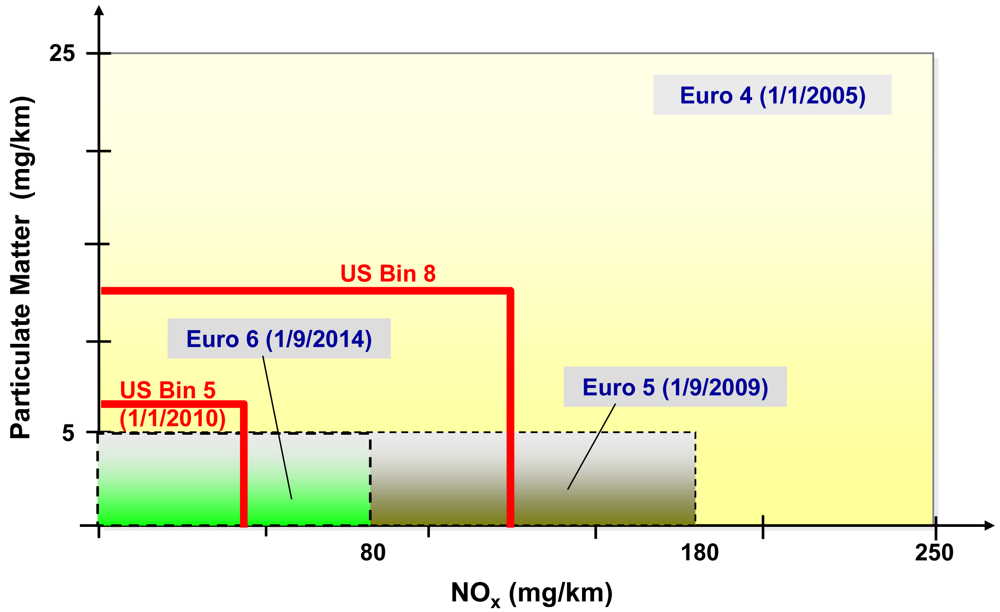
1.1. State of art NOx sensors: achievements and open issues
2. Optical Sensors
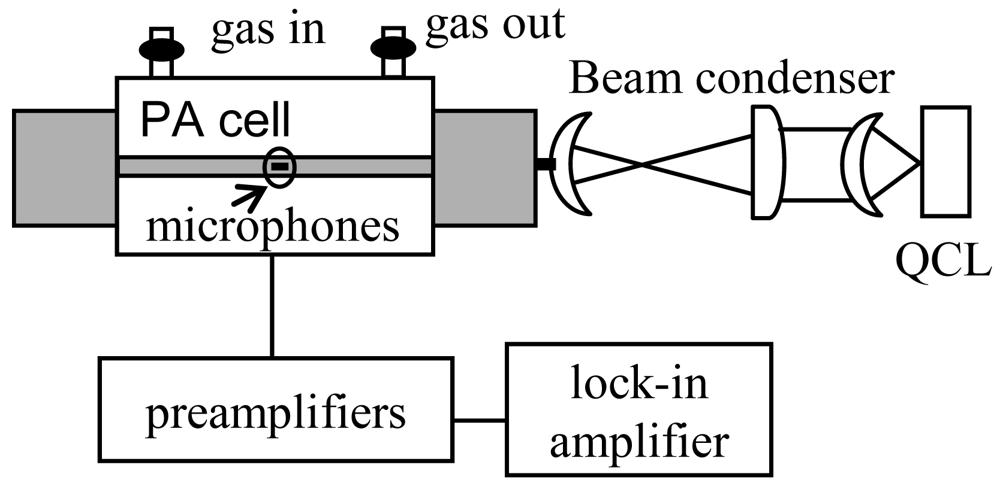
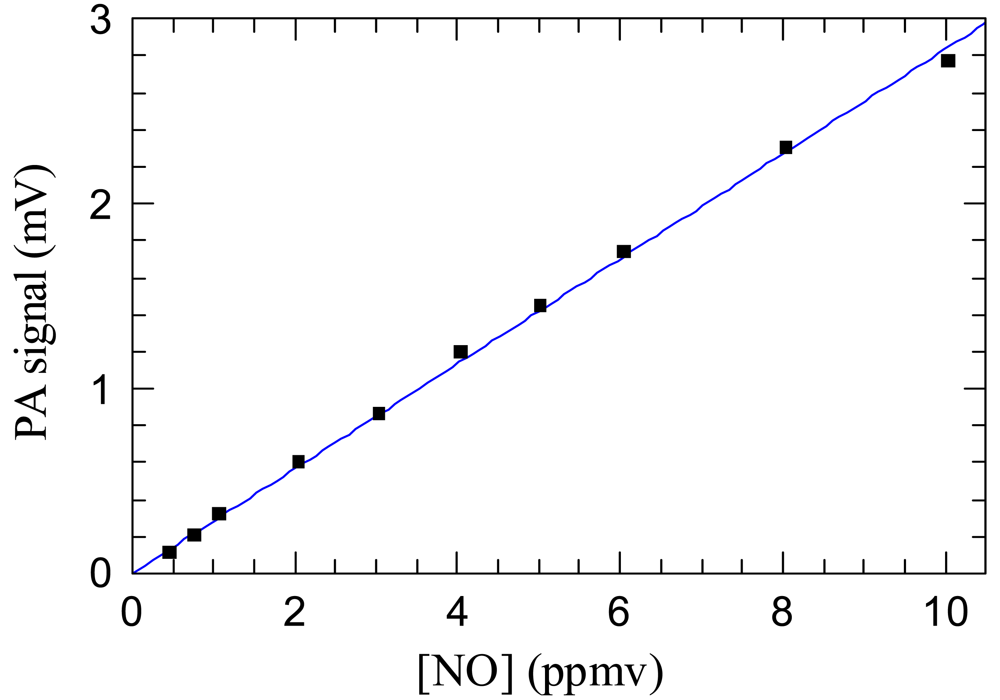
2.1. NO photoacoustic sensor
3. Electronic sensors
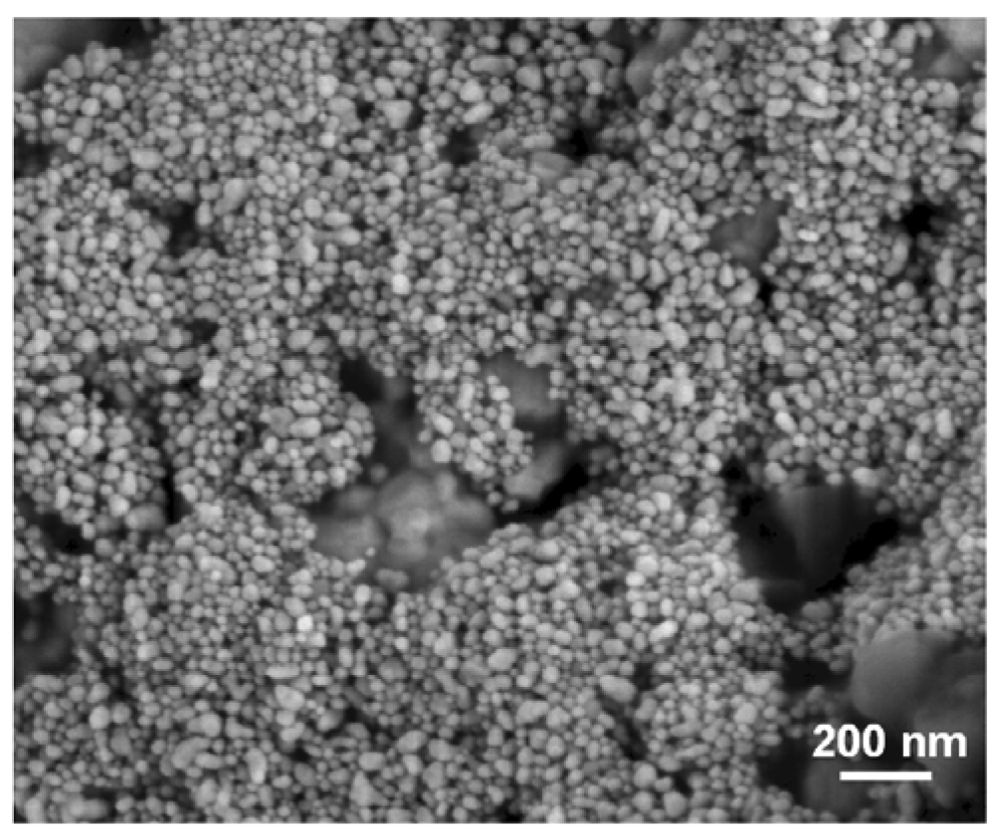
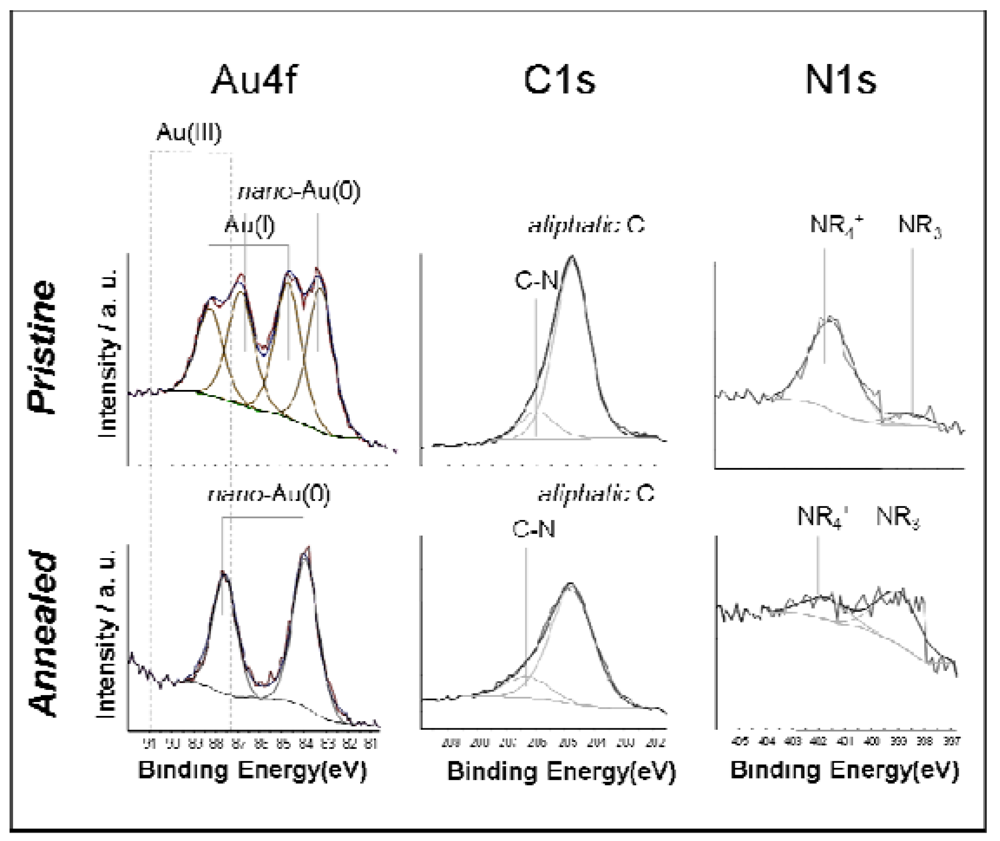
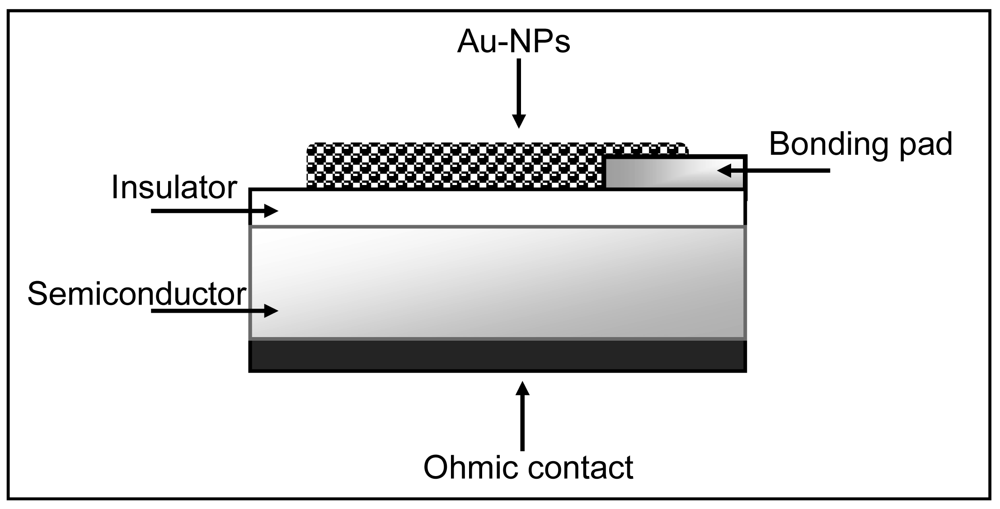
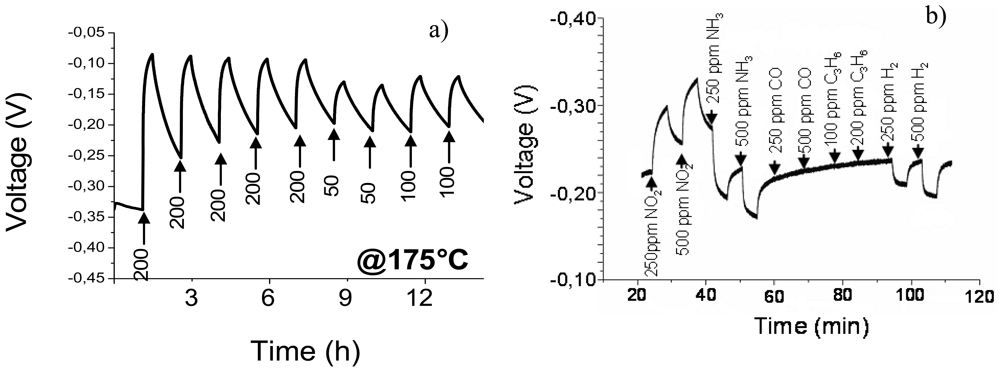
3.1. Si-Field Effect Gas Sensor
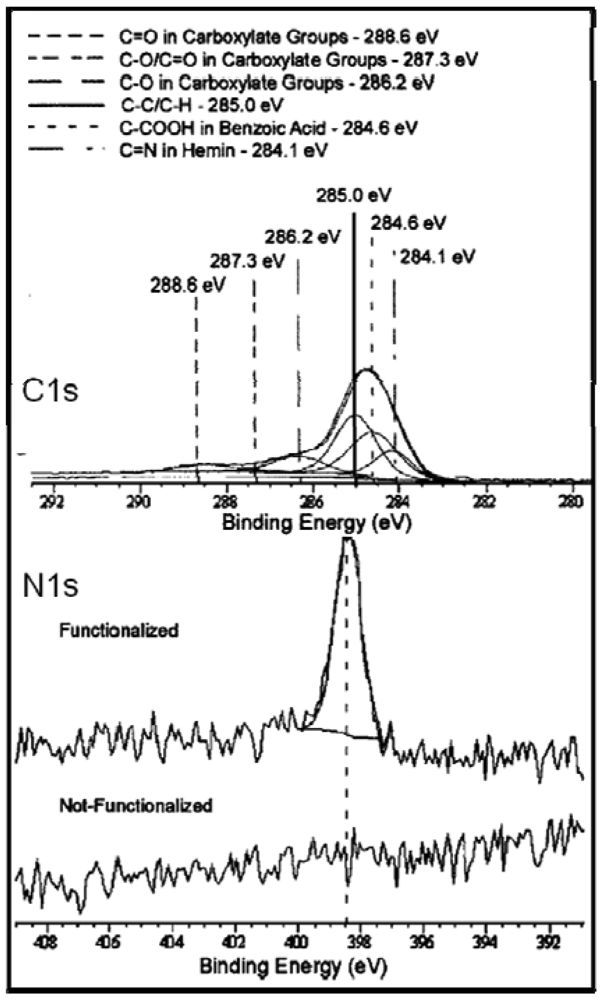
4. III-V Semiconductor Based Sensor
5. Conclusions
Acknowledgments
References and Notes
- National Ambient Air Quality Standards. Available online: http://www.epa.gov/air/criteria.html. Accessed January, 2009.
- Transport & Environment. Available online: http://ec.europa.eu/environment/air/transport/-road.htm. Accessed January, 2009.
- Menil, F.; Coillard, V.; Lucat, C. Critical review of nitrogen monoxide sensors for exhaust gases of lean burn engines. Sens. Actuat. B 2000, 67, 1–23. [Google Scholar]
- Fleming, W.J. Overview of the automotive sensors. IEEE Sens. J. 2001, 1, 296–308. [Google Scholar]
- Riegel, J.; Neumann, H.; Wiedenmann, H.M. Exhaust gas sensors for automotive emission control. Solid State Ionics 2002, 152, 783–800. [Google Scholar]
- Twigg, M.V. Critical topics in exhaust gas aftertreatment. Platinum Metal. Rev. 2003, 47. 1, 15–19. [Google Scholar]
- Persaud, K.C. Polymers for chemical sensing. Mater. Today 2005, 8, 38–44. [Google Scholar]
- Wilson, D.M.; Hoyt, S.; Janata, J.; Booksh, K.; Obando, L. Chemical sensors for portable hand-held field instruments. IEEE Sens. J. 2001, 1, 256–274. [Google Scholar]
- Janata, J.; Josowicz, M. Conducting polymers in electronic chemical sensors. Nature 2003, 2, 19–24. [Google Scholar]
- Tittel, F.K.; Richter, D.; Fried, A. Mid-Infrared laser applications in spectroscopy. In Solid State Mid-Infrared Laser Sources; Sorokina, I.T., Vodopyanov, K.L., Eds.; Springer Verlag: New York, NY, USA, 2003; Volume 89, pp. 445–510. [Google Scholar]
- Berden, G.; Peeters, R.; Meijer, G. Cavity ring-down spectroscopy: Experimental schemes and applications. Int. Rev. Phys. Chem. 2000, 19, 565–607. [Google Scholar]
- Troccoli, M.; Diehl, L.; Bour, D.P.; Corzine, S.W.; Yu, N.; Wang, C.Y.; Belkin, M.A.; Höfler, G.; Lewicki, R.; Wysocki, G.; Tittel, F.K.; Capasso, F. High-performance quantum cascade lasers grown by metal-organic vapor phase epitaxy and their applications to trace gas sensing. J. Lightwave Thec. 2008, 26, 3534–3555. [Google Scholar]
- DFB CW Room-Temperature lasers. January 2009. Available online: http://www.alpeslasers.ch.
- Tunable Mid-IR External Cavity Lasers. January 2009. Available online: http://www.daylightsolutions.com.
- Yu, J.S.; Slivken, S.; Evans, A.; Darvish, S.R.; Nguyen, J.; Razeghi, M. High-power λ ∼ 9.5 μm quantum-cascade lasers operating above room temperature in continuous-wave mode. Appl. Phys. Lett. 2006, 88, 091113–091115. [Google Scholar]
- Elia, A.; Lugarà, P.M.; Giancaspro, C. Photoacoustic detection of nitric oxide by use of a quantum cascade laser. Opt. Lett. 2005, 30, 988–990. [Google Scholar]
- Kosterev, A.A.; Bakhirkin, Y.A.; Tittel, F.K. Ultrasensitive gas detection by quartz-enhanced photoacoustic spectroscopy in the fundamental molecular absorption bands region. Appl. Phys. B 2005, 80, 133–138. [Google Scholar]
- Lima, J.P.; Vargas, H.; Miklós, A.; Angelmahr, M.; Hess, P. Photoacoustic detection of NO2 and N2O using quantum cascade lasers. Appl. Phys. B 2006, 85, 279–284. [Google Scholar]
- Pushkarsky, M.; Tsekoun, A.; Dunayevskiy, I.G.; Go, R.; Patel, C.K.N. Sub-parts-per-billion level detection of NO2 using room-temperature quantum cascade lasers. PNAS 2006, 103, 10846–10849. [Google Scholar]
- Hanwell, M.D.; Heriot, S.Y.; Richardson, T.H.; Cowlam, N.; Ross, I.M. Gas and vapour sensing characteristics of Langmuir-Schaeffer thiol encapsulated gold nanoparticle thin films. Coll. Surf. A 2006, 284, 379–383. [Google Scholar]
- Lu, X.; Xu, X.; Wang, N.; Zhang, Q. Bonding of NO2 to the Au Atom and Au(111) Surface: A Quantum Chemical Study. J. Phys. Chem A 1999, 103. 10969 and ref. therein. [Google Scholar]
- Filippini, D.; Fraigi, L.; Aragon, R.; Weimar, U. Thick film Au-gate field-effect devices sensitive to NO2. Sens. Actuat. B 2002, 81, 296–300. [Google Scholar]
- Han, L.; Daniel, D.R.; Mayer, M.M.; Zhang, C.J. Core-Shell Nanostructured Nanoparticle Films as Chemically Sensitive Interfaces. Anal. Chem. 2001, 73, 4441–4449. [Google Scholar]
- Baratto, C.; Sberveglieri, G.; Comini, E.; Faglia, G.; Benussi, G.; La Ferrara, V.; Quercia, L.; Di Francia, G.; Guidi, V.; Vincenti, D.; Boscarino, D.; Rigato, V. Gold-catalysed porous silicon for NOx sensing. Sens. Actuat. B 2000, 68, 74–80. [Google Scholar]
- Steffes, H.; Imawan, C.; Solzbacher, F.; Obermeier, E. Enhancement of NO2 sensing properties of In2O3-based thin films using an Au or Ti surface modification. Sens. Actuat. B 2001, 78, 106–112. [Google Scholar]
- Perez-Luna, V.H.; Aslan, K.; Betala, P.; Pravin, C. Colloidal Gold. In Encyclopedia of Nanoscience and Nanotechnology; Nalwa, H.S., Ed.; American Scientific Publishers: Valencia, CA, USA, 2004; Volume 2, pp. 27–49. [Google Scholar]
- Parthangal, P.M.; Cavicchi, R.E.; Zachariah, M.R. A universal approach to electrically connecting nanowire arrays using nanoparticles – application to a novel gas sensor architecture. Nanotechnology 2006, 17, 3786–3790. [Google Scholar]
- Reetz, M.T.; Helbig, W. Size-Selective Synthesis of Nanostructured Transition Metal Clusters. J. Am. Chem. Soc. 1994, 116, 7401–7402. [Google Scholar]
- Reetz, M.T.; Helbig, W.; Quaiser, S.A.; Stimming, U.; Breuer, N.; Vogel, R. Visualization of surfactants on nanostructured palladium clusters by a combination of STM and high-resolution TEM. Science 1995, 267, 367–369. [Google Scholar]
- Ieva, E.; Buchholt, K.; Colaianni, L.; Cioffi, N.; Sabbatini, L.; Capitani, G.C.; Lloyd Spetz, A.; Käll, P.O.; Torsi, L. Au nanoparticles as gate material for NOx field effect capacitive gas sensors. Sens. Lett. 2008, 6, 577–584. [Google Scholar]
- Moulder, J.F.; Stickle, W.F.; Sobol, P.E.; Bomben, K.D. Handbook of X-ray Photoelectron Spectroscopy; Perkin-Elmer Corporation: Eden Praire, MN, USA, 1992. [Google Scholar]
- Radnik, J.; Mohr, C.; Claus, P. On the origin of binding energy shifts of core levels of supported gold nanoparticles and dependence of pretreatment and material synthesis. Phys. Chem. Chem. Phys. 2003, 5, 172–176. [Google Scholar]
- Balamurugan, B.; Maruyama, T. Evidence of an enhanced interband absorption in Au nanoparticles: Size-dependent electronic structure and optical properties. Appl. Phys. Lett. 2005, 87, 143105. [Google Scholar]
- Vorobyova, S.A.; Sobal, N.S.; Lesnikovich, A.I. Colloidal gold, prepared by interphase reduction. Coll. Surf. A 2001, 176, 273–283. [Google Scholar]
- Kitagawa, H.; Kojima, N.; Nakajiama, H.J. Studies of mixed-valence states in three-dimensional halogen-bridged gold compounds, Cs2AuIAuIIIX6, (X = Cl, Br or I). Part 2. X-Ray photoelectron spectroscopic study. Chem. Soc. Dalton Trans. 1991, 61, 3121–3125. [Google Scholar]
- McNeillie, A.; Brown, D.H.; Smith, W.E.; Ginson, M.; Watson, L. Studies of mixed-valence states in three-dimensional halogen-bridged gold compounds, Cs2AuIAuIIIX6, (X = Cl, Br or I). Part 2. X-Ray photoelectron spectroscopic study. J. Chem. Soc. Dalton Trans. 1980, 4, 767–770. [Google Scholar]
- Filippini, D.; Wei, T.; Aragon, R.; Weimar, U. New NO2 sensor based on Au gate field effect devices. Sens. Actuat. B 2001, 78, 195–201. [Google Scholar]
- Steffes, H.; Imawan, C.; Solzbacher, F.; Obermeier, E. Enhancement of NO2 sensing properties of In2O3-based thin film using an Au or Ti surface modification. Sens. Actuat. B 2001, 78, 106–112. [Google Scholar]
- Penza, M.; Martucci, C.; Cassano, G. NOx gas sensing characteristics of WO3 thin films activated by noble metals (Pd, Pt, Au) layers. Sens. Actuat. B 1998, 50, 52–59. [Google Scholar]
- Vitale, F.; Vitaliano, R.; Battocchio, C.; Fratoddi, I.; Giannini, C.; Piscopiello, E.; Guagliardi, A.; Cervellino, A.; Polzonetti, G.; Russo, M.V.; Tapfer, L. Synthesis and microstructural investigations of organometallic Pd(II) thiol-gold nanoparticles hybrids. Nanoscale Res. Lett. 2008, 3, 461–467. [Google Scholar]
- Wang, J; Koel, B. RAS Studies of NO2, N2O3, and N2O4 adsorbed on Au(111) surfaces and reactions with coadsorbed H2O. J. Phys.Chem A 1999, 102, 8573–8579. [Google Scholar]
- Wu, D.G.; Cahen, D.; Graf, P.; Naaman, R.; Nitzan, A.; Shvarts, D. Direct detection of low-concentration no in physiological solutions by a new gaas-based sensor. Chem. Eur. J. 2001, 7, 1743–1749. [Google Scholar]
- Feelisch, M.; Stamler, J.S. Methods in Nitric Oxide Research; Wiley: New York, NY, USA, 1996; pp. 5–115. [Google Scholar]
- Rovira, C.; Kunc, K.; Hutter, J.; Ballone, P.; Parrinello, M. Bond characterization of chromium-fischer carbene complexes: A combined study of experiment and theory. J. Phys. Chem. A 1997, 101, 8914–8925. [Google Scholar]
- Bell, G.R.; Jones, T.S.; McConville, C.F. Accumulation layer profiles at InAs polar surfaces. Appl. Phys. Lett. 1997, 71, 3688–3690. [Google Scholar]
- Ibbetson, J.P.; Fini, P.T.; Ness, K.D.; DenBaars, S.P.; Speck, J.S.; Mishra, U.K. Polarization effects, surface states, and the source of electrons in AlGaN/GaN heterostructure field effect transistors. Appl. Phys. Lett. 2000, 77, 250–252. [Google Scholar]
- Garcia, M.A.; Losurdo, M.; Wolter, S.D.; Kim, T.H.; Lampert, W.V.; Bonaventura, J.; Bruno, G.; Giangregorio, M.; Brown, A. Functionalization and characterization of InAs and InP surfaces with hemin. J. Vac. Sci. Technol. B 2007, 25, 1504–1508. [Google Scholar]
- Uhlrich, J.; Garcia, M.; Wolter, S.; Brown, A.S.; Kuech, T.F. Interfacial chemistry and energy band line-up of pentacene with the GaN (0001) surface. J. Cryst. Growth 2007, 300, 204–211. [Google Scholar]
- Garcia, M.A.; Losurdo, M.; Wolter, S.D.; Lampert, W.V.; Bonaventura, J.; Bruno, G.; Yi, C.; Brown, A.S. Comparison of functionalized III – V semiconductor response for nitric oxide. Sens. Lett. 2008, 6, 627–634. [Google Scholar]
- Karweik, D.H.; Winograd, N. Nitrogen charge distributions in free-base porphyrins, metalloporphyrins, and their reduced analogs observed by x-ray photoelectron spectroscopy. Inorg. Chem. 1976, 15, 2336–2342. [Google Scholar]
- Okada, S.; Segawa, H. Substituent-control exciton in J-aggregates of protonated water-insoluble porphyrins. J. Am. Chem. Soc. 2003, 125, 2792–2796. [Google Scholar]
- Kupriyanov, L.Y. Semiconductor Sensors in Physico-Chemical Studies; Elsevier: Amsterdam, The Netherlands, 1996; pp. 135–190. [Google Scholar]
- Olsson, L.Ö.; Andersson, C.B.M.; Håkansson, M.C.; Kanski, J.; Ilver, L.; Karlsson, U.O. Charge Accumulation at InAs surfaces. Phys. Rev. Lett. 1996, 76, 3626–3630. [Google Scholar]
- Tsui, D.C. Electron-tunneling studies of a quantized surface accumulation layer. Phys. Rev. B 1971, 4, 4438–4449. [Google Scholar]



| Reference | Chemicals | Laser source | Detection limit at SNR = 3 (ppbv) | Normalized detection limit (ppbv · W) |
|---|---|---|---|---|
| Elia et al. [16] | NO | Pulsed QCL5.3 μm Room temperature | 450 | 0.9 |
| Kosterev et al. [17] | N2O | cw QCL4.55 μm Liquid N2 cooled | 12 | 1.2 |
| Lima et al. [18] | N2O, NO2 | Pulsed QCLs6.2 μm; 8 μm Room temperature | 240 | 1.2 |
| Pushkarsky et al. [19] | NO2 | cw QCL (external grating cavity)6.3 μm Room temperature | 1.5 | 0.45 |
| Reference | Chemicals | Catalytically active material | Detection limit |
|---|---|---|---|
| Ieva et al. [11] | NO, NO2 | Core-shell Au-NPs stabilized by tetraalkylammonium chloride | 50 ppm @175 °C |
| Hanwell et al. [20] | NO2 | Core-shell Au-NPs functionalised by 4-methylbenzenethiol, 1-hexanethiol or 1-dodecanethiol | 0.5 ppm @22 °C |
| Filippini et al [22] D. Filippini, L. Fraigi, R. Aragon, U.Weimar, Thick film Au-gate field-effect devices sensitive to NO2, Sensors and Actuators B 81 (2002) 296-300. | NO2 | Thermally evaporated gold thin film | 15 ppm @180 °C |
| Baratto et al. [23] | NO, NO2 | Au-doped micro-porous silicon layers | 5 ppm @20 °C |
| Steffes et al. [24] | NO2 | Au-NPs modified RF-sputtered In2O3 film | 10 ppm @400 °C |
| Detection limit (ppm) | Selectivity | |
|---|---|---|
| QCL-based PA sensor | 0.45 | HC, CO2, H2O, NO2, N2O, SOx |
| Au-NPs FET | 50 | NH3, H2, CO and C3H6. |
| Hemin-GaN HFET | 4 | O2, CO2, N2 |
| YSZ lambda gauges | 50 | low |
© 2009 by the authors; licensee Molecular Diversity Preservation International, Basel, Switzerland. This article is an open access article distributed under the terms and conditions of the Creative Commons Attribution license (http://creativecommons.org/licenses/by/3.0/).
Share and Cite
Di Franco, C.; Elia, A.; Spagnolo, V.; Scamarcio, G.; Lugarà, P.M.; Ieva, E.; Cioffi, N.; Torsi, L.; Bruno, G.; Losurdo, M.; et al. Optical and Electronic NOx Sensors for Applications in Mechatronics. Sensors 2009, 9, 3337-3356. https://doi.org/10.3390/s90503337
Di Franco C, Elia A, Spagnolo V, Scamarcio G, Lugarà PM, Ieva E, Cioffi N, Torsi L, Bruno G, Losurdo M, et al. Optical and Electronic NOx Sensors for Applications in Mechatronics. Sensors. 2009; 9(5):3337-3356. https://doi.org/10.3390/s90503337
Chicago/Turabian StyleDi Franco, Cinzia, Angela Elia, Vincenzo Spagnolo, Gaetano Scamarcio, Pietro Mario Lugarà, Eliana Ieva, Nicola Cioffi, Luisa Torsi, Giovanni Bruno, Maria Losurdo, and et al. 2009. "Optical and Electronic NOx Sensors for Applications in Mechatronics" Sensors 9, no. 5: 3337-3356. https://doi.org/10.3390/s90503337
APA StyleDi Franco, C., Elia, A., Spagnolo, V., Scamarcio, G., Lugarà, P. M., Ieva, E., Cioffi, N., Torsi, L., Bruno, G., Losurdo, M., Garcia, M. A., Wolter, S. D., Brown, A., & Ricco, M. (2009). Optical and Electronic NOx Sensors for Applications in Mechatronics. Sensors, 9(5), 3337-3356. https://doi.org/10.3390/s90503337