<?xml version="1.0" encoding="UTF-8"?>
<!DOCTYPE article PUBLIC "-//NLM//DTD Journal Publishing DTD v2.3 20070202//EN" "journalpublishing.dtd">
<article xmlns:xlink="http://www.w3.org/1999/xlink" xml:lang="en" article-type="review-article">
<front>
<journal-meta>
<journal-id journal-id-type="nlm-ta">Sensors</journal-id>
<journal-title>Sensors</journal-title>
<issn pub-type="epub">1424-8220</issn>
<publisher>
<publisher-name>Molecular Diversity Preservation International (MDPI)</publisher-name></publisher></journal-meta>
<article-meta>
<article-id pub-id-type="doi">10.3390/s90402976</article-id>
<article-id pub-id-type="publisher-id">sensors-09-02976</article-id>
<article-categories>
<subj-group>
<subject>Review</subject></subj-group></article-categories>
<title-group>
<article-title>Magnetic Particle-Based Hybrid Platforms for Bioanalytical Sensors</article-title></title-group>
<contrib-group>
<contrib contrib-type="author">
<name><surname>Stanciu</surname><given-names>Lia</given-names></name><xref ref-type="aff" rid="af1-sensors-09-02976"><sup>1</sup></xref><xref ref-type="corresp" rid="c1-sensors-09-02976"><sup>*</sup></xref></contrib>
<contrib contrib-type="author">
<name><surname>Won</surname><given-names>Yu-Ho</given-names></name><xref ref-type="aff" rid="af1-sensors-09-02976"><sup>1</sup></xref></contrib>
<contrib contrib-type="author">
<name><surname>Ganesana</surname><given-names>Mallikarjunarao</given-names></name><xref ref-type="aff" rid="af2-sensors-09-02976"><sup>2</sup></xref></contrib>
<contrib contrib-type="author">
<name><surname>Andreescu</surname><given-names>Silvana</given-names></name><xref ref-type="aff" rid="af2-sensors-09-02976"><sup>2</sup></xref><xref ref-type="corresp" rid="c1-sensors-09-02976"><sup>*</sup></xref></contrib></contrib-group>
<aff id="af1-sensors-09-02976">
<label>1</label> School of Materials Engineering, Purdue University, West Lafayette, IN 47907-2045, USA; E-Mail: <email>ywon@purdue.edu</email> (Y.-H.W.)</aff>
<aff id="af2-sensors-09-02976">
<label>2</label> Department of Chemistry and Biomolecular Science, Clarkson University, Potsdam, NY 13699-5810, USA; E-Mail: <email>ganesanm@clarkson.edu</email> (M.G.)</aff>
<author-notes>
<corresp id="c1-sensors-09-02976">
<label>*</label>Authors to whom correspondence should be addressed; E-Mail: <email>lstanciu@purdue.edu</email> (L.S.); <email>eandrees@clarkson.edu</email> (S.A.); Tel. +1-765-496-3552, +1-315-268-2394; Fax: +1-315-268-6610</corresp></author-notes>
<pub-date pub-type="collection">
<year>2009</year></pub-date>
<pub-date pub-type="epub">
<day>23</day>
<month>4</month>
<year>2009</year></pub-date>
<volume>9</volume>
<issue>4</issue>
<fpage>2976</fpage>
<lpage>2999</lpage>
<history>
<date date-type="received">
<day>19</day>
<month>2</month>
<year>2009</year></date>
<date date-type="rev-recd">
<day>13</day>
<month>4</month>
<year>2009</year></date>
<date date-type="accepted">
<day>23</day>
<month>4</month>
<year>2009</year></date></history>
<permissions>
<copyright-statement>© 2009 by the authors; licensee MDPI, Basel, Switzerland</copyright-statement>
<copyright-year>2009</copyright-year>
<license>
<p>This article is an open access article distributed under the terms and conditions of the Creative Commons Attribution license (http://creativecommons.org/licenses/by/3.0/).</p></license></permissions>
<abstract>
<p>Biomagnetic nano and microparticles platforms have attracted considerable interest in the field of biological sensors due to their interesting physico-chemical properties, high specific surface area, good mechanical stability and opportunities for generating magneto-switchable devices. This review discusses recent advances in the development and characterization of active biomagnetic nanoassemblies, their interaction with biological molecules and their use in bioanalytical sensors.</p></abstract>
<kwd-group>
<kwd>Biomagnetic materials</kwd>
<kwd>composite magnetic materials</kwd>
<kwd>bio-immobilization</kwd>
<kwd>biological sensors</kwd></kwd-group></article-meta></front>
<body>
<sec sec-type="intro">
<label>1.</label>
<title>Introduction</title>
<p>In recent years, numerous types of magnetic particles of nanometer and micrometer dimensions and composites of these materials have become key components in different areas like catalysis, environmental remediation, the biomedical field and sensing devices, cell labeling and immunomagnetic separations, magnetic resonance imaging, targeted drug delivery, and bio-imaging [<xref ref-type="bibr" rid="b1-sensors-09-02976">1</xref>–<xref ref-type="bibr" rid="b12-sensors-09-02976">12</xref>]. Cell isolation, enzyme immobilization, drug targeting, waste water treatment are just few examples of such applications. These materials offer the potential of enhanced mechanical and catalytic properties when compared to their bulk counterparts. In the biosensors field, they have been used as bioimmobilization platforms, magnetic carriers of biomolecules, to separate or concentrate analytes and to control electrochemical processes at electrode surfaces [<xref ref-type="bibr" rid="b2-sensors-09-02976">2</xref>,<xref ref-type="bibr" rid="b11-sensors-09-02976">11</xref>,<xref ref-type="bibr" rid="b13-sensors-09-02976">13</xref>–<xref ref-type="bibr" rid="b17-sensors-09-02976">17</xref>]. The combination of magnetic manipulation with bioimmobilization, separation and detection capabilities have created unique opportunities for enhancing the performance of sensing devices.</p>
<p>Of the various magnetic materials reported in the literature for sensing purposes, iron oxides, mainly Fe<sub>3</sub>O<sub>4</sub> have been the most widely used because of their simple preparation and superparamagnetic properties. Iron oxide nanoparticles (NPs) are also biocompatible, displaying no hemolytic activity or genotoxicity. The NPs can either be used for simple adsorption of biomolecules, or functionalized or encapsulated in polymers or silica materials to fabricate hybrid composites with increased biocompatibility and added functionalities. These materials, deposited onto the surface of a glassy carbon (GCE) electrode have provided performance characteristics comparable with those of Prussian Blue modified electrodes [<xref ref-type="bibr" rid="b14-sensors-09-02976">14</xref>]. Fe<sub>3</sub>O<sub>4</sub> particles have catalytic active sites for sensing hydrogen peroxide [<xref ref-type="bibr" rid="b14-sensors-09-02976">14</xref>,<xref ref-type="bibr" rid="b18-sensors-09-02976">18</xref>], which is the product of many enzymatic reactions (e.g. glucose oxidase, lactate dehydrogenase, cholesterol oxidase) and a key component in various chemical, biological, pharmaceutical, clinical, environmental, and food processes. Magnetic iron oxide NPs have gained a great deal of attention also due to their potential for providing control of electrochemical processes [<xref ref-type="bibr" rid="b19-sensors-09-02976">19</xref>,<xref ref-type="bibr" rid="b20-sensors-09-02976">20</xref>] and creating magneto-switchable devices [<xref ref-type="bibr" rid="b14-sensors-09-02976">14</xref>,<xref ref-type="bibr" rid="b21-sensors-09-02976">21</xref>]. Biological recognition elements can be attached to their surface to develop various catalytic and affinity sensors. The use of magnetic particles for this purpose brings a number of additional advantages such as control and transport of the bioassembly to a specific location onto/close to the transducer surface. Furthermore, they can be retained and removed with a magnet without affecting the transducer surface, thus creating possibilities for regeneration and reuse.</p>
<p>Extensive research papers and reviews covering the synthesis and characterization of various magnetic particles were published in literature in recent years. In this review, we focus on the most important and widely used magnetic particles-biomolecule hybrid systems for sensing applications, their use as electrode materials and immobilization matrices, and discuss the success and limitations of these materials in biological sensors.</p></sec>
<sec>
<label>2.</label>
<title>Biomagnetic Particles Platforms</title>
<p>Significant progress has been made in the control of size, size distribution, shape, and chemical composition of magnetic particles in recent years [<xref ref-type="bibr" rid="b22-sensors-09-02976">22</xref>–<xref ref-type="bibr" rid="b40-sensors-09-02976">40</xref>]. These are readily available in different forms (Fe<sub>2</sub>O<sub>3</sub>, Fe<sub>3</sub>O<sub>4</sub>, Fe<sub>3</sub>S<sub>4</sub>, MO-Fe<sub>2</sub>O<sub>3</sub> where M = Ni, Co, Zn etc) and can be purchased from several companies or prepared using established synthetic procedures [<xref ref-type="bibr" rid="b10-sensors-09-02976">10</xref>]. However, bare magnetic particles tend to easily aggregate and therefore their use for bioanalytical purposes can be difficult. In addition, most of these particles are prepared in hexane or other organic solvents and therefore many biological applications involve particles with modified surfaces that render them biocompatible. For example, they can be surface functionalized with different organic or inorganic coatings in a core-shell format or be prepared in a composite form using various synthetic polymers and natural polysaccharides, like alginate cellulose and dextran [<xref ref-type="bibr" rid="b41-sensors-09-02976">41</xref>–<xref ref-type="bibr" rid="b44-sensors-09-02976">44</xref>], polyaniline [<xref ref-type="bibr" rid="b45-sensors-09-02976">45</xref>–<xref ref-type="bibr" rid="b55-sensors-09-02976">55</xref>], or silica glasses [<xref ref-type="bibr" rid="b45-sensors-09-02976">45</xref>,<xref ref-type="bibr" rid="b56-sensors-09-02976">56</xref>–<xref ref-type="bibr" rid="b68-sensors-09-02976">68</xref>]. Tridimensional multilayer films of carbon nanotubes with Fe<sub>2</sub>O<sub>3</sub> introduced in the nanotubes have also been reported for development of a magnetic electrochemical platform for enzyme sensors [<xref ref-type="bibr" rid="b69-sensors-09-02976">69</xref>]. This material provided enhanced adsorption of protein molecules, controlled deposition of higher density of carbon nanotubes onto the electrode surface and improved electrochemical properties.</p>
<p>An elegant approach is to coat the particle surface with a gold shell [<xref ref-type="bibr" rid="b23-sensors-09-02976">23</xref>,<xref ref-type="bibr" rid="b70-sensors-09-02976">70</xref>–<xref ref-type="bibr" rid="b83-sensors-09-02976">83</xref>], favouring protein binding by taking advantage of their gold affinity. Another interesting example is to coat the NPs with a porous, optically transparent sol-gel layer resulting in a multifunctional hybrid material in which the outer silica shell stabilizes the particles, induces biocompatibility and provides sites for surface modification with biological molecules, electronic mediators or fluorescent labels [<xref ref-type="bibr" rid="b84-sensors-09-02976">84</xref>,<xref ref-type="bibr" rid="b85-sensors-09-02976">85</xref>]. Such hybrid materials combining the properties of silica microspheres with the advantages of magnetic particles hold promise for additional applications. For example, multifunctional magnetic particles that incorporate chromophores can be easily manipulated through the use of an external magnetic field, while their position at a given time and place can be monitored using fluorescence methods [<xref ref-type="bibr" rid="b86-sensors-09-02976">86</xref>,<xref ref-type="bibr" rid="b87-sensors-09-02976">87</xref>]. Chromophores used for such applications included organic dyes such as rodhamine [<xref ref-type="bibr" rid="b84-sensors-09-02976">84</xref>] as well as quantum dots, featuring narrow emission bandwidth, large two-photon absorption and continuous adsorption spectra [<xref ref-type="bibr" rid="b12-sensors-09-02976">12</xref>,<xref ref-type="bibr" rid="b88-sensors-09-02976">88</xref>–<xref ref-type="bibr" rid="b94-sensors-09-02976">94</xref>].</p>
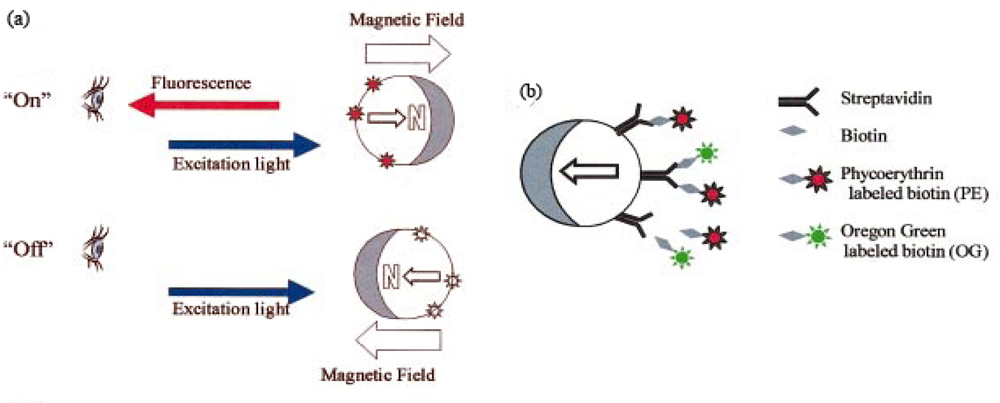
<p>Anker <italic>et al.</italic> [<xref ref-type="bibr" rid="b95-sensors-09-02976">95</xref>] synthesized metal-capped magnetically-modulated nanoprobes (Mag-MOON), that have the capacity to rotate under changing magnetic fields and emit light fluxes in different orientations. In general, fluorescent NPs emit light uniformly in all directions. When coated with a metal layer the symmetry is disturbed and the particles start emitting different amounts of light in different orientations. The orientation of the particle can also be tracked in time. The use of Mag-MOON particles allows <italic>in-situ</italic> fast background subtraction and provides a significant increase of signal-to-noise ratio. Therefore, immunoassays with a variety of fluorescent labels can be designed. For example, fluorescent dyes have limitations in terms of signal-to-noise ratio when cellular responses are investigated. Mag-MOONs have the potential to increase the sensitivity of these assays when used in nanosensors that are designed to perform rapid single cell measurements. Immunoassays based on Mag-MOONs can be designed for protein detection. Briefly, the Mag-MOONs can be functionalized with molecular recognition elements or antibodies that can bind specifically analytes of interest. In a subsequent step a fluorescent tag is added to increase Mag-MOONs brightness and allow antigen detection (<xref ref-type="fig" rid="f1-sensors-09-02976">Figure 1</xref>).</p>
<p>Silica-coated magnetites were obtained using various synthetic procedures [<xref ref-type="bibr" rid="b93-sensors-09-02976">93</xref>,<xref ref-type="bibr" rid="b94-sensors-09-02976">94</xref>,<xref ref-type="bibr" rid="b96-sensors-09-02976">96</xref>–<xref ref-type="bibr" rid="b101-sensors-09-02976">101</xref>]. The thickness of the outer silica shell can be tuned by changing the concentration of the silica precursors during synthesis [<xref ref-type="bibr" rid="b84-sensors-09-02976">84</xref>]. Zhao <italic>et al.</italic> [<xref ref-type="bibr" rid="b102-sensors-09-02976">102</xref>] fabricated magnetic nanospheres covered with a mesoporous silica shell starting from uniform magnetite NPs, with a mean diameter of 120 nm. These were subsequently covered by a mesoporous silica coating via sol-gel polymerization using tetraetoxysilane (TEOS) and n-octadecyltrimethoxysilane (C18TMS). In the last step, a reduction of the hematite core under an atmosphere of H<sub>2</sub> and N<sub>2</sub> was performed, to lead to the formation of magnetic core/mesoporous silica shells with a narrow size distribution and a mean diameter of approximately 270 nm.</p>
<p>Lee, <italic>et al</italic>. [<xref ref-type="bibr" rid="b97-sensors-09-02976">97</xref>] recently reported a one-pot synthesis of uniformly sized, non-agglomerated magnetic silica core-shell particles by using a reverse micelles procedure and alkoxide precursors. The synthesis was performed at 90 °C, which allowed maintaining the micelle structure. Two model enzymes (lipase and α-chemotrypsin) were crosslinked with glutaraldehyde (GA) and the results were compared with those obtained by covalent attachment on the NPs surface, through amine functionalization. As an alternative, biological molecules can be entrapped within the silica glass to generate a biologically active material with enhanced stability while providing magnetic properties for easy manipulation and control under a magnetic field. Preparation of silica coated iron oxide NPs with an average diameter of 5 – 7 nm has been described in the literature [<xref ref-type="bibr" rid="b96-sensors-09-02976">96</xref>]. The size of the magnetic nanocomposite after the deposition of the silica was ∼ 53 nm.</p></sec>
<sec>
<label>3.</label>
<title>Magnetic Activation of Redox Processes in Bioanalytical Sensors</title>
<p>In bioelectronic devices, such as biosensors and biofuel cells, the electrical contact between enzymes and the electrodes is essential [<xref ref-type="bibr" rid="b103-sensors-09-02976">103</xref>–<xref ref-type="bibr" rid="b114-sensors-09-02976">114</xref>]. The main challenge in achieving good electrical contact stays in the lack of direct communication between the redox (Reduction-Oxidation reaction) center of the biomolecule and the electrode surface. Solutions such as attachment of redox-relay groups to the enzyme, the use of diffusional electron mediators, or the immobilization in a redox polymer matrix have poor efficiency. Problems include the inappropriate orientation of enzyme in respect to the electrode, and conformational modifications of the protein structure. The conjugation of NPs with enzymes in hybrid devices holds promise for the development of novel and improved biosensing platforms and ensures electrical ‘wiring’ between the enzyme and the electrode. Redox-active units are used in a series of electrocatalytical and bioelectrocatalytical processes. Magnetic particles have been functionalized with redox units and subsequently used in reactions relevant for such processes. Examples of redox-active units that have been used to functionalize magnetic nano or micro particles include microperoxidase-11, pyrroloquinoline quinone, 2,3-dichloro-1,4-naphthoquinone, <italic>N</italic>-ferrocenylmethyl)aminohexanoic acid, or <italic>N</italic>-methyl-<italic>N</italic>”-(dodecanoic acid)-4,4′-bipyridinium [<xref ref-type="bibr" rid="b115-sensors-09-02976">115</xref>,<xref ref-type="bibr" rid="b116-sensors-09-02976">116</xref>]. When redox units-functionalized magnetic particles are attracted to the electrode surface with the help of a magnet placed underneath the electrode, the electrical contact between the redox units on the particles and the electrode is activated and the electrochemical response of the sensor is switched “ON”. In turn, when the magnet is placed on top of the electrode, the NPs are removed from the electrode surface, and the electrochemical response is switched “OFF” [<xref ref-type="bibr" rid="b117-sensors-09-02976">117</xref>].</p>
<p>Redox relay units such as bipyridinium or ferrocene are also part of this set-up, and can serve as mediators for electron transfer between redox enzyme and the electrode [<xref ref-type="bibr" rid="b115-sensors-09-02976">115</xref>]. This approach has been used for enzymes such as glucose oxidase (GOx) and nitrate reductase [<xref ref-type="bibr" rid="b118-sensors-09-02976">118</xref>]. Under a magnetic field, ferrocene oxidizes to ferrocenyl cations. In turn, the ferrocenyl cations have an oxidizing effect on the redox center of the GOx. Removing the magnetic particles from the electrode also removes the electrical contact between the ferrocene and the electrode, inhibiting glucose oxidation. In the case of nitrate oxidase [<xref ref-type="bibr" rid="b115-sensors-09-02976">115</xref>], bipyridinium was used as a reducing agent in the reduction process of nitrate to nitrite. When the bipyridinium functionalized magnetic NPs interacted with the electrode under an electrical field (E = − 0.7V), the nitrate-nitrite transformation was favored only when a magnet was positioned in the system in such a way that the NPs were attracted to the electrode. In the same time, the removal of the magnetic particles led to the electrocatalyzed reactions being switched off. Lactate dehydrogenase (LDH) was also used in a similar approach that included pyrroloquinoline quinone as a relay mediator for the activation/deactivation of the NADH-NAD<sup>+</sup> transformation [<xref ref-type="bibr" rid="b119-sensors-09-02976">119</xref>–<xref ref-type="bibr" rid="b121-sensors-09-02976">121</xref>]. Selective dual biosensors were also designed with LDH and GOx and magnetic particles functionalized with monolayers of PQQ-NAD<sup>+</sup> and ferrocene [<xref ref-type="bibr" rid="b122-sensors-09-02976">122</xref>]. These were tested in both oxidation of glucose and inhibition of lactate oxidation when no electrical field was applied. When a small electrical field was applied (potential range: −0.13 &lt; E &lt; 0.13 V), the oxidation of lactate was enabled, while the oxidation of glucose was inhibited, since the potential range used does not favor the oxidation of ferrocene units.</p></sec>
<sec>
<label>4.</label>
<title>Biofunctionalization of Magnetic Nanoparticles</title>
<p>Immobilization of enzymes, antibodies, oligonucleotides, and other biologically active compounds onto magnetic NP platforms is a key element in using these structures for biosensing purposes. Fabricating biofunctionalized magnetic materials containing a high amount of the biological element with high activity and stability is essential for the design of robust sensors that take advantage of the magnetic capabilities. Various routes for the fabrication of biofunctionalized magnetic NPs include traditional methods such as covalent binding, adsoprtion, specific affinity interactions, and entrapment in porous surface layers. In the following sections we describe representative procedures utilized for this purpose and provide selected examples reported in the literature.</p>
<sec>
<label>4.1.</label>
<title>Biofunctionalized Magnetic Nanoparticles Via Covalent Binding</title>
<p>The primary functionalization of iron oxide NPs with organic functionalities is the first step in the covalent binding of biomolecules to their surfaces. The drawbacks of this method stay in the restrictions derived from the biomolecule conformation being imposed by their orientation on the support upon binding. Functionalization of magnetic NPs with carboxyl, amino or hydroxyl groups prior to the covalent binding is traditionally used [<xref ref-type="bibr" rid="b6-sensors-09-02976">6</xref>,<xref ref-type="bibr" rid="b39-sensors-09-02976">39</xref>,<xref ref-type="bibr" rid="b123-sensors-09-02976">123</xref>–<xref ref-type="bibr" rid="b138-sensors-09-02976">138</xref>]. Hong <italic>et al.</italic> [<xref ref-type="bibr" rid="b139-sensors-09-02976">139</xref>] functionalized magnetic nanogels through a carbodiimide activation procedure. In this case, polyacrylamide (PAM) coated Fe<sub>3</sub>O<sub>4</sub> NPs and Hoffman degradation was used to obtain amino-functionalized magnetic nanogels with a 25 nm diameter. Subsequently, α-chymotrypsin was covalently attached to the nanogel’s surface. The enzymatic activity was largely retained and the reaction temperature and usable pH range were wider after the covalent binding as compared to the free enzyme. In the case of the covalent binding, the enzymatic activity was not dramatically affected by varying the pH between 5.8 and 8.9, while for the free enzyme, the enzymatic activity decreased to less than 50% at pH values between 8 and 8.9. The temperature was varied between 35 and 85 °C and the optimum temperature for the both free and covalently bound enzyme was determined to be at 35 °C, while above this temperature, a decrease in activity was observed in both cases. However, after 60 °C, the free enzyme lost all its activity, while the covalently bound enzyme still retained 60% of its activity. The enzymatic activity was retained after storage at 4 °C for 36 days. The magnetic composite was reusable, with 96.8% of the biological activity being maintained after 12 usage cycles. On the other hand, the affinity between the enzyme and the substrate was lower than that of the free enzyme. An explanation related to sterric effects of diffusion barriers of the substrate to the enzymatic active sites was proposed. More recently [<xref ref-type="bibr" rid="b140-sensors-09-02976">140</xref>], the same authors used a hydrophilic polymer with free carboxyl groups to covalently immobilize α-chymotrypsin to the surface of magnetic iron oxide NPs, followed by <italic>in-situ</italic> polymerization with 1-ethyl-3-(3-dimethylaminepropyl) carbodiimide (EDC) used as a coupling agent. The enzyme retained 80% of its activity at 65 °C, 90% at 25 °C and the full enzymatic activity at 4 °C. The same long term storage stability and reusability as in the case of the amino functionalized nanogels were observed. Other enzymes covalently immobilized on the surface of magnetic NPs include GOx [<xref ref-type="bibr" rid="b138-sensors-09-02976">138</xref>] and peroxidase [<xref ref-type="bibr" rid="b141-sensors-09-02976">141</xref>,<xref ref-type="bibr" rid="b142-sensors-09-02976">142</xref>], as well as cholesterol oxidase, lipase [<xref ref-type="bibr" rid="b143-sensors-09-02976">143</xref>], trypsin and chymotrypsin [<xref ref-type="bibr" rid="b131-sensors-09-02976">131</xref>,<xref ref-type="bibr" rid="b136-sensors-09-02976">136</xref>,<xref ref-type="bibr" rid="b137-sensors-09-02976">137</xref>,<xref ref-type="bibr" rid="b144-sensors-09-02976">144</xref>–<xref ref-type="bibr" rid="b150-sensors-09-02976">150</xref>]. Kuroiwa <italic>et al.</italic> [<xref ref-type="bibr" rid="b151-sensors-09-02976">151</xref>] immobilized chitosanase on amylose-coated Fe<sub>3</sub>O<sub>4</sub> NPs. The amylose provided hydroxyl groups on the NPs surface, which were then coupled with the amino groups of chitosanase via covalent binding. Fe<sub>3</sub>O<sub>4</sub>-chitosan NPs, exposing free amino groups on their surface were used to bind alcohol dehydrogenase via GA coupling, with about 48% retention of enzymatic activity [<xref ref-type="bibr" rid="b151-sensors-09-02976">151</xref>]. The authors demonstrated the recovery of the enzyme by magnetic separation.</p></sec>
<sec>
<label>4.2.</label>
<title>Biofunctionalized Magnetic Nanoparticles via Surface Adsorption</title>
<p>Core-shell NPs functionalized with polymers were investigated as supports for biomolecule immobilization. Mahmood <italic>et al.</italic> [<xref ref-type="bibr" rid="b152-sensors-09-02976">152</xref>] immobilized lipase on magnetic NPs coated with a oleic acid-Pluronic<sup>®</sup> (L-64) block copolymer. In this work, the copolymer was used to improve stability (i.e. reduce agglomeration). Up to 90% enzymatic activity of lipase was retained for seven cycles. This extended usability was attributed to hydrophobic interactions between the preatreated NPs and the copolymer. Shamim <italic>et al</italic>. [<xref ref-type="bibr" rid="b153-sensors-09-02976">153</xref>] synthesized core-shell iron oxide NPs coated with poly-(<italic>N</italic>-isopropylacrylamide) (PNIPAM) and used them to adsorb bovine serum albumin (BSA) on their surface. Thiodiglycolic and 4-vinylaniline were used as surfactants. The core-shell NPs were thermosensitive. Above 32 °C, the structure of the poly-(NIPAM) changes from hydrophilic to hydrophobic. Due to this effect, at temperatures above 32 °C, the magnetic NPs shrink, and are able to adsorb a larger amount of bovin serum albumin (BSA). Lowering the temperature below 32 °C resulted in desorption of the protein. It has been shown that the protein adsorption takes place a larger extent through hydrogen bonding, and less through hydrophobic interactions. Peng <italic>et al</italic>. [<xref ref-type="bibr" rid="b154-sensors-09-02976">154</xref>] fabricated Fe<sub>3</sub>O<sub>4</sub> magnetic NPs with 10 nm in diameter through a chemical precipitation method and further used them for physical adsorption of BSA and lysozyme (LSZ) with partial retention of enzymatic activity. Desorption of both BSA and LSZ was also investigated at the isoelectric points of the enzymes. Kausik <italic>et al.</italic> [<xref ref-type="bibr" rid="b155-sensors-09-02976">155</xref>] used Fe<sub>3</sub>O<sub>4</sub> NPs prepared via a co-precipitation method to design a glucose sensor. The NPs dispersed in chitosan formed a film onto an indium-tin oxide (ITO) glass. Dispersion in chitosan helped preventing aggregation, while the NPs facilitated communication with the electrode surface. This biosensor had a rapid response time (5 s), good linearity (10 – 400 mg dL<sup>−1</sup>), good reproducibility, and high affinity towards glucose. The sensitivity was of 9.3 μA/(mg·dL·cm<sup>2</sup>) and the sensor was stable for up to eight weeks at 4 °C.</p></sec>
<sec>
<label>4.3.</label>
<title>Entrapment of biomoleules in magnetic composites</title>
<p>Biomolecules can be entrapped within the different polymeric or silica shells used to form hybrid magnetic composites. For example, spherical silica coated Fe<sub>3</sub>O<sub>4</sub> NPs have allowed stable entrapment of horseradish peroxidase (HRP), simultaneously with the formation of the silica layer [<xref ref-type="bibr" rid="b96-sensors-09-02976">96</xref>]. This method resulted in biomagnetic catalysts characterized by a long-term stability with temperature up to 85 °C and pH change, as compared to the free enzyme. However, the entrapped enzyme could lose activity due to conformational changes in the silica matrix and also suffers from possible diffusion limitations of the substrate through the silica pores. The same methodology allowed immobilization of an antibody for the development of an immunoassay, for the quantitative determination of gentamicin with a detection limit of 160 ng/mL. More complex systems with entrapped enzymes combining different types of materials were also reported. Such an example is the use of iron oxide NPs with crosslinked enzyme molecules, which were then encapsulated into large pores of mesoporous silica to form a “hierarchically ordered, mesocellular” structure [<xref ref-type="bibr" rid="b145-sensors-09-02976">145</xref>]. These nanocomposites were magnetically separable, highly loaded with enzyme, stable under harsh shaking conditions, resistant to different treatment procedures, and reusable.</p></sec>
<sec>
<label>4.4.</label>
<title>Site specific bioimmobilization onto magnetic nanoparticles</title>
<p>Site specific immobilization onto magnetic particles is an attractive strategy for attaching biomolecules because it provides a favorable orientation for biorecognition events while avoiding conformational changes, and offering magnetic control of the entire assembly. As opposed to other methods, this strategy involving attachment at a specific pre-determined position eliminate the diffusion barriers or chemical bond formation that could affect the biological activity and, therefore, a lower detection limit and a fast response time could be expected for sensors fabricated based on this method. Johnson <italic>et al.</italic> [<xref ref-type="bibr" rid="b156-sensors-09-02976">156</xref>] developed a method for immobilization of affinity-tagged dehalogenase on iron/iron oxide core-shell NPs through a biomimetic approach. The authors used cloned dehalogenase (DhlA) fusion proteins, with an affinity for either silica or iron oxide surfaces [<xref ref-type="bibr" rid="b157-sensors-09-02976">157</xref>,<xref ref-type="bibr" rid="b158-sensors-09-02976">158</xref>]. Three different DhLA recombinant enzymes were expressed and immobilized on the NPs surface. The enzymes were able to specifically bind to either iron oxide or silica. The DhLA enzymes tagged with iron oxide or silica affinity peptides showed a higher rate of adsorption onto the magnetic NPs when compared to the His-tagged protein. In another example, pre-activated iron oxide beads carrying Ni- iminodiacetic acid (IDA) complexes were used to immobilize a genetically-modified acetylcholinesterase (AChE), having engineered an hexa(histidine) tag. The 6His-AChE-Ni-NTA-NPs system was deposited onto the surface of a screen-printed electrode surface with a small magnet placed underneath the electrode. This biosensor was used for the detection of two organophosphorous pesticides, via AChE inhibition [<xref ref-type="bibr" rid="b159-sensors-09-02976">159</xref>]. The main advantage of this method for inhibition assays is the very high sensitivity with detection limits of 10<sup>−11</sup> M for chlorpyriphos-oxon and the easy reusability of the same electrode. The system could be easily adapted for integration into an autonomously operated magnetoswitchable device for monitoring AChE inhibiting activities.</p></sec></sec>
<sec sec-type="materials">
<label>5.</label>
<title>Applications of Biomagnetic Materials in Sensing Technology</title>
<sec>
<label>5.1.</label>
<title>Enzyme Sensors</title>
<p>Enzymatic sensors based on various magnetic platforms, mainly iron oxides were designed with the advantages of offering high enzyme loading and control of the localization of the sensitive material through the use of a magnet allowing for the enzymatic reactions to occur in the close proximity of the transducer surface [<xref ref-type="bibr" rid="b159-sensors-09-02976">159</xref>–<xref ref-type="bibr" rid="b163-sensors-09-02976">163</xref>].</p>
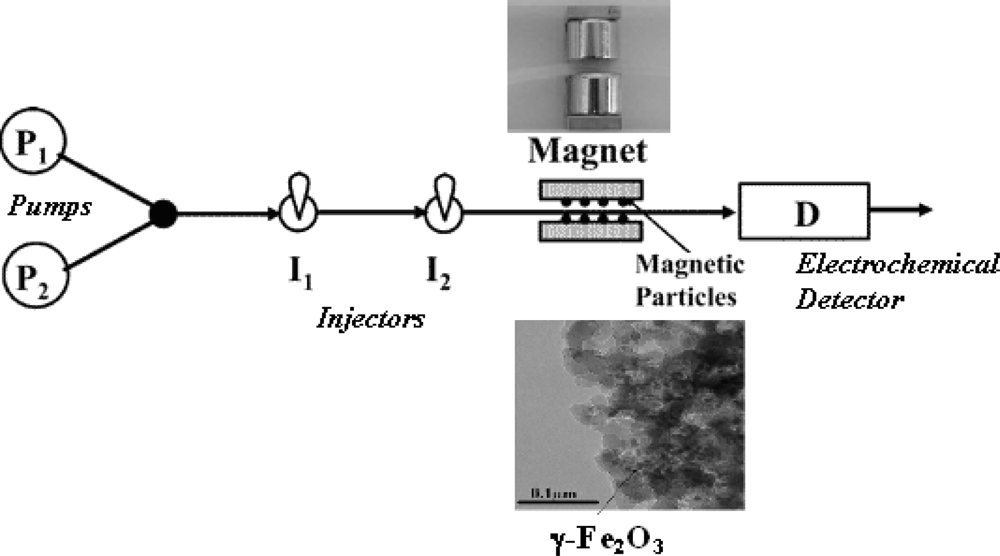
<p>The transducing component is easily renewable and reusable. This is due to the ability to control the charging/discharging of its surface by application of a magnetic field, providing reusability of the same electrode for several analyses. Examples include sensors based on tyrosinase for the detection of phenol [<xref ref-type="bibr" rid="b162-sensors-09-02976">162</xref>], yeast (YADH/NAD<sup>+</sup>) [<xref ref-type="bibr" rid="b164-sensors-09-02976">164</xref>] for the detection of ethanol, GOx for glucose [<xref ref-type="bibr" rid="b163-sensors-09-02976">163</xref>], and AChE for organophosphorus pesticides [<xref ref-type="bibr" rid="b151-sensors-09-02976">151</xref>]. Enzyme-immobilized magnetic beads can be incorporated in a flow injection analysis (FIA) system as described by Kauffmann <italic>et al.</italic> [<xref ref-type="bibr" rid="b161-sensors-09-02976">161</xref>]. <xref ref-type="fig" rid="f2-sensors-09-02976">Figure 2</xref> shows the schematic diagram of a FIA assay for detection of glucose using glucose oxidase modified magnetic microparticles. Functionalized magnetic particles were injected into the FIA system and retained near the detector using a pair of two small permanent magnets. An amperometric system for the detection of glucose with glucose oxidase immobilized onto the magnetic particles was developed based on this principle. The porous biomagnetic particles were ferromagnetic spinnel type iron oxide (γ-Fe<sub>2</sub>O<sub>3</sub>) with the GOx immobilized after silanization with aminopropyltrietoxysilane followed by covalent binding using GA.</p></sec>
<sec>
<label>5.2.</label>
<title>Immunosensors</title>
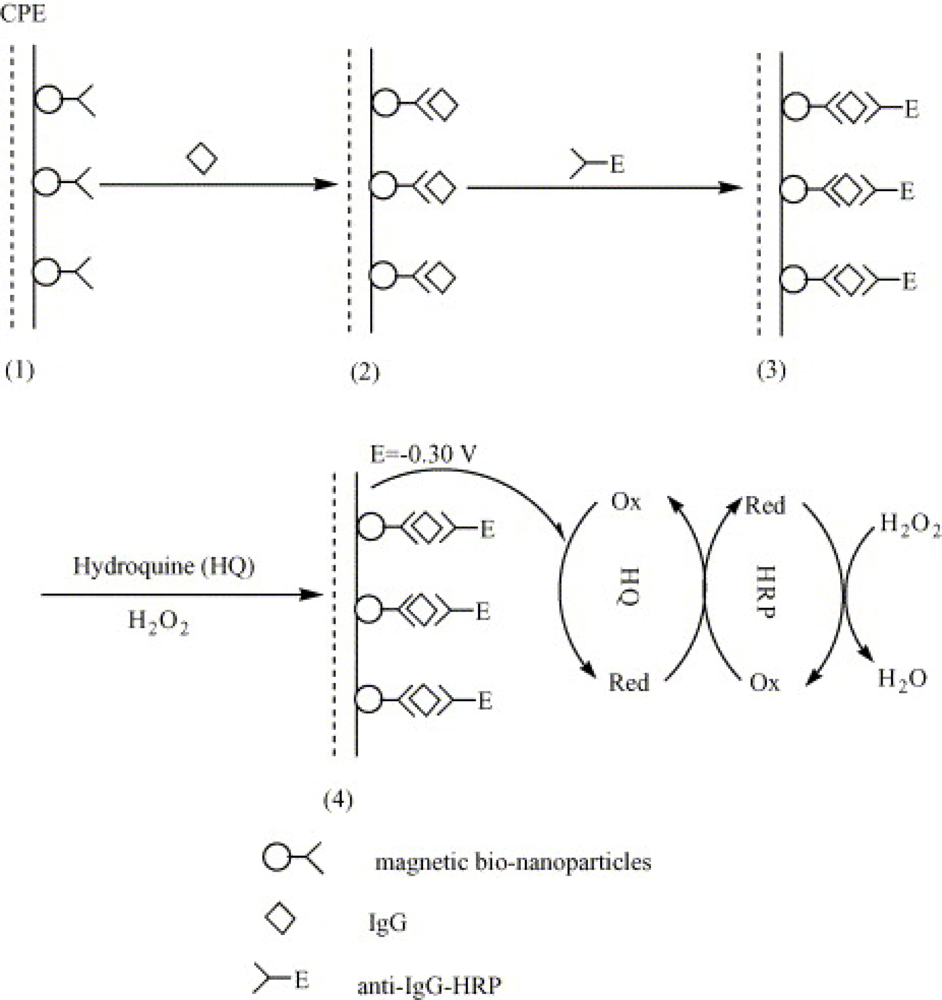
<p>Magnetic particles functionalized with specific antibodies (Ab) have been used for the design of immunomagnetic sensors through the immobilization of the Ab-NPs assembly on the surface of an electrochemical transducer [<xref ref-type="bibr" rid="b3-sensors-09-02976">3</xref>,<xref ref-type="bibr" rid="b165-sensors-09-02976">165</xref>–<xref ref-type="bibr" rid="b167-sensors-09-02976">167</xref>]. For these types of immunosensors, the immunomagnetic complex is magnetically attached to the surface of the screen printed electrode. The utilization of Ab-coated magnetic particles is efficient in overcoming the need of regeneration of the sensing surface and makes possible integration into automatic systems, difficult to achieve otherwise due to the obstacles in renewing the sensing surface. The immunocomplex is usually quantified through the use of enzyme labels, with the electrochemical detection of the enzyme reaction product after the complex is exposed to the enzymatic substrate, or through a fluorescent label followed by fluorescence detection. An example of amperometric immunosensing assay obtained by immobilizing the antibody onto a solid carbon paste electrode using core-shell magnetic NPs is shown in <xref ref-type="fig" rid="f3-sensors-09-02976">Figure 3</xref> [<xref ref-type="bibr" rid="b167-sensors-09-02976">167</xref>].</p>
<p>Different analytes were detected using this method, such as: rabbit IgG [<xref ref-type="bibr" rid="b168-sensors-09-02976">168</xref>–<xref ref-type="bibr" rid="b170-sensors-09-02976">170</xref>], non-pathogenic <italic>E. coli</italic> O157 [<xref ref-type="bibr" rid="b171-sensors-09-02976">171</xref>], polychlorinated biphenyls (PCBs), the herbicide 2,4-D, atrazine [<xref ref-type="bibr" rid="b171-sensors-09-02976">171</xref>–<xref ref-type="bibr" rid="b175-sensors-09-02976">175</xref>] pesticides and bacterial pathogens [<xref ref-type="bibr" rid="b176-sensors-09-02976">176</xref>,<xref ref-type="bibr" rid="b177-sensors-09-02976">177</xref>]. For example, streptavidin activated magnetic microbeads were used for the immobilization of an antibody for atrazine, a small pesticide molecule, allowing for the determination of its concentration in biological samples, with a detection limit of 0.027 nmol L<sup>−1</sup> [<xref ref-type="bibr" rid="b173-sensors-09-02976">173</xref>]. In another work, immunomagnetic separation coupled with differential pulse voltammetry allowed detection of Arochlor 1248 PCB mixture with a detection limit of 0.4 ng/mL using screen-printed three electrode strips [<xref ref-type="bibr" rid="b178-sensors-09-02976">178</xref>]. Other immunosensors with renewable electrode surface were reported for the detection of pathogens such as <italic>Salmonella Typhimurium</italic> [<xref ref-type="bibr" rid="b176-sensors-09-02976">176</xref>,<xref ref-type="bibr" rid="b177-sensors-09-02976">177</xref>]. Another interesting application of immunomagnetic NPs was for selectively concentrating traces of pathogenic bacteria (<italic>Staphyloccocus saprophyticus</italic> and <italic>Staphyloccocus aureus</italic>) via IgGs attached onto the particles surface [<xref ref-type="bibr" rid="b179-sensors-09-02976">179</xref>]. It was found that these IgG-NPs conjugates can bind selectively to the cell membrane. Detection limits of as low as 3 × 10<sup>5</sup> cfu/mL were achieved in aqueous solutions. Other specific examples of monodispersed bio-functional magnetic NPs for protein separation and pathogen detection were discussed recently by Gu <italic>et al.</italic> [<xref ref-type="bibr" rid="b180-sensors-09-02976">180</xref>].</p></sec>
<sec>
<label>5.3.</label>
<title>DNA sensors</title>
<p>DNA sensors with single-stranded (ss) oligodeoxynucleotides immobilized on electrode surfaces [<xref ref-type="bibr" rid="b181-sensors-09-02976">181</xref>–<xref ref-type="bibr" rid="b183-sensors-09-02976">183</xref>] via magnetic beads were also fabricated [<xref ref-type="bibr" rid="b184-sensors-09-02976">184</xref>–<xref ref-type="bibr" rid="b190-sensors-09-02976">190</xref>]. A three layer magnetic NPs structure with a gold surface, silica core and magnetic inner layer was functionalized with DNA and used for quantifying hybridization events [<xref ref-type="bibr" rid="b189-sensors-09-02976">189</xref>]. It was found that upon hybridization with complementary oligonucleotides, this structure forms aggregates in the same way as Au NPs. In another work, surfactant-modified oligonucleotides were incorporated into the particle organic shell to create a DNA functionalized surface [<xref ref-type="bibr" rid="b188-sensors-09-02976">188</xref>]. For example, monodisperse MnFe<sub>2</sub>O<sub>4</sub> magnetic NPs were biofunctionalized with DNA using a combination of alkylphosphonate and ethoxylated fatty alcohols. This method is based on the affinity of alkylphosphonate for metal oxide surfaces. DNA amplification with magnetic primers in combination with electrochemical detection and enzyme labelling was used to develop a genomagnetic assay for detection of food pathogens such as <italic>Salmonella</italic> spp [<xref ref-type="bibr" rid="b190-sensors-09-02976">190</xref>]. The electrode consisted of a graphite epoxy composite and streptavidin modified magnetic beads with immobilized DNA. Loaiza <italic>et al.</italic> [<xref ref-type="bibr" rid="b191-sensors-09-02976">191</xref>] reported a sensitive method for isolation and detection of DNA from bacterial cells using disposable magnetic DNA sensors. Screen-printed gold electrodes with a 4 mm in diameter working electrode surface were used as amperometric transducers in this example.</p>
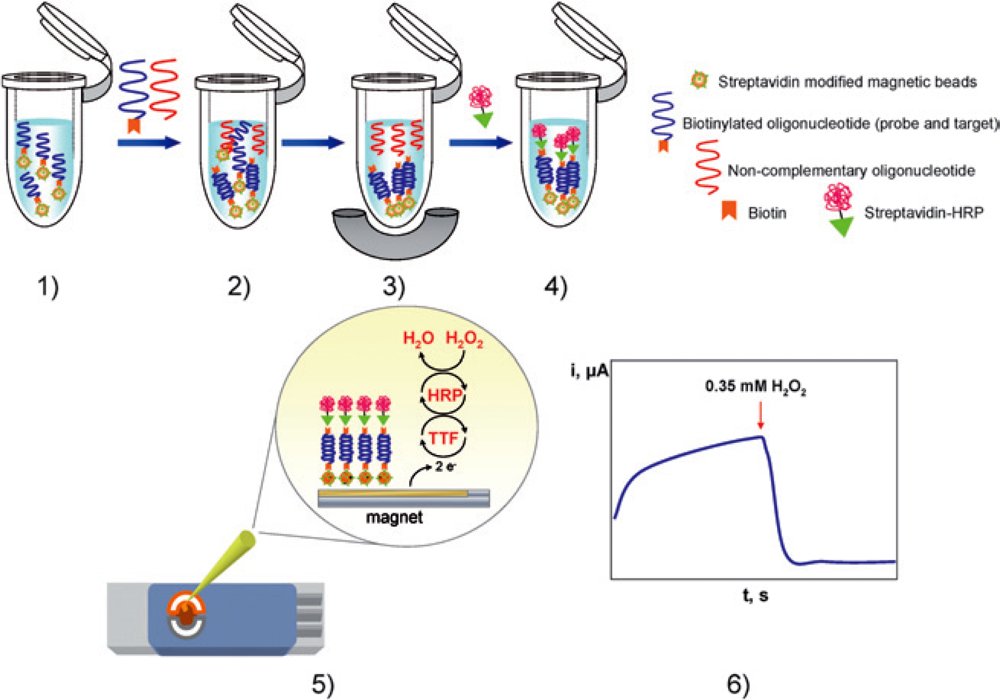
<p><xref ref-type="fig" rid="f4-sensors-09-02976">Figure 4</xref> shows a schematic of the protocol used for enzyme amplification. The magnetic particles were functionalized with streptavidin. A 25-mer capture probe was subsequently attached, followed by the hybridization process. In the next step, streptavidin-peroxidase was attached and the functionalized magnetic particles were attached to the surface of the electrode through a magnet. The sensor was used for the detection of asymmetric DPCR amplified products obtained from <italic>E. coli</italic> bacterial cultures, with high speed, specificity and sensitivity. Another advantage of this method was elimination of false positive results, a drawback of conventional PCR analysis.</p></sec></sec>
<sec sec-type="conclusions">
<label>6.</label>
<title>Conclusions</title>
<p>In this review, we have summarized the most recent developments in the field of biofunctionalized magnetic particles and their applications in bioanalytical sensors. Research in this field has focused mainly on the challenges of creating hybrid composite materials containing biomolecules, magnetic NPs and other inorganic components, and on the development of strategies that can be used to integrate these materials in functional sensing devices. Research in this direction involves scientific aspects of the preparation, structure and properties of magnetic systems and their functionalization with biological materials. This approach is unique in that it combines the high selectivity and specificity of biological processes with the high surface area and magnetic properties of magnetic particles. These properties have been used to provide control and orientation of the biomolecular recognition elements onto transducer surfaces as well as to enhance the response time, selectivity, sensitivity and stability of the sensor. These hybrid systems are the foundation of new generations of materials that could be used in the construction of biosensors, bioreactors, biofuel cells and in other biotechnological applications. The success of these research efforts is still dependent of the transferability of these materials into real life applications. The rapid developments in the field allowing successful fabrication and testing of various sensors designs based on biomagnetic assemblies illustrate the potential of this approach for further applications.</p></sec></body>
<back>
<ack>
<p>This work was supported by grants NSF-DMR-0804506 and NSF-OISE 0727861.</p></ack>
<ref-list>
<title>References</title>
<ref id="b1-sensors-09-02976"><label>1.</label><citation citation-type="journal"><person-group person-group-type="author"><name><surname>Luo</surname><given-names>X.</given-names></name><name><surname>Morrin</surname><given-names>A.</given-names></name><name><surname>Killard</surname><given-names>A.J.</given-names></name><name><surname>Smyth</surname><given-names>M.R.</given-names></name></person-group><article-title>Application of nanoparticles in electrochemical sensors and biosensors</article-title><source>Electroanalysis</source><year>2006</year><volume>18</volume><fpage>319</fpage><lpage>326</lpage><pub-id pub-id-type="doi">10.1002/elan.200503415</pub-id></citation></ref>
<ref id="b2-sensors-09-02976"><label>2.</label><citation citation-type="journal"><person-group person-group-type="author"><name><surname>Khan</surname><given-names>R.</given-names></name><name><surname>Dhayal</surname><given-names>M.</given-names></name></person-group><article-title>Electrochemical studies of novel chitosan/TiO<sub>2</sub> bioactive electrode for biosensing application</article-title><source>Electrochem. Comm</source><year>2008</year><volume>10</volume><fpage>263</fpage><lpage>267</lpage><pub-id pub-id-type="doi">10.1016/j.elecom.2007.12.001</pub-id></citation></ref>
<ref id="b3-sensors-09-02976"><label>3.</label><citation citation-type="journal"><person-group person-group-type="author"><name><surname>Corti</surname><given-names>M.</given-names></name><name><surname>Lascialfari</surname><given-names>A.</given-names></name><name><surname>Micotti</surname><given-names>E.</given-names></name><name><surname>Castellano</surname><given-names>A.</given-names></name><name><surname>Donativi</surname><given-names>M.</given-names></name><name><surname>Quarta</surname><given-names>A.</given-names></name><name><surname>Cozzoli</surname><given-names>P.D.</given-names></name><name><surname>Manna</surname><given-names>L.</given-names></name><name><surname>Pellegrino</surname><given-names>T.</given-names></name><name><surname>Sangregorio</surname><given-names>C.</given-names></name></person-group><article-title>Magnetic properties of novel superparamagnetic MRI contrast agents based on colloidal nanocrystals</article-title><source>J. Magn.Magn. Mater</source><year>2008</year><volume>320</volume><fpage>E320</fpage><lpage>E323</lpage><pub-id pub-id-type="doi">10.1016/j.jmmm.2008.02.064</pub-id></citation></ref>
<ref id="b4-sensors-09-02976"><label>4.</label><citation citation-type="journal"><person-group person-group-type="author"><name><surname>Jun</surname><given-names>Y.W.</given-names></name><name><surname>Huh</surname><given-names>Y.M.</given-names></name><name><surname>Choi</surname><given-names>J.S.</given-names></name><name><surname>Song</surname><given-names>H.T.</given-names></name><name><surname>Kim</surname><given-names>S.</given-names></name><name><surname>Yoon</surname><given-names>S.</given-names></name><name><surname>Kim</surname><given-names>K.S.</given-names></name><name><surname>Shin</surname><given-names>J.S.</given-names></name><name><surname>Suh</surname><given-names>J.S.</given-names></name><name><surname>Cheon</surname><given-names>J.</given-names></name></person-group><article-title>Nanoscale size effect of magnetic nanocrystals and their utilization for cancer diagnosis via magnetic resonance imaging</article-title><source>J. Am. Chem. Soc</source><year>2005</year><volume>127</volume><fpage>5732</fpage><lpage>5733</lpage><pub-id pub-id-type="doi">10.1021/ja0422155</pub-id><pub-id pub-id-type="pmid">15839639</pub-id></citation></ref>
<ref id="b5-sensors-09-02976"><label>5.</label><citation citation-type="journal"><person-group person-group-type="author"><name><surname>Song</surname><given-names>H.T.</given-names></name><name><surname>Choi</surname><given-names>J.S.</given-names></name><name><surname>Huh</surname><given-names>Y.M.</given-names></name><name><surname>Kim</surname><given-names>S.</given-names></name><name><surname>Jun</surname><given-names>Y.W.</given-names></name><name><surname>Suh</surname><given-names>J.S.</given-names></name><name><surname>Cheon</surname><given-names>J.</given-names></name></person-group><article-title>Surface Modulation of Magnetic Nanocrystals in the Development of highly efficient magnetic resonance probes for intracellular labeling</article-title><source>J. Am. Chem. Soc</source><year>2005</year><volume>127</volume><fpage>9992</fpage><lpage>9993</lpage><pub-id pub-id-type="doi">10.1021/ja051833y</pub-id><pub-id pub-id-type="pmid">16011350</pub-id></citation></ref>
<ref id="b6-sensors-09-02976"><label>6.</label><citation citation-type="journal"><person-group person-group-type="author"><name><surname>Hanessian</surname><given-names>S.</given-names></name><name><surname>Grzyb</surname><given-names>J.A.</given-names></name><name><surname>Cengelli</surname><given-names>F.</given-names></name><name><surname>Juillerat-Jeanneret</surname><given-names>L.</given-names></name></person-group><article-title>Synthesis of chemically functionalized superparamagnetic nanoparticles as delivery vectors for chemotherapeutic drugs</article-title><source>Bioorgan. Med. Chem</source><year>2008</year><volume>16</volume><fpage>2921</fpage><lpage>2931</lpage><pub-id pub-id-type="doi">10.1016/j.bmc.2007.12.051</pub-id></citation></ref>
<ref id="b7-sensors-09-02976"><label>7.</label><citation citation-type="journal"><person-group person-group-type="author"><name><surname>Liu</surname><given-names>T.Y.</given-names></name><name><surname>Hu</surname><given-names>S.H.</given-names></name><name><surname>Liu</surname><given-names>K.H.</given-names></name><name><surname>Liu</surname><given-names>D.M.</given-names></name><name><surname>Chen</surname><given-names>S.Y.</given-names></name></person-group><article-title>Study on controlled drug permeation of magnetic-sensitive ferrogels: Effect of Fe3O4 and PVA</article-title><source>J. Control. Rel</source><year>2008</year><volume>126</volume><fpage>228</fpage><lpage>236</lpage><pub-id pub-id-type="doi">10.1016/j.jconrel.2007.12.006</pub-id></citation></ref>
<ref id="b8-sensors-09-02976"><label>8.</label><citation citation-type="journal"><person-group person-group-type="author"><name><surname>Chen</surname><given-names>F.H.</given-names></name><name><surname>Gao</surname><given-names>Q.</given-names></name><name><surname>Ni</surname><given-names>J.Z.</given-names></name></person-group><article-title>The grafting and release behavior of doxorubincin from Fe<sub>3</sub>O<sub>4</sub>@SiO<sub>2</sub> core–shell structure nanoparticles via an acid cleaving amide bond: the potential for magnetic targeting drug delivery</article-title><source>Nanotechnology</source><year>2008</year><volume>19</volume><fpage>165103</fpage><lpage>165111</lpage><pub-id pub-id-type="doi">10.1088/0957-4484/19/16/165103</pub-id><pub-id pub-id-type="pmid">21825634</pub-id></citation></ref>
<ref id="b9-sensors-09-02976"><label>9.</label><citation citation-type="journal"><person-group person-group-type="author"><name><surname>Wu</surname><given-names>S.H.</given-names></name><name><surname>Lin</surname><given-names>Y.S.</given-names></name><name><surname>Hung</surname><given-names>Y.</given-names></name><name><surname>Chou</surname><given-names>Y.H.</given-names></name><name><surname>Hsu</surname><given-names>Y.H.</given-names></name><name><surname>Chang</surname><given-names>C.</given-names></name><name><surname>Mou</surname><given-names>C.Y.</given-names></name></person-group><article-title>Multifunctional mesoporous silica nanoparticles for intracellular labeling and animal magnetic resonance imaging studies</article-title><source>Chembiochem</source><year>2008</year><volume>9</volume><fpage>53</fpage><lpage>57</lpage><pub-id pub-id-type="doi">10.1002/cbic.200700509</pub-id><pub-id pub-id-type="pmid">17999392</pub-id></citation></ref>
<ref id="b10-sensors-09-02976"><label>10.</label><citation citation-type="journal"><person-group person-group-type="author"><name><surname>Safarik</surname><given-names>I.</given-names></name><name><surname>Safarikova</surname><given-names>M.</given-names></name></person-group><article-title>Magnetic nanoparticles and biosciences</article-title><source>Monatsh. Chem</source><year>2002</year><volume>133</volume><fpage>737</fpage><lpage>759</lpage><pub-id pub-id-type="doi">10.1007/s007060200047</pub-id></citation></ref>
<ref id="b11-sensors-09-02976"><label>11.</label><citation citation-type="journal"><person-group person-group-type="author"><name><surname>Li</surname><given-names>Y.F.</given-names></name><name><surname>Liu</surname><given-names>Z.M.</given-names></name><name><surname>Liu</surname><given-names>Y.Y.</given-names></name><name><surname>Yang</surname><given-names>Y.H.</given-names></name><name><surname>Shen</surname><given-names>G.L.</given-names></name><name><surname>Yu</surname><given-names>R.Q.</given-names></name></person-group><article-title>A mediator-free phenol biosensor based on immobilizing tyrosinase to ZnO nanoparticles</article-title><source>Anal. Biochem</source><year>2006</year><volume>349</volume><fpage>33</fpage><lpage>40</lpage><pub-id pub-id-type="doi">10.1016/j.ab.2005.11.017</pub-id><pub-id pub-id-type="pmid">16384546</pub-id></citation></ref>
<ref id="b12-sensors-09-02976"><label>12.</label><citation citation-type="journal"><person-group person-group-type="author"><name><surname>Insin</surname><given-names>N.</given-names></name><name><surname>Tracy</surname><given-names>J.B.</given-names></name><name><surname>Lee</surname><given-names>H.</given-names></name><name><surname>Zimmer</surname><given-names>J.P.</given-names></name><name><surname>Westervelt</surname><given-names>R.M.</given-names></name><name><surname>Bawendi</surname><given-names>M.G.</given-names></name></person-group><article-title>Incorporation of iron oxide nanoparticles and quantum dots into silica microspheres</article-title><source>ACS Nano</source><year>2008</year><volume>2</volume><fpage>197</fpage><lpage>202</lpage><pub-id pub-id-type="doi">10.1021/nn700344x</pub-id><pub-id pub-id-type="pmid">19206619</pub-id></citation></ref>
<ref id="b13-sensors-09-02976"><label>13.</label><citation citation-type="journal"><person-group person-group-type="author"><name><surname>Salimi</surname><given-names>A.</given-names></name><name><surname>Hallaj</surname><given-names>R.</given-names></name><name><surname>Soltanian</surname><given-names>S.</given-names></name><name><surname>Mamkhezri</surname><given-names>H.</given-names></name></person-group><article-title>Nanomolar detection of hydrogen peroxide on glassy carbon electrode modified with electrodeposited cobalt oxide nanoparticles</article-title><source>Anal. Chim. Acta</source><year>2007</year><volume>594</volume><fpage>24</fpage><lpage>31</lpage><pub-id pub-id-type="doi">10.1016/j.aca.2007.05.010</pub-id><pub-id pub-id-type="pmid">17560381</pub-id></citation></ref>
<ref id="b14-sensors-09-02976"><label>14.</label><citation citation-type="journal"><person-group person-group-type="author"><name><surname>Hrbac</surname><given-names>J.</given-names></name><name><surname>Halouzka</surname><given-names>V.</given-names></name><name><surname>Zboril</surname><given-names>R.</given-names></name><name><surname>Papadopoulos</surname><given-names>K.</given-names></name><name><surname>Triantis</surname><given-names>T.</given-names></name></person-group><article-title>Carbon electrodes modified by nanoscopic iron(III) oxides to assemble chemical sensors for the hydrogen peroxide amperometric detection</article-title><source>Electroanalysis</source><year>2007</year><volume>19</volume><fpage>1850</fpage><lpage>1854</lpage><pub-id pub-id-type="doi">10.1002/elan.200703938</pub-id></citation></ref>
<ref id="b15-sensors-09-02976"><label>15.</label><citation citation-type="journal"><person-group person-group-type="author"><name><surname>Schachl</surname><given-names>K.</given-names></name><name><surname>Alemu</surname><given-names>H.</given-names></name><name><surname>Kalcher</surname><given-names>K.</given-names></name><name><surname>Jezkova</surname><given-names>J.</given-names></name><name><surname>Svancara</surname><given-names>I.</given-names></name><name><surname>Vytras</surname><given-names>K.</given-names></name></person-group><article-title>Amperometric determination of hydrogen peroxide with a manganese dioxide-modified carbon paste electrode using flow injection analysis</article-title><source>Analyst</source><year>1997</year><volume>122</volume><fpage>985</fpage><lpage>989</lpage><pub-id pub-id-type="doi">10.1039/a701723e</pub-id></citation></ref>
<ref id="b16-sensors-09-02976"><label>16.</label><citation citation-type="journal"><person-group person-group-type="author"><name><surname>Yao</surname><given-names>S.</given-names></name><name><surname>Xu</surname><given-names>J.</given-names></name><name><surname>Wang</surname><given-names>Y.</given-names></name><name><surname>Chen</surname><given-names>X.</given-names></name><name><surname>Xu</surname><given-names>Y.</given-names></name><name><surname>Hu</surname><given-names>S.</given-names></name></person-group><article-title>A highly sensitive hydrogen peroxide amperometric sensor based on MnO<sub>2</sub> nanoparticles and dihexadecyl hydrogen phosphate composite film</article-title><source>Anal. Chim. Acta</source><year>2006</year><volume>557</volume><fpage>78</fpage><lpage>84</lpage><pub-id pub-id-type="doi">10.1016/j.aca.2005.10.052</pub-id></citation></ref>
<ref id="b17-sensors-09-02976"><label>17.</label><citation citation-type="journal"><person-group person-group-type="author"><name><surname>Hermanek</surname><given-names>M.</given-names></name><name><surname>Zboril</surname><given-names>R.</given-names></name><name><surname>Medrik</surname><given-names>I.</given-names></name><name><surname>Pechousek</surname><given-names>J.</given-names></name><name><surname>Gregor</surname><given-names>C.</given-names></name></person-group><article-title>Catalytic efficiency of iron(III) oxides in decomposition of hydrogen peroxide: competition between the surface area and crystallinity of nanoparticles</article-title><source>J. Am. Chem. Soc</source><year>2007</year><volume>129</volume><fpage>10929</fpage><lpage>10936</lpage><pub-id pub-id-type="doi">10.1021/ja072918x</pub-id><pub-id pub-id-type="pmid">17691785</pub-id></citation></ref>
<ref id="b18-sensors-09-02976"><label>18.</label><citation citation-type="journal"><person-group person-group-type="author"><name><surname>Sljukic</surname><given-names>B.</given-names></name><name><surname>Banks</surname><given-names>C.E.</given-names></name><name><surname>Compton</surname><given-names>R.G.</given-names></name></person-group><article-title>Iron oxide particles are the active sites for hydrogen peroxide sensing at multiwalled carbon nanotube modified electrodes</article-title><source>Nano Lett</source><year>2006</year><volume>6</volume><fpage>1556</fpage><lpage>1558</lpage><pub-id pub-id-type="doi">10.1021/nl060366v</pub-id><pub-id pub-id-type="pmid">16834449</pub-id></citation></ref>
<ref id="b19-sensors-09-02976"><label>19.</label><citation citation-type="journal"><person-group person-group-type="author"><name><surname>Wang</surname><given-names>J.</given-names></name><name><surname>Scampicchio</surname><given-names>M.</given-names></name><name><surname>Laocharoensuk</surname><given-names>R.</given-names></name><name><surname>Valentini</surname><given-names>F.</given-names></name><name><surname>Gonzalez-Garcia</surname><given-names>O.</given-names></name><name><surname>Burdick</surname><given-names>J.</given-names></name></person-group><article-title>Magnetic tuning of the electrochemical reactivity through controlled surface orientation of catalytic nanowires</article-title><source>J. Am. Chem. Soc</source><year>2006</year><volume>128</volume><fpage>4562</fpage><lpage>4563</lpage><pub-id pub-id-type="doi">10.1021/ja061070u</pub-id><pub-id pub-id-type="pmid">16594679</pub-id></citation></ref>
<ref id="b20-sensors-09-02976"><label>20.</label><citation citation-type="journal"><person-group person-group-type="author"><name><surname>Wang</surname><given-names>J.</given-names></name><name><surname>Musameh</surname><given-names>M.</given-names></name><name><surname>Laocharoensuk</surname><given-names>R.</given-names></name></person-group><article-title>Magnetic catalytic nickel particles for on-demand control of electrocatalytic processes</article-title><source>Electrochem. Comm</source><year>2005</year><volume>7</volume><fpage>652</fpage><lpage>656</lpage><pub-id pub-id-type="doi">10.1016/j.elecom.2005.04.013</pub-id></citation></ref>
<ref id="b21-sensors-09-02976"><label>21.</label><citation citation-type="journal"><person-group person-group-type="author"><name><surname>Katz</surname><given-names>E.</given-names></name><name><surname>Willner</surname><given-names>I.</given-names></name></person-group><article-title>Magneto-stimulated hydrodynamic control of electrocatalytic and bioelectrocatalytic processes</article-title><source>J. Am. Chem. Soc</source><year>2004</year><volume>124</volume><fpage>10290</fpage><lpage>10291</lpage></citation></ref>
<ref id="b22-sensors-09-02976"><label>22.</label><citation citation-type="journal"><person-group person-group-type="author"><name><surname>Yin</surname><given-names>Y.</given-names></name><name><surname>Alivisatos</surname><given-names>A.P.</given-names></name></person-group><article-title>Colloidal nanocrystal synthesis and the organic−inorganic interface</article-title><source>Nature</source><year>2005</year><volume>437</volume><fpage>664</fpage><lpage>670</lpage><pub-id pub-id-type="doi">10.1038/nature04165</pub-id><pub-id pub-id-type="pmid">16193041</pub-id></citation></ref>
<ref id="b23-sensors-09-02976"><label>23.</label><citation citation-type="journal"><person-group person-group-type="author"><name><surname>Park</surname><given-names>H.Y.</given-names></name><name><surname>Schadt</surname><given-names>M.J.</given-names></name><name><surname>Wang</surname><given-names>L.</given-names></name><name><surname>Lim</surname><given-names>I.I.S.</given-names></name><name><surname>Njoaki</surname><given-names>P.N.</given-names></name><name><surname>Kim</surname><given-names>S.H.</given-names></name><name><surname>Jang</surname><given-names>M.J.</given-names></name><name><surname>Luo</surname><given-names>J.</given-names></name><name><surname>Zhong</surname><given-names>C.J.</given-names></name></person-group><article-title>Fabrication of magnetic core@shell Fe oxide@Au nanoparticles for interfacial bioactivity and bio-separation</article-title><source>Langmuir</source><year>2007</year><volume>23</volume><fpage>9050</fpage><lpage>9056</lpage><pub-id pub-id-type="doi">10.1021/la701305f</pub-id><pub-id pub-id-type="pmid">17629315</pub-id></citation></ref>
<ref id="b24-sensors-09-02976"><label>24.</label><citation citation-type="journal"><person-group person-group-type="author"><name><surname>Toderas</surname><given-names>F.</given-names></name><name><surname>Baia</surname><given-names>M.</given-names></name><name><surname>Maniu</surname><given-names>D.</given-names></name><name><surname>Astilean</surname><given-names>S.</given-names></name></person-group><article-title>Tuning the plasmon resonances of gold nanoparticles by controlling their size and shape</article-title><source>J. Optoelectron. Adv. M</source><year>2008</year><volume>10</volume><fpage>2282</fpage><lpage>2284</lpage></citation></ref>
<ref id="b25-sensors-09-02976"><label>25.</label><citation citation-type="journal"><person-group person-group-type="author"><name><surname>Wei</surname><given-names>Y.</given-names></name><name><surname>Klajn</surname><given-names>R.</given-names></name><name><surname>Pinchuk</surname><given-names>A.O.</given-names></name><name><surname>Grzybowski</surname><given-names>B.A.</given-names></name></person-group><article-title>Synthesis, shape control, and optical properties of hybrid Au/Fe<sub>3</sub>O<sub>4</sub> “nanoflowers”</article-title><source>Small</source><year>2008</year><volume>4</volume><fpage>1635</fpage><lpage>1639</lpage><pub-id pub-id-type="doi">10.1002/smll.200800511</pub-id><pub-id pub-id-type="pmid">18636405</pub-id></citation></ref>
<ref id="b26-sensors-09-02976"><label>26.</label><citation citation-type="journal"><person-group person-group-type="author"><name><surname>Hickey</surname><given-names>S.G.</given-names></name><name><surname>Waurisch</surname><given-names>C.</given-names></name><name><surname>Rellinghaus</surname><given-names>B.</given-names></name><name><surname>Eychmuller</surname><given-names>A.</given-names></name></person-group><article-title>Size and shape control of colloidally synthesized IV–VI nanoparticulate tin(II) sulfide</article-title><source>J. Am. Chem. Soc</source><year>2008</year><volume>130</volume><fpage>14978</fpage><lpage>14980</lpage><pub-id pub-id-type="doi">10.1021/ja8048755</pub-id><pub-id pub-id-type="pmid">18922001</pub-id></citation></ref>
<ref id="b27-sensors-09-02976"><label>27.</label><citation citation-type="journal"><person-group person-group-type="author"><name><surname>Piccolo</surname><given-names>L.</given-names></name><name><surname>Valcarcel</surname><given-names>A.</given-names></name><name><surname>Bausach</surname><given-names>M.</given-names></name><name><surname>Thomazeau</surname><given-names>C.</given-names></name><name><surname>Uzio</surname><given-names>D.</given-names></name><name><surname>Berhault</surname><given-names>G.</given-names></name></person-group><article-title>Tuning the shape of nanoparticles to control their catalytic properties: selective hydrogenation of 1,3-butadiene on Pd/Al<sub>2</sub>O<sub>3</sub></article-title><source>Phys. Chem. Chem. Phys</source><year>2008</year><volume>10</volume><fpage>5504</fpage><lpage>5506</lpage><pub-id pub-id-type="doi">10.1039/b809651a</pub-id><pub-id pub-id-type="pmid">18956083</pub-id></citation></ref>
<ref id="b28-sensors-09-02976"><label>28.</label><citation citation-type="journal"><person-group person-group-type="author"><name><surname>Zhang</surname><given-names>Z.</given-names></name><name><surname>Wong</surname><given-names>L.M.</given-names></name><name><surname>Ong</surname><given-names>H.G.</given-names></name><name><surname>Wang</surname><given-names>X.J.</given-names></name><name><surname>Wang</surname><given-names>J.L.</given-names></name><name><surname>Wang</surname><given-names>S.J.</given-names></name><name><surname>Chen</surname><given-names>H.</given-names></name><name><surname>Wu</surname><given-names>T.</given-names></name></person-group><article-title>Self-assembled shape - and orientation- controlled synthesis of nanoscale Cu<sub>3</sub>Si triangles, squares, and wires</article-title><source>Nano Lett</source><year>2008</year><volume>8</volume><fpage>3205</fpage><lpage>3210</lpage><pub-id pub-id-type="doi">10.1021/nl8015208</pub-id><pub-id pub-id-type="pmid">18763831</pub-id></citation></ref>
<ref id="b29-sensors-09-02976"><label>29.</label><citation citation-type="journal"><person-group person-group-type="author"><name><surname>Grzelczak</surname><given-names>M.</given-names></name><name><surname>Perez-Juste</surname><given-names>J.</given-names></name><name><surname>Mulvaney</surname><given-names>P.</given-names></name><name><surname>Liz-Marzan</surname><given-names>L.M.</given-names></name></person-group><article-title>Shape control in gold nanoparticle synthesis</article-title><source>Chem. Soc. Rev</source><year>2008</year><volume>37</volume><fpage>1783</fpage><lpage>1791</lpage><pub-id pub-id-type="doi">10.1039/b711490g</pub-id><pub-id pub-id-type="pmid">18762828</pub-id></citation></ref>
<ref id="b30-sensors-09-02976"><label>30.</label><citation citation-type="journal"><person-group person-group-type="author"><name><surname>Hachisu</surname><given-names>T.</given-names></name><name><surname>Yotsumoto</surname><given-names>T.</given-names></name><name><surname>Sugiyama</surname><given-names>A.</given-names></name><name><surname>Iida</surname><given-names>H.</given-names></name><name><surname>Nakanishi</surname><given-names>T.</given-names></name><name><surname>Asahi</surname><given-names>T.</given-names></name><name><surname>Osaka</surname><given-names>T.</given-names></name></person-group><article-title>Effect of growth temperature on the shape and crystallinity of chemically produced Fe-Pt nanoparticles</article-title><source>Chem. Lett</source><year>2008</year><volume>37</volume><fpage>840</fpage><lpage>841</lpage><pub-id pub-id-type="doi">10.1246/cl.2008.840</pub-id></citation></ref>
<ref id="b31-sensors-09-02976"><label>31.</label><citation citation-type="journal"><person-group person-group-type="author"><name><surname>Vassilieff</surname><given-names>T.</given-names></name><name><surname>Sutton</surname><given-names>A.</given-names></name><name><surname>Kakkar</surname><given-names>A.K.</given-names></name></person-group><article-title>Shape control in silver metal nanoparticle construction using dumb-bell dendrimers</article-title><source>J. Mater. Chem</source><year>2008</year><volume>18</volume><fpage>4031</fpage><lpage>4033</lpage><pub-id pub-id-type="doi">10.1039/b810318f</pub-id></citation></ref>
<ref id="b32-sensors-09-02976"><label>32.</label><citation citation-type="journal"><person-group person-group-type="author"><name><surname>Kim</surname><given-names>M.H.</given-names></name><name><surname>Lim</surname><given-names>B.</given-names></name><name><surname>Lee</surname><given-names>E.P.</given-names></name><name><surname>Xia</surname><given-names>Y.</given-names></name></person-group><article-title>Polyol synthesis of Cu<sub>2</sub>O nanoparticles: use of chloride to promote the formation of a cubic morphology</article-title><source>J. Mater. Chem</source><year>2008</year><volume>18</volume><fpage>4069</fpage><lpage>4073</lpage><pub-id pub-id-type="doi">10.1039/b805913f</pub-id></citation></ref>
<ref id="b33-sensors-09-02976"><label>33.</label><citation citation-type="journal"><person-group person-group-type="author"><name><surname>Somorjai</surname><given-names>G.A.</given-names></name><name><surname>Park</surname><given-names>J.Y.</given-names></name></person-group><article-title>Colloid science of metal nanoparticle catalysts in 2D and 3D structures. challenges of nucleation, growth, composition, particle shape, size control and their influence on activity and selectivity</article-title><source>Top. Catal</source><year>2008</year><volume>49</volume><fpage>126</fpage><lpage>135</lpage><pub-id pub-id-type="doi">10.1007/s11244-008-9077-0</pub-id></citation></ref>
<ref id="b34-sensors-09-02976"><label>34.</label><citation citation-type="journal"><person-group person-group-type="author"><name><surname>Hofmann</surname><given-names>C.</given-names></name><name><surname>Rusakova</surname><given-names>I.</given-names></name><name><surname>Ould-Ely</surname><given-names>T.</given-names></name><name><surname>Prieto-Centurion</surname><given-names>D.</given-names></name><name><surname>Hartman</surname><given-names>K.B.</given-names></name><name><surname>Kelly</surname><given-names>A.T.</given-names></name><name><surname>Luttge</surname><given-names>A.</given-names></name><name><surname>Whitmire</surname><given-names>K.H.</given-names></name></person-group><article-title>Shape control of new Fe<sub>x</sub>O-Fe<sub>3</sub>O<sub>4</sub> and Fe1-yMnyO-Fe<sub>3</sub>-zMn<sub>z</sub>O<sub>4</sub> nanostructures</article-title><source>Adv. Funct. Mater</source><year>2008</year><volume>18</volume><fpage>1661</fpage><lpage>1667</lpage><pub-id pub-id-type="doi">10.1002/adfm.200701119</pub-id></citation></ref>
<ref id="b35-sensors-09-02976"><label>35.</label><citation citation-type="journal"><person-group person-group-type="author"><name><surname>Susut</surname><given-names>C.</given-names></name><name><surname>Nguyen</surname><given-names>T.D.</given-names></name><name><surname>Chapman</surname><given-names>G.B.</given-names></name><name><surname>Tong</surname><given-names>Y.</given-names></name></person-group><article-title>Shape and size stability of Pt nanoparticles for MeOH electro-oxidation</article-title><source>Electrochim. Acta</source><year>2008</year><volume>53</volume><fpage>6135</fpage><lpage>6142</lpage><pub-id pub-id-type="doi">10.1016/j.electacta.2007.12.016</pub-id></citation></ref>
<ref id="b36-sensors-09-02976"><label>36.</label><citation citation-type="journal"><person-group person-group-type="author"><name><surname>Chou</surname><given-names>N.H.</given-names></name><name><surname>Ke</surname><given-names>X.</given-names></name><name><surname>Schiffer</surname><given-names>P.</given-names></name><name><surname>Schaak</surname><given-names>R.E.</given-names></name></person-group><article-title>Room-temperature chemical synthesis of shape-controlled indium nanoparticles</article-title><source>J. Am. Chem. Soc</source><year>2008</year><volume>130</volume><fpage>8140</fpage><lpage>8141</lpage><pub-id pub-id-type="doi">10.1021/ja801949c</pub-id><pub-id pub-id-type="pmid">18540599</pub-id></citation></ref>
<ref id="b37-sensors-09-02976"><label>37.</label><citation citation-type="journal"><person-group person-group-type="author"><name><surname>Kilin</surname><given-names>D.S.</given-names></name><name><surname>Prezhdo</surname><given-names>O.V.</given-names></name><name><surname>Xia</surname><given-names>Y.</given-names></name></person-group><article-title>Shape - controlled synthesis of silver nanoparticles: Ab initio study of preferential surface coordination with citric acid</article-title><source>Chem. Phys. Lett</source><year>2008</year><volume>458</volume><fpage>113</fpage><lpage>116</lpage><pub-id pub-id-type="doi">10.1016/j.cplett.2008.04.046</pub-id></citation></ref>
<ref id="b38-sensors-09-02976"><label>38.</label><citation citation-type="journal"><person-group person-group-type="author"><name><surname>Scholes</surname><given-names>G.D.</given-names></name></person-group><article-title>Controlling the optical properties of inorganic nanoparticles</article-title><source>Adv. Funct. Mater</source><year>2008</year><volume>18</volume><fpage>1157</fpage><lpage>1172</lpage><pub-id pub-id-type="doi">10.1002/adfm.200800151</pub-id></citation></ref>
<ref id="b39-sensors-09-02976"><label>39.</label><citation citation-type="journal"><person-group person-group-type="author"><name><surname>Majewski</surname><given-names>P.</given-names></name><name><surname>Thierry</surname><given-names>B.</given-names></name></person-group><article-title>Superparamagnetic magnetite (Fe<sub>3</sub>O<sub>4</sub>) nanoparticles for bio-applications</article-title><source>Recent Pat. Mater. Sci</source><year>2008</year><volume>1</volume><fpage>116</fpage><lpage>127</lpage><pub-id pub-id-type="doi">10.2174/1874464810801020116</pub-id></citation></ref>
<ref id="b40-sensors-09-02976"><label>40.</label><citation citation-type="journal"><person-group person-group-type="author"><name><surname>Burda</surname><given-names>C.</given-names></name><name><surname>Chen</surname><given-names>X.B.</given-names></name><name><surname>Narayanan</surname><given-names>R.</given-names></name><name><surname>El-Sayed</surname><given-names>M.A.</given-names></name></person-group><article-title>Chemistry and properties of nanocrystals of different shapes</article-title><source>Chem. Rev</source><year>2005</year><volume>105</volume><fpage>1025</fpage><lpage>1102</lpage><pub-id pub-id-type="doi">10.1021/cr030063a</pub-id><pub-id pub-id-type="pmid">15826010</pub-id></citation></ref>
<ref id="b41-sensors-09-02976"><label>41.</label><citation citation-type="journal"><person-group person-group-type="author"><name><surname>Taborda</surname><given-names>A.</given-names></name><name><surname>Carvalho</surname><given-names>A.</given-names></name></person-group><article-title>Superparamagnetic iron oxide nanoparticles - proton nuclear magnetic resonance dispersion curves</article-title><source>Eur. Phys. J. Appl. Phys</source><year>2008</year><volume>43</volume><fpage>145</fpage><lpage>148</lpage><pub-id pub-id-type="doi">10.1051/epjap:2008095</pub-id></citation></ref>
<ref id="b42-sensors-09-02976"><label>42.</label><citation citation-type="journal"><person-group person-group-type="author"><name><surname>Park</surname><given-names>J.H.</given-names></name><name><surname>von Maltzahn</surname><given-names>G.</given-names></name><name><surname>Zhang</surname><given-names>L.</given-names></name><name><surname>Schwartz</surname><given-names>M.P.</given-names></name><name><surname>Ruoslahti</surname><given-names>E.</given-names></name><name><surname>Bhatia</surname><given-names>S.N.</given-names></name><name><surname>Sailor</surname><given-names>Michael J.</given-names></name></person-group><article-title>Magnetic iron oxide nanoworms for tumor targeting and imaging</article-title><source>Adv. Mater</source><year>2008</year><volume>20</volume><fpage>1630</fpage><lpage>1635</lpage><pub-id pub-id-type="doi">10.1002/adma.200800004</pub-id><pub-id pub-id-type="pmid">21687830</pub-id></citation></ref>
<ref id="b43-sensors-09-02976"><label>43.</label><citation citation-type="journal"><person-group person-group-type="author"><name><surname>Zhai</surname><given-names>Y.</given-names></name><name><surname>Wang</surname><given-names>X.</given-names></name><name><surname>Wang</surname><given-names>X.</given-names></name><name><surname>Xie</surname><given-names>H.</given-names></name><name><surname>Gu</surname><given-names>H.</given-names></name></person-group><article-title>Acute toxicity and irritation of water-based dextran – coated magnetic fluid injected in mice</article-title><source>J. Biomed. Mater. Res. A</source><year>2008</year><volume>85</volume><fpage>582</fpage><lpage>587</lpage><pub-id pub-id-type="pmid">17806122</pub-id></citation></ref>
<ref id="b44-sensors-09-02976"><label>44.</label><citation citation-type="journal"><person-group person-group-type="author"><name><surname>Wu</surname><given-names>C.C.</given-names></name><name><surname>Lin</surname><given-names>L.Y.</given-names></name><name><surname>Lin</surname><given-names>L.C.</given-names></name><name><surname>Huang</surname><given-names>H.C.</given-names></name><name><surname>Yang</surname><given-names>Y.F.</given-names></name><name><surname>Liu</surname><given-names>Y.B.</given-names></name><name><surname>Tsai</surname><given-names>M.C.</given-names></name><name><surname>Gao</surname><given-names>Y.L.</given-names></name><name><surname>Wang</surname><given-names>W.C.</given-names></name><name><surname>Hung</surname><given-names>S.W.</given-names></name><name><surname>Yang</surname><given-names>S.Y.</given-names></name><name><surname>Horng</surname><given-names>H.E.</given-names></name><name><surname>Yang</surname><given-names>H.C.</given-names></name><name><surname>Tseng</surname><given-names>W.Y.I.</given-names></name><name><surname>Yeh</surname><given-names>H.I.</given-names></name><name><surname>Hsuan</surname><given-names>C.F.</given-names></name><name><surname>Lee</surname><given-names>T.L.</given-names></name><name><surname>Tseng</surname><given-names>W.K.</given-names></name></person-group><article-title>Biofunctionalized magnetic nanoparticles for <italic>in vitro</italic> labeling and <italic>in vivo</italic> locating specific biomolecules</article-title><source>Appl. Phys. Lett</source><year>2008</year><volume>92</volume><fpage>142504</fpage><lpage>142504</lpage><pub-id pub-id-type="doi">10.1063/1.2907486</pub-id></citation></ref>
<ref id="b45-sensors-09-02976"><label>45.</label><citation citation-type="journal"><person-group person-group-type="author"><name><surname>Yu</surname><given-names>J.H.</given-names></name><name><surname>Lee</surname><given-names>C.W.</given-names></name><name><surname>Im</surname><given-names>S.S.</given-names></name><name><surname>Lee</surname><given-names>J.S.</given-names></name></person-group><article-title>Structure and magnetic properties of SiO<sub>2</sub> coated Fe<sub>2</sub>O<sub>3</sub> nanoparticles synthesized by chemical vapor condensation process</article-title><source>Rev. Adv. Mater. Sci</source><year>2003</year><volume>4</volume><fpage>55</fpage><lpage>59</lpage><pub-id pub-id-type="doi">10.1016/S1468-6996(03)00007-X</pub-id></citation></ref>
<ref id="b46-sensors-09-02976"><label>46.</label><citation citation-type="journal"><person-group person-group-type="author"><name><surname>Sharma</surname><given-names>R.</given-names></name><name><surname>Malik</surname><given-names>R.</given-names></name><name><surname>Lamba</surname><given-names>S.</given-names></name><name><surname>Annapoorni</surname><given-names>S.</given-names></name></person-group><article-title>Metal oxide/polyaniline nanocomposites: cluster size and composition dependent structural and magnetic properties</article-title><source>Bull. Mater. Sci</source><year>2008</year><volume>31</volume><fpage>409</fpage><lpage>413</lpage><pub-id pub-id-type="doi">10.1007/s12034-008-0064-7</pub-id></citation></ref>
<ref id="b47-sensors-09-02976"><label>47.</label><citation citation-type="journal"><person-group person-group-type="author"><name><surname>Wang</surname><given-names>Z.</given-names></name><name><surname>Bi</surname><given-names>H.</given-names></name><name><surname>Liu</surname><given-names>J.</given-names></name><name><surname>Sun</surname><given-names>T.</given-names></name><name><surname>Wu</surname><given-names>X.</given-names></name></person-group><article-title>Magnetic and microwave absorbing properties of polyaniline / -Fe<sub>2</sub>O<sub>3</sub> nanocomposite</article-title><source>J. Magn. Magn. Mater</source><year>2008</year><volume>320</volume><fpage>2132</fpage><lpage>2139</lpage><pub-id pub-id-type="doi">10.1016/j.jmmm.2008.03.043</pub-id></citation></ref>
<ref id="b48-sensors-09-02976"><label>48.</label><citation citation-type="journal"><person-group person-group-type="author"><name><surname>Reddy</surname><given-names>K.R.</given-names></name><name><surname>Lee</surname><given-names>K.P.</given-names></name><name><surname>Iyengar</surname><given-names>A.G.</given-names></name></person-group><article-title>Synthesis and characterization of novel conducting composites of Fe<sub>3</sub>O<sub>4</sub> nanoparticles and sulfonated polyanilines</article-title><source>J. Appl. Polym. Sci</source><year>2007</year><volume>104</volume><fpage>4127</fpage><lpage>4134</lpage><pub-id pub-id-type="doi">10.1002/app.26020</pub-id></citation></ref>
<ref id="b49-sensors-09-02976"><label>49.</label><citation citation-type="journal"><person-group person-group-type="author"><name><surname>Jacobo</surname><given-names>S.E.</given-names></name><name><surname>Aphesteguy</surname><given-names>J.C.</given-names></name><name><surname>Lopez</surname><given-names>A.R.</given-names></name><name><surname>Schegoleva</surname><given-names>N.N.</given-names></name><name><surname>Kurlyandskaya</surname><given-names>G.V.</given-names></name></person-group><article-title>Influence of the preparation procedure on the properties of polyaniline based magnetic composites</article-title><source>Eur. Polym. J</source><year>2007</year><volume>43</volume><fpage>1333</fpage><lpage>1346</lpage><pub-id pub-id-type="doi">10.1016/j.eurpolymj.2007.01.024</pub-id></citation></ref>
<ref id="b50-sensors-09-02976"><label>50.</label><citation citation-type="journal"><person-group person-group-type="author"><name><surname>Zhao</surname><given-names>D.L.</given-names></name><name><surname>Zeng</surname><given-names>X.W.</given-names></name><name><surname>Xia</surname><given-names>Q.S.</given-names></name><name><surname>Tang</surname><given-names>J.T.</given-names></name></person-group><article-title>Fe<sub>3</sub>O<sub>4</sub>/polyaniline nanoparticles with core-shell structure and their inductive heating property in AC magnetic field</article-title><source>Key Eng. Mater</source><year>2007</year><volume>334–335</volume><fpage>1189</fpage><lpage>1192</lpage></citation></ref>
<ref id="b51-sensors-09-02976"><label>51.</label><citation citation-type="journal"><person-group person-group-type="author"><name><surname>Zhao</surname><given-names>D.L.</given-names></name><name><surname>Zhang</surname><given-names>H.L.</given-names></name><name><surname>Zeng</surname><given-names>X.W.</given-names></name><name><surname>Xia</surname><given-names>Q.S.</given-names></name><name><surname>Tang</surname><given-names>J.T.</given-names></name></person-group><article-title>Inductive heat property of Fe<sub>3</sub>O<sub>4</sub>/polymer composite nanoparticles in an ac magnetic field for localized hyperthermia</article-title><source>Biomed. Mater</source><year>2006</year><volume>1</volume><fpage>198</fpage><lpage>201</lpage><pub-id pub-id-type="doi">10.1088/1748-6041/1/4/004</pub-id><pub-id pub-id-type="pmid">18458406</pub-id></citation></ref>
<ref id="b52-sensors-09-02976"><label>52.</label><citation citation-type="journal"><person-group person-group-type="author"><name><surname>Dallas</surname><given-names>P.</given-names></name><name><surname>Moutis</surname><given-names>N.</given-names></name><name><surname>Devlin</surname><given-names>E.</given-names></name><name><surname>Niarchos</surname><given-names>D.</given-names></name><name><surname>Petridis</surname><given-names>D.</given-names></name></person-group><article-title>Characterization, electrical and magnetic properties of polyaniline /maghemite nanocomposites</article-title><source>Nanotechnology</source><year>2006</year><volume>17</volume><fpage>5019</fpage><lpage>5026</lpage><pub-id pub-id-type="doi">10.1088/0957-4484/17/19/041</pub-id></citation></ref>
<ref id="b53-sensors-09-02976"><label>53.</label><citation citation-type="journal"><person-group person-group-type="author"><name><surname>Long</surname><given-names>Y.</given-names></name><name><surname>Chen</surname><given-names>Z.</given-names></name><name><surname>Duvail</surname><given-names>J.L.</given-names></name><name><surname>Zhang</surname><given-names>Z.</given-names></name><name><surname>Wan</surname><given-names>M.</given-names></name></person-group><article-title>Electrical and magnetic properties of polyaniline /Fe<sub>3</sub>O<sub>4</sub> nanostructures</article-title><source>Phys. B</source><year>2005</year><volume>370</volume><fpage>121</fpage><lpage>130</lpage><pub-id pub-id-type="doi">10.1016/j.physb.2005.09.009</pub-id></citation></ref>
<ref id="b54-sensors-09-02976"><label>54.</label><citation citation-type="journal"><person-group person-group-type="author"><name><surname>Lu</surname><given-names>X.</given-names></name><name><surname>Yu</surname><given-names>Y.</given-names></name><name><surname>Chen</surname><given-names>L.</given-names></name><name><surname>Mao</surname><given-names>H.</given-names></name><name><surname>Gao</surname><given-names>H.</given-names></name><name><surname>Wang</surname><given-names>J.</given-names></name><name><surname>Zhang</surname><given-names>W.</given-names></name><name><surname>Wei</surname><given-names>Y.</given-names></name></person-group><article-title>Aniline dimer-COOH assisted preparation of well - dispersed polyaniline - Fe<sub>3</sub>O<sub>4</sub> nanoparticles</article-title><source>Nanotechnology</source><year>2005</year><volume>16</volume><fpage>1660</fpage><lpage>1665</lpage><pub-id pub-id-type="doi">10.1088/0957-4484/16/9/043</pub-id></citation></ref>
<ref id="b55-sensors-09-02976"><label>55.</label><citation citation-type="journal"><person-group person-group-type="author"><name><surname>Sharma</surname><given-names>R.</given-names></name><name><surname>Lamba</surname><given-names>S.</given-names></name><name><surname>Annapoorni</surname><given-names>S.</given-names></name><name><surname>Sharma</surname><given-names>P.</given-names></name><name><surname>Inoue</surname><given-names>A.</given-names></name></person-group><article-title>Composition dependent magnetic properties of iron oxide - polyaniline nanoclusters</article-title><source>J. Appl. Phys</source><year>2005</year><volume>97</volume><fpage>014311</fpage><lpage>014311</lpage><pub-id pub-id-type="doi">10.1063/1.1829788</pub-id></citation></ref>
<ref id="b56-sensors-09-02976"><label>56.</label><citation citation-type="journal"><person-group person-group-type="author"><name><surname>Lin</surname><given-names>H.A.</given-names></name><name><surname>Liu</surname><given-names>C.H.</given-names></name><name><surname>Huang</surname><given-names>W.C.</given-names></name><name><surname>Liou</surname><given-names>S.C.</given-names></name><name><surname>Chu</surname><given-names>M.W.</given-names></name><name><surname>Chen</surname><given-names>C.H.</given-names></name><name><surname>Lee</surname><given-names>J.F.</given-names></name><name><surname>Yang</surname><given-names>C.M.</given-names></name></person-group><article-title>Novel magnetically separable mesoporous Fe<sub>2</sub>O<sub>3</sub>@SBA-15 nanocomposite with fully open mesochannels for protein immobilization</article-title><source>Chem. Mater</source><year>2008</year><volume>20</volume><fpage>6617</fpage><lpage>6622</lpage><pub-id pub-id-type="doi">10.1021/cm800551h</pub-id></citation></ref>
<ref id="b57-sensors-09-02976"><label>57.</label><citation citation-type="journal"><person-group person-group-type="author"><name><surname>Souza</surname><given-names>D.M.</given-names></name><name><surname>Andrade</surname><given-names>A.L.</given-names></name><name><surname>Fabris</surname><given-names>J.D.</given-names></name><name><surname>Valerio</surname><given-names>P.</given-names></name><name><surname>Goes</surname><given-names>A.M.</given-names></name><name><surname>Leite</surname><given-names>M.F.</given-names></name><name><surname>Domingues</surname><given-names>R.Z.</given-names></name></person-group><article-title>Synthesis and <italic>in vitro</italic> evaluation of toxicity of silica -coated magnetite nanoparticles</article-title><source>J. Non-Cryst. Solids</source><year>2008</year><volume>354</volume><fpage>4894</fpage><lpage>4897</lpage><pub-id pub-id-type="doi">10.1016/j.jnoncrysol.2008.04.042</pub-id></citation></ref>
<ref id="b58-sensors-09-02976"><label>58.</label><citation citation-type="journal"><person-group person-group-type="author"><name><surname>Zhang</surname><given-names>F.</given-names></name><name><surname>Wang</surname><given-names>C.C.</given-names></name></person-group><article-title>Fabrication of one-dimensional iron oxide / silica nanostructures with high magnetic sensitivity by dipole-directed self-assembly</article-title><source>J. Phys. Chem. C</source><year>2008</year><volume>112</volume><fpage>15151</fpage><lpage>15156</lpage><pub-id pub-id-type="doi">10.1021/jp804452r</pub-id></citation></ref>
<ref id="b59-sensors-09-02976"><label>59.</label><citation citation-type="journal"><person-group person-group-type="author"><name><surname>Lien</surname><given-names>Y.H.</given-names></name><name><surname>Wu</surname><given-names>T.M.</given-names></name></person-group><article-title>Preparation and characterization of thermosensitive polymers grafted onto silica -coated iron oxide nanoparticles</article-title><source>J. Colloid Interface Sci</source><year>2008</year><volume>326</volume><fpage>517</fpage><lpage>521</lpage><pub-id pub-id-type="doi">10.1016/j.jcis.2008.06.020</pub-id><pub-id pub-id-type="pmid">18667211</pub-id></citation></ref>
<ref id="b60-sensors-09-02976"><label>60.</label><citation citation-type="journal"><person-group person-group-type="author"><name><surname>Gu</surname><given-names>R.</given-names></name><name><surname>Gong</surname><given-names>X.</given-names></name><name><surname>Jiang</surname><given-names>W.</given-names></name><name><surname>Hao</surname><given-names>L.</given-names></name><name><surname>Xuan</surname><given-names>S.</given-names></name><name><surname>Zhang</surname><given-names>Z.</given-names></name></person-group><article-title>Synthesis and rheological investigation of a magnetic fluid using olivary silica -coated iron particles as a precursor</article-title><source>J. Magn. Magn. Mater</source><year>2008</year><volume>320</volume><fpage>2788</fpage><lpage>2791</lpage><pub-id pub-id-type="doi">10.1016/j.jmmm.2008.06.016</pub-id></citation></ref>
<ref id="b61-sensors-09-02976"><label>61.</label><citation citation-type="journal"><person-group person-group-type="author"><name><surname>Hu</surname><given-names>S.H.</given-names></name><name><surname>Chen</surname><given-names>S.Y.</given-names></name><name><surname>Liu</surname><given-names>D.M.</given-names></name><name><surname>Hsiao</surname><given-names>C.S.</given-names></name></person-group><article-title>Core/single-crystal-shell nanospheres for controlled drug release via a magnetically triggered rupturing mechanism</article-title><source>Adv. Mater</source><year>2008</year><volume>20</volume><fpage>2690</fpage><lpage>2695</lpage><pub-id pub-id-type="doi">10.1002/adma.200800193</pub-id></citation></ref>
<ref id="b62-sensors-09-02976"><label>62.</label><citation citation-type="journal"><person-group person-group-type="author"><name><surname>Li</surname><given-names>L.</given-names></name><name><surname>Choo</surname><given-names>E.S.G.</given-names></name><name><surname>Liu</surname><given-names>Z.</given-names></name><name><surname>Ding</surname><given-names>J.</given-names></name><name><surname>Xue</surname><given-names>J.</given-names></name></person-group><article-title>Double-layer silica core-shell nanospheres with superparamagnetic and fluorescent functionalities</article-title><source>Chem. Phys. Lett</source><year>2008</year><volume>461</volume><fpage>114</fpage><lpage>117</lpage><pub-id pub-id-type="doi">10.1016/j.cplett.2008.07.005</pub-id></citation></ref>
<ref id="b63-sensors-09-02976"><label>63.</label><citation citation-type="journal"><person-group person-group-type="author"><name><surname>Heitsch</surname><given-names>A.T.</given-names></name><name><surname>Smith</surname><given-names>D.K.</given-names></name><name><surname>Patel</surname><given-names>R.N.</given-names></name><name><surname>Ress</surname><given-names>D.</given-names></name><name><surname>Korgel</surname><given-names>B.A.</given-names></name></person-group><article-title>Multifunctional particles: Magnetic nanocrystals and gold nanorods coated with fluorescent dye-doped silica shells</article-title><source>J. Solid State Chem</source><year>2008</year><volume>181</volume><fpage>1590</fpage><lpage>1599</lpage><pub-id pub-id-type="doi">10.1016/j.jssc.2008.05.002</pub-id><pub-id pub-id-type="pmid">19578476</pub-id></citation></ref>
<ref id="b64-sensors-09-02976"><label>64.</label><citation citation-type="journal"><person-group person-group-type="author"><name><surname>Xu</surname><given-names>Q.</given-names></name><name><surname>Bian</surname><given-names>X.J.</given-names></name><name><surname>Li</surname><given-names>L.L.</given-names></name><name><surname>Hu</surname><given-names>X.Y.</given-names></name><name><surname>Sun</surname><given-names>M.</given-names></name><name><surname>Chen</surname><given-names>D.</given-names></name><name><surname>Wang</surname><given-names>Y.</given-names></name></person-group><article-title>Myoglobin immobilized on Fe<sub>3</sub>O<sub>4</sub>@SiO<sub>2</sub> magnetic nanoparticles: Direct electron transfer, enhanced thermostability and electroactivity</article-title><source>Electrochem. Comm</source><year>2008</year><volume>10</volume><fpage>995</fpage><lpage>999</lpage><pub-id pub-id-type="doi">10.1016/j.elecom.2007.12.002</pub-id></citation></ref>
<ref id="b65-sensors-09-02976"><label>65.</label><citation citation-type="journal"><person-group person-group-type="author"><name><surname>Shukoor</surname><given-names>M.I.</given-names></name><name><surname>Natalio</surname><given-names>F.</given-names></name><name><surname>Therese</surname><given-names>H.A.</given-names></name><name><surname>Tahir</surname><given-names>M.N.</given-names></name><name><surname>Ksenofontov</surname><given-names>V.</given-names></name><name><surname>Panthoefer</surname><given-names>M.</given-names></name><name><surname>Eberhardt</surname><given-names>M.</given-names></name><name><surname>Theato</surname><given-names>P.</given-names></name><name><surname>Schroeder</surname><given-names>H.C.</given-names></name><name><surname>Mueller</surname><given-names>W.E.G.</given-names></name><name><surname>Tremel</surname><given-names>W.</given-names></name></person-group><article-title>Fabrication of a silica coating on magnetic γ-Fe<sub>2</sub>O<sub>3</sub> nanoparticles by an immobilized enzyme</article-title><source>Chem. Mater</source><year>2008</year><volume>20</volume><fpage>3567</fpage><lpage>3573</lpage><pub-id pub-id-type="doi">10.1021/cm7029954</pub-id></citation></ref>
<ref id="b66-sensors-09-02976"><label>66.</label><citation citation-type="journal"><person-group person-group-type="author"><name><surname>Wang</surname><given-names>S.</given-names></name><name><surname>Cao</surname><given-names>H.</given-names></name><name><surname>Gu</surname><given-names>F.</given-names></name><name><surname>Li</surname><given-names>C.</given-names></name><name><surname>Huang</surname><given-names>G.</given-names></name></person-group><article-title>Synthesis and magnetic properties of iron / silica core/shell nanostructures</article-title><source>J. Alloy. Compd</source><year>2008</year><volume>457</volume><fpage>560</fpage><lpage>564</lpage><pub-id pub-id-type="doi">10.1016/j.jallcom.2007.03.079</pub-id></citation></ref>
<ref id="b67-sensors-09-02976"><label>67.</label><citation citation-type="journal"><person-group person-group-type="author"><name><surname>Zhang</surname><given-names>M.</given-names></name><name><surname>Cushing</surname><given-names>B.L.</given-names></name><name><surname>O’Connor</surname><given-names>C.J.</given-names></name></person-group><article-title>Synthesis and characterization of monodisperse ultra-thin silica-coated magnetic nanoparticles</article-title><source>Nanotechnology</source><year>2008</year><volume>19</volume><fpage>085601</fpage><lpage>085601</lpage><pub-id pub-id-type="doi">10.1088/0957-4484/19/8/085601</pub-id><pub-id pub-id-type="pmid">21730725</pub-id></citation></ref>
<ref id="b68-sensors-09-02976"><label>68.</label><citation citation-type="journal"><person-group person-group-type="author"><name><surname>Lei</surname><given-names>Z.</given-names></name><name><surname>Li</surname><given-names>Y.</given-names></name><name><surname>Wei</surname><given-names>X.</given-names></name></person-group><article-title>A facile two-step modifying process for preparation of poly(SStNa)-grafted Fe<sub>3</sub>O<sub>4</sub>/SiO<sub>2</sub> particles</article-title><source>J. Solid State Chem</source><year>2008</year><volume>181</volume><fpage>480</fpage><lpage>486</lpage><pub-id pub-id-type="doi">10.1016/j.jssc.2007.12.004</pub-id></citation></ref>
<ref id="b69-sensors-09-02976"><label>69.</label><citation citation-type="journal"><person-group person-group-type="author"><name><surname>Song</surname><given-names>Q.</given-names></name><name><surname>Fei</surname><given-names>H.</given-names></name><name><surname>Gang</surname><given-names>C.</given-names></name><name><surname>Shaoning</surname><given-names>Y.</given-names></name><name><surname>Jilie</surname><given-names>K.</given-names></name></person-group><article-title>Magnetic assembled electrochemical platform using Fe<sub>2</sub>O<sub>3</sub> filled carbon nanotubes and enzyme</article-title><source>Electrochem. Comm</source><year>2007</year><volume>9</volume><fpage>2812</fpage><lpage>2816</lpage><pub-id pub-id-type="doi">10.1016/j.elecom.2007.09.021</pub-id></citation></ref>
<ref id="b70-sensors-09-02976"><label>70.</label><citation citation-type="journal"><person-group person-group-type="author"><name><surname>Gorin</surname><given-names>D.A.</given-names></name><name><surname>Portnov</surname><given-names>S.A.</given-names></name><name><surname>Inozemtseva</surname><given-names>O.A.</given-names></name><name><surname>Luklinska</surname><given-names>Z.</given-names></name><name><surname>Yashchenok</surname><given-names>A.M.</given-names></name><name><surname>Pavlov</surname><given-names>A.M.</given-names></name><name><surname>Skirtach</surname><given-names>A.G.</given-names></name><name><surname>Moehwald</surname><given-names>H.</given-names></name><name><surname>Sukhorukov</surname><given-names>G.B.</given-names></name></person-group><article-title>Magnetic / gold nanoparticle functionalized biocompatible microcapsules with sensitivity to laser irradiation</article-title><source>Phys. Chem. Chem. Phys</source><year>2008</year><volume>10</volume><fpage>6899</fpage><lpage>6905</lpage><pub-id pub-id-type="doi">10.1039/b809696a</pub-id><pub-id pub-id-type="pmid">19015796</pub-id></citation></ref>
<ref id="b71-sensors-09-02976"><label>71.</label><citation citation-type="journal"><person-group person-group-type="author"><name><surname>Wang</surname><given-names>L.</given-names></name><name><surname>Park</surname><given-names>H.Y.</given-names></name><name><surname>Lim</surname><given-names>S.I.I.</given-names></name><name><surname>Schadt</surname><given-names>M.J.</given-names></name><name><surname>Mott</surname><given-names>D.</given-names></name><name><surname>Luo</surname><given-names>J.</given-names></name><name><surname>Wang</surname><given-names>X.</given-names></name><name><surname>Zhong</surname><given-names>C.J.</given-names></name></person-group><article-title>Core@shell nanomaterials: gold-coated magnetic oxide nanoparticles</article-title><source>J. Mater. Chem</source><year>2008</year><volume>18</volume><fpage>2629</fpage><lpage>2635</lpage><pub-id pub-id-type="doi">10.1039/b719096d</pub-id></citation></ref>
<ref id="b72-sensors-09-02976"><label>72.</label><citation citation-type="journal"><person-group person-group-type="author"><name><surname>Gole</surname><given-names>A.</given-names></name><name><surname>Stone</surname><given-names>J.W.</given-names></name><name><surname>Gemmill</surname><given-names>W.R.</given-names></name><name><surname>zur Loye</surname><given-names>H.C.</given-names></name><name><surname>Murphy</surname><given-names>C.J.</given-names></name></person-group><article-title>Iron oxide coated gold nanorods: synthesis, characterization, and magnetic manipulation</article-title><source>Langmuir</source><year>2008</year><volume>24</volume><fpage>6232</fpage><lpage>6237</lpage><pub-id pub-id-type="doi">10.1021/la703975y</pub-id><pub-id pub-id-type="pmid">18484755</pub-id></citation></ref>
<ref id="b73-sensors-09-02976"><label>73.</label><citation citation-type="journal"><person-group person-group-type="author"><name><surname>Hien</surname><given-names>P.</given-names></name><name><surname>Thao</surname><given-names>T.</given-names></name><name><surname>Cao</surname><given-names>C.</given-names></name><name><surname>Sim</surname><given-names>S.J.</given-names></name></person-group><article-title>Application of citrate-stabilized gold-coated ferric oxide composite nanoparticles for biological separations</article-title><source>J. Magn. Magn. Mater</source><year>2008</year><volume>320</volume><fpage>2049</fpage><lpage>2055</lpage><pub-id pub-id-type="doi">10.1016/j.jmmm.2008.03.015</pub-id></citation></ref>
<ref id="b74-sensors-09-02976"><label>74.</label><citation citation-type="journal"><person-group person-group-type="author"><name><surname>Tang</surname><given-names>D.</given-names></name><name><surname>Yuan</surname><given-names>R.</given-names></name><name><surname>Chai</surname><given-names>Y.</given-names></name></person-group><article-title>Magneto-controlled bioelectronics for the antigen-antibody interaction based on magnetic-core/ gold-shell nanoparticles functionalized biomimetic interface</article-title><source>Bioproc. Biosyst. Eng</source><year>2008</year><volume>31</volume><fpage>55</fpage><lpage>61</lpage><pub-id pub-id-type="doi">10.1007/s00449-007-0145-9</pub-id></citation></ref>
<ref id="b75-sensors-09-02976"><label>75.</label><citation citation-type="journal"><person-group person-group-type="author"><name><surname>Bao</surname><given-names>J.</given-names></name><name><surname>Chen</surname><given-names>W.</given-names></name><name><surname>Liu</surname><given-names>T.</given-names></name><name><surname>Zhu</surname><given-names>Y.</given-names></name><name><surname>Jin</surname><given-names>P.</given-names></name><name><surname>Wang</surname><given-names>L.</given-names></name><name><surname>Liu</surname><given-names>J.</given-names></name><name><surname>Wei</surname><given-names>Y.</given-names></name><name><surname>Li</surname><given-names>Y.</given-names></name></person-group><article-title>Bifunctional Au-Fe<sub>3</sub>O<sub>4</sub> Nanoparticles for Protein Separation</article-title><source>ACS Nano</source><year>2007</year><volume>1</volume><fpage>293</fpage><lpage>298</lpage><pub-id pub-id-type="doi">10.1021/nn700189h</pub-id><pub-id pub-id-type="pmid">19206679</pub-id></citation></ref>
<ref id="b76-sensors-09-02976"><label>76.</label><citation citation-type="journal"><person-group person-group-type="author"><name><surname>Kouassi</surname><given-names>G.K.</given-names></name><name><surname>Wang</surname><given-names>P.</given-names></name><name><surname>Sreevatan</surname><given-names>S.</given-names></name><name><surname>Irudayaraj</surname><given-names>J.</given-names></name></person-group><article-title>Aptamer-mediated magnetic and gold-coated magnetic nanoparticles as detection assay for prion protein assessment</article-title><source>Biotechnol. Progr</source><year>2007</year><volume>23</volume><fpage>1239</fpage><lpage>1244</lpage></citation></ref>
<ref id="b77-sensors-09-02976"><label>77.</label><citation citation-type="journal"><person-group person-group-type="author"><name><surname>Xu</surname><given-names>Z.</given-names></name><name><surname>Hou</surname><given-names>Y.</given-names></name><name><surname>Sun</surname><given-names>S.</given-names></name></person-group><article-title>Magnetic core/shell Fe<sub>3</sub>O<sub>4</sub>/Au and Fe<sub>3</sub>O<sub>4</sub>/Au/Ag nanoparticles with tunable plasmonic properties</article-title><source>J. Am. Chem. Soc</source><year>2007</year><volume>129</volume><fpage>8698</fpage><lpage>8699</lpage><pub-id pub-id-type="doi">10.1021/ja073057v</pub-id><pub-id pub-id-type="pmid">17590000</pub-id></citation></ref>
<ref id="b78-sensors-09-02976"><label>78.</label><citation citation-type="journal"><person-group person-group-type="author"><name><surname>Lo</surname><given-names>C.K.</given-names></name><name><surname>Xiao</surname><given-names>D.</given-names></name><name><surname>Choi</surname><given-names>M.M.F.</given-names></name></person-group><article-title>Homocysteine-protected gold-coated magnetic nanoparticles: synthesis and characterization</article-title><source>J. Mater. Chem</source><year>2007</year><volume>17</volume><fpage>2418</fpage><lpage>2427</lpage><pub-id pub-id-type="doi">10.1039/b617500g</pub-id></citation></ref>
<ref id="b79-sensors-09-02976"><label>79.</label><citation citation-type="journal"><person-group person-group-type="author"><name><surname>Lu</surname><given-names>Q.H.</given-names></name><name><surname>Yao</surname><given-names>K.L.</given-names></name><name><surname>Xi</surname><given-names>D.</given-names></name><name><surname>Liu</surname><given-names>Z.L.</given-names></name><name><surname>Luo</surname><given-names>X.P.</given-names></name><name><surname>Ning</surname><given-names>Q.</given-names></name></person-group><article-title>A magnetic separation study on synthesis of magnetic Fe oxide core/Au shell nanoparticles</article-title><source>Nanoscience</source><year>2006</year><volume>11</volume><fpage>241</fpage><lpage>248</lpage></citation></ref>
<ref id="b80-sensors-09-02976"><label>80.</label><citation citation-type="journal"><person-group person-group-type="author"><name><surname>Kim</surname><given-names>S.H.</given-names></name><name><surname>Kim</surname><given-names>M.J.</given-names></name><name><surname>Choa</surname><given-names>Y.H.</given-names></name></person-group><article-title>Fabrication and estimation of Au-coated Fe<sub>3</sub>O<sub>4</sub> nanocomposite powders for the separation and purification of biomolecules</article-title><source>Mater. Sci. Eng. A</source><year>2007</year><volume>A449–A451</volume><fpage>386</fpage><lpage>388</lpage></citation></ref>
<ref id="b81-sensors-09-02976"><label>81.</label><citation citation-type="journal"><person-group person-group-type="author"><name><surname>Sun</surname><given-names>Q.</given-names></name><name><surname>Reddy</surname><given-names>B.V.</given-names></name><name><surname>Marquez</surname><given-names>M.</given-names></name><name><surname>Jena</surname><given-names>P.</given-names></name><name><surname>Gonzalez</surname><given-names>C.</given-names></name><name><surname>Wang</surname><given-names>Q.</given-names></name></person-group><article-title>Theoretical study on gold-coated iron oxide nanostructure: Magnetism and bioselectivity for amino acids</article-title><source>J. Phys. Chem. C</source><year>2007</year><volume>111</volume><fpage>4159</fpage><lpage>4163</lpage><pub-id pub-id-type="doi">10.1021/jp067095x</pub-id></citation></ref>
<ref id="b82-sensors-09-02976"><label>82.</label><citation citation-type="journal"><person-group person-group-type="author"><name><surname>Seino</surname><given-names>S.</given-names></name><name><surname>Kusunose</surname><given-names>T.</given-names></name><name><surname>Sekino</surname><given-names>T.</given-names></name><name><surname>Kinoshita</surname><given-names>T.</given-names></name><name><surname>Nakagawa</surname><given-names>T.</given-names></name><name><surname>Kakimi</surname><given-names>Y.</given-names></name><name><surname>Kawabe</surname><given-names>Y.</given-names></name><name><surname>Iida</surname><given-names>J.</given-names></name><name><surname>Yamamoto</surname><given-names>T.A.</given-names></name><name><surname>Mizukoshi</surname><given-names>Y.</given-names></name></person-group><article-title>Synthesis of gold / magnetic iron oxide composite nanoparticles for biomedical applications with good dispersibility</article-title><source>J. Appl. Phys</source><year>2006</year><volume>99</volume><fpage>08H101</fpage><lpage>08H101</lpage><pub-id pub-id-type="doi">10.1063/1.2151826</pub-id></citation></ref>
<ref id="b83-sensors-09-02976"><label>83.</label><citation citation-type="journal"><person-group person-group-type="author"><name><surname>Yu</surname><given-names>H.</given-names></name><name><surname>Chen</surname><given-names>M.</given-names></name><name><surname>Rice</surname><given-names>P.M.</given-names></name><name><surname>Wang</surname><given-names>S.X.</given-names></name><name><surname>White</surname><given-names>R.L.</given-names></name><name><surname>Sun</surname><given-names>S.</given-names></name></person-group><article-title>Dumbbell-like bifunctional Au-Fe<sub>3</sub>O<sub>4</sub> nanoparticles</article-title><source>Nano Lett</source><year>2005</year><volume>5</volume><fpage>379</fpage><lpage>382</lpage><pub-id pub-id-type="doi">10.1021/nl047955q</pub-id><pub-id pub-id-type="pmid">15794629</pub-id></citation></ref>
<ref id="b84-sensors-09-02976"><label>84.</label><citation citation-type="journal"><person-group person-group-type="author"><name><surname>Chang</surname><given-names>Q.</given-names></name><name><surname>Zhu</surname><given-names>L.</given-names></name><name><surname>Yu</surname><given-names>C.</given-names></name><name><surname>Tang</surname><given-names>H.</given-names></name></person-group><article-title>Synthesis and properties of magnetic and luminescent Fe<sub>3</sub>O<sub>4</sub>/SiO<sub>2</sub>/Dye/SiO<sub>2</sub> nanoparticles</article-title><source>J. Lumin</source><year>2008</year><volume>128</volume><fpage>1890</fpage><lpage>1895</lpage><pub-id pub-id-type="doi">10.1016/j.jlumin.2008.05.014</pub-id></citation></ref>
<ref id="b85-sensors-09-02976"><label>85.</label><citation citation-type="journal"><person-group person-group-type="author"><name><surname>Qiu</surname><given-names>J.</given-names></name><name><surname>Peng</surname><given-names>H.</given-names></name><name><surname>Liang</surname><given-names>R.</given-names></name></person-group><article-title>Ferrocene modified Fe<sub>3</sub>O<sub>4</sub>@SiO<sub>2</sub> magnetic nanoparticles as building blocks for construction of reagentless enzyme-based biosensors</article-title><source>Electrochem. Comm</source><year>2007</year><volume>9</volume><fpage>2734</fpage><lpage>2738</lpage><pub-id pub-id-type="doi">10.1016/j.elecom.2007.09.009</pub-id></citation></ref>
<ref id="b86-sensors-09-02976"><label>86.</label><citation citation-type="journal"><person-group person-group-type="author"><name><surname>Yoon</surname><given-names>T.J.</given-names></name><name><surname>Kim</surname><given-names>J.S.</given-names></name><name><surname>Kim</surname><given-names>B.G.</given-names></name><name><surname>Yu</surname><given-names>K.N.</given-names></name><name><surname>Cho</surname><given-names>M.H.</given-names></name><name><surname>Lee</surname><given-names>J.K.</given-names></name></person-group><article-title>Multifunctional nanoparticles possessing a “Magnetic motor effect” for drug or gene delivery</article-title><source>Angew. Chem. Int. Ed</source><year>2005</year><volume>44</volume><fpage>1068</fpage><lpage>1071</lpage><pub-id pub-id-type="doi">10.1002/anie.200461910</pub-id></citation></ref>
<ref id="b87-sensors-09-02976"><label>87.</label><citation citation-type="journal"><person-group person-group-type="author"><name><surname>Qiu</surname><given-names>G.M.</given-names></name><name><surname>Xu</surname><given-names>Y.Y.</given-names></name><name><surname>Zhu</surname><given-names>B.K.</given-names></name><name><surname>Qiu</surname><given-names>G.L.</given-names></name></person-group><article-title>Novel, fluorescent, magnetic, polysaccharide-based microsphere for orientation, tracing, and anticoagulation: preparation and characterization</article-title><source>Biomacromolecules</source><year>2005</year><volume>6</volume><fpage>1041</fpage><lpage>1047</lpage><pub-id pub-id-type="doi">10.1021/bm049302+</pub-id><pub-id pub-id-type="pmid">15762676</pub-id></citation></ref>
<ref id="b88-sensors-09-02976"><label>88.</label><citation citation-type="journal"><person-group person-group-type="author"><name><surname>Teng</surname><given-names>X.</given-names></name><name><surname>Yang</surname><given-names>H.</given-names></name></person-group><article-title>Effects of surfactants and synthetic conditions on the sizes and self-assembly of monodisperse iron oxide nanoparticles</article-title><source>J. Mater. Chem</source><year>2004</year><volume>14</volume><fpage>774</fpage><lpage>779</lpage><pub-id pub-id-type="doi">10.1039/b311610g</pub-id></citation></ref>
<ref id="b89-sensors-09-02976"><label>89.</label><citation citation-type="journal"><person-group person-group-type="author"><name><surname>Gaponik</surname><given-names>N.</given-names></name><name><surname>Radtchenko</surname><given-names>I.L.</given-names></name><name><surname>Sukhorukov</surname><given-names>G.B.</given-names></name><name><surname>Rogach</surname><given-names>A.L.</given-names></name></person-group><article-title>Luminescent polymer microcapsules addressable by a magnetic field</article-title><source>Langmuir</source><year>2004</year><volume>20</volume><fpage>1449</fpage><lpage>1452</lpage><pub-id pub-id-type="doi">10.1021/la035914o</pub-id><pub-id pub-id-type="pmid">15803733</pub-id></citation></ref>
<ref id="b90-sensors-09-02976"><label>90.</label><citation citation-type="journal"><person-group person-group-type="author"><name><surname>Zhu</surname><given-names>Y.</given-names></name><name><surname>Hong</surname><given-names>D.</given-names></name><name><surname>Yang</surname><given-names>X.</given-names></name><name><surname>Hu</surname><given-names>Y.</given-names></name></person-group><article-title>Preparation and characterization of core-shell monodispersed agnetic silica microspheres</article-title><source>Colloids Surf. A</source><year>2003</year><volume>231</volume><fpage>123</fpage><lpage>129</lpage><pub-id pub-id-type="doi">10.1016/j.colsurfa.2003.08.020</pub-id></citation></ref>
<ref id="b91-sensors-09-02976"><label>91.</label><citation citation-type="journal"><person-group person-group-type="author"><name><surname>Claesson</surname><given-names>E.M.</given-names></name><name><surname>Philipse</surname><given-names>A.P.</given-names></name></person-group><article-title>Monodisperse magnetizable composite silica spheres with tunable dipolar interactions</article-title><source>Langmuir</source><year>2005</year><volume>21</volume><fpage>9412</fpage><lpage>9419</lpage><pub-id pub-id-type="doi">10.1021/la051127a</pub-id><pub-id pub-id-type="pmid">16207015</pub-id></citation></ref>
<ref id="b92-sensors-09-02976"><label>92.</label><citation citation-type="journal"><person-group person-group-type="author"><name><surname>Yang</surname><given-names>C.</given-names></name><name><surname>Guan</surname><given-names>Y.</given-names></name><name><surname>Xing</surname><given-names>J.</given-names></name><name><surname>Liu</surname><given-names>J.</given-names></name><name><surname>Shan</surname><given-names>G.</given-names></name><name><surname>An</surname><given-names>Z.</given-names></name><name><surname>Liu</surname><given-names>H.</given-names></name></person-group><article-title>Preparation of magnetic polystyrene microspheres with a narrow size distribution</article-title><source>AIChE J</source><year>2005</year><volume>51</volume><fpage>2011</fpage><lpage>2015</lpage><pub-id pub-id-type="doi">10.1002/aic.10467</pub-id></citation></ref>
<ref id="b93-sensors-09-02976"><label>93.</label><citation citation-type="journal"><person-group person-group-type="author"><name><surname>Isher</surname><given-names>B.R.</given-names></name><name><surname>Eisler</surname><given-names>H.J.</given-names></name><name><surname>Stott</surname><given-names>N.E.</given-names></name><name><surname>Bawendi</surname><given-names>M.G.</given-names></name></person-group><article-title>Emission intensity dependence and single-exponential behavior in single colloidal quantum dot fluorescence lifetimes</article-title><source>J. Phys. Chem. B</source><year>2004</year><volume>108</volume><fpage>143</fpage><lpage>148</lpage><pub-id pub-id-type="doi">10.1021/jp035756+</pub-id></citation></ref>
<ref id="b94-sensors-09-02976"><label>94.</label><citation citation-type="journal"><person-group person-group-type="author"><name><surname>ankhurst</surname><given-names>Q.A.</given-names></name><name><surname>Connolly</surname><given-names>J.</given-names></name><name><surname>Jones</surname><given-names>S.K.</given-names></name><name><surname>Dobson</surname><given-names>J.</given-names></name></person-group><article-title>Applications of magnetic nanoparticles in biomedicine</article-title><source>J. Phys. D: Appl. Phys</source><year>2003</year><volume>36</volume><fpage>R167</fpage><lpage>R181</lpage><pub-id pub-id-type="doi">10.1088/0022-3727/36/13/201</pub-id></citation></ref>
<ref id="b95-sensors-09-02976"><label>95.</label><citation citation-type="journal"><person-group person-group-type="author"><name><surname>nker</surname><given-names>J.N.</given-names></name><name><surname>Kopelman</surname><given-names>R.</given-names></name></person-group><article-title>Magnetically modulated optical nanoprobes</article-title><source>Appl. Phys. Lett</source><year>2003</year><volume>82</volume><fpage>1102</fpage><lpage>1104</lpage><pub-id pub-id-type="doi">10.1063/1.1544435</pub-id></citation></ref>
<ref id="b96-sensors-09-02976"><label>96.</label><citation citation-type="journal"><person-group person-group-type="author"><name><surname>ang</surname><given-names>H.H.</given-names></name><name><surname>Zhang</surname><given-names>S.Q.</given-names></name><name><surname>Chen</surname><given-names>X.L.</given-names></name><name><surname>Zhuang</surname><given-names>Z. X</given-names></name><name><surname>Xu</surname><given-names>J.G.</given-names></name><name><surname>Wang</surname><given-names>X.R.</given-names></name></person-group><article-title>Magnetite-containing spherical silica nanoparticles for biocatalysis and bioseparations</article-title><source>Anal. Chem</source><year>2004</year><volume>76</volume><fpage>1316</fpage><lpage>1321</lpage><pub-id pub-id-type="doi">10.1021/ac034920m</pub-id><pub-id pub-id-type="pmid">14987087</pub-id></citation></ref>
<ref id="b97-sensors-09-02976"><label>97.</label><citation citation-type="journal"><person-group person-group-type="author"><name><surname>Lee</surname><given-names>J.</given-names></name><name><surname>Lee</surname><given-names>Y.</given-names></name><name><surname>Youn</surname><given-names>J.K.</given-names></name><name><surname>Na</surname><given-names>H.B.</given-names></name><name><surname>Yu</surname><given-names>T.</given-names></name><name><surname>Kim</surname><given-names>H.</given-names></name><name><surname>Lee</surname><given-names>S.M.</given-names></name><name><surname>Koo</surname><given-names>Y.M.</given-names></name><name><surname>Kwak</surname><given-names>J.H.</given-names></name><name><surname>Park</surname><given-names>H.G.</given-names></name><name><surname>Chang</surname><given-names>H.N.</given-names></name><name><surname>Hwang</surname><given-names>M.</given-names></name><name><surname>Park</surname><given-names>J.G.</given-names></name><name><surname>Kim</surname><given-names>J.</given-names></name><name><surname>Hyeon</surname><given-names>T.</given-names></name></person-group><article-title>Simple synthesis of functionalized superparamagnetic magnetite/silica core/shell nanoparticles and their application as magnetically separable high-performance biocatalysts</article-title><source>Small</source><year>2008</year><volume>4</volume><fpage>143</fpage><lpage>152</lpage><pub-id pub-id-type="doi">10.1002/smll.200700456</pub-id><pub-id pub-id-type="pmid">18189246</pub-id></citation></ref>
<ref id="b98-sensors-09-02976"><label>98.</label><citation citation-type="journal"><person-group person-group-type="author"><name><surname>Lee</surname><given-names>D.C.</given-names></name><name><surname>Mikulec</surname><given-names>F.V.</given-names></name><name><surname>Pelaez</surname><given-names>J.M.</given-names></name><name><surname>Koo</surname><given-names>B.</given-names></name><name><surname>Korgel</surname><given-names>B.A.</given-names></name></person-group><article-title>Synthesis and magnetic properties of silica-coated FePt nanocrystals</article-title><source>J. Phys. Chem. B</source><year>2006</year><volume>110</volume><fpage>11160</fpage><lpage>11166</lpage><pub-id pub-id-type="pmid">16771378</pub-id></citation></ref>
<ref id="b99-sensors-09-02976"><label>99.</label><citation citation-type="journal"><person-group person-group-type="author"><name><surname>Lee</surname><given-names>I.S.</given-names></name><name><surname>Lee</surname><given-names>N.</given-names></name><name><surname>Park</surname><given-names>J.</given-names></name><name><surname>Kim</surname><given-names>B.H.</given-names></name><name><surname>Yi</surname><given-names>Y.W.</given-names></name><name><surname>Kim</surname><given-names>T.</given-names></name><name><surname>Kim</surname><given-names>T.K.</given-names></name><name><surname>Lee</surname><given-names>I.H.</given-names></name><name><surname>Paik</surname><given-names>S.R.</given-names></name><name><surname>Hyeon</surname><given-names>T.</given-names></name></person-group><article-title>Ni/NiO core/shell nanoparticles for selective binding and magnetic separation of histidine-tagged proteins</article-title><source>J. Am. Chem. Soc .</source><year>2006</year><volume>128</volume><fpage>10658</fpage><lpage>10659</lpage><pub-id pub-id-type="doi">10.1021/ja063177n</pub-id><pub-id pub-id-type="pmid">16910642</pub-id></citation></ref>
<ref id="b100-sensors-09-02976"><label>100.</label><citation citation-type="journal"><person-group person-group-type="author"><name><surname>Yi</surname><given-names>D.K.</given-names></name><name><surname>Lee</surname><given-names>S.S.</given-names></name><name><surname>Papaefthymiou</surname><given-names>G.C.</given-names></name><name><surname>Ying</surname><given-names>J.Y.</given-names></name></person-group><article-title>Nanoparticle architectures templated by SiO<sub>2</sub>/Fe<sub>2</sub>O<sub>3</sub> nanocomposites</article-title><source>Chem. Mater</source><year>2006</year><volume>18</volume><fpage>614</fpage><lpage>619</lpage><pub-id pub-id-type="doi">10.1021/cm0512979</pub-id></citation></ref>
<ref id="b101-sensors-09-02976"><label>101.</label><citation citation-type="journal"><person-group person-group-type="author"><name><surname>Yi</surname><given-names>D.K.</given-names></name><name><surname>Selvan</surname><given-names>S.T.</given-names></name><name><surname>Lee</surname><given-names>S.S.</given-names></name><name><surname>Papaefthymiou</surname><given-names>G.C.</given-names></name><name><surname>Kundaliya</surname><given-names>D.</given-names></name><name><surname>Ying</surname><given-names>J.Y.</given-names></name></person-group><article-title>Silica-coated nanocomposites of magnetic nanoparticles and quantum dots</article-title><source>J. Am. Chem. Soc</source><year>2005</year><volume>127</volume><fpage>4990</fpage><lpage>4991</lpage><pub-id pub-id-type="doi">10.1021/ja0428863</pub-id><pub-id pub-id-type="pmid">15810812</pub-id></citation></ref>
<ref id="b102-sensors-09-02976"><label>102.</label><citation citation-type="journal"><person-group person-group-type="author"><name><surname>Zhao</surname><given-names>W.</given-names></name><name><surname>Gu</surname><given-names>J.</given-names></name><name><surname>Zhang</surname><given-names>L.</given-names></name><name><surname>Chen</surname><given-names>H.</given-names></name><name><surname>Shi</surname><given-names>J.</given-names></name></person-group><article-title>Fabrication of uniform magnetic nanocomposite spheres with a magnetic core/mesoporous silica shell structure</article-title><source>J. Am. Chem. Soc</source><year>2005</year><volume>127</volume><fpage>8916</fpage><lpage>8917</lpage><pub-id pub-id-type="doi">10.1021/ja051113r</pub-id><pub-id pub-id-type="pmid">15969545</pub-id></citation></ref>
<ref id="b103-sensors-09-02976"><label>103.</label><citation citation-type="journal"><person-group person-group-type="author"><name><surname>Trindade</surname><given-names>T.</given-names></name><name><surname>O'Brien</surname><given-names>P.</given-names></name><name><surname>Pickett</surname><given-names>N.L.</given-names></name></person-group><article-title>Nanocrystalline semiconductors: Synthesis, properties, and perspectives</article-title><source>Chem. Mater</source><year>2001</year><volume>13</volume><fpage>3843</fpage><lpage>3858</lpage><pub-id pub-id-type="doi">10.1021/cm000843p</pub-id></citation></ref>
<ref id="b104-sensors-09-02976"><label>104.</label><citation citation-type="journal"><person-group person-group-type="author"><name><surname>Lue</surname><given-names>J.T.</given-names></name></person-group><article-title>A review of characterization and physical property studies of metallic nanoparticles</article-title><source>J. Phys. Chem. Solids</source><year>2001</year><volume>62</volume><fpage>1599</fpage><lpage>1612</lpage><pub-id pub-id-type="doi">10.1016/S0022-3697(01)00099-3</pub-id></citation></ref>
<ref id="b105-sensors-09-02976"><label>105.</label><citation citation-type="journal"><person-group person-group-type="author"><name><surname>Grieve</surname><given-names>K.</given-names></name><name><surname>Mulvaney</surname><given-names>P.</given-names></name><name><surname>Grieser</surname><given-names>F.</given-names></name></person-group><article-title>Synthesis and electronic properties of semiconductor nanoparticles/quantum dots</article-title><source>Curr. Opin. Colloid Interface Sci</source><year>2000</year><volume>5</volume><fpage>168</fpage><lpage>172</lpage><pub-id pub-id-type="doi">10.1016/S1359-0294(00)00050-9</pub-id></citation></ref>
<ref id="b106-sensors-09-02976"><label>106.</label><citation citation-type="journal"><person-group person-group-type="author"><name><surname>Schwerdtfeger</surname><given-names>P.</given-names></name></person-group><article-title>Gold goes nano- from small clusters to low-dimensional assemblies</article-title><source>Angew. Chem. Int. Ed</source><year>2003</year><volume>42</volume><fpage>1892</fpage><lpage>1895</lpage><pub-id pub-id-type="doi">10.1002/anie.200201610</pub-id></citation></ref>
<ref id="b107-sensors-09-02976"><label>107.</label><citation citation-type="journal"><person-group person-group-type="author"><name><surname>Brust</surname><given-names>M.</given-names></name><name><surname>Kiely</surname><given-names>C.J.</given-names></name></person-group><article-title>Some recent advances in nanostructure preparation from gold and silver particles: a short topical review</article-title><source>Colloids Surf. A</source><year>2002</year><volume>202</volume><fpage>175</fpage><lpage>186</lpage><pub-id pub-id-type="doi">10.1016/S0927-7757(01)01087-1</pub-id></citation></ref>
<ref id="b108-sensors-09-02976"><label>108.</label><citation citation-type="journal"><person-group person-group-type="author"><name><surname>McConnell</surname><given-names>W.P.</given-names></name><name><surname>Novak</surname><given-names>J.P.</given-names></name><name><surname>Brousseau</surname><given-names>L.C.</given-names><suffix>III</suffix></name><name><surname>Fuierer</surname><given-names>R.R.</given-names></name><name><surname>Tenent</surname><given-names>R.C.</given-names></name><name><surname>Feldheim</surname><given-names>D.L.</given-names></name></person-group><article-title>Electronic and optical properties of chemically modified metal nanoparticles and molecularly bridged nanoparticle arrays</article-title><source>J. Phys. Chem. B</source><year>2000</year><volume>104</volume><fpage>8925</fpage><lpage>8930</lpage><pub-id pub-id-type="doi">10.1021/jp000926t</pub-id></citation></ref>
<ref id="b109-sensors-09-02976"><label>109.</label><citation citation-type="journal"><person-group person-group-type="author"><name><surname>Gangopadhyay</surname><given-names>R.</given-names></name><name><surname>De</surname><given-names>A.</given-names></name></person-group><article-title>Conducting polymer nanocomposites: A brief overview</article-title><source>Chem. Mater</source><year>2000</year><volume>12</volume><fpage>608</fpage><lpage>622</lpage><pub-id pub-id-type="doi">10.1021/cm990537f</pub-id></citation></ref>
<ref id="b110-sensors-09-02976"><label>110.</label><citation citation-type="book"><person-group person-group-type="author"><name><surname>Katz</surname><given-names>E.</given-names></name><name><surname>Shipway</surname><given-names>A.N.</given-names></name><name><surname>Willner</surname><given-names>I.</given-names></name></person-group><source>Nanoparticles-From Theory to Applications</source><person-group person-group-type="editor"><name><surname>Schmid</surname><given-names>G.</given-names></name></person-group><publisher-name>Wiley-VCH</publisher-name><publisher-loc>Weinheim, Germany</publisher-loc><year>2003</year><fpage>368</fpage><lpage>421</lpage></citation></ref>
<ref id="b111-sensors-09-02976"><label>111.</label><citation citation-type="journal"><person-group person-group-type="author"><name><surname>Niemeyer</surname><given-names>C.M.</given-names></name></person-group><article-title>Nanoparticles, proteins, and nucleic acids: Biotechnology meets materials science</article-title><source>Angew. Chem. Int. Ed</source><year>2001</year><volume>40</volume><fpage>4128</fpage><lpage>4158</lpage><pub-id pub-id-type="doi">10.1002/1521-3773(20011119)40:22&lt;4128::AID-ANIE4128&gt;3.0.CO;2-S</pub-id></citation></ref>
<ref id="b112-sensors-09-02976"><label>112.</label><citation citation-type="journal"><person-group person-group-type="author"><name><surname>Niemeyer</surname><given-names>C.M.</given-names></name></person-group><article-title>Functional hybrid devices of proteins and inorganic nanoparticles</article-title><source>Angew. Chem. Int. Ed</source><year>2003</year><volume>42</volume><fpage>5796</fpage><lpage>5800</lpage><pub-id pub-id-type="doi">10.1002/anie.200301703</pub-id></citation></ref>
<ref id="b113-sensors-09-02976"><label>113.</label><citation citation-type="journal"><person-group person-group-type="author"><name><surname>Parak</surname><given-names>W.J.</given-names></name><name><surname>Gerion</surname><given-names>D.</given-names></name><name><surname>Pellegrino</surname><given-names>T.</given-names></name><name><surname>Zanchet</surname><given-names>D.</given-names></name><name><surname>Micheel</surname><given-names>C.</given-names></name><name><surname>Williams</surname><given-names>S.C.</given-names></name><name><surname>Boudreau</surname><given-names>R.</given-names></name><name><surname>Le Gros</surname><given-names>M.A.</given-names></name><name><surname>Larabell</surname><given-names>C.A.</given-names></name><name><surname>Alivisatos</surname><given-names>A.P.</given-names></name></person-group><article-title>Biological applications of colloidal nanocrystals</article-title><source>Nanotechnology</source><year>2003</year><volume>14</volume><fpage>R15</fpage><lpage>R27</lpage><pub-id pub-id-type="doi">10.1088/0957-4484/14/7/201</pub-id></citation></ref>
<ref id="b114-sensors-09-02976"><label>114.</label><citation citation-type="journal"><person-group person-group-type="author"><name><surname>Csaki</surname><given-names>A.</given-names></name><name><surname>Maubach</surname><given-names>G.</given-names></name><name><surname>Born</surname><given-names>D.</given-names></name><name><surname>Reichert</surname><given-names>J.</given-names></name><name><surname>Fritzsche</surname><given-names>W.</given-names></name></person-group><article-title>DNA-based molecular nanotechnology</article-title><source>Single Molecules</source><year>2002</year><volume>3</volume><fpage>275</fpage><lpage>280</lpage><pub-id pub-id-type="doi">10.1002/1438-5171(200211)3:5/6&lt;275::AID-SIMO275&gt;3.0.CO;2-0</pub-id></citation></ref>
<ref id="b115-sensors-09-02976"><label>115.</label><citation citation-type="journal"><person-group person-group-type="author"><name><surname>Hirsch</surname><given-names>R.</given-names></name><name><surname>Katz</surname><given-names>E.</given-names></name><name><surname>Willner</surname><given-names>I.</given-names></name></person-group><article-title>Magneto-Switchable Bioelectrocatalysis</article-title><source>J. Am. Chem. Soc</source><year>2000</year><volume>122</volume><fpage>12053</fpage><lpage>12054</lpage><pub-id pub-id-type="doi">10.1021/ja005523l</pub-id></citation></ref>
<ref id="b116-sensors-09-02976"><label>116.</label><citation citation-type="journal"><person-group person-group-type="author"><name><surname>Urban</surname><given-names>M.</given-names></name><name><surname>Moller</surname><given-names>R.</given-names></name><name><surname>Fritzsche</surname><given-names>W.</given-names></name></person-group><article-title>A paralleled readout system for an electrical DNA-hybridization assay based on a microstructured electrode array</article-title><source>Rev. Sci. Instrum</source><year>2003</year><volume>74</volume><fpage>1077</fpage><lpage>1081</lpage><pub-id pub-id-type="doi">10.1063/1.1533103</pub-id></citation></ref>
<ref id="b117-sensors-09-02976"><label>117.</label><citation citation-type="journal"><person-group person-group-type="author"><name><surname>Katz</surname><given-names>E.</given-names></name><name><surname>Willner</surname><given-names>I.</given-names></name></person-group><article-title>Nanobiotechnology: integrated nanoparticle-biomolecule hybrid systems: Synthesis, properties, and applications</article-title><source>Angew. Chem. Int. Ed</source><year>2004</year><volume>43</volume><fpage>6042</fpage><lpage>6108</lpage><pub-id pub-id-type="doi">10.1002/anie.200400651</pub-id></citation></ref>
<ref id="b118-sensors-09-02976"><label>118.</label><citation citation-type="journal"><person-group person-group-type="author"><name><surname>Bartlett</surname><given-names>P.N.</given-names></name><name><surname>Tebbutt</surname><given-names>P.</given-names></name><name><surname>Whitaker</surname><given-names>R.G.</given-names></name></person-group><article-title>Kinetic aspects of the use of modified electrodes and mediators in bioelectrochemistry</article-title><source>Prog. React. Kinet</source><year>1991</year><volume>16</volume><fpage>55</fpage><lpage>155</lpage></citation></ref>
<ref id="b119-sensors-09-02976"><label>119.</label><citation citation-type="journal"><person-group person-group-type="author"><name><surname>Bardea</surname><given-names>A.</given-names></name><name><surname>Katz</surname><given-names>E.</given-names></name><name><surname>Bueckmann</surname><given-names>A.F.</given-names></name><name><surname>Willner</surname><given-names>I.</given-names></name></person-group><article-title>NAD<sup>+</sup>-dependent enzyme electrodes: Electrical contact of cofactor-dependent enzymes and electrodes</article-title><source>J. Am. Chem. Soc</source><year>1997</year><volume>119</volume><fpage>9114</fpage><lpage>9119</lpage><pub-id pub-id-type="doi">10.1021/ja971192+</pub-id></citation></ref>
<ref id="b120-sensors-09-02976"><label>120.</label><citation citation-type="journal"><person-group person-group-type="author"><name><surname>Zayats</surname><given-names>M.</given-names></name><name><surname>Katz</surname><given-names>E.</given-names></name><name><surname>Willner</surname><given-names>I.</given-names></name></person-group><article-title>Electrical contacting of flavoenzymes and NAD(P)<sup>+</sup>-dependent enzymes by reconstitution and affinity interactions on phenylboronic acid monolayers associated with Au-electrodes</article-title><source>J. Am. Chem. Soc</source><year>2002</year><volume>124</volume><fpage>14724</fpage><lpage>14735</lpage><pub-id pub-id-type="doi">10.1021/ja027919y</pub-id><pub-id pub-id-type="pmid">12465985</pub-id></citation></ref>
<ref id="b121-sensors-09-02976"><label>121.</label><citation citation-type="journal"><person-group person-group-type="author"><name><surname>Buckmann</surname><given-names>A.F.</given-names></name><name><surname>Wray</surname><given-names>V.</given-names></name><name><surname>Stocker</surname><given-names>A.</given-names></name></person-group><article-title>Synthesis of N6-(2-aminoethyl)-FAD, N6-(6-carboxyhexyl)-FAD, and related compounds</article-title><source>Methods Enzymol</source><year>1997</year><volume>280</volume><fpage>360</fpage><lpage>374</lpage><pub-id pub-id-type="pmid">9211331</pub-id></citation></ref>
<ref id="b122-sensors-09-02976"><label>122.</label><citation citation-type="journal"><person-group person-group-type="author"><name><surname>Katz</surname><given-names>E.</given-names></name><name><surname>Sheeney-Haj-Ichia</surname><given-names>L.</given-names></name><name><surname>Buckmann</surname><given-names>A.F.</given-names></name><name><surname>Willner</surname><given-names>I.</given-names></name></person-group><article-title>Dual biosensing by magneto-controlled bioelectrocatalysis</article-title><source>Angew. Chem. Int. Ed</source><year>2002</year><volume>41</volume><fpage>1343</fpage><lpage>1346</lpage><pub-id pub-id-type="doi">10.1002/1521-3773(20020415)41:8&lt;1343::AID-ANIE1343&gt;3.0.CO;2-K</pub-id></citation></ref>
<ref id="b123-sensors-09-02976"><label>123.</label><citation citation-type="journal"><person-group person-group-type="author"><name><surname>Georgelin</surname><given-names>T.</given-names></name><name><surname>Moreau</surname><given-names>B.</given-names></name><name><surname>Bar</surname><given-names>N.</given-names></name><name><surname>Villemin</surname><given-names>D.</given-names></name><name><surname>Cabuil</surname><given-names>V.</given-names></name><name><surname>Horner</surname><given-names>O.</given-names></name></person-group><article-title>Functionalization of Fe<sub>2</sub>O<sub>3</sub> nanoparticles through the grafting of an organophosphorous ligand</article-title><source>Sens. Actuat. B</source><year>2008</year><volume>134</volume><fpage>451</fpage><lpage>454</lpage><pub-id pub-id-type="doi">10.1016/j.snb.2008.05.022</pub-id></citation></ref>
<ref id="b124-sensors-09-02976"><label>124.</label><citation citation-type="journal"><person-group person-group-type="author"><name><surname>Yong</surname><given-names>Y.</given-names></name><name><surname>Bai</surname><given-names>Y.</given-names></name><name><surname>Li</surname><given-names>Y.</given-names></name><name><surname>Lin</surname><given-names>L.</given-names></name><name><surname>Cui</surname><given-names>Y.</given-names></name><name><surname>Xia</surname><given-names>C.</given-names></name></person-group><article-title>Preparation and application of polymer-grafted magnetic nanoparticles for lipase immobilization</article-title><source>J. Magn. Magn. Mater</source><year>2008</year><volume>320</volume><fpage>2350</fpage><lpage>2355</lpage><pub-id pub-id-type="doi">10.1016/j.jmmm.2008.04.158</pub-id></citation></ref>
<ref id="b125-sensors-09-02976"><label>125.</label><citation citation-type="journal"><person-group person-group-type="author"><name><surname>Li</surname><given-names>G.Y.</given-names></name><name><surname>Huang</surname><given-names>K.L.</given-names></name><name><surname>Jiang</surname><given-names>Y.R.</given-names></name><name><surname>Yang</surname><given-names>D.L.</given-names></name><name><surname>Ding</surname><given-names>P.</given-names></name></person-group><article-title>Preparation and characterization of Saccharomyces cerevisiae alcohol dehydrogenase immobilized on magnetic nanoparticles</article-title><source>Int. J. Biol. Macromol</source><year>2008</year><volume>42</volume><fpage>405</fpage><lpage>412</lpage><pub-id pub-id-type="doi">10.1016/j.ijbiomac.2008.01.005</pub-id><pub-id pub-id-type="pmid">18456317</pub-id></citation></ref>
<ref id="b126-sensors-09-02976"><label>126.</label><citation citation-type="journal"><person-group person-group-type="author"><name><surname>Yu</surname><given-names>C.C.</given-names></name><name><surname>Lin</surname><given-names>P.C.</given-names></name><name><surname>Lin</surname><given-names>C.C.</given-names></name></person-group><article-title>Site-specific immobilization of CMP-sialic acid synthetase on magnetic nanoparticles and its use in the synthesis of CMP-sialic acid</article-title><source>Chem. Commun</source><year>2008</year><volume>11</volume><fpage>1308</fpage><lpage>1310</lpage></citation></ref>
<ref id="b127-sensors-09-02976"><label>127.</label><citation citation-type="journal"><person-group person-group-type="author"><name><surname>Fu</surname><given-names>X.H.</given-names></name></person-group><article-title>Magnetic-controlled non-competitive enzyme-linked voltammetric immunoassay for carcinoembryonic antigen</article-title><source>Biochem. Eng. J</source><year>2008</year><volume>39</volume><fpage>267</fpage><lpage>275</lpage><pub-id pub-id-type="doi">10.1016/j.bej.2007.09.011</pub-id></citation></ref>
<ref id="b128-sensors-09-02976"><label>128.</label><citation citation-type="journal"><person-group person-group-type="author"><name><surname>Hung</surname><given-names>C.W.</given-names></name><name><surname>Holoman</surname><given-names>T.R.P.</given-names></name><name><surname>Kofinas</surname><given-names>P.</given-names></name><name><surname>Bentley</surname><given-names>W.E.</given-names></name></person-group><article-title>Towards oriented assembly of proteins onto magnetic nanoparticles</article-title><source>Biochem. Eng. J</source><year>2008</year><volume>38</volume><fpage>164</fpage><lpage>170</lpage><pub-id pub-id-type="doi">10.1016/j.bej.2007.06.017</pub-id></citation></ref>
<ref id="b129-sensors-09-02976"><label>129.</label><citation citation-type="journal"><person-group person-group-type="author"><name><surname>Liu</surname><given-names>J.</given-names></name><name><surname>Lin</surname><given-names>S.</given-names></name><name><surname>Qi</surname><given-names>D.</given-names></name><name><surname>Deng</surname><given-names>C.</given-names></name><name><surname>Yang</surname><given-names>P.</given-names></name><name><surname>Zhang</surname><given-names>X.</given-names></name></person-group><article-title>On-chip enzymatic microreactor using trypsin-immobilized superparamagnetic nanoparticles for highly efficient proteolysis</article-title><source>J. Chromatogr. A</source><year>2007</year><volume>1176</volume><fpage>169</fpage><lpage>177</lpage><pub-id pub-id-type="doi">10.1016/j.chroma.2007.10.094</pub-id><pub-id pub-id-type="pmid">18021785</pub-id></citation></ref>
<ref id="b130-sensors-09-02976"><label>130.</label><citation citation-type="journal"><person-group person-group-type="author"><name><surname>Shukoor</surname><given-names>M.I.</given-names></name><name><surname>Natalio</surname><given-names>F.</given-names></name><name><surname>Tahir</surname><given-names>M.N.</given-names></name><name><surname>Ksenofontov</surname><given-names>V.</given-names></name><name><surname>Therese</surname><given-names>H.A.</given-names></name><name><surname>Theato</surname><given-names>P.</given-names></name><name><surname>Schroeder</surname><given-names>H.C.</given-names></name><name><surname>Mueller</surname><given-names>W.E.G.</given-names></name><name><surname>Tremel</surname><given-names>W.</given-names></name></person-group><article-title>Superparamagnetic-Fe<sub>2</sub>O<sub>3</sub> nanoparticles with tailored functionality for protein separation</article-title><source>Chem. Commun</source><year>2007</year><volume>44</volume><fpage>4677</fpage><lpage>4679</lpage></citation></ref>
<ref id="b131-sensors-09-02976"><label>131.</label><citation citation-type="journal"><person-group person-group-type="author"><name><surname>Li</surname><given-names>Y.</given-names></name><name><surname>Yan</surname><given-names>B.</given-names></name><name><surname>Deng</surname><given-names>C.</given-names></name><name><surname>Yu</surname><given-names>W.</given-names></name><name><surname>Xu</surname><given-names>X.</given-names></name><name><surname>Yang</surname><given-names>P.</given-names></name><name><surname>Zhang</surname><given-names>X.</given-names></name></person-group><article-title>Efficient on-chip proteolysis system based on functionalized magnetic silica microspheres</article-title><source>Proteomics</source><year>2007</year><volume>7</volume><fpage>2330</fpage><lpage>2339</lpage><pub-id pub-id-type="doi">10.1002/pmic.200700112</pub-id><pub-id pub-id-type="pmid">17570518</pub-id></citation></ref>
<ref id="b132-sensors-09-02976"><label>132.</label><citation citation-type="journal"><person-group person-group-type="author"><name><surname>Liang</surname><given-names>Y.Y.</given-names></name><name><surname>Zhang</surname><given-names>L.M.</given-names></name><name><surname>Li</surname><given-names>W.</given-names></name><name><surname>Chen</surname><given-names>R.F.</given-names></name></person-group><article-title>Polysaccharide-modified iron oxide nanoparticles as an effective magnetic affinity adsorbent for bovine serum albumin</article-title><source>Colloid Polym. Sci</source><year>2007</year><volume>285</volume><fpage>1193</fpage><lpage>1199</lpage><pub-id pub-id-type="doi">10.1007/s00396-007-1672-2</pub-id></citation></ref>
<ref id="b133-sensors-09-02976"><label>133.</label><citation citation-type="journal"><person-group person-group-type="author"><name><surname>Kim</surname><given-names>M.J.</given-names></name><name><surname>An</surname><given-names>G.H.</given-names></name><name><surname>Choa</surname><given-names>Y.H.</given-names></name></person-group><article-title>Functionalization of magnetite nanoparticles for protein immobilization</article-title><source>Diffus. Defect Data, Pt. B</source><year>2007</year><volume>124–126</volume><fpage>895</fpage><lpage>898</lpage></citation></ref>
<ref id="b134-sensors-09-02976"><label>134.</label><citation citation-type="journal"><person-group person-group-type="author"><name><surname>Liang</surname><given-names>Y.Y.</given-names></name><name><surname>Zhang</surname><given-names>L.M.</given-names></name></person-group><article-title>Bioconjugation of papain on superparamagnetic nanoparticles decorated with carboxymethylated chitosan</article-title><source>Biomacromolecules</source><year>2007</year><volume>8</volume><fpage>1480</fpage><lpage>1486</lpage><pub-id pub-id-type="doi">10.1021/bm061091g</pub-id><pub-id pub-id-type="pmid">17385911</pub-id></citation></ref>
<ref id="b135-sensors-09-02976"><label>135.</label><citation citation-type="journal"><person-group person-group-type="author"><name><surname>Lang</surname><given-names>C.</given-names></name><name><surname>Schueler</surname><given-names>D.</given-names></name><name><surname>Faivre</surname><given-names>D.</given-names></name></person-group><article-title>Synthesis of magnetite nanoparticles for bio- and nanotechnology: genetic engineering and biomimetics of bacterial magnetosomes</article-title><source>Macromol. Biosci</source><year>2007</year><volume>7</volume><fpage>144</fpage><lpage>151</lpage><pub-id pub-id-type="doi">10.1002/mabi.200600235</pub-id><pub-id pub-id-type="pmid">17295401</pub-id></citation></ref>
<ref id="b136-sensors-09-02976"><label>136.</label><citation citation-type="journal"><person-group person-group-type="author"><name><surname>Hong</surname><given-names>J.</given-names></name><name><surname>Gong</surname><given-names>P.J.</given-names></name><name><surname>Yu</surname><given-names>J.H.</given-names></name><name><surname>Xu</surname><given-names>D.M.</given-names></name><name><surname>Sun</surname><given-names>H.W.</given-names></name><name><surname>Yao</surname><given-names>S.</given-names></name></person-group><article-title>Conjugation of chymotrypsin on a polymeric hydrophilic nanolayer covering magnetic nanoparticles</article-title><source>J. Mol. Catal. B: Enzym</source><year>2006</year><volume>42</volume><fpage>99</fpage><lpage>105</lpage><pub-id pub-id-type="doi">10.1016/j.molcatb.2006.07.008</pub-id></citation></ref>
<ref id="b137-sensors-09-02976"><label>137.</label><citation citation-type="journal"><person-group person-group-type="author"><name><surname>Bilkova</surname><given-names>Z.</given-names></name><name><surname>Slovakova</surname><given-names>M.</given-names></name><name><surname>Minc</surname><given-names>N.</given-names></name><name><surname>Futterer</surname><given-names>C.</given-names></name><name><surname>Cecal</surname><given-names>R.</given-names></name><name><surname>Horak</surname><given-names>D.</given-names></name><name><surname>Benes</surname><given-names>M.</given-names></name><name><surname>le Potier</surname><given-names>I.</given-names></name><name><surname>Krenkova</surname><given-names>J.</given-names></name><name><surname>Przybylski</surname><given-names>M.</given-names></name><name><surname>Viovy</surname><given-names>J.L.</given-names></name></person-group><article-title>Functionalized magnetic micro- and nanoparticles: optimization and application to chip tryptic digestion</article-title><source>Electrophoresis</source><year>2006</year><volume>27</volume><fpage>1811</fpage><lpage>1824</lpage><pub-id pub-id-type="doi">10.1002/elps.200500587</pub-id><pub-id pub-id-type="pmid">16645945</pub-id></citation></ref>
<ref id="b138-sensors-09-02976"><label>138.</label><citation citation-type="journal"><person-group person-group-type="author"><name><surname>Rossi</surname><given-names>L.M.</given-names></name><name><surname>Quach</surname><given-names>A.D.</given-names></name><name><surname>Rosenzweig</surname><given-names>Z.</given-names></name></person-group><article-title>Glucose oxidase- magnetite nanoparticle bioconjugate for glucose sensing</article-title><source>Anal. Bioanal.Chem</source><year>2004</year><volume>380</volume><fpage>606</fpage><lpage>613</lpage><pub-id pub-id-type="doi">10.1007/s00216-004-2770-3</pub-id><pub-id pub-id-type="pmid">15448967</pub-id></citation></ref>
<ref id="b139-sensors-09-02976"><label>139.</label><citation citation-type="journal"><person-group person-group-type="author"><name><surname>Hong</surname><given-names>J.</given-names></name><name><surname>Gong</surname><given-names>P.</given-names></name><name><surname>Xu</surname><given-names>D.</given-names></name><name><surname>Dong</surname><given-names>L.</given-names></name><name><surname>Yao</surname><given-names>S.</given-names></name></person-group><article-title>Stabilization of chymotrypsin by covalent immobilization on amine-functionalized superparamagnetic nanogel</article-title><source>J. Biotechnol.</source><year>2007</year><volume>128</volume><fpage>597</fpage><lpage>605</lpage><pub-id pub-id-type="doi">10.1016/j.jbiotec.2006.11.016</pub-id><pub-id pub-id-type="pmid">17175056</pub-id></citation></ref>
<ref id="b140-sensors-09-02976"><label>140.</label><citation citation-type="journal"><person-group person-group-type="author"><name><surname>Hong</surname><given-names>J.</given-names></name><name><surname>Xu</surname><given-names>D.</given-names></name><name><surname>Gong</surname><given-names>P.</given-names></name><name><surname>Yu</surname><given-names>J.</given-names></name><name><surname>Ma</surname><given-names>H.</given-names></name><name><surname>Yao</surname><given-names>S.</given-names></name></person-group><article-title>Covalent-bonded immobilization of enzyme on hydrophilic polymer covering magnetic nanogels</article-title><source>Microporous Mesoporous Mater</source><year>2008</year><volume>109</volume><fpage>470</fpage><lpage>477</lpage><pub-id pub-id-type="doi">10.1016/j.micromeso.2007.05.052</pub-id></citation></ref>
<ref id="b141-sensors-09-02976"><label>141.</label><citation citation-type="journal"><person-group person-group-type="author"><name><surname>Wei</surname><given-names>C.</given-names></name><name><surname>Yang</surname><given-names>M.</given-names></name><name><surname>Hu</surname><given-names>J.</given-names></name><name><surname>Li</surname><given-names>Q.</given-names></name></person-group><article-title>Electrocatalysis of horseradish peroxidase immobilized on cobalt nanoparticles modified ITO electrode</article-title><source>Anal. Lett</source><year>2007</year><volume>40</volume><fpage>3182</fpage><lpage>3194</lpage><pub-id pub-id-type="doi">10.1080/00032710701672632</pub-id></citation></ref>
<ref id="b142-sensors-09-02976"><label>142.</label><citation citation-type="journal"><person-group person-group-type="author"><name><surname>Sharma</surname><given-names>A.</given-names></name><name><surname>Qiang</surname><given-names>Y.</given-names></name><name><surname>Antony</surname><given-names>J.</given-names></name><name><surname>Meyer</surname><given-names>D.</given-names></name><name><surname>Kornacki</surname><given-names>P.</given-names></name><name><surname>Paszczynski</surname><given-names>A.</given-names></name></person-group><article-title>Dramatic increase in stability and longevity of enzymes attached to monodispersive iron nanoparticles</article-title><source>IEEE Trans. Magn</source><year>2007</year><volume>43</volume><fpage>2418</fpage><lpage>2420</lpage><pub-id pub-id-type="doi">10.1109/TMAG.2007.893849</pub-id></citation></ref>
<ref id="b143-sensors-09-02976"><label>143.</label><citation citation-type="journal"><person-group person-group-type="author"><name><surname>Dyal</surname><given-names>A.</given-names></name><name><surname>Loos</surname><given-names>K.</given-names></name><name><surname>Noto</surname><given-names>M.</given-names></name><name><surname>Chang</surname><given-names>S.W.</given-names></name><name><surname>Spagnoli</surname><given-names>C.</given-names></name><name><surname>Shafi</surname><given-names>K.V.P.M.</given-names></name><name><surname>Ulman</surname><given-names>A.</given-names></name><name><surname>Cowman</surname><given-names>M.</given-names></name><name><surname>Gross</surname><given-names>R.A.</given-names></name></person-group><article-title>Activity of candida rugosa lipase immobilized on gamma-Fe<sub>2</sub>O<sub>3</sub> magnetic nanoparticles</article-title><source>J. Am. Chem. Soc</source><year>2003</year><volume>125</volume><fpage>1684</fpage><lpage>1685</lpage><pub-id pub-id-type="doi">10.1021/ja021223n</pub-id><pub-id pub-id-type="pmid">12580578</pub-id></citation></ref>
<ref id="b144-sensors-09-02976"><label>144.</label><citation citation-type="journal"><person-group person-group-type="author"><name><surname>Wang</surname><given-names>T.H.</given-names></name><name><surname>Lee</surname><given-names>W.C.</given-names></name></person-group><article-title>Immobilization of proteins on magnetic nanoparticles</article-title><source>Biotechnol. Bioprocess Eng</source><year>2003</year><volume>8</volume><fpage>263</fpage><lpage>267</lpage><pub-id pub-id-type="doi">10.1007/BF02942276</pub-id></citation></ref>
<ref id="b145-sensors-09-02976"><label>145.</label><citation citation-type="journal"><person-group person-group-type="author"><name><surname>Kim</surname><given-names>J.</given-names></name><name><surname>Lee</surname><given-names>J.</given-names></name><name><surname>Na</surname><given-names>H.B.</given-names></name><name><surname>Kim</surname><given-names>B.C.</given-names></name><name><surname>Youn</surname><given-names>J.K.</given-names></name><name><surname>Kwak</surname><given-names>J.H.</given-names></name><name><surname>Moon</surname><given-names>K.</given-names></name><name><surname>Lee</surname><given-names>E.</given-names></name><name><surname>Kim</surname><given-names>J.</given-names></name><name><surname>Park</surname><given-names>J.</given-names></name><name><surname>Dohnalkova</surname><given-names>A.</given-names></name><name><surname>Park</surname><given-names>H.G.</given-names></name><name><surname>Gu</surname><given-names>M.B.</given-names></name><name><surname>Chang</surname><given-names>H.N.</given-names></name><name><surname>Grate</surname><given-names>J.W.</given-names></name><name><surname>Hyeon</surname><given-names>T.</given-names></name></person-group><article-title>A magnetically separable, highly stable enzyme system based on nanocomposites of enzymes and magnetic nanoparticles shipped in hierarchically ordered, mesocellular, mesoporous silica</article-title><source>Small</source><year>2005</year><volume>1</volume><fpage>1203</fpage><lpage>1207</lpage><pub-id pub-id-type="doi">10.1002/smll.200500245</pub-id><pub-id pub-id-type="pmid">17193420</pub-id></citation></ref>
<ref id="b146-sensors-09-02976"><label>146.</label><citation citation-type="journal"><person-group person-group-type="author"><name><surname>Li</surname><given-names>Y.</given-names></name><name><surname>Xu</surname><given-names>X.</given-names></name><name><surname>Deng</surname><given-names>C.</given-names></name><name><surname>Yang</surname><given-names>P.</given-names></name><name><surname>Zhang</surname><given-names>X.</given-names></name></person-group><article-title>Immobilization of trypsin on superparamagnetic nanoparticles for rapid and effective proteolysis</article-title><source>J. Proteome. Res</source><year>2007</year><volume>6</volume><fpage>3849</fpage><lpage>3855</lpage><pub-id pub-id-type="doi">10.1021/pr070132s</pub-id><pub-id pub-id-type="pmid">17676785</pub-id></citation></ref>
<ref id="b147-sensors-09-02976"><label>147.</label><citation citation-type="journal"><person-group person-group-type="author"><name><surname>Jeng</surname><given-names>J.</given-names></name><name><surname>Lin</surname><given-names>M.F.</given-names></name><name><surname>Cheng</surname><given-names>F.Y.</given-names></name><name><surname>Yeh</surname><given-names>C.S.</given-names></name><name><surname>Shiea</surname><given-names>J.</given-names></name></person-group><article-title>Using high-concentration trypsin-immobilized magnetic nanoparticles for rapid in situ protein digestion at elevated temperature</article-title><source>Rapid Commun. Mass Spectrom</source><year>2007</year><volume>21</volume><fpage>3060</fpage><lpage>3068</lpage><pub-id pub-id-type="doi">10.1002/rcm.3191</pub-id><pub-id pub-id-type="pmid">17705254</pub-id></citation></ref>
<ref id="b148-sensors-09-02976"><label>148.</label><citation citation-type="journal"><person-group person-group-type="author"><name><surname>Hong</surname><given-names>J.</given-names></name><name><surname>Xu</surname><given-names>D.</given-names></name><name><surname>Gong</surname><given-names>P.</given-names></name><name><surname>Sun</surname><given-names>H.</given-names></name><name><surname>Dong</surname><given-names>L.</given-names></name><name><surname>Yao</surname><given-names>S.</given-names></name></person-group><article-title>Covalent binding of chymotrypsin on the magnetic nanogels covered by amino groups</article-title><source>J. Mol. Catal. B: Enzym .</source><year>2007</year><volume>45</volume><fpage>84</fpage><lpage>90</lpage><pub-id pub-id-type="doi">10.1016/j.molcatb.2006.11.009</pub-id></citation></ref>
<ref id="b149-sensors-09-02976"><label>149.</label><citation citation-type="journal"><person-group person-group-type="author"><name><surname>Zavisova</surname><given-names>V.</given-names></name><name><surname>Koneracka</surname><given-names>M.</given-names></name><name><surname>Tomasovicova</surname><given-names>N.</given-names></name><name><surname>Kopcansky</surname><given-names>P.</given-names></name><name><surname>Timko</surname><given-names>M.</given-names></name></person-group><article-title>Some immobilization modes of biologically active substances to fine magnetic particles</article-title><source>Z. Phys. Chem</source><year>2006</year><volume>220</volume><fpage>241</fpage><lpage>250</lpage><pub-id pub-id-type="doi">10.1524/zpch.2006.220.2.241</pub-id></citation></ref>
<ref id="b150-sensors-09-02976"><label>150.</label><citation citation-type="journal"><person-group person-group-type="author"><name><surname>Liu</surname><given-names>Z.</given-names></name><name><surname>Wang</surname><given-names>J.</given-names></name><name><surname>Xie</surname><given-names>D.</given-names></name><name><surname>Chen</surname><given-names>G.</given-names></name></person-group><article-title>Polyaniline-coated Fe<sub>3</sub>O<sub>4</sub> nanoparticle-carbon-nanotube composite and its application in electrochemical biosensing</article-title><source>Small</source><year>2008</year><volume>4</volume><fpage>462</fpage><lpage>466</lpage><pub-id pub-id-type="doi">10.1002/smll.200701018</pub-id><pub-id pub-id-type="pmid">18383578</pub-id></citation></ref>
<ref id="b151-sensors-09-02976"><label>151.</label><citation citation-type="journal"><person-group person-group-type="author"><name><surname>Kuroiwa</surname><given-names>T.</given-names></name><name><surname>Noguchi</surname><given-names>Y.</given-names></name><name><surname>Nakajima</surname><given-names>M.</given-names></name><name><surname>Sato</surname><given-names>S.</given-names></name><name><surname>Mukataka</surname><given-names>S.</given-names></name><name><surname>Ichikawa</surname><given-names>S.</given-names></name></person-group><article-title>Production of chitosan oligosaccharides using chitosanase immobilized on amylose-coated magnetic nanoparticles</article-title><source>Process Biochem</source><year>2008</year><volume>43</volume><fpage>62</fpage><lpage>69</lpage><pub-id pub-id-type="doi">10.1016/j.procbio.2007.10.014</pub-id></citation></ref>
<ref id="b152-sensors-09-02976"><label>152.</label><citation citation-type="journal"><person-group person-group-type="author"><name><surname>Mahmood</surname><given-names>I.</given-names></name><name><surname>Guo</surname><given-names>C.</given-names></name><name><surname>Xia</surname><given-names>H.</given-names></name><name><surname>Ma</surname><given-names>J.</given-names></name><name><surname>Jiang</surname><given-names>Y.</given-names></name><name><surname>Liu</surname><given-names>H.</given-names></name></person-group><article-title>Lipase Immobilization on oleic acid-pluronic (L-64) block copolymer coated magnetic nanoparticles, for hydrolysis at the oil/water interface</article-title><source>Ind. Eng. Chem. Res</source><year>2008</year><volume>47</volume><fpage>6379</fpage><lpage>6385</lpage><pub-id pub-id-type="doi">10.1021/ie701788x</pub-id></citation></ref>
<ref id="b153-sensors-09-02976"><label>153.</label><citation citation-type="journal"><person-group person-group-type="author"><name><surname>Shamim</surname><given-names>N.</given-names></name><name><surname>Hong</surname><given-names>L.</given-names></name><name><surname>Hidajat</surname><given-names>K.</given-names></name><name><surname>Uddin</surname><given-names>M.S.</given-names></name></person-group><article-title>Thermosensitive polymer coated nanomagnetic particles for separation of bio-molecules</article-title><source>Sep. Purif. Technol</source><year>2007</year><volume>53</volume><fpage>164</fpage><lpage>170</lpage><pub-id pub-id-type="doi">10.1016/j.seppur.2006.06.021</pub-id></citation></ref>
<ref id="b154-sensors-09-02976"><label>154.</label><citation citation-type="journal"><person-group person-group-type="author"><name><surname>Peng</surname><given-names>Z.G.</given-names></name><name><surname>Hidajat</surname><given-names>K.</given-names></name><name><surname>Uddin</surname><given-names>M.S.</given-names></name></person-group><article-title>Selective and sequential adsorption of bovine serum albumin and lysozyme from a binary mixture on nanosized magnetic particles</article-title><source>J. Colloid Interface Sci</source><year>2005</year><volume>281</volume><fpage>11</fpage><lpage>17</lpage><pub-id pub-id-type="doi">10.1016/j.jcis.2004.08.086</pub-id><pub-id pub-id-type="pmid">15567374</pub-id></citation></ref>
<ref id="b155-sensors-09-02976"><label>155.</label><citation citation-type="journal"><person-group person-group-type="author"><name><surname>Kaushik</surname><given-names>A.</given-names></name><name><surname>Khan</surname><given-names>R.</given-names></name><name><surname>Solanki</surname><given-names>P.R.</given-names></name><name><surname>Pandey</surname><given-names>P.</given-names></name><name><surname>Alam</surname><given-names>J.</given-names></name><name><surname>Ahmad</surname><given-names>S.</given-names></name><name><surname>Malhotra</surname><given-names>B.D.</given-names></name></person-group><article-title>Iron oxide nanoparticles–chitosan composite based glucose biosensor</article-title><source>Biosens. Bioelectron</source><year>2008</year><volume>24</volume><fpage>676</fpage><lpage>683</lpage><pub-id pub-id-type="doi">10.1016/j.bios.2008.06.032</pub-id><pub-id pub-id-type="pmid">18692384</pub-id></citation></ref>
<ref id="b156-sensors-09-02976"><label>156.</label><citation citation-type="journal"><person-group person-group-type="author"><name><surname>Johnson</surname><given-names>A.K.</given-names></name><name><surname>Zawadzka</surname><given-names>A.M.</given-names></name><name><surname>Deobald</surname><given-names>L.A.</given-names></name><name><surname>Crawford</surname><given-names>R.L.</given-names></name><name><surname>Paszczynski</surname><given-names>A.J.</given-names></name></person-group><article-title>Novel method for immobilization of enzymes to magnetic nanoparticles</article-title><source>J. Nanopart. Res</source><year>2008</year><volume>10</volume><fpage>1009</fpage><lpage>1025</lpage><pub-id pub-id-type="doi">10.1007/s11051-007-9332-5</pub-id></citation></ref>
<ref id="b157-sensors-09-02976"><label>157.</label><citation citation-type="journal"><person-group person-group-type="author"><name><surname>Naik</surname><given-names>R.R.</given-names></name><name><surname>Brott</surname><given-names>L.L.</given-names></name><name><surname>Clarson</surname><given-names>S.J.</given-names></name><name><surname>Stone</surname><given-names>M.O.</given-names></name></person-group><article-title>Silica-precipitating peptides isolated from a combinatorial phage display peptide library</article-title><source>J. NanoSci. Nanotechno</source><year>2002</year><volume>2</volume><fpage>95</fpage><lpage>100</lpage><pub-id pub-id-type="doi">10.1166/jnn.2002.074</pub-id></citation></ref>
<ref id="b158-sensors-09-02976"><label>158.</label><citation citation-type="journal"><person-group person-group-type="author"><name><surname>Brown</surname><given-names>S.</given-names></name></person-group><article-title>Engineered iron oxide-adhesion mutants of the <italic>Escherichia coli</italic> phage lambda receptor</article-title><source>Proc. Nat. Acad. Sci. USA</source><year>1992</year><volume>89</volume><fpage>8651</fpage><lpage>8655</lpage><pub-id pub-id-type="doi">10.1073/pnas.89.18.8651</pub-id><pub-id pub-id-type="pmid">1528875</pub-id></citation></ref>
<ref id="b159-sensors-09-02976"><label>159.</label><citation citation-type="journal"><person-group person-group-type="author"><name><surname>Istamboulie</surname><given-names>G.</given-names></name><name><surname>Andreescu</surname><given-names>S.</given-names></name><name><surname>Marty</surname><given-names>J.L.</given-names></name><name><surname>Noguer</surname><given-names>T.</given-names></name></person-group><article-title>Highly sensitive detection of organophosphorus insecticides using magnetic microbeads and genetically engineered acetylcholinesterase</article-title><source>Biosens. Bioelectron</source><year>2007</year><volume>23</volume><fpage>506</fpage><lpage>512</lpage><pub-id pub-id-type="doi">10.1016/j.bios.2007.06.022</pub-id><pub-id pub-id-type="pmid">17826976</pub-id></citation></ref>
<ref id="b160-sensors-09-02976"><label>160.</label><citation citation-type="journal"><person-group person-group-type="author"><name><surname>Elyacoubia</surname><given-names>A.</given-names></name><name><surname>Zayeda</surname><given-names>S.I.M.</given-names></name><name><surname>Blankert</surname><given-names>B.</given-names></name><name><surname>Kauffmann</surname><given-names>J.M.</given-names></name></person-group><article-title>Development of an amperometric enzymatic biosensor based on gold modified magnetic nanoporous microparticles</article-title><source>Electroanalysis</source><year>2006</year><volume>18</volume><fpage>345</fpage><lpage>350</lpage><pub-id pub-id-type="doi">10.1002/elan.200503418</pub-id></citation></ref>
<ref id="b161-sensors-09-02976"><label>161.</label><citation citation-type="journal"><person-group person-group-type="author"><name><surname>Nomura</surname><given-names>A.</given-names></name><name><surname>Mehdi</surname><given-names>S.S.O.</given-names></name><name><surname>Kauffmann</surname><given-names>J.M.</given-names></name></person-group><article-title>Preparation, Characterization, and application of an enzyme-immobilized magnetic microreactor for flow injection analysis</article-title><source>Anal. Chem</source><year>2004</year><volume>76</volume><fpage>5498</fpage><lpage>5502</lpage><pub-id pub-id-type="doi">10.1021/ac049489v</pub-id><pub-id pub-id-type="pmid">15362912</pub-id></citation></ref>
<ref id="b162-sensors-09-02976"><label>162.</label><citation citation-type="journal"><person-group person-group-type="author"><name><surname>Liu</surname><given-names>Z.</given-names></name><name><surname>Liu</surname><given-names>Y.</given-names></name><name><surname>Yang</surname><given-names>H.</given-names></name><name><surname>Yang</surname><given-names>Y.</given-names></name><name><surname>Shen</surname><given-names>G.</given-names></name><name><surname>Yu</surname><given-names>R.</given-names></name></person-group><article-title>A phenol biosensor based on immobilizing tyrosinase to modified core-shell magnetic nanoparticles supported at a carbon paste electrode</article-title><source>Anal. Chim. Acta</source><year>2005</year><volume>533</volume><fpage>3</fpage><lpage>9</lpage><pub-id pub-id-type="doi">10.1016/j.aca.2004.10.077</pub-id></citation></ref>
<ref id="b163-sensors-09-02976"><label>163.</label><citation citation-type="journal"><person-group person-group-type="author"><name><surname>Rossi</surname><given-names>L.M.</given-names></name><name><surname>Quach</surname><given-names>A.D.</given-names></name><name><surname>Rosenzweig</surname><given-names>Z.</given-names></name></person-group><article-title>Glucose oxidase–magnetite nanoparticle bioconjugate for glucose sensing</article-title><source>Anal. Bioanal.Chem</source><year>2004</year><volume>380</volume><fpage>606</fpage><lpage>613</lpage><pub-id pub-id-type="doi">10.1007/s00216-004-2770-3</pub-id><pub-id pub-id-type="pmid">15448967</pub-id></citation></ref>
<ref id="b164-sensors-09-02976"><label>164.</label><citation citation-type="journal"><person-group person-group-type="author"><name><surname>Ivanova</surname><given-names>V.</given-names></name><name><surname>Hristov</surname><given-names>J.</given-names></name><name><surname>Dobreva</surname><given-names>E.</given-names></name><name><surname>Al-Hassan</surname><given-names>Z.</given-names></name><name><surname>Penchev</surname><given-names>I.</given-names></name></person-group><article-title>Performance of a magnetically stabilized bed reactor with immobilized yeast cells</article-title><source>Appl. Biochem. Biotechnol</source><year>1996</year><volume>59</volume><fpage>187</fpage><lpage>198</lpage><pub-id pub-id-type="doi">10.1007/BF02787820</pub-id><pub-id pub-id-type="pmid">8678486</pub-id></citation></ref>
<ref id="b165-sensors-09-02976"><label>165.</label><citation citation-type="journal"><person-group person-group-type="author"><name><surname>Hsing</surname><given-names>I.M.</given-names></name><name><surname>Xu</surname><given-names>Y.</given-names></name><name><surname>Zhao</surname><given-names>W.T.</given-names></name></person-group><article-title>Micro- and nano- magnetic particles for applications in biosensing</article-title><source>Electroanalysis</source><year>2007</year><volume>19</volume><fpage>755</fpage><lpage>768</lpage><pub-id pub-id-type="doi">10.1002/elan.200603785</pub-id></citation></ref>
<ref id="b166-sensors-09-02976"><label>166.</label><citation citation-type="journal"><person-group person-group-type="author"><name><surname>Li</surname><given-names>J.P.</given-names></name><name><surname>Gao</surname><given-names>H.D.</given-names></name></person-group><article-title>A renewable potentiometric immunosensor based on Fe<sub>3</sub>O<sub>4</sub> nanoparticles immobilized anti-IgG</article-title><source>Electroanalysis</source><year>2008</year><volume>20</volume><fpage>881</fpage><lpage>887</lpage><pub-id pub-id-type="doi">10.1002/elan.200704094</pub-id></citation></ref>
<ref id="b167-sensors-09-02976"><label>167.</label><citation citation-type="journal"><person-group person-group-type="author"><name><surname>Li</surname><given-names>Z.M.</given-names></name><name><surname>Yang</surname><given-names>H.F.</given-names></name><name><surname>Li</surname><given-names>Y.F.</given-names></name><name><surname>Liu</surname><given-names>Y.L.</given-names></name><name><surname>Shen</surname><given-names>G.L.</given-names></name><name><surname>Yu</surname><given-names>R.Q.</given-names></name></person-group><article-title>Core-shell magnetic nanoparticles applied for immobilization of antibody on carbon paste electrode and amperometric immunosesning</article-title><source>Sens. Actuat. B</source><year>2006</year><volume>113</volume><fpage>956</fpage><lpage>962</lpage><pub-id pub-id-type="doi">10.1016/j.snb.2005.04.002</pub-id></citation></ref>
<ref id="b168-sensors-09-02976"><label>168.</label><citation citation-type="journal"><person-group person-group-type="author"><name><surname>Santandreu</surname><given-names>M.</given-names></name><name><surname>Sole</surname><given-names>S.</given-names></name><name><surname>Fabregas</surname><given-names>E.</given-names></name><name><surname>Alegret</surname><given-names>S.</given-names></name></person-group><article-title>Development of electrochemical immunosensing systems with renewable surfaces</article-title><source>Biosens. Bioelectron.</source><year>1998</year><volume>13</volume><fpage>7</fpage><lpage>22</lpage><pub-id pub-id-type="doi">10.1016/S0956-5663(97)00096-1</pub-id><pub-id pub-id-type="pmid">9519448</pub-id></citation></ref>
<ref id="b169-sensors-09-02976"><label>169.</label><citation citation-type="journal"><person-group person-group-type="author"><name><surname>Sole</surname><given-names>S.</given-names></name><name><surname>Alegret</surname><given-names>S.</given-names></name><name><surname>Cespedes</surname><given-names>F.</given-names></name><name><surname>Fabregas</surname><given-names>E.</given-names></name></person-group><article-title>Flow injection immunoanalysis based on a magnetoimmunosensor system</article-title><source>Anal. Chem</source><year>1998</year><volume>70</volume><fpage>1462</fpage><lpage>1467</lpage><pub-id pub-id-type="doi">10.1021/ac970441+</pub-id><pub-id pub-id-type="pmid">9569757</pub-id></citation></ref>
<ref id="b170-sensors-09-02976"><label>170.</label><citation citation-type="journal"><person-group person-group-type="author"><name><surname>Gehring</surname><given-names>A.G.</given-names></name><name><surname>Brewster</surname><given-names>J.D.</given-names></name><name><surname>Irwin</surname><given-names>P.L.</given-names></name><name><surname>Tu</surname><given-names>S.I.</given-names></name><name><surname>Van Houten</surname><given-names>L.J.</given-names></name></person-group><article-title>1-Naphtyl phosphate as an enzymatic substrate for enzyme-linked immunomagnetic electrochemistry</article-title><source>J. Electroanal. Chem</source><year>1999</year><volume>469</volume><fpage>27</fpage><lpage>33</lpage><pub-id pub-id-type="doi">10.1016/S0022-0728(99)00183-7</pub-id></citation></ref>
<ref id="b171-sensors-09-02976"><label>171.</label><citation citation-type="journal"><person-group person-group-type="author"><name><surname>Perez</surname><given-names>F.G.</given-names></name><name><surname>Mascini</surname><given-names>M.</given-names></name><name><surname>Tothil</surname><given-names>I.E.</given-names></name><name><surname>Turner</surname><given-names>A.P.F.</given-names></name></person-group><article-title>Immunomagnetic separation with mediated flow injection analysis amperometric detection of viable <italic>Escherichia coli</italic> O157</article-title><source>Anal. Chem</source><year>1998</year><volume>70</volume><fpage>2380</fpage><lpage>2386</lpage><pub-id pub-id-type="doi">10.1021/ac970715t</pub-id><pub-id pub-id-type="pmid">9624909</pub-id></citation></ref>
<ref id="b172-sensors-09-02976"><label>172.</label><citation citation-type="journal"><person-group person-group-type="author"><name><surname>Dequaire</surname><given-names>M.</given-names></name><name><surname>Degrand</surname><given-names>C.</given-names></name><name><surname>Limoges</surname><given-names>B.</given-names></name></person-group><article-title>An immunomagnetic electrochemical sensor based on a perfluorosulfonate-coated screen-printed electrode for the determination of 2,4-dichlorooxyacetic acid</article-title><source>Anal. Chem</source><year>1999</year><volume>71</volume><fpage>2571</fpage><lpage>2577</lpage><pub-id pub-id-type="doi">10.1021/ac990101j</pub-id><pub-id pub-id-type="pmid">10405615</pub-id></citation></ref>
<ref id="b173-sensors-09-02976"><label>173.</label><citation citation-type="journal"><person-group person-group-type="author"><name><surname>Zacco</surname><given-names>E.</given-names></name><name><surname>Pividori</surname><given-names>M.I.</given-names></name><name><surname>Alegret</surname><given-names>S.</given-names></name></person-group><article-title>Electrochemical magnetoimmunosensing strategy for the detection of pesticides residues</article-title><source>Anal. Chem</source><year>2006</year><volume>78</volume><fpage>1780</fpage><lpage>1788</lpage><pub-id pub-id-type="doi">10.1021/ac0512610</pub-id><pub-id pub-id-type="pmid">16536412</pub-id></citation></ref>
<ref id="b174-sensors-09-02976"><label>174.</label><citation citation-type="journal"><person-group person-group-type="author"><name><surname>Ghering</surname><given-names>A.G.</given-names></name><name><surname>Crawford</surname><given-names>C.G.</given-names></name><name><surname>Mazenko</surname><given-names>R.S.</given-names></name><name><surname>VanHouten</surname><given-names>L.J.</given-names></name><name><surname>Brewster</surname><given-names>J.D.</given-names></name></person-group><article-title>Enzyme-linked immunomagnetic electrochemical detection of Salmonella typhimurium</article-title><source>J. Immunol. Methods</source><year>1996</year><volume>195</volume><fpage>15</fpage><lpage>25</lpage><pub-id pub-id-type="doi">10.1016/0022-1759(96)00076-2</pub-id><pub-id pub-id-type="pmid">8814315</pub-id></citation></ref>
<ref id="b175-sensors-09-02976"><label>175.</label><citation citation-type="journal"><person-group person-group-type="author"><name><surname>Helali</surname><given-names>S.</given-names></name><name><surname>Martelet</surname><given-names>C.</given-names></name><name><surname>Abdelghani</surname><given-names>A.</given-names></name><name><surname>Maaref</surname><given-names>M.A.</given-names></name><name><surname>Jafrezic-Renault</surname><given-names>N.</given-names></name></person-group><article-title>A disposable immunomagnetic electrochemical sensor based on functionalised magnetic beads on gold surface for the detection of atrazine</article-title><source>Electrochim. Acta</source><year>2006</year><volume>51</volume><fpage>5182</fpage><lpage>5186</lpage><pub-id pub-id-type="doi">10.1016/j.electacta.2006.03.086</pub-id></citation></ref>
<ref id="b176-sensors-09-02976"><label>176.</label><citation citation-type="journal"><person-group person-group-type="author"><name><surname>Varshney</surname><given-names>M.</given-names></name><name><surname>Li</surname><given-names>Y.B.</given-names></name></person-group><article-title>Interdigitated array microelectrode based impedance biosensor coupled with magnetic nanoparticle – antibody conjugates for detection of <italic>Escherichia coli</italic> O157:H7 in food samples</article-title><source>Biosens. Bioelectron</source><year>2007</year><volume>22</volume><fpage>2408</fpage><lpage>2414</lpage><pub-id pub-id-type="doi">10.1016/j.bios.2006.08.030</pub-id><pub-id pub-id-type="pmid">17045791</pub-id></citation></ref>
<ref id="b177-sensors-09-02976"><label>177.</label><citation citation-type="journal"><person-group person-group-type="author"><name><surname>Su</surname><given-names>X.L.</given-names></name><name><surname>Li</surname><given-names>Y.B.</given-names></name></person-group><article-title>A QCM immunosensor for Salmonella detection with simultaneous measurements of resonant frequency and motional resistance</article-title><source>Biosens. Bioelectron</source><year>2005</year><volume>21</volume><fpage>840</fpage><lpage>848</lpage><pub-id pub-id-type="doi">10.1016/j.bios.2005.01.021</pub-id><pub-id pub-id-type="pmid">16257651</pub-id></citation></ref>
<ref id="b178-sensors-09-02976"><label>178.</label><citation citation-type="journal"><person-group person-group-type="author"><name><surname>Centi</surname><given-names>S.</given-names></name><name><surname>Laschi</surname><given-names>S.</given-names></name><name><surname>Franek</surname><given-names>M.</given-names></name><name><surname>Mascini</surname><given-names>M.</given-names></name></person-group><article-title>A disposable immunomagnetic electrochemical sensor based on functionalised magnetic beads and carbon-based screen-printed electrodes (SPCEs) for the detection of polychlorinated biphenyls (PCBs)</article-title><source>Anal. Chim. Acta</source><year>2005</year><volume>538</volume><fpage>205</fpage><lpage>212</lpage><pub-id pub-id-type="doi">10.1016/j.aca.2005.01.073</pub-id></citation></ref>
<ref id="b179-sensors-09-02976"><label>179.</label><citation citation-type="journal"><person-group person-group-type="author"><name><surname>Ho</surname><given-names>K.C.</given-names></name><name><surname>Tsai</surname><given-names>P.J.</given-names></name><name><surname>Lin</surname><given-names>Y.S.</given-names></name><name><surname>Chen</surname><given-names>Y.C.</given-names></name></person-group><article-title>Using biofunctionalized nanoparticles to probe pathogenic bacteria</article-title><source>Anal. Chem</source><year>2004</year><volume>76</volume><fpage>7162</fpage><lpage>7168</lpage><pub-id pub-id-type="doi">10.1021/ac048688b</pub-id><pub-id pub-id-type="pmid">15595856</pub-id></citation></ref>
<ref id="b180-sensors-09-02976"><label>180.</label><citation citation-type="journal"><person-group person-group-type="author"><name><surname>Gu</surname><given-names>H.</given-names></name><name><surname>Xu</surname><given-names>K.</given-names></name><name><surname>Xu</surname><given-names>C.</given-names></name><name><surname>Xu</surname><given-names>B.</given-names></name></person-group><article-title>Biofunctional magnetic nanoparticles for protein separation and pathogen detection</article-title><source>Chem. Comm</source><year>2006</year><volume>9</volume><fpage>941</fpage><lpage>949</lpage><pub-id pub-id-type="pmid">16491171</pub-id></citation></ref>
<ref id="b181-sensors-09-02976"><label>181.</label><citation citation-type="journal"><person-group person-group-type="author"><name><surname>Palacek</surname><given-names>E.</given-names></name><name><surname>Fojta</surname><given-names>M.</given-names></name><name><surname>Jelen</surname><given-names>F.</given-names></name></person-group><article-title>New approaches in the developement of DNA sensors: hybridization and electrochemical detection of DNA and RNA at two different surfaces</article-title><source>Bioelectrochemistry</source><year>2002</year><volume>56</volume><fpage>85</fpage><lpage>90</lpage><pub-id pub-id-type="doi">10.1016/S1567-5394(02)00025-7</pub-id><pub-id pub-id-type="pmid">12009450</pub-id></citation></ref>
<ref id="b182-sensors-09-02976"><label>182.</label><citation citation-type="journal"><person-group person-group-type="author"><name><surname>Wang</surname><given-names>J.</given-names></name><name><surname>Kawde</surname><given-names>A.N.</given-names></name><name><surname>Erdem</surname><given-names>A.</given-names></name><name><surname>Salazar</surname><given-names>M.</given-names></name></person-group><article-title>Magnetic bead-based label-free electrochemical detection of DNA hybridization</article-title><source>Analyst</source><year>2001</year><volume>126</volume><fpage>2020</fpage><lpage>2024</lpage><pub-id pub-id-type="doi">10.1039/b106343j</pub-id><pub-id pub-id-type="pmid">11763085</pub-id></citation></ref>
<ref id="b183-sensors-09-02976"><label>183.</label><citation citation-type="journal"><person-group person-group-type="author"><name><surname>Kerman</surname><given-names>K.</given-names></name><name><surname>Matsubara</surname><given-names>Y.</given-names></name><name><surname>Morita</surname><given-names>Y.</given-names></name><name><surname>Takamura</surname><given-names>Y.</given-names></name></person-group><article-title>Peptide nucleic acid modified magnetic beads for intercalator based electrochemical detection of DNA hybridization</article-title><source>Sci. Technol. Adv. Mater</source><year>2004</year><volume>5</volume><fpage>351</fpage><lpage>357</lpage><pub-id pub-id-type="doi">10.1016/j.stam.2004.01.009</pub-id></citation></ref>
<ref id="b184-sensors-09-02976"><label>184.</label><citation citation-type="journal"><person-group person-group-type="author"><name><surname>Liu</surname><given-names>R. H</given-names></name><name><surname>Yang</surname><given-names>J.N.</given-names></name><name><surname>Lenigk</surname><given-names>R.</given-names></name><name><surname>Bonanno</surname><given-names>J.</given-names></name><name><surname>Grodzinski</surname><given-names>P.</given-names></name></person-group><article-title>Self-contained, fully integrated biochip for sample preparation, polymerase chain reaction amplification, and DNA microarray detection</article-title><source>Anal. Chem</source><year>2004</year><volume>76</volume><fpage>1824</fpage><lpage>1831</lpage><pub-id pub-id-type="doi">10.1021/ac0353029</pub-id><pub-id pub-id-type="pmid">15053639</pub-id></citation></ref>
<ref id="b185-sensors-09-02976"><label>185.</label><citation citation-type="journal"><person-group person-group-type="author"><name><surname>Palecek</surname><given-names>E.</given-names></name><name><surname>Fojita</surname><given-names>M.</given-names></name></person-group><article-title>Magnetic beads as versatile tools for electrochemical DNA and protein biosensing</article-title><source>Talanta</source><year>2007</year><volume>74</volume><fpage>276</fpage><lpage>290</lpage><pub-id pub-id-type="doi">10.1016/j.talanta.2007.08.020</pub-id><pub-id pub-id-type="pmid">18371642</pub-id></citation></ref>
<ref id="b186-sensors-09-02976"><label>186.</label><citation citation-type="journal"><person-group person-group-type="author"><name><surname>Erdem</surname><given-names>A.</given-names></name><name><surname>Sayar</surname><given-names>F.</given-names></name><name><surname>Karadeniz</surname><given-names>H.</given-names></name><name><surname>Guven</surname><given-names>G</given-names></name><name><surname>Oszos</surname><given-names>M.</given-names></name><name><surname>Piskin</surname><given-names>E.</given-names></name></person-group><article-title>Development of streptavidin carrying magnetic nanoparticles and their applications in electrochemical nucleic acid sensor systems</article-title><source>Electroanalysis</source><year>2007</year><volume>19</volume><fpage>798</fpage><lpage>804</lpage><pub-id pub-id-type="doi">10.1002/elan.200603774</pub-id></citation></ref>
<ref id="b187-sensors-09-02976"><label>187.</label><citation citation-type="journal"><person-group person-group-type="author"><name><surname>Grancharov</surname><given-names>S.G.</given-names></name><name><surname>Zeng</surname><given-names>H.</given-names></name><name><surname>Sun</surname><given-names>S.H.</given-names></name><name><surname>Wang</surname><given-names>S.X.</given-names></name><name><surname>O’Brien</surname><given-names>S.</given-names></name><name><surname>Murray</surname><given-names>C.B.</given-names></name><name><surname>Kirtley</surname><given-names>J.R.</given-names></name><name><surname>Held</surname><given-names>G.A.</given-names></name></person-group><article-title>Bio-functionalization of monodisperse magnetic nanoparticles and their use as biomolecular labels in a magnetic tunnel junction based sensor</article-title><source>J. Phys. Chem. B</source><year>2005</year><volume>109</volume><fpage>13030</fpage><lpage>13035</lpage><pub-id pub-id-type="doi">10.1021/jp051098c</pub-id><pub-id pub-id-type="pmid">16852617</pub-id></citation></ref>
<ref id="b188-sensors-09-02976"><label>188.</label><citation citation-type="journal"><person-group person-group-type="author"><name><surname>Robinson</surname><given-names>D.B.</given-names></name><name><surname>Persson</surname><given-names>H.H.J.</given-names></name><name><surname>Zeng</surname><given-names>H.</given-names></name><name><surname>Li</surname><given-names>G.X.</given-names></name><name><surname>Pourmand</surname><given-names>N.</given-names></name><name><surname>Sun</surname><given-names>S.H.</given-names></name><name><surname>Wang</surname><given-names>S.X.</given-names></name></person-group><article-title>DNA-functionalized MFe<sub>2</sub>O<sub>4</sub> (M = Fe, Co, or Mn) nanoparticles and their hybridization to DNA-functionalized surfaces</article-title><source>Langmuir</source><year>2005</year><volume>21</volume><fpage>3096</fpage><lpage>3103</lpage><pub-id pub-id-type="doi">10.1021/la047206o</pub-id><pub-id pub-id-type="pmid">15779990</pub-id></citation></ref>
<ref id="b189-sensors-09-02976"><label>189.</label><citation citation-type="journal"><person-group person-group-type="author"><name><surname>Stoeva</surname><given-names>S.I.</given-names></name><name><surname>Huo</surname><given-names>F.</given-names></name><name><surname>Lee</surname><given-names>J.S.</given-names></name><name><surname>Mirkin</surname><given-names>C.A.</given-names></name></person-group><article-title>Three-layer composite magnetic nanoparticle probes for DNA</article-title><source>J. Am. Chem. Soc</source><year>2005</year><volume>127</volume><fpage>15362</fpage><lpage>15363</lpage><pub-id pub-id-type="doi">10.1021/ja055056d</pub-id><pub-id pub-id-type="pmid">16262387</pub-id></citation></ref>
<ref id="b190-sensors-09-02976"><label>190.</label><citation citation-type="journal"><person-group person-group-type="author"><name><surname>Lermo</surname><given-names>A.</given-names></name><name><surname>Campoy</surname><given-names>S.</given-names></name><name><surname>Barbe</surname><given-names>J.</given-names></name><name><surname>Hernandez</surname><given-names>S.</given-names></name><name><surname>Alegret</surname><given-names>S.</given-names></name><name><surname>Pividori</surname><given-names>M.I.</given-names></name></person-group><article-title>In situ DNA amplification with magnetic primers for the electrochemical detection of food pathogens</article-title><source>Biosens. Bioelectron</source><year>2007</year><volume>22</volume><fpage>2010</fpage><lpage>2017</lpage><pub-id pub-id-type="doi">10.1016/j.bios.2006.08.048</pub-id><pub-id pub-id-type="pmid">17055717</pub-id></citation></ref>
<ref id="b191-sensors-09-02976"><label>191.</label><citation citation-type="journal"><person-group person-group-type="author"><name><surname>Loaiza</surname><given-names>O.A.</given-names></name><name><surname>Campuzano</surname><given-names>S.</given-names></name><name><surname>Pedrero</surname><given-names>M.</given-names></name><name><surname>Pedro</surname><given-names>G.</given-names></name><name><surname>Pingarro′n</surname><given-names>J.M.</given-names></name></person-group><article-title>Ultrasensitive detection of coliforms by means of direct asymmetric PCR combined with disposable magnetic amperometric genosensors</article-title><source>Analyst</source><year>2009</year><volume>134</volume><fpage>34</fpage><lpage>37</lpage><pub-id pub-id-type="doi">10.1039/b815307h</pub-id><pub-id pub-id-type="pmid">19082171</pub-id></citation></ref></ref-list>
<sec sec-type="display-objects">
<title>Figures</title>
<fig id="f1-sensors-09-02976" position="float">
<label>Figure 1.</label>
<caption>
<p>(a) An external magnetic field orients the aluminum-capped Mag-MOON, causing its fluorescent excitation and observed emission to blink on and off as it rotates; (b) Scheme of an assay for the measurement of relative concentration of biotin molecules. The biotin is labeled with two types of fluorescent dyes (reproduced with permission from reference [<xref ref-type="bibr" rid="b95-sensors-09-02976">95</xref>])</p></caption>
<graphic xlink:href="sensors-09-02976f1.gif"/></fig>
<fig id="f2-sensors-09-02976" position="float">
<label>Figure 2.</label>
<caption>
<p>Schematic diagram of a magnetic microflow system based on GOx functionalized biomagnetic particles with electrochemical detection for the detection of glucose (adapted from reference [<xref ref-type="bibr" rid="b161-sensors-09-02976">161</xref>] with permission from the American Chemical Society).</p></caption>
<graphic xlink:href="sensors-09-02976f2.gif"/></fig>
<fig id="f3-sensors-09-02976" position="float">
<label>Figure 3.</label>
<caption>
<p>Preparation of the immunosensor and its application in IgG determination: (1) magnetic bio-nanoparticles containing anti-IgG were attached on the surface of carbon paste electrode in the presence of magnetic field; (2) incubation of the immunosensor with IgG solutions allowed formation of the anti-IgG/IgG complex on the electrode; (3) incubation of the immunosensor in HRP-labeled anti-IgG solutions allowed formation of anti-IgG/IgG/anti-IgG-HRP complex on the electrode; (4) hydroquinone and H<sub>2</sub>O<sub>2</sub> were added and electrode-bound IgG was determined by amperometric measurements at an potential of - 300mV (vs. SCE) (reproduced with permission from reference [<xref ref-type="bibr" rid="b167-sensors-09-02976">167</xref>]).</p></caption>
<graphic xlink:href="sensors-09-02976f3.gif"/></fig>
<fig id="f4-sensors-09-02976" position="float">
<label>Figure 4.</label>
<caption>
<p>Schematic representation of the enzyme amplification protocol: (1) probe-modified magnetic beads washing step; (2) hybridization with the target lacZ gene probe; (3) hybrid-modified magnetic beads separation and non-complementary oligonucleotide extraction; (4) enzymatic labelling with streptavidin-HRP; (5) hybrid-modified magnetic beads deposition on the TTF-Au/SPEs; (6) amperometric detection of the mediated reduction of H<sub>2</sub>O<sub>2</sub> with TTF (reproduced, with permission, from reference [<xref ref-type="bibr" rid="b191-sensors-09-02976">191</xref>])</p></caption>
<graphic xlink:href="sensors-09-02976f4.gif"/></fig></sec></back></article>