
<?xml version="1.0" encoding="UTF-8"?>
<!DOCTYPE article PUBLIC "-//NLM//DTD Journal Publishing DTD v2.3 20070202//EN" "journalpublishing.dtd">
<article xmlns:xlink="http://www.w3.org/1999/xlink" xml:lang="en" article-type="research-article">
<front>
<journal-meta>
<journal-id journal-id-type="nlm-ta">Sensors</journal-id>
<journal-title>Sensors</journal-title>
<issn pub-type="epub">1424-8220</issn>
<publisher>
<publisher-name>Molecular Diversity Preservation International (MDPI)</publisher-name></publisher></journal-meta>
<article-meta>
<article-id pub-id-type="doi">10.3390/s90402352</article-id>
<article-id pub-id-type="publisher-id">sensors-09-02352</article-id>
<article-categories>
<subj-group>
<subject>Article</subject></subj-group></article-categories>
<title-group>
<article-title>Preparation and Properties of Various Magnetic Nanoparticles</article-title></title-group>
<contrib-group>
<contrib contrib-type="author">
<name><surname>Drbohlavova</surname><given-names>Jana</given-names></name><xref ref-type="aff" rid="af1-sensors-09-02352"><sup>1</sup></xref><xref ref-type="corresp" rid="c1-sensors-09-02352"><sup>*</sup></xref></contrib>
<contrib contrib-type="author">
<name><surname>Hrdy</surname><given-names>Radim</given-names></name><xref ref-type="aff" rid="af1-sensors-09-02352"><sup>1</sup></xref></contrib>
<contrib contrib-type="author">
<name><surname>Adam</surname><given-names>Vojtech</given-names></name><xref ref-type="aff" rid="af2-sensors-09-02352"><sup>2</sup></xref></contrib>
<contrib contrib-type="author">
<name><surname>Kizek</surname><given-names>Rene</given-names></name><xref ref-type="aff" rid="af2-sensors-09-02352"><sup>2</sup></xref></contrib>
<contrib contrib-type="author">
<name><surname>Schneeweiss</surname><given-names>Oldrich</given-names></name><xref ref-type="aff" rid="af3-sensors-09-02352"><sup>3</sup></xref></contrib>
<contrib contrib-type="author">
<name><surname>Hubalek</surname><given-names>Jaromir</given-names></name><xref ref-type="aff" rid="af1-sensors-09-02352"><sup>1</sup></xref></contrib></contrib-group>
<aff id="af1-sensors-09-02352">
<label>1</label> Department of Microelectronics, Faculty of Electrical Engineering and Communication, Brno University of Technology, Údolní 53, 602 00 Brno, Czech Republic; E-Mails: <email>hrdyr@email.cz</email> (R.H.); <email>hubalek@feec.vutbr.cz</email> (J.H.)</aff>
<aff id="af2-sensors-09-02352">
<label>2</label> Department of Chemistry and Biochemistry, Faculty of Agronomy, Mendel University of Agriculture and Forestry, Zemědělská 1, 613 00 Brno, Czech Republic; E-Mails: <email>ilabo@seznam.cz</email> (V.A.); <email>kizek@sci.muni.cz</email> (R.K.)</aff>
<aff id="af3-sensors-09-02352">
<label>3</label> Institute of Physics of Materials, Academy of Sciences of the Czech Republic, Zizkova 22, 616 62 Brno, Czech Republic; E-Mail: <email>schneew@ipm.cz</email> (O.S.)</aff>
<author-notes>
<corresp id="c1-sensors-09-02352">
<label>*</label>Author to whom correspondence should be addressed; E-Mail: <email>drbohla@feec.vutbr.cz</email>; Tel.: +420 541 146 163; Fax: +420 541 146 298</corresp></author-notes>
<pub-date pub-type="collection">
<year>2009</year></pub-date>
<pub-date pub-type="epub">
<day>30</day>
<month>3</month>
<year>2009</year></pub-date>
<volume>9</volume>
<issue>4</issue>
<fpage>2352</fpage>
<lpage>2362</lpage>
<history>
<date date-type="received">
<day>13</day>
<month>2</month>
<year>2009</year></date>
<date date-type="rev-recd">
<day>23</day>
<month>3</month>
<year>2009</year></date>
<date date-type="accepted">
<day>30</day>
<month>3</month>
<year>2009</year></date></history>
<permissions>
<copyright-statement>© 2009 by the authors; licensee MDPI, Basel, Switzerland</copyright-statement>
<copyright-year>2009</copyright-year>
<license>
<p>This article is an open access article distributed under the terms and conditions of the Creative Commons Attribution license (http://creativecommons.org/licenses/by/3.0/).</p></license></permissions>
<abstract>
<p>The fabrications of iron oxides nanoparticles using co-precipitation and gadolinium nanoparticles using water in oil microemulsion method are reported in this paper. Results of detailed phase analysis by XRD and Mössbauer spectroscopy are discussed. XRD analysis revealed that the crystallite size (mean coherence length) of iron oxides (mainly γ-Fe<sub>2</sub>O<sub>3</sub>) in the Fe<sub>2</sub>O<sub>3</sub> sample was 30 nm, while in Fe<sub>2</sub>O<sub>3</sub>/SiO<sub>2</sub> where the ε-Fe<sub>2</sub>O<sub>3</sub> phase dominated it was only 14 nm. Gd/SiO<sub>2</sub> nanoparticles were found to be completely amorphous, according to XRD. The samples showed various shapes of hysteresis loops and different coercivities. Differences in the saturation magnetization (MS) correspond to the chemical and phase composition of the sample materials. However, we observed that MS was not reached in the case of Fe<sub>2</sub>O<sub>3</sub>/SiO<sub>2</sub>, while for Gd/SiO<sub>2</sub> sample the MS value was extremely low. Therefore we conclude that only unmodified Fe<sub>2</sub>O<sub>3</sub> nanoparticles are suitable for intended biosensing application <italic>in vitro</italic> (e.g. detection of viral nucleic acids) and the phase purification of this sample for this purpose is not necessary.</p></abstract>
<kwd-group>
<kwd>Magnetic nanoparticles</kwd>
<kwd>iron oxide</kwd>
<kwd>gadolinium nanoparticles</kwd>
<kwd>silica coating</kwd></kwd-group></article-meta></front>
<body>
<sec sec-type="intro">
<label>1.</label>
<title>Introduction</title>
<p>Magnetic nanosized particles have already been known for over 50 years, but research into their potential use in medicine and pharmaceutics is now the hot topic in this domain [<xref ref-type="bibr" rid="b1-sensors-09-02352">1</xref>,<xref ref-type="bibr" rid="b2-sensors-09-02352">2</xref>]. The unique combination of high magnetization and paramagnetic behaviour opens these materials to a very wide range of applications. Particularly, the possibilities of nanoparticle modification by biologically active compounds to use them in controlled drug delivery systems, as agents in magnetic resonance imaging and for magnetic-induced tumor treatment via hyperthermia are very interesting [<xref ref-type="bibr" rid="b3-sensors-09-02352">3</xref>]. Iron oxide based-nanoparticles belong to the most widely used materials in this field, although they have worse magnetic properties, lower saturation magnetization, and lower specific loss of power than Fe and Co nanoparticles which have just started to gain attention for biomedical purposes, too [<xref ref-type="bibr" rid="b4-sensors-09-02352">4</xref>]. However, iron oxides have several advantages over Fe and Co nanoparticles, e.g., better oxidative stability, compatibility in nonaqueous systems, and nontoxicity. Among the four well-known crystalline polymorphs of iron(III) oxide (α-Fe<sub>2</sub>O<sub>3</sub> as hematite, β-Fe<sub>2</sub>O<sub>3</sub>, γ-Fe<sub>2</sub>O<sub>3</sub> as maghemite and ε-Fe<sub>2</sub>O<sub>3</sub>), maghemite has gained the greatest interest in above mentioned applications [<xref ref-type="bibr" rid="b5-sensors-09-02352">5</xref>]. Moreover, magnetite Fe<sub>3</sub>O<sub>4</sub> is also very promising candidate as it is biocompatible and biodegradable [<xref ref-type="bibr" rid="b6-sensors-09-02352">6</xref>,<xref ref-type="bibr" rid="b7-sensors-09-02352">7</xref>].</p>
<p>Several methods are generally employed for iron oxide nanoparticle preparation, including co-precipitation [<xref ref-type="bibr" rid="b8-sensors-09-02352">8</xref>], which is preferred due to its simplicity. On the other hand, thermal decomposition [<xref ref-type="bibr" rid="b9-sensors-09-02352">9</xref>] seems to give the best control of nanoparticles size and morphology. The resulting physico-chemical properties of nanosized magnetic product obviously depend strongly on the fabrication conditions, especially on material origin, concentration and pH of solution as well as on the mode of thermal treatment used (annealing temperature, atmosphere and rate of heating/cooling). It was found that ferromagnetic low temperature phase γ-Fe<sub>2</sub>O<sub>3</sub> can be easily transformed into the antiferromagnetic more stable phase α-Fe<sub>2</sub>O<sub>3</sub> when the temperature exceeds 500 °C [<xref ref-type="bibr" rid="b10-sensors-09-02352">10</xref>]. Thus it is extremely important to optimize the preparation procedure in order to prevent formation of undesired product(s). The particle size also plays a crucial role. Typical particle sizes for the ferro- to superparamagnetic phase transformation are between 10 and 20 nm for oxides and 1–3 nm for metals [<xref ref-type="bibr" rid="b11-sensors-09-02352">11</xref>]. Morales <italic>et al</italic>. observed that the use of polymers in the material synthesis limits the particle size [<xref ref-type="bibr" rid="b12-sensors-09-02352">12</xref>]. Ultrasmall magnetic iron oxide nanoparticles (&lt;5 nm) with very uniform size distribution can be also synthesized using the water-in-oil microemulsion method [<xref ref-type="bibr" rid="b13-sensors-09-02352">13</xref>].</p>
<p>Recently, more sophisticated Fe<sub>2</sub>O<sub>3</sub> nanoparticles were fabricated where the magnetic core was covered by an amorphous silica shell [<xref ref-type="bibr" rid="b14-sensors-09-02352">14</xref>]. The frequently used raw materials for Fe<sub>2</sub>O<sub>3</sub>/SiO<sub>2</sub> preparation are iron salts (chlorides [<xref ref-type="bibr" rid="b15-sensors-09-02352">15</xref>], nitrates [<xref ref-type="bibr" rid="b16-sensors-09-02352">16</xref>], sulphates [<xref ref-type="bibr" rid="b17-sensors-09-02352">17</xref>] etc.) and various silicates (water glass, sodium metasilicate). In the case of the sol-gel preparation technique employing TEOS (tetraethyl orthosilicate) as silica source, it was discovered that the particle size was independent of the silica host matrix porosity, but strongly dependent on the amount of solvent trapped inside the gels [<xref ref-type="bibr" rid="b18-sensors-09-02352">18</xref>]. The silica shells could be further modified for better conjugation with various biological molecules such as antibodies, proteins, targeting ligands etc. [<xref ref-type="bibr" rid="b19-sensors-09-02352">19</xref>]. From the tumor diseases treatment point of view, –NH<sub>2</sub> and –SH groups are particularly interesting, because they can provide easy coupling of magnetic nanoparticles with various biologically important molecules such as the promising tumor disease marker called metallothionein [<xref ref-type="bibr" rid="b20-sensors-09-02352">20</xref>]. Streptavidin is another important material which can be immobilized on magnetic nanoparticles in order to use them for biosensing purposes [<xref ref-type="bibr" rid="b21-sensors-09-02352">21</xref>]. Streptavidin is known for its special affinity towards the vitamin biotin and hence it is suitable for detection of diverse biomolecules in immunoassays, e.g. detection of viral nucleic acids <italic>in vitro</italic>.</p>
<p>Moreover, it was found that the combination of SiO<sub>2</sub> core and protecting coating was useful for designing paramagnetic gadolinium nanoparticles for multimodal contrast agent with optical and magnetic properties [<xref ref-type="bibr" rid="b22-sensors-09-02352">22</xref>]. However, the synthesis of such products is often time-consuming, so there is a demand for using rather simpler ways of fabricating magnetic nanoparticles. This paper is aimed at the study of basic magnetic properties of silica coated and non-coated iron oxide prepared with the help of a simple co-precipitation method compared to gadolinium nanoparticles in silica matrix fabricated using a water in oil microemulsion system.</p></sec>
<sec>
<label>2.</label>
<title>Experimental Section</title>
<p>To prepare Fe<sub>2</sub>O<sub>3</sub>/SiO<sub>2</sub> nanoparticles, we employed an easy co-precipitation method reported previously by Ichiyanagi <italic>et al</italic>. [<xref ref-type="bibr" rid="b23-sensors-09-02352">23</xref>]. Briefly, a 0.05 M aqueous solution of FeCl<sub>2</sub>·4H<sub>2</sub>O (Fluka) was mixed with 0.02 M aqueous solution of Na<sub>2</sub>SiO<sub>3</sub>·9H<sub>2</sub>O (Reachim) at pH 7. The formed black colored precipitate was washed with distilled water, dried at 80 °C for 15 min and finally air-annealed for 4 hours at 800 °C in an oven.</p>
<p>The following process was applied for the fabrication unmodified Fe<sub>2</sub>O<sub>3</sub> magnetic particles: 0.05 M aqueous solution of FeCl<sub>2</sub>·4H<sub>2</sub>O was mixed with a solution containing 1g/L of K<sub>2</sub>CO<sub>3</sub> (Penta) under constant stirring up to pH 7, which resulted in the formation of a black precipitate. After washing and separation, the precipitate was dried at 80 °C for 15 min, then finely crushed in an agate mortar and finally treated thermally at 200 °C in air in an oven for 4 hours.</p>
<p>The process of Gd/SiO<sub>2</sub> nanoparticles synthesis published recently by Santra <italic>et al</italic>. [<xref ref-type="bibr" rid="b24-sensors-09-02352">24</xref>] was slightly modified in our work, i.e. without final amine-functionalization and using similar reagents: <italic>N</italic>-[3-(trimethoxysilyl)propyl] ethylenediamine for capturing of paramagnetic Gd<sup>3+</sup> ions and 3-(trihydroxy-silyl)propyl methylphosphonate monosodium salt solution to produce highly water dispersible nanoparticles. All reagents were purchased from Aldrich, except NH<sub>4</sub>OH (Fluka).</p>
<p>Approximate particle size of samples was determined using Scanning Electron Microscopy (SEM, model FEI Quantum 200). For SEM analysis, samples were placed on conductive copper sticking tape. The structure of the samples was checked by X-ray diffraction (XRD) using X’PERT diffractometer from PANalytical and CoKα radiation with qualitative analysis carried out by HighScore software and the JCPDS PDF-2 database. For a quantitative analysis of the XRD patterns, we took HighScore plus with Rietveld structural models based on the ICSD database. <sup>57</sup>Fe Mössbauer spectra used for phase analysis were measured using <sup>57</sup>Co/Rh source in standard transmission at room temperature and in a cryostat down to 28 K. Spectrum calibrations were done using α-Fe standard. The computer processing of the spectra yielded intensities <italic>I</italic> of the components (atomic fraction of Fe atoms), their hyperfine inductions <italic>B</italic><sub>hf</sub>, isomer shifts <italic>δ</italic>, quadrupole splittings Δ<italic>E</italic><sub>Q</sub>, and quadrupole shifts <italic>ε</italic><sub>Q</sub>. The magnetic measurements were carried out using vibrating sample magnetometer at room temperature in an external magnetic field up to 1 T.</p></sec>
<sec sec-type="results|discussion">
<label>3.</label>
<title>Results and Discussion</title>
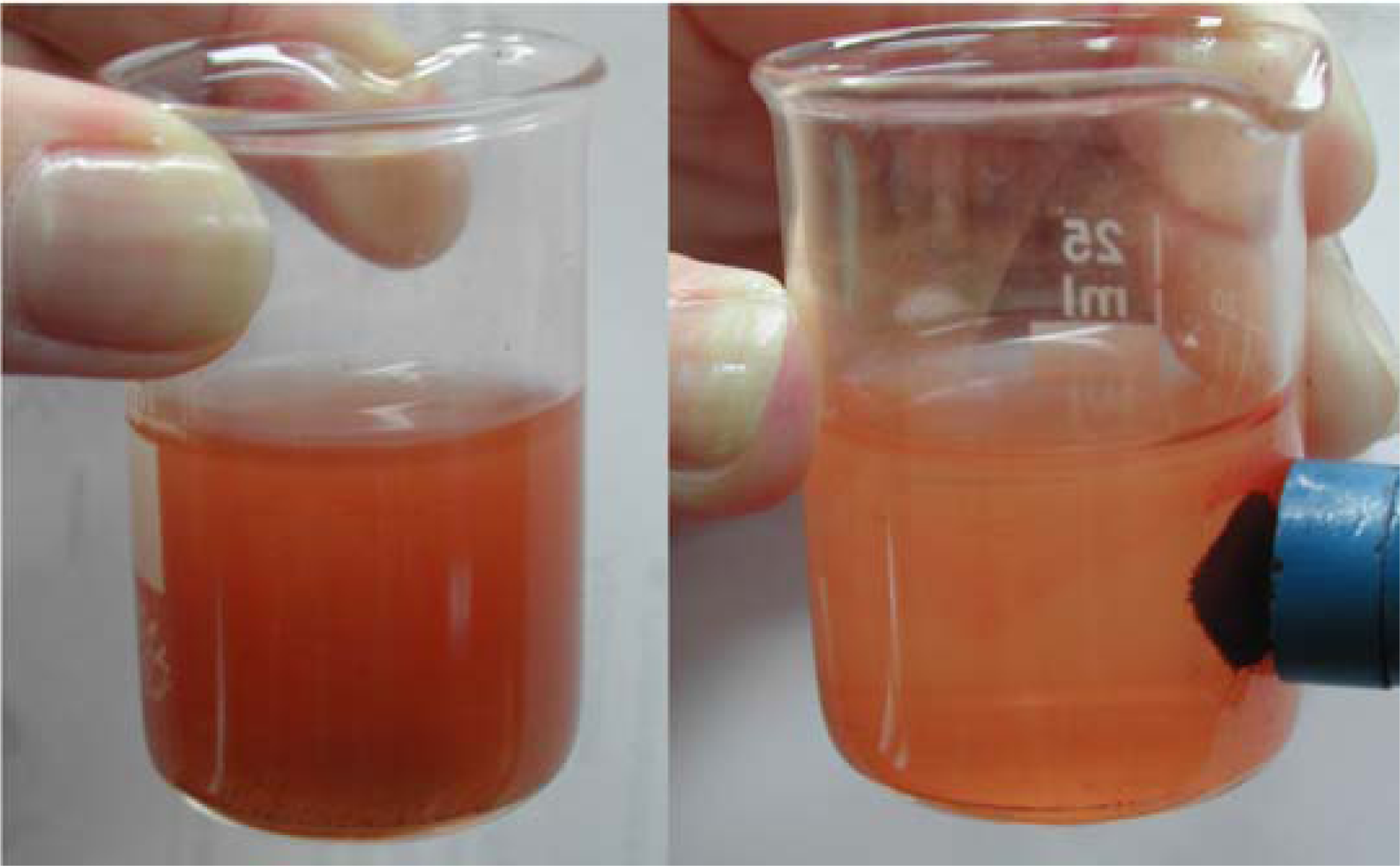
<p>The obtained Fe<sub>2</sub>O<sub>3</sub>/SiO<sub>2</sub> and Fe<sub>2</sub>O<sub>3</sub> powders were brownish-black and reddish-brown, respectively, while Gd/SiO<sub>2</sub> nanoparticles were orange due to their doping by fluorescent dye, tris(2,2′-bipyridyl) dichlororuthenium(II) hexahydrate. Only Fe<sub>2</sub>O<sub>3</sub> nanoparticles revealed the magnetic properties in water suspension when external magnetic field was applied (<xref ref-type="fig" rid="f1-sensors-09-02352">Figure 1</xref>.).</p>
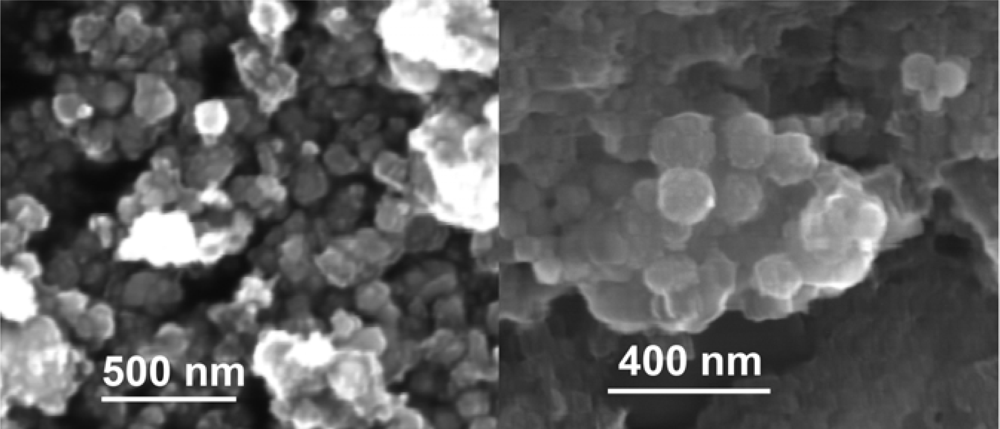
<p>SEM analysis demonstrated that the nanoparticles of all prepared samples have particle sizes below 100 nm (<xref ref-type="fig" rid="f2-sensors-09-02352">Figure 2</xref>.). The particles were generally spherical in the shape. However it can be supposed that the size distribution for all samples is rather wide.</p>
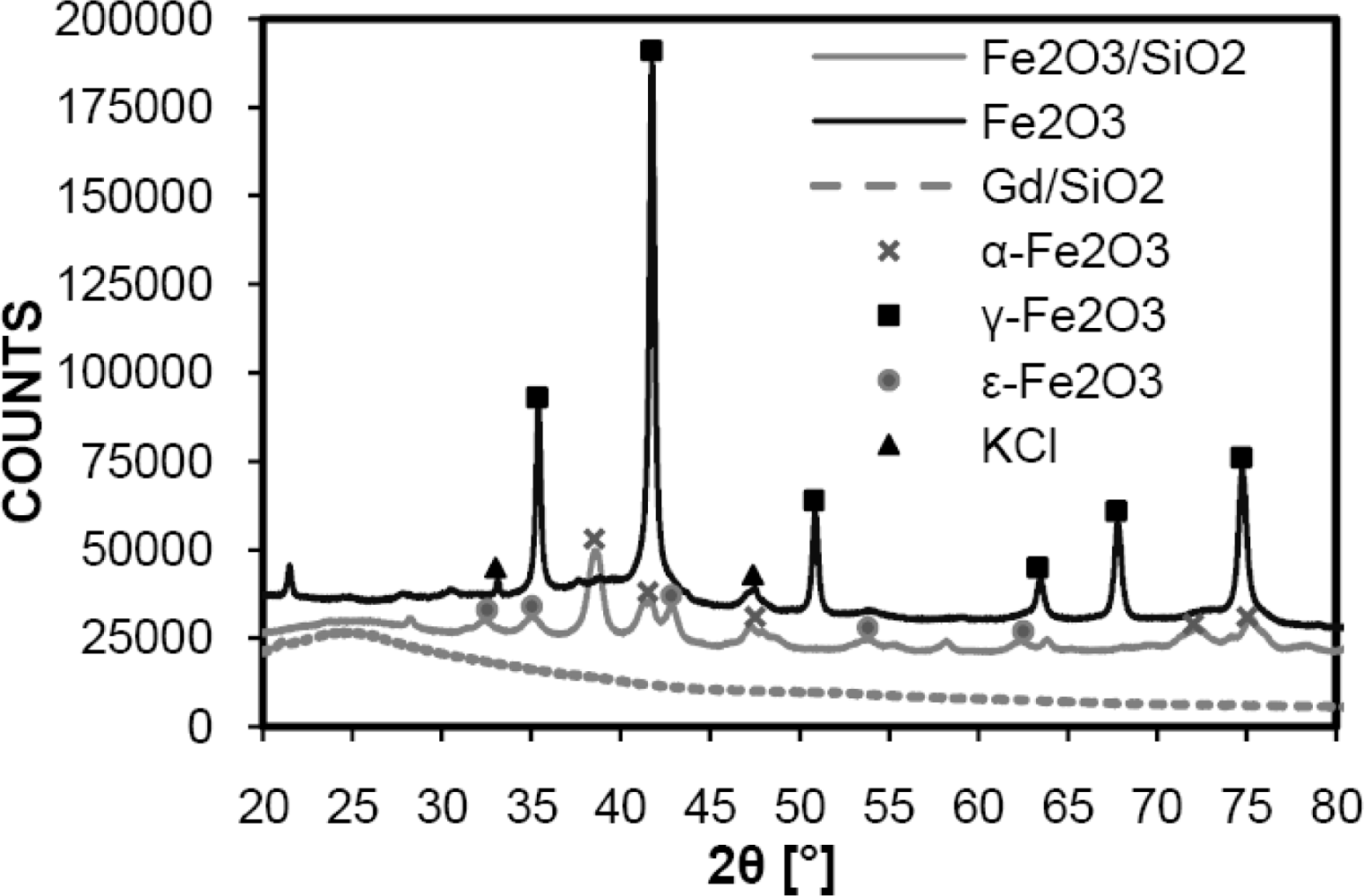
<p>According to XRD measurement (XRD patterns of all samples are shown in <xref ref-type="fig" rid="f3-sensors-09-02352">Figure 3</xref>.), Gd<sup>III</sup>/SiO<sub>2</sub> nanoparticles were found to be completely amorphous. The orthorhombic ε-Fe<sub>2</sub>O<sub>3</sub> was observed as majority phase (49 %) together with hematite (24 %) in the case of Fe<sub>2</sub>O<sub>3</sub>/SiO<sub>2</sub> annealed at 800 °C for 4 hours, which is different from the results reported by Ichiyanagi <italic>et al</italic>. [<xref ref-type="bibr" rid="b25-sensors-09-02352">25</xref>]. The ε-Fe<sub>2</sub>O<sub>3</sub> phase is considered to be an intermediate between maghemite and hematite and it is magnetically very interesting for its high coercive force [<xref ref-type="bibr" rid="b26-sensors-09-02352">26</xref>]. The value of mean coherence length corresponding to crystallite size estimated using Rietveld analysis was about 14 nm for both α- and ε-Fe<sub>2</sub>O<sub>3</sub> phases. It can be assumed that there are also very small maghemite or magnetite particles but these were not detected in XRD spectra probably due to “hiding” of their peaks in the amorphous one belonging to SiO<sub>2</sub> (27 %).</p>
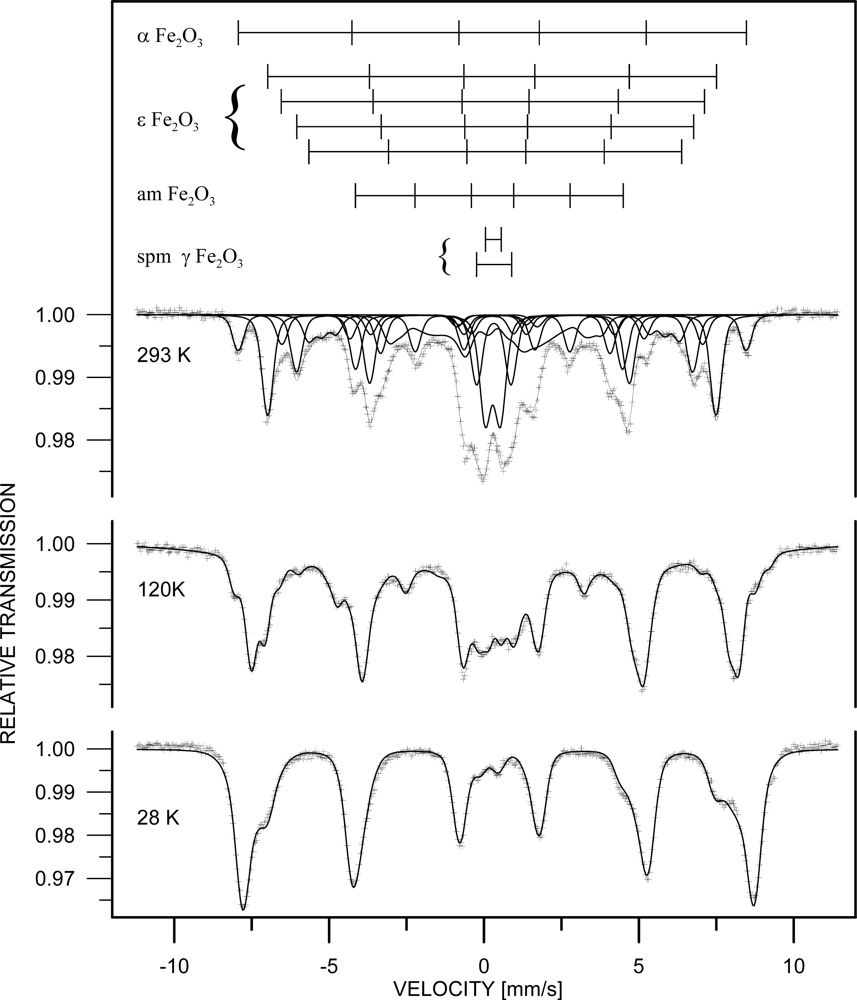
<p>The phase analysis carried out from the Mössbauer spectrum (<xref ref-type="fig" rid="f4-sensors-09-02352">Figure 4</xref>) confirmed ε-Fe<sub>2</sub>O<sub>3</sub> as the dominating iron containing phase (51 %) represented by four sextets with following parameters (see <xref ref-type="table" rid="t1-sensors-09-02352">Table 1</xref>.). The ε-Fe<sub>2</sub>O<sub>3</sub> phase was completed by hematite (8 %), superparamagnetic maghemite (19 %, represented by two doublets) and amorphous phase (22 %, represented by a broad sextet).</p>
<p>The superparamagnetic behaviour of the maghemite is documented by the measurement of the Mössbauer spectra at various temperatures (shown in <xref ref-type="fig" rid="f4-sensors-09-02352">Figure 4</xref>.). The doublets ascribed to the maghemite splitted continuously to sextets when the sample temperature decreased below the blocking temperature. The broad interval of the blocking temperature indicates broad size distribution of the maghemite nanoparticles. The amorphous phase represents probably surfaces, interfacial regions, fine particles slightly below blocking temperature and particles with perturbed oxygen stoichiometry of the magnetic phases mentioned above. Generally, all values of relative intensities and hyperfine parameters agree with the data reported in literature, e.g. [<xref ref-type="bibr" rid="b10-sensors-09-02352">10</xref>,<xref ref-type="bibr" rid="b27-sensors-09-02352">27</xref>,<xref ref-type="bibr" rid="b28-sensors-09-02352">28</xref>].</p>
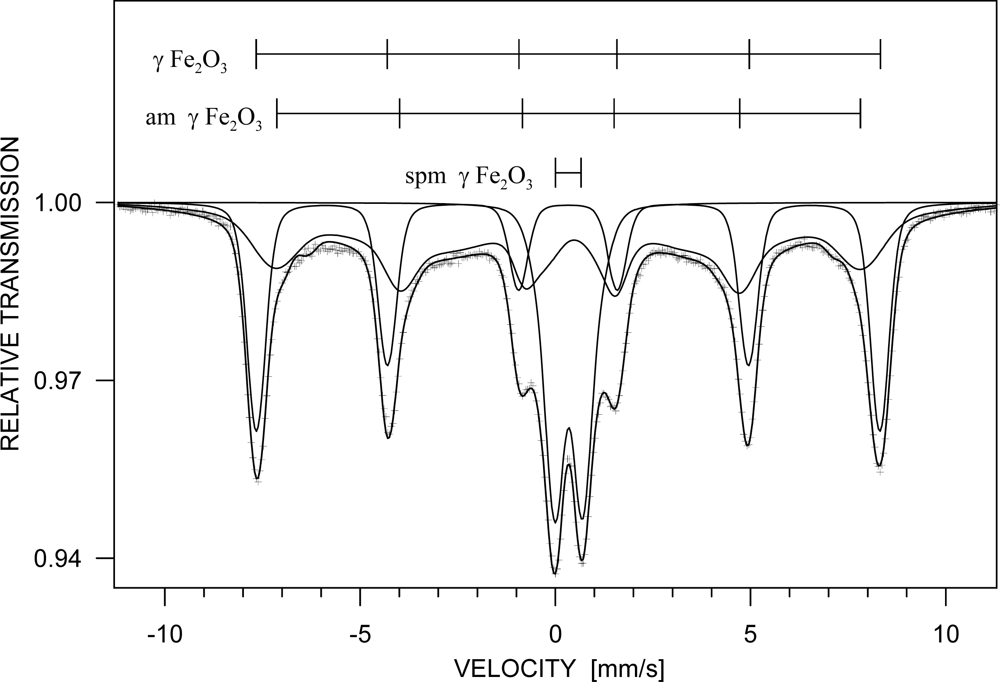
<p>The prepared unmodified Fe<sub>2</sub>O<sub>3</sub> powder consisted of 60 % iron oxide, 30 % of sylvite (KCl) and small portion of amorphous phase. The mean coherence length of iron oxide phase was about 30 nm. Since X-ray powder diffraction cannot distinguish between maghemite and magnetite nanoparticles, Mössbauer spectroscopy analysis was performed to distinguish these crystallographic modifications (<xref ref-type="fig" rid="f5-sensors-09-02352">Figure 5</xref>). The results showed the maghemite phase being dominant (36 %), as represented with a sextet of <italic>B</italic><sub>hf</sub> = 49.6±0.1 T, <italic>δ</italic> = 0.32±0.01 mm/s, <italic>ε</italic><sub>Q</sub> = 0.01±0.01 mm/s). Besides that a small amount of magnetite Fe<sub>3</sub>O<sub>4</sub> (6 %, two sextets <italic>B</italic><sub>hf</sub> = 48.1±0.1 T, <italic>δ</italic> = 0.32±0.02 mm/s, <italic>ε</italic><sub>Q</sub> = 0.06±0.03 mm/s and <italic>B</italic><sub>hf</sub> = 45.1±0.1 T, <italic>δ</italic> = 0.67±0.02 mm/s, <italic>ε</italic><sub>Q</sub>= −0.07±0.03 mm/s) and some amorphous phase which is probably of the same origin as in the case of Fe<sub>2</sub>O<sub>3</sub>/SiO<sub>2</sub> were detected. Generally it is very difficult to distinguish between a true amorphous Fe<sub>2</sub>O<sub>3</sub> phase and nanocrystalline polymorphs exhibiting very small particle size [<xref ref-type="bibr" rid="b29-sensors-09-02352">29</xref>]. Thus for their more precise identification, a measurement in external magnetic field should be done. Moreover, a superparamagnetic or paramagnetic component was detected in this sample.</p>
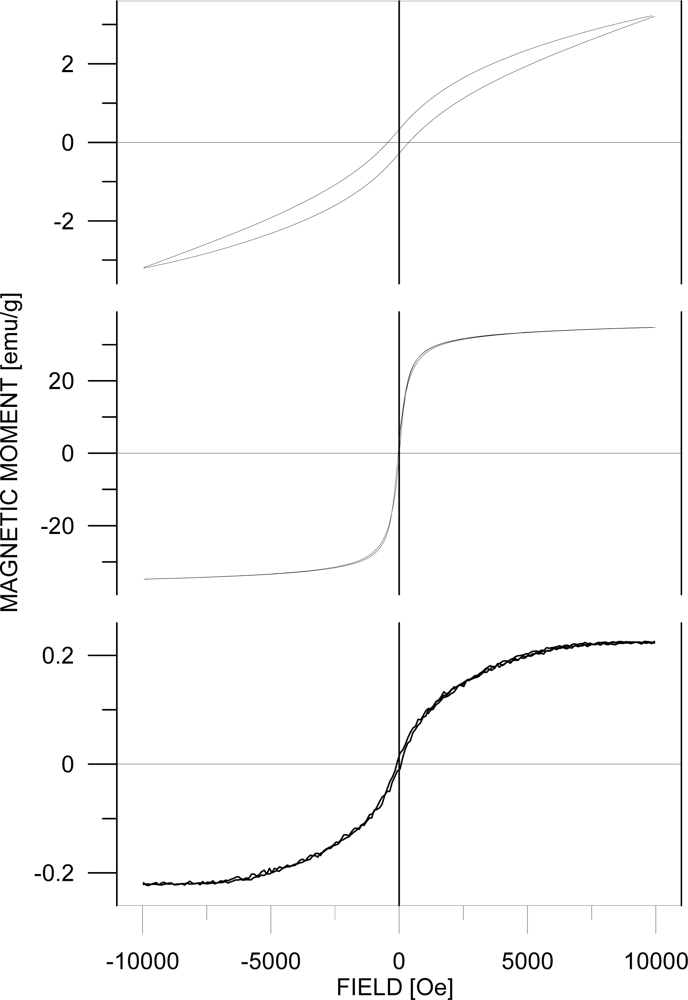
<p>Magnetic hysteresis loops taken at room temperature are shown in <xref ref-type="fig" rid="f6-sensors-09-02352">Figure 6</xref>. The hysteresis loop (HL) of Fe<sub>2</sub>O<sub>3</sub>/SiO<sub>2</sub> nanoparticles documents that we were not able to saturate the sample in the field of 10 kOe. Therefore we can only report the parameters of the minor HL at the field of 10 kOe: moment of 3 emu/g and corresponding coercive field of 400±20 Oe. It indicates that the phase did not reach the particle size where its shape and magnetocrystalline anisotropies cause high coercivity. The moment value could be recalculated to the pure ε-Fe<sub>2</sub>O<sub>3</sub> from the phase composition given by XRD and Mössbauer phase analysis. In order to reach saturation on the HL, a strong external field is necessary [<xref ref-type="bibr" rid="b30-sensors-09-02352">30</xref>]. On the other hand, such a strong external field would influence the mutual interactions of the ε-Fe<sub>2</sub>O<sub>3</sub> and the (super)paramagnetic phase (at room temperature) which is present in the sample according to the Mössbauer spectrum measurement.</p>
<p>The HL shape of the Fe<sub>2</sub>O<sub>3</sub> nanoparticles corresponds well to an assembly of individual magnetic particles with mutual dipolar interaction. The value of magnetic moment at 10 kOe is about 35 emu/g. Taking into account the results of phase analysis, i. e. the contents of sylvite (∼30% according to XRD) and (super)paramagnetic phase (∼25% from Mössbauer spectrum), we can roughly estimate the moment of γ-Fe<sub>2</sub>O<sub>3</sub> nanoparticles to be 66 emu/g. This is a comparable value to that reported in [<xref ref-type="bibr" rid="b31-sensors-09-02352">31</xref>] and to the one inside the range of values 60–80 emu/g published in [<xref ref-type="bibr" rid="b32-sensors-09-02352">32</xref>]. The coercive field derived from the HL is about 30±5 Oe and it roughly agrees with data described in [<xref ref-type="bibr" rid="b33-sensors-09-02352">33</xref>].</p>
<p>The HL parameters of Gd<sup>III</sup>/SiO<sub>2</sub> sample are the moment of 0.23 emu/g at 10 kOe and coercive field of 70±5 Oe. Estimation of the magnetic moment to a pure Gd phase from the expected phase composition given by chemical composition would increase the moment value approximately two times. This is still substantially lower value than the one reported for bulk Gd (139 emu/g) [<xref ref-type="bibr" rid="b34-sensors-09-02352">34</xref>]. It should be mentioned that Curie temperature for pure Gd is about 289 K. A comparison to non-protected Gd nanoparticles or thin films (e.g. to those described in [<xref ref-type="bibr" rid="b35-sensors-09-02352">35</xref>]) would not be correct because of probably important differences in Gd sample oxidations during the most frequently applied preparation techniques and/or handling of the samples in ambient atmosphere.</p></sec>
<sec sec-type="conclusions">
<label>4.</label>
<title>Conclusions</title>
<p>In this article we report the synthesis of iron oxides and gadolinium nanoparticles using co-precipitation and water in oil microemulsion methods, respectively. The XRD phase analysis showed interesting differences in development of crystallinity and mean coherent lengths. While in Fe bearing materials crystalline phase peaks were detected, the Gd based sample only showed an amorphous diffraction. The ε-Fe<sub>2</sub>O<sub>3</sub> was found to be the dominating crystalline phase in the Fe<sub>2</sub>O<sub>3</sub>/SiO<sub>2</sub> sample. This result was confirmed by Mössbauer phase analysis. Maghemite dominated in the unmodified Fe<sub>2</sub>O<sub>3</sub> powder sample. The magnetization curves corresponded to assemblies of individual magnetic particles with mutual dipolar interaction separated by another nonmagnetic phase, e.g. SiO<sub>2</sub> and KCl. The samples exhibited clear differences in saturation magnetization which can be ascribed mainly to the different chemical composition and magnetic moments of Fe and Gd and their phases. Since ε-Fe<sub>2</sub>O<sub>3</sub> phase did not reach a particle size where its shape and magnetocrystalline anisotropies cause high coercivity, one of the objectives in future work will be to increase the coercive force, as well as the amount of this phase by prolongation of sample annealing time.</p>
<p>We found that only the Fe<sub>2</sub>O<sub>3</sub> sample is suitable for practical medical applications due to its sufficiently high value of saturation magnetization and attraction to magnet ability. Despite the fact that this material does not consist of one phase, it can be used for biosensing purposes <italic>in vitro</italic>, for example for detection of viral nucleic acids (influenza, jaundice) with the help of streptavidin-conjugated magnetic nanoparticles. We expect the surface of this sample can be modified further by specific sequences of nucleic acids complementary to viral DNA in order to detect the serious diseases such as cancer, HIV, bird flu etc. We also propose these nanoparticles can be coated by chicken antibodies against metallothionein, which can specifically interact with the target molecule.</p></sec></body>
<back>
<ack>
<p>The financial support from the grant KAN 208130801 is highly acknowledged. Many thanks also to FEI Company for providing of SEM analysis.</p></ack>
<ref-list>
<title>References and Notes</title>
<ref id="b1-sensors-09-02352"><label>1.</label><citation citation-type="journal"><person-group person-group-type="author"><name><surname>Arruebo</surname><given-names>M.</given-names></name><name><surname>Fernandez-Pacheco</surname><given-names>R.</given-names></name><name><surname>Ibarra</surname><given-names>M.R.</given-names></name><name><surname>Santamaria</surname><given-names>J.</given-names></name></person-group><article-title>Magnetic nanoparticles for drug delivery</article-title><source>Nano Today</source><year>2007</year><volume>2</volume><fpage>22</fpage><lpage>32</lpage></citation></ref>
<ref id="b2-sensors-09-02352"><label>2.</label><citation citation-type="journal"><person-group person-group-type="author"><name><surname>Lu</surname><given-names>A.H.</given-names></name><name><surname>Salabas</surname><given-names>E.L.</given-names></name><name><surname>Schuth</surname><given-names>F.</given-names></name></person-group><article-title>Magnetic nanoparticles: Synthesis, protection, functionalization, and application</article-title><source>Angew. Chem.-Int. Edit</source><year>2007</year><volume>46</volume><fpage>1222</fpage><lpage>1244</lpage><pub-id pub-id-type="doi">10.1002/anie.200602866</pub-id></citation></ref>
<ref id="b3-sensors-09-02352"><label>3.</label><citation citation-type="book"><person-group person-group-type="author"><name><surname>Kumar</surname><given-names>C.S.S.R.</given-names></name></person-group><source>Biofunctionalization of Nanomaterials</source><publisher-name>Wiley-VCH</publisher-name><publisher-loc>Weinheim</publisher-loc><year>2005</year><volume>1</volume><fpage>72</fpage><lpage>98</lpage></citation></ref>
<ref id="b4-sensors-09-02352"><label>4.</label><citation citation-type="journal"><person-group person-group-type="author"><name><surname>Hutten</surname><given-names>A.</given-names></name><name><surname>Sudfeld</surname><given-names>D.</given-names></name><name><surname>Ennen</surname><given-names>I.</given-names></name><name><surname>Reiss</surname><given-names>G.</given-names></name><name><surname>Hachmann</surname><given-names>W.</given-names></name><name><surname>Heinzmann</surname><given-names>U.</given-names></name><name><surname>Wojczykowski</surname><given-names>K.</given-names></name><name><surname>Jutzi</surname><given-names>P.</given-names></name><name><surname>Saikaly</surname><given-names>W.</given-names></name><name><surname>Thomas</surname><given-names>G.</given-names></name></person-group><article-title>New magnetic nanoparticles for biotechnology</article-title><source>J. Biotechnol</source><year>2004</year><volume>112</volume><fpage>47</fpage><lpage>63</lpage><pub-id pub-id-type="doi">10.1016/j.jbiotec.2004.04.019</pub-id><pub-id pub-id-type="pmid">15288940</pub-id></citation></ref>
<ref id="b5-sensors-09-02352"><label>5.</label><citation citation-type="journal"><person-group person-group-type="author"><name><surname>Tucek</surname><given-names>J.</given-names></name><name><surname>Zboril</surname><given-names>R.</given-names></name><name><surname>Petridis</surname><given-names>D.</given-names></name></person-group><article-title>Maghemite nanoparticles by view of Mossbauer spectroscopy</article-title><source>J. Nanosci. Nanotechnol</source><year>2006</year><volume>6</volume><fpage>926</fpage><lpage>947</lpage><pub-id pub-id-type="doi">10.1166/jnn.2006.183</pub-id><pub-id pub-id-type="pmid">16736748</pub-id></citation></ref>
<ref id="b6-sensors-09-02352"><label>6.</label><citation citation-type="journal"><person-group person-group-type="author"><name><surname>Gupta</surname><given-names>A.K.</given-names></name><name><surname>Gupta</surname><given-names>M.</given-names></name></person-group><article-title>Synthesis and surface engineering of iron oxide nanoparticles for biomedical applications</article-title><source>Biomaterials</source><year>2005</year><volume>26</volume><fpage>3995</fpage><lpage>4021</lpage><pub-id pub-id-type="doi">10.1016/j.biomaterials.2004.10.012</pub-id><pub-id pub-id-type="pmid">15626447</pub-id></citation></ref>
<ref id="b7-sensors-09-02352"><label>7.</label><citation citation-type="journal"><person-group person-group-type="author"><name><surname>Xie</surname><given-names>J.</given-names></name><name><surname>Xu</surname><given-names>C.J.</given-names></name><name><surname>Xu</surname><given-names>Z.C.</given-names></name><name><surname>Hou</surname><given-names>Y.L.</given-names></name><name><surname>Young</surname><given-names>K.L.</given-names></name><name><surname>Wang</surname><given-names>S.X.</given-names></name><name><surname>Pourmond</surname><given-names>N.</given-names></name><name><surname>Sun</surname><given-names>S.H.</given-names></name></person-group><article-title>Linking hydrophilic macromolecules to monodisperse magnetite (Fe<sub>3</sub>O<sub>4</sub>) nanoparticles via trichloro-s-triazine</article-title><source>Chem. Mat</source><year>2006</year><volume>18</volume><fpage>5401</fpage><lpage>5403</lpage><pub-id pub-id-type="doi">10.1021/cm061793c</pub-id></citation></ref>
<ref id="b8-sensors-09-02352"><label>8.</label><citation citation-type="journal"><person-group person-group-type="author"><name><surname>Tang</surname><given-names>D.P.</given-names></name><name><surname>Yuan</surname><given-names>R.</given-names></name><name><surname>Chai</surname><given-names>Y.Q.</given-names></name></person-group><article-title>Direct electrochemical immunoassay based on immobilization of protein-magnetic nanoparticle composites on to magnetic electrode surfaces by sterically enhanced magnetic field force</article-title><source>Biotechnol. Lett</source><year>2006</year><volume>28</volume><fpage>559</fpage><lpage>565</lpage><pub-id pub-id-type="doi">10.1007/s10529-006-0017-4</pub-id><pub-id pub-id-type="pmid">16614893</pub-id></citation></ref>
<ref id="b9-sensors-09-02352"><label>9.</label><citation citation-type="journal"><person-group person-group-type="author"><name><surname>Zboril</surname><given-names>R.</given-names></name><name><surname>Mashlan</surname><given-names>M.</given-names></name><name><surname>Petridis</surname><given-names>D.</given-names></name></person-group><article-title>Iron(III) oxides from thermal processes-synthesis, structural and magnetic properties, Mossbauer spectroscopy characterization, and applications</article-title><source>Chem. Mat</source><year>2002</year><volume>14</volume><fpage>969</fpage><lpage>982</lpage><pub-id pub-id-type="doi">10.1021/cm0111074</pub-id></citation></ref>
<ref id="b10-sensors-09-02352"><label>10.</label><citation citation-type="journal"><person-group person-group-type="author"><name><surname>Ortega</surname><given-names>D.</given-names></name><name><surname>Garitaonandia</surname><given-names>J.S.</given-names></name><name><surname>Barrera-Solano</surname><given-names>C.</given-names></name><name><surname>Ramirez-Del-Solar</surname><given-names>M.</given-names></name><name><surname>Blanco</surname><given-names>E.</given-names></name><name><surname>Dominguez</surname><given-names>M.</given-names></name></person-group><article-title>gamma-Fe<sub>2</sub>O<sub>3</sub>/SiO<sub>2</sub> nanocomposites for magneto-optical applications: Nanostructural and magnetic properties</article-title><source>J. Non-Cryst. Solids</source><year>2006</year><volume>352</volume><fpage>2801</fpage><lpage>2810</lpage><pub-id pub-id-type="doi">10.1016/j.jnoncrysol.2006.03.056</pub-id></citation></ref>
<ref id="b11-sensors-09-02352"><label>11.</label><citation citation-type="journal"><person-group person-group-type="author"><name><surname>Batlle</surname><given-names>X.</given-names></name><name><surname>Labarta</surname><given-names>A.</given-names></name></person-group><article-title>Finite-size effects in fine particles: magnetic and transport properties</article-title><source>J. Phys. D-Appl. Phys</source><year>2002</year><volume>35</volume><fpage>R15</fpage><lpage>R42</lpage><pub-id pub-id-type="doi">10.1088/0022-3727/35/6/201</pub-id></citation></ref>
<ref id="b12-sensors-09-02352"><label>12.</label><citation citation-type="journal"><person-group person-group-type="author"><name><surname>Morales</surname><given-names>M.A.</given-names></name><name><surname>Finotelli</surname><given-names>P.V.</given-names></name><name><surname>Coaquira</surname><given-names>J.A.H.</given-names></name><name><surname>Rocha-Leao</surname><given-names>M.H.M.</given-names></name><name><surname>Diaz-Aguila</surname><given-names>C.</given-names></name><name><surname>Baggio-Saitovitch</surname><given-names>E.M.</given-names></name><name><surname>Rossi</surname><given-names>A.M.</given-names></name></person-group><article-title><italic>In situ</italic> synthesis and magnetic studies of iron oxide nanoparticles in calcium-alginate matrix for biomedical applications</article-title><source>Mater. Sci. Eng. C-Biomimetic Supramol. Syst</source><year>2008</year><volume>28</volume><fpage>253</fpage><lpage>257</lpage><pub-id pub-id-type="doi">10.1016/j.msec.2006.12.016</pub-id></citation></ref>
<ref id="b13-sensors-09-02352"><label>13.</label><citation citation-type="journal"><person-group person-group-type="author"><name><surname>Santra</surname><given-names>S.</given-names></name><name><surname>Tapec</surname><given-names>R.</given-names></name><name><surname>Theodoropoulou</surname><given-names>N.</given-names></name><name><surname>Dobson</surname><given-names>J.</given-names></name><name><surname>Hebard</surname><given-names>A.</given-names></name><name><surname>Tan</surname><given-names>W.H.</given-names></name></person-group><article-title>Synthesis and characterization of silica-coated iron oxide nanoparticles in microemulsion: The effect of nonionic surfactants</article-title><source>Langmuir</source><year>2001</year><volume>17</volume><fpage>2900</fpage><lpage>2906</lpage><pub-id pub-id-type="doi">10.1021/la0008636</pub-id></citation></ref>
<ref id="b14-sensors-09-02352"><label>14.</label><citation citation-type="journal"><person-group person-group-type="author"><name><surname>De Palma</surname><given-names>R.</given-names></name><name><surname>Trekker</surname><given-names>J.</given-names></name><name><surname>Peeters</surname><given-names>S.</given-names></name><name><surname>Van Bael</surname><given-names>M.J.</given-names></name><name><surname>Bonroy</surname><given-names>K.</given-names></name><name><surname>Wirix-Speetjens</surname><given-names>R.</given-names></name><name><surname>Reekmans</surname><given-names>G.</given-names></name><name><surname>Laureyn</surname><given-names>W.</given-names></name><name><surname>Borghs</surname><given-names>G.</given-names></name><name><surname>Maes</surname><given-names>G.</given-names></name></person-group><article-title>Surface modification of gamma-Fe<sub>2</sub>O<sub>3</sub>@ SiO<sub>2</sub> magnetic nanoparticles for the controlled interaction with biomolecules</article-title><source>J. Nanosci. Nanotechnol</source><year>2007</year><volume>7</volume><fpage>4626</fpage><lpage>4641</lpage><pub-id pub-id-type="pmid">18283855</pub-id></citation></ref>
<ref id="b15-sensors-09-02352"><label>15.</label><citation citation-type="journal"><person-group person-group-type="author"><name><surname>Iida</surname><given-names>H.</given-names></name><name><surname>Takayanagi</surname><given-names>K.</given-names></name><name><surname>Nakanishi</surname><given-names>T.</given-names></name><name><surname>Kume</surname><given-names>A.</given-names></name><name><surname>Muramatsu</surname><given-names>K.</given-names></name><name><surname>Kiyohara</surname><given-names>Y.</given-names></name><name><surname>Akiyama</surname><given-names>Y.</given-names></name><name><surname>Osaka</surname><given-names>T.</given-names></name></person-group><article-title>Preparation of Human Immune Effector T Cells Containing Iron-Oxide Nanoparticles</article-title><source>Biotechnol. Bioeng</source><year>2008</year><volume>101</volume><fpage>1123</fpage><lpage>1128</lpage><pub-id pub-id-type="doi">10.1002/bit.21992</pub-id><pub-id pub-id-type="pmid">18563847</pub-id></citation></ref>
<ref id="b16-sensors-09-02352"><label>16.</label><citation citation-type="journal"><person-group person-group-type="author"><name><surname>Khalil</surname><given-names>K.M.S.</given-names></name><name><surname>Mahmoud</surname><given-names>H.A.</given-names></name><name><surname>Ali</surname><given-names>T.T.</given-names></name></person-group><article-title>Direct formation of thermally stabilized amorphous mesoporous Fe<sub>2</sub>O<sub>3</sub>/SiO<sub>2</sub> nanocomposites by hydrolysis of aqueous iron (III) nitrate in sols of spherical silica particles</article-title><source>Langmuir</source><year>2008</year><volume>24</volume><fpage>1037</fpage><lpage>1043</lpage><pub-id pub-id-type="doi">10.1021/la702904h</pub-id><pub-id pub-id-type="pmid">18177061</pub-id></citation></ref>
<ref id="b17-sensors-09-02352"><label>17.</label><citation citation-type="journal"><person-group person-group-type="author"><name><surname>Srinivasan</surname><given-names>B.</given-names></name><name><surname>Huang</surname><given-names>X.F.</given-names></name></person-group><article-title>Functionalization of magnetic nanoparticles with organic molecules: Loading level determination and evaluation of linker length effect on immobilization</article-title><source>Chirality</source><year>2008</year><volume>20</volume><fpage>265</fpage><lpage>277</lpage><pub-id pub-id-type="doi">10.1002/chir.20418</pub-id><pub-id pub-id-type="pmid">17568438</pub-id></citation></ref>
<ref id="b18-sensors-09-02352"><label>18.</label><citation citation-type="journal"><person-group person-group-type="author"><name><surname>Cannas</surname><given-names>C.</given-names></name><name><surname>Concas</surname><given-names>G.</given-names></name><name><surname>Gatteschi</surname><given-names>D.</given-names></name><name><surname>Musinu</surname><given-names>A.</given-names></name><name><surname>Piccaluga</surname><given-names>G.</given-names></name><name><surname>Sangregorio</surname><given-names>C.</given-names></name></person-group><article-title>How to tailor maghemite particle size in gamma-Fe<sub>2</sub>O<sub>3</sub>-SiO<sub>2</sub> nanocomposites</article-title><source>J. Mater. Chem</source><year>2002</year><volume>12</volume><fpage>3141</fpage><lpage>3146</lpage><pub-id pub-id-type="doi">10.1039/b204292d</pub-id></citation></ref>
<ref id="b19-sensors-09-02352"><label>19.</label><citation citation-type="journal"><person-group person-group-type="author"><name><surname>Ichiyanagi</surname><given-names>Y.</given-names></name><name><surname>Moritake</surname><given-names>S.</given-names></name><name><surname>Taira</surname><given-names>S.</given-names></name><name><surname>Setou</surname><given-names>M.</given-names></name></person-group><article-title>Functional magnetic nanoparticles for medical application</article-title><source>J. Magn. Magn. Mater</source><year>2007</year><volume>310</volume><fpage>2877</fpage><lpage>2879</lpage><pub-id pub-id-type="doi">10.1016/j.jmmm.2006.11.083</pub-id></citation></ref>
<ref id="b20-sensors-09-02352"><label>20.</label><citation citation-type="journal"><person-group person-group-type="author"><name><surname>Fabrik</surname><given-names>I.</given-names></name><name><surname>Krizkova</surname><given-names>S.</given-names></name><name><surname>Huska</surname><given-names>D.</given-names></name><name><surname>Adam</surname><given-names>V.</given-names></name><name><surname>Hubalek</surname><given-names>J.</given-names></name><name><surname>Trnkova</surname><given-names>L.</given-names></name><name><surname>Eckschlager</surname><given-names>T.</given-names></name><name><surname>Kukacka</surname><given-names>J.</given-names></name><name><surname>Prusa</surname><given-names>R.</given-names></name><name><surname>Kizek</surname><given-names>R.</given-names></name></person-group><article-title>Employment of electrochemical techniques for metallothionein determination in tumor cell lines and patients with a tumor disease</article-title><source>Electroanalysis</source><year>2008</year><volume>20</volume><fpage>1521</fpage><lpage>1532</lpage><pub-id pub-id-type="doi">10.1002/elan.200704215</pub-id></citation></ref>
<ref id="b21-sensors-09-02352"><label>21.</label><citation citation-type="journal"><person-group person-group-type="author"><name><surname>Liu</surname><given-names>H.L.</given-names></name><name><surname>Sonn</surname><given-names>C.H.</given-names></name><name><surname>Wu</surname><given-names>J.H.</given-names></name><name><surname>Lee</surname><given-names>K.M.</given-names></name><name><surname>Kim</surname><given-names>Y.K.</given-names></name></person-group><article-title>Synthesis of streptavidin-FITC-conjugated core-shell Fe<sub>3</sub>O<sub>4</sub>-Au nanocrystals and their application for the purification of CD4(+) lymphocytes</article-title><source>Biomaterials</source><year>2008</year><volume>29</volume><fpage>4003</fpage><lpage>4011</lpage><pub-id pub-id-type="doi">10.1016/j.biomaterials.2008.06.031</pub-id><pub-id pub-id-type="pmid">18649937</pub-id></citation></ref>
<ref id="b22-sensors-09-02352"><label>22.</label><citation citation-type="journal"><person-group person-group-type="author"><name><surname>Gerion</surname><given-names>D.</given-names></name><name><surname>Herberg</surname><given-names>J.</given-names></name><name><surname>Bok</surname><given-names>R.</given-names></name><name><surname>Gjersing</surname><given-names>E.</given-names></name><name><surname>Ramon</surname><given-names>E.</given-names></name><name><surname>Maxwell</surname><given-names>R.</given-names></name><name><surname>Kurhanewicz</surname><given-names>J.</given-names></name><name><surname>Budinger</surname><given-names>T.F.</given-names></name><name><surname>Gray</surname><given-names>J.W.</given-names></name><name><surname>Shuman</surname><given-names>M.A.</given-names></name><name><surname>Chen</surname><given-names>F.F.</given-names></name></person-group><article-title>Paramagnetic silica-coated nanocrystals as an advanced MRI contrast agent</article-title><source>J. Phys. Chem. C</source><year>2007</year><volume>111</volume><fpage>12542</fpage><lpage>12551</lpage><pub-id pub-id-type="doi">10.1021/jp074072p</pub-id></citation></ref>
<ref id="b23-sensors-09-02352"><label>23.</label><citation citation-type="journal"><person-group person-group-type="author"><name><surname>Ichiyanagi</surname><given-names>Y.</given-names></name><name><surname>Kimishima</surname><given-names>Y.</given-names></name></person-group><article-title>Structural, magnetic and thermal characterizations of Fe<sub>2</sub>O<sub>3</sub> nanoparticle systems</article-title><source>J. Therm. Anal</source><year>2002</year><volume>69</volume><fpage>919</fpage><lpage>923</lpage><pub-id pub-id-type="doi">10.1023/A:1020672409713</pub-id></citation></ref>
<ref id="b24-sensors-09-02352"><label>24.</label><citation citation-type="journal"><person-group person-group-type="author"><name><surname>Santra</surname><given-names>S.</given-names></name><name><surname>Bagwe</surname><given-names>R.P.</given-names></name><name><surname>Dutta</surname><given-names>D.</given-names></name><name><surname>Stanley</surname><given-names>J.T.</given-names></name><name><surname>Walter</surname><given-names>G.A.</given-names></name><name><surname>Tan</surname><given-names>W.</given-names></name><name><surname>Moudgil</surname><given-names>B.M.</given-names></name><name><surname>Mericle</surname><given-names>R.A.</given-names></name></person-group><article-title>Synthesis and characterization of fluorescent radio-opaque and paramagnetic silica nanoparticles for multimodal bioimaging applications</article-title><source>Adv. Mater</source><year>2005</year><volume>17</volume><fpage>2165</fpage><lpage>2169</lpage><pub-id pub-id-type="doi">10.1002/adma.200500018</pub-id></citation></ref>
<ref id="b25-sensors-09-02352"><label>25.</label><citation citation-type="journal"><person-group person-group-type="author"><name><surname>Ichiyanagi</surname><given-names>Y.</given-names></name><name><surname>Uozumi</surname><given-names>T.</given-names></name><name><surname>Kimishima</surname><given-names>Y.</given-names></name></person-group><article-title>Magnetic properties of Fe<sub>2</sub>O<sub>3</sub> nanoparticles</article-title><source>Trans. Mat. Res. Soc. Jpn</source><year>2001</year><volume>26</volume><fpage>1097</fpage><lpage>1100</lpage></citation></ref>
<ref id="b26-sensors-09-02352"><label>26.</label><citation citation-type="journal"><person-group person-group-type="author"><name><surname>Ding</surname><given-names>Y.</given-names></name><name><surname>Morber</surname><given-names>J.R.</given-names></name><name><surname>Snyder</surname><given-names>R.L.</given-names></name><name><surname>Wang</surname><given-names>Z.L.</given-names></name></person-group><article-title>Nanowire structural evolution from Fe<sub>3</sub>O<sub>4</sub> to epsilon-Fe<sub>2</sub>O<sub>3</sub></article-title><source>Adv. Funct. Mater</source><year>2007</year><volume>17</volume><fpage>1172</fpage><lpage>1178</lpage><pub-id pub-id-type="doi">10.1002/adfm.200601024</pub-id></citation></ref>
<ref id="b27-sensors-09-02352"><label>27.</label><citation citation-type="book"><person-group person-group-type="author"><name><surname>Long</surname><given-names>G.J.</given-names></name><name><surname>Grandjean</surname><given-names>F.</given-names></name></person-group><source>Mössbauer Spectroscopy Applied to Magnetism and Materials Science</source><publisher-name>Plenum Press</publisher-name><publisher-loc>New York</publisher-loc><year>1993</year><volume>1</volume><fpage>115</fpage><lpage>159</lpage></citation></ref>
<ref id="b28-sensors-09-02352"><label>28.</label><citation citation-type="journal"><person-group person-group-type="author"><name><surname>Tronc</surname><given-names>E.</given-names></name><name><surname>Chaneac</surname><given-names>C.</given-names></name><name><surname>Jolivet</surname><given-names>J.P.</given-names></name></person-group><article-title>Structural and magnetic characterization of epsilon-Fe<sub>2</sub>O<sub>3</sub></article-title><source>J. Solid State Chem</source><year>1998</year><volume>139</volume><fpage>93</fpage><lpage>104</lpage><pub-id pub-id-type="doi">10.1006/jssc.1998.7817</pub-id></citation></ref>
<ref id="b29-sensors-09-02352"><label>29.</label><citation citation-type="journal"><person-group person-group-type="author"><name><surname>Machala</surname><given-names>L.</given-names></name><name><surname>Zboril</surname><given-names>R.</given-names></name><name><surname>Gedanken</surname><given-names>A.</given-names></name></person-group><article-title>Amorphous iron(III) oxide - A review</article-title><source>J. Phys. Chem. B</source><year>2007</year><volume>111</volume><fpage>4003</fpage><lpage>4018</lpage><pub-id pub-id-type="doi">10.1021/jp064992s</pub-id><pub-id pub-id-type="pmid">17402772</pub-id></citation></ref>
<ref id="b30-sensors-09-02352"><label>30.</label><citation citation-type="journal"><person-group person-group-type="author"><name><surname>Popovici</surname><given-names>M.</given-names></name><name><surname>Gich</surname><given-names>M.</given-names></name><name><surname>Niznansky</surname><given-names>D.</given-names></name><name><surname>Roig</surname><given-names>A.</given-names></name><name><surname>Savii</surname><given-names>C.</given-names></name><name><surname>Casas</surname><given-names>L.</given-names></name><name><surname>Molins</surname><given-names>E.</given-names></name><name><surname>Zaveta</surname><given-names>K.</given-names></name><name><surname>Enache</surname><given-names>C.</given-names></name><name><surname>Sort</surname><given-names>J.</given-names></name><name><surname>de Brion</surname><given-names>S.</given-names></name><name><surname>Chouteau</surname><given-names>G.</given-names></name><name><surname>Nogues</surname><given-names>J.</given-names></name></person-group><article-title>Optimized synthesis of the elusive epsilon-Fe<sub>2</sub>O<sub>3</sub> phase via sol-gel chemistry</article-title><source>Chem. Mat</source><year>2004</year><volume>16</volume><fpage>5542</fpage><lpage>5548</lpage><pub-id pub-id-type="doi">10.1021/cm048628m</pub-id></citation></ref>
<ref id="b31-sensors-09-02352"><label>31.</label><citation citation-type="journal"><person-group person-group-type="author"><name><surname>Tartaj</surname><given-names>P.</given-names></name><name><surname>Serna</surname><given-names>C.J.</given-names></name></person-group><article-title>Microemulsion-assisted synthesis of tunable superparamagnetic composites</article-title><source>Chem. Mat</source><year>2002</year><volume>14</volume><fpage>4396</fpage><lpage>4402</lpage><pub-id pub-id-type="doi">10.1021/cm021214d</pub-id></citation></ref>
<ref id="b32-sensors-09-02352"><label>32.</label><citation citation-type="book"><person-group person-group-type="author"><name><surname>Cornell</surname><given-names>R.M.</given-names></name><name><surname>Schwertmann</surname><given-names>U.</given-names></name></person-group><source>The Iron Oxides: Structure, Properties, Reactions, Occurrence and Uses</source><publisher-name>VCH</publisher-name><publisher-loc>New York</publisher-loc><year>1996</year><fpage>117</fpage></citation></ref>
<ref id="b33-sensors-09-02352"><label>33.</label><citation citation-type="book"><person-group person-group-type="author"><name><surname>Wohlfarth</surname><given-names>E.P.</given-names></name></person-group><source>Ferromagnetic Materials</source><publisher-name>North-Holland</publisher-name><publisher-loc>Amsterdam</publisher-loc><year>1980</year><volume>2</volume><fpage>442</fpage></citation></ref>
<ref id="b34-sensors-09-02352"><label>34.</label><citation citation-type="book"><person-group person-group-type="author"><name><surname>Wohlfarth</surname><given-names>E.P.</given-names></name></person-group><source>Ferromagnetic Materials</source><publisher-name>North-Holland</publisher-name><publisher-loc>Amsterdam</publisher-loc><year>1980</year><volume>2</volume><fpage>512</fpage></citation></ref>
<ref id="b35-sensors-09-02352"><label>35.</label><citation citation-type="journal"><person-group person-group-type="author"><name><surname>O’Shea</surname><given-names>M.J.</given-names></name><name><surname>Perera</surname><given-names>P.</given-names></name></person-group><article-title>Influence of nanostructure (layers and particles) on the magnetism of rare-earth materials</article-title><source>J. Appl. Phys</source><year>1999</year><volume>85</volume><fpage>4322</fpage><lpage>4324</lpage><pub-id pub-id-type="doi">10.1063/1.370356</pub-id></citation></ref></ref-list>
<sec sec-type="display-objects">
<title>Figures and Table</title>
<fig id="f1-sensors-09-02352" position="float">
<label>Figure 1.</label>
<caption>
<p>Magnetic properties illustration of Fe<sub>2</sub>O<sub>3</sub> nanoparticles dispersed in water.</p></caption>
<graphic xlink:href="sensors-09-02352f1.gif"/></fig>
<fig id="f2-sensors-09-02352" position="float">
<label>Figure 2.</label>
<caption>
<p>SEM image of Fe<sub>2</sub>O<sub>3</sub> (left) and Gd<sup>III</sup>/SiO<sub>2</sub> (right).</p></caption>
<graphic xlink:href="sensors-09-02352f2.gif"/></fig>
<fig id="f3-sensors-09-02352" position="float">
<label>Figure 3.</label>
<caption>
<p>XRD patterns of Fe<sub>2</sub>O<sub>3</sub>/SiO<sub>2</sub>, Fe<sub>2</sub>O<sub>3</sub> and Gd<sup>III</sup>/SiO<sub>2</sub>.</p></caption>
<graphic xlink:href="sensors-09-02352f3.gif"/></fig>
<fig id="f4-sensors-09-02352" position="float">
<label>Figure 4.</label>
<caption>
<p>Mössbauer spectrum of Fe<sub>2</sub>O<sub>3</sub>/SiO<sub>2</sub> sample depending on measurement temperature changes.</p></caption>
<graphic xlink:href="sensors-09-02352f4.gif"/></fig>
<fig id="f5-sensors-09-02352" position="float">
<label>Figure 5.</label>
<caption>
<p>Mössbauer spectrum of Fe<sub>2</sub>O<sub>3</sub> sample.</p></caption>
<graphic xlink:href="sensors-09-02352f5.gif"/></fig>
<fig id="f6-sensors-09-02352" position="float">
<label>Figure 6.</label>
<caption>
<p>Magnetization curves of Fe<sub>2</sub>O<sub>3</sub>/SiO<sub>2</sub> (top), Fe<sub>2</sub>O<sub>3</sub> (center) and Gd<sup>III</sup>/SiO<sub>2</sub> (bottom).</p></caption>
<graphic xlink:href="sensors-09-02352f6.gif"/></fig>
<table-wrap id="t1-sensors-09-02352" position="float">
<label>Table 1.</label>
<caption>
<p>Hyperfine parameters deduced from Mössbauer spectrum of Fe<sub>2</sub>O<sub>3</sub>/SiO<sub>2</sub> measured at 293 K. (c – phase content as atomic fraction of iron atoms, <italic>I</italic> – fraction of the component, <italic>B</italic><sub>hf</sub> – hyperfine induction, <italic>δ</italic> – isomer shift, <italic>ε</italic><sub>Q</sub> – quadrupole splitting, Δw – width of the hyperfine field distribution; spm. – superparamagnetic, am. – amorphous).</p></caption>
<table frame="box" rules="cols">
<thead>
<tr>
<th align="center" valign="middle"><bold>Phase</bold></th>
<th align="center" valign="middle"><bold>c [%]</bold></th>
<th align="center" valign="middle"><bold>Component</bold></th>
<th align="center" valign="middle"><bold><italic>I</italic></bold></th>
<th align="center" valign="middle"><bold><italic>B</italic><sub>hf</sub> [T]</bold></th>
<th align="center" valign="middle"><bold><italic>δ</italic> [mm/s]</bold></th>
<th align="center" valign="middle"><bold><italic>ε</italic><sub>Q</sub> [mm/s]</bold></th>
<th align="center" valign="middle"><bold>Δw [T]</bold></th></tr>
<tr>
<th align="left" valign="bottom" colspan="8">
<hr/></th></tr></thead>
<tbody>
<tr>
<td align="center" valign="middle" rowspan="4">ε-Fe<sub>2</sub>O<sub>3</sub></td>
<td align="center" valign="middle" rowspan="4">51±1</td>
<td align="center" valign="middle">1st sextet</td>
<td align="center" valign="middle">0.42±0.01</td>
<td align="center" valign="middle">45.0±0.1</td>
<td align="center" valign="middle">0.37±0.01</td>
<td align="center" valign="middle">−0.25±0.01</td>
<td align="center" valign="middle">-</td></tr>
<tr>
<td align="center" valign="middle">2nd sextet</td>
<td align="center" valign="middle">0.12±0.01</td>
<td align="center" valign="middle">42.2±0.2</td>
<td align="center" valign="middle">0.28±0.03</td>
<td align="center" valign="middle">−0.02±0.01</td>
<td align="center" valign="middle">-</td></tr>
<tr>
<td align="center" valign="middle">3rd sextet</td>
<td align="center" valign="middle">0.24±0.01</td>
<td align="center" valign="middle">39.7±0.2</td>
<td align="center" valign="middle">0.35±0.01</td>
<td align="center" valign="middle">−0.03±0.01</td>
<td align="center" valign="middle">-</td></tr>
<tr>
<td align="center" valign="middle">4th sextet</td>
<td align="center" valign="middle">0.22±0.01</td>
<td align="center" valign="middle">26.8±0.1</td>
<td align="center" valign="middle">0.22±0.01</td>
<td align="center" valign="middle">−0.11±0.01</td>
<td align="center" valign="middle">-</td></tr>
<tr>
<td align="left" valign="bottom" colspan="8">
<hr/></td></tr>
<tr>
<td align="center" valign="middle">α-Fe<sub>2</sub>O<sub>3</sub></td>
<td align="center" valign="middle">8±1</td>
<td align="center" valign="middle">sextet</td>
<td align="center" valign="middle">1.00</td>
<td align="center" valign="middle">51.3±0.1</td>
<td align="center" valign="middle">0.34±0.01</td>
<td align="center" valign="middle">−0.17±0.02</td>
<td align="center" valign="middle">-</td></tr>
<tr>
<td align="left" valign="bottom" colspan="8">
<hr/></td></tr>
<tr>
<td align="center" valign="middle" rowspan="2">γ-Fe<sub>2</sub>O<sub>3</sub> spm.</td>
<td align="center" valign="top" rowspan="2">19±1</td>
<td align="center" valign="middle">1st doublet</td>
<td align="center" valign="middle">0.60±0.01</td>
<td align="center" valign="middle">-</td>
<td align="center" valign="middle">0.28±0.01</td>
<td align="center" valign="middle">0.97±0.03</td>
<td align="center" valign="middle">-</td></tr>
<tr>
<td align="center" valign="middle">2nd doublet</td>
<td align="center" valign="middle">0.40±0.01</td>
<td align="center" valign="middle">-</td>
<td align="center" valign="middle">0.32±0.01</td>
<td align="center" valign="middle">2.21±0.04</td>
<td align="center" valign="middle">-</td></tr>
<tr>
<td align="left" valign="bottom" colspan="8">
<hr/></td></tr>
<tr>
<td align="center" valign="middle">am.</td>
<td align="center" valign="middle">22±1</td>
<td align="center" valign="middle">sextet</td>
<td align="center" valign="middle">1.00</td>
<td align="center" valign="middle">11.9±0.3</td>
<td align="center" valign="middle">0.35±0.04</td>
<td align="center" valign="middle">−0.20±0.06</td>
<td align="center" valign="middle">7.3±0.8</td></tr></tbody></table></table-wrap></sec></back></article>