<?xml version="1.0" encoding="UTF-8"?>
<!DOCTYPE article PUBLIC "-//NLM//DTD Journal Publishing DTD v2.3 20070202//EN" "journalpublishing.dtd">
<article xmlns:mml="http://www.w3.org/1998/Math/MathML" xmlns:xlink="http://www.w3.org/1999/xlink" xml:lang="en" article-type="research-article">
<front>
<journal-meta>
<journal-id journal-id-type="nlm-ta">Sensors</journal-id>
<journal-title>Sensors</journal-title>
<issn pub-type="epub">1424-8220</issn>
<publisher>
<publisher-name>Molecular Diversity Preservation International (MDPI)</publisher-name></publisher></journal-meta>
<article-meta>
<article-id pub-id-type="doi">10.3390/s91109122</article-id>
<article-id pub-id-type="publisher-id">sensors-09-09122</article-id>
<article-categories>
<subj-group>
<subject>Article</subject></subj-group></article-categories>
<title-group>
<article-title>Electrosprayed Metal Oxide Semiconductor Films for Sensitive and Selective Detection of Hydrogen Sulfide</article-title></title-group>
<contrib-group>
<contrib contrib-type="author">
<name><surname>Ghimbeu</surname><given-names>Camelia Matei</given-names></name><xref ref-type="aff" rid="af1-sensors-09-09122"><sup>1</sup></xref><xref ref-type="corresp" rid="c1-sensors-09-09122"><sup>*</sup></xref></contrib>
<contrib contrib-type="author">
<name><surname>Lumbreras</surname><given-names>Martine</given-names></name><xref ref-type="aff" rid="af1-sensors-09-09122"><sup>1</sup></xref></contrib>
<contrib contrib-type="author">
<name><surname>Schoonman</surname><given-names>Joop</given-names></name><xref ref-type="aff" rid="af2-sensors-09-09122"><sup>2</sup></xref></contrib>
<contrib contrib-type="author">
<name><surname>Siadat</surname><given-names>Maryam</given-names></name><xref ref-type="aff" rid="af1-sensors-09-09122"><sup>1</sup></xref></contrib></contrib-group>
<aff id="af1-sensors-09-09122">
<label>1</label> LASC Groupe Capteurs, ISEA, University Paul Verlaine-Metz, 7 rue Marconi, 57070 Metz, France; E-Mails: <email>lumbre@univ-metz.fr</email> (M.L.); <email>siadat@univ-metz.fr</email> (M.S.)</aff>
<aff id="af2-sensors-09-09122">
<label>2</label> Delft Institut for Sustainable Energy, Delft University of Technology, Julianalaan 136, 2628 BL Delft, The Netherlands; E-Mail: <email>joops@standford.edu</email></aff>
<author-notes>
<corresp id="c1-sensors-09-09122">
<label>*</label>Author to whom correspondence should be addressed; E-Mail: <email>camelia.ghimbeu@uha.fr</email>; Tel.: +33-387-547-316; Fax: +33-387-547-301.</corresp></author-notes>
<pub-date pub-type="collection">
<year>2009</year></pub-date>
<pub-date pub-type="epub">
<day>17</day>
<month>11</month>
<year>2009</year></pub-date>
<volume>9</volume>
<issue>11</issue>
<fpage>9122</fpage>
<lpage>9132</lpage>
<history>
<date date-type="received">
<day>13</day>
<month>10</month>
<year>2009</year></date>
<date date-type="rev-recd">
<day>5</day>
<month>11</month>
<year>2009</year></date>
<date date-type="accepted">
<day>6</day>
<month>11</month>
<year>2009</year></date></history>
<permissions>
<copyright-statement>© 2009 by the authors; licensee Molecular Diversity Preservation International, Basel, Switzerland.</copyright-statement>
<copyright-year>2009</copyright-year>
<license>
<p>This article is an open access article distributed under the terms and conditions of the Creative Commons Attribution license (http://creativecommons.org/licenses/by/3.0/).</p></license></permissions>
<abstract>
<p>Semiconductor metal oxide films of copper-doped tin oxide (Cu-SnO<sub>2</sub>), tungsten oxide (WO<sub>3</sub>) and indium oxide (In<sub>2</sub>O<sub>3</sub>) were deposited on a platinum coated alumina substrate employing the electrostatic spray deposition technique (ESD). The morphology studied with scanning electron microscopy (SEM) and atomic force microscopy (AFM) shows porous homogeneous films comprising uniformly distributed aggregates of nano particles. The X-ray diffraction technique (XRD) proves the formation of crystalline phases with no impurities. Besides, the Raman cartographies provided information about the structural homogeneity. Some of the films are highly sensitive to low concentrations of H<sub>2</sub>S (10 ppm) at low operating temperatures (100 and 200 °C) and the best response in terms of R<sub>air</sub>/R<sub>gas</sub> is given by Cu-SnO<sub>2</sub> films (2500) followed by WO<sub>3</sub> (1200) and In<sub>2</sub>O<sub>3</sub> (75). Moreover, all the films exhibit no cross-sensitivity to other reducing (SO<sub>2</sub>) or oxidizing (NO<sub>2</sub>) gases.</p></abstract>
<kwd-group>
<kwd>semiconductor metal oxide</kwd>
<kwd>electrostatic spray deposition</kwd>
<kwd>gas sensors</kwd>
<kwd>pollutant gases</kwd></kwd-group></article-meta></front>
<body>
<sec sec-type="intro">
<label>1.</label>
<title>Introduction</title>
<p>The high toxicity of hydrogen sulfide, which has significant negative impacts on health and the environment, has attracted attention to the necessity of monitoring and controlling this gas. With a maximum allowed limit in the atmosphere of 10 ppm H<sub>2</sub>S, developing reliable sensors with high sensitivity and also selectivity towards other gases is a real challenge. Metal oxide semiconductors (MOS) have been extensively investigated fFor this purpose due to their simplicity, small dimensions and attractive pricepoint. Several types of metal oxide semiconductors [<xref ref-type="bibr" rid="b1-sensors-09-09122">1</xref>-<xref ref-type="bibr" rid="b3-sensors-09-09122">3</xref>] have been used as sensing material for different type of gases [<xref ref-type="bibr" rid="b4-sensors-09-09122">4</xref>-<xref ref-type="bibr" rid="b7-sensors-09-09122">7</xref>].</p>
<p>Concerning H<sub>2</sub>S detection, the literature shows that copper oxide, present in the SnO<sub>2</sub> structure, greatly improves the sensitivity towards H<sub>2</sub>S and the selectivity to some reducing gases [<xref ref-type="bibr" rid="b8-sensors-09-09122">8</xref>,<xref ref-type="bibr" rid="b9-sensors-09-09122">9</xref>]. Good sensitivity to H<sub>2</sub>S has also been reported by using tungsten oxide films [<xref ref-type="bibr" rid="b10-sensors-09-09122">10</xref>]. In general, other materials can be used for the detection of H<sub>2</sub>S, and their performance as gas sensors depends mainly on their textural, morphological and structural properties [<xref ref-type="bibr" rid="b11-sensors-09-09122">11</xref>,<xref ref-type="bibr" rid="b12-sensors-09-09122">12</xref>] and also by the presence of dopants or additives [<xref ref-type="bibr" rid="b13-sensors-09-09122">13</xref>-<xref ref-type="bibr" rid="b15-sensors-09-09122">15</xref>]. Hence, different techniques [<xref ref-type="bibr" rid="b16-sensors-09-09122">16</xref>-<xref ref-type="bibr" rid="b18-sensors-09-09122">18</xref>] are used to fabricate films or powders of MOS with desired characteristics which further allows one to achieve good quality sensors.</p>
<p>In this paper the electrostatic spray deposition technique was selected for the preparation of Cu-SnO<sub>2</sub>, WO<sub>3</sub> and In<sub>2</sub>O<sub>3</sub> thin films, due to its advantages such as simplicity and cost-effective set-up, ambient atmosphere operation and easy control of surface morphology by tuning the deposition parameters (temperature, time, flow rate,…). The film deposition process is described along with their morphological and structural characterizations by scanning electron microscopy (SEM), atomic force microscopy (AFM), X-Ray diffraction (XRD) and Raman Spectroscopy. The sensing performance of the films in the detection of H<sub>2</sub>S are studied as function of the operating temperature in order to determine the maximum response to H<sub>2</sub>S. In addition, the cross-sensitivity of the films to other possible interfering toxic gases (NO<sub>2</sub> and SO<sub>2</sub>) is evaluated.</p></sec>
<sec sec-type="results|discussion">
<label>2.</label>
<title>Results and Discussion</title>
<sec>
<label>2.1.</label>
<title>Morphology and Structure Characterizations</title>
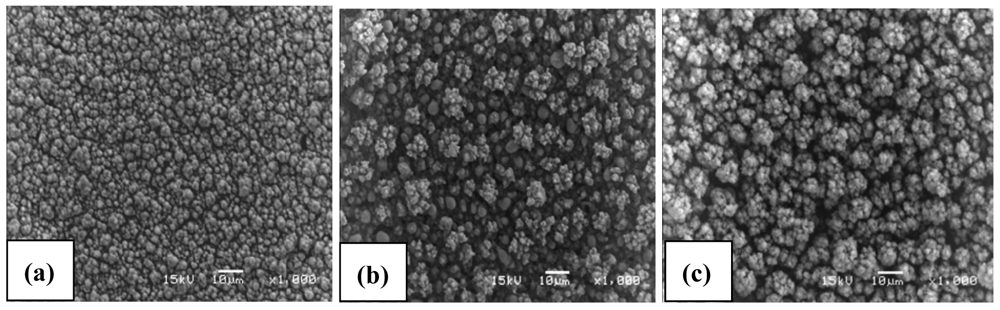
<p>As evaluated by SEM pictures, the morphology of Cu-SnO<sub>2</sub>, WO<sub>3</sub> and In<sub>2</sub>O<sub>3</sub> films presented in <xref ref-type="fig" rid="f1-sensors-09-09122">Figure 1</xref> shows a porous morphology comprising aggregates with uniform size distribution (2–5 μm for Cu-SnO<sub>2</sub> and about 10 μm for In<sub>2</sub>O<sub>3</sub>). The WO<sub>3</sub> films show variations in the size of the aggregates from 2 μm to 10 μm and this can be due to the lower deposition temperature (350 °C) compared to the deposition temperature of the other films (400 °C). The WO<sub>3</sub> films deposited at 400 °C have a more developed porosity than the films prepared at 350 °C, but the adhesion to the substrate was poor, hence, a compromise had to be accepted. The morphology of the films deposited at a certain temperature depends mainly on the rate of evaporation, spreading, precipitation and decomposition reaction. For this reason different deposition parameters has been used for the preparation of the films (<xref ref-type="table" rid="t1-sensors-09-09122">Table 1</xref>) in order to obtain porous morphology which plays an important role in the adsorption of the gas molecules [<xref ref-type="bibr" rid="b19-sensors-09-09122">19</xref>]. The thickness of the films varies from 7 to 10 μm as determined by film cross-section.</p>
<p>Supplementary details about the deposition optimization process of the films are described elsewhere [<xref ref-type="bibr" rid="b20-sensors-09-09122">20</xref>-<xref ref-type="bibr" rid="b22-sensors-09-09122">22</xref>].</p>
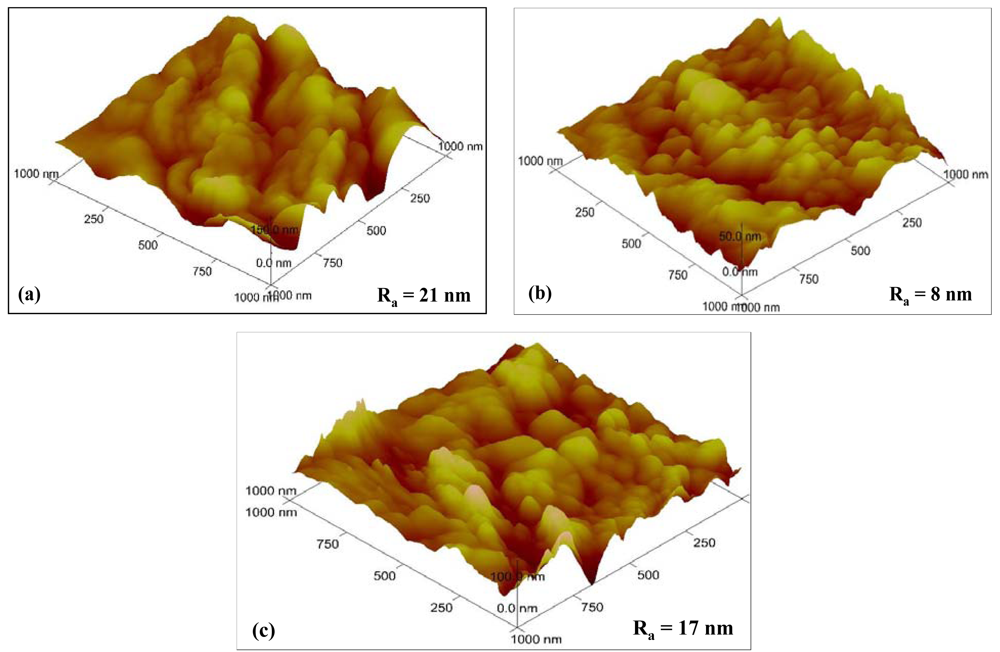
<p>The topographic 3D views of Cu-SnO<sub>2</sub>, WO<sub>3</sub> and In<sub>2</sub>O<sub>3</sub> films are shown in <xref ref-type="fig" rid="f2-sensors-09-09122">Figure 2</xref>. The pictures, realised on a surface of 1 μm per 1 μm, provide information about the shape, the size of the grains and their distribution in the aggregates. Furthermore, by means of appropriate software the mean roughness (Ra) can be calculated. It can be seen that all the films have porous morphology comprising grains with sizes ranging from 100 to 250 nm. The roughness of the Cu-SnO<sub>2</sub> seems to be the highest (21 nm), followed by In<sub>2</sub>O<sub>3</sub> (17 nm) and WO<sub>3</sub> (7 nm). Hence, no major differences between the films can be noted at this scale.</p>
<p>For a more precise evaluation of the roughness of the films, which could eventually provide a better comparison between the samples, it would be preferable to scan a larger surface. Unfortunately, this could not be successfully accomplished due to the specific morphology of the films, which present cauliflowers-like aggregates that are not connected between them at the surface, so, differences in the height of the aggregates and the “space” between them brought signal instabilities and consequently no good quality pictures could be obtained.</p>
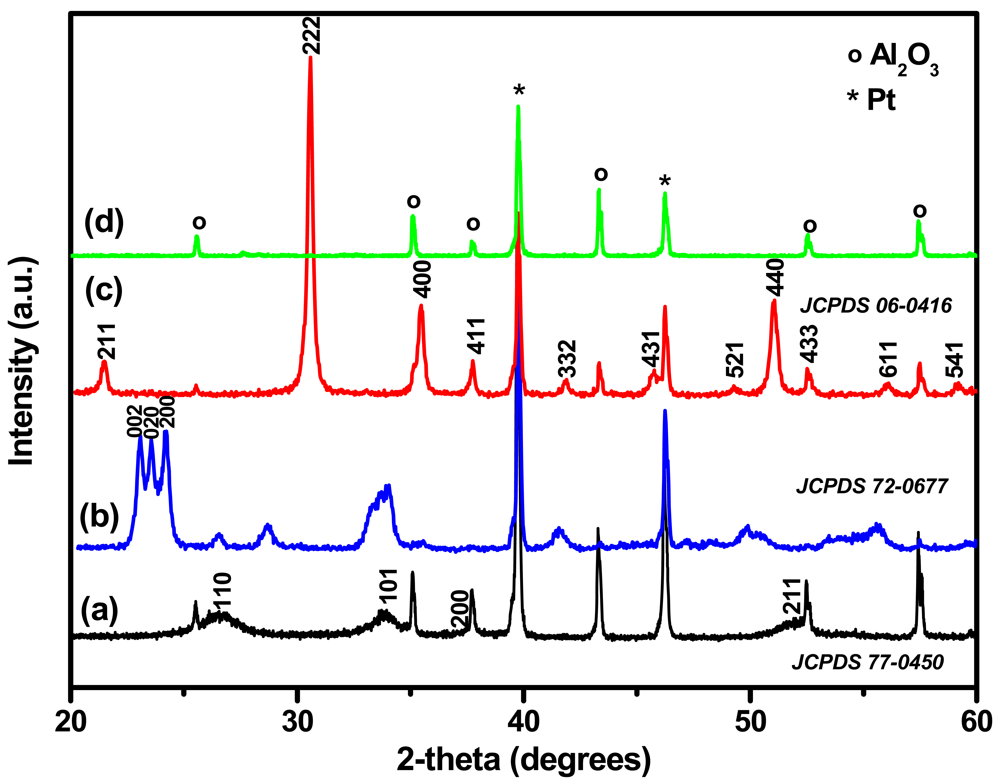
<p>The crystallinity of the films was analysed by the XRD technique, as presented in <xref ref-type="fig" rid="f3-sensors-09-09122">Figure 3</xref>. The films exhibit crystalline phases with peaks corresponding to tetragonal rutile (Cu-SnO<sub>2</sub>), monoclinic (WO<sub>3</sub>) and cubic (In<sub>2</sub>O<sub>3</sub>) phases [<xref ref-type="bibr" rid="b20-sensors-09-09122">20</xref>-<xref ref-type="bibr" rid="b22-sensors-09-09122">22</xref>]. No supplementary peaks (except those of the substrate) are detected, proving the purity of the films. The average crystallite sizes are calculated according to Debye-Scherrer formula [<xref ref-type="bibr" rid="b23-sensors-09-09122">23</xref>] and are about 7–10 nm for Cu-SnO<sub>2</sub> and 20–30 nm for WO<sub>3</sub> and In<sub>2</sub>O<sub>3</sub>. The small crystallite size of Cu-SnO<sub>2</sub> is also suggested by their broad XRD peaks. For gas sensor applications the size of the crystallite is very important since improved sensitivity has been reported for materials which have crystallite size similar to twice of the space charge layer (2L) [<xref ref-type="bibr" rid="b12-sensors-09-09122">12</xref>]. In our case the Cu-SnO<sub>2</sub> has the closest value to 2L (6 nm).</p>
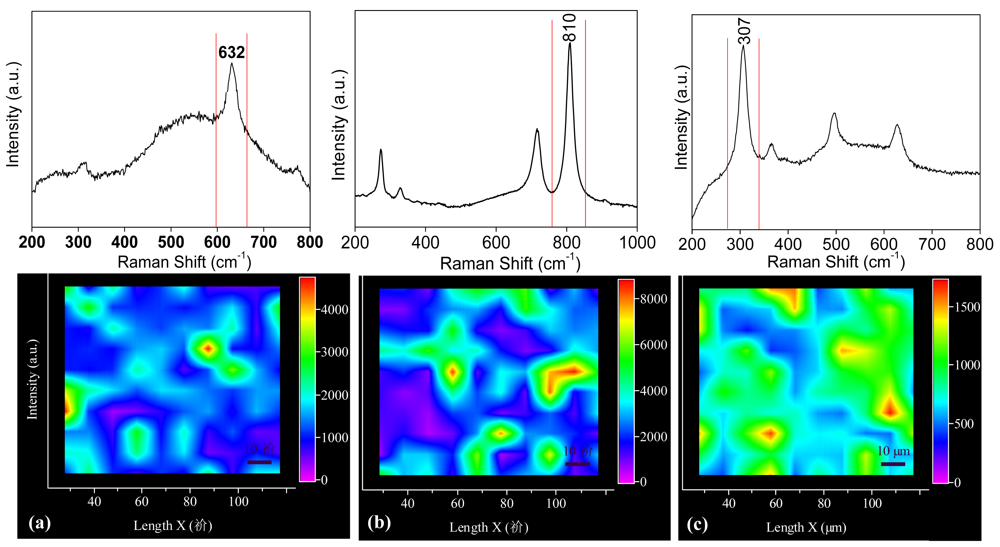
<p>Supplementary information concerning structural homogeneity of the films was provided by Raman spectroscopy studies. In <xref ref-type="fig" rid="f4-sensors-09-09122">Figure 4</xref> the Raman spectra and cartographies of Cu-SnO<sub>2</sub>, WO<sub>3</sub> and In<sub>2</sub>O<sub>3</sub> are shown. All the present peaks are indexed to rutile SnO<sub>2</sub> [<xref ref-type="bibr" rid="b24-sensors-09-09122">24</xref>], monoclinic WO<sub>3</sub> [<xref ref-type="bibr" rid="b25-sensors-09-09122">25</xref>] and cubic In<sub>2</sub>O<sub>3</sub> [<xref ref-type="bibr" rid="b26-sensors-09-09122">26</xref>,<xref ref-type="bibr" rid="b27-sensors-09-09122">27</xref>] in good accordance with the literature. Furthermore, these results validate the XRD ones with respect of the phase crystallization. To obtain the Raman cartographies approximately 100 spectra were collected for each film on a surface of 120 μm × 120 μm. The image was further obtained by the integration of the highest peak (632 cm<sup>−1</sup> for Cu-SnO<sub>2</sub>, 810 cm<sup>−1</sup> for WO<sub>3</sub> and 307 cm<sup>−1</sup> for In<sub>2</sub>O<sub>3</sub>) in each studied point.</p>
<p>It can be seen that the films are quite homogeneous in structure but they also present variations in the peak intensities which can be perhaps related to their morphology (especially to the grain size) and to the crystallinity. This type of Raman mapping gives an overall view of the surface structure of a material which is advantageous compared to the literature [<xref ref-type="bibr" rid="b28-sensors-09-09122">28</xref>] where generally only one Raman spectrum is presented and sometimes the evaluation of a small structural variation is delicate to be exploited.</p></sec>
<sec>
<label>2.2.</label>
<title>Gas Sensing Properties</title>
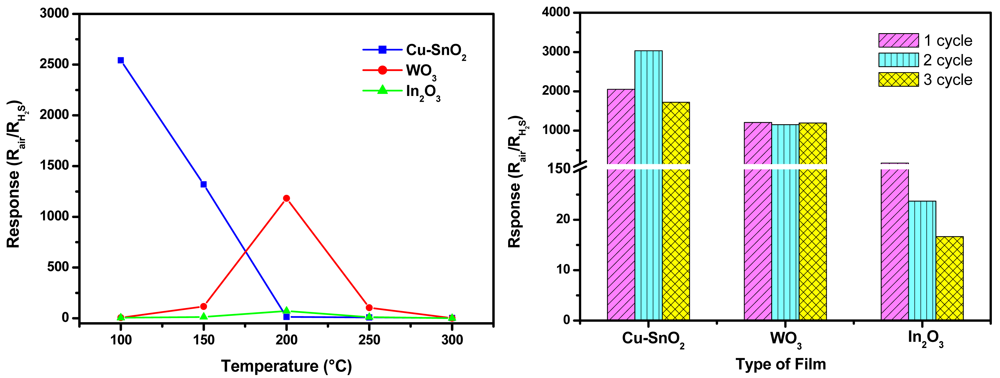
<p><xref ref-type="fig" rid="f5-sensors-09-09122">Figure 5a</xref> presents the response (R<sub>air</sub>/R<sub>H2s</sub>) of the films to 10 ppm H<sub>2</sub>S as a function of the operating temperature. The maximum response (2500) is showed by Cu-SnO<sub>2</sub> films at 100 °C. At this temperature the other films exhibit low response (about 6). They show better response (1200 for WO<sub>3</sub> and 75 for In<sub>2</sub>O<sub>3</sub>) than Cu-SnO<sub>2</sub> (13) at higher temperature (200 °C).</p>
<p>Comparing to the literature, the Cu-SnO<sub>2</sub> prepared in this work presents higher response at lower operating temperature than some other Cu-SnO<sub>2</sub> materials fabricated with different techniques [<xref ref-type="bibr" rid="b8-sensors-09-09122">8</xref>]. In the same way, the performances of WO<sub>3</sub> are superior to those reported in [<xref ref-type="bibr" rid="b29-sensors-09-09122">29</xref>]. On the contrary, the response obtained in [<xref ref-type="bibr" rid="b10-sensors-09-09122">10</xref>] is higher than that of our films, but with the disadvantage of a recovery process possible only by applying heating pulses at 250 °C. Concerning the In<sub>2</sub>O<sub>3</sub> films in the detection of H<sub>2</sub>S, there are just few dedicated papers in the literature [<xref ref-type="bibr" rid="b30-sensors-09-09122">30</xref>-<xref ref-type="bibr" rid="b32-sensors-09-09122">32</xref>], and we can say that our film response is not remarkable.</p>
<p>The differences between the film responses studied in this work can be due to the nature of the studied oxide and their morphological and structural properties. The accepted mechanism for the detection of reducing gases consists in the reaction of chemisorbed oxygen species (
<inline-formula>
<mml:math id="mm1">
<mml:semantics id="sm1">
<mml:mrow>
<mml:msubsup>
<mml:mtext>O</mml:mtext>
<mml:mn>2</mml:mn>
<mml:mo>−</mml:mo></mml:msubsup></mml:mrow></mml:semantics></mml:math></inline-formula>, O<sup>−</sup>, O<sup>2−</sup>) on the film surface and the gas molecules (H<sub>2</sub>S). As a consequence of this reaction the electrons are released, the film resistance decreases (R<sub>H<sub>2</sub>s</sub>) and the response is improved. In addition, for Cu-SnO<sub>2</sub> the influence of the copper dopant has to be taken into account since without dopant the sensitivity of SnO<sub>2</sub> is very low [<xref ref-type="bibr" rid="b33-sensors-09-09122">33</xref>]. In this direction several authors have proven by different techniques [<xref ref-type="bibr" rid="b34-sensors-09-09122">34</xref>,<xref ref-type="bibr" rid="b35-sensors-09-09122">35</xref>] the formation of CuS due to the reaction between Cu or CuO with H<sub>2</sub>S. The CuS metallic nature (low resistance) allows great sensor response to be achieved. The choice of a proper dopant for WO<sub>3</sub> and In<sub>2</sub>O<sub>3</sub> could beneficially improve their performance.</p>
<p>The reproducibility of the film response at their optimum operating temperature (<xref ref-type="fig" rid="f5-sensors-09-09122">Figure 5b</xref>) shows very good and satisfactory values for WO<sub>3</sub> and Cu-SnO<sub>2</sub>, respectively. The In<sub>2</sub>O<sub>3</sub> films present significant response differences between successive gas exposure cycles and this can be due to the incomplete recovery of the film resistance within the selected period of 60 minutes air purging. A good recovery of the resistance and implicitly of the response was be achieved by a long period (one night) of air exposure. Long recovery times for In<sub>2</sub>O<sub>3</sub> have also been reported by other authors [<xref ref-type="bibr" rid="b36-sensors-09-09122">36</xref>,<xref ref-type="bibr" rid="b37-sensors-09-09122">37</xref>].</p>
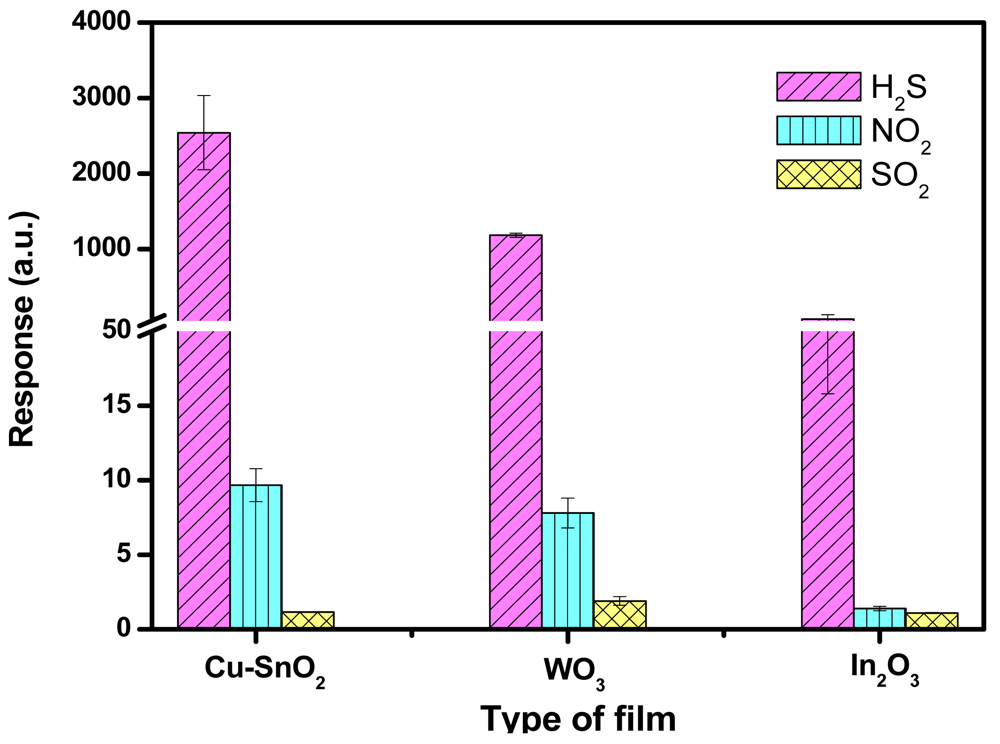
<p>The ability of detecting a desired gas from a mixture of gases is an important performance property of a sensor. For Cu-SnO<sub>2</sub> the 100 °C optimum temperature was selected to study the cross-sensitivity to other reducing (SO<sub>2</sub>) and oxidising (NO<sub>2</sub>) gases, while for WO<sub>3</sub> and In<sub>2</sub>O<sub>3</sub> the 200 °C temperature was used. The selection of the temperature corresponds to the temperature offering the maximum response to H<sub>2</sub>S. As highlighted in <xref ref-type="fig" rid="f6-sensors-09-09122">Figure 6</xref>, all the films present significantly higher response for H<sub>2</sub>S than for NO<sub>2</sub> or SO<sub>2</sub>. Hence, we can affirm that the films can provide selectivity in an eventually H<sub>2</sub>S detection from a mixture comprising the three studied gases (H<sub>2</sub>S, NO<sub>2</sub> and SO<sub>2</sub>).</p></sec></sec>
<sec>
<label>3.</label>
<title>Experimental Section</title>
<sec>
<label>3.1.</label>
<title>Film Deposition Process</title>
<p>The films (Cu-SnO<sub>2</sub>, WO<sub>3</sub> and In<sub>2</sub>O<sub>3</sub>) were deposited on Pt partially coated alumina using the ESD technique as presented in Reference [<xref ref-type="bibr" rid="b22-sensors-09-09122">22</xref>]. The parameters used for the deposition of the films are described in <xref ref-type="table" rid="t1-sensors-09-09122">Table 1</xref>. The precursors were dissolved in ethanol in order to obtain a 0.05 M solution which was atomisated by applying a high voltage (7-8 kV) between a metallic nozzle and a heated and grounded substrate. The formed aerosol (spray) comprises highly charged droplets which are directed to the substrate under an electrostatic force. At the impact, the droplets loose their charge, and then spreading, drying, and decomposition of the precursor solution occur. In this way a thin layer was formed on the substrate surface and to improve their crystallinity annealing treatment was performed. Several films of each composition have been prepared to validate the reproducibility of film deposition in terms of morphology, structure, homogeneity, and gas responses.</p></sec>
<sec>
<label>3.2.</label>
<title>Characterization Techniques</title>
<p>The film morphology was studied using a JOEL JSM 580LV scanning electron microscope and the topography was evaluated with an atomic force microscope (Nanoscope IV-Multimode Veeco Instruments, USA) operating in a tapping mode regime. Raman measurements were performed at room temperature using a Jobin-Yvon microspectometer having a He-Ne excitation source (wavelength 632.8 nm). The sample surface was visualized by an optical microscope which allowed the selection of specific zone for structure evaluation. Raman spectra were recorded by scanning a part of the sample surface (120 μm × 120 μm) in 10 μm steps in both X and Y-axes. By integration of the desired Raman peak, the structural cartography of the surface was obtained.</p></sec>
<sec>
<label>3.3.</label>
<title>Sensing Measurements</title>
<p>The gas sensing measurements were carried out in a closed quartz tube furnace. The temperature was measured using a type K thermocouple and was controlled by a PID temperature regulator (JUMO dTRON 16.1). The resistance measurements were performed using a two-point probe method with an electrometer (KEITHLEY 6514). The gas response of a film (S) is defined as the ratio of R<sub>air</sub>/R<sub>gas</sub> for H<sub>2</sub>S and SO<sub>2</sub> (reducing gases) and R<sub>gas</sub>/R<sub>air</sub> for NO<sub>2</sub> (oxidizing gas), where R<sub>air</sub> represents the electrical resistance of the film in synthetic air and R<sub>gas</sub> represents the resistance during the gas exposure.</p>
<p>To determine the temperature at which the H<sub>2</sub>S response was maximum, the films were exposed to 10 ppm H<sub>2</sub>S in a temperature range of 100 to 300 °C. Firstly the temperature was set to the desired value and the films were purged with synthetic air for 60 min. Next, the films were exposed to H<sub>2</sub>S for 30 min, followed by regeneration with synthetic air for 60 min. This cycle was repeated about four times during a day (in order to ensure the reproducibility). The responses of the films to 20 ppm SO<sub>2</sub> and 1 ppm NO<sub>2</sub> were evaluated at the selected operating temperature (temperature at which the film shows the maximum response).</p>
<p>The concentration of gases was fixed by adjusting the flow rates of a target gas and a carrier gas (synthetic air) in the way to maintain a constant total flow rate of 100 mL/min. The gas bottles were provided by Air Products (France) and the concentration of the gases was controlled using mass flow controllers (MFC, BROOKS Instruments, 5850 TR).</p></sec></sec>
<sec sec-type="conclusions">
<label>4.</label>
<title>Conclusions</title>
<p>This paper describes the deposition of metal oxide semiconductor films of Cu-SnO<sub>2</sub>, WO<sub>3</sub> and In<sub>2</sub>O<sub>3</sub> using the electrostatic spray deposition technique and their use in the detection of hydrogen sulfide. It has been shown that this simple and cost-effective technique allows the fabrication of films with desired characteristics for gas sensor applications, <italic>i.e.</italic>, porous and homogeneous morphology, good crystallinity, crystallite size in the nanometer range and purity. These highlighted characteristics can afford a high sensitivity of our films to H<sub>2</sub>S with a maximum response achieved by Cu-SnO<sub>2</sub> (2,500) and followed by WO<sub>3</sub> (1,200) and In<sub>2</sub>O<sub>3</sub> (75). In addition, their low operating temperatures (100 °C and 200 °C) makes them attractive from a practical and energy economy point of view. For measurements in real atmospheres, several gases can be present at the same time, so, the selectivity of a sensor is crucial in order to avoid interferences between different gases. With respect of this aspect no cross-sensitivity of all the studied films to SO<sub>2</sub> or NO<sub>2</sub> was found.</p></sec></body>
<back>
<ack>
<p>The authors would like to acknowledge Dr. Cathie Vix from the Institut de Science des Matériaux de Mulhouse (France) for the characterization technique facilities and also to Dr. Viorela Ostaci for the collaboration in the AFM technique.</p></ack>
<ref-list>
<title>References and Notes</title>
<ref id="b1-sensors-09-09122"><label>1.</label><citation citation-type="journal"><person-group person-group-type="author"><name><surname>Barratto</surname><given-names>C.</given-names></name><name><surname>Sberveglieri</surname><given-names>G.</given-names></name><name><surname>Onischuk</surname><given-names>A.</given-names></name><name><surname>Caruso</surname><given-names>B.</given-names></name><name><surname>di Stasio</surname><given-names>S.</given-names></name></person-group><article-title>Low temperature selective NO<sub>2</sub> sensors by nanostructured fibres of ZnO</article-title><source>Sens. Actuat. B</source><year>2004</year><volume>100</volume><fpage>261</fpage><lpage>265</lpage><pub-id pub-id-type="doi">10.1016/j.snb.2003.12.045</pub-id></citation></ref>
<ref id="b2-sensors-09-09122"><label>2.</label><citation citation-type="journal"><person-group person-group-type="author"><name><surname>Barret</surname><given-names>E.P.S.</given-names></name><name><surname>Georgiades</surname><given-names>G.C.</given-names></name><name><surname>Sermon</surname><given-names>P.A.</given-names></name></person-group><article-title>The mechanism of operation of WO<sub>3</sub>-based H<sub>2</sub>S sensors</article-title><source>Sens. Actuat.</source><year>1990</year><volume>B1</volume><fpage>116</fpage><lpage>120</lpage></citation></ref>
<ref id="b3-sensors-09-09122"><label>3.</label><citation citation-type="journal"><person-group person-group-type="author"><name><surname>Cobianu</surname><given-names>C.</given-names></name><name><surname>Savaniu</surname><given-names>C.</given-names></name><name><surname>Siciliano</surname><given-names>P.</given-names></name><name><surname>Capone</surname><given-names>S.</given-names></name><name><surname>Utriainen</surname><given-names>M.</given-names></name><name><surname>Niinisto</surname><given-names>L.</given-names></name></person-group><article-title>SnO<sub>2</sub> sol-gel derived thin films for integrated gas sensors</article-title><source>Sens. Actuat. B</source><year>2001</year><volume>77</volume><fpage>496</fpage><lpage>500</lpage><pub-id pub-id-type="doi">10.1016/S0925-4005(01)00755-9</pub-id></citation></ref>
<ref id="b4-sensors-09-09122"><label>4.</label><citation citation-type="journal"><person-group person-group-type="author"><name><surname>Bender</surname><given-names>F.</given-names></name><name><surname>Kim</surname><given-names>C.</given-names></name><name><surname>Mlsna</surname><given-names>T.</given-names></name><name><surname>Vetelino</surname><given-names>J.F.</given-names></name></person-group><article-title>Characterization of a WO<sub>3</sub> thin film chlorine sensor</article-title><source>Sens. Actuat. B</source><year>2001</year><volume>77</volume><fpage>281</fpage><lpage>286</lpage><pub-id pub-id-type="doi">10.1016/S0925-4005(01)00711-0</pub-id></citation></ref>
<ref id="b5-sensors-09-09122"><label>5.</label><citation citation-type="journal"><person-group person-group-type="author"><name><surname>Comini</surname><given-names>E.</given-names></name><name><surname>Faglia</surname><given-names>G.</given-names></name><name><surname>Sberveglieri</surname><given-names>G.</given-names></name></person-group><article-title>CO and NO<sub>2</sub> response of tin oxide silicon doped thin films</article-title><source>Sens. Actuat. B</source><year>2001</year><volume>76</volume><fpage>270</fpage><lpage>274</lpage><pub-id pub-id-type="doi">10.1016/S0925-4005(01)00581-0</pub-id></citation></ref>
<ref id="b6-sensors-09-09122"><label>6.</label><citation citation-type="journal"><person-group person-group-type="author"><name><surname>Galatsis</surname><given-names>K.</given-names></name><name><surname>Li</surname><given-names>Y.X.</given-names></name><name><surname>Wlodarski</surname><given-names>W.</given-names></name><name><surname>Kalantar-Zadeh</surname><given-names>K.</given-names></name></person-group><article-title>Sol-gel prepared MoO<sub>3</sub>-WO<sub>3</sub> thin-films for O<sub>2</sub> gas sensing</article-title><source>Sens. Actuat. B</source><year>2001</year><volume>77</volume><fpage>478</fpage><lpage>483</lpage><pub-id pub-id-type="doi">10.1016/S0925-4005(01)00738-9</pub-id></citation></ref>
<ref id="b7-sensors-09-09122"><label>7.</label><citation citation-type="journal"><person-group person-group-type="author"><name><surname>Ivanovskaya</surname><given-names>M.</given-names></name><name><surname>Gurlo</surname><given-names>A.</given-names></name><name><surname>Bogdanov</surname><given-names>P.</given-names></name></person-group><article-title>Mechanism of O<sub>3</sub> and NO<sub>2</sub> detection and selectivity of In<sub>2</sub>O<sub>3</sub> sensors</article-title><source>Sens. Actuat. B</source><year>2001</year><volume>77</volume><fpage>264</fpage><lpage>267</lpage><pub-id pub-id-type="doi">10.1016/S0925-4005(01)00708-0</pub-id></citation></ref>
<ref id="b8-sensors-09-09122"><label>8.</label><citation citation-type="journal"><person-group person-group-type="author"><name><surname>Liu</surname><given-names>J.</given-names></name><name><surname>Huang</surname><given-names>X.</given-names></name><name><surname>Ye</surname><given-names>G.</given-names></name><name><surname>Liu</surname><given-names>W.</given-names></name><name><surname>Jiao</surname><given-names>Z.</given-names></name><name><surname>Chao</surname><given-names>W.</given-names></name><name><surname>Zhou</surname><given-names>Z.</given-names></name><name><surname>Yu</surname><given-names>Z.</given-names></name></person-group><article-title>H<sub>2</sub>S detection sensing characteristic of CuO/SnO<sub>2</sub> sensor</article-title><source>Sensors</source><year>2003</year><volume>3</volume><fpage>110</fpage><lpage>118</lpage><pub-id pub-id-type="doi">10.3390/s30500110</pub-id></citation></ref>
<ref id="b9-sensors-09-09122"><label>9.</label><citation citation-type="journal"><person-group person-group-type="author"><name><surname>Rumyantseva</surname><given-names>M.N.</given-names></name><name><surname>Labeau</surname><given-names>M.</given-names></name><name><surname>Senateur</surname><given-names>J.P.</given-names></name><name><surname>Delabouglise</surname><given-names>G.</given-names></name><name><surname>Boulova</surname><given-names>M.</given-names></name><name><surname>Gasckov</surname><given-names>A.M.</given-names></name></person-group><article-title>Influence of copper on sensor properties of tin dioxide films in H<sub>2</sub>S</article-title><source>Mater. Sci. Eng., B</source><year>1996</year><volume>41</volume><fpage>228</fpage><lpage>234</lpage><pub-id pub-id-type="doi">10.1016/S0921-5107(96)01601-7</pub-id></citation></ref>
<ref id="b10-sensors-09-09122"><label>10.</label><citation citation-type="journal"><person-group person-group-type="author"><name><surname>Solis</surname><given-names>J.L.</given-names></name><name><surname>Saukko</surname><given-names>S.</given-names></name><name><surname>Kish</surname><given-names>L.B.</given-names></name><name><surname>Granqvist</surname><given-names>C.G.</given-names></name><name><surname>Lantto</surname><given-names>V.</given-names></name></person-group><article-title>Nanocrystalline tungsten oxide thick-film with high sensitivity to H<sub>2</sub>S at room temperature</article-title><source>Sens. Actuat. B</source><year>2001</year><volume>77</volume><fpage>316</fpage><lpage>321</lpage><pub-id pub-id-type="doi">10.1016/S0925-4005(01)00699-2</pub-id></citation></ref>
<ref id="b11-sensors-09-09122"><label>11.</label><citation citation-type="journal"><person-group person-group-type="author"><name><surname>Ruiz</surname><given-names>A.M.</given-names></name><name><surname>Sakai</surname><given-names>G.</given-names></name><name><surname>Cornet</surname><given-names>A.</given-names></name><name><surname>Shimanoe</surname><given-names>K.</given-names></name><name><surname>Morante</surname><given-names>J.R.</given-names></name><name><surname>Yamazoe</surname><given-names>N.</given-names></name></person-group><article-title>Microstructure control of thermally stable TiO<sub>2</sub> obtained by hydrothermal process for gas sensors</article-title><source>Sens. Actuat. B</source><year>2004</year><volume>103</volume><fpage>312</fpage><lpage>31</lpage><pub-id pub-id-type="doi">10.1016/j.snb.2004.04.061</pub-id></citation></ref>
<ref id="b12-sensors-09-09122"><label>12.</label><citation citation-type="journal"><person-group person-group-type="author"><name><surname>Xu</surname><given-names>C.</given-names></name><name><surname>Tamaki</surname><given-names>J.</given-names></name><name><surname>Miura</surname><given-names>N.</given-names></name><name><surname>Yamazoe</surname><given-names>N.</given-names></name></person-group><article-title>Grain size effects on gas sensitivity of porous SnO<sub>2</sub>-based elements</article-title><source>Sens. Actuat. B</source><year>1991</year><volume>3</volume><fpage>147</fpage><lpage>155</lpage><pub-id pub-id-type="doi">10.1016/0925-4005(91)80207-Z</pub-id></citation></ref>
<ref id="b13-sensors-09-09122"><label>13.</label><citation citation-type="journal"><person-group person-group-type="author"><name><surname>Paraguay</surname><given-names>D.F.</given-names></name><name><surname>Miki-Yoshida</surname><given-names>M.</given-names></name><name><surname>Morales</surname><given-names>J.</given-names></name><name><surname>Solis</surname><given-names>J.</given-names></name><name><surname>Estrada</surname><given-names>L.W.</given-names></name></person-group><article-title>Influence of Al, In, Cu, Fe and Sn dopants on the response of thin film ZnO gas sensor to ethanol vapour</article-title><source>Thin Solid Films</source><year>2000</year><volume>373</volume><fpage>137</fpage><lpage>140</lpage><pub-id pub-id-type="doi">10.1016/S0040-6090(00)01120-2</pub-id></citation></ref>
<ref id="b14-sensors-09-09122"><label>14.</label><citation citation-type="journal"><person-group person-group-type="author"><name><surname>Penza</surname><given-names>M.</given-names></name><name><surname>Martucci</surname><given-names>C.</given-names></name><name><surname>Cassano</surname><given-names>G.</given-names></name></person-group><article-title>NO<sub>x</sub> gas sensing characteristics of WO<sub>3</sub> thin films activated by noble metals (Pd, Pt, Au) layers</article-title><source>Sens. Actuat. B</source><year>1998</year><volume>50</volume><fpage>52</fpage><lpage>59</lpage><pub-id pub-id-type="doi">10.1016/S0925-4005(98)00156-7</pub-id></citation></ref>
<ref id="b15-sensors-09-09122"><label>15.</label><citation citation-type="journal"><person-group person-group-type="author"><name><surname>Steffes</surname><given-names>H.</given-names></name><name><surname>Imawan</surname><given-names>C.</given-names></name><name><surname>Solzbacher</surname><given-names>F.</given-names></name><name><surname>Obermeier</surname><given-names>E.</given-names></name></person-group><article-title>Enhancement of NO<sub>2</sub> sensing properties of In<sub>2</sub>O<sub>3</sub>-based thin film using an Au or Ti surface modification</article-title><source>Sens. Actuat. B</source><year>2001</year><volume>78</volume><fpage>106</fpage><lpage>112</lpage><pub-id pub-id-type="doi">10.1016/S0925-4005(01)00799-7</pub-id></citation></ref>
<ref id="b16-sensors-09-09122"><label>16.</label><citation citation-type="journal"><person-group person-group-type="author"><name><surname>Supothina</surname><given-names>S.</given-names></name></person-group><article-title>Gas sensing properties of nanocrystalline SnO<sub>2</sub> thin films prepared by liquid flow deposition</article-title><source>Sens. Actuat. B</source><year>2003</year><volume>93</volume><fpage>526</fpage><lpage>530</lpage><pub-id pub-id-type="doi">10.1016/S0925-4005(03)00178-3</pub-id></citation></ref>
<ref id="b17-sensors-09-09122"><label>17.</label><citation citation-type="journal"><person-group person-group-type="author"><name><surname>Tanaka</surname><given-names>S.</given-names></name><name><surname>Esaka</surname><given-names>T.</given-names></name></person-group><article-title>High NO<sub>x</sub> Sensitivity of oxide thin films prepared by RF sputtering</article-title><source>Mater. Res. Bull.</source><year>2000</year><volume>35</volume><fpage>2491</fpage><lpage>2502</lpage><pub-id pub-id-type="doi">10.1016/S0025-5408(00)00455-4</pub-id></citation></ref>
<ref id="b18-sensors-09-09122"><label>18.</label><citation citation-type="journal"><person-group person-group-type="author"><name><surname>Zayim</surname><given-names>E.O.</given-names></name><name><surname>Liu</surname><given-names>P.</given-names></name><name><surname>Lee</surname><given-names>S.-H.</given-names></name><name><surname>Tracy</surname><given-names>C.E.</given-names></name><name><surname>Turner</surname><given-names>J.A.</given-names></name><name><surname>Pitts</surname><given-names>J.R.</given-names></name><name><surname>Deb</surname><given-names>S.K.</given-names></name></person-group><article-title>Mesoporous sol-gel WO<sub>3</sub> thin films Via Poly(Styrene-Co-Allyl-Alcohol) copolymer templates</article-title><source>Solid State Ionics</source><year>2003</year><volume>165</volume><fpage>65</fpage><lpage>72</lpage><pub-id pub-id-type="doi">10.1016/j.ssi.2003.08.014</pub-id></citation></ref>
<ref id="b19-sensors-09-09122"><label>19.</label><citation citation-type="journal"><person-group person-group-type="author"><name><surname>Safonova</surname><given-names>O.V.</given-names></name><name><surname>Delabouglise</surname><given-names>G.</given-names></name><name><surname>Chenevier</surname><given-names>B.</given-names></name><name><surname>Gaskov</surname><given-names>A.M.</given-names></name><name><surname>Labeau</surname><given-names>M.</given-names></name></person-group><article-title>CO and NO<sub>2</sub> gas sensitivity of nanocrystalline tin dioxide thin films doped with Pd, Ru and Rh</article-title><source>Mater. Sci. Eng., C</source><year>2002</year><volume>21</volume><fpage>105</fpage><lpage>11</lpage><pub-id pub-id-type="doi">10.1016/S0928-4931(02)00068-1</pub-id></citation></ref>
<ref id="b20-sensors-09-09122"><label>20.</label><citation citation-type="journal"><person-group person-group-type="author"><name><surname>Matei Ghimbeu</surname><given-names>C.</given-names></name><name><surname>Schoonman</surname><given-names>J.</given-names></name><name><surname>Lumbreras</surname><given-names>M.</given-names></name></person-group><article-title>Porous indium oxide films deposited by electrostatic spray deposition technique</article-title><source>Ceram. Int.</source><year>2008</year><volume>34</volume><fpage>95</fpage><lpage>100</lpage><pub-id pub-id-type="doi">10.1016/j.ceramint.2006.08.011</pub-id></citation></ref>
<ref id="b21-sensors-09-09122"><label>21.</label><citation citation-type="journal"><person-group person-group-type="author"><name><surname>Matei Ghimbeu</surname><given-names>C.</given-names></name><name><surname>Van Landschoot</surname><given-names>R.C.</given-names></name><name><surname>Schoonman</surname><given-names>J.</given-names></name><name><surname>Lumbreras</surname><given-names>M.</given-names></name></person-group><article-title>Tungsten trioxide thin films prepared by electrostatic spray deposition technique</article-title><source>Thin Solid Films</source><year>2007</year><volume>515</volume><fpage>5498</fpage><lpage>5504</lpage><pub-id pub-id-type="doi">10.1016/j.tsf.2007.01.014</pub-id></citation></ref>
<ref id="b22-sensors-09-09122"><label>22.</label><citation citation-type="journal"><person-group person-group-type="author"><name><surname>Matei Ghimbeu</surname><given-names>C.</given-names></name><name><surname>Van Landschoot</surname><given-names>R.</given-names></name><name><surname>Schoonman</surname><given-names>J.</given-names></name><name><surname>Lumbreras</surname><given-names>M.</given-names></name></person-group><article-title>Preparation and characterization of SnO<sub>2</sub> and Cu-doped SnO<sub>2</sub> thin films using electrostatic spray deposition (ESD)</article-title><source>J. Eur. Ceram. Soc.</source><year>2007</year><volume>27</volume><fpage>207</fpage><lpage>213</lpage><pub-id pub-id-type="doi">10.1016/j.jeurceramsoc.2006.05.092</pub-id></citation></ref>
<ref id="b23-sensors-09-09122"><label>23.</label><citation citation-type="journal"><person-group person-group-type="author"><name><surname>Tunstall</surname><given-names>D.P.</given-names></name><name><surname>Patou</surname><given-names>S.</given-names></name><name><surname>Liu</surname><given-names>R.S.</given-names></name><name><surname>Kao</surname><given-names>Y.H.</given-names></name></person-group><article-title>Size effects in the NMR of SnO<sub>2</sub> powders</article-title><source>Mater. Res. Bull.</source><year>1999</year><volume>34</volume><fpage>1513</fpage><lpage>1520</lpage><pub-id pub-id-type="doi">10.1016/S0025-5408(99)00177-4</pub-id></citation></ref>
<ref id="b24-sensors-09-09122"><label>24.</label><citation citation-type="journal"><person-group person-group-type="author"><name><surname>Yu</surname><given-names>K.N.</given-names></name><name><surname>Xiong</surname><given-names>Y.</given-names></name><name><surname>Liu</surname><given-names>Y.</given-names></name><name><surname>Xiong</surname><given-names>C.</given-names></name></person-group><article-title>Microstructural change of nano-SnO<sub>2</sub> grain assemblages with the annealing temperature</article-title><source>Phys. Rev. B</source><year>1997</year><volume>55</volume><fpage>2666</fpage><lpage>2671</lpage><pub-id pub-id-type="doi">10.1103/PhysRevB.55.2666</pub-id></citation></ref>
<ref id="b25-sensors-09-09122"><label>25.</label><citation citation-type="journal"><person-group person-group-type="author"><name><surname>Moulzolf</surname><given-names>S.C.</given-names></name><name><surname>LeGore</surname><given-names>L.J.</given-names></name><name><surname>Lad</surname><given-names>R.J.</given-names></name></person-group><article-title>Heteroepitaxial growth of tungsten oxide films on sapphire for chemical gas sensors</article-title><source>Thin Solid Films</source><year>2001</year><volume>400</volume><fpage>56</fpage><lpage>63</lpage><pub-id pub-id-type="doi">10.1016/S0040-6090(01)01447-X</pub-id></citation></ref>
<ref id="b26-sensors-09-09122"><label>26.</label><citation citation-type="journal"><person-group person-group-type="author"><name><surname>Rojas-Lopez</surname><given-names>M.</given-names></name><name><surname>Nieto-Navarro</surname><given-names>J.</given-names></name><name><surname>Rosendo</surname><given-names>E.</given-names></name><name><surname>Navarro-Contresas</surname><given-names>H.</given-names></name><name><surname>Vidal</surname><given-names>M.A.</given-names></name></person-group><article-title>Raman scattering study of photoluminiscent spark-processed porous InP</article-title><source>Thin Solid Films</source><year>2000</year><volume>379</volume><fpage>1</fpage><lpage>6</lpage><pub-id pub-id-type="doi">10.1016/S0040-6090(00)01565-0</pub-id></citation></ref>
<ref id="b27-sensors-09-09122"><label>27.</label><citation citation-type="journal"><person-group person-group-type="author"><name><surname>Vigreux</surname><given-names>C.</given-names></name><name><surname>Binet</surname><given-names>L.</given-names></name><name><surname>Gourier</surname><given-names>D.</given-names></name></person-group><article-title>Formation by laser impact of conducting -Ga<sub>2</sub>O<sub>3</sub>-In<sub>2</sub>O<sub>3</sub> solid solution with composition gradients</article-title><source>J. Solid State Chem.</source><year>2001</year><volume>157</volume><fpage>94</fpage><lpage>101</lpage><pub-id pub-id-type="doi">10.1006/jssc.2000.9043</pub-id></citation></ref>
<ref id="b28-sensors-09-09122"><label>28.</label><citation citation-type="journal"><person-group person-group-type="author"><name><surname>Habazaki</surname><given-names>H.</given-names></name><name><surname>Hayashi</surname><given-names>Y.</given-names></name><name><surname>Konno</surname><given-names>H.</given-names></name></person-group><article-title>Characterization of electrodeposited WO<sub>3</sub> films and its application to electrochemical wastewater treatment</article-title><source>Electrochim. Acta</source><year>2002</year><volume>47</volume><fpage>4181</fpage><lpage>4188</lpage><pub-id pub-id-type="doi">10.1016/S0013-4686(02)00435-8</pub-id></citation></ref>
<ref id="b29-sensors-09-09122"><label>29.</label><citation citation-type="journal"><person-group person-group-type="author"><name><surname>Reyes</surname><given-names>L.F.</given-names></name><name><surname>Hoel</surname><given-names>A.</given-names></name><name><surname>Saukko</surname><given-names>S.</given-names></name><name><surname>Heszler</surname><given-names>P.</given-names></name><name><surname>Lantto</surname><given-names>V.</given-names></name><name><surname>Granqvist</surname><given-names>C.G.</given-names></name></person-group><article-title>Gas sensor response of pure and activated WO<sub>3</sub> Nanoparticle films made by advanced reactive gas deposition</article-title><source>Sens. Actuat. B</source><year>2006</year><volume>117</volume><fpage>128</fpage><lpage>134</lpage><pub-id pub-id-type="doi">10.1016/j.snb.2005.11.008</pub-id></citation></ref>
<ref id="b30-sensors-09-09122"><label>30.</label><citation citation-type="journal"><person-group person-group-type="author"><name><surname>Niu</surname><given-names>X.</given-names></name><name><surname>Zhong</surname><given-names>H.</given-names></name><name><surname>Wang</surname><given-names>X.</given-names></name><name><surname>Jiang</surname><given-names>K.</given-names></name></person-group><article-title>Sensing properties of rare earth oxide doped In<sub>2</sub>O<sub>3</sub> by sol-gel method</article-title><source>Sens. Actuat. B</source><year>2006</year><volume>115</volume><fpage>434</fpage><lpage>438</lpage><pub-id pub-id-type="doi">10.1016/j.snb.2005.10.004</pub-id></citation></ref>
<ref id="b31-sensors-09-09122"><label>31.</label><citation citation-type="journal"><person-group person-group-type="author"><name><surname>Xu</surname><given-names>J.</given-names></name><name><surname>Wang</surname><given-names>X.</given-names></name><name><surname>Shen</surname><given-names>J.</given-names></name></person-group><article-title>Hydrothermal synthesis of In<sub>2</sub>O<sub>3</sub> for detecting H<sub>2</sub>S in air</article-title><source>Sens. Actuat. B</source><year>2006</year><volume>115</volume><fpage>642</fpage><lpage>646</lpage><pub-id pub-id-type="doi">10.1016/j.snb.2005.10.038</pub-id></citation></ref>
<ref id="b32-sensors-09-09122"><label>32.</label><citation citation-type="journal"><person-group person-group-type="author"><name><surname>Tomchenko</surname><given-names>A.A.</given-names></name><name><surname>Harmer</surname><given-names>G.P.</given-names></name><name><surname>Marquis</surname><given-names>B.T.</given-names></name><name><surname>Allen</surname><given-names>J.W.</given-names></name></person-group><article-title>Semiconducting metal oxide sensor array for the selective detection of combustion gases</article-title><source>Sens. Actuat. B</source><year>2003</year><volume>93</volume><fpage>126</fpage><lpage>134</lpage><pub-id pub-id-type="doi">10.1016/S0925-4005(03)00240-5</pub-id></citation></ref>
<ref id="b33-sensors-09-09122"><label>33.</label><citation citation-type="journal"><person-group person-group-type="author"><name><surname>Matei Ghimbeu</surname><given-names>C.</given-names></name><name><surname>Lumbreras</surname><given-names>M.</given-names></name><name><surname>Siadat</surname><given-names>M.</given-names></name><name><surname>Landschoot</surname><given-names>R.C.</given-names></name><name><surname>Schoonman</surname><given-names>J.</given-names></name></person-group><article-title>Electrostatic sprayed SnO<sub>2</sub> and Cu-doped SnO<sub>2</sub> films for H<sub>2</sub>S detection</article-title><source>Sens. Actuat. B</source><year>2008</year><volume>133</volume><fpage>694</fpage><lpage>698</lpage><pub-id pub-id-type="doi">10.1016/j.snb.2008.04.007</pub-id></citation></ref>
<ref id="b34-sensors-09-09122"><label>34.</label><citation citation-type="journal"><person-group person-group-type="author"><name><surname>Niranjan</surname><given-names>R.S.</given-names></name><name><surname>Patil</surname><given-names>K.R.</given-names></name><name><surname>Sainkar</surname><given-names>R.S.</given-names></name><name><surname>Mulla</surname><given-names>I.S.</given-names></name></person-group><article-title>High H<sub>2</sub>S-sensitive copper-doped tin oxide thin film</article-title><source>Mater. Chem. Phys.</source><year>2002</year><volume>80</volume><fpage>250</fpage><lpage>256</lpage></citation></ref>
<ref id="b35-sensors-09-09122"><label>35.</label><citation citation-type="journal"><person-group person-group-type="author"><name><surname>Pagnier</surname><given-names>T.</given-names></name><name><surname>Boulova</surname><given-names>M.</given-names></name><name><surname>Galerie</surname><given-names>A.</given-names></name><name><surname>Gaskov</surname><given-names>A.</given-names></name><name><surname>Lucazeau</surname><given-names>G.</given-names></name></person-group><article-title>Reactivity of SnO<sub>2</sub>-CuO nanocristalline materials with H<sub>2</sub>S: a coupled electrical and Raman spectroscopic study</article-title><source>Sens. Actuat. B</source><year>2000</year><volume>71</volume><fpage>134</fpage><lpage>139</lpage><pub-id pub-id-type="doi">10.1016/S0925-4005(00)00598-0</pub-id></citation></ref>
<ref id="b36-sensors-09-09122"><label>36.</label><citation citation-type="journal"><person-group person-group-type="author"><name><surname>Kapse</surname><given-names>V.D.</given-names></name><name><surname>Ghosh</surname><given-names>S.A.</given-names></name><name><surname>Chaudhari</surname><given-names>G.N.</given-names></name><name><surname>Raghuwanshi</surname><given-names>F.C.</given-names></name><name><surname>Gualwade</surname><given-names>D.D.</given-names></name></person-group><article-title>H<sub>2</sub>S sensing properties of La-doped nanocrystalline In<sub>2</sub>O<sub>3</sub></article-title><source>Vacuum</source><year>2008</year><volume>83</volume><fpage>346</fpage><lpage>352</lpage><pub-id pub-id-type="doi">10.1016/j.vacuum.2008.05.027</pub-id></citation></ref>
<ref id="b37-sensors-09-09122"><label>37.</label><citation citation-type="journal"><person-group person-group-type="author"><name><surname>Kaur</surname><given-names>M.</given-names></name><name><surname>Namrata</surname><given-names>J.</given-names></name><name><surname>Sharme</surname><given-names>K.</given-names></name><name><surname>Bhattachrya</surname><given-names>S.</given-names></name><name><surname>Roy</surname><given-names>M.</given-names></name><name><surname>Tyagi</surname><given-names>A.K.</given-names></name><name><surname>Gupta</surname><given-names>S.K.</given-names></name><name><surname>Yakhmi</surname><given-names>J.V.</given-names></name></person-group><article-title>Room-temperature H<sub>2</sub>S gas sensing at ppb level by single crystal In<sub>2</sub>O<sub>3</sub> whiskers</article-title><source>Sens. Actuat. B</source><year>2008</year><volume>133</volume><fpage>456</fpage><lpage>461</lpage><pub-id pub-id-type="doi">10.1016/j.snb.2008.03.003</pub-id></citation></ref></ref-list>
<sec sec-type="display-objects">
<title>Figures and Table</title>
<fig id="f1-sensors-09-09122" position="float">
<label>Figure 1.</label>
<caption>
<p>SEM pictures of (a) Cu-SnO<sub>2</sub> (b) WO<sub>3</sub> and (c) In<sub>2</sub>O<sub>3</sub> films.</p></caption>
<graphic xlink:href="sensors-09-09122f1.gif"/></fig>
<fig id="f2-sensors-09-09122" position="float">
<label>Figure 2.</label>
<caption>
<p>3D AFM topographies of (a) Cu-SnO<sub>2</sub> (b) WO<sub>3</sub> and (c) In<sub>2</sub>O<sub>3</sub> films.</p></caption>
<graphic xlink:href="sensors-09-09122f2.gif"/></fig>
<fig id="f3-sensors-09-09122" position="float">
<label>Figure 3.</label>
<caption>
<p>XRD patterns of (a) Cu-SnO<sub>2</sub> (b) WO<sub>3</sub> (c) In<sub>2</sub>O<sub>3</sub> films and (d) Pt-Al<sub>2</sub>O<sub>3</sub> substrate.</p></caption>
<graphic xlink:href="sensors-09-09122f3.gif"/></fig>
<fig id="f4-sensors-09-09122" position="float">
<label>Figure 4.</label>
<caption>
<p>Raman spectra and cartographies of (a) Cu-SnO<sub>2</sub> (b) WO<sub>3</sub> and (c) In<sub>2</sub>O<sub>3</sub> films.</p></caption>
<graphic xlink:href="sensors-09-09122f4.gif"/></fig>
<fig id="f5-sensors-09-09122" position="float">
<label>Figure 5.</label>
<caption>
<p>(a) Responses to 10 ppm H<sub>2</sub>S of Cu-SnO<sub>2</sub>, WO<sub>3</sub> and In<sub>2</sub>O<sub>3</sub> as a function of operating temperature and (b) Reproducibility of the film response to 10 ppm H<sub>2</sub>S at their optimum operating temperature.</p></caption>
<graphic xlink:href="sensors-09-09122f5.gif"/></fig>
<fig id="f6-sensors-09-09122" position="float">
<label>Figure 6.</label>
<caption>
<p>Responses of Cu-SnO<sub>2</sub>, WO<sub>3</sub> and In<sub>2</sub>O<sub>3</sub> to 10 ppm H<sub>2</sub>S, 1 ppm NO<sub>2</sub> and 20 ppm SO<sub>2</sub> at their optimum operating temperature.</p></caption>
<graphic xlink:href="sensors-09-09122f6.gif"/></fig>
<table-wrap id="t1-sensors-09-09122" position="float">
<label>Table 1.</label>
<caption>
<p>Experimental parameters used for the film deposition.</p></caption>
<table frame="hsides" rules="groups">
<thead>
<tr>
<th align="center" valign="top"><bold>Film Type</bold></th>
<th align="center" valign="top"><bold>Precursor</bold></th>
<th align="center" valign="top"><bold>Deposition Temperature (°C)</bold></th>
<th align="center" valign="top"><bold>Deposition Time (h)</bold></th>
<th align="center" valign="top"><bold>Flow Rate (mL/h)</bold></th>
<th align="center" valign="top"><bold>Annealing Temperature (°C)</bold></th></tr></thead>
<tbody>
<tr>
<td align="center" valign="top">Cu-SnO<sub>2</sub><break/>(1% Cu)</td>
<td align="center" valign="top">SnCl<sub>4</sub>·4H<sub>2</sub>O<break/>Cu(NO<sub>3</sub>)<sub>2</sub>·2.5H<sub>2</sub>O</td>
<td align="center" valign="top">400</td>
<td align="center" valign="top">1</td>
<td align="center" valign="top">2</td>
<td align="center" valign="top">550</td></tr>
<tr>
<td align="center" valign="top">WO<sub>3</sub></td>
<td align="center" valign="top">W(C<sub>2</sub>H<sub>5</sub>O)<sub>6</sub></td>
<td align="center" valign="top">350</td>
<td align="center" valign="top">1</td>
<td align="center" valign="top">500</td></tr>
<tr>
<td align="center" valign="top">In<sub>2</sub>O<sub>3</sub></td>
<td align="center" valign="top">InCl<sub>3</sub></td>
<td align="center" valign="top">400</td>
<td align="center" valign="top">1</td>
<td align="center" valign="top">1.5</td>
<td align="center" valign="top">500</td></tr></tbody></table></table-wrap></sec></back></article>