
<?xml version="1.0" encoding="UTF-8"?>
<!DOCTYPE article PUBLIC "-//NLM//DTD Journal Publishing DTD v2.3 20070202//EN" "journalpublishing.dtd">
<article xmlns:mml="http://www.w3.org/1998/Math/MathML" xmlns:xlink="http://www.w3.org/1999/xlink" xml:lang="en" article-type="research-article">
<front>
<journal-meta>
<journal-id journal-id-type="nlm-ta">Sensors</journal-id>
<journal-title>Sensors</journal-title>
<issn pub-type="epub">1424-8220</issn>
<publisher>
<publisher-name>Molecular Diversity Preservation International (MDPI)</publisher-name></publisher></journal-meta>
<article-meta>
<article-id pub-id-type="doi">10.3390/s91108761</article-id>
<article-id pub-id-type="publisher-id">sensors-09-08761</article-id>
<article-categories>
<subj-group>
<subject>Article</subject></subj-group></article-categories>
<title-group>
<article-title>Vehicle Lateral State Estimation Based on Measured Tyre Forces</article-title></title-group>
<contrib-group>
<contrib contrib-type="author">
<name><surname>Tuononen</surname><given-names>Ari J.</given-names></name></contrib>
<aff id="af1-sensors-09-08761">Laboratory of Automotive Engineering, Helsinki University of Technology, P.O. Box 4300, 02015 TKK, Finland; E-Mail: <email>ari.tuononen@tkk.fi</email>; Tel.: +358-50 5604702; Fax: +358-9 4513469</aff></contrib-group>
<pub-date pub-type="collection">
<year>2009</year></pub-date>
<pub-date pub-type="epub">
<day>30</day>
<month>10</month>
<year>2009</year></pub-date>
<volume>9</volume>
<issue>11</issue>
<fpage>8761</fpage>
<lpage>8775</lpage>
<history>
<date date-type="received">
<day>16</day>
<month>9</month>
<year>2009</year></date>
<date date-type="rev-recd">
<day>14</day>
<month>10</month>
<year>2009</year></date>
<date date-type="accepted">
<day>21</day>
<month>10</month>
<year>2009</year></date></history>
<permissions>
<copyright-statement>© 2009 by the authors; licensee Molecular Diversity Preservation International, Basel, Switzerland.</copyright-statement>
<copyright-year>2009</copyright-year>
<license>
<p>This article is an open access article distributed under the terms and conditions of the Creative Commons Attribution license (http://creativecommons.org/licenses/by/3.0/).</p></license></permissions>
<abstract>
<p>Future active safety systems need more accurate information about the state of vehicles. This article proposes a method to evaluate the lateral state of a vehicle based on measured tyre forces. The tyre forces of two tyres are estimated from optically measured tyre carcass deflections and transmitted wirelessly to the vehicle body. The two remaining tyres are so-called virtual tyre sensors, the forces of which are calculated from the real tyre sensor estimates. The Kalman filter estimator for lateral vehicle state based on measured tyre forces is presented, together with a simple method to define adaptive measurement error covariance depending on the driving condition of the vehicle. The estimated yaw rate and lateral velocity are compared with the validation sensor measurements.</p></abstract>
<kwd-group>
<kwd>optical position detection</kwd>
<kwd>intelligent tyre</kwd>
<kwd>tyre sensor</kwd>
<kwd>vehicle state estimation</kwd></kwd-group></article-meta></front>
<body>
<sec sec-type="intro">
<label>1.</label>
<title>Introduction</title>
<p>The vehicle state estimation has been a subject for numerous papers, especially because of the large scale market penetration of Electronic Stability Control (ESC) systems. Even then, more accurate and reliable vehicle state information is needed for upcoming active control applications such as active steering (front and rear), lane keeping and torque vectoring.</p>
<p>The main disadvantage of most of the vehicle state estimation approaches is the requirement for prior knowledge of tyre parameters such as cornering stiffness and friction coefficient [<xref ref-type="bibr" rid="b1-sensors-09-08761">1</xref>-<xref ref-type="bibr" rid="b4-sensors-09-08761">4</xref>]. However, model based estimation is very accurate when these parameters are known. A fresh vehicle sideslip estimator approach is presented in [<xref ref-type="bibr" rid="b5-sensors-09-08761">5</xref>], where a kinematic approach is implemented, using a 6-degree-of-freedom Inertial Measurement Unit (IMU). The estimator is independent of any troublesome parameters and any drifting of the estimate during low lateral excitation is avoided by implementing a Kalman Filter with an adaptive covariance matrix. The estimate based on kinematic formulae can also be supported by a vehicle state observer by weighting estimates depending on the driving state [<xref ref-type="bibr" rid="b6-sensors-09-08761">6</xref>]. A similar estimation strategy is implemented here, but instead of measuring accelerations and rotational velocities of a vehicle body, the origin of those quantities, the tyre forces, are measured directly.</p>
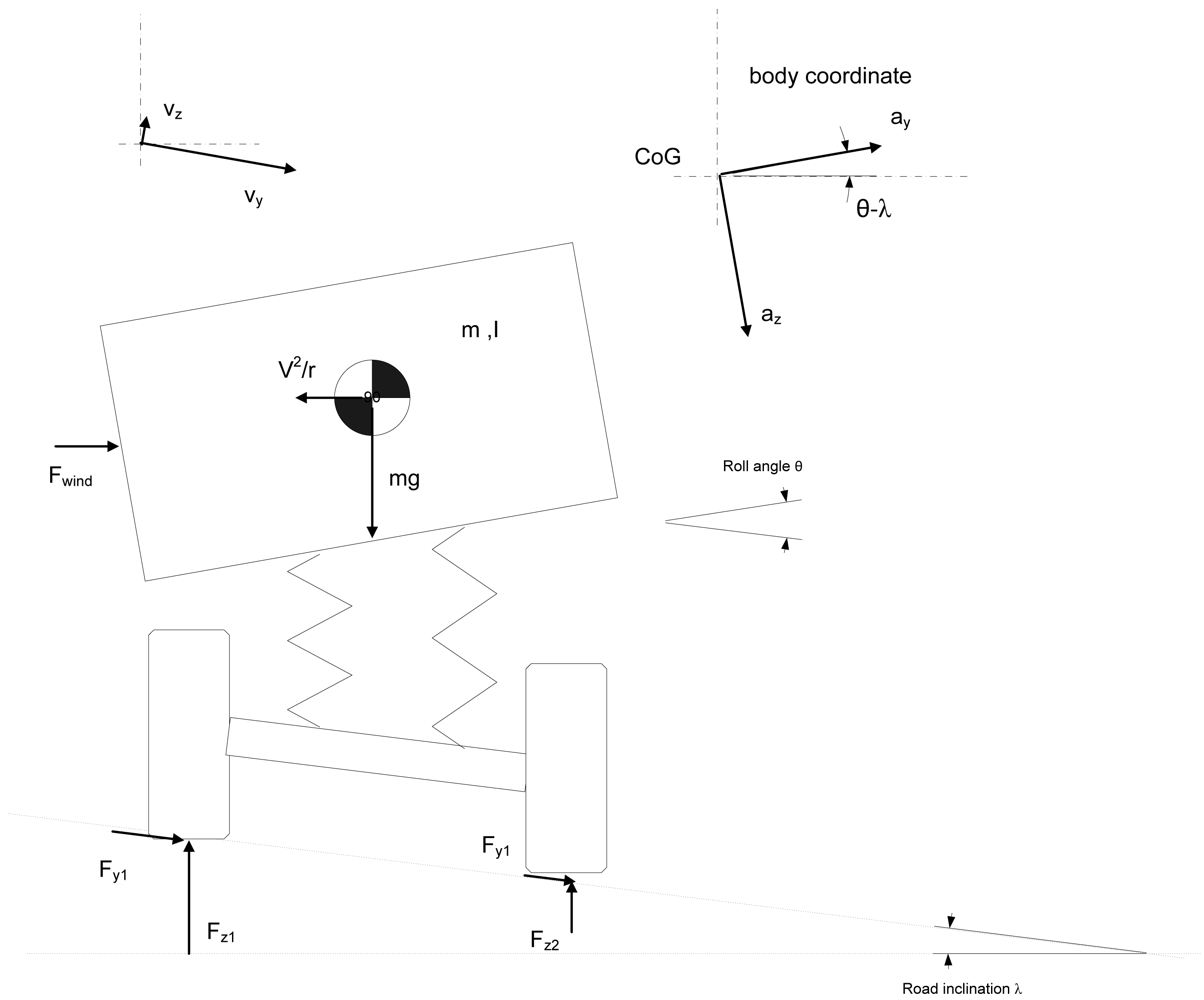
<p>The advantage of tyre force measurement can be seen in <xref ref-type="fig" rid="f1-sensors-09-08761">Figure 1</xref>, where a vehicle is cornering under road inclination <italic>λ</italic>, side wind F<sub>wind</sub> and roll angle <italic>θ</italic>. The tyre lateral tyre forces are parallel to lateral velocity v<sub>y</sub>. If the state estimation is based on lateral acceleration the following errors exist:
<list list-type="bullet">
<list-item>
<p>roll angle θ and road inclination λ introduce offset for lateral acceleration a<sub>y</sub> sensor due to gravity component (5,7° roll angle results 0.1g error for lateral acceleration)
<disp-formula id="FD1">
<mml:math id="mm1" display="block">
<mml:semantics id="sm1">
<mml:mrow>
<mml:msub>
<mml:mi>a</mml:mi>
<mml:mrow>
<mml:mi>y</mml:mi>
<mml:mo>,</mml:mo>
<mml:mtext mathvariant="italic">global</mml:mtext></mml:mrow></mml:msub>
<mml:mo>=</mml:mo>
<mml:mfrac>
<mml:mrow>
<mml:msub>
<mml:mi>a</mml:mi>
<mml:mrow>
<mml:mi>y</mml:mi>
<mml:mo>,</mml:mo>
<mml:mtext mathvariant="italic">measured</mml:mtext></mml:mrow></mml:msub>
<mml:mo>−</mml:mo>
<mml:mi>g</mml:mi>
<mml:mo>sin</mml:mo>
<mml:mo stretchy="false">(</mml:mo>
<mml:mi>θ</mml:mi>
<mml:mo>−</mml:mo>
<mml:mi>λ</mml:mi>
<mml:mo stretchy="false">)</mml:mo></mml:mrow>
<mml:mrow>
<mml:mo>cos</mml:mo>
<mml:mo stretchy="false">(</mml:mo>
<mml:mi>θ</mml:mi>
<mml:mo>−</mml:mo>
<mml:mi>λ</mml:mi>
<mml:mo stretchy="false">)</mml:mo></mml:mrow></mml:mfrac></mml:mrow></mml:semantics></mml:math></disp-formula></p></list-item>
<list-item>
<p>Influence of side wind is not properly captured from the measured acceleration, but has to be carried by the tyres (and influence for v<sub>y</sub> is missing)</p></list-item>
<list-item>
<p>v<sub>y</sub> is not even parallel to compensated lateral acceleration 
<inline-formula>
<mml:math id="mm2">
<mml:semantics id="sm2">
<mml:mrow>
<mml:msub>
<mml:mi>v</mml:mi>
<mml:mi>y</mml:mi></mml:msub>
<mml:mo>=</mml:mo>
<mml:mfrac>
<mml:mrow>
<mml:mrow>
<mml:mo>∫</mml:mo>
<mml:mrow>
<mml:mrow>
<mml:mo>(</mml:mo>
<mml:mrow>
<mml:msub>
<mml:mi>a</mml:mi>
<mml:mrow>
<mml:mi>y</mml:mi>
<mml:mo>,</mml:mo>
<mml:mtext mathvariant="italic">global</mml:mtext></mml:mrow></mml:msub>
<mml:mo>−</mml:mo>
<mml:mover accent="true">
<mml:mi>ψ</mml:mi>
<mml:mo>˙</mml:mo></mml:mover>
<mml:msub>
<mml:mi>v</mml:mi>
<mml:mi>x</mml:mi></mml:msub></mml:mrow>
<mml:mo>)</mml:mo></mml:mrow>
<mml:mi>d</mml:mi>
<mml:mi>t</mml:mi></mml:mrow></mml:mrow></mml:mrow>
<mml:mrow>
<mml:mo>cos</mml:mo>
<mml:mi>λ</mml:mi></mml:mrow></mml:mfrac></mml:mrow></mml:semantics></mml:math></inline-formula></p></list-item></list></p>
<p>The roll angle and road inclination influence the yaw rate measurement as well, but contrary to the lateral acceleration, gravity does not participate and thus the overall impact is minor (the same applies for pitch angle).</p>
<p>Consequently, the direct measurement of tyre forces seems beneficial in contrast to body accelerations and rotational velocities. Possible technologies for the tyre force measurement could be:
<list list-type="bullet">
<list-item>
<p>strain measurement of suspension components [<xref ref-type="bibr" rid="b7-sensors-09-08761">7</xref>] or rim [<xref ref-type="bibr" rid="b8-sensors-09-08761">8</xref>]</p></list-item>
<list-item>
<p>measurement of tyre carcass displacement [<xref ref-type="bibr" rid="b9-sensors-09-08761">9</xref>,<xref ref-type="bibr" rid="b10-sensors-09-08761">10</xref>], acceleration [e.g.<xref ref-type="bibr" rid="b11-sensors-09-08761">11</xref>] or strain [<xref ref-type="bibr" rid="b11-sensors-09-08761">11</xref>]</p></list-item>
<list-item>
<p>tyre tread displacement [<xref ref-type="bibr" rid="b12-sensors-09-08761">12</xref>]</p></list-item>
<list-item>
<p>force sensing bearing [<xref ref-type="bibr" rid="b13-sensors-09-08761">13</xref>]</p></list-item></list></p>
<p>Even though there have been many attempts to measure tyre forces to aid control systems, there are very few articles which study how to exploit them [<xref ref-type="bibr" rid="b8-sensors-09-08761">8</xref>,<xref ref-type="bibr" rid="b14-sensors-09-08761">14</xref>,<xref ref-type="bibr" rid="b15-sensors-09-08761">15</xref>]. This paper proposes a Kalman Filter estimation for vehicle yaw rate <italic>ψ̇</italic> and lateral velocity v<sub>y</sub> based on measured tyre forces.</p></sec>
<sec>
<label>2.</label>
<title>Optical Tyre Sensor (OTS) Concept</title>
<p>The optical tyre sensor was developed for the first time in the EC-funded APOLLO-project [<xref ref-type="bibr" rid="b16-sensors-09-08761">16</xref>], which studied several different tyre sensor concepts, including the optical tyre sensor (OTS). The APOLLO was followed by the FRICTI@N-project, where the optical tyre sensor was selected for further development. During FRICTI@N, tyre sensor hardware was refreshed and algorithms were made more robust and towards real-time operation. A truck sensor was also introduced [<xref ref-type="bibr" rid="b17-sensors-09-08761">17</xref>]. The sensor was also tested under aquaplaning conditions, where the transition point from the hydrodynamic aquaplaning zone to the viscous aquaplaning was measured [<xref ref-type="bibr" rid="b18-sensors-09-08761">18</xref>]. In addition, the severity of aquaplaning was estimated in real-time [<xref ref-type="bibr" rid="b19-sensors-09-08761">19</xref>].</p>
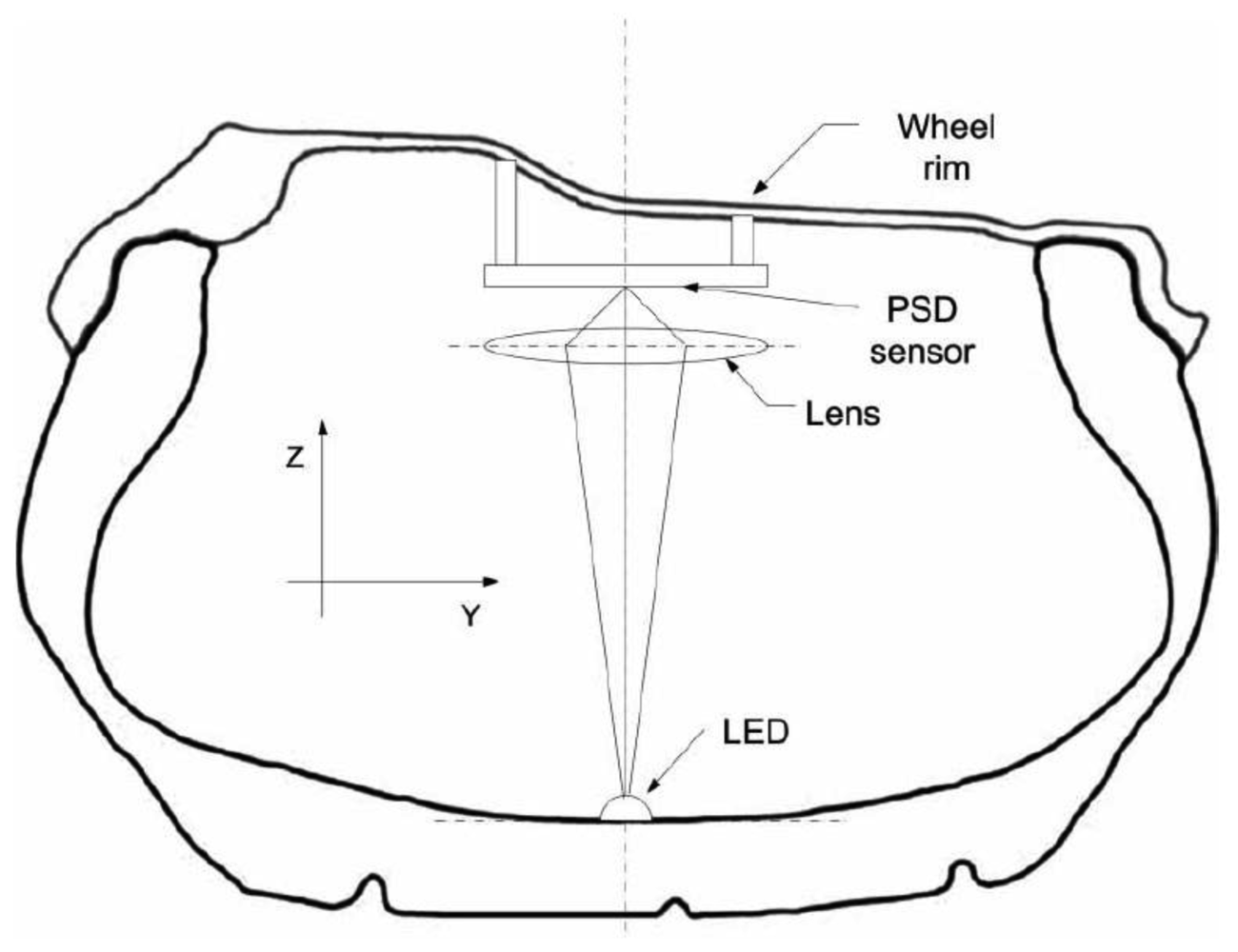
<p>The OTS measuring principle is shown in <xref ref-type="fig" rid="f2-sensors-09-08761">Figure 2</xref>. A Light Emitting Diode (LED) is glued into the inner liner of the tyre. A lens focuses infrared light emitted by the LED to the surface of Position Sensitive Detector (PSD). The position of the light spot is relative to the current at the corners of the PSD. The raw data is analysed in the tyre and sent wirelessly by radio at 433MHz to a receiver unit. A more detailed explanation about OTS can be found in [<xref ref-type="bibr" rid="b10-sensors-09-08761">10</xref>,<xref ref-type="bibr" rid="b17-sensors-09-08761">17</xref>]. The algorithms for the tyre force estimation can be found in [<xref ref-type="bibr" rid="b17-sensors-09-08761">17</xref>].</p>
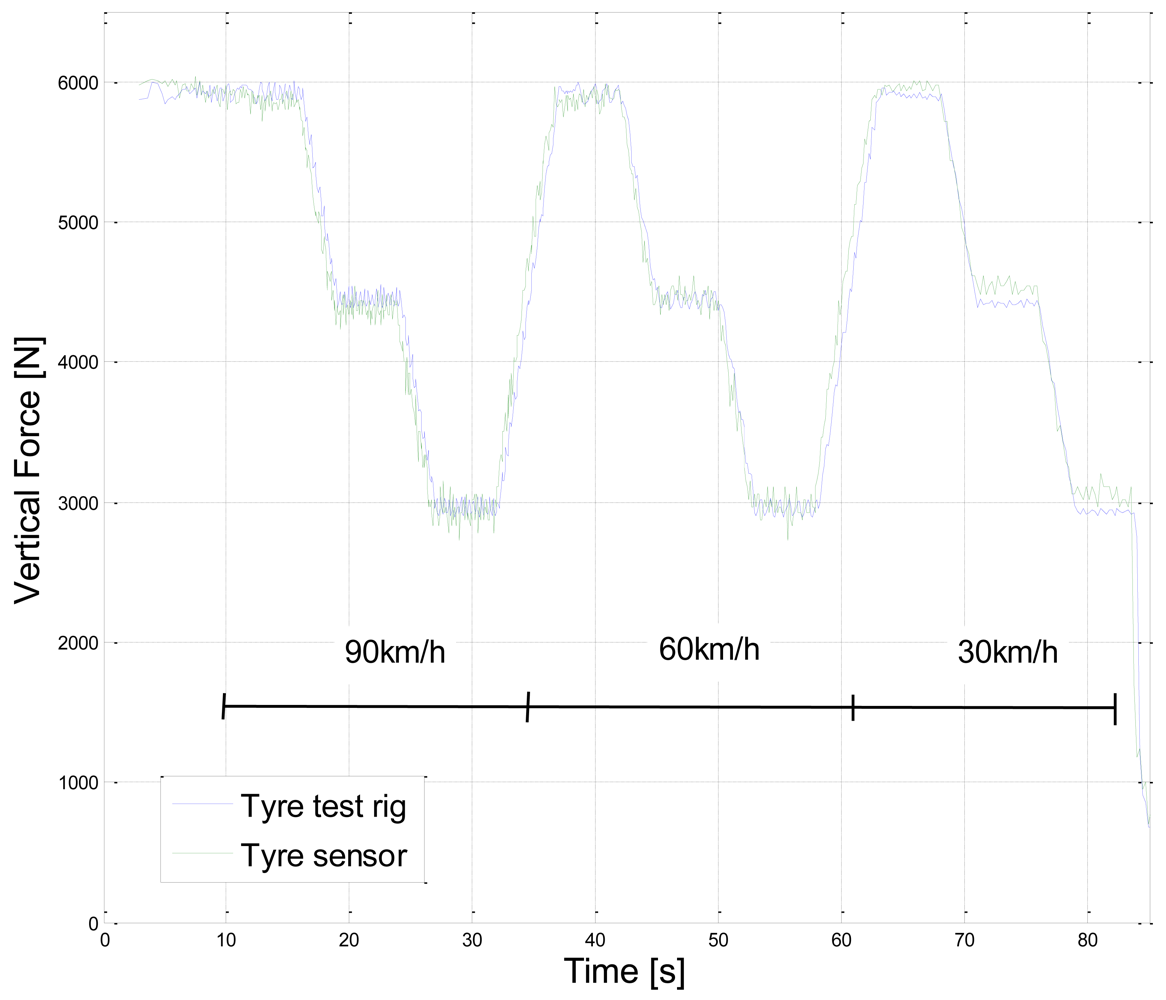
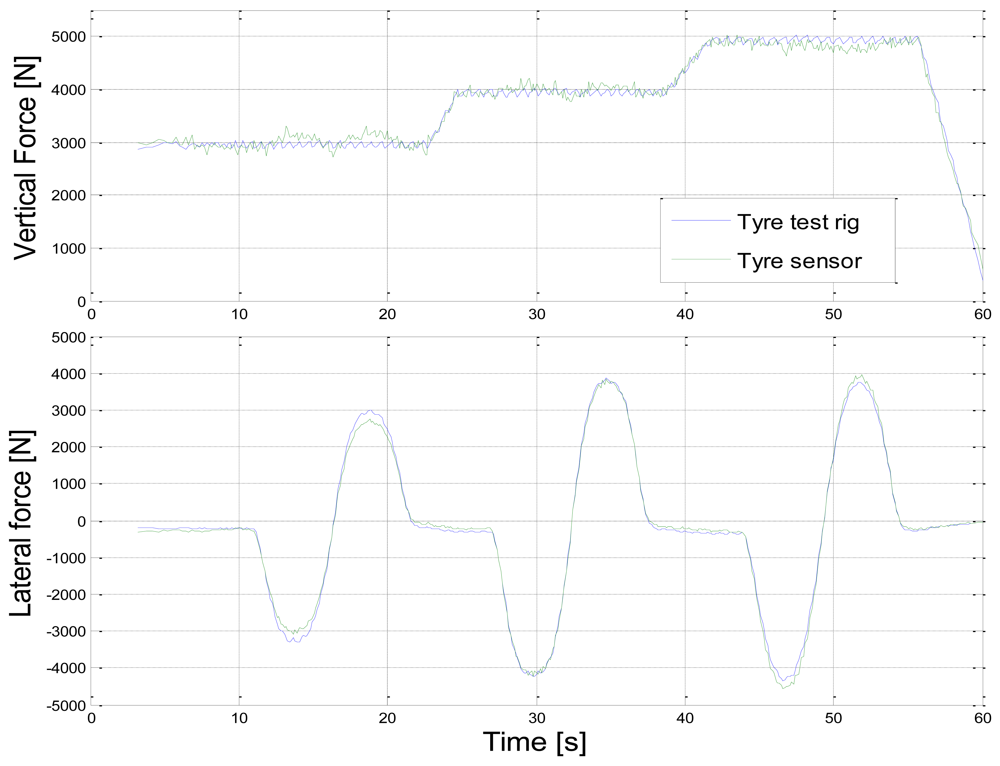
<p><xref ref-type="fig" rid="f3-sensors-09-08761">Figure 3</xref> shows the calibration cycle for vertical force and tyre sensor measurement compared with the test rig results. Three different wheel loads are varied at different speeds. Similarly, <xref ref-type="fig" rid="f4-sensors-09-08761">Figure 4</xref> shows the calibration cycle for the lateral force at three different loads. The tyre force estimation model parameters are fitted to test rig results by the least squares method.</p></sec>
<sec>
<label>3.</label>
<title>Vehicle State Estimator</title>
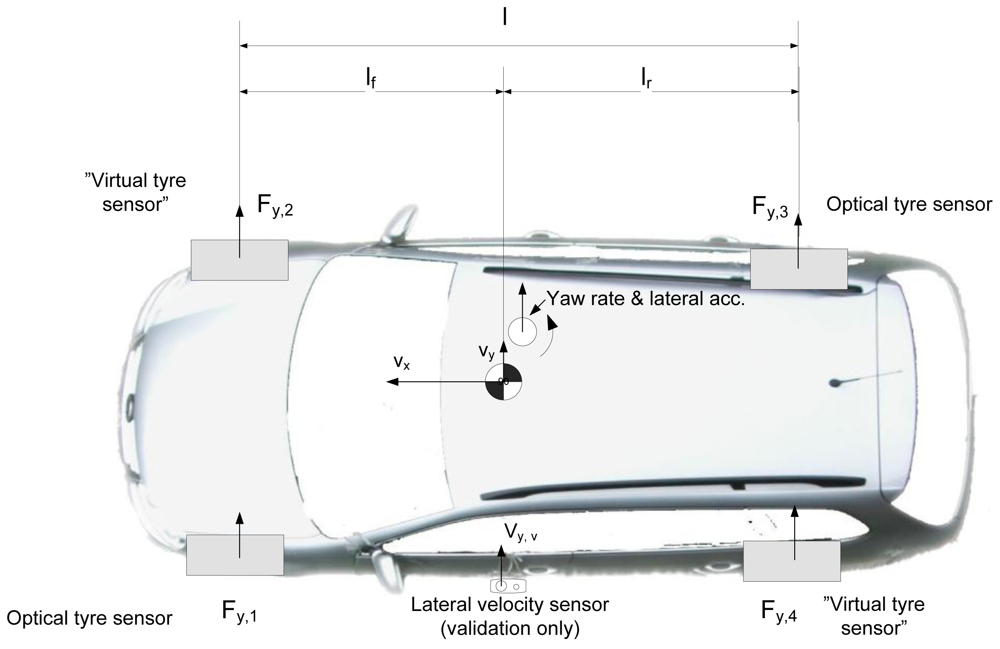
<p>A test car setup can be seen in <xref ref-type="fig" rid="f5-sensors-09-08761">Figure 5</xref>. The optical tyre sensors are mounted at the left front wheel and rear right wheel position. In addition, the steering wheel angle and vehicle velocity (from the CAN-bus) are used in the estimation. All the other sensors, such as lateral acceleration, yaw rate and Correvit-sensor are for validation purposes only. These sensors are mounted close to the centre of gravity to avoid compensations.</p>
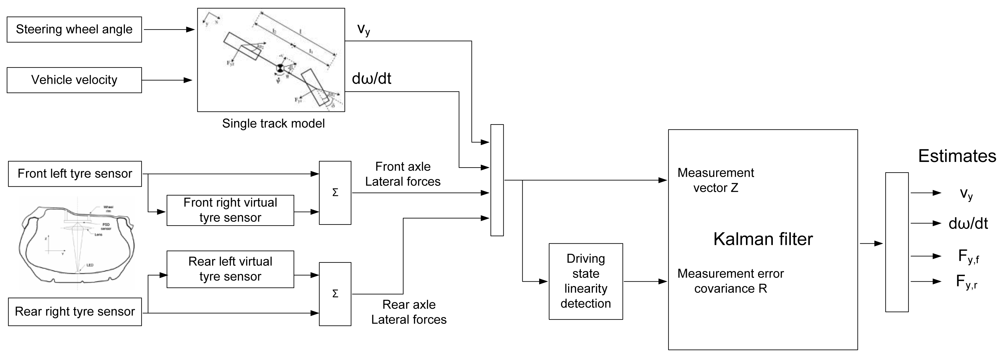
<p>The problem is to estimate lateral velocity and yaw rate at the centre of gravity of the vehicle with a minimal set of parameters. The estimator consists of virtual tyre sensors, a driving state estimator (linearity) and a Kalman filter. The overall structure of the estimator is shown in <xref ref-type="fig" rid="f6-sensors-09-08761">Figure 6</xref>. The operation of the submodels is explained in the following.</p>
<sec>
<label>3.1.</label>
<title>Kalman filter</title>
<p>The Kalman filter is an effective and recursive solution for the discrete data filtering problem from noisy measurements [<xref ref-type="bibr" rid="b20-sensors-09-08761">20</xref>]. The state transition reads:
<disp-formula id="FD2">
<label>(1)</label>
<mml:math id="mm3" display="block">
<mml:semantics id="sm3">
<mml:mrow>
<mml:msub>
<mml:mi>x</mml:mi>
<mml:mi>k</mml:mi></mml:msub>
<mml:mo>=</mml:mo>
<mml:mi>A</mml:mi>
<mml:msub>
<mml:mi>x</mml:mi>
<mml:mrow>
<mml:mi>k</mml:mi>
<mml:mo>−</mml:mo>
<mml:mn>1</mml:mn></mml:mrow></mml:msub>
<mml:mo>+</mml:mo>
<mml:msub>
<mml:mi>w</mml:mi>
<mml:mrow>
<mml:mi>k</mml:mi>
<mml:mo>−</mml:mo>
<mml:mn>1</mml:mn></mml:mrow></mml:msub></mml:mrow></mml:semantics></mml:math></disp-formula>and with measurement z<sub>k</sub>:
<disp-formula id="FD3">
<label>(2)</label>
<mml:math id="mm4" display="block">
<mml:semantics id="sm4">
<mml:mrow>
<mml:msub>
<mml:mi>z</mml:mi>
<mml:mi>k</mml:mi></mml:msub>
<mml:mo>=</mml:mo>
<mml:mi>H</mml:mi>
<mml:msub>
<mml:mi>x</mml:mi>
<mml:mi>k</mml:mi></mml:msub>
<mml:mo>+</mml:mo>
<mml:msub>
<mml:mi>v</mml:mi>
<mml:mi>k</mml:mi></mml:msub></mml:mrow></mml:semantics></mml:math></disp-formula>where A is state transition matrix, H is measurement matrix, and w<sub>k</sub> and v<sub>k</sub> represent process and measurement noise. The <italic>a priori</italic> 
<inline-formula>
<mml:math id="mm5">
<mml:semantics id="sm5">
<mml:mrow>
<mml:msubsup>
<mml:mover accent="true">
<mml:mi>x</mml:mi>
<mml:mo>^</mml:mo></mml:mover>
<mml:mi>k</mml:mi>
<mml:mo>−</mml:mo></mml:msubsup></mml:mrow></mml:semantics></mml:math></inline-formula> (based on process knowledge) estimate error is:
<disp-formula id="FD4">
<label>(3)</label>
<mml:math id="mm6" display="block">
<mml:semantics id="sm6">
<mml:mrow>
<mml:msubsup>
<mml:mi>e</mml:mi>
<mml:mi>k</mml:mi>
<mml:mo>−</mml:mo></mml:msubsup>
<mml:mo>=</mml:mo>
<mml:msub>
<mml:mi>x</mml:mi>
<mml:mi>k</mml:mi></mml:msub>
<mml:mo>−</mml:mo>
<mml:msubsup>
<mml:mover accent="true">
<mml:mi>x</mml:mi>
<mml:mo>^</mml:mo></mml:mover>
<mml:mi>k</mml:mi>
<mml:mo>−</mml:mo></mml:msubsup></mml:mrow></mml:semantics></mml:math></disp-formula>and <italic>a posteriori</italic> (based on given measurement z<sub>k</sub>) estimate error is:
<disp-formula id="FD5">
<label>(4)</label>
<mml:math id="mm7" display="block">
<mml:semantics id="sm7">
<mml:mrow>
<mml:msub>
<mml:mi>e</mml:mi>
<mml:mi>k</mml:mi></mml:msub>
<mml:mo>=</mml:mo>
<mml:msub>
<mml:mi>x</mml:mi>
<mml:mi>k</mml:mi></mml:msub>
<mml:mo>−</mml:mo>
<mml:msub>
<mml:mover accent="true">
<mml:mi>x</mml:mi>
<mml:mo>^</mml:mo></mml:mover>
<mml:mi>k</mml:mi></mml:msub></mml:mrow></mml:semantics></mml:math></disp-formula></p>
<p>The <italic>a priori</italic> estimate error covariance is:
<disp-formula id="FD6">
<label>(5)</label>
<mml:math id="mm8" display="block">
<mml:semantics id="sm8">
<mml:mrow>
<mml:msubsup>
<mml:mi>P</mml:mi>
<mml:mi>k</mml:mi>
<mml:mo>−</mml:mo></mml:msubsup>
<mml:mo>=</mml:mo>
<mml:mi>E</mml:mi>
<mml:mrow>
<mml:mo>[</mml:mo>
<mml:mrow>
<mml:msubsup>
<mml:mi>e</mml:mi>
<mml:mi>k</mml:mi>
<mml:mo>−</mml:mo></mml:msubsup>
<mml:msubsup>
<mml:mi>e</mml:mi>
<mml:mi>k</mml:mi>
<mml:mrow>
<mml:mo>−</mml:mo>
<mml:mi>T</mml:mi></mml:mrow></mml:msubsup></mml:mrow>
<mml:mo>]</mml:mo></mml:mrow></mml:mrow></mml:semantics></mml:math></disp-formula>and the <italic>a posteriori</italic> estimate error covariance is:
<disp-formula id="FD7">
<label>(6)</label>
<mml:math id="mm9" display="block">
<mml:semantics id="sm9">
<mml:mrow>
<mml:msub>
<mml:mi>P</mml:mi>
<mml:mi>k</mml:mi></mml:msub>
<mml:mo>=</mml:mo>
<mml:mi>E</mml:mi>
<mml:mrow>
<mml:mo>[</mml:mo>
<mml:mrow>
<mml:msub>
<mml:mi>e</mml:mi>
<mml:mi>k</mml:mi></mml:msub>
<mml:msubsup>
<mml:mtext mathvariant="italic">e</mml:mtext>
<mml:mi>k</mml:mi>
<mml:mi>T</mml:mi></mml:msubsup></mml:mrow>
<mml:mo>]</mml:mo></mml:mrow></mml:mrow></mml:semantics></mml:math></disp-formula>and Kalman gain:
<disp-formula id="FD8">
<label>(7)</label>
<mml:math id="mm10" display="block">
<mml:semantics id="sm10">
<mml:mrow>
<mml:mi>K</mml:mi>
<mml:mo>=</mml:mo>
<mml:msubsup>
<mml:mi>P</mml:mi>
<mml:mi>k</mml:mi>
<mml:mo>−</mml:mo></mml:msubsup>
<mml:msup>
<mml:mi>H</mml:mi>
<mml:mi>T</mml:mi></mml:msup>
<mml:mspace width="0.2em"/>
<mml:msup>
<mml:mrow>
<mml:mo>(</mml:mo>
<mml:mrow>
<mml:mi>H</mml:mi>
<mml:msubsup>
<mml:mi>P</mml:mi>
<mml:mi>k</mml:mi>
<mml:mo>−</mml:mo></mml:msubsup>
<mml:msup>
<mml:mi>H</mml:mi>
<mml:mi>T</mml:mi></mml:msup>
<mml:mo>+</mml:mo>
<mml:mi>R</mml:mi></mml:mrow>
<mml:mo>)</mml:mo></mml:mrow>
<mml:mrow>
<mml:mo>−</mml:mo>
<mml:mn>1</mml:mn></mml:mrow></mml:msup></mml:mrow></mml:semantics></mml:math></disp-formula>which minimizes the <italic>a posteriori</italic> estimate error covariance [<xref ref-type="bibr" rid="b21-sensors-09-08761">21</xref>].</p>
<p>The Kalman gain weights the <italic>a priori</italic> estimate and residual 
<inline-formula>
<mml:math id="mm11">
<mml:semantics id="sm11">
<mml:mrow>
<mml:msub>
<mml:mi>z</mml:mi>
<mml:mi>k</mml:mi></mml:msub>
<mml:mo>−</mml:mo>
<mml:mi>H</mml:mi>
<mml:msubsup>
<mml:mover accent="true">
<mml:mi>x</mml:mi>
<mml:mo>^</mml:mo></mml:mover>
<mml:mi>k</mml:mi>
<mml:mo>−</mml:mo></mml:msubsup></mml:mrow></mml:semantics></mml:math></inline-formula>:
<disp-formula id="FD9">
<label>(8)</label>
<mml:math id="mm12" display="block">
<mml:semantics id="sm12">
<mml:mrow>
<mml:msub>
<mml:mover accent="true">
<mml:mi>x</mml:mi>
<mml:mo>^</mml:mo></mml:mover>
<mml:mi>k</mml:mi></mml:msub>
<mml:mo>=</mml:mo>
<mml:msubsup>
<mml:mover accent="true">
<mml:mi>x</mml:mi>
<mml:mo>^</mml:mo></mml:mover>
<mml:mi>k</mml:mi>
<mml:mo>−</mml:mo></mml:msubsup>
<mml:mo>+</mml:mo>
<mml:mi>K</mml:mi>
<mml:mrow>
<mml:mo>(</mml:mo>
<mml:mrow>
<mml:msub>
<mml:mi>z</mml:mi>
<mml:mi>k</mml:mi></mml:msub>
<mml:mo>−</mml:mo>
<mml:mi>H</mml:mi>
<mml:msubsup>
<mml:mover accent="true">
<mml:mi>x</mml:mi>
<mml:mo>^</mml:mo></mml:mover>
<mml:mi>k</mml:mi>
<mml:mo>−</mml:mo></mml:msubsup></mml:mrow>
<mml:mo>)</mml:mo></mml:mrow></mml:mrow></mml:semantics></mml:math></disp-formula></p>
<p>The Kalman filter expects the process and measurements noise to be with normal probability distribution:
<disp-formula id="FD10">
<label>(9)</label>
<mml:math id="mm13" display="block">
<mml:semantics id="sm13">
<mml:mrow>
<mml:mi>p</mml:mi>
<mml:mo stretchy="false">(</mml:mo>
<mml:mi>w</mml:mi>
<mml:mo stretchy="false">)</mml:mo>
<mml:mo>∼</mml:mo>
<mml:mi>N</mml:mi>
<mml:mo stretchy="false">(</mml:mo>
<mml:mn>0</mml:mn>
<mml:mo>,</mml:mo>
<mml:mi>Q</mml:mi>
<mml:mo stretchy="false">)</mml:mo></mml:mrow></mml:semantics></mml:math></disp-formula>
<disp-formula id="FD11">
<label>(10)</label>
<mml:math id="mm14" display="block">
<mml:semantics id="sm14">
<mml:mrow>
<mml:mi>p</mml:mi>
<mml:mo stretchy="false">(</mml:mo>
<mml:mi>v</mml:mi>
<mml:mo stretchy="false">)</mml:mo>
<mml:mo>∼</mml:mo>
<mml:mi>N</mml:mi>
<mml:mo stretchy="false">(</mml:mo>
<mml:mn>0</mml:mn>
<mml:mo>,</mml:mo>
<mml:mi>R</mml:mi>
<mml:mo stretchy="false">)</mml:mo></mml:mrow></mml:semantics></mml:math></disp-formula>where Q is process noise covariance and R is measurement noise covariance matrix. In this paper, this requirement for normal probability distribution is not fulfilled all the time for all measurements; this it is discussed in more detail in section 3.5.</p></sec>
<sec>
<label>3.2.</label>
<title>Virtual tyre sensors</title>
<p>The test car was equipped with two optical tyre sensors. The sensor positions were at the left front and right rear wheels. However, the vehicle state estimator developed here requires individual tyre forces of all tyres or axle forces. Thus, the lateral tyre forces of right front wheel and left rear wheel have to be estimated. The natural way to estimate is to exploit the information from the tyre sensor at the same axle (only lateral dynamics considered here). Hence, the “similarity method” [e.g., <xref ref-type="bibr" rid="b22-sensors-09-08761">22</xref>] is assumed in order to estimate the missing tyre forces. There are several methods to do this, two of which are presented here.</p>
<sec>
<label>3.2.1.</label>
<title>Inverse magic formula</title>
<p>The obvious starting point is to solve slip angle α of the tyre from tyre sensor forces F<sub>y</sub> and F<sub>z</sub>. The simple four parameter Magic Formula reads [<xref ref-type="bibr" rid="b22-sensors-09-08761">22</xref>]:
<disp-formula id="FD12">
<label>(11)</label>
<mml:math id="mm15" display="block">
<mml:semantics id="sm15">
<mml:mrow>
<mml:msub>
<mml:mi>F</mml:mi>
<mml:mi>y</mml:mi></mml:msub>
<mml:mo>=</mml:mo>
<mml:mi>D</mml:mi>
<mml:mo>sin</mml:mo>
<mml:mo stretchy="false">(</mml:mo>
<mml:mi>C</mml:mi>
<mml:mspace width="0.2em"/>
<mml:mi>a</mml:mi>
<mml:mo>tan</mml:mo>
<mml:mo stretchy="false">(</mml:mo>
<mml:mi>B</mml:mi>
<mml:mspace width="0.2em"/>
<mml:mi>α</mml:mi>
<mml:mo>−</mml:mo>
<mml:mi>E</mml:mi>
<mml:mo stretchy="false">(</mml:mo>
<mml:mi>B</mml:mi>
<mml:mspace width="0.2em"/>
<mml:mi>α</mml:mi>
<mml:mo>−</mml:mo>
<mml:mi>a</mml:mi>
<mml:mo>tan</mml:mo>
<mml:mo stretchy="false">(</mml:mo>
<mml:mi>B</mml:mi>
<mml:mi>α</mml:mi>
<mml:mo stretchy="false">)</mml:mo>
<mml:mo stretchy="false">)</mml:mo></mml:mrow></mml:semantics></mml:math></disp-formula>where parameters B, C and E are assumed to be known. The D is available from the measured wheel load, and the slip angle α can be solved numerically.</p>
<p>Another required variable for a virtual tyre sensor is vertical load. The wheel load deviation of a tyre sensor wheel is available:
<disp-formula id="FD13">
<label>(12)</label>
<mml:math id="mm16" display="block">
<mml:semantics id="sm16">
<mml:mrow>
<mml:mi mathvariant="normal">Δ</mml:mi>
<mml:msub>
<mml:mi>F</mml:mi>
<mml:mrow>
<mml:mi>z</mml:mi>
<mml:mo>,</mml:mo>
<mml:mn>1</mml:mn></mml:mrow></mml:msub>
<mml:mo>=</mml:mo>
<mml:msub>
<mml:mi>F</mml:mi>
<mml:mrow>
<mml:mi>z</mml:mi>
<mml:mo>,</mml:mo>
<mml:mn>1</mml:mn></mml:mrow></mml:msub>
<mml:mo>−</mml:mo>
<mml:msub>
<mml:mi>F</mml:mi>
<mml:mrow>
<mml:mi>z</mml:mi>
<mml:mo>,</mml:mo>
<mml:mn>1</mml:mn>
<mml:mo>,</mml:mo>
<mml:mtext mathvariant="italic">static</mml:mtext></mml:mrow></mml:msub></mml:mrow></mml:semantics></mml:math></disp-formula>where static wheel load can be calculated from the long time average of measured F<sub>z,1</sub> or by recording F<sub>z,1</sub> values as a static wheel load when F<sub>y,1</sub> ∼ 0. The vertical load of the virtual tyre sensor (neglecting longitudinal load transfer and mass of vehicle is constant):
<disp-formula id="FD14">
<label>(13)</label>
<mml:math id="mm17" display="block">
<mml:semantics id="sm17">
<mml:mrow>
<mml:msub>
<mml:mi>F</mml:mi>
<mml:mrow>
<mml:mi>z</mml:mi>
<mml:mo>,</mml:mo>
<mml:mn>2</mml:mn></mml:mrow></mml:msub>
<mml:mo>=</mml:mo>
<mml:msub>
<mml:mi>F</mml:mi>
<mml:mrow>
<mml:mi>z</mml:mi>
<mml:mo>,</mml:mo>
<mml:mn>2</mml:mn>
<mml:mo>,</mml:mo>
<mml:mtext mathvariant="italic">static</mml:mtext></mml:mrow></mml:msub>
<mml:mo>−</mml:mo>
<mml:mi mathvariant="normal">Δ</mml:mi>
<mml:msub>
<mml:mi>F</mml:mi>
<mml:mrow>
<mml:mi>z</mml:mi>
<mml:mo>,</mml:mo>
<mml:mn>1</mml:mn></mml:mrow></mml:msub></mml:mrow></mml:semantics></mml:math></disp-formula></p>
<p>The lateral force of the virtual tyre sensor can be then calculated with the same <xref rid="FD12" ref-type="disp-formula">Equation 11</xref> as when the slip angle was solved. It should be noted that the method is not sensitive for parameters B, C, or E if they do not depend on wheel load and if D is linear to wheel load. This is in fact an expression of a similarity method.</p></sec>
<sec>
<label>3.2.2.</label>
<title>Normalised lateral force</title>
<p>When considering the inverse magic formula method to solve the lateral force of the second tyre, it is clear that there has to be simpler method to obtain it. The normalized lateral force reads:
<disp-formula id="FD15">
<label>(14)</label>
<mml:math id="mm18" display="block">
<mml:semantics id="sm18">
<mml:mrow>
<mml:msub>
<mml:mi>μ</mml:mi>
<mml:mi>f</mml:mi></mml:msub>
<mml:mo>=</mml:mo>
<mml:mfrac>
<mml:mrow>
<mml:msub>
<mml:mi>F</mml:mi>
<mml:mrow>
<mml:mi>y</mml:mi>
<mml:mo>,</mml:mo>
<mml:mn>1</mml:mn></mml:mrow></mml:msub></mml:mrow>
<mml:mrow>
<mml:msub>
<mml:mi>F</mml:mi>
<mml:mrow>
<mml:mi>z</mml:mi>
<mml:mo>,</mml:mo>
<mml:mn>1</mml:mn></mml:mrow></mml:msub></mml:mrow></mml:mfrac></mml:mrow></mml:semantics></mml:math></disp-formula>and the lateral force of the second tyre at the same axle:
<disp-formula id="FD16">
<label>(15)</label>
<mml:math id="mm19" display="block">
<mml:semantics id="sm19">
<mml:mrow>
<mml:msub>
<mml:mi>F</mml:mi>
<mml:mrow>
<mml:mi>y</mml:mi>
<mml:mo>,</mml:mo>
<mml:mn>2</mml:mn></mml:mrow></mml:msub>
<mml:mo>=</mml:mo>
<mml:msub>
<mml:mi>μ</mml:mi>
<mml:mi>f</mml:mi></mml:msub>
<mml:mspace width="0.2em"/>
<mml:msub>
<mml:mi>F</mml:mi>
<mml:mrow>
<mml:mi>z</mml:mi>
<mml:mo>,</mml:mo>
<mml:mn>2</mml:mn></mml:mrow></mml:msub></mml:mrow></mml:semantics></mml:math></disp-formula></p>
<p>The vertical load F<sub>z,2</sub> of the virtual tyre sensor is calculated as in <xref rid="FD14" ref-type="disp-formula">Equation 13</xref>. The lateral force for the left rear tyre is calculated similarly to that at the front axle. The normalised lateral force method results in the same behaviour as the inverse magic formula. However, neither of the methods in this form takes into account normalised tyre force non-linearity for high wheel loads.</p></sec></sec>
<sec>
<label>3.3.</label>
<title>Vehicle model for the estimator</title>
<p>The Kalman filter requires a state transition matrix (without linearity assumption for tyre behaviour), which is here based on the lateral and yaw equations of motion:
<disp-formula id="FD17">
<label>(16)</label>
<mml:math id="mm20" display="block">
<mml:semantics id="sm20">
<mml:mrow>
<mml:mi>F</mml:mi>
<mml:mo>=</mml:mo>
<mml:mi>m</mml:mi>
<mml:mi>a</mml:mi></mml:mrow></mml:semantics></mml:math></disp-formula>
<disp-formula id="FD18">
<label>(17)</label>
<mml:math id="mm21" display="block">
<mml:semantics id="sm21">
<mml:mrow>
<mml:msub>
<mml:mi>I</mml:mi>
<mml:mi>z</mml:mi></mml:msub>
<mml:mover accent="true">
<mml:mi>ψ</mml:mi>
<mml:mo>¨</mml:mo></mml:mover>
<mml:mo>=</mml:mo>
<mml:msub>
<mml:mi>F</mml:mi>
<mml:mrow>
<mml:mi>y</mml:mi>
<mml:mo>,</mml:mo>
<mml:mi>f</mml:mi></mml:mrow></mml:msub>
<mml:mspace width="0.2em"/>
<mml:msub>
<mml:mi>l</mml:mi>
<mml:mi>f</mml:mi></mml:msub>
<mml:mo>−</mml:mo>
<mml:msub>
<mml:mi>F</mml:mi>
<mml:mrow>
<mml:mi>y</mml:mi>
<mml:mo>,</mml:mo>
<mml:mi>r</mml:mi></mml:mrow></mml:msub>
<mml:mspace width="0.2em"/>
<mml:msub>
<mml:mi>l</mml:mi>
<mml:mi>r</mml:mi></mml:msub></mml:mrow></mml:semantics></mml:math></disp-formula>where m is vehicle mass, I<sub>z</sub> is yaw moment of inertia, l<sub>f</sub> and l<sub>r</sub> are centre of gravity distances from the front and rear axles. The lateral equation can be written:
<disp-formula id="FD19">
<label>(18)</label>
<mml:math id="mm22" display="block">
<mml:semantics id="sm22">
<mml:mrow>
<mml:msub>
<mml:mi>F</mml:mi>
<mml:mrow>
<mml:mi>y</mml:mi>
<mml:mo>,</mml:mo>
<mml:mi>f</mml:mi></mml:mrow></mml:msub>
<mml:mo>+</mml:mo>
<mml:msub>
<mml:mi>F</mml:mi>
<mml:mrow>
<mml:mi>y</mml:mi>
<mml:mo>,</mml:mo>
<mml:mi>r</mml:mi></mml:mrow></mml:msub>
<mml:mo>=</mml:mo>
<mml:mi>m</mml:mi>
<mml:mrow>
<mml:mo>(</mml:mo>
<mml:mrow>
<mml:msub>
<mml:mover accent="true">
<mml:mi>v</mml:mi>
<mml:mo>˙</mml:mo></mml:mover>
<mml:mi>y</mml:mi></mml:msub>
<mml:mo>+</mml:mo>
<mml:mover accent="true">
<mml:mi>ψ</mml:mi>
<mml:mo>˙</mml:mo></mml:mover>
<mml:msub>
<mml:mi>v</mml:mi>
<mml:mi>x</mml:mi></mml:msub></mml:mrow>
<mml:mo>)</mml:mo></mml:mrow></mml:mrow></mml:semantics></mml:math></disp-formula>where <italic>F<sub>y,f</sub></italic> and <italic>F<sub>y,r</sub></italic> are the front and rear axle forces. The acceleration of lateral motion can be solved:
<disp-formula id="FD20">
<label>(19)</label>
<mml:math id="mm23" display="block">
<mml:semantics id="sm23">
<mml:mrow>
<mml:msub>
<mml:mover accent="true">
<mml:mi>v</mml:mi>
<mml:mo>˙</mml:mo></mml:mover>
<mml:mi>y</mml:mi></mml:msub>
<mml:mo>=</mml:mo>
<mml:mfrac>
<mml:mrow>
<mml:msub>
<mml:mi>F</mml:mi>
<mml:mrow>
<mml:mi>y</mml:mi>
<mml:mo>,</mml:mo>
<mml:mi>f</mml:mi></mml:mrow></mml:msub>
<mml:mo>+</mml:mo>
<mml:msub>
<mml:mi>F</mml:mi>
<mml:mrow>
<mml:mi>y</mml:mi>
<mml:mo>,</mml:mo>
<mml:mi>r</mml:mi></mml:mrow></mml:msub></mml:mrow>
<mml:mi>m</mml:mi></mml:mfrac>
<mml:mo>−</mml:mo>
<mml:mover accent="true">
<mml:mi>ψ</mml:mi>
<mml:mo>˙</mml:mo></mml:mover>
<mml:msub>
<mml:mi>v</mml:mi>
<mml:mi>x</mml:mi></mml:msub></mml:mrow></mml:semantics></mml:math></disp-formula></p>
<p>Lateral tyre forces are assumed to act on the centre of the contact patch (neglecting pneumatic trail), thus the yaw acceleration can be expressed:
<disp-formula id="FD21">
<label>(20)</label>
<mml:math id="mm24" display="block">
<mml:semantics id="sm24">
<mml:mrow>
<mml:mover accent="true">
<mml:mi>ψ</mml:mi>
<mml:mo>¨</mml:mo></mml:mover>
<mml:mo>=</mml:mo>
<mml:mfrac>
<mml:mrow>
<mml:msub>
<mml:mi>F</mml:mi>
<mml:mrow>
<mml:mi>y</mml:mi>
<mml:mo>,</mml:mo>
<mml:mi>f</mml:mi></mml:mrow></mml:msub>
<mml:mspace width="0.2em"/>
<mml:msub>
<mml:mi>l</mml:mi>
<mml:mi>f</mml:mi></mml:msub></mml:mrow>
<mml:mrow>
<mml:msub>
<mml:mi>I</mml:mi>
<mml:mi>z</mml:mi></mml:msub></mml:mrow></mml:mfrac>
<mml:mo>−</mml:mo>
<mml:mfrac>
<mml:mrow>
<mml:msub>
<mml:mi>F</mml:mi>
<mml:mrow>
<mml:mi>y</mml:mi>
<mml:mo>,</mml:mo>
<mml:mi>r</mml:mi></mml:mrow></mml:msub>
<mml:mspace width="0.2em"/>
<mml:msub>
<mml:mi>l</mml:mi>
<mml:mi>r</mml:mi></mml:msub></mml:mrow>
<mml:mrow>
<mml:msub>
<mml:mi>I</mml:mi>
<mml:mi>z</mml:mi></mml:msub></mml:mrow></mml:mfrac></mml:mrow></mml:semantics></mml:math></disp-formula></p>
<p>The <xref rid="FD20" ref-type="disp-formula">Equations 19</xref> and <xref rid="FD21" ref-type="disp-formula">20</xref> are discretized and written as the state space equation:
<disp-formula id="FD22">
<label>(21)</label>
<mml:math id="mm25" display="block">
<mml:semantics id="sm25">
<mml:mrow>
<mml:mrow>
<mml:mo>[</mml:mo>
<mml:mrow>
<mml:mtable>
<mml:mtr>
<mml:mtd>
<mml:mrow>
<mml:msub>
<mml:mi>v</mml:mi>
<mml:mi>y</mml:mi></mml:msub>
<mml:mo stretchy="false">(</mml:mo>
<mml:mi>k</mml:mi>
<mml:mo>+</mml:mo>
<mml:mn>1</mml:mn>
<mml:mo stretchy="false">)</mml:mo></mml:mrow></mml:mtd></mml:mtr>
<mml:mtr>
<mml:mtd>
<mml:mrow>
<mml:mover accent="true">
<mml:mi>ψ</mml:mi>
<mml:mo>˙</mml:mo></mml:mover>
<mml:mo stretchy="false">(</mml:mo>
<mml:mi>k</mml:mi>
<mml:mo>+</mml:mo>
<mml:mn>1</mml:mn>
<mml:mo stretchy="false">)</mml:mo></mml:mrow></mml:mtd></mml:mtr>
<mml:mtr>
<mml:mtd>
<mml:mrow>
<mml:msub>
<mml:mi>F</mml:mi>
<mml:mrow>
<mml:mi>y</mml:mi>
<mml:mo>,</mml:mo>
<mml:mi>f</mml:mi></mml:mrow></mml:msub>
<mml:mo stretchy="false">(</mml:mo>
<mml:mi>k</mml:mi>
<mml:mo>+</mml:mo>
<mml:mn>1</mml:mn>
<mml:mo stretchy="false">)</mml:mo></mml:mrow></mml:mtd></mml:mtr>
<mml:mtr>
<mml:mtd>
<mml:mrow>
<mml:msub>
<mml:mi>F</mml:mi>
<mml:mrow>
<mml:mi>y</mml:mi>
<mml:mo>,</mml:mo>
<mml:mi>r</mml:mi></mml:mrow></mml:msub>
<mml:mo stretchy="false">(</mml:mo>
<mml:mi>k</mml:mi>
<mml:mo>+</mml:mo>
<mml:mn>1</mml:mn>
<mml:mo stretchy="false">)</mml:mo></mml:mrow></mml:mtd></mml:mtr></mml:mtable></mml:mrow>
<mml:mo>]</mml:mo></mml:mrow>
<mml:mo>=</mml:mo>
<mml:mrow>
<mml:mo>⌊</mml:mo>
<mml:mrow>
<mml:mtable>
<mml:mtr>
<mml:mtd>
<mml:mn>1</mml:mn></mml:mtd>
<mml:mtd>
<mml:mrow>
<mml:mo>−</mml:mo>
<mml:msub>
<mml:mi>T</mml:mi>
<mml:mi>s</mml:mi></mml:msub>
<mml:msub>
<mml:mi>v</mml:mi>
<mml:mi>x</mml:mi></mml:msub></mml:mrow></mml:mtd>
<mml:mtd>
<mml:mrow>
<mml:mfrac>
<mml:mrow>
<mml:msub>
<mml:mi>T</mml:mi>
<mml:mi>s</mml:mi></mml:msub></mml:mrow>
<mml:mi>m</mml:mi></mml:mfrac></mml:mrow></mml:mtd>
<mml:mtd>
<mml:mrow>
<mml:mfrac>
<mml:mrow>
<mml:msub>
<mml:mi>T</mml:mi>
<mml:mi>s</mml:mi></mml:msub></mml:mrow>
<mml:mi>m</mml:mi></mml:mfrac></mml:mrow></mml:mtd></mml:mtr>
<mml:mtr>
<mml:mtd>
<mml:mn>0</mml:mn></mml:mtd>
<mml:mtd>
<mml:mn>1</mml:mn></mml:mtd>
<mml:mtd>
<mml:mrow>
<mml:mfrac>
<mml:mrow>
<mml:msub>
<mml:mi>l</mml:mi>
<mml:mi>f</mml:mi></mml:msub></mml:mrow>
<mml:mrow>
<mml:msub>
<mml:mi>I</mml:mi>
<mml:mi>z</mml:mi></mml:msub></mml:mrow></mml:mfrac>
<mml:msub>
<mml:mi>T</mml:mi>
<mml:mi>s</mml:mi></mml:msub></mml:mrow></mml:mtd>
<mml:mtd>
<mml:mrow>
<mml:mo>−</mml:mo>
<mml:mfrac>
<mml:mrow>
<mml:msub>
<mml:mi>l</mml:mi>
<mml:mi>r</mml:mi></mml:msub></mml:mrow>
<mml:mrow>
<mml:msub>
<mml:mi>I</mml:mi>
<mml:mi>z</mml:mi></mml:msub></mml:mrow></mml:mfrac>
<mml:msub>
<mml:mi>T</mml:mi>
<mml:mi>s</mml:mi></mml:msub></mml:mrow></mml:mtd></mml:mtr>
<mml:mtr>
<mml:mtd>
<mml:mn>0</mml:mn></mml:mtd>
<mml:mtd>
<mml:mn>0</mml:mn></mml:mtd>
<mml:mtd>
<mml:mn>1</mml:mn></mml:mtd>
<mml:mtd>
<mml:mn>0</mml:mn></mml:mtd></mml:mtr>
<mml:mtr>
<mml:mtd>
<mml:mn>0</mml:mn></mml:mtd>
<mml:mtd>
<mml:mn>0</mml:mn></mml:mtd>
<mml:mtd>
<mml:mn>0</mml:mn></mml:mtd>
<mml:mtd>
<mml:mn>1</mml:mn></mml:mtd></mml:mtr></mml:mtable></mml:mrow>
<mml:mo>⌋</mml:mo></mml:mrow>
<mml:mspace width="0.2em"/>
<mml:mrow>
<mml:mo>[</mml:mo>
<mml:mrow>
<mml:mtable>
<mml:mtr>
<mml:mtd>
<mml:mrow>
<mml:msub>
<mml:mi>v</mml:mi>
<mml:mi>y</mml:mi></mml:msub>
<mml:mo stretchy="false">(</mml:mo>
<mml:mi>k</mml:mi>
<mml:mo stretchy="false">)</mml:mo></mml:mrow></mml:mtd></mml:mtr>
<mml:mtr>
<mml:mtd>
<mml:mrow>
<mml:mover accent="true">
<mml:mi>ψ</mml:mi>
<mml:mo>˙</mml:mo></mml:mover>
<mml:mo stretchy="false">(</mml:mo>
<mml:mi>k</mml:mi>
<mml:mo stretchy="false">)</mml:mo></mml:mrow></mml:mtd></mml:mtr>
<mml:mtr>
<mml:mtd>
<mml:mrow>
<mml:msub>
<mml:mi>F</mml:mi>
<mml:mrow>
<mml:mi>y</mml:mi>
<mml:mo>,</mml:mo>
<mml:mi>f</mml:mi></mml:mrow></mml:msub>
<mml:mo stretchy="false">(</mml:mo>
<mml:mi>k</mml:mi>
<mml:mo stretchy="false">)</mml:mo></mml:mrow></mml:mtd></mml:mtr>
<mml:mtr>
<mml:mtd>
<mml:mrow>
<mml:msub>
<mml:mi>F</mml:mi>
<mml:mrow>
<mml:mi>y</mml:mi>
<mml:mo>,</mml:mo>
<mml:mi>r</mml:mi></mml:mrow></mml:msub>
<mml:mo stretchy="false">(</mml:mo>
<mml:mi>k</mml:mi>
<mml:mo stretchy="false">)</mml:mo></mml:mrow></mml:mtd></mml:mtr></mml:mtable></mml:mrow>
<mml:mo>]</mml:mo></mml:mrow></mml:mrow></mml:semantics></mml:math></disp-formula>where the only variable is forward velocity v<sub>x</sub>, which is assumed to be slowly changing. T<sub>s</sub> is time step. The tyre force state transition is modelled as an identity function. The measurement matrix reads:
<disp-formula id="FD23">
<label>(22)</label>
<mml:math id="mm26" display="block">
<mml:semantics id="sm26">
<mml:mrow>
<mml:mi>y</mml:mi>
<mml:mo>=</mml:mo>
<mml:mrow>
<mml:mo>[</mml:mo>
<mml:mrow>
<mml:mtable>
<mml:mtr>
<mml:mtd>
<mml:mn>1</mml:mn></mml:mtd>
<mml:mtd>
<mml:mn>0</mml:mn></mml:mtd>
<mml:mtd>
<mml:mn>0</mml:mn></mml:mtd>
<mml:mtd>
<mml:mn>0</mml:mn></mml:mtd></mml:mtr>
<mml:mtr>
<mml:mtd>
<mml:mn>0</mml:mn></mml:mtd>
<mml:mtd>
<mml:mn>1</mml:mn></mml:mtd>
<mml:mtd>
<mml:mn>0</mml:mn></mml:mtd>
<mml:mtd>
<mml:mn>0</mml:mn></mml:mtd></mml:mtr>
<mml:mtr>
<mml:mtd>
<mml:mn>0</mml:mn></mml:mtd>
<mml:mtd>
<mml:mn>0</mml:mn></mml:mtd>
<mml:mtd>
<mml:mn>1</mml:mn></mml:mtd>
<mml:mtd>
<mml:mn>0</mml:mn></mml:mtd></mml:mtr>
<mml:mtr>
<mml:mtd>
<mml:mn>0</mml:mn></mml:mtd>
<mml:mtd>
<mml:mn>0</mml:mn></mml:mtd>
<mml:mtd>
<mml:mn>0</mml:mn></mml:mtd>
<mml:mtd>
<mml:mn>1</mml:mn></mml:mtd></mml:mtr></mml:mtable></mml:mrow>
<mml:mo>]</mml:mo></mml:mrow>
<mml:mspace width="0.2em"/>
<mml:mrow>
<mml:mo>[</mml:mo>
<mml:mrow>
<mml:mtable>
<mml:mtr>
<mml:mtd>
<mml:mrow>
<mml:msub>
<mml:mi>v</mml:mi>
<mml:mi>y</mml:mi></mml:msub>
<mml:mo stretchy="false">(</mml:mo>
<mml:mi>k</mml:mi>
<mml:mo stretchy="false">)</mml:mo></mml:mrow></mml:mtd></mml:mtr>
<mml:mtr>
<mml:mtd>
<mml:mrow>
<mml:mover accent="true">
<mml:mi>ψ</mml:mi>
<mml:mo>˙</mml:mo></mml:mover>
<mml:mo stretchy="false">(</mml:mo>
<mml:mi>k</mml:mi>
<mml:mo stretchy="false">)</mml:mo></mml:mrow></mml:mtd></mml:mtr>
<mml:mtr>
<mml:mtd>
<mml:mrow>
<mml:msub>
<mml:mi>F</mml:mi>
<mml:mrow>
<mml:mi>y</mml:mi>
<mml:mo>,</mml:mo>
<mml:mi>f</mml:mi></mml:mrow></mml:msub>
<mml:mo stretchy="false">(</mml:mo>
<mml:mi>k</mml:mi>
<mml:mo stretchy="false">)</mml:mo></mml:mrow></mml:mtd></mml:mtr>
<mml:mtr>
<mml:mtd>
<mml:mrow>
<mml:msub>
<mml:mi>F</mml:mi>
<mml:mrow>
<mml:mi>y</mml:mi>
<mml:mo>,</mml:mo>
<mml:mi>r</mml:mi></mml:mrow></mml:msub>
<mml:mo stretchy="false">(</mml:mo>
<mml:mi>k</mml:mi>
<mml:mo stretchy="false">)</mml:mo></mml:mrow></mml:mtd></mml:mtr></mml:mtable></mml:mrow>
<mml:mo>]</mml:mo></mml:mrow></mml:mrow></mml:semantics></mml:math></disp-formula></p></sec>
<sec>
<label>3.4.</label>
<title>Single track model for the linear operation region</title>
<p>A simple vehicle model is needed to provide vehicle yaw rate, lateral velocity and tyre forces for the other subsystems of the estimator. The single track (or bicycle model) [e.g., <xref ref-type="bibr" rid="b23-sensors-09-08761">23</xref>] is based on lateral and yaw equations of motion:
<disp-formula id="FD24">
<label>(23)</label>
<mml:math id="mm27" display="block">
<mml:semantics id="sm27">
<mml:mrow>
<mml:mi>m</mml:mi>
<mml:mrow>
<mml:mo>(</mml:mo>
<mml:mrow>
<mml:msub>
<mml:mover accent="true">
<mml:mi>v</mml:mi>
<mml:mo>˙</mml:mo></mml:mover>
<mml:mi>y</mml:mi></mml:msub>
<mml:mo>+</mml:mo>
<mml:msub>
<mml:mi>v</mml:mi>
<mml:mi>x</mml:mi></mml:msub>
<mml:mover accent="true">
<mml:mi>ψ</mml:mi>
<mml:mo>˙</mml:mo></mml:mover></mml:mrow>
<mml:mo>)</mml:mo></mml:mrow>
<mml:mo>=</mml:mo>
<mml:msub>
<mml:mi>F</mml:mi>
<mml:mi>f</mml:mi></mml:msub>
<mml:mo>+</mml:mo>
<mml:msub>
<mml:mi>F</mml:mi>
<mml:mi>r</mml:mi></mml:msub></mml:mrow></mml:semantics></mml:math></disp-formula>
<disp-formula id="FD25">
<label>(24)</label>
<mml:math id="mm28" display="block">
<mml:semantics id="sm28">
<mml:mrow>
<mml:mi>I</mml:mi>
<mml:mover accent="true">
<mml:mi>ψ</mml:mi>
<mml:mo>¨</mml:mo></mml:mover>
<mml:mo>=</mml:mo>
<mml:msub>
<mml:mi>l</mml:mi>
<mml:mn>1</mml:mn></mml:msub>
<mml:msub>
<mml:mi>F</mml:mi>
<mml:mn>1</mml:mn></mml:msub>
<mml:mo>−</mml:mo>
<mml:msub>
<mml:mi>l</mml:mi>
<mml:mn>2</mml:mn></mml:msub>
<mml:msub>
<mml:mi>F</mml:mi>
<mml:mn>2</mml:mn></mml:msub></mml:mrow></mml:semantics></mml:math></disp-formula></p>
<p>The axle forces F<sub>f</sub> and F<sub>r</sub> are assumed to be linear to the slip angle:
<disp-formula id="FD26">
<label>(25)</label>
<mml:math id="mm29" display="block">
<mml:semantics id="sm29">
<mml:mrow>
<mml:msub>
<mml:mi>F</mml:mi>
<mml:mi>f</mml:mi></mml:msub>
<mml:mo>=</mml:mo>
<mml:msub>
<mml:mi>C</mml:mi>
<mml:mi>f</mml:mi></mml:msub>
<mml:mspace width="0.2em"/>
<mml:msub>
<mml:mi>α</mml:mi>
<mml:mi>f</mml:mi></mml:msub></mml:mrow></mml:semantics></mml:math></disp-formula>
<disp-formula id="FD27">
<label>(26)</label>
<mml:math id="mm30" display="block">
<mml:semantics id="sm30">
<mml:mrow>
<mml:msub>
<mml:mi>F</mml:mi>
<mml:mi>r</mml:mi></mml:msub>
<mml:mo>=</mml:mo>
<mml:msub>
<mml:mi>C</mml:mi>
<mml:mi>r</mml:mi></mml:msub>
<mml:mspace width="0.2em"/>
<mml:msub>
<mml:mi>α</mml:mi>
<mml:mi>r</mml:mi></mml:msub></mml:mrow></mml:semantics></mml:math></disp-formula>where C<sub>f</sub> and C<sub>r</sub> are the front and rear axle cornering stiffness. The slip angles for the front and rear axle read:
<disp-formula id="FD28">
<label>(27)</label>
<mml:math id="mm31" display="block">
<mml:semantics id="sm31">
<mml:mrow>
<mml:msub>
<mml:mi>α</mml:mi>
<mml:mi>f</mml:mi></mml:msub>
<mml:mo>=</mml:mo>
<mml:mi>δ</mml:mi>
<mml:mo>−</mml:mo>
<mml:mfrac>
<mml:mrow>
<mml:msub>
<mml:mi>v</mml:mi>
<mml:mi>y</mml:mi></mml:msub>
<mml:mo>+</mml:mo>
<mml:msub>
<mml:mi>l</mml:mi>
<mml:mi>f</mml:mi></mml:msub>
<mml:mover accent="true">
<mml:mi>ψ</mml:mi>
<mml:mo>˙</mml:mo></mml:mover></mml:mrow>
<mml:mrow>
<mml:msub>
<mml:mi>v</mml:mi>
<mml:mi>x</mml:mi></mml:msub></mml:mrow></mml:mfrac></mml:mrow></mml:semantics></mml:math></disp-formula>
<disp-formula id="FD29">
<label>(28)</label>
<mml:math id="mm32" display="block">
<mml:semantics id="sm32">
<mml:mrow>
<mml:msub>
<mml:mi>α</mml:mi>
<mml:mi>r</mml:mi></mml:msub>
<mml:mo>=</mml:mo>
<mml:mfrac>
<mml:mrow>
<mml:msub>
<mml:mi>l</mml:mi>
<mml:mi>r</mml:mi></mml:msub>
<mml:mover accent="true">
<mml:mi>ψ</mml:mi>
<mml:mo>˙</mml:mo></mml:mover>
<mml:mo>−</mml:mo>
<mml:msub>
<mml:mi>v</mml:mi>
<mml:mi>y</mml:mi></mml:msub></mml:mrow>
<mml:mrow>
<mml:msub>
<mml:mi>v</mml:mi>
<mml:mi>x</mml:mi></mml:msub></mml:mrow></mml:mfrac></mml:mrow></mml:semantics></mml:math></disp-formula>where δ is steering angle at wheel.</p></sec>
<sec>
<label>3.5.</label>
<title>Covariance matrixes for Kalman filter</title>
<sec>
<label>3.5.1.</label>
<title>Process noise covariance matrix</title>
<p>The process noise variance matrix Q is assumed to be constant with very high process variance for tyre forces because a new measurement for tyre forces is always more accurate than <italic>a priori</italic> estimate, due to identity state transition in <xref rid="FD22" ref-type="disp-formula">Equation 21</xref>. The suitable process variance for the lateral motion v<sub>y</sub> and <italic>ψ̇</italic> is not of importance as long it has a realistic scale compared to the corresponding measurement noise variance to allow a tyre force based estimation during non-linear operation.</p></sec>
<sec>
<label>3.5.2.</label>
<title>Measurement noise covariance matrix</title>
<p>The measurement noise covariance matrix R has to be modified continuously. A particularly noticeable bias is introduced to lateral velocity and yaw rate measurements from the single track model etc. during hard cornering. Consequently, during non-linear vehicle behaviour, the measurement variances for the single cycle model should have very high values compared with the process noise values. This allows Kalman gain to weight more direct tyre force integration instead of obviously biased v<sub>y</sub> and <italic>ψ̇</italic> measurements. A method to define measurement noise variance for single track model measurements is explained in the following.</p></sec>
<sec>
<label>3.5.3.</label>
<title>Evaluation of linearity of vehicle operating state</title>
<p>One way to evaluate whether the vehicle behaves as a linear system is to compare nominal yaw rate and actual yaw rate, which has been exploited in ESC-systems [<xref ref-type="bibr" rid="b1-sensors-09-08761">1</xref>] and to estimate the friction coefficient [<xref ref-type="bibr" rid="b2-sensors-09-08761">2</xref>]. However, if the tyre forces are available by measurement, it is natural to compare measured tyre forces with the single track model (nominal) tyre forces in order to evaluate whether the system is in a linear operating region:
<disp-formula id="FD30">
<label>(29)</label>
<mml:math id="mm33" display="block">
<mml:semantics id="sm33">
<mml:mrow>
<mml:mrow>
<mml:mrow>
<mml:mi mathvariant="normal">Δ</mml:mi>
<mml:msub>
<mml:mi>F</mml:mi>
<mml:mi>y</mml:mi></mml:msub>
<mml:mo>=</mml:mo>
<mml:msub>
<mml:mi>F</mml:mi>
<mml:mrow>
<mml:mi>y</mml:mi>
<mml:mo>,</mml:mo>
<mml:mi>f</mml:mi>
<mml:mo>,</mml:mo>
<mml:mtext mathvariant="italic">onetrack</mml:mtext></mml:mrow></mml:msub>
<mml:mo>−</mml:mo>
<mml:msub>
<mml:mi>F</mml:mi>
<mml:mrow>
<mml:mi>y</mml:mi>
<mml:mo>,</mml:mo>
<mml:mi>f</mml:mi>
<mml:mo>,</mml:mo>
<mml:mtext mathvariant="italic">measured</mml:mtext></mml:mrow></mml:msub></mml:mrow>
<mml:mo>|</mml:mo></mml:mrow>
<mml:mo>+</mml:mo>
<mml:mrow>
<mml:mo>|</mml:mo>
<mml:mrow>
<mml:msub>
<mml:mi>F</mml:mi>
<mml:mrow>
<mml:mi>y</mml:mi>
<mml:mo>,</mml:mo>
<mml:mi>r</mml:mi>
<mml:mo>,</mml:mo>
<mml:mtext mathvariant="italic">onetrack</mml:mtext></mml:mrow></mml:msub>
<mml:mo>−</mml:mo>
<mml:msub>
<mml:mi>F</mml:mi>
<mml:mrow>
<mml:mi>y</mml:mi>
<mml:mo>,</mml:mo>
<mml:mi>r</mml:mi>
<mml:mo>,</mml:mo>
<mml:mtext mathvariant="italic">measured</mml:mtext></mml:mrow></mml:msub></mml:mrow>
<mml:mo>|</mml:mo></mml:mrow></mml:mrow></mml:semantics></mml:math></disp-formula></p>
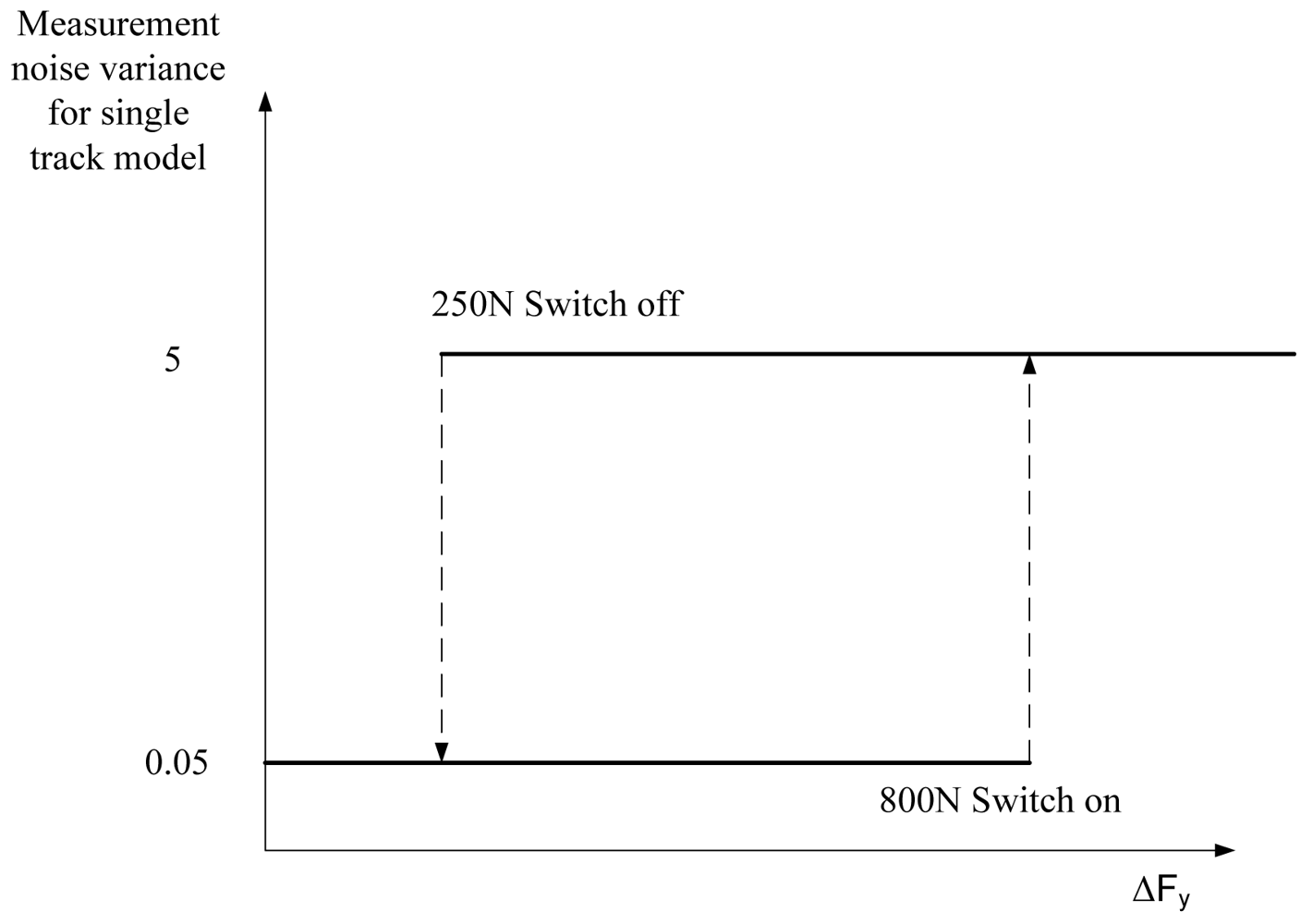
<p>Depending on driving conditions, the corresponding measurement noise variance (for single track v<sub>y</sub> and <italic>ψ̇</italic>) is selected based on ΔFy, where a relay with hysteresis is implemented (<xref ref-type="fig" rid="f7-sensors-09-08761">Figure 7</xref>). The tuning of the relay is essential to achieve a fast and stable response for the estimate. The low variance value can be tuned in straight ahead driving, where the variance can be adjusted to as great a value as the estimate vy without drifting, due to the integration of tyre forces. On the other hand, during cornering, the variance should switch to a noticeably higher level before the vehicle exhibits a non-linear operating region. The hysteresis is needed in order to avoid unnecessary relay switch offs, for example during lane changes, where single track model tyre forces and tyre sensor measurements can be almost equal temporarily.</p>
<p>Another method to judge vehicle non-linearity would be to evaluate the relation of lateral and vertical forces (<xref rid="FD15" ref-type="disp-formula">Equation 14</xref>). However, the threshold value is difficult to determine because the cornering stiffness linearity region depends on road conditions.</p></sec></sec></sec>
<sec sec-type="results">
<label>4.</label>
<title>Results</title>
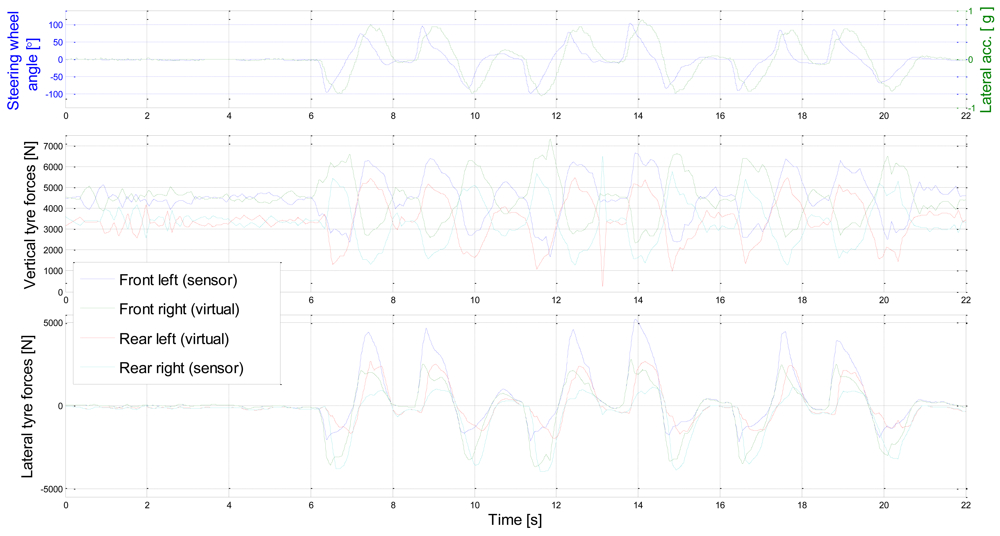
<p>A test manoeuvre was sequential and aggressive lane changes on dry and horizontally even tarmac road. The lateral and vertical tyre forces for the test manoeuvre are shown in <xref ref-type="fig" rid="f8-sensors-09-08761">Figure 8</xref>. The influence of load transfer can be seen in the vertical forces. The vertical forces vary between 1,000 N to 7,000 N. For the lateral forces, peak values for the left front tyre sensor are actually overestimated, due to sensor-lens setup non-linearities, which were found at the edge of the operating area during high vertical force. This results in an overestimation of the normalised lateral force of the front axle; hence the right front tyre lateral force might be overestimated as well.</p>
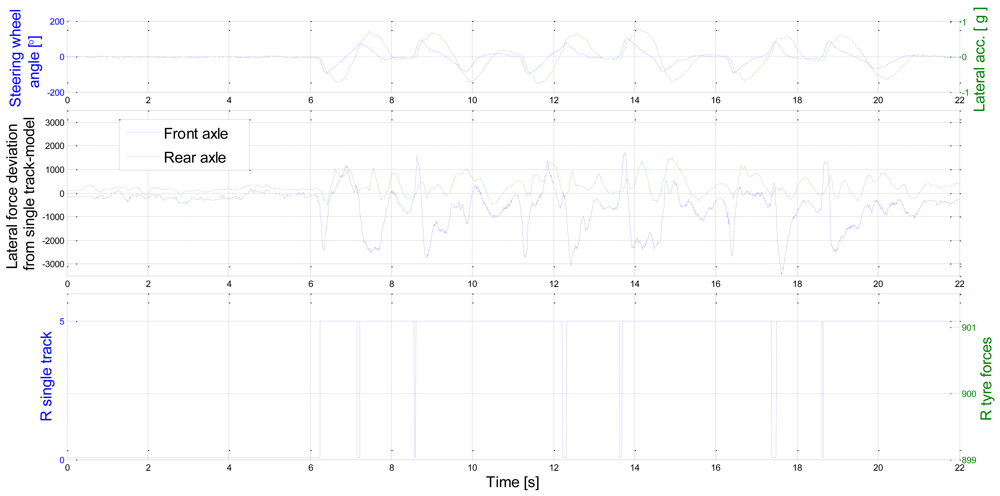
<p><xref ref-type="fig" rid="f9-sensors-09-08761">Figure 9</xref> shows the lateral axle force deviation from the single track model as calculated in <xref rid="FD30" ref-type="disp-formula">Equation 29</xref> (the same test run as in <xref ref-type="fig" rid="f8-sensors-09-08761">Figure 8</xref>). This deviation is further on exploited to evaluate the validity of a single-track model state estimate. When the measured tyre forces deviate from the single track model estimate, the measurement noise variance of a single track model measurement is high. Note that the measurement noise variance for the tyre sensors is constant. This is realistic because the accuracy of the tyre sensor does not depend on driving conditions. The lowest plot shows how the relay with hysteresis operates according to the driving state. During lane change, short switch-offs are detected. Otherwise the relay can recognise the straight ahead driving and cornering.</p>
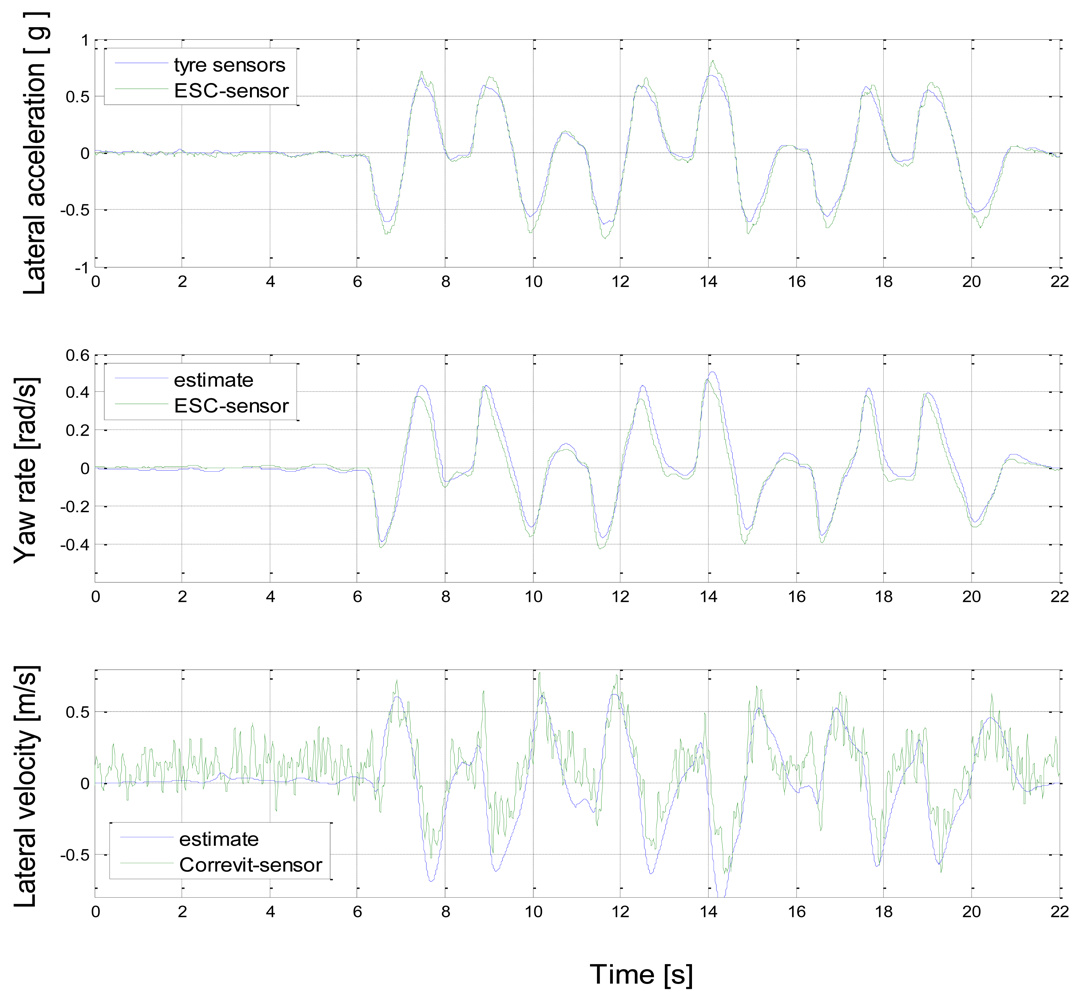
<p><xref ref-type="fig" rid="f10-sensors-09-08761">Figure 10</xref> shows the lateral acceleration comparison with the measured (normalised) tyre forces. The correlation is rather good and slightly higher peak values for the lateral acceleration sensor might be influenced by roll angle (gravity component). The yaw rate comparison seems to produce slightly greater values for the estimate in general. The left front tyre estimate was observed to overestimate lateral force during high vertical forces; this can explain why the values were higher than expected during positive yaw rate (right turn). The underestimation of yaw rate for negative values is more difficult to explain, but the reasons may lie in the inaccuracy of the virtual tyre sensors or in toe-in and roll-steer induced offsets in lateral forces. The influence of front left tyre lateral force overestimation is then stronger for <italic>ψ̇</italic> than a<sub>y</sub> (due to the integration step needed for <italic>ψ̇</italic>). Even if yaw rate estimate suffers from the explained inaccuracy in tyre force estimate, the overal performance for the lateral velocity estimate v<sub>y</sub> remains tolerable. The yaw rate overestimation results in cumulation of error to the negative direction of v<sub>y</sub>.</p></sec>
<sec sec-type="discussion">
<label>5.</label>
<title>Discussion</title>
<p>This paper presented one application for tyre sensors. The proposed vehicle lateral state estimator can similarly be used with other tyre force measurements than tyre sensors, such as suspension part or wheel hub strain measurements.</p>
<sec>
<label>5.1.</label>
<title>Can a tyre force sensor replace any of the existing vehicle sensors?</title>
<p>The main advantage of tyre force sensing is definitely the information given about the operating state of each tyre. In addition it is possible to calculate the lateral acceleration of a vehicle from the sum of tyre forces without any bias from body roll angle and road inclination. Also, the influence of side wind is realistically captured. The results show that lateral acceleration was accurately calculated from the tyre forces when measured by an optical tyre sensor. The yaw rate sensor, however, is much more complex to replace than the acceleration sensor. The required integration step makes the estimate extremely sensitive to errors in parameters l<sub>f</sub> and l<sub>r</sub>, which may arise, for example, from the pneumatic trail in addition to the mechanical movement of the wheel hub. Thus, the yaw rate is a valuable measure of the differences in front and rear axle forces acting on a vehicle. However, if the tyre sensor can produce an accurate and reliable estimate for the vertical force, the vehicle centre of gravity position can be calculated in a steady state condition.</p></sec>
<sec>
<label>5.2.</label>
<title>Required vehicle parameters by the estimator</title>
<p>One of the objectives of the estimator was to minimize the number of parameters. <xref ref-type="table" rid="t1-sensors-09-08761">Table 1</xref> presents required vehicle parameters by the estimator and proposes some possible sources for them.</p>
<p>The vehicle mass is naturally available from the vertical tyre forces, but it requires real force measurements instead of the virtual tyre sensors implemented in this paper. However, reasonable accuracy would also be possible with two tyre sensors.</p></sec>
<sec>
<label>5.3.</label>
<title>Further research</title>
<p>Improvement of the optical tyre sensor operation region would enable accurate estimation of lateral force during high vertical force and high slip angle. The single track model could be extended to adapt the parameters to ensure accurate operation during low lateral excitation.</p>
<p>The main benefits of this proposed Kalman filter approach could be seen on slippery road conditions, on side wind, and on inclined roads, where the problems for the model based estimation based on non-linear vehicle model are seen. In addition, the tyre force based estimator can be fitted to totally new types of vehicles without any major parameter modifications as long as the axle length is known.</p>
<p>The virtual tyre sensor concept might be feasible together with a more production oriented tyre sensor, or other type of tyre force measurement. The virtual tyre sensor concept would also lower the threshold for production tyre sensors as half of the sensor costs would be saved if only two tyres of a car needed be equipped with tyre sensors. It is possible to do this research and development mainly with simulation models, with no significant investments needed for the tyre sensor prototypes. The main problems are the combined slip case and the slightly non-linear influence of the wheel load on tyre forces.</p></sec></sec></body>
<back>
<ref-list>
<title>References</title>
<ref id="b1-sensors-09-08761"><label>1.</label><citation citation-type="confproc"><person-group person-group-type="author"><name><surname>van Zanten</surname><given-names>A.T.</given-names></name><name><surname>Erhardt</surname><given-names>R.</given-names></name><name><surname>Pfaff</surname><given-names>G.</given-names></name><name><surname>Kost</surname><given-names>F.</given-names></name><name><surname>Hartmann</surname><given-names>U.</given-names></name><name><surname>Ehret</surname><given-names>T.</given-names></name></person-group><article-title>Control aspects of the Bosch-VDC</article-title><conf-name>Proceedings of AVEC96</conf-name><conf-loc>Aachen, Germany</conf-loc><conf-date>September, 1996</conf-date></citation></ref>
<ref id="b2-sensors-09-08761"><label>2.</label><citation citation-type="journal"><person-group person-group-type="author"><name><surname>Fukada</surname><given-names>Y.</given-names></name></person-group><article-title>Slip-angle estimation for vehicle stability control</article-title><source>Veh. Syst. Dyn.</source><year>1999</year><volume>32</volume><fpage>375</fpage><lpage>388</lpage><pub-id pub-id-type="doi">10.1076/vesd.32.4.375.2079</pub-id></citation></ref>
<ref id="b3-sensors-09-08761"><label>3.</label><citation citation-type="confproc"><person-group person-group-type="author"><name><surname>Best</surname><given-names>M.C.</given-names></name><name><surname>Gordon</surname><given-names>T.J.</given-names></name></person-group><article-title>Combined state and parameter estimation of vehicle handling dynamics</article-title><conf-name>Proceeding of AVEC 2000 5th International Symposium on Advanced Vehicle Control</conf-name><conf-loc>Ann Arbor, MI, USA</conf-loc><conf-date>August 22–24, 2000</conf-date></citation></ref>
<ref id="b4-sensors-09-08761"><label>4.</label><citation citation-type="confproc"><person-group person-group-type="author"><name><surname>Abe</surname><given-names>M.</given-names></name><name><surname>Kato</surname><given-names>A.</given-names></name><name><surname>Suzuki</surname><given-names>K.</given-names></name><name><surname>Kano</surname><given-names>Y.</given-names></name></person-group><article-title>Estimation of vehicle side-slip angle for DYC by using On-Board-Tire-Model</article-title><conf-name>Proceedings of 4th International Symposium on Advanced Vehicle Control</conf-name><conf-loc>Nagoya, Japan</conf-loc><conf-date>September 14–18, 1998</conf-date><fpage>437</fpage><lpage>442</lpage></citation></ref>
<ref id="b5-sensors-09-08761"><label>5.</label><citation citation-type="confproc"><person-group person-group-type="author"><name><surname>Klier</surname><given-names>W.</given-names></name><name><surname>Reim</surname><given-names>A.</given-names></name><name><surname>Stapel</surname><given-names>D.</given-names></name></person-group><article-title>Robust Estimation of Vehicle Sideslip Angle — An Approach w/o Vehicle and Tire Models</article-title><conf-name>SAE World Congress &amp; Exhibition</conf-name><conf-loc>Detroit, MI, USA</conf-loc><conf-date>April, 2008</conf-date></citation></ref>
<ref id="b6-sensors-09-08761"><label>6.</label><citation citation-type="journal"><person-group person-group-type="author"><name><surname>Cheli</surname><given-names>F.</given-names></name><name><surname>Sabbioni</surname><given-names>E.</given-names></name><name><surname>Pesce</surname><given-names>M.</given-names></name><name><surname>Melzi</surname><given-names>S.</given-names></name></person-group><article-title>A methodology for vehicle sideslip angle identification: comparison with experimental data</article-title><source>Veh. Syst. Dyn.</source><year>2007</year><volume>45</volume><fpage>549</fpage><lpage>563</lpage><pub-id pub-id-type="doi">10.1080/00423110601059112</pub-id></citation></ref>
<ref id="b7-sensors-09-08761"><label>7.</label><citation citation-type="book"><person-group person-group-type="author"><name><surname>Pasterkamp</surname><given-names>W.R.</given-names></name></person-group><source>The Tyre as Sensor to Estimate Friction</source><publisher-name>Delft University</publisher-name><publisher-loc>Delft, The Netherlands</publisher-loc><year>1997</year><fpage>148</fpage></citation></ref>
<ref id="b8-sensors-09-08761"><label>8.</label><citation citation-type="journal"><person-group person-group-type="author"><name><surname>Gobbi</surname><given-names>M.</given-names></name><name><surname>Botero</surname><given-names>J.C.</given-names></name><name><surname>Mastinu</surname><given-names>G.</given-names></name></person-group><article-title>Improving the active safety of road vehicles by sensing forces and moments at the wheels</article-title><source>Veh. Syst. Dyn.</source><year>2008</year><volume>46</volume><fpage>957</fpage><lpage>968</lpage><pub-id pub-id-type="doi">10.1080/00423110802037198</pub-id></citation></ref>
<ref id="b9-sensors-09-08761"><label>9.</label><citation citation-type="book"><person-group person-group-type="author"><name><surname>Becherer</surname><given-names>T.</given-names></name></person-group><source>The Sidewall Torsion Sensor System, 2. Darmstädter Reifenkolloquium</source><publisher-name>VDI-Verlag</publisher-name><publisher-loc>Düsseldorf, Germany</publisher-loc><year>1998</year><fpage>130</fpage><lpage>137</lpage></citation></ref>
<ref id="b10-sensors-09-08761"><label>10.</label><citation citation-type="journal"><person-group person-group-type="author"><name><surname>Tuononen</surname><given-names>A.J.</given-names></name></person-group><article-title>Optical position detection to measure tyre carcass deflections</article-title><source>Veh. Syst. Dyn.</source><year>2008</year><volume>46</volume><fpage>471</fpage><lpage>481</lpage><pub-id pub-id-type="doi">10.1080/00423110701485043</pub-id></citation></ref>
<ref id="b11-sensors-09-08761"><label>11.</label><citation citation-type="confproc"><person-group person-group-type="author"><name><surname>Morinaga</surname><given-names>H.</given-names></name></person-group><article-title>The possibility of intelligent tire (technology of contact area information sensing)</article-title><conf-name>Proceedings of 31st Fisita World Automotive Congress</conf-name><conf-loc>Yokohama, Japan</conf-loc><conf-date>October, 2006</conf-date></citation></ref>
<ref id="b12-sensors-09-08761"><label>12.</label><citation citation-type="confproc"><person-group person-group-type="author"><name><surname>Breuer</surname><given-names>B.</given-names></name><name><surname>Eichhorn</surname><given-names>U.</given-names></name></person-group><article-title>Measurement of tyre/road-friction ahead of the car and inside the tyre</article-title><conf-name>Proceedings of AVEC'92</conf-name><conf-loc>Yokohama, Japan</conf-loc><year>1992</year></citation></ref>
<ref id="b13-sensors-09-08761"><label>13.</label><citation citation-type="book"><person-group person-group-type="author"><name><surname>van Leeuwen</surname><given-names>B.</given-names></name><name><surname>Pepe</surname><given-names>F.</given-names></name></person-group><source>SKF Load Sensing HBU, ATA Advanced chassis Control Systems</source><publisher-loc>Orbassano, Italy</publisher-loc><year>2008</year></citation></ref>
<ref id="b14-sensors-09-08761"><label>14.</label><citation citation-type="book"><person-group person-group-type="author"><name><surname>Krantz</surname><given-names>W.</given-names></name><name><surname>Neubeck</surname><given-names>J.</given-names></name><name><surname>Wiedemann</surname><given-names>J.</given-names></name></person-group><source>Estimation of Side Slip Angle Using Measured Tire Forces</source><publisher-name>SAE</publisher-name><publisher-loc>Warrendale, PA, USA</publisher-loc><month>March</month><year>2002</year><fpage>59</fpage><lpage>64</lpage></citation></ref>
<ref id="b15-sensors-09-08761"><label>15.</label><citation citation-type="confproc"><person-group person-group-type="author"><name><surname>Kamada</surname><given-names>T.</given-names></name><name><surname>Fukudome</surname><given-names>H.</given-names></name><name><surname>Fujita</surname><given-names>T.</given-names></name><name><surname>Murase</surname><given-names>M.</given-names></name></person-group><article-title>Study on ABS control by measuring forces between road surface and tires</article-title><conf-name>Proceedings of the International Symposium on Advanced Vehicle Control</conf-name><conf-loc>Arnhem, The Netherlands</conf-loc><conf-date>August, 2004</conf-date><fpage>239</fpage><lpage>244</lpage></citation></ref>
<ref id="b16-sensors-09-08761"><label>16.</label><citation citation-type="thesis"><person-group person-group-type="author"><name><surname>Holtschulze</surname><given-names>J.</given-names></name></person-group><article-title>Analyse der Reifenverformungen für eine Identifikation des Reibwerts und weiterer Betriebsgröβen zur Unterstützung von Fahrdynamikregelsystemen</article-title><source>PhD thesis</source><publisher-name>RWTH Aachen University</publisher-name><publisher-loc>Aachen, Germany</publisher-loc><month>April</month><year>2006</year></citation></ref>
<ref id="b17-sensors-09-08761"><label>17.</label><citation citation-type="journal"><person-group person-group-type="author"><name><surname>Tuononen</surname><given-names>A.J.</given-names></name></person-group><article-title>On-board estimation of dynamic tyre forces from optically measured tyre carcass deflections</article-title><source>Int. J. Heavy Veh. Syst.</source><year>2009</year><volume>16</volume><fpage>362</fpage><lpage>378</lpage><pub-id pub-id-type="doi">10.1504/IJHVS.2009.027139</pub-id></citation></ref>
<ref id="b18-sensors-09-08761"><label>18.</label><citation citation-type="journal"><person-group person-group-type="author"><name><surname>Tuononen</surname><given-names>A.J.</given-names></name><name><surname>Hartikainen</surname><given-names>L.</given-names></name></person-group><article-title>Optical position detection sensor to measure tyre carcass deflections in aquaplaning</article-title><source>Int. J. Veh. Syst. Model. Test.</source><year>2008</year><volume>3</volume><fpage>189</fpage><lpage>197</lpage><pub-id pub-id-type="doi">10.1504/IJVSMT.2008.023837</pub-id></citation></ref>
<ref id="b19-sensors-09-08761"><label>19.</label><citation citation-type="journal"><person-group person-group-type="author"><name><surname>Tuononen</surname><given-names>A.J.</given-names></name><name><surname>Matilainen</surname><given-names>M.J.</given-names></name></person-group><article-title>Real-time estimation of aquaplaning with an optical tyre sensor</article-title><source>J. Automobile Eng.</source><year>2009</year><volume>223</volume><fpage>1263</fpage><lpage>1272</lpage><pub-id pub-id-type="doi">10.1243/09544070JAUTO1220</pub-id></citation></ref>
<ref id="b20-sensors-09-08761"><label>20.</label><citation citation-type="journal"><person-group person-group-type="author"><name><surname>Kalman</surname><given-names>R.E.</given-names></name></person-group><article-title>A new approach to linear filtering and prediction problems</article-title><source>Trans. ASME J. Basic Eng.</source><year>1960</year><volume>82</volume><fpage>35</fpage><lpage>45</lpage><pub-id pub-id-type="doi">10.1115/1.3662552</pub-id></citation></ref>
<ref id="b21-sensors-09-08761"><label>21.</label><citation citation-type="book"><person-group person-group-type="author"><name><surname>Welch</surname><given-names>G.</given-names></name><name><surname>Bishop</surname><given-names>G.</given-names></name></person-group><source>An introduction to the Kalman filter</source><comment>Technical Report TR 95-041</comment><publisher-name>Department of Computer Science, University of North Carolina</publisher-name><publisher-loc>Chapel Hill, NC, USA</publisher-loc><year>2006</year></citation></ref>
<ref id="b22-sensors-09-08761"><label>22.</label><citation citation-type="book"><person-group person-group-type="author"><name><surname>Pacejka</surname><given-names>H.B.</given-names></name></person-group><source>Tyre and Vehicle Dynamics</source><publisher-name>Elsevier</publisher-name><publisher-loc>Burlington, UK</publisher-loc><year>2005</year></citation></ref>
<ref id="b23-sensors-09-08761"><label>23.</label><citation citation-type="book"><person-group person-group-type="author"><name><surname>Gillespie</surname><given-names>T.D.</given-names></name></person-group><source>Fundamentals of Vehicle Dynamics</source><publisher-name>SAE</publisher-name><publisher-loc>Warrendale, PA, USA</publisher-loc><year>1992</year></citation></ref>
<ref id="b24-sensors-09-08761"><label>24.</label><citation citation-type="book"><person-group person-group-type="author"><name><surname>Pauwelussen</surname><given-names>J.</given-names></name></person-group><source>Plane Vehicle Behaviour, lecture material</source><publisher-name>HAN-University</publisher-name><publisher-loc>Arnhem, The Netherlands</publisher-loc><year>2003</year></citation></ref></ref-list>
<sec sec-type="display-objects">
<title>Figures and Table</title>
<fig id="f1-sensors-09-08761" position="float">
<label>Figure 1.</label>
<caption>
<p>Lateral forces acting on one axle of cornering vehicle.</p></caption>
<graphic xlink:href="sensors-09-08761f1.gif"/></fig>
<fig id="f2-sensors-09-08761" position="float">
<label>Figure 2.</label>
<caption>
<p>Optical tyre sensor measurement principle [<xref ref-type="bibr" rid="b10-sensors-09-08761">10</xref>].</p></caption>
<graphic xlink:href="sensors-09-08761f2.gif"/></fig>
<fig id="f3-sensors-09-08761" position="float">
<label>Figure 3.</label>
<caption>
<p>Tyre sensor calibration cycle for vertical force and comparison with test rig measurement.</p></caption>
<graphic xlink:href="sensors-09-08761f3.gif"/></fig>
<fig id="f4-sensors-09-08761" position="float">
<label>Figure 4.</label>
<caption>
<p>Tyre sensor calibration cycle for lateral force and comparison with test rig measurement (vertical force and lateral forces during cycle, 60 km/h).</p></caption>
<graphic xlink:href="sensors-09-08761f4.gif"/></fig>
<fig id="f5-sensors-09-08761" position="float">
<label>Figure 5.</label>
<caption>
<p>Measurement car setup.</p></caption>
<graphic xlink:href="sensors-09-08761f5.gif"/></fig>
<fig id="f6-sensors-09-08761" position="float">
<label>Figure 6.</label>
<caption>
<p>Block diagram of the estimator.</p></caption>
<graphic xlink:href="sensors-09-08761f6.gif"/></fig>
<fig id="f7-sensors-09-08761" position="float">
<label>Figure 7.</label>
<caption>
<p>A relay with hysteresis to select proper measurement noise variance.</p></caption>
<graphic xlink:href="sensors-09-08761f7.gif"/></fig>
<fig id="f8-sensors-09-08761" position="float">
<label>Figure 8.</label>
<caption>
<p>Lateral and vertical tyre forces for a driving manoeuvre (v<sub>x</sub>∼60 km/h, dry tarmac).</p></caption>
<graphic xlink:href="sensors-09-08761f8.gif"/></fig>
<fig id="f9-sensors-09-08761" position="float">
<label>Figure 9.</label>
<caption>
<p>Lateral force deviation from single track model and measurement error variance during test run.</p></caption>
<graphic xlink:href="sensors-09-08761f9.gif"/></fig>
<fig id="f10-sensors-09-08761" position="float">
<label>Figure 10.</label>
<caption>
<p>Lateral state estimate based Kalman filter estimator and for sensor measurement.</p></caption>
<graphic xlink:href="sensors-09-08761f10.gif"/></fig>
<table-wrap id="t1-sensors-09-08761" position="float">
<label>Table 1.</label>
<caption>
<p>Required estimator parameters.</p></caption>
<table frame="hsides" rules="groups">
<thead>
<tr>
<th align="left" valign="top"><bold>Parameter</bold></th>
<th align="left" valign="top"><bold>Definition</bold></th>
<th align="left" valign="top"><bold>Source</bold></th>
<th align="left" valign="top"><bold>Value</bold></th></tr></thead>
<tbody>
<tr>
<td align="left" valign="top">m</td>
<td align="left" valign="top">Vehicle mass</td>
<td align="left" valign="top">available from vertical tyre forces</td>
<td align="left" valign="top">1,603 kg</td></tr>
<tr>
<td align="left" valign="top">l</td>
<td align="left" valign="top">axle length</td>
<td align="left" valign="top">vehicle parameter</td>
<td align="left" valign="top">2,575 m</td></tr>
<tr>
<td align="left" valign="top">l<sub>f</sub></td>
<td align="left" valign="top">Centre of gravity distance from front axle</td>
<td align="left" valign="top">available from vertical tyre forces in steady state condition</td>
<td align="left" valign="top">1.05m</td></tr>
<tr>
<td align="left" valign="top">l<sub>r</sub></td>
<td align="left" valign="top">Centre of gravity distance from rear axle</td>
<td align="left" valign="top">available from vertical tyre forces in steady state condition</td>
<td align="left" valign="top">1.525m</td></tr>
<tr>
<td align="left" valign="top">I<sub>z</sub></td>
<td align="left" valign="top">Vehicle yaw moment of inertia</td>
<td align="left" valign="top">roughly <italic>m·l<sub>r</sub>·l<sub>r</sub></italic> [<xref ref-type="bibr" rid="b24-sensors-09-08761">24</xref>] or adapted</td>
<td align="left" valign="top">3,156 kg m<sup>2</sup></td></tr>
<tr>
<td align="left" valign="top">Q</td>
<td align="left" valign="top">Process noise covariance</td>
<td align="left" valign="top">constant</td>
<td align="left" valign="top">diag([0.01 0.01 1e4 1e4])</td></tr>
<tr>
<td align="left" valign="top">R</td>
<td align="left" valign="top">Measurement noise covariance</td>
<td align="left" valign="top">derived in section 3.5</td>
<td align="left" valign="top">variable</td></tr>
<tr>
<td align="left" valign="top">C<sub>f</sub> &amp; C<sub>r</sub></td>
<td align="left" valign="top">Cornering stiffness of the linear model (or characteristic velocity</td>
<td align="left" valign="top">ESC-system (nominal behaviour of a vehicle)</td>
<td align="left" valign="top">76,614 N/rad &amp; 82,087N/rad</td></tr></tbody></table></table-wrap></sec></back></article>