<?xml version="1.0" encoding="UTF-8"?>
<!DOCTYPE article PUBLIC "-//NLM//DTD Journal Publishing DTD v2.3 20070202//EN" "journalpublishing.dtd">
<article xmlns:mml="http://www.w3.org/1998/Math/MathML" xmlns:xlink="http://www.w3.org/1999/xlink" xml:lang="en" article-type="research-article">
<front>
<journal-meta>
<journal-id journal-id-type="nlm-ta">Sensors</journal-id>
<journal-title>Sensors</journal-title>
<issn pub-type="epub">1424-8220</issn>
<publisher>
<publisher-name>Molecular Diversity Preservation International (MDPI)</publisher-name></publisher></journal-meta>
<article-meta>
<article-id pub-id-type="doi">10.3390/s120911684</article-id>
<article-id pub-id-type="publisher-id">sensors-12-11684</article-id>
<article-categories>
<subj-group>
<subject>Article</subject></subj-group></article-categories>
<title-group>
<article-title>A Fast and Sensitive Quantitative Lateral Flow Immunoassay for Cry1Ab Based on a Novel Signal Amplification Conjugate</article-title></title-group>
<contrib-group>
<contrib contrib-type="author">
<name><surname>Chen</surname><given-names>Chunxiang</given-names></name><xref ref-type="aff" rid="af1-sensors-12-11684"><sup>1</sup></xref></contrib>
<contrib contrib-type="author">
<name><surname>Wu</surname><given-names>Jian</given-names></name><xref ref-type="aff" rid="af2-sensors-12-11684"><sup>2</sup></xref><xref ref-type="corresp" rid="c1-sensors-12-11684"><sup>*</sup></xref></contrib></contrib-group>
<aff id="af1-sensors-12-11684">
<label>1</label> Department of Control Science and Engineering, Zhejiang University, Hangzhou 310058, China; E-Mail: <email>daocaoren198011@163.com</email></aff>
<aff id="af2-sensors-12-11684">
<label>2</label> Department of Biosytems Engineering and Food Science, Zhejiang University, Hangzhou 310058, China</aff>
<author-notes>
<corresp id="c1-sensors-12-11684">
<label>*</label>Author to whom correspondence should be addressed; E-Mail: <email>wujian69@zju.edu.cn</email>; Tel./Fax: +86-571-8898-2180.</corresp></author-notes>
<pub-date pub-type="collection">
<year>2012</year></pub-date>
<pub-date pub-type="epub">
<day>27</day>
<month>08</month>
<year>2012</year></pub-date>
<volume>12</volume>
<issue>9</issue>
<fpage>11684</fpage>
<lpage>11696</lpage>
<history>
<date date-type="received">
<day>05</day>
<month>07</month>
<year>2012</year></date>
<date date-type="rev-recd">
<day>06</day>
<month>08</month>
<year>2012</year></date>
<date date-type="accepted">
<day>20</day>
<month>08</month>
<year>2012</year></date></history>
<permissions>
<copyright-statement>© 2012 by the authors; licensee MDPI, Basel, Switzerland.</copyright-statement>
<copyright-year>2012</copyright-year>
<license>
<p>This article is an open access article distributed under the terms and conditions of the Creative Commons Attribution license (http://creativecommons.org/licenses/by/3.0/).</p></license></permissions>
<abstract>
<p>A novel lateral flow immunoassay (LFIA) signal amplification strategy for the detection of Cry1Ab based on amplification via a polylysine (PL) chain and biotin-streptavidin system (BSAS) is described. In this system, multiple fluorescence dyes (FL) were directly coated on the surface of PL and conjugated with antibody via the BSAS for construction of novel signal amplification (FLPL-BSAS-mAb1) conjugates, in which FL, PL and BSAS were employed to improve the sensitivity of LFIA. Compared with conventional LFIA, the sensitivity of FLPL-BSAS-mAb1-based LFIA was increased by approximately 100-fold. Quantified linearity was achieved in the value range of 0–1,000 pg/mL. The limit of detection (LOD) was reached 10 pg/mL after optimization of reaction conditions. To our knowledge, this represents one of the most sensitive LFIA for Cry1Ab yet reported. Furthermore, the detection time for this method was about 10 min. Therefore, it should be an attractive alternative compared to conventional immunoassays in routine control for Cry1Ab.</p></abstract>
<kwd-group>
<kwd>cry1Ab</kwd>
<kwd>fluorescence dye</kwd>
<kwd>lateral flow biosensor</kwd>
<kwd>polylysine</kwd></kwd-group></article-meta></front>
<body>
<sec sec-type="intro">
<label>1.</label>
<title>Introduction</title>
<p>Genetically modified organisms (GMOs) have been mainly developed for mass production of agricultural plants. The Cry toxins are insecticidal proteins, which are considered to be harmless and non-toxic to human being and animals. However, there are still safety concerns among consumers about the side effects GMOs might cause on ecosystems [<xref ref-type="bibr" rid="b1-sensors-12-11684">1</xref>].</p>
<p>For the detection of Cry1Ab, the most commonly used formats are enzyme-linked immunosorbent assay (ELISA) [<xref ref-type="bibr" rid="b1-sensors-12-11684">1</xref>–<xref ref-type="bibr" rid="b4-sensors-12-11684">4</xref>] and lateral flow immunoassay (LFIA) [<xref ref-type="bibr" rid="b5-sensors-12-11684">5</xref>], while various innovative analytical techniques have also been developed for quantitative or qualitative detection of Cry1Ab protein [<xref ref-type="bibr" rid="b6-sensors-12-11684">6</xref>–<xref ref-type="bibr" rid="b14-sensors-12-11684">14</xref>]. However, the main drawback of ELISA is the relatively long assay time required, large-scale instruments and professional operating techniques. Conventional LFIA often suffers from poor quantitative discrimination and low analytical sensitivity. Therefore, it is of crucial importance to establish a rapid testing methodology for monitoring Cry toxins.</p>
<p>In the past decades, several methods with different materials used as labels have been tested to increase the sensitivity for immunoassay, including fluorescence dye [<xref ref-type="bibr" rid="b15-sensors-12-11684">15</xref>–<xref ref-type="bibr" rid="b17-sensors-12-11684">17</xref>], liposomes [<xref ref-type="bibr" rid="b18-sensors-12-11684">18</xref>–<xref ref-type="bibr" rid="b22-sensors-12-11684">22</xref>], quantum dots (QDs) [<xref ref-type="bibr" rid="b23-sensors-12-11684">23</xref>–<xref ref-type="bibr" rid="b27-sensors-12-11684">27</xref>], polymers (dextran and polylysine chains) [<xref ref-type="bibr" rid="b28-sensors-12-11684">28</xref>–<xref ref-type="bibr" rid="b31-sensors-12-11684">31</xref>] and particles such as enzyme-gold nanoparticles [<xref ref-type="bibr" rid="b32-sensors-12-11684">32</xref>], silica nanoparticles [<xref ref-type="bibr" rid="b33-sensors-12-11684">33</xref>–<xref ref-type="bibr" rid="b38-sensors-12-11684">38</xref>], superparamagnetic nanoparticles [<xref ref-type="bibr" rid="b39-sensors-12-11684">39</xref>–<xref ref-type="bibr" rid="b41-sensors-12-11684">41</xref>], polystyrene microparticles [<xref ref-type="bibr" rid="b42-sensors-12-11684">42</xref>,<xref ref-type="bibr" rid="b43-sensors-12-11684">43</xref>] and fluorescent europium(III) nanoparticles [<xref ref-type="bibr" rid="b44-sensors-12-11684">44</xref>]. To overcome the limitations of traditional LFIA, the nanoparticle-based LFIA for signal amplification have achieved notable progress and improved sensing performance in a variety of biosensor systems. However, the sensitivity of LFIA cannot meet all demands from a variety of detection problems in food and environment nowadays. Thus, new kinds of signal amplification systems need to be explored.</p>
<p>Here, we present a novel signal amplification strategy in LFIA, which adopts three amplification steps: (a) biotin-streptavidin amplification; (b) polylysine amplification; (c) fluorescence dye signal amplification. The biotin-streptavidin system (BSAS) has been widely applied in immunohistochemistry and immunoassay for its high specificity and strong affinity [<xref ref-type="bibr" rid="b45-sensors-12-11684">45</xref>,<xref ref-type="bibr" rid="b46-sensors-12-11684">46</xref>]. Streptavidin (SA) contains four binding sites with an extraordinarily high affinity for biotin.</p>
<p>In this paper, we explored the use of this novel signal amplification conjugate as label for direct electronic signal measurement in LFIA. This efficient way to increase the sensitivity was achieved by amplification of the signals, which were generated from the fluorescence dye-antibody conjugate with a high fluorescence dye-to-antibody ratio. When FLPL-BSAS-mAb1 conjugate is bound to one antigen, tens or hundreds of fluorescence dye molecules would bind to a single antigen, consequently leading to signal amplification. In this assay, the resulting conjugates achieved a detection limit 100-fold lower than that of the magnetic beads-based ELISA [<xref ref-type="bibr" rid="b13-sensors-12-11684">13</xref>] and gold-based LFIA [<xref ref-type="bibr" rid="b5-sensors-12-11684">5</xref>]. The influence of some important parameters such as the type of nitrocellulose (NC) membrane, the structure of FLPL-BSAS-mAb1 conjugates and detection time of the present method were investigated in detail. Furthermore, the analytical performance of FLPL-BSAS-mAb1-based LFIA was further evaluated and its precision was also discussed.</p></sec>
<sec sec-type="materials|methods">
<label>2.</label>
<title>Materials and Methods</title>
<sec>
<label>2.1.</label>
<title>Reagents and Materials</title>
<p>A nitrocellulose (NC) membrane, absorbent pad, sample pad, conjugate pad, and backing cards were purchased from Millipore (Bendford, MA, USA). Purified Cry1Ab protein, rabbit polyclonal antibody against Cry1Ab (pAb2), mouse monoclonal antibody against Cry1Ab (mAb1) and Bt Cry1Ab/1Ac/1F ELISA Kit were obtained from Abraxis LLC (Warminster, PA, USA), while Atto 647N (λ<sub>absmax</sub> = 644 nm, λ<sub>emmax</sub> = 669 nm), polylysine (30–70 KD), bovine serum albumin (BSA), N-(3-dimethylaminopropyl)-N′-ethylcarbodiimide hydrochloride (EDC), N-hydroxysuccinimide (NHS), streptavidin (SA), biotin and dimethyl sulfoxide (DMSO) were from Sigma (St. Louis, MO, USA). Other Cry proteins (Cry1C, Cry2A, Cry3A) were from Agdia Inc. (ElKart, IN, USA). Goat anti-rabbit IgG (GAR, &gt;95%), rabbit IgG (RIgG, &gt;95%) were obtained from Longji (Hangzhou, China). Dialysis tubing (20 KD) was from Spectrum Labs (Rancho Dominguez, CA, USA). All other analytical purified reagents were purchased domestically without further treatment or purification.</p></sec>
<sec>
<label>2.2.</label>
<title>Apparatus</title>
<p>An XYZ Biostrip Dispenser and CM 4000 Cutter were purchased from Bio-Dot (Irvine, CA, USA). A portable fluorescence strip reader ESE-Quant FLUO was purchased from Invitrogen (Carlsbad, CA, USA). The ultracentrifuge is from Heraeus Biofuge Stratos (Sollentum, Germany). The SepectraMax M5 multi-mode microplate reader was from Molecular Devices (Sunnyvale, CA, USA).</p></sec>
<sec>
<label>2.3.</label>
<title>Preparation of FLPL-BSAS-mAb1 Conjugates</title>
<sec>
<label>2.3.1.</label>
<title>Preparation FLPL and RIgG-FL Conjugates</title>
<p>Briefly, biotin (2.44 mg) together with EDC (19.14 mg) and NHS (11.49 mg) were dissolved in 0.01 M phosphate buffer saline (PBS, pH 7.4, 0.1 mL) and stirred for 15 min at room temperature (RT). This solution was then added dropwise to polylysine (PL) solution (polylysine: 450 mg in 1 mL of 0.01 M PBS at pH 7.2) so the PL: biotin molar ratio was 1:1. The mixture was stirred at RT for 1 h and excessive unreacted biotin and ions in aqueous solution were removed by size exclusion (5 KD) column chromatography against PBS buffer (0.01 M, pH 7.4). Then the biotin-labeled PL was labeled with Atto 647N according to the Atto 647N protein labeling kit protocol from Sigma. Firstly, the solution of biotin-labeled PL was added with sodium bicarbonate buffer solution (pH 9.5), adjusted to pH 8.5–9.0 and transferred to Atto 647N (1 mg Atto 647N dissolved in 10 μL DMSO), incubated at room temperature under gentle shaking for 2 h, followed by being separated conjugates from free dye by a size-exclusion column. Finally, the Atto 647N labeled polylysine (FLPL conjugate) fraction was collected and stored at 4 °C. The rabbit polyclonal antibody-Atto 647N conjugate (RIgG-FL) was obtained and purified with the same process.</p></sec>
<sec>
<label>2.3.2.</label>
<title>Preparation of Biotinylated-mAb1</title>
<p>Biotinylation of Mouse monoclonal antibody (mAb1) was performed as described in Section 2.3.1. The molar ratio of biotin to mAb1 was 2:1. After labeling, excessive unreacted biotin and ions in aqueous solution were removed by dialysis against PBS buffer (0.01 M, pH 7.4) for 2 days. Then, it was stored in −20 °C until use.</p></sec>
<sec>
<label>2.3.3.</label>
<title>Preparation of FLPL-BSAS-mAb1 Conjugate</title>
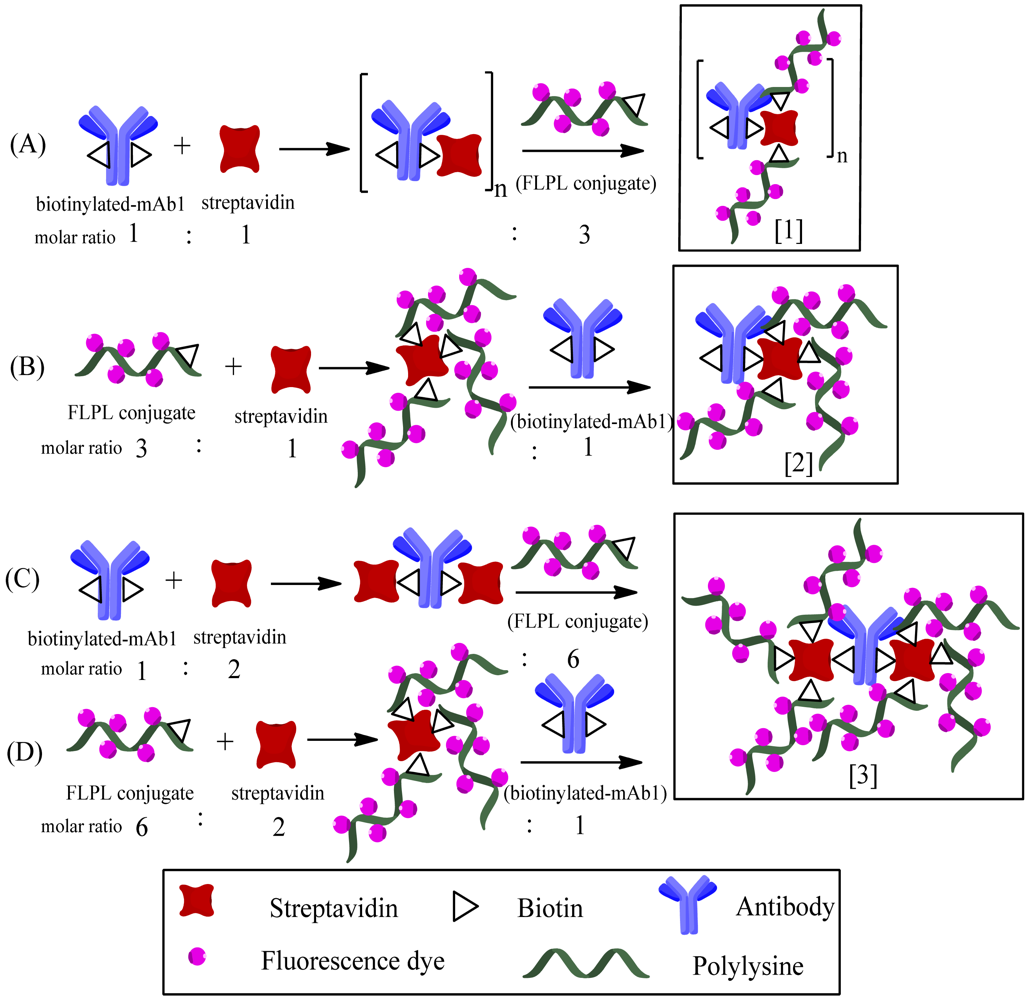
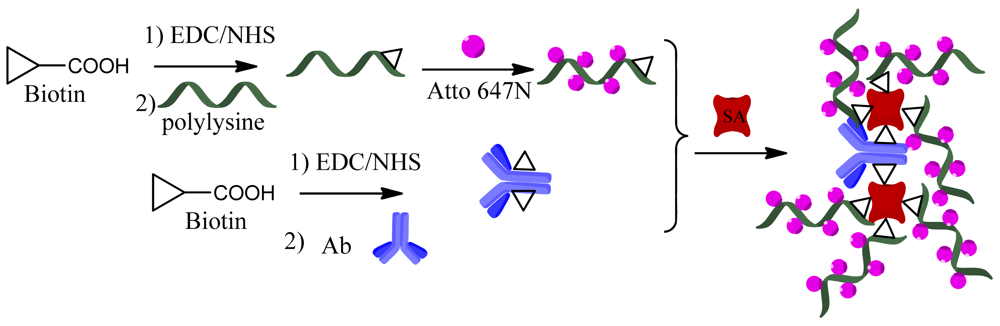
<p>The biotinylated-mAb1, streptavidin and FLPL conjugate were mixed in a molar ratio equal to 1:1:3 or 1:2:6 (<xref ref-type="table" rid="t1-sensors-12-11684">Table 1</xref>). The conjugating mechanism of FLPL-BSAS-mAb1 conjugates was shown in <xref ref-type="fig" rid="f1-sensors-12-11684">Figure 1</xref>. Finally, FLPL-BSAS-mAb1 conjugate and RIgG-FL (1:1, v/v) were dispersed in stock solution (1% BSA and 0.005% sodium azide in 0.01 M PBS pH 7.4), respectively, and kept at 4 °C until use.</p></sec></sec>
<sec>
<label>2.4.</label>
<title>Preparation of Lateral Flow Immunoassay System</title>
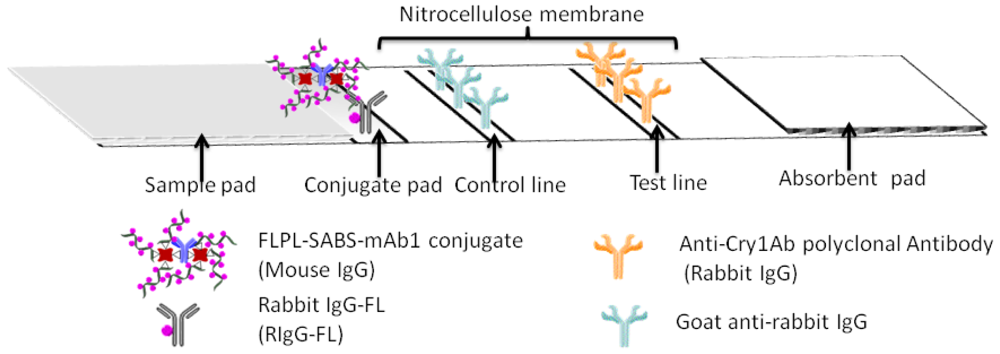
<p>The main body of the test strip consisted of five parts, including plastic backing, sample pad, conjugate pad, absorbent pad and NC membrane (<xref ref-type="fig" rid="f2-sensors-12-11684">Figure 2</xref>). Every component of the strip should be given a pretreatment described as follows: the NC membrane was attached to a plastic backing layer for cutting and handling. The pAb2 and GAR were immobilized at test line (T line) and control line (C line), respectively. The glass fiber was cut into two sizes 0.5 cm × 0.4 cm and 2.2 cm × 0.4 cm for the conjugate pad and sample pad. Conjugate pad contained FLPL-BSAS-mAb1 conjugate and RIgG-FL diluted by 0.01 M PBS buffer (pH 7.4) containing BSA (0.5%, w/v) and sucrose (3%, w/v). Sample pad was pretreated with BSA (3%, w/v) and Tween-20 (0.5%, w/v). Absorbent pad was 2.2 cm × 0.4 cm in size, attached to the top side of the strip.</p></sec>
<sec>
<label>2.5.</label>
<title>Lateral Flow Test Procedure</title>
<p>Prior to the immunoassay, varying concentration of Cry1Ab standard solutions ranging from 0 to 1,000 pg/mL, were prepared by dilution in PBS buffer. One hundred μL of sample was loaded onto the sample pad of the strip, the test cartridge was inserted into the portable fluorescence strip reader after 10 min. The intensities of fluorescence conjugates on the detection zone were scanned and converted to area values. All experiments were performed in triplicate, and the average of the triplicates was used for the analysis.</p></sec>
<sec>
<label>2.6.</label>
<title>Optimization Sensitivity of LFIA</title>
<sec>
<label>2.6.1.</label>
<title>Optimization of FLPL-BSAS-mAb1 Conjugate</title>
<p>As described in Section 2.3.3, the biotinylated-mAb1, streptavidin and FLPL conjugate were mixed in different ratios and two different mixing orders were tested (see <xref ref-type="table" rid="t1-sensors-12-11684">Table 1</xref>). In order to obtained higher signal amplification conjugate, different conjugate procedures were used in preparation.</p></sec>
<sec>
<label>2.6.2.</label>
<title>Optimization of NC Membrane</title>
<p>Five kinds of NC membranes (Millipore HF090, Millipore HF135, Sartourius CN95, Sartourius CN 140 and Whatman AE99) from different manufacturers were tested, respectively, according to the procedure described in Section 2.5. In this investigation, C line was coated with 1 mg/mL GAR, and T line was coated with 1 mg/mL pAb2. PBS buffer (10 mM, pH 7.4) was used as negative sample. After chromatography for 10 min, signals at the T and C line were measured.</p></sec>
<sec>
<label>2.6.3.</label>
<title>Optimization of Detection Time</title>
<p>Standard solution (1,000 pg/mL) was applied on the sample pad and allowed to migrate across the NC membrane. Signals of T line and C line were read every minute for 12 min.</p></sec></sec>
<sec>
<label>2.7.</label>
<title>Sample Preparation for Immunoassay Methods</title>
<p>Non-GM maize was purchased from a local market in Hangzhou, China, and verified with Bt Cry1Ab/1Ac/1F ELISA Kit. One hundred mg of the obtained non-GM maize flour was mixed with 1 mL of the extraction buffer (Tris-borate buffer, pH 7.5) and spiked with known amounts of Cry1Ab to obtain samples with different concentrations of 0, 5, 10, 30, 60, 125, 250, 500, 1,000 pg/mL [<xref ref-type="bibr" rid="b4-sensors-12-11684">4</xref>]. Sample without Cry1Ab was used as a blank. Each mixture was shaken for 30 min and centrifuged at 8,000 g for 30 min to remove insoluble material. The liquid protein extract was used in the assay.</p></sec></sec>
<sec sec-type="results|discussion">
<label>3.</label>
<title>Results and Discussion</title>
<sec>
<label>3.1.</label>
<title>Principle of FLPL-BSAS-mAb1 Based LFIA</title>
<p>FLPL-BSAS-mAb1-based LFIA combined the unique optical properties of FL with a signal amplification system for ultrasensitive detection of Cry1Ab. The protocol of FLPL-BSAS-mAb1 conjugate preparation was illustrated in <xref ref-type="fig" rid="f1-sensors-12-11684">Figure 1</xref> and set-up of the LFIA in <xref ref-type="fig" rid="f2-sensors-12-11684">Figure 2</xref>. Standard solution containing target Cry1Ab was added on the sample pad, migrated by capillary action and passed the NC membrane. Finally, the Cry1Ab were captured by the pAb2 on the T line, while FLPL-BSAS-mAb1 conjugate were captured by Cry1Ab. The FL intensity at the T line was proportional to the concentration of Cry1Ab protein and scanned by a portable fluorescence strip reader. The GAR was fixed at control line served as an internal control after the reaction with RIgG-FL.</p>
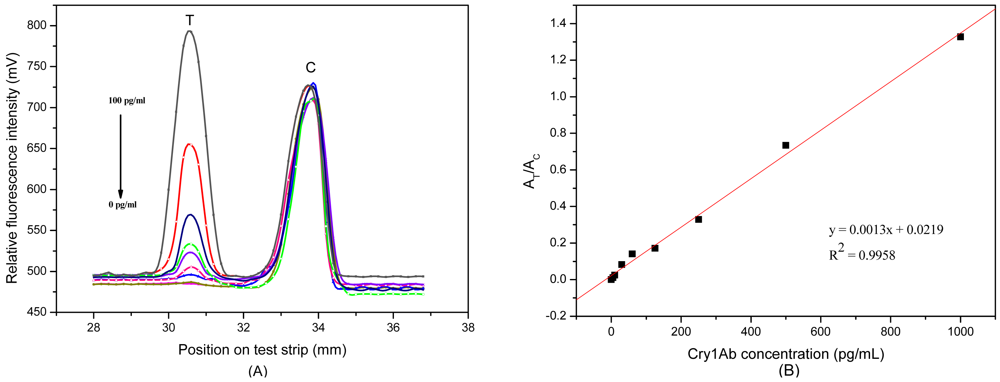
<p><xref ref-type="fig" rid="f3-sensors-12-11684">Figure 3(A)</xref> shows the relative fluorescence intensity (RFI) profile from the scanned test strip. The first peak and the second peak displayed RFI on T and C line, respectively, as plotted in the y-axis. The distance of strip was plotted in x-axis. The RFI of the C line was almost unchanged in different samples, indicating that the C line is functioning as a good internal standard.</p></sec>
<sec>
<label>3.2.</label>
<title>Optimization Sensitivity of LFIA</title>
<sec>
<label>3.2.1.</label>
<title>Optimization of FLPL-BSAS-mAb1 Conjugate</title>
<p>The use of polylysine with a big amount of primary amino was vital for signal amplification in LFIA, which in turn would influence the loading amount of Atto 647N on the conjugate. The biotinylated-mAb1 and FLPL conjugate self-assembled via the streptavidin–biotin system. We compared the analytical performances of four types of conjugates prepared through different conjugation procedures (<xref ref-type="table" rid="t1-sensors-12-11684">Table 1</xref>). In the presence of Cry1Ab (1,000 pg/mL), there was a very weak response observed with Type 1 conjugate (T1) and the highest responses were achieved by Type 3 and Type 4 conjugates (T3 and T4).</p>
<p><xref ref-type="fig" rid="f4-sensors-12-11684">Figure 4</xref> illustrates the sequential steps and structures of various conjugates prepared by chemical modification of mAb1. T3 and T4 had similar signal intensity and 2-fold higher than type 2 conjugate (T2), indicating they may have similar structures. In addition, T3 and T4 demonstrated a 60-fold higher intensity compared to T1. Therefore, we propose three kinds of structures for these conjugates. In these tests, the signal response of T1 accumulated on the bottom of the NC membrane, that may be caused by the steric hindrance effect of a polymer, as only a few tiny polymers could migrate across the NC membrane (<xref ref-type="fig" rid="f4-sensors-12-11684">Figure 4</xref>, panel A), so T1 might be structure 1. T2 might be structure 2, while T3 and T4 might be structure 3, because structure 3 potentially has 2-fold more FL molecules conjugated on mAb1 and would be expected to generate a 2-fold higher response compared to structure 2 (<xref ref-type="fig" rid="f4-sensors-12-11684">Figure 4</xref>, panels B, C and D, respectively). Thus, structure 3 was used to fix on conjugate pad for the following experiments. Furthermore, we have attempted to apply longer polylysine (70−150 KD) to construct higher bright conjugates, but the results indicated that conjugates with longer polylysine chains cannot for pass through the NC membrane, because they would clog in the membrane pores (data not shown).</p></sec>
<sec>
<label>3.2.2.</label>
<title>Optimization of NC Membrane</title>
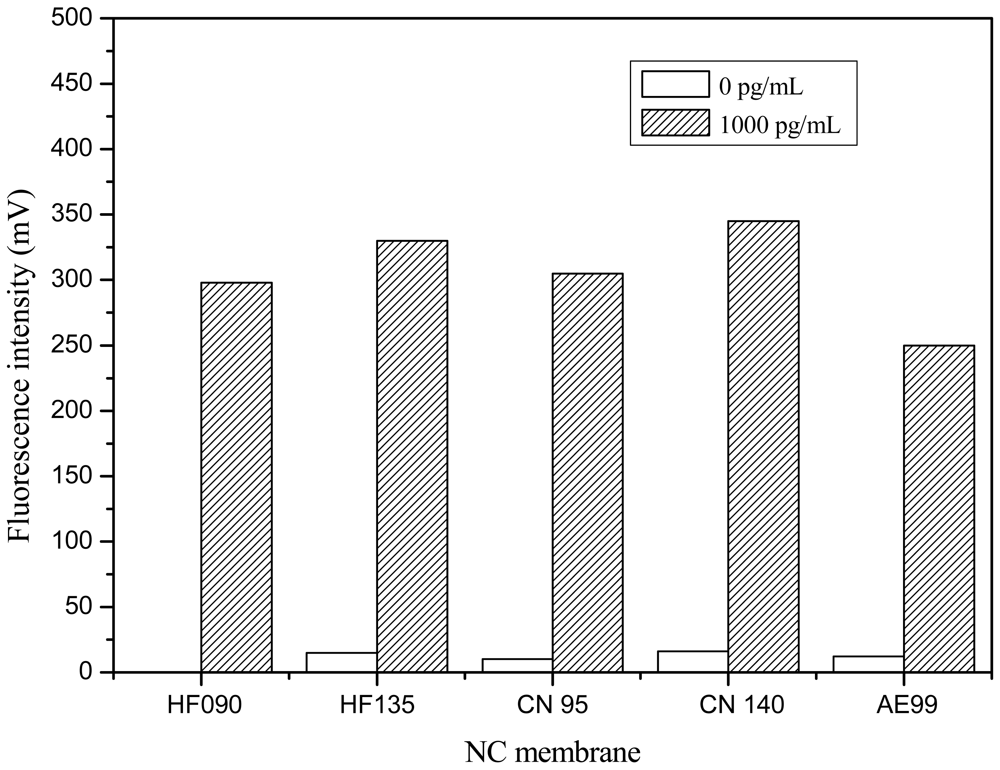
<p>Responses at the T lines on five NC membranes were compared in <xref ref-type="fig" rid="f5-sensors-12-11684">Figure 5</xref>. Responses of strips constructed with Sartorius CN 140 membrane were the highest, while the response of strips constructed from Whatman AE 99 membrane were the lowest in the presence of 1,000 pg/mL Cry1Ab. In detection of 0 ppt Cry1Ab, a little response could be observed on Millipore HF135, Sartourius CN95, Sartourius CN 140 and WhatmanAE99, because a few of the FLPL-BSAS-mAb1 conjugates would physically clog the small size of pores of these NC membranes, but almost no response could be observed on the Millipore HF 090 membrane in detection of 0 ppt Cry1Ab. With consideration both of the responses on 0 and 1,000 pg/mL, Millipore HF 090 was selected as the most suitable NC membrane for strip preparation in the following experiments.</p></sec>
<sec>
<label>3.2.3.</label>
<title>Optimization of Detection Time</title>
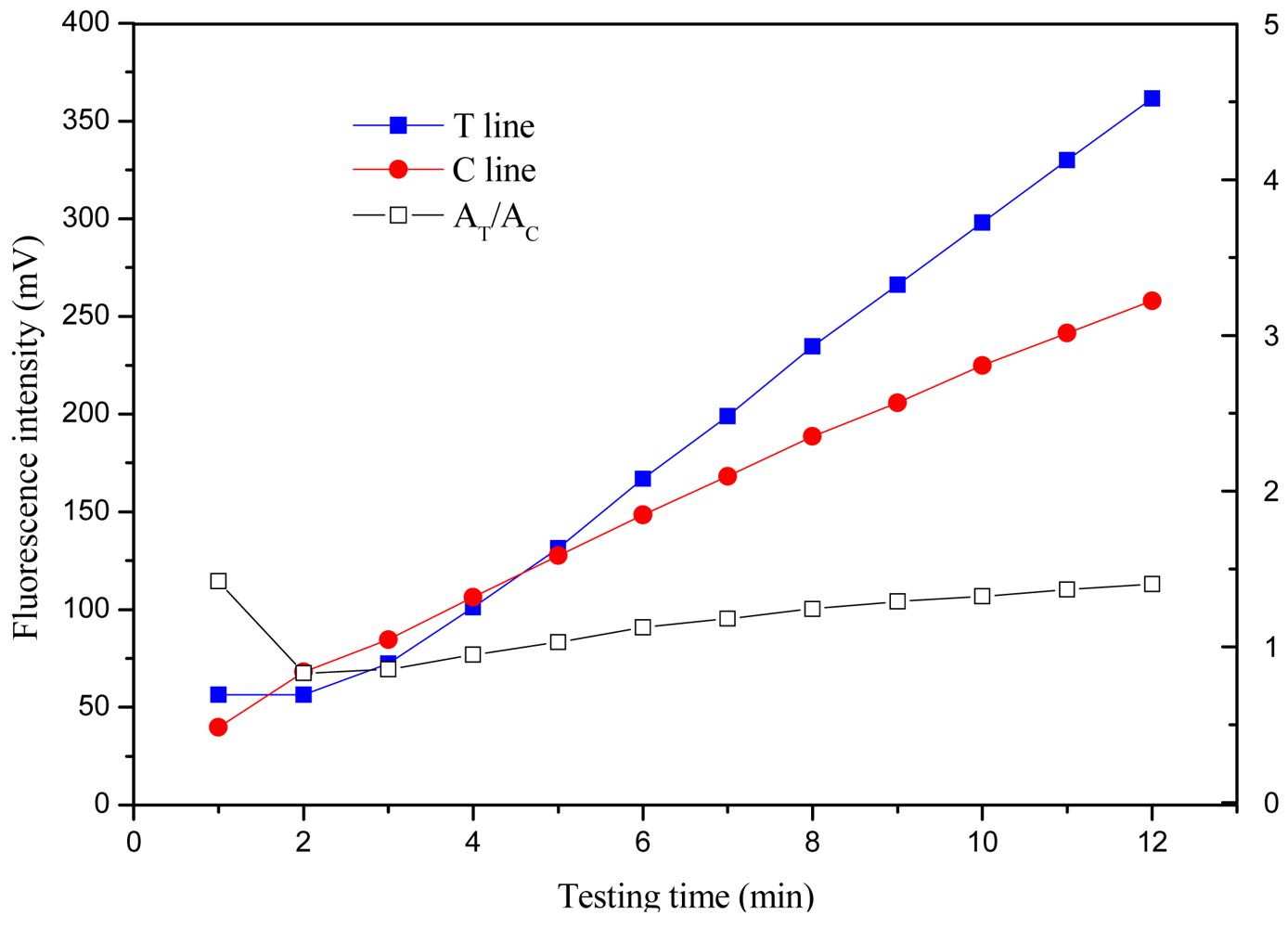
<p>The time-intensity curves were obtained by measuring the signals of the T and C lines every minute for 12 min after standard solution addition. The time-intensity curves and time-signal ratio A<sub>T</sub>/A<sub>C</sub> curve at one concentration of 1,000 pg/mL are shown in <xref ref-type="fig" rid="f6-sensors-12-11684">Figure 6</xref>, respectively.</p>
<p>The T line and C line signals increased rapidly during the first 25 min, between 25 and 45 min, the signals increased slowly and entered a plateau (data not shown). The time-signal ratio A<sub>T</sub>/A<sub>C</sub> curves of the first 12 min have been observed, and indicated that A<sub>T</sub>/A<sub>C</sub> would vary in the first 9 min, then gradually plateau, indicating the signal intensity was relatively stable for analysis (reading) over 9−12 min. With consideration of signal intensity for low concentration sample and the shortest time for detection, the detection time was considered as 10 min.</p></sec></sec>
<sec>
<label>3.3.</label>
<title>Method Evaluation</title>
<sec>
<label>3.3.1.</label>
<title>Sensitivity</title>
<p>After optimizing the signal amplification system, a series of Cry1Ab samples were tested by the FLPL-BSAS-mAb1-based LFIA to obtain a standard curve. Quantitative detection data is illustrated in <xref ref-type="fig" rid="f3-sensors-12-11684">Figure 3(A)</xref>. There was an obvious increase in signals at the T line with the increasing Cry1Ab concentration. A standard curve for Cry1Ab was plotted by the signal ratio A<sub>T</sub>/A<sub>C</sub> at different Cry1Ab concentrations (<xref ref-type="fig" rid="f3-sensors-12-11684">Figure 3(B)</xref>). It showed good linearity in the range between 0 and 1,000 pg/mL; the equation was:
<disp-formula id="FD1">
<label>(1)</label>
<mml:math id="mm1" display="block">
<mml:semantics id="sm1">
<mml:mrow>
<mml:mo stretchy="false">[</mml:mo>
<mml:mtext>y</mml:mtext>
<mml:mo>=</mml:mo>
<mml:mn>0.0013</mml:mn>
<mml:mspace width="0.2em"/>
<mml:mtext>x</mml:mtext>
<mml:mo>+</mml:mo>
<mml:mn>0.0219</mml:mn>
<mml:mo stretchy="false">]</mml:mo></mml:mrow></mml:semantics></mml:math></disp-formula>while the correlation coeffcients were calculated to be 0.9958. The coefficients of variation (CV) values were both lower than 10%. The cut off level for all detection systems was calculated by the following equation:
<disp-formula id="FD2">
<label>(2)</label>
<mml:math id="mm2" display="block">
<mml:semantics id="sm2">
<mml:mrow>
<mml:mo stretchy="false">[</mml:mo>
<mml:mn>3</mml:mn>
<mml:mo>∗</mml:mo>
<mml:mtext>SD background</mml:mtext>
<mml:mo>+</mml:mo>
<mml:mtext>average background</mml:mtext>
<mml:mo stretchy="false">]</mml:mo></mml:mrow></mml:semantics></mml:math></disp-formula></p>
<p>A detection limit of 10 pg/mL was achieved, which was 100 times lower than that of the magnetic beads- based ELISA [<xref ref-type="bibr" rid="b13-sensors-12-11684">13</xref>] and gold-based LFIA [<xref ref-type="bibr" rid="b5-sensors-12-11684">5</xref>]. This suggested that the proposed method is highly sensitive, especially for detection of biomolecules at low levels.</p></sec>
<sec>
<label>3.3.2.</label>
<title>Specificity</title>
<p>The cross-reactivity (CR) and specificity of FLPL-BSAS-mAb1 based LFIA for Cry1Ab was assessed with available different samples: Cry1C, Cry2A, Cry3A. It was checked with different dilutions of above proteins but there was no cross-reactivity with those three transgenic proteins, indicating that this assay can be used for unique quantification of Cry1Ab protein.</p></sec>
<sec>
<label>3.3.3.</label>
<title>Accuracy Evaluation</title>
<p>As ingredients in food are more complicated than the PBS buffer, Cry1Ab recovery rates in flour matrix were calculated to evaluate the influence of matrix on detection of target cry1Ab. It was calculated using the formula:
<disp-formula id="FD3">
<label>(3)</label>
<mml:math id="mm3" display="block">
<mml:semantics id="sm3">
<mml:mrow>
<mml:mo stretchy="false">[</mml:mo>
<mml:mo stretchy="false">(</mml:mo>
<mml:mrow>
<mml:mtext>observed concentration</mml:mtext>
<mml:mo>/</mml:mo>
<mml:mtext>spiked concentration</mml:mtext>
<mml:mo stretchy="false">)</mml:mo>
<mml:mo>×</mml:mo>
<mml:mn>100</mml:mn>
<mml:mo stretchy="false">]</mml:mo></mml:mrow></mml:mrow></mml:semantics></mml:math></disp-formula>and expressed in percent. As shown in <xref ref-type="table" rid="t2-sensors-12-11684">Table 2</xref>, the recoveries were ranged from 80.05% to 109.69% with CVs of 3.8–9.5% in signal-amplification-based LFIA.</p></sec></sec></sec>
<sec sec-type="conclusions">
<label>4.</label>
<title>Conclusions</title>
<p>In conclusion, in this paper, one signal-amplification-based LFIA for ultrasensitive detection of Cry1Ab has been developed with very high analytical sensitivity (10 pg/mL) and short turnaround time (10 min). The signal of FLPL-BSAS-mAb1 conjugate was enlarged by increasing the amount of fluorescence dye loading on antibody via a polylysine chain and biotin–streptavidin system. It was found that PL and BSAS played very important roles to improve the sensitivity of the assay. Furthermore, optimization of factors which may affect the detection sensitivity and method assessment were also described. This method was applicable in a flour matrix. Therefore, FLPL-BSAS-mAb1-based LFIA has great potential to improve detection sensitivity, making is a useful technique for more sensitive and quantitative immunoassays.</p></sec></body>
<back>
<ack>
<p>This work was supported by the National Key Technology Support Program 2012BAK08B05.</p></ack>
<ref-list>
<title>References</title>
<ref id="b1-sensors-12-11684"><label>1.</label><citation citation-type="journal"><person-group person-group-type="author"><name><surname>Paula</surname><given-names>V.</given-names></name><name><surname>Steinkea</surname><given-names>K.</given-names></name><name><surname>Meyer</surname><given-names>H.</given-names></name></person-group><article-title>Development and validation of a sensitive enzyme immunoassay for surveillance of Cry1Ab toxin in bovine blood plasma of cows fed Bt-maize (MON810)</article-title><source>Anal. Chim. Acta.</source><year>2008</year><volume>607</volume><fpage>106</fpage><lpage>113</lpage><pub-id pub-id-type="doi">10.1016/j.aca.2007.11.022</pub-id><pub-id pub-id-type="pmid">18155416</pub-id></citation></ref>
<ref id="b2-sensors-12-11684"><label>2.</label><citation citation-type="journal"><person-group person-group-type="author"><name><surname>Wang</surname><given-names>S.</given-names></name><name><surname>Guo</surname><given-names>A.Y.</given-names></name><name><surname>Zheng</surname><given-names>W.J.</given-names></name><name><surname>Zhang</surname><given-names>Y.</given-names></name><name><surname>Qiao</surname><given-names>H.</given-names></name><name><surname>Kennedy</surname><given-names>I.R.</given-names></name></person-group><article-title>Development of ELISA for the determination of transgenic Bt-Cottons using antibodies against Cry1Ac protein from Bacillus thuringiensis HD-73</article-title><source>Eng. Life. Sci.</source><year>2007</year><volume>7</volume><fpage>149</fpage><lpage>154</lpage><pub-id pub-id-type="doi">10.1002/elsc.200620179</pub-id></citation></ref>
<ref id="b3-sensors-12-11684"><label>3.</label><citation citation-type="journal"><person-group person-group-type="author"><name><surname>Nakajima</surname><given-names>O.</given-names></name><name><surname>Teshima</surname><given-names>R.</given-names></name><name><surname>Takagi</surname><given-names>K.</given-names></name><name><surname>Okunuki</surname><given-names>H.</given-names></name><name><surname>Sawada</surname><given-names>J.</given-names></name></person-group><article-title>ELISA method for monitoring human serum IgE specific for Cry1Ab introduced into genetically modified corn</article-title><source>Regul. Toxicol. Pharm.</source><year>2007</year><volume>47</volume><fpage>90</fpage><lpage>95</lpage><pub-id pub-id-type="doi">10.1016/j.yrtph.2006.08.003</pub-id></citation></ref>
<ref id="b4-sensors-12-11684"><label>4.</label><citation citation-type="journal"><person-group person-group-type="author"><name><surname>Walschus</surname><given-names>U.</given-names></name><name><surname>Witt</surname><given-names>S.</given-names></name><name><surname>Wittmann</surname><given-names>C.</given-names></name></person-group><article-title>Development of monoclonal antibodies against Cry1Ab protein from Bacillus thuringiensis and their application in an ELISA for detection of transgenic Bt-Maize</article-title><source>Food Agr. Immunol.</source><year>2002</year><volume>14</volume><fpage>231</fpage><lpage>240</lpage><pub-id pub-id-type="doi">10.1080/0954010021000096382a</pub-id></citation></ref>
<ref id="b5-sensors-12-11684"><label>5.</label><citation citation-type="journal"><person-group person-group-type="author"><name><surname>Kumar</surname><given-names>R.</given-names></name><name><surname>Singh</surname><given-names>C.K.</given-names></name><name><surname>Kamle</surname><given-names>S.</given-names></name><name><surname>Sinha</surname><given-names>R.P.</given-names></name><name><surname>Bhatnagar</surname><given-names>R.K.</given-names></name><name><surname>Kachru</surname><given-names>D.N.</given-names></name></person-group><article-title>Development of nanocolloidal gold based immunochromatographic assay forrapid detection of transgenic vegetative insecticidal protein in geneticallymodified crops</article-title><source>Food Chem.</source><year>2010</year><volume>122</volume><fpage>1298</fpage><lpage>1303</lpage><pub-id pub-id-type="doi">10.1016/j.foodchem.2010.03.086</pub-id></citation></ref>
<ref id="b6-sensors-12-11684"><label>6.</label><citation citation-type="journal"><person-group person-group-type="author"><name><surname>Volpe</surname><given-names>G.</given-names></name><name><surname>Ammid</surname><given-names>N.H.</given-names></name><name><surname>Moscone</surname><given-names>D.</given-names></name><name><surname>Occhigrossi</surname><given-names>L.</given-names></name><name><surname>Palleschi</surname><given-names>G.</given-names></name></person-group><article-title>Development of an immunomagnetic electrochemical sensor for detection of BT-CRY1AB/CRY1AC proteins in genetically modified corn samples</article-title><source>Anal. Lett.</source><year>2006</year><volume>39</volume><fpage>1599</fpage><lpage>1609</lpage><pub-id pub-id-type="doi">10.1080/00032710600713339</pub-id></citation></ref>
<ref id="b7-sensors-12-11684"><label>7.</label><citation citation-type="journal"><person-group person-group-type="author"><name><surname>Giovannoli</surname><given-names>C.</given-names></name><name><surname>Anfossi</surname><given-names>L.</given-names></name><name><surname>Baggiani</surname><given-names>C.</given-names></name><name><surname>Giraudi</surname><given-names>G.</given-names></name></person-group><article-title>Binding properties of a monoclonal antibody against the Cry1Ab from Bacillus Thuringensis for the development of a capillary electrophoresis competitive immunoassay</article-title><source>Anal. Bioanal. Chem.</source><year>2008</year><volume>392</volume><fpage>385</fpage><lpage>393</lpage><pub-id pub-id-type="doi">10.1007/s00216-007-1811-0</pub-id><pub-id pub-id-type="pmid">18185920</pub-id></citation></ref>
<ref id="b8-sensors-12-11684"><label>8.</label><citation citation-type="journal"><person-group person-group-type="author"><name><surname>Jang</surname><given-names>H.J.</given-names></name><name><surname>Cho</surname><given-names>I.H.</given-names></name><name><surname>Kim</surname><given-names>H.S.</given-names></name><name><surname>Jeon</surname><given-names>J.W.</given-names></name><name><surname>Hwang</surname><given-names>S.Y.</given-names></name><name><surname>Paek</surname><given-names>S.H.</given-names></name></person-group><article-title>Development of a chemiluminometric immunosensor array for on-site monitoring of genetically modified organisms</article-title><source>Sens. Actuator B</source><year>2011</year><volume>155</volume><fpage>598</fpage><lpage>605</lpage><pub-id pub-id-type="doi">10.1016/j.snb.2011.01.016</pub-id></citation></ref>
<ref id="b9-sensors-12-11684"><label>9.</label><citation citation-type="journal"><person-group person-group-type="author"><name><surname>Székács</surname><given-names>A.</given-names></name><name><surname>Lauber</surname><given-names>É.</given-names></name><name><surname>Takács</surname><given-names>E.</given-names></name><name><surname>Darvas</surname><given-names>B.</given-names></name></person-group><article-title>Detection of Cry1Ab toxin in the leaves of MON 810 transgenic maize</article-title><source>Anal. Bioanal. Chem.</source><year>2010</year><volume>396</volume><fpage>2203</fpage><lpage>2211</lpage><pub-id pub-id-type="doi">10.1007/s00216-009-3384-6</pub-id><pub-id pub-id-type="pmid">20091160</pub-id></citation></ref>
<ref id="b10-sensors-12-11684"><label>10.</label><citation citation-type="journal"><person-group person-group-type="author"><name><surname>Roda</surname><given-names>A.</given-names></name><name><surname>Mirasoli</surname><given-names>M.</given-names></name><name><surname>Guardigli</surname><given-names>M.</given-names></name><name><surname>Michelini</surname><given-names>E.</given-names></name><name><surname>Simoni</surname><given-names>P.</given-names></name><name><surname>Magliulo</surname><given-names>M.</given-names></name></person-group><article-title>Development and validation of a sensitive and fast chemiluminescent enzyme immunoassay for the detectionof genetically modified maize</article-title><source>Anal. Bioanal. Chem.</source><year>2006</year><volume>384</volume><fpage>1269</fpage><lpage>1275</lpage><pub-id pub-id-type="doi">10.1007/s00216-006-0308-6</pub-id><pub-id pub-id-type="pmid">16491341</pub-id></citation></ref>
<ref id="b11-sensors-12-11684"><label>11.</label><citation citation-type="journal"><person-group person-group-type="author"><name><surname>Ermolli</surname><given-names>M.</given-names></name><name><surname>Prospero</surname><given-names>A.</given-names></name><name><surname>Balla</surname><given-names>B.</given-names></name><name><surname>Querci</surname><given-names>M.</given-names></name><name><surname>Mazzeo</surname><given-names>A.</given-names></name><name><surname>Eede</surname><given-names>G.V.D.</given-names></name></person-group><article-title>Development of an innovative immunoassay for CP4EPSPS and Cry1AB genetically modified protein detection and quantification</article-title><source>Food Addit. Contam.</source><year>2006</year><volume>23</volume><fpage>876</fpage><lpage>882</lpage><pub-id pub-id-type="doi">10.1080/02652030600699056</pub-id><pub-id pub-id-type="pmid">16901856</pub-id></citation></ref>
<ref id="b12-sensors-12-11684"><label>12.</label><citation citation-type="journal"><person-group person-group-type="author"><name><surname>Fantozzi</surname><given-names>A.</given-names></name><name><surname>Ermolli</surname><given-names>M.</given-names></name><name><surname>Marini</surname><given-names>M.</given-names></name><name><surname>Scotti</surname><given-names>D.</given-names></name><name><surname>Balla</surname><given-names>B.</given-names></name><name><surname>Querci</surname><given-names>M.</given-names></name><name><surname>Langrell</surname><given-names>S.R.H.</given-names></name><name><surname>Eede</surname><given-names>G.V.D.</given-names></name></person-group><article-title>First application of a microsphere-based immunoassay to the detection of genetically modified organisms (GMOs): Quantification of Cry1Ab protein in genetically modified maize</article-title><source>J. Agric. Food Chem.</source><year>2007</year><volume>55</volume><fpage>1071</fpage><lpage>1076</lpage><pub-id pub-id-type="doi">10.1021/jf061506p</pub-id><pub-id pub-id-type="pmid">17300145</pub-id></citation></ref>
<ref id="b13-sensors-12-11684"><label>13.</label><citation citation-type="journal"><person-group person-group-type="author"><name><surname>Li</surname><given-names>D.Y.</given-names></name><name><surname>Fan</surname><given-names>K.</given-names></name><name><surname>Wu</surname><given-names>J.</given-names></name><name><surname>Ying</surname><given-names>Y.B.</given-names></name></person-group><article-title>Magnetic beads transfer based assay for CrylAb protein</article-title><source>Chin. J. Anal. Chem.</source><year>2011</year><volume>39</volume><fpage>1318</fpage><lpage>1322</lpage><pub-id pub-id-type="doi">10.1016/S1872-2040(10)60468-9</pub-id></citation></ref>
<ref id="b14-sensors-12-11684"><label>14.</label><citation citation-type="journal"><person-group person-group-type="author"><name><surname>Zhu</surname><given-names>X.L.</given-names></name><name><surname>Chen</surname><given-names>L.L.</given-names></name><name><surname>Shen</surname><given-names>P.</given-names></name><name><surname>Jia</surname><given-names>J.W.</given-names></name><name><surname>Zhang</surname><given-names>D.B.</given-names></name><name><surname>Yang</surname><given-names>L.T.</given-names></name></person-group><article-title>High sensitive detection of Cry1Ab protein using a quantum dot-based fluorescence-linked immunosorbent assay</article-title><source>J. Agric. Food Chem.</source><year>2011</year><volume>59</volume><fpage>2184</fpage><lpage>2189</lpage><pub-id pub-id-type="doi">10.1021/jf104140t</pub-id><pub-id pub-id-type="pmid">21329353</pub-id></citation></ref>
<ref id="b15-sensors-12-11684"><label>15.</label><citation citation-type="journal"><person-group person-group-type="author"><name><surname>Pyo</surname><given-names>D.J.</given-names></name></person-group><article-title>Comparison of fluorescence immunochromatographic assay strip and gold colloidal immunochromatographic assay strip for detection of microcystin</article-title><source>Anal. Lett.</source><year>2007</year><volume>40</volume><fpage>907</fpage><lpage>919</lpage><pub-id pub-id-type="doi">10.1080/00032710701242725</pub-id></citation></ref>
<ref id="b16-sensors-12-11684"><label>16.</label><citation citation-type="journal"><person-group person-group-type="author"><name><surname>Oh</surname><given-names>S.W.</given-names></name><name><surname>Kim</surname><given-names>Y.M.</given-names></name><name><surname>Kim</surname><given-names>H.J.</given-names></name><name><surname>Kim</surname><given-names>S.J.</given-names></name><name><surname>Cho</surname><given-names>J.S.</given-names></name><name><surname>Choi</surname><given-names>E.Y.</given-names></name></person-group><article-title>Point-of-care fluorescence immunoassay for prostate specific antigen</article-title><source>Clin. Chem. Acta</source><year>2009</year><volume>406</volume><fpage>18</fpage><lpage>22</lpage><pub-id pub-id-type="doi">10.1016/j.cca.2009.04.013</pub-id></citation></ref>
<ref id="b17-sensors-12-11684"><label>17.</label><citation citation-type="journal"><person-group person-group-type="author"><name><surname>Yoo</surname><given-names>J.S.</given-names></name><name><surname>Jung</surname><given-names>Y.M.</given-names></name><name><surname>Hahn</surname><given-names>J.H.</given-names></name><name><surname>Pyo</surname><given-names>D.J.</given-names></name></person-group><article-title>Quantitative analysis of a prostate-specific antigen in serum using fluorescence immunochromatography</article-title><source>J. Immunoassay Immunochem.</source><year>2010</year><volume>31</volume><fpage>259</fpage><lpage>265</lpage><pub-id pub-id-type="doi">10.1080/15321819.2010.524855</pub-id><pub-id pub-id-type="pmid">21113839</pub-id></citation></ref>
<ref id="b18-sensors-12-11684"><label>18.</label><citation citation-type="journal"><person-group person-group-type="author"><name><surname>Zaytseva</surname><given-names>N.V.</given-names></name><name><surname>Montagna</surname><given-names>R.A.</given-names></name><name><surname>Lee</surname><given-names>E.M.</given-names></name><name><surname>Baeumner</surname><given-names>A.J.</given-names></name></person-group><article-title>Multi-analyte single-membrane biosensor for the serotype-specific detection of Dengue virus</article-title><source>Anal. Bioanal. Chem.</source><year>2004</year><volume>380</volume><fpage>46</fpage><lpage>53</lpage><pub-id pub-id-type="pmid">15365670</pub-id></citation></ref>
<ref id="b19-sensors-12-11684"><label>19.</label><citation citation-type="journal"><person-group person-group-type="author"><name><surname>Edwards</surname><given-names>K.A.</given-names></name><name><surname>Baeumner</surname><given-names>A.J.</given-names></name></person-group><article-title>Liposomes in analyses</article-title><source>Talanta</source><year>2006</year><volume>68</volume><fpage>1421</fpage><lpage>1431</lpage><pub-id pub-id-type="doi">10.1016/j.talanta.2005.08.044</pub-id><pub-id pub-id-type="pmid">18970481</pub-id></citation></ref>
<ref id="b20-sensors-12-11684"><label>20.</label><citation citation-type="journal"><person-group person-group-type="author"><name><surname>Zhan</surname><given-names>W.</given-names></name><name><surname>Bard</surname><given-names>A.J.</given-names></name></person-group><article-title>Electrogenerated chemiluminescence: Immunoassay of human C-reactive protein by using Ru(bpy)<sub>3</sub><sup>2+</sup>-encapsulated liposomes as labels</article-title><source>Anal. Chem.</source><year>2007</year><volume>79</volume><fpage>459</fpage><lpage>463</lpage><pub-id pub-id-type="doi">10.1021/ac061336f</pub-id><pub-id pub-id-type="pmid">17222008</pub-id></citation></ref>
<ref id="b21-sensors-12-11684"><label>21.</label><citation citation-type="journal"><person-group person-group-type="author"><name><surname>Khreich</surname><given-names>N.</given-names></name><name><surname>Lamourette</surname><given-names>P.</given-names></name><name><surname>Lagoutte</surname><given-names>B.</given-names></name><name><surname>Ronco</surname><given-names>C.</given-names></name><name><surname>Franck</surname><given-names>X.</given-names></name><name><surname>Créminon</surname><given-names>C.</given-names></name><name><surname>Volland</surname><given-names>H.</given-names></name></person-group><article-title>A fluorescent immunochromatographic test using immunoliposomes for detecting microcystins and nodularins</article-title><source>Anal. Bioanal. Chem.</source><year>2010</year><volume>397</volume><fpage>1733</fpage><lpage>1742</lpage><pub-id pub-id-type="doi">10.1007/s00216-009-3348-x</pub-id><pub-id pub-id-type="pmid">20033138</pub-id></citation></ref>
<ref id="b22-sensors-12-11684"><label>22.</label><citation citation-type="journal"><person-group person-group-type="author"><name><surname>Khreich</surname><given-names>N.</given-names></name><name><surname>Lamourette</surname><given-names>P.</given-names></name><name><surname>Boutal</surname><given-names>H.</given-names></name><name><surname>Devilliers</surname><given-names>K.</given-names></name><name><surname>Créminon</surname><given-names>C.</given-names></name><name><surname>Volland</surname><given-names>H.</given-names></name></person-group><article-title>Detection of Staphylococcus enterotoxin B using fluorescent immunoliposomes as label for immunochromatographic testing</article-title><source>Anal. Biochem.</source><year>2008</year><volume>377</volume><fpage>182</fpage><lpage>188</lpage><pub-id pub-id-type="doi">10.1016/j.ab.2008.02.032</pub-id><pub-id pub-id-type="pmid">18384739</pub-id></citation></ref>
<ref id="b23-sensors-12-11684"><label>23.</label><citation citation-type="journal"><person-group person-group-type="author"><name><surname>Zou</surname><given-names>Z.X.</given-names></name><name><surname>Du</surname><given-names>D.</given-names></name><name><surname>Wang</surname><given-names>J.</given-names></name><name><surname>Smith</surname><given-names>J.N.</given-names></name><name><surname>Timchalk</surname><given-names>C.</given-names></name><name><surname>Li</surname><given-names>Y.Q.</given-names></name><name><surname>Lin</surname><given-names>Y.H.</given-names></name></person-group><article-title>Quantum dot-based immunochromatographic fluorescent biosensor for biomonitoring trichloropyridinol, a biomarker of exposure tochlorpyrifos</article-title><source>Anal. Chem.</source><year>2010</year><volume>82</volume><fpage>5125</fpage><lpage>5133</lpage><pub-id pub-id-type="doi">10.1021/ac100260m</pub-id><pub-id pub-id-type="pmid">20507134</pub-id></citation></ref>
<ref id="b24-sensors-12-11684"><label>24.</label><citation citation-type="journal"><person-group person-group-type="author"><name><surname>Chen</surname><given-names>Y.P.</given-names></name><name><surname>Ning</surname><given-names>B.A.</given-names></name><name><surname>Liu</surname><given-names>N.</given-names></name><name><surname>Feng</surname><given-names>Y.</given-names></name><name><surname>Liu</surname><given-names>Z.</given-names></name><name><surname>Liu</surname><given-names>X.Y.</given-names></name><name><surname>Gao</surname><given-names>Z.X.</given-names></name></person-group><article-title>A rapid and sensitive fluoroimmunoassay based on quantum dot for the detection of chlorpyrifos residue in drinking water</article-title><source>J. Environ. Sci. Heal. B</source><year>2010</year><volume>45</volume><fpage>508</fpage><lpage>515</lpage><pub-id pub-id-type="doi">10.1080/03601234.2010.493476</pub-id></citation></ref>
<ref id="b25-sensors-12-11684"><label>25.</label><citation citation-type="journal"><person-group person-group-type="author"><name><surname>Chen</surname><given-names>J.X.</given-names></name><name><surname>Xu</surname><given-names>F.</given-names></name><name><surname>Jiang</surname><given-names>H.Y.</given-names></name><name><surname>Hou</surname><given-names>Y.L.</given-names></name><name><surname>Rao</surname><given-names>Q.X.</given-names></name><name><surname>Guo</surname><given-names>P.J.</given-names></name><name><surname>Ding</surname><given-names>S.Y.</given-names></name></person-group><article-title>A novel quantum dot-based fluoroimmunoassay method for detection of Enrofloxacin residue in chicken muscle tissue</article-title><source>Food Chem.</source><year>2009</year><volume>113</volume><fpage>1197</fpage><lpage>1201</lpage><pub-id pub-id-type="doi">10.1016/j.foodchem.2008.08.006</pub-id></citation></ref>
<ref id="b26-sensors-12-11684"><label>26.</label><citation citation-type="journal"><person-group person-group-type="author"><name><surname>Li</surname><given-names>Z.H.</given-names></name><name><surname>Wang</surname><given-names>Y.</given-names></name><name><surname>Wang</surname><given-names>J.</given-names></name><name><surname>Tang</surname><given-names>Z.W.</given-names></name><name><surname>Pounds</surname><given-names>J.G.</given-names></name><name><surname>Lin</surname><given-names>Y.H.</given-names></name></person-group><article-title>Rapid and sensitive detection of protein biomarker using a portable fluorescence biosensor based on quantum dots and a lateral flow test strip</article-title><source>Anal. Chem.</source><year>2010</year><volume>82</volume><fpage>7008</fpage><lpage>7014</lpage><pub-id pub-id-type="doi">10.1021/ac101405a</pub-id><pub-id pub-id-type="pmid">20704391</pub-id></citation></ref>
<ref id="b27-sensors-12-11684"><label>27.</label><citation citation-type="journal"><person-group person-group-type="author"><name><surname>Yang</surname><given-names>H.</given-names></name><name><surname>Li</surname><given-names>D.</given-names></name><name><surname>He</surname><given-names>D.</given-names></name><name><surname>Guo</surname><given-names>Q.</given-names></name><name><surname>Wang</surname><given-names>K.</given-names></name><name><surname>Zhang</surname><given-names>X.Q.</given-names></name><name><surname>Huang</surname><given-names>P.</given-names></name><name><surname>Cui</surname><given-names>D.X.</given-names></name></person-group><article-title>A noval quantum dots-based point of care test for syphilis</article-title><source>Nanoscale Res. Lett.</source><year>2010</year><volume>5</volume><fpage>875</fpage><lpage>881</lpage><pub-id pub-id-type="doi">10.1007/s11671-010-9578-1</pub-id><pub-id pub-id-type="pmid">20672123</pub-id></citation></ref>
<ref id="b28-sensors-12-11684"><label>28.</label><citation citation-type="journal"><person-group person-group-type="author"><name><surname>Mateo</surname><given-names>C.</given-names></name><name><surname>Palomo</surname><given-names>J.M.</given-names></name><name><surname>Langen</surname><given-names>L.M.V.</given-names></name><name><surname>Rantwijk</surname><given-names>F.V.</given-names></name><name><surname>Sheldon</surname><given-names>R.A.</given-names></name></person-group><article-title>A new, mild cross-linking methodology to prepare cross-linked enzyme aggregates</article-title><source>Biotechnol. Bioeng.</source><year>2004</year><volume>86</volume><fpage>273</fpage><lpage>276</lpage><pub-id pub-id-type="doi">10.1002/bit.20033</pub-id><pub-id pub-id-type="pmid">15083507</pub-id></citation></ref>
<ref id="b29-sensors-12-11684"><label>29.</label><citation citation-type="journal"><person-group person-group-type="author"><name><surname>Fuentes</surname><given-names>M.</given-names></name><name><surname>Segura</surname><given-names>R.L.</given-names></name><name><surname>Abian</surname><given-names>O.</given-names></name><name><surname>Betancor</surname><given-names>L.</given-names></name><name><surname>Hidalgo</surname><given-names>A.</given-names></name><name><surname>Mateo</surname><given-names>C.</given-names></name><name><surname>Fernandez-Lafuente</surname><given-names>R.</given-names></name><name><surname>Guisan</surname><given-names>J.M.</given-names></name></person-group><article-title>Determination of protein-protein interactions through aldehyde-dextran intermolecular cross-linking</article-title><source>Proteomics</source><year>2004</year><volume>4</volume><fpage>2602</fpage><lpage>2607</lpage><pub-id pub-id-type="doi">10.1002/pmic.200300766</pub-id><pub-id pub-id-type="pmid">15352235</pub-id></citation></ref>
<ref id="b30-sensors-12-11684"><label>30.</label><citation citation-type="journal"><person-group person-group-type="author"><name><surname>Dhawan</surname><given-names>S.</given-names></name></person-group><article-title>Design construction of novel molecular conjugates for signal amplification (I): Conjugation of multiple horseradish peroxidase molecules to immunoglobulin via primary amines on lysine peptide chains</article-title><source>Peptides</source><year>2002</year><volume>23</volume><fpage>2091</fpage><lpage>2098</lpage><pub-id pub-id-type="doi">10.1016/S0196-9781(02)00250-4</pub-id><pub-id pub-id-type="pmid">12535687</pub-id></citation></ref>
<ref id="b31-sensors-12-11684"><label>31.</label><citation citation-type="journal"><person-group person-group-type="author"><name><surname>Chang</surname><given-names>W.F.</given-names></name><name><surname>Wang</surname><given-names>S.J.</given-names></name><name><surname>Lai</surname><given-names>S.F.</given-names></name><name><surname>Shieh</surname><given-names>C.J.</given-names></name><name><surname>Hsiung</surname><given-names>K.P.</given-names></name><name><surname>Liu</surname><given-names>Y.C.</given-names></name></person-group><article-title>Evaluation on the use of reactive dye-modified polylysine as the biomarker in immunochromatographic test application</article-title><source>Anal. Biochem.</source><year>2011</year><volume>411</volume><fpage>236</fpage><lpage>240</lpage><pub-id pub-id-type="doi">10.1016/j.ab.2010.12.031</pub-id><pub-id pub-id-type="pmid">21187056</pub-id></citation></ref>
<ref id="b32-sensors-12-11684"><label>32.</label><citation citation-type="journal"><person-group person-group-type="author"><name><surname>He</surname><given-names>Y.Q.</given-names></name><name><surname>Zhang</surname><given-names>S.Q.</given-names></name><name><surname>Zhang</surname><given-names>X.B.</given-names></name><name><surname>Baloda</surname><given-names>M.</given-names></name><name><surname>Gurung</surname><given-names>A.S.</given-names></name><name><surname>Xu</surname><given-names>H.</given-names></name><name><surname>Zhang</surname><given-names>X.J.</given-names></name><name><surname>Liu</surname><given-names>G.D.</given-names></name></person-group><article-title>Ultrasensitive nucleic acid biosensor based on enzyme-gold nanoparticle dual label and lateral flow strip biosensor</article-title><source>Biosens. Bioelectron.</source><year>2011</year><volume>26</volume><fpage>2018</fpage><lpage>2024</lpage><pub-id pub-id-type="doi">10.1016/j.bios.2010.08.079</pub-id><pub-id pub-id-type="pmid">20875950</pub-id></citation></ref>
<ref id="b33-sensors-12-11684"><label>33.</label><citation citation-type="journal"><person-group person-group-type="author"><name><surname>Wu</surname><given-names>Y.F.</given-names></name><name><surname>Chen</surname><given-names>C.L.</given-names></name><name><surname>Liu</surname><given-names>S.Q.</given-names></name></person-group><article-title>Enzyme-functionalized silica nanoparticles as sensitive labels in biosensing</article-title><source>Anal. Chem.</source><year>2009</year><volume>81</volume><fpage>1600</fpage><lpage>1607</lpage><pub-id pub-id-type="doi">10.1021/ac802345z</pub-id><pub-id pub-id-type="pmid">19140671</pub-id></citation></ref>
<ref id="b34-sensors-12-11684"><label>34.</label><citation citation-type="journal"><person-group person-group-type="author"><name><surname>Piao</surname><given-names>Y.</given-names></name><name><surname>Burns</surname><given-names>A.</given-names></name><name><surname>Kim</surname><given-names>J.</given-names></name><name><surname>Wiesner</surname><given-names>U.</given-names></name><name><surname>Hyeon</surname><given-names>T.</given-names></name></person-group><article-title>Designed fabrication of silica-based nanostructured particle systems for nanomedicine applications</article-title><source>Adv. Funct. Mater.</source><year>2008</year><volume>18</volume><fpage>3745</fpage><lpage>3758</lpage><pub-id pub-id-type="doi">10.1002/adfm.200800731</pub-id></citation></ref>
<ref id="b35-sensors-12-11684"><label>35.</label><citation citation-type="journal"><person-group person-group-type="author"><name><surname>Chen</surname><given-names>L.</given-names></name><name><surname>Chen</surname><given-names>C.</given-names></name><name><surname>Li</surname><given-names>R.</given-names></name><name><surname>Li</surname><given-names>Y.</given-names></name><name><surname>Liu</surname><given-names>S.</given-names></name></person-group><article-title>CdTe quantum dot functionalized silica nanosphere labels for ultrasensitive detection of biomarker</article-title><source>Chem. Commun.</source><year>2009</year><volume>19</volume><fpage>2670</fpage><lpage>2672</lpage></citation></ref>
<ref id="b36-sensors-12-11684"><label>36.</label><citation citation-type="journal"><person-group person-group-type="author"><name><surname>Wang</surname><given-names>J.</given-names></name><name><surname>Liu</surname><given-names>G.</given-names></name><name><surname>Engelhard</surname><given-names>M.H.</given-names></name><name><surname>Lin</surname><given-names>Y.</given-names></name></person-group><article-title>Sensitive immunoassay of a biomarker tumor necrosis factor-α based on poly(guanine)-functionalized silica nanoparticle label</article-title><source>Anal. Chem.</source><year>2006</year><volume>78</volume><fpage>6974</fpage><lpage>6979</lpage><pub-id pub-id-type="doi">10.1021/ac060809f</pub-id><pub-id pub-id-type="pmid">17007523</pub-id></citation></ref>
<ref id="b37-sensors-12-11684"><label>37.</label><citation citation-type="journal"><person-group person-group-type="author"><name><surname>Ke</surname><given-names>R.Q.</given-names></name><name><surname>Yang</surname><given-names>W.</given-names></name><name><surname>Xia</surname><given-names>X.H.</given-names></name><name><surname>Xu</surname><given-names>Y.</given-names></name><name><surname>Li</surname><given-names>Q.G.</given-names></name></person-group><article-title>Tandem conjugation of enzyme and antibody on silica nanoparticle for enzyme immunoassay</article-title><source>Anal. Biochem.</source><year>2010</year><volume>406</volume><fpage>8</fpage><lpage>13</lpage><pub-id pub-id-type="doi">10.1016/j.ab.2010.06.039</pub-id><pub-id pub-id-type="pmid">20599640</pub-id></citation></ref>
<ref id="b38-sensors-12-11684"><label>38.</label><citation citation-type="journal"><person-group person-group-type="author"><name><surname>Xia</surname><given-names>X.H.</given-names></name><name><surname>Xu</surname><given-names>Y.</given-names></name><name><surname>Zhao</surname><given-names>X.L.</given-names></name><name><surname>Li</surname><given-names>Q.G.</given-names></name></person-group><article-title>Lateral flow immunoassay using europium chelate–loaded silica nanoparticles as labels</article-title><source>Chin. Chem.</source><year>2009</year><volume>55</volume><fpage>179</fpage><lpage>182</lpage></citation></ref>
<ref id="b39-sensors-12-11684"><label>39.</label><citation citation-type="journal"><person-group person-group-type="author"><name><surname>Wang</surname><given-names>Y.Y.</given-names></name><name><surname>Xu</surname><given-names>H.</given-names></name><name><surname>Wei</surname><given-names>M.</given-names></name><name><surname>Gu</surname><given-names>H.C.</given-names></name><name><surname>Xu</surname><given-names>Q.F.</given-names></name><name><surname>Zhu</surname><given-names>W.</given-names></name></person-group><article-title>Study of superparamagnetic nanoparticles as labels in the quantitative lateral flow immunoassay</article-title><source>Mater. Sci. Eng.</source><year>2009</year><volume>29</volume><fpage>714</fpage><lpage>718</lpage><pub-id pub-id-type="doi">10.1016/j.msec.2009.01.011</pub-id></citation></ref>
<ref id="b40-sensors-12-11684"><label>40.</label><citation citation-type="journal"><person-group person-group-type="author"><name><surname>Zheng</surname><given-names>C.</given-names></name><name><surname>Wang</surname><given-names>X.C.</given-names></name><name><surname>Lu</surname><given-names>Y.</given-names></name><name><surname>Liu</surname><given-names>Y.</given-names></name></person-group><article-title>Rapid detection of fish major allergen parvalbumin using superparamagnetic nanoparticle-based lateral flow immunoassay</article-title><source>Food Control.</source><year>2012</year><volume>26</volume><fpage>446</fpage><lpage>452</lpage><pub-id pub-id-type="doi">10.1016/j.foodcont.2012.01.040</pub-id></citation></ref>
<ref id="b41-sensors-12-11684"><label>41.</label><citation citation-type="journal"><person-group person-group-type="author"><name><surname>Tang</surname><given-names>D.</given-names></name><name><surname>Sauceda</surname><given-names>J.C.</given-names></name><name><surname>Lin</surname><given-names>Z.</given-names></name><name><surname>Ott</surname><given-names>S.</given-names></name><name><surname>Basova</surname><given-names>E.</given-names></name><name><surname>Goryacheva</surname><given-names>I.</given-names></name><name><surname>Biselli</surname><given-names>S.</given-names></name><name><surname>Lin</surname><given-names>J.</given-names></name><name><surname>Niessner</surname><given-names>R.</given-names></name><name><surname>Knopp</surname><given-names>D.</given-names></name></person-group><article-title>Magnetic nanogold microspheres-based lateral-flow immunodipstick for rapid detection of aflatoxin B<sub>2</sub> in food</article-title><source>Biosens. Bioelectron.</source><year>2009</year><volume>25</volume><fpage>514</fpage><lpage>518</lpage><pub-id pub-id-type="doi">10.1016/j.bios.2009.07.030</pub-id><pub-id pub-id-type="pmid">19699076</pub-id></citation></ref>
<ref id="b42-sensors-12-11684"><label>42.</label><citation citation-type="journal"><person-group person-group-type="author"><name><surname>Yan</surname><given-names>J.L.</given-names></name><name><surname>Estevez</surname><given-names>M.C.</given-names></name><name><surname>Smith</surname><given-names>J.E.</given-names></name><name><surname>Wang</surname><given-names>K.M.</given-names></name><name><surname>He</surname><given-names>X.X.</given-names></name><name><surname>Wang</surname><given-names>L.</given-names></name><name><surname>Tan</surname><given-names>W.H.</given-names></name></person-group><article-title>Dye-doped nanoparticles for bioanalysis</article-title><source>Nano Today</source><year>2007</year><volume>2</volume><fpage>44</fpage><lpage>50</lpage></citation></ref>
<ref id="b43-sensors-12-11684"><label>43.</label><citation citation-type="journal"><person-group person-group-type="author"><name><surname>Valanne</surname><given-names>A.</given-names></name><name><surname>Suojanen</surname><given-names>J.</given-names></name><name><surname>Peltonen</surname><given-names>J.</given-names></name><name><surname>Soukka</surname><given-names>T.</given-names></name><name><surname>Hanninen</surname><given-names>P.</given-names></name><name><surname>Harma</surname><given-names>H.</given-names></name></person-group><article-title>Multiplesized europium(III) chelate-dyed polystyrene particles as donors in FRET: An application for sensitive protein quantification utilizing competitive adsorption</article-title><source>Analyst</source><year>2009</year><volume>134</volume><fpage>980</fpage><lpage>986</lpage><pub-id pub-id-type="doi">10.1039/b821210d</pub-id><pub-id pub-id-type="pmid">19381394</pub-id></citation></ref>
<ref id="b44-sensors-12-11684"><label>44.</label><citation citation-type="journal"><person-group person-group-type="author"><name><surname>Juntunen</surname><given-names>E.</given-names></name><name><surname>Myyryläinen</surname><given-names>T.</given-names></name><name><surname>Salminen</surname><given-names>T.</given-names></name><name><surname>Soukka</surname><given-names>T.</given-names></name><name><surname>Pettersson</surname><given-names>K.</given-names></name></person-group><article-title>Performance of fluorescent europium (III) nanoparticles and colloidal gold reporters in lateral flow bioaffinity assay</article-title><source>Anal. Biochem.</source><year>2012</year><volume>428</volume><fpage>31</fpage><lpage>38</lpage><pub-id pub-id-type="doi">10.1016/j.ab.2012.06.005</pub-id><pub-id pub-id-type="pmid">22705171</pub-id></citation></ref>
<ref id="b45-sensors-12-11684"><label>45.</label><citation citation-type="journal"><person-group person-group-type="author"><name><surname>Liu</surname><given-names>R.P.</given-names></name><name><surname>Liu</surname><given-names>J.T.</given-names></name><name><surname>Xie</surname><given-names>L.</given-names></name><name><surname>Wang</surname><given-names>M.X.</given-names></name><name><surname>Luo</surname><given-names>J.P.</given-names></name><name><surname>Cai</surname><given-names>X.X.</given-names></name></person-group><article-title>A fast and sensitive enzyme immunoassay for brain natriuretic peptide based on micro-magnetic probes strategy</article-title><source>Talanta</source><year>2010</year><volume>81</volume><fpage>1016</fpage><lpage>1021</lpage><pub-id pub-id-type="doi">10.1016/j.talanta.2010.01.051</pub-id><pub-id pub-id-type="pmid">20298887</pub-id></citation></ref>
<ref id="b46-sensors-12-11684"><label>46.</label><citation citation-type="journal"><person-group person-group-type="author"><name><surname>Sai</surname><given-names>N.</given-names></name><name><surname>Chen</surname><given-names>Y.P.</given-names></name><name><surname>Liu</surname><given-names>N.</given-names></name><name><surname>Yu</surname><given-names>G.G.</given-names></name><name><surname>Su</surname><given-names>P.</given-names></name><name><surname>Feng</surname><given-names>Y.</given-names></name><name><surname>Zhou</surname><given-names>Z.J.</given-names></name><name><surname>Liu</surname><given-names>X.Y.</given-names></name><name><surname>Zhou</surname><given-names>H.Y.</given-names></name><name><surname>Gao</surname><given-names>Z.X.</given-names></name><name><surname>Ning</surname><given-names>B.A.</given-names></name></person-group><article-title>A sensitive immunoassay based on direct hapten coated format and biotin-streptavidin system for the detection of chloramphenicol</article-title><source>Talanta</source><year>2010</year><volume>82</volume><fpage>1113</fpage><lpage>1121</lpage><pub-id pub-id-type="doi">10.1016/j.talanta.2010.06.018</pub-id><pub-id pub-id-type="pmid">20801306</pub-id></citation></ref></ref-list>
<sec sec-type="display-objects">
<title>Figures and Tables</title>
<fig id="f1-sensors-12-11684" position="float">
<label>Figure 1.</label>
<caption>
<p>Preparation process of FLPL-BSAS-mAb1 conjugate.</p></caption>
<graphic xlink:href="sensors-12-11684f1.gif"/></fig>
<fig id="f2-sensors-12-11684" position="float">
<label>Figure 2.</label>
<caption>
<p>Schematic diagrams of FLPL-BSAS-mAb1 based LFIA.</p></caption>
<graphic xlink:href="sensors-12-11684f2.gif"/></fig>
<fig id="f3-sensors-12-11684" position="float">
<label>Figure 3.</label>
<caption>
<p>(<bold>A</bold>) Response for Cry1Ab concentration of 0, 5, 10, 30, 60, 125, 250, 500, and 1,000 pg/mL in buffer; (<bold>B</bold>) The calibration curve obtained from the area ration (A<sub>T</sub>/A<sub>C</sub>) against the concentration of Cry1Ab in buffer.</p></caption>
<graphic xlink:href="sensors-12-11684f3.gif"/></fig>
<fig id="f4-sensors-12-11684" position="float">
<label>Figure 4.</label>
<caption>
<p>Chemical structures of various FLPL-BSAS-mAb1 conjugates.</p></caption>
<graphic xlink:href="sensors-12-11684f4.gif"/></fig>
<fig id="f5-sensors-12-11684" position="float">
<label>Figure 5.</label>
<caption>
<p>Responses at T lines on five different NC membranes (CN 95, HF 090, CN 140, HF 135, AE 99).</p></caption>
<graphic xlink:href="sensors-12-11684f5.gif"/></fig>
<fig id="f6-sensors-12-11684" position="float">
<label>Figure 6.</label>
<caption>
<p>Trend of signals on T line and C line with time at 1,000 pg/mL.</p></caption>
<graphic xlink:href="sensors-12-11684f6.gif"/></fig>
<table-wrap id="t1-sensors-12-11684" position="float">
<label>Table 1.</label>
<caption>
<p>Properties of FLPL-BSAS-mAb1 conjugate prepared with different conjugate types.</p></caption>
<table frame="hsides" rules="groups">
<thead>
<tr>
<th align="center" valign="middle" rowspan="3"><bold>Type No</bold></th>
<th colspan="3" align="center" valign="middle"><bold>Molar ratio</bold></th>
<th align="center" valign="middle" rowspan="3"><bold>Mix order</bold> <xref ref-type="table-fn" rid="tfn1-sensors-12-11684"><sup>a</sup></xref><sup>,</sup><xref ref-type="table-fn" rid="tfn2-sensors-12-11684"><sup>b</sup></xref></th>
<th align="center" valign="middle" rowspan="3"><bold>Intensity</bold> <xref ref-type="table-fn" rid="tfn3-sensors-12-11684"><sup>c</sup></xref><break/><bold>(mV)</bold></th></tr>
<tr>
<th align="center" valign="bottom" colspan="3">
<hr/></th></tr>
<tr>
<th align="center" valign="middle"><bold>biotinylated-mAb1</bold></th>
<th align="center" valign="middle"><bold>streptavidin</bold></th>
<th align="center" valign="middle"><bold>FLPL conjugate</bold></th></tr></thead>
<tbody>
<tr>
<td align="center" valign="top">A</td>
<td align="center" valign="top">1</td>
<td align="center" valign="top">3</td>
<td align="center" valign="top">Method 1</td>
<td align="left" valign="top">10</td></tr>
<tr>
<td align="center" valign="top"><bold>B</bold></td>
<td align="center" valign="top">1</td>
<td align="center" valign="top">3</td>
<td align="center" valign="top">Method 2</td>
<td align="left" valign="top">137</td></tr>
<tr>
<td align="center" valign="top">C</td>
<td align="center" valign="top">1</td>
<td align="center" valign="top">2</td>
<td align="center" valign="top">6</td>
<td align="center" valign="top">Method 1</td>
<td align="left" valign="top">298</td></tr>
<tr>
<td align="center" valign="top">D</td>
<td align="center" valign="top">1</td>
<td align="center" valign="top">2</td>
<td align="center" valign="top">6</td>
<td align="center" valign="top">Method 2</td>
<td align="left" valign="top">285</td></tr></tbody></table>
<table-wrap-foot><fn id="tfn1-sensors-12-11684">
<label>a</label>
<p>Order 1: Method 1: streptavidin was added into the biotinylated-mAb1 solution prior to the addition of FLPL conjugate; Method 2: streptavidin was added into the FLPL conjugate solution prior to the addition of iotinylated-mAb1.</p></fn><fn id="tfn2-sensors-12-11684">
<label>b</label>
<p>Reaction time of each mix step: 30 min.</p></fn><fn id="tfn3-sensors-12-11684">
<label>c</label>
<p>The intensities of test line were obtained with a portable strip reader. Concentration of Cry1Ab: 1,000 pg/mL.</p></fn></table-wrap-foot></table-wrap>
<table-wrap id="t2-sensors-12-11684" position="float">
<label>Table 2.</label>
<caption>
<p>Recovery and precision of FLPL-BSAS-mAb1 based LFIA spiked in flour sample (n = 5).</p></caption>
<table frame="hsides" rules="groups">
<thead>
<tr>
<th align="center" valign="top"><bold>Spiked Concentration (pg/mL)</bold></th>
<th align="center" valign="top"><bold>Mean</bold> <xref ref-type="table-fn" rid="tfn4-sensors-12-11684"><sup>a</sup></xref> <bold>(pg/mL)</bold></th>
<th align="center" valign="top"><bold>SD</bold></th>
<th align="center" valign="top"><bold>Recovery (%)</bold></th>
<th align="center" valign="top"><bold>CV (%)</bold></th></tr></thead>
<tbody>
<tr>
<td align="center" valign="top">50</td>
<td align="center" valign="top">40.02</td>
<td align="center" valign="top">1.52</td>
<td align="center" valign="top">80.05</td>
<td align="center" valign="top">3.8</td></tr>
<tr>
<td align="center" valign="top">200</td>
<td align="center" valign="top">210.18</td>
<td align="center" valign="top">13.03</td>
<td align="center" valign="top">105.09</td>
<td align="center" valign="top">6.2</td></tr>
<tr>
<td align="center" valign="top">500</td>
<td align="center" valign="top">480.95</td>
<td align="center" valign="top">36.06</td>
<td align="center" valign="top">96.19</td>
<td align="center" valign="top">7.5</td></tr>
<tr>
<td align="center" valign="top">800</td>
<td align="center" valign="top">877.52</td>
<td align="center" valign="top">83.36</td>
<td align="center" valign="top">109.69</td>
<td align="center" valign="top">9.5</td></tr></tbody></table>
<table-wrap-foot><fn id="tfn4-sensors-12-11684">
<label>a</label>
<p>The mean and standard deviation values were calculated from five independent experiments.</p></fn></table-wrap-foot></table-wrap></sec></back></article>