<?xml version="1.0" encoding="UTF-8"?>
<!DOCTYPE article PUBLIC "-//NLM//DTD Journal Publishing DTD v2.3 20070202//EN" "journalpublishing.dtd">
<article xmlns:mml="http://www.w3.org/1998/Math/MathML" xmlns:xlink="http://www.w3.org/1999/xlink" xml:lang="en" article-type="research-article">
<front>
<journal-meta>
<journal-id journal-id-type="nlm-ta">Sensors</journal-id>
<journal-title>Sensors</journal-title>
<issn pub-type="epub">1424-8220</issn>
<publisher>
<publisher-name>Molecular Diversity Preservation International (MDPI)</publisher-name></publisher></journal-meta>
<article-meta>
<article-id pub-id-type="doi">10.3390/s120810086</article-id>
<article-id pub-id-type="publisher-id">sensors-12-10086</article-id>
<article-categories>
<subj-group>
<subject>Article</subject></subj-group></article-categories>
<title-group>
<article-title>Magnetic Properties of Liquid-Phase Sintered CoFe<sub>2</sub>O<sub>4</sub> for Application in Magnetoelastic and Magnetoelectric Transducers</article-title></title-group>
<contrib-group>
<contrib contrib-type="author">
<name><surname>de Brito</surname><given-names>Vera Lúcia Othéro</given-names></name><xref ref-type="aff" rid="af1-sensors-12-10086"><sup>1</sup></xref><xref ref-type="corresp" rid="c1-sensors-12-10086"><sup>*</sup></xref></contrib>
<contrib contrib-type="author">
<name><surname>Cunha</surname><given-names>Stéphanie Alá</given-names></name><xref ref-type="aff" rid="af1-sensors-12-10086"><sup>1</sup></xref></contrib>
<contrib contrib-type="author">
<name><surname>Lemos</surname><given-names>Leonardo Violim</given-names></name><xref ref-type="aff" rid="af1-sensors-12-10086"><sup>1</sup></xref></contrib>
<contrib contrib-type="author">
<name><surname>Nunes</surname><given-names>Cristina Bormio</given-names></name><xref ref-type="aff" rid="af2-sensors-12-10086"><sup>2</sup></xref></contrib></contrib-group>
<aff id="af1-sensors-12-10086">
<label>1</label> Instituto de Estudos Avançados, Rodovia dos Tamoios, km 5,5, Putim, São José dos Campos, SP 12228-001, Brazil; E-Mails: <email>scunha@ieav.cta.br</email> (S.A.C.); <email>violim@ieav.cta.br</email> (L.V.L.)</aff>
<aff id="af2-sensors-12-10086">
<label>2</label> Escola de Engenharia de Lorena, Universidade de São Paulo, Polo Urbo-Industrial, Gleba AI-6, Lorena, SP 12600-970, Brazil; E-Mail: <email>cristina@demar.eel.usp.br</email></aff>
<author-notes>
<corresp id="c1-sensors-12-10086">
<label>*</label>Author to whom correspondence should be addressed; E-Mail: <email>vlobrito@ieav.cta.br</email>; Tel.: +55-12-3947-5519; Fax: +55-12-3944-1177.</corresp></author-notes>
<pub-date pub-type="collection">
<year>2012</year></pub-date>
<pub-date pub-type="epub">
<day>25</day>
<month>07</month>
<year>2012</year></pub-date>
<volume>12</volume>
<issue>8</issue>
<fpage>10086</fpage>
<lpage>10096</lpage>
<history>
<date date-type="received">
<day>31</day>
<month>05</month>
<year>2012</year></date>
<date date-type="rev-recd">
<day>09</day>
<month>07</month>
<year>2012</year></date>
<date date-type="accepted">
<day>10</day>
<month>07</month>
<year>2012</year></date></history>
<permissions>
<copyright-statement>© 2012 by the authors; licensee MDPI, Basel, Switzerland.</copyright-statement>
<copyright-year>2012</copyright-year>
<license>
<p>This article is an open access article distributed under the terms and conditions of the Creative Commons Attribution license (http://creativecommons.org/licenses/by/3.0/).</p></license></permissions>
<abstract>
<p>Cobalt ferrite is a ferrimagnetic magnetostrictive ceramic that has potential application in magnetoelastic and magnetoelectric transducers. In this work, CoFe<sub>2</sub>O<sub>4</sub> was obtained using a conventional ceramic method and Bi<sub>2</sub>O<sub>3</sub> was used as additive in order to obtain liquid-phase sintered samples. Bi<sub>2</sub>O<sub>3</sub> was added to the ferrite in amounts ranging from 0.25 mol% to 0.45 mol% and samples were sintered at 900 °C and 950 °C. It was observed the presence of Bi-containing particles in the microstructure of the sintered samples and the magnetostriction results indicated microstructural anisotropy. It was verified that it is possible to get dense cobalt ferrites, liquid-phase sintered, with relative densities higher than 90% and with magnetostriction values very close to samples sintered without additives.</p></abstract>
<kwd-group>
<kwd>magnetic ceramics</kwd>
<kwd>ferrites</kwd>
<kwd>magnetostriction</kwd>
<kwd>magnetoelastic sensitivity</kwd>
<kwd>magnetomechanical sensors</kwd>
<kwd>ceramics processing</kwd>
<kwd>liquid-phase sintering</kwd></kwd-group></article-meta></front>
<body>
<sec sec-type="intro">
<label>1.</label>
<title>Introduction</title>
<p>Magnetostrictive materials are applicable in magnetoelastic transducers for sensing magnetic fields and mechanical stresses. There are several examples in the literature of applications of magnetostrictive ferrites in magnetic field [<xref ref-type="bibr" rid="b1-sensors-12-10086">1</xref>], torque [<xref ref-type="bibr" rid="b2-sensors-12-10086">2</xref>], compressive stress [<xref ref-type="bibr" rid="b3-sensors-12-10086">3</xref>], and hydrostatic stress [<xref ref-type="bibr" rid="b4-sensors-12-10086">4</xref>] sensors.</p>
<p>Magneto-electric (ME) composites combine magnetostrictive and piezoelectric phases to form materials that can convert both magnetic and mechanical energies into electricity. These features make ME composites applicable in magnetic field sensors [<xref ref-type="bibr" rid="b5-sensors-12-10086">5</xref>] and also as power sources for wireless sensor nodes [<xref ref-type="bibr" rid="b6-sensors-12-10086">6</xref>], because they may generate electricity from ambient vibrations and stray magnetic fields.</p>
<p>The distribution of the magnetic and piezoelectric phases in ME composites may vary. Laminate distribution has the advantage of eliminating charge leakage, however, in the case of ceramic composites, co-firing is challenging [<xref ref-type="bibr" rid="b7-sensors-12-10086">7</xref>]. Thus, the study of alternatives to adjust the sintering temperatures of the ceramic phases is very important.</p>
<p>Iron-rare earth alloys, like TERFENOL, are widely used in magnestoelastic transducers due to their giant magnetostriction and high magnetoelastic sensitivity [<xref ref-type="bibr" rid="b8-sensors-12-10086">8</xref>]. However, these materials are less corrosion resistant compared to ceramic magnetostrictive materials. Cobalt ferrites are magnetic ceramics that attain lower magnetostriction levels than TERFENOL, but they have a much lower cost and have higher resistivity. Several works have pointed out that they are very promising for mechanical stress sensing [<xref ref-type="bibr" rid="b2-sensors-12-10086">2</xref>] and magnetoelectric composites [<xref ref-type="bibr" rid="b9-sensors-12-10086">9</xref>].</p>
<p>Sintering of ferrites usually requires temperatures around 1,300–1,450 °C. However, in the fabrication of electronic devices, sometimes sintering temperatures lower than 1,000 °C are required. The use of sintering additives that form a liquid phase during sintering is an alternative for lowering the sintering temperature of ceramics. Additives such as V<sub>2</sub>O<sub>5</sub> [<xref ref-type="bibr" rid="b10-sensors-12-10086">10</xref>] and Bi<sub>2</sub>O<sub>3</sub> [<xref ref-type="bibr" rid="b11-sensors-12-10086">11</xref>] have been successfully used to achieve this objective in ferrites. On the other hand, it is known that the sintering parameters affect the cation distribution in the spinel structure of CoFe<sub>2</sub>O<sub>4</sub> and that cation distribution has a great influence on magnetostriction [<xref ref-type="bibr" rid="b12-sensors-12-10086">12</xref>], making this an issue to be considered when reducing the sintering temperature of this ferrite.</p>
<p>CoFe<sub>2</sub>O<sub>4</sub> presents the highest magnetostriction value among ferrites, which makes this material suitable for magneto-mechanical sensors. The work from Bhame [<xref ref-type="bibr" rid="b13-sensors-12-10086">13</xref>] shows that the grain size/density combination influences the magnetostriction of cobalt ferrites and that the highest values of these parameters tend to be obtained when grains are smaller and samples are denser. The objective of this work was to study the magnetic properties of CoFe<sub>2</sub>O<sub>4</sub>, liquid-phase sintered with Bi<sub>2</sub>O<sub>3</sub> as additive, evaluating the influence of the sintering method on the microstructure, magnetostriction and magnetoelastic sensitivity of the material.</p></sec>
<sec>
<label>2.</label>
<title>Experimental Section</title>
<p>Co<sub>3</sub>O<sub>4</sub> and Fe<sub>2</sub>O<sub>3</sub> were used as raw materials for the fabrication of CoFe<sub>2</sub>O<sub>4</sub>. These oxides were manually dry mixed in a mortar and calcined at 850 °C for 4 h. Bi<sub>2</sub>O<sub>3</sub> was added to the calcined powder in the following molar proportions: 0.15%, 0.25%, 0.35%, and 0.45%. The mixing of the additive was carried out in ethyl alcohol, using an eccentric mill. The ethyl alcohol was removed from the mixture by means of combustion.</p>
<p>Part of the calcined powder was sintered at 950 °C for 6 h and its crystalline structure was evaluated by means of X-ray diffraction (XRD). This experiment was carried out in a Panalytical Empyrean X'Pert PRO MRD diffractometer, with CuKα radiation. The parameters used were: generator voltage: 40 kV; tube current: 30 mA; scan step size: 0.02°. The lattice parameter (a) was calculated, based on the XRD results, and the reference mass density (d<sub>ref</sub>) was calculated using <xref rid="FD1" ref-type="disp-formula">Equation (1)</xref> [<xref ref-type="bibr" rid="b14-sensors-12-10086">14</xref>]. In <xref rid="FD1" ref-type="disp-formula">Equation (1)</xref>, M is the molar mass and N is the Avogadro's number:
<disp-formula id="FD1">
<label>(1)</label>
<mml:math id="mm1" display="block">
<mml:semantics id="sm1">
<mml:mrow>
<mml:msub>
<mml:mtext>d</mml:mtext>
<mml:mrow>
<mml:mtext>ref</mml:mtext></mml:mrow></mml:msub>
<mml:mo>=</mml:mo>
<mml:mfrac>
<mml:mrow>
<mml:mn>8</mml:mn>
<mml:mtext>M</mml:mtext></mml:mrow>
<mml:mrow>
<mml:mtext>N</mml:mtext>
<mml:mspace width="0.4em"/>
<mml:msup>
<mml:mtext>a</mml:mtext>
<mml:mn>3</mml:mn></mml:msup></mml:mrow></mml:mfrac></mml:mrow></mml:semantics></mml:math></disp-formula></p>
<p>The calcined Bi<sub>2</sub>O<sub>3</sub>-added powders were uniaxially pressed into tablets of 8-mm diameter and 2-mm thickness, under 50 MPa pressure. The compacted tablets were subsequently pressed in an isostatic press, under 300 MPa. The tablets were sintered at 900 °C for 3 h and at 950 °C for 3h and the values of the mass densities (d) were measured by means of Archimedes' method. The relative mass density (D) was calculated, having d<sub>ref</sub> as reference. The compositions with D = 90% were selected to have new samples sintered for 6 h. Only the samples that had D &gt; 90% had their microstructures and magnetic properties analyzed in this work.</p>
<p>For magnetic characterization, samples from the tablets were cut in a cubic shape with sides of approximately 3 mm. The magnetization measurements were made using Vibrating Sample Magnetometer—VSM from Quantum Design. The internal fields (H<sub>int</sub>) were calculated from <xref rid="FD2" ref-type="disp-formula">Equation (2)</xref> and the demagnetizing fields (H<sub>d</sub>) were calculated from <xref rid="FD3" ref-type="disp-formula">Equation (3)</xref>. The magnetization values (M) were taken from the VSM measurements results and the geometrical factor (N<sub>d</sub>) was estimated to be 1/3, based on the samples' shapes and dimensions [<xref ref-type="bibr" rid="b15-sensors-12-10086">15</xref>]:
<disp-formula id="FD2">
<label>(2)</label>
<mml:math id="mm2" display="block">
<mml:semantics id="sm2">
<mml:mrow>
<mml:msub>
<mml:mtext>H</mml:mtext>
<mml:mrow>
<mml:mo>int</mml:mo></mml:mrow></mml:msub>
<mml:mo>=</mml:mo>
<mml:mtext>H</mml:mtext>
<mml:mo>−</mml:mo>
<mml:msub>
<mml:mtext>H</mml:mtext>
<mml:mtext>d</mml:mtext></mml:msub></mml:mrow></mml:semantics></mml:math></disp-formula>
<disp-formula id="FD3">
<label>(3)</label>
<mml:math id="mm3" display="block">
<mml:semantics id="sm3">
<mml:mrow>
<mml:msub>
<mml:mtext>H</mml:mtext>
<mml:mtext>d</mml:mtext></mml:msub>
<mml:mo>=</mml:mo>
<mml:mo>−</mml:mo>
<mml:msub>
<mml:mtext>N</mml:mtext>
<mml:mtext>d</mml:mtext></mml:msub>
<mml:mspace width="0.2em"/>
<mml:mtext>M</mml:mtext></mml:mrow></mml:semantics></mml:math></disp-formula></p>
<p>The magnetostriction curves parallel (λ<sub>//</sub>) and perpendicular (λ<sub>⊥</sub>) to the applied field “H” were measured by means of capacitance dilatometry [<xref ref-type="bibr" rid="b16-sensors-12-10086">16</xref>]. The magnetoelastic sensitivity curves [∂λ/∂(μ<sub>0</sub>H)] and the H<sub>int</sub> values that corresponded to points of interest in these curves were calculated. The total magnetostriction at saturation (λ<sub>tot</sub>) was calculated according to (<xref rid="FD4" ref-type="disp-formula">4</xref>), by taking the magnetostrictions at saturation [(λ<sub>//</sub>)<sub>s</sub> and (λ<sub>⊥</sub>)<sub>s</sub>] from the magnetostriction curves:
<disp-formula id="FD4">
<label>(4)</label>
<mml:math id="mm4" display="block">
<mml:semantics id="sm4">
<mml:mrow>
<mml:msub>
<mml:mrow>
<mml:mi>λ</mml:mi></mml:mrow>
<mml:mrow>
<mml:mtext>tot</mml:mtext></mml:mrow></mml:msub>
<mml:mo>=</mml:mo>
<mml:msub>
<mml:mrow>
<mml:mrow>
<mml:mo>(</mml:mo>
<mml:mrow>
<mml:msub>
<mml:mi>λ</mml:mi>
<mml:mo>⊥</mml:mo></mml:msub></mml:mrow>
<mml:mo>)</mml:mo></mml:mrow></mml:mrow>
<mml:mtext>s</mml:mtext></mml:msub>
<mml:mo>−</mml:mo>
<mml:msub>
<mml:mrow>
<mml:mrow>
<mml:mo>(</mml:mo>
<mml:mrow>
<mml:msub>
<mml:mi>λ</mml:mi>
<mml:mrow>
<mml:mo>/</mml:mo>
<mml:mo>/</mml:mo></mml:mrow></mml:msub></mml:mrow>
<mml:mo>)</mml:mo></mml:mrow></mml:mrow>
<mml:mtext>s</mml:mtext></mml:msub></mml:mrow></mml:semantics></mml:math></disp-formula></p>
<p>The microstructures of the samples were analyzed using Scanning Electron Microscopy (SEM) images of polished and thermally etched samples' surfaces and the local compositions were assessed by Energy Dispersive X-Ray (EDX) analysis. Because of the low accuracy of EDX analysis to quantify light elements, it was carried out in a qualitative way, not taking oxygen into consideration.</p>
<p>A CoFe<sub>2</sub>O<sub>4</sub> sample with 93% relative density was obtained by Lemos [<xref ref-type="bibr" rid="b17-sensors-12-10086">17</xref>] and was taken as reference in the present work. The reference sample had been processed in a similar way and sintered at 1,300 °C for 2 h without additives. Its magnetostriction had been evaluated following the same procedure as in this work. However, the magnetization measurement had been carried out on a powder sample.</p></sec>
<sec sec-type="results|discussion">
<label>3.</label>
<title>Results and Discussion</title>
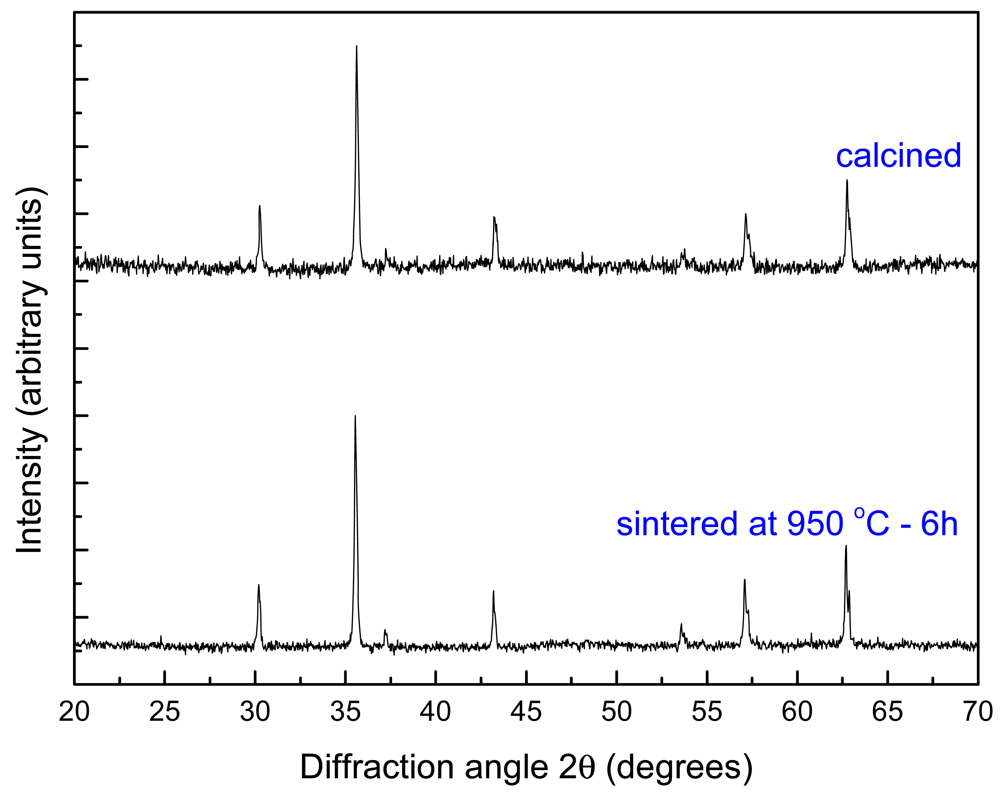
<p>The results from X-ray analysis of the ferrite powders are shown in <xref ref-type="fig" rid="f1-sensors-12-10086">Figure 1</xref> and they indicate that both calcined and sintered powders were constituted of the expected spinel phase. The sintered powder had a lattice parameter of 8.37 Å, which is in agreement with experimental data from literature [<xref ref-type="bibr" rid="b12-sensors-12-10086">12</xref>]. The calculated “d<sub>ref</sub>” was 5.32 g/cm<sup>3</sup>.</p>
<p>The mass densities obtained by Archimedes' method and the corresponding “D” values of the Bi<sub>2</sub>O<sub>3</sub>-added samples are shown on <xref ref-type="table" rid="t1-sensors-12-10086">Table 1</xref>. The mass densities varied from 3.76 to 5.11 g/cm<sup>3</sup>, which corresponded to relative densities from 71% to 96%. The samples highlighted in green, which have D &gt; 90%, were the samples selected for magnetic characterization.</p>
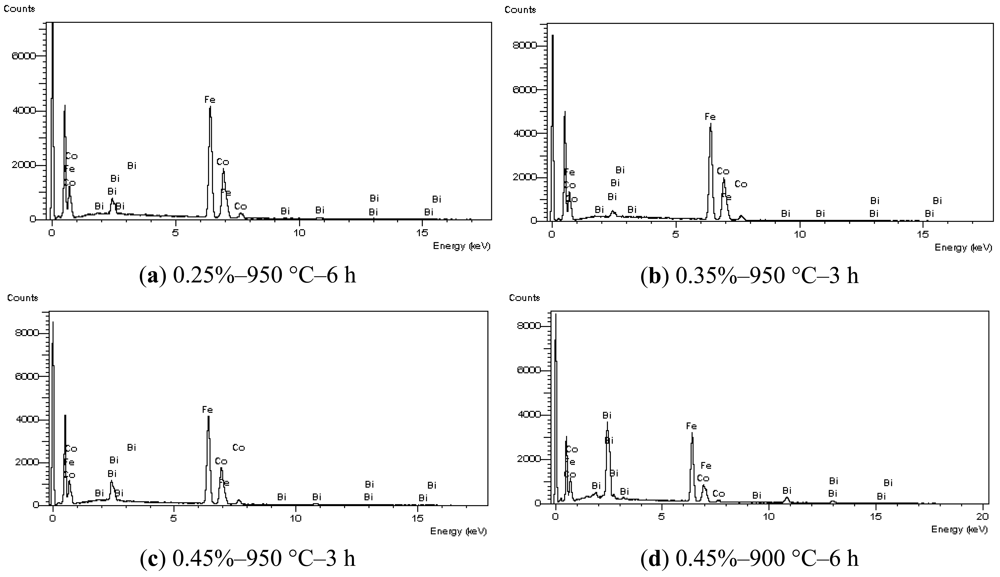
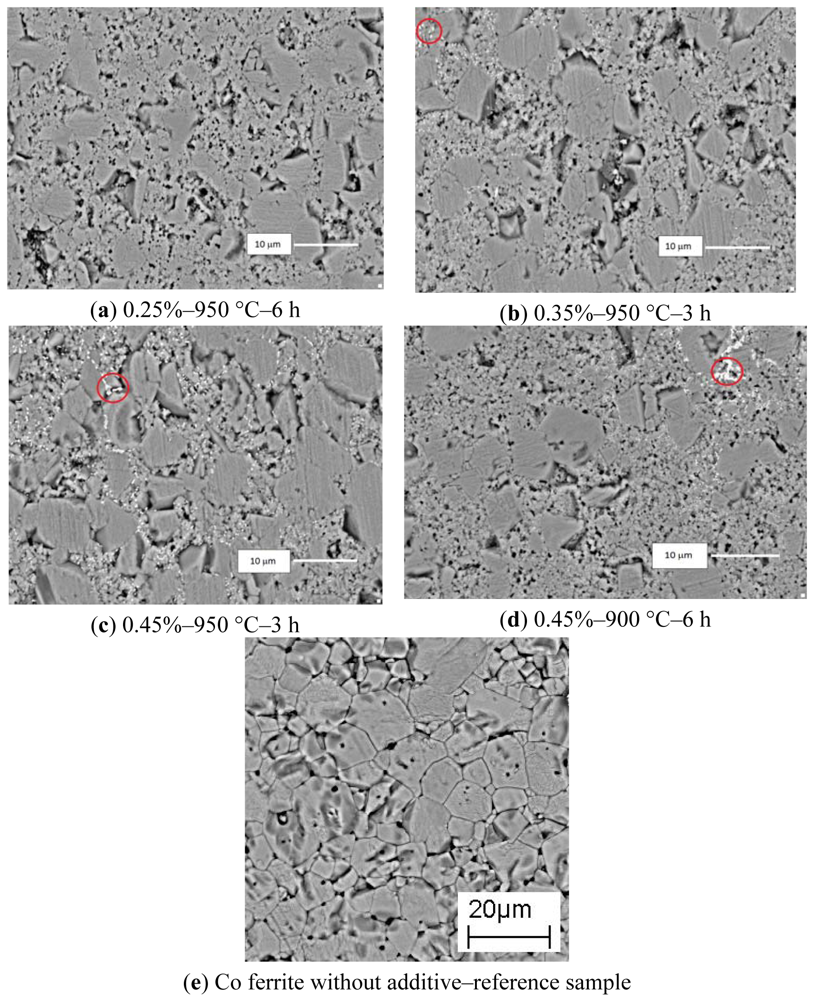
<p>The microstructures of the samples that attained D &gt; 90% are shown on <xref ref-type="fig" rid="f2-sensors-12-10086">Figure 2</xref>, together with that of the reference sample. The liquid-phase sintered ferrites presented a non-uniform grain size and the presence of white second-phase particles was observed. The results from EDX analysis, which was carried out in one white particle per sample, are shown on <xref ref-type="fig" rid="f3-sensors-12-10086">Figure 3</xref>. They indicate that these particles contain Fe, Co, and Bi, that probably crystallized from the additive liquid state. The Bi fraction of the particle analyzed in the sample sintered at 900 °C was undoubtedly higher than the fractions found in the samples sintered at 950 °C. In this sample sintered at lower temperature, it is possible that some Bi<sub>2</sub>O<sub>3</sub>, which is a diamagnetic substance [<xref ref-type="bibr" rid="b18-sensors-12-10086">18</xref>], remained after sintering.</p>
<p>Jia <italic>et al.</italic> [<xref ref-type="bibr" rid="b19-sensors-12-10086">19</xref>] added 3 wt% Bi<sub>2</sub>O<sub>3</sub> to a Ni-Cu-Zn ferrite and detected, by means of X-ray analysis, traces of the main planes of the BiFeO<sub>3</sub> phase (bismuth orthoferrite) in the sintered material. Cobalt may substitute iron in this phase, forming BiCo<sub>1-x</sub>Fe<sub>x</sub>O<sub>3</sub> [<xref ref-type="bibr" rid="b20-sensors-12-10086">20</xref>]. The X-ray diffraction pattern of the ferrite with 0.45 mol% sintered at 900 °C during 6 h did not present traces of second phases, but they can be observed in the SEM micrograph (<xref ref-type="fig" rid="f2-sensors-12-10086">Figure 2(d)</xref>).</p>
<p>The observation of the Bi-containing particles in <xref ref-type="fig" rid="f2-sensors-12-10086">Figure 2</xref> indicates a non-uniform distribution in the microstructure and sometimes it emerges concentrated in some regions, coming out in large sizes. Mürbe and Töpfer [<xref ref-type="bibr" rid="b11-sensors-12-10086">11</xref>] studied the microstructure of liquid-phase sintered Ni-Cu-Zn ferrites with Bi<sub>2</sub>O<sub>3</sub> additions. The authors used high-resolution Transmission Electron Microscopy (TEM) to observe a sample with 0.375 wt% Bi<sub>2</sub>O<sub>3</sub> addition and sintered at 900 °C for 2 h. They observed the presence of Bi-rich phases forming very thin films between the ferrite grains. It is also possible that Bi<sup>3+</sup> ions of the additive substitutes Fe<sup>3+</sup> ions of the ferrite [<xref ref-type="bibr" rid="b21-sensors-12-10086">21</xref>], locally altering its stoichiometry to CoFe<sub>2-x</sub>Bi<sub>x</sub>O<sub>4</sub>. Therefore, based on these results, although Bi-containing particles were rarely detected in the micrographs of the sample with 0.25% Bi<sub>2</sub>O<sub>3</sub>, it is expected that higher resolution techniques as Field Emission Gun (FEG) or Transmission Electron Microscopy (TEM) could probably be able to resolve more particles in a nanoscale.</p>
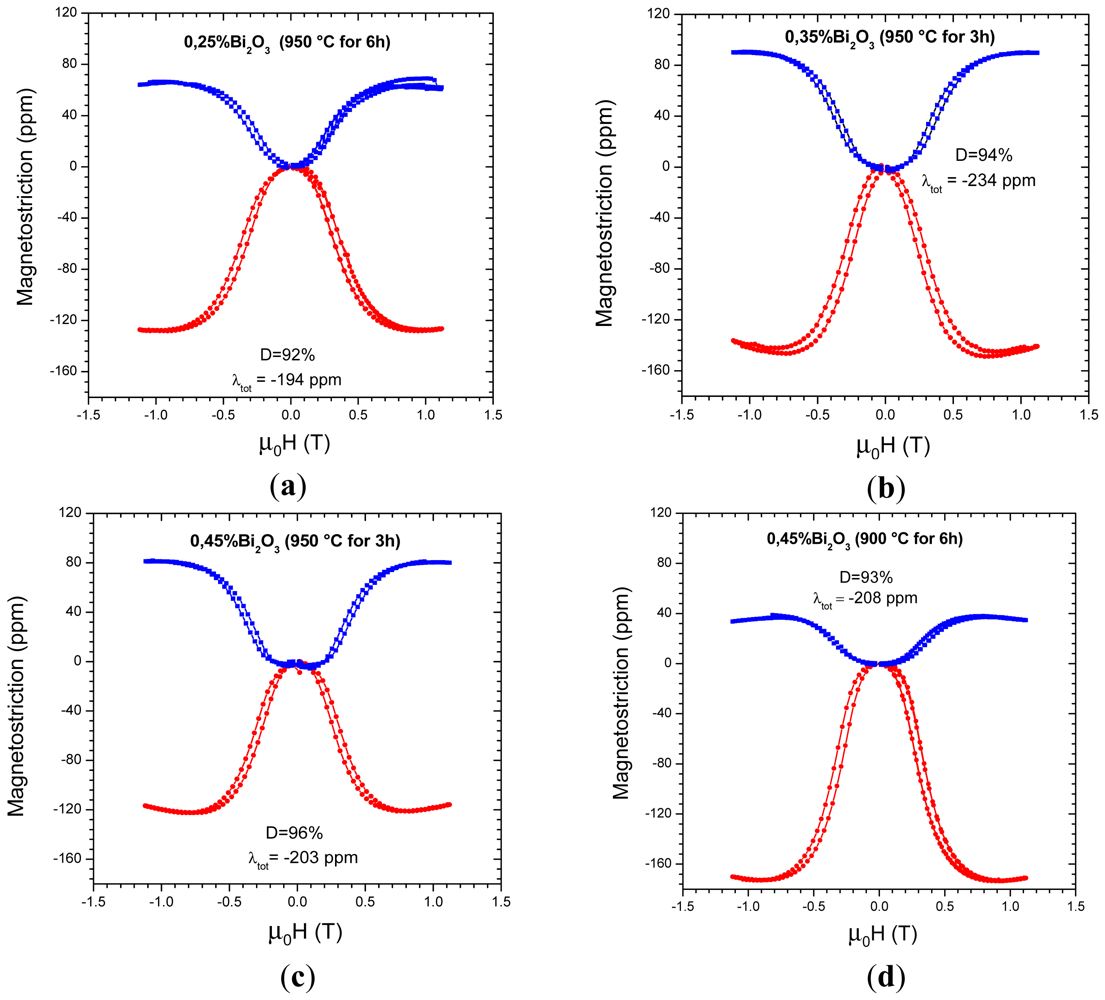
<p><xref ref-type="fig" rid="f4-sensors-12-10086">Figure 4</xref> shows the magnetostriction <italic>vs.</italic> applied field results of the liquid-phase sintered ferrite samples. The λ<sub>//</sub> values obtained are in the range from −122 ppm to −172 ppm and are in good agreement with the result of −131 to −165 ppm obtained in [<xref ref-type="bibr" rid="b13-sensors-12-10086">13</xref>], although the present results vary within a slightly wider range. In <xref ref-type="table" rid="t2-sensors-12-10086">Table 2</xref>, the values of (λ<sub>//</sub>)<sub>s</sub>, (λ<sub>⊥</sub>)<sub>s</sub>, λ<sub>tot</sub> and (λ<sub>//</sub>)<sub>s</sub> /(λ<sub>⊥</sub>)<sub>s</sub> are compiled together. The parameter λ<sub>tot</sub> of the liquid-phase sintered samples ranged from −194 to −234 ppm and the reference sample had a λ<sub>tot</sub> of −228 ppm, which is within this range. The total magnetostriction λ<sub>tot</sub> is directly related to the saturation magnetostriction λ<sub>s</sub>, which is an intrinsic material property, through the relation λ<sub>tot</sub> = 3/2 λ<sub>s</sub>. From the results on <xref ref-type="table" rid="t2-sensors-12-10086">Table 2</xref>, we conclude that the addition of 0.35% of Bi<sub>2</sub>O<sub>3</sub> and sintering temperature of 950 °C during 3 h, resulted in the highest intrinsic magnetostriction value.</p>
<p>It is expected that the magnetostriction of polycrystalline samples that have isotropic microstructure with equiaxed and randomly oriented grains follow the proportion λ<sub>//</sub> = −2λ<sub>⊥</sub>. This proportionality was not observed in all samples as a consequence of the processing method, which resulted in samples with anisotropic microstructure. The anisotropy of microstructure is more evident in the sample with 0.45% Bi<sub>2</sub>O<sub>3</sub> sintered at 900 °C for 6 h, where λ<sub>//</sub> ≈ −4.8 λ<sub>⊥</sub>.</p>
<p>The results shown in <xref ref-type="table" rid="t2-sensors-12-10086">Table 2</xref> indicate that the microstructure anisotropy is an important parameter that is affecting the linear magnetostriction. This anisotropy is also directly related to the presence of second phases, since in the sample with addition of 0.25% of Bi<sub>2</sub>O<sub>3</sub> and sintering temperature of 950 °C during 6 h, the magnetostriction anisotropy was not present and the fraction of Bi-containing particles in the microstructure was very low. If these particles contain ferromagnetic phases, the non-uniform distribution along the sample might be the responsible for the magnetostriction anisotropy.</p>
<p>A more detailed study of the influence of the second phases on the magnetic properties of this ferrite would require a precise characterization of the chemical composition of such phases. It is known that the BiCo<sub>1-x</sub>Fe<sub>x</sub>O<sub>3</sub> phase is paramagnetic when x = 0 (at temperatures between 100–800 K), antiferromagnetic when x = 1, and ferromagnetic at room temperature when 0.5 ≤ x ≤ 0.7 [<xref ref-type="bibr" rid="b20-sensors-12-10086">20</xref>]. The susceptibility of this oxide is slightly field-dependent when 0.1 ≤ x ≤ 0.2 [<xref ref-type="bibr" rid="b20-sensors-12-10086">20</xref>].</p>
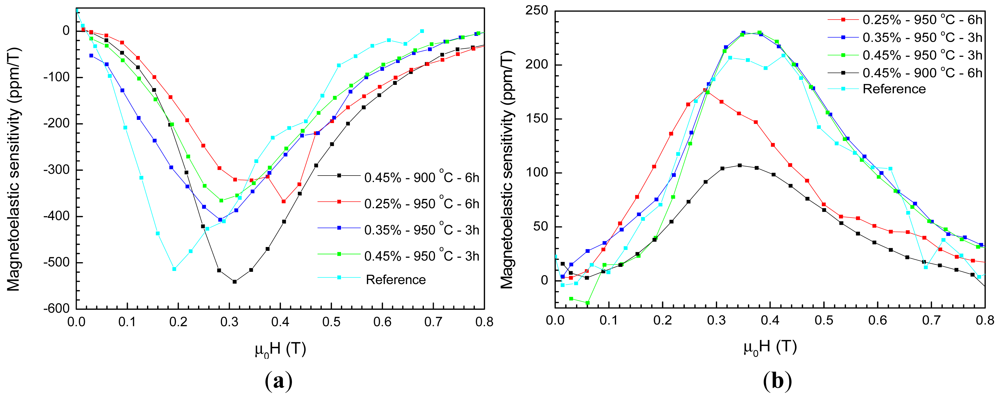
<p>The anisotropy induced by the presence of the second phases increased considerably the linear magnetostriction and this is a very interesting characteristic for the development of force sensors, for example. <xref ref-type="fig" rid="f5-sensors-12-10086">Figure 5</xref> shows the curves of the magnetoelastic sensitivities <italic>vs.</italic> applied field and <xref ref-type="table" rid="t3-sensors-12-10086">Table 3</xref> shows the maximum magnetoelastic sensitivity and the internal field value at which it occurs in the longitudinal and transversal modes.</p>
<p>As expected, the more relevant results were obtained for the direction parallel to the magnetic field, because the saturated magnetostriction values are higher in this configuration. The highest sensitivities were reached by the samples with 0.45% of Bi<sub>2</sub>O<sub>3</sub>, sintered at 900 °C for 6 h and with 0.35% of Bi<sub>2</sub>O<sub>3</sub>, sintered at 950 °C for 6 h, having the first a maximum sensitivity very close to the reference sample. Among the liquid-phase sintered samples, the one with 0.35% Bi<sub>2</sub>O<sub>3</sub> addition presented the highest longitudinal magnetoelastic sensitivity in lower fields. Another virtue of both samples is that the maximum sensitivity occurs at low fields, lower than 0.2 T. As expected, the maximum magnetoelastic sensitivity is directly related to the maximum magnetostriction attained in the samples in the parallel configuration and therefore, must be associated with the second phases produced due to the liquid-phase sintering with Bi<sub>2</sub>O<sub>3</sub>.</p>
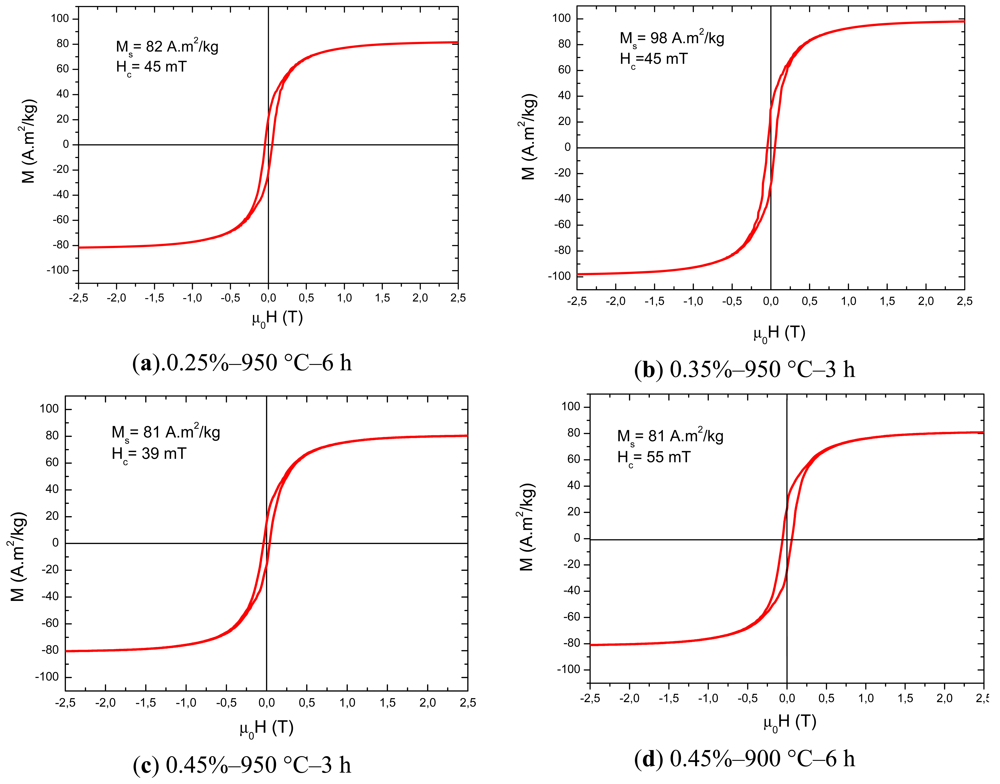
<p><xref ref-type="fig" rid="f6-sensors-12-10086">Figure 6</xref> shows the hysteresis curves of the samples. The values of 81–82 A.m<sup>2</sup>/kg for the saturation magnetization (M<sub>s</sub>) are close to the reference sample (around 78 A.m<sup>2</sup>/kg) and are in good agreement with other works in literature [<xref ref-type="bibr" rid="b13-sensors-12-10086">13</xref>,<xref ref-type="bibr" rid="b22-sensors-12-10086">22</xref>]. The sample with 0.35% Bi<sub>2</sub>O<sub>3</sub> presented the highest values of M<sub>s</sub> and the sample with 0.45% Bi<sub>2</sub>O<sub>3</sub>, sintered at 900 °C, presented the highest coercive field (H<sub>c</sub>). The values of H<sub>c</sub> are influenced by the fractions of second phases and porosity, as well as the grain size; the lower sintering temperature of 900 °C probably resulted in a smaller grain size, which contributed to increasing the coercivity.</p></sec>
<sec sec-type="conclusions">
<label>4.</label>
<title>Conclusions</title>
<p>CoFe<sub>2</sub>O<sub>4</sub> sintered samples with relative densities higher than 91% were successfully obtained, by means of liquid-phase sintering with Bi<sub>2</sub>O<sub>3</sub> as sintering additive. The use of sintering temperatures of 900 °C and 950 °C resulted in values of magnetostriction and magnetoelastic sensitivity as high as in a reference sample of CoFe<sub>2</sub>O<sub>4</sub> sintered at 1,300 °C without additives. This is an important result considering that the sintering temperatures used were below 1,000 °C.</p>
<p>The formation of ferromagnetic second phases during liquid phase sintering, that were detected by SEM analysis, is supposed to be the responsible for the good magnetostriction and magnetoelastic sensitivity results obtained. The presence of these phases caused anisotropy of the microstructure and of the magnetostrictive behavior; however, the determination of their composition and the related magnetic properties must be confirmed.</p></sec></body>
<back>
<ack>
<p>The authors acknowledge the financial support from the Brazilian agencies FAPESP (processes no. 2009/09524-7 and 2009/54001-2) and CNPq, the collaboration from the Institute for Aeronautics and Space (Brazil) and from the Photonics Division of IEAv.</p></ack>
<ref-list>
<title>References</title>
<ref id="b1-sensors-12-10086"><label>1.</label><citation citation-type="journal"><person-group person-group-type="author"><name><surname>Sedlar</surname><given-names>M.</given-names></name><name><surname>Matejec</surname><given-names>V.</given-names></name><name><surname>Paulicka</surname><given-names>I.</given-names></name></person-group><article-title>Optical fibre magnetic field sensors using ceramic magnetostrictive jackets</article-title><source>Sens. Actuators A</source><year>2000</year><volume>84</volume><fpage>297</fpage><lpage>302</lpage><pub-id pub-id-type="doi">10.1016/S0924-4247(00)00403-9</pub-id></citation></ref>
<ref id="b2-sensors-12-10086"><label>2.</label><citation citation-type="journal"><person-group person-group-type="author"><name><surname>McCallum</surname><given-names>R.W.</given-names></name><name><surname>Dennis</surname><given-names>K.W.</given-names></name><name><surname>Jiles</surname><given-names>D.C.</given-names></name><name><surname>Snyder</surname><given-names>J.E.</given-names></name><name><surname>Chen</surname><given-names>T.H.</given-names></name></person-group><article-title>Composite magnetostrictive materials for advanced automotive magnetomechanical sensors</article-title><source>Low Temp. Phys.</source><year>2001</year><volume>27</volume><fpage>266</fpage><lpage>274</lpage><pub-id pub-id-type="doi">10.1063/1.1365598</pub-id></citation></ref>
<ref id="b3-sensors-12-10086"><label>3.</label><citation citation-type="journal"><person-group person-group-type="author"><name><surname>Bieńkowski</surname><given-names>A.</given-names></name></person-group><article-title>Possibility of applying Ni-Zn ferrites as sensors for measuring compressive stresses</article-title><source>J. Phys.</source><year>1985</year><volume>46</volume><fpage>433</fpage><lpage>436</lpage></citation></ref>
<ref id="b4-sensors-12-10086"><label>4.</label><citation citation-type="patent"><person-group person-group-type="author"><name><surname>Stucki</surname><given-names>F.F.</given-names></name></person-group><article-title>Ferrimagnetic Pressure Transducer</article-title><patent>Patent GB2409584</patent><year>1969</year></citation></ref>
<ref id="b5-sensors-12-10086"><label>5.</label><citation citation-type="journal"><person-group person-group-type="author"><name><surname>Fetisov</surname><given-names>Y.K.</given-names></name><name><surname>Bush</surname><given-names>A.A.</given-names></name><name><surname>Kamentsev</surname><given-names>K.E.</given-names></name><name><surname>Ostashchenko</surname><given-names>Y.</given-names></name><name><surname>Srinivasan</surname><given-names>G.</given-names></name></person-group><article-title>Ferrite-piezoelectric multilayers for magnetic field sensors</article-title><source>IEEE Sens. J.</source><year>2006</year><volume>6</volume><fpage>935</fpage><lpage>938</lpage><pub-id pub-id-type="doi">10.1109/JSEN.2006.877989</pub-id></citation></ref>
<ref id="b6-sensors-12-10086"><label>6.</label><citation citation-type="journal"><person-group person-group-type="author"><name><surname>Priya</surname><given-names>S.</given-names></name><name><surname>Ryu</surname><given-names>J.</given-names></name><name><surname>Park</surname><given-names>C-S.</given-names></name><name><surname>Oliver</surname><given-names>J.</given-names></name><name><surname>Choi</surname><given-names>J.-J.</given-names></name><name><surname>Park</surname><given-names>D-S.</given-names></name></person-group><article-title>Piezoelectric and magnetoelectric thick films for fabricating power sources in wireless sensor nodes</article-title><source>Sensors</source><year>2009</year><volume>9</volume><fpage>6362</fpage><lpage>6384</lpage><pub-id pub-id-type="doi">10.3390/s90806362</pub-id><pub-id pub-id-type="pmid">22454590</pub-id></citation></ref>
<ref id="b7-sensors-12-10086"><label>7.</label><citation citation-type="journal"><person-group person-group-type="author"><name><surname>Bichurin</surname><given-names>M.</given-names></name><name><surname>Petrov</surname><given-names>V.</given-names></name><name><surname>Zakharov</surname><given-names>A.</given-names></name><name><surname>Kovalenko</surname><given-names>D.</given-names></name><name><surname>Yang</surname><given-names>S.C.</given-names></name><name><surname>Maurya</surname><given-names>D.</given-names></name><name><surname>Bedekar</surname><given-names>V.</given-names></name><name><surname>Priya</surname><given-names>S.</given-names></name></person-group><article-title>Magnetoelectric interactions in lead-based and lead-free composites</article-title><source>Materials</source><year>2011</year><volume>4</volume><fpage>651</fpage><lpage>702</lpage><pub-id pub-id-type="doi">10.3390/ma4040651</pub-id></citation></ref>
<ref id="b8-sensors-12-10086"><label>8.</label><citation citation-type="book"><person-group person-group-type="editor"><name><surname>Du Trémolet de Lacheisserie</surname><given-names>E.</given-names></name><name><surname>Gignoux</surname><given-names>D.</given-names></name><name><surname>Schlenker</surname><given-names>M.</given-names></name></person-group><source>Magnestism: Materials &amp; Applications</source><publisher-name>Springer</publisher-name><publisher-loc>New York, NY, USA</publisher-loc><year>2005</year></citation></ref>
<ref id="b9-sensors-12-10086"><label>9.</label><citation citation-type="journal"><person-group person-group-type="author"><name><surname>Özgür</surname><given-names>U.</given-names></name><name><surname>Alivov</surname><given-names>Y.</given-names></name><name><surname>Morkoç</surname><given-names>H.</given-names></name></person-group><article-title>Microwave ferrites, part 2: Passive components and electrical tuning</article-title><source>J. Mater. Sci. Mater. Electron.</source><year>2009</year><volume>20</volume><fpage>911</fpage><lpage>952</lpage><pub-id pub-id-type="doi">10.1007/s10854-009-9924-1</pub-id></citation></ref>
<ref id="b10-sensors-12-10086"><label>10.</label><citation citation-type="journal"><person-group person-group-type="author"><name><surname>Mirzaee</surname><given-names>O.</given-names></name><name><surname>Golozar</surname><given-names>M.A.</given-names></name><name><surname>Shafyei</surname><given-names>A.</given-names></name></person-group><article-title>Influence of V<sub>2</sub>O<sub>5</sub> as an effective dopant on the microstructure development and magnetic properties of Ni<sub>0.64</sub>Zn<sub>0.36</sub>Fe<sub>2</sub>O<sub>4</sub> soft ferrites</article-title><source>Mater. Charact.</source><year>2008</year><volume>59</volume><fpage>638</fpage><lpage>641</lpage><pub-id pub-id-type="doi">10.1016/j.matchar.2007.05.016</pub-id></citation></ref>
<ref id="b11-sensors-12-10086"><label>11.</label><citation citation-type="journal"><person-group person-group-type="author"><name><surname>Mürbe</surname><given-names>J.</given-names></name><name><surname>Töpfer</surname><given-names>J.</given-names></name></person-group><article-title>Ni-Cu-Zn ferrites for low temperature firing: II. Effects of powder morphology and Bi<sub>2</sub>O<sub>3</sub> addition on microstructure and permeability</article-title><source>J. Electroceram.</source><year>2006</year><volume>16</volume><fpage>199</fpage><lpage>205</lpage><pub-id pub-id-type="doi">10.1007/s10832-006-6362-9</pub-id></citation></ref>
<ref id="b12-sensors-12-10086"><label>12.</label><citation citation-type="journal"><person-group person-group-type="author"><name><surname>Nlebedim</surname><given-names>I.C.</given-names></name><name><surname>Ranvah</surname><given-names>N.</given-names></name><name><surname>Williams</surname><given-names>P.I.</given-names></name><name><surname>Melikhov</surname><given-names>Y.</given-names></name><name><surname>Snyder</surname><given-names>J.E.</given-names></name><name><surname>Moses</surname><given-names>A.J.</given-names></name><name><surname>Jiles</surname><given-names>D.C.</given-names></name></person-group><article-title>Effect of heat treatment on the magnetic and magnetoelastic properties of cobalt ferrite</article-title><source>J. Magn. Magn. Mater.</source><year>2010</year><volume>322</volume><fpage>1929</fpage><lpage>1933</lpage><pub-id pub-id-type="doi">10.1016/j.jmmm.2010.01.009</pub-id></citation></ref>
<ref id="b13-sensors-12-10086"><label>13.</label><citation citation-type="book"><person-group person-group-type="author"><name><surname>Bhame</surname><given-names>S.</given-names></name></person-group><source>Oxide Magnetostrictive Materials Based on Cobalt Ferrite</source><publisher-name>Lambert Academic Publishing</publisher-name><publisher-loc>Saarbrüken, Germany</publisher-loc><year>2011</year></citation></ref>
<ref id="b14-sensors-12-10086"><label>14.</label><citation citation-type="book"><person-group person-group-type="author"><name><surname>Smit</surname><given-names>J.</given-names></name><name><surname>Wijn</surname><given-names>H.P.J.</given-names></name></person-group><source>Ferrites: Physical Properties of Ferrimagnetic Oxides in Relation to Their Technical Applications</source><publisher-name>Philips' Research Laboratories</publisher-name><publisher-loc>Eindhoved, The Netherlands</publisher-loc><year>1959</year><fpage>144</fpage></citation></ref>
<ref id="b15-sensors-12-10086"><label>15.</label><citation citation-type="journal"><person-group person-group-type="author"><name><surname>Sato</surname><given-names>M.</given-names></name><name><surname>Ishii</surname><given-names>J.</given-names></name></person-group><article-title>Simple and approximate expressions of demagnetizing factors of uniformly magnetized rectangular rod and cylinder</article-title><source>J. Appl. Phys.</source><year>1989</year><volume>66</volume><fpage>983</fpage><lpage>986</lpage><pub-id pub-id-type="doi">10.1063/1.343481</pub-id></citation></ref>
<ref id="b16-sensors-12-10086"><label>16.</label><citation citation-type="thesis"><person-group person-group-type="author"><name><surname>Santos</surname><given-names>C.T.</given-names></name></person-group><article-title>Evaluation of Magnetostriction and Microstructural Characterization of Fe-Sn and Fe-V Alloys</article-title><source>Master's dissertation</source><publisher-name>Universidade de São Paulo, Escola de Engenharia de Lorena</publisher-name><publisher-loc>Lorena, Brazil</publisher-loc><year>2008</year></citation></ref>
<ref id="b17-sensors-12-10086"><label>17.</label><citation citation-type="thesis"><person-group person-group-type="author"><name><surname>Lemos</surname><given-names>L.V.</given-names></name></person-group><article-title>Propriedades Eletromagnéticas de Amostras Policristalinas de CoFe<sub>2</sub>O<sub>4</sub> na Faixa de RF e Micro-Ondas</article-title><source>Master's Dissertation</source><publisher-name>Instituto Tecnológico de Aeronáutica</publisher-name><publisher-loc>São José dos Campos, Brazil</publisher-loc><year>2010</year></citation></ref>
<ref id="b18-sensors-12-10086"><label>18.</label><citation citation-type="journal"><person-group person-group-type="author"><name><surname>harkovskii</surname><given-names>A.I.</given-names></name><name><surname>Nizhankovskii</surname><given-names>V.I.</given-names></name><name><surname>Kravchenko</surname><given-names>E.A.</given-names></name><name><surname>Orlov</surname><given-names>V.G.</given-names></name></person-group><article-title>Magnetic properties of bismuth oxide α-Bi<sub>2</sub>O<sub>3</sub></article-title><source>Zeitschrift fuer Naturforschung Section A. Phys. Sci.</source><year>1996</year><volume>51</volume><fpage>665</fpage><lpage>666</lpage></citation></ref>
<ref id="b19-sensors-12-10086"><label>19.</label><citation citation-type="journal"><person-group person-group-type="author"><name><surname>Jia</surname><given-names>L.</given-names></name><name><surname>Zhang</surname><given-names>H.</given-names></name><name><surname>Wu</surname><given-names>X.</given-names></name><name><surname>Li</surname><given-names>T.</given-names></name><name><surname>Su</surname><given-names>H.</given-names></name><name><surname>Liu</surname><given-names>B.</given-names></name></person-group><article-title>Microstructures and magnetic properties of Bi-substituted NiCuZn ferrite</article-title><source>J. Appl. Phys.</source><year>2012</year><volume>111</volume><fpage>07A326</fpage><pub-id pub-id-type="doi">10.1063/1.3677651</pub-id></citation></ref>
<ref id="b20-sensors-12-10086"><label>20.</label><citation citation-type="journal"><person-group person-group-type="author"><name><surname>Vasudevan</surname><given-names>S.</given-names></name><name><surname>Rao</surname><given-names>C.N.R.</given-names></name><name><surname>Umarji</surname><given-names>A.M.</given-names></name><name><surname>Subba Rao</surname><given-names>G.V.</given-names></name></person-group><article-title>Studies on BiCoO<sub>3</sub> and BiCo<sub>1-x</sub>Fe<sub>x</sub>O<sub>3</sub></article-title><source>Mater. Res. Bull.</source><year>1979</year><volume>14</volume><fpage>451</fpage><lpage>454</lpage><pub-id pub-id-type="doi">10.1016/0025-5408(79)90184-3</pub-id></citation></ref>
<ref id="b21-sensors-12-10086"><label>21.</label><citation citation-type="journal"><person-group person-group-type="author"><name><surname>Kim</surname><given-names>W.C.</given-names></name><name><surname>Lee</surname><given-names>C.W.</given-names></name><name><surname>Kim</surname><given-names>C.S.</given-names></name></person-group><article-title>Magnetic properties of Co-Bi ferrite powders and thin films by a sol-gel method</article-title><source>Scr. Mater.</source><year>2001</year><volume>44</volume><fpage>1541</fpage><lpage>1455</lpage><pub-id pub-id-type="doi">10.1016/S1359-6462(01)00837-5</pub-id></citation></ref>
<ref id="b22-sensors-12-10086"><label>22.</label><citation citation-type="journal"><person-group person-group-type="author"><name><surname>Zhu</surname><given-names>J.-C.</given-names></name><name><surname>Hu</surname><given-names>X.</given-names></name><name><surname>Mao</surname><given-names>X.-Y.</given-names></name><name><surname>Wang</surname><given-names>W.</given-names></name><name><surname>Chen</surname><given-names>X.-B.</given-names></name></person-group><article-title>Properties of Co substituted bismuth ferrite system by rapid liquid phase sintering</article-title><source>Mater. Sci. Forum</source><year>2010</year><volume>636–637</volume><fpage>356</fpage><lpage>360</lpage></citation></ref></ref-list>
<sec sec-type="display-objects">
<title>Figures and Tables</title>
<fig id="f1-sensors-12-10086" position="float">
<label>Figure 1.</label>
<caption>
<p>Diffraction patterns of the ferrite calcined and sintered powders.</p></caption>
<graphic xlink:href="sensors-12-10086f1.gif"/></fig>
<fig id="f2-sensors-12-10086" position="float">
<label>Figure 2.</label>
<caption>
<p>Microstructures of the liquid-phase sintered ferrites (<bold>a–d</bold>) and (<bold>e</bold>) reference sample. The Bi-containing particles are indicated by the red circles.</p></caption>
<graphic xlink:href="sensors-12-10086f2.gif"/></fig>
<fig id="f3-sensors-12-10086" position="float">
<label>Figure 3.</label>
<caption>
<p>Results of EDX analysis of the Bi-containing particles, not considering oxygen.</p></caption>
<graphic xlink:href="sensors-12-10086f3.gif"/></fig>
<fig id="f4-sensors-12-10086" position="float">
<label>Figure 4.</label>
<caption>
<p>Magnetostriction of the liquid-phase sintered samples. Red curves: λ<sub>//</sub>; blue curves: λ<sub>⊥</sub>.</p></caption>
<graphic xlink:href="sensors-12-10086f4.gif"/></fig>
<fig id="f5-sensors-12-10086" position="float">
<label>Figure 5.</label>
<caption>
<p>Magnetoelastic sensitivities (∂λ/∂(μ<sub>0</sub>H)) <italic>vs.</italic> applied field. (<bold>a</bold>) Magnetoelastic sensitivity parallel to the applied field. (<bold>b</bold>) Magnetoelastic sensitivity perpendicular to the applied field.</p></caption>
<graphic xlink:href="sensors-12-10086f5.gif"/></fig>
<fig id="f6-sensors-12-10086" position="float">
<label>Figure 6.</label>
<caption>
<p>Hysteresis curves, indicating the values of M<sub>s</sub> and H<sub>c</sub> for each sample.</p></caption>
<graphic xlink:href="sensors-12-10086f6.gif"/></fig>
<table-wrap id="t1-sensors-12-10086" position="float">
<label>Table 1.</label>
<caption>
<p>Results of mass density measurements.</p></caption>
<table frame="box" rules="cols">
<thead>
<tr content-type="background-color:#C4BC96">
<th align="center" valign="middle"><bold>%<italic>Bi<sub>2</sub>O<sub>3</sub></italic></bold></th>
<th align="center" valign="middle"><bold><italic>Sintering Temperature</italic></bold></th>
<th align="center" valign="middle"><bold><italic>Sintering Time</italic></bold></th>
<th align="center" valign="middle"><bold><italic>Mass Density</italic> (<italic>d</italic>)</bold><break/><bold>[g/cm<sup>3</sup>]</bold></th>
<th align="center" valign="middle"><bold><italic>Relative density</italic> (<italic>D</italic>)</bold><break/><bold>[%]</bold></th></tr>
<tr>
<th align="center" valign="bottom" colspan="5">
<hr/></th></tr></thead>
<tbody>
<tr content-type="background-color:#EEECE1">
<td align="center" valign="top">0.15</td>
<td align="center" valign="top">900 °C</td>
<td align="center" valign="top">3 h</td>
<td align="center" valign="top">3.76</td>
<td align="center" valign="top">71</td></tr>
<tr content-type="background-color:#EEECE1">
<td align="center" valign="top">0.15</td>
<td align="center" valign="top">950 °C</td>
<td align="center" valign="top">3 h</td>
<td align="center" valign="top">4.30</td>
<td align="center" valign="top">81</td></tr>
<tr content-type="background-color:#EEECE1">
<td align="center" valign="top">0.25</td>
<td align="center" valign="top">900 °C</td>
<td align="center" valign="top">3 h</td>
<td align="center" valign="top">4.16</td>
<td align="center" valign="top">78</td></tr>
<tr content-type="background-color:#EEECE1">
<td align="center" valign="top">0.25</td>
<td align="center" valign="top">950 °C</td>
<td align="center" valign="top">3 h</td>
<td align="center" valign="top">4.80</td>
<td align="center" valign="top">90</td></tr>
<tr content-type="background-color:#C2D69B">
<td align="center" valign="top">0.25</td>
<td align="center" valign="top">950 °C</td>
<td align="center" valign="top">6 h</td>
<td align="center" valign="top">4.91</td>
<td align="center" valign="top">92</td></tr>
<tr content-type="background-color:#EEECE1">
<td align="center" valign="top">0.35</td>
<td align="center" valign="top">900 °C</td>
<td align="center" valign="top">3 h</td>
<td align="center" valign="top">4.54</td>
<td align="center" valign="top">85</td></tr>
<tr content-type="background-color:#C2D69B">
<td align="center" valign="top">0.35</td>
<td align="center" valign="top">950 °C</td>
<td align="center" valign="top">3 h</td>
<td align="center" valign="top">5.02</td>
<td align="center" valign="top">94</td></tr>
<tr content-type="background-color:#EEECE1">
<td align="center" valign="top">0.45</td>
<td align="center" valign="top">900 °C</td>
<td align="center" valign="top">3 h</td>
<td align="center" valign="top">4.80</td>
<td align="center" valign="top">90</td></tr>
<tr content-type="background-color:#C2D69B">
<td align="center" valign="top">0.45</td>
<td align="center" valign="top">950 °C</td>
<td align="center" valign="top">3 h</td>
<td align="center" valign="top">5.11</td>
<td align="center" valign="top">96</td></tr>
<tr content-type="background-color:#C2D69B">
<td align="center" valign="top">0.45</td>
<td align="center" valign="top">900 °C</td>
<td align="center" valign="top">6 h</td>
<td align="center" valign="top">4.95</td>
<td align="center" valign="top">93</td></tr></tbody></table></table-wrap>
<table-wrap id="t2-sensors-12-10086" position="float">
<label>Table 2.</label>
<caption>
<p>Saturation values of the magnetostriction parallel and perpendicular to the magnetic field, calculated λ<sub>tot</sub> (from <xref rid="FD4" ref-type="disp-formula">Equation (4)</xref>), and the ratio (λ<sub>//</sub>)<sub>s</sub>/(λ<sub>⊥</sub>)<sub>s</sub>.</p></caption>
<table frame="box" rules="cols">
<thead>
<tr content-type="background-color:#C4BC96">
<th align="center" valign="middle"><bold><italic>Sample</italic></bold></th>
<th align="center" valign="middle"><bold>(λ<sub>//</sub>)<sub>s</sub></bold><break/><bold>[ppm]</bold></th>
<th align="center" valign="middle"><bold>(λ<sub>⊥</sub>)<sub>s</sub></bold><break/><bold>[ppm]</bold></th>
<th align="center" valign="middle"><bold>λ<sub>tot</sub></bold><break/><bold>[ppm]</bold></th>
<th align="center" valign="middle"><bold>(λ<sub>//</sub>)<sub>s</sub>/(λ<sub>⊥</sub>)<sub>s</sub></bold></th></tr>
<tr>
<th align="center" valign="bottom" colspan="5">
<hr/></th></tr></thead>
<tbody>
<tr content-type="background-color:#EEECE1">
<td align="center" valign="top">0.25%–950 °C −6 h</td>
<td align="center" valign="top">−128</td>
<td align="center" valign="top">66</td>
<td align="center" valign="top">−194</td>
<td align="center" valign="top">−1.94</td></tr>
<tr content-type="background-color:#EEECE1">
<td align="center" valign="top">0.35%–950 °C −3 h</td>
<td align="center" valign="top">−146</td>
<td align="center" valign="top">88</td>
<td align="center" valign="top">−234</td>
<td align="center" valign="top">−1.66</td></tr>
<tr content-type="background-color:#EEECE1">
<td align="center" valign="top">0.45%–950 °C −3 h</td>
<td align="center" valign="top">−122</td>
<td align="center" valign="top">81</td>
<td align="center" valign="top">−203</td>
<td align="center" valign="top">−1.51</td></tr>
<tr content-type="background-color:#EEECE1">
<td align="center" valign="top">0.45%–900 °C −6 h</td>
<td align="center" valign="top">−172</td>
<td align="center" valign="top">36</td>
<td align="center" valign="top">−208</td>
<td align="center" valign="top">−4.78</td></tr>
<tr content-type="background-color:#EEECE1">
<td align="center" valign="top">Reference</td>
<td align="center" valign="top">−146</td>
<td align="center" valign="top">76</td>
<td align="center" valign="top">−222</td>
<td align="center" valign="top">−1.92</td></tr></tbody></table></table-wrap>
<table-wrap id="t3-sensors-12-10086" position="float">
<label>Table 3.</label>
<caption>
<p>Values of maximum magnetoelastic sensitivities and the corresponding values of μ<sub>0</sub>H<sub>int</sub>.</p></caption>
<table frame="box" rules="cols">
<thead>
<tr content-type="background-color:#C4BC96">
<th align="center" valign="middle" rowspan="3"><bold><italic>Sample</italic></bold></th>
<th colspan="4" align="center" valign="top"><bold><italic>Magnetoelastic Sensitivity</italic></bold></th></tr>
<tr>
<th align="center" valign="bottom" colspan="4">
<hr/></th></tr>
<tr>
<th align="center" valign="top" content-type="background-color:#EAF1DD"><bold>| ∂λ<sub>//</sub>/∂(μ<sub>0</sub>H) | [ppm/T]</bold></th>
<th align="center" valign="top" content-type="background-color:#EAF1DD"><bold>μ<sub>0</sub>H<sub>int</sub> [T]</bold></th>
<th align="center" valign="top" content-type="background-color:#D6E3BC"><bold>| ∂λ<sub>⊥</sub>/∂(μ<sub>0</sub>H) | [ppm/T]</bold></th>
<th align="center" valign="top" content-type="background-color:#D6E3BC"><bold>μ<sub>0</sub>H<sub>int</sub> [T]</bold></th></tr>
<tr>
<th align="center" valign="bottom" colspan="5">
<hr/></th></tr></thead>
<tbody>
<tr>
<td align="center" valign="top" content-type="background-color:#EEECE1">0.25%–950 °C–6 h</td>
<td align="center" valign="top" content-type="background-color:#EAF1DD">367</td>
<td align="center" valign="top" content-type="background-color:#EAF1DD">0.27</td>
<td align="center" valign="top" content-type="background-color:#D6E3BC">177</td>
<td align="center" valign="top" content-type="background-color:#D6E3BC">0.16</td></tr>
<tr>
<td align="center" valign="top" content-type="background-color:#EEECE1">0.35%–950 °C–3 h</td>
<td align="center" valign="top" content-type="background-color:#EAF1DD">407</td>
<td align="center" valign="top" content-type="background-color:#EAF1DD">0.14</td>
<td align="center" valign="top" content-type="background-color:#D6E3BC">230</td>
<td align="center" valign="top" content-type="background-color:#D6E3BC">0.19</td></tr>
<tr>
<td align="center" valign="top" content-type="background-color:#EEECE1">0.45%–950 °C–3 h</td>
<td align="center" valign="top" content-type="background-color:#EAF1DD">366</td>
<td align="center" valign="top" content-type="background-color:#EAF1DD">0.17</td>
<td align="center" valign="top" content-type="background-color:#D6E3BC">230</td>
<td align="center" valign="top" content-type="background-color:#D6E3BC">0.25</td></tr>
<tr>
<td align="center" valign="top" content-type="background-color:#EEECE1">0.45%–900 °C–6 h</td>
<td align="center" valign="top" content-type="background-color:#EAF1DD">541</td>
<td align="center" valign="top" content-type="background-color:#EAF1DD">0.19</td>
<td align="center" valign="top" content-type="background-color:#D6E3BC">107</td>
<td align="center" valign="top" content-type="background-color:#D6E3BC">0.22</td></tr>
<tr>
<td align="center" valign="top" content-type="background-color:#EEECE1">Reference</td>
<td align="center" valign="top" content-type="background-color:#EAF1DD">513</td>
<td align="center" valign="top" content-type="background-color:#EAF1DD">-</td>
<td align="center" valign="top" content-type="background-color:#D6E3BC">209</td>
<td align="center" valign="top" content-type="background-color:#D6E3BC">-</td></tr></tbody></table></table-wrap></sec></back></article>