
<?xml version="1.0" encoding="UTF-8"?>
<!DOCTYPE article PUBLIC "-//NLM//DTD Journal Publishing DTD v2.3 20070202//EN" "journalpublishing.dtd">
<article xmlns:mml="http://www.w3.org/1998/Math/MathML" xmlns:xlink="http://www.w3.org/1999/xlink" xml:lang="en" article-type="research-article">
<front>
<journal-meta>
<journal-id journal-id-type="nlm-ta">Sensors</journal-id>
<journal-title>Sensors</journal-title>
<issn pub-type="epub">1424-8220</issn>
<publisher>
<publisher-name>Molecular Diversity Preservation International (MDPI)</publisher-name></publisher></journal-meta>
<article-meta>
<article-id pub-id-type="doi">10.3390/s121115438</article-id>
<article-id pub-id-type="publisher-id">sensors-12-15438</article-id>
<article-categories>
<subj-group>
<subject>Article</subject></subj-group></article-categories>
<title-group>
<article-title>An Energy-Efficient Strategy for Accurate Distance Estimation in Wireless Sensor Networks</article-title></title-group>
<contrib-group>
<contrib contrib-type="author">
<name><surname>Tarrío</surname><given-names>Paula</given-names></name><xref ref-type="corresp" rid="c1-sensors-12-15438"><sup>*</sup></xref></contrib>
<contrib contrib-type="author">
<name><surname>Bernardos</surname><given-names>Ana M.</given-names></name></contrib>
<contrib contrib-type="author">
<name><surname>Casar</surname><given-names>José R.</given-names></name></contrib>
<aff id="af1-sensors-12-15438">Data Processing and Simulation Group, Universidad Politécnica de Madrid, ETSI. Telecomunicación, Avda. Complutense 30, 28040, Madrid, Spain; E-Mails: <email>abernardos@grpss.ssr.upm.es</email> (A.M.B.); <email>jramon@grpss.ssr.upm.es</email> (J.R.C.)</aff></contrib-group>
<author-notes>
<corresp id="c1-sensors-12-15438">
<label>*</label> Author to whom correspondence should be addressed; E-Mail: <email>paula@grpss.ssr.upm.es</email>; Tel.: +34-9145-33535; Fax: +34-9133-65876.</corresp></author-notes>
<pub-date pub-type="collection">
<year>2012</year></pub-date>
<pub-date pub-type="epub">
<day>09</day>
<month>11</month>
<year>2012</year></pub-date>
<volume>12</volume>
<issue>11</issue>
<fpage>15438</fpage>
<lpage>15466</lpage>
<history>
<date date-type="received">
<day>05</day>
<month>09</month>
<year>2012</year></date>
<date date-type="rev-recd">
<day>31</day>
<month>10</month>
<year>2012</year></date>
<date date-type="accepted">
<day>31</day>
<month>10</month>
<year>2012</year></date></history>
<permissions>
<copyright-statement>© 2012 by the authors; licensee MDPI, Basel, Switzerland.</copyright-statement>
<copyright-year>2012</copyright-year>
<license>
<p>This article is an open access article distributed under the terms and conditions of the Creative Commons Attribution license (http://creativecommons.org/licenses/by/3.0/).</p></license></permissions>
<abstract>
<p>In line with recent research efforts made to conceive energy saving protocols and algorithms and power sensitive network architectures, in this paper we propose a transmission strategy to minimize the energy consumption in a sensor network when using a localization technique based on the measurement of the strength (RSS) or the time of arrival (TOA) of the received signal. In particular, we find the transmission power and the packet transmission rate that jointly minimize the total consumed energy, while ensuring at the same time a desired accuracy in the RSS or TOA measurements. We also propose some corrections to these theoretical results to take into account the effects of shadowing and packet loss in the propagation channel. The proposed strategy is shown to be effective in realistic scenarios providing energy savings with respect to other transmission strategies, and also guaranteeing a given accuracy in the distance estimations, which will serve to guarantee a desired accuracy in the localization result.</p></abstract>
<kwd-group>
<kwd>energy consumption</kwd>
<kwd>distance estimation</kwd>
<kwd>sensor networks</kwd></kwd-group></article-meta></front>
<body>
<sec sec-type="intro">
<label>1.</label>
<title>Introduction</title>
<p>Due to environmental concerns and to the limited lifetime of energy resources, an intensive research activity is being carried out in energy-efficient protocols and algorithms for wireless networks, trying to reduce the energy consumption of the different network activities.</p>
<p>One of the activities that should be optimized is the localization of the nodes, as many applications rely on the knowledge of the position of the user or the surrounding objects to provide useful information and services. Furthermore, knowing the position of the nodes can be used to optimize other network aspects, such as routing [<xref ref-type="bibr" rid="b1-sensors-12-15438">1</xref>,<xref ref-type="bibr" rid="b2-sensors-12-15438">2</xref>] or in-network data compression [<xref ref-type="bibr" rid="b3-sensors-12-15438">3</xref>,<xref ref-type="bibr" rid="b4-sensors-12-15438">4</xref>], leading to energy savings.</p>
<p>The localization of the nodes in wireless networks is usually based on radio frequency techniques [<xref ref-type="bibr" rid="b5-sensors-12-15438">5</xref>], which consist in measuring certain parameters of the radio signal that one node receives from other nodes, for example, the angle of arrival (AOA), the time of arrival (TOA) or the received signal strength (RSS). From these measurements, the position of the wireless nodes can be inferred using a triangulation algorithm [<xref ref-type="bibr" rid="b6-sensors-12-15438">6</xref>] or by comparing the measurement with others previously saved in a database [<xref ref-type="bibr" rid="b7-sensors-12-15438">7</xref>,<xref ref-type="bibr" rid="b8-sensors-12-15438">8</xref>].</p>
<p>The research in localization for wireless sensor and ad hoc networks is very active, and a number of works have considered the energy consumption as a factor in the design of localization techniques and algorithms. This is a critical issue, since wireless devices have limited energy resources (batteries), which should be efficiently managed in order to extend the life of the network as much as possible [<xref ref-type="bibr" rid="b9-sensors-12-15438">9</xref>]. Consequently, practical and effective solutions are needed to perform the localization in an energy-efficient way.</p>
<p>Approaches that include the use of dedicated hardware specially designed for this purpose [<xref ref-type="bibr" rid="b10-sensors-12-15438">10</xref>] cannot be used with commercial off-the-shelf systems. On the other hand, given that the radio system is the most energy demanding part of a wireless node [<xref ref-type="bibr" rid="b11-sensors-12-15438">11</xref>,<xref ref-type="bibr" rid="b12-sensors-12-15438">12</xref>], whereas the other elements (processor, memory, <italic>etc.</italic>) consume significantly less energy, solutions that focus on reducing the computational complexity of the localization algorithms [<xref ref-type="bibr" rid="b13-sensors-12-15438">13</xref>,<xref ref-type="bibr" rid="b14-sensors-12-15438">14</xref>] will not contribute to significantly reduce the global energy consumption. Therefore, to effectively reduce the amount of energy that is consumed during the localization, the aim should be put on reducing the amount of time that the nodes are communicating. In other words, the transmitted/received signals that are used to measure the parameter in which the localization is based (e.g., RSS, TOA) should be kept to the minimum.</p>
<p>However, energy consumption cannot be considered independently. The accuracy of the localization should be also taken into account, as in general, we could probably allow higher energy consumption if more accurate localization result is needed. In contrast to other works that focus on this trade-off by modifying the frequency of the localization to trade higher energy consumption for better localization accuracy (in terms of update rate) [<xref ref-type="bibr" rid="b15-sensors-12-15438">15</xref>–<xref ref-type="bibr" rid="b18-sensors-12-15438">18</xref>], we propose to trade the accuracy of the RSS or TOA measurements for energy consumption. Our approach can be applied regardless of the localization update frequency, thus it complements the existing work and further reduces the energy consumption. In particular, we propose and evaluate a strategy that minimizes the total consumed energy during the localization process, while ensuring a certain desired accuracy in distance estimations. Although we illustrate the results of the analysis for a particular channel and communications model, the method is directly extensible to other models. Our work includes an exhaustive analysis based on simulations, which shows that not only the energy consumption is reduced with respect to other techniques (leading to energy savings of around 50% in some cases), but also that the accuracy of the localization is improved and assured to maintain a desired value. The main contributions of this paper are: (1) we propose a strategy to minimize energy consumption during the localization process that assures a given localization accuracy and is based on local information at each node; (2) we include two effective modifications of the above theoretical strategy in order to consider the effects of the signal propagation in real environments.</p>
<p>The structure of the paper is as follows. Section 2 reviews some related work regarding the consumption-accuracy trade-off in localization systems. Section 3 defines the application scenario and the communication models that have been selected for our analysis. Section 4 analyzes the energy consumption of the localization procedure and proposes a transmission strategy, based on local information at each node, which minimizes the total power consumption of the network and at the same time achieves a given accuracy in the distance estimations. Some modifications to this theoretical strategy are also proposed to achieve the desired performance under real propagation conditions. The performance of the proposed strategy is evaluated in Section 5 and compared with other strategies through a set of simulations based on experimental measurements. Finally, Section 6 extracts some conclusions and proposes some future work.</p></sec>
<sec>
<label>2.</label>
<title>Related Work</title>
<p>The trade-off between the energy consumption and the accuracy of localization algorithms was first addressed in [<xref ref-type="bibr" rid="b19-sensors-12-15438">19</xref>], which proposed a localization algorithm in which each node can choose between different methods to measure the distances to their neighbors, each one with different accuracy and different energy consumption. This algorithm enables to know the amount of energy needed to obtain a given accuracy, or the accuracy that is achieved with a given energy consumption. As mentioned in Section 1, in wireless ad hoc and sensor networks distances are usually estimated from some parameter of the radio signal, as the RSS or the TOA. In practice, in a given network, only one of these parameters is used to estimate the distances between the nodes, so in order to reduce energy consumption, it would be valuable to find a transmission strategy that minimizes the energy consumption for a given accuracy and for a given distance estimation technique.</p>
<p>This idea is followed by some object-tracking systems, as [<xref ref-type="bibr" rid="b15-sensors-12-15438">15</xref>–<xref ref-type="bibr" rid="b18-sensors-12-15438">18</xref>], where the frequency of the localization is modified to trade higher energy consumption for better localization accuracy. Their general mechanisms consist in detecting or predicting the mobility pattern of the tracked target, and then dynamically adjusting the localization frequency. These methods are based on the assumption that the localization accuracy deteriorates with the target's mobility level due to a delay error produced by the movement of the object between the instant in which the RSS or TOA is measured and the instant in which the position is calculated. However, they do not consider that for a given localization frequency, the accuracy of the RSS or TOA measurements can also be traded for energy consumption.</p>
<p>In our previous work [<xref ref-type="bibr" rid="b20-sensors-12-15438">20</xref>], we propose a communication scheme for RSS-based localization that minimizes the energy that is consumed during the measurement of the RSS while maintaining a given accuracy in this measurement. In [<xref ref-type="bibr" rid="b21-sensors-12-15438">21</xref>] we extend this idea to TOA-based localization. The sensitivity of this strategy to errors in the distance estimation is evaluated in [<xref ref-type="bibr" rid="b22-sensors-12-15438">22</xref>]. This paper builds on the strategy proposed in these previous works in order to gain a deeper insight into the energy consumption-localization accuracy trade-off. In particular, w.r.t. our previous work, we now provide a theoretical framework, showing that if all the involved parameters are expressed as a function of the signal to noise ratio, an optimal solution can be found in closed form. The advantages of this new formulation are twofold: (i) we capture the rationale of energy consumption by identifying its fundamental elements and their dependencies, and (ii) we achieve a considerable reduction in the computational complexity, as the closed-form solution avoids using a full search in the space of tunable parameters. Furthermore, we also extend previous work to take into account the effects of real propagation conditions, in order that the final strategy achieves the desired accuracy in the distance estimation even in real environments with shadowing and packet losses.</p></sec>
<sec>
<label>3.</label>
<title>Problem Statement and Assumptions for the Localization Scheme</title>
<p>We consider here a typical scenario of a wireless multi-hop network composed of both mobile nodes and nodes that are deployed at fixed positions. In this scenario, the position estimation of the mobile nodes should be updated frequently enough so that the nodes can be tracked as they move. Hence, each localization of these nodes should be performed within a given period <italic>T</italic><sub>0</sub>, which depends on the mobility pattern of each node. In this work, we assume that <italic>T</italic><sub>0</sub> is known. In fact, there are several methods available in the literature (e.g., [<xref ref-type="bibr" rid="b15-sensors-12-15438">15</xref>–<xref ref-type="bibr" rid="b18-sensors-12-15438">18</xref>]) to compute it in real time.</p>
<p>As explained in Section 1, the position of a node in a wireless network is usually computed from the measurements of a parameter of the radio signal (RSS, TOA, <italic>etc.</italic>). The accuracy of the localization will therefore depend on the accuracy of these measurements.</p>
<p>The measured radio parameters are random variables, so their uncertainty can be reduced, in general, by averaging a number of measurements. In particular, both TOA and RSS measurements are usually described as random Gaussian variables [<xref ref-type="bibr" rid="b23-sensors-12-15438">23</xref>], so if <italic>n</italic> measurements are averaged, the standard deviation can be reduced by a factor of 
<inline-formula>
<mml:math id="mm1" display="inline">
<mml:semantics id="sm1">
<mml:mrow>
<mml:msqrt>
<mml:mi>n</mml:mi></mml:msqrt></mml:mrow></mml:semantics></mml:math></inline-formula>, provided the measurements are independent.</p>
<p>Let us suppose that a node will average the RSS or TOA of all packets received during a period <italic>T</italic><sub>0</sub>, which depends on how often the localization of the node must be performed, with the objective of achieving a given accuracy in the distance estimations. The number of received packets (<italic>n</italic>) during this localization period will determine the accuracy of the RSS or TOA measurements, and therefore, the accuracy of the distance estimation. Due to the nature of the radio link, the receiver node will not receive all the packets that are transmitted by the transmitter node. The probability of receiving a packet in a certain link, that is, the packet reception probability (<italic>PRP</italic>) or packet reception rate, is a function of the signal to noise ratio (<italic>SNR</italic>), (see Section 3.1). Therefore, in order to receive <italic>n</italic> packets during a time interval <italic>T</italic><sub>0</sub>, packets can be sent either with a high transmission power (so that the <italic>SNR</italic> at the receiver is high and very few transmitted packets are lost) at a rate of <italic>n</italic>/<italic>T</italic><sub>0</sub>, or with a lower transmission power (some packets will be lost) but at a higher rate (<italic>k</italic>/<italic>T</italic><sub>0</sub>, with <italic>k</italic> &gt; <italic>n</italic> being the number of transmitted packets during the time interval <italic>T</italic><sub>0</sub>).</p>
<p>The goal is to optimize the transmission strategy at each node with the aim of obtaining a given accuracy in the RSS or TOA measurements, while minimizing the energy consumption in the global network. As the radio system is the most energy demanding part of a node (see Section 1) we will only take into account the energy consumption of the radio system. The transmission strategy will be defined by two parameters: the transmission power (<italic>P<sub>TX</sub></italic>) and the time between transmitted packets (<italic>T</italic>), that is, the inverse of the packet transmission rate (<italic>k</italic>/<italic>T</italic><sub>0</sub>).</p>
<p>We will assume that all nodes in the network are synchronized; hence, one-way TOA measurements can be performed in the network. In addition, given that nodes are synchronized, they can turn off their radio when they are not transmitting or expecting to receive a packet from another node, so idle listening is avoided and the energy consumption of the radio system is only due to transmitting and receiving packets.</p>
<p>In order to evaluate the energy consumption during the localization procedure, some assumptions about the receiver and radio channel behavior must be done. In the following, we propose to use simple models of the receiver and the channel.</p>
<sec>
<label>3.1.</label>
<title>PRP-SNR Relation</title>
<p>The probability of a successful reception of a packet is the probability of successfully receiving all its bits, assuming that there is no error correction. It is well known that the probability of bit error depends on the encoding and modulation of the radio signal, thus, the packet reception probability will also depend on them. For example, for QPSK and BPSK modulation schemes, the packet reception probability in presence of additive white Gaussian noise and in absence of interferers is given by [<xref ref-type="bibr" rid="b24-sensors-12-15438">24</xref>]:
<disp-formula id="FD1">
<label>(1)</label>
<mml:math id="mm2" display="block">
<mml:semantics id="sm2">
<mml:mrow>
<mml:mtext mathvariant="italic">PRP</mml:mtext>
<mml:mo>=</mml:mo>
<mml:msup>
<mml:mrow>
<mml:mo stretchy="false">(</mml:mo>
<mml:mn>1</mml:mn>
<mml:mo>−</mml:mo>
<mml:mtext mathvariant="italic">BER</mml:mtext>
<mml:mo stretchy="false">)</mml:mo></mml:mrow>
<mml:mrow>
<mml:mn>8</mml:mn>
<mml:mi>l</mml:mi></mml:mrow></mml:msup>
<mml:mo>=</mml:mo>
<mml:msup>
<mml:mrow>
<mml:mrow>
<mml:mo>(</mml:mo>
<mml:mrow>
<mml:mn>1</mml:mn>
<mml:mo>−</mml:mo>
<mml:mi>Q</mml:mi>
<mml:mrow>
<mml:mo>(</mml:mo>
<mml:mrow>
<mml:msqrt>
<mml:mrow>
<mml:mn>2</mml:mn>
<mml:mfrac>
<mml:mrow>
<mml:msub>
<mml:mi>E</mml:mi>
<mml:mi>b</mml:mi></mml:msub></mml:mrow>
<mml:mrow>
<mml:msub>
<mml:mi>N</mml:mi>
<mml:mn>0</mml:mn></mml:msub></mml:mrow></mml:mfrac></mml:mrow></mml:msqrt></mml:mrow>
<mml:mo>)</mml:mo></mml:mrow></mml:mrow>
<mml:mrow>
<mml:mn>8</mml:mn>
<mml:mi>l</mml:mi></mml:mrow></mml:msup>
<mml:mo>=</mml:mo>
<mml:msup>
<mml:mrow>
<mml:mrow>
<mml:mo>(</mml:mo>
<mml:mrow>
<mml:mn>1</mml:mn>
<mml:mo>−</mml:mo>
<mml:mi>Q</mml:mi>
<mml:mrow>
<mml:mo>(</mml:mo>
<mml:mrow>
<mml:msqrt>
<mml:mrow>
<mml:mn>2</mml:mn>
<mml:mtext mathvariant="italic">snr</mml:mtext>
<mml:mo>⋅</mml:mo>
<mml:mfrac>
<mml:mi>W</mml:mi>
<mml:mrow>
<mml:msub>
<mml:mi>v</mml:mi>
<mml:mi>b</mml:mi></mml:msub></mml:mrow></mml:mfrac></mml:mrow></mml:msqrt></mml:mrow>
<mml:mo>)</mml:mo></mml:mrow></mml:mrow>
<mml:mrow>
<mml:mn>8</mml:mn>
<mml:mi>l</mml:mi></mml:mrow></mml:msup></mml:mrow></mml:semantics></mml:math></disp-formula>where <italic>l</italic> is the length of the packet (in bytes), <italic>BER</italic> is the bit error rate, <italic>E<sub>b</sub>/N</italic><sub>0</sub> is the signal to noise ratio per bit, <italic>snr</italic> is the signal to noise ratio (in natural units), <italic>W</italic> is the channel bandwidth, <italic>v<sub>b</sub></italic> is the bit rate and the function <italic>Q</italic>(<italic>x</italic>) is the tail probability of the standard normal distribution.</p>
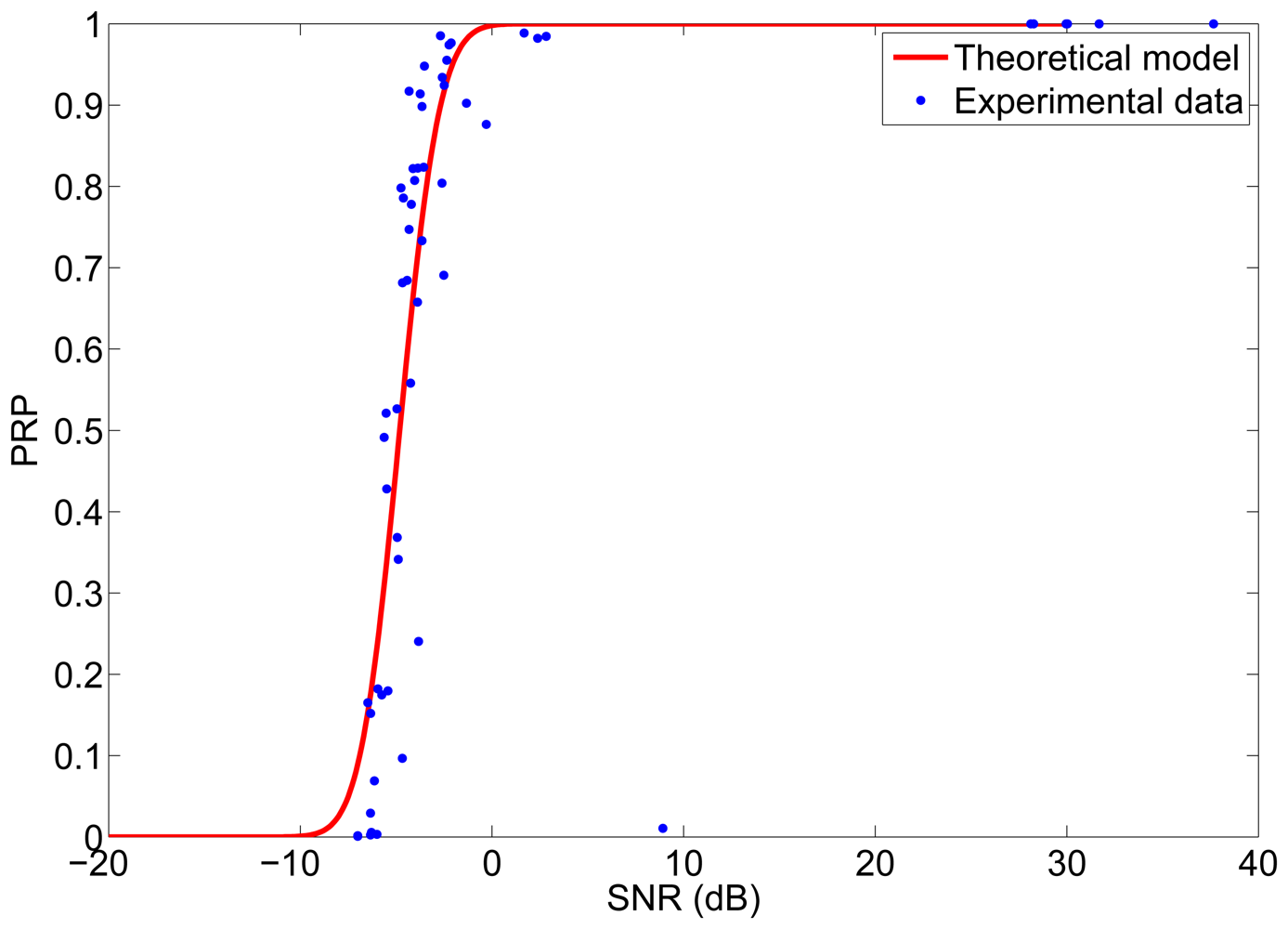
<p>More complete models have been proposed [<xref ref-type="bibr" rid="b25-sensors-12-15438">25</xref>] to take into account complex phenomena such as asymmetry, interference, different quality of receivers and transmitters, correlations between reception rate of links, <italic>etc.</italic> However, this simpler model has been selected for this work because it enables a closed-form mathematical formulation and also fits quite well to experimental data (see Section 5.1).</p></sec>
<sec>
<label>3.2.</label>
<title>Path Loss Model</title>
<p>On the other hand, a model of the channel that relates the transmission power to the received power is needed, as it will provide a relation between transmission power <italic>P<sub>TX</sub></italic> and <italic>SNR</italic> at the receiver for a certain distance between them. Many channel models have been proposed for outdoor and indoor environments [<xref ref-type="bibr" rid="b26-sensors-12-15438">26</xref>] (e.g., Nakagami fading model, Rayleigh fading, Ricean fading, <italic>etc.</italic>) but one of the most popular, due to its simplicity, is the log-normal shadowing path loss model [<xref ref-type="bibr" rid="b27-sensors-12-15438">27</xref>], which establishes the following relation between the received power (<italic>P<sub>RX</sub></italic>) and the distance (<italic>d</italic>) between transmitter and receiver:
<disp-formula id="FD2">
<label>(2)</label>
<mml:math id="mm3" display="block">
<mml:semantics id="sm3">
<mml:mrow>
<mml:msub>
<mml:mi>P</mml:mi>
<mml:mrow>
<mml:mtext mathvariant="italic">RX</mml:mtext></mml:mrow></mml:msub>
<mml:mo stretchy="false">(</mml:mo>
<mml:mtext mathvariant="italic">dBm</mml:mtext>
<mml:mo stretchy="false">)</mml:mo>
<mml:mo>=</mml:mo>
<mml:msub>
<mml:mi>p</mml:mi>
<mml:mrow>
<mml:mtext mathvariant="italic">TX</mml:mtext></mml:mrow></mml:msub>
<mml:mo stretchy="false">(</mml:mo>
<mml:mtext mathvariant="italic">dBm</mml:mtext>
<mml:mo stretchy="false">)</mml:mo>
<mml:mo>+</mml:mo>
<mml:mi>A</mml:mi>
<mml:mo>−</mml:mo>
<mml:mn>10</mml:mn>
<mml:mi>η</mml:mi>
<mml:mo>log</mml:mo>
<mml:mfrac>
<mml:mi>d</mml:mi>
<mml:mrow>
<mml:msub>
<mml:mi>d</mml:mi>
<mml:mn>0</mml:mn></mml:msub></mml:mrow></mml:mfrac>
<mml:mo>+</mml:mo>
<mml:mi>𝒱</mml:mi></mml:mrow></mml:semantics></mml:math></disp-formula>where <italic>P<sub>TX</sub></italic> is the transmission power, <italic>A</italic> is a constant term, <italic>η</italic> is the path loss exponent, and 
<inline-graphic xlink:href="sensors-12-15438u1.gif"/> ∼ 
<inline-graphic xlink:href="sensors-12-15438u2.gif"/>(0, <italic>σ</italic><sup>2</sup>) is a zero-mean Gaussian random variable with standard deviation <italic>σ</italic>. The constant term <italic>A</italic> depends on the transmitter's and receiver's antenna gains and on the power loss for a reference distance <italic>d</italic><sub>0</sub>, and has to be experimentally determined. On the other hand, the path loss exponent <italic>η</italic> typically ranges between 2 and 4 depending on the environment, and it has to be experimentally determined too. The random variable 
<inline-graphic xlink:href="sensors-12-15438u1.gif"/> models the effects of shadowing and considers the randomness across an ensemble of many deployment environments. As the experiments in [<xref ref-type="bibr" rid="b28-sensors-12-15438">28</xref>] indicate, if the environment is static and the transmitter and receiver stay at fixed positions, the standard deviation of the measured received power is lower than <italic>σ</italic>, whereas if a node moves or the environment changes (due to people movement or long lags of time) the standard deviation of the measured received power is <italic>σ</italic>. For this reason, if a channel model like <xref rid="FD2" ref-type="disp-formula">Equation (2)</xref> is used to estimate distances, averaging a number of received signal strength measurements in a static situation does not significantly reduce the estimation errors, whereas averaging measurements taken at slightly different positions or in a changing environment is more effective to reduce estimation errors [<xref ref-type="bibr" rid="b29-sensors-12-15438">29</xref>].</p>
<p>As previously said, this channel model provides a relation between the transmitted power (<italic>P<sub>TX</sub></italic>), the <italic>SNR</italic> at the receiver and the distance (<italic>d</italic>) between transmitter and receiver, <italic>i.e.</italic>,:
<disp-formula id="FD3">
<label>(3)</label>
<mml:math id="mm4" display="block">
<mml:semantics id="sm4">
<mml:mrow>
<mml:mtext mathvariant="italic">SNR</mml:mtext>
<mml:mo stretchy="false">(</mml:mo>
<mml:mi>d</mml:mi>
<mml:mi>B</mml:mi>
<mml:mo stretchy="false">)</mml:mo>
<mml:mo>=</mml:mo>
<mml:msub>
<mml:mi>P</mml:mi>
<mml:mrow>
<mml:mtext mathvariant="italic">TX</mml:mtext></mml:mrow></mml:msub>
<mml:mo stretchy="false">(</mml:mo>
<mml:mtext mathvariant="italic">dBm</mml:mtext>
<mml:mo stretchy="false">)</mml:mo>
<mml:mo>+</mml:mo>
<mml:mi>A</mml:mi>
<mml:mo>−</mml:mo>
<mml:mn>10</mml:mn>
<mml:mi>η</mml:mi>
<mml:mo>log</mml:mo>
<mml:mfrac>
<mml:mi>d</mml:mi>
<mml:mrow>
<mml:msub>
<mml:mi>d</mml:mi>
<mml:mn>0</mml:mn></mml:msub></mml:mrow></mml:mfrac>
<mml:mo>−</mml:mo>
<mml:msub>
<mml:mi>N</mml:mi>
<mml:mrow>
<mml:mtext mathvariant="italic">RX</mml:mtext></mml:mrow></mml:msub>
<mml:mo stretchy="false">(</mml:mo>
<mml:mtext mathvariant="italic">dBm</mml:mtext>
<mml:mo stretchy="false">)</mml:mo>
<mml:mo>+</mml:mo>
<mml:mi>𝒱</mml:mi></mml:mrow></mml:semantics></mml:math></disp-formula>where <italic>SNR</italic>, which is a random variable, is the signal to noise ratio at the receiver expressed in decibels and <italic>N<sub>RX</sub></italic> is the noise level at the receiver.</p></sec></sec>
<sec>
<label>4.</label>
<title>A Transmission Strategy for Minimizing Energy Consumption</title>
<p>As explained in Section 3, our goal is to optimize the transmission strategy for the localization process with the aim of obtaining certain accuracy in the distance estimations while minimizing the energy consumption. In this section, we first include a theoretical analysis of the energy consumption during the localization procedure in terms of the transmission strategy parameters (transmission power and packet transmission rate) and the channel behavior (characterized through the <italic>PRP</italic>) in order to obtain general expressions valid for any wireless network. Some results are also presented for the particular models described in Section 3 and a minimum consumption transmission strategy for the localization process that guarantees a given accuracy in the distance estimations is proposed. Then, two modifications to this ideal strategy are introduced in order to make it practical and effective in real applications by counteracting the random effects of radio propagation.</p>
<sec sec-type="methods">
<label>4.1.</label>
<title>Energy Consumption Analysis</title>
<p>Let us consider a certain link of a network like the one described in Section 3, consisting of a transmitter node, which will periodically send packets, and a receiver node, which will measure the RSS or the TOA of all received packets. The receiver will average all the measurements (<italic>n</italic>) obtained during the localization period <italic>T</italic><sub>0</sub>, so that the standard deviation of the measurements can be reduced by a factor of 
<inline-formula>
<mml:math id="mm5" display="inline">
<mml:semantics id="sm5">
<mml:mrow>
<mml:msqrt>
<mml:mi>n</mml:mi></mml:msqrt></mml:mrow></mml:semantics></mml:math></inline-formula>. Therefore, a desired accuracy in the measurement of the RSS or the TOA imposes a minimum number of received packets <italic>n<sub>obj</sub></italic>.</p>
<p>On the other hand, when <italic>k</italic> packets are transmitted, the average number of packets that are finally received is:
<disp-formula id="FD4">
<label>(4)</label>
<mml:math id="mm6" display="block">
<mml:semantics id="sm6">
<mml:mrow>
<mml:mi>n</mml:mi>
<mml:mo>=</mml:mo>
<mml:mi>k</mml:mi>
<mml:mo>⋅</mml:mo>
<mml:mtext mathvariant="italic">PRP</mml:mtext>
<mml:mo>=</mml:mo>
<mml:mfrac>
<mml:mrow>
<mml:msub>
<mml:mi>T</mml:mi>
<mml:mn>0</mml:mn></mml:msub></mml:mrow>
<mml:mi>T</mml:mi></mml:mfrac>
<mml:mo>⋅</mml:mo>
<mml:mtext mathvariant="italic">PRP</mml:mtext></mml:mrow></mml:semantics></mml:math></disp-formula>where <italic>T</italic> is the time interval between consecutive transmitted packets. Consequently, a desired accuracy in the RSS or the TOA imposes a relationship between <italic>T</italic> and <italic>PRP</italic>, given <italic>T</italic><sub>0</sub>. As shown in Section 3.1, the <italic>PRP</italic> depends on the <italic>snr</italic> at the receiver. As a result, a desired accuracy imposes a relationship between <italic>snr</italic> and <italic>T</italic>. Among all <italic>snr-T</italic> pairs that ensure the required number of received packets, we want to find the one with the lowest energy consumption.</p>
<p>The consumed energy at transmission during <italic>T</italic><sub>0</sub> is given by:
<disp-formula id="FD5">
<label>(5)</label>
<mml:math id="mm7" display="block">
<mml:semantics id="sm7">
<mml:mrow>
<mml:msub>
<mml:mi>E</mml:mi>
<mml:mrow>
<mml:mtext mathvariant="italic">TX</mml:mtext></mml:mrow></mml:msub>
<mml:mo>=</mml:mo>
<mml:mi>k</mml:mi>
<mml:mo>⋅</mml:mo>
<mml:msub>
<mml:mi>E</mml:mi>
<mml:mi>p</mml:mi></mml:msub>
<mml:mo>=</mml:mo>
<mml:mi>k</mml:mi>
<mml:mo>⋅</mml:mo>
<mml:msub>
<mml:mi>p</mml:mi>
<mml:mrow>
<mml:mtext mathvariant="italic">tx</mml:mtext></mml:mrow></mml:msub>
<mml:mo>⋅</mml:mo>
<mml:msub>
<mml:mi>T</mml:mi>
<mml:mi>p</mml:mi></mml:msub>
<mml:mo>=</mml:mo>
<mml:mfrac>
<mml:mrow>
<mml:mi>n</mml:mi>
<mml:mo>⋅</mml:mo>
<mml:msub>
<mml:mi>p</mml:mi>
<mml:mrow>
<mml:mtext mathvariant="italic">tx</mml:mtext></mml:mrow></mml:msub>
<mml:mo>⋅</mml:mo>
<mml:msub>
<mml:mi>T</mml:mi>
<mml:mi>p</mml:mi></mml:msub></mml:mrow>
<mml:mrow>
<mml:mtext mathvariant="italic">PRP</mml:mtext></mml:mrow></mml:mfrac></mml:mrow></mml:semantics></mml:math></disp-formula>where <italic>k</italic> is the number of transmitted packets during the period <italic>T</italic><sub>0</sub>, <italic>E<sub>p</sub></italic> is the consumed energy when transmitting a single packet, <italic>p<sub>tx</sub></italic> is the transmission power (in natural units), <italic>T<sub>p</sub></italic> is the time it takes to send a packet and <italic>n</italic> is the average number of received packets. Since the localization procedure is periodic with period <italic>T</italic><sub>0</sub>, this consumed energy is an appropriate parameter to analyze the energy efficiency.</p>
<p>If we assume that the receiver is awake and listening to possible receptions only at given periods (previously negotiated with the transmitter), the consumed energy at reception during <italic>T</italic><sub>0</sub> is given by:
<disp-formula id="FD6">
<label>(6)</label>
<mml:math id="mm8" display="block">
<mml:semantics id="sm8">
<mml:mrow>
<mml:msub>
<mml:mi>E</mml:mi>
<mml:mrow>
<mml:mtext mathvariant="italic">RX</mml:mtext></mml:mrow></mml:msub>
<mml:mo>=</mml:mo>
<mml:msub>
<mml:mi>C</mml:mi>
<mml:mrow>
<mml:mtext mathvariant="italic">rx</mml:mtext></mml:mrow></mml:msub>
<mml:mo>⋅</mml:mo>
<mml:msub>
<mml:mi>T</mml:mi>
<mml:mi>r</mml:mi></mml:msub></mml:mrow></mml:semantics></mml:math></disp-formula>where <italic>T<sub>r</sub></italic> is the reception period and <italic>C<sub>rx</sub></italic> is the consumption when the node is in receiving mode. <italic>E<sub>RX</sub></italic> is constant, as <italic>C<sub>rx</sub></italic> is a constant value that depends on the hardware characteristics. Therefore, in order to minimize the total energy consumption, we will only need to minimize the energy consumption during transmission.</p>
<p>Using <xref rid="FD1" ref-type="disp-formula">Equations (1)</xref> and <xref rid="FD3" ref-type="disp-formula">(3)</xref>, <italic>E<sub>TX</sub></italic> can be expressed as a function of the signal to noise ratio at the receiver:
<disp-formula id="FD7">
<label>(7)</label>
<mml:math id="mm9" display="block">
<mml:semantics id="sm9">
<mml:mrow>
<mml:msub>
<mml:mi>E</mml:mi>
<mml:mrow>
<mml:mtext mathvariant="italic">TX</mml:mtext></mml:mrow></mml:msub>
<mml:mo>=</mml:mo>
<mml:mfrac>
<mml:mrow>
<mml:mi>n</mml:mi>
<mml:mspace width="0.2em"/>
<mml:msub>
<mml:mi>T</mml:mi>
<mml:mi>p</mml:mi></mml:msub>
<mml:mspace width="0.2em"/>
<mml:msub>
<mml:mi>v</mml:mi>
<mml:mi>b</mml:mi></mml:msub>
<mml:mspace width="0.2em"/>
<mml:msup>
<mml:mi>d</mml:mi>
<mml:mi>η</mml:mi></mml:msup>
<mml:mspace width="0.2em"/>
<mml:msub>
<mml:mi>n</mml:mi>
<mml:mrow>
<mml:mtext mathvariant="italic">rx</mml:mtext></mml:mrow></mml:msub></mml:mrow>
<mml:mrow>
<mml:mn>2</mml:mn>
<mml:mspace width="0.2em"/>
<mml:mi>W</mml:mi>
<mml:mi>a</mml:mi></mml:mrow></mml:mfrac>
<mml:mo>⋅</mml:mo>
<mml:mfrac>
<mml:mrow>
<mml:msup>
<mml:mi>x</mml:mi>
<mml:mn>2</mml:mn></mml:msup></mml:mrow>
<mml:mrow>
<mml:msup>
<mml:mrow>
<mml:mo stretchy="false">(</mml:mo>
<mml:mn>1</mml:mn>
<mml:mo>−</mml:mo>
<mml:mi>Q</mml:mi>
<mml:mo stretchy="false">(</mml:mo>
<mml:mi>x</mml:mi>
<mml:mo stretchy="false">)</mml:mo>
<mml:mo stretchy="false">)</mml:mo></mml:mrow>
<mml:mrow>
<mml:mn>8</mml:mn>
<mml:mi>l</mml:mi></mml:mrow></mml:msup></mml:mrow></mml:mfrac>
<mml:mo>⋅</mml:mo>
<mml:mi>χ</mml:mi></mml:mrow></mml:semantics></mml:math></disp-formula>where <italic>n<sub>rx</sub></italic> and <italic>a</italic> are <italic>N<sub>RX</sub></italic> and <italic>A</italic> expressed in natural units, <italic>χ</italic> is a log-normal random variable with parameters <italic>μ<sub>χ</sub></italic> = 0 and <italic>σ<sub>χ</sub></italic> = <italic>σ</italic> · ln 10/10, and <italic>x</italic> is given by:
<disp-formula id="FD8">
<label>(8)</label>
<mml:math id="mm10" display="block">
<mml:semantics id="sm10">
<mml:mrow>
<mml:mi>x</mml:mi>
<mml:mo>=</mml:mo>
<mml:msqrt>
<mml:mrow>
<mml:mn>2</mml:mn>
<mml:mtext mathvariant="italic">snr</mml:mtext>
<mml:mfrac>
<mml:mi>W</mml:mi>
<mml:mrow>
<mml:msub>
<mml:mi>v</mml:mi>
<mml:mi>b</mml:mi></mml:msub></mml:mrow></mml:mfrac></mml:mrow></mml:msqrt></mml:mrow></mml:semantics></mml:math></disp-formula>where <italic>snr</italic> is the mean value of the <italic>SNR</italic> expressed in natural units.</p>
<p>It can be obviously noticed that, for a given distance, the greater the required accuracy (described by <italic>n</italic>), the more energy will be consumed. On the other hand, as the distance between transmitter and receiver increases, the consumed energy increases as well, for a given desired accuracy. Finally, note that <italic>E<sub>TX</sub></italic> is a random variable composed of a constant multiplied by a log-normal random variable, therefore, it is itself another log-normal random variable, with parameters 
<inline-formula>
<mml:math id="mm11" display="inline">
<mml:semantics id="sm11">
<mml:mrow>
<mml:msub>
<mml:mi>μ</mml:mi>
<mml:mi>E</mml:mi></mml:msub>
<mml:mo>=</mml:mo>
<mml:mo>ln</mml:mo>
<mml:mrow>
<mml:mo>(</mml:mo>
<mml:mrow>
<mml:mfrac>
<mml:mrow>
<mml:mi>n</mml:mi>
<mml:mspace width="0.2em"/>
<mml:msub>
<mml:mi>T</mml:mi>
<mml:mi>p</mml:mi></mml:msub>
<mml:mspace width="0.2em"/>
<mml:msub>
<mml:mi>v</mml:mi>
<mml:mi>b</mml:mi></mml:msub>
<mml:mspace width="0.2em"/>
<mml:msup>
<mml:mi>d</mml:mi>
<mml:mi>η</mml:mi></mml:msup>
<mml:mspace width="0.2em"/>
<mml:msub>
<mml:mi>n</mml:mi>
<mml:mrow>
<mml:mtext mathvariant="italic">rx</mml:mtext></mml:mrow></mml:msub></mml:mrow>
<mml:mrow>
<mml:mn>2</mml:mn>
<mml:mspace width="0.2em"/>
<mml:mi>W</mml:mi>
<mml:mi>a</mml:mi></mml:mrow></mml:mfrac>
<mml:mfrac>
<mml:mrow>
<mml:msup>
<mml:mi>x</mml:mi>
<mml:mn>2</mml:mn></mml:msup></mml:mrow>
<mml:mrow>
<mml:msup>
<mml:mrow>
<mml:mo stretchy="false">(</mml:mo>
<mml:mn>1</mml:mn>
<mml:mo>−</mml:mo>
<mml:mi>Q</mml:mi>
<mml:mo stretchy="false">(</mml:mo>
<mml:mi>x</mml:mi>
<mml:mo stretchy="false">)</mml:mo>
<mml:mo stretchy="false">)</mml:mo></mml:mrow>
<mml:mrow>
<mml:mn>8</mml:mn>
<mml:mi>l</mml:mi></mml:mrow></mml:msup></mml:mrow></mml:mfrac></mml:mrow>
<mml:mo>)</mml:mo></mml:mrow></mml:mrow></mml:semantics></mml:math></inline-formula>, <italic>σ<sub>E</sub></italic> = <italic>σ<sub>χ</sub></italic> and mean value given by:
<disp-formula id="FD9">
<label>(9)</label>
<mml:math id="mm12" display="block">
<mml:semantics id="sm12">
<mml:mrow>
<mml:msub>
<mml:mrow>
<mml:mover accent="true">
<mml:mi>E</mml:mi>
<mml:mo>¯</mml:mo></mml:mover></mml:mrow>
<mml:mrow>
<mml:mtext mathvariant="italic">TX</mml:mtext></mml:mrow></mml:msub>
<mml:mo>=</mml:mo>
<mml:mfrac>
<mml:mrow>
<mml:mi>n</mml:mi>
<mml:mspace width="0.2em"/>
<mml:msub>
<mml:mi>T</mml:mi>
<mml:mi>p</mml:mi></mml:msub>
<mml:mspace width="0.2em"/>
<mml:msub>
<mml:mi>v</mml:mi>
<mml:mi>b</mml:mi></mml:msub>
<mml:mspace width="0.2em"/>
<mml:msup>
<mml:mi>d</mml:mi>
<mml:mi>η</mml:mi></mml:msup>
<mml:mspace width="0.2em"/>
<mml:msub>
<mml:mi>n</mml:mi>
<mml:mrow>
<mml:mtext mathvariant="italic">rx</mml:mtext></mml:mrow></mml:msub></mml:mrow>
<mml:mrow>
<mml:mn>2</mml:mn>
<mml:mspace width="0.2em"/>
<mml:mi>W</mml:mi>
<mml:mi>a</mml:mi></mml:mrow></mml:mfrac>
<mml:mo>⋅</mml:mo>
<mml:mfrac>
<mml:mrow>
<mml:msup>
<mml:mi>x</mml:mi>
<mml:mn>2</mml:mn></mml:msup></mml:mrow>
<mml:mrow>
<mml:msup>
<mml:mrow>
<mml:mo stretchy="false">(</mml:mo>
<mml:mn>1</mml:mn>
<mml:mo>−</mml:mo>
<mml:mi>Q</mml:mi>
<mml:mo stretchy="false">(</mml:mo>
<mml:mi>x</mml:mi>
<mml:mo stretchy="false">)</mml:mo>
<mml:mo stretchy="false">)</mml:mo></mml:mrow>
<mml:mrow>
<mml:mn>8</mml:mn>
<mml:mi>l</mml:mi></mml:mrow></mml:msup></mml:mrow></mml:mfrac>
<mml:mo>⋅</mml:mo>
<mml:msup>
<mml:mi>e</mml:mi>
<mml:mrow>
<mml:mfrac>
<mml:mn>1</mml:mn>
<mml:mn>2</mml:mn></mml:mfrac>
<mml:msup>
<mml:mrow>
<mml:mrow>
<mml:mo>(</mml:mo>
<mml:mrow>
<mml:mfrac>
<mml:mrow>
<mml:mi>σ</mml:mi>
<mml:mo>⋅</mml:mo>
<mml:mo>ln</mml:mo>
<mml:mn>10</mml:mn></mml:mrow>
<mml:mrow>
<mml:mn>10</mml:mn></mml:mrow></mml:mfrac></mml:mrow>
<mml:mo>)</mml:mo></mml:mrow></mml:mrow>
<mml:mn>2</mml:mn></mml:msup></mml:mrow></mml:msup></mml:mrow></mml:semantics></mml:math></disp-formula></p>
<p>Deriving <xref rid="FD9" ref-type="disp-formula">Equation (9)</xref> with respect to the <italic>snr</italic> at the receiver, it can be obtained that the value of <italic>x</italic> (or <italic>snr</italic>) for which the average energy consumption reaches a minimum (<italic>x</italic>*) satisfies the following expression:
<disp-formula id="FD10">
<label>(10)</label>
<mml:math id="mm13" display="block">
<mml:semantics id="sm13">
<mml:mrow>
<mml:mfrac>
<mml:mrow>
<mml:mrow>
<mml:msup>
<mml:mi>x</mml:mi>
<mml:mo>∗</mml:mo></mml:msup></mml:mrow>
<mml:msup>
<mml:mi>e</mml:mi>
<mml:mrow>
<mml:mo>−</mml:mo>
<mml:msup>
<mml:mi>x</mml:mi>
<mml:mrow>
<mml:mo>∗</mml:mo>
<mml:mn>2</mml:mn></mml:mrow></mml:msup>
<mml:mo>/</mml:mo>
<mml:mn>2</mml:mn></mml:mrow></mml:msup></mml:mrow>
<mml:mrow>
<mml:mo stretchy="false">(</mml:mo>
<mml:mn>1</mml:mn>
<mml:mo>−</mml:mo>
<mml:mi>Q</mml:mi>
<mml:mo stretchy="false">(</mml:mo>
<mml:msup>
<mml:mi>x</mml:mi>
<mml:mo>∗</mml:mo></mml:msup>
<mml:mo stretchy="false">)</mml:mo>
<mml:mo stretchy="false">)</mml:mo></mml:mrow></mml:mfrac>
<mml:mo>=</mml:mo>
<mml:mfrac>
<mml:mrow>
<mml:msqrt>
<mml:mrow>
<mml:mn>2</mml:mn>
<mml:mi>π</mml:mi></mml:mrow></mml:msqrt></mml:mrow>
<mml:mrow>
<mml:mn>4</mml:mn>
<mml:mi>l</mml:mi></mml:mrow></mml:mfrac></mml:mrow></mml:semantics></mml:math></disp-formula></p>
<p>In conclusion, if we manage to achieve the <italic>snr</italic>* corresponding to this <italic>x</italic>*, the energy consumption will be minimized.</p>
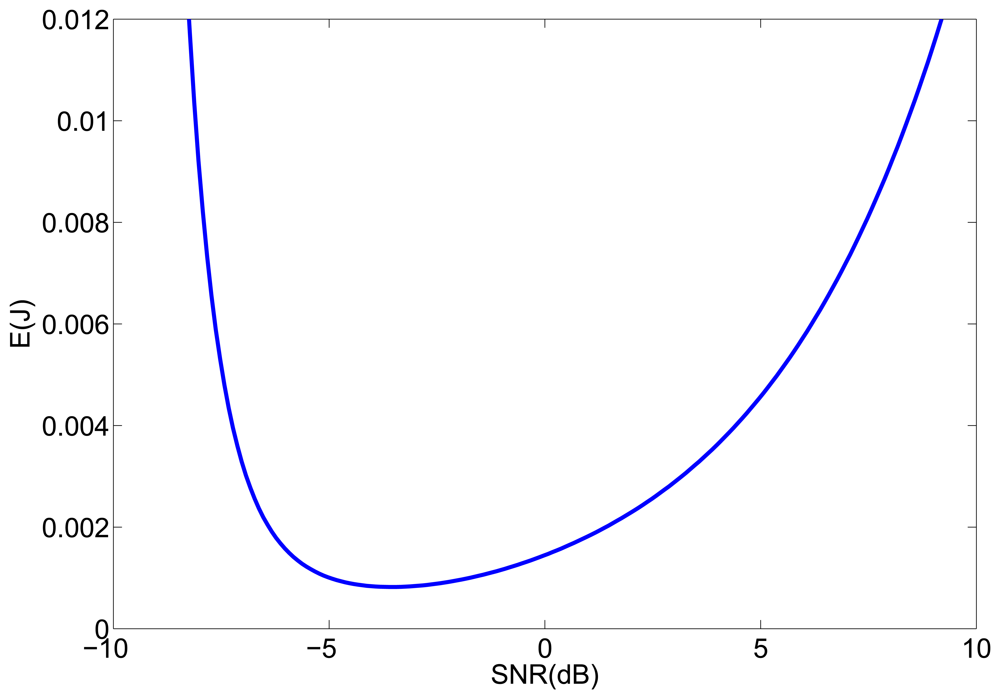
<p>To provide some illustrative results, <xref ref-type="fig" rid="f1-sensors-12-15438">Figure 1</xref> shows the energy consumption as a function of the <italic>SNR</italic> for the parameters of our sensor network, which performs a localization once a second, that is, <italic>T</italic><sub>0</sub> = 1 s, and uses 8-bytes packets, with <italic>T<sub>p</sub></italic> = 256 <italic>μ</italic>s. The estimated values of the channel parameters are <italic>η</italic> = 2.5 and <italic>A</italic> = −80 dBm and the noise level at the receiver is <italic>N<sub>RX</sub></italic> = −87 dBm. The energy consumption was calculated for <italic>n</italic> = 5 and <italic>d</italic> = 2 m. We can see in <xref ref-type="fig" rid="f1-sensors-12-15438">Figure 1</xref> that if the optimum <italic>SNR</italic> value is not achievable, it would be better to use a higher transmission power, as the increase of power consumption with the <italic>SNR</italic> is slower for higher values of <italic>SNR</italic>.</p>
<p>On the other hand, note that the desired accuracy imposed a relationship between <italic>snr</italic> and <italic>T</italic>, thus, there is an optimum value of <italic>T</italic> corresponding to <italic>snr</italic>*, which can be calculated from <xref rid="FD1" ref-type="disp-formula">Equations (1)</xref> and <xref rid="FD4" ref-type="disp-formula">(4)</xref>:
<disp-formula id="FD11">
<label>(11)</label>
<mml:math id="mm14" display="block">
<mml:semantics id="sm14">
<mml:mrow>
<mml:msup>
<mml:mi>T</mml:mi>
<mml:mo>∗</mml:mo></mml:msup>
<mml:mo>=</mml:mo>
<mml:mfrac>
<mml:mrow>
<mml:msub>
<mml:mi>T</mml:mi>
<mml:mn>0</mml:mn></mml:msub></mml:mrow>
<mml:mi>n</mml:mi></mml:mfrac>
<mml:mo>⋅</mml:mo>
<mml:msup>
<mml:mrow>
<mml:mrow>
<mml:mo>(</mml:mo>
<mml:mrow>
<mml:mn>1</mml:mn>
<mml:mo>−</mml:mo>
<mml:mi>Q</mml:mi>
<mml:mrow>
<mml:mo>(</mml:mo>
<mml:mrow>
<mml:msqrt>
<mml:mrow>
<mml:mn>2</mml:mn>
<mml:msup>
<mml:mtext mathvariant="italic">snr</mml:mtext>
<mml:mo>∗</mml:mo></mml:msup>
<mml:mo>⋅</mml:mo>
<mml:mfrac>
<mml:mi>W</mml:mi>
<mml:mrow>
<mml:msub>
<mml:mi>v</mml:mi>
<mml:mi>b</mml:mi></mml:msub></mml:mrow></mml:mfrac></mml:mrow></mml:msqrt></mml:mrow>
<mml:mo>)</mml:mo></mml:mrow></mml:mrow>
<mml:mrow>
<mml:mn>8</mml:mn>
<mml:mi>l</mml:mi></mml:mrow></mml:msup></mml:mrow></mml:semantics></mml:math></disp-formula></p>
<p>In conclusion, among the pairs <italic>snr</italic>-<italic>T</italic> that satisfy a desired accuracy, there is a pair <italic>snr</italic>*-<italic>T</italic>* for which the energy consumption is minimum. For that reason, in order to measure the RSS or the TOA with certain accuracy, the strategy that we propose consists in transmitting packets with a packet rate of 1/<italic>T</italic>* and such a transmission power <italic>P<sub>TX</sub></italic> that the <italic>snr</italic> at the receiver is equal to <italic>snr</italic>*. As the <italic>snr</italic> at the receiver is proportional to the transmission power for a given distance d between transmitter and receiver (see Section 3.2), in order to calculate the optimum value of <italic>P<sub>TX</sub></italic>, an estimate of the distance between transmitter and receiver is needed. In practice, this distance estimation can be obtained from the RSS or TOA measurements of the previous localization period.</p>
<p>Note (from <xref rid="FD10" ref-type="disp-formula">Equation (10)</xref>) that the optimum value <italic>x</italic>* only depends on the packet length, therefore, the optimum value of <italic>snr</italic> at the receiver to achieve the lowest energy consumption does not depend on the accuracy we want to obtain or on the propagation characteristics, it only depends on the packet length and on the <italic>W</italic>/<italic>v<sub>b</sub></italic> ratio, <italic>i.e.</italic>, its value is constant for a given network. This is an interesting result from a practical point of view, as it implies that the value of <italic>snr</italic>* does not need to be calculated in real time, which would be costly from a computational point of view, as it involves solving expression (10) iteratively. Therefore, the proposed strategy only involves very simple operations to calculate the optimum values of <italic>T</italic>* and 
<inline-formula>
<mml:math id="mm15" display="inline">
<mml:semantics id="sm15">
<mml:mrow>
<mml:msubsup>
<mml:mi>P</mml:mi>
<mml:mrow>
<mml:mtext mathvariant="italic">TX</mml:mtext></mml:mrow>
<mml:mo>∗</mml:mo></mml:msubsup></mml:mrow></mml:semantics></mml:math></inline-formula> from the known value of <italic>snr</italic>* and, yet, guarantees the desired accuracy in the measurements while achieving the minimum energy consumption. This results in a very useful and attractive technique for battery-powered wireless devices that are deployed to perform the localization of people or objects. Although we have derived here the particular expressions for the specific case of our channel and receiver models, the strategy is directly extendable to other models.</p>
<p>Let us also remark that the value of the localization period <italic>T</italic><sub>0</sub> does not have any influence on the applicability of our strategy as long as it is big enough to send the required number of packets, which is usually the case in practice. Furthermore, the value of <italic>T</italic><sub>0</sub> does not need to be constant in time. In fact, it can be optimized to adapt to the mobility characteristics of the mobile node [<xref ref-type="bibr" rid="b15-sensors-12-15438">15</xref>–<xref ref-type="bibr" rid="b18-sensors-12-15438">18</xref>]. The combination of the proposed optimization with the optimization of the localization period may lead to further energy savings.</p>
<p>Note that as we have assumed that there is a synchronization schedule known by all the nodes, the localization messages should be sent within the assigned periods. In principle, this does not affect the localization accuracy or the proposed strategy, as long as the required number of packets can be transmitted.</p>
<p>Finally, we would like to point out that in practice, the synchronization of the network may not be perfect. In this case, the nodes should be listening to possible transmissions also during the idle periods in order not to lose packets, so the energy consumption in reception mode would increase. The proposed strategy is not directly affected, as it optimizes the energy consumption in transmission mode, but the energy savings, relative to the total energy consumption, would not be as high as in the ideal synchronization case. Another effect of an imperfect synchronization is that TOA measurements will not be so accurate, so its standard deviation will increase and the distance estimation errors will be higher. This does not affect the performance of the proposed strategy, as it was formulated in terms of the desired number of packets. But clearly, the desired number of packets to achieve a certain accuracy will increase with respect to the ideal case (see <xref rid="FD25" ref-type="disp-formula">Equation (25)</xref> in <xref ref-type="app" rid="app1">Appendix A</xref>: if <italic>σ<sub>t</sub></italic> increases, <italic>n</italic> has to increase to achieve the same <italic>σ</italic>), and the energy consumption will increase accordingly.</p></sec>
<sec>
<label>4.2.</label>
<title>Practical Considerations</title>
<p>In a real environment, the random nature of the propagation channel will have some effects on the proposed strategy that should be overcome. In particular, both the transmission power and the packet transmission rate need to be modified in order to maintain the desired accuracy when real propagation conditions are considered. In the rest of this section, we explain how and why these two parameters of the transmission strategy have to be corrected.</p>
<p>On one hand, the proposed strategy relies on the calculation of the transmission power that is necessary to reach the receiver with the optimum <italic>snr</italic>. As commented previously, an estimation of the distance between the nodes is necessary for this calculation. In real deployments, the distance estimations calculated from TOA or RSS measurements are affected by errors (see <xref ref-type="app" rid="app1">Appendix A and B</xref>), so the transmission power that is used to reach the receiver with the desired <italic>snr</italic> may be different from the optimum (see Section 4.3 for an analysis of how this fact affects the consumed energy). For example, in the case of RSS-based localization, in which distances are estimated from the received signal strength of the <italic>received</italic> packets, distances are usually underestimated. The reason is that the packets with low <italic>snr</italic> suffer from a higher loss probability and, thus, it is more probable to estimate the distance from higher-power packets, which will yield shorter distance estimations. If the transmission power corresponding to this underestimated distances is used, the packets will arrive at the receiver with a <italic>snr</italic> lower than <italic>snr</italic>*, and consequently, there will be more packet losses than desired. In order to avoid this effect, the transmission power has to be corrected.</p>
<p>According to <xref rid="FD3" ref-type="disp-formula">Equation (3)</xref>, the <italic>SNR</italic> (in decibels) of the packets that arrive at the receiver follows a normal distribution with mean 
<inline-formula>
<mml:math id="mm16" display="inline">
<mml:semantics id="sm16">
<mml:mrow>
<mml:mover accent="true">
<mml:mrow>
<mml:mtext mathvariant="italic">SNR</mml:mtext></mml:mrow>
<mml:mo>¯</mml:mo></mml:mover>
<mml:mo>=</mml:mo>
<mml:mrow>
<mml:mrow>
<mml:msub>
<mml:mi>P</mml:mi>
<mml:mrow>
<mml:mtext mathvariant="italic">TX</mml:mtext></mml:mrow></mml:msub>
<mml:mo>+</mml:mo>
<mml:mi>A</mml:mi>
<mml:mo>−</mml:mo>
<mml:mn>10</mml:mn>
<mml:mi>η</mml:mi>
<mml:mo>log</mml:mo>
<mml:mi>d</mml:mi></mml:mrow>
<mml:mo>/</mml:mo>
<mml:mrow>
<mml:msub>
<mml:mi>d</mml:mi>
<mml:mn>0</mml:mn></mml:msub>
<mml:mo>−</mml:mo>
<mml:msub>
<mml:mi>N</mml:mi>
<mml:mrow>
<mml:mtext mathvariant="italic">RX</mml:mtext></mml:mrow></mml:msub></mml:mrow></mml:mrow></mml:mrow></mml:semantics></mml:math></inline-formula> and standard deviation <italic>σ</italic>. Therefore, in natural units, the <italic>snr</italic> of these packets will be a log-normal random variable with parameters 
<inline-formula>
<mml:math id="mm17" display="inline">
<mml:semantics id="sm17">
<mml:mrow>
<mml:msub>
<mml:mi>μ</mml:mi>
<mml:mrow>
<mml:mtext mathvariant="italic">snr</mml:mtext></mml:mrow></mml:msub>
<mml:mo>=</mml:mo>
<mml:mrow>
<mml:mrow>
<mml:mover accent="true">
<mml:mrow>
<mml:mtext mathvariant="italic">SNR</mml:mtext></mml:mrow>
<mml:mo>¯</mml:mo></mml:mover>
<mml:mo>⋅</mml:mo>
<mml:mo>ln</mml:mo>
<mml:mn>10</mml:mn></mml:mrow>
<mml:mo>/</mml:mo>
<mml:mrow>
<mml:mn>10</mml:mn>
<mml:mo>=</mml:mo>
<mml:mo>ln</mml:mo>
<mml:msup>
<mml:mrow>
<mml:mn>10</mml:mn></mml:mrow>
<mml:mrow>
<mml:mrow>
<mml:mrow>
<mml:mover accent="true">
<mml:mrow>
<mml:mtext mathvariant="italic">SNR</mml:mtext></mml:mrow>
<mml:mo>¯</mml:mo></mml:mover></mml:mrow>
<mml:mo>/</mml:mo>
<mml:mrow>
<mml:mn>10</mml:mn></mml:mrow></mml:mrow></mml:mrow></mml:msup></mml:mrow></mml:mrow></mml:mrow></mml:semantics></mml:math></inline-formula> and <italic>σ<sub>snr</sub></italic> = <italic>σ</italic> · ln 10/10. Among all the packets that reach the receiver, some are successfully received but some are not and the probability of a successful reception depends on the value of the <italic>snr</italic>, according to <xref rid="FD1" ref-type="disp-formula">Equation (1)</xref>. Thus, the probability density function of the <italic>snr</italic> given that the packet has been received can be expressed by:
<disp-formula id="FD12">
<label>(12)</label>
<mml:math id="mm18" display="block">
<mml:semantics id="sm18">
<mml:mrow>
<mml:mtable>
<mml:mtr>
<mml:mtd columnalign="left">
<mml:mrow>
<mml:msub>
<mml:mi>f</mml:mi>
<mml:mrow>
<mml:mtext mathvariant="italic">snr</mml:mtext>
<mml:mo>/</mml:mo>
<mml:mtext mathvariant="italic">rx</mml:mtext></mml:mrow></mml:msub>
<mml:mo stretchy="false">(</mml:mo>
<mml:mtext mathvariant="italic">snr</mml:mtext>
<mml:mo stretchy="false">)</mml:mo></mml:mrow></mml:mtd>
<mml:mtd columnalign="left">
<mml:mrow>
<mml:mo>=</mml:mo>
<mml:mfrac>
<mml:mrow>
<mml:msub>
<mml:mi>f</mml:mi>
<mml:mrow>
<mml:mtext mathvariant="italic">snr</mml:mtext></mml:mrow></mml:msub>
<mml:mo stretchy="false">(</mml:mo>
<mml:mtext mathvariant="italic">snr</mml:mtext>
<mml:mo stretchy="false">)</mml:mo>
<mml:mo>⋅</mml:mo>
<mml:mtext mathvariant="italic">PRP</mml:mtext>
<mml:mo stretchy="false">(</mml:mo>
<mml:mtext mathvariant="italic">snr</mml:mtext>
<mml:mo>)</mml:mo></mml:mrow>
<mml:mrow>
<mml:mrow>
<mml:msubsup>
<mml:mo>∫</mml:mo>
<mml:mrow>
<mml:mo>−</mml:mo>
<mml:mo>∞</mml:mo></mml:mrow>
<mml:mrow>
<mml:mo>+</mml:mo>
<mml:mo>∞</mml:mo></mml:mrow></mml:msubsup>
<mml:mrow>
<mml:msub>
<mml:mi>f</mml:mi>
<mml:mrow>
<mml:mtext mathvariant="italic">snr</mml:mtext></mml:mrow></mml:msub>
<mml:mo stretchy="false">(</mml:mo>
<mml:mtext mathvariant="italic">snr</mml:mtext>
<mml:mo stretchy="false">)</mml:mo>
<mml:mo>⋅</mml:mo>
<mml:mtext mathvariant="italic">PRP</mml:mtext>
<mml:mo stretchy="false">(</mml:mo>
<mml:mtext mathvariant="italic">snr</mml:mtext>
<mml:mo stretchy="false">)</mml:mo>
<mml:mo>⋅</mml:mo>
<mml:mi>d</mml:mi>
<mml:mtext mathvariant="italic">snr</mml:mtext></mml:mrow></mml:mrow></mml:mrow></mml:mfrac></mml:mrow></mml:mtd></mml:mtr>
<mml:mtr>
<mml:mtd/>
<mml:mtd columnalign="left">
<mml:mrow>
<mml:mo>=</mml:mo>
<mml:mfrac>
<mml:mrow>
<mml:mfrac>
<mml:mn>1</mml:mn>
<mml:mrow>
<mml:mtext mathvariant="italic">snr</mml:mtext>
<mml:mo>⋅</mml:mo>
<mml:msub>
<mml:mi>σ</mml:mi>
<mml:mrow>
<mml:mtext mathvariant="italic">snr</mml:mtext></mml:mrow></mml:msub>
<mml:msqrt>
<mml:mrow>
<mml:mn>2</mml:mn>
<mml:mi>π</mml:mi></mml:mrow></mml:msqrt></mml:mrow></mml:mfrac>
<mml:mo>⋅</mml:mo>
<mml:msup>
<mml:mi>e</mml:mi>
<mml:mrow>
<mml:mo>−</mml:mo>
<mml:mfrac>
<mml:mrow>
<mml:msup>
<mml:mrow>
<mml:mo stretchy="false">(</mml:mo>
<mml:mo>ln</mml:mo>
<mml:mtext mathvariant="italic">snr</mml:mtext>
<mml:mo>−</mml:mo>
<mml:msub>
<mml:mi>μ</mml:mi>
<mml:mrow>
<mml:mtext mathvariant="italic">snr</mml:mtext></mml:mrow></mml:msub>
<mml:mo stretchy="false">)</mml:mo></mml:mrow>
<mml:mn>2</mml:mn></mml:msup></mml:mrow>
<mml:mrow>
<mml:mn>2</mml:mn>
<mml:msubsup>
<mml:mi>σ</mml:mi>
<mml:mrow>
<mml:mtext mathvariant="italic">snr</mml:mtext></mml:mrow>
<mml:mn>2</mml:mn></mml:msubsup></mml:mrow></mml:mfrac></mml:mrow></mml:msup>
<mml:mo>⋅</mml:mo>
<mml:msup>
<mml:mrow>
<mml:mrow>
<mml:mo>(</mml:mo>
<mml:mrow>
<mml:mn>1</mml:mn>
<mml:mo>−</mml:mo>
<mml:mi>Q</mml:mi>
<mml:mrow>
<mml:mo>(</mml:mo>
<mml:mrow>
<mml:msqrt>
<mml:mrow>
<mml:mn>2</mml:mn>
<mml:mtext mathvariant="italic">snr</mml:mtext>
<mml:mo>⋅</mml:mo>
<mml:mfrac>
<mml:mi>W</mml:mi>
<mml:mrow>
<mml:msub>
<mml:mi>v</mml:mi>
<mml:mi>b</mml:mi></mml:msub></mml:mrow></mml:mfrac></mml:mrow></mml:msqrt></mml:mrow>
<mml:mo>)</mml:mo></mml:mrow></mml:mrow>
<mml:mrow>
<mml:mn>8</mml:mn>
<mml:mi>l</mml:mi></mml:mrow></mml:msup></mml:mrow>
<mml:mrow>
<mml:mrow>
<mml:msubsup>
<mml:mo>∫</mml:mo>
<mml:mrow>
<mml:mo>−</mml:mo>
<mml:mo>∞</mml:mo></mml:mrow>
<mml:mrow>
<mml:mo>+</mml:mo>
<mml:mo>∞</mml:mo></mml:mrow></mml:msubsup>
<mml:mrow>
<mml:mfrac>
<mml:mn>1</mml:mn>
<mml:mrow>
<mml:mtext mathvariant="italic">snr</mml:mtext>
<mml:mo>⋅</mml:mo>
<mml:msub>
<mml:mi>σ</mml:mi>
<mml:mrow>
<mml:mtext mathvariant="italic">snr</mml:mtext></mml:mrow></mml:msub>
<mml:msqrt>
<mml:mrow>
<mml:mn>2</mml:mn>
<mml:mi>π</mml:mi></mml:mrow></mml:msqrt></mml:mrow></mml:mfrac>
<mml:mo>⋅</mml:mo>
<mml:msup>
<mml:mi>e</mml:mi>
<mml:mrow>
<mml:mo>−</mml:mo>
<mml:mfrac>
<mml:mrow>
<mml:msup>
<mml:mrow>
<mml:mo stretchy="false">(</mml:mo>
<mml:mo>ln</mml:mo>
<mml:mtext mathvariant="italic">snr</mml:mtext>
<mml:mo>−</mml:mo>
<mml:msub>
<mml:mi>μ</mml:mi>
<mml:mrow>
<mml:mtext mathvariant="italic">snr</mml:mtext></mml:mrow></mml:msub>
<mml:mo stretchy="false">)</mml:mo></mml:mrow>
<mml:mn>2</mml:mn></mml:msup></mml:mrow>
<mml:mrow>
<mml:mn>2</mml:mn>
<mml:msubsup>
<mml:mi>σ</mml:mi>
<mml:mrow>
<mml:mtext mathvariant="italic">snr</mml:mtext></mml:mrow>
<mml:mn>2</mml:mn></mml:msubsup></mml:mrow></mml:mfrac></mml:mrow></mml:msup>
<mml:mo>⋅</mml:mo>
<mml:msup>
<mml:mrow>
<mml:mrow>
<mml:mo>(</mml:mo>
<mml:mrow>
<mml:mn>1</mml:mn>
<mml:mo>−</mml:mo>
<mml:mi>Q</mml:mi>
<mml:mrow>
<mml:mo>(</mml:mo>
<mml:mrow>
<mml:msqrt>
<mml:mrow>
<mml:mn>2</mml:mn>
<mml:mtext mathvariant="italic">snr</mml:mtext>
<mml:mo>⋅</mml:mo>
<mml:mfrac>
<mml:mi>W</mml:mi>
<mml:mrow>
<mml:msub>
<mml:mi>v</mml:mi>
<mml:mi>b</mml:mi></mml:msub></mml:mrow></mml:mfrac></mml:mrow></mml:msqrt></mml:mrow>
<mml:mo>)</mml:mo></mml:mrow></mml:mrow>
<mml:mrow>
<mml:mn>8</mml:mn>
<mml:mi>l</mml:mi></mml:mrow></mml:msup>
<mml:mi>d</mml:mi>
<mml:mtext mathvariant="italic">snr</mml:mtext></mml:mrow></mml:mrow></mml:mrow></mml:mfrac></mml:mrow></mml:mtd></mml:mtr></mml:mtable></mml:mrow></mml:semantics></mml:math></disp-formula></p>
<p>If one of the received packets is used to estimate the distance, the difference between the transmission power necessary to reach the receiver with the desired <italic>snr</italic>* calculated from it (<italic>P̃<sub>TX</sub></italic>) and the optimum transmission power (given by the true distance) 
<inline-formula>
<mml:math id="mm19" display="inline">
<mml:semantics id="sm19">
<mml:mrow>
<mml:mo stretchy="false">(</mml:mo>
<mml:msubsup>
<mml:mi>P</mml:mi>
<mml:mrow>
<mml:mtext mathvariant="italic">TX</mml:mtext></mml:mrow>
<mml:mo>∗</mml:mo></mml:msubsup>
<mml:mo stretchy="false">)</mml:mo></mml:mrow></mml:semantics></mml:math></inline-formula> can be expressed as:
<disp-formula id="FD13">
<label>(13)</label>
<mml:math id="mm20" display="block">
<mml:semantics id="sm20">
<mml:mrow>
<mml:msubsup>
<mml:mi>P</mml:mi>
<mml:mrow>
<mml:mtext mathvariant="italic">TX</mml:mtext></mml:mrow>
<mml:mo>∗</mml:mo></mml:msubsup>
<mml:mo>−</mml:mo>
<mml:msub>
<mml:mover accent="true">
<mml:mi>P</mml:mi>
<mml:mo>∼</mml:mo></mml:mover>
<mml:mrow>
<mml:mtext mathvariant="italic">TX</mml:mtext></mml:mrow></mml:msub>
<mml:mo>=</mml:mo>
<mml:mtext mathvariant="italic">SNR</mml:mtext>
<mml:mo>−</mml:mo>
<mml:msup>
<mml:mtext mathvariant="italic">SNR</mml:mtext>
<mml:mo>∗</mml:mo></mml:msup></mml:mrow></mml:semantics></mml:math></disp-formula>where <italic>SNR</italic> refers here to the <italic>SNR</italic> of the successfully received packet, whose probability density function can be calculated from <xref rid="FD12" ref-type="disp-formula">Equation (12)</xref>, knowing that <italic>SNR</italic> = 10 · log <italic>snr</italic>:
<disp-formula id="FD14">
<label>(14)</label>
<mml:math id="mm21" display="block">
<mml:semantics id="sm21">
<mml:mrow>
<mml:msub>
<mml:mi>f</mml:mi>
<mml:mrow>
<mml:mrow>
<mml:mrow>
<mml:mtext mathvariant="italic">SNR</mml:mtext></mml:mrow>
<mml:mo>/</mml:mo>
<mml:mrow>
<mml:mtext mathvariant="italic">rx</mml:mtext></mml:mrow></mml:mrow></mml:mrow></mml:msub>
<mml:mo stretchy="false">(</mml:mo>
<mml:mtext mathvariant="italic">SNR</mml:mtext>
<mml:mo stretchy="false">)</mml:mo>
<mml:mo>=</mml:mo>
<mml:mfrac>
<mml:mrow>
<mml:msub>
<mml:mi>f</mml:mi>
<mml:mrow>
<mml:mrow>
<mml:mrow>
<mml:mtext mathvariant="italic">SNR</mml:mtext></mml:mrow>
<mml:mo>/</mml:mo>
<mml:mrow>
<mml:mtext mathvariant="italic">rx</mml:mtext></mml:mrow></mml:mrow></mml:mrow></mml:msub>
<mml:mo stretchy="false">(</mml:mo>
<mml:mtext mathvariant="italic">SNR</mml:mtext>
<mml:mo stretchy="false">)</mml:mo></mml:mrow>
<mml:mrow>
<mml:mfrac>
<mml:mrow>
<mml:mo>∂</mml:mo>
<mml:mtext mathvariant="italic">SNR</mml:mtext></mml:mrow>
<mml:mrow>
<mml:mo>∂</mml:mo>
<mml:mtext mathvariant="italic">snr</mml:mtext></mml:mrow></mml:mfrac></mml:mrow></mml:mfrac>
<mml:mo>=</mml:mo>
<mml:mfrac>
<mml:mrow>
<mml:mo>ln</mml:mo>
<mml:mn>10</mml:mn></mml:mrow>
<mml:mrow>
<mml:mn>10</mml:mn></mml:mrow></mml:mfrac>
<mml:mo>⋅</mml:mo>
<mml:msup>
<mml:mrow>
<mml:mn>10</mml:mn></mml:mrow>
<mml:mrow>
<mml:mrow>
<mml:mrow>
<mml:mtext mathvariant="italic">SNR</mml:mtext></mml:mrow>
<mml:mo>/</mml:mo>
<mml:mrow>
<mml:mn>10</mml:mn></mml:mrow></mml:mrow></mml:mrow></mml:msup>
<mml:mo>⋅</mml:mo>
<mml:msub>
<mml:mi>f</mml:mi>
<mml:mrow>
<mml:mrow>
<mml:mrow>
<mml:mtext mathvariant="italic">snr</mml:mtext></mml:mrow>
<mml:mo>/</mml:mo>
<mml:mrow>
<mml:mtext mathvariant="italic">rx</mml:mtext></mml:mrow></mml:mrow></mml:mrow></mml:msub>
<mml:mo stretchy="false">(</mml:mo>
<mml:mtext mathvariant="italic">SNR</mml:mtext>
<mml:mo stretchy="false">)</mml:mo></mml:mrow></mml:semantics></mml:math></disp-formula></p>
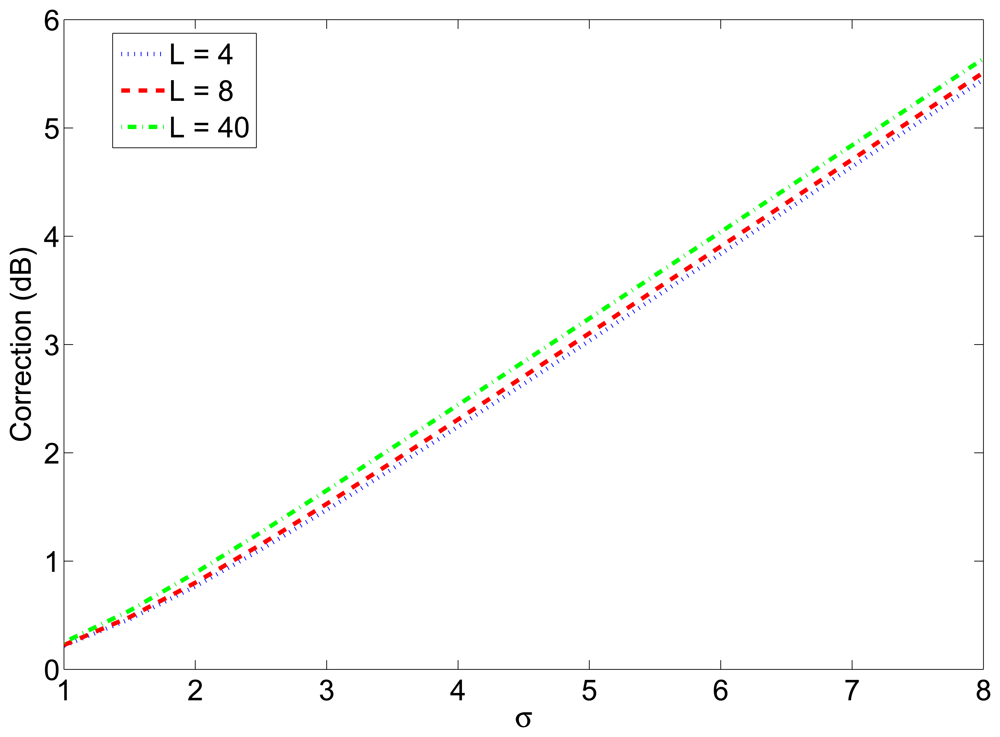
<p>As a consequence, the estimated transmission power has to be corrected by adding a margin equal to the mean value of <xref rid="FD13" ref-type="disp-formula">Equation (13)</xref>. In other words, this margin must be calculated as the difference between the mean value of the <italic>SNR</italic> of the successfully received packets (which can be calculated numerically using <xref rid="FD14" ref-type="disp-formula">Equation (14)</xref>) and <italic>SNR</italic>*. <xref ref-type="fig" rid="f2-sensors-12-15438">Figure 2</xref> shows the value of this margin as a function of the standard deviation of the shadowing for different packet lengths. This margin was seen to be independent of the value of <italic>W</italic>/<italic>v<sub>b</sub></italic>, and nearly independent of the packet length, as it can be seen in the figure.</p>
<p>On the other hand, even when the optimum transmission power is used, the final <italic>snr</italic> at the receiver may not be the desired one, as the propagation is again affected by random shadowing. In fact, the <italic>snr</italic> at the receiver will be a log-normal random variable and, therefore, the <italic>PRP</italic> and <italic>n</italic> will also be random variables and their probability density functions can be calculated easily according to <xref rid="FD1" ref-type="disp-formula">Equations (1)</xref> and <xref rid="FD4" ref-type="disp-formula">(4)</xref>. In particular, the probability density function of the <italic>PRP</italic> can be calculated as:
<disp-formula id="FD15">
<label>(15)</label>
<mml:math id="mm22" display="block">
<mml:semantics id="sm22">
<mml:mrow>
<mml:msub>
<mml:mi>f</mml:mi>
<mml:mrow>
<mml:mtext mathvariant="italic">PRP</mml:mtext></mml:mrow></mml:msub>
<mml:mo>=</mml:mo>
<mml:mfrac>
<mml:mrow>
<mml:msub>
<mml:mi>f</mml:mi>
<mml:mrow>
<mml:mtext mathvariant="italic">snr</mml:mtext></mml:mrow></mml:msub></mml:mrow>
<mml:mrow>
<mml:mfrac>
<mml:mrow>
<mml:mo>∂</mml:mo>
<mml:mtext mathvariant="italic">PRP</mml:mtext></mml:mrow>
<mml:mrow>
<mml:mo>∂</mml:mo>
<mml:mtext mathvariant="italic">snr</mml:mtext></mml:mrow></mml:mfrac></mml:mrow></mml:mfrac>
<mml:mo>=</mml:mo>
<mml:mfrac>
<mml:mrow>
<mml:msqrt>
<mml:mrow>
<mml:mn>2</mml:mn>
<mml:mi>π</mml:mi></mml:mrow></mml:msqrt>
<mml:msub>
<mml:mi>v</mml:mi>
<mml:mi>b</mml:mi></mml:msub></mml:mrow>
<mml:mrow>
<mml:mn>8</mml:mn>
<mml:mi>l</mml:mi>
<mml:mi>W</mml:mi></mml:mrow></mml:mfrac>
<mml:mo>⋅</mml:mo>
<mml:mfrac>
<mml:mrow>
<mml:mi>x</mml:mi>
<mml:mo stretchy="false">(</mml:mo>
<mml:mn>1</mml:mn>
<mml:mo>−</mml:mo>
<mml:mi>Q</mml:mi>
<mml:mo stretchy="false">(</mml:mo>
<mml:mi>x</mml:mi>
<mml:mo stretchy="false">)</mml:mo>
<mml:mo stretchy="false">)</mml:mo></mml:mrow>
<mml:mrow>
<mml:mtext mathvariant="italic">PRP</mml:mtext>
<mml:mo>⋅</mml:mo>
<mml:msup>
<mml:mi>e</mml:mi>
<mml:mrow>
<mml:msup>
<mml:mi>x</mml:mi>
<mml:mn>2</mml:mn></mml:msup>
<mml:mo>/</mml:mo>
<mml:mn>2</mml:mn></mml:mrow></mml:msup></mml:mrow></mml:mfrac>
<mml:mo>⋅</mml:mo>
<mml:mfrac>
<mml:mn>1</mml:mn>
<mml:mrow>
<mml:mtext mathvariant="italic">snr</mml:mtext>
<mml:mo>⋅</mml:mo>
<mml:msub>
<mml:mi>σ</mml:mi>
<mml:mrow>
<mml:mtext mathvariant="italic">snr</mml:mtext></mml:mrow></mml:msub>
<mml:msqrt>
<mml:mrow>
<mml:mn>2</mml:mn>
<mml:mi>π</mml:mi></mml:mrow></mml:msqrt></mml:mrow></mml:mfrac>
<mml:mo>⋅</mml:mo>
<mml:msup>
<mml:mi>e</mml:mi>
<mml:mrow>
<mml:mo>−</mml:mo>
<mml:mfrac>
<mml:mrow>
<mml:msup>
<mml:mrow>
<mml:mo stretchy="false">(</mml:mo>
<mml:mo>ln</mml:mo>
<mml:mtext mathvariant="italic">snr</mml:mtext>
<mml:mo>−</mml:mo>
<mml:msub>
<mml:mi>μ</mml:mi>
<mml:mrow>
<mml:mtext mathvariant="italic">snr</mml:mtext></mml:mrow></mml:msub>
<mml:mo stretchy="false">)</mml:mo></mml:mrow>
<mml:mn>2</mml:mn></mml:msup></mml:mrow>
<mml:mrow>
<mml:mn>2</mml:mn>
<mml:msubsup>
<mml:mi>σ</mml:mi>
<mml:mrow>
<mml:mtext mathvariant="italic">snr</mml:mtext></mml:mrow>
<mml:mn>2</mml:mn></mml:msubsup></mml:mrow></mml:mfrac></mml:mrow></mml:msup></mml:mrow></mml:semantics></mml:math></disp-formula>where 
<inline-formula>
<mml:math id="mm23" display="inline">
<mml:semantics id="sm23">
<mml:mrow>
<mml:msub>
<mml:mi>μ</mml:mi>
<mml:mrow>
<mml:mtext mathvariant="italic">SNR</mml:mtext></mml:mrow></mml:msub>
<mml:mo>=</mml:mo>
<mml:mo>ln</mml:mo>
<mml:msup>
<mml:mrow>
<mml:mn>10</mml:mn></mml:mrow>
<mml:mrow>
<mml:mrow>
<mml:mrow>
<mml:mover accent="true">
<mml:mrow>
<mml:mtext mathvariant="italic">SNR</mml:mtext></mml:mrow>
<mml:mo>¯</mml:mo></mml:mover></mml:mrow>
<mml:mo>/</mml:mo>
<mml:mrow>
<mml:mn>10</mml:mn></mml:mrow></mml:mrow></mml:mrow></mml:msup>
<mml:mo>=</mml:mo>
<mml:mo>ln</mml:mo>
<mml:msup>
<mml:mtext mathvariant="italic">snr</mml:mtext>
<mml:mo>∗</mml:mo></mml:msup></mml:mrow></mml:semantics></mml:math></inline-formula>, <italic>σ<sub>snr</sub></italic> = <italic>σ</italic> · ln 10/10, 
<inline-formula>
<mml:math id="mm24" display="inline">
<mml:semantics id="sm24">
<mml:mrow>
<mml:mi>x</mml:mi>
<mml:mo>=</mml:mo>
<mml:msqrt>
<mml:mrow>
<mml:mrow>
<mml:mrow>
<mml:mn>2</mml:mn>
<mml:mtext mathvariant="italic">snr</mml:mtext>
<mml:mo>⋅</mml:mo>
<mml:mi>W</mml:mi></mml:mrow>
<mml:mo>/</mml:mo>
<mml:mrow>
<mml:msub>
<mml:mi>v</mml:mi>
<mml:mi>b</mml:mi></mml:msub></mml:mrow></mml:mrow></mml:mrow></mml:msqrt></mml:mrow></mml:semantics></mml:math></inline-formula> and <italic>snr</italic> = <italic>v<sub>b</sub></italic>/2<italic>W</italic> · (<italic>Q</italic><sup>−1</sup> (1 − <italic>PRP</italic><sup>1/</sup><italic><sup>8l</sup></italic>)). Thus, knowing that <italic>n</italic> = <italic>k</italic> · <italic>PRP</italic>, the probability density function of <italic>n</italic> can be calculated as:
<disp-formula id="FD16">
<label>(16)</label>
<mml:math id="mm25" display="block">
<mml:semantics id="sm25">
<mml:mrow>
<mml:msub>
<mml:mi>f</mml:mi>
<mml:mi>n</mml:mi></mml:msub>
<mml:mo stretchy="false">(</mml:mo>
<mml:mi>n</mml:mi>
<mml:mo stretchy="false">)</mml:mo>
<mml:mo>=</mml:mo>
<mml:mi>k</mml:mi>
<mml:mo>⋅</mml:mo>
<mml:msub>
<mml:mi>f</mml:mi>
<mml:mrow>
<mml:mtext mathvariant="italic">PRP</mml:mtext></mml:mrow></mml:msub>
<mml:mo stretchy="false">(</mml:mo>
<mml:mi>n</mml:mi>
<mml:mo stretchy="false">)</mml:mo>
<mml:mo>=</mml:mo>
<mml:mfrac>
<mml:mrow>
<mml:msub>
<mml:mi>n</mml:mi>
<mml:mrow>
<mml:mtext mathvariant="italic">obj</mml:mtext></mml:mrow></mml:msub></mml:mrow>
<mml:mrow>
<mml:msup>
<mml:mtext mathvariant="italic">PRP</mml:mtext>
<mml:mo>∗</mml:mo></mml:msup></mml:mrow></mml:mfrac>
<mml:mo>⋅</mml:mo>
<mml:msub>
<mml:mi>f</mml:mi>
<mml:mrow>
<mml:mtext mathvariant="italic">PRP</mml:mtext></mml:mrow></mml:msub>
<mml:mo stretchy="false">(</mml:mo>
<mml:mi>n</mml:mi>
<mml:mo stretchy="false">)</mml:mo></mml:mrow></mml:semantics></mml:math></disp-formula>where <italic>n<sub>obj</sub></italic> is the desired number of received packets and <italic>PRP</italic>* is the value of the packet reception probability corresponding to the optimum <italic>snr</italic>: 
<inline-formula>
<mml:math id="mm26" display="inline">
<mml:semantics id="sm26">
<mml:mrow>
<mml:msup>
<mml:mtext mathvariant="italic">PRP</mml:mtext>
<mml:mo>∗</mml:mo></mml:msup>
<mml:mo>=</mml:mo>
<mml:msup>
<mml:mrow>
<mml:mrow>
<mml:mo>(</mml:mo>
<mml:mrow>
<mml:mn>1</mml:mn>
<mml:mo>−</mml:mo>
<mml:mi>Q</mml:mi>
<mml:mrow>
<mml:mo>(</mml:mo>
<mml:mrow>
<mml:msqrt>
<mml:mrow>
<mml:mn>2</mml:mn>
<mml:msup>
<mml:mtext mathvariant="italic">snr</mml:mtext>
<mml:mo>∗</mml:mo></mml:msup>
<mml:mo>⋅</mml:mo>
<mml:mfrac>
<mml:mi>W</mml:mi>
<mml:mrow>
<mml:msub>
<mml:mi>v</mml:mi>
<mml:mi>b</mml:mi></mml:msub></mml:mrow></mml:mfrac></mml:mrow></mml:msqrt></mml:mrow>
<mml:mo>)</mml:mo></mml:mrow></mml:mrow>
<mml:mrow>
<mml:mn>8</mml:mn>
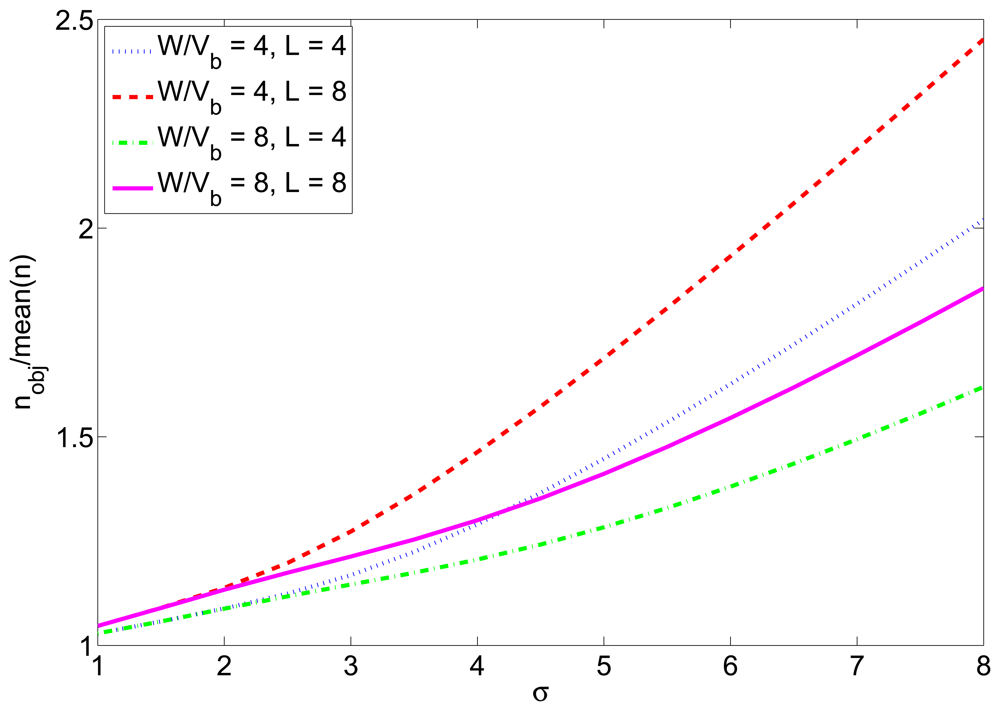
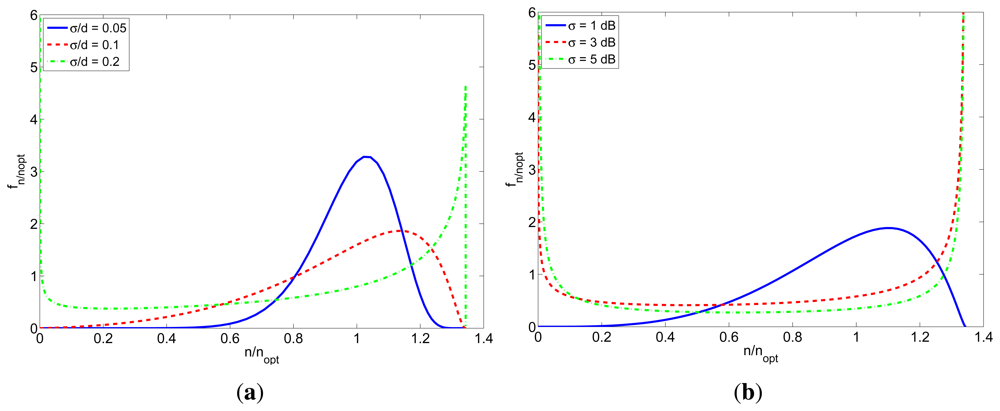
<mml:mi>l</mml:mi></mml:mrow></mml:msup></mml:mrow></mml:semantics></mml:math></inline-formula>. The mean value of <italic>n</italic> can be then calculated numerically, resulting that this value is lower than the desired one <italic>n<sub>obj</sub></italic>. The difference between the two depends on l and <italic>W</italic>/<italic>v<sub>b</sub></italic>: the mean value of <italic>n</italic> is lower when the packet is longer or when <italic>W</italic>/<italic>v<sub>b</sub></italic> is higher. <xref ref-type="fig" rid="f3-sensors-12-15438">Figure 3</xref> shows the relation between these two values for different values of l and <italic>W</italic>/<italic>vb</italic> for the case of RSS-based localization as a function of the standard deviation of the <italic>SNR</italic> distribution. This factor must be used to correct the number of transmitted packets, in order to counteract the effects of the propagation in real deployments. Thus, the estimated value of <italic>T</italic>* calculated from <xref rid="FD11" ref-type="disp-formula">Equation (11)</xref> must be divided by this factor.</p>
<p>Although the energy consumption will increase when these two corrections are included in the transmission strategy, they are necessary to achieve the desired number of received packets in real environments and, therefore, to achieve the desired accuracy; otherwise, the accuracy would not be guaranteed. Nevertheless, the final energy consumption is very small and still entails significant savings with respect to other transmission strategies.</p></sec>
<sec>
<label>4.3.</label>
<title>Sensitivity Analysis</title>
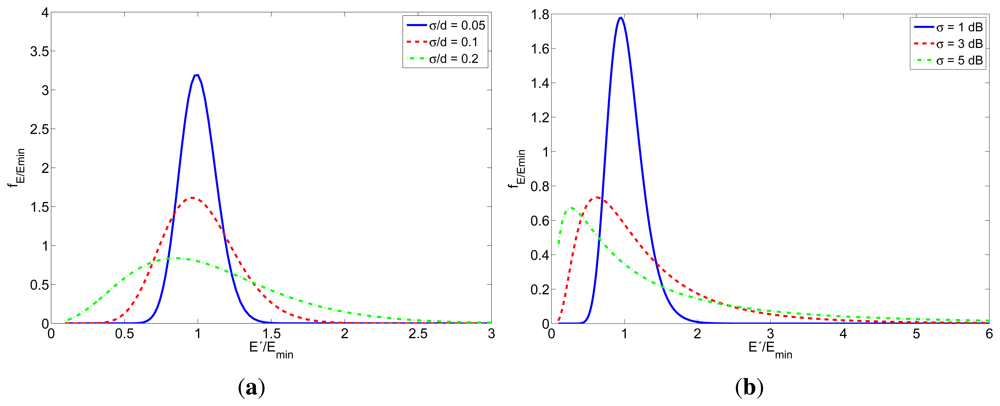
<p>It is interesting to analyze how much energy will be consumed if the best transmission strategy is not perfectly achieved, due to an error in the estimated transmission power. As it has been mentioned above, the error in the estimated transmission power is due to an error in the distance estimation, which depends itself on the RSS or TOA measurement errors and on the number of packets that are averaged at the receiver. In this section, we first evaluate how the energy consumption is affected by the errors in the estimated transmission power and then we study how the distance estimation errors propagate to errors in the estimated transmission power, and therefore affect the energy consumption.</p>
<p>Let us suppose a transmitter node X that has to send packets to another node Y, so that Y receives in average <italic>n<sub>obj</sub></italic> packets during the period <italic>T</italic><sub>0</sub>. As the optimum <italic>snr</italic> at receiver node Y is known, node X can calculate the optimum value of <italic>T</italic> (<italic>T</italic>*) that satisfies the desired accuracy using <xref rid="FD11" ref-type="disp-formula">Equation (11)</xref>. On the other hand, the optimum transmission power 
<inline-formula>
<mml:math id="mm27" display="inline">
<mml:semantics id="sm27">
<mml:mrow>
<mml:msubsup>
<mml:mi>P</mml:mi>
<mml:mrow>
<mml:mtext mathvariant="italic">TX</mml:mtext></mml:mrow>
<mml:mo>∗</mml:mo></mml:msubsup></mml:mrow></mml:semantics></mml:math></inline-formula> can be obtained from <xref rid="FD3" ref-type="disp-formula">Equation (3)</xref>, assuming that the distance between transmitter node X and receiver node Y is known. An error in the distance estimation will produce an error in the estimated optimum transmission power, which will lead to the use of a transmission power 
<inline-formula>
<mml:math id="mm28" display="inline">
<mml:semantics id="sm28">
<mml:mrow>
<mml:msubsup>
<mml:mi>P</mml:mi>
<mml:mrow>
<mml:mtext mathvariant="italic">TX</mml:mtext></mml:mrow>
<mml:mo>′</mml:mo></mml:msubsup></mml:mrow></mml:semantics></mml:math></inline-formula> different from the optimum 
<inline-formula>
<mml:math id="mm29" display="inline">
<mml:semantics id="sm29">
<mml:mrow>
<mml:msubsup>
<mml:mi>P</mml:mi>
<mml:mrow>
<mml:mtext mathvariant="italic">TX</mml:mtext></mml:mrow>
<mml:mo>∗</mml:mo></mml:msubsup></mml:mrow></mml:semantics></mml:math></inline-formula>. If the estimated transmission power is greater than 
<inline-formula>
<mml:math id="mm30" display="inline">
<mml:semantics id="sm30">
<mml:mrow>
<mml:msubsup>
<mml:mi>P</mml:mi>
<mml:mrow>
<mml:mtext mathvariant="italic">TX</mml:mtext></mml:mrow>
<mml:mo>∗</mml:mo></mml:msubsup></mml:mrow></mml:semantics></mml:math></inline-formula>, the energy consumption will increase with respect to the minimum <italic>E<sub>min</sub></italic> and the number of received packets will increase as well with respect to <italic>n<sub>obj</sub></italic>, although it is not necessary. If the estimated transmission power is lower than 
<inline-formula>
<mml:math id="mm31" display="inline">
<mml:semantics id="sm31">
<mml:mrow>
<mml:msubsup>
<mml:mi>P</mml:mi>
<mml:mrow>
<mml:mtext mathvariant="italic">TX</mml:mtext></mml:mrow>
<mml:mo>∗</mml:mo></mml:msubsup></mml:mrow></mml:semantics></mml:math></inline-formula>, the energy consumption will diminish, but the number of received packets will not be sufficient.</p>
<p><xref ref-type="fig" rid="f4-sensors-12-15438">Figure 4</xref> shows how the errors in the transmission power affect the consumed energy and the number of received packets. In particular, <xref ref-type="fig" rid="f4-sensors-12-15438">Figure 4(a)</xref> represents the ratio between the energy consumption <italic>E</italic>′ corresponding to the estimated transmission power 
<inline-formula>
<mml:math id="mm32" display="inline">
<mml:semantics id="sm32">
<mml:mrow>
<mml:msubsup>
<mml:mi>P</mml:mi>
<mml:mrow>
<mml:mtext mathvariant="italic">TX</mml:mtext></mml:mrow>
<mml:mo>′</mml:mo></mml:msubsup></mml:mrow></mml:semantics></mml:math></inline-formula> and <italic>E<sub>min</sub></italic> (corresponding to the optimum transmission power 
<inline-formula>
<mml:math id="mm33" display="inline">
<mml:semantics id="sm33">
<mml:mrow>
<mml:msubsup>
<mml:mi>P</mml:mi>
<mml:mrow>
<mml:mtext mathvariant="italic">TX</mml:mtext></mml:mrow>
<mml:mo>∗</mml:mo></mml:msubsup></mml:mrow></mml:semantics></mml:math></inline-formula>) as a function of the error in the transmission power 
<inline-formula>
<mml:math id="mm34" display="inline">
<mml:semantics id="sm34">
<mml:mrow>
<mml:mo stretchy="false">(</mml:mo>
<mml:msubsup>
<mml:mi>P</mml:mi>
<mml:mrow>
<mml:mtext mathvariant="italic">TX</mml:mtext></mml:mrow>
<mml:mo>′</mml:mo></mml:msubsup>
<mml:mrow>
<mml:mo>−</mml:mo></mml:mrow>
<mml:msubsup>
<mml:mi>P</mml:mi>
<mml:mrow>
<mml:mtext mathvariant="italic">TX</mml:mtext></mml:mrow>
<mml:mo>∗</mml:mo></mml:msubsup>
<mml:mo stretchy="false">)</mml:mo></mml:mrow></mml:semantics></mml:math></inline-formula>. This relation is valid for any value of <italic>n<sub>obj</sub></italic>, for any <italic>W</italic>/<italic>v<sub>b</sub></italic> ratio for any packet length l and for any distance between transmitter and receiver. On the other hand, <xref ref-type="fig" rid="f4-sensors-12-15438">Figure 4(b)</xref> shows the relation between the number of received packets <italic>n</italic> corresponding to the estimated transmission power 
<inline-formula>
<mml:math id="mm35" display="inline">
<mml:semantics id="sm35">
<mml:mrow>
<mml:msubsup>
<mml:mi>P</mml:mi>
<mml:mrow>
<mml:mtext mathvariant="italic">TX</mml:mtext></mml:mrow>
<mml:mo>′</mml:mo></mml:msubsup></mml:mrow></mml:semantics></mml:math></inline-formula> and the desired number of received packets <italic>n<sub>obj</sub></italic> (corresponding to the optimum transmission power 
<inline-formula>
<mml:math id="mm36" display="inline">
<mml:semantics id="sm36">
<mml:mrow>
<mml:msubsup>
<mml:mi>P</mml:mi>
<mml:mrow>
<mml:mtext mathvariant="italic">TX</mml:mtext></mml:mrow>
<mml:mo>∗</mml:mo></mml:msubsup></mml:mrow></mml:semantics></mml:math></inline-formula>) as a function of the error in the transmission power. This relation is valid for any value of <italic>n<sub>obj</sub></italic>, for any <italic>W</italic>/<italic>v<sub>b</sub></italic> ratio and for any distance between transmitter and receiver, but depends on the packet length <italic>l</italic>.</p>
<p>As shown in <xref ref-type="fig" rid="f4-sensors-12-15438">Figure 4(a)</xref>, the consumed energy <italic>E</italic>′ will be greater than the minimum value (<italic>E<sub>min</sub></italic>) if the transmission power is overestimated. Furthermore, the relation between the error in the transmission power 
<inline-formula>
<mml:math id="mm37" display="inline">
<mml:semantics id="sm37">
<mml:mrow>
<mml:mo stretchy="false">(</mml:mo>
<mml:msub>
<mml:mover accent="true">
<mml:mi>P</mml:mi>
<mml:mo>∼</mml:mo></mml:mover>
<mml:mrow>
<mml:mtext mathvariant="italic">TX</mml:mtext></mml:mrow></mml:msub>
<mml:mo>−</mml:mo>
<mml:msubsup>
<mml:mi>P</mml:mi>
<mml:mrow>
<mml:mtext mathvariant="italic">TX</mml:mtext></mml:mrow>
<mml:mo>∗</mml:mo></mml:msubsup>
<mml:mo stretchy="false">)</mml:mo></mml:mrow></mml:semantics></mml:math></inline-formula> and the corresponding energy consumption is exponential. For example, if the transmission power is overestimated in 1 dB the energy consumption will be a 26% higher than <italic>E<sub>min</sub></italic>, if it is overestimated in 2 dB the energy consumption will be a 59% higher than <italic>E<sub>min</sub></italic>, and if it is overestimated in 3 dB the energy consumption will be doubled with respect to <italic>E<sub>min</sub></italic>. On the other hand, as shown in <xref ref-type="fig" rid="f4-sensors-12-15438">Figure 4(b)</xref>, the number of received packets <italic>n</italic> will be lower than the desired <italic>n<sub>obj</sub></italic> if the transmission power is underestimated. Notice that the behavior is quite sharp, especially for longer packets. For example, for 40-bytes packets, if the transmission power is underestimated in only 1.4 dB, the number of received packets will be halved with respect to the objective <italic>n<sub>obj</sub></italic>, and if the transmission power is underestimated in more than 4 dB, the number of received packets will be practically zero.</p>
<p>The behavior shown in these figures is valid for both TOA-based and RSS-based localization schemes, but as the probability distribution of the distance estimation is different for the two localization schemes (see <xref ref-type="app" rid="app1">Appendix A and B</xref>), the probability distribution of 
<inline-formula>
<mml:math id="mm38" display="inline">
<mml:semantics id="sm38">
<mml:mrow>
<mml:msub>
<mml:mover accent="true">
<mml:mi>P</mml:mi>
<mml:mo>∼</mml:mo></mml:mover>
<mml:mrow>
<mml:mtext mathvariant="italic">TX</mml:mtext></mml:mrow></mml:msub>
<mml:mo>−</mml:mo>
<mml:msubsup>
<mml:mi>P</mml:mi>
<mml:mrow>
<mml:mtext mathvariant="italic">TX</mml:mtext></mml:mrow>
<mml:mo>∗</mml:mo></mml:msubsup></mml:mrow></mml:semantics></mml:math></inline-formula> will also be different. Therefore, the frequency of underestimations and overestimations of the transmission power will depend on the distance estimation method, and this will affect the probability distribution of the energy consumption and the number of received packets, as we will see next.</p>
<p>This error in the transmission power can be calculated as:
<disp-formula id="FD17">
<label>(17)</label>
<mml:math id="mm39" display="block">
<mml:semantics id="sm39">
<mml:mrow>
<mml:msubsup>
<mml:mi>P</mml:mi>
<mml:mrow>
<mml:mtext mathvariant="italic">TX</mml:mtext></mml:mrow>
<mml:mo>′</mml:mo></mml:msubsup>
<mml:mo>−</mml:mo>
<mml:msubsup>
<mml:mi>P</mml:mi>
<mml:mrow>
<mml:mtext mathvariant="italic">TX</mml:mtext></mml:mrow>
<mml:mo>∗</mml:mo></mml:msubsup>
<mml:mo stretchy="false">(</mml:mo>
<mml:mi>d</mml:mi>
<mml:mi>B</mml:mi>
<mml:mo stretchy="false">)</mml:mo>
<mml:mo>=</mml:mo>
<mml:mn>10</mml:mn>
<mml:mi>η</mml:mi>
<mml:mo>log</mml:mo>
<mml:mfrac>
<mml:mover accent="true">
<mml:mi>d</mml:mi>
<mml:mo>∼</mml:mo></mml:mover>
<mml:mi>d</mml:mi></mml:mfrac></mml:mrow></mml:semantics></mml:math></disp-formula>where <italic>d̃</italic> is the estimated distance. <xref ref-type="app" rid="app1">Appendix A and B</xref> derive the expressions of <italic>d̃</italic> for TOA-based and RSS-based localization respectively. In a TOA-based localization scheme the distance estimation is given by <xref rid="FD24" ref-type="disp-formula">Equation (24)</xref>, therefore the difference between calculated and optimum transmission power will be given by:
<disp-formula id="FD18">
<label>(18)</label>
<mml:math id="mm40" display="block">
<mml:semantics id="sm40">
<mml:mrow>
<mml:msubsup>
<mml:mi>P</mml:mi>
<mml:mrow>
<mml:mtext mathvariant="italic">TX</mml:mtext></mml:mrow>
<mml:mo>′</mml:mo></mml:msubsup>
<mml:mo>−</mml:mo>
<mml:msubsup>
<mml:mi>P</mml:mi>
<mml:mrow>
<mml:mtext mathvariant="italic">TX</mml:mtext></mml:mrow>
<mml:mo>∗</mml:mo></mml:msubsup>
<mml:mo>=</mml:mo>
<mml:mn>10</mml:mn>
<mml:mi>η</mml:mi>
<mml:mo>log</mml:mo>
<mml:mfrac>
<mml:mrow>
<mml:mi>d</mml:mi>
<mml:mo>+</mml:mo>
<mml:mi>𝒩</mml:mi>
<mml:mspace width="0.2em"/>
<mml:mo stretchy="false">(</mml:mo>
<mml:mn>0</mml:mn>
<mml:mo>,</mml:mo>
<mml:mi>σ</mml:mi>
<mml:mo stretchy="false">)</mml:mo></mml:mrow>
<mml:mi>d</mml:mi></mml:mfrac>
<mml:mo>=</mml:mo>
<mml:mn>10</mml:mn>
<mml:mi>η</mml:mi>
<mml:mo>log</mml:mo>
<mml:mi>𝒩</mml:mi>
<mml:mspace width="0.2em"/>
<mml:mo stretchy="false">(</mml:mo>
<mml:mn>1</mml:mn>
<mml:mo>,</mml:mo>
<mml:mi>σ</mml:mi>
<mml:mo>/</mml:mo>
<mml:mi>d</mml:mi>
<mml:mo stretchy="false">)</mml:mo></mml:mrow></mml:semantics></mml:math></disp-formula>where 
<inline-formula>
<mml:math id="mm41" display="inline">
<mml:semantics id="sm41">
<mml:mrow>
<mml:mi>σ</mml:mi>
<mml:mo>=</mml:mo>
<mml:mrow>
<mml:mrow>
<mml:mi>c</mml:mi>
<mml:mo>⋅</mml:mo>
<mml:msub>
<mml:mi>σ</mml:mi>
<mml:mi>t</mml:mi></mml:msub></mml:mrow>
<mml:mo>/</mml:mo>
<mml:mrow>
<mml:msqrt>
<mml:mi>n</mml:mi></mml:msqrt></mml:mrow></mml:mrow></mml:mrow></mml:semantics></mml:math></inline-formula> or 
<inline-formula>
<mml:math id="mm42" display="inline">
<mml:semantics id="sm42">
<mml:mrow>
<mml:mi>σ</mml:mi>
<mml:mo>=</mml:mo>
<mml:mrow>
<mml:mrow>
<mml:mi>c</mml:mi>
<mml:mo>⋅</mml:mo>
<mml:msub>
<mml:mi>σ</mml:mi>
<mml:mi>t</mml:mi></mml:msub></mml:mrow>
<mml:mo>/</mml:mo>
<mml:mrow>
<mml:mn>2</mml:mn>
<mml:msqrt>
<mml:mi>n</mml:mi></mml:msqrt></mml:mrow></mml:mrow></mml:mrow></mml:semantics></mml:math></inline-formula>, as explained in <xref ref-type="app" rid="app1">Appendix A</xref>. On the other hand, in a RSS-based localization scheme the distance estimation is given by <xref rid="FD28" ref-type="disp-formula">Equation (28)</xref>, thus the difference between calculated and optimum transmission power will be given by:
<disp-formula id="FD19">
<label>(19)</label>
<mml:math id="mm43" display="block">
<mml:semantics id="sm43">
<mml:mrow>
<mml:msubsup>
<mml:mi>P</mml:mi>
<mml:mrow>
<mml:mtext mathvariant="italic">TX</mml:mtext></mml:mrow>
<mml:mo>′</mml:mo></mml:msubsup>
<mml:mo>−</mml:mo>
<mml:msubsup>
<mml:mi>P</mml:mi>
<mml:mrow>
<mml:mtext mathvariant="italic">TX</mml:mtext></mml:mrow>
<mml:mo>∗</mml:mo></mml:msubsup>
<mml:mo>=</mml:mo>
<mml:mi>𝒩</mml:mi>
<mml:mspace width="0.2em"/>
<mml:mo stretchy="false">(</mml:mo>
<mml:mn>0</mml:mn>
<mml:mo>,</mml:mo>
<mml:mi>σ</mml:mi>
<mml:mo stretchy="false">)</mml:mo></mml:mrow></mml:semantics></mml:math></disp-formula>with 
<inline-formula>
<mml:math id="mm44" display="inline">
<mml:semantics id="sm44">
<mml:mrow>
<mml:mi>σ</mml:mi>
<mml:mo>=</mml:mo>
<mml:mrow>
<mml:mrow>
<mml:msub>
<mml:mi>σ</mml:mi>
<mml:mrow>
<mml:mtext mathvariant="italic">RSS</mml:mtext></mml:mrow></mml:msub></mml:mrow>
<mml:mo>/</mml:mo>
<mml:mrow>
<mml:msqrt>
<mml:mi>n</mml:mi></mml:msqrt></mml:mrow></mml:mrow></mml:mrow></mml:semantics></mml:math></inline-formula>.</p>
<p><xref ref-type="fig" rid="f5-sensors-12-15438">Figure 5</xref> shows the probability density function of the relative energy consumption (<italic>E</italic>′/<italic>E<sub>min</sub></italic>) for the cases of TOA-based and RSS-based localization. The different curves correspond to different values of <italic>σ</italic>/<italic>d</italic> and <italic>σ</italic> respectively. Notice that in the TOA case the individual values of <italic>σ</italic> and <italic>d</italic> do not have any influence, as long as the relation <italic>σ</italic>/<italic>d</italic> remains the same. This can be easily understand from <xref rid="FD18" ref-type="disp-formula">Equation (18)</xref>. In both cases, the probability of consuming more energy increases with <italic>σ</italic>. Furthermore, the mean value of <italic>E</italic>′/<italic>E<sub>min</sub></italic> also increases when the standard deviation increases.</p>
<p><xref ref-type="fig" rid="f6-sensors-12-15438">Figure 6</xref> shows the probability density function of the relative number of received packets (<italic>n</italic>/<italic>n<sub>obj</sub></italic>) for TOA-based and RSS-based localization. The different curves correspond to different values of <italic>σ</italic>/<italic>d</italic> and <italic>σ</italic> respectively, and were calculated for a packet length of <italic>l</italic> = 5 bytes (different packet lengths produce similar results, but a little more sharper as the packet length increases). In both cases, when the standard deviation is bigger, the probability of not receiving the desired number of packets is higher. It can be also seen that if the standard deviation is over a certain threshold, the pdf begins to be bimodal. This is because the margin of <italic>SNR</italic> for which the <italic>PRP</italic> takes intermediate values is small, so if the standard deviation is big enough, the probability of receiving packets with a very low or very high <italic>SNR</italic> (enough to make <italic>PRP</italic> = 0 or <italic>PRP</italic> = 1 respectively) is significant.</p>
<p>In conclusion, for both TOA and RSS-based localization methods, a greater variance in the measurements will produce a greater variance in the optimum transmission power estimation and thus, more energy consumption and a higher probability of losing packets.</p></sec>
<sec>
<label>4.4.</label>
<title>Application to Real Hardware</title>
<p>The proposed strategy has been derived from the assumption that the power consumption of the transmitter is equal to the transmitted power. However, for real devices, this assumption may not be true due to the inefficiencies of the hardware. In this case, the theoretical strategy previously proposed has to be slightly modified, by substituting the transmission power <italic>p<sub>tx</sub></italic> in <xref rid="FD5" ref-type="disp-formula">Equation (5)</xref> by the power consumption at transmission <italic>p<sub>T</sub></italic>, which in general may depend on the transmission power in a non-linear way. Therefore, the real energy consumption is related to the ideal one, given by <xref rid="FD5" ref-type="disp-formula">Equation (5)</xref>, by the following expression:
<disp-formula id="FD20">
<label>(20)</label>
<mml:math id="mm45" display="block">
<mml:semantics id="sm45">
<mml:mrow>
<mml:msub>
<mml:mi>E</mml:mi>
<mml:mrow>
<mml:mtext mathvariant="italic">real</mml:mtext></mml:mrow></mml:msub>
<mml:mo>=</mml:mo>
<mml:msub>
<mml:mi>E</mml:mi>
<mml:mrow>
<mml:mtext mathvariant="italic">TX</mml:mtext></mml:mrow></mml:msub>
<mml:mo>⋅</mml:mo>
<mml:mfrac>
<mml:mrow>
<mml:msub>
<mml:mi>p</mml:mi>
<mml:mi>T</mml:mi></mml:msub></mml:mrow>
<mml:mrow>
<mml:msub>
<mml:mi>p</mml:mi>
<mml:mrow>
<mml:mtext mathvariant="italic">tx</mml:mtext></mml:mrow></mml:msub></mml:mrow></mml:mfrac>
<mml:mo>=</mml:mo>
<mml:msub>
<mml:mi>E</mml:mi>
<mml:mrow>
<mml:mtext mathvariant="italic">TX</mml:mtext></mml:mrow></mml:msub>
<mml:mo>⋅</mml:mo>
<mml:mi>g</mml:mi>
<mml:mo stretchy="false">(</mml:mo>
<mml:msub>
<mml:mi>p</mml:mi>
<mml:mrow>
<mml:mtext mathvariant="italic">tx</mml:mtext></mml:mrow></mml:msub>
<mml:mo stretchy="false">)</mml:mo></mml:mrow></mml:semantics></mml:math></disp-formula>where <italic>g</italic>(<italic>p<sub>tx</sub></italic>) = <italic>p<sub>T</sub></italic>/<italic>p<sub>tx</sub></italic> is a nonlinear function of <italic>p<sub>tx</sub></italic> that will be different for each type of hardware.</p>
<p>Similarly to the ideal case, we can minimize this energy consumption with respect to the <italic>snr</italic> by setting the derivative equal to zero (and working with the mean values of the random variables). After some algebraic calculations, we finally obtain the following expression:
<disp-formula id="FD21">
<label>(21)</label>
<mml:math id="mm46" display="block">
<mml:semantics id="sm46">
<mml:mrow>
<mml:mtable>
<mml:mtr>
<mml:mtd>
<mml:mrow>
<mml:msub>
<mml:mrow>
<mml:mrow>
<mml:mrow>
<mml:mfrac>
<mml:mrow>
<mml:mo>∂</mml:mo>
<mml:msub>
<mml:mi>E</mml:mi>
<mml:mrow>
<mml:mtext mathvariant="italic">real</mml:mtext></mml:mrow></mml:msub></mml:mrow>
<mml:mrow>
<mml:mo>∂</mml:mo>
<mml:mtext mathvariant="italic">snr</mml:mtext></mml:mrow></mml:mfrac></mml:mrow>
<mml:mo>|</mml:mo></mml:mrow></mml:mrow>
<mml:mrow>
<mml:mi>x</mml:mi>
<mml:mo>=</mml:mo>
<mml:msup>
<mml:mi>x</mml:mi>
<mml:mo>∗</mml:mo></mml:msup></mml:mrow></mml:msub>
<mml:mo>=</mml:mo>
<mml:mn>0</mml:mn></mml:mrow></mml:mtd>
<mml:mtd>
<mml:mo>⇒</mml:mo></mml:mtd>
<mml:mtd>
<mml:mrow>
<mml:mi>g</mml:mi>
<mml:mo stretchy="false">(</mml:mo>
<mml:msub>
<mml:mi>p</mml:mi>
<mml:mrow>
<mml:mtext mathvariant="italic">tx</mml:mtext></mml:mrow></mml:msub>
<mml:mo stretchy="false">)</mml:mo>
<mml:mo>⋅</mml:mo>
<mml:mrow>
<mml:mo>(</mml:mo>
<mml:mrow>
<mml:mn>2</mml:mn>
<mml:mo>−</mml:mo>
<mml:mfrac>
<mml:mrow>
<mml:mn>8</mml:mn>
<mml:mi>l</mml:mi>
<mml:mi>x</mml:mi>
<mml:mo>⋅</mml:mo>
<mml:msup>
<mml:mi>e</mml:mi>
<mml:mrow>
<mml:mo>−</mml:mo>
<mml:mfrac>
<mml:mrow>
<mml:msup>
<mml:mi>x</mml:mi>
<mml:mn>2</mml:mn></mml:msup></mml:mrow>
<mml:mn>2</mml:mn></mml:mfrac></mml:mrow></mml:msup></mml:mrow>
<mml:mrow>
<mml:mo stretchy="false">(</mml:mo>
<mml:mn>1</mml:mn>
<mml:mo>−</mml:mo>
<mml:mi>Q</mml:mi>
<mml:mo stretchy="false">(</mml:mo>
<mml:mi>x</mml:mi>
<mml:mo stretchy="false">)</mml:mo>
<mml:mo>⋅</mml:mo>
<mml:msqrt>
<mml:mrow>
<mml:mn>2</mml:mn>
<mml:mi>π</mml:mi></mml:mrow></mml:msqrt></mml:mrow></mml:mfrac></mml:mrow>
<mml:mo>)</mml:mo></mml:mrow>
<mml:mo>+</mml:mo>
<mml:mfrac>
<mml:mrow>
<mml:msub>
<mml:mi>v</mml:mi>
<mml:mi>b</mml:mi></mml:msub></mml:mrow>
<mml:mi>W</mml:mi></mml:mfrac>
<mml:mo>⋅</mml:mo>
<mml:msup>
<mml:mi>x</mml:mi>
<mml:mn>2</mml:mn></mml:msup>
<mml:mo>⋅</mml:mo>
<mml:mfrac>
<mml:mrow>
<mml:mo>∂</mml:mo>
<mml:mi>g</mml:mi>
<mml:mo stretchy="false">(</mml:mo>
<mml:msub>
<mml:mi>p</mml:mi>
<mml:mrow>
<mml:mtext mathvariant="italic">tx</mml:mtext></mml:mrow></mml:msub>
<mml:mo stretchy="false">)</mml:mo></mml:mrow>
<mml:mrow>
<mml:mo>∂</mml:mo>
<mml:msub>
<mml:mi>p</mml:mi>
<mml:mrow>
<mml:mtext mathvariant="italic">tx</mml:mtext></mml:mrow></mml:msub></mml:mrow></mml:mfrac>
<mml:mo>⋅</mml:mo>
<mml:mfrac>
<mml:mrow>
<mml:msup>
<mml:mi>d</mml:mi>
<mml:mi>η</mml:mi></mml:msup>
<mml:mspace width="0.2em"/>
<mml:msub>
<mml:mi>n</mml:mi>
<mml:mrow>
<mml:mtext mathvariant="italic">rx</mml:mtext></mml:mrow></mml:msub></mml:mrow>
<mml:mi>a</mml:mi></mml:mfrac>
<mml:mo>⋅</mml:mo>
<mml:msup>
<mml:mi>e</mml:mi>
<mml:mrow>
<mml:mfrac>
<mml:mn>1</mml:mn>
<mml:mn>2</mml:mn></mml:mfrac>
<mml:msup>
<mml:mrow>
<mml:mo>(</mml:mo>
<mml:mrow>
<mml:mfrac>
<mml:mrow>
<mml:mi>σ</mml:mi>
<mml:mo>⋅</mml:mo>
<mml:mo>ln</mml:mo>
<mml:mn>10</mml:mn></mml:mrow>
<mml:mrow>
<mml:mn>10</mml:mn></mml:mrow></mml:mfrac></mml:mrow>
<mml:mo>)</mml:mo></mml:mrow>
<mml:mn>2</mml:mn></mml:msup></mml:mrow></mml:msup>
<mml:mo>=</mml:mo>
<mml:mn>0</mml:mn></mml:mrow></mml:mtd></mml:mtr></mml:mtable></mml:mrow></mml:semantics></mml:math></disp-formula></p>
<p>The value of <italic>x</italic> (and therefore, the value of <italic>snr</italic>) for which this expression is equal to 0 gives the minimum average energy consumption. Clearly, the result will depend on the hardware characteristics.</p>
<p>As an illustration, we next apply this method for two common radio chips used in wireless sensor networks devices: the ChipCon chips CC1000 and CC2420. Clearly, real devices also include other components apart from the radio chip, which will also affect the energy consumption. However, this example illustrates how to proceed in a general case where there is a nonlinear relationship between transmission power and consumption. Several values of <italic>p<sub>T</sub></italic> as a function of <italic>p<sub>tx</sub></italic> can be obtained from the datasheets of the two chips [<xref ref-type="bibr" rid="b30-sensors-12-15438">30</xref>,<xref ref-type="bibr" rid="b31-sensors-12-15438">31</xref>]. In order to have an approximate expression of <italic>g</italic>(<italic>p<sub>tx</sub></italic>) and its derivative, we approximated these sets of points by an analytical expression of the form 
<inline-formula>
<mml:math id="mm47" display="inline">
<mml:semantics id="sm47">
<mml:mrow>
<mml:mi>g</mml:mi>
<mml:mo stretchy="false">(</mml:mo>
<mml:msub>
<mml:mi>p</mml:mi>
<mml:mrow>
<mml:mtext mathvariant="italic">tx</mml:mtext></mml:mrow></mml:msub>
<mml:mo stretchy="false">)</mml:mo>
<mml:mo>=</mml:mo>
<mml:mi>U</mml:mi>
<mml:mo>⋅</mml:mo>
<mml:msubsup>
<mml:mi>p</mml:mi>
<mml:mrow>
<mml:mtext mathvariant="italic">tx</mml:mtext></mml:mrow>
<mml:mi>V</mml:mi></mml:msubsup></mml:mrow></mml:semantics></mml:math></inline-formula>. <xref rid="t1-sensors-12-15438" ref-type="table">Table 1</xref> shows the values of <italic>U</italic> and <italic>V</italic> for the two chips and the correlation coefficient of the fitting. As it can be seen, there is a high correlation in both cases, which means that the considered expression fits well to the data.</p>
<p>Introducing this expression and its derivative in <xref rid="FD21" ref-type="disp-formula">Equation (21)</xref>, and after some algebraic manipulation, we finally obtain that the value of <italic>x</italic> for which the average energy consumption reaches a minimum (<italic>x</italic>*) satisfies the following expression:
<disp-formula id="FD22">
<label>(22)</label>
<mml:math id="mm48" display="block">
<mml:semantics id="sm48">
<mml:mrow>
<mml:mfrac>
<mml:mrow>
<mml:msup>
<mml:mi>x</mml:mi>
<mml:mo>∗</mml:mo></mml:msup>
<mml:msup>
<mml:mi>e</mml:mi>
<mml:mrow>
<mml:mo>−</mml:mo>
<mml:msup>
<mml:mi>x</mml:mi>
<mml:mrow>
<mml:mo>∗</mml:mo>
<mml:mn>2</mml:mn></mml:mrow></mml:msup>
<mml:mo>/</mml:mo>
<mml:mn>2</mml:mn></mml:mrow></mml:msup></mml:mrow>
<mml:mrow>
<mml:mo stretchy="false">(</mml:mo>
<mml:mn>1</mml:mn>
<mml:mo>−</mml:mo>
<mml:mi>Q</mml:mi>
<mml:mo stretchy="false">(</mml:mo>
<mml:msup>
<mml:mi>x</mml:mi>
<mml:mo>∗</mml:mo></mml:msup>
<mml:mo stretchy="false">)</mml:mo>
<mml:mo stretchy="false">)</mml:mo></mml:mrow></mml:mfrac>
<mml:mo>=</mml:mo>
<mml:mfrac>
<mml:mrow>
<mml:msqrt>
<mml:mrow>
<mml:mn>2</mml:mn>
<mml:mi>π</mml:mi></mml:mrow></mml:msqrt></mml:mrow>
<mml:mrow>
<mml:mn>4</mml:mn>
<mml:mi>l</mml:mi></mml:mrow></mml:mfrac>
<mml:mo>⋅</mml:mo>
<mml:mo stretchy="false">(</mml:mo>
<mml:mn>1</mml:mn>
<mml:mo>+</mml:mo>
<mml:mi>V</mml:mi>
<mml:mo stretchy="false">)</mml:mo></mml:mrow></mml:semantics></mml:math></disp-formula></p>
<p>Thus, if we manage to achieve at the receiver the corresponding value of signal to noise ratio <italic>snr</italic>* (using <xref rid="FD8" ref-type="disp-formula">Equation (8)</xref>), the real energy consumption will be minimized. Similarly to the ideal case, the optimum value of the <italic>snr</italic> at the receiver to achieve the lowest energy consumption does not depend on the accuracy we want to obtain or on the propagation characteristics, it only depends on the packet length <italic>l</italic> and on the <italic>W</italic>/<italic>v<sub>b</sub></italic> ratio, <italic>i.e.</italic>, its value is constant for a given network and does not need to be calculated in real time. Again, as in the ideal case, there is an optimum value of <italic>T</italic> corresponding to <italic>snr</italic>*, which can be calculated from <xref rid="FD11" ref-type="disp-formula">Equation (11)</xref>. Finally, the corrections for the transmission power and the packet transmission rate can be calculated similarly to the ideal case.</p>
<p>In conclusion, the general receipt to apply the proposed method for a specific device is:
<list list-type="order">
<list-item>
<p>Characterize the energy consumption of the device as a function of the transmission power</p></list-item>
<list-item>
<p>Approximate this behavior with an analytical expression for <italic>g</italic>(<italic>p<sub>tx</sub></italic>) = <italic>p<sub>T</sub></italic>/<italic>p<sub>tx</sub></italic></p></list-item>
<list-item>
<p>Introduce this expression in <xref rid="FD21" ref-type="disp-formula">Equation (21)</xref> and solve for <italic>x</italic></p></list-item>
<list-item>
<p>Calculate the corresponding values of <italic>snr</italic>* (using <xref rid="FD8" ref-type="disp-formula">Equation (8)</xref>) and <italic>T</italic>* (using <xref rid="FD11" ref-type="disp-formula">Equation (11)</xref>)</p></list-item>
<list-item>
<p>Calculate correction factors numerically as explained in Section 4.2</p></list-item></list></p></sec></sec>
<sec>
<label>5.</label>
<title>Performance Evaluation</title>
<p>In this section, we first describe a set of experiments that were carried out to characterize a real propagation environment in order to obtain realistic models to simulate the performance of the proposed strategy. Next, we include a numerical evaluation of the proposed transmission strategy that compares its performance with the performance of other transmission strategies in several scenarios.</p>
<sec>
<label>5.1.</label>
<title>Experimental Characterization of the Environment</title>
<p>In order to simulate a realistic situation, we carried out some experiments to characterize the propagation environment of our laboratory using Memsic's MICAz motes [<xref ref-type="bibr" rid="b32-sensors-12-15438">32</xref>]. The objective was to check that the models proposed in Section 3 approximately reflect the behavior of our wireless network and, at the same time, to extract the values of some of the model parameters that we need for the simulations.</p>
<p>The first set of experiments were carried out to determine the <italic>PRP</italic> as a function of the <italic>snr</italic>. These experiments were made with Memsic's MICAz motes. The MICAz is a 2.4 GHz mote with direct sequence spread spectrum radio, which uses an O-QPSK modulation scheme. Two motes were used for the experiments, one as transmitter and one as receiver. The experiments were carried out in a laboratory environment in which there were obstacles and people sitting or walking and interfering signals from other motes and other wireless systems working at the same frequency (WiFi). In each experiment, the transmitter node transmitted a packet of 8 bytes every second and the receiver node measured the RSS of the received packets, from which we obtained the <italic>snr</italic> at the receiver. The experiment was repeated for different distances between transmitter and receiver and for different transmission powers in order to have different values of <italic>snr</italic> at the receiver. The experimental results are shown in <xref ref-type="fig" rid="f7-sensors-12-15438">Figure 7</xref>, together with the theoretical model given by <xref rid="FD1" ref-type="disp-formula">Equation (1)</xref>. As it can be noticed in <xref ref-type="fig" rid="f7-sensors-12-15438">Figure 7</xref>, the experimental data adjust quite well to the model, with the exception of some outliers. From this experiment we obtained a value of <italic>N<sub>RX</sub></italic> = −87 dBm for the noise level at the receiver.</p>
<p>We also made some experiments to characterize our radio channel, that is, to establish a relation between transmission and received power in terms of the distance. In these experiments, two MICAz motes were used again, with the same configuration as in the <italic>PRP</italic> experiments, and the tests were carried out in different rooms. The RSS of the received packets was measured for different distances between transmitter and receiver. At each position, several measurements of RSS were obtained, in order to average their values. In these experiments the transmitter used <italic>P<sub>TX</sub></italic> = 0 dBm. The results from one of the experiments are shown in <xref ref-type="fig" rid="f8-sensors-12-15438">Figure 8</xref>. The curve in <xref ref-type="fig" rid="f8-sensors-12-15438">Figure 8</xref> represents the fitting of the mean of <xref rid="FD2" ref-type="disp-formula">Equation (2)</xref> to these experimental data and was calculated using the Levenberg–Marquardt algorithm, taking <italic>d</italic><sub>0</sub> = 1 m, <italic>P<sub>TX</sub></italic> = 0 dBm and <italic>η</italic> and <italic>A</italic> as free parameters. From this experiment we obtained a value for the path loss exponent and the constant <italic>A (η</italic> = 2 and <italic>A</italic> = −64 dB). For other experiments, the estimated values of <italic>A</italic> were between −60 dB and −70 dB and the estimated values of <italic>η</italic> were between 2 and 3.</p></sec>
<sec sec-type="results">
<label>5.2.</label>
<title>Simulation Results</title>
<p>We have run a set of simulations to evaluate the energy consumption of the proposed strategy in several scenarios. In these simulations, the performance of the proposed strategy is also compared with other two strategies: (1) sending <italic>n</italic> packets with the highest transmission power available by hardware and (2) sending <italic>n</italic> packets with a transmission power that depends on the estimated inter-node distance: <italic>P<sub>TX</sub></italic>(<italic>dBm</italic>) = −<italic>A</italic> + 10<italic>η</italic> log<italic>d̃</italic>/<italic>d</italic><sub>0</sub> + <italic>N<sub>RX</sub></italic>(<italic>dBm</italic>), which is the most common strategy when power adaptation is used (note that this is equivalent to using a transmission power such that the <italic>SNR</italic> at the receiver is 0 dB).</p>
<p>In these simulations, we considered networks composed of reference nodes and mobile nodes. In order to estimate the position of the mobile nodes, each reference node transmits packets to them. These nodes measure the RSS of the received packets and calculate their distance to each of the reference nodes. With these range estimations and the known positions of the reference nodes, the mobile nodes are able to calculate their own positions. As soon as they have an estimated value of their physical position, they can send packets to other nodes with the information about their estimated position and act themselves as reference nodes. Consequently, every node of the network will transmit packets to and receive packets from every other node within its communications range. Considering the transmission strategy proposed in the previous section for a single link, we applied it to the whole network by finding at each node the optimum transmission strategy 
<inline-formula>
<mml:math id="mm49" display="inline">
<mml:semantics id="sm49">
<mml:mrow>
<mml:mo stretchy="false">(</mml:mo>
<mml:msubsup>
<mml:mi>P</mml:mi>
<mml:mrow>
<mml:mtext mathvariant="italic">TX</mml:mtext></mml:mrow>
<mml:mo>∗</mml:mo></mml:msubsup>
<mml:mspace width="0.2em"/>
<mml:mtext>and</mml:mtext>
<mml:mspace width="0.2em"/>
<mml:msup>
<mml:mi>T</mml:mi>
<mml:mo>∗</mml:mo></mml:msup>
<mml:mo stretchy="false">)</mml:mo></mml:mrow></mml:semantics></mml:math></inline-formula> for its furthest neighbor (closer neighbors will be guaranteed to receive at least the same average number of packets). The transmission power <italic>P<sub>TX</sub></italic> is adaptively modified, by estimating from <xref rid="FD3" ref-type="disp-formula">Equation (3)</xref> the value necessary to achieve the desired <italic>SNR</italic>* at the furthest neighbor. As an estimate of the distance between the transmitter and its furthest neighbor is needed, the method is refined iteratively: first, the transmission power is set to an initial (high) value and a preliminary distance estimation is obtained; then, the transmission power is modified according to the distance estimation.</p>
<p>First, we simulated a network composed of four reference nodes deployed randomly in a 15 × 15 m<sup>2</sup> room and one mobile node that stays in the center of the room during 20 seconds. The localization is done every second (<italic>T</italic><sub>0</sub> = 1 s) and the desired accuracy is such that <italic>n</italic> = 5. The communication channel was simulated using the log-normal model in <xref rid="FD2" ref-type="disp-formula">Equation (2)</xref> with <italic>A</italic> = −65 dB, <italic>η</italic> = 2.5, <italic>d</italic><sub>0</sub> = 1 m and <italic>σ</italic> = 0 dB (ideal channel without shadowing). Packet reception was modeled with <xref rid="FD1" ref-type="disp-formula">Equation (1)</xref>, using <italic>W</italic> = 2 Mhz and <italic>v<sub>b</sub></italic> = 250 kbps. The average energy consumption of 5000 simulations (50 different node placements, 100 simulations for each placement), which stays constant after the first localization interval, is shown in <xref ref-type="table" rid="t2-sensors-12-15438">Table 2</xref> for different values of the packet length. On the other hand, in this ideal simulation environment, the three strategies guarantee that the average number of received packets is <italic>n</italic> = 5 at the furthest node during the whole simulation. It can be seen that the proposed strategy gives the lowest energy consumption (about 47% the energy consumption of strategy #2 for <italic>l</italic> = 4) and, at the same time, guarantees that the average number of received packets is <italic>n</italic> = 5 at the furthest node. The length of the localization packets also has an influence in the energy consumption: the gain of the proposed method with respect to the other two is higher for lower values of <italic>l</italic>.</p>
<p>Next, to simulate a more realistic scenario, we added shadowing with <italic>σ</italic> = 2 dB and node movement to the previous simulation. We simulated a 7m-radius circular trajectory centered in the simulated area. The influence of the shadowing is twofold, as explained in Section 4.2. On one hand, the distances are usually underestimated, so the transmission power calculated from them to reach the receiver with the desired <italic>snr</italic> has to be corrected with the correction margin given at <xref ref-type="fig" rid="f2-sensors-12-15438">Figure 2</xref>. On the other hand, even when the optimum transmission power is used, the final <italic>snr</italic> at the receiver may not be the desired one due to the effects of shadowing. To counteract this effect, we have corrected the number of transmitted packets with the factor given at <xref ref-type="fig" rid="f3-sensors-12-15438">Figure 3</xref>. The average results of 5000 simulations are shown in <xref ref-type="fig" rid="f9-sensors-12-15438">Figure 9</xref>. <xref ref-type="fig" rid="f9-sensors-12-15438">Figure 9(a)</xref> shows the average energy consumption of the three strategies for each localization interval and <xref ref-type="fig" rid="f9-sensors-12-15438">Figure 9(b)</xref> shows the average number of received packets at the furthest node. It can be seen that the proposed strategy gives the lowest energy consumption (about 54% the energy consumption of strategy #2) and, at the same time, guarantees that, at least, the average number of received packets at the furthest node is <italic>n</italic> = 5. These results were obtained for localization packets of length <italic>l</italic> = 4 bytes. <xref ref-type="table" rid="t3-sensors-12-15438">Table 3</xref> shows the energy consumption of the proposed strategy for other values of <italic>l</italic> and <xref ref-type="table" rid="t4-sensors-12-15438">Table 4</xref> shows the average number of received packets at the furthest neighbor. It can be seen that the length of the localization packets has an effect on the performance of the proposed strategy: the longer the packet is, the lower is the gain in energy consumption with respect to other strategies. This is because when <italic>l</italic> increases, the optimum <italic>snr</italic> increases as well and gets closer to 1 (<italic>SNR</italic> = 0 dB), so the difference in energy consumption with respect to strategy #2 decreases. In any case, the proposed strategy always assures a given number of received packets, in contrast to strategy #2 and, moreover, entails energy savings with respect to other strategies.</p>
<p>As explained before, the number of received packets at the furthest neighbor determines the accuracy of the distance estimation at these nodes. The accuracy of the distance estimations in closer neighbors will be at least as good as the one at the furthest neighbor. In order to better understand the behavior of the proposed transmission strategy, we have represented in <xref ref-type="fig" rid="f10-sensors-12-15438">Figures 10</xref> and <xref ref-type="fig" rid="f11-sensors-12-15438">11</xref> the relation between the average energy consumption and the accuracy of the distance estimations for TOA and RSS measurements respectively, obtained from the previous realistic simulations for different values of <italic>n</italic>. The x-axis represents the average energy consumption of the whole network at each localization interval, which was calculated by summing up the energy consumption of all the nodes at each localization interval, and averaging the result over time (excluding the first localization intervals, in order to eliminate the initialization effects) and over the 5000 simulations. The y-axis represents the distance estimation accuracy at the furthest neighbor, which was calculated from the average number of received packets at the furthest neighbors. This value was obtained by taking, at each localization interval, the furthest neighbor for each node of the network, and averaging the number of packets received by these nodes. Then the results were averaged over time (excluding the first localization intervals) and over the 5000 simulations. From the number of received packets, the accuracy of the distance estimation was calculated according to the expressions of the TOA-based and RSS-based distance estimations which are derived in <xref ref-type="app" rid="app1">Appendix A and B</xref>. In the TOA case, the estimated distance is a Gaussian random variable given by <xref rid="FD24" ref-type="disp-formula">Equation (24)</xref> with mean equal to the real distance and standard deviation given by <xref rid="FD25" ref-type="disp-formula">Equation (25)</xref> for one-way TOA measurements or by <xref rid="FD26" ref-type="disp-formula">Equation (26)</xref> for two-way TOA measurements. <xref ref-type="fig" rid="f10-sensors-12-15438">Figure 10</xref> represents the accuracy as the ratio between the standard deviation of the distance estimation (<italic>σ</italic>) and the factor <italic>c</italic> · <italic>σ<sub>t</sub></italic>, which is the standard deviation corresponding to one one-way TOA measurement. Therefore, the accuracy in this figure should be read as relative to the accuracy of one TOA measurement. In the RSS case, the estimated distance is a log-normal random variable with variance given by <xref rid="FD32" ref-type="disp-formula">Equation (32)</xref>. <xref ref-type="fig" rid="f11-sensors-12-15438">Figure 11</xref> represents the accuracy as the ratio between the standard deviation of the distance estimation (Δ<italic>d</italic>) and the real distance <italic>d</italic>, where the distance estimation variance was calculated for a channel with <italic>σ<sub>RSS</sub></italic> = 2 dB (for other values of <italic>σ<sub>RSS</sub></italic> the particular values of the relative accuracy change: they get bigger for bigger values of <italic>σ<sub>RSS</sub></italic>, but the relation between the three strategies remains the same). Therefore, the accuracy in this figure should be read as a relative error in the distance (a percentage of the real distance). From these figures, it can be clearly noticed that the proposed method has a better performance regarding both the energy consumption and the accuracy of the distance estimations. The gain with respect to the other strategies is especially noticeable for short localization packets, which is the usual situation, as these packets do not carry any data information.</p>
<p>Finally, we have evaluated the performance of the proposed strategy for a case in which the power consumption is not equal to the transmitted power (which is usually the case for real devices). To this end, we repeated the previous simulation experiments considering the energy model for the CC2420 radio chip described in Section 4.4 and following the steps described in that section to adjust the proposed strategy. <xref ref-type="fig" rid="f12-sensors-12-15438">Figure 12</xref> shows the results for <italic>n</italic> = 5 and <italic>l</italic> = 4 bytes.</p>
<p>It can be seen in <xref ref-type="fig" rid="f12-sensors-12-15438">Figure 12(b)</xref> that the proposed strategy is again the only one that guarantees the desired accuracy (<italic>n</italic> = 5), but in this case its energy consumption (<xref ref-type="fig" rid="f12-sensors-12-15438">Figure 12(a)</xref>) is a little bit higher than for strategy #2 (which does not guarantee the desired accuracy). To better understand this behavior, we show in <xref ref-type="fig" rid="f13-sensors-12-15438">Figure 13</xref> the relation between the average energy consumption and the accuracy of the distance estimations for the different strategies.</p>
<p>As it can be noticed, for a given energy consumption, the proposed strategy achieves better accuracy than strategy #2, and for a given accuracy, the proposed strategy has lower energy consumption. Our proposed method shows still a gain, but of lower entity with respect to the ideal case shown in <xref ref-type="fig" rid="f10-sensors-12-15438">Figures 10</xref> and <xref ref-type="fig" rid="f11-sensors-12-15438">11</xref>. The reason is that for this particular hardware, the optimum value of the <italic>SNR</italic> is closer to 0 dBm, thus, there is not a big margin for improvements, as strategy #2 is practically a strategy that tries to achieve a <italic>SNR</italic> = 0 dBm at the receiver.</p>
<p>To sum up, the proposed strategy always guarantees a desired accuracy in the distance estimation and, at the same time, yields energy savings, especially when the optimum value of the <italic>SNR</italic> is low. As this optimum value depends on the particular energy consumption characteristics of the wireless device, bigger savings are expected for devices with more similar characteristics to that of the ideal case.</p></sec></sec>
<sec sec-type="discussion|conclusions">
<label>6.</label>
<title>Conclusions and Further Work</title>
<p>In this paper, we have presented an analysis of the energy consumption during the localization process of a wireless sensor network. We have optimized the transmission strategy (in terms of transmission power and packet transmission rate) at each node with the aim of obtaining certain accuracy in the RSS or TOA measurements (expressed by the number of packets that the receiver node should average) while minimizing the energy consumption in the network. We have shown that the optimum transmission strategy consists in sending packets with such a transmission power 
<inline-formula>
<mml:math id="mm50" display="inline">
<mml:semantics id="sm50">
<mml:mrow>
<mml:msubsup>
<mml:mi>P</mml:mi>
<mml:mrow>
<mml:mtext mathvariant="italic">TX</mml:mtext></mml:mrow>
<mml:mo>∗</mml:mo></mml:msubsup></mml:mrow></mml:semantics></mml:math></inline-formula> that the <italic>snr</italic> at the receiver is the optimum and a packet rate of 1/<italic>T</italic>*, where <italic>T</italic>* depends on the desired accuracy and the optimum value of the <italic>snr</italic>. However, we have also seen that the value of 
<inline-formula>
<mml:math id="mm51" display="inline">
<mml:semantics id="sm51">
<mml:mrow>
<mml:msubsup>
<mml:mi>P</mml:mi>
<mml:mrow>
<mml:mtext mathvariant="italic">TX</mml:mtext></mml:mrow>
<mml:mo>∗</mml:mo></mml:msubsup></mml:mrow></mml:semantics></mml:math></inline-formula> depends on the distance between nodes, which is not known in advance, as it is the parameter that is estimated during localization. In order to apply the results above, the transmission power has to be estimated iteratively.</p>
<p>We have also proposed some modifications to the theoretical optimal strategy in order to correct the effects of the propagation channel when applying this strategy in a real scenario. In particular, we have proposed how to correct these effects in the case of RSS-based localization, by adding a correction margin to the estimated transmission power and correcting the number of transmitted packets by a factor that depends on the packet length and the value of <italic>W</italic>/<italic>v<sub>b</sub></italic>. The proposed strategy with its corrections was proved to guarantee a desired number of received packets at the receiver (necessary to obtain a given accuracy in the distance estimations) while having at the same time lower energy consumption than other strategies.</p>
<p>In further work we are planning to evaluate the performance of the proposed strategy using real-field deployments. In particular, we are implementing the embedded versions of the strategy in MICAz motes (under TinyOS 2.1), to experimentally measure and evaluate the energy consumption during the localization when the proposed strategy is executed in these resource-constrained devices.</p>
<p>Future work on studying the effects that the accuracy of the radio measurement has on the distance estimation for TOA-based and RSS-based localization techniques will allow extracting some guidelines for the calculation of the required average number of received packets, depending on the localization accuracy requirements and on the geometric configuration of the network. Further work would also include the analysis of other channel and receiver models and the evaluation of variant channels. Furthermore, the value of the localization period <italic>T</italic><sub>0</sub>, which we have considered as constant, may change in order to adapt to the mobility characteristics of the mobile node. The combination of the proposed optimization with the optimization of the localization period may lead to further energy savings and could be a promising line of future work.</p></sec></body>
<back>
<ack>
<p>This work has been supported by the Government of Madrid under grant S2009TIC-1485 (CONTEXTS) and by the Spanish Ministry of Science and Innovation under grant TIN2011-28620-C02-02.</p></ack>
<app-group>
<app id="app1">
<title>Appendix</title>
<sec>
<title>A. Distance Estimation Error in TOA-Based Localization</title>
<p>We assume that the measurement of the time <italic>t</italic> required for the signal to travel between two nodes (one-way or round trip) is affected by an additive Gaussian random noise with variance 
<inline-formula>
<mml:math id="mm52" display="inline">
<mml:semantics id="sm52">
<mml:mrow>
<mml:msubsup>
<mml:mi>σ</mml:mi>
<mml:mi>t</mml:mi>
<mml:mn>2</mml:mn></mml:msubsup></mml:mrow></mml:semantics></mml:math></inline-formula>. The variance of the TOA measurement can be reduced if <italic>n</italic> measurements are averaged, as mentioned in Section 3. Specifically, the averaged measured value of the time <italic>t</italic> can be expressed as:
<disp-formula id="FD23">
<label>(23)</label>
<mml:math id="mm53" display="block">
<mml:semantics id="sm53">
<mml:mrow>
<mml:msub>
<mml:mover accent="true">
<mml:mi>t</mml:mi>
<mml:mo>∼</mml:mo></mml:mover>
<mml:mrow>
<mml:mi>a</mml:mi>
<mml:mi>v</mml:mi></mml:mrow></mml:msub>
<mml:mo>=</mml:mo>
<mml:mi>t</mml:mi>
<mml:mo>+</mml:mo>
<mml:mi>𝒩</mml:mi>
<mml:mspace width="0.4em"/>
<mml:mrow>
<mml:mo>(</mml:mo>
<mml:mrow>
<mml:mn>0</mml:mn>
<mml:mo>,</mml:mo>
<mml:mfrac>
<mml:mrow>
<mml:msub>
<mml:mi>σ</mml:mi>
<mml:mi>t</mml:mi></mml:msub></mml:mrow>
<mml:mrow>
<mml:msqrt>
<mml:mi>n</mml:mi></mml:msqrt></mml:mrow></mml:mfrac></mml:mrow>
<mml:mo>)</mml:mo></mml:mrow></mml:mrow></mml:semantics></mml:math></disp-formula></p>
<p>On the other hand, the distance <italic>d</italic> between transmitter and receiver is easily related to the time <italic>t: d</italic> = <italic>c</italic>·<italic>t</italic> for one-way TOA measurements or <italic>d</italic> = <italic>c</italic>·<italic>t</italic>/2 for two-way TOA measurements, where <italic>c</italic> is the speed of light. Thus, the estimated distance <italic>d̃</italic> will be a Gaussian random variable:
<disp-formula id="FD24">
<label>(24)</label>
<mml:math id="mm54" display="block">
<mml:semantics id="sm54">
<mml:mrow>
<mml:mover accent="true">
<mml:mi>d</mml:mi>
<mml:mo>∼</mml:mo></mml:mover>
<mml:mo>=</mml:mo>
<mml:mi>d</mml:mi>
<mml:mo>+</mml:mo>
<mml:mi>𝒩</mml:mi>
<mml:mspace width="0.4em"/>
<mml:mo stretchy="false">(</mml:mo>
<mml:mn>0</mml:mn>
<mml:mo>,</mml:mo>
<mml:mi>σ</mml:mi>
<mml:mo stretchy="false">)</mml:mo></mml:mrow></mml:semantics></mml:math></disp-formula>where the value of <italic>σ</italic> depends on the measurement type:</p>
<p>For one-way TOA measurements:
<disp-formula id="FD25">
<label>(25)</label>
<mml:math id="mm55" display="block">
<mml:semantics id="sm55">
<mml:mrow>
<mml:mi>σ</mml:mi>
<mml:mo>=</mml:mo>
<mml:mrow>
<mml:mrow>
<mml:mi>c</mml:mi>
<mml:mo>⋅</mml:mo>
<mml:msub>
<mml:mi>σ</mml:mi>
<mml:mi>t</mml:mi></mml:msub></mml:mrow>
<mml:mo>/</mml:mo>
<mml:mrow>
<mml:msqrt>
<mml:mi>n</mml:mi></mml:msqrt></mml:mrow></mml:mrow></mml:mrow></mml:semantics></mml:math></disp-formula></p>
<p>For two-way TOA measurements:
<disp-formula id="FD26">
<label>(26)</label>
<mml:math id="mm56" display="block">
<mml:semantics id="sm56">
<mml:mrow>
<mml:mi>σ</mml:mi>
<mml:mo>=</mml:mo>
<mml:mrow>
<mml:mrow>
<mml:mi>c</mml:mi>
<mml:mo>⋅</mml:mo>
<mml:msub>
<mml:mi>σ</mml:mi>
<mml:mi>t</mml:mi></mml:msub></mml:mrow>
<mml:mo>/</mml:mo>
<mml:mrow>
<mml:mn>2</mml:mn>
<mml:msqrt>
<mml:mi>n</mml:mi></mml:msqrt></mml:mrow></mml:mrow></mml:mrow></mml:semantics></mml:math></disp-formula></p>
<p>It can be noticed that the error (or variance) in the distance estimation does not depend on the actual distance between transmitter and receiver. From these expressions, we can obtain the number of packets that we need to receive in order to achieve a given accuracy in the distance estimation.</p></sec>
<sec>
<title>B. Distance Estimation Error in RSS-Based Localization</title>
<p>Assuming that the measurement of the received signal strength <italic>P<sub>RX</sub></italic> is affected by an additive Gaussian random noise with variance 
<inline-formula>
<mml:math id="mm57" display="inline">
<mml:semantics id="sm57">
<mml:mrow>
<mml:msubsup>
<mml:mi>σ</mml:mi>
<mml:mrow>
<mml:mtext mathvariant="italic">RSS</mml:mtext></mml:mrow>
<mml:mn>2</mml:mn></mml:msubsup></mml:mrow></mml:semantics></mml:math></inline-formula>, the variance of the RSS measurement can be reduced if <italic>n</italic> measurements are averaged. In this case, the averaged measured value of the RSS can be expressed as:
<disp-formula id="FD27">
<label>(27)</label>
<mml:math id="mm58" display="block">
<mml:semantics id="sm58">
<mml:mrow>
<mml:msub>
<mml:mover accent="true">
<mml:mi>P</mml:mi>
<mml:mo>∼</mml:mo></mml:mover>
<mml:mrow>
<mml:mtext mathvariant="italic">RX</mml:mtext>
<mml:mi>a</mml:mi>
<mml:mi>v</mml:mi></mml:mrow></mml:msub>
<mml:mo>=</mml:mo>
<mml:msub>
<mml:mi>P</mml:mi>
<mml:mrow>
<mml:mtext mathvariant="italic">RX</mml:mtext></mml:mrow></mml:msub>
<mml:mo>+</mml:mo>
<mml:mi>𝒩</mml:mi>
<mml:mspace width="0.4em"/>
<mml:mrow>
<mml:mo>(</mml:mo>
<mml:mrow>
<mml:mn>0</mml:mn>
<mml:mo>,</mml:mo>
<mml:mfrac>
<mml:mrow>
<mml:msub>
<mml:mi>σ</mml:mi>
<mml:mrow>
<mml:mtext mathvariant="italic">RSS</mml:mtext></mml:mrow></mml:msub></mml:mrow>
<mml:mrow>
<mml:msqrt>
<mml:mi>n</mml:mi></mml:msqrt></mml:mrow></mml:mfrac></mml:mrow>
<mml:mo>)</mml:mo></mml:mrow></mml:mrow></mml:semantics></mml:math></disp-formula></p>
<p>Note that this variance 
<inline-formula>
<mml:math id="mm59" display="inline">
<mml:semantics id="sm59">
<mml:mrow>
<mml:msubsup>
<mml:mi>σ</mml:mi>
<mml:mrow>
<mml:mtext mathvariant="italic">RSS</mml:mtext></mml:mrow>
<mml:mn>2</mml:mn></mml:msubsup></mml:mrow></mml:semantics></mml:math></inline-formula> coincides with the variance of the log-normal shadowing <italic>σ</italic><sup>2</sup> if the environment is dynamic or the nodes are moving, whereas in a completely static situation, it will be lower than <italic>σ</italic><sup>2</sup>, as explained in Section 3.2.</p>
<p>On the other hand, the distance <italic>d</italic> between transmitter and receiver is related to the received signal strength through the channel model. Assuming the log-normal channel model (see Section 3.2) as valid we have that the estimated distance <italic>d̃</italic> will be a random variable defined by:
<disp-formula id="FD28">
<label>(28)</label>
<mml:math id="mm60" display="block">
<mml:semantics id="sm60">
<mml:mrow>
<mml:mover accent="true">
<mml:mi>d</mml:mi>
<mml:mo>∼</mml:mo></mml:mover>
<mml:mo>=</mml:mo>
<mml:mi>d</mml:mi>
<mml:mo>⋅</mml:mo>
<mml:msup>
<mml:mrow>
<mml:mn>10</mml:mn></mml:mrow>
<mml:mrow>
<mml:mfrac>
<mml:mrow>
<mml:mi>𝒩</mml:mi>
<mml:mspace width="0.2em"/>
<mml:mo stretchy="false">(</mml:mo>
<mml:mrow>
<mml:mrow>
<mml:mn>0</mml:mn>
<mml:mo>,</mml:mo>
<mml:msub>
<mml:mi>σ</mml:mi>
<mml:mrow>
<mml:mtext mathvariant="italic">RSS</mml:mtext></mml:mrow></mml:msub></mml:mrow>
<mml:mo>/</mml:mo>
<mml:mrow>
<mml:msqrt>
<mml:mi>n</mml:mi></mml:msqrt></mml:mrow></mml:mrow>
<mml:mo stretchy="false">)</mml:mo></mml:mrow>
<mml:mrow>
<mml:mn>10</mml:mn>
<mml:mi>η</mml:mi></mml:mrow></mml:mfrac></mml:mrow></mml:msup></mml:mrow></mml:semantics></mml:math></disp-formula></p>
<p>In order to calculate the variance of this distance estimation, <italic>d̃</italic> can be expressed as a function of a log-normal random variable:
<disp-formula id="FD29">
<label>(29)</label>
<mml:math id="mm61" display="block">
<mml:semantics id="sm61">
<mml:mrow>
<mml:mover accent="true">
<mml:mi>d</mml:mi>
<mml:mo>∼</mml:mo></mml:mover>
<mml:mo>=</mml:mo>
<mml:mi>d</mml:mi>
<mml:mo>⋅</mml:mo>
<mml:msup>
<mml:mrow>
<mml:mn>10</mml:mn></mml:mrow>
<mml:mrow>
<mml:mfrac>
<mml:mrow>
<mml:mi>𝒩</mml:mi>
<mml:mspace width="0.2em"/>
<mml:mo stretchy="false">(</mml:mo>
<mml:mrow>
<mml:mrow>
<mml:mn>0</mml:mn>
<mml:mo>,</mml:mo>
<mml:msub>
<mml:mi>σ</mml:mi>
<mml:mrow>
<mml:mtext mathvariant="italic">RSS</mml:mtext></mml:mrow></mml:msub></mml:mrow>
<mml:mo>/</mml:mo>
<mml:mrow>
<mml:msqrt>
<mml:mi>n</mml:mi></mml:msqrt></mml:mrow></mml:mrow>
<mml:mo stretchy="false">)</mml:mo></mml:mrow>
<mml:mrow>
<mml:mn>10</mml:mn>
<mml:mi>η</mml:mi></mml:mrow></mml:mfrac></mml:mrow></mml:msup>
<mml:mo>=</mml:mo>
<mml:mi>d</mml:mi>
<mml:mo>⋅</mml:mo>
<mml:msup>
<mml:mrow>
<mml:mn>10</mml:mn></mml:mrow>
<mml:mrow>
<mml:mi>𝒩</mml:mi>
<mml:mspace width="0.2em"/>
<mml:mrow>
<mml:mo>(</mml:mo>
<mml:mrow>
<mml:mn>0</mml:mn>
<mml:mo>,</mml:mo>
<mml:mfrac>
<mml:mrow>
<mml:msub>
<mml:mi>σ</mml:mi>
<mml:mrow>
<mml:mtext mathvariant="italic">RSS</mml:mtext></mml:mrow></mml:msub></mml:mrow>
<mml:mrow>
<mml:mn>10</mml:mn>
<mml:mi>η</mml:mi>
<mml:msqrt>
<mml:mi>n</mml:mi></mml:msqrt></mml:mrow></mml:mfrac></mml:mrow>
<mml:mo>)</mml:mo></mml:mrow></mml:mrow></mml:msup>
<mml:mo>=</mml:mo>
<mml:mi>d</mml:mi>
<mml:mo>⋅</mml:mo>
<mml:mi>X</mml:mi></mml:mrow></mml:semantics></mml:math></disp-formula>where <italic>X</italic> is a log-normal random variable with parameters <italic>μ<sub>x</sub></italic> = 0 and 
<inline-formula>
<mml:math id="mm62" display="inline">
<mml:semantics id="sm62">
<mml:mrow>
<mml:msub>
<mml:mi>σ</mml:mi>
<mml:mi>x</mml:mi></mml:msub>
<mml:mo>=</mml:mo>
<mml:mrow>
<mml:mrow>
<mml:msub>
<mml:mi>σ</mml:mi>
<mml:mrow>
<mml:mtext mathvariant="italic">RSS</mml:mtext></mml:mrow></mml:msub>
<mml:mo>⋅</mml:mo>
<mml:mo>ln</mml:mo>
<mml:mn>10</mml:mn></mml:mrow>
<mml:mo>/</mml:mo>
<mml:mrow>
<mml:mo stretchy="false">(</mml:mo>
<mml:mn>10</mml:mn>
<mml:mi>η</mml:mi>
<mml:msqrt>
<mml:mi>n</mml:mi></mml:msqrt>
<mml:mo stretchy="false">)</mml:mo></mml:mrow></mml:mrow></mml:mrow></mml:semantics></mml:math></inline-formula>, that is, ln <italic>X</italic> is a zero-mean normal distribution with standard deviation <italic>σ<sub>x</sub></italic>:
<disp-formula id="FD30">
<label>(30)</label>
<mml:math id="mm63" display="block">
<mml:semantics id="sm63">
<mml:mrow>
<mml:mo>log</mml:mo>
<mml:mi>X</mml:mi>
<mml:mo>=</mml:mo>
<mml:mi>𝒩</mml:mi>
<mml:mspace width="0.4em"/>
<mml:mrow>
<mml:mo>(</mml:mo>
<mml:mrow>
<mml:mn>0</mml:mn>
<mml:mo>,</mml:mo>
<mml:mfrac>
<mml:mrow>
<mml:msub>
<mml:mi>σ</mml:mi>
<mml:mrow>
<mml:mtext mathvariant="italic">RSS</mml:mtext></mml:mrow></mml:msub></mml:mrow>
<mml:mrow>
<mml:mn>10</mml:mn>
<mml:mi>η</mml:mi>
<mml:msqrt>
<mml:mi>n</mml:mi></mml:msqrt></mml:mrow></mml:mfrac></mml:mrow>
<mml:mo>)</mml:mo></mml:mrow></mml:mrow></mml:semantics></mml:math></disp-formula>
<disp-formula id="FD31">
<label>(31)</label>
<mml:math id="mm64" display="block">
<mml:semantics id="sm64">
<mml:mrow>
<mml:mo>ln</mml:mo>
<mml:mi>X</mml:mi>
<mml:mo>=</mml:mo>
<mml:mo>ln</mml:mo>
<mml:mn>10</mml:mn>
<mml:mo>⋅</mml:mo>
<mml:mi>𝒩</mml:mi>
<mml:mspace width="0.4em"/>
<mml:mrow>
<mml:mo>(</mml:mo>
<mml:mrow>
<mml:mn>0</mml:mn>
<mml:mo>,</mml:mo>
<mml:mfrac>
<mml:mrow>
<mml:msub>
<mml:mi>σ</mml:mi>
<mml:mrow>
<mml:mtext mathvariant="italic">RSS</mml:mtext></mml:mrow></mml:msub></mml:mrow>
<mml:mrow>
<mml:mn>10</mml:mn>
<mml:mi>η</mml:mi>
<mml:msqrt>
<mml:mi>n</mml:mi></mml:msqrt></mml:mrow></mml:mfrac></mml:mrow>
<mml:mo>)</mml:mo></mml:mrow>
<mml:mo>=</mml:mo>
<mml:mi>𝒩</mml:mi>
<mml:mspace width="0.4em"/>
<mml:mrow>
<mml:mo>(</mml:mo>
<mml:mrow>
<mml:mn>0</mml:mn>
<mml:mo>,</mml:mo>
<mml:mfrac>
<mml:mrow>
<mml:msub>
<mml:mi>σ</mml:mi>
<mml:mrow>
<mml:mtext mathvariant="italic">RSS</mml:mtext></mml:mrow></mml:msub>
<mml:mo>⋅</mml:mo>
<mml:mo>ln</mml:mo>
<mml:mn>10</mml:mn></mml:mrow>
<mml:mrow>
<mml:mn>10</mml:mn>
<mml:mi>η</mml:mi>
<mml:msqrt>
<mml:mi>n</mml:mi></mml:msqrt></mml:mrow></mml:mfrac></mml:mrow>
<mml:mo>)</mml:mo></mml:mrow></mml:mrow></mml:semantics></mml:math></disp-formula></p>
<p>The variance of a log-normal distribution with parameters <italic>μ<sub>x</sub></italic> and <italic>σ<sub>x</sub></italic> is 
<inline-formula>
<mml:math id="mm65" display="inline">
<mml:semantics id="sm65">
<mml:mrow>
<mml:msup>
<mml:mi>e</mml:mi>
<mml:mrow>
<mml:mn>2</mml:mn>
<mml:msub>
<mml:mi>μ</mml:mi>
<mml:mi>x</mml:mi></mml:msub>
<mml:mo>+</mml:mo>
<mml:msubsup>
<mml:mi>σ</mml:mi>
<mml:mi>x</mml:mi>
<mml:mn>2</mml:mn></mml:msubsup></mml:mrow></mml:msup>
<mml:mo>⋅</mml:mo>
<mml:mrow>
<mml:mo>(</mml:mo>
<mml:mrow>
<mml:msup>
<mml:mi>e</mml:mi>
<mml:mrow>
<mml:msubsup>
<mml:mi>σ</mml:mi>
<mml:mi>x</mml:mi>
<mml:mn>2</mml:mn></mml:msubsup></mml:mrow></mml:msup>
<mml:mo>−</mml:mo>
<mml:mn>1</mml:mn></mml:mrow>
<mml:mo>)</mml:mo></mml:mrow></mml:mrow></mml:semantics></mml:math></inline-formula> [<xref ref-type="bibr" rid="b33-sensors-12-15438">33</xref>]. Thus, the variance of the distance estimation <italic>d̃</italic> is given by:
<disp-formula id="FD32">
<label>(32)</label>
<mml:math id="mm66" display="block">
<mml:semantics id="sm66">
<mml:mrow>
<mml:mtext mathvariant="italic">V ar</mml:mtext>
<mml:mo stretchy="false">(</mml:mo>
<mml:mover accent="true">
<mml:mi>d</mml:mi>
<mml:mo>∼</mml:mo></mml:mover>
<mml:mo stretchy="false">)</mml:mo>
<mml:mo>=</mml:mo>
<mml:msup>
<mml:mi>d</mml:mi>
<mml:mn>2</mml:mn></mml:msup>
<mml:mo>⋅</mml:mo>
<mml:mtext mathvariant="italic">V ar</mml:mtext>
<mml:mo stretchy="false">(</mml:mo>
<mml:mi>X</mml:mi>
<mml:mo stretchy="false">)</mml:mo>
<mml:mo>=</mml:mo>
<mml:msup>
<mml:mi>d</mml:mi>
<mml:mn>2</mml:mn></mml:msup>
<mml:mo>⋅</mml:mo>
<mml:mo stretchy="false">(</mml:mo>
<mml:msup>
<mml:mi>e</mml:mi>
<mml:mi>α</mml:mi></mml:msup>
<mml:mo>⋅</mml:mo>
<mml:mo stretchy="false">(</mml:mo>
<mml:msup>
<mml:mi>e</mml:mi>
<mml:mi>α</mml:mi></mml:msup>
<mml:mo>−</mml:mo>
<mml:mn>1</mml:mn>
<mml:mo stretchy="false">)</mml:mo>
<mml:mo stretchy="false">)</mml:mo></mml:mrow></mml:semantics></mml:math></disp-formula>with
<disp-formula id="FD33">
<label>(33)</label>
<mml:math id="mm67" display="block">
<mml:semantics id="sm67">
<mml:mrow>
<mml:mi>α</mml:mi>
<mml:mo>=</mml:mo>
<mml:msubsup>
<mml:mi>σ</mml:mi>
<mml:mi>x</mml:mi>
<mml:mn>2</mml:mn></mml:msubsup>
<mml:mo>=</mml:mo>
<mml:msup>
<mml:mrow>
<mml:mrow>
<mml:mo>(</mml:mo>
<mml:mrow>
<mml:mfrac>
<mml:mrow>
<mml:msub>
<mml:mi>σ</mml:mi>
<mml:mrow>
<mml:mtext mathvariant="italic">RSS</mml:mtext></mml:mrow></mml:msub>
<mml:mo>⋅</mml:mo>
<mml:mo>ln</mml:mo>
<mml:mn>10</mml:mn></mml:mrow>
<mml:mrow>
<mml:mn>10</mml:mn>
<mml:mi>η</mml:mi>
<mml:msqrt>
<mml:mi>n</mml:mi></mml:msqrt></mml:mrow></mml:mfrac></mml:mrow>
<mml:mo>)</mml:mo></mml:mrow></mml:mrow>
<mml:mn>2</mml:mn></mml:msup></mml:mrow></mml:semantics></mml:math></disp-formula></p>
<p>It can be noticed that, in this case, the error in the distance estimation does depend on the actual distance between transmitter and receiver. The greater the distance is, the greater the variance of the distance estimator becomes. From this expression, we can obtain the number of packets that we need to receive in order to achieve a given accuracy in the distance estimation.</p></sec></app></app-group>
<ref-list>
<title>References</title>
<ref id="b1-sensors-12-15438"><label>1.</label><citation citation-type="journal"><person-group person-group-type="author"><name><surname>Stojmenovic</surname><given-names>I.</given-names></name></person-group><article-title>Position-based routing in ad hoc networks</article-title><source>IEEE Commun. Mag.</source><year>2002</year><volume>40</volume><fpage>128</fpage><lpage>134</lpage></citation></ref>
<ref id="b2-sensors-12-15438"><label>2.</label><citation citation-type="journal"><person-group person-group-type="author"><name><surname>Zhang</surname><given-names>J.</given-names></name><name><surname>Yu</surname><given-names>J.-P.</given-names></name><name><surname>Zhou</surname><given-names>S.-W.</given-names></name><name><surname>Lin</surname><given-names>Y.-P.</given-names></name><name><surname>Li</surname><given-names>G.</given-names></name></person-group><article-title>A survey on position-based routing algorithms in wireless sensor networks</article-title><source>Algorithms</source><year>2009</year><volume>2</volume><fpage>158</fpage><lpage>182</lpage><pub-id pub-id-type="doi">10.3390/a2010158</pub-id></citation></ref>
<ref id="b3-sensors-12-15438"><label>3.</label><citation citation-type="journal"><person-group person-group-type="author"><name><surname>Pattem</surname><given-names>S.</given-names></name><name><surname>Krishnamachari</surname><given-names>B.</given-names></name><name><surname>Govindan</surname><given-names>R.</given-names></name></person-group><article-title>The impact of spatial correlation on routing with compression in wireless sensor networks</article-title><source>ACM Trans. Sens. Netw.</source><year>2008</year><volume>4</volume><fpage>24</fpage></citation></ref>
<ref id="b4-sensors-12-15438"><label>4.</label><citation citation-type="confproc"><person-group person-group-type="author"><name><surname>Tarrío</surname><given-names>P.</given-names></name><name><surname>Valenzise</surname><given-names>G.</given-names></name><name><surname>Shen</surname><given-names>G.</given-names></name><name><surname>Ortega</surname><given-names>A.</given-names></name></person-group><article-title>Distributed Network Configuration for Wavelet-Based Compression in Sensor Networks</article-title><conf-name>Proceedings of the 3rd International Conference on GeoSensor Networks, GSN '09</conf-name><conf-loc>Oxford, UK</conf-loc><conf-date>13–14 July 2009</conf-date><comment>volume 5659</comment><fpage>1</fpage><lpage>10</lpage></citation></ref>
<ref id="b5-sensors-12-15438"><label>5.</label><citation citation-type="journal"><person-group person-group-type="author"><name><surname>Gezici</surname><given-names>S.</given-names></name></person-group><article-title>A survey on wireless position estimation</article-title><source>Wirel. Pers. Commun.</source><year>2008</year><volume>44</volume><fpage>263</fpage><lpage>282</lpage><pub-id pub-id-type="doi">10.1007/s11277-007-9375-z</pub-id></citation></ref>
<ref id="b6-sensors-12-15438"><label>6.</label><citation citation-type="journal"><person-group person-group-type="author"><name><surname>Tarrío</surname><given-names>P.</given-names></name><name><surname>Bernardos</surname><given-names>A.</given-names></name><name><surname>Casar</surname><given-names>J.</given-names></name></person-group><article-title>Weighted least squares techniques for improved received signal strength based localization</article-title><source>Sensors</source><year>2011</year><volume>11</volume><fpage>8569</fpage><lpage>8592</lpage><pub-id pub-id-type="doi">10.3390/s110908569</pub-id><pub-id pub-id-type="pmid">22164092</pub-id></citation></ref>
<ref id="b7-sensors-12-15438"><label>7.</label><citation citation-type="journal"><person-group person-group-type="author"><name><surname>Lorincz</surname><given-names>K.</given-names></name><name><surname>Welsh</surname><given-names>M.</given-names></name></person-group><article-title>MoteTrack: A robust, decentralized approach to RF-based location tracking</article-title><source>Pers. Ubiquitous Comput.</source><year>2007</year><volume>11</volume><fpage>489</fpage><lpage>503</lpage><pub-id pub-id-type="doi">10.1007/s00779-006-0095-2</pub-id></citation></ref>
<ref id="b8-sensors-12-15438"><label>8.</label><citation citation-type="journal"><person-group person-group-type="author"><name><surname>Yin</surname><given-names>J.</given-names></name><name><surname>Yang</surname><given-names>Q.</given-names></name><name><surname>Ni</surname><given-names>L.</given-names></name></person-group><article-title>Learning adaptive temporal radio maps for signal-strength-based location estimation</article-title><source>IEEE Trans. Mobile Comput.</source><year>2008</year><volume>7</volume><fpage>869</fpage><lpage>883</lpage><pub-id pub-id-type="doi">10.1109/TMC.2007.70764</pub-id></citation></ref>
<ref id="b9-sensors-12-15438"><label>9.</label><citation citation-type="journal"><person-group person-group-type="author"><name><surname>Yick</surname><given-names>J.</given-names></name><name><surname>Mukherjee</surname><given-names>B.</given-names></name><name><surname>Ghosal</surname><given-names>D.</given-names></name></person-group><article-title>Wireless sensor network survey</article-title><source>Comput. Netw.</source><year>2008</year><volume>52</volume><fpage>2292</fpage><lpage>2330</lpage><pub-id pub-id-type="doi">10.1016/j.comnet.2008.04.002</pub-id></citation></ref>
<ref id="b10-sensors-12-15438"><label>10.</label><citation citation-type="confproc"><person-group person-group-type="author"><name><surname>Karalar</surname><given-names>T.</given-names></name><name><surname>Yamashita</surname><given-names>S.</given-names></name><name><surname>Sheets</surname><given-names>M.</given-names></name><name><surname>Rabaey</surname><given-names>J.</given-names></name></person-group><article-title>A Low Power Localization Architecture and System for Wireless Sensor Networks</article-title><conf-name>Proceedings of the IEEE Workshop on Signal Processing Systems</conf-name><conf-loc>Austin, TX, USA</conf-loc><conf-date>13–15 October 2004</conf-date><fpage>89</fpage><lpage>94</lpage></citation></ref>
<ref id="b11-sensors-12-15438"><label>11.</label><citation citation-type="journal"><person-group person-group-type="author"><name><surname>Anastasi</surname><given-names>G.</given-names></name><name><surname>Conti</surname><given-names>M.</given-names></name><name><surname>Di Francesco</surname><given-names>M.</given-names></name><name><surname>Passarella</surname><given-names>A.</given-names></name></person-group><article-title>Energy conservation in wireless sensor networks: A survey</article-title><source>Ad Hoc Netw.</source><year>2009</year><volume>7</volume><fpage>537</fpage><lpage>568</lpage><pub-id pub-id-type="doi">10.1016/j.adhoc.2008.06.003</pub-id></citation></ref>
<ref id="b12-sensors-12-15438"><label>12.</label><citation citation-type="journal"><person-group person-group-type="author"><name><surname>Raghunathan</surname><given-names>V.</given-names></name><name><surname>Schurgers</surname><given-names>C.</given-names></name><name><surname>Park</surname><given-names>S.</given-names></name><name><surname>Srivastava</surname><given-names>M.</given-names></name></person-group><article-title>Energy-aware wireless microsensor networks</article-title><source>IEEE Signal Process. Mag.</source><year>2002</year><volume>19</volume><fpage>40</fpage><lpage>50</lpage><pub-id pub-id-type="doi">10.1109/79.985679</pub-id></citation></ref>
<ref id="b13-sensors-12-15438"><label>13.</label><citation citation-type="confproc"><person-group person-group-type="author"><name><surname>Reichenbach</surname><given-names>F.</given-names></name><name><surname>Salzmann</surname><given-names>J.</given-names></name><name><surname>Timmermann</surname><given-names>D.</given-names></name><name><surname>Born</surname><given-names>A.</given-names></name><name><surname>Bill</surname><given-names>R.</given-names></name></person-group><article-title>DLS: A Resource-Aware Localization Algorithm with High Precision in Large Wireless Sensor Networks</article-title><conf-name>Proceedings of the 4th Workshop on Positioning, Navigation and Communication</conf-name><conf-loc>Hannover, Germany</conf-loc><conf-date>22 March 2007</conf-date><fpage>247</fpage><lpage>254</lpage></citation></ref>
<ref id="b14-sensors-12-15438"><label>14.</label><citation citation-type="confproc"><person-group person-group-type="author"><name><surname>Born</surname><given-names>A.</given-names></name><name><surname>Bill</surname><given-names>R.</given-names></name></person-group><article-title>Reducing the Calculation for Precise Localization in Wireless Sensor Networks</article-title><conf-name>Proceedings of the IEEE 71st Vehicular Technology Conference</conf-name><conf-loc>Taipei, Taiwan</conf-loc><conf-date>16–19 May 2010</conf-date><fpage>1</fpage><lpage>5</lpage></citation></ref>
<ref id="b15-sensors-12-15438"><label>15.</label><citation citation-type="confproc"><person-group person-group-type="author"><name><surname>Xu</surname><given-names>Y.</given-names></name><name><surname>Winter</surname><given-names>J.</given-names></name><name><surname>Lee</surname><given-names>W.</given-names></name></person-group><article-title>Prediction-based Strategies for Energy Saving in Object Tracking Sensor Networks</article-title><conf-name>Proceedings of the IEEE International Conference on Mobile Data Management</conf-name><conf-loc>Berkeley, CA, USA</conf-loc><conf-date>19–22 January 2004</conf-date><fpage>346</fpage><lpage>357</lpage></citation></ref>
<ref id="b16-sensors-12-15438"><label>16.</label><citation citation-type="confproc"><person-group person-group-type="author"><name><surname>Tilak</surname><given-names>S.</given-names></name><name><surname>Kolar</surname><given-names>V.</given-names></name><name><surname>Abu-ghazaleh</surname><given-names>N.</given-names></name><name><surname>Kang</surname><given-names>K.</given-names></name></person-group><article-title>Dynamic Localization Control for Mobile Sensor Networks</article-title><conf-name>Proceedings of the 24th IEEE International Performance, Computing, and Communications Conference</conf-name><conf-loc>Phoenix, AZ, USA</conf-loc><conf-date>7–9 April 2005</conf-date><fpage>587</fpage><lpage>592</lpage></citation></ref>
<ref id="b17-sensors-12-15438"><label>17.</label><citation citation-type="journal"><person-group person-group-type="author"><name><surname>Lin</surname><given-names>T.</given-names></name><name><surname>Huang</surname><given-names>P.</given-names></name><name><surname>Chu</surname><given-names>H.</given-names></name><name><surname>You</surname><given-names>C.</given-names></name></person-group><article-title>Energy-efficient boundary detection for RF-based localization systems</article-title><source>IEEE Trans. Mobile Comput.</source><year>2009</year><volume>8</volume><fpage>29</fpage><lpage>40</lpage><pub-id pub-id-type="doi">10.1109/TMC.2008.84</pub-id></citation></ref>
<ref id="b18-sensors-12-15438"><label>18.</label><citation citation-type="confproc"><person-group person-group-type="author"><name><surname>You</surname><given-names>C.</given-names></name><name><surname>Chen</surname><given-names>Y.</given-names></name><name><surname>Chiang</surname><given-names>J.</given-names></name><name><surname>Huang</surname><given-names>P.</given-names></name><name><surname>Chu</surname><given-names>H.</given-names></name><name><surname>Lau</surname><given-names>S.</given-names></name></person-group><article-title>Sensor-enhanced Mobility Prediction for Energy-efficient Localization</article-title><conf-name>Proceedings of the Third Annual IEEE Communications Society Conference on Sensor, Mesh and Ad Hoc Communications and Networks</conf-name><conf-loc>Reston, WV, USA</conf-loc><conf-date>25–28 September 2006</conf-date><fpage>565</fpage><lpage>574</lpage></citation></ref>
<ref id="b19-sensors-12-15438"><label>19.</label><citation citation-type="confproc"><person-group person-group-type="author"><name><surname>Pandey</surname><given-names>S.</given-names></name><name><surname>Prasad</surname><given-names>P.</given-names></name><name><surname>Sinha</surname><given-names>P.</given-names></name><name><surname>Agrawal</surname><given-names>P.</given-names></name></person-group><article-title>Localization of Sensor Networks Considering Energy Accuracy Tradeoffs</article-title><conf-name>Proceedings of the International Conference on Collaborative Computing: Networking, Applications and Worksharing</conf-name><conf-loc>San Jose, CA, USA</conf-loc><conf-date>19–21 December 2005</conf-date><fpage>10</fpage></citation></ref>
<ref id="b20-sensors-12-15438"><label>20.</label><citation citation-type="confproc"><person-group person-group-type="author"><name><surname>Tarrío</surname><given-names>P.</given-names></name><name><surname>Bernardos</surname><given-names>A.</given-names></name><name><surname>Casar</surname><given-names>J.</given-names></name></person-group><article-title>A Transmission Rate and Energy Design for Power Aware Localization in Ad Hoc and Sensor Networks</article-title><conf-name>Proceedings of the IEEE 18th International Symposium on Personal, Indoor and Mobile Radio Communications</conf-name><conf-loc>Athens, Greece</conf-loc><conf-date>3–7 September 2007</conf-date><fpage>1</fpage><lpage>5</lpage></citation></ref>
<ref id="b21-sensors-12-15438"><label>21.</label><citation citation-type="confproc"><person-group person-group-type="author"><name><surname>Tarrío</surname><given-names>P.</given-names></name><name><surname>Bernardos</surname><given-names>A.</given-names></name><name><surname>Casar</surname><given-names>J.</given-names></name><name><surname>Besada</surname><given-names>J.</given-names></name></person-group><article-title>Design and Accuracy Analysis of a Power-efficient TOA-based Location Scheme for Wireless Networks</article-title><conf-name>Proceedings of the 7th International Workshop on Applications and Services in Wireless Networks</conf-name><conf-loc>Santander, Spain</conf-loc><conf-date>24–25 May 2007</conf-date><fpage>55</fpage><lpage>62</lpage></citation></ref>
<ref id="b22-sensors-12-15438"><label>22.</label><citation citation-type="confproc"><person-group person-group-type="author"><name><surname>Tarrío</surname><given-names>P.</given-names></name><name><surname>Bernardos</surname><given-names>A.</given-names></name><name><surname>Casar</surname><given-names>J.</given-names></name></person-group><article-title>An Optimal Strategy for Power Sensitive Localization in Ad Hoc Networks</article-title><conf-name>Proceedings of the 4th International Symposium on Wireless Communication Systems</conf-name><conf-loc>Trondheim, Norway</conf-loc><conf-date>16–19 October 2007</conf-date><fpage>143</fpage><lpage>147</lpage></citation></ref>
<ref id="b23-sensors-12-15438"><label>23.</label><citation citation-type="journal"><person-group person-group-type="author"><name><surname>Patwari</surname><given-names>N.</given-names></name><name><surname>Ash</surname><given-names>J.</given-names></name><name><surname>Kyperountas</surname><given-names>S.</given-names></name><name><surname>Hero</surname><given-names>A.</given-names><suffix>III</suffix></name><name><surname>Moses</surname><given-names>R.</given-names></name><name><surname>Correal</surname><given-names>N.</given-names></name></person-group><article-title>Locating the nodes: Cooperative localization in wireless sensor networks</article-title><source>IEEE Signal Process. Mag.</source><year>2005</year><volume>22</volume><fpage>54</fpage><lpage>69</lpage><pub-id pub-id-type="doi">10.1109/MSP.2005.1458287</pub-id></citation></ref>
<ref id="b24-sensors-12-15438"><label>24.</label><citation citation-type="book"><person-group person-group-type="author"><name><surname>Proakis</surname><given-names>J.</given-names></name><name><surname>Salehi</surname><given-names>M.</given-names></name></person-group><source>Digital Communications</source><publisher-name>McGraw-Hill</publisher-name><publisher-loc>New York, NY, USA</publisher-loc><year>1995</year></citation></ref>
<ref id="b25-sensors-12-15438"><label>25.</label><citation citation-type="confproc"><person-group person-group-type="author"><name><surname>Cerpa</surname><given-names>A.</given-names></name><name><surname>Wong</surname><given-names>J.</given-names></name><name><surname>Kuang</surname><given-names>L.</given-names></name><name><surname>Potkonjak</surname><given-names>M.</given-names></name><name><surname>Estrin</surname><given-names>D.</given-names></name></person-group><article-title>Statistical Model of Lossy Links in Wireless Sensor Networks</article-title><conf-name>Proceedings of the Fourth International Symposium on Information Processing in Sensor Networks</conf-name><conf-loc>Los Angeles, CA, USA</conf-loc><conf-date>25–27 April 2005</conf-date><fpage>81</fpage><lpage>88</lpage></citation></ref>
<ref id="b26-sensors-12-15438"><label>26.</label><citation citation-type="journal"><person-group person-group-type="author"><name><surname>Sarkar</surname><given-names>T.</given-names></name><name><surname>Ji</surname><given-names>Z.</given-names></name><name><surname>Kim</surname><given-names>K.</given-names></name><name><surname>Medouri</surname><given-names>A.</given-names></name><name><surname>Salazar-Palma</surname><given-names>M.</given-names></name></person-group><article-title>A survey of various propagation models for mobile communication</article-title><source>IEEE Antennas Propagn. Mag.</source><year>2003</year><volume>45</volume><fpage>51</fpage><lpage>82</lpage><pub-id pub-id-type="doi">10.1109/MAP.2003.1232163</pub-id></citation></ref>
<ref id="b27-sensors-12-15438"><label>27.</label><citation citation-type="book"><person-group person-group-type="author"><name><surname>Rappaport</surname><given-names>T.</given-names></name></person-group><source>Wireless Communications: Principles and Practice</source><publisher-name>Prentice Hall PTR</publisher-name><publisher-loc>Upper Saddle River, NJ, USA</publisher-loc><year>2001</year></citation></ref>
<ref id="b28-sensors-12-15438"><label>28.</label><citation citation-type="confproc"><person-group person-group-type="author"><name><surname>Moravek</surname><given-names>P.</given-names></name><name><surname>Komosny</surname><given-names>D.</given-names></name><name><surname>Simek</surname><given-names>M.</given-names></name><name><surname>Jelinek</surname><given-names>M.</given-names></name><name><surname>Girbau</surname><given-names>D.</given-names></name><name><surname>Lazaro</surname><given-names>A.</given-names></name></person-group><article-title>Signal Propagation and Distance Estimation in Wireless Sensor Networks</article-title><conf-name>Proceedings of 33rd International Conference on Telecommunications and Signal Processing Conference</conf-name><conf-loc>Baden, Austria</conf-loc><conf-date>17–20 August 2010</conf-date></citation></ref>
<ref id="b29-sensors-12-15438"><label>29.</label><citation citation-type="confproc"><person-group person-group-type="author"><name><surname>Martín</surname><given-names>H.</given-names></name><name><surname>Tarrío</surname><given-names>P.</given-names></name><name><surname>Casar</surname><given-names>J.</given-names></name></person-group><article-title>Reducing Positioning Errors Through Space Averaging for Location Based Indoor Applications</article-title><conf-name>Proceedings of the Workshop on User-Centric Technologies and Applications</conf-name><conf-loc>Salamanca, Spain</conf-loc><conf-date>12 November 2007</conf-date><fpage>59</fpage><lpage>67</lpage></citation></ref>
<ref id="b30-sensors-12-15438"><label>30.</label><citation citation-type="web"><comment>CC1000 Datasheet</comment><year>2012</year><comment>Available online: <ext-link xlink:href="http://www.astlab.hu/pdfs/cc1000.pdf" ext-link-type="uri">http://www.astlab.hu/pdfs/cc1000.pdf</ext-link> (accessed on 31 October 2012)</comment></citation></ref>
<ref id="b31-sensors-12-15438"><label>31.</label><citation citation-type="web"><comment>CC2420 Datasheet</comment><year>2012</year><comment>Available online: <ext-link xlink:href="http://inst.eecs.berkeley.edu/~cs150/Documents/CC2420.pdf" ext-link-type="uri">http://inst.eecs.berkeley.edu/∼cs150/Documents/CC2420.pdf</ext-link> (accessed on 31 October 2012)</comment></citation></ref>
<ref id="b32-sensors-12-15438"><label>32.</label><citation citation-type="web"><person-group person-group-type="author"><collab>Memsic Sensor Motes Specifications</collab></person-group><year>2012</year><comment>Available online: <ext-link xlink:href="http://www.memsic.com/products/wireless-sensor-networks/wireless-modules.htm" ext-link-type="uri">http://www.memsic.com/products/wireless-sensor-networks/wireless-modules.htm</ext-link> (accessed on 31 October 2012)</comment></citation></ref>
<ref id="b33-sensors-12-15438"><label>33.</label><citation citation-type="book"><person-group person-group-type="author"><name><surname>Law</surname><given-names>A.</given-names></name><name><surname>Kelton</surname><given-names>W.</given-names></name></person-group><source>Simulation, Modelling and Analysis</source><publisher-name>McGraw-Hill International Series</publisher-name><publisher-loc>New York, NY, USA</publisher-loc><year>2000</year></citation></ref></ref-list>
<sec sec-type="display-objects">
<title>Figures and Tables</title>
<fig id="f1-sensors-12-15438" position="float">
<label>Figure 1.</label>
<caption>
<p>Energy consumption (in joules) as a function of the <italic>SNR</italic> at the receiver.</p></caption>
<graphic xlink:href="sensors-12-15438f1.gif"/></fig>
<fig id="f2-sensors-12-15438" position="float">
<label>Figure 2.</label>
<caption>
<p>Correction margin for the transmission power calculated from estimated distances in RSS-based localization.</p></caption>
<graphic xlink:href="sensors-12-15438f2.gif"/></fig>
<fig id="f3-sensors-12-15438" position="float">
<label>Figure 3.</label>
<caption>
<p>Ratio between the desired number of received packets and the mean value of <italic>n</italic>.</p></caption>
<graphic xlink:href="sensors-12-15438f3.gif"/></fig>
<fig id="f4-sensors-12-15438" position="float">
<label>Figure 4.</label>
<caption>
<p>Effect of the error in the transmission power on the energy consumption and on the number of received packets.</p></caption>
<graphic xlink:href="sensors-12-15438f4.gif"/></fig>
<fig id="f5-sensors-12-15438" position="float">
<label>Figure 5.</label>
<caption>
<p>Probability density function of <italic>E</italic>′/<italic>E<sub>min</sub></italic> for TOA-based and RSS-based localization schemes. (<bold>a</bold>) TOA; (<bold>b</bold>) RSS.</p></caption>
<graphic xlink:href="sensors-12-15438f5.gif"/></fig>
<fig id="f6-sensors-12-15438" position="float">
<label>Figure 6.</label>
<caption>
<p>Probability density function of <italic>n</italic>/<italic>n<sub>obj</sub></italic> for TOA-based and RSS-based localization schemes. (<bold>a</bold>) TOA; (<bold>b</bold>) RSS.</p></caption>
<graphic xlink:href="sensors-12-15438f6.gif"/></fig>
<fig id="f7-sensors-12-15438" position="float">
<label>Figure 7.</label>
<caption>
<p>Relation between <italic>PRP</italic> and <italic>SNR</italic>.</p></caption>
<graphic xlink:href="sensors-12-15438f7.gif"/></fig>
<fig id="f8-sensors-12-15438" position="float">
<label>Figure 8.</label>
<caption>
<p>Experimental RSS measurements for different distances between two MICAz nodes. The log-normal channel model curve fitting is also represented.</p></caption>
<graphic xlink:href="sensors-12-15438f8.gif"/></fig>
<fig id="f9-sensors-12-15438" position="float">
<label>Figure 9.</label>
<caption>
<p>Average energy consumption and average number of received packets at the furthest node of the three strategies for each localization interval for an environment with shadowing.</p></caption>
<graphic xlink:href="sensors-12-15438f9.gif"/></fig>
<fig id="f10-sensors-12-15438" position="float">
<label>Figure 10.</label>
<caption>
<p>Relation between the average energy consumption per localization and the TOA-based distance estimation accuracy for the three strategies. (<bold>a</bold>) l = 4 bytes; (<bold>b</bold>) l = 40 bytes.</p></caption>
<graphic xlink:href="sensors-12-15438f10.gif"/></fig>
<fig id="f11-sensors-12-15438" position="float">
<label>Figure 11.</label>
<caption>
<p>Relation between the average energy consumption per localization and the RSS-based distance estimation accuracy for the three strategies. (<bold>a</bold>) l = 4 bytes; (<bold>b</bold>) l = 40 bytes.</p></caption>
<graphic xlink:href="sensors-12-15438f11.gif"/></fig>
<fig id="f12-sensors-12-15438" position="float">
<label>Figure 12.</label>
<caption>
<p>Average energy consumption and average number of received packets at the furthest node of the three strategies for the CC2420 consumption model.</p></caption>
<graphic xlink:href="sensors-12-15438f12.gif"/></fig>
<fig id="f13-sensors-12-15438" position="float">
<label>Figure 13.</label>
<caption>
<p>Relation between the average energy consumption per localization and the distance estimation accuracy for the three strategies for <italic>l</italic> = 4 bytes. (<bold>a</bold>) TOA-based localization; (<bold>b</bold>) RSS-based localization.</p></caption>
<graphic xlink:href="sensors-12-15438f13.gif"/></fig>
<table-wrap id="t1-sensors-12-15438" position="float">
<label>Table 1.</label>
<caption>
<p>Fitting of 
<inline-formula>
<mml:math id="mm68" display="inline">
<mml:semantics id="sm68">
<mml:mrow>
<mml:mi>U</mml:mi>
<mml:mo>⋅</mml:mo>
<mml:msubsup>
<mml:mi>p</mml:mi>
<mml:mrow>
<mml:mtext mathvariant="italic">tx</mml:mtext></mml:mrow>
<mml:mi>V</mml:mi></mml:msubsup></mml:mrow></mml:semantics></mml:math></inline-formula> to the real values of <italic>g</italic>(<italic>p<sub>tx</sub></italic>) = <italic>p<sub>T</sub></italic>/<italic>p<sub>tx</sub></italic> for the CC1000 and CC2420 radio chips.</p></caption>
<table frame="hsides" rules="groups">
<thead>
<tr>
<th align="center" valign="middle"/>
<th align="center" valign="middle"><bold>CC1000</bold></th>
<th align="center" valign="middle"><bold>CC2420</bold></th></tr></thead>
<tbody>
<tr>
<td align="left" valign="top"><italic>U</italic></td>
<td align="center" valign="top">36.8596</td>
<td align="center" valign="top">48.8470</td></tr>
<tr>
<td align="left" valign="top"><italic>V</italic></td>
<td align="center" valign="top">−0.8256</td>
<td align="center" valign="top">−0.8728</td></tr>
<tr>
<td align="left" valign="top"><italic>R</italic><sup>2</sup></td>
<td align="center" valign="top">0.9945</td>
<td align="center" valign="top">0.9986</td></tr></tbody></table></table-wrap>
<table-wrap id="t2-sensors-12-15438" position="float">
<label>Table 2.</label>
<caption>
<p>Average energy consumption (in <italic>μ</italic> J) of the three strategies for different packet lengths.</p></caption>
<table frame="hsides" rules="groups">
<thead>
<tr>
<th align="left" valign="middle"/>
<th align="center" valign="middle"><bold><italic>l</italic> = 4</bold></th>
<th align="center" valign="middle"><bold><italic>l</italic> = 10</bold></th>
<th align="center" valign="middle"><bold><italic>l</italic> = 20</bold></th>
<th align="center" valign="middle"><bold><italic>l</italic> = 40</bold></th></tr></thead>
<tbody>
<tr>
<td align="left" valign="top">Highest <italic>P<sub>TX</sub></italic></td>
<td align="center" valign="top">3.20</td>
<td align="center" valign="top">8.00</td>
<td align="center" valign="top">16.00</td>
<td align="center" valign="top">32.00</td></tr>
<tr>
<td align="left" valign="top"><italic>P<sub>TX</sub></italic> calculated from <italic>d</italic></td>
<td align="center" valign="top">1.26</td>
<td align="center" valign="top">2.98</td>
<td align="center" valign="top">5.87</td>
<td align="center" valign="top">11.58</td></tr>
<tr>
<td align="left" valign="top">Proposed strategy</td>
<td align="center" valign="top">0.60</td>
<td align="center" valign="top">1.79</td>
<td align="center" valign="top">4.24</td>
<td align="center" valign="top">9.19</td></tr></tbody></table></table-wrap>
<table-wrap id="t3-sensors-12-15438" position="float">
<label>Table 3.</label>
<caption>
<p>Energy consumption of the proposed strategy expressed in % with respect to strategy #2.</p></caption>
<table frame="hsides" rules="groups">
<thead>
<tr>
<th align="center" valign="middle"><bold><italic>l</italic> = 4</bold></th>
<th align="center" valign="middle"><bold><italic>l</italic> = 10</bold></th>
<th align="center" valign="middle"><bold><italic>l</italic> = 20</bold></th>
<th align="center" valign="middle"><bold><italic>l</italic> = 40</bold></th></tr></thead>
<tbody>
<tr>
<td align="center" valign="top">54%</td>
<td align="center" valign="top">73%</td>
<td align="center" valign="top">92%</td>
<td align="center" valign="top">110%</td></tr></tbody></table></table-wrap>
<table-wrap id="t4-sensors-12-15438" position="float">
<label>Table 4.</label>
<caption>
<p>Average number of received packets at the furthest neighbor.</p></caption>
<table frame="hsides" rules="groups">
<thead>
<tr>
<th align="left" valign="middle"/>
<th align="center" valign="middle"><bold><italic>l</italic> = 4</bold></th>
<th align="center" valign="middle"><bold><italic>l</italic> = 10</bold></th>
<th align="center" valign="middle"><bold><italic>l</italic> = 20</bold></th>
<th align="center" valign="middle"><bold><italic>l</italic> = 40</bold></th></tr></thead>
<tbody>
<tr>
<td align="left" valign="top">Highest <italic>P<sub>TX</sub></italic></td>
<td align="center" valign="top">4.98</td>
<td align="center" valign="top">4.96</td>
<td align="center" valign="top">4.93</td>
<td align="center" valign="top">4.90</td></tr>
<tr>
<td align="left" valign="top"><italic>P<sub>TX</sub></italic> calculated from <italic>d</italic></td>
<td align="center" valign="top">4.89</td>
<td align="center" valign="top">4.76</td>
<td align="center" valign="top">4.58</td>
<td align="center" valign="top">4.32</td></tr>
<tr>
<td align="left" valign="top">Proposed strategy</td>
<td align="center" valign="top">5.28</td>
<td align="center" valign="top">5.31</td>
<td align="center" valign="top">5.33</td>
<td align="center" valign="top">5.37</td></tr></tbody></table></table-wrap></sec></back></article>