
<?xml version="1.0" encoding="UTF-8"?>
<!DOCTYPE article PUBLIC "-//NLM//DTD Journal Publishing DTD v2.3 20070202//EN" "journalpublishing.dtd">
<article xmlns:mml="http://www.w3.org/1998/Math/MathML" xmlns:xlink="http://www.w3.org/1999/xlink" xml:lang="en" article-type="research-article">
<front>
<journal-meta>
<journal-id journal-id-type="nlm-ta">Sensors</journal-id>
<journal-title>Sensors</journal-title>
<issn pub-type="epub">1424-8220</issn>
<publisher>
<publisher-name>Molecular Diversity Preservation International (MDPI)</publisher-name></publisher></journal-meta>
<article-meta>
<article-id pub-id-type="doi">10.3390/s110908836</article-id>
<article-id pub-id-type="publisher-id">sensors-11-08836</article-id>
<article-categories>
<subj-group>
<subject>Article</subject></subj-group></article-categories>
<title-group>
<article-title>Detailed Study of Amplitude Nonlinearity in Piezoresistive Force Sensors</article-title></title-group>
<contrib-group>
<contrib contrib-type="author">
<name><surname>Paredes-Madrid</surname><given-names>Leonel</given-names></name><xref ref-type="corresp" rid="c1-sensors-11-08836"><sup>*</sup></xref></contrib>
<contrib contrib-type="author">
<name><surname>Emmi</surname><given-names>Luis</given-names></name></contrib>
<contrib contrib-type="author">
<name><surname>Garcia</surname><given-names>Elena</given-names></name></contrib>
<contrib contrib-type="author">
<name><surname>de Santos</surname><given-names>Pablo Gonzalez</given-names></name></contrib>
<aff id="af1-sensors-11-08836">Centre for Automation and Robotics, UPM-CSIC, Ctra. Campo Real Km 0.2, Madrid 28500, Spain; E-Mails: <email>luis.emmi@car.upm-csic.es</email> (L.E.); <email>elena.garcia@car.upm-csic.es</email> (E.G.); <email>pablo.gonzalez@car.upm-csic.es</email> (P.G.S.)</aff></contrib-group>
<author-notes>
<corresp id="c1-sensors-11-08836">
<label>*</label>Author to whom correspondence should be addressed; E-Mail: <email>leonel.paredes@car.upm-csic.es</email>; Tel.: +34-91-871-19-00; Fax: +34-91-871-70-50.</corresp></author-notes>
<pub-date pub-type="collection">
<year>2011</year></pub-date>
<pub-date pub-type="epub">
<day>14</day>
<month>9</month>
<year>2011</year></pub-date>
<volume>11</volume>
<issue>9</issue>
<fpage>8836</fpage>
<lpage>8854</lpage>
<history>
<date date-type="received">
<day>28</day>
<month>7</month>
<year>2011</year></date>
<date date-type="rev-recd">
<day>8</day>
<month>9</month>
<year>2011</year></date>
<date date-type="accepted">
<day>9</day>
<month>9</month>
<year>2011</year></date></history>
<permissions>
<copyright-statement>© 2011 by the authors; licensee MDPI, Basel, Switzerland.</copyright-statement>
<copyright-year>2011</copyright-year>
<license>
<p>This article is an open access article distributed under the terms and conditions of the Creative Commons Attribution license (http://creativecommons.org/licenses/by/3.0/).</p></license></permissions>
<abstract>
<p>This article upgrades the RC linear model presented for piezoresistive force sensors. Amplitude nonlinearity is found in sensor conductance, and a characteristic equation is formulated for modeling its response under DC-driving voltages below 1 V. The feasibility of such equation is tested on four FlexiForce model A201-100 piezoresistive sensors by varying the sourcing voltage and the applied forces. Since the characteristic equation proves to be valid, a method is presented for obtaining a specific sensitivity in sensor response by calculating the appropriate sourcing voltage and feedback resistor in the driving circuit; this provides plug-and-play capabilities to the device and reduces the start-up time of new applications where piezoresistive devices are to be used. Finally, a method for bypassing the amplitude nonlinearity is presented with the aim of reading sensor capacitance.</p></abstract>
<kwd-group>
<kwd>piezoresistive</kwd>
<kwd>force</kwd>
<kwd>sensor</kwd>
<kwd>nonlinear</kwd>
<kwd>model</kwd>
<kwd>tanh</kwd>
<kwd>piezocapacitive</kwd>
<kwd>FlexiForce</kwd></kwd-group></article-meta></front>
<body>
<sec sec-type="intro">
<label>1.</label>
<title>Introduction</title>
<p>Piezoresistive force sensors have demonstrated to be a good solution for applications demanding non-invasive force readings [<xref ref-type="bibr" rid="b1-sensors-11-08836">1</xref>–<xref ref-type="bibr" rid="b6-sensors-11-08836">6</xref>]. However, the relatively low repeatability and considerable hysteresis of piezoresistive force sensors in comparison with load cells [<xref ref-type="bibr" rid="b7-sensors-11-08836">7</xref>] limit the use of such sensors to applications where accuracy is not as important as the size of the sensor involved [<xref ref-type="bibr" rid="b8-sensors-11-08836">8</xref>,<xref ref-type="bibr" rid="b9-sensors-11-08836">9</xref>].</p>
<p>On the other hand, load cells have demonstrated to be reliable force-measurement devices in many different systems [<xref ref-type="bibr" rid="b10-sensors-11-08836">10</xref>,<xref ref-type="bibr" rid="b11-sensors-11-08836">11</xref>] demanding high reliability and accuracy [<xref ref-type="bibr" rid="b12-sensors-11-08836">12</xref>], e.g., force-control applications [<xref ref-type="bibr" rid="b13-sensors-11-08836">13</xref>] and impact measurements [<xref ref-type="bibr" rid="b14-sensors-11-08836">14</xref>]. However, because of the relative bulk and weight of load cells as compared to piezoresistive sensors, when a new robot or force-control system is under design, load-cell bulk and weight must be taken into account from the early stages of design.</p>
<p>In certain research fields, such as biomechanics, biomedical engineering and haptics, it is necessary to perform non-invasive force readings. Such readings cannot be carried out using bulky load cells. Whether it is necessary to measure contact force on a knee joint [<xref ref-type="bibr" rid="b15-sensors-11-08836">15</xref>,<xref ref-type="bibr" rid="b16-sensors-11-08836">16</xref>], measure the grasp force of a human hand [<xref ref-type="bibr" rid="b1-sensors-11-08836">1</xref>,<xref ref-type="bibr" rid="b4-sensors-11-08836">4</xref>] or accommodate any of many other applications [<xref ref-type="bibr" rid="b17-sensors-11-08836">17</xref>–<xref ref-type="bibr" rid="b19-sensors-11-08836">19</xref>], a low-profile, light-weight sensor must be used in order to meet the limited space requirements of the task.</p>
<p>Previous work [<xref ref-type="bibr" rid="b20-sensors-11-08836">20</xref>,<xref ref-type="bibr" rid="b21-sensors-11-08836">21</xref>] has demonstrated that the repeatability of piezoresistive force sensors may be increased by performing capacitance readings under AC sourcing. The method detailed in [<xref ref-type="bibr" rid="b20-sensors-11-08836">20</xref>,<xref ref-type="bibr" rid="b21-sensors-11-08836">21</xref>] consists in reading sensor conductance and capacitance by applying DC and sine waveforms; thereby it is possible to perform a multivariable estimation of force that dramatically reduces force-estimation errors.</p>
<p>In [<xref ref-type="bibr" rid="b20-sensors-11-08836">20</xref>,<xref ref-type="bibr" rid="b21-sensors-11-08836">21</xref>] an RC-parallel-electrical model was identified for the FlexiForce A201-100 piezoresistive force sensor (PFS); in addition, a frequency nonlinearity in sensor response when the frequency of the driving signal exceeded a certain value was found and appropriately named “the divergent frequency”. However, we have recently found that the PFS exhibits additional nonlinearities related with the amplitude of the driving signal, and thus the RC model and the corresponding equations must be modified to account for this newly found amplitude nonlinearity.</p>
<p>The A201-100 piezoresistive sensor was chosen for this study because the manufacturer has developed many specific sensors for research [<xref ref-type="bibr" rid="b2-sensors-11-08836">2</xref>,<xref ref-type="bibr" rid="b22-sensors-11-08836">22</xref>], medical [<xref ref-type="bibr" rid="b23-sensors-11-08836">23</xref>] and service applications, and thus the A201-100 is widely used in many different fields. This paper reviews the RC model for the A201-100 force sensor, which is referred to henceforth as “the PFS”. The PFS nonlinearities are studied and different methods for bypassing them are proposed. A generalized method for obtaining a specific sensitivity is also detailed. This involves choosing the proper DC amplitude and feedback resistor in the conditioning circuit, a procedure restricted to sourcing voltages below 1 V. Finally, a method is detailed for bypassing the amplitude nonlinearity under AC sourcing with the aim of performing capacitance readings on the sensor.</p></sec>
<sec>
<label>2.</label>
<title>Previous Work on Modelling the Piezoresistive Sensor Model A201-100</title>
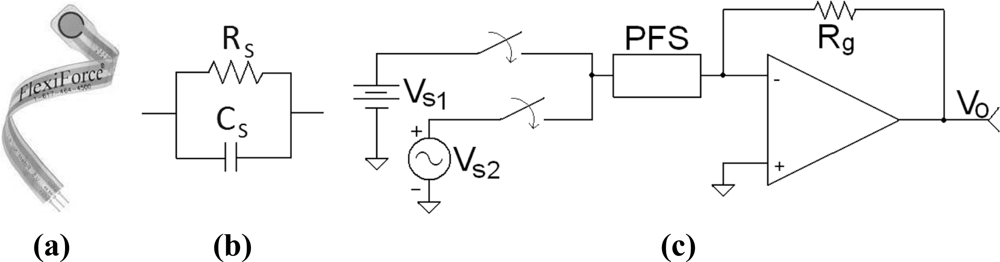
<p>Most research articles regarding the A201-100 sensor present performance comparisons among different piezoresistive devices [<xref ref-type="bibr" rid="b7-sensors-11-08836">7</xref>,<xref ref-type="bibr" rid="b8-sensors-11-08836">8</xref>] or describe applications developed using the aforementioned sensor [<xref ref-type="bibr" rid="b2-sensors-11-08836">2</xref>,<xref ref-type="bibr" rid="b3-sensors-11-08836">3</xref>,<xref ref-type="bibr" rid="b15-sensors-11-08836">15</xref>]. Only [<xref ref-type="bibr" rid="b20-sensors-11-08836">20</xref>,<xref ref-type="bibr" rid="b21-sensors-11-08836">21</xref>] present an electrical characterization of the device. In [<xref ref-type="bibr" rid="b20-sensors-11-08836">20</xref>,<xref ref-type="bibr" rid="b21-sensors-11-08836">21</xref>], a RC-parallel-electrical model [see <xref ref-type="fig" rid="f1-sensors-11-08836">Figure 1(b)</xref>] was identified for the PFS under study [see <xref ref-type="fig" rid="f1-sensors-11-08836">Figure 1(a)</xref>] with a typical driving circuit as shown in <xref ref-type="fig" rid="f1-sensors-11-08836">Figure 1(c)</xref> [<xref ref-type="bibr" rid="b24-sensors-11-08836">24</xref>]. When the sine wave, <italic>V<sub>s2</sub></italic>, is selected as input, the following set of equations from [<xref ref-type="bibr" rid="b20-sensors-11-08836">20</xref>] describes sensor response within its linear region of operation. First, a differential equation can be deduced from the circuit depicted in <xref ref-type="fig" rid="f1-sensors-11-08836">Figure 1(c)</xref> with <italic>V<sub>s2</sub></italic> as input:
<disp-formula id="FD1">
<label>(1)</label>
<mml:math display="block">
<mml:mrow>
<mml:mfrac>
<mml:mrow>
<mml:msub>
<mml:mi>V</mml:mi>
<mml:mrow>
<mml:mi>s</mml:mi>
<mml:mn>2</mml:mn></mml:mrow></mml:msub></mml:mrow>
<mml:mrow>
<mml:msub>
<mml:mi>R</mml:mi>
<mml:mi>s</mml:mi></mml:msub></mml:mrow></mml:mfrac>
<mml:mo>+</mml:mo>
<mml:msub>
<mml:mi>C</mml:mi>
<mml:mi>s</mml:mi></mml:msub>
<mml:mfrac>
<mml:mrow>
<mml:msub>
<mml:mi mathvariant="italic">dV</mml:mi>
<mml:mrow>
<mml:mi>s</mml:mi>
<mml:mn>2</mml:mn></mml:mrow></mml:msub></mml:mrow>
<mml:mrow>
<mml:mi mathvariant="italic">dt</mml:mi></mml:mrow></mml:mfrac>
<mml:mo>=</mml:mo>
<mml:mo>−</mml:mo>
<mml:mfrac>
<mml:mrow>
<mml:msub>
<mml:mi>V</mml:mi>
<mml:mi>o</mml:mi></mml:msub></mml:mrow>
<mml:mrow>
<mml:msub>
<mml:mi>R</mml:mi>
<mml:mi>g</mml:mi></mml:msub></mml:mrow></mml:mfrac></mml:mrow></mml:math></disp-formula>where <italic>R<sub>s</sub></italic> and <italic>C<sub>s</sub></italic> are sensor resistance and capacitance, respectively, from the model in <xref ref-type="fig" rid="f1-sensors-11-08836">Figure 1(b)</xref>.</p>
<p>Parameter <italic>R<sub>g</sub></italic> is the feedback resistor in the driving circuit of <xref ref-type="fig" rid="f1-sensors-11-08836">Figure 1(c)</xref> with <italic>V<sub>o</sub></italic> as the output voltage. Given the input:
<disp-formula id="FD2">
<label>(2)</label>
<mml:math display="block">
<mml:mrow>
<mml:msub>
<mml:mi>V</mml:mi>
<mml:mrow>
<mml:mi>s</mml:mi>
<mml:mn>2</mml:mn></mml:mrow></mml:msub>
<mml:mo>=</mml:mo>
<mml:msub>
<mml:mi>A</mml:mi>
<mml:mi>S</mml:mi></mml:msub>
<mml:mi> </mml:mi>
<mml:mtext>sin</mml:mtext>
<mml:mi> </mml:mi>
<mml:mo stretchy="false">(</mml:mo>
<mml:mn>2</mml:mn>
<mml:mi>π</mml:mi>
<mml:mi> </mml:mi>
<mml:mi mathvariant="italic">ft</mml:mi>
<mml:mo stretchy="false">)</mml:mo></mml:mrow></mml:math></disp-formula>the output voltage <italic>V<sub>o</sub></italic> can be expressed as:
<disp-formula id="FD3">
<label>(3)</label>
<mml:math display="block">
<mml:mrow>
<mml:msub>
<mml:mi>V</mml:mi>
<mml:mi>o</mml:mi></mml:msub>
<mml:mo>=</mml:mo>
<mml:mo>−</mml:mo>
<mml:msub>
<mml:mi>A</mml:mi>
<mml:mi>s</mml:mi></mml:msub>
<mml:msub>
<mml:mi>R</mml:mi>
<mml:mi>g</mml:mi></mml:msub>
<mml:mi> </mml:mi>
<mml:mrow>
<mml:mo>(</mml:mo>
<mml:mrow>
<mml:mfrac>
<mml:mrow>
<mml:mtext>sin</mml:mtext>
<mml:mi> </mml:mi>
<mml:mo stretchy="false">(</mml:mo>
<mml:mn>2</mml:mn>
<mml:mi>π</mml:mi>
<mml:mi> </mml:mi>
<mml:mi mathvariant="italic">ft</mml:mi>
<mml:mo stretchy="false">)</mml:mo></mml:mrow>
<mml:mrow>
<mml:msub>
<mml:mi>R</mml:mi>
<mml:mi>s</mml:mi></mml:msub></mml:mrow></mml:mfrac>
<mml:mo>+</mml:mo>
<mml:mn>2</mml:mn>
<mml:mi>π</mml:mi>
<mml:mi> </mml:mi>
<mml:msub>
<mml:mi mathvariant="italic">fC</mml:mi>
<mml:mi>s</mml:mi></mml:msub>
<mml:mi> </mml:mi>
<mml:mtext>cos</mml:mtext>
<mml:mi> </mml:mi>
<mml:mo stretchy="false">(</mml:mo>
<mml:mn>2</mml:mn>
<mml:mi>π</mml:mi>
<mml:mi> </mml:mi>
<mml:mi mathvariant="italic">ft</mml:mi>
<mml:mo stretchy="false">)</mml:mo></mml:mrow>
<mml:mo>)</mml:mo></mml:mrow></mml:mrow></mml:math></disp-formula></p>
<p>Then <xref ref-type="disp-formula" rid="FD3">Equation (3)</xref> may be rewritten in terms of the phase shift, <italic>θ</italic>, and output amplitude, <italic>A<sub>o</sub></italic>, as shown below:
<disp-formula id="FD4">
<label>(4)</label>
<mml:math display="block">
<mml:mrow>
<mml:msub>
<mml:mi>V</mml:mi>
<mml:mi>o</mml:mi></mml:msub>
<mml:mo>=</mml:mo>
<mml:msub>
<mml:mi>A</mml:mi>
<mml:mi>o</mml:mi></mml:msub>
<mml:mi> </mml:mi>
<mml:mtext>sin</mml:mtext>
<mml:mi> </mml:mi>
<mml:mo stretchy="false">(</mml:mo>
<mml:mn>2</mml:mn>
<mml:mi>π</mml:mi>
<mml:mi> </mml:mi>
<mml:mi mathvariant="italic">ft</mml:mi>
<mml:mo>+</mml:mo>
<mml:mi>θ</mml:mi>
<mml:mo stretchy="false">)</mml:mo></mml:mrow></mml:math></disp-formula></p>
<p>Finally, combining <xref ref-type="disp-formula" rid="FD3">Equations (3)</xref> and <xref ref-type="disp-formula" rid="FD4">(4)</xref> yields:
<disp-formula id="FD5">
<label>(5)</label>
<mml:math display="block">
<mml:mrow>
<mml:msub>
<mml:mi>R</mml:mi>
<mml:mi>s</mml:mi></mml:msub>
<mml:mo>=</mml:mo>
<mml:mfrac>
<mml:mrow>
<mml:msub>
<mml:mi>R</mml:mi>
<mml:mi>g</mml:mi></mml:msub>
<mml:msub>
<mml:mi>A</mml:mi>
<mml:mi>s</mml:mi></mml:msub></mml:mrow>
<mml:mrow>
<mml:msub>
<mml:mi>A</mml:mi>
<mml:mi>o</mml:mi></mml:msub>
<mml:mi> </mml:mi>
<mml:mtext>cos</mml:mtext>
<mml:mi> </mml:mi>
<mml:mo stretchy="false">(</mml:mo>
<mml:mi>θ</mml:mi>
<mml:mo stretchy="false">)</mml:mo></mml:mrow></mml:mfrac></mml:mrow></mml:math></disp-formula>and
<disp-formula id="FD6">
<label>(6)</label>
<mml:math display="block">
<mml:mrow>
<mml:msub>
<mml:mi>C</mml:mi>
<mml:mi>s</mml:mi></mml:msub>
<mml:mo>=</mml:mo>
<mml:mfrac>
<mml:mrow>
<mml:msub>
<mml:mi>A</mml:mi>
<mml:mi>o</mml:mi></mml:msub>
<mml:mi> </mml:mi>
<mml:mi mathvariant="italic">sin</mml:mi>
<mml:mo stretchy="false">(</mml:mo>
<mml:mi>θ</mml:mi>
<mml:mo stretchy="false">)</mml:mo></mml:mrow>
<mml:mrow>
<mml:msub>
<mml:mi>R</mml:mi>
<mml:mi>g</mml:mi></mml:msub>
<mml:msub>
<mml:mi>A</mml:mi>
<mml:mi>s</mml:mi></mml:msub>
<mml:mn>2</mml:mn>
<mml:mi>π</mml:mi>
<mml:mi> </mml:mi>
<mml:mi>f</mml:mi></mml:mrow></mml:mfrac></mml:mrow></mml:math></disp-formula></p>
<p><xref ref-type="disp-formula" rid="FD6">Equation (6)</xref> was already used in [<xref ref-type="bibr" rid="b20-sensors-11-08836">20</xref>,<xref ref-type="bibr" rid="b21-sensors-11-08836">21</xref>] to demonstrate that the PFS exhibits a piezocapacitive response that is useful for reducing force-estimation errors.</p></sec>
<sec>
<label>3.</label>
<title>Amplitude Nonlinearity of the PFS under DC Sourcing</title>
<p>Besides the already-identified frequency nonlinearity [<xref ref-type="bibr" rid="b21-sensors-11-08836">21</xref>], the PFS exhibits amplitude nonlinearity. Initially, this study only looks at the nonlinearity for input voltages within the (−1 V, 1 V) range. An approach is then presented for higher input voltages. The analysis of amplitude nonlinearity is perforce split in two, because the sensor exhibits quasi-different responses, depending on the input voltage applied.</p>
<sec>
<label>3.1.</label>
<title>Modeling Amplitude Nonlinearity for Input Voltages below 1V</title>
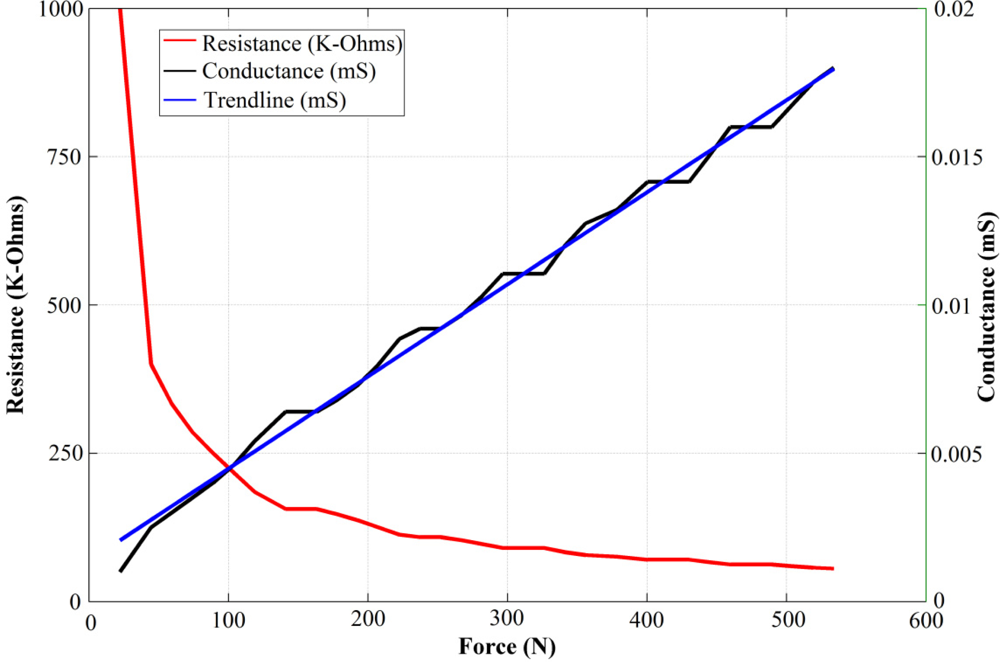
<p>If the DC source, <italic>V<sub>s1</sub></italic>, is chosen as the input of the driving circuit in <xref ref-type="fig" rid="f1-sensors-11-08836">Figure 1(c)</xref>, a DC output voltage, <italic>V<sub>o</sub></italic>, is obtained that changes linearly as the applied force on the sensor increases (see <xref ref-type="fig" rid="f2-sensors-11-08836">Figure 2</xref>) [<xref ref-type="bibr" rid="b25-sensors-11-08836">25</xref>]. This response corresponds to the piezoresistive property of the sensor and it has been thoroughly described by the sensor manufacturer [<xref ref-type="bibr" rid="b24-sensors-11-08836">24</xref>] and many research articles [<xref ref-type="bibr" rid="b4-sensors-11-08836">4</xref>,<xref ref-type="bibr" rid="b7-sensors-11-08836">7</xref>,<xref ref-type="bibr" rid="b8-sensors-11-08836">8</xref>,<xref ref-type="bibr" rid="b17-sensors-11-08836">17</xref>,<xref ref-type="bibr" rid="b20-sensors-11-08836">20</xref>,<xref ref-type="bibr" rid="b22-sensors-11-08836">22</xref>,<xref ref-type="bibr" rid="b26-sensors-11-08836">26</xref>]. However, to the best of our knowledge, no information is available about how the output voltage changes for a fixed force when the DC voltage is varied.</p>
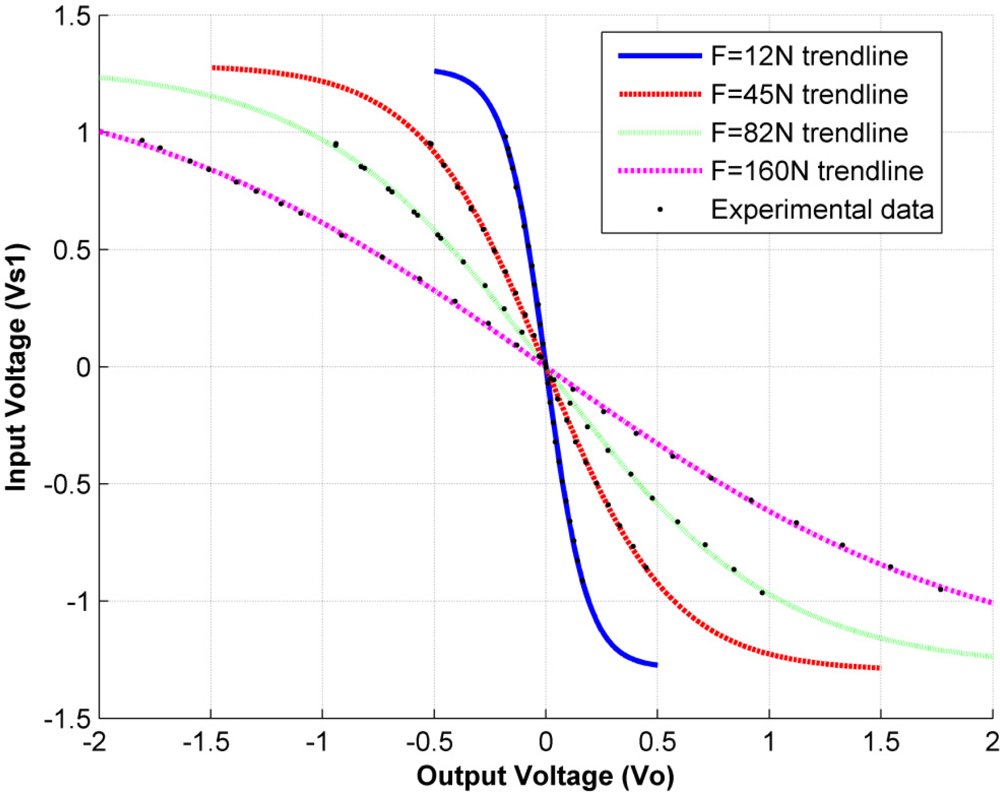
<p>In order to study such behavior, the input voltage, <italic>V<sub>s1</sub></italic>, is swept from −1 V up to 1 V, and the output voltage, <italic>V<sub>o</sub></italic>, is plotted while the applied force remains constant. It is important to remark that these measurements are carried out by using a constant-puck area of 50.3 mm<sup>2</sup>, smaller than the sensor’s sensing area of 71.3 mm<sup>2</sup>, this ensures that every sensor is evenly loaded in each trial and avoids the pressure falling outside the sensing area of the sensor. <xref ref-type="fig" rid="f3-sensors-11-08836">Figure 3</xref> shows the output voltage for randomly chosen forces of 12 N, 45 N, 82 N and 160 N. The best function for relating the input voltage, <italic>V<sub>s1</sub></italic>, to the corresponding sensor response, <italic>V<sub>o</sub></italic>, is found to be:
<disp-formula id="FD7">
<label>(7)</label>
<mml:math display="block">
<mml:mrow>
<mml:msub>
<mml:mi>V</mml:mi>
<mml:mi>o</mml:mi></mml:msub>
<mml:mo>=</mml:mo>
<mml:mo>−</mml:mo>
<mml:mfrac>
<mml:mn>1</mml:mn>
<mml:mi>q</mml:mi></mml:mfrac>
<mml:mtext>atanh</mml:mtext>
<mml:mi> </mml:mi>
<mml:mo stretchy="false">(</mml:mo>
<mml:mfrac>
<mml:mrow>
<mml:msub>
<mml:mi>V</mml:mi>
<mml:mrow>
<mml:mi>s</mml:mi>
<mml:mn>1</mml:mn></mml:mrow></mml:msub></mml:mrow>
<mml:mrow>
<mml:mi>k</mml:mi></mml:mrow></mml:mfrac>
<mml:mo stretchy="false">)</mml:mo></mml:mrow></mml:math></disp-formula>where <italic>k</italic> and <italic>q</italic> are constants. However, it is inadvisable to fit <italic>k</italic> and <italic>q</italic> in the form presented in <xref ref-type="disp-formula" rid="FD7">Equation (7)</xref>, because <italic>V<sub>o</sub></italic> may yield complex values since the <italic>atanh</italic> domain is restricted to (−1, 1). Thus, for fitting purposes it is better to rewrite <xref ref-type="disp-formula" rid="FD7">Equation (7)</xref> in terms of the <italic>tanh</italic> function as follows:
<disp-formula id="FD8">
<label>(8)</label>
<mml:math display="block">
<mml:mrow>
<mml:msub>
<mml:mi>V</mml:mi>
<mml:mrow>
<mml:mi>s</mml:mi>
<mml:mn>1</mml:mn></mml:mrow></mml:msub>
<mml:mo>=</mml:mo>
<mml:mi>k</mml:mi>
<mml:mi> </mml:mi>
<mml:mtext>tanh</mml:mtext>
<mml:mi> </mml:mi>
<mml:mo stretchy="false">(</mml:mo>
<mml:mo>−</mml:mo>
<mml:mi>q</mml:mi>
<mml:msub>
<mml:mi>V</mml:mi>
<mml:mi>o</mml:mi></mml:msub>
<mml:mo stretchy="false">)</mml:mo></mml:mrow></mml:math></disp-formula></p>
<p>The minus sign in <xref ref-type="disp-formula" rid="FD7">Equations (7)</xref> and <xref ref-type="disp-formula" rid="FD8">(8)</xref> comes from the negative gain in the inverting amplifier [see <xref ref-type="fig" rid="f1-sensors-11-08836">Figure 1(c)</xref>] used to drive the sensor. The axes in <xref ref-type="fig" rid="f3-sensors-11-08836">Figure 3</xref> are intentionally switched to represent <italic>V<sub>o</sub></italic> on the x-axis and <italic>V<sub>s1</sub></italic> on the y-axis with the aim of fitting the data points with <xref ref-type="disp-formula" rid="FD8">Equation (8)</xref> instead of <xref ref-type="disp-formula" rid="FD7">Equation (7)</xref>. The fitting process is highly fiable, with a coefficient of determination, <italic>R<sup>2</sup></italic>, of at least <italic>R<sup>2</sup></italic> = 0.9992 for every applied force and an average <italic>R<sup>2</sup></italic> value of 0.9995.</p>
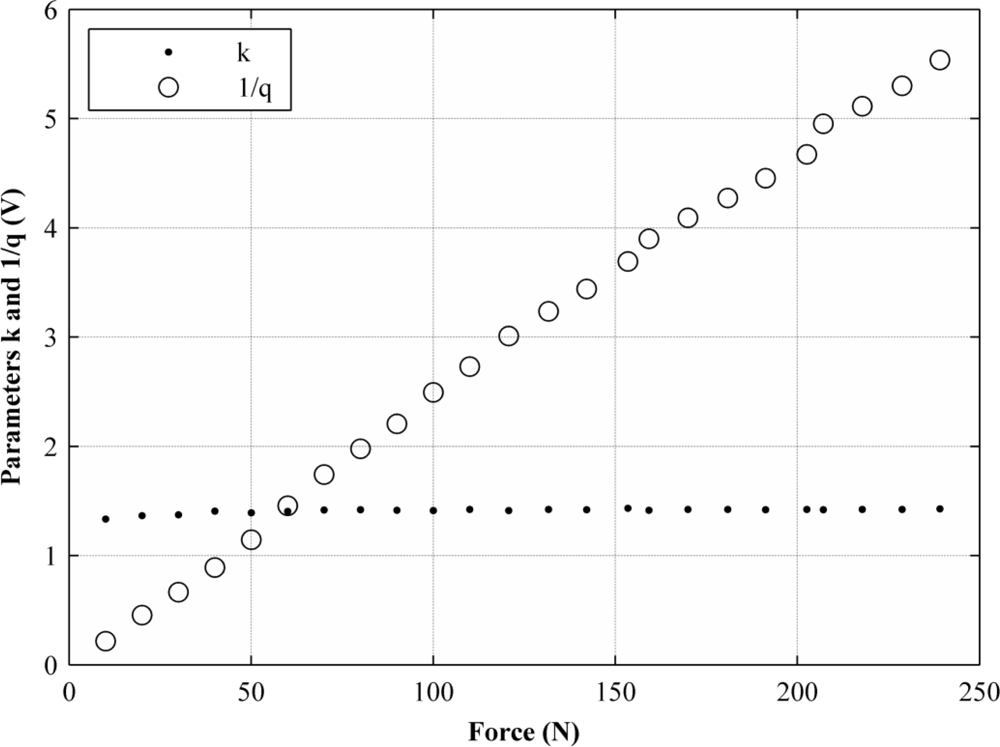
<p>Parameters <italic>k</italic> and <italic>q</italic> were set to adjust independently for every applied force, however, the independent fitting processes returned values of <italic>k</italic> that remained almost constant, regardless of the exerted force, <italic>F</italic>, whereas <italic>q</italic> was shown to be hyperbolically dependent on the exerted force. In other words, <italic>1/q</italic> is a linear function of <italic>F</italic>. <xref ref-type="fig" rid="f4-sensors-11-08836">Figure 4</xref> shows the variation of <italic>k</italic> and <italic>1/q</italic> for different applied forces within the 0 N–250 N range resulting from independent fitting processes.</p>
<p>In order to get a comprehensive view of sensor behavior, a relationship between <xref ref-type="disp-formula" rid="FD8">Equation (8)</xref> and <italic>F</italic> must be found. For that purpose, the fact that the sensor exhibits piezoresistive behavior is useful, as thus its conductance, <italic>1/R<sub>s</sub></italic>, may be modeled in terms of the applied force, <italic>F</italic>, as:
<disp-formula id="FD9">
<label>(9)</label>
<mml:math display="block">
<mml:mrow>
<mml:mn>1</mml:mn>
<mml:mo>/</mml:mo>
<mml:msub>
<mml:mi>R</mml:mi>
<mml:mi>s</mml:mi></mml:msub>
<mml:mo>=</mml:mo>
<mml:mi mathvariant="italic">m F</mml:mi>
<mml:mo>+</mml:mo>
<mml:mi>b</mml:mi></mml:mrow></mml:math></disp-formula></p>
<p><xref ref-type="disp-formula" rid="FD9">Equation (9)</xref> is not explicitly stated in the PFS user manual [<xref ref-type="bibr" rid="b24-sensors-11-08836">24</xref>], however, the sensor manufacturer does declare that a linear interpolation between the conductance values and the applied forces can be done. Also, it can be easily deduced from a look at the conductance curve in <xref ref-type="fig" rid="f2-sensors-11-08836">Figure 2</xref> that <xref ref-type="disp-formula" rid="FD9">Equation (9)</xref> is a valid fit for <italic>1/R<sub>s</sub></italic>. Considering the inverting amplifier with feedback resistor <italic>R<sub>g</sub></italic>, which is used to drive the PFS, it is possible to link <xref ref-type="disp-formula" rid="FD9">Equation (9)</xref> with the amplifier characteristic equation:
<disp-formula id="FD10">
<label>(10)</label>
<mml:math display="block">
<mml:mrow>
<mml:mfrac>
<mml:mrow>
<mml:msub>
<mml:mi>V</mml:mi>
<mml:mi>o</mml:mi></mml:msub></mml:mrow>
<mml:mrow>
<mml:msub>
<mml:mi>V</mml:mi>
<mml:mrow>
<mml:mi>s</mml:mi>
<mml:mn>1</mml:mn></mml:mrow></mml:msub></mml:mrow></mml:mfrac>
<mml:mo>=</mml:mo>
<mml:mo>−</mml:mo>
<mml:mfrac>
<mml:mrow>
<mml:msub>
<mml:mi>R</mml:mi>
<mml:mi>g</mml:mi></mml:msub></mml:mrow>
<mml:mrow>
<mml:msub>
<mml:mi>R</mml:mi>
<mml:mi>s</mml:mi></mml:msub></mml:mrow></mml:mfrac></mml:mrow></mml:math></disp-formula>to obtain:
<disp-formula id="FD11">
<label>(11)</label>
<mml:math display="block">
<mml:mrow>
<mml:mfrac>
<mml:mrow>
<mml:msub>
<mml:mi>V</mml:mi>
<mml:mi>o</mml:mi></mml:msub></mml:mrow>
<mml:mrow>
<mml:msub>
<mml:mi>V</mml:mi>
<mml:mrow>
<mml:mi>s</mml:mi>
<mml:mn>1</mml:mn></mml:mrow></mml:msub></mml:mrow></mml:mfrac>
<mml:mo>=</mml:mo>
<mml:mo>−</mml:mo>
<mml:msub>
<mml:mi>R</mml:mi>
<mml:mi>g</mml:mi></mml:msub>
<mml:mi> </mml:mi>
<mml:mo stretchy="false">(</mml:mo>
<mml:mi mathvariant="italic">mF</mml:mi>
<mml:mo>+</mml:mo>
<mml:mi>b</mml:mi>
<mml:mo stretchy="false">)</mml:mo></mml:mrow></mml:math></disp-formula></p>
<p>We should clarify that <xref ref-type="disp-formula" rid="FD11">Equation (11)</xref> is not explicitly stated in the PFS user manual [<xref ref-type="bibr" rid="b24-sensors-11-08836">24</xref>], and only <xref ref-type="disp-formula" rid="FD10">Equation (10)</xref> is given in [<xref ref-type="bibr" rid="b24-sensors-11-08836">24</xref>], but the manufacturer suggests that the sensor sensitivity, <italic>m</italic>, can be changed by either replacing the feedback resistor, <italic>R<sub>g</sub></italic>, or changing the driving voltage, <italic>V<sub>s1</sub></italic>.</p>
<p>With the aim of demonstrating that <xref ref-type="disp-formula" rid="FD11">Equation (11)</xref> is an approximate expression for fitting the data points from <xref ref-type="fig" rid="f3-sensors-11-08836">Figure 3</xref>, the <italic>1/q</italic> curve from <xref ref-type="fig" rid="f4-sensors-11-08836">Figure 4</xref> is taken and represented as linearly dependent on the applied force:
<disp-formula id="FD12">
<label>(12)</label>
<mml:math display="block">
<mml:mrow>
<mml:mn>1</mml:mn>
<mml:mo>/</mml:mo>
<mml:mi>q</mml:mi>
<mml:mo>=</mml:mo>
<mml:msup>
<mml:mi>m</mml:mi>
<mml:mo>′</mml:mo></mml:msup>
<mml:mi>F</mml:mi>
<mml:mo>+</mml:mo>
<mml:msup>
<mml:mi>b</mml:mi>
<mml:mo>′</mml:mo></mml:msup></mml:mrow></mml:math></disp-formula></p>
<p>Note that the <italic>1/q</italic> curve in <xref ref-type="fig" rid="f4-sensors-11-08836">Figure 4</xref> is analogous to the conductance curve of <xref ref-type="fig" rid="f2-sensors-11-08836">Figure 2</xref>. <xref ref-type="disp-formula" rid="FD12">Equation (12)</xref> can be substituted into <xref ref-type="disp-formula" rid="FD7">Equation (7)</xref>, yielding:
<disp-formula id="FD13">
<label>(13)</label>
<mml:math display="block">
<mml:mrow>
<mml:msub>
<mml:mi>V</mml:mi>
<mml:mi>o</mml:mi></mml:msub>
<mml:mo>=</mml:mo>
<mml:mo>−</mml:mo>
<mml:mo stretchy="false">(</mml:mo>
<mml:msup>
<mml:mi>m</mml:mi>
<mml:mo>′</mml:mo></mml:msup>
<mml:mi>F</mml:mi>
<mml:mo>+</mml:mo>
<mml:msup>
<mml:mi>b</mml:mi>
<mml:mo>′</mml:mo></mml:msup>
<mml:mo stretchy="false">)</mml:mo>
<mml:mi> </mml:mi>
<mml:mtext>atanh</mml:mtext>
<mml:mi> </mml:mi>
<mml:mrow>
<mml:mo>(</mml:mo>
<mml:mrow>
<mml:mfrac>
<mml:mrow>
<mml:msub>
<mml:mi>V</mml:mi>
<mml:mrow>
<mml:mi>s</mml:mi>
<mml:mn>1</mml:mn></mml:mrow></mml:msub></mml:mrow>
<mml:mrow>
<mml:mi>k</mml:mi></mml:mrow></mml:mfrac></mml:mrow>
<mml:mo>)</mml:mo></mml:mrow></mml:mrow></mml:math></disp-formula></p>
<p>Nevertheless, <xref ref-type="disp-formula" rid="FD13">Equation (13)</xref> cannot be stated the same way as <xref ref-type="disp-formula" rid="FD11">Equation (11)</xref>, because the input voltage, <italic>V<sub>s1</sub></italic>, is part of the <italic>atanh</italic> argument, but if only the first term of the <italic>atanh</italic>-Taylor series is taken, the following approximate expression is obtained:
<disp-formula id="FD14">
<label>(14)</label>
<mml:math display="block">
<mml:mrow>
<mml:mfrac>
<mml:mrow>
<mml:msub>
<mml:mi>V</mml:mi>
<mml:mi>o</mml:mi></mml:msub></mml:mrow>
<mml:mrow>
<mml:msub>
<mml:mi>V</mml:mi>
<mml:mrow>
<mml:mi>s</mml:mi>
<mml:mn>1</mml:mn></mml:mrow></mml:msub></mml:mrow></mml:mfrac>
<mml:mo>=</mml:mo>
<mml:mfrac>
<mml:mrow>
<mml:mo>−</mml:mo>
<mml:mn>1</mml:mn></mml:mrow>
<mml:mi>k</mml:mi></mml:mfrac>
<mml:mi> </mml:mi>
<mml:mo stretchy="false">(</mml:mo>
<mml:msup>
<mml:mi>m</mml:mi>
<mml:mo>′</mml:mo></mml:msup>
<mml:mi>F</mml:mi>
<mml:mo>+</mml:mo>
<mml:msup>
<mml:mi>b</mml:mi>
<mml:mo>′</mml:mo></mml:msup>
<mml:mo stretchy="false">)</mml:mo></mml:mrow></mml:math></disp-formula></p>
<p><xref ref-type="disp-formula" rid="FD14">Equation (14)</xref> is an approximate expression for modeling sensor response, and so is <xref ref-type="disp-formula" rid="FD11">Equation (11)</xref>. The <italic>1/k</italic> factor in <xref ref-type="disp-formula" rid="FD14">Equation (14)</xref> is analogous to <italic>R<sub>g</sub></italic> in <xref ref-type="disp-formula" rid="FD11">Equation (11)</xref>, in the same way that <italic>m</italic> is analogous to <italic>m′</italic>, <italic>b</italic> to <italic>b′</italic> and <italic>1/R<sub>s</sub></italic> to <italic>1/q</italic>. <xref ref-type="disp-formula" rid="FD11">Equations (11)</xref> and <xref ref-type="disp-formula" rid="FD14">(14)</xref> are valid if and only if the input voltage remains constant during the measurement process; this condition matches the driving conditions recommended by the manufacturer [<xref ref-type="bibr" rid="b24-sensors-11-08836">24</xref>].</p></sec>
<sec>
<label>3.2.</label>
<title>Effect of the Feedback Resistor in Sensor Response</title>
<p>The effect of the feedback resistor can be deduced from the fact that <italic>R<sub>g</sub></italic> only changes the feedback gain of the amplifier, without affecting sensor current. Thus, changing <italic>R<sub>g</sub></italic> will produce directly proportional changes in the output voltage, and <xref ref-type="disp-formula" rid="FD13">Equation (13)</xref> can be rewritten as:
<disp-formula id="FD15">
<label>(15)</label>
<mml:math display="block">
<mml:mrow>
<mml:msub>
<mml:mi>V</mml:mi>
<mml:mi>o</mml:mi></mml:msub>
<mml:mo>=</mml:mo>
<mml:mo>−</mml:mo>
<mml:mrow>
<mml:mo>(</mml:mo>
<mml:mrow>
<mml:mfrac>
<mml:mrow>
<mml:msub>
<mml:mi>R</mml:mi>
<mml:mi>g</mml:mi></mml:msub></mml:mrow>
<mml:mrow>
<mml:msub>
<mml:mi>R</mml:mi>
<mml:mrow>
<mml:mi mathvariant="italic">ref</mml:mi></mml:mrow></mml:msub></mml:mrow></mml:mfrac></mml:mrow>
<mml:mo>)</mml:mo></mml:mrow>
<mml:mi> </mml:mi>
<mml:mo stretchy="false">(</mml:mo>
<mml:msup>
<mml:mi>m</mml:mi>
<mml:mo>′</mml:mo></mml:msup>
<mml:mi>F</mml:mi>
<mml:mo>+</mml:mo>
<mml:msup>
<mml:mi>b</mml:mi>
<mml:mo>′</mml:mo></mml:msup>
<mml:mo stretchy="false">)</mml:mo>
<mml:mi> </mml:mi>
<mml:mtext>atanh</mml:mtext>
<mml:mi> </mml:mi>
<mml:mrow>
<mml:mo>(</mml:mo>
<mml:mrow>
<mml:mfrac>
<mml:mrow>
<mml:msub>
<mml:mi>V</mml:mi>
<mml:mrow>
<mml:mi>s</mml:mi>
<mml:mn>1</mml:mn></mml:mrow></mml:msub></mml:mrow>
<mml:mrow>
<mml:mi>k</mml:mi></mml:mrow></mml:mfrac></mml:mrow>
<mml:mo>)</mml:mo></mml:mrow></mml:mrow></mml:math></disp-formula></p>
<p>Henceforth <xref ref-type="disp-formula" rid="FD15">Equation (15)</xref> is referred to as “the general-sensor model” under DC sourcing, with the restriction |<italic>V<sub>s1</sub></italic>| &lt; <italic>1 V</italic>, where <italic>R<sub>ref</sub></italic> is the feedback resistor used during the characterization to obtain the values of <italic>m′</italic>, <italic>b′</italic> and <italic>k</italic>. In case the feedback resistor is changed after the characterization process, the output voltage is multiplied by the ratio <italic>R<sub>g</sub>/R<sub>ref</sub></italic> where <italic>R<sub>g</sub></italic> is the new feedback resistor. Replacing the feedback resistor produces a directly proportional change in the output voltage, because the amplifier is inherently linear, whereas sensor resistance is not. In fact, linking <xref ref-type="disp-formula" rid="FD7">Equations (7)</xref>, <xref ref-type="disp-formula" rid="FD10">(10)</xref> and <xref ref-type="disp-formula" rid="FD12">(12)</xref> produces an expression that shows the nonlinear behavior of sensor conductance in response to changes in the input voltage:
<disp-formula id="FD16">
<label>(16)</label>
<mml:math display="block">
<mml:mrow>
<mml:mfrac>
<mml:mn>1</mml:mn>
<mml:mrow>
<mml:msub>
<mml:mi>R</mml:mi>
<mml:mi>s</mml:mi></mml:msub></mml:mrow></mml:mfrac>
<mml:mo>=</mml:mo>
<mml:mo stretchy="false">(</mml:mo>
<mml:msup>
<mml:mi>m</mml:mi>
<mml:mo>′</mml:mo></mml:msup>
<mml:mi>F</mml:mi>
<mml:mo>+</mml:mo>
<mml:msup>
<mml:mi>b</mml:mi>
<mml:mo>′</mml:mo></mml:msup>
<mml:mo stretchy="false">)</mml:mo>
<mml:mfrac>
<mml:mrow>
<mml:mtext>atanh</mml:mtext>
<mml:mi> </mml:mi>
<mml:mo stretchy="false">(</mml:mo>
<mml:msub>
<mml:mi>V</mml:mi>
<mml:mrow>
<mml:mi>s</mml:mi>
<mml:mn>1</mml:mn></mml:mrow></mml:msub>
<mml:mo>/</mml:mo>
<mml:mi>k</mml:mi>
<mml:mo stretchy="false">)</mml:mo></mml:mrow>
<mml:mrow>
<mml:msub>
<mml:mi>V</mml:mi>
<mml:mrow>
<mml:mi>s</mml:mi>
<mml:mn>1</mml:mn></mml:mrow></mml:msub>
<mml:mi> </mml:mi>
<mml:msub>
<mml:mi>R</mml:mi>
<mml:mi>g</mml:mi></mml:msub></mml:mrow></mml:mfrac></mml:mrow></mml:math></disp-formula></p>
<p>However, it must be noted from <xref ref-type="disp-formula" rid="FD16">Equation (16)</xref> that sensor conductance is always linear to force changes.</p></sec>
<sec>
<label>3.3.</label>
<title>Generalized Method for Obtaining a Specific Sensitivity in Sensor Response</title>
<p>Since a general-sensor model was deduced in <xref ref-type="disp-formula" rid="FD15">Equation (15)</xref>, a generalized method can be presented for obtaining a specific sensitivity in the sensor. The tests discussed in this section were done using four A201-100 sensors to provide more representative results. Each PFS exhibits a considerably different sensitivity. This condition prevents the sensors from having plug-and-play capability, because a characterization must be run before using a sensor. Moreover, for characterizations run at a given input voltage, it has been impossible until now to determine the new values of <italic>m</italic> and <italic>b</italic> under the new input voltage condition, because the amplitude nonlinearity was not accounted for. Nevertheless, <xref ref-type="disp-formula" rid="FD15">Equation (15)</xref> accounts for changes in both the input voltage, <italic>V<sub>s1</sub></italic>, and the feedback resistor, <italic>R<sub>g</sub></italic>. This implies that if <italic>m′</italic>, <italic>b′</italic>, <italic>k</italic>, and <italic>R<sub>ref</sub></italic> are given, it is possible to either determine sensor sensitivity for any input voltage and feedback resistor or design a specific driving circuit ,<italic>V<sub>s1</sub></italic> and <italic>R<sub>g</sub></italic>, with the aim of matching a target sensitivity.</p>
<p>Note that the <italic>k</italic> factor in <xref ref-type="disp-formula" rid="FD15">Equation (15)</xref> contains information about sensor sensitivity for any input voltage. Unfortunately, the <italic>k</italic> factor is different for each sensor, just as sensitivity is too. The range of variation of the <italic>k</italic> factor for the four sensors under study was from 1.2 V to 1.5 V, with an average value of 1.41 V. If <italic>k</italic> is not given, the only way to change sensor sensitivity is to replace the feedback resistor, <italic>R<sub>g</sub></italic>; but, in certain applications where several sensors are being used [<xref ref-type="bibr" rid="b1-sensors-11-08836">1</xref>,<xref ref-type="bibr" rid="b16-sensors-11-08836">16</xref>,<xref ref-type="bibr" rid="b21-sensors-11-08836">21</xref>,<xref ref-type="bibr" rid="b23-sensors-11-08836">23</xref>], it is more convenient to change the driving voltage instead of changing individual feedback resistors. In addition, the feedback resistor is increased despite an increase in the noise level, so it is better to match a desired sensitivity by making a trade-off between <italic>V<sub>s1</sub></italic> and <italic>R<sub>g</sub></italic>.</p>
<p>With the aim of proposing a method for obtaining a specific PFS sensitivity, it is necessary to fit the general-sensor model in <xref ref-type="disp-formula" rid="FD15">Equation (15)</xref> to the experimental data. However, the feedback resistor must not play any role in the fitting process, because <italic>R<sub>g</sub></italic> only affects the closed loop gain of the amplifier, not the sensor response itself. Thus, it is better to use <xref ref-type="disp-formula" rid="FD13">Equation (13)</xref> for the fit instead of <xref ref-type="disp-formula" rid="FD15">Equation (15)</xref>. In order to avoid complex numbers resulting from <xref ref-type="disp-formula" rid="FD13">Equation (13)</xref> during the fit, <xref ref-type="disp-formula" rid="FD13">Equation (13)</xref> is rewritten in terms of the <italic>tanh</italic> function as shown below:
<disp-formula id="FD17">
<label>(17)</label>
<mml:math display="block">
<mml:mrow>
<mml:msub>
<mml:mi>V</mml:mi>
<mml:mrow>
<mml:mi>s</mml:mi>
<mml:mn>1</mml:mn></mml:mrow></mml:msub>
<mml:mo>=</mml:mo>
<mml:mo>−</mml:mo>
<mml:mi>k</mml:mi>
<mml:mi> </mml:mi>
<mml:mtext>tanh</mml:mtext>
<mml:mi> </mml:mi>
<mml:mrow>
<mml:mo>(</mml:mo>
<mml:mrow>
<mml:mfrac>
<mml:mrow>
<mml:msub>
<mml:mi>V</mml:mi>
<mml:mi>o</mml:mi></mml:msub></mml:mrow>
<mml:mrow>
<mml:msup>
<mml:mi>m</mml:mi>
<mml:mo>′</mml:mo></mml:msup>
<mml:mi>F</mml:mi>
<mml:mo>+</mml:mo>
<mml:msup>
<mml:mi>b</mml:mi>
<mml:mo>′</mml:mo></mml:msup></mml:mrow></mml:mfrac></mml:mrow>
<mml:mo>)</mml:mo></mml:mrow></mml:mrow></mml:math></disp-formula></p>
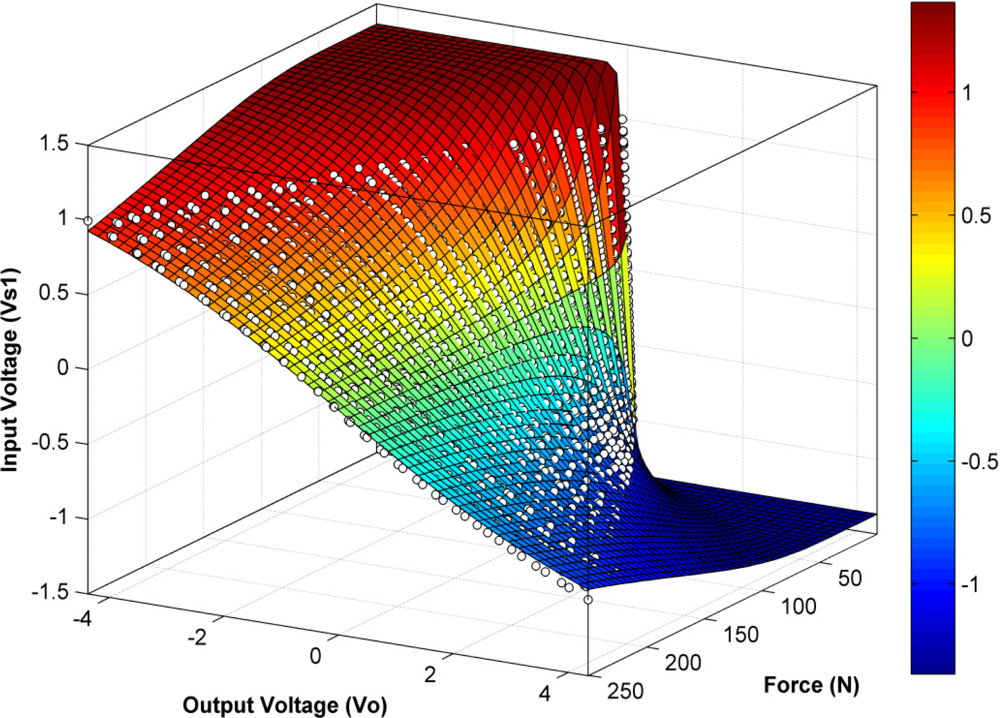
<p>Note that <xref ref-type="disp-formula" rid="FD17">Equation (17)</xref> implies a three-dimensional fit in terms of the variables <italic>F</italic>, <italic>V<sub>o</sub></italic> and <italic>V<sub>s1</sub></italic>, with coefficients <italic>m′</italic>, <italic>b′</italic> and <italic>k</italic> to be determined.</p>
<p>In practice, the experimental data were gathered in the same way as described in Section 3.1. Nevertheless, the fit here described embraces all variables and coefficients at once (<italic>F</italic>, <italic>V<sub>o</sub></italic>, <italic>V<sub>s1</sub></italic>, <italic>m′</italic>, <italic>b′</italic> and <italic>k</italic>), whereas the fitting process in Section 3.1 was split into two independent threads. This is an important difference, because the fit here tries to minimize the overall error, while the process in Section 3.1 independently minimizes the error for every exerted force.</p>
<p><xref ref-type="fig" rid="f5-sensors-11-08836">Figure 5</xref> shows the experimental data points and the surface produced by the three-dimensional fit in <xref ref-type="disp-formula" rid="FD17">Equation (17)</xref>. For this case, the values of <italic>R<sup>2</sup></italic> were in general lower than for the fits given in Section 3.1. The minimum value of <italic>R<sup>2</sup></italic> for the four sensors under study was <italic>R<sup>2</sup></italic> = 0.989, with an average value of <italic>R<sup>2</sup></italic> = 0.991; this is comprehensible, because all forces and voltages were embraced in a single fit, and thus a single <italic>k</italic> value was returned.</p>
<p>Once the fit is done, it is possible to assemble the general-sensor equation by substituting into <xref ref-type="disp-formula" rid="FD15">Equation (15)</xref> the coefficient values returned from the fit (<italic>m′</italic>, <italic>b′</italic> and <italic>k</italic>) and the value of the feedback resistor used during the characterization process, which matches <italic>R<sub>ref</sub></italic> in <xref ref-type="disp-formula" rid="FD15">Equation (15)</xref>. If <italic>R<sub>g</sub></italic> or <italic>V<sub>s1</sub></italic> are changed at any time, it is possible to recalculate <italic>m</italic> and <italic>b</italic> from <xref ref-type="disp-formula" rid="FD15">Equation (15)</xref>; or, if the feedback resistor, <italic>R<sub>g</sub></italic>, is fixed by the application circuit, the target sensitivity, <italic>m<sub>t</sub></italic>, can be obtained by choosing the appropriate <italic>V<sub>s1</sub></italic> from <xref ref-type="disp-formula" rid="FD15">Equation (15)</xref> as shown below:
<disp-formula id="FD18">
<label>(18)</label>
<mml:math display="block">
<mml:mrow>
<mml:msub>
<mml:mi>V</mml:mi>
<mml:mrow>
<mml:mi>s</mml:mi>
<mml:mn>1</mml:mn></mml:mrow></mml:msub>
<mml:mo>=</mml:mo>
<mml:mi>k</mml:mi>
<mml:mi> </mml:mi>
<mml:mtext>tanh</mml:mtext>
<mml:mi> </mml:mi>
<mml:mrow>
<mml:mo>(</mml:mo>
<mml:mrow>
<mml:mfrac>
<mml:mrow>
<mml:msub>
<mml:mi>m</mml:mi>
<mml:mi>t</mml:mi></mml:msub></mml:mrow>
<mml:mrow>
<mml:msup>
<mml:mi>m</mml:mi>
<mml:mo>′</mml:mo></mml:msup></mml:mrow></mml:mfrac>
<mml:mfrac>
<mml:mrow>
<mml:msub>
<mml:mi>R</mml:mi>
<mml:mrow>
<mml:mi mathvariant="italic">ref</mml:mi></mml:mrow></mml:msub></mml:mrow>
<mml:mrow>
<mml:msub>
<mml:mi>R</mml:mi>
<mml:mi>g</mml:mi></mml:msub></mml:mrow></mml:mfrac></mml:mrow>
<mml:mo>)</mml:mo></mml:mrow></mml:mrow></mml:math></disp-formula></p>
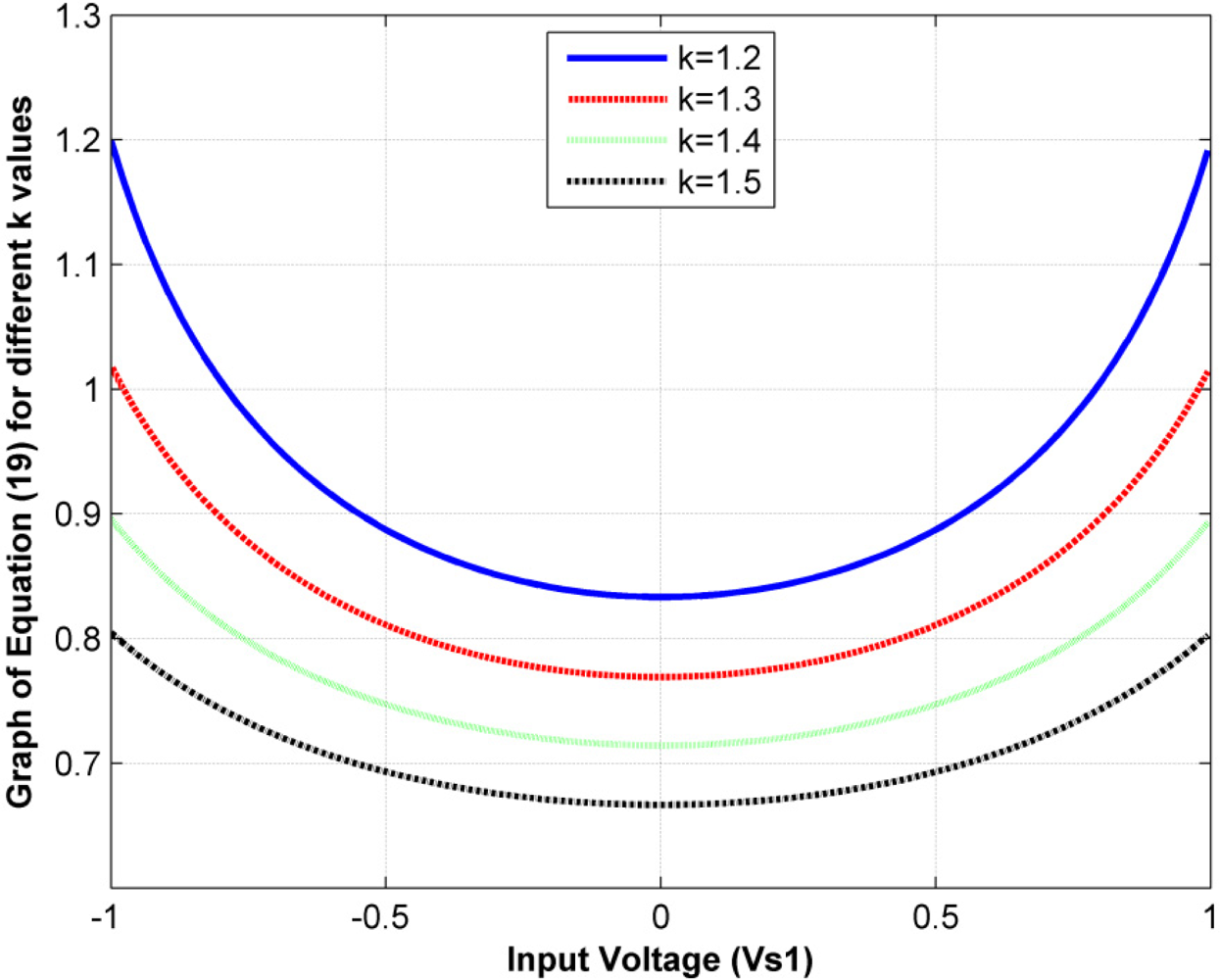
<p>However, <xref ref-type="disp-formula" rid="FD18">Equation (18)</xref> is valid if and only if the predicted input voltage is lower than 1 V, because only the amplitude nonlinearity for |<italic>V<sub>s1</sub></italic>| &lt; <italic>1 V</italic> has been studied. Note that the <italic>k</italic> factor may be taken as a mean of amplitude nonlinearity. To confirm this, <xref ref-type="fig" rid="f6-sensors-11-08836">Figure 6</xref> plots the following function, which is drawn from the sensor-conductance expression, <xref ref-type="disp-formula" rid="FD16">Equation (16)</xref>:
<disp-formula id="FD19">
<label>(19)</label>
<mml:math display="block">
<mml:mrow>
<mml:mi>G</mml:mi>
<mml:mo stretchy="false">(</mml:mo>
<mml:msub>
<mml:mi>V</mml:mi>
<mml:mrow>
<mml:mi>s</mml:mi>
<mml:mn>1</mml:mn></mml:mrow></mml:msub>
<mml:mo stretchy="false">)</mml:mo>
<mml:mo>=</mml:mo>
<mml:mfrac>
<mml:mrow>
<mml:mtext>atanh</mml:mtext>
<mml:mi> </mml:mi>
<mml:mo stretchy="false">(</mml:mo>
<mml:msub>
<mml:mi>V</mml:mi>
<mml:mrow>
<mml:mi>s</mml:mi>
<mml:mn>1</mml:mn></mml:mrow></mml:msub>
<mml:mo>/</mml:mo>
<mml:mi>k</mml:mi>
<mml:mo stretchy="false">)</mml:mo></mml:mrow>
<mml:mrow>
<mml:msub>
<mml:mi>V</mml:mi>
<mml:mrow>
<mml:mi>s</mml:mi>
<mml:mn>1</mml:mn></mml:mrow></mml:msub>
<mml:mi> </mml:mi>
<mml:msub>
<mml:mi>R</mml:mi>
<mml:mi>g</mml:mi></mml:msub></mml:mrow></mml:mfrac></mml:mrow></mml:math></disp-formula></p>
<p><xref ref-type="disp-formula" rid="FD19">Equation (19)</xref> is a measure of how the sensor conductance is affected by changes in the input voltage. The higher <italic>k</italic> is for a given sensor, the flatter the lines in <xref ref-type="fig" rid="f6-sensors-11-08836">Figure 6</xref>. This can be understood as a less-noticeable amplitude nonlinearity in the sensor.</p></sec>
<sec>
<label>3.4.</label>
<title>An Approach to Modeling the Amplitude Nonlinearity for Input Voltages above 1 V</title>
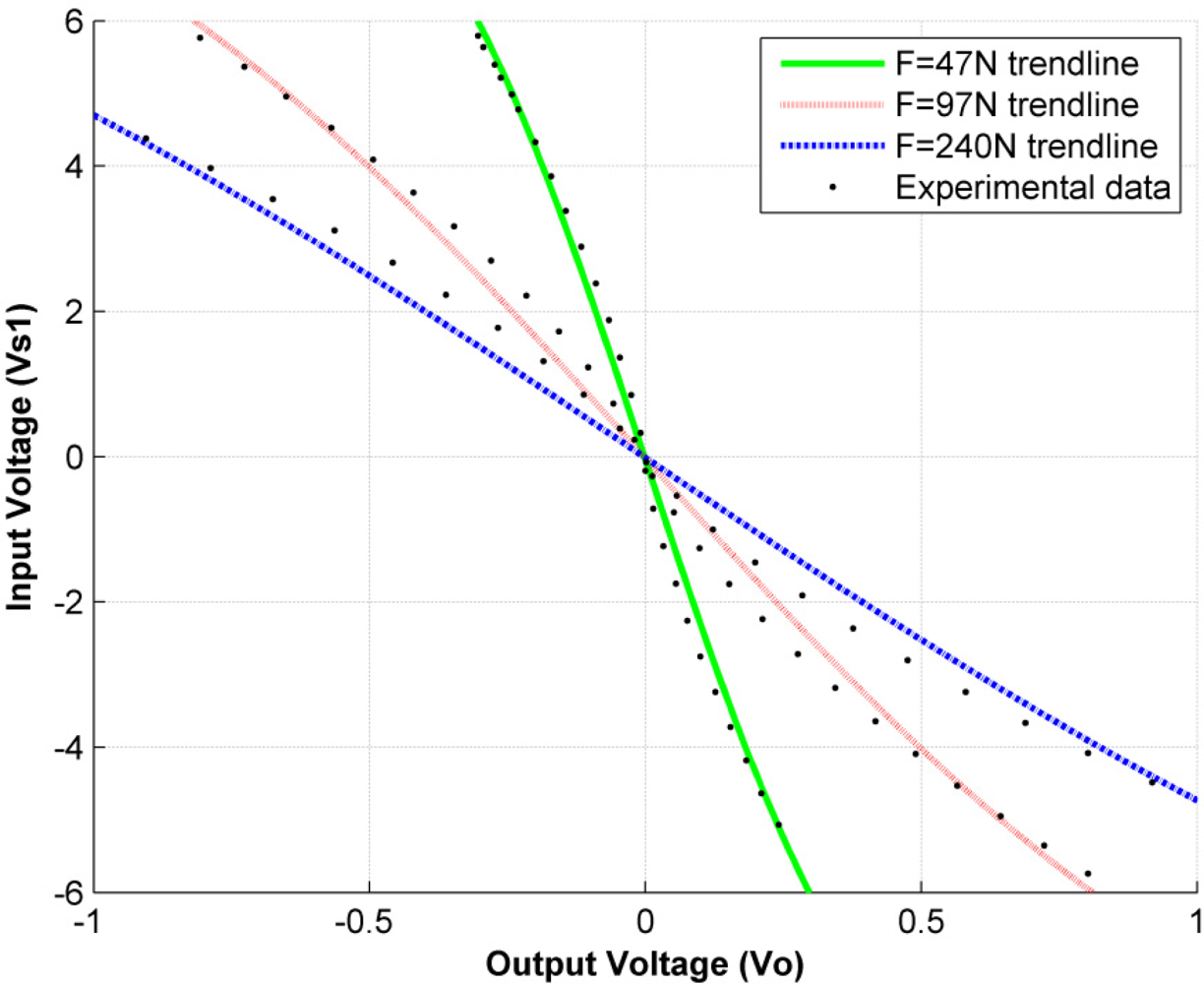
<p>If the PFS is sourced with voltages above 1V, the fitting curve in <xref ref-type="disp-formula" rid="FD8">Equation (8)</xref> and the general-sensor model in <xref ref-type="disp-formula" rid="FD15">Equation (15)</xref> provide an unsatisfactory fit according to our criteria. <xref ref-type="fig" rid="f7-sensors-11-08836">Figure 7</xref> shows the output and input voltage from data taken experimentally under three different forces (47 N, 97 N and 240 N) for driving voltages within the range (−6 V, 6 V) with <xref ref-type="disp-formula" rid="FD8">Equation (8)</xref> as the trendline. Note that the experimental data points move away from the trendline, especially in the middle-range voltages, |<italic>V<sub>s1</sub></italic>| &lt; <italic>3 V</italic>.</p>
<p>Despite the fact that the coefficient of determination remained high for all sensors under study (exhibiting an average value of <italic>R<sup>2</sup></italic> = 0.991), it is clear that <xref ref-type="disp-formula" rid="FD8">Equations (8)</xref> and <xref ref-type="disp-formula" rid="FD15">(15)</xref> require some changes in order to provide a better fit. So far we have not found a suitable and simple curve for modeling sensor behavior under such driving conditions.</p></sec></sec>
<sec>
<label>4.</label>
<title>Effect of Amplitude Nonlinearity under AC Sourcing for the Sensor</title>
<p>It has been demonstrated that sensor conductance is not constant if there are changes in the input voltage. By relating <xref ref-type="disp-formula" rid="FD1">Equation (1)</xref> with the conductance model, <xref ref-type="disp-formula" rid="FD16">Equation (16)</xref>, the following expression is obtained, which is useful for studying the effect of amplitude nonlinearity under AC sourcing:
<disp-formula id="FD20">
<label>(20)</label>
<mml:math display="block">
<mml:mrow>
<mml:mo>−</mml:mo>
<mml:msub>
<mml:mi>V</mml:mi>
<mml:mi>o</mml:mi></mml:msub>
<mml:mo>=</mml:mo>
<mml:mo stretchy="false">(</mml:mo>
<mml:msup>
<mml:mi>m</mml:mi>
<mml:mo>′</mml:mo></mml:msup>
<mml:mi>F</mml:mi>
<mml:mo>+</mml:mo>
<mml:msup>
<mml:mi>b</mml:mi>
<mml:mo>′</mml:mo></mml:msup>
<mml:mo stretchy="false">)</mml:mo>
<mml:mi> </mml:mi>
<mml:mtext>atanh</mml:mtext>
<mml:mi> </mml:mi>
<mml:mrow>
<mml:mo>(</mml:mo>
<mml:mrow>
<mml:mfrac>
<mml:mrow>
<mml:msub>
<mml:mi>V</mml:mi>
<mml:mrow>
<mml:mi>s</mml:mi>
<mml:mn>2</mml:mn></mml:mrow></mml:msub></mml:mrow>
<mml:mi>k</mml:mi></mml:mfrac></mml:mrow>
<mml:mo>)</mml:mo></mml:mrow>
<mml:mo>+</mml:mo>
<mml:msub>
<mml:mi>R</mml:mi>
<mml:mi>g</mml:mi></mml:msub>
<mml:msub>
<mml:mi>C</mml:mi>
<mml:mi>s</mml:mi></mml:msub>
<mml:mfrac>
<mml:mi>d</mml:mi>
<mml:mi mathvariant="italic">dt</mml:mi></mml:mfrac>
<mml:mo stretchy="false">(</mml:mo>
<mml:msub>
<mml:mi>V</mml:mi>
<mml:mrow>
<mml:mi>s</mml:mi>
<mml:mn>2</mml:mn></mml:mrow></mml:msub>
<mml:mo stretchy="false">)</mml:mo></mml:mrow></mml:math></disp-formula>where |<italic>V<sub>s2</sub></italic>| &lt; 1<italic>V</italic>, ∀<italic>t</italic> in order to meet the general-sensor model, <xref ref-type="disp-formula" rid="FD15">Equation (15)</xref>.</p>
<p>Under AC sourcing, the nonlinear term, <xref ref-type="disp-formula" rid="FD19">Equation (19)</xref>, extracted from <xref ref-type="disp-formula" rid="FD16">Equation (16)</xref> causes a modulation effect in sensor conductance which was not accounted for in our previous work (summarized in Section 2). It is evident that solving <xref ref-type="disp-formula" rid="FD20">Equation (20)</xref> for a sine-wave input yields a set of equations different from <xref ref-type="disp-formula" rid="FD3">Equations (3</xref>–<xref ref-type="disp-formula" rid="FD6">6)</xref>. But, if the input amplitude of the AC signal is low enough, sensor conductance can be taken as approximately constant and consequently, the expressions in Section 2 may be taken as valid.</p>
<p>Specifically, the frequency analyses carried out in [<xref ref-type="bibr" rid="b20-sensors-11-08836">20</xref>,<xref ref-type="bibr" rid="b21-sensors-11-08836">21</xref>] were done under a sine-wave input with <italic>A<sub>s</sub></italic> = <italic>0.5 V</italic>, and therefore the results reported by those sources can be trusted. Note from <xref ref-type="fig" rid="f3-sensors-11-08836">Figure 3</xref> that for |<italic>V<sub>s1</sub></italic>| &lt; <italic>0.5 V</italic>, sensor conductance can be taken approximately as constant regardless of changes in <italic>V<sub>s1</sub></italic>.</p>
<p>In contrast, the tests carried out in [<xref ref-type="bibr" rid="b20-sensors-11-08836">20</xref>,<xref ref-type="bibr" rid="b21-sensors-11-08836">21</xref>] for estimating the effect of capacitance readings in force-estimation errors are in principle questionable, because the input signal used for those tests was a sine wave with <italic>A<sub>s</sub></italic> = 3 V. Nevertheless, considering that [<xref ref-type="bibr" rid="b20-sensors-11-08836">20</xref>,<xref ref-type="bibr" rid="b21-sensors-11-08836">21</xref>] reported an effective reduction in force-estimation errors, we hypothesize that amplitude nonlinearity does not significantly affect capacitance readings. Unfortunately, we are unable to estimate the underlying error stemming from the capacitance readings reported in [<xref ref-type="bibr" rid="b20-sensors-11-08836">20</xref>,<xref ref-type="bibr" rid="b21-sensors-11-08836">21</xref>], whether the input sine wave has an amplitude of 0.5 V or 3 V. Where the input sine wave has an amplitude of 0.5 V, <xref ref-type="disp-formula" rid="FD20">Equation (20)</xref> must be solved analytically in terms of <italic>θ</italic> and <italic>A<sub>o</sub></italic>, which is a challenging task beyond the scope of this article; and where the input sine wave is 3 V, a comprehensive model of the amplitude nonlinearity must be developed for input voltages above 1V, and then such model must be included in the differential <xref ref-type="disp-formula" rid="FD1">Equation (1)</xref>.</p>
<p>Neither procedure is addressed in this paper, because a method is proposed in Section 5 for bypassing the amplitude nonlinearity under AC operation, regardless of whether the input voltage is lower or higher than 1 V.</p>
<p>Hyperbolic-tangent nonlinearity was hard to detect in our previous work [<xref ref-type="bibr" rid="b20-sensors-11-08836">20</xref>,<xref ref-type="bibr" rid="b21-sensors-11-08836">21</xref>], because it produces neither saturation nor exponential growth in the output voltage. An additional circumstance prevents the detection of amplitude nonlinearity; to show this, <italic>V<sub>s2</sub></italic> was replaced in <xref ref-type="disp-formula" rid="FD20">Equation (20)</xref> with a sine function, and <xref ref-type="disp-formula" rid="FD12">Equation (12)</xref> was used to state <xref ref-type="disp-formula" rid="FD20">Equation (20)</xref> in terms of <italic>q</italic> as shown below:
<disp-formula id="FD21">
<label>(21)</label>
<mml:math display="block">
<mml:mrow>
<mml:msub>
<mml:mi>V</mml:mi>
<mml:mi>o</mml:mi></mml:msub>
<mml:mo>=</mml:mo>
<mml:mo>−</mml:mo>
<mml:mrow>
<mml:mo>[</mml:mo>
<mml:mrow>
<mml:mfrac>
<mml:mn>1</mml:mn>
<mml:mi>q</mml:mi></mml:mfrac>
<mml:mtext>atanh</mml:mtext>
<mml:mi> </mml:mi>
<mml:mrow>
<mml:mo>(</mml:mo>
<mml:mrow>
<mml:mfrac>
<mml:mrow>
<mml:msub>
<mml:mi>A</mml:mi>
<mml:mi>s</mml:mi></mml:msub></mml:mrow>
<mml:mi>k</mml:mi></mml:mfrac>
<mml:mi> </mml:mi>
<mml:mtext>sin</mml:mtext>
<mml:mi> </mml:mi>
<mml:mo stretchy="false">(</mml:mo>
<mml:mn>2</mml:mn>
<mml:mi>π</mml:mi>
<mml:mi> </mml:mi>
<mml:mi mathvariant="italic">ft</mml:mi>
<mml:mo stretchy="false">)</mml:mo></mml:mrow>
<mml:mo>)</mml:mo></mml:mrow>
<mml:mo>+</mml:mo>
<mml:mn>2</mml:mn>
<mml:mi>π</mml:mi>
<mml:mi> </mml:mi>
<mml:msub>
<mml:mi mathvariant="italic">fC</mml:mi>
<mml:mi>s</mml:mi></mml:msub>
<mml:msub>
<mml:mi>R</mml:mi>
<mml:mi>g</mml:mi></mml:msub>
<mml:msub>
<mml:mi>A</mml:mi>
<mml:mi>s</mml:mi></mml:msub>
<mml:mo> </mml:mo>
<mml:mtext>cos</mml:mtext>
<mml:mo stretchy="false">(</mml:mo>
<mml:mn>2</mml:mn>
<mml:mi>π</mml:mi>
<mml:mo> </mml:mo>
<mml:mi mathvariant="italic">ft</mml:mi>
<mml:mo stretchy="false">)</mml:mo></mml:mrow>
<mml:mo>]</mml:mo></mml:mrow></mml:mrow></mml:math></disp-formula></p>
<p>A close look at <xref ref-type="disp-formula" rid="FD21">Equation (21)</xref> reveals that the output voltage, <italic>V<sub>o</sub></italic>, is the sum of the nonlinear term stemming from sensor conductance and the term stemming from sensor capacitance. It is demonstrated in Section 6 that sensor capacitance is constant, regardless of changes in the input voltage, and therefore the resulting <italic>V<sub>o</sub></italic> in <xref ref-type="disp-formula" rid="FD21">Equation (21)</xref> is the sum of a linear and a nonlinear term. From the time-domain viewpoint, given an input sine wave, the resulting output, <xref ref-type="disp-formula" rid="FD21">Equation (21)</xref>, looks rather sinusoidal, because the nonlinear response is diminished by the linear response. From the frequency-domain viewpoint, the output voltage, <xref ref-type="disp-formula" rid="FD21">Equation (21)</xref>, is slightly distorted because of the odd harmonics coming from the high-order terms of the <italic>atanh</italic>-Taylor series.</p></sec>
<sec>
<label>5.</label>
<title>Bypassing Amplitude Nonlinearity for Estimating Sensor Capacitance</title>
<p>Factors <italic>q</italic> and <italic>k</italic> can be easily determined if the sensor is sourced with a DC signal; there is therefore no interest in estimating <italic>q</italic> and <italic>k</italic> using AC sourcing. Note in <xref ref-type="disp-formula" rid="FD21">Equation (21)</xref> that sensor capacitance, <italic>C<sub>s</sub></italic>, is multiplied only by the term with the cosine function, so if that term can somehow be isolated, it may become possible to read sensor capacitance.</p>
<p>Multiplying <italic>V<sub>o</sub></italic> from <xref ref-type="disp-formula" rid="FD21">Equation (21)</xref> by:
<disp-formula id="FD22">
<label>(22)</label>
<mml:math display="block">
<mml:mrow>
<mml:msub>
<mml:mi>V</mml:mi>
<mml:mi>x</mml:mi></mml:msub>
<mml:mo>=</mml:mo>
<mml:msub>
<mml:mi>A</mml:mi>
<mml:mi>x</mml:mi></mml:msub>
<mml:mo> </mml:mo>
<mml:mtext>cos</mml:mtext>
<mml:mo> </mml:mo>
<mml:mo stretchy="false">(</mml:mo>
<mml:mn>2</mml:mn>
<mml:mi>π</mml:mi>
<mml:mo> </mml:mo>
<mml:mi mathvariant="italic">ft</mml:mi>
<mml:mo stretchy="false">)</mml:mo></mml:mrow></mml:math></disp-formula>and low-pass filtering (LPF) yields this product:
<disp-formula id="FD23">
<label>(23)</label>
<mml:math display="block">
<mml:mrow>
<mml:mi mathvariant="italic">LPF</mml:mi>
<mml:mo> </mml:mo>
<mml:mo>[</mml:mo>
<mml:msub>
<mml:mi>V</mml:mi>
<mml:mi>o</mml:mi></mml:msub>
<mml:msub>
<mml:mi>V</mml:mi>
<mml:mi>x</mml:mi></mml:msub>
<mml:mo stretchy="false">]</mml:mo>
<mml:mo>=</mml:mo>
<mml:mo>−</mml:mo>
<mml:mi mathvariant="italic">LPF</mml:mi>
<mml:mo> </mml:mo>
<mml:mo stretchy="false">[</mml:mo>
<mml:msub>
<mml:mi>A</mml:mi>
<mml:mi>x</mml:mi></mml:msub>
<mml:mo> </mml:mo>
<mml:mtext>cos</mml:mtext>
<mml:mo> </mml:mo>
<mml:mo stretchy="false">(</mml:mo>
<mml:mn>2</mml:mn>
<mml:mi>π</mml:mi>
<mml:mo> </mml:mo>
<mml:mi mathvariant="italic">ft</mml:mi>
<mml:mo stretchy="false">)</mml:mo>
<mml:mfrac>
<mml:mn>1</mml:mn>
<mml:mi>q</mml:mi></mml:mfrac>
<mml:mtext>atanh</mml:mtext>
<mml:mo> </mml:mo>
<mml:mrow>
<mml:mo stretchy="false">(</mml:mo>
<mml:mrow>
<mml:mfrac>
<mml:mrow>
<mml:msub>
<mml:mi>A</mml:mi>
<mml:mi>s</mml:mi></mml:msub></mml:mrow>
<mml:mi>k</mml:mi></mml:mfrac>
<mml:mo> </mml:mo>
<mml:mtext>sin</mml:mtext>
<mml:mo> </mml:mo>
<mml:mo stretchy="false">(</mml:mo>
<mml:mn>2</mml:mn>
<mml:mi>π</mml:mi>
<mml:mo> </mml:mo>
<mml:mi mathvariant="italic">ft</mml:mi>
<mml:mo stretchy="false">)</mml:mo></mml:mrow>
<mml:mo>)</mml:mo></mml:mrow>
<mml:mo>+</mml:mo>
<mml:msub>
<mml:mi>A</mml:mi>
<mml:mi>x</mml:mi></mml:msub>
<mml:mo> </mml:mo>
<mml:mtext>cos</mml:mtext>
<mml:mo> </mml:mo>
<mml:mo stretchy="false">(</mml:mo>
<mml:mn>2</mml:mn>
<mml:mi>π</mml:mi>
<mml:mo> </mml:mo>
<mml:mi mathvariant="italic">ft</mml:mi>
<mml:mo stretchy="false">)</mml:mo>
<mml:mo> </mml:mo>
<mml:mn>2</mml:mn>
<mml:mi>π</mml:mi>
<mml:mo> </mml:mo>
<mml:msub>
<mml:mi mathvariant="italic">fC</mml:mi>
<mml:mi>s</mml:mi></mml:msub>
<mml:msub>
<mml:mi>R</mml:mi>
<mml:mi>g</mml:mi></mml:msub>
<mml:msub>
<mml:mi>A</mml:mi>
<mml:mi>s</mml:mi></mml:msub>
<mml:mi> </mml:mi>
<mml:mtext>cos</mml:mtext>
<mml:mo> </mml:mo>
<mml:mo stretchy="false">(</mml:mo>
<mml:mn>2</mml:mn>
<mml:mi>π</mml:mi>
<mml:mo> </mml:mo>
<mml:mi mathvariant="italic">ft</mml:mi>
<mml:mo stretchy="false">)</mml:mo>
<mml:mo>]</mml:mo></mml:mrow></mml:math></disp-formula></p>
<p>Considering that the composition of two odd functions is an odd function, the first term of <xref ref-type="disp-formula" rid="FD21">Equation (21)</xref> is consequently odd (as the <italic>atanh</italic> and <italic>sin</italic> functions are both odd). Multiplying such a term by an even function, <xref ref-type="disp-formula" rid="FD22">Equation (22)</xref>, results in an odd function with frequency components at 4<italic>πnf</italic>, ∀<italic>n</italic> ≥ 1 ∈ <italic>N</italic></p>
<p>The harmonics come from the decomposition of the <italic>atanh</italic> function in its Taylor series. Thus, the first term of <xref ref-type="disp-formula" rid="FD23">Equation (23)</xref> can be expressed as:
<disp-formula id="FD24">
<label>(24)</label>
<mml:math display="block">
<mml:mtable columnalign="left">
<mml:mtr>
<mml:mtd>
<mml:mfrac>
<mml:mn>1</mml:mn>
<mml:mi>q</mml:mi></mml:mfrac>
<mml:mo> </mml:mo>
<mml:mtext>atanh</mml:mtext>
<mml:mo> </mml:mo>
<mml:mrow>
<mml:mo>(</mml:mo>
<mml:mrow>
<mml:mfrac>
<mml:mrow>
<mml:msub>
<mml:mi>A</mml:mi>
<mml:mi>s</mml:mi></mml:msub></mml:mrow>
<mml:mi>k</mml:mi></mml:mfrac>
<mml:mo> </mml:mo>
<mml:mtext>sin</mml:mtext>
<mml:mo> </mml:mo>
<mml:mo stretchy="false">(</mml:mo>
<mml:mn>2</mml:mn>
<mml:mi>π</mml:mi>
<mml:mo> </mml:mo>
<mml:mi mathvariant="italic">ft</mml:mi>
<mml:mo stretchy="false">)</mml:mo></mml:mrow>
<mml:mo>)</mml:mo></mml:mrow>
<mml:msub>
<mml:mi>A</mml:mi>
<mml:mi>x</mml:mi></mml:msub>
<mml:mo> </mml:mo>
<mml:mtext>cos</mml:mtext>
<mml:mo> </mml:mo>
<mml:mo stretchy="false">(</mml:mo>
<mml:mn>2</mml:mn>
<mml:mi>π</mml:mi>
<mml:mo> </mml:mo>
<mml:mi mathvariant="italic">ft</mml:mi>
<mml:mo stretchy="false">)</mml:mo>
<mml:mo>=</mml:mo>
<mml:mfrac>
<mml:mrow>
<mml:msub>
<mml:mi>A</mml:mi>
<mml:mi>x</mml:mi></mml:msub>
<mml:mo> </mml:mo>
<mml:mtext>cos</mml:mtext>
<mml:mo stretchy="false">(</mml:mo>
<mml:mn>2</mml:mn>
<mml:mi>π</mml:mi>
<mml:mo> </mml:mo>
<mml:mi mathvariant="italic">ft</mml:mi>
<mml:mo stretchy="false">)</mml:mo></mml:mrow>
<mml:mi>q</mml:mi></mml:mfrac>
<mml:mrow>
<mml:mo>[</mml:mo>
<mml:mrow>
<mml:mfrac>
<mml:mrow>
<mml:msub>
<mml:mi>A</mml:mi>
<mml:mi>s</mml:mi></mml:msub></mml:mrow>
<mml:mi>k</mml:mi></mml:mfrac>
<mml:mo> </mml:mo>
<mml:mtext>sin</mml:mtext>
<mml:mo stretchy="false">(</mml:mo>
<mml:mn>2</mml:mn>
<mml:mi>π</mml:mi>
<mml:mo> </mml:mo>
<mml:mi mathvariant="italic">ft</mml:mi>
<mml:mo stretchy="false">)</mml:mo>
<mml:mo>+</mml:mo></mml:mrow></mml:mrow></mml:mtd></mml:mtr>
<mml:mtr>
<mml:mtd>
<mml:mrow>
<mml:mrow>
<mml:mo>−</mml:mo>
<mml:mfrac>
<mml:mn>1</mml:mn>
<mml:mn>3</mml:mn></mml:mfrac>
<mml:msup>
<mml:mrow>
<mml:mrow>
<mml:mrow>
<mml:mo>(</mml:mo>
<mml:mrow>
<mml:mfrac>
<mml:mrow>
<mml:msub>
<mml:mi>A</mml:mi>
<mml:mi>s</mml:mi></mml:msub></mml:mrow>
<mml:mi>k</mml:mi></mml:mfrac>
<mml:mo> </mml:mo>
<mml:mtext>sin</mml:mtext>
<mml:mo> </mml:mo>
<mml:mo stretchy="false">(</mml:mo>
<mml:mn>2</mml:mn>
<mml:mi>π</mml:mi>
<mml:mo> </mml:mo>
<mml:mi mathvariant="italic">ft</mml:mi>
<mml:mo stretchy="false">)</mml:mo></mml:mrow>
<mml:mo>)</mml:mo></mml:mrow></mml:mrow></mml:mrow>
<mml:mn>3</mml:mn></mml:msup>
<mml:mo>+</mml:mo>
<mml:mfrac>
<mml:mn>2</mml:mn>
<mml:mrow>
<mml:mn>15</mml:mn></mml:mrow></mml:mfrac>
<mml:msup>
<mml:mrow>
<mml:mo>(</mml:mo>
<mml:mrow>
<mml:mfrac>
<mml:mrow>
<mml:msub>
<mml:mi>A</mml:mi>
<mml:mi>s</mml:mi></mml:msub></mml:mrow>
<mml:mi>k</mml:mi></mml:mfrac>
<mml:mo> </mml:mo>
<mml:mtext>sin</mml:mtext>
<mml:mo> </mml:mo>
<mml:mo stretchy="false">(</mml:mo>
<mml:mn>2</mml:mn>
<mml:mi>π</mml:mi>
<mml:mo> </mml:mo>
<mml:mi mathvariant="italic">ft</mml:mi>
<mml:mo stretchy="false">)</mml:mo></mml:mrow>
<mml:mo>)</mml:mo></mml:mrow>
<mml:mn>5</mml:mn></mml:msup>
<mml:mo>+</mml:mo>
<mml:mo>…</mml:mo></mml:mrow>
<mml:mo>]</mml:mo></mml:mrow></mml:mtd></mml:mtr></mml:mtable></mml:math></disp-formula></p>
<p>Note that <xref ref-type="disp-formula" rid="FD24">Equation (24)</xref> does not have a DC component, and thus the low-pass filter removes the entire signal. On the other hand, the second term of <xref ref-type="disp-formula" rid="FD23">Equation (23)</xref> is an even function and may be rewritten as:
<disp-formula id="FD25">
<label>(25)</label>
<mml:math display="block">
<mml:mrow>
<mml:mn>2</mml:mn>
<mml:mi>π</mml:mi>
<mml:mo> </mml:mo>
<mml:msub>
<mml:mrow>
<mml:mi mathvariant="italic">fC</mml:mi></mml:mrow>
<mml:mi>s</mml:mi></mml:msub>
<mml:msub>
<mml:mrow>
<mml:mi>R</mml:mi></mml:mrow>
<mml:mi>g</mml:mi></mml:msub>
<mml:msub>
<mml:mrow>
<mml:mi>A</mml:mi></mml:mrow>
<mml:mi>s</mml:mi></mml:msub>
<mml:mo> </mml:mo>
<mml:mtext>cos</mml:mtext>
<mml:mo> </mml:mo>
<mml:mo stretchy="false">(</mml:mo>
<mml:mn>2</mml:mn>
<mml:mi>π</mml:mi>
<mml:mo> </mml:mo>
<mml:mi mathvariant="italic">ft</mml:mi>
<mml:mo stretchy="false">)</mml:mo>
<mml:mo> </mml:mo>
<mml:msub>
<mml:mrow>
<mml:mi>A</mml:mi></mml:mrow>
<mml:mi>x</mml:mi></mml:msub>
<mml:mo> </mml:mo>
<mml:mtext>cos</mml:mtext>
<mml:mo> </mml:mo>
<mml:mo stretchy="false">(</mml:mo>
<mml:mn>2</mml:mn>
<mml:mi>π</mml:mi>
<mml:mo> </mml:mo>
<mml:mi mathvariant="italic">ft</mml:mi>
<mml:mo stretchy="false">)</mml:mo>
<mml:mo>=</mml:mo>
<mml:mi>π</mml:mi>
<mml:mo> </mml:mo>
<mml:msub>
<mml:mrow>
<mml:mi mathvariant="italic">fA</mml:mi></mml:mrow>
<mml:mi>s</mml:mi></mml:msub>
<mml:msub>
<mml:mrow>
<mml:mi>A</mml:mi></mml:mrow>
<mml:mi>x</mml:mi></mml:msub>
<mml:msub>
<mml:mrow>
<mml:mi>R</mml:mi></mml:mrow>
<mml:mi>g</mml:mi></mml:msub>
<mml:msub>
<mml:mrow>
<mml:mi>C</mml:mi></mml:mrow>
<mml:mi>s</mml:mi></mml:msub>
<mml:mo> </mml:mo>
<mml:mo stretchy="false">(</mml:mo>
<mml:mn>1</mml:mn>
<mml:mo>+</mml:mo>
<mml:mtext>cos</mml:mtext>
<mml:mo stretchy="false">(</mml:mo>
<mml:mn>4</mml:mn>
<mml:mi>π</mml:mi>
<mml:mo> </mml:mo>
<mml:mi mathvariant="italic">ft</mml:mi>
<mml:mo stretchy="false">)</mml:mo>
<mml:mo stretchy="false">)</mml:mo></mml:mrow></mml:math></disp-formula></p>
<p><xref ref-type="disp-formula" rid="FD25">Equation (25)</xref> has a nonzero mean value and a term with a frequency component at <italic>4πf</italic>, which is removed by the LPF, and thus it can be simplified to:
<disp-formula id="FD26">
<label>(26)</label>
<mml:math display="block">
<mml:mrow>
<mml:mi mathvariant="italic">LPF</mml:mi>
<mml:mo> </mml:mo>
<mml:mo stretchy="false">[</mml:mo>
<mml:msub>
<mml:mi>V</mml:mi>
<mml:mi>o</mml:mi></mml:msub>
<mml:msub>
<mml:mi>V</mml:mi>
<mml:mi>x</mml:mi></mml:msub>
<mml:mo stretchy="false">]</mml:mo>
<mml:mo>=</mml:mo>
<mml:mo>−</mml:mo>
<mml:mi>π</mml:mi>
<mml:mo> </mml:mo>
<mml:msub>
<mml:mrow>
<mml:mi mathvariant="italic">fA</mml:mi></mml:mrow>
<mml:mi>s</mml:mi></mml:msub>
<mml:msub>
<mml:mrow>
<mml:mi>A</mml:mi></mml:mrow>
<mml:mi>x</mml:mi></mml:msub>
<mml:msub>
<mml:mrow>
<mml:mi>R</mml:mi></mml:mrow>
<mml:mi>g</mml:mi></mml:msub>
<mml:msub>
<mml:mrow>
<mml:mi>C</mml:mi></mml:mrow>
<mml:mi>s</mml:mi></mml:msub></mml:mrow></mml:math></disp-formula></p>
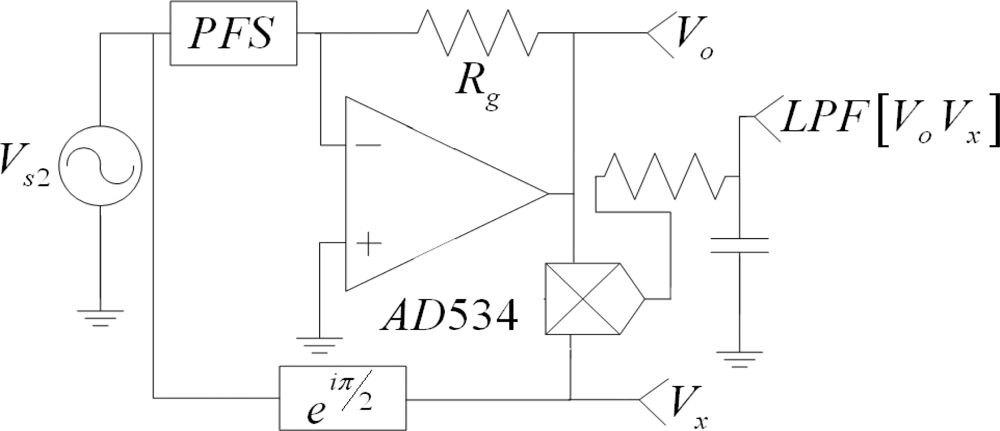
<p>The above expression is useful for reading sensor capacitance, because the other factors in <xref ref-type="disp-formula" rid="FD26">Equation (26)</xref> are all constants. The mathematical function <italic>LPF[V<sub>o</sub>V<sub>x</sub>]</italic> can be obtained by using a four-quadrant multiplier, such as the AD534, and an RC-series circuit in the low-pass configuration. <xref ref-type="fig" rid="f8-sensors-11-08836">Figure 8</xref> summarizes the described process for measuring <italic>C<sub>s</sub></italic>.</p>
<p><xref ref-type="disp-formula" rid="FD26">Equation (26)</xref> is inherently different from <xref ref-type="disp-formula" rid="FD6">Equation (6)</xref>, because sensor conductance is not present in the former, while in the latter it is, albeit implicitly, due to the ratio <italic>A<sub>o</sub>/A<sub>s</sub></italic> in <xref ref-type="disp-formula" rid="FD6">Equation (6)</xref>. This is an important difference, because the process depicted here removes the contribution of sensor conductance from the output signal. So, regardless of what the conductance model is, <xref ref-type="disp-formula" rid="FD26">Equation (26)</xref> remains unchangeable. We are unable to provide a theoretical demonstration of this statement until a model for <italic>1/R<sub>s</sub></italic> is developed for sourcing voltages above 1 V; however, in the next section we present experimental results that support this hypothesis.</p>
<p>We would like to stress that different methods for measuring capacitance were evaluated [<xref ref-type="bibr" rid="b27-sensors-11-08836">27</xref>–<xref ref-type="bibr" rid="b30-sensors-11-08836">30</xref>], but the fact that a variable resistor, <italic>R<sub>s</sub></italic>, is placed across the capacitance, <italic>C<sub>s</sub></italic>, makes reading difficult. The method described above was inspired by the synchronous demodulation of RF signals [<xref ref-type="bibr" rid="b31-sensors-11-08836">31</xref>]. Note that <italic>C<sub>s</sub></italic> can be considered as the message in <xref ref-type="disp-formula" rid="FD25">Equation (25)</xref>, the term 2<italic>πfR<sub>g</sub>A<sub>s</sub></italic>cos(2<italic>πft</italic>) acts like the carrier signal and <italic>A<sub>x</sub></italic>cos(2<italic>πft</italic>) as the demodulating signal.</p></sec>
<sec sec-type="results">
<label>6.</label>
<title>Experimental Results of Conductance and Capacitance Readings for Different Input Voltages</title>
<p>With the aim of demonstrating the statements presented herein, we carried out a series of capacitance and conductance measurements on four PFSs under different sourcing and force conditions. The tests are classified below according to sourcing type.</p>
<sec>
<label>6.1.</label>
<title>DC Sourcing</title>
<p>Forces were applied within the range of 0 N to 250 N under seven sourcing conditions, starting at 0.4 V, with increments of 0.1 V, up to 1 V. For every supply voltage, the sensor sensitivity, <italic>m</italic>, and the y-intercept, <italic>b</italic>, were found according to the classical method proposed by the manufacturer [<xref ref-type="bibr" rid="b24-sensors-11-08836">24</xref>]. These values of <italic>m</italic>, <italic>b</italic> are used as references for calculating subsequent errors in <italic>m</italic>, <italic>b</italic> for the different methods presented in this article.</p>
<p>Sensors were then characterized in terms of <italic>m′</italic>, <italic>b′</italic> and <italic>k</italic> as described in Section 3.3. Doing so enabled <xref ref-type="disp-formula" rid="FD15">Equation (15)</xref> to be assembled and <italic>m</italic>, <italic>b</italic> to be estimated for the aforementioned discrete DC voltages.</p>
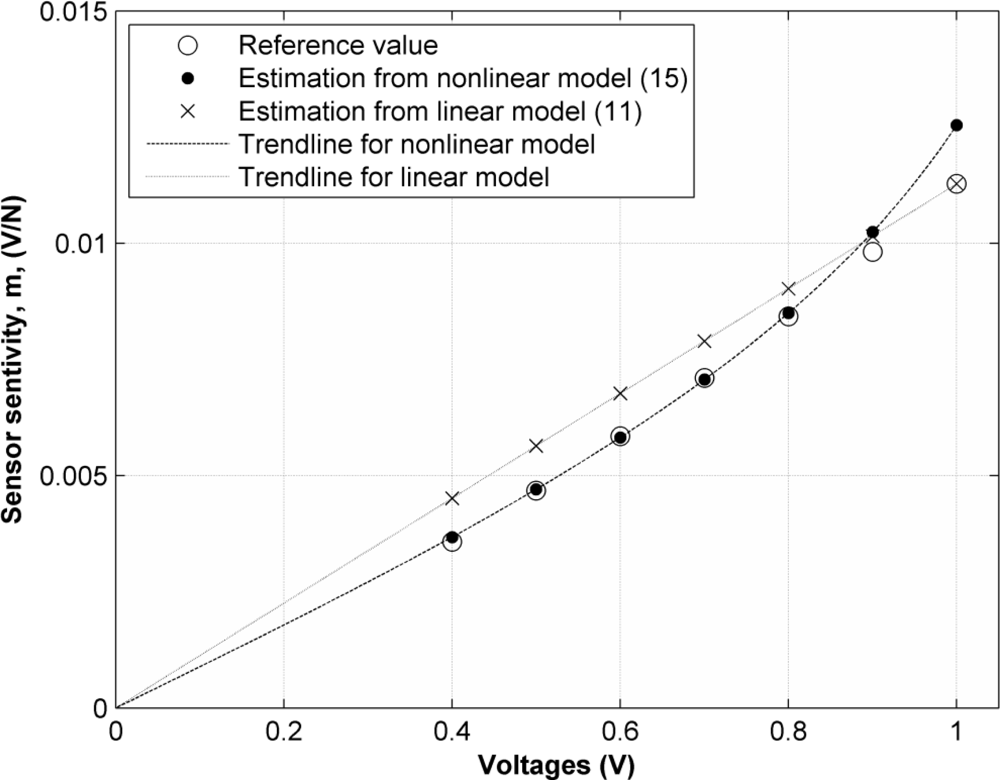
<p>With the aim of demonstrating the typical error resulting from the assumption of linear-sensor response, the values of <italic>m</italic>, <italic>b</italic> measured at 1 V and <xref ref-type="disp-formula" rid="FD11">Equation (11)</xref> were used to estimate <italic>m</italic>, <italic>b</italic> for the remaining six voltages (0.4 V to 0.9 V). That is, if the <italic>m</italic> value measured at 1 V is 20 mV/N, use of <xref ref-type="disp-formula" rid="FD11">Equation (11)</xref> shows that the estimated value of <italic>m</italic> at 0.4 V is equal to 8 mV/N; the same calculation applies to the y-intercept coefficient, <italic>b</italic>. <xref ref-type="table" rid="t1-sensors-11-08836">Table 1</xref> compares the errors of <italic>m</italic> and <italic>b</italic> predicted from the linear, <xref ref-type="disp-formula" rid="FD11">Equation (11)</xref>, and the nonlinear model, <xref ref-type="disp-formula" rid="FD15">Equation (15)</xref>.</p>
<p>Two facts may be drawn from <xref ref-type="table" rid="t1-sensors-11-08836">Table 1</xref>. First, the errors in the <italic>m</italic> values predicted by <xref ref-type="disp-formula" rid="FD15">Equation (15)</xref> are rather small for all sensors. This means that the nonlinear model presented in this paper produces matches in predicting the sensor sensitivity for any input voltage under 1 V. In fact, the average error in <italic>m</italic> for all sensors and all voltages is only 2.04%. Second, the assumption of linear response in sensor conductance produces a reasonably greater error when predicting <italic>m via</italic> <xref ref-type="disp-formula" rid="FD11">Equation (11)</xref>; an average error of 11.35% was obtained, which is almost six times the error resulting from <xref ref-type="disp-formula" rid="FD15">Equation (15)</xref>. <xref ref-type="fig" rid="f9-sensors-11-08836">Figure 9</xref> shows the values of <italic>m</italic> for sensor number four, under all the discrete applied voltages. Also shown are the trendlines arising from the linear <xref ref-type="disp-formula" rid="FD11">Equation (11)</xref> and the nonlinear model, <xref ref-type="disp-formula" rid="FD15">Equation (15)</xref>.</p>
<p>Second, the average error for all sensors resulting from the estimation of the y-intercept coefficient, <italic>b</italic>, was quite high, 10.27% and 14.5%, for the two models. Despite this fact, we declare that <xref ref-type="disp-formula" rid="FD15">Equation (15)</xref> can effectively model sensor behavior, because through our various optimization processes we have effectively reduced the estimation error of <italic>b</italic> by discarding the highly noisy data obtained under forces lower than 40 N. Such data are noisy because of the low amplitude of <italic>V<sub>o</sub></italic>, resulting from the low-force condition. If the data taken under forces lower than 40 N are discarded, the average error for the y-intercept estimation is reduced to 6.35%.</p></sec>
<sec>
<label>6.2.</label>
<title>AC Sourcing</title>
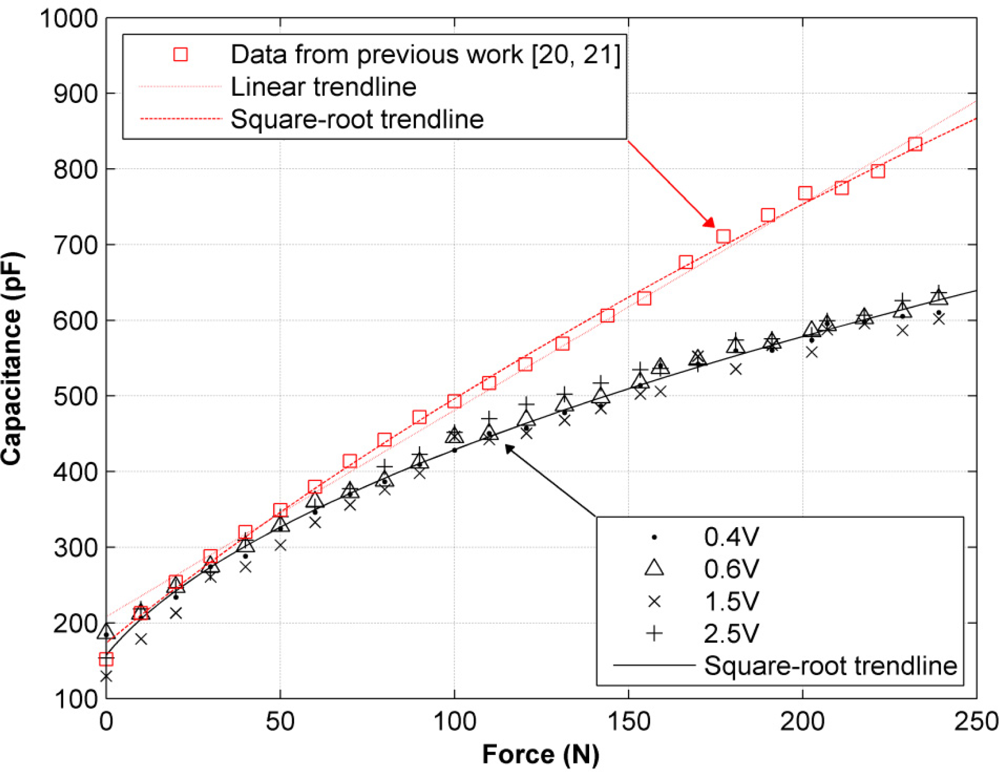
<p>Input amplitudes are not restricted to be under 1 V for the AC sourcing experiments, because the intention is to subject the feasibility of the measuring scheme in <xref ref-type="fig" rid="f8-sensors-11-08836">Figure 8</xref> to a thorough test. <xref ref-type="fig" rid="f10-sensors-11-08836">Figure 10</xref> shows two different sets of capacitance values, <italic>C<sub>s</sub></italic>, for the same sensor, taken under sinusoidal excitation at a fixed frequency of 4 KHz. The black values were taken according to the measuring scheme in <xref ref-type="fig" rid="f8-sensors-11-08836">Figure 8</xref>, whereas the red data points were taken from our previous work [<xref ref-type="bibr" rid="b20-sensors-11-08836">20</xref>,<xref ref-type="bibr" rid="b21-sensors-11-08836">21</xref>], when the amplitude nonlinearity was unknown and the equations in Section 2 were used to estimate <italic>C<sub>s</sub></italic>. This set of data was taken at a fixed input amplitude of 3 V.</p>
<p>Considering:
<list list-type="order">
<list-item>
<p>That the black data points in <xref ref-type="fig" rid="f10-sensors-11-08836">Figure 10</xref> are rather close to each other for the different driving voltages, and</p></list-item>
<list-item>
<p>That the feasibility of the measuring scheme in <xref ref-type="fig" rid="f8-sensors-11-08836">Figure 8</xref> was theoretically demonstrated in Section 5</p></list-item></list>it may be concluded that sensor capacitance is constant, regardless of changes in the driving voltage, with the restriction of |<italic>V<sub>s1</sub></italic>| &lt; 1 V. A look at the capacitance values for input voltages of 1.5 V and 2.5 V (see <xref ref-type="fig" rid="f10-sensors-11-08836">Figure 10</xref>) shows that it is reasonable to suggest that <italic>C<sub>s</sub></italic> remains constant for <italic>V<sub>s1</sub></italic> above 1 V, but this cannot be definitely stated until a model for sensor conductance is developed for <italic>V<sub>s1</sub></italic> above 1 V, because the compatibility of such model with the measuring scheme in <xref ref-type="fig" rid="f8-sensors-11-08836">Figure 8</xref> must be ascertained first.</p>
<p>An attempt was made to fit a linear trendline to the black data points in <xref ref-type="fig" rid="f10-sensors-11-08836">Figure 10</xref>. This is a logical approach, considering that our previous work reported a linear variation of <italic>C<sub>s</sub></italic> in response to force changes [<xref ref-type="bibr" rid="b20-sensors-11-08836">20</xref>,<xref ref-type="bibr" rid="b21-sensors-11-08836">21</xref>]. However, the residuals resulting from the fitting process suggested that a linear fit was unsuitable. Thus, different trendline forms were tried. The best, but also simplest, trendline that could model the variation of <italic>C<sub>s</sub></italic> was a square-root model dependant on the applied force, <italic>F</italic>:
<disp-formula id="FD27">
<label>(27)</label>
<mml:math display="block">
<mml:mrow>
<mml:msub>
<mml:mrow>
<mml:mi>C</mml:mi></mml:mrow>
<mml:mi>s</mml:mi></mml:msub>
<mml:mo>=</mml:mo>
<mml:msub>
<mml:mrow>
<mml:mi>C</mml:mi></mml:mrow>
<mml:mi>o</mml:mi></mml:msub>
<mml:mo>+</mml:mo>
<mml:mi>a</mml:mi>
<mml:msqrt>
<mml:mrow>
<mml:mi>F</mml:mi>
<mml:mo>+</mml:mo>
<mml:mi>b</mml:mi></mml:mrow></mml:msqrt></mml:mrow></mml:math></disp-formula>where <italic>a</italic>, <italic>b</italic> and <italic>C<sub>o</sub></italic> are constants estimated from the fit.</p>
<p>On the other hand, the red data points in <xref ref-type="fig" rid="f10-sensors-11-08836">Figure 10</xref>, taken from our previous work [<xref ref-type="bibr" rid="b20-sensors-11-08836">20</xref>,<xref ref-type="bibr" rid="b21-sensors-11-08836">21</xref>], were fitted with a line, and an acceptable coefficient of determination was obtained, <italic>R<sup>2</sup></italic> = 0.9942. The same data points were fitted with <xref ref-type="disp-formula" rid="FD27">Equation (27)</xref>, and the value of <italic>R<sup>2</sup></italic> was even better, <italic>R<sup>2</sup></italic> = 0.9987; this means that in principle either trendline is valid for fitting the data.</p>
<p>From <xref ref-type="fig" rid="f10-sensors-11-08836">Figure 10</xref>, it is clear that one set of data points is incorrect, because it is impossible that different values of capacitance are measured for the same sensor, under the same applied forces and the same mechanical layout. Considering that the red data points were taken under the erroneous supposition of linear conductance, it is logical to suggest that it was the assumption that yielded the incorrect values of capacitance; but, as stated in Sections 4 and 5, there are a few steps remaining to be accomplished before this hypothesis can be demonstrated.</p>
<p>In other words, we have theoretically and experimentally demonstrated that the black data points from <xref ref-type="fig" rid="f10-sensors-11-08836">Figure 10</xref> are correct at least for |<italic>V<sub>s1</sub></italic>| &lt; 1 V, but we are unable to theoretically demonstrate that the error basis from the red data points is due to the assumption of linear sensor conductance, despite some experimental results supporting this hypothesis. For instance, a look at the measured capacitance under low applied forces in <xref ref-type="fig" rid="f10-sensors-11-08836">Figure 10</xref> shows that both methods estimate the same <italic>C<sub>s</sub></italic>. This may be understood if one recalls the piezoresistive behavior of the sensor; so, under low applied forces and AC excitation, sensor resistance can be taken as virtually infinite (See <xref ref-type="fig" rid="f2-sensors-11-08836">Figure 2</xref>), and its response is dominated only by capacitive factors. Under these circumstances, the resistive term in <xref ref-type="disp-formula" rid="FD1">Equation (1)</xref> may be discarded, and the measured capacitance will be the same, regardless of the conductance model or the method employed for measuring <italic>C<sub>s</sub></italic>. It is only when the exerted force is increased that the aforementioned conditions start to play an important role in the estimation of sensor capacitance, and consequently, as <italic>F</italic> increases, the two sets of data points gradually diverge.</p></sec></sec>
<sec sec-type="conclusions">
<label>7.</label>
<title>Conclusions and Future Work</title>
<p>For sourcing voltages below 1 V, a comprehensive model for the FlexiForce model A201-100 piezoresistive device has been developed and tested. A nonlinear response has been identified in sensor conductance corresponding to a hyperbolic tangent function.</p>
<p>A general method for obtaining a specific sensitivity, <italic>m</italic>, in sensor response has been presented and experimentally tested on four FlexiForce sensors; such method produced an average error of 2.04% when estimating <italic>m</italic>. Whereas the y-intercept, <italic>b</italic>, estimation yielded a considerable greater error of 10.27%; however such error can be diminished by discarding the noisy data resulting from the highly noisy data obtained under forces lower than 40 N. The method presented in this article has considerably improved the plug-and-play capability of the piezoresistive device.</p>
<p>The authors have theoretically and experimentally demonstrated that sensor capacitance is constant regardless of changes in the input voltage whenever the driving voltage is held below 1 V. The feasibility of a measuring scheme for bypassing conductance nonlinearity has also been presented and tested.</p>
<p>Conversely, the experimental results support the hypothesis of constant capacitance for input voltages above 1 V. Nonetheless, it is necessary to develop a theoretical model for sensor conductance for sourcing voltages above 1V before declaring that sensor capacitance remains unchangeable at such sourcing voltages. Future work will mainly focus on adding the puck area as a variable in the general-sensor model. This would allow the final user to assess how the sensor sensitivity is affected when the puck area is changed.</p></sec></body>
<back>
<ack>
<p>This work has been partially funded by the Spanish Ministry for Innovation and Science through grant DPI2010-18702 which has funded personnel costs and by AECID through grant PCI-iberoamerica D/030531/10 which has funded equipment and consumable costs.</p></ack>
<ref-list>
<title>References</title>
<ref id="b1-sensors-11-08836"><label>1.</label><citation citation-type="journal"><person-group person-group-type="author"><name><surname>Castro</surname><given-names>MCF</given-names></name><name><surname>Cliquet</surname><given-names>A</given-names><suffix>Jr</suffix></name></person-group><article-title>A low-cost instrumented glove for monitoring forces during object manipulation</article-title><source>IEEE Trans. Rehabil. Eng</source><year>2002</year><volume>5</volume><fpage>140</fpage><lpage>147</lpage></citation></ref>
<ref id="b2-sensors-11-08836"><label>2.</label><citation citation-type="confproc"><person-group person-group-type="author"><name><surname>Monroy</surname><given-names>M</given-names></name><name><surname>Ferre</surname><given-names>M</given-names></name><name><surname>Barrio</surname><given-names>J</given-names></name><name><surname>Eslava</surname><given-names>V</given-names></name><name><surname>Galiana</surname><given-names>I</given-names></name></person-group><article-title>Sensorized Thimble for Haptics Applications</article-title><conf-name>Proceedings of the 5th IEEE International Conference on Mechatronics ICM</conf-name><conf-loc>Malaga, Spain</conf-loc><conf-date>14–17 April 2009</conf-date><fpage>1</fpage><lpage>6</lpage></citation></ref>
<ref id="b3-sensors-11-08836"><label>3.</label><citation citation-type="journal"><person-group person-group-type="author"><name><surname>Kong</surname><given-names>YK</given-names></name><name><surname>Lowe</surname><given-names>BD</given-names></name><name><surname>Lee</surname><given-names>SJ</given-names></name><name><surname>Krieg</surname><given-names>EF</given-names></name></person-group><article-title>Evaluation of handle shapes for screwdriving</article-title><source>Appl. Ergon</source><year>2008</year><volume>39</volume><fpage>191</fpage><lpage>198</lpage><pub-id pub-id-type="doi">10.1016/j.apergo.2007.05.003</pub-id><pub-id pub-id-type="pmid">17572374</pub-id></citation></ref>
<ref id="b4-sensors-11-08836"><label>4.</label><citation citation-type="confproc"><person-group person-group-type="author"><name><surname>Kazerooni</surname><given-names>H</given-names></name><name><surname>Fairbanks</surname><given-names>D</given-names></name><name><surname>Chen</surname><given-names>A</given-names></name><name><surname>Shin</surname><given-names>G</given-names></name></person-group><article-title>The Magic Glove</article-title><conf-name>Proceedings of the IEEE International Conference on Robotics and Automation ICRA</conf-name><conf-loc>New Orleans, LA, USA</conf-loc><conf-date>26 April–1 May 2004</conf-date><fpage>757</fpage><lpage>763</lpage></citation></ref>
<ref id="b5-sensors-11-08836"><label>5.</label><citation citation-type="journal"><person-group person-group-type="author"><name><surname>Ahroni</surname><given-names>JH</given-names></name><name><surname>Boyko</surname><given-names>EJ</given-names></name><name><surname>Forsberg</surname><given-names>R</given-names></name></person-group><article-title>Reliability of F-scan in-shoe measurements of plantar pressure</article-title><source>Foot Ankle Int</source><year>1998</year><volume>19</volume><fpage>668</fpage><lpage>673</lpage><pub-id pub-id-type="pmid">9801080</pub-id></citation></ref>
<ref id="b6-sensors-11-08836"><label>6.</label><citation citation-type="confproc"><person-group person-group-type="author"><name><surname>Castellanos</surname><given-names>J</given-names></name><name><surname>Navas-Gonzalez</surname><given-names>R</given-names></name><name><surname>Ochoteco</surname><given-names>E</given-names></name><name><surname>Vidal-Verdu</surname><given-names>F</given-names></name></person-group><article-title>Evaluation of a Low Cost Piezorresistive Material for High Resolution Tactile Sensors</article-title><conf-name>Proceedings of the 2nd European Conference &amp; Exhibition on Integration Issues of Miniaturized Systems—MOMS, MOEMS, ICS and Electronic Components (SSI)</conf-name><conf-loc>Barcelona, Spain</conf-loc><conf-date>9–10 April 2008</conf-date><fpage>1</fpage><lpage>3</lpage></citation></ref>
<ref id="b7-sensors-11-08836"><label>7.</label><citation citation-type="confproc"><person-group person-group-type="author"><name><surname>Vecchi</surname><given-names>F</given-names></name><name><surname>Freschi</surname><given-names>C</given-names></name><name><surname>Micera</surname><given-names>S</given-names></name><name><surname>Sabatini</surname><given-names>AM</given-names></name><name><surname>Dario</surname><given-names>P</given-names></name><name><surname>Sacchetti</surname><given-names>R</given-names></name></person-group><article-title>Experimental Evaluation of Two Commercial Force Sensors for Applications in Biomechanics and Motor Control</article-title><conf-name>Proceedings of the 5th Annual Conference of the International Functional Electrical Stimulation Society IFESS</conf-name><conf-loc>Aalborg, Denmark</conf-loc><conf-date>12–16 June 2000</conf-date></citation></ref>
<ref id="b8-sensors-11-08836"><label>8.</label><citation citation-type="confproc"><person-group person-group-type="author"><name><surname>Lebosse</surname><given-names>C</given-names></name><name><surname>Bayle</surname><given-names>B</given-names></name><name><surname>de Mathelin</surname><given-names>M</given-names></name><name><surname>Renaud</surname><given-names>P</given-names></name></person-group><article-title>Nonlinear Modeling of low Cost Force Sensors</article-title><conf-name>Proceedings of the IEEE International Conference on Robotics and Automation ICRA</conf-name><conf-loc>New Orleans, LA, USA</conf-loc><conf-date>26 April–1 May 2004</conf-date><fpage>3437</fpage><lpage>3442</lpage></citation></ref>
<ref id="b9-sensors-11-08836"><label>9.</label><citation citation-type="journal"><person-group person-group-type="author"><name><surname>Dipietro</surname><given-names>L</given-names></name><name><surname>Sabatini</surname><given-names>AM</given-names></name><name><surname>Dario</surname><given-names>P</given-names></name></person-group><article-title>A survey of glove-based systems and their applications</article-title><source>IEEE Syst. Man. Cyb</source><year>2008</year><volume>38</volume><fpage>461</fpage><lpage>482</lpage></citation></ref>
<ref id="b10-sensors-11-08836"><label>10.</label><citation citation-type="journal"><person-group person-group-type="author"><name><surname>Muller</surname><given-names>I</given-names></name><name><surname>de Brito</surname><given-names>R</given-names></name><name><surname>Pereira</surname><given-names>C</given-names></name><name><surname>Brusamarello</surname><given-names>V</given-names></name></person-group><article-title>Load cells in force sensing analysis—Theory and a novel application</article-title><source>IEEE Instrum. Meas. Mag</source><year>2010</year><volume>13</volume><fpage>15</fpage><lpage>19</lpage><pub-id pub-id-type="doi">10.1109/MIM.2010.5399212</pub-id></citation></ref>
<ref id="b11-sensors-11-08836"><label>11.</label><citation citation-type="journal"><person-group person-group-type="author"><name><surname>Pačnik</surname><given-names>R</given-names></name><name><surname>Novak</surname><given-names>F</given-names></name></person-group><article-title>A high-sensitivity hydraulic load cell for small kitchen appliances</article-title><source>Sensors</source><year>2010</year><volume>10</volume><fpage>8452</fpage><lpage>8465</lpage><pub-id pub-id-type="doi">10.3390/s100908452</pub-id><pub-id pub-id-type="pmid">22163665</pub-id></citation></ref>
<ref id="b12-sensors-11-08836"><label>12.</label><citation citation-type="journal"><person-group person-group-type="author"><name><surname>Hernandez</surname><given-names>W</given-names></name></person-group><article-title>Improving the response of a load cell by using optimal filtering</article-title><source>Sensors</source><year>2006</year><volume>6</volume><fpage>697</fpage><lpage>711</lpage></citation></ref>
<ref id="b13-sensors-11-08836"><label>13.</label><citation citation-type="confproc"><person-group person-group-type="author"><name><surname>Sijs</surname><given-names>J</given-names></name><name><surname>Liefhebber</surname><given-names>F</given-names></name><name><surname>Romer</surname><given-names>GWRBE</given-names></name></person-group><article-title>Combined Position &amp; Force Control for a robotic manipulator</article-title><conf-name>Proceedings of the IEEE 10th International Conference on Rehabilitation Robotics</conf-name><conf-loc>Noordwijk, The Netherlands</conf-loc><conf-date>13–15 June 2007</conf-date><fpage>106</fpage><lpage>111</lpage></citation></ref>
<ref id="b14-sensors-11-08836"><label>14.</label><citation citation-type="confproc"><person-group person-group-type="author"><name><surname>Makabe</surname><given-names>M</given-names></name><name><surname>Harada</surname><given-names>S</given-names></name></person-group><article-title>Research of Protection Equipment for the Load Cell Receiving a Large Impact Load</article-title><conf-name>Proceedings of the International Joint Conference SICE-ICASE</conf-name><conf-loc>Bexco, Busan, Korea</conf-loc><conf-date>18–21 October 2006</conf-date><fpage>2521</fpage><lpage>2526</lpage></citation></ref>
<ref id="b15-sensors-11-08836"><label>15.</label><citation citation-type="confproc"><person-group person-group-type="author"><name><surname>Pavlovic</surname><given-names>JL</given-names></name><name><surname>Takahashi</surname><given-names>Y</given-names></name><name><surname>Bechtold</surname><given-names>JE</given-names></name><name><surname>Gustilo</surname><given-names>RB</given-names></name><name><surname>Kyle</surname><given-names>RF</given-names></name></person-group><article-title>Can the Tekscan Sensor Accurately Measure Dynamic Pressures in the Knee Joint?</article-title><conf-name>Proceedings of the 17th Annual Meeting, American Society of Biomechanics</conf-name><conf-loc>Iowa City, IA, USA</conf-loc><conf-date>21–23 October 1993</conf-date><fpage>135</fpage><lpage>136</lpage></citation></ref>
<ref id="b16-sensors-11-08836"><label>16.</label><citation citation-type="journal"><person-group person-group-type="author"><name><surname>Sawaguchi</surname><given-names>N</given-names></name><name><surname>Majima</surname><given-names>T</given-names></name><name><surname>Ishigaki</surname><given-names>T</given-names></name><name><surname>Mori</surname><given-names>N</given-names></name><name><surname>Terashima</surname><given-names>T</given-names></name><name><surname>Minami</surname><given-names>A</given-names></name></person-group><article-title>Mobile-bearing total knee arthroplasty improves patellar tracking and patellofemoral contact stress: <italic>In vivo</italic> measurements in the same patients</article-title><source>J. Arthroplast</source><year>2010</year><volume>25</volume><fpage>920</fpage><lpage>925</lpage><pub-id pub-id-type="doi">10.1016/j.arth.2009.07.024</pub-id></citation></ref>
<ref id="b17-sensors-11-08836"><label>17.</label><citation citation-type="journal"><person-group person-group-type="author"><name><surname>Ashruf</surname><given-names>CMA</given-names></name></person-group><article-title>Thin flexible pressure sensors</article-title><source>Sens. Rev</source><year>2002</year><volume>22</volume><fpage>322</fpage><lpage>327</lpage><pub-id pub-id-type="doi">10.1108/02602280210444636</pub-id></citation></ref>
<ref id="b18-sensors-11-08836"><label>18.</label><citation citation-type="journal"><person-group person-group-type="author"><name><surname>Zhong</surname><given-names>ZW</given-names></name><name><surname>Chan</surname><given-names>SY</given-names></name></person-group><article-title>Investigation of a gripping device actuated by SMA wire</article-title><source>Sens. Actuat. A</source><year>2007</year><volume>136</volume><fpage>335</fpage><lpage>340</lpage><pub-id pub-id-type="doi">10.1016/j.sna.2006.11.007</pub-id></citation></ref>
<ref id="b19-sensors-11-08836"><label>19.</label><citation citation-type="journal"><person-group person-group-type="author"><name><surname>Zhong</surname><given-names>ZW</given-names></name><name><surname>Yeong</surname><given-names>CK</given-names></name></person-group><article-title>Development of a gripper using SMA wire</article-title><source>Sens. Actuat. A</source><year>2006</year><volume>126</volume><fpage>375</fpage><lpage>381</lpage><pub-id pub-id-type="doi">10.1016/j.sna.2005.10.017</pub-id></citation></ref>
<ref id="b20-sensors-11-08836"><label>20.</label><citation citation-type="confproc"><person-group person-group-type="author"><name><surname>Paredes-Madrid</surname><given-names>L</given-names></name><name><surname>Torruella</surname><given-names>P</given-names></name><name><surname>Solaeche</surname><given-names>P</given-names></name><name><surname>Galiana</surname><given-names>I</given-names></name><name><surname>Gonzalez de Santos</surname><given-names>P</given-names></name></person-group><article-title>Accurate Modeling of Low-cost Piezoresistive Force Sensors for Haptic Interfaces</article-title><conf-name>Proceedings of the IEEE International Conference on Robotics and Automation ICRA</conf-name><conf-loc>Anchorage, AK, USA</conf-loc><conf-date>26April–1 May 2010</conf-date><fpage>1828</fpage><lpage>1833</lpage></citation></ref>
<ref id="b21-sensors-11-08836"><label>21.</label><citation citation-type="confproc"><person-group person-group-type="author"><name><surname>Paredes-Madrid</surname><given-names>L</given-names></name><name><surname>Emmi</surname><given-names>L</given-names></name><name><surname>Gonzalez de Santos</surname><given-names>P</given-names></name></person-group><article-title>Improving the Performance of Piezoresistive Force Sensors by Modeling Sensor Capacitance</article-title><conf-name>Proceedings of the IEEE International Symposium on Industrial Electronics ISIE</conf-name><conf-loc>Bari, Italy</conf-loc><conf-date>4–7 July 2010</conf-date><fpage>458</fpage><lpage>463</lpage></citation></ref>
<ref id="b22-sensors-11-08836"><label>22.</label><citation citation-type="journal"><person-group person-group-type="author"><name><surname>Lowe</surname><given-names>M</given-names></name><name><surname>King</surname><given-names>A</given-names></name><name><surname>Lovett</surname><given-names>E</given-names></name><name><surname>Papakostas</surname><given-names>T</given-names></name></person-group><article-title>Flexible tactile sensor technology: Bringing haptics to life</article-title><source>Sens. Rev</source><year>2004</year><volume>24</volume><fpage>33</fpage><lpage>36</lpage><pub-id pub-id-type="doi">10.1108/02602280410515798</pub-id></citation></ref>
<ref id="b23-sensors-11-08836"><label>23.</label><citation citation-type="confproc"><person-group person-group-type="author"><name><surname>Culjat</surname><given-names>MO</given-names></name><name><surname>King</surname><given-names>CH</given-names></name><name><surname>Franco</surname><given-names>ML</given-names></name><name><surname>Lewis</surname><given-names>CE</given-names></name><name><surname>Bisley</surname><given-names>JW</given-names></name><name><surname>Dutson</surname><given-names>EP</given-names></name><name><surname>Grundfest</surname><given-names>WS</given-names></name></person-group><article-title>A Tactile Feedback System for Robotic Surgery</article-title><conf-name>Proceedings of the 30th Annual International Conference of the IEEE Engineering in Medicine and Biology Society EMBS</conf-name><conf-loc>Vancouver, BC, Canada</conf-loc><conf-date>20–25 August 2008</conf-date><fpage>1930</fpage><lpage>1934</lpage></citation></ref>
<ref id="b24-sensors-11-08836"><label>24.</label><citation citation-type="web"><person-group person-group-type="author"><collab>Tekscan Inc</collab></person-group><source>FlexiForce Single Button FSR 2009</source><comment>Available online: <ext-link xlink:href="http://www.tekscan.com/pdf/FlexiForce-Sensors-Manual.pdf" ext-link-type="uri">http://www.tekscan.com/pdf/FlexiForce-Sensors-Manual.pdf</ext-link> (accessed on 10 July 2010).</comment></citation></ref>
<ref id="b25-sensors-11-08836"><label>25.</label><citation citation-type="web"><person-group person-group-type="author"><collab>Tekscan Inc</collab></person-group><source>E-book: Force Sensors for Design 2009</source><comment>Available online: <ext-link xlink:href="http://www.tekscan.com/flexiforce/force-sensors-for-design" ext-link-type="uri">http://www.tekscan.com/flexiforce/force-sensors-for-design</ext-link> (accessed on 15 July 2010).</comment></citation></ref>
<ref id="b26-sensors-11-08836"><label>26.</label><citation citation-type="journal"><person-group person-group-type="author"><name><surname>Ferguson-Pell</surname><given-names>M</given-names></name><name><surname>Hagisawa</surname><given-names>S</given-names></name><name><surname>Bain</surname><given-names>D</given-names></name></person-group><article-title>Evaluation of a sensor for low interface pressure applications</article-title><source>Med. Eng. Phys</source><year>2000</year><volume>22</volume><fpage>657</fpage><lpage>663</lpage><pub-id pub-id-type="doi">10.1016/S1350-4533(00)00080-1</pub-id><pub-id pub-id-type="pmid">11259934</pub-id></citation></ref>
<ref id="b27-sensors-11-08836"><label>27.</label><citation citation-type="journal"><person-group person-group-type="author"><name><surname>Zhu</surname><given-names>F</given-names></name><name><surname>Spronck</surname><given-names>JW</given-names></name></person-group><article-title>A capacitive tactile sensor for shear and normal force measurements</article-title><source>Sens. Actuat. A</source><year>1992</year><volume>31</volume><fpage>115</fpage><lpage>120</lpage><pub-id pub-id-type="doi">10.1016/0924-4247(92)80089-L</pub-id></citation></ref>
<ref id="b28-sensors-11-08836"><label>28.</label><citation citation-type="confproc"><person-group person-group-type="author"><name><surname>Park</surname><given-names>YE</given-names></name><name><surname>Wise</surname><given-names>KD</given-names></name></person-group><article-title>An MOS Switched-Capacitor Readout Amplifier for Capacitive Pressure Sensors</article-title><conf-name>Proceedings of the IEEE Custom Integrated Circuits Conference</conf-name><conf-loc>Rochester, NY, USA</conf-loc><conf-date>23–25 May 1983</conf-date><fpage>380</fpage><lpage>384</lpage></citation></ref>
<ref id="b29-sensors-11-08836"><label>29.</label><citation citation-type="journal"><person-group person-group-type="author"><name><surname>Li</surname><given-names>X</given-names></name><name><surname>Meijer</surname><given-names>GCM</given-names></name></person-group><article-title>An accurate interface for capacitive sensors</article-title><source>IEEE Trans. Instrum. Meas</source><year>2003</year><volume>51</volume><fpage>935</fpage><lpage>939</lpage></citation></ref>
<ref id="b30-sensors-11-08836"><label>30.</label><citation citation-type="journal"><person-group person-group-type="author"><name><surname>Preethichandra</surname><given-names>DMG</given-names></name><name><surname>Shida</surname><given-names>K</given-names></name></person-group><article-title>A simple interface circuit to measure very small capacitance changes in capacitive sensors</article-title><source>IEEE Trans. Instrum. Meas</source><year>2002</year><volume>50</volume><fpage>1583</fpage><lpage>1586</lpage></citation></ref>
<ref id="b31-sensors-11-08836"><label>31.</label><citation citation-type="journal"><person-group person-group-type="author"><name><surname>Koukourlis</surname><given-names>CS</given-names></name><name><surname>Trigonidis</surname><given-names>VK</given-names></name><name><surname>Sahalos</surname><given-names>JN</given-names></name></person-group><article-title>Differential synchronous demodulation for small signal amplitude estimation</article-title><source>IEEE Trans. Instrum. Meas</source><year>1993</year><volume>42</volume><fpage>926</fpage><lpage>931</lpage><pub-id pub-id-type="doi">10.1109/19.252529</pub-id></citation></ref></ref-list>
<sec sec-type="display-objects">
<title>Figures and Table</title>
<fig id="f1-sensors-11-08836" position="float">
<label>Figure 1.</label>
<caption>
<p>Piezoresistive sensor under study. <bold>(a)</bold> Picture of the PFS. <bold>(b)</bold> Circuit model of the PFS. <bold>(c)</bold> Conditioning circuit for measuring forces in the PFS.</p></caption>
<graphic xlink:href="sensors-11-08836f1.gif"/></fig>
<fig id="f2-sensors-11-08836" position="float">
<label>Figure 2.</label>
<caption>
<p>Typical variation of resistance and conductance for an A201-100 FlexiForce sensor (image taken from [<xref ref-type="bibr" rid="b25-sensors-11-08836">25</xref>]; the image axis and legend were modified by the authors for better comprehension).</p></caption>
<graphic xlink:href="sensors-11-08836f2.gif"/></fig>
<fig id="f3-sensors-11-08836" position="float">
<label>Figure 3.</label>
<caption>
<p><italic>V<sub>s1</sub> vs. V<sub>o</sub></italic> for the PFS for driving voltages below 1 V and four different exerted forces of 12 N, 45 N, 82 N and 160 N. The trendline used for each individual fit was a hyperbolic tangent function [<xref ref-type="disp-formula" rid="FD8">Equation (8)</xref>].</p></caption>
<graphic xlink:href="sensors-11-08836f3.gif"/></fig>
<fig id="f4-sensors-11-08836" position="float">
<label>Figure 4.</label>
<caption>
<p>Graph representing the variation of sensor parameters <italic>k</italic> and <italic>q</italic> for different exerted forces within the range from 0 N to 250 N.</p></caption>
<graphic xlink:href="sensors-11-08836f4.gif"/></fig>
<fig id="f5-sensors-11-08836" position="float">
<label>Figure 5.</label>
<caption>
<p>Surface resulting from the three dimensional fit of the PFS-general model to the experimental data points shown as empty circles in the plot.</p></caption>
<graphic xlink:href="sensors-11-08836f5.gif"/></fig>
<fig id="f6-sensors-11-08836" position="float">
<label>Figure 6.</label>
<caption>
<p>Graph of the <xref ref-type="disp-formula" rid="FD19">Equation (19)</xref> for different <italic>k</italic> values. Note that as <italic>k</italic> increases the lines flatten.</p></caption>
<graphic xlink:href="sensors-11-08836f6.gif"/></fig>
<fig id="f7-sensors-11-08836" position="float">
<label>Figure 7.</label>
<caption>
<p>Graph representing the relation of <italic>V<sub>s1</sub> vs. V<sub>o</sub></italic> for input amplitudes within the range (−6 V, 6 V) and forces of 47 N, 97 N and 240 N.</p></caption>
<graphic xlink:href="sensors-11-08836f7.gif"/></fig>
<fig id="f8-sensors-11-08836" position="float">
<label>Figure 8.</label>
<caption>
<p>General diagram for measuring <italic>C<sub>s</sub></italic> by means of removing the conductance term from the output voltage by performing the operation <italic>LPF[V<sub>o</sub>V<sub>x</sub>]</italic>.</p></caption>
<graphic xlink:href="sensors-11-08836f8.gif"/></fig>
<fig id="f9-sensors-11-08836" position="float">
<label>Figure 9.</label>
<caption>
<p>Sensor Sensitivity, <italic>m</italic>, for different input voltages. The prediction from the linear <xref ref-type="disp-formula" rid="FD11">Equation (11)</xref> and the nonlinear <xref ref-type="disp-formula" rid="FD15">Equation (15)</xref> models are compared to the reference sensitivity measured at different input voltages.</p></caption>
<graphic xlink:href="sensors-11-08836f9.gif"/></fig>
<fig id="f10-sensors-11-08836" position="float">
<label>Figure 10.</label>
<caption>
<p>Sensor capacitance, <italic>C<sub>s</sub></italic>, measured using two different methods under different sourcing voltages.</p></caption>
<graphic xlink:href="sensors-11-08836f10.gif"/></fig>
<table-wrap id="t1-sensors-11-08836" position="float">
<label>Table 1.</label>
<caption>
<p>Comparison table of the average errors resulting from the estimation of <italic>m, b</italic> by means of a linear <xref ref-type="disp-formula" rid="FD11">Equation (11)</xref> and a nonlinear <xref ref-type="disp-formula" rid="FD15">Equation (15)</xref> under input voltages within the range (0.4 V, 0.9 V).</p></caption>
<table frame="hsides" rules="groups">
<thead>
<tr>
<th align="center" valign="middle"><bold>Sensor number</bold></th>
<th align="center" valign="middle"><bold>1</bold></th>
<th align="center" valign="middle"><bold>2</bold></th>
<th align="center" valign="middle"><bold>3</bold></th>
<th align="center" valign="middle"><bold>4</bold></th>
<th align="center" valign="middle"><bold>Average error for all sensors</bold></th></tr></thead>
<tbody>
<tr>
<td align="left" valign="top">Average error (%) in <italic>m</italic> resulting from (<xref ref-type="disp-formula" rid="FD15">15</xref>)</td>
<td align="center" valign="top">2.79</td>
<td align="center" valign="top">1.07</td>
<td align="center" valign="top">2.67</td>
<td align="center" valign="top">1.62</td>
<td align="center" valign="top">2.04</td></tr>
<tr>
<td align="left" valign="top">Average error (%) in <italic>m</italic> resulting from (<xref ref-type="disp-formula" rid="FD11">11</xref>)</td>
<td align="center" valign="top">10.3</td>
<td align="center" valign="top">10.8</td>
<td align="center" valign="top">14</td>
<td align="center" valign="top">11.35</td></tr>
<tr>
<td align="left" valign="top">Average error (%) in <italic>b</italic> resulting from (<xref ref-type="disp-formula" rid="FD15">15</xref>)</td>
<td align="center" valign="top">9.46</td>
<td align="center" valign="top">12.5</td>
<td align="center" valign="top">10.9</td>
<td align="center" valign="top">8.2</td>
<td align="center" valign="top">10.27</td></tr>
<tr>
<td align="left" valign="top">Average error (%) in <italic>b</italic> resulting from (<xref ref-type="disp-formula" rid="FD11">11</xref>)</td>
<td align="center" valign="top">13.5</td>
<td align="center" valign="top">20.3</td>
<td align="center" valign="top">13.3</td>
<td align="center" valign="top">10.9</td>
<td align="center" valign="top">14.5</td></tr></tbody></table></table-wrap></sec></back></article>