
<?xml version="1.0" encoding="UTF-8"?>
<!DOCTYPE article PUBLIC "-//NLM//DTD Journal Publishing DTD v2.3 20070202//EN" "journalpublishing.dtd">
<article xmlns:mml="http://www.w3.org/1998/Math/MathML" xmlns:xlink="http://www.w3.org/1999/xlink" xml:lang="en" article-type="research-article">
<front>
<journal-meta>
<journal-id journal-id-type="nlm-ta">Sensors</journal-id>
<journal-title>Sensors</journal-title>
<issn pub-type="epub">1424-8220</issn>
<publisher>
<publisher-name>Molecular Diversity Preservation International (MDPI)</publisher-name></publisher></journal-meta>
<article-meta>
<article-id pub-id-type="doi">10.3390/s110202155</article-id>
<article-id pub-id-type="publisher-id">sensors-11-02155</article-id>
<article-categories>
<subj-group>
<subject>Article</subject></subj-group></article-categories>
<title-group>
<article-title>Effects of Calcination Temperature and Acid-Base Properties on Mixed Potential Ammonia Sensors Modified by Metal Oxides</article-title></title-group>
<contrib-group>
<contrib contrib-type="author">
<name><surname>Satsuma</surname><given-names>Atsushi</given-names></name><xref ref-type="aff" rid="af1-sensors-11-02155"><sup>1</sup></xref><xref ref-type="corresp" rid="c1-sensors-11-02155"><sup>*</sup></xref></contrib>
<contrib contrib-type="author">
<name><surname>Katagiri</surname><given-names>Makoto</given-names></name><xref ref-type="aff" rid="af1-sensors-11-02155"><sup>1</sup></xref></contrib>
<contrib contrib-type="author">
<name><surname>Kakimoto</surname><given-names>Shiro</given-names></name><xref ref-type="aff" rid="af2-sensors-11-02155"><sup>2</sup></xref></contrib>
<contrib contrib-type="author">
<name><surname>Sugaya</surname><given-names>Satoshi</given-names></name><xref ref-type="aff" rid="af2-sensors-11-02155"><sup>2</sup></xref></contrib>
<contrib contrib-type="author">
<name><surname>Shimizu</surname><given-names>Kenichi</given-names></name><xref ref-type="aff" rid="af1-sensors-11-02155"><sup>1</sup></xref><xref ref-type="aff" rid="af3-sensors-11-02155"><sup>3</sup></xref></contrib></contrib-group>
<aff id="af1-sensors-11-02155">
<label>1</label> Graduate School of Engineering, Nagoya University, Nagoya 464-8603, Japan; E-Mails: <email>katagiri.makoto@g.mbox.nagoya-u.ac.jp</email> (M.K.); <email>kshimizu@cat.hokudai.ac.jp</email> (K.S.)</aff>
<aff id="af2-sensors-11-02155">
<label>2</label> Engineering R&amp;D Group, R&amp;D Center, NGK Spark Plug Co. Ltd., Komaki 485-8510, Japan; E-Mails: <email>s-kakimoto@mg.ngkntk.co.jp</email> (S.K.); <email>s-sugaya@mg.ngkntk.co.jp</email> (S.S.)</aff>
<aff id="af3-sensors-11-02155">
<label>3</label> Hokkaido University Catalysis Research Center, Sapporo 001-0021, Japan</aff>
<author-notes>
<corresp id="c1-sensors-11-02155">
<label>*</label>Author to whom correspondence should be addressed; E-Mail: <email>satsuma@apchem.nagoya-u.ac.jp</email>; Tel.: +81-52-789-4608; Fax: +81-52-789-3193.</corresp></author-notes>
<pub-date pub-type="collection">
<year>2011</year></pub-date>
<pub-date pub-type="epub">
<day>11</day>
<month>2</month>
<year>2011</year></pub-date>
<volume>11</volume>
<issue>2</issue>
<fpage>2155</fpage>
<lpage>2165</lpage>
<history>
<date date-type="received">
<day>24</day>
<month>12</month>
<year>2010</year></date>
<date date-type="rev-recd">
<day>20</day>
<month>1</month>
<year>2011</year></date>
<date date-type="accepted">
<day>10</day>
<month>2</month>
<year>2011</year></date></history>
<permissions>
<copyright-statement>© 2011 by the authors; licensee MDPI, Basel, Switzerland.</copyright-statement>
<copyright-year>2011</copyright-year>
<license>
<p>This article is an open access article distributed under the terms and conditions of the Creative Commons Attribution license (http://creativecommons.org/licenses/by/3.0/).</p></license></permissions>
<abstract>
<p>Mixed potential sensors were fabriated using yttria-stabilized zirconia (YSZ) as a solid electrolyte and a mixture of Au and various metal oxides as a sensing electrode. The effects of calcination temperature ranging from 600 to 1,000 °C and acid-base properties of the metal oxides on the sensing properties were examined. The selective sensing of ammonia was achieved by modification of the sensing electrode using MoO<sub>3</sub>, Bi<sub>2</sub>O<sub>3</sub> and V<sub>2</sub>O<sub>5</sub>, while the use of WO<sub>3,</sub> Nb<sub>2</sub>O<sub>5</sub> and MgO was not effective. The melting points of the former group were below 820 °C, while those of the latter group were higher than 1,000 °C. Among the former group, the selective sensing of ammonia was strongly dependent on the calcination temperature, which was optimum around melting point of the corresponding metal oxides. The good spreading of the metal oxides on the electrode is suggested to be one of the important factors. In the former group, the relative response of ammonia to propene was in the order of MoO<sub>3</sub> &gt; Bi<sub>2</sub>O<sub>3</sub> &gt; V<sub>2</sub>O<sub>5</sub>, which agreed well with the acidity of the metal oxides. The importance of the acidic properties of metal oxides for ammonia sensing was clarified.</p></abstract>
<kwd-group>
<kwd>ammonia sensor</kwd>
<kwd>metal oxide</kwd>
<kwd>YSZ</kwd>
<kwd>acidity</kwd>
<kwd>melting point</kwd></kwd-group></article-meta></front>
<body>
<sec sec-type="intro">
<label>1.</label>
<title>Introduction</title>
<p>The Uera-SCR (Selective Catalytic Reduction) technique is known to be an effective technology for the removal of nitrogen oxide (NOx) emissions from heavy-duty diesel engine cars [<xref ref-type="bibr" rid="b1-sensors-11-02155">1</xref>–<xref ref-type="bibr" rid="b4-sensors-11-02155">4</xref>]. In this system, an aqueous solution of urea is injected into a catalytic converter, hydroxylation of urea in the converter results in the formation of NH<sub>3</sub>, and the thus formed NH<sub>3</sub> then successfully reduces NOx to N<sub>2</sub> over Fe-zeolite or vanadium-based catalysts in a wide range of temperatures. The urea-SCR system has been already put into practical application, however, monitoring of the NH<sub>3</sub> concentration in the catalytic converter is required to achieve proper operation of a urea-SCR system. For the practical application of the ammonia sensors to automobile exhausts, sufficient response altitude and cross-sensitivity, quick response, and tolerance to high temperatures under hydrothermal conditions are required.</p>
<p>Various types of ammonia sensors have been proposed [<xref ref-type="bibr" rid="b5-sensors-11-02155">5</xref>,<xref ref-type="bibr" rid="b6-sensors-11-02155">6</xref>]. The ammonia sensors using surface proton-conducting metal oxides, such as zeolites [<xref ref-type="bibr" rid="b7-sensors-11-02155">7</xref>,<xref ref-type="bibr" rid="b8-sensors-11-02155">8</xref>] and WO<sub>3</sub>/ZrO<sub>2</sub> [<xref ref-type="bibr" rid="b9-sensors-11-02155">9</xref>,<xref ref-type="bibr" rid="b10-sensors-11-02155">10</xref>], show excellent cross-sensitivity to NH<sub>3</sub> in the presence of various interfering gases, such as hydrocarbons, CO, and NOx. However, these materials have high surface area, and consequently they should have low thermal stability. Semiconductors of n-type metal oxides such as WO<sub>3</sub> [<xref ref-type="bibr" rid="b11-sensors-11-02155">11</xref>], MoO<sub>3</sub> [<xref ref-type="bibr" rid="b12-sensors-11-02155">12</xref>–<xref ref-type="bibr" rid="b15-sensors-11-02155">15</xref>], V<sub>2</sub>O<sub>5</sub> [<xref ref-type="bibr" rid="b16-sensors-11-02155">16</xref>,<xref ref-type="bibr" rid="b17-sensors-11-02155">17</xref>], SnO<sub>2</sub> [<xref ref-type="bibr" rid="b18-sensors-11-02155">18</xref>,<xref ref-type="bibr" rid="b19-sensors-11-02155">19</xref>], TiO<sub>2</sub> [<xref ref-type="bibr" rid="b20-sensors-11-02155">20</xref>], In<sub>2</sub>O<sub>3</sub> [<xref ref-type="bibr" rid="b21-sensors-11-02155">21</xref>–<xref ref-type="bibr" rid="b23-sensors-11-02155">23</xref>] and Ru/ZnO [<xref ref-type="bibr" rid="b24-sensors-11-02155">24</xref>] have high hydrothermal stability, and have been extensively investigated as sensing materials. They usually act at lower temperatures (below 300 °C) than those needed in the automobile industry, but show low cross-sensitivity to NH<sub>3</sub> in the presence of various interfering gases. Consequently, it is highly desirable to develop thermally stable ammonia sensors which show high cross-sensitivity to NH<sub>3</sub> at high temperatures.</p>
<p>Mixed potential sensors are thought to be one of the promising technologies for this purpose because they are used at high temperatures around 500–600 °C. They are usually applied to sensors for CO and hydrocarbons [<xref ref-type="bibr" rid="b25-sensors-11-02155">25</xref>–<xref ref-type="bibr" rid="b38-sensors-11-02155">38</xref>], however, selective ammonia sensors can be designed by selection of appropriate sensing materials. Wang <italic>et al</italic>. examined various metals and metal oxides as sensing electrodes for ammonia sensors, and demonstrated that V<sub>2</sub>O<sub>5</sub>, BiVO<sub>4</sub>, MoO<sub>3</sub>, and WO<sub>3</sub> are all effective for the sensing of NH<sub>3</sub> [<xref ref-type="bibr" rid="b39-sensors-11-02155">39</xref>]. Especially, BiVO<sub>4</sub> showed the best output voltage in the presence of NH<sub>3</sub>, which was far higher than those of CO, C<sub>3</sub>H<sub>6</sub>, and NO. Schönauer and co-workers developed a novel selective ammonia sensor based on the mixed potential effect using a porous V<sub>2</sub>O<sub>5</sub>-WO<sub>3</sub>-TiO<sub>2</sub>-based SCR catalyst as a sensing material [<xref ref-type="bibr" rid="b40-sensors-11-02155">40</xref>]. The proposed sensor showed good cross-sensitivity to NH<sub>3</sub>, and they demonstrated that the sensor can detect very small NH<sub>3</sub> slips at the downstream of a real SCR catalyst. Elumalai <italic>et al</italic>. fabricated a planar mixed-potential-type sensor using a YSZ electrolyte and NiO/Au sensing electrode [<xref ref-type="bibr" rid="b41-sensors-11-02155">41</xref>]. The sensor exhibited good sensitivity and cross-sensitivity to NH<sub>3</sub> at 800 °C under wet conditions, <italic>i.e</italic>., the emf response to 100 ppm NH<sub>3</sub> was about −34 mV, while the cross-sensitivities to the other examined gases were about ±5 mV or negligible. Hibino <italic>et al</italic>. prepared a proton-conducting thin Zr<sub>1−x</sub>Y<sub>x</sub>P<sub>2</sub>O<sub>7</sub> film on a YSZ substrate by reacting with liquid H<sub>3</sub>PO<sub>4</sub> [<xref ref-type="bibr" rid="b42-sensors-11-02155">42</xref>]. This sensor yielded a remarkably sensitive and selective response to low concentrations of NH<sub>3</sub>. Their approach suggests a strong contribution of acidity to selective NH<sub>3</sub> detection.</p>
<p>It can be expected that the acid properties of the sensing material is one of the important factors for better cross-sensitivity because NH<sub>3</sub> is a basic molecule, while the other infering gasses, CO, HC, and NOx, are not. However, the effects of the acid-base properties of sensing materials have not been clarified. The aim of this study was to obtain knowledge for the design of a metal oxide-modified mixed potential ammonia sensor. From the relationships between sensing properties and character of the metal oxides, the important factors for the selective sensing of NH<sub>3</sub> are clarified.</p></sec>
<sec>
<label>2.</label>
<title>Experimental Section</title>
<sec sec-type="materials">
<label>2.1.</label>
<title>Materials Synthesis and Sensor Setup</title>
<p>MnO<sub>2</sub>, MoO<sub>3</sub>, Bi<sub>2</sub>O<sub>3</sub>, WO<sub>3</sub>, Nb<sub>2</sub>O<sub>5</sub>, and MgO (99% purity) were purchased from Kishida Chemical Co., Ltd. V<sub>2</sub>O<sub>5</sub> (99% purity) was purchased from Mituswa Chemical Co., Ltd. BiVO<sub>4</sub> was prepared by milling V<sub>2</sub>O<sub>5</sub> and Bi<sub>2</sub>O<sub>3</sub> for 24 h, followed by calcination of the mixture at 900 °C.</p>
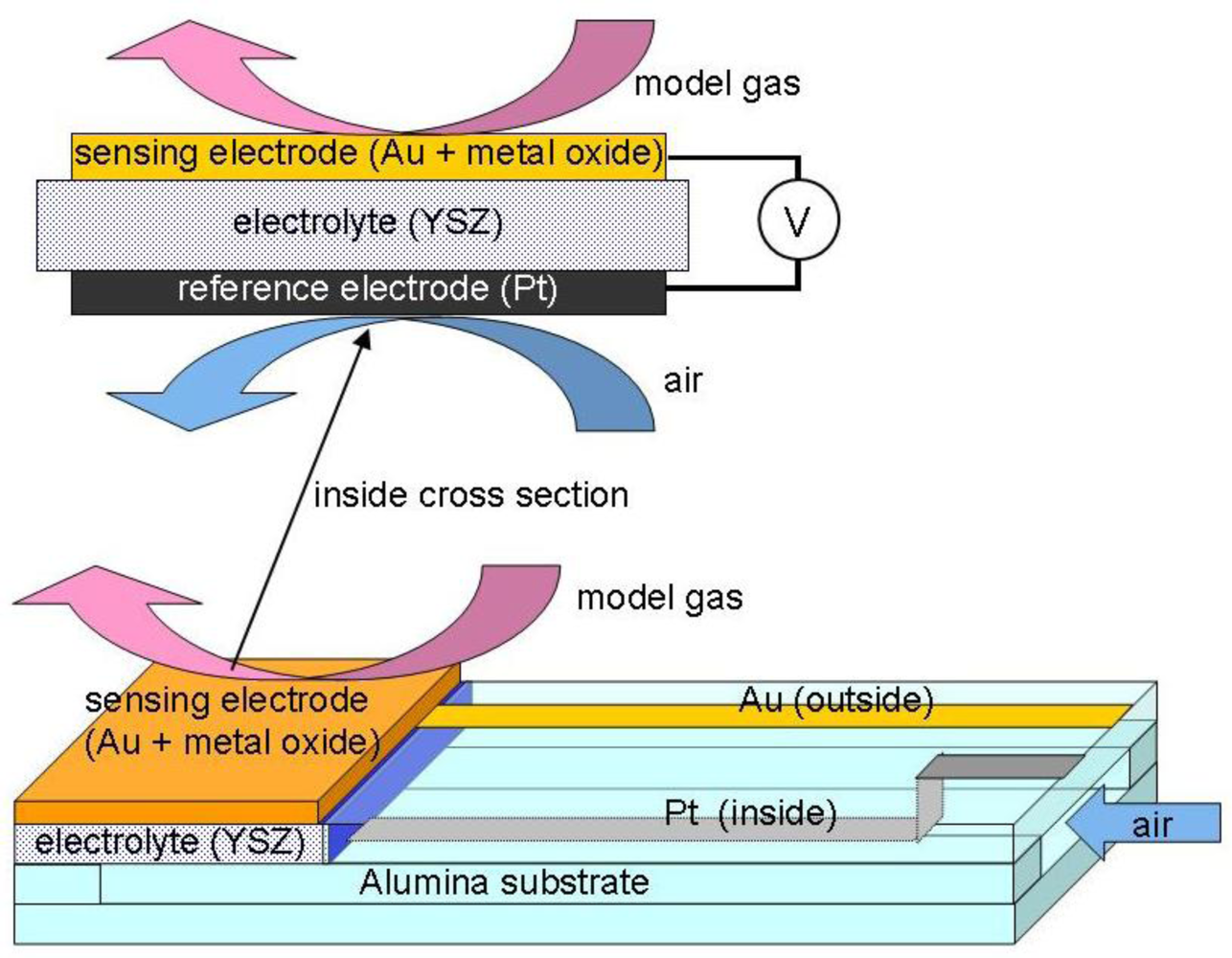
<p>The schematic structure of the two-chamber cell constructed with a YSZ solid electrolyte on an alumina substrate is illustrated in <xref ref-type="fig" rid="f1-sensors-11-02155">Figure 1</xref>. One side of the YSZ solid electrolyte covered by a Pt electrode is exposed to the inside chamber with outside air. Another side of the YSZ solid electrolyte is covered with a mixture of Au and metal oxide thick film as a sensing material prepared by the screen-printing technique in the same manner reported previously [<xref ref-type="bibr" rid="b9-sensors-11-02155">9</xref>,<xref ref-type="bibr" rid="b10-sensors-11-02155">10</xref>,<xref ref-type="bibr" rid="b17-sensors-11-02155">17</xref>]. For the preparation of electrodes, screen printable pastes were produced by mixing gold paste (purchased from Daiken Chemical Co., Ltd., Au100-1) with 10 wt% of the metal oxide powders. The sensor was calcined in air for 5 h at 650–1,000 °C depending on the metal oxide use, and assembled in a stainless case. Thickness of the film after the calcination step was <italic>ca</italic>. 10–20 μm. The name of each sensor electrode is abbreviated as the name of the metal oxide and calcination temperature in °C, for example, Bi<sub>2</sub>O<sub>3</sub>(850).</p></sec>
<sec>
<label>2.2.</label>
<title>Gas Sensor Measurements</title>
<p>Sensing characteristics were evaluated by using a conventional gas-flow apparatus equipped with a furnace operating at 600 °C. The stainless flow cell was heated at operating temperatures. The reference electrode (cathode) was exposed to air, and the sensing electrode (anode) was exposed to a flow of mixture gas. The composition of the base gas is 10% O<sub>2</sub>, 3% H<sub>2</sub>O, and N<sub>2</sub> as a balance gas at a flow rate of 150 cm<sup>3</sup> min<sup>−1</sup>. The standard concentrations of NH<sub>3</sub> and C<sub>3</sub>H<sub>6</sub> are 500 ppm. The electromotive forces (EMF) value of the cell was measured by an electrometer (Hokuto Denko HZ-5000).</p></sec></sec>
<sec sec-type="results|discussion">
<label>3.</label>
<title>Results and Discussion</title>
<sec>
<label>3.1.</label>
<title>Effect of Calcination</title>
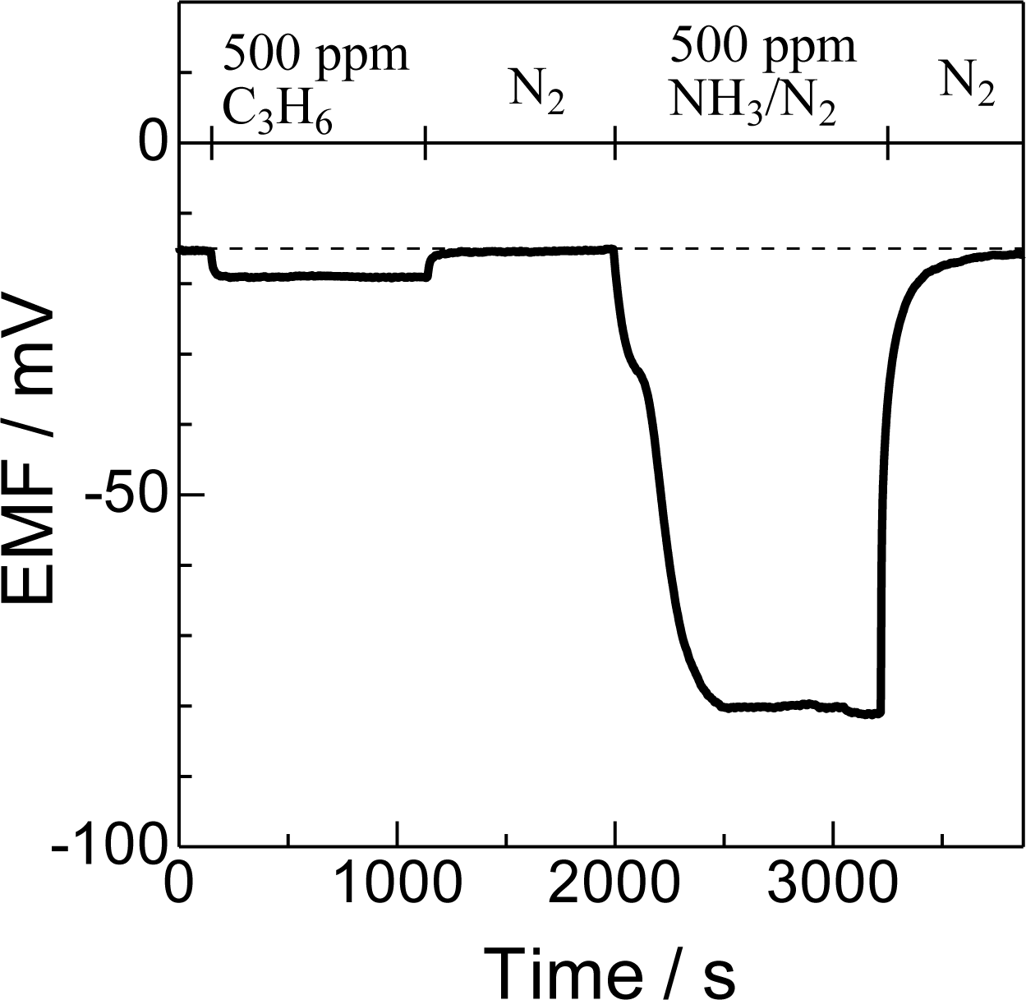
<p><xref ref-type="fig" rid="f2-sensors-11-02155">Figure 2</xref> shows an example of transient response of Bi<sub>2</sub>O<sub>3</sub>(850) to the injection of ammonia and C<sub>3</sub>H<sub>6</sub>. Due to the difference in the oxygen concentration (20% at the reference electrode and 10% at the sensing electrode), the EMF of the sensor electrode is −15.5 mV in the absence of reducing gases. In the presence of 500 ppm C<sub>3</sub>H<sub>6</sub>, EMF decreased to −19.1 mV. The difference in EMF between those in the presence and absence of a probe molecule is determined as ΔEMF, 3.6 mV in this case, and used as an indicator of response height. On the other hand, the ΔEMF in a flow of the same amount of NH<sub>3</sub> was −68.2 mV, which is one order higher than that in C<sub>3</sub>H<sub>6</sub>, indicating the very high selective sensing of the Bi<sub>2</sub>O<sub>3</sub>(850) electrode. After the evacuation of NH<sub>3</sub>, the EMF value quickly recovered to the original level. The ΔEMF of NH<sub>3</sub> relative to that of the same concentration of C<sub>3</sub>H<sub>6</sub> (ΔEMF<sub>NH3</sub>/ΔEMF<sub>C3H6</sub>) is used as a measure of cross-sensitivity.</p>
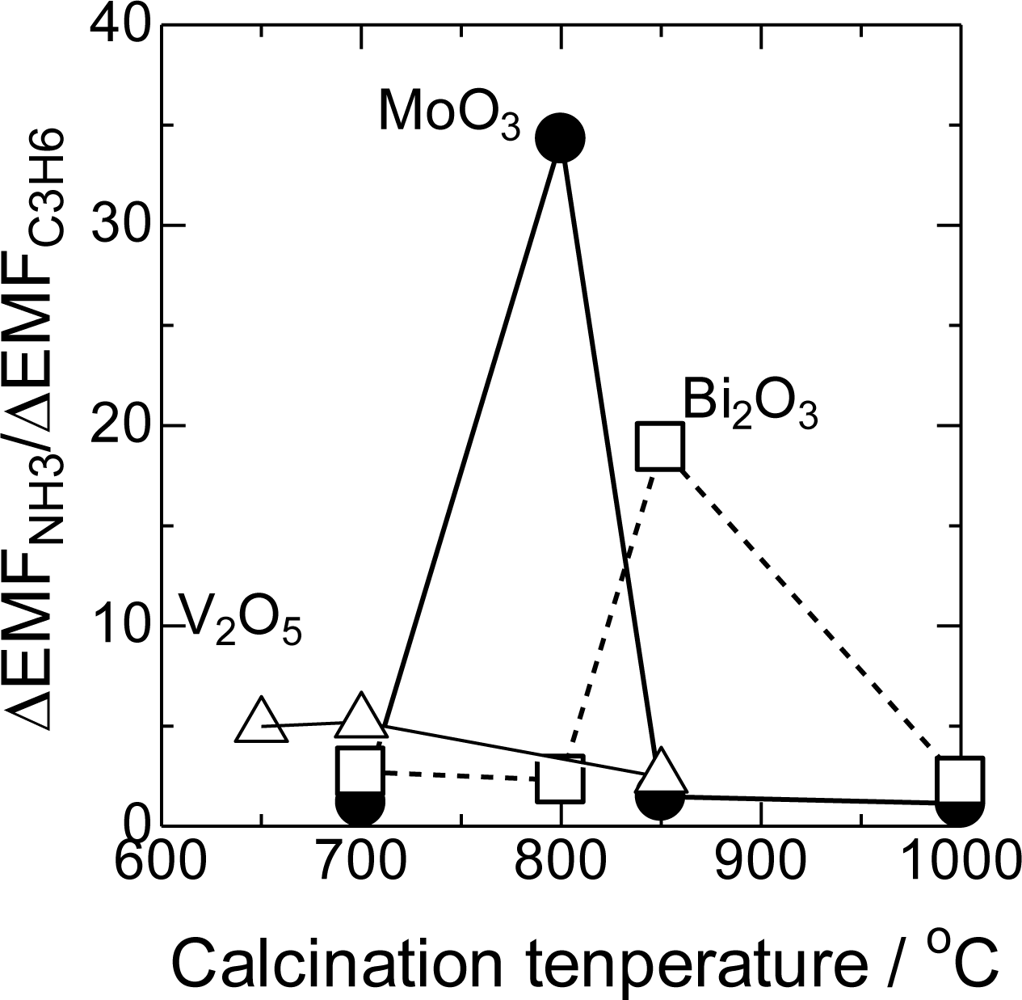
<p>The cross-sensitivity strongly depended on the calcination temperatures of the electrodes. In <xref ref-type="fig" rid="f3-sensors-11-02155">Figure 3</xref>, the ΔEMF<sub>NH3</sub>/ΔEMF<sub>C3H6</sub> ratios of the selected sensors as a function of the calcination temperature are shown. V<sub>2</sub>O<sub>5</sub>, MoO<sub>3</sub>, and Bi<sub>2</sub>O<sub>3</sub> showed the maximum ΔEMF<sub>NH3</sub>/ΔEMF<sub>C3H6</sub> at 700, 800, and 850 °C, respectively. Since the melting points of these metal oxides are 695, 790, and 820 °C, the maximum cross-sensitivity was observed around their melting points.</p>
<p>Various kinds of the sensing electrodes listed in <xref ref-type="table" rid="t1-sensors-11-02155">Table 1</xref>were prepared using the corresponding metal oxides. Due to the strong dependence of the cross-sensitivity on calcination temperatures as shown in <xref ref-type="fig" rid="f3-sensors-11-02155">Figure 3</xref>, the sensing performances were compared after the calcination at the optimum temperatures ranging from 700 to 1,000 °C. For WO<sub>3</sub>(1000), Nb<sub>2</sub>O<sub>5</sub>(1000), and MgO(1000) electrodes, the ΔEMF<sub>NH3</sub>/ΔEMF<sub>C3H6</sub> ratios were comparable to that of the electrode without modification (Au only). This implies a negligible chemical interaction between Au and metal oxides, which results in the ΔEMF<sub>NH3</sub>/ΔEMF<sub>C3H6</sub> ratio of around unity and thus, non-selective NH<sub>3</sub> detection. Melting points of these metal oxides were higher than the calcination temperature of 1,000 °C.</p>
<p>On the other hand, very high ΔEMF<sub>NH3</sub> and low ΔEMF<sub>C3H6</sub> were obtained when MoO<sub>3</sub> was used as a sensing material. As a result, the ΔEMF<sub>NH3</sub>/ΔEMF<sub>C3H6</sub> ratio was the highest for MoO<sub>3</sub>(800). MnO<sub>2</sub>, V<sub>2</sub>O<sub>5</sub>, and Bi<sub>2</sub>O<sub>3</sub> also showed high ΔEMF<sub>NH3</sub>/ΔEMF<sub>C3H6</sub> ratios and sufficient ΔEMF values in the presence of NH<sub>3</sub>. In these metal oxides melting points’ were below 820 °C, and the calcination temperatures were optimized around their melting points. The results show that the melting point of the sensing material is one of the important factors for the preparation of the selective sensors.</p>
<p>The maximum cross-sensitivity at around the melting points of the metal oxides suggests that the good mixing of the metal oxides, Au electrode, and YSZ is essential for selective NH<sub>3</sub> detection. It can be speculated that the acidic metal oxides are well spread on Au and YSZ surface and achieved the successful modification of Au and YSZ. Above the melting points, too much spreading of the metal oxide results in the undesired covering of Au and YSZ electrode. The strong dependence of the selective sensing of NH<sub>3</sub> on the calcination temperature suggests that the spreading of metal oxide is important for the successful preparation of the sensor. As shown in <xref ref-type="table" rid="t1-sensors-11-02155">Table 1</xref>, MoO<sub>3</sub>(850) showed the highest response altitude and ΔEMF<sub>NH3</sub>/ΔEMF<sub>C3H6</sub> ratio. However, owing to sublimation of MoO<sub>3</sub> at 1,155 °C [<xref ref-type="bibr" rid="b43-sensors-11-02155">43</xref>], MoO<sub>3</sub> is not suitable for the application of ammonia sensing in automobile exhaust systems. Therefore, further investigations have been done by using Bi<sub>2</sub>O<sub>3</sub>(850) which showed the second highest ΔEMF<sub>NH3</sub>/ΔEMF<sub>C3H6</sub> and sufficient response altitude.</p></sec>
<sec>
<label>3.2.</label>
<title>Effect of Acid-Base Property</title>
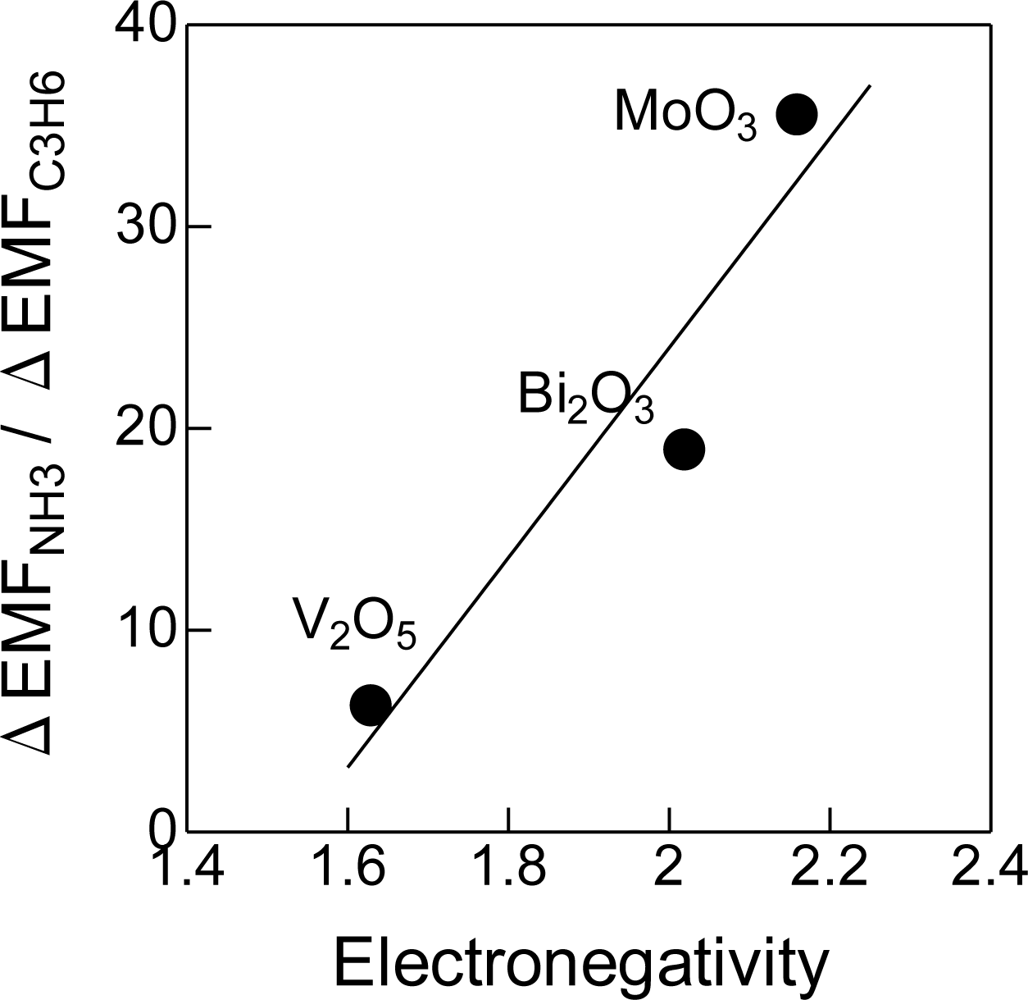
<p><xref ref-type="fig" rid="f4-sensors-11-02155">Figure 4</xref> shows ΔEMF<sub>NH3</sub>/ΔEMF<sub>C3H6</sub> ratio of MoO<sub>3</sub>(800), Bi<sub>2</sub>O<sub>3</sub>(850) and V<sub>2</sub>O<sub>5</sub>(700) as a function of electronegativity of the metals in the metal oxides. As we have reported in a previous paper [<xref ref-type="bibr" rid="b17-sensors-11-02155">17</xref>], the electronegativity can be used as an indicator of the acid-base properties of metal oxides: the higher electronegativity implies higher acidity of the oxides. Clearly, the ΔEMF<sub>NH3</sub>/ΔEMF<sub>C3H6</sub> ratio increased with the electronegativity. This correlation shows that the acidity of metal oxide is very essential for the cross-sensitivity to NH<sub>3</sub>.</p>
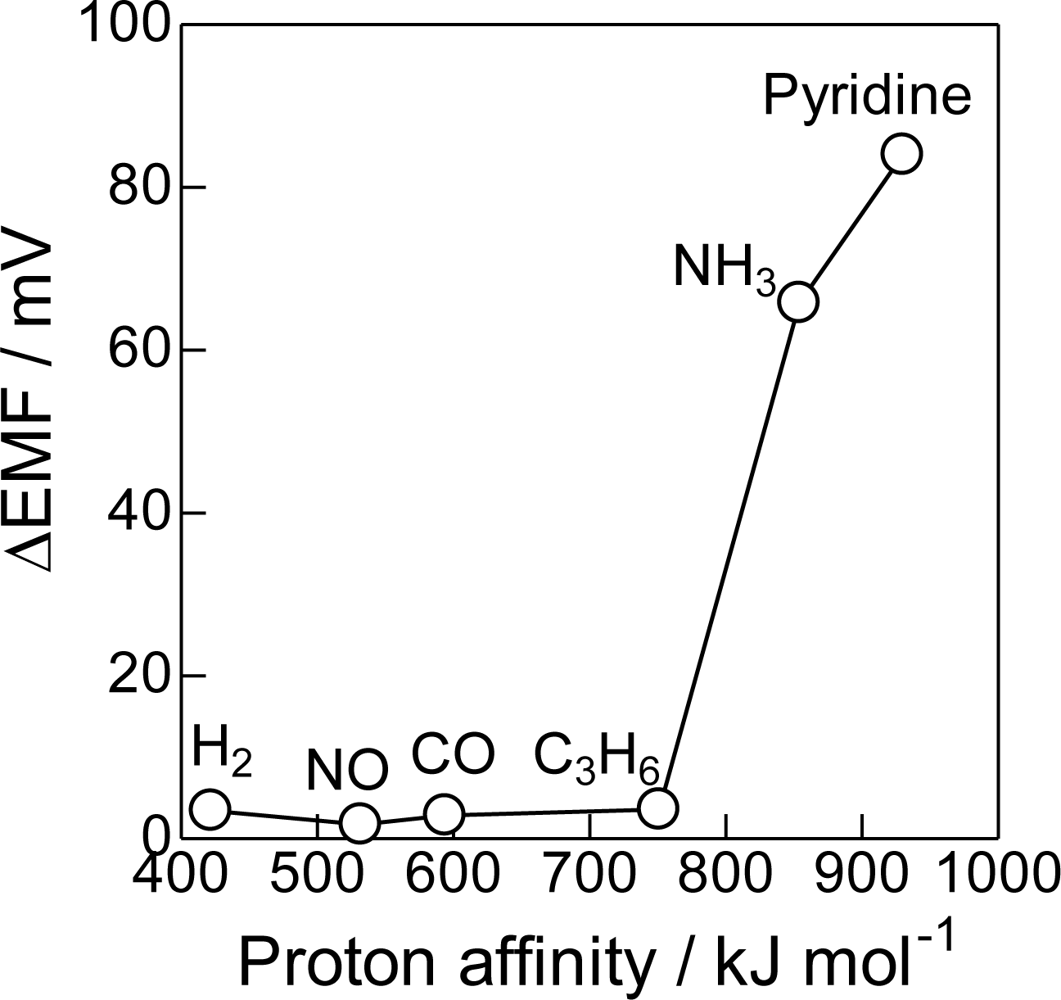
<p>The importance of acid-base properties also can be seen in the effect of the acid-base properties of probe molecules shown in <xref ref-type="fig" rid="f5-sensors-11-02155">Figure 5</xref>. The proton affinity is a good indicator for the acid-base properties of molecules [<xref ref-type="bibr" rid="b44-sensors-11-02155">44</xref>]. The Bi<sub>2</sub>O<sub>3</sub>(850) electrode was not sensitive to H<sub>2</sub>, NO, CO, C<sub>3</sub>H<sub>6</sub> having lower proton affinity. However, ΔEMF became very high to NH<sub>3</sub> and pyridine which have high proton affinity, <italic>i.e</italic>., are highly basic molecules. These results clearly indicate that the sensing response of the prepared electrodes strongly depends on the acid-base interaction of the sensing electrodes and probe molecules. A highly acidic property is required for the selective detection of NH<sub>3</sub>.</p></sec>
<sec>
<label>3.3.</label>
<title>Performance of Bi<sub>2</sub>O<sub>3</sub>(850) as an Ammonia Sensor</title>
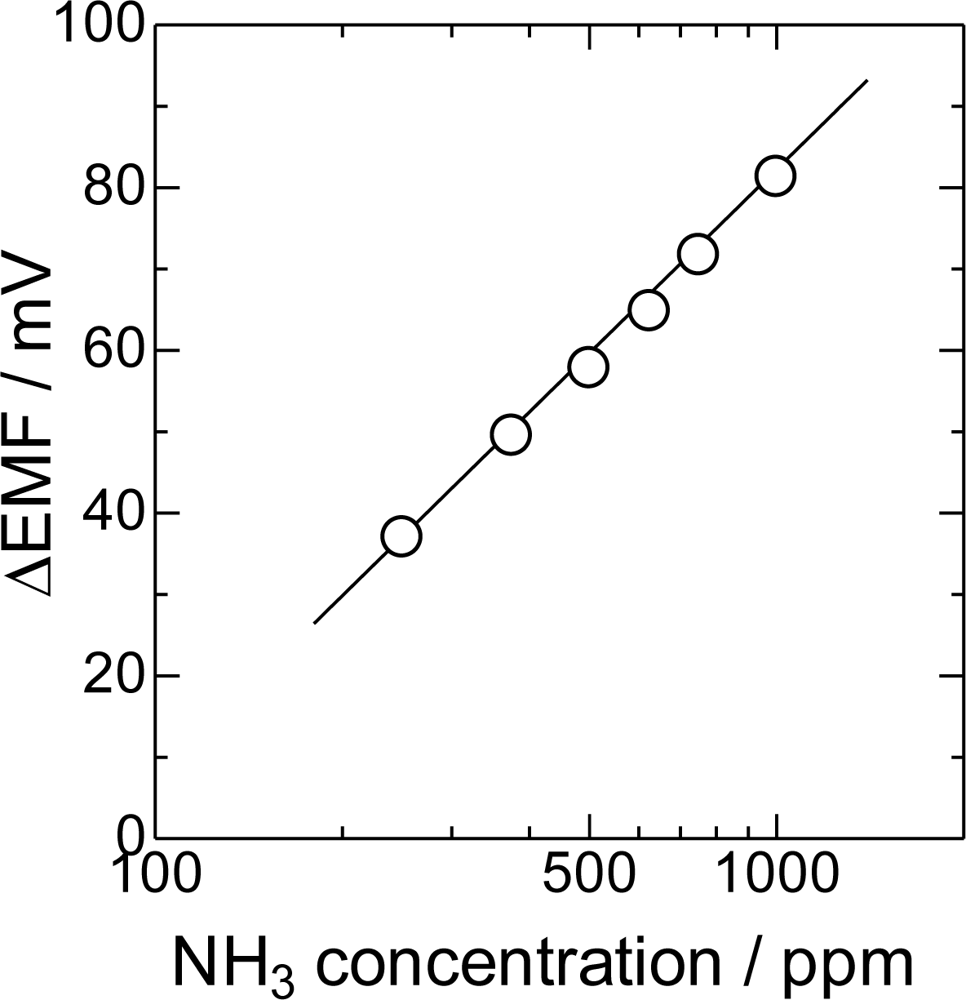
<p>The sensing performance of Bi<sub>2</sub>O<sub>3</sub>(850) as an ammonia sensor was investigated. The response of the Bi<sub>2</sub>O<sub>3</sub>(850) electrode was examined by stepwise change in the NH<sub>3</sub> concentration up to 1,000 ppm. The measured ΔEMF was plotted as a function of NH<sub>3</sub> concentration in <xref ref-type="fig" rid="f6-sensors-11-02155">Figure 6</xref>. The sensor characteristic was semi-logarithmic to the NH<sub>3</sub> concentration. This means that the sensor has a high sensitivity, even at lower ammonia concentrations.</p>
<p>The mixed potential mechanism was evaluated for the Bi<sub>2</sub>O<sub>3</sub>(850) electrode by modified polarization curves [<xref ref-type="bibr" rid="b25-sensors-11-02155">25</xref>–<xref ref-type="bibr" rid="b27-sensors-11-02155">27</xref>] in 10% O<sub>2</sub> and in 500 ppm NH<sub>3</sub> at 600 °C, in the same manner proposed by Miura [<xref ref-type="bibr" rid="b25-sensors-11-02155">25</xref>]. The intersection of the polarization curves was observed at the same ΔEMF value in the presence of the same concentrations of NH<sub>3</sub> and O<sub>2</sub>. When the following <xref ref-type="disp-formula" rid="FD1">Equation (1)</xref> at the cathode and <xref ref-type="disp-formula" rid="FD2">Equation (2)</xref> at the anode proceed at an equal rate, an electrode potential shows the mixed potential:
<disp-formula id="FD1">
<label>(1)</label>
<mml:math display="block">
<mml:mrow>
<mml:mn>1</mml:mn>
<mml:mo>/</mml:mo>
<mml:mn>2</mml:mn>
<mml:mo> </mml:mo>
<mml:msub>
<mml:mrow>
<mml:mi mathvariant="normal">O</mml:mi></mml:mrow>
<mml:mn>2</mml:mn></mml:msub>
<mml:mo>+</mml:mo>
<mml:mn>2</mml:mn>
<mml:mo> </mml:mo>
<mml:msup>
<mml:mrow>
<mml:mi mathvariant="normal">e</mml:mi></mml:mrow>
<mml:mo>−</mml:mo></mml:msup>
<mml:mo>→</mml:mo>
<mml:msup>
<mml:mrow>
<mml:mi mathvariant="normal">O</mml:mi></mml:mrow>
<mml:mrow>
<mml:mn>2</mml:mn>
<mml:mo>−</mml:mo></mml:mrow></mml:msup></mml:mrow></mml:math></disp-formula>
<disp-formula id="FD2">
<label>(2)</label>
<mml:math display="block">
<mml:mrow>
<mml:mn>2</mml:mn>
<mml:mo>/</mml:mo>
<mml:mn>3</mml:mn>
<mml:mo> </mml:mo>
<mml:msub>
<mml:mrow>
<mml:mrow>
<mml:mtext>NH</mml:mtext></mml:mrow></mml:mrow>
<mml:mn>3</mml:mn></mml:msub>
<mml:mo>+</mml:mo>
<mml:msup>
<mml:mrow>
<mml:mi mathvariant="normal">O</mml:mi></mml:mrow>
<mml:mrow>
<mml:mn>2</mml:mn>
<mml:mo>−</mml:mo></mml:mrow></mml:msup>
<mml:mo>→</mml:mo>
<mml:mn>1</mml:mn>
<mml:mo>/</mml:mo>
<mml:mn>3</mml:mn>
<mml:mo> </mml:mo>
<mml:msub>
<mml:mrow>
<mml:mi mathvariant="normal">N</mml:mi></mml:mrow>
<mml:mn>2</mml:mn></mml:msub>
<mml:mo>+</mml:mo>
<mml:msub>
<mml:mrow>
<mml:mi mathvariant="normal">H</mml:mi></mml:mrow>
<mml:mn>2</mml:mn></mml:msub>
<mml:mi mathvariant="normal">O</mml:mi>
<mml:mo>+</mml:mo>
<mml:mn>2</mml:mn>
<mml:mo> </mml:mo>
<mml:msup>
<mml:mrow>
<mml:mi mathvariant="normal">e</mml:mi></mml:mrow>
<mml:mo>−</mml:mo></mml:msup></mml:mrow></mml:math></disp-formula></p>
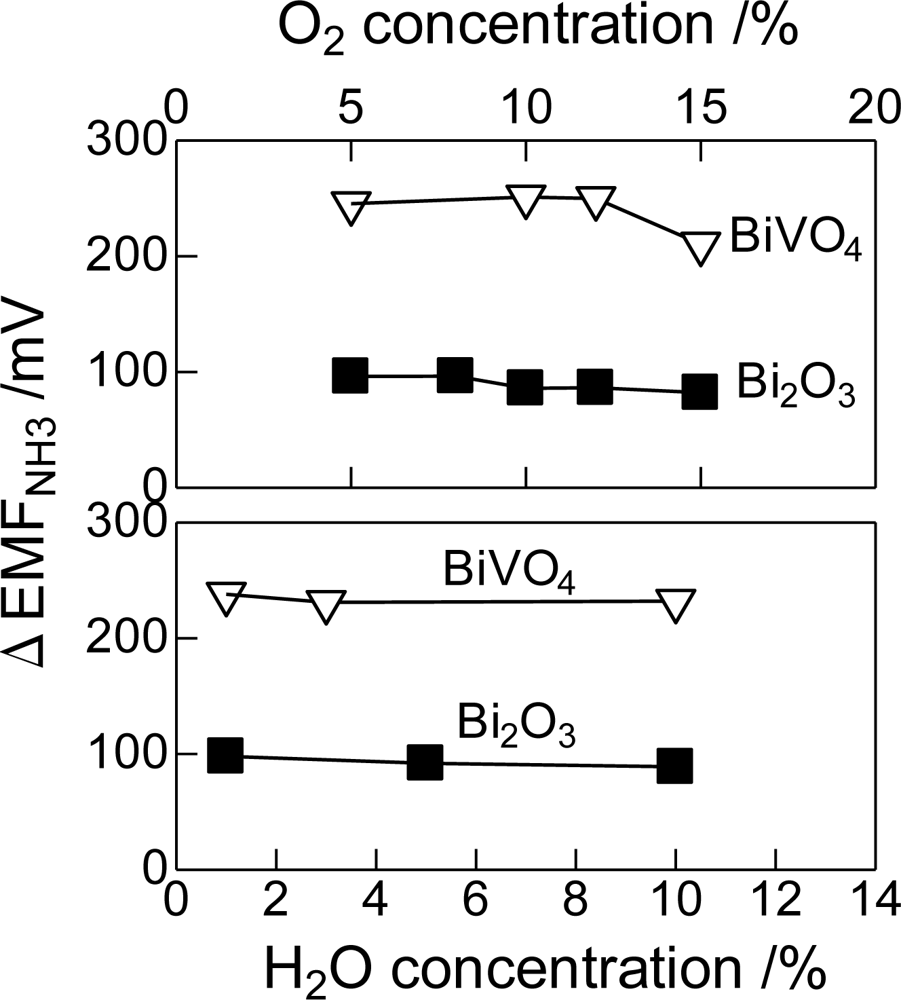
<p>It is important to examine the effect of interfering gaseous species on the response of the sensor. <xref ref-type="fig" rid="f7-sensors-11-02155">Figure 7</xref> shows the influence of the concentration of O<sub>2</sub> and water vapor on the responses of the Bi<sub>2</sub>O<sub>3</sub>(850) electrode to 500 ppm NH<sub>3</sub>. It should be noted that a different lot of the Bi<sub>2</sub>O<sub>3</sub>(850) sensor was used in this section, and the sensing responses were compared with those of BiVO<sub>4</sub>(750) electrode, which is known as one of the excellent electrode for NH<sub>3</sub> sensing [<xref ref-type="bibr" rid="b39-sensors-11-02155">39</xref>], prepared by the same manner reported by Wang <italic>et al</italic>. [<xref ref-type="bibr" rid="b39-sensors-11-02155">39</xref>]. The concentration of water vapor was varied from 1 to 10%. The responses of both the sensors were not much affected by water vapor. While, the higher concentration of O<sub>2</sub> slightly decreased the ΔEMF vale of the Bi<sub>2</sub>O<sub>3</sub>(850) electrode, though the ΔEMF of the BiVO<sub>4</sub>(750) electrode significantly decreased when the O<sub>2</sub> concentration is 15%. The Bi<sub>2</sub>O<sub>3</sub>(850) electrode is less interfered by the concentration of O<sub>2</sub> than the BiVO<sub>4</sub>(750) electrode.</p></sec></sec>
<sec sec-type="conclusions">
<label>4.</label>
<title>Conclusions</title>
<p>The effect of calcination temperature and acid-base properties of metal oxides used as a sensing material for an ammonia sensor have been investigated. The sensor electrode was prepared by the two-chamber cell constructed from a YSZ solid electrolyte, on which one side is covered by a Pt electrode and another side is covered with a mixture of Au and a metal oxide thick film as a sensing material. When MoO<sub>3</sub>, Bi<sub>2</sub>O<sub>3</sub> and V<sub>2</sub>O<sub>5</sub>, having melting points below 820 °C, are used as the sensing material, the sensors exhibited very high cross-sensitivity to NH<sub>3</sub>. The use of WO<sub>3,</sub> Nb<sub>2</sub>O<sub>5</sub> and MgO having melting points above 1,000 °C as sensing materials was not effective. The good spreading of the metal oxide on the sensing electrode was suggested to be one of the important factors. The sensing selectivity to ammonia was in the order of MoO<sub>3</sub> &gt; Bi<sub>2</sub>O<sub>3</sub> &gt; V<sub>2</sub>O<sub>5</sub>, which was in agreement with the corresponding acidity of the metal oxides. It was clarified that the acidity of metal oxides is the determining factor for the selective sensing of NH<sub>3</sub>.</p></sec></body>
<back>
<ref-list>
<title>References</title>
<ref id="b1-sensors-11-02155"><label>1.</label><citation citation-type="journal"><person-group person-group-type="author"><name><surname>Koebel</surname><given-names>M.</given-names></name><name><surname>Elsener</surname><given-names>M.</given-names></name><name><surname>Kleemann</surname><given-names>M.</given-names></name></person-group><article-title>Urea-SCR: A promising technique to reduce NOx emissions from automotive diesel engines</article-title><source>Catal. Today</source><year>2000</year><volume>59</volume><fpage>335</fpage><lpage>345</lpage><pub-id pub-id-type="doi">10.1016/S0920-5861(00)00299-6</pub-id></citation></ref>
<ref id="b2-sensors-11-02155"><label>2.</label><citation citation-type="journal"><person-group person-group-type="author"><name><surname>Burch</surname><given-names>R.</given-names></name></person-group><article-title>Knowledge and know-how in emission control for mobile</article-title><source>Catal. Rev</source><year>2004</year><volume>46</volume><fpage>271</fpage><lpage>334</lpage><pub-id pub-id-type="doi">10.1081/CR-200036718</pub-id></citation></ref>
<ref id="b3-sensors-11-02155"><label>3.</label><citation citation-type="journal"><person-group person-group-type="author"><name><surname>Matsumoto</surname><given-names>S.</given-names></name></person-group><article-title>Recent advances in automobile exhaust catalysts</article-title><source>Catal. Today</source><year>2004</year><volume>90</volume><fpage>183</fpage><lpage>190</lpage><pub-id pub-id-type="doi">10.1016/j.cattod.2004.04.048</pub-id></citation></ref>
<ref id="b4-sensors-11-02155"><label>4.</label><citation citation-type="journal"><person-group person-group-type="author"><name><surname>Klingstedt</surname><given-names>F.</given-names></name><name><surname>Arve</surname><given-names>K.</given-names></name><name><surname>Eränen</surname><given-names>K.</given-names></name><name><surname>Murzin</surname><given-names>D.Y.</given-names></name></person-group><article-title>Toward improved catalytic low-temperature NOx removal in diesel-powered vehicles</article-title><source>Acc. Chem. Res</source><year>2006</year><volume>39</volume><fpage>273</fpage><lpage>282</lpage><pub-id pub-id-type="doi">10.1021/ar050185k</pub-id><pub-id pub-id-type="pmid">16618095</pub-id></citation></ref>
<ref id="b5-sensors-11-02155"><label>5.</label><citation citation-type="journal"><person-group person-group-type="author"><name><surname>Moos</surname><given-names>R.</given-names></name></person-group><article-title>A brief overview on automotive exhaust gas sensors based on electroceramics</article-title><source>Int. J. Appl. Ceram. Technol</source><year>2005</year><volume>2</volume><fpage>401</fpage><lpage>413</lpage><pub-id pub-id-type="doi">10.1111/j.1744-7402.2005.02041.x</pub-id></citation></ref>
<ref id="b6-sensors-11-02155"><label>6.</label><citation citation-type="book"><person-group person-group-type="author"><name><surname>Moos</surname><given-names>R.</given-names></name></person-group><article-title>Automotive exhaust gas sensors</article-title><source>Encyclopedia of Sensors</source><person-group person-group-type="editor"><name><surname>Grimes</surname><given-names>C.A.</given-names></name><name><surname>Dickey</surname><given-names>E.C.</given-names></name><name><surname>Pishko</surname><given-names>M.V.</given-names></name></person-group><publisher-name>American Scientific Publishers</publisher-name><publisher-loc>Valencia, CA, USA</publisher-loc><year>2006</year><volume>1</volume><fpage>295</fpage><lpage>312</lpage></citation></ref>
<ref id="b7-sensors-11-02155"><label>7.</label><citation citation-type="journal"><person-group person-group-type="author"><name><surname>Moos</surname><given-names>R.</given-names></name><name><surname>Muller</surname><given-names>R.</given-names></name><name><surname>Plog</surname><given-names>C.</given-names></name><name><surname>Knezevic</surname><given-names>A.</given-names></name><name><surname>Leye</surname><given-names>H.</given-names></name><name><surname>Irion</surname><given-names>E.</given-names></name><name><surname>Braun</surname><given-names>T.</given-names></name><name><surname>Marquardt</surname><given-names>K.-J.</given-names></name><name><surname>Binder</surname><given-names>K.</given-names></name></person-group><article-title>Selective ammonia exhaust gas sensor for automotive applications</article-title><source>Sens. Actuat. B</source><year>2002</year><volume>83</volume><fpage>181</fpage><lpage>189</lpage><pub-id pub-id-type="doi">10.1016/S0925-4005(01)01038-3</pub-id></citation></ref>
<ref id="b8-sensors-11-02155"><label>8.</label><citation citation-type="journal"><person-group person-group-type="author"><name><surname>Kubinsk</surname><given-names>D.J.</given-names></name><name><surname>Visser</surname><given-names>J.H.</given-names></name></person-group><article-title>Sensor and method for determining the ammonia loading of a zeolite SCR catalyst</article-title><source>Sens. Actuat. B</source><year>2008</year><volume>130</volume><fpage>425</fpage><lpage>429</lpage><pub-id pub-id-type="doi">10.1016/j.snb.2007.09.007</pub-id></citation></ref>
<ref id="b9-sensors-11-02155"><label>9.</label><citation citation-type="journal"><person-group person-group-type="author"><name><surname>Satsuma</surname><given-names>A.</given-names></name><name><surname>Shimizu</surname><given-names>K.</given-names></name><name><surname>Hattori</surname><given-names>T.</given-names></name><name><surname>Nishiyama</surname><given-names>H.</given-names></name><name><surname>Kakimoto</surname><given-names>S.</given-names></name><name><surname>Sugaya</surname><given-names>S.</given-names></name><name><surname>Yokoi</surname><given-names>H.</given-names></name></person-group><article-title>Polytungstate clusters on zirconia as a sensing material for a selective ammonia gas sensor</article-title><source>Sens. Actuat. B</source><year>2007</year><volume>123</volume><fpage>757</fpage><lpage>762</lpage><pub-id pub-id-type="doi">10.1016/j.snb.2006.10.011</pub-id></citation></ref>
<ref id="b10-sensors-11-02155"><label>10.</label><citation citation-type="journal"><person-group person-group-type="author"><name><surname>Satsuma</surname><given-names>A.</given-names></name><name><surname>Shimizu</surname><given-names>K.</given-names></name><name><surname>Kashiwagi</surname><given-names>K.</given-names></name><name><surname>Endo</surname><given-names>T.</given-names></name><name><surname>Nishiyama</surname><given-names>H.</given-names></name><name><surname>Kakimoto</surname><given-names>S.</given-names></name><name><surname>Sugaya</surname><given-names>S.</given-names></name><name><surname>Yokoi</surname><given-names>H.</given-names></name></person-group><article-title>Ammonia sensing mechanism of tungstated-zirconia thick film sensor</article-title><source>J. Phys. Chem. C</source><year>2007</year><volume>111</volume><fpage>12080</fpage><lpage>12085</lpage><pub-id pub-id-type="doi">10.1021/jp073833l</pub-id></citation></ref>
<ref id="b11-sensors-11-02155"><label>11.</label><citation citation-type="journal"><person-group person-group-type="author"><name><surname>Ando</surname><given-names>M.</given-names></name><name><surname>Tsuchida</surname><given-names>T.</given-names></name><name><surname>Suto</surname><given-names>S.</given-names></name><name><surname>Suzuki</surname><given-names>T.</given-names></name><name><surname>Nakayama</surname><given-names>C.</given-names></name><name><surname>Miura</surname><given-names>N.</given-names></name><name><surname>Yamazoe</surname><given-names>N.</given-names></name></person-group><article-title>Ammonia gas sensor using thick film of Au-loaded tungsten trioxide</article-title><source>J. Ceram. Soc. Jpn</source><year>1996</year><volume>104</volume><fpage>1112</fpage><lpage>1116</lpage><pub-id pub-id-type="doi">10.2109/jcersj.104.1112</pub-id></citation></ref>
<ref id="b12-sensors-11-02155"><label>12.</label><citation citation-type="journal"><person-group person-group-type="author"><name><surname>Xu</surname><given-names>C.N.</given-names></name><name><surname>Miura</surname><given-names>N.</given-names></name><name><surname>Ishida</surname><given-names>Y.</given-names></name><name><surname>Matsuda</surname><given-names>K.</given-names></name><name><surname>Yamazoe</surname><given-names>N.</given-names></name></person-group><article-title>Selective detection of NH<sub>3</sub> over NO in combustion exhausts by using Au and MoO<sub>3</sub> doubly promoted WO<sub>3</sub> element</article-title><source>Sens. Actuat. B</source><year>2000</year><volume>65</volume><fpage>163</fpage><lpage>165</lpage><pub-id pub-id-type="doi">10.1016/S0925-4005(99)00413-X</pub-id></citation></ref>
<ref id="b13-sensors-11-02155"><label>13.</label><citation citation-type="journal"><person-group person-group-type="author"><name><surname>Mutschall</surname><given-names>D.</given-names></name><name><surname>Holzner</surname><given-names>K.</given-names></name><name><surname>Obermeier</surname><given-names>E.</given-names></name></person-group><article-title>Sputtered molybedeum oxide thin films for NH<sub>3</sub> detection</article-title><source>Sens. Actuat. B</source><year>1996</year><volume>36</volume><fpage>320</fpage><lpage>324</lpage><pub-id pub-id-type="doi">10.1016/S0925-4005(97)80089-5</pub-id></citation></ref>
<ref id="b14-sensors-11-02155"><label>14.</label><citation citation-type="journal"><person-group person-group-type="author"><name><surname>Prasad</surname><given-names>A.K.</given-names></name><name><surname>Kubinski</surname><given-names>D.J.</given-names></name><name><surname>Gouma</surname><given-names>P.I.</given-names></name></person-group><article-title>Comparison of sol-gel and ion beam deposited MoO<sub>3</sub> thin film gas sensors for selective ammonia detection</article-title><source>Sens. Actuat. B</source><year>2003</year><volume>93</volume><fpage>25</fpage><lpage>30</lpage><pub-id pub-id-type="doi">10.1016/S0925-4005(03)00336-8</pub-id></citation></ref>
<ref id="b15-sensors-11-02155"><label>15.</label><citation citation-type="journal"><person-group person-group-type="author"><name><surname>Raju</surname><given-names>A.R.</given-names></name><name><surname>Rae</surname><given-names>C.N.R.</given-names></name></person-group><article-title>MoO<sub>3</sub>/TiO<sub>2</sub> and Bi<sub>2</sub>MoO<sub>6</sub> as ammonia sensors</article-title><source>Sens. Actuat. B-Chem</source><year>2003</year><volume>93</volume><fpage>25</fpage><lpage>30</lpage><pub-id pub-id-type="doi">10.1016/S0925-4005(03)00336-8</pub-id></citation></ref>
<ref id="b16-sensors-11-02155"><label>16.</label><citation citation-type="journal"><person-group person-group-type="author"><name><surname>Meixner</surname><given-names>H.</given-names></name><name><surname>Gerblinger</surname><given-names>J.</given-names></name><name><surname>Lampe</surname><given-names>U.</given-names></name><name><surname>Fleischer</surname><given-names>M.</given-names></name></person-group><article-title>Thin-film gas sensors based on semiconducting metal oxides</article-title><source>Sens. Actuat. B</source><year>1994</year><volume>23</volume><fpage>23</fpage><lpage>26</lpage></citation></ref>
<ref id="b17-sensors-11-02155"><label>17.</label><citation citation-type="journal"><person-group person-group-type="author"><name><surname>Shimizu</surname><given-names>K.</given-names></name><name><surname>Chinzei</surname><given-names>I.</given-names></name><name><surname>Nishiyama</surname><given-names>H.</given-names></name><name><surname>Kakimoto</surname><given-names>S.</given-names></name><name><surname>Sugaya</surname><given-names>S.</given-names></name><name><surname>Matsutani</surname><given-names>M.</given-names></name><name><surname>Satsuma</surname><given-names>A.</given-names></name></person-group><article-title>Doped-vanadium oxides as sensing materials for high temperature operative selective ammonia gas sensors</article-title><source>Sens. Actuat. B</source><year>2009</year><volume>41</volume><fpage>410</fpage><lpage>416</lpage></citation></ref>
<ref id="b18-sensors-11-02155"><label>18.</label><citation citation-type="journal"><person-group person-group-type="author"><name><surname>Ivanov</surname><given-names>P.</given-names></name><name><surname>Hubalek</surname><given-names>J.</given-names></name><name><surname>Malysz</surname><given-names>K.</given-names></name><name><surname>Prášek</surname><given-names>J.</given-names></name><name><surname>Vilanova</surname><given-names>X.</given-names></name><name><surname>Llobet</surname><given-names>E.</given-names></name><name><surname>Correig</surname><given-names>X.</given-names></name></person-group><article-title>A route toward more selective and less humidity sensitive screen-printed SnO<sub>2</sub> and WO<sub>3</sub> gas sensitive layers</article-title><source>Sens. Actuat. B</source><year>2004</year><volume>100</volume><fpage>221</fpage><lpage>227</lpage><pub-id pub-id-type="doi">10.1016/j.snb.2003.12.065</pub-id></citation></ref>
<ref id="b19-sensors-11-02155"><label>19.</label><citation citation-type="journal"><person-group person-group-type="author"><name><surname>Teeramongkonrasmee</surname><given-names>A.</given-names></name><name><surname>Sriyudthsak</surname><given-names>M.</given-names></name></person-group><article-title>Methanol and ammonia sensing characteristics of sol-gel derived thin film gas sensor</article-title><source>Sens. Actuat. B</source><year>2000</year><volume>66</volume><fpage>256</fpage><lpage>259</lpage><pub-id pub-id-type="doi">10.1016/S0925-4005(00)00346-4</pub-id></citation></ref>
<ref id="b20-sensors-11-02155"><label>20.</label><citation citation-type="journal"><person-group person-group-type="author"><name><surname>Shimizu</surname><given-names>Y.</given-names></name><name><surname>Okamoto</surname><given-names>T.</given-names></name><name><surname>Takao</surname><given-names>Y.</given-names></name><name><surname>Egashira</surname><given-names>M.</given-names></name></person-group><article-title>Desorption behavior of ammonia from TiO<sub>2</sub>-based specimens—ammonia sensing mechanism of double-layer sensors with TiO<sub>2</sub>-based catalyst layers</article-title><source>J. Mol. Catal. A</source><year>2000</year><volume>155</volume><fpage>183</fpage><lpage>191</lpage><pub-id pub-id-type="doi">10.1016/S1381-1169(99)00333-7</pub-id></citation></ref>
<ref id="b21-sensors-11-02155"><label>21.</label><citation citation-type="journal"><person-group person-group-type="author"><name><surname>Romanovskaya</surname><given-names>V.</given-names></name><name><surname>Ivanovskaya</surname><given-names>M.</given-names></name><name><surname>Bogdanov</surname><given-names>P.</given-names></name></person-group><article-title>A study of sensing properties of Pt- and Au-loaded In<sub>2</sub>O<sub>3</sub> ceramics</article-title><source>Sens. Actuat. B</source><year>1999</year><volume>56</volume><fpage>31</fpage><lpage>36</lpage><pub-id pub-id-type="doi">10.1016/S0925-4005(99)00018-0</pub-id></citation></ref>
<ref id="b22-sensors-11-02155"><label>22.</label><citation citation-type="journal"><person-group person-group-type="author"><name><surname>Li</surname><given-names>C.</given-names></name><name><surname>Zhang</surname><given-names>D.</given-names></name><name><surname>Lei</surname><given-names>B.</given-names></name><name><surname>Han</surname><given-names>S.</given-names></name><name><surname>Liu</surname><given-names>X.</given-names></name><name><surname>Zhou</surname><given-names>C.</given-names></name></person-group><article-title>Surface treatment and doping dependence of In<sub>2</sub>O<sub>3</sub> nanowires as ammonia sensors</article-title><source>J. Phys. Chem. B</source><year>2003</year><volume>107</volume><fpage>12451</fpage><lpage>12455</lpage><pub-id pub-id-type="doi">10.1021/jp0361531</pub-id></citation></ref>
<ref id="b23-sensors-11-02155"><label>23.</label><citation citation-type="journal"><person-group person-group-type="author"><name><surname>Guo</surname><given-names>P.</given-names></name><name><surname>Pan</surname><given-names>H.</given-names></name></person-group><article-title>Selectivity of Ti-doped In<sub>2</sub>O<sub>3</sub> ceramics as an ammonia sensor</article-title><source>Sens. Actuat. B</source><year>2006</year><volume>114</volume><fpage>762</fpage><lpage>767</lpage><pub-id pub-id-type="doi">10.1016/j.snb.2005.07.040</pub-id></citation></ref>
<ref id="b24-sensors-11-02155"><label>24.</label><citation citation-type="journal"><person-group person-group-type="author"><name><surname>Aslam</surname><given-names>M.</given-names></name><name><surname>Chaudhary</surname><given-names>V.A.</given-names></name><name><surname>Mulla</surname><given-names>I.S.</given-names></name><name><surname>Sainkar</surname><given-names>S.R.</given-names></name><name><surname>Mandale</surname><given-names>A.B.</given-names></name><name><surname>Belhekar</surname><given-names>A.A.</given-names></name><name><surname>Vijayamohanan</surname><given-names>K.</given-names></name></person-group><article-title>A highly selective ammonia gas sensor using surface ruthenated zinc oxide</article-title><source>Sens. Actuat. B</source><year>1999</year><volume>75</volume><fpage>162</fpage><lpage>167</lpage><pub-id pub-id-type="doi">10.1016/S0924-4247(99)00050-3</pub-id></citation></ref>
<ref id="b25-sensors-11-02155"><label>25.</label><citation citation-type="journal"><person-group person-group-type="author"><name><surname>Miura</surname><given-names>N.</given-names></name><name><surname>Raisen</surname><given-names>T.</given-names></name><name><surname>Lu</surname><given-names>G.</given-names></name><name><surname>Yamazoe</surname><given-names>N.</given-names></name></person-group><article-title>Highly selective CO sensor using stabilized zirconia and a couple of oxide electrodes</article-title><source>Sens. Actuat. B</source><year>1998</year><volume>47</volume><fpage>84</fpage><lpage>91</lpage><pub-id pub-id-type="doi">10.1016/S0925-4005(98)00053-7</pub-id></citation></ref>
<ref id="b26-sensors-11-02155"><label>26.</label><citation citation-type="journal"><person-group person-group-type="author"><name><surname>Hibino</surname><given-names>T.</given-names></name><name><surname>Kakimoto</surname><given-names>S.</given-names></name><name><surname>Sano</surname><given-names>M.</given-names></name></person-group><article-title>Non-Nernstian behavior at modified Au electrodes for hydrocarbon gas sensing</article-title><source>J. Electrochem. Soc</source><year>1999</year><volume>146</volume><fpage>3361</fpage><lpage>3366</lpage><pub-id pub-id-type="doi">10.1149/1.1392478</pub-id></citation></ref>
<ref id="b27-sensors-11-02155"><label>27.</label><citation citation-type="journal"><person-group person-group-type="author"><name><surname>Garzon</surname><given-names>F.H.</given-names></name><name><surname>Mukundan</surname><given-names>R.</given-names></name><name><surname>Brosha</surname><given-names>E.L.</given-names></name></person-group><article-title>Solid-state mixed potential gas sensors: Theory, experiments and challenges</article-title><source>Solid State Ionics</source><year>2000</year><volume>136–137</volume><fpage>633</fpage><lpage>638</lpage></citation></ref>
<ref id="b28-sensors-11-02155"><label>28.</label><citation citation-type="journal"><person-group person-group-type="author"><name><surname>Brosha</surname><given-names>E.L.</given-names></name><name><surname>Mukundan</surname><given-names>R.</given-names></name><name><surname>Brown</surname><given-names>D.R.</given-names></name><name><surname>Garzon</surname><given-names>F.H.</given-names></name><name><surname>Visser</surname><given-names>J.H.</given-names></name><name><surname>Zanini</surname><given-names>M.</given-names></name><name><surname>Zhou</surname><given-names>Z.</given-names></name><name><surname>Logothetis</surname><given-names>E.M.</given-names></name></person-group><article-title>CO/HC sensors based on thin films of LaCoO<sub>3</sub> and La<sub>0.8</sub>Sr<sub>0.2</sub>CoO<sub>3-d</sub> metal oxides</article-title><source>Sens. Actuat. B</source><year>2000</year><volume>69</volume><fpage>171</fpage><lpage>182</lpage><pub-id pub-id-type="doi">10.1016/S0925-4005(00)00543-8</pub-id></citation></ref>
<ref id="b29-sensors-11-02155"><label>29.</label><citation citation-type="journal"><person-group person-group-type="author"><name><surname>Mukundan</surname><given-names>R.</given-names></name><name><surname>Brosha</surname><given-names>E.L.</given-names></name><name><surname>Brown</surname><given-names>D.R.</given-names></name><name><surname>Garzon</surname><given-names>F.H.</given-names></name></person-group><article-title>A mixed-potential sensor based on a Ce<sub>0.8</sub>Gd<sub>0.2</sub>O<sub>1.9</sub> Electrolyte and platinum and gold Electrodes</article-title><source>J. Electrochem. Soc</source><year>2000</year><volume>147</volume><fpage>1583</fpage><lpage>1588</lpage><pub-id pub-id-type="doi">10.1149/1.1393398</pub-id></citation></ref>
<ref id="b30-sensors-11-02155"><label>30.</label><citation citation-type="journal"><person-group person-group-type="author"><name><surname>Brosha</surname><given-names>E.L.</given-names></name><name><surname>Mukundan</surname><given-names>R.</given-names></name><name><surname>Brown</surname><given-names>D.R.</given-names></name><name><surname>Garzon</surname><given-names>F.H.</given-names></name></person-group><article-title>Mixed potential sensors using lanthanum manganate and terbium yttrium zirconium oxide electrodes</article-title><source>Sens. Actuat. B</source><year>2002</year><volume>87</volume><fpage>47</fpage><lpage>57</lpage><pub-id pub-id-type="doi">10.1016/S0925-4005(02)00216-2</pub-id></citation></ref>
<ref id="b31-sensors-11-02155"><label>31.</label><citation citation-type="journal"><person-group person-group-type="author"><name><surname>Brosha</surname><given-names>E.L.</given-names></name><name><surname>Mukundan</surname><given-names>R.</given-names></name><name><surname>Brown</surname><given-names>D.R.</given-names></name><name><surname>Garzon</surname><given-names>F.H.</given-names></name><name><surname>Visser</surname><given-names>J.H.</given-names></name></person-group><article-title>Development of ceramic mixed potential sensors for automotive applications</article-title><source>Solid State Ionics</source><year>2002</year><volume>148</volume><fpage>61</fpage><lpage>69</lpage><pub-id pub-id-type="doi">10.1016/S0167-2738(02)00103-0</pub-id></citation></ref>
<ref id="b32-sensors-11-02155"><label>32.</label><citation citation-type="journal"><person-group person-group-type="author"><name><surname>Mukundan</surname><given-names>R.</given-names></name><name><surname>Brosha</surname><given-names>E.L.</given-names></name><name><surname>Garzon</surname><given-names>F.H.</given-names></name></person-group><article-title>Mixed potential hydrocarbon sensors based on a YSZ electrolyte and oxide electrodes</article-title><source>J. Electrochem. Soc</source><year>2003</year><volume>150</volume><fpage>H279</fpage><lpage>H284</lpage><pub-id pub-id-type="doi">10.1149/1.1621880</pub-id></citation></ref>
<ref id="b33-sensors-11-02155"><label>33.</label><citation citation-type="journal"><person-group person-group-type="author"><name><surname>Li</surname><given-names>X.</given-names></name><name><surname>Kale</surname><given-names>G.M.</given-names></name></person-group><article-title>(Ba<sub>x</sub>La<sub>1−x</sub>)<sub>2</sub>In<sub>2</sub>O<sub>5+x</sub> (0.4 ≤ x ≤ 0.6) Electrolyte-Supported Mixed-Potential CO Sensors</article-title><source>Anal. Chem</source><year>2007</year><volume>79</volume><fpage>8940</fpage><lpage>8946</lpage><pub-id pub-id-type="doi">10.1021/ac071191s</pub-id><pub-id pub-id-type="pmid">17956146</pub-id></citation></ref>
<ref id="b34-sensors-11-02155"><label>34.</label><citation citation-type="journal"><person-group person-group-type="author"><name><surname>Li</surname><given-names>X.</given-names></name><name><surname>Kale</surname><given-names>G.M.</given-names></name></person-group><article-title>Influence of sensing electrode and electrolyte on performance of potentiometric mixed-potential gas sensors</article-title><source>Sens. Actuat. B</source><year>2007</year><volume>123</volume><fpage>254</fpage><lpage>261</lpage><pub-id pub-id-type="doi">10.1016/j.snb.2006.08.017</pub-id></citation></ref>
<ref id="b35-sensors-11-02155"><label>35.</label><citation citation-type="journal"><person-group person-group-type="author"><name><surname>Zosel</surname><given-names>J.</given-names></name><name><surname>Ahlborn</surname><given-names>K.</given-names></name><name><surname>Müller</surname><given-names>R.</given-names></name><name><surname>Westphal</surname><given-names>D.</given-names></name><name><surname>Vashook</surname><given-names>V.</given-names></name><name><surname>Gutha</surname><given-names>U.</given-names></name></person-group><article-title>Selectivity of HC-sensitive electrode materials for mixed potential gas sensors</article-title><source>Solid State Ionics</source><year>2004</year><volume>169</volume><fpage>115</fpage><lpage>119</lpage><pub-id pub-id-type="doi">10.1016/S0167-2738(03)00082-1</pub-id></citation></ref>
<ref id="b36-sensors-11-02155"><label>36.</label><citation citation-type="journal"><person-group person-group-type="author"><name><surname>Yoo</surname><given-names>J.</given-names></name><name><surname>Chatterjee</surname><given-names>S.</given-names></name><name><surname>Van Assche</surname><given-names>F.M.</given-names></name><name><surname>Wachsman</surname><given-names>E.D.</given-names></name></person-group><article-title>Influence of adsorption and catalytic reaction on sensing properties of a potentiometric La<sub>2</sub>CuO<sub>4</sub>/YSZ/Pt sensor</article-title><source>J. Electrochem. Soc</source><year>2007</year><volume>154</volume><fpage>J190</fpage><lpage>J195</lpage><pub-id pub-id-type="doi">10.1149/1.2731305</pub-id></citation></ref>
<ref id="b37-sensors-11-02155"><label>37.</label><citation citation-type="journal"><person-group person-group-type="author"><name><surname>Fergus</surname><given-names>J.W.</given-names></name></person-group><article-title>Solid electrolyte based sensors for the measurement of CO and hydrocarbon gases</article-title><source>Sens. Actuat. B</source><year>2007</year><volume>122</volume><fpage>683</fpage><lpage>693</lpage><pub-id pub-id-type="doi">10.1016/j.snb.2006.06.024</pub-id></citation></ref>
<ref id="b38-sensors-11-02155"><label>38.</label><citation citation-type="journal"><person-group person-group-type="author"><name><surname>Morata</surname><given-names>A.</given-names></name><name><surname>Viricelle</surname><given-names>J.P.</given-names></name><name><surname>Tarancóon</surname><given-names>A.</given-names></name><name><surname>Dezanneau</surname><given-names>G.</given-names></name><name><surname>Pijolat</surname><given-names>C.</given-names></name><name><surname>Peiro</surname><given-names>F.</given-names></name><name><surname>Morante</surname><given-names>J.R.</given-names></name></person-group><article-title>Development and characterisation of a screen-printed mixed potential gas sensor</article-title><source>Sens. Actuat. B</source><year>2008</year><volume>130</volume><fpage>561</fpage><lpage>566</lpage></citation></ref>
<ref id="b39-sensors-11-02155"><label>39.</label><citation citation-type="other"><person-group person-group-type="author"><name><surname>Wang</surname><given-names>D.Y.</given-names></name><name><surname>Symons</surname><given-names>W.T.</given-names></name><name><surname>Farhat</surname><given-names>R.J.</given-names></name><name><surname>Valdes</surname><given-names>C.A.</given-names></name><name><surname>Briggs</surname><given-names>E.M.</given-names></name><name><surname>Polikarpus</surname><given-names>K.K.</given-names></name><name><surname>Kupe</surname><given-names>J.</given-names></name></person-group><article-title>Ammonia Gas Sensors</article-title><comment>U. S. Patent 7,074,319 B2,</comment><day>11</day><month>July</month><year>2006</year></citation></ref>
<ref id="b40-sensors-11-02155"><label>40.</label><citation citation-type="journal"><person-group person-group-type="author"><name><surname>Schönauer</surname><given-names>D.</given-names></name><name><surname>Wiesner</surname><given-names>K.</given-names></name><name><surname>Fleischer</surname><given-names>M.</given-names></name><name><surname>Moos</surname><given-names>R.</given-names></name></person-group><article-title>Selective mixed potential ammonia exhaust gas sensor</article-title><source>Sens. Actuat. B</source><year>2009</year><volume>140</volume><fpage>585</fpage><lpage>590</lpage><pub-id pub-id-type="doi">10.1016/j.snb.2009.04.064</pub-id></citation></ref>
<ref id="b41-sensors-11-02155"><label>41.</label><citation citation-type="journal"><person-group person-group-type="author"><name><surname>Elumalai</surname><given-names>P.</given-names></name><name><surname>Plashnitsa</surname><given-names>V.V.</given-names></name><name><surname>Fujio</surname><given-names>Y.</given-names></name><name><surname>Miura</surname><given-names>A.</given-names></name></person-group><article-title>stabilized zirconia-based sensor attached with NiO/Au sensing electrode aiming for highly selective detection of ammonia in automobile exhausts</article-title><source>Electrochem. Solid-State Lett</source><year>2008</year><volume>11</volume><fpage>J79</fpage><lpage>J81</lpage><pub-id pub-id-type="doi">10.1149/1.2971171</pub-id></citation></ref>
<ref id="b42-sensors-11-02155"><label>42.</label><citation citation-type="journal"><person-group person-group-type="author"><name><surname>Teranishi</surname><given-names>S.</given-names></name><name><surname>Kondo</surname><given-names>K.</given-names></name><name><surname>Nishida</surname><given-names>M.</given-names></name><name><surname>Kanematsu</surname><given-names>W.</given-names></name><name><surname>Hibino</surname><given-names>T.</given-names></name></person-group><article-title>Proton-conducting thin film grown on yttria-stabilized zirconia surface for ammonia gas sensing technologies</article-title><source>Electrochem. Solid-State Lett</source><year>2009</year><volume>12</volume><fpage>J73</fpage><lpage>J76</lpage><pub-id pub-id-type="doi">10.1149/1.3156836</pub-id></citation></ref>
<ref id="b43-sensors-11-02155"><label>43.</label><citation citation-type="book"><person-group person-group-type="author"><name><surname>Budavari</surname><given-names>S.</given-names></name><name><surname>O’Neil</surname><given-names>M.J.</given-names></name><name><surname>Smith</surname><given-names>A.</given-names></name><name><surname>Heckelman</surname><given-names>P.E.</given-names></name><name><surname>Kinneary</surname><given-names>J.F.</given-names></name></person-group><source>The Merck Index</source><edition>5th ed</edition><publisher-name>Merck Research Laboratories</publisher-name><publisher-loc>Whitehouse Station, NJ, USA</publisher-loc><year>1996</year><fpage>6312</fpage></citation></ref>
<ref id="b44-sensors-11-02155"><label>44.</label><citation citation-type="book"><person-group person-group-type="author"><name><surname>Hunter</surname><given-names>E.P.</given-names></name><name><surname>Lias</surname><given-names>S.G.</given-names></name></person-group><article-title>Proton affinity evaluation</article-title><source>NIST Chemistry WebBook, NIST Standard Reference Database Number 69</source><person-group person-group-type="editor"><name><surname>Linstrom</surname><given-names>P.J.</given-names></name><name><surname>Mallard</surname><given-names>W.G.</given-names></name></person-group><publisher-name>National Institute of Standards and Technology</publisher-name><publisher-loc>Gaithersburg, MD, USA</publisher-loc><comment>Available online: <ext-link xlink:href="http://webbook.nist.gov" ext-link-type="uri">http://webbook.nist.gov</ext-link> (accessed on 24 December 2010).</comment></citation></ref></ref-list>
<sec sec-type="display-objects">
<title>Figures and Table</title>
<fig id="f1-sensors-11-02155" position="float">
<label>Figure 1.</label>
<caption>
<p>Schematic representation of the sensor examined in the present study.</p></caption>
<graphic xlink:href="sensors-11-02155f1.gif"/></fig>
<fig id="f2-sensors-11-02155" position="float">
<label>Figure 2.</label>
<caption>
<p>Response of a Bi<sub>2</sub>O<sub>3</sub>(850) sensing electrode to 500 ppm C<sub>3</sub>H<sub>6</sub> and NH<sub>3</sub> at 600 °C.</p></caption>
<graphic xlink:href="sensors-11-02155f2.gif"/></fig>
<fig id="f3-sensors-11-02155" position="float">
<label>Figure 3.</label>
<caption>
<p>The relative ΔEMF as a function of calcination temperature of sensing electrodes.</p></caption>
<graphic xlink:href="sensors-11-02155f3.gif"/></fig>
<fig id="f4-sensors-11-02155" position="float">
<label>Figure 4.</label>
<caption>
<p>The relative ΔEMF as a function of electronegativity of added metal oxides.</p></caption>
<graphic xlink:href="sensors-11-02155f4.gif"/></fig>
<fig id="f5-sensors-11-02155" position="float">
<label>Figure 5.</label>
<caption>
<p>The ΔEMF in the presence of 500 ppm of various gases as a function of the proton affinity.</p></caption>
<graphic xlink:href="sensors-11-02155f5.gif"/></fig>
<fig id="f6-sensors-11-02155" position="float">
<label>Figure 6.</label>
<caption>
<p>ΔEMF of Bi<sub>2</sub>O<sub>3</sub>(850) electrode as a function of NH<sub>3</sub> concentration at 600 °C.</p></caption>
<graphic xlink:href="sensors-11-02155f6.gif"/></fig>
<fig id="f7-sensors-11-02155" position="float">
<label>Figure 7.</label>
<caption>
<p>Influence of O<sub>2</sub> and water vapor on the response of the Bi<sub>2</sub>O<sub>3</sub>(850) and BiVO<sub>4</sub>(750) electrodes to 500 ppm NH<sub>3</sub> at 600 °C.</p></caption>
<graphic xlink:href="sensors-11-02155f7.gif"/></fig>
<table-wrap id="t1-sensors-11-02155" position="float">
<label>Table 1.</label>
<caption>
<p>Summary of ΔEMF to 500 ppm of NH<sub>3</sub> and C<sub>3</sub>H<sub>6</sub> at 600 °C on the sensor electrode covered with mixtures of Au and various metal oxides.</p></caption>
<table frame="hsides" rules="groups">
<thead>
<tr>
<th align="left" valign="bottom"><bold>Electrode</bold></th>
<th align="center" valign="bottom"><bold>m.p. of MOx</bold></th>
<th align="center" valign="bottom"><bold>Calcination/°C</bold></th>
<th align="center" valign="bottom"><bold>ΔEMF<sub>NH3</sub></bold></th>
<th align="center" valign="bottom"><bold>ΔEMF<sub>C3H6</sub></bold></th>
<th align="center" valign="bottom"><bold>ΔEMF<sub>NH3</sub>/ΔEMF<sub>C3H6</sub></bold></th></tr></thead>
<tbody>
<tr>
<td align="left" valign="top">MnO<sub>2</sub>(700)</td>
<td align="right" valign="top">535</td>
<td align="right" valign="top">700</td>
<td align="right" valign="top">176</td>
<td align="right" valign="top">19.6</td>
<td align="right" valign="top">9.0</td></tr>
<tr>
<td align="left" valign="top">V<sub>2</sub>O<sub>5</sub>(700)</td>
<td align="right" valign="top">690</td>
<td align="right" valign="top">700</td>
<td align="right" valign="top">188</td>
<td align="right" valign="top">33.2</td>
<td align="right" valign="top">5.7</td></tr>
<tr>
<td align="left" valign="top">MoO<sub>3</sub>(800)</td>
<td align="right" valign="top">795</td>
<td align="right" valign="top">800</td>
<td align="right" valign="top">336</td>
<td align="right" valign="top">9.5</td>
<td align="right" valign="top">35.5</td></tr>
<tr>
<td align="left" valign="top">Bi<sub>2</sub>O<sub>3</sub>(850)</td>
<td align="right" valign="top">820</td>
<td align="right" valign="top">850</td>
<td align="right" valign="top">68.2</td>
<td align="right" valign="top">3.6</td>
<td align="right" valign="top">18.9</td></tr>
<tr>
<td align="left" valign="top">WO<sub>3</sub>(1000)</td>
<td align="right" valign="top">1,470</td>
<td align="right" valign="top">1,000</td>
<td align="right" valign="top">50.9</td>
<td align="right" valign="top">30.5</td>
<td align="right" valign="top">1.7</td></tr>
<tr>
<td align="left" valign="top">Nb<sub>2</sub>O<sub>5</sub>(1000)</td>
<td align="right" valign="top">1,520</td>
<td align="right" valign="top">1,000</td>
<td align="right" valign="top">224</td>
<td align="right" valign="top">173</td>
<td align="right" valign="top">1.3</td></tr>
<tr>
<td align="left" valign="top">MgO(1000)</td>
<td align="right" valign="top">2,800</td>
<td align="right" valign="top">1,000</td>
<td align="right" valign="top">190</td>
<td align="right" valign="top">146</td>
<td align="right" valign="top">1.3</td></tr>
<tr>
<td align="left" valign="top">Au only</td>
<td align="right" valign="top">(1,064)</td>
<td align="right" valign="top">1,000</td>
<td align="right" valign="top">89.4</td>
<td align="right" valign="top">71.3</td>
<td align="right" valign="top">1.3</td></tr></tbody></table></table-wrap></sec></back></article>