
<?xml version="1.0" encoding="UTF-8"?>
<!DOCTYPE article PUBLIC "-//NLM//DTD Journal Publishing DTD v2.3 20070202//EN" "journalpublishing.dtd">
<article xmlns:mml="http://www.w3.org/1998/Math/MathML" xmlns:xlink="http://www.w3.org/1999/xlink" xml:lang="en" article-type="research-article">
<front>
<journal-meta>
<journal-id journal-id-type="nlm-ta">Sensors</journal-id>
<journal-title>Sensors</journal-title>
<issn pub-type="epub">1424-8220</issn>
<publisher>
<publisher-name>Molecular Diversity Preservation International (MDPI)</publisher-name></publisher></journal-meta>
<article-meta>
<article-id pub-id-type="doi">10.3390/s110100864</article-id>
<article-id pub-id-type="publisher-id">sensors-11-00864</article-id>
<article-categories>
<subj-group>
<subject>Article</subject></subj-group></article-categories>
<title-group>
<article-title>A Simple Method Based on the Application of a CCD Camera as a Sensor to Detect Low Concentrations of Barium Sulfate in Suspension</article-title></title-group>
<contrib-group>
<contrib contrib-type="author">
<name><surname>de Sena</surname><given-names>Rodrigo Caciano</given-names></name><xref ref-type="aff" rid="af1-sensors-11-00864"><sup>1</sup></xref><xref ref-type="aff" rid="af2-sensors-11-00864"><sup>2</sup></xref></contrib>
<contrib contrib-type="author">
<name><surname>Soares</surname><given-names>Matheus</given-names></name><xref ref-type="aff" rid="af1-sensors-11-00864"><sup>1</sup></xref></contrib>
<contrib contrib-type="author">
<name><surname>Pereira</surname><given-names>Maria Luiza Oliveira</given-names></name><xref ref-type="aff" rid="af1-sensors-11-00864"><sup>1</sup></xref></contrib>
<contrib contrib-type="author">
<name><surname>da Silva</surname><given-names>Rogério Cruz Domingues</given-names></name><xref ref-type="aff" rid="af1-sensors-11-00864"><sup>1</sup></xref></contrib>
<contrib contrib-type="author">
<name><surname>do Rosário</surname><given-names>Francisca Ferreira</given-names></name><xref ref-type="aff" rid="af3-sensors-11-00864"><sup>3</sup></xref></contrib>
<contrib contrib-type="author">
<name><surname>da Silva</surname><given-names>Joao Francisco Cajaiba</given-names></name><xref ref-type="aff" rid="af1-sensors-11-00864"><sup>1</sup></xref><xref ref-type="corresp" rid="c1-sensors-11-00864"><sup>*</sup></xref></contrib></contrib-group>
<aff id="af1-sensors-11-00864">
<label>1</label> Universidade Federal do Rio de Janeiro (UFRJ), Instituto de Química, Avenida Athos da Silveira Ramos, 149 Bloco A–7<sup>0</sup> andar, Rio de Janeiro, 21941-909, Brazil E-Mails: <email>rcsena@inmetro.gov.br</email> (R.C.S.); <email>matheus@peq.coppe.ufrj.br</email> (M.S.); <email>luizadot@gmail.com</email> (M.L.O.P.); <email>cruz.domingues@yahoo.com.br</email> (R.C.D.S.)</aff>
<aff id="af2-sensors-11-00864">
<label>2</label> Instituto Nacional de Metrologia, Normalização e Qualidade Industrial, Xerém, Duque de Caxias, RJ, Brasil</aff>
<aff id="af3-sensors-11-00864">
<label>3</label> Centro de Pesquisas e Desenvolvimento Leopoldo Américo Miguez de Mello, Rio de Janeiro, RJ, Brasil; E-Mail: <email>frosario@petrobras.com.br</email></aff>
<author-notes>
<corresp id="c1-sensors-11-00864">
<label>*</label>Author to whom correspondence should be addressed; E-Mail: <email>cajaiba@iq.ufrj.br</email>; Tel.:+55-21-25602299.</corresp></author-notes>
<pub-date pub-type="collection">
<year>2011</year></pub-date>
<pub-date pub-type="epub">
<day>13</day>
<month>1</month>
<year>2011</year></pub-date>
<volume>11</volume>
<issue>1</issue>
<fpage>864</fpage>
<lpage>875</lpage>
<history>
<date date-type="received">
<day>23</day>
<month>10</month>
<year>2010</year></date>
<date date-type="rev-recd">
<day>10</day>
<month>12</month>
<year>2010</year></date>
<date date-type="accepted">
<day>15</day>
<month>12</month>
<year>2010</year></date></history>
<permissions>
<copyright-statement>© 2011 by the authors; licensee MDPI, Basel, Switzerland.</copyright-statement>
<copyright-year>2011</copyright-year>
<license>
<p>This article is an open access article distributed under the terms and conditions of the Creative Commons Attribution license (http://creativecommons.org/licenses/by/3.0/).</p></license></permissions>
<abstract>
<p>The development of a simple, rapid and low cost method based on video image analysis and aimed at the detection of low concentrations of precipitated barium sulfate is described. The proposed system is basically composed of a webcam with a CCD sensor and a conventional dichroic lamp. For this purpose, software for processing and analyzing the digital images based on the RGB (Red, Green and Blue) color system was developed. The proposed method had shown very good repeatability and linearity and also presented higher sensitivity than the standard turbidimetric method. The developed method is presented as a simple alternative for future applications in the study of precipitations of inorganic salts and also for detecting the crystallization of organic compounds.</p></abstract>
<kwd-group>
<kwd>imaging</kwd>
<kwd>precipitation</kwd>
<kwd>CCD camera</kwd>
<kwd>turbidity</kwd></kwd-group></article-meta></front>
<body>
<sec sec-type="intro">
<label>1.</label>
<title>Introduction</title>
<p>Scale deposition is a common and serious problem in the oil and gas industry. Scale is a set of deposits that can develop near the wellbore and is capable of reducing the oil production. Scaling can also cause deposits in down-hole pumps, tubing, casing flow-lines, tanks and other production-equipment and facilities. Scale formation leads to a decrease of the oil flow and sometimes even completely blocks its passage. These phenomena may cause production-equipment failure, increased maintenance cost and decrease in production efficiency [<xref ref-type="bibr" rid="b1-sensors-11-00864">1</xref>–<xref ref-type="bibr" rid="b11-sensors-11-00864">11</xref>].</p>
<p>Barium sulfate (BaSO<sub>4</sub>) and calcium carbonate (CaCO<sub>3</sub>) are the most common scale-producing chemicals. The deposits formed by barium sulfate are problematic because this salt is difficult to remove once formed and the costs associated with its removal are high. In the offshore oil and gas production, seawater is injected into the reservoir for pressure maintenance and to improve secondary recovery. Water that exists in the reservoir, called formation water, usually contains barium ions capable of reacting with sulfate anions present in the seawater, producing insoluble barium sulfate. [<xref ref-type="bibr" rid="b2-sensors-11-00864">2</xref>,<xref ref-type="bibr" rid="b3-sensors-11-00864">3</xref>,<xref ref-type="bibr" rid="b12-sensors-11-00864">12</xref>].</p>
<p>Offshore production in deep seawater brings with it a number of additional challenges for controlling inorganic scale formation. The cost of intervention for scale removal in deep seawater is high and requires more accuracy for scale prediction and risk assessment. In order to evaluate the most practical and economical method to avoid or minimize barium sulfate precipitation (use of chemical scale inhibitors or performing seawater desalination), it is necessary to understand the barium sulfate precipitation process and identify the conditions that favor it. The kinetic studies of barium sulfate precipitation reported in literature are based on measuring solution properties, such as conductivity [<xref ref-type="bibr" rid="b8-sensors-11-00864">8</xref>,<xref ref-type="bibr" rid="b13-sensors-11-00864">13</xref>,<xref ref-type="bibr" rid="b14-sensors-11-00864">14</xref>], offline quantitative analysis of ions or in line techniques such as turbidimetric measurement [<xref ref-type="bibr" rid="b11-sensors-11-00864">11</xref>,<xref ref-type="bibr" rid="b15-sensors-11-00864">15</xref>–<xref ref-type="bibr" rid="b18-sensors-11-00864">18</xref>].</p>
<p>The determination of kinetics parameters of precipitation reactions is generally based on the classical theory of nucleation or population balance [<xref ref-type="bibr" rid="b1-sensors-11-00864">1</xref>,<xref ref-type="bibr" rid="b19-sensors-11-00864">19</xref>–<xref ref-type="bibr" rid="b22-sensors-11-00864">22</xref>]. The detection of the beginning of nucleation is completely dependent on the sensitivity of the method employed to evaluate crystallizations [<xref ref-type="bibr" rid="b23-sensors-11-00864">23</xref>]. Therefore, the chosen experimental technique plays an important role in the determination of the kinetics of precipitation. The response of sensors based on measurements of the solution properties, such as conductivity or ionic activity, which can be influenced by the solution composition (salinity, solvents) while measurements of turbidity using in-line sensors demands a minimum particle size and amount for detection.</p>
<p>This work reports the development of a method based on a video image analysis designed to achieve an optimized performance in the detection of low concentrations of barium sulfate in suspension. The method employs a low cost webcam as a sensor. The performance of the method has been evaluated by comparison with the turbidimetric method. The developed method is presented as a simple alternative for future applications in the study of precipitations of inorganic salts and crystallizations.</p>
<sec sec-type="methods">
<label>1.1.</label>
<title>Sensors Based on Image Analysis</title>
<p>The use of Complementary Metal Oxide Semiconductor (CMOS) and Charge Coupled Device (CCD) cameras has been widely introduced in analytical chemistry for different reasons such as, fast image capturing, stable background and good linearity [<xref ref-type="bibr" rid="b24-sensors-11-00864">24</xref>]. These sensors are capable of converting the intensity of light that focuses on it in digital storable values as bits. The analytical response generates an image representing the patterns of colors Red (R), Green (G) and Blue (B). These patterns are named as RGB 8 bits for each channel, totaling 256 levels. The combination of the three matrices (R, G and B) allows the acquisition of 16 million colors [<xref ref-type="bibr" rid="b25-sensors-11-00864">25</xref>,<xref ref-type="bibr" rid="b26-sensors-11-00864">26</xref>].</p>
<p>Different methodologies employing image analysis have been described in the literature. Maleki <italic>et al.</italic> [<xref ref-type="bibr" rid="b27-sensors-11-00864">27</xref>] employed a digital camera as a sensor for simultaneous determination of Al(III) and Fe(III) in alloys using chrome azurol S (CAS) as chromogenic reagent. Gaiao <italic>et al.</italic> [<xref ref-type="bibr" rid="b25-sensors-11-00864">25</xref>] proposed a novel instrumental detection technique for titration based on digital images, while Lyra <italic>et al.</italic> [<xref ref-type="bibr" rid="b25-sensors-11-00864">25</xref>] proposed a similar method for measurement of lithium, calcium and sodium through the radiation emitted by the analyte into an air-butane flame. Hernández <italic>et al.</italic> [<xref ref-type="bibr" rid="b29-sensors-11-00864">29</xref>] proposed a technique based on image analysis for a real-time assessment of coffee roasting processes. Shirshov <italic>et al.</italic> [<xref ref-type="bibr" rid="b30-sensors-11-00864">30</xref>] described an approach employing a CCD camera as a sensor for recognizing volatile alcohols. Simon <italic>et al.</italic> [<xref ref-type="bibr" rid="b23-sensors-11-00864">23</xref>] proposed a method based on external bulk video imaging. The method was proposed for metastable zone identification in food and pharmaceutical crystallization processes and had shown a good performance when compared to Focused Beam Reflectance Method (FBRM) and ultra-violet visible spectroscopy. Novales <italic>et al.</italic> [<xref ref-type="bibr" rid="b31-sensors-11-00864">31</xref>] described a method for characterization of emulsions and suspensions by video image analysis while Simon <italic>et al.</italic> [<xref ref-type="bibr" rid="b32-sensors-11-00864">32</xref>,<xref ref-type="bibr" rid="b33-sensors-11-00864">33</xref>] proposed a methodology based on external bulk video image to monitoring and detection of nucleation. Additionally, a CCD camera has been used as a detector in clinical analysis and showed high detection sensitivity and good linear correlation [<xref ref-type="bibr" rid="b34-sensors-11-00864">34</xref>,<xref ref-type="bibr" rid="b35-sensors-11-00864">35</xref>].</p>
<p>The rapid improvements in digital camera technology provide the opportunity for the development of new methodologies employing digital cameras as an analytical sensor with high sensitivity, robustness, fast and low cost for implementation that reduces the analysis time.</p></sec></sec>
<sec>
<label>2.</label>
<title>Experimental Section</title>
<sec>
<label>2.1.</label>
<title>Synthesis of Barium Sulfate</title>
<p>Analytical grade BaCl<sub>2</sub> and Na<sub>2</sub>SO<sub>4</sub> solutions were used to synthesize BaSO<sub>4</sub>. Distilled water was used for preparing the solutions. The used procedure was as follows: in a 1 L Erlenmeyer flask containing 250 mL of barium chloride 0.15 M at 25 °C was added 250 mL of sodium sulfate 0.15 M solution slowly and under constant stirring. The formed suspension was stirred for two hours and then was kept at rest for 24 hours for decantation. The crystals formed were filtered off and dried at 40 °C for 72 hours. The crystals were sieved using a shaker-equipped sieve set (Viatest GMBH). The crystals retained on the 53 μm sieve were separated.</p></sec>
<sec>
<label>2.2.</label>
<title>Preparation of Barium Sulfate Suspensions</title>
<p>Barium sulfate saturated solution was prepared by adding 0.10 g of BaSO<sub>4</sub> in 1,000 mL of distilled water in a 2 L flask. The suspension was kept stirred for 2 hours at 25 °C and then filtered using a Millipore system with a 0.45 μm membrane. Suspensions with 2.5, 5, 7.5, 10, 15, 25, 100, 150, 200 and 250 mg/L of barium sulfate were prepared using the saturated solution. Measurements were carried out in a double walled AP01 reactor of 1 L capacity connected to a Mettler RC1e calorimeter. An overhead stirrer at 300 rpm was used to agitate the system. The stirring rate was chosen to be high enough to guarantee that particles were well suspended, but low enough to avoid bubbles formation. The experiments were carried out at 25 °C.</p></sec>
<sec>
<label>2.3.</label>
<title>Experimental Setup</title>
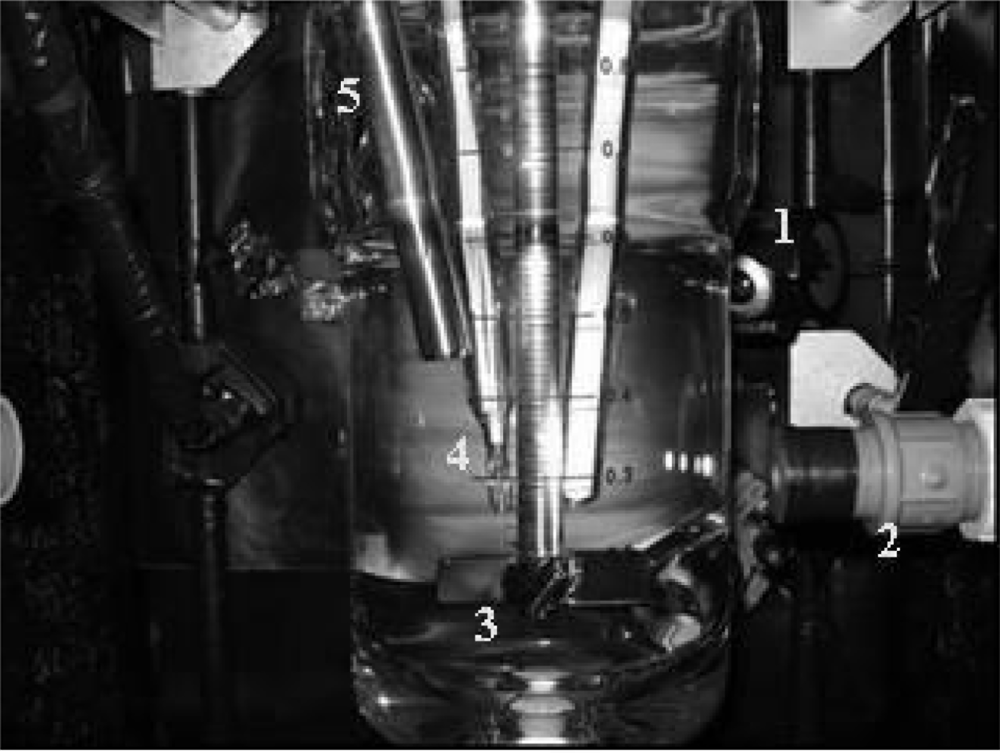
<p>The experimental set up is presented in <xref ref-type="fig" rid="f1-sensors-11-00864">Figure 1</xref>. It consists of a double walled glass reactor with 1 L capacity equipped with an lnPro8200 inline turbidity sensor (Mettler-Toledo) with a Trb8300 signal transmitter. The experiment temperature was controlled using a RC1 reactor calorimeter. A PC webcam (Philips SPC 900NC) was used to capture images in real time. In order to avoid interferences by external light and to maintain the CCD noise under controlled conditions, the reactor was enclosed in a black box during the measurements. A tungsten halogen light source (OSRAM—50 W, color temperature of 3,000 K) was used for the illumination. A system with optical-fiber (Olympus—ALS—150U) was utilized to guide the light from the source to the box.</p></sec>
<sec sec-type="methods">
<label>2.4.</label>
<title>Software for Data Acquisition and Evaluation</title>
<p>In order to perform video image analysis evaluation, a software named Masterview was developed. It is written in Delphi and was devoted to capture images in real time from a PC webcam by evaluating changes in the components’ RGB color pixel by pixel. The software allows the analysis of the whole image or the user can define a specific region previously selected from an image. The software automatically saves the coordinates of the delimited region for all digital images and calculates the R, G and B values averaging all pixels.</p></sec>
<sec>
<label>2.5.</label>
<title>Turbimetric Measurements</title>
<p>The turbidimetric measurements and the video image analysis were carried out at the same time. The output current of the turbidity sensor was transferred to computer by using a data acquisition board (USB-6009 data acquisition device—National Instruments). Labview was used for data acquisition.</p></sec></sec>
<sec sec-type="results|discussion">
<label>3.</label>
<title>Results and Discussion</title>
<sec>
<label>3.1.</label>
<title>Method Optimization</title>
<p>Most commercially available web cameras have automatic adjustments depending on light conditions. This feature is not adequate for methods based on digital video image analysis because its principle is based on changes in color of the object or the analyzed medium. The possibility of changing the camera settings is advisable to guarantee the adequate quality of the results furnished by the RGB analysis method. In this study, a Philips SPC 900NC webcam was used which features this facility and also capable of obtaining images under low luminosity conditions (1 lux).</p>
<p>The webcam was configured to capture 24-bits digital images at a rate of 30 images/s and 640 × 480 pixels of spatial resolution. In order to optimize the analytical methodology the camera has been configured in the following way: gamma 40%, saturation 60%, shutter-speed = 60%, face tracking = off, digital zoom = off, picture enhancer = off, full automatic control = off, auto exposure = off, auto white balance = off, black &amp; white = off, backlight compensation = off. It was observed that the main parameters capable of influencing the sensitivity of the method were brightness and gain. These parameters were optimized for assessing the sensitivity of the method for detecting small amounts of barium sulfate in suspension.</p>
<p>The analytical data that a digital camera returns are a standard trichromatic response (red, blue and green), where the output signal ranges from 0 to 255 for each channel [<xref ref-type="bibr" rid="b27-sensors-11-00864">27</xref>]. When the output signal reaches the maximum value (255) the CCD sensor is unable to evaluate further changes in the color components.</p>
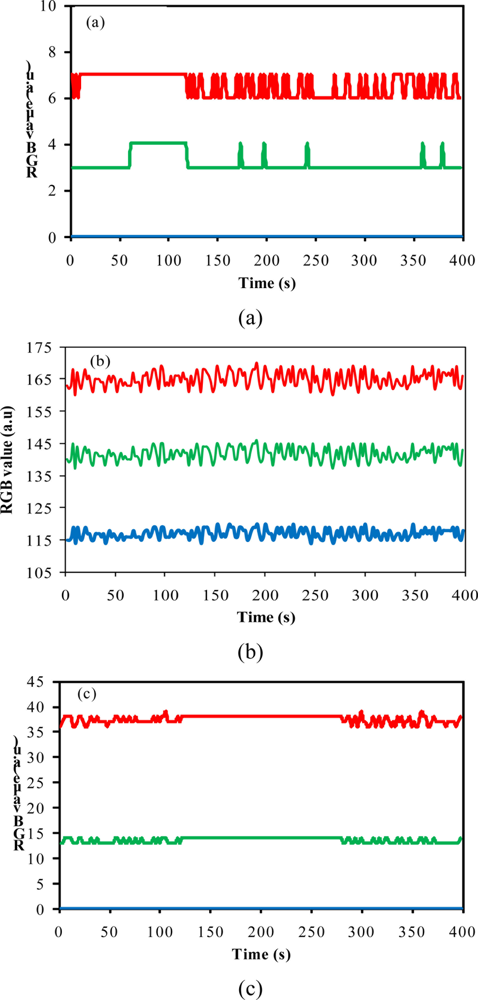
<p>The comparison between the output RGB signals furnished by the software and the camera configuration is presented in <xref ref-type="fig" rid="f2-sensors-11-00864">Figure 2</xref>. A blank solution was used as reference. All experiments were carried out under the same luminosity conditions. Three configurations were considered for evaluation of the method performance: configuration A (brightness 60%; gain 50%), configuration B (brightness 100%; gain 100%) and configuration C (brightness 60%, gain 100%).</p>
<p>In <xref ref-type="fig" rid="f2-sensors-11-00864">Figure 2</xref>, it can be seen that when high levels of brightness and gain were used, an increase in the noise levels was observed [<xref ref-type="fig" rid="f2-sensors-11-00864">Figure 2(b)</xref>]. A high level of the output signal is not desirable because it reduces the range available for measurements considering that the available range for RGB is 0–255 units. An increase in the noise also reduces the method sensitivity. The direct inspection of the results presented in <xref ref-type="fig" rid="f2-sensors-11-00864">Figure 2</xref> shows that the system presented good stability during the data acquisition, independently of the camera configuration employed. For configurations A and C, the output signal obtained from the blue channel was zero.</p>
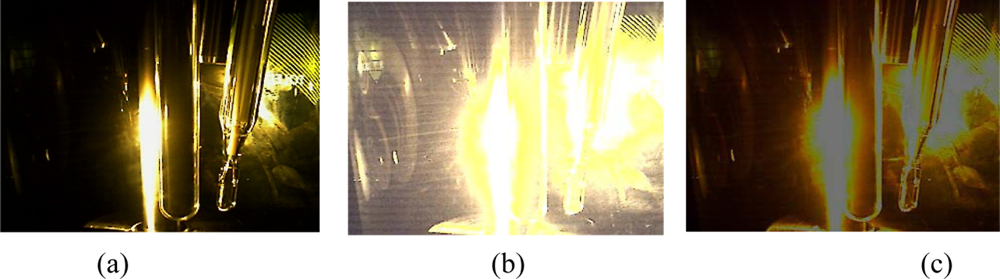
<p>The images obtained from the blank solution by using the camera configurations presented in <xref ref-type="fig" rid="f2-sensors-11-00864">Figure 2</xref> are shown in <xref ref-type="fig" rid="f3-sensors-11-00864">Figure 3</xref>. The region delimited in <xref ref-type="fig" rid="f3-sensors-11-00864">Figure 3(a)</xref> was selected for data acquisition and was chosen in a way that the interference caused by the reflection of incident light on the sensors was minimized.</p>
<p>Observing the results presented in <xref ref-type="fig" rid="f3-sensors-11-00864">Figure 3</xref>, it is clear that the use of the camera configuration B is strongly affected by light reflections over the reactor inserts. This may explain the increased noise observed in the graph presented in <xref ref-type="fig" rid="f2-sensors-11-00864">Figure 2(b)</xref>. Considering that the software allows the selection of a specific area of the whole image to perform the RGB analysis, the camera configurations A and C were used for evaluating the method performance for detecting low concentration of barium sulfate in suspension.</p></sec>
<sec>
<label>3.2.</label>
<title>Relationship between RGB Level and Concentration of Barium Sulfate in Suspension</title>
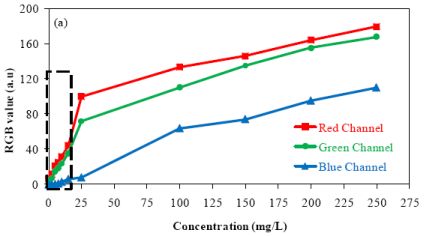
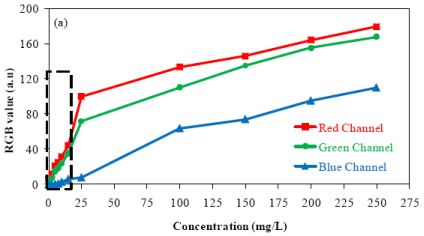
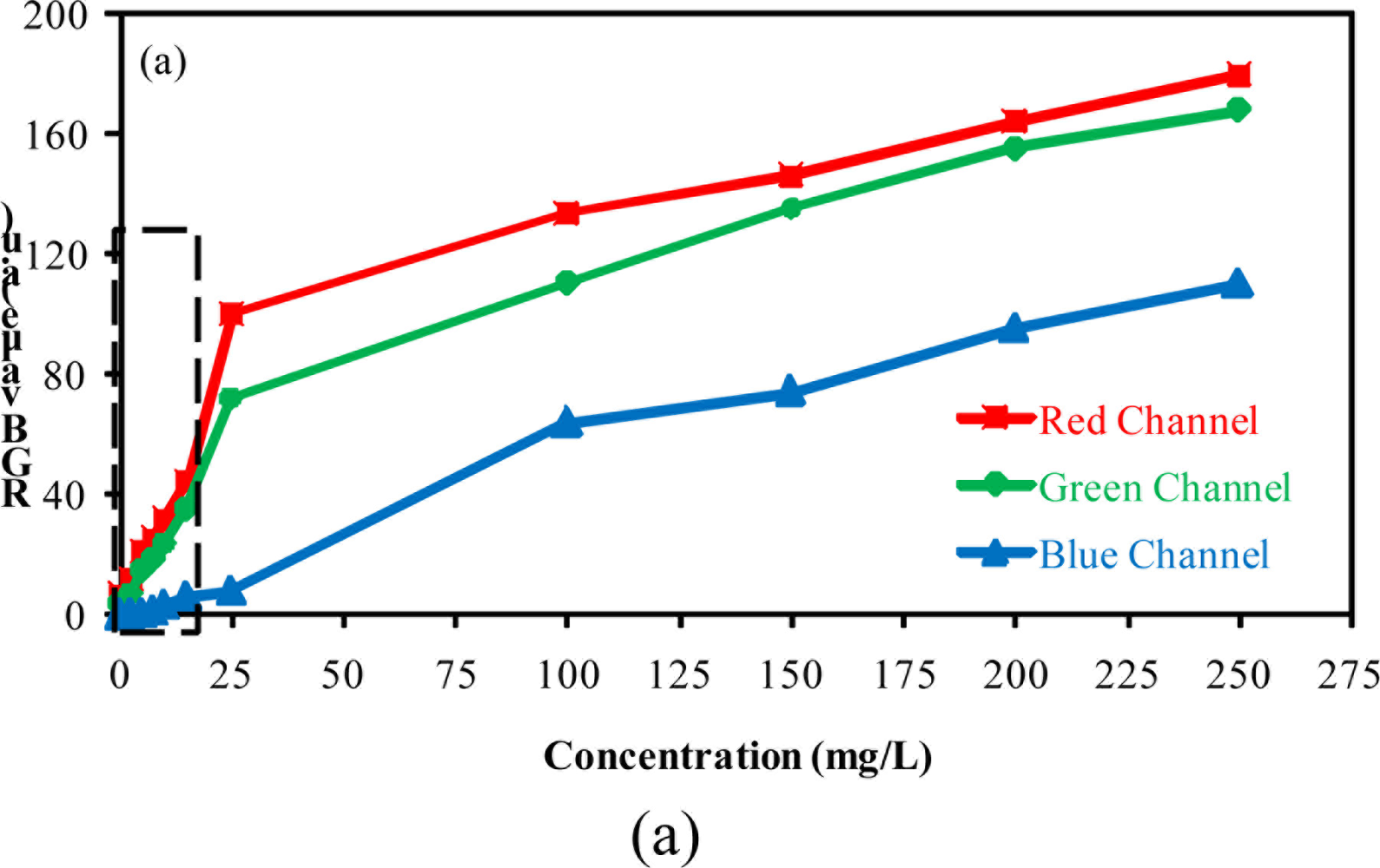
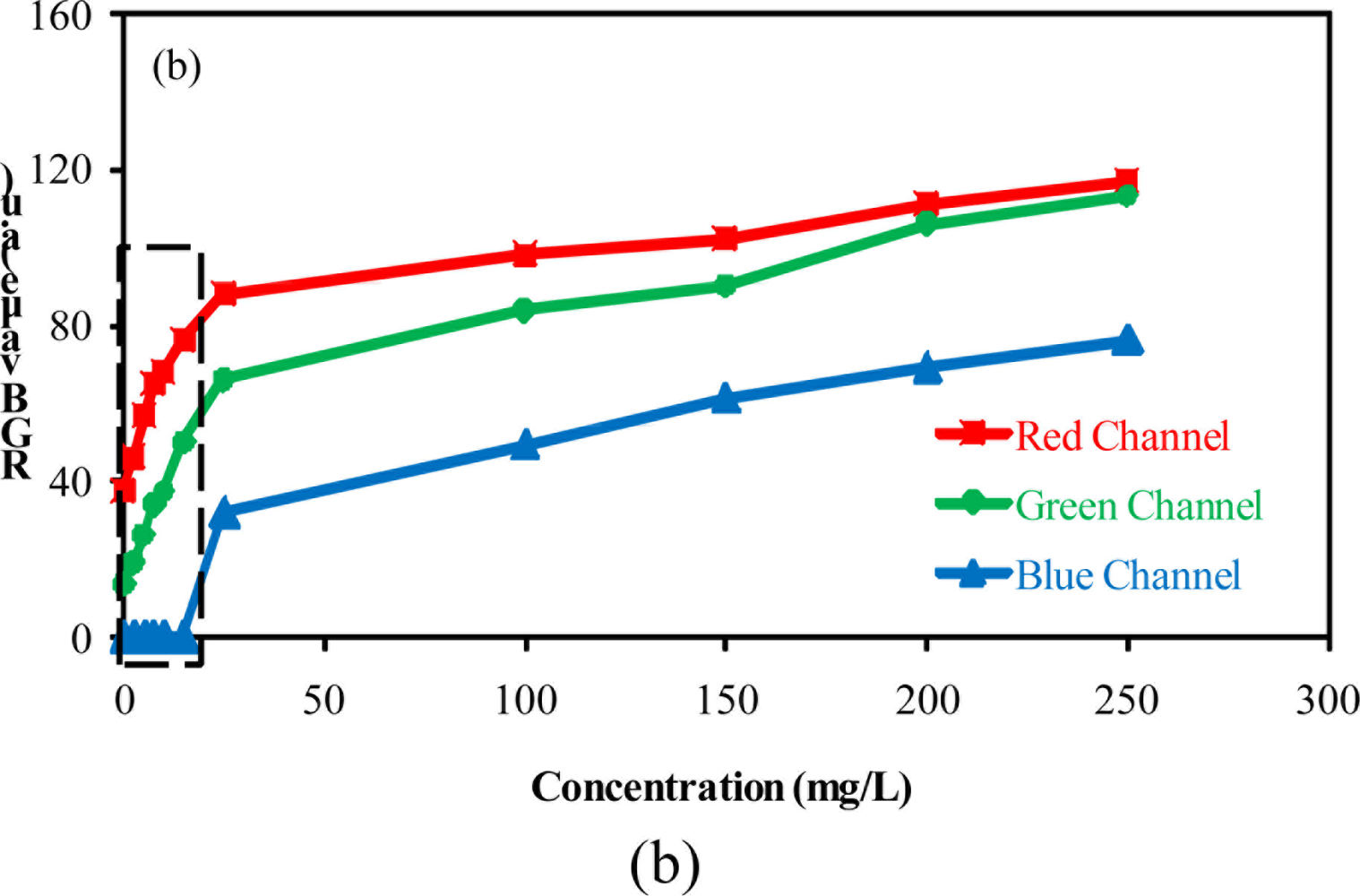
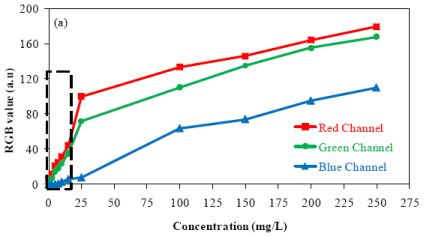
<p><xref ref-type="fig" rid="f4-sensors-11-00864">Figure 4</xref> presents the relationship between the value of each color component and the concentration of barium sulfate in suspension using the camera configurations A and C. All measurements were carried out in triplicate.</p>
<p>The results presented in this figure show the effect of camera configurations on the linearity and the sensitivity of the method. They show that the blue component presented less sensitivity. Furthermore, it was observed an alteration in the relationship between the output RGB signal and the barium sulfate concentration in suspension when compared to the results obtained for low (≤15 mg/L) and high (≥15 mg/L) concentrations. Two curves with different slopes can be observed (dotted line in <xref ref-type="fig" rid="f4-sensors-11-00864">Figure 4</xref> delimits the region where the slopes undergo changes).</p>
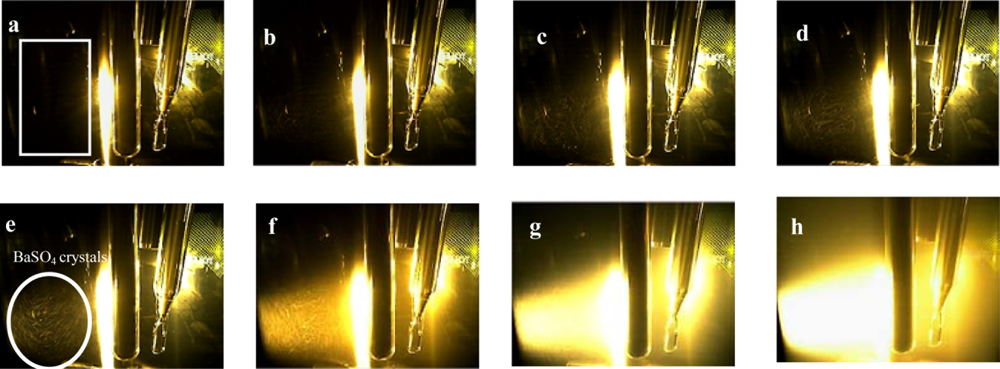
<p>Aiming at explaining the different slopes observed in the graphs, the images for different concentrations of suspended barium sulfate particles detected by using the camera configuration A, are presented in <xref ref-type="fig" rid="f5-sensors-11-00864">Figure 5</xref>. The data acquisition was carried out in the region delimited in <xref ref-type="fig" rid="f5-sensors-11-00864">Figure 5(a)</xref>, where the interference caused by the reflection of incident light on the sensors was minimized.</p>
<p>The results presented in <xref ref-type="fig" rid="f5-sensors-11-00864">Figure 5</xref> shows the color intensity variation in function of the solids concentration in suspension. Single and multiple light scattering are physical process that can occur when the radiation interact with the BaSO<sub>4</sub> crystals in suspension. The acquired images for concentration from 2.5 mg/L to 15 mg/L [<xref ref-type="fig" rid="f5-sensors-11-00864">Figure 5(b–e)</xref>] shows that color intensity changes when compared to solutions with concentration above 15 mg/L [<xref ref-type="fig" rid="f5-sensors-11-00864">Figure 5(f–h)</xref>]. This behavior is apparently caused by the predominance of multiple light scattering in solutions with high concentrations of solids.</p></sec>
<sec>
<label>3.3.</label>
<title>Limits of Detection and Quantification</title>
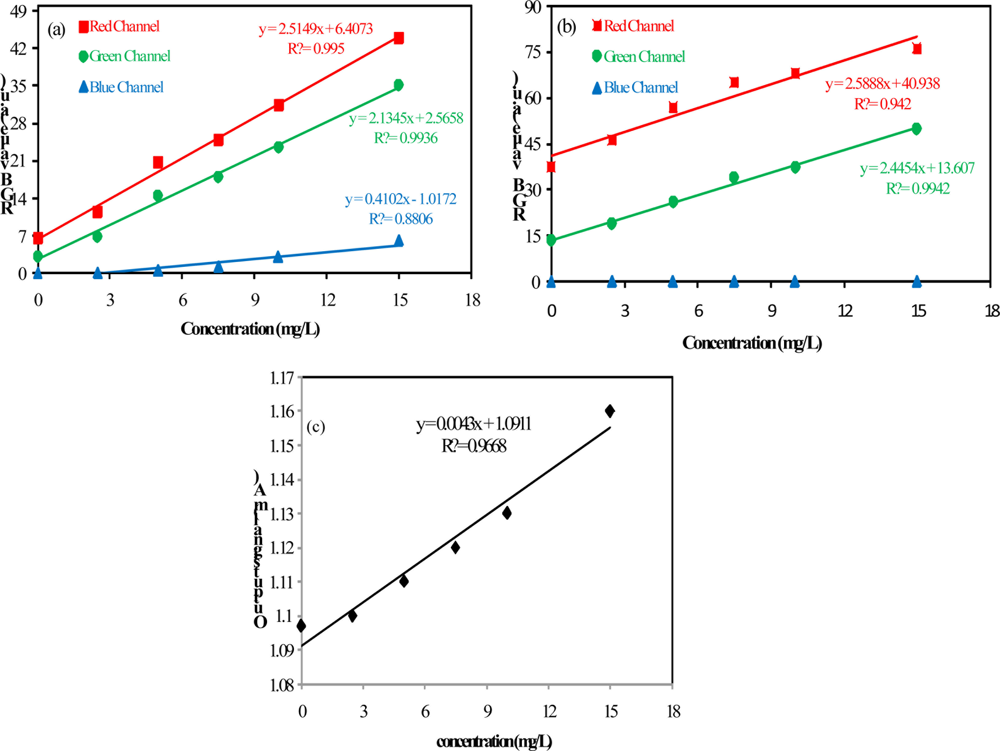
<p>Regarding the data shown in <xref ref-type="fig" rid="f4-sensors-11-00864">Figure 4</xref>, it can be seen that the method sensitivity is bigger for measurements of low concentrations of barium sulfate in suspension (the slope for low concentration is higher). Based on these observations the limit of detection (LOD) and the limit of quantification (LOQ) were evaluated by concentrations below 15 mg/L. The analytical curves for concentrations below 15 mg/L are presented in <xref ref-type="fig" rid="f6-sensors-11-00864">Figure 6</xref>.</p>
<p>The analytical performance of the method was assessed by using the LOD and LOQ. These data presented in <xref ref-type="table" rid="t1-sensors-11-00864">Table 1</xref>, were calculated by using the standard deviation of the blank solution measurements (s<sub>b</sub>), obtained from three independents solutions, and the slopes of the analytical curves (β), according to the following equations:
<disp-formula id="FD1">
<label>(1)</label>
<mml:math display="block">
<mml:mrow>
<mml:mi mathvariant="italic">LOD</mml:mi>
<mml:mo>=</mml:mo>
<mml:mfrac>
<mml:mrow>
<mml:msub>
<mml:mrow>
<mml:mn>3</mml:mn>
<mml:mi>s</mml:mi></mml:mrow>
<mml:mi>b</mml:mi></mml:msub></mml:mrow>
<mml:mi>β</mml:mi></mml:mfrac></mml:mrow></mml:math></disp-formula>
<disp-formula id="FD2">
<label>(2)</label>
<mml:math display="block">
<mml:mrow>
<mml:mi mathvariant="italic">LOQ</mml:mi>
<mml:mo>=</mml:mo>
<mml:mfrac>
<mml:mrow>
<mml:msub>
<mml:mrow>
<mml:mn>10</mml:mn>
<mml:mi>s</mml:mi></mml:mrow>
<mml:mi>b</mml:mi></mml:msub></mml:mrow>
<mml:mi>β</mml:mi></mml:mfrac></mml:mrow></mml:math></disp-formula></p>
<p>As presented in <xref ref-type="table" rid="t1-sensors-11-00864">Table 1</xref>, both configurations that were used in the video image analysis method have yielded similar results in relation to LOD and LOQ. The analytical curve obtained from the red channel data presented the largest slope, however, the noise associated with the green component was smaller and the combination between S<sub>b</sub> and β indicated better results when using the green component. The proposed method presents better performance in terms of the figures of merit LOD and LOQ in relation to the turbidimetric method. Additionally, it is non-invasive and this feature avoids contamination issues and interferences in the measurements.</p></sec></sec>
<sec sec-type="conclusions">
<label>4.</label>
<title>Conclusions</title>
<p>The results presented have demonstrated that video image analysis method is a useful tool for detecting low concentrations of barium sulfate in suspension. The methodology has low limits of detection and quantification and shown a better performance in comparison to the standard turbidimetric method. The results obtained demonstrate the analytical applicability of the proposed methodology. Compared to other measurements apparatus, the proposed method provides advantages especially in terms of its simplicity and low cost for implementation, in view of possible automation, this would allow reducing the study times and conducting various experiments at same time.</p></sec></body>
<back>
<ack>
<p>The authors acknowledge the financial support provided by FINEP and PETROBRAS. The first author gratefully acknowledges to CNPq, the Brazilian Research Council, for a doctoral grant.</p></ack>
<ref-list>
<title>References</title>
<ref id="b1-sensors-11-00864"><label>1.</label><citation citation-type="journal"><person-group person-group-type="author"><name><surname>Al Nasser</surname><given-names>W.N.</given-names></name><name><surname>Shaikh</surname><given-names>A.</given-names></name><name><surname>Morriss</surname><given-names>C.</given-names></name><name><surname>Hounslow</surname><given-names>M.J.</given-names></name><name><surname>Salman</surname><given-names>A.D.</given-names></name></person-group><article-title>Determining kinetics of calcium carbonate precipitation by inline technique</article-title><source>Chem. Eng. Sci</source><year>2008</year><volume>63</volume><fpage>1381</fpage><lpage>1389</lpage><pub-id pub-id-type="doi">10.1016/j.ces.2007.07.051</pub-id></citation></ref>
<ref id="b2-sensors-11-00864"><label>2.</label><citation citation-type="journal"><person-group person-group-type="author"><name><surname>Baraka-Lokmane</surname><given-names>S.</given-names></name><name><surname>Sorbie</surname><given-names>K.S.</given-names></name></person-group><article-title>Effect of pH and scale inhibitor concentration on phosphonate-carbonate interaction</article-title><source>J. Pet. Sci. Eng</source><year>2010</year><volume>70</volume><fpage>10</fpage><lpage>27</lpage><pub-id pub-id-type="doi">10.1016/j.petrol.2009.05.002</pub-id></citation></ref>
<ref id="b3-sensors-11-00864"><label>3.</label><citation citation-type="journal"><person-group person-group-type="author"><name><surname>BinMerdhah</surname><given-names>A.B.</given-names></name><name><surname>Yassin</surname><given-names>A.A.M.</given-names></name><name><surname>Muherei</surname><given-names>M.A.</given-names></name></person-group><article-title>Laboratory and prediction of barium sulfate scaling at high-barium formation</article-title><source>J. Pet. Sci. Eng</source><year>2010</year><volume>70</volume><fpage>79</fpage><lpage>88</lpage><pub-id pub-id-type="doi">10.1016/j.petrol.2009.10.001</pub-id></citation></ref>
<ref id="b4-sensors-11-00864"><label>4.</label><citation citation-type="journal"><person-group person-group-type="author"><name><surname>Chen</surname><given-names>T.</given-names></name><name><surname>Neville</surname><given-names>A.</given-names></name><name><surname>Sorbie</surname><given-names>K.</given-names></name><name><surname>Zhong</surname><given-names>Z.</given-names></name></person-group><article-title><italic>In situ</italic> monitoring the inhibiting effect of polyphosphinocarboxylic acid on CaCO<sub>3</sub> scale formation by synchrotron X-ray diffraction</article-title><source>Chem. Eng. Sci</source><year>2009</year><volume>64</volume><fpage>912</fpage><lpage>918</lpage><pub-id pub-id-type="doi">10.1016/j.ces.2008.09.036</pub-id></citation></ref>
<ref id="b5-sensors-11-00864"><label>5.</label><citation citation-type="journal"><person-group person-group-type="author"><name><surname>Dyer</surname><given-names>S.J.</given-names></name><name><surname>Graham</surname><given-names>G.M.</given-names></name></person-group><article-title>Thermal stability of generic barium sulphate scale inhibitor species under static and dynamic conditions</article-title><source>J. Pet. Sci. Eng</source><year>2003</year><volume>37</volume><fpage>171</fpage><lpage>181</lpage><pub-id pub-id-type="doi">10.1016/S0920-4105(02)00351-0</pub-id></citation></ref>
<ref id="b6-sensors-11-00864"><label>6.</label><citation citation-type="journal"><person-group person-group-type="author"><name><surname>He</surname><given-names>S.</given-names></name><name><surname>Kan</surname><given-names>A.T.</given-names></name></person-group><article-title>Tomson M.B. Mathematical inhibitor model for barium sulfate scale control</article-title><source>Langmuir</source><year>1996</year><volume>12</volume><fpage>1901</fpage><lpage>1905</lpage><pub-id pub-id-type="doi">10.1021/la950876x</pub-id></citation></ref>
<ref id="b7-sensors-11-00864"><label>7.</label><citation citation-type="journal"><person-group person-group-type="author"><name><surname>Hennessy</surname><given-names>A.J.B.</given-names></name><name><surname>Graham</surname><given-names>G.M.</given-names></name></person-group><article-title>The effect of additives on the co-crystallization of calcium with barium sulfate</article-title><source>J. Cryst. Growth</source><year>2002</year><volume>237–239</volume><fpage>2153</fpage><lpage>2159</lpage></citation></ref>
<ref id="b8-sensors-11-00864"><label>8.</label><citation citation-type="journal"><person-group person-group-type="author"><name><surname>Jones</surname><given-names>F.</given-names></name><name><surname>Oliveira</surname><given-names>A.</given-names></name><name><surname>Rohl</surname><given-names>A.L.</given-names></name><name><surname>Parkinson</surname><given-names>G.M.</given-names></name><name><surname>Ogden</surname><given-names>M.I.</given-names></name><name><surname>Reyhani</surname><given-names>M.M.</given-names></name></person-group><article-title>Investigation into the effect of phosphonate inhibitors on barium sulfate precipitation</article-title><source>J. Cryst. Growth</source><year>2002</year><volume>237–239</volume><fpage>424</fpage><lpage>429</lpage></citation></ref>
<ref id="b9-sensors-11-00864"><label>9.</label><citation citation-type="journal"><person-group person-group-type="author"><name><surname>Salman</surname><given-names>M.</given-names></name><name><surname>Qabazard</surname><given-names>H.M.</given-names></name></person-group><article-title>Water scaling case studies in a Kuwaiti oil field</article-title><source>J. Pet. Sci. Eng</source><year>2007</year><volume>55</volume><fpage>48</fpage><lpage>55</lpage><pub-id pub-id-type="doi">10.1016/j.petrol.2006.04.020</pub-id></citation></ref>
<ref id="b10-sensors-11-00864"><label>10.</label><citation citation-type="journal"><person-group person-group-type="author"><name><surname>Sun</surname><given-names>Z.</given-names></name><name><surname>Sköld</surname><given-names>R.O.</given-names></name></person-group><article-title>Characterization of barite suspensions during synthesis by light scattering</article-title><source>J. Colloid Interface Sci</source><year>2001</year><volume>242</volume><fpage>67</fpage><lpage>74</lpage><pub-id pub-id-type="doi">10.1006/jcis.2001.7779</pub-id></citation></ref>
<ref id="b11-sensors-11-00864"><label>11.</label><citation citation-type="journal"><person-group person-group-type="author"><name><surname>Tantayakom</surname><given-names>V.</given-names></name><name><surname>Sreethawong</surname><given-names>T.</given-names></name><name><surname>Fogler</surname><given-names>H.S.</given-names></name><name><surname>de Moraes</surname><given-names>F.F.</given-names></name><name><surname>Chavadej</surname><given-names>S.</given-names></name></person-group><article-title>Scale inhibition study by turbidity measurement</article-title><source>J. Colloid Interface Sci</source><year>2005</year><volume>284</volume><fpage>57</fpage><lpage>65</lpage><pub-id pub-id-type="doi">10.1016/j.jcis.2004.10.007</pub-id><pub-id pub-id-type="pmid">15752784</pub-id></citation></ref>
<ref id="b12-sensors-11-00864"><label>12.</label><citation citation-type="journal"><person-group person-group-type="author"><name><surname>Moghadasi</surname><given-names>J.</given-names></name><name><surname>Müller-Steinhagen</surname><given-names>H.</given-names></name><name><surname>Jamialahmadi</surname><given-names>M.</given-names></name><name><surname>Sharif</surname><given-names>A.</given-names></name></person-group><article-title>Model study on the kinetics of oil field formation damage due to salt precipitation from injection</article-title><source>J. Pet. Sci. Eng</source><year>2004</year><volume>43</volume><fpage>201</fpage><lpage>217</lpage><pub-id pub-id-type="doi">10.1016/j.petrol.2004.02.014</pub-id></citation></ref>
<ref id="b13-sensors-11-00864"><label>13.</label><citation citation-type="journal"><person-group person-group-type="author"><name><surname>Jones</surname><given-names>F.</given-names></name><name><surname>Oliveira</surname></name><name><surname>Parkinson</surname><given-names>G.M.</given-names></name><name><surname>Rohl</surname><given-names>A.L.</given-names></name><name><surname>Stanley</surname><given-names>A.</given-names></name><name><surname>Upson</surname><given-names>T.</given-names></name></person-group><article-title>The effect of calcium cátions on the precipitation of barium sulfate 2: Calcium ions in the presence of organic additives</article-title><source>J. Cryst. Growth</source><year>2004</year><volume>270</volume><fpage>593</fpage><lpage>603</lpage><pub-id pub-id-type="doi">10.1016/j.jcrysgro.2004.06.044</pub-id></citation></ref>
<ref id="b14-sensors-11-00864"><label>14.</label><citation citation-type="journal"><person-group person-group-type="author"><name><surname>Taguchi</surname><given-names>K.</given-names></name><name><surname>Garside</surname><given-names>J.</given-names></name><name><surname>Tavare</surname><given-names>N.S.</given-names></name></person-group><article-title>Nucleation and growth of barium sulfate in batch precipitation</article-title><source>J. Cryst. Growth</source><year>1996</year><volume>163</volume><fpage>318</fpage><lpage>328</lpage><pub-id pub-id-type="doi">10.1016/0022-0248(95)00974-4</pub-id></citation></ref>
<ref id="b15-sensors-11-00864"><label>15.</label><citation citation-type="journal"><person-group person-group-type="author"><name><surname>Guo</surname><given-names>Z.</given-names></name><name><surname>Jones</surname><given-names>A.G.</given-names></name><name><surname>Li</surname><given-names>N.</given-names></name></person-group><article-title>The effect of ultrasound on the homogeneous nucleation of BaSO<sub>4</sub> during reactive crystallization</article-title><source>Chem. Eng. Sci</source><year>2006</year><volume>61</volume><fpage>1617</fpage><lpage>1626</lpage><pub-id pub-id-type="doi">10.1016/j.ces.2005.09.009</pub-id></citation></ref>
<ref id="b16-sensors-11-00864"><label>16.</label><citation citation-type="journal"><person-group person-group-type="author"><name><surname>He</surname><given-names>S.</given-names></name><name><surname>Oddo</surname><given-names>J.E.</given-names></name><name><surname>Tomson</surname><given-names>M.B.</given-names></name></person-group><article-title>The nucleation kinetics of barium sulfate in NaCl solutions up to 6 m and 90 °C</article-title><source>J. Colloid Interface Sci</source><year>1995</year><volume>174</volume><fpage>319</fpage><lpage>326</lpage><pub-id pub-id-type="doi">10.1006/jcis.1995.1397</pub-id></citation></ref>
<ref id="b17-sensors-11-00864"><label>17.</label><citation citation-type="journal"><person-group person-group-type="author"><name><surname>Jones</surname><given-names>F.</given-names></name><name><surname>Jones</surname><given-names>P.</given-names></name><name><surname>Ogden</surname><given-names>M.I.</given-names></name><name><surname>Richmond</surname><given-names>W.R.</given-names></name><name><surname>Rohl</surname><given-names>A.L.</given-names></name><name><surname>Saunders</surname><given-names>M.</given-names></name></person-group><article-title>The interaction of EDTA with barium sulfate</article-title><source>J. Colloid Interface Sci</source><year>2007</year><volume>316</volume><fpage>553</fpage><lpage>561</lpage><pub-id pub-id-type="doi">10.1016/j.jcis.2007.09.005</pub-id><pub-id pub-id-type="pmid">17904573</pub-id></citation></ref>
<ref id="b18-sensors-11-00864"><label>18.</label><citation citation-type="journal"><person-group person-group-type="author"><name><surname>Sun</surname><given-names>Z.</given-names></name><name><surname>Sköld</surname><given-names>R.O.</given-names></name></person-group><article-title>Characterization of barite suspensions during synthesis by light scattering</article-title><source>J. Colloid Interface Sci</source><year>2001</year><volume>242</volume><fpage>67</fpage><lpage>74</lpage><pub-id pub-id-type="doi">10.1006/jcis.2001.7779</pub-id></citation></ref>
<ref id="b19-sensors-11-00864"><label>19.</label><citation citation-type="journal"><person-group person-group-type="author"><name><surname>Aoun</surname><given-names>M.</given-names></name><name><surname>Plasari</surname><given-names>E.</given-names></name><name><surname>David</surname><given-names>R.</given-names></name><name><surname>Villermaux</surname><given-names>J.</given-names></name></person-group><article-title>Are barium sulphate kinetics sufficiently know for testing precipitation reactor models?</article-title><source>Chem. Eng. Sci</source><year>1996</year><volume>51</volume><fpage>2449</fpage><lpage>2458</lpage><pub-id pub-id-type="doi">10.1016/0009-2509(96)00101-7</pub-id></citation></ref>
<ref id="b20-sensors-11-00864"><label>20.</label><citation citation-type="journal"><person-group person-group-type="author"><name><surname>Chien</surname><given-names>W.C.</given-names></name><name><surname>Tai</surname><given-names>C.Y.</given-names></name><name><surname>Hsu</surname><given-names>J.P.</given-names></name></person-group><article-title>The induction period of the CaCl<sub>2</sub>-Na<sub>2</sub>CO<sub>3</sub> system: Theory and experiment</article-title><source>J. Chem. Phys</source><year>1999</year><volume>111</volume><fpage>2657</fpage><lpage>2664</lpage><pub-id pub-id-type="doi">10.1063/1.479541</pub-id></citation></ref>
<ref id="b21-sensors-11-00864"><label>21.</label><citation citation-type="journal"><person-group person-group-type="author"><name><surname>Kalikmanov</surname><given-names>V.I.</given-names></name></person-group><article-title>Crossover model for the work of critical cluster formation in nucleation theory</article-title><source>J. Chem. Phys</source><year>2004</year><volume>121</volume><fpage>8916</fpage><lpage>8923</lpage><pub-id pub-id-type="doi">10.1063/1.1806404</pub-id><pub-id pub-id-type="pmid">15527357</pub-id></citation></ref>
<ref id="b22-sensors-11-00864"><label>22.</label><citation citation-type="journal"><person-group person-group-type="author"><name><surname>Sagui</surname><given-names>C.</given-names></name><name><surname>Grant</surname><given-names>M.</given-names></name></person-group><article-title>Theory of nucleation and growth during phase separation</article-title><source>Phys. Rev. E</source><year>1999</year><volume>59</volume><fpage>4175</fpage><lpage>4187</lpage><pub-id pub-id-type="doi">10.1103/PhysRevE.59.4175</pub-id></citation></ref>
<ref id="b23-sensors-11-00864"><label>23.</label><citation citation-type="journal"><person-group person-group-type="author"><name><surname>Simon</surname><given-names>L.L.</given-names></name><name><surname>Nagy</surname><given-names>Z.K.</given-names></name><name><surname>Hungerbuhler</surname><given-names>K.H.</given-names></name></person-group><article-title>Comparison of external bulk video imaging with focused beam reflectance measurement and ultra-violet visible spectroscopy for metastable zone identification in food and pharmaceutical crystallization processes</article-title><source>Chem. Eng. Sci</source><year>2009</year><volume>64</volume><fpage>3344</fpage><lpage>3351</lpage><pub-id pub-id-type="doi">10.1016/j.ces.2009.04.016</pub-id></citation></ref>
<ref id="b24-sensors-11-00864"><label>24.</label><citation citation-type="journal"><person-group person-group-type="author"><name><surname>Jolling</surname><given-names>K.</given-names></name><name><surname>Vandeven</surname><given-names>M.</given-names></name><name><surname>Eynden</surname><given-names>J.V.D.</given-names></name><name><surname>Amellot</surname><given-names>M.</given-names></name><name><surname>Kerkhove</surname><given-names>E.V.</given-names></name></person-group><article-title>A highly reliable and budget-friendly Peltier-cooled camera for biological fluorescence imaging microscopy</article-title><source>J. Microsc</source><year>2007</year><volume>228</volume><fpage>264</fpage><lpage>271</lpage><pub-id pub-id-type="doi">10.1111/j.1365-2818.2007.01858.x</pub-id><pub-id pub-id-type="pmid">18045321</pub-id></citation></ref>
<ref id="b25-sensors-11-00864"><label>25.</label><citation citation-type="journal"><person-group person-group-type="author"><name><surname>Gaiao</surname><given-names>E.N.</given-names></name><name><surname>Martins</surname><given-names>V.L.</given-names></name><name><surname>Lyra</surname><given-names>W.S.</given-names></name><name><surname>Almeida</surname><given-names>L.F.A.</given-names></name><name><surname>Silva</surname><given-names>E.C.S.</given-names></name><name><surname>Araújo</surname><given-names>M.C.U.</given-names></name></person-group><article-title>Digital image-based titrations</article-title><source>Anal. Chim. Acta</source><year>2006</year><volume>570</volume><fpage>283</fpage><lpage>290</lpage><pub-id pub-id-type="doi">10.1016/j.aca.2006.04.048</pub-id><pub-id pub-id-type="pmid">17723410</pub-id></citation></ref>
<ref id="b26-sensors-11-00864"><label>26.</label><citation citation-type="journal"><person-group person-group-type="author"><name><surname>Safavi</surname><given-names>A.</given-names></name><name><surname>Maleki</surname><given-names>N.</given-names></name><name><surname>Rostamzadeh</surname><given-names>A.</given-names></name><name><surname>Maesum</surname><given-names>S.</given-names></name></person-group><article-title>CCD camera full range pH sensor array</article-title><source>Talanta</source><year>2007</year><volume>71</volume><fpage>498</fpage><lpage>501</lpage><pub-id pub-id-type="doi">10.1016/j.talanta.2006.04.030</pub-id><pub-id pub-id-type="pmid">19071333</pub-id></citation></ref>
<ref id="b27-sensors-11-00864"><label>27.</label><citation citation-type="journal"><person-group person-group-type="author"><name><surname>Maleki</surname><given-names>N.</given-names></name><name><surname>Safavi</surname><given-names>A.</given-names></name><name><surname>Sedaghatpour</surname><given-names>F.</given-names></name></person-group><article-title>Single-step calibration, prediction and real samples data acquisition for artificial neural network using a CCD camera</article-title><source>Talanta</source><year>2004</year><volume>64</volume><fpage>830</fpage><lpage>835</lpage><pub-id pub-id-type="doi">10.1016/j.talanta.2004.02.041</pub-id><pub-id pub-id-type="pmid">18969677</pub-id></citation></ref>
<ref id="b28-sensors-11-00864"><label>28.</label><citation citation-type="journal"><person-group person-group-type="author"><name><surname>Lyra</surname><given-names>W.S.</given-names></name><name><surname>dos Santos</surname><given-names>V.B.</given-names></name><name><surname>Dionízio</surname><given-names>A.G.G.</given-names></name><name><surname>Martins</surname><given-names>V.L.</given-names></name><name><surname>Almeida</surname><given-names>L.F.</given-names></name><name><surname>Gaião</surname><given-names>E.N.</given-names></name><name><surname>Diniz</surname><given-names>P.H.G.D.</given-names></name><name><surname>Silva</surname><given-names>E.C.</given-names></name><name><surname>Araújo</surname><given-names>M.C.U.</given-names></name></person-group><article-title>Digital image-based flame emission spectrometry</article-title><source>Talanta</source><year>2009</year><volume>77</volume><fpage>1584</fpage><lpage>1589</lpage><pub-id pub-id-type="doi">10.1016/j.talanta.2008.09.057</pub-id><pub-id pub-id-type="pmid">19159768</pub-id></citation></ref>
<ref id="b29-sensors-11-00864"><label>29.</label><citation citation-type="journal"><person-group person-group-type="author"><name><surname>Hernández</surname><given-names>J.A.</given-names></name><name><surname>Heyd</surname><given-names>B.</given-names></name><name><surname>Trystram</surname><given-names>G.</given-names></name></person-group><article-title>On-line assessment of brightness and surface kinetics during coffee roasting</article-title><source>J. Food Eng</source><year>2008</year><volume>87</volume><fpage>314</fpage><lpage>322</lpage><pub-id pub-id-type="doi">10.1016/j.jfoodeng.2007.12.009</pub-id></citation></ref>
<ref id="b30-sensors-11-00864"><label>30.</label><citation citation-type="journal"><person-group person-group-type="author"><name><surname>Shirshov</surname><given-names>Y.M.</given-names></name><name><surname>Khoruzhenko</surname><given-names>V.Y.</given-names></name><name><surname>Kostyukevych</surname><given-names>K.V.</given-names></name><name><surname>Khristosenko</surname><given-names>R.V.</given-names></name><name><surname>Samoylova</surname><given-names>I.A.</given-names></name><name><surname>Pavlunchenko</surname><given-names>A.S.</given-names></name><name><surname>Samoylov</surname><given-names>A.V.</given-names></name><name><surname>Ushenin</surname><given-names>Y.V.</given-names></name></person-group><article-title>Analysis of some alcohols molecules based on the change of RGB components of interferentially colored calixarene films</article-title><source>Sens. Actuat. B</source><year>2007</year><volume>112</volume><fpage>427</fpage><lpage>436</lpage></citation></ref>
<ref id="b31-sensors-11-00864"><label>31.</label><citation citation-type="journal"><person-group person-group-type="author"><name><surname>Novales</surname><given-names>B.</given-names></name><name><surname>Papineau</surname><given-names>P.</given-names></name><name><surname>Sire</surname><given-names>A.</given-names></name><name><surname>Axelos</surname><given-names>M.A.V.</given-names></name></person-group><article-title>Characterization of emulsions and suspensions by video image analysis</article-title><source>Colloids Sur. A: Physicochem</source><year>2003</year><volume>221</volume><fpage>81</fpage><lpage>89</lpage><pub-id pub-id-type="doi">10.1016/S0927-7757(03)00102-X</pub-id></citation></ref>
<ref id="b32-sensors-11-00864"><label>32.</label><citation citation-type="journal"><person-group person-group-type="author"><name><surname>Simon</surname><given-names>L.L.</given-names></name><name><surname>Oucherif</surname><given-names>K.A.O.</given-names></name><name><surname>Nagy</surname><given-names>Z.K.</given-names></name><name><surname>Hungerbuhler</surname><given-names>K.</given-names></name></person-group><article-title>Histogram matching, hypothesis testing, and statistical control-chart-assisted nucleation detection using bulk video imaging for optimal switching between nucleation and seed conditioning steps</article-title><source>Ind. Eng. Chem. Res</source><year>2010</year><volume>49</volume><fpage>9932</fpage><lpage>9944</lpage><pub-id pub-id-type="doi">10.1021/ie100586p</pub-id></citation></ref>
<ref id="b33-sensors-11-00864"><label>33.</label><citation citation-type="journal"><person-group person-group-type="author"><name><surname>Simon</surname><given-names>L.L.</given-names></name><name><surname>Nagy</surname><given-names>Z.K.</given-names></name><name><surname>Hungerbuhler</surname><given-names>K.</given-names></name></person-group><article-title>Endoscopy-based in situ bulk video imaging of batch crystallization processes</article-title><source>Org. Process Res. Dev</source><year>2009</year><volume>13</volume><fpage>1254</fpage><lpage>1261</lpage><pub-id pub-id-type="doi">10.1021/op900019b</pub-id></citation></ref>
<ref id="b34-sensors-11-00864"><label>34.</label><citation citation-type="journal"><person-group person-group-type="author"><name><surname>Alexandre</surname><given-names>I.</given-names></name><name><surname>Hamels</surname><given-names>S.</given-names></name><name><surname>Dufour</surname><given-names>S.</given-names></name><name><surname>Collet</surname><given-names>J.</given-names></name><name><surname>Zammatteo</surname><given-names>N.</given-names></name><name><surname>De Longueville</surname><given-names>F.</given-names></name><name><surname>Gala</surname><given-names>J.L.</given-names></name><name><surname>Remacle</surname><given-names>J.</given-names></name></person-group><article-title>Colorimetric Silver Detection of DNA Microarrays</article-title><source>Anal. Biochem</source><year>2001</year><volume>295</volume><fpage>1</fpage><lpage>8</lpage><pub-id pub-id-type="doi">10.1006/abio.2001.5176</pub-id><pub-id pub-id-type="pmid">11476538</pub-id></citation></ref>
<ref id="b35-sensors-11-00864"><label>35.</label><citation citation-type="journal"><person-group person-group-type="author"><name><surname>Liang</surname><given-names>R.Q.</given-names></name><name><surname>Tan</surname><given-names>C.Y.</given-names></name><name><surname>Ruan</surname><given-names>K.C.</given-names></name></person-group><article-title>Colorimetric detection of protein microarrays based on nanogold probe coupled with silver enhancement</article-title><source>J. Immunol. Methods</source><year>2004</year><volume>285</volume><fpage>157</fpage><lpage>163</lpage><pub-id pub-id-type="doi">10.1016/j.jim.2003.11.008</pub-id><pub-id pub-id-type="pmid">14980430</pub-id></citation></ref></ref-list>
<sec sec-type="display-objects">
<title>Figures and Table</title>
<fig id="f1-sensors-11-00864" position="float">
<label>Figure 1.</label>
<caption>
<p>Set-up of the measuring system (1-webcam; 2-light source; 3-stirrer; 4-temperature sensor, 5-turbidity sensor).</p></caption>
<graphic xlink:href="sensors-11-00864f1.gif"/></fig>
<fig id="f2-sensors-11-00864" position="float">
<label>Figure 2.</label>
<caption>
<p>Effect of camera configurations on the output RGB signal obtained from a blank solution: <bold>(a)</bold> configuration A; <bold>(b)</bold> configuration B; <bold>(c)</bold> configuration C.</p></caption>
<graphic xlink:href="sensors-11-00864f2.gif"/></fig>
<fig id="f3-sensors-11-00864" position="float">
<label>Figure 3.</label>
<caption>
<p>Images obtained from a blank solution by using different camera configurations: <bold>(a)</bold> camera configuration A; <bold>(b)</bold> camera configuration B; <bold>(c)</bold> camera configuration C.</p></caption>
<graphic xlink:href="sensors-11-00864f3.gif"/></fig>
<fig id="f4-sensors-11-00864" position="float">
<label>Figure 4.</label>
<caption>
<p>Red, Green and Blue channel levels for different concentrations of barium sulfate in suspension: <bold>(a)</bold> configuration A, <bold>(b)</bold> configuration C.</p></caption>
<graphic xlink:href="sensors-11-00864f4a.gif"/>
<graphic xlink:href="sensors-11-00864f4b.gif"/></fig>
<fig id="f5-sensors-11-00864" position="float">
<label>Figure 5.</label>
<caption>
<p>Images of barium sulfate suspensions of different concentration: <bold>(a)</bold> blank solution, <bold>(b)</bold> 2.5 mg/L, <bold>(c)</bold> 5 mg/L, <bold>(d)</bold> 7.5 mg/L, <bold>(e)</bold> 10 mg/L, <bold>(f)</bold> 25 mg/L, <bold>(g)</bold> 100 mg/L, <bold>(h)</bold> 250 mg/L.</p></caption>
<graphic xlink:href="sensors-11-00864f5.gif"/></fig>
<fig id="f6-sensors-11-00864" position="float">
<label>Figure 6.</label>
<caption>
<p>Analytical curves: <bold>(a)</bold> video image analysis—configuration A; <bold>(b)</bold> video image analysis—configuration B; <bold>(c)</bold> output of the turbidity sensor.</p></caption>
<graphic xlink:href="sensors-11-00864f6.gif"/></fig>
<table-wrap id="t1-sensors-11-00864" position="float">
<label>Table 1.</label>
<caption>
<p>LOD and LOQ of the video image analysis method and turbidimetric method.</p></caption>
<table frame="hsides" rules="groups">
<thead>
<tr>
<th align="left" valign="middle" rowspan="3"/>
<th colspan="4" align="center" valign="middle">Video Image Analysis Method
<hr/></th>
<th align="center" valign="middle" rowspan="3">Turbidimetric Method</th></tr>
<tr>
<th colspan="2" align="center" valign="middle">Configuration<xref ref-type="table-fn" rid="tfn1-sensors-11-00864">*</xref> A</th>
<th colspan="2" align="center" valign="middle">Configuration<xref ref-type="table-fn" rid="tfn1-sensors-11-00864">*</xref> C</th></tr>
<tr>
<th align="center" valign="middle">R</th>
<th align="center" valign="middle">G</th>
<th align="center" valign="middle">R</th>
<th align="center" valign="middle">G</th></tr></thead>
<tbody>
<tr>
<td align="center" valign="top">LOD (mg/L)</td>
<td align="center" valign="top">0.60</td>
<td align="center" valign="top">0.51</td>
<td align="center" valign="top">0.84</td>
<td align="center" valign="top">0.70</td>
<td align="center" valign="top">13.3</td></tr>
<tr>
<td align="center" valign="top">LOQ (mg/L)</td>
<td align="center" valign="top">1.99</td>
<td align="center" valign="top">1.70</td>
<td align="center" valign="top">2.80</td>
<td align="center" valign="top">2.34</td>
<td align="center" valign="top">44.3</td></tr></tbody></table>
<table-wrap-foot><fn id="tfn1-sensors-11-00864">
<label>*</label>
<p>blue channel was not evaluated.</p></fn></table-wrap-foot></table-wrap></sec></back></article>