
<?xml version="1.0" encoding="UTF-8"?>
<!DOCTYPE article PUBLIC "-//NLM//DTD Journal Publishing DTD v2.3 20070202//EN" "journalpublishing.dtd">
<article xmlns:mml="http://www.w3.org/1998/Math/MathML" xmlns:xlink="http://www.w3.org/1999/xlink" xml:lang="en" article-type="research-article">
<front>
<journal-meta>
<journal-id journal-id-type="nlm-ta">Sensors</journal-id>
<journal-title>Sensors</journal-title>
<issn pub-type="epub">1424-8220</issn>
<publisher>
<publisher-name>Molecular Diversity Preservation International (MDPI)</publisher-name></publisher></journal-meta>
<article-meta>
<article-id pub-id-type="doi">10.3390/s100707044</article-id>
<article-id pub-id-type="publisher-id">sensors-10-07044</article-id>
<article-categories>
<subj-group>
<subject>Article</subject></subj-group></article-categories>
<title-group>
<article-title>Investigation of the Frequency Shift of a SAD Circuit Loop and the Internal Micro-Cantilever in a Gas Sensor</article-title></title-group>
<contrib-group>
<contrib contrib-type="author">
<name><surname>Guan</surname><given-names>Liu</given-names></name></contrib>
<contrib contrib-type="author">
<name><surname>Zhao</surname><given-names>Jiahao</given-names></name><xref ref-type="corresp" rid="c1-sensors-10-07044">*</xref></contrib>
<contrib contrib-type="author">
<name><surname>Yu</surname><given-names>Shijie</given-names></name></contrib>
<contrib contrib-type="author">
<name><surname>Li</surname><given-names>Peng</given-names></name></contrib>
<contrib contrib-type="author">
<name><surname>You</surname><given-names>Zheng</given-names></name></contrib>
<aff id="af1-sensors-10-07044">Department of Precision Instruments and Mechanics, Tsinghua University, Beijing 100084, China; E-Mails: <email>guanl04@mails.tsinghua.edu.cn</email> (L.G.); <email>yu-sj@tsinghua.edu.cn</email> (S.Y.); <email>yz-dpi@mail.tsinghua.edu.cn</email> (Z.Y.)</aff></contrib-group>
<author-notes>
<corresp id="c1-sensors-10-07044">
<label>*</label> Author to whom correspondence should be addressed; E-Mail: <email>zhaojh00@mails.tsinghua.edu.cn</email>; Tel.: +86-010-62783304-806; Fax: +86-010-62782308.</corresp></author-notes>
<pub-date pub-type="collection">
<year>2010</year></pub-date>
<pub-date pub-type="epub">
<day>23</day>
<month>7</month>
<year>2010</year></pub-date>
<volume>10</volume>
<issue>7</issue>
<fpage>7044</fpage>
<lpage>7056</lpage>
<history>
<date date-type="received">
<day>15</day>
<month>6</month>
<year>2010</year></date>
<date date-type="rev-recd">
<day>30</day>
<month>6</month>
<year>2010</year></date>
<date date-type="accepted">
<day>10</day>
<month>7</month>
<year>2010</year></date></history>
<permissions>
<copyright-statement>© 2010 by the authors licensee MDPI, Basel, Switzerland.</copyright-statement>
<copyright-year>2010</copyright-year>
<license>
<p>This article is an open access article distributed under the terms and conditions of the Creative Commons Attribution license (http://creativecommons.org/licenses/by/3.0/).</p></license></permissions>
<abstract>
<p>Micro-cantilever sensors for mass detection using resonance frequency have attracted considerable attention over the last decade in the field of gas sensing. For such a sensing system, an oscillator circuit loop is conventionally used to actuate the micro-cantilever, and trace the frequency shifts. In this paper, gas experiments are introduced to investigate the mechanical resonance frequency shifts of the micro-cantilever within the circuit loop(mechanical resonance frequency, MRF) and resonating frequency shifts of the electric signal in the oscillator circuit (system working frequency, SWF). A silicon beam with a piezoelectric zinc oxide layer is employed in the experiment, and a Self-Actuating-Detecting (SAD) circuit loop is built to drive the micro-cantilever and to follow the frequency shifts. The differences between the two resonating frequencies and their shifts are discussed and analyzed, and a coefficient <italic>α</italic> related to the two frequency shifts is confirmed.</p></abstract>
<kwd-group>
<kwd>micro-cantilever</kwd>
<kwd>gas sensor</kwd>
<kwd>frequency shift</kwd>
<kwd>oscillator loop</kwd></kwd-group></article-meta></front>
<body>
<sec sec-type="intro">
<label>1.</label>
<title>Introduction</title>
<p>Micromachined resonant devices are attracting increasing interest in the field of chemical sensor applications, due to some of their interesting properties such as sensitivity, compactness and low energy consumption [<xref ref-type="bibr" rid="b1-sensors-10-07044">1</xref>]. Helped by an actuating and detecting circuit loop, the working frequency of the MEMS resonant devices can be followed automatically, and thus the analyte quantity can be determined [<xref ref-type="bibr" rid="b2-sensors-10-07044">2</xref>].</p>
<p>In the study of Zhou <italic>et al.</italic> of Tsinghua University, a gas sensor based on a MEMS cantilever was introduced [<xref ref-type="bibr" rid="b3-sensors-10-07044">3</xref>–<xref ref-type="bibr" rid="b4-sensors-10-07044">4</xref>]. In their work, a piezoelectric micro-cantilever was used, with a sensitive layer deposited on the tip to adsorb gas molecules. The adsorption modifies the mechanical properties of the structure, and therefore the resonance frequency <italic>f</italic><sub>0</sub> shifts accordingly [<xref ref-type="bibr" rid="b5-sensors-10-07044">5</xref>,<xref ref-type="bibr" rid="b6-sensors-10-07044">6</xref>]. As the micro-cantilever has no detection structure, a self-actuating and detecting (SAD) circuit loop was designed specifically for this single-port device. The SAD circuit loop drives the micro-cantilever and traces the working frequency <italic>f</italic><sub>r</sub> of the circuit. The details of the SAD circuit loop will be introduced in Section 2.1.</p>
<p>Most of the actual studies follow the same pattern as presented previously [<xref ref-type="bibr" rid="b7-sensors-10-07044">7</xref>–<xref ref-type="bibr" rid="b14-sensors-10-07044">14</xref>]: on exposure to an analyte vapor, the additional mass loading of the polymer layer decreases the mechanical resonance frequency (MRF) of the micro-cantilever. This MRF shift, noted Δ<italic>f</italic><sub>0</sub>, should be proportional to the mass loading Δ<italic>m</italic>, and thus proportional to the change in the gas concentration Δ<italic>c</italic> [<xref ref-type="bibr" rid="b1-sensors-10-07044">1</xref>]. Nevertheless, in real world applications, as MRF usually is not available in operation, the system working frequency (SWF) shift of the actuating and detecting circuit loop, noted as Δ<italic>f</italic><sub>r</sub> in this study, is measured instead. The MRF shift and SWF shift are not actually identical. Li <italic>et al.</italic> first referred to the difference between the MRF shift and SWF shift, in a simulation approach [<xref ref-type="bibr" rid="b4-sensors-10-07044">4</xref>].</p>
<p>An investigation is performed in this paper to demonstrate the existence of a coefficient <italic>α</italic>, which makes Δ<italic>f</italic><sub>r</sub> = <italic>α</italic>·Δ<italic>f</italic><sub>0</sub>. The experimental investigation consists of an open-loop test, where the MRF shift Δ<italic>f</italic><sub>0</sub> is measured, and a close-loop test, where the SWF shift Δ<italic>f</italic><sub>r</sub> is recorded. The origin of this coefficient is also discussed. The results indicate that the conventional usage of SWF shift as a measurement of gas concentration is not appropriate, as the SWF shift is not identical to MRF shift. Instead, SWF shift measured should be revised by a coefficient to approach the MRF shift. The further discussion in this work also proves that this finding can be applied to all the sensing system using an actuating-detecting oscillator loop.</p></sec>
<sec>
<label>2.</label>
<title>Experimental Details</title>
<sec>
<label>2.1.</label>
<title>Brief Description of the SAD Circuit Loop</title>
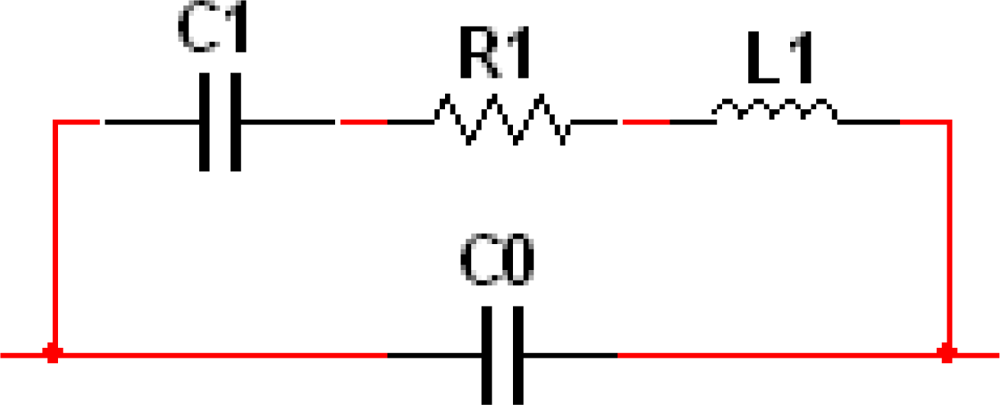
<p>With a presumption of small deformation, an electrical model of a piezoelectric micro-cantilever is developed [<xref ref-type="bibr" rid="b3-sensors-10-07044">3</xref>].</p>
<p>The mechanical function analogy of the electrical components is presented in <xref ref-type="disp-formula" rid="FD1">Equation (1)</xref>. Where <italic>m</italic><italic><sub>effect</sub></italic> is the effective mass of the micro-cantilever, <italic>k</italic> is the spring constant, <italic>c<sub>0</sub></italic> is the static capacitance of the piezoelectric layer, <italic>ξ</italic> is the damping coefficient. The <italic>k</italic><sub>1</sub>, <italic>k</italic><sub>2</sub> are proportionality constants:
<disp-formula id="FD1">
<label>(1)</label>
<mml:math display="block">
<mml:mrow>
<mml:mrow>
<mml:mo>{</mml:mo>
<mml:mtable columnalign="left">
<mml:mtr>
<mml:mtd>
<mml:mi>C</mml:mi>
<mml:mn>1</mml:mn>
<mml:mo>=</mml:mo>
<mml:msub>
<mml:mrow>
<mml:mi>k</mml:mi></mml:mrow>
<mml:mn>1</mml:mn></mml:msub>
<mml:msub>
<mml:mrow>
<mml:mi>k</mml:mi></mml:mrow>
<mml:mn>2</mml:mn></mml:msub></mml:mtd></mml:mtr>
<mml:mtr>
<mml:mtd>
<mml:mi>L</mml:mi>
<mml:mn>1</mml:mn>
<mml:mo>=</mml:mo>
<mml:mfrac>
<mml:mrow>
<mml:msub>
<mml:mi>m</mml:mi>
<mml:mi mathvariant="italic">effect</mml:mi></mml:msub></mml:mrow>
<mml:mrow>
<mml:msub>
<mml:mi mathvariant="italic">kk</mml:mi>
<mml:mn>1</mml:mn></mml:msub>
<mml:msub>
<mml:mi>k</mml:mi>
<mml:mn>2</mml:mn></mml:msub></mml:mrow></mml:mfrac></mml:mtd></mml:mtr>
<mml:mtr>
<mml:mtd>
<mml:mi>R</mml:mi>
<mml:mn>1</mml:mn>
<mml:mo>=</mml:mo>
<mml:mfrac>
<mml:mrow>
<mml:mn>2</mml:mn>
<mml:mi>ξ</mml:mi>
<mml:msqrt>
<mml:msub>
<mml:mi mathvariant="italic">km</mml:mi>
<mml:mi mathvariant="italic">effect</mml:mi></mml:msub></mml:msqrt></mml:mrow>
<mml:mrow>
<mml:msub>
<mml:mi mathvariant="italic">kk</mml:mi>
<mml:mn>1</mml:mn></mml:msub>
<mml:msub>
<mml:mi>k</mml:mi>
<mml:mn>2</mml:mn></mml:msub></mml:mrow></mml:mfrac></mml:mtd></mml:mtr>
<mml:mtr>
<mml:mtd>
<mml:mi>C</mml:mi>
<mml:mn>0</mml:mn>
<mml:mo>=</mml:mo>
<mml:msub>
<mml:mrow>
<mml:mi>c</mml:mi></mml:mrow>
<mml:mn>0</mml:mn></mml:msub>
<mml:mo>−</mml:mo>
<mml:msub>
<mml:mrow>
<mml:mi>k</mml:mi></mml:mrow>
<mml:mn>1</mml:mn></mml:msub>
<mml:msub>
<mml:mrow>
<mml:mi>k</mml:mi></mml:mrow>
<mml:mn>2</mml:mn></mml:msub></mml:mtd></mml:mtr></mml:mtable></mml:mrow></mml:mrow></mml:math></disp-formula></p>
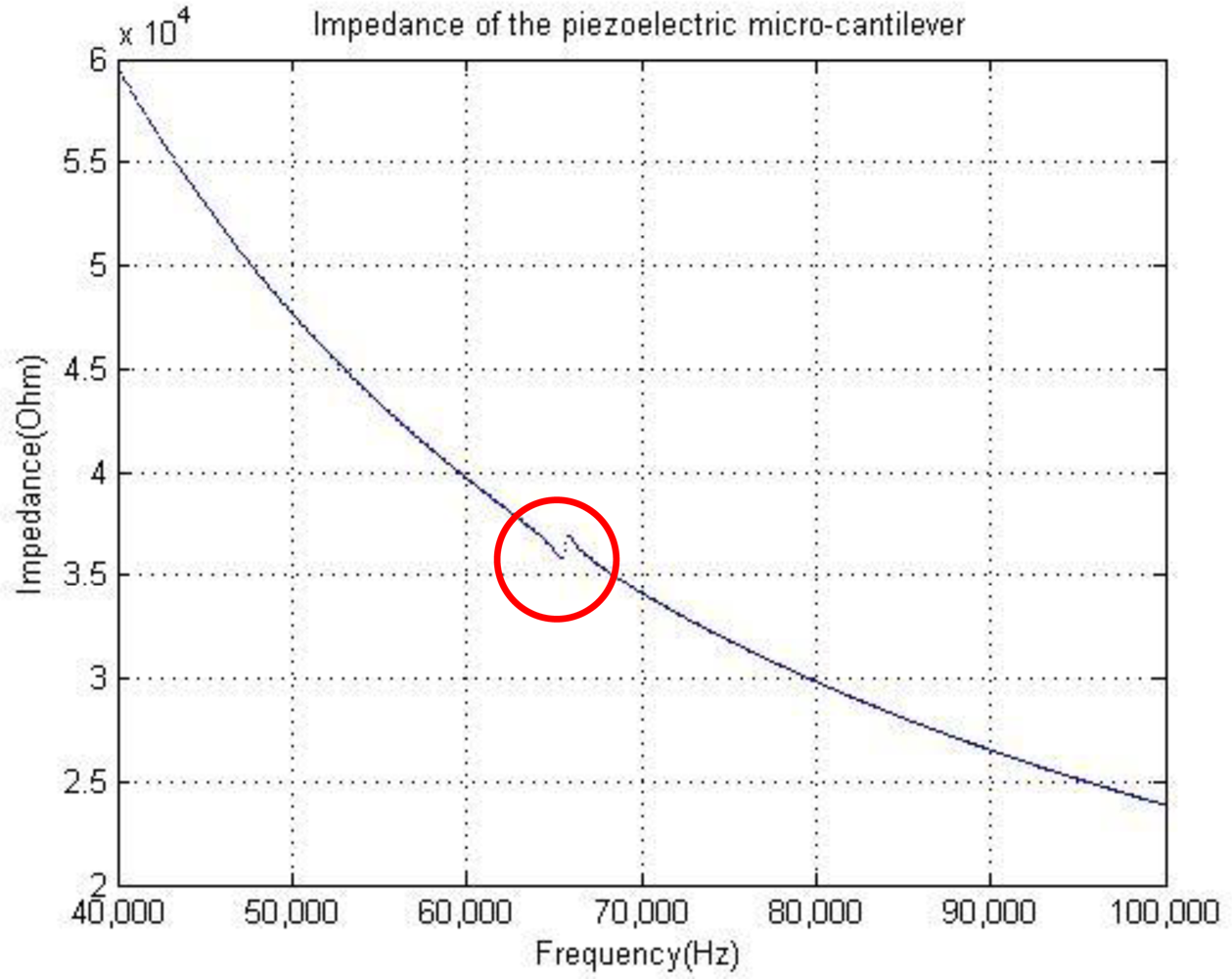
<p>Therefore, the electrical components in the model can be determined by the mechanical properties of the beam, among which <italic>C</italic>1 and <italic>C</italic>0 can be seen as a constant, <italic>R</italic>1 and <italic>L</italic>1 will vary with the frequencies. Furthermore, the impedance of the micro-cantilever can be determined, as shown in <xref ref-type="fig" rid="f2-sensors-10-07044">Figure 2</xref>. As the impedance of <italic>C</italic>0 is much smaller than that of <italic>C</italic>1-<italic>R</italic>1-<italic>L</italic>1 branch, the impedance of the micro-cantilever is rather determined by that of <italic>C</italic>0, and has only a local minimum at the MRF <italic>f</italic><sub>0</sub>. This means the micro-cantilever does not have a good capability of selecting the resonance frequency.</p>
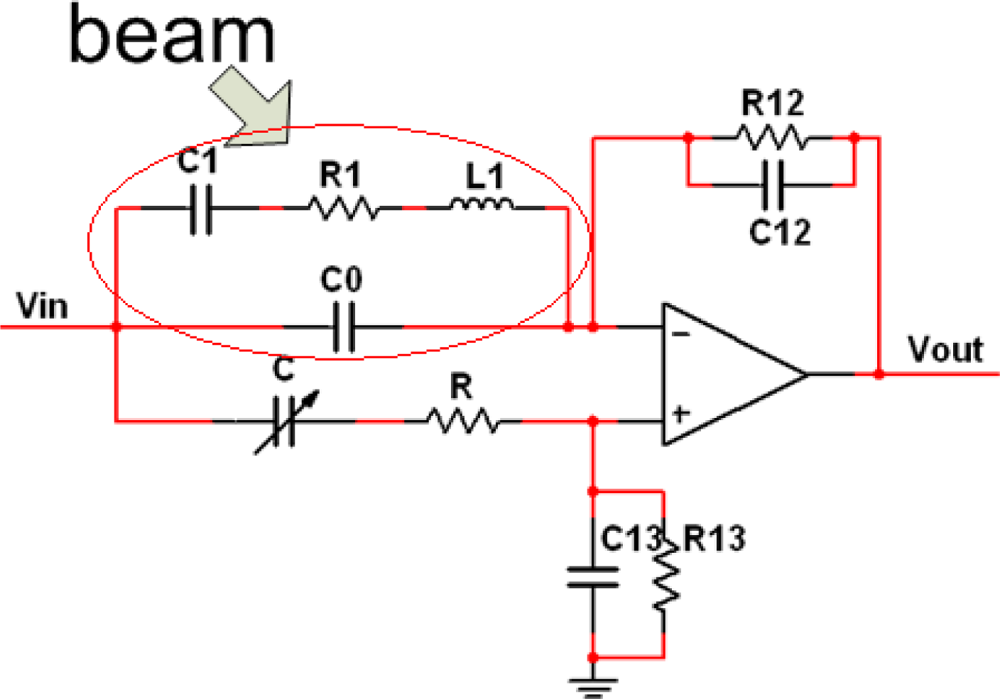
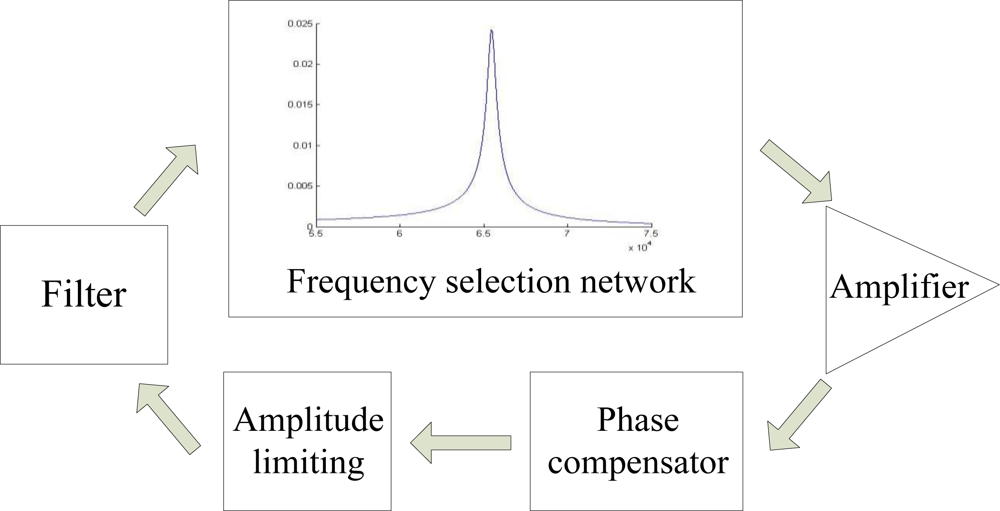
<p>Therefore, for ameliorating the frequency selection performance of the beam, a frequency selection network module is designed. The constant capacitor <italic>C</italic>0 in the electrical model was compensated by an external tunable capacitor. In an ideal situation, the output of the network should perform as a band-pass filter, having maximum amplitude at the mechanical resonance frequency (see <xref ref-type="fig" rid="f3-sensors-10-07044">Figure 3</xref>).</p>
<p><xref ref-type="fig" rid="f4-sensors-10-07044">Figure 4</xref> shows the block diagram of the SAD circuit loop. The micro-cantilever is integrated in the module of frequency selection network, which constitutes the frequency determining unit of the oscillator circuit, and serves like a band-pass filter with a central frequency equal to <italic>f</italic><sub>0</sub>. The output signal of the frequency selection network is amplified and then adjusted by the following phase compensator. An amplitude limiting module is used to control the amplitude of the signal. Finally, as in reality the output of frequency selection network cannot be reduced to zero at frequencies far away from <italic>f</italic><sub>0</sub>, a band-pass filter is needed, to reduce the secondary mode oscillation of the beam.</p>
<p>Suppose the gain of the frequency selection network is <italic>A</italic>, and its phase-frequency curve is <italic>φ<sub>a</sub></italic>, the rest of the SAD circuit loop is considered as a feedback module, with a gain of <italic>F</italic> and phase-frequency curve <italic>φ<sub>b</sub></italic>. When the SAD circuit loop working in a close-loop mode, the Barkhausen conditions should be met [<xref ref-type="bibr" rid="b15-sensors-10-07044">15</xref>]:
<disp-formula id="FD2">
<label>(2)</label>
<mml:math display="block">
<mml:mtable columnalign="left">
<mml:mtr>
<mml:mtd>
<mml:mrow>
<mml:mo>|</mml:mo>
<mml:mrow>
<mml:mi>A</mml:mi>
<mml:mo stretchy="false">(</mml:mo>
<mml:msub>
<mml:mrow>
<mml:mi>f</mml:mi></mml:mrow>
<mml:mi>r</mml:mi></mml:msub>
<mml:mo stretchy="false">)</mml:mo>
<mml:mi>F</mml:mi>
<mml:mo stretchy="false">(</mml:mo>
<mml:msub>
<mml:mi>f</mml:mi>
<mml:mi>r</mml:mi></mml:msub>
<mml:mo stretchy="false">)</mml:mo></mml:mrow>
<mml:mo>|</mml:mo></mml:mrow>
<mml:mo>=</mml:mo>
<mml:mn>1</mml:mn></mml:mtd></mml:mtr>
<mml:mtr>
<mml:mtd>
<mml:msub>
<mml:mi>φ</mml:mi>
<mml:mi>a</mml:mi></mml:msub>
<mml:mo stretchy="false">(</mml:mo>
<mml:msub>
<mml:mi>f</mml:mi>
<mml:mi>r</mml:mi></mml:msub>
<mml:mo stretchy="false">)</mml:mo>
<mml:mo>+</mml:mo>
<mml:msub>
<mml:mi>φ</mml:mi>
<mml:mi>b</mml:mi></mml:msub>
<mml:mo stretchy="false">(</mml:mo>
<mml:msub>
<mml:mi>f</mml:mi>
<mml:mi>r</mml:mi></mml:msub>
<mml:mo stretchy="false">)</mml:mo>
<mml:mo>=</mml:mo>
<mml:mn>2</mml:mn>
<mml:mi>π</mml:mi></mml:mtd></mml:mtr></mml:mtable></mml:math></disp-formula></p>
<p>Generally, the amplitude condition in <xref ref-type="disp-formula" rid="FD2">(2)</xref> is not a crucial one, as the non-linearity in the feedback module makes the amplitude of the signal always satisfy the first equation. Therefore, the working frequency is rather determined by the second Equation of <xref ref-type="disp-formula" rid="FD2">(2)</xref>, the phase condition.</p>
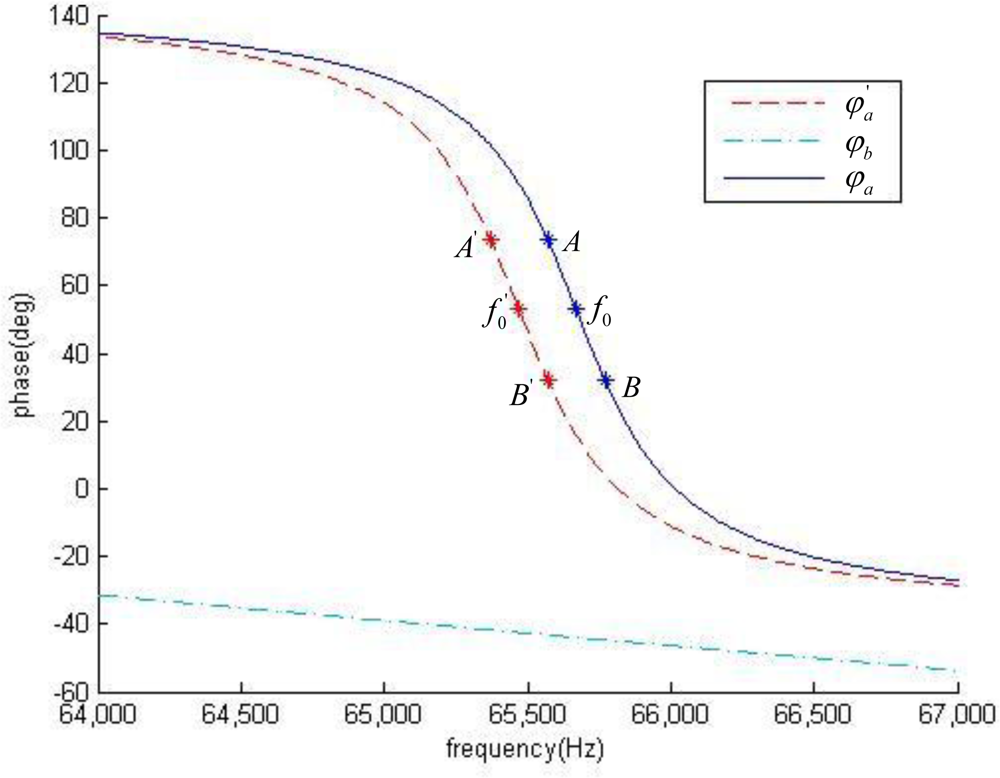
<p><xref ref-type="fig" rid="f5-sensors-10-07044">Figure 5</xref> illustrates the phase-frequency curves for frequency selection network as well as the feedback module. As seen from the figure, the feedback module shows a good linearity in its phase-frequency curves. And in a neighborhood of the mechanical resonance frequency, at least in the interval of <italic>f</italic><sub>0</sub> ± 100 Hz, the frequency selection network also shows a good linearity. After mass loading, mechanical resonance frequency decreases, and <italic>φ<sub>a</sub></italic> (<italic>f</italic>) simply has a parallel shift of Δ<italic>f</italic><sub>0</sub>, to <italic>φ<sub>a</sub></italic> (<italic>f</italic>).</p></sec>
<sec>
<label>2.2.</label>
<title>Analyte Concentration Controlling</title>
<p>The sensing system is mounted in a glass canister, with a thin glass slide as top window. Drops of liquid ethanol were jetted by a transfer pipette through this window to provide defined vapor concentrations to the canister. Suppose the volume of the canister is <italic>V<sub>vessel</sub></italic>, and liquid ethanol with a volume <italic>V<sub>analyte</sub></italic> is jetted into the canister. When volatilized completely, the concentration of ethanol vapor follows <xref ref-type="disp-formula" rid="FD3">Equations (3)</xref> and <xref ref-type="disp-formula" rid="FD4">(4)</xref> where <italic>M</italic> is the molecular weight of the analyte, and <italic>P</italic> is the ambient atmospheric pressure:
<disp-formula id="FD3">
<label>(3)</label>
<mml:math display="block">
<mml:mrow>
<mml:msub>
<mml:mrow>
<mml:mi>C</mml:mi></mml:mrow>
<mml:mrow>
<mml:mo>{</mml:mo>
<mml:mi mathvariant="italic">mg</mml:mi>
<mml:mo>/</mml:mo>
<mml:msup>
<mml:mrow>
<mml:mi>m</mml:mi></mml:mrow>
<mml:mn>3</mml:mn></mml:msup>
<mml:mo>}</mml:mo></mml:mrow></mml:msub>
<mml:mo>=</mml:mo>
<mml:mfrac>
<mml:mrow>
<mml:msub>
<mml:mi>ρ</mml:mi>
<mml:mi mathvariant="italic">analyte</mml:mi></mml:msub>
<mml:msub>
<mml:mi>V</mml:mi>
<mml:mi mathvariant="italic">analyte</mml:mi></mml:msub></mml:mrow>
<mml:mrow>
<mml:msub>
<mml:mi>V</mml:mi>
<mml:mi mathvariant="italic">vessel</mml:mi></mml:msub></mml:mrow></mml:mfrac></mml:mrow></mml:math></disp-formula>
<disp-formula id="FD4">
<label>(4)</label>
<mml:math display="block">
<mml:mrow>
<mml:msub>
<mml:mrow>
<mml:mi>C</mml:mi></mml:mrow>
<mml:mrow>
<mml:mo>{</mml:mo>
<mml:mi mathvariant="italic">ppm</mml:mi>
<mml:mo>}</mml:mo></mml:mrow></mml:msub>
<mml:mo>=</mml:mo>
<mml:mfrac>
<mml:mrow>
<mml:msub>
<mml:mrow>
<mml:mi>C</mml:mi></mml:mrow>
<mml:mrow>
<mml:mo>{</mml:mo>
<mml:mi mathvariant="italic">mg</mml:mi>
<mml:mo>/</mml:mo>
<mml:msup>
<mml:mrow>
<mml:mi>m</mml:mi></mml:mrow>
<mml:mn>3</mml:mn></mml:msup>
<mml:mo>}</mml:mo></mml:mrow></mml:msub></mml:mrow>
<mml:mrow>
<mml:mfrac>
<mml:mi>M</mml:mi>
<mml:mrow>
<mml:mn>22.4</mml:mn></mml:mrow></mml:mfrac>
<mml:mo>⋅</mml:mo>
<mml:mfrac>
<mml:mrow>
<mml:mn>273</mml:mn></mml:mrow>
<mml:mrow>
<mml:mn>273</mml:mn>
<mml:mo>+</mml:mo>
<mml:mi>T</mml:mi></mml:mrow></mml:mfrac>
<mml:mo>⋅</mml:mo>
<mml:mfrac>
<mml:mi>P</mml:mi>
<mml:mrow>
<mml:mn>1011325</mml:mn></mml:mrow></mml:mfrac></mml:mrow></mml:mfrac></mml:mrow></mml:math></disp-formula></p>
<p>For the experiments, we calculate the saturated concentration of ethanol vapor, known the ambient temperature and pressure of atmosphere. Then, an appropriate volume <italic>V<sub>analyte</sub></italic> is chosen, to make sure that with six liquid injections, the concentration of the ethanol vapor in the canister increases at a constant pace and is finally below the saturated level. The open-loop test and the close-loop one are performed in the same canister, with the same ambient conditions. The transfer pipette has a precision of measurement of 0.3%, which ensures the coherence of the two tests, and the comparability of the results.</p></sec>
<sec>
<label>2.3.</label>
<title>Open-Loop Tests</title>
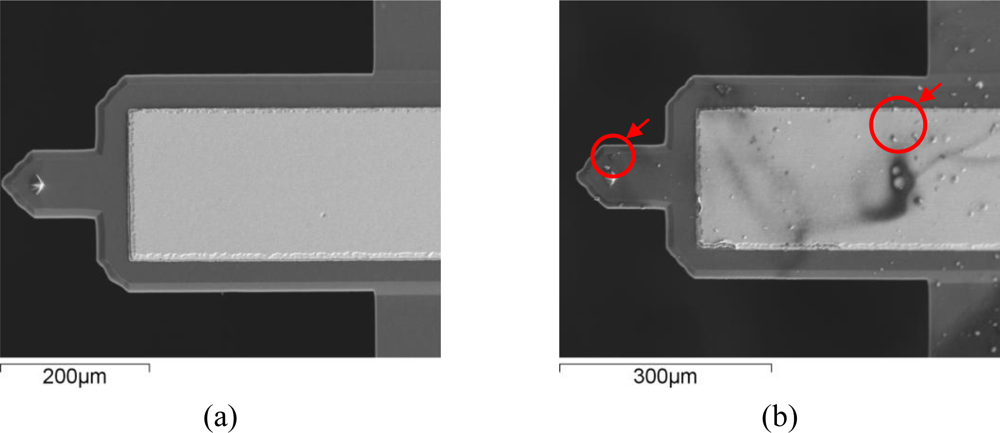
<p>An Open-loop test records the variation of mechanical resonance frequency <italic>f</italic><sub>0</sub> of the micro-cantilever. The micro-cantilever used in this work is a probe from a commercial Atomic Force Microscopy (AFM) system supplied by the Veeco<sup>®</sup> Company. It consists of a micro-machined silicon beam with a piezoelectric zinc oxide layer. The MRF of the AFM cantilever is 50,000 Hz, according to the specificationz and is measured at 66,640 Hz. Polyethyleneoxide (PEO) was chosen as the sensitive material, for its good sensitivity and selectivity to ethanol vapor [<xref ref-type="bibr" rid="b16-sensors-10-07044">16</xref>]. An aqueous solution of PEO was jetted on top of the cantilever. After the evaporation of the solvent, the tip of the cantilever was covered with a layer of sensitive material in the form of granule (<xref ref-type="fig" rid="f6-sensors-10-07044">Figure 6</xref>), and the MRF of the cantilever decreases to 65,670 Hz accordingly.</p>
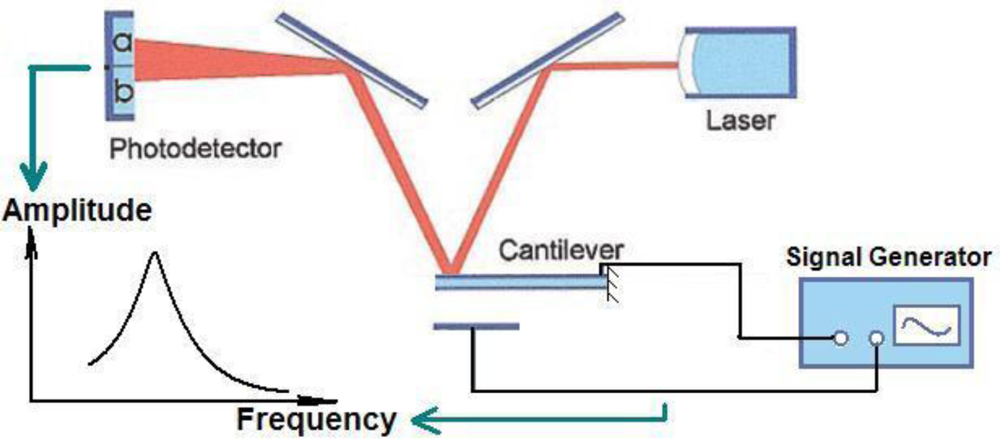
<p>The open-loop test instruments system is illustrated by <xref ref-type="fig" rid="f7-sensors-10-07044">Figure 7</xref>. A signal generator provides an actuating signal, and the laser beam was focused on the free-moving end of the coated cantilever. The laser beam deflection signal was captured by a photodetector, and the amplitude of the oscillation was read out from the screen. By sweeping the actuating signal near the mechanical resonance frequency, <italic>f</italic><sub>0</sub> can be detected. The Q-factor of the coated probe is near 130 at ambient conditions of standard atmospheric pressure and 293 K temperature.</p></sec>
<sec>
<label>2.4.</label>
<title>Close-Loop Tests</title>
<p>In a close-loop experiment, the system working frequency <italic>f</italic><sub>r</sub> of the SAD circuit loop was detected. Schematic diagram of the test can is illustrated in <xref ref-type="fig" rid="f4-sensors-10-07044">Figure 4</xref>. The resolving power of the tests is approximately 0.5 Hz. To ensure that the SAD circuit loop works in its closed-loop mode, the following two adjustments should be made. Firstly, the tunable capacitor in the frequency selection network should be adjusted to compensate <italic>C</italic>0, that is to say, at a frequency <italic>f</italic> ≠ <italic>f</italic><sub>0</sub>, the output of the frequency selection network is equal to 0. Secondly, connect the frequency selection network with the feedback module, and adjust the phase compensator, to meet the phase condition in the Barkhausen conditions.</p></sec></sec>
<sec sec-type="results|discussion">
<label>3.</label>
<title>Results and Discussion</title>
<sec>
<label>3.1.</label>
<title>Initial Offsets</title>
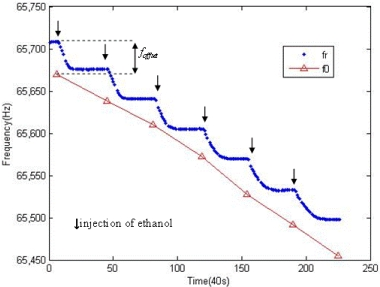
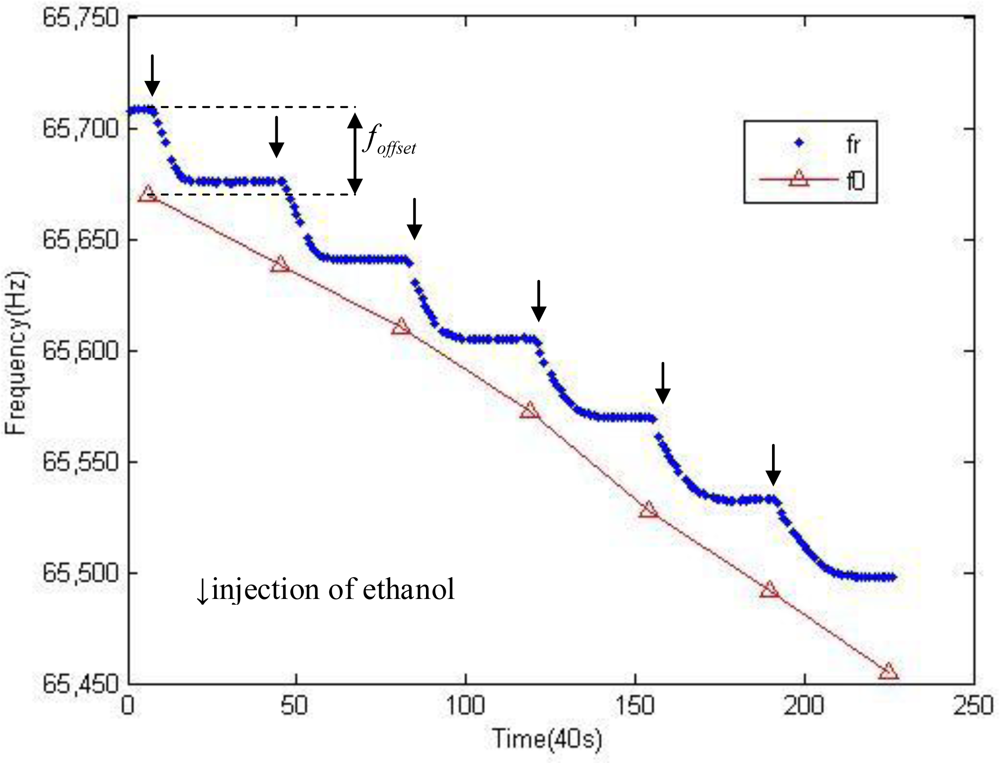
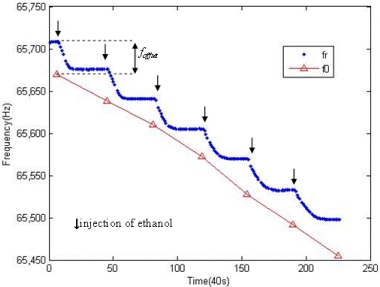
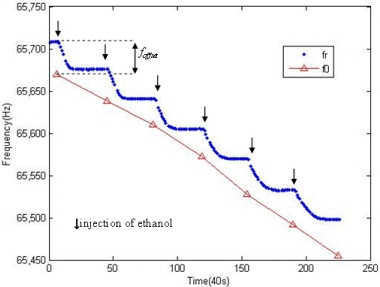
<p>A pair of experimental datapoints can be observed in <xref ref-type="fig" rid="f8-sensors-10-07044">Figure 8</xref>. The liquid ethanol was jetted every 30 minutes in both of the tests. The set of triangle symbols represents the mechanical resonance frequency in the open-loop test. The step-form points record the working frequency of the SAD circuit loop as a function of time. As the volatilization takes place, the working frequency of the circuit loop decreases and at the end of the volatilization, the working frequency stabilizes gradually. As mentioned at the beginning, it is the coefficient <italic>α</italic> between the SWF shift Δ<italic>f</italic><sub>r</sub> and the MRF shift Δ<italic>f</italic><sub>0</sub> what we exploit. It is easy to notice that in this result, the initial frequency, which corresponds to a vapor concentration of 0, is different. Such an offset of the initial frequency is caused the by the offset of the initial phase. During the adjustment of the phase compensator before a close-loop test, an error of operation is inevitable as the signal superposition is depending on subjective judgment. Therefore, an offset of initial phase was introduced, noted as <italic>φ<sub>offset</sub></italic>. The frequency offset <italic>f<sub>offset</sub></italic> is thereby created. The frequency offset is 38 Hz in this experiment.</p>
<p>As <italic>φ<sub>offset</sub></italic> is the phase offset at <italic>f</italic> = <italic>f</italic><sub>0</sub> in an open-loop adjustment, from <xref ref-type="disp-formula" rid="FD2">(2)</xref> we have:
<disp-formula id="FD5">
<label>(5)</label>
<mml:math display="block">
<mml:mrow>
<mml:msub>
<mml:mrow>
<mml:mi>φ</mml:mi></mml:mrow>
<mml:mi>a</mml:mi></mml:msub>
<mml:mo stretchy="false">(</mml:mo>
<mml:msub>
<mml:mrow>
<mml:mi>f</mml:mi></mml:mrow>
<mml:mn>0</mml:mn></mml:msub>
<mml:mo stretchy="false">)</mml:mo>
<mml:mo>+</mml:mo>
<mml:msub>
<mml:mrow>
<mml:mi>φ</mml:mi></mml:mrow>
<mml:mi>b</mml:mi></mml:msub>
<mml:mo stretchy="false">(</mml:mo>
<mml:msub>
<mml:mrow>
<mml:mi>f</mml:mi></mml:mrow>
<mml:mn>0</mml:mn></mml:msub>
<mml:mo stretchy="false">)</mml:mo>
<mml:mo>=</mml:mo>
<mml:mn>2</mml:mn>
<mml:mi>π</mml:mi>
<mml:mo>+</mml:mo>
<mml:msub>
<mml:mi>φ</mml:mi>
<mml:mi mathvariant="italic">offset</mml:mi></mml:msub></mml:mrow></mml:math></disp-formula></p>
<p>When the system works in a close-loop mode, we also have:
<disp-formula id="FD6">
<label>(6)</label>
<mml:math display="block">
<mml:mrow>
<mml:msub>
<mml:mrow>
<mml:mi>φ</mml:mi></mml:mrow>
<mml:mi>a</mml:mi></mml:msub>
<mml:mo stretchy="false">(</mml:mo>
<mml:msub>
<mml:mrow>
<mml:mi>f</mml:mi></mml:mrow>
<mml:mn>0</mml:mn></mml:msub>
<mml:mo>+</mml:mo>
<mml:msub>
<mml:mi>f</mml:mi>
<mml:mi mathvariant="italic">offset</mml:mi></mml:msub>
<mml:mo stretchy="false">)</mml:mo>
<mml:mo>+</mml:mo>
<mml:msub>
<mml:mrow>
<mml:mi>φ</mml:mi></mml:mrow>
<mml:mi>b</mml:mi></mml:msub>
<mml:mo stretchy="false">(</mml:mo>
<mml:msub>
<mml:mrow>
<mml:mi>f</mml:mi></mml:mrow>
<mml:mn>0</mml:mn></mml:msub>
<mml:mo>+</mml:mo>
<mml:msub>
<mml:mi>f</mml:mi>
<mml:mi mathvariant="italic">offset</mml:mi></mml:msub>
<mml:mo stretchy="false">)</mml:mo>
<mml:mo>=</mml:mo>
<mml:mn>2</mml:mn>
<mml:mi>π</mml:mi></mml:mrow></mml:math></disp-formula></p>
<p>Developing <xref ref-type="disp-formula" rid="FD6">(6)</xref> at <italic>f</italic> = <italic>f</italic><sub>0</sub>, using a Taylor development:
<disp-formula>
<mml:math display="block">
<mml:mtable columnalign="left">
<mml:mtr>
<mml:mtd>
<mml:msub>
<mml:mrow>
<mml:mi>φ</mml:mi></mml:mrow>
<mml:mi>a</mml:mi></mml:msub>
<mml:mo stretchy="false">(</mml:mo>
<mml:msub>
<mml:mrow>
<mml:mi>f</mml:mi></mml:mrow>
<mml:mn>0</mml:mn></mml:msub>
<mml:mo stretchy="false">)</mml:mo>
<mml:mo>+</mml:mo>
<mml:mfrac>
<mml:mrow>
<mml:mo>∂</mml:mo>
<mml:msub>
<mml:mrow>
<mml:mi>φ</mml:mi></mml:mrow>
<mml:mi>a</mml:mi></mml:msub>
<mml:mo stretchy="false">(</mml:mo>
<mml:msub>
<mml:mrow>
<mml:mi>f</mml:mi></mml:mrow>
<mml:mn>0</mml:mn></mml:msub>
<mml:mo stretchy="false">)</mml:mo></mml:mrow>
<mml:mrow>
<mml:mo>∂</mml:mo>
<mml:mi>f</mml:mi></mml:mrow></mml:mfrac>
<mml:msub>
<mml:mi>f</mml:mi>
<mml:mi mathvariant="italic">offset</mml:mi></mml:msub>
<mml:mo>+</mml:mo>
<mml:mfrac>
<mml:mn>1</mml:mn>
<mml:mrow>
<mml:mn>2</mml:mn>
<mml:mo>!</mml:mo></mml:mrow></mml:mfrac>
<mml:mfrac>
<mml:mrow>
<mml:mo>∂</mml:mo>
<mml:msubsup>
<mml:mrow>
<mml:mi>φ</mml:mi></mml:mrow>
<mml:mi>a</mml:mi>
<mml:mn>2</mml:mn></mml:msubsup>
<mml:mo stretchy="false">(</mml:mo>
<mml:msub>
<mml:mrow>
<mml:mi>f</mml:mi></mml:mrow>
<mml:mn>0</mml:mn></mml:msub>
<mml:mo stretchy="false">)</mml:mo></mml:mrow>
<mml:mrow>
<mml:mo>∂</mml:mo>
<mml:msup>
<mml:mrow>
<mml:mi>f</mml:mi></mml:mrow>
<mml:mn>2</mml:mn></mml:msup></mml:mrow></mml:mfrac>
<mml:msubsup>
<mml:mi>f</mml:mi>
<mml:mi mathvariant="italic">offset</mml:mi>
<mml:mn>2</mml:mn></mml:msubsup>
<mml:mo>+</mml:mo>
<mml:mn>...</mml:mn></mml:mtd></mml:mtr>
<mml:mtr>
<mml:mtd>
<mml:mo>+</mml:mo>
<mml:msub>
<mml:mrow>
<mml:mi>φ</mml:mi></mml:mrow>
<mml:mi>b</mml:mi></mml:msub>
<mml:mo stretchy="false">(</mml:mo>
<mml:msub>
<mml:mrow>
<mml:mi>f</mml:mi></mml:mrow>
<mml:mn>0</mml:mn></mml:msub>
<mml:mo stretchy="false">)</mml:mo>
<mml:mo>+</mml:mo>
<mml:mfrac>
<mml:mrow>
<mml:mo>∂</mml:mo>
<mml:msub>
<mml:mrow>
<mml:mi>φ</mml:mi></mml:mrow>
<mml:mi>b</mml:mi></mml:msub>
<mml:mo stretchy="false">(</mml:mo>
<mml:msub>
<mml:mrow>
<mml:mi>f</mml:mi></mml:mrow>
<mml:mn>0</mml:mn></mml:msub>
<mml:mo stretchy="false">)</mml:mo></mml:mrow>
<mml:mrow>
<mml:mo>∂</mml:mo>
<mml:mi>f</mml:mi></mml:mrow></mml:mfrac>
<mml:msub>
<mml:mi>f</mml:mi>
<mml:mi mathvariant="italic">offset</mml:mi></mml:msub>
<mml:mo>+</mml:mo>
<mml:mfrac>
<mml:mn>1</mml:mn>
<mml:mrow>
<mml:mn>2</mml:mn>
<mml:mo>!</mml:mo></mml:mrow></mml:mfrac>
<mml:mfrac>
<mml:mrow>
<mml:mo>∂</mml:mo>
<mml:msubsup>
<mml:mrow>
<mml:mi>φ</mml:mi></mml:mrow>
<mml:mi>b</mml:mi>
<mml:mn>2</mml:mn></mml:msubsup>
<mml:mo stretchy="false">(</mml:mo>
<mml:msub>
<mml:mrow>
<mml:mi>f</mml:mi></mml:mrow>
<mml:mn>0</mml:mn></mml:msub>
<mml:mo stretchy="false">)</mml:mo></mml:mrow>
<mml:mrow>
<mml:mo>∂</mml:mo>
<mml:msup>
<mml:mrow>
<mml:mi>f</mml:mi></mml:mrow>
<mml:mn>2</mml:mn></mml:msup></mml:mrow></mml:mfrac>
<mml:msubsup>
<mml:mi>f</mml:mi>
<mml:mi mathvariant="italic">offset</mml:mi>
<mml:mn>2</mml:mn></mml:msubsup>
<mml:mo>+</mml:mo>
<mml:mn>...</mml:mn>
<mml:mo>=</mml:mo>
<mml:mn>2</mml:mn>
<mml:mi>π</mml:mi></mml:mtd></mml:mtr></mml:mtable></mml:math></disp-formula></p>
<p>As the linearity shown in <xref ref-type="fig" rid="f4-sensors-10-07044">Figure 4</xref>, in the interval of this development, the high order derivatives are far less than the first order derivative. Thus:
<disp-formula id="FD7">
<label>(7)</label>
<mml:math display="block">
<mml:mrow>
<mml:msub>
<mml:mi>φ</mml:mi>
<mml:mi>a</mml:mi></mml:msub>
<mml:mo stretchy="false">(</mml:mo>
<mml:msub>
<mml:mi>f</mml:mi>
<mml:mn>0</mml:mn></mml:msub>
<mml:mo stretchy="false">)</mml:mo>
<mml:mo>+</mml:mo>
<mml:mfrac>
<mml:mrow>
<mml:mo>∂</mml:mo>
<mml:msub>
<mml:mi>φ</mml:mi>
<mml:mi>a</mml:mi></mml:msub>
<mml:mo stretchy="false">(</mml:mo>
<mml:msub>
<mml:mi>f</mml:mi>
<mml:mn>0</mml:mn></mml:msub>
<mml:mo stretchy="false">)</mml:mo></mml:mrow>
<mml:mrow>
<mml:mo>∂</mml:mo>
<mml:mi>f</mml:mi></mml:mrow></mml:mfrac>
<mml:msub>
<mml:mi>f</mml:mi>
<mml:mi mathvariant="italic">offset</mml:mi></mml:msub>
<mml:mo>+</mml:mo>
<mml:msub>
<mml:mi>φ</mml:mi>
<mml:mi>b</mml:mi></mml:msub>
<mml:mo stretchy="false">(</mml:mo>
<mml:msub>
<mml:mi>f</mml:mi>
<mml:mn>0</mml:mn></mml:msub>
<mml:mo stretchy="false">)</mml:mo>
<mml:mo>+</mml:mo>
<mml:mfrac>
<mml:mrow>
<mml:mo>∂</mml:mo>
<mml:msub>
<mml:mi>φ</mml:mi>
<mml:mi>b</mml:mi></mml:msub>
<mml:mo stretchy="false">(</mml:mo>
<mml:msub>
<mml:mi>f</mml:mi>
<mml:mn>0</mml:mn></mml:msub>
<mml:mo stretchy="false">)</mml:mo></mml:mrow>
<mml:mrow>
<mml:mo>∂</mml:mo>
<mml:mi>f</mml:mi></mml:mrow></mml:mfrac>
<mml:msub>
<mml:mi>f</mml:mi>
<mml:mi mathvariant="italic">offset</mml:mi></mml:msub>
<mml:mo>=</mml:mo>
<mml:mn>2</mml:mn>
<mml:mi>π</mml:mi></mml:mrow></mml:math></disp-formula></p>
<p>From <xref ref-type="disp-formula" rid="FD5">(5)</xref> and <xref ref-type="disp-formula" rid="FD7">(7)</xref>, we have:
<disp-formula id="FD8">
<label>(8)</label>
<mml:math display="block">
<mml:mrow>
<mml:msub>
<mml:mi>f</mml:mi>
<mml:mi mathvariant="italic">offset</mml:mi></mml:msub>
<mml:mo>=</mml:mo>
<mml:mfrac>
<mml:mrow>
<mml:msub>
<mml:mi>φ</mml:mi>
<mml:mi mathvariant="italic">offset</mml:mi></mml:msub></mml:mrow>
<mml:mrow>
<mml:mfrac>
<mml:mrow>
<mml:mo>∂</mml:mo>
<mml:msub>
<mml:mrow>
<mml:mi>φ</mml:mi></mml:mrow>
<mml:mi>a</mml:mi></mml:msub>
<mml:mo stretchy="false">(</mml:mo>
<mml:msub>
<mml:mrow>
<mml:mi>f</mml:mi></mml:mrow>
<mml:mn>0</mml:mn></mml:msub>
<mml:mo stretchy="false">)</mml:mo></mml:mrow>
<mml:mrow>
<mml:mo>∂</mml:mo>
<mml:mi>f</mml:mi></mml:mrow></mml:mfrac>
<mml:mo>+</mml:mo>
<mml:mfrac>
<mml:mrow>
<mml:mo>∂</mml:mo>
<mml:msub>
<mml:mrow>
<mml:mi>φ</mml:mi></mml:mrow>
<mml:mi>b</mml:mi></mml:msub>
<mml:mo stretchy="false">(</mml:mo>
<mml:msub>
<mml:mrow>
<mml:mi>f</mml:mi></mml:mrow>
<mml:mn>0</mml:mn></mml:msub>
<mml:mo stretchy="false">)</mml:mo></mml:mrow>
<mml:mrow>
<mml:mo>∂</mml:mo>
<mml:mi>f</mml:mi></mml:mrow></mml:mfrac></mml:mrow></mml:mfrac></mml:mrow></mml:math></disp-formula></p>
<p>It is seen from <xref ref-type="disp-formula" rid="FD8">(8)</xref> how <italic>φ<sub>offset</sub></italic> causes <italic>f<sub>offset</sub></italic>, the offset of the initial frequency in experimental results. The literature expression of <italic>α</italic> later on will show that this coefficient will not be affected by the initial frequency offset.</p></sec>
<sec sec-type="methods">
<label>3.2.</label>
<title>Differences between MRF Shifts and SWF Shifts</title>
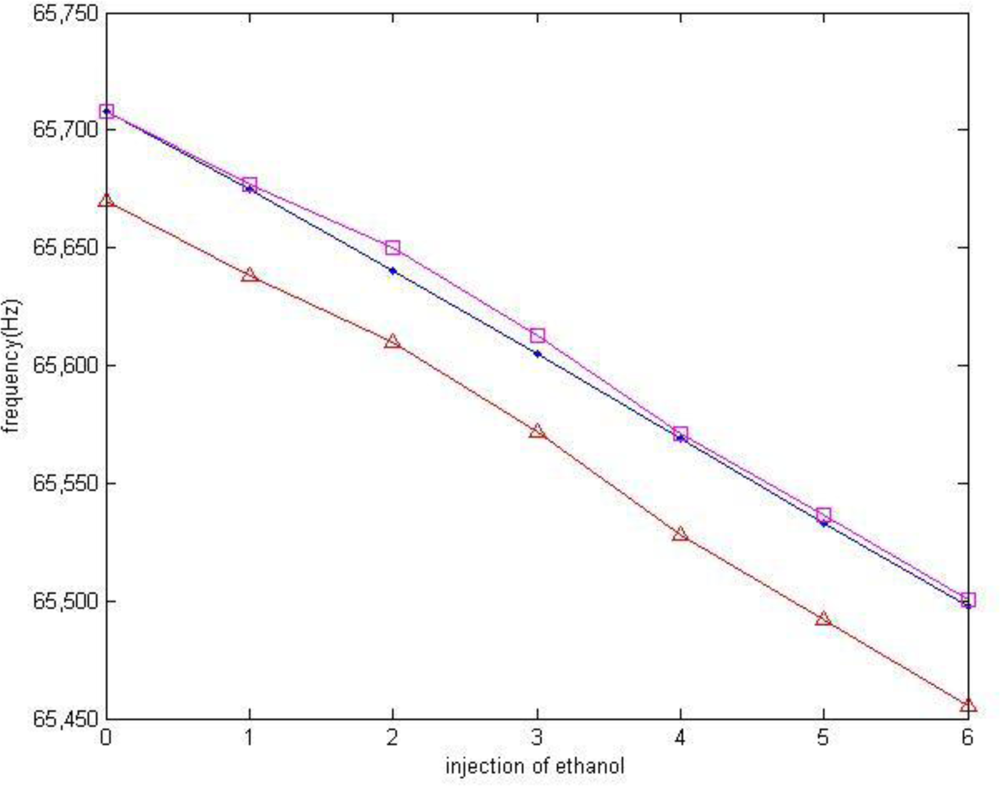
<p><xref ref-type="fig" rid="f9-sensors-10-07044">Figure 9</xref> shows the MRF and the SWF as a function of gas concentration. After six sequential ethanol injections of equal quantity, the MRF decreases from 65,670 Hz to 65,455 Hz, and the SWF decreases from 65,708 Hz to 65,498 Hz. A result of simulation of SWF calculated from the MRF measured is also presented for comparison.</p>
<p>It is the ratio of the slope of two experimental curves that represents the coefficient <italic>α</italic>. The linear expression is obtained by interpolating the curves using the least-square principle. As the close-loop has a higher resolution power, its data shows a better correlation:
<disp-formula>
<mml:math display="block">
<mml:mtable>
<mml:mtr>
<mml:mtd>
<mml:msub>
<mml:mi>f</mml:mi>
<mml:mn>0</mml:mn></mml:msub>
<mml:mo>:</mml:mo>
<mml:mo> </mml:mo>
<mml:mo> </mml:mo>
<mml:mi>y</mml:mi>
<mml:mo>=</mml:mo>
<mml:mo>−</mml:mo>
<mml:mn>36.393</mml:mn>
<mml:mi>x</mml:mi>
<mml:mo>+</mml:mo>
<mml:mn>65676</mml:mn>
<mml:mo>,</mml:mo>
<mml:mo> </mml:mo>
<mml:msup>
<mml:mi>R</mml:mi>
<mml:mn>2</mml:mn></mml:msup>
<mml:mo>=</mml:mo>
<mml:mn>0.9966</mml:mn></mml:mtd></mml:mtr>
<mml:mtr>
<mml:mtd>
<mml:msub>
<mml:mi>f</mml:mi>
<mml:mi>r</mml:mi></mml:msub>
<mml:mo>:</mml:mo>
<mml:mo> </mml:mo>
<mml:mo> </mml:mo>
<mml:mi>y</mml:mi>
<mml:mo>=</mml:mo>
<mml:mo>−</mml:mo>
<mml:mn>35.179</mml:mn>
<mml:mi>x</mml:mi>
<mml:mo>+</mml:mo>
<mml:mn>65710</mml:mn>
<mml:mo>,</mml:mo>
<mml:mo> </mml:mo>
<mml:msup>
<mml:mi>R</mml:mi>
<mml:mn>2</mml:mn></mml:msup>
<mml:mo>=</mml:mo>
<mml:mn>0.9999</mml:mn></mml:mtd></mml:mtr>
<mml:mtr>
<mml:mtd>
<mml:msub>
<mml:mi>f</mml:mi>
<mml:mrow>
<mml:mi>r</mml:mi>
<mml:mo>−</mml:mo>
<mml:mi>s</mml:mi>
<mml:mi>i</mml:mi>
<mml:mi>m</mml:mi>
<mml:mi>u</mml:mi>
<mml:mi>l</mml:mi>
<mml:mi>a</mml:mi>
<mml:mi>t</mml:mi>
<mml:mi>e</mml:mi></mml:mrow></mml:msub>
<mml:mo>:</mml:mo>
<mml:mo> </mml:mo>
<mml:mo> </mml:mo>
<mml:mi>y</mml:mi>
<mml:mo>=</mml:mo>
<mml:mo>−</mml:mo>
<mml:mn>35.089</mml:mn>
<mml:mi>x</mml:mi>
<mml:mo>+</mml:mo>
<mml:mn>65710</mml:mn>
<mml:mo>,</mml:mo>
<mml:mo> </mml:mo>
<mml:msup>
<mml:mi>R</mml:mi>
<mml:mn>2</mml:mn></mml:msup>
<mml:mo>=</mml:mo>
<mml:mn>0.9969</mml:mn></mml:mtd></mml:mtr></mml:mtable></mml:math></disp-formula></p>
<p>Both experimental result and simulation result demonstrate the existence of a coefficient <italic>α</italic> which makes Δ<italic>f</italic><sub>r</sub> = <italic>α</italic>·Δ<italic>f</italic><sub>0</sub>. The value of <italic>α</italic> is also calculated: <italic>α<sub>real</sub> =</italic> 0.9666, <italic>α<sub>simulate</sub></italic> = 0.9642.</p>
<p>We are going to explore this a little bit further. As a frequency offset <italic>f<sub>offset</sub></italic> is observed, we are going to demonstrate it has no influence to <italic>α</italic>. Suppose that the SWF of the SAD circuit loop decreases from <italic>f</italic><sub>r</sub> to 
<inline-formula>
<mml:math>
<mml:mrow>
<mml:msubsup>
<mml:mi>f</mml:mi>
<mml:mi>r</mml:mi>
<mml:mo>′</mml:mo></mml:msubsup></mml:mrow></mml:math></inline-formula>, when the MRF decreases form <italic>f</italic><sub>0</sub> to
<inline-formula>
<mml:math>
<mml:mrow>
<mml:msubsup>
<mml:mi>f</mml:mi>
<mml:mn>0</mml:mn>
<mml:mo>′</mml:mo></mml:msubsup></mml:mrow></mml:math></inline-formula>. Transform the definition
<inline-formula>
<mml:math>
<mml:mrow>
<mml:msub>
<mml:mi>f</mml:mi>
<mml:mi>r</mml:mi></mml:msub>
<mml:mo>−</mml:mo>
<mml:msubsup>
<mml:mi>f</mml:mi>
<mml:mi>r</mml:mi>
<mml:mo>′</mml:mo></mml:msubsup>
<mml:mo>=</mml:mo>
<mml:mi>α</mml:mi>
<mml:mo stretchy="false">(</mml:mo>
<mml:msub>
<mml:mi>f</mml:mi>
<mml:mn>0</mml:mn></mml:msub>
<mml:mo>−</mml:mo>
<mml:msubsup>
<mml:mi>f</mml:mi>
<mml:mn>0</mml:mn>
<mml:mo>′</mml:mo></mml:msubsup>
<mml:mo stretchy="false">)</mml:mo></mml:mrow></mml:math></inline-formula> to:
<disp-formula id="FD9">
<label>(9)</label>
<mml:math display="block">
<mml:mrow>
<mml:mo stretchy="false">(</mml:mo>
<mml:mn>1</mml:mn>
<mml:mo>−</mml:mo>
<mml:mi>α</mml:mi>
<mml:mo stretchy="false">)</mml:mo>
<mml:mo stretchy="false">(</mml:mo>
<mml:msub>
<mml:mrow>
<mml:mi>f</mml:mi></mml:mrow>
<mml:mn>0</mml:mn></mml:msub>
<mml:mo>−</mml:mo>
<mml:msubsup>
<mml:mi>f</mml:mi>
<mml:mn>0</mml:mn>
<mml:mo>′</mml:mo></mml:msubsup>
<mml:mo stretchy="false">)</mml:mo>
<mml:mo>=</mml:mo>
<mml:msubsup>
<mml:mi>f</mml:mi>
<mml:mi mathvariant="italic">offset</mml:mi>
<mml:mo>′</mml:mo></mml:msubsup>
<mml:mo>−</mml:mo>
<mml:msub>
<mml:mi>f</mml:mi>
<mml:mi mathvariant="italic">offset</mml:mi></mml:msub></mml:mrow></mml:math></disp-formula></p>
<p>After mass loading, at the new resonance frequency
<inline-formula>
<mml:math>
<mml:mrow>
<mml:msubsup>
<mml:mi>f</mml:mi>
<mml:mn>0</mml:mn>
<mml:mo>′</mml:mo></mml:msubsup></mml:mrow></mml:math></inline-formula>, a new phase offset
<inline-formula>
<mml:math>
<mml:mrow>
<mml:msubsup>
<mml:mi>φ</mml:mi>
<mml:mi mathvariant="italic">offset</mml:mi>
<mml:mo>′</mml:mo></mml:msubsup></mml:mrow></mml:math></inline-formula> exists:
<disp-formula id="FD10">
<label>(10)</label>
<mml:math display="block">
<mml:mrow>
<mml:msubsup>
<mml:mi>φ</mml:mi>
<mml:mi>a</mml:mi>
<mml:mo>′</mml:mo></mml:msubsup>
<mml:mo stretchy="false">(</mml:mo>
<mml:msubsup>
<mml:mi>f</mml:mi>
<mml:mn>0</mml:mn>
<mml:mo>′</mml:mo></mml:msubsup>
<mml:mo stretchy="false">)</mml:mo>
<mml:mo>+</mml:mo>
<mml:msub>
<mml:mrow>
<mml:mi>φ</mml:mi></mml:mrow>
<mml:mi>b</mml:mi></mml:msub>
<mml:mo stretchy="false">(</mml:mo>
<mml:msubsup>
<mml:mi>f</mml:mi>
<mml:mn>0</mml:mn>
<mml:mo>′</mml:mo></mml:msubsup>
<mml:mo stretchy="false">)</mml:mo>
<mml:mo>=</mml:mo>
<mml:mn>2</mml:mn>
<mml:mi>π</mml:mi>
<mml:mo>+</mml:mo>
<mml:msubsup>
<mml:mi>φ</mml:mi>
<mml:mi mathvariant="italic">offset</mml:mi>
<mml:mo>′</mml:mo></mml:msubsup></mml:mrow></mml:math></disp-formula></p>
<p>From the discussion of <xref ref-type="fig" rid="f4-sensors-10-07044">Figure 4</xref>, there is:
<disp-formula id="FD11">
<label>(11)</label>
<mml:math display="block">
<mml:mrow>
<mml:msub>
<mml:mi>φ</mml:mi>
<mml:mi>a</mml:mi></mml:msub>
<mml:mo stretchy="false">(</mml:mo>
<mml:mi>f</mml:mi>
<mml:mo stretchy="false">)</mml:mo>
<mml:mo>=</mml:mo>
<mml:msubsup>
<mml:mrow>
<mml:mi>φ</mml:mi></mml:mrow>
<mml:mi>a</mml:mi>
<mml:mo>′</mml:mo></mml:msubsup>
<mml:mo stretchy="false">(</mml:mo>
<mml:mi>f</mml:mi>
<mml:mo>−</mml:mo>
<mml:mo>Δ</mml:mo>
<mml:msub>
<mml:mrow>
<mml:mi>f</mml:mi></mml:mrow>
<mml:mn>0</mml:mn></mml:msub>
<mml:mo stretchy="false">)</mml:mo></mml:mrow></mml:math></disp-formula></p>
<p>A deduction follows the routine of <xref ref-type="disp-formula" rid="FD8">(8)</xref>, we have:
<disp-formula id="FD12">
<label>(12)</label>
<mml:math display="block">
<mml:mrow>
<mml:msubsup>
<mml:mi>f</mml:mi>
<mml:mi mathvariant="italic">offset</mml:mi>
<mml:mo>′</mml:mo></mml:msubsup>
<mml:mo>=</mml:mo>
<mml:mfrac>
<mml:mrow>
<mml:msubsup>
<mml:mi>φ</mml:mi>
<mml:mi mathvariant="italic">offset</mml:mi>
<mml:mo>′</mml:mo></mml:msubsup></mml:mrow>
<mml:mrow>
<mml:mfrac>
<mml:mrow>
<mml:mo>∂</mml:mo>
<mml:msubsup>
<mml:mi>φ</mml:mi>
<mml:mi>a</mml:mi>
<mml:mo>′</mml:mo></mml:msubsup>
<mml:mo stretchy="false">(</mml:mo>
<mml:msubsup>
<mml:mi>f</mml:mi>
<mml:mn>0</mml:mn>
<mml:mo>′</mml:mo></mml:msubsup>
<mml:mo stretchy="false">)</mml:mo></mml:mrow>
<mml:mrow>
<mml:mo>∂</mml:mo>
<mml:mi>f</mml:mi></mml:mrow></mml:mfrac>
<mml:mo>+</mml:mo>
<mml:mfrac>
<mml:mrow>
<mml:mo>∂</mml:mo>
<mml:msub>
<mml:mrow>
<mml:mi>φ</mml:mi></mml:mrow>
<mml:mi>b</mml:mi></mml:msub>
<mml:mo stretchy="false">(</mml:mo>
<mml:msubsup>
<mml:mrow>
<mml:mi>f</mml:mi></mml:mrow>
<mml:mn>0</mml:mn>
<mml:mo>′</mml:mo></mml:msubsup>
<mml:mo stretchy="false">)</mml:mo></mml:mrow>
<mml:mrow>
<mml:mo>∂</mml:mo>
<mml:mi>f</mml:mi></mml:mrow></mml:mfrac></mml:mrow></mml:mfrac></mml:mrow></mml:math></disp-formula></p>
<p>For the first term of the denominator, use <xref ref-type="disp-formula" rid="FD11">(11)</xref>, we have:
<disp-formula id="FD13">
<label>(13)</label>
<mml:math display="block">
<mml:mrow>
<mml:mfrac>
<mml:mrow>
<mml:mo>∂</mml:mo>
<mml:msubsup>
<mml:mi>φ</mml:mi>
<mml:mi>a</mml:mi>
<mml:mo>′</mml:mo></mml:msubsup>
<mml:mo stretchy="false">(</mml:mo>
<mml:msubsup>
<mml:mi>f</mml:mi>
<mml:mn>0</mml:mn>
<mml:mo>′</mml:mo></mml:msubsup>
<mml:mo stretchy="false">)</mml:mo></mml:mrow>
<mml:mrow>
<mml:mo>∂</mml:mo>
<mml:mi>f</mml:mi></mml:mrow></mml:mfrac>
<mml:mo>=</mml:mo>
<mml:mfrac>
<mml:mrow>
<mml:mo>∂</mml:mo>
<mml:msubsup>
<mml:mi>φ</mml:mi>
<mml:mi>a</mml:mi>
<mml:mo>′</mml:mo></mml:msubsup>
<mml:mo stretchy="false">(</mml:mo>
<mml:msub>
<mml:mi>f</mml:mi>
<mml:mn>0</mml:mn></mml:msub>
<mml:mo>−</mml:mo>
<mml:mo>Δ</mml:mo>
<mml:msub>
<mml:mi>f</mml:mi>
<mml:mn>0</mml:mn></mml:msub>
<mml:mo stretchy="false">)</mml:mo></mml:mrow>
<mml:mrow>
<mml:mo>∂</mml:mo>
<mml:mi>f</mml:mi></mml:mrow></mml:mfrac>
<mml:mo>=</mml:mo>
<mml:mfrac>
<mml:mrow>
<mml:mo>∂</mml:mo>
<mml:msub>
<mml:mrow>
<mml:mi>φ</mml:mi></mml:mrow>
<mml:mi>a</mml:mi></mml:msub>
<mml:mo stretchy="false">(</mml:mo>
<mml:msub>
<mml:mrow>
<mml:mi>f</mml:mi></mml:mrow>
<mml:mn>0</mml:mn></mml:msub>
<mml:mo stretchy="false">)</mml:mo></mml:mrow>
<mml:mrow>
<mml:mo>∂</mml:mo>
<mml:mi>f</mml:mi></mml:mrow></mml:mfrac></mml:mrow></mml:math></disp-formula></p>
<p>For the second term of the denominator, develop
<inline-formula>
<mml:math>
<mml:mfrac>
<mml:mrow>
<mml:msub>
<mml:mrow>
<mml:mo>∂</mml:mo>
<mml:mi>φ</mml:mi></mml:mrow>
<mml:mi>b</mml:mi></mml:msub>
<mml:mo stretchy="false">(</mml:mo>
<mml:msub>
<mml:mi>f</mml:mi>
<mml:mn>0</mml:mn></mml:msub>
<mml:mo stretchy="false">)</mml:mo></mml:mrow>
<mml:mrow>
<mml:mo>∂</mml:mo>
<mml:mi>f</mml:mi></mml:mrow></mml:mfrac></mml:math></inline-formula> using Taylor development at
<inline-formula>
<mml:math>
<mml:mrow>
<mml:msubsup>
<mml:mi>f</mml:mi>
<mml:mn>0</mml:mn>
<mml:mo>′</mml:mo></mml:msubsup></mml:mrow></mml:math></inline-formula>:
<disp-formula id="FD14">
<label>(14)</label>
<mml:math display="block">
<mml:mfrac>
<mml:mrow>
<mml:msub>
<mml:mrow>
<mml:mo>∂</mml:mo>
<mml:mi>φ</mml:mi></mml:mrow>
<mml:mi>b</mml:mi></mml:msub>
<mml:mo stretchy="false">(</mml:mo>
<mml:msub>
<mml:mi>f</mml:mi>
<mml:mn>0</mml:mn></mml:msub>
<mml:mo stretchy="false">)</mml:mo></mml:mrow>
<mml:mrow>
<mml:mo>∂</mml:mo>
<mml:mi>f</mml:mi></mml:mrow></mml:mfrac>
<mml:mo>=</mml:mo>
<mml:mfrac>
<mml:mrow>
<mml:msub>
<mml:mrow>
<mml:mo>∂</mml:mo>
<mml:mi>φ</mml:mi></mml:mrow>
<mml:mi>b</mml:mi></mml:msub>
<mml:mo stretchy="false">(</mml:mo>
<mml:msubsup>
<mml:mi>f</mml:mi>
<mml:mn>0</mml:mn>
<mml:mo>′</mml:mo></mml:msubsup>
<mml:mo stretchy="false">)</mml:mo></mml:mrow>
<mml:mrow>
<mml:mo>∂</mml:mo>
<mml:mi>f</mml:mi></mml:mrow></mml:mfrac>
<mml:mo>+</mml:mo>
<mml:mfrac>
<mml:mn>1</mml:mn>
<mml:mrow>
<mml:mn>2</mml:mn>
<mml:mo>!</mml:mo></mml:mrow></mml:mfrac>
<mml:mfrac>
<mml:mrow>
<mml:msup>
<mml:mo>∂</mml:mo>
<mml:mn>2</mml:mn></mml:msup>
<mml:msub>
<mml:mi>φ</mml:mi>
<mml:mi>b</mml:mi></mml:msub>
<mml:mo stretchy="false">(</mml:mo>
<mml:msubsup>
<mml:mi>f</mml:mi>
<mml:mn>0</mml:mn>
<mml:mo>′</mml:mo></mml:msubsup>
<mml:mo stretchy="false">)</mml:mo></mml:mrow>
<mml:mrow>
<mml:mo>∂</mml:mo>
<mml:msup>
<mml:mi>f</mml:mi>
<mml:mn>2</mml:mn></mml:msup></mml:mrow></mml:mfrac>
<mml:mo>Δ</mml:mo>
<mml:msub>
<mml:mi>f</mml:mi>
<mml:mn>0</mml:mn></mml:msub>
<mml:mo>+</mml:mo>
<mml:mfrac>
<mml:mn>1</mml:mn>
<mml:mrow>
<mml:mn>3</mml:mn>
<mml:mo>!</mml:mo></mml:mrow></mml:mfrac>
<mml:mfrac>
<mml:mrow>
<mml:msup>
<mml:mo>∂</mml:mo>
<mml:mn>3</mml:mn></mml:msup>
<mml:msub>
<mml:mi>φ</mml:mi>
<mml:mi>b</mml:mi></mml:msub>
<mml:mo stretchy="false">(</mml:mo>
<mml:msubsup>
<mml:mi>f</mml:mi>
<mml:mn>0</mml:mn>
<mml:mo>′</mml:mo></mml:msubsup>
<mml:mo stretchy="false">)</mml:mo></mml:mrow>
<mml:mrow>
<mml:mo>∂</mml:mo>
<mml:msup>
<mml:mi>f</mml:mi>
<mml:mn>3</mml:mn></mml:msup></mml:mrow></mml:mfrac>
<mml:mo>Δ</mml:mo>
<mml:msubsup>
<mml:mi>f</mml:mi>
<mml:mn>0</mml:mn>
<mml:mn>2</mml:mn></mml:msubsup>
<mml:mo>+</mml:mo>
<mml:mn>...</mml:mn></mml:math></disp-formula></p>
<p>Notice the linearity of <italic>φ<sub>b</sub></italic>(<italic>f</italic>), we have:
<disp-formula id="FD15">
<label>(15)</label>
<mml:math display="block">
<mml:mrow>
<mml:mfrac>
<mml:mrow>
<mml:mo>∂</mml:mo>
<mml:msub>
<mml:mi>φ</mml:mi>
<mml:mi>b</mml:mi></mml:msub>
<mml:mo stretchy="false">(</mml:mo>
<mml:msubsup>
<mml:mi>f</mml:mi>
<mml:mn>0</mml:mn>
<mml:mo>′</mml:mo></mml:msubsup>
<mml:mo stretchy="false">)</mml:mo></mml:mrow>
<mml:mrow>
<mml:mo>∂</mml:mo>
<mml:mi>f</mml:mi></mml:mrow></mml:mfrac>
<mml:mo>=</mml:mo>
<mml:mfrac>
<mml:mrow>
<mml:mo>∂</mml:mo>
<mml:msub>
<mml:mi>φ</mml:mi>
<mml:mi>b</mml:mi></mml:msub>
<mml:mo stretchy="false">(</mml:mo>
<mml:msub>
<mml:mi>f</mml:mi>
<mml:mn>0</mml:mn></mml:msub>
<mml:mo stretchy="false">)</mml:mo></mml:mrow>
<mml:mrow>
<mml:mo>∂</mml:mo>
<mml:mi>f</mml:mi></mml:mrow></mml:mfrac></mml:mrow></mml:math></disp-formula></p>
<p>Substitute the denominator of <xref ref-type="disp-formula" rid="FD12">(12)</xref> by <xref ref-type="disp-formula" rid="FD13">(13)</xref> and <xref ref-type="disp-formula" rid="FD15">(15)</xref>, using <xref ref-type="disp-formula" rid="FD8">(8)</xref>, we have:
<disp-formula id="FD16">
<label>(16)</label>
<mml:math display="block">
<mml:mrow>
<mml:msubsup>
<mml:mi>f</mml:mi>
<mml:mi mathvariant="italic">offset</mml:mi>
<mml:mo>′</mml:mo></mml:msubsup>
<mml:mo>−</mml:mo>
<mml:msub>
<mml:mi>f</mml:mi>
<mml:mi mathvariant="italic">offset</mml:mi></mml:msub>
<mml:mo>=</mml:mo>
<mml:mfrac>
<mml:mrow>
<mml:msubsup>
<mml:mi>φ</mml:mi>
<mml:mi mathvariant="italic">offset</mml:mi>
<mml:mo>′</mml:mo></mml:msubsup>
<mml:mo>−</mml:mo>
<mml:msub>
<mml:mi>φ</mml:mi>
<mml:mi mathvariant="italic">offset</mml:mi></mml:msub></mml:mrow>
<mml:mrow>
<mml:mfrac>
<mml:mrow>
<mml:mo>∂</mml:mo>
<mml:msub>
<mml:mrow>
<mml:mi>φ</mml:mi></mml:mrow>
<mml:mi>a</mml:mi></mml:msub>
<mml:mo stretchy="false">(</mml:mo>
<mml:msub>
<mml:mi>f</mml:mi>
<mml:mn>0</mml:mn></mml:msub>
<mml:mo stretchy="false">)</mml:mo></mml:mrow>
<mml:mrow>
<mml:mo>∂</mml:mo>
<mml:mi>f</mml:mi></mml:mrow></mml:mfrac>
<mml:mo>+</mml:mo>
<mml:mfrac>
<mml:mrow>
<mml:mo>∂</mml:mo>
<mml:msub>
<mml:mi>φ</mml:mi>
<mml:mi>b</mml:mi></mml:msub>
<mml:mo stretchy="false">(</mml:mo>
<mml:msub>
<mml:mi>f</mml:mi>
<mml:mn>0</mml:mn></mml:msub>
<mml:mo stretchy="false">)</mml:mo></mml:mrow>
<mml:mrow>
<mml:mo>∂</mml:mo>
<mml:mi>f</mml:mi></mml:mrow></mml:mfrac></mml:mrow></mml:mfrac></mml:mrow></mml:math></disp-formula></p>
<p>Using <xref ref-type="disp-formula" rid="FD5">(5)</xref> and <xref ref-type="disp-formula" rid="FD10">(10)</xref>, we have:
<disp-formula id="FD17">
<label>(17)</label>
<mml:math display="block">
<mml:mrow>
<mml:msubsup>
<mml:mi>φ</mml:mi>
<mml:mi mathvariant="italic">offset</mml:mi>
<mml:mo>′</mml:mo></mml:msubsup>
<mml:mo>−</mml:mo>
<mml:msub>
<mml:mi>φ</mml:mi>
<mml:mi mathvariant="italic">offset</mml:mi></mml:msub>
<mml:mo>=</mml:mo>
<mml:mfrac>
<mml:mrow>
<mml:mo>∂</mml:mo>
<mml:msub>
<mml:mi>φ</mml:mi>
<mml:mi>b</mml:mi></mml:msub>
<mml:mo stretchy="false">(</mml:mo>
<mml:msub>
<mml:mi>f</mml:mi>
<mml:mn>0</mml:mn></mml:msub>
<mml:mo stretchy="false">)</mml:mo></mml:mrow>
<mml:mrow>
<mml:mo>∂</mml:mo>
<mml:mi>f</mml:mi></mml:mrow></mml:mfrac>
<mml:mo>Δ</mml:mo>
<mml:msub>
<mml:mrow>
<mml:mi>f</mml:mi></mml:mrow>
<mml:mn>0</mml:mn></mml:msub></mml:mrow></mml:math></disp-formula></p>
<p>Thus:
<disp-formula id="FD18">
<label>(18)</label>
<mml:math display="block">
<mml:mrow>
<mml:msubsup>
<mml:mi>f</mml:mi>
<mml:mi mathvariant="italic">offset</mml:mi>
<mml:mo>′</mml:mo></mml:msubsup>
<mml:mo>−</mml:mo>
<mml:msub>
<mml:mi>f</mml:mi>
<mml:mi mathvariant="italic">offset</mml:mi></mml:msub>
<mml:mo>=</mml:mo>
<mml:mfrac>
<mml:mrow>
<mml:mfrac>
<mml:mrow>
<mml:mo>∂</mml:mo>
<mml:msub>
<mml:mi>φ</mml:mi>
<mml:mi>b</mml:mi></mml:msub>
<mml:mo stretchy="false">(</mml:mo>
<mml:msub>
<mml:mi>f</mml:mi>
<mml:mn>0</mml:mn></mml:msub>
<mml:mo stretchy="false">)</mml:mo></mml:mrow>
<mml:mrow>
<mml:mo>∂</mml:mo>
<mml:mi>f</mml:mi></mml:mrow></mml:mfrac></mml:mrow>
<mml:mrow>
<mml:mfrac>
<mml:mrow>
<mml:mo>∂</mml:mo>
<mml:msub>
<mml:mi>φ</mml:mi>
<mml:mi>a</mml:mi></mml:msub>
<mml:mo stretchy="false">(</mml:mo>
<mml:msub>
<mml:mi>f</mml:mi>
<mml:mn>0</mml:mn></mml:msub>
<mml:mo stretchy="false">)</mml:mo></mml:mrow>
<mml:mrow>
<mml:mo>∂</mml:mo>
<mml:mi>f</mml:mi></mml:mrow></mml:mfrac>
<mml:mo>+</mml:mo>
<mml:mfrac>
<mml:mrow>
<mml:mo>∂</mml:mo>
<mml:msub>
<mml:mi>φ</mml:mi>
<mml:mi>b</mml:mi></mml:msub>
<mml:mo stretchy="false">(</mml:mo>
<mml:msub>
<mml:mi>f</mml:mi>
<mml:mn>0</mml:mn></mml:msub>
<mml:mo stretchy="false">)</mml:mo></mml:mrow>
<mml:mrow>
<mml:mo>∂</mml:mo>
<mml:mi>f</mml:mi></mml:mrow></mml:mfrac></mml:mrow></mml:mfrac>
<mml:mi>Δ</mml:mi>
<mml:msub>
<mml:mi>f</mml:mi>
<mml:mn>0</mml:mn></mml:msub></mml:mrow></mml:math></disp-formula></p>
<p>From <xref ref-type="disp-formula" rid="FD18">(18)</xref> <italic>α</italic> can be written as:
<disp-formula id="FD19">
<label>(19)</label>
<mml:math display="block">
<mml:mrow>
<mml:mi>α</mml:mi>
<mml:mo>=</mml:mo>
<mml:mfrac>
<mml:mfrac>
<mml:mrow>
<mml:msub>
<mml:mrow>
<mml:mo>∂</mml:mo>
<mml:mi>φ</mml:mi></mml:mrow>
<mml:mi>a</mml:mi></mml:msub>
<mml:mo stretchy="false">(</mml:mo>
<mml:msub>
<mml:mi>f</mml:mi>
<mml:mn>0</mml:mn></mml:msub>
<mml:mo stretchy="false">)</mml:mo></mml:mrow>
<mml:mrow>
<mml:mo>∂</mml:mo>
<mml:mi>f</mml:mi></mml:mrow></mml:mfrac>
<mml:mrow>
<mml:mfrac>
<mml:mrow>
<mml:mo>∂</mml:mo>
<mml:msub>
<mml:mi>φ</mml:mi>
<mml:mi>a</mml:mi></mml:msub>
<mml:mo stretchy="false">(</mml:mo>
<mml:msub>
<mml:mi>f</mml:mi>
<mml:mn>0</mml:mn></mml:msub>
<mml:mo stretchy="false">)</mml:mo></mml:mrow>
<mml:mrow>
<mml:mo>∂</mml:mo>
<mml:mi>f</mml:mi></mml:mrow></mml:mfrac>
<mml:mo>+</mml:mo>
<mml:mfrac>
<mml:mrow>
<mml:msub>
<mml:mrow>
<mml:mo>∂</mml:mo>
<mml:mi>φ</mml:mi></mml:mrow>
<mml:mi>b</mml:mi></mml:msub>
<mml:mo stretchy="false">(</mml:mo>
<mml:msub>
<mml:mi>f</mml:mi>
<mml:mn>0</mml:mn></mml:msub>
<mml:mo stretchy="false">)</mml:mo></mml:mrow>
<mml:mrow>
<mml:mo>∂</mml:mo>
<mml:mi>f</mml:mi></mml:mrow></mml:mfrac></mml:mrow></mml:mfrac></mml:mrow></mml:math></disp-formula></p>
<p>The literature expression shows that <italic>α</italic> is independent with <italic>φ<sub>offset</sub></italic>. It is the phase-frequency curve of frequency selection network and of feedback module that determine the coefficient. As shown in <xref ref-type="fig" rid="f5-sensors-10-07044">Figure 5</xref>, at the point of <italic>f</italic><sub>0</sub>, the slope of the phase-frequency curve <italic>φ<sub>a</sub></italic> (<italic>f</italic>) is much larger than that of <italic>φ<sub>b</sub></italic> (<italic>f</italic>), thereby the coefficient <italic>α</italic> has a value close to 1.</p>
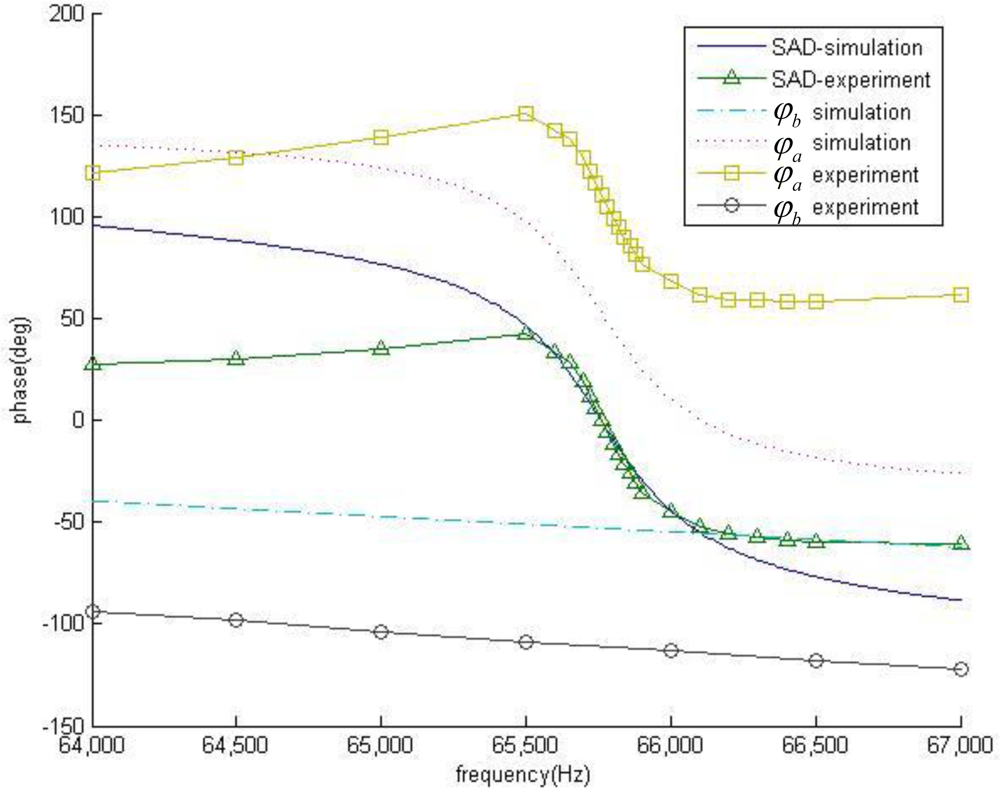
<p>To calculate the coefficient <italic>α</italic> from <xref ref-type="disp-formula" rid="FD19">Equation (19)</xref>, we draw the phase-frequency curves in <xref ref-type="fig" rid="f10-sensors-10-07044">Figure 10</xref>, where the experimental data is presented together with the simulation one. For the frequency selection network, both the results from experiment and simulation show a good linearity at the neighborhood of <italic>f</italic><sub>0</sub>, whereas at the point far away from <italic>f</italic><sub>0</sub>, the slopes of the two curves deviate. The deviation is likely to be a result of non-ideal properties of the micro-cantilever. As for the feedback module, both two curves show a good linearity, and an approximate slope.</p>
<p>Based on literature result in <xref ref-type="disp-formula" rid="FD19">(19)</xref>, the coefficient <italic>α</italic> can be determined from the slopes of the phase-frequency curves: <italic>α<sub>real</sub></italic> = 0.9659, <italic>α<sub>simulate</sub></italic> = 0.9640. These results confirm our findings in gas experiments. Furthermore, as the coefficient <italic>α</italic> is related to the phase-frequency curves of the frequency selection network and of the feedback module, it is a typical value for each realization of a SAD circuit loop.</p></sec></sec>
<sec sec-type="conclusions">
<label>4.</label>
<title>Conclusions</title>
<p>Gas experiments have been performed on a MEMS gas sensing system. The system is based on a silicon beam with a piezoelectric zinc oxide layer, and a SAD circuit loop is built to actuate the cantilever and detect its frequency shifts. The experimental results confirm, as predicted by another paper, the existence of a coefficient <italic>α</italic>, relating the mechanical resonance frequency shift and system working frequency shift. It was also discussed the relation between this coefficient and the phase-frequency curves of the SAD circuit loop.</p>
<p>As analyzed in this paper, the mass loading of the micro-cantilever modifies its MRF as well as the phase-frequency curves of the SAD circuit loop, and therefore the SWF shifts to meet the phase condition of <xref ref-type="disp-formula" rid="FD2">Formula (2)</xref> so that the SAD circuit loop could continue its close-loop working. This paper shows that the SWF shift observed in operations is not an appropriate indicator of the gas concentration. To characterize the concentration of analyte, the SWF shift should be revised with a coefficient, to trace the MRF shift. And as such a coefficient is derived from the Barkhausen conditions, it should be taken into account in all kinds of sensing system working with an actuating-detecting circuit loop.</p></sec></body>
<back>
<ack>
<p>The authors would like to acknowledge the support by National 863 Project of China and Science Fund of China Post Doctoral Scientists.</p></ack>
<ref-list>
<title>References</title>
<ref id="b1-sensors-10-07044"><label>1.</label><citation citation-type="journal"><person-group person-group-type="author"><name><surname>Zougagh</surname><given-names>M</given-names></name><name><surname>Rios</surname><given-names>A</given-names></name></person-group><article-title>Micro-electromechanical sensors in the analytical field</article-title><source>Analyst</source><year>2009</year><volume>134</volume><fpage>1274</fpage><lpage>1290</lpage><pub-id pub-id-type="doi">10.1039/b901498p</pub-id><pub-id pub-id-type="pmid">19562189</pub-id></citation></ref>
<ref id="b2-sensors-10-07044"><label>2.</label><citation citation-type="journal"><person-group person-group-type="author"><name><surname>Lange</surname><given-names>D</given-names></name><name><surname>Hagleitner</surname><given-names>C</given-names></name></person-group><article-title>Complementary metal oxide Semiconductor cantilever arrays on a single chip: mass-sensitive detection of volatile organic compounds</article-title><source>Anal. Chem</source><year>2002</year><volume>74</volume><fpage>3084</fpage><lpage>3095</lpage><pub-id pub-id-type="doi">10.1021/ac011269j</pub-id><pub-id pub-id-type="pmid">12141668</pub-id></citation></ref>
<ref id="b3-sensors-10-07044"><label>3.</label><citation citation-type="book"><person-group person-group-type="author"><name><surname>Zhou</surname><given-names>Q</given-names></name></person-group><article-title>Study on MEMS chemical gas sensor based on resonating microcantilever</article-title><comment>M.S. thesis</comment><publisher-name>Tsinghua University</publisher-name><publisher-loc>Beijing, China</publisher-loc><year>2006</year></citation></ref>
<ref id="b4-sensors-10-07044"><label>4.</label><citation citation-type="journal"><person-group person-group-type="author"><name><surname>Li</surname><given-names>P</given-names></name><name><surname>Zhao</surname><given-names>J</given-names></name></person-group><article-title>Resonating frequency of a SAD circuit loop and inner micro-cantilever in a gas sensor</article-title><source>IEEE Sens. J.</source><comment>(In press)</comment></citation></ref>
<ref id="b5-sensors-10-07044"><label>5.</label><citation citation-type="journal"><person-group person-group-type="author"><name><surname>Datar</surname><given-names>R</given-names></name><name><surname>Kim</surname><given-names>S</given-names></name><name><surname>Jeon</surname><given-names>S</given-names></name><name><surname>Hesketh</surname><given-names>P</given-names></name><name><surname>Manalis</surname><given-names>S</given-names></name><name><surname>Boisen</surname><given-names>A</given-names></name><name><surname>Thundat</surname><given-names>T</given-names></name></person-group><article-title>Cantilever sensors: Nanomechanical tools for diagnostics</article-title><source>MRS Bull</source><year>2009</year><volume>34</volume><fpage>449</fpage><lpage>454</lpage><pub-id pub-id-type="doi">10.1557/mrs2009.121</pub-id></citation></ref>
<ref id="b6-sensors-10-07044"><label>6.</label><citation citation-type="journal"><person-group person-group-type="author"><name><surname>Finot</surname><given-names>E</given-names></name><name><surname>Passian</surname><given-names>A</given-names></name><name><surname>Thundat</surname><given-names>T</given-names></name></person-group><article-title>Measurement of mechanical properties of cantilever shaped materials</article-title><source>Sensors</source><year>2008</year><volume>8</volume><fpage>3497</fpage><lpage>3541</lpage><pub-id pub-id-type="doi">10.3390/s8053497</pub-id></citation></ref>
<ref id="b7-sensors-10-07044"><label>7.</label><citation citation-type="journal"><person-group person-group-type="author"><name><surname>Fadel</surname><given-names>L</given-names></name><name><surname>Lochon</surname><given-names>F</given-names></name></person-group><article-title>Chemical sensing: millimeter size resonant microcantilever performance</article-title><source>J. Micromech. Microeng</source><year>2004</year><volume>14</volume><fpage>S23</fpage><lpage>S30</lpage><pub-id pub-id-type="doi">10.1088/0960-1317/14/9/004</pub-id></citation></ref>
<ref id="b8-sensors-10-07044"><label>8.</label><citation citation-type="journal"><person-group person-group-type="author"><name><surname>Bedair</surname><given-names>S</given-names></name><name><surname>Fedder</surname><given-names>G</given-names></name></person-group><article-title>CMOS MEMS oscillator for gas chemical detection</article-title><source>Proc. IEEE</source><year>2004</year><volume>2</volume><fpage>955</fpage><lpage>958</lpage></citation></ref>
<ref id="b9-sensors-10-07044"><label>9.</label><citation citation-type="journal"><person-group person-group-type="author"><name><surname>Vancura</surname><given-names>C</given-names></name><name><surname>Ruegg</surname><given-names>M</given-names></name></person-group><article-title>Magnetically actuated complementary metal oxide semiconductor resonant cantilever gas sensor systems</article-title><source>Anal. Chem</source><year>2005</year><volume>77</volume><fpage>2690</fpage><lpage>2699</lpage><pub-id pub-id-type="doi">10.1021/ac048378t</pub-id><pub-id pub-id-type="pmid">15859582</pub-id></citation></ref>
<ref id="b10-sensors-10-07044"><label>10.</label><citation citation-type="journal"><person-group person-group-type="author"><name><surname>Li</surname><given-names>Y</given-names></name><name><surname>Vancura</surname><given-names>C</given-names></name></person-group><article-title>Monolithic CMOS multi-tranducer gas sensor microsystem for organic and inorganic analytes</article-title><source>Sens. Actuat</source><year>2007</year><volume>B126</volume><fpage>431</fpage><lpage>440</lpage></citation></ref>
<ref id="b11-sensors-10-07044"><label>11.</label><citation citation-type="journal"><person-group person-group-type="author"><name><surname>Lu</surname><given-names>J</given-names></name><name><surname>Ikehara</surname><given-names>T</given-names></name></person-group><article-title>Characterization and improvement on quality factor of microcantilevers with self-actuation and self-sensing capability</article-title><source>Microelectron. Eng</source><year>2009</year><volume>86</volume><fpage>1208</fpage><lpage>1211</lpage><pub-id pub-id-type="doi">10.1016/j.mee.2008.12.073</pub-id></citation></ref>
<ref id="b12-sensors-10-07044"><label>12.</label><citation citation-type="journal"><person-group person-group-type="author"><name><surname>Mutyala</surname><given-names>MSK</given-names></name><name><surname>Bandhanadham</surname><given-names>D</given-names></name></person-group><article-title>Mechanical and electronic approaches to improve the sensitivity of microcantilever sensors</article-title><source>Acta Mech. Sin</source><year>2009</year><volume>25</volume><fpage>1</fpage><lpage>12</lpage><pub-id pub-id-type="pmid">20975987</pub-id></citation></ref>
<ref id="b13-sensors-10-07044"><label>13.</label><citation citation-type="journal"><person-group person-group-type="author"><name><surname>Yu</surname><given-names>H</given-names></name><name><surname>Li</surname><given-names>X</given-names></name></person-group><article-title>Resonant-cantilever bio/chemical sensors with an integrated heater for both resonance exciting optimization and sensing repeatability enhancement</article-title><source>J. Micromech. Microeng</source><year>2009</year><volume>19</volume><fpage>045023</fpage><pub-id pub-id-type="doi">10.1088/0960-1317/19/4/045023</pub-id></citation></ref>
<ref id="b14-sensors-10-07044"><label>14.</label><citation citation-type="journal"><person-group person-group-type="author"><name><surname>Rogers</surname><given-names>B</given-names></name><name><surname>Manning</surname><given-names>L</given-names></name><name><surname>Jones</surname><given-names>M</given-names></name><name><surname>Sulchek</surname><given-names>T</given-names></name><name><surname>Murray</surname><given-names>K</given-names></name><name><surname>Beneschott</surname><given-names>B</given-names></name><name><surname>Adames</surname><given-names>JD</given-names></name><name><surname>Hu</surname><given-names>Z</given-names></name><name><surname>Thundat</surname><given-names>T</given-names></name><name><surname>Cavazos</surname><given-names>H</given-names></name><name><surname>Minne</surname><given-names>SC</given-names></name></person-group><article-title>Mercury vapor detection with a self-sensing, resonating piezoelectric cantilever</article-title><source>Rev. Sci. Instr</source><year>2003</year><volume>74</volume><fpage>4899</fpage><lpage>4901</lpage><pub-id pub-id-type="doi">10.1063/1.1614876</pub-id></citation></ref>
<ref id="b15-sensors-10-07044"><label>15.</label><citation citation-type="book"><person-group person-group-type="author"><name><surname>Feng</surname><given-names>G</given-names></name></person-group><source>Resonant sensing theory and devices</source><publisher-name>Tsinghua University Publishing House</publisher-name><publisher-loc>Beijing, China</publisher-loc><year>2008</year><fpage>25</fpage><lpage>26</lpage></citation></ref>
<ref id="b16-sensors-10-07044"><label>16.</label><citation citation-type="book"><person-group person-group-type="author"><name><surname>Gao</surname><given-names>W</given-names></name></person-group><source>Study on resonant MEMS gas sensor based on thermally excited micro cantilever</source><comment>M.S. Thesis</comment><publisher-name>Tsinghua University</publisher-name><publisher-loc>Beijing, China</publisher-loc><year>2008</year></citation></ref></ref-list>
<sec sec-type="display-objects">
<title>Figures</title>
<fig id="f1-sensors-10-07044" position="float">
<label>Figure 1.</label>
<caption>
<p>Electrical model of piezoelectric micro-cantilever.</p></caption>
<graphic xlink:href="sensors-10-07044f1.gif"/></fig>
<fig id="f2-sensors-10-07044" position="float">
<label>Figure 2.</label>
<caption>
<p>Impedance of the piezoelectric micro-cantilever.</p></caption>
<graphic xlink:href="sensors-10-07044f2.gif"/></fig>
<fig id="f3-sensors-10-07044" position="float">
<label>Figure 3.</label>
<caption>
<p>Frequency selection network module.</p></caption>
<graphic xlink:href="sensors-10-07044f3.gif"/></fig>
<fig id="f4-sensors-10-07044" position="float">
<label>Figure 4.</label>
<caption>
<p>Schematic illustration of a SAD circuit.</p></caption>
<graphic xlink:href="sensors-10-07044f4.gif"/></fig>
<fig id="f5-sensors-10-07044" position="float">
<label>Figure 5.</label>
<caption>
<p>Simulation of phase-frequency curves of the SAD circuit loop, with AB and A’B’ the linear interval. Where <italic>f</italic><sub>0</sub> = 65,670 Hz and Δ<italic>f</italic><sub>0</sub> = 200 Hz.</p></caption>
<graphic xlink:href="sensors-10-07044f5.gif"/></fig>
<fig id="f6-sensors-10-07044" position="float">
<label>Figure 6.</label>
<caption>
<p>Scanning electron micrographs of the micro-cantilever: (a) Before the deposition of PEO sensitive material. (b) After the deposition of PEO sensitive material.</p></caption>
<graphic xlink:href="sensors-10-07044f6.gif"/></fig>
<fig id="f7-sensors-10-07044" position="float">
<label>Figure 7.</label>
<caption>
<p>Schematic drawing of the experimental setup of the open-loop tests [<xref ref-type="bibr" rid="b3-sensors-10-07044">3</xref>].</p></caption>
<graphic xlink:href="sensors-10-07044f7.gif"/></fig>
<fig id="f8-sensors-10-07044" position="float">
<label>Figure 8.</label>
<caption>
<p>Typical raw data of the frequency shift of a SAD circuit loop and the internal micro-cantilever. To improve the visibility of the data points, the data are sampled with a time step of 40 seconds. The abscissa is time and each unit represents 40 seconds.</p></caption>
<graphic xlink:href="sensors-10-07044f8.gif"/></fig>
<fig id="f9-sensors-10-07044" position="float">
<label>Figure 9.</label>
<caption>
<p>Frequency shift in response to the injection of ethanol. <bold>(a)</bold> MRF of the micro-cantilever in open-loop test [
<inline-graphic xlink:href="sensors-10-07044i1.gif"/>]. <bold>(b)</bold> SWF in close-loop test [
<inline-graphic xlink:href="sensors-10-07044i2.gif"/>]. <bold>(c)</bold> Simulation results of SWF [
<inline-graphic xlink:href="sensors-10-07044i3.gif"/>].</p></caption>
<graphic xlink:href="sensors-10-07044f9.gif"/></fig>
<fig id="f10-sensors-10-07044" position="float">
<label>Figure 10.</label>
<caption>
<p>Experimental phase-frequency curves in compare with simulation results at MRF <italic>f</italic><sub>0</sub> = 65,670 Hz and SWF <italic>f</italic><sub>r</sub> = 65,708 Hz. (a) Simulation results for SAD[
<inline-graphic xlink:href="sensors-10-07044i4.gif"/>], feedback module[
<inline-graphic xlink:href="sensors-10-07044i5.gif"/>] and frequency selection network[
<inline-graphic xlink:href="sensors-10-07044i6.gif"/>]. (b) Experimental measurements of SAD[

<inline-graphic xlink:href="sensors-10-07044i7.gif"/>], feedback module[
<inline-graphic xlink:href="sensors-10-07044i8.gif"/>] and frequency selection network[
<inline-graphic xlink:href="sensors-10-07044i9.gif"/>].</p></caption>
<graphic xlink:href="sensors-10-07044f10.gif"/></fig></sec></back></article>