
<?xml version="1.0" encoding="UTF-8"?>
<!DOCTYPE article PUBLIC "-//NLM//DTD Journal Publishing DTD v2.3 20070202//EN" "journalpublishing.dtd">
<article xmlns:mml="http://www.w3.org/1998/Math/MathML" xmlns:xlink="http://www.w3.org/1999/xlink" xml:lang="en" article-type="review-article">
<front>
<journal-meta>
<journal-id journal-id-type="nlm-ta">Sensors</journal-id>
<journal-title>Sensors</journal-title>
<issn pub-type="epub">1424-8220</issn>
<publisher>
<publisher-name>Molecular Diversity Preservation International (MDPI)</publisher-name></publisher></journal-meta>
<article-meta>
<article-id pub-id-type="doi">10.3390/s100504855</article-id>
<article-id pub-id-type="publisher-id">sensors-10-04855</article-id>
<article-categories>
<subj-group>
<subject>Review</subject></subj-group></article-categories>
<title-group>
<article-title>A Comprehensive Review of Glucose Biosensors Based on Nanostructured Metal-Oxides</article-title></title-group>
<contrib-group>
<contrib contrib-type="author">
<name><surname>Rahman</surname><given-names>Md. Mahbubur</given-names></name><xref ref-type="aff" rid="af1-sensors-10-04855"><sup>1</sup></xref></contrib>
<contrib contrib-type="author">
<name><surname>Saleh Ahammad</surname><given-names>A. J.</given-names></name><xref ref-type="aff" rid="af1-sensors-10-04855"><sup>1</sup></xref></contrib>
<contrib contrib-type="author">
<name><surname>Jin</surname><given-names>Joon-Hyung</given-names></name><xref ref-type="aff" rid="af2-sensors-10-04855"><sup>2</sup></xref></contrib>
<contrib contrib-type="author">
<name><surname>Ahn</surname><given-names>Sang Jung</given-names></name><xref ref-type="aff" rid="af3-sensors-10-04855"><sup>3</sup></xref></contrib>
<contrib contrib-type="author">
<name><surname>Lee</surname><given-names>Jae-Joon</given-names></name><xref ref-type="aff" rid="af1-sensors-10-04855"><sup>1</sup></xref><xref ref-type="aff" rid="af2-sensors-10-04855"><sup>2</sup></xref><xref ref-type="aff" rid="af4-sensors-10-04855"><sup>4</sup></xref><xref ref-type="corresp" rid="c1-sensors-10-04855"><sup>*</sup></xref></contrib></contrib-group>
<aff id="af1-sensors-10-04855">
<label>1</label> Department of Advanced Technology Fusion, Konkuk University, Seoul 143-701, Korea; E-Mails: <email>mahbub@konkuk.ac.kr</email> (M.M.R.); <email>saleh203@konkuk.ac.kr</email> (A.J.S.A.)</aff>
<aff id="af2-sensors-10-04855">
<label>2</label> KFnSC Center, Konkuk University, Seoul 143-701, Korea; E-Mail: <email>jhjin@konkuk.ac.kr</email></aff>
<aff id="af3-sensors-10-04855">
<label>3</label> Korea Research Institute of Standard and Science, Yuseong, Daejeon 305-340, Korea; E-Mail: <email>sjahn@kriss.re.kr</email></aff>
<aff id="af4-sensors-10-04855">
<label>4</label> Department of Applied Chemistry, Konkuk University, Chungju 380-701, Korea</aff>
<author-notes>
<corresp id="c1-sensors-10-04855">
<label>*</label> Author to whom correspondence should be addressed; E-Mail: <email>jjlee@kku.ac.kr</email>; Tel.: +82-43-840-3580; Fax: +82-43-851-4169.</corresp></author-notes>
<pub-date pub-type="collection">
<year>2010</year></pub-date>
<pub-date pub-type="epub">
<day>12</day>
<month>5</month>
<year>2010</year></pub-date>
<volume>10</volume>
<issue>5</issue>
<fpage>4855</fpage>
<lpage>4886</lpage>
<history>
<date date-type="received">
<day>11</day>
<month>3</month>
<year>2010</year></date>
<date date-type="rev-recd">
<day>7</day>
<month>4</month>
<year>2010</year></date>
<date date-type="accepted">
<day>15</day>
<month>4</month>
<year>2010</year></date></history>
<permissions>
<copyright-statement>© 2010 by the authors; licensee MDPI, Basel, Switzerland.</copyright-statement>
<copyright-year>2010</copyright-year>
<license>
<p>This article is an Open Access article distributed under the terms and conditions of the Creative Commons Attribution license (<ext-link xlink:href="http://creativecommons.org/licenses/by/3.0/" ext-link-type="uri">http://creativecommons.org/licenses/by/3.0/</ext-link>).</p></license></permissions>
<abstract>
<p>Nanotechnology has opened new and exhilarating opportunities for exploring glucose biosensing applications of the newly prepared nanostructured materials. Nanostructured metal-oxides have been extensively explored to develop biosensors with high sensitivity, fast response times, and stability for the determination of glucose by electrochemical oxidation. This article concentrates mainly on the development of different nanostructured metal-oxide [such as ZnO, Cu(I)/(II) oxides, MnO<sub>2</sub>, TiO<sub>2</sub>, CeO<sub>2</sub>, SiO<sub>2</sub>, ZrO<sub>2,</sub> and other metal-oxides] based glucose biosensors. Additionally, we devote our attention to the operating principles (<italic>i.e.</italic>, potentiometric, amperometric, impedimetric and conductometric) of these nanostructured metal-oxide based glucose sensors. Finally, this review concludes with a personal prospective and some challenges of these nanoscaled sensors.</p></abstract>
<kwd-group>
<kwd>nanostructured metal-oxides</kwd>
<kwd>glucose biosensor</kwd>
<kwd>electrochemical principles</kwd>
<kwd>enzymatic sensor</kwd>
<kwd>nonenzymatic sensor</kwd></kwd-group></article-meta></front>
<body>
<sec sec-type="intro">
<label>1.</label>
<title>Introduction</title>
<p>Diabetes mellitus is one of the principal causes of death and disability in the World, and is highly responsible for heart disease, kidney failure, and blindness. About 200 million people in the world are afflicted with diabetes mellitus. This figure is expected to rise up to more than three hundred million by 2030 [<xref ref-type="bibr" rid="b1-sensors-10-04855">1</xref>]. Frequent testing of physiological blood glucose levels to avoid diabetic emergencies, is crucial for the confirmation of effective treatment [<xref ref-type="bibr" rid="b2-sensors-10-04855">2</xref>–<xref ref-type="bibr" rid="b5-sensors-10-04855">5</xref>]. Therefore, the development of high sensitive, low-cost, reliable glucose sensors having an excellent selectivity has been the subject of concern for decades, not only in medical science but also in the food industries [<xref ref-type="bibr" rid="b6-sensors-10-04855">6</xref>,<xref ref-type="bibr" rid="b7-sensors-10-04855">7</xref>]. Glucose oxidase (GOx)-based glucose biosensors have prevalently had a hold on the glucose sensor research and development over the last four decades and the market place as well. This is due to the high demand of sensitive and reliable blood glucose monitoring in biological and clinical aspects [<xref ref-type="bibr" rid="b8-sensors-10-04855">8</xref>–<xref ref-type="bibr" rid="b11-sensors-10-04855">11</xref>]. There are still some disadvantages of enzyme-based glucose determination. Examples include complicated enzyme immobilization, critical operating conditions such as optimum temperature and pH, chemical instability, and high cost [<xref ref-type="bibr" rid="b12-sensors-10-04855">12</xref>,<xref ref-type="bibr" rid="b13-sensors-10-04855">13</xref>].</p>
<p>The historical commencement of biosensors was in 1960s with the pioneering work of Clark and Lyons [<xref ref-type="bibr" rid="b14-sensors-10-04855">14</xref>], and the first enzyme-based glucose sensor commenced by Updike and Hicks in 1967 [<xref ref-type="bibr" rid="b15-sensors-10-04855">15</xref>]. Since then, an extensive research have been done on the amperometric, potentiometric, and impedimetric or conductometric glucose biosensors based on the GOx [<xref ref-type="bibr" rid="b16-sensors-10-04855">16</xref>–<xref ref-type="bibr" rid="b23-sensors-10-04855">23</xref>], that catalyzes the oxidation of glucose to produce gluconic acid as shown in <xref ref-type="disp-formula" rid="FD1">equation (1)</xref>:
<disp-formula id="FD1">
<label>(1)</label>
<mml:math display="block">
<mml:mrow>
<mml:mi mathvariant="normal">D</mml:mi>
<mml:mo>−</mml:mo>
<mml:mtext>glucose</mml:mtext>
<mml:mo>+</mml:mo>
<mml:msub>
<mml:mrow>
<mml:mi mathvariant="normal">O</mml:mi></mml:mrow>
<mml:mn>2</mml:mn></mml:msub>
<mml:mo>+</mml:mo>
<mml:msub>
<mml:mrow>
<mml:mi mathvariant="normal">H</mml:mi></mml:mrow>
<mml:mn>2</mml:mn></mml:msub>
<mml:mi mathvariant="normal">O</mml:mi>
<mml:mover>
<mml:mo>→</mml:mo>
<mml:mrow>
<mml:mtext>GOx</mml:mtext></mml:mrow></mml:mover>
<mml:mi mathvariant="normal">D</mml:mi>
<mml:mo>−</mml:mo>
<mml:mtext>gluconic acid</mml:mtext>
<mml:mo>+</mml:mo>
<mml:msub>
<mml:mi mathvariant="normal">H</mml:mi>
<mml:mn>2</mml:mn></mml:msub>
<mml:msub>
<mml:mi mathvariant="normal">O</mml:mi>
<mml:mn>2</mml:mn></mml:msub></mml:mrow></mml:math></disp-formula></p>
<p>The activity of enzymes is obviously affected by the temperature, pH, humidity, and toxic chemicals [<xref ref-type="bibr" rid="b24-sensors-10-04855">24</xref>]. To solve these problems, many enzyme-free sensors have been investigated to improve the electrocatalytic activity and selectivity toward the oxidation of glucose. This can be done by using: (1) inert metals such as Pt [<xref ref-type="bibr" rid="b25-sensors-10-04855">25</xref>–<xref ref-type="bibr" rid="b27-sensors-10-04855">27</xref>], Au [<xref ref-type="bibr" rid="b28-sensors-10-04855">28</xref>–<xref ref-type="bibr" rid="b30-sensors-10-04855">30</xref>] and Ni [<xref ref-type="bibr" rid="b31-sensors-10-04855">31</xref>,<xref ref-type="bibr" rid="b32-sensors-10-04855">32</xref>]; (2) metal alloys containing Pt, Au, Pb, Ir, Ru, Cu, and Pd [<xref ref-type="bibr" rid="b2-sensors-10-04855">2</xref>,<xref ref-type="bibr" rid="b33-sensors-10-04855">33</xref>–<xref ref-type="bibr" rid="b37-sensors-10-04855">37</xref>]; and (3) metal-dispersed carbon nanotubes (CNTs) framework in which Pt, Pb, Pd, or Au are mixed with CNTs to form nanocomposites [<xref ref-type="bibr" rid="b38-sensors-10-04855">38</xref>–<xref ref-type="bibr" rid="b42-sensors-10-04855">42</xref>]. However, these materials are unsatisfactory with regards to sensitivity and selectivity, are high costing, and show quick loss of activity by adsorption and accumulation of intermediates or chloride ions [<xref ref-type="bibr" rid="b2-sensors-10-04855">2</xref>,<xref ref-type="bibr" rid="b43-sensors-10-04855">43</xref>]. Therefore, the development of highly selective, sensitive, inexpensive, reliable and fast enzymatic/nonenzymatic glucose sensor is still imperatively needed.</p>
<p>In recent years, an increasing number of researchers have explored the production of novel nano-scale metal oxides, noble metal-doped metal oxides, metal oxide-CNTs nanocomposites, and metal oxide-polymer composites. Novel analytical devices based on nanostructured metal oxides are cost-effective, highly sensitive due to the large surface-to-volume ratio of the nanostructure, and additionally show excellent selectivity when coupled to biorecognition molecules with simple design [<xref ref-type="bibr" rid="b44-sensors-10-04855">44</xref>–<xref ref-type="bibr" rid="b47-sensors-10-04855">47</xref>]. Some metal oxides such as ZnO and CeO<sub>2</sub> show high isoelectric point (IEP), excellent biocompatibility, and easy synthetic procedure for nanostructure that enables reliable immobilization of GOx. On the other hand, MnO<sub>2</sub> and ZrO<sub>2</sub> having low IEP values are suitable for the immobilization of high IEP proteins. The catalytic ability of transition metal oxides such as CuO and NiO of nonenzymatic direct electrooxidation of glucose is one of the attractive properties in glucose detection allowing minimum fabrication cost and stable glucose sensors. This article provides a comprehensive review of the state-of-the-art research activities that focus on several important metal-oxide nanostructures and nanocomposites in addition to the application of nanostructured metal oxides to glucose sensing. Also, the most commonly-used electrochemical detection methods for the glucose sensing will be discussed.</p></sec>
<sec>
<label>2.</label>
<title>Electrochemical Principles of Glucose Biosensors</title>
<p>There is no doubt that the development of an ideal glucose sensor must be top issue for the biosensor industry. Numerous processes and methodologies have been developed for creating new glucose biosensors such as electrochemical methods [<xref ref-type="bibr" rid="b48-sensors-10-04855">48</xref>], colorimetry [<xref ref-type="bibr" rid="b49-sensors-10-04855">49</xref>], conductometry [<xref ref-type="bibr" rid="b50-sensors-10-04855">50</xref>], optical methods [<xref ref-type="bibr" rid="b51-sensors-10-04855">51</xref>], and fluorescent spectroscopy [<xref ref-type="bibr" rid="b52-sensors-10-04855">52</xref>]. Among them, the electrochemical glucose sensors have attracted the most attention over the last 40 years because of their unbeaten sensitivity and selectivity. Additionally, electrochemical techniques show lower detection limit, faster response time, better long term stability and inexpensiveness. The extremely sensitive fluorescent spectroscopy can even detect a single molecule and a few fluorescence-based <italic>in vivo</italic> monitoring of glucose are available, but none of them are practically applicable to diabetes management [<xref ref-type="bibr" rid="b53-sensors-10-04855">53</xref>]. The electrochemical glucose sensors are basically categorized into three major groups depending on the measurement principles: <italic>i.e.</italic>, potentiometric, amperometric, impedemetric or conductometric sensors.</p>
<sec>
<label>2.1.</label>
<title>Potentiometric Glucose Sensor</title>
<p>Potentiometry is commonly used to measure glucose concentrations greater than 10<sup>−5</sup> M, which is in the physiological range in most cases. The potential difference between the reference electrode and the indicator electrode is measured at zero current flow. The ideally nonpolarizable reference electrode provides a constant potential, while the indicator electrode shows an erratic potential depending on the concentration of the analytes. The zero current potentials applied between those two electrodes are recorded as a function of the concentrations of target analytes in a logarithmic manner [<xref ref-type="bibr" rid="b48-sensors-10-04855">48</xref>]. The potential difference at the electrode-electrolyte interface arising from unbalanced activities of species <italic>i</italic> in the electrolyte phase (<italic>s</italic>) and in the electrode phase (<italic>β</italic>) is related by the following Nernst equation:
<disp-formula id="FD2">
<label>(2)</label>
<mml:math display="block">
<mml:mrow>
<mml:mi>E</mml:mi>
<mml:mo>=</mml:mo>
<mml:msub>
<mml:mi>E</mml:mi>
<mml:mi>o</mml:mi></mml:msub>
<mml:mo>+</mml:mo>
<mml:mfrac>
<mml:mrow>
<mml:mi mathvariant="italic">RT</mml:mi></mml:mrow>
<mml:mrow>
<mml:msub>
<mml:mi>Z</mml:mi>
<mml:mi>i</mml:mi></mml:msub>
<mml:mi>F</mml:mi></mml:mrow></mml:mfrac>
<mml:mo> </mml:mo>
<mml:mtext>ln</mml:mtext>
<mml:mo> </mml:mo>
<mml:mfrac>
<mml:mrow>
<mml:msubsup>
<mml:mrow>
<mml:mi>a</mml:mi></mml:mrow>
<mml:mi>i</mml:mi>
<mml:mi>s</mml:mi></mml:msubsup></mml:mrow>
<mml:mrow>
<mml:msubsup>
<mml:mrow>
<mml:mi>a</mml:mi></mml:mrow>
<mml:mi>i</mml:mi>
<mml:mi>β</mml:mi></mml:msubsup></mml:mrow></mml:mfrac></mml:mrow></mml:math></disp-formula>where <italic>E<sub>0</sub></italic> is the standard electrode potential, <italic>R</italic> the gas constant, <italic>T</italic> the absolute temperature, <italic>F</italic> the faraday constant, <italic>a<sub>i</sub></italic> the activity of species <italic>i</italic>, and <italic>Z<sub>i</sub></italic> the number of moles of electron involved.</p>
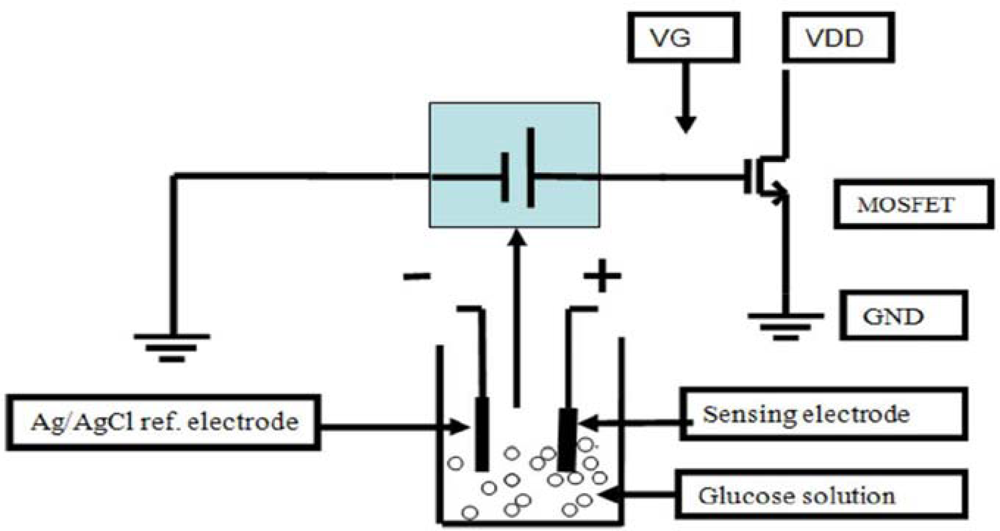
<p>Potentiometric sensors are divided into the metal-oxide sensitive field effect transistor (MOSFET), the light-addressable potentiometric sensor (LAPS), the ion-sensitive field effect transistors (ISFET) and the ion-selective electrodes (ISE). Ali <italic>et al.</italic> developed a commercial MOSFET using a GOx modified ZnO nanowire. GOx-functionalized ZnO nanowires were grown on the Ag wire and then directly connected to the MOSFET gate (<xref ref-type="fig" rid="f1-sensors-10-04855">Figure 1</xref>) [<xref ref-type="bibr" rid="b54-sensors-10-04855">54</xref>]. They tested the response time and the stability of the MOSFET sensor by using three different GOx/ZnO modified Ag electrodes, <italic>i.e.</italic>, vertically aligned, uniform nonaligned, and nonuniform nonaligned ZnO nanowires. The results showed that well aligned ZnO-modified electrode displayed a good stability, short response time (&lt;100 ms), and improved detection limit. They also further demonstrated that the GOx/ZnO modified MOSFET is able to be used for the immobilization of other biomolecules to make versatile electrodes for biosensing.</p>
<p>ISFETs and LAPS have attracted much attention for biosensing application being especially convenient for construction. The principles of LAPS are based on the activation of semiconductor by a light emitting diode [<xref ref-type="bibr" rid="b55-sensors-10-04855">55</xref>]. Seki <italic>et al.</italic> developed a LAPS based on SiO<sub>2</sub>/Al<sub>2</sub>O<sub>3</sub> film grown on an n-type Si substrate. The GOx was immobilized on the film at various pH in the range of 3 to 11. Upon exposure to the light emitting diode, the equilibrium potential of the GOx-modified SiO<sub>2</sub>/Al<sub>2</sub>O<sub>3</sub> film was increased linearly with the increase of glucose concentration up to 4 mM. An increased sensitivity was also observed by introducing hexacyanoferrate (III) as an alternative to oxygen because the reduced form of flavin adenine dinucleotide (FADH<sub>2</sub>) positioned within the active site of the GOx is more easily oxidized with hexacyanoferrate (III) [<xref ref-type="bibr" rid="b56-sensors-10-04855">56</xref>]. While, the principle of ISFET is based on the local potential generated by surface ions from a solution [<xref ref-type="bibr" rid="b55-sensors-10-04855">55</xref>]. Luo <italic>et al.</italic> built up a glucose sensitive enzymatic field effect transistor (ENFET) by modifying the gate surface of the ISFET with SiO<sub>2</sub> nanoparticles and GOx. The SnO<sub>2</sub> based glucose sensor showed a good stability and reproducibility with a detection limit of <italic>ca.</italic> 0.025 mM [<xref ref-type="bibr" rid="b57-sensors-10-04855">57</xref>]. A few reports are available on nonenzymetic potentiometric glucose sensor based on poly(aniline boronic acid) suggested by Shoji and Freund [<xref ref-type="bibr" rid="b58-sensors-10-04855">58</xref>,<xref ref-type="bibr" rid="b59-sensors-10-04855">59</xref>]. These sensors showed improved sensitivity for fructose compared to glucose.</p></sec>
<sec>
<label>2.2.</label>
<title>Amperometric Glucose Sensor</title>
<p>Amperometry is a quite sensitive electrochemical technique in which the signal of interest is current that is linearly dependent on the target concentration by applying a constant bias potential. Glucose is oxidized at the working electrode composed of a noble metal formed by either the physical vapor deposition or screen-printing and the biorecognition species such as GOx for glucose sensing [<xref ref-type="bibr" rid="b60-sensors-10-04855">60</xref>]. An amperometric biosensor comprises two or three electrodes. The former consists of a reference and a working electrode. Application of the two-electrode system to biosensors is limited, because at high current flow the potential control becomes difficult as a result of sizable IR drop. Instead, the third electrode is commonly introduced as an auxiliary counter electrode having a large surface area to make most of current flows between the counter and the working electrodes, though voltage is still applied between the working and the reference electrodes.</p>
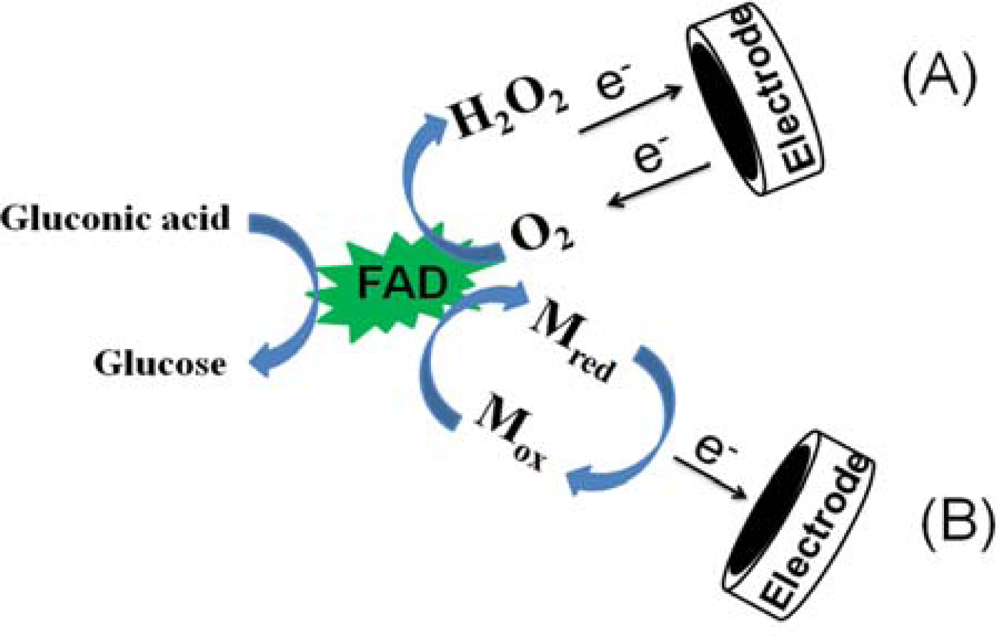
<p>There are three modes of the glucose oxidation referred to as the first, the second and the third generation glucose sensors depending on the electron transfer mechanisms. The nanostructured metal-oxide based glucose sensor belong to the third generation. <xref ref-type="fig" rid="f2-sensors-10-04855">Figure 2(A)</xref> depicts the first generation glucose sensor where oxygen is used as a mediator between the electrode and the GOx. The oxygen is reduced to form hydrogen peroxide in the presence of glucose by flavin adenine dinucleotide (FAD), a prosthetic group of GOx, and FADH<sub>2</sub> redox couple. The reduction rate of the oxygen is proportional to the glucose concentration that is quantified by either measuring the augmentation of hydrogen peroxide or decrement of the oxygen concentration [<xref ref-type="bibr" rid="b5-sensors-10-04855">5</xref>,<xref ref-type="bibr" rid="b61-sensors-10-04855">61</xref>]. On the other hand, artificial electron mediators (M), e.g., ferro/ferricyanide, hydroquinone, ferrocene, and various redox organic dyes between the electrode and the GOx are employed in the second generation glucose sensor. These mediators make the electron transfer rate between the electrode and the GOx faster and also give a way of getting around for a case when limited oxygen pressure commonly observed from the first generation glucose sensor [<xref ref-type="bibr" rid="b62-sensors-10-04855">62</xref>,<xref ref-type="bibr" rid="b63-sensors-10-04855">63</xref>]. <xref ref-type="fig" rid="f2-sensors-10-04855">Figure 2(B)</xref> represents the second generation glucose sensor, where M<sub>ox</sub> and M<sub>red</sub> are the oxidized and reduced forms of mediator, respectively. The reduced form of flavin group (FADH<sub>2</sub>) of GOx is reoxidized in presence of glucose by the reduction of M<sub>ox</sub> to form M<sub>red</sub>. The output current signal generated, when further oxidation of M<sub>red</sub> occurs at the electrode surface, is proportional to the glucose concentration [<xref ref-type="bibr" rid="b5-sensors-10-04855">5</xref>,<xref ref-type="bibr" rid="b62-sensors-10-04855">62</xref>,<xref ref-type="bibr" rid="b63-sensors-10-04855">63</xref>].</p>
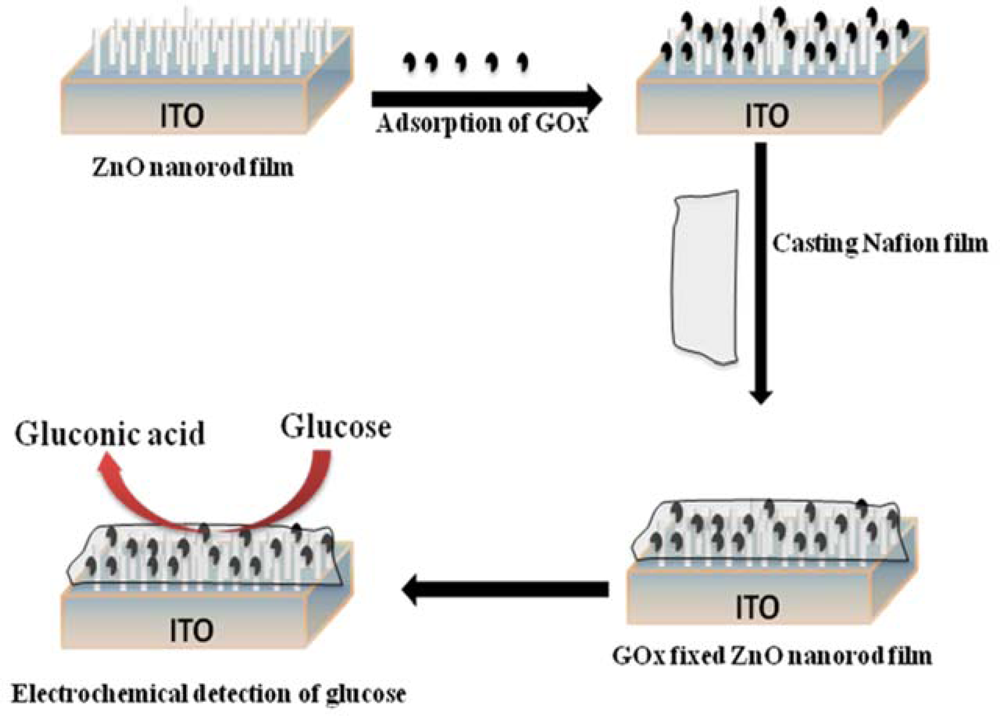
<p>In the third generation glucose sensor, the GOx is directly coupled to the electrode. The direct electron transfer efficiently generates an amperometric output signal. The improved sensing performance by the direct electron transfer has been realized by incorporating the enzyme with metal nanoparticles [<xref ref-type="bibr" rid="b64-sensors-10-04855">64</xref>,<xref ref-type="bibr" rid="b65-sensors-10-04855">65</xref>], and semiconductive nanomaterials [<xref ref-type="bibr" rid="b66-sensors-10-04855">66</xref>,<xref ref-type="bibr" rid="b67-sensors-10-04855">67</xref>]. The nanocrystalline metal-oxide plays a vital role in the enzyme immobilization owing to its highly specific surface area, good biocompatibility and stability [<xref ref-type="bibr" rid="b68-sensors-10-04855">68</xref>]. Liu <italic>et al.</italic> fabricated a novel third generation amperometric glucose sensor based on the aligned ZnO nanorod formed on an ITO electrode (<xref ref-type="fig" rid="f3-sensors-10-04855">Figure 3</xref>). The immobilized GOx on the ZnO nanorod shows still high catalytic activity, effective protection by Nafion (perfluorosulfonate ionomer) membrane cast on the film, a wide linear range with good selectivity and freedom from the interference effects of uric acid and ascorbic acid in real samples [<xref ref-type="bibr" rid="b69-sensors-10-04855">69</xref>].</p>
<p>In recent years progressive attempts have been made to determine the glucose without any enzyme for the reliable fast determination [<xref ref-type="bibr" rid="b70-sensors-10-04855">70</xref>–<xref ref-type="bibr" rid="b72-sensors-10-04855">72</xref>]. Most enzymeless electrochemical glucose sensors rely on the properties of the electrode materials, on which the glucose is oxidized directly. Carbon, platinum, gold and nanostructured CuO-modified CNTs have been widely investigated as candidates for improving the sensing performance of enzymeless sensors [<xref ref-type="bibr" rid="b73-sensors-10-04855">73</xref>,<xref ref-type="bibr" rid="b74-sensors-10-04855">74</xref>]. However, some problems including poor selectivity and low sensitivity due to the surface poisoning by the adsorbed intermediates or chloride ions still remain [<xref ref-type="bibr" rid="b75-sensors-10-04855">75</xref>].</p></sec>
<sec>
<label>2.3.</label>
<title>Impedimetric/Conductometric Glucose Sensor</title>
<p>The impedimetric biosensor is less frequently used as compared to the potentiometric and the amperometric ones. Electrochemical impedance spectroscopy (EIS) is a powerful analytical tool which allows us to effectively visualize the actual electrical double layer structure of a modified electrode [<xref ref-type="bibr" rid="b76-sensors-10-04855">76</xref>] although recording of an impedance spectrum within a broad frequency range is time consuming. The glucose does not affect the dielectric spectrum in the MHz frequency region [<xref ref-type="bibr" rid="b77-sensors-10-04855">77</xref>,<xref ref-type="bibr" rid="b78-sensors-10-04855">78</xref>] and direct detection of the glucose is available. The expression of impedance in a simple RC circuit is as follows:
<disp-formula id="FD3">
<label>(3)</label>
<mml:math display="block">
<mml:mrow>
<mml:msup>
<mml:mi>Z</mml:mi>
<mml:mn>2</mml:mn></mml:msup>
<mml:mo>=</mml:mo>
<mml:msup>
<mml:mrow>
<mml:mi>R</mml:mi></mml:mrow>
<mml:mn>2</mml:mn></mml:msup>
<mml:mo>+</mml:mo>
<mml:mfrac>
<mml:mn>1</mml:mn>
<mml:mrow>
<mml:msup>
<mml:mrow>
<mml:mrow>
<mml:mrow>
<mml:mo>(</mml:mo>
<mml:mrow>
<mml:mn>2</mml:mn>
<mml:mi>f</mml:mi>
<mml:mi>C</mml:mi></mml:mrow>
<mml:mo>)</mml:mo></mml:mrow></mml:mrow></mml:mrow>
<mml:mn>2</mml:mn></mml:msup></mml:mrow></mml:mfrac></mml:mrow></mml:math></disp-formula>where <italic>Z</italic> is impedance, R the resistance and C the capacitance.</p>
<p>Conductance is the reciprocal of resistance, so sometimes the impedimetric biosensor is also called a conductometric biosensor [<xref ref-type="bibr" rid="b78-sensors-10-04855">78</xref>]. Shervedani <italic>et al.</italic> developed a quantitative method for the determination of glucose based on the EIS measurements. In this method, the GOx was immobilized on the mercaptopropionic acid (MPA) self-assembled monolayer (SAM) modified gold electrode. Parabenzoquinone (PBQ) was used as an electron mediator which is reduced to hydroquinone (H<sub>2</sub>Q). The EIS measurements showed that the charge transfer resistance (R<sub>ct</sub>) decreases with the increase of the glucose concentration due to the increase of the diffusion current density by the H<sub>2</sub>Q oxidation. The nondestructive and straightforward method showed a dynamic range of glucose determination with linear variation of the sensor response (1/R<sub>ct</sub>) as a function of glucose concentration in a solution [<xref ref-type="bibr" rid="b79-sensors-10-04855">79</xref>]. Recently, versatile biosensing materials such as semiconducting CNTs and conducting polymers have been introduced [<xref ref-type="bibr" rid="b80-sensors-10-04855">80</xref>]. Besteman <italic>et al.</italic> combined the GOx to the sidewall of the single-wall carbon nanotube (SWNT) by the use of a cross linker and found conductance decrease of the SWNT as well as the change of capacitance. The conductance increased upon exposure to glucose indicating that an enzyme-based single molecular level biosensor is available by the use of the SWNT [<xref ref-type="bibr" rid="b78-sensors-10-04855">78</xref>]. Very few reports are available on nanostructured metal-oxide modified glucose sensor based on the conductometry or the EIS [<xref ref-type="bibr" rid="b81-sensors-10-04855">81</xref>]. Ansari <italic>et al.</italic> covalently immobilized GOx on the SnO<sub>2</sub> nanostructured thin film grown on anodized aluminum oxide (AAO) pores by the plasma enhanced chemical vapor deposition (PECVD) leading to the conductivity increase of the film. This film showed higher sensitivity towards glucose as compare to other simple nanostrucutres [<xref ref-type="bibr" rid="b82-sensors-10-04855">82</xref>]. More improved sensitivity and wider linear response range could be available by tailoring the material properties, for example active surface area, three-dimensional structure, and electrical conductance of the film.</p></sec></sec>
<sec>
<label>3.</label>
<title>Glucose Sensor Based on Metal-Oxides</title>
<p>Metal-oxide based sensors are very sensitive, relatively inexpensive and have the advantage of rapid response associated with specific nanostructures such as nanowire, nanorod, nanotube, nanoparticle, nanofibre, CNT modified metal-oxide and so on. In this section, we will discuss recent development of enzymatic or nonenzymatic glucose sensors based on various nanostructured metal-oxides. It should be mentioned that during the last two decades tremendous efforts have been made for the detection of glucose based on nanostructured metal oxides and their composites. In <xref ref-type="table" rid="t1-sensors-10-04855">Table 1</xref> we tabulate metal oxides applicable to glucose sensors reported so far and give brief descriptions in terms of the detection methods, availability of enzymatic or nonenzymatic operations, sensitivity, detection limit, response time, and applied potential.</p>
<sec>
<label>3.1.</label>
<title>Zinc Oxide (ZnO) Based Glucose Sensor</title>
<p>ZnO nanomaterials have been studied extensively in optics, optoelectronics, sensors, and actuators owing to their semiconducting, piezoelectric, and pyroelectric properties [<xref ref-type="bibr" rid="b83-sensors-10-04855">83</xref>]. ZnO has many attractive properties for the fabrication of the metal-oxide based biosensors, for example good biocompatibility, chemical stability, non-toxicity, electrochemical activity and fast electron transfer rate. Most of all, the ZnO substrate provides the GOx having many acidic protons with a better electrode surface for immobilization because the isoelectric point (IEP) of the ZnO is about 9.5, while that of the GOx is 4.2 [<xref ref-type="bibr" rid="b84-sensors-10-04855">84</xref>,<xref ref-type="bibr" rid="b85-sensors-10-04855">85</xref>]. Moreover, high surface-to-volume ratio of nanostructured ZnO gives the immobilized GOx a better electrical contact to the electrode [<xref ref-type="bibr" rid="b86-sensors-10-04855">86</xref>,<xref ref-type="bibr" rid="b87-sensors-10-04855">87</xref>]. Among many nanostrucuted ZnO, the ZnO nanorods have been widely studied for the immobilization of biomolecules [<xref ref-type="bibr" rid="b69-sensors-10-04855">69</xref>,<xref ref-type="bibr" rid="b88-sensors-10-04855">88</xref>,<xref ref-type="bibr" rid="b89-sensors-10-04855">89</xref>]. Wei <italic>et al.</italic> introduced the ZnO nanorod grown on a gold electrode by hydrothermal decomposition followed by the iimobilization of GOx in phosphate buffer solution at pH 7.4. Negatively charged GOx in a neutral or basic solution is electrostatically immobilized on to the positively charged ZnO nanorod in the same solution by applying an anodic potential. The modified electrode showed a high and reproducible sensitivity in short response time and apparent Michaelis-Menten constant towards glucose oxidation was 2.9 mM [<xref ref-type="bibr" rid="b90-sensors-10-04855">90</xref>].</p>
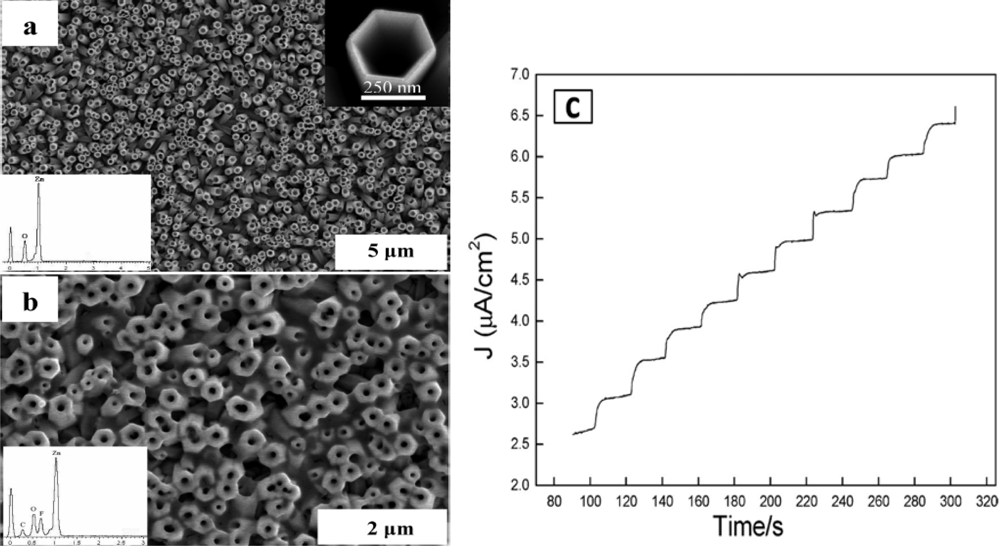
<p>Nanoporous ZnO and ZnO nanotubes have improved surface-to-volume ratios and also show highly sensitivity towards glucose oxidation. The porous ZnO:Co nanocluster having an average particle size of 5 nm showed much higher sensitivity (about 13.3 μA mM<sup>−1</sup> cm<sup>−2</sup>) due to the high specific active sites and electrocatalytic activity of the ZnO:Co nanoclusters as well as strong affinity to the GOx [<xref ref-type="bibr" rid="b91-sensors-10-04855">91</xref>]. Yang <italic>et al.</italic> synthesized porous ZnO nanotube arrays on ITO by two-step electrochemical and chemical processes (<xref ref-type="fig" rid="f4-sensors-10-04855">Figure 4</xref>). The Nafion/GOx/ZnO nanotube arrays on ITO electrode showed good mechanical contact between the ITO substrate and the ZnO nanotubes which leads to the improved sensitivity [<xref ref-type="bibr" rid="b83-sensors-10-04855">83</xref>]. Similarly, improved sensitivity with the porous tetragonal pyramid-shaped ZnO nanomaterials and the ZnO nanocomb structure were also reported by other groups [<xref ref-type="bibr" rid="b92-sensors-10-04855">92</xref>–<xref ref-type="bibr" rid="b94-sensors-10-04855">94</xref>].</p>
<p>Physically or chemically tailored ZnO nanowires also lead to the high specific surface area and high IEP for efficient immobilization of concentrated GOx and the nanowire structure effectively mediates the electron transfer of the redox reaction [<xref ref-type="bibr" rid="b69-sensors-10-04855">69</xref>]. Liu <italic>et al.</italic> developed a carbon-coated ZnO (C-ZnO) nanowire arrayed electrode by taking advantage of electrical conductivity and chemical stability of the carbon material and the one dimensional channel structure of ZnO nanowires [<xref ref-type="bibr" rid="b92-sensors-10-04855">92</xref>]. The Nafion/GOx/C-ZnO nanowired electrode exhibited a pair of well-defined redox peaks at −0.43 and −0.48 V, resulted from the direct electron transfer between the immobilized GOx and the electrode. By contrast, no peaks were observed from both Nafion/GOx and Nafion/C-ZnO nanowired electrodes. Meanwhile, only very weak peaks are detected with a Nafion/GOx/pristine nanowired electrode. The EIS measurements confirmed the fast electron transfer at the C-ZnO nanowired electrode with charge transfer resistance of Fe[(CN)<sub>6</sub>]<sup>3−/4−</sup> was ∼85 Ω, much smaller than that at the pristine nanowired electrode (∼400 Ω). The C-ZnO nanowire could be an inexpensive high-performing alternative to the conventional CNT-modified gold film in biosensor applications.</p>
<p>The nanostructured ZnO shows high sensitivity but very poor stability, because the ZnO nano-structure is easily removed from the electrode surface during functionalization [<xref ref-type="bibr" rid="b66-sensors-10-04855">66</xref>,<xref ref-type="bibr" rid="b86-sensors-10-04855">86</xref>]. Indeed, improved stability without loss of sensitivity or selectivity is one of the big challenges for glucose monitoring. Extensive efforts have been made to retain the catalytic activity of the immobilized GOx for a long time by using carbon-coated ZnO nanowire [<xref ref-type="bibr" rid="b95-sensors-10-04855">95</xref>], functionalized CNTs [<xref ref-type="bibr" rid="b96-sensors-10-04855">96</xref>], nanosized CaCO<sub>3</sub> film [<xref ref-type="bibr" rid="b97-sensors-10-04855">97</xref>], NdPO<sub>4</sub> nanoparticle-chitosan composite [<xref ref-type="bibr" rid="b98-sensors-10-04855">98</xref>], meldolas Blue mediated screen-printed electrodes [<xref ref-type="bibr" rid="b99-sensors-10-04855">99</xref>] and many other materials. Wang <italic>et al.</italic> prepared ZnO nanoparticles and coated them onto a multiwall carbon nanotube (MWNT)-modified electrode for the GOx immobilization to improve the stability. A cationic polydiallyldimethylammonium chloride (PDDA) layer was further coated on the GOx-contained ZnO layer to prevent enzyme leakage [<xref ref-type="bibr" rid="b100-sensors-10-04855">100</xref>]. The PDDA/GOx/ZnO/MWNTs film provided the sensing electrode with enhanced sensitivity, lower detection limit and long term stability more than 160 days. Results obtained from this glucose sensor were compared with one hundred human blood serum samples and agreed with the results of conventional spectrometric assay (correlation coefficient, 0.997).</p>
<p>In recent years, monitoring of intracellular glucose levels has received considerable attention and various methods including electrochemical detection [<xref ref-type="bibr" rid="b101-sensors-10-04855">101</xref>], use of hypodermic needles [<xref ref-type="bibr" rid="b102-sensors-10-04855">102</xref>], and microdialysis [<xref ref-type="bibr" rid="b103-sensors-10-04855">103</xref>] have been proposed for the assessment of glucose in interstitial spaces as an alternative site rather than the bloodstream. Recently, Asif <italic>et al.</italic> developed a functionalized ZnO-nanorod based electrochemical sensor for the selective detection of glucose in human adipocytes and frog oocytes [<xref ref-type="bibr" rid="b104-sensors-10-04855">104</xref>]. Hexagonal ZnO nanorods grown on the tip of a silver-covered borosilicate glass capillary make it possible to microinject specific reagents, which can interrupt or activate signal transmission to glucose, into relatively large adipocytes and oocytes. The prepared nanosensor exhibited a glucose-dependent electrochemical potential difference over the concentration range of 0.5–1000 μM <italic>versus</italic> a micro-sized Ag/AgCl reference electrode with a fast response time (&lt;1 s). Intracellular and extracellular measurements of glucose showed good sensitivity and selectivity without interferences even though the nanosensor encountered stability problems.</p>
<p>Even if ZnO nanomaterials are highly promising electrode materials for glucose sensing, a relatively high potential is still required for operation meaning that unwanted output signal caused by the oxidation of interfering agents such as ascorbic acid (AA) or uric acid (UA), might be usually coexisted with glucose signal in real samples.</p></sec>
<sec>
<label>3.2.</label>
<title>Copper Oxide (CuO/Cu<sub>2</sub>O) Based Glucose Sensor</title>
<p>Transition metal oxides and alloys significantly enhance direct oxidation of glucose compared with other metals that attribute to the catalytic effect resulting from the multi-electron oxidation mediated by surface metal oxide layers [<xref ref-type="bibr" rid="b105-sensors-10-04855">105</xref>,<xref ref-type="bibr" rid="b106-sensors-10-04855">106</xref>]. Transition metals such as Cu and Ni can oxidize carbohydrate easily without surface poisoning. Unlike Cu and Ni, corresponding oxides or hydroxides are relatively stable in air and solutions [<xref ref-type="bibr" rid="b107-sensors-10-04855">107</xref>,<xref ref-type="bibr" rid="b108-sensors-10-04855">108</xref>]. Natural abundance of copper oxide as well as its low production cost, good electrochemical and catalytic properties make the copper oxide to be one of the best materials for electrical, optical and photovoltaic devices, heterogeneous catalysis, magnetic storage media, gas sensing, field-emission emitters, lithium ion electrode and so forth [<xref ref-type="bibr" rid="b109-sensors-10-04855">109</xref>–<xref ref-type="bibr" rid="b111-sensors-10-04855">111</xref>].</p>
<p>Recent advances in nanoscience and nanotechnology have revealed the catalytic effect of copper oxide in relation to nonenzymetic glucose oxidation, voltammetric sensing of carbohydrates and hydrogen peroxide detection with ultra-sensitive response and good stability [<xref ref-type="bibr" rid="b112-sensors-10-04855">112</xref>]. Wang <italic>et al.</italic> prepared Pd (IV)-doped CuO nanofibers (PCNFs) and CuO nanofibers via electrospinning on glassy carbon electrodes (GCE) and investigated the amperometric direct responses to glucose [<xref ref-type="bibr" rid="b113-sensors-10-04855">113</xref>]. The PCNFs modified electrode showed excellent selectivity, reproducibility and stability. The Pd in the PCNFs, with lower electron occupancy in 3d orbital compared to the Cu, act as a Lewis acid for adsorption of polar glucose molecule a Lewis bases, via nucleophilic attack by non-bonded electron pairs. The longer resident time for the reactant species within the electrode-electrolyte interface, the more enhanced electrocatalytic activity towards the glucose oxidation [<xref ref-type="bibr" rid="b105-sensors-10-04855">105</xref>,<xref ref-type="bibr" rid="b114-sensors-10-04855">114</xref>]. A similar approach was also demonstrated by using three-dimensional network of CuO nanofibers (CuO-NFs) and reported improved sensitivity, stability and fast response time compared to the PCNFs modified electrode [<xref ref-type="bibr" rid="b115-sensors-10-04855">115</xref>]. The CuO-NFs modified electrode also shows good selectivity and resistance to electrode fouling. Zhuang <italic>et al.</italic> developed a highly stable and sensitive nonenzymatic glucose sensor based on copper oxide nanowire modified Cu electrode in an alkaline medium [<xref ref-type="bibr" rid="b116-sensors-10-04855">116</xref>]. The CuO nanowire can greatly increase the electrocatalytic active area and promote electron transfer rate of glucose oxidation. The CuO modified electrodes could be used repeatedly and were not contaminated with by-product of glucose oxidation. Experimental data for the glucose detection are in good agreement with the results from the spectrophotometric method performed in local hospital in real sample, where interference effect is negligible.</p>
<p>Recently, the existence of CuO nanoparticles as impurities in a CNT-based electrode has been claimed to be responsible for electrocatalytic activity of glucose oxidation [<xref ref-type="bibr" rid="b117-sensors-10-04855">117</xref>] as the synthetic procedures of pure CuO nanowire or nanofiber are tedious and time consuming. In addition, air-sensitive copper substrate can make a big sensor-to-sensor variation when exposed to open air under most environmental conditions. Combination of CNTs with copper oxide nanoparticles enhances the electron transfer rate of Cu<sub>2</sub>O and are successfully applied as an enzyme-free glucose Sensor. Very recently, Zhang <italic>et al.</italic> and Jiang <italic>et al.</italic> have developed Cu<sub>2</sub>O/MWNTs and CuO/MWNTs modified nonenzymatic electrodes for glucose sensing [<xref ref-type="bibr" rid="b118-sensors-10-04855">118</xref>,<xref ref-type="bibr" rid="b119-sensors-10-04855">119</xref>]. The Cu<sub>2</sub>O/MWNTs nanocomposites were prepared on GCEs by a new fixure-reduction method at low temperature. It showed higher sensitivity and lower detection limit as compared to the CuO/MWNTs that attributes to the stability factor of those two different copper oxide films [<xref ref-type="bibr" rid="b120-sensors-10-04855">120</xref>]. Very few reports are available on CuO based enzymatic glucose sensors for example, immobilization of CuO-GOx mixture within a carbon paste matrix [<xref ref-type="bibr" rid="b121-sensors-10-04855">121</xref>] and immobilization of GOx on flower-shaped CuO nanostructured electrode [<xref ref-type="bibr" rid="b122-sensors-10-04855">122</xref>].</p></sec>
<sec>
<label>3.3.</label>
<title>Manganese Dioxide (MnO<sub>2</sub>) Based Glucose Sensor</title>
<p>Most enzymatic glucose sensors take advantage of the reducing power of hydrogen peroxide produced by the degradation of glucose via the GOx involved catalytic reaction. The oxidation of hydrogen peroxide is accompanied by the application of a bias potential at which, however, coexisting species such as AA are also electroactive [<xref ref-type="bibr" rid="b123-sensors-10-04855">123</xref>]. Basically, two options are available to avoid the electrochemical activity of interfering agents. One is to employ a permselective membrane and the other one is to lower the applied potential by using electron mediators [<xref ref-type="bibr" rid="b124-sensors-10-04855">124</xref>–<xref ref-type="bibr" rid="b129-sensors-10-04855">129</xref>]. The permselective membrane may decrease the sensitivity and may not completely exclude the interfering effect. As an example of the permselective membrane, MnO<sub>2</sub> a strong oxidant has been tested to get rid of interference signals in glucose sensing by Choi <italic>et al.</italic> [<xref ref-type="bibr" rid="b130-sensors-10-04855">130</xref>]. The IEP of MnO<sub>2</sub> is quite low (4–5) at pH ranging from 2.8 to 4.5 but at higher pH, MnO<sub>2</sub> showed favorable environment for the immobilization of biomolecules [<xref ref-type="bibr" rid="b131-sensors-10-04855">131</xref>,<xref ref-type="bibr" rid="b132-sensors-10-04855">132</xref>].</p>
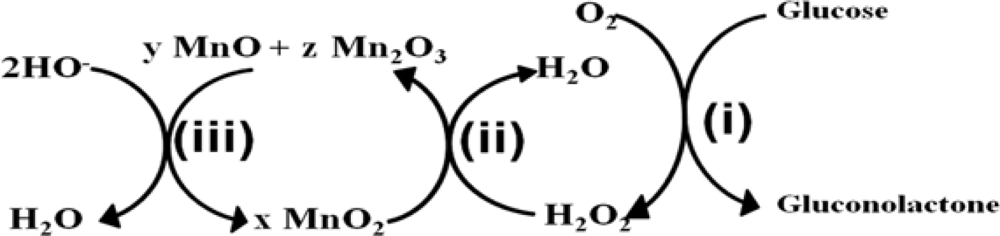
<p>Turkusic <italic>et al.</italic> developed an amperometric glucose sensor based on carbon paste electrodes modified with MnO<sub>2</sub> and GOx that operated at pH 9.5 [<xref ref-type="bibr" rid="b133-sensors-10-04855">133</xref>]. They also demonstrated glucose degradation mechanism on the MnO<sub>2</sub>/GOx modified screen printed electrode (SPE) based on heterogeneous carbon material, as shown in <xref ref-type="fig" rid="f5-sensors-10-04855">Figure 5</xref>. The two enzymatic oxidation products, gluconolactone and H<sub>2</sub>O<sub>2</sub> were produced by applying 0.48 V <italic>vs.</italic> Ag/AgCl. The H<sub>2</sub>O<sub>2</sub> further reacts chemically with MnO<sub>2</sub> to produce manganese species having lower oxidation states, which can be electrochemically reoxidized to form MnO<sub>2</sub> and the oxidative current flow is directly proportional to the glucose concentration. This rapid electrochemical process is accompanied by a kinetically slower chemical reoxidation of MnO/Mn<sub>2</sub>O<sub>3</sub> coupled with chemical oxidation of H<sub>2</sub>O<sub>2</sub>. The MnO<sub>2</sub>/GOx modified SPE showed partially decreased interfering signals, along with good reproducibility and long term stability.</p>
<p>Poly(diallyldimethylammonium), PDDA/MnO<sub>2</sub> and chitosan/MnO<sub>2</sub> nanocomposites are excellent electrode materials to minimize interference effect of UA and AA at low potential. Xu <italic>et al</italic>. fabricated a PDDA/MnO<sub>2</sub> nanocomposite on graphite electrode surface at pH 7.0 a favorable pH for the GOx immobilization. As-prepared PDDA/MnO<sub>2</sub>/GOx modified electrode is free from interferants when operated at 0.46 V [<xref ref-type="bibr" rid="b134-sensors-10-04855">134</xref>]. They also suggested chitosan film containing MnO<sub>2</sub> nanoparticles where the GOx was entrapped to be immobilized into chitosan hydrogel and showed effective suppression of interfering signals of ascorbates [<xref ref-type="bibr" rid="b135-sensors-10-04855">135</xref>].</p>
<p>Chen <italic>et al.</italic> developed a nonenzymatic electrochemical glucose sensor modified with MnO<sub>2</sub>/MWNTs [<xref ref-type="bibr" rid="b136-sensors-10-04855">136</xref>]. The MnO<sub>2</sub>/MWNTs electrode displayed high electrocatalytic activity towards the glucose oxidation in alkaline solutions at 0.3V and also strongly resisted toward poisoning by chloride ions. In addition, the problematic interference that occurs by the oxidation of common interfering species such as AA, dopamine (DA), and UA was effectively suppressed in real sample analysis compare to the unmodified MWNTs.</p></sec>
<sec>
<label>3.4.</label>
<title>Titanium Dioxide (TiO<sub>2</sub>) Based Glucose Sensor</title>
<p>TiO<sub>2</sub> nanomaterials are basically biocompatible and environmentally-friendly and have been frequently proposed as a prospective interface for the immobilization of biomolecules [<xref ref-type="bibr" rid="b137-sensors-10-04855">137</xref>,<xref ref-type="bibr" rid="b138-sensors-10-04855">138</xref>], and widely applied in photochemistry [<xref ref-type="bibr" rid="b139-sensors-10-04855">139</xref>–<xref ref-type="bibr" rid="b141-sensors-10-04855">141</xref>] and electrochemistry [<xref ref-type="bibr" rid="b142-sensors-10-04855">142</xref>,<xref ref-type="bibr" rid="b143-sensors-10-04855">143</xref>]. Moreover, titanium forms coordination bonds with the amine and carboxyl groups of enzymes and maintains the enzyme’s biocatalytic activity. Nanostructured TiO<sub>2</sub> also provides the enzyme with better immobilization environment by enlarging the surface area [<xref ref-type="bibr" rid="b144-sensors-10-04855">144</xref>,<xref ref-type="bibr" rid="b145-sensors-10-04855">145</xref>].</p>
<p>Sol-gel technology has been widely explored in the field of chemical sensors and biosensors. Especially, the low-temperature sol-gel process enables encapsulation of heat sensitive biomolecules such as enzymes, protein molecules and antibodies [<xref ref-type="bibr" rid="b146-sensors-10-04855">146</xref>–<xref ref-type="bibr" rid="b149-sensors-10-04855">149</xref>]. Various sol-gel derived TiO<sub>2</sub> films associated with binding molecules or polymer networks for crack-free porous structures have been characterized and applied to biosensing [<xref ref-type="bibr" rid="b150-sensors-10-04855">150</xref>–<xref ref-type="bibr" rid="b155-sensors-10-04855">155</xref>]. Viticoli <italic>et al.</italic> developed a third generation amperometric glucose sensor based on nanostructured TiO<sub>2</sub> on a porous silicon (p-Si) substrate. The Functionalized TiO<sub>2</sub> layers were prepared by the metal organic chemical vapor deposition or by the sol-gel technique at various pressures (0.1–4 torr) and temperatures (300 °C to 800 °C) using Ti(IV) isopropoxide as a starting precursor [<xref ref-type="bibr" rid="b156-sensors-10-04855">156</xref>]. Enzyme was directly dip-coated on the TiO<sub>2</sub> modified p-Si substrate. Results showed a good linear response with a few seconds of response time.</p>
<p>Recently, Bao <italic>et al.</italic> have hydrothermally synthesized a new slack TiO<sub>2</sub> layer having a uniform porous nanostructure by the use of MWNTs template [<xref ref-type="bibr" rid="b157-sensors-10-04855">157</xref>]. The TiO<sub>2</sub> nanostructure displayed a big hysteresis loop at high pressure. Abrupt increase of adsorption at high pressure in the nitrogen adsorption and desorption isotherms confirms the presence of porous structure. The porous TiO<sub>2</sub> nanostructure has a large capacity for enzyme immobilization that was proved by observing a big change in shape of the hysteresis loop and a significant decrease of the specific surface area of the nanostructure. The applied potential was 0.45 V at pH 6.6 under a N<sub>2</sub> atmosphere. Although the porous TiO<sub>2</sub> nanostructure-modified GCE strongly depends on pH, it operates at low enough potential to eliminate interference signals of UA and AA.</p>
<p>Fluorescence based glucose sensors have appeared in the literature as an alternative way of continuous monitoring of glucose levels. These sensors are highly specific towards analytes but require built-in probes [<xref ref-type="bibr" rid="b158-sensors-10-04855">158</xref>]. A number of reports on reagentless optical biosensors using pH-sensitive fluorescent probes are available [<xref ref-type="bibr" rid="b159-sensors-10-04855">159</xref>–<xref ref-type="bibr" rid="b163-sensors-10-04855">163</xref>]. Fluorometric detection of dissolved oxygen is available since the oxygen is able to quench the fluorescent probe. Doong <italic>et al.</italic> developed a novel optical arrayed TiO<sub>2</sub> biosensor for simultaneous detection of anlaytes containing glucose, urea and glutamate in a serum sample [<xref ref-type="bibr" rid="b164-sensors-10-04855">164</xref>]. Carboxyseminaphthorhodamine-1-dextran (SNARF-1-dextran), a single-molecule fluorescent probe, was co-immobilized with glucose dehydrogenase on TiO<sub>2</sub> by the sol-gel process. The glucose dehydrogenase decomposes glucose to produce proton and the pH decreases. An enhanced sensitivity at basic condition is primarily attributed to the fluorescent characteristics of the carboxy SNARF-1-dextran that gives strong emission intensity at 630 nm. As-prepared TiO<sub>2</sub> arrayed optical sensor showed still good sensitivity even after stored at 4 °C for 1 month.</p></sec>
<sec>
<label>3.5</label>
<title>Cerium Oxide (CeO<sub>2</sub>) Based Glucose Sensor</title>
<p>Nanostructured CeO<sub>2</sub> is an excellent electrode material because it is a nontoxic, chemically inert and electrically conductive material. It also shows large surface area like other nanostructured materials and good biocompatibility [<xref ref-type="bibr" rid="b165-sensors-10-04855">165</xref>–<xref ref-type="bibr" rid="b173-sensors-10-04855">173</xref>]. Additionally, CeO<sub>2</sub> can act as electrochemical redox couple that makes it possible to produce a mediatorless glucose sensor. High IEP (∼9.0) and electron-transfer rate constant (18.3 s<sup>−1</sup>) with a good surface coverage (1.4 × 10<sup>−11</sup> mol cm<sup>−2</sup>) of CeO<sub>2</sub> allow easier enzyme immobilization and direct electron transfer between the active sites of the GOx and the electrode surface [<xref ref-type="bibr" rid="b174-sensors-10-04855">174</xref>,<xref ref-type="bibr" rid="b175-sensors-10-04855">175</xref>].</p>
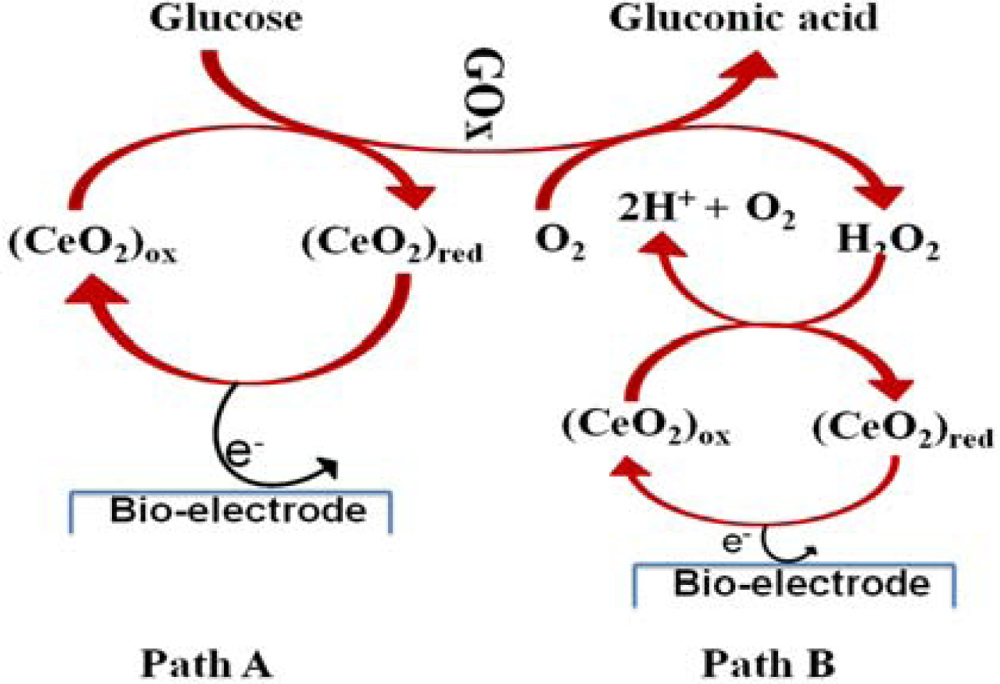
<p>Saha <italic>et al.</italic> deposited nanoporous CeO<sub>2</sub> thin film on a Pt coated glass plate using pulsed laser deposition (PLD) [<xref ref-type="bibr" rid="b176-sensors-10-04855">176</xref>]. GOx was immobilized on to the CeO<sub>2</sub> by the electrostatic interaction between the positively charged CeO<sub>2</sub> and the negatively charged GOx at pH 7. Prior to the enzyme immobilization the GOx/Pt electrode was pretreated electrochemically at 0.8 V to activate the CeO<sub>2</sub> surface and to remove the oxidizable impurities. The resulting GOx/CeO<sub>2</sub>/Pt electrode showed a linear response to glucose oxidation with low Michaelis-Menten constant (1.01 mM) indicating enhanced enzyme affinity to glucose. The mechanisms available for the glucose oxidation on the electrode are depicted in <xref ref-type="fig" rid="f6-sensors-10-04855">Figure 6</xref>.</p>
<p>Path A describes direct electron transfer between the GOx and the electrode via oxidation and reduction of CeO<sub>2</sub> in which the CeO<sub>2</sub> is a better electron acceptor than oxygen. This is clearly confirmed by observing no oxidation peak of H<sub>2</sub>O<sub>2</sub> [<xref ref-type="bibr" rid="b177-sensors-10-04855">177</xref>], whereas, in path B, the electron generated by the glucose oxidation might be coupled with reduction of molecular oxygen followed by reduction of CeO<sub>2</sub> and then finally transferred to the electrode at acidic condition [<xref ref-type="bibr" rid="b178-sensors-10-04855">178</xref>]. Sol-gel derived nanostructured CeO<sub>2</sub> film on Au electrode is also available for the GOx immobilization and suggested by Ansari <italic>et al.</italic> [<xref ref-type="bibr" rid="b179-sensors-10-04855">179</xref>]. The GOx physically adsorbed on the CeO<sub>2</sub>/Au electrode showed a linear response in the range of 0.5 g L<sup>−1</sup> to 4 g L<sup>−1</sup>. The detection limit was 12.0 μM with a shelf life of 12 days. Recently, various nanostructured CeO<sub>2</sub> such as nanorod, nanocomb, nanocubes, and nanoflower [<xref ref-type="bibr" rid="b180-sensors-10-04855">180</xref>,<xref ref-type="bibr" rid="b181-sensors-10-04855">181</xref>] have been synthesized. However, no successful reports about glucose detection are available and the potential application of these nanostructures for glucose sensing is of great interest.</p></sec>
<sec>
<label>3.6.</label>
<title>Silicon Dioxide (SiO<sub>2</sub>) Based Glucose Sensor</title>
<p>Basically, electrode materials should have good electron transport capacity, bioactivities towards target analytes and provide suitable physical or chemical environments for reliable immobilization of biorecognition molecules. Some metal oxides meet those requirements perfectly, but there are still demands for other nanostructured materials including conducting polymers and CNTs to get more enhanced sensitivity and reliability of a glucose sensor. Indeed, composite materials made from two or more nanostructures are another big issue [<xref ref-type="bibr" rid="b182-sensors-10-04855">182</xref>–<xref ref-type="bibr" rid="b184-sensors-10-04855">184</xref>].</p>
<p>Silica based organic and inorganic nanocomposites are attractive electrode materials since they provide biorecognition molecules with a better entrapment environment and more enhanced electrochemical stability [<xref ref-type="bibr" rid="b185-sensors-10-04855">185</xref>]. A mesocellular silica–carbon nanocomposite foam (MSCF) was designed for the GOx immobilization by Wu <italic>et al.</italic> [<xref ref-type="bibr" rid="b186-sensors-10-04855">186</xref>]. The uniformly ordered MSCF showed good biocompatibility, favorable conductivity and hydrophilicity. The narrow pore-size distribution was suitable for the immobilization of not only the GOx but also other redox proteins. A fast electron transfer rate (14.0 ± 1.7 s<sup>−1</sup>) of the GOx modified MSFC allowed direct electrochemistry and showed a good electrochemical sensitivity to glucose with a linear response range of 50 μM to 5.0 mM with a detection limit of 34 μM at an applied potential of −0.4 V. The low potential for operation prohibits unwanted interference signal in real sample by the oxidation of AA and UA.</p>
<p>Recently, extensive researches have been done on the immobilization of GOx by the use of silica nanocomposites such as unprotected Pt nanoclusters mixed with the nanoscale SiO<sub>2</sub> particles [<xref ref-type="bibr" rid="b187-sensors-10-04855">187</xref>], chitosan/SiO<sub>2</sub> nanocomposites attached on the Pt-MWNTs modified electrode [<xref ref-type="bibr" rid="b188-sensors-10-04855">188</xref>], TiO<sub>2</sub>/SiO<sub>2</sub> nanocomposite [<xref ref-type="bibr" rid="b189-sensors-10-04855">189</xref>], sol–gel silica film on a prussian blue modified electrode [<xref ref-type="bibr" rid="b190-sensors-10-04855">190</xref>]. Porous SiO<sub>2</sub> nanofiber is also available for the potentiometric biosensor application [<xref ref-type="bibr" rid="b191-sensors-10-04855">191</xref>].</p>
<p>Gopalan <italic>et al.</italic> made a form of silica network on Nafion and subsequently loaded polyaniline grafted MWNTs (MWNTs-g-PANI) on the Nafion–silica nanocomposite for the GOx immobilization [<xref ref-type="bibr" rid="b192-sensors-10-04855">192</xref>]. Nafion, silica, MWNTs, and conducting polymers have individually been known as materials for improving the electrocatalytic activity, electron conduction path, sensitivity, and stability of biosensors, respectively [<xref ref-type="bibr" rid="b193-sensors-10-04855">193</xref>–<xref ref-type="bibr" rid="b195-sensors-10-04855">195</xref>]. The Nafion–silica/MWNTs-g-PANI electrode exhibited a linear response to glucose in the range of 1 mM to 10 mM with a correlation coefficient of 0.9972. The sensitivity was 5.01 μA mM<sup>−1</sup> with a low response time (∼6 s). Although the entire fabrication procedure is somewhat complicated and requires high fabrication cost, the Nafion–silica/MWNT-g-PANI composite electrode showed excellent sensing performance with negligible interference from AA, UA, and acetaminophen (AP). The recovery test of the Nafion–silica/MWNTs-g-PANI electrode in real sample was evaluated by the standard addition method, with three times addition of standard glucose solution. Experimental showed that reproducible current response (R.S.D) for three measurements were in the range of 2.9−4.1% with the recovery range of 98.0–105.5.</p></sec>
<sec>
<label>3.7.</label>
<title>Zirconium Oxide (ZrO<sub>2</sub>) Based Glucose Sensor</title>
<p>Nanostructured ZrO<sub>2</sub> is another example for the direct electron transfer between metal-oxide layer and the immobilized GOx for glucose sensing. Because the IEP of ZrO<sub>2</sub> is of 4.15 [<xref ref-type="bibr" rid="b196-sensors-10-04855">196</xref>], it is suitable for the adsorption of high IEP proteins. Therefore, any other nanomaterial, which can drop down the IEP of ZrO<sub>2</sub> when it is mixed with ZrO<sub>2</sub> is needed for the application of ZrO<sub>2</sub>-based electrode to glucose sensing since the IEP of glucose is of 4.2 [<xref ref-type="bibr" rid="b197-sensors-10-04855">197</xref>]. The first amperometric glucose sensor based on sol-gel derived ZrO<sub>2</sub> was reported by Liu <italic>et al.</italic> [<xref ref-type="bibr" rid="b198-sensors-10-04855">198</xref>]. Since then, a numerous efforts have been reported for the development of nano ZrO<sub>2</sub> based biosensors [<xref ref-type="bibr" rid="b199-sensors-10-04855">199</xref>–<xref ref-type="bibr" rid="b201-sensors-10-04855">201</xref>]. Yang <italic>et al</italic>. prepared ZrO<sub>2</sub>/Pt-PLL (poly-Lysine) and ZrO<sub>2</sub>/Pt-PVA (polyvinyl alcohol) to modify pyrolytic graphite (PG) electrodes for the GOx immobilization [<xref ref-type="bibr" rid="b202-sensors-10-04855">202</xref>]. Didodecyldimethylammonium bromide (DDAB), a synthetic lipid commonly used as a bio-membrane was introduced to stabilize and protect inorganic nanoparticles. The resulting GOx/ZrO<sub>2</sub>/Pt-PVA electrode showed largest reaction activity towards glucose oxidation in the presence of ferrocenium hexafluorophosphate (FcPF<sub>6</sub>) as an electron transfer mediator. On the other hand, no enzymatic activity of the immobilized GOx can be observed on ZrO<sub>2</sub>/DMSO and ZrO<sub>2</sub>/DDAB film. So, the use of colloidal platinum by replacing DMSO and DDAB plays an important role in transferring electrons between GOx and the electrode.</p>
<p><xref ref-type="table" rid="t2-sensors-10-04855">Table 2</xref> summarizes characteristics of the most frequently-used metal oxides what we have discussed in the section 3.1 to 3.7 in terms of EIP, the availability of enzymatic or nonenzymatic sensors, the compatibility with CNTs, conducting polymers or metal nanoparticles, and the application for other biosensors.</p></sec>
<sec>
<label>3.8.</label>
<title>Other Metal-Oxide Based Glucose Sensors</title>
<p>Plenty other metal oxides such as NiO, SnO<sub>2</sub>, MgO, IrO<sub>2</sub>, WO<sub>3</sub>, PbO<sub>2</sub>, RhO<sub>2</sub>, IrO<sub>x</sub>, V<sub>2</sub>O<sub>5</sub>, Fe<sub>3</sub>O<sub>4</sub>, and RuO<sub>x</sub> have been reported and their use, not only for glucose sensing, but also for many other biosensing applications to improve sensing performances attempted [<xref ref-type="bibr" rid="b203-sensors-10-04855">203</xref>–<xref ref-type="bibr" rid="b213-sensors-10-04855">213</xref>]. In this section we will briefly introduce some of those metal-oxide based sensors, including their applications and future prospects.</p>
<p>In recent years, NiO nanomaterials have received considerable attention due to their broad application to battery cathodes, gas sensors, electrochromic films, magnetic materials and catalysts [<xref ref-type="bibr" rid="b214-sensors-10-04855">214</xref>,<xref ref-type="bibr" rid="b215-sensors-10-04855">215</xref>]. However, there are only few biosensor applications. Li <italic>et al.</italic> developed a novel amperometric glucose sensor based on NiO hollow nanosphere [<xref ref-type="bibr" rid="b203-sensors-10-04855">203</xref>]. The NiO is suitable for electrostatic immobilization of proteins having low IEP because the IEP of NiO is about 10.7. The hollow-sphered NiO was good responsible for high loading of GOx and showed fast electron transfer with a sensitivity of 3.43 μA mM<sup>−1</sup> and a detection limit of 47 μM (S/N = 3).</p>
<p>MgO as a ceramic material has been typically applied to water purification, additives in refractory, paint, and superconductors. Various nanostructured magnesium oxides have been reported [<xref ref-type="bibr" rid="b216-sensors-10-04855">216</xref>–<xref ref-type="bibr" rid="b218-sensors-10-04855">218</xref>] but only a few reports are available for biosensor applications [<xref ref-type="bibr" rid="b219-sensors-10-04855">219</xref>,<xref ref-type="bibr" rid="b205-sensors-10-04855">205</xref>]. Umar <italic>et al.</italic> first introduced the application of MgO as an electrode material for glucose sensing [<xref ref-type="bibr" rid="b205-sensors-10-04855">205</xref>]. Polyhedral nanocages and nanocrystals of MgO were grown on silicon substrates via non-catalytic simple thermal evaporation process or on a gold surface and used as immobilization matrices for GOx. The resulting Au/MgO/GOx/Nafion electrode showed a good stability and sensitivity of 31.6 μA μM<sup>−1</sup> cm<sup>−2</sup>. The response time was less than 5 seconds.</p>
<p>Kotzian <italic>et al.</italic> reported an amperometric glucose sensor based on rhodium dioxide (RhO<sub>2</sub>) modified screen printed carbon electrode for the first time [<xref ref-type="bibr" rid="b209-sensors-10-04855">209</xref>]. The GOx were mixed with equal amounts of nafion and then transferred to the RhO<sub>2</sub> modified SPE. The flow injection analysis of glucose at an operating potential of 0.2 V <italic>vs.</italic> Ag/AgCl showed an excellent detection limit of 0.2 mg L<sup>−1</sup> when the optimized flow rate was 0.4 mL min<sup>−1</sup> in a 0.1 M phosphate buffer (pH 7.5) solution and the interference effect was surprisingly reduced because the operational potential was relatively very low.</p></sec></sec>
<sec>
<label>4.</label>
<title>Conclusion: Future Prospective and Challenges</title>
<p>Numerous efforts have been made to devise an ultrasensitive biosensor for monitoring blood glucose without interference from other electroactive species. With the advent of nanotechnology, the regulation of sensing devices at molecular level is possible to some extent. In spite of the impressive success of glucose monitoring by using various nanomaterials, however, there is still asking for continuous and non-invasive glucose sensing from diabetic patients in hospital with a much more reliable and sensitive glucose sensor. Since metal-oxide nanomaterials have basically large surface-to-volume ratio, high IEP values and provide a better surface for GOx immobilization, scientists have paid much attention to these electrode materials in anticipation of more stable, more sensitive but less interfering free glycemic monitoring. Additionally the metal-oxide based nonenzymatic glucose sensor enables cost-effective direct determination of blood glucose level without any electron transfer mediator and there is no loss of sensitivity due to denaturation of protein enzymes in the immobilization or detection procedures.</p>
<p>This review has briefly summarized the most frequently-used electrochemical methods and metal-oxides, including zinc oxide, copper oxides, manganese dioxide, titanium oxides, cerium oxide and silicon dioxide in glucose biosensors. ZnO and CeO<sub>2</sub> having high IEP might be the most suitable electrode materials for glucose sensing. Various nanostructured ZnOs have been reported for glucose monitoring and they showed excellent sensitivity and selectivity. Mediatorless glucose sensing is also available with the CeO<sub>2</sub>. On the other hand, the nanostructured CuO modified electrode is capable of direct electrooxidation of glucose without enzyme immobilization and reduces the costs of the sensor fabrication. Moreover, CuO nanostructure-modified electrode showed highest sensitivity and lower detection limit compare to other metal oxide based glucose sensors and also showed less interference due to the low operating potential. Many other metal-oxides for example nickel and magnesium oxides are also available for glucose sensing. Some metal-oxides are highly sensitive but show poor stability and serious interference effect because of high potential requirement for operation. On the other hand, other metal-oxides operate at low enough potential not to produce interfering signals and stability problem either but their sensitivity is totally unsatisfactory. Nevertheless, glucose sensing based on novel metal-oxide nanomaterials still has many advantages for the glucose detection in terms of miniaturization and development of semi-invasive or finally non-invasive sensing devices especially for the <italic>in vivo</italic> detection even though it requires more academic and technical studies for commercialization. Indeed, growing research interest of glucose sensors will continue with increasing prevalence of diabetic patients and the theoretical background and the experimental expertise acquired through investigation of metal-oxide nanostructured glucose sensors will be extended to overall biosensor industry.</p></sec></body>
<back>
<ack>
<p>This work was supported by the Korea Research Foundation Grant funded by the Korean Government (MOEHRD, Basic Research Promotion Fund) (KRF-2007-211-C00029) and by Seoul R&amp;BD Program (WR090671). It was also partly supported by the National Research Foundation of Korea (NRF) grant funded by the Korea government (MEST) (No. 2008-0062166).</p></ack>
<ref-list>
<title>References</title>
<ref id="b1-sensors-10-04855"><label>1.</label><citation citation-type="book"><person-group person-group-type="author"><name><surname>Gavin</surname><given-names>J.R.</given-names></name></person-group><article-title>The Importance of Monitoring Blood Glucose</article-title><source>US Endocrine Disease 2007</source><publisher-name>Touch Briefings</publisher-name><publisher-loc>Atlanta, GA, USA</publisher-loc><year>2007</year><fpage>1</fpage><lpage>3</lpage></citation></ref>
<ref id="b2-sensors-10-04855"><label>2.</label><citation citation-type="journal"><person-group person-group-type="author"><name><surname>Wang</surname><given-names>J.</given-names></name><name><surname>Thomas</surname><given-names>D.F.</given-names></name><name><surname>Chen</surname><given-names>A.</given-names></name></person-group><article-title>Nonenzymatic Electrochemical Glucose Sensor Based on Nanoporous PtPb Networks</article-title><source>Anal. Chem</source><year>2008</year><volume>80</volume><fpage>997</fpage><lpage>1004</lpage><pub-id pub-id-type="doi">10.1021/ac701790z</pub-id><pub-id pub-id-type="pmid">18197691</pub-id></citation></ref>
<ref id="b3-sensors-10-04855"><label>3.</label><citation citation-type="journal"><person-group person-group-type="author"><name><surname>King</surname><given-names>H.</given-names></name><name><surname>Aubert</surname><given-names>R.E.</given-names></name><name><surname>Herman</surname><given-names>W.H.</given-names></name></person-group><article-title>Global Burden of Diabetes. 1995–2025: Prevalence, Numerical Estimates, and Projections</article-title><source>Diabetes Care</source><year>1998</year><volume>21</volume><fpage>1414</fpage><lpage>1431</lpage><pub-id pub-id-type="doi">10.2337/diacare.21.9.1414</pub-id><pub-id pub-id-type="pmid">9727886</pub-id></citation></ref>
<ref id="b4-sensors-10-04855"><label>4.</label><citation citation-type="journal"><person-group person-group-type="author"><name><surname>Wild</surname><given-names>S.H.</given-names></name><name><surname>Roglic</surname><given-names>G.</given-names></name><name><surname>Green.</surname><given-names>A.</given-names></name><name><surname>Sicree</surname><given-names>R.</given-names></name><name><surname>King</surname><given-names>H.</given-names></name></person-group><article-title>Global Prevalence of Diabetes: Estimates for the Year 2000 and Projections for 2030</article-title><source>Diabetes Care</source><year>2004</year><volume>27</volume><fpage>1047</fpage><lpage>1053</lpage><pub-id pub-id-type="doi">10.2337/diacare.27.5.1047</pub-id><pub-id pub-id-type="pmid">15111519</pub-id></citation></ref>
<ref id="b5-sensors-10-04855"><label>5.</label><citation citation-type="journal"><person-group person-group-type="author"><name><surname>Wang</surname><given-names>J.</given-names></name></person-group><article-title>Electrochemical Glucose Biosensors</article-title><source>Chem. Rev</source><year>2008</year><volume>108</volume><fpage>814</fpage><lpage>825</lpage><pub-id pub-id-type="doi">10.1021/cr068123a</pub-id><pub-id pub-id-type="pmid">18154363</pub-id></citation></ref>
<ref id="b6-sensors-10-04855"><label>6.</label><citation citation-type="journal"><person-group person-group-type="author"><name><surname>Wilson</surname><given-names>G.S.</given-names></name><name><surname>Gifford</surname><given-names>R.</given-names></name></person-group><article-title>Biosensors for Real-Time <italic>in vivo</italic> Measurements</article-title><source>Biosens. Bioelectron</source><year>2005</year><volume>20</volume><fpage>2388</fpage><lpage>2403</lpage><pub-id pub-id-type="doi">10.1016/j.bios.2004.12.003</pub-id><pub-id pub-id-type="pmid">15854814</pub-id></citation></ref>
<ref id="b7-sensors-10-04855"><label>7.</label><citation citation-type="journal"><person-group person-group-type="author"><name><surname>Newman</surname><given-names>J.D.</given-names></name><name><surname>Turner</surname><given-names>A.P.F.</given-names></name></person-group><article-title>Home Blood Glucose Biosensors: A Commercial Perspective</article-title><source>Biosens. Bioelectron</source><year>2005</year><volume>20</volume><fpage>2435</fpage><lpage>2453</lpage><pub-id pub-id-type="doi">10.1016/j.bios.2004.11.012</pub-id><pub-id pub-id-type="pmid">15854818</pub-id></citation></ref>
<ref id="b8-sensors-10-04855"><label>8.</label><citation citation-type="journal"><person-group person-group-type="author"><name><surname>Koschinsky</surname><given-names>T</given-names></name><name><surname>Heinemann</surname><given-names>L.</given-names></name></person-group><article-title>Sensors for Glucose Monitoring: Technical and Clinical Aspects</article-title><source>Diabetes Metab Res. Rev</source><year>2001</year><volume>17</volume><fpage>113</fpage><lpage>123</lpage><pub-id pub-id-type="doi">10.1002/dmrr.188</pub-id><pub-id pub-id-type="pmid">11307176</pub-id></citation></ref>
<ref id="b9-sensors-10-04855"><label>9.</label><citation citation-type="journal"><person-group person-group-type="author"><name><surname>Oliver</surname><given-names>N.S.</given-names></name><name><surname>Toumazou</surname><given-names>C.</given-names></name><name><surname>Cass</surname><given-names>A.E.G.</given-names></name><name><surname>Johnston</surname><given-names>D.G.</given-names></name></person-group><article-title>Glucose Sensors: A Review of Current and Emerging Technology</article-title><source>Diabetic Med</source><year>2009</year><volume>26</volume><fpage>197</fpage><lpage>210</lpage><pub-id pub-id-type="doi">10.1111/j.1464-5491.2008.02642.x</pub-id><pub-id pub-id-type="pmid">19317813</pub-id></citation></ref>
<ref id="b10-sensors-10-04855"><label>10.</label><citation citation-type="journal"><person-group person-group-type="author"><name><surname>Lin</surname><given-names>Y.</given-names></name><name><surname>Lu</surname><given-names>F.</given-names></name><name><surname>Tu</surname><given-names>Y.</given-names></name><name><surname>Ren</surname><given-names>Z.</given-names></name></person-group><article-title>Glucose Biosensors Based on Carbon Nanotube Nanoelectrode Ensembles</article-title><source>Nano Lett</source><year>2004</year><volume>4</volume><fpage>191</fpage><lpage>195</lpage><pub-id pub-id-type="doi">10.1021/nl0347233</pub-id></citation></ref>
<ref id="b11-sensors-10-04855"><label>11.</label><citation citation-type="journal"><person-group person-group-type="author"><name><surname>Rakow</surname><given-names>N.A.</given-names></name><name><surname>Suslick</surname><given-names>K.S.</given-names></name></person-group><article-title>A Colorimetric Sensor Array for Odour Visualization</article-title><source>Nature</source><year>2000</year><volume>406</volume><fpage>710</fpage><lpage>712</lpage><pub-id pub-id-type="doi">10.1038/35021028</pub-id><pub-id pub-id-type="pmid">10963592</pub-id></citation></ref>
<ref id="b12-sensors-10-04855"><label>12.</label><citation citation-type="journal"><person-group person-group-type="author"><name><surname>Reitz</surname><given-names>E.</given-names></name><name><surname>Jia</surname><given-names>W.</given-names></name><name><surname>Gentile</surname><given-names>M.</given-names></name><name><surname>Wang</surname><given-names>Y.</given-names></name><name><surname>Lei</surname><given-names>Y.</given-names></name></person-group><article-title>CuO Nanospheres Based Nonenzymatic Glucose Sensor</article-title><source>Electroanalysis</source><year>2008</year><volume>20</volume><fpage>2482</fpage><lpage>2486</lpage><pub-id pub-id-type="doi">10.1002/elan.200804327</pub-id></citation></ref>
<ref id="b13-sensors-10-04855"><label>13.</label><citation citation-type="journal"><person-group person-group-type="author"><name><surname>Sachedina</surname><given-names>N.</given-names></name><name><surname>Pickup</surname><given-names>J.C.</given-names></name></person-group><article-title>Performance Assessment of The Medtronic-Minimed Continuous Glucose Monitoring System and Its Use for Measurement of Glycaemic Control in Type 1 Diabetes</article-title><source>Diabet. Med</source><year>2003</year><volume>20</volume><fpage>1012</fpage><lpage>1015</lpage><pub-id pub-id-type="pmid">14632702</pub-id></citation></ref>
<ref id="b14-sensors-10-04855"><label>14.</label><citation citation-type="journal"><person-group person-group-type="author"><name><surname>Clark</surname><given-names>L.C.</given-names></name><name><surname>Lyons</surname><given-names>C.</given-names></name></person-group><article-title>Electrode Systems for Continuous Monitoring in Cardiovascular Surgery</article-title><source>Ann. N. Y. Acad. Sci</source><year>2006</year><volume>102</volume><fpage>29</fpage><lpage>45</lpage><pub-id pub-id-type="doi">10.1111/j.1749-6632.1962.tb13623.x</pub-id></citation></ref>
<ref id="b15-sensors-10-04855"><label>15.</label><citation citation-type="journal"><person-group person-group-type="author"><name><surname>Updike</surname><given-names>S.J.</given-names></name><name><surname>Hicks</surname><given-names>G.P.</given-names></name></person-group><article-title>The Enzyme Electrode</article-title><source>Nature</source><year>1967</year><volume>214</volume><fpage>986</fpage><lpage>988</lpage><pub-id pub-id-type="doi">10.1038/214986a0</pub-id><pub-id pub-id-type="pmid">6055414</pub-id></citation></ref>
<ref id="b16-sensors-10-04855"><label>16.</label><citation citation-type="journal"><person-group person-group-type="author"><name><surname>Kang</surname><given-names>X.H.</given-names></name><name><surname>Mai</surname><given-names>Z.B.</given-names></name><name><surname>Zou</surname><given-names>X.Y.</given-names></name><name><surname>Cai</surname><given-names>P.X.</given-names></name><name><surname>Mo</surname><given-names>J.Y.</given-names></name></person-group><article-title>A Novel Glucose Biosensor Based On Immobilization of Glucose Oxidase in Chitosan on A Glassy Carbon Electrode Modified with Gold-Platinum Alloy Nanoparticles/Multiwall Carbon Nanotubes</article-title><source>Anal. Biochem</source><year>2007</year><volume>369</volume><fpage>71</fpage><lpage>79</lpage><pub-id pub-id-type="doi">10.1016/j.ab.2007.07.005</pub-id><pub-id pub-id-type="pmid">17678866</pub-id></citation></ref>
<ref id="b17-sensors-10-04855"><label>17.</label><citation citation-type="journal"><person-group person-group-type="author"><name><surname>Shervedani</surname><given-names>R.K.</given-names></name><name><surname>Mehrjardi</surname><given-names>A.H.</given-names></name><name><surname>Zamiri</surname><given-names>N.</given-names></name></person-group><article-title>A Novel Method for Glucose Determination Based On Electrochemical Impedance Spectroscopy Using Glucose Oxidase Self-Assembled Biosensor</article-title><source>Bioelectrochemistry</source><year>2006</year><volume>69</volume><fpage>201</fpage><lpage>208</lpage><pub-id pub-id-type="doi">10.1016/j.bioelechem.2006.01.003</pub-id><pub-id pub-id-type="pmid">16580891</pub-id></citation></ref>
<ref id="b18-sensors-10-04855"><label>18.</label><citation citation-type="journal"><person-group person-group-type="author"><name><surname>Caras</surname><given-names>S.D.</given-names></name><name><surname>Petelenz</surname><given-names>D.</given-names></name><name><surname>Janata</surname><given-names>J.</given-names></name></person-group><article-title>pH-Based Enzyme Potentiometric Sensors. Part 2. Glucose-Sensitive Field Effect Transistor</article-title><source>Anal. Chem</source><year>1985</year><volume>57</volume><fpage>1920</fpage><lpage>1923</lpage><pub-id pub-id-type="doi">10.1021/ac00286a028</pub-id><pub-id pub-id-type="pmid">4037345</pub-id></citation></ref>
<ref id="b19-sensors-10-04855"><label>19.</label><citation citation-type="journal"><person-group person-group-type="author"><name><surname>Tang</surname><given-names>H.</given-names></name><name><surname>Chen</surname><given-names>J.H.</given-names></name><name><surname>Yao</surname><given-names>S.Z.</given-names></name><name><surname>Nie</surname><given-names>L.H.</given-names></name><name><surname>Deng</surname><given-names>G.H.</given-names></name><name><surname>Kuang</surname><given-names>Y.F.</given-names></name></person-group><article-title>Amperometric Glucose Biosensor Based On Adsorption of Glucose Oxidase at Platinum Nanoparticle-Modified Carbon Nanotube Electrode</article-title><source>Anal. Biochem</source><year>2004</year><volume>331</volume><fpage>89</fpage><lpage>97</lpage><pub-id pub-id-type="pmid">15246000</pub-id></citation></ref>
<ref id="b20-sensors-10-04855"><label>20.</label><citation citation-type="journal"><person-group person-group-type="author"><name><surname>Wang</surname><given-names>S.G.</given-names></name><name><surname>Zhang</surname><given-names>Q.</given-names></name><name><surname>Wang</surname><given-names>R.L.</given-names></name><name><surname>Yoon</surname><given-names>S.F.</given-names></name><name><surname>Ahn</surname><given-names>J.</given-names></name><name><surname>Yang</surname><given-names>D.J.</given-names></name></person-group><article-title>Multi-Walled Carbon Nanotubes for the Immobilization of Enzyme in Glucose Biosensors</article-title><source>Electrochem. Commun</source><year>2003</year><volume>5</volume><fpage>800</fpage><lpage>803</lpage><pub-id pub-id-type="doi">10.1016/j.elecom.2003.07.007</pub-id></citation></ref>
<ref id="b21-sensors-10-04855"><label>21.</label><citation citation-type="journal"><person-group person-group-type="author"><name><surname>Tsai</surname><given-names>Y.C.</given-names></name><name><surname>Li</surname><given-names>S.C.</given-names></name><name><surname>Chen</surname><given-names>J.M.</given-names></name></person-group><article-title>Cast Thin Film Biosensor Design Based on a Nafion Backbone, a Multiwalled Carbon Nanotube Conduit, and a Glucose Oxidase Function</article-title><source>Langmuir</source><year>2005</year><volume>21</volume><fpage>3653</fpage><lpage>3658</lpage><pub-id pub-id-type="doi">10.1021/la0470535</pub-id><pub-id pub-id-type="pmid">15807616</pub-id></citation></ref>
<ref id="b22-sensors-10-04855"><label>22.</label><citation citation-type="journal"><person-group person-group-type="author"><name><surname>Wang</surname><given-names>J.</given-names></name></person-group><article-title>Glucose Biosensors: 40 Years of Advances and Challenges</article-title><source>Electroanalysis</source><year>2001</year><volume>13</volume><fpage>983</fpage><lpage>988</lpage><pub-id pub-id-type="doi">10.1002/1521-4109(200108)13:12&lt;983::AID-ELAN983&gt;3.0.CO;2-#</pub-id></citation></ref>
<ref id="b23-sensors-10-04855"><label>23.</label><citation citation-type="journal"><person-group person-group-type="author"><name><surname>Heller</surname><given-names>A.</given-names></name><name><surname>Feldman</surname><given-names>B.</given-names></name></person-group><article-title>Electrochemical Glucose Sensors and Their Applications in Diabetes Management</article-title><source>Chem. Rev</source><year>2008</year><volume>108</volume><fpage>2482</fpage><lpage>2505</lpage><pub-id pub-id-type="doi">10.1021/cr068069y</pub-id><pub-id pub-id-type="pmid">18465900</pub-id></citation></ref>
<ref id="b24-sensors-10-04855"><label>24.</label><citation citation-type="journal"><person-group person-group-type="author"><name><surname>Schijgerl</surname><given-names>K.</given-names></name><name><surname>Hitzmann</surname><given-names>B.</given-names></name><name><surname>Jurgens</surname><given-names>H.</given-names></name><name><surname>Kullick</surname><given-names>T.</given-names></name><name><surname>Ulber</surname><given-names>R.</given-names></name><name><surname>Weigal</surname><given-names>B.</given-names></name></person-group><article-title>Challenges in Integrating Biosensors and FIA for On-Line Monitoring and Control</article-title><source>Trends Biotechnol.</source><year>1996</year><volume>14</volume><fpage>21</fpage><lpage>23</lpage><pub-id pub-id-type="doi">10.1016/0167-7799(96)80910-3</pub-id></citation></ref>
<ref id="b25-sensors-10-04855"><label>25.</label><citation citation-type="journal"><person-group person-group-type="author"><name><surname>Proenca</surname><given-names>L.</given-names></name><name><surname>Lopes</surname><given-names>M.I.S.</given-names></name><name><surname>Fonseca</surname><given-names>I.</given-names></name><name><surname>Kokoh</surname><given-names>K.B.</given-names></name><name><surname>Leger</surname><given-names>J.-M.</given-names></name><name><surname>Lamy</surname><given-names>C.</given-names></name></person-group><article-title>Electrocatalytic Oxidation of D-sorbitol on Platinum in Acid Medium: Analysis of the Reaction Products</article-title><source>J. Electroanal. Chem</source><year>1997</year><volume>432</volume><fpage>237</fpage><lpage>242</lpage><pub-id pub-id-type="doi">10.1016/S0022-0728(97)00221-0</pub-id></citation></ref>
<ref id="b26-sensors-10-04855"><label>26.</label><citation citation-type="journal"><person-group person-group-type="author"><name><surname>Chen</surname><given-names>C.-Y.</given-names></name><name><surname>Tamiya</surname><given-names>E.</given-names></name><name><surname>Ishihara</surname><given-names>K.</given-names></name><name><surname>Kosugi</surname><given-names>Y.</given-names></name><name><surname>Su</surname><given-names>Y.-C.</given-names></name><name><surname>Nakabayashi</surname><given-names>N.</given-names></name><name><surname>Karube</surname><given-names>I.</given-names></name></person-group><article-title>A Biocompatible Needle-Type Glucose Sensor Based on Platinum- Electroplated Carbon Electrode</article-title><source>Appl. Biochem.Biotech</source><year>1992</year><volume>36</volume><fpage>211</fpage><lpage>226</lpage><pub-id pub-id-type="doi">10.1007/BF02921780</pub-id></citation></ref>
<ref id="b27-sensors-10-04855"><label>27.</label><citation citation-type="journal"><person-group person-group-type="author"><name><surname>Chou</surname><given-names>C.-H.</given-names></name><name><surname>Chen</surname><given-names>J.-C.</given-names></name><name><surname>Tai</surname><given-names>C.-C.</given-names></name><name><surname>Sun</surname><given-names>I.-W.</given-names></name><name><surname>Zen</surname><given-names>J.-M.</given-names></name></person-group><article-title>A Nonenzymatic Glucose Sensor Using Nanoporous Platinum Electrodes Prepared by Electrochemical Alloying/Dealloying in a Water-Insensitive Zinc Chloride-1-Ethyl-3 Methylimidazolium Chloride Ionic Liquid</article-title><source>Electroanalysis</source><year>2008</year><volume>20</volume><fpage>771</fpage><lpage>775</lpage><pub-id pub-id-type="doi">10.1002/elan.200704102</pub-id></citation></ref>
<ref id="b28-sensors-10-04855"><label>28.</label><citation citation-type="journal"><person-group person-group-type="author"><name><surname>Kurniawan</surname><given-names>F.</given-names></name><name><surname>Tsakova</surname><given-names>V.</given-names></name><name><surname>Mirsky</surname><given-names>V.M.</given-names></name></person-group><article-title>Gold Nanoparticles in Nonenzymatic Electrochemical Detection of Sugars</article-title><source>Electroanalysis</source><year>2006</year><volume>18</volume><fpage>1937</fpage><lpage>1942</lpage><pub-id pub-id-type="doi">10.1002/elan.200603607</pub-id></citation></ref>
<ref id="b29-sensors-10-04855"><label>29.</label><citation citation-type="journal"><person-group person-group-type="author"><name><surname>Feng</surname><given-names>D.</given-names></name><name><surname>Wang</surname><given-names>F.</given-names></name><name><surname>Chen</surname><given-names>Z.</given-names></name></person-group><article-title>Electrochemical Glucose Sensor Based On One-Step Construction of Gold Nanoparticle–Chitosan Composite film</article-title><source>Sens. Actuat. B-Chem</source><year>2009</year><volume>138</volume><fpage>539</fpage><lpage>544</lpage><pub-id pub-id-type="doi">10.1016/j.snb.2009.02.048</pub-id></citation></ref>
<ref id="b30-sensors-10-04855"><label>30.</label><citation citation-type="journal"><person-group person-group-type="author"><name><surname>Tominaga</surname><given-names>M.</given-names></name><name><surname>Nagashima</surname><given-names>M.</given-names></name><name><surname>Nishiyama</surname><given-names>K.</given-names></name><name><surname>Taniguchi</surname><given-names>I.</given-names></name></person-group><article-title>Surface Poisoning During Electrocatalytic Monosaccharide Oxidation Reactions at Gold Electrodes in Alkaline Medium</article-title><source>Electrochem. Commun</source><year>2007</year><volume>9</volume><fpage>1892</fpage><lpage>1898</lpage><pub-id pub-id-type="doi">10.1016/j.elecom.2007.04.024</pub-id></citation></ref>
<ref id="b31-sensors-10-04855"><label>31.</label><citation citation-type="journal"><person-group person-group-type="author"><name><surname>Liua</surname><given-names>Y.</given-names></name><name><surname>Teng</surname><given-names>H.</given-names></name><name><surname>Hou</surname><given-names>H.</given-names></name><name><surname>You</surname><given-names>T.</given-names></name></person-group><article-title>Nonenzymatic Glucose Sensor Based On Renewable Electrospun Ni Nanoparticle-Loaded Carbon Nanofiber Paste Electrode</article-title><source>Biosens. Bioelectron</source><year>2009</year><volume>24</volume><fpage>3329</fpage><lpage>3334</lpage><pub-id pub-id-type="doi">10.1016/j.bios.2009.04.032</pub-id><pub-id pub-id-type="pmid">19450966</pub-id></citation></ref>
<ref id="b32-sensors-10-04855"><label>32.</label><citation citation-type="journal"><person-group person-group-type="author"><name><surname>Lu</surname><given-names>L.-M.</given-names></name><name><surname>Zhang</surname><given-names>L.</given-names></name><name><surname>Qu</surname><given-names>F.-L.</given-names></name><name><surname>Lu</surname><given-names>H.-X.</given-names></name><name><surname>Zhang</surname><given-names>X.-B.</given-names></name><name><surname>Wu</surname><given-names>Z.-S.</given-names></name><name><surname>Huana</surname><given-names>S.-Y.</given-names></name><name><surname>Wang</surname><given-names>Q.-A.</given-names></name><name><surname>Shen</surname><given-names>G.-L</given-names></name><name><surname>Yu</surname><given-names>R.-Q.</given-names></name></person-group><article-title>A Nano-Ni Based Ultrasensitive Nonenzymatic Electrochemical Sensor for Glucose: Enhancing Sensitivity Through a Nanowire Array Strategy</article-title><source>Biosens. Bioelectron</source><year>2009</year><volume>25</volume><fpage>218</fpage><lpage>223</lpage><pub-id pub-id-type="doi">10.1016/j.bios.2009.06.041</pub-id><pub-id pub-id-type="pmid">19632823</pub-id></citation></ref>
<ref id="b33-sensors-10-04855"><label>33.</label><citation citation-type="journal"><person-group person-group-type="author"><name><surname>Grace</surname><given-names>A.N.</given-names></name><name><surname>Pandian</surname><given-names>K.</given-names></name></person-group><article-title>Synthesis of Gold and Platinum Nanoparticles Using Tetraaniline as Reducing and Phase Transfer Agent—A Brief Study and Their Role in the Electrocatalytic Oxidation of Glucose</article-title><source>J. Phys. Chem. Sol</source><year>2007</year><volume>68</volume><fpage>2278</fpage><lpage>2285</lpage><pub-id pub-id-type="doi">10.1016/j.jpcs.2007.06.025</pub-id></citation></ref>
<ref id="b34-sensors-10-04855"><label>34.</label><citation citation-type="journal"><person-group person-group-type="author"><name><surname>Holt-Hindle</surname><given-names>P.</given-names></name><name><surname>Nigro</surname><given-names>S.</given-names></name><name><surname>Asmussen</surname><given-names>M.</given-names></name><name><surname>Chen</surname><given-names>A.</given-names></name></person-group><article-title>Amperometric Glucose Sensor Based on Platinum–Iridium Nanomaterials</article-title><source>Electrochem. Commun</source><year>2008</year><volume>10</volume><fpage>1438</fpage><lpage>1441</lpage><pub-id pub-id-type="doi">10.1016/j.elecom.2008.07.042</pub-id></citation></ref>
<ref id="b35-sensors-10-04855"><label>35.</label><citation citation-type="journal"><person-group person-group-type="author"><name><surname>Belousov</surname><given-names>V.M.</given-names></name><name><surname>Vasylyev</surname><given-names>M.A.</given-names></name><name><surname>Lyashenko</surname><given-names>L.V.</given-names></name><name><surname>Vilkova</surname><given-names>N.Y</given-names></name><name><surname>Nieuwenhuys</surname><given-names>B.E.</given-names></name></person-group><article-title>The Low-Temperature Reduction of Pd-doped Transition Metal Oxide Surfaces with Hydrogen</article-title><source>J. Chem. Eng</source><year>2003</year><volume>91</volume><fpage>143</fpage><lpage>150</lpage><pub-id pub-id-type="doi">10.1016/S1385-8947(02)00147-X</pub-id></citation></ref>
<ref id="b36-sensors-10-04855"><label>36.</label><citation citation-type="journal"><person-group person-group-type="author"><name><surname>Xiao</surname><given-names>F.</given-names></name><name><surname>Zhao</surname><given-names>F.</given-names></name><name><surname>Mei</surname><given-names>D.</given-names></name><name><surname>Mo</surname><given-names>Z.</given-names></name><name><surname>Zeng</surname><given-names>B.</given-names></name></person-group><article-title>Nonenzymatic Glucose Sensor Based On Ultrasonic-Electrodeposition of Bimetallic PtM (M = Ru, Pd and Au) Nanoparticles on Carbon Nanotubes–Ionic Liquid Composite Film</article-title><source>Biosens. Bioelectron</source><year>2009</year><volume>24</volume><fpage>3481</fpage><lpage>3486</lpage><pub-id pub-id-type="doi">10.1016/j.bios.2009.04.045</pub-id><pub-id pub-id-type="pmid">19524431</pub-id></citation></ref>
<ref id="b37-sensors-10-04855"><label>37.</label><citation citation-type="journal"><person-group person-group-type="author"><name><surname>Cui</surname><given-names>H.-F.</given-names></name><name><surname>Ye</surname><given-names>J.-S.</given-names></name><name><surname>Liu</surname><given-names>X.</given-names></name><name><surname>Zhang</surname><given-names>W.-D.</given-names></name><name><surname>Sheu</surname><given-names>F.-S.</given-names></name></person-group><article-title>Pt–Pb Alloy Nanoparticle/Carbon Nanotube Nanocomposite: A Strong Electrocatalyst for Glucose Oxidation</article-title><source>Nanotechnology</source><year>2006</year><volume>17</volume><fpage>2334</fpage><lpage>2339</lpage><pub-id pub-id-type="doi">10.1088/0957-4484/17/9/043</pub-id></citation></ref>
<ref id="b38-sensors-10-04855"><label>38.</label><citation citation-type="journal"><person-group person-group-type="author"><name><surname>Meng</surname><given-names>L.</given-names></name><name><surname>Jin</surname><given-names>J.</given-names></name><name><surname>Yang</surname><given-names>G.</given-names></name><name><surname>Lu</surname><given-names>T.</given-names></name><name><surname>Zhang</surname><given-names>H.</given-names></name><name><surname>Cai</surname><given-names>C.</given-names></name></person-group><article-title>Nonenzymatic Electrochemical Detection of Glucose Based on Palladium-Single-Walled Carbon Nanotube Hybrid Nanostructures</article-title><source>Anal. Chem</source><year>2009</year><volume>81</volume><fpage>7271</fpage><lpage>7280</lpage><pub-id pub-id-type="doi">10.1021/ac901005p</pub-id><pub-id pub-id-type="pmid">19715358</pub-id></citation></ref>
<ref id="b39-sensors-10-04855"><label>39.</label><citation citation-type="journal"><person-group person-group-type="author"><name><surname>Zhu</surname><given-names>H.</given-names></name><name><surname>Lu</surname><given-names>X.</given-names></name><name><surname>Li</surname><given-names>M.</given-names></name><name><surname>Shao</surname><given-names>Y.</given-names></name><name><surname>Zhu</surname><given-names>Z.</given-names></name></person-group><article-title>Nonenzymatic Glucose Voltammetric Sensor Based On Gold Nanoparticles/Carbon Nanotubes/Ionic Liquid Nanocomposites</article-title><source>Talanta</source><year>2009</year><volume>79</volume><fpage>1446</fpage><lpage>1453</lpage><pub-id pub-id-type="doi">10.1016/j.talanta.2009.06.010</pub-id><pub-id pub-id-type="pmid">19635383</pub-id></citation></ref>
<ref id="b40-sensors-10-04855"><label>40.</label><citation citation-type="journal"><person-group person-group-type="author"><name><surname>Wang</surname><given-names>H.</given-names></name><name><surname>Zhou</surname><given-names>C.</given-names></name><name><surname>Liang</surname><given-names>J.</given-names></name><name><surname>Yu</surname><given-names>H.</given-names></name><name><surname>Peng</surname><given-names>F.</given-names></name><name><surname>Yang</surname><given-names>J.</given-names></name></person-group><article-title>High Sensitivity Glucose Biosensor Based on Pt Eelectrodeposition onto Low-density Aligned Carbon Nanotubes</article-title><source>Int. J. Electrochem. Sci</source><year>2008</year><volume>3</volume><fpage>1258</fpage><lpage>1267</lpage></citation></ref>
<ref id="b41-sensors-10-04855"><label>41.</label><citation citation-type="journal"><person-group person-group-type="author"><name><surname>Wang</surname><given-names>H.</given-names></name><name><surname>Zhou</surname><given-names>C.</given-names></name><name><surname>Liang</surname><given-names>J.</given-names></name><name><surname>Yu</surname><given-names>H.</given-names></name><name><surname>Peng</surname><given-names>F.</given-names></name></person-group><article-title>An Enhanced Glucose Biosensor Modified by Pt/sulfonated- MWCNTs with Layer by Layer Technique</article-title><source>Int. J. Electrochem. Sci</source><year>2008</year><volume>3</volume><fpage>1180</fpage><lpage>1185</lpage></citation></ref>
<ref id="b42-sensors-10-04855"><label>42.</label><citation citation-type="journal"><person-group person-group-type="author"><name><surname>Xie</surname><given-names>J.</given-names></name><name><surname>Wang</surname><given-names>S.</given-names></name><name><surname>Aryasomayajula</surname><given-names>L</given-names></name><name><surname>Varadan</surname><given-names>V.K.</given-names></name></person-group><article-title>Platinum Decorated Carbon Nanotubes for Highly Sensitive Amperometric Glucose Sensing</article-title><source>Nanotechnology</source><year>2007</year><volume>18</volume><fpage>065503</fpage><lpage>065512</lpage><pub-id pub-id-type="doi">10.1088/0957-4484/18/6/065503</pub-id></citation></ref>
<ref id="b43-sensors-10-04855"><label>43.</label><citation citation-type="journal"><person-group person-group-type="author"><name><surname>Sun</surname><given-names>Y.</given-names></name><name><surname>Buck</surname><given-names>H.</given-names></name><name><surname>Mallouk</surname><given-names>T.E.</given-names></name></person-group><article-title>Combinatorial Discovery of Alloy Electrocatalysts for Amperometric Glucose Sensors</article-title><source>Anal. Chem</source><year>2001</year><volume>73</volume><fpage>1599</fpage><lpage>1604</lpage><pub-id pub-id-type="doi">10.1021/ac0015117</pub-id><pub-id pub-id-type="pmid">11321315</pub-id></citation></ref>
<ref id="b44-sensors-10-04855"><label>44.</label><citation citation-type="journal"><person-group person-group-type="author"><name><surname>Liu</surname><given-names>A.</given-names></name></person-group><article-title>Towards Development of Chemosensors and Biosensors with Metal-Oxide-Based Nanowires or Nanotubes</article-title><source>Biosens. Bioelectron</source><year>2008</year><volume>24</volume><fpage>167</fpage><lpage>177</lpage><pub-id pub-id-type="doi">10.1016/j.bios.2008.04.014</pub-id><pub-id pub-id-type="pmid">18524566</pub-id></citation></ref>
<ref id="b45-sensors-10-04855"><label>45.</label><citation citation-type="journal"><person-group person-group-type="author"><name><surname>Zhai</surname><given-names>T.</given-names></name><name><surname>Fang</surname><given-names>X.</given-names></name><name><surname>Liao</surname><given-names>M.</given-names></name><name><surname>Xu</surname><given-names>X.</given-names></name><name><surname>Zeng</surname><given-names>H.</given-names></name><name><surname>Yoshio</surname><given-names>B.</given-names></name><name><surname>Golberg</surname><given-names>D.</given-names></name></person-group><article-title>A Comprehensive Review of One-Dimensional Metal-Oxide Nanostructure Photodetectors</article-title><source>Sensors</source><year>2009</year><volume>9</volume><fpage>6504</fpage><lpage>6529</lpage><pub-id pub-id-type="doi">10.3390/s90806504</pub-id><pub-id pub-id-type="pmid">22454597</pub-id></citation></ref>
<ref id="b46-sensors-10-04855"><label>46.</label><citation citation-type="journal"><person-group person-group-type="author"><name><surname>Huang</surname><given-names>J.</given-names></name><name><surname>Wan</surname><given-names>Q.</given-names></name></person-group><article-title>Gas Sensors Based on Semiconducting Metal Oxide One-Dimensional Nanostructures</article-title><source>Sensors</source><year>2009</year><volume>9</volume><fpage>9903</fpage><lpage>9924</lpage><pub-id pub-id-type="doi">10.3390/s91209903</pub-id><pub-id pub-id-type="pmid">22303154</pub-id></citation></ref>
<ref id="b47-sensors-10-04855"><label>47.</label><citation citation-type="journal"><person-group person-group-type="author"><name><surname>Ahammad</surname><given-names>A.J.S.</given-names></name><name><surname>Lee</surname><given-names>J.-J.</given-names></name><name><surname>Rahman</surname><given-names>M. A.</given-names></name></person-group><article-title>Electrochemical Sensors Based on Carbon Nanotubes</article-title><source>Sensors</source><year>2009</year><volume>9</volume><fpage>2289</fpage><lpage>2319</lpage><pub-id pub-id-type="doi">10.3390/s90402289</pub-id><pub-id pub-id-type="pmid">22574013</pub-id></citation></ref>
<ref id="b48-sensors-10-04855"><label>48.</label><citation citation-type="journal"><person-group person-group-type="author"><name><surname>Wang</surname><given-names>Y.</given-names></name><name><surname>Xu</surname><given-names>H.</given-names></name><name><surname>Zhang</surname><given-names>J.</given-names></name><name><surname>Li</surname><given-names>G.</given-names></name></person-group><article-title>Electrochemical Sensors for Clinic Analysis</article-title><source>Sensors</source><year>2008</year><volume>8</volume><fpage>2043</fpage><lpage>2081</lpage><pub-id pub-id-type="doi">10.3390/s8042043</pub-id></citation></ref>
<ref id="b49-sensors-10-04855"><label>49.</label><citation citation-type="journal"><person-group person-group-type="author"><name><surname>Morikawa</surname><given-names>M.</given-names></name><name><surname>Kimizuka</surname><given-names>N.</given-names></name><name><surname>Yoshihara</surname><given-names>M.</given-names></name><name><surname>Endo</surname><given-names>T.</given-names></name></person-group><article-title>New Colorimetric Detection of Glucose by Means of Electron-Accepting Indicators: Ligand Substitution of [Fe(acac)<sup>3−</sup><sub>n</sub>(phen)<sub>n</sub>]<sup>n+</sup> Complexes Triggered by Electron Transfer from Glucose Oxidase</article-title><source>Chem. Eur. J</source><year>2002</year><volume>8</volume><fpage>5580</fpage><lpage>5584</lpage><pub-id pub-id-type="doi">10.1002/1521-3765(20021216)8:24&lt;5580::AID-CHEM5580&gt;3.0.CO;2-V</pub-id><pub-id pub-id-type="pmid">12693039</pub-id></citation></ref>
<ref id="b50-sensors-10-04855"><label>50.</label><citation citation-type="journal"><person-group person-group-type="author"><name><surname>Miwa</surname><given-names>Y.</given-names></name><name><surname>Nishizawa</surname><given-names>M.</given-names></name><name><surname>Matsue</surname><given-names>T.</given-names></name><name><surname>Uchida</surname><given-names>I.</given-names></name></person-group><article-title>A Conductometric Glucose Sensor Based on a Twin-Microband Electrode Coated with a Polyaniline Thin Film</article-title><source>Bull. Chem. Soc. Jp</source><year>1994</year><volume>67</volume><fpage>2864</fpage><lpage>2866</lpage><pub-id pub-id-type="doi">10.1246/bcsj.67.2864</pub-id></citation></ref>
<ref id="b51-sensors-10-04855"><label>51.</label><citation citation-type="journal"><person-group person-group-type="author"><name><surname>Mansouri</surname><given-names>S.</given-names></name><name><surname>Schultz</surname><given-names>J.S.</given-names></name></person-group><article-title>A Miniature Optical Glucose Sensor Based on Affinity Binding</article-title><source>Nature Biotech</source><year>1984</year><volume>2</volume><fpage>885</fpage><lpage>890</lpage><pub-id pub-id-type="doi">10.1038/nbt1084-885</pub-id></citation></ref>
<ref id="b52-sensors-10-04855"><label>52.</label><citation citation-type="journal"><person-group person-group-type="author"><name><surname>Pickup</surname><given-names>J.C.</given-names></name><name><surname>Hussain</surname><given-names>F.</given-names></name><name><surname>Evans</surname><given-names>N.D.</given-names></name><name><surname>Rolinski</surname><given-names>O.J.</given-names></name><name><surname>Birch</surname><given-names>D.J.S.</given-names></name></person-group><article-title>Fluorescence-Based Glucose Sensors</article-title><source>Biosens. Bioelectron</source><year>2005</year><volume>20</volume><fpage>2555</fpage><lpage>2565</lpage><pub-id pub-id-type="doi">10.1016/j.bios.2004.10.002</pub-id><pub-id pub-id-type="pmid">15854825</pub-id></citation></ref>
<ref id="b53-sensors-10-04855"><label>53.</label><citation citation-type="journal"><person-group person-group-type="author"><name><surname>Weiss</surname><given-names>S.</given-names></name></person-group><article-title>Fluorescence Spectroscopy of Single Molecules</article-title><source>Science</source><year>1999</year><volume>283</volume><fpage>1676</fpage><lpage>1683</lpage><pub-id pub-id-type="doi">10.1126/science.283.5408.1676</pub-id><pub-id pub-id-type="pmid">10073925</pub-id></citation></ref>
<ref id="b54-sensors-10-04855"><label>54.</label><citation citation-type="journal"><person-group person-group-type="author"><name><surname>Ali</surname><given-names>S.M.U.</given-names></name><name><surname>Nur</surname><given-names>O.</given-names></name><name><surname>Willander</surname><given-names>M.</given-names></name><name><surname>Danielsson</surname><given-names>B.</given-names></name></person-group><article-title>Glucose Detection with a Commercial MOSFET Using a ZnO Nanowires Extended Gate</article-title><source>IEEE Trans. Nanotechnol</source><year>2009</year><volume>8</volume><fpage>678</fpage><lpage>683</lpage><pub-id pub-id-type="doi">10.1109/TNANO.2009.2019958</pub-id></citation></ref>
<ref id="b55-sensors-10-04855"><label>55.</label><citation citation-type="journal"><person-group person-group-type="author"><name><surname>Pohanka</surname><given-names>M.</given-names></name><name><surname>SkládaL</surname><given-names>P.</given-names></name></person-group><article-title>Electrochemical Biosensors-Principles and Applications</article-title><source>J. Appl. Biomed</source><year>2008</year><volume>6</volume><fpage>57</fpage><lpage>64</lpage></citation></ref>
<ref id="b56-sensors-10-04855"><label>56.</label><citation citation-type="journal"><person-group person-group-type="author"><name><surname>Seki</surname><given-names>A.</given-names></name><name><surname>Ikeda</surname><given-names>S.-I.</given-names></name><name><surname>Kubo</surname><given-names>I.</given-names></name><name><surname>Karube</surname><given-names>I.</given-names></name></person-group><article-title>Biosensors Based on Light-Addressable Potentiometric Sensors for Urea, Penicillin and Glucose</article-title><source>Anal. Chim. Acta</source><year>1998</year><volume>373</volume><fpage>9</fpage><lpage>13</lpage><pub-id pub-id-type="doi">10.1016/S0003-2670(98)00364-X</pub-id></citation></ref>
<ref id="b57-sensors-10-04855"><label>57.</label><citation citation-type="journal"><person-group person-group-type="author"><name><surname>Luo</surname><given-names>X.-L.</given-names></name><name><surname>Xu</surname><given-names>J.-J.</given-names></name><name><surname>Zhao</surname><given-names>W.</given-names></name><name><surname>Chen</surname><given-names>H.-Y.</given-names></name></person-group><article-title>Glucose Biosensor Based on ENFET Doped with SiO<sub>2</sub> Nanoparticles</article-title><source>Sens. Actuator B-Chem</source><year>2004</year><volume>97</volume><fpage>249</fpage><lpage>255</lpage><pub-id pub-id-type="doi">10.1016/j.snb.2003.08.024</pub-id></citation></ref>
<ref id="b58-sensors-10-04855"><label>58.</label><citation citation-type="journal"><person-group person-group-type="author"><name><surname>Shoji</surname><given-names>E.</given-names></name><name><surname>Freund</surname><given-names>M.S.</given-names></name></person-group><article-title>Potentiometric Saccharide Detection Based on the p<italic>K</italic><sub>a</sub> Changes of Poly(aniline boronic acid)</article-title><source>J. Am. Chem. Soc</source><year>2002</year><volume>124</volume><fpage>12486</fpage><lpage>12493</lpage><pub-id pub-id-type="doi">10.1021/ja0267371</pub-id><pub-id pub-id-type="pmid">12381190</pub-id></citation></ref>
<ref id="b59-sensors-10-04855"><label>59.</label><citation citation-type="journal"><person-group person-group-type="author"><name><surname>Shoji</surname><given-names>E.</given-names></name><name><surname>Freund</surname><given-names>M.S.</given-names></name></person-group><article-title>Potentiometric Sensors Based on the Inductive Effect on the p<italic>K</italic><sub>a</sub> of Poly(aniline): A Nonenzymatic Glucose Sensor</article-title><source>J. Am. Chem. Soc</source><year>2001</year><volume>123</volume><fpage>3383</fpage><lpage>3384</lpage><pub-id pub-id-type="doi">10.1021/ja005906j</pub-id><pub-id pub-id-type="pmid">11457081</pub-id></citation></ref>
<ref id="b60-sensors-10-04855"><label>60.</label><citation citation-type="journal"><person-group person-group-type="author"><name><surname>Wang</surname><given-names>J.</given-names></name></person-group><article-title>Amperometric Biosensors for Clinical and Therapeutic Drug Monitoring: A Review</article-title><source>J. Pharm. Biomed. Anal</source><year>1999</year><volume>19</volume><fpage>47</fpage><lpage>53</lpage><pub-id pub-id-type="doi">10.1016/S0731-7085(98)00056-9</pub-id><pub-id pub-id-type="pmid">10698567</pub-id></citation></ref>
<ref id="b61-sensors-10-04855"><label>61.</label><citation citation-type="journal"><person-group person-group-type="author"><name><surname>Park</surname><given-names>S.</given-names></name><name><surname>Boo</surname><given-names>H.</given-names></name><name><surname>Chung</surname><given-names>T.D.</given-names></name></person-group><article-title>Electrochemical Non-Enzymatic Glucose Sensors</article-title><source>Anal. Chim. Acta</source><year>2006</year><volume>556</volume><fpage>46</fpage><lpage>57</lpage><pub-id pub-id-type="doi">10.1016/j.aca.2005.05.080</pub-id><pub-id pub-id-type="pmid">17723330</pub-id></citation></ref>
<ref id="b62-sensors-10-04855"><label>62.</label><citation citation-type="book"><article-title>Immobilized Enzyme in Analytical Chemistry</article-title><source>Advances In Biochemical Engineering/Biotechnology</source><person-group person-group-type="editor"><name><surname>Carr</surname><given-names>P.W.</given-names></name><name><surname>Browers</surname><given-names>L.D.</given-names></name></person-group><publisher-name>Springer Berlin</publisher-name><publisher-loc>Heidelberg, Germany</publisher-loc><year>1980</year><fpage>89</fpage><lpage>129</lpage></citation></ref>
<ref id="b63-sensors-10-04855"><label>63.</label><citation citation-type="journal"><person-group person-group-type="author"><name><surname>Cass</surname><given-names>A.E.G.</given-names></name><name><surname>Davis</surname><given-names>G.</given-names></name><name><surname>Francis</surname><given-names>G.D.</given-names></name><name><surname>Hill</surname><given-names>H.A.O.</given-names></name><name><surname>Aston</surname><given-names>W.J.</given-names></name><name><surname>Higgins</surname><given-names>I.J.</given-names></name><name><surname>Plotkin</surname><given-names>E.V.</given-names></name><name><surname>Scott</surname><given-names>L.D.L.</given-names></name><name><surname>Turner</surname><given-names>A.P.F.</given-names></name></person-group><article-title>Ferrocene-Mediated Enzyme Electrode for Amperometric Determination of Glucose</article-title><source>Anal. Chem</source><year>1984</year><volume>56</volume><fpage>667</fpage><lpage>671</lpage><pub-id pub-id-type="doi">10.1021/ac00268a018</pub-id><pub-id pub-id-type="pmid">6721151</pub-id></citation></ref>
<ref id="b64-sensors-10-04855"><label>64.</label><citation citation-type="journal"><person-group person-group-type="author"><name><surname>Liu</surname><given-names>S.</given-names></name><name><surname>Ju</surname><given-names>H.</given-names></name></person-group><article-title>Reagentless Glucose Biosensor Based On Direct Electron Transfer of Glucose Oxidase Immobilized on Colloidal Gold Modified Carbon Paste Electrode</article-title><source>Biosens. Bioelectron</source><year>2003</year><volume>19</volume><fpage>177</fpage><lpage>183</lpage><pub-id pub-id-type="doi">10.1016/S0956-5663(03)00172-6</pub-id><pub-id pub-id-type="pmid">14611752</pub-id></citation></ref>
<ref id="b65-sensors-10-04855"><label>65.</label><citation citation-type="journal"><person-group person-group-type="author"><name><surname>Yi</surname><given-names>X.</given-names></name><name><surname>Patolsky</surname><given-names>F.</given-names></name><name><surname>Katz</surname><given-names>E.</given-names></name><name><surname>Hainfeld</surname><given-names>J.F.</given-names></name><name><surname>Willner</surname><given-names>I.</given-names></name></person-group><article-title>Plugging into Enzymes: Nanowiring of Redox Enzymes by a Gold Nanoparticle</article-title><source>Science</source><year>2003</year><volume>299</volume><fpage>1877</fpage><lpage>1881</lpage><pub-id pub-id-type="doi">10.1126/science.1080664</pub-id><pub-id pub-id-type="pmid">12649477</pub-id></citation></ref>
<ref id="b66-sensors-10-04855"><label>66.</label><citation citation-type="journal"><person-group person-group-type="author"><name><surname>Basu</surname><given-names>S.</given-names></name><name><surname>Kang</surname><given-names>W.P.</given-names></name><name><surname>Davidson</surname><given-names>J.L.</given-names></name><name><surname>Choi</surname><given-names>B.K.</given-names></name><name><surname>Bonds</surname><given-names>A.B.</given-names></name><name><surname>Cliffel</surname><given-names>D.E.</given-names></name></person-group><article-title>Electrochemical Sensing Using Nanodiamond Microprobe</article-title><source>Diam. Relat. Mat</source><year>2006</year><volume>15</volume><fpage>269</fpage><lpage>274</lpage><pub-id pub-id-type="doi">10.1016/j.diamond.2005.08.065</pub-id></citation></ref>
<ref id="b67-sensors-10-04855"><label>67.</label><citation citation-type="journal"><person-group person-group-type="author"><name><surname>Yang</surname><given-names>H.</given-names></name><name><surname>Zhu</surname><given-names>Y.</given-names></name></person-group><article-title>Size Dependence of SiO<sub>2</sub> Particles Enhanced Glucose Biosensor</article-title><source>Talanta</source><year>2006</year><volume>68</volume><fpage>569</fpage><lpage>574</lpage><pub-id pub-id-type="doi">10.1016/j.talanta.2005.04.057</pub-id><pub-id pub-id-type="pmid">18970358</pub-id></citation></ref>
<ref id="b68-sensors-10-04855"><label>68.</label><citation citation-type="journal"><person-group person-group-type="author"><name><surname>Zang</surname><given-names>J.</given-names></name><name><surname>Li</surname><given-names>C.M.</given-names></name><name><surname>Cui</surname><given-names>X.</given-names></name><name><surname>Wang</surname><given-names>J.</given-names></name><name><surname>Sun</surname><given-names>X.</given-names></name><name><surname>Chang</surname><given-names>H.D.</given-names></name><name><surname>Sun</surname><given-names>Q.</given-names></name></person-group><article-title>Tailoring Zinc Oxide Nanowires for High Performance Amperometric Glucose Sensor</article-title><source>Electroanalysis</source><year>2007</year><volume>19</volume><fpage>1008</fpage><lpage>1014</lpage><pub-id pub-id-type="doi">10.1002/elan.200603808</pub-id></citation></ref>
<ref id="b69-sensors-10-04855"><label>69.</label><citation citation-type="journal"><person-group person-group-type="author"><name><surname>Liu</surname><given-names>X.W.</given-names></name><name><surname>Hu</surname><given-names>Q.</given-names></name><name><surname>Wu</surname><given-names>Q.</given-names></name><name><surname>Zhang</surname><given-names>W.</given-names></name><name><surname>Fang</surname><given-names>Z.</given-names></name><name><surname>Xie</surname><given-names>Q.</given-names></name></person-group><article-title>Aligned ZnO Nanorods: A Useful Film to Fabricate Amperometric Glucose Biosensor</article-title><source>Colloid Surf. B-Biointerfaces</source><year>2009</year><volume>74</volume><fpage>154</fpage><lpage>158</lpage><pub-id pub-id-type="doi">10.1016/j.colsurfb.2009.07.011</pub-id></citation></ref>
<ref id="b70-sensors-10-04855"><label>70.</label><citation citation-type="journal"><person-group person-group-type="author"><name><surname>Bai</surname><given-names>Y.</given-names></name><name><surname>Sun</surname><given-names>Y.</given-names></name><name><surname>Sun</surname><given-names>C.</given-names></name></person-group><article-title>Pt–Pb Nanowire Array Electrode for Enzyme-Free Glucose Detection</article-title><source>Biosens. Bioelectron</source><year>2008</year><volume>24</volume><fpage>579</fpage><lpage>585</lpage><pub-id pub-id-type="doi">10.1016/j.bios.2008.06.003</pub-id><pub-id pub-id-type="pmid">18619831</pub-id></citation></ref>
<ref id="b71-sensors-10-04855"><label>71.</label><citation citation-type="journal"><person-group person-group-type="author"><name><surname>Salimi</surname><given-names>A.</given-names></name><name><surname>Roushani</surname><given-names>M.</given-names></name></person-group><article-title>Non-enzymatic Glucose Detection Free of Ascorbic Acid Interference Using Nickel Powder and Nafion Sol-Gel Dispersed Renewable Carbon Ceramic Electrode</article-title><source>Electrochem. Commun</source><year>2005</year><volume>7</volume><fpage>879</fpage><lpage>887</lpage><pub-id pub-id-type="doi">10.1016/j.elecom.2005.05.009</pub-id></citation></ref>
<ref id="b72-sensors-10-04855"><label>72.</label><citation citation-type="journal"><person-group person-group-type="author"><name><surname>Wang</surname><given-names>J.</given-names></name><name><surname>Thomas</surname><given-names>D.F.</given-names></name><name><surname>Chen</surname><given-names>A.</given-names></name></person-group><article-title>Nonenzymatic Electrochemical Glucose Sensor Based on Nanoporous PtPb Networks</article-title><source>Anal. Chem</source><year>2008</year><volume>80</volume><fpage>997</fpage><lpage>1004</lpage><pub-id pub-id-type="doi">10.1021/ac701790z</pub-id><pub-id pub-id-type="pmid">18197691</pub-id></citation></ref>
<ref id="b73-sensors-10-04855"><label>73.</label><citation citation-type="journal"><person-group person-group-type="author"><name><surname>Li</surname><given-names>Y.</given-names></name><name><surname>Song</surname><given-names>Y.-Y.</given-names></name><name><surname>Yang</surname><given-names>C.</given-names></name><name><surname>Xia</surname><given-names>X.-H.</given-names></name></person-group><article-title>Hydrogen bubble Dynamic Template Synthesis of Porous Gold for Nonenzymatic Electrochemical Detection of Glucose</article-title><source>Electrochem. Commun</source><year>2007</year><volume>9</volume><fpage>981</fpage><lpage>988</lpage><pub-id pub-id-type="doi">10.1016/j.elecom.2006.11.035</pub-id></citation></ref>
<ref id="b74-sensors-10-04855"><label>74.</label><citation citation-type="journal"><person-group person-group-type="author"><name><surname>Safavi</surname><given-names>A.</given-names></name><name><surname>Maleki</surname><given-names>N.</given-names></name><name><surname>Farjami</surname><given-names>E.</given-names></name></person-group><article-title>Fabrication of a Glucose Sensor Based On a Novel Nanocomposite Electrode</article-title><source>Biosens. Bioelectron</source><year>2009</year><volume>24</volume><fpage>1655</fpage><lpage>1660</lpage><pub-id pub-id-type="doi">10.1016/j.bios.2008.08.040</pub-id><pub-id pub-id-type="pmid">18849160</pub-id></citation></ref>
<ref id="b75-sensors-10-04855"><label>75.</label><citation citation-type="journal"><person-group person-group-type="author"><name><surname>You</surname><given-names>T.</given-names></name><name><surname>Niwa</surname><given-names>O.</given-names></name><name><surname>Tomita</surname><given-names>M.</given-names></name><name><surname>Ando</surname><given-names>H.</given-names></name><name><surname>Suzuki</surname><given-names>M.</given-names></name><name><surname>Hirono</surname><given-names>S.</given-names></name></person-group><article-title>Characterization and Electrochemical Properties of Highly Dispersed Copper Oxide/Hydroxide Nanoparticles in Graphite-like Carbon Films Prepared by RF Sputtering Method</article-title><source>Electrochem. Commun</source><year>2002</year><volume>4</volume><fpage>468</fpage><lpage>471</lpage><pub-id pub-id-type="doi">10.1016/S1388-2481(02)00340-5</pub-id></citation></ref>
<ref id="b76-sensors-10-04855"><label>76.</label><citation citation-type="journal"><person-group person-group-type="author"><name><surname>Guan</surname><given-names>J.G.</given-names></name><name><surname>Miao</surname><given-names>Y.Q.</given-names></name><name><surname>Zhang</surname><given-names>Q.J.</given-names></name></person-group><article-title>Impedemetric Biosensor</article-title><source>J. Biosci. Bioeng</source><year>2004</year><volume>97</volume><fpage>219</fpage><lpage>226</lpage><pub-id pub-id-type="pmid">16233619</pub-id></citation></ref>
<ref id="b77-sensors-10-04855"><label>77.</label><citation citation-type="journal"><person-group person-group-type="author"><name><surname>Fuchs</surname><given-names>K.</given-names></name><name><surname>Kaatze</surname><given-names>U.</given-names></name></person-group><article-title>Molecular Dynamics Of Carbohydrate Aqueous Solutions. Dielectric Relaxation as a Function of Glucose and Fructose Concentration</article-title><source>J. Phys. Chem., Sect. B</source><year>2001</year><volume>105</volume><fpage>2036</fpage><lpage>2042</lpage><pub-id pub-id-type="doi">10.1021/jp0030084</pub-id></citation></ref>
<ref id="b78-sensors-10-04855"><label>78.</label><citation citation-type="journal"><person-group person-group-type="author"><name><surname>Caduff</surname><given-names>A.</given-names></name><name><surname>Hirt</surname><given-names>E.</given-names></name><name><surname>Feldman</surname><given-names>Y.</given-names></name><name><surname>Ali</surname><given-names>Z.</given-names></name><name><surname>Heinemann</surname><given-names>L.</given-names></name></person-group><article-title>First Human Experiments with a Novel Non-Invasive, Non-Optical Continuous Glucose Monitoring System</article-title><source>Biosens. Bioelectron</source><year>2003</year><volume>19</volume><fpage>209</fpage><lpage>217</lpage><pub-id pub-id-type="doi">10.1016/S0956-5663(03)00196-9</pub-id><pub-id pub-id-type="pmid">14611756</pub-id></citation></ref>
<ref id="b79-sensors-10-04855"><label>79.</label><citation citation-type="journal"><person-group person-group-type="author"><name><surname>Shervedani</surname><given-names>R.K.</given-names></name><name><surname>Mehrjardi</surname><given-names>A.H.</given-names></name><name><surname>Zamiri</surname><given-names>N.</given-names></name></person-group><article-title>A Novel Method for Glucose Determination Based On Electrochemical Impedance Spectroscopy Using Glucose Oxidase Self-Assembled Biosensor</article-title><source>Bioelectrochemistry</source><year>2006</year><volume>69</volume><fpage>201</fpage><lpage>208</lpage><pub-id pub-id-type="doi">10.1016/j.bioelechem.2006.01.003</pub-id><pub-id pub-id-type="pmid">16580891</pub-id></citation></ref>
<ref id="b80-sensors-10-04855"><label>80.</label><citation citation-type="journal"><person-group person-group-type="author"><name><surname>Forzani</surname><given-names>E.S.</given-names></name><name><surname>Zhang</surname><given-names>H.</given-names></name><name><surname>Nagahara</surname><given-names>L.A.</given-names></name><name><surname>Amlani</surname><given-names>I.</given-names></name><name><surname>Tsui</surname><given-names>R.</given-names></name><name><surname>Tao</surname><given-names>N.</given-names></name></person-group><article-title>A Conducting Polymer Nanojunction Sensor for Glucose Detection</article-title><source>Nano Lett</source><year>2004</year><volume>9</volume><fpage>1785</fpage><lpage>1788</lpage></citation></ref>
<ref id="b81-sensors-10-04855"><label>81.</label><citation citation-type="journal"><person-group person-group-type="author"><name><surname>Besteman</surname><given-names>K.</given-names></name><name><surname>Lee</surname><given-names>J.-O.</given-names></name><name><surname>Wiertz</surname><given-names>F.G.M.</given-names></name><name><surname>Heering</surname><given-names>H.A.</given-names></name><name><surname>Dekker</surname><given-names>C.</given-names></name></person-group><article-title>Enzyme-Coated Carbon Nanotubes as Single-Molecule Biosensors</article-title><source>Nano Lett</source><year>2003</year><volume>3</volume><fpage>727</fpage><lpage>730</lpage><pub-id pub-id-type="doi">10.1021/nl034139u</pub-id></citation></ref>
<ref id="b82-sensors-10-04855"><label>82.</label><citation citation-type="journal"><person-group person-group-type="author"><name><surname>Ansari</surname><given-names>S.G.</given-names></name><name><surname>Ansari</surname><given-names>Z.A.</given-names></name><name><surname>Wahab</surname><given-names>R.</given-names></name><name><surname>Kim</surname><given-names>Y.-S.</given-names></name><name><surname>Khang</surname><given-names>G.</given-names></name><name><surname>Shin</surname><given-names>H.-S.</given-names></name></person-group><article-title>Glucose Sensor Based On Nano-Baskets of Tin Oxide Templated in Porous Alumina By Plasma Enhanced CVD</article-title><source>Biosens. Bioelectron</source><year>2008</year><volume>23</volume><fpage>1838</fpage><lpage>1842</lpage><pub-id pub-id-type="doi">10.1016/j.bios.2008.02.022</pub-id><pub-id pub-id-type="pmid">18395436</pub-id></citation></ref>
<ref id="b83-sensors-10-04855"><label>83.</label><citation citation-type="journal"><person-group person-group-type="author"><name><surname>Yang</surname><given-names>K.</given-names></name><name><surname>She</surname><given-names>G.-W.</given-names></name><name><surname>Wang</surname><given-names>H.</given-names></name><name><surname>Ou</surname><given-names>X.-M.</given-names></name><name><surname>Zhang</surname><given-names>X.-H.</given-names></name><name><surname>Lee</surname><given-names>C.-S.</given-names></name><name><surname>Lee</surname><given-names>S.-T.</given-names></name></person-group><article-title>ZnO Nanotube Arrays as Biosensors for Glucose</article-title><source>J. Phys. Chem. C</source><year>2009</year><volume>113</volume><fpage>20169</fpage><lpage>20172</lpage><pub-id pub-id-type="doi">10.1021/jp901894j</pub-id></citation></ref>
<ref id="b84-sensors-10-04855"><label>84.</label><citation citation-type="journal"><person-group person-group-type="author"><name><surname>Zhang</surname><given-names>F.F</given-names></name><name><surname>Wang</surname><given-names>X.</given-names></name><name><surname>Ai</surname><given-names>S.</given-names></name><name><surname>Sun</surname><given-names>Z.</given-names></name><name><surname>Wan</surname><given-names>Q.</given-names></name><name><surname>Zhu</surname><given-names>Z.</given-names></name><name><surname>Xian</surname><given-names>Y.</given-names></name><name><surname>Jin</surname><given-names>L.</given-names></name><name><surname>Yamamoto</surname><given-names>K.</given-names></name></person-group><article-title>Immobilization of Uricase on ZnO Nanorods for a Reagentless Uric Acid Biosensor</article-title><source>Anal. Chimi. Acta</source><year>2004</year><volume>519</volume><fpage>155</fpage><lpage>160</lpage><pub-id pub-id-type="doi">10.1016/j.aca.2004.05.070</pub-id></citation></ref>
<ref id="b85-sensors-10-04855"><label>85.</label><citation citation-type="journal"><person-group person-group-type="author"><name><surname>Zhao</surname><given-names>J.</given-names></name><name><surname>Wu</surname><given-names>D.</given-names></name><name><surname>Zhi</surname><given-names>J.</given-names></name></person-group><article-title>A Novel Tyrosinase Biosensor Based On Biofunctional ZnO Nanorod Microarrays on the Nanocrystalline Diamond Electrode for Detection of Phenolic Compounds</article-title><source>Bioelectrochemistry</source><year>2009</year><volume>75</volume><fpage>44</fpage><lpage>49</lpage><pub-id pub-id-type="doi">10.1016/j.bioelechem.2009.01.005</pub-id><pub-id pub-id-type="pmid">19230793</pub-id></citation></ref>
<ref id="b86-sensors-10-04855"><label>86.</label><citation citation-type="journal"><person-group person-group-type="author"><name><surname>Rodriguez</surname><given-names>J.A.</given-names></name><name><surname>Jirsak</surname><given-names>T.</given-names></name><name><surname>Dvorak</surname><given-names>J.</given-names></name><name><surname>Sambasivan</surname><given-names>S.</given-names></name><name><surname>Fischer</surname><given-names>D.</given-names></name></person-group><article-title>Reaction of NO<sub>2</sub> with Zn and ZnO: Photoemission, XANES, and Density Functional Studies on the Formation of NO<sub>3</sub></article-title><source>J. Phys. Chem. B</source><year>2000</year><volume>104</volume><fpage>319</fpage><lpage>328</lpage><pub-id pub-id-type="doi">10.1021/jp993224g</pub-id></citation></ref>
<ref id="b87-sensors-10-04855"><label>87.</label><citation citation-type="journal"><person-group person-group-type="author"><name><surname>Tian</surname><given-names>Z.R.</given-names></name><name><surname>Voigt</surname><given-names>J.A.</given-names></name><name><surname>Liu</surname><given-names>J.</given-names></name><name><surname>Mckenzie</surname><given-names>B.</given-names></name><name><surname>Mcdermott</surname><given-names>M. J.</given-names></name></person-group><article-title>Biomimetic Arrays of Oriented Helical ZnO Nanorods and Columns</article-title><source>J. Am. Chem. Soc</source><year>2002</year><volume>124</volume><fpage>12954</fpage><lpage>12955</lpage><pub-id pub-id-type="doi">10.1021/ja0279545</pub-id><pub-id pub-id-type="pmid">12405815</pub-id></citation></ref>
<ref id="b88-sensors-10-04855"><label>88.</label><citation citation-type="journal"><person-group person-group-type="author"><name><surname>Wei</surname><given-names>A.</given-names></name><name><surname>Suna</surname><given-names>X.W.</given-names></name><name><surname>Wang</surname><given-names>J.X.</given-names></name><name><surname>Lei</surname><given-names>Y.</given-names></name><name><surname>Cai</surname><given-names>X.P.</given-names></name><name><surname>Li</surname><given-names>C.M.</given-names></name><name><surname>Dong</surname><given-names>Z.L.</given-names></name><name><surname>Huang</surname><given-names>W.</given-names></name></person-group><article-title>Enzymatic Glucose Biosensor Based On ZnO Nanorod Array Grown by Hydrothermal Decomposition</article-title><source>Appl. Phys. Lett</source><year>2006</year><volume>89</volume><fpage>123902</fpage><fpage>1</fpage><lpage>3</lpage></citation></ref>
<ref id="b89-sensors-10-04855"><label>89.</label><citation citation-type="journal"><person-group person-group-type="author"><name><surname>Kang</surname><given-names>B.S.</given-names></name><name><surname>Wang</surname><given-names>H.T.</given-names></name><name><surname>Ren</surname><given-names>F.</given-names></name><name><surname>Pearton</surname><given-names>S.J.</given-names></name><name><surname>Morey</surname><given-names>T.E.</given-names></name><name><surname>Dennis</surname><given-names>D.M.</given-names></name><name><surname>Johnson</surname><given-names>J.W.</given-names></name><name><surname>Rajagopal</surname><given-names>P.</given-names></name><name><surname>Roberts</surname><given-names>J.C.</given-names></name><name><surname>Piner</surname><given-names>E.L.</given-names></name><name><surname>Linthicum</surname><given-names>K.J.</given-names></name></person-group><article-title>Enzymatic Glucose Detection Using ZnO Nanorods on the Gate Region of AlGaN/GaN High Electron Mobility Transistors</article-title><source>Appl. Phys. Lett</source><year>2007</year><volume>91</volume><fpage>252103</fpage><fpage>1</fpage><lpage>3</lpage></citation></ref>
<ref id="b90-sensors-10-04855"><label>90.</label><citation citation-type="journal"><person-group person-group-type="author"><name><surname>Kim</surname><given-names>J.S.</given-names></name><name><surname>Park</surname><given-names>W.</given-names></name><name><surname>Lee</surname><given-names>C.-H.</given-names></name><name><surname>Yi</surname><given-names>G-C.</given-names></name></person-group><article-title>ZnO Nanorod Biosensor for Highly Sensitive Detection of Specific Protein Binding</article-title><source>J. Korean Phys. Soc</source><year>2006</year><volume>49</volume><fpage>1</fpage><lpage>5</lpage></citation></ref>
<ref id="b91-sensors-10-04855"><label>91.</label><citation citation-type="journal"><person-group person-group-type="author"><name><surname>Zhao</surname><given-names>Z.W.</given-names></name><name><surname>Chen</surname><given-names>X.J.</given-names></name><name><surname>Tay</surname><given-names>B.K.</given-names></name><name><surname>Chen</surname><given-names>J.S.</given-names></name><name><surname>Han</surname><given-names>Z.J.</given-names></name><name><surname>Khor</surname><given-names>K.A.</given-names></name></person-group><article-title>A Novel Amperometric Biosensor Based On ZnO: Co Nanoclusters For Biosensing Glucose</article-title><source>Biosens. Bioelectron</source><year>2007</year><volume>23</volume><fpage>135</fpage><lpage>139</lpage><pub-id pub-id-type="doi">10.1016/j.bios.2007.03.014</pub-id><pub-id pub-id-type="pmid">17478087</pub-id></citation></ref>
<ref id="b92-sensors-10-04855"><label>92.</label><citation citation-type="journal"><person-group person-group-type="author"><name><surname>Dai</surname><given-names>Z.</given-names></name><name><surname>Shao</surname><given-names>G.</given-names></name><name><surname>Hong</surname><given-names>J.</given-names></name><name><surname>Bao</surname><given-names>J.</given-names></name><name><surname>Shen</surname><given-names>J.</given-names></name></person-group><article-title>Immobilization and Direct Electrochemistry of Glucose Oxidase on a Tetragonal Pyramid-Shaped Porous ZnO Nanostructure for a Glucose Biosensor</article-title><source>Biosens. Bioelectron</source><year>2009</year><volume>24</volume><fpage>1286</fpage><lpage>1291</lpage><pub-id pub-id-type="doi">10.1016/j.bios.2008.07.047</pub-id><pub-id pub-id-type="pmid">18774704</pub-id></citation></ref>
<ref id="b93-sensors-10-04855"><label>93.</label><citation citation-type="journal"><person-group person-group-type="author"><name><surname>Kong</surname><given-names>T.</given-names></name><name><surname>Chen</surname><given-names>Y.</given-names></name><name><surname>Ye</surname><given-names>Y.</given-names></name><name><surname>Zhang</surname><given-names>K.</given-names></name><name><surname>Wang</surname><given-names>Z.</given-names></name><name><surname>Wang</surname><given-names>X.</given-names></name></person-group><article-title>An Amperometric Glucose Biosensor Based On the Immobilization of Glucose Oxidase on the ZnO Nanotubes</article-title><source>Sens. Actuator B-Chem</source><year>2009</year><volume>138</volume><fpage>344</fpage><lpage>350</lpage><pub-id pub-id-type="doi">10.1016/j.snb.2009.01.002</pub-id></citation></ref>
<ref id="b94-sensors-10-04855"><label>94.</label><citation citation-type="journal"><person-group person-group-type="author"><name><surname>Wang</surname><given-names>J.X.</given-names></name><name><surname>Sun</surname><given-names>X.W.</given-names></name><name><surname>Wei</surname><given-names>A.</given-names></name><name><surname>Lei</surname><given-names>Y.</given-names></name><name><surname>Cai</surname><given-names>X.P.</given-names></name><name><surname>Li</surname><given-names>C.M.</given-names></name><name><surname>Dong</surname><given-names>Z.L.</given-names></name></person-group><article-title>Zinc Oxide Nanocomb Biosensor for Glucose Detection</article-title><source>Appl. Phys. Lett</source><year>2006</year><volume>88</volume><fpage>233106</fpage><fpage>1</fpage><lpage>3</lpage></citation></ref>
<ref id="b95-sensors-10-04855"><label>95.</label><citation citation-type="journal"><person-group person-group-type="author"><name><surname>Liu</surname><given-names>J.</given-names></name><name><surname>Guo</surname><given-names>C.</given-names></name><name><surname>Li</surname><given-names>C.M.</given-names></name><name><surname>Li</surname><given-names>Y.</given-names></name><name><surname>Chi</surname><given-names>Q.</given-names></name><name><surname>Huang</surname><given-names>X.</given-names></name><name><surname>Liao</surname><given-names>L.</given-names></name><name><surname>Yu</surname><given-names>T.</given-names></name></person-group><article-title>Carbon-Decorated ZnO Nanowire Array: A Novel Platform for Direct Electrochemistry of Enzymes and Biosensing Applications</article-title><source>Electrochem. Commun</source><year>2009</year><volume>11</volume><fpage>202</fpage><lpage>205</lpage><pub-id pub-id-type="doi">10.1016/j.elecom.2008.11.009</pub-id></citation></ref>
<ref id="b96-sensors-10-04855"><label>96.</label><citation citation-type="journal"><person-group person-group-type="author"><name><surname>Lin</surname><given-names>Y.</given-names></name><name><surname>Lu</surname><given-names>F.</given-names></name><name><surname>Tu</surname><given-names>Y.</given-names></name><name><surname>Ren</surname><given-names>Z.</given-names></name></person-group><article-title>Glucose biosensors Based on Carbon Nanotube Nanoelectrode Ensembles</article-title><source>Nano Lett</source><year>2004</year><volume>4</volume><fpage>191</fpage><lpage>195</lpage><pub-id pub-id-type="doi">10.1021/nl0347233</pub-id></citation></ref>
<ref id="b97-sensors-10-04855"><label>97.</label><citation citation-type="journal"><person-group person-group-type="author"><name><surname>Sun</surname><given-names>W.</given-names></name><name><surname>Gao</surname><given-names>R.</given-names></name><name><surname>Jiao</surname><given-names>K.</given-names></name></person-group><article-title>Electrochemistry and Electrocatalysis of Hemoglobin in Nafion/nano-CaCO3 Film on a New Ionic Liquid BPPF<sub>6</sub> Modified Carbon Paste Electrode</article-title><source>J. Phys. Chem. B</source><year>2007</year><volume>111</volume><fpage>4560</fpage><lpage>4567</lpage><pub-id pub-id-type="doi">10.1021/jp067933n</pub-id><pub-id pub-id-type="pmid">17425353</pub-id></citation></ref>
<ref id="b98-sensors-10-04855"><label>98.</label><citation citation-type="journal"><person-group person-group-type="author"><name><surname>Sheng</surname><given-names>Q.</given-names></name><name><surname>Luo</surname><given-names>K.</given-names></name><name><surname>Li</surname><given-names>L.</given-names></name><name><surname>Zheng</surname><given-names>J.</given-names></name></person-group><article-title>Direct Electrochemistry of Glucose Oxidase Immobilized on NdPO<sub>4</sub> Nanoparticles/Chitosan Composite Film on Glassy Carbon Electrodes and Its Biosensing Application</article-title><source>Bioelectrochemistry</source><year>2009</year><volume>74</volume><fpage>246</fpage><lpage>253</lpage><pub-id pub-id-type="doi">10.1016/j.bioelechem.2008.08.007</pub-id><pub-id pub-id-type="pmid">18842465</pub-id></citation></ref>
<ref id="b99-sensors-10-04855"><label>99.</label><citation citation-type="journal"><person-group person-group-type="author"><name><surname>Bordonaba</surname><given-names>V.L.</given-names></name><name><surname>Terry</surname><given-names>V.</given-names></name></person-group><article-title>Development of a Glucose Biosensor for Rapid Assessment of Strawberry Quality: Relationship between Biosensor Response and Fruit Composition</article-title><source>J. Agric. Food Chem</source><year>2009</year><volume>57</volume><fpage>8220</fpage><lpage>8226</lpage><pub-id pub-id-type="doi">10.1021/jf901596w</pub-id><pub-id pub-id-type="pmid">19754163</pub-id></citation></ref>
<ref id="b100-sensors-10-04855"><label>100.</label><citation citation-type="journal"><person-group person-group-type="author"><name><surname>Wang</surname><given-names>Y.-T.</given-names></name><name><surname>Yu</surname><given-names>L.</given-names></name><name><surname>Zhu</surname><given-names>Z.-Q.</given-names></name><name><surname>Zhang</surname><given-names>J.</given-names></name><name><surname>Zhu</surname><given-names>J.-Z.</given-names></name><name><surname>Fan</surname><given-names>C.-H.</given-names></name></person-group><article-title>Improved Enzyme Immobilization for Enhanced Bioelectrocatalytic Activity of Glucose Sensor</article-title><source>Sens. Actuator B-Chem</source><year>2009</year><volume>136</volume><fpage>332</fpage><lpage>337</lpage><pub-id pub-id-type="doi">10.1016/j.snb.2008.12.049</pub-id></citation></ref>
<ref id="b101-sensors-10-04855"><label>101.</label><citation citation-type="journal"><person-group person-group-type="author"><name><surname>Koschinsky</surname><given-names>T.</given-names></name><name><surname>Heinemann</surname><given-names>L.</given-names></name></person-group><article-title>Sensors for Glucose Monitoring: Technical and Clinical Aspects</article-title><source>Diabetes Metab Res Rev</source><year>2001</year><volume>17</volume><fpage>113</fpage><lpage>123</lpage><pub-id pub-id-type="doi">10.1002/dmrr.188</pub-id><pub-id pub-id-type="pmid">11307176</pub-id></citation></ref>
<ref id="b102-sensors-10-04855"><label>102.</label><citation citation-type="journal"><person-group person-group-type="author"><name><surname>Bantle</surname><given-names>J.P.</given-names></name><name><surname>Thomas</surname><given-names>W.</given-names></name></person-group><article-title>Glucose Measurement in Patients with Diabetes Mellitus with Dermal Interstitial Fluid</article-title><source>J. Lab. Clin. Med</source><year>1997</year><volume>130</volume><fpage>436</fpage><lpage>441</lpage><pub-id pub-id-type="doi">10.1016/S0022-2143(97)90044-5</pub-id><pub-id pub-id-type="pmid">9358083</pub-id></citation></ref>
<ref id="b103-sensors-10-04855"><label>103.</label><citation citation-type="journal"><person-group person-group-type="author"><name><surname>Bolinder</surname><given-names>J.</given-names></name><name><surname>Hagstrom</surname><given-names>E.</given-names></name><name><surname>Ungerstedt</surname><given-names>U.</given-names></name><name><surname>Arner</surname><given-names>P.</given-names></name></person-group><article-title>Microdialysis of Subcutaneous Adipose Tissue <italic>in Vivo</italic> for Continuous Glucose Monitoring in Man</article-title><source>Scand J. Clin. Lab. Invest</source><year>1989</year><volume>49</volume><fpage>465</fpage><lpage>474</lpage><pub-id pub-id-type="doi">10.3109/00365518909089123</pub-id><pub-id pub-id-type="pmid">2688061</pub-id></citation></ref>
<ref id="b104-sensors-10-04855"><label>104.</label><citation citation-type="journal"><person-group person-group-type="author"><name><surname>Asif</surname><given-names>M.H.</given-names></name><name><surname>Ali</surname><given-names>S.M.U.</given-names></name><name><surname>Nur</surname><given-names>O.</given-names></name><name><surname>Willander</surname><given-names>M.</given-names></name><name><surname>Brannmark</surname><given-names>C.</given-names></name><name><surname>Stralfors</surname><given-names>P.</given-names></name><name><surname>Englund</surname><given-names>U.H.</given-names></name><name><surname>Elinder</surname><given-names>F.</given-names></name><name><surname>Danielsson</surname><given-names>B.</given-names></name></person-group><article-title>Functionalised ZnO-nanorod-based Selective Electrochemical Sensor for Intracellular Glucose</article-title><source>Biosens. Bioelectron</source><year>2010</year><comment>in press</comment><pub-id pub-id-type="doi">10.1016/j.bios.2010.02.025</pub-id></citation></ref>
<ref id="b105-sensors-10-04855"><label>105.</label><citation citation-type="journal"><person-group person-group-type="author"><name><surname>Mho</surname><given-names>S.I.</given-names></name><name><surname>Johnson</surname><given-names>D.C.</given-names></name></person-group><article-title>Electrocatalytic Response of Carbohydrates at Copper-Alloy Electrodes</article-title><source>J. Electroanal. Chem</source><year>2001</year><volume>500</volume><fpage>524</fpage><lpage>532</lpage><pub-id pub-id-type="doi">10.1016/S0022-0728(00)00277-1</pub-id></citation></ref>
<ref id="b106-sensors-10-04855"><label>106.</label><citation citation-type="journal"><person-group person-group-type="author"><name><surname>Salimi</surname><given-names>A.</given-names></name><name><surname>Roushani</surname><given-names>M.</given-names></name></person-group><article-title>Non-enzymatic Glucose Detection Free of Ascorbic Acid Interference Using Nickel Powder and Nafion Sol–Gel Dispersed Renewable Carbon Ceramic Electrode</article-title><source>Electrochem. Commun</source><year>2005</year><volume>7</volume><fpage>879</fpage><lpage>887</lpage><pub-id pub-id-type="doi">10.1016/j.elecom.2005.05.009</pub-id></citation></ref>
<ref id="b107-sensors-10-04855"><label>107.</label><citation citation-type="journal"><person-group person-group-type="author"><name><surname>Jiang</surname><given-names>X.</given-names></name><name><surname>Herricks</surname><given-names>T.</given-names></name><name><surname>Xia</surname><given-names>Y.</given-names></name></person-group><article-title>CuO Nanowires Can Be Synthesized by Heating Copper Substrates in Air</article-title><source>Nano Lett</source><year>2002</year><volume>2</volume><fpage>1333</fpage><lpage>1338</lpage><pub-id pub-id-type="doi">10.1021/nl0257519</pub-id></citation></ref>
<ref id="b108-sensors-10-04855"><label>108.</label><citation citation-type="journal"><person-group person-group-type="author"><name><surname>Wang</surname><given-names>D.</given-names></name><name><surname>Song</surname><given-names>C.</given-names></name><name><surname>Hu</surname><given-names>Z.</given-names></name><name><surname>Fu</surname><given-names>X.</given-names></name></person-group><article-title>Fabrication of Hollow Spheres and Thin Films of Nickel Hydroxide and Nickel Oxide with Hierarchical Structures</article-title><source>J. Phys. Chem. B</source><year>2005</year><volume>109</volume><fpage>1125</fpage><lpage>1129</lpage><pub-id pub-id-type="pmid">16851070</pub-id></citation></ref>
<ref id="b109-sensors-10-04855"><label>109.</label><citation citation-type="journal"><person-group person-group-type="author"><name><surname>Gao</surname><given-names>X.P.</given-names></name><name><surname>Bao</surname><given-names>J.L.</given-names></name><name><surname>Pan</surname><given-names>G.L.</given-names></name><name><surname>Zhu</surname><given-names>H.Y.</given-names></name><name><surname>Huang</surname><given-names>P.X.</given-names></name><name><surname>Wu</surname><given-names>F.</given-names></name><name><surname>Song</surname><given-names>D.Y.</given-names></name></person-group><article-title>Preparation and Electrochemical Performance of Polycrystalline and Single Crystalline CuO Nanorods as Anode Materials for Li Ion Battery</article-title><source>J. Phys. Chem. B</source><year>2004</year><volume>108</volume><fpage>5547</fpage><lpage>5551</lpage><pub-id pub-id-type="doi">10.1021/jp037075k</pub-id></citation></ref>
<ref id="b110-sensors-10-04855"><label>110.</label><citation citation-type="journal"><person-group person-group-type="author"><name><surname>Zhang</surname><given-names>J.</given-names></name><name><surname>Liu</surname><given-names>J.</given-names></name><name><surname>Peng</surname><given-names>Q.</given-names></name><name><surname>Wang</surname><given-names>X.</given-names></name><name><surname>Li</surname><given-names>Y.</given-names></name></person-group><article-title>Nearly Monodisperse Cu<sub>2</sub>O and CuO Nanospheres: Preparation and Applications for Sensitive Gas Sensors</article-title><source>Chem. Mater</source><year>2006</year><volume>18</volume><fpage>867</fpage><lpage>871</lpage><pub-id pub-id-type="doi">10.1021/cm052256f</pub-id></citation></ref>
<ref id="b111-sensors-10-04855"><label>111.</label><citation citation-type="journal"><person-group person-group-type="author"><name><surname>Rakhshani</surname><given-names>A.E.</given-names></name><name><surname>Makdisi</surname><given-names>Y.</given-names></name><name><surname>Mathew</surname><given-names>X.</given-names></name></person-group><article-title>Deep Energy Levels and Photoelectrical Properties of Thin Cuprous Oxide Films</article-title><source>Thin Solid Films</source><year>1996</year><volume>288</volume><fpage>69</fpage><lpage>75</lpage><pub-id pub-id-type="doi">10.1016/S0040-6090(96)08795-0</pub-id></citation></ref>
<ref id="b112-sensors-10-04855"><label>112.</label><citation citation-type="journal"><person-group person-group-type="author"><name><surname>McAuley</surname><given-names>C.B</given-names></name><name><surname>Du</surname><given-names>Y.</given-names></name><name><surname>Wildgoose</surname><given-names>G.G.</given-names></name><name><surname>Compton</surname><given-names>R.G.</given-names></name></person-group><article-title>The use of Copper(II) Oxide Nanorod Bundles for the Non-Enzymatic Voltammetric Sensing of Carbohydrates and Hydrogen Peroxide</article-title><source>Sens. Actuat. B-Chem</source><year>2008</year><volume>135</volume><fpage>230</fpage><lpage>235</lpage><pub-id pub-id-type="doi">10.1016/j.snb.2008.08.006</pub-id></citation></ref>
<ref id="b113-sensors-10-04855"><label>113.</label><citation citation-type="journal"><person-group person-group-type="author"><name><surname>Wang</surname><given-names>W.</given-names></name><name><surname>Li</surname><given-names>Z.</given-names></name><name><surname>Zheng</surname><given-names>W.</given-names></name><name><surname>Yang</surname><given-names>J.</given-names></name><name><surname>Zhang</surname><given-names>H.</given-names></name><name><surname>Wang</surname><given-names>C.</given-names></name></person-group><article-title>Electrospun Palladium (IV)-doped Copper Oxide Composite Nanofibers for Non-Enzymatic Glucose Sensors</article-title><source>Electrochem. Commun</source><year>2009</year><volume>11</volume><fpage>1811</fpage><lpage>1814</lpage><pub-id pub-id-type="doi">10.1016/j.elecom.2009.07.025</pub-id></citation></ref>
<ref id="b114-sensors-10-04855"><label>114.</label><citation citation-type="journal"><person-group person-group-type="author"><name><surname>Yeo</surname><given-names>I.H.</given-names></name><name><surname>Johnson</surname><given-names>D.C.</given-names></name></person-group><article-title>Anodic Response of Glucose at Copper-Based Alloy Electrodes</article-title><source>J. Electroanal. Chem</source><year>2000</year><volume>484</volume><fpage>157</fpage><lpage>163</lpage><pub-id pub-id-type="doi">10.1016/S0022-0728(00)00072-3</pub-id></citation></ref>
<ref id="b115-sensors-10-04855"><label>115.</label><citation citation-type="journal"><person-group person-group-type="author"><name><surname>Wang</surname><given-names>W.</given-names></name><name><surname>Zhang</surname><given-names>L.</given-names></name><name><surname>Tong</surname><given-names>S.</given-names></name><name><surname>Li</surname><given-names>X.</given-names></name><name><surname>Song</surname><given-names>W.</given-names></name></person-group><article-title>Three-Dimensional Network Films of Electrospun Copper Oxide Nanofibers for Glucose Determination</article-title><source>Biosens. Bioelectron</source><year>2009</year><volume>25</volume><fpage>708</fpage><lpage>714</lpage><pub-id pub-id-type="doi">10.1016/j.bios.2009.08.013</pub-id><pub-id pub-id-type="pmid">19733046</pub-id></citation></ref>
<ref id="b116-sensors-10-04855"><label>116.</label><citation citation-type="journal"><person-group person-group-type="author"><name><surname>Zhuang</surname><given-names>Z.</given-names></name><name><surname>Su</surname><given-names>X.</given-names></name><name><surname>Yuan</surname><given-names>H.</given-names></name><name><surname>Sun</surname><given-names>Q.</given-names></name><name><surname>Xiao</surname><given-names>D.</given-names></name><name><surname>Choi</surname><given-names>M.M.F.</given-names></name></person-group><article-title>An improved Sensitivity Non-Enzymatic Glucose Sensor Based on a CuO Nanowire Modified Cu Electrode</article-title><source>Analyst</source><year>2008</year><volume>133</volume><fpage>126</fpage><lpage>132</lpage><pub-id pub-id-type="doi">10.1039/b712970j</pub-id><pub-id pub-id-type="pmid">18087623</pub-id></citation></ref>
<ref id="b117-sensors-10-04855"><label>117.</label><citation citation-type="journal"><person-group person-group-type="author"><name><surname>Auley</surname><given-names>C.B.M.</given-names></name><name><surname>Wildgoose</surname><given-names>G.G.</given-names></name><name><surname>Compton</surname><given-names>R.G.</given-names></name><name><surname>Shao</surname><given-names>L.D.</given-names></name><name><surname>Green</surname><given-names>M.L.H.</given-names></name></person-group><article-title>Copper Oxide Nanoparticle Impurities Are Responsible for the Electroanalytical Detection of Glucose Seen Using Multiwalled Carbon Nanotubes</article-title><source>Sens. Actuat. B-Chem</source><year>2008</year><volume>132</volume><fpage>356</fpage><lpage>360</lpage><pub-id pub-id-type="doi">10.1016/j.snb.2008.01.049</pub-id></citation></ref>
<ref id="b118-sensors-10-04855"><label>118.</label><citation citation-type="journal"><person-group person-group-type="author"><name><surname>Zhang</surname><given-names>X.</given-names></name><name><surname>Wang</surname><given-names>G.</given-names></name><name><surname>Zhang</surname><given-names>W.</given-names></name><name><surname>Wei</surname><given-names>Y.</given-names></name><name><surname>Fang</surname><given-names>B.</given-names></name></person-group><article-title>Fixure-reduce Method for the Synthesis of Cu<sub>2</sub>O/MWCNTs Nanocomposites and Its Application as Enzyme-Free Glucose Sensor</article-title><source>Biosens. Bioelectron</source><year>2009</year><volume>24</volume><fpage>3395</fpage><lpage>3398</lpage><pub-id pub-id-type="doi">10.1016/j.bios.2009.04.031</pub-id><pub-id pub-id-type="pmid">19473828</pub-id></citation></ref>
<ref id="b119-sensors-10-04855"><label>119.</label><citation citation-type="journal"><person-group person-group-type="author"><name><surname>Jiang</surname><given-names>L.-C.</given-names></name><name><surname>Zhang</surname><given-names>W.-D.</given-names></name></person-group><article-title>A Highly Sensitive Nonenzymatic Glucose Sensor Based on CuO Nanoparticles-Modified Carbon Nanotube Electrode</article-title><source>Biosens. Bioelectron</source><year>2010</year><volume>25</volume><fpage>1402</fpage><lpage>1407</lpage><pub-id pub-id-type="doi">10.1016/j.bios.2009.10.038</pub-id><pub-id pub-id-type="pmid">19942424</pub-id></citation></ref>
<ref id="b120-sensors-10-04855"><label>120.</label><citation citation-type="journal"><person-group person-group-type="author"><name><surname>Panzner</surname><given-names>G.</given-names></name><name><surname>Egert</surname><given-names>B.</given-names></name><name><surname>Schmidt</surname><given-names>H.P.</given-names></name></person-group><article-title>The Stability of CuO and Cu<sub>2</sub>O Surfaces During Argon Sputtering Studied by XPS and AES</article-title><source>Surf. Sci</source><year>1984</year><volume>151</volume><fpage>400</fpage><lpage>408</lpage></citation></ref>
<ref id="b121-sensors-10-04855"><label>121.</label><citation citation-type="journal"><person-group person-group-type="author"><name><surname>Luque</surname><given-names>G.L.</given-names></name><name><surname>Rodriguez</surname><given-names>M.C.</given-names></name><name><surname>Rivas</surname><given-names>G.A.</given-names></name></person-group><article-title>Glucose Biosensors Based on the Immobilization of Copper Oxide and Glucose Oxidase within a Carbon Paste Matrix</article-title><source>Talanta</source><year>2005</year><volume>66</volume><fpage>467</fpage><lpage>471</lpage><pub-id pub-id-type="doi">10.1016/j.talanta.2004.07.019</pub-id><pub-id pub-id-type="pmid">18970008</pub-id></citation></ref>
<ref id="b122-sensors-10-04855"><label>122.</label><citation citation-type="journal"><person-group person-group-type="author"><name><surname>Umar</surname><given-names>A.</given-names></name><name><surname>Rahman</surname><given-names>M.M.</given-names></name><name><surname>Al-Hajry</surname><given-names>A.</given-names></name><name><surname>Hahn</surname><given-names>Y.-B.</given-names></name></person-group><article-title>Enzymatic Glucose Biosensor Based on Flower-Shaped Copper Oxide Nanostructures Composed of Thin Nanosheets</article-title><source>Electrochem. Commun</source><year>2009</year><volume>11</volume><fpage>278</fpage><lpage>281</lpage><pub-id pub-id-type="doi">10.1016/j.elecom.2008.11.027</pub-id></citation></ref>
<ref id="b123-sensors-10-04855"><label>123.</label><citation citation-type="journal"><person-group person-group-type="author"><name><surname>Karyakin</surname><given-names>A.A.</given-names></name><name><surname>Karyakina</surname><given-names>E.E.</given-names></name><name><surname>Gorton</surname><given-names>L.</given-names></name></person-group><article-title>Amperometric Biosensor for Glutamate Using Prussian Blue-Based “Artificial Peroxidase” as a Transducer for Hydrogen Peroxide</article-title><source>Anal. Chem</source><year>2000</year><volume>72</volume><fpage>1720</fpage><lpage>1723</lpage><pub-id pub-id-type="doi">10.1021/ac990801o</pub-id><pub-id pub-id-type="pmid">10763276</pub-id></citation></ref>
<ref id="b124-sensors-10-04855"><label>124.</label><citation citation-type="journal"><person-group person-group-type="author"><name><surname>Hoshi</surname><given-names>T.</given-names></name><name><surname>Saiki</surname><given-names>H.</given-names></name><name><surname>Kuwazawa</surname><given-names>S.</given-names></name><name><surname>Tsuchiya</surname><given-names>C.</given-names></name><name><surname>Chen</surname><given-names>Q.</given-names></name><name><surname>Anzai</surname><given-names>J.-I.</given-names></name></person-group><article-title>Selective Permeation of Hydrogen Peroxide through Polyelectrolyte Multilayer Films and Its Use for Amperometric Biosensors</article-title><source>Anal. Chem</source><year>2001</year><volume>73</volume><fpage>5310</fpage><lpage>5315</lpage><pub-id pub-id-type="doi">10.1021/ac010605t</pub-id><pub-id pub-id-type="pmid">11721934</pub-id></citation></ref>
<ref id="b125-sensors-10-04855"><label>125.</label><citation citation-type="journal"><person-group person-group-type="author"><name><surname>Muguruma</surname><given-names>H.</given-names></name><name><surname>Hiratsuka</surname><given-names>A.</given-names></name><name><surname>Karube</surname><given-names>I.</given-names></name></person-group><article-title>Thin-Film Glucose Biosensor Based on Plasma-Polymerized Film: Simple Design for Mass Production</article-title><source>Anal. Chem</source><year>2000</year><volume>72</volume><fpage>2671</fpage><lpage>2675</lpage><pub-id pub-id-type="doi">10.1021/ac000014n</pub-id><pub-id pub-id-type="pmid">10857654</pub-id></citation></ref>
<ref id="b126-sensors-10-04855"><label>126.</label><citation citation-type="journal"><person-group person-group-type="author"><name><surname>Xu</surname><given-names>J.-J.</given-names></name><name><surname>Yu</surname><given-names>Z.-H.</given-names></name><name><surname>Chen</surname><given-names>H.-Y.</given-names></name></person-group><article-title>Glucose Biosensors Prepared by Electropolymerization of <italic>p</italic>-Chlorophenylamine with and without Nafion</article-title><source>Anal. Chim. Acta</source><year>2002</year><volume>463</volume><fpage>239</fpage><lpage>247</lpage><pub-id pub-id-type="doi">10.1016/S0003-2670(02)00430-0</pub-id></citation></ref>
<ref id="b127-sensors-10-04855"><label>127.</label><citation citation-type="journal"><person-group person-group-type="author"><name><surname>Pandey</surname><given-names>P.C.</given-names></name><name><surname>Upadhyay</surname><given-names>S.</given-names></name><name><surname>Shukla</surname><given-names>N.K.</given-names></name><name><surname>Sharma</surname><given-names>S.</given-names></name></person-group><article-title>Studies on the Electrochemical Performance of Glucose Biosensor Based on Ferrocene Encapsulated ORMOSIL and Glucose Oxidase Modified Graphite Paste Electrode</article-title><source>Biosens. Bioelectron</source><year>2003</year><volume>18</volume><fpage>1257</fpage><lpage>1268</lpage><pub-id pub-id-type="doi">10.1016/S0956-5663(03)00075-7</pub-id><pub-id pub-id-type="pmid">12835044</pub-id></citation></ref>
<ref id="b128-sensors-10-04855"><label>128.</label><citation citation-type="journal"><person-group person-group-type="author"><name><surname>Krikstopaitis</surname><given-names>K.</given-names></name><name><surname>Kulys</surname><given-names>J.</given-names></name><name><surname>Tetianec</surname><given-names>L.</given-names></name></person-group><article-title>Bioelectrocatalytical Glucose Oxidation with Phenoxazine Modified Glucose Oxidase</article-title><source>Electrochem.Commun</source><year>2004</year><volume>6</volume><fpage>331</fpage><lpage>336</lpage><pub-id pub-id-type="doi">10.1016/j.elecom.2004.01.011</pub-id></citation></ref>
<ref id="b129-sensors-10-04855"><label>129.</label><citation citation-type="journal"><person-group person-group-type="author"><name><surname>Elizabeth</surname><given-names>A.H.H.</given-names></name><name><surname>Gooding</surname><given-names>J.J.</given-names></name><name><surname>Hall</surname><given-names>C.E.</given-names></name></person-group><article-title>Redox Enzyme Linked Electrochemical Sensors: Theory Meets Practice</article-title><source>Mikrochim. Acta</source><year>1995</year><volume>121</volume><fpage>119</fpage><lpage>145</lpage><pub-id pub-id-type="doi">10.1007/BF01248246</pub-id></citation></ref>
<ref id="b130-sensors-10-04855"><label>130.</label><citation citation-type="journal"><person-group person-group-type="author"><name><surname>Luo</surname><given-names>X.-L.</given-names></name><name><surname>Xu</surname><given-names>J.-J.</given-names></name><name><surname>Zhao</surname><given-names>W.</given-names></name><name><surname>Chen</surname><given-names>H.-Y.</given-names></name></person-group><article-title>Ascorbic Acid Sensor Based on Ion-Sensitive Field-Effect Transistor Modified with MnO<sub>2</sub> Nanoparticles</article-title><source>Electrochem. Commun</source><year>2004</year><volume>6</volume><fpage>1169</fpage><lpage>1173</lpage><pub-id pub-id-type="doi">10.1016/j.elecom.2004.09.015</pub-id></citation></ref>
<ref id="b131-sensors-10-04855"><label>131.</label><citation citation-type="journal"><person-group person-group-type="author"><name><surname>Kim</surname><given-names>D.W.</given-names></name><name><surname>Hong</surname><given-names>Y.K.</given-names></name><name><surname>Lee</surname><given-names>N-S.</given-names></name><name><surname>Kim</surname><given-names>C.S.</given-names></name><name><surname>Jeon</surname><given-names>B.K.</given-names></name><name><surname>Kang</surname><given-names>B.M.</given-names></name></person-group><article-title>Seperation of Magnesium Isotopes by Chemical Exchange with Manganese(IV) Oxide</article-title><source>J. Nucl. Sci. Technol</source><year>2001</year><volume>38</volume><fpage>780</fpage><lpage>784</lpage><pub-id pub-id-type="doi">10.1080/18811248.2001.9715095</pub-id></citation></ref>
<ref id="b132-sensors-10-04855"><label>132.</label><citation citation-type="journal"><person-group person-group-type="author"><name><surname>Russo</surname><given-names>F.</given-names></name><name><surname>Johnson</surname><given-names>C.J.</given-names></name><name><surname>Johnson</surname><given-names>C.J.</given-names></name><name><surname>McKenzie</surname><given-names>D.</given-names></name><name><surname>Aiken</surname><given-names>J.M.</given-names></name><name><surname>Pedersen</surname><given-names>J.A.</given-names></name></person-group><article-title>Pathogenic Prion Protein Is Degraded by a Manganese Oxide Mineral Found in Soils</article-title><source>J. Gen. Virol</source><year>2009</year><volume>90</volume><fpage>275</fpage><lpage>280</lpage><pub-id pub-id-type="doi">10.1099/vir.0.003251-0</pub-id><pub-id pub-id-type="pmid">19088299</pub-id></citation></ref>
<ref id="b133-sensors-10-04855"><label>133.</label><citation citation-type="journal"><person-group person-group-type="author"><name><surname>Turkusic</surname><given-names>E.</given-names></name><name><surname>Kalcher</surname><given-names>K.</given-names></name><name><surname>Schachl</surname><given-names>K.</given-names></name><name><surname>Komersova</surname><given-names>A.</given-names></name><name><surname>Bartos</surname><given-names>M.</given-names></name><name><surname>Moderegger</surname><given-names>H.</given-names></name><name><surname>Svancara</surname><given-names>I.</given-names></name><name><surname>Vytras</surname><given-names>K.</given-names></name></person-group><article-title>Amperometric Determination of Glucose with an MnO<sub>2</sub> and Glucose Oxidase Bulk-Modified Screen-Printed Carbon Ink Biosensor</article-title><source>Anal.Lett.</source><year>2001</year><volume>34</volume><fpage>2633</fpage><lpage>2647</lpage><pub-id pub-id-type="doi">10.1081/AL-100108410</pub-id></citation></ref>
<ref id="b134-sensors-10-04855"><label>134.</label><citation citation-type="journal"><person-group person-group-type="author"><name><surname>Xu</surname><given-names>J.-J.</given-names></name><name><surname>Feng</surname><given-names>J.-J.</given-names></name><name><surname>Zhong</surname><given-names>X.</given-names></name><name><surname>Chen</surname><given-names>H.-Y.</given-names></name></person-group><article-title>Low-Potential Detection of Glucose with a Biosensor Based on the Immobilization of Glucose Oxidase on Polymer/Manganese Oxide Layered Nanocomposite</article-title><source>Electroanalysis</source><year>2008</year><volume>20</volume><fpage>507</fpage><lpage>512</lpage><pub-id pub-id-type="doi">10.1002/elan.200704076</pub-id></citation></ref>
<ref id="b135-sensors-10-04855"><label>135.</label><citation citation-type="journal"><person-group person-group-type="author"><name><surname>Xu</surname><given-names>J.-J.</given-names></name><name><surname>Luo</surname><given-names>X.-L.</given-names></name><name><surname>Du</surname><given-names>Y.</given-names></name><name><surname>Chen</surname><given-names>H.-Y.</given-names></name></person-group><article-title>Application of MnO<sub>2</sub> Nanoparticles as an Eliminator of Ascorbate Interference to Amperometric Glucose Biosensors</article-title><source>Electrochem. Commun</source><year>2004</year><volume>6</volume><fpage>1169</fpage><lpage>1173</lpage><pub-id pub-id-type="doi">10.1016/j.elecom.2004.09.015</pub-id></citation></ref>
<ref id="b136-sensors-10-04855"><label>136.</label><citation citation-type="journal"><person-group person-group-type="author"><name><surname>Chen</surname><given-names>J.</given-names></name><name><surname>Zhang</surname><given-names>W.-D.</given-names></name><name><surname>Ye</surname><given-names>J.-S.</given-names></name></person-group><article-title>Nonenzymatic Electrochemical Glucose Sensor Based on MnO<sub>2</sub>/MWNTs Nanocomposites</article-title><source>Electrochem. Commun</source><year>2008</year><volume>10</volume><fpage>1268</fpage><lpage>1271</lpage><pub-id pub-id-type="doi">10.1016/j.elecom.2008.06.022</pub-id></citation></ref>
<ref id="b137-sensors-10-04855"><label>137.</label><citation citation-type="journal"><person-group person-group-type="author"><name><surname>Mathur</surname><given-names>S.</given-names></name><name><surname>Erdemc</surname><given-names>A.</given-names></name><name><surname>Cavelius</surname><given-names>C.</given-names></name><name><surname>Barth</surname><given-names>S.</given-names></name><name><surname>Altmayer</surname><given-names>J.</given-names></name></person-group><article-title>Amplified Electrochemical DNA-Sensing of Nanostructured Metal Oxide Filmsdeposited on Disposable Graphite Electrodes Functionalized by Chemical Vapor Deposition</article-title><source>Sens. Actuat. B-Chem</source><year>2009</year><volume>136</volume><fpage>432</fpage><lpage>437</lpage><pub-id pub-id-type="doi">10.1016/j.snb.2008.11.049</pub-id></citation></ref>
<ref id="b138-sensors-10-04855"><label>138.</label><citation citation-type="journal"><person-group person-group-type="author"><name><surname>Durrant</surname><given-names>J.R.</given-names></name></person-group><article-title>Protein Adsorption on Nanocrystalline TiO<sub>2</sub> Film: An Immobilization Strategy for Bioanalytical Devices</article-title><source>Anal. Chem</source><year>1998</year><volume>70</volume><fpage>5111</fpage><lpage>5113</lpage><pub-id pub-id-type="doi">10.1021/ac980764l</pub-id><pub-id pub-id-type="pmid">21644690</pub-id></citation></ref>
<ref id="b139-sensors-10-04855"><label>139.</label><citation citation-type="journal"><person-group person-group-type="author"><name><surname>Seo</surname><given-names>D-W.</given-names></name><name><surname>Sarker</surname><given-names>S.</given-names></name><name><surname>Deb Nath</surname><given-names>N.C.</given-names></name><name><surname>Choi</surname><given-names>S-W.</given-names></name><name><surname>Ahammad</surname><given-names>A.J.S.</given-names></name><name><surname>Lee</surname><given-names>J.-J.</given-names></name><name><surname>Kim</surname><given-names>W.-G.</given-names></name></person-group><article-title>Synthesis of a Novel Imidazolium –Based Electrolytes and Application for Dye-Sensitized Solar Cell</article-title><source>Electrochim. Acta</source><year>2010</year><volume>55</volume><fpage>1483</fpage><lpage>1488</lpage><pub-id pub-id-type="doi">10.1016/j.electacta.2009.05.007</pub-id></citation></ref>
<ref id="b140-sensors-10-04855"><label>140.</label><citation citation-type="journal"><person-group person-group-type="author"><name><surname>Tian</surname><given-names>M.</given-names></name><name><surname>Wu</surname><given-names>G.</given-names></name><name><surname>Adams</surname><given-names>B.</given-names></name><name><surname>Wen</surname><given-names>J.</given-names></name><name><surname>Chen</surname><given-names>A.</given-names></name></person-group><article-title>Kinetics of Photoelectrocatalytic Degradation of Nitrophenols on Nanostructured TiO<sub>2</sub> Electrodes</article-title><source>J. Phys. Chem. C</source><year>2008</year><volume>112</volume><fpage>825</fpage><lpage>831</lpage><pub-id pub-id-type="doi">10.1021/jp077191d</pub-id></citation></ref>
<ref id="b141-sensors-10-04855"><label>141.</label><citation citation-type="journal"><person-group person-group-type="author"><name><surname>Lucarelli</surname><given-names>L.</given-names></name><name><surname>Nadtochenko</surname><given-names>V.</given-names></name><name><surname>Kiwi</surname><given-names>J.</given-names></name></person-group><article-title>Environmental Photochemistry: Quantitative Adsorption and FTIR Studies during the TiO<sub>2</sub>-Photocatalyzed Degradation of Orange II</article-title><source>Langmuir</source><year>2000</year><volume>16</volume><fpage>1102</fpage><lpage>1108</lpage><pub-id pub-id-type="doi">10.1021/la990272j</pub-id></citation></ref>
<ref id="b142-sensors-10-04855"><label>142.</label><citation citation-type="journal"><person-group person-group-type="author"><name><surname>Kavan</surname><given-names>L.</given-names></name><name><surname>Rathousky</surname><given-names>J.</given-names></name><name><surname>Gra1tzel</surname><given-names>M.</given-names></name><name><surname>Shklover</surname><given-names>V.</given-names></name><name><surname>Zukal</surname><given-names>A.</given-names></name></person-group><article-title>Surfactant-Templated TiO<sub>2</sub> (Anatase): Characteristic Features of Lithium Insertion Electrochemistry in Organized Nanostructures</article-title><source>J. Phys. Chem. B</source><year>2000</year><volume>104</volume><fpage>12012</fpage><lpage>12020</lpage><pub-id pub-id-type="doi">10.1021/jp003609v</pub-id></citation></ref>
<ref id="b143-sensors-10-04855"><label>143.</label><citation citation-type="journal"><person-group person-group-type="author"><name><surname>Shen</surname><given-names>Q.</given-names></name><name><surname>You</surname><given-names>S.-K.</given-names></name><name><surname>Park</surname><given-names>S.-G.</given-names></name><name><surname>Jiang</surname><given-names>H.</given-names></name><name><surname>Guo</surname><given-names>D.</given-names></name><name><surname>Chen</surname><given-names>B.</given-names></name><name><surname>Wang</surname><given-names>X.</given-names></name></person-group><article-title>Electrochemical Biosensing for Cancer Cells Based on TiO<sub>2</sub>/CNT Nanocomposites Modified Electrodes</article-title><source>Electroanalysis</source><year>2008</year><volume>20</volume><fpage>2526</fpage><lpage>2530</lpage><pub-id pub-id-type="doi">10.1002/elan.200804351</pub-id></citation></ref>
<ref id="b144-sensors-10-04855"><label>144.</label><citation citation-type="journal"><person-group person-group-type="author"><name><surname>Kurokawa</surname><given-names>Y.</given-names></name><name><surname>Sano</surname><given-names>T.</given-names></name><name><surname>Ohta</surname><given-names>H.</given-names></name><name><surname>Nakagawa</surname><given-names>Y.</given-names></name></person-group><article-title>Immobilization of Enzyme onto Cellulose-Titanium Oxide Composite Fiber</article-title><source>Biotechnol. Bioeneng</source><year>1993</year><volume>42</volume><fpage>394</fpage><lpage>397</lpage><pub-id pub-id-type="doi">10.1002/bit.260420318</pub-id></citation></ref>
<ref id="b145-sensors-10-04855"><label>145.</label><citation citation-type="journal"><person-group person-group-type="author"><name><surname>Kennedy</surname><given-names>J.F.</given-names></name><name><surname>Kay</surname><given-names>I.M.</given-names></name></person-group><article-title>Hydrous Titanium Oxides—/New Supports for the Simple Immobilization of Enzymes</article-title><source>J. Chem. Soc. Perkin Trans</source><year>1976</year><volume>1</volume><fpage>329</fpage><lpage>335</lpage></citation></ref>
<ref id="b146-sensors-10-04855"><label>146.</label><citation citation-type="journal"><person-group person-group-type="author"><name><surname>Lev</surname><given-names>O.</given-names></name><name><surname>Tsionsky</surname><given-names>M.</given-names></name><name><surname>Rabinovich</surname><given-names>L.</given-names></name><name><surname>Glezer</surname><given-names>V.</given-names></name><name><surname>Sampath</surname><given-names>S.</given-names></name><name><surname>Pankratov</surname><given-names>I.</given-names></name><name><surname>Gun</surname><given-names>J.</given-names></name></person-group><article-title>Organically Modified Sol-Gel Sensor</article-title><source>Anal. Chem</source><year>1995</year><volume>67</volume><fpage>22A</fpage><lpage>30A</lpage></citation></ref>
<ref id="b147-sensors-10-04855"><label>147.</label><citation citation-type="journal"><person-group person-group-type="author"><name><surname>Gill</surname><given-names>I.</given-names></name></person-group><article-title>Bio-doped Nanocomposite Polymers: Sol-Gel Bioencapsulates</article-title><source>Chem. Mater</source><year>2001</year><volume>13</volume><fpage>3404</fpage><lpage>3421</lpage><pub-id pub-id-type="doi">10.1021/cm0102483</pub-id></citation></ref>
<ref id="b148-sensors-10-04855"><label>148.</label><citation citation-type="journal"><person-group person-group-type="author"><name><surname>Walcarius</surname><given-names>A.</given-names></name></person-group><article-title>Electrochemical Applications of Silica-Based Organic-Inorganic Hybrid Materials</article-title><source>Chem. Mater</source><year>2001</year><volume>13</volume><fpage>3351</fpage><lpage>3372</lpage><pub-id pub-id-type="doi">10.1021/cm0110167</pub-id></citation></ref>
<ref id="b149-sensors-10-04855"><label>149.</label><citation citation-type="journal"><person-group person-group-type="author"><name><surname>Choi</surname><given-names>H.N.</given-names></name><name><surname>Kim</surname><given-names>M.A.</given-names></name><name><surname>Lee</surname><given-names>W.-Y.</given-names></name></person-group><article-title>Amperometric Glucose Biosensor Based on Sol–Gel-Derived Metal Oxide/Nafion Composite Films</article-title><source>Anal.Chim. Acta</source><year>2005</year><volume>537</volume><fpage>179</fpage><lpage>187</lpage><pub-id pub-id-type="doi">10.1016/j.aca.2005.01.010</pub-id></citation></ref>
<ref id="b150-sensors-10-04855"><label>150.</label><citation citation-type="journal"><person-group person-group-type="author"><name><surname>Guo</surname><given-names>B.</given-names></name><name><surname>Liu</surname><given-names>Z.</given-names></name><name><surname>Hong</surname><given-names>L.</given-names></name><name><surname>Jiang</surname><given-names>H.</given-names></name></person-group><article-title>Sol-gel Derived Photocatalytic Porous TiO<sub>2</sub> Thin Films</article-title><source>Surf. Coat. Technol</source><year>2005</year><volume>198</volume><fpage>24</fpage><lpage>29</lpage><pub-id pub-id-type="doi">10.1016/j.surfcoat.2004.10.055</pub-id></citation></ref>
<ref id="b151-sensors-10-04855"><label>151.</label><citation citation-type="journal"><person-group person-group-type="author"><name><surname>Shu</surname><given-names>X.</given-names></name><name><surname>Chen</surname><given-names>Y.</given-names></name><name><surname>Yuan</surname><given-names>H.</given-names></name><name><surname>Gao</surname><given-names>S.</given-names></name><name><surname>Xiao</surname><given-names>D.</given-names></name></person-group><article-title>H<sub>2</sub>O<sub>2</sub> Sensor Based on the Room-Temperature Phosphorescence of Nano TiO<sub>2</sub>/SiO<sub>2</sub> Composite</article-title><source>Anal. Chem</source><year>2007</year><volume>79</volume><fpage>3695</fpage><lpage>3702</lpage><pub-id pub-id-type="doi">10.1021/ac0624142</pub-id><pub-id pub-id-type="pmid">17444612</pub-id></citation></ref>
<ref id="b152-sensors-10-04855"><label>152.</label><citation citation-type="journal"><person-group person-group-type="author"><name><surname>Xu</surname><given-names>X.</given-names></name><name><surname>Zhao</surname><given-names>J.</given-names></name><name><surname>Jiang</surname><given-names>D.</given-names></name><name><surname>Kong</surname><given-names>J.</given-names></name><name><surname>Liu</surname><given-names>B.</given-names></name><name><surname>Deng</surname><given-names>J.</given-names></name></person-group><article-title>TiO<sub>2</sub> Sol-Gel Derived Amperometric Biosensor for H<sub>2</sub>O<sub>2</sub> on the Electropolymerized Phenazine Methosulfate Modified Electrode</article-title><source>Anal. Bioanal. Chem</source><year>2002</year><volume>374</volume><fpage>1261</fpage><lpage>1266</lpage><pub-id pub-id-type="doi">10.1007/s00216-002-1616-0</pub-id><pub-id pub-id-type="pmid">12474095</pub-id></citation></ref>
<ref id="b153-sensors-10-04855"><label>153.</label><citation citation-type="journal"><person-group person-group-type="author"><name><surname>Wang</surname><given-names>R.</given-names></name><name><surname>Ruan</surname><given-names>C.</given-names></name><name><surname>Kanayeva</surname><given-names>D.</given-names></name><name><surname>Lassiter</surname><given-names>K.</given-names></name><name><surname>Li</surname><given-names>Y.</given-names></name></person-group><article-title>TiO<sub>2</sub> Nanowire Bundle Microelectrode Based Impedance Immunosensor for Rapid and Sensitive Detection of <italic>Listeria monocytogenes</italic></article-title><source>Nano Lett</source><year>2008</year><volume>8</volume><fpage>2625</fpage><lpage>2631</lpage><pub-id pub-id-type="doi">10.1021/nl080366q</pub-id><pub-id pub-id-type="pmid">18715043</pub-id></citation></ref>
<ref id="b154-sensors-10-04855"><label>154.</label><citation citation-type="journal"><person-group person-group-type="author"><name><surname>Yuan</surname><given-names>S.</given-names></name><name><surname>Hu</surname><given-names>S.</given-names></name></person-group><article-title>Characterization and Electrochemical Studies of Nafion/nano-TiO<sub>2</sub> Film Modified Electrodes</article-title><source>Electrochim. Acta</source><year>2004</year><volume>49</volume><fpage>4287</fpage><lpage>4293</lpage><pub-id pub-id-type="doi">10.1016/j.electacta.2004.03.037</pub-id></citation></ref>
<ref id="b155-sensors-10-04855"><label>155.</label><citation citation-type="journal"><person-group person-group-type="author"><name><surname>Yang</surname><given-names>D.-H.</given-names></name><name><surname>Takahara</surname><given-names>N.</given-names></name><name><surname>Lee</surname><given-names>S.-W.</given-names></name><name><surname>Kunitake</surname><given-names>T.</given-names></name></person-group><article-title>Fabrication of Glucose-Sensitive TiO<sub>2</sub> Ultrathin Films by Molecular Imprinting and Selective Detection of Monosaccharides</article-title><source>Sens. Actuat. B-Chem</source><year>2008</year><volume>130</volume><fpage>379</fpage><lpage>385</lpage><pub-id pub-id-type="doi">10.1016/j.snb.2007.09.035</pub-id></citation></ref>
<ref id="b156-sensors-10-04855"><label>156.</label><citation citation-type="journal"><person-group person-group-type="author"><name><surname>Viticoli</surname><given-names>M.</given-names></name><name><surname>Curulli</surname><given-names>A.</given-names></name><name><surname>Cusma</surname><given-names>A.</given-names></name><name><surname>Kaciulis</surname><given-names>S.</given-names></name><name><surname>Nunziante</surname><given-names>S.</given-names></name><name><surname>Pandolfi</surname><given-names>L.</given-names></name><name><surname>Valentini</surname><given-names>F.</given-names></name><name><surname>Padeletti</surname><given-names>G.</given-names></name></person-group><article-title>Third-Generation Biosensors Based on TiO<sub>2</sub> Nanostructured Films</article-title><source>Mater. Sci. Eng. C</source><year>2006</year><volume>26</volume><fpage>947</fpage><lpage>951</lpage><pub-id pub-id-type="doi">10.1016/j.msec.2005.09.080</pub-id></citation></ref>
<ref id="b157-sensors-10-04855"><label>157.</label><citation citation-type="journal"><person-group person-group-type="author"><name><surname>Bao</surname><given-names>S.-J.</given-names></name><name><surname>Li</surname><given-names>C.M.</given-names></name><name><surname>Zang</surname><given-names>J.-F.</given-names></name><name><surname>Cui</surname><given-names>X.-Q.</given-names></name><name><surname>Qiao</surname><given-names>Y.</given-names></name><name><surname>Guo</surname><given-names>J.</given-names></name></person-group><article-title>New Nanostructured TiO<sub>2</sub> for Direct Electrochemistry and Glucose Sensor Applications</article-title><source>Adv. Funct. Mater</source><year>2008</year><volume>18</volume><fpage>591</fpage><lpage>599</lpage><pub-id pub-id-type="doi">10.1002/adfm.200700728</pub-id></citation></ref>
<ref id="b158-sensors-10-04855"><label>158.</label><citation citation-type="journal"><person-group person-group-type="author"><name><surname>Russell</surname><given-names>R.J.</given-names></name><name><surname>Pishko</surname><given-names>M.V.</given-names></name><name><surname>Gefrides</surname><given-names>C.C.</given-names></name><name><surname>McShane</surname><given-names>M.J.</given-names></name><name><surname>Cote</surname><given-names>G.L.</given-names></name></person-group><article-title>A Fluorescence-Based Glucose Biosensor Using Concanavalin A and Dextran Encapsulated in a Poly(ethylene glycol) Hydrogel</article-title><source>Anal. Chem</source><year>1999</year><volume>71</volume><fpage>3126</fpage><lpage>3132</lpage><pub-id pub-id-type="doi">10.1021/ac990060r</pub-id><pub-id pub-id-type="pmid">10450158</pub-id></citation></ref>
<ref id="b159-sensors-10-04855"><label>159.</label><citation citation-type="journal"><person-group person-group-type="author"><name><surname>Grant</surname><given-names>S.A.</given-names></name><name><surname>Glass</surname><given-names>R.S.</given-names></name></person-group><article-title>A Sol–Gel Based Fiber Optic Sensor for Local Blood pH Measurement</article-title><source>Sens. Actuat.-B- Chem</source><year>1997</year><volume>45</volume><fpage>35</fpage><lpage>42</lpage><pub-id pub-id-type="doi">10.1016/S0925-4005(97)00263-3</pub-id></citation></ref>
<ref id="b160-sensors-10-04855"><label>160.</label><citation citation-type="journal"><person-group person-group-type="author"><name><surname>Gulcev</surname><given-names>M.D.</given-names></name><name><surname>Goring</surname><given-names>G.L.G.</given-names></name><name><surname>Rakic</surname><given-names>M.</given-names></name><name><surname>Brennan</surname><given-names>J.D.</given-names></name></person-group><article-title>Reagentless pH Based Biosensing Using a Fluorescently-Labeled Dextran Co-Entrapped with a Hydrolytic Enzyme in Sol–Gel Derived Nanocomposite Films</article-title><source>Anal. Chim. Acta</source><year>2002</year><volume>457</volume><fpage>47</fpage><lpage>59</lpage><pub-id pub-id-type="doi">10.1016/S0003-2670(01)01394-0</pub-id></citation></ref>
<ref id="b161-sensors-10-04855"><label>161.</label><citation citation-type="journal"><person-group person-group-type="author"><name><surname>Doong</surname><given-names>R.</given-names></name><name><surname>Shih</surname><given-names>H.-M.</given-names></name></person-group><article-title>Glutamate Optical Biosensor Based on the Immobilization of Glutamate Dehydrogenase in Titanium Dioxide Sol–Gel Matrix</article-title><source>Biosens. Bioelectron</source><year>2006</year><volume>22</volume><fpage>185</fpage><lpage>191</lpage><pub-id pub-id-type="doi">10.1016/j.bios.2005.12.020</pub-id><pub-id pub-id-type="pmid">16458499</pub-id></citation></ref>
<ref id="b162-sensors-10-04855"><label>162.</label><citation citation-type="journal"><person-group person-group-type="author"><name><surname>Yang</surname><given-names>X.</given-names></name><name><surname>Zhoua</surname><given-names>Z.</given-names></name><name><surname>Xiao</surname><given-names>D.</given-names></name><name><surname>Choi</surname><given-names>M.M.F.</given-names></name></person-group><article-title>A Fluorescent Glucose Biosensor Based on Immobilized Glucose Oxidase on Bamboo Inner Shell Membrane</article-title><source>Biosens. Bioelectron</source><year>2006</year><volume>21</volume><fpage>1613</fpage><lpage>1620</lpage><pub-id pub-id-type="doi">10.1016/j.bios.2005.08.004</pub-id><pub-id pub-id-type="pmid">16168632</pub-id></citation></ref>
<ref id="b163-sensors-10-04855"><label>163.</label><citation citation-type="journal"><person-group person-group-type="author"><name><surname>Yonzon</surname><given-names>C.R.</given-names></name><name><surname>Haynes</surname><given-names>C.L.</given-names></name><name><surname>Zhang</surname><given-names>X.</given-names></name><name><surname>Walsh</surname><given-names>J.T.</given-names></name><name><surname>Duyne</surname><given-names>R.P.V.</given-names></name></person-group><article-title>A Glucose Biosensor Based on Surface-Enhanced Raman Scattering: Improved Partition Layer, Temporal Stability, Reversibility, and Resistance to Serum Protein Interference</article-title><source>Anal. Chem</source><year>2004</year><volume>76</volume><fpage>78</fpage><lpage>85</lpage><pub-id pub-id-type="doi">10.1021/ac035134k</pub-id><pub-id pub-id-type="pmid">14697035</pub-id></citation></ref>
<ref id="b164-sensors-10-04855"><label>164.</label><citation citation-type="journal"><person-group person-group-type="author"><name><surname>Doong</surname><given-names>R.</given-names></name><name><surname>Shih</surname><given-names>H.-M.</given-names></name></person-group><article-title>Array-Based Titanium Dioxide Biosensors for Ratiometric Determination of Glucose, Glutamate and Urea</article-title><source>Biosens. Bioelectron</source><year>2010</year><volume>25</volume><fpage>1439</fpage><lpage>1446</lpage><pub-id pub-id-type="doi">10.1016/j.bios.2009.10.044</pub-id><pub-id pub-id-type="pmid">19954963</pub-id></citation></ref>
<ref id="b165-sensors-10-04855"><label>165.</label><citation citation-type="journal"><person-group person-group-type="author"><name><surname>Feng</surname><given-names>K.-J.</given-names></name><name><surname>Yang</surname><given-names>Y.-H.</given-names></name><name><surname>Wang</surname><given-names>Z.-J.</given-names></name><name><surname>Jiang</surname><given-names>J.-H.</given-names></name><name><surname>Shen</surname><given-names>G.-L.</given-names></name><name><surname>Yu</surname><given-names>R.-Q.</given-names></name></person-group><article-title>A Nano-Porous CeO<sub>2</sub>/Chitosan Composite Film as the Immobilization Matrix for Colorectal Cancer DNA Sequence-Selective Electrochemical Biosensor</article-title><source>Talanta</source><year>2006</year><volume>70</volume><fpage>561</fpage><lpage>565</lpage><pub-id pub-id-type="doi">10.1016/j.talanta.2006.01.009</pub-id><pub-id pub-id-type="pmid">18970808</pub-id></citation></ref>
<ref id="b166-sensors-10-04855"><label>166.</label><citation citation-type="journal"><person-group person-group-type="author"><name><surname>Tarnuzzer</surname><given-names>R.W.</given-names></name><name><surname>Colon</surname><given-names>J.</given-names></name><name><surname>Patil</surname><given-names>S.</given-names></name><name><surname>Seal</surname><given-names>S.</given-names></name></person-group><article-title>Vacancy Engineered Ceria Nanostructures for Protection from Radiation-Induced Cellular Damage</article-title><source>Nano Lett</source><year>2005</year><volume>5</volume><fpage>2573</fpage><lpage>2577</lpage><pub-id pub-id-type="doi">10.1021/nl052024f</pub-id><pub-id pub-id-type="pmid">16351218</pub-id></citation></ref>
<ref id="b167-sensors-10-04855"><label>167.</label><citation citation-type="journal"><person-group person-group-type="author"><name><surname>Zhang</surname><given-names>W.</given-names></name><name><surname>Yang</surname><given-names>T.</given-names></name><name><surname>Zhuang</surname><given-names>X.</given-names></name><name><surname>Guo</surname><given-names>Z.</given-names></name><name><surname>Jiao</surname><given-names>K.</given-names></name></person-group><article-title>An Ionic Liquid Supported CeO<sub>2</sub> Nanoshuttles–Carbon Nanotubes Composite as a Platform for Impedance DNA Hybridization Sensing</article-title><source>Biosens. Bioelectron</source><year>2009</year><volume>24</volume><fpage>2417</fpage><lpage>2422</lpage><pub-id pub-id-type="doi">10.1016/j.bios.2008.12.024</pub-id><pub-id pub-id-type="pmid">19167208</pub-id></citation></ref>
<ref id="b168-sensors-10-04855"><label>168.</label><citation citation-type="journal"><person-group person-group-type="author"><name><surname>Gojova</surname><given-names>A.</given-names></name><name><surname>Lee</surname><given-names>J.-T.</given-names></name><name><surname>Jung</surname><given-names>H.S.</given-names></name><name><surname>Guo</surname><given-names>B.</given-names></name><name><surname>Barakat</surname><given-names>A.I.</given-names></name><name><surname>Kennedy</surname><given-names>I.M.</given-names></name></person-group><article-title>Effect of Cerium Oxide Nanoparticles on Inflammation in Vascular Endothelial cells</article-title><source>Inhal. Toxicol</source><year>2009</year><volume>21</volume><fpage>123</fpage><lpage>130</lpage><pub-id pub-id-type="doi">10.1080/08958370902942582</pub-id><pub-id pub-id-type="pmid">19558244</pub-id></citation></ref>
<ref id="b169-sensors-10-04855"><label>169.</label><citation citation-type="journal"><person-group person-group-type="author"><name><surname>Njagi</surname><given-names>J.</given-names></name><name><surname>Ispas</surname><given-names>C.</given-names></name><name><surname>Andreescu</surname><given-names>S.</given-names></name></person-group><article-title>Mixed Ceria-Based Metal Oxides Biosensor for Operation in Oxygen Restrictive Environments</article-title><source>Anal. Chem</source><year>2008</year><volume>80</volume><fpage>7266</fpage><lpage>7274</lpage><pub-id pub-id-type="doi">10.1021/ac800808a</pub-id><pub-id pub-id-type="pmid">18720950</pub-id></citation></ref>
<ref id="b170-sensors-10-04855"><label>170.</label><citation citation-type="journal"><person-group person-group-type="author"><name><surname>Ansari</surname><given-names>A.A.</given-names></name><name><surname>Solanki</surname><given-names>P.R.</given-names></name><name><surname>Malhotra</surname><given-names>B.D.</given-names></name></person-group><article-title>Hydrogen Peroxide Sensor Based on Horseradish Peroxidase Immobilized Nanostructured Cerium Oxide Film</article-title><source>J. Biotechnol</source><year>2009</year><volume>142</volume><fpage>179</fpage><lpage>184</lpage><pub-id pub-id-type="doi">10.1016/j.jbiotec.2009.04.005</pub-id><pub-id pub-id-type="pmid">19393698</pub-id></citation></ref>
<ref id="b171-sensors-10-04855"><label>171.</label><citation citation-type="journal"><person-group person-group-type="author"><name><surname>Ansari</surname><given-names>A.A.</given-names></name><name><surname>Kaushik</surname><given-names>A.</given-names></name><name><surname>Solanki</surname><given-names>P.R.</given-names></name><name><surname>Malhotra</surname><given-names>B.D.</given-names></name></person-group><article-title>Sol–gel Derived Nanoporous Cerium Oxide Film for Application to Cholesterol Biosensor</article-title><source>Electrochem. Commun</source><year>2008</year><volume>10</volume><fpage>1246</fpage><lpage>1249</lpage><pub-id pub-id-type="doi">10.1016/j.elecom.2008.06.003</pub-id></citation></ref>
<ref id="b172-sensors-10-04855"><label>172.</label><citation citation-type="journal"><person-group person-group-type="author"><name><surname>Solanki</surname><given-names>P.R.</given-names></name><name><surname>Dhand</surname><given-names>C.</given-names></name><name><surname>Kaushik</surname><given-names>A.</given-names></name><name><surname>Ansari</surname><given-names>A.A.</given-names></name><name><surname>Sood</surname><given-names>K.N.</given-names></name><name><surname>Malhotra</surname><given-names>B.D.</given-names></name></person-group><article-title>Nanostructured Cerium Oxide Film for Triglyceride Sensor</article-title><source>Sens. Actuat. B-Chem</source><year>2009</year><volume>141</volume><fpage>551</fpage><lpage>556</lpage><pub-id pub-id-type="doi">10.1016/j.snb.2009.05.034</pub-id></citation></ref>
<ref id="b173-sensors-10-04855"><label>173.</label><citation citation-type="journal"><person-group person-group-type="author"><name><surname>Malhotra</surname><given-names>B.D.</given-names></name><name><surname>Kaushik</surname><given-names>A.</given-names></name></person-group><article-title>Metal Oxide–Chitosan Based Nanocomposite for Cholesterol Biosensor</article-title><source>Thin Solid Films</source><year>2009</year><volume>518</volume><fpage>614</fpage><lpage>620</lpage><pub-id pub-id-type="doi">10.1016/j.tsf.2009.07.036</pub-id></citation></ref>
<ref id="b174-sensors-10-04855"><label>174.</label><citation citation-type="journal"><person-group person-group-type="author"><name><surname>Ispas</surname><given-names>C.</given-names></name><name><surname>Njagi</surname><given-names>J.</given-names></name><name><surname>Cates</surname><given-names>M.</given-names></name><name><surname>Andreescu</surname><given-names>S.</given-names></name></person-group><article-title>Electrochemical Studies of Ceria as Electrode Material for Sensing and Biosensing Applications</article-title><source>J. Electrochem. Soc</source><year>2008</year><volume>155</volume><fpage>F169</fpage><lpage>F176</lpage><pub-id pub-id-type="doi">10.1149/1.2936178</pub-id></citation></ref>
<ref id="b175-sensors-10-04855"><label>175.</label><citation citation-type="journal"><person-group person-group-type="author"><name><surname>Rodriguez</surname><given-names>J.A.</given-names></name><name><surname>Liu</surname><given-names>S.M.P.</given-names></name><name><surname>Hrbek</surname><given-names>J.</given-names></name><name><surname>Evans</surname><given-names>J.</given-names></name><name><surname>Pérez</surname><given-names>M.</given-names></name></person-group><article-title>Activity of CeO<sub>x</sub> and TiO<sub>x</sub> Nanoparticles Grown on Au(111) in the Water-Gas Shift Reaction</article-title><source>Science</source><year>2007</year><volume>318</volume><fpage>1757</fpage><lpage>1759</lpage><pub-id pub-id-type="doi">10.1126/science.1150038</pub-id><pub-id pub-id-type="pmid">18079397</pub-id></citation></ref>
<ref id="b176-sensors-10-04855"><label>176.</label><citation citation-type="journal"><person-group person-group-type="author"><name><surname>Saha</surname><given-names>S.</given-names></name><name><surname>Arya</surname><given-names>S.K.</given-names></name><name><surname>Singh</surname><given-names>S.P.</given-names></name><name><surname>Sreenivas</surname><given-names>K.</given-names></name><name><surname>Malhotra</surname><given-names>B.D.</given-names></name><name><surname>Gupta</surname><given-names>V.</given-names></name></person-group><article-title>Nanoporous Cerium Oxide Thin Film for Glucose Biosensor</article-title><source>Biosens. Bioelectron</source><year>2009</year><volume>24</volume><fpage>2040</fpage><lpage>2045</lpage><pub-id pub-id-type="doi">10.1016/j.bios.2008.10.032</pub-id><pub-id pub-id-type="pmid">19112013</pub-id></citation></ref>
<ref id="b177-sensors-10-04855"><label>177.</label><citation citation-type="journal"><person-group person-group-type="author"><name><surname>Chettibi</surname><given-names>S.</given-names></name><name><surname>Wojcieszak</surname><given-names>R.</given-names></name><name><surname>Boudjennad</surname><given-names>E.H.</given-names></name><name><surname>Belloni</surname><given-names>J.</given-names></name><name><surname>Bettahar</surname><given-names>M.M.</given-names></name><name><surname>Keghouche</surname><given-names>N.</given-names></name></person-group><article-title>Ni–Ce Intermetallic Phases in CeO<sub>2</sub>-supported Nickel Catalysts Synthesized by G-Radiolysis</article-title><source>Catalysis Today</source><year>2006</year><volume>113</volume><fpage>157</fpage><lpage>165</lpage><pub-id pub-id-type="doi">10.1016/j.cattod.2005.11.058</pub-id></citation></ref>
<ref id="b178-sensors-10-04855"><label>178.</label><citation citation-type="journal"><person-group person-group-type="author"><name><surname>Sigler</surname><given-names>P.</given-names></name><name><surname>Masters</surname><given-names>B.J.</given-names></name></person-group><article-title>The Hydrogen Peroxide-induced Ce*(III)-Ce(IV) Exchange System</article-title><source>J. Am. Chem. Soc</source><year>1957</year><volume>79</volume><fpage>6353</fpage><lpage>6357</lpage><pub-id pub-id-type="doi">10.1021/ja01581a003</pub-id></citation></ref>
<ref id="b179-sensors-10-04855"><label>179.</label><citation citation-type="journal"><person-group person-group-type="author"><name><surname>Ansari</surname><given-names>A.A.</given-names></name><name><surname>Solanki</surname><given-names>P.R.</given-names></name><name><surname>Malhotra</surname><given-names>B.D.</given-names></name></person-group><article-title>Sol-gel Derived Nanostructured Cerium Oxide Film for Glucose Sensor</article-title><source>Appl. Phys. Lett</source><year>2008</year><volume>92</volume><fpage>263901</fpage><fpage>1</fpage><lpage>3</lpage></citation></ref>
<ref id="b180-sensors-10-04855"><label>180.</label><citation citation-type="journal"><person-group person-group-type="author"><name><surname>Wu</surname><given-names>Q.</given-names></name><name><surname>Zhang</surname><given-names>F.</given-names></name><name><surname>Xiao</surname><given-names>P.</given-names></name><name><surname>Tao</surname><given-names>H.</given-names></name><name><surname>Wang</surname><given-names>X.</given-names></name><name><surname>Hu</surname><given-names>Z.</given-names></name></person-group><article-title>Great Influence of Anions for Controllable Synthesis of CeO<sub>2</sub> Nanostructures: From Nanorods to Nanocubes</article-title><source>J. Phys. Chem. C</source><year>2008</year><volume>112</volume><fpage>17076</fpage><lpage>17080</lpage><pub-id pub-id-type="doi">10.1021/jp804140e</pub-id></citation></ref>
<ref id="b181-sensors-10-04855"><label>181.</label><citation citation-type="journal"><person-group person-group-type="author"><name><surname>Zhou</surname><given-names>H.-P.</given-names></name><name><surname>Zhang</surname><given-names>Y.-W.</given-names></name><name><surname>Mai</surname><given-names>H.-X.</given-names></name><name><surname>Sun</surname><given-names>X.</given-names></name><name><surname>Liu</surname><given-names>Q.</given-names></name><name><surname>Song</surname><given-names>W.-G.</given-names></name><name><surname>Yan</surname><given-names>C.-H.</given-names></name></person-group><article-title>Spontaneous Organization of Uniform CeO<sub>2</sub> Nanoflowers by 3D Oriented Attachment in Hot Surfactant Solutions Monitored with an <italic>In Situ</italic> Electrical Conductance Technique</article-title><source>Chem. Eur. J</source><year>2008</year><volume>14</volume><fpage>3380</fpage><lpage>3390</lpage><pub-id pub-id-type="doi">10.1002/chem.200701348</pub-id><pub-id pub-id-type="pmid">18260069</pub-id></citation></ref>
<ref id="b182-sensors-10-04855"><label>182.</label><citation citation-type="journal"><person-group person-group-type="author"><name><surname>Manesh</surname><given-names>K.M</given-names></name><name><surname>Kim</surname><given-names>J,H.</given-names></name><name><surname>Santhosh</surname><given-names>P.</given-names></name><name><surname>Gopalan</surname><given-names>A.I.</given-names></name><name><surname>Lee</surname><given-names>K.P.</given-names></name><name><surname>Kang</surname><given-names>H.D.</given-names></name></person-group><article-title>Fabrication of a Gold Nanoparticles Decorated Carbon Nanotubes Based Novel Modified Electrode for the Electrochemical Detection of Glucose</article-title><source>J. Nanosci. Nanotechnol</source><year>2007</year><volume>7</volume><fpage>3365</fpage><lpage>3372</lpage><pub-id pub-id-type="doi">10.1166/jnn.2007.836</pub-id><pub-id pub-id-type="pmid">18330142</pub-id></citation></ref>
<ref id="b183-sensors-10-04855"><label>183.</label><citation citation-type="journal"><person-group person-group-type="author"><name><surname>Ragupathy</surname><given-names>D.</given-names></name><name><surname>Gopalan</surname><given-names>A.I.</given-names></name><name><surname>Lee</surname><given-names>K.P.</given-names></name></person-group><article-title>Synergistic Contributions of Multiwall Carbon Nanotubes and Gold Nanoparticles in a Chitosan–Ionic Liquid Matrix towards Improved Performance for a Glucose Sensor</article-title><source>Electrochem Commun</source><year>2009</year><volume>11</volume><fpage>397</fpage><lpage>401</lpage><pub-id pub-id-type="doi">10.1016/j.elecom.2008.11.048</pub-id></citation></ref>
<ref id="b184-sensors-10-04855"><label>184.</label><citation citation-type="journal"><person-group person-group-type="author"><name><surname>Gopalan</surname><given-names>A.I.</given-names></name><name><surname>Lee.</surname><given-names>K.P.</given-names></name><name><surname>Manesh</surname><given-names>K.M.</given-names></name><name><surname>Santhosh</surname><given-names>P.</given-names></name><name><surname>Kim</surname><given-names>J.H.</given-names></name><name><surname>Kang</surname><given-names>J.S.</given-names></name></person-group><article-title>Electrochemical Determination of Dopamine and Ascorbic Acid at a Novel Gold Nanoparticles Distributed Poly(4-aminothiophenol) Modified Electrode</article-title><source>Talanta</source><year>2007</year><volume>71</volume><fpage>1774</fpage><lpage>1781</lpage><pub-id pub-id-type="doi">10.1016/j.talanta.2006.08.026</pub-id><pub-id pub-id-type="pmid">19071522</pub-id></citation></ref>
<ref id="b185-sensors-10-04855"><label>185.</label><citation citation-type="journal"><person-group person-group-type="author"><name><surname>Kang</surname><given-names>X.</given-names></name><name><surname>Wang</surname><given-names>J.</given-names></name><name><surname>Tang</surname><given-names>Z.</given-names></name><name><surname>Wu</surname><given-names>H.</given-names></name><name><surname>Lin</surname><given-names>Y.</given-names></name></person-group><article-title>Direct Electrochemistry and Electrocatalysis of Horseradish Peroxidase Immobilized in Hybrid Organic–Inorganic Film of Chitosan/Sol–Gel/Carbon Nanotubes</article-title><source>Talanta</source><year>2009</year><volume>78</volume><fpage>120</fpage><lpage>125</lpage><pub-id pub-id-type="doi">10.1016/j.talanta.2008.10.063</pub-id><pub-id pub-id-type="pmid">19174213</pub-id></citation></ref>
<ref id="b186-sensors-10-04855"><label>186.</label><citation citation-type="journal"><person-group person-group-type="author"><name><surname>Wu</surname><given-names>S.</given-names></name><name><surname>Ju</surname><given-names>H.</given-names></name><name><surname>Liu</surname><given-names>Y.</given-names></name></person-group><article-title>Conductive Mesocellular Silica–Carbon Nanocomposite Foams for Immobilization, Direct Electrochemistry, and Biosensing of Proteins</article-title><source>Adv. Funct. Mater</source><year>2007</year><volume>17</volume><fpage>585</fpage><lpage>592</lpage><pub-id pub-id-type="doi">10.1002/adfm.200600491</pub-id></citation></ref>
<ref id="b187-sensors-10-04855"><label>187.</label><citation citation-type="journal"><person-group person-group-type="author"><name><surname>Yang</surname><given-names>H.</given-names></name><name><surname>Zhu</surname><given-names>Y.</given-names></name></person-group><article-title>Glucose biosensor Based on nano-SiO<sub>2</sub> and “unprotected” Pt nanoclusters</article-title><source>Biosens. Bioelectron</source><year>2007</year><volume>22</volume><fpage>2989</fpage><lpage>2993</lpage><pub-id pub-id-type="doi">10.1016/j.bios.2006.12.019</pub-id><pub-id pub-id-type="pmid">17240133</pub-id></citation></ref>
<ref id="b188-sensors-10-04855"><label>188.</label><citation citation-type="journal"><person-group person-group-type="author"><name><surname>Li</surname><given-names>Y.</given-names></name><name><surname>Liu</surname><given-names>X.</given-names></name><name><surname>Yuan</surname><given-names>H.</given-names></name><name><surname>Xiao</surname><given-names>D.</given-names></name></person-group><article-title>Glucose Biosensor Based on the Room-Temperature Phosphorescence of TiO<sub>2</sub>/SiO<sub>2</sub> Nanocomposite</article-title><source>Biosens. Bioelectron</source><year>2009</year><volume>24</volume><fpage>3706</fpage><lpage>3710</lpage><pub-id pub-id-type="doi">10.1016/j.bios.2009.05.033</pub-id><pub-id pub-id-type="pmid">19541471</pub-id></citation></ref>
<ref id="b189-sensors-10-04855"><label>189.</label><citation citation-type="journal"><person-group person-group-type="author"><name><surname>Liang</surname><given-names>R.P.</given-names></name><name><surname>Jiang</surname><given-names>J.L.</given-names></name><name><surname>Qiu</surname><given-names>J.D.</given-names></name></person-group><article-title>Preparation of GOD/sol–gel Silica Film on Prussian Blue Modified Electrode for Glucose Biosensor Application</article-title><source>Electroanalysis</source><year>2008</year><volume>20</volume><fpage>2642</fpage><lpage>2648</lpage><pub-id pub-id-type="doi">10.1002/elan.200804370</pub-id></citation></ref>
<ref id="b190-sensors-10-04855"><label>190.</label><citation citation-type="journal"><person-group person-group-type="author"><name><surname>Zou</surname><given-names>Y.</given-names></name><name><surname>Xiang</surname><given-names>C.</given-names></name><name><surname>Suna</surname><given-names>L.-X.</given-names></name><name><surname>Xu</surname><given-names>F.</given-names></name></person-group><article-title>Glucose Biosensor Based on Electrodeposition of Platinum Nanoparticles onto Carbon Nanotubes and Immobilizing Enzyme with Chitosan-SiO<sub>2</sub> Sol–Gel</article-title><source>Biosens. Bioelectron</source><year>2008</year><volume>23</volume><fpage>1010</fpage><lpage>1016</lpage><pub-id pub-id-type="doi">10.1016/j.bios.2007.10.009</pub-id><pub-id pub-id-type="pmid">18054479</pub-id></citation></ref>
<ref id="b191-sensors-10-04855"><label>191.</label><citation citation-type="journal"><person-group person-group-type="author"><name><surname>Patel</surname><given-names>A.C.</given-names></name><name><surname>Li</surname><given-names>S.</given-names></name><name><surname>Yuan</surname><given-names>J.-M.</given-names></name><name><surname>Wei</surname><given-names>Y</given-names></name></person-group><article-title><italic>In Situ</italic> Encapsulation of Horseradish Peroxidase in Electrospun Porous Silica Fibers for Potential Biosensor Applications</article-title><source>Nano Lett</source><year>2006</year><volume>6</volume><fpage>1042</fpage><lpage>1046</lpage><pub-id pub-id-type="doi">10.1021/nl0604560</pub-id><pub-id pub-id-type="pmid">16683848</pub-id></citation></ref>
<ref id="b192-sensors-10-04855"><label>192.</label><citation citation-type="journal"><person-group person-group-type="author"><name><surname>Gopalan</surname><given-names>A.I.</given-names></name><name><surname>Lee</surname><given-names>K.P.</given-names></name><name><surname>Ragupathy</surname><given-names>D.</given-names></name><name><surname>Lee</surname><given-names>S.H.</given-names></name><name><surname>Lee</surname><given-names>J.W.</given-names></name></person-group><article-title>An Electrochemical Glucose Biosensor Exploiting a Polyaniline Grafted Multiwalled Carbon Nanotube/Perfluorosulfonate Ionomer–Silica Nanocomposites</article-title><source>Biomaterials</source><year>2009</year><volume>30</volume><fpage>5999</fpage><lpage>6005</lpage><pub-id pub-id-type="doi">10.1016/j.biomaterials.2009.07.047</pub-id><pub-id pub-id-type="pmid">19674780</pub-id></citation></ref>
<ref id="b193-sensors-10-04855"><label>193.</label><citation citation-type="journal"><person-group person-group-type="author"><name><surname>Qiua</surname><given-names>B.</given-names></name><name><surname>Lina</surname><given-names>Z.</given-names></name><name><surname>Wanga</surname><given-names>J.</given-names></name><name><surname>Chena</surname><given-names>Z.</given-names></name><name><surname>Chena</surname><given-names>J.</given-names></name><name><surname>Chen</surname><given-names>G.</given-names></name></person-group><article-title>An Electrochemiluminescent Biosensor for Glucose Based on the Electrochemiluminescence of Luminol on the Nafion/Glucoseoxidase/Poly(nickel(II)tetrasulfo phthalocyanine)/multi-walled Carbon Nanotubes Modified Electrode</article-title><source>Talanta</source><year>2009</year><volume>78</volume><fpage>76</fpage><lpage>80</lpage><pub-id pub-id-type="doi">10.1016/j.talanta.2008.10.067</pub-id><pub-id pub-id-type="pmid">19174206</pub-id></citation></ref>
<ref id="b194-sensors-10-04855"><label>194.</label><citation citation-type="journal"><person-group person-group-type="author"><name><surname>Jia</surname><given-names>J.Z.</given-names></name><name><surname>Wang</surname><given-names>K.</given-names></name><name><surname>Zhu</surname><given-names>Z.J.</given-names></name><name><surname>Song</surname><given-names>H.T.</given-names></name><name><surname>Xia</surname><given-names>X.H.</given-names></name></person-group><article-title>One-step Immobilization of Glucose Oxidase in a Silica Matrix on a Pt Electrode by an Electrochemically Induced Sol-Gel Process</article-title><source>Langmuir</source><year>2007</year><volume>23</volume><fpage>11896</fpage><lpage>11900</lpage><pub-id pub-id-type="doi">10.1021/la7020269</pub-id><pub-id pub-id-type="pmid">17929847</pub-id></citation></ref>
<ref id="b195-sensors-10-04855"><label>195.</label><citation citation-type="journal"><person-group person-group-type="author"><name><surname>Tsai</surname><given-names>Y.C.</given-names></name><name><surname>Li</surname><given-names>S.C.</given-names></name><name><surname>Chen</surname><given-names>J.M.</given-names></name></person-group><article-title>Cast Thin Film Biosensor Design Based on a Nafion Backbone, A Multiwalled Carbon Nanotube Conduit, and a Glucose Oxidase Function</article-title><source>Langmuir</source><year>2005</year><volume>21</volume><fpage>3653</fpage><lpage>3658</lpage><pub-id pub-id-type="doi">10.1021/la0470535</pub-id><pub-id pub-id-type="pmid">15807616</pub-id></citation></ref>
<ref id="b196-sensors-10-04855"><label>196.</label><citation citation-type="journal"><person-group person-group-type="author"><name><surname>Klimova</surname><given-names>T.</given-names></name><name><surname>Rojas</surname><given-names>M. L.</given-names></name><name><surname>Castillo</surname><given-names>P.</given-names></name><name><surname>Cuevas</surname><given-names>R.</given-names></name><name><surname>Ramirez</surname><given-names>J.</given-names></name></person-group><article-title>Characterization of Al<sub>2</sub>O<sub>3</sub>-ZrO<sub>2</sub> Mixed Oxide Catalytic Supports Prepared by the Sol-Gel Method</article-title><source>Microporous Mesoporous Mat</source><year>1998</year><volume>20</volume><fpage>293</fpage><lpage>306</lpage><pub-id pub-id-type="doi">10.1016/S1387-1811(97)00024-3</pub-id></citation></ref>
<ref id="b197-sensors-10-04855"><label>197.</label><citation citation-type="journal"><person-group person-group-type="author"><name><surname>He</surname><given-names>C.</given-names></name><name><surname>Liu</surname><given-names>J.</given-names></name><name><surname>Xie</surname><given-names>L.</given-names></name><name><surname>Zhang</surname><given-names>Q.</given-names></name><name><surname>Li</surname><given-names>C.</given-names></name><name><surname>Gui</surname><given-names>D.</given-names></name><name><surname>Zhang</surname><given-names>G.</given-names></name><name><surname>Wu</surname><given-names>C.</given-names></name></person-group><article-title>Activity and Thermal Stability Improvements of Glucose Oxidase upon Adsorption on Core-Shell PMMA-BSA Nanoparticles</article-title><source>Langmuir</source><year>2009</year><volume>25</volume><fpage>13456</fpage><lpage>13460</lpage><pub-id pub-id-type="doi">10.1021/la9019124</pub-id><pub-id pub-id-type="pmid">19778049</pub-id></citation></ref>
<ref id="b198-sensors-10-04855"><label>198.</label><citation citation-type="journal"><person-group person-group-type="author"><name><surname>Liu</surname><given-names>B.</given-names></name><name><surname>Cao</surname><given-names>Y.</given-names></name><name><surname>Chen</surname><given-names>D.</given-names></name><name><surname>Kong</surname><given-names>J.</given-names></name><name><surname>Deng</surname><given-names>J.</given-names></name></person-group><article-title>Amperometric Biosensor Based on a Nanoporous ZrO<sub>2</sub> matrix</article-title><source>Anal. Chim. Acta</source><year>2003</year><volume>478</volume><fpage>59</fpage><lpage>66</lpage><pub-id pub-id-type="doi">10.1016/S0003-2670(02)01480-0</pub-id></citation></ref>
<ref id="b199-sensors-10-04855"><label>199.</label><citation citation-type="journal"><person-group person-group-type="author"><name><surname>Zong</surname><given-names>S.</given-names></name><name><surname>Cao</surname><given-names>Y.</given-names></name><name><surname>Zhou</surname><given-names>Y.</given-names></name><name><surname>Ju</surname><given-names>H.</given-names></name></person-group><article-title>Zirconia Nanoparticles Enhanced Grafted Collagen Tri-Helix Scaffold for Unmediated Biosensing of Hydrogen Peroxide</article-title><source>Langmuir</source><year>2006</year><volume>22</volume><fpage>8915</fpage><lpage>8919</lpage><pub-id pub-id-type="doi">10.1021/la060930h</pub-id><pub-id pub-id-type="pmid">17014135</pub-id></citation></ref>
<ref id="b200-sensors-10-04855"><label>200.</label><citation citation-type="journal"><person-group person-group-type="author"><name><surname>Yang</surname><given-names>X.</given-names></name><name><surname>Chen</surname><given-names>X.</given-names></name><name><surname>Yang</surname><given-names>L.</given-names></name><name><surname>Yang</surname><given-names>W.</given-names></name></person-group><article-title>Direct Electrochemistry and Electrocatalysis of Horseradish Peroxidase in α-Zirconium Phosphate Nanosheet Film</article-title><source>Bioelectrochemistry</source><year>2008</year><volume>74</volume><fpage>90</fpage><lpage>95</lpage><pub-id pub-id-type="doi">10.1016/j.bioelechem.2008.05.002</pub-id><pub-id pub-id-type="pmid">18571995</pub-id></citation></ref>
<ref id="b201-sensors-10-04855"><label>201.</label><citation citation-type="journal"><person-group person-group-type="author"><name><surname>Kim</surname><given-names>H-J.</given-names></name><name><surname>Yoon</surname><given-names>S.H.</given-names></name><name><surname>Choi</surname><given-names>H.N.</given-names></name><name><surname>Lyu</surname><given-names>Y.K.</given-names></name><name><surname>Lee</surname><given-names>W.-Y.</given-names></name></person-group><article-title>Amperometric Glucose Biosensor Based on Sol-Gel-Derived Zirconia/Nafion Composite Film as Encapsulation Matrix</article-title><source>Bull. Korean Chem. Soc</source><year>2006</year><volume>27</volume><fpage>65</fpage><lpage>70</lpage><pub-id pub-id-type="doi">10.5012/bkcs.2006.27.1.065</pub-id></citation></ref>
<ref id="b202-sensors-10-04855"><label>202.</label><citation citation-type="journal"><person-group person-group-type="author"><name><surname>Yang</surname><given-names>X.</given-names></name><name><surname>Zhang</surname><given-names>Q.</given-names></name><name><surname>Sun</surname><given-names>Y.</given-names></name><name><surname>Liu</surname><given-names>S.</given-names></name></person-group><article-title>Direct Electron Transfer Reactivity of Glucose Oxidase on Electrodes Modified With Zirconium Dioxide Nanoparticles</article-title><source>IEEE Sens. J</source><year>2007</year><volume>7</volume><fpage>1735</fpage><lpage>1740</lpage><pub-id pub-id-type="doi">10.1109/JSEN.2007.910068</pub-id></citation></ref>
<ref id="b203-sensors-10-04855"><label>203.</label><citation citation-type="journal"><person-group person-group-type="author"><name><surname>Li</surname><given-names>C.</given-names></name><name><surname>Liu</surname><given-names>Y.</given-names></name><name><surname>Li</surname><given-names>L.</given-names></name><name><surname>Du</surname><given-names>Z.</given-names></name><name><surname>Xu</surname><given-names>S.</given-names></name><name><surname>Zhang</surname><given-names>M.</given-names></name><name><surname>Yin</surname><given-names>X.</given-names></name><name><surname>Wang</surname><given-names>T.</given-names></name></person-group><article-title>A Novel Amperometric Biosensor Based on NiO Hollownanospheres for Biosensing Glucose</article-title><source>Talanta</source><year>2008</year><volume>77</volume><fpage>455</fpage><lpage>459</lpage><pub-id pub-id-type="doi">10.1016/j.talanta.2008.06.048</pub-id><pub-id pub-id-type="pmid">18804660</pub-id></citation></ref>
<ref id="b204-sensors-10-04855"><label>204.</label><citation citation-type="journal"><person-group person-group-type="author"><name><surname>Park</surname><given-names>J.Y.</given-names></name><name><surname>Kim</surname><given-names>Y.H.</given-names></name><name><surname>Seong</surname><given-names>A.</given-names></name><name><surname>Yoo</surname><given-names>Y.J.</given-names></name></person-group><article-title>Amperometric Determination of Glucose Based on Direct Electron Transfer between Glucose Oxidase and Tinoxide</article-title><source>Biotechnol. Bioprocess Eng</source><year>2008</year><volume>13</volume><fpage>431</fpage><lpage>435</lpage><pub-id pub-id-type="doi">10.1007/s12257-008-0150-0</pub-id></citation></ref>
<ref id="b205-sensors-10-04855"><label>205.</label><citation citation-type="journal"><person-group person-group-type="author"><name><surname>Umar</surname><given-names>A.</given-names></name><name><surname>Rahman</surname><given-names>M.M.</given-names></name><name><surname>Hahn</surname><given-names>Y.-B.</given-names></name></person-group><article-title>MgO Polyhedral Nanocages and Nanocrystals Based Glucose Biosensor</article-title><source>Electrochem Commun</source><year>2009</year><volume>11</volume><fpage>1353</fpage><lpage>1357</lpage><pub-id pub-id-type="doi">10.1016/j.elecom.2009.04.033</pub-id></citation></ref>
<ref id="b206-sensors-10-04855"><label>206.</label><citation citation-type="journal"><person-group person-group-type="author"><name><surname>Irhayem</surname><given-names>E.A.</given-names></name><name><surname>Elzanowska</surname><given-names>H.</given-names></name><name><surname>Jhas</surname><given-names>A.S.</given-names></name><name><surname>Skrzynecka</surname><given-names>B.</given-names></name><name><surname>Birss</surname><given-names>V.</given-names></name></person-group><article-title>Glucose Detection Based on Electrochemically Formed Ir Oxide Films</article-title><source>J. Electroanal. Chem</source><year>2002</year><volume>538–539</volume><fpage>153</fpage><lpage>164</lpage></citation></ref>
<ref id="b207-sensors-10-04855"><label>207.</label><citation citation-type="journal"><person-group person-group-type="author"><name><surname>Zhang</surname><given-names>X.</given-names></name><name><surname>Chan</surname><given-names>K.-Y.</given-names></name><name><surname>Tseung</surname><given-names>A.C.C.</given-names></name></person-group><article-title>Electrochemical Oxidation of Glucose by Pt/WO<sub>3</sub> Electrode</article-title><source>J. Electroanal. Chem</source><year>1995</year><volume>386</volume><fpage>24l</fpage><lpage>243</lpage></citation></ref>
<ref id="b208-sensors-10-04855"><label>208.</label><citation citation-type="journal"><person-group person-group-type="author"><name><surname>Cui</surname><given-names>G.</given-names></name><name><surname>Kim</surname><given-names>S.J.</given-names></name><name><surname>Choi</surname><given-names>S.H.</given-names></name><name><surname>Nam</surname><given-names>H.</given-names></name><name><surname>Cha</surname><given-names>G.S.</given-names></name></person-group><article-title>A Disposable Amperometric Sensor Screen Printed on a Nitrocellulose Strip: A Glucose Biosensor Employing Lead Oxide as an Interference-Removing Agent</article-title><source>Anal. Chem</source><year>2000</year><volume>72</volume><fpage>1925</fpage><lpage>1929</lpage><pub-id pub-id-type="doi">10.1021/ac991213d</pub-id><pub-id pub-id-type="pmid">10784163</pub-id></citation></ref>
<ref id="b209-sensors-10-04855"><label>209.</label><citation citation-type="journal"><person-group person-group-type="author"><name><surname>Kotzian</surname><given-names>P.</given-names></name><name><surname>Brázdilová</surname><given-names>P.</given-names></name><name><surname>Řezková</surname><given-names>S.</given-names></name><name><surname>Kalcher</surname><given-names>K.</given-names></name><name><surname>Vytřas</surname><given-names>K.</given-names></name></person-group><article-title>Amperometric Glucose Biosensor Based on Rhodium Dioxide-Modified Carbon Ink</article-title><source>Electroanalysis</source><year>2006</year><volume>18</volume><fpage>1499</fpage><lpage>1504</lpage><pub-id pub-id-type="doi">10.1002/elan.200503549</pub-id></citation></ref>
<ref id="b210-sensors-10-04855"><label>210.</label><citation citation-type="journal"><person-group person-group-type="author"><name><surname>Wilson</surname><given-names>M.S.</given-names></name><name><surname>Rauh</surname><given-names>R.D.</given-names></name></person-group><article-title>Novel Amperometric Immunosensors Based on Iridium Oxide Matrices</article-title><source>Biosens. Bioelectron</source><year>2004</year><volume>19</volume><fpage>693</fpage><lpage>699</lpage><pub-id pub-id-type="doi">10.1016/S0956-5663(03)00275-6</pub-id><pub-id pub-id-type="pmid">14709387</pub-id></citation></ref>
<ref id="b211-sensors-10-04855"><label>211.</label><citation citation-type="journal"><person-group person-group-type="author"><name><surname>Glezer</surname><given-names>V.</given-names></name><name><surname>Lev</surname><given-names>O.</given-names></name></person-group><article-title>Sol-Gel Vanadium Pentaoxide Glucose Biosensor</article-title><source>J. Am. Chem. Soc</source><year>1993</year><volume>115</volume><fpage>2533</fpage><lpage>2534</lpage><pub-id pub-id-type="doi">10.1021/ja00059a072</pub-id></citation></ref>
<ref id="b212-sensors-10-04855"><label>212.</label><citation citation-type="journal"><person-group person-group-type="author"><name><surname>Sÿljukić</surname><given-names>B.</given-names></name><name><surname>Banks</surname><given-names>C.E.</given-names></name><name><surname>Compton</surname><given-names>R.G.</given-names></name></person-group><article-title>Iron Oxide Particles Are the Active Sites for Hydrogen Peroxide Sensing at Multiwalled Carbon Nanotube Modified Electrodes</article-title><source>Nano Lett</source><year>2006</year><volume>6</volume><fpage>1556</fpage><lpage>1558</lpage><pub-id pub-id-type="doi">10.1021/nl060366v</pub-id><pub-id pub-id-type="pmid">16834449</pub-id></citation></ref>
<ref id="b213-sensors-10-04855"><label>213.</label><citation citation-type="journal"><person-group person-group-type="author"><name><surname>Kumar</surname><given-names>A.S.</given-names></name><name><surname>Chen</surname><given-names>P.-Y.</given-names></name><name><surname>Chien</surname><given-names>S.-H.</given-names></name><name><surname>Zen</surname><given-names>J.-M.</given-names></name></person-group><article-title>Development of an Enzymeless/Mediatorless Glucose Sensor Using Ruthenium Oxide-Prussian Blue Combinative Analogue</article-title><source>Electroanalysis</source><year>2005</year><volume>17</volume><fpage>210</fpage><lpage>222</lpage><pub-id pub-id-type="doi">10.1002/elan.200403086</pub-id></citation></ref>
<ref id="b214-sensors-10-04855"><label>214.</label><citation citation-type="journal"><person-group person-group-type="author"><name><surname>Carnes</surname><given-names>C.L.</given-names></name><name><surname>Klabunde</surname><given-names>K.J.</given-names></name></person-group><article-title>The Catalytic Methanol Synthesis over Nanoparticle Metal Oxide Catalysts</article-title><source>J. Mol. Catal.A: Chem</source><year>2003</year><volume>194</volume><fpage>227</fpage><lpage>236</lpage><pub-id pub-id-type="doi">10.1016/S1381-1169(02)00525-3</pub-id></citation></ref>
<ref id="b215-sensors-10-04855"><label>215.</label><citation citation-type="journal"><person-group person-group-type="author"><name><surname>Biju</surname><given-names>V.</given-names></name><name><surname>Khadar</surname><given-names>M.A.</given-names></name></person-group><article-title>Analysis of AC Electrical Properties of Nanocrystalline Nickel Oxide</article-title><source>Mater. Sci. Eng. A</source><year>2001</year><volume>304–306</volume><fpage>814</fpage><lpage>817</lpage></citation></ref>
<ref id="b216-sensors-10-04855"><label>216.</label><citation citation-type="journal"><person-group person-group-type="author"><name><surname>Bain</surname><given-names>S.-W.</given-names></name><name><surname>Ma</surname><given-names>Z.</given-names></name><name><surname>Cui</surname><given-names>Z.-M.</given-names></name><name><surname>Zhang</surname><given-names>l-S.</given-names></name><name><surname>Niu</surname><given-names>F.</given-names></name><name><surname>Song</surname><given-names>W.-G.</given-names></name></person-group><article-title>Synthesis of Micrometer-Sized Nanostructured Magnesium Oxide and Its High Catalytic Activity in the Claisen-Schmidt Condensation Reaction</article-title><source>J. Phys. Chem. C</source><year>2008</year><volume>112</volume><fpage>11340</fpage><lpage>11344</lpage><pub-id pub-id-type="doi">10.1021/jp802863j</pub-id></citation></ref>
<ref id="b217-sensors-10-04855"><label>217.</label><citation citation-type="journal"><person-group person-group-type="author"><name><surname>Yu</surname><given-names>J.C.</given-names></name><name><surname>Xu</surname><given-names>A.</given-names></name><name><surname>Zhang</surname><given-names>L.</given-names></name><name><surname>Song</surname><given-names>R.</given-names></name><name><surname>Wu</surname><given-names>L.</given-names></name></person-group><article-title>Synthesis and Characterization of Porous Magnesium Hydroxide and Oxide Nanoplates</article-title><source>J. Phys. Chem. B</source><year>2004</year><volume>108</volume><fpage>64</fpage><lpage>70</lpage></citation></ref>
<ref id="b218-sensors-10-04855"><label>218.</label><citation citation-type="journal"><person-group person-group-type="author"><name><surname>Zhan</surname><given-names>J.</given-names></name><name><surname>Bando</surname><given-names>Y.</given-names></name><name><surname>Hu</surname><given-names>J.</given-names></name><name><surname>Golberg</surname><given-names>D.</given-names></name></person-group><article-title>Bulk Synthesis of Single-Crystalline Magnesium Oxide Nanotubes</article-title><source>Inorg. Chem</source><year>2004</year><volume>43</volume><fpage>2462</fpage><lpage>2464</lpage><pub-id pub-id-type="doi">10.1021/ic0351489</pub-id><pub-id pub-id-type="pmid">15074960</pub-id></citation></ref>
<ref id="b219-sensors-10-04855"><label>219.</label><citation citation-type="journal"><person-group person-group-type="author"><name><surname>Lu</surname><given-names>L.</given-names></name><name><surname>Zhang</surname><given-names>L.</given-names></name><name><surname>Zhang</surname><given-names>X.</given-names></name><name><surname>Wu</surname><given-names>Z.</given-names></name><name><surname>Huan</surname><given-names>S.</given-names></name><name><surname>Shen</surname><given-names>G.</given-names></name><name><surname>Yu</surname><given-names>R.</given-names></name></person-group><article-title>A MgO Nanoparticles Composite Matrix-Based Electrochemical Biosensor for Hydrogen Peroxide with High Sensitivity</article-title><source>Electroanalysis</source><year>2010</year><volume>22</volume><fpage>471</fpage><lpage>477</lpage><pub-id pub-id-type="doi">10.1002/elan.200900429</pub-id></citation></ref>
<ref id="b220-sensors-10-04855"><label>220.</label><citation citation-type="journal"><person-group person-group-type="author"><name><surname>Kotzian</surname><given-names>P.</given-names></name><name><surname>Brázdilova</surname><given-names>P.</given-names></name><name><surname>Kalcher</surname><given-names>K.</given-names></name><name><surname>Vytřas</surname><given-names>K.</given-names></name></person-group><article-title>Determination of Hydrogen Peroxide, Glucose and Hypoxanthine using (Bio)Sensors Based on Ruthenium Dioxide-Modified Screen-Printed Electrodes</article-title><source>Anal. Lett</source><year>2005</year><volume>38</volume><fpage>1099</fpage><lpage>1113</lpage><pub-id pub-id-type="doi">10.1081/AL-200057205</pub-id></citation></ref>
<ref id="b221-sensors-10-04855"><label>221.</label><citation citation-type="journal"><person-group person-group-type="author"><name><surname>Kaushik</surname><given-names>A.</given-names></name><name><surname>Khan</surname><given-names>R.</given-names></name><name><surname>Solanki</surname><given-names>P.R.</given-names></name><name><surname>Pandey</surname><given-names>P.</given-names></name><name><surname>Alam</surname><given-names>J.</given-names></name><name><surname>Ahmad</surname><given-names>S.</given-names></name><name><surname>Malhotra</surname><given-names>B.D.</given-names></name></person-group><article-title>Iron Oxide Nanoparticles–Chitosan Composite Based Glucose Biosensor</article-title><source>Biosens Bioelectron</source><year>2008</year><volume>24</volume><fpage>676</fpage><lpage>683</lpage><pub-id pub-id-type="doi">10.1016/j.bios.2008.06.032</pub-id><pub-id pub-id-type="pmid">18692384</pub-id></citation></ref>
<ref id="b222-sensors-10-04855"><label>222.</label><citation citation-type="journal"><person-group person-group-type="author"><name><surname>Qiu</surname><given-names>J.</given-names></name><name><surname>Peng</surname><given-names>H.</given-names></name><name><surname>Liang</surname><given-names>R.</given-names></name></person-group><article-title>Ferrocene-modified Fe<sub>3</sub>O<sub>4</sub>@SiO<sub>2</sub> Magnetic Nanoparticles as Building Blocks for Construction of Reagentless Enzyme-Based Biosensors</article-title><source>Electrochem. Commun</source><year>2007</year><volume>9</volume><fpage>2734</fpage><lpage>2738</lpage><pub-id pub-id-type="doi">10.1016/j.elecom.2007.09.009</pub-id></citation></ref>
<ref id="b223-sensors-10-04855"><label>223.</label><citation citation-type="journal"><person-group person-group-type="author"><name><surname>Poghossian</surname><given-names>A.S.</given-names></name></person-group><article-title>Method of Fabrication of ISFET-based Biosensors on an Si–SiO<sub>2</sub>–Si Structure</article-title><source>Sens. Actuat. B-Chem</source><year>1997</year><volume>44</volume><fpage>361</fpage><lpage>364</lpage><pub-id pub-id-type="doi">10.1016/S0925-4005(97)00202-5</pub-id></citation></ref>
<ref id="b224-sensors-10-04855"><label>224.</label><citation citation-type="journal"><person-group person-group-type="author"><name><surname>Kormos</surname><given-names>F.</given-names></name><name><surname>Sziráki</surname><given-names>L.</given-names></name><name><surname>Tarsiche</surname><given-names>I.</given-names></name></person-group><article-title>Potentiometric Biosensor for Urinary Glucose Level Monitoring</article-title><source>LRA</source><year>2000</year><volume>12</volume><fpage>291</fpage><lpage>295</lpage></citation></ref>
<ref id="b225-sensors-10-04855"><label>225.</label><citation citation-type="journal"><person-group person-group-type="author"><name><surname>Zhao</surname><given-names>Z.</given-names></name><name><surname>Lei</surname><given-names>W.</given-names></name><name><surname>Zhang</surname><given-names>X.</given-names></name><name><surname>Wang</surname><given-names>B.</given-names></name><name><surname>Jiang</surname><given-names>H.</given-names></name></person-group><article-title>ZnO-Based Amperometric Enzyme Biosensors</article-title><source>Sensors</source><year>2010</year><volume>10</volume><fpage>1216</fpage><lpage>1231</lpage><pub-id pub-id-type="doi">10.3390/s100201216</pub-id><pub-id pub-id-type="pmid">22205864</pub-id></citation></ref>
<ref id="b226-sensors-10-04855"><label>226.</label><citation citation-type="journal"><person-group person-group-type="author"><name><surname>Teixeira</surname><given-names>M.F.S.</given-names></name><name><surname>Fatibello-Filho</surname><given-names>O.</given-names></name><name><surname>Ferracin</surname><given-names>L.C.</given-names></name><name><surname>Rocha-Filho</surname><given-names>R.C.</given-names></name><name><surname>Bocchi</surname><given-names>N.</given-names></name></person-group><article-title>A λ-MnO-Based Graphite–Epoxy Electrode as Lithium Ion Sensor</article-title><source>Sens. Actuat. B-Chem</source><year>2000</year><volume>67</volume><fpage>96</fpage><lpage>100</lpage><pub-id pub-id-type="doi">10.1016/S0925-4005(00)00389-0</pub-id></citation></ref>
<ref id="b227-sensors-10-04855"><label>227.</label><citation citation-type="journal"><person-group person-group-type="author"><name><surname>Pang</surname><given-names>X.</given-names></name><name><surname>He</surname><given-names>D.</given-names></name><name><surname>Luo</surname><given-names>S.</given-names></name><name><surname>Cai</surname><given-names>Q.</given-names></name></person-group><article-title>An Amperometric Glucose Biosensor Fabricated with Pt Nanoparticle-Decorated Carbon Nanotubes/TiO<sub>2</sub> Nanotube Arrays Composite</article-title><source>Sens. Actuat. B-Chem</source><year>2009</year><volume>137</volume><fpage>134</fpage><lpage>138</lpage><pub-id pub-id-type="doi">10.1016/j.snb.2008.09.051</pub-id></citation></ref>
<ref id="b228-sensors-10-04855"><label>228.</label><citation citation-type="journal"><person-group person-group-type="author"><name><surname>Nakatou</surname><given-names>M.</given-names></name><name><surname>Miura</surname><given-names>N.</given-names></name></person-group><article-title>Detection of Propene by Using New-Type Impedancemetric Zirconiabased Sensor Attached with Oxide Sensing-Electrode</article-title><source>Sens. Actuat. B-Chem.</source><year>2006</year><volume>120</volume><fpage>57</fpage><lpage>62</lpage><pub-id pub-id-type="doi">10.1016/j.snb.2006.01.044</pub-id></citation></ref></ref-list>
<sec sec-type="display-objects">
<title>Figures and Tables</title>
<fig id="f1-sensors-10-04855" position="float">
<label>Figure 1.</label>
<caption>
<p>Schematic illustration of the configuration of the MOSFET-based potentiometric glucose detection using an extended-gate functionalized-ZnO nanowire as a working electrode and the Ag/AgCl reference electrode (reproduced with permission from [<xref ref-type="bibr" rid="b54-sensors-10-04855">54</xref>]. Copyright 2009, IEEE).</p></caption>
<graphic xlink:href="sensors-10-04855f1.gif"/></fig>
<fig id="f2-sensors-10-04855" position="float">
<label>Figure 2.</label>
<caption>
<p><bold>(A)</bold> A schematic illustration of the first generation and <bold>(B)</bold> the second generation amperometric glucose sensors (redrawn from reference [<xref ref-type="bibr" rid="b61-sensors-10-04855">61</xref>]).</p></caption>
<graphic xlink:href="sensors-10-04855f2.gif"/></fig>
<fig id="f3-sensors-10-04855" position="float">
<label>Figure 3.</label>
<caption>
<p>Schematic illustration of the preparation of the third generation amperometric glucose sensor based on the GOx-immobilized aligned ZnO nanorod (redrawn from reference [<xref ref-type="bibr" rid="b69-sensors-10-04855">69</xref>]).</p></caption>
<graphic xlink:href="sensors-10-04855f3.gif"/></fig>
<fig id="f4-sensors-10-04855" position="float">
<label>Figure 4.</label>
<caption>
<p><bold>(a)</bold> Scanning electron microscope (SEM) image of the ZnO nanotube arrays; the energy dispersive X-ray spectroscopy (EDS) analysis (inset). <bold>(b)</bold> SEM image of the surface modified ZnO nanotube arrays; the EDS analysis (inset). <bold>(c)</bold> Typical amperometric response curve of GOx/ZnO nanotube arrays/ITO electrodes with the glucose concentration increases in 10 μM per step by successive addition of glucose to the 0.02 M phosphate buffer solution (PBS) at pH 7.4 under stirring. The applied potential was +0.8 V <italic>vs</italic>. SCE (reproduced with permission from [<xref ref-type="bibr" rid="b83-sensors-10-04855">83</xref>]. Copyright 2009, The American Chemical Society).</p></caption>
<graphic xlink:href="sensors-10-04855f4.gif"/></fig>
<fig id="f5-sensors-10-04855" position="float">
<label>Figure 5.</label>
<caption>
<p>Reaction mechanism of glucose at a MnO<sub>2</sub>/GOx modified SPE based on heterogeneous carbon material: <bold>(i)</bold> enzymatic oxidation of glucose by GOx, <bold>(ii)</bold> chemical oxidation of H<sub>2</sub>O<sub>2</sub>, and <bold>(iii)</bold> chemical reduction of H<sub>2</sub>O<sub>2</sub> (redrawn from reference [<xref ref-type="bibr" rid="b133-sensors-10-04855">133</xref>]).</p></caption>
<graphic xlink:href="sensors-10-04855f5.gif"/></fig>
<fig id="f6-sensors-10-04855" position="float">
<label>Figure 6.</label>
<caption>
<p>Schematic illustration of two possible biochemical reaction mechanisms on the GOx/CeO<sub>2</sub>/Pt electrode (redrawn from reference [<xref ref-type="bibr" rid="b176-sensors-10-04855">176</xref>]).</p></caption>
<graphic xlink:href="sensors-10-04855f6.gif"/></fig>
<table-wrap id="t1-sensors-10-04855" position="float">
<label>Table 1.</label>
<caption>
<p>Metal-oxides and metal-oxide composites available for glucose sensors and their functional properties.</p></caption>
<table frame="box" rules="cols">
<thead>
<tr>
<th align="center" valign="middle"><bold>Electrode matrix</bold></th>
<th align="center" valign="middle"><bold>Detection techniques</bold></th>
<th align="center" valign="middle"><bold>Enzymatic/nonenzymatic</bold></th>
<th align="center" valign="middle"><bold>Sensitivity/detection limit (μM)</bold></th>
<th align="center" valign="middle"><bold>Response time(s)/applied potential(V)</bold></th>
<th align="center" valign="middle"><bold>Ref.</bold></th></tr>
<tr>
<th align="center" valign="middle" colspan="6">
<hr/></th></tr></thead>
<tbody>
<tr>
<td align="left" valign="top">CuO nanospheres</td>
<td align="left" valign="top">Amperometric</td>
<td align="left" valign="top">nonenzymatic</td>
<td align="center" valign="top">404.53 μA mM<sup>−1</sup> cm<sup>−2</sup>/1</td>
<td align="center" valign="top">−/+0.60</td>
<td align="center" valign="top">[<xref ref-type="bibr" rid="b12-sensors-10-04855">12</xref>]</td></tr>
<tr>
<td align="left" valign="top">MOSFET using a ZnO nanowires</td>
<td align="left" valign="top">Potentiometric</td>
<td align="left" valign="top">enzymatic</td>
<td align="center" valign="top">−/∼10<sup>−3</sup></td>
<td align="center" valign="top">−</td>
<td align="center" valign="top">[<xref ref-type="bibr" rid="b54-sensors-10-04855">54</xref>]</td></tr>
<tr>
<td align="left" valign="top">n-type silicon substrates covered with SiO<sub>2</sub> and/or Al<sub>2</sub>O<sub>3</sub></td>
<td align="left" valign="top">Potentiometric</td>
<td align="left" valign="top">enzymatic</td>
<td align="center" valign="top">13 mV mM<sup>−1</sup>/−</td>
<td align="center" valign="top">−</td>
<td align="center" valign="top">[<xref ref-type="bibr" rid="b56-sensors-10-04855">56</xref>]</td></tr>
<tr>
<td align="left" valign="top">ENFET doped with SiO<sub>2</sub> nanoparticles</td>
<td align="left" valign="top">Potentiometric</td>
<td align="left" valign="top">enzymatic</td>
<td align="center" valign="top">48 mV pH<sup>−1</sup> in the pH range of 2–12/25</td>
<td align="center" valign="top">300/−</td>
<td align="center" valign="top">[<xref ref-type="bibr" rid="b57-sensors-10-04855">57</xref>]</td></tr>
<tr>
<td align="left" valign="top">ZnO nanowire</td>
<td align="left" valign="top">Amperometric</td>
<td align="left" valign="top">enzymatic</td>
<td align="center" valign="top">26.3 mA mA<sup>−1</sup> cm<sup>−2</sup>/0.7</td>
<td align="center" valign="top">10/+0.8</td>
<td align="center" valign="top">[<xref ref-type="bibr" rid="b68-sensors-10-04855">68</xref>]</td></tr>
<tr>
<td align="left" valign="top">ZnO nanorods</td>
<td align="left" valign="top">Amperometric</td>
<td align="left" valign="top">enzymatic</td>
<td align="center" valign="top">−/3</td>
<td align="center" valign="top">&lt;5/−0.1</td>
<td align="center" valign="top">[<xref ref-type="bibr" rid="b69-sensors-10-04855">69</xref>]</td></tr>
<tr>
<td align="left" valign="top">Nano-basket SnO<sub>2</sub> templated in porous Al<sub>2</sub>O<sub>3</sub></td>
<td align="left" valign="top">Conductmetric</td>
<td align="left" valign="top">enzymatic</td>
<td align="center" valign="top">−/in the range of 5 × 10<sup>3</sup>–2 × 10<sup>4</sup></td>
<td align="center" valign="top">−</td>
<td align="center" valign="top">[<xref ref-type="bibr" rid="b82-sensors-10-04855">82</xref>]</td></tr>
<tr>
<td align="left" valign="top">ZnO nanotube</td>
<td align="left" valign="top">Amperometric</td>
<td align="left" valign="top">enzymaitc</td>
<td align="center" valign="top">30.85 μA mM<sup>−1</sup> cm<sup>−2</sup>/10</td>
<td align="center" valign="top">&lt;6/+0.8</td>
<td align="center" valign="top">[<xref ref-type="bibr" rid="b83-sensors-10-04855">83</xref>]</td></tr>
<tr>
<td align="left" valign="top">ZnO nanorod</td>
<td align="left" valign="top">Amperometric</td>
<td align="left" valign="top">enzymatic</td>
<td align="center" valign="top">23.1 μA mM<sup>−1</sup> cm<sup>−2</sup>/10</td>
<td align="center" valign="top">&lt;5/+0.8</td>
<td align="center" valign="top">[<xref ref-type="bibr" rid="b88-sensors-10-04855">88</xref>]</td></tr>
<tr>
<td align="left" valign="top">ZnO:Co nanocluster</td>
<td align="left" valign="top">Amperometric</td>
<td align="left" valign="top">enzymatic</td>
<td align="center" valign="top">13.3 μA mM<sup>−1</sup> cm<sup>−2</sup>/20</td>
<td align="center" valign="top">8/0.55</td>
<td align="center" valign="top">[<xref ref-type="bibr" rid="b91-sensors-10-04855">91</xref>]</td></tr>
<tr>
<td align="left" valign="top">pyramid-shaped porous ZnO</td>
<td align="left" valign="top">Amperometric</td>
<td align="left" valign="top">enzymatic</td>
<td align="center" valign="top">−/10</td>
<td align="center" valign="top">−/−0.50</td>
<td align="center" valign="top">[<xref ref-type="bibr" rid="b92-sensors-10-04855">92</xref>]</td></tr>
<tr>
<td align="left" valign="top">ZnO nanotube</td>
<td align="left" valign="top">Amperometric</td>
<td align="left" valign="top">enzymatic</td>
<td align="center" valign="top">21.7 μA mM<sup>−1</sup> cm<sup>−2</sup>/1</td>
<td align="center" valign="top">3/+0.8</td>
<td align="center" valign="top">[<xref ref-type="bibr" rid="b93-sensors-10-04855">93</xref>]</td></tr>
<tr>
<td align="left" valign="top">ZnO nanocomb</td>
<td align="left" valign="top">Amperometric</td>
<td align="left" valign="top">enzymatic</td>
<td align="center" valign="top">15.33 μA mM<sup>−1</sup> cm<sup>−2</sup>/20</td>
<td align="center" valign="top">&lt;10/+0.8</td>
<td align="center" valign="top">[<xref ref-type="bibr" rid="b94-sensors-10-04855">94</xref>]</td></tr>
<tr>
<td align="left" valign="top">C-decorated ZnO nanowire</td>
<td align="left" valign="top">Amperometric</td>
<td align="left" valign="top">enzymatic</td>
<td align="center" valign="top">237.8 μA mM<sup>−1</sup> cm<sup>−2</sup>/0.2</td>
<td align="center" valign="top">∼5/−0.45</td>
<td align="center" valign="top">[<xref ref-type="bibr" rid="b95-sensors-10-04855">95</xref>]</td></tr>
<tr>
<td align="left" valign="top">MWNTs/ZnO nanoparticle</td>
<td align="left" valign="top">Amperometric</td>
<td align="left" valign="top">enzymatic</td>
<td align="center" valign="top">50.2mA cm<sup>−2</sup> M<sup>−1</sup>/0.25</td>
<td align="center" valign="top">6/−0.1</td>
<td align="center" valign="top">[<xref ref-type="bibr" rid="b100-sensors-10-04855">100</xref>]</td></tr>
<tr>
<td align="left" valign="top">Pd (IV)-doped CuO oxide nanofiber</td>
<td align="left" valign="top">Amperometric</td>
<td align="left" valign="top">nonenzymatic</td>
<td align="center" valign="top">1061.4 μA mM<sup>−1</sup> cm<sup>−2</sup>/1.9 × 10<sup>−2</sup></td>
<td align="center" valign="top">1/+0.3</td>
<td align="center" valign="top">[<xref ref-type="bibr" rid="b113-sensors-10-04855">113</xref>]</td></tr>
<tr>
<td align="left" valign="top">CuO nanofibre</td>
<td align="left" valign="top">Amperometric</td>
<td align="left" valign="top">nonenzymaic</td>
<td align="center" valign="top">431.3 μA mM<sup>−1</sup> cm<sup>−2</sup>/−</td>
<td align="center" valign="top">∼1/+0.4</td>
<td align="center" valign="top">[<xref ref-type="bibr" rid="b115-sensors-10-04855">115</xref>]</td></tr>
<tr>
<td align="left" valign="top">CuO nanowire</td>
<td align="left" valign="top">Amperometric</td>
<td align="left" valign="top">nonenzymatic</td>
<td align="center" valign="top">0.49 μA μmol<sup>−1</sup> dm<sup>−3</sup>/0.049</td>
<td align="center" valign="top">−/+0.33</td>
<td align="center" valign="top">[<xref ref-type="bibr" rid="b116-sensors-10-04855">116</xref>]</td></tr>
<tr>
<td align="left" valign="top">Cu<sub>2</sub>O/MWCNTs nanocomposites</td>
<td align="left" valign="top">Amperometric</td>
<td align="left" valign="top">nonenzymatic</td>
<td align="center" valign="top">6.53 μA μmol<sup>−1</sup> L<sup>−1</sup>/0.05</td>
<td align="center" valign="top">−/−0.2</td>
<td align="center" valign="top">[<xref ref-type="bibr" rid="b118-sensors-10-04855">118</xref>]</td></tr>
<tr>
<td align="left" valign="top">MWNTs/CuO nanoparticle</td>
<td align="left" valign="top">Amperometric</td>
<td align="left" valign="top">nonenzymatic</td>
<td align="center" valign="top">2596 μA mM<sup>−1</sup> cm<sup>−2</sup>/0.2</td>
<td align="center" valign="top">∼1/+0.4</td>
<td align="center" valign="top">[<xref ref-type="bibr" rid="b119-sensors-10-04855">119</xref>]</td></tr>
<tr>
<td align="left" valign="top">flower-shaped CuO</td>
<td align="left" valign="top">Amperometric</td>
<td align="left" valign="top">enzymatic</td>
<td align="center" valign="top">47.19 μA mM<sup>−1</sup> cm<sup>−2</sup>/1.37</td>
<td align="center" valign="top">&lt;5/+0.58</td>
<td align="center" valign="top">[<xref ref-type="bibr" rid="b119-sensors-10-04855">119</xref>]</td></tr>
<tr>
<td align="left" valign="top">MnO<sub>2</sub></td>
<td align="left" valign="top">Amperometric</td>
<td align="left" valign="top">enzymatic</td>
<td align="center" valign="top">−/0.472</td>
<td align="center" valign="top">−/+0.48</td>
<td align="center" valign="top">[<xref ref-type="bibr" rid="b133-sensors-10-04855">133</xref>]</td></tr>
<tr>
<td align="left" valign="top">MnO<sub>2</sub>/MWNTs nanocomposite</td>
<td align="left" valign="top">Amperometric</td>
<td align="left" valign="top">nonenzymatic</td>
<td align="center" valign="top">33.19 μA mM<sup>−1</sup>/28 × 10<sup>3</sup></td>
<td align="center" valign="top">−/+0.3</td>
<td align="center" valign="top">[<xref ref-type="bibr" rid="b136-sensors-10-04855">136</xref>]</td></tr>
<tr>
<td align="left" valign="top">TiO<sub>2</sub> nanofilm</td>
<td align="left" valign="top">Amperometric</td>
<td align="left" valign="top">enzymatic</td>
<td align="center" valign="top">−/∼1</td>
<td align="center" valign="top">few second/−0.45</td>
<td align="center" valign="top">[<xref ref-type="bibr" rid="b156-sensors-10-04855">156</xref>]</td></tr>
<tr>
<td align="left" valign="top">Nanostructured TiO<sub>2</sub>/CNT</td>
<td align="left" valign="top">Amperometric</td>
<td align="left" valign="top">enzymatic</td>
<td align="center" valign="top">0.3 μA mmol<sup>−1</sup>/−</td>
<td align="center" valign="top">&lt;10/−0.45</td>
<td align="center" valign="top">[<xref ref-type="bibr" rid="b155-sensors-10-04855">155</xref>]</td></tr>
<tr>
<td align="left" valign="top">Array-based TiO<sub>2</sub></td>
<td align="left" valign="top">Optical</td>
<td align="left" valign="top">enzymatic</td>
<td align="center" valign="top">−/3.1–7.8</td>
<td align="center" valign="top">−</td>
<td align="center" valign="top">[<xref ref-type="bibr" rid="b164-sensors-10-04855">164</xref>]</td></tr>
<tr>
<td align="left" valign="top">Nanostructured CeO<sub>2</sub></td>
<td align="left" valign="top">Amperometric</td>
<td align="left" valign="top">enzymatic</td>
<td align="center" valign="top">0.00287 μA mg<sup>−1</sup> dL<sup>−1</sup> cm<sup>−2</sup>/12.0</td>
<td align="center" valign="top">−</td>
<td align="center" valign="top">[<xref ref-type="bibr" rid="b179-sensors-10-04855">179</xref>]</td></tr>
<tr>
<td align="left" valign="top">SiO<sub>2</sub>–Carbon Nanocomposite</td>
<td align="left" valign="top">Amperometric</td>
<td align="left" valign="top">enzymatic</td>
<td align="center" valign="top">−/34</td>
<td align="center" valign="top">−/−0.4</td>
<td align="center" valign="top">[<xref ref-type="bibr" rid="b186-sensors-10-04855">186</xref>]</td></tr>
<tr>
<td align="left" valign="top">Nano-SiO<sub>2</sub> and “unprotected” Pt nanoclusters</td>
<td align="left" valign="top">Amperometric</td>
<td align="left" valign="top">enzymatic</td>
<td align="center" valign="top">3.85 μA mM<sup>−1</sup>/1.5</td>
<td align="center" valign="top">−/+0.6</td>
<td align="center" valign="top">[<xref ref-type="bibr" rid="b187-sensors-10-04855">187</xref>]</td></tr>
<tr>
<td align="left" valign="top">TiO<sub>2</sub>/SiO<sub>2</sub> nanocomposite</td>
<td align="left" valign="top">Phosphorescence</td>
<td align="left" valign="top">enzymatic</td>
<td align="center" valign="top">−/1.2 × 10<sup>−4</sup></td>
<td align="center" valign="top">−</td>
<td align="center" valign="top">[<xref ref-type="bibr" rid="b188-sensors-10-04855">188</xref>]</td></tr>
<tr>
<td align="left" valign="top">CNT/perfluorosulfonate ionomer–SiO<sub>2</sub> nanocomposite</td>
<td align="left" valign="top">Amperometric</td>
<td align="left" valign="top">enzymatic</td>
<td align="center" valign="top">5.01 μA mM<sup>−1</sup>/0.1</td>
<td align="center" valign="top">∼6/+0.2</td>
<td align="center" valign="top">[<xref ref-type="bibr" rid="b192-sensors-10-04855">192</xref>]</td></tr>
<tr>
<td align="left" valign="top">ZrO<sub>2</sub> nanoparticle</td>
<td align="left" valign="top">Amperometric</td>
<td align="left" valign="top">enzymatic</td>
<td align="center" valign="top">−</td>
<td align="center" valign="top">−/+0.4</td>
<td align="center" valign="top">[<xref ref-type="bibr" rid="b202-sensors-10-04855">202</xref>]</td></tr>
<tr>
<td align="left" valign="top">NiO hollow nanospheres</td>
<td align="left" valign="top">Amperometric</td>
<td align="left" valign="top">enzymatic</td>
<td align="center" valign="top">3.43μA Mm<sup>−1</sup>/47</td>
<td align="center" valign="top">∼8/+0.35</td>
<td align="center" valign="top">[<xref ref-type="bibr" rid="b203-sensors-10-04855">203</xref>]</td></tr>
<tr>
<td align="left" valign="top">MgO polyhedral nanocages and nanocrystals</td>
<td align="left" valign="top">Amperometric</td>
<td align="left" valign="top">enzymatic</td>
<td align="center" valign="top">31.6 μA μM<sup>−1</sup> cm<sup>−2</sup>/6.83 × 10<sup>−2</sup> ± 0.02</td>
<td align="center" valign="top">&lt;5/+0.58</td>
<td align="center" valign="top">[<xref ref-type="bibr" rid="b205-sensors-10-04855">205</xref>]</td></tr>
<tr>
<td align="left" valign="top">Nitrocellulose, NC/PbO<sub>2</sub></td>
<td align="left" valign="top">Amperometric</td>
<td align="left" valign="top">enzymatic</td>
<td align="center" valign="top">0.183 μA mM<sup>−1</sup> / −</td>
<td align="center" valign="top">−/+0.7</td>
<td align="center" valign="top">[<xref ref-type="bibr" rid="b208-sensors-10-04855">208</xref>]</td></tr>
<tr>
<td align="left" valign="top">RhO<sub>2</sub> modified carbon Ink</td>
<td align="left" valign="top">Amperometric</td>
<td align="left" valign="top">enzymatic</td>
<td align="center" valign="top">64 μA mM<sup>−1</sup> cm<sup>−2</sup>/1.11</td>
<td align="center" valign="top">28/−0.2</td>
<td align="center" valign="top">[<xref ref-type="bibr" rid="b209-sensors-10-04855">209</xref>]</td></tr>
<tr>
<td align="left" valign="top">RuO<sub>x</sub> –prussian blue</td>
<td align="left" valign="top">Amperometric</td>
<td align="left" valign="top">nonenzymatic</td>
<td align="center" valign="top">6.2 μA mM<sup>−1</sup> cm<sup>−2</sup>/40</td>
<td align="center" valign="top">−</td>
<td align="center" valign="top">[<xref ref-type="bibr" rid="b213-sensors-10-04855">213</xref>]</td></tr>
<tr>
<td align="left" valign="top">RuO<sub>2</sub> modified Screen printed electrode</td>
<td align="left" valign="top">Amperometric</td>
<td align="left" valign="top">enzymatic</td>
<td align="center" valign="top">−/0.611</td>
<td align="center" valign="top">−/+0.5</td>
<td align="center" valign="top">[<xref ref-type="bibr" rid="b220-sensors-10-04855">220</xref>]</td></tr>
<tr>
<td align="left" valign="top">Fe<sub>3</sub>O<sub>4</sub> nanoparticle/Chitosan</td>
<td align="left" valign="top">Amperometric</td>
<td align="left" valign="top">enzymatic</td>
<td align="center" valign="top">9.3 μA mM<sup>−1</sup> cm<sup>−2</sup>/500</td>
<td align="center" valign="top">∼5/−</td>
<td align="center" valign="top">[<xref ref-type="bibr" rid="b221-sensors-10-04855">221</xref>]</td></tr>
<tr>
<td align="left" valign="top">Ferrocene-modified Fe<sub>3</sub>O<sub>4</sub>@SiO<sub>2</sub> magnetic nanoparticles</td>
<td align="left" valign="top">Amperometric</td>
<td align="left" valign="top">enzymatic</td>
<td align="center" valign="top">−/3.2</td>
<td align="center" valign="top">−/+0.35</td>
<td align="center" valign="top">[<xref ref-type="bibr" rid="b222-sensors-10-04855">222</xref>]</td></tr>
<tr>
<td align="left" valign="top">Si–SiO<sub>2</sub>–Si</td>
<td align="left" valign="top">Potentiometric</td>
<td align="left" valign="top">enzymatic</td>
<td align="center" valign="top">12 mV decade<sup>−1</sup> in human urine/−</td>
<td align="center" valign="top">90</td>
<td align="center" valign="top">[<xref ref-type="bibr" rid="b223-sensors-10-04855">223</xref>]</td></tr>
<tr>
<td align="left" valign="top">SnO<sub>2</sub> film</td>
<td align="left" valign="top">Potentiometric</td>
<td align="left" valign="top">enzymatic</td>
<td align="center" valign="top">50 ± 2 ΔmV ΔpC<sup>−1</sup>/−</td>
<td align="center" valign="top">∼300</td>
<td align="center" valign="top">[<xref ref-type="bibr" rid="b224-sensors-10-04855">224</xref>]</td></tr></tbody></table></table-wrap>
<table-wrap id="t2-sensors-10-04855" position="float">
<label>Table 2.</label>
<caption>
<p>Characteristics of most frequently-used metal oxides in prospective biosensors.</p></caption>
<table frame="hsides" rules="groups">
<thead>
<tr>
<th align="center" valign="middle"><bold>Metal-oxides</bold></th>
<th align="center" valign="middle"><bold>IEP</bold></th>
<th align="center" valign="middle"><bold>Availability of enzymatic/nonenzymatic sensor</bold></th>
<th align="center" valign="middle"><bold>Compatibility with CNT</bold></th>
<th align="center" valign="middle"><bold>Compatibility with conducting polymer, metal nanoparticle</bold></th>
<th align="center" valign="middle"><bold>Application for other biosensors</bold></th>
<th align="center" valign="middle"><bold>Reference</bold></th></tr></thead>
<tbody>
<tr>
<td align="center" valign="top">ZnO</td>
<td align="center" valign="top">9.5</td>
<td align="center" valign="top">available/ N/A</td>
<td align="center" valign="top">available</td>
<td align="center" valign="top">N/A, Co</td>
<td align="center" valign="top">H<sub>2</sub>O<sub>2</sub>, gas, cholesterol</td>
<td align="center" valign="top">[<xref ref-type="bibr" rid="b84-sensors-10-04855">84</xref>,<xref ref-type="bibr" rid="b88-sensors-10-04855">88</xref>,<xref ref-type="bibr" rid="b91-sensors-10-04855">91</xref>,<xref ref-type="bibr" rid="b100-sensors-10-04855">100</xref>,<xref ref-type="bibr" rid="b225-sensors-10-04855">225</xref>]</td></tr>
<tr>
<td align="center" valign="top">CuO</td>
<td align="center" valign="top">6.5</td>
<td align="center" valign="top">available/available</td>
<td align="center" valign="top">available</td>
<td align="center" valign="top">N/A, Pd(IV)</td>
<td align="center" valign="top">H<sub>2</sub>O<sub>2</sub>, carbohydrates, gas</td>
<td align="center" valign="top">[<xref ref-type="bibr" rid="b112-sensors-10-04855">112</xref>,<xref ref-type="bibr" rid="b113-sensors-10-04855">113</xref>,<xref ref-type="bibr" rid="b118-sensors-10-04855">118</xref>,<xref ref-type="bibr" rid="b119-sensors-10-04855">119</xref>]</td></tr>
<tr>
<td align="center" valign="top">MnO<sub>2</sub></td>
<td align="center" valign="top">4–5</td>
<td align="center" valign="top">available/available</td>
<td align="center" valign="top">available</td>
<td align="center" valign="top">available, N/A</td>
<td align="center" valign="top">ascorbic acid, H<sub>2</sub>O<sub>2</sub>, Li<sup>+</sup></td>
<td align="center" valign="top">[<xref ref-type="bibr" rid="b133-sensors-10-04855">133</xref>,<xref ref-type="bibr" rid="b134-sensors-10-04855">134</xref>,<xref ref-type="bibr" rid="b135-sensors-10-04855">135</xref>,<xref ref-type="bibr" rid="b226-sensors-10-04855">226</xref>]</td></tr>
<tr>
<td align="center" valign="top">TiO<sub>2</sub></td>
<td align="center" valign="top">3.9–8.2</td>
<td align="center" valign="top">available/N/A</td>
<td align="center" valign="top">available</td>
<td align="center" valign="top">available, Pt</td>
<td align="center" valign="top">H<sub>2</sub>O<sub>2,</sub> DNA hybridization, gas</td>
<td align="center" valign="top">[<xref ref-type="bibr" rid="b137-sensors-10-04855">137</xref>,<xref ref-type="bibr" rid="b157-sensors-10-04855">157</xref>,<xref ref-type="bibr" rid="b227-sensors-10-04855">227</xref>]</td></tr>
<tr>
<td align="center" valign="top">CeO<sub>2</sub></td>
<td align="center" valign="top">∼9</td>
<td align="center" valign="top">available/ N/A</td>
<td align="center" valign="top">N/A</td>
<td align="center" valign="top">DNA hybridization, H<sub>2</sub>O<sub>2</sub></td>
<td align="center" valign="top">[<xref ref-type="bibr" rid="b167-sensors-10-04855">167</xref>,<xref ref-type="bibr" rid="b170-sensors-10-04855">170</xref>–<xref ref-type="bibr" rid="b172-sensors-10-04855">172</xref>,<xref ref-type="bibr" rid="b176-sensors-10-04855">176</xref>]</td></tr>
<tr>
<td align="center" valign="top">SiO<sub>2</sub></td>
<td align="center" valign="top">1.7–3.5</td>
<td align="center" valign="top">available/N/A</td>
<td align="center" valign="top">available</td>
<td align="center" valign="top">N/A</td>
<td align="center" valign="top">H<sub>2</sub>O<sub>2</sub>, biomolecules, urea, penicillin</td>
<td align="center" valign="top">[<xref ref-type="bibr" rid="b56-sensors-10-04855">56</xref>,<xref ref-type="bibr" rid="b186-sensors-10-04855">186</xref>,<xref ref-type="bibr" rid="b187-sensors-10-04855">187</xref>,<xref ref-type="bibr" rid="b191-sensors-10-04855">191</xref>]</td></tr>
<tr>
<td align="center" valign="top">ZrO<sub>2</sub></td>
<td align="center" valign="top">4.15</td>
<td align="center" valign="top">available/ N/A</td>
<td align="center" valign="top">N/A</td>
<td align="center" valign="top">H<sub>2</sub>O<sub>2</sub>, gas</td>
<td align="center" valign="top">[<xref ref-type="bibr" rid="b196-sensors-10-04855">196</xref>,<xref ref-type="bibr" rid="b200-sensors-10-04855">200</xref>,<xref ref-type="bibr" rid="b228-sensors-10-04855">228</xref>]</td></tr></tbody></table>
<table-wrap-foot><fn id="tfn1-sensors-10-04855">
<label>*</label>
<p>N/A= Not available</p></fn></table-wrap-foot></table-wrap></sec></back></article>