<?xml version="1.0" encoding="UTF-8"?>
<!DOCTYPE article PUBLIC "-//NLM//DTD Journal Publishing DTD v2.3 20070202//EN" "journalpublishing.dtd">
<article xmlns:xlink="http://www.w3.org/1999/xlink" xml:lang="en" article-type="research-article">
<front>
<journal-meta>
<journal-id journal-id-type="nlm-ta">Sensors</journal-id>
<journal-title>Sensors</journal-title>
<issn pub-type="epub">1424-8220</issn>
<publisher>
<publisher-name>Molecular Diversity Preservation International (MDPI)</publisher-name></publisher></journal-meta>
<article-meta>
<article-id pub-id-type="doi">10.3390/s101009439</article-id>
<article-id pub-id-type="publisher-id">sensors-10-09439</article-id>
<article-categories>
<subj-group>
<subject>Article</subject></subj-group></article-categories>
<title-group>
<article-title>Development of an Electrochemical Biosensor for the Detection of Aflatoxin M<sub>1</sub> in Milk</article-title></title-group>
<contrib-group>
<contrib contrib-type="author">
<name><surname>Paniel</surname><given-names>Nathalie</given-names></name><xref ref-type="corresp" rid="c1-sensors-10-09439">*</xref></contrib>
<contrib contrib-type="author">
<name><surname>Radoi</surname><given-names>Antonio</given-names></name></contrib>
<contrib contrib-type="author">
<name><surname>Marty</surname><given-names>Jean-Louis</given-names></name></contrib>
<aff id="af1-sensors-10-09439">Laboratoire IMAGES EA 4218, Bâtiments S, Université de Perpignan Via Domitia, 52 Avenue Paul Alduy, 66860 Perpignan Cedex, France</aff></contrib-group>
<author-notes>
<corresp id="c1-sensors-10-09439">
<label>*</label> Author to whom correspondence should be addressed; E-Mail: <email>nathalie.paniel@univ-perp.fr</email>.</corresp></author-notes>
<pub-date pub-type="collection">
<year>2010</year></pub-date>
<pub-date pub-type="epub">
<day>20</day>
<month>10</month>
<year>2010</year></pub-date>
<volume>10</volume>
<issue>10</issue>
<fpage>9439</fpage>
<lpage>9448</lpage>
<history>
<date date-type="received">
<day>9</day>
<month>9</month>
<year>2010</year></date>
<date date-type="rev-recd">
<day>30</day>
<month>9</month>
<year>2010</year></date>
<date date-type="accepted">
<day>10</day>
<month>10</month>
<year>2010</year></date></history>
<permissions>
<copyright-statement>© 2010 by the authors; licensee MDPI, Basel, Switzerland.</copyright-statement>
<copyright-year>2010</copyright-year>
<license>
<p>This article is an open access article distributed under the terms and conditions of the Creative Commons Attribution license (http://creativecommons.org/licenses/by/3.0/).</p></license></permissions>
<abstract>
<p>We have developed an electrochemical immunosensor for the detection of ultratrace amounts of aflatoxin M<sub>1</sub> (AFM<sub>1</sub>) in food products. The sensor was based on a competitive immunoassay using horseradish peroxidase (HRP) as a tag. Magnetic nanoparticles coated with antibody (anti-AFM<sub>1</sub>) were used to separate the bound and unbound fractions. The samples containing AFM<sub>1</sub> were incubated with a fixed amount of antibody and tracer [AFM<sub>1</sub> linked to HRP (conjugate)] until the system reached equilibrium. Competition occurs between the antigen (AFM<sub>1</sub>) and the conjugate for the antibody. Then, the mixture was deposited on the surface of screen-printed carbon electrodes, and the mediator [5-methylphenazinium methyl sulphate (MPMS)] was added. The enzymatic response was measured amperometrically. A standard range (0, 0.005, 0.01, 0.025, 0.05, 0.1, 0.25, 0.3, 0.4 and 0.5 ppb) of AFM<sub>1</sub>-contaminated milk from the ELISA kit was used to obtain a standard curve for AFM<sub>1</sub>. To test the detection sensitivity of our sensor, samples of commercial milk were supplemented at 0.01, 0.025, 0.05 or 0.1 ppb with AFM<sub>1</sub>. Our immunosensor has a low detection limit (0.01 ppb), which is under the recommended level of AFM<sub>1</sub> [0.05 μg L-1 (ppb)], and has good reproducibility.</p></abstract>
<kwd-group>
<kwd>electrochemical immunosensor</kwd>
<kwd>aflatoxin M<sub>1</sub></kwd>
<kwd>mycotoxin</kwd>
<kwd>milk</kwd>
<kwd>horseradish peroxidase (HRP)</kwd>
<kwd>superparamagnetic nanoparticles</kwd></kwd-group></article-meta></front>
<body>
<sec sec-type="intro">
<label>1.</label>
<title>Introduction</title>
<p>Aflatoxins are a group of secondary metabolites produced by fungi. Different aflatoxins exist, including aflatoxins B<sub>1</sub>, B<sub>2</sub>, G<sub>1</sub> and G<sub>2</sub>. Aflatoxin B<sub>1</sub> is mainly produced by two fungi, <italic>Aspergillus flavus</italic> and <italic>Aspergillus parasiticus</italic> [<xref ref-type="bibr" rid="b1-sensors-10-09439">1</xref>,<xref ref-type="bibr" rid="b2-sensors-10-09439">2</xref>]. These fungi grow on a great variety of food commodities under a variety of temperature and humidity conditions, and contamination of animal feed materials, including corn, peanuts, cereal crops, either before or after harvest, is a common occurrence [<xref ref-type="bibr" rid="b1-sensors-10-09439">1</xref>,<xref ref-type="bibr" rid="b3-sensors-10-09439">3</xref>,<xref ref-type="bibr" rid="b4-sensors-10-09439">4</xref>]. The optimal growth temperature of mycotoxin-producing moulds ranges between 24 and 35 °C. Crops that grow in warm, humid areas, principally subtropical and tropical countries [<xref ref-type="bibr" rid="b5-sensors-10-09439">5</xref>], are contaminated the most often. This contamination results in important losses in terms of human and animal health and agricultural production [<xref ref-type="bibr" rid="b6-sensors-10-09439">6</xref>]. Ecological and environmental conditions contribute to the production of mycotoxins in food or feed [<xref ref-type="bibr" rid="b7-sensors-10-09439">7</xref>]. Mycotoxins exhibit a wide range of biological effects, and individual mycotoxins can be mutagenic, carcinogenic, embryo-toxic, teratogenic, oestrogenic or immunosuppressive [<xref ref-type="bibr" rid="b2-sensors-10-09439">2</xref>].</p>
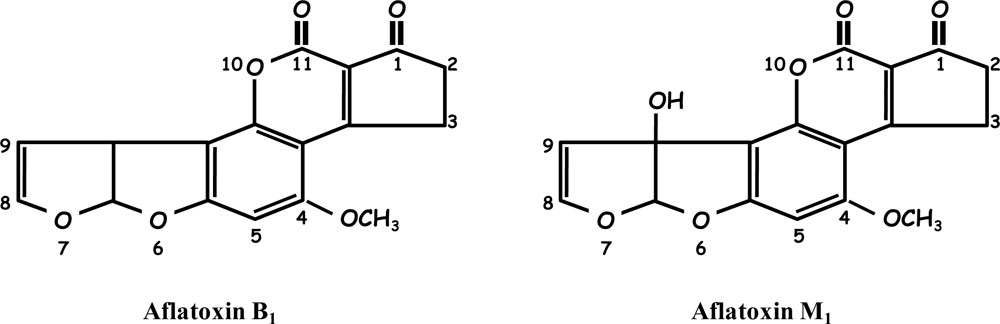
<p>When aflatoxin B<sub>1</sub> (AFB<sub>1</sub>), the most toxic aflatoxin, is ingested by cows through contaminated feed [<xref ref-type="bibr" rid="b2-sensors-10-09439">2</xref>], it is transformed into aflatoxin M<sub>1</sub> (AFM<sub>1</sub>) through enzymatic hydroxylation of AFB<sub>1</sub> at the 9a-position (<xref ref-type="fig" rid="f3-sensors-10-09439">Scheme 1</xref>) and has an approximate overall conversion rate equal to 0.3 to 6.2% [<xref ref-type="bibr" rid="b1-sensors-10-09439">1</xref>,<xref ref-type="bibr" rid="b8-sensors-10-09439">8</xref>,<xref ref-type="bibr" rid="b9-sensors-10-09439">9</xref>]. AFM<sub>1</sub> is secreted in milk by the mammary gland of dairy cows [<xref ref-type="bibr" rid="b9-sensors-10-09439">9</xref>,<xref ref-type="bibr" rid="b10-sensors-10-09439">10</xref>]. Even though it is less toxic than its parent compound, AFM<sub>1</sub> has hepatotoxic and carcinogenic effects [<xref ref-type="bibr" rid="b4-sensors-10-09439">4</xref>,<xref ref-type="bibr" rid="b11-sensors-10-09439">11</xref>]. This toxin, initially classified as a Group 2B agent [<xref ref-type="bibr" rid="b12-sensors-10-09439">12</xref>], has now been reclassified as Group 1 by the International Agency for the Research on Cancer (IARC) [<xref ref-type="bibr" rid="b13-sensors-10-09439">13</xref>].</p>
<p>AFM<sub>1</sub> is relatively stable during the pasteurisation, storage and preparation of various dairy products [<xref ref-type="bibr" rid="b4-sensors-10-09439">4</xref>,<xref ref-type="bibr" rid="b14-sensors-10-09439">14</xref>], and therefore, AFM<sub>1</sub> contamination poses a significant threat to human health, especially to children, who are the major consumers of milk.</p>
<p>The legal regulations concerning AFM<sub>1</sub> levels in milk and dairy products vary from country to country. EU regulations allow a maximum level of 0.05 μg L<sup>−1</sup> (ppb) AFM<sub>1</sub> in milk [<xref ref-type="bibr" rid="b15-sensors-10-09439">15</xref>]. The official methods of sampling and analysis are regulated by the European Commission directive [<xref ref-type="bibr" rid="b16-sensors-10-09439">16</xref>]. High-performance liquid chromatography analysis with fluorometric detection (HPLC-FD) coupled with clean-up treatment by immunoaffinity columns (IC) is the reference method used for the determination of aflatoxin concentrations in milk [<xref ref-type="bibr" rid="b17-sensors-10-09439">17</xref>]. This procedure, which is long and laborious, requires expensive equipment and well-trained personnel. Other methods for AFM<sub>1</sub> concentration determination have also been proposed: thin layer chromatography [<xref ref-type="bibr" rid="b18-sensors-10-09439">18</xref>], fluorescence detection after immunoaffinity clean-up [<xref ref-type="bibr" rid="b19-sensors-10-09439">19</xref>], liquid chromatography coupled to mass spectrometry [<xref ref-type="bibr" rid="b20-sensors-10-09439">20</xref>] and immunoenzymatic assays.</p>
<p>To minimise the occurrence of AFM<sub>1</sub>, it is essential to identify the sources of contamination using rapid, selective and sensitive assays. Immunochemical assays, which are rapid, simple, specific, sensitive and even portable, have become the most common quick methods for the routine analysis of mycotoxins in food and feed materials [<xref ref-type="bibr" rid="b21-sensors-10-09439">21</xref>,<xref ref-type="bibr" rid="b22-sensors-10-09439">22</xref>]. There is a need for more suitable methods, and rapid methods based on the use of biosensors or immunosensors have been proposed in the last decade [<xref ref-type="bibr" rid="b23-sensors-10-09439">23</xref>,<xref ref-type="bibr" rid="b24-sensors-10-09439">24</xref>]. The aim of our work was to develop a method for aflatoxin M<sub>1</sub> (AFM<sub>1</sub>) detection and quantification in milk samples using an electrochemical immunosensor. A screen-printed carbon electrode is chosen as the transducer.</p></sec>
<sec sec-type="materials|methods">
<label>2.</label>
<title>Materials and Methods</title>
<sec>
<label>2.1.</label>
<title>Safety notes</title>
<p>Aflatoxins are highly carcinogenic and should be handled with extreme care. Aflatoxin-contaminated labware should be decontaminated with an aqueous solution of sodium hypochlorite (5%). Aflatoxins are subject to light degradation; therefore, analytical work must be protected from daylight, and aflatoxin standard solutions are stored in amber vials. The use of non-acid-washed glassware for aqueous aflatoxin solutions may result in the loss of aflatoxin, and thus special attention should be paid to new glassware. Prior to use, glassware should be soaked in dilute acid (10% sulphuric acid) for several hours and then rinsed extensively with distilled water to remove all traces of acid [<xref ref-type="bibr" rid="b25-sensors-10-09439">25</xref>].</p></sec>
<sec sec-type="materials">
<label>2.2.</label>
<title>Materials and apparatus</title>
<p>The I’Screen AFLA M<sub>1</sub> milk test kit was from Tecna s.r.l. (Trieste, Italy). Milk samples were obtained from local supermarkets. Aflatoxin M<sub>1</sub> from <italic>Aspergillus flavus</italic>, 5-methylphenazinium methyl sulphate (MPMS) and hydrogen peroxide (H<sub>2</sub>O<sub>2</sub>) were purchased from Sigma-Aldrich (Germany). Aflatoxin M<sub>1</sub> linked to horseradish peroxidase (AFM<sub>1</sub>-HRP conjugate) from the I’Screen AFM<sub>1</sub> milk test kit (Tecna s.r.l, Trieste, Italy) was used. An anti-AFM<sub>1</sub> antibody (1 mg/mL) was purchased from Soft Flow Biotechnology (Hungary). Superparamagnetic nanoparticles (d = 300 nm), Bio-Adembeads Protein G (uniform-sized superparamagnetic nanoparticles conjugated with protein G), were from Ademtech SA (Pessac, France). Adem-Mag SV (single magnet position adapted for both 1.5/2 mL microfuge tubes or glass vials) were from Ademtech S.A. (Pessac, France). All solutions were stored in glass to limit adsorption. A horizontal shaker (IKA, vibrax, VXR) was also used for the coating step.</p>
<p>Chronoamperometric and cyclic voltammetric measurements were performed with an AUTOLAB PGSTAT12 potentiostat interfaced to a PC, and GPES (General Purpose Electrochemical System) software was used to collect and analyse the data (Utrecht, The Netherlands). DropSens 110 screen-printed carbon electrodes (DropSens, S.L., Spain) were used. We used a three-electrode system, with carbon working and counter electrodes and a silver reference electrode.</p></sec>
<sec>
<label>2.3.</label>
<title>Reagents</title>
<p>Phosphate-buffered saline-Tween (PBS-T), 0.05 M, pH 7.4 (Tween-20, 0.05% v/v), and acetate buffer, 0.05 M, pH 5.2, were used.</p></sec>
<sec>
<label>2.4.</label>
<title>Preparation of the AFM<sub>1</sub> standard range and controls</title>
<p>The standard range (0, 0.005, 0.01, 0.025, 0.05, 0.1, and 0.25 ppb) of the AFM<sub>1</sub> ELISA kit was used. To construct this standard range for AFM<sub>1</sub>, aliquots of the 0 ppb standard milk (blank) from the ELISA kit were spiked with the stock AFM<sub>1</sub> solution to obtain final concentrations of 0.3, 0.4 or 0.5 ppb. The controls were prepared in PBS-T or in the 0 ppb blank from the ELISA kit. These controls were spiked with the stock AFM<sub>1</sub> solution to obtain final concentrations of 0.01, 0.025, 0.05 or 0.1 ppb.</p></sec>
<sec>
<label>2.5.</label>
<title>Preparation of milk samples</title>
<p>The sample was defatted by centrifugation for 15 min at 6,000 rpm. After centrifugation, the two phases were separated, the fatty cream was discarded, and the skimmed milk was recovered and used to carry out the experimental work. Aliquots of defatted AFM<sub>1</sub>-free milk samples were spiked with the stock solution of AFM<sub>1</sub> to obtain final concentrations of 0.01, 0.025, 0.05 or 0.1 ppb.</p></sec>
<sec sec-type="methods">
<label>2.6.</label>
<title>Methods and instrumentation</title>
<p>All affinity reactions were performed off-line by mixing the sample with the tracer (AFM<sub>1</sub>-HRP) and antibody until equilibrium was reached.</p></sec>
<sec>
<label>2.7.</label>
<title>Bead preparation</title>
<p>All steps (coating, competition and washing) were carried out with phosphate-buffered saline-Tween (PBS-T), 0.05 M, pH 7.4 (Tween 20 0.05% v/v). Prior to use, the suspended superparamagnetic nanoparticles conjugated with protein G were washed three times with working buffer (26 μL beads + 1374 μL PBS-T) to remove the ProClin 300 which acted as a preservative. The optimised procedure was as follows:
<list list-type="simple">
<list-item>
<p>- <underline>Coating</underline>: the washed beads were collected using the Adem-Mag SV and the antibody solution (2 μg/ml) prepared in working buffer (2.8 μL antibody at 1 mg/mL + 1371 μL PBS-T) was added and allowed to react for 20 minutes. Then, the particles were collected using the Adem-Mag SV, washed three times with working buffer (1,400 μL) and resuspended in 1,400 μL of working buffer.</p></list-item>
<list-item>
<p>- <underline>A 101-μL</underline> aliquot of this dispersion was introduced into a glass vial, and the buffer was removed. Meanwhile, the nanoparticles were collected using the Adem-Mag SV.</p></list-item>
<list-item>
<p>- <underline>Competition:</underline> AFM<sub>1</sub> (91 μL; from the liquid standard range from the ELISA kit or spiked with milk), AFM<sub>1</sub>-HRP solution (91 μL) prepared in working buffer (1:750 v/v) and acetate buffer (252 μL, 100 mM) were allowed to compete for antibody binding sites for 15–20 minutes. During the coating and competition steps, a horizontal shaker (200 rpm) was employed.</p></list-item></list></p></sec>
<sec>
<label>2.8.</label>
<title>Immunosensor protocol</title>
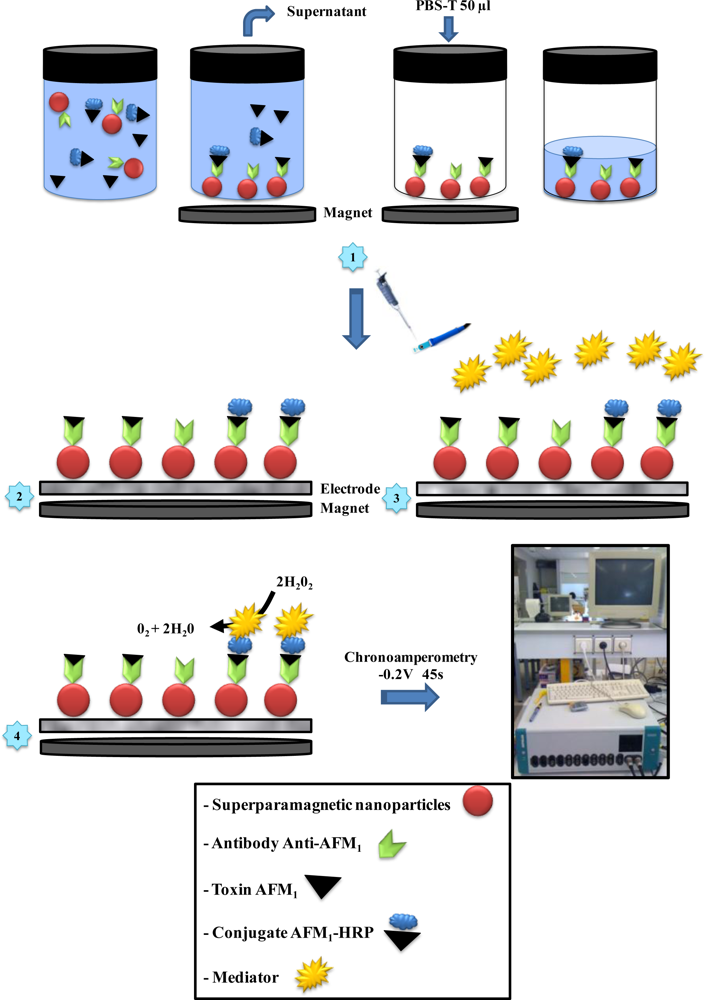
<p>The construction of the immunosensor required the immobilisation of the antibodies on the electrodes via the superparamagnetic nanoparticles. To this end, the screen-printed carbon electrode was placed in a magnet support to collect the superparamagnetic nanoparticles at the electrode surface (<xref ref-type="fig" rid="f1-sensors-10-09439">Figure 1</xref>). Then, after the competition step the particles were collected using the Adem-Mag SV, the supernatant was discarded and 50 μL of PBS-T was added to resuspend the particles (<xref ref-type="fig" rid="f1-sensors-10-09439">Figure 1</xref>, illustration 1), which were then introduced via a Pipetman (Gilson, France) to the surface of the screen-printed carbon electrode. Only the superparamagnetic nanoparticles remain attached to the screen-printed carbon electrode (<xref ref-type="fig" rid="f1-sensors-10-09439">Figure 1</xref>, illustrations 1 and 2).</p>
<p>Next, the electrode surface was washed with 100 μL of the mediator solution (1 mM MPMS; 10 mM H<sub>2</sub>O<sub>2</sub>; 100 mM acetate buffer) to remove all of the toxin or the conjugate that were not attached to the antibody. Before taking the measurements, 100 μL of the mediator solution was introduced to the surface of the electrode (<xref ref-type="fig" rid="f1-sensors-10-09439">Figure 1</xref>, illustrations 3 and 4). The measurements were carried out using a chronoamperometry method at a potential of −0.2 V <italic>vs.</italic> Ag/AgCl for 45 s. All of the experiments were carried out in triplicate in independent assays.</p></sec></sec>
<sec sec-type="results|discussion">
<label>3.</label>
<title>Results and Discussion</title>
<p>This immunoassay method is based on the use of an AFM<sub>1</sub>-horseradish peroxidase conjugate (AFM<sub>1</sub>-HRP) as a probe. HRP catalyses the oxidation of various hydrogen-donating substrates with hydrogen peroxide to produce oxidised substrate and water. MPMS and H<sub>2</sub>O<sub>2</sub> were the substrates used to determine HRP activity.</p>
<p>First, the electrochemical behaviour of both MPMS and MPMS<sub>red</sub> were investigated to optimise the conditions for the determination of HRP activity by amperometry. A cyclic voltammetric investigation of MPMS was carried out using a carbon electrode (DropSens 110). The addition of HRP to a solution containing the two substrates (MPMS and H<sub>2</sub>O<sub>2</sub>) led to the consumption of MPMS and consequently to a decrease in the oxidation current and a increase in the reduction current. A working potential of −0.2 V (−200 mV) <italic>vs.</italic> Ag/AgCl for the measurement of HRP activity was chosen for this study [<xref ref-type="bibr" rid="b26-sensors-10-09439">26</xref>]. At this potential, the current was near zero, and no substrate reduction occurred. These conditions were optimal for enzymatic activity determinations when a small amount of product (MPMS<sub>red</sub>) was measured in the presence of a high concentration of substrate.</p>
<p>Before testing the response of the spiked milk samples, a control assay was performed (<xref ref-type="table" rid="t1-sensors-10-09439">Table 1</xref>) to verify that the AFM<sub>1</sub> concentration could be detected accurately by the sensor and to determine the amount of interference from the milk matrix during the measurement. For this control, PBS-T and the 0 ppb blank from the ELISA kit were spiked with the AFM<sub>1</sub> solution to obtain four different sample concentrations: 0.01, 0.025, 0.05 and 0.1 ppb. Electrochemical measurements of the calibration standard solutions prepared in buffer and in milk were made using the immunosensor (<xref ref-type="table" rid="t1-sensors-10-09439">Table 1</xref>). The response curve for the standard series, the spiked buffer and the spiked milk were identical. Thus, the defatted milk did not affect the measurements.</p>
<p>After this first step, which validated the immunosensor protocol, we performed the second step of our experiment with real milk samples. The milk used for the standard range came from the ELISA kit, as in the first experiment, and experimental milk samples were from commercial sources.</p>
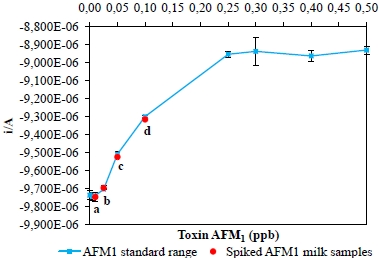
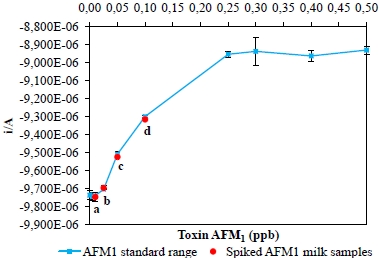
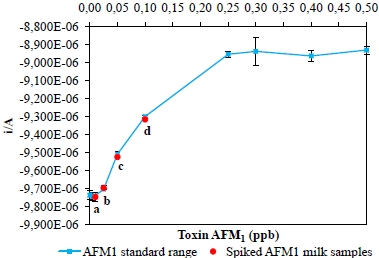
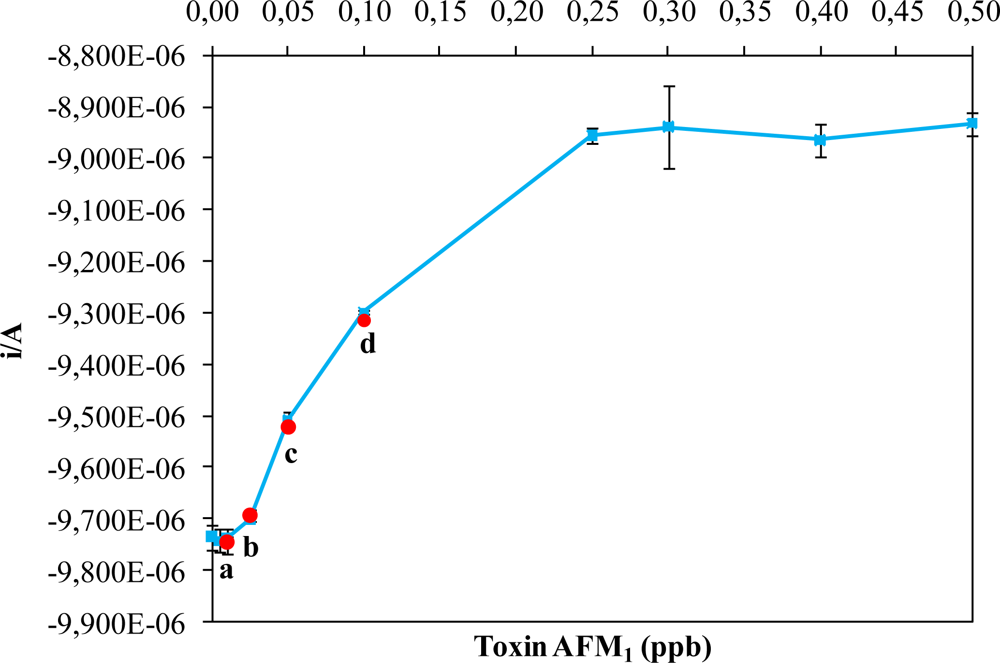
<p>We constructed a standard curve to determine the relationship between the concentration of AFM<sub>1</sub> in the sample and the measured intensity. With this standard curve (<xref ref-type="fig" rid="f2-sensors-10-09439">Figure 2</xref>, blue squares), we also calculated the upper and lower limits of detection of the immunosensor. The detection limits of AFM<sub>1</sub> by the sensor were 0.25 μg L<sup>−1</sup> (ppb) for the upper limit and 0.01 μg L<sup>−1</sup> (ppb) for the lower limit (<xref ref-type="fig" rid="f2-sensors-10-09439">Figure 2</xref> and <xref ref-type="table" rid="t1-sensors-10-09439">Table 1</xref>).</p>
<p>In the second part of the experiment, commercial milk samples contaminated with a known concentration of AFM<sub>1</sub> (0.01, 0.025, 0.05 or 0.1 ppb; references a, b, c, d in <xref ref-type="table" rid="t1-sensors-10-09439">Table 1</xref> and <xref ref-type="fig" rid="f2-sensors-10-09439">Figure 2</xref>) were tested. The intensity responses for each concentration were measured. The values for the spiked milk samples were the similar to those values measured for the standard range (<xref ref-type="table" rid="t1-sensors-10-09439">Table 1</xref> and <xref ref-type="fig" rid="f2-sensors-10-09439">Figure 2</xref>, red circles). The analytical performance of our approach is better for the low concentrations of toxin in comparison with the other. For example, Badea <italic>et al.</italic> [<xref ref-type="bibr" rid="b23-sensors-10-09439">23</xref>] realized an flow injection immunoassay system for aflatoxin M<sub>1</sub> determination and with our approach we have the same limit of detection for the high concentration (0.5 ppb) but we have a higher sensitivity for the lower concentration (0.01 ppb), the same as the system developed by Carlson <italic>et al.</italic> [<xref ref-type="bibr" rid="b24-sensors-10-09439">24</xref>].</p>
<p>Our immunosensor allows the detection and the quantification of AFM<sub>1</sub> over a large range of concentrations. Our immunosensor allows the estimation the real contamination level of spiked milk samples.</p></sec>
<sec sec-type="conclusions">
<label>4.</label>
<title>Conclusions</title>
<p>This immunosensor has a working range that is comparable or better than that found for conventional methods. The detection range of 0.01 to 0.1 ppb obtained for milk samples allows the use of this method in dairy industry laboratories. The use of this immunosensor can ensure that the milk purchased by consumers is harmless. Our system allows the measurement of AFM<sub>1</sub> directly in milk after a single centrifugation step without dilution or pretreatment steps. Another advantage of our method is that the analysis time is reduced and the sample preparation is very simple and fast in comparison with the conventional methods (HPLC and ELISA, for example).</p>
<p>The goal of developing a method using magnetic beads was to optimise this immunosensor by developing a protocol that will allow automation of the sanitary control of foodstuffs. Future work will investigate the development of this immunosensor using flux methods. If the optimisation of a flow-injection system immunoassay for AFM<sub>1</sub> could be realised, then this assay system would be a good method for the rapid screening of raw milk samples for this toxin. This immunosensor is inexpensive, easy to operate and very suitable to automation.</p></sec></body>
<back>
<ack>
<p>The authors are grateful to EraSME <italic>(Food for better human health program)</italic> for financial support for the project Real Time Aflatoxin M<sub>1</sub> Biosensor Development.</p></ack>
<ref-list>
<title>References</title>
<ref id="b1-sensors-10-09439"><label>1.</label><citation citation-type="journal"><person-group person-group-type="author"><name><surname>Creppy</surname><given-names>EE</given-names></name></person-group><article-title>Update of survey, regulation and toxic effects of mycotoxins in Europe</article-title><source>Toxicol. Lett</source><year>2002</year><volume>127</volume><fpage>19</fpage><lpage>28</lpage><pub-id pub-id-type="doi">10.1016/S0378-4274(01)00479-9</pub-id><pub-id pub-id-type="pmid">12052637</pub-id></citation></ref>
<ref id="b2-sensors-10-09439"><label>2.</label><citation citation-type="book"><person-group person-group-type="author"><name><surname>Waliyas</surname><given-names>F</given-names></name><name><surname>Reddy</surname><given-names>SV</given-names></name></person-group><source>Aspergillus Flavus Seed Infection and Aflatoxin Estimation by ELISA and Aflatoxin Management Option in Ground Nut</source><publisher-name>ICRISAP International Crops Research Institue for the Semi-Arid Tropics</publisher-name><publisher-loc>Andhra Pradesh, India</publisher-loc><year>2009</year><fpage>502</fpage><lpage>524</lpage></citation></ref>
<ref id="b3-sensors-10-09439"><label>3.</label><citation citation-type="journal"><person-group person-group-type="author"><name><surname>Ellis</surname><given-names>JWO</given-names></name><name><surname>Smith</surname><given-names>P</given-names></name><name><surname>Simpson</surname><given-names>BK</given-names></name></person-group><article-title>Aflatoxins in food: Occurrence, biosynthesis, effects on organisms, detection and methods of control</article-title><source>Food Sci. Nutr</source><year>1991</year><volume>30</volume><fpage>403</fpage><lpage>439</lpage></citation></ref>
<ref id="b4-sensors-10-09439"><label>4.</label><citation citation-type="journal"><person-group person-group-type="author"><name><surname>Radoi</surname><given-names>A</given-names></name><name><surname>Targa</surname><given-names>M</given-names></name><name><surname>Prieto-Simon</surname><given-names>B</given-names></name><name><surname>Marty</surname><given-names>JL</given-names></name></person-group><article-title>Enzyme-Linked Immunosorbent Assay (ELISA) based on superparamagnetic nanoparticles for aflatoxin M1 detection</article-title><source>Talanta</source><year>2008</year><volume>77</volume><fpage>138</fpage><lpage>143</lpage><pub-id pub-id-type="doi">10.1016/j.talanta.2008.05.048</pub-id><pub-id pub-id-type="pmid">18804611</pub-id></citation></ref>
<ref id="b5-sensors-10-09439"><label>5.</label><citation citation-type="journal"><person-group person-group-type="author"><name><surname>Williams</surname><given-names>JH</given-names></name><name><surname>Phillips</surname><given-names>TD</given-names></name><name><surname>Jolly</surname><given-names>PE</given-names></name><name><surname>Stiles</surname><given-names>JK</given-names></name><name><surname>Jolly</surname><given-names>CM</given-names></name><name><surname>Aggarwal</surname><given-names>A</given-names></name></person-group><article-title>Human aflatoxicosis in developing countries: A review of toxicology, exposure, potential health consequences, and interventions</article-title><source>Amer. J. Clin. Nutr</source><year>2004</year><volume>80</volume><fpage>1106</fpage><lpage>1122</lpage><pub-id pub-id-type="pmid">15531656</pub-id></citation></ref>
<ref id="b6-sensors-10-09439"><label>6.</label><citation citation-type="book"><person-group person-group-type="author"><name><surname>Shane</surname><given-names>SH</given-names></name><name><surname>Groopman</surname><given-names>JD</given-names></name></person-group><source>The Toxicology of Aflatoxins: Human Health, Veterinary and Agricultural Significance</source><publisher-name>Academic Press</publisher-name><publisher-loc>San Diego, CA, USA</publisher-loc><year>1994</year><fpage>513</fpage><lpage>527</lpage></citation></ref>
<ref id="b7-sensors-10-09439"><label>7.</label><citation citation-type="journal"><person-group person-group-type="author"><name><surname>Hansmann</surname><given-names>T</given-names></name><name><surname>Sanson</surname><given-names>B</given-names></name><name><surname>Stojan</surname><given-names>J</given-names></name><name><surname>Weik</surname><given-names>M</given-names></name><name><surname>Marty</surname><given-names>JL</given-names></name><name><surname>Fournier</surname><given-names>D</given-names></name></person-group><article-title>Kinetic insight into the mechanism of cholinesterasterase inhibition by aflatoxin B1 to develop biosensors</article-title><source>Biosens. Bioelectron</source><year>2009</year><volume>24</volume><fpage>2119</fpage><lpage>2124</lpage><pub-id pub-id-type="doi">10.1016/j.bios.2008.11.006</pub-id><pub-id pub-id-type="pmid">19109006</pub-id></citation></ref>
<ref id="b8-sensors-10-09439"><label>8.</label><citation citation-type="journal"><person-group person-group-type="author"><name><surname>Applebaum</surname><given-names>RS</given-names></name><name><surname>Brachett</surname><given-names>RE</given-names></name><name><surname>Wiseman</surname><given-names>DW</given-names></name><name><surname>Marth</surname><given-names>EH</given-names></name></person-group><article-title>Aflatoxin: Toxicity to dairy cattle and occurence in milk and milk products: A review</article-title><source>J. Food Protection</source><year>1982</year><volume>45</volume><fpage>752</fpage></citation></ref>
<ref id="b9-sensors-10-09439"><label>9.</label><citation citation-type="journal"><person-group person-group-type="author"><name><surname>Cathey</surname><given-names>CG</given-names></name><name><surname>Huang</surname><given-names>G</given-names></name><name><surname>Sarr</surname><given-names>AB</given-names></name><name><surname>Clement</surname><given-names>BA</given-names></name><name><surname>Phillips</surname><given-names>TD</given-names></name></person-group><article-title>Development and evaluation of a minicolumn assay for the detection of aflatoxin MI in milk</article-title><source>J. Dairy Sci</source><year>1994</year><volume>77</volume><fpage>1223</fpage><lpage>1231</lpage><pub-id pub-id-type="doi">10.3168/jds.S0022-0302(94)77061-2</pub-id><pub-id pub-id-type="pmid">8046063</pub-id></citation></ref>
<ref id="b10-sensors-10-09439"><label>10.</label><citation citation-type="book"><person-group person-group-type="author"><name><surname>Van Egmond</surname><given-names>HP</given-names></name></person-group><source>Introduction to Mycotoxins in Dairy Products</source><publisher-name>Applied Science Publishers</publisher-name><publisher-loc>London, UK</publisher-loc><year>1989</year><fpage>11</fpage><lpage>55</lpage></citation></ref>
<ref id="b11-sensors-10-09439"><label>11.</label><citation citation-type="book"><person-group person-group-type="author"><collab>International Agency for Research on Cancer</collab></person-group><source>Monograph on the Evaluation of Carcinogenic Risk for Humans</source><publisher-name>IARC</publisher-name><publisher-loc>Lyon, France</publisher-loc><year>1993</year></citation></ref>
<ref id="b12-sensors-10-09439"><label>12.</label><citation citation-type="book"><person-group person-group-type="author"><collab>International Agency for Research on Cancer</collab></person-group><source>Monograph on the Evaluation of Carcinogenic Risk to Human. Some Naturally Occuring Substances: Food Items and Constituent Heterocyclic Aromatic Amines and Mycotoxins</source><publisher-name>IARC</publisher-name><publisher-loc>Lyon, France</publisher-loc><year>1993</year></citation></ref>
<ref id="b13-sensors-10-09439"><label>13.</label><citation citation-type="book"><person-group person-group-type="author"><collab>International Agency for Research on Cancer</collab></person-group><source>Monograph on the Evaluation of Carcinogenic Risk to Humans. Some Traditional Herbal Medicines, Some Mycotoxins, Naphtalene and Styrene</source><publisher-name>IARC</publisher-name><publisher-loc>Lyon, France</publisher-loc><year>2002</year></citation></ref>
<ref id="b14-sensors-10-09439"><label>14.</label><citation citation-type="journal"><person-group person-group-type="author"><name><surname>Stubblefield</surname><given-names>RD</given-names></name><name><surname>Shannon</surname><given-names>GM</given-names></name></person-group><article-title>Aflatoxine M<sub>1</sub>: Analysis in dairy products and distribution in dairy foods made from artificially contaminated milk</article-title><source>J. Assoc. Anal. Chem</source><year>1974</year><volume>57</volume><fpage>847</fpage><lpage>851</lpage></citation></ref>
<ref id="b15-sensors-10-09439"><label>15.</label><citation citation-type="other"><person-group person-group-type="author"><collab>European Commission (EC)</collab></person-group><source>Commission Regulation No 1881/2006</source><day>19</day><month>December</month><year>2006</year></citation></ref>
<ref id="b16-sensors-10-09439"><label>16.</label><citation citation-type="journal"><person-group person-group-type="author"><name><surname>European</surname><given-names>DC</given-names></name></person-group><article-title>Laying down the sampling methods and the methods of analysis for the official levels of ochratoxin A in food stuffs</article-title><source>Offic. J. Eur. Communities L075</source><year>2002</year><volume>45</volume><fpage>38</fpage><lpage>43</lpage></citation></ref>
<ref id="b17-sensors-10-09439"><label>17.</label><citation citation-type="book"><person-group person-group-type="author"><collab>International Standards Organisation (ISO)</collab></person-group><article-title>Milk and Milk Powder. Determination of Aflatoxin M<sub>1</sub> Content</article-title><source>Clean-up by Immunoaffinity Chromatography and Determination by High-Performance Liquid Chromatography</source><publisher-name>ISO</publisher-name><publisher-loc>Geneva, Switzerland</publisher-loc><year>1998</year></citation></ref>
<ref id="b18-sensors-10-09439"><label>18.</label><citation citation-type="journal"><person-group person-group-type="author"><name><surname>Grosso</surname><given-names>F</given-names></name><name><surname>Frenny</surname><given-names>JM</given-names></name><name><surname>Bevis</surname><given-names>S</given-names></name><name><surname>Dragacci</surname><given-names>S</given-names></name></person-group><article-title>Joint IDF-UPAC-IAEA (FAO) interlaboratory validation for determinz alfatoxin M<sub>1</sub> in milk by using immunoaffinity clean-up before thin-layer chromatography</article-title><source>Food Additive Contam</source><year>2004</year><volume>21</volume><fpage>348</fpage><lpage>357</lpage><pub-id pub-id-type="doi">10.1080/02652030410001662048</pub-id></citation></ref>
<ref id="b19-sensors-10-09439"><label>19.</label><citation citation-type="journal"><person-group person-group-type="author"><name><surname>Chiavaro</surname><given-names>E</given-names></name><name><surname>Cavicchioli</surname><given-names>C</given-names></name><name><surname>Berni</surname><given-names>E</given-names></name><name><surname>Spotti</surname><given-names>E</given-names></name></person-group><article-title>Immunoaffinity clean-up and direct fluorescence measurement of aflatoxins B1 and M1 in pig liver: Comparison with high-performance liquid chromatography determination</article-title><source>Food Additive Contam</source><year>2005</year><volume>22</volume><fpage>1154</fpage><lpage>1161</lpage><pub-id pub-id-type="doi">10.1080/02652030500307115</pub-id></citation></ref>
<ref id="b20-sensors-10-09439"><label>20.</label><citation citation-type="journal"><person-group person-group-type="author"><name><surname>Cavaliere</surname><given-names>C</given-names></name><name><surname>Foglia</surname><given-names>P</given-names></name><name><surname>Pastorini</surname><given-names>E</given-names></name><name><surname>Samperi</surname><given-names>R</given-names></name><name><surname>Laganà</surname><given-names>A</given-names></name></person-group><article-title>Liquid chromatography/tandem mass spectrometric confirmatory method for determining aflatoxin M1 in cow milk. Comparison between electrospray and atmospheric pressure photoionization sources</article-title><source>J. Chromat. A</source><year>2006</year><volume>1101</volume><fpage>69</fpage><lpage>78</lpage><pub-id pub-id-type="doi">10.1016/j.chroma.2005.09.060</pub-id></citation></ref>
<ref id="b21-sensors-10-09439"><label>21.</label><citation citation-type="journal"><person-group person-group-type="author"><name><surname>Magliulo</surname><given-names>M</given-names></name><name><surname>Mirasoli</surname><given-names>M</given-names></name><name><surname>Simoni</surname><given-names>P</given-names></name><name><surname>Lelli</surname><given-names>R</given-names></name><name><surname>Portanti</surname><given-names>O</given-names></name><name><surname>Roda</surname><given-names>A</given-names></name></person-group><article-title>Development and validation of an ultrasensitive chemiluminescent enzyme immunoassay for aflatoxin M<sub>1</sub> in milk</article-title><source>J. Agr. Food Chem</source><year>2005</year><volume>53</volume><fpage>3300</fpage><lpage>3305</lpage><pub-id pub-id-type="doi">10.1021/jf0479315</pub-id></citation></ref>
<ref id="b22-sensors-10-09439"><label>22.</label><citation citation-type="journal"><person-group person-group-type="author"><name><surname>Devi</surname><given-names>KT</given-names></name><name><surname>Mayo</surname><given-names>MA</given-names></name><name><surname>Hall</surname><given-names>AJ</given-names></name><name><surname>Craufurd</surname><given-names>PQ</given-names></name><name><surname>Wheeler</surname><given-names>TR</given-names></name><name><surname>Waliyar</surname><given-names>F</given-names></name><name><surname>Subrahmanyam</surname><given-names>A</given-names></name><name><surname>Reddy</surname><given-names>DVR</given-names></name></person-group><article-title>Development and applicationof an indirect competitive enzyme-linked immunoassay for aflatoxin M<sub>1</sub> in milk and milk-based confectionery</article-title><source>J. Agr. Food Chem</source><year>2002</year><volume>50</volume><fpage>933</fpage><lpage>937</lpage><pub-id pub-id-type="doi">10.1021/jf011139b</pub-id></citation></ref>
<ref id="b23-sensors-10-09439"><label>23.</label><citation citation-type="journal"><person-group person-group-type="author"><name><surname>Badea</surname><given-names>M</given-names></name><name><surname>Micheli</surname><given-names>L</given-names></name><name><surname>Messia</surname><given-names>MC</given-names></name><name><surname>Candigliota</surname><given-names>T</given-names></name><name><surname>Marconi</surname><given-names>E</given-names></name><name><surname>Mottram</surname><given-names>T</given-names></name><name><surname>Velasco-Garcia</surname><given-names>M</given-names></name><name><surname>Moscone</surname><given-names>D</given-names></name><name><surname>Palleschi</surname><given-names>G</given-names></name></person-group><article-title>Aflatoxin M1 determination in raw milk using a flow-injection immunoassay system</article-title><source>Anal. Chim. Acta</source><year>2004</year><volume>520</volume><fpage>141</fpage><lpage>148</lpage><pub-id pub-id-type="doi">10.1016/j.aca.2004.05.068</pub-id></citation></ref>
<ref id="b24-sensors-10-09439"><label>24.</label><citation citation-type="journal"><person-group person-group-type="author"><name><surname>Carlson</surname><given-names>MA</given-names></name><name><surname>Bargeron</surname><given-names>CB</given-names></name><name><surname>Benson</surname><given-names>RC</given-names></name><name><surname>Fraser</surname><given-names>AB</given-names></name><name><surname>Phillips</surname><given-names>TE</given-names></name><name><surname>Velky</surname><given-names>JT</given-names></name><name><surname>Groopman</surname><given-names>JD</given-names></name><name><surname>Strickland</surname><given-names>PT</given-names></name><name><surname>Ko</surname><given-names>HW</given-names></name></person-group><article-title>An automated, handheld biosensor for aflatoxin</article-title><source>Biosens. Bioelectron</source><year>2000</year><volume>14</volume><fpage>841</fpage><lpage>848</lpage><pub-id pub-id-type="doi">10.1016/S0956-5663(99)00057-3</pub-id><pub-id pub-id-type="pmid">10945458</pub-id></citation></ref>
<ref id="b25-sensors-10-09439"><label>25.</label><citation citation-type="journal"><person-group person-group-type="author"><name><surname>Dragacci</surname><given-names>S</given-names></name><name><surname>Grosso</surname><given-names>F</given-names></name></person-group><article-title>Immunoaffinity column cleanup with liquid chromatography for determination of aflatoxinm1 in liquid milk: Collaborative study</article-title><source>J. AOAC Int</source><year>2001</year><volume>84</volume><fpage>437</fpage><lpage>443</lpage><pub-id pub-id-type="pmid">11324608</pub-id></citation></ref>
<ref id="b26-sensors-10-09439"><label>26.</label><citation citation-type="journal"><person-group person-group-type="author"><name><surname>Campàs</surname><given-names>M</given-names></name><name><surname>Marty</surname><given-names>JL</given-names></name></person-group><article-title>Highly sensitive amperometric immunosensors for microcystin detection in algae</article-title><source>Biosen. Bioelectron</source><year>2007</year><volume>22</volume><fpage>1034</fpage><lpage>1040</lpage><pub-id pub-id-type="doi">10.1016/j.bios.2006.04.025</pub-id></citation></ref></ref-list>
<sec sec-type="display-objects">
<title>Figures and Table</title>
<fig id="f1-sensors-10-09439" position="float">
<label>Figure 1.</label>
<caption>
<p>Immunosensor protocol and principle of the electrochemical immunosensor for AFM<sub>1</sub> detection.</p></caption>
<graphic xlink:href="sensors-10-09439f1.gif"/></fig>
<fig id="f2-sensors-10-09439" position="float">
<label>Figure 2.</label>
<caption>
<p>Curve of the AFM<sub>1</sub> standard range (blue squares) and the spiked AFM<sub>1</sub> milk samples a, b, c and d (red circles). Vertical bars represent standard errors (not shown when smaller than the symbols).</p></caption>
<graphic xlink:href="sensors-10-09439f2.gif"/></fig>
<fig id="f3-sensors-10-09439" position="float">
<label>Scheme 1.</label>
<caption>
<p>The structures of aflatoxin B<sub>1</sub> and aflatoxin M<sub>1</sub>. The only difference between the two compounds is the presence of the hydroxyl group at the 9a position of AFM<sub>1</sub>. Both molecules have the 8,9-double bond, which is the putative active site of the molecule [<xref ref-type="bibr" rid="b9-sensors-10-09439">9</xref>].</p></caption>
<graphic xlink:href="sensors-10-09439f3.gif"/></fig>
<table-wrap id="t1-sensors-10-09439" position="float">
<label>Table 1.</label>
<caption>
<p>Sensor calibration using standard solutions of AFM<sub>1</sub> and results obtained using control samples and spiked milk.</p></caption>
<table frame="box" rules="cols">
<thead>
<tr>
<th align="center" valign="middle" rowspan="2"><bold>AFM<sub>1</sub> standard range (ppb)</bold></th>
<th colspan="2" align="center" valign="middle" content-type="background-color:#D8D8D8"><bold>Biosensor response (A)</bold>
<hr/></th>
<th colspan="4" align="center" valign="middle"><bold>Control assays response (A)</bold>
<hr/></th>
<th colspan="3" align="center" valign="middle" content-type="background-color:#D8D8D8"><bold>Spiked milk samples response (A)</bold>
<hr/></th></tr>
<tr>
<th align="center" valign="middle" content-type="background-color:#D8D8D8"><bold>Mean values</bold></th>
<th align="center" valign="middle" content-type="background-color:#D8D8D8"><bold>Standard deviation</bold></th>
<th align="center" valign="middle"><bold>Spiked PBS-T</bold></th>
<th align="center" valign="middle"><bold>Standard deviation</bold></th>
<th align="center" valign="middle"><bold>Spiked 0 ppb ELISA Kit Blank</bold></th>
<th align="center" valign="middle"><bold>Standard deviation</bold></th>
<th align="center" valign="middle" content-type="background-color:#D8D8D8"><bold>Mean values</bold></th>
<th align="center" valign="middle" content-type="background-color:#D8D8D8"><bold>Standard deviation</bold></th>
<th align="center" valign="middle" content-type="background-color:#D8D8D8"><bold>References</bold></th></tr>
<tr>
<th colspan="10" align="left" valign="bottom">
<hr/></th></tr></thead>
<tbody>
<tr>
<td align="center" valign="top">0</td>
<td align="center" valign="top" content-type="background-color:#D8D8D8">−9.735E-06</td>
<td align="center" valign="top" content-type="background-color:#D8D8D8">2.46E-08</td>
<td align="center" valign="top"/>
<td align="center" valign="top"/></tr>
<tr>
<td align="center" valign="top">0.005</td>
<td align="center" valign="top" content-type="background-color:#D8D8D8">−9.743E-06</td>
<td align="center" valign="top" content-type="background-color:#D8D8D8">2.35E-08</td>
<td align="center" valign="top"/>
<td align="center" valign="top"/></tr>
<tr>
<td align="center" valign="top">0.01</td>
<td align="center" valign="top" content-type="background-color:#D8D8D8">−9.738E-06</td>
<td align="center" valign="top" content-type="background-color:#D8D8D8">4.93E-09</td>
<td align="center" valign="top">−9.74E-06</td>
<td align="center" valign="top">8.60E-08</td>
<td align="center" valign="top">−9.73E-06</td>
<td align="center" valign="top">8.35E-08</td>
<td align="center" valign="top" content-type="background-color:#D8D8D8">−9.745E-06</td>
<td align="center" valign="top" content-type="background-color:#D8D8D8">1.617E-08</td>
<td align="center" valign="top" content-type="background-color:#D8D8D8"><xref ref-type="table-fn" rid="tfn2-sensors-10-09439">a</xref></td></tr>
<tr>
<td align="center" valign="top">0.025</td>
<td align="center" valign="top" content-type="background-color:#D8D8D8">−9.702E-06</td>
<td align="center" valign="top" content-type="background-color:#D8D8D8">3.06E-09</td>
<td align="center" valign="top">−9.70E-06</td>
<td align="center" valign="top">4.00E-08</td>
<td align="center" valign="top">−9.69E-06</td>
<td align="center" valign="top">3.91E-08</td>
<td align="center" valign="top" content-type="background-color:#D8D8D8">−9.694E-06</td>
<td align="center" valign="top" content-type="background-color:#D8D8D8">1.528E-09</td>
<td align="center" valign="top" content-type="background-color:#D8D8D8"><xref ref-type="table-fn" rid="tfn3-sensors-10-09439">b</xref></td></tr>
<tr>
<td align="center" valign="top">0.05</td>
<td align="center" valign="top" content-type="background-color:#D8D8D8">−9.508E-06</td>
<td align="center" valign="top" content-type="background-color:#D8D8D8">1.48E-08</td>
<td align="center" valign="top">−9.58E-06</td>
<td align="center" valign="top">2.98E-08</td>
<td align="center" valign="top">−9.56E-06</td>
<td align="center" valign="top">4.68E-08</td>
<td align="center" valign="top" content-type="background-color:#D8D8D8">−9.523E-06</td>
<td align="center" valign="top" content-type="background-color:#D8D8D8">2.442E-08</td>
<td align="center" valign="top" content-type="background-color:#D8D8D8"><xref ref-type="table-fn" rid="tfn4-sensors-10-09439">c</xref></td></tr>
<tr>
<td align="center" valign="top">0.1</td>
<td align="center" valign="top" content-type="background-color:#D8D8D8">−9.300E-06</td>
<td align="center" valign="top" content-type="background-color:#D8D8D8">3.61E-09</td>
<td align="center" valign="top">−9.30E-06</td>
<td align="center" valign="top">1.89E-08</td>
<td align="center" valign="top">−9.32E-06</td>
<td align="center" valign="top">6.64E-08</td>
<td align="center" valign="top" content-type="background-color:#D8D8D8">−9.316E-06</td>
<td align="center" valign="top" content-type="background-color:#D8D8D8">1.106E-08</td>
<td align="center" valign="top" content-type="background-color:#D8D8D8"><xref ref-type="table-fn" rid="tfn5-sensors-10-09439">d</xref></td></tr>
<tr>
<td align="center" valign="top">0.25</td>
<td align="center" valign="top" content-type="background-color:#D8D8D8">−8.956E-06</td>
<td align="center" valign="top" content-type="background-color:#D8D8D8">1.53E-08</td>
<td align="center" valign="top"/>
<td align="center" valign="top"/></tr>
<tr>
<td align="center" valign="top">0.3</td>
<td align="center" valign="top" content-type="background-color:#D8D8D8">−8.939E-06</td>
<td align="center" valign="top" content-type="background-color:#D8D8D8">7.90E-08</td>
<td align="center" valign="top"/>
<td align="center" valign="top"/></tr>
<tr>
<td align="center" valign="top">0.4</td>
<td align="center" valign="top" content-type="background-color:#D8D8D8">−8.965E-06</td>
<td align="center" valign="top" content-type="background-color:#D8D8D8">3.11E-08</td>
<td align="center" valign="top"/>
<td align="center" valign="top"/></tr>
<tr>
<td align="center" valign="top">0.5</td>
<td align="center" valign="top" content-type="background-color:#D8D8D8">−8.932E-06</td>
<td align="center" valign="top" content-type="background-color:#D8D8D8">2.28E-08</td>
<td align="center" valign="top"/>
<td align="center" valign="top"/></tr></tbody></table>
<table-wrap-foot><fn id="tfn1-sensors-10-09439">
<p><italic>References</italic>:</p></fn><fn id="tfn2-sensors-10-09439">
<label>(a)</label>
<p>0.01 ppb;</p></fn><fn id="tfn3-sensors-10-09439">
<label>(b)</label>
<p>0.025 ppb;</p></fn><fn id="tfn4-sensors-10-09439">
<label>(c)</label>
<p>0.05 ppb;</p></fn><fn id="tfn5-sensors-10-09439">
<label>(d)</label>
<p>0.1 ppb</p></fn></table-wrap-foot></table-wrap></sec></back></article>