<?xml version="1.0" encoding="UTF-8"?>
<!DOCTYPE article PUBLIC "-//NLM//DTD Journal Publishing DTD v2.3 20070202//EN" "journalpublishing.dtd">
<article xmlns:xlink="http://www.w3.org/1999/xlink" xml:lang="en" article-type="research-article">
<front>
<journal-meta>
<journal-id journal-id-type="publisher-id">ijms</journal-id>
<journal-title>International Journal of Molecular Sciences</journal-title>
<abbrev-journal-title>Int. J. Mol. Sci.</abbrev-journal-title>
<issn pub-type="epub">1422-0067</issn>
<publisher>
<publisher-name>Molecular Diversity Preservation International (MDPI)</publisher-name></publisher></journal-meta>
<article-meta>
<article-id pub-id-type="publisher-id">ijms-09-01000</article-id>
<article-id pub-id-type="doi">10.3390/ijms9061000</article-id>
<article-categories>
<subj-group>
<subject>Article</subject></subj-group></article-categories>
<title-group>
<article-title>Synthesis and Characterization of Some New Tetraaldehyde and Tetraketone Derivatives and X-ray Structure of 1,1′-(4,4′-(2-(1,3-bis(4-Acetylphenoxy)propan-2-ylidene)propane-1,3-di-yl)bis(oxy)bis(4,1-phenylene))diethanone</article-title></title-group>
<contrib-group>
<contrib contrib-type="author">
<name><surname>Er</surname><given-names>Mustafa</given-names></name><xref ref-type="aff" rid="af1-ijms-09-01000">1</xref></contrib>
<contrib contrib-type="author">
<name><surname>Ustabaş</surname><given-names>Reşat</given-names></name><xref ref-type="aff" rid="af2-ijms-09-01000">2</xref><xref ref-type="corresp" rid="c1-ijms-09-01000">*</xref></contrib>
<contrib contrib-type="author">
<name><surname>Çoruh</surname><given-names>Ufuk</given-names></name><xref ref-type="aff" rid="af3-ijms-09-01000">3</xref></contrib>
<contrib contrib-type="author">
<name><surname>Sancak</surname><given-names>Kemal</given-names></name><xref ref-type="aff" rid="af1-ijms-09-01000">1</xref></contrib>
<contrib contrib-type="author">
<name><surname>Vázquez-López</surname><given-names>Ezequiel</given-names></name><xref ref-type="aff" rid="af4-ijms-09-01000">4</xref></contrib></contrib-group>
<aff id="af1-ijms-09-01000">
<label>1</label>Department of Chemistry Faculty of Arts and Sciences Karadeniz Teknik University, 61080-Trabzon, Turkey; E-mails:
<email>muser@ktu.edu.tr</email>;
<email>ksancak@ktu.edu.tr</email></aff>
<aff id="af2-ijms-09-01000">
<label>2</label>Department of Middle Education, Educational Faculty, Ondokuz Mayis University 55200-Atakum-Samsun, Turkey</aff>
<aff id="af3-ijms-09-01000">
<label>3</label>Department of Computer Education and Instructional Technology, Educational Faculty, Ondokuz Mayis University 55200-Atakum-Samsun, Turkey; E-mail:
<email>ucoruh@omu.edu.tr</email></aff>
<aff id="af4-ijms-09-01000">
<label>4</label>Departamento de Química Inorgánica, Facultade de Ciencias-Química, Universidade de Vigo, 36200-Vigo, Galicia, Spain; E-mail:
<email>ezequiel@uvigo.es</email></aff>
<author-notes>
<corresp id="c1-ijms-09-01000">
<label>*</label>Author to whom correspondence should be addressed. E-mail:
<email>rustabas@omu.edu.tr</email></corresp></author-notes>
<pub-date pub-type="epub">
<day>13</day>
<month>6</month>
<year>2008</year></pub-date>
<pub-date pub-type="collection">
<month>6</month>
<year>2008</year></pub-date>
<volume>9</volume>
<issue>6</issue>
<fpage>1000</fpage>
<lpage>1007</lpage>
<history>
<date date-type="received">
<day>26</day>
<month>11</month>
<year>2007</year></date>
<date date-type="rev-recd">
<day>15</day>
<month>4</month>
<year>2008</year></date>
<date date-type="accepted">
<day>18</day>
<month>4</month>
<year>2008</year></date></history>
<copyright-statement/>
<copyright-year>2008</copyright-year>
<license license-type="open-access" xlink:href="http://creativecommons.org/licenses/by/3.0">
<p>This article is an open-access article distributed under the terms and conditions of the Creative Commons Attribution license (http://creativecommons.org/licenses/by/3.0/).</p></license>
<abstract>
<p>Tetraketone and tetraaldehyde derivatives <bold>2a–d</bold> were synthesized via the reaction of ethene-1,1,2,2,-tetra-yl-tetramethylene tetrabromide (<bold>1</bold>) with hydroxyketone and aldehyde derivatives. The molecular structures were identifed by IR, <sup>1</sup>H-NMR, <sup>13</sup>C-NMR and MS analysis. The crystal structure of the title compound <bold>2a</bold>, C<sub>38</sub>H<sub>36</sub>O<sub>8</sub>, is reported. Its crystal data are: monoclinic, space group P 2(1)/n with cell dimensions of a=9.0395(12) Å, b=12.6114(17) Å, c=13.8166(18) Å, β=95.875(3), V=1566.8(4) Å<sup>3</sup>, F.W.=620.67, ρ<sub>calc</sub>=1.316 gcm<sup>3</sup> for Z=2, μ=0.092 mm<sup>−1</sup></p></abstract>
<kwd-group>
<kwd>1,3-bis(4-Acetylphenoxy)propan-2-ylidenepropane</kwd>
<kwd>1,3-di-ylbis(oxy)bis(4,1-phenylene))diethanone</kwd>
<kwd>crystal structure</kwd>
<kwd>x-ray</kwd></kwd-group></article-meta></front>
<body>
<sec sec-type="intro">
<title>Introduction</title>
<p>Acetophenone (AP, phenylmethylketone or hypnone) is used in consumer fragrances and as an industrial solvent [<xref ref-type="bibr" rid="b1-ijms-09-01000">1</xref>]. Acetophenone and its derivatives are important compounds for obtaining biologically active compounds. In general, acetophenones are an important constituent of effective therapeutics against mycobacteria [<xref ref-type="bibr" rid="b2-ijms-09-01000">2</xref>]. Acetophenones are used to obtain benzofuran, and its ketoxime derivatives show antifungal activities [<xref ref-type="bibr" rid="b3-ijms-09-01000">3</xref>]. In adddition, acetophenones which contain halogens are used to synthesize disubstituted 1,3-thiazole compounds that have selective human adenosine A3 receptor antagonist [<xref ref-type="bibr" rid="b4-ijms-09-01000">4</xref>] as well as antifungal and antibacterial activities. Some acetophenone derivatives have antimicrobial activity against gram-positive bacteria and fungi [<xref ref-type="bibr" rid="b5-ijms-09-01000">5</xref>] while others are used as herbicides [<xref ref-type="bibr" rid="b6-ijms-09-01000">6</xref>]. Certain acetophenones carrying a hydroxyl group at C-2 have antimutagenic activity in <italic>Salmonella typhimurium</italic> [<xref ref-type="bibr" rid="b7-ijms-09-01000">7</xref>]. Many acetophenones are found as natural products in plants [<xref ref-type="bibr" rid="b8-ijms-09-01000">8</xref>] and fungi [<xref ref-type="bibr" rid="b9-ijms-09-01000">9</xref>]. The oral administration of Paeonol (2-hydroxy-4-methoxy acetophenone) to rats is followed by rapid excretition in the urine as its sulphated derivative [<xref ref-type="bibr" rid="b10-ijms-09-01000">10</xref>]. Some acetophenone semicarbazone and acetophenone oxime derivatives are used to obtain biologically active industrial polimers [<xref ref-type="bibr" rid="b11-ijms-09-01000">11</xref>]. <italic>o</italic>-Hydroxyacetophenone oxime is an important analytical reagent for the gravimetric and colorimetric estimation of transition metals [<xref ref-type="bibr" rid="b12-ijms-09-01000">12</xref>]. Acetophenone derivatives are very interesting model compounds as foreign substrates for biotransformation, because an enantiomer may be formed, which can be determined easily. These compounds have been effectively used as a building blocks for the asymmetric synthesis of drugs [<xref ref-type="bibr" rid="b13-ijms-09-01000">13</xref>].</p>
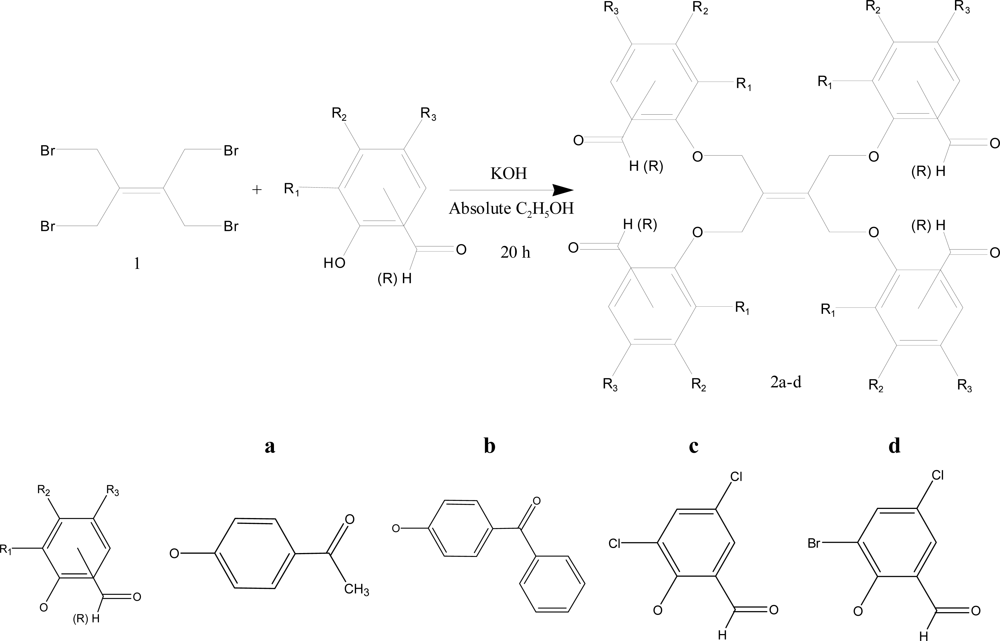
<p>In a part of our study, we aimed to enhance the selectivity of these macromolecular compounds and the stability of the Schiff base formed with both various amines and heterocyclic moiety. So, we prepared macromolecular compounds having aldehyde and ketone functions connection by flexible bridge. In this study, tetraaldehyde and tetraketone derivatives <bold>2a–d</bold> were obtained from the reaction with ethene-1,1,2,2-tetra-yl-tetra methylene tetra bromide (<bold>1</bold>) with hydroxyaldehydes and hydroxyketones.</p></sec>
<sec>
<title>2. Experimental</title>
<sec sec-type="materials">
<title>2.1. Materials</title>
<p>Melting points were determined on a Gallenkamp melting point apparatus and are uncorrected. <sup>1</sup>H-NMR and <sup>13</sup>C-NMR spectra were recorded on a Varian-Mercury 200 MHz spectrometer. The IR spectra were measured as potassium bromide pellets using a Perkin-Elmer 1600 series FTIR spectrometer. The MS spectra were determined on a Micromass Quatro LC/ULTIMA LC-MS spectrometer. Elemental analyses was carried out on a C,H,N-O rapid elemental analyzer Hewlett-Packard 185 for C, H and N and results are with in 0.4 % of the theoretical values. All the chemicals were obtained from Fluka Chemie AG Buchs (Switzerland). Compound <bold>1</bold> was synthesized using the published methods [<xref ref-type="bibr" rid="b14-ijms-09-01000">14</xref>].</p></sec>
<sec>
<title>2.2. Synthesis of 1,1′-(4,4′-(2-(1,3-bis(4-acetylphenoxy)propan-2-ylidene)propane-1,3-di-yl)bis(oxy)bis (4,1-phenylene))diethanone (<bold><italic>2a</italic></bold>)</title>
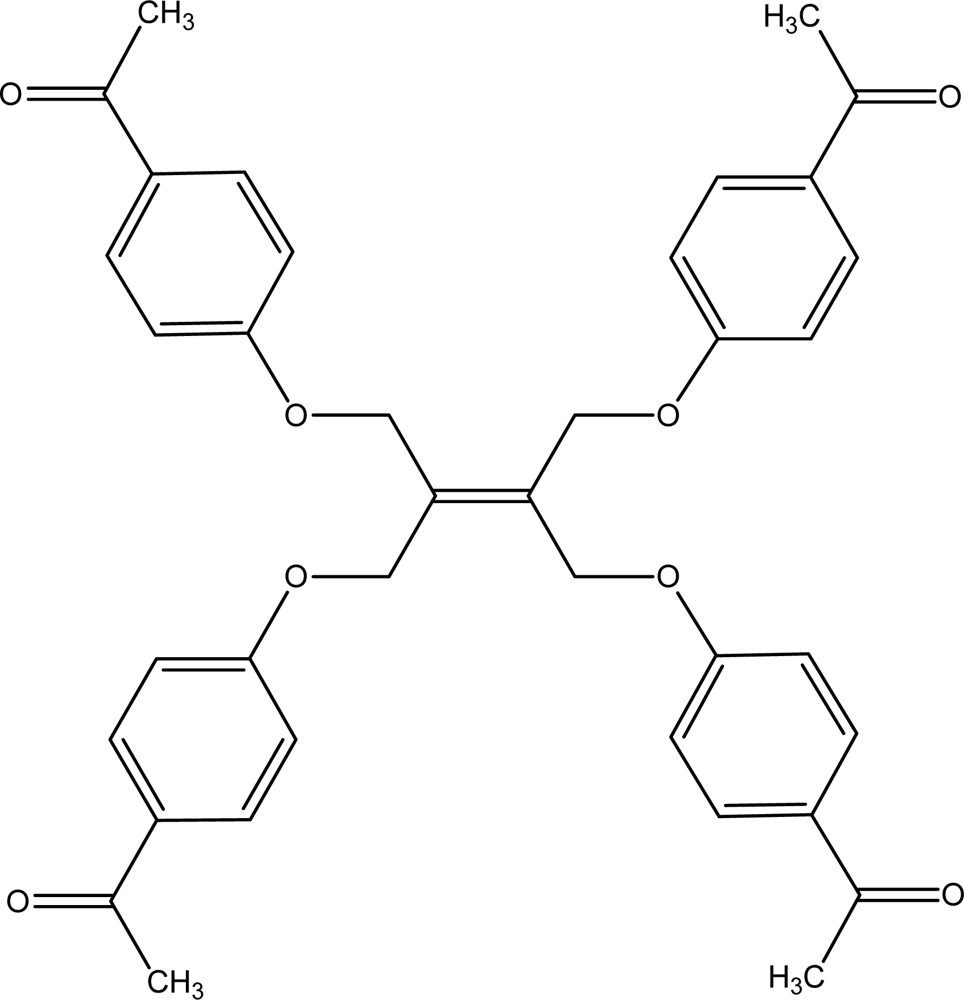
<p>4-Hydroxyacetophenone (0.04 mol) and potassium hydroxide (0.04 mol) were refluxed in absolute ethanol for 2 hours. 1,1,2,2-Tetra-yl-tetramethylene tetrabromide (0.01) was added to the reaction mixture which was refluxed for 20 hours. The mixture was filtered and the solvent was evaporated. The solid residue was recrystallized from chloroform-acetone (1:1) to give compound <bold>2a</bold> (yield 73 %; m.p. 440–441°K). Analysis (% Calculated/found) for C<sub>38</sub>H<sub>36</sub>O<sub>8</sub> (Mw 620.7) C: 73.53/73.44, H: 5.85/5.82; IR (KBr) (ν, cm<sup>−1</sup>), 3045 (Ar-CH), 2938 (-CH), 1674 (C=O); <sup>1</sup>H-NMR (DMSO-d<sub>6</sub>) δ (ppm) 2.51 (s, 12H, CH<sub>3</sub>), 4.99 (s, 8H, O-CH<sub>2</sub>), 7.04–7.92 (dd, 16H, J= 8.0 Hz, AA′XX′, Ar-H); <sup>13</sup>C-NMR (DMSO-d<sub>6</sub>) δ (ppm) 26.35 (CH<sub>3</sub>), 64.90 (O-CH<sub>2</sub>), Ar-C: [114.50 (CH), 130.07 (C), 100.29 (CH), 161.99 (C)], 135.05 (C=C), 196.24 (C=O); MS: m/z 621.34 (M+1)<sup>+1</sup>.</p></sec>
<sec>
<title>2.3. Synthesis of (4,4′-(2-(1,3-bis(4-benzoylphenoxy)propan-2-ylidene)propane-1,3-diyl)bis(oxy)bis (4,1-phenylene))bis(phenylmethanone) (<bold><italic>2b</italic></bold>)</title>
<p>4-Hydroxybenzophenone (0.04 mol) and potassium hydroxide (0.04 mol) refluxed in absolute ethanol for 2 hours. 1,1,2,2-Tetra-yl-tetramethylene tetrabromide (0.01) was added to the reaction mixture, which was then refluxed for 20 hours. The mixture was filtered and the solvent was evaporated. The solid residue was recrystallized from DMF-ethyl alcohol (2:1) to give compound <bold>2b</bold> (yield 64 %; m.p. 467–468°K). Analysis (% Calculated/found) for C<sub>58</sub>H<sub>44</sub>O<sub>8</sub> (Mw 869.0) C: 80.17/80.26, H: 5.10/5.14; IR (KBr) (ν, cm<sup>−1</sup>), 3065 (Ar-CH), 2970 (-CH), 1652 (C=O); <sup>1</sup>H-NMR (DMSO-d<sub>6</sub>) δ (ppm) 5.07 (s, 8H, O-CH<sub>2</sub>), 7.13–7.57 (dd, 16H, J= 8.2 Hz, AA′XX′, Ar-H), 7.62–7.65 (m, 8H, Ar-H), 7.69–7.71 (m, 8H, Ar-H), 7.75 (m, 4H, Ar-H); <sup>13</sup>C-NMR (DMSO-d<sub>6</sub>) δ (ppm) 64.96 (O-CH<sub>2</sub>), Ar-C: [114.57 (CH), 128.34 (CH), 129.17 (CH), 129.58 (C), 131.98 (CH), 132.06 (CH), 137.55 (C), 161.87 (C)], 135.12 (C=C), 194.30 (C=O); MS: m/z 869.31 (M+1)<sup>+1</sup>.</p></sec>
<sec>
<title>2.4. Synthesis of 2,2′-(2-(1,3-bis(2,4-dichloro-6-formylphenoxy)propan-2-ylidene)propane-1,3-diyl)bis (oxy)bis(3,5-dichlorobenzaldehyde) (<bold><italic>2c</italic></bold>)</title>
<p>3,5-Dichlorosalicylaldehyde (0.04 mol) and potassium hydroxide (0.04 mol) were refluxed in absolute ethanol for 2 hours. 1,1,2,2-Tetra-yl-tetramethylene tetrabromide (0.01) was added to the reaction mixture, which was refluxed for 20 hours. The mixture was filtered and the solvent was evoporated. The solid residue was recrystallized from ethyl alcohol to give compound <bold>2c</bold> (yield 63 %; m.p. 478–479°K). Analysis (% Calculated/found) for C<sub>34</sub>H<sub>20</sub>C<sub>l8</sub>O<sub>8</sub> (Mw 840.1) C: 48.61/48.53, H: 2.40/2.38; IR (KBr) (ν, cm<sup>−1</sup>), 3067 (Ar-CH), 2972 (-CH), 2883–2894 (CHO), 1696 (C=O); <sup>1</sup>H-NMR (DMSO-d<sub>6</sub>) δ (ppm) 5.07 (s, 8H, O-CH<sub>2</sub>), 7.63–7.64 (d, 4H, Ar-H), 7.98–7.99 (d, 4H, Ar-H), 10.05 (s, 4H, -CHO); 13C-NMR (DMSO-d<sub>6</sub>) δ (ppm) 55.99 (O-CH<sub>2</sub>), Ar-C: [127.3157 (C), 128.67 (C), 129.61 (C), 131.05 (CH), 135.21 (CH), 154.92 (C)], 135.05 (C=C), 188.17 (C=O); MS: m/z 882.50 (M+Na+H<sub>2</sub>O)<sup>+1</sup>.</p></sec>
<sec>
<title>2.5. Synthesis of 2,2′-(2-(1,3-bis(2-bromo-4-chloro-6-formylphenoxy)propan-2-ylidene)propane-1,3-diyl)bis (oxy)bis(3-chloro-5-bromo benzaldehyde) (<bold><italic>2d</italic></bold>)</title>
<p>3-Chloro-5-bromosalicylaldehyde (0.04 mol) and potassium hydroxide (0.04 mol) were refluxed in absolute ethanol for 2 hours. 1,1,2,2-Tetra-yl-tetramethylene tetrabromide (0.01) was added to the reaction mixture, which was refluxed for 20 hours. The mixture was filtered and the solvent was evaporated. The solid residue was recrystallized from DMF-ethyl alcohol (1:1) to give compound <bold>2d</bold> (yield 54 %; m.p. 485–486 °K). Analysis (% Calculated/found) for C<sub>34</sub>H<sub>20</sub>Br<sub>4</sub>Cl<sub>4</sub>O<sub>8</sub> (Mw 1017.9) C: 40.12/40.17, H: 1.98/2.01; IR (KBr) (ν, cm<sup>−1</sup>), 3075 (Ar-CH), 2977 (-CH), 2796–2884 (CHO), 1698 (C=O); <sup>1</sup>H-NMR (DMSO-d<sub>6</sub>) δ (ppm) 5.01 (s, 8H, O-CH<sub>2</sub>), 7.44 (s, 4H, Ar-H), 7.83 (s, 4H, Ar-H), 10.18 (s, 4H, -CHO); <sup>13</sup>C-NMR (DMSO-d<sub>6</sub>) δ (ppm) 55.93 (O-CH<sub>2</sub>), Ar-C: [117.93 (C), 126.82 (C), 129.06 (C), 132.67 (CH), 135.63 (CH), 152.12 (C)], 135.45 (C=C), 188.26 (C=O).</p></sec>
<sec>
<title>2.6. Crystallographic structure determination compound <bold><italic>2a</italic></bold></title>
<p>A summary of the key crystallographic information is given in <xref ref-type="table" rid="t1-ijms-09-01000">Table 1</xref>. The data was collected on a smart [<xref ref-type="bibr" rid="b15-ijms-09-01000">15</xref>] CCD diffractomer using graphite-monochromated Mo Kα radiation at room temperature. The collected data were reduced by using the program SAINT [<xref ref-type="bibr" rid="b15-ijms-09-01000">15</xref>] and empirical absorption correction was carried out by using the SADABS [<xref ref-type="bibr" rid="b16-ijms-09-01000">16</xref>] program. The structure was solved by direct methods [<xref ref-type="bibr" rid="b17-ijms-09-01000">17</xref>] as implemented in the SHELXTL system of computer programmes and refined to convergence by full matrix least-squares methods. H atoms were located geometrically and then refined isotropically with fixed displacement parameters. Atomic scattering factors used were those from the International Table for x-ray crystallography [<xref ref-type="bibr" rid="b18-ijms-09-01000">18</xref>]. The crystal structure has been deposited at the Cambridge Crystallographic Data Center with the deposition number CCDC 686161.</p></sec></sec>
<sec sec-type="results|discussion">
<title>3. Results and Discussion</title>
<p>The reaction of ethene-1,1,2,2-tetra-yl-tetramethylene tetra- bromide (<bold>1</bold>) in absolute ethanol media with the corresponding potassium salts of phenolic ketones and aldehydes (obtained by potassium hydroxide solution) gave the corresponding tetraketones <bold>2a,b</bold> or tetraaldehydes <bold>2c,d</bold> in a good yield (<xref ref-type="fig" rid="f2-ijms-09-01000">Scheme 1</xref>). The substitution reactions were highly selective for the tetrasubstituted products <bold>2</bold>, as independent of the molar ratios of ketophenol or aldehydophenol. Mono-, di- or trisubstituted products could not be obtained in this reaction. In the IR spectra of compounds <bold>2a–d</bold>, one sharp absorption band was seen at 1652–1698 cm<sup>−1</sup> which is assigned to the carbonyl functions. The CHO Fermi doublet stretching frequency was observed at 2796–2894 cm<sup>−1</sup> in the IR spectra of compounds <bold>2c,d.</bold></p>
<p>In the <sup>1</sup>H-NMR spectra of compounds <bold>2a–d</bold> the signals of the (-O-CH<sub>2</sub>) methylene groups integrating for eight protons were seen between 4.99–5.07 ppm. Aldehyde protons (CHO) of compounds <bold>2c,d</bold> were observed around 10.05–10.18 ppm, integrating for four protons. In the <sup>13</sup>C-NMR of compounds 2a–d, OCH<sub>2</sub> group was observed at 56–65 ppm. In addition, C=O and C=C functions of compounds <bold>2a–d</bold> appeared at 188–196 ppm and 134–135 ppm, respectively. <sup>1</sup>H-NMR and <sup>13</sup>C-NMR spectral data of compounds <bold>2a–d</bold> are presented in the Experimental section in this study.</p>
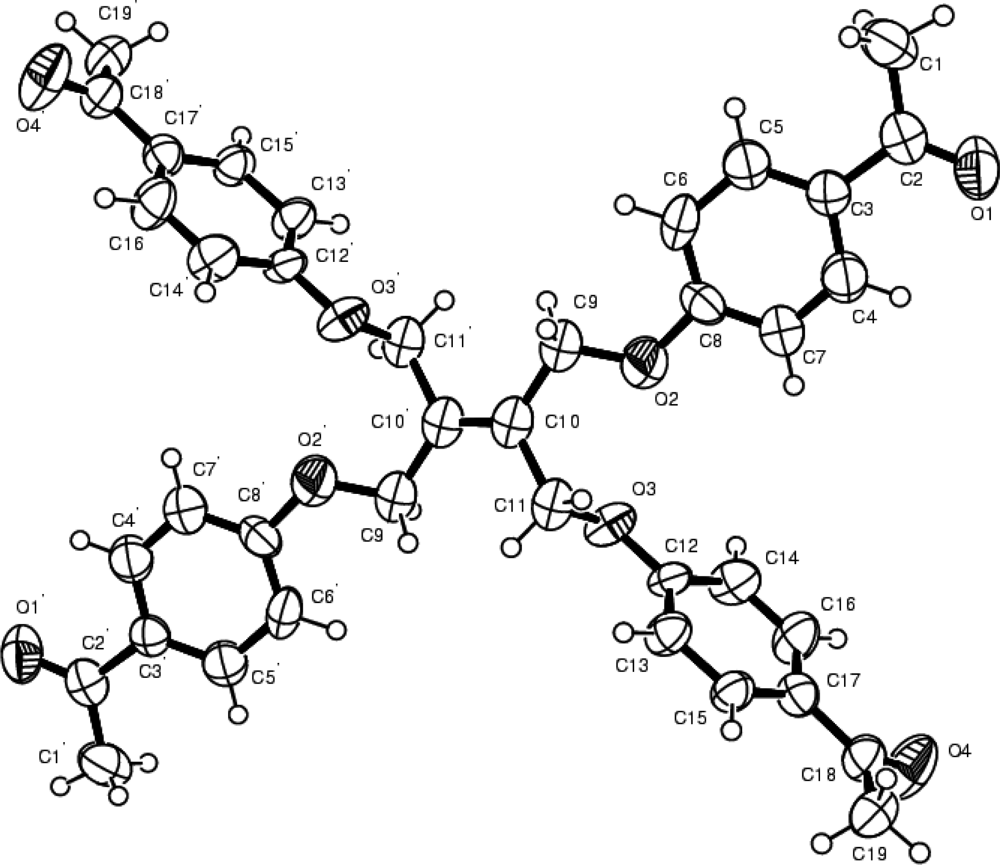
<p>The molecule of the title compound <bold>2a</bold> has a centre of symmetry located at the mid-point of the C=C double bond. The centre of symmetry C=C bond length [1.332(6) Å] agrees with the values reported in the literature [1.335(5) Å in C<sub>50</sub>H<sub>36</sub>O<sub>8</sub> [<xref ref-type="bibr" rid="b19-ijms-09-01000">19</xref>], 1.316(7) Å in C<sub>12</sub>H<sub>12</sub>N<sub>4</sub>S<sub>2</sub> [<xref ref-type="bibr" rid="b20-ijms-09-01000">20</xref>] and 1.318(6) Å in C<sub>12</sub>H<sub>18</sub>N<sub>2</sub>S<sub>4</sub> [<xref ref-type="bibr" rid="b21-ijms-09-01000">21</xref>]]. The molecular conformation is essentially described by torsion angles about the C10-C9 and C10-C11 bonds. The C10-C11-O3-C12 and C10-C9-O2-C8 torsion angles are −173.0(2)° and 159.8(2)°, respectively. The acetyl group is almost complanar with the benzene ring [C15-C17-C18=O4=179.1(3)°]. The O-C bond lengths are within normal ranges. Atoms C3 and C17, carrying the acetyl substituents, are trigonal, the sum of the three bond angles around them being 359.9(3)°. As expected, the benzene rings systems are planar, with the largest deviations being 0.0159(3) Å for C8 and 0.0132(1) Å for C15. The dihedral angle between the planes of rings are 76.43(8)°. Atom H9A of the methylene group (C9) forms an intermolecular hydrogen bond with the acetyl group O atom (O4) of a symmetry-related molecule [C9...O4<sup>(i)</sup>=3.159 Å; symmetry code: (i) x-1,+y,+z].</p></sec>
<sec sec-type="conclusions">
<title>4. Conclusions</title>
<p>In order to investigate the influence of the flexibility of the ligand molecule, four new carbonyl compounds have been synthesized and the crystal structure of compound <bold>2a</bold> was determined. Alkenetetrayltetra oxyphenylaldehyde and tetraketones were obtained by reaction four different hydroxyketones or hydroxyaldehydes and ethene-1,1,2,2-tetra-yl-tetramethylene tetra- bromide (<bold>1</bold>). So, we successfully prepared C=O functionalized chelates having ether bridges as a key intermediate for the synthesis of novel macromolecules containing a donor group. The compounds were prepared and identified by elemental analysis, IR, <sup>1</sup>H-NMR, <sup>13</sup>C-NMR and Mass spectroscopy. In addition, the crystal structure of the compound <bold>2a</bold>, C<sub>38</sub>H<sub>36</sub>O<sub>8</sub>, was determined by single crystal X-ray diffraction technique, <xref ref-type="fig" rid="f1-ijms-09-01000">figure 1</xref>.</p></sec></body>
<back>
<ack>
<title>Acknowledgments</title>
<p>This work was supported by the Research Fund of Karadeniz Technical University (Project No: 2006.111.025)</p></ack>
<ref-list>
<title>References and Notes</title>
<ref id="b1-ijms-09-01000"><label>1</label><citation citation-type="journal"><person-group person-group-type="author"><name><surname>Singh</surname><given-names>BK</given-names></name><name><surname>Jetley</surname><given-names>UK</given-names></name><name><surname>Sharma</surname><given-names>RK</given-names></name><name><surname>Garg</surname><given-names>BS</given-names></name></person-group><article-title>Synthesis, characterization and biological activity of complexes of 2-hydroxy-3,5-dimethylacetophenoneoxime (HDMAOX) with copper(II), cobalt(II), nickel(II) and palladium(II)</article-title><source>Spectrochimica Acta Part A</source><year>2007</year><volume>68</volume><fpage>63</fpage><lpage>73</lpage><pub-id pub-id-type="doi">10.1016/j.saa.2006.11.001</pub-id></citation></ref>
<ref id="b2-ijms-09-01000"><label>2</label><citation citation-type="journal"><person-group person-group-type="author"><name><surname>Rajabi</surname><given-names>L</given-names></name><name><surname>Courreges</surname><given-names>C</given-names></name><name><surname>Montoya</surname><given-names>J</given-names></name><name><surname>Aguilera</surname><given-names>RJ</given-names></name><name><surname>Primm</surname><given-names>TP</given-names></name></person-group><article-title>Acetophenones with selective antimycobacterial activity</article-title><source>Lett. Appl. Microbiol.</source><year>2005</year><volume>40</volume><fpage>212</fpage><pub-id pub-id-type="doi">10.1111/j.1472-765X.2005.01657.x</pub-id><pub-id pub-id-type="pmid">15715647</pub-id></citation></ref>
<ref id="b3-ijms-09-01000"><label>3</label><citation citation-type="journal"><person-group person-group-type="author"><name><surname>Gündoğdu-Karaburun</surname><given-names>N</given-names></name><name><surname>Benkli</surname><given-names>K</given-names></name><name><surname>Tunalı</surname><given-names>Y</given-names></name><name><surname>Uçucu</surname><given-names>Ü</given-names></name><name><surname>Demirayak</surname><given-names>Ş</given-names></name></person-group><article-title>Synthesis and antifungal activities of some aryl [3-(imidazol-1-yl/triazol-1-ylmethyl)benzofuran-2-yl] ketoximes</article-title><source>Eur. J. Med. Chem.</source><year>2006</year><volume>41</volume><fpage>651</fpage><lpage>656</lpage><pub-id pub-id-type="doi">10.1016/j.ejmech.2005.12.013</pub-id><pub-id pub-id-type="pmid">16554110</pub-id></citation></ref>
<ref id="b4-ijms-09-01000"><label>4</label><citation citation-type="journal"><person-group person-group-type="author"><name><surname>Jung</surname><given-names>KY</given-names></name><name><surname>Kim</surname><given-names>SK</given-names></name><name><surname>Gao</surname><given-names>ZG</given-names></name><name><surname>Gross</surname><given-names>AS</given-names></name><name><surname>Melman</surname><given-names>N</given-names></name><name><surname>Jacobson</surname><given-names>KA</given-names></name><name><surname>Kim</surname><given-names>YC</given-names></name></person-group><article-title>Structure-activity relationships of thiazole and thiadiazole derivatives as potent and selective human adenosine A[3] receptor antagonists</article-title><source>Bioorg. Med. Chem.</source><year>2004</year><volume>12</volume><fpage>613</fpage><lpage>623</lpage><pub-id pub-id-type="doi">10.1016/j.bmc.2003.10.041</pub-id><pub-id pub-id-type="pmid">14738972</pub-id></citation></ref>
<ref id="b5-ijms-09-01000"><label>5</label><citation citation-type="journal"><person-group person-group-type="author"><name><surname>Gul</surname><given-names>HI</given-names></name><name><surname>Denizci</surname><given-names>AA</given-names></name><name><surname>Erciyas</surname><given-names>E</given-names></name></person-group><article-title>Antimicrobial evaluation of some Mannish bases of acetophenones and representative quaternary derivatives</article-title><source>Arzneimittel Forschung.</source><year>2002</year><volume>52</volume><fpage>773</fpage><pub-id pub-id-type="pmid">12442641</pub-id></citation></ref>
<ref id="b6-ijms-09-01000"><label>6</label><citation citation-type="journal"><person-group person-group-type="author"><name><surname>Teruyuki</surname><given-names>M</given-names></name><name><surname>Yoshiharu</surname><given-names>H</given-names></name><name><surname>Ka</surname><given-names>Y</given-names></name></person-group><article-title>Oxime derivative thereof, Process for preparing thereof, Herbicidal composition and methods for the destruction of undesirable weeds</article-title><source>Asahi Chemical Ind., Japan</source><year>1986</year></citation></ref>
<ref id="b7-ijms-09-01000"><label>7</label><citation citation-type="journal"><person-group person-group-type="author"><name><surname>Miyazawa</surname><given-names>M</given-names></name><name><surname>Shimamura</surname><given-names>H</given-names></name><name><surname>Nakamura</surname><given-names>S</given-names></name></person-group><article-title>Suppression of furylfuramide-induced SOS response by acetophenones using Salmonella typhimurium TA1535/pSK1002 umu test</article-title><source>J. Agric. Food Chem.</source><year>2000</year><volume>48</volume><fpage>4377</fpage><pub-id pub-id-type="doi">10.1021/jf990631g</pub-id><pub-id pub-id-type="pmid">10995366</pub-id></citation></ref>
<ref id="b8-ijms-09-01000"><label>8</label><citation citation-type="journal"><person-group person-group-type="author"><name><surname>Guyot</surname><given-names>C</given-names></name><name><surname>Bouseta</surname><given-names>A</given-names></name><name><surname>Scheirman</surname><given-names>VV</given-names></name></person-group><article-title>Floral origin markers of chestnut and lime tree honeys</article-title><source>J. Agric. Food Chem.</source><year>1998</year><volume>46</volume><fpage>625</fpage><pub-id pub-id-type="doi">10.1021/jf970510l</pub-id><pub-id pub-id-type="pmid">10554289</pub-id></citation></ref>
<ref id="b9-ijms-09-01000"><label>9</label><citation citation-type="journal"><person-group person-group-type="author"><name><surname>Wilkins</surname><given-names>CK</given-names></name><name><surname>Scholl</surname><given-names>S</given-names></name></person-group><article-title>Volatile metabolites of some barley storage molds</article-title><source>Int. J. Food Microbiol.</source><year>1989</year><volume>8</volume><fpage>11</fpage><pub-id pub-id-type="doi">10.1016/0168-1605(89)90075-5</pub-id><pub-id pub-id-type="pmid">2641484</pub-id></citation></ref>
<ref id="b10-ijms-09-01000"><label>10</label><citation citation-type="journal"><person-group person-group-type="author"><name><surname>Yasuda</surname><given-names>T</given-names></name><name><surname>Kon</surname><given-names>R</given-names></name><name><surname>Nakazawa</surname><given-names>T</given-names></name><name><surname>Ohsawa</surname><given-names>K</given-names></name></person-group><article-title>Metabolism of Paeonol in Rats</article-title><source>J. Nat. Product</source><year>1999</year><volume>62</volume><fpage>1142</fpage><pub-id pub-id-type="doi">10.1021/np980405l</pub-id></citation></ref>
<ref id="b11-ijms-09-01000"><label>11</label><citation citation-type="journal"><person-group person-group-type="author"><name><surname>Soykan</surname><given-names>C</given-names></name><name><surname>Erol</surname><given-names>İ</given-names></name></person-group><article-title>Synthesis, Characterization, and Biologicaj Activity of N-(4-Acetylphenyl) maleimide and Its Oxime, Carbazone, Thiosemicarbazone Derivatives and Their Polymers</article-title><source>J.Polymer Science, Polymer Chem.</source><year>2003</year><volume>41</volume><fpage>1942</fpage><lpage>1951</lpage><pub-id pub-id-type="doi">10.1002/pola.10738</pub-id></citation></ref>
<ref id="b12-ijms-09-01000"><label>12</label><citation citation-type="journal"><person-group person-group-type="author"><name><surname>Poddar</surname><given-names>SN</given-names></name></person-group><article-title>Ortho-hydroxy acetophenone oxime as an analytical reagent. Part I</article-title><source>Analyt. Bioanalyt. Chem.</source><year>1957</year><volume>154</volume><fpage>254</fpage></citation></ref>
<ref id="b13-ijms-09-01000"><label>13</label><citation citation-type="journal"><person-group person-group-type="author"><name><surname>Yadav</surname><given-names>JS</given-names></name><name><surname>Reddy</surname><given-names>PT</given-names></name><name><surname>Nanda</surname><given-names>S</given-names></name><name><surname>Rao</surname><given-names>AB</given-names></name></person-group><article-title>Stereoselective synthesis of (<italic>R</italic>)-(<sup>–</sup>)-denopamine, (<italic>R</italic>)-(<sup>–</sup>)-tembamide and (R)-(<sup>–</sup>)-aegeline via asymmetric reduction of azidoketones by Daucus carota in aqueous medium</article-title><source>Tetrahedron:Asymmetry</source><year>2001</year><volume>12</volume><fpage>3381</fpage><lpage>3385</lpage></citation></ref>
<ref id="b14-ijms-09-01000"><label>14</label><citation citation-type="journal"><person-group person-group-type="author"><name><surname>Cope</surname><given-names>AC</given-names></name><name><surname>Kagan</surname><given-names>F</given-names></name></person-group><article-title>Cyclic Polyolefins</article-title><source>J. Am. Chem. Soc.</source><year>1958</year><volume>80</volume><fpage>5499</fpage><lpage>5502</lpage><pub-id pub-id-type="doi">10.1021/ja01553a046</pub-id></citation></ref>
<ref id="b15-ijms-09-01000"><label>15</label><citation citation-type="book"><person-group person-group-type="author"><collab>Siemens: SMART and SAINT</collab></person-group><source>Area Detector Control and Integration Software</source><publisher-name>Siemens Analytical X-ray Systems Inc.</publisher-name><publisher-loc>Madison, Wisconsin, USA</publisher-loc><year>1996</year></citation></ref>
<ref id="b16-ijms-09-01000"><label>16</label><citation citation-type="book"><person-group person-group-type="author"><name><surname>Sheldrick</surname><given-names>GM</given-names></name></person-group><source>SADABS. Program for Empirical Absorption Correction of Area Detector Data</source><publisher-name>University of Göttingen</publisher-name><publisher-loc>Germany</publisher-loc><year>1996</year></citation></ref>
<ref id="b17-ijms-09-01000"><label>17</label><citation citation-type="journal"><person-group person-group-type="author"><name><surname>Karle</surname><given-names>J</given-names></name><name><surname>Karle</surname><given-names>I</given-names></name></person-group><article-title>The symbolic addition procedure for phase determination for centrosymmetric and non-centrosymmetric crystals</article-title><source>Acta Crystallogr.</source><year>1996</year><volume>21</volume><fpage>849</fpage><lpage>859</lpage></citation></ref>
<ref id="b18-ijms-09-01000"><label>18</label><citation citation-type="book"><source>International Tables for X-ray Crystallography</source><publisher-loc>Kynoch</publisher-loc><publisher-name>Birmingham, UK</publisher-name><year>1974</year><volume>Vol. IV</volume><comment>(present distributor: Reidel: Dordrecht, Netherlands)</comment></citation></ref>
<ref id="b19-ijms-09-01000"><label>19</label><citation citation-type="journal"><person-group person-group-type="author"><name><surname>Ustabaş</surname><given-names>R</given-names></name><name><surname>Çoruh</surname><given-names>U</given-names></name><name><surname>Er</surname><given-names>M</given-names></name><name><surname>Serbest</surname><given-names>K</given-names></name><name><surname>Vazquez-Lopez</surname><given-names>EM</given-names></name></person-group><article-title>2,2′-[2,3-Bis(1-formyl-2-naphthyloxymethyl)but-2-ene-1,4-diyldioxy]bis(naphthalene-1-carbaldehyde</article-title><source>Acta Cryst.</source><year>2006</year><volume>E62</volume><fpage>o5006</fpage><lpage>o5007</lpage></citation></ref>
<ref id="b20-ijms-09-01000"><label>20</label><citation citation-type="journal"><person-group person-group-type="author"><name><surname>Zhang</surname><given-names>HY</given-names></name><name><surname>Sun</surname><given-names>H</given-names></name><name><surname>Mu</surname><given-names>SC</given-names></name><name><surname>Wang</surname><given-names>JK</given-names></name><name><surname>Chen</surname><given-names>W</given-names></name></person-group><article-title><italic>trans</italic>-1,4-Bis(pyrimidin-2-ylsulfanyl)but-2-ene</article-title><source>Acta Cryst.</source><year>2005</year><volume>E61</volume><fpage>o4142</fpage><lpage>o4143</lpage></citation></ref>
<ref id="b21-ijms-09-01000"><label>21</label><citation citation-type="journal"><person-group person-group-type="author"><name><surname>Wang</surname><given-names>J</given-names></name><name><surname>Wang</surname><given-names>W</given-names></name><name><surname>Chi</surname><given-names>HJ</given-names></name><name><surname>Yang</surname><given-names>QS</given-names></name></person-group><article-title><italic>trans</italic>-2,2′-[(2-Butene-1,4-diyl)dithio]bis(4,5-dihydro-1,3-thiazine)</article-title><source>Acta Cryst.</source><year>2006</year><volume>E62</volume><fpage>o4621</fpage><lpage>o4622</lpage></citation></ref></ref-list>
<sec sec-type="display-objects">
<title>Figures and Tables</title>
<fig id="f1-ijms-09-01000" position="float">
<label>Figure 1.</label>
<caption>
<p>ORTEP drawing of the crystal structure of C<sub>38</sub>H<sub>36</sub>O<sub>8</sub></p></caption>
<graphic xlink:href="ijms-09-01000f1.png"/></fig>
<fig id="f2-ijms-09-01000" position="float">
<label>Scheme 1.</label>
<caption>
<p>Synthesis and structures of compounds <bold>2a–d</bold></p></caption>
<graphic xlink:href="ijms-09-01000f2.png"/></fig>
<fig id="f3-ijms-09-01000" position="float">
<label><bold>2a</bold></label>
<graphic xlink:href="ijms-09-01000f3.png"/></fig>
<table-wrap id="t1-ijms-09-01000" position="float">
<label>Table 1.</label>
<caption>
<p>Crystallographic data for C<sub>38</sub>H<sub>36</sub>O<sub>8</sub></p></caption>
<table frame="hsides" rules="groups">
<tbody>
<tr>
<td align="center">Chemical formula</td>
<td align="center">C<sub>38</sub>H<sub>36</sub>O<sub>8</sub></td>
<td align="center">α(°)</td>
<td align="center">90</td></tr>
<tr>
<td align="center">Formula weight</td>
<td align="center">620.67</td>
<td align="center">β(°)</td>
<td align="center">95.875(3)</td></tr>
<tr>
<td align="center">Crystal colour, habit</td>
<td align="center">Colourless, prism</td>
<td align="center">γ(°)</td>
<td align="center">90</td></tr>
<tr>
<td align="center">Crystal system</td>
<td align="center">Monoclinic</td>
<td align="center">V(Å<sup>3</sup>)</td>
<td align="center">1566.8(4)</td></tr>
<tr>
<td align="center">Crystal dimensions</td>
<td align="center">0.30×021×0.21</td>
<td align="center">Z</td>
<td align="center">2</td></tr>
<tr>
<td align="center">Space group</td>
<td align="center">P 21/n</td>
<td align="center">D<sub>calc</sub>(g/cm<sup>3</sup>)</td>
<td align="center">1.316</td></tr>
<tr>
<td align="center">a(Å)</td>
<td align="center">9.0395(12)</td>
<td align="center">μ(Mo Kα), cm<sup>−1</sup></td>
<td align="center">0.092</td></tr>
<tr>
<td align="center">b(Å)</td>
<td align="center">12.6114(17) 13.8166(18)</td>
<td align="center">No unique reflections</td>
<td align="center">8396</td></tr>
<tr>
<td align="center">c(Å)</td>
<td align="center"/>
<td align="center">No of observations</td>
<td align="center">2430</td></tr>
<tr>
<td align="center"/>
<td align="center">R</td>
<td align="center">0.0481</td></tr>
<tr>
<td align="center"/>
<td align="center">R<sub>w</sub></td>
<td align="center">0.0722</td></tr></tbody></table>
<table-wrap-foot><fn>
<p>R = ΣllFol-|Fcll/Σ|Fol R<sub>w</sub> = [(Σw(lFol-lFcl)<sup>2</sup>/ΣwFo<sup>2</sup>)]½</p></fn></table-wrap-foot></table-wrap>
<table-wrap id="t2-ijms-09-01000" position="float">
<label>Table 2.</label>
<caption>
<p>Selected geometric parameters (Å, °) for [C<sub>38</sub>H<sub>36</sub>O<sub>8</sub>]</p></caption>
<table frame="hsides" rules="groups">
<tbody>
<tr>
<td align="left">C10-C10’ 1.332(6) C15-C17-C16 118.7(3)</td></tr>
<tr>
<td align="left">O1-C2 1.218(3) C15-C17-C18 123.7(3)</td></tr>
<tr>
<td align="left">O4-C18 1.226(3) C16-C17-C18 117.5(3)</td></tr>
<tr>
<td align="left">C4-C3-C5 118.0(3) C8-O2-C9-C10 159.8(2)</td></tr>
<tr>
<td align="left">C4-C3-C2 119.9(3) C12-O3-C11-C10 −173.0(2)</td></tr>
<tr>
<td align="left">C5-C3-C2 122.0(3)</td></tr></tbody></table></table-wrap></sec></back></article>