<?xml version="1.0" encoding="UTF-8"?>
<!DOCTYPE article PUBLIC "-//NLM//DTD Journal Publishing DTD v2.3 20070202//EN" "journalpublishing.dtd">
<article xmlns:xlink="http://www.w3.org/1999/xlink" xml:lang="en" article-type="review-article">
<front>
<journal-meta>
<journal-id journal-id-type="publisher-id">ijms</journal-id>
<journal-title>International Journal of Molecular Sciences</journal-title>
<abbrev-journal-title>Int. J. Mol. Sci.</abbrev-journal-title>
<issn pub-type="epub">1422-0067</issn>
<publisher>
<publisher-name>Molecular Diversity Preservation International (MDPI)</publisher-name></publisher></journal-meta>
<article-meta>
<article-id pub-id-type="doi">10.3390/ijms14023874</article-id>
<article-id pub-id-type="publisher-id">ijms-14-03874</article-id>
<article-categories>
<subj-group>
<subject>Review</subject></subj-group></article-categories>
<title-group>
<article-title>Chemical Inhibitors and microRNAs (miRNA) Targeting the Mammalian Target of Rapamycin (mTOR) Pathway: Potential for Novel Anticancer Therapeutics</article-title></title-group>
<contrib-group>
<contrib contrib-type="author">
<name><surname>AlQurashi</surname><given-names>Naif</given-names></name><xref ref-type="aff" rid="af1-ijms-14-03874">1</xref><xref ref-type="aff" rid="af2-ijms-14-03874">2</xref></contrib>
<contrib contrib-type="author">
<name><surname>Hashimi</surname><given-names>Saeed M.</given-names></name><xref ref-type="aff" rid="af1-ijms-14-03874">1</xref><xref ref-type="corresp" rid="c1-ijms-14-03874">*</xref></contrib>
<contrib contrib-type="author">
<name><surname>Wei</surname><given-names>Ming Q.</given-names></name><xref ref-type="aff" rid="af1-ijms-14-03874">1</xref><xref ref-type="corresp" rid="c1-ijms-14-03874">*</xref></contrib></contrib-group>
<aff id="af1-ijms-14-03874">
<label>1</label>Division of Molecular and Gene Therapies, Griffith Health Institute, School of Medical Science, Griffith University, Gold Coast, QLD 4215, Australia</aff>
<aff id="af2-ijms-14-03874">
<label>2</label>Biology Department, College of Medicine, University of Dammam, Dammam 31451, Saudi Arabia; E-Mail: <email>nalqurashi@ud.edu.sa</email></aff>
<author-notes>
<corresp id="c1-ijms-14-03874">
<label>*</label>Authors to whom correspondence should be addressed; E-Mails: <email>s.hashimi@griffith.edu.au</email> (S.M.H.); <email>m.wei@griffith.edu.au</email> (M.Q.W.); Tel.: +61-7-567-807-45; Fax: +61-7-576-807-89.</corresp></author-notes>
<pub-date pub-type="collection">
<year>2013</year></pub-date>
<pub-date pub-type="epub">
<day>13</day>
<month>02</month>
<year>2013</year></pub-date>
<volume>14</volume>
<issue>2</issue>
<fpage>3874</fpage>
<lpage>3900</lpage>
<history>
<date date-type="received">
<day>13</day>
<month>09</month>
<year>2012</year></date>
<date date-type="rev-recd">
<day>08</day>
<month>01</month>
<year>2013</year></date>
<date date-type="accepted">
<day>10</day>
<month>01</month>
<year>2013</year></date></history>
<permissions>
<copyright-statement>© 2013 by the authors; licensee Molecular Diversity Preservation International, Basel, Switzerland.</copyright-statement>
<copyright-year>2013</copyright-year>
<license license-type="open-access" xlink:href="http://creativecommons.org/licenses/by/3.0">
<p>This article is an open-access article distributed under the terms and conditions of the Creative Commons Attribution license (http://creativecommons.org/licenses/by/3.0/).</p></license></permissions>
<abstract>
<p>The mammalian target of rapamycin (mTOR) is a critical regulator of many fundamental features in response to upstream cellular signals, such as growth factors, energy, stress and nutrients, controlling cell growth, proliferation and metabolism through two complexes, mTORC1 and mTORC2. Dysregulation of mTOR signalling often occurs in a variety of human malignant diseases making it a crucial and validated target in the treatment of cancer. Tumour cells have shown high susceptibility to mTOR inhibitors. Rapamycin and its derivatives (rapalogs) have been tested in clinical trials in several tumour types and found to be effective as anticancer agents in patients with advanced cancers. To block mTOR function, they form a complex with FKBP12 and then bind the FRB domain of mTOR. Furthermore, a new generation of mTOR inhibitors targeting ATP-binding in the catalytic site of mTOR showed potent and more selective inhibition. More recently, microRNAs (miRNA) have emerged as modulators of biological pathways that are essential in cancer initiation, development and progression. Evidence collected to date shows that miRNAs may function as tumour suppressors or oncogenes in several human neoplasms. The mTOR pathway is a promising target by miRNAs for anticancer therapy. Extensive studies have indicated that regulation of the mTOR pathway by miRNAs plays a major role in cancer progression, indicating a novel way to investigate the tumorigenesis and therapy of cancer. Here, we summarize current findings of the role of mTOR inhibitors and miRNAs in carcinogenesis through targeting mTOR signalling pathways and determine their potential as novel anti-cancer therapeutics.</p></abstract>
<kwd-group>
<kwd>mTOR</kwd>
<kwd>Akt</kwd>
<kwd>S6K</kwd>
<kwd>Rapamycin</kwd>
<kwd>cancer</kwd>
<kwd>therapy</kwd>
<kwd>miRNA</kwd></kwd-group></article-meta></front>
<body>
<sec sec-type="intro">
<title>1. Introduction</title>
<p>Mammalian target of rapamycin (mTOR) is a downstream effector of the PI3K/AKT pathway and the catalytic subunit of two biochemically distinct complexes, called mTORC1 and mTORC2. Each complex has its own protein composition, which reflects their differences in upstream signal integration, substrate regulation and biological process control in the pathway. They respond to a variety of stimuli, including growth factors, genotoxic stress, energy status, oxygen and amino acids. mTORC1 promotes anabolism, such as protein synthesis and lipid biogenesis, cell growth and cell cycle progression. At the same time, mTORC1 inhibits catabolism by blocking autophagy. In contrast, mTORC2 regulates cell survival, cell proliferation and metabolism. mTOR signalling is often dysregulated during various human cancers, driving most tumorigenesis from mutations of negative mTOR regulators or by oncogenic mutations. Thus, it has attracted great scientific and clinical interest in developing inhibitors that specifically target mTOR. Rapamycin and its derivatives (rapalogs), which inhibit mTOR function by a kinase-independent mechanism, have been tested in clinical trials in several tumour types. Rapalogs are selective for mTORC1 and effective as anticancer agents in patients with advanced renal cell carcinoma and mantle cell lymphoma. Recently, a new generation of mTOR inhibitors, which were designed to compete with ATP in the catalytic site of mTOR and inhibit both mTORC1 and mTORC2, showed potent and selective inhibition at nanomolar concentrations. Furthermore, growing evidence links miRNA deregulation of mTOR pathways to carcinogenesis in several human neoplasms, and their molecular signatures of deregulation have been associated with clinical features of several cancers. Downregulation of miRNAs were noted in some cancers, such as hepatocellular carcinomas, suggesting that tactics to regulate mTOR by elevating levels of miRNAs may be alternative therapeutic strategies for the treatment of cancer. The purpose of this review is to understand the role of mTOR inhibitors and miRNAs in carcinogenesis through targeting the mTOR signalling pathway and to determine whether they could have potential to be developed into novel therapies for a number of cancer types.</p></sec>
<sec>
<title>2. mTOR</title>
<p>Identification and cloning of mTOR, also known as FKBP12-rapamycin associated protein (FRAP), rapamycin and FKBP12 target (RAFT) or rapamycin target (RAPT), was completed shortly after the discovery of the two yeast genes, TOR1 and TOR2, in the budding yeast <italic>Saccharomyces cerevisiae</italic> by mutations that confer resistance to rapamycin (a naturally produced macrolide antibiotic) [<xref ref-type="bibr" rid="b1-ijms-14-03874">1</xref>–<xref ref-type="bibr" rid="b4-ijms-14-03874">4</xref>]. Rapamycin was isolated from a fungus (<italic>Streptomyces hygroscopicus</italic>) in a soil sample collected in Rapa Nui (known as Easter Island) in 1975 [<xref ref-type="bibr" rid="b5-ijms-14-03874">5</xref>]. It forms a complex with FK506-binding protein (FKBP12) in mammals to inhibit mTOR [<xref ref-type="bibr" rid="b6-ijms-14-03874">6</xref>].</p>
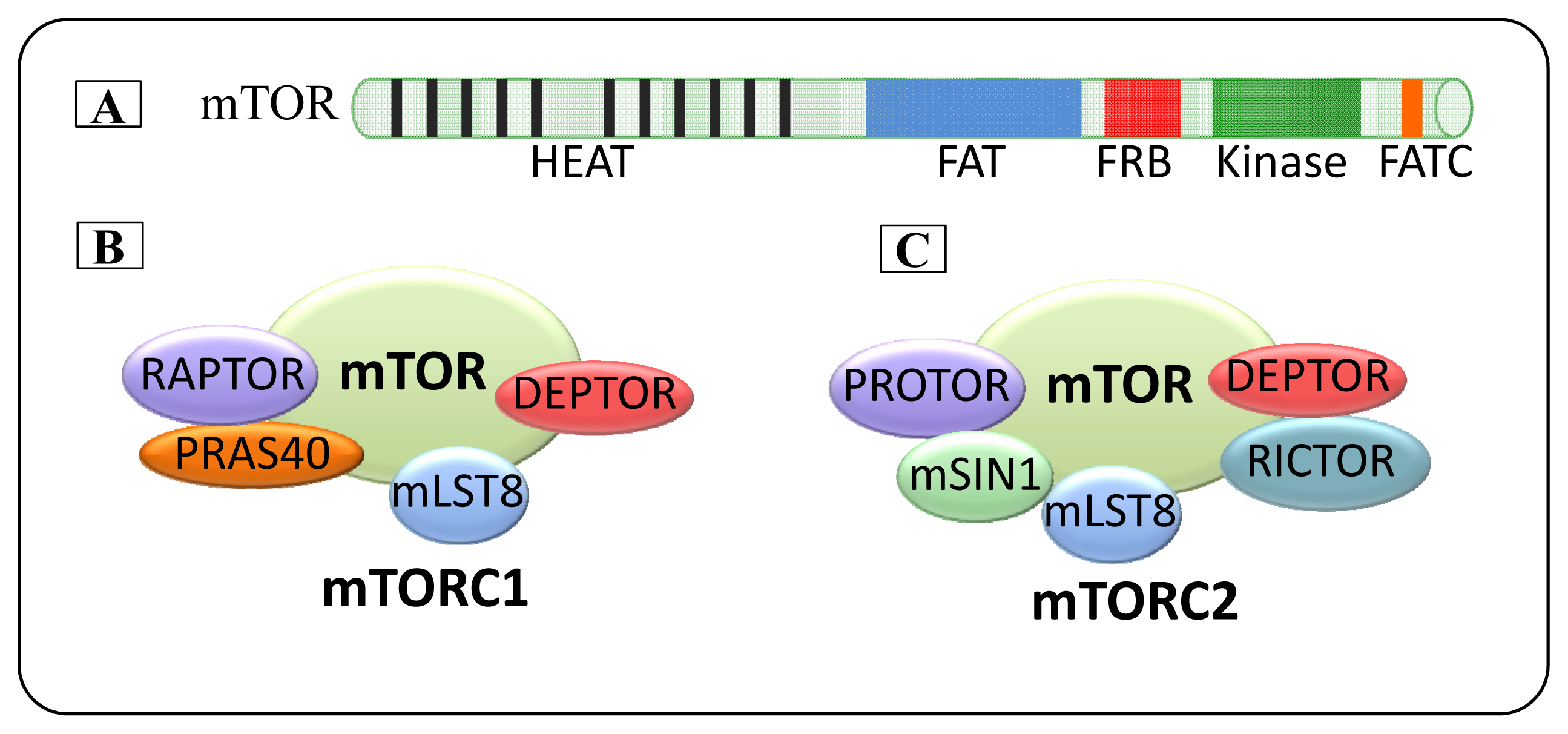
<p>mTOR is a member of the PI3K-related kinase (PIKK) family characterised by a high molecular weight (mTOR ~289 kDa) and contains 2549 amino acids, with 42% and 45% sequence identity to yeast TOR1 and TOR2, respectively (<xref ref-type="fig" rid="f1-ijms-14-03874">Figure 1A</xref>) [<xref ref-type="bibr" rid="b7-ijms-14-03874">7</xref>–<xref ref-type="bibr" rid="b10-ijms-14-03874">10</xref>]. The carboxy-terminal of mTOR contains the kinase domain, with significant homology to the PI3K lipid kinase domain [<xref ref-type="bibr" rid="b8-ijms-14-03874">8</xref>]. However, evidence supports a role for TOR as a serine/threonine protein kinase [<xref ref-type="bibr" rid="b11-ijms-14-03874">11</xref>–<xref ref-type="bibr" rid="b13-ijms-14-03874">13</xref>]. The amino-terminal region contains 20 HEAT (Huntington, elongation factor 3, subunit of protein phosphatase 2A and TOR 1) repeat domains that are composed of two α helices of ~40 amino acids, each with a specific pattern of hydrophobic and hydrophilic residues [<xref ref-type="bibr" rid="b8-ijms-14-03874">8</xref>]. HEAT repeats are known to mediate protein-protein interactions [<xref ref-type="bibr" rid="b14-ijms-14-03874">14</xref>].</p>
<p>Other characteristic structures of mTOR include a FAT (FRAP, Ataxia telangiectasia mutated (ATM), Transformation/transcription domain associated protein (TRRAP) domain [<xref ref-type="bibr" rid="b15-ijms-14-03874">15</xref>]. The carboxy-terminal end contains the FRB domain that binds the FKBP12-rapamycin complex followed by the catalytic domain that shows homology to phosphatidylinositol kinases and finally a FAT-C (FAT c-terminal) domain at the extreme carboxy-terminal of the protein [<xref ref-type="bibr" rid="b2-ijms-14-03874">2</xref>,<xref ref-type="bibr" rid="b8-ijms-14-03874">8</xref>,<xref ref-type="bibr" rid="b16-ijms-14-03874">16</xref>,<xref ref-type="bibr" rid="b17-ijms-14-03874">17</xref>].</p>
<sec>
<title>2.1. mTOR Complexes</title>
<p>In mammalian cells mTOR exists in two large physically and functionally distinct signalling complexes, mTORC1 and mTORC2 [<xref ref-type="bibr" rid="b18-ijms-14-03874">18</xref>,<xref ref-type="bibr" rid="b19-ijms-14-03874">19</xref>].</p>
<sec>
<title>2.1.1. mTORC1</title>
<p>mTORC1 consists of mTOR as the catalytic subunit of the complex and four accessory proteins. Raptor (regulatory-associated protein of mTOR) physically links mTOR to its effectors, binding substrates and regulators (<xref ref-type="fig" rid="f1-ijms-14-03874">Figure 1B</xref>) [<xref ref-type="bibr" rid="b20-ijms-14-03874">20</xref>–<xref ref-type="bibr" rid="b23-ijms-14-03874">23</xref>]. mLST8 (mammalian lethal with SEC13 protein 8) mediates protein-protein interactions [<xref ref-type="bibr" rid="b24-ijms-14-03874">24</xref>]. However, deletion of this protein does not affect mTORC1 activity <italic>in vivo</italic>, thus the function of mLST8 in mTORC1 is unclear [<xref ref-type="bibr" rid="b25-ijms-14-03874">25</xref>]. PRAS40 (proline-rich AKT substrate 40 kDa, also known as AKT1S1) has been characterized as a negative regulator of mTORC1, which regulates mTORC1 kinase activity as a direct inhibitor of substrate binding [<xref ref-type="bibr" rid="b26-ijms-14-03874">26</xref>–<xref ref-type="bibr" rid="b28-ijms-14-03874">28</xref>]. Deptor (DEP-domain-containing mTOR-interacting protein) functions as a negative regulator of mTORC1 [<xref ref-type="bibr" rid="b29-ijms-14-03874">29</xref>].</p></sec>
<sec>
<title>2.1.2. mTORC2</title>
<p>mTORC2 consists of a complex that includes mTOR, Rictor (rapamycin-insensitive companion of mTOR) [<xref ref-type="bibr" rid="b30-ijms-14-03874">30</xref>] and mSIN1 (mammalian stress-activated protein kinase interacting protein, also known as MAPKAP1) (<xref ref-type="fig" rid="f1-ijms-14-03874">Figure 1C</xref>) [<xref ref-type="bibr" rid="b31-ijms-14-03874">31</xref>,<xref ref-type="bibr" rid="b32-ijms-14-03874">32</xref>]. Rictor plays an important role in the phosphorylation of Akt [<xref ref-type="bibr" rid="b33-ijms-14-03874">33</xref>]. PROTOR1 (protein observed with rictor-1) appears to help complex assembly [<xref ref-type="bibr" rid="b34-ijms-14-03874">34</xref>,<xref ref-type="bibr" rid="b35-ijms-14-03874">35</xref>]. Rictor, mSIN1 and PROTOR1 proteins are unique components of mTORC2, whereas the other known mTORC2 accessory proteins, including mLST8 and Deptor, are shared components with mTORC1. However, unlike mTORC1, mLST8 is essential for mTORC2 function, as deletion of this protein can severely reduce the stability and function of this complex [<xref ref-type="bibr" rid="b25-ijms-14-03874">25</xref>]. Similar to its role in mTORC1, Deptor acts as a negative regulator of mTORC2 [<xref ref-type="bibr" rid="b29-ijms-14-03874">29</xref>].</p></sec></sec></sec>
<sec>
<title>3. mTOR Regulation and Signalling</title>
<sec>
<title>3.1. Upstream Regulators of mTORC1</title>
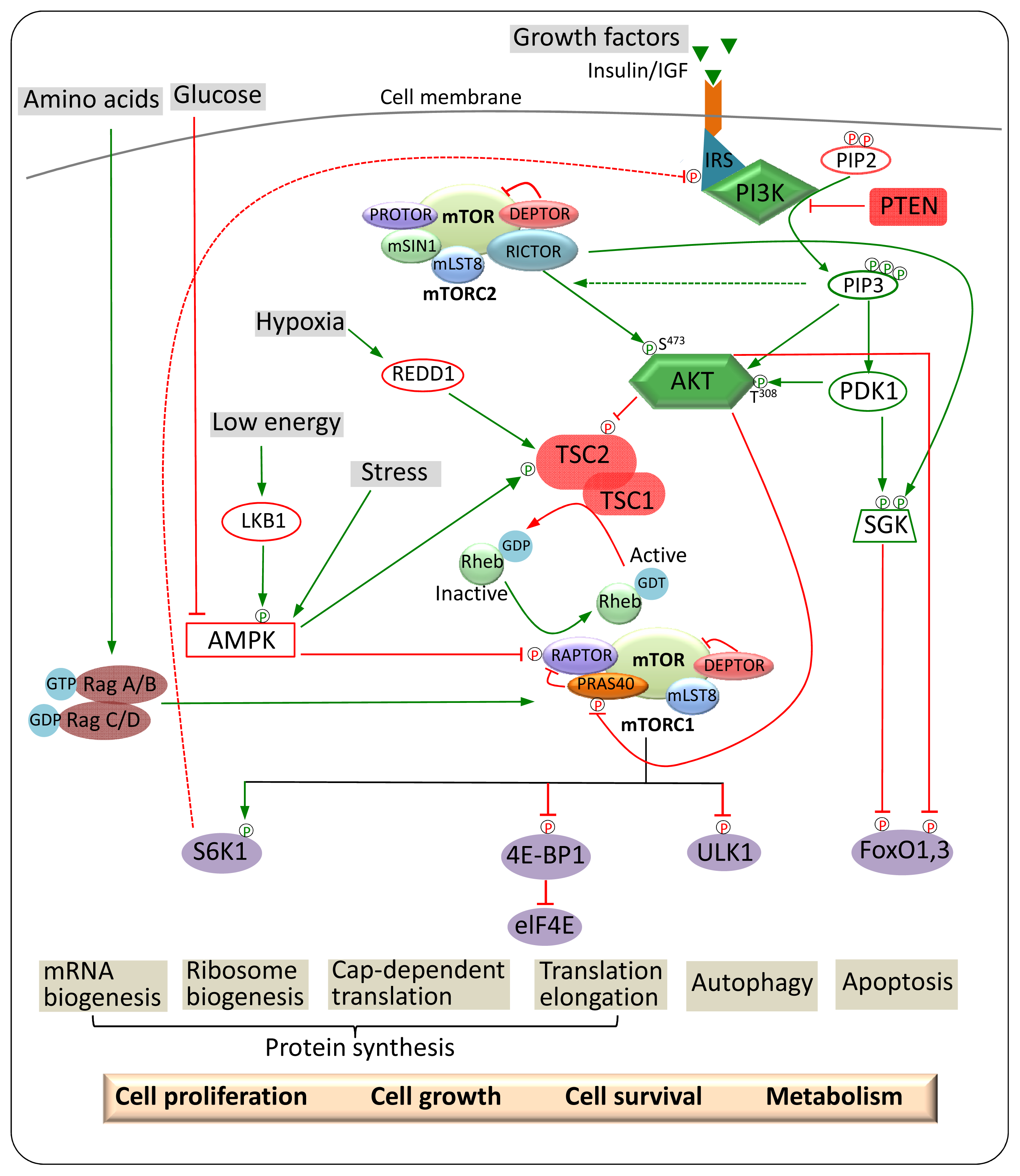
<p>mTORC1 regulates cell growth in response to four major regulatory inputs: nutrients, growth factors, energy and stress of the cell (<xref ref-type="fig" rid="f2-ijms-14-03874">Figure 2</xref>).</p>
<sec>
<title>3.1.1. Nutrients</title>
<p>Early studies have found that specific amino acids are crucial for mTORC1 signalling. Leucine was found to be an essential amino acid required for mTORC1 activation [<xref ref-type="bibr" rid="b36-ijms-14-03874">36</xref>–<xref ref-type="bibr" rid="b40-ijms-14-03874">40</xref>]. Recently, Nicklin and colleagues identified a mechanism by which Solute carrier family 7 member 5 (SLC7A5)/SLC3A2 regulates the exchange of L-glutamine out of cells and transport of L-leucine into cells, allowing intracellular leucine to play its role in mTORC1 signalling [<xref ref-type="bibr" rid="b37-ijms-14-03874">37</xref>]. Several studies proposed that kinase mitogen-activated protein kinase kinase 3 (MAP4K3) and human vacuolar protein-sorting associated protein 34 (VPS34) are involved in nutrient sensing [<xref ref-type="bibr" rid="b41-ijms-14-03874">41</xref>–<xref ref-type="bibr" rid="b44-ijms-14-03874">44</xref>]. However, these mechanisms of sensing need more clarification. Other studies have proposed that TSC1 and TSC2 activate mTORC1 by amino acids [<xref ref-type="bibr" rid="b45-ijms-14-03874">45</xref>]. However, the mTORC1 pathway in cells that lack either TSC1 or TSC2 remains sensitive to amino acid deprivation [<xref ref-type="bibr" rid="b43-ijms-14-03874">43</xref>,<xref ref-type="bibr" rid="b46-ijms-14-03874">46</xref>]. Recent work has shown that the Rag proteins, a family of four related small GTPases, have a strong link between amino acids and mTORC1 [<xref ref-type="bibr" rid="b47-ijms-14-03874">47</xref>–<xref ref-type="bibr" rid="b49-ijms-14-03874">49</xref>]. Active Rag interacts with RAPTOR in an amino acid-dependent manner, leading mTORC1 to co-localise with Rheb (Ras homologue enriched in brain) on the surface of late endosomes and lysosomes [<xref ref-type="bibr" rid="b47-ijms-14-03874">47</xref>,<xref ref-type="bibr" rid="b48-ijms-14-03874">48</xref>,<xref ref-type="bibr" rid="b50-ijms-14-03874">50</xref>].</p></sec>
<sec>
<title>3.1.2. Growth Factors</title>
<p>The mTORC1 pathway is stimulated by growth factors, such as insulin and insulin-like growth factors (IGFs), which bind to their receptor tyrosine kinases (e.g., IR/IGF-1R) and G protein receptors to promote translation, leading to cell growth and proliferation [<xref ref-type="bibr" rid="b51-ijms-14-03874">51</xref>]. The stimulation of these pathways activates PI3K, which phosphorylates Akt, a downstream effector kinase of PI3K, which in turn phosphorylates TSC2 (<xref ref-type="fig" rid="f2-ijms-14-03874">Figure 2</xref>) [<xref ref-type="bibr" rid="b52-ijms-14-03874">52</xref>,<xref ref-type="bibr" rid="b53-ijms-14-03874">53</xref>]. TSC1 and TSC2 form a tight heterodimeric complex in which both negatively regulate mTORC1 signalling and act as a GTPase activating protein (GAP) for Rheb [<xref ref-type="bibr" rid="b54-ijms-14-03874">54</xref>,<xref ref-type="bibr" rid="b55-ijms-14-03874">55</xref>]. Rheb has an essential role in activation of mTORC1 by growth factors, which induce the GTP loading of Rheb, enabling it to bind to the kinase domain and activate mTORC1 in a GTP-dependent manner [<xref ref-type="bibr" rid="b35-ijms-14-03874">35</xref>,<xref ref-type="bibr" rid="b56-ijms-14-03874">56</xref>]. Additionally, Akt phosphorylates PRAS40, a novel growth factor-sensitive repressor of mTORC1, in a TSC1/2-independent manner, resulting in the dissociation of PRAS40 from mTORC1 [<xref ref-type="bibr" rid="b26-ijms-14-03874">26</xref>,<xref ref-type="bibr" rid="b27-ijms-14-03874">27</xref>]. Growth factors inhibit function of PRAS40 via activation of Akt, which phosphorylates the C-terminal Thr-246 residue in PRAS40, resulting in mTORC1 derepression [<xref ref-type="bibr" rid="b26-ijms-14-03874">26</xref>]. Alternatively, growth factors can signal mTORC1 through other pathways, such as the RAS-ERK-RSK (Extracellular signal-Regulated Kinase) (ribosomal S6 kinase) pathway, which has a role in regulating transcription [<xref ref-type="bibr" rid="b57-ijms-14-03874">57</xref>–<xref ref-type="bibr" rid="b59-ijms-14-03874">59</xref>]. ERK phosphorylates TSC2 on Ser-664 <italic>in vitro</italic> and <italic>in vivo</italic>, which leads to TSC1/TSC2 complex disassembly and derepression of mTORC1 signalling [<xref ref-type="bibr" rid="b57-ijms-14-03874">57</xref>]. RSK phosphorylates Ser-939, Thr-1462 and Ser-1798 residues on TSC2, which represses GAP activity of TSC2 [<xref ref-type="bibr" rid="b59-ijms-14-03874">59</xref>]. Collectively, these findings suggest that RAS-ERK–RSK pathways, in parallel with the PI3K-AKT pathway, contain several inputs to activate mTORC1 signalling.</p></sec>
<sec>
<title>3.1.3. Cellular Energy Status and Stress</title>
<p>Ribosomal biogenesis and mRNA translation, two downstream targets of mTORC1, consume high levels of cellular energy, indicating that mTORC1 senses cellular energy [<xref ref-type="bibr" rid="b60-ijms-14-03874">60</xref>]. Recent studies reveal that the energy status of the cell is sensed by mTORC1 through AMP-activated protein kinase (AMPK) [<xref ref-type="bibr" rid="b61-ijms-14-03874">61</xref>]. When the AMP:ATP ratio increases, AMPK is activated and phosphorylates TSC2, causing an increase in TSC2 GAP activity towards Rheb and subsequent inhibition of mTORC1 signalling [<xref ref-type="bibr" rid="b62-ijms-14-03874">62</xref>,<xref ref-type="bibr" rid="b63-ijms-14-03874">63</xref>]. Moreover, AMPK can directly phosphorylate raptor, resulting in the inhibition of mTORC1 signalling [<xref ref-type="bibr" rid="b64-ijms-14-03874">64</xref>].</p>
<p>mTORC1 has been demonstrated to play a role in the response to numerous stress signals, such as hypoxia and DNA damage. In the case of hypoxia (low oxygen conditions), mTOR1 signalling is inhibited via the AMPK pathway by inducing the expression of REDD1 [<xref ref-type="bibr" rid="b65-ijms-14-03874">65</xref>]. REDD1 negatively regulates mTORC1 by acting downstream of Akt and upstream of TSC1-TSC2 [<xref ref-type="bibr" rid="b66-ijms-14-03874">66</xref>]. DNA damage is another stress signal that down-regulates mTOR signalling by p53 through the AMPK-TSC2 signalling pathway [<xref ref-type="bibr" rid="b67-ijms-14-03874">67</xref>]. It was recently proposed that transcriptional targets of p53, sestrin 1 and sestrin 2, activate AMPK upon DNA damage [<xref ref-type="bibr" rid="b68-ijms-14-03874">68</xref>].</p></sec></sec>
<sec>
<title>3.2. Upstream and Downstream Regulators of mTORC2</title>
<p>Little is known about the upstream regulators and downstream effectors of mTORC2. It was proposed that growth factors play a direct and indirect role in mTORC2 regulation [<xref ref-type="bibr" rid="b69-ijms-14-03874">69</xref>]. In <italic>in vitro</italic> studies, Sarbassov and his team demonstrated that insulin stimulates phosphorylation of Ser 473 in AKT at the cell membrane through the binding of PtdIns(3,4,5)P3 to its PH domain (pleckstrin homology) [<xref ref-type="bibr" rid="b69-ijms-14-03874">69</xref>]. It has been proposed that mTORC2 plays important roles in proliferation, cell survival and metabolism, because of its activation by AKT [<xref ref-type="bibr" rid="b70-ijms-14-03874">70</xref>]. Complete activation of AKT requires phosphorylation on Thr 308 and Ser 473 sites [<xref ref-type="bibr" rid="b71-ijms-14-03874">71</xref>]. Phosphoinositide-dependent kinase 1(PDK1) and mTORC2 are responsible for phosphorylation of AKT Thr 308 and Ser 473, respectively [<xref ref-type="bibr" rid="b69-ijms-14-03874">69</xref>]. Therefore, mTORC2 acts as a positive regulator for Akt. As a result of AKT inhibition by mTORC2 depletion, transcription factors, such as the forkhead box protein O1 (FoxO1) and FoxO3a, are activated because of the reduction of AKT phosphorylation [<xref ref-type="bibr" rid="b72-ijms-14-03874">72</xref>]. FoxO1 and FoxO3a are involved in biological processes, such as stress resistance, metabolism, cell-cycle arrest and apoptosis [<xref ref-type="bibr" rid="b73-ijms-14-03874">73</xref>]. Recent studies show that SGK1 (serum- and glucocorticoid-induced protein kinase 1), a member of the AGC family of protein kinases, is regulated by mTORC2, suggesting that SGK1 may also play important roles in regulating cellular proliferation [<xref ref-type="bibr" rid="b74-ijms-14-03874">74</xref>]. Similar to AKT, SGK1 phosphorylates FoxO1 and FoxO3a, supporting the idea that the inhibition of phosphorylation of FoxO1 and FoxO3a is the result of deficient SGK1 activity in mTORC2-deficient cells [<xref ref-type="bibr" rid="b74-ijms-14-03874">74</xref>]. Moreover, mTORC2 plays a role in a number of cellular processes, including cellular structure and motility, via regulation of protein kinase C (PKC) [<xref ref-type="bibr" rid="b30-ijms-14-03874">30</xref>]. Knock-down mTORC2 components affect PKC-α phosphorylation and stability indirectly [<xref ref-type="bibr" rid="b30-ijms-14-03874">30</xref>,<xref ref-type="bibr" rid="b75-ijms-14-03874">75</xref>].</p></sec></sec>
<sec>
<title>4. mTOR Signalling Pathways in Cancer</title>
<p>Elevated mTORC1 signalling has been detected in a large percentage of the most common human cancers [<xref ref-type="bibr" rid="b76-ijms-14-03874">76</xref>]. mTOR drives most tumorigenesis from mutations of negative mTOR regulators, such as TSC1/TSC2, LKB1 and PTEN, or by oncogenic mutations, like PI3K and Akt [<xref ref-type="bibr" rid="b35-ijms-14-03874">35</xref>,<xref ref-type="bibr" rid="b77-ijms-14-03874">77</xref>]. The P13K-Akt-ERK pathways upstream of mTORC1 are activated downstream of both receptor tyrosine kinases (RTKs) and Ras [<xref ref-type="bibr" rid="b78-ijms-14-03874">78</xref>,<xref ref-type="bibr" rid="b79-ijms-14-03874">79</xref>]. Amplification and mutations of RTKs, such as Her2/neu, c-MET and EGFR, are examples in some common malignant tumours that lead to ligand-independent signalling from upstream RTKs [<xref ref-type="bibr" rid="b80-ijms-14-03874">80</xref>]. Ras is a common oncogene in human cancers, which activates the PI3K-Akt pathway by inhibiting tumour suppressor NF1 [<xref ref-type="bibr" rid="b81-ijms-14-03874">81</xref>]. Furthermore, in some cancers, mutated PI3K leads to the growth factor-independent activation of Akt. ERK is also activated in a variety of cancers by BRAF deregulation [<xref ref-type="bibr" rid="b76-ijms-14-03874">76</xref>].</p>
<sec>
<title>4.1. Downstream Targets of mTORC1 in Cancer</title>
<sec>
<title>4.1.1. 4E-BPs</title>
<p>4E-BPs are the major downstream targets of mTORC1 and are key regulators by which mTORC1 signalling contributes to tumorigenesis. 4E-BP1 negatively regulates the eIF4F complex, which drives mRNA translation initiation [<xref ref-type="bibr" rid="b82-ijms-14-03874">82</xref>]. mTORC1 mediated phosphorylation of 4E-BP1 activates eIF4E, which leads to increased translation of mRNAs for pro-tumorigenic genes. As a result of this, inhibition of 4E-BP1 by phosphorylation has been identified in human cancers, such as breast, prostate and ovarian cancers [<xref ref-type="bibr" rid="b83-ijms-14-03874">83</xref>–<xref ref-type="bibr" rid="b85-ijms-14-03874">85</xref>]. In addition, an <italic>in vivo</italic> study has shown that eIF4E promoted cell survival in lymphoma by activating the translation of the anti-apoptotic protein myeloid leukaemia cell differentiation [<xref ref-type="bibr" rid="b86-ijms-14-03874">86</xref>,<xref ref-type="bibr" rid="b87-ijms-14-03874">87</xref>]. Consistent with this data, upregulation of eIF4E develops angiosarcomas, lung adenocarcinomas and hepatocellular adenomas in mice [<xref ref-type="bibr" rid="b88-ijms-14-03874">88</xref>]. Furthermore, loss of 4E-BP1 and 4E-BP2 functions in mice increased tumorigenesis caused by inactivation of p53 [<xref ref-type="bibr" rid="b89-ijms-14-03874">89</xref>]. In humans, over-expressing eIF4E levels have been observed in breast, colon, lung, prostate and bladder tumours [<xref ref-type="bibr" rid="b90-ijms-14-03874">90</xref>–<xref ref-type="bibr" rid="b92-ijms-14-03874">92</xref>]. This data highlights the importance of 4E-BP1 as a prognostic indicator in human cancer and eIF4E as a major target for anti-cancer therapies [<xref ref-type="bibr" rid="b93-ijms-14-03874">93</xref>].</p></sec>
<sec>
<title>4.1.2. S6 Kinases</title>
<p>The second major downstream target of mTORC1 that plays an important role in mTORC1 signalling and tumorigenesis is S6 kinase. The S6 kinases are regulators of protein synthesis, cell growth [<xref ref-type="bibr" rid="b94-ijms-14-03874">94</xref>], S6 phosphorylation and signal transduction. mTORC1 phosphorylates S6K1 leading to increased mRNA translation. Upregulation of S6K1 in ovarian cancer cells increases cell growth and induces invasive and migratory phenotypes [<xref ref-type="bibr" rid="b95-ijms-14-03874">95</xref>,<xref ref-type="bibr" rid="b96-ijms-14-03874">96</xref>]. Activation of S6K1 has been reported in breast cancer cells and a number of other cancer cell lines as well [<xref ref-type="bibr" rid="b97-ijms-14-03874">97</xref>–<xref ref-type="bibr" rid="b99-ijms-14-03874">99</xref>]. In humans, phosphorylation of S6K1 associates with a higher cancer grade in patients with ovarian cancer, and the level of S6K1 is increased in primary breast tumours [<xref ref-type="bibr" rid="b97-ijms-14-03874">97</xref>,<xref ref-type="bibr" rid="b100-ijms-14-03874">100</xref>–<xref ref-type="bibr" rid="b102-ijms-14-03874">102</xref>].</p></sec></sec>
<sec>
<title>4.2. Downstream Targets of mTORC2 in Cancer</title>
<p>mTORC2 is responsible for phosphorylating and activating AKT, which may drive tumorigenesis. Since AKT is involved in the regulation of cell survival, inactivation of the tumour suppressor PTEN or mutations in PI3K may be dependent on the pro-survival activities of Akt [<xref ref-type="bibr" rid="b35-ijms-14-03874">35</xref>,<xref ref-type="bibr" rid="b103-ijms-14-03874">103</xref>]. Studies carried on cultured cells and mice reported that Rictor (a unique mTORC2 component) is required for the growth of tumour cells and prostate tumours deficient in PTEN, respectively [<xref ref-type="bibr" rid="b104-ijms-14-03874">104</xref>–<xref ref-type="bibr" rid="b106-ijms-14-03874">106</xref>]. Prostate epithelial cells lacking PTEN require mTORC2 to induce invasive prostate cancer. However, deleting Rictor protects PTEN heterozygous mice from prostate cancer [<xref ref-type="bibr" rid="b104-ijms-14-03874">104</xref>]. Deletion of Rictor alone in the prostate epithelium is nonessential for the development of a normal prostate epithelium, suggesting that mTORC2 activity is necessary for PTEN-deficient cancer and not for normal prostate function [<xref ref-type="bibr" rid="b104-ijms-14-03874">104</xref>]. Therefore, in this context, development of mTORC2 inhibitors as anti-cancer therapies might be useful. To date, probably the most effective way to target mTORC2 is by the recently developed ATP-competitive tyrosine-kinase inhibitors and by targeting PI3K. However, both strategies are considered mTORC2-nonspecific.</p></sec></sec>
<sec sec-type="discussion">
<title>5. The Impact of mTOR Inhibitors in Cancer</title>
<sec>
<title>5.1. Rapamycin and Rapalogs</title>
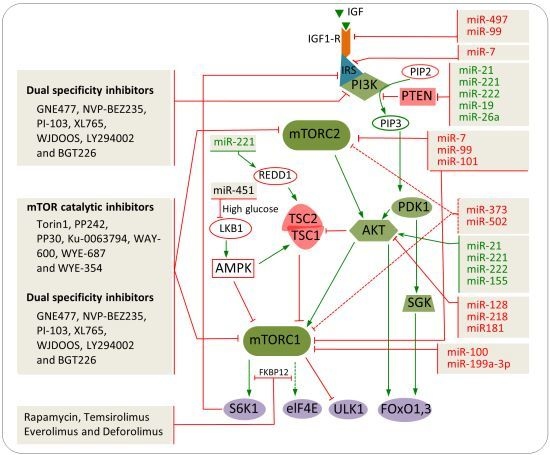
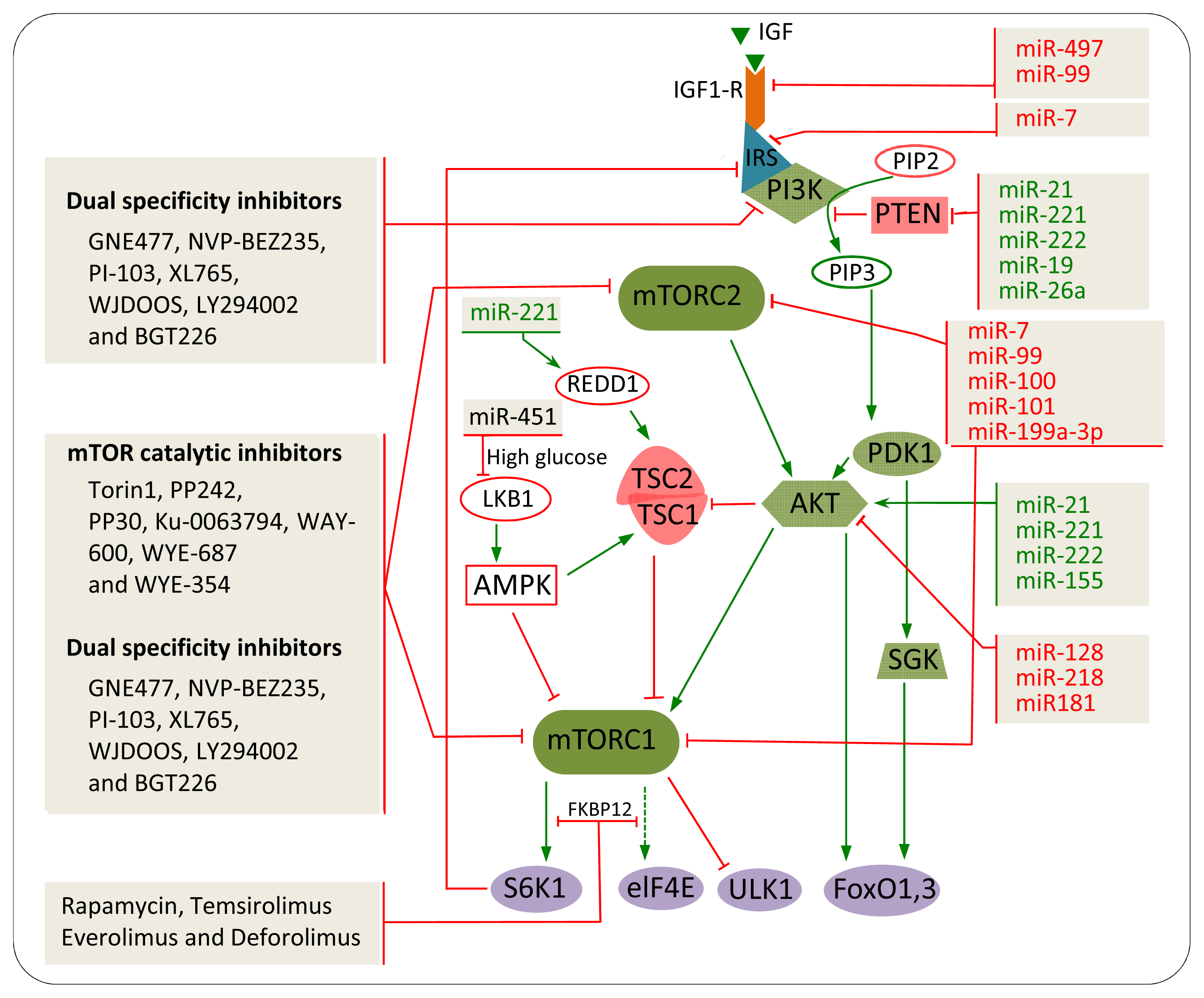
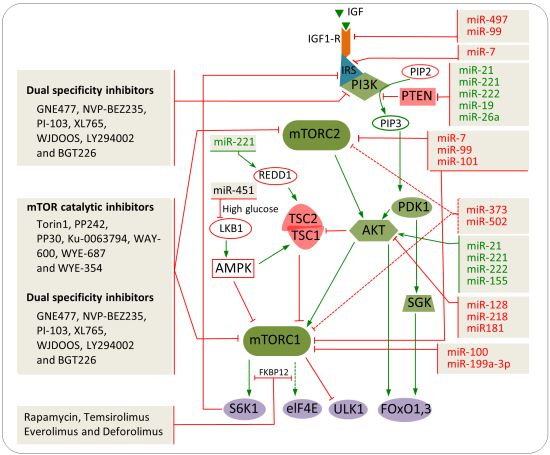
<p>The proposed mechanism by which Rapamycin inhibits mTOR function is through binding to the intracellular receptor FKBP12 at the FRB (FKBP12-rapamycin binding) domain in the C-terminus of mTOR to form FKBP12-rapamycin [<xref ref-type="bibr" rid="b21-ijms-14-03874">21</xref>,<xref ref-type="bibr" rid="b107-ijms-14-03874">107</xref>]. Subsequently, this inhibitory complex dissociates mTORC1 from its substrates, such as 4E-BPs and S6Ks, or inhibits mTOR kinase activity (<xref ref-type="fig" rid="f3-ijms-14-03874">Figure 3</xref>) [<xref ref-type="bibr" rid="b75-ijms-14-03874">75</xref>,<xref ref-type="bibr" rid="b108-ijms-14-03874">108</xref>]. Rapamycin and its derivatives (rapalogs) impair mTORC1 function by inhibiting the interaction of raptor with mTOR [<xref ref-type="bibr" rid="b108-ijms-14-03874">108</xref>]. mTORC2 is insensitive to acute rapamycin treatment, but chronic treatment interferes with assembly of mTORC2 and inhibits its function [<xref ref-type="bibr" rid="b109-ijms-14-03874">109</xref>]. Suppression of cellular proliferation, cell cycle and cell growth by rapalogs has been investigated in many cancers, suggesting that rapalogs could serve as anticancer drugs through mTOR inhibition [<xref ref-type="bibr" rid="b110-ijms-14-03874">110</xref>,<xref ref-type="bibr" rid="b111-ijms-14-03874">111</xref>]. In human cancer cell lines (neuroblastoma, glioblastoma, small cell lung cancer, prostate cancer, breast cancer and pancreatic cancer), rapalogs inhibit cell proliferation activity [<xref ref-type="bibr" rid="b112-ijms-14-03874">112</xref>–<xref ref-type="bibr" rid="b116-ijms-14-03874">116</xref>]. In addition, rapalogs have been shown as potent inhibitors of tumour growth in animal tumour models [<xref ref-type="bibr" rid="b117-ijms-14-03874">117</xref>]. Furthermore, rapalogs are currently being evaluated in clinical trials for cancer treatment after improved pharmacokinetic properties and reduced immunosuppressive effects were observed [<xref ref-type="bibr" rid="b118-ijms-14-03874">118</xref>,<xref ref-type="bibr" rid="b119-ijms-14-03874">119</xref>].</p>
<p>Despite the success of rapamycin and its first generation analogs for the treatment of some cancers, such as renal cell carcinoma, the efficacy of these drugs as anti-cancer therapeutics is still limited [<xref ref-type="bibr" rid="b120-ijms-14-03874">120</xref>,<xref ref-type="bibr" rid="b121-ijms-14-03874">121</xref>]. Analogs of rapamycin inhibit the negative feedback loops from S6K1 to PI3K, leading to upregulation of PI3K signalling, which activates cell proliferation and survival effectors through Akt [<xref ref-type="bibr" rid="b122-ijms-14-03874">122</xref>]. Moreover, rapamycin does not inhibit all of mTORC1 functions, as it only partially phosphorylates 4E-BP1 [<xref ref-type="bibr" rid="b123-ijms-14-03874">123</xref>,<xref ref-type="bibr" rid="b124-ijms-14-03874">124</xref>]. In the case of mTORC2, chronic treatment can only block its function in some type of cancer cell lines, which reflects the inability of rapamycin to inhibit mTORC2 [<xref ref-type="bibr" rid="b109-ijms-14-03874">109</xref>].</p></sec>
<sec>
<title>5.2. mTOR Catalytic Inhibitors</title>
<p>mTOR catalytic inhibitors function as ATP-competitive inhibitors of mTOR and inhibit both mTORC1 and mTORC2 functions (<xref ref-type="fig" rid="f3-ijms-14-03874">Figure 3</xref>) [<xref ref-type="bibr" rid="b125-ijms-14-03874">125</xref>,<xref ref-type="bibr" rid="b126-ijms-14-03874">126</xref>]. These inhibitors include Torin1, PP242, PP30, Ku-0063794, WAY-600, WYE-687 and WYE-354 [<xref ref-type="bibr" rid="b126-ijms-14-03874">126</xref>,<xref ref-type="bibr" rid="b127-ijms-14-03874">127</xref>]. Compared with rapamycin, mTOR catalytic inhibitors have much greater effects on 4E-BP1 phosphorylation and autophagy [<xref ref-type="bibr" rid="b124-ijms-14-03874">124</xref>]. In addition, studies of several cancer cell lines have shown that mTOR catalytic inhibitors suppress protein synthesis and cell proliferation and induce G1 cell cycle arrest [<xref ref-type="bibr" rid="b125-ijms-14-03874">125</xref>,<xref ref-type="bibr" rid="b127-ijms-14-03874">127</xref>,<xref ref-type="bibr" rid="b128-ijms-14-03874">128</xref>]. In animal studies, these drugs showed a better response than rapamycin in leukaemia [<xref ref-type="bibr" rid="b129-ijms-14-03874">129</xref>]. Although mTOR catalytic inhibitors have presented better therapeutic response than the first generation rapamycin inhibitors as anticancer drugs, there is a disadvantage. For example, inhibition of S6K1 feedback loop enhances Akt phosphorylation at Thr308 through PDK1 signalling [<xref ref-type="bibr" rid="b35-ijms-14-03874">35</xref>].</p></sec>
<sec>
<title>5.3. Dual Specificity Inhibitors</title>
<p>The dual specificity inhibitors, such as GNE477, NVP-BEZ235, PI-103, XL765, WJDOOS, LY294002 and BGT226, disable PI3K, mTORC1, mTORC2, Akt and PDK1 (<xref ref-type="fig" rid="f3-ijms-14-03874">Figure 3</xref>) [<xref ref-type="bibr" rid="b130-ijms-14-03874">130</xref>]. This broad inhibition cannot be used to selectively inhibit mTOR [<xref ref-type="bibr" rid="b131-ijms-14-03874">131</xref>,<xref ref-type="bibr" rid="b132-ijms-14-03874">132</xref>]. However, dual inhibition of PI3K and mTOR was effective as an antiproliferative and antitumor in some cancer cell lines and experimental tumour models [<xref ref-type="bibr" rid="b133-ijms-14-03874">133</xref>–<xref ref-type="bibr" rid="b135-ijms-14-03874">135</xref>]. For example, NVP-BEZ235 can inhibit the activation of mTORC1, mTORC2, 4E-BP1 and S6 ribosomal protein in breast cancer cells [<xref ref-type="bibr" rid="b135-ijms-14-03874">135</xref>]. Furthermore, in a xenograft model of the human breast cancer cell, NVP-BEZ235 inhibited tumour growth [<xref ref-type="bibr" rid="b135-ijms-14-03874">135</xref>]. In addition, NVP-BEZ235 inhibited cell migration and cancer metastasis in sarcoma cells [<xref ref-type="bibr" rid="b136-ijms-14-03874">136</xref>]. PI-I03, another dual specificity inhibitor, showed antileukaemic effects <italic>in vivo</italic>[<xref ref-type="bibr" rid="b129-ijms-14-03874">129</xref>]. Furthermore, PI-I03 has inhibitory effects on tumour growth, invasion and angiogenesis in xenograft models [<xref ref-type="bibr" rid="b137-ijms-14-03874">137</xref>].</p></sec></sec>
<sec>
<title>6. miRNAs</title>
<p>miRNAs (microRNA) represent one of a family of noncoding small RNA molecules, which are single-stranded RNAs approximately 22 nucleotides (nt) in length. They post-transcriptionally regulate gene expression by destabilizing translation, suppressing the target mRNA expression and inhibiting translation to regulate multiple biological processes, including cell cycle, differentiation, development and metabolism [<xref ref-type="bibr" rid="b138-ijms-14-03874">138</xref>–<xref ref-type="bibr" rid="b166-ijms-14-03874">166</xref>]. Over 30% of human genes are regulated by miRNAs [<xref ref-type="bibr" rid="b167-ijms-14-03874">167</xref>]. Mature miRNA processing starts with transcription of a long capped and polyadenylated RNA with a hairpin-shaped structure, called the primary transcript (pri-miRNA). Pri-miRNAs are transcribed by RNA polymerase II from non-coding DNA [<xref ref-type="bibr" rid="b144-ijms-14-03874">144</xref>]. Subsequently, pri-miRNAs are processed to pre-miRNAs within the nucleus by the RNase III enzyme, Drosha, and Di George syndrome critical region 8 (DGCR8) to create hairpin structures of ~65 nucleotides [<xref ref-type="bibr" rid="b145-ijms-14-03874">145</xref>,<xref ref-type="bibr" rid="b146-ijms-14-03874">146</xref>]. A nuclear export factor, exportin 5, exports Pre-miRNAs to the cytoplasm [<xref ref-type="bibr" rid="b147-ijms-14-03874">147</xref>,<xref ref-type="bibr" rid="b148-ijms-14-03874">148</xref>]. In the cytoplasm, the dicing step takes place to produce miRNA duplexes operated by RNase III enzyme, Dicer, TRBP (TAR RNA-binding protein) and Argonaute (AGO), forming the RNA induced silencing complex (RISC), which mediates miRNA activity [<xref ref-type="bibr" rid="b149-ijms-14-03874">149</xref>,<xref ref-type="bibr" rid="b150-ijms-14-03874">150</xref>]. Following processing, the guide strand remains on the Ago protein, whereas the passenger strand of the duplex is degraded [<xref ref-type="bibr" rid="b150-ijms-14-03874">150</xref>]. Mature miRNAs mostly target mRNAs in the 3′-untranslated region (3′-UTR), resulting in mRNA degradation or repressing the translation of mRNA [<xref ref-type="bibr" rid="b151-ijms-14-03874">151</xref>]. In addition, some studies have found that miRNAs also target the 5′-UTR and coding sequences of mRNAs and have a role regulating mRNA expression post-transcriptionally [<xref ref-type="bibr" rid="b152-ijms-14-03874">152</xref>]. However, there may be other unknown mechanisms involved in miRNA mRNA interactions.</p></sec>
<sec>
<title>7. miRNAs Involved in mTOR Regulation in Cancer</title>
<p>Compelling evidence underscores the ability of a single miRNA to target multiple molecules belonging to the same, as well as to redundant, pathways in neoplastic and normal cells. Thus, understanding the role of miRNAs in tumour cells provides valuable information that will facilitate our understanding of miRNA involvement in the regulation of molecular networks sustaining cancerous phenotypes. To date, evidence shows the involvement of miRNA in cancer initiation, development and progression and identifies this class of regulatory RNAs as diagnostic and prognostic cancer biomarkers, as well as additional therapeutic tools [<xref ref-type="bibr" rid="b142-ijms-14-03874">142</xref>]. In addition, growing evidence links miRNA deregulation to carcinogenesis in several human neoplasms, and their molecular signatures of deregulation have been associated with cancer clinical features [<xref ref-type="bibr" rid="b143-ijms-14-03874">143</xref>].</p>
<p>miRNAs target the mTOR pathway in several ways, either by interacting directly with mTOR itself or targeting key genes within the pathway, which ultimately affect mTOR function (<xref ref-type="fig" rid="f3-ijms-14-03874">Figure 3</xref>). These genes include upstream regulators of mTOR, such as IGF-R, PI3K and Akt, and negative regulators, such as PTEN (<xref ref-type="table" rid="t1-ijms-14-03874">Table 1</xref>). miRNAs that are up-regulated in cancer could act as oncogenes and drive tumorigenesis, whereas down-regulated miRNAs act as tumour-suppressors.</p>
<sec>
<title>7.1. IGF-R</title>
<p>IGF is closely interconnected with mTOR since it can regulate mTOR signalling cascades through modulation of the expression of key proteins implicated in the pathway. Recent studies have pointed to a role of miRNAs in regulation of IGF-R in several cancer cells [<xref ref-type="bibr" rid="b143-ijms-14-03874">143</xref>–<xref ref-type="bibr" rid="b147-ijms-14-03874">147</xref>]. In hepatocellular carcinoma (HCC), miR-99a is inhibited, and restoring its expression suppresses cell growth <italic>in vitro</italic> by activating G1 phase cell cycle arrest [<xref ref-type="bibr" rid="b147-ijms-14-03874">147</xref>]. <italic>In vivo,</italic> miR-99a mimics reduced tumour growth and reduced the <italic>α</italic>-fetoprotein level [<xref ref-type="bibr" rid="b147-ijms-14-03874">147</xref>]. Both miR-99a and miR-100 are among the most downregulated miRNAs in adrenocortical tumours (ACT), which have been identified to be regulators of IGF-R expression by acting on a target site in the 3′-UTR of its mRNA [<xref ref-type="bibr" rid="b143-ijms-14-03874">143</xref>]. In addition, overexpression of miR-497 lead to suppression of IGF1-R activity in colorectal cancer cells [<xref ref-type="bibr" rid="b144-ijms-14-03874">144</xref>]. Therefore, downregulation of these miRNAs contributes to elevated activation of the mTOR pathway and malignant behaviour in cancer cells.</p></sec>
<sec>
<title>7.2. PTEN</title>
<p>Loss of PTEN leads to increased PDK1 and AKT due to PIP3 accumulation resulting in activation of mTORC1 and its downstream effectors [<xref ref-type="bibr" rid="b70-ijms-14-03874">70</xref>]. Tumour suppressor PTEN is regulated by miRNAs in several cancer cells. Over-expression of the oncogenic miR-221 and miR-222 in non-small cell lung cancer, hepatocarcinoma and gastric cancer cells suppress PTEN expression <italic>in vitro</italic> and <italic>in vivo</italic> experiments leading to activation of the oncoprotein AKT and promotion of cell migration and growth [<xref ref-type="bibr" rid="b138-ijms-14-03874">138</xref>,<xref ref-type="bibr" rid="b139-ijms-14-03874">139</xref>]. Conversely, knockdown of miR-221 and miR-222 are able to increase PTEN expression and decrease cell migration and invasion [<xref ref-type="bibr" rid="b139-ijms-14-03874">139</xref>]. In human squamous cell carcinoma (SCC), oncomir miR-21 targets PTEN and its transcriptional regulator Grainy headlike 3 (Grhl3), leading to activation of mTOR signalling [<xref ref-type="bibr" rid="b148-ijms-14-03874">148</xref>]. PTEN is found to be a target of miR-21 in HCC cells, and enhancing miR-21 expression increases tumour cell proliferation, migration and invasion [<xref ref-type="bibr" rid="b149-ijms-14-03874">149</xref>]. Moreover, miR-26a is up-regulated in high-grade gliomas and it has been reported as a direct regulator of PTEN [<xref ref-type="bibr" rid="b161-ijms-14-03874">161</xref>]. In the <italic>Em-myc</italic> model of mouse B-cell lymphoma, overexpression of miR-19 inhibits PTEN and promotes cell survival via the mTOR pathway [<xref ref-type="bibr" rid="b164-ijms-14-03874">164</xref>].</p></sec>
<sec>
<title>7.3. AKT</title>
<p>miRNAs play a key role in targeting Akt by either inducing or suppressing its action. miR-21 is an oncomir that targets Akt by inhibiting Ras homolog gene family member B (Rhob), which leads to activation of cyclin D1 translation in liver regeneration [<xref ref-type="bibr" rid="b150-ijms-14-03874">150</xref>,<xref ref-type="bibr" rid="b169-ijms-14-03874">169</xref>]. In addition, miR-155 acts as a regulator of proliferation and growth of Waldenström macroglobulinemia cells <italic>in vitro</italic> and <italic>in vivo</italic> by inhibiting AKT phosphorylation [<xref ref-type="bibr" rid="b168-ijms-14-03874">168</xref>]. In glioma cells, overexpression of miR-221 and miR-222 increases cell proliferation and invasion <italic>in vitro</italic> and induces glioma growth in xenograft tumour mouse models via activation of Akt [<xref ref-type="bibr" rid="b141-ijms-14-03874">141</xref>]. On the other hand, miR-128 acts as a tumour suppressor by increasing Akt phosphorylation, which activates further downstream oncoproteins [<xref ref-type="bibr" rid="b165-ijms-14-03874">165</xref>]. Moreover, Akt co-activator T-cell leukaemia/lymphoma 1 (TCL1) is regulated by miR-181 in chronic lymphocytic leukaemia (CCL) [<xref ref-type="bibr" rid="b162-ijms-14-03874">162</xref>]. Finally, Epigenetic silencing of miR-218 by overexpression of Rictor in oral squamous cell carcinoma (OSCC) inhibited the phosphorylation of Akt at Ser-473, resulting in cell growth inhibition [<xref ref-type="bibr" rid="b166-ijms-14-03874">166</xref>].</p></sec>
<sec>
<title>7.4. mTOR</title>
<p>To understand the role of miRNAs in regulating mTOR, functional studies have been performed <italic>in vitro</italic> and <italic>in vivo</italic> through overexpression or knockdown of miRNAs in cancer cells. For example, miR-199a-3p, miR-100 and miR-7 target the 3′-UTR of mTOR and suppress translation of its mRNA, resulting in activation of the mTOR kinase pathways [<xref ref-type="bibr" rid="b147-ijms-14-03874">147</xref>,<xref ref-type="bibr" rid="b154-ijms-14-03874">154</xref>,<xref ref-type="bibr" rid="b156-ijms-14-03874">156</xref>]. This promotes activation of S6K1 and phosphorylation of 4EBP1 and enhanced protein translation. miR-199a-3p expression is decreased in HCC and restoring its expression level blocks G1-phase cell cycle and impairs invasive capability [<xref ref-type="bibr" rid="b156-ijms-14-03874">156</xref>]. Furthermore, in engrafted anaplastic large-cell lymphoma (ALCL) mouse models, miR-101 binds directly to the 3′-UTR of mTOR and leads to reduced tumour growth [<xref ref-type="bibr" rid="b155-ijms-14-03874">155</xref>]. Finally, miR-99a expression and mTOR were found to be inversely correlated in human HCC and restored miR-99a expression inhibited cell growth both <italic>in vivo</italic> and <italic>in vitro</italic>[<xref ref-type="bibr" rid="b147-ijms-14-03874">147</xref>].</p></sec></sec>
<sec>
<title>8. Combination of miRNAs and Chemical Inhibitors to Target the mTOR Pathway</title>
<p>The mTOR pathway is a complex system, and its deregulation has been implicated in several neoplastic malignancies, Therefore, strategies to inhibit the pathway will most likely include combinatorial approaches. Several studies have looked at the efficacy of combining mTOR inhibitors with miRNAs in cancer cell models. Firstly, suppression of the mTOR pathway by mir-100 enhanced the chemotherapeutic effect of rapamycin analog RAD001 (everolimus) in clear cell ovarian cancer cells [<xref ref-type="bibr" rid="b154-ijms-14-03874">154</xref>]. Furthermore, knocking down miRNA-155 expression in low-grade lymphoma, Waldenström macroglobulinemia cells was shown to partially inhibit everolimus-dependent induction of toxicity [<xref ref-type="bibr" rid="b170-ijms-14-03874">170</xref>]. This finding indicates that miRNA-155 could be a target responsible for the everolimus-induced anti-Waldenström macroglobulinemia effect [<xref ref-type="bibr" rid="b170-ijms-14-03874">170</xref>]. In addition, another rapamycin analogue, CCI-779 (temsirolimus), shows increased anti-proliferative effects in miR-101 negative anaplastic lymphoma kinase (ALK)<sup>+</sup> large-cell lymphoma (ALCL) cells compared to ALK<sup>−</sup> cells [<xref ref-type="bibr" rid="b155-ijms-14-03874">155</xref>]. When miR-101 is overexpressed in ALCL, cell proliferation weakens in ALK<sup>+</sup>, but not in ALK− cells, and the anti-proliferative effect of temsirolimus on the ALK+ ALCL cells was stronger than ALK− cells, since the effect of miR-101 is partially absent in ALK<sup>−</sup> cells [<xref ref-type="bibr" rid="b155-ijms-14-03874">155</xref>]. One of the reasons that may explain this is the direct binding of miR-101 to the 3′-UTR of mTOR [<xref ref-type="bibr" rid="b171-ijms-14-03874">171</xref>].</p>
<p>The strategy of combining both miRNAs and mTOR inhibitors has not been studied extensively in cancer research. In addition, second generation, ATP-competitive inhibitors of mTOR need to be combined with miRNAs and tested to evaluate the potential of using this approach as a chemotherapeutic tool in cancer.</p></sec>
<sec>
<title>9. Conclusion</title>
<p>Over the last decade, the mTOR pathway has received great attention in order to understand its role in cancer cell behaviour. This knowledge has led to the development of therapeutic strategies to target the mTOR pathway. Preclinical studies are currently evaluating their therapeutic potential and they have shown promising anticancer efficacy in certain types of cancers. Rapamycin-based therapeutic approaches showed potent antitumor activity by partially blocking mTORC1 activity in certain types of cancer. In addition, they inhibit the negative feedback loops from S6K1 to PI3K, leading to PI3K-Akt upregulation, which induces cell proliferation and survival effectors. Therefore, the efficacy of these drugs as anti-cancer therapeutics is still limited. mTOR and mTOR-PI3K catalytic inhibitors, such as Torin1, PP242, NVP-BEZ235 and PI-103, have emerged as a new class of mTOR inhibitors targeting both mTORC1 and mTORC2, anticipated to be more effective and have broader applications. However, this kind of inhibition is still in the early stage of evaluation, and its broad therapeutic potential may be toxic to normal cells, especially Dual PI3K-mTOR inhibitors.</p>
<p>Another strategy for targeting the mTOR pathway as a therapeutic tool in cancer is miRNAs. Recently, miRNAs have emerged as modulators of biological pathways that play an essential role in cancer initiation, development and progression through their behaviour as tumour suppressors or oncogenes in several human neoplasms. Current knowledge indicates that miRNAs are involved in regulating the mTOR pathway in some cancer types. Tactics, either by elevating levels of tumour suppressors or inhibiting oncogenic miRNAs, have shown promising therapeutic benefits. However, using miRNAs in targeting the mTOR pathway is still at an early stage. Issues, such as a single miRNA targeting many genes in many pathways, may hinder the potential use of miRNA as therapeutic tools. More <italic>in vivo</italic> studies are needed to clarify the role of miRNAs in cancer and their potential role in enhancing the chemotherapeutic effects of mTOR inhibitors</p></sec></body>
<back>
<ack>
<title>Acknowledgements</title>
<p>We thank Faisal AlOwaidi for helpful comments on this review and Saleh AlSuhaibani for academic support. This work is supported by Dammam University through project funds and PhD scholarship.</p></ack>
<fn-group><fn id="fn1-ijms-14-03874">
<p><bold>Conflict of Interest</bold></p>
<p>The authors declare no conflict of interest.</p></fn></fn-group>
<ref-list>
<title>References</title>
<ref id="b1-ijms-14-03874"><label>1</label><citation citation-type="journal"><person-group person-group-type="author"><name><surname>Brown</surname><given-names>E.J.</given-names></name><name><surname>Albers</surname><given-names>M.W.</given-names></name><name><surname>Shin</surname><given-names>T.B.</given-names></name><name><surname>Ichikawa</surname><given-names>K.</given-names></name><name><surname>Keith</surname><given-names>C.T.</given-names></name><name><surname>Lane</surname><given-names>W.S.</given-names></name><name><surname>Schreiber</surname><given-names>S.L.</given-names></name></person-group><article-title>A mammalian protein targeted by G1-arresting rapamycin-receptor complex</article-title><source>Nature</source><year>1994</year><volume>369</volume><fpage>756</fpage><lpage>758</lpage><pub-id pub-id-type="doi">10.1038/369756a0</pub-id><pub-id pub-id-type="pmid">8008069</pub-id></citation></ref>
<ref id="b2-ijms-14-03874"><label>2</label><citation citation-type="journal"><person-group person-group-type="author"><name><surname>Chiu</surname><given-names>M.I.</given-names></name><name><surname>Katz</surname><given-names>H.</given-names></name><name><surname>Berlin</surname><given-names>V.</given-names></name></person-group><article-title>RAPT1, a mammalian homolog of yeast Tor, interacts with the FKBP12/rapamycin complex</article-title><source>Proc. Natl. Acad. Sci. USA</source><year>1994</year><volume>91</volume><fpage>12574</fpage><lpage>12578</lpage><pub-id pub-id-type="doi">10.1073/pnas.91.26.12574</pub-id><pub-id pub-id-type="pmid">7809080</pub-id></citation></ref>
<ref id="b3-ijms-14-03874"><label>3</label><citation citation-type="journal"><person-group person-group-type="author"><name><surname>Heitman</surname><given-names>J.</given-names></name><name><surname>Movva</surname><given-names>N.R.</given-names></name><name><surname>Hall</surname><given-names>M.N.</given-names></name></person-group><article-title>Targets for cell cycle arrest by the immunosuppressant rapamycin in yeast</article-title><source>Science</source><year>1991</year><volume>253</volume><fpage>905</fpage><lpage>909</lpage><pub-id pub-id-type="doi">10.1126/science.1715094</pub-id><pub-id pub-id-type="pmid">1715094</pub-id></citation></ref>
<ref id="b4-ijms-14-03874"><label>4</label><citation citation-type="journal"><person-group person-group-type="author"><name><surname>Sabatini</surname><given-names>D.M.</given-names></name><name><surname>Erdjument-Bromage</surname><given-names>H.</given-names></name><name><surname>Lui</surname><given-names>M.</given-names></name><name><surname>Tempst</surname><given-names>P.</given-names></name><name><surname>Snyder</surname><given-names>S.H.</given-names></name></person-group><article-title>RAFT1: A mammalian protein that binds to FKBP12 in a rapamycin-dependent fashion and is homologous to yeast TORs</article-title><source>Cell</source><year>1994</year><volume>78</volume><fpage>35</fpage><lpage>43</lpage><pub-id pub-id-type="doi">10.1016/0092-8674(94)90570-3</pub-id><pub-id pub-id-type="pmid">7518356</pub-id></citation></ref>
<ref id="b5-ijms-14-03874"><label>5</label><citation citation-type="journal"><person-group person-group-type="author"><name><surname>Vezina</surname><given-names>C.</given-names></name><name><surname>Kudelski</surname><given-names>A.</given-names></name><name><surname>Sehgal</surname><given-names>S.N.</given-names></name></person-group><article-title>Rapamycin (AY-22,989), a new antifungal antibiotic. I. Taxonomy of the producing streptomycete and isolation of the active principle</article-title><source>J. Antibiot. (Tokyo)</source><year>1975</year><volume>28</volume><fpage>721</fpage><lpage>726</lpage><pub-id pub-id-type="doi">10.7164/antibiotics.28.721</pub-id></citation></ref>
<ref id="b6-ijms-14-03874"><label>6</label><citation citation-type="journal"><person-group person-group-type="author"><name><surname>Choi</surname><given-names>J.</given-names></name><name><surname>Chen</surname><given-names>J.</given-names></name><name><surname>Schreiber</surname><given-names>S.L.</given-names></name><name><surname>Clardy</surname><given-names>J.</given-names></name></person-group><article-title>Structure of the FKBP12-rapamycin complex interacting with the binding domain of human FRAP</article-title><source>Science</source><year>1996</year><volume>273</volume><fpage>239</fpage><lpage>242</lpage><pub-id pub-id-type="doi">10.1126/science.273.5272.239</pub-id><pub-id pub-id-type="pmid">8662507</pub-id></citation></ref>
<ref id="b7-ijms-14-03874"><label>7</label><citation citation-type="journal"><person-group person-group-type="author"><name><surname>Abraham</surname><given-names>R.T.</given-names></name></person-group><article-title>PI 3-kinase related kinases: ‘Big’ players in stress-induced signaling pathways</article-title><source>DNA Repair (Amst)</source><year>2004</year><volume>3</volume><fpage>883</fpage><lpage>887</lpage><pub-id pub-id-type="doi">10.1016/j.dnarep.2004.04.002</pub-id></citation></ref>
<ref id="b8-ijms-14-03874"><label>8</label><citation citation-type="journal"><person-group person-group-type="author"><name><surname>Hay</surname><given-names>N.</given-names></name><name><surname>Sonenberg</surname><given-names>N.</given-names></name></person-group><article-title>Upstream and downstream of mTOR</article-title><source>Genes Dev</source><year>2004</year><volume>18</volume><fpage>1926</fpage><lpage>1945</lpage><pub-id pub-id-type="doi">10.1101/gad.1212704</pub-id><pub-id pub-id-type="pmid">15314020</pub-id></citation></ref>
<ref id="b9-ijms-14-03874"><label>9</label><citation citation-type="journal"><person-group person-group-type="author"><name><surname>Sabers</surname><given-names>C.J.</given-names></name><name><surname>Martin</surname><given-names>M.M.</given-names></name><name><surname>Brunn</surname><given-names>G.J.</given-names></name><name><surname>Williams</surname><given-names>J.M.</given-names></name><name><surname>Dumont</surname><given-names>F.J.</given-names></name><name><surname>Wiederrecht</surname><given-names>G.</given-names></name><name><surname>Abraham</surname><given-names>R.T.</given-names></name></person-group><article-title>Isolation of a protein target of the FKBP12-rapamycin complex in mammalian cells</article-title><source>J. Biol. Chem</source><year>1995</year><volume>270</volume><fpage>815</fpage><lpage>822</lpage><pub-id pub-id-type="doi">10.1074/jbc.270.2.815</pub-id><pub-id pub-id-type="pmid">7822316</pub-id></citation></ref>
<ref id="b10-ijms-14-03874"><label>10</label><citation citation-type="journal"><person-group person-group-type="author"><name><surname>Yonezawa</surname><given-names>K.</given-names></name><name><surname>Yoshino</surname><given-names>K.I.</given-names></name><name><surname>Tokunaga</surname><given-names>C.</given-names></name><name><surname>Hara</surname><given-names>K.</given-names></name></person-group><article-title>Kinase activities associated with mTOR</article-title><source>Curr. Top Microbiol. Immunol</source><year>2004</year><volume>279</volume><fpage>271</fpage><lpage>282</lpage><pub-id pub-id-type="pmid">14560963</pub-id></citation></ref>
<ref id="b11-ijms-14-03874"><label>11</label><citation citation-type="journal"><person-group person-group-type="author"><name><surname>Brunn</surname><given-names>G.J.</given-names></name><name><surname>Fadden</surname><given-names>P.</given-names></name><name><surname>Haystead</surname><given-names>T.A.</given-names></name><name><surname>Lawrence</surname><given-names>J.C.</given-names><suffix>Jr</suffix></name></person-group><article-title>The mammalian target of rapamycin phosphorylates sites having a (Ser/Thr)-Pro motif and is activated by antibodies to a region near its COOH terminus</article-title><source>J. Biol. Chem.</source><year>1997</year><volume>272</volume><fpage>32547</fpage><lpage>32550</lpage><pub-id pub-id-type="doi">10.1074/jbc.272.51.32547</pub-id><pub-id pub-id-type="pmid">9405468</pub-id></citation></ref>
<ref id="b12-ijms-14-03874"><label>12</label><citation citation-type="journal"><person-group person-group-type="author"><name><surname>Burnett</surname><given-names>P.E.</given-names></name><name><surname>Barrow</surname><given-names>R.K.</given-names></name><name><surname>Cohen</surname><given-names>N.A.</given-names></name><name><surname>Snyder</surname><given-names>S.H.</given-names></name><name><surname>Sabatini</surname><given-names>D.M.</given-names></name></person-group><article-title>RAFT1 phosphorylation of the translational regulators p70 S6 kinase and 4E-BP1</article-title><source>Proc. Natl. Acad. Sci. USA</source><year>1998</year><volume>95</volume><fpage>1432</fpage><lpage>1437</lpage><pub-id pub-id-type="doi">10.1073/pnas.95.4.1432</pub-id><pub-id pub-id-type="pmid">9465032</pub-id></citation></ref>
<ref id="b13-ijms-14-03874"><label>13</label><citation citation-type="journal"><person-group person-group-type="author"><name><surname>Isotani</surname><given-names>S.</given-names></name><name><surname>Hara</surname><given-names>K.</given-names></name><name><surname>Tokunaga</surname><given-names>C.</given-names></name><name><surname>Inoue</surname><given-names>H.</given-names></name><name><surname>Avruch</surname><given-names>J.</given-names></name><name><surname>Yonezawa</surname><given-names>K.</given-names></name></person-group><article-title>Immunopurified mammalian target of rapamycin phosphorylates and activates p70 S6 kinase alpha <italic>in vitro</italic></article-title><source>J. Biol. Chem</source><year>1999</year><volume>274</volume><fpage>34493</fpage><lpage>34498</lpage><pub-id pub-id-type="doi">10.1074/jbc.274.48.34493</pub-id><pub-id pub-id-type="pmid">10567431</pub-id></citation></ref>
<ref id="b14-ijms-14-03874"><label>14</label><citation citation-type="journal"><person-group person-group-type="author"><name><surname>Andrade</surname><given-names>M.A.</given-names></name><name><surname>Bork</surname><given-names>P.</given-names></name></person-group><article-title>HEAT repeats in the Huntington’s disease protein</article-title><source>Nat. Genet</source><year>1995</year><volume>11</volume><fpage>115</fpage><lpage>116</lpage><pub-id pub-id-type="doi">10.1038/ng1095-115</pub-id><pub-id pub-id-type="pmid">7550332</pub-id></citation></ref>
<ref id="b15-ijms-14-03874"><label>15</label><citation citation-type="journal"><person-group person-group-type="author"><name><surname>Bosotti</surname><given-names>R.</given-names></name><name><surname>Isacchi</surname><given-names>A.</given-names></name><name><surname>Sonnhammer</surname><given-names>E.L.</given-names></name></person-group><article-title>FAT: A novel domain in PIK-related kinases</article-title><source>Trends Biochem. Sci</source><year>2000</year><volume>25</volume><fpage>225</fpage><lpage>227</lpage><pub-id pub-id-type="doi">10.1016/S0968-0004(00)01563-2</pub-id><pub-id pub-id-type="pmid">10782091</pub-id></citation></ref>
<ref id="b16-ijms-14-03874"><label>16</label><citation citation-type="journal"><person-group person-group-type="author"><name><surname>Jacinto</surname><given-names>E.</given-names></name><name><surname>Hall</surname><given-names>M.N.</given-names></name></person-group><article-title>Tor signalling in bugs, brain and brawn</article-title><source>Nat. Rev. Mol. Cell Biol</source><year>2003</year><volume>4</volume><fpage>117</fpage><lpage>126</lpage><pub-id pub-id-type="doi">10.1038/nrm1018</pub-id><pub-id pub-id-type="pmid">12563289</pub-id></citation></ref>
<ref id="b17-ijms-14-03874"><label>17</label><citation citation-type="journal"><person-group person-group-type="author"><name><surname>Sekulic</surname><given-names>A.</given-names></name><name><surname>Hudson</surname><given-names>C.C.</given-names></name><name><surname>Homme</surname><given-names>J.L.</given-names></name><name><surname>Yin</surname><given-names>P.</given-names></name><name><surname>Otterness</surname><given-names>D.M.</given-names></name><name><surname>Karnitz</surname><given-names>L.M.</given-names></name><name><surname>Abraham</surname><given-names>R.T.</given-names></name></person-group><article-title>A direct linkage between the phosphoinositide 3-kinase-AKT signaling pathway and the mammalian target of rapamycin in mitogen-stimulated and transformed cells</article-title><source>Cancer Res</source><year>2000</year><volume>60</volume><fpage>3504</fpage><lpage>3513</lpage><pub-id pub-id-type="pmid">10910062</pub-id></citation></ref>
<ref id="b18-ijms-14-03874"><label>18</label><citation citation-type="journal"><person-group person-group-type="author"><name><surname>Guertin</surname><given-names>D.A.</given-names></name><name><surname>Sabatini</surname><given-names>D.M.</given-names></name></person-group><article-title>Defining the role of mTOR in cancer</article-title><source>Cancer Cell</source><year>2007</year><volume>12</volume><fpage>9</fpage><lpage>22</lpage><pub-id pub-id-type="doi">10.1016/j.ccr.2007.05.008</pub-id><pub-id pub-id-type="pmid">17613433</pub-id></citation></ref>
<ref id="b19-ijms-14-03874"><label>19</label><citation citation-type="journal"><person-group person-group-type="author"><name><surname>Sabatini</surname><given-names>D.M.</given-names></name></person-group><article-title>mTOR and cancer: Insights into a complex relationship</article-title><source>Nat. Rev. Cancer</source><year>2006</year><volume>6</volume><fpage>729</fpage><lpage>734</lpage><pub-id pub-id-type="doi">10.1038/nrc1974</pub-id><pub-id pub-id-type="pmid">16915295</pub-id></citation></ref>
<ref id="b20-ijms-14-03874"><label>20</label><citation citation-type="journal"><person-group person-group-type="author"><name><surname>Hara</surname><given-names>K.</given-names></name><name><surname>Maruki</surname><given-names>Y.</given-names></name><name><surname>Long</surname><given-names>X.</given-names></name><name><surname>Yoshino</surname><given-names>K.</given-names></name><name><surname>Oshiro</surname><given-names>N.</given-names></name><name><surname>Hidayat</surname><given-names>S.</given-names></name><name><surname>Tokunaga</surname><given-names>C.</given-names></name><name><surname>Avruch</surname><given-names>J.</given-names></name><name><surname>Yonezawa</surname><given-names>K.</given-names></name></person-group><article-title>Raptor, a binding partner of target of rapamycin (TOR), mediates TOR action</article-title><source>Cell</source><year>2002</year><volume>110</volume><fpage>177</fpage><lpage>189</lpage><pub-id pub-id-type="doi">10.1016/S0092-8674(02)00833-4</pub-id><pub-id pub-id-type="pmid">12150926</pub-id></citation></ref>
<ref id="b21-ijms-14-03874"><label>21</label><citation citation-type="journal"><person-group person-group-type="author"><name><surname>Kim</surname><given-names>D.H.</given-names></name><name><surname>Sarbassov</surname><given-names>D.D.</given-names></name><name><surname>Ali</surname><given-names>S.M.</given-names></name><name><surname>King</surname><given-names>J.E.</given-names></name><name><surname>Latek</surname><given-names>R.R.</given-names></name><name><surname>Erdjument-Bromage</surname><given-names>H.</given-names></name><name><surname>Tempst</surname><given-names>P.</given-names></name><name><surname>Sabatini</surname><given-names>D.M.</given-names></name></person-group><article-title>mTOR interacts with raptor to form a nutrient-sensitive complex that signals to the cell growth machinery</article-title><source>Cell</source><year>2002</year><volume>110</volume><fpage>163</fpage><lpage>175</lpage><pub-id pub-id-type="doi">10.1016/S0092-8674(02)00808-5</pub-id><pub-id pub-id-type="pmid">12150925</pub-id></citation></ref>
<ref id="b22-ijms-14-03874"><label>22</label><citation citation-type="journal"><person-group person-group-type="author"><name><surname>Nojima</surname><given-names>H.</given-names></name><name><surname>Tokunaga</surname><given-names>C.</given-names></name><name><surname>Eguchi</surname><given-names>S.</given-names></name><name><surname>Oshiro</surname><given-names>N.</given-names></name><name><surname>Hidayat</surname><given-names>S.</given-names></name><name><surname>Yoshino</surname><given-names>K.</given-names></name><name><surname>Hara</surname><given-names>K.</given-names></name><name><surname>Tanaka</surname><given-names>N.</given-names></name><name><surname>Avruch</surname><given-names>J.</given-names></name><name><surname>Yonezawa</surname><given-names>K.</given-names></name></person-group><article-title>The mammalian target of rapamycin (mTOR) partner, raptor, binds the mTOR substrates p70 S6 kinase and 4E-BP1 through their TOR signaling (TOS) motif</article-title><source>J. Biol. Chem</source><year>2003</year><volume>278</volume><fpage>15461</fpage><lpage>15464</lpage><pub-id pub-id-type="doi">10.1074/jbc.C200665200</pub-id><pub-id pub-id-type="pmid">12604610</pub-id></citation></ref>
<ref id="b23-ijms-14-03874"><label>23</label><citation citation-type="journal"><person-group person-group-type="author"><name><surname>Schalm</surname><given-names>S.S.</given-names></name><name><surname>Fingar</surname><given-names>D.C.</given-names></name><name><surname>Sabatini</surname><given-names>D.M.</given-names></name><name><surname>Blenis</surname><given-names>J.</given-names></name></person-group><article-title>TOS motif-mediated raptor binding regulates 4E-BP1 multisite phosphorylation and function</article-title><source>Curr. Biol</source><year>2003</year><volume>13</volume><fpage>797</fpage><lpage>806</lpage><pub-id pub-id-type="doi">10.1016/S0960-9822(03)00329-4</pub-id><pub-id pub-id-type="pmid">12747827</pub-id></citation></ref>
<ref id="b24-ijms-14-03874"><label>24</label><citation citation-type="journal"><person-group person-group-type="author"><name><surname>Kim</surname><given-names>D.H.</given-names></name><name><surname>Sarbassov</surname><given-names>D.D.</given-names></name><name><surname>Ali</surname><given-names>S.M.</given-names></name><name><surname>Latek</surname><given-names>R.R.</given-names></name><name><surname>Guntur</surname><given-names>K.V.</given-names></name><name><surname>Erdjument-Bromage</surname><given-names>H.</given-names></name><name><surname>Tempst</surname><given-names>P.</given-names></name><name><surname>Sabatini</surname><given-names>D.M.</given-names></name></person-group><article-title>GbetaL, a positive regulator of the rapamycin-sensitive pathway required for the nutrient-sensitive interaction between raptor and mTOR</article-title><source>Mol. Cell</source><year>2003</year><volume>11</volume><fpage>895</fpage><lpage>904</lpage><pub-id pub-id-type="doi">10.1016/S1097-2765(03)00114-X</pub-id><pub-id pub-id-type="pmid">12718876</pub-id></citation></ref>
<ref id="b25-ijms-14-03874"><label>25</label><citation citation-type="journal"><person-group person-group-type="author"><name><surname>Guertin</surname><given-names>D.A.</given-names></name><name><surname>Stevens</surname><given-names>D.M.</given-names></name><name><surname>Thoreen</surname><given-names>C.C.</given-names></name><name><surname>Burds</surname><given-names>A.A.</given-names></name><name><surname>Kalaany</surname><given-names>N.Y.</given-names></name><name><surname>Moffat</surname><given-names>J.</given-names></name><name><surname>Brown</surname><given-names>M.</given-names></name><name><surname>Fitzgerald</surname><given-names>K.J.</given-names></name><name><surname>Sabatini</surname><given-names>D.M.</given-names></name></person-group><article-title>Ablation in mice of the mTORC components raptor, rictor, or mLST8 reveals that mTORC2 is required for signaling to Akt-FOXO and PKCalpha but not S6K1</article-title><source>Dev. Cell</source><year>2006</year><volume>11</volume><fpage>859</fpage><lpage>871</lpage><pub-id pub-id-type="doi">10.1016/j.devcel.2006.10.007</pub-id><pub-id pub-id-type="pmid">17141160</pub-id></citation></ref>
<ref id="b26-ijms-14-03874"><label>26</label><citation citation-type="journal"><person-group person-group-type="author"><name><surname>Sancak</surname><given-names>Y.</given-names></name><name><surname>Thoreen</surname><given-names>C.C.</given-names></name><name><surname>Peterson</surname><given-names>T.R.</given-names></name><name><surname>Lindquist</surname><given-names>R.A.</given-names></name><name><surname>Kang</surname><given-names>S.A.</given-names></name><name><surname>Spooner</surname><given-names>E.</given-names></name><name><surname>Carr</surname><given-names>S.A.</given-names></name><name><surname>Sabatini</surname><given-names>D.M.</given-names></name></person-group><article-title>PRAS40 is an insulin-regulated inhibitor of the mTORC1 protein kinase</article-title><source>Mol. Cell</source><year>2007</year><volume>25</volume><fpage>903</fpage><lpage>915</lpage><pub-id pub-id-type="doi">10.1016/j.molcel.2007.03.003</pub-id><pub-id pub-id-type="pmid">17386266</pub-id></citation></ref>
<ref id="b27-ijms-14-03874"><label>27</label><citation citation-type="journal"><person-group person-group-type="author"><name><surname>Vander Haar</surname><given-names>E.</given-names></name><name><surname>Lee</surname><given-names>S.I.</given-names></name><name><surname>Bandhakavi</surname><given-names>S.</given-names></name><name><surname>Griffin</surname><given-names>T.J.</given-names></name><name><surname>Kim</surname><given-names>D.H.</given-names></name></person-group><article-title>Insulin signalling to mTOR mediated by the Akt/PKB substrate PRAS40</article-title><source>Nat. Cell Biol</source><year>2007</year><volume>9</volume><fpage>316</fpage><lpage>323</lpage><pub-id pub-id-type="doi">10.1038/ncb1547</pub-id><pub-id pub-id-type="pmid">17277771</pub-id></citation></ref>
<ref id="b28-ijms-14-03874"><label>28</label><citation citation-type="journal"><person-group person-group-type="author"><name><surname>Wang</surname><given-names>L.</given-names></name><name><surname>Harris</surname><given-names>T.E.</given-names></name><name><surname>Roth</surname><given-names>R.A.</given-names></name><name><surname>Lawrence</surname><given-names>J.C.</given-names><suffix>Jr</suffix></name></person-group><article-title>PRAS40 regulates mTORC1 kinase activity by functioning as a direct inhibitor of substrate binding</article-title><source>J. Biol. Chem.</source><year>2007</year><volume>282</volume><fpage>20036</fpage><lpage>20044</lpage><pub-id pub-id-type="doi">10.1074/jbc.M702376200</pub-id><pub-id pub-id-type="pmid">17510057</pub-id></citation></ref>
<ref id="b29-ijms-14-03874"><label>29</label><citation citation-type="journal"><person-group person-group-type="author"><name><surname>Peterson</surname><given-names>T.R.</given-names></name><name><surname>Laplante</surname><given-names>M.</given-names></name><name><surname>Thoreen</surname><given-names>C.C.</given-names></name><name><surname>Sancak</surname><given-names>Y.</given-names></name><name><surname>Kang</surname><given-names>S.A.</given-names></name><name><surname>Kuehl</surname><given-names>W.M.</given-names></name><name><surname>Gray</surname><given-names>N.S.</given-names></name><name><surname>Sabatini</surname><given-names>D.M.</given-names></name></person-group><article-title>DEPTOR is an mTOR inhibitor frequently overexpressed in multiple myeloma cells and required for their survival</article-title><source>Cell</source><year>2009</year><volume>137</volume><fpage>873</fpage><lpage>886</lpage><pub-id pub-id-type="doi">10.1016/j.cell.2009.03.046</pub-id><pub-id pub-id-type="pmid">19446321</pub-id></citation></ref>
<ref id="b30-ijms-14-03874"><label>30</label><citation citation-type="journal"><person-group person-group-type="author"><name><surname>Sarbassov</surname><given-names>D.D.</given-names></name><name><surname>Ali</surname><given-names>S.M.</given-names></name><name><surname>Kim</surname><given-names>D.H.</given-names></name><name><surname>Guertin</surname><given-names>D.A.</given-names></name><name><surname>Latek</surname><given-names>R.R.</given-names></name><name><surname>Erdjument-Bromage</surname><given-names>H.</given-names></name><name><surname>Tempst</surname><given-names>P.</given-names></name><name><surname>Sabatini</surname><given-names>D.M.</given-names></name></person-group><article-title>Rictor, a novel binding partner of mTOR, defines a rapamycin-insensitive and raptor-independent pathway that regulates the cytoskeleton</article-title><source>Curr. Biol</source><year>2004</year><volume>14</volume><fpage>1296</fpage><lpage>1302</lpage><pub-id pub-id-type="doi">10.1016/j.cub.2004.06.054</pub-id><pub-id pub-id-type="pmid">15268862</pub-id></citation></ref>
<ref id="b31-ijms-14-03874"><label>31</label><citation citation-type="journal"><person-group person-group-type="author"><name><surname>Frias</surname><given-names>M.A.</given-names></name><name><surname>Thoreen</surname><given-names>C.C.</given-names></name><name><surname>Jaffe</surname><given-names>J.D.</given-names></name><name><surname>Schroder</surname><given-names>W.</given-names></name><name><surname>Sculley</surname><given-names>T.</given-names></name><name><surname>Carr</surname><given-names>S.A.</given-names></name><name><surname>Sabatini</surname><given-names>D.M.</given-names></name></person-group><article-title>mSin1 is necessary for Akt/PKB phosphorylation and its isoforms define three distinct mTORC2s</article-title><source>Curr. Biol</source><year>2006</year><volume>16</volume><fpage>1865</fpage><lpage>1870</lpage><pub-id pub-id-type="doi">10.1016/j.cub.2006.08.001</pub-id><pub-id pub-id-type="pmid">16919458</pub-id></citation></ref>
<ref id="b32-ijms-14-03874"><label>32</label><citation citation-type="journal"><person-group person-group-type="author"><name><surname>Yang</surname><given-names>Q.</given-names></name><name><surname>Inoki</surname><given-names>K.</given-names></name><name><surname>Ikenoue</surname><given-names>T.</given-names></name><name><surname>Guan</surname><given-names>K.L.</given-names></name></person-group><article-title>Identification of Sin1 as an essential TORC2 component required for complex formation and kinase activity</article-title><source>Genes Dev</source><year>2006</year><volume>20</volume><fpage>2820</fpage><lpage>2832</lpage><pub-id pub-id-type="doi">10.1101/gad.1461206</pub-id><pub-id pub-id-type="pmid">17043309</pub-id></citation></ref>
<ref id="b33-ijms-14-03874"><label>33</label><citation citation-type="journal"><person-group person-group-type="author"><name><surname>Ikenoue</surname><given-names>T.</given-names></name><name><surname>Inoki</surname><given-names>K.</given-names></name><name><surname>Yang</surname><given-names>Q.</given-names></name><name><surname>Zhou</surname><given-names>X.</given-names></name><name><surname>Guan</surname><given-names>K.L.</given-names></name></person-group><article-title>Essential function of TORC2 in PKC and Akt turn motif phosphorylation, maturation and signalling</article-title><source>EMBO J</source><year>2008</year><volume>27</volume><fpage>1919</fpage><lpage>1931</lpage><pub-id pub-id-type="doi">10.1038/emboj.2008.119</pub-id><pub-id pub-id-type="pmid">18566587</pub-id></citation></ref>
<ref id="b34-ijms-14-03874"><label>34</label><citation citation-type="journal"><person-group person-group-type="author"><name><surname>Pearce</surname><given-names>L.R.</given-names></name><name><surname>Huang</surname><given-names>X.</given-names></name><name><surname>Boudeau</surname><given-names>J.</given-names></name><name><surname>Pawlowski</surname><given-names>R.</given-names></name><name><surname>Wullschleger</surname><given-names>S.</given-names></name><name><surname>Deak</surname><given-names>M.</given-names></name><name><surname>Ibrahim</surname><given-names>A.F.</given-names></name><name><surname>Gourlay</surname><given-names>R.</given-names></name><name><surname>Magnuson</surname><given-names>M.A.</given-names></name><name><surname>Alessi</surname><given-names>D.R.</given-names></name></person-group><article-title>Identification of Protor as a novel Rictor-binding component of mTOR complex-2</article-title><source>Biochem. J</source><year>2007</year><volume>405</volume><fpage>513</fpage><lpage>522</lpage><pub-id pub-id-type="doi">10.1042/BJ20070540</pub-id><pub-id pub-id-type="pmid">17461779</pub-id></citation></ref>
<ref id="b35-ijms-14-03874"><label>35</label><citation citation-type="journal"><person-group person-group-type="author"><name><surname>Zoncu</surname><given-names>R.</given-names></name><name><surname>Efeyan</surname><given-names>A.</given-names></name><name><surname>Sabatini</surname><given-names>D.M.</given-names></name></person-group><article-title>mTOR: From growth signal integration to cancer, diabetes and ageing</article-title><source>Nat. Rev. Mol. Cell Biol</source><year>2011</year><volume>12</volume><fpage>21</fpage><lpage>35</lpage><pub-id pub-id-type="doi">10.1038/nrm3025</pub-id><pub-id pub-id-type="pmid">21157483</pub-id></citation></ref>
<ref id="b36-ijms-14-03874"><label>36</label><citation citation-type="journal"><person-group person-group-type="author"><name><surname>Hara</surname><given-names>K.</given-names></name><name><surname>Yonezawa</surname><given-names>K.</given-names></name><name><surname>Weng</surname><given-names>Q.P.</given-names></name><name><surname>Kozlowski</surname><given-names>M.T.</given-names></name><name><surname>Belham</surname><given-names>C.</given-names></name><name><surname>Avruch</surname><given-names>J.</given-names></name></person-group><article-title>Amino acid sufficiency and mTOR regulate p70 S6 kinase and eIF-4E BP1 through a common effector mechanism</article-title><source>J. Biol. Chem</source><year>1998</year><volume>273</volume><fpage>14484</fpage><lpage>14494</lpage><pub-id pub-id-type="doi">10.1074/jbc.273.23.14484</pub-id><pub-id pub-id-type="pmid">9603962</pub-id></citation></ref>
<ref id="b37-ijms-14-03874"><label>37</label><citation citation-type="journal"><person-group person-group-type="author"><name><surname>Nicklin</surname><given-names>P.</given-names></name><name><surname>Bergman</surname><given-names>P.</given-names></name><name><surname>Zhang</surname><given-names>B.</given-names></name><name><surname>Triantafellow</surname><given-names>E.</given-names></name><name><surname>Wang</surname><given-names>H.</given-names></name><name><surname>Nyfeler</surname><given-names>B.</given-names></name><name><surname>Yang</surname><given-names>H.</given-names></name><name><surname>Hild</surname><given-names>M.</given-names></name><name><surname>Kung</surname><given-names>C.</given-names></name><name><surname>Wilson</surname><given-names>C.</given-names></name><etal/></person-group><article-title>Bidirectional transport of amino acids regulates mTOR and autophagy</article-title><source>Cell</source><year>2009</year><volume>136</volume><fpage>521</fpage><lpage>534</lpage><pub-id pub-id-type="doi">10.1016/j.cell.2008.11.044</pub-id><pub-id pub-id-type="pmid">19203585</pub-id></citation></ref>
<ref id="b38-ijms-14-03874"><label>38</label><citation citation-type="journal"><person-group person-group-type="author"><name><surname>Wang</surname><given-names>X.</given-names></name><name><surname>Campbell</surname><given-names>L.E.</given-names></name><name><surname>Miller</surname><given-names>C.M.</given-names></name><name><surname>Proud</surname><given-names>C.G.</given-names></name></person-group><article-title>Amino acid availability regulates p70 S6 kinase and multiple translation factors</article-title><source>Biochem. J</source><year>1998</year><volume>334</volume><fpage>261</fpage><lpage>267</lpage><pub-id pub-id-type="pmid">9693128</pub-id></citation></ref>
<ref id="b39-ijms-14-03874"><label>39</label><citation citation-type="journal"><person-group person-group-type="author"><name><surname>Shigemitsu</surname><given-names>K.</given-names></name><name><surname>Tsujishita</surname><given-names>Y.</given-names></name><name><surname>Hara</surname><given-names>K.</given-names></name><name><surname>Nanahoshi</surname><given-names>M.</given-names></name><name><surname>Avruch</surname><given-names>J.</given-names></name><name><surname>Yonezawa</surname><given-names>K.</given-names></name></person-group><article-title>Regulation of translational effectors by amino acid and mammalian target of rapamycin signaling pathways. Possible involvement of autophagy in cultured hepatoma cells</article-title><source>J. Biol. Chem</source><year>1999</year><volume>274</volume><fpage>1058</fpage><lpage>1065</lpage><pub-id pub-id-type="doi">10.1074/jbc.274.2.1058</pub-id><pub-id pub-id-type="pmid">9873051</pub-id></citation></ref>
<ref id="b40-ijms-14-03874"><label>40</label><citation citation-type="journal"><person-group person-group-type="author"><name><surname>Shigemitsu</surname><given-names>K.</given-names></name><name><surname>Tsujishita</surname><given-names>Y.</given-names></name><name><surname>Miyake</surname><given-names>H.</given-names></name><name><surname>Hidayat</surname><given-names>S.</given-names></name><name><surname>Tanaka</surname><given-names>N.</given-names></name><name><surname>Hara</surname><given-names>K.</given-names></name><name><surname>Yonezawa</surname><given-names>K.</given-names></name></person-group><article-title>Structural requirement of leucine for activation of p70 S6 kinase</article-title><source>FEBS Lett</source><year>1999</year><volume>447</volume><fpage>303</fpage><lpage>306</lpage><pub-id pub-id-type="doi">10.1016/S0014-5793(99)00304-X</pub-id><pub-id pub-id-type="pmid">10214966</pub-id></citation></ref>
<ref id="b41-ijms-14-03874"><label>41</label><citation citation-type="journal"><person-group person-group-type="author"><name><surname>Findlay</surname><given-names>G.M.</given-names></name><name><surname>Yan</surname><given-names>L.</given-names></name><name><surname>Procter</surname><given-names>J.</given-names></name><name><surname>Mieulet</surname><given-names>V.</given-names></name><name><surname>Lamb</surname><given-names>R.F.</given-names></name></person-group><article-title>A MAP4 kinase related to Ste20 is a nutrient-sensitive regulator of mTOR signalling</article-title><source>Biochem. J</source><year>2007</year><volume>403</volume><fpage>13</fpage><lpage>20</lpage><pub-id pub-id-type="doi">10.1042/BJ20061881</pub-id><pub-id pub-id-type="pmid">17253963</pub-id></citation></ref>
<ref id="b42-ijms-14-03874"><label>42</label><citation citation-type="journal"><person-group person-group-type="author"><name><surname>Gulati</surname><given-names>P.</given-names></name><name><surname>Gaspers</surname><given-names>L.D.</given-names></name><name><surname>Dann</surname><given-names>S.G.</given-names></name><name><surname>Joaquin</surname><given-names>M.</given-names></name><name><surname>Nobukuni</surname><given-names>T.</given-names></name><name><surname>Natt</surname><given-names>F.</given-names></name><name><surname>Kozma</surname><given-names>S.C.</given-names></name><name><surname>Thomas</surname><given-names>A.P.</given-names></name><name><surname>Thomas</surname><given-names>G.</given-names></name></person-group><article-title>Amino acids activate mTOR complex 1 via Ca<sup>2+</sup>/CaM signaling to hVps34</article-title><source>Cell Metab</source><year>2008</year><volume>7</volume><fpage>456</fpage><lpage>465</lpage><pub-id pub-id-type="doi">10.1016/j.cmet.2008.03.002</pub-id><pub-id pub-id-type="pmid">18460336</pub-id></citation></ref>
<ref id="b43-ijms-14-03874"><label>43</label><citation citation-type="journal"><person-group person-group-type="author"><name><surname>Nobukuni</surname><given-names>T.</given-names></name><name><surname>Joaquin</surname><given-names>M.</given-names></name><name><surname>Roccio</surname><given-names>M.</given-names></name><name><surname>Dann</surname><given-names>S.G.</given-names></name><name><surname>Kim</surname><given-names>S.Y.</given-names></name><name><surname>Gulati</surname><given-names>P.</given-names></name><name><surname>Byfield</surname><given-names>M.P.</given-names></name><name><surname>Backer</surname><given-names>J.M.</given-names></name><name><surname>Natt</surname><given-names>F.</given-names></name><name><surname>Bos</surname><given-names>J.L.</given-names></name><etal/></person-group><article-title>Amino acids mediate mTOR/raptor signaling through activation of class 3 phosphatidylinositol 3OH-kinase</article-title><source>Proc. Natl. Acad. Sci. USA</source><year>2005</year><volume>102</volume><fpage>14238</fpage><lpage>14243</lpage><pub-id pub-id-type="doi">10.1073/pnas.0506925102</pub-id><pub-id pub-id-type="pmid">16176982</pub-id></citation></ref>
<ref id="b44-ijms-14-03874"><label>44</label><citation citation-type="journal"><person-group person-group-type="author"><name><surname>Yan</surname><given-names>L.</given-names></name><name><surname>Mieulet</surname><given-names>V.</given-names></name><name><surname>Burgess</surname><given-names>D.</given-names></name><name><surname>Findlay</surname><given-names>G.M.</given-names></name><name><surname>Sully</surname><given-names>K.</given-names></name><name><surname>Procter</surname><given-names>J.</given-names></name><name><surname>Goris</surname><given-names>J.</given-names></name><name><surname>Janssens</surname><given-names>V.</given-names></name><name><surname>Morrice</surname><given-names>N.A.</given-names></name><name><surname>Lamb</surname><given-names>R.F.</given-names></name></person-group><article-title>PP2A T61 epsilon is an inhibitor of MAP4K3 in nutrient signaling to mTOR</article-title><source>Mol. Cell</source><year>2010</year><volume>37</volume><fpage>633</fpage><lpage>642</lpage><pub-id pub-id-type="doi">10.1016/j.molcel.2010.01.031</pub-id><pub-id pub-id-type="pmid">20227368</pub-id></citation></ref>
<ref id="b45-ijms-14-03874"><label>45</label><citation citation-type="journal"><person-group person-group-type="author"><name><surname>Tee</surname><given-names>A.R.</given-names></name><name><surname>Fingar</surname><given-names>D.C.</given-names></name><name><surname>Manning</surname><given-names>B.D.</given-names></name><name><surname>Kwiatkowski</surname><given-names>D.J.</given-names></name><name><surname>Cantley</surname><given-names>L.C.</given-names></name><name><surname>Blenis</surname><given-names>J.</given-names></name></person-group><article-title>Tuberous sclerosis complex-1 and -2 gene products function together to inhibit mammalian target of rapamycin (mTOR)-mediated downstream signaling</article-title><source>Proc. Natl. Acad. Sci. USA</source><year>2002</year><volume>99</volume><fpage>13571</fpage><lpage>13576</lpage><pub-id pub-id-type="doi">10.1073/pnas.202476899</pub-id><pub-id pub-id-type="pmid">12271141</pub-id></citation></ref>
<ref id="b46-ijms-14-03874"><label>46</label><citation citation-type="journal"><person-group person-group-type="author"><name><surname>Smith</surname><given-names>E.M.</given-names></name><name><surname>Finn</surname><given-names>S.G.</given-names></name><name><surname>Tee</surname><given-names>A.R.</given-names></name><name><surname>Browne</surname><given-names>G.J.</given-names></name><name><surname>Proud</surname><given-names>C.G.</given-names></name></person-group><article-title>The tuberous sclerosis protein TSC2 is not required for the regulation of the mammalian target of rapamycin by amino acids and certain cellular stresses</article-title><source>J. Biol. Chem</source><year>2005</year><volume>280</volume><fpage>18717</fpage><lpage>18727</lpage><pub-id pub-id-type="doi">10.1074/jbc.M414499200</pub-id><pub-id pub-id-type="pmid">15772076</pub-id></citation></ref>
<ref id="b47-ijms-14-03874"><label>47</label><citation citation-type="journal"><person-group person-group-type="author"><name><surname>Kim</surname><given-names>E.</given-names></name><name><surname>Goraksha-Hicks</surname><given-names>P.</given-names></name><name><surname>Li</surname><given-names>L.</given-names></name><name><surname>Neufeld</surname><given-names>T.P.</given-names></name><name><surname>Guan</surname><given-names>K.L.</given-names></name></person-group><article-title>Regulation of TORC1 by Rag GTPases in nutrient response</article-title><source>Nat. Cell Biol</source><year>2008</year><volume>10</volume><fpage>935</fpage><lpage>945</lpage><pub-id pub-id-type="doi">10.1038/ncb1753</pub-id><pub-id pub-id-type="pmid">18604198</pub-id></citation></ref>
<ref id="b48-ijms-14-03874"><label>48</label><citation citation-type="journal"><person-group person-group-type="author"><name><surname>Sancak</surname><given-names>Y.</given-names></name><name><surname>Peterson</surname><given-names>T.R.</given-names></name><name><surname>Shaul</surname><given-names>Y.D.</given-names></name><name><surname>Lindquist</surname><given-names>R.A.</given-names></name><name><surname>Thoreen</surname><given-names>C.C.</given-names></name><name><surname>Bar-Peled</surname><given-names>L.</given-names></name><name><surname>Sabatini</surname><given-names>D.M.</given-names></name></person-group><article-title>The Rag GTPases bind raptor and mediate amino acid signaling to mTORC1</article-title><source>Science</source><year>2008</year><volume>320</volume><fpage>1496</fpage><lpage>1501</lpage><pub-id pub-id-type="doi">10.1126/science.1157535</pub-id><pub-id pub-id-type="pmid">18497260</pub-id></citation></ref>
<ref id="b49-ijms-14-03874"><label>49</label><citation citation-type="journal"><person-group person-group-type="author"><name><surname>Shaw</surname><given-names>R.J.</given-names></name></person-group><article-title>mTOR signaling: RAG GTPases transmit the amino acid signal</article-title><source>Trends Biochem. Sci</source><year>2008</year><volume>33</volume><fpage>565</fpage><lpage>568</lpage><pub-id pub-id-type="doi">10.1016/j.tibs.2008.09.005</pub-id><pub-id pub-id-type="pmid">18929489</pub-id></citation></ref>
<ref id="b50-ijms-14-03874"><label>50</label><citation citation-type="journal"><person-group person-group-type="author"><name><surname>Sancak</surname><given-names>Y.</given-names></name><name><surname>Bar-Peled</surname><given-names>L.</given-names></name><name><surname>Zoncu</surname><given-names>R.</given-names></name><name><surname>Markhard</surname><given-names>A.L.</given-names></name><name><surname>Nada</surname><given-names>S.</given-names></name><name><surname>Sabatini</surname><given-names>D.M.</given-names></name></person-group><article-title>Ragulator-Rag complex targets mTORC1 to the lysosomal surface and is necessary for its activation by amino acids</article-title><source>Cell</source><year>2010</year><volume>141</volume><fpage>290</fpage><lpage>303</lpage><pub-id pub-id-type="doi">10.1016/j.cell.2010.02.024</pub-id><pub-id pub-id-type="pmid">20381137</pub-id></citation></ref>
<ref id="b51-ijms-14-03874"><label>51</label><citation citation-type="journal"><person-group person-group-type="author"><name><surname>Fingar</surname><given-names>D.C.</given-names></name><name><surname>Blenis</surname><given-names>J.</given-names></name></person-group><article-title>Target of rapamycin (TOR): An integrator of nutrient and growth factor signals and coordinator of cell growth and cell cycle progression</article-title><source>Oncogene</source><year>2004</year><volume>23</volume><fpage>3151</fpage><lpage>3171</lpage><pub-id pub-id-type="doi">10.1038/sj.onc.1207542</pub-id><pub-id pub-id-type="pmid">15094765</pub-id></citation></ref>
<ref id="b52-ijms-14-03874"><label>52</label><citation citation-type="journal"><person-group person-group-type="author"><name><surname>Inoki</surname><given-names>K.</given-names></name><name><surname>Li</surname><given-names>Y.</given-names></name><name><surname>Zhu</surname><given-names>T.</given-names></name><name><surname>Wu</surname><given-names>J.</given-names></name><name><surname>Guan</surname><given-names>K.L.</given-names></name></person-group><article-title>TSC2 is phosphorylated and inhibited by Akt and suppresses mTOR signalling</article-title><source>Nat. Cell Biol</source><year>2002</year><volume>4</volume><fpage>648</fpage><lpage>657</lpage><pub-id pub-id-type="doi">10.1038/ncb839</pub-id><pub-id pub-id-type="pmid">12172553</pub-id></citation></ref>
<ref id="b53-ijms-14-03874"><label>53</label><citation citation-type="journal"><person-group person-group-type="author"><name><surname>Potter</surname><given-names>C.J.</given-names></name><name><surname>Pedraza</surname><given-names>L.G.</given-names></name><name><surname>Xu</surname><given-names>T.</given-names></name></person-group><article-title>Akt regulates growth by directly phosphorylating Tsc2</article-title><source>Nat. Cell Biol</source><year>2002</year><volume>4</volume><fpage>658</fpage><lpage>665</lpage><pub-id pub-id-type="doi">10.1038/ncb840</pub-id><pub-id pub-id-type="pmid">12172554</pub-id></citation></ref>
<ref id="b54-ijms-14-03874"><label>54</label><citation citation-type="journal"><person-group person-group-type="author"><name><surname>Garami</surname><given-names>A.</given-names></name><name><surname>Zwartkruis</surname><given-names>F.J.</given-names></name><name><surname>Nobukuni</surname><given-names>T.</given-names></name><name><surname>Joaquin</surname><given-names>M.</given-names></name><name><surname>Roccio</surname><given-names>M.</given-names></name><name><surname>Stocker</surname><given-names>H.</given-names></name><name><surname>Kozma</surname><given-names>S.C.</given-names></name><name><surname>Hafen</surname><given-names>E.</given-names></name><name><surname>Bos</surname><given-names>J.L.</given-names></name><name><surname>Thomas</surname><given-names>G.</given-names></name></person-group><article-title>Insulin activation of Rheb, a mediator of mTOR/S6K/4E-BP signaling, is inhibited by TSC1 and 2</article-title><source>Mol. Cell</source><year>2003</year><volume>11</volume><fpage>1457</fpage><lpage>1466</lpage><pub-id pub-id-type="doi">10.1016/S1097-2765(03)00220-X</pub-id><pub-id pub-id-type="pmid">12820960</pub-id></citation></ref>
<ref id="b55-ijms-14-03874"><label>55</label><citation citation-type="journal"><person-group person-group-type="author"><name><surname>Zhang</surname><given-names>Y.</given-names></name><name><surname>Gao</surname><given-names>X.</given-names></name><name><surname>Saucedo</surname><given-names>L.J.</given-names></name><name><surname>Ru</surname><given-names>B.</given-names></name><name><surname>Edgar</surname><given-names>B.A.</given-names></name><name><surname>Pan</surname><given-names>D.</given-names></name></person-group><article-title>Rheb is a direct target of the tuberous sclerosis tumour suppressor proteins</article-title><source>Nat. Cell Biol</source><year>2003</year><volume>5</volume><fpage>578</fpage><lpage>581</lpage><pub-id pub-id-type="doi">10.1038/ncb999</pub-id><pub-id pub-id-type="pmid">12771962</pub-id></citation></ref>
<ref id="b56-ijms-14-03874"><label>56</label><citation citation-type="journal"><person-group person-group-type="author"><name><surname>Long</surname><given-names>X.</given-names></name><name><surname>Lin</surname><given-names>Y.</given-names></name><name><surname>Ortiz-Vega</surname><given-names>S.</given-names></name><name><surname>Yonezawa</surname><given-names>K.</given-names></name><name><surname>Avruch</surname><given-names>J.</given-names></name></person-group><article-title>Rheb binds and regulates the mTOR kinase</article-title><source>Curr. Biol</source><year>2005</year><volume>15</volume><fpage>702</fpage><lpage>713</lpage><pub-id pub-id-type="doi">10.1016/j.cub.2005.02.053</pub-id><pub-id pub-id-type="pmid">15854902</pub-id></citation></ref>
<ref id="b57-ijms-14-03874"><label>57</label><citation citation-type="journal"><person-group person-group-type="author"><name><surname>Ma</surname><given-names>L.</given-names></name><name><surname>Chen</surname><given-names>Z.</given-names></name><name><surname>Erdjument-Bromage</surname><given-names>H.</given-names></name><name><surname>Tempst</surname><given-names>P.</given-names></name><name><surname>Pandolfi</surname><given-names>P.P.</given-names></name></person-group><article-title>Phosphorylation and functional inactivation of TSC2 by Erk implications for tuberous sclerosis and cancer pathogenesis</article-title><source>Cell</source><year>2005</year><volume>121</volume><fpage>179</fpage><lpage>193</lpage><pub-id pub-id-type="doi">10.1016/j.cell.2005.02.031</pub-id><pub-id pub-id-type="pmid">15851026</pub-id></citation></ref>
<ref id="b58-ijms-14-03874"><label>58</label><citation citation-type="journal"><person-group person-group-type="author"><name><surname>Murphy</surname><given-names>L.O.</given-names></name><name><surname>Blenis</surname><given-names>J.</given-names></name></person-group><article-title>MAPK signal specificity: The right place at the right time</article-title><source>Trends Biochem. Sci</source><year>2006</year><volume>31</volume><fpage>268</fpage><lpage>275</lpage><pub-id pub-id-type="doi">10.1016/j.tibs.2006.03.009</pub-id><pub-id pub-id-type="pmid">16603362</pub-id></citation></ref>
<ref id="b59-ijms-14-03874"><label>59</label><citation citation-type="journal"><person-group person-group-type="author"><name><surname>Roux</surname><given-names>P.P.</given-names></name><name><surname>Ballif</surname><given-names>B.A.</given-names></name><name><surname>Anjum</surname><given-names>R.</given-names></name><name><surname>Gygi</surname><given-names>S.P.</given-names></name><name><surname>Blenis</surname><given-names>J.</given-names></name></person-group><article-title>Tumor-promoting phorbol esters and activated Ras inactivate the tuberous sclerosis tumor suppressor complex via p90 ribosomal S6 kinase</article-title><source>Proc. Natl. Acad. Sci. USA</source><year>2004</year><volume>101</volume><fpage>13489</fpage><lpage>13494</lpage><pub-id pub-id-type="doi">10.1073/pnas.0405659101</pub-id><pub-id pub-id-type="pmid">15342917</pub-id></citation></ref>
<ref id="b60-ijms-14-03874"><label>60</label><citation citation-type="journal"><person-group person-group-type="author"><name><surname>Dennis</surname><given-names>P.B.</given-names></name><name><surname>Jaeschke</surname><given-names>A.</given-names></name><name><surname>Saitoh</surname><given-names>M.</given-names></name><name><surname>Fowler</surname><given-names>B.</given-names></name><name><surname>Kozma</surname><given-names>S.C.</given-names></name><name><surname>Thomas</surname><given-names>G.</given-names></name></person-group><article-title>Mammalian TOR: A homeostatic ATP sensor</article-title><source>Science</source><year>2001</year><volume>294</volume><fpage>1102</fpage><lpage>1105</lpage><pub-id pub-id-type="doi">10.1126/science.1063518</pub-id><pub-id pub-id-type="pmid">11691993</pub-id></citation></ref>
<ref id="b61-ijms-14-03874"><label>61</label><citation citation-type="journal"><person-group person-group-type="author"><name><surname>Hardie</surname><given-names>D.G.</given-names></name></person-group><article-title>AMP-activated/SNF1 protein kinases: Conserved guardians of cellular energy</article-title><source>Nat. Rev. Mol. Cell Biol</source><year>2007</year><volume>8</volume><fpage>774</fpage><lpage>785</lpage><pub-id pub-id-type="doi">10.1038/nrm2249</pub-id><pub-id pub-id-type="pmid">17712357</pub-id></citation></ref>
<ref id="b62-ijms-14-03874"><label>62</label><citation citation-type="journal"><person-group person-group-type="author"><name><surname>Corradetti</surname><given-names>M.N.</given-names></name><name><surname>Inoki</surname><given-names>K.</given-names></name><name><surname>Bardeesy</surname><given-names>N.</given-names></name><name><surname>DePinho</surname><given-names>R.A.</given-names></name><name><surname>Guan</surname><given-names>K.L.</given-names></name></person-group><article-title>Regulation of the TSC pathway by LKB1: Evidence of a molecular link between tuberous sclerosis complex and Peutz-Jeghers syndrome</article-title><source>Genes Dev</source><year>2004</year><volume>18</volume><fpage>1533</fpage><lpage>1538</lpage><pub-id pub-id-type="doi">10.1101/gad.1199104</pub-id><pub-id pub-id-type="pmid">15231735</pub-id></citation></ref>
<ref id="b63-ijms-14-03874"><label>63</label><citation citation-type="journal"><person-group person-group-type="author"><name><surname>Inoki</surname><given-names>K.</given-names></name><name><surname>Zhu</surname><given-names>T.</given-names></name><name><surname>Guan</surname><given-names>K.L.</given-names></name></person-group><article-title>TSC2 mediates cellular energy response to control cell growth and survival</article-title><source>Cell</source><year>2003</year><volume>115</volume><fpage>577</fpage><lpage>590</lpage><pub-id pub-id-type="doi">10.1016/S0092-8674(03)00929-2</pub-id><pub-id pub-id-type="pmid">14651849</pub-id></citation></ref>
<ref id="b64-ijms-14-03874"><label>64</label><citation citation-type="journal"><person-group person-group-type="author"><name><surname>Gwinn</surname><given-names>D.M.</given-names></name><name><surname>Shackelford</surname><given-names>D.B.</given-names></name><name><surname>Egan</surname><given-names>D.F.</given-names></name><name><surname>Mihaylova</surname><given-names>M.M.</given-names></name><name><surname>Mery</surname><given-names>A.</given-names></name><name><surname>Vasquez</surname><given-names>D.S.</given-names></name><name><surname>Turk</surname><given-names>B.E.</given-names></name><name><surname>Shaw</surname><given-names>R.J.</given-names></name></person-group><article-title>AMPK phosphorylation of raptor mediates a metabolic checkpoint</article-title><source>Mol. Cell</source><year>2008</year><volume>30</volume><fpage>214</fpage><lpage>226</lpage><pub-id pub-id-type="doi">10.1016/j.molcel.2008.03.003</pub-id><pub-id pub-id-type="pmid">18439900</pub-id></citation></ref>
<ref id="b65-ijms-14-03874"><label>65</label><citation citation-type="journal"><person-group person-group-type="author"><name><surname>Brugarolas</surname><given-names>J.</given-names></name><name><surname>Lei</surname><given-names>K.</given-names></name><name><surname>Hurley</surname><given-names>R.L.</given-names></name><name><surname>Manning</surname><given-names>B.D.</given-names></name><name><surname>Reiling</surname><given-names>J.H.</given-names></name><name><surname>Hafen</surname><given-names>E.</given-names></name><name><surname>Witters</surname><given-names>L.A.</given-names></name><name><surname>Ellisen</surname><given-names>L.W.</given-names></name><name><surname>Kaelin</surname><given-names>W.G.</given-names><suffix>Jr</suffix></name></person-group><article-title>Regulation of mTOR function in response to hypoxia by REDD1 and the TSC1/TSC2 tumor suppressor complex</article-title><source>Genes Dev.</source><year>2004</year><volume>18</volume><fpage>2893</fpage><lpage>2904</lpage><pub-id pub-id-type="doi">10.1101/gad.1256804</pub-id><pub-id pub-id-type="pmid">15545625</pub-id></citation></ref>
<ref id="b66-ijms-14-03874"><label>66</label><citation citation-type="journal"><person-group person-group-type="author"><name><surname>DeYoung</surname><given-names>M.P.</given-names></name><name><surname>Horak</surname><given-names>P.</given-names></name><name><surname>Sofer</surname><given-names>A.</given-names></name><name><surname>Sgroi</surname><given-names>D.</given-names></name><name><surname>Ellisen</surname><given-names>L.W.</given-names></name></person-group><article-title>Hypoxia regulates TSC1/2-mTOR signaling and tumor suppression through REDD1-mediated 14-3-3 shuttling</article-title><source>Genes Dev</source><year>2008</year><volume>22</volume><fpage>239</fpage><lpage>251</lpage><pub-id pub-id-type="doi">10.1101/gad.1617608</pub-id><pub-id pub-id-type="pmid">18198340</pub-id></citation></ref>
<ref id="b67-ijms-14-03874"><label>67</label><citation citation-type="journal"><person-group person-group-type="author"><name><surname>Feng</surname><given-names>Z.</given-names></name><name><surname>Hu</surname><given-names>W.</given-names></name><name><surname>de Stanchina</surname><given-names>E.</given-names></name><name><surname>Teresky</surname><given-names>A.K.</given-names></name><name><surname>Jin</surname><given-names>S.</given-names></name><name><surname>Lowe</surname><given-names>S.</given-names></name><name><surname>Levine</surname><given-names>A.J.</given-names></name></person-group><article-title>The regulation of AMPK beta1, TSC2 and PTEN expression by p53: Stress, cell and tissue specificity and the role of these gene products in modulating the IGF-1-AKT-mTOR pathways</article-title><source>Cancer Res</source><year>2007</year><volume>67</volume><fpage>3043</fpage><lpage>3053</lpage><pub-id pub-id-type="doi">10.1158/0008-5472.CAN-06-4149</pub-id><pub-id pub-id-type="pmid">17409411</pub-id></citation></ref>
<ref id="b68-ijms-14-03874"><label>68</label><citation citation-type="journal"><person-group person-group-type="author"><name><surname>Budanov</surname><given-names>A.V.</given-names></name><name><surname>Karin</surname><given-names>M.</given-names></name></person-group><article-title>p53 target genes sestrin1 and sestrin2 connect genotoxic stress and mTOR signaling</article-title><source>Cell</source><year>2008</year><volume>134</volume><fpage>451</fpage><lpage>460</lpage><pub-id pub-id-type="doi">10.1016/j.cell.2008.06.028</pub-id><pub-id pub-id-type="pmid">18692468</pub-id></citation></ref>
<ref id="b69-ijms-14-03874"><label>69</label><citation citation-type="journal"><person-group person-group-type="author"><name><surname>Sarbassov</surname><given-names>D.D.</given-names></name><name><surname>Guertin</surname><given-names>D.A.</given-names></name><name><surname>Ali</surname><given-names>S.M.</given-names></name><name><surname>Sabatini</surname><given-names>D.M.</given-names></name></person-group><article-title>Phosphorylation and regulation of Akt/PKB by the rictor-mTOR complex</article-title><source>Science</source><year>2005</year><volume>307</volume><fpage>1098</fpage><lpage>1101</lpage><pub-id pub-id-type="doi">10.1126/science.1106148</pub-id><pub-id pub-id-type="pmid">15718470</pub-id></citation></ref>
<ref id="b70-ijms-14-03874"><label>70</label><citation citation-type="journal"><person-group person-group-type="author"><name><surname>Manning</surname><given-names>B.D.</given-names></name><name><surname>Cantley</surname><given-names>L.C.</given-names></name></person-group><article-title>AKT/PKB signaling: Navigating downstream</article-title><source>Cell</source><year>2007</year><volume>129</volume><fpage>1261</fpage><lpage>1274</lpage><pub-id pub-id-type="doi">10.1016/j.cell.2007.06.009</pub-id><pub-id pub-id-type="pmid">17604717</pub-id></citation></ref>
<ref id="b71-ijms-14-03874"><label>71</label><citation citation-type="journal"><person-group person-group-type="author"><name><surname>Guertin</surname><given-names>D.A.</given-names></name><name><surname>Sabatini</surname><given-names>D.M.</given-names></name></person-group><article-title>An expanding role for mTOR in cancer</article-title><source>Trends Mol. Med</source><year>2005</year><volume>11</volume><fpage>353</fpage><lpage>361</lpage><pub-id pub-id-type="doi">10.1016/j.molmed.2005.06.007</pub-id><pub-id pub-id-type="pmid">16002336</pub-id></citation></ref>
<ref id="b72-ijms-14-03874"><label>72</label><citation citation-type="journal"><person-group person-group-type="author"><name><surname>Laplante</surname><given-names>M.</given-names></name><name><surname>Sabatini</surname><given-names>D.M.</given-names></name></person-group><article-title>An emerging role of mTOR in lipid biosynthesis</article-title><source>Curr. Biol</source><year>2009</year><volume>19</volume><fpage>R1046</fpage><lpage>R1052</lpage><pub-id pub-id-type="doi">10.1016/j.cub.2009.09.058</pub-id><pub-id pub-id-type="pmid">19948145</pub-id></citation></ref>
<ref id="b73-ijms-14-03874"><label>73</label><citation citation-type="journal"><person-group person-group-type="author"><name><surname>Calnan</surname><given-names>D.R.</given-names></name><name><surname>Brunet</surname><given-names>A</given-names></name></person-group><article-title>The FoxO code</article-title><source>Oncogene</source><year>2008</year><volume>27</volume><fpage>2276</fpage><lpage>2288</lpage><pub-id pub-id-type="doi">10.1038/onc.2008.21</pub-id><pub-id pub-id-type="pmid">18391970</pub-id></citation></ref>
<ref id="b74-ijms-14-03874"><label>74</label><citation citation-type="journal"><person-group person-group-type="author"><name><surname>Garcia-Martinez</surname><given-names>J.M.</given-names></name><name><surname>Alessi</surname><given-names>D.R.</given-names></name></person-group><article-title>mTOR complex 2 (mTORC2) controls hydrophobic motif phosphorylation and activation of serum- and glucocorticoid-induced protein kinase 1 (SGK1)</article-title><source>Biochem. J</source><year>2008</year><volume>416</volume><fpage>375</fpage><lpage>385</lpage><pub-id pub-id-type="doi">10.1042/BJ20081668</pub-id><pub-id pub-id-type="pmid">18925875</pub-id></citation></ref>
<ref id="b75-ijms-14-03874"><label>75</label><citation citation-type="journal"><person-group person-group-type="author"><name><surname>Jacinto</surname><given-names>E.</given-names></name><name><surname>Loewith</surname><given-names>R.</given-names></name><name><surname>Schmidt</surname><given-names>A.</given-names></name><name><surname>Lin</surname><given-names>S.</given-names></name><name><surname>Ruegg</surname><given-names>M.A.</given-names></name><name><surname>Hall</surname><given-names>A.</given-names></name><name><surname>Hall</surname><given-names>M.N.</given-names></name></person-group><article-title>Mammalian TOR complex 2 controls the actin cytoskeleton and is rapamycin insensitive</article-title><source>Nat. Cell Biol</source><year>2004</year><volume>6</volume><fpage>1122</fpage><lpage>1128</lpage><pub-id pub-id-type="doi">10.1038/ncb1183</pub-id><pub-id pub-id-type="pmid">15467718</pub-id></citation></ref>
<ref id="b76-ijms-14-03874"><label>76</label><citation citation-type="journal"><person-group person-group-type="author"><name><surname>Menon</surname><given-names>S.</given-names></name><name><surname>Manning</surname><given-names>B.D.</given-names></name></person-group><article-title>Common corruption of the mTOR signaling network in human tumors</article-title><source>Oncogene</source><year>2008</year><volume>27</volume><fpage>S43</fpage><lpage>S51</lpage><pub-id pub-id-type="doi">10.1038/onc.2009.352</pub-id><pub-id pub-id-type="pmid">19956179</pub-id></citation></ref>
<ref id="b77-ijms-14-03874"><label>77</label><citation citation-type="journal"><person-group person-group-type="author"><name><surname>Yuan</surname><given-names>T.L.</given-names></name><name><surname>Cantley</surname><given-names>L.C.</given-names></name></person-group><article-title>PI3K pathway alterations in cancer: Variations on a theme</article-title><source>Oncogene</source><year>2008</year><volume>27</volume><fpage>5497</fpage><lpage>5510</lpage><pub-id pub-id-type="doi">10.1038/onc.2008.245</pub-id><pub-id pub-id-type="pmid">18794884</pub-id></citation></ref>
<ref id="b78-ijms-14-03874"><label>78</label><citation citation-type="journal"><person-group person-group-type="author"><name><surname>Roberts</surname><given-names>P.J.</given-names></name><name><surname>Der</surname><given-names>C.J.</given-names></name></person-group><article-title>Targeting the Raf-MEK-ERK mitogen-activated protein kinase cascade for the treatment of cancer</article-title><source>Oncogene</source><year>2007</year><volume>26</volume><fpage>3291</fpage><lpage>3310</lpage><pub-id pub-id-type="doi">10.1038/sj.onc.1210422</pub-id><pub-id pub-id-type="pmid">17496923</pub-id></citation></ref>
<ref id="b79-ijms-14-03874"><label>79</label><citation citation-type="journal"><person-group person-group-type="author"><name><surname>Shaw</surname><given-names>R.J.</given-names></name><name><surname>Cantley</surname><given-names>L.C.</given-names></name></person-group><article-title>Ras, PI(3)K and mTOR signalling controls tumour cell growth</article-title><source>Nature</source><year>2006</year><volume>441</volume><fpage>424</fpage><lpage>430</lpage><pub-id pub-id-type="doi">10.1038/nature04869</pub-id><pub-id pub-id-type="pmid">16724053</pub-id></citation></ref>
<ref id="b80-ijms-14-03874"><label>80</label><citation citation-type="journal"><person-group person-group-type="author"><name><surname>Engelman</surname><given-names>J.A.</given-names></name><name><surname>Luo</surname><given-names>J.</given-names></name><name><surname>Cantley</surname><given-names>L.C.</given-names></name></person-group><article-title>The evolution of phosphatidylinositol 3-kinases as regulators of growth and metabolism</article-title><source>Nat. Rev. Genet</source><year>2006</year><volume>7</volume><fpage>606</fpage><lpage>619</lpage><pub-id pub-id-type="pmid">16847462</pub-id></citation></ref>
<ref id="b81-ijms-14-03874"><label>81</label><citation citation-type="journal"><person-group person-group-type="author"><name><surname>Johannessen</surname><given-names>C.M.</given-names></name><name><surname>Reczek</surname><given-names>E.E.</given-names></name><name><surname>James</surname><given-names>M.F.</given-names></name><name><surname>Brems</surname><given-names>H.</given-names></name><name><surname>Legius</surname><given-names>E.</given-names></name><name><surname>Cichowski</surname><given-names>K.</given-names></name></person-group><article-title>The NF1 tumor suppressor critically regulates TSC2 and mTOR</article-title><source>Proc. Natl. Acad. Sci. USA</source><year>2005</year><volume>102</volume><fpage>8573</fpage><lpage>8578</lpage><pub-id pub-id-type="doi">10.1073/pnas.0503224102</pub-id><pub-id pub-id-type="pmid">15937108</pub-id></citation></ref>
<ref id="b82-ijms-14-03874"><label>82</label><citation citation-type="journal"><person-group person-group-type="author"><name><surname>Rousseau</surname><given-names>D.</given-names></name><name><surname>Gingras</surname><given-names>A.C.</given-names></name><name><surname>Pause</surname><given-names>A.</given-names></name><name><surname>Sonenberg</surname><given-names>N.</given-names></name></person-group><article-title>The eIF4E-binding proteins 1 and 2 are negative regulators of cell growth</article-title><source>Oncogene</source><year>1996</year><volume>13</volume><fpage>2415</fpage><lpage>2420</lpage><pub-id pub-id-type="pmid">8957083</pub-id></citation></ref>
<ref id="b83-ijms-14-03874"><label>83</label><citation citation-type="journal"><person-group person-group-type="author"><name><surname>Akcakanat</surname><given-names>A.</given-names></name><name><surname>Sahin</surname><given-names>A.</given-names></name><name><surname>Shaye</surname><given-names>A.N.</given-names></name><name><surname>Velasco</surname><given-names>M.A.</given-names></name><name><surname>Meric-Bernstam</surname><given-names>F.</given-names></name></person-group><article-title>Comparison of Akt/mTOR signaling in primary breast tumors and matched distant metastases</article-title><source>Cancer</source><year>2008</year><volume>112</volume><fpage>2352</fpage><lpage>2358</lpage><pub-id pub-id-type="doi">10.1002/cncr.23456</pub-id><pub-id pub-id-type="pmid">18386830</pub-id></citation></ref>
<ref id="b84-ijms-14-03874"><label>84</label><citation citation-type="journal"><person-group person-group-type="author"><name><surname>Armengol</surname><given-names>G.</given-names></name><name><surname>Rojo</surname><given-names>F.</given-names></name><name><surname>Castellvi</surname><given-names>J.</given-names></name><name><surname>Iglesias</surname><given-names>C.</given-names></name><name><surname>Cuatrecasas</surname><given-names>M.</given-names></name><name><surname>Pons</surname><given-names>B.</given-names></name><name><surname>Baselga</surname><given-names>J.</given-names></name><name><surname>Ramon y Cajal</surname><given-names>S.</given-names></name></person-group><article-title>4E-binding protein 1: A key molecular “funnel factor” in human cancer with clinical implications</article-title><source>Cancer Res</source><year>2007</year><volume>67</volume><fpage>7551</fpage><lpage>7555</lpage><pub-id pub-id-type="doi">10.1158/0008-5472.CAN-07-0881</pub-id><pub-id pub-id-type="pmid">17699757</pub-id></citation></ref>
<ref id="b85-ijms-14-03874"><label>85</label><citation citation-type="journal"><person-group person-group-type="author"><name><surname>Castellvi</surname><given-names>J.</given-names></name><name><surname>Garcia</surname><given-names>A.</given-names></name><name><surname>Rojo</surname><given-names>F.</given-names></name><name><surname>Ruiz-Marcellan</surname><given-names>C.</given-names></name><name><surname>Gil</surname><given-names>A.</given-names></name><name><surname>Baselga</surname><given-names>J.</given-names></name><name><surname>Ramon y Cajal</surname><given-names>S.</given-names></name></person-group><article-title>Phosphorylated 4E binding protein 1: A hallmark of cell signaling that correlates with survival in ovarian cancer</article-title><source>Cancer</source><year>2006</year><volume>107</volume><fpage>1801</fpage><lpage>1811</lpage><pub-id pub-id-type="doi">10.1002/cncr.22195</pub-id><pub-id pub-id-type="pmid">16983702</pub-id></citation></ref>
<ref id="b86-ijms-14-03874"><label>86</label><citation citation-type="journal"><person-group person-group-type="author"><name><surname>Wendel</surname><given-names>H.G.</given-names></name><name><surname>De Stanchina</surname><given-names>E.</given-names></name><name><surname>Fridman</surname><given-names>J.S.</given-names></name><name><surname>Malina</surname><given-names>A.</given-names></name><name><surname>Ray</surname><given-names>S.</given-names></name><name><surname>Kogan</surname><given-names>S.</given-names></name><name><surname>Cordon-Cardo</surname><given-names>C.</given-names></name><name><surname>Pelletier</surname><given-names>J.</given-names></name><name><surname>Lowe</surname><given-names>S.W.</given-names></name></person-group><article-title>Survival signalling by Akt and eIF4E in oncogenesis and cancer therapy</article-title><source>Nature</source><year>2004</year><volume>428</volume><fpage>332</fpage><lpage>337</lpage><pub-id pub-id-type="doi">10.1038/nature02369</pub-id><pub-id pub-id-type="pmid">15029198</pub-id></citation></ref>
<ref id="b87-ijms-14-03874"><label>87</label><citation citation-type="journal"><person-group person-group-type="author"><name><surname>Wendel</surname><given-names>H.G.</given-names></name><name><surname>Silva</surname><given-names>R.L.</given-names></name><name><surname>Malina</surname><given-names>A.</given-names></name><name><surname>Mills</surname><given-names>J.R.</given-names></name><name><surname>Zhu</surname><given-names>H.</given-names></name><name><surname>Ueda</surname><given-names>T.</given-names></name><name><surname>Watanabe-Fukunaga</surname><given-names>R.</given-names></name><name><surname>Fukunaga</surname><given-names>R.</given-names></name><name><surname>Teruya-Feldstein</surname><given-names>J.</given-names></name><name><surname>Pelletier</surname><given-names>J.</given-names></name><name><surname>Lowe</surname><given-names>S.W.</given-names></name></person-group><article-title>Dissecting eIF4E action in tumorigenesis</article-title><source>Genes Dev</source><year>2007</year><volume>21</volume><fpage>3232</fpage><lpage>3237</lpage><pub-id pub-id-type="doi">10.1101/gad.1604407</pub-id><pub-id pub-id-type="pmid">18055695</pub-id></citation></ref>
<ref id="b88-ijms-14-03874"><label>88</label><citation citation-type="journal"><person-group person-group-type="author"><name><surname>Ruggero</surname><given-names>D.</given-names></name><name><surname>Montanaro</surname><given-names>L.</given-names></name><name><surname>Ma</surname><given-names>L.</given-names></name><name><surname>Xu</surname><given-names>W.</given-names></name><name><surname>Londei</surname><given-names>P.</given-names></name><name><surname>Cordon-Cardo</surname><given-names>C.</given-names></name><name><surname>Pandolfi</surname><given-names>P.P.</given-names></name></person-group><article-title>The translation factor eIF-4E promotes tumor formation and cooperates with c-Myc in lymphomagenesis</article-title><source>Nat. Med</source><year>2004</year><volume>10</volume><fpage>484</fpage><lpage>486</lpage><pub-id pub-id-type="doi">10.1038/nm1042</pub-id><pub-id pub-id-type="pmid">15098029</pub-id></citation></ref>
<ref id="b89-ijms-14-03874"><label>89</label><citation citation-type="journal"><person-group person-group-type="author"><name><surname>Petroulakis</surname><given-names>E.</given-names></name><name><surname>Parsyan</surname><given-names>A.</given-names></name><name><surname>Dowling</surname><given-names>R.J.</given-names></name><name><surname>LeBacquer</surname><given-names>O.</given-names></name><name><surname>Martineau</surname><given-names>Y.</given-names></name><name><surname>Bidinosti</surname><given-names>M.</given-names></name><name><surname>Larsson</surname><given-names>O.</given-names></name><name><surname>Alain</surname><given-names>T.</given-names></name><name><surname>Rong</surname><given-names>L.</given-names></name><name><surname>Mamane</surname><given-names>Y.</given-names></name><etal/></person-group><article-title>p53-dependent translational control of senescence and transformation via 4E-BPs</article-title><source>Cancer Cell</source><year>2009</year><volume>16</volume><fpage>439</fpage><lpage>446</lpage><pub-id pub-id-type="doi">10.1016/j.ccr.2009.09.025</pub-id><pub-id pub-id-type="pmid">19878875</pub-id></citation></ref>
<ref id="b90-ijms-14-03874"><label>90</label><citation citation-type="journal"><person-group person-group-type="author"><name><surname>Clemens</surname><given-names>M.J.</given-names></name><name><surname>Bommer</surname><given-names>U.A.</given-names></name></person-group><article-title>Translational control: The cancer connection</article-title><source>Int. J. Biochem. Cell Biol</source><year>1999</year><volume>31</volume><fpage>1</fpage><lpage>23</lpage><pub-id pub-id-type="doi">10.1016/S1357-2725(98)00127-7</pub-id><pub-id pub-id-type="pmid">10216939</pub-id></citation></ref>
<ref id="b91-ijms-14-03874"><label>91</label><citation citation-type="journal"><person-group person-group-type="author"><name><surname>De Benedetti</surname><given-names>A.</given-names></name><name><surname>Harris</surname><given-names>A.L.</given-names></name></person-group><article-title>eIF4E expression in tumors: Its possible role in progression of malignancies</article-title><source>Int. J. Biochem. Cell Biol</source><year>1999</year><volume>31</volume><fpage>59</fpage><lpage>72</lpage><pub-id pub-id-type="doi">10.1016/S1357-2725(98)00132-0</pub-id><pub-id pub-id-type="pmid">10216944</pub-id></citation></ref>
<ref id="b92-ijms-14-03874"><label>92</label><citation citation-type="journal"><person-group person-group-type="author"><name><surname>Mamane</surname><given-names>Y.</given-names></name><name><surname>Petroulakis</surname><given-names>E.</given-names></name><name><surname>Rong</surname><given-names>L.</given-names></name><name><surname>Yoshida</surname><given-names>K.</given-names></name><name><surname>Ler</surname><given-names>L.W.</given-names></name><name><surname>Sonenberg</surname><given-names>N.</given-names></name></person-group><article-title>eIF4E—from translation to transformation</article-title><source>Oncogene</source><year>2004</year><volume>23</volume><fpage>3172</fpage><lpage>3179</lpage><pub-id pub-id-type="doi">10.1038/sj.onc.1207549</pub-id><pub-id pub-id-type="pmid">15094766</pub-id></citation></ref>
<ref id="b93-ijms-14-03874"><label>93</label><citation citation-type="journal"><person-group person-group-type="author"><name><surname>Graff</surname><given-names>J.R.</given-names></name><name><surname>Konicek</surname><given-names>B.W.</given-names></name><name><surname>Vincent</surname><given-names>T.M.</given-names></name><name><surname>Lynch</surname><given-names>R.L.</given-names></name><name><surname>Monteith</surname><given-names>D.</given-names></name><name><surname>Weir</surname><given-names>S.N.</given-names></name><name><surname>Schwier</surname><given-names>P.</given-names></name><name><surname>Capen</surname><given-names>A.</given-names></name><name><surname>Goode</surname><given-names>R.L.</given-names></name><name><surname>Dowless</surname><given-names>M.S.</given-names></name><etal/></person-group><article-title>Therapeutic suppression of translation initiation factor eIF4E expression reduces tumor growth without toxicity</article-title><source>J. Clin. Invest</source><year>2007</year><volume>117</volume><fpage>2638</fpage><lpage>2648</lpage><pub-id pub-id-type="doi">10.1172/JCI32044</pub-id><pub-id pub-id-type="pmid">17786246</pub-id></citation></ref>
<ref id="b94-ijms-14-03874"><label>94</label><citation citation-type="book"><person-group person-group-type="author"><name><surname>Fumagalli</surname><given-names>S.</given-names></name><name><surname>Thomas</surname><given-names>G</given-names></name></person-group><article-title>S6 Phosphorylation and Signal Transduction</article-title><source>Translational Control of Gene Expression</source><person-group person-group-type="editor"><name><surname>Sonenberg</surname><given-names>N.</given-names></name><name><surname>Hershey</surname><given-names>J.W.B.</given-names></name><name><surname>Mathews</surname><given-names>M.</given-names></name></person-group><publisher-name>Cold Spring Harbor Laboratory Press</publisher-name><publisher-loc>Cold Spring Harbor, NY, USA</publisher-loc><year>2000</year><fpage>695</fpage><lpage>717</lpage></citation></ref>
<ref id="b95-ijms-14-03874"><label>95</label><citation citation-type="journal"><person-group person-group-type="author"><name><surname>Fingar</surname><given-names>D.C.</given-names></name><name><surname>Salama</surname><given-names>S.</given-names></name><name><surname>Tsou</surname><given-names>C.</given-names></name><name><surname>Harlow</surname><given-names>E.</given-names></name><name><surname>Blenis</surname><given-names>J.</given-names></name></person-group><article-title>Mammalian cell size is controlled by mTOR and its downstream targets S6K1 and 4EBP1/eIF4E</article-title><source>Genes Dev</source><year>2002</year><volume>16</volume><fpage>1472</fpage><lpage>1487</lpage><pub-id pub-id-type="doi">10.1101/gad.995802</pub-id><pub-id pub-id-type="pmid">12080086</pub-id></citation></ref>
<ref id="b96-ijms-14-03874"><label>96</label><citation citation-type="journal"><person-group person-group-type="author"><name><surname>Zhou</surname><given-names>H.Y.</given-names></name><name><surname>Wong</surname><given-names>A.S.</given-names></name></person-group><article-title>Activation of p70S6K induces expression of matrix metalloproteinase 9 associated with hepatocyte growth factor-mediated invasion in human ovarian cancer cells</article-title><source>Endocrinology</source><year>2006</year><volume>147</volume><fpage>2557</fpage><lpage>2566</lpage><pub-id pub-id-type="doi">10.1210/en.2005-1404</pub-id><pub-id pub-id-type="pmid">16469801</pub-id></citation></ref>
<ref id="b97-ijms-14-03874"><label>97</label><citation citation-type="journal"><person-group person-group-type="author"><name><surname>Couch</surname><given-names>F.J.</given-names></name><name><surname>Wang</surname><given-names>X.Y.</given-names></name><name><surname>Wu</surname><given-names>G.J.</given-names></name><name><surname>Qian</surname><given-names>J.</given-names></name><name><surname>Jenkins</surname><given-names>R.B.</given-names></name><name><surname>James</surname><given-names>C.D.</given-names></name></person-group><article-title>Localization of PS6K to chromosomal region 17q23 and determination of its amplification in breast cancer</article-title><source>Cancer Res</source><year>1999</year><volume>59</volume><fpage>1408</fpage><lpage>1411</lpage><pub-id pub-id-type="pmid">10197603</pub-id></citation></ref>
<ref id="b98-ijms-14-03874"><label>98</label><citation citation-type="journal"><person-group person-group-type="author"><name><surname>Jastrzebski</surname><given-names>K.</given-names></name><name><surname>Hannan</surname><given-names>K.M.</given-names></name><name><surname>Tchoubrieva</surname><given-names>E.B.</given-names></name><name><surname>Hannan</surname><given-names>R.D.</given-names></name><name><surname>Pearson</surname><given-names>R.B.</given-names></name></person-group><article-title>Coordinate regulation of ribosome biogenesis and function by the ribosomal protein S6 kinase, a key mediator of mTOR function</article-title><source>Growth Factors</source><year>2007</year><volume>25</volume><fpage>209</fpage><lpage>226</lpage><pub-id pub-id-type="doi">10.1080/08977190701779101</pub-id><pub-id pub-id-type="pmid">18092230</pub-id></citation></ref>
<ref id="b99-ijms-14-03874"><label>99</label><citation citation-type="journal"><person-group person-group-type="author"><name><surname>Kwon</surname><given-names>H.K.</given-names></name><name><surname>Bae</surname><given-names>G.U.</given-names></name><name><surname>Yoon</surname><given-names>J.W.</given-names></name><name><surname>Kim</surname><given-names>Y.K.</given-names></name><name><surname>Lee</surname><given-names>H.Y.</given-names></name><name><surname>Lee</surname><given-names>H.W.</given-names></name><name><surname>Han</surname><given-names>J.W.</given-names></name></person-group><article-title>Constitutive activation of p70S6k in cancer cells</article-title><source>Arch. Pharm. Res</source><year>2002</year><volume>25</volume><fpage>685</fpage><lpage>690</lpage><pub-id pub-id-type="doi">10.1007/BF02976945</pub-id><pub-id pub-id-type="pmid">12433206</pub-id></citation></ref>
<ref id="b100-ijms-14-03874"><label>100</label><citation citation-type="journal"><person-group person-group-type="author"><name><surname>Barlund</surname><given-names>M.</given-names></name><name><surname>Monni</surname><given-names>O.</given-names></name><name><surname>Kononen</surname><given-names>J.</given-names></name><name><surname>Cornelison</surname><given-names>R.</given-names></name><name><surname>Torhorst</surname><given-names>J.</given-names></name><name><surname>Sauter</surname><given-names>G.</given-names></name><name><surname>Kallioniemi</surname><given-names>O.-P.</given-names></name><name><surname>Kallioniemi</surname><given-names>A.</given-names></name></person-group><article-title>Multiple genes at 17q23 undergo amplification and overexpression in breast cancer</article-title><source>Cancer Res</source><year>2000</year><volume>60</volume><fpage>5340</fpage><lpage>5344</lpage><pub-id pub-id-type="pmid">11034067</pub-id></citation></ref>
<ref id="b101-ijms-14-03874"><label>101</label><citation citation-type="journal"><person-group person-group-type="author"><name><surname>Heinonen</surname><given-names>H.</given-names></name><name><surname>Nieminen</surname><given-names>A.</given-names></name><name><surname>Saarela</surname><given-names>M.</given-names></name><name><surname>Kallioniemi</surname><given-names>A.</given-names></name><name><surname>Klefstrom</surname><given-names>J.</given-names></name><name><surname>Hautaniemi</surname><given-names>S.</given-names></name><name><surname>Monni</surname><given-names>O</given-names></name></person-group><article-title>Deciphering downstream gene targets of PI3K/mTOR/p70S6K pathway in breast cancer</article-title><source>BMC Genomics</source><year>2008</year><volume>9</volume><pub-id pub-id-type="doi">10.1186/1471-2164-9-348</pub-id></citation></ref>
<ref id="b102-ijms-14-03874"><label>102</label><citation citation-type="journal"><person-group person-group-type="author"><name><surname>Pon</surname><given-names>Y.L.</given-names></name><name><surname>Zhou</surname><given-names>H.Y.</given-names></name><name><surname>Cheung</surname><given-names>A.N.</given-names></name><name><surname>Ngan</surname><given-names>H.Y.</given-names></name><name><surname>Wong</surname><given-names>A.S.</given-names></name></person-group><article-title>p70 S6 kinase promotes epithelial to mesenchymal transition through snail induction in ovarian cancer cells</article-title><source>Cancer Res</source><year>2008</year><volume>68</volume><fpage>6524</fpage><lpage>6532</lpage><pub-id pub-id-type="doi">10.1158/0008-5472.CAN-07-6302</pub-id><pub-id pub-id-type="pmid">18701475</pub-id></citation></ref>
<ref id="b103-ijms-14-03874"><label>103</label><citation citation-type="journal"><person-group person-group-type="author"><name><surname>Hsu</surname><given-names>P.P.</given-names></name><name><surname>Sabatini</surname><given-names>D.M.</given-names></name></person-group><article-title>Cancer cell metabolism: Warburg and beyond</article-title><source>Cell</source><year>2008</year><volume>134</volume><fpage>703</fpage><lpage>707</lpage><pub-id pub-id-type="doi">10.1016/j.cell.2008.08.021</pub-id><pub-id pub-id-type="pmid">18775299</pub-id></citation></ref>
<ref id="b104-ijms-14-03874"><label>104</label><citation citation-type="journal"><person-group person-group-type="author"><name><surname>Guertin</surname><given-names>D.A.</given-names></name><name><surname>Stevens</surname><given-names>D.M.</given-names></name><name><surname>Saitoh</surname><given-names>M.</given-names></name><name><surname>Kinkel</surname><given-names>S.</given-names></name><name><surname>Crosby</surname><given-names>K.</given-names></name><name><surname>Sheen</surname><given-names>J.H.</given-names></name><name><surname>Mullholland</surname><given-names>D.J.</given-names></name><name><surname>Magnuson</surname><given-names>M.A.</given-names></name><name><surname>Wu</surname><given-names>H.</given-names></name><name><surname>Sabatini</surname><given-names>D.M.</given-names></name></person-group><article-title>mTOR complex 2 is required for the development of prostate cancer induced by Pten loss in mice</article-title><source>Cancer Cell</source><year>2009</year><volume>15</volume><fpage>148</fpage><lpage>159</lpage><pub-id pub-id-type="doi">10.1016/j.ccr.2008.12.017</pub-id><pub-id pub-id-type="pmid">19185849</pub-id></citation></ref>
<ref id="b105-ijms-14-03874"><label>105</label><citation citation-type="journal"><person-group person-group-type="author"><name><surname>Hoang</surname><given-names>B.</given-names></name><name><surname>Frost</surname><given-names>P.</given-names></name><name><surname>Shi</surname><given-names>Y.</given-names></name><name><surname>Belanger</surname><given-names>E.</given-names></name><name><surname>Benavides</surname><given-names>A.</given-names></name><name><surname>Pezeshkpour</surname><given-names>G.</given-names></name><name><surname>Cappia</surname><given-names>S.</given-names></name><name><surname>Guglielmelli</surname><given-names>T.</given-names></name><name><surname>Gera</surname><given-names>J.</given-names></name><name><surname>Lichtenstein</surname><given-names>A.</given-names></name></person-group><article-title>Targeting TORC2 in multiple myeloma with a new mTOR kinase inhibitor</article-title><source>Blood</source><year>2010</year><volume>116</volume><fpage>4560</fpage><lpage>4568</lpage><pub-id pub-id-type="doi">10.1182/blood-2010-05-285726</pub-id><pub-id pub-id-type="pmid">20686120</pub-id></citation></ref>
<ref id="b106-ijms-14-03874"><label>106</label><citation citation-type="journal"><person-group person-group-type="author"><name><surname>Masri</surname><given-names>J.</given-names></name><name><surname>Bernath</surname><given-names>A.</given-names></name><name><surname>Martin</surname><given-names>J.</given-names></name><name><surname>Jo</surname><given-names>O.D.</given-names></name><name><surname>Vartanian</surname><given-names>R.</given-names></name><name><surname>Funk</surname><given-names>A.</given-names></name><name><surname>Gera</surname><given-names>J.</given-names></name></person-group><article-title>mTORC2 activity is elevated in gliomas and promotes growth and cell motility via overexpression of rictor</article-title><source>Cancer Res</source><year>2007</year><volume>67</volume><fpage>11712</fpage><lpage>11720</lpage><pub-id pub-id-type="doi">10.1158/0008-5472.CAN-07-2223</pub-id><pub-id pub-id-type="pmid">18089801</pub-id></citation></ref>
<ref id="b107-ijms-14-03874"><label>107</label><citation citation-type="journal"><person-group person-group-type="author"><name><surname>Chen</surname><given-names>J.</given-names></name><name><surname>Zheng</surname><given-names>X.F.</given-names></name><name><surname>Brown</surname><given-names>E.J.</given-names></name><name><surname>Schreiber</surname><given-names>S.L.</given-names></name></person-group><article-title>Identification of an 11-kDa FKBP12-rapamycin-binding domain within the 289-kDa FKBP12-rapamycin-associated protein and characterization of a critical serine residue</article-title><source>Proc. Natl. Acad. Sci. USA</source><year>1995</year><volume>92</volume><fpage>4947</fpage><lpage>4951</lpage><pub-id pub-id-type="doi">10.1073/pnas.92.11.4947</pub-id><pub-id pub-id-type="pmid">7539137</pub-id></citation></ref>
<ref id="b108-ijms-14-03874"><label>108</label><citation citation-type="journal"><person-group person-group-type="author"><name><surname>Oshiro</surname><given-names>N.</given-names></name><name><surname>Yoshino</surname><given-names>K.</given-names></name><name><surname>Hidayat</surname><given-names>S.</given-names></name><name><surname>Tokunaga</surname><given-names>C.</given-names></name><name><surname>Hara</surname><given-names>K.</given-names></name><name><surname>Eguchi</surname><given-names>S.</given-names></name><name><surname>Avruch</surname><given-names>J.</given-names></name><name><surname>Yonezawa</surname><given-names>K.</given-names></name></person-group><article-title>Dissociation of raptor from mTOR is a mechanism of rapamycin-induced inhibition of mTOR function</article-title><source>Genes Cells</source><year>2004</year><volume>9</volume><fpage>359</fpage><lpage>366</lpage><pub-id pub-id-type="doi">10.1111/j.1356-9597.2004.00727.x</pub-id><pub-id pub-id-type="pmid">15066126</pub-id></citation></ref>
<ref id="b109-ijms-14-03874"><label>109</label><citation citation-type="journal"><person-group person-group-type="author"><name><surname>Sarbassov</surname><given-names>D.D.</given-names></name><name><surname>Ali</surname><given-names>S.M.</given-names></name><name><surname>Sengupta</surname><given-names>S.</given-names></name><name><surname>Sheen</surname><given-names>J.H.</given-names></name><name><surname>Hsu</surname><given-names>P.P.</given-names></name><name><surname>Bagley</surname><given-names>A.F.</given-names></name><name><surname>Markhard</surname><given-names>A.L.</given-names></name><name><surname>Sabatini</surname><given-names>D.M.</given-names></name></person-group><article-title>Prolonged rapamycin treatment inhibits mTORC2 assembly and Akt/PKB</article-title><source>Mol. Cell</source><year>2006</year><volume>22</volume><fpage>159</fpage><lpage>168</lpage><pub-id pub-id-type="doi">10.1016/j.molcel.2006.03.029</pub-id><pub-id pub-id-type="pmid">16603397</pub-id></citation></ref>
<ref id="b110-ijms-14-03874"><label>110</label><citation citation-type="journal"><person-group person-group-type="author"><name><surname>Faivre</surname><given-names>S.</given-names></name><name><surname>Kroemer</surname><given-names>G.</given-names></name><name><surname>Raymond</surname><given-names>E.</given-names></name></person-group><article-title>Current development of mTOR inhibitors as anticancer agents</article-title><source>Nat. Rev. Drug Discov</source><year>2006</year><volume>5</volume><fpage>671</fpage><lpage>688</lpage><pub-id pub-id-type="doi">10.1038/nrd2062</pub-id><pub-id pub-id-type="pmid">16883305</pub-id></citation></ref>
<ref id="b111-ijms-14-03874"><label>111</label><citation citation-type="journal"><person-group person-group-type="author"><name><surname>Petroulakis</surname><given-names>E.</given-names></name><name><surname>Mamane</surname><given-names>Y.</given-names></name><name><surname>Le Bacquer</surname><given-names>O.</given-names></name><name><surname>Shahbazian</surname><given-names>D.</given-names></name><name><surname>Sonenberg</surname><given-names>N.</given-names></name></person-group><article-title>mTOR signaling: Implications for cancer and anticancer therapy</article-title><source>Br. J. Cancer</source><year>2006</year><volume>94</volume><fpage>195</fpage><lpage>199</lpage><pub-id pub-id-type="doi">10.1038/sj.bjc.6602902</pub-id><pub-id pub-id-type="pmid">16404421</pub-id></citation></ref>
<ref id="b112-ijms-14-03874"><label>112</label><citation citation-type="journal"><person-group person-group-type="author"><name><surname>Geoerger</surname><given-names>B.</given-names></name><name><surname>Kerr</surname><given-names>K.</given-names></name><name><surname>Tang</surname><given-names>C.B.</given-names></name><name><surname>Fung</surname><given-names>K.M.</given-names></name><name><surname>Powell</surname><given-names>B.</given-names></name><name><surname>Sutton</surname><given-names>L.N.</given-names></name><name><surname>Phillips</surname><given-names>P.C.</given-names></name><name><surname>Janss</surname><given-names>A.J.</given-names></name></person-group><article-title>Antitumor activity of the rapamycin analog CCI-779 in human primitive neuroectodermal tumor/medulloblastoma models as single agent and in combination chemotherapy</article-title><source>Cancer Res</source><year>2001</year><volume>61</volume><fpage>1527</fpage><lpage>1532</lpage><pub-id pub-id-type="pmid">11245461</pub-id></citation></ref>
<ref id="b113-ijms-14-03874"><label>113</label><citation citation-type="journal"><person-group person-group-type="author"><name><surname>Grewe</surname><given-names>M.</given-names></name><name><surname>Gansauge</surname><given-names>F.</given-names></name><name><surname>Schmid</surname><given-names>R.M.</given-names></name><name><surname>Adler</surname><given-names>G.</given-names></name><name><surname>Seufferlein</surname><given-names>T.</given-names></name></person-group><article-title>Regulation of cell growth and cyclin D1 expression by the constitutively active FRAP-p70s6K pathway in human pancreatic cancer cells</article-title><source>Cancer Res</source><year>1999</year><volume>59</volume><fpage>3581</fpage><lpage>3587</lpage><pub-id pub-id-type="pmid">10446965</pub-id></citation></ref>
<ref id="b114-ijms-14-03874"><label>114</label><citation citation-type="journal"><person-group person-group-type="author"><name><surname>Pang</surname><given-names>H.</given-names></name><name><surname>Faber</surname><given-names>L.E.</given-names></name></person-group><article-title>Estrogen and rapamycin effects on cell cycle progression in T47D breast cancer cells</article-title><source>Breast Cancer Res. Treat</source><year>2001</year><volume>70</volume><fpage>21</fpage><lpage>26</lpage><pub-id pub-id-type="doi">10.1023/A:1012570204923</pub-id><pub-id pub-id-type="pmid">11767001</pub-id></citation></ref>
<ref id="b115-ijms-14-03874"><label>115</label><citation citation-type="journal"><person-group person-group-type="author"><name><surname>Seufferlein</surname><given-names>T.</given-names></name><name><surname>Rozengurt</surname><given-names>E.</given-names></name></person-group><article-title>Rapamycin inhibits constitutive p70s6k phosphorylation, cell proliferation and colony formation in small cell lung cancer cells</article-title><source>Cancer Res</source><year>1996</year><volume>56</volume><fpage>3895</fpage><lpage>3897</lpage><pub-id pub-id-type="pmid">8752154</pub-id></citation></ref>
<ref id="b116-ijms-14-03874"><label>116</label><citation citation-type="journal"><person-group person-group-type="author"><name><surname>van der Poel</surname><given-names>H.G.</given-names></name><name><surname>Hanrahan</surname><given-names>C.</given-names></name><name><surname>Zhong</surname><given-names>H.</given-names></name><name><surname>Simons</surname><given-names>J.W.</given-names></name></person-group><article-title>Rapamycin induces Smad activity in prostate cancer cell lines</article-title><source>Urol. Res</source><year>2003</year><volume>30</volume><fpage>380</fpage><lpage>386</lpage><pub-id pub-id-type="pmid">12599018</pub-id></citation></ref>
<ref id="b117-ijms-14-03874"><label>117</label><citation citation-type="journal"><person-group person-group-type="author"><name><surname>Guba</surname><given-names>M.</given-names></name><name><surname>von Breitenbuch</surname><given-names>P.</given-names></name><name><surname>Steinbauer</surname><given-names>M.</given-names></name><name><surname>Koehl</surname><given-names>G.</given-names></name><name><surname>Flegel</surname><given-names>S.</given-names></name><name><surname>Hornung</surname><given-names>M.</given-names></name><name><surname>Bruns</surname><given-names>C.J.</given-names></name><name><surname>Zuelke</surname><given-names>C.</given-names></name><name><surname>Farkas</surname><given-names>S.</given-names></name><name><surname>Anthuber</surname><given-names>M.</given-names></name><etal/></person-group><article-title>Rapamycin inhibits primary and metastatic tumor growth by antiangiogenesis: Involvement of vascular endothelial growth factor</article-title><source>Nat. Med</source><year>2002</year><volume>8</volume><fpage>128</fpage><lpage>135</lpage><pub-id pub-id-type="doi">10.1038/nm0202-128</pub-id><pub-id pub-id-type="pmid">11821896</pub-id></citation></ref>
<ref id="b118-ijms-14-03874"><label>118</label><citation citation-type="journal"><person-group person-group-type="author"><name><surname>Ballou</surname><given-names>L.M.</given-names></name><name><surname>Lin</surname><given-names>R.Z.</given-names></name></person-group><article-title>Rapamycin and mTOR kinase inhibitors</article-title><source>J. Chem. Biol</source><year>2008</year><volume>1</volume><fpage>27</fpage><lpage>36</lpage><pub-id pub-id-type="doi">10.1007/s12154-008-0003-5</pub-id><pub-id pub-id-type="pmid">19568796</pub-id></citation></ref>
<ref id="b119-ijms-14-03874"><label>119</label><citation citation-type="journal"><person-group person-group-type="author"><name><surname>Rizzieri</surname><given-names>D.A.</given-names></name><name><surname>Feldman</surname><given-names>E.</given-names></name><name><surname>Dipersio</surname><given-names>J.F.</given-names></name><name><surname>Gabrail</surname><given-names>N.</given-names></name><name><surname>Stock</surname><given-names>W.</given-names></name><name><surname>Strair</surname><given-names>R.</given-names></name><name><surname>Rivera</surname><given-names>V.M.</given-names></name><name><surname>Albitar</surname><given-names>M.</given-names></name><name><surname>Bedrosian</surname><given-names>C.L.</given-names></name><name><surname>Giles</surname><given-names>F.J.</given-names></name></person-group><article-title>A phase 2 clinical trial of deforolimus (AP23573, MK-8669), a novel mammalian target of rapamycin inhibitor, in patients with relapsed or refractory hematologic malignancies</article-title><source>Clin. Cancer Res</source><year>2008</year><volume>14</volume><fpage>2756</fpage><lpage>2762</lpage><pub-id pub-id-type="doi">10.1158/1078-0432.CCR-07-1372</pub-id><pub-id pub-id-type="pmid">18451242</pub-id></citation></ref>
<ref id="b120-ijms-14-03874"><label>120</label><citation citation-type="journal"><person-group person-group-type="author"><name><surname>Dowling</surname><given-names>R.J.</given-names></name><name><surname>Pollak</surname><given-names>M.</given-names></name><name><surname>Sonenberg</surname><given-names>N.</given-names></name></person-group><article-title>Current status and challenges associated with targeting mTOR for cancer therapy</article-title><source>Biodrugs</source><year>2009</year><volume>23</volume><fpage>77</fpage><lpage>91</lpage><pub-id pub-id-type="doi">10.2165/00063030-200923020-00002</pub-id><pub-id pub-id-type="pmid">19489650</pub-id></citation></ref>
<ref id="b121-ijms-14-03874"><label>121</label><citation citation-type="journal"><person-group person-group-type="author"><name><surname>Kapoor</surname><given-names>A.</given-names></name><name><surname>Figlin</surname><given-names>R.A.</given-names></name></person-group><article-title>Targeted inhibition of mammalian target of rapamycin for the treatment of advanced renal cell carcinoma</article-title><source>Cancer</source><year>2009</year><volume>115</volume><fpage>3618</fpage><lpage>3630</lpage><pub-id pub-id-type="doi">10.1002/cncr.24409</pub-id><pub-id pub-id-type="pmid">19479976</pub-id></citation></ref>
<ref id="b122-ijms-14-03874"><label>122</label><citation citation-type="journal"><person-group person-group-type="author"><name><surname>O’Reilly</surname><given-names>K.E.</given-names></name><name><surname>Rojo</surname><given-names>F.</given-names></name><name><surname>She</surname><given-names>Q.B.</given-names></name><name><surname>Solit</surname><given-names>D.</given-names></name><name><surname>Mills</surname><given-names>G.B.</given-names></name><name><surname>Smith</surname><given-names>D.</given-names></name><name><surname>Lane</surname><given-names>H.</given-names></name><name><surname>Hofmann</surname><given-names>F.</given-names></name><name><surname>Hicklin</surname><given-names>D.J.</given-names></name><name><surname>Ludwig</surname><given-names>D.L.</given-names></name><etal/></person-group><article-title>mTOR inhibition induces upstream receptor tyrosine kinase signaling and activates Akt</article-title><source>Cancer Res</source><year>2006</year><volume>66</volume><fpage>1500</fpage><lpage>1508</lpage><pub-id pub-id-type="doi">10.1158/0008-5472.CAN-05-2925</pub-id><pub-id pub-id-type="pmid">16452206</pub-id></citation></ref>
<ref id="b123-ijms-14-03874"><label>123</label><citation citation-type="journal"><person-group person-group-type="author"><name><surname>Choo</surname><given-names>A.Y.</given-names></name><name><surname>Yoon</surname><given-names>S.O.</given-names></name><name><surname>Kim</surname><given-names>S.G.</given-names></name><name><surname>Roux</surname><given-names>P.P.</given-names></name><name><surname>Blenis</surname><given-names>J.</given-names></name></person-group><article-title>Rapamycin differentially inhibits S6Ks and 4E-BP1 to mediate cell-type-specific repression of mRNA translation</article-title><source>Proc. Natl. Acad. Sci. USA</source><year>2008</year><volume>105</volume><fpage>17414</fpage><lpage>17419</lpage><pub-id pub-id-type="doi">10.1073/pnas.0809136105</pub-id><pub-id pub-id-type="pmid">18955708</pub-id></citation></ref>
<ref id="b124-ijms-14-03874"><label>124</label><citation citation-type="journal"><person-group person-group-type="author"><name><surname>Thoreen</surname><given-names>C.C.</given-names></name><name><surname>Kang</surname><given-names>S.A.</given-names></name><name><surname>Chang</surname><given-names>J.W.</given-names></name><name><surname>Liu</surname><given-names>Q.</given-names></name><name><surname>Zhang</surname><given-names>J.</given-names></name><name><surname>Gao</surname><given-names>Y.</given-names></name><name><surname>Reichling</surname><given-names>L.J.</given-names></name><name><surname>Sim</surname><given-names>T.</given-names></name><name><surname>Sabatini</surname><given-names>D.M.</given-names></name><name><surname>Gray</surname><given-names>N.S.</given-names></name></person-group><article-title>An ATP-competitive mammalian target of rapamycin inhibitor reveals rapamycin-resistant functions of mTORC1</article-title><source>J. Biol. Chem</source><year>2009</year><volume>284</volume><fpage>8023</fpage><lpage>8032</lpage><pub-id pub-id-type="doi">10.1074/jbc.M900301200</pub-id><pub-id pub-id-type="pmid">19150980</pub-id></citation></ref>
<ref id="b125-ijms-14-03874"><label>125</label><citation citation-type="journal"><person-group person-group-type="author"><name><surname>Feldman</surname><given-names>M.E.</given-names></name><name><surname>Apsel</surname><given-names>B.</given-names></name><name><surname>Uotila</surname><given-names>A.</given-names></name><name><surname>Loewith</surname><given-names>R.</given-names></name><name><surname>Knight</surname><given-names>Z.A.</given-names></name><name><surname>Ruggero</surname><given-names>D.</given-names></name><name><surname>Shokat</surname><given-names>K.M.</given-names></name></person-group><article-title>Active-site inhibitors of mTOR target rapamycin-resistant outputs of mTORC1 and mTORC2</article-title><source>PLoS Biol.</source><year>2009</year><volume>7</volume><pub-id pub-id-type="doi">10.1371/journal.pbio.1000038</pub-id></citation></ref>
<ref id="b126-ijms-14-03874"><label>126</label><citation citation-type="journal"><person-group person-group-type="author"><name><surname>Yu</surname><given-names>K.</given-names></name><name><surname>Toral-Barza</surname><given-names>L.</given-names></name><name><surname>Shi</surname><given-names>C.</given-names></name><name><surname>Zhang</surname><given-names>W.G.</given-names></name><name><surname>Lucas</surname><given-names>J.</given-names></name><name><surname>Shor</surname><given-names>B.</given-names></name><name><surname>Kim</surname><given-names>J.</given-names></name><name><surname>Verheijen</surname><given-names>J.</given-names></name><name><surname>Curran</surname><given-names>K.</given-names></name><name><surname>Malwitz</surname><given-names>D.J.</given-names></name><etal/></person-group><article-title>Biochemical, cellular and <italic>in vivo</italic> activity of novel ATP-competitive and selective inhibitors of the mammalian target of rapamycin</article-title><source>Cancer Res</source><year>2009</year><volume>69</volume><fpage>6232</fpage><lpage>6240</lpage><pub-id pub-id-type="doi">10.1158/0008-5472.CAN-09-0299</pub-id><pub-id pub-id-type="pmid">19584280</pub-id></citation></ref>
<ref id="b127-ijms-14-03874"><label>127</label><citation citation-type="journal"><person-group person-group-type="author"><name><surname>Garcia-Martinez</surname><given-names>J.M.</given-names></name><name><surname>Moran</surname><given-names>J.</given-names></name><name><surname>Clarke</surname><given-names>R.G.</given-names></name><name><surname>Gray</surname><given-names>A.</given-names></name><name><surname>Cosulich</surname><given-names>S.C.</given-names></name><name><surname>Chresta</surname><given-names>C.M.</given-names></name><name><surname>Alessi</surname><given-names>D.R.</given-names></name></person-group><article-title>Ku-0063794 is a specific inhibitor of the mammalian target of rapamycin (mTOR)</article-title><source>Biochem. J</source><year>2009</year><volume>421</volume><fpage>29</fpage><lpage>42</lpage><pub-id pub-id-type="doi">10.1042/BJ20090489</pub-id><pub-id pub-id-type="pmid">19402821</pub-id></citation></ref>
<ref id="b128-ijms-14-03874"><label>128</label><citation citation-type="journal"><person-group person-group-type="author"><name><surname>Shor</surname><given-names>B.</given-names></name><name><surname>Gibbons</surname><given-names>J.J.</given-names></name><name><surname>Abraham</surname><given-names>R.T.</given-names></name><name><surname>Yu</surname><given-names>K.</given-names></name></person-group><article-title>Targeting mTOR globally in cancer: Thinking beyond rapamycin</article-title><source>Cell Cycle</source><year>2009</year><volume>8</volume><fpage>3831</fpage><lpage>3837</lpage><pub-id pub-id-type="doi">10.4161/cc.8.23.10070</pub-id><pub-id pub-id-type="pmid">19901542</pub-id></citation></ref>
<ref id="b129-ijms-14-03874"><label>129</label><citation citation-type="journal"><person-group person-group-type="author"><name><surname>Janes</surname><given-names>M.R.</given-names></name><name><surname>Limon</surname><given-names>J.J.</given-names></name><name><surname>So</surname><given-names>L.</given-names></name><name><surname>Chen</surname><given-names>J.</given-names></name><name><surname>Lim</surname><given-names>R.J.</given-names></name><name><surname>Chavez</surname><given-names>M.A.</given-names></name><name><surname>Vu</surname><given-names>C.</given-names></name><name><surname>Lilly</surname><given-names>M.B.</given-names></name><name><surname>Mallya</surname><given-names>S.</given-names></name><name><surname>Ong</surname><given-names>S.T.</given-names></name><etal/></person-group><article-title>Effective and selective targeting of leukemia cells using a TORC1/2 kinase inhibitor</article-title><source>Nat. Med</source><year>2010</year><volume>16</volume><fpage>205</fpage><lpage>213</lpage><pub-id pub-id-type="doi">10.1038/nm.2091</pub-id><pub-id pub-id-type="pmid">20072130</pub-id></citation></ref>
<ref id="b130-ijms-14-03874"><label>130</label><citation citation-type="journal"><person-group person-group-type="author"><name><surname>Liu</surname><given-names>P.</given-names></name><name><surname>Cheng</surname><given-names>H.</given-names></name><name><surname>Roberts</surname><given-names>T.M.</given-names></name><name><surname>Zhao</surname><given-names>J.J.</given-names></name></person-group><article-title>Targeting the phosphoinositide 3-kinase pathway in cancer</article-title><source>Nat. Rev. Drug Discov</source><year>2009</year><volume>8</volume><fpage>627</fpage><lpage>644</lpage><pub-id pub-id-type="doi">10.1038/nrd2926</pub-id><pub-id pub-id-type="pmid">19644473</pub-id></citation></ref>
<ref id="b131-ijms-14-03874"><label>131</label><citation citation-type="journal"><person-group person-group-type="author"><name><surname>Heffron</surname><given-names>T.P.</given-names></name><name><surname>Berry</surname><given-names>M.</given-names></name><name><surname>Castanedo</surname><given-names>G.</given-names></name><name><surname>Chang</surname><given-names>C.</given-names></name><name><surname>Chuckowree</surname><given-names>I.</given-names></name><name><surname>Dotson</surname><given-names>J.</given-names></name><name><surname>Folkes</surname><given-names>A.</given-names></name><name><surname>Gunzner</surname><given-names>J.</given-names></name><name><surname>Lesnick</surname><given-names>J.D.</given-names></name><name><surname>Lewis</surname><given-names>C.</given-names></name><etal/></person-group><article-title>Identification of GNE-477, a potent and efficacious dual PI3K/mTOR inhibitor</article-title><source>Bioorg. Med. Chem. Lett</source><year>2010</year><volume>20</volume><fpage>2408</fpage><lpage>2411</lpage><pub-id pub-id-type="doi">10.1016/j.bmcl.2010.03.046</pub-id><pub-id pub-id-type="pmid">20346656</pub-id></citation></ref>
<ref id="b132-ijms-14-03874"><label>132</label><citation citation-type="journal"><person-group person-group-type="author"><name><surname>Li</surname><given-names>T.</given-names></name><name><surname>Wang</surname><given-names>J.</given-names></name><name><surname>Wang</surname><given-names>X.</given-names></name><name><surname>Yang</surname><given-names>N.</given-names></name><name><surname>Chen</surname><given-names>S.M.</given-names></name><name><surname>Tong</surname><given-names>L.J.</given-names></name><name><surname>Yang</surname><given-names>C.H.</given-names></name><name><surname>Meng</surname><given-names>L.H.</given-names></name><name><surname>Ding</surname><given-names>J.</given-names></name></person-group><article-title>WJD008, a dual phosphatidylinositol 3-kinase (PI3K)/mammalian target of rapamycin inhibitor, prevents PI3K signaling and inhibits the proliferation of transformed cells with oncogenic PI3K mutant</article-title><source>J. Pharmacol. Exp. Ther</source><year>2010</year><volume>334</volume><fpage>830</fpage><lpage>838</lpage><pub-id pub-id-type="doi">10.1124/jpet.110.167940</pub-id><pub-id pub-id-type="pmid">20522531</pub-id></citation></ref>
<ref id="b133-ijms-14-03874"><label>133</label><citation citation-type="journal"><person-group person-group-type="author"><name><surname>Brachmann</surname><given-names>S.</given-names></name><name><surname>Fritsch</surname><given-names>C.</given-names></name><name><surname>Maira</surname><given-names>S.M.</given-names></name><name><surname>Garcia-Echeverria</surname><given-names>C.</given-names></name></person-group><article-title>PI3K and mTOR inhibitors: A new generation of targeted anticancer agents</article-title><source>Curr. Opin. Cell Biol</source><year>2009</year><volume>21</volume><fpage>194</fpage><lpage>198</lpage><pub-id pub-id-type="doi">10.1016/j.ceb.2008.12.011</pub-id><pub-id pub-id-type="pmid">19201591</pub-id></citation></ref>
<ref id="b134-ijms-14-03874"><label>134</label><citation citation-type="journal"><person-group person-group-type="author"><name><surname>Cao</surname><given-names>P.</given-names></name><name><surname>Maira</surname><given-names>S.M.</given-names></name><name><surname>Garcia-Echeverria</surname><given-names>C.</given-names></name><name><surname>Hedley</surname><given-names>D.W.</given-names></name></person-group><article-title>Activity of a novel, dual PI3-kinase/mTor inhibitor NVP-BEZ235 against primary human pancreatic cancers grown as orthotopic xenografts</article-title><source>Br. J. Cancer</source><year>2009</year><volume>100</volume><fpage>1267</fpage><lpage>1276</lpage><pub-id pub-id-type="doi">10.1038/sj.bjc.6604995</pub-id><pub-id pub-id-type="pmid">19319133</pub-id></citation></ref>
<ref id="b135-ijms-14-03874"><label>135</label><citation citation-type="journal"><person-group person-group-type="author"><name><surname>Serra</surname><given-names>V.</given-names></name><name><surname>Markman</surname><given-names>B.</given-names></name><name><surname>Scaltriti</surname><given-names>M.</given-names></name><name><surname>Eichhorn</surname><given-names>P.J.</given-names></name><name><surname>Valero</surname><given-names>V.</given-names></name><name><surname>Guzman</surname><given-names>M.</given-names></name><name><surname>Botero</surname><given-names>M.L.</given-names></name><name><surname>Llonch</surname><given-names>E.</given-names></name><name><surname>Atzori</surname><given-names>F.</given-names></name><name><surname>Di Cosimo</surname><given-names>S.</given-names></name><etal/></person-group><article-title>NVP-BEZ235, a dual PI3K/mTOR inhibitor, prevents PI3K signaling and inhibits the growth of cancer cells with activating PI3K mutations</article-title><source>Cancer Res</source><year>2008</year><volume>68</volume><fpage>8022</fpage><lpage>8030</lpage><pub-id pub-id-type="doi">10.1158/0008-5472.CAN-08-1385</pub-id><pub-id pub-id-type="pmid">18829560</pub-id></citation></ref>
<ref id="b136-ijms-14-03874"><label>136</label><citation citation-type="journal"><person-group person-group-type="author"><name><surname>Manara</surname><given-names>M.C.</given-names></name><name><surname>Nicoletti</surname><given-names>G.</given-names></name><name><surname>Zambelli</surname><given-names>D.</given-names></name><name><surname>Ventura</surname><given-names>S.</given-names></name><name><surname>Guerzoni</surname><given-names>C.</given-names></name><name><surname>Landuzzi</surname><given-names>L.</given-names></name><name><surname>Lollini</surname><given-names>P.L.</given-names></name><name><surname>Maira</surname><given-names>S.M.</given-names></name><name><surname>Garcia-Echeverria</surname><given-names>C.</given-names></name><name><surname>Mercuri</surname><given-names>M.</given-names></name><etal/></person-group><article-title>NVP-BEZ235 as a new therapeutic option for sarcomas</article-title><source>Clin. Cancer Res</source><year>2010</year><volume>16</volume><fpage>530</fpage><lpage>540</lpage><pub-id pub-id-type="doi">10.1158/1078-0432.CCR-09-0816</pub-id><pub-id pub-id-type="pmid">20068094</pub-id></citation></ref>
<ref id="b137-ijms-14-03874"><label>137</label><citation citation-type="journal"><person-group person-group-type="author"><name><surname>Raynaud</surname><given-names>F.I.</given-names></name><name><surname>Eccles</surname><given-names>S.</given-names></name><name><surname>Clarke</surname><given-names>P.A.</given-names></name><name><surname>Hayes</surname><given-names>A.</given-names></name><name><surname>Nutley</surname><given-names>B.</given-names></name><name><surname>Alix</surname><given-names>S.</given-names></name><name><surname>Henley</surname><given-names>A.</given-names></name><name><surname>Di-Stefano</surname><given-names>F.</given-names></name><name><surname>Ahmad</surname><given-names>Z.</given-names></name><name><surname>Guillard</surname><given-names>S.</given-names></name><etal/></person-group><article-title>Pharmacologic characterization of a potent inhibitor of class I phosphatidylinositide 3-kinases</article-title><source>Cancer Res</source><year>2007</year><volume>67</volume><fpage>5840</fpage><lpage>5850</lpage><pub-id pub-id-type="doi">10.1158/0008-5472.CAN-06-4615</pub-id><pub-id pub-id-type="pmid">17575152</pub-id></citation></ref>
<ref id="b138-ijms-14-03874"><label>138</label><citation citation-type="journal"><person-group person-group-type="author"><name><surname>Zhang</surname><given-names>C.Z.</given-names></name><name><surname>Han</surname><given-names>L.</given-names></name><name><surname>Zhang</surname><given-names>A.-L.</given-names></name><name><surname>Fu</surname><given-names>Y.-C.</given-names></name><name><surname>Yue</surname><given-names>X.</given-names></name><name><surname>Wang</surname><given-names>G.-X.</given-names></name><name><surname>Jia</surname><given-names>Z.-F.</given-names></name><name><surname>Pu</surname><given-names>P.-Y.</given-names></name><name><surname>Zhang</surname><given-names>Q.-Y.</given-names></name><name><surname>Kang</surname><given-names>C.-S.</given-names></name></person-group><article-title>MicroRNA-221 and microRNA-222 regulate gastric carcinoma cell proliferation and radioresistance by targeting PTEN</article-title><source>BMC Cancer</source><year>2010</year><volume>10</volume><fpage>367:1</fpage><lpage>367:10</lpage></citation></ref>
<ref id="b139-ijms-14-03874"><label>139</label><citation citation-type="journal"><person-group person-group-type="author"><name><surname>Garofalo</surname><given-names>M.</given-names></name><name><surname>di Leva</surname><given-names>G.</given-names></name><name><surname>Romano</surname><given-names>G.</given-names></name><name><surname>Nuovo</surname><given-names>G.</given-names></name><name><surname>Suh</surname><given-names>S.S.</given-names></name><name><surname>Ngankeu</surname><given-names>A.</given-names></name><name><surname>Taccioli</surname><given-names>C.</given-names></name><name><surname>Pichiorri</surname><given-names>F.</given-names></name><name><surname>Alder</surname><given-names>H.</given-names></name><name><surname>Secchiero</surname><given-names>P.</given-names></name><etal/></person-group><article-title>miR-221&amp;222 regulate TRAIL resistance and enhance tumorigenicity through PTEN and TIMP3 downregulation</article-title><source>Cancer Cell</source><year>2009</year><volume>16</volume><fpage>498</fpage><lpage>509</lpage><pub-id pub-id-type="doi">10.1016/j.ccr.2009.10.014</pub-id><pub-id pub-id-type="pmid">19962668</pub-id></citation></ref>
<ref id="b140-ijms-14-03874"><label>140</label><citation citation-type="journal"><person-group person-group-type="author"><name><surname>Kefas</surname><given-names>B.</given-names></name><name><surname>Godlewski</surname><given-names>J.</given-names></name><name><surname>Comeau</surname><given-names>L.</given-names></name><name><surname>Li</surname><given-names>Y.</given-names></name><name><surname>Abounader</surname><given-names>R.</given-names></name><name><surname>Hawkinson</surname><given-names>M.</given-names></name><name><surname>Lee</surname><given-names>J.</given-names></name><name><surname>Fine</surname><given-names>H.</given-names></name><name><surname>Chiocca</surname><given-names>E.A.</given-names></name><name><surname>Lawler</surname><given-names>S.</given-names></name><name><surname>Purow</surname><given-names>B.</given-names></name></person-group><article-title>microRNA-7 inhibits the epidermal growth factor receptor and the Akt pathway and is down-regulated in glioblastoma</article-title><source>Cancer Res</source><year>2008</year><volume>68</volume><fpage>3566</fpage><lpage>3572</lpage><pub-id pub-id-type="doi">10.1158/0008-5472.CAN-07-6639</pub-id><pub-id pub-id-type="pmid">18483236</pub-id></citation></ref>
<ref id="b141-ijms-14-03874"><label>141</label><citation citation-type="journal"><person-group person-group-type="author"><name><surname>Zhang</surname><given-names>J.</given-names></name><name><surname>Han</surname><given-names>L.</given-names></name><name><surname>Ge</surname><given-names>Y.</given-names></name><name><surname>Zhou</surname><given-names>X.</given-names></name><name><surname>Zhang</surname><given-names>A.</given-names></name><name><surname>Zhang</surname><given-names>C.</given-names></name><name><surname>Zhong</surname><given-names>Y.</given-names></name><name><surname>You</surname><given-names>Y.</given-names></name><name><surname>Pu</surname><given-names>P.</given-names></name><name><surname>Kang</surname><given-names>C.</given-names></name></person-group><article-title>miR-221/222 promote malignant progression of glioma through activation of the Akt pathway</article-title><source>Int. J. Oncol</source><year>2010</year><volume>36</volume><fpage>913</fpage><lpage>920</lpage><pub-id pub-id-type="pmid">20198336</pub-id></citation></ref>
<ref id="b142-ijms-14-03874"><label>142</label><citation citation-type="journal"><person-group person-group-type="author"><name><surname>Zhou</surname><given-names>X.</given-names></name><name><surname>Ren</surname><given-names>Y.</given-names></name><name><surname>Moore</surname><given-names>L.</given-names></name><name><surname>Mei</surname><given-names>M.</given-names></name><name><surname>You</surname><given-names>Y.</given-names></name><name><surname>Xu</surname><given-names>P.</given-names></name><name><surname>Wang</surname><given-names>B.</given-names></name><name><surname>Wang</surname><given-names>G.</given-names></name><name><surname>Jia</surname><given-names>Z.</given-names></name><name><surname>Pu</surname><given-names>P.</given-names></name><name><surname>Zhang</surname><given-names>W.</given-names></name><name><surname>Kang</surname><given-names>C.</given-names></name></person-group><article-title>Downregulation of miR-21 inhibits EGFR pathway and suppresses the growth of human glioblastoma cells independent of PTEN status</article-title><source>Lab. Invest</source><year>2010</year><volume>90</volume><fpage>144</fpage><lpage>155</lpage><pub-id pub-id-type="doi">10.1038/labinvest.2009.126</pub-id><pub-id pub-id-type="pmid">20048743</pub-id></citation></ref>
<ref id="b143-ijms-14-03874"><label>143</label><citation citation-type="journal"><person-group person-group-type="author"><name><surname>Doghman</surname><given-names>M.</given-names></name><name><surname>El Wakil</surname><given-names>A.</given-names></name><name><surname>Cardinaud</surname><given-names>B.</given-names></name><name><surname>Thomas</surname><given-names>E.</given-names></name><name><surname>Wang</surname><given-names>J.</given-names></name><name><surname>Zhao</surname><given-names>W.</given-names></name><name><surname>Peralta-Del Valle</surname><given-names>M.H.</given-names></name><name><surname>Figueiredo</surname><given-names>B.C.</given-names></name><name><surname>Zambetti</surname><given-names>G.P.</given-names></name><name><surname>Lalli</surname><given-names>E.</given-names></name></person-group><article-title>Regulation of insulin-like growth factor-mammalian target of rapamycin signaling by microRNA in childhood adrenocortical tumors</article-title><source>Cancer Res</source><year>2010</year><volume>70</volume><fpage>4666</fpage><lpage>4675</lpage><pub-id pub-id-type="doi">10.1158/0008-5472.CAN-09-3970</pub-id><pub-id pub-id-type="pmid">20484036</pub-id></citation></ref>
<ref id="b144-ijms-14-03874"><label>144</label><citation citation-type="journal"><person-group person-group-type="author"><name><surname>Guo</surname><given-names>S.T.</given-names></name><name><surname>Jiang</surname><given-names>C.C.</given-names></name><name><surname>Wang</surname><given-names>G.P.</given-names></name><name><surname>Li</surname><given-names>Y.P.</given-names></name><name><surname>Wang</surname><given-names>C.Y.</given-names></name><name><surname>Guo</surname><given-names>X.Y.</given-names></name><name><surname>Yang</surname><given-names>R.H.</given-names></name><name><surname>Feng</surname><given-names>Y.</given-names></name><name><surname>Wang</surname><given-names>F.H.</given-names></name><name><surname>Tseng</surname><given-names>H.Y.</given-names></name><etal/></person-group><article-title>MicroRNA-497 targets insulin-like growth factor 1 receptor and has a tumour suppressive role in human colorectal cancer</article-title><source>Oncogene</source><year>2012</year><pub-id pub-id-type="doi">10.1038/onc.2012.214</pub-id></citation></ref>
<ref id="b145-ijms-14-03874"><label>145</label><citation citation-type="journal"><person-group person-group-type="author"><name><surname>Jiang</surname><given-names>L.</given-names></name><name><surname>Liu</surname><given-names>X.</given-names></name><name><surname>Chen</surname><given-names>Z.</given-names></name><name><surname>Jin</surname><given-names>Y.</given-names></name><name><surname>Heidbreder</surname><given-names>C.E.</given-names></name><name><surname>Kolokythas</surname><given-names>A.</given-names></name><name><surname>Wang</surname><given-names>A.</given-names></name><name><surname>Dai</surname><given-names>Y.</given-names></name><name><surname>Zhou</surname><given-names>X.</given-names></name></person-group><article-title>MicroRNA-7 targets IGF1R (insulin-like growth factor 1 receptor) in tongue squamous cell carcinoma cells</article-title><source>Biochem. J</source><year>2010</year><volume>432</volume><fpage>199</fpage><lpage>205</lpage><pub-id pub-id-type="doi">10.1042/BJ20100859</pub-id><pub-id pub-id-type="pmid">20819078</pub-id></citation></ref>
<ref id="b146-ijms-14-03874"><label>146</label><citation citation-type="journal"><person-group person-group-type="author"><name><surname>Kong</surname><given-names>K.L.</given-names></name><name><surname>Kwong</surname><given-names>D.L.</given-names></name><name><surname>Chan</surname><given-names>T.H.</given-names></name><name><surname>Law</surname><given-names>S.Y.</given-names></name><name><surname>Chen</surname><given-names>L.</given-names></name><name><surname>Li</surname><given-names>Y.</given-names></name><name><surname>Qin</surname><given-names>Y.R.</given-names></name><name><surname>Guan</surname><given-names>X.Y.</given-names></name></person-group><article-title>MicroRNA-375 inhibits tumour growth and metastasis in oesophageal squamous cell carcinoma through repressing insulin-like growth factor 1 receptor</article-title><source>Gut</source><year>2012</year><volume>61</volume><fpage>33</fpage><lpage>42</lpage><pub-id pub-id-type="doi">10.1136/gutjnl-2011-300178</pub-id><pub-id pub-id-type="pmid">21813472</pub-id></citation></ref>
<ref id="b147-ijms-14-03874"><label>147</label><citation citation-type="journal"><person-group person-group-type="author"><name><surname>Li</surname><given-names>D.</given-names></name><name><surname>Liu</surname><given-names>X.</given-names></name><name><surname>Lin</surname><given-names>L.</given-names></name><name><surname>Hou</surname><given-names>J.</given-names></name><name><surname>Li</surname><given-names>N.</given-names></name><name><surname>Wang</surname><given-names>C.</given-names></name><name><surname>Wang</surname><given-names>P.</given-names></name><name><surname>Zhang</surname><given-names>Q.</given-names></name><name><surname>Zhang</surname><given-names>P.</given-names></name><name><surname>Zhou</surname><given-names>W.</given-names></name><etal/></person-group><article-title>MicroRNA-99a inhibits hepatocellular carcinoma growth and correlates with prognosis of patients with hepatocellular carcinoma</article-title><source>J. Biol. Chem</source><year>2011</year><volume>286</volume><fpage>36677</fpage><lpage>36685</lpage><pub-id pub-id-type="doi">10.1074/jbc.M111.270561</pub-id><pub-id pub-id-type="pmid">21878637</pub-id></citation></ref>
<ref id="b148-ijms-14-03874"><label>148</label><citation citation-type="journal"><person-group person-group-type="author"><name><surname>Darido</surname><given-names>C.</given-names></name><name><surname>Georgy</surname><given-names>S.R.</given-names></name><name><surname>Wilanowski</surname><given-names>T.</given-names></name><name><surname>Dworkin</surname><given-names>S.</given-names></name><name><surname>Auden</surname><given-names>A.</given-names></name><name><surname>Zhao</surname><given-names>Q.</given-names></name><name><surname>Rank</surname><given-names>G.</given-names></name><name><surname>Srivastava</surname><given-names>S.</given-names></name><name><surname>Finlay</surname><given-names>M.J.</given-names></name><name><surname>Papenfuss</surname><given-names>A.T.</given-names></name><etal/></person-group><article-title>Targeting of the tumor suppressor GRHL3 by a miR-21-dependent proto-oncogenic network results in PTEN loss and tumorigenesis</article-title><source>Cancer Cell</source><year>2011</year><volume>20</volume><fpage>635</fpage><lpage>648</lpage><pub-id pub-id-type="doi">10.1016/j.ccr.2011.10.014</pub-id><pub-id pub-id-type="pmid">22094257</pub-id></citation></ref>
<ref id="b149-ijms-14-03874"><label>149</label><citation citation-type="journal"><person-group person-group-type="author"><name><surname>Meng</surname><given-names>F.</given-names></name><name><surname>Henson</surname><given-names>R.</given-names></name><name><surname>Wehbe-Janek</surname><given-names>H.</given-names></name><name><surname>Ghoshal</surname><given-names>K.</given-names></name><name><surname>Jacob</surname><given-names>S.T.</given-names></name><name><surname>Patel</surname><given-names>T.</given-names></name></person-group><article-title>MicroRNA-21 regulates expression of the PTEN tumor suppressor gene in human hepatocellular cancer</article-title><source>Gastroenterology</source><year>2007</year><volume>133</volume><fpage>647</fpage><lpage>658</lpage><pub-id pub-id-type="doi">10.1053/j.gastro.2007.05.022</pub-id><pub-id pub-id-type="pmid">17681183</pub-id></citation></ref>
<ref id="b150-ijms-14-03874"><label>150</label><citation citation-type="journal"><person-group person-group-type="author"><name><surname>Ng</surname><given-names>R.</given-names></name><name><surname>Song</surname><given-names>G.</given-names></name><name><surname>Roll</surname><given-names>G.R.</given-names></name><name><surname>Frandsen</surname><given-names>N.M.</given-names></name><name><surname>Willenbring</surname><given-names>H.</given-names></name></person-group><article-title>A microRNA-21 surge facilitates rapid cyclin D1 translation and cell cycle progression in mouse liver regeneration</article-title><source>J. Clin. Invest</source><year>2012</year><volume>122</volume><fpage>1097</fpage><lpage>1108</lpage><pub-id pub-id-type="doi">10.1172/JCI46039</pub-id><pub-id pub-id-type="pmid">22326957</pub-id></citation></ref>
<ref id="b151-ijms-14-03874"><label>151</label><citation citation-type="journal"><person-group person-group-type="author"><name><surname>Fang</surname><given-names>Y.</given-names></name><name><surname>Xue</surname><given-names>J.L.</given-names></name><name><surname>Shen</surname><given-names>Q.</given-names></name><name><surname>Chen</surname><given-names>J.</given-names></name><name><surname>Tian</surname><given-names>L.</given-names></name></person-group><article-title>MicroRNA-7 inhibits tumor growth and metastasis by targeting the phosphoinositide 3-kinase/Akt pathway in hepatocellular carcinoma</article-title><source>Hepatology</source><year>2012</year><volume>55</volume><fpage>1852</fpage><lpage>1862</lpage><pub-id pub-id-type="doi">10.1002/hep.25576</pub-id><pub-id pub-id-type="pmid">22234835</pub-id></citation></ref>
<ref id="b152-ijms-14-03874"><label>152</label><citation citation-type="journal"><person-group person-group-type="author"><name><surname>Sun</surname><given-names>D.</given-names></name><name><surname>Lee</surname><given-names>Y.S.</given-names></name><name><surname>Malhotra</surname><given-names>A.</given-names></name><name><surname>Kim</surname><given-names>H.K.</given-names></name><name><surname>Matecic</surname><given-names>M.</given-names></name><name><surname>Evans</surname><given-names>C.</given-names></name><name><surname>Jensen</surname><given-names>R.V.</given-names></name><name><surname>Moskaluk</surname><given-names>C.A.</given-names></name><name><surname>Dutta</surname><given-names>A.</given-names></name></person-group><article-title>miR-99 family of MicroRNAs suppresses the expression of prostate-specific antigen and prostate cancer cell proliferation</article-title><source>Cancer Res</source><year>2011</year><volume>71</volume><fpage>1313</fpage><lpage>1324</lpage><pub-id pub-id-type="doi">10.1158/0008-5472.CAN-10-1031</pub-id><pub-id pub-id-type="pmid">21212412</pub-id></citation></ref>
<ref id="b153-ijms-14-03874"><label>153</label><citation citation-type="journal"><person-group person-group-type="author"><name><surname>Pineau</surname><given-names>P.</given-names></name><name><surname>Volinia</surname><given-names>S.</given-names></name><name><surname>McJunkin</surname><given-names>K.</given-names></name><name><surname>Marchio</surname><given-names>A.</given-names></name><name><surname>Battiston</surname><given-names>C.</given-names></name><name><surname>Terris</surname><given-names>B.</given-names></name><name><surname>Mazzaferro</surname><given-names>V.</given-names></name><name><surname>Lowe</surname><given-names>S.W.</given-names></name><name><surname>Croce</surname><given-names>C.M.</given-names></name><name><surname>Dejean</surname><given-names>A.</given-names></name></person-group><article-title>miR-221 overexpression contributes to liver tumorigenesis</article-title><source>Proc. Natl. Acad. Sci. USA</source><year>2010</year><volume>107</volume><fpage>264</fpage><lpage>269</lpage><pub-id pub-id-type="doi">10.1073/pnas.0907904107</pub-id><pub-id pub-id-type="pmid">20018759</pub-id></citation></ref>
<ref id="b154-ijms-14-03874"><label>154</label><citation citation-type="journal"><person-group person-group-type="author"><name><surname>Nagaraja</surname><given-names>A.K.</given-names></name><name><surname>Creighton</surname><given-names>C.J.</given-names></name><name><surname>Yu</surname><given-names>Z.</given-names></name><name><surname>Zhu</surname><given-names>H.</given-names></name><name><surname>Gunaratne</surname><given-names>P.H.</given-names></name><name><surname>Reid</surname><given-names>J.G.</given-names></name><name><surname>Olokpa</surname><given-names>E.</given-names></name><name><surname>Itamochi</surname><given-names>H.</given-names></name><name><surname>Ueno</surname><given-names>N.T.</given-names></name><name><surname>Hawkins</surname><given-names>S.M.</given-names></name><etal/></person-group><article-title>A link between mir-100 and FRAP1/mTOR in clear cell ovarian cancer</article-title><source>Mol. Endocrinol</source><year>2010</year><volume>24</volume><fpage>447</fpage><lpage>463</lpage><pub-id pub-id-type="doi">10.1210/me.2009-0295</pub-id><pub-id pub-id-type="pmid">20081105</pub-id></citation></ref>
<ref id="b155-ijms-14-03874"><label>155</label><citation citation-type="journal"><person-group person-group-type="author"><name><surname>Merkel</surname><given-names>O.</given-names></name><name><surname>Hamacher</surname><given-names>F.</given-names></name><name><surname>Laimer</surname><given-names>D.</given-names></name><name><surname>Sifft</surname><given-names>E.</given-names></name><name><surname>Trajanoski</surname><given-names>Z.</given-names></name><name><surname>Scheideler</surname><given-names>M.</given-names></name><name><surname>Egger</surname><given-names>G.</given-names></name><name><surname>Hassler</surname><given-names>M.R.</given-names></name><name><surname>Thallinger</surname><given-names>C.</given-names></name><name><surname>Schmatz</surname><given-names>A.</given-names></name><etal/></person-group><article-title>Identification of differential and functionally active miRNAs in both anaplastic lymphoma kinase (ALK)<sup>+</sup> and ALK<sup>−</sup> anaplastic large-cell lymphoma</article-title><source>Proc. Natl. Acad. Sci. USA</source><year>2010</year><volume>107</volume><fpage>16228</fpage><lpage>16233</lpage><pub-id pub-id-type="doi">10.1073/pnas.1009719107</pub-id><pub-id pub-id-type="pmid">20805506</pub-id></citation></ref>
<ref id="b156-ijms-14-03874"><label>156</label><citation citation-type="journal"><person-group person-group-type="author"><name><surname>Fornari</surname><given-names>F.</given-names></name><name><surname>Milazzo</surname><given-names>M.</given-names></name><name><surname>Chieco</surname><given-names>P.</given-names></name><name><surname>Negrini</surname><given-names>M.</given-names></name><name><surname>Calin</surname><given-names>G.A.</given-names></name><name><surname>Grazi</surname><given-names>G.L.</given-names></name><name><surname>Pollutri</surname><given-names>D.</given-names></name><name><surname>Croce</surname><given-names>C.M.</given-names></name><name><surname>Bolondi</surname><given-names>L.</given-names></name><name><surname>Gramantieri</surname><given-names>L.</given-names></name></person-group><article-title>MiR-199a-3p regulates mTOR and c-Met to influence the doxorubicin sensitivity of human hepatocarcinoma cells</article-title><source>Cancer Res</source><year>2010</year><volume>70</volume><fpage>5184</fpage><lpage>5193</lpage><pub-id pub-id-type="doi">10.1158/0008-5472.CAN-10-0145</pub-id><pub-id pub-id-type="pmid">20501828</pub-id></citation></ref>
<ref id="b157-ijms-14-03874"><label>157</label><citation citation-type="journal"><person-group person-group-type="author"><name><surname>Duan</surname><given-names>Z.</given-names></name><name><surname>Choy</surname><given-names>E.</given-names></name><name><surname>Harmon</surname><given-names>D.</given-names></name><name><surname>Liu</surname><given-names>X.</given-names></name><name><surname>Susa</surname><given-names>M.</given-names></name><name><surname>Mankin</surname><given-names>H.</given-names></name><name><surname>Hornicek</surname><given-names>F.</given-names></name></person-group><article-title>MicroRNA-199a-3p is downregulated in human osteosarcoma and regulates cell proliferation and migration</article-title><source>Mol. Cancer Ther</source><year>2011</year><volume>10</volume><fpage>1337</fpage><lpage>1345</lpage><pub-id pub-id-type="doi">10.1158/1535-7163.MCT-11-0096</pub-id><pub-id pub-id-type="pmid">21666078</pub-id></citation></ref>
<ref id="b158-ijms-14-03874"><label>158</label><citation citation-type="journal"><person-group person-group-type="author"><name><surname>Godlewski</surname><given-names>J.</given-names></name><name><surname>Nowicki</surname><given-names>M.O.</given-names></name><name><surname>Bronisz</surname><given-names>A.</given-names></name><name><surname>Nuovo</surname><given-names>G.</given-names></name><name><surname>Palatini</surname><given-names>J.</given-names></name><name><surname>de Lay</surname><given-names>M.</given-names></name><name><surname>Van Brocklyn</surname><given-names>J.</given-names></name><name><surname>Ostrowski</surname><given-names>M.C.</given-names></name><name><surname>Chiocca</surname><given-names>E.A.</given-names></name><name><surname>Lawler</surname><given-names>S.E.</given-names></name></person-group><article-title>MicroRNA-451 regulates LKB1/AMPK signaling and allows adaptation to metabolic stress in glioma cells</article-title><source>Mol. Cell</source><year>2010</year><volume>37</volume><fpage>620</fpage><lpage>632</lpage><pub-id pub-id-type="doi">10.1016/j.molcel.2010.02.018</pub-id><pub-id pub-id-type="pmid">20227367</pub-id></citation></ref>
<ref id="b159-ijms-14-03874"><label>159</label><citation citation-type="journal"><person-group person-group-type="author"><name><surname>Nan</surname><given-names>Y.</given-names></name><name><surname>Han</surname><given-names>L.</given-names></name><name><surname>Zhang</surname><given-names>A.</given-names></name><name><surname>Wang</surname><given-names>G.</given-names></name><name><surname>Jia</surname><given-names>Z.</given-names></name><name><surname>Yang</surname><given-names>Y.</given-names></name><name><surname>Yue</surname><given-names>X.</given-names></name><name><surname>Pu</surname><given-names>P.</given-names></name><name><surname>Zhong</surname><given-names>Y.</given-names></name><name><surname>Kang</surname><given-names>C.</given-names></name></person-group><article-title>MiRNA-451 plays a role as tumor suppressor in human glioma cells</article-title><source>Brain Res</source><year>2010</year><volume>1359</volume><fpage>14</fpage><lpage>21</lpage><pub-id pub-id-type="doi">10.1016/j.brainres.2010.08.074</pub-id><pub-id pub-id-type="pmid">20816946</pub-id></citation></ref>
<ref id="b160-ijms-14-03874"><label>160</label><citation citation-type="journal"><person-group person-group-type="author"><name><surname>Godlewski</surname><given-names>J.</given-names></name><name><surname>Bronisz</surname><given-names>A.</given-names></name><name><surname>Nowicki</surname><given-names>M.O.</given-names></name><name><surname>Chiocca</surname><given-names>E.A.</given-names></name><name><surname>Lawler</surname><given-names>S.</given-names></name></person-group><article-title>microRNA-451: A conditional switch controlling glioma cell proliferation and migration</article-title><source>Cell Cycle</source><year>2010</year><volume>9</volume><fpage>2742</fpage><lpage>2748</lpage><pub-id pub-id-type="doi">10.4161/cc.9.14.12248</pub-id><pub-id pub-id-type="pmid">20647762</pub-id></citation></ref>
<ref id="b161-ijms-14-03874"><label>161</label><citation citation-type="journal"><person-group person-group-type="author"><name><surname>Huse</surname><given-names>J.T.</given-names></name><name><surname>Brennan</surname><given-names>C.</given-names></name><name><surname>Hambardzumyan</surname><given-names>D.</given-names></name><name><surname>Wee</surname><given-names>B.</given-names></name><name><surname>Pena</surname><given-names>J.</given-names></name><name><surname>Rouhanifard</surname><given-names>S.H.</given-names></name><name><surname>Sohn-Lee</surname><given-names>C.</given-names></name><name><surname>le Sage</surname><given-names>C.</given-names></name><name><surname>Agami</surname><given-names>R.</given-names></name><name><surname>Tuschl</surname><given-names>T.</given-names></name><etal/></person-group><article-title>The PTEN-regulating microRNA miR-26a is amplified in high-grade glioma and facilitates gliomagenesis <italic>in vivo</italic></article-title><source>Genes Dev</source><year>2009</year><volume>23</volume><fpage>1327</fpage><lpage>1337</lpage><pub-id pub-id-type="doi">10.1101/gad.1777409</pub-id><pub-id pub-id-type="pmid">19487573</pub-id></citation></ref>
<ref id="b162-ijms-14-03874"><label>162</label><citation citation-type="journal"><person-group person-group-type="author"><name><surname>Pekarsky</surname><given-names>Y.</given-names></name><name><surname>Santanam</surname><given-names>U.</given-names></name><name><surname>Cimmino</surname><given-names>A.</given-names></name><name><surname>Palamarchuk</surname><given-names>A.</given-names></name><name><surname>Efanov</surname><given-names>A.</given-names></name><name><surname>Maximov</surname><given-names>V.</given-names></name><name><surname>Volinia</surname><given-names>S.</given-names></name><name><surname>Alder</surname><given-names>H.</given-names></name><name><surname>Liu</surname><given-names>C.G.</given-names></name><name><surname>Rassenti</surname><given-names>L.</given-names></name><etal/></person-group><article-title>Tcl1 expression in chronic lymphocytic leukemia is regulated by miR-29 and miR-181</article-title><source>Cancer Res</source><year>2006</year><volume>66</volume><fpage>11590</fpage><lpage>11593</lpage><pub-id pub-id-type="doi">10.1158/0008-5472.CAN-06-3613</pub-id><pub-id pub-id-type="pmid">17178851</pub-id></citation></ref>
<ref id="b163-ijms-14-03874"><label>163</label><citation citation-type="journal"><person-group person-group-type="author"><name><surname>Laine</surname><given-names>J.</given-names></name><name><surname>Kunstle</surname><given-names>G.</given-names></name><name><surname>Obata</surname><given-names>T.</given-names></name><name><surname>Sha</surname><given-names>M.</given-names></name><name><surname>Noguchi</surname><given-names>M.</given-names></name></person-group><article-title>The protooncogene TCL1 is an Akt kinase coactivator</article-title><source>Mol. Cell</source><year>2000</year><volume>6</volume><fpage>395</fpage><lpage>407</lpage><pub-id pub-id-type="doi">10.1016/S1097-2765(00)00039-3</pub-id><pub-id pub-id-type="pmid">10983986</pub-id></citation></ref>
<ref id="b164-ijms-14-03874"><label>164</label><citation citation-type="journal"><person-group person-group-type="author"><name><surname>Olive</surname><given-names>V.</given-names></name><name><surname>Bennett</surname><given-names>M.J.</given-names></name><name><surname>Walker</surname><given-names>J.C.</given-names></name><name><surname>Ma</surname><given-names>C.</given-names></name><name><surname>Jiang</surname><given-names>I.</given-names></name><name><surname>Cordon-Cardo</surname><given-names>C.</given-names></name><name><surname>Li</surname><given-names>Q.J.</given-names></name><name><surname>Lowe</surname><given-names>S.W.</given-names></name><name><surname>Hannon</surname><given-names>G.J.</given-names></name><name><surname>He</surname><given-names>L.</given-names></name></person-group><article-title>miR-19 is a key oncogenic component of mir-17-92</article-title><source>Genes Dev</source><year>2009</year><volume>23</volume><fpage>2839</fpage><lpage>2849</lpage><pub-id pub-id-type="doi">10.1101/gad.1861409</pub-id><pub-id pub-id-type="pmid">20008935</pub-id></citation></ref>
<ref id="b165-ijms-14-03874"><label>165</label><citation citation-type="journal"><person-group person-group-type="author"><name><surname>Godlewski</surname><given-names>J.</given-names></name><name><surname>Nowicki</surname><given-names>M.O.</given-names></name><name><surname>Bronisz</surname><given-names>A.</given-names></name><name><surname>Williams</surname><given-names>S.</given-names></name><name><surname>Otsuki</surname><given-names>A.</given-names></name><name><surname>Nuovo</surname><given-names>G.</given-names></name><name><surname>Raychaudhury</surname><given-names>A.</given-names></name><name><surname>Newton</surname><given-names>H.B.</given-names></name><name><surname>Chiocca</surname><given-names>E.A.</given-names></name><name><surname>Lawler</surname><given-names>S.</given-names></name></person-group><article-title>Targeting of the Bmi-1 oncogene/stem cell renewal factor by microRNA-128 inhibits glioma proliferation and self-renewal</article-title><source>Cancer Res</source><year>2008</year><volume>68</volume><fpage>9125</fpage><lpage>9130</lpage><pub-id pub-id-type="doi">10.1158/0008-5472.CAN-08-2629</pub-id><pub-id pub-id-type="pmid">19010882</pub-id></citation></ref>
<ref id="b166-ijms-14-03874"><label>166</label><citation citation-type="journal"><person-group person-group-type="author"><name><surname>Uesugi</surname><given-names>A.</given-names></name><name><surname>Kozaki</surname><given-names>K.</given-names></name><name><surname>Tsuruta</surname><given-names>T.</given-names></name><name><surname>Furuta</surname><given-names>M.</given-names></name><name><surname>Morita</surname><given-names>K.</given-names></name><name><surname>Imoto</surname><given-names>I.</given-names></name><name><surname>Omura</surname><given-names>K.</given-names></name><name><surname>Inazawa</surname><given-names>J.</given-names></name></person-group><article-title>The tumor suppressive microRNA miR-218 targets the mTOR component Rictor and inhibits AKT phosphorylation in oral cancer</article-title><source>Cancer Res</source><year>2011</year><volume>71</volume><fpage>5765</fpage><lpage>5778</lpage><pub-id pub-id-type="doi">10.1158/0008-5472.CAN-11-0368</pub-id><pub-id pub-id-type="pmid">21795477</pub-id></citation></ref>
<ref id="b167-ijms-14-03874"><label>167</label><citation citation-type="journal"><person-group person-group-type="author"><name><surname>Rajewsky</surname><given-names>N.</given-names></name></person-group><article-title>microRNA target predictions in animals</article-title><source>Nat. Genet</source><year>2006</year><volume>38</volume><fpage>S8</fpage><lpage>S13</lpage><pub-id pub-id-type="doi">10.1038/ng1798</pub-id><pub-id pub-id-type="pmid">16736023</pub-id></citation></ref>
<ref id="b168-ijms-14-03874"><label>168</label><citation citation-type="journal"><person-group person-group-type="author"><name><surname>Roccaro</surname><given-names>A.M.</given-names></name><name><surname>Sacco</surname><given-names>A.</given-names></name><name><surname>Chen</surname><given-names>C.</given-names></name><name><surname>Runnels</surname><given-names>J.</given-names></name><name><surname>Leleu</surname><given-names>X.</given-names></name><name><surname>Azab</surname><given-names>F.</given-names></name><name><surname>Azab</surname><given-names>A.K.</given-names></name><name><surname>Jia</surname><given-names>X.</given-names></name><name><surname>Ngo</surname><given-names>H.T.</given-names></name><name><surname>Melhem</surname><given-names>M.R.</given-names></name><etal/></person-group><article-title>microRNA expression in the biology, prognosis and therapy of Waldenstrom macroglobulinemia</article-title><source>Blood</source><year>2009</year><volume>113</volume><fpage>4391</fpage><lpage>4402</lpage><pub-id pub-id-type="doi">10.1182/blood-2008-09-178228</pub-id><pub-id pub-id-type="pmid">19074725</pub-id></citation></ref>
<ref id="b169-ijms-14-03874"><label>169</label><citation citation-type="journal"><person-group person-group-type="author"><name><surname>Bousquet</surname><given-names>E.</given-names></name><name><surname>Mazieres</surname><given-names>J.</given-names></name><name><surname>Privat</surname><given-names>M.</given-names></name><name><surname>Rizzati</surname><given-names>V.</given-names></name><name><surname>Casanova</surname><given-names>A.</given-names></name><name><surname>Ledoux</surname><given-names>A.</given-names></name><name><surname>Mery</surname><given-names>E.</given-names></name><name><surname>Couderc</surname><given-names>B.</given-names></name><name><surname>Favre</surname><given-names>G.</given-names></name><name><surname>Pradines</surname><given-names>A.</given-names></name></person-group><article-title>Loss of RhoB expression promotes migration and invasion of human bronchial cells via activation of AKT1</article-title><source>Cancer Res</source><year>2009</year><volume>69</volume><fpage>6092</fpage><lpage>6099</lpage><pub-id pub-id-type="pmid">19602596</pub-id></citation></ref>
<ref id="b170-ijms-14-03874"><label>170</label><citation citation-type="journal"><person-group person-group-type="author"><name><surname>Roccaro</surname><given-names>A.M.</given-names></name><name><surname>Sacco</surname><given-names>A.</given-names></name><name><surname>Jia</surname><given-names>X.</given-names></name><name><surname>Banwait</surname><given-names>R.</given-names></name><name><surname>Maiso</surname><given-names>P.</given-names></name><name><surname>Azab</surname><given-names>F.</given-names></name><name><surname>Flores</surname><given-names>L.</given-names></name><name><surname>Manier</surname><given-names>S.</given-names></name><name><surname>Azab</surname><given-names>A.K.</given-names></name><name><surname>Ghobrial</surname><given-names>I.M.</given-names></name></person-group><article-title>Mechanisms of activity of the TORC1 inhibitor everolimus in waldenstrom macroglobulinemia</article-title><source>Clin. Cancer Res</source><year>2012</year><volume>18</volume><fpage>6609</fpage><lpage>6622</lpage><pub-id pub-id-type="doi">10.1158/1078-0432.CCR-12-1532</pub-id><pub-id pub-id-type="pmid">23048077</pub-id></citation></ref>
<ref id="b171-ijms-14-03874"><label>171</label><citation citation-type="journal"><person-group person-group-type="author"><name><surname>Wang</surname><given-names>F.Z.</given-names></name><name><surname>Weber</surname><given-names>F.</given-names></name><name><surname>Croce</surname><given-names>C.</given-names></name><name><surname>Liu</surname><given-names>C.G.</given-names></name><name><surname>Liao</surname><given-names>X.</given-names></name><name><surname>Pellett</surname><given-names>P.E.</given-names></name></person-group><article-title>Human cytomegalovirus infection alters the expression of cellular microRNA species that affect its replication</article-title><source>J. Virol</source><year>2008</year><volume>82</volume><fpage>9065</fpage><lpage>9074</lpage><pub-id pub-id-type="doi">10.1128/JVI.00961-08</pub-id><pub-id pub-id-type="pmid">18596100</pub-id></citation></ref></ref-list>
<sec sec-type="display-objects">
<title>Figures and Table</title>
<fig id="f1-ijms-14-03874" position="float">
<label>Figure 1</label>
<caption>
<p>Schematic representation of the mTOR domain, mTORC1 and mTORC2 complexes. (<bold>A</bold>) The domain structure of mTOR is composed of HEAT repeats and FAT followed by FRB (a unique feature of mTOR that serves as the binding site for the inhibitory FKBP12 rapamycin complex), a kinase domain and the FATC (FAT C-terminus) domain. (<bold>B</bold>,<bold>C</bold>) mTOR complex 1 (mTORC1) and mTORC2 consist of shared and unique components. mTOR, mLST8 and DEPTOR are shared between the two complexes whereas RAPTOR and PRAS40 are unique to mTORC1. RICTOR, mSIN1 and PROTOR are unique to mTORC2.</p></caption>
<graphic xlink:href="ijms-14-03874f1.gif"/></fig>
<fig id="f2-ijms-14-03874" position="float">
<label>Figure 2</label>
<caption>
<p>mTOR signalling pathway. mTORC1 activates S6K and inhibits 4E-BP in response to extracellular (growth factors, amino acids, glucose and cellular conditions) and intracellular signals (PI3K, AKT, PDK1, TSC1/2, AMPK, Rheb and Rag GTPases), resulting in activation of protein synthesis and suppression of autophagy. mTORC2 regulates apoptosis by phosphorylation of Akt at Ser473 and SGK. Green arrows represent activation, whereas the red represent inhibition; the green P represents activation through phosphorylation, whereas the red P represents inhibition through phosphorylation. Broken red lines indicate indirect inhibition.</p></caption>
<graphic xlink:href="ijms-14-03874f2.gif"/></fig>
<fig id="f3-ijms-14-03874" position="float">
<label>Figure 3</label>
<caption>
<p>Regulatory networks of mTOR inhibitors and miRNAs in controlling the mTOR pathway in cancer. Green microRNAs (miRNAs) represent oncogenic activities, whereas the red represent tumour suppressor activities. Green lines indicate activation, whereas the red indicate inhibition.</p></caption>
<graphic xlink:href="ijms-14-03874f3.gif"/></fig>
<table-wrap id="t1-ijms-14-03874" position="float">
<label>Table 1</label>
<caption>
<p>miRNA regulatory activities in the mTOR pathway implicated in human cancer.</p></caption>
<table frame="hsides" rules="groups">
<thead>
<tr>
<th align="left" valign="bottom">miRNA</th>
<th align="left" valign="bottom">Cancer Cells</th>
<th align="left" valign="bottom">Mechanism</th>
<th align="left" valign="bottom">Expression</th>
<th align="left" valign="bottom">Activity</th>
<th align="left" valign="bottom">Biological effects</th>
<th align="left" valign="bottom">Reference</th></tr></thead>
<tbody>
<tr>
<td align="left" valign="middle"><italic>miR-21</italic></td>
<td align="left" valign="middle">Human squamous cell carcinoma; human hepatocellular cancer (HCC); human glioblastoma (GBM) xenograft model; hepa1, 6 mouse hepatoma</td>
<td align="left" valign="middle">Induced loss of GRHL3 and PTEN expression leading to increased activity of mTOR signalling; targeting PTEN gene through the 3′-UTR binding site and repressing its expression leading to increase activity of AKT and mTOR kinase pathways; downregulation of miR-21 inhibited Akt and affected mTOR activity; activates Akt1/mTORC1-mediated cyclin D1 translation by inhibiting Rhob</td>
<td align="left" valign="middle">Overexpressed</td>
<td align="left" valign="middle">Oncomir</td>
<td align="left" valign="middle">Increased tumour cell proliferation; Promotes cell survival and proliferation; Promotes cell growth; Accelerates hepatocyte proliferation</td>
<td align="left" valign="middle">[<xref ref-type="bibr" rid="b142-ijms-14-03874">142</xref>, <xref ref-type="bibr" rid="b148-ijms-14-03874">148</xref>–<xref ref-type="bibr" rid="b150-ijms-14-03874">150</xref>]</td></tr>
<tr>
<td align="left" valign="middle"><italic>miR-7</italic></td>
<td align="left" valign="middle">Human glioblastoma; human hepatocellular carcinoma (HCC)</td>
<td align="left" valign="middle">Targets IRS; upstream regulator of Akt/mTOR pathway; regulates the expression of mTOR by directly binding to target sites within the 3′-UTR region</td>
<td align="left" valign="middle">Downregulated</td>
<td align="left" valign="middle">Tumour suppressor</td>
<td align="left" valign="middle">Regulates cell invasion</td>
<td align="left" valign="middle">[<xref ref-type="bibr" rid="b140-ijms-14-03874">140</xref>,<xref ref-type="bibr" rid="b151-ijms-14-03874">151</xref>]</td></tr>
<tr>
<td align="left" valign="middle"><italic>miR-99</italic></td>
<td align="left" valign="middle">Human prostate cancer; hepatocellular carcinoma; adrenocortical tumour</td>
<td align="left" valign="middle">Suppresses gene expression by directly binding to the 3′-UTR of IGF-1R and mTOR</td>
<td align="left" valign="middle">Downregulated</td>
<td align="left" valign="middle">Tumour suppressor</td>
<td align="left" valign="middle">Regulates cell growth Induces cell cycle arrest</td>
<td align="left" valign="middle">[<xref ref-type="bibr" rid="b143-ijms-14-03874">143</xref>,<xref ref-type="bibr" rid="b147-ijms-14-03874">147</xref>, <xref ref-type="bibr" rid="b152-ijms-14-03874">152</xref>]</td></tr>
<tr>
<td align="left" valign="middle"><italic>miR-221</italic><break/><italic>miR-222</italic></td>
<td align="left" valign="middle">Human glioblastomas; Human gastric cancer; Non-small cell lung cancer; Hepatocellular carcinoma</td>
<td align="left" valign="middle">Activates Akt by regulation of common gene expression in gliomagenesis; Regulate PTEN by targeting PTEN; 3′-UTR binding sequences; Enhance cellular migration through blocking PTEN expression leading to activation of the AKT/mTOR pathway; miR-221 targets REDD-1, a regulator of the mTOR kinase signalling</td>
<td align="left" valign="middle">Overexpressed</td>
<td align="left" valign="middle">Oncomir</td>
<td align="left" valign="middle">Induces cell proliferation and cell invasion</td>
<td align="left" valign="middle">[<xref ref-type="bibr" rid="b138-ijms-14-03874">138</xref>,<xref ref-type="bibr" rid="b139-ijms-14-03874">139</xref>, <xref ref-type="bibr" rid="b141-ijms-14-03874">141</xref>,<xref ref-type="bibr" rid="b153-ijms-14-03874">153</xref>]</td></tr>
<tr>
<td align="left" valign="middle"><italic>miR-100</italic></td>
<td align="left" valign="middle">Adrenocortical tumour Clear cell ovarian cancer</td>
<td align="left" valign="middle">Interacts with the mTOR 3′-UTR and Raptor genes</td>
<td align="left" valign="middle">Downregulated</td>
<td align="left" valign="middle">Tumour suppressor</td>
<td align="left" valign="middle">Regulation of mitosis and cytokinesis</td>
<td align="left" valign="middle">[<xref ref-type="bibr" rid="b143-ijms-14-03874">143</xref>,<xref ref-type="bibr" rid="b154-ijms-14-03874">154</xref>]</td></tr>
<tr>
<td align="left" valign="middle"><italic>miR-101</italic></td>
<td align="left" valign="middle">Engrafted anaplastic large-cell lymphoma mouse models</td>
<td align="left" valign="middle">Targets mTOR 3′-UTR and suppress mTOR</td>
<td align="left" valign="middle">Downregulated</td>
<td align="left" valign="middle">Tumour suppressor</td>
<td align="left" valign="middle">Reduces tumour growth</td>
<td align="left" valign="middle">[<xref ref-type="bibr" rid="b155-ijms-14-03874">155</xref>]</td></tr>
<tr>
<td align="left" valign="middle"><italic>miR-199</italic></td>
<td align="left" valign="middle">Hepatocellular carcinoma Osteosarcoma</td>
<td align="left" valign="middle">miR-199a-3p suppresses gene expression by directly binding to the 3′-UTR of mTOR</td>
<td align="left" valign="middle">Downregulated</td>
<td align="left" valign="middle">Tumour suppressor</td>
<td align="left" valign="middle">G1-phase cell cycle arrest Reduces invasive capability Inhibition of cell migration and cell growth</td>
<td align="left" valign="middle">[<xref ref-type="bibr" rid="b156-ijms-14-03874">156</xref>,<xref ref-type="bibr" rid="b157-ijms-14-03874">157</xref>]</td></tr>
<tr>
<td align="left" valign="middle"><italic>miR-451</italic></td>
<td align="left" valign="middle">Glioblastoma</td>
<td align="left" valign="middle">Affects mTOR pathway through AMPK by targeting LKB1, 14-3-3ζ(zeta) and TSC1 in response to glucose</td>
<td align="left" valign="middle">Downregulated</td>
<td align="left" valign="middle">Gene regulator</td>
<td align="left" valign="middle">Regulates cell survival and responsiveness to glucose deprivation</td>
<td align="left" valign="middle">[<xref ref-type="bibr" rid="b158-ijms-14-03874">158</xref>–<xref ref-type="bibr" rid="b160-ijms-14-03874">160</xref>]</td></tr>
<tr>
<td align="left" valign="middle"><italic>miR-26</italic></td>
<td align="left" valign="middle">Murine glioma model</td>
<td align="left" valign="middle">Directly binds to the B2 and B3 sites in the 3′-UTR of PTEN</td>
<td align="left" valign="middle">Overexpressed</td>
<td align="left" valign="middle">Oncomir</td>
<td align="left" valign="middle">Mediates translation and reduces steady-state levels of the protein</td>
<td align="left" valign="middle">[<xref ref-type="bibr" rid="b161-ijms-14-03874">161</xref>]</td></tr>
<tr>
<td align="left" valign="middle"><italic>miR-181</italic></td>
<td align="left" valign="middle">Lymphocytic Leukaemia</td>
<td align="left" valign="middle">Targets TCL-1 a co-activator of Akt, which enhances Akt kinase activity</td>
<td align="left" valign="middle">Downregulated</td>
<td align="left" valign="middle">Tumour suppressor</td>
<td align="left" valign="middle">Mediates Akt translation</td>
<td align="left" valign="middle">[<xref ref-type="bibr" rid="b162-ijms-14-03874">162</xref>,<xref ref-type="bibr" rid="b163-ijms-14-03874">163</xref>]</td></tr>
<tr>
<td align="left" valign="middle"><italic>miR-19</italic></td>
<td align="left" valign="middle"><italic>Em-myc</italic> model of mouse B-cell lymphoma</td>
<td align="left" valign="middle">Mediates the oncogenic activity miR-17-92 cluster by inhibiting PTEN</td>
<td align="left" valign="middle">Overexpressed</td>
<td align="left" valign="middle">Oncomir</td>
<td align="left" valign="middle">Promotes cell survival</td>
<td align="left" valign="middle">[<xref ref-type="bibr" rid="b164-ijms-14-03874">164</xref>]</td></tr>
<tr>
<td align="left" valign="middle"><italic>miR-497</italic></td>
<td align="left" valign="middle">Human colon cancer</td>
<td align="left" valign="middle">Downregulation of miR-497 activates mTOR signalling through upregulation of IGF1-R</td>
<td align="left" valign="middle">Downregulated</td>
<td align="left" valign="middle">Tumour suppressor</td>
<td align="left" valign="middle">Suppresses cell proliferation and invasion</td>
<td align="left" valign="middle">[<xref ref-type="bibr" rid="b144-ijms-14-03874">144</xref>]</td></tr>
<tr>
<td align="left" valign="middle"><italic>miR-128</italic></td>
<td align="left" valign="middle">Glioblastoma</td>
<td align="left" valign="middle">Decreases the Bmi-1 oncogene by binding its 3′-UTR, leading to decreased Akt phosphorylation and reduced mTORC1 activity</td>
<td align="left" valign="middle">Downregulated</td>
<td align="left" valign="middle">Tumour suppressor</td>
<td align="left" valign="middle">Reduces proliferation and self-renewal</td>
<td align="left" valign="middle">[<xref ref-type="bibr" rid="b165-ijms-14-03874">165</xref>]</td></tr>
<tr>
<td align="left" valign="middle"><italic>miR-218</italic></td>
<td align="left" valign="middle">Oral squamous cell carcinoma</td>
<td align="left" valign="middle">Epigenetic silencing of miR-218 suppresses Akt S473 phosphorylation and reduces Rictor levels</td>
<td align="left" valign="middle">Downregulated</td>
<td align="left" valign="middle">Tumour suppressor</td>
<td align="left" valign="middle">Induces growth inhibition</td>
<td align="left" valign="middle">[<xref ref-type="bibr" rid="b166-ijms-14-03874">166</xref>]</td></tr>
<tr>
<td align="left" valign="middle"><italic>miR-155</italic></td>
<td align="left" valign="middle">Waldenström macroglobulinemia</td>
<td align="left" valign="middle">Regulates mTOR by AKT phosphorylation</td>
<td align="left" valign="middle">Overexpressed</td>
<td align="left" valign="middle">Oncomir</td>
<td align="left" valign="middle">Regulates cell proliferation cell-cycle, migration and adhesion</td>
<td align="left" valign="middle">[<xref ref-type="bibr" rid="b168-ijms-14-03874">168</xref>]</td></tr></tbody></table></table-wrap></sec></back></article>