<?xml version="1.0" encoding="UTF-8"?>
<!DOCTYPE article PUBLIC "-//NLM//DTD Journal Publishing DTD v2.3 20070202//EN" "journalpublishing.dtd">
<article xmlns:xlink="http://www.w3.org/1999/xlink" xml:lang="en" article-type="research-article">
<front>
<journal-meta>
<journal-id journal-id-type="publisher-id">ijms</journal-id>
<journal-title>International Journal of Molecular Sciences</journal-title>
<abbrev-journal-title>Int. J. Mol. Sci.</abbrev-journal-title>
<issn pub-type="epub">1422-0067</issn>
<publisher>
<publisher-name>Molecular Diversity Preservation International (MDPI)</publisher-name></publisher></journal-meta>
<article-meta>
<article-id pub-id-type="doi">10.3390/ijms14011132</article-id>
<article-id pub-id-type="publisher-id">ijms-14-01132</article-id>
<article-categories>
<subj-group>
<subject>Articles</subject></subj-group></article-categories>
<title-group>
<article-title>The Role of Altered Nucleotide Excision Repair and UVB-Induced DNA Damage in Melanomagenesis</article-title></title-group>
<contrib-group>
<contrib contrib-type="author">
<name><surname>Budden</surname><given-names>Timothy</given-names></name></contrib>
<contrib contrib-type="author">
<name><surname>Bowden</surname><given-names>Nikola A.</given-names></name><xref ref-type="corresp" rid="c1-ijms-14-01132">*</xref></contrib>
<aff id="af1-ijms-14-01132">Centre for Information Based Medicine, Hunter Medical Research Institute, and School of Biomedical Sciences &amp; Pharmacy, Faculty of Health, University of Newcastle, Newcastle, NSW 2289, Australia; E-Mail: <email>timothy.budden@uon.edu.au</email></aff></contrib-group>
<author-notes>
<corresp id="c1-ijms-14-01132">
<label>*</label>Author to whom correspondence should be addressed; E-Mail: <email>nikola.bowden@newcastle.edu.au</email>; Tel.: +61-02-4042-0277.</corresp></author-notes>
<pub-date pub-type="collection">
<year>2013</year></pub-date>
<pub-date pub-type="epub">
<day>09</day>
<month>01</month>
<year>2013</year></pub-date>
<volume>14</volume>
<issue>1</issue>
<fpage>1132</fpage>
<lpage>1151</lpage>
<history>
<date date-type="received">
<day>31</day>
<month>10</month>
<year>2012</year></date>
<date date-type="rev-recd">
<day>29</day>
<month>11</month>
<year>2012</year></date>
<date date-type="accepted">
<day>26</day>
<month>12</month>
<year>2012</year></date></history>
<permissions>
<copyright-statement>© 2013 by the authors; licensee Molecular Diversity Preservation International, Basel, Switzerland.</copyright-statement>
<copyright-year>2013</copyright-year>
<license license-type="open-access" xlink:href="http://creativecommons.org/licenses/by/3.0">
<p>This article is an open-access article distributed under the terms and conditions of the Creative Commons Attribution license (http://creativecommons.org/licenses/by/3.0/).</p></license></permissions>
<abstract>
<p>UVB radiation is the most mutagenic component of the UV spectrum that reaches the earth’s surface and causes the development of DNA damage in the form of cyclobutane pyrimidine dimers and 6-4 photoproducts. UV radiation usually results in cellular death, but if left unchecked, it can affect DNA integrity, cell and tissue homeostasis and cause mutations in oncogenes and tumour-suppressor genes. These mutations, if unrepaired, can lead to abnormal cell growth, increasing the risk of cancer development. Epidemiological data strongly associates UV exposure as a major factor in melanoma development, but the exact biological mechanisms involved in this process are yet to be fully elucidated. The nucleotide excision repair (NER) pathway is responsible for the repair of UV-induced lesions. Patients with the genetic disorder Xeroderma Pigmentosum have a mutation in one of eight NER genes associated with the XP complementation groups XP-A to XP-G and XP variant (XP-V). XP is characterized by diminished repair capacity, as well as a 1000-fold increase in the incidence of skin cancers, including melanoma. This has suggested a significant role for NER in melanoma development as a result of UVB exposure. This review discusses the current research surrounding UVB radiation and NER capacity and how further investigation of NER could elucidate the role of NER in avoiding UV-induced cellular death resulting in melanomagenesis.</p></abstract>
<kwd-group>
<kwd>ultraviolet light</kwd>
<kwd>UVB</kwd>
<kwd>DNA damage</kwd>
<kwd>6-4 photoproducts</kwd>
<kwd>cyclobutane pyrimidine dimers</kwd>
<kwd>DNA repair</kwd>
<kwd>nucleotide excision repair</kwd>
<kwd>cell death</kwd>
<kwd>apoptosis</kwd>
<kwd>melanoma</kwd></kwd-group></article-meta></front>
<body>
<sec sec-type="intro">
<title>1. Introduction</title>
<p>It has been long known that solar radiation is genotoxic, with UV radiation being the most mutagenic component [<xref ref-type="bibr" rid="b1-ijms-14-01132">1</xref>]. UV-irradiation usually results in cellular death, but if left unchecked, it can affect DNA integrity, cell and tissue homeostasis and cause mutations in oncogenes and tumour-suppressor genes. These mutations, if unrepaired, can lead to abnormal cell growth, increasing the risk of cancer development [<xref ref-type="bibr" rid="b2-ijms-14-01132">2</xref>,<xref ref-type="bibr" rid="b3-ijms-14-01132">3</xref>]. Epidemiological data strongly associates sunlight exposure as a major factor in melanoma development [<xref ref-type="bibr" rid="b4-ijms-14-01132">4</xref>–<xref ref-type="bibr" rid="b6-ijms-14-01132">6</xref>], but the exact biological mechanisms involved in this process are yet to be fully elucidated.</p>
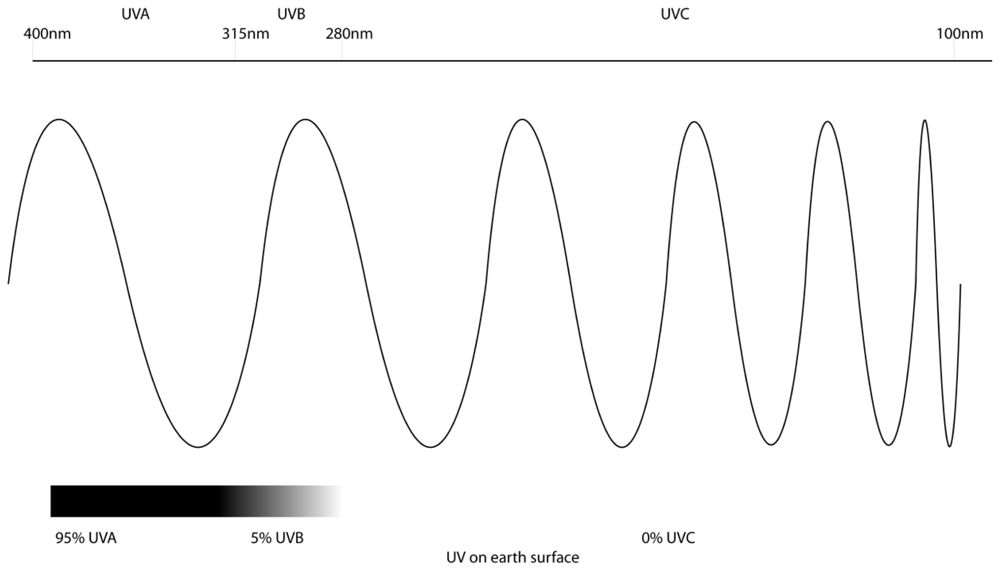
<p>The UV spectrum is composed of UVC (100–280 nm), UVB (280–315 nm) and UVA (315–400 nm) (<xref ref-type="fig" rid="f1-ijms-14-01132">Figure 1</xref>). UVC has the shortest wavelength and is the most toxic, however, no UVC penetrates the ozone layer and reaches the earth’s surface [<xref ref-type="bibr" rid="b7-ijms-14-01132">7</xref>]. The UV that does reach the surface of the earth is composed of approximately 95% UVA and 5% UVB, as much of UVB is also absorbed by the ozone layer [<xref ref-type="bibr" rid="b8-ijms-14-01132">8</xref>]. Despite this, UVB remains the most mutagenic component of terrestrial UV, due to the fact that it is directly absorbed by DNA. While it is less abundant than UVA, it is absorbed by DNA more efficiently, with a tenfold difference between the two wavelengths. This results in UVB inducing more significant damage at much lower doses than UVA. It is currently debated whether UVA directly damages DNA or causes indirect oxidative damage. Therefore, it has been generally assumed that UVB is the predominant carcinogen in sunlight for melanoma development [<xref ref-type="bibr" rid="b1-ijms-14-01132">1</xref>,<xref ref-type="bibr" rid="b9-ijms-14-01132">9</xref>,<xref ref-type="bibr" rid="b10-ijms-14-01132">10</xref>].</p>
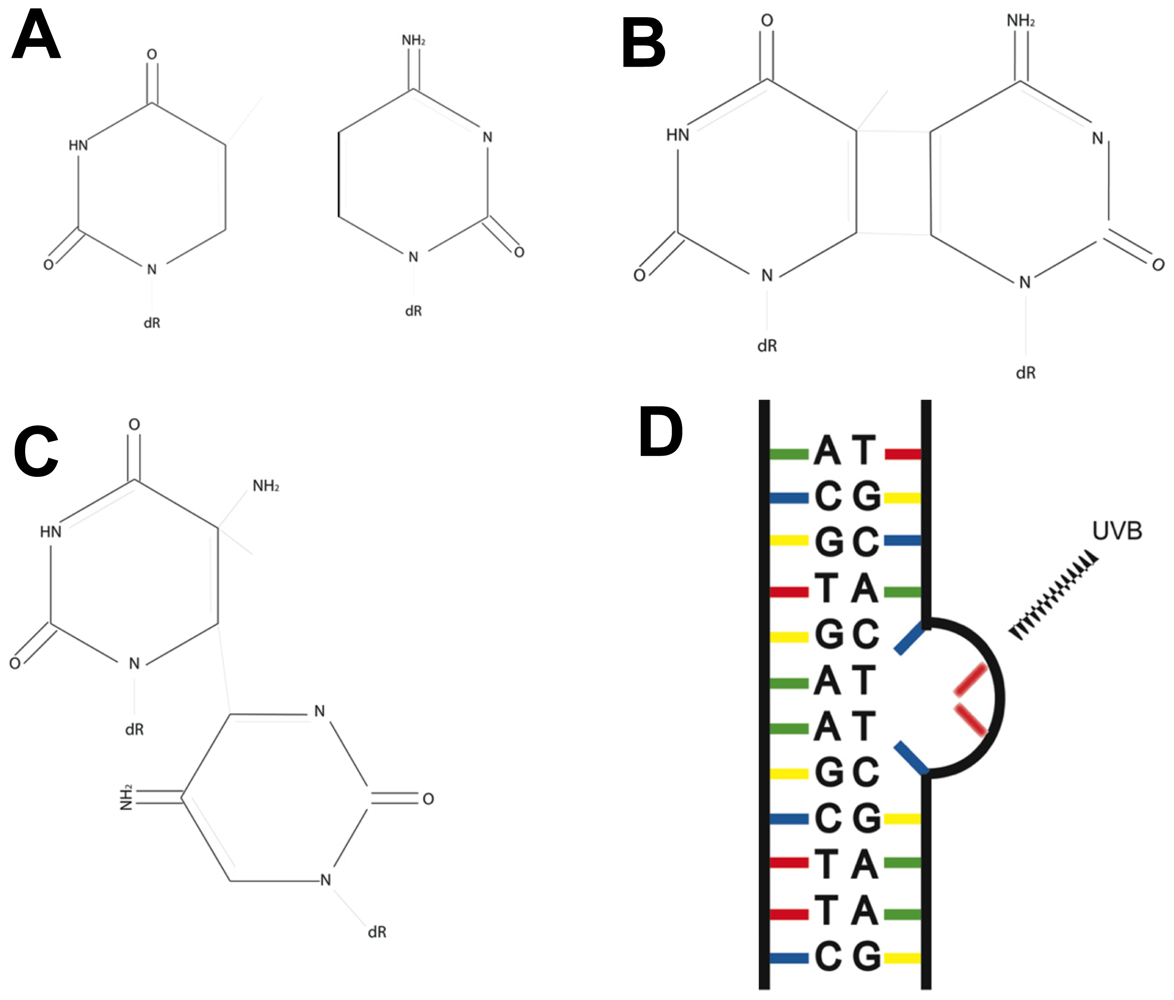
<p>The main photochemical reaction between UVB and DNA is absorption by pyrimidine bases, leading to the formation of two individual DNA photoproducts, cyclobutane pyrimidine dimers and 6-4 photoproducts (<xref ref-type="fig" rid="f2-ijms-14-01132">Figure 2</xref>). Photoproducts form at dipyrimidine sites (CC, CT, TT, TC), upon absorption of UVB. This predominantly occurs at sites containing a thymine, with TC and TT being more photoreactive. The resulting photoproduct creates a bulky lesion that distorts the DNA helix, creating adducts that can halt transcription and DNA replication (<xref ref-type="fig" rid="f2-ijms-14-01132">Figure 2</xref>) [<xref ref-type="bibr" rid="b11-ijms-14-01132">11</xref>,<xref ref-type="bibr" rid="b12-ijms-14-01132">12</xref>].</p>
<p>6-4 Photoproducts (6-4 PPs) are formed when UV reacts with the carbonyl group and double carbon bond in adjacent pyrimidines. This leads to an excited state and unstable oxetane, which is spontaneously rearranged to form a 6-4 PP [<xref ref-type="bibr" rid="b1-ijms-14-01132">1</xref>]. These lesions are not believed to play a significant role in UV carcinogenesis, as they are removed with high efficiency [<xref ref-type="bibr" rid="b13-ijms-14-01132">13</xref>]. Cyclobutane pyrimidine dimers (CPDs) are formed when UV induces the formation of additional covalent bonds between pyrimidine bases by reacting with double carbon bonds. The major type of CPD (TT) is formed approximately ten-times higher than that of the corresponding TT 6-4 PP, making CPDs the major photoproduct of UVB radiation. While the helix distortion created by 6-4 PPs is greater, CPDs are removed slower and are more mutagenic, being responsible for 80% of UVB mutations [<xref ref-type="bibr" rid="b1-ijms-14-01132">1</xref>,<xref ref-type="bibr" rid="b14-ijms-14-01132">14</xref>,<xref ref-type="bibr" rid="b15-ijms-14-01132">15</xref>].</p>
<p>If unrepaired, UVB-induced DNA photoproducts can lead to mutations, most frequently C&gt;T or CC&gt;TT transitions. These are commonly referred to as UV fingerprint mutations, as they are the most specific mutation caused by UV, being rarely found in internal organs [<xref ref-type="bibr" rid="b16-ijms-14-01132">16</xref>]. The exact mechanisms of how photoproducts lead to these UV fingerprint mutations are still unclear; however, it has been hypothesised that two pathways may exist. Mutations may be introduced when damaged DNA is replicated and translesion polymerase incorrectly replicates the pyrimidine base. Even though TT photoproducts are the most common, translesion polymerases, such as DNA polymerase η, can correctly replicate these bases, leading to a low mutation frequency [<xref ref-type="bibr" rid="b17-ijms-14-01132">17</xref>,<xref ref-type="bibr" rid="b18-ijms-14-01132">18</xref>]. The other pathway involves the deamination of 5-methylcytosine within CPDs leading to C&gt;T transitions. Studies have shown that dipyrimidine sites containing 5-methylcytosine are 15-times more predisposed to CPD formation after UVB [<xref ref-type="bibr" rid="b19-ijms-14-01132">19</xref>,<xref ref-type="bibr" rid="b20-ijms-14-01132">20</xref>] and that deamination of these cytosines occurs at a significant rate [<xref ref-type="bibr" rid="b21-ijms-14-01132">21</xref>]. Therefore, it is hypothesised that CPDs containing cytosine are susceptible to spontaneous deamination, which results in a C&gt;T or CC&gt;TT transition.</p></sec>
<sec>
<title>2. Ultraviolet Radiation and Melanoma</title>
<p>One hallmark feature of melanoma is development as a consequence of chronic UV exposure (reviewed in [<xref ref-type="bibr" rid="b22-ijms-14-01132">22</xref>]). Both the incidence and mortality rates for melanoma are increasing rapidly worldwide. Incidence rates in Australia are amongst the highest in the world [<xref ref-type="bibr" rid="b23-ijms-14-01132">23</xref>] and account for around 10% of all cancer cases in Australia [<xref ref-type="bibr" rid="b24-ijms-14-01132">24</xref>]. It is the most common cancer in young Australians aged between 15 and 54 years [<xref ref-type="bibr" rid="b24-ijms-14-01132">24</xref>]. Due to its aggressive nature and extreme resistance to chemotherapy treatments, there are very few effective treatments once melanoma has metastasised [<xref ref-type="bibr" rid="b25-ijms-14-01132">25</xref>]. Therefore, survival for invasive melanoma is only 15%, making it a major clinical problem [<xref ref-type="bibr" rid="b26-ijms-14-01132">26</xref>,<xref ref-type="bibr" rid="b27-ijms-14-01132">27</xref>]. It is generally accepted that the two main factors in melanoma development are genetics and sun exposure [<xref ref-type="bibr" rid="b28-ijms-14-01132">28</xref>]. However, while epidemiological data supports the undeniable causative link between melanoma and ultraviolet (UV) radiation, the exact molecular mechanisms are not completely understood [<xref ref-type="bibr" rid="b2-ijms-14-01132">2</xref>,<xref ref-type="bibr" rid="b29-ijms-14-01132">29</xref>].</p></sec>
<sec>
<title>3. Fingerprint Mutations Suggest a Role for UVB in Melanoma</title>
<p>UV fingerprint mutations are found across the genome of melanoma. Recently, a study by Pleasance <italic>et al.</italic>[<xref ref-type="bibr" rid="b30-ijms-14-01132">30</xref>] sequenced the entire genome of a metastatic melanoma cell line, and a study by Berger <italic>et al.</italic>[<xref ref-type="bibr" rid="b31-ijms-14-01132">31</xref>] sequenced the genome of 25 metastatic melanomas to compile a catalogue of somatic mutations. Additional studies have also sequenced the melanoma exome (protein coding regions of the genome) of up to 147 melanoma tumours [<xref ref-type="bibr" rid="b32-ijms-14-01132">32</xref>–<xref ref-type="bibr" rid="b34-ijms-14-01132">34</xref>]. All these studies identified that the vast majority of mutations present were C&gt;T or CC&gt;TT transitions. This mutational signature is indicative of UV-induced DNA damage, with C&gt;T and CC&gt;TT transitions being UV fingerprint mutations. Further investigation revealed that the majority of these substitutions occurred at dipyrimidines, sites at which photoproducts develop. The frequency of both these substitutions were elevated at CpG sites, which can be methylated to 5-methylcytosine, making them susceptible to CPD formation. The mutation spectrum in melanoma unequivocally demonstrates that the majority of somatic mutations are a result of UV-induced DNA damage; however, the role these mutations play in melanoma development is yet to be elucidated. Despite this, the most common somatic mutation found in melanoma, BRAF V600E (A&gt;T), can be targeted with new therapies [<xref ref-type="bibr" rid="b35-ijms-14-01132">35</xref>], but is not a UV fingerprint (C&gt;T) mutation.</p>
<p>In addition to being found across the genome, UVB fingerprint mutations have also been found in key genes in all types of skin cancer. Interestingly, the most common mutations found in melanomas, in <italic>BRAF</italic> and <italic>NRAS</italic>, do not occur as a result of UV-irradiation. Basal cell carcinomas (BCCs) and squamous cell carcrinomas (SCCs) occur as a result of UV-exposure at a much higher frequency than melanomas, but rarely metastasize. This may be due in part to UV-induced mutations occurring in different genes in these skin cancer types. Mutations in the sonic hedgehog signalling genes PTCH or SMO are thought to be initiating mutations in &gt;70% of BCCs [<xref ref-type="bibr" rid="b36-ijms-14-01132">36</xref>]. SCCs, however, have characteristic large chromosomal aberrations and loss of heterozygosity (LOH), which underpins genomic instability [<xref ref-type="bibr" rid="b37-ijms-14-01132">37</xref>,<xref ref-type="bibr" rid="b38-ijms-14-01132">38</xref>]. Both BCCs and SCCs have high frequencies of UV-fingerprint mutations, particularly in <italic>p53</italic>[<xref ref-type="bibr" rid="b37-ijms-14-01132">37</xref>,<xref ref-type="bibr" rid="b39-ijms-14-01132">39</xref>,<xref ref-type="bibr" rid="b40-ijms-14-01132">40</xref>] and <italic>N-ras</italic>[<xref ref-type="bibr" rid="b38-ijms-14-01132">38</xref>].</p>
<p><italic>p53</italic> is one of the most commonly mutated genes in cancer, which leads to alterations in cell cycle control and apoptosis [<xref ref-type="bibr" rid="b41-ijms-14-01132">41</xref>]. While <italic>p53</italic> mutations are present in all types of skin cancer, they are less common in melanoma than in BCCs and SCCs [<xref ref-type="bibr" rid="b39-ijms-14-01132">39</xref>]; <italic>p53</italic> has been shown to harbour UV signature C&gt;T and CC&gt;TT transitions in approximately 50% of all skin cancers [<xref ref-type="bibr" rid="b37-ijms-14-01132">37</xref>,<xref ref-type="bibr" rid="b42-ijms-14-01132">42</xref>], but has a higher rate of A&gt;T in melanoma compared to other skin cancers [<xref ref-type="bibr" rid="b39-ijms-14-01132">39</xref>], further implicating UV damage. The <italic>p53</italic> mutation hot spots are distinctly different in melanoma compared to BCCs and SCCs, which leads to the possibility that the pathways leading to a given tumour needs specific <italic>p53</italic> mutations [<xref ref-type="bibr" rid="b39-ijms-14-01132">39</xref>].</p>
<p>Cyclin-dependent kinase inhibitor 2A (CDKN2A) is one of the best known genetic factors in melanoma development and codes for two proteins controlling cell proliferation: p16Ink4A and p14ARF [<xref ref-type="bibr" rid="b43-ijms-14-01132">43</xref>]. A CDKN2A knockout mouse model has shown that melanoma develops after a single neonatal UV dose, suggesting that alterations in the CDKN2A may play an important role in the UV-induced development of melanoma [<xref ref-type="bibr" rid="b44-ijms-14-01132">44</xref>]. A systemic review of studies on mutations in melanoma by Hocker <italic>et al.</italic>[<xref ref-type="bibr" rid="b45-ijms-14-01132">45</xref>] showed that CDNK2A had statistically higher rates of UVB fingerprint mutations than other genes, such as <italic>BRAF</italic> and <italic>NRAS</italic> in melanoma, as well as compared to other non-skin cancers.</p>
<p>PTEN is a tumour suppressor gene that carries mutations in many human cancers and may also play a role in UV-induced DNA damage repair [<xref ref-type="bibr" rid="b46-ijms-14-01132">46</xref>]. Studies have shown a mutation rate of approximately 30%–40% in melanoma cell lines [<xref ref-type="bibr" rid="b47-ijms-14-01132">47</xref>,<xref ref-type="bibr" rid="b48-ijms-14-01132">48</xref>]. A study examining mutations in PTEN in melanomas from patients with the skin cancer predisposing disorder Xeroderma Pigmentosum showed that of the melanomas analysed, 56% had mutations in PTEN, and of those, 91% were UVB fingerprint (C&gt;T) mutations [<xref ref-type="bibr" rid="b49-ijms-14-01132">49</xref>]. Additionally, 46% had more than one UVB mutation. This data provides further evidence for a role of UVB in the induction of melanoma. The evidence of UVB fingerprint mutations both across the melanoma genome and in specific genes that may be important in melanoma development or progression, including <italic>p53</italic>, <italic>PTEN</italic> and <italic>CDNK2A</italic>, highlights an important role for UVB in melanoma, strengthening the link between UV and melanoma.</p>
<p>The two most recent studies that have sequenced the melanoma exome by Krauthammer <italic>et al.</italic>[<xref ref-type="bibr" rid="b33-ijms-14-01132">33</xref>] and Hodis <italic>et al.</italic>[<xref ref-type="bibr" rid="b32-ijms-14-01132">32</xref>] both identified a novel mutation in the gene RAC1. This gene had a high rate of repeated mutation in 9.2% and 5% of melanomas, respectively, and carried a strong UV signature. RAC1 is a member of the Rho family of small GTPases and plays important roles in cell proliferation, cytoskeletal rearrangement, cell migration and adhesion [<xref ref-type="bibr" rid="b50-ijms-14-01132">50</xref>–<xref ref-type="bibr" rid="b52-ijms-14-01132">52</xref>]. The resulting amino acid change leads to stabilization of the active form of the protein, resulting in enhanced downstream signalling. Expression of the mutated form of RAC1 in melanocytes leads to enhanced MAP kinase signalling, as well as increased proliferation and migration, altering the melanocytes phenotype [<xref ref-type="bibr" rid="b33-ijms-14-01132">33</xref>]. The data also indicated that this mutation is likely to occur during early mutagenesis, providing a possible link between this mutation, UV exposure and avoidance of cellular death.</p></sec>
<sec>
<title>4. The Nucleotide Excision Repair Pathway Removes UV-Induced Lesions</title>
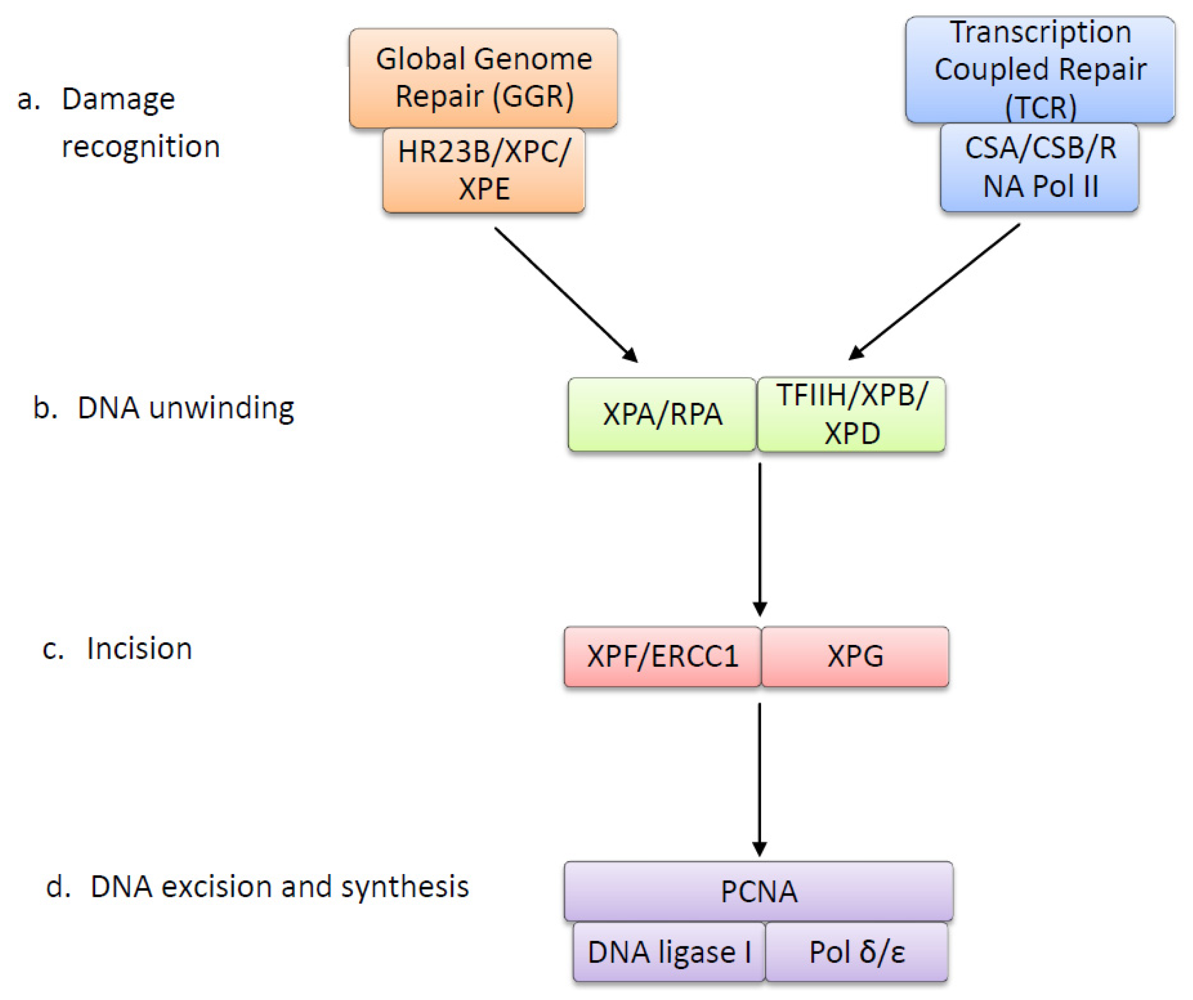
<p>UV photoproducts alter the double helix structure of DNA by creating bulky adducts that halt transcription and trigger apoptosis (Reviewed in [<xref ref-type="bibr" rid="b53-ijms-14-01132">53</xref>]), but if unrepaired, can result in mutations. In cells, DNA repair mechanisms are present that allow for damaged DNA to be removed and repaired, preserving the integrity of the genome. The nucleotide excision repair (NER) pathway is the system that is responsible for repairing bulky DNA damage, including UV-induced photoproducts, in particular CPDs and 6-4 PPs [<xref ref-type="bibr" rid="b54-ijms-14-01132">54</xref>]. The NER pathway is a highly conserved system comprising around 30 proteins and functions in four main steps; damage recognition, DNA unwinding, excision and DNA synthesis [<xref ref-type="bibr" rid="b55-ijms-14-01132">55</xref>]. The NER pathway is illustrated in <xref ref-type="fig" rid="f3-ijms-14-01132">Figure 3</xref>, and <xref ref-type="table" rid="t1-ijms-14-01132">Table 1</xref> summarises the function of each NER protein.</p>
<p>There are two sub-pathways in NER damage recognition, global genome repair (GGR) and transcription coupled repair (TCR). TCR repairs lesions that block transcription in actively transcribed genes. TCR functions with a higher priority than GGR and may work in concert with homologous recombination to efficiently repair damage [<xref ref-type="bibr" rid="b56-ijms-14-01132">56</xref>]. It serves to rapidly recover transcriptional activity after DNA damage to prevent DNA-damage-induced apoptosis [<xref ref-type="bibr" rid="b57-ijms-14-01132">57</xref>]. Induction of TCR is tightly linked to RNA polymerase II, which is stalled at the site of UV lesions and signals for repair with proteins CSA and CSB (reviewed in [<xref ref-type="bibr" rid="b58-ijms-14-01132">58</xref>]). GGR is a slower repair process that functions across the entire genome, repairing silent, transcribed and non-transcribed regions. It is suggested to be the preferred pathway for removing 6-4 PPs and can remove these faster and more efficiently than CPDs [<xref ref-type="bibr" rid="b59-ijms-14-01132">59</xref>]. In GGR, lesions are recognized by DNA-binding protein complexes XPC and XPE, which recognize and bind to UV lesions, signalling for repair. The main purpose of GGR is to remove lesions that may induce mutations during DNA replication, when translesion polymerases may introduce errors, thereby preventing carcinogenesis [<xref ref-type="bibr" rid="b60-ijms-14-01132">60</xref>].</p>
<p>Following damage recognition, these pathways converge on a common repair pathway in which the first step is the unwinding of DNA around the damage by DNA helicases. The multi-protein complex TFIIH contains the helicases XPB and XPD and is recruited to the site of damage, unwinding the DNA around the site of the UV lesion to form a DNA bubble (reviewed in [<xref ref-type="bibr" rid="b61-ijms-14-01132">61</xref>]). This allows for proteins XPA and RPA to bind to the DNA, XPA to the site of damage and RPA to the undamaged strand. These proteins allow for the binding of endonucleases XPG and XPF-ERCC1. XPG stabilizes the DNA bubble and cleaves the DNA 3′ to the UV-lesion. XPF-ERCC1 then cleaves the DNA 5′ to the lesion, and an oligonucleotide fragment containing the damage is removed. PCNA and DNA polymerase δ or ɛ then synthesise new DNA complementary to the undamaged strand. DNA ligase seals the nicks, completing the repair process [<xref ref-type="bibr" rid="b62-ijms-14-01132">62</xref>].</p>
<p>The NER pathway has been linked to the tumour suppressor p53, particularly in the activation of the GGR pathway. P53 is a transcription factor that plays an important role in cell-cycle control, apoptosis and DNA damage response, with a critical role in protection against carcinogenesis [<xref ref-type="bibr" rid="b41-ijms-14-01132">41</xref>]. One way that p53 may regulate DNA damage response is through its downstream target Gadd45, which plays a role in DNA repair, as Gadd45-deficient cells have reduced UV-induced DNA damage repair [<xref ref-type="bibr" rid="b84-ijms-14-01132">84</xref>]. However, recent studies suggest that p53 may directly affect the expression of GGR genes <italic>XPC</italic> and <italic>DDB2</italic> (<italic>XPE</italic>). It has been shown that cells with mutations in p53 have deficiencies in the removal of both CPDs and 6-4 PPs, however this is limited to genomic DNA in non-transcribed regions, suggesting that it is GGR that requires functional p53 and that TCR removal of CPDs is still proficient [<xref ref-type="bibr" rid="b85-ijms-14-01132">85</xref>,<xref ref-type="bibr" rid="b86-ijms-14-01132">86</xref>]. One study has since shown that expression of <italic>XPC</italic> is UV-inducible in p53 wild-type cells; however, no induction is observed in p53 deficient cells. Further analysis of the gene showed a possible p53 response element, suggesting that p53 may directly control the expression of the <italic>XPC</italic> gene [<xref ref-type="bibr" rid="b87-ijms-14-01132">87</xref>]. Another study has demonstrated that expression of <italic>DDB2</italic> (<italic>XPE</italic>) is also dependent on p53. It was observed that DDB2 mRNA levels was dependent on basal p53 expression and increased after DNA damage in a p53-dependent manner [<xref ref-type="bibr" rid="b88-ijms-14-01132">88</xref>]. A subsequent study analysing the <italic>DDB2</italic> gene has shown that it also contains a region that binds p53 to control transcription [<xref ref-type="bibr" rid="b89-ijms-14-01132">89</xref>]. Together, these results show that p53 directly controls DNA damage repair after UV damage through the expression of GGR genes <italic>XPC</italic> and <italic>DDB2</italic> (<italic>XPE</italic>) and that wild-type p53 expression is important for efficient GGR repair.</p></sec>
<sec>
<title>5. Xeroderma Pigmentosum: A Link between Nucleotide Excision Repair and Melanoma</title>
<p>The exact molecular mechanisms of the link between UV and melanoma are not completely understood, but a possible link is evident in the genetic disorder Xeroderma Pigmentosum (XP) in which the dysfunction of the NER pathway directly results in UV-induced skin cancers. XP is a rare autosomal recessive disease characterized by defective NER, extreme sun sensitivity, pigmentation abnormalities and an increased incidence of skin cancers, including melanoma [<xref ref-type="bibr" rid="b90-ijms-14-01132">90</xref>]. Another genetic disorder, Cockayne syndrome (CS), is linked to the TCR component of the NER pathway and is caused by a mutation in CSA or CSB. However, unlike XP, there is no increase in cancer incidence, and all symptoms are neurological and developmental. Furthermore, no cases of cancer have been reported in CS patients [<xref ref-type="bibr" rid="b91-ijms-14-01132">91</xref>]. Studies show that without functional TCR, the apoptotic response after UV is enhanced, with a significant induction of p53 and its target genes [<xref ref-type="bibr" rid="b92-ijms-14-01132">92</xref>]. This suggests that after damage, the persistent blockage of RNA polymerase II tips the equilibrium of cell survival towards apoptosis, protecting from carcinogenesis [<xref ref-type="bibr" rid="b93-ijms-14-01132">93</xref>]. As there is no increased incidence of cancer in CS patients as a result of TCR deficiency, it has been assumed that TCR would not play a role in melanoma development, as any disruption to TCR would lead to an enhanced apoptotic response, eliminating cancerous cells.</p>
<p>XP is a heterogeneous disease resulting from different mutations in one of seven NER genes or one DNA polymerase gene, resulting in eight different complementation groups, XP-A to XP-G and XP-V. Patients within each group will exhibit a large variability in symptoms and NER capacity depending on the nature of the mutation [<xref ref-type="bibr" rid="b94-ijms-14-01132">94</xref>]. Groups XP-A and XP-C are the most prevalent (90% of cases) and are caused by mutation in the genes XPA and XPC, respectively. Only a few patients from other groups have been reported, most likely due to the biological importance of the enzymes that are mutated [<xref ref-type="bibr" rid="b95-ijms-14-01132">95</xref>]. Most patients have a defect in both GGR and TCR, with the exception of patients from the XP-C and XP-E groups, who are only GGR-deficient. Patients from groups XP-A and XP-G are almost completely repair deficient, highlighting the critical role of XPA and XPG in the NER pathway. XP-B patients are very rare, due to the important roles of XPB outside the NER pathway, and XP-D and XP-F patients exhibit low levels of repair [<xref ref-type="bibr" rid="b96-ijms-14-01132">96</xref>].</p>
<p>Mutation in the NER pathway and the subsequent reduced repair capacity results in XP patients having a high incidence of skin cancers compared to the normal population. This includes a 1000-fold increase in the incidence of melanoma [<xref ref-type="bibr" rid="b97-ijms-14-01132">97</xref>,<xref ref-type="bibr" rid="b98-ijms-14-01132">98</xref>]. There is a stronger association with cancer development in the complementation groups XP-C and XP-E, who have mutations in the GGR pathway [<xref ref-type="bibr" rid="b99-ijms-14-01132">99</xref>]. XP-C is the most common group and results from a mutation in the XPC gene, leading to a repair capacity of 10%–20%, while XP-E patients, with a mutation in the DDB2 subunit of the XPE complex, show milder symptoms and have a repair capacity over 50%. Data from CS patients suggests that TCR capacity is the main determinant of cell survival after UV, supported by the fact that GGR deficient, but TCR proficient, XP-C and XP-E cells are less sensitive to UV-induced cell death. Therefore, as GGR is important in protecting from mutagenesis, it would be expected that low GGR capacity in XP-C and XP-E cells would to lead to an increase in mutation rates. This would then lead to an increased cancer predisposition, without cancerous cells being removed by UV-induced apoptosis [<xref ref-type="bibr" rid="b59-ijms-14-01132">59</xref>,<xref ref-type="bibr" rid="b94-ijms-14-01132">94</xref>,<xref ref-type="bibr" rid="b96-ijms-14-01132">96</xref>,<xref ref-type="bibr" rid="b100-ijms-14-01132">100</xref>]. Interestingly, most rodent cells are deficient in the repair of UV-induced CPDs in non-transcribed DNA and, hence, exhibit a defect in GGR [<xref ref-type="bibr" rid="b101-ijms-14-01132">101</xref>]. Therefore, since rodents are used as surrogates for humans in environmental oncogenic studies, how they differ from humans with respect to GGR should be taken into consideration [<xref ref-type="bibr" rid="b102-ijms-14-01132">102</xref>].</p>
<p>A relationship between UV mutagenesis and cancer development in XP patients is also seen when examining mutations. UV fingerprint mutations have been found in many genes in cancers from XP patients, including p53, CDKN2A and Ras oncogenes, many of which are also present in cutaneous melanomas that develop from sun exposure in the normal population [<xref ref-type="bibr" rid="b103-ijms-14-01132">103</xref>–<xref ref-type="bibr" rid="b105-ijms-14-01132">105</xref>].</p>
<p>In summary, hyper-mutability from UV-induced DNA damage and a higher incidence of melanoma in XP patients provides evidence of a relationship between reduced NER, UV-induced DNA damage and skin cancer development. Complementation groups XP-C and XP-E have impaired GGR and are more strongly associated with cancer development. This suggests that NER, in particular GGR, could play an important role in melanoma development as a result of UV exposure. If NER was compromised in melanocytes, then UV lesions would go unrepaired, leading to the accumulation of mutations and promotion of the transformation of melanoma. This could be a potential mechanism that links melanoma development to UV damage. Despite this possible connection between NER and melanoma and the recognized importance of DNA repair in melanomagenesis [<xref ref-type="bibr" rid="b106-ijms-14-01132">106</xref>], very few studies have been performed to investigate the relationship between NER and UV damage in melanoma.</p></sec>
<sec>
<title>6. Research into NER and Melanoma</title>
<p>One area of increasing research is the investigation of single nucleotide polymorphisms (SNPs) in NER genes in predisposition to developing melanoma. Genetic variation that exists in DNA repair genes could lead to differences in repair capacity within the population, therefore predisposing to melanoma development. Several studies have investigated SNPs in NER genes, including XPC, XPG, XPD and XPF in case-control studies. The results of these studies are inconsistent and all studies have found different associations or no associations at all, often contradicting each other. Replication of results in any of these studies has not been achieved [<xref ref-type="bibr" rid="b107-ijms-14-01132">107</xref>–<xref ref-type="bibr" rid="b109-ijms-14-01132">109</xref>].</p>
<p>Recently, a Xiphophorus fish model of melanoma has been used by Fernandez <italic>et al.</italic>[<xref ref-type="bibr" rid="b110-ijms-14-01132">110</xref>] to determine whether NER capacity plays a role in melanoma development. The Xiphophorus model develops melanoma, in part by overexpression and constitutive activation of fish paralogs of human <italic>EGFR</italic> and <italic>CDNK2</italic> (reviewed in [<xref ref-type="bibr" rid="b111-ijms-14-01132">111</xref>]), but also after UVB exposure. This study used a hybrid model that results in reduced 6-4 PP removal to investigate the role of NER capacity. DNA was extracted from fish immediately and 24 hours after UVB exposure, and levels of 6-4 PPs were measured. It was reported that approximately 62% of 6-4 PPs were repaired after 24 h, with no significant difference in NER capacity between fish that developed melanoma and those that did not. It was also found that fish with 13.2% and 88.5% NER capacity both developed melanoma. From this data, the authors concluded that melanomagenesis is not associated with NER capacity. Some of the limitations of this study were the different DNA repair processes in Xiphophorus fish, the absence of quantitation of both 6-4PPs and CPDs, and the melanomas that develop in the Xiphophorus fish in this model have different histology to human melanomas [<xref ref-type="bibr" rid="b28-ijms-14-01132">28</xref>]. Therefore, it cannot be concluded from this study that NER capacity does not play a role in the development of melanoma.</p>
<p>To date, there has only been one study that has compared UV-induced NER capacity in human melanocytes and melanoma cells. Gaddameedhi <italic>et al.</italic>[<xref ref-type="bibr" rid="b112-ijms-14-01132">112</xref>] compared the repair of 6-4 PPs and CPDs between the two cell types to determine if NER plays a role in melanoma development. It was reported that there was a time-dependent reduction in photoproducts with 50%–80% of 6-4 PPs and 40%–80% CPDs being removed in both cell types. From this, it was concluded that there was no difference in the repair capacity of melanocytes and melanoma cells; therefore, melanoma cells retain normal NER function, which does not contribute to melanomagenesis. While it was concluded that there was no reduction in NER capacity, both cell lines showed high variation in repair capacity, ranging approximately 40%–80%. In addition, statistical analysis was not provided to prove that this reduction was not significant. The study was also not specific to measuring GGR or TCR, only the overall removal of photoproducts. Previous data has suggested that melanoma shows low levels of GGR, which would not have been identifiable in this study.</p>
<p>Melanocytes may initially have a lower NER capacity when compared with other cell types [<xref ref-type="bibr" rid="b113-ijms-14-01132">113</xref>]. The repair of oxidative damage and photoproducts in melanocytes, normal and XP fibroblasts were compared, using host cell reactivation and <italic>in vitro</italic> repair synthesis assays. The ability of melanocytes to reactivate a UV damaged luciferase gene was lower than normal fibroblasts, but not as low as XP fibroblasts. Similarly melanocytes had a lower capacity of DNA damage-induced repair synthesis after UV irradiation compared to normal fibroblasts. It was also tested to see if the low repair was due to melanin in the melanocytes interfering with excision repair or expression of repair genes. Melanin was added to fibroblast lysates and showed a reduced repair capacity proportional to the amount of melanin. Additionally, it was found that melanin co-purified with DNA, and when separated after electrophoresis, the DNA became sensitive again to repair. This evidence suggests that melanin in melanocytes binds to DNA interfering with damage recognition and incision by NER enzymes, resulting in reduced repair. The results in this study may explain the low percentage of CPD and 6-4 PP removal in both melanocytes and melanoma cells reported by Gaddameedhi <italic>et al.</italic>[<xref ref-type="bibr" rid="b112-ijms-14-01132">112</xref>]. Moreover, if melanocytes originally have a low repair capacity, then the lack of difference between melanocytes and melanoma cells cannot rule out NER playing a role melanoma development. Having a low NER capacity may predispose melanocytes to the accumulation of UV-induced DNA mutations that could lead to avoidance of cell death and melanomagenesis.</p>
<p>There are two hallmark features of melanoma; firstly, its development as a result of chronic UV exposure and, secondly, the limited efficacy of chemotherapy drugs, especially the DNA-damaging agent cisplatin [<xref ref-type="bibr" rid="b114-ijms-14-01132">114</xref>]. Cisplatin induces intra- and inter-strand cross links in DNA that cause helix distorting lesions similar to UV damage. In addition to repairing UV-induced photoproducts, NER also removes cisplatin lesions [<xref ref-type="bibr" rid="b54-ijms-14-01132">54</xref>]. A study by Bowden <italic>et al.</italic>[<xref ref-type="bibr" rid="b115-ijms-14-01132">115</xref>] investigated the level of NER gene expression after cisplatin-induced DNA damage in melanoma and melanocytes. Results showed a higher basal expression of NER genes in melanoma; however, when compared to melanocytes, there was a significant lack of induction of GGR genes XPC, DDB1 and DDB2. In contrast, the expression of TCR genes CSA and CSB was low in both melanoma and melanocytes, suggesting that TCR does not play a role in the response to cisplatin. The findings of this study indicate that a lack of NER induction, especially GGR, may play a role in the resistance of melanoma to cisplatin. Subsequent studies identified that the NER component ERCC1 could play a key role in melanomagenesis and resistance to cisplatin [<xref ref-type="bibr" rid="b116-ijms-14-01132">116</xref>,<xref ref-type="bibr" rid="b117-ijms-14-01132">117</xref>]. In addition, the DNA damage caused by cisplatin is similar to that caused by UVB, with both causing helix distorting lesions. As a result, it could be hypothesized that melanoma would also have low expression of NER in response to UV damage similar to that seen in cisplatin. This could suggest a potential role for NER, particularly GGR, in the development of melanoma as a result of UV.</p>
<p>Furthermore, the genome of the melanoma cell lines sequenced by Pleasance <italic>et al.</italic>[<xref ref-type="bibr" rid="b30-ijms-14-01132">30</xref>] and Berger <italic>et al.</italic>[<xref ref-type="bibr" rid="b31-ijms-14-01132">31</xref>], which showed a mutational signature indicating DNA damage by UV exposure, also displayed an uneven distribution of mutations across the genome. There was a lower prevalence of UV mutations on the transcribed strand, as well as within exons compared to introns. This suggests that the TCR component of NER, which is responsible for removing damage from transcribed genes, is still functional in melanoma. Reduced GGR activity could also be responsible for the significant amount of UV mutations across the rest of the genome, as GGR removes UV lesions from the entire genome. These results are similar to those suggested by Bowden <italic>et al.</italic>[<xref ref-type="bibr" rid="b115-ijms-14-01132">115</xref>]; that melanoma has low expression of GGR genes, but sufficient TCR expression and that low levels of the GGR component of NER may play a role in the development of melanoma. The idea that TCR does not play a role in melanoma development can be supported by the fact that Cockayne syndrome patients, who lack TCR, do not show an increased incidence of melanoma that is seen in XP patients.</p>
<p>If GGR was compromised in melanocytes, then UV-induced DNA damage across the genome would go unrepaired and lead to mutations when DNA is replicated. Additionally, cells would not undergo apoptosis to prevent cancer development, due to a functional TCR. This could then potentially lead to cell transformation and melanomagenesis, highlighting a potential role for NER in melanoma development.</p></sec>
<sec sec-type="conclusions">
<title>7. Conclusions</title>
<p>The data suggests that the NER pathway may play a role in avoidance of UV-induced cell death and the subsequent development of melanoma. In particular the GGR pathway of NER may be important, as it functions to repair damage that can lead to mutations during DNA replication, and XP patients with defective GGR have a stronger association with cancer development. This idea has been supported by studies that found low GGR expression in melanoma cells treated with cisplatin and the genome of a melanoma line showing a high frequency of UV mutations in non-transcribed regions. Furthermore, melanocytes may potentially have low NER levels, which could predispose them to UV mutagenesis and transformation.</p>
<p>Despite this possible connection between NER and melanoma, little research in this area has been done, and the studies that have been performed are often contradictory. Given the scarce research into NER in melanoma, more investigation is needed to fully elucidate this relationship.</p></sec></body>
<back>
<ack>
<title>Acknowledgments</title>
<p>The authors would like to acknowledge the financial support from the Australian National Health &amp; Medical Research Council, Cancer Australia, Cure Cancer Australia Foundation, Hunter Medical Research Institute and the Rotary Club of Cardiff (Australia).</p></ack>
<fn-group><fn id="fn1-ijms-14-01132">
<p><bold>Conflict of Interest</bold></p>
<p>The authors declare no conflict of interest.</p></fn></fn-group>
<ref-list>
<title>References</title>
<ref id="b1-ijms-14-01132"><label>1</label><citation citation-type="journal"><person-group person-group-type="author"><name><surname>Ravanat</surname><given-names>J.L.</given-names></name><name><surname>Douki</surname><given-names>T.</given-names></name><name><surname>Cadet</surname><given-names>J.</given-names></name></person-group><article-title>Direct and indirect effects of UV radiation on DNA and its components</article-title><source>J. Photochem. Photobiol. B</source><year>2001</year><volume>63</volume><fpage>88</fpage><lpage>102</lpage><pub-id pub-id-type="doi">10.1016/S1011-1344(01)00206-8</pub-id><pub-id pub-id-type="pmid">11684456</pub-id></citation></ref>
<ref id="b2-ijms-14-01132"><label>2</label><citation citation-type="journal"><person-group person-group-type="author"><name><surname>Marrot</surname><given-names>L.</given-names></name><name><surname>Meunier</surname><given-names>J.-R.</given-names></name></person-group><article-title>Skin DNA photodamage and its biological consequences</article-title><source>J. Am. Acad. Dermatol</source><year>2008</year><volume>58</volume><fpage>S139</fpage><lpage>S148</lpage><pub-id pub-id-type="doi">10.1016/j.jaad.2007.12.007</pub-id><pub-id pub-id-type="pmid">18410800</pub-id></citation></ref>
<ref id="b3-ijms-14-01132"><label>3</label><citation citation-type="journal"><person-group person-group-type="author"><name><surname>Brenner</surname><given-names>M.</given-names></name><name><surname>Degitz</surname><given-names>K.</given-names></name><name><surname>Besch</surname><given-names>R.</given-names></name><name><surname>Berking</surname><given-names>C.</given-names></name></person-group><article-title>Differential expression of melanoma-associated growth factors in keratinocytes and fibroblasts by ultraviolet A and ultraviolet B radiation</article-title><source>Br. J. Dermatol</source><year>2005</year><volume>153</volume><fpage>733</fpage><lpage>739</lpage><pub-id pub-id-type="doi">10.1111/j.1365-2133.2005.06780.x</pub-id><pub-id pub-id-type="pmid">16181453</pub-id></citation></ref>
<ref id="b4-ijms-14-01132"><label>4</label><citation citation-type="journal"><person-group person-group-type="author"><name><surname>Garland</surname><given-names>C.F.</given-names></name><name><surname>Garland</surname><given-names>F.C.</given-names></name><name><surname>Gorham</surname><given-names>E.D.</given-names></name></person-group><article-title>Epidemiologic evidence for different roles of ultraviolet A and B radiation in melanoma mortality rates</article-title><source>Ann. Epidemiol</source><year>2003</year><volume>13</volume><fpage>395</fpage><lpage>404</lpage><pub-id pub-id-type="doi">10.1016/S1047-2797(02)00461-1</pub-id><pub-id pub-id-type="pmid">12875796</pub-id></citation></ref>
<ref id="b5-ijms-14-01132"><label>5</label><citation citation-type="journal"><person-group person-group-type="author"><name><surname>Tran</surname><given-names>T.T.</given-names></name><name><surname>Schulman</surname><given-names>J.</given-names></name><name><surname>Fisher</surname><given-names>D.E.</given-names></name></person-group><article-title>UV and pigmentation: Molecular mechanisms and social controversies</article-title><source>Pigment Cell Melanoma Res</source><year>2008</year><volume>21</volume><fpage>509</fpage><lpage>516</lpage><pub-id pub-id-type="doi">10.1111/j.1755-148X.2008.00498.x</pub-id><pub-id pub-id-type="pmid">18821855</pub-id></citation></ref>
<ref id="b6-ijms-14-01132"><label>6</label><citation citation-type="journal"><person-group person-group-type="author"><name><surname>Tucker</surname><given-names>M.A.</given-names></name><name><surname>Goldstein</surname><given-names>A.M.</given-names></name></person-group><article-title>Melanoma etiology: Where are we?</article-title><source>Oncogene</source><year>2003</year><volume>22</volume><fpage>3042</fpage><lpage>3052</lpage><pub-id pub-id-type="doi">10.1038/sj.onc.1206444</pub-id><pub-id pub-id-type="pmid">12789279</pub-id></citation></ref>
<ref id="b7-ijms-14-01132"><label>7</label><citation citation-type="journal"><person-group person-group-type="author"><name><surname>Besaratinia</surname><given-names>A.</given-names></name><name><surname>Bates</surname><given-names>S.E.</given-names></name><name><surname>Synold</surname><given-names>T.W.</given-names></name><name><surname>Pfeifer</surname><given-names>G.P.</given-names></name></person-group><article-title>Similar mutagenicity of photoactivated porphyrins and ultraviolet A radiation in mouse embryonic fibroblasts: Involvement of oxidative DNA lesions in mutagenesis</article-title><source>Biochemistry</source><year>2004</year><volume>43</volume><fpage>15557</fpage><lpage>15566</lpage><pub-id pub-id-type="doi">10.1021/bi048717c</pub-id><pub-id pub-id-type="pmid">15581368</pub-id></citation></ref>
<ref id="b8-ijms-14-01132"><label>8</label><citation citation-type="journal"><person-group person-group-type="author"><name><surname>Brozyna</surname><given-names>A.</given-names></name><name><surname>Zbytek</surname><given-names>B.</given-names></name><name><surname>Granese</surname><given-names>J.</given-names></name><name><surname>Carlson</surname><given-names>A.</given-names></name><name><surname>Ross</surname><given-names>J.</given-names></name><name><surname>Slominski</surname><given-names>A.</given-names></name></person-group><article-title>Mechanism of UV-related carcinogenesis and its contribution to nevi/melanoma</article-title><source>Expert Rev. Dermatol</source><year>2007</year><volume>2</volume><fpage>451</fpage><lpage>469</lpage><pub-id pub-id-type="doi">10.1586/17469872.2.4.451</pub-id><pub-id pub-id-type="pmid">18846265</pub-id></citation></ref>
<ref id="b9-ijms-14-01132"><label>9</label><citation citation-type="journal"><person-group person-group-type="author"><name><surname>Slominski</surname><given-names>A.</given-names></name><name><surname>Pawelek</surname><given-names>J.</given-names></name></person-group><article-title>Animals under the sun: Effects of ultraviolet radiation on mammalian skin</article-title><source>Clin. Dermatol</source><year>1998</year><volume>16</volume><fpage>503</fpage><lpage>515</lpage><pub-id pub-id-type="doi">10.1016/S0738-081X(98)00023-6</pub-id><pub-id pub-id-type="pmid">9699062</pub-id></citation></ref>
<ref id="b10-ijms-14-01132"><label>10</label><citation citation-type="journal"><person-group person-group-type="author"><name><surname>Bennett</surname><given-names>D.C.</given-names></name></person-group><article-title>Ultraviolet wavebands and melanoma initiation</article-title><source>Pigment Cell Melanoma Res</source><year>2008</year><volume>21</volume><fpage>520</fpage><lpage>524</lpage><pub-id pub-id-type="doi">10.1111/j.1755-148X.2008.00500.x</pub-id><pub-id pub-id-type="pmid">18821857</pub-id></citation></ref>
<ref id="b11-ijms-14-01132"><label>11</label><citation citation-type="journal"><person-group person-group-type="author"><name><surname>Hussein</surname><given-names>M.R.</given-names></name></person-group><article-title>Ultraviolet radiation and skin cancer: Molecular mechanisms</article-title><source>J. Cutan. Pathol</source><year>2005</year><volume>32</volume><fpage>191</fpage><lpage>205</lpage><pub-id pub-id-type="doi">10.1111/j.0303-6987.2005.00281.x</pub-id><pub-id pub-id-type="pmid">15701081</pub-id></citation></ref>
<ref id="b12-ijms-14-01132"><label>12</label><citation citation-type="journal"><person-group person-group-type="author"><name><surname>Pfeifer</surname><given-names>G.P.</given-names></name></person-group><article-title>Formation and processing of UV photoproducts: Effects of DNA sequence and chromatin environment</article-title><source>Photochem. Photobiol</source><year>1997</year><volume>65</volume><fpage>270</fpage><lpage>283</lpage><pub-id pub-id-type="doi">10.1111/j.1751-1097.1997.tb08560.x</pub-id><pub-id pub-id-type="pmid">9066304</pub-id></citation></ref>
<ref id="b13-ijms-14-01132"><label>13</label><citation citation-type="journal"><person-group person-group-type="author"><name><surname>Courdavault</surname><given-names>S.</given-names></name><name><surname>Baudouin</surname><given-names>C.</given-names></name><name><surname>Charveron</surname><given-names>M.</given-names></name><name><surname>Canguilhem</surname><given-names>B.</given-names></name><name><surname>Favier</surname><given-names>A.</given-names></name><name><surname>Cadet</surname><given-names>J.</given-names></name><name><surname>Douki</surname><given-names>T.</given-names></name></person-group><article-title>Repair of the three main types of bipyrimidine DNA photoproducts in human keratinocytes exposed to UVB and UVA radiations</article-title><source>DNA Repair</source><year>2005</year><volume>4</volume><fpage>836</fpage><lpage>844</lpage><pub-id pub-id-type="doi">10.1016/j.dnarep.2005.05.001</pub-id><pub-id pub-id-type="pmid">15950551</pub-id></citation></ref>
<ref id="b14-ijms-14-01132"><label>14</label><citation citation-type="journal"><person-group person-group-type="author"><name><surname>Kim</surname><given-names>J.-K.</given-names></name><name><surname>Patel</surname><given-names>D.</given-names></name><name><surname>Choi</surname><given-names>B.-S.</given-names></name></person-group><article-title>Contrasting structural impacts induced by cis-syn cyclobutane dimer and (6-4) adduct in DNA duplex decamers: Implication in mutagenesis and repair activity</article-title><source>Photochem. Photobiol</source><year>1995</year><volume>62</volume><fpage>44</fpage><lpage>50</lpage><pub-id pub-id-type="doi">10.1111/j.1751-1097.1995.tb05236.x</pub-id><pub-id pub-id-type="pmid">7638271</pub-id></citation></ref>
<ref id="b15-ijms-14-01132"><label>15</label><citation citation-type="journal"><person-group person-group-type="author"><name><surname>You</surname><given-names>Y.H.</given-names></name><name><surname>Lee</surname><given-names>D.H.</given-names></name><name><surname>Yoon</surname><given-names>J.H.</given-names></name><name><surname>Nakajima</surname><given-names>S.</given-names></name><name><surname>Yasui</surname><given-names>A.</given-names></name><name><surname>Pfeifer</surname><given-names>G.P.</given-names></name></person-group><article-title>Cyclobutane pyrimidine dimers are responsible for the vast majority of mutations induced by UVB irradiation in mammalian cells</article-title><source>J. Biol. Chem</source><year>2001</year><volume>276</volume><fpage>44688</fpage><lpage>44694</lpage><pub-id pub-id-type="doi">10.1074/jbc.M107696200</pub-id><pub-id pub-id-type="pmid">11572873</pub-id></citation></ref>
<ref id="b16-ijms-14-01132"><label>16</label><citation citation-type="journal"><person-group person-group-type="author"><name><surname>Brash</surname><given-names>D.E.</given-names></name></person-group><article-title>Roles of the transcription factor p53 in keratinocyte carcinomas</article-title><source>Br. J. Dermatol</source><year>2006</year><volume>154</volume><fpage>S8</fpage><lpage>S10</lpage><pub-id pub-id-type="doi">10.1111/j.1365-2133.2006.07230.x</pub-id></citation></ref>
<ref id="b17-ijms-14-01132"><label>17</label><citation citation-type="journal"><person-group person-group-type="author"><name><surname>Johnson</surname><given-names>R.E.</given-names></name><name><surname>Prakash</surname><given-names>S.</given-names></name><name><surname>Prakash</surname><given-names>L.</given-names></name></person-group><article-title>Efficient bypass of a thymine-thymine dimer by yeast DNA polymerase, Poleta</article-title><source>Science</source><year>1999</year><volume>283</volume><fpage>1001</fpage><lpage>1004</lpage><pub-id pub-id-type="doi">10.1126/science.283.5404.1001</pub-id><pub-id pub-id-type="pmid">9974380</pub-id></citation></ref>
<ref id="b18-ijms-14-01132"><label>18</label><citation citation-type="journal"><person-group person-group-type="author"><name><surname>Masutani</surname><given-names>C.</given-names></name><name><surname>Kusumoto</surname><given-names>R.</given-names></name><name><surname>Yamada</surname><given-names>A.</given-names></name><name><surname>Dohmae</surname><given-names>N.</given-names></name><name><surname>Yokoi</surname><given-names>M.</given-names></name><name><surname>Yuasa</surname><given-names>M.</given-names></name><name><surname>Araki</surname><given-names>M.</given-names></name><name><surname>Iwai</surname><given-names>S.</given-names></name><name><surname>Takio</surname><given-names>K.</given-names></name><name><surname>Hanaoka</surname><given-names>F.</given-names></name></person-group><article-title>The XPV (xeroderma pigmentosum variant) gene encodes human DNA polymerase η</article-title><source>Nature</source><year>1999</year><volume>399</volume><fpage>700</fpage><lpage>704</lpage><pub-id pub-id-type="doi">10.1038/21447</pub-id><pub-id pub-id-type="pmid">10385124</pub-id></citation></ref>
<ref id="b19-ijms-14-01132"><label>19</label><citation citation-type="journal"><person-group person-group-type="author"><name><surname>Drouin</surname><given-names>R.</given-names></name><name><surname>Therrien</surname><given-names>J.-P.</given-names></name></person-group><article-title>UVB-induced cyclobutane pyrimidine dimer frequency correlates with skin cancer mutational hotspots in p53</article-title><source>Photochem. Photobiol</source><year>1997</year><volume>66</volume><fpage>719</fpage><lpage>726</lpage><pub-id pub-id-type="doi">10.1111/j.1751-1097.1997.tb03213.x</pub-id><pub-id pub-id-type="pmid">9383997</pub-id></citation></ref>
<ref id="b20-ijms-14-01132"><label>20</label><citation citation-type="journal"><person-group person-group-type="author"><name><surname>Tommasi</surname><given-names>S.</given-names></name><name><surname>Denissenko</surname><given-names>M.F.</given-names></name><name><surname>Pfeifer</surname><given-names>G.P.</given-names></name></person-group><article-title>Sunlight induces pyrimidine dimers preferentially at 5-methylcytosine bases</article-title><source>Cancer Res</source><year>1997</year><volume>57</volume><fpage>4727</fpage><lpage>4730</lpage><pub-id pub-id-type="pmid">9354431</pub-id></citation></ref>
<ref id="b21-ijms-14-01132"><label>21</label><citation citation-type="journal"><person-group person-group-type="author"><name><surname>Tu</surname><given-names>Y.</given-names></name><name><surname>Dammann</surname><given-names>R.</given-names></name><name><surname>Pfeifer</surname><given-names>G.P.</given-names></name></person-group><article-title>Sequence and time-dependent deamination of cytosine bases in UVB-induced cyclobutane pyrimidine dimers <italic>in vivo</italic></article-title><source>J. Mol. Biol</source><year>1998</year><volume>284</volume><fpage>297</fpage><lpage>311</lpage><pub-id pub-id-type="doi">10.1006/jmbi.1998.2176</pub-id><pub-id pub-id-type="pmid">9813119</pub-id></citation></ref>
<ref id="b22-ijms-14-01132"><label>22</label><citation citation-type="journal"><person-group person-group-type="author"><name><surname>Garibyan</surname><given-names>L.</given-names></name><name><surname>Fisher</surname><given-names>D.E.</given-names></name></person-group><article-title>How sunlight causes melanoma</article-title><source>Curr. Oncol. Rep</source><year>2010</year><volume>12</volume><fpage>319</fpage><lpage>326</lpage><pub-id pub-id-type="doi">10.1007/s11912-010-0119-y</pub-id><pub-id pub-id-type="pmid">20623386</pub-id></citation></ref>
<ref id="b23-ijms-14-01132"><label>23</label><citation citation-type="book"><collab>World Health Organisation (WHO)</collab><source>The Global Burden of Disease: 2004 Update</source><publisher-name>WHO</publisher-name><publisher-loc>Geneva, Switzerland</publisher-loc><year>2008</year></citation></ref>
<ref id="b24-ijms-14-01132"><label>24</label><citation citation-type="book"><collab>AIHW</collab><source>Cancer in Australia: An overview, 2008</source><series>Cancer series no. 46</series><comment>Cat. no. CAN 42</comment><publisher-name>AIHW</publisher-name><publisher-loc>Canberra, Australia</publisher-loc><year>2008</year></citation></ref>
<ref id="b25-ijms-14-01132"><label>25</label><citation citation-type="journal"><person-group person-group-type="author"><name><surname>Soengas</surname><given-names>M.S.</given-names></name><name><surname>Lowe</surname><given-names>S.W.</given-names></name></person-group><article-title>Apoptosis and melanoma chemoresistance</article-title><source>Oncogene</source><year>2003</year><volume>22</volume><fpage>3138</fpage><lpage>3151</lpage><pub-id pub-id-type="doi">10.1038/sj.onc.1206454</pub-id><pub-id pub-id-type="pmid">12789290</pub-id></citation></ref>
<ref id="b26-ijms-14-01132"><label>26</label><citation citation-type="journal"><person-group person-group-type="author"><name><surname>Fayolle</surname><given-names>C.</given-names></name><name><surname>Pourchet</surname><given-names>J.</given-names></name><name><surname>de Fromentel</surname><given-names>C.C.</given-names></name><name><surname>Puisieux</surname><given-names>A.</given-names></name><name><surname>Dore</surname><given-names>J.F.</given-names></name><name><surname>Voeltzel</surname><given-names>T.</given-names></name></person-group><article-title>Gadd45a activation protects melanoma cells from ultraviolet B-induced apoptosis</article-title><source>J. Investig. Dermatol</source><year>2008</year><volume>128</volume><fpage>196</fpage><lpage>202</lpage><pub-id pub-id-type="doi">10.1038/sj.jid.5700963</pub-id><pub-id pub-id-type="pmid">17703175</pub-id></citation></ref>
<ref id="b27-ijms-14-01132"><label>27</label><citation citation-type="book"><person-group person-group-type="author"><name><surname>Tracey</surname><given-names>E.</given-names></name><name><surname>Kerr</surname><given-names>T.</given-names></name><name><surname>Dobrovic</surname><given-names>A.</given-names></name><name><surname>Currow</surname><given-names>D.</given-names></name></person-group><source>Cancer in New South Wales: Incidence and Mortality Report 2008</source><publisher-name>Cancer Institute NSW</publisher-name><publisher-loc>Sydney, Australia</publisher-loc><year>2008</year></citation></ref>
<ref id="b28-ijms-14-01132"><label>28</label><citation citation-type="journal"><person-group person-group-type="author"><name><surname>Jhappan</surname><given-names>C.</given-names></name><name><surname>Noonan</surname><given-names>F.P.</given-names></name><name><surname>Merlino</surname><given-names>G.</given-names></name></person-group><article-title>Ultraviolet radiation and cutaneous malignant melanoma</article-title><source>Oncogene</source><year>2003</year><volume>22</volume><fpage>3099</fpage><lpage>3112</lpage><pub-id pub-id-type="doi">10.1038/sj.onc.1206450</pub-id><pub-id pub-id-type="pmid">12789287</pub-id></citation></ref>
<ref id="b29-ijms-14-01132"><label>29</label><citation citation-type="journal"><person-group person-group-type="author"><name><surname>De Gruijl</surname><given-names>F.R.</given-names></name></person-group><article-title>Skin cancer and solar UV radiation</article-title><source>Eur. J. Cancer</source><year>1999</year><volume>35</volume><fpage>2003</fpage><lpage>2009</lpage><pub-id pub-id-type="doi">10.1016/S0959-8049(99)00283-X</pub-id><pub-id pub-id-type="pmid">10711242</pub-id></citation></ref>
<ref id="b30-ijms-14-01132"><label>30</label><citation citation-type="journal"><person-group person-group-type="author"><name><surname>Pleasance</surname><given-names>E.D.</given-names></name><name><surname>Cheetham</surname><given-names>R.K.</given-names></name><name><surname>Stephens</surname><given-names>P.J.</given-names></name><name><surname>McBride</surname><given-names>D.J.</given-names></name><name><surname>Humphray</surname><given-names>S.J.</given-names></name><name><surname>Greenman</surname><given-names>C.D.</given-names></name><name><surname>Varela</surname><given-names>I.</given-names></name><name><surname>Lin</surname><given-names>M.L.</given-names></name><name><surname>Ordonez</surname><given-names>G.R.</given-names></name><name><surname>Bignell</surname><given-names>G.R.</given-names></name><etal/></person-group><article-title>A comprehensive catalogue of somatic mutations from a human cancer genome</article-title><source>Nature</source><year>2010</year><volume>463</volume><fpage>191</fpage><lpage>196</lpage><pub-id pub-id-type="doi">10.1038/nature08658</pub-id><pub-id pub-id-type="pmid">20016485</pub-id></citation></ref>
<ref id="b31-ijms-14-01132"><label>31</label><citation citation-type="journal"><person-group person-group-type="author"><name><surname>Berger</surname><given-names>M.F.</given-names></name><name><surname>Hodis</surname><given-names>E.</given-names></name><name><surname>Heffernan</surname><given-names>T.P.</given-names></name><name><surname>Deribe</surname><given-names>Y.L.</given-names></name><name><surname>Lawrence</surname><given-names>M.S.</given-names></name><name><surname>Protopopov</surname><given-names>A.</given-names></name><name><surname>Ivanova</surname><given-names>E.</given-names></name><name><surname>Watson</surname><given-names>I.R.</given-names></name><name><surname>Nickerson</surname><given-names>E.</given-names></name><name><surname>Ghosh</surname><given-names>P.</given-names></name><etal/></person-group><article-title>Melanoma genome sequencing reveals frequent PREX2 mutations</article-title><source>Nature</source><year>2012</year><volume>485</volume><fpage>502</fpage><lpage>506</lpage><pub-id pub-id-type="pmid">22622578</pub-id></citation></ref>
<ref id="b32-ijms-14-01132"><label>32</label><citation citation-type="journal"><person-group person-group-type="author"><name><surname>Hodis</surname><given-names>E.</given-names></name><name><surname>Watson</surname><given-names>I.R.</given-names></name><name><surname>Kryukov</surname><given-names>G.V.</given-names></name><name><surname>Arold</surname><given-names>S.T.</given-names></name><name><surname>Imielinski</surname><given-names>M.</given-names></name><name><surname>Theurillat</surname><given-names>J.-P.</given-names></name><name><surname>Nickerson</surname><given-names>E.</given-names></name><name><surname>Auclair</surname><given-names>D.</given-names></name><name><surname>Li</surname><given-names>L.</given-names></name><name><surname>Place</surname><given-names>C.</given-names></name><etal/></person-group><article-title>A landscape of driver mutations in melanoma</article-title><source>Cell</source><year>2012</year><volume>150</volume><fpage>251</fpage><lpage>263</lpage><pub-id pub-id-type="doi">10.1016/j.cell.2012.06.024</pub-id><pub-id pub-id-type="pmid">22817889</pub-id></citation></ref>
<ref id="b33-ijms-14-01132"><label>33</label><citation citation-type="journal"><person-group person-group-type="author"><name><surname>Krauthammer</surname><given-names>M.</given-names></name><name><surname>Kong</surname><given-names>Y.</given-names></name><name><surname>Ha</surname><given-names>B.H.</given-names></name><name><surname>Evans</surname><given-names>P.</given-names></name><name><surname>Bacchiocchi</surname><given-names>A.</given-names></name><name><surname>McCusker</surname><given-names>J.P.</given-names></name><name><surname>Cheng</surname><given-names>E.</given-names></name><name><surname>Davis</surname><given-names>M.J.</given-names></name><name><surname>Goh</surname><given-names>G.</given-names></name><name><surname>Choi</surname><given-names>M.</given-names></name><etal/></person-group><article-title>Exome sequencing identifies recurrent somatic RAC1 mutations in melanoma</article-title><source>Nat. Genet</source><year>2012</year><volume>44</volume><fpage>1006</fpage><lpage>1014</lpage><pub-id pub-id-type="doi">10.1038/ng.2359</pub-id><pub-id pub-id-type="pmid">22842228</pub-id></citation></ref>
<ref id="b34-ijms-14-01132"><label>34</label><citation citation-type="journal"><person-group person-group-type="author"><name><surname>Stark</surname><given-names>M.S.</given-names></name><name><surname>Woods</surname><given-names>S.L.</given-names></name><name><surname>Gartside</surname><given-names>M.G.</given-names></name><name><surname>Bonazzi</surname><given-names>V.F.</given-names></name><name><surname>Dutton-Regester</surname><given-names>K.</given-names></name><name><surname>Aoude</surname><given-names>L.G.</given-names></name><name><surname>Chow</surname><given-names>D.</given-names></name><name><surname>Sereduk</surname><given-names>C.</given-names></name><name><surname>Niemi</surname><given-names>N.M.</given-names></name><name><surname>Tang</surname><given-names>N.</given-names></name><etal/></person-group><article-title>Frequent somatic mutations in MAP3K5 and MAP3K9 in metastatic melanoma identified by exome sequencing</article-title><source>Nat. Genet</source><year>2012</year><volume>44</volume><fpage>165</fpage><lpage>169</lpage></citation></ref>
<ref id="b35-ijms-14-01132"><label>35</label><citation citation-type="journal"><person-group person-group-type="author"><name><surname>Flaherty</surname><given-names>K.T.</given-names></name><name><surname>Puzanov</surname><given-names>I.</given-names></name><name><surname>Kim</surname><given-names>K.B.</given-names></name><name><surname>Ribas</surname><given-names>A.</given-names></name><name><surname>McArthur</surname><given-names>G.A.</given-names></name><name><surname>Sosman</surname><given-names>J.A.</given-names></name><name><surname>O’Dwyer</surname><given-names>P.J.</given-names></name><name><surname>Lee</surname><given-names>R.J.</given-names></name><name><surname>Grippo</surname><given-names>J.F.</given-names></name><name><surname>Nolop</surname><given-names>K.</given-names></name><etal/></person-group><article-title>Inhibition of mutated, activated BRAF in metastatic melanoma</article-title><source>N. Engl. J. Med</source><year>2010</year><volume>363</volume><fpage>809</fpage><lpage>819</lpage><pub-id pub-id-type="doi">10.1056/NEJMoa1002011</pub-id><pub-id pub-id-type="pmid">20818844</pub-id></citation></ref>
<ref id="b36-ijms-14-01132"><label>36</label><citation citation-type="journal"><person-group person-group-type="author"><name><surname>Gailani</surname><given-names>M.R.</given-names></name><name><surname>Stahle-Backdahl</surname><given-names>M.</given-names></name><name><surname>Leffell</surname><given-names>D.J.</given-names></name><name><surname>Glynn</surname><given-names>M.</given-names></name><name><surname>Zaphiropoulos</surname><given-names>P.G.</given-names></name><name><surname>Pressman</surname><given-names>C.</given-names></name><name><surname>Unden</surname><given-names>A.B.</given-names></name><name><surname>Dean</surname><given-names>M.</given-names></name><name><surname>Brash</surname><given-names>D.E.</given-names></name><name><surname>Bale</surname><given-names>A.E.</given-names></name><etal/></person-group><article-title>The role of the human homologue of Drosophila patched in sporadic basal cell carcinomas</article-title><source>Nat. Genet</source><year>1996</year><volume>14</volume><fpage>78</fpage><lpage>81</lpage><pub-id pub-id-type="doi">10.1038/ng0996-78</pub-id><pub-id pub-id-type="pmid">8782823</pub-id></citation></ref>
<ref id="b37-ijms-14-01132"><label>37</label><citation citation-type="journal"><person-group person-group-type="author"><name><surname>Boukamp</surname><given-names>P.</given-names></name></person-group><article-title>Non-melanoma skin cancer: What drives tumor development and progression?</article-title><source>Carcinogenesis</source><year>2005</year><volume>26</volume><fpage>1657</fpage><lpage>1667</lpage><pub-id pub-id-type="doi">10.1093/carcin/bgi123</pub-id><pub-id pub-id-type="pmid">15905207</pub-id></citation></ref>
<ref id="b38-ijms-14-01132"><label>38</label><citation citation-type="journal"><person-group person-group-type="author"><name><surname>Popp</surname><given-names>S.</given-names></name><name><surname>Waltering</surname><given-names>S.</given-names></name><name><surname>Herbst</surname><given-names>C.</given-names></name><name><surname>Moll</surname><given-names>I.</given-names></name><name><surname>Boukamp</surname><given-names>P.</given-names></name></person-group><article-title>UV-B type mutations and chromosomal imbalances indicate common pathways for the development of Merkel and skin squamous cell carcinomas</article-title><source>Int. J. Cancer</source><year>2002</year><volume>99</volume><fpage>352</fpage><lpage>360</lpage><pub-id pub-id-type="doi">10.1002/ijc.10321</pub-id><pub-id pub-id-type="pmid">11992403</pub-id></citation></ref>
<ref id="b39-ijms-14-01132"><label>39</label><citation citation-type="journal"><person-group person-group-type="author"><name><surname>Giglia-Mari</surname><given-names>G.</given-names></name><name><surname>Sarasin</surname><given-names>A.</given-names></name></person-group><article-title>TP53 mutations in human skin cancers</article-title><source>Human Mutat</source><year>2003</year><volume>21</volume><fpage>217</fpage><lpage>228</lpage><pub-id pub-id-type="doi">10.1002/humu.10179</pub-id></citation></ref>
<ref id="b40-ijms-14-01132"><label>40</label><citation citation-type="journal"><person-group person-group-type="author"><name><surname>Ziegler</surname><given-names>A.</given-names></name><name><surname>Jonason</surname><given-names>A.</given-names></name><name><surname>Leffell</surname><given-names>D.</given-names></name><name><surname>Simon</surname><given-names>J.</given-names></name><name><surname>Sharma</surname><given-names>H.</given-names></name><name><surname>Kimmelman</surname><given-names>J.</given-names></name><name><surname>Remington</surname><given-names>L.</given-names></name><name><surname>Jacks</surname><given-names>T.</given-names></name><name><surname>Brash</surname><given-names>D.</given-names></name></person-group><article-title>Sunburn and p53 in the onset of skin cancer</article-title><source>Nature</source><year>1994</year><volume>372</volume><fpage>773</fpage><lpage>776</lpage><pub-id pub-id-type="doi">10.1038/372773a0</pub-id><pub-id pub-id-type="pmid">7997263</pub-id></citation></ref>
<ref id="b41-ijms-14-01132"><label>41</label><citation citation-type="journal"><person-group person-group-type="author"><name><surname>Balint</surname><given-names>E.</given-names></name><name><surname>Vousden</surname><given-names>K.H.</given-names></name></person-group><article-title>Activation and activities of the p53 tumour suppressor protein</article-title><source>Br. J. Cancer</source><year>2001</year><volume>85</volume><fpage>1813</fpage><lpage>1823</lpage><pub-id pub-id-type="doi">10.1054/bjoc.2001.2128</pub-id><pub-id pub-id-type="pmid">11747320</pub-id></citation></ref>
<ref id="b42-ijms-14-01132"><label>42</label><citation citation-type="journal"><person-group person-group-type="author"><name><surname>Zerp</surname><given-names>S.F.</given-names></name><name><surname>van Elsas</surname><given-names>A.</given-names></name><name><surname>Poltenburg</surname><given-names>L.T.C.</given-names></name><name><surname>Schrier</surname><given-names>P.I.</given-names></name></person-group><article-title>p53 mutations in human cutaneous melanoma correlate with sun exposure, but are not always involved in melanomagenesis</article-title><source>Br. J. Cancer</source><year>1999</year><volume>79</volume><fpage>921</fpage><pub-id pub-id-type="doi">10.1038/sj.bjc.6690147</pub-id><pub-id pub-id-type="pmid">10070891</pub-id></citation></ref>
<ref id="b43-ijms-14-01132"><label>43</label><citation citation-type="journal"><person-group person-group-type="author"><name><surname>Piepkorn</surname><given-names>M.</given-names></name></person-group><article-title>Melanoma genetics: An update with focus on the CDKN2A(p16)/ARF tumor suppressors</article-title><source>J. Am. Acad. Dermatol.</source><year>2000</year><volume>42</volume><fpage>705</fpage><lpage>722</lpage><comment>quiz 723–706</comment><pub-id pub-id-type="doi">10.1067/mjd.2000.104687</pub-id><pub-id pub-id-type="pmid">10775844</pub-id></citation></ref>
<ref id="b44-ijms-14-01132"><label>44</label><citation citation-type="journal"><person-group person-group-type="author"><name><surname>Recio</surname><given-names>J.A.</given-names></name><name><surname>Noonan</surname><given-names>F.P.</given-names></name><name><surname>Takayama</surname><given-names>H.</given-names></name><name><surname>Anver</surname><given-names>M.R.</given-names></name><name><surname>Duray</surname><given-names>P.</given-names></name><name><surname>Rush</surname><given-names>W.L.</given-names></name><name><surname>Lindner</surname><given-names>G.</given-names></name><name><surname>de Fabo</surname><given-names>E.C.</given-names></name><name><surname>DePinho</surname><given-names>R.A.</given-names></name><name><surname>Merlino</surname><given-names>G.</given-names></name><etal/></person-group><article-title>Ink4a/arf deficiency promotes ultraviolet radiation-induced melanomagenesis</article-title><source>Cancer Res</source><year>2002</year><volume>62</volume><fpage>6724</fpage><lpage>6730</lpage><pub-id pub-id-type="pmid">12438273</pub-id></citation></ref>
<ref id="b45-ijms-14-01132"><label>45</label><citation citation-type="journal"><person-group person-group-type="author"><name><surname>Hocker</surname><given-names>T.</given-names></name><name><surname>Tsao</surname><given-names>H.</given-names></name></person-group><article-title>Ultraviolet radiation and melanoma: A systematic review and analysis of reported sequence variants</article-title><source>Human Mutat</source><year>2007</year><volume>28</volume><fpage>578</fpage><lpage>588</lpage><pub-id pub-id-type="doi">10.1002/humu.20481</pub-id></citation></ref>
<ref id="b46-ijms-14-01132"><label>46</label><citation citation-type="journal"><person-group person-group-type="author"><name><surname>Ming</surname><given-names>M.</given-names></name><name><surname>Feng</surname><given-names>L.</given-names></name><name><surname>Shea</surname><given-names>C.R.</given-names></name><name><surname>Soltani</surname><given-names>K.</given-names></name><name><surname>Zhao</surname><given-names>B.</given-names></name><name><surname>Han</surname><given-names>W.</given-names></name><name><surname>Smart</surname><given-names>R.C.</given-names></name><name><surname>Trempus</surname><given-names>C.S.</given-names></name><name><surname>He</surname><given-names>Y.-Y.</given-names></name></person-group><article-title>PTEN positively regulates UVB-induced DNA damage repair</article-title><source>Cancer Res</source><year>2011</year><volume>71</volume><fpage>5287</fpage><lpage>5295</lpage><pub-id pub-id-type="doi">10.1158/0008-5472.CAN-10-4614</pub-id><pub-id pub-id-type="pmid">21771908</pub-id></citation></ref>
<ref id="b47-ijms-14-01132"><label>47</label><citation citation-type="journal"><person-group person-group-type="author"><name><surname>Guldberg</surname><given-names>P.</given-names></name><name><surname>thor Straten</surname><given-names>P.</given-names></name><name><surname>Birck</surname><given-names>A.</given-names></name><name><surname>Ahrenkiel</surname><given-names>V.</given-names></name><name><surname>Kirkin</surname><given-names>A.F.</given-names></name><name><surname>Zeuthen</surname><given-names>J.</given-names></name></person-group><article-title>Disruption of the MMAC1/PTEN gene by deletion or mutation is a frequent event in malignant melanoma</article-title><source>Cancer Res</source><year>1997</year><volume>57</volume><fpage>3660</fpage><lpage>3663</lpage><pub-id pub-id-type="pmid">9288767</pub-id></citation></ref>
<ref id="b48-ijms-14-01132"><label>48</label><citation citation-type="journal"><person-group person-group-type="author"><name><surname>Tsao</surname><given-names>H.</given-names></name><name><surname>Zhang</surname><given-names>X.</given-names></name><name><surname>Benoit</surname><given-names>E.</given-names></name><name><surname>Haluska</surname><given-names>F.G.</given-names></name></person-group><article-title>Identification of PTEN/MMAC1 alterations in uncultured melanomas and melanoma cell lines</article-title><source>Oncogene</source><year>1998</year><volume>16</volume><fpage>3397</fpage><lpage>3402</lpage><pub-id pub-id-type="doi">10.1038/sj.onc.1201881</pub-id><pub-id pub-id-type="pmid">9692547</pub-id></citation></ref>
<ref id="b49-ijms-14-01132"><label>49</label><citation citation-type="journal"><person-group person-group-type="author"><name><surname>Wang</surname><given-names>Y.</given-names></name><name><surname>Digiovanna</surname><given-names>J.J.</given-names></name><name><surname>Stern</surname><given-names>J.B.</given-names></name><name><surname>Hornyak</surname><given-names>T.J.</given-names></name><name><surname>Raffeld</surname><given-names>M.</given-names></name><name><surname>Khan</surname><given-names>S.G.</given-names></name><name><surname>Oh</surname><given-names>K.S.</given-names></name><name><surname>Hollander</surname><given-names>M.C.</given-names></name><name><surname>Dennis</surname><given-names>P.A.</given-names></name><name><surname>Kraemer</surname><given-names>K.H.</given-names></name><etal/></person-group><article-title>Evidence of ultraviolet type mutations in xeroderma pigmentosum melanomas</article-title><source>Proc. Nat. Acad. Sci. USA</source><year>2009</year><volume>106</volume><fpage>6279</fpage><lpage>6284</lpage><pub-id pub-id-type="doi">10.1073/pnas.0812401106</pub-id><pub-id pub-id-type="pmid">19329485</pub-id></citation></ref>
<ref id="b50-ijms-14-01132"><label>50</label><citation citation-type="journal"><person-group person-group-type="author"><name><surname>Hakoshima</surname><given-names>T.</given-names></name><name><surname>Shimizu</surname><given-names>T.</given-names></name><name><surname>Maesaki</surname><given-names>R.</given-names></name></person-group><article-title>Structural basis of the Rho GTPase signaling</article-title><source>J. Biochem</source><year>2003</year><volume>134</volume><fpage>327</fpage><lpage>331</lpage><pub-id pub-id-type="doi">10.1093/jb/mvg149</pub-id><pub-id pub-id-type="pmid">14561717</pub-id></citation></ref>
<ref id="b51-ijms-14-01132"><label>51</label><citation citation-type="journal"><person-group person-group-type="author"><name><surname>Jaffe</surname><given-names>A.B.</given-names></name><name><surname>Hall</surname><given-names>A.</given-names></name></person-group><article-title>RHO GTPASES: Biochemistry and Biology</article-title><source>Annu. Rev. Cell Dev. Biol</source><year>2005</year><volume>21</volume><fpage>247</fpage><lpage>269</lpage><pub-id pub-id-type="doi">10.1146/annurev.cellbio.21.020604.150721</pub-id><pub-id pub-id-type="pmid">16212495</pub-id></citation></ref>
<ref id="b52-ijms-14-01132"><label>52</label><citation citation-type="journal"><person-group person-group-type="author"><name><surname>Wennerberg</surname><given-names>K.</given-names></name><name><surname>Rossman</surname><given-names>K.L.</given-names></name><name><surname>Der</surname><given-names>C.J.</given-names></name></person-group><article-title>The Ras superfamily at a glance</article-title><source>J. Cell Sci</source><year>2005</year><volume>118</volume><fpage>843</fpage><lpage>846</lpage><pub-id pub-id-type="doi">10.1242/jcs.01660</pub-id><pub-id pub-id-type="pmid">15731001</pub-id></citation></ref>
<ref id="b53-ijms-14-01132"><label>53</label><citation citation-type="journal"><person-group person-group-type="author"><name><surname>Batista</surname><given-names>L.F.Z.</given-names></name><name><surname>Kaina</surname><given-names>B.</given-names></name><name><surname>Meneghini</surname><given-names>R.</given-names></name><name><surname>Menck</surname><given-names>C.F.M.</given-names></name></person-group><article-title>How DNA lesions are turned into powerful killing structures: Insights from UV-induced apoptosis</article-title><source>Mutat. Res</source><year>2009</year><volume>681</volume><fpage>197</fpage><lpage>208</lpage><pub-id pub-id-type="doi">10.1016/j.mrrev.2008.09.001</pub-id><pub-id pub-id-type="pmid">18845270</pub-id></citation></ref>
<ref id="b54-ijms-14-01132"><label>54</label><citation citation-type="journal"><person-group person-group-type="author"><name><surname>Friedberg</surname><given-names>E.C.</given-names></name></person-group><article-title>How nucleotide excision repair protects against cancer</article-title><source>Nat. Rev. Cancer</source><year>2001</year><volume>1</volume><fpage>22</fpage><lpage>33</lpage><pub-id pub-id-type="doi">10.1038/35094000</pub-id><pub-id pub-id-type="pmid">11900249</pub-id></citation></ref>
<ref id="b55-ijms-14-01132"><label>55</label><citation citation-type="journal"><person-group person-group-type="author"><name><surname>Marini</surname><given-names>F.</given-names></name><name><surname>Nardo</surname><given-names>T.</given-names></name><name><surname>Giannattasio</surname><given-names>M.</given-names></name><name><surname>Minuzzo</surname><given-names>M.</given-names></name><name><surname>Stefanini</surname><given-names>M.</given-names></name><name><surname>Plevani</surname><given-names>P.</given-names></name><name><surname>Falconi</surname><given-names>M.M.</given-names></name></person-group><article-title>DNA nucleotide excision repair-dependent signaling to checkpoint activation</article-title><source>Proc. Natl. Acad. Sci. USA</source><year>2006</year><volume>103</volume><fpage>17325</fpage><lpage>17330</lpage><pub-id pub-id-type="doi">10.1073/pnas.0605446103</pub-id><pub-id pub-id-type="pmid">17088560</pub-id></citation></ref>
<ref id="b56-ijms-14-01132"><label>56</label><citation citation-type="journal"><person-group person-group-type="author"><name><surname>Aboussekhra</surname><given-names>A.</given-names></name><name><surname>Al-Sharif</surname><given-names>I.S.</given-names></name></person-group><article-title>Homologous recombination is involved in transcription-coupled repair of UV damage in <italic>Saccharomyces cerevisiae</italic></article-title><source>EMBO J</source><year>2005</year><volume>24</volume><fpage>1999</fpage><lpage>2010</lpage><pub-id pub-id-type="doi">10.1038/sj.emboj.7600665</pub-id><pub-id pub-id-type="pmid">15902273</pub-id></citation></ref>
<ref id="b57-ijms-14-01132"><label>57</label><citation citation-type="journal"><person-group person-group-type="author"><name><surname>Van Oosten</surname><given-names>M.</given-names></name><name><surname>Rebel</surname><given-names>H.</given-names></name><name><surname>Friedberg</surname><given-names>E.C.</given-names></name><name><surname>van Steeg</surname><given-names>H.</given-names></name><name><surname>van der Horst</surname><given-names>G.T.J.</given-names></name><name><surname>van Kranen</surname><given-names>H.J.</given-names></name><name><surname>Westerman</surname><given-names>A.</given-names></name><name><surname>van Zeeland</surname><given-names>A.A.</given-names></name><name><surname>Mullenders</surname><given-names>L.H.F.</given-names></name><name><surname>de Gruijl</surname><given-names>F.R.</given-names></name></person-group><article-title>Differential role of transcription-coupled repair in UVB-induced G2 arrest and apoptosis in mouse epidermis</article-title><source>Proc. Natl. Acad. Sci. USA</source><year>2000</year><volume>97</volume><fpage>11268</fpage><lpage>11273</lpage><pub-id pub-id-type="doi">10.1073/pnas.200226697</pub-id><pub-id pub-id-type="pmid">11005836</pub-id></citation></ref>
<ref id="b58-ijms-14-01132"><label>58</label><citation citation-type="journal"><person-group person-group-type="author"><name><surname>Fousteri</surname><given-names>M.</given-names></name><name><surname>Mullenders</surname><given-names>L.H.</given-names></name></person-group><article-title>Transcription-coupled nucleotide excision repair in mammalian cells: Molecular mechanisms and biological effects</article-title><source>Cell Res</source><year>2008</year><volume>18</volume><fpage>73</fpage><lpage>84</lpage><pub-id pub-id-type="doi">10.1038/cr.2008.6</pub-id><pub-id pub-id-type="pmid">18166977</pub-id></citation></ref>
<ref id="b59-ijms-14-01132"><label>59</label><citation citation-type="journal"><person-group person-group-type="author"><name><surname>Van Hoffen</surname><given-names>A.</given-names></name><name><surname>Venema</surname><given-names>J.</given-names></name><name><surname>Meschini</surname><given-names>R.</given-names></name><name><surname>van Zeeland</surname><given-names>A.A.</given-names></name><name><surname>Mullenders</surname><given-names>L.H.</given-names></name></person-group><article-title>Transcription-coupled repair removes both cyclobutane pyrimidine dimers and 6-4 photoproducts with equal efficiency and in a sequential way from transcribed DNA in xeroderma pigmentosum group C fibroblasts</article-title><source>EMBO J</source><year>1995</year><volume>14</volume><fpage>360</fpage><lpage>367</lpage><pub-id pub-id-type="pmid">7835346</pub-id></citation></ref>
<ref id="b60-ijms-14-01132"><label>60</label><citation citation-type="journal"><person-group person-group-type="author"><name><surname>Sugasawa</surname><given-names>K.</given-names></name></person-group><article-title>UV-induced ubiquitylation of XPC complex, the UV-DDB-ubiquitin ligase complex and DNA repair</article-title><source>J. Mol. Histol</source><year>2006</year><volume>37</volume><fpage>189</fpage><lpage>202</lpage><pub-id pub-id-type="doi">10.1007/s10735-006-9044-7</pub-id><pub-id pub-id-type="pmid">16858626</pub-id></citation></ref>
<ref id="b61-ijms-14-01132"><label>61</label><citation citation-type="journal"><person-group person-group-type="author"><name><surname>Compe</surname><given-names>E.</given-names></name><name><surname>Egly</surname><given-names>J.-M.</given-names></name></person-group><article-title>TFIIH: When transcription met DNA repair</article-title><source>Nat. Rev. Mol. Cell Biol</source><year>2012</year><volume>13</volume><fpage>343</fpage><lpage>354</lpage><pub-id pub-id-type="pmid">22572993</pub-id></citation></ref>
<ref id="b62-ijms-14-01132"><label>62</label><citation citation-type="journal"><person-group person-group-type="author"><name><surname>Rastogi</surname><given-names>R.P.</given-names></name><name><surname>Richa</surname></name><name><surname>Kumar</surname><given-names>A.</given-names></name><name><surname>Tyagi</surname><given-names>M.B.</given-names></name><name><surname>Sinha</surname><given-names>R.P.</given-names></name></person-group><article-title>Molecular mechanisms of ultraviolet radiation-induced DNA damage and repair</article-title><source>J. Nucleic Acids</source><year>2010</year><volume>2010</volume><fpage>1</fpage><lpage>32</lpage></citation></ref>
<ref id="b63-ijms-14-01132"><label>63</label><citation citation-type="journal"><person-group person-group-type="author"><name><surname>Sugasawa</surname><given-names>K.</given-names></name><name><surname>Ng</surname><given-names>J.M.</given-names></name><name><surname>Masutani</surname><given-names>C.</given-names></name><name><surname>Iwai</surname><given-names>S.</given-names></name><name><surname>van der Spek</surname><given-names>P.J.</given-names></name><name><surname>Eker</surname><given-names>A.P.</given-names></name><name><surname>Hanaoka</surname><given-names>F.</given-names></name><name><surname>Bootsma</surname><given-names>D.</given-names></name><name><surname>Hoeijmakers</surname><given-names>J.H.</given-names></name></person-group><article-title>Xeroderma pigmentosum group C protein complex is the initiator of global genome nucleotide excision repair</article-title><source>Mol. Cell</source><year>1998</year><volume>2</volume><fpage>223</fpage><lpage>232</lpage><pub-id pub-id-type="doi">10.1016/S1097-2765(00)80132-X</pub-id><pub-id pub-id-type="pmid">9734359</pub-id></citation></ref>
<ref id="b64-ijms-14-01132"><label>64</label><citation citation-type="journal"><person-group person-group-type="author"><name><surname>Fitch</surname><given-names>M.E.</given-names></name><name><surname>Nakajima</surname><given-names>S.</given-names></name><name><surname>Yasui</surname><given-names>A.</given-names></name><name><surname>Ford</surname><given-names>J.M.</given-names></name></person-group><article-title><italic>In vivo</italic> recruitment of XPC to UV-induced cyclobutane pyrimidine dimers by the DDB2 gene product</article-title><source>J. Biol. Chem</source><year>2003</year><volume>278</volume><fpage>46906</fpage><lpage>46910</lpage><pub-id pub-id-type="doi">10.1074/jbc.M307254200</pub-id><pub-id pub-id-type="pmid">12944386</pub-id></citation></ref>
<ref id="b65-ijms-14-01132"><label>65</label><citation citation-type="journal"><person-group person-group-type="author"><name><surname>Scrima</surname><given-names>A.</given-names></name><name><surname>Konickova</surname><given-names>R.</given-names></name><name><surname>Czyzewski</surname><given-names>B.K.</given-names></name><name><surname>Kawasaki</surname><given-names>Y.</given-names></name><name><surname>Jeffrey</surname><given-names>P.D.</given-names></name><name><surname>Groisman</surname><given-names>R.</given-names></name><name><surname>Nakatani</surname><given-names>Y.</given-names></name><name><surname>Iwai</surname><given-names>S.</given-names></name><name><surname>Pavletich</surname><given-names>N.P.</given-names></name><name><surname>Thomä</surname><given-names>N.H.</given-names></name></person-group><article-title>Structural Basis of UV DNA-Damage Recognition by the DDB1/DDB2 Complex</article-title><source>Cell</source><year>2008</year><volume>135</volume><fpage>1213</fpage><lpage>1223</lpage><pub-id pub-id-type="doi">10.1016/j.cell.2008.10.045</pub-id><pub-id pub-id-type="pmid">19109893</pub-id></citation></ref>
<ref id="b66-ijms-14-01132"><label>66</label><citation citation-type="journal"><person-group person-group-type="author"><name><surname>Li</surname><given-names>J.</given-names></name><name><surname>Bhat</surname><given-names>A.</given-names></name><name><surname>Xiao</surname><given-names>W.</given-names></name></person-group><article-title>Regulation of nucleotide excision repair through ubiquitination</article-title><source>Acta Biochim. Biophys. Sin</source><year>2011</year><volume>43</volume><fpage>919</fpage><lpage>929</lpage><pub-id pub-id-type="doi">10.1093/abbs/gmr088</pub-id><pub-id pub-id-type="pmid">21986915</pub-id></citation></ref>
<ref id="b67-ijms-14-01132"><label>67</label><citation citation-type="journal"><person-group person-group-type="author"><name><surname>Xie</surname><given-names>Z.</given-names></name><name><surname>Liu</surname><given-names>S.</given-names></name><name><surname>Zhang</surname><given-names>Y.</given-names></name><name><surname>Wang</surname><given-names>Z.</given-names></name></person-group><article-title>Roles of Rad23 protein in yeast nucleotide excision repair</article-title><source>Nucleic Acids Res</source><year>2004</year><volume>32</volume><fpage>5981</fpage><lpage>5990</lpage><pub-id pub-id-type="doi">10.1093/nar/gkh934</pub-id><pub-id pub-id-type="pmid">15545636</pub-id></citation></ref>
<ref id="b68-ijms-14-01132"><label>68</label><citation citation-type="journal"><person-group person-group-type="author"><name><surname>Ng</surname><given-names>J.M.Y.</given-names></name><name><surname>Vermeulen</surname><given-names>W.</given-names></name><name><surname>van der Horst</surname><given-names>G.T.J.</given-names></name><name><surname>Bergink</surname><given-names>S.</given-names></name><name><surname>Sugasawa</surname><given-names>K.</given-names></name><name><surname>Vrieling</surname><given-names>H.</given-names></name><name><surname>Hoeijmakers</surname><given-names>J.H.J.</given-names></name></person-group><article-title>A novel regulation mechanism of DNA repair by damage-induced and RAD23-dependent stabilization of xeroderma pigmentosum group C protein</article-title><source>Genes Dev</source><year>2003</year><volume>17</volume><fpage>1630</fpage><lpage>1645</lpage><pub-id pub-id-type="doi">10.1101/gad.260003</pub-id><pub-id pub-id-type="pmid">12815074</pub-id></citation></ref>
<ref id="b69-ijms-14-01132"><label>69</label><citation citation-type="journal"><person-group person-group-type="author"><name><surname>Svejstrup</surname><given-names>J.Q.</given-names></name></person-group><article-title>Rescue of arrested RNA polymerase II complexes</article-title><source>J. Cell Sci</source><year>2003</year><volume>116</volume><fpage>447</fpage><lpage>451</lpage><pub-id pub-id-type="doi">10.1242/jcs.00271</pub-id><pub-id pub-id-type="pmid">12508106</pub-id></citation></ref>
<ref id="b70-ijms-14-01132"><label>70</label><citation citation-type="journal"><person-group person-group-type="author"><name><surname>Bregman</surname><given-names>D.B.</given-names></name><name><surname>Halaban</surname><given-names>R.</given-names></name><name><surname>van Gool</surname><given-names>A.J.</given-names></name><name><surname>Henning</surname><given-names>K.A.</given-names></name><name><surname>Friedberg</surname><given-names>E.C.</given-names></name><name><surname>Warren</surname><given-names>S.L.</given-names></name></person-group><article-title>UV-induced ubiquitination of RNA polymerase II: A novel modification deficient in Cockayne syndrome cells</article-title><source>Proc. Natl. Acad. Sci. USA</source><year>1996</year><volume>93</volume><fpage>11586</fpage><lpage>11590</lpage><pub-id pub-id-type="doi">10.1073/pnas.93.21.11586</pub-id><pub-id pub-id-type="pmid">8876179</pub-id></citation></ref>
<ref id="b71-ijms-14-01132"><label>71</label><citation citation-type="journal"><person-group person-group-type="author"><name><surname>Ratner</surname><given-names>J.N.</given-names></name><name><surname>Balasubramanian</surname><given-names>B.</given-names></name><name><surname>Corden</surname><given-names>J.</given-names></name><name><surname>Warren</surname><given-names>S.L.</given-names></name><name><surname>Bregman</surname><given-names>D.B.</given-names></name></person-group><article-title>Ultraviolet radiation-induced ubiquitination and proteasomal degradation of the large subunit of RNA Polymerase II</article-title><source>J. Biol. Chem</source><year>1998</year><volume>273</volume><fpage>5184</fpage><lpage>5189</lpage><pub-id pub-id-type="doi">10.1074/jbc.273.9.5184</pub-id><pub-id pub-id-type="pmid">9478972</pub-id></citation></ref>
<ref id="b72-ijms-14-01132"><label>72</label><citation citation-type="journal"><person-group person-group-type="author"><name><surname>Bradsher</surname><given-names>J.</given-names></name><name><surname>Coin</surname><given-names>F.</given-names></name><name><surname>Egly</surname><given-names>J.M.</given-names></name></person-group><article-title>Distinct roles for the helicases of TFIIH in transcript initiation and promoter escape</article-title><source>J. Biol. Chem</source><year>2000</year><volume>275</volume><fpage>2532</fpage><lpage>2538</lpage><pub-id pub-id-type="doi">10.1074/jbc.275.4.2532</pub-id><pub-id pub-id-type="pmid">10644710</pub-id></citation></ref>
<ref id="b73-ijms-14-01132"><label>73</label><citation citation-type="journal"><person-group person-group-type="author"><name><surname>Oksenych</surname><given-names>V.</given-names></name><name><surname>Coin</surname><given-names>F.</given-names></name></person-group><article-title>The long unwinding road: XPB and XPD helicases in damaged DNA opening</article-title><source>Cell Cycle</source><year>2010</year><volume>9</volume><fpage>90</fpage><lpage>96</lpage><pub-id pub-id-type="doi">10.4161/cc.9.1.10267</pub-id><pub-id pub-id-type="pmid">20016270</pub-id></citation></ref>
<ref id="b74-ijms-14-01132"><label>74</label><citation citation-type="journal"><person-group person-group-type="author"><name><surname>Volker</surname><given-names>M.</given-names></name><name><surname>Mone</surname><given-names>M.J.</given-names></name><name><surname>Karmakar</surname><given-names>P.</given-names></name><name><surname>van Hoffen</surname><given-names>A.</given-names></name><name><surname>Schul</surname><given-names>W.</given-names></name><name><surname>Vermeulen</surname><given-names>W.</given-names></name><name><surname>Hoeijmakers</surname><given-names>J.H.</given-names></name><name><surname>van Driel</surname><given-names>R.</given-names></name><name><surname>van Zeeland</surname><given-names>A.A.</given-names></name><name><surname>Mullenders</surname><given-names>L.H.</given-names></name></person-group><article-title>Sequential assembly of the nucleotide excision repair factors <italic>in vivo</italic></article-title><source>Mol. Cell</source><year>2001</year><volume>8</volume><fpage>213</fpage><lpage>224</lpage><pub-id pub-id-type="doi">10.1016/S1097-2765(01)00281-7</pub-id><pub-id pub-id-type="pmid">11511374</pub-id></citation></ref>
<ref id="b75-ijms-14-01132"><label>75</label><citation citation-type="journal"><person-group person-group-type="author"><name><surname>He</surname><given-names>Z.</given-names></name><name><surname>Henricksen</surname><given-names>L.A.</given-names></name><name><surname>Wold</surname><given-names>M.S.</given-names></name><name><surname>Ingles</surname><given-names>C.J.</given-names></name></person-group><article-title>RPA involvement in the damage-recognition and incision steps of nucleotide excision repair</article-title><source>Nature</source><year>1995</year><volume>374</volume><fpage>566</fpage><lpage>569</lpage><pub-id pub-id-type="doi">10.1038/374566a0</pub-id><pub-id pub-id-type="pmid">7700386</pub-id></citation></ref>
<ref id="b76-ijms-14-01132"><label>76</label><citation citation-type="journal"><person-group person-group-type="author"><name><surname>Matsuda</surname><given-names>T.</given-names></name><name><surname>Saijo</surname><given-names>M.</given-names></name><name><surname>Kuraoka</surname><given-names>I.</given-names></name><name><surname>Kobayashi</surname><given-names>T.</given-names></name><name><surname>Nakatsu</surname><given-names>Y.</given-names></name><name><surname>Nagai</surname><given-names>A.</given-names></name><name><surname>Enjoji</surname><given-names>T.</given-names></name><name><surname>Masutani</surname><given-names>C.</given-names></name><name><surname>Sugasawa</surname><given-names>K.</given-names></name><name><surname>Hanaoka</surname><given-names>F.</given-names></name><etal/></person-group><article-title>DNA repair protein XPA binds replication protein A (RPA)</article-title><source>J. Biol. Chem</source><year>1995</year><volume>270</volume><fpage>4152</fpage><lpage>4157</lpage><pub-id pub-id-type="doi">10.1074/jbc.270.8.4152</pub-id><pub-id pub-id-type="pmid">7876167</pub-id></citation></ref>
<ref id="b77-ijms-14-01132"><label>77</label><citation citation-type="journal"><person-group person-group-type="author"><name><surname>Clarkson</surname><given-names>S.G.</given-names></name></person-group><article-title>The XPG story</article-title><source>Biochimie</source><year>2003</year><volume>85</volume><fpage>1113</fpage><lpage>1121</lpage><pub-id pub-id-type="doi">10.1016/j.biochi.2003.10.014</pub-id><pub-id pub-id-type="pmid">14726017</pub-id></citation></ref>
<ref id="b78-ijms-14-01132"><label>78</label><citation citation-type="journal"><person-group person-group-type="author"><name><surname>Gaillard</surname><given-names>P.H.</given-names></name><name><surname>Wood</surname><given-names>R.D.</given-names></name></person-group><article-title>Activity of individual ERCC1 and XPF subunits in DNA nucleotide excision repair</article-title><source>Nucleic Acids Res</source><year>2001</year><volume>29</volume><fpage>872</fpage><lpage>879</lpage><pub-id pub-id-type="doi">10.1093/nar/29.4.872</pub-id><pub-id pub-id-type="pmid">11160918</pub-id></citation></ref>
<ref id="b79-ijms-14-01132"><label>79</label><citation citation-type="journal"><person-group person-group-type="author"><name><surname>Sijbers</surname><given-names>A.M.</given-names></name><name><surname>de Laat</surname><given-names>W.L.</given-names></name><name><surname>Ariza</surname><given-names>R.R.</given-names></name><name><surname>Biggerstaff</surname><given-names>M.</given-names></name><name><surname>Wei</surname><given-names>Y.-F.</given-names></name><name><surname>Moggs</surname><given-names>J.G.</given-names></name><name><surname>Carter</surname><given-names>K.C.</given-names></name><name><surname>Shell</surname><given-names>B.K.</given-names></name><name><surname>Evans</surname><given-names>E.</given-names></name><name><surname>de Jong</surname><given-names>M.C.</given-names></name><etal/></person-group><article-title>Xeroderma pigmentosum group F caused by a defect in a structure-specific DNA repair endonuclease</article-title><source>Cell</source><year>1996</year><volume>86</volume><fpage>811</fpage><lpage>822</lpage><pub-id pub-id-type="doi">10.1016/S0092-8674(00)80155-5</pub-id><pub-id pub-id-type="pmid">8797827</pub-id></citation></ref>
<ref id="b80-ijms-14-01132"><label>80</label><citation citation-type="journal"><person-group person-group-type="author"><name><surname>Tsodikov</surname><given-names>O.V.</given-names></name><name><surname>Ivanov</surname><given-names>D.</given-names></name><name><surname>Orelli</surname><given-names>B.</given-names></name><name><surname>Staresincic</surname><given-names>L.</given-names></name><name><surname>Shoshani</surname><given-names>I.</given-names></name><name><surname>Oberman</surname><given-names>R.</given-names></name><name><surname>Scharer</surname><given-names>O.D.</given-names></name><name><surname>Wagner</surname><given-names>G.</given-names></name><name><surname>Ellenberger</surname><given-names>T.</given-names></name></person-group><article-title>Structural basis for the recruitment of ERCC1-XPF to nucleotide excision repair complexes by XPA</article-title><source>EMBO J</source><year>2007</year><volume>26</volume><fpage>4768</fpage><lpage>4776</lpage><pub-id pub-id-type="doi">10.1038/sj.emboj.7601894</pub-id><pub-id pub-id-type="pmid">17948053</pub-id></citation></ref>
<ref id="b81-ijms-14-01132"><label>81</label><citation citation-type="journal"><person-group person-group-type="author"><name><surname>Popanda</surname><given-names>O.</given-names></name><name><surname>Thielmann</surname><given-names>H.W.</given-names></name></person-group><article-title>The function of DNA polymerases in DNA repair synthesis of ultraviolet-irradiated human fibroblasts</article-title><source>Biochim. Biophys. Acta</source><year>1992</year><volume>1129</volume><fpage>155</fpage><lpage>160</lpage><pub-id pub-id-type="doi">10.1016/0167-4781(92)90480-N</pub-id><pub-id pub-id-type="pmid">1730053</pub-id></citation></ref>
<ref id="b82-ijms-14-01132"><label>82</label><citation citation-type="journal"><person-group person-group-type="author"><name><surname>Shivji</surname><given-names>K.K.</given-names></name><name><surname>Kenny</surname><given-names>M.K.</given-names></name><name><surname>Wood</surname><given-names>R.D.</given-names></name></person-group><article-title>Proliferating cell nuclear antigen is required for DNA excision repair</article-title><source>Cell</source><year>1992</year><volume>69</volume><fpage>367</fpage><lpage>374</lpage><pub-id pub-id-type="doi">10.1016/0092-8674(92)90416-A</pub-id><pub-id pub-id-type="pmid">1348971</pub-id></citation></ref>
<ref id="b83-ijms-14-01132"><label>83</label><citation citation-type="journal"><person-group person-group-type="author"><name><surname>Nocentini</surname><given-names>S.</given-names></name></person-group><article-title>Rejoining kinetics of DNA single- and double-strand breaks in normal and DNA ligase-deficient cells after exposure to ultraviolet C and gamma radiation: An evaluation of ligating activities involved in different DNA repair processes</article-title><source>Radiat. Res</source><year>1999</year><volume>151</volume><fpage>423</fpage><lpage>432</lpage><pub-id pub-id-type="doi">10.2307/3579829</pub-id><pub-id pub-id-type="pmid">10190494</pub-id></citation></ref>
<ref id="b84-ijms-14-01132"><label>84</label><citation citation-type="journal"><person-group person-group-type="author"><name><surname>Smith</surname><given-names>M.L.</given-names></name><name><surname>Ford</surname><given-names>J.M.</given-names></name><name><surname>Hollander</surname><given-names>M.C.</given-names></name><name><surname>Bortnick</surname><given-names>R.A.</given-names></name><name><surname>Amundson</surname><given-names>S.A.</given-names></name><name><surname>Seo</surname><given-names>Y.R.</given-names></name><name><surname>Deng</surname><given-names>C.-X.</given-names></name><name><surname>Hanawalt</surname><given-names>P.C.</given-names></name><name><surname>Fornace</surname><given-names>A.J.</given-names></name></person-group><article-title>p53-Mediated DNA repair responses to UV radiation: Studies of mouse cells lacking p53, p21 and/orgadd45 genes</article-title><source>Mol. Cell. Biol</source><year>2000</year><volume>20</volume><fpage>3705</fpage><lpage>3714</lpage><pub-id pub-id-type="doi">10.1128/MCB.20.10.3705-3714.2000</pub-id><pub-id pub-id-type="pmid">10779360</pub-id></citation></ref>
<ref id="b85-ijms-14-01132"><label>85</label><citation citation-type="journal"><person-group person-group-type="author"><name><surname>Ford</surname><given-names>J.M.</given-names></name><name><surname>Hanawalt</surname><given-names>P.C.</given-names></name></person-group><article-title>Expression of wild-type p53 is required for efficient global genomic nucleotide excision repair in UV-irradiated human fibroblasts</article-title><source>J. Biol. Chem</source><year>1997</year><volume>272</volume><fpage>28073</fpage><lpage>28080</lpage><pub-id pub-id-type="doi">10.1074/jbc.272.44.28073</pub-id><pub-id pub-id-type="pmid">9346961</pub-id></citation></ref>
<ref id="b86-ijms-14-01132"><label>86</label><citation citation-type="journal"><person-group person-group-type="author"><name><surname>Mathonnet</surname><given-names>G.</given-names></name><name><surname>Leger</surname><given-names>C.</given-names></name><name><surname>Desnoyers</surname><given-names>J.</given-names></name><name><surname>Drouin</surname><given-names>R.</given-names></name><name><surname>Therrien</surname><given-names>J.-P.</given-names></name><name><surname>Drobetsky</surname><given-names>E.A.</given-names></name></person-group><article-title>UV wavelength-dependent regulation of transcription-coupled nucleotide excision repair in p53-deficient human cells</article-title><source>Proc. Natl. Acad. Sci</source><year>2003</year><volume>100</volume><fpage>7219</fpage><lpage>7224</lpage><pub-id pub-id-type="doi">10.1073/pnas.1232161100</pub-id><pub-id pub-id-type="pmid">12775760</pub-id></citation></ref>
<ref id="b87-ijms-14-01132"><label>87</label><citation citation-type="journal"><person-group person-group-type="author"><name><surname>Adimoolam</surname><given-names>S.</given-names></name><name><surname>Ford</surname><given-names>J.M.</given-names></name></person-group><article-title>p53 and DNA damage-inducible expression of the xeroderma pigmentosum group C gene</article-title><source>Proc. Natl. Acad. Sci. USA</source><year>2002</year><volume>99</volume><fpage>12985</fpage><lpage>12990</lpage><pub-id pub-id-type="doi">10.1073/pnas.202485699</pub-id><pub-id pub-id-type="pmid">12242345</pub-id></citation></ref>
<ref id="b88-ijms-14-01132"><label>88</label><citation citation-type="journal"><person-group person-group-type="author"><name><surname>Hwang</surname><given-names>B.J.</given-names></name><name><surname>Ford</surname><given-names>J.M.</given-names></name><name><surname>Hanawalt</surname><given-names>P.C.</given-names></name><name><surname>Chu</surname><given-names>G.</given-names></name></person-group><article-title>Expression of the p48 xeroderma pigmentosum gene is p53-dependent and is involved in global genomic repair</article-title><source>Proc. Natl. Acad. Sci. USA</source><year>1999</year><volume>96</volume><fpage>424</fpage><lpage>428</lpage><pub-id pub-id-type="doi">10.1073/pnas.96.2.424</pub-id><pub-id pub-id-type="pmid">9892649</pub-id></citation></ref>
<ref id="b89-ijms-14-01132"><label>89</label><citation citation-type="journal"><person-group person-group-type="author"><name><surname>Tan</surname><given-names>T.</given-names></name><name><surname>Chu</surname><given-names>G.</given-names></name></person-group><article-title>p53 binds and activates the xeroderma pigmentosum DDB2 gene in humans, but not mice</article-title><source>Mol. Cell. Biol</source><year>2002</year><volume>22</volume><fpage>3247</fpage><lpage>3254</lpage><pub-id pub-id-type="doi">10.1128/MCB.22.10.3247-3254.2002</pub-id><pub-id pub-id-type="pmid">11971958</pub-id></citation></ref>
<ref id="b90-ijms-14-01132"><label>90</label><citation citation-type="journal"><person-group person-group-type="author"><name><surname>Nouspikel</surname><given-names>T.</given-names></name></person-group><article-title>DNA repair in mammalian cells: Nucleotide excision repair: Variations on versatility</article-title><source>Cell. Mol. Life Sci</source><year>2009</year><volume>66</volume><fpage>994</fpage><lpage>1009</lpage><pub-id pub-id-type="doi">10.1007/s00018-009-8737-y</pub-id><pub-id pub-id-type="pmid">19153657</pub-id></citation></ref>
<ref id="b91-ijms-14-01132"><label>91</label><citation citation-type="journal"><person-group person-group-type="author"><name><surname>Nance</surname><given-names>M.A.</given-names></name><name><surname>Berry</surname><given-names>S.A.</given-names></name></person-group><article-title>Cockayne syndrome: Review of 140 cases</article-title><source>Am. J. Med. Genet</source><year>1992</year><volume>42</volume><fpage>68</fpage><lpage>84</lpage><pub-id pub-id-type="doi">10.1002/ajmg.1320420115</pub-id><pub-id pub-id-type="pmid">1308368</pub-id></citation></ref>
<ref id="b92-ijms-14-01132"><label>92</label><citation citation-type="journal"><person-group person-group-type="author"><name><surname>Frontini</surname><given-names>M.</given-names></name><name><surname>Proietti-de-Santis</surname><given-names>L.</given-names></name></person-group><article-title>Cockayne syndrome B protein (CSB): Linking p53, HIF-1 and p300 to robustness, lifespan, cancer and cell fate decisions</article-title><source>Cell Cycle</source><year>2009</year><volume>8</volume><fpage>693</fpage><lpage>696</lpage><pub-id pub-id-type="doi">10.4161/cc.8.5.7754</pub-id><pub-id pub-id-type="pmid">19221478</pub-id></citation></ref>
<ref id="b93-ijms-14-01132"><label>93</label><citation citation-type="journal"><person-group person-group-type="author"><name><surname>Hoeijmakers</surname><given-names>J.H.J.</given-names></name></person-group><article-title>DNA damage, aging and cancer</article-title><source>N. Engl. J. Med</source><year>2009</year><volume>361</volume><fpage>1475</fpage><lpage>1485</lpage><pub-id pub-id-type="doi">10.1056/NEJMra0804615</pub-id><pub-id pub-id-type="pmid">19812404</pub-id></citation></ref>
<ref id="b94-ijms-14-01132"><label>94</label><citation citation-type="journal"><person-group person-group-type="author"><name><surname>Chavanne</surname><given-names>F.</given-names></name><name><surname>Broughton</surname><given-names>B.C.</given-names></name><name><surname>Pietra</surname><given-names>D.</given-names></name><name><surname>Nardo</surname><given-names>T.</given-names></name><name><surname>Browitt</surname><given-names>A.</given-names></name><name><surname>Lehmann</surname><given-names>A.R.</given-names></name><name><surname>Stefanini</surname><given-names>M.</given-names></name></person-group><article-title>Mutations in the XPC gene in families with xeroderma pigmentosum and consequences at the cell, protein and transcript levels</article-title><source>Cancer Res</source><year>2000</year><volume>60</volume><fpage>1974</fpage><lpage>1982</lpage><pub-id pub-id-type="pmid">10766188</pub-id></citation></ref>
<ref id="b95-ijms-14-01132"><label>95</label><citation citation-type="journal"><person-group person-group-type="author"><name><surname>Lehmann</surname><given-names>A.</given-names></name><name><surname>McGibbon</surname><given-names>D.</given-names></name><name><surname>Stefanini</surname><given-names>M.</given-names></name></person-group><article-title>Xeroderma pigmentosum</article-title><source>Orphanet J. Rare Dis</source><year>2011</year><volume>6</volume><fpage>70</fpage><pub-id pub-id-type="doi">10.1186/1750-1172-6-70</pub-id><pub-id pub-id-type="pmid">22044607</pub-id></citation></ref>
<ref id="b96-ijms-14-01132"><label>96</label><citation citation-type="journal"><person-group person-group-type="author"><name><surname>Stary</surname><given-names>A.</given-names></name><name><surname>Sarasin</surname><given-names>A.</given-names></name></person-group><article-title>The genetics of the hereditary xeroderma pigmentosum syndrome</article-title><source>Biochimie</source><year>2002</year><volume>84</volume><fpage>49</fpage><lpage>60</lpage><pub-id pub-id-type="doi">10.1016/S0300-9084(01)01358-X</pub-id><pub-id pub-id-type="pmid">11900876</pub-id></citation></ref>
<ref id="b97-ijms-14-01132"><label>97</label><citation citation-type="journal"><person-group person-group-type="author"><name><surname>Bradford</surname><given-names>P.T.</given-names></name><name><surname>Goldstein</surname><given-names>A.M.</given-names></name><name><surname>Tamura</surname><given-names>D.</given-names></name><name><surname>Khan</surname><given-names>S.G.</given-names></name><name><surname>Ueda</surname><given-names>T.</given-names></name><name><surname>Boyle</surname><given-names>J.</given-names></name><name><surname>Oh</surname><given-names>K.-S.</given-names></name><name><surname>Imoto</surname><given-names>K.</given-names></name><name><surname>Inui</surname><given-names>H.</given-names></name><name><surname>Moriwaki</surname><given-names>S.-I.</given-names></name><etal/></person-group><article-title>Cancer and neurologic degeneration in xeroderma pigmentosum: Long term follow-up characterises the role of DNA repair</article-title><source>J. Med. Genet</source><year>2011</year><volume>48</volume><fpage>168</fpage><lpage>176</lpage><pub-id pub-id-type="doi">10.1136/jmg.2010.083022</pub-id><pub-id pub-id-type="pmid">21097776</pub-id></citation></ref>
<ref id="b98-ijms-14-01132"><label>98</label><citation citation-type="journal"><person-group person-group-type="author"><name><surname>Kraemer</surname><given-names>K.H.</given-names></name><name><surname>Lee</surname><given-names>M.M.</given-names></name><name><surname>Scotto</surname><given-names>J.</given-names></name></person-group><article-title>Xeroderma pigmentosum: Cutaneous, ocular and neurologic abnormalities in 830 published cases</article-title><source>Arch. Dermatol</source><year>1987</year><volume>123</volume><fpage>241</fpage><lpage>250</lpage><pub-id pub-id-type="doi">10.1001/archderm.1987.01660260111026</pub-id><pub-id pub-id-type="pmid">3545087</pub-id></citation></ref>
<ref id="b99-ijms-14-01132"><label>99</label><citation citation-type="journal"><person-group person-group-type="author"><name><surname>Cleaver</surname><given-names>J.E.</given-names></name><name><surname>Thompson</surname><given-names>L.H.</given-names></name><name><surname>Richardson</surname><given-names>A.S.</given-names></name><name><surname>States</surname><given-names>J.C.</given-names></name></person-group><article-title>A summary of mutations in the UV-sensitive disorders: Xeroderma pigmentosum, Cockayne syndrome and trichothiodystrophy</article-title><source>Human Mutation</source><year>1999</year><volume>14</volume><fpage>9</fpage><lpage>22</lpage><pub-id pub-id-type="doi">10.1002/(SICI)1098-1004(1999)14:1&lt;9::AID-HUMU2&gt;3.0.CO;2-6</pub-id><pub-id pub-id-type="pmid">10447254</pub-id></citation></ref>
<ref id="b100-ijms-14-01132"><label>100</label><citation citation-type="journal"><person-group person-group-type="author"><name><surname>Queille</surname><given-names>S.</given-names></name><name><surname>Drougard</surname><given-names>C.</given-names></name><name><surname>Sarasin</surname><given-names>A.</given-names></name><name><surname>Daya-Grosjean</surname><given-names>L.</given-names></name></person-group><article-title>Effects of XPD mutations on ultraviolet-induced apoptosis in relation to skin cancer-proneness in repair-deficient syndromes</article-title><source>J. Invest. Dermatol</source><year>2001</year><volume>117</volume><fpage>1162</fpage><lpage>1170</lpage><pub-id pub-id-type="doi">10.1046/j.0022-202x.2001.01533.x</pub-id><pub-id pub-id-type="pmid">11710928</pub-id></citation></ref>
<ref id="b101-ijms-14-01132"><label>101</label><citation citation-type="journal"><person-group person-group-type="author"><name><surname>Van der Wees</surname><given-names>C.</given-names></name><name><surname>Jansen</surname><given-names>J.</given-names></name><name><surname>Vrieling</surname><given-names>H.</given-names></name><name><surname>van der Laarse</surname><given-names>A.</given-names></name><name><surname>van Zeeland</surname><given-names>A.</given-names></name><name><surname>Mullenders</surname><given-names>L.H.</given-names></name></person-group><article-title>Nucleotide excision repair in differentiated cells</article-title><source>Mutat. Res</source><year>2007</year><volume>614</volume><fpage>16</fpage><lpage>23</lpage><pub-id pub-id-type="doi">10.1016/j.mrfmmm.2006.06.005</pub-id><pub-id pub-id-type="pmid">16879838</pub-id></citation></ref>
<ref id="b102-ijms-14-01132"><label>102</label><citation citation-type="journal"><person-group person-group-type="author"><name><surname>Hanawalt</surname><given-names>P.C.</given-names></name><name><surname>Ford</surname><given-names>J.M.</given-names></name><name><surname>Lloyd</surname><given-names>D.R.</given-names></name></person-group><article-title>Functional characterization of global genomic DNA repair and its implications for cancer</article-title><source>Mutat. Res</source><year>2003</year><volume>544</volume><fpage>107</fpage><lpage>114</lpage><pub-id pub-id-type="doi">10.1016/j.mrrev.2003.06.002</pub-id><pub-id pub-id-type="pmid">14644313</pub-id></citation></ref>
<ref id="b103-ijms-14-01132"><label>103</label><citation citation-type="journal"><person-group person-group-type="author"><name><surname>Daya-Grosjean</surname><given-names>L.</given-names></name><name><surname>Robert</surname><given-names>C.</given-names></name><name><surname>Drougard</surname><given-names>C.</given-names></name><name><surname>Suarez</surname><given-names>H.</given-names></name><name><surname>Sarasin</surname><given-names>A.</given-names></name></person-group><article-title>High mutation frequency in ras genes of skin tumors isolated from DNA repair deficient xeroderma pigmentosum patients</article-title><source>Cancer Res</source><year>1993</year><volume>53</volume><fpage>1625</fpage><lpage>1629</lpage><pub-id pub-id-type="pmid">8453633</pub-id></citation></ref>
<ref id="b104-ijms-14-01132"><label>104</label><citation citation-type="journal"><person-group person-group-type="author"><name><surname>Dumaz</surname><given-names>N.</given-names></name><name><surname>Drougard</surname><given-names>C.</given-names></name><name><surname>Sarasin</surname><given-names>A.</given-names></name><name><surname>Daya-Grosjean</surname><given-names>L.</given-names></name></person-group><article-title>Specific UV-induced mutation spectrum in the p53 gene of skin tumors from DNA-repair-deficient xeroderma pigmentosum patients</article-title><source>Proc. Natl. Acad. Sci</source><year>1993</year><volume>90</volume><fpage>10529</fpage><lpage>10533</lpage><pub-id pub-id-type="doi">10.1073/pnas.90.22.10529</pub-id><pub-id pub-id-type="pmid">8248141</pub-id></citation></ref>
<ref id="b105-ijms-14-01132"><label>105</label><citation citation-type="journal"><person-group person-group-type="author"><name><surname>Soufir</surname><given-names>N.</given-names></name><name><surname>Daya-Grosjean</surname><given-names>L.</given-names></name><name><surname>de La Salmoniere</surname><given-names>P.</given-names></name><name><surname>Moles</surname><given-names>J.-P.</given-names></name><name><surname>Dubertret</surname><given-names>L.</given-names></name><name><surname>Sarasin</surname><given-names>A.</given-names></name><name><surname>Basset-Seguin</surname><given-names>N.</given-names></name></person-group><article-title>Association between INK4a-ARF and p53 mutations in skin carcinomas of xeroderma pigmentosum patients</article-title><source>J. Nat. Cancer Inst</source><year>2000</year><volume>92</volume><fpage>1841</fpage><lpage>1847</lpage><pub-id pub-id-type="doi">10.1093/jnci/92.22.1841</pub-id><pub-id pub-id-type="pmid">11078762</pub-id></citation></ref>
<ref id="b106-ijms-14-01132"><label>106</label><citation citation-type="journal"><person-group person-group-type="author"><name><surname>Law</surname><given-names>M.H.</given-names></name><name><surname>Macgregor</surname><given-names>S.</given-names></name><name><surname>Hayward</surname><given-names>N.K.</given-names></name></person-group><article-title>Melanoma genetics: Recent findings take us beyond well-traveled pathways</article-title><source>J. Invest. Dermatol</source><year>2012</year><volume>132</volume><fpage>1763</fpage><lpage>1774</lpage><pub-id pub-id-type="doi">10.1038/jid.2012.75</pub-id><pub-id pub-id-type="pmid">22475760</pub-id></citation></ref>
<ref id="b107-ijms-14-01132"><label>107</label><citation citation-type="journal"><person-group person-group-type="author"><name><surname>Blankenburg</surname><given-names>S.</given-names></name><name><surname>Konig</surname><given-names>I.R.</given-names></name><name><surname>Moessner</surname><given-names>R.</given-names></name><name><surname>Laspe</surname><given-names>P.</given-names></name><name><surname>Thoms</surname><given-names>K.M.</given-names></name><name><surname>Krueger</surname><given-names>U.</given-names></name><name><surname>Khan</surname><given-names>S.G.</given-names></name><name><surname>Westphal</surname><given-names>G.</given-names></name><name><surname>Berking</surname><given-names>C.</given-names></name><name><surname>Volkenandt</surname><given-names>M.</given-names></name><etal/></person-group><article-title>Assessment of 3 xeroderma pigmentosum group C gene polymorphisms and risk of cutaneous melanoma: A case-control study</article-title><source>Carcinogenesis</source><year>2005</year><volume>26</volume><fpage>1085</fpage><lpage>1090</lpage><pub-id pub-id-type="doi">10.1093/carcin/bgi055</pub-id><pub-id pub-id-type="pmid">15731165</pub-id></citation></ref>
<ref id="b108-ijms-14-01132"><label>108</label><citation citation-type="journal"><person-group person-group-type="author"><name><surname>Blankenburg</surname><given-names>S.</given-names></name><name><surname>Konig</surname><given-names>I.R.</given-names></name><name><surname>Moessner</surname><given-names>R.</given-names></name><name><surname>Laspe</surname><given-names>P.</given-names></name><name><surname>Thoms</surname><given-names>K.M.</given-names></name><name><surname>Krueger</surname><given-names>U.</given-names></name><name><surname>Khan</surname><given-names>S.G.</given-names></name><name><surname>Westphal</surname><given-names>G.</given-names></name><name><surname>Volkenandt</surname><given-names>M.</given-names></name><name><surname>Neumann</surname><given-names>C.</given-names></name><etal/></person-group><article-title>No association between three xeroderma pigmentosum group C and one group G gene polymorphisms and risk of cutaneous melanoma</article-title><source>Eur. J. Human Genet</source><year>2005</year><volume>13</volume><fpage>253</fpage><lpage>255</lpage><pub-id pub-id-type="doi">10.1038/sj.ejhg.5201296</pub-id></citation></ref>
<ref id="b109-ijms-14-01132"><label>109</label><citation citation-type="journal"><person-group person-group-type="author"><name><surname>Povey</surname><given-names>J.E.</given-names></name><name><surname>Darakhshan</surname><given-names>F.</given-names></name><name><surname>Robertson</surname><given-names>K.</given-names></name><name><surname>Bisset</surname><given-names>Y.</given-names></name><name><surname>Mekky</surname><given-names>M.</given-names></name><name><surname>Rees</surname><given-names>J.</given-names></name><name><surname>Doherty</surname><given-names>V.</given-names></name><name><surname>Kavanagh</surname><given-names>G.</given-names></name><name><surname>Anderson</surname><given-names>N.</given-names></name><name><surname>Campbell</surname><given-names>H.</given-names></name><etal/></person-group><article-title>DNA repair gene polymorphisms and genetic predisposition to cutaneous melanoma</article-title><source>Carcinogenesis</source><year>2007</year><volume>28</volume><fpage>1087</fpage><lpage>1093</lpage><pub-id pub-id-type="pmid">17210993</pub-id></citation></ref>
<ref id="b110-ijms-14-01132"><label>110</label><citation citation-type="journal"><person-group person-group-type="author"><name><surname>Fernandez</surname><given-names>A.A.</given-names></name><name><surname>Garcia</surname><given-names>R.</given-names></name><name><surname>Paniker</surname><given-names>L.</given-names></name><name><surname>Trono</surname><given-names>D.</given-names></name><name><surname>Mitchell</surname><given-names>D.L.</given-names></name></person-group><article-title>An experimental population study of nucleotide excision repair as a risk factor for UVB-induced melanoma</article-title><source>Photochem. Photobiol</source><year>2011</year><volume>87</volume><fpage>335</fpage><lpage>341</lpage><pub-id pub-id-type="doi">10.1111/j.1751-1097.2010.00875.x</pub-id><pub-id pub-id-type="pmid">21143485</pub-id></citation></ref>
<ref id="b111-ijms-14-01132"><label>111</label><citation citation-type="journal"><person-group person-group-type="author"><name><surname>Patton</surname><given-names>E.E.</given-names></name><name><surname>Mitchell</surname><given-names>D.L.</given-names></name><name><surname>Nairn</surname><given-names>R.S.</given-names></name></person-group><article-title>Genetic and environmental melanoma models in fish</article-title><source>Pigment Cell Melanoma Res</source><year>2010</year><volume>23</volume><fpage>314</fpage><lpage>337</lpage><pub-id pub-id-type="doi">10.1111/j.1755-148X.2010.00693.x</pub-id><pub-id pub-id-type="pmid">20230482</pub-id></citation></ref>
<ref id="b112-ijms-14-01132"><label>112</label><citation citation-type="journal"><person-group person-group-type="author"><name><surname>Gaddameedhi</surname><given-names>S.</given-names></name><name><surname>Kemp</surname><given-names>M.G.</given-names></name><name><surname>Reardon</surname><given-names>J.T.</given-names></name><name><surname>Shields</surname><given-names>J.M.</given-names></name><name><surname>Smith-Roe</surname><given-names>S.L.</given-names></name><name><surname>Kaufmann</surname><given-names>W.K.</given-names></name><name><surname>Sancar</surname><given-names>A.</given-names></name></person-group><article-title>Similar nucleotide excision repair capacity in melanocytes and melanoma cells</article-title><source>Cancer Res</source><year>2010</year><volume>70</volume><fpage>4922</fpage><lpage>4930</lpage><pub-id pub-id-type="doi">10.1158/0008-5472.CAN-10-0095</pub-id><pub-id pub-id-type="pmid">20501836</pub-id></citation></ref>
<ref id="b113-ijms-14-01132"><label>113</label><citation citation-type="journal"><person-group person-group-type="author"><name><surname>Wang</surname><given-names>H.-T.</given-names></name><name><surname>Choi</surname><given-names>B.</given-names></name><name><surname>Tang</surname><given-names>M.-s.</given-names></name></person-group><article-title>Melanocytes are deficient in repair of oxidative DNA damage and UV-induced photoproducts</article-title><source>Proc. Natl. Acad. Sci. USA</source><year>2010</year><volume>107</volume><fpage>12180</fpage><lpage>12185</lpage><pub-id pub-id-type="doi">10.1073/pnas.1005244107</pub-id><pub-id pub-id-type="pmid">20566850</pub-id></citation></ref>
<ref id="b114-ijms-14-01132"><label>114</label><citation citation-type="journal"><person-group person-group-type="author"><name><surname>Bradbury</surname><given-names>P.A.</given-names></name><name><surname>Middleton</surname><given-names>M.R.</given-names></name></person-group><article-title>DNA repair pathways in drug resistance in melanoma</article-title><source>Anti-Cancer Drugs</source><year>2004</year><volume>15</volume><fpage>421</fpage><lpage>426</lpage><pub-id pub-id-type="doi">10.1097/01.cad.0000127665.74096.93</pub-id><pub-id pub-id-type="pmid">15166615</pub-id></citation></ref>
<ref id="b115-ijms-14-01132"><label>115</label><citation citation-type="journal"><person-group person-group-type="author"><name><surname>Bowden</surname><given-names>N.A.</given-names></name><name><surname>Ashton</surname><given-names>K.A.</given-names></name><name><surname>Avery-Kiejda</surname><given-names>K.A.</given-names></name><name><surname>Zhang</surname><given-names>X.D.</given-names></name><name><surname>Hersey</surname><given-names>P.</given-names></name><name><surname>Scott</surname><given-names>R.J.</given-names></name></person-group><article-title>Nucleotide excision repair gene expression after Cisplatin treatment in melanoma</article-title><source>Cancer Res</source><year>2010</year><volume>70</volume><fpage>7918</fpage><lpage>7926</lpage><pub-id pub-id-type="doi">10.1158/0008-5472.CAN-10-0161</pub-id><pub-id pub-id-type="pmid">20807809</pub-id></citation></ref>
<ref id="b116-ijms-14-01132"><label>116</label><citation citation-type="journal"><person-group person-group-type="author"><name><surname>Li</surname><given-names>W.</given-names></name><name><surname>Melton</surname><given-names>D.W.</given-names></name></person-group><article-title>Cisplatin regulates the MAPK kinase pathway to induce increased expression of DNA repair gene ERCC1 and increase melanoma chemoresistance</article-title><source>Oncogene</source><year>2012</year><volume>31</volume><fpage>2412</fpage><lpage>2422</lpage><pub-id pub-id-type="doi">10.1038/onc.2011.426</pub-id><pub-id pub-id-type="pmid">21996734</pub-id></citation></ref>
<ref id="b117-ijms-14-01132"><label>117</label><citation citation-type="journal"><person-group person-group-type="author"><name><surname>Song</surname><given-names>L.</given-names></name><name><surname>Ritchie</surname><given-names>A.-M.</given-names></name><name><surname>McNeil</surname><given-names>E.M.</given-names></name><name><surname>Li</surname><given-names>W.</given-names></name><name><surname>Melton</surname><given-names>D.W.</given-names></name></person-group><article-title>Identification of DNA repair gene Ercc1 as a novel target in melanoma</article-title><source>Pigment Cell Melanoma Res</source><year>2011</year><volume>24</volume><fpage>966</fpage><lpage>971</lpage><pub-id pub-id-type="doi">10.1111/j.1755-148X.2011.00882.x</pub-id><pub-id pub-id-type="pmid">21722328</pub-id></citation></ref></ref-list>
<sec sec-type="display-objects">
<title>Figures and Table</title>
<fig id="f1-ijms-14-01132" position="float">
<label>Figure 1</label>
<caption>
<p>Ultraviolet radiation spectrum: Ultraviolet radiation is composed of three wavelengths. UVA has the largest wavelength (315–400 nm), making it the least energetic, but UV at the earth’s surface is composed of 95% UVA. UVB (280–315 nm) composes approximately 5% of the UV on earth surface. UVC is the smallest wavelength (100–280 nm) and also the most energetic and toxic. UVC is absorbed by the ozone layer, and none reaches the surface of the earth.</p></caption>
<graphic xlink:href="ijms-14-01132f1.gif"/></fig>
<fig id="f2-ijms-14-01132" position="float">
<label>Figure 2</label>
<caption>
<p>Structure of DNA photoproducts caused by UVB radiation: Cyclobutane pyrimidine dimers (CPD) and 6-4 Photoproducts (6-4 PPs) are the most common UV induced mutations. (<bold>A</bold>) Chemical structures of cytosine (C) and thymine (T); (<bold>B</bold>) The chemical structure of a TC CPD. UVB radiation reacts with the double carbon bonds in the adjacent thymine bases and creates additional covalent bonds; (<bold>C</bold>) The structure of TC 6-4 PP. A single covalent bond forms between a double carbon bond and a carbonyl group in adjacent pyrimidines, linking the two bases; (<bold>D</bold>) The additional bonds in both of these lesions result in a bulky adduct that affects the double helix structure of DNA, which can halt transcription and DNA replication (Image adapted from [<xref ref-type="bibr" rid="b2-ijms-14-01132">2</xref>]).</p></caption>
<graphic xlink:href="ijms-14-01132f2.gif"/></fig>
<fig id="f3-ijms-14-01132" position="float">
<label>Figure 3</label>
<caption>
<p>The nucleotide excision repair pathway: There are two primary damage recognition paths in nucleotide excision repair. Global genome repair (GGR) functions across the entire genome, including non-coding and non-transcribed genes. Transcription coupled repair (TCR) acts with higher priority to repair actively transcribed genes. In GGR, the XPE complex and XPC sense UV lesions and act to recruit repair proteins. In TCR, RNA polymerase II is stalled at the UV lesion and CSA and CSB recruit repair proteins. Following damage recognition, both pathways converge on a single repair path in which the TFIIH complex unwinds the DNA around the damage site, by means of helicases XPB and XPD. XPA binds to the site of DNA damage, while RPA binds to the undamaged DNA and allows for binding of endonucleases XPF-ERCC1 and XPG, respectively, which cleave and excise the damaged strand. Following this, DNA polymerase and PCNA synthesize new DNA to replace the damage. The process is complete when DNA ligase seals the nicks between the old and new DNA.</p></caption>
<graphic xlink:href="ijms-14-01132f3.gif"/></fig>
<table-wrap id="t1-ijms-14-01132" position="float">
<label>Table 1</label>
<caption>
<p>Components of the nucleotide excision repair pathway and their functions.</p></caption>
<table frame="hsides" rules="groups">
<thead>
<tr>
<th align="center" valign="bottom">Protein</th>
<th align="center" valign="bottom">Function</th></tr></thead>
<tbody>
<tr>
<td align="center" valign="middle">XPC</td>
<td align="left" valign="middle">DNA-binding protein that recognizes UV lesions in global genome repair and recruits subsequent repair proteins. Can easily detect 6-4 photoproducts (6-4 PPs), but requires XPE to recognize and bind to CPDs [<xref ref-type="bibr" rid="b63-ijms-14-01132">63</xref>,<xref ref-type="bibr" rid="b64-ijms-14-01132">64</xref>].</td></tr>
<tr>
<td align="center" valign="middle">XPE</td>
<td align="left" valign="middle">Composed of subunits DDB1 and DDB2. Detects and binds to both CPDs and 6-4 PPs via DDB2 subunit. Forms ubiquitin ligase complex, which polyubiquitinates XPC to increase affinity to UV damage, allowing recognition of CPDs [<xref ref-type="bibr" rid="b65-ijms-14-01132">65</xref>,<xref ref-type="bibr" rid="b66-ijms-14-01132">66</xref>].</td></tr>
<tr>
<td align="center" valign="middle">HR23B</td>
<td align="left" valign="middle">Forms a complex with XPC and prevents it from being degraded after polyubiquitination [<xref ref-type="bibr" rid="b67-ijms-14-01132">67</xref>,<xref ref-type="bibr" rid="b68-ijms-14-01132">68</xref>].</td></tr>
<tr>
<td align="center" valign="middle">RNA Polymerase II</td>
<td align="left" valign="middle">Stalled RNA polymerase II at the site of a UV lesion is the damage recognition step in transcription couples repair [<xref ref-type="bibr" rid="b69-ijms-14-01132">69</xref>].</td></tr>
<tr>
<td align="center" valign="middle">CSA (ERCC8)</td>
<td align="left" valign="middle">Together with CSB, displaces stalled RNA polymerase and acts to recruit repair proteins [<xref ref-type="bibr" rid="b70-ijms-14-01132">70</xref>].</td></tr>
<tr>
<td align="center" valign="middle">CSB (ERCC6)</td>
<td align="left" valign="middle">Together with CSA, displaces stalled RNA polymerase and acts to recruit repair proteins [<xref ref-type="bibr" rid="b70-ijms-14-01132">70</xref>]. May ubiquitinate RNA polymerase II to enhance this process [<xref ref-type="bibr" rid="b71-ijms-14-01132">71</xref>].</td></tr>
<tr>
<td align="center" valign="middle">TFIIH Complex</td>
<td align="left" valign="middle">Ten subunit protein ring complex, including XPB and XPD, that unwinds DNA around UV lesion to form denaturation bubble [<xref ref-type="bibr" rid="b72-ijms-14-01132">72</xref>].</td></tr>
<tr>
<td align="center" valign="middle">XPB (ERCC3)</td>
<td align="left" valign="middle">DNA helicase subunit of TFIIH that unwinds the DNA damage site in the 3′ to 5′ direction [<xref ref-type="bibr" rid="b73-ijms-14-01132">73</xref>].</td></tr>
<tr>
<td align="center" valign="middle">XPD (ERCC2)</td>
<td align="left" valign="middle">DNA helicase subunit of TFIIH that unwinds the DNA damage site in the 5′ to 3′ direction [<xref ref-type="bibr" rid="b73-ijms-14-01132">73</xref>].</td></tr>
<tr>
<td align="center" valign="middle">XPA</td>
<td align="left" valign="middle">DNA damage verification by binding to the DNA damage that is marked by XPE and XPC and unwound by TFIIH. Allows for binding of XPF-ERCC1 complex [<xref ref-type="bibr" rid="b74-ijms-14-01132">74</xref>].</td></tr>
<tr>
<td align="center" valign="middle">RPA</td>
<td align="left" valign="middle">Single-stranded DNA binding protein that binds to the undamaged strand opposite UV lesion and allows for binding of XPG [<xref ref-type="bibr" rid="b75-ijms-14-01132">75</xref>,<xref ref-type="bibr" rid="b76-ijms-14-01132">76</xref>].</td></tr>
<tr>
<td align="center" valign="middle">XPG (ERCC5)</td>
<td align="left" valign="middle">Endonuclease that makes the first incision 3′ to UV lesion [<xref ref-type="bibr" rid="b77-ijms-14-01132">77</xref>].</td></tr>
<tr>
<td align="center" valign="middle">XPF (ERCC4)</td>
<td align="left" valign="middle">Forms an endonuclease complex with ERCC1 that makes the incision 5′ to UV lesion [<xref ref-type="bibr" rid="b78-ijms-14-01132">78</xref>]. The XPF subunit of the XPF-ERCC1 complex contains the nuclease activity [<xref ref-type="bibr" rid="b79-ijms-14-01132">79</xref>].</td></tr>
<tr>
<td align="center" valign="middle">ERCC1</td>
<td align="left" valign="middle">Forms an endonuclease complex with XPF that makes the incision 5′ to UV lesion [<xref ref-type="bibr" rid="b78-ijms-14-01132">78</xref>]. ERCC1 subunit is required for binding to DNA [<xref ref-type="bibr" rid="b80-ijms-14-01132">80</xref>].</td></tr>
<tr>
<td align="center" valign="middle">DNA Polymerase δ/ɛ</td>
<td align="left" valign="middle">Synthesises a new strand of DNA to replace the excised DNA containing the UV lesion [<xref ref-type="bibr" rid="b81-ijms-14-01132">81</xref>].</td></tr>
<tr>
<td align="center" valign="middle">PCNA</td>
<td align="left" valign="middle">Required for DNA synthesis by acting with DNA polymerase δ/ɛ to form short repair patches [<xref ref-type="bibr" rid="b82-ijms-14-01132">82</xref>].</td></tr>
<tr>
<td align="center" valign="middle">DNA Ligase</td>
<td align="left" valign="middle">Seals the nicks between the newly synthesised DNA strands [<xref ref-type="bibr" rid="b83-ijms-14-01132">83</xref>].</td></tr></tbody></table></table-wrap></sec></back></article>