
<?xml version="1.0" encoding="UTF-8"?>
<!DOCTYPE article PUBLIC "-//NLM//DTD Journal Publishing DTD v2.3 20070202//EN" "journalpublishing.dtd">
<article xmlns:xlink="http://www.w3.org/1999/xlink" xml:lang="en" article-type="research-article">
<front>
<journal-meta>
<journal-id journal-id-type="publisher-id">ijms</journal-id>
<journal-title>International Journal of Molecular Sciences</journal-title>
<abbrev-journal-title>Int. J. Mol. Sci.</abbrev-journal-title>
<issn pub-type="epub">1422-0067</issn>
<publisher>
<publisher-name>Molecular Diversity Preservation International (MDPI)</publisher-name></publisher></journal-meta>
<article-meta>
<article-id pub-id-type="doi">10.3390/ijms130911173</article-id>
<article-id pub-id-type="publisher-id">ijms-13-11173</article-id>
<article-categories>
<subj-group>
<subject>Article</subject></subj-group></article-categories>
<title-group>
<article-title>Commercial Bee Pollen with Different Geographical Origins: A Comprehensive Approach</article-title></title-group>
<contrib-group>
<contrib contrib-type="author">
<name><surname>Nogueira</surname><given-names>Carla</given-names></name><xref ref-type="aff" rid="af1-ijms-13-11173">1</xref><xref ref-type="author-notes" rid="fn1-ijms-13-11173">†</xref></contrib>
<contrib contrib-type="author">
<name><surname>Iglesias</surname><given-names>Antonio</given-names></name><xref ref-type="aff" rid="af2-ijms-13-11173">2</xref><xref ref-type="author-notes" rid="fn1-ijms-13-11173">†</xref></contrib>
<contrib contrib-type="author">
<name><surname>Feás</surname><given-names>Xesus</given-names></name><xref ref-type="aff" rid="af3-ijms-13-11173">3</xref></contrib>
<contrib contrib-type="author">
<name><surname>Estevinho</surname><given-names>Leticia M.</given-names></name><xref ref-type="aff" rid="af1-ijms-13-11173">1</xref><xref ref-type="corresp" rid="c1-ijms-13-11173">*</xref></contrib></contrib-group>
<aff id="af1-ijms-13-11173">
<label>1</label>CIMO-Mountain Research Center, Agricultural College of Bragança, Polytechnic Institute of Bragança, Campus Santa Apolónia, Bragança 5301-855, Portugal; E-Mail: <email>carla.m.p.nogueira@hotmail.com</email></aff>
<aff id="af2-ijms-13-11173">
<label>2</label>Department of Anatomy and Animal Production, Faculty of Veterinary, University of Santiago de Compostela, Lugo 27002, Galicia, Spain; E-Mail: <email>antonio.iglesias@usc.es</email></aff>
<aff id="af3-ijms-13-11173">
<label>3</label>Department of Organic Chemistry, Faculty of Sciences, University of Santiago de Compostela, Lugo 27002, Galicia, Spain; E-Mail: <email>xesus.feas@usc.es</email></aff>
<author-notes>
<corresp id="c1-ijms-13-11173">
<label>*</label>Author to whom correspondence should be addressed; E-Mail: <email>leticia@ipb.pt</email>; Tel.:+351-273-303-342.</corresp><fn id="fn1-ijms-13-11173">
<label>†</label>
<p>These authors contributed equally to this work.</p></fn></author-notes>
<pub-date pub-type="collection">
<year>2012</year></pub-date>
<pub-date pub-type="epub">
<day>07</day>
<month>09</month>
<year>2012</year></pub-date>
<volume>13</volume>
<issue>9</issue>
<fpage>11173</fpage>
<lpage>11187</lpage>
<history>
<date date-type="received">
<day>23</day>
<month>07</month>
<year>2012</year></date>
<date date-type="rev-recd">
<day>28</day>
<month>08</month>
<year>2012</year></date>
<date date-type="accepted">
<day>29</day>
<month>08</month>
<year>2012</year></date></history>
<permissions>
<copyright-statement>© 2012 by the authors; licensee Molecular Diversity Preservation International, Basel, Switzerland.</copyright-statement>
<copyright-year>2012</copyright-year>
<license license-type="open-access" xlink:href="http://creativecommons.org/licenses/by/3.0">
<p>This article is an open-access article distributed under the terms and conditions of the Creative Commons Attribution license (http://creativecommons.org/licenses/by/3.0/).</p></license></permissions>
<abstract>
<p>Since the primordial of humanity, pollen has been considered a good source of nutrients and energy. Its promising healing properties have also been referred to. The present study aimed to characterize, for the first time, eight commercial pollens from Portugal and Spain available on the market studying the legislation on labeling, pollinic origin, physicochemical and microbiological analyses and identification of yeasts. Eleven botanical families were found amongst the samples. The most abundant family and the most dominant pollen was <italic>Cistaceae</italic>. The moisture content, ash, <italic>a</italic><italic><sub>w</sub></italic>, pH, reducing sugars, carbohydrates, proteins, lipids and energy were analyzed and the specific parameters were within the specifications required by some countries with legislation regarding these parameters. Microbiologically commercial pollen showed acceptable safety for the commercial quality and hygiene. All samples showed negative results for toxigenic species. The microorganisms studied were aerobic mesophiles, yeasts and moulds, coliforms, <italic>Escherichia coli</italic>, <italic>Staphylococcus aureus</italic>, <italic>Salmonella</italic> and sulfite-reducing <italic>Clostridium</italic>. During the work, six yeasts species were isolated from pollen, with <italic>Rhodotorula mucilaginosa</italic> being the most abundant, as it was present in four samples.</p></abstract>
<kwd-group>
<kwd>bee pollen</kwd>
<kwd>microbiological characterization</kwd>
<kwd>physicochemical characterization</kwd>
<kwd>pollinic analysis</kwd>
<kwd>labeling rules</kwd></kwd-group></article-meta></front>
<body>
<sec sec-type="intro">
<title>1. Introduction</title>
<p>Bee pollen, commonly designated as the “the life-giving dust”, results from the agglutination of flower pollen, nectar or honey and bees’ salivary substances. Indeed, this natural product is recognized to be a valuable apitherapeutic product with potential for medical and nutritional applications [<xref ref-type="bibr" rid="b1-ijms-13-11173">1</xref>]. Bee pollen is promoted as a health food with a wide range of nutritional and therapeutic properties [<xref ref-type="bibr" rid="b2-ijms-13-11173">2</xref>], triggering beneficial effects to human health and the prevention of prostate problems [<xref ref-type="bibr" rid="b3-ijms-13-11173">3</xref>], allergy desensitization [<xref ref-type="bibr" rid="b4-ijms-13-11173">4</xref>], arteriosclerosis [<xref ref-type="bibr" rid="b5-ijms-13-11173">5</xref>] and tumors [<xref ref-type="bibr" rid="b6-ijms-13-11173">6</xref>]. Its important physiological functions have already been widely praised. It has been reported that bee pollen accelerates mitotic rate, promotes tissue repair, enhances greater toxic elimination and reduces excessive cholesterol levels [<xref ref-type="bibr" rid="b7-ijms-13-11173">7</xref>]. Its radical scavenging activity has already been reported [<xref ref-type="bibr" rid="b8-ijms-13-11173">8</xref>].</p>
<p>This product is also used as a food supplement since it contains the richest known source of carbohydrates, proteins, amino acids, lipids, vitamins, minerals and trace elements [<xref ref-type="bibr" rid="b9-ijms-13-11173">9</xref>], but also significant amounts of polyphenol substances, mainly flavonoids [<xref ref-type="bibr" rid="b10-ijms-13-11173">10</xref>]. In fact, some nutritionists state that human beings could live adequately just by eating bee pollen [<xref ref-type="bibr" rid="b7-ijms-13-11173">7</xref>].</p>
<p>However, it is important to note that from the anther dehiscence to comb cells, pollen is exposed to microbial contamination. This contamination can be attributed to various factors and sources, honeybees, weather, plant materials, insects and animals, humans and their agricultural devices [<xref ref-type="bibr" rid="b11-ijms-13-11173">11</xref>]. In addition, when no prompt and adequate drying is performed by the beekeeper after collection by bees, bee pollen is a major substrate for mycotoxin growth and occurrence of undesirable fermentations [<xref ref-type="bibr" rid="b12-ijms-13-11173">12</xref>]. Also, due to its high amount of proteins, if not stored correctly, it can lose the nutritional value quickly, undergoing Maillard reactions [<xref ref-type="bibr" rid="b1-ijms-13-11173">1</xref>]. In this context, it is necessary to control and supervise the processes of preparation and storage, in order to ensure that the product supplies consumers with all the available nutrients, maintains its good organoleptic proprieties and has good microbiological quality. The last is of utmost importance, mainly when the bee pollen is intended for human consumption.</p>
<p>Despite the studies that have been conducted on the nutritional characterization and biological properties of bee pollen, the microbiological quality and safety has never been subjected to a comprehensive study. Also, the labels of the bee pollen flasks have never been analyzed and verified according to the specific legislation.</p>
<p>In this context, the present study aims to assess the chemical composition, pollinic profile, microbiological quality, safety and the labeling of eight commercial bee pollens with various botanical and geographical origins. As far as we know, this is the first study about commercial pollen.</p></sec>
<sec sec-type="results|discussion">
<title>2. Results and Discussion</title>
<sec>
<title>2.1. Labeling and Information to Consumers</title>
<p>Consumers should be able to be confident with their choice of foods and be able to buy according to their particular requirements, be it for diet and health, personal taste and preferences, or cost. All the essential information about the product must be visible in the labeling. With the aim of guaranteeing food authenticity and avoid misdescription, the labeling of the purchased samples was verified according to the specific legislation. In <xref ref-type="table" rid="t1-ijms-13-11173">Table 1</xref> the results of the labeling analysis are presented.</p>
<p>The mandatory items [<xref ref-type="bibr" rid="b13-ijms-13-11173">13</xref>], which should appear on the product label, are the list of ingredients, the sale name, the net quantity in kilograms or grams and the date of minimum durability. Most still present the company name, address of the manufacturer, packer or seller, established within the EU, special storage conditions, the place of origin or provenance and the batch preceded by the letter “L”. All the products (100%) had the sales name, date of minimum durability, lot and net quantity. Regarding the country of origin of the pollen and indication of trade name or company name of producer/packer/seller established within the European Union, only one of the packages did not present this information, and the remaining 87.5% had these indications.</p>
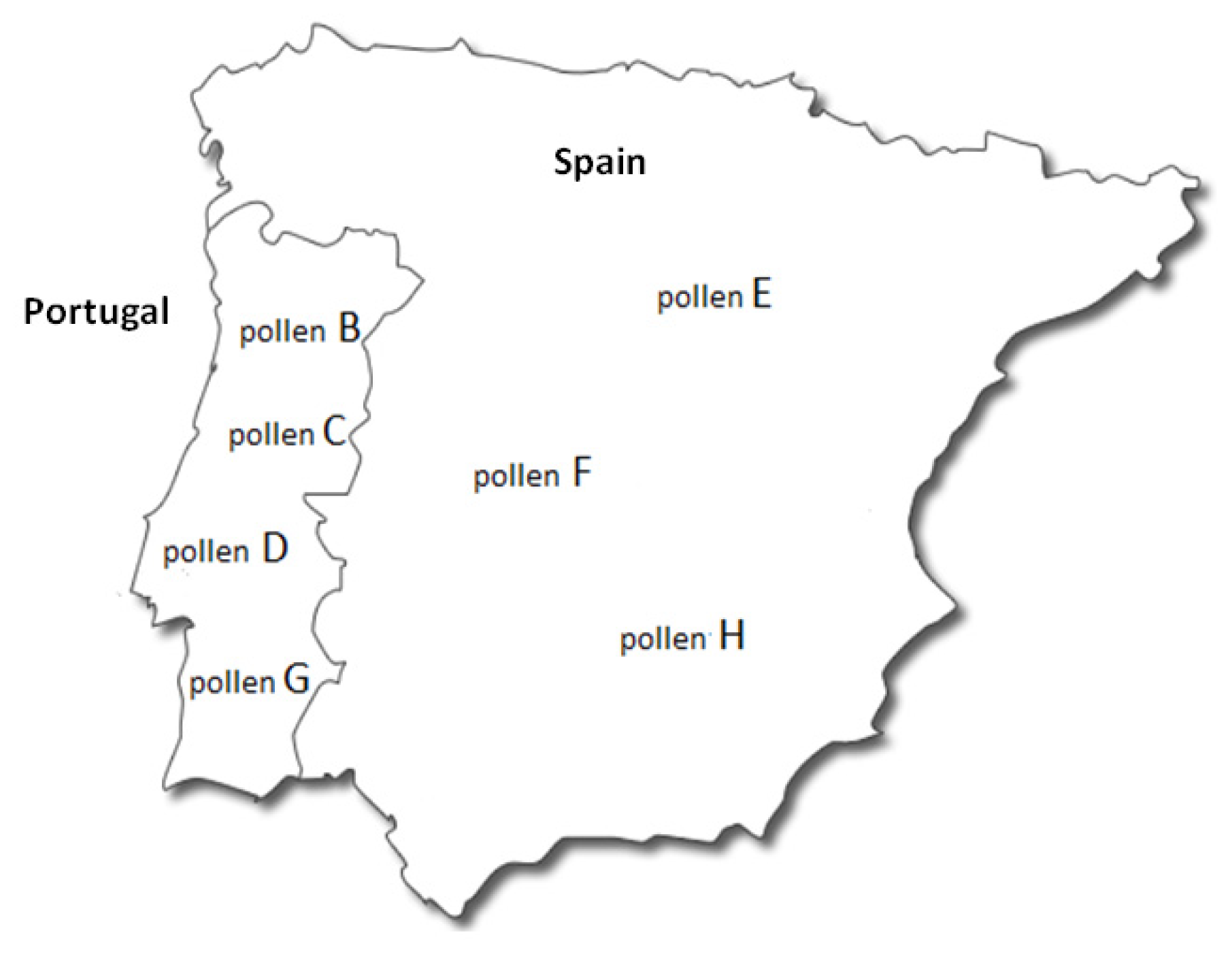
<p>The pollen samples B, C, D and G are from Portugal, the samples E, F and H are from Spain and sample A had no indication of country of origin. The address of the manufacturer, packer or seller established within the European Union is not indicated in 12.5% of the packaging. Seventy-five percent 75% of packaging presented other consumer information that is not mandatory. Not obligatory information includes the storage conditions. Information about the effect of carbohydrates, amino acids, enzymes, vitamins and minerals in the organism was found in 37.5% of the packaging. The nutritional information was present in 62.5% and consumer information line was indicated in 37.5% of the packaging. The method of use was designated in 62.5% of the analyzed containers.</p></sec>
<sec>
<title>2.2. Pollinic Identification</title>
<p>The results of the pollen analysis are presented in <xref ref-type="table" rid="t2-ijms-13-11173">Table 2</xref>. The bee pollens’ pollinic profile allows scientists to infer the vegetation present in the area and to date and ascertain any biodiversity changes, as for example, the presence and distribution of invasive or exotic plants. From the pollen analysis it can be seen that all samples were heterofloral. In addition, due to the different colors of the pollen grains it can be concluded that the samples included different botanical species.</p>
<p>Eleven families were found in the samples, with <italic>Cistaceae</italic> being the dominant in the three samples A (68.2%), C (83.6%) and E (90.6%) and type <italic>Fabaceae</italic> in two of the samples B (56%) and F (69.8%). The types <italic>Ericaceae</italic>, <italic>Fagaceae</italic>, <italic>Boraginaceae</italic> were dominant in D (58%), G (45.4%) and H (49.6%), respectively. The type <italic>Boraginaceae</italic> (<italic>Echium</italic>) was present in all the analyzed samples, apart from Pollen D. Indeed, this botanical family is present in several regions of Portugal and Spain and has several utilizations in cosmetics and as a functional food [<xref ref-type="bibr" rid="b14-ijms-13-11173">14</xref>]. These applications are related with its high levels of alpha linolenic acid (ALA), gamma linolenic acid (GLA) and stearidonic acid (SDA). In this study four types of pollen belonging to different families were also found that were only present in small amounts (accessory pollen and isolated pollen). This is the case for <italic>Pinus</italic> spp., found in Sample B (12.4%), <italic>Eucalyptus</italic> spp., found in Sample G (9%), <italic>Mimosa</italic> spp., found in Sample D (10%) and <italic>Quercus</italic> spp., found in Pollen G (16%).</p>
<p>None of the botanical families is represented in all the samples studied, since bee pollen can vary according to the region, a factor which depends on the available surrounding bee pasture in the apiary vegetation, as well as on the climate conditions for flowering [<xref ref-type="bibr" rid="b15-ijms-13-11173">15</xref>].</p></sec>
<sec>
<title>2.3. Chemical Composition</title>
<p>The chemical composition of the samples is shown in <xref ref-type="table" rid="t3-ijms-13-11173">Table 3</xref>. The composition of pollen showed variations between samples, which may be due to the different botanical composition, geographical origin of the product, influence of age and environmental conditions [<xref ref-type="bibr" rid="b16-ijms-13-11173">16</xref>].</p>
<p>The water content (expresses the total content: the free and bound water) and the water activity (measures the amount of free water) play an important role in the organoleptic characteristics and “shelf lifetime” of bee pollen [<xref ref-type="bibr" rid="b17-ijms-13-11173">17</xref>]. When its values are too high, it can potentially promote microbial contamination, mainly by moulds and yeasts [<xref ref-type="bibr" rid="b18-ijms-13-11173">18</xref>]. The moisture content varied between 8.40 ± 0.80% (G) and 6.02 ± 0.18% (C, D). The pollen’s humidity was above the upper limit (4%) set by the Brazilian legislation for commercial pollen [<xref ref-type="bibr" rid="b19-ijms-13-11173">19</xref>], but all values were within the limits allowed in Argentina and Switzerland (8% in both) [<xref ref-type="bibr" rid="b20-ijms-13-11173">20</xref>], except for pollen G (8.40 ± 0.82). However, the last was within the established limits of Bulgaria (10%) for commercial bee pollen. Pollen with less than 3% of moisture is undesirable since it can result in discoloration and development of chemical reactions (for example, the Maillard reaction and lipid oxidation), resulting in undesirable odors and a rancid product [<xref ref-type="bibr" rid="b21-ijms-13-11173">21</xref>]. The water activity was higher in sample A (0.43 ± 0.025) and lower in sample D (0.26 ± 0.01) and there were no statistically significant differences (<italic>p</italic> &lt; 0.001). These results are similar to those reported by [<xref ref-type="bibr" rid="b22-ijms-13-11173">22</xref>] (<italic>a</italic><italic><sub>w</sub></italic> ranged from 0.32 to 0.55), who studied bee pollen provided by beekeepers. All samples showed low values of <italic>a</italic><italic><sub>w</sub></italic>, which is characteristic of dehydrated foods, allowing storage stability. Indeed, since pollen is hygroscopic, high values of <italic>a</italic><italic><sub>w</sub></italic> promote microbiological contamination, more precisely by yeasts and fungi, which produce mycotoxins and ochratoxins, creating a risk to the consumer [<xref ref-type="bibr" rid="b23-ijms-13-11173">23</xref>].</p>
<p>The pH and <italic>a</italic><italic><sub>w</sub></italic> have great importance during the storage of bee pollen, as they influence its texture, stability and shelf life [<xref ref-type="bibr" rid="b24-ijms-13-11173">24</xref>]. The pH of the commercial pollens ranged from 5.17 ± 0.09 (D) to 4.23 ± 0.14 (G), the samples B, C and E did not differ significantly from each other (<italic>p</italic> &lt; 0.001). The values are in accordance with the Brazilian law (4.0 to 6.0) and those published by [<xref ref-type="bibr" rid="b16-ijms-13-11173">16</xref>,<xref ref-type="bibr" rid="b17-ijms-13-11173">17</xref>,<xref ref-type="bibr" rid="b22-ijms-13-11173">22</xref>,<xref ref-type="bibr" rid="b25-ijms-13-11173">25</xref>,<xref ref-type="bibr" rid="b26-ijms-13-11173">26</xref>].</p>
<p>The ash content is an account of the inorganic matter present in bee pollen [<xref ref-type="bibr" rid="b15-ijms-13-11173">15</xref>]. For the ash content the values ranged from 0.5 ± 0.01 (H) to 3.16 ± 0.03 (A). The pollen H was statistically significantly different from the others (<italic>p</italic> &lt; 0.001). Of the eight samples, seven are within the range reported by [<xref ref-type="bibr" rid="b26-ijms-13-11173">26</xref>], who analyzed bee pollen from Brazil, and [<xref ref-type="bibr" rid="b17-ijms-13-11173">17</xref>], who studied pollen from Argentina. Some values were lower than those reported by [<xref ref-type="bibr" rid="b10-ijms-13-11173">10</xref>], who found values between 1.90 and 3.91% for Spanish bee pollen. The ash content is influenced by soil type, geographical origin, flora species and capacity of the plant to accumulate minerals [<xref ref-type="bibr" rid="b21-ijms-13-11173">21</xref>]. The presence of mineral impurities is due to inefficient cleaning procedures and may increase the ash content, which makes this analysis an important quality index for pollen [<xref ref-type="bibr" rid="b10-ijms-13-11173">10</xref>].</p>
<p>Some authors emphasize the value of pollen as an important source of proteins [<xref ref-type="bibr" rid="b10-ijms-13-11173">10</xref>]. The protein content showed statistically significant differences (<italic>p</italic> &lt; 0.001), for pollen H, with values ranging from 25.15 ± 1.64 (C) to 12.50 ± 0.58 (H). The great variability of protein content found in bee pollen can be partly explained by the natural variation of the composition that is a consequence of the distinct source plants. In addition, differences within the same plant species growing under different environmental conditions have also been reported [<xref ref-type="bibr" rid="b1-ijms-13-11173">1</xref>]. Our results were similar to those obtained by [<xref ref-type="bibr" rid="b1-ijms-13-11173">1</xref>,<xref ref-type="bibr" rid="b26-ijms-13-11173">26</xref>,<xref ref-type="bibr" rid="b27-ijms-13-11173">27</xref>] in pollen samples from Brazil. Lower values for pollen from Spain were found by [<xref ref-type="bibr" rid="b10-ijms-13-11173">10</xref>]. However, higher values have already been obtained. The results of [<xref ref-type="bibr" rid="b28-ijms-13-11173">28</xref>,<xref ref-type="bibr" rid="b29-ijms-13-11173">29</xref>] who analyzed samples from Brazil and Argentina, ranged from 23.59% to 27.70% and 24.17% to 37.32%, respectively. The nitrogen content of Portuguese organic pollen was between 34.00% and 24.23% [<xref ref-type="bibr" rid="b22-ijms-13-11173">22</xref>], suggesting that this product is of better quality.</p>
<p>Lipids, mainly the fatty acids esters, are partly responsible for the physicochemical properties [<xref ref-type="bibr" rid="b30-ijms-13-11173">30</xref>]. The fat content varied from 3.06 ± 0.08 (G) to 2.35 ± 0.11 (B) with no statistically significant differences (<italic>p</italic> &lt; 0.001) between all pollens apart from B (<italic>p</italic> &lt; 0.001). These values are similar to those reported by [<xref ref-type="bibr" rid="b17-ijms-13-11173">17</xref>,<xref ref-type="bibr" rid="b22-ijms-13-11173">22</xref>] and slightly inferior to those obtained by [<xref ref-type="bibr" rid="b1-ijms-13-11173">1</xref>,<xref ref-type="bibr" rid="b19-ijms-13-11173">19</xref>,<xref ref-type="bibr" rid="b26-ijms-13-11173">26</xref>].</p>
<p>The higher carbohydrate content, 84.25 ± 0.58, was observed in pollen H, while pollen Sample C (69.68 ± 2.08) showed the lowest level, the latter showing statistically significant differences (<italic>p</italic> &lt; 0.001). The values are within the limits described by [<xref ref-type="bibr" rid="b10-ijms-13-11173">10</xref>], but the values obtained by [<xref ref-type="bibr" rid="b27-ijms-13-11173">27</xref>] are superior to ours. The values obtained for energy were between 400.70 ± 0.36 and 411.75 ± 0.63 (kcal/100 g) with no statistically significant differences (<italic>p</italic> &lt; 0.001) among themselves for Pollen B, C, D, E and F.</p>
<p>The reducing sugar content was highest in Pollen E (41.79 ± 3.21) and smallest in Sample A (26.09 ± 3.60). The high reducing sugar content of bee pollen has been associated with the presence of nectar/honey, commonly used by bees as glue for the pollen of plants [<xref ref-type="bibr" rid="b27-ijms-13-11173">27</xref>].</p></sec>
<sec>
<title>2.4. Microbial Contamination</title>
<p>The pollen contamination by microorganisms is dependent on the nutritional composition as well as the harvesting practices, cleaning, drying and storage of the product. The results obtained for the levels of microbial contamination are shown in <xref ref-type="table" rid="t4-ijms-13-11173">Table 4</xref>.</p>
<p>The results obtained for the parameters that indicate commercial quality are in agreement with the Argentinian Food Code, which establishes the maximum of 1.5 × l0<sup>3</sup> ufc/g for moulds and yeasts. In this study, moulds and yeasts were detected in 50% of the samples, while [<xref ref-type="bibr" rid="b17-ijms-13-11173">17</xref>,<xref ref-type="bibr" rid="b31-ijms-13-11173">31</xref>] found it in all the samples. [<xref ref-type="bibr" rid="b22-ijms-13-11173">22</xref>] detected these microorganisms in 60% of the samples, however, the number per sample was lower. Aerobic mesophiles were found only in 12.5% of the samples, and the number of colony forming units oscillated between &lt;10 and 8.7 × 10<sup>3</sup> ± 7.8 × 10. Sample F was significantly different from the others (<italic>p</italic> = 0.032). The number of colony forming units of moulds, yeasts and aerobic mesophiles found by [<xref ref-type="bibr" rid="b22-ijms-13-11173">22</xref>] in non-commercial Portuguese bee pollen was inferior. The higher number of microorganisms found in the present study must be related to the higher content of water of the commercial pollen.</p>
<p>The indicators of safety (<italic>Salmonella</italic> sp., sulfite-reducing <italic>clostridia</italic>) and the indicators of sanitary quality (fecal coliforms, <italic>Escherichia coli</italic> and <italic>Staphylococcus aureus</italic>) were absent. These results corroborate the observations of [<xref ref-type="bibr" rid="b22-ijms-13-11173">22</xref>]. On the other hand, [<xref ref-type="bibr" rid="b17-ijms-13-11173">17</xref>] fecal coliforms were found in some samples.</p></sec>
<sec>
<title>2.5. Isolation and Identification of Yeasts</title>
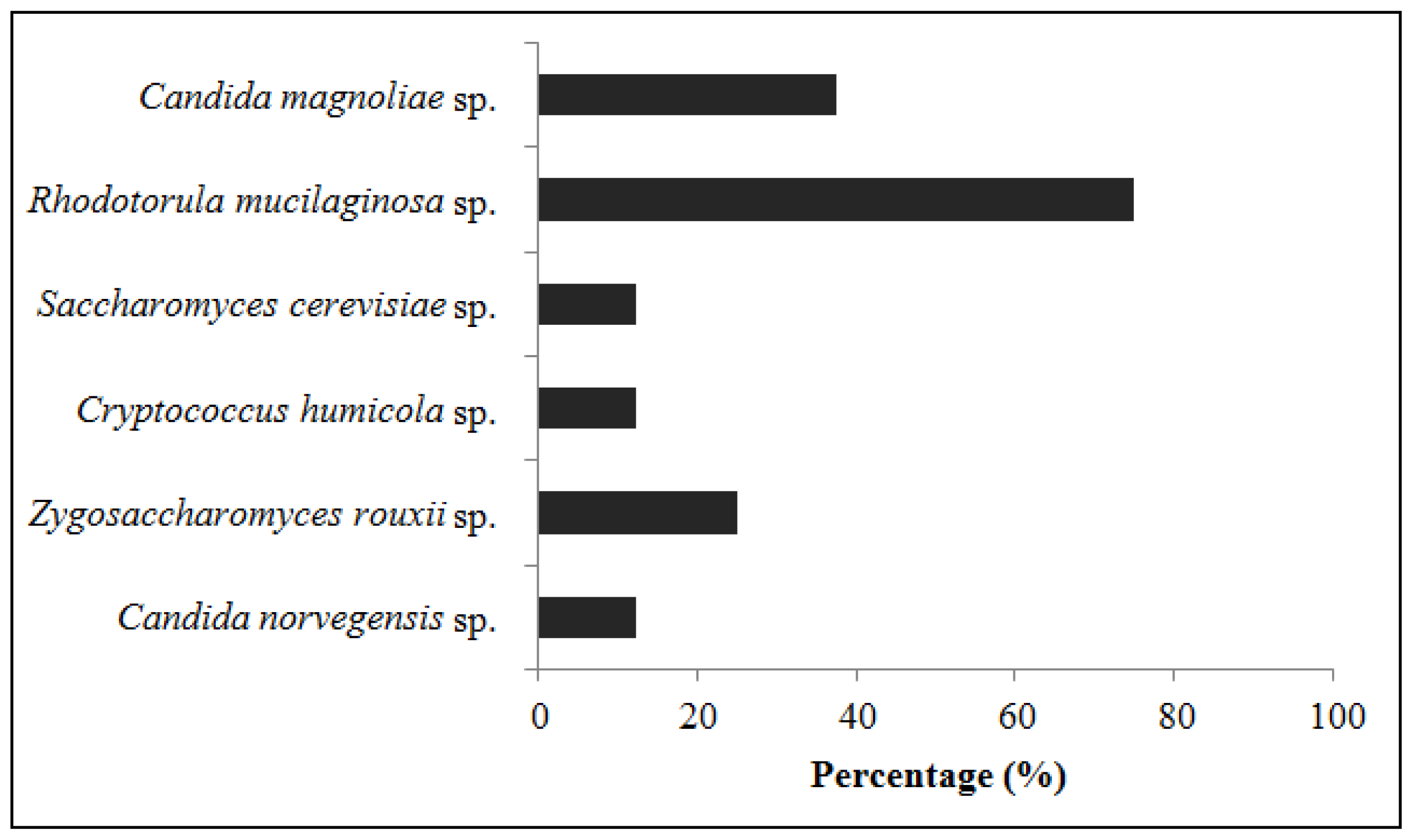
<p>This study is the first to identify the yeasts present in bee pollen. Six yeast species were identified in the samples in which yeasts were initially found (<xref ref-type="fig" rid="f1-ijms-13-11173">Figure 1</xref>).</p>
<p>Two of the six species found belong to the genus <italic>Candida</italic> (<italic>norvegensis</italic> and <italic>magnoliae</italic>). The yeast <italic>Rhodotorula mucilaginosa</italic> sp. was the most frequent. It was present in 75% of the samples with yeasts. <italic>Candida magnoliae</italic> sp. and <italic>Zygosaccharomyces rouxii</italic> sp. were identified in 37.5% and 25% of the samples, respectively. <italic>Candida norvegensis</italic> sp., <italic>Cryptococcus humicola</italic> sp. and <italic>Saccharomyces cerevisiae</italic> sp. were found in 12.5% of the samples. Studies on the yeasts isolated from honey have revealed that the most common is <italic>Candida magnoliae</italic> sp., followed by <italic>Rhodotorula mucilaginosa</italic> sp. [<xref ref-type="bibr" rid="b32-ijms-13-11173">32</xref>]. These results corroborate the claim that the microorganisms present in honey are, essentially, from pollen [<xref ref-type="bibr" rid="b33-ijms-13-11173">33</xref>]. <italic>Rhodotorula mucilaginosa</italic> is a common environmental inhabitant. This microorganism may act as an indicator of a lack of hygiene standards [<xref ref-type="bibr" rid="b34-ijms-13-11173">34</xref>]. To the best of our knowledge, <italic>Candida magnoliae</italic>, that is commonly isolated from the honeycomb, is inoffensive. It has been implicated in just one case of human disease (tenosynovitis in an immunocompetent child) [<xref ref-type="bibr" rid="b35-ijms-13-11173">35</xref>]. <italic>Saccharomyces cerevisiae</italic> and <italic>Zygosaccharomyces rouxii</italic> are responsible for the deterioration of foods that were processed and packaged in accordance with normal standards of good manufacturing practice.</p>
<p><italic>Candida norvegensis</italic> sp. and <italic>Rhodotorula mucilaginosa</italic> sp. can cause health risks, colonize the skin, fingernails, respiratory tract, genital-urinary and cause diarrhea.</p>
<p>These results indicate that the optimization of the hygienic procedures during all the production chain is necessary to improve the quality and safety of the product. In order to reduce the risk of food-borne illness and spoilage, good practices in agriculture (GAP), hygiene (GHP) and manufacturing (GMP) must be implemented.</p></sec></sec>
<sec>
<title>3. Experimental Section</title>
<sec>
<title>3.1. Samples</title>
<p>Eight commercial pollens (A-H) of different floral sources and geographical origins (<xref ref-type="fig" rid="f2-ijms-13-11173">Figure 2</xref>) were purchased from the market and left in the dark at room temperature (± 20 °C) until further analysis.</p></sec>
<sec sec-type="materials">
<title>3.2. Chemicals and Materials</title>
<p>The sodium sulfate (Na<sub>2</sub>SO<sub>4</sub>), anhydrous, powder, extra pure, sulfuric acid (H<sub>2</sub>SO<sub>4</sub>) and the sodium hydroxide (NaOH) were purchased from Acros Organic (Geel, Belgium). The petroleum ether and ethanol were obtained from Sigma Chemical Co. (St. Louis, MO, USA). The culture mediums were purchased from Himedia (India). The water was purified using a Milli-Q purification system (Millipore, Bedford, MA, USA).</p></sec>
<sec>
<title>3.3. Labeling</title>
<p>The labeling of the pollen bought at the supermarket was analyzed in accordance with the requirements of current Portuguese law [<xref ref-type="bibr" rid="b13-ijms-13-11173">13</xref>].</p></sec>
<sec>
<title>3.4. Pollinic Identification</title>
<p>The pollinic identification was performed by the method described by [<xref ref-type="bibr" rid="b1-ijms-13-11173">1</xref>]. Briefly, a sample of 2 g, corresponding to more or less 300 pollen pellets, was considered to be representative for botanical origin. The pellets were then divided into sub-samples according to color (yellow-black, dark brown, green, red, yellow and orange). Each subsample was then weighed to calculate its percentage of the whole sample. The sample was placed between blade and slide using glycerin gel as mounting medium. Identification of pollen grains was performed by optical microscope with total magnification (400× and 1000×). A reference collection of CIMO-Mountain Research Centre (Agricultural College of Braganza) and guides of pollen morphology were used for the recognition of the pollen types. The following terms were used for pollen frequency classes: dominant pollen (DP, more than 45% of the pollen grains counted), accessory pollen (AP, 15%–45%) and isolated pollen (IP, less than 15% of the pollen grains counted) [<xref ref-type="bibr" rid="b36-ijms-13-11173">36</xref>].</p></sec>
<sec>
<title>3.5. Physicochemical Analyses</title>
<p>All physicochemical tests were performed in triplicate.</p>
<sec>
<title>3.5.1. Moisture</title>
<p>Approximately 3 g of each sample of the study pollen was dried at a temperature of 100 °C–105 °C to constant weight [<xref ref-type="bibr" rid="b37-ijms-13-11173">37</xref>].</p></sec>
<sec>
<title>3.5.2. Ash</title>
<p>The ash content was determined after ignition at 600 ± 15 °C by gravimetry, as reported by [<xref ref-type="bibr" rid="b19-ijms-13-11173">19</xref>].</p></sec>
<sec>
<title>3.5.3. pH</title>
<p>The pH was measured in the aqueous phase obtained after mixing 10 g of pollen in 75 mL of distilled water [<xref ref-type="bibr" rid="b37-ijms-13-11173">37</xref>].</p></sec>
<sec>
<title>3.5.4. Reducing Sugars</title>
<p>With the aim of performing the acid hydrolysis of the reducing sugars, 60 mg of each pollen was dissolved in a H<sub>2</sub>SO<sub>4</sub> solution (10 mL, 1.5 M). The solutions were heated in a water bath (100 °C) for 20 min. Afterwards, the solution was cooled, neutralized with 12 mL NaOH (10%, <italic>w</italic>/<italic>v</italic>), filtered and the volume of the flask (60 mL) was completed with distilled water. The quantification of the reducing carbohydrates was performed spectrophotometrically at 540 nm using a spectrophotometer (UV-VIS spectrometry Unicam Hekios, UK). Glucose was used as standard. For this, 2 mL of distilled water, 1 mL of each hydrolyzate sample and 1 mL of DNS were placed in a test tube. The mixture was heated for 5 min in a water bath (100 °C) and cooled rapidly on ice to room temperature. Next, 5 mL of distilled water was added and the absorbance was read [<xref ref-type="bibr" rid="b38-ijms-13-11173">38</xref>].</p></sec>
<sec>
<title>3.5.5. Water Activity</title>
<p>This parameter was determined by placing each pollen sample directly into a water activity meter (Rotronic HygroPalm. Bassersdorf CH-8303).</p></sec>
<sec>
<title>3.5.6. Lipids</title>
<p>Two grams of pollen were macerated in a mortar with anhydrous Na<sub>2</sub>SO<sub>4</sub> by detachment of the mixture. Then, it was extracted with <italic>n</italic>-hexane for about 4 h in the Soxhlet apparatus [<xref ref-type="bibr" rid="b19-ijms-13-11173">19</xref>].</p></sec>
<sec>
<title>3.5.7. Proteins</title>
<p>Nitrogen content was determined using the Kjeldahl method (230-Hjeltec Analyzer, Foss Tecator, Höganäs, Sweden). The crude protein (CP) content was calculated using the conversion factor of 6.25 (<italic>N</italic> × 6.25). The crude fat (CF) was determined by gravimetry after extraction with petroleum ether using an automatic Soxtec device (FOSS, Soxtec™ 2050, Höganäs, Sweden).</p></sec>
<sec>
<title>3.5.8. Carbohydrates</title>
<p>The total carbohydrate contents was obtained by difference [100 − (ashes + proteins + lipids)] (%) [<xref ref-type="bibr" rid="b36-ijms-13-11173">36</xref>].</p></sec>
<sec>
<title>3.5.9. Energy</title>
<p>The total energy (in kcal) was estimated according to the following equation: energy (kcal) = 4 × (g protein+ g carbohydrate) + 9 × (g lipid) [<xref ref-type="bibr" rid="b39-ijms-13-11173">39</xref>].</p></sec></sec>
<sec>
<title>3.6. Microbiological Determinations</title>
<p>To assess the microbiological quality of the samples, the commercial quality parameters (mesophilic microorganisms, yeasts and moulds), the indicators of sanitary quality (fecal coliforms and <italic>Escherichia coli</italic>) and the indicators of safety (sulphite reducing clostridium spores and <italic>Salmonella</italic>) were analyzed. All microbial tests were performed in triplicate.</p>
<sec>
<title>3.6.1. Sample Preparation</title>
<p>Sample preparation was carried out according to [<xref ref-type="bibr" rid="b40-ijms-13-11173">40</xref>]. Ten grams of the sample of pollen were weighed on a scale (Mettler PC Model 2000), and homogenized with 90 mL of Ringer’s solution (dilution 10<sup>−1</sup>). For each sample, decimal dilutions were prepared using as diluent successive Ringer’s solution.</p></sec>
<sec>
<title>3.6.2. Enumeration of the Total Mesophilic Microorganisms</title>
<p>Enumeration was made on Plate Count Agar (Himedia), incubated at 37 °C for 48 h [<xref ref-type="bibr" rid="b41-ijms-13-11173">41</xref>]. Microbial counts were expressed as colony-forming units per gram of bee pollen (cfu/g).</p></sec>
<sec>
<title>3.6.3. Enumeration of Yeast and Moulds</title>
<p>Mould and yeast enumeration was made on DG18 (Himedia) and incubated at 25 °C for 5 days [<xref ref-type="bibr" rid="b42-ijms-13-11173">42</xref>]. Microbial counts were expressed as colony-forming units per gram of bee pollen (cfu/g).</p></sec>
<sec>
<title>3.6.4. Sulfite Reducing Clostridium Spores</title>
<p>This analysis includes three steps, according to the protocol of [<xref ref-type="bibr" rid="b43-ijms-13-11173">43</xref>]: preparation, inoculation and enumeration. For sulfite-reducing clostridia counting, aliquots of 10, 5, 1 and 0.1 mL of the initial suspension were added to an empty tube, thermally treated at 80 °C for 15 min and covered with Differential Reinforced Clostridial Broth (DRCM) (Himedia), and incubated at 37 °C for 5 days. At the end, the black colonies were counted. The results are expressed as presence of sulfite-reducing Clostridia in 0.01 g. Results were expressed as most probable numbers of sulfite-reducing Clostridium spores per gram of bee pollen (MPN/g).</p></sec>
<sec>
<title>3.6.5. Fecal coliforms and <italic>Escherichia coli</italic></title>
<p>The presence of coliforms, fecal coliforms and <italic>E. coli</italic> in bee pollen may be determined by means of the Most Probable Number (MPN) procedure, as described in [<xref ref-type="bibr" rid="b44-ijms-13-11173">44</xref>]. Briefly, this method involves serially diluting out the target organisms in the sample, in five replicate aliquots, to extinction. The probable level of the target organisms is then statistically estimated from a Hoskins table. Results were expressed as the most probable numbers of coliforms per gram of bee pollen (MPN/g) and the most probable numbers of <italic>E. coli</italic> per gram of bee pollen (MPN/g).</p></sec>
<sec>
<title>3.6.6. Salmonella</title>
<p>The detection was performed following the protocol of [<xref ref-type="bibr" rid="b45-ijms-13-11173">45</xref>]. According to this protocol, the search of <italic>Salmonella</italic> has four steps that include pre-enrichment (Bulfered Peptone Water), selective enrichment (Rappaport Vassiliadi and Muller-Kauffmann Tetrathionate-Novobiocin Broth-MKTTn), planting out (Xylose lysine Deoxycholate Agar-XLD agar) and confirmation Nutrient Agar (NA). Afterwards, biochemical confirmations are performed. Results were expressed as absence or presence of <italic>Salmonella</italic> in 25 g of bee pollen.</p></sec></sec>
<sec>
<title>3.7. Isolation and Identification of Yeasts</title>
<p>The API 20C AUX system, a commercial kit for the evaluation of the assimilation of 19 carbon sources, was used according to the instructions in the identification of the isolated yeasts. Pure cultures of each test organism were grown on one plate each of Sabouraud agar for 48 h. Each strain was inoculated into 2 mL of a NaCl solution (0.85%, <italic>w</italic>/<italic>v</italic>) to achieve a turbidity visually equivalent to a 2 McFarland turbidity standard. One 100 μL aliquot of this preparation was inoculated into the corresponding C medium tube and each tube of inoculated medium was transfer-pipetted into the corresponding API 20C AUX yeast panel. Each panel was incubated at 30 ± 2 °C for 48 h. All panels were read for growth according to the API 20C AUX-analytical profile index.</p></sec>
<sec sec-type="methods">
<title>3.8. Statistical Analysis</title>
<p>Results are shown as mean values and standard deviation. Prior to the statistical analysis, normality tests (Shapiro-Wilk, Anderson-Darling, Liliefors and Jarque-Bera) were carried out. In each parameter, the differences between pollens were analyzed using one-way analysis of variance (ANOVA) followed by Tukey’s HSD Test with <italic>α</italic> = 0.05. This treatment was carried out using SAS v. 9.1.3 program.</p></sec></sec>
<sec sec-type="conclusions">
<title>4. Conclusions</title>
<p>This work is a comprehensive survey about the physicochemical composition, pollinic spectrum and microbiological safety of commercial bee pollen from different origins. In parallel the specific legislation of the bee pollens concerning the labeling rules was also verified. The physicochemical parameters (water content, <italic>a</italic><italic><sub>w</sub></italic>, pH, ash, proteins, lipids, carbohydrates, reducing sugars and energy) of the samples were within the specifications. The indicators studied suggest that the commercial pollen is safe from a microbiological standpoint. Concerning the labeling, all the products presented the sales name, date of minimum durability, lot and net quantity.</p>
<p>Bee pollen has promising therapeutic and nutritional applications and, as such, the investigation of its chemical, nutritional and microbiological composition is a sound research priority.</p></sec></body>
<back>
<ref-list>
<title>References</title>
<ref id="b1-ijms-13-11173"><label>1</label><citation citation-type="journal"><person-group person-group-type="author"><name><surname>Almeida-Muradian</surname><given-names>L.B.</given-names></name><name><surname>Pamplona</surname><given-names>L.C.</given-names></name><name><surname>Coimbra</surname><given-names>S.</given-names></name><name><surname>Barth</surname><given-names>O.M.</given-names></name></person-group><article-title>Chemical composition and botanical evaluation of dried bee pollen pellets</article-title><source>J. Food Compos. Anal</source><year>2005</year><volume>18</volume><fpage>105</fpage><lpage>111</lpage><pub-id pub-id-type="doi">10.1016/j.jfca.2003.10.008</pub-id></citation></ref>
<ref id="b2-ijms-13-11173"><label>2</label><citation citation-type="journal"><person-group person-group-type="author"><name><surname>Yamaguchi</surname><given-names>M.</given-names></name><name><surname>Hamamoto</surname><given-names>R.</given-names></name><name><surname>Uchiyama</surname><given-names>S.</given-names></name><name><surname>Ishiyama</surname><given-names>K.</given-names></name><name><surname>Hashimoto</surname><given-names>K.</given-names></name></person-group><article-title>Anabolic effects of bee pollen Cistus ladaniferus extract on bone components in the femoral diaphyseal and metaphyseal tissues of rats <italic>in vitro</italic> and <italic>in vivo</italic></article-title><source>J. Health Sci</source><year>2006</year><volume>52</volume><fpage>43</fpage><lpage>49</lpage><pub-id pub-id-type="doi">10.1248/jhs.52.43</pub-id></citation></ref>
<ref id="b3-ijms-13-11173"><label>3</label><citation citation-type="journal"><person-group person-group-type="author"><name><surname>Shoskes</surname><given-names>D.A.</given-names></name></person-group><article-title>Phytotherapy in chronic prostatitis</article-title><source>Urology</source><year>2002</year><volume>60</volume><fpage>35</fpage><lpage>37</lpage><pub-id pub-id-type="doi">10.1016/S0090-4295(02)02383-X</pub-id><pub-id pub-id-type="pmid">12521591</pub-id></citation></ref>
<ref id="b4-ijms-13-11173"><label>4</label><citation citation-type="book"><person-group person-group-type="author"><name><surname>Mizrahi</surname><given-names>A.</given-names></name><name><surname>Lensky</surname><given-names>Y</given-names></name></person-group><source>Bee Products: Properties, Applications and Apitherapy</source><publisher-name>Springer-Verlag</publisher-name><publisher-loc>New York, NY, USA</publisher-loc><fpage>1997</fpage></citation></ref>
<ref id="b5-ijms-13-11173"><label>5</label><citation citation-type="journal"><person-group person-group-type="author"><name><surname>Wojcicki</surname><given-names>J.</given-names></name><name><surname>Samochowiec</surname><given-names>L.</given-names></name><name><surname>Bartlomowicz</surname><given-names>B.</given-names></name><name><surname>Hinek</surname><given-names>A.</given-names></name><name><surname>Jaworska</surname><given-names>M.</given-names></name><name><surname>Gawronska-Szklarz</surname><given-names>B.</given-names></name></person-group><article-title>Effect of pollen extract on the development of experimental atherosclerosis in rabbits</article-title><source>Atherosclerosis</source><year>1986</year><volume>62</volume><fpage>39</fpage><lpage>45</lpage><pub-id pub-id-type="doi">10.1016/0021-9150(86)90017-1</pub-id><pub-id pub-id-type="pmid">3778573</pub-id></citation></ref>
<ref id="b6-ijms-13-11173"><label>6</label><citation citation-type="journal"><person-group person-group-type="author"><name><surname>Zhang</surname><given-names>X.</given-names></name><name><surname>Habib</surname><given-names>F.K.</given-names></name><name><surname>Ross</surname><given-names>M.</given-names></name><name><surname>Burger</surname><given-names>U.</given-names></name><name><surname>Lewenstein</surname><given-names>A.</given-names></name><name><surname>Rose</surname><given-names>K.</given-names></name><name><surname>Jaton</surname><given-names>J.</given-names></name></person-group><article-title>Isolation and characterization of a cyclic hydroxamic acid from a pollen extract, which inhibits cancerous cell growth <italic>in vitro</italic></article-title><source>J. Med. Chem</source><year>1995</year><volume>38</volume><fpage>735</fpage><lpage>738</lpage><pub-id pub-id-type="doi">10.1021/jm00004a019</pub-id><pub-id pub-id-type="pmid">7861421</pub-id></citation></ref>
<ref id="b7-ijms-13-11173"><label>7</label><citation citation-type="journal"><person-group person-group-type="author"><name><surname>Morais</surname><given-names>M.</given-names></name><name><surname>Moreira</surname><given-names>L.</given-names></name><name><surname>Feás</surname><given-names>X.</given-names></name><name><surname>Estevinho</surname><given-names>L.M.</given-names></name></person-group><article-title>Honeybee-collected pollen from five Portuguese Natural Parks: Palynological origin, phenolic content, antioxidant properties and antimicrobial activity</article-title><source>Food Chem. Toxicol</source><year>2011</year><volume>39</volume><fpage>1096</fpage><lpage>1101</lpage></citation></ref>
<ref id="b8-ijms-13-11173"><label>8</label><citation citation-type="journal"><person-group person-group-type="author"><name><surname>Baltrušaitytė</surname><given-names>V.</given-names></name><name><surname>Venskutonis</surname><given-names>P.R.</given-names></name><name><surname>Čkstarytė</surname><given-names>V.</given-names></name></person-group><article-title>Radical scavenging activity of different floral origin honey and beebread phenolic extracts</article-title><source>Food Chem</source><year>2007</year><volume>101</volume><fpage>502</fpage><lpage>514</lpage><pub-id pub-id-type="doi">10.1016/j.foodchem.2006.02.007</pub-id></citation></ref>
<ref id="b9-ijms-13-11173"><label>9</label><citation citation-type="journal"><person-group person-group-type="author"><name><surname>Isidorov</surname><given-names>V.A.</given-names></name><name><surname>Isidorova</surname><given-names>A.G.</given-names></name><name><surname>Sczczepaniak</surname><given-names>L.</given-names></name><name><surname>Czyżewska</surname><given-names>U.</given-names></name></person-group><article-title>Gas chromatographic-mass spectrometric investigation of the chemical composition of beebread</article-title><source>Food Chem</source><year>2009</year><volume>115</volume><fpage>1056</fpage><lpage>1063</lpage><pub-id pub-id-type="doi">10.1016/j.foodchem.2008.12.025</pub-id></citation></ref>
<ref id="b10-ijms-13-11173"><label>10</label><citation citation-type="journal"><person-group person-group-type="author"><name><surname>Villanueva</surname><given-names>M.T.O.</given-names></name><name><surname>Marquina</surname><given-names>A.D.</given-names></name><name><surname>Serrano</surname><given-names>R.B.</given-names></name><name><surname>Abellan</surname><given-names>G.B.</given-names></name></person-group><article-title>The importance of bee-collected pollen in the diet: A study of its composition</article-title><source>Int. J. Food Sci. Nutr</source><year>2002</year><volume>53</volume><fpage>217</fpage><lpage>224</lpage><pub-id pub-id-type="doi">10.1080/09637480220132832</pub-id><pub-id pub-id-type="pmid">11951585</pub-id></citation></ref>
<ref id="b11-ijms-13-11173"><label>11</label><citation citation-type="journal"><person-group person-group-type="author"><name><surname>Hani</surname><given-names>B.</given-names></name><name><surname>Dalila</surname><given-names>B.</given-names></name><name><surname>Saliha</surname><given-names>D.</given-names></name><name><surname>Harzallah</surname><given-names>D.</given-names></name><name><surname>Ghadbane</surname><given-names>M.</given-names></name><name><surname>Khennouf</surname><given-names>S.</given-names></name></person-group><article-title>Microbiological sanitary aspects of pollen</article-title><source>Adv. Environ. Biol</source><year>2012</year><volume>6</volume><fpage>1415</fpage><lpage>1420</lpage></citation></ref>
<ref id="b12-ijms-13-11173"><label>12</label><citation citation-type="journal"><person-group person-group-type="author"><name><surname>Garcia-Villanova</surname><given-names>R.J.</given-names></name><name><surname>Cordón</surname><given-names>C.</given-names></name><name><surname>González</surname><given-names>A.M.</given-names></name><name><surname>Aparicio</surname><given-names>P.</given-names></name><name><surname>Garcia</surname><given-names>M.E.</given-names></name></person-group><article-title>Simultaneous immunoaffinity column cleanup and HPLC analysis of aflatoxins and ochratoxin A in Spanish bee pollen</article-title><source>J. Agric. Food Chem</source><year>2004</year><volume>52</volume><fpage>7235</fpage><lpage>7239</lpage><pub-id pub-id-type="doi">10.1021/jf048882z</pub-id><pub-id pub-id-type="pmid">15563200</pub-id></citation></ref>
<ref id="b13-ijms-13-11173"><label>13</label><citation citation-type="web"><source>Decreto-Lei n.º 156/2008</source><comment>Available online: <ext-link xlink:href="http://www.nationalstemcentre.org.uk/dl/cb88b8db986af7cf354b280a1117755295a0d278/14762-Echium.pdf" ext-link-type="uri">http://www.nationalstemcentre.org.uk/dl/cb88b8db986af7cf354b280a1117755295a0d278/14762-Echium.pdf</ext-link></comment><access-date>accessed on 18 July 2012</access-date></citation></ref>
<ref id="b14-ijms-13-11173"><label>14</label><citation citation-type="web"><collab>National Non-Food Crops Centre</collab><source>Echium</source><comment>Available online: <ext-link xlink:href="http://www.nationalstemcentre.org.uk/dl/cb88b8db986af7cf354b280a1117755295a0d278/14762-Echium.pdf" ext-link-type="uri">http://www.nationalstemcentre.org.uk/dl/cb88b8db986af7cf354b280a1117755295a0d278/14762-Echium.pdf</ext-link></comment><access-date>accessed on 18 July 2012</access-date></citation></ref>
<ref id="b15-ijms-13-11173"><label>15</label><citation citation-type="journal"><person-group person-group-type="author"><name><surname>Luz</surname><given-names>C.</given-names></name><name><surname>Bacha</surname><given-names>G.</given-names><suffix>Jr</suffix></name><name><surname>Fonseca</surname><given-names>R.L.E.</given-names></name><name><surname>Sousa</surname><given-names>P.</given-names></name></person-group><article-title>Comparative pollen preferences by africanized honeybees <italic>Apis mellifera</italic> L. of two colonies in Para de Minas, Minas Gerais, Brazil</article-title><source>Ann. Braz. Acad. Sci.</source><year>2010</year><volume>82</volume><fpage>293</fpage><lpage>304</lpage></citation></ref>
<ref id="b16-ijms-13-11173"><label>16</label><citation citation-type="journal"><person-group person-group-type="author"><name><surname>Herbert</surname><given-names>J.R.</given-names></name><name><surname>Shimanuki</surname><given-names>H.</given-names></name></person-group><article-title>Chemical composition and nutritive value of bee-collected and bee-stored pollen</article-title><source>Apidologie</source><year>1978</year><volume>9</volume><fpage>33</fpage><lpage>40</lpage><pub-id pub-id-type="doi">10.1051/apido:19780103</pub-id></citation></ref>
<ref id="b17-ijms-13-11173"><label>17</label><citation citation-type="journal"><person-group person-group-type="author"><name><surname>Coronel</surname><given-names>B.B.</given-names></name><name><surname>Grasso</surname><given-names>S.C.</given-names></name><name><surname>Pereira</surname><given-names>G.</given-names></name><name><surname>Fernández</surname><given-names>A.</given-names></name></person-group><article-title>Caracterización bromatológica del pólen apícola Argentino</article-title><source>Cienc. Docencia. Tecnol</source><year>2004</year><volume>15</volume><fpage>141</fpage><lpage>181</lpage></citation></ref>
<ref id="b18-ijms-13-11173"><label>18</label><citation citation-type="journal"><person-group person-group-type="author"><name><surname>Morgano</surname><given-names>M.A.</given-names></name><name><surname>Milani</surname><given-names>R.F.</given-names></name><name><surname>Martins</surname><given-names>M.C.T.</given-names></name><name><surname>Rodriguez-Amaya</surname><given-names>D.B.</given-names></name></person-group><article-title>Determination of water content in Brazilian honeybee-collected pollen by Karl Fischer titration</article-title><source>Food Control</source><year>2011</year><volume>22</volume><fpage>1604</fpage><lpage>1608</lpage><pub-id pub-id-type="doi">10.1016/j.foodcont.2011.03.016</pub-id></citation></ref>
<ref id="b19-ijms-13-11173"><label>19</label><citation citation-type="thesis"><person-group person-group-type="author"><name><surname>Carpes</surname><given-names>T</given-names></name></person-group><article-title>Estudo das Caracteristicas Fisico-Quimicas e Biológicas do Polén Apícola de Apis mellifera da região Sul do Brasil</article-title><source>Ph.D. Thesis</source><publisher-name>Universidade Federal do Paraná</publisher-name><publisher-loc>Curitiba, Brazil</publisher-loc><month>September</month><year>2008</year></citation></ref>
<ref id="b20-ijms-13-11173"><label>20</label><citation citation-type="book"><person-group person-group-type="author"><name><surname>Krell</surname><given-names>R</given-names></name></person-group><source>Value Added Products from Beekeeping</source><publisher-name>FAO Agricultural Services</publisher-name><publisher-loc>Rome, Italy</publisher-loc><year>1996</year></citation></ref>
<ref id="b21-ijms-13-11173"><label>21</label><citation citation-type="journal"><person-group person-group-type="author"><name><surname>Bonvehi</surname><given-names>J.S.</given-names></name><name><surname>Jordà</surname><given-names>R.E.</given-names></name></person-group><article-title>Nutrient composition and microbiological quality of honeybee-collected pollen in Spain</article-title><source>J. Agric. Food Chem</source><year>1997</year><volume>45</volume><fpage>725</fpage><lpage>732</lpage><pub-id pub-id-type="doi">10.1021/jf960265q</pub-id></citation></ref>
<ref id="b22-ijms-13-11173"><label>22</label><citation citation-type="journal"><person-group person-group-type="author"><name><surname>Estevinho</surname><given-names>L.M.</given-names></name><name><surname>Rodrigues</surname><given-names>S.</given-names></name><name><surname>Pereira</surname><given-names>A.P.</given-names></name><name><surname>Feás</surname><given-names>X.</given-names></name></person-group><article-title>Portuguese bee pollen: Palynological study, nutritional and microbiological evaluation</article-title><source>Int. J. Food Sci. Technol</source><year>2012</year><volume>47</volume><fpage>429</fpage><lpage>435</lpage><pub-id pub-id-type="doi">10.1111/j.1365-2621.2011.02859.x</pub-id></citation></ref>
<ref id="b23-ijms-13-11173"><label>23</label><citation citation-type="journal"><person-group person-group-type="author"><name><surname>González</surname><given-names>G.</given-names></name><name><surname>Hinojo</surname><given-names>M.J.</given-names></name><name><surname>Mateo</surname><given-names>R.</given-names></name><name><surname>Medina</surname><given-names>A.</given-names></name><name><surname>Jiménez</surname><given-names>M.</given-names></name></person-group><article-title>Occurrence of mycotoxin producing fungi in bee pollen</article-title><source>Int. J. Food Microbiol</source><year>2005</year><volume>105</volume><fpage>1</fpage><lpage>9</lpage><pub-id pub-id-type="doi">10.1016/j.ijfoodmicro.2005.05.001</pub-id><pub-id pub-id-type="pmid">16009441</pub-id></citation></ref>
<ref id="b24-ijms-13-11173"><label>24</label><citation citation-type="journal"><person-group person-group-type="author"><name><surname>González-Martin</surname><given-names>I.</given-names></name><name><surname>Hernàndez-Hierro</surname><given-names>J.M.</given-names></name><name><surname>Barros-Ferreiro</surname><given-names>N.</given-names></name><name><surname>Córdon-Marcos</surname><given-names>C.</given-names></name><name><surname>Garcìa-Villanova</surname><given-names>R.J.</given-names></name></person-group><article-title>Use of NIRS technology with a remote reflectance fibre-optic probe for predicting major components in bee pollen</article-title><source>Talanta</source><year>2007</year><volume>72</volume><fpage>998</fpage><lpage>1003</lpage><pub-id pub-id-type="doi">10.1016/j.talanta.2006.12.039</pub-id><pub-id pub-id-type="pmid">19071715</pub-id></citation></ref>
<ref id="b25-ijms-13-11173"><label>25</label><citation citation-type="journal"><person-group person-group-type="author"><name><surname>Marchini</surname><given-names>L.C.</given-names></name><name><surname>Reis</surname><given-names>V.D.A.</given-names></name><name><surname>Moreti</surname><given-names>A.C.C.C.</given-names></name></person-group><article-title>Composição físico-química de amostras de pólen coletado por abelhas africanizadas Apis mellifera (Hymenoptera: Apidae) em Piracicaba, Estado de São Paulo</article-title><source>Ciênc. Rural</source><year>2006</year><volume>36</volume><fpage>949</fpage><lpage>953</lpage><pub-id pub-id-type="doi">10.1590/S0103-84782006000300034</pub-id></citation></ref>
<ref id="b26-ijms-13-11173"><label>26</label><citation citation-type="journal"><person-group person-group-type="author"><name><surname>Bastos</surname><given-names>D.H.M.</given-names></name><name><surname>Rocha</surname><given-names>C.I.</given-names></name><name><surname>Cunha</surname><given-names>I.B.S.</given-names></name><name><surname>Carvalho</surname><given-names>P.O.</given-names></name><name><surname>Torres</surname><given-names>E.A.S.</given-names></name></person-group><article-title>Composição e qualidade de pólen apícola comercializado em algumas cidades nos estados de São Paulo e Minas Gerais</article-title><source>Revist. Inst. Adolfo Lutz</source><year>2003</year><volume>62</volume><fpage>239</fpage><lpage>244</lpage></citation></ref>
<ref id="b27-ijms-13-11173"><label>27</label><citation citation-type="journal"><person-group person-group-type="author"><name><surname>Carpes</surname><given-names>T.</given-names></name><name><surname>Cabral</surname><given-names>I.</given-names></name><name><surname>Rosalen</surname><given-names>P.L.</given-names></name><name><surname>de Alencar</surname><given-names>S.M.</given-names></name><name><surname>Masson</surname><given-names>M.L.</given-names></name></person-group><article-title>Caracterização do potencial antimicrobiano dos extractos de pólen apícola da região Sul do Brasil</article-title><source>Alimentos Nutrição Araraquara</source><year>2009</year><volume>20</volume><fpage>271</fpage><lpage>277</lpage></citation></ref>
<ref id="b28-ijms-13-11173"><label>28</label><citation citation-type="journal"><person-group person-group-type="author"><name><surname>Melo</surname><given-names>I.L.P.</given-names></name><name><surname>Freitas</surname><given-names>A.S.</given-names></name><name><surname>Barth</surname><given-names>O.M.</given-names></name><name><surname>Almeida-Muradian</surname><given-names>L.B.</given-names></name></person-group><article-title>Correlation between nutritional composition and floral origin of dried bee pollen</article-title><source>Revist. Inst. Adolfo Lutz</source><year>2009</year><volume>168</volume><fpage>1</fpage><lpage>9</lpage></citation></ref>
<ref id="b29-ijms-13-11173"><label>29</label><citation citation-type="journal"><person-group person-group-type="author"><name><surname>Vit</surname><given-names>P.</given-names></name><name><surname>Santiago</surname><given-names>B.</given-names></name></person-group><article-title>Chemical composition of fresh bee pollen collected in the Misintá páramo from the Venezuelan Andes</article-title><source>Arch. Latinoam. Nutr</source><year>2008</year><volume>58</volume><fpage>411</fpage><lpage>415</lpage><pub-id pub-id-type="pmid">19368304</pub-id></citation></ref>
<ref id="b30-ijms-13-11173"><label>30</label><citation citation-type="journal"><person-group person-group-type="author"><name><surname>Ayaz</surname><given-names>F.A.</given-names></name><name><surname>Glew</surname><given-names>R.H.</given-names></name><name><surname>Millson</surname><given-names>R.M.</given-names></name><name><surname>Huang</surname><given-names>H.S.</given-names></name><name><surname>Chuang</surname><given-names>L.H.</given-names></name><name><surname>Sanz</surname><given-names>C.</given-names></name><name><surname>Hayırlıoglu-Ayaz</surname><given-names>S.</given-names></name></person-group><article-title>Nutrient contents of kale (Brassica oleraceae L. Var. acephala DC.)</article-title><source>Food Chem</source><year>2006</year><volume>96</volume><fpage>572</fpage><lpage>579</lpage><pub-id pub-id-type="doi">10.1016/j.foodchem.2005.03.011</pub-id></citation></ref>
<ref id="b31-ijms-13-11173"><label>31</label><citation citation-type="thesis"><person-group person-group-type="author"><name><surname>Hervatin</surname><given-names>H.L.</given-names></name></person-group><article-title>Avaliação microbiológica e físico-quimica do pólen apícola in natura e desidratado sob diferentes temperaturas</article-title><source>M.Sc. Thesis</source><publisher-name>Universidade Estadual de Campinas</publisher-name><publisher-loc>Campinas, Brazil</publisher-loc><month>September</month><year>2009</year></citation></ref>
<ref id="b32-ijms-13-11173"><label>32</label><citation citation-type="journal"><person-group person-group-type="author"><name><surname>Carvalho</surname><given-names>C.M.</given-names></name><name><surname>Rocha</surname><given-names>A.</given-names></name><name><surname>Estevinho</surname><given-names>M.L.F.</given-names></name></person-group><article-title>Identification of honey yeast based on RFLP analysis of the ITS region</article-title><source>Cienc. Tecnol. Aliment</source><year>2005</year><volume>5</volume><fpage>11</fpage><lpage>17</lpage></citation></ref>
<ref id="b33-ijms-13-11173"><label>33</label><citation citation-type="journal"><person-group person-group-type="author"><name><surname>Snowdon</surname><given-names>J.A.</given-names></name><name><surname>Cliver</surname><given-names>D.O.</given-names></name></person-group><article-title>Microorganisms in honey</article-title><source>Int. J. Food Microbiol</source><year>1996</year><volume>31</volume><fpage>1</fpage><lpage>26</lpage><pub-id pub-id-type="doi">10.1016/0168-1605(96)00970-1</pub-id><pub-id pub-id-type="pmid">8880294</pub-id></citation></ref>
<ref id="b34-ijms-13-11173"><label>34</label><citation citation-type="book"><person-group person-group-type="author"><name><surname>Stratford</surname><given-names>M</given-names></name></person-group><article-title>Food and beverage yeasts</article-title><source>Yeasts in Food and Beverages</source><person-group person-group-type="editor"><name><surname>Querol</surname><given-names>A.</given-names></name><name><surname>Fleet</surname><given-names>G.H.</given-names></name></person-group><publisher-name>Springer-Verlag</publisher-name><publisher-loc>Berlin, Germany</publisher-loc><year>2006</year><fpage>335</fpage><lpage>379</lpage></citation></ref>
<ref id="b35-ijms-13-11173"><label>35</label><citation citation-type="journal"><person-group person-group-type="author"><name><surname>Cascio</surname><given-names>G.</given-names></name><name><surname>Dalle Carbonare</surname><given-names>L.</given-names></name><name><surname>Maccacaro</surname><given-names>L.</given-names></name><name><surname>Caliari</surname><given-names>F.</given-names></name><name><surname>Ligozzi</surname><given-names>M.</given-names></name><name><surname>Cascio</surname><given-names>V.</given-names></name><name><surname>Fontana</surname><given-names>R.</given-names></name></person-group><article-title>First case of bloodstream infection due to <italic>Candida magnoliae</italic> in a Chinese oncological patient</article-title><source>J. Clin. Microbiol</source><year>2007</year><volume>10</volume><fpage>3470</fpage><lpage>3473</lpage></citation></ref>
<ref id="b36-ijms-13-11173"><label>36</label><citation citation-type="journal"><person-group person-group-type="author"><name><surname>Louveaux</surname><given-names>J.</given-names></name><name><surname>Maurizio</surname><given-names>A.</given-names></name><name><surname>Vorwohl</surname><given-names>G.</given-names></name></person-group><article-title>Methods of Melissopalinology</article-title><source>Bee World</source><year>1978</year><volume>59</volume><fpage>139</fpage><lpage>157</lpage></citation></ref>
<ref id="b37-ijms-13-11173"><label>37</label><citation citation-type="book"><person-group person-group-type="author"><name><surname>Zenebon</surname><given-names>O.</given-names></name><name><surname>Tiglea</surname><given-names>N.S.P.P.</given-names></name></person-group><source>Métodos Físico-Químicos Para Análise de Alimentos</source><edition>4th ed</edition><publisher-name>Instituto Adolfo Lutz</publisher-name><publisher-loc>São Paulo, Brazil</publisher-loc><year>2008</year><fpage>1020</fpage></citation></ref>
<ref id="b38-ijms-13-11173"><label>38</label><citation citation-type="journal"><person-group person-group-type="author"><name><surname>Silva</surname><given-names>R.N.</given-names></name><name><surname>Monteiro</surname><given-names>V.N.</given-names></name><name><surname>Alcanfor</surname><given-names>J.A.X.</given-names></name><name><surname>Assis</surname><given-names>E.M.</given-names></name><name><surname>Asquieri</surname><given-names>E.R.</given-names></name></person-group><article-title>Comparision methods for the determination of reducers sugars and total in honey</article-title><source>Ciênc. Tecnol. Aliment</source><year>2003</year><volume>23</volume><fpage>337</fpage><lpage>341</lpage><pub-id pub-id-type="doi">10.1590/S0101-20612003000300007</pub-id></citation></ref>
<ref id="b39-ijms-13-11173"><label>39</label><citation citation-type="journal"><person-group person-group-type="author"><name><surname>Barros</surname><given-names>L.</given-names></name><name><surname>Heleno</surname><given-names>S.A.</given-names></name><name><surname>Carvalho</surname><given-names>A.M.</given-names></name><name><surname>Ferreira</surname><given-names>I.C.F.R.</given-names></name></person-group><article-title>Lamiaceae often used in Portuguese folk medicine as a source of powerful antioxidants: Vitamins and phenolics</article-title><source>LWT-Food Sci. Technol</source><year>2010</year><volume>43</volume><fpage>544</fpage><lpage>550</lpage><pub-id pub-id-type="doi">10.1016/j.lwt.2009.09.024</pub-id></citation></ref>
<ref id="b40-ijms-13-11173"><label>40</label><citation citation-type="book"><collab>Instituto Português da Qualidade</collab><source>Géneros Alimentícios. Análise Microbiológica. Colheita de Amostras; NP-1828:1982</source><publisher-name>Instituto Português da Qualidade</publisher-name><publisher-loc>Caparica, Portugal</publisher-loc><year>1982</year></citation></ref>
<ref id="b41-ijms-13-11173"><label>41</label><citation citation-type="book"><collab>Instituto Português da Qualidade</collab><source>Microbiologia Alimentar—Regras Gerais Para a Contagem de Microrganismos a 30 °C; NP-3788:2002</source><publisher-name>Instituto Português da Qualidade</publisher-name><publisher-loc>Caparica, Portugal</publisher-loc><year>2002</year></citation></ref>
<ref id="b42-ijms-13-11173"><label>42</label><citation citation-type="book"><collab>International Standards Organization</collab><source>Microbiology of Food and Animal Feeding Stuffs— Horizontal Method for the Enumeration of Yeasts and Moulds—Part 2: Colony Count Technique in Products with Water Activity Less Than or Equal to 0.95; US ISO 21527-2:2008</source><publisher-name>International Standards Organization</publisher-name><publisher-loc>Winterthur, Switzerland</publisher-loc><year>2008</year></citation></ref>
<ref id="b43-ijms-13-11173"><label>43</label><citation citation-type="book"><collab>International Standards Organization</collab><source>Microbiology of Food and Animal Feeding Stuffs— Horizontal Method for the Enumeration of Sulfite-Reducing Bacteria Growing under Anaerobic Conditions; ISO 15213:2003</source><publisher-name>International Standards Organization</publisher-name><publisher-loc>Winterthur, Switzerland</publisher-loc><year>2003</year></citation></ref>
<ref id="b44-ijms-13-11173"><label>44</label><citation citation-type="book"><collab>International Standards Organization</collab><source>Microbiology of Food and Animal Feeding Stuffs— Horizontal Method for the Detection and Enumeration of Coliforms—Most Probable Number Technique; ISO 4831:2006</source><publisher-name>International Standards Organization</publisher-name><publisher-loc>Winterthur, Switzerland</publisher-loc><year>2006</year></citation></ref>
<ref id="b45-ijms-13-11173"><label>45</label><citation citation-type="book"><collab>International Standards Organization</collab><source>Microbiology of Food and Animal Feeding Stuffs— Horizontal Method for the Detection of Salmonella spp.; ISO 6579:2002</source><publisher-name>International Standards Organization</publisher-name><publisher-loc>Winterthur, Switzerland</publisher-loc><year>2002</year></citation></ref></ref-list>
<sec sec-type="display-objects">
<title>Figures and Tables</title>
<fig id="f1-ijms-13-11173" position="float">
<label>Figure 1</label>
<caption>
<p>Percentage of the yeasts isolated from the samples.</p></caption>
<graphic xlink:href="ijms-13-11173f1.gif"/></fig>
<fig id="f2-ijms-13-11173" position="float">
<label>Figure 2</label>
<caption>
<p>Place of origin of the commercial bee pollen. The origin of Sample A was not specified in the labeling.</p></caption>
<graphic xlink:href="ijms-13-11173f2.gif"/></fig>
<table-wrap id="t1-ijms-13-11173" position="float">
<label>Table 1</label>
<caption>
<p>Results of the commercial bee pollen labeling analysis.</p></caption>
<table frame="hsides" rules="groups">
<thead>
<tr>
<th align="left" valign="bottom"/>
<th align="center" valign="bottom">In the packaging (%)</th></tr></thead>
<tbody>
<tr>
<td align="left" valign="top">Trade name</td>
<td align="center" valign="top">100.0</td></tr>
<tr>
<td align="left" valign="top">Net quantity (g or kg)</td>
<td align="center" valign="top">100.0</td></tr>
<tr>
<td align="left" valign="top">Date of minimum durability</td>
<td align="center" valign="top">100.0</td></tr>
<tr>
<td align="left" valign="top">Name, company or business name</td>
<td align="center" valign="top">87.5</td></tr>
<tr>
<td align="left" valign="top">Social grower/packer/seller</td>
<td align="center" valign="top">87.5</td></tr>
<tr>
<td align="left" valign="top">established in the EU</td>
<td align="center" valign="top">87.5</td></tr>
<tr>
<td align="left" valign="top">Lot</td>
<td align="center" valign="top">100.0</td></tr>
<tr>
<td align="left" valign="top">Address</td>
<td align="center" valign="top">87.5</td></tr>
<tr>
<td align="left" valign="top">Place of origin</td>
<td align="center" valign="top">87.5</td></tr>
<tr>
<td align="left" valign="top"><xref ref-type="table-fn" rid="tfn1-ijms-13-11173">*</xref> Storage conditions</td>
<td align="center" valign="top">75.0</td></tr>
<tr>
<td align="left" valign="top"><xref ref-type="table-fn" rid="tfn1-ijms-13-11173">*</xref> Information to consumers</td>
<td align="center" valign="top">75.0</td></tr></tbody></table>
<table-wrap-foot><fn id="tfn1-ijms-13-11173">
<label>*</label>
<p>Items not required on labels.</p></fn></table-wrap-foot></table-wrap>
<table-wrap id="t2-ijms-13-11173" position="float">
<label>Table 2</label>
<caption>
<p>Palynological spectrum of the eight commercial bee pollen (mean ± standard deviation; <italic>n</italic> = 3).</p></caption>
<table frame="hsides" rules="groups">
<thead>
<tr>
<th align="left" valign="middle" rowspan="3">Family</th>
<th colspan="9" align="center" valign="bottom">Samples</th></tr>
<tr>
<th colspan="9" align="left" valign="bottom">
<hr/></th></tr>
<tr>
<th align="left" valign="bottom"/>
<th align="left" valign="bottom">A</th>
<th align="left" valign="bottom">B</th>
<th align="left" valign="bottom">C</th>
<th align="left" valign="bottom">D</th>
<th align="left" valign="bottom">E</th>
<th align="left" valign="bottom">F</th>
<th align="left" valign="bottom">G</th>
<th align="left" valign="bottom">H</th></tr></thead>
<tbody>
<tr>
<td align="left" valign="top">Asteraceae</td>
<td align="left" valign="top">Leontodon spp. (%)</td>
<td align="left" valign="top">-</td>
<td align="left" valign="top">5.3 ± 1.9 <xref ref-type="table-fn" rid="tfn4-ijms-13-11173">3</xref></td>
<td align="left" valign="top">-</td>
<td align="left" valign="top">1.2 ± 0.1 <xref ref-type="table-fn" rid="tfn4-ijms-13-11173">3</xref></td>
<td align="left" valign="top">-</td>
<td align="left" valign="top">18.2 ± 3.4 <xref ref-type="table-fn" rid="tfn3-ijms-13-11173">2</xref></td>
<td align="left" valign="top">-</td></tr>
<tr>
<td align="left" valign="top">Boraginaceae</td>
<td align="left" valign="top">Echium spp. (%)</td>
<td align="left" valign="top">2.0 ± 0.4 <xref ref-type="table-fn" rid="tfn4-ijms-13-11173">3</xref></td>
<td align="left" valign="top">4.6 ± 1.4 <xref ref-type="table-fn" rid="tfn4-ijms-13-11173">3</xref></td>
<td align="left" valign="top">7.5 ± 1.6 <xref ref-type="table-fn" rid="tfn4-ijms-13-11173">3</xref></td>
<td align="left" valign="top">-</td>
<td align="left" valign="top">4.2 ± 0.8 <xref ref-type="table-fn" rid="tfn4-ijms-13-11173">3</xref></td>
<td align="left" valign="top">1.2 ± 0.2 <xref ref-type="table-fn" rid="tfn4-ijms-13-11173">3</xref></td>
<td align="left" valign="top">6.2 ± 2.3 <xref ref-type="table-fn" rid="tfn4-ijms-13-11173">3</xref></td>
<td align="left" valign="top">49.6 ± 5.2 <xref ref-type="table-fn" rid="tfn2-ijms-13-11173">1</xref></td></tr>
<tr>
<td align="left" valign="top">Cistaceae</td>
<td align="left" valign="top">Cistus spp. (%)</td>
<td align="left" valign="top">68.2 ± 8.9 <xref ref-type="table-fn" rid="tfn2-ijms-13-11173">1</xref></td>
<td align="left" valign="top">-</td>
<td align="left" valign="top">83.6 ± 9.2 <xref ref-type="table-fn" rid="tfn2-ijms-13-11173">1</xref></td>
<td align="left" valign="top">2.4 ± 0.5 <xref ref-type="table-fn" rid="tfn4-ijms-13-11173">3</xref></td>
<td align="left" valign="top">90.6 ± 9.3 <xref ref-type="table-fn" rid="tfn2-ijms-13-11173">1</xref></td>
<td align="left" valign="top">-</td>
<td align="left" valign="top">5.2 ± 1.5 <xref ref-type="table-fn" rid="tfn4-ijms-13-11173">3</xref></td>
<td align="left" valign="top">-</td></tr>
<tr>
<td align="left" valign="top">Ericaceae</td>
<td align="left" valign="top">Erica spp. (%)</td>
<td align="left" valign="top">-</td>
<td align="left" valign="top">58.0 ± 7.7 <xref ref-type="table-fn" rid="tfn2-ijms-13-11173">1</xref></td>
<td align="left" valign="top">1.7 ± 0.2 <xref ref-type="table-fn" rid="tfn4-ijms-13-11173">3</xref></td>
<td align="left" valign="top">-</td>
<td align="left" valign="top">-</td></tr>
<tr>
<td align="left" valign="top">Fabaceae</td>
<td align="left" valign="top">Cytisus spp. (%)</td>
<td align="left" valign="top">-</td>
<td align="left" valign="top">57.0 ± 9.2 <xref ref-type="table-fn" rid="tfn2-ijms-13-11173">1</xref></td>
<td align="left" valign="top">2.9 ± 0.3 <xref ref-type="table-fn" rid="tfn4-ijms-13-11173">3</xref></td>
<td align="left" valign="top">3 ± 0.8 <xref ref-type="table-fn" rid="tfn4-ijms-13-11173">3</xref></td>
<td align="left" valign="top">-</td>
<td align="left" valign="top">69.8 ± 6.7 <xref ref-type="table-fn" rid="tfn2-ijms-13-11173">1</xref></td>
<td align="left" valign="top">-</td>
<td align="left" valign="top">8 ± 1.0 <xref ref-type="table-fn" rid="tfn4-ijms-13-11173">3</xref></td></tr>
<tr>
<td align="left" valign="top"/>
<td align="left" valign="top">Acacia spp. (%)</td>
<td align="left" valign="top">-</td>
<td align="left" valign="top">2.5 ± 0.6 <xref ref-type="table-fn" rid="tfn4-ijms-13-11173">3</xref></td>
<td align="left" valign="top">-</td>
<td align="left" valign="top">1.5 ± 0.3 <xref ref-type="table-fn" rid="tfn4-ijms-13-11173">3</xref></td>
<td align="left" valign="top">-</td>
<td align="left" valign="top">-</td></tr>
<tr>
<td align="left" valign="top"/>
<td align="left" valign="top">Trifolium spp. (%)</td>
<td align="left" valign="top">4.4 ± 1.2 <xref ref-type="table-fn" rid="tfn4-ijms-13-11173">3</xref></td>
<td align="left" valign="top">-</td>
<td align="left" valign="top">4.8 ± 1.0 <xref ref-type="table-fn" rid="tfn4-ijms-13-11173">3</xref></td>
<td align="left" valign="top">16.3 ± 2.4 <xref ref-type="table-fn" rid="tfn3-ijms-13-11173">2</xref></td>
<td align="left" valign="top">-</td>
<td align="left" valign="top">45.4 ± 7.1 <xref ref-type="table-fn" rid="tfn2-ijms-13-11173">1</xref></td>
<td align="left" valign="top">2.0 ± 1.0 <xref ref-type="table-fn" rid="tfn4-ijms-13-11173">3</xref></td></tr>
<tr>
<td align="left" valign="top">Fagaceae</td>
<td align="left" valign="top">Quercus spp. (%)</td>
<td align="left" valign="top">-</td>
<td align="left" valign="top">16.0 ± 0.8 <xref ref-type="table-fn" rid="tfn3-ijms-13-11173">2</xref></td>
<td align="left" valign="top">-</td></tr>
<tr>
<td align="left" valign="top"/>
<td align="left" valign="top">Castanea spp. (%)</td>
<td align="left" valign="top">15.8 ± 3.2 <xref ref-type="table-fn" rid="tfn3-ijms-13-11173">2</xref></td>
<td align="left" valign="top">13.8 ± 2.3 <xref ref-type="table-fn" rid="tfn4-ijms-13-11173">3</xref></td>
<td align="left" valign="top">1.2 ± 0.3 <xref ref-type="table-fn" rid="tfn4-ijms-13-11173">3</xref></td>
<td align="left" valign="top">-</td>
<td align="left" valign="top">24.8 ± 5.1 <xref ref-type="table-fn" rid="tfn3-ijms-13-11173">2</xref></td>
<td align="left" valign="top">-</td>
<td align="left" valign="top">5.2 ± 1.3 <xref ref-type="table-fn" rid="tfn4-ijms-13-11173">3</xref></td></tr>
<tr>
<td align="left" valign="top">Lamiaceae</td>
<td align="left" valign="top">Thymus spp. (%)</td>
<td align="left" valign="top">-</td>
<td align="left" valign="top">10.3 ± 3.9 <xref ref-type="table-fn" rid="tfn4-ijms-13-11173">3</xref></td>
<td align="left" valign="top">-</td>
<td align="left" valign="top">1.4 ± 0.4 <xref ref-type="table-fn" rid="tfn4-ijms-13-11173">3</xref></td>
<td align="left" valign="top">-</td>
<td align="left" valign="top">9.0 ± 2.1 <xref ref-type="table-fn" rid="tfn4-ijms-13-11173">3</xref></td></tr>
<tr>
<td align="left" valign="top">Mimosaceae</td>
<td align="left" valign="top">Mimosa spp. (%)</td>
<td align="left" valign="top">-</td>
<td align="left" valign="top">10.0 ± 3.6 <xref ref-type="table-fn" rid="tfn4-ijms-13-11173">3</xref></td>
<td align="left" valign="top">-</td>
<td align="left" valign="top">-</td></tr>
<tr>
<td align="left" valign="top">Myrtaceae</td>
<td align="left" valign="top">Eucalyptus spp. (%)</td>
<td align="left" valign="top">-</td>
<td align="left" valign="top">9.0 ± 1.9 <xref ref-type="table-fn" rid="tfn4-ijms-13-11173">3</xref></td>
<td align="left" valign="top">-</td></tr>
<tr>
<td align="left" valign="top">Pinaceae</td>
<td align="left" valign="top">Pinus spp. (%)</td>
<td align="left" valign="top">-</td>
<td align="left" valign="top">12.4 ± 2.7 <xref ref-type="table-fn" rid="tfn4-ijms-13-11173">3</xref></td>
<td align="left" valign="top">-</td>
<td align="left" valign="top">-</td></tr>
<tr>
<td align="left" valign="top">Rosaceae</td>
<td align="left" valign="top">Prunus spp. (%)</td>
<td align="left" valign="top">5.0 ± 1.6 <xref ref-type="table-fn" rid="tfn4-ijms-13-11173">3</xref></td>
<td align="left" valign="top">4.4 ± 0.9 <xref ref-type="table-fn" rid="tfn4-ijms-13-11173">3</xref></td>
<td align="left" valign="top">-</td>
<td align="left" valign="top">0.8 ± 0.2 <xref ref-type="table-fn" rid="tfn4-ijms-13-11173">3</xref></td>
<td align="left" valign="top">2.8 ± 0.4 <xref ref-type="table-fn" rid="tfn4-ijms-13-11173">3</xref></td>
<td align="left" valign="top">-</td>
<td align="left" valign="top">-</td></tr>
<tr>
<td align="left" valign="top">-</td>
<td align="left" valign="top">Rubus spp. (%)</td>
<td align="left" valign="top">4.6 ± 1.3 <xref ref-type="table-fn" rid="tfn4-ijms-13-11173">3</xref></td>
<td align="left" valign="top"/>
<td align="left" valign="top">-</td>
<td align="left" valign="top"/>
<td align="left" valign="top">26.2 ± 4.3 <xref ref-type="table-fn" rid="tfn3-ijms-13-11173">2</xref></td>
<td align="left" valign="top"/></tr></tbody></table>
<table-wrap-foot><fn id="tfn2-ijms-13-11173">
<label>1</label>
<p>DP—Dominant Pollen (&gt;45%);</p></fn><fn id="tfn3-ijms-13-11173">
<label>2</label>
<p>AP—Accessory Pollen (15%–45%);</p></fn><fn id="tfn4-ijms-13-11173">
<label>3</label>
<p>I—Isolated Pollen (&lt;15%).</p></fn></table-wrap-foot></table-wrap>
<table-wrap id="t3-ijms-13-11173" position="float">
<label>Table 3</label>
<caption>
<p>Proximate chemical composition (g/100 g of fresh weight) and energetic value (kcal) of the eight bee pollen samples (mean ± standard deviation; <italic>n</italic> = 3).</p></caption>
<table frame="hsides" rules="groups">
<thead>
<tr>
<th align="center" valign="bottom"/>
<th align="center" valign="bottom">A</th>
<th align="center" valign="bottom">B</th>
<th align="center" valign="bottom">C</th>
<th align="center" valign="bottom">D</th>
<th align="center" valign="bottom">E</th>
<th align="center" valign="bottom">F</th>
<th align="center" valign="bottom">G</th>
<th align="center" valign="bottom">H</th></tr></thead>
<tbody>
<tr>
<td align="center" valign="top">Water content</td>
<td align="center" valign="top">7.63 ± 0.27 ab</td>
<td align="center" valign="top">7.91 ± 0.04 ab</td>
<td align="center" valign="top">6.02 ± 0.07 c</td>
<td align="center" valign="top">6.02 ± 0.18 c</td>
<td align="center" valign="top">7.97 ± 0.07 a</td>
<td align="center" valign="top">6.95 ± 0.39 bc</td>
<td align="center" valign="top">8.40 ± 0.82 a</td>
<td align="center" valign="top">7.82 ± 0.25 ab</td></tr>
<tr>
<td align="center" valign="top">Water activity</td>
<td align="center" valign="top">0.43 ± 0.03 a</td>
<td align="center" valign="top">0.35 ± 0.02 cd</td>
<td align="center" valign="top">0.33 ± 0.01 d</td>
<td align="center" valign="top">0.26 ± 0.01 e</td>
<td align="center" valign="top">0.41 ± 0.004 ab</td>
<td align="center" valign="top">0.33 ± 0.02 d</td>
<td align="center" valign="top">0.40 ± 0.03 ab</td>
<td align="center" valign="top">0.38 ± 0.017 bc</td></tr>
<tr>
<td align="center" valign="top">pH</td>
<td align="center" valign="top">4.92 ± 0.02 ab</td>
<td align="center" valign="top">4.62 ± 0.04 c</td>
<td align="center" valign="top">4.71 ± 0.03 bc</td>
<td align="center" valign="top">5.17 ± 0.09 a</td>
<td align="center" valign="top">4.49 ± 0.14 cd</td>
<td align="center" valign="top">4.99 ± 0.17 ab</td>
<td align="center" valign="top">4.23 ± 0.14 d</td>
<td align="center" valign="top">5.03 ± 0.10 a</td></tr>
<tr>
<td align="center" valign="top">Ash</td>
<td align="center" valign="top">3.16 ± 0.03 a</td>
<td align="center" valign="top">1.85 ± 0.05 cd</td>
<td align="center" valign="top">2.38 ± 0.39 bc</td>
<td align="center" valign="top">2.23 ± 0.03 bcd</td>
<td align="center" valign="top">2.16 ± 0.29 cd</td>
<td align="center" valign="top">2.83 ± 0.29 ab</td>
<td align="center" valign="top">1.67 ± 0.29 d</td>
<td align="center" valign="top">0.5 ± 0.01 e</td></tr>
<tr>
<td align="center" valign="top">Proteins</td>
<td align="center" valign="top">20.84 ± 1.16 ab</td>
<td align="center" valign="top">20.03 ± 1.49 b</td>
<td align="center" valign="top">25.15 ± 1.64 a</td>
<td align="center" valign="top">22.01 ± 1.43 ab</td>
<td align="center" valign="top">22.45 ± 0.89 ab</td>
<td align="center" valign="top">20.69 ± 2.64 b</td>
<td align="center" valign="top">18.79 ± 1.62 b</td>
<td align="center" valign="top">12.50 ± 0.5 c</td></tr>
<tr>
<td align="center" valign="top">Lipids</td>
<td align="center" valign="top">2.66 ± 0.06 c</td>
<td align="center" valign="top">2.35 ± 0.11 d</td>
<td align="center" valign="top">2.79 ± 0.10 bc</td>
<td align="center" valign="top">2.71 ± 0.03 c</td>
<td align="center" valign="top">2.86 ± 0.09 bc</td>
<td align="center" valign="top">3.33 ± 0.16 a</td>
<td align="center" valign="top">3.06 ± 0.08 ab</td>
<td align="center" valign="top">2.75 ± 0.13 c</td></tr>
<tr>
<td align="center" valign="top">Carbohydrates</td>
<td align="center" valign="top">73.35 ± 1.21 bc</td>
<td align="center" valign="top">75.76 ± 1.48 b</td>
<td align="center" valign="top">69.68 ± 2.08 c</td>
<td align="center" valign="top">73.06 ± 1.39 bc</td>
<td align="center" valign="top">72.53 ± 1.04 bc</td>
<td align="center" valign="top">73.15 ± 2.88 bc</td>
<td align="center" valign="top">76.49 ± 1.95 b</td>
<td align="center" valign="top">84.25 ± 0.58 a</td></tr>
<tr>
<td align="center" valign="top">Reducing sugars</td>
<td align="center" valign="top">26.09 ± 3.60 c</td>
<td align="center" valign="top">33.19 ± 2.36 abc</td>
<td align="center" valign="top">35.68 ± 5.07 abc</td>
<td align="center" valign="top">38.62 ± 2.19 ab</td>
<td align="center" valign="top">41.79 ± 3.21 a</td>
<td align="center" valign="top">34.52 ± 1.05 abc</td>
<td align="center" valign="top">26.90 ± 3.30 c</td>
<td align="center" valign="top">29.39 ± 4.71 bc</td></tr>
<tr>
<td align="center" valign="top">Energy kcal</td>
<td align="center" valign="top">400.70 ± 0.36 d</td>
<td align="center" valign="top">404.37 ± 0.59 c</td>
<td align="center" valign="top">404.43 ± 1.10 c</td>
<td align="center" valign="top">404.66 ± 0.03 c</td>
<td align="center" valign="top">405.66 ± 1.51 c</td>
<td align="center" valign="top">405.30 ± 1.73 c</td>
<td align="center" valign="top">408.62 ± 1.06 b</td>
<td align="center" valign="top">411.75 ± 0.63 a</td></tr></tbody></table>
<table-wrap-foot><fn id="tfn5-ijms-13-11173">
<p>The letters (a, b, c) represent which bee pollens are different by Tukey test with a significance of <italic>p</italic> = 0.05.</p></fn></table-wrap-foot></table-wrap>
<table-wrap id="t4-ijms-13-11173" position="float">
<label>Table 4</label>
<caption>
<p>Microbial analyses of eight commercial bee pollen samples (mean ± standard deviation; <italic>n</italic> = 3).</p></caption>
<table frame="hsides" rules="groups">
<thead>
<tr>
<th align="center" valign="middle"/>
<th align="center" valign="middle">A</th>
<th align="center" valign="middle">B</th>
<th align="center" valign="middle">C</th>
<th align="center" valign="middle">D</th>
<th align="center" valign="middle">E</th>
<th align="center" valign="middle">F</th>
<th align="center" valign="middle">G</th>
<th align="center" valign="middle">H</th>
<th align="center" valign="middle"><italic>p</italic>-Value</th></tr></thead>
<tbody>
<tr>
<td align="center" valign="middle">Aerobic mesophiles (cfu/g)</td>
<td align="center" valign="middle">&lt;10 a</td>
<td align="center" valign="middle">8.7 × 10<sup>3</sup> ± 7.8 × 10 b</td>
<td align="center" valign="middle">&lt;10 a</td>
<td align="center" valign="middle">0.032</td></tr>
<tr>
<td align="center" valign="middle">Moulds and yeasts (cfu/g)</td>
<td align="center" valign="middle">&lt;10 a</td>
<td align="center" valign="middle">8.8 × 10<sup>2</sup> ± 6.9 × 10 b</td>
<td align="center" valign="middle">&lt; 10 a</td>
<td align="center" valign="middle">9.4 × 10<sup>2</sup> ± 7.1 × 10 b</td>
<td align="center" valign="middle">2.6 × 10<sup>2</sup> ± 5.2 × 10 ab</td>
<td align="center" valign="middle">6.9 × 10<sup>2</sup> ± 4.4 × 10<sup>1</sup> b</td>
<td align="center" valign="middle">0.001</td></tr>
<tr>
<td align="center" valign="middle">Fecal coliforms (MPN/g)</td>
<td align="center" valign="middle">&lt;1</td>
<td align="center" valign="middle">n.a.</td></tr>
<tr>
<td align="center" valign="middle"><italic>Escherichia coli</italic> (MPN/g)</td>
<td align="center" valign="middle">Absent</td>
<td align="center" valign="middle">n.a.</td></tr>
<tr>
<td align="center" valign="middle">Sulphite reducing clostridium (MPN/g)</td>
<td align="center" valign="middle">Absent</td>
<td align="center" valign="middle">n.a.</td></tr>
<tr>
<td align="center" valign="middle"><italic>Salmonella</italic> sp. (in 10 g)</td>
<td align="center" valign="middle">Absent</td>
<td align="center" valign="middle">n.a.</td></tr></tbody></table>
<table-wrap-foot><fn id="tfn6-ijms-13-11173">
<p>The letters (a, b) represent which honeys were different by Tukey test with a significance of <italic>p</italic> = 0.05.</p></fn></table-wrap-foot></table-wrap></sec></back></article>